Tag: ACOUSTIC ANALYSIS

  • Last Second in Dallas, part 2

    Last Second in Dallas, part 2


    Another dispute Thompson had with Vince Salandria was the author’s theory about the small hole in JFK’s throat. On the day of the assassination, Dr. Malcolm Perry said to the public that this appeared to be an entrance wound. Thompson’s idea is that it was a piece of either brain or metal ejected from Kennedy’s skull. And he includes a diagram of this on page 98. The trajectory of this projectile is hard to fathom, especially since it would be traveling through soft tissue. But also, once it went into the throat area, it would be entering into all kinds of small bones and thicker cartilage. So in addition to the trajectory, it found an exit path through that maze?

    Thompson takes Howard Brennan at his word. (pp. 98-99) Which he also did in his previous JFK book. I am not going to go into the myriad problems with Brennan as a witness. That would be redundant of too many good writers. Let me say this: today, the best one can say about Brennan is that he was looking at the wrong building. The worst one could say is that he was rehearsed and suborned. As Vince Palamara wrote in Honest Answers, Brennan refused to appear before the House Select Committee on Assassinations. Beyond that, he would not answer written questions. When they said they would have to subpoena him, he replied he would fight the subpoena. Does this sound like a straightforward, credible witness? (Palamara, pp. 186-89)

    To supplement the dubious Brennan, the author uses the testimony of the three workers underneath the sixth floor. Vincent Bugliosi used one of them in a mock trial of Lee Oswald in England in 1986. I addressed the serious problem with using these men––in Bugliosi’s case it was Harold Norman––in my book The JFK Assassination: The Evidence Today. (pp. 54-55) To make a long story short, after they were interviewed by the FBI, their stories were altered by the Secret Service. At that mock trial, Norman could have been taken apart and spat out if defense lawyer Gerry Spence had been prepared––which he was not. (For a long version of how and why this happened, see Secret Service Report 491)

    Let me add one key point about this. One of the Secret Service agents involved in this mutation was Elmer Moore, a man who––since the declassifications of the ARRB––has become infamous in the literature. There is little doubt today, in the wake of the declassified files, that Moore was an important part of the coverup. (DiEugenio, pp. 166-69) Therefore, in my view, Thompson missed another pattern––one which could have been indicated to him by Gary Aguilar or Pat Speer, in addition to myself.

    The middle part of the book narrates much of the case history from the early to late seventies. For Thompson, this means the first showings of the Zapruder film by Bob Groden at conferences, then the big national showing on ABC in 1975. This was one of the factors that spurred the creation of the HSCA in 1976. Thompson says that he was invited to the so called HSCA “critics conference.” He says this was where he first heard of the dictabelt tape of a motorcycle recording of the assassination. He takes the opportunity to tell us how the HSCA actually recovered the tape. He also explains how it worked and some of the technology behind it. (pp. 147-51) Keeping with his personal journey aspect, in this part of the book he also tells us how he decided to give up his professorship at Haverford and become a private investigator.

    From 1979 until 2006 the author tells us he was very little involved with the case. (pp. 182-83) This is kind of surprising when one thinks about it. Thompson all but leaves out the yearlong furor that took place over the release of Oliver Stone’s film JFK. Which is odd, since that was the largest period of focused attention the case got since 1975. All he says is that he was called to testify by the Assassination Records Review Board about their purchase of the Zapruder film. And he testified, properly I think, that once the Secret Service knew about the film it should have gone to Abraham Zapruder’s home and taken possession of it right there as a piece of evidence in a homicide case. (pp. 189-90) About any of the rather startling disclosures of the ARRB, I could detect little or nothing.

    He spends several pages on a conference organized by Gary Aguilar in San Francisco which featured Eric Randich and Pat Grant. It was these two men who broke open the whole mythology of Vincent Guinn’s Neutron Activation Analysis, today called Comparative Bullet Lead Analysis. I was at that conference and Thompson does a good enough job summing up their scientific findings. (pp. 190-96). As the author notes, this “junk science” had been important to the HSCA in its findings that somehow Oswald alone did the shooting, and the acoustical second shot from the front missed.


    II

    In the second half of the book Thompson more or less forsakes the personal journey motif. He concentrates on what he sees as three important pieces of evidence, which he figures are crucial to the case. I will deal with each of these as candidly and completely as I can.

    Thompson devotes Chapter 16, well over twenty pages, to the medical evidence in the JFK case. He begins this part of his book by declaring that the JFK autopsy was “botched,” in other words, whatever shortcomings there were in that procedure, they were not by design. I was rather surprised by this supposition, for the simple reason that Dr. Pierre Finck said under oath at the trial of Clay Shaw that the reason the back wound was not dissected is because the military brass in the room stopped them from doing so. He also said that James Humes, the chief pathologist, was not running the proceedings. They were being so obstructed that Humes literally had to shout out, “Who’s in charge here?” Finck testified that an Army general replied, “I am.” Finck summed up the situation like this:

    You must understand that in those circumstances, there were law enforcement officials, military people with various ranks, and you have to coordinate the operations according to directions. (James DiEugenio, Destiny Betrayed, p. 300, italics added)

    The Department of Justice––among other groups––was monitoring the Clay Shaw trial in close to real time. When Carl Eardley, the Justice Department specialist on the JFK case, heard this, he almost had a hernia. He called up another of the pathologists, Thornton Boswell, and sent him to New Orleans, since they now had to discredit Finck for revealing what had happened. Eardley later thought better of this, probably because by any standard measure, Finck had better qualifications as a forensic pathologist then Boswell did. (ibid, p. 304)

    One cannot overrate the importance of this testimony. To give just one indication of its importance: I did a pre-interview with Dr. Henry Lee for Oliver Stone’s new documentary on the JFK case. I asked him this specific question, directly related to Finck’s testimony: Can you figure out a firing trajectory without a tracking of the wound? He said that under those circumstances, it was very difficult to do. Here is a man who has worked about 8000 cases all over the world and is recognized as one of the best criminalists alive.

    The same situation applies to the skull wound, except in this case, the situation is more complex. If one talks to Lee or Cyril Wecht they will tell you there is no evidence of a brain sectioning. But the Review Board did an inquiry into this subject, and Jeremy Gunn and Doug Horne came up with some evidence that such an examination may have been done. Under the scope of this particular review, this is not the place to do an expansive analysis of their evidence. Suffice it to say I found Thompson’s excuse for this lack rather strained: the doctors did not have the time to do so such a thing. (Thompson, p. 259) Yet in the Commission’s volumes there is a brain examination, dated 12/6/63. (CE 391) And there is no mention of sectioning; two weeks was not long enough? Yet without sectioning, how can one determine the bullets’ paths? On this matter, Lee was quite animated. He put his right hand up in front of his face and said words to the effect: You have this bullet coming in at a right to left angle: it then reverses itself and goes left to right? The lack of dissection in this instance is even more perplexing because the head wounding was how Kennedy was killed. And this is why Lee’s hand was piercing the air in bewilderment.


    III

    Thompson wrote something later that stunned me. On page 258 he says that the first time the autopsy doctors learned of a tracheostomy over the anterior neck wound was when they read about it in the next day’s newspapers. That passage is undermined by Nurse Audrey Bell’s 1997 testimony to the Review Board. Bell told them that Dr. Malcolm Perry complained to her the next morning (on Saturday, November 23rd) that he had been virtually sleepless, “because unnamed persons at Bethesda had been pressuring him on the telephone all night long to get him to change his opinion about the nature of the bullet wound in the throat, and to redescribe it as an exit, rather than an entrance.” (See DiEugenio, The JFK Assassination: The Evidence Today, pp. 167-68; also this discussion)

    In a very late discovery by writer Rob Couteau, Bell’s testimony was both certified and expanded. In the days following the assassination, many reporters were milling around Dallas, and some found their way to Malcolm Perry’s home, for the reason that he and Dr. Kemp Clark had held a press conference on the day of the assassination where Clark said there was a large, gaping wound in the back of Kennedy’s skull, and Perry said the anterior neck wound appeared to be one of entrance. One of the reporters who migrated to Perry’s home was from the New York Herald Tribune and his name was Martin Steadman. He asked Perry about this issue and Perry was frank. He affirmed that it was an entrance wound. But beyond that he said he was getting calls through the night from Bethesda. They wanted him to change his story. He said that the autopsy doctors questioned his judgment about this and they also threatened to call him before a medical board to take away his license. (See further “The Ordeal of Malcolm Perry”) To put It mildly, I disagree with Thompson’s next day thesis on this point.

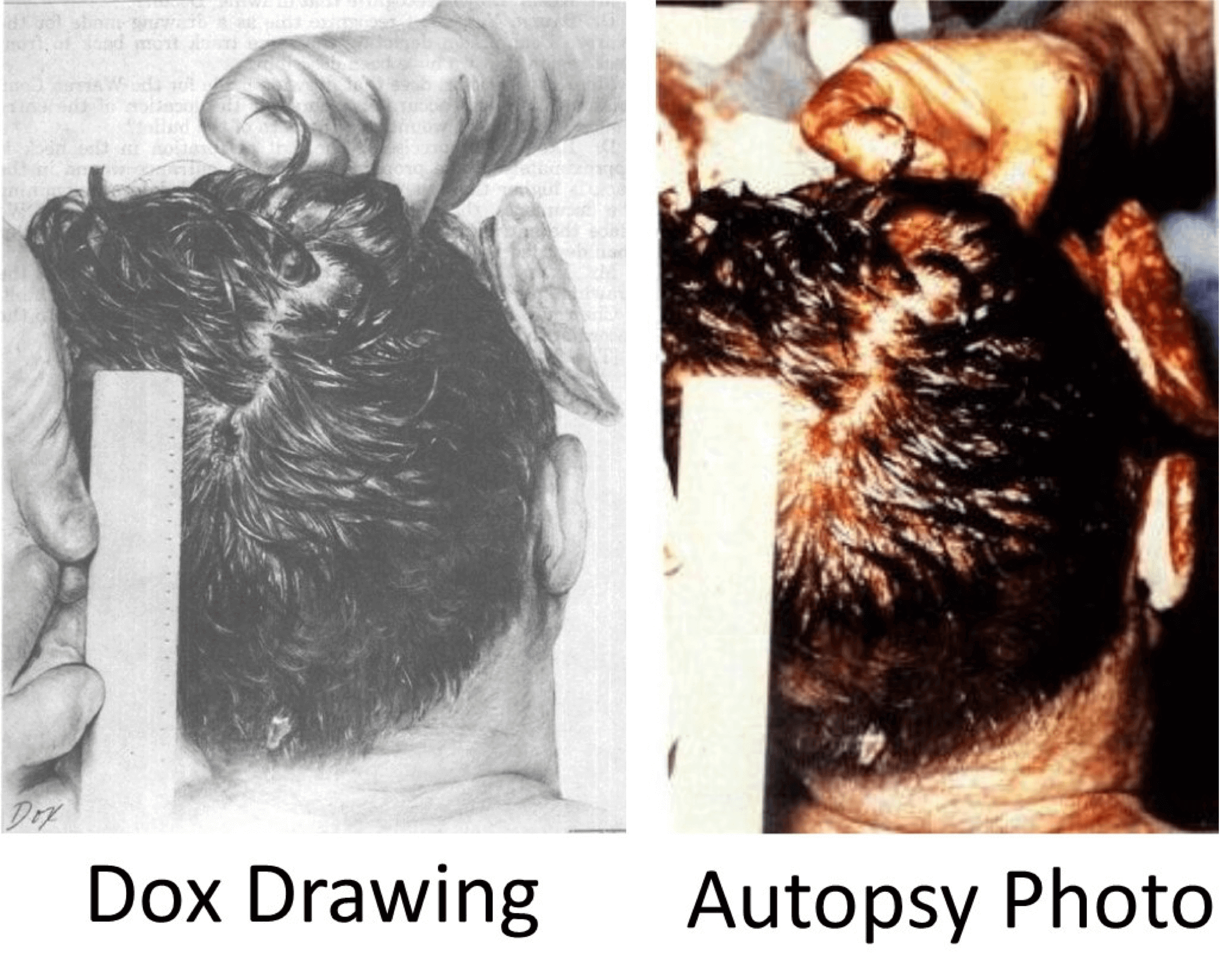
    Another surprising aspect of this chapter is that Thompson agrees with the Ramsey Clark Panel. That panel’s findings were released on the eve of the Clay Shaw trial. They upheld the original autopsy’s conclusions about two shots from behind; but they made about four major changes that were rather bracing. One of them was that they raised the entrance wound in the rear of Kennedy’s skull 10 mm upward, into the cowlick area. (Thompson, p. 248)

    The way Thompson mentions this in passing was, again, jarring to the reviewer, one reason being that, in all likelihood, it was Six Seconds in Dallas which caused both the Clark Panel to be formed and the rear skull wound to be raised to the cowlick area. (DiEugenio, The JFK Assassination, p. 150). As Russell Fisher, the panel’s chief pathologist later said, Attorney General Ramsey Clark got hold of an advance copy of Six Seconds in Dallas. On page 111 of that book, Thompson shows that Kennedy’s head––as depicted in the Warren Commission to illustrate the fatal wound––is not in the correct posture as shown in Zapruder frame 312. The Commission had the film; therefore, all the indications are that they fibbed about this key point.

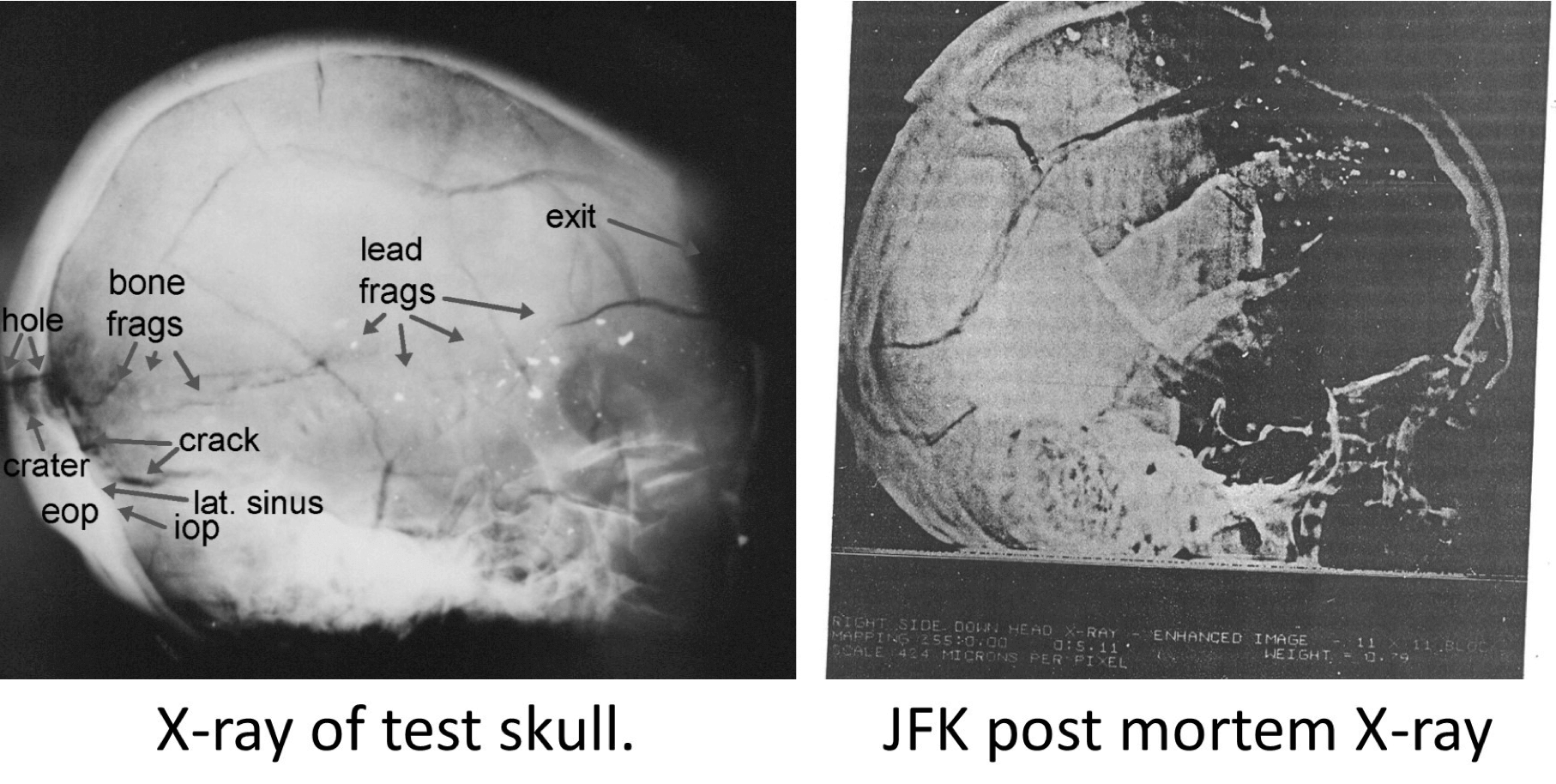
    How did the Clark panel elevate that wound into the cowlick area? Since Thompson does not show the anterior/posterior X-ray, the reader is in the dark about this point. The answer is they largely based it on a disk-shaped white object in the rear of the skull that stands out plain as day on the X-ray. The problem with this piece of evidence is that none of the autopsy doctors, or the two FBI agents in attendance, saw it on the X-rays in the morgue the night of the autopsy; and it is not in the 1963 autopsy report. All of which is incredible, for two reasons. First, it is by far the largest fragment visible; and second, its dimensions of 6.5 mm precisely fit the caliber of ammunition Oswald was allegedly firing. (DiEugenio, The JFK Assassination, pp. 153-54)

    I could go on from there, but I won’t. As the reader can see, I did not find this chapter at all satisfactory.


    IV

    One of the key points Thompson wants to make in this book is something he has been talking about for a rather long time. It is the work of Dave Wimp on what the author calls “the blur illusion.” In fact, Thompson calls Chapter 14, “Breaking the Impasse: The Blur Illusion.” Since I took Thompson at his word about this, several years ago, at a JFK Lancer conference, I mentioned Wimp and his work. I said the forward bob by Kennedy preceding the rearward head snap did not really exist. Almost immediately after I finished my address, first Art Snyder and then John Costella disagreed with me. Snyder disagreed with me on the mathematical analysis Wimp had done. Costella disagreed on whether or not this was really an illusion. In other words: did Kennedy’s head really bob forward before jetting backward? The two disagreements gave me pause. Why? Because both men are physicists.

    Back in the sixties, Thompson first learned of this forward bob between Zapruder frames 312-313 from one of the earliest students of the film, Ray Marcus. (See page 112 of Six Seconds in Dallas, footnote 2) The author and Vince Salandria then studied this in combination with the more dramatic and lengthier rearward slam at the Archives. (Six Seconds, pp. 86-87) The issue is one of the most interesting aspects of Thompson’s first book. He goes through a few explanations of how this could have occurred. He then decides on a term that became rather famous in the critical community––the “double hit” or “double impact.” (pp. 94-95) In other words, two projectiles hit Kennedy’s skull almost instantaneously: one from behind and one from the front. The first moved him forward, the second rocked him backward. He then adds that S. M. Holland had told him the third and fourth shots sounded like they were fired almost simultaneously. He backs this up with other witnesses who heard the same thing. Thus the double impact was credible.

    Why did Thompson change his tune on this point? There seem to be three reasons for this. The first is that he felt his first thesis allowed for too precise a synchronization of the shots. No firing team could be that well trained. The second and third are complementary: Dave Wimp’s work coincided with his gravitation towards the acoustics evidence.

    Since Thompson decided to go with the acoustics, he had to dump the “double hit” he wrote about in his earlier book, because the acoustics evidence allows for only one shot from the front at Zapruder frame 312. The following shot comes from behind at Zapruder frame 328. Dave Wimp aided this new scenario by somehow making the forward bob disappear, being dismissed as an illusion.

    But if such was the case, then why did the two physicists disagree with my statement about the Wimp thesis? Snyder objected to it on mathematical grounds. He did not think that Wimp’s work had absolutely proved his thesis. He told me that there was about a 20% chance Wimp was wrong. Snyder turned out to be correct, because in a reply to Nick Nalli’s review of Last Second in Dallas, Wimp admitted his calculations were not correct. He wrote:

    That I have a blur illusion hypothesis is the result mostly of people failing to distinguish between what people are saying and what people are saying people are saying, which seems to be a pervasive problem. The issue is not about illusions but rather about bad methodology.

    Today, Wimp now seems to admit that Kennedy’s head did go forward by about an inch. Evidently, Thompson oversold this idea to at least one person: me. And since he still insists on it in his book, perhaps others.

    Costella explained why Wimp made an error in a more practical, applicable sense:

    Wimp has always made a valid observation about trying to measure the position of a single (rising or falling) edge, in the presence of blur. That is fraught, especially in the presence of unavoidable nonlinearities. What he never seems to have considered, as far as I can tell, is that if you have two opposite edges (rising then falling, or vice versa) of an object, then it is quite simple to align the center of mass of the object between any two frames, even if the edges are blurred. You can do this even if the two frames are blurred differently––that’s effectively what all stabilized versions of the film do (including his own!). It’s even simpler if you either deblur the blurred 313 to match 312 (like I did back in the day, per my animation on my website), or else blur 312 to match 313 …. What I never did is put an exact number of inches on the forward head movement. I have no idea if his smaller number is accurate or not, because I didn’t quantify. What is certain, just from the visuals, is that the head moves forward in the extant Z film. (Email of 6/15/21)

    How proficient is Costella in his study of the film? After he approached me at JFK Lancer, he took out his cell phone and showed me how he had deblurred Zapruder and the forward head bob was still there. Yes, John is a man who carries his work with him.

    G. Paul Chambers, another physicist, probably has the most sensible explanation for this aspect of the case. He has told Gary Aguilar that what likely happened is that the first shot through Kennedy’s back likely paralyzed him. When the car began to brake, his limp body then went forward. (Phone call with Gary Aguilar, 7/18/21)


    V

    “Jim, there is no motorcycle where the HSCA says there is.”

    The above quotation is taken from a phone conversation in 1994 between this reviewer and the late Dick Sprague. I chose to lead this part of my review with it because, as with the head bob, I once believed in the acoustics evidence. So when the famous photo analyst Dick Sprague said the above to me, I was surprised.

    Let me explain why I had that reaction. When I visited the now deceased HSCA attorney Al Lewis at his office in Lancaster Pennsylvania, he told me about something his former boss had done in the early days of that congressional committee. Chief Counsel Richard A. Sprague had arranged a day-long study of the photographic evidence in the JFK case. There were three presenters on hand: Bob Cutler, Robert Groden, and Dick Sprague. They went in that order. Before Cutler began, the chief counsel turned to those in attendance and said, “I don’t want anyone to leave unless I leave, and I don’t plan on leaving.” As Lewis related to me, Cutler’s presentation was about 35 minutes. Groden’s was over 90 minutes, close to two hours. Dick Sprague’s went on for four hours. By the end of Sprague’s demonstration, 12 of the 13 staff lawyers believed Kennedy had been killed by a conspiracy. (James DiEugenio and Lisa Pease, The Assassinations, p. 57)

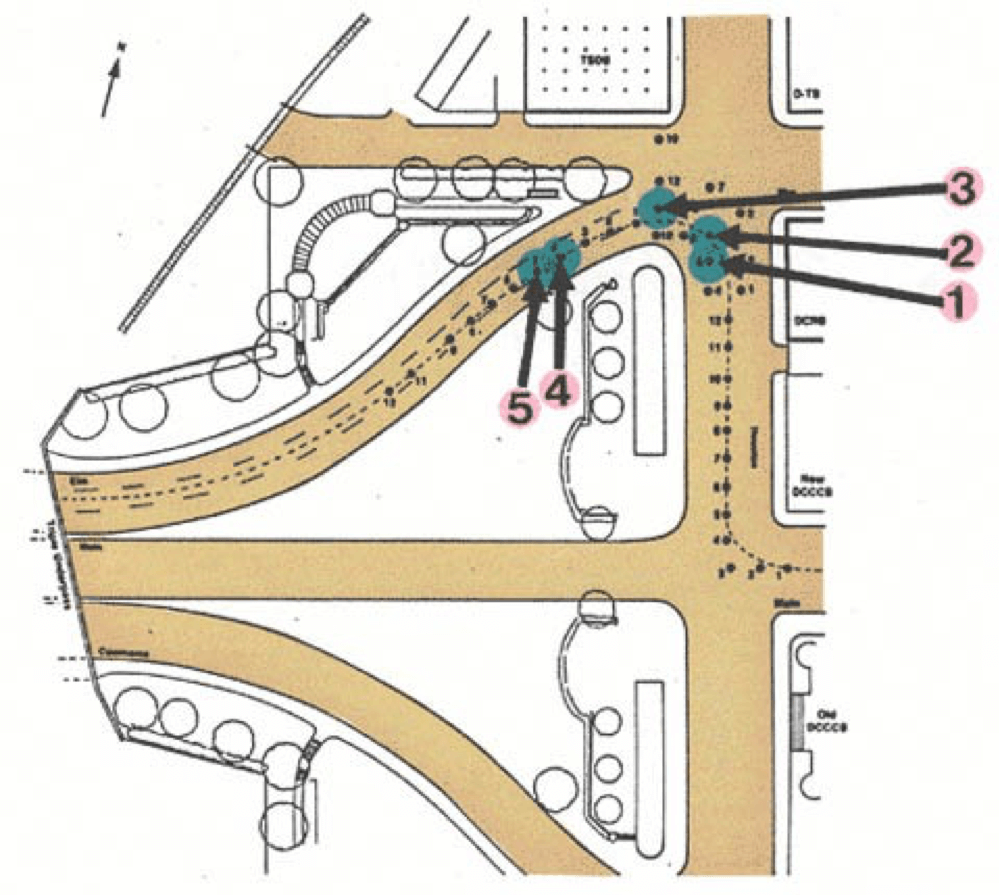
    Such was the photographic mastery of Dick Sprague. At that time, no one had a more expansive collection of films and photos than he did. In that phone call, he told me that Robert Blakey, the second chief counsel, only called him once. It was to ask him if there was a motorcycle where the acoustics experts said there had to be one. Dick spent a lot of time going through his massive collection. He eventually replied that no, there was not. It was Groden who said that there was.

    To this day this issue has not been settled to any adequate degree. And there is simply no papering it over. Because the motorcycle has to be at a precise point near the intersection of Houston and Elm for the acoustics evidence to be genuine. Modern experts on the motorcade, like Mark Tyler, insist that Sprague was correct. And Mark argues that point effectively at the Education Forum. (See his post of June 9th) What I found severely disappointing about Thompson’s book is this: he barely deals with the issue at all. This is what he says about the highly controversial but crucial point: he writes that he and author Don Thomas found the correct motorcycle in the films of Gary Mack. Afterwards, they had a few beers and called it a night. (p. 304)

    I could hardly believe what I was reading. I actually wrote “WTF” in the margin of my notes. Somehow, this trio, not experts on the photo evidence, easily accomplished something that Dick Sprague––who was the leading authority in the field––could not do? The cavalier way Thompson deals with this important point––throwing in the phrase “having a few beers and calling it a night”––underscores just how unconvincing his treatment of it is. If it was this easy to locate and demonstrate, then why is there no picture of the proper motorcycle in proper context to accompany the “few beers and calling it a night”––straight out of Sam and Diane at Cheers––motif? I was so puzzled by this carelessness, leaning toward avoidance, that I went back and read up on the acoustics evidence.

    These sound recordings first entered the legal case during the days of the HSCA. They were offered up by Texas researchers Gary Mack and Mary Ferrell. Thompson does a good job in explaining the rather primitive technology which the Dallas police used in these recordings. There were two channels being recorded that day, simply labeled Channel 1 and Channel 2. The latter used a Gray Audograph powered by a worm gear which drives a needle into a vinyl disk. (Thompson, pp. 304-06). Channel 1 “was done by a Dictaphone that used a stylus inscribing a groove onto a blue plastic belt called a Dictabelt mounted on a rotating cylinder.” (Thompson, p. 148). Channel 1 was used for basic police operations. Channel 2 was for special events, like Kennedy’s motorcade. Back at headquarters, the dispatcher would announce each minute that passed, and each time the dispatcher spoke to a unit he would announce the time. (p. 149)

    The HSCA did two tests of the acoustics. The first was by a company called Bolt, Beranek, and Newman. The main scientist on this was James Barger, who supervised a reconstruction test in Dealey Plaza. After doing this, Barger said that there was about a 50% chance of a shot from the Grassy Knoll. The HSCA then gave those results to another team of acoustic experts: Mark Weiss and Ernest Aschkenasy . After examining this data they decided there was a much higher probability, 95%. The HSCA announced this in their final days.

    Because he is wedded to this evidence for the finale of his book, Thompson has nothing but scorn for what is today called the Ramsey Panel. The Department of Justice asked the National Academy of Sciences to review the work of the HSCA. They set up a committee named after Harvard physicist Norman Ramsey. Alvarez ended up serving on this committee. Alvarez told Barger that no matter what he said he would vote against him. (Thompson, p. 287) The panel was biased from the start and the author does a good job proving that point. For Thompson, this is why they ended up rejecting the HSCA result.

    But I want to note two things about the closing 80 or so pages of Last Second in Dallas and how an author making himself a character in his book is a double-edged sword. Thompson mentions a 2013 debate he did for CNN moderated by Erin Burnett; his opponent was Nick Ragone. (p. 276) If one can comprehend it, Ragone brought up Gerald Posner’s discredited book Case Closed. Thompson says he did not do well since he did not have any new evidence to reply with. I don’t want to toot my own horn, but if I had been there, I would have had a lot of new evidence to throw back. This is how I would have replied:

    Nick, that book came out in 1993. Which was one year before the ARRB was set up. They declassified 2 million pages of documents. Have you read them? I read a lot of them, and here is what they said.

    When asked the old chestnut, “Well why didn’t someone squeal?”, Thompson could have mentioned Larry Hancock’s book Someone Would Have Talked. He then could have said: “Larry shows that two people did talk, Richard Case Nagell and John Martino. If you don’t know about them, that is a failure of the MSM.” As a point of comparison, when Oliver Stone and I did an interview this past June with Fox, I brought about eight of these new ARRB documents with me. Fox filmed me showing them while I described what they said. They then had me send them in email form. Whether or not they will exhibit them on the show, I don’t know. But I had enough rocks in hand to play David with his slingshot.


    VI

    But the reason I think Thompson plays up the CNN experience is that he wants to show that if the acoustics evidence had been reexamined, he could have mentioned that. As noted, Thompson harshly critiques the Ramsey Panel, and much of this is warranted. But he only briefly mentions how the Weiss/Aschkenasy ––hereafter called WA––verdict was rather hastily granted a stamp of approval by the HSCA.

    What makes this kind of odd is that the author mentions Michael O’Dell more than once in the book. But he does not go into O’Dell’s rather bracing criticism of WA. O’Dell is a computer scientist and systems analyst. O’Dell wrote that the WA conclusion was based upon a motorcycle rider having his Channel 1 microphone button stuck open for a continuous five minute period. This was thought to be H. B. McLain, who first said it was and then said it was not him. What O’Dell was trying to do was to replicate what WA had done, except with much more powerful computer tools, not available back then. He wrote a report called “Replication of the HSCA Weiss and Aschkenasy Acoustic Analysis.” In his report, he found that:

    Numerous errors have been found with the data provided in the report, including basic errors involved in the measurement of delay times, waveform peaks and object position. Some of the errors are necessary to the finding of an echo correlation to the suspect Dictabelt pattern. The Weiss and Aschkenasy report does not stand up to even limited scrutiny, and the results it contains cannot be reproduced. (p. 2)

    O’Dell revealed that WA had relied on a millimeter ruler and string to map out their bullet paths on a map of Dealey Plaza. O’Dell used Adobe Photoshop to scan the same map as WA and transferred the measurements into pixels after lining them up in Excel. He found multiple critical errors in WA’s work, including those of distance measurement of buildings from other objects like the stockade fence. (See p. 3) O’Dell wrote that the microphone was positioned in the wrong place by WA. (p. 9) There were errors in the original paperwork independent of a transfer to a virtual model. For the buildings list in Dealey Plaza, items 16 and 20 were described as the same object. (p. 4) He also found out that one of the bullet paths was supposed to rebound off of object 23, yet there were only 22 structures WA had listed. (p. 5). There were objects listed in the WA table that O’Dell could not find on the map. (p. 8) But perhaps the most bracing criticism O’Dell made was that

    … the values presented in Table 4 for the Dictabelt pattern do not appear to be valid measurements of the peaks in the recording. A test that supposedly identifies a gunshot on the Dictabelt recording must, at a minimum, correctly measure the sound being tested on the Dictabelt. (p. 11)

    I could go on. But before anyone comes back at me by saying, “Why would you use something like this after what Dale Myers did with his phony cartoon based on the Zapruder film?” After all, Jim, Myers went on ABC TV and said the single bullet theory was really the single bullet fact. All I can do is reply with the following. I used O’Dell because Thompson used him. In communicating with the man I found out that Thompson had signed him to a non-disclosure agreement about his book. It ended when the work was published.

    Another series of problems with this evidence was written about by Charles Olsen and Lee Ann Maryeski in June of 2014 for Sonalysts, Inc. out of Waterford, Connecticut. They stated that although McLain had claimed he had opened up his cycle to a continuous high speed after the shooting, that is not what they determined by placing the sound on a graph: “What Figure 1 shows is a motorcycle that variously speeds up and slows down and idles during this latter period.” (6/6/2014, Olsen and Maryeski, pp. 3-4)

    Let me add one other comment. As both O’Dell, and especially Dave Mantik have pointed out, one of the virtues attributed to this evidence is the so called “order in the data.” Or as Don Thomas puts it in his book, the best test matches correspond to a topographic order in Dealey Plaza and with the dictabelt. (Hear No Evil, p. 583) But as Mantik informed me, if one looks at Thompson’s own table, if the HSCA had chosen the bullet sound at the 144.90 point in the tape, they would have had two matches to the School Book Depository that very closely matched the one to the knoll area. (Thompson, p. 155) The same thing occurred at 137.70; the TSBD could have been chosen over the knoll. (interview with Mantik, 6/26/21)

    In addition to all the above, Thompson essentially brushes over the issue of heterodyne tones. (p. 296) This is an important point that the Sonalyst report examined. It’s important because it can result in words being scrambled in pronunciation as one listens to them. Meaning that they can sound like one phrase to one person and another phrase to someone else. And this has happened. (Olsen and Maryeski, p. 9)

    Even his heralded discovery, that voices saying “Hold everything” and “I’ll check it,” occur around the assassination is odd. First, the object is to show whether or not the bullet echo correlation is real, not the voices. Also, to get a more distinct peak for “I’ll check it,” Richard Mullen, Barger’s protégé, used a narrower sampling PCC (Pattern cross correlation) window of 64. Therefore Thompson concludes this is what should have been used from the start. Yet for “Hold everything,” a wider sampling window of 512 yielded a larger net peak than did a smaller sampling window of 64. Thompson offers no explanation for this seeming paradox. (See Figures 22-6 and 22-7; 6/26/21 interview with Mantik)

    If the “Hold everything secure” phrase is at the time of the assassination, then the acoustics is invalid, since this is spoken after the assassination. “I’ll check it” would be around the time of the shots. So the two phrases are in conflict if both were valid. The first phrase is at the wrong time, the latter one is at the right time. So Thompson argues that the “Hold” phrase has been altered and is really an overdub. (Thompson, pp. 345-47)

    This has also been placed in doubt by O’Dell. (See Dictabelt Hums and the “hold everything secure” Crosstalk) The “Check” phrase, as has been argued by many, is not really crosstalk at all. The same sound does not appear on both channels. (Email communication with O’Dell, 7/25/21). And further, Sonalysts showed that the spectrograms of the phrase differ on Channel 1 and 2. (Olsen and Maryeski, p. 6)

    I could go on. But I think the point has been made. There are simply too many uncertain variables with the acoustics evidence to rely on it as having a 95% probability. Much of this is due to the innate poor quality of the recordings themselves.

    When we were making JFK Revisited, producer Rob Wilson asked me to incorporate a section on the acoustics evidence. I recommended against it. I simply noted that with all the above problems with that evidence we would be making ourselves into a bull’s eye on a target range; a whole gallery of persons would take out their bows and arrows and start unloading their quivers on us.

    As I said in Part 1, there are good things in Last Second in Dallas. And as a responsible critic I have described them. In my opinion, they are important and valuable and have stood the test of time. But it is also my opinion that there are a lot of things which seem to me to be liabilities, including what the author thinks is the culminating arc of his book––and I have described those deficits also. This is why Last Second in Dallas is a decidedly mixed bag.


    Return to Part 1

  • A Review of Last Second in Dallas by Josiah Thompson

    A Review of Last Second in Dallas by Josiah Thompson


    Just over half a century ago Josiah “Tink” Thompson published one of the seminal books on the JFK assassination, the influential Six Seconds in Dallas. Working with limited materials, he performed a pioneering initial investigation outlining many of the crucial objections to the Warren Commission’s conclusion of a single gunman. A striking finding at that time, made by Raymond Marcus, was the forward and then violently back-and-to-the-left head motion seen sequentially at 312/313 and 314/315 on the Zapruder film. Thompson’s original theory was that this indicated sequential shots, the first from behind and the second from the Grassy Knoll, striking in approximately 1/10th of a second.

    Since the 1967 publication of Six Seconds in Dallas, intense scrutiny has been placed on all aspects of the evidence. In 1978, the HSCA discovered the DPD DictaBelt tape and an analysis concluded with a 95% confidence level that the shot that first struck the head was fired from the Grassy Knoll. In 2001, Don Thomas reanalyzed Mark Weiss and Ernest Aschkenasy’s data and published a peer reviewed article in Science and Justice concluding that the probability was even higher. Impressed by this pure science, Thompson has now changed his position and believes that the first shot came from the Grassy Knoll and that a second shot to the head came from behind less than 1 second later in accordance with the original 1978 analysis.

    His new investigation, culminating in the publication of Last Second in Dallas, relies on several experts, including the distinguished Dr. James Barger who did the original acoustic analysis for the HSCA. It is to Thompson’s credit that he was able to get the reticent genius Dr. Barger to do further scientific work in the final authentication of the tape. In Last Second in Dallas, Thompson presents the reader with new observations which should erase all doubt of a single gunman in Dealey Plaza. It is a combination of the history of the case from his personal perspective of over 50 years’ experience as well as the scientific studies which have been performed with special emphasis on the acoustic evidence.

    Chapters 1 and 2 are recollections of his initial reaction to the assassination as well as his early activities in the case. Interactions with many eyewitnesses and first-generation researchers and critics are recalled. Thompson revisits some of his original observations from Six Seconds in Dallas. One concerns the circuitous journey of CE399. The eyewitness testimony of Parkland Hospital Security Director O.P. Wright claiming that the bullet he recovered had a pointed tip is revived. This is a topic which has been examined in detail, but here the focus is on Wright. The author rightfully questions the ability of CE399 to have accomplished all necessary to maintain the single bullet theory. He continues with his involvement with Life magazine, which gave him access to the sequestered Zapruder film which was crucial in the writing of Six Seconds in Dallas.

    Chapters 3 through 5 recount the eyewitness testimony confirming a shot being fired from the Knoll. Their firsthand recollections of the gunshot report, including the smoke from under the trees, the smell of gunpowder, footprints, and cigarette butts behind the fence, as well as the presence of an individual flashing a fake Secret Service agent badge, are telling memories of the day. The reader is exposed once again to many familiar names: the Newmans, Zapruder, Sitzman, Hudson, Altgens, Jackson, Chaney, Hargis, Martin, Smith, Holland, and Bowers. Many of these statements will be known to even beginning students of the assassination, but Thompson’s focus on the Knoll provides persuasive evidence beyond the acoustics that a shot was fired from the there.

    In Chapters 6–8, Thompson recalls his continuing involvement in the case and significant developments during that time period. Deservedly proud of his work on the 1966 Life magazine article “A Matter of Reasonable Doubt,” he regales in telling how this brought him to the attention of J. Edgar Hoover. He immersed himself in the case doing groundbreaking work with interviews, examination of photos and films, and ballistics, among other fields, resulting in the publication of Six Seconds in Dallas. That book documented many of the early persuasive arguments weighing against a sole gunman and it garnered a cover story in The Saturday Evening Post. Tink’s behind-the-scenes stories are both entertaining and enlightening and provide insight into his early years of assassination research and his, at times, contentious interactions with other highly respected first-generation critics. At the time of the Clay Shaw trial, the author distanced himself from other critics who were supportive of Jim Garrison’s prosecution of Shaw. For older readers, the preceding chapters may evoke memories of the heady days of fresh clues and new revelations. For younger readers, Thompson’s firsthand recollections can directly transport them back to what those times were like.

    Chapter 9 covers the involvement of Nobel prize winner Dr. Luis Alvarez, who also assumed he had a PhD in assassination “science.” Alvarez, a blatant Warren Commission apologist, is known for shooting melons, thus trying to create a reverse jet effect to explain the rearward component of JFK’s double head motion. Alvarez is one of many scientists, like Vincent Guinn, in the governmental and academic circles to have used their prestige when approaching the assassination from their individual field of expertise. Thompson recounts a long period of contentious personal communication between he and Alvarez, mainly over Alvarez’s “jiggle analysis” of the Zapruder film and “reproducing” the reverse jet effect. Critics had immediately pounced on Alvarez’s claim that a single frame horizontal blur seen at 313 reflected Zapruder’s reaction to a rifle shot, as a muzzle blast from the TSBD would not have even reached his ears yet. Ironically later in Chapter 14, a same horizontal blur will be viewed as a reaction to a shot from the Grassy Knoll, with a similar lack of success based upon similar principles. Alvarez’s attempts at shooting various objects, plus his publications, are revisited. During the writing of the book, Paul Hoch provided the author with photos and notes from the actual melon shooting sessions, which almost invariably showed objects moving forward in the direction of the bullet as had the Warren Commission tests. Thompson details the intellectual dishonesty and despicable behavior exhibited by this Nobel prize winner. I do not think the author adequately describes the enjoyment he found after obtaining Alvarez’s materials, provided by Hoch, which are now conserved at the Sixth Floor Museum.

    Chapter 10 presents a continuing autobiographical tale of his life as a renowned first-generation researcher in the 70’s and a life one could well be envious of. He highlights working abroad as well as his presence at Robert Groden’s first public viewing of the Zapruder film in 1973. He also provides a behind-the-scenes view of the drama behind its first nationwide broadcast on Geraldo Rivera’s Good Night America in 1976. The electric effect this had on the public, and the resultant efforts to get the House Select Committee on Assassinations (HSCA) created, are noted. The chapter ends with the Dallas Police Department DictaBelt tapes being given to the HSCA in 1978 by Mary Farrell and its subsequent effect on their deliberations.

    II

    A short history of the chain of possession of the tapes is detailed and extremely helpful information on how the DictaBelt recording system functioned is provided in Chapter 11. HSCA Chief Counsel Robert Blakey’s choice of James Barger to analyze the tape for the HSCA is covered. Thompson ends this chapter without revealing to the reader that prior to the involvement of Weiss and Aschkenasy, Barger gave his discovery of the muzzle blast from the Grassy Knoll at 145.15 seconds a 50/50 probability.

    Thankfully, due to his true scientific ambivalence, the HSCA brought Weiss and Aschkenasy on board and it was their work which identified an earlier muzzle blast at 144.90 seconds. Without the identification of this earlier muzzle blast, the stalemate of medical evidence of a single shot from behind versus the acoustic evidence of a single shot from the Grassy Knoll would have continued for a significant period.

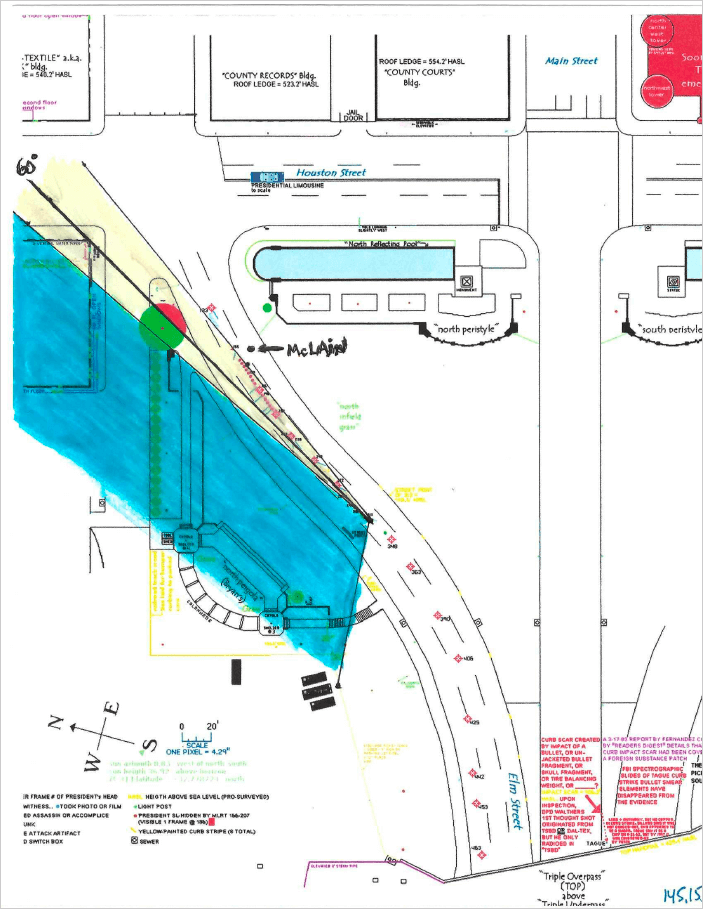
    The 60 Degree Rule concerning the identification of the N waves created by a bullet’s supersonic travel is improperly explained. I brought this up with Barger, who provided a diagram he had made applicable to this when the bullet’s velocity went down to zero after impact. Most important is that when the bullet stops, the creation of the N wave stops, and it is from this point along the trajectory to the target that the 60 degrees angle is measured for a bullet traveling at Mach 2. It is not the difference in the angle between the target and microphone as stated. When applied to a Grassy Knoll shot, H. B. McLain’s microphone should not have been able to detect an N wave from any Knoll shot. Barger recently acknowledged this, but gave the explanation that it might be a reflected N wave which was recorded.

    Chapter 12 delves into the HSCA investigation quickly going over Guinn’s Neutron Activation Analysis studies (today called Comparative Bullet Lead Analysis) and their attempts to synchronize shots on the tape with the film. On p. 173, a shot sequence is attempted based upon his evaluation of the timing of muzzle blasts. The origin of each shot is not noted. Confusion is created when predicated upon the inerrancy of the acoustic analysis. Barger cautioned the HSCA that, as the number of putative shots increased, so did the possibility that one of these events might be an artifact on the tape itself and not represent an actual gunshot. His warning has not been heeded.

    Attempts are made in Table 12–2 to correlate reactions thought to be due to a first shot recorded at 137.70 seconds or approximately Zapruder frame 175. This has Phil Willis reacting to a shot at 202 which would not be fired until 204. Close attention must also be given to the coverage of the blurs. A blur at 181–182 is cited as a reaction to the first proposed shot at 137.70 seconds. None of the HSCA investigators in Table 12–1, on the previous page, identified a blur at that time. A horizontal panning error is mistaken as evidence for a startle reaction at 181/182 just as for 313. This is the only extra-acoustic evidence for this earlier shot.

    All the reactions which are cited in Table 12–2 to support such an early shot occur incident to the actual first shot near 200 recorded at the later 139.27 seconds. The HSCA photographic panel pointed to JFK’s first reaction near 200. In this same table, it is not true that Connally and Kennedy are obscured by the Stemmon’s Freeway sign after 199. Here it is correctly stated that the last shot of the first volley, recorded at 140.32 seconds, struck Connally, but in Chapter 24 p. 352 it is mistakenly claimed that the acoustic evidence indicates that it was actually the prior shot recorded at 139.27 seconds. Mathematical calculations are not provided which would allow readers to arrive at that conclusion. This equivocation stems from a failure to recognize that the first impulse, recorded at 137.70 seconds, is an artifact on the tape. A true synchronization demonstrates the shot to Connally was fired from the TSBD and was the last shot of the first volley recorded at 140.32 seconds. The first actual gunshot which struck JFK at 201, was recorded at 139.27 seconds. The artifact on the tape earlier at 137.70 seconds is a phantom muzzle blast of which Barger had warned. A successful synchronization of a Knoll shot recorded at 144.90 seconds is not presented.

    The chapter ends by briefly going over the pseudoscience of reverse jet effects and “neuromuscular” reactions which establishment scientists—like Alvarez and Larry Sturdivan—have foisted on the public to explain the backward head motion. The HSCA medical panel’s significant reservations with each is noted. Unmentioned is that the HSCA Medical Panel finally concluded that both these unlikely factors, acting simultaneously, had caused the backward head movement. Along with this is a critique of the tests performed by Alvarez with melons and the goat shooting experiments by Sturdivan at the Edgewood Army Arsenal, which helped bring the HSCA Medical Panel to its head-scratching conclusion about the cause of the violent backward head movement.

    III

    In Chapter 13, the decision of the AARB to buy the Zapruder film for 16 million dollars is mentioned. The unconscionable decision by the ARRB to gift the copyright of the film to the Sixth Floor Museum should have deserved mention as well. The comparative bullet lead analysis, NAA, done by Vincent Guinn for the House Select Committee on Assassinations is addressed as well as the excellent scientific work of Rick Randich and Pat Grant in exposing the fallibility of these tests. That work was so groundbreaking that the FBI has subsequently stopped using the procedure entirely. Warren Commission apologist Ken Rahn’s “Queen of the Forensic Sciences,” NAA, had been dethroned. While providing relief for some criminal suspects, this analysis did nothing to advance the case beside WC apologists having to admit these small lead fragments cannot be traced to any particular bullet.

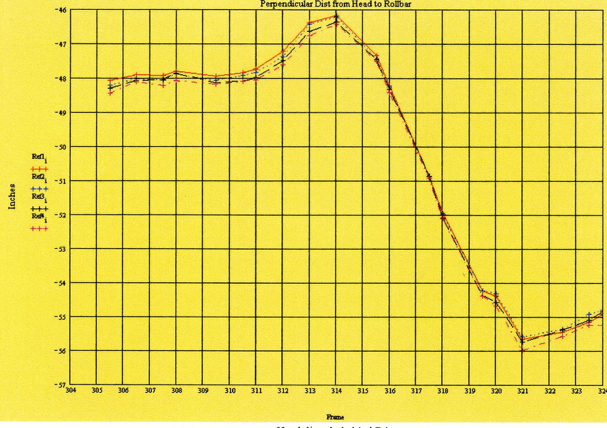
    Chapter 14 begins by attempting to convince the reader that the head does not actually go forward from a bullet impact at 312/313, relying solely on head motion while ignoring contrarian observations. Even then, the author’s, Itek’s, and even David Wimp’s measurements all show forward head motion and none significant backward motion until 315 as seen on page 415. The case for the blur at 313 representing a startle reaction by Zapruder is not well made. Similar lateral blurring at frame 409 is pointed to in Photo 14–2 on page p. 198 as an example. This blur cannot be due to a gunshot report because none was fired that late. A known horizontal panning error at 409 is used as an example for what happened at 313, a supposed startle reaction. The case is completely undermined when it has already been noted on p. 117 that a blur known to be due to gunshot report at 227 is in a diagonal or downward direction just like the blurs at 318 and 331. Don Thomas is relied upon to prove that the horizontal blur at 313 was caused by an acoustic startle reaction on Zapruder’s part. Thomas’s diagram, Plate 2 on p. 214, has Zapruder reacting in ½ a frame or .027 seconds after the muzzle blast arrival. Yet, the fastest acoustic startle reaction experimentally documented by Landis and Hunt in 1939 was .06 seconds or a full Zapruder frame. Based on the other shots, Zapruder’s reaction time can be calculated to approximately 1.5 frames.

    The horizontal blur at 313 cannot be due to a startle reaction and can be correctly recognized as a horizontal panning error as can 409. The other blurs at 331 (p. 227 photo 15–25), 318 (p. 223 photo 15–7), and 227 (p. 117 photo 9–20) are all greater in degree and all show a downward not horizontal deviation of Zapruder’s camera. Here the blur at 318 is not recognized as a startle reaction, yet the HSCA investigators did. Alvarez is now invoked to claim that oscillations caused the inconvenient downward camera deviation with blur at 318. None of the other blurs show such a train of oscillations as Alvarez claimed happened at 318. No such oscillations have been reported in the medical literature. If true, the downward oscillation at 318 caused an even greater blur than the supposed original horizontal reaction at 313. A startle reaction at 318, indicating a shot origin even farther than the TSBD, is antithetical to both Alvarez and the author’s claims.

    In Chapter 15, the author, having found an ally in Dave Wimp in the previous chapter, continues with the use of chosen experts. In 2005, Keith Fitzgerald sought out Thompson to show him what he thought was a notable finding concerning JFK’s head motion. Fitzgerald pointed to a 1.7 inch forward head motion between 327/328 as evidence for a shot having struck from behind. A second bullet striking the head from behind and fragmenting provided an apparent answer for all the damage to the windshield and Connally’s wrist wound which his theory demanded. However, earlier Thompson had relied on the opinion of physicist Art Snyder that a 2.16 inch forward head motion between 312/313 caused by a bullet was impossible. Is the short .4 inch difference between these two measurements the difference between possible and impossible? No. The author selectively uses one expert, Snyder, to claim no rear entry at 313, but then readily accepts the antithetical opinion of Fitzgerald to propose an absolutely necessary rear entry at 328. This chapter acknowledges that the bullet struck at 328. Whatever force caused the earlier forward motion Fitzgerald had identified between 327/328 could not have been caused by a bullet impact occurring at 328. Perhaps it might be related to the application of the brakes and/or the effects of gravity on a near lifeless body.

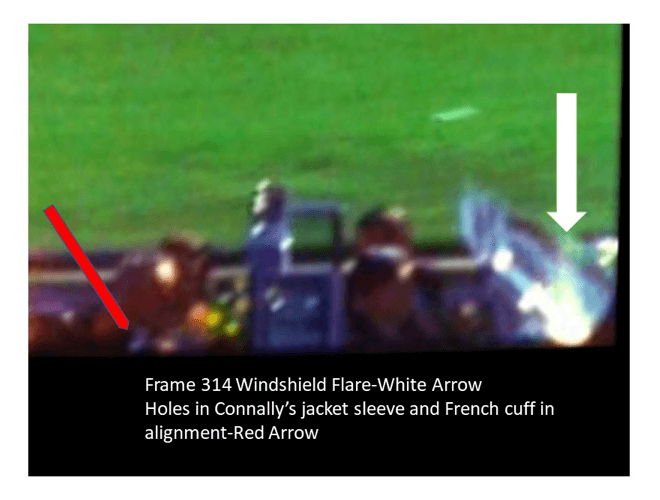
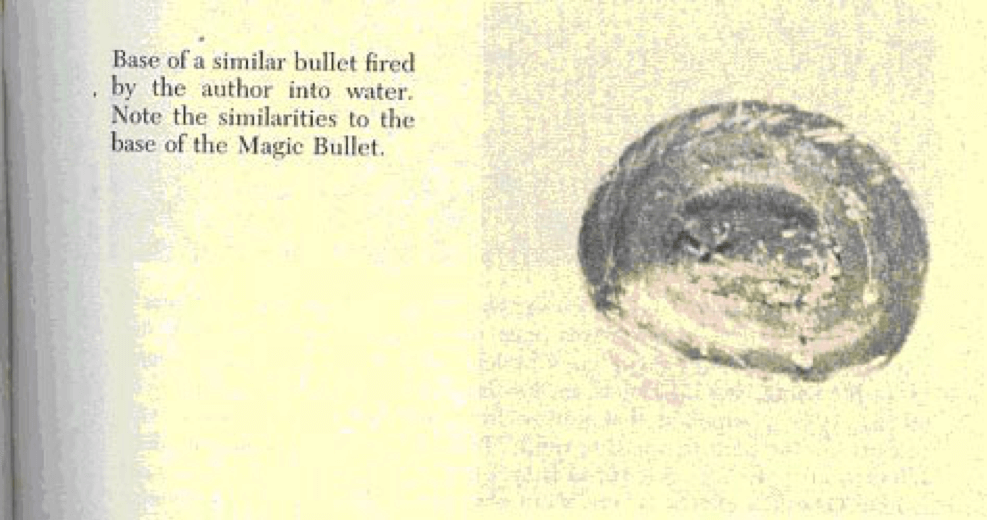
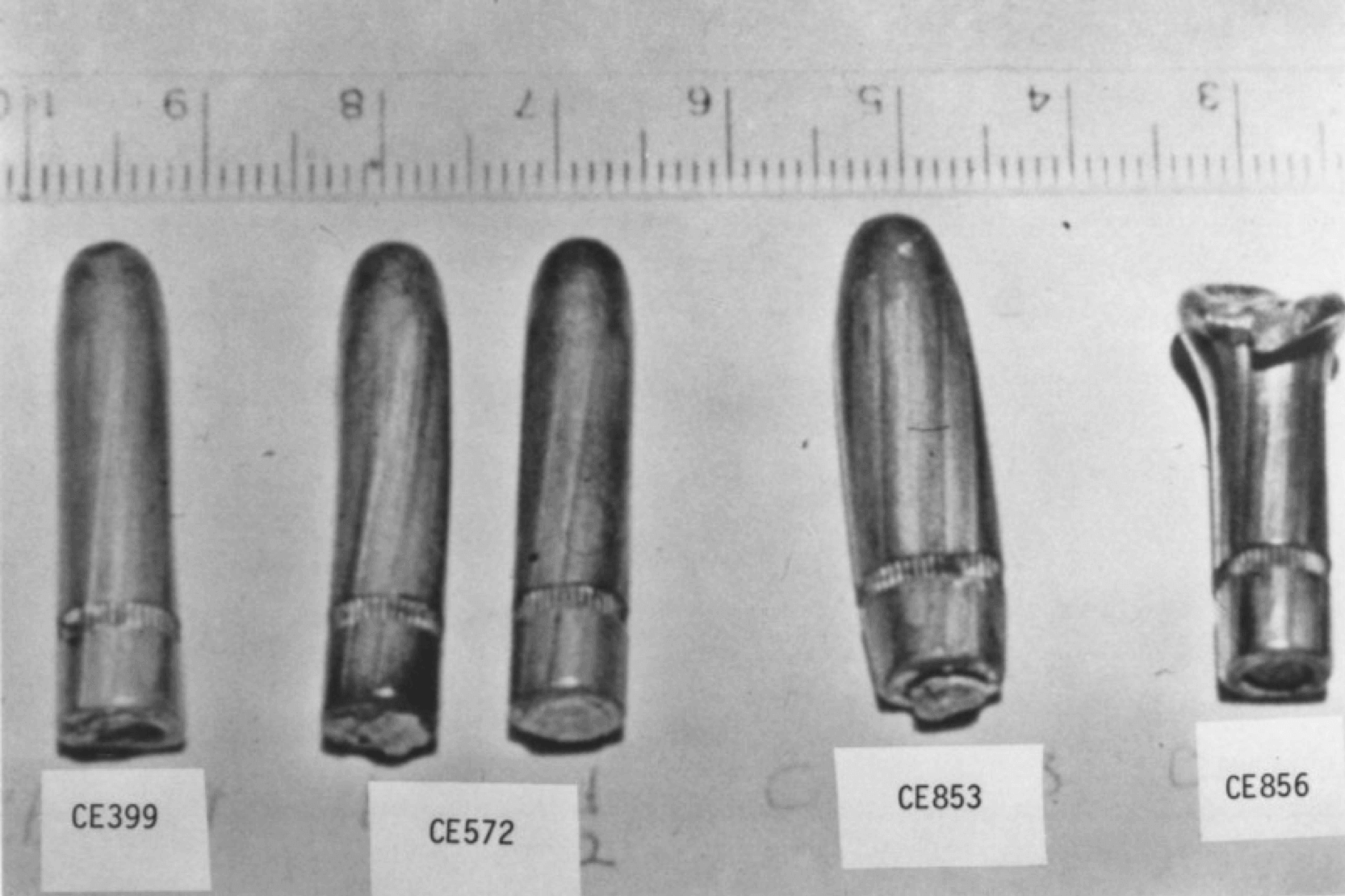
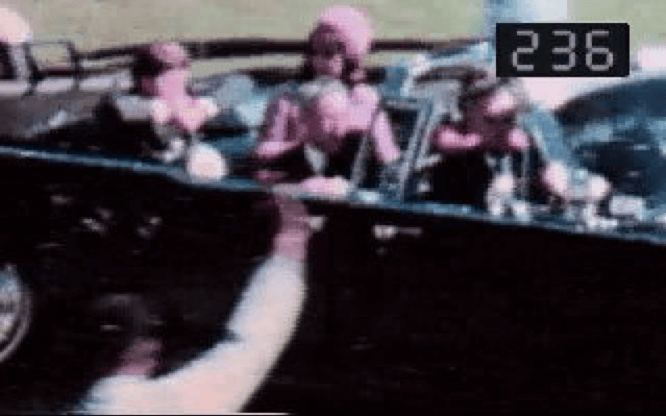
    The problem for a theory of a single shot from the front at 313 means that the two points of windshield damage and Connally’s wrist wound must have all been made at the same time by fragments of a forward moving bullet at 328. Thompson is relying on Fitzgerald’s errant conclusion to reinforce his particular viewpoint. The WC testimony of Dr. Gregory is quoted here, as it was in Chapter 4 of Six Seconds in Dallas, citing his opinion that a fragment of a bullet caused Connally’s wrist wound rather than CE399. A critical revelation in the first book, omitted here, is that dark wool suit fibers were discovered in the wound. The entry holes in the jacket sleeve and French cuff must have been in alignment to have been pierced simultaneously. At frame 328, however, Connally’s French cuff is completely exposed out of the jacket sleeve. This is readily apparent in Photo 15–41 on page 233. The entry point in the jacket sleeve graphically depicted in the close-up photos is closer to the wrist than is diagrammed. In either case a bullet entering at any point in the jacket sleeve could not have entered the mid portion of the fully exposed French cuff to simultaneously carry dark suit fibers into the wound. This observation, in and of itself, makes this whole thesis untenable. See photos 1, 2, and 3.

    Attention is now directed to the windshield damage. An impact at 328 is demonstrated by a flare of reflected light one frame later at 329 as the glass was deformed by a bullet’s impact. This seems quite logical. The acoustics indicates an impact at 328, a flare from deformation is seen on the very next frame and Zapruder’s startle reaction deviating his camera downward at 331. Incontrovertible evidence is provided for a gunshot and impact less than one second after the head wounds, meaning at least two gunmen.

    This is the single most important observation in the book and, quite frankly, the history of the case. Without it, there is no convincing visual evidence for an impact at 328 as the acoustic evidence indicates. The author’s seeming agnosticism relating to this flare is curious. This critical observation is dismissed simply as a matter of coincidence with a single critical angle to the sun causing the flare coincidentally timed one frame, 1/18th of a second, after a known windshield impact. However, there was another earlier flare from the windshield at 314, smaller the first time because it was caused by only a fragment of a bullet. See photo 4, frame 314.

    Two flares, each occurring on the very next frames after separate impacts, is evidence that the first wound to the head came from behind. The dark wool fibers in Connally’s wrist wound are fully corroborative. After the fragment’s impact at 313, Connally’s right wrist and French cuff were propelled fully forward out of the jacket sleeve. At frame 328 the holes in the jacket sleeve and in the French cuff were misaligned as photo 15–41 depicts. Selective use of observations is used to arrive at conclusions. The windshield flare at 329 will be cautiously pointed to as possible evidence of an impact but a second earlier flare, indicating a bullet going forward through JFK’s head at 313 and fragmenting, will be ignored in absolute deference to the acoustics. The presence of two flares, as well as two corresponding startle reactions, answers a question left unaddressed by the WC, whether the two points of damage were made at the same or separate times. The effects of two impacts are seen in less than one second proving conspiracy. An unshakeable belief in the inerrancy of the acoustic analysis prohibits the author from acknowledging these antithetical observations of the wound to Connally’s wrist and the presence of two windshield flares. A whole bullet directly struck the windshield frame at 328 bending its tip in the process and falling back into the limo where it was later recovered during the initial limo inspection. This non-fragmented bullet with a bent tip was chronicled by autopsy attendee and WH physician James Young MD in his 2001 US Navy BUMED Oral History Interview as well as in a confidential letter sent to ex-Warren Commission member and ex-President Gerald Ford. The existence of this whole bullet is also antithetical to a bullet fragmenting after a rear impact at 328.

    The final portion of the chapter is a review of eyewitness statements with the proposition that the final shot heard was the one which is conjectured as going forward through the head at 328. The question is not if an additional shot was heard after the head exploded, the tape reliably tells us that down to the hundredths of a second. The question is whether this final shot could accomplish all that is necessary in this scenario. Connally’s exposed French cuff and the head motion beginning at 327 rather than 328 should guide us to the conclusion that it cannot.

    IV

    Chapter 16 deals with the medical evidence and, I must admit, it is not the strongest chapter. Having investigated this area for 30 years, I can say that it can seem extremely complex at first and that there are many pitfalls which can be, and are, run into in this chapter. Numerous problems with the autopsy are highlighted. Thompson believes that the controversy over the autopsy findings is related to incompetence rather than a concerted effort to hide evidence of conspiracy. This reviewer can not come to the same conclusion.

    The Parkland doctor’s testimony concerning the head wounds, which are supposedly in contradiction to the autopsy photos and x-rays is revived, indicating to some alterations or forgery. This is a longstanding rabbit hole from which some are unwilling to exit. The hole in the skull was made by bone loss. All five of the recovered skull fragments are seen being ejected on the Zapruder film. The bone loss seen on the post-mortem radiographs and photographs in the autopsy room matches the bone loss seen as it occurred on the Zapruder film taken in Dealey Plaza as the events happened. Any intervening testimony by Parkland observers which challenges this is incorrect and only goes to demonstrate the fallibility of human recollections, such as those of O.P. Wright and McClelland among many others.

    An emphasis is placed on the distribution of metallic fragments in the head seen on the lateral skull x-ray. In either scenario, back then front or front then back, there were two bullets which struck the head and both fragmented. In either case, what the lateral x-ray of the skull shows is a composite of metal particles from two bullets. These metal fragments were mobile, and many were moved out of, or about in, the skull when the temporary pressure cavity caused an explosive wound. Mobile brain tissue with enclosed metallic fragments fell out onto the gurney in Trauma Room One. The discovery of a few additional metallic fragments adds little to the discussion.

    The subject of missing autopsy photos is taken up. Waters are muddied by bringing up the 30 year old recollections of Sandra Spencer to the AARB. Spencer initially developed and briefly saw the photos on one occasion shortly after the autopsy. The photographic and documentary records do not support her recollections. The HSCA had Kodak make enhancements of the roll of film exposed to light by Secret Service agent Kellerman the night of the autopsy. These images could not have been altered. I, as well as a few others, have seen these photos at the National Archives and I can say, as they have, that it is the same body on the same table at the same time and matches the other autopsy photos in the National Archives as well as those in the public domain. In the clinical photos taken later, there is a one-to-one correspondence between the fracture pattern on the photos and the authenticated skull x-rays. Spencer’s claim of a picture of the brain next to the body on the autopsy table makes no sense from a forensic perspective. The case is also made for other missing autopsy pictures. The possibility of missing photos can never be eliminated. Would one expect autopsy physicians, who will not disclose the distance of the entry wound above the EOP, to provide clear pictures of its exact location?

    Unable to make sense of the medical evidence as a whole, the author simplifies the focus down to only three findings. The first concerns the location of the entry hole in the rear of the head. Thompson claims that the hole of entry with internal beveling was completed by the portion of the hole in a corner in the late arriving triangular Delta fragment. A good student of the medical evidence will know that he is quoting autopsy pathologist Dr. Boswell from his gaffe filled 1992 JAMA interview. The problem is that the Delta fragment had external beveling in one corner not internal beveling. None of the late arriving fragments had internal beveling. Boswell had unwittingly revealed his knowledge that the Delta fragment fit at the top rear as the Nix and Zapruder films show. The actual level of the entry hole documented by the autopsy team can be seen on page 265 photo 16–14. A fracture, created by a first bullet’s entry, is present at the autopsy team’s lower entry level. This extends upwards and anteriorly to stop the propagation of a fracture from the HSCA’s higher “entry” wound. This is Puppe’s law which states that a primary fracture will stop the propagation of a secondary fracture by virtue of the pre-existing gap in the bone.

    This was the basis for an article I submitted to the Journal of Forensic Sciences in 1996 indicating two shots to the head, the first from behind and 1/10th of a second later from the front just as Thompson proposed in 1967. This was sent out for and passed peer review, but the editors and board refused to publish it for some of the same reasons later given to Don Thomas when his paper was even refused evaluation by Journal of Forensic Sciences.

    The second finding relates to the distribution of metallic fragments in the head. These mobile fragments cannot be used as a reliable path of the bullets. The pattern of intersecting fracture lines in areas of minimally displaced skull manifesting Puppe’s law indicate that the autopsy doctors were correct in their lower entry localization.

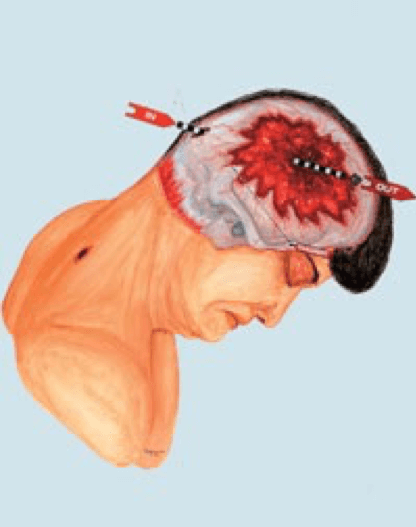
    The third area is the proper location and orientation of the Delta fragment. In 1967 in Six Seconds in Dallas, Thompson astutely identified it sliding backwards across the trunk on the Nix film. From the previous chapter, page 232, Jackie’s detailed and accurate description of the skull fragment she recovered matches the Delta fragment. Arising from this position, the only orientation possible, determined by a portion of cranial suture, is for the metallic fragments in its one corner with external beveling to match up with the 6.5 mm lead fragment seen at the HSCA’s higher “entry” point. Any proposed shot from the front had to strike the top rear of the skull to cause external beveling and deposit a 6.5 mm metallic fragment in the skull as well as simultaneously depositing lead particles in the corresponding corner of the Delta fragment. The apparent trail of metallic fragments high on the lateral skull x-ray, Photo 16–14 p. 265, do not depict a single bullet’s precise path for reasons discussed. The lower fracture, demonstrating Puppe’s law, which has passed peer review, indicates a first shot from behind and the external beveling at the HSCA’s higher “entry” means a second shot to the head from the front impacting at the top rear: forward at 313 and nearly immediately backward at 315 just as the author had proposed in 1967. These closely spaced motions corresponding to two muzzle blasts identified one quarter second apart at 144.90 and 145.15 seconds on the acoustics belt.

    V

    In Chapter 17, Thompson reveals that, while riding his classic BMW motorcycle through the beautiful central California countryside, he had an epiphany that the acoustic evidence was the glue which could bring all the elements of the assassination together. The findings of Wimp eliminated a forward strike at 313 as did the opinion of Snyder. Discarding the opinion of Snyder, Fitzgerald’s findings were accepted as evidence for a shot entering the rear at 328. Insufficient mathematical effort has been applied. On page 277, two essential claims are made about successful synchronization of a putative Grassy Knoll shot striking at 313 with the ensuing impact at 328, a 15 frame difference, and the preceding impact at 223, a 90 frame difference. The time difference for the last two shots is .71 seconds but the math is not demonstrated nor is it stated that it needs to be lengthened by 5% to compensate for time compression as the DictaBelt recorded. .71 X 1.05 = .7455 seconds .7455 seconds X 18.3 frames/second = 13.6 frames not 15 frames. The second claim is mathematically disproven as well. Here, the stated time difference to the previous shot was 4.8 seconds, which on this occasion is correct, because they were recorded 4.58 seconds apart and 4.58 X 1.05 = 4.8 seconds. It is not explained to the reader that compensation for time compression has been made or the reason for needing to do so. 4.58 seconds X 18.3 frames/second = 88 frames not 90 frames. For the acoustic evidence to be valid, it must synchronize with the events and this is a matter of mathematical calculations. This lack of synchronization means the echolocation of Weiss and Aschkenasy is in error. This failure of synchronization is due to the failure of W&A’s echolocation of the shot’s origin. They did not fail to correctly identify the precise timing of a true positive muzzle blast. The head is struck first from behind. It is surprising that this discrepancy in frames was overlooked. In full transparency, the math calculations immediately preceding are not in any way all that needs to be taken into consideration when doing a full synchronization. The speed of bullets at distance, speed of sound, distances, Zapruder camera rate, muzzle blast delays, and time compression among other factors must be taken into consideration. Even after a full set of calculations has been performed, as I have, a Grassy Knoll shot at W&A’s 144.90 seconds does not synchronize with either the preceding or ensuing shots which each synchronize with each other. The head is first struck from behind.

    The DOJ’s response to the HSCA’s recommendation on further study of the Bronson film for movement in the 6th floor window and the acoustic evidence of recorded gunshots is reviewed. Alvarez’s timely entry into this new aspect of the assassination is noted. His activities in declining chairmanship in the Ad Hoc Committee while maintaining a dominating role as a member of the panel are detailed as are some of the panel’s inner workings. Alvarez’s scientific bias is fully exposed by recalling his previous efforts to quash satellite evidence of a nuclear explosion in the Indian Ocean in 1979 during the Carter administration. Barger’s heroic efforts in defying the Ad Hoc Committee are chronicled including threats to his professional career if he did not sign a pre-drafted statement saying he agreed with the Ad Hoc Committee’s conclusions. Alvarez is fingered as this scientific extortionist.

    Chapters 18 through 23 are an excellent historical review of the DPD tape and the Ramsey Panel’s subsequent involvement. This covers Steve Barber’s discovery of the phrase “Hold everything secure,” a statement which was made shortly after the assassination, but on the tape supposedly occurred at the same time the Barger’s putative shots had been identified. The Ramsey Panel did not then need to do any statistical challenge but instead now used the ill-timed phrase “Hold everything secure” to completely discredit the possibility that the tape was recorded in Dealey Plaza or at the time of the shooting. This controversy would persist until resurrected by a peer reviewed article by Don Thomas in Science and justice, a statistical review substantiating the echolocation done in 1978 by Weiss and Aschkenasy. Thompson provides commentary on the scientific tennis match played out on the pages of the UK based journal Science and Justice between Thomas and the remnants of the Ramsey Panel, which had been dominated by his and Barger’s old nemesis Luis Alvarez. The author carefully goes over the significance of episodes of crosstalk such as “Hold everything secure” and “I’ll check it,” some of which the Ad Hoc Committee ignored, which bolstered Thomas’s position. As with the autopsy doctors, Thompson questions whether the panel’s actions were malignant but in the end is willing to chalk it up to complicity. Many readers may disagree with this opinion after reading this section. The 2005 Ramsey Panel’s belated rebuttal in Science and Justice to Thomas’s original 2001 piece had flaws which gave Thomas the advantage. Thomas served up another rebuttal with, now author, Ralph Linsker lobbing back a final article in which he admits that valid crosstalk of the phrase “I’ll check it” could destroy their argument about the late timing of the shots.

    Thompson, in his quest for final validation of the tape, then turned to the premier expert in the field, Dr. James Barger. Barger has impeccable academic credentials and is in every manner a gentleman and a scholar. His strong ethics and belief in his findings did not allow him to bow to pressure from others in the scientific community particularly from Alvarez. His intellectual talents are readily apparent in Appendix A. It is to Thompson’s credit that he brought such a genius on board. Barger and Mullen’s scientific work for this book served up the match winning ace for its authenticity. In somewhat technical but understandable terms, the author lays out how this analysis was performed. True to his nature, Barger did not want to directly perform the tests as it might appear biased so instead he had Dr. Richard Mullen perform them. Thompson describes the suspense he felt when Mullen presented his findings to them for the first time. One can feel his electric anticipation. It turned out that “I’ll check it” was a true example of crosstalk establishing its authenticity. Thompson felt not only vindication of its authenticity but also validation for the opinions of Wimp, Snyder, Fitzgerald, Thomas, and, of course, Barger, who were all supportive of his theory. Barger had cautioned the HSCA that any putative shots must be matched to visible reactions seen on the Zapruder film. Not only must the acoustics be applied to events on the film, but the events on the film must be applied to the acoustics. Thomas’s 2001 article was only a statistical analysis of the echolocation for an initial shot to the head from the front. This proposition had not been challenged by the real time events seen on the film or a full mathematical synchronization of this proposed shot to the others.

    Previously it has been noted that there is another flare at 314, that Connally’s right wrist could not have been struck at 328 and that horizontal panning error at 313 could not have represented a startle reaction from a Grassy Knoll shot. In 1978, Barger had initially given his Grassy Knoll shot at 145.15 seconds a 50/50 probability. The logical solution to this conundrum is that Thompson was correct in 1967. Weiss and Aschkenasy did find a muzzle blast at 144.90 seconds, but their echolocation failed, and what they actually discovered was the muzzle blast for the first shot to the head from behind consistent with Puppe’s law, the first windshield flare and proper synchronization. Barger had initially and correctly identified the shot from the Grassy Knoll at 145.15 seconds. This second impact ejected the Delta fragment from an area of previously undisturbed skull at the top rear. Two closely timed shots, recorded ¼ second apart, accounted for the rapid forward and then backward motions of the head seen at 312/313 and 314/315. When these two closely recorded shots are considered, a faithful synchronization of film and tape can be, and has been, accomplished. Chapter 23 again reviews the issues and tests which led to establishing the tape’s authenticity and how good science has prevailed over bad science.

    The final chapter will be a disappointment for those who had expectations that this book would provide the exact timing and origin of all the shots. Incontrovertible evidence of conspiracy is provided, however. The film of the assassination and now the authenticated soundtrack recorded as McLain’s motorcycle traveled through Dealey Plaza should have allowed a synch to be accomplished. A purported single shot from the Grassy Knoll recorded at W&A’s 144.90 seconds does not mathematically synchronize with any of the other shots which all synchronize with themselves. Confusion related to the presence of a phantom first shot causes an inability to locate the origin of any of the shots fired in the first volley. The fourth paragraph on page 352 states that the shot to Connally’s chest came from the Dallas County Records Building, but the previous paragraph stated that the acoustics indicated this shot was fired from the TSBD. A mathematical synchronization of the shots is not accomplished. To fully synchronize the tape and film, no one avenue of investigation, not even the acoustics, is immune to challenge from other disciplines and known facts. In this regard, I find the theory that JFK’s head was initially struck from the front untenable from numerous avenues. The book’s final determination of conspiracy is left to the evidence surrounding the final volley and the most critical observation of the second windshield flare at 329.

    In many ways, this is an exceptional book. Thompson, through this work, with the assistance of Barger and Mullen, has provided a scientific basis for the authenticity of the DPD DictaBelt tape. He has brought to light one of the windshield flares only one second after the head wounds indicating an additional shot and indisputable evidence of conspiracy. We are treated to a historical life’s journey through the Kennedy assassination from its beginning continuing forward through today that readers will find both illuminating and entertaining. The scientific battle over the authenticity of the acoustic evidence and his efforts in its validation will surely be one of the hallmark moments in the history of the case and an epic victory for those who believe in true versus pseudoscience. Despite its flaws concerning the number and timing of the shots, Last Second in Dallas presents new incontrovertible evidence which demands a conclusion of conspiracy. It is highly recommended reading and should be regarded as a significant book in the history of the JFK assassination.

  • Robert A. Wagner, The Assassination of JFK: Perspectives Half A Century Later

    Robert A. Wagner, The Assassination of JFK: Perspectives Half A Century Later


    In the Courtroom with Robert Wagner

    by David W. Mantik, MD, PhD

    February 18, 2018
    Revised August 27, 2018


    NOTE: This is my second review of Wagner’s 2016 book; the first was dated December 4, 2017.1

    My first review, and Wagner’s response to it, can be found at my website: http://themantikview.com/pdf/Wagner_Response_1.pdf2


    “German judges, very respectable people, who rolled the dice before sentencing, issued sentences 50% longer when the dice showed a high number, without being conscious of it.”

    ~ The Black Swan: The Impact of the Highly Improbable (2010), Nassim Nicholas Taleb

    “If logic and reason, the hard, cold products of the mind, can be relied upon to deliver justice or produce the truth, how is it that these brain-heavy judges rarely agree? Five-to-four decisions are the rule, not the exception. Nearly half of the court must be unjust and wrong nearly half of the time. Each decision, whether the majority or minority, exudes logic and reason like the obfuscating ink from a jellyfish, and in language as opaque. The minority could have as easily become the decision of the court. At once we realize that logic, no matter how pretty and neat, that reason, no matter how seemingly profound and deep, does not necessarily produce truth, much less justice. Logic and reason often become but tools used by those in power to deliver their load of injustice to the people. And ultimate truth, if, indeed, it exists, is rarely recognizable in the endless rows of long words that crowd page after page of most judicial regurgitations.” 

    ~ How to Argue and Win Every Time (1995), Gerry Spence

    “There is no such thing as justice—in or out of court.”

    ~ Clarence Darrow3

    “Initially, Admiral Burkley said that they had caught Oswald and that they needed the bullet to complete the case and we were told initially that’s what we should do, is to find the bullet.”

    ~ J. Thornton Boswell, Testimony before the HSCA Medical Panel (9/16/1977)4


    In my first review, twenty specific Wagner statements were taken to task. This second review raises more fundamental questions about Wagner’s overall approach, discusses a host of specific JFK issues, cites Wagner’s many logical fallacies, and (again) lists many corrupted evidence items. Wagner’s response to my first review is addressed in the text below. The plan is to also post his response to this second review at my website.

    I shall first describe fundamental flaws in Wagner’s model (the legal system), and then explicitly address Henry Wade’s personal travesties in the Texas justice system. Wade was the District Attorney who would have prosecuted Oswald. I then summarize my personal encounters with the legal system—they are consistent with Darrow’s opening quote (above). We begin with a real case.


    Incompetent prosecutors and judges in the courtroom

    The Innocent Man (2006) by John Grisham relates a case in which Pontotoc County District Attorney Bill Peterson was woefully ignorant of science and was eventually voted (by the Bennett Law Firm) one of “The 10 Worst US Prosecutors of 2007.”I have written a detailed critique of this egregious miscarriage of justice.5 Grisham describes the hostile and foolish mission of the Ada (city), Oklahoma Police Department and Attorney Peterson to solve a murder case at all costs. Peterson and the police used forced “dream” confessions, untrustworthy witnesses, and hair evidence to convict Ron Williamson and Dennis Fritz. The Innocence Project aided Williamson’s attorney, Mark Barrett, in exposing the prosecution’s far-fetched case. Frank H. Seay, a US District Court judge, ordered a retrial. After eleven years on death row, Williamson and Fritz were exonerated by DNA evidence and released on April 15, 1999. According to Wikipedia, Williamson was the 78th inmate released from death row since 1973.


    Science in the courtroom

    Based on DNA evidence, the work of the Innocence Project has led to freedom for 351 wrongfully convicted persons and the discovery of 150 real perpetrators. The Innocence Project was established after a landmark study, which found that incorrect identification by eyewitnesses was a factor in over 70% of wrongful convictions. The original Innocence Project was founded in 1992 by Barry Scheck and Peter Neufeld (of O. J. Simpson fame), as part of the Cardozo School of Law of Yeshiva University in New York City.


    Reversals on appeal

    How can we decide whether the courts serve justice and truth? Well, we can ask a simple question: What happens during appeals? Here is a startling statistic: The Supreme Court reversed about 70 percent of the cases it took during 2010-15. Among cases it reviewed from the 9th Circuit Court of Appeals, it reversed about 79 percent. The reversal rate for defendant appellants (typically the so-called guilty party) was 40 percent, compared to 20 percent for plaintiff appellants. So, given this shocking rate of reversal, we can immediately question the legitimacy of Wagner’s model for discovering Truth.

    Since Wagner is concerned about Texas courts, we shall ask this: How well is Texas doing now? According to a new study, appeals court judges in Texas have become increasingly hostile to jury verdicts in civil cases, especially when the jurors rule in favor of plaintiffs.6 The report, which examined a full year of decisions during 2010-11 by the state’s 14 courts of appeals, found that these judges reversed more than one-third of all civil jury verdicts, and that they are more likely to overturn jury verdicts that favor plaintiffs than verdicts that favor defendants.

    The Texas courts of appeals also reversed 50 percent of the jury verdicts that favor plaintiffs in consumer fraud and general tort cases, but the judges overturned only 11 percent of the jury verdicts that favored defendants. This study was titled “Reasons for Reversal in the Texas Courts of Appeal.”


    Death sentences in Texas

    In the past year, the Texas Supreme Court heard three appeals from inmates on death row, and in each case the prosecutors and the lower courts suffered stinging reversals.7

    But what about Henry Wade, the man who would have prosecuted Oswald? We also know this answer, thanks to Mary Mapes:8 “When Henry Wade Executed an Innocent Man,” in D Magazine (May 2016).9 The legendary Dallas DA ran a conviction machine that was results-oriented (i.e., not truth oriented).10 In 1954, he persuaded a jury to send Tommy Lee Walker to the electric chair just three months after his arrest. But a new look at the case uncovered one of the worst injustices in Dallas history.

    Then there are the 19 convictions obtained by Wade that were later overturned. Oswald might well have been #20.11 Here is a quotation from the Associated Press.12

    DALLAS — As district attorney of Dallas for an unprecedented 36 years, Henry Wade was the embodiment of Texas justice. A strapping 6-footer with a square jaw and a half-chewed cigar clamped between his teeth, The Chief, as he was known, prosecuted Jack Ruby. He was the Wade in Roe v. Wade. And he compiled a conviction rate so impressive that defense attorneys ruefully called themselves the 7 Percent Club.13

    But now, seven years after Wade’s death, The Chief’s legacy is taking a beating.

    Nineteen convictions — three for murder and the rest involving rape or burglary — won by Wade and two successors who trained under him have been overturned after DNA evidence exonerated the defendants. About 250 more cases [in Texas] are under review [emphasis added].

    No other county in America — and almost no state, for that matter — has freed more innocent people from prison in recent years than Dallas County, where Wade was DA from 1951 through 1986.

    Current District Attorney Craig Watkins, who in 2006 became the first black elected chief prosecutor in any Texas county, said that more wrongly convicted people will go free.

    “There was a cowboy kind of mentality and the reality is that kind of approach is archaic, racist, elitist and arrogant,” said Watkins, who is 40 and never worked for Wade or met him ….

    The new DA and other Wade detractors say the cases won under Wade were riddled with shoddy investigations, evidence was ignored, and defense lawyers were kept in the dark. They note that the promotion system under Wade rewarded prosecutors for high conviction rates [emphasis added].

    “Now in hindsight, we’re finding lots of places where detectives in those cases, they kind of trimmed the corners to just get the case done,” said Michelle Moore, a Dallas County public defender and president of the Innocence Project of Texas. “Whether that’s the fault of the detectives or the DA’s, I don’t know.”
    John Stickels, a University of Texas at Arlington criminology professor and a director of the Innocence Project of Texas, blames a culture of “win at all costs.”

    “When someone was arrested, it was assumed they were guilty,” he said. “I think prosecutors and investigators basically ignored all evidence to the contrary [emphasis added]14 and decided they were going to convict these guys.”15

    And this same Henry Wade, in Wagner’s model for Truth, would have prosecuted Oswald.16


    About majority decisions

    Wagner routinely decides an issue via majority vote.17 But as a scientist I am dumbfounded—and horrified—at the fantasy of the American Physical Society voting on whether the 2012 Higgs particle was the real thing—or merely a masquerade. In this nightmare, whatever happens to objective data?

    But can we trust the majority to be right? In Indonesia the majority would vote for Islam, but in America, Christianity would win hands down. So, who is right? How does a majority vote help us here?

    Of course, the most notorious case of science on trial occurred on April 12, 1633. For espousing “heresy,” physicist Galileo Galilei was found guilty by a majority vote under the reign of Pope Urban VIII. The Catholic hierarchy finally cleared Galileo on October 30, 1992. (This date is not a joke.) The red-hot issue now though is whether his chief inquisitor, Father Vincenzo Maculano da Firenzuola, should be tried (in absentia) for “heresy.” The Church has yet to address this issue.


    Papal infallibility

    Ironically enough, this was another majority decision! Infallibility was formally defined in 1870, but bishops Aloisio Riccio and Edward Fitzgerald dissented. Before 1870, belief in papal infallibility was not a requirement for Catholic faith. Here is a painting to commemorate papal infallibility, following the definition of 1870 (Voorschoten, 1870).

    papal-infallibility
    Right to left: Pope Pius IX, Christ, and Thomas Aquinas

    Following the First Vatican Council (1869–1870) a few Catholic dissenters arose among some Germans, Austrians and Swiss. This resulted in the formation of communities in schism with Rome, so they became known as the Old Catholic Churches. The dogma of papal infallibility is rejected by Eastern Orthodoxy. The Church of England and its sister churches also reject papal infallibility—so unanimity is surely lacking. Even a few contemporary Catholics, such as Hans Küng (author of Infallible? An Inquiry) and historian Garry Wills (author of Papal Sin) deny papal infallibility. Küng has been sanctioned by the Church, but Wills has escaped (so far).


    American history

    During reconstruction, and for decades afterwards, southern juries excluded persons of color, yet these jury verdicts of murder (typically against black men) stood unchallenged—and unappealed. This was also rule by majority, just as Wagner prefers.18

    During the Vietnam War, LBJ’s “Wise Men” persistently voted (essentially unanimously) to continue the war. Meanwhile, even the protestors on the streets knew better.19 This illustrates the logical fallacy of deferring to so-called authorities, a trait often displayed by Wagner.


    Can we trust the courtroom? Some personal experiences

    Wagner overtly admits that his model for discovering Truth is the courtroom.20 So, Wagner and I are immediately at loggerheads. My model is distinctly not the courtroom. Rather, it is science—which is very different indeed. In this review I examine where such a courtroom approach might take us, especially in Texas, but first some personal comments.

    I have served several times as an expert witness—both in physics and in medicine. I have seen my mother win a modest sum in a malpractice case (against her radiation oncologist), in which expert witnesses testified on both sides. I have been a plaintiff in a civil lawsuit against a subcontractor—in which my general contractor sided with me—but I still lost the case. I have protested two traffic tickets. In the first one, I presented my phone bill, which proved that I had not used my cell phone. Such hard evidence did not matter to the judge; I still had to pay the fine. I eventually won the second case (with a generous refund from the state of California), but only after the Appellate Court recognized the lower court’s frivolous decision. That appeal should never have been necessary, and I am still trying to get my well-deserved DMV refund. With the legal aid of Bill Simpich, I have assisted my son in a suit against his landlord, which ended in a draw.21 Based on personal experience, I can say—without a moment’s thought—that justice is oddly rare in the halls of justice. Too often, basic common sense—and even truth—are deliberately excluded. Just ask any attorney what they learned about truth and justice from their philosophy courses while in law school. They will respond with blank gazes. Instead, they are primed to advocate for the views of individuals and diverse interest groups within the context of the legal system.


    Junk science in the courtroom

    In my acerbic, online critique of John McAdams, I have summarized the (dishonest) use of fingerprints in the courtroom, with special emphasis on its abuse in the Oswald matter.22 Very recently we have learned even more about junk science in the courtroom: forensic scientists have often overstated the strength of evidence from tire tracks, fingerprints, bullet marks, and bite marks.23 This is the very same evidence that Wagner so desperately wants us to accept. It is indeed noteworthy that some of this information became known while he was writing his book, but some was even known well before that. Why did he fail to inform his readers of these remarkable new developments? And John McAdams committed the same fallacy in his book.

    To illustrate the issue about bullet grooves (which Wagner heavily relies upon in the Oswald case), consider this. In 2000, Richard Green was shot and wounded in his neighborhood south of Boston. About a year later, police found a loaded pistol in the yard of a nearby house. A detective with the Boston Police Department fired the gun multiple times in a lab and compared the minute grooves and scratches with the casings at the crime scene. They matched, he said at a pretrial hearing, “ … to the exclusion of every other firearm in the world.” So how could the detective be so certain that the shots hadn’t been fired from another gun? 

    The short answer, if you ask any statistician, is that he couldn’t. There was an unknown chance that a different gun could cause a similar pattern. But for decades, forensic examiners have claimed in court that close, but not identical, ballistic markings conclusively link evidence to a suspect—and judges and juries have (gullibly) trusted their so-called expertise. Examiners have made similar statements for other pattern-type evidence, e.g., fingerprints, shoeprints, tire tracks, and bite marks.24

    In 2009 a committee at the National Academy of Sciences (NAS) concluded that such claims were ill-founded. “No forensic method has been rigorously shown to have the capacity to consistently, and with a high degree of certainty, demonstrate a connection between evidence and a specific individual or source.” In other words, judges and juries have sent (many) people to prison (and some to their deaths) based on bogus science.25 And this is the kind of evidence that Wagner wants us to accept.

    My conclusions, on the other hand, rarely rely on majority votes. Rather, actual data are preferred, such as optical density data. And if I say that an issue has been (essentially) decided, as I do in my first review of Wagner, then that conclusion is not based upon a majority vote, but rather on fundamental scientific data. (Wagner seems unaware of this distinction, or perhaps is unable or unwilling to grasp it.) A good example, of course, is the 6.5 mm (fake) object on JFK’s frontal X-ray. It matters not a whit what so-called experts say—especially since they routinely evade the actual data. But I do care about genuine experts, such as Kodak physicists.26 For example, the phrase “optical density” does not even appear in Wagner’s book. Despite this, Wagner quickly disposes of this OD data, which was taken directly from the extant X-rays at the Archives.27 Furthermore, in Wagner’s comments about my work, this distinction (i.e., majority vote vs. scientific data) persistently eludes him. Now, because neurologist Michael Chesser, MD, has validated so many of my OD data,28 we should soon be able to separate believers in science from the post-modernists. So far, Wagner has been very careful not to comment on Chesser’s observations.


    What about Wagner’s scenario for his own Marvelous Bullet?

    He is jubilant about rejecting the Magic Bullet of the Warren Commission (WC), but then instead proposes an even more marvelous (and hitherto unknown) trajectory of his own.29 (Ironically, by doing so he leaves the notion of a majority vote in the closet—his is, after all, a highly iconoclastic speculation.) He suggests that a bullet struck JFK’s back, then somehow (no cause is stated) was deflected upward, exited the throat, flew over the windshield, struck the curb, after which some particle found its way to Tague’s face, but then that bullet got lost. There are some problems with this:

    1. The pathologists, via probing, found only a superficial wound in the back. James Jenkins watched this probe as it indented the pleura—but did not penetrate the pleura.30
    2. The pathologists found no pneumothorax, i.e., the lung was not deflated by external air due to penetrating trauma of the lung.
    3. X-rays showed no pertinent damage to vertebrae or ribs.
    4. The WC printed photographs31 that showed the remarkable penetrating power of Western bullets fired from the Mannlicher-Carcano. These bullets were fired through 72.5 cm (29 inches) of gelatin blocks. The bullets passed through 1.5 blocks (22 inches) in a straight line, before the trajectory curved. So, in view of this remarkable stability, especially without striking either lung or bone, how exactly was Wagner’s Marvelous Bullet deflected to the throat? Did the thymus gland deflect it?
    5. No copper was discovered on the curb. So, where did the copper jacket go? The only reasonable possibility is that the copper was left inside of JFK’s chest or throat. Unfortunately for Wagner, the X-rays show no copper (or any other metal).

    But perhaps, in view of Wagner’s (likely limited) science background we should not be surprised by his indifference to these issues.

    Then there is Josiah Thompson’s alternate proposal (made in 1967 in Six Seconds in Dallas, and possibly no longer supported by him): the curb was struck by a fragment from the headshot. Wagner initially considers this option, but then ultimately rejects it (or maybe not—as Wagner seems ambivalent32), but without ever offering a detailed analysis. There are good reasons to reject it:

    1. This is the same bullet that (purportedly) deposited the 6.5 mm cross section on the back of JFK’s head.
    2. The nose and tail of this same bullet were found inside the limousine—meaning that these two (large) fragments did not fly far.33
    3. On the other hand, if a (separate) metal fragment struck the curb, it first had to fly through JFK’s head, zoom over the windshield, and alight on the curb. But we know that smaller fragments (which this must have been) do not travel very far through tissue, so why would that 6.5 mm “fragment” stop abruptly (at the back of JFK’s head), while this smaller Tague “fragment” flew through JFK’s brain—and well beyond?
    4. This same bullet (in this madcap scenario) must have produced the metal fragment trail across the top of the head. If that bullet entered at the cowlick site—as selected by the HSCA34—then it likely exited through the forehead! (After all, that trail intersects JFK’s forehead on the lateral X-ray.) But any rational WC loyalist would give up at this point—these loyalists see no forehead wound.
    5. Since no copper was found on the curb, the entire copper jacket must have been left inside of JFK’s head—or inside the limousine. But none was found in the limousine, and none is visible on the X-rays.

    Wagner’s basic premise.35

    As he argues for Oswald’s guilt, he is indeed a clone of Vincent Bugliosi.36 After “proving” Oswald’s guilt, Wagner (like Bugliosi) then uses this conclusion to insist on many other items:

    1. Oswald carried a package into the book depository.
    2. The wrapping paper fit the disassembled weapon.
    3. Handwriting analysis (more junk science) proved that Oswald ordered the weapon.
    4. Marina confirmed that Oswald owned a rifle (even though she never saw a scope).
    5. Oswald killed Tippit.
    6. Oswald shot at General Walker.
    7. The palm print (more junk science) belonged to Oswald.

    By taking this approach, Wagner’s house rests on very thin reeds indeed. Should only a few of his initial premises (of Oswald’s guilt) be refuted, his house would promptly collapse. Moreover, we know that much of the Oswald evidence is corrupted (although this is mostly overlooked by Wagner). So, if the reader can first accept Oswald’s guilt, then the remainder of Wagner’s book may appear conceivable. On the other hand, many readers will promptly be derailed by this approach—of overt circular reasoning.


    Wagner’s Grand Pronouncements

    The initial statements (at each number) are direct quotations from Wagner’s book. For each, my response follows.

    1. It is clear, however, that this record can be properly arranged in such a way that reconciliation occurs, so certain truths can be stipulated to by reasonable minds.

      RESPONSE: This is the lawyers’ approach. For this JFK case, on the other hand, I am only concerned with the truth, but never with reconciliation. Reconciliation is strongly recommended for social and political causes, e.g., racial injustice in South Africa. But it is grossly inappropriate for science.

    2. Oswald had visited the Cuban and Russian embassies in Mexico City.

      RESPONSE: It is quite unclear how Wagner decided so effortlessly that these Mexican appearances were the genuine article. Even J. Edgar Hoover knew that an imposter had played a role: “We have up here the tape and the photograph of the man who was at the Soviet Embassy using Oswald’s name. That picture and the tape [sent by the CIA] do not correspond to this man’s voice, nor to his appearance. In other words, it appears that there is a second person who was at the Soviet embassy down there.”37 According to Mark Lane (who had interviewed Marina), she was incredulous when FBI agents told her that Lee had been in Mexico from September 26 until October 3, 1963. She added that she had been in contact with Lee during that entire period.38 Moreover, a recent record release (too recent for Wagner’s book) states that the CIA had two informants inside the Cuban embassy. Each one told the CIA that neither had seen Oswald there during any of his supposed visits.39 Even if some of these appearances were by an authentic Oswald, most likely not all were—and that alone reveals fingerprints of an intelligence operation. It implies that Oswald was being framed as a patsy.

    3. It [Bugliosi’s book] is a well-done and impressive work, and I think for the most part, it’s right on the mark ….

      RESPONSE: It is merely a lawyer’s brief, with science mostly omitted. Many critical reviews besides mine40 concur with this conclusion. Bugliosi’s knowledge base (outside of politics and the law) was unmasked in my critical review41 of his Divinity of Doubt. His mistakes there are legion.

    4. Pure chance placed Oswald at the Texas School Book Depository (TSBD) in perfect position to kill the president …. Mrs. Paine made a phone call on Oswald’s behalf.

      RESPONSE: Marina said the reason she was advised by the Secret Service to stay away from Ruth Paine was that “she was sympathizing with the CIA.” Ruth Paine was asked more questions by the WC than anyone else. She failed to advise Oswald that he could have had a better job than the TSBD. Allen Dulles was a close friend of Michael Paine’s mother, Ruth Forbes Paine. Michael Paine worked for Bell Helicopter, where his stepfather had designed the first commercial helicopter. The Minox camera (a spy camera not available to the public) found in the Paine garage belonged to either Lee Oswald or to Michael Paine, so one of them must have had ties to American spies. On October 23, 1964, Hoover wrote the WC: “Making … such documents [about the Paines] available to the public could cause serious repercussions to the Commission.” Another potential scapegoat (see below), Thomas Arthur Vallee (most patsies have three names), also had a job that placed him directly above a presidential motorcade. What is the probability that two potential scapegoats were both positioned randomly above such a route?42

    5. Oswald hid the rifle because he knew it was easily traceable to him.

      RESPONSE: See my first review—most likely he knew nothing about the weapon. Imputing motive here demonstrates the logical fallacy of the argument from motives.

    6. If innocent, why would he immediately flee the depository to his room, collect a pistol, “go to the movies,” and then at the theater draw the pistol on arresting officers?

      RESPONSE: Possibly because he quickly realized that he had been set up? By this time, Oswald was likely merely trying to survive the day. He got his weapon from his room, but started walking five blocks south, probably to ascertain that he was not walking into a trap.

    7. WC members took the position on the fifth floor and could easily hear shell casings drop to the floor directly above them. This fact alone confirms that shots were fired from the sixth-floor window and that no planting … occurred.

      RESPONSE: Here we see another logical fallacy. Without a visual sighting, Wagner cannot possibly know whether the shells were dropped by conspirators or by Oswald. And hearing such shells surely can tell us nothing about planting of evidence.

    8. There is little question that Oswald killed Tippit.

      RESPONSE: So, in a few short sentences, Wagner dispenses with Joe McBride’s entire 674-page tome, Into the Nightmare (2013), which focuses on the Tippit murder. As expected, this book is not listed in Wagner’s “Selected Bibliography.” (If only McBride had known he could have saved himself years of hard labor.) On the other hand, WC counsel David Belin wrote: “The Rosetta Stone to the solution of President Kennedy’s murder is the murder of Officer J. D. Tippit.”43 If so, perhaps McBride was right, after all, to focus so intently on this case. After 674 pages, McBride does not accept Oswald as Tippit’s murderer. On the other hand, after a few sentences, Wagner finds Oswald guilty.

    9. … strong circumstantial evidence supports HSCA medical panel report findings that the Kennedy assassination research community has largely ignored.44

      RESPONSE: On the contrary—I have focused squarely on their findings; so also has my colleague, Gary Aguilar, MD. The panel’s conclusions, of course, were critically based on a single autopsy photograph, in which the panel placed the wound at the “red spot,” the same one that none of the pathologists saw! Furthermore, the camera/lens combination (which was located by the HSCA) did not match the photographs.45 Even worse, the panel was not told about this lack of provenance! The HSCA also claimed that all the Bethesda witnesses confirmed an intact back of the head. Only via the Assassination Records Review Board (in the 1990s) did we learn that this was a complete fabrication. On the contrary, these witnesses, via their words and their diagrams, reported a large posterior hole in the skull. Of course, based on my observations at the Archives (of JFK’s back), we also now know that at least one autopsy photograph must be a copy. But if one is a copy, the door is opened wide to more copies, especially that astounding photograph of the intact back of JFK’s head.

    10. … there is absolutely no corresponding explanation of what happened to that bullet upon its entering President Kennedy’s throat if it was fired from the front.

      RESPONSE: This is clearly false, as Wagner should have known from my work. Long ago, I proposed a glass shard from the windshield as the cause of the throat wound, and I offered several lines of evidence for this, including the perforations of JFK’s right cheek. The recently reported (additional) bullet in the limousine (i.e., described in the Dr. John Young document) may represent the windshield bullet. Furthermore, other bullet holes were seen in the presidential limousine (my roommate’s father is one source for these reports).

    11. … the bullet fragments later recovered from the presidential limousine were indisputably tied to Oswald’s rifle ….

      RESPONSE: This conclusion was based on the junk science of bullet grooves (discussed above). And now there is Dr. John Young’s bullet, found in the back of the limousine, whose grooves are unknown. (This Young document became public after Wagner’s book was published.) I have already cited Floyd Boring, who could not even initially recall finding these very same bullet fragments!

    12. The theory that a bullet was planted at Parkland Hospital is thus a highly interesting bit of intrigue but falls apart rather quickly ….

      RESPONSE: Of course, that bullet could have entered the scene well after Parkland, so this is another logical fallacy. See the brilliant analysis by John Hunt46 (of two bullets at the FBI that night), and also note the distinguished detective work of Thompson and Aguilar on the (sharp-tipped) bullet that Darrell Tomlinson found at Parkland.47 Wagner does not even cite Hunt’s work, and he simply refuses to accept the research results of Thompson and Aguilar. As expected, Hunt’s and Tomlinson’s names appear nowhere in Wagner’s book.

    13. There is no reasonable doubt that Oswald [alone] fired a rifle from the depository’s sixth-floor window.

      RESPONSE: If so, then why do American polls still strongly suspect a conspiracy? If Oswald acted alone, why then are his tax returns still being withheld for “national security reasons”? And, why did Gerald R. Ford, my fellow Michigan alumnus and fellow resident of Rancho Mirage,48 tell the former French president (Valery Giscard D’Estaing) in 1976 that “It wasn’t a lone assassin. It was a plot. We knew for sure that it was a plot. But we didn’t find who was behind it.”49 Even Dallas Police Chief Jesse Curry became a vocal doubter of the single-gunman theory: “We don’t have any proof that Oswald fired the rifle, and never did. Nobody’s yet been able to put him in that building with a gun in his hand.”50

      “We’ve never, we’ve never been able to prove that, but just in my mind and by the direction of his blood and brain from the president from one of the shots, it would just seem that it would have to [have] been fired from the front rather than behind,”51

    14. There is simply no reasonable evidence of Dealey Plaza assassins other than Oswald.52

      RESPONSE: So why did Admiral George Burkley, MD, refuse to admit that there had been only one shooter?53 Furthermore, Wagner initially admitted that he had overlooked my e-book, JFK’s Head Wounds, which contains a rather long discussion of frontal head shots. And what about that second arrest (of an Oswald doppelgänger) at the Texas Theatre? (See more discussion below.) During the Assassination Records Review Board (ARRB), Noel Twyman discovered a receipt for a 7.65 Mauser shell recovered from Dealey Plaza. And, of course, the first reported weapon in the depository was a 7.65 Mauser.54 Or was Oswald so skilled that he fired two weapons that day? Then, in 1975, a maintenance worker found a spent (and rather old) 30.06 shell casing on the roof of the Dallas County Records Building, facing Dealey Plaza. It appeared to have been used as a sabot slug, which can be used to fit smaller bullets into larger shells (e.g., a 6.5 mm bullet inside a 30.06 shell). Of course, we now also have Dr. Chesser’s recent observations of tiny metal fragments just inside the forehead bone (on the extant JFK X-rays)—surely Oswald did not fire that bullet. In corroboration of this forehead wound, Tom Robinson saw a tiny wound at precisely this site, as did Quentin Schwinn in a possible missing autopsy photograph.55 Immediately after the assassination, Robert Knudsen and Joe O’Donnell also saw such a hole in photographs. In view of these many extant clues, we would expect Wagner to be more circumspect about claiming “no reasonable evidence” of assassins other than Oswald.

    15. … most [doctors] have differing recollections and opinions on the critically important question of Kennedy’s head wounds.

      RESPONSE: This is surely false. Gary Aguilar, MD, and Robert Groden have convincingly shown the remarkable agreement among Parkland witnesses about the large posterior hole. And many Bethesda witnesses concur with these Parkland witnesses. My e-book lists up to eight Bethesda physicians who recalled a large posterior defect. And the recent documentary “The Parkland Doctors” (which Wagner viewed at the same time I did), provides overwhelming evidence that these doctors are still bewildered by that autopsy photograph (of the intact back of JFK’s head). For Wagner to claim that doctors had differing recollections about the wounds is disinformation, at the very least.

    16. … there can be no definitive account such that common ground can be found for all reasonable people.

      RESPONSE: Hmm, isn’t this the opposite of #1?

    17. Oswald had attempted to kill Major General Edwin Walker.

      RESPONSE: This is the logical fallacy of the a priori argument. In fact, the Walker ballistics evidence is very much in doubt. Walker himself claimed repeatedly that CE-573, the bullet fragment supposedly retrieved from the scene of the shooting, was not the fragment he had held in his hand and examined.56 Furthermore, how could Oswald miss such an easy shot, but then be so precise with much more difficult shots on November 22?57 Was he trying to miss on purpose, so as to create his own legend? Or had he practiced in the interim (between these two events)? Most likely, he had not. Between May 8, 1959, and November 22, 1963, despite diligent efforts by the FBI, no evidence was ever unearthed to show that Oswald fired a weapon during those 1,600+ days (which is even longer than US involvement in WW II).58 Moreover, Marine Colonel Allison Folsom,59 testifying before the WC, characterized Oswald (while he was in the Marines and using a Marine-issued M-1) as “a rather poor shot.”

    18. Oswald meticulously planned his act as much as he could in the few days available …. Oswald also planned his escape.

      RESPONSE: Here Wagner displays his ESP (as he often does). Since I have no ESP, it is difficult to critique this. Perhaps someone who has such ESP talents can do so.

    19. As of early November 1963, Oswald did not intend to kill the president.

      RESPONSE: How does Wagner know something that no one else knows? Did he conduct a séance—or is this just more supernatural ESP? Or does Wagner mean to suggest that Oswald killed JFK by accident? In any case, did Oswald misguidedly divulge to a fair number of individuals, well in advance, that he was planning this escapade?60 This eccentric throng includes John Martino, Silvia Odio, Joseph Milteer, Richard Case Nagell, Rose Cherami (prostitute), Adele Edisen (PhD in physiology from the University of Chicago61), and others.

    20. … Oswald hid in a theater until he was apprehended ….

      RESPONSE: Wagner fails to tell us about the second person (an Oswald doppelgänger), who was also captured by the police, and led out the rear door of the Texas Theatre—in handcuffs!62 This is the logical fallacy of availability, i.e., the use of easily available information, while ignoring other critical evidence. Furthermore, Oswald migrated from person to person while in the theatre, as if trying to reach his contact. Many would say that, rather than hiding, he made himself painfully obvious. James Douglass reports the following details, based on his personal interviews. Butch Burroughs saw Oswald’s arrest, but then saw a second arrest of an Oswald lookalike “three or four minutes later.” The latter was taken out the rear door, while Oswald was taken out the front door. Bernard Haire stood outside the rear door, and saw the double come out. In 1987, he was finally shocked to learn that Oswald had gone out the front door; before that, he had always thought that he had seen Oswald at the rear door. According to the Dallas Police Department’s official report (on J. D. Tippit), “Suspect was later arrested in the balcony of the Texas Theater at 231 W. Jefferson.”63 Furthermore, police detective L. D. Stringfellow also reported to Captain W. P. Gannaway: “Lee Harvey Oswald was arrested in the balcony of the Texas Theater.”64 Of course, the official version is that Oswald was arrested in the orchestra, not in the balcony.

    21. A fatal flaw overlooked by assassination researchers who promote the patsy theory is that framing a patsy requires that the patsy have no plausible or solid alibi.

      RESPONSE: Surely Wagner knows about the Chicago (patsy) plot against JFK.65 But a search of Wagner’s book fails to find “Chicago.” If other patsy plots existed against JFK, why is it so difficult to believe in yet one more?66 Furthermore, given the lies often told by many witnesses while under government duress (e.g., Kenny O’Donnell, Malcolm Perry, Sam Kinney67), and the FBI’s pastime of materially altering witness statements, why would Oswald even need an alibi?

    22. I have nothing to add to the question of Oswald’s motivation.

      RESPONSE: Did Wagner fail to read Oswald’s speech (July 1963) at the Jesuit House of Studies at Spring Hill College near Mobile, Alabama? In this rather private setting, where he presumably shared his real opinions, Oswald has little good to say about communism or communists, whom he describes as “a pitiful bunch.”68

    23. The Walker incident obviously revealed a murderous mindset (further on display with the Tippit slaying) ….

      RESPONSE: This is more ESP; see prior comments about Walker and Tippit, which come close to exonerating Oswald of both murders. This is the logical fallacy of the a priori argument.

    24. … there is no evidence of this third bullet.

      RESPONSE: My (University of Michigan) medical school roommate recently visited us. He reminded me that his father had worked at the Ford plant, where JFK’s limousine had been delivered shortly after the event. His father reported that several bullet holes were found in the limousine. Furthermore, we now have the newly discovered report of navy Dr. John Young: another bullet was found in the back of the limousine.69 In Wagner’s response to my first review, he admits that this could be the missing bullet. And what about the recollections of Sheriff Roger Craig: “One .45 mm slug was found on the south side of Elm Street, outside on the grass. It was lying amongst … part of the hair, and blood, and bone matter.”70 As expected, “Craig” does not appear in Wagner’s book.

    25. If the entire case against Oswald boils down to proving each and every facet of the case beyond a reasonable doubt, I have to acquit.

      RESPONSE: So be it.

    26. No evidence of any bullets not fired from Oswald’s rifle was located in the body of Kennedy or Connally, or in the limousine.

      RESPONSE: Well, what about Dr. Chesser’s recent observation of a hole in JFK’s forehead (on the X-ray at the Archives)? And what about Dr. Young’s bullet? What about the Belmont (FBI) memo (also missing from Wagner’s book) of a bullet found behind the ear?71 What about Tom Robinson’s report (to the ARRB) of about 10 bullet fragments removed from JFK’s head?72 What about Dennis David’s typed memo about four bullet fragments? What about that transparent plastic bag of bone and bullet fragments that James Jenkins saw lying next to JFK’s head during the autopsy? You will not learn any of this from Wagner. Neither Dennis David nor James Jenkins appears in the book,73 and Robinson’s account (of bullet fragments) is also missing. Wagner tried to use an argument from silence (i.e., absent evidence) but instead fell victim to the logical fallacy of the argument from silence (the fallacy that if sources are silent then that offers good proof of absent evidence).

    27. The question of an assassination conspiracy can be conclusively settled by determining whether three shots or more than three shots were fired, assuming that Oswald himself fired three shots.

      RESPONSE: What? —the first step is to assume that Oswald fired three shots? Some might suspect circular reasoning here.

    28. Wagner quotes Clint Hill: “I jumped from the follow-up car and ran toward the Presidential automobile. I heard a second firecracker type noise but it had a different sound … I saw the President slump more toward his left.”

      RESPONSE: Although Wagner seems oblivious to this paradox, it is a real zinger for him. Hill speaks loudly and clearly: he hears (and sees) JFK hit by a bullet well after Z-313.74 Unfortunately for Wagner, by this time Oswald has long since shot his wad (of three bullets). Yet Wagner (and Hill, too) overlooks this major paradox. My e-book includes an extensive review of the arguments for a shot well after Z-313. This includes documents, sketches and data tables—contained in the WC files! Many eyewitnesses also corroborate such a scenario. Wagner ignores all these ancient data sources.

    29. Wagner quotes David Powers: “ … there was a third shot which took off the top of the President’s head.”

      RESPONSE: Like virtually all the Dealey Plaza witnesses, Powers saw no head snap! Tip O’Neill added his own striking comments, which strongly suggest conspiracy.75 For what actually occurred, listen to James Altgens,76 who saw JFK struck while he was sitting erect! This is clearly not JFK’s orientation at Z-313. This issue is extensively discussed in my e-book. Furthermore, many witnesses saw JFK struck well after Z-313. (See footnote 75 in my e-book.)

    30. The president was struck in the head at frame 312.

      RESPONSE: No shot at Z-312—from the front or from the back—is consistent with the bullet trail on the X-rays. I have explored this issue, with detailed images in my Nalli critique. So far Wagner seems not to have grasped the spatial concepts in this argument.77

    31. Josiah Thompson refers to Milton Helpern, a prominent New York City pathologist, who said that if he were permitted to see the X-rays, he “would look for traces of metal indicating the presence of another head wound.” Wagner adds this: There is simply no evidence of a bullet entry wound to the front portion of the president’s head.

      RESPONSE: Of course, there was another head wound—an entry at the hairline, above JFK’s right orbit. This is discussed in detail in my e-book (which Wagner initially had not read). More importantly though, Mike Chesser, MD, has recently discovered precisely what Helpern had suggested: many tiny metal fragments just inside JFK’s forehead bone. Wagner was in the audience at Oswald’s Mock Trial in Houston in November 2017, when Chesser presented his findings. What Wagner thought about this amazing discovery (made directly on the extant X-rays at the Archives) remains a mystery.

    32. Wagner quotes the HSCA: “It is the firm conclusion of the panel members … there is no bullet perforation of entrance any place on the skull other than the single one in the cowlick area.”

      RESPONSE: This conclusion, of course, was based on autopsy photographs that had no legal provenance. Even worse, the panel members did not know this.78 Of course, we now also know that the HSCA lied about what the Bethesda witnesses saw, i.e., in fact they reported a large posterior hole in the skull, like the Parkland wound.79 Wagner never tells his readers about the abysmal provenance of the autopsy photographs. This is the logical fallacy of deliberate ignorance. Furthermore, Chesser has noted a hole in the forehead bone, consistent with the tiny metal fragments that he saw.

    33. Thus, by all appearances, Agent Frazier had possession of the pristine bullet before there was an opportunity for the FBI to fire Oswald’s rifle to recover a bullet to illicitly substitute for the alleged pointed-tip bullet.

      RESPONSE: This is merely a straw man argument—and it is unintentionally hilarious. Wagner has committed another logical fallacy—he merely assumes that the cover-up had no planning (because he is overly focused on Oswald). On the contrary, perhaps this bullet substitution was an original back-up plan, i.e., the bullet had already been prepared, so that no last-minute antics were required.

    34. There is no reasonable conclusion other than that Kennedy’s back wound—and the throat wound were the result of the same bullet.

      RESPONSE: First, many professional observers recalled that the back wound was far too low to exit the throat. Second, this is true poverty of imagination and illustrates the logical fallacy of the either-or argument (the false dilemma). As I have already suggested, the throat wound may have been caused by a glass shard from the windshield. The evidence of a penetrating hole in the windshield derives not only from four reliable Parkland witnesses (and one Secret Service witness), but also from the Ford Motor Company supervisor, George Whittaker, who received the windshield.80 Of course, neither “Whitaker” nor “Whittaker” appears in Wagner’s book. The back wound, of course, was likely caused by shrapnel from the street. Several WC witnesses reported that something had struck the street.81 Furthermore, clothing on JFK’s back—but not his front—tested positive (via low energy X-rays) for metal.

    35. If the X-rays were faked, how could they have been faked?

      RESPONSE: Wagner obviously failed to review my online JFK Lancer lecture (2009).82 These are indeed JFK’s X-rays, but they have been critically altered at precisely known sites. This omission by Wagner (again) demonstrates the logical fallacy of deliberate ignorance.

    36. As Dr. McDonnel explained to the HSCA, this almost inconceivable feat could not have occurred; the president’s head X-rays are authentic.

      RESPONSE: That is mostly true; the JFK X-rays are, after all, only altered at specific sites—but it is far from an inconceivable process, as I have shown. Unfortunately, McDonnel (who worked in downtown Los Angeles, only miles from me) died shortly before I entered the case, or we would have had a most interesting discussion about optical densitometry, which he never mentioned (and likely never considered). He was, after all, not a medical physicist. The argument invoked here by Wagner is the logical fallacy of the argument from incredulity (rejecting an argument merely because it initially appears incredible).

    37. There is no reasonable basis to claim that Zapruder was demonstrating the location of an entry wound.

      RESPONSE: Elsewhere Wagner seems to side with the HSCA, which concluded that the posterior bullet exited through the top of the skull. But here, paradoxically, Wagner seems to imply that a bullet exited through JFK’s temple. He can’t have it both ways. More importantly though, many, many witnesses reported an entry wound in the right temple. (See Headshot #3 in my e-book.) As expected, Wagner ignores these witnesses.

    38. The doctors [up to nine altogether] said they saw cerebellum tissue, which the autopsy photographs and X-rays indicate would have been impossible.

      RESPONSE: Wagner should view Figure 34A in my e-book. Even John Ebersole, the official autopsy radiologist (who does not appear in Wagner’s book), disagrees here with Wagner. Ebersole told me83 that he saw the posterior hole in the skull; he would also have agreed about seeing cerebellum, but Wagner ignores him. Wagner does not even disclose that Ebersole saw the posterior defect. This is the logical fallacy of the a priori argument (beginning with a false premise to reach a wrong conclusion).

    39. We know that the president’s body was not altered prior to the autopsy.

      RESPONSE: In that case, it is incumbent on Wagner to explain the astounding evidence for three different casket entries.84 Of course, he fails to do this. This is the logical fallacy of the a priori argument again (assuming a false premise to reach a conclusion). Wagner would have had a very interesting discussion about wound alteration with Robert Knudsen. According to Popular Photography (August 1977), Knudsen photographed the autopsy. He was deposed by the HSCA in 1978, and the ARRB later interviewed his family. His son Bob reported that his father told him that “hair had been drawn in” on one photograph to conceal a missing portion of the top-back of JFK’s head. Knudsen’s wife added that her husband saw wounds [in photographs] that did not represent what he had seen. Knudsen’s name does not appear in Wagner’s book.

    40. The autopsy doctors never wavered in confirming the authenticity of that photograph.

      RESPONSE: Well, not exactly. None of them recognized the “red spot” near the cowlick area.85 And they all placed the posterior entry wound far inferior to the red spot (where the photograph showed no wound) so how exactly does that authenticate the photograph? Furthermore, Humes (for the ARRB) oriented the mystery F8 photograph so that the large skull defect was located posteriorly. Consistent with that, even if the photograph (of the back of the head) shows intact scalp, that does not mean that the bone was intact. In fact, it is far more likely that both scalp and bone were absent. Wagner persistently evades this issue as well.86

    41. Boswell testified [a better word would be “speculated,” since he made this claim to the ARRB on February 26, 1996—about 32 years after the event] that the scalp was pulled forward to demonstrate the entry wound.

      RESPONSE: What entry wound is he citing? Surely not the “red spot.” But there is no other wound in the photograph! And why would anyone manipulate the scalp so that it obscured the critical missing tissue? Furthermore, it is absurd to believe that Boswell could have done that so seamlessly as to leave absolutely no trace of the large defect. Finally, we know that Boswell later elevated the back wound to please his interrogators—so how do we know that this odd statement (about pulling the scalp) is not just another sycophantic obeisance—made 32 years later? When asked if there was any scalp remaining in the right rear of the head behind the ear, Jan Gail Rudnicki (Boswell’s assistant) said, “That was gone.”87 He had previously told Mark Flanagan (05/02/1978) of the HSCA that the “back-right quadrant of the head was missing.”88

    42. Indeed, reliance on whatever Humes and Boswell said or represented through the years—after the night of the autopsy … is nothing short of perilous. [This statement appears in Wagner’s response to my first review.]

      RESPONSE: This is a stunning reversal for Wagner (who otherwise accepts their statements). It is totally inconsistent with Boswell’s speculation about pulling the scalp over the wound! It also negates Bowell’s subsequent elevation of the back wound. In Wagner’s reply to my initial review, he also admits that Humes and Boswell succumbed to political pressure. So why should we believe that Boswell was not again under political pressure—when he speculated about pulling the scalp over the large defect?

    43. … for many the HSCA’s expert panel was wrong.

      RESPONSE: No, they were merely misled. That is quite another matter. Wagner has just committed another logical fallacy (the false dilemma). The photographs, whose provenance was never established, had been altered to cover the posterior hole—as shown by stereo viewing at the Archives. Robert Groden (the photographic consultant for the HSCA) and I have both observed this in the photographs of the back of JFK’s head—at the Archives. Given Groden’s magnificent collection of photographs it is stunning that his name is also absent from Wagner’s book.

    44. … the three pathologists … were unaware of … a gunshot wound in Kennedy’s throat.

      RESPONSE: That is surely false. My good (now deceased) friend, Robert Livingston spoke to Humes on the telephone well before the autopsy—and specifically emphasized this fact. (Livingston testified to this—under oath—for the JAMA lawsuit brought by Dr. Charles Crenshaw.) In a telephone call with me, John Ebersole (the autopsy radiologist) stated that they knew about the throat wound during the autopsy—based on a telephone call with Dallas. In addition, a rather long list of evidence contradicts this disgraceful misstatement. (See footnote 101 in my e-book.) This can only be feigned ignorance by Wagner. Furthermore, Boswell himself admitted that they knew about a bullet-related wound to the throat (i.e., not just the tracheostomy).89 But it is even worse than that for Wagner. Richard Lipsey recalled that, during the autopsy, the pathologists speculated that a fragment had exited from the throat. This makes absolutely no sense unless they were aware of a throat wound. Furthermore, in a WC Executive Session,90 J. Lee Rankin (General Counsel for the WC) stated: “We have an explanation there in the autopsy [report] that probably a fragment came out the front of the neck …. ” What more needs to be said?

    45. Pathologists … were the only medically trained witnesses to examine the president’s body ….

      RESPONSE: This is clearly false. Wagner, as usual, has forgotten the official radiologist, John Ebersole, who told me, despite being the only physician responsible for reading the X-rays, that he saw a large hole at the back of JFK’s head. This can only be more deliberate ignorance by Wagner.

    46. Down in the morgue, the president’s casket was opened, and the autopsy began around eight p.m.

      RESPONSE: This is an astounding statement, which overlooks much contrary evidence that the casket first arrived at about 6:35 PM. Does Wagner not believe Custer and Reed that they were en route to the radiology suite on the fourth floor (to develop X-rays) when they saw Jackie Kennedy enter the lobby around 7 PM? (I interviewed Custer in person and on the telephone multiple times.) Does Wagner not believe Pierre Finck, who recalled that he arrived after X-rays had already been taken—or that Humes had called Finck at 8 PM and told him that they already had skull X-rays (and had viewed them)?91 And if Wagner accepts only one casket entry, which one is it? And then, how does he explain away the other two? Finally, he must account for Humes’s admission to the ARRB that the body arrived at about 6:45 PM.

    47. In total, O’Neill and Sibert’s 302 report lists twenty-six people in the autopsy room at some point during the night.

      RESPONSE: And none of them saw the 6.5 mm object on the X-rays? In his response to my first review, Wagner admits that Larry Sturdivan and I have been correct—that the 6.5 mm object was not a bullet fragment. However, he still argues that it was on the X-ray that night (as an artifact), but that none of these 26 witnesses saw it. This is sheer nonsense. Even my 5 and 7-year old children promptly identified it. I have already noted that John Ebersole, the official radiologist, abruptly curtailed our conversation as soon I asked him about this forgery.

    48. After he found the fragment, Harper took it to his uncle, who happened to be a medical doctor ….

      RESPONSE: Dr. Harper was not merely a doctor—he was a pathologist. Furthermore, he—and two other professional pathologists—confirmed that this Harper bone derived from the occiput, exactly where the large posterior hole existed. Of course, Wagner is reluctant to tell us what these pathologists concluded. I have spoken to one of them (Noteboom), who confirmed his initial findings. My e-book is focused mostly on this critical Harper fragment. For Wagner to minimize Dr. Harper’s role (and then also to omit the other two pathologists), in such a central issue, can only have been deliberate. None of these three pathologists (Harper, Cairns, and Noteboom) is cited in Wagner’s book.

    49. They made paper cutouts and fit four pieces together … such that one of the three fragments … was shown to have adjoined the Harper fragment.

      RESPONSE: Only three pieces (officially) arrived late in the autopsy. The Harper fragment was not present, but the large triangular piece (sometimes called “delta”) was present. However, it is pure inspired nonsense that these pieces fit together. Read my e-book (with images) about what an incredible misfit this proved to be.92

    50. Like so many aspects of this case, that four-inch error is more than a minor matter.

      RESPONSE: Of course, it was not a mere error—it was a deliberate obfuscation. Even my 5 and 7-year-old children would not have missed this. It is simply not conceivable that three trained pathologists would—simultaneously—make such a shameful error on an issue that is manifestly obvious on immediate inspection. At this point, Wagner has left the universe I know.

    51. The autopsy doctors simply never entertained the notion that an exit wound had been obscured by a tracheostomy.

      RESPONSE: So, why did Boswell tell the HSCA that they did know about the throat wound at the autopsy?93 And was my friend Robert Livingston lying when he recalled (under oath during the JAMA lawsuit) that he had told Humes about the throat wound? Was Ebersole senile when he told me about phone calls with Dallas during the autopsy? And was J. Lee Rankin fantasizing during the WC Executive Session when he noted a throat wound in the autopsy report? Furthermore, we now know that Malcolm Perry lied to the WC—he had seen an entrance wound, as recently reported by his colleague, Donald W. Miller, Jr., MD, of the University of Washington.94 In fact, Perry had previously told Robert Artwohl, MD, the same story.95 We also know that nurse Audrey Bell, a close colleague of Dr. Perry, reported her conversations with him to the ARRB.96 He had complained on Saturday morning, November 23, that he had had phone calls all night to persuade him to change his statement about the throat entry wound. Perry even initially recalled that he had spoken to Bethesda on Friday, November 22!97 Also see my first Wagner review for threats made to Perry.

    52. … the burning of the notes was nothing nefarious.

      RESPONSE: This is more mind reading by Wagner—how would he know what Humes was thinking? On the other hand, Douglas Horne has shown that three different versions of the autopsy report once existed, likely done on different dates. This is not nefarious? And, if not, why was this information deliberately kept hidden?98

    53. The FBI Director, Hoover, was interested in solving the crime.

      RESPONSE: Nothing, but nothing, could be more preposterous than this statement. Many agents afterward confessed that Hoover had only one goal—which was to indict Oswald. Furthermore, Nicholas Katzenbach issued a prompt statement (within hours of the murder) to Bill Moyers: “The public must be satisfied that Oswald was the assassin; that he did not have confederates who are still at large; and that evidence was such that he would have been convicted at trial.” Did Hoover fail to notice this?

    54. … the facts indicate that the Humes autopsy report was not fabricated after the fact.

      RESPONSE: So, why the three different (and secret) versions—with at least one written well after that weekend? Of course, Wagner does not tell us any of this.

    55. The brain was not properly examined and sectioned.

      RESPONSE: That is not what John Stringer said about the brain autopsy he attended; he recalled sections!99 And what about that report of a section of JFK’s brain at the Armed Forces Institute of Pathology?100

    56. … most of the seven members of the commission had full-time jobs.

      RESPONSE: This is all too reminiscent of the government’s investigation of the Challenger disaster. Perhaps solely due to the fearless and private efforts of physicist Richard Feynman, the culprit O-ring was exposed—on national television, no less. Feynman’s account of his detective adventures while in government land goes far to explain what happens when lawyers lead the charge. Feymann’s behavior was many standard deviations outside the usual government pattern—and that explains why the WC and the HSCA both failed so disastrously. It should always have been science, not consensus, but with layers of lawyers perpetually hovering about, the only target they could see was consensus.101 To really nail this to the church door though, think about this: Feynman—often proclaimed as the successor to Einstein—literally had to rewrite his own addendum (for the Challenger report) zillions of times before government officials found it acceptable.102 (And we know that Feynman can write just fine.) That is all you really need to know about government investigations. Naturally, the 9/11 Commission displayed the same mind-numbing mischief many times over. One thing is certain: the next government investigation (independent of political party) will surely repeat this process, which is happening even as I write. It will always be consensus—and so Wagner will always get his wish.

    57. … how could any conspirator assume that the crime could be made to look like it was the responsibility of just one shooter … ?

      RESPONSE: Here we have another logical fallacy: how does Wagner know what the goals of the conspirators were? What if they wanted the world to know that it was a conspiracy (as some have claimed)—in order to serve as a lesson to future American leaders? Their goals may well have been very different from those imagined for them—by the WC, or by researchers, or even by the media. This is simply more mind reading by Wagner. Imputing motives in this case demonstrates the logical fallacy of the argument from motives.

    58. … the medical evidence is not subject to error …

      RESPONSE: This is a truly bizarre statement, especially since Wagner admits that Boswell “corrected” his placement of the back wound (he elevated it—years afterwards, as if his memory had improved). If Wagner here refers to the photographs and X-rays (he doesn’t say), then that would be false—because both were subject to alteration in that era, which is another matter entirely. But Wagner evades the evidence for alteration, in which case his job becomes rather trivial. Here we see (again) the logical fallacy of the a priori argument, along with echoes of the false dilemma fallacy.

    59. No, a government-wide conspiracy was not responsible for President Kennedy’s assassination.

      RESPONSE: “Hoover knew that Nagell knew the CIA was planning to kill Kennedy in Washington around the end of the month. Nagell said he had secretly taped a meeting he attended in late August 1963 with three other low-level participants in the plot to kill Kennedy. He identified the three voices on the tape beside his own as those of Oswald, Angel, and ‘Arcacha’—very likely Sergio Arcacha Smith.”103

      “We have no evidence as to who in the military-industrial complex may have given the order to assassinate President Kennedy. That the order was carried out by the Central Intelligence Agency is obvious. The CIA’s fingerprints are all over the crime and the events leading up to it.”104

      “We know the CIA was involved, and the Mafia. We all know that.” ~ Richard Goodwin, former Deputy Assistant Secretary of State for Inter-American Affairs.105

    60. We should remember that even after half a century, there is still no hard evidence of a conspiracy.106

      RESPONSE: Well, if we take that tack, then there is still no hard evidence of Oswald’s guilt either. More to the point though, here is how Gregory Henkelmann, MD (a physics major and practicing radiation oncologist for 30 years) reviewed my e-book: “Dr. Mantik’s optical density analysis is the single most important piece of scientific evidence in the JFK assassination. Unlike other evidence, optical density data are as ‘theory free’ as possible, as this data deals only with physical measurements. To reject alteration of the JFK skull X-rays is to reject basic physics and radiology” [emphasis added]. Since Wagner had not read my e-book he also missed this crisp summation. Moreover, if optical density (obtained directly from the extant JFK X-rays at the Archives) is not “hard evidence” then what is?107


    Conclusions

    Although Wagner relies heavily on many of the following evidence items, they should never be admitted into the courtroom.108 Their provenance is highly questionable—or else they manifest outright corruption:

    1. Autopsy photographs
    2. Autopsy X-rays
    3. Oswald items (including the weapon and the Magic Bullet)
    4. Palm prints on the Mannlicher-Carcano109
    5. The Zapruder film110

    For many critics of the lone gunman theory (it is, after all, only a theory), the question of Oswald’s guilt is not primary. Most of us suspect instead that US intelligence was involved (with or without Oswald), so that is why we care about this case. That also explains why Wagner’s book is anathema to many knowledgeable researchers, i.e., they loathe his (probably naive) role as the currently fashionable Exculpator-in-Chief for the wayward American intelligence services of the 1960s.111


    ADDENDUM 1: Eighty persons and/or items missing from Wagner’s book112


    1. James Jesus Angleton
    2. John Armstrong
    3. Guy Bannister
    4. Belmont memo
    5. Russ Baker (M. L. was located)
    6. Richard Bissell
    7. Malcolm Blunt
    8. Abraham Bolden
    9. Floyd Boring
    10. Walt Brown, PhD
    11. Michael Chesser, MD
    12. Chicago (plot)
    13. John Costella, PhD
    14. Roger Craig
    15. Milicent Cranor
    16. Charles Crenshaw, MD
    17. Dennis David
    18. James DiEugenio
    19. James Douglass
    20. John Ebersole, MD
    21. Fabian Escalante
    22. Sam Giancana
    23. Robert Groden
    24. Larry Hancock
    25. Drs. Harper, Cairns, and Noteboom
    26. William King Harvey (i.e., not the medical scientist)
    27. Richard Helms
    28. Gerry Patrick Hemming
    29. E. Howard Hunt
    30. John Hunt
    31. James Jenkins (Dr. M. T. Jenkins was located)
    32. George Joannides
    33. Robert Knudsen
    34. Edward Lansdale
    35. Meyer Lansky
    36. William Law
    37. Robert Livingston, MD
    38. JM/WAVE
    39. Joe McBride
    40. Joan Mellen
    41. Minox camera
    42. Mary Moorman
    43. David Sanchez Morales
    44. Jefferson Morley
    45. Marie Muchmore
    46. Richard Case Nagell
    47. Fred Newcomb
    48. Bill Newman (John was located)
    49. Orville Nix
    50. Yuri Nosenko
    51. Paul O’Connor
    52. Joe O’Donnell (Kenny was located)
    53. Bardwell Odum
    54. Optical Density (OD)
    55. Michael Paine (Ruth was located)
    56. Vincent Palamara
    57. Lisa Pease
    58. Gary Powers (Dave was located)
    59. Fletcher Prouty
    60. Johnny Roselli
    61. Dick Russell (Richard Russell, Jr., is also absent)
    62. Quentin Schwinn
    63. Peter Dale Scott
    64. Theodore Shockley
    65. Bill Simpich
    66. Wayne Smith
    67. Larry Sneed
    68. Pat Speer
    69. John Stringer
    70. Larry Sturdivan
    71. David Talbot
    72. Tampa (plot)
    73. Don Thomas
    74. Darrell Tomlinson
    75. Noel Twyman
    76. Thomas Arthur Vallee
    77. Jack White
    78. George Whittaker
    79. O. P. Wright
    80. David Wrone

    ADDENDUM 2: More about that hole in the windshield …


    On August 3, 2018 at 7:44 PM, Vince Palamara said:

    JFK Secret Service Agent Joe Paolella, who passed away in 2017, admits that he saw a bullet hole in the windshield of President Kennedy’s bloody limousine the night of the assassination AND that Gerald Blaine [Secret Service agent] omitted this from his book, The Kennedy Detail!!! Author William Law is coming out with the book they were working on—Paolella thought there was a conspiracy, questioned Oswald’s abilities, and was no fan of Blaine’s book.

    Paolella’s video interview is here:

    http://educationforum.ipbhost.com/topic/25116-jfk-secret-service-agent-hole-in-windshield-of-limo/?page=2

    And here are the Altgens photographs:

    Altgens #6
    Altgens #7

    NOTES

    1 Also see Martin Hay’s brilliant and caustic review at the “Kennedys and King” website: https://kennedysandking.com/john-f-kennedy-reviews/robert-a-wagner-the-assassination-of-jfk-perspectives-half-a-century-later. It is unique for me to write a second review, but too much remained unsaid after the first review. Wagner’s book clearly required more attention, especially since his profound mistakes are so often duplicated by the unenlightened mainstream media.

    2 With deepest appreciation to Bernard Wilds, who maintains the website from the UK.

    3 Associated Press, “Law is ‘Horrible,’ says Darrow, 79,” New York Times, April 19, 1936.

    4 7HSCA263; this is volume 7, page 263 of the report of the House Select Committee on Assassinations.

    5 Now in my personal files.

    6 https://www.dallasnews.com/business/business/2012/04/30/texas-appellate-courts-often-reverse-civil-jury-verdicts-study-finds.

    7 “Death Sentences in Texas Cases Try Supreme Court’s Patience,”

    8 Mapes broke the Abu Ghraib prison story (which won a Peabody Award) and the story of Strom Thurmond’s unacknowledged biracial daughter. In 2005, she was fired from CBS (Dan Rather was later fired, too) for her role in essentially proving the misadventures of the junior George Bush while he was (occasionally) in the National Guard.

    9 https://www.dmagazine.com/publications/d-magazine/2016/may/henry-wade-executed-innocent-man/. “There is no way to know the exact wrongful conviction error rate. But several studies put the lower estimate in the 2%-5% range. In Texas, that could mean hundreds of wrongful convictions each year” (https://www.innocencetexas.org/the-problem/). We can only imagine the rate under Henry Wade.

    10 Wade had obviously forgotten (or more likely had never learned) the Canons of Professional Ethics, Canon 5 (1908): “The primary duty of the lawyer engaged in public prosecution is not to convict, but to see that justice is done.”

    11 Or maybe not! “Preliminary reports indicated more than one person was involved in the shooting.” ~ Dallas District Attorney Henry Wade (6 PM, November 22, 1963).

    12 http://www.nbcnews.com/id/25917791/ns/us_news-crime_and_courts/t/after-dallas-das-death-convictions-undone/.

    13 In Arthur Conan Doyle’s “The Sign of the Four, Sherlock Holmes describes his cocaine injection as “a seven-per-cent solution.” So, are these (frequently losing) defense attorneys hinting at cocaine use here? Or: defense lawyers in combat against Wade achieved one of the lowest acquittal rates in the country—was this about 7%?

    14 Government commissions on the JFK case often used this same tactic—of ignoring contrary evidence. Wagner makes a great spectacle of claiming to correct this error, but inevitably he falls victim as well.

    15 From the movie, The Thin Blue Line (1988, Errol Morris): “Prosecutors in Dallas have said for years—any prosecutor can convict a guilty man. It takes a great prosecutor to convict an innocent man.” Henry Wade was District Attorney when Randall Dale Adams, the subject of this documentary film, was (wrongfully) convicted in the murder of Robert Wood, a Dallas police officer. Adams, who received no compensation (as often happens in these cases), died of a brain tumor on October 30, 2010, nine years after the death of Wade. Due to the taxpayer-supported efforts of Wade, Adams had spent twelve (unnecessary) years in prison. Despite this (and other atrocities), the Henry Wade Juvenile Justice Center was named in Wade’s honor; wronged victims were not consulted about this. Mother Nature ruled differently, however; in 2000, she gave Parkinson’s disease to Wade. Incidentally, one of Wade’s convictions was Jack Ruby; as expected though, the appeals court also threw this one out, but Ruby died before a new trial could be held.

    16 Including his three years as assistant district attorney, he asked for death sentences 30 times, and got them in 29.

    17 “The father of liberalism: Against the tyranny of the majority. John Stuart Mill’s warning still resonates today,” The Economist, August 4, 2018 (https://www.economist.com/schools-brief/2018/08/04/against-the-tyranny-of-the-majority). Mill favored wide exposure to ideas (contrary to today’s extremes on the right and on the left), supported the vote for women, and espoused free trade, but worried that individual freedom could become more restricted under mass democracy than under the ancient despotic regimes. Mill famously referred to this as “the tyranny of the majority.”

    18 For a more recent example, read Just Mercy: A Story of Justice and Redemption (2014) by Bryan Stevenson. In 1983, a 23-year-old Harvard Law School student encounters a black man (who is innocent) on death row in Georgia.

    19 I have written a long critique of In Retrospect (1995) by Robert McNamara. In this astonishing confessional, he essentially admits that JFK would not have gone to war in Vietnam.

    20 For the Warren Commission (WC), J. Lee Rankin (the general counsel) chose twelve lawyers to lead the investigation—but no MDs, no PhDs, no engineers, and no scientists were considered worthy.

    21 Despite persistent appeals to his landlord, orally and in print, about the nightlong ruckuses of his overhead neighbors (often just before long and critical trips for medical school interviews), the revelry persisted. Ultimately, sleeping became impossible—especially after physical threats from these neighbors—so my son moved out before his lease had expired. As a result, his landlord sued him. That is called justice in America.

    22 https://kennedysandking.com/john-f-kennedy-reviews/mcadams-john-jfk-assassination-logic-how-to-think-about-claims-of-conspiracy-1. Regarding fingerprints, for Frontline in 1993, Vincent Scalese (the HSCA fingerprint expert) offered the perfect example of misleading testimony, when he used the word, “definitely”: “ … we’re able for the first time to actually say that these are definitely [sic] the fingerprints of Lee Harvey Oswald and that they are on the rifle. There is no doubt about it.” To make matters even worse, John McAdams’s oxymoronically titled book endorses this view even though, given the state of the literature in 2011, he should have known better: JFK Assassination Logic: How to Think about Claims of Conspiracy, p. 161, note 27.

    23 “Reversing the legacy of junk science in the courtroom,” by Kelly Servick, March 7, 2016: http://www.sciencemag.org/news/2016/03/reversing-legacy-junk-science-courtroom.

    24 Just this week (August 23, 2018) I observed a supposed expert on a forensic television program touting his ability to identify a criminal based on his shoeprints. In fact, he had no idea of the total universe of possible footprints. Worse yet, he was oblivious to this critical fact.

    25 “When somebody tells you, ‘I think this is a match or not a match,’ they ought to tell you an estimate of the statistical uncertainty about it.” ~ Constantine Gatsonis, Brown University statistician. We have seen this scenario before; for the HSCA, Robert Blakey once declared that neutron activation analysis was the “linchpin” of the ballistic evidence against Oswald. Unfortunately for Blakey, that evidence is no longer even permitted in the courtroom.

    26 Wagner seems to cite Randy Robertson, MD, as an expert on optical density (OD). Robertson has, however, never published anything (for the lay public—or for the peer reviewed literature) about optical density, so Wagner has thereby committed a logical fallacy (citing an opinion as authoritative). The expert opinion he should seek is from physicists at Kodak. I have discussed my (fruitful) encounters with them in Assassination Science (1998), edited by James Fetzer. Another authority he could consult (but has not cited) is Michael Chesser, MD, who spoke at the 2015 JFK Lancer Conference, well before the 2016 publication of Wagner’s book. He has corroborated my OD data on the extant JFK X-rays (while at the Archives), but Robertson has never taken even one OD measurement—despite many opportunities to do so. Furthermore, one would not expect a diagnostic radiologist to be an expert in optical density analysis; such expertise would more likely characterize a medical physicist. As obvious proof of this, none of the very many diagnostic radiologists for the government ever raised the possibility of optical density measurements (or even considered it)—and no medical physicist was ever consulted. Robertson clearly wants no part of optical density data either.

    27 Wagner, chapter 9.

    28 http://assassinationofjfk.net/category/by-dr-michael-chesser/.

    29 Wagner, chapter 5.

    30 John Stringer, the autopsy photographer, watched as Humes jabbed his finger into the back wound, but could not advance it very far (ARRB Testimony of July 16, 1996, pp. 191-192). James Sibert (FBI) also specifically recalled that pathologist Pierre Finck palpated the deep end of this wound and likewise could find no exit.

    31 Warren Report (2004) p. 421. See Commission Exhibit 844 (https://www.history-matters.com/archive/jfk/wc/wcvols/wh17/pdf/WH17_CE_844.pdf).

    32 This is the logical fallacy of “Equivocation.” Here is another curiosity from Wagner: “I wish there was [sic] more to sink our teeth into to definitively answer this important question.” Nonetheless, Wagner concludes that, one way or another, only Oswald could have caused Tague’s injury.

    33 Oddly enough, the man who found these critical fragments in the limousine (Secret Service Agent Floyd Boring) could not recall doing so! See Douglas Horne’s personal interview with Boring (Inside the ARRB, Volume IV, p. 1097). Horne also recounts that Boring found a skull fragment in the follow-up car, but then the next day, Boring’s memory had improved—he then recalled that he had instead found the fragment in the presidential limousine! Since Wagner relies heavily on these two limousine fragments, it is striking that Boring’s name does not appear in his book. According to my Kindle, “boring” occurs in the phrase “ … that Oswald was surely no boring nine-to-fiver.” Likewise, Vincent Palamara, renowned Secret Service historian, is absent from Wagner’s book. And, regarding Oswald’s less than boring career, Paul Bleau shows that Oswald had either plausible, probable, or definite intelligence links to at least 64 individuals. Does that seem like more than average? See https://kennedysandking.com/john-f-kennedy-articles/oswald-s-intelligence-connections-how-richard-schweiker-clashes-with-fake-history. Senator Richard Schweiker (The Village Voice, 1975) had stated: “We do know Oswald had intelligence connections. Everywhere you look with him, there are fingerprints of intelligence.”

    34 This was the House Select Committee on Assassinations (1976-1979).

    35 Wagner repeats his mantra so often that he might well be accused of the logical fallacy of confirmation bias.

    36 Bugliosi adores the a priori logical fallacy, i.e., beginning with a false premise to reach a wrong conclusion. Here is an example: “Because we know that Oswald was the sole gunman, we know that that there were no frontal shots.” Wagner often follows his example. Bugliosi and Wagner both present ponderous, tendentious prosecutor’s briefs. Where data is fundamentally irrefutable (e.g., OD data and Chesser’s observations) they typically ignore or trivialize it. After all, in the face of such data, no honest approach would suffice. Bugliosi is the example par excellence: he evaded nearly all my critical observations, even though he promised his readers that he would never duck serious issues. Wagner does the same with the 6.5 mm object on the AP X-ray; he is simply unable to face the issue head on.

    37 https://whowhatwhy.org/2017/11/13/jfk-files-new-light-oswald-mexico-city/. Rex Bradford notes that this portion of the tape has been erased, although LBJ’s conversations before and after this are still intact. Also see JFK and the Unspeakable: Why He Died and Why It Matters (2008) by James W. Douglass, chapter 2. Many students of the case regard this book as foundational for understanding the historical origins of the assassination—just as The Federalist Papers provide the backdrop for the founding of the US republic. Oddly enough, considering its central role, the book does not appear in Wagner’s “Selective Biography.” As I wrote this, Douglass’s book had 730 reviews while Wagner’s had 4 (counting mine). Douglass’s book was endorsed by Robert F. Kennedy, Jr.; Wagner’s was not.

    38 See footnote 686 in the book by James W. Douglass, who did not begin his twelve-year journey (of writing his book) as a believer in conspiracy. According to Wikipedia, he is a theologian and Catholic worker; he was formerly a professor of religion at the University of Hawaii.

    39 https://kennedysandking.com/john-f-kennedy-articles/max-holland-says-enough.

    40 https://www.assassinationscience.com/v5n1mantik.pdf.

    41 http://jamesfetzer.blogspot.com/2011/07/doubts-about-bugliosis-divinity-of.html and http://www.assassinationscience.com/DoubtReview.pdf.

    42 For more on (multiple) patsies in this case, see “The Three Plots to Kill JFK,” by Paul Bleau: https://kennedysandking.com/john-f-kennedy-articles/the-three-failed-plots-to-kill-jfk-the-historians-guide-on-how-to-research-his-assassination. His detailed table of patsy comparisons is particularly impressive.

    43 November 22, 1963: You Are the Jury (1973), David W. Belin, p. 466.

    44 Preface, Wagner’s book. He repeats this argument so often that it might be called the logical fallacy of “The Big Lie Technique.”

    45 https://history-matters.com/essays/jfkmed/How5Investigations/How5InvestigationsGotItWrong_1a.htm.

    46 http://www.jfklancer.com/hunt/mystery.html.

    47 https://www.history-matters.com/essays/frameup/EvenMoreMagical/EvenMoreMagical.htm and https://www.youtube.com/watch?v=aJ1ecDXbkRs. WC Exhibit 2011 (a memo) asserts that both Darrell Tomlinson and O. P. Wright told Agent Bardwell Odum that the bullet “appears to be the same one” they found on the day of the assassination, but that neither could “positively identify” it. On the other hand, Odum told Aguilar, “I didn’t show it to anybody at Parkland. I didn’t have a bullet …. I don’t think I ever saw it even.” Nonetheless, the WC relied on Exhibit 2011, so … case closed.

    48 http://jfkfacts.org/president-ford-spoke-jfk-plot-says-former-french-president/. I asked Ford to autograph his Oswald book for me, which he promptly did, reminding me (while he signed with his left hand) that he was the last surviving member of the WC. Perhaps I got lucky—he did not seem to recognize me.

    49 https://www.facebook.com/killjfk/posts/586489194733140.

    50 Dallas Morning News, November 6, 1969, Tom Johnson. Curry’s interview is on YouTube: https://www.youtube.com/watch?v=ImNhmLcrXi0.

    51 https://www.dallasobserver.com/news/declassified-jfk-documents-show-show-feud-between-fbi-and-dallas-police-10015830.

    52 Even LBJ was quoted: “I never believed that Oswald acted alone …. ” He added that the government “had been operating a damned Murder Inc. in the Caribbean”: https://www.theatlantic.com/magazine/archive/2013/08/lbj-oswald-wasnt-alone/309486/. Despite Wagner’s protests, my essay (“The Medical Evidence Decoded”) in Murder in Dealey Plaza (2000, edited by James Fetzer) includes a long list of well-informed individuals who have believed in conspiracy. Does Wagner truly know more than each one of these individuals?

    53 George Burkley’s attorney, William F. Illig, told Richard A. Sprague (1977) “ … that he has information in the Kennedy assassination indicating that others besides Oswald must have participated”: https://www.history-matters.com/archive/jfk/hsca/numbered_files/box_23/180-10086-10295/html/180-10086-10295_0002a.htm.

    54 Reclaiming Parkland (2013), James DiEugenio, p. 92.

    55 This image (a reconstruction) appears in my e-book.

    56 For his correspondence, see Justice Department Criminal Division File 62–117290–1473.

    57 http://22november1963.org.uk/lee-oswald-speech-in-alabama.

    58 As a more current example, Tiger Woods has now gone 1700+ days without a major tournament win.

    59 Frazier, R.A.: Testimony of Robert A. Frazier before the Warren Commission (http://mcadams.posc.mu.edu/russ/testimony/frazr1.htm).

    60 https://www.maryferrell.org/pages/Foreknowledge_of_the_Assassination.html.

    61 Dr. Edisen’s strange encounter occurred in April 1963, seven months before November. See A Secret Order: Investigating the High Strangeness and Synchronicity in the JFK Assassination (2013), H. P. Albarelli, chapter 3.

    62 https://ratical.org/ratville/JFK/Unspeakable/TwoLHOs.html#fn444; especially see footnote 444.

    63 Dallas Police Department Homicide Report on J. D. Tippit, November 22, 1963. See With Malice: Lee Harvey Oswald and the Murder of Officer J. D. Tippit (2013), Dale K. Myers, p. 447.

    64 Letter from Detective L. D. Stringfellow to Captain W. P. Gannaway, November 23, 1963, Dallas City Archives. See Harvey and Lee (2003), John Armstrong, p. 871.

    65 http://22november1963.org.uk/jfk-assassination-plot-chicago.

    66 The patsy was to be Thomas Arthur Vallee: http://22november1963.org.uk/jfk-assassination-plot-chicago. “Vallee” does not appear in Wagner’s book, but Vallee (like Oswald) had served at U-2 bases in Japan as well as in other covert operations in Asia. Both of their U-2 bases were prime recruitment stations for the CIA. Both men had recent intelligence connections with anti-Castro Cuban exiles. Both had relocated in the late summer and fall, and each potential scapegoat found a new job in a building overlooking an upcoming presidential motorcade route—near a dogleg turn. The registration for the New York license plate on Vallee’s car (a 1962 Ford Falcon) at the time of his arrest was classified—restricted to U.S. intelligence agencies. In January 1995, the Secret Service promptly and deliberately destroyed all records of the Chicago plot to kill JFK—even though the ARRB had previously requested access. (See chapter 5 in the book by Jim Douglass.) This was not a random act of record destruction—as duly noted by the ARRB in their final report.

    67 Gary Loucks, a former marine, first met Sam A. Kinney [Secret Service agent and driver of the follow-up limousine], in October of 1980 when he moved next door to him in Palm Springs, FL. Sam stated that he had “no doubt that a shot came from the grassy knoll and it did happen just as many witnesses described.” He said, “I saw it (the smoke) and heard it (the sound of the shot).” See https://www.intellihub.com/jfk-ss-agents-deathbed-confession/.

    68 http://22november1963.org.uk/lee-oswald-speech-in-alabama.

    69 https://whowhatwhy.org/2017/10/06/navy-doctor-bullet-found-jfks-limousine-never-reported/.

    70 Inside the ARRB, Douglas Horne (2009), Volume IV, p. 1107.

    71 http://hollywood-elsewhere.com/2013/08/out-of-the-past-the-belmont-memo/.

    72 https://www.aarclibrary.org/publib/jfk/arrb/master_med_set/pdf/md180.pdf.

    73 James Jenkins will publish his own book in October 2018: https://www.amazon.co.uk/Shoulder-History-James-Curtis-Jenkins/dp/1634242114/ref=sr_1_fkmr1_1?s=books&ie=UTF8&qid=1534799047&sr=1-1-fkmr1&keywords=Standing+at+the+cold+shoulder+of+History.

    74 http://jamesfetzer.blogspot.com/2011/01/whos-telling-truth-clint-hill-or.html and http://www.youtube.com/watch?v=lYpY8zI_wwA. In this video, Hill clearly describes such a late shot. Z-343 is when the FBI said that Clint Hill first placed his hand on the limousine—30 frames (nearly two seconds) after Z-313. According to the FBI, his foot did not reach the bumper until Z-368; both feet reached at Z-381.

    75 From Man of the House, Tip O’Neill (1987), p. 178: “I was never one of those people who had doubts or suspicions about the Warren Commission’s report on the president’s death. But five years after Jack died, I was having dinner with Kenny O’Donnell and a few other people at Jimmy’s Harborside Restaurant in Boston, and we got to talking about the assassination. I was surprised to hear O’Donnell say that he was sure he had heard two shots that came from behind the fence.”

    “That’s not what you told the Warren Commission,” I said.

    “You’re right,” he replied. “I told the FBI what I had heard, but they said it couldn’t have happened that way and that I must have been imagining things. So, I testified the way they wanted me to. I just didn’t want to stir up any more pain and trouble for the family.”

    76 https://www.youtube.com/watch?v=wNQeEClGSDc. (Begin viewing Altgens at about 4:22 minutes.) Of course, neither witnesses in Dealey Plaza, nor early viewers of the Zapruder film, reported a head snap. Altgens was hardly alone in not seeing this dramatic event. Moreover, many, many witnesses reported that JFK was erect when hit. (See Assassination Science, p. 285, for my 1998 compilation.) The head snap only appears in later versions of the film.

    77 Before completing this second review, my critique of Nicholas Nalli appeared here: https://kennedysandking.com/john-f-kennedy-articles/the-omissions-and-miscalculations-of-nicholas-nalli. Figure 10 (composed by David Josephs) contains a composite image that emasculates the WC verdict of one shot to the skull. Perhaps Wagner will grasp the overt paradox when he views this. My Nalli review was a chief cause for the delay of this second review, although during that time interval I also saw way too many cancer patients.

    78 Even worse, the HSCA panel employed no experts on forged X-rays and only rather few experts on forged photographs. Unfortunately, in 1963 (the pre-digital era) there were no experts on X-ray forgery (and few experts on photographic forgery)—especially in human forensic cases. On the other hand, if Rembrandt paintings had been in doubt (or forensic documents, for that matter), the HSCA could have located many forgery experts. For example, of Rembrandt’s supposed original 600 paintings, only 300 are now considered authentic. Even today as I write, my online search fails to identify forensic classes on detection of X-ray forgery, e.g., search on “forgery of X-rays.” So, when my critics complain that I have no forensic experience in identifying forged X-rays, who exactly do they cite instead? Surely not diagnostic radiologists, who have no training (or experience) with such forgeries. In fact, some years ago, when a patient X-ray in a trauma case was questioned as a possible forgery, Cyril Wecht asked me to visit Nebraska to view it. Surely, he would have asked someone well known in the field of X-ray forgery detection, but clearly no such experts exist. (That X-ray turned out to be authentic.)

    79 http://www.assassinationweb.com/ag6.htm.

    80 https://www.youtube.com/watch?v=ShWMSkNwNug. Evalea Glanges, MD (once the Chairperson of the Department of Surgery at John Peter Smith Hospital in Fort Worth, Texas) can be seen in the DVD, The Men Who Killed Kennedy (2003). In this live interview, she describes a through-and-through bullet hole in the windshield. In this same DVD, my friend, Bob Livingston, MD, also describes his telephone conversation (about the throat wound) with James Humes. The actual hole in the windshield can be seen in this same DVD: go to “The Smoking Guns” episode, between times 14:02 and 14:04. This consists of 84 video frames. The hole is best seen with a high definition screen, via frame by frame advance. This cannot be appreciated via YouTube. Douglas Horne comments here: https://www.lewrockwell.com/2012/06/douglas-p-horne/photographic-evidence-of-bullet-hole-in-jfk-limousine-windshield-hiding-in-plain-sight/.

    For those who still doubt, I have cited the recollections of the father of my University of Michigan Medical School roommate, i.e., JFK’s limousine indeed did go to the Ford plant (where George Whittaker worked, and where he might well have seen it). For an introduction to the windshield issue, see “The Kennedy Limousine: Dallas 1963,” by Douglas Weldon, JD, in Murder in Dealey Plaza (2000), p. 129ff. Finally, if glass shards did not cause the tiny holes in JFK’s right cheek, then some other explanation must be forthcoming. What will it be?

    81 Warren Report, p. 116 and 7H508. The latter is Volume 7, p. 508 of the accompanying WC volumes. Altogether about five witnesses recalled that something struck the street. One final comment about the windshield: my friend Robert Livingston, MD, while director of two NIH agencies (in Bethesda, MD) heard stories about multiple windshields being ordered—when only one replacement windshield was actually needed.

    82 https://www.assassinationscience.com/JFK_Skull_X-rays.htm. For a correction, see http://assassinationofjfk.net/wp-content/uploads/2014/03/Correction-David-Mantik.pdf. My presentation for the Mock Trial is here: https://statick2k-5f2f.kxcdn.com/images/pdf/david-mantik-houston-2017.pdf. I discuss the three major clues to alteration of the JFK skull X-rays (typically overlooked by government investigators): The White Patch, the 6.5 mm object, and the T-shaped inscription.

    83 Wagner admits to speaking to no witnesses.

    84 There were three mutually exclusive casket entries—with different actors at different times. Furthermore, a Coast Guard corpsman made contemporaneous notes about a wild goose chase (several times around the hospital).

    85 James Humes said, “I don’t know what that [red spot] is. It could be to me clotted blood. I don’t, I just don’t know what it is, but it certainly was not a wound of entrance” (7HSCA254).

    86 Of course, according to J. Thornton Boswell, the occipital bone was not intact under this scalp. See Boswell’s diagrams for the HSCA. John Hunt’s high-resolution photographs (of Boswell’s drawings on a skull) appear in my e-book (Figure 8B). So, the issue then reduces to a simple question: Which is more important for assessing damage from a bullet—the scalp or the bone? Supporters of the lone gunman, such as Wagner, persistently evade this question. In fact, of course, scalp was also missing—photographic alteration merely covered this defect, but it could not erase Boswell’s recollection of missing bone—nor the absence of right occipital bone on the X-rays.

    87 High Treason II (1989), Harrison Livingstone, p. 207.

    88 HSCA rec # 180-10105-10397, agency file number # 014461, p.2.

    89 Inside the ARRB, Douglas Horne, Volume III, Chapter 11.

    90 Whitewash IV: The Top Secret Warren Commission Transcript of the JFK Assassination (reissued 2013), Harold Weisberg. Also see Inside the ARRB, Douglas Horne, Volume III, p. 865. This is also available at the Mary Farrell website (search on Inside the ARRB: Appendices).

    91 See my e-book, JFK’s Head Wounds.

    92 Ibid.

    93 https://www.maryferrell.org/showDoc.html?docId=601#relPageId=1&tab=page. Also see Horne’s (confirmatory) comments in the next footnote. Boswell also confirmed their suspicion of a bullet exit via the throat wound in his ARRB testimony. Richard Lipsey, who was at the autopsy, recalled a three-shot scenario (discussed by the pathologists during the autopsy), with a bullet exiting through the throat. So, almost certainly, the pathologists were aware of the throat wound at the autopsy, although they were embarrassed to admit this.

    94 https://www.lewrockwell.com/2013/11/donald-w-miller-jr-md/jfk-thought-control-and-thought-crimes/.

    95 Gary Aguilar reports: “On 2-14-92 an emergency room physician in Baltimore, Robert Artwohl, M.D., told an interesting tale in a ‘Prodigy’ on-line post: Dr. Artwohl said that he had had a private conversation with Dr. Perry in 1986 …. speaking with Dr. Perry that night, one physician to another in [sic] Dr Perry stated he firmly believed the wound to be an entrance wound.” See https://kennedysandking.com/obituaries/malcolm-perry-md-falls-into-the-kennedy-vortex.

    96 For a wonderful summary of the medical evidence, with sources, as compiled by Rex Bradford, see https://www.history-matters.com/medcoverup.htm.

    97 https://history-matters.com/archive/jfk/wc/wcvols/wh3/html/WC_Vol3_0194b.htm

    98 Inside the Assassinations Review Board (2009), Douglas Horne, Volume III, Chapter 11, “Three Autopsy Reports—a Botched Coverup.”

    99 http://mcadams.posc.mu.edu/russ/testimony/stringer.htm, p. 150. Finck, on the other hand, recalled no sections, which is consistent with two different brain examinations (on two different dates). In his report to General Blumberg, he specifically stated that no sections had been taken. In yet one more bizarre event, Finck complained privately that his autopsy notes had disappeared (forever) immediately afterwards. In a private conversation with Cyril Wecht, he clearly suggested that events that night were a bit surreal—the implication was that all was not quite standard operating procedure. He was, however, not forthcoming about precisely what he meant. Stringer also noted that the (extant) brain autopsy film was not the brand he had used; this is also consistent with two different brain examinations.

    100 http://www.aarclibrary.org/publib/jfk/arrb/master_med_set/pdf/md260.pdf.

    101 Recall those silicone breast implants and the Dow Corning bankruptcy—which was facilitated by our “justice” system. Dow Corning ended up in bankruptcy for nine years, ending in June 2004. Eventually, several independent reviews (fortunately not managed by lawyers) showed that silicone breast implants do not cause breast cancers—or any identifiable systemic diseases. This scientific result led to a great loss of income for these lawyers.

    102 https://motherboard.vice.com/en_us/article/nz7byb/the-challenger-disasters-minority-report. See What Do You Care What Other People Think? (1988) by Richard Feynman, who wrote from the perspective of science and engineering, while the Rogers Commission wanted a (much more favorable) political conclusion. William P. Rogers, the chairman, concluded that Feynman, for telling the truth, had become “a real pain in the ass.”

    103 Richard Case Nagell had been a US counterintelligence officer from 1955 to 1959. Oswald’s path converged with Nagell’s in Tokyo, where both worked in an operation code named “Hidell.” In 1963, Nagell worked with Soviet intelligence in Mexico City. (See chapter 4 in the book by Jim Douglass.) On October 31, 1995, the ARRB mailed Nagell a letter from Washington, DC, seeking access to documents about the JFK conspiracy. The very next day (November 1, 1995) Nagell was found dead in the bathroom of his Los Angeles house. For more about Nagell (and his remarkable parallels with Oswald), see The Man Who Knew Too Much (1992), by Dick Russell (i.e., not Richard Russell, Jr., the WC member).

    104 Douglass (2008), Chapter 4.

    105 Brothers (2007) by David Talbot, p. 303.

    106 Major Ralph P. Ganis has just published The Skorzeny Papers: Evidence for the Plot to Kill JFK (2018), in which he identifies Otto Skorzeny as the long-mysterious CIA operative QJ/WIN. The latter was identified by the top-secret CIA Inspector General’s Report as the “principle asset” in the CIA’s assassination program ZR/RIFLE. Skorzeny was Hitler’s Chief of Special Forces; in that role, he often consulted directly with Hitler. At Hitler’s request, he led the famous rescue of Mussolini after “Il Duce” was deposed. After the war, he offered his services to the US. President Eisenhower was so impressed that he kept Skorzeny’s photograph on his White House desk. Ganis reports: “William Harvey and James Angleton [both counterintelligence experts] wove Otto Skorzeny into their tangled web …. ” Allen Dulles and John J. McCloy (both WC members) helped Skorzeny establish his secret network. Ganis also shows that the OAS assassin, Jean Rene Souetre (most likely the leader of the nearly successful assassination of DeGaulle), worked as one of Skorzeny’s trainers. (Since his earliest days in the Senate, JFK was publicly and passionately in favor of Algerian independence, which made him a natural enemy of the OAS.) In March-April 1963, Souetre met with E. Howard Hunt in Madrid, which was Skorzeny’s home base. In April-May 1963, Souetre probably met with Gen. Edwin Walker in Dallas. According to a May 1963 memo from CIA Deputy Director for Plans (Richard Helms), Souetre approached the CIA as the OAS “coordinator of external affairs.” It has been reported that Souetre met with William King Harvey at Plantation Key, Florida some months before JFK was killed. Credible sources suggest that Souetre trained that summer with Alpha 66, in which Antonio Veciana and David Phillips were both active. Finally, Souetre was apparently in Dallas during the main event and (per a dentist, Dr. Lawrence Alderson) was promptly deported by the FBI via private plane to Canada or Mexico. Ganis also demonstrates that the person who met with Thomas Eli Davis (who often used the alias “Oswald”) a few weeks before November 22 was Skorzeny’s business partner. And the man who assisted Davis’s escape from a North African prison was QJ/WIN (i.e., quite possibly Skorzeny himself). For a brief biography of Davis (and his gun-running connection to Jack Ruby) see http://spartacus-educational.com/JFKdavis.htm. For a judge’s recent refusal to release CIA records on Souetre, see https://www.courthousenews.com/cia-need-not-release-files-on-kennedy-assassinations/.

    107 For the history of optical density as a science, see Appendix 10 in my review of John McAdams: https://kennedysandking.com/john-f-kennedy-reviews/mcadams-john-jfk-assassination-logic-how-to-think-about-claims-of-conspiracy-1

    108 “Most JFK Medical Evidence Would Not Be Admissible at Trial,” by Douglas P. Horne: http://assassinationofjfk.net/most-jfk-medical-evidence-would-not-be-admissible-at-trial-doug-horne/.

    109 When the FBI asked Dallas Police Lt. J. C. Day to sign a statement about finding this palm print (on the Mannlicher-Carcano), he refused to do so (26H289). Day would not even claim that this palm print dated to November 22, 1963. In fact, he labeled it an “old dry print” that “had been on the gun several weeks or months” (26H831 and Conspiracy (1980), Anthony Summers, p. 54). No matter, Wagner relies heavily on this print. So did Vincent Scalese.

    110 Among the throng of suspicions about an altered Zapruder film, audio interviews from 1971 by Fred Newcomb (with four motorcycle men near JFK during the motorcade) report specific events no longer seen in the extant film: http://jamesfetzer.blogspot.com/2015/09/jfk-escort-officers-speak-fred-newcomb.html. Also see Murder from Within: Lyndon Johnson’s Plot Against President Kennedy (originally 1974), by Fred Newcomb.

    111 That the CIA was indeed ill-disciplined, reckless, and habitually ineffective is documented extensively in Legacy of Ashes (2008) by Timothy Weiner. Also see Secrecy and Democracy (1985) by Stansfield Turner, former CIA director (under Jimmy Carter). The case of Oswald’s would-be acquitter, Yuri Nosenko, as well as Nosenko’s amoral and enigmatic accuser, James Jesus Angleton, are highlighted by Turner. Despite Angleton’s unrelenting and ruthless punishment of Nosenko (three years of solitary confinement), in the end Nosenko was formally acknowledged to be a genuine defector, and was released (with financial compensation) from the CIA. Despite Angleton’s suspicions, Nosenko always claimed that the Soviets never tried to recruit Oswald.

    112 This is based on my Kindle searches. Wagner’s book contains a reading list and footnotes, but no index.
  • Robert A. Wagner, The Assassination of JFK: Perspectives Half A Century Later

    Robert A. Wagner, The Assassination of JFK: Perspectives Half A Century Later


    Like many other students of the Kennedy case, I had never heard of the 2016 book The Assassination of JFK: Perspectives Half A Century Later until author Robert A. Wagner appeared as an advisor to the prosecution at the CAPA-organized mock trial of Lee Harvey Oswald last November. Having now read the book I can safely say that, despite the modest praise it received from Kirkus Reviews, it does not represent any kind of lost gem.

    When approaching a book like this one, which proffers a lone nut solution to the assassination, one of the first questions I am compelled to consider is whether or not it provides an honest, even-handed presentation. Throughout his book Wagner does go to some effort to appear objective. Yet this stance is hard to reconcile with the tendentious and insupportable declaration he makes in the book’s preface that “There is no reasonable doubt that Oswald fired a rifle from the depository’s sixth-floor window.” (p. 16) It’s hard to imagine that Wagner could have made a more ridiculous statement. In reality there has been nothing but reasonable doubt that Oswald pulled the trigger ever since the Warren Commission issued its report in 1964. The overwhelming majority of intelligent, freethinking individuals who have studied this case are aware that there is not a single piece of evidence against Oswald that can withstand scrutiny and Wagner clearly understands this fact too. To avoid having to defend it, he writes, “If the entire case against Oswald boils down to proving each facet of the case beyond a reasonable doubt, I have to acquit.” (p. 60)

    So instead of breaking the case down or examining individual pieces of evidence in detail―something which would be disastrous for his position―Wagner suggests it is much more beneficial to view the evidence from a “contextual perspective” of his own making. He then introduces the notion of a “filter through which any aspect of the case should be evaluated” which, he writes, “… involves laying out the key facts related to Oswald’s actions that no one seriously disputes.” (p. 61) From there Wagner treats readers to a list of 24 items he calls “stipulated facts” that he wants his readers to believe point strongly to Oswald’s guilt. The problem with these stipulated facts is that they are, in some cases, no such thing and, in others, entirely stripped of their own important context.

    Take for example item number 1: “On the morning of the assassination of the president, Oswald went to work but left behind his wedding ring and virtually all of his cash for [his wife] Marina to find.” (Wagner, p. 62) While this may indeed be true, and may appear to suggest that Oswald had something untoward planned that day, Wagner is withholding some very important details from his readers that paint Oswald’s actions in a very different light. Namely that the Oswald marriage had been on the rocks for quite some time before that morning. The pair had actually been separated for about two months, with Lee living in a rooming house in Dallas and Marina staying at the home of Ruth Paine in Irving. On the evening before the assassination, Lee turned up at the Paine home unannounced to apologize for an argument he and Marina had had over the phone the previous Sunday, but she gave him the cold shoulder. He begged her repeatedly to come live with him in an apartment in Dallas but she refused. The notoriously miserly Oswald even tried appealing to his wife’s materialistic side by offering to buy her a washing machine but still she would not budge. In the end he went to bed alone; hurt and angry. (Warren Report, p. 421, hereafter abbreviated as WR.) Viewing Oswald’s decision to leave behind his wedding ring and cash―along with an instruction to buy shoes for his daughter, June―in this context, I’m sure most readers will agree it likely had more to do with his marital difficulties than any imminent plan to assassinate the President.

    A similar example is item number 10 on Wagner’s list that states that “Marina Oswald confirmed her husband owned a rifle.” This again is technically accurate. Yet Marina also gave information that cast doubt on the claim that the rifle her husband owned was in fact the Mannlicher-Carcano allegedly found on the sixth floor of the Texas School Book Depository building. According to the Warren Commission, when the Carcano in question was shipped by Klein’s Sporting Goods in Chicago it already had the telescopic sight attached. Yet Marina told the Commission that when she first saw her husband’s rifle in their Neely Street apartment, “it did not have a scope on it.” (WC Vol. 1, p.13. henceforth abbreviated as 1H13) In fact she told the Secret Service a little over a week after the assassination that “until she saw the rifle with a scope on TV the other day she did not know that rifles with scopes existed.” (CD 344, p. 24)

    Ownership of the Carcano is of course an important issue. More crucial, however, is the question of possession. One genuine stipulated fact that Wagner elected not to divulge is that Oswald did not have possession of the Carcano for at least two months preceding the assassination and absolutely no one can vouch for its whereabouts during that time. Perhaps more importantly, there exists no proof whatsoever that Oswald handled the weapon on the day of the assassination.

    Wagner’s list includes the claim that Oswald’s palm print was found on the Carcano. To suggest that this belongs on a list of facts that are not in dispute is, at best, risible. The release of formally classified internal memoranda has shown that even the Warren Commission queried whether the print in question was “a legitimate latent palm impression removed from the rifle barrel or whether it was obtained from some other source …” When the rifle was sent to the FBI laboratory on the evening of the assassination the Bureau experts saw not even a trace of a palm print. A few days later, after Oswald was murdered in the basement of police headquarters, Dallas Police Lieutenant J.C. Day suddenly came forward claiming he had lifted the print before the rifle had been passed on to the FBI. He’d just forgotten to tell anyone, including Vince Drain, the FBI agent whom he gave the rifle to that evening. (Henry Hurt, Reasonable Doubt, p. 109) Yet when the FBI asked Day to make a signed written statement about finding the print he declined to do so. (26H829) To call this a suspicious set of circumstances would be a serious understatement. [Intriguingly, even Day would not claim that the palm print placed the Mannlicher-Carcano in Oswald’s hands on November 22, 1963. In fact, he labeled it an “old dry print” that “had been on the gun several weeks or months.” (26H831; Anthony Summers, Conspiracy, p. 54)]

    Wagner also attempts to pass off as a stipulated fact the hotly contested claim that shell casings fired from Oswald’s revolver were found at the scene of the murder of police officer J.D. Tippit. It is utterly inconceivable that Wagner could be unaware of the controversy surrounding those shells, which goes right back to the first generation critics of the Warren Report. For example, Mark Lane pointed out numerous problems with them in his bestselling 1966 book Rush to Judgment (a book which is listed in Wagner’s bibliography). To begin with, the shells do not match the bullets recovered from Tippit’s body. As Lane writes, “… three of the four bullets removed from Tippit’s body were manufactured by Winchester-Western, while just two of the shells found at the scene were manufactured by that company, and although only one Remington-Peters bullet was taken from Tippit’s body, two shells of that manufacture were found at the scene.” (Lane, p. 200)

    Two of these shells were allegedly found at the scene by eyewitness Domingo Benavides and handed over to Dallas police officer J.M. Poe who, in accordance with correct procedure, should have marked them with his initials. Yet, as Lane notes, when he was shown the shells from Oswald’s revolver during his Warren Commission testimony, Poe “was unable to find his initials on them …” Additionally, “[Sergeant W.E.] Barnes, the police laboratory representative [who was the next officer to handle the shells], was also unable to find his initials …” As for the other two shells, these were “purportedly found by Barbara Davis and Virginia R. Davis, neither of whom could identify either of them when asked to.” (Lane, p. 198) Needless to say, the mismatching of bullets and shells and the lack of a proper chain of evidence has led critics to raise the possibility that the real shells were switched for ones fired from Oswald’s pistol. This notion is seemingly supported by a Dallas police radio broadcast made from the scene of the crime that noted, “The shell at the scene indicates that the suspect is armed with an automatic .38 rather than a pistol.” (17H417) Whether the critics are correct or not, there is little doubt that if Oswald had lived to face trial his defense attorney would have raised these very issues and argued that the Tippit ballistics should be thrown out for lack of proof. And if the presiding judge followed the rules of evidence correctly this is most likely what would have happened.

    Not only does Wagner’s list of “stipulated facts” feature numerous contestable assertions like the ones above; it also includes claims that have no bearing whatsoever on Oswald’s guilt in the Kennedy murder. One item on the list is related to the unproven allegation that Oswald took a shot at General Edwin Walker some seven months before the assassination. Five more are concerned entirely with Jack Ruby’s murder of Oswald, which has absolutely nothing do with whether or not Oswald was at the sixth floor window with a rifle. (In fact, one can effectively argue the contrary: Ruby shot Oswald because the conspirators were afraid that he would reveal how he was framed.) I can only assume these were included in an attempt to pad out a rather pathetic inventory.

    There is much more that could be said about Wagner’s supposed stipulated facts, but it’s not necessary. Just from the examples above it should be apparent that it is little more than a grouping of factoids, irrelevancies and things presented without proper context. It would be a simple matter to do as Wagner does, cobble together 24 carefully selected claims with no frame of reference and hold them up as a “filter through which any aspect of the case should be evaluated,” but it would be just as worthless as what Wagner presents. At the end of the day the available evidence simply does not prove that Oswald pulled the trigger.


    II

    The issue of Oswald’s guilt will no doubt be debated forever. Wagner believes it is a “threshold question” in determining the existence of a conspiracy. It isn’t. If the forensic evidence demonstrates that there was more than one gunman in Dealey Plaza, then it makes little difference whether or not Oswald was one of them. It is for this very reason that I personally stopped being overly concerned with Oswald’s role some time ago. There is, in fact, an overwhelming body of evidence comprised of eyewitness, photographic, medical and acoustical evidence that points very clearly to multiple shooters. And despite his best efforts, Wagner simply cannot make this body of evidence go away.

    The author provides very little meaningful discussion of the medical evidence as it relates to Kennedy’s crucial head wounds. What little he does offer is largely confined to the age-old and entirely fruitless argument about the location of the largest defect in JFK’s skull. This particular debate has been raging for over five decades among those who incorrectly believe the large, explosive wound was one of exit and therefore its location tells us something about the direction in which the bullet was travelling. It doesn’t. As ballistics expert Larry Sturdivan explained in his book The JFK Myths, “… whether the explosion was more to the side or back is completely irrelevant” because it was not caused by an exiting bullet but by “… the internal pressure generated by its passage …” (Sturdivan, p. 171) Sturdivan noted that a similar type of explosion would have occurred whichever direction the bullet had travelled and was able to provide stills from filmed experiments proving his point. (As Milicent Cranor has pointed out, Dr. Vincent Di Maio, a prominent authority on wound ballistics, has also demonstrated this important medical point.)

    Having helped propagate the myth that the location of the skull defect is crucial to understanding the direction from which the fatal bullet came, Wagner goes on to suggest that “It is simply impossible for people to still believe that President Kennedy was shot from the front …” (Wagner, p. 284) This he derives from the report of the “distinguished medical panel” convened by the House Select Committee on Assassinations in the late 1970s that concluded that JFK was shot only from the rear. Wagner writes of having “great respect for the opinions of qualified people who have expertise that I do not have … Far be it from me to take issue with their findings,” (pp. 9-10) Later he adds the claim that “No credible forensic pathologist who has ever viewed these materials has said differently.” (p. 284)

    Not only is this false―one of the panel’s own members is a former President of the American Academy of Forensic Science who vehemently disagrees with the majority findings to this day―it is quite plainly nothing more than an appeal to authority. Wagner is essentially using the credentials of the panel members as proof of their analysis and arguing that only a similarly qualified individual can prove them wrong. Which is nonsense. As was proven with the media’s promotion of the credentials of the members of the Warren Commission to indicate that their conclusions simply had to be correct.

    The collective credentials of neither the panel nor those of its critics matter anywhere near as much as what the panel itself claimed and what the evidence actually shows. Because the truth is, no matter how many distinguished individuals suggest otherwise, the medical evidence never has supported the notion of a single Carcano bullet striking the head from the rear. To understand this fact, it is instructive to take a look at how the evidence has been misrepresented and manipulated by the government and its chosen experts over the last five decades.

    Kennedy’s autopsy surgeons reported finding a through-and-through entrance hole low down in the right rear of the skull, a trail of metallic fragments in the brain, and a massive bony defect encompassing almost the entire right side of the head. Lead pathologist Dr. James J. Humes explained in his Warren Commission testimony that he had been unable to find a point of exit on the skull itself because “We did not have the bone.” (2H353) However, a late-arriving bone fragment contained a beveled notch that the doctors interpreted to be a portion of the exit wound. (Ibid 254) From this Humes and his colleagues concluded that a bullet had entered the back of the skull 2.5 cm to the right and slightly above the external occipital protuberance [EOP], fragmented extensively, and exited somewhere on the right side. The diagram to the left was prepared by a Navy artist under the direction of Dr. Humes.

    One of the Rydberg diagrams,
    prepared under the direction
    of Dr. Humes

    This was the official version of Kennedy’s head wound for several years before Attorney General Ramsey Clark got his hands on the galley proofs to Josiah Thompson’s groundbreaking book Six Seconds in Dallas. Thompson used the available evidence to make a case for two shots striking the head almost simultaneously; one from the rear and one from the right front. Clark was apparently sufficiently disturbed by what he read that he asked Maryland Chief Medical Examiner Dr. Russell Fisher to convene a panel that would, in Fisher’s words, “refute some of the junk that was in [Thompson’s] book.” From all appearances, Fisher was someone who could be relied upon to reach the “right” conclusion. As Jim DiEugenio explained in his excellent book Reclaiming Parkland, Fisher was once asked to review the mysterious death of CIA officer John Paisley, whose body was found floating in Chesapeake Bay. DiEugenio writes:

    Understandably, the original coroner who saw the body said he was murdered because he was shot through the head, had indications of rope burns on his neck, and was weighted down with two diving belts when the body was recovered. As one commentator observed, “Strapping on two sets of diving belts, jumping off the boat with a gun in hand, and then shooting yourself in the water is, to be charitable, a weird way to commit suicide.” Further, the fatal head wound was through the left side of the brain. Yet, Paisley was right-handed. Finally, no blood, brain tissue, weapon, or expended cartridge was found on board Paisley’s boat. Did he take all of this with him when he jumped overboard? None of this was a problem for Fisher. He ruled the case a suicide. (DiEugenio, pp. 126-127)

    When Fisher and his colleagues on the “Clark Panel” came to view Kennedy’s post-mortem skull X-rays, they encountered a sizeable problem. The bullet fragments that Dr. Humes said traversed a line from the entrance wound in the occiput to just above the right eye were actually located several inches higher, near the very top of the skull. This discovery confirmed rather than refuted Thompson’s two-shot scenario because a bullet entering near the EOP simply could not leave fragments along a path several inches above the one it took. Therefore, the fragments clearly indicated that two separate missiles had struck the head, just as Thompson had argued. Unperturbed, the Clark Panel found a creative solution to their dilemma: they moved the entrance wound four inches up the back of the head!

    I only wish I was making this up.

    Fisher and his colleagues essentially suggested that the autopsy doctors were so thoroughly inept that they were unable to tell the top from the bottom of the skull. Never mind the fact that the pathologists had the actual body in front of them or that there were at least four independent witnesses―Secret Service Agent Roy Kellerman, FBI Agent Francis O’Neil, Richard Lipsey (aide to U.S. Army General Wehle), and Bethesda photographer John Stringer―who also recalled seeing the entrance wound low down in the back of the skull. And never mind that the X-rays show a clear defect with radiating fractures right where the autopsy doctors placed the wound. None of this matters because the Clark panel said it could see a “hole in profile” 10 cm higher up. Wrap your head around that oxymoron if you can.

    In 1975, another “independent” panel of experts reviewed the autopsy materials, this time on behalf of the Rockefeller Commission, whose Executive Director was none other than former Warren Commission lawyer David Belin. The membership of the medical panel left little doubt about its loyalties or the pre-ordained nature of its conclusions. Dr. Werner Spitz and Dr. Richard Lindenberg were both close professional associates of Dr. Russell Fisher, having worked under him at the Maryland State Medical Examiner’s Office. Dr. Fred Hodges worked alongside Clark Panel radiologist Russell Morgan MD at John Hopkins University in Baltimore. Pathologist Lt. Col. Robert R. McMeeken was a colleague of one of Kennedy’s autopsy surgeons, Dr. Pierre Finck, at the Armed Forces Institute of Pathology. And Dr. Alfred Olivier had previously served as the ballistics expert for the Warren Commission.

    Renowned forensic pathologist Dr. Cyril Wecht was quite rightly very critical of the make-up of the Rockefeller panel. As he stated in a telephone conversation with Rockefeller Commission Senior Counsel Robert Olsen, given their strong ties to the government and especially to Dr. Russell Fisher, “it was wholly unrealistic to expect that anybody on this panel would express views different from those expressed by the Ramsey Clark Panel in 1968 …” (Olsen, memo to file, April 19, 1975) Later, in a public press release, Dr. Wecht—alongside Professor of Criminalistics, Herbert MacDonell, and President of the American Academy of Forensic Sciences, Dr. Robert Joling—charged that the Commission had “set up a panel of governmental sycophants to defend the Warren Report.” Which makes perfect sense since former Warren Commissioner Gerald Ford was the president who appointed the Rockefeller Commission.

    Fisher’s influence extended past the Rockefeller panel to the HSCA. As researcher Pat Speer pointed out, six of the HSCA’s nine forensic experts had enjoyed a professional relationship with Fisher. For example, the panel included Rockefeller alumnus Dr. Werner Spitz who, as previously noted, had worked under Fisher at the Maryland State Medical Examiner’s Office. The same was true of Dr. Charles Petty, who had worked in Fisher’s office for nine years. The Chairman of the HSCA panel, Dr. Michael Baden, had himself contributed to the Spitz and Fisher book, Medicolegal Investigation of Death. Hardly surprising, then, that the panel went along with Fisher’s elevated, revised, and therefore more lone-nut-friendly in-shoot location.

    The HSCA panel did not go so far as to say it could see a “hole in profile” on the X-rays, making reference instead to a “sharp disruption of the normal smooth contour of the skull … with suggested beveling …” (7HSCA107) It did, however, claim that a red spot, seen high up in the “cowlick” area in the autopsy photographs of the back of the head, represented the actual wound of entrance. Yet when the panel tried to impress this interpretation on the autopsy surgeons, it was flatly disputed. Referring to the “red spot”, Dr. Humes told the panel members, “I don’t know what that is … I can assure you that as we reflected the scalp to get to this point, there was no defect corresponding to this in the skull at any point. I don’t know what that is. It could be to me clotted blood. I don’t, I just don’t know what it is, but it certainly was not any wound of entrance.” (7HSCA254) But Humes’ pleas fell on deaf ears. Baden and his colleagues were not about to go against Fisher and they were not about to admit that the rear entrance wound and the location of bullet fragments could not be reconciled with a single bullet.

    The lengths to which the HSCA panel were willing to go to push the higher entrance wound location were revealed in 2003 by a then newly declassified document Dr. Randy Robertson presented at a JFK conference in Pittsburgh. The HSCA had not published the autopsy photographs of the back of the head and instead utilized a lifelike drawing of the photo prepared by professional medical illustrator Ida Dox. The immediately obvious difference between the photo and Dox’s drawing is that in the drawing the “red spot” has been greatly accentuated to look more like a bullet wound. This, as Robertson revealed, was done at Dr. Baden’s direction. Robertson discovered a note from Baden to Dox that said “Ida, you can do much better.” Attached to the note was a picture of a typical entrance wound from Spitz and Fisher’s Medicolegal Investigation of Death. In other words, Baden was actually instructing her to make the “red spot” look more like an entrance wound than it really did in the photographs. (DiEugenio, p. 157)

    To recap, Kennedy’s autopsy surgeons said that a trail of bullet fragments traversed a line from an entrance wound near the EOP to a presumed exit site on the right side. Whether this was a deliberate lie or a mistake made because Dr. Humes did not have access to the X-rays when he wrote his report is not known. Regardless, the rear entrance wound and the trail of fragments above are not connected and, therefore, almost certainly were caused by separate missiles. When the Clark Panel—which was specifically tasked with refuting conspiracy arguments—discovered this discrepancy, it attempted to diminish the problem by moving the in-shoot four inches up the skull. The Rockefeller experts played along and the HSCA panel furthered the deception by hiring a medical illustrator to create a fallacious depiction of the back of Kennedy’s head. And these are the actions of the “distinguished” professionals in whom Wagner wants his readers to put their faith.

    It should be noted at this point that even if one decides that, for some unfathomable reason, the three autopsy doctors and four independent eyewitnesses all shared the same delusion—that the appearance of a defect with radiating fractures at the very location specified in the autopsy report is mere coincidence, and that the Clark Panel was right about the entrance wound being 10 cm higher—this still does not adequately explain the bullet fragments. The reasons are twofold: firstly, even the proposed higher entrance location lies around 5 cm below the rear end of the fragment trail. And secondly, the number, size, and distribution of those fragments are wholly inconsistent with a Carcano bullet entering the head from behind.

    The bullets fired by “Oswald’s” Mannlicher-Carcano rifle were full metal jacket, military ammunition. The behavior of such bullets has been long understood. The well-regarded textbook Gunshot Wounds by Vincent Di Maio notes that “the presence of small fragments of metal along the wound track virtually rules out full metal-jacketed ammunition.” (Di Maio p. 334) Carcano bullets in particular were put to the test at Edgewood Arsenal in 1964 on behalf of the Warren Commission. There, wound ballistics experts took 10 rehydrated human skulls, filled them with a ballistic gelatin to simulate the brain and coated the outside with a soft tissue substitute. A rifleman then fired from a distance of 90 yards (the distance from the book depository to JFK at the time of the head shot) into the approximate entry site specified in the autopsy report. These experiments were filmed and the resultant skulls were X-rayed.

    The X-rays of these test skulls showed precisely how Carcano bullets behave when striking a human head. As expected, there was no “lead snowstorm” effect as seen on President Kennedy’s post mortem X-rays. The Carcano bullets deposited only a few small fragments along the lower portion of the skull and this did not occur until after the jackets had ruptured, about midway through the cranium. This pattern is nothing like the trail of dozens of tiny, sometimes dust-like fragments running almost horizontally from one end to the other near the very top of JFK’s skull. Clearly, then, this trail of metallic debris was not left behind by full-metal-jacket Carcano ammunition.

    Not only does the presence of these fragments tell us that the skull was struck by a second, non-Carcano bullet; the pattern of their distribution gives us a clue as to the direction of travel. When a bullet strikes bone and disintegrates into fragments, the smaller, dust-like particles are found closer to the entry point and the larger ones are found closer to the exit. This is because, as Sturdivan noted in his HSCA testimony, “A very small fragment has very high drag in tissue” (1HSCA401), whereas fragments with greater mass have greater momentum, enabling them to travel further. What we see in JFK’s autopsy X-ray is that the smaller particles are located near the right temple and the larger ones are found near the upper, right rear of the skull. Therefore, the bullet appears to have been heading front to back.

    Further evidence of a double headshot was supplied by Joseph N. Riley Ph.D, a neuroscientist specializing in neuroanatomy and experimental neuropathology. Dr. Riley pointed out that one important issue not sufficiently addressed by the HSCA was that there were two separate and distinct areas of damage to the President’s brain, in the cortical and subcortical regions, and “no evidence of continuity” between the two. “An entrance wound located in the posteromedial parietal area [as proposed by the Clark and HSCA panels] … cannot account for the subcortical damage. An entrance wound in the occipital region, as determined by the autopsy prosectors, may account for the subcortical damage but cannot account for the dorsolateral cortical damage.” As Dr. Riley concluded, “The cortical and subcortical wounds are anatomically distinct and could not have been produced by a single bullet. The fundamental conclusion is inescapable: John Kennedy’s head wounds could not have been caused by one bullet.” (Riley, “The Head Wounds of John F. Kennedy: One Bullet Cannot Account for the Injuries”, The Third Decade, Volume 9, Number 3)


    III

    The “great respect” Wagner has for those who possess expertise he himself lacks, apparently doesn’t extend as far as the acoustics experts utilized by the HSCA. After extensive experimentation and analysis, these experts concluded that a Dallas police dictabelt recording from the day of the assassination proved that a gunshot had been fired from the grassy knoll. Although the two independent teams of scientists with whom the committee consulted were among the most highly recommended and respected acoustical experts in the United States at that time, Wagner has no problem dismissing their conclusions with little more than a wave of the hand. He writes of how their findings were “challenged almost immediately”, adding that a study commissioned in 2013 by author Larry J. Sabato “completes the debunking of the HSCA’s acoustic evidence.” (Wagner, p. 101) In point of fact, Sabato’s study does no such thing. Before explaining why, let us do what Wagner dares not do: let us discuss the facts that led the HSCA’s experts to their conclusions.

    On November 22, 1963, the Dallas police utilized two radio channels. Channel 1 was for routine communications and channel 2 was for the police escort of the presidential motorcade. These transmissions were recorded at police headquarters; channel 1 by a Dictaphone belt recorder and channel 2 by a Gray Audograph disc recorder. In 1978, when the Cambridge, Massachusetts firm of Bolt, Baranek and Newman studied the recordings, it discovered that Ch-2 was not in use at the time the shots were fired. However, for approximately 5 1⁄2 minutes between 12:28 PM and 12:33 PM, the Ch-1 recording was dominated by the sound of a motorcycle motor, owing to the fact that the microphone on a patrolman’s radio had become stuck in the “On” position. BBN realized that, if the motorcycle had been part of the presidential escort, then the gunshots might very well have been captured over the open microphone and deposited in the background of the Ch-1 recording.

    The acoustics experts isolated a ten second sequence of the recording that occurred two minutes into the motorcycle segment—at approximately 12:30 PM—and contained six high amplitude sound impulses that it determined could have represented the muzzle blast of a rifle and its succeeding echoes. On-site testing was then conducted in Dealey Plaza with 36 microphones being placed along the parade route on Houston and Elm Streets. Test shots were fired from the Texas School Book Depository and the Grassy Knoll and recorded at each of the microphones. These test recordings were subsequently compared to the suspect impulses on the dictabelt, at which point it was discovered that five of the impulses matched the unique echo patterns of rifle shots fired in Dealey Plaza. The fourth in sequence matched a shot fired from the Grassy Knoll. (8HSCA101)

    Whilst it would seemingly be possible for some type of random stray noise pattern to closely match one of the test shots, the odds of that happening in all five cases would have to be extremely remote. Fortunately, there was an aspect to BBN’s results that put any such possibility to rest. Namely, what leading expert on the acoustics evidence Dr. Donald Thomas calls the “order in the data.”

    There are 125 different ways to sequence five events. If the impulses on the dictabelt were not truly gunfire recorded by a motorcycle travelling in the Presidential motorcade, and instead represented some form of random static, then the matches to the test data could have fallen in any one of 125 different random sequences. However, the matches were not random. They fell 1-2-3-4-5, which is the only correct order for a microphone travelling north on Houston Street and West on Elm Street:

    This map depicts the key microphone locations in Dealey Plaza used by the HSCA. A shot at Zapruder frame 175 could not have been fired by Oswald due to the obstruction of an oak tree. (Thompson p. 35) The 5 and 1/2 minute segment during which impulses occur was between 12:28 and 12:34, owing to dispatcher’s notations.

    Not only was the order of the matches correct, the spacing of the matching microphones was a remarkable fit with the time between the suspect impulses on the dictabelt recording. The first three impulses were clustered together, falling approximately 1.7 and 1.1 seconds apart. This was followed by a space of 4.8 seconds before the final two impulses arrived very close together, 0.7 seconds apart. The matching microphone locations exhibited the exact same pattern. The first three matches occurred at microphones that were grouped at 18 ft increments on Houston Street. There was then a 78 ft gap before the last two matches occurred at two consecutive microphones on Elm Street:

    And it wasn’t just the order and spacing that matched. The distance from the first matching microphone to the last was 143 feet and the time between the first and last suspect impulse on the tape was 8.3 seconds. In order for the motorcycle with the stuck microphone to cover 143 feet in 8.3 seconds it would need to be travelling at a speed of approximately 11.7 mph, which fully corresponds with the FBI’s conclusion that the Presidential limousine was averaging 11.3 mph on Elm Street. (Warren Report, p. 49)

    Armed with the above, the HSCA asked its photographic consultant, Robert Groden, to search the archival footage of the motorcade to see if he could find the motorcycle with the stuck microphone.

    There is, unfortunately, no known film or photograph that shows the acoustically required positions during the assassination. However, Groden was able to find one officer, H.B. McClain, who was in the right positions shortly before and after the shooting so that he could have been responsible for recording the shots. When McClain was called to testify before the committee he confirmed Groden’s analysis by stating that the microphone on his bike did indeed have a tendency to get stuck in the open position. (5HSCA637)

    It is apparent that in at least three ways the evidence validates the hypothesis that the sounds on the dictabelt were gunshots captured by a motorcycle in the presidential motorcade, travelling north on Houston Street and west on Elm. When the HSCA and its acoustic experts saw the above correlations, they had every reason to believe they had found the shots that killed Kennedy on the Ch-1 recording, because these sorts of correlations do not occur by chance; not in the real world. The odds against it are astronomical.

    And there’s more.

    One of the most important witnesses to the assassination was railroad worker S.M. Holland who had been standing with several others on the railroad overpass when he heard what he thought sounded like three shots from the area of the book depository and one from the knoll. Concurrent with the shot from the knoll, Holland saw a puff of white smoke drift out from under the trees. Holland and two others who saw the smoke were so sure a shot had come from behind the fence that, as soon as Kennedy’s limousine disappeared under the overpass, they ran to the very spot from which the smoke appeared to have come. It took them a couple of minutes to reach the area and, not surprisingly, they found nothing more than footprints and a muddy bumper, as if someone had stood on it to see over the fence.

    In 1966, Josiah Thompson interviewed Holland for his book, Six Second in Dallas. Thompson had been studying the famous Polaroid taken by Mary Moorman that showed the area of the grassy knoll around the time of the fatal headshot. Wanting to see if “the hypothesis of a shot from the stockade fence” could be “validated by the Moorman picture”, he compared it to another photograph taken from her position some time later. What he discovered was that an “anomalous shape” appeared along the fence line in Moorman’s photograph that was not present in the comparison picture. Thompson took Holland “to the assassination site and asked him to stand in the position where he found the curious footprints and saw the smoke.” Taking himself back to Moorman’s position, Thompson saw that, remarkably, Holland’s head “appeared in the exact position defined by the shape” in the Polaroid. (Thompson, p. 127)

    What does this have to do with the acoustics evidence? Well, a little over a decade after Thompson interviewed Holland, the HSCA asked Professor Mark Weiss of Queens College, New York, and his associate Ernest Aschkenasy, to refine BBN’s analysis of the Grassy Knoll shot. Asked to pin down the location of the gunman, Weiss and Aschkenasy’s analysis pointed to a spot behind the fence, approximately 8 feet left of the corner. This just so happens to be the very same spot in which Holland had stood in 1966 and in which the anomalous shape appears in Moorman’s picture. (8HSCA29) Which means there is agreement between the dictabelt recording, the eyewitness observations, and the Moorman photograph.

    Yet further confirmation of the validity of the acoustics evidence comes from its remarkable synchronization with the Zapruder film. Although there is clearly a degree of subjectivity to interpreting the film, there is a general consensus that Kennedy was probably first struck whilst hidden from Zapruder’s view by the Stemmons Freeway sign, and Governor Connally was hit very shortly after reappearing from behind it. If we align the grassy knoll shot with the explosion of Kennedy’s head at frame 313, then the preceding shots perfectly fit this hypothesis. The third shot in sequence falls at approximately frame 224, just three frames after Connally reappears, and the second shot lands at approximately frame 208, just as Kennedy’s head disappears behind the sign. If there is an exit from Connally’s chest at Z frame 224, then the Zapruder film features the exact same 4.8 second gap between shots as is found on the dictabelt.

    Wagner has nothing to say about any of this. Instead, as previously noted, he cites a study performed on behalf of Larry Sabato by the Connecticut-based firm, Sonalysts, claiming their report “completes the debunking” of the acoustics evidence. Yet, just like Wagner, Sabato and Sonalysts also make no mention of the above. How one can debunk something without even addressing it is difficult to comprehend. Regardless, Sonalysts claimed that their own analysis of the motorcycle noise showed that its speed was inconsistent with a motorcycle travelling in the motorcade. Their data shows that the bike with the stuck microphone was travelling slowly for only around 40 seconds and was going fast or fluctuating the rest of the time. In order for this to concur with the HSCA analysis, the motorcycle needed to be going slowly whilst in Dealey Plaza. Sonalysts argues, however, that the assassination occurred one minute earlier, when the motor noise was fast and loud.

    But this conclusion is not derived from any original research by Sonalysts. It is instead based on a 1982 report commissioned by the National Research Council, which suggested that an instance of “crosstalk” on the Ch-1 and Ch-2 recordings proved that the impulses on the dictabelt were not coincident with the time of the assassination. Yet the NRC report was shown to be in error by Dr. Thomas in a 2001 paper published in the British forensic journal Science & Justice. Dr. Thomas pointed out that the NRC panel had overlooked a second instance of cross-talk, the “Bellah broadcast”, and that using that particular simulcast to synchronize the transmissions placed the impulses “at the exact instant that John F. Kennedy was assassinated”.

    If, as Dr. Thomas suggests, we use the Bellah cross-talk as the tie-point between the recordings, then the Sonalysts study of the motorcycle noise actually fits perfectly with the HSCA analysis and all five impulses fall within the 40 second interval in which the motor sounds indicates the bike was moving slowly. The Bellah broadcast occurs on Ch-1 concurrent with a drop in motorcycle noise by approximately 75 decibels, two seconds before the first shot. Furthermore, Sonalysts reported hearing multiple motorcycles just before the motor noise increased. This fits well with a series of photographs showing McClain travelling slowly on Elm Street approximately 28 seconds after the head shot, passing the parked motorcycle of officer Bobby Hargis. Officer J.W. Courson, who had been riding around 100 feet behind McClain, catches up to him very quickly thereafter and the pair speed off together out of the plaza. The motorcycle noise identified by Sonalysts is, then, supportive of the acoustic data.

    Wagner quotes Sabato as reporting that his experts found “other clusters of impulses” on the dictabelt that were “very similar” to those identified as gunfire by BBN and Weiss & Aschkenasy. (Wagner, p. 102) Those who have studied BBN’s report will realize that Sabato and Sonalysts are blowing smoke. BBN inspected the entire recording looking for potential gunshots based on waveform and used several a priori criteria to identify the gunfire. Firstly, the waveforms were required to include 10 impulses louder than the motorcycle motor. Secondly, the length of the impulses had to be 1/5 to 1⁄2 a second. Thirdly, there had to be at least three shots. And finally, they had to occur within a timespan of no less than 4 1⁄2 seconds and no greater than 15 seconds. BBN discovered and reported other isolated solitary waveforms and long duration waveforms. But there was only one place on the entire recording in which all of BBN’s criteria were met and that was the segment containing five impulses that subsequently matched the precise echo patterns of gunshots fired in Dealey Plaza.

    Wagner and his lone nut cohorts may not like it but over the course of 40 years the analysis of the Dallas police dictabelt by the HSCA’s experts has survived several challenges and stands to this day as scientific evidence of multiple gunmen in Dealey Plaza. Those like Wagner who continue to ignore the order in the acoustic data, as well as the dictabelt’s remarkable concordance with the eyewitness and photographic record, rely on authors like Sabato and their faulty and lazy technical data.


    IV

    The one way in which Wagner’s book sets itself apart from virtually every other lone gunman tome is unusual. The author rejects the single bullet theory. What makes this even more odd is that Wagner admits that he is an admirer of the late Vincent Bugliosi and his book Reclaiming History, which upheld the Magic Bullet. In fact, it could be said that the primary theme of the book is that not only is the SBT provably wrong, but that for the last nearly five and a half decades writers and researchers on both sides of the debate have been wrong to stipulate that the SBT is integral to the lone gunman hypothesis. But rejecting the SBT whilst maintaining that Oswald acted entirely alone leaves Wagner with some insurmountable problems.

    To begin with, Wagner cannot convincingly account for the magic bullet itself, CE399. The author insists that there was no conspiracy to frame Oswald before or after the fact; therefore he is forced to contend that CE399 is a legitimate piece of assassination evidence and that it was responsible for all of Governor Connally’s wounds. (p. 122) I dare say this is something most sensible researchers are unlikely to take very seriously given that the totality of the evidence argues persuasively against it.

    Wagner appears to accept the Warren Commission’s assertion that the virtually pristine bullet was found by senior hospital engineer, Darrell Tomlinson, when it rolled off of a stretcher that had previously been occupied by Governor Connally. Yet this conclusion was not one Tomlinson himself fully endorsed. After Connally had been rushed into the trauma room and transferred to the operating table his stretcher was placed on the elevator. Tomlinson then took it to the ground floor and placed it next to another gurney. A few minutes later, he bumped one of the two stretchers against the wall and a bullet rolled onto the floor. Tomlinson made it clear in his testimony before the Commission that he did not know which of the two stretchers the bullet rolled off from. And when Arlen Specter attempted to push him into identifying it as Connally’s, Tomlinson responded, “I’m going to tell you all I can, and I’m not going to tell you something I can’t lay down and sleep at night with either.” (6H134) One thing Tomlinson did note was that the stretcher the bullet came from contained one or two bloody, rolled up sheets, “a few surgical instruments … and a sterile pack or so.” (6H131) This appears to eliminate Connally’s stretcher because Tomlinson testified that, when he wheeled it off of the elevator, it contained only sheets and “a white covering on the pad.” (6H129) This is corroborated by the testimony of Parkland Nurse Jane Wester, who explained that after Connally was placed on the operating table she personally removed all but the sheets from his stretcher. (6H122-3)

    The finest critical review of this central issue is still contained in Josiah Thompson’s 1967 volume, Six Seconds in Dallas. After analyzing testimony and then including pictures, witness sketches, emergency room rosters, and concluding with a map, Thompson makes a compelling case that CE 399 was found on the stretcher of a young boy named Ronald Fuller. (pp. 154-65)

    Not only does the evidence suggest that Tomlinson’s bullet came from a stretcher unrelated to the care of Governor Connally, it also indicates that he found an entirely different bullet from CE399. As Gary Aguilar and Josiah Thompson detailed in their groundbreaking essay, The Magic Bullet: Even More Magical Than We Knew?, both Tomlinson and O.P. Wright—the Parkland Personnel Director who took charge of the bullet and passed it along to the Secret Service—were unable to identify CE 399 as the bullet they found. In fact, Wright told Thompson in an interview in 1966 that, unlike the round-nosed Carcano round, the bullet found at Parkland had a “pointed tip”. He even made a point of showing Thompson a pointed tip, .30 caliber round from his own desk drawer that he insisted more closely resembled the one that had rolled off the stretcher. (Thompson, p. 175)

    On top of this, the next two men to handle the bullet, Secret Service Agent Richard Johnsen and Secret Service Chief James Rowley, were also unable to identify CE399. And as if that weren’t enough, the fifth link in the bullet’s chain of possession, FBI Agent Elmer Todd, recalled marking it with his initials before handing it over to Robert Frazier at FBI HQ. But as scrupulous JFK researcher John Hunt has established, Todd’s initials are nowhere to be found on CE399. What’s more, Hunt pointed out that Frazier had marked the time he received CE399 on his November 22 laboratory worksheet as “7:30 PM.” But Todd had also written the time he received the bullet on the envelope that contained it as “8:50 PM.” (see Hunt’s online essay, Phantom Identification of the Magic Bullet: E.L. Todd and CE399).

    How could Frazier receive a bullet from Todd at FBI HQ one hour and 20 minutes before Todd was handed the same bullet at the White House by Chief Rowley? Something is most definitely wrong with this picture. Based on the above, it appears that there were actually two separate bullets in Washington that day—CE399 and the pointed-tip missile found at Parkland Hospital—and that one was used to pin the blame for Kennedy’s assassination squarely on Lee Oswald’s shoulders while the other was made to disappear.

    Wagner reveals in a footnote that he is at least aware of Aguilar and Thompson’s essay and the implication that the pointed tip round was substituted for CE399, so he tries to nullify the problem. He argues that because Frazier told the Commission he had received CE399 on November 22, 1963, but the rifle wasn’t in Washington until the following day, there was no “opportunity for the FBI to fire Oswald’s rifle to recover a bullet to illicitly substitute for the alleged pointed-tip bullet.” (Wagner, fn. p. 191) Of course, since Aguilar and Thompson never argued that the Bureau was responsible for firing the pristine bullet, this is little more than a straw man argument. Even so, the fact that Frazier said he received CE399 on November 22 does not actually make it so. Whatever Frazier claimed, the fact remains that, as demonstrated above, the bullet lacks anything even remotely resembling a proper chain of custody. When CE399 allegedly appeared in Frazier’s laboratory at 7:30 pm on November 22, 1963, it appears to have come from nowhere.

    Questions of provenance aside, the condition of the magic bullet is simply not compatible with Governor Connally’s wounds. The bullet (or bullets) that struck Connally entered his back, destroyed 10 cm of his fifth rib, punctured his right lung, smashed through his right wrist, and punctured his left thigh, depositing fragments in the wrist and thigh along the way. Common sense would dictate that any missile responsible for all of those injuries would be significantly mutilated. Yet as Wagner himself writes, “The only discernible damage to the pristine bullet was some distortion at its base …” (p. 118) He quotes Michael Baden as stating that it would be “very difficult” to take a hammer and flatten the base of CE399 to the degree that it is and from that concludes that “the distortion of the bullet’s base was probably not caused merely by the bullet being fired out of the rifle.” (p. 119) But Baden’s musings and the inference Wagner draws from them are largely irrelevant. In the mid-1980s, author Henry Hurt test-fired a Carcano bullet into water and published pictures of the result in his mostly worthwhile book, Reasonable Doubt. Hurt’s bullet looked incredibly similar to CE399, flattened base end and all.

    I am sure most people would struggle to accept the notion that a bullet which broke two bones and pierced several layers of skin and flesh is going to end up looking almost indistinguishable from a bullet fired solely into water. And since Wagner lists Hurt’s book in his bibliography, but doesn’t mention the test bullet, I’m guessing he recognizes the absurdity of the claim also.

    The author also fails to mention the fact that the ballistics experts at Edgewood Arsenal, who performed the previously mentioned skull experiments on behalf of the Warren commission, also attempted to replicate the wounds suffered by Governor Connally. Seen in the picture below, CE853 is a bullet that was fired through the rib of a goat. It is severely flattened with its lead core extruding from its base. CE856 was fired through the wrist of a human cadaver and it exhibits the “mushrooming” effect typical of a bullet that has struck bone. Each of these bullets has broken only one of the two bones attributed to CE399 which, as you can see, looks virginal by comparison.

    The Edgewood test bullets show us exactly what happens to Carcano bullets when they strike bone and readily demonstrate the absurdity of suggesting that CE399 was responsible for all of Connally’s wounds.

    It is also important to mention that Connally’s wrist surgeon, Dr. Charles F. Gregory, explained in his Warren Commission testimony that the amount of cloth and debris carried into the wrist indicated it had been struck by “an irregular missile”. In his second appearance before the Commission, Dr. Gregory expanded on this point, noting “that dorsal branch of the radial nerve, a sensory nerve in the immediate vicinity was partially transected together with one tendon leading to the thumb, which was totally transected.” This, he said, “is more in keeping with an irregular surface which would tend to catch and tear a structure rather than push it aside.” (4H124) Wagner writes that Gregory conceded it was “possible” for CE399 to have produced Connally’s wrist wound if it had entered backward. (Wagner, p. 118) This is true, but it’s also apparent that Dr. Gregory did not consider the idea very likely. In fact, later in his testimony he noted that the two mangled bullet fragments found on the floor of the limousine were more likely the type of missile “that could conceivably have produced the injury which the Governor incurred in the wrist.” (p. 128)


    V

    Wagner may stumble badly trying to account for CE399, but it is in trying to create a halfway plausible single shooter scenario without the SBT that he falls flat on his face. The author writes of how researchers have “fixated” on the SBT for five decades and have, as a result, “blindly herded around the dogma” that the SBT is “required to sustain the lone-gunman explanation for the assassination …” This, he assures readers, is not the case, and “the evidence … carefully considered, demonstrates quite the opposite.” But if Wagner actually produces any such “evidence” in his book, then somehow, I managed to miss it.

    Warren Commission lawyer Norman Redlich once remarked to author Edward Epstein that “To say that they [President Kennedy and Governor Connally] were hit by separate bullets, is synonymous with saying that there were two assassins.” (Epstein, Inquest, p. 38) Redlich’s colleagues on the Commission’s staff all understood this to be the case, which is precisely why Arlen Specter dreamed up the theory in the first place. As previously noted, the Zapruder film shows that Kennedy’s first clear reaction to his non-fatal wounds begins as he reappears from behind the Stemmons Freeway sign, around frame 225. Connally’s most obvious reaction occurs a little over 10 frames later when his right shoulder drops dramatically and his cheeks puff, giving the impression of someone who has had the wind knocked out of him. Connally’s doctors believed that he was probably struck around frame 236 (5H114, 128) and it was established that he was no longer in a position to receive a shot from the “sniper’s nest” after frame 240. (5H170)

    An FBI re-enactment in Dealey Plaza showed that a gunman on the sixth floor would have had his view of the limousine blocked by the foliage of an oak tree between frames 166 and 210. Based on this, the Commission reasoned that Kennedy was probably not struck before frame 210 “since it is unlikely that the assassin would deliberately have shot at him with a view obstructed by the oak tree when he was about to have a clear opportunity.” (WR, p. 98) If Kennedy was struck at or after frame 210, then there were no more than 30 frames between that shot and the one that hit Connally. This created a problem for the Commission because Oswald’s rifle could not be fired that quickly. Examination of the sixth floor Carcano had established that the time required to fire a shot, work the bolt, and squeeze off another round was a minimum of 2.3 seconds or the equivalent of 42 Zapruder frames. (3H407)

    And this wasn’t the only impediment to the Commission’s predetermined lone gunman conclusion. If the first shot was fired at frame 210 and the last was fired at 313, that gave Oswald only 5.6 seconds in which to fire three rounds and score three hits—something even the Commission’s top marksmen were unable to accomplish in the allotted time; even though they cheated: they fired at stationary targets from thirty feet up, not sixty feet. (Sylvia Meagher, Accessories After the Fact, p. 108)

    Perhaps more importantly, the evidence strongly suggested that one or more shots had missed the limousine and its occupants altogether. At least two witnesses, Royce Skelton and Virginia Baker, recalled seeing a bullet hit the street in front of the President’s car (WR, p. 116, 7H508). Additionally, bystander James Tague, who was standing near the triple underpass on the south side of Main Street, received an injury to his face after a missile struck the curb near his feet. (WR, p.116)

    In the end, the Commission staff realized that the only way out of this box—without admitting to more than one gunman—was to suggest that Kennedy and Connally were both hit by the same bullet. Although the Warren Report stated that it was “not necessary to any essential findings of the Commission to determine just which shot hit Governor Connally” (WR, p. 19), virtually everyone who has a firm grasp of the facts and circumstances outlined above agrees that the Commission was blowing smoke; the SBT is absolutely integral to the lone gunman hypothesis.

    What, then, does Wagner offer in order to overturn this long-stipulated fact? How does he reconcile the evidence with a single shooter, three-shot/three-hit scenario? Well, if you can believe it, Wagner proposes that Oswald went against common sense and fired his first shot at frame 160, milliseconds before his view was about to be obscured by a tree. This is not an uncommon supposition among lone nut theorists who want to give Oswald more time to fire three shots. The difference is that the majority of those folks propose that this first shot was the one that missed, whereas Wagner suggests this first bullet actually struck President Kennedy. That’s right, according to Wagner, when we see JFK in the Zapruder film, still waving and smiling at bystanders as he disappears behind the Stemmons Freeway sign, a bullet has already entered his back, grazed the transverse process of his first thoracic vertebra (likely inducing spinal shock), and ripped its way through his trachea. He just didn’t know it yet.

    Needless to say, Wagner has nothing of substance to advance in support of this silliness. He quotes Dr. Baden as stating that he and his colleagues on the HSCA pathology panel “have all had experience in which persons have been seriously injured and not known they were injured for a few minutes.” (Wagner, p. 54) And he makes reference to a viewing of the Zapruder film held by the Commission’s staff for its medical and ballistics experts in which the possibility of a delayed reaction by “as much as two seconds” was discussed and considered possible, if not likely. (p. 239) And that’s it. That is all Wagner can provide; an appeal to authority that does not reconcile itself with Kennedy’s specific wounds or his reactions as seen in the Zapruder film.

    What we see in the film is that immediately after JFK reappears from behind the sign, he exhibits what is almost certainly an involuntary reaction. The Commission wrote that “When President Kennedy again came fully into view in the Zapruder film at frame 225, he seemed to be reacting to his neck wound by raising his hands to his throat.” (WR, p. 98) This myth that the President clutched at his throat has unfortunately persisted ever since, despite the fact that the film shows no such thing. In reality, Kennedy’s hands appear to ball up into fists and rise up in front of his face, while his elbows fly outwards and upwards above his shoulders, to the level of his ears.

    I invite the reader to place his or her hands to their own throat and notice how the elbows naturally stay down and rest against the torso. The pose which JFK adopts in the film is nothing like this. His reaction is awkward and unnatural and is best explained as a result of spinal trauma.

    The HSCA medical panel reported that Kennedy’s post mortem X-rays showed what appeared to be a fracture of the transverse process of the first thoracic vertebra, which, Dr. Baden testified, “could have been caused by the bullet striking it directly or by the force of the cavity created by the bullet passing near to it.” (1HSCA305) As Dr. Thomas has reported, the medical literature is clear that blunt trauma to the vertebra can be transmitted to the spinal cord and that the effects of such injuries are immediate. (Thomas, Hear No Evil, p. 315) It should be readily apparent, then, that the notion that President Kennedy continued smiling and waving to bystanders for 3.5 seconds before exhibiting any obvious reaction to his spinal cord injury is simply not worthy of consideration.

    What’s more, in his attempt to push a three shot/three hit scenario, Wagner fails to even mention the witnesses who saw a bullet hit the street, let alone adequately account for the wounding of James Tague. The best that he can come up with is to reference the suggestion made by Josiah Thompson in Six Seconds in Dallas that the curb may have been struck by a fragment from the head shot. But with all due respect to my friend Tink Thompson, this always was the weak point of his reconstruction. The nose and tail of the bullet, which entered the back of Kennedy’s head, were both found on the floor of the limousine. To accept Thompson’s postulate, we must believe that, after the bullet exited the right side of Kennedy’s head, a small fragment from its middle somehow made it 270 feet to his front left and had enough velocity remaining to cause very visible damage to the curb. That such a thing is even possible has never been established. And, quite frankly, it strains credulity. (Thompson, p. 232)

    A missed shot has always been the explanation which best fits the evidence; that is precisely why it has gained wide acceptance. But the problem with this is that there was no copper found on the curb beneath Tague where the projectile hit before ricocheting upward. (DiEugenio, p. 135) This lack of copper, from a supposed copper-jacketed bullet, has led writers like Gerald Posner and Bugliosi to embrace increasingly wild scenarios to account for the completely stripped off outer coating.

    Recognizing this fact, and being faced with the very short interval between the wounding of Kennedy and Connally, is why the Commission’s staff knew it needed the SBT. Without the Magic Bullet there had to be at least four shots and a second gunman. In fact, the missed shot together with the two shots to JFK’s head, the one to his upper back, and the one to Governor Connally, gives us a total of five shots. Which—in a prime example of how the forensic evidence in this case, properly interpreted, fits together remarkably well—is the very same number as found on the Dallas police dictabelt recording.


    VI

    Ultimately, The Assassination of JFK: Perspectives Half A Century Later offers little to justify its existence. In fairness, Wagner does spend considerable time supplying details which invalidate the Single Bullet Theory, and some might argue that this information makes the book worthwhile. However, it is my opinion that the author has nothing to say on the SBT that has not been said before, and better, by authors and researchers who were not hampered by his insistence that Oswald acted alone. Ironically, although the main purpose of the book is seemingly to argue that the SBT is not vital to the lone gunman theory, Wagner ends up demonstrating the opposite. His suggestion that Kennedy was struck by a bullet 3.5 seconds before exhibiting a clear reaction is dubious on its face and completely untenable when taking into account the true nature of the President’s injuries.

    Wagner’s own musings on the assassination consistently fail to convince because the facts are simply not on his side. It is for that reason that he has little choice but to carefully select the details and expert opinions that suit his arguments, while frequently utilizing straw man arguments, appeals to authority, and circular reasoning to deal with those he cannot ignore. His use of such tactics stands in stark contrast to his stated intention to “offer all sides of analysis for each significant point and not to advocate only those facts that support my conclusions.” (p. 13) One simply cannot make a claim, like the acoustics evidence has been debunked, without even mentioning the order in the data and then still claim objectivity.

    In what is perhaps the most exasperating of Wagner’s methods, he imagines he is somehow privy to the thoughts and plans of Lee Harvey Oswald: “Oswald could imagine the firing line he would negotiate as the limousine continued on Elm Street … he visualized the movement of the President’s limousine from the vantage point of the sixth floor … Oswald would have known that by choosing a firing path that followed the motorcade as it went past the building, he would have to negotiate the canopy of an oak tree … Oswald also planned his escape … He wanted to elude capture or worse … He knew he was trading his life for the President’s, a trade he was willing to make. The worst outcome he could imagine would be to trade his life for a failed assassination.” (pp. 23-25) Needless to say, neither Wagner nor anyone else could possibly know whether any one of these thoughts ever entered Oswald’s head. Yet that doesn’t stop him from presenting these imaginings as if there was no doubt about it.

    This review has, of necessity, focused quite heavily on what Wagner left out of his book. This was unavoidable because omission of relevant and/or contradictory fact is undoubtedly one of the author’s greatest sins. And make no mistake, Wagner simply cannot claim to be unaware of the controversy surrounding issues like the palm print on the rifle or the shells allegedly found at the Tippit murder scene because they are discussed at length in books he himself references. Nonetheless, he presents what suits his theory as if it is established fact and keeps the troublesome details to himself.

    It is for these reasons, and many more, that I can think of no one to whom I would recommend The Assassination of JFK: Perspectives Half A Century Later. It is a sad reality that there have been well over a thousand books written about the Kennedy assassination, and surprisingly few of them have been genuinely worthwhile. There is a long list of books about which it can be rightly said they have added nothing to our understanding of JFK’s murder because their authors placed their conclusions first and then twisted, warped, and distorted the details to fit. Wagner’s book undoubtedly belongs on that list.

  • G. Paul Chambers, Head Shot: The Science Behind The JFK Assassination


    G. Paul Chambers’ Head Shot: The Science Behind The JFK Assassination is another one of those books that I probably should have expected would be disappointing. The pre-publicity made some fairly bold promises (such as identifying the second rifle and proving the locations of the other assassins) that, on reflection, were destined to go unfulfilled. But Chambers scientific credentials are pretty impressive—according to his publishers’ website Chambers has fifteen years experience as an experimental physicist for the US Navy and is a contractor with the NASA Goddard Optics Branch—and this fact coupled with the praise being heaped on the book by the likes of Cyril Wecht, David Wrone and Michael Kurtz got me pretty excited.

    Head Shot was preceded earlier this year by the publication of another scientists’ treatise of the JFK forensic evidence, Hear No Evil by Donald Thomas. As I made clear in my review of that book, I am in full agreement with Six Seconds In Dallas author Josiah Thompson when he writes that “Don Thomas has produced the best book on the Kennedy Assassination published within the last thirty years…His book sets the table for all future discussions of what happened in Dealey Plaza” With this in mind, it was difficult not to make comparisons between the two works and it would be fair to say that, to my mind, Chambers’ book did not come off favourably. I had hoped that with Thomas’ book running to nearly 800 pages, Chambers’ relatively slim 250 page volume would be the one I would be happy to recommend to newcomers to the case. But this was not to be. As I hope to show, although there are some good points scattered throughout Head Shot, they are unfortunately out-weighed by a number of factual errors, flawed analysis and glaring contradictions that would be sure sure to mislead the less informed reader.

    I

    It is only fair that I begin by highlighting some of the better parts of the book. One of the areas that Chambers does a respectable job on is the acoustics evidence first brought to light by the House Select Committee on Assassinations. Like Don Thomas, Chambers places great emphasis on the remarkable concordance between the dictabelt recording and the other known evidence because, as Chambers writes, “Consistency with other evidence is very important to scientists.” (p. 73) In their desperate attempts to shoot down the acoustics, anti-conspiracy buffs and Warren Commission adherents like Dale Myers, Gerald Posner and—despite his pledge not to withhold anything from the reader—Vincent Bugliosi, never see fit to report what it was that convinced the HSCA acoustic experts that they had found a genuine audio recording of the shots in Dealey Plaza. Namely, the “order in the data.” The fact is, everything about the Dallas Police dictabelt recording fit together all too well with what was already known about the circumstances of the assassination’ and synchronized perfectly with the other crucial record of the crime; the Zapruder film.

    When the HSCA experts analyzed the suspect impulses on the dictabelt alongside the sounds of test shots recorded by an array of microphones placed along the Presidential parade route in Dealey Plaza, “they found something extraordinary…they found a number of significant matches.” (p. 123) Firstly, rather than falling in some random order, the matches fell in the correct 1-2-3-4-5 topographic order. Secondly, as Chambers explains, “When the locations of the microphones that recorded matches in the 1978 reconstruction were plotted on a graph of time versus distance, it was found that the location of the microphones that recorded matches were clustered around a line on the graph that was consistent with the known speed of the motorcade (11 mph), as estimated from the Zapruder film.” (ibid) Thirdly, the fourth impulse in the sequence was matched with “a confidence level of 95 percent” to a shot fired from the grassy knoll. (p. 126) And finally, when the fourth impulse is aligned with the explosion of JFK’s head at Zapruder frame 313, the third impulse falls at the only other visible reaction to a shot on the film; the flipping of Governor Connally’s lapel at frame 225. This means that the exact same 4.8 second gap between shots is found on both the audio and visual evidence. These correlations between the acoustics and all other known data provide the most convincing reasons to believe that the dictabelt is a genuine recording of the assassination gunfire.

    Predictably, the conclusions of the HSCA scientists received almost instantaneous criticism from the FBI and a National Research Council panel commissioned by the Justice Department. The NRC panel received a great deal of attention because it was chaired by a distinguished Harvard physicist, Professor Norman Ramsey, and had as its most active member a Nobel Prize winner, Luis Alvarez. But despite the credentials of its members, none of whom were actually experts in acoustics, the only remotely significant challenge the panel was able to present in its report was an instance of “cross-talk”. They used this to claim that it placed the suspected shots a full minute after the assassination. However, as Dr. Thomas explained, “there are multiple—five—instances of cross-talk” on the dictabelt that “do not even synchronize with one another…Hence, the cross-talk does not prove that the putative gunshots are not synchronous with the shooting.” (Hear No Evil, p. 662) Discussing the NRC panel, Chambers writes, “A great reputation is no proof against being wrong. In general, criticizing a successful experimental scientist, like [HSCA acoustic expert] Dr. Barger, in his area of expertise is a dicey proposition. Someone who does acoustical analysis for a living is not likely to make major mistakes in his field of investigation.” But, “leaving reputations aside and focusing only on the data, who is more likely to be right?” (pp. 141-142)

    As mentioned above, the order in the data is by itself hugely compelling. The last in the sequence of test shot matches occurred at a microphone 143 feet from the first, and the time between the first and last suspected shots on the dictabelt was 8.3 seconds. In order for the Police motorcycle officer whose stuck microphone was suspected of recording the gunfire to travel 143 feet in 8.3 seconds he would need to be traveling at approximately 11 mph—almost the exact speed at which the FBI estimated the Presidential limousine was moving on Elm street. (Thomas, p. 583) As Chambers asks, “What are the odds of that happening randomly?…One could certainly insert a big number for the total number of possibilities, leaving a very small probability that this would happen randomly. But it isn’t necessary.” (p. 142) On top of this, we have the fact that the timing of the shots fits so perfectly with the reactions seen on the Zapruder film.

    • “Syncing the final head shot from the grassy knoll to frame 312…” Chambers explains, “the probability of finding the shot that hit Connally to within five frames…is about one in a hundred…Matching up the first shot to the frames before Kennedy reaches the Stemmons Freeway sign and the second shot to a strike of Kennedy behind the sign is another one chance in a hundred times one chance in a hundred for a one-in-ten-thousand chance for an accidental match.”
    • Multiplying all this by the probability of all shot origins falling in the correct order is another one chance in sixteen, “yielding a one-in-sixteen-million chance that the acoustic analysis could match up the timing and shot sequence in the Zapruder film by chance.” Multiplying the probability of both the order in the data and the synchronization of the audio film being random together, “it is readily established that there is only one chance in eleven billion that both correlations could occur as the result of random noise.” (pp. 142-143) [As if all that wasn’t enough, Dr. Thomas, who is an expert statistician, calculated the odds of a random impulse having the acoustic fingerprint of a shot from the grassy knoll as “100,000 to one, against.” (Thomas, p. 632)]

    So, to return to Chambers’ earlier question, “Who is more likely to be right?” The likes of Dale Myers who, despite there being no film or photograph showing the acoustically required position, insists his analysis “proves” the police motorcycle was not where it needed to be? Or “the acoustic and sonar specialists who believe that the sounds of gunshots are apparent on the tapes from Dealey Plaza”? If Chambers’ math is correct, and there really is only a one in 11 billion chance that the near-perfect correlations between the dictabelt and the other evidence could occur accidentally, I know where I’m putting my money down.

    II

    In another highly enjoyable chapter titled “Reclaiming History?”, the author takes Vincent Bugliosi to task for the flawed reasoning that permeated his bloated and tedious tome. To be honest, in his comprehensive multi-part review, Jim DiEugenio has proven six ways to Sunday that picking instances of abysmal logic from Reclaiming History is a bit like shooting fish in a barrel. But the examples Chambers presents are nonetheless entertaining.

    In his introduction, Bugliosi recounts a tale of attending a trial lawyers convention at which he sought to “prove in one minute or less that close to six hundred lawyers were not thinking intelligently.” The former prosecutor asked his audience for a show of hands as to how many of them rejected the findings of the Warren Commission and a “forest of hands went up, easily 85 to 90 percent” of those in attendance. He then asked for a “show of hands as to those who had seen the recent movie JFK or at any time in the past had ever read any book or magazine article propounding the conspiracy theory or otherwise rejecting the findings of the Warren Commission.” Again a large number of hands were raised at which point Bugliosi opined, “I’m sure you will all agree…that before you form an intelligent opinion on a matter in dispute you should hear both sides of the issue…With that in mind, how many of you have read the Warren Report?” This time, a much smaller number of hands were raised. “In one minute…” Bugliosi claims, “I had proved my point. The overwhelming majority in the audience had formed an opinion rejecting the findings of the Warren Commission without bothering to read the Commission’s report” (Reclaiming History, pp. xxiv-xxv)

    Whilst to some—most likely the lazy-minded—Bugliosi’s reasoning on this point might appear sound at first blush, like so many of his arguments it is entirely lacking in substance. As Chambers writes, if one were to ask a room full of scientists how many had read the discourses on physics by ancient Greek philosopher, Aristotle (who believed that the Earth could not rotate because everyone would fly off) very few hands would go up. Why? “Because they already know his conclusions are wrong. If his conclusions are wrong, his reasoning must be flawed as well.” (Chambers, p. 148) The same applies to the Warren Report. If you have read the works of first generation critics like Sylvia Meagher, Harold Weisberg and Mark Lane, who all compared the evidence in the Commission’s volumes against the conclusions in its report, then there is no need to read the report for yourself because you already know its conclusions are wrong. Perhaps Bugliosi also believes that before we make up our minds what the evidence tells us about the shape of our planet we need to listen to what the Flat Earth Society has to say.

    Chambers goes on to show the reader how Bugliosi’s “logic” can be contradictory and ultimately self-defeating. As every assassination student knows, seconds after the shots were fired, dozens of Dealey Plaza witnesses, including Dallas police officers and deputy sheriffs, rushed to the area from which they thought shots were coming: the aptly titled “grassy knoll.” But Bugliosi, who maintains that it “would make absolutely no sense at all” for an assassin to choose the knoll as his firing position, claims that while some of the witnesses might have thought they heard shots coming from that location, “most” were running there to pursue the assassin. He goes on to tell us that the only “possible area where a Dealey Plaza spectator might think, at least on the spur of the moment, an assassin would conceivably fire from” is the knoll and concrete pergola area. Why? Because of its “walls and heavy foliage..he would know that the parking lot area behind the knoll and pergola would be the only area an escaping assassin could run through.” (Bugliosi, p. 850) In response to this silliness, Chambers points out that, “First, none of the witnesses said they based their belief that a shot came from the grassy knoll because they deduced that it was the best location for an assassin to be…” In fact, they all based their conclusion on the sound of the shot or the sight of gunsmoke coming from behind the fence. “Second, if the Dealey Plaza witnesses could figure out on the spur of the moment that the grassy knoll was the perfect location for an assassin because of its proximity to Elm Street, its masking cover of fence and foliage, and its unobstructed escape route back through the railroad yard, couldn’t the assassin figure that out as well?” (Chambers, p. 169) Thus, Bugliosi finds himself in the unenviable position of having been hoist with his own petard.

    Despite the fact that more than fifty witnesses believed shots were fired from the knoll, Bugliosi has no problem dismissing the relevance of their testimonies. Unbelievably, he is not the least bit impressed by the credibility of this vast number of people. Even though it included Secret Service agents, Presidential aides, Dallas law enforcement and newspaper reporters. As Chambers observes, during his time as a Deputy District Attorney for Los Angeles County, Bugliosi put five men on death row for the murder of Sharon Tate and six others and he did so based on the testimony of a single witness. “How is it then” Chambers asks, “that Mr. Bugliosi can dismiss out of hand the fifty witnesses who reported seeing smoke, hearing gunshots, or seeing assassins behind the fence on the grassy knoll? Given that one witness is enough to close a capital murder case, how is it then that Mr. Bugliosi believes that the testimony of fifty eyewitnesses isn’t sufficient to warrant an investigation?” (pp. 169-170) It is a valid question indeed. Apparently one witness is enough when lives hang in the balance; but fifty just won’t cut it when you’re writing a book.

    Before moving on, I’d like to add an example of my own that I think demonstrates how easily toppled Bugliosi’s arguments are by the evidence he omits. Having claimed, somewhat amusingly, to have proven that Oswald was the lone gunman in Dealey Plaza, Bugliosi tells us that “no group of top-level conspirators would ever employ someone as unstable and unreliable as Oswald to commit the biggest murder in history…” (Bugliosi, p. 977) In fact, he tells us, “To believe a group of conspirators like the CIA or mob would entrust the biggest murder in American history to Oswald, of all people, is too preposterous a notion for any rational person to harbor in his or her mind for more than a millisecond.” (p. 1446) Even if we accept his claim that Oswald was the lone assassin, Bugliosi’s claim that this rules out a conspiracy with the CIA is contradicted by the words of the Agency itself!

    As Bugliosi was no doubt aware, 1997 saw the declassification of a very interesting document; the CIA’s 1953 instructional manual, A Study of Assassination. The would-be killers manual describes a number of assassination scenarios including one code-named “lost.” “In lost assassination” it states, “the assassin must be a fanatic of some sort. Politics, religion, and revenge are about the only feasible motives. Since a fanatic is unstable psychologically, he must be handled with extreme care. He must not know the identities of the other members of the organization, for although it is intended that he die in the act, something may go wrong.” So if we are to believe Bugliosi’s portrait of Oswald as an unstable, fanatical leftist with delusions of grandeur, it appears that by the CIA’s own admission he would be exactly the type of man it would use as an assassin.

    III

    It may seem like a trivial point to some but Chambers’ treatment of the Warren Commission and its report is just simply inadequate. To be frank, it is shallow and apologetic. The reason being that for information concerning the inner workings and motivations of the Commission the author chose to rely heavily on the book Inquest by CIA-friendly author Edward Epstein. It is more than a little baffling why Chambers would use Epstein’s flawed and outdated 1965 book as his main source rather than Gerald McKnight’s authoritative work published in 2003, Breach of Trust: How the Warren Commission Failed the Nation and Why. But not only do nearly half of the footnotes for his Commission critique refer to Inquest, Chambers actually titles his second chapter “Edward Epstein” and incorrectly refers to him as “the first person to criticize the conclusions of the Warren Commission in print.” (p. 31)

    As most genuine researchers today understand, Inquest was not a true investigation of the Commission and Epstein was never a true critic. And although it seemed to escape the attention of many at the time, this is actually made clear in the introduction to his book written by journalist and political columnist Richard H. Rovere. “Mr. Epstein does not challenge or even question the fundamental integrity of the Commission or its staff” Rovere writes. “He discards as shabby ‘demonology’ the view that the Commissioners collusively suppressed evidence…His concern when he undertook this study was not with the conclusions the Commission reached; it was with the processes of fact finding employed by an agency having a complex and in some ways ambiguous relationship to the bureaucracy that brought it into being.” (Epstein, pp.. x-xi) Of course, it is not “shabby demonology” to accuse the Commission of suppressing evidence. It is a fact, pure and simple. A single example will be sufficient to prove this point.

    As the transcript of the Commission’s January 27, 1964, executive session shows, it was fully aware that President Kennedy’s back wound was lower than the hole in his throat:

    RANKIN: Then there is a great range of material in regard to the wounds, and the autopsy and this point of exit or entrance of the bullet in the front of the neck…We have an explanation there in the autopsy that probably a fragment came out the front of the neck, but with the elevation the shot must have come from, the angle, it seems quite apparent now, since we have the picture of where the bullet entered in the back, that the bullet entered below the shoulder blade, to the right of the backbone, which is below the place where the picture shows the bullet came out in the neckband of the shirt in front, and the bullet, according to the autopsy didn’t strike any bone at all, that particular bullet, and go through. So how it could turn—

    BOGGS: I thought I read that bullet just went in a finger’s length.

    RANKIN: That is what they first said. [Author‘s emphasis]

    As the Commission collected the facts of the shooting it quickly became obvious that the only way it would be able to pin the blame solely on Oswald would be to endorse Arlen Specter’s Single Bullet Theory. But this meant that the back wound had to be higher than the throat wound. The answer to this apparently insurmountable problem was simple: Commission member and future president Gerald Ford simply moved the wound up the body to the back of President Kennedy’s neck. (McKnight, p. 193) And to insure that they got away with it, the Commission kept the autopsy photos out of its report and the accompanying 26 volumes of hearings and exhibits. No matter what the Commission’s apologists want you to believe, this one decision is solid proof that the Warren Commission was engaged in a deliberate cover-up and suppression of evidence. Period.

    Quoting Epstein, Chambers writes that the Commission operated with dual purposes. “If the explicit purpose of the Commission was to ascertain and expose the facts, the implicit purpose was to protect the national interest by dispelling rumors.” (Chambers, p. 32) Hogwash! The Commission had one purpose and one purpose only: To insure that the buck stopped with Oswald. Ascertaining and exposing the facts was only its official charge. In practice it was never part of the equation.

    In the days following the assassination, President Johnson had received a number of false reports from the CIA’s Mexico City station claiming that two months previously, Lee Harvey Oswald had been in Mexico City meeting with communist agents. CIA station chief, Winston Scott, claimed to have uncovered evidence that Cuban Premiere Fidel Castro, with possible Soviet support, had paid Oswald to assassinate President Kennedy. Johnson, already shaken up by information he received from FBI director J. Edgar Hoover that someone impersonating Oswald had been in contact with the Soviet embassy in Mexico, began to see the specter of nuclear war looming large over Washington. (McKnight, p. 24) As we now know, LBJ had been at the receiving end of an elaborate ruse orchestrated by the CIA, aimed at laying the blame for the assassination at Castro’s door. Its ultimate goal appears to have been provoking a U.S. invasion of Cuba.

    After leaving office, Johnson told Walter Cronkite of CBS news that on becoming president he had discovered that Kennedy “had been operating a damned Murder Inc. in the Caribbean.” JFK, he had been led to believe, had tried to kill Castro, but Castro had got to him first. Johnson, it appears, had fallen for the CIA’s deception, hook, line and sinker. But rather than risk nuclear war with the USSR by retaliating against the Cubans, he chose instead to pin the blame squarely on Oswald’s shoulders. At the suggestion of columnist Joe Alsop and Yale Law School’s Gene Rostow, LBJ selected a Presidential Commission as the best way to achieve this end. When he chose Earl Warren to chair the Commission, Johnson explained to the reluctant Chief Justice that 40 million lives were hanging in the balance. As historian David Wrone explains, “Clearly, LBJ was implying that if the public perceived Oswald to be part of a much larger plot—that is, a communist conspiracy—there would be calls for retaliation, which would quickly escalate into nuclear war. For that reason…the crime had to be shown to be the work of Oswald alone…With that realization…Warren accepted the chairmanship of the commission, seeking to shut down the communist conspiracy rumor mill and confirm Oswald as the lone assassin.” (The Zapruder Film: Reframing JFK’s Assassination, pp. 144-145) This was the one and only purpose of the Warren Commission and it is clearly evident in any honest study of its investigation.

    IV

    In my view, Chambers’ handling of the medical evidence is by far the most disappointing aspect of this book. I found myself shaking my head in several places, and I think my jaw actually dropped at one point. He makes a number of bold statements without backing them up or even mentioning the evidence to the contrary. He pushes an outdated and incredible theory involving the handling of Kennedy’s body. And he makes one particular claim that many may find beyond belief.

    Taking what some readers may feel is too long a digression in what is a fairly slim book ostensibly about the Kennedy assassination, Chambers attempts to explain “How Science Arrives At the Truth.” In so doing, he relates the story of “Piltdown Man”, a famous anthropological hoax concerning the finding of a skull and jawbone from a previously unknown early human that “hindered progress in the field of anthropology for decades.” It took more than forty years for the fossils to be exposed as a 600-year-old human skull and an 800-year-old lower jawbone from an orangutan that had been chemically stained to make them appear ancient. (Chambers, pp. 65-71) Chambers proceeds to tell us that “In the final analysis, Kennedy’s corpse is America’s Piltdown Man.” (p. 113) Why does he say that? Because he subscribes to David Lifton’s body alteration hypothesis.

    In a nutshell, Lifton believes that because the original statements of the Parkland Hospital physicians who treated the moribund President indicated that he was shot from the front, but the autopsy surgeons in Bethesda concluded he was struck only from behind, his body must have been stolen whilst aboard the Presidential aircraft, Air Force One, and the wounds altered to conform to the official story. Of all the many, many problems with Lifton’s wild and outlandish theory perhaps the most destructive is the fact there was never any opportunity for the body to be stolen. As David Wrone explains, “Lifton omits from his account that the body was wet, dripping in blood and other fluids that, when lifted from the coffin, would have left telltale signs and alerted aides, crew, and guards…Further, when the pallbearers placed the coffin on board, steel wrapping cables were placed around it and its lid to prevent shifting during takeoff and landing and in case of air disturbances in flight, as must be done to cargo on airplanes for safety. Removing and replacing such cables would have required time and opportunity that were unavailable to any would-be conspirators. In addition, the casket was under ample armed guard at all times during the flight, a fact that Lifton neglects to mention.” (Wrone, p. 133)

    In an interview with author Harrison Livingstone in 1987, long-time aide and friend to President Kennedy Dave Powers swore that “the coffin was never unattended.” He called Lifton’s book “The biggest pack of malarkey I ever heard in my life. I never had my hands or eyes off it [the coffin] during the period he says it was unattended…we stayed right there with the coffin and never let go of it. In fact several of us were there with it through the whole trip, all the way to Bethesda Naval Hospital. It couldn’t have happened the way that fellow said. Not even thirty seconds. I never left it. There was a general watch. We organized it.” (Livingstone, High Treason, p. 40)

    Chambers is well aware of this problem, but he tries to talk his way round it. Bear with me: he first he makes mention of the street magic of illusionist David Blaine and the famous disappearing Jumbo Jet illusion performed by David Copperfield. Based on this he reasons that “if one asks if it were possible to pull sleight-of-hand or use misdirection to make Kennedy’s body disappear, sneak it off the plane, alter it, and return it, the answer would have to be in the affirmative.” (Chambers, p. 112) I actually couldn’t believe what I was reading at this point. Does it really deserve a response? Just who does Chambers think was involved in this conspiracy? Siegfried and Roy? What makes it even worse is that Chambers is employing a classic double-standard. In a separate chapter he argues for the authenticity of the Zapruder film precisely because “No opportunity existed in the film’s chain of custody to enable conspirators to filch and alter the film.” (p. 188) Of course, he is right about the Zapruder film but he should have applied the same reasoning to Lifton’s flawed allegation.

    But Lifton is not the only source whom Chambers allows to lead him up the garden path. He also buys into the disinformation spouted by Gary Mack and the Discovery Channel in their absolutely appalling documentary, Inside the Target Car. Chambers writes that “if a 6.5 mm frangible round struck Kennedy in the back of the head, it likely would have blown his head off. This was proven by a live-fire test into the head of an anthropomorphic dummy representing Kennedy conducted by the Discovery Channel in 2008.” (p. 162) For those who missed the show, Mack had world class marksman Michael Yardley fire a soft nosed hunting bullet from a .30 caliber Winchester rifle at a dummy head. Shockingly, the “replica” head was completely obliterated; there was quite literally nothing left above the “neck.” Whilst it’s easy to understand how the average viewer might have taken this display at face value it is harder to believe that someone with a Ph. D. in physics could be suckered by the Discovery Channel. But suckered Chambers was.

    As author Don Thomas reported, “human heads do not disintegrate when struck by rifle bullets, even high-powered hunting rounds. They do burst open and are considerably deformed, as can be seen in photographs of such victims in [Vincent] DiMiao’s (1993) textbook Gunshot Wounds, but they do not disintegrate.” Like Jim DiEugenio and Millicent Cranor, Dr. Thomas immediately recognized the problem with Mack’s live-fire test; “whatever materials went into the construction of the model heads…they were far more fragile than the real thing.” (Thomas, p. 366) In other words, the test was rigged. And what makes Chambers’ acceptance of this farce all the more puzzling is that he himself postulates that Kennedy’s head was struck by a frangible round!

    Chambers makes his biggest blunders when discussing the autopsy X-rays. He attempts to cast doubt on their authenticity by writing matter-of-factly that “Kennedy’s face was described as undamaged by witnesses” but “the official x-rays of Kennedy’s head appeared to show a large portion of his front right skull missing.” (pp. 103-104) As he admits, he bases this on the work of researcher Robert Groden who has been making this claim for a couple of decades now. The problem is, as far as I’m aware, not a single medical professional has ever supported Groden’s obviously erroneous interpretation of missing frontal bone. So the question is: Why would a scientist like Chambers defer to the unqualified opinion of Bob Groden, who has absolutely no medical qualifications and no training in reading X-rays rather than, say, Dr. David Mantik or Dr. Joseph N. Riley, two men who actually do have such qualifications? I found this extremely disturbing and perplexing to say the least. But based largely on this incorrect interpretation Chambers concludes that “The official autopsy x-ray photo released to the public is clearly not that of Kennedy’s head.” (p. 109)

    But Chambers is withholding from his readers the steps the HSCA took to authenticate the X-rays over thirty years ago. The committee asked two forensic anthropologists, Dr. Ellis R. Kerley and Dr. Clyde C. Snow, to study the autopsy X-rays alongside pre-mortem X-rays of President Kennedy. As their report states, “It is a well established fact that human bone structure varies uniquely from one individual to another…so that the total pattern of skeletal architecture of a given person is as unique as his or her fingerprints. Forensic anthropologists have long made use of this fact in establishing the positive identifications of persons killed in combat…” (Vol. 7 HSCA p. 43) After performing their analysis, the experts concluded that “the skull and torso radiographs taken at autopsy match the available ante mortem films of the late President in such a wealth of intricate morphological detail that there can be no reasonable doubt that they are indeed X-rays of John F. Kennedy and no other person.” (ibid. p. 45) On top this, a forensic dentist, Dr. Lowell J. Levine, compared the X-rays with JFK’s previously existing dental records and reported that the “autopsy films…are unquestionably of the skull of President Kennedy” and that “the unique and individual dental and hard tissue characteristics which may be interpreted from the autopsy films…could not be simulated.” (ibid. p. 61)

    The findings of these experts have never been questioned or challenged by any medical or forensic professionals and can rightly be said to establish that the X-rays are indeed of President Kennedy. It is one thing to claim, as Dr. Mantik does, that they have been altered in order to hide evidence of a blow-out to the back of the skull. But for Chambers to insist that the “official autopsy x-ray photo released to the public is clearly not that of Kennedy’s head” is not just misleading; it is downright wrong. For me, this was far and away Chambers’ worst moment.

    But the statement that is sure to antagonize and confuse the largest majority of conspiracy believers is the following: “The doctors at Parkland Hospital noted no wounds of any kind on Kennedy’s face, the rear of his head, or the left side of his head.” [my emphasis] (Chambers, p. 205) Once again, I was flabbergasted. It has been so well documented in so many places that it is barely worth repeating here, but the vast majority of Parkland staff reported a wound that had all the appearances of an exit in the “right occipitoparietal” region of the skull—the right rear. In fact, this is superbly recorded in books by the two authors Chambers relied upon so heavily for his medical analysis; Robert Groden and David Lifton. In chapter 13 of his bestselling book, Best Evidence, Lifton quotes extensively from the sworn testimonies of the Dallas physicians and their descriptions of the President’s head wound. For example he quotes Dr. Ronald Jones as having seen “a large defect in the back side of the head.” Dr. Charles Carrico as recalling “a large gaping wound, located in the right occipitoparietal area.” And Dr. Malcolm Perry as locating the wound in the “right posterior cranium.” (Best Evidence, paperback edition, p. 367) For his photographic record of the assassination, Groden went one better. He published pictures of well over a dozen Dallas witnesses—including seven doctors and a nurse—placing a hand to their own heads to demonstrate the location of the wound. All put a hand near the back of the head. (The Killing of a President, pp. 86-88)

    How all of this could have escaped Chambers’ attention is completely beyond me.

    V

    The final point that needs to be addressed is what for some may be the selling point of Head Shot—the author’s professed identification of the rifle used by the grassy knoll gunman. Chambers writes that “Because Kennedy’s head recoils backward at the moment of impact, it is reasonable to conclude, based on the law of conservation of momentum, that the bullet that struck him arrived from the front side of the head, remained trapped inside, and never exited.” (p. 205) He notes that the Zapruder film shows multiple jets of blood, bone, and brain matter discharging from the right side of JFK’s head and declares that this is consistent with the use of a small caliber, high-velocity frangible round traveling at approximately 4,000 feet per second. “A prime candidate” he tells us, “for the high-speed rifle with high accuracy and a small-caliber round is the [Winchester] .220 Swift, a favorite assassination weapon of the 1960s.” (pp. 207-208) Then with the help of some fancy mathematics he affirms, at least to his own satisfaction, that .220 Swift was indeed the murder weapon.

    The most immediately obvious problem with this conclusion is the authors’ previously mentioned belief that there was no exit wound anywhere in the head. If the wound seen in the right rear of the skull by the Dallas physicians was, as their descriptions indicate, a point of exit, then it goes without saying that Chambers’ theory is off to a false start. But there is another piece of scientific evidence—evidence that Chambers accepts and promotes—that directly contradicts his identification of the murder weapon: The Dallas Police dictabelt.

    As Don Thomas has written, the muzzle velocity of the grassy knoll rifle can be determined from its acoustic fingerprint:

    The distance from the assassin’s position behind the stockade fence to the motorcycle’s microphone was an estimated 220 feet. At an ambient temperature of 65ºF the velocity of sound is 1123 feet per second…the arrival time of the muzzle blast [was calculated] at 195.6 milliseconds after the gun was fired. The precedence of the shock wave was…25 milliseconds…Therefore, the arrival time of the latter was 170.9 milliseconds after firing. Again, the shockwave emanated from a point on its trajectory just before striking the President, which was a distance of 141 feet in front of the motorcycle. The time for the shock wave to travel that distance was 125.5 milliseconds. The difference, 45.4 milliseconds is the bullet’s flight time. This calculates to a mean velocity of 2202 feet per second. Adding 11.5 percent for air resistance gives a calculated muzzle velocity of 2455 feet per second.” (Thomas, p. 600)

    Because the HSCA scientists’ analysis allowed ±5 feet for the location of the shooter there is a degree of error built in to this figure—approximately ±104 feet per second. This means that the grassy knoll rifle had a muzzle velocity of approximately 2,350 to 2,550 feet per second which is considerably less than the 4,000 feet per second muzzle velocity of the .220 Winchester Swift. Therefore the reader must make a choice between Chambers’ reconstruction of the head shot—which is based on a dismissal of both the hard evidence of the X-rays and the soft evidence of the Dallas doctors’ testimonies—and his acceptance of the dictabelt which the author previously told us has only a 1 in 11 billion chance of not being an authentic recording of the shots. The two are not compatible.

    In the end I believe this contradiction sums up Chambers’ work. Despite telling us that “Consistency with other evidence is very important to scientists” he appears to have studied each point in isolation and then cherry-picked the details that fit his own thesis. The one point it can really be said that Dr. G. Paul Chambers Ph. D. both makes and proves in his book is that credentials and a good reputation are no proof against being wrong.

  • Donald Byron Thomas, Hear No Evil: Social Constructivism and the Forensic Evidence In the Kennedy Assassination – Two Reviews (1)


    At this late date, it could be fairly asked whether or not we need another book offering a “reconstruction” of the JFK assassination. The official investigations were so poorly conducted, the post mortem inquest so sloppy and incomplete, that concerned and curious citizens were left with many more questions than answers about exactly what transpired in Dealey Plaza. However, as author Don Thomas argues, the problem lies not so much with the evidence itself but with the way in which the forensic scientists tasked with analyzing it allowed political considerations to color their judgement and dictate their conclusions. This Thomas labels as “Social Constructivism.” As he writes, “science is a social process” and “scientific conclusions are social constructs. The consequences of the results, as much if not more than the empirical evidence itself, will often steer the scientist to one conclusion or another.” (Thomas, p. 8) And as Thomas sets forth, when properly analyzed, the forensic evidence in this case demonstrates overwhelmingly that President Kennedy’s murder was the result of a well-executed conspiracy.

    Don Thomas is one of very few experts on the acoustics evidence—the Dallas Police dictabelt recording that forced the HSCA’s conclusion of a “probable conspiracy”—and as would be expected it is this which provides the back bone for his reconstruction. But with Hear No Evil Thomas has greatly broadened the scope of his inquiry to show how all the pieces of the forensic puzzle can be put together to form a cohesive whole. Among the topics covered are the “sniper’s nest,” the fingerprint evidence, Neutron Activation Analysis, the Tippit Murder, Thomas Canning’s trajectory analysis, the paraffin casts and Jack Ruby’s lie detector test. Thomas subjects all of the above, and more, to an intriguing micro-analysis that I am convinced will impress the majority of serious assassination researchers despite the controversial nature of many of his conclusions.

    As is to be expected in a book that totals in excess of 700 pages, Hear No Evil is not without fault and there are occasional errors of fact and omission—some of which will be discussed later in this review. But the objective-minded reader is not likely to find that these impact greatly on the reliability of Thomas’ research or the credibility of his central thesis.

    I

    I’ll begin by discussing what I see as one of the major highlights of Hear No Evil: Thomas’ brilliant and compelling discussion of President Kennedy’s head wound. It is Thomas’ contention that the massive explosion so graphically depicted in the Zapruder film was caused by a single bullet fired from the grassy knoll and that, contrary to official claims, there is no evidence of a rear-entering shot to the head. He rejects claims that the autopsy materials have been fabricated and states “It is not clear to this author why anyone would suppose that the photographs are fakes when in fact they fail to support the official version of the President’s wounds.” (p. 248)

    The official version is depicted in the infamous Rydberg drawings of Kennedy’s head wound which show a small entry hole in the back of the skull and a large exit defect on the right. (CE386 and CE388) As most researchers know, the Rydberg drawings were not based on a study of the autopsy photographs and X-rays but verbal descriptions given by chief prosector, Dr. James J. Humes. Dr. Humes offered the exact same description in his Warren Commission testimony: “…there was a defect in the scalp and some scalp tissue was not available…When we reflected the scalp, there was a through and through defect [emphasis mine] corresponding with the wound in the scalp.” (2H352) Contrary to Humes’ claims, no such “through and through” hole is seen in the autopsy X-rays. As Doug Horne revealed in his recent multi-volume set, Inside the Assassination Records Review Board, the ARRB asked three independent forensic specialists to review the JFK autopsy collection and these experts were unanimous in concluding that the X-rays show no entry hole of any kind in the back of the head. (Horne, pgs. 584-586) In fact, both of Humes’ colleagues at the autopsy, Dr. J. Thornton Boswell and Colonel Pierre Finck, had already admitted that this was not the case. Boswell explained to the HSCA pathology panel that what was actually discovered upon reflection of the scalp was a small, bevelled notch on the edge of the large defect, and that a semicircular notch on a late arriving bone fragment that was detached from the skull was interpreted as completing the circumference of the inferred hole. (7HSCA246, 260) As Thomas points out, (p. 266) confirmation of Boswell’s account can actually be found in the Commission testimony of Dr. Finck (2H379) and the proof that their recollections are correct is found on the back of the autopsy face sheet where, on the night of the autopsy, Boswell provided a drawing of the bone fragment and the notch in the edge of the large defect. (CE397)

    When Dr. Humes “broke his silence” by speaking to the Journal of the American Medical Association in 1992, he claimed that the beveling around this notch in the back of the skull was “proof” that the bullet had entered the back of the head: “It happens 100 times out of 100…It is a law of physics and it is foolproof—absolutely, unequivocally, and without question.” (JAMA, May 27, 1992) Beveling of the skull, as Humes himself explained, is essentially the same as what occurs when a BB is fired through a window: there is a small hole on the outside of the glass where it enters and a larger “crater” on the inside where it exits. But just how “foolproof” is it? Thomas reports that “Contrary to the autopsy doctors assertions, beveling of the bone is not a reliable indicator of an entrance or exit wound.” (Thomas, p. 272) When dealing with a through and through bullet hole, it is usually a valid indicator but even then, as HSCA forensic pathology panel member Dr. John Coe has reported, beveling can often occur on the impact side. (ibid.) And when dealing with fragments or margins of bone, as were JFK’s autopsy doctors, “all bets are off.” As Thomas explains, “This is because the laminate nature of cranial bone lends itself to chipping that can easily be confused with beveling.” (p. 273) The truth is, as the autopsy report essentially reveals, in reaching their conclusion the autopsy doctors relied less on the forensic evidence in front of them and more on reports coming in from Dallas that the gunman was located above and behind the Presidential limousine. Their location of the in-shoot was based on little more than an inference and their “unequivocal proof” never existed.

    The hole in the scalp was accurately described in the autopsy report as a “lacerated wound.” The cause of this laceration, as Thomas explains it, is tied in with another mystery that has baffled researchers for decades: The large round fragment attached to the outer table of the skull. The official explanation for this fragment is that it represents a cross-section of the bullet that sheared off on impact but this,as the majority of experts agree, is an impossibility. Thomas writes that such “shavings” are “not uncommon, with soft lead bullets not jacketed bullets…such shavings are characteristically lunate, or C-shaped, following the typically circular margin of the entrance hole.” (p. 282) The implausibility of a completely round cross section of a fully-jacketed bullet attaching itself to the outer table of the skull has been dismissed by even Warren Commission devotee and ballistics expert Larry Sturdivan who now claims it must be an “artifact” on the X-ray. This, of course, is akin to conspiracy buffs who label every piece of evidence that doesn’t fit their pet theory as “fake” or “altered.” But Thomas provides a real explanation for the presence of this fragment: Shrapnel that broke off from the bullet which struck the street behind the limousine and pancaked against the bone. “Once it is understood that the metal on the outside of the President’s skull is a shrapnel fragment,” he writes, “one realizes that there is no evidence that a bullet entered the back of the President’s head. Moreover it explains the anomalous fracture pattern noted by researchers [Cyril] Wecht and [Randy] Robertson which suggested a second hit.” (p. 283)

    Properly interpreted, the evidence shows that the bullet struck the right temple and exited “through the right posterior parietal region of the head near the midline.” (p. 290) The path of the bullet is established by the track of “bullet dust” on the lateral X-ray and it shows a bullet travelling from front to back. (p. 283) The entrance hole in the temple, seen by witnesses like mortician Tom Robinson, is actually visible as a “lesion in the skin” in the autopsy photographs and lines up with the notch in the frontal bone seen in photograph No. 44. It is here that the track of bullet dust begins and it it extends to a point above both officially proposed entrance locations. Little wonder, then, that the HSCA pathology panel was”unable to totally explain the metallic fragment pattern.” (7HSCA224)

    In a separate chapter, Thomas deals with the argument often proposed by Warren Commission defenders that a bullet fired “from the direction of the grassy knoll entering the right quadrant of the President’s head must of necessity exit the left rear quadrant of the head.” Thomas argues that such a proposition “is not based on an understanding of terminal ballistics.” (p. 437) A bullet will usually continue on a straight-line trajectory until it strikes a hard surface at which point it will deflect. The amount of deflection is difficult to predict, “but a basic rule of thumb for any object in motion is that it will tend to take the path of least resistance.” (p. 435) In the JFK case, with a bullet fired from the knoll “and coming at a high, close to 60° angle, with a tangential strike in the temple near the hairline where the surface of the skull slopes strongly backwards and leftward, one would expect the bullet to deflect upwards and leftward as well (the path of least resistance).” (p. 436) In short, Thomas shows that the forensic evidence is perfectly consistent with the suspicion most JFK researchers hold after their first viewing of the Zapruder film: The President’s fatal wound was delivered by a bullet fired from behind the picket fence atop the grassy knoll.

    II

    Over the past decade, no single researcher has worked as hard as Don Thomas at bringing the acoustics evidence back into the assassination debate and, as would be expected, it is a focal point of Hear No Evil. Many of the details involved in an analysis of the dictabelt recording are highly technical in nature and the average reader will, like myself, find this section of the book a little hard to absorb at times. Thankfully, as he has done in previous papers and lectures, the author shows that the most compelling reason to accept the acoustics is not particularly technical at all. This Thomas refers to as “the order in the data.”

    On the day of the assassination, the microphone on a police motorcycle travelling in the Presidential motorcade had become stuck in the “on” position and the sounds had been recorded on a dictabelt machine at Dallas police headquarters. When the dictabelt was brought to the attention of the HSCA in 1978, it asked the top acoustics experts in the country to analyze the recording to see if it had captured the sounds of the assassination gunfire. James Barger and his colleagues at Bolt, Baranek & Newman (BBN) discovered six suspect impulses on the tape that occurred at approximately 12:30 p.m.—the time of the assassination—and reported that on-site testing needed to be conducted at Dealey Plaza. There, microphones were placed along the parade route on Houston and Elm Streets and test shots were fired from the two locations witnesses had reported hearing shots; the Texas School Book Depository and the grassy knoll. BBN found that five of the impulses on the dictabelt were found to acoustically match the echo patterns of test shots fired in Dealey Plaza. One of these, the fourth in sequence, matched to a shot fired from the grassy knoll. As Thomas explains, “the mere fact that the suspect sounds had matched to some of the test shots is not particularly significant. However, the order and spacing of the matching microphone positions followed the same order as the sounds on the police tape.” (p. 583)

    If the sounds on the dictabelt were not the assassination gunshots, “a match would be as likely to appear at the first microphone as the last…And if all five happened to match, as these had, they would fall in some random order…But the matches were not random. They fell in the exact same 1-2-3-4-5 topographic order as they appear chronologically on the police recording.” (ibid)

    • The first impulse matched to a test shot recorded on a microphone on Houston Street near the intersection with Elm.
    • The second to a microphone 18 ft north on Houston.
    • The third to a microphone at the intersection.
    • The fourth to a microphone on Elm.
    • And the fifth to the next microphone to the west.

    On top of all this, the distance from the first matching microphone to the last was 143 feet and the time between the first and last suspect impulse on the tape was 8.3 seconds. In order for the motorcycle with the stuck microphone to cover 143 feet in 8.3 seconds it would need to be travelling at a speed of approximately 11.7 mph which fits almost perfectly with the FBI’s conclusion that the Presidential limousine was averaging 11.3 mph on Elm Street. (ibid)

    Finally, the gunshots on the dictabelt synchronize perfectly with the visual evidence of the Zapruder film. There are two visible reactions to gunshots on the Zapruder film. One of these occurs at Z-frame 313 with the blatantly obvious explosion of President Kennedy’s head. The other occurs between fames 225 and 230 when the Stetson hat in Connally’s hand flips up and down, presumably as a result of the missile passing through his wrist. This is preceded at Z-224 by the flipping of Connally’s lapel which has been cited by many as pinpointing the exact moment the bullet passed through his chest. When the fourth shot on the dictabelt, the grassy knoll shot, is aligned with Z-frame 313, the third shot falls at precisely Z-224! (p. 604) This perfect synchronization of audio and visual evidence is either one heck of a coincidence or the final proof that the suspect impulses on the dictabelt really are what the HSCA experts claimed there were. Unfortunately, this remarkable concordance was hidden from the public when HSCA chief counsel, Robert Blakey, in a “socially constructive” move, convinced the experts to label the third shot as a “false alarm.”

    Former HSCA staff investigator, Gaeton Fonzi, wrote in his brilliant book The Last Investigation, that, “Chief Counsel Blakey was an experienced Capitol Hill man. He had worked not only at Justice but on previous Congressional committees as well. So he knew exactly what the priorities of his job were by Washington standards, even before he stepped in.” (Fonzi, p. 8) Blakey, who later admitted that before he took the job he had found the idea of a conspiracy in the JFK case “highly unlikely,” (ibid. p. 259) was destined not to stray too far from the Warren Commission’s conclusion that only three shots were fired and all were fired by Lee Harvey Oswald. As such, the acoustics evidence presented him with a big problem. As Thomas puts it, “The acoustical evidence simply did not mesh well with the Warren Report…Blakey’s problem was not just that a total of five putative gunshots were detected by BBN’s test procedures, but that these shots came too close together.” (Thomas, p. 584) In 1964, the FBI established that “Oswald’s” rifle required 2.3 seconds between shots and, as Special Agent Robert Frazier testified, this was “firing [the] weapon as fast as the bolt could be operated.” (3H407) But the first three shots on the dictabelt had all come from the general vicinity of the book depository and came only 1.65 and 1.1 seconds apart. To “solve” the problem, Blakey acquired a Mannlicher Carcano similar to the one found on the sixth floor and, together with a group of Washington police officers, practised firing the rifle as fast as possible. Apparently, by “point aiming”—which means not really aiming at all—Blakey and HSCA counsel Gary Cornwell were able to squeeze off two rounds in 1.5 and 1.2 seconds respectively. (8HSCA185) This farcical display was enough to satisfy Blakey about the “probability” that Oswald fired the first two shots on the tape. He then told the acoustics experts that the third shot, coming only 1.1 seconds after the second, could not be what their analysis told them it was. And in another socially constructive move, the scientists played along.

    The truth is that all three matches were as valid as each other and what the acoustics evidence actually showed was that there may have been a second rearward assassin and a triangulation of crossfire—just as critics like Josiah Thompson had been saying since 1967. But a Washington man like Blakey was not about to admit that the “buffs” had been right all along. In a conversation with Thomas in 1999, “Blakey confided that he knew he would take a lot of heat for the grassy knoll shot and he didn’t want to dilute his case with the weak evidence for a fifth shot.” (Thomas, p. 590) By putting political considerations before the evidence, Robert Blakey did history a huge disservice and helped obscure the truth about the assassination. By cutting out the crucial third shot, he had essentially hidden the perfect synchronization between the dictabelt and the Zapruder film and it was for this very reason that many JFK researchers rejected the validity of the acoustics evidence. One can only wonder what reception the Dallas police dictabelt would have received had Blakey had the courage to stand up for the truth.

    III

    There are a number of points in Hear No Evil that are likely to be controversial among critics and conspiracy theorists and chief among these is the author’s acceptance of the single bullet theory. But for Thomas there is a distinction to be made between the single bullet theory and the “magic bullet theory.” According to Thomas, the single bullet theory is the hypothesis that only one bullet caused all seven non-fatal wounds to JFK and Governor Connally and the magic bullet theory is the belief that this bullet was CE399—the near pristine round allegedly found on a stretcher at Parkland hospital. He finds it necessary to make this distinction because he accepts the former and rejects the latter.

    The majority of the book is firmly rooted in the forensic evidence so it was a surprise to see the author engaging in a great deal of speculation as he does when attempting to explain the origin of CE399. Thomas advances the hypothesis that the magic bullet was actually recovered from the turf in Dealey Plaza and FBI agent, Doyle Williams carried it over to Parkland where, after being refused access to the room in which Kennedy’s body was being held, he left it on an unattended stretcher. The problems with this theory are numerous, and to the author’s credit he does emphasize that it is just a theory, (p. 416) but for me its biggest flaw is that it does not account for the vast body of evidence indicating that CE399 was not the bullet found at Parkland.

    In 1964, the Warren Commission asked the FBI to establish chains of custody for various items of evidence including CE399. On July 7, the Bureau provided a 3-page report laying out the bullet’s chain of possession and claiming that on June 12, FBI agent Bardwell Odum had shown CE399 to the two Parkland hospital witnesses who found the bullet, Darrell Tomlinson and O.P. Wright, and neither man could “positively identify” it. (24H412) Additionally, the same report notes that the next two men in the chain, Secret Service agent Richard Johnsen and Secret Service chief James Rowley “could not identify this bullet as the one” they handled. (ibid) Two years later, Josiah Thompson interviewed O.P. Wright and asked him what the bullet he had handled that day looked like. He showed Wright a photograph of CE399 and he “rejected” it “as resembling the bullet Tomlinson found on the stretcher.” Wright, a former police officer experienced in firearms, explained that the bullet he saw had a “pointed tip” and even showed him a similar .30 caliber round from his own desk. (Six Seconds In Dallas, p. 175) When interviewed, Tomlinson was less certain saying “only that the bullet found resembled either CE572 (the ballistics comparison rounds) or the pointed, .30 caliber bullet Wright had procured for us.” (ibid)

    The fifth link in the chain, FBI agent Elmer Todd was in the White House when he purportedly received the bullet from Rowley. Todd marked the bullet with his initials (24H412) and then passed it along to Robert Frazier at FBI HQ. The problem is, Todd’s initials are not on CE399! In 2003, meticulous JFK researcher John Hunt proceeded to “track the entire surface of the bullet using four of NARA‘s preservation photos.” The following year, he visited the National Archives where he was able to inspect the assassination materials for himself. Hunt discovered that there were only three sets of initials on CE399: RF (belonging to Robert Frazier), CK (FBI Agent Charles Killion), and JH (which was the mark used by FBI Agent Cortlandt Cunningham to avoid confusion with “cc,” the notation for carbon copy). Todd’s mark was nowhere to be found. And Hunt discovered yet another problem. Frazier marked the time he received CE399 on his November 22 laboratory worksheet as “7:30 PM.” He wrote the same time on a handwritten note he titled “History of Evidence” and likely used as a memory aid during his Commission testimony. The problem is, Todd also made a note of the time he received a bullet and according to the handwritten notation he made on the original envelope that contained it, he received the stretcher bullet at “8:50 PM.” So how could Frazier receive a bullet from Todd at FBI HQ one hour and 20 minutes before Todd was handed the same bullet at the White House by Chief Rowley? He could not. When considered alongside the fact that Todd’s initials do not appear on CE399 and the fact that the four men preceding him in the chain of possession did not recognise it when shown, there is only one plausible explanation: There were two bullets in Washington that day; CE399 and the pointed-tip missile found on a stretcher at Parkland Hospital. CE399 was used to pin the blame for Kennedy’s assassination squarely on Lee Oswald’s shoulders. The stretcher bullet was made to disappear.

    I find it hard to believe that Thomas was unaware of the problems wit CE399’s chain of possession and it is a shame that he chose not to address them. But it is possible that he may have hit on something important by contending that the magic bullet was originally found in Dealey Plaza. A Dallas police officer, Joe W. Foster, told the Commission he had “found where one shot had hit the turf” after striking a manhole cover (6H252) and, in fact, a series of photographs taken by Black Star photographer, Jim Murry, show Foster and other officers inspecting the lawn.” (Thomas, p. 403) In these pictures a sandy-haired man in a suit, later identified by Dallas police chief Jesse Curry as an FBI agent, is seen apparently picking a bullet out of the grass and putting it in his left pocket. Could this bullet actually be CE399? As Thomas notes, “Two contingencies make the story even more compelling. First, CE399 is in the minimally damaged condition one would expect of a fully jacketed bullet having buried itself into the soggy turf…Second, the manhole cover is in a direct line with the center lane of Elm Street and the southeast corner window of the sixth floor of the book depository.” (p. 402) It is, of course, pure conjecture but it could just be that this unidentified FBI agent carried the bullet straight to FBI HQ in Washington. This would explain how Robert Frazier could have CE399 in his possession over an hour before Elmer Todd received the stretcher bullet in the White House.

    IV

    Thomas omits a number of important details when suggesting what role Oswald might have played in the conspiracy and it was surprising to discover that he accepted the Warren Commission’s claim that Oswald had carried the Mannlicher Carcano rifle into the building in a brown paper bag disguised as curtain rods. Far more shocking, however, was to find him making the claim that there is “little reason to doubt that the weapon found on the sixth floor belonged to Lee Harvey Oswald.” (p. 25) On the contrary, as recent research has shown, there is plenty of reason to doubt. The Commission claimed that Oswald had ordered the rifle (serial no. C2766) from Klein’s Sporting Goods of Chicago on March 20, 1963. He had ordered the rifle in the name of A. Hidell and it had been shipped to PO Box 2915, Dallas, Texas, Oswald had ordered the weapon using a coupon from American Rifleman magazine and paid the $24.45 with U.S. Postal Order no. 2,202,130,462. FBI document examiners testified that the handwriting on the order form, postal order and envelope was Oswald’s and Marina Oswald testified that the rifle in question did indeed belong to her husband. It appeared to be an open and shut case—but appearances can be deceiving. In fact, there is no evidence that Oswald ever received the rifle.

    To begin with, when Oswald opened PO Box 2915 in October, 1963, he listed “Lee H. Oswald” as the only person authorized to receive mail. (17H679) U.S. Postal regulation no. 355.111 clearly states that “Mail addressed to a person at a PO Box who is not authorized to receive mail shall be endorsed ‘addressee unknown’ and returned to sender.” How then could Oswald have received a rifle ordered in the name of A. Hidell? The Warren Commission dealt with this problem by having Postal Inspector Harry Holmes testify that “when a package is received for a certain box, a notice is placed in that box regardless of whether the name on the package is listed on the application.” Holmes also claimed that the person would not be asked for identification “because it is assumed that the person with the notice is entitled to the package.” (R121) Although the commission chose to interpret it differently, what Holmes essentially stated was that anyone with a key to Oswald’s box could have picked up the package. However, it should still have been possible to discover exactly who picked up the rifle because that person would have been required to sign postal form 2162. In 1963 it was legal to sell firearms through the mail as long as strict regulations were followed. Postal regulation 846.53a required that both the shipper and the receiver fill out and sign form 2162, which was to be retained for four years. The Commission gave no indication that they ever looked for the form and there is no indication that Postal Inspector Harry Holmes ever volunteered it. The most likely reason that Holmes withheld this important information is that he was helping out his friends at the Bureau. He was, after all, an active FBI informant.

    As it turns out, Holmes and other inspectors at the Dallas General Post Office (GPO) were well aware of Oswald long before the assassination and had informed the FBI about Oswald receiving “subversive materials.” On April 21, 1963, Holmes himself advised FBI Special Agent James Hosty that Oswald had been in contact with the Fair Play For Cuba Committee. (CD11, Report of SA Hosty, 9/10/63) And this in itself gives us further reason to doubt that Oswald had ever received the rifle. Is it reasonable to believe that Postal Inspectors felt it was important to report that Oswald was receiving subversive materials and literature written in Russian, but did not feel it was worth informing the bureau that an alleged communist had ordered a rifle?

    Finally, just as there was no paper evidence of Oswald receiving a rifle when there should have been, there was no eyewitness either. As researcher John Armstrong noted, “In 1963 the GPO in Dallas had a stable work force of employees who were loyal…worked the same job for years…and knew many of their customers by name. There is little doubt that that postal employees were aware of Oswald because of the unusual nature of material he was receiving…But, according to Holmes, Postal Inspectors in Dallas made exhaustive inquiries in an attempt to locate employees who remembered handling or delivering a large package to Oswald, but without success” (Harvey & Lee, p. 453)

    With the above in mind, I believe it is reasonable to ask whether or not Oswald had even ordered the rifle in the first place. In this regard, it would appear that the Warren Commission presented a pretty solid case. But again, appearances can be deceiving. Postal order no. 2,202,130,462 was postmarked “Mar 12, 63 Dallas, Tex. GPO” and the envelope in which it was sent was postmarked “Mar 12 10:30 am Dallas, Tex. 12.” (17H635) This means that the money order was purchased between 8:00 am (when the office opened) and 10:30 am on March 12. Records show that from 8:00 am to 5:15 pm of March 12, Oswald was working at Jaggers-Chiles-Stovall, 11 blocks away from the GPO. Therefore, Oswald could not have purchased the money order. Even more problematic, the postmark on the envelope establishes that it was dropped in a mail box in postal zone 12—several miles west of downtown Dallas. Could Oswald have walked 11 blocks to the GPO, purchased the money order, travelled several miles west (for no apparent reason) to mail it before 10:30 am, and then made his way back to work without anyone noticing he was gone? No, he could not. The evidence establishes, therefore, that Oswald neither purchased nor mailed the money order used to purchase the assassination weapon.

    What this means is that the entire case for Oswald ordering the Mannlicher Carcano rests on analysis of the handwriting on the order form, postal order and envelope. The question is, is handwriting analysis an exact science? The answer is no. For example, during the 1969 trial of Clay Shaw, a question arose as to whether or not Shaw had signed an airline guest book as “Clay Bertrand.” The prosecution produced a handwriting expert who said he did. The defence produced one who said he did not. What this illustrates, in my opinion, is the tendency of such “experts” to side with whoever is paying for their time. And given that the analysts testifying for the Warren Commission were government employees, in conjunction with what we’ve learned above, I see no reason to trust their “expert opinions.”

    V

    For more than three decades, lone nut believers have been citing Vincent Guinn’s Neutron Activation Analysis (NAA) of the JFK ballistic evidence as proof that Oswald was the lone gunman. Guinn told the HSCA that he had demonstrated through the use of NAA that a fragment of lead from Connally’s wrist did in fact come from CE399 and that “one of the two fragments recovered from the floor of the limousine and the fragment removed from the President’s brain during the autopsy were from a second bullet.” (HSCA Report, p. 45) There was, he claimed, “no evidence of a third bullet among those fragments large enough to be tested.” (ibid) In short, Guinn claimed to have scientifically proven that only two bullets struck the occupants of the limousine and both came from Oswald’s rifle. Following in the footsteps of Erik Randich, Pat Grant, Cliff Spiegelman and William A. Tobin, Don Thomas shows that there is absolutely no validity to Guinn’s claims and that examination of the data “leads one to conclude that Guinn’s opinions derived more from his personal views than from the metallurgical evidence.” (Thomas, p. 452)

    To begin with, Dr. Guinn’s objectivity was always open to question. As Thomas writes, “Guinn denied under oath that he done any work in connection with the Warren Commission investigation.” (ibid) But this was a bald-faced lie. Guinn was “one of three scientists who had conducted tests in consultation with the FBI for gunshot residues on Lee Harvey Oswald’s paraffin casts. When those tests seemed to exculpate Oswald, Guinn had agreed to keep the results secret…Guinn’s dishonest denial that he had performed analyses in connection with the investigation of Kennedy’s death in 1964 must be considered in determining the credibility of his congressional testimony in 1978.” (pgs. 452-453) On top of this, the integrity of the evidence Guinn tested was also in doubt. When he came to weigh the fragments, Guinn found that their individual weights did not correspond to the weights of the fragments tested by the FBI in 1964 despite the fact that the FBI test was not destructive. Speaking to press reporters after his HSCA testimony, Guinn hypothesized, “Possibly they would take a bullet, take out a few little pieces and put it in the container, and say, ‘This is what came out of Connally’s wrist.’ And naturally if you compare it with 399, it will look alike…I have no control over these things.” (Henry Hurt, Reasonable Doubt, p. 83)

    Thomas quotes from a number of scientific studies that cast serious doubt on the reliability of NAA. One such study by a team of scientists from Gulf Atomic Corporation of San Diego reported in 1970 that “the application of NAA to the comparison of two bullet leads can show two samples to be different…but it cannot show two samples to be the same in most cases.” (p. 454) In fact, the two most popular manufacturers of the time, Remington and Winchester, were making bullets that were “practically indistinguishable from one another.” (ibid) A more recent review in 2004 by the National Research Council found that “Available data do not support any statement that a crime bullet came from a particular box of ammunition.” (p. 455) This is in direct contradiction to Guinn’s claims that not only were Carcano bullets unique but that each Carcano bullet was distinguishable from all others.

    In 1964, the FBI had conducted NAA tests on the assassination bullet fragments with inconclusive results. In his HSCA testimony, in an obvious attempt to explain how he was able to succeed where the Bureau failed, Guinn claimed that he had more information to go on. Specifically, “a great deal of background data…on WCC Mannlicher Carcano bullet lead.” (7HSCA566) But what background data was that? As Thomas explains, “Only he and the FBI had ever analyzed Carcano bullets.” (p. 476) For his study, Guinn acquired 14 Western Cartridge Company Carcano bullets and took four samples each from three bullets to test for homogeneity. He reported, “…you simply don’t find a wide variation in composition within individual WCC Mannlicher Carcano bullets.” But, Thomas informs, “contrary to Guinn’s assertion, the antimony levels within individual Carcano bullets do have a wide variation, and moreover, a close reading of the appendix to his report reveals Guinn admitting that he knew these samples were not homogeneous.” (p. 470)

    As normal scientific practice dictates, in order to make any meaningful claims about the relationship between the bullets and the fragments, “one first has to know the degree of variation within bullets, not just the reliability of single measurements of a single sub-sample.” (p. 480) To this end, the analyst needs “replicated readings from multiple samples to account for heterogeneity and reproducibility. Guinn never conducted such tests.” (pgs. 480-481) Dr. Guinn expected researchers to take on faith “that a single reading of a single specimen from the core of CE399 was all the data one needed.” (p. 481) What Guinn did not reveal in his testimony was that the FBI had sub-sampled CE399 and the results showed that “All of the Dallas specimens were generally somewhat similar to one another in their Sb and Ag concentrations, but there was a wide spread in the values for individual samples and among the groups of samples.” (ibid) This again directly contradicted Guinn’s claim that there was little variation among bullets but great variation within individual rounds.

    Thomas states that Guinn’s HSCA report stands alone in the field because no single study of bullet metal either before or since “has ever claimed to be able to distinguish individual bullets from within the same production batch. There was no scientific basis for Guinn’s claim that Carcano bullets are unique, or that individual Carcano bullets are materially different from one another.” (p. 472) As metallurgist, Erik Randich, and chemist, Pat Grant, reported in the Journal of Forensic Science in 2006 after reviewing the JFK bullet evidence, “The lead core of the bullets [Guinn] sampled…contained approximately 600-900 ppm [parts per million] antimony and approximtely 17-4516 ppm copper…In both of these aspects the…MC bullets are quite similar to other commercial FMJ [full metal jacket] rifle ammunition.” Therefore, the Kennedy assassination fragments, “need not necessarily have originated from MC ammunition. Indeed, the antimony compositions of the evidentiary specimens are consistent with any number of jacketed ammunitions containing unhardened lead.”

    VI

    Over recent years, the JFK assassination literature has come to be dominated by claims that evidence has been altered or outright fabricated in order to conform to the official story. If we are to believe everything we read, the President’s body was hijacked and his wounds were manipulated, his brain was switched before it went missing from the archives, the autopsy photos and X-rays have been altered, the Zapruder film is a fabrication, Oswald’s body was switched with that of an imposter…the list goes on. In fact, one prominent researcher went so far as to suggest that there were actually two complete sets of evidence—one real and one fake! Undoubtedly there are legitimate areas of concern but at some point we have to step back and realize that the problem may not be with the evidence so much as it is with the researcher. It is for this very reason that Don Thomas’ Hear No Evil is a breath of fresh air.

    One area that has baffled critics for decades is the medical evidence. The autopsy record has undoubtedly been altered in the sense that crucial materials such as the President’s brain, microscopic tissue slides and autopsy photographs known to have been taken have been removed from the archive. But does it necessarily follow that what we are left with is fake? The answer, as Thomas demonstrates, is no. The fact is, the autopsy X-rays of the skull completely contradict the official account of the President’s head wound. So why would conspirators go to the trouble of fabricating evidence that contradicts the story they wish to promote? The same can be said for the Zapruder film which shows Kennedy being slammed backwards and leftwards by the impact of a shot from the right front. In this regard, Thomas shows how people like Luis Alverez, John Lattimer and Larry Sturdivan all constructed dubious theories “for the purpose of explaining away the obvious reason for the head snap, and all suffer, not only from implausibility, but from a failure to fit the evidence.” (p. 370)

    This is the true strength of the book and the reason why I believe it will be such a valuable contribution to the literature. Thomas shows that the problem is not the evidence but how it has been interpreted in the cause of “social constructivism.” He explains how Alverez knowingly “rigged” his experiment to produce a “jet recoil effect.” (Chapter 10) And how NASA rocket scientist, Thomas Canning, fudged the data and moved the President’s wounds to make it appear that the bullet trajectories were consistent with a gunman in the sixth floor window. (Chapter 12) He proves that Vincent Guinn lied under oath and cherry-picked the ballistic data in order to pin the blame on Oswald. (Chapter 13) And he shows how the HSCA forensic pathology panel deliberately misrepresented JFK’s head wound. (Chapter 8) In short, he demonstrates that there is no need to doubt its veracity because “the overwhelming weight of the evidence indicates that there was a conspiracy.” (p. 728) And he fits it all into a sound reconstruction of events that is sure to spark at least the occasional heated debate—but you’ll have to buy the book to find out the details!


    Links to information mentioned in this article:


    Review of Hear No Evil by David Mantik

  • Conspiracy Test: The RFK Assassination


    On June 6, 2007 the Discovery Times Channel broadcast a one-hour special on the murder of Senator Robert Kennedy in Los Angeles at the Ambassador Hotel on June 4, 1968. It was divided into several quick and sketchy sections which tried to set the background, fill in the circumstances of the shooting, examine some of the eyewitness testimony to the crime, discuss the autopsy of Dr. Thomas Noguchi, and the investigation by the LAPD (which was aided to a small extent by the FBI and Secret Service.)

    There were some new interviews done for the special. Some of the witnesses at the scene were Paul Schrade, one of the shooting victims, Roosevelt Grier, a Kennedy bodyguard, Roger Katz, a bystander, and LAPD officer Arthur Placencia, who brought alleged assassin Sirhan Sirhan to the police station. In addition to the above, several critical commentators were also interviewed. These included those both supporting and attacking the official story. In the first camp were British anti-conspiracy author Mel Ayton and former LAPD Chief Daryl Gates. In the second were former FBI agent and author Bill Turner, author and investigator Ted Charach, and former president of the American Academy of Forensic Science, Dr. Robert Joling.

    The first part of the show gave a decent summary of the facts of the case until 1969. It went over the official circumstances of the shooting, the apprehension of Sirhan, and the actual death of Kennedy on June 6th at Good Samaritan Hospital. It then mentioned the eight-month investigation by the LAPD, which culminated in the February-April 1969 murder trial of Sirhan. The trial ended with Sirhan’s conviction and the application of the death penalty. Sirhan escaped capital punishment when the state changed its law on this issue, and he has been in prison ever since.

    At this point in the show, doubts about the verdict began to be aired. Katz mentioned that the shots seemed to be too rapid for one man to be firing. Joling said that if four shots hit RFK, and five bystanders were also hit, then this is one too many shots for Sirhan’s alleged eight shot revolver. From here the focus shifted to Noguchi’s autopsy. The doctor said that all the shots which hit Kennedy (one went through his jacket) came from behind. In a taped interview, the man who was escorting Kennedy through the pantry, Karl Uecker, said that this was impossible: Sirhan was always in front of him and he was always between the two. Another important point dealt with was the distance issue. Schrade said that the witnesses that LAPD thought were most credible all said the gun was between 1.5 to 3 feet away from Kennedy. Yet, Noguchi’s careful experiments determined that the amount of gunpowder in Kennedy’s scalp necessitated a much closer range, from 1-3 inches. No one put Sirhan that close, which would be a point blank shot. And the gun would literally have had to be at his head since the fatal shot came from behind his right ear. No one recalled seeing that rather unforgettable sight.

    A previously taped interview followed as the show tried to focus on a chief suspect in the killing, Thane Eugene Cesar. Don Shulman, a runner for a press organization, said that he saw the security guard behind Kennedy pull his gun and fire three shots during the fusillade. In an interview done for the show, Charach said that Cesar changed his story on this point, but he has him admitting to pulling his gun on tape. Joling chimed in here by saying that no other gun was tested by the LAPD and that Cesar was allowed to leave the pantry for ten minutes before returning to collect his tie, which had fallen on the floor. The implicit point here being that although Cesar says he was carrying a .38 that night, he also owned a .22, an issue which he also lied about. And it is this smaller caliber weapon which LAPD says was used in the crime.

    From here, the show began to criticize the LAPD investigation even more strongly. The role of firearms expert DeWayne Wolfer was mentioned and how it appears that the revolver he used to match the victim bullets to the weapon was not actually Sirhan’s, but a testing weapon. The documentary showed, with close-up shots, that the serial number on Wolfer’s evidence envelope did not match up with the serial number on Sirhan’s alleged revolver. The special also showed evidence of extra shots in the walls, swinging door divider, and ceiling tiles. This included photos of Noguchi pointing at circles, which were supposed to represent bullet holes. But of course, if these were actual shots, the sum would number too many for an eight shot revolver. Even more suspiciously, the divider and tiles were later destroyed even though Sirhan’s case had not exhausted its appeals process. Gates replied to this point with, “The guy was convicted. You can’t keep junk around forever. It takes up a lot of room.”

    The above set up the departure point for the documentary’s longest and concluding section. In fact, its actual reason for being. In 1968, a young reporter of Polish descent named Stanislav Pruszynski had taken a leave of absence from his job on a Canadian newspaper. He wanted to cover the American presidential race in order to write a book about the contemporary political scene in the USA. Therefore he found himself at the Ambassador that night covering Kennedy’s California primary victory. In fact he was near RFK when the senator left the ballroom podium to begin his fateful walk down the corridor and through the swinging doors of the pantry. The young man had in his hands a new invention: an audiocassette recorder, and he was recording as he followed RFK. One of the highlights of this show is that Pruszynski is still alive and the producers show him film of himself and he certifies his placement as RFK begins to leave the podium. The LAPD did not ask him for his tape that night. But in 1969, the Canadian authorities did at the request of the FBI. The FBI tested the tape and decided there was nothing of crucial evidentiary value on it. So the test cassette was sent to the California Archives in Sacramento.

    This is how matters stayed until about three years ago. At that time, an employee working for one of the cable news networks stumbled upon Pruszynksi and his tape. He took the tape to an audio technician named Phil Van Praag. Van Praag had worked in the field for 35 years and had accumulated state of the art sound testing devices along with the latest computer programming in the field. Much better than what the FBI had in 1969. He made both digital and analog copies of the tape and then tested them for sounds of a gun firing. He came to the conclusion that 13 shots were on the tape. Further, he located a couple of instances in which the shots were spaced too closely for one person to be firing them.

    The filmmakers decided to take the tape to a second authority. This was a Pasadena company called Audio Engineering Associates, headed by a man named Wes Dooley. He came to a similar conclusion: there were too many shots on the tape for just Sirhan as the assailant. And the spacing sounded too close for one man to be firing. (Although his number was smaller: he located ten shots.) A firearms expert named Phil Spongenberger then tested the alleged weapon, an Iver Johnson Cadet and determined that the technicians were correct. The gun cannot be fired as quickly as the spacing indicated on the tape. This forensic discovery echoes the earlier testing done by Dr. Michael Hecker of Stanford in 1982. By analyzing other tapes, he was sure there were at lest ten shots fired that night and probably more. But he was certain of ten. Now we have the same verdict but with a different tape, and more modern analysis.

    I should add a sad postscript here. Many are familiar with the famous acoustical testing done by the House Select Committee on Assassinations, which caused them to reverse the Warren Commission and change the official verdict on the JFK case to a conspiracy. With the film and tape of Pruszynski available, plus the fact that he is still alive, just about everything was in place here to do the same acoustical testing for the RFK case that was done for the JFK case. Why go the extra yard? Because in addition to the number of shots, and the spacing of shots, this last test would have revealed the directionality of the shots. That is, where they came from. But because of what the Los Angeles School District did with the site of the Ambassador Hotel, which they today own, this test could not be done even under the best circumstances. Only one person can be happy about that. Namely Thane Eugene Cesar who, as the show states, is happy to maintain his innocence from the distant location of the Philippines.