Tag: ACADEMIA

  • The Kennedys and Civil Rights:  How the MSM Continues to Distort History, Part 1

    The Kennedys and Civil Rights: How the MSM Continues to Distort History, Part 1


    Part 1: The Rebel Yell Will Rise Again


    Books reviewed in this essay:

    1. The Bystander, by Nick Bryant, 2006
    2. Kennedy and King, by Steven Levingston, 2017
    3. The Promise and the Dream, by David Margolick, 2018
    4. What Truth Sounds Like, by Michael Eric Dyson, 2018

    Causes of the Civil Rights Movement

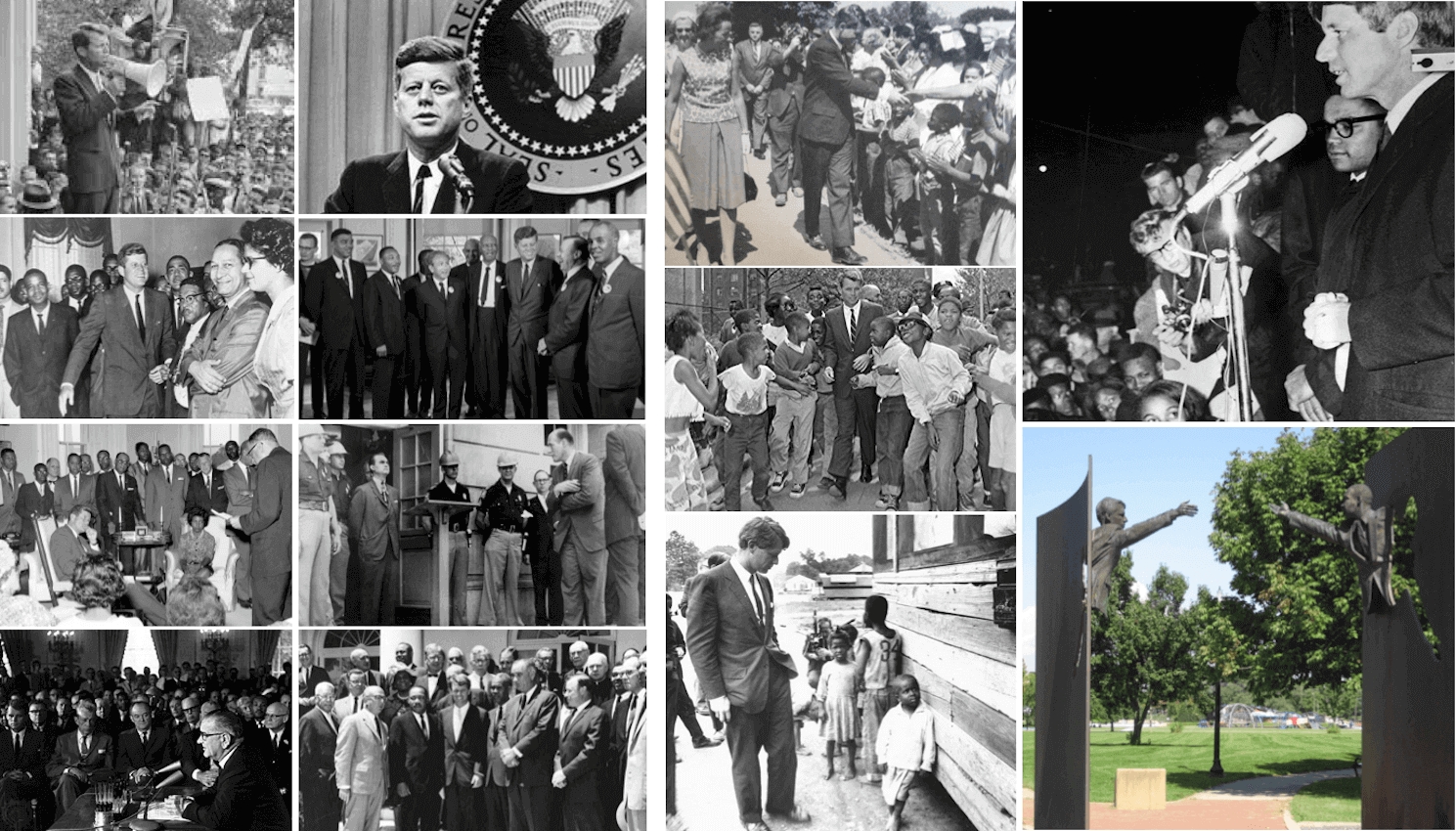
    Approximately five years ago, on the fiftieth anniversary of President Kennedy’s death, I reviewed Larry Sabato’s book, The Kennedy Half Century. In that review, I wrote about something that I had not really noted before in book form. One expects an MSM shill like Sabato not to recognize any of Kennedy’s clear alterations to President Eisenhower’s foreign policy: e.g., in the Congo, or with the Alliance for Progress. That would be par for the course. But Sabato did something that I had not really observed before. At length, the author tried to revise downward Kennedy’s record on civil rights. This was disturbing since Kennedy’s record on that issue was far superior to not just Eisenhower’s, but to all the presidents who had preceded him—both during and after Reconstruction. In my review of Sabato, I showed how silly this was by spending a few pages countering the obtuse arguments he had made (see section three of this review).

    Read more interesting civil rights movement facts here!

    At the end, I noted that this weird spin indicated once more that it was not enough for the MSM to deny the true facts of Kennedy’s murder. There was a concomitant effort to discount his achievements in the White House. In the back of my mind I was wondering: was Sabato’s goofiness on JFK and civil rights a preview of what was to come? After all, the next big milestone would be the dual anniversary of the murders of Martin Luther King and Bobby Kennedy. That would be made to order for the issue.

    Well, I was largely right, but a little wrong. That dual anniversary did produce at least three books on the matter. These are Steven Levingston’s Kennedy and King, David Margolick’s The Promise and the Dream, and Michael Eric Dyson’s What Truth Sounds Like. They all pretty much traversed the same path that Sabato did. And they all used the same tactics that Sabato employed: downplaying or completely eliminating the record, and/or not contrasting it with Kennedy’s predecessors. (But I should say from the outset: unlike the other two, Margolick’s book has some saving graces, since he actually did some research.)

    This last point, concerning contrast and presidential comparison, is crucial. Presidents should not be evaluated in isolation. In discussing their records, it is necessary to detail what came before and, at times, what came after. There can be no absolute value given to what a president says or does—as, say, there might be with anti-war leaders, or civil rights leaders—the reason being that the latter two groups are not running for office. A true presidential historian attempts to delineate and characterize words and actions in relation to other presidents, first by gathering as much of the pertinent data as necessary; then by sifting through it in order to find origins and patterns and to measure achievements; and finally by trying to make accurate comparisons with chief executives who came before and after. None of the authors mentioned even came close to doing this.

    Before comprehensively addressing this issue, it should be said that the struggle for civil rights is even larger and more complex than, say, the issue of the Vietnam War. This is simply because it extended back even farther in its origins, and therefore involved more major factors and participants. None of these books under review pays any respect to that backdrop either. One ought to deal with it nonetheless, for in my opinion, it provides one explanation as to why so many previous presidents did nothing about the serious problem the issue presented. (As we shall see, some of them in fact exacerbated the problem by symbolically allying themselves with the image of the Confederacy.) It also helps explain why, with the stirrings of the civil rights movement—which did not begin with Martin Luther King—presidents like Franklin Roosevelt, Harry Truman, and Eisenhower did so little. What that sorry record of inaction did was to create an abyss the size of the Grand Canyon that John Kennedy faced when he entered the White House.

    I would have more respect for these authors if they spent just a few paragraphs elucidating this crucial background. After all, that is the way the practice of history works. Recording accurate history is not, however, why these books were produced. But since this review will encompass all three of these volumes—plus a fourth that Levingston uses and relies on as a credible source—this author will first supply that missing background. This will help make clear both the failure of previous presidents in the face of this large and painful issue, as well as the reasons for it—presidents who, in other ways and on other fronts, have been praised by many authors (for instance, Teddy Roosevelt and Woodrow Wilson).


    I. A Hideous History of Shame and Horror

    Our exposition of this backdrop will not go all the way to the origins of the slave trade. What I will outline here is what happened during Reconstruction, since that created the historical foundation for the conditions of segregation, discrimination, and landless poverty that enveloped the existence of African Americans in the South after the Civil War. (I will not footnote this section, since it only pretends to offer a greatly abridged synopsis of what has been established in depth by an array of illustrious historians, such as John Hope Franklin, C. Vann Woodward, W. E. B. DuBois, Herbert Aptheker, Kenneth Stampp, and Eric Foner, among others.)

    It is an open question as to whether Reconstruction would have succeeded if Lincoln had lived. But there is little doubt that what did happen was a calamity for the newly freed slaves. President Andrew Johnson’s actions in pardoning so many of the former political and military leaders of the Confederacy outraged many of those who were against what the South stood for and was based upon. Johnson’s actions almost allowed the former vice president of the Confederacy, Alexander Stephens, to take a seat in Congress right after the war. Stephens was the man who, in 1861, declared that the cornerstone belief of the South was that the African American was not equal to whites and “that slavery—subordination to the superior race—is his natural and normal condition.”

    This was too much for the Radical Republicans in Washington. Men like Senator Charles Sumner of Massachusetts were simply not going to let Johnson do that. So they went to war with him. For a relatively brief period of time, these men passed several laws over Johnson’s veto in an attempt to aid the freedmen in the South and make it harder for former rebel states to return to the Union. The Civil Rights Act of 1866 and the fourteenth and fifteenth amendments were examples of laws they passed aimed at making the former slaves citizens who would be protected by the government. They also made it possible for teachers to go to the South, the creation of public schools there, the stationing of Union troops in the former Confederacy and the extension of the Freedmen’s Bureau—the only arm of government that gave direct aid to the newly freed slaves and their families.
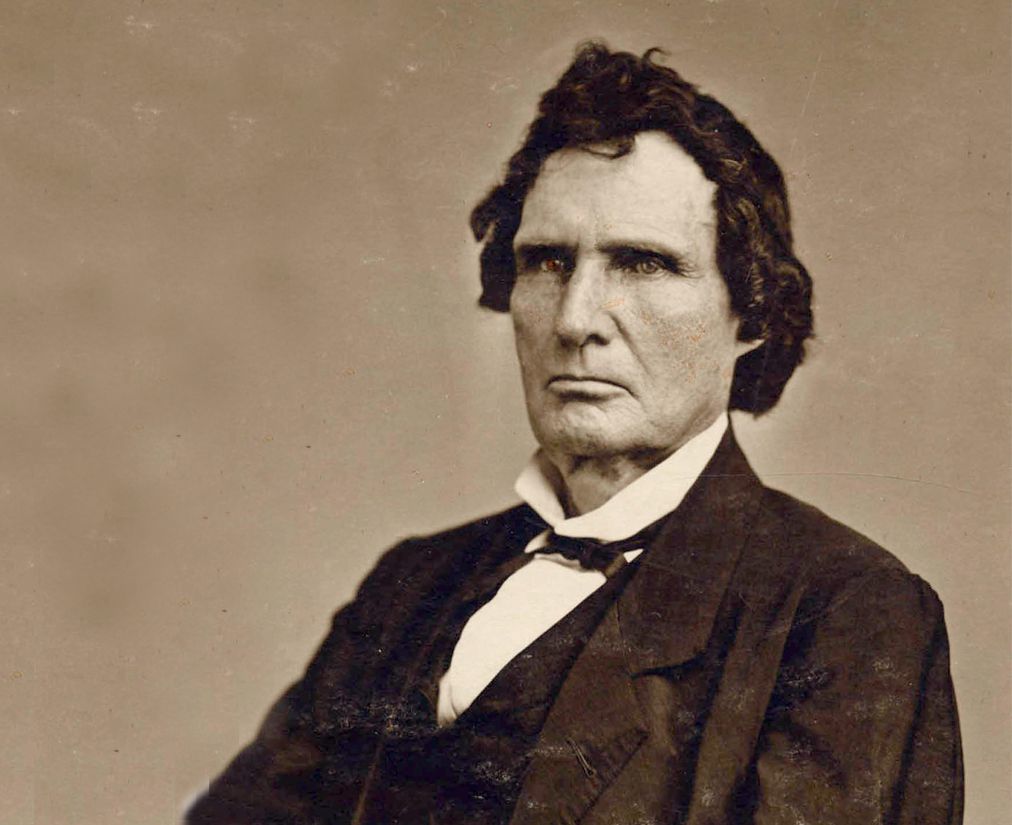
    Thaddeus Stevens

    It is puzzling today as to why men like Senator Sumner, congressman James Hinds (who was murdered by the Klan in 1868), Senator Benjamin Wade and, of course, congressman Thaddeus Stevens, were called radicals. They were clearly correct in their ideas about what it would take to incorporate the Confederacy back into the Union. But they were opposed by formidable enemies in Washington and outside it, like the Ku Klux Klan. As DuBois first pointed out, the Union never had enough troops in the former insurrectionist states to occupy that wide expanse of territory. Consequently, former Confederate forces were allowed to roam free and organize militias to thwart the actions of those who wished to carry out a reconstruction of the South. The Klan was only one of these terrorist organizations. There were also groups like the White League, the Red Shirts, and the White Line in Mississippi. They constituted something called the Redeemer Movement, whose goal was to restore pre-war white supremacy to state power. As African Americans took office—a mere 17 in Washington during the period of 1870-76, but many more on the state and local level—these terrorist groups began to rise in reaction.

    Since they were well armed and organized, the only way to control them was by maintaining a much larger occupying force in the South for a longer period of time. That did not happen. The Reconstruction Act of 1867 allowed only 20,000 men to occupy ten former states. This included areas as large as Texas and Louisiana. President Ulysses S. Grant had to send additional military forces into the South for elections in 1870 and 1876.

    No high-school textbook, and very few American history college texts, detail the horrors perpetrated by the Redeemer Movement, so much of the brutality and ugliness in the following account will likely be new to the reader. But as shameful and hideous as that chronicle is, the historian must describe it in order for the reader to begin to approximate the extreme pathology—imbued by centuries of slavery—that possessed these men. It is the only way to explain the shocking outbreaks of violence that took place at this time: the Opelousas Massacre of 1868; 1871’s Meridian Race Riot; the Colfax Massacre of 1873; New Orleans’ Battle of Liberty Place in 1874; and the Hamburg Massacre of 1876. In the Meridian and New Orleans instances, the Redeemers’ aim was to overthrow, respectively, the local and state government. In Meridian Mississippi, the Redeemers shot and killed a judge during a trial, and massacred as many as thirty freed slaves, ultimately driving the mayor from office. A force of three hundred Redeemers then escorted the mayor to a train and literally packed him off to New York, thereby achieving their goal of overthrowing the municipal government.

    The Battle of Liberty Place

    The Battle of Liberty Place was enacted on Canal Street in New Orleans. It was a large-scale military insurrection. The Redeemers’ White League organized an army of five thousand men to force the Republican governor, William Pitt Kellogg, to resign. The governor was defended by a combined force of about 3,500, made up of state militia and local police. The White League defeated Kellogg’s forces, thereby overthrowing the governor. President Grant finally sent in federal troops, the White League dispersed and Kellogg was restored. But no one was arrested or tried. This paved the way for the White League to control the state once the Union army left.

    It is worth describing a smaller scale event in more detail in order to understand the murderous mania that possessed the Redeemers. In September of 1875, in Hinds County Mississippi, the Republican Party decided to hold a combination barbecue and rally for the upcoming elections. Freedmen had been voting for about eight years there, so this type of event was not uncommon. For purposes of policy debate, they invited the Democrats to attend. The Democrats sent a spokesman, accompanied by about 75 White Line men with concealed weapons. The Democrat spoke without interruption. The Republican speaker thanked and congratulated his opponent. But as he began to address the crowd, he was heckled. He was then accused of being a liar. The leading black politician in the area, Charles Caldwell, stood up and asked the former slaves not to let themselves be goaded into a confrontation. Then a Republican freedman, Lewis Hargraves, was shot in the head at point blank range. In what appeared to be a choreographed action, the White Line men let loose with a series of volleys. The Freedmen, some whom came armed, fired back. Mothers began gathering up their children and running for cover in the nearby woods. At the end of the first day, three White Liners and five freedmen were dead.

    The Redeemers called in reinforcements. In a move that had to be planned in advance, hundreds came in by rail. As one witness noted, they began to hunt down every black man they could see: “They were shooting at him just the same as birds.” Many freedmen were stalked to their homes, taken from their domiciles, shot to pieces, and their mangled corpses tossed into swamps. One of the victims was an old enfeebled grandfather. Some freedmen were forced to stand on tree stumps before they were killed. Caldwell escaped, but the posse told his wife that no matter how long it took, they would find him and he would perish like the rest:

    We have orders to kill him and we are going to do it, because he belongs to this Republican Party and sticks up for these negroes … We are going to have the South in our own charge … and any man that sticks by the Republican Party, and he is a leader, he has got to die.

    This anarchy and bloodlust eventually resulted in the infamous Mississippi Plan. What happened in Hinds County was repeated throughout the South by different terrorist groups. Once the violence had achieved its goal—which was to cower and intimidate the potential Republican voters—that result was often sealed by a bizarre, symbolic ritual. On the eve of an election, the Redeemers would mount up armed on horseback, usually in some sort of costume. At night, they would then parade through the main street of town with torches in hand. The idea was to remind any former slave or white sympathizer that there was no political order, no escape, and therefore that the Reconstruction amendments did not apply. The Redeemers held all power, and the opposition was not to be seen at the polls. The impact was overwhelming. During the peak years of Reconstruction, when the Republicans controlled parts of the South and freedmen were part of the state governments, African Americans had voted 90% of the time. Once the Redeemers took power, in some Mississippi townships, no Republican votes were tallied at all. In less controlled counties, the percentage declined by 75%.

    Due to the disputed presidential election returns from three states of the South in 1876, both parties agreed on a political compromise. This allowed the Republican, Rutherford B. Hayes, to become president. In this shameful bargain, neither political party had clean hands. In return for the White House, Hayes agreed to remove the last of the Union armies from the Confederacy. Hayes also agreed not to intervene in the future. The GOP now began to devote itself to the interests of big business in the north. As a result, the Democrats took over what would later be called the Solid South. As the Reconstruction governor of Mississippi, Adlebert Ames, wrote to his wife on November 4, 1874:

    What sorry times have befallen us! The old rebel spirit will not only revive, but it will make itself felt. It will roam the land, thirsty for revenge, and revenge it will have … the war is not over yet.


    II. The White House and Supreme Court Back the Redeemers

    Once Hayes agreed to remove the Union army, and the Mississippi Plan held, the Redeemers began to construct a social, political, and economic system that would approximate the ante-bellum South. To understand why, one must not just acknowledge the racial pathology prevailing there, but also slavery’s economic underpinnings. As one historian has noted, “the economic value of property in slaves amounted to more than the sum of the money invested in railroads, banks and factories in the United States.” (Eric Foner, Forever Free, p. 11) The former Confederacy did not want to develop a new economy to replace what they had. So local and state laws called Black Codes were inscribed. These stated, among other things, that the freedmen had to show evidence of employment while in the city. If not, this constituted proof of the crime of vagrancy. The codes were designed to force the former slaves out of the city and back into the rural areas. There, a new plantation plan was enacted: sharecropping. This system nearly guaranteed that the sharecroppers would never own their own land. The clear alternative to this new form of peonage was to have divided up the great plantations and given them to the newly liberated slaves. In one stroke of justice, this would have gravely weakened the fallen regime and given their former subjects a viable economic future, one which would have provided for the upward social mobility of future generations. This is what the freedmen thought would happen. As Eric Foner has shown, in very, very few instances did it occur. (Foner, p. 60) The Black Codes would later evolve into Jim Crow laws, and those laws would construct a new social system that would make the former slaves into third class citizens—if that. The sharecropping plan would provide much of the new economic system. It would keep the former slaves in the countryside, in debt, and unable to assert any claim to their rights.

    As DuBois wrote in his 1935 book, Black Reconstruction in America, the ultimate defeat of the Radical Republican version of Reconstruction was not just a national tragedy. It went further than that. It set an example for subjugation as far away as South Africa and Australia. For now, in a democracy, a standard was set to deprive nonwhite peoples of their political rights simply on racial grounds. (“Why Reconstruction Matters”, NY Times, 3/28/15)

    At this point, we come to an episode that resembles a dark fantasy. The Supreme Court of the United States now began to further the Redeemers’ goal in a political manner. Piece by piece, the high court undid what the Radical Republicans had achieved. That is, they neutralized the 14th and 15th amendments, and also the laws the Radicals passed making it illegal to obstruct the rights of the freedmen. The Supreme Court would, over a period of 20 years, in a methodical and systematic manner, negate it all. By doing so, it would reverse Alexander Hamilton’s dictum in the Federalist Papers. There, he wrote that the court would be the last bastion of protection for the weak against the strong. He then added that the lifetime appointment and lack of accountability would constitute a saving grace for liberty. To put it mildly, he was wrong. (Lawrence Goldstone, Inherently Unequal, pp. 10-13)

    Thaddeus Stevens had passed on in 1868, and Charles Sumner in 1874. As several authors have noted, partly due to that, the GOP began to drift away from any further interest in Reconstruction and more toward its ultimate business orientation. The Radicals had favored plantation confiscation and redistribution of land to the freedmen. But the moderate Republicans would not stand up for it. (Goldstone, pp. 28-36) Meanwhile, with their growing interest in big business, the Republicans became enchanted with the writings of Herbert Spencer and Yale professor William Graham Sumner (no relation to Charles). Both writers advanced the ideas of Social Darwinism, which, to put it in simplified terms, postulated that the rich were rich because they deserved to be. As author Lawrence Goldstone notes, it was this philosophy’s growing influence on the Republican Party that forged a spurious intellectual link between the northern industrialists and the planter class in the South. This was furthered by the fact that President Grant appointed two corporate lawyers to the Supreme Court who had both formerly represented railroads. Hence, over a period of 20 years, from 1876 to 1896, the Supreme Court certified and upheld the beliefs of the Redeemers. (Goldstone, p. 72)
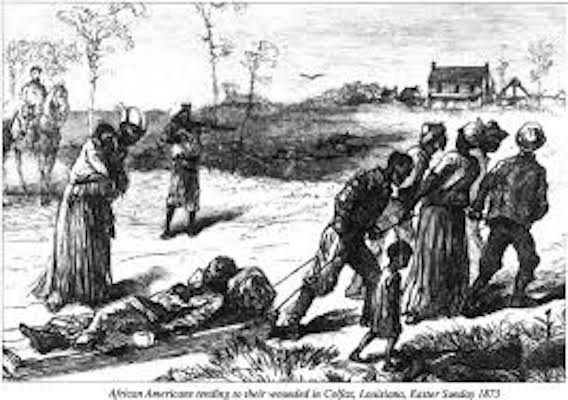
    The Colfax Massacre

    The two cases that began this reversal were U.S. v Cruikshank and U.S. v Reese, both in 1876. The first case arose from the aftermath of the terrible Colfax Massacre, where an estimated 105 freedmen were killed. The Cruikshank decision set free the only three men who had been brought to justice for those killings. In a decision begun by one of the high court’s railroad lawyers riding circuit, the Supreme Court nullified the convictions. The basis for this, the court held, was that the 14th amendment, with its equal protection clauses, only applied to state actions, not to those taken by individual citizens. (Goldstone, pp. 91-96) In other words, if the Klan or any other terrorist group was going to harass, injure or kill anyone, the state would have to bring them to justice—something that, with the Union army gone, was not likely to occur. The Reese case had a parallel effect on voting rights. In that instance, a former slave tried to exercise his right to vote but was denied due to his alleged failure to pay a tax. The Supreme Court upheld the circuit decision against the plaintiff. This decision severely qualified the 15th amendment, which had granted the rights of citizenship to all, no matter of what race. It paved the way for states in the south to use all kinds of qualifying barriers like poll taxes, literacy tests and grandfather clauses to limit, or eliminate, freedmen from exercising the ballot. (Goldstone, p. 97)

    Justice Joseph P. Bradley

    Two more mortal blows followed. In 1883, the court gathered five cases that had been awaiting a hearing and combined them into one: The Civil Right Cases. These cases all concerned discrimination in public accommodations, which had been outlawed by the Civil Rights Act of 1875. Once more, the court ruled against the plaintiffs, even though the act was grounded in the 13th and 14th amendments. The opinion in this case was again written by former railroad lawyer, Joseph Bradley. His contention against the 13th amendment was that discrimination did not necessarily translate into a form of subjugation. With the 14th amendment, which provided equal protection to all citizens, Bradley wrote that Congress did not have the power to nullify private discrimination or overrule a state if it chose to ignore such a private or local law. Consider this statement: “Individual invasion of individual rights is not the subject matter of the amendment.” (Goldstone, p. 124)

    If the reader can believe it, the NY Times endorsed the decision (Goldstone, pp 127-28), even though the supposition would be that only when a state announces its intent to discriminate against a particular race, only then could the federal government step in. What was so bizarre about all this was the following: as the justices were diminishing the 14th amendment’s efficacy to maintain rights for the freedmen, which was its original intent, it was expanding the amendment for the purposes of corporations—which had nothing to do with its original purpose. (Goldstone, pp. 144-45)

    The coup de grâce in all this was the Plessy v Ferguson case of 1896. As everyone understands, this case concerned the rights of African Americans to travel on the same facilities as everyone else. The case arose out of state law that was inspired by the 1883 decision that segregated races in Louisiana on rail cars. The case went up to the Supreme Court where, once again, the high court decided against the plaintiff. This case established that separate facilities were not necessarily unequal. It was clearly a racist decision. One of the judges wrote, “If one race be inferior to the other socially, the Constitution of the United States cannot put them upon the same plane.” (Goldstone, p. 167)

    There were other cases, but these four politically nullified the post-Civil-War amendments and laws meant to correct the conditions in the South that caused that conflict. Goldstone writes that with these in place, the Redeemers’ aims were now achieved. Jim Crow, the separation of races in every respect, was now legal. For the freedmen, civil order in the South was neutralized. There was little fear of retribution or justice. Given these precedents, something like the torture execution of Sam Hose could take place—in public. In 1899, the African American Hose killed his boss in self-defense. The two had argued over money Hose felt he was owed, and the next day the employer came at Hose with a gun. The employee was chopping wood and threw his axe at him, killing the man. Quite naturally, Hose fled. The dead man’s wife now said that Hose had also raped her. A huge manhunt captured the accused and he was brought back to the jail in Newnan, Georgia.
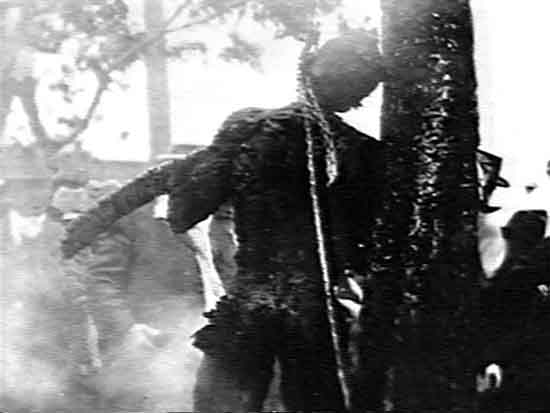
    Lynching of Sam Hose (Wilkes)

    A large crowd estimated at almost 2000 people gathered around the jail and demanded the sheriff turn over his prisoner. Fearful of an assault on the building, he did. The wild, violent crowd marched Hose several blocks to the public square, yelling, “Burn him.” The governor, who lived there, and a judge pleaded with the crowd to return him to the sheriff. They refused. They then marched outside the town. He was roped to a pine tree and three or four men came at him with knives pulled. One man severed one ear and another the other. His body was stripped and mutilated further. He was dowsed with oil. He was then set afire, and as his body fell loose from the tree, he was kicked back into the flames. When the flames died out, his heart was carved into pieces and sold off as souvenirs. (Goldstone, pp. 5-8; also see this article)

    The Rosewood Massacre

    This was not the end of it. Not even close. The Supreme Court had unleashed a peculiar mass psychology that, for some, knew no bounds. What happened to Sam Hose was repeated on a much larger scale at places like Rosewood Florida, where an entire village was virtually incinerated; Tulsa Oklahoma, where a whole section of the city was charred in flames and perhaps 300 African Americans were killed; and in Ocoee, Florida, where approximately sixty African-American were killed, 330 acres were burned, and the survivors were forced to leave town. At Ocoee the crime was trying to vote. Whenever one hears a speaker droning on about American Exceptionalism, the reader should mention these incidents, and these Supreme Court decisions. In this author’s opinion, the pattern of these atrocities resembles the first outbreaks of violence against the Jews in Nazi Germany.
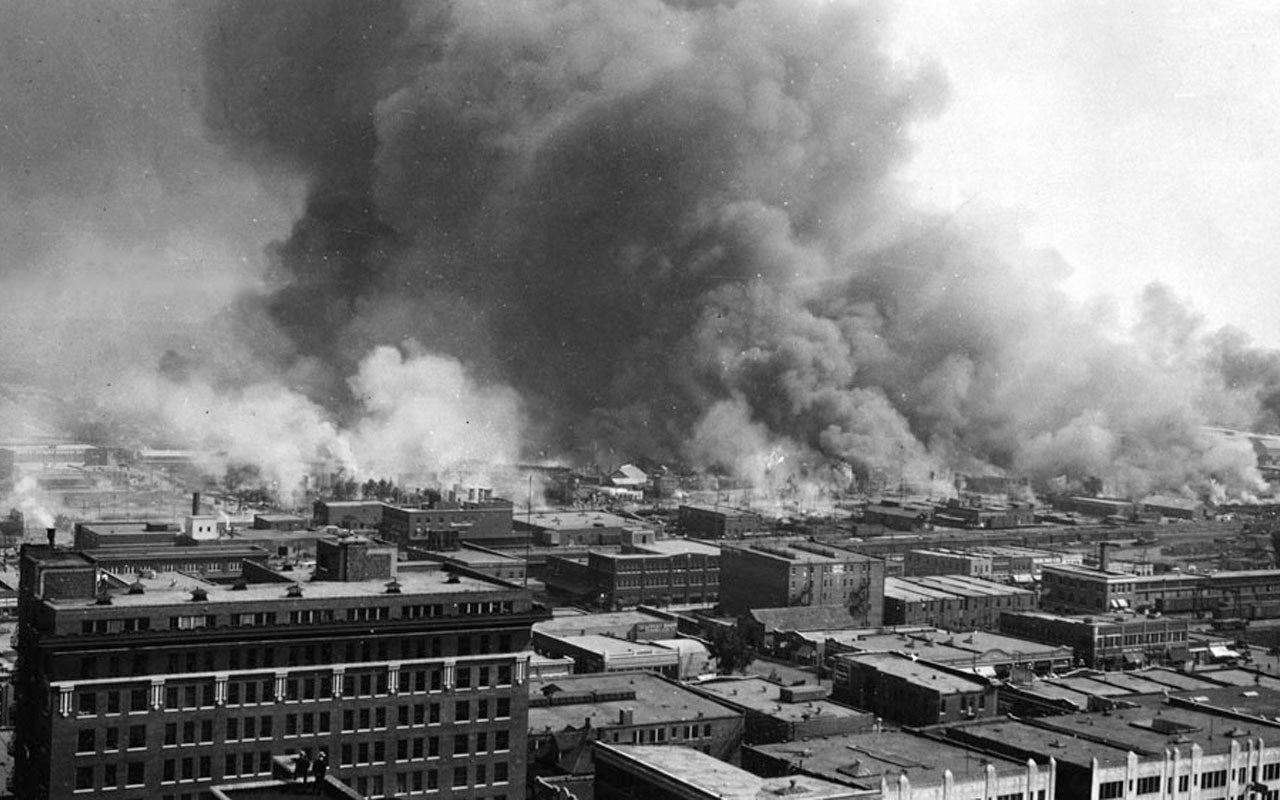
    The Tulsa Massacre

    (The following article from The Atlantic also reviews how a Republican dominated Supreme Court nullified, step by step, the achievements of Reconstruction, aiding the Redeemers. It then draws a parallel with the Roberts court and its approach to minority groups, including Muslims. See “The Supreme Court is Headed Back to the Nineteenth Century”.)

    But the myth of American Exceptionalism had to live on, at least with the masses. So a cover-up about Reconstruction was snapped on. It worked on two levels: one with the mass media, and one in academia. On the first level, best-selling authors, like Thomas Dixon and Claude Bowers, began to turn what had happened into an antiseptic fairy tale. The African Americans who briefly played political roles during the era were caricatured as aimless wastrels who bankrupted certain states. The Redeemers were glorified as the rescuers of southern sanctity. Thus the “Lost Cause” mythology was constructed. Dixon did this with a trilogy of novels called the The Leopard’s Spots, The Clansman and The Traitor. How bad were these books? Consider this: “The Negro is the human donkey. You can train him, but you can’t make of him a horse … What is called our race prejudice is simply God’s first law of nature—the instinct of self preservation.” (The Leopard’s Spots, p. 237)

    The Clansman was made into a popular play. In 1915, D. W. Griffith transformed it into a spectacularly successful film (Birth of a Nation). Former history professor and then President Woodrow Wilson screened the film at the White House. In the novels, play and film, the facts of Reconstruction are turned upside down. It is the white citizens who are preyed upon by the imperious blacks, and it is the Klan who rescues these poor people from the clutches of the primitives who—according to Dixon—had now descended into their natural state and ruined the South. The Klan saved them. (Foner, pp. 217-18)
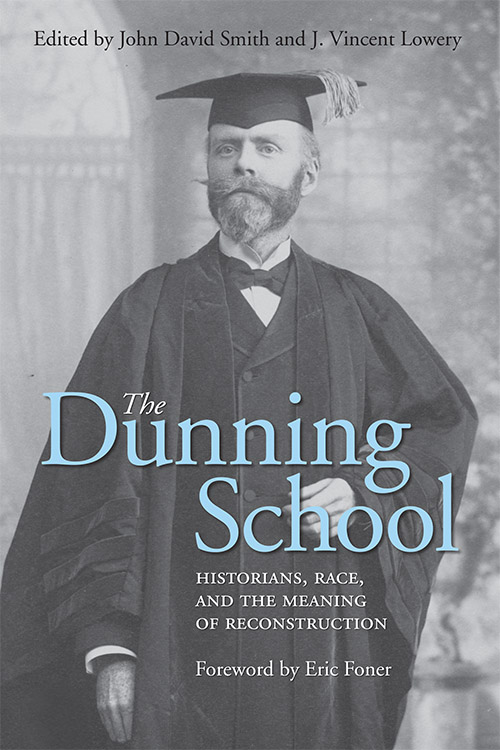
    The other level of the cover-up was constructed through academics like John W. Burgess, James Ford Rhodes and, above all, William Dunning. The views of these authors were not as melodramatic as Dixon’s, but the picture was pretty much the same. For, as Burgess once wrote, “… a black skin means membership in a race of men which has never of itself succeeded in subjecting passion to reason, and has never therefore created any civilization of any kind.” (Foner, p. xxii) For Burgess, both the Mali and Songhai empires of Africa did not exist. From what was later termed the “Dunning school”, the dominant portrait of Reconstruction was a colorful tableau full of southern Scalawags, northern Carpetbaggers, and incompetent Negro legislators. They combined to run their state economies into the ground. The mad, homicidal mass murders of the Redeemer cause were nowhere to be seen. Because Dunning came from an Ivy League college, namely Columbia, and had his graduate students do advanced work on different aspects of Reconstruction, he was enormously influential. His work became the standard for adopted college and high school textbooks. In fact, author John F. Kennedy used Dunning’s foreshortened portrait of Stevens in his book Profiles in Courage. As we shall see, after a three-year ordeal with the modern Redeemers, Kennedy realized he had been taken.


    III. Houston Alters the Current

    This sorry record could not have continued unless one had a series of presidents who were willing to ignore it. Woodrow Wilson was not just willing to ignore it. He exulted in it. Birth of a Nation was not just screened at the White House; Griffith used quotes from Wilson’s history books as subtitles. (Foner, p. xxii) Another progressive president, Teddy Roosevelt, was not much better. Roosevelt once wrote (falsely) that, during the Spanish American War he had to fire a gun at his own African American troops to get them to join the battle in Cuba. There was also the Brownsville Affair where, after the shooting of a white bartender, Roosevelt dismissed all the African American troops stationed in three companies of the 25th Infantry Regiment. This amounted to discharging without honor 167 men who now lost their pensions and any opportunity for civil service jobs. Roosevelt’s idea of progress in race relations was to dine at the White House with Booker T. Washington. Washington was the man who urged African Americans to he happy with their lot and learn self-subsistence.

    Coolidge with Confederate veterans

    William Howard Taft, the third progressive president, also befriended Booker T. Washington. Taft once told a college graduate class at a historically black college, “Your race is meant to be a race of farmers, first, last and for all times.” Campaigning in the South, he said he would never enforce “social equality”. He then told a primarily African American audience that the white Southern man was their “best friend”. Later on, Republican presidents Harding and Coolidge failed to stop, or even criticize, parades of Klansmen before the White House. Herbert Hoover accepted covert backing from the Klan. So much for the party of Lincoln.

    The man who began to turn this sorry record around is someone who few people know about. But it was he, not Martin Luther King, who really started the modern civil rights movement. So important a figure does he seem to me that if I had the power, I would level every last Confederate monument and replace each with his image. His name was Charles Hamilton Houston. Because Houston worked in a much less spectacular manner than King, he does not get the attention he deserves. This is a failure of both our media and academia. Every person concerned with this issue should know who he was. He was that crucial.
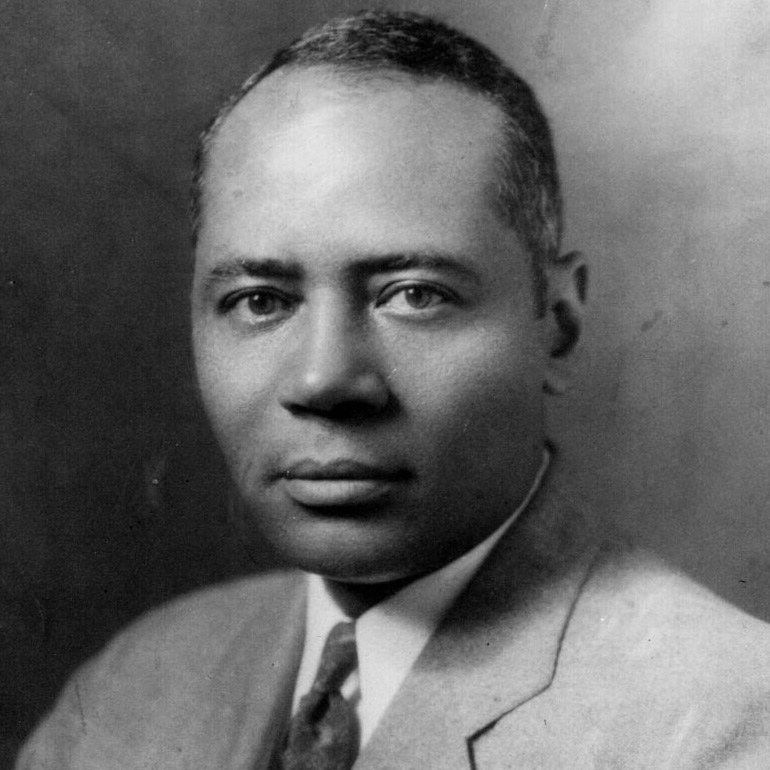
    Charles H. Houston

    Houston graduated from Amherst and then served as an officer in World War I. He was greatly disappointed by discrimination in the military, so he decided upon returning to the USA that he would do something about it. As he noted, “My battleground is in America, not France.” He was accepted by Harvard Law School and wrote for the Harvard Law Review. Upon graduation, he decided to create his own version of Harvard at Howard School of Law. His objective was to train a generation of lawyers in order to—piece by piece—reverse the mockery of justice the Supreme Court had decreed in the cases described above. Houston visited the major cities of the southeast and decided his students should go there after graduation, since there were not nearly enough African American attorneys to defend all the cases that needed to be adjudicated.

    Houston’s reputation drew him to the attention of NAACP leader Walter White. He became, first, their unofficial lead attorney, and then their special counsel in civil rights proceedings. After participating in the famous Scottsboro Boys case, Houston set his goal as dismantling Plessy v Ferguson. He planned on doing this through challenging the underlying thesis of that decision: that facilities for his race were equal to those for whites. He decided to concentrate his efforts in the field of education. Houston felt that poor schools, especially in the South, were designed to make their students meekly accept an inferior lot in life.

    Houston knew he could not directly confront Plessy v Ferguson without creating his own precedents. He began his methodical campaign by attacking the wretched acceptance policies and study conditions for African Americans in graduate and professional schools. Houston observed that in 17 of 19 southern and border state universities there were no students of color in those graduate schools. Two of those states—Missouri and Maryland—paid to have African American students attend schools in the north instead. From 1936 to 1950, in a series of carefully chosen and cogently argued cases, Houston and his student Thurgood Marshall, among others, won a series of cases—e.g. Sweatt v Painter—that set the stage for the objective that Houston had planned for: a reversal of Plessy v Ferguson. Unfortunately, Houston would not live to see the ultimate justification of his life and career. In 1950, his heart failed him due to exhaustion and overwork. Thurgood Marshall paid Houston the ultimate compliment, “We’re just carrying his bags, that’s all.” (see this profile)

    There seems little doubt that, as circulated through the scores of African American newspapers—Chicago Defender, Pittsburgh Courier, Roanoke Tribune, among others—what Houston and the NAACP had begun was to awaken the conscience of many intelligent citizens, both black and white. And this national stirring—after 75 years of dormancy or worse—had an effect on the White House.
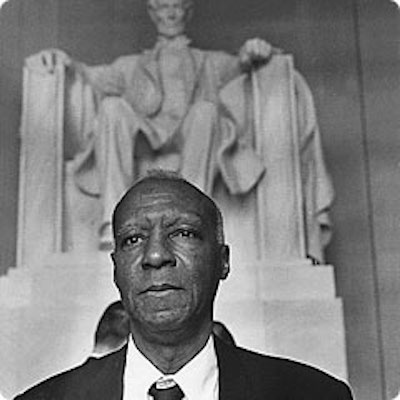
    A. Philip Randolph

    In 1941, union steward A. Philip Randolph and civil rights leader Bayard Rustin organized a large demonstration in Washington. The protest was about passing an anti-lynching law, integrating the military, and fair employment practices in the defense industry.   After meeting with President Roosevelt, the latter agreed to issue an executive order for the last demand. Randolph and Rustin reluctantly called off the demonstration.

    As a young man, President Harry Truman was quite prejudiced. But he managed to rise above it, at least in public, after FDR passed. He asked a panel of prominent authors and activists to present a series of reforms the government could take to break down the barriers of segregation. The report was called To Secure These Rights. Truman tried to get it passed as a civil rights bill. He was crushed by the southern bloc in both the House and Senate. (See William Berman, The Politics of Civil Rights in the Truman Administration, pp. 148-9; 162) The southern Democrats had decades of seniority in key committees of both the House and Senate. They had set up a system of barriers, especially in the Senate, to block any civil rights bill from making it through both houses. In the upper house, they had a very strong and disciplined corps that would filibuster any such bill to certain abandonment. This is what happened to Truman. But Philip Randolph managed to salvage one of the aims he lost with Roosevelt by doing the same thing to Truman as he did to FDR. He threatened the president and Congress with a massive display of civil disobedience in Washington unless the military was integrated. Truman signed the order. (Berman, p. 102)

    Dwight Eisenhower was never one to inspire the public with his belief in equal rights. Knowing this, Truman made some very strong speeches against Eisenhower in the 1952 presidential election. (Berman, pp. 226-28) Eisenhower even resisted Truman’s integration order by suggesting the army should just integrate intact African American platoons into white companies. (Berman p. 205) Eisenhower also did not like what FDR had done with the fair employment statute. (New York Times, 6/6/1952, p. 1) Commenting on it, he said, “I do not believe that we can cure all of the evil in men’s hearts by law … ” Which may be true, but at least a law could prevent that evil from killing someone.

    There was a civil rights section in the Justice Department when Eisenhower and Vice President Richard Nixon were in the White House. As Burke Marshall, Bobby Kennedy’s assistant on civil rights, later said, the section was small and seldom used. (Marshall interview with LBJ Library, 10/28/68) Eisenhower and Nixon only filed ten civil rights lawsuits in eight years, and two of those were filed on the last day of his administration. What makes that record so bad is that, for six of those years, the epochal 1954 Brown v Board case was in effect. (Harry Golden, Mr. Kennedy and the Negroes, p. 104) With Brown, Houston’s successors had succeeded in overturning Plessy v Ferguson. Separate facilities were not equal and the court ordered public schools to be integrated with deliberate speed.

    That decision sent a shock wave through the South. Segregated public schools and undergraduate education had been twin keystones of Jim Crow. But Eisenhower paid no real heed to the Brown case. In fact, he once told a reporter that the decision had set back progress in the South at least 15 years. (John Emmet Hughes, The Ordeal of Power, pp. 200-1) Nixon pretty much agreed. He said, “… if the law goes further than public opinion can be brought along to support at a particular time, it may prove to do more harm than good.” (Golden, p. 61) This was a self-fulfilling prophecy. The law was not going to go very far since the administration was not supporting it to any real degree. In the six years after the Brown case, neither man ever stated publicly that they were behind the decision.
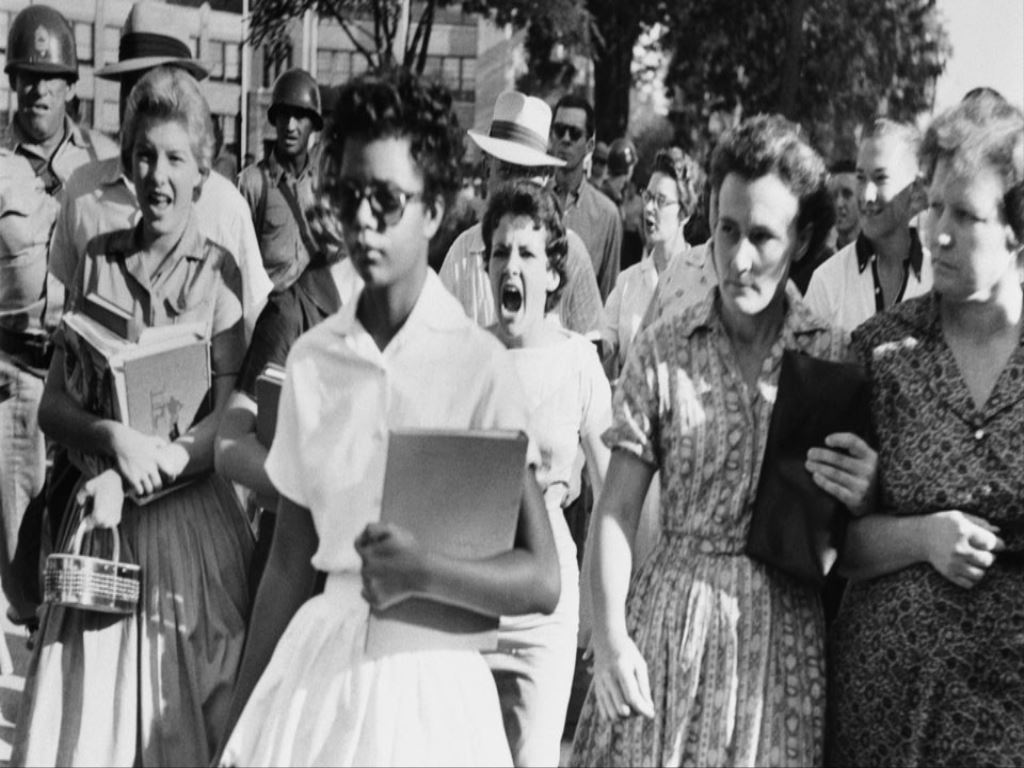
    Elizabeth Eckford, one of the “Little Rock Nine”

    During Eisenhower’s two terms, two explosions ripped through the South: Brown v Board and the Rosa Parks/Martin Luther King Montgomery bus boycott. During those eight years, Eisenhower had two achievements in the civil rights field. In 1957, acting on the Brown decision, the Little Rock School Board voted to integrate Central High. Governor Orval Faubus decided to defy the board. On September 3rd, the first day of class, Faubus stationed the National Guard around the school to keep the designated African American students—called the Little Rock Nine—outside. While the court and the board were being defied, Eisenhower did not blame the governor and he did not consider the event Washington’s business. In fact, he went on vacation to Newport, Rhode Island. (LA Times, 3/24/1981, “Is Eisenhower to Blame for Civil Rights Explosion?”)

    Bill Clinton with Orval Faubus (1991)

    As the spectacle dragged on for days on end, Faubus visited Eisenhower in Newport. The president thought the governor understood he had to pull out the National Guard. He did not, and the nine students were left ostracized. Under threat of a court injunction, Faubus pulled out the Guard on Friday, September 20th. On the following Monday, with no authorities there, as the nine students tried to go inside, they were assailed, jeered and spat on by the angry crowd outside. It was not until the 25th that the White House finally decided, with the state authority gone, to send in federal troops to control the mob. The school was now integrated. (LA Times, “Is Eisenhower to Blame”)

    That 22-day standoff helped convince many people of color that the Republican Party did not have their interests at heart. As Robert Shogan wrote in the LA Times, Eisenhower was in a strong position to do something about the racial issue. He had won two landslide elections. He enjoyed strong popularity and trust in both the North and South. He could have assured everyone that this move towards reconciliation was in their interest. Ideas about the issue were in an emerging, moldable form. (LA Times, “Is Eisenhower to Blame”) What did he choose to do at this fateful crossroads?

    Not much. In 1957 his Attorney General, Herbert Brownell, sent a bill to Congress creating something called the US Civil Rights Commission. This was a six-person panel furnished with a chief counsel. It was supposed to submit a report on its racial findings to the White House. In its final form it was as much Senate Majority Leader Lyndon Johnson’s bill as it was Brownell’s or Eisenhower’s. Knowing that the bloc of southern Democratic senators would derail the bill in its original form, Johnson agreed to remove its most potent aspects. LBJ saw this as an opportunity to keep his own party united while making himself more palatable to northern and western liberals for a possible run at the White House in 1960. (Rowland Evans and Robert Novak, Lyndon B. Johnson: The Exercise of Power, pp. 122-25) Although it concentrated on voting rights, most informed commentators considered the bill largely symbolic, since it had little power to enforce its own recommendations. The bill also turned the Justice Department’s civil rights section Truman had established into a formal division. Later on, in 1960, the act was slightly modified by giving the Justice Department the power to inspect local voting rolls and introducing penalties for anyone who obstructed a citizen’s attempt to vote. Again, this was all Johnson could get through since he could not halt the filibuster. (For a chronicle of what the commission accomplished, see Harris Wofford, Of Kennedys and Kings, pp. 461-83) Many accused Eisenhower of leaving the whole civil rights imbroglio, now highlighted by bombing and assaults over the Brown decision, to his successor.

    To summarize: under pressure from Philip Randolph, Roosevelt issued a fair employment order for the defense industry and Truman integrated the military. (The former lapsed when Truman could not get it renewed.) After three weeks of state military resistance, Eisenhower sent troops to integrate Little Rock. He then, along with LBJ, created a civil rights commission with little enforcement power. This was the sum total of what had been done in 84 years for the sorry plight of African Americans in the South since the Redeemers’ bloody triumph in 1876.

    Go to Part 2

    Go to Part 3

    Go to Part 4

  • John McAdams and Marquette Go to Court

    John McAdams and Marquette Go to Court


    John McAdams strikes a pose during his glory days at Marquette University

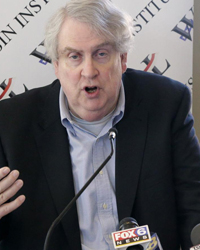
    Readers of this web site will recall that the last time we addressed the case of John McAdams vs. Cheryl Abbate and Marquette, it was early last year.  At that time, CTKA attached a link to the decision letter that the dean had made in that case.  That 17-page letter was written by Richard Holz, dean of the college of Arts and Sciences at Marquette University, McAdams’ former employer.  Dean Holz indicated two violations of the Faculty Statutes that the professor had violated as part of the explanation as to why he had made this decision.  (Click here for the letter http://d28htnjz2elwuj.cloudfront.net/wp-content/uploads/2015/02/2015-01-30-Holz-to-McAdams.pdf)

    That letter began with the statement that the university was commencing the process of revoking Professor McAdams’ tenure in order to dismiss him from the faculty.   At the end of the letter, Holz added that if the professor filed a timely objection, he would be provided with more due process, which included a faculty hearing of his peers. McAdams filed the timely objection, and he was given a faculty hearing.

    One year later, in January of 2016, that committee filed a long, over 100-page report to Michael Lovell, the president of the college. They decided to revise Dean Holz’s decision.  They felt that McAdams should not be terminated but rather suspended without pay for a period of nine months, from April to December of this year.  He would then be allowed to file for reinstatement.  Lovell called the report one of the most thorough and well written faculty committee reports he had ever read.  The main reason they gave for not moving for dismissal was that McAdams had not been formally reprimanded for his perceived offenses prior to this one.

    In a letter to McAdams dated March 24, 2016, Lovell alerted the former instructor that he was going to abide by the report’s recommendations.  Which included the judgment that McAdams be allowed to return after his suspension was served in January of 2017.  This was contingent upon three conditions.  First, that he accept the unanimous decision of the faulty committee.  That he pledges his future behavior will abide by the faculty handbook and mission statement.  And third, his expression of regret for the harm suffered by the former graduate instructor Cheryl Abbate.  Upon those conditions, and after serving out the suspension, McAdams would be allowed to resume his position. Lovell ended his letter with the clear warning that if anything like this happened again, he would move to dismiss the instructor. Because this was also the recommendation of the faculty report.

    Before getting to the reaction of McAdams and his legal representative, let us remind our readership of what happened that caused this, and who Cheryl Abbate was.  On November 9, 2014 McAdams posted on his blog Marquette Warrior information about a conversation that Abbate had with a student in her philosophy class.  According to McAdams, Abbate had limited the right to open debate in her class over the issue of homosexual marriage.  The student then left the class and said he was going to file a complaint.  Which he did. 

    There were three important issues that were distorted, ignored, or discounted by McAdams:  1.) the student lied to Abbate about taping their conversation 2.) McAdams himself was the student’s faculty advisor, and perhaps most importantly, 3.) the student was failing the class. 

    I must add one more key point that the faculty committee discovered, and to my knowledge has not been written about previously.  In their report, at the bottom of page 43, they reveal that the student “had a leadership role in the student chapter of a national organization that encourages…confronting professors in the classroom to expose liberal bias.”  The report states they did not discover this fact until after their four day hearing was concluded, and they decided not to reopen the proceedings, because there was no indication McAdams was aware of this.  The report gives no evidence as to how they made that conclusion. But I should add, the report does state that the student switched to McAdams as his advisor prior to the semester in question.  Which, to me, suggests the issue merited further inquiry. Because, in conjunction with this, McAdams told the committee that he was not aware that the student was failing the class.  Yet, he was the young man’s faculty advisor!  And further, the student told the committee that he never told McAdams that he was dropping the class for any other reason than his failing grade.  (See report p. 84)

    Marquette University dean Richard Holz

    There are two other points in this voluminous report which are made much more clear than they had been.  First, the record of McAdams’ prior attacks on students and teachers from his blog is detailed at length.  The report lists at least 12 prior incidents McAdams was involved in where he attempted to intimidate both students and teachers.  And he did so by naming names and reporting e-mail addresses.  He even went after administrators, like deans and provosts.  He actually told them that if he was reprimanded, he would do the same to them in his blog—that is name them and expose a contact email. (See report, p. 91)   And during Dean Holz’ inquiry, McAdams told Holz that he had a law firm lined up and ready to sue Marquette if they disciplined him.

    Note here, that no action had been taken against McAdams at this point in time. Yet he already had a legal firm set to defend him.  And, as the report shows, McAdams had used this tactic against others for a number of years, one that can only be described as intimidation by threat of retaliation.  This may explain why he had not been disciplined previously. If that is true, then this reveals a failing of the hierarchy at Marquette.  This author was involved in the education system for well over thirty years. After reading the record, I was surprised that McAdams had not been suspended or reprimanded previously.  This shows a real weakness on Marquette’s part.  The report mentions this, but does not fully explore the issue.  (See report, p. 100)

    A second issue that the report elucidates pertains to the defense utilized by McAdams in his appearances on television, and also by his media allies, most notably Conor Friedersdorf in the Atlantic Monthly.  That defense is most notably demonstrated by the title of Friedersdorf’s essay of February 9, 2015.  It was called “Stripping a Professor of Tenure Over a Blog Post.”

    First let us establish that, as the report shows, McAdams’ blog report of November 9, 2014 was unfair and one-sided.  But yet it included graduate student Abbate’s name, a link to her web site, and her contact information. Holding her up for ridicule and providing people direct access to her was not enough for McAdams.  For contrary to what McAdams and Friedersdorf said and wrote, McAdams then actively promoted his rendition of the story.  He distributed copies of the audio recording to bloggers and selected journalists; the recording  the student had lied about making—but had given to him.  (Which is another indication of collusion between student and advisor.) McAdams then posted several follow up stories to the original one on his blog.  He also arranged personal appearances on radio and television to promote the story to a national level.   (See p. 56 of the report.)

    What is even more fascinating about this part of the story is that two of the three journalists that McAdams provided copies of the recording to were from Fox News.  One was to Todd Starnes of the Fox national network, and the other was Krystle Kacner on the local Fox affiliate TV station. (ibid)  He also now began to e-mail out links to his original November 9th story to other bloggers and commentators.  He even relayed requests for interviews to the student!

    So, far from being a debate over academic freedom for the student, McAdams saw this as a way to make a name for himself on the national airwaves over the longstanding conservative flashpoint of “political correctness”. Like Dinesh D’Souza before him, McAdams was out to create a nationwide conflagration that went beyond the boundaries of Abbate’s classroom, or Marquette’s campus, or the readership of his blog.  And it was at this point that he began to put the mental and physical health of Abbate into jeopardy.  For now, because of the exposure of her identity and her contact information, Abbate began to get not just insulting messages, but also physical threats (click here to read them) to the point that Marquette had to provide her a security guard.   She eventually succumbed to the ordeal and transferred to the University of Colorado.  This carried a dual price.  For she now had to change her dissertation project, and she had to repeat three semesters of earned credits.

    Because of this, Dean Holz decided to suspend McAdams– with pay and benefits–as he investigated the matter. And he later offered McAdams an office on campus and library privileges. (See report, p. 64)  The authors criticized Holz for this since there was no faculty involvement with this decision.  Holz made it unilaterally.  Although the authors admit that, according to the Marquette by laws, Holz was within his rights to do so.

    As the report notes, at no time has McAdams ever expressed any remorse or regret over what happened to Abbate.  In fact, he actually explicitly told the local Fox affiliate in February just that.

    McAdams at a press conference announcing his lawsuit against Marquette University

    And it is this aspect of the whole sorry episode that the faculty committee deemed most heinous and culpable.  They found that McAdams had used  “improperly obtained information in a way that he should have known could lead to harm, harm that could easily have been avoided.” (See report, p. 74)  As the authors continue,  “his use of a surreptitious recording, along with Ms. Abbate’s name and contact information, to hold Ms. Abbate up for public contempt on his blog, recklessly exposed her to the foreseeable harm that she suffered …”  (ibid, p. 75) This behavior is governed by an instructor’s code of conduct which states that comments should be avoided that would cause “grave doubts concerning the teacher’s fitness for his or her position”. (ibid)  As a further part of that code, instructors are to “respect the dignity of others” and “to acknowledge their right to express differing opinions.”  (ibid, p. 76)  This means that colleagues should not expect others to “search for unguarded moments with which to humiliate them.” (ibid)  The committee also concluded that the damage done to Abbate “was substantial, foreseeable easily avoidable, and not justifiable.” (ibid, p. 82)

    And the report shows that the intensity and the frequency of the attacks escalated as McAdams spread his report to other outlets especially Fox. (See report, p. 88)  The amount of emails forced Abbate to close down her email account and she requested the Philosophy Department close down her email address from the Grad Student web page.  In addition, the attack caused her rating on the site RateMyProfessors to be sabotaged. (ibid)  This caused Abbate acute mental distress, which the report notes in detail.   And, fearful for her health, she left her position at Marquette.  The report notes that not only has McAdams not shown any regret, he has actually stated that Abbate benefited by becoming a martyr. (Ibid p. 58)  The results of McAdams’ jihad are that other professors on campus are fearful they may be next.

    The report concludes that McAdams must have known what the consequences of his campaign against Abbate were, since he had done this in the past so often. He had been quick to use his Marquette Warrior blog as a bludgeon.  For instance, a student complained about McAdams’s treatment of her for promoting a production of The Vagina Monologues on campus.  She went to an administrator to formally protest this.  McAdams actually told the administrator that if she continued in her action, he would blog about her even more.  She did, and he did.  (ibid. p. 92)

    The report also notes that McAdams has stated that it was necessary to name Abbate “because the norms of journalism require such identification.”  (ibid, p. 94)  The problem with this is that it would be a good argument if McAdams were employed by Marquette as a journalist. He is not.  He is an instructor. Therefore, between the two, it’s his responsibilities as an instructor that must take precedence. (ibid)  And further, even at that, the report notes his journalistic practices are highly selective.

    The report ends with what I believe to be the so-called “elephant in the room” factor.  It states that McAdams does not seem to be bound by norms of behavior at a university, or of academia, or any other applicable body of behavioral code.    It then states, “He has instead assembled his own moral code cobbled together from various sources, to be applied as he sees fit.”  (ibid, p. 104)  It is this basic conflict that seems to make McAdams’ case incorrigible.   McAdams and his allies try to say his case was about a single blog post. Not so.  It was about a nearly 20-year pattern of behavior and a seemingly politically motivated media campaign of calumny.  (The entire report can be read here http://marquette.edu/leadership/documents/20160118-MUFHC-Final-Report-Contested-Dismissal-Dr-John-C-McAdams.pdf)

    McAdams and his legal team have refused to cooperate with the faculty committee.  Or with President Lovell.  He will make no written expression of either respecting the committee report, pledge to respect the faculty rulebook in the future, or any regrets about his behavior toward Abbate.  Instead he has decided to file a lawsuit against Marquette.  This was announced on May 2 of this year.  In other words, McAdams would rather lose his job than make any kind of expression of regret over forcing Abbate to flee the campus or placing her well being in danger.

    McAdams is being represented by a law firm called the Wisconsin Institute for Law and Liberty.  General counsel Rick Eisenberg stated that McAdams is being suspended for blogging and standing up for an undergraduate student.  And that, like in a Moscow show trial he must repent to return to his position.  (Milwaukee Journal Sentinel, May 2, 2016) 

    No surprise, this firm is backed by a million dollar grant from the Bradley Foundation.  And it is part of the State Policy Network. An attempt by the New Right to create a large, serpentine network of state and local mini- Heritage Foundations. As of 2011, there was 83 million dollars behind the effort.  It has close ties to the Koch brothers. (http://www.sourcewatch.org/index.php/State_Policy_Network)

    This, of course fits in with McAdams wider profile which the authors of the report, quite naturally, did not go into.  But others, like myself have in the past.  (“John McAdams and the Siege of Chicago, Part 2”)  Hopefully, if there is a trial, this odd and peculiar background will emerge to place McAdams in a much more complete context which will more fully explain why he did what he did in this case.  And also why he favored Fox News, and why he has this Bradley Foundation/Koch Brothers law firm at his disposal.

    ~ Jim DiEugenio


  • JFK and the Unforgivable: How the historians’ version of the JFK assassination dishonors the historical record – Addendum


    The JFK Assassination According to the History Textbooks

    From: Paul Bleau
    Sent: Wednesday, August 3, 2016 7:57 PM
    To: ltownsend@historians.org
    Subject: Complaint

    Hello,

    A few years ago I completed a study on how history books cover the JFK assassination and how the authors justified their writings. Overwhelmingly the authors portray it as a crime committed by a lone nut who was killed 2 days later by another loner. The Warren Commission is the key source (as well as a few authors who back the lone nut scenario). The other subsequent investigations as well as work done by independent researchers who back conspiracy scenarios are not on the radar. The result is that young students who are part of a captive audience are being given an incomplete, biased account of this historical event.

    I believe that on this issue, historians are violating their code of conduct by not honoring the historical record. Two articles about this issue are published on the following website: http://www.ctka.net/2016/PaulBleau1.html and http://www.ctka.net/2016/bleau-historians/historians-and-the-jfk-assassination-part-1.html.

    Interviews were also given on BlackOp radio: http://www.blackopradio.com/archives2016.html.

    I am hoping that the AHA can look into this situation and encourage its members to reconsider how to present this information to students in a more balanced and up to date manner.

    Thank you, Paul Bleau College Professor


    Return to Part 2

    Return to Part 1

  • JFK and the Unforgivable: How the historians’ version of the JFK assassination dishonors the historical record – Part 2

    JFK and the Unforgivable: How the historians’ version of the JFK assassination dishonors the historical record – Part 2


    United States House of Representatives Select Committee on Assassinations (HSCA)

    Established in 1976 to investigate the assassinations of Martin Luther King and John F. Kennedy, the HSCA issued its final report in 1979. It found that there was a “probable conspiracy” in the JFK case.

    The following is a summary of their findings (source: National Archives):

    Findings of the Select Committee on Assassinations in the Assassination of President John F. Kennedy in Dallas, Tex., November 22, 1963:

    1. Lee Harvey Oswald fired three shots at President John F. Kennedy. The second and third shots he fired struck the President. The third shot he fired killed the President.
    2. President Kennedy was struck by two rifle shots fired from behind him.
    3. The shots that struck President Kennedy from behind him were fired from the sixth floor window of the southeast corner of the Texas School Book Depository building.
    4. Lee Harvey Oswald owned the rifle that was used to fire the shots from the sixth floor window of the southeast comer of the Texas School Book Depository building.
    5. Lee Harvey Oswald, shortly before the assassination, had access to and was present on the sixth floor of the Texas School Book Depository building.
    6. Lee Harvey Oswald’s other actions tend to support the conclusion that he assassinated President Kennedy.
    7. Scientific acoustical evidence establishes a high probability that two gunmen fired at President John F. Kennedy. Other scientific evidence does not preclude the possibility of two gunmen firing at the President. Scientific evidence negates some specific conspiracy allegations.
    8. The committee believes, on the basis of the evidence available to it, that President John F. Kennedy was probably assassinated as a result of a conspiracy. The committee is unable to identify the other gunman or the extent of the conspiracy.
    9. The committee believes, on the basis of the evidence available to it, that the Soviet Government was not involved in the assassination of President Kennedy.
    10. The committee believes, on the basis of the evidence available to it, that the Cuban Government was not involved in the assassination of President Kennedy.
    11. The committee believes, on the basis of the evidence available to it, that anti-Castro Cuban groups, as groups, were not involved in the assassination of President Kennedy, but that the available evidence does not preclude the possibility that individual members may have been involved.
    12. The committee believes, on the basis of the evidence available to it, that the national syndicate of organized crime, as a group, was not involved in the assassination of President Kennedy, but that the available evidence does not preclude the possibility that individual members may have been involved.
    13. The Secret Service, Federal Bureau of Investigation and Central Intelligence Agency were not involved in the assassination of President Kennedy.
    14. Agencies and departments of the U.S. Government performed with varying degrees of competency in the fulfillment of their duties. President John F. Kennedy did not receive adequate protection. A thorough and reliable investigation into the responsibility of Lee Harvey Oswald for the assassination of President John F. Kennedy was conducted. The investigation into the possibility of conspiracy in the assassination was inadequate. The conclusions of the investigations were arrived at in good faith, but presented in a fashion that was too definitive.
    15. The Secret Service was deficient in the performance of its duties.
    16. The Secret Service possessed information that was not properly analyzed, investigated or used by the Secret Service in connection with the President’s trip to Dallas; in addition, Secret Service agents in the motorcade were inadequately prepared to protect the President from a sniper.
    17. The responsibility of the Secret Service to investigate the assassination was terminated when the Federal Bureau of Investigation assumed primary investigative responsibility.
    18. The Department of Justice failed to exercise initiative in supervising and directing the investigation by the Federal Bureau of Investigation of the assassination.
    19. The Federal Bureau of Investigation performed with varying degrees of competency in the fulfillment of its duties.
    20. The Federal Bureau of Investigation adequately investigated Lee Harvey Oswald prior to the assassination and properly evaluated the evidence it possessed to assess his potential to endanger the public safety in a national emergency.
    21. The Federal Bureau of Investigation conducted a thorough and professional investigation into the responsibility of Lee Harvey Oswald for the assassination.
    22. The Federal Bureau of Investigation failed to investigate adequately the possibility of a conspiracy to assassinate the President.
    23. The Federal Bureau of Investigation was deficient in its sharing of information with other agencies and departments.
    24. The Central Intelligence Agency was deficient in its collection and sharing of information both prior to and subsequent to the assassination.
    25. The Warren Commission performed with varying degrees of competency in the fulfillment of its duties.
    26. The Warren Commission conducted a thorough and professional investigation into the responsibility of Lee Harvey Oswald for the assassination.
    27. The Warren Commission failed to investigate adequately the possibility of a conspiracy to assassinate the President. This deficiency was attributable in part to the failure of the Commission to receive all the relevant information that was in the possession of other agencies and departments of the Government.
    28. The Warren Commission arrived at its conclusions, based on the evidence available to it, in good faith.
    29. The Warren Commission presented the conclusions in its report in a fashion that was too definitive.

    The committee had other troubling conclusions: Neither Lee Harvey Oswald nor Jack Ruby were the loners depicted by the Warren Commission, and were involved in relationships that could have matured into a conspiracy; Lee Harvey Oswald was connected to David Ferrie and Guy Banister- two conspirators according to Jim Garrison; Jack Ruby was in fact connected to the Mafia (an issue sidestepped by the Warren Commission); Marina Oswald’s incriminating statements against her husband were found to be lacking in credibility; they were inclined to believe Sylvia Odio who asserted that she was visited before the assassination by two Cuban exiles and a Leon Oswald in an attempt to portray Oswald as unbalanced and hostile to JFK. Her testimony was rejected by the Warren Commission even though she had related the event before the assassination; The Lopez Report established that someone was impersonating Oswald seven weeks before the assassination in Mexico City in an attempt to get a visa to travel to Cuba and that the CIA had tampered with the electronic evidence.

    While the HSCA asked the Justice Department to re-investigate the case- it chose to only look at the acoustical evidence, which it rejected based on science that itself is also contested.

    For those who have used this final point to argue that the Warren Commission got it right and discard all the other incriminating findings- It will prove useful to read what the key members of the Committee had to say:

    Gaeton Fonzi  – Church and HSCA investigator

    Gaeton Fonzi was interviewed a number of times after the investigations. The information he brought forward in his 1993 book, The Last Investigation was considered credible and explosive. Fonzi described an exchange he had with Arlen Specter (the Warren Commission’s principal proponent of the Single Bullet theory) where he described him as being unnerved when discussing the Commission’s evidence. He also revealed how Cuban exile group Alpha 66 leader Antonio Veciana exposed his CIA handler Maurice Bishop (a cover name for top ranking CIA officer David Atlee Phillips) who he witnessed meeting with Oswald. He discussed how close contacts of CIA officer David Sanchez Morales heard him admit a conspiracy in the assassination. He described how the HSCA was stonewalled by the CIA. He also complained about second Commission head Robert Blakey’s submissive relationship with the CIA.

    Gaeton Fonzi(mid-1970s)

    In a speech in 1998 while receiving the Mary Ferrell JFK Lancer Pioneer Award he had this to say about the Warren Commission: Is there any doubt that the Warren Commission deliberately set out not to tell the American people the truth?

    There is a brief glimpse, an illustration of the level at which that deceit was carried out, in an incident that occurred during the Warren Commission’s investigation. Commission chairman Earl Warren himself, with then Representative Gerald Ford at his side, was interviewing a barman, Curtis LaVerne Crafard. Crafard had worked at Jack Ruby’s Carousel Club. But he was seized by the FBI as he was hightailing it out of town the day after the assassination, having told someone, “They are not going to pin this on me!”

    In the interview, Warren asks Crafard what he did before he was a bartender.

    “I was a Master sniper in the Marine Corps,” Crafard answered.

    The next question that Warren immediately asked was: “What kind of entertainment did they have at the club?”

    In a 1999 interview he gave to Michael Corbin, Fonzi contradicted Robert Blakey by stating that the HSCA investigation also lacked thoroughness. He also wonders out loud whether the “…the Government itself or a power elite within the government was a controlling element here”.

    He opined that the failed Bay of Pigs, the Missile Crisis followed by the cessation of secret anti-Castro operations were probably a guiding motivation for operatives linked to the JM Wave CIA station in Miami to remove the President and which end up dovetailing with Oswald’s movements in 1963.

    He makes the claim that Oswald was an agent of the intelligence establishment who was coded as a leftist. He was not a lone nut. He believes that he was also a patsy who did not fire a shot and that Dealey Plaza became a shooting gallery on November 22nd 1963.

    He describes also how David Phillips was not only seen with Oswald by Antonio Veciana, but how a lot of the cover-up and misinformation campaigns about Oswald were linked to him.

    He concludes the interview by stating :“there is no doubt that it was a coup d’état”!

    Dan Hardway and Edwin Lopez – HSCA “staffers”

    (authors of appendix 13 of the HSCA Report, “Oswald, the CIA and Mexico City”, also known as the Lopez Report)

    History Matters provides an excellent introduction about this report only released in 1996:

    The “thirteenth appendix” to the HSCA Report on the JFK assassination is a staff report entitled “Oswald, the CIA, and Mexico City.” This report describes what the Committee learned about Lee Oswald’s trip to Mexico City less than two months prior to the assassination. Questions it grapples with include why the CIA was apparently unable to obtain a photo of Oswald from any of its photographic surveillance stations (and instead produced a photo of a “Mystery Man” who was clearly not Oswald), whether Oswald was impersonated in Mexico City, and what credibility to attach to any of the indications and allegations of Communist conspiracy emanating from that city.

    The so-called “Lopez Report,” written by staffers Dan Hardway and Edwin Lopez, was released in its present form in 1996, but remains redacted in several places. It is a good starting place for grappling with some of the many mysteries of the Mexico City affair. Newly released files have provided new information not present in this report. The LBJ taped phone conversations for instance, include startling corroboration for the claim that audio intercepts of an Oswald impersonator were listened to by FBI agents in Dallas while Oswald was in custody. Declassified testimony of David Phillips, the Tarasoff couple who translated the tapes for the CIA, and others illuminate some areas and deepen the mystery in others.

    The “Lopez Report” is a good point of departure for a journey into this mysterious affair.

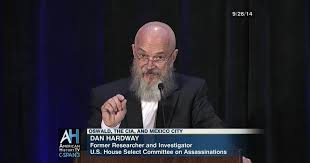
    Dan Hardway

    In 2014, for an ARRC conference, both Hardway and Lopez talked about their experience on the HSCA and the report. A lot of focus was put on how they had been making progress in the HSCA investigation until the CIA placed George Joannides as their resource person in charge of supervising the CIA’s interaction with the HSCA. Despite claims that Joannides was impartial, it was confirmed that he was directly involved with the Cuban exile organization called the DRE in 1963. Oswald had direct interaction with the DRE in events that became very public and were used to paint him as a communist. Hardway concludes his speech with:

    “The CIA has something to hide; Joannides knew what they had to hide. The CIA knew he knew and knew we did not know who or what he was hiding; Joannides hid what he had to hide.”

    Edwin Lopez

    Edwin Lopez confirmed the stonewalling and gave examples on how they were being spied on. He referred to the continued holding back of documents as a mess we all needed to work on together.

    They also confirmed that they felt that there were either fake phone calls done by an Oswald impostor while he was allegedly in Mexico or at least faked transcripts.

    Hardway hypothesizes that because of compartmentalization Phillips and Oswald may have found out on November 22, 1963 that Oswald was a patsy and Phillips received orders to tie the murder to Castro.

    In a critique of Phil Shenon’s work written for the AARC in 2015, Dan Hardway expresses the opinion that the CIA is heading to what he calls a limited hang-out by admitting that Oswald may have received guidance from Cuba and that the CIA director at the time, John McCone, was involved in a benign cover-up.

    In an interview he gave to Black Op Radio that same year, he recommended The Devil’s Chessboard by David Talbot, a book which exposes incriminating information about Alan Dulles and William Harvey, who can be seen now as persons of high interest in the case.

    In 2015, for a civil action where plaintiff Jefferson Morley, was suing the CIA for access to information, Dan Hardway signed a Sworn Deposition that underscores CIA obfuscation techniques as well as some of his findings during the investigation. The following are some of his statements:

    Beginning in May of 1978, the CIA assigned George Joannides to handle liaison with Edwin Lopez and me. In the summer of 1978, Mr. Joannides began to change the way file access was handled. We no longer received prompt responses to our requests for files and what we did receive no longer seemed to provide the same complete files that we had been seeing. The obstruction of our efforts by Mr. Joannides escalated over the summer, finally resulting in a refusal to provide unexpurgated access to files in violation of the Memorandum of Understanding previously agreed to by the HSCA and the CIA;

    During the course of the spring and summer of 1978 I had been looking into several areas of research which were actively impeded under Mr. Joannides’s direction. These included back channel communications methods used by the CIA’s Mexico City Station, William Harvey’s Office of Security files and his continuing relationship with certain Mafia figures, the use of an impulse camera to photograph the Cuban Consulate in Mexico City, missing production from one of the photographic installations that covered the Soviet Embassy in Mexico City as well as the impulse camera at the Cuban Consulate, and David Atlee Phillips’ possible involvement in stories about LHO that appeared after the assassination of John F. Kennedy.

    Before our unexpurgated access was cut off by Joannides, I had been able to document links between David Phillips and most of the sources of the disinformation that came out immediately after the assassination about Oswald and his pro-Castro proclivities. I confronted Phillips with those in an interview at our offices on August 24, 1978. Phillips was extremely agitated by that line of questioning, but was forced to admit that many of the sources were not only former assets that he had managed, in the late 50’s and early 1960’s, but were also assets whom he was personally managing in the fall of 1963. Mr. Phillips was asked, but could not explain, why the information that came from anti-Castro Cuban groups and individuals pointing to Cuban connections, all seemed to come from assets that he handled personally, but acknowledged that that was the case.

    We have, since 1978, learned that George Joannides was running the propaganda shop at the CIA’s Miami JMWAVE Station in 1963. It is extremely unlikely that Mr. Joannides could have occupied that position and not have known, and worked with, David Atlee Phillips. In addition, in 1963, we now know, George Joannides was the case officer handling the DRE. In 1977 the CIA specifically denied that DRE had a case officer assigned when asked that question by the HSCA.

    Robert Tanenbaum –  Chief Counsel HSCA

    In a Probe Magazine interview in 1993, Tanenbaum explained why he and Richard Sprague resigned from the Commission:

    Q: I interviewed a friend of yours down in New Orleans, L.J. Delsa. He said that he felt that one of the reasons the Congress turned against the Committee was, because of Sprague’s approach. It could have set a precedent in Washington to have really serious investigations instead of fact-finding commissions. Did you get any feeling about that?

    A: In my opinion, Congress never wanted to go forward with these investigations at all. That’s just based upon my having spoken with a lot of the membership of the House as I was asked to do by the Committee, in order to get funding. That’s something I never thought would be an issue before I went down there. They sort of politicized into it with some very distinguished members of Congress who were retiring in 1976, requesting that the Kennedy portion be investigated because they had seen Groden’s presentation of the Zapruder film and were very persuaded by it. Then the Black Caucus got involved and said well, investigate the murder of Dr. King. It was an election year and they said, “Ok, why not? We’ll do that.” But there was no commitment to really do it, unfortunately, which regrettably we found out while we were in the midst of investigating the case. They pulled our budget, they pulled our long-distance phone privileges, our franking privileges, we couldn’t even send out mail. And all of this was happening at a time when we were making some significant headway. So, L. J. may be right with respect to his perception, but at the same time I don’t believe they were ever committed to it. Tip O’Neill, who was the Speaker, was never committed to it. Only many, many years later did he realize that he’d made a tragic mistake.

    He also reveals troubling information about David Atlee Phillips:

    JD: Another thing you’ve discussed and it’s featured in your book, is this incredible movie of the Cuban exile training camp.

    BT: To the best of my recollection, we found that movie somewhere in the Georgetown library archives. The movie was shocking to me because it demonstrated the notion that the CIA was training, in America, a separate army. It was shocking to me because I’m a true believer in the system and yet there are notorious characters in the system, who are being funded by the system, who are absolutely un-American. And who knows what they would do, eventually. What if we send people to Washington who they can’t deal with? Out comes their secret army? So, I find that to be as contrary to the constitution as you can get.

    JD: Was it really as you described in the book, with all the people in that film? Bishop was in the film?

    BT: Oh, yeah. Absolutely! They’re all in the film. They’re all there. But, the fact of the matter is the Committee began to balk at a series of events. The most significant one was when [David Atlee] Phillips came up before the Committee and then had to be recalled because it was clear that he hadn’t told the truth. That had to do with the phony commentary he made about Oswald going to Mexico City on or about October 1st, 1963.

    JD: Would you describe that whole sequence, because I feel that is one of the real highlights of your book.

    Robert Tanenbaum

    BT: As I said, I had never followed the sequence of these events and I wasn’t aware of any of this, before I went to Washington. If you had told me all this before I went, I would have said, “This is madness. Talk to me about reality!” So, Phillips was saying that an individual went to Mexico City on or about October 1st and the CIA was claiming this was Lee Harvey Oswald, just as the Warren Commission claimed. However, the following occurred: “Oswald” goes to the Russian Embassy and identifies himself as Lee Henry Oswald. He wants to fake everybody out by changing his middle name. There were tapes of what he said because the CIA was bugging the Embassy the same as they were doing to the U.S. Embassy, according to Phillips. And the CIA was photographing people going in and out of the Embassy, the same as they were doing to the U.S. (We found out, from our own sources that the CIA had a contract employee named Lee Henry Oswald, in their files.) Phillips testimony was that there was no photograph of “Oswald” because the camera equipment had broken down that day and there was no audio tape of “Oswald’s” voice because they recycled their tapes every six or seven days. The problem with his story was, we had obtained a document, it was from the desk of J. Edgar Hoover, it was dated November 23rd, 1963, the very next day after the assassination. This document was a memo to all FBI supervisorial staff stating, in substance, that FBI agents who have questioned Oswald for the past 17 hours approximately, have listened to the tape made on October 1st, by an individual identifying himself as Lee Henry Oswald inside the Russian Embassy, calling on the phone to someone inside the Cuban Embassy and the agents can state unequivocally that the voice on the tape is not the voice of Lee Harvey Oswald, who is in custody.

    JD: Did you have this document while you were questioning Phillips?

    BT: No. It was a whole separate sequence of events that occurred. But, I wanted to get him back before the Committee so we could confront him with this evidence, because we were in a position to demonstrate that that whole aspect of the Warren Report, and what he had testified to, was untrue. And of course, the Committee was not interested in doing that.

    Tanenbaum also vindicated Garrison, incriminated Clay Shaw and shared thoughts about leads that were not followed up on:

    JD: You’ve said that you’ve actually seen a CIA document that says they were monitoring and harassing Jim Garrison’s witnesses.

    BT: Right. We had that information. I was shocked to read that because I remember discounting everything Garrison had said. I had a negative point of view about Garrison based upon all the reportage that had gone on. And then I read all this material that had come out of Helm’s office, that in fact what Garrison had said was true. They were harassing his witnesses, they were intimidating his witnesses. The documents exist. Where they are now, God only knows. It’s a sad commentary on the lack of oversight on the executive intelligence agencies.

    JD: I read something about you to the effect that during the brief period you ran the Committee, after Sprague left, one of the areas that really interested you was New Orleans and its connection to JM/Wave and Miami. Also, Delsa told me, as far as he was concerned, that was one of the most productive areas they were working.

    BT: That’s correct. The meeting in Clinton and the Clay Shaw connection and the fact that the government was lying about Clay Shaw and the aliases and so on. That the fact that the government and the executive intelligence agencies, not Garrison, were lying about that, was definitely an area to probe to find out what the justification for that was. Why were they involved in all this, if in fact, nothing had occurred? If it was meaningless, why get involved in creating a perjurious situation for a prosecutor in New Orleans? What was he really on to?

    JD: What’s interesting about the day that Sprague resigns, is that’s the day De Mohrenschildt is found dead.

    BT: Right. The night before the Committee vote, we had sent an investigator to serve him a subpoena. The night of the day he received the subpoena from the Committee is when he was found dead.

    JD: I guess the Committee was so crippled at that time that it couldn’t really pursue whatever investigation there may have been into his murder. And he was a key witness, right?

    BT: Right. We desperately wanted to find out what happened. He was someone who had not been subpoenaed before, certainly not by the Warren Commission. [CTKA note: he was questioned, but not subpoenaed.] And you’re right, he was a key player.

    JD: Another thing you guys were on to that Blakey never seemed to be on to, was the connection between the people in the background of the assassination and the scandal that had just happened in Washington – namely, Watergate.

    BT: Right. E. Howard Hunt, Frank Sturgis. Interestingly, some of them had been with Castro in the Sierra Maestra during the revolution and became players after the revolution. And then wound up in the Nixon White House as the “plumbers.”

    JD: You’ve stated that the Committee never got any cooperation from the Kennedys.

    BT: We called Senator Kennedy 20-30 times. He never responded once to an inquiry. I found that to be astounding, because after all, he is a member of this legislative branch of government. He conducts probes, he engages in fact-finding missions. How could he stonewall from his brethren in the other chamber? He could have just simply acknowledged a phone call. How could he know what information we wanted? The fact of the matter was, as a matter of courtesy, we wanted to let him know we knew he was around and we wanted to discuss with him areas that he felt we should look into and get his opinions. We certainly felt that they would be valid. So, we were very disappointed in that regard. Frank Mankiewicz came by as a representative of the Kennedy family, wanted to see whether or not Sprague and I had two or three heads. He told us, interestingly, Bobby Kennedy couldn’t put a sentence together about the assassination, he couldn’t even think about it, he couldn’t focus on it. Which explains, in large measure why the Kennedy family was willing to accept what the Warren Commission said, without concern. The event was so horrific, in and of itself, they really weren’t concerned with bringing someone to justice other than what the Warren Commission had said. In their minds, from what Mankiewicz said, if it wasn’t Oswald-some nonperson-then it was some other nonperson. What difference would it make?

    JD: When the attacks on Sprague began, most notably in the New York Times and a few other newspapers, did you begin to see a parallel between what was happening to Sprague and what had happened to Jim Garrison?

    BT: Of course. But, I didn’t pay much attention to it because it didn’t mean anything to me. I’m not moved to any great extent, by what people write in newspapers. They were trying to cause controversy. But, we were on a mission to do a job and nothing some dope in the New York Times or any other newspaper was going to write, that was blatantly untrue, was going to interfere with what we were doing. Whether it was a positive article or a negative article, it didn’t matter.

    In 2003, Tanenbaum spoke at the Wecht Conference and what he had to say would certainly give students of American History new insights in the assassination that would not have pleased Earl Warren or Gerald Ford and some of their disciples.

    Here are but a few of the points he made:

    What I am saying is that from the evidence we produced, there were substantial questions about the assassination …

    What I’d like to do very briefly is to explain some of the reasons why, from a prosecutorial point of view, from what our investigation revealed, there was, in my judgment, no case to convict Lee Harvey Oswald of murdering the President …

    The assassination was approximately 12:30; at 12:48 a description of a suspect was sent out: “‘white male, approximately thirty, slender build, height five foot ten inches, weight 165 pounds.” Where did that description come from?

    And the answer the Warren Commission gives is that this fellow Brennan was… looking up at the Depository window. And he allegedly sees this person – the shooter – Oswald the Warren Commission maintains, and was able to give a description, a miraculous feat … because if he stood up in the window you would only see a partial of his body [his knees] because the first few feet was opaque. [the window was close to the floor]

    Whoever the shooter was that was in that window – in that Sniper’s Nest, he was crouched down looking out that window which was raised about 12 inches. At best, if anybody saw anybody in that window, they would have seen a partial of their face, at best.

    During a 2015 interview on Len Osanic’s Black Op Radio, he talked about how the Warren Commission did not want look into a conspiracy, including Oswald’s links with intelligence and Ruby’s to the mob and the Dallas Police Department.

    Richard Sprague – Chief Counsel

    Historians can be illuminated by what this top level insider of impeccable credentials thought about the assassination and the ensuing cover-up from the many interviews he gave.

    In the BBC Documentary The Killing of President Kennedy, Sprague related the following about Oswald:

    His trip to Russia raised a number of questions that we wanted to get into. For example, when any American went to Russia and renounced his American citizenship and subsequently changed his mind and wanted to come back to this country, upon returning to this country there was a thorough debriefing by the CIA, with one exception as far as we could ascertain- Oswald…

    The photographs allegedly of Oswald going into the Cuban embassy as we all know in fact are not photographs of Oswald. Secondly it turns out that those photographs, even if they were of the wrong person, you would expect they would be of a person entering the Cuban embassy but it turns out they are photographs of someone entering the Russian embassy and the question raised how could they so mix up even what building they are talking about. In addition when we inquire where are the photographs you took of the people entering the Cuban embassy the day in question we are told the cameras were not working that day. I want to talk to the camera people I want to find out if that’s true and that’s where we got stopped.

    The CIA said they had re-used the tape prior to the assassination of President Kennedy, yet the FBI has a document stating that some of their agents listened to the tape after the assassination of President Kennedy and that the voice on there was not Oswald’s. In addition the CIA presented a transcript of that conversation; we had interviewed the typist who typed it up who said that the transcript presented was not in fact what was typed up by whoever it was who spoke in that conversation. These are areas that I wanted to get into.

    From the photographic evidence surrounding the sixth floor window, as well as the grassy knoll, Sprague, Tanenbaum and most of the staff knew Oswald had not fired any shot, they suspected no shots came from the sixth floor “sniper’s nest” window, and knew there had been shots from other points in Dealey Plaza. They knew the single bullet theory was not valid, and strongly suspected there had been a pre-planned crossfire in Dealey Plaza. They were not planning to waste a lot of time reviewing and rehashing the Dealey Plaza evidence, except as it might lead to the real assassins.

    They had set up an investigation in Florida and the Keys, of some of the evidence and leads developed in 1967 by Garrison. Gaeton Fonzi was in charge of that part of Sprague’s team. They were going to check out the people in the CIA that had been running and funding the No Name Key group and other anti-Castro groups, e.g., Willaim Seymour, Manuel Garcia Gonzalez, Jerry Patrick Hemming, Loran Hall, Lawrence Howard, and Rolando Masferrer and Carlos Prio Socarras.

    This new situation, with Richard Sprague and his team garnering so much knowledge of the CIA’s role in the murder and the cover-up caused the Establishment to face a crisis. They knew they had to do several things to turn the situation around and keep the American public in the dark. Here is what they had to do:

    • Get rid of Chief Counsel Richard Sprague.
    • Get rid of Committee Chairman Henry Gonzalez.
    • Get rid of Sprague’s key men and keep them away from more incriminating CIA evidence.
    • Install their own chief counsel to control the investigation.
    • Nominate a new HSCA chairman who would go along, or who could be fooled.
    • Limit Sprague’s investigations of CIA people. Make sure some of the people aren’t found or, if necessary dispose of CIA people who might talk.
    • Create a new investigative environment whose purpose would be to confirm all of the findings of the Warren Commission and divert attention away from the who-did-it-and-why approach.
    • Control the committee staff in such a way as to keep any of them separate from other teams and silent by signing non-disclosure agreements.
    • Control the media by not holding any press conferences.

    These things all happened. And they fundamentally altered the temperament and goals of the HSCA. It simply was not the same. As many observers think, this was the last, best chance to solve the JFK case.

    How did it happen? According to Gaeton Fonzi in The Last Investigation:

    Richard Sprague

    The key factors that drove Richard Sprague to resign as Chief Counsel of the Assassinations Committee appeared, at the time, to be apparent and on the surface. His proposed use of certain investigative equipment, his demand for an expensive, unrestricted investigation, his refusal to play politics with Chairman Gonzalez – all were apparent grounds for the vociferous criticism which, in the long run, was debilitating to the Committee’s efforts to get on with its job. However, after his resignation and a brief respite from the turmoil of Washington, Sprague was able to view his experience in a broader perspective.” … “If he had it to do over again, he would begin his investigation of the Kennedy assassination by probing “Oswald’s ties to the Central Intelligence Agency.” Recently, I asked Sprague why he had come to that conclusion. “Well,” he said, “when I first thought about it I decided that the House leadership really hadn’t intended for there to be an investigation. The Committee was set up to appease the Black Caucus in an election year. I still believe that was a factor. But when I looked back at what happened, it suddenly became very clear that the problems began only after I ran up against the CIA. That’s when my troubles really started.

    In a 2000 interview for Probe Magazine with John Williams, he described his being fired this way:

    SPRAGUE: We were just going to do that type of thorough thing. I demanded the records from the CIA, and now there was an abrupt refusal, and I subpoenaed them. At that point, Gonzales, who was Chairman of the Committee, ordered the CIA, or told the CIA that they need not respond to my subpoena, and fired me, and ordered the U.S. Marshals come in and remove me from my office.

    WILLIAMS: Oh, so that firing was directly after you had subpoenaed the records from the Central Intelligence Agency.

    SPRAGUE: Right. But there’s more involved in it than the timing …

    WILLIAMS: Right.

    SPRAGUE: … if you checked the record. That came up after that. He ordered my firing. He ordered marshals to remove me from my office in what I’m sure was the first and only time in the history of the United States Congress. The rest of the Committee, backed me to a man and overrode the Chairman, and ordered that I remain, and the marshals were directed to get off.

    Of course, that led to Gonzales taking it up in the House of Representatives, and the House backed the rest of the Committee. And he resigned and Stokes came on. [Louis Stokes was the Representative from Ohio. Eds. Note] I’m sure that’s the only time in the history in the United States Congress that in a fight between the Chairman and the Director, that the Chairman got bounced.

    But there’s a terrible price paid for that. Every Congressman dreams of being Chairman of a Committee and being all powerful. It ultimately did not sit well with the Congress that a Chairman got ousted …

    Robert Blakey – Chief Counsel and staff director 1977-79

    While Sprague’s replacement, Robert Blakey, frustrated some investigators for being too trusting of the CIA, he too did not buy the Warren Commission’s final conclusions.

    While at first Blakey felt that the HSCA had investigated the CIA enough to absolve them of any role in the assassination, in 2003 in an addendum to an interview with PBS, his opinion evolved. Because he found out that the CIA misled him and the HSCA by bringing George Joannides out of retirement as the CIA liaison with the Committee and hiding the role he had with an anti-Castro group called the DRE which played an important role by its interaction with Oswald:

    I am no longer confident that the Central Intelligence Agency co-operated with the Committee. My reasons follow:

    The Committee focused, among other things, on (1) Oswald, (2) in New Orleans, (3) in the months before he went to Dallas, and, in particular, (4) his attempt to infiltrate an anti-Castro group, the Directorio Revolucionario Estudiantil or DRE.

    These were crucial issues in the Warren Commission’s investigation; they were crucial issues in the committee’s investigation. The Agency knew it full well in 1964; the Agency knew it full well in 1976-79. Outrageously, the Agency did not tell the Warren Commission or our committee that it had financial and other connections with the DRE, a group that Oswald had direct dealings with!

    What contemporaneous reporting is or was in the Agency’s DRE files? We will never know, for the Agency now says that no reporting is in the existing files. Are we to believe that its files were silent in 1964 or during our investigation?

    I don’t believe it for a minute. Money was involved; it had to be documented. Period. End of story. The files and the Agency agents connected to the DRE should have been made available to the Commission and the Committee. That the information in the files and the agents who could have supplemented it were not made available to the Commission and the Committee amounts to willful obstruction of justice.

    Obviously, too, it did not identify the agent who was its contact with the DRE at the crucial time that Oswald was in contact with it: George Joannides.

    During the relevant period, the Committee’s chief contact with the Agency on a day-to-day basis was Scott Breckinridge. (I put aside our point of contact with the office of chief counsel, Lyle Miller) We sent researchers to the Agency to request and read documents. The relationship between our young researchers, law students who came with me from Cornell, was anything but “happy.” Nevertheless, we were getting and reviewing documents. Breckinridge, however, suggested that he create a new point of contact person who might “facilitate” the process of obtaining and reviewing materials. He introduced me to Joannides, who, he said, he had arranged to bring out of retirement to help us. He told me that he had experience in finding documents; he thought he would be of help to us.

    I was not told of Joannides’ background with the DRE, a focal point of the investigation. Had I known who he was, he would have been a witness who would have been interrogated under oath by the staff or by the committee. He would never have been acceptable as a point of contact with us to retrieve documents. In fact, I have now learned, as I note above, that Joannides was the point of contact between the Agency and DRE during the period Oswald was in contact with DRE.

    That the Agency would put a “material witness” in as a “filter” between the committee and its quests for documents was a flat out breach of the understanding the committee had with the Agency that it would co-operate with the investigation.

    The Committee’s researchers immediately complained to me that Joannides was, in fact, not facilitating, but obstructing our obtaining of documents. I contacted Breckinridge and Joannides. Their side of the story wrote off the complaints to the young age and attitude of the people.

    They were certainly right about one question: the Committee’s researchers did not trust the Agency. Indeed, that is precisely why they were in their positions. We wanted to test the Agency’s integrity. I wrote off the complaints. I was wrong; the researchers were right. I now believe the process lacked integrity precisely because of Joannides.

    For these reasons, I no longer believe that we were able to conduct an appropriate investigation of the Agency and its relationship to Oswald. Anything that the Agency told us that incriminated, in some fashion, the Agency may well be reliable as far as it goes, but the truth could well be that it materially understates the matter.

    What the Agency did not give us, none but those involved in the Agency can know for sure. I do not believe any denial offered by the Agency on any point. The law has long followed the rule that if a person lies to you on one point, you may reject all of his testimony.

    I now no longer believe anything the Agency told the Committee any further than I can obtain substantial corroboration for it from outside the Agency for its veracity. We now know that the Agency withheld from the Warren Commission the CIA-Mafia plots to kill Castro. Had the commission known of the plots, it would have followed a different path in its investigation. The Agency unilaterally deprived the commission of a chance to obtain the full truth, which will now never be known.

    Significantly, the Warren Commission’s conclusion that the agencies of the government co-operated with it is, in retrospect, not the truth.

    We also now know that the Agency set up a process that could only have been designed to frustrate the ability of the committee in 1976-79 to obtain any information that might adversely affect the Agency.

    Many have told me that the culture of the Agency is one of prevarication and dissimulation and that you cannot trust it or its people. Period. End of story.

    I am now in that camp.

    Anyone interested in pursuing this story further should consult the reporting by Jefferson Morley of the Washington Post. See, e.g., Jefferson Morley, “Revelation 1963”, Miami New Times (April 2001).

    Robert Blakey

    During his appearance for the AARC Conference in 2014, Blakey’s views seem to have crystallized by stating that at first he felt the CIA had cooperated but that he had come to change his mind. He also explained how he was sold the idea by the CIA of bringing in a facilitator in Joannides to help in the liaison between the CIA and the HSCA, and that that was when things went downhill. He also said that they were refused the DRE file and were told by Joannides that there was no case agent for the DRE, when in fact he was the case agent! It was also discovered subsequent to the HSCA hearings that Joannides was acting as an undercover agent in his dealings with the HSCA. He also said that FBI agent Regis Kennedy described Marcello as a tomato salesman who was not part of the mob.

    During this presentation and on a 2015 Black Op Radio program he confirmed his belief in the single bullet theory, but also that a shot came from the grassy knoll due to witness testimony from several people who the Warren Commission made every effort to undermine. This includes Secret Service agents, S. M. Holland, and presidential assistant Dave Powers. He said this caused him to lose confidence in the Warren Commission report. He said that “It’s not an investigation … It’s a justification to assert that Oswald acted alone … They used the testimony of Lenny Patrick – a mob shooter – to exculpate Ruby from mob connections …”  He concluded that the committees, including the ARRB, were had.

    Comments on the HSCA


    A diligent historian who prides himself in honoring the historical record should really take the time to digest the conclusions of the report and the statements of the high level insiders who are in the know… They do not buy the Warren Commission version of the assassination; they do not conclude that Oswald acted alone; they do not find that the murder was adequately investigated!

    Liberty Lobby vs. E. Howard Hunt

    Contrary to the other investigations which were governmental, this instance was a civil trial which pitted CIA operative and Watergate burglary planner E. Howard Hunt against Mark Lane. Lane came in because Spotlight was a publication which ran a piece in 1985 reporting that the CIA had a memo confirming its intention to out Hunt as having been involved in the JFK assassination, acting as something like a rogue agent. Hunt sued and won for slander but lost on appeal after Liberty Lobby hired Lane to represent them.

    Spotlight wrote the following about its victory: “Scattered news reports did mention Hunt had lost a libel case against The SPOTLIGHT. However, no media reported what the jury forewoman had told the press:  ‘Mr. Lane was asking us to do something very difficult. He was asking us to believe John Kennedy had been killed by our own government. Yet when we examined the evidence closely, we were compelled to conclude that the CIA had indeed killed President Kennedy.’”

    Mark Lane, who passed away in 2016, was among the earliest researchers who detailed problems about the Warren Commission, which he related in the best-seller Rush to Judgement. His books Plausible Denial and the Last Word cover the trial extensively.

    Comments about the Liberty Lobby – Hunt trial

    While many Warren Commission defenders have tried to discredit Mark Lane through the years, an open-minded historian should consider the jury members who were asked to play an important role in ensuring that justice was served. They took in and evaluated all the evidence. And have added themselves to the already overwhelming number of insiders who do not buy what is written in most history books, i.e., the Warren Commission version of events.

    ARRB Assassination Records Review Board

    This Board was created in 1994 after the movie JFK put pressure on Congress to pass the 1992 JFK Assassination Records Collection Act. During a four-year period, it declassified millions of documents. Its mandate was different from the other investigations:  The major purpose of the Review Board was to re-examine for release the records that the agencies still regarded as too sensitive to open to the public. In addition, Congress established the Review Board to help restore government credibility. To achieve these lofty goals, Congress designed an entity that was unprecedented.

    It was not set up to re-investigate the case, nor to solve what happened on November 22, 1963.  It nevertheless provided valuable information to assassination researchers that historians seem oblivious to. It achieved the following:

    • Reviewed and voted on over 27,000 previously redacted assassination records.
    • Obtained agencies’ consent to release an additional 33,000+ assassination records.
    • Ensured that the famous Zapruder Film of the assassination belonged to the American people and arranged for the first known authenticity study of the Zapruder Film.
    • Opened previously redacted CIA records from the Directorate of Operations.
    • Released 99% of the “Hardway/Lopez Report” documenting the CIA’s records on Lee Harvey Oswald’s trip to Mexico City before the assassination.
    • Conducted its own inquiry into the medical record of President Kennedy’s autopsy and his treatment at Parkland Hospital by deposing 10 Bethesda autopsy participants, five Parkland Hospital treating physicians, and conducting numerous unsworn interviews of Parkland and Bethesda personnel.
    • Secured records relating to District Attorney Jim Garrison’s prosecution of Clay Shaw for conspiracy to assassinate President Kennedy, including Shaw’s diaries, records from Shaw’s defense attorneys, investigative records from the District Attorney’s office, and grand jury records.
    • Made available to the public all FBI and CIA documents from previous official investigations, like the HSCA.
    • Sponsored ballistics and forensic testing of Warren Commission Exhibit 567, the bullet “nose fragment” from the front seat of the Presidential limousine (the HSCA Firearms Panel first recommended the testing in 1978, but the testing was not conducted until the Review Board existed).
    • Permanently preserved all the extant autopsy photographs of President Kennedy in digitized form, and conducted sophisticated digital enhancement of selected, representative images.

    Jeremy Gunn – Executive counsel

    On November 10, 2013 he made the following remarks for NPR:

    “There were many things that were disturbing.”

    J. Thornton Boswell (left)James J. Humes (center) Pierre Finck (right)

    When Gunn pored over the material, what stuck out most for him was the medical evidence. For instance, what he learned in his 1996 deposition of James Joseph Humes. Humes, who died three years later, was one of the doctors who performed the autopsy on Kennedy’s body.

    For one thing, Humes told Gunn that the autopsy was not performed strictly by the book; some procedures were left out, such as removing and weighing all the organs. Then, Humes made an eye-opening revelation.

    “Dr. Humes admitted that the supposedly original handwritten version of the autopsy that is in the National Archives is in fact not the original version,” Gunn says. He says Humes had never said that publicly before, even to the Warren Commission.

    Saundra K. Spencer

    When Gunn showed Saundra Spencer, the Navy Warrant Officer who processed the autopsy film, the official photos from the National Archives during her deposition in 1997, she said they were not the pictures she remembered processing. What’s more, the official pictures weren’t anything like the ones she remembered. “The prints that we printed did not have the massive head damages that is visible here,” she told Gunn. “… The face, the eyes were closed and the face, the mouth was closed, and it was more of a rest position than these show.”

    “[I] can recite a litany of other unresolved questions surrounding the Kennedy assassination — ones the Warren Commission failed to answer. For example, in New Orleans in 1963, Oswald came in contact with the FBI. When he was arrested after a scuffle at a demonstration, he asked to meet with the FBI. Why would Oswald ask to see someone from the FBI?” Gunn asks. “But an FBI agent went and interviewed Oswald, came back and wrote a memo on it, put it in the file.”

    Jeremy Gunn

    “For me, it’s quite simple,” Gunn says. “I don’t know what happened.”

    “There is substantial evidence that points toward Oswald and incriminates Oswald,” he says, “and the only person we can name where there is evidence is Oswald. But there’s also rather important exculpatory evidence for Oswald, suggesting he didn’t do it, and that he was framed.”

    “So they wanted to write the document in a way that would reassure the American public that it was a single gunman acting alone, somebody who’s a little bit unstable, and that that’s the explanation for what happened. Since the facts aren’t clear, though, that document can look like a whitewash.”

    For the Warren Commission, transparency had its own difficulties. “There are serious problems with the forensics evidence, with the ballistics evidence, with the autopsy evidence,” Gunn says. “And, in my opinion, if they had said that openly, it would have not put the issue to rest.”

    “If the president had been killed as part of a conspiracy, that needed to be known,” he says.

    “The institution that had the opportunity to best get to the bottom of this, as much as it was possible, was the Warren Commission, and they didn’t do it,” he says. “Now it’s too late to do what should have been done originally.”

    Doug Horne – Senior analyst

    Doug Horne reviewed the military records including the military autopsy for the ARRB. What he found was revealed during interviews as well as the book he wrote, Inside the ARRB, published in 2009. Its contents are fascinating and would surprise students of American history who base their beliefs on many of the history textbooks.

    Numerous persons the ARRB deposed or interviewed (FBI agents Sibert and O’Neill, mortician Tom Robinson, and others) have essentially disowned the autopsy photographs showing the back of JFK’s head intact. O’Neill said the photos of the back of the head looked “doctored” (by which he meant that he thought the wound had been repaired – put back together – not that the photo looked altered), and Sibert said the back of the head looked “reconstructed.” Tom Robinson of Gawler’s funeral home said there was a large hole in the back of the head where it looks intact in the photos. Pathologist J. Thornton Boswell said that there was a lot of bone missing in the right rear of the head behind where the scalp looks intact, but did not explain how the scalp could be intact if the bone in the right rear of the skull was missing! (See the ARRB deposition transcripts of Frank O’Neill, James Sibert, and J. Thornton Boswell, as well as the unsworn report of the ARRB interview with Tom Robinson.)

    Doug Horne

    But perhaps Horne’s most stunning conclusion was that the photographs of “the President’s brain” in the autopsy collection are really photographs of someone else’s brain … a major deception in this case. These images, which appear to show damage consistent with a shot from above and behind, were disowned under oath to the ARRB by John Stringer, the photographer who took the official brain photos at JFK’s supplementary autopsy. He disowned the images because of the angles at which they were shot, and because they were taken on the wrong film – film he did not use. (FBI agent O’Neill also disowned the brain photos in the autopsy collection, saying that there was too much tissue present, and that at autopsy over one half of the President’s brain was missing.) These photos have been used for years by supporters of the Warren Commission’s conclusions to support their shooting scenario, and to discount those who claim there were shots from the front or right front.

    General conclusions

    Most historians who talked about their sources when writing about the JFK assassination were not aware of the ARRB and the wealth of new evidence made available starting a year after Gerald Posner wrote Case Closed. As a matter of fact, not one cited any of the official investigations as a source other than the Warren Commission. Which, of course, is the oldest, most contested, highly rushed, poorly investigated, biased governmental source possible.

    That assessment does not come from independent authors who are trying to sell books. It comes from written reports of subsequent investigations and the statements of a very significant cross-section of insiders that participated in the investigations including the Warren Commission:  Senators (some Republicans, some Democrats), counsel, staff members, attorneys, researchers, historians, archivists, investigators, FBI, DPD and Louisiana State law enforcement agents. As well as from the highest ranking members of the HSCA and Church committees. As well as an impressive number of dissenting participants of the Warren Commission itself, who have voiced their opinions in reputable magazines, newspapers, documentaries and books, all easily accessible on the web. We are not talking about zany, fringe, book peddling conspiracy theorists here. These are persons that witnessed the autopsy, questioned persons of interest under oath while looking them in the eye, poured over reports and secret documents, worked in teams to analyze the evidence, etc. – people who the U.S. government entrusted to investigate the crime of the century and who curious historians may learn from.

    While they may not all know what in fact happened, they all agree on certain key points: The Warren Commission conclusions are not reliable; the investigations into the assassination were deficient (especially the Warren Commission’s); they are far from certain that Oswald and Ruby acted alone. Many of them believe that: government agencies hid the truth; the Single Bullet Theory is a fabrication; that there has been a long-lasting cover-up; that Oswald and Ruby were involved in very suspicious relationships, and the list goes on and on. All diametrically opposed to what historians, for money, are telling adolescents as part of a captive audience! Which is that Oswald did it and the Warren Commission got it right! End of story!

    The American Historical Association statement of conduct stipulates that historians are to honor the historical record.. To do so they first need to know what it is! If the next edition of their history books continues to support the cover-up, their behavior should be considered nothing less than unforgivable.


    Go to Addendum

    Go to Part 1

  • JFK and the Unforgivable: How the historians’ version of the JFK assassination dishonors the historical record – Part 1

    JFK and the Unforgivable: How the historians’ version of the JFK assassination dishonors the historical record – Part 1


    In April 2016 CTKA published this author’s article[i] that revealed how history books portray the JFK assassination as a crime perpetrated by Oswald alone and how authors’ sources are restricted to the Warren Commission and a few books that mostly support the Lone Nut scenario. Information and conclusions coming from other major investigations and pro-conspiracy authors are almost completely ignored.

    The article went on to show how the historians violate their own code of conduct on this issue and looked into possible outside influences that may have affected their work and mindsets. The unfortunate result of the lack of diligence on this issue is that captive audiences of young students have been unfairly exposed to a biased, unsound and incomplete account of the Kennedy assassination in most history textbooks.

    Another point that came out was that many historians find that independent researchers that write about possible conspiracies lack credibility. There has been much propaganda to discredit them and their work. They are called zany, dishonest, and greedy and their claims are said to be baseless and off the wall. Furthermore they are accused of undermining their own institutions, government and country. Before a serious historian can zero in on whom the reliable researchers are and focus on the soundness of their arguments, they have to cut through clutter caused by hostile, omnipresent anti-conspiracy messaging as well as the cast of shaky researchers peddling low quality work.

    This article focuses on what interested historians can easily learn from the official investigations and the opinions and statements from the actual investigators, lawyers, and staff members who were involved in six investigations that were mostly (all but one) government initiated and managed. The Warren Commission was the first one, the one most historians count on almost entirely for their writings, and as we will see, it is the most obsolete and least reliable.

    For an historian who finds research on this issue very daunting, this should serve as a starting point – especially for those who, as they did with the Warren Commission Report, have faith in their government institutions and their representatives. What follows is what can be learned from not only the official investigation reports but from the mouths of those who were direct participants in them … the real insiders: Those who were mandated and given special powers to access witnesses and evidence! It therefore discounts the theories and opinions of independent authors.

    It may prove difficult to fluff off these sources as being zany, dishonest and greedy … Doing so would suggest a far-fetched governmental conspiracy to deceive its own people and undermine important American institutions.

    It is this author’s opinion that historians are disrespecting the American Historical Association statement of conduct about honoring the historical record when they assert that Oswald alone assassinated the president based on the conclusions of the Warren Commission. If they read this article and continue to do so, their actions cannot be blamed on mere ignorance of the facts, or confusion caused by obfuscators. Thereafter, if the historian does not feel compelled to dig deeper to find out what really happened, then the word unforgivable should be added to the word subservient – at least on this issue – when describing their performance. Especially when one considers the age of the subjects who are victimized in what is supposed to be a learning environment.

    If they continue to cite the Warren Commission as their key source, they may want to consider taking up smoking cigarettes; after all some of the first studies about this product concluded that it was good for your health.

    The President’s Commission on the Assassination of President Kennedy (aka The Warren Commission)

    Established on November 29, 1963, it was set up by President Lyndon Johnson to investigate the November 22, 1963 assassination of President Kennedy. The Commission presented an 888-page report[ii] and twenty-six volumes of evidence on September 24, 1964. Its major conclusions were that Lee Harvey Oswald acted alone in killing JFK and that nightclub owner Jack Ruby also acted alone in killing Oswald two days later.

    The Commission had “not found evidence” linking either Oswald or Ruby to a conspiracy. (WR, p. 21)

    The first hint of dissension among the members of the commission is the following bewildering statement in the report which points to a rift concerning the Single Bullet theory and Connally’s testimony: “Although it is not necessary to any essential findings of the Commission to determine just which shot hit Governor Connally, there is very persuasive evidence from the experts to indicate that the same bullet which pierced the President’s throat also caused Governor Connally’s wounds. However, Governor Connally’s testimony and certain other factors have given rise to some difference of opinion as to this probability but there is no question in the mind of any member of the Commission that all the shots which caused the President’s and the Governor’s wounds were fired from the sixth floor of the Texas School Book Depository.” (WR, Page 19)

    What is not being said directly here is that certain members of the Commission, as well as John Connally and his wife, did not believe that a single bullet caused all seven wounds, which is in fact necessary to the essential conclusions. Because if one bullet caused Kennedy’s head wound and another caused bystander James Tague’s injury, then for Oswald to be the lone shooter, he would have had to have caused all remaining seven wounds with his only other shot, because even the Warren Commission acknowledges that Oswald could not have fired more than three shots.

    Statements and opinions of Warren Commission members, consultants and investigators

    While most historians continue to place their faith in the Warren Commission, it is most noteworthy that an important number of important participants in the investigation had serious doubts about crucial elements in the report.

    Roger Craig – Dallas Deputy Sheriff

    Roger Craig was very well regarded up until the assassination. He was on duty and in Dealey Plaza at the time of the assassination. In a number of interviews he explains what he witnessed on November 22, 1963: He was in the Book Depository when the alleged murder weapon was found which he confirmed as a Mauser and not the Mannlicher-Carcano that the Warren Commission claimed Oswald owned. (Contrary to what some have written, the brand name Mauser and the calibre are stamped on some editions of the Mauser rifle; see here The Mauser, the Carcano and the Lt. Day Rifle ) Furthermore Craig claimed to have seen Oswald entering a station wagon a few minutes after the assassination, which would contradict the Warren Commission’s chronology of Oswald’s movements and implicated a getaway driver – the following is part of his Warren Commission testimony:

    Roger Craig: I drove up to Fritz’ office about, oh, after 5 … about 5:30 or something like that and talked to Captain Fritz and told him what I had saw. And he took me in his office … I believe it was his office … . it was a little office, and had the suspect sitting in a chair behind a desk … beside the desk. And another gentleman, I didn’t know him, he was sitting in another chair to my left as I walked in the office. And Captain Fritz asked me “was this the man I saw” and I said, “Yes,” it was.

    David Belin: All right. Will you describe the man you saw in Captain Fritz’ office?

    Roger Craig: Oh, he was sitting down but he had the same medium brown hair; it was still … well, it was kinda wild looking; he was slender, and what I could tell of him sitting there, he was … short. By that, I mean not myself, I’m five eleven … he was shorter than I was. And fairly light build.

    David Belin: Could you see his trousers?

    Roger Craig: No; I couldn’t see his trousers at all.

    David Belin: What about his shirt?

    Roger Craig: I believe, as close as I can remember, a T-shirt … a white T-shirt.

    David Belin: All right. But you didn’t see him in a lineup? You just saw him sitting there?

    Roger Craig: No; he was sitting there by himself in a chair … off to one side.

    David Belin: All right. Then, what did Captain Fritz say and what did you say and what did the suspect say?

    Roger Craig: Captain Fritz then asked … . “What about this station wagon?” And the suspect interrupted him and said, “That station wagon belongs to Mrs. Paine” … I believe is what he said. “Don’t try to tie her into this. She had nothing to do with it.”

    In Craig’s 1971 book When They Kill a President, he describes that many in the DPD despised Kennedy, and how the DPD was excluded from security duties the day of the assassination. The following is David Ratcliffe’s summary of the Book:

    … He was a member of a group of men from Dallas County Sheriff James Eric “Bill” Decker‘s office that was directed to stand out in front of the Sheriff‘s office on Main Street (at the corner of Houston) and “take no part whatsoever in the security of that motorcade.” Once he heard the first shot, Roger Craig immediately bolted towards Houston Street. His participation in the formative hours of the investigation during the rest of that day and into the evening included observations and experiences that would have singlehandedly destroyed the entire Warren Commission fairy tale before a grand jury or a Congressional investigation.

    Roger Craig was named the Dallas Sheriff‘s Department “Officer of the Year” in 1960 by the Dallas Traffic Commission. He received four promotions while he was Deputy Sheriff. Among the most important events he witnessed: At approximately 12:40 p.m., Craig was standing on the south side of Elm Street when he heard a shrill whistle coming from the north side of Elm and turned to see a man—wearing faded blue trousers and a long sleeved work shirt made of some type of grainy material—come running down the grassy knoll from the direction of the TSBD. He saw a light green Rambler station wagon coming slowly west on Elm Street, pull over to the north curb and pick up the man coming down the hill. By this time the traffic was too heavy for him to be able to reach them before the car drove away going west on Elm.

    Roger Craig

    After witnessing the above scene, Deputy Craig ran to the command post at Elm and Houston to report the incident to the authorities. When he got there and asked who was involved in the investigation, a man turned to him and said “I‘m with the Secret Service.” Craig recounted what he had just seen. This “Secret Service” man showed little interest in Craig‘s description of the people leaving, but seemed extremely interested in the description of the Rambler to the degree this was the only part of the recounting that he wrote down. Immediately after this Craig was told by Sheriff Decker to help the police search the TSBD. Deputy Craig was one of the people to find the three rifle cartridges on the floor beneath the window on the southeast corner of the sixth floor. Originally, all three were no more than an inch or two apart. One of the three shells was crimped on the end which would have held the slug. It had not been stepped on but merely crimped over on one small portion of the rim. The rest of that end was perfectly round.

    He was among those present after the rifle was found. And, along with Deputy Eugene Boone who had first spotted the weapon, was immediately joined by police Lt. Day, Homicide Capt. Fritz, and deputy constable Seymour Weitzman, an expert on weapons who had been in the sporting goods business for many years and was familiar with all domestic and foreign makes. Lt. Day briefly inspected the rifle and handed it to Capt. Fritz who asked if anyone knew what kind of rifle it was. After a close examination, Weitzman declared it to be a 7.65 German Mauser. Capt. Fritz agreed with him. At the moment when Capt. Fritz concurred with Weitzman‘s identification of the rifle, an unknown Dallas police officer came running up the stairs and advised Capt. Fritz that a Dallas policeman had been shot in the Oak Cliff area. Craig instinctively looked at his watch. The time was 1:06 p.m. (The Warren Commission attempted to move this time back beyond 1:15 to create a plausible claim Oswald had reached the Tippit murder scene in a more humanly possible time-frame than would be the case if Tippit had the encounter with his murderer earlier.)

    Later in the afternoon Craig received word of Oswald‘s arrest and that he was suspected of being involved in Kennedy‘s murder. He immediately thought of the man running down the grassy knoll and made a telephone call to Capt. Will Fritz to give him the description of the man he had seen. Fritz said Craig‘s description sounded like the man they had and asked him to come take a look. When he saw Oswald in Fritz‘s personal office Deputy Craig confirmed that this was indeed the man, dressed in the same way, that he had seen running down the knoll and into the Rambler. They went into the office together and Fritz told Oswald, “This man (pointing to me) saw you leave.” At which time the suspect replied, “I told you people I did.” Fritz, apparently trying to console Oswald, said, “Take it easy, son—we‘re just trying to find out what happened.” Fritz then said, “What about the car?” Oswald replied, leaning forward on Fritz‘s desk, “That station wagon belongs to Mrs. Paine—don‘t try to drag her into this.” Sitting back in his chair, Oswald said very disgustedly and very low, “Everybody will know who I am now.”

    The fact that Fritz said ‘car’ and this elicited Oswald‘s outburst about a station wagon—that no one else had mentioned—confirms the veracity of Roger Craig‘s story.

    Junior counsel for the Warren Commission Dave Belin, was the man who interviewed Roger Craig in April of 1964. After being questioned in what Craig recounts as a very manipulative and selective way, Belin asked “Do you want to follow or waive your signature or sign now?” Craig noted, “Since there was nothing but a tape recording and a stenographer‘s note book, there was obviously nothing to sign. All other testimony which I have read (a considerable amount) included an explanation that the person could waive his signature then or his statement would be typed and he would be notified when it was ready for signature. Belin did not say this to me.” After Craig first saw the transcript in January of 1968 he discovered that the testimony he gave had been changed in fourteen different places.

    Deputy Sheriff Roger Craig never changed his account of what he witnessed and experienced on Friday, November 22, 1963. The passage where he describes the methodology employed by David Belin in selectively recording his testimony is highly illuminating and provides us with a glimpse of how the Commission interviewed witnesses in a very controlled way. (And is echoed by the experience of Victoria Adams, another key witness, as described in Barry Ernst’s book, The Girl on the Stairs.) Craig remained convinced, for the rest of this life, that the man entering the Rambler station wagon was Lee Harvey Oswald. He was fired from the Sheriff‘s office on July 4, 1967, and from that day forward he never again could find steady work. Multiple attempts were made on his life, his wife finally left him, and in the end, he allegedly shot himself on May 15, 1975.

    Jesse Curry (Chief of Dallas Police)

    Jesse Curry – Dallas Chief of Police

    Curry who was in the motorcade just in front of the president and interviewed Oswald after the assassination is on the record for saying: “There is a possibility that one (a shot) came from in front of us … By the direction of the blood and the brains of the president from one of the shots, it just seems it would have to be fired from the front … I can’t say that I could swear that there was one man and one man alone, I think that there is the possibility that there could be another man … “. He also stated they were never able to place Oswald on the sixth floor with the rifle in his hands.

    James Sibert and Francis O’Neill – FBI agents

    Sibert and O’Neill witnessed the autopsy in Bethesda and wrote a report about it which disproves the Single Bullet theory and explains why junior counsel Arlen Specter, who interviewed them, prevented them from talking to the Warren Commission and also kept their report hidden.

    The eventually declassified report, Sibert’s deposition to the ARRB and his interview with William Matson Law for his 2005 book In the Eye of History: Disclosures in the JFK Assassination Medical Evidence do not help Specter’s case whatsoever:

    James Sibert (FBI)

    Law: Here’s a piece I don’t know what to think of. He said – Custer again – he’s talking about finding a bullet fragment in the autopsy room. I’ve talked to quite a few people and no one else remembers this: “I called one of the pathologists over and said, ‘Hey, we have a bullet here.’ As soon as they heard that, they came down off the raised platform, they ran over and then picked it up. Then Sibert and O’Neill also came over and said, `Well, we want that.’

    Sibert: We never … the only thing we took position of, William, was a little jar with bullet fragments that had been removed from the brain. You know, metal particles?

    Law: That’s the only thing I’ve ever had reported to me, and Mr. Custer has since passed away.

    Sibert: I don’t remember anything about a bullet – you know they couldn’t find that bullet wound in the back – and they probed that and there was no exit. So, I said, “Well, let me go and call over at the lab, see if there is any kind of an ice bullet that might have fragmentized completely.” That was when I called agent Killion over at the lab, and he said, “Have you learned about the bullet they found under the stretcher over at Parkland?” Now, I came back and reported that to Humes, the chief pathologist, and that’s the only – I never saw that bullet. They were sending that bullet in, but it didn’t come into the autopsy room. I think they flew it into the Washington area, and that went directly to the FBI laboratory, the firearms section.

    Law: I’ve talked to Mr. O’Neill quite a bit about this and asked him about his belief in the single-bullet theory, and he said, “Absolutely not, it did not happen!”

    Sibert: Well, you can put me in the same category! Have you read Arlen Specter’s latest book, Passion For Truth?”

    Law: No, I haven’t. I do not believe in the single-bullet theory from all I’ve read, and how can …

    Sibert: I told them before they asked me to come up for the [ARRB] deposition, I said: “Well, before I come up, I want to tell you one thing: I don’t buy the single bullet theory.” And they said, “We don’t expect you to.”

    Law: Yes, when I talked to Mr. O’Neill, he was adamant that it did not happen.

    Sibert: In the first place, they moved the bullet wound, the one in the back. See, I don’t know if you recall, but over at Parkland, they weren’t even aware of the back wound, because they had a big fight over there as to who had jurisdiction. Texas had a law that any kind of a murder done in Texas, the autopsy had to be performed there. They didn’t know about the back wound. But they get to Bethesda – here’s the pathetic part – they found the wound in the back, of course, they took the wound in the neck as a straight tracheotomy and they didn’t find out that it was a bullet wound until the next morning when they called Parkland.

    Law: Do you think it was a straight tracheotomy?

    Sibert: Oh! They said over there that the … I forget who the doctor was there but he said he made that tracheotomy right over a bullet wound.

    Law: That was Malcolm Perry.

    Sibert: Perry, yeah. And you know, a lot of them over there said first that they thought it was an entrance wound. So, you had Parkland not knowing about the back wound, you had Bethesda not knowing about the bullet wound in the neck, taking it as a tracheotomy; which really gets you off on the right foot.

    Law: Were you surprised you weren’t called before the Warren Commission?

    Sibert: I was at the time, but now I can understand why.

    Law: Why do you think you weren’t called?

    Sibert: Why? In other words, with that single-bullet theory, if they went in there and asked us to pinpoint where the bullet entered the back and the measurements and all that stuff, how are you going to work it? See, the way they got the single-bullet theory, was by moving that back wound up to the base of the neck.

    … Law: I was going to ask you to tell me your thoughts on Mr. Specter and the single-bullet theory.

    Sibert: Well I – that single-bullet theory – when they had me come up to the ARRB deposition there at College Park, I said, “Well before I come up there, I want you to know one thing. I’m not an advocate of the single-bullet theory.” I said, “I don’t believe it because I stood there two foot from where that bullet wound was in the back, the one that they eventually moved up to the base of the neck. I was there when Boswell made his face sheet and located that wound exactly as we described it in the FD 302.” And I said, “Furthermore, when they examined the clothing after it got into the Bureau, those bullet holes in the shirt and the coat were down 5 inches there. So there is no way that bullet could have gone that low then rise up and come out the front of the neck, zigzag and hit Connally and then end up pristine on a stretcher over there in Dallas.”

    Law: You don’t believe in the single-bullet theory. Period.

    Sibert: There is no way I will swallow that. They can’t put enough sugar on it for me to bite it. That bullet was too low in the back.

    Law: Where do you remember seeing it, exactly? Your partner, Frank O’Neill, if I remember right, credits you with finding the bullet hole in the back.

    Sibert: Well, let me clarify that. When they had the body over at Parkland, they had a shoving match between the fellow who was going to do the autopsy who said that the autopsy had to be done in Texas – and they were going to do it there – and you had Kellerman telling them that he had orders from the Secret Service and also from Bobby Kennedy that it was going to be done in Washington. At Parkland, they never knew there was a bullet wound in the back. That body left there and they did not know about the bullet wound in the back. Then, Bethesda did not know there was a bullet wound where the tracheotomy was made. So that is a pathetic situation. It could have been handled if they had made a phone call. The smart thing to have done – if there hadn’t been such animosity between the partners over there – put one of those Parkland doctors on Air Force One to come right into Bethesda and say, “Here’s what we did.” And the clothing should have come in with the body. But they held the clothing – they didn’t even undo the tie over there at Parkland and there was a nick in the knot – and here you had this entrance or exit wound in the throat where the tracheotomy was.

    Law also interviewed O’Neill:

    Law: Were you surprised you were not called before the Warren Commission?

    O’Neill: Yes. Because we had pertinent information and the information that was given to the Warren Commission as a result of our interview with Mr. Specter was not a hundred percent accurate ….

    Law: I have your testimony to the ARRB. They asked you about the bullet wound in the throat and you said, “Well, I question it. I’ll tell you more later.” Why did you question the bullet wound to the throat?

    O’Neill: Because there was no such thing as a bullet wound in the throat at that particular time. We only learned about the bullet wound in the throat in particular – well, let me see – we learned about that after the doctors – not “we” – but it was learned by the doctors who performed the autopsy after they had called down to Dallas to speak to the hospital. Ah, I think it was Malcolm Perry?

    Law: Malcolm Perry was the attending physician.

    O’Neill: That’s the only time that they became aware that there was a bullet wound in the throat.

    Law: Do you believe there was a bullet wound in the throat?

    O’Neill: I have no idea. It was not a question – I mean it was a question – there was not a question in my mind about a bullet wound in the throat, it just never came up. It was a tracheotomy, period, until we found out that it was performed over the bullet wound – over a wound – because they weren’t sure it was a bullet wound at that time.

    As Law concluded, “O’Neill and Sibert are adamant that the single-bullet theory is wrong. ‘That’s Arlen Specter’s theory,’ O’Neill told me. It’s quite evident from my conversations with them that they have no respect for the one-time assistant counsel to the Warren Commission, now Senator from Pennsylvania. When I questioned Jim Sibert about the single-bullet theory and Arlen Specter, he went as far as to say, ‘What a liar. I feel he got his orders from above – how far above I don’t know.’”

    The single-bullet theory is key to the “lone-nut” scenario. If, in fact, a bullet did not hit Kennedy in the back, come out his throat, hit Governor Connally in the back, exit his right chest, slam into his right wrist, breaking the bone and cutting the radial nerve, and then pierce his left thigh and fall out in remarkably pristine condition onto a stretcher at Parkland Hospital, then there was more than one assassin and, hence, conspiracy. The single-bullet theory is the linchpin of the government case against Lee Harvey Oswald. If the theory is false, the lone-assassin concept crumbles to dust.

    Alex Rosen – Former FBI Assistant Director

    Alex Rosen told the Committee (Church Committee testimony) that the FBI was not actively investigating a conspiracy, but was “in the position of standing on the corner with our pockets open, waiting for someone to drop information into it … “ (Source: Mary Ferrell Foundation)

    Charles Shaffer – Staff member – Former Justice Department Investigator

    In a 2014 Washington Post interview Charles Shaffer admitted that he now thinks that JFK was assassinated as a result of a mob-related conspiracy involving Santos Trafficante and Carlos Marcello. He also claimed that Warren’s biggest blunder was not allowing Ruby to testify in Washington where he may have exposed a conspiracy.

    Alfredda Scobey – Staff member – Law assistant to court of appeal State of Georgia

    Scobey wrote down notes taking the position of what a defense lawyer for Oswald could have argued with respect to the evidence presented by the Warren Commission. Her observations underscore many problems the prosecution would have faced including: The denial of Oswald’s right to legal counsel; the inadmissibility of his wife’s testimony; the poor quality of Helen Markham as witness to the Tippit assassination; the number of witnesses that refused to identify Oswald as Tippit’s assassin; the lack of pertinence of the Walker incident; the evidence obtained from the Paines’ without a warrant; the chain of possession of the rifle, etc.

    Burt Griffin and Leon Hubert – Assistant counsels

    Burt Griffin and Leon Hubert were charged with investigating Jack Ruby and while they had not concluded that Ruby was involved in a conspiracy, they were clearly not satisfied with the investigation and information transferred to them by the FBI or CIA. This is made clear by memos written by them and answers Judge Griffin gave in his HSCA testimony.

    Lisa Pease, in an August 1995 Probe article, gives a good summary of the memos:

    Assistant counsels to the Warren Commission Burt Griffin and Leon Hubert wrote, in a memo to the Warren Commission members dated March 20, 1964, that “the most promising links between Jack Ruby and the assassination of President Kennedy are established through underworld figures and anti-Castro Cubans, and extreme right-wing Americans.” Two months later, Griffin and Hubert wrote another memo to the Commission, significantly titled “Adequacy of the Ruby Investigation” in which they warned, “We believe that a reasonable possibility exists that Ruby has maintained a close interest in Cuban affairs to the extent necessary to participate in gun sales or smuggling.”

    Ruby had talked about it himself while in jail, reportedly telling a friend, “They’re going to find out about Cuba. They’re going to find out about the guns, find out about New Orleans, find out about everything.” Tales of Ruby running guns to Cuba abounded in the FBI reports taken in the first weeks after the assassination, yet neither the Warren Commission nor the House Select Committee pursued those leads very far. Griffin and Hubert expressed concern over this, saying that “neither Oswald’s Cuban interests in Dallas nor Ruby’s Cuban activities have been adequately explored.”

    Burt Griffin

    Hubert and Griffin expressed in their memo of May 14 to Rankin that “we believe that the possibility exists, based on evidence already available, that Ruby was involved in illegal dealings with Cuban elements who might have had contact with Oswald. The existence of such dealings can only be surmised since the present investigation has not focused on that area.” They expressed concern that “Ruby had time to engage in substantial activities in addition to the management of his Clubs” and that “Ruby has always been a person who looked for money-making ‘sidelines’.” They even suggested that since the Fort Worth manufacturer of the famous “Twist Board” Ruby was demonstrating the night after the assassination had no known sales, and was manufactured by an oil field equipment company, that “[t]he possibility remains that the ‘twist board’ was a front for some other illegal enterprise.” But what Griffin and Hubert kept coming back to is that there was “much evidence” that Ruby “was interested in Cuban matters”, citing his relationship to Louis McWillie; his attempted sale of jeeps to Castro, his reported attendance of meetings “in connection with the sale of arms to Cubans and the smuggling out of refugees“; and Ruby’s quick correction of Wade’s remark that Oswald was a member of the Free Cuba Committee, a group populated with such notables as Clare Booth Luce, Admiral Arleigh Burke, and CIA journalistic asset Hal Hendrix: “Bits of evidence link Ruby to others who may have been interested in Cuban affairs.”

    During his HSCA testimony, Griffin made it clear that the requests to investigate Ruby further were not followed up on.

    In the documentary The Killing of President Kennedy, Griffin is even blunter: “I feel betrayed … the CIA lied to us …” He goes on to state CIA concealed their efforts to kill Castro and their links with the mafia, which would have been very important for the investigation. Griffin is also on the record as saying: “In any area where Oswald’s relation to the FBI … We could not trust Hoover”. This is important because the Warren Commission had very little investigative resources and relied heavily on the FBI for information gathering.

    Senator Richard Russell – Warren Commissioner

    Senator Russell in a stunning phone conversation with LBJ on September 18, 1964 voiced his disagreement with the Single Bullet theory very directly:

    Sen. Richard Russell

    “They were trying to prove that the same bullet that hit Kennedy first was the one that hit Connally, went through him and through his hand, his bone, into his leg and everything else. … The commission believes that the same bullet that hit Kennedy hit Connally. Well, I don’t believe it.” … “And so I couldn’t sign it. And I said that Governor Connally testified directly to the contrary, and I’m not going to approve of that. So I finally made them say there was a difference in the commission, in that part of them believed that that wasn’t so. And of course if a fellow was accurate enough to hit Kennedy right in the neck on one shot and knock his head off in the next one … and he’s leaning up against his wife’s head … and not even wound her … why, he didn’t miss completely with that third shot. But according to their theory, he not only missed the whole automobile, but he missed the street! Well, a man that’s a good enough shot to put two bullets right into Kennedy, he didn’t miss that whole automobile.”

    Just before his death Russell said publically that he believed that someone else worked with Oswald.

    Senator John Cooper – Commissioner

    Sen. John Sherman Cooper

    Senator John Cooper is also on the record for having written about the Single Bullet theory: “it seems to me that Governor Connally’s statement negates such a conclusion.” He later confirmed his stance in an interview for the BBC documentary The Killing of President Kennedy.

    Congressman Hale Boggs – Commissioner

    Boggs was neither convinced that Oswald was the assassin, nor that Ruby acted alone. According to legal advisor Bernard Fensterwald:

    Rep. Hale Boggs

    “Almost from the beginning, Congressman Boggs had been suspicious over the FBI and CIA’s reluctance to provide hard information when the Commission’s probe turned to certain areas, such as allegations that Oswald may have been an undercover operative of some sort. When the Commission sought to disprove the growing suspicion that Oswald had once worked for the FBI, Boggs was outraged that the only proof of denial that the FBI offered was a brief statement of disclaimer by J. Edgar Hoover. It was Hale Boggs who drew an admission from Allen Dulles that the CIA’s record of employing someone like Oswald might be so heavily coded that the verification of his service would be almost impossible for outside investigators to establish.”

    According to one of his friends: “Hale felt very, very torn during his work (on the Commission) … he wished he had never been on it and wished he’d never signed it (the Warren Report).” Another former aide argued that, “Hale always returned to one thing: Hoover lied his eyes out to the Commission – on Oswald, on Ruby, on their friends, the bullets, the gun, you name it.”

    Congressman Gerald Ford – Warren Commissioner

    Pres. Valéry
    Giscard-d’Estaing

    In public Gerald Ford was a staunch defender of the Warren Commission’s findings and conclusions, describing the report as a Gibraltar of factual literature. However, in private he seems to have held a very different discourse.

    Gerald Ford

    Valérie Giscard D’Estaing, ex-president of France, claimed the following in an interview he gave to RTL:

    Gerald Ford (president of the United States from 1974 to 1977, editor’s note) was a member of the Warren Commission», he resumes. «Once I was making a car trip with him, he was then President as I was myself. I said to him: ‘Let me ask you an indiscreet question: you were on the Warren Commission, what conclusions did you arrive at?’ He told me: ‘It’s not a satisfactory one. We arrived at an initial conclusion: it was not the work of one person, it was something set up. We were sure that it was set up. But we were not able to discover by whom.’»

    In 1997 the Assassination Records Review Board (ARRB) released a document that revealed that Ford had altered the first draft of the Warren Report to read: “A bullet had entered the base of the back of his neck slightly to the right of the spine.”

    LBJ – President

    In a 1969 interview with Walter Cronkite, Lyndon Johnson said that he had not completely discounted the possibility of international connections to the murder.


    Comments about the Warren Commission

    As we can see, the conclusions of the Warren Commission are far from convincing, for they are belied by many of those who played important and direct roles in the investigation. Far from the Gibraltar that Gerald Ford referred to, it was on weak footing from the outset and things only went downhill from there.

    It is clearly unsound for historians to refer to the Warren Commission as their key and only source when describing Ruby and Oswald as lone perpetrators of the crimes related to the November 22, 1963 tragedy. Considering the other government investigations that followed which impeach its modus operandi and many of its conclusions, it is like ignoring a judgement reversal after an appeal and only citing the discredited judgement of the original trial.

    The Jim Garrison Investigation

    Starting in 1966, New Orleans DA Jim Garrison investigated the assassination. This led to the 1969 trial of Clay Shaw, a well-known local businessman, who was accused of being part of a conspiracy. While the jury found Shaw not guilty, according to Mark Lane – who had advised Garrison – most jurors felt there had nevertheless been a conspiracy.

    This investigation shed light on many, up to then under-reported, issues. Let us consider some of them:

    Pierre Finck
    1. Garrison demonstrated that Oswald, while in New Orleans in the spring and summer of 1963, was seen handing out Fair Play for Cuba flyers. For which he received a lot of negative publicity in conservative New Orleans. However, in what seems to have been a blunder, some of these flyers had the address of 544 Camp Street on them. That faux pas placed his supposed office virtually within Guy Bannister`s detective office, which was, according to Garrison, really a CIA-linked hub for organizing Cuban exile paramilitary operations to overthrow Castro, and also Communist witch-hunts.
    2. Many witnesses confirmed associations of Oswald with Bannister, David Ferrie and Clay Shaw, who Garrison linked with the CIA.
    3. Garrison argued that Oswald`s learning of the Russian language while a marine, and his journey into the USSR demonstrated his links to intelligence. He also concluded that Oswald’s Fair Play for Cuba role was an attempt to sheep-dip him as a pro-Castro villain.
    4. Garrison was also probably the first person to cast doubt on a strange trip Oswald allegedly made to Mexico in September 1963.
    5. Pierre Finck, who was part of the Bethesda autopsy team, during his testimony at the Clay Shaw trial demonstrated just how incompetently the autopsy was conducted and how the pathologists were being controlled by high-level military officers.
    6. During the Shaw trial, for the first time, Garrison showed the jury the Zapruder film, and demonstrated the weaknesses of the lone shooter claim.

    Francis Fruge – Garrison case investigator – Louisana State Police Lieutenant

    Francis Fuge’s entry into the case actually began a few days before the assassination when he first encountered and questioned Rose Cheramie, a heroin addicted call girl and drug courier, who predicted the assassination, and talked about her links with Jack Ruby while she was hospitalized from November 20-22, 1963. He met her again right after the murder. Fruge later became an important investigator for Jim Garrison. His account of this extremely incriminating story was summarized in a thoroughly documented July 1999 Probe Magazine article:

    As Fruge so memorably recalled to Jonathan Blackmer of the HSCA, Cheramie summed up her itinerary in Dallas in the following manner: “She said she was going to, number one, pick up some money, pick up her baby, and to kill Kennedy.” (p. 9 of Fruge’s 4/18/78 deposition)

    At the hospital, Cheramie again predicted the assassination. Again, before it happened on November 22nd, to more than one nurse. The nurses, in turn, told others of Cheramie’s prognostication. (Memo of Frank Meloche to Louis Ivon, 5/22/67). Further, according to a psychiatrist there, Dr. Victor Weiss, Rose “…told him that she knew both Ruby and Oswald and had seen them sitting together on occasions at Ruby’s club.” (Ibid., 3/13/67) In fact, Fruge later confirmed the fact that she had worked as a stripper for Ruby. (Louisiana State Police report of 4/4/67.)

    Fruge had discounted Cheramie’s earlier comments to him as drug-induced delusions. Or, as he said to Blackmer, “When she came out with the Kennedy business, I just said, wait a minute, wait a minute, something wrong here somewhere.” (Fruge, HSCA deposition, p. 9)

    He further described her in this manner:

    Now, bear in mind that she talked: she’d talk for a while, looks like the shots would have effect on her again and she’d go in, you know, she’d just get numb, and after awhile she’d just start talking again.” (Ibid.)

    But apparently, at the time of the assassination Cheramie appeared fine. The word spread throughout the hospital that she had predicted Kennedy’s murder in advance. Dr. Wayne Owen, who had been interning from LSU at the time, later told the Madison Capital Times that he and other interns were told of the plot in advance of the assassination. Amazingly, Cheramie even predicted the role of her former boss Jack Ruby because Owen was quoted as saying that one of the interns was told “…that one of the men involved in the plot was a man named Jack Rubinstein.” (2/11/68) Owen said that they shrugged it off at the time. But when they learned that Rubinstein was Ruby they grew quite concerned. “We were all assured that something would be done about it by the FBI or someone. Yet we never heard anything.” (Ibid.) In fact, Cheramie’s association with Ruby was also revealed to Dr. Weiss. For in an interview with him after the assassination, Rose revealed that she had worked as a drug courier for Jack Ruby. (Memo of Frank Meloche to Jim Garrison, 2/23/67) In the same memo, there is further elaboration on this important point:

    I believe she also mentioned that she worked in the night club for Ruby and that she was forced to go to Florida with another man whom she did not name to pick up a shipment of dope to take back to Dallas, that she didn’t want to do this thing but she had a young child and that they would hurt her child if she didn’t.”

    Francis Fruge

    These comments are, of course, very revealing about Ruby’s role in both an intricate drug smuggling scheme and, at the least, his probable acquaintance with men who either had knowledge of, or were actually involved in, the assassination. This is a major point in this story which we will return to later.

    Rose Cheramie

    Although Fruge had discounted the Cheramie story on November 20th, the events of the 22nd made him a believer. Right after JFK’s murder, Fruge “…called that hospital up in Jackson and told them by no way in the world to turn her loose until I could get my hands on her.” (Fruge’s HSCA deposition, p. 12.) So on November 25th, Fruge journeyed up to Jackson State Hospital again to talk to Cheramie. This time he conducted a much more in-depth interview. Fruge found out that Cheramie had been traveling with the two men from Miami. He also found that the men seemed to be a part of the conspiracy rather than to be just aware of it. After the assassination, they were supposed to stop by a home in Dallas to pick up around eight thousand dollars plus Rose’s baby. From there Cheramie was supposed to check into the Rice Hotel in Houston under an assumed name. Houston is in close proximity to Galveston, the town from which the drugs were coming in. From Houston, once the transaction was completed, the trio were headed for Mexico.

    How reliable a witness was Cheramie? Extermely. Fruge decided to have the drug deal aspect of her story checked out by the state troopers and U. S. Customs. The officers confirmed the name of the seaman on board the correct ship coming into Galveston. The Customs people checked the Rice Hotel and the reservations had been made for her under an assumed name. The contact who had the money and her baby was checked and his name showed that he was an underworld, suspected narcotics dealer. Fruge checked Cheramie’s baggage and found that one box had baby clothes and shoes inside.

    Fruge flew Cheramie from Louisiana to Houston on Tuesday, the 26th. In the back seat of the small Sesna 180, a newspaper was lying between them. One of the headlines read to the effect that “investigators or something had not been able to establish a relationship between Jack Ruby and Lee Harvey Oswald.” (Fruge’s HSCA deposition p. 19) When Cheramie read this headline, she started to giggle. She then added, “Them two queer sons-of-a-bitches. They’ve been shacking up for years.” (Ibid.) She added that she knew this to be true from her experience of working for Ruby. Fruge then had his superior call up Captain Will Fritz of the Dallas Police to relay what an important witness Cheramie could be in his investigation. Fruge related what followed afterwards:

    Colonel Morgan called Captain Fritz up from Dallas and told him what we had, the information that we had, that we had a person that had given us this information. And of course there again it was an old friend, and there was a little conversation. But anyway, when Colonel Morgan hung up, he turned around and told us they don’t want her. They’re not interested.

    Fruge then asked Cheramie if she wished to try telling her tale to the FBI. She declined. She did not wish to involve herself further.

    Aftermath of the Garrison case and general comments

    Perhaps no other person who believed there was a conspiracy was vilified more than Jim Garrison. He has been called a charlatan, a publicity-seeker and crazy, among other things. With time however, many of his claims have been vindicated. While some described his case as a farce, it is often overlooked that Garrison had presented his evidence beforehand to a three-judge panel who concluded that he was justified to bring it to court, and that the subsequent HSCA investigation concluded that Garrison and his office “had established an association of an undetermined nature between Ferrie, a suspect in the assassination of President Kennedy, and Clay Shaw and Lee Harvey Oswald” – a devastating blow to Garrison detractors.

    Other information from later investigations reveals that his efforts were sabotaged by adversaries who infiltrated his volunteer team and weakened his efforts; well-orchestrated propaganda attacking both his case and reputation; refusals to his subpoenas for out-of-state witnesses and the harassment, turning and untimely deaths of some of his key witnesses, including the suspicious deaths of star-witness David Ferrie and the murder of Eladio Del Valle. Other evidence that began to emerge showed that Clay Shaw, despite his denials, was in fact a CIA asset and part of a CIA organization of interest called Permindex.

    To form their own opinion about Garrison, historians who are not of a pre-judging nature or overly stubborn are advised to read his highly revealing Playboy interview and his book: On the Trail of the Assassins.

    The United States President’s Commission on CIA Activities within the United States (The Rockefeller Commission)

    After a 1974 New York Times report on illegal acts committed by the CIA, Gerald Ford set up the Rockefeller Commission headed by his Vice-President Nelson Rockefeller in 1975. It publicized the CIA MK/Ultra mind control experiments and revealed its illegal mail opening and US protester surveillance programs (MH/Chaos). It also held a very narrow investigation into the Kennedy assassination focusing on the Zapruder film, some of the medical evidence and whether Frank Sturgis and E. Howard Hunt, who had just gained notoriety because of their roles in the Watergate scandal, were involved in the assassination. In a short eighteen-page chapter about the assassination it concluded that the CIA had not been involved and that only three shots were fired from behind the motorcade.

    Many distrusted this Commission because of the involvement of key Warren Commission members such as Ford and David Belin. It was largely superseded by the Church and HSCA committees that succeeded it and that were much farther reaching.

    It was during this period that, as Daniel Schorr later wrote, Ford let slip the bombshell that the CIA had been involved in assassinations. Which, as we saw previously, he probably learned about on the Warren Commission. But CIA Director Bill Colby then spun this to mean the assassination of foreign leaders.

    United States Senate Select Committee to Study Governmental Operations with Respect to Intelligence Activities (The Church Committee)

    This U.S. Senate Committee was chaired by Senator Frank Church and issued 14 reports in 1975 and 1976 after interviewing hundreds of witnesses and studying thousands of files from the FBI, CIA and other agencies.

    It delved into U.S. assassination plots against foreign leaders, which were a key component of CIA regime control or change operations. Their targets included Congo’s Lumumba, Castro of Cuba, the Diem brothers of Vietnam, Gen. Schneider of Chile, President Trujillo of the Dominican Republic. Ex CIA leader Allen Dulles’ pact with the mafia to assassinate Castro was also part of their findings. This information, which could have impacted the Warren Commission investigation, was kept secret by Dulles while he was one of its commissioners.

    Volume 4 of the report sheds light on HT/LINGUAL, the illegal mail intercept programs involving both the CIA and the FBI.

    The Committee also reported on the extent the CIA partnered with media and academia, in an effort to control the media, later called Operation Mockingbird: “The CIA currently maintains a network of several hundred foreign individuals around the world who provide intelligence for the CIA and at times attempt to influence opinion through the use of covert propaganda. These individuals provide the CIA with direct access to a large number of newspapers and periodicals, scores of press services and news agencies, radio and television stations, commercial book publishers, and other foreign media outlets.”

    Lead by Senators Gary Hart and Richard Schweiker, the Church Committee also conducted a focused investigation (Book 5) of the Kennedy assassination, concentrating on how the FBI and CIA supported the Warren Commission. Its report was very critical of these agencies: ” … developed evidence which impeaches the process by which the intelligence agencies arrived at their own conclusions about the assassination, and by which they provided information to the Warren Commission. This evidence indicates that the investigation of the assassination was deficient.”

    If this conclusion does not shake historians blind faith in the Blue Ribbon Warren Commission, perhaps comments from the sub-committee leaders might help create some doubt.

    Senator Gary Hart

    An interview Hart gave to the Denver Post after his stint on the committee clearly showed that he did not buy the Warren Commission depiction of Oswald, nor did he find that the FBI and the CIA were transparent with what they knew:

    “Who Oswald really was – who did he know? What affiliation did he have in the Cuban network? Was his public identification with the left-wing a cover for a connection with the anti-Castro right-wing?”

    Hart believed that Oswald was a double agent which was one of the reasons why the FBI and CIA had made “a conscious decision to withhold evidence from the Warren Commission.”

    During the fiftieth anniversary of the Kennedy assassination Hart was interviewed by the Huffington Post and one can only deduce that his views about the inadequacy of the Warren Commission investigation and mainstream media’s efforts into getting to the bottom of things had hardened based on the following statements:

    “It’s amazing to me that American journalism never followed up on that story very much, because if you found out who killed those two guys, you might have some really interesting information on your hands.”

    “I went down to Miami when [Johnny] Roselli was killed and talked to this Dade County sheriff from the Miami Police Department, and they showed me pictures of him being fished out of the water in the barrel and how he’d been killed — nightmarish stuff. And [Momo Salvatore] Giancana was killed in his own basement with six bullet holes in his throat with a Chicago police car and an FBI car outside his house.”

    “I was always amazed in that particular instance of the CIA-Mafia connection and the Cuban connection 12 years — coming up 12 years — after Kennedy was killed that somebody didn’t go after that story … New York Times, Washington Post, anybody. And they didn’t. They reported the deaths and that was it, and the strange quirky coincidence, you know, but nothing more.”

    “You don’t have to be a genius to believe that they knew something about the coincidence of events — Cuba, Mafia, CIA and Kennedy — that somebody didn’t want that out in the public 12 years later.”

    Sen. Gary Hart

    The article also underscores the following intriguing insight: According to Hart, the Warren Commission — the presidential commission charged with investigating Kennedy’s assassination that concluded Lee Harvey Oswald acted alone — remained unaware of the connections between Cuba, the CIA, the Mafia and Kennedy. Only then-CIA director Allen Dulles, who was on the commission, knew, according to Hart, but Dulles said nothing to the other members.

    During a day-long symposium in May 2015 featuring former Church Committee members and staff, held by the Brennan Center for Justice at NYU School of Law at the Constance Milstein and Family Global Academic Center of the New York University in Washington, D.C, Hart on a panel with former Church Committee Colleague Senator Mondale, added this powerful affirmation:

    ” … THE THREE MAFIA FIGURES INVOLVED IN THE CASTRO PLOT WITH THE CIA. WE HEARD FROM ONE OF THEM TWICE. THE 2nd TIME – THE 1st TIME HE CAME AND WENT WITH NO PUBLIC NOTICE AT ALL. HIGHLY SECRET. THE QUESTIONS OBVIOUSLY WERE WHO ORDERED CASTRO KILLED, WHAT ROLE DID YOU PLAY SO FORTH. I FELT AT THE TIME THAT HE WAS GENERALLY FORTHCOMING HE STILL KNEW A LOT HE WASN’T TELLING US. HE WENT HOME TO MIAMI AND DISAPPEARED AND ENDED UP DEAD. HE WAS IN HIS 70s. AND MAFIA TIMES IN THOSE DAYS THAT WAS RETIREMENT. FOR THE REST OF US NOW IT’S MIDDLE-AGED. THE 2nd FIGURE WAS PROBABLY THE TOP MAFIA FIGURE IN AMERICA. PREPARED TO SUBPOENA HIM WITH THE HOUSE COMMITTEE. HE WAS KILLED IN HIS BASEMENT. KILLED IN HIS BASEMENT WITH SIX BULLET HOLES IN HIS THROAT. NEITHER OF THESE CRIMES HAVE BEEN SOLVED. NOW, BY AND LARGE THE MEDIA INCLUDED WITH THESE WERE DISMISSED AS MAFIA STUFF. THERE IS NO DOUBT IN MY MIND THEY WERE KILLED IN CONNECTION WITH OUR COMMITTEE. THE QUESTION IS WHY? WHO DID IT AND WHY? “

    Sen. Richard Schweiker

    Sen. Richard Schweiker

    Schweiker’s comments are even more explosive.

    In 1975 he made the following statement to the Village Voice: “We do know Oswald had intelligence connections. Everywhere you look with him, there are fingerprints of intelligence.”

    In 1976 he told CBS News that the CIA and FBI lied to the Warren Commission and that the case could be solved if they followed hot new leads. He also claimed that the White House was part of the cover up.

    In a BBC documentary the Killing of President Kennedy he made the following blistering statement about the Warren Commission investigation:

    “The Warren Commission has in fact collapsed like a house of cards and I believe it was set up at the time to feed pabulum to the American people for reasons not yet known, and one of the biggest cover-ups in the history of our country occurred at that time.”…

    “The most important thing was that the intelligence agencies did all the wrong things if they were really looking for a conspiracy or to find out who killed John Kennedy.”…

    “The key is why did they let him (Oswald) bring a Russian-born wife out contrary to present Russian policy, he had to get special dispensation from the highest levels to bring his Russian-born wife out, that in itself says somebody was giving Oswald highest priority either because we had trained and sent him there and they went along and pretended they did not know to fake us out, or they had in fact inculcated him and sent him back and were trying to fake us out, but he had gotten a green light no other American had gotten.”

    In the documentary he goes on to say that the highest levels of government were behind him and his committee being mislead, and were continuing the cover-up and also that Oswald was clearly involved with pro-Castro and anti-Castro groups, which smacks of an intelligence role as a double agent, and that these relationships were not investigated.

    In an interview Bob Tanenbaum (first Deputy Counsel for the HSCA) gave to Probe Magazine, here is how he describes an exchange he had with Schweiker where the senator directly accuses the CIA:

    Q: One of the more interesting subjects you’ve mentioned in some of your talks is this meeting you had with Senator Schweiker which, I’m assuming, you give a lot of weight to, because of the evidence and because of who it was coming from.

    A: Well, it was shocking! I went up there with Cliff Fenton and Schweiker told me in his opinion the CIA was responsible for the assassination. That’s a heck of a statement to come from a United States Senator and one who had even been Ronald Reagan’s running mate in 1976, even though they didn’t make it.

    Q: Was it just you in the room when he told you that?

    A: Yeah, it was just the two of us. I was stunned! He had asked Cliff to leave and he had his own staff people leave. I had that material he had given us which contained all that information about Veciana and the Alpha 66 group and this Bishop character.

    Q: When I interviewed Schweiker, one of the last questions I asked him was if he had been on the oversight committee, for which he had not been nominated, which avenue would he have pursued. And he said, “I would have gone after Maurice Bishop.”

    A: Well, as I said, I was stunned. Even after investigating this case, I’m not going to say that the CIA did it. He was saying it definitively. What the evidence suggested when we were in Washington was there were certain rogue elements who were involved with Bishop and others, the “plumber” types in the Nixon White House, who were involved with Oswald, who were substantially involved with anti-Castro Cubans who, the evidence suggests, were involved in the assassination. I keep saying that the evidence suggested it because we weren’t there long enough to make the case. So, there was a short-circuiting that occurred. But, that’s the area we were moving inexorably toward. And then I spoke with Gaeton Fonzi and Gaeton would corroborate this to the extent that he worked with Schweiker, he knew what Schweiker’s feelings were and he knew all about that file on Veciana. And that’s when we asked Gaeton to come on board, because he had worked on the Church senate oversight committee and he had a lot of connections that would be very helpful. And he’s a very honest guy.

    Comments about the Church Committee

    Any conscientious historian who has reached this point in the article and continues to cite the Warren Commission as the key historical record in their textbooks read by unsuspecting students to conclude that Oswald acted alone, that person deserves the scorn of all who entrust academia to help shape the minds of our youth. The case against the Warren Commission made by Government officials so far is devastating; things are about to get even worse. The HSCA investigation into the assassination will turn Gerald Ford’s Gibraltar into a bowl of Jello.


    [i] The JFK Assassination According to the History Textbooks, Part 1, Parts 2 and 3

    [ii]http://www.history-matters.com/archive/contents/wc/contents_wr.htm


    Go to Part 2

    Go to Addendum

  • The JFK Assassination According to the History Textbooks – Parts 2 & 3

    The JFK Assassination According to the History Textbooks – Parts 2 & 3


    The JFK Assassination According to the History Textbooks – Part Two

    (Click here if your browser is having trouble loading the above.)


    Part 3: Afterword

    DE-NORMALIZING THE WAY HISTORY BOOKS COVER THE JFK ASSASSINATION

    The community of serious researchers on the JFK assassination, today’s and yesterday’s, deserves high praise for their resilience and dedication. With very limited means and facing the risk of constant ridicule, they have persevered and brought us into places considered taboo. It’s a territory where journalists, politicians and, as we can see, historians refuse to go. Their names are slandered in writing, and on the Web, some are threatened with lawsuits and others are intimidated. But through it all, they have shown that, in addition to the major conclusions of the Warren Report, there are even serious questions about how Dorothy Kilgallen died as she was working on the JFK case following her interview of Jack Ruby. (Click here for a review)

    Yet still, they persevere by revealing witnesses that the Warren Commission refused to talk to, getting their hands on the quasi-confiscated Zapruder film and showing it on national TV, accessing revealing documents through information initiatives, combing through the national archives and getting their messages out through books, articles, interviews and seminars.

    While their efforts – with the help of people like Jim Garrison and Oliver Stone – have somewhat paid off, with the creation of the HSCA, and the important releases of documents through the ARRB – with more to come in 2017 – they have not succeeded in changing the outdated narratives in mainstream media and history books. As shown through the AHA professional standards code, what is in these history books is not history. It is more like stenography for the MSM.

    As opposed to the broadcast of the Zapruder film on national TV, and the release of the JFK movie, most JFK books, articles, and interviews are seen and heard by a small, albeit knowledgeable audience with almost no support from mainstream media. Therefore, for the vast majority of time, these authors are preaching to the already converted.

    The first phase of research, carried out by people like Vincent Salandria and Sylvia Meagher, was characterized by a lone wolf approach. It involved a lot of grunt work, directly in the trenches: reading through the 26 volumes of the Warren Commission, searching for first-hand witnesses, identifying inconsistencies and concluding that there must have been a conspiracy. Except for Jim Garrison, very few of the pioneers could make a strong case about who the conspirators actually were.

    The Mary Ferrell Foundation, National Archives, COPA and Lancer conferences, and shows hosted by the likes of Alan Dale and Len Osanic, helped bring in a second phase. This allowed researchers to network better with one another and speed up research and information sharing. With the ARRB release of documents, persons of interest confessions and other key findings, there are now clearer templates of what could have happened that are more convincing than the notion of one misguided outcast, waiting for the sixth floor to be deserted, putting together a disassembled rifle and “sniper’s lair” in no time flat, then firing off three lucky shots in six seconds with an unreliable bolt-action rifle. A man with no discernible motive, who was then bumped off two days later by another lone-nut nightclub owner who got himself incarcerated and condemned to the gas chamber out of sympathy for Jackie Kennedy.


    From left to right: Dorothy Kilgallen; Sylvia Meagher; Jim Garrison; Oliver Stone

    It is this author’s opinion that the research community now needs to enter a new phase if it wishes to reach a universal audience, one that sees research efforts bolstered by business administration support focused on an approach called “De-Normalization,” which was used successfully against the tobacco industry as discussed in Part 1 of this article. There was a time when all the following was true: Cigarettes were smoked inside schools, bars, restaurants and places of work; they were advertised on TV with cowboy and soldier personalities and healthy-looking models; claims were made that cigarettes were good for your health and that they did not cause cancer; they were part of logistical planning during war time. Much of this changed around the Truth campaign launches, where legislation (no smoking in public places and restrictions on product marketing), price control and communications (anti-Big Tobacco ad campaigns) combined to de-normalize its free reign.

    The two ingredients that paved the way for this successful strategy were: 1) The victims were young; and, 2) They were being manipulated. Public relations specialists will tell you that they relish this type of situation, which is certain to get media and political attention.

    These very same ingredients are present in the issue of historical accounts of the assassination. It may be an overstatement, for now, to claim that students are being wittingly manipulated, but they certainly are not being transmitted a balanced and complete picture of this tragic landmark event. And furthermore, they constitute a young captive audience in a “nurturing” place that is dedicated to developing the minds of our youth with useful and accurate information often funded by the public. This makes the history books narrative on the JFK assassination a logical target for De-Normalization.

    THE SIX STEPS TO DE-NORMALIZING THE CURRENT HISTORICAL NARRATIVE


    1. Forming a task force and its consultants

    The team that would lead this endeavor would be made up of knowledgeable researchers and other concerned specialists who have a reputation of doing diligent work and presenting information in a convincing way. They have the respect of their peers, they understand academia and they are not seen as loose cannons. Their areas of research and expertise are complementary.

    2. Involving youth, parents and open-minded historians

    The anti-tobacco crusaders’ message was strongly enhanced by the aid of teenage spokespeople and other concerned parties. It is one thing to hear a hardened pro-conspiracy messenger taking on an equally experienced historian, it is another to hear a student say that he would have liked to know more about how the HSCA contradicted many of the Warren Commission conclusions.

    3. Preparing the case smartly and choosing the right narrative

    By early 2018, hopefully after the release of the remaining unclassified archive documents, there should be a compelling case file that relies on the input of the very best research specialists in the field which can be communicated as effectively in classroom as in a courtroom. At this point the primary objective should be to gain the admission that the HSCA concluded that there was a probable conspiracy and to eliminate the affirmation that JFK was killed by a lone nut. It may be overly ambitious at this point, and perhaps not necessary to focus on whether or not Oswald was a conscious participant in the conspiracy.

    The task force here should focus on strong evidence and discard the uncertain variety like some of the photo analysis. The case needs to be comprehensive and easy to digest. Also, the narrative must avoid making irresponsible statements like the CIA killed Kennedy. The Democratic Party of the slavery era is not today’s Democratic Party. The CIA has changed a lot since 1963. In 1963, the CIA did influence the government quite strongly and at times negatively. However, during the weapons of mass destruction propaganda offensive, it was the CIA that was fighting off proponents of that claim, like Dick Cheney. Second, the persons of interest who were CIA identified by a number of authors are few in number and in some cases were no longer working for the CIA at the time of the assassination – such as Dulles and Cabell. In other cases, they were outcasts on their way out, like Harvey. (This does not mean however that it deserves the blind confidence Blakey had for it during the HSCA hearings.)

    4. Packaging the case

    It is soon time for the all-defining documentary series to be produced that presents the real history of the assassination and the current research into it. This tool will provide a real go-to source for those, including the student, who wants to learn about the case and by-pass unreliable or incomplete sources.

    5. Presenting the case

    A small number of historians did show some degree of open-mindedness towards changing their accounts and listening to arguments. There should be a reach-out campaign to those who write the books, as well as history associations and their members. Also, those who choose the curriculum at the board and government levels should be targeted diplomatically at first. If this fails, the question that can be asked is if the continuing of the current narrative is even legal and if it should be challenged.

    6. Publicizing the case

    The Monkey trials, de-normalization strategies and youth and academia topics have in the past proven to be of great media interest. One school board or education department prohibiting the current portrayal of the assassination, or a legal challenge would be certain to draw universal attention to the case and the documentary while creating further doubt in the obsolete Warren Commission conclusions and also forcing history teachers to answer direct questions about the subject.

    Obviously a De-Normalization operation requires financial, marketing, legal and administrative resources to go along with the researchers. The investment in time and money is important. The payoff however may be a lot more than one can imagine, especially if it helps expose the statement that was made about the real state of American democracy on and after November 22, 1963. Something that historians should be interested in.

  • The JFK Assassination According to the History Textbooks – Part 1


    I. Big Press Antecedents

    It is perhaps obvious to those familiar with Vincent Bugliosi’s massive book that its title was chosen to suggest that the reason an overwhelming majority of Americans believed there was a conspiracy in the assassination of JFK was because the narrative of those events was hijacked by reckless conspiracy theorists, robbing their unsuspecting public of their “true” history, which now, thanks to the author, would be reclaimed for them.

    The fiftieth anniversary coverage of the tragic event by the MSM, the movie release of Parkland, documentaries, Dallas and the Sixth Floor Museum, all these societal forces widely pushed the lone assassin scenario. This pattern of mainstream bias and willful neglect of stories that weaken the Lone Nut explanation has gone on since the assassination itself except for the preliminary “Castro was behind it” spin which was vetoed early on. The Church Committee and HSCA conclusions that impeach much of the Warren Commission’s work, the Antonio Veciana allegations that connect the CIA’s David Phillips directly with Oswald, the Clay Shaw revelation that he was in fact a well-paid CIA contract agent , the Lopez Report about Oswald and the Mexico City charade, and the ARRB releases showing an orchestrated torpedoing of Jim Garrison: these are but a few of the stories that have been virtually ignored by Big Press.

    The publication of well-researched, highly revealing books such as JFK and The Unspeakable, The Devil’s Chessboard, Oswald and the CIA and many others are given the cold shoulder by mainstream media when compared to Case Closed, Reclaiming History and A Cruel and Shocking Act. When a researcher or producer gets noticed, such as Mark Lane or Oliver Stone, smear campaigns are unleashed.

    The revelations about CIA’s Operation Mockingbird during the Church Committee go a long way in explaining the waning power of the traditional press. Jim DiEugenio’s Reclaiming Parkland chronicles Hollywood’s subservient ties with this influential outfit. More recently, the obituary of Charles Briggs Sr. underscored the CIA’s links with the Sixth-floor Museum in Dallas: a shrine for the lone assassin representation of events.

    There is no question that the Fourth Estate’s freedom of expression, so instrumental in putting an end to the Vietnam War and exposing, to a certain degree, Watergate, has been compromised. But not without paying a price in lost readership, sales, market value and credibility, while weakening one of the key pillars of US democracy.

    This harm to society is perhaps mitigated by the fact that, as flaws are exposed, more of us are finding new sources of information, choosing not to consume what is being sold, or believing what we are being told.

    But what about those among us who do not have the option to change the channel? Like the students who are part of a captive audience in their history class and are forced to read the history book the school or teacher selects, and expected to answer exam questions according to what they are taught? Some of these students are very young and place their faith in their ”knowledgable” teacher whom they count on for selecting books reflective of the truth and which present history factually. What are they reading in their history books? Is it that the president was assassinated by a lone assassin?

    In Part 1 of this article, we will expose what is said in North America’s most popular history books and how their authors respond to questions concerning their rationale and sources, and highlight certain flaws and patterns that seem to prevail. Part 2 will cover sources that have gone mostly ignored by history book authors, and an analysis of how authors are upholding, or not upholding, the values of their profession on this issue. Part 3 will propose a new phase of JFK assassination research that will focus on setting the narrative straight and reaching a wider audience.

    II. Marketers, Historians and Youth

    In 1994, anti-tobacco crusader, UCSF professor Stanton Glantz received an anonymous package filled with highly revealing documents about tobacco company Brown & Williamson. It shed light on the research they had about the ill effects of smoking, as well as certain marketing tactics used in the industry. In 1996, former vice-president of research and development at B&W, Jeffrey Wigand, became a whistleblower by stating on 60 Minutes that his employer manipulated their products so as to increase the nicotine content. By the end of 1998, Big Tobacco, along with the attorneys of 46 states, signed the Tobacco Master Settlement Agreement, by which they agreed to pay over 200 billion to cover Medicaid costs and fund anti-smoking campaigns, and also to alter their marketing practices, especially those that target youth. The Truth Tobacco Industry Documents archive was created in 2002 by the UCSF Library. Internal industry documents from the 1980s highlight the importance they attached to researching, targeting and manipulating youth. Over 60% of smokers were initiated to cigarettes before the age of sixteen.

    Some of the proceeds from the lawsuits financed the legendary Truth campaigns which defined an approach called de-normalization (a concept we will come back to in part two). The communication strategy veered away from the typical “smoking is bad for your health” messages and instead broadcast hard-hitting anti tobacco industry campaigns where Big Tobacco executives were portrayed as greedy, predatory businessmen who owed their wealth and status to their acquisition of a youth clientele and the strategic delivery of nicotine. Post-campaign tests proved the strategies to be highly effective.

    Up in Canada, health advocacy groups took notice.

    That’s when the author’s marketing-communications firm was contacted and eventually asked to adapt the Truth campaigns for Quebec City, first as a test market. The offensive, under the brand name De Facto rocked the industry and the reaction of Canadian Big Tobacco was swift, aggressive and well orchestrated. Threats of lawsuits, PR smear initiatives, lobbying the government–everything they could muster was thrown at the perpetrators of the campaign. These methods, however, simply re-enforced the image of sophisticated Big Tobacco executives preying on kids! As a matter of fact, young students were placed front and center in the press relations. The contrast with industry executives this created earned Big Tobacco no praise. The campaign eventually went province-wide and played an important role in changing the landscape in terms of the perceptions of the tobacco industry, youth awareness, the stricter legal environment the tobacco industry now operates in and the lawsuits they would soon face for damages to health. The campaign received an honorable mention from the World Health Organization.

    While one can take pride in playing a role in bettering the prospects of our youth, at times one can also feel like Frodo heading towards Mount Doom when taking on such a powerful opponent. So it is difficult to even imagine what individuals like Jim Garrison, Mark Lane, Fletcher Prouty and many in the JFK research community must have felt, taking on even more formidable opponents.

    After a twenty-five-year stint in a marketing career, I joined an excellent college in Quebec City. There I began teaching business administration with a special focus on ethics, surrounded by students aged between sixteen and twenty, who have not been corrupted and are full of enthusiasm about how they can improve society, a notion now being taught as pre-condition to, and symbiotic with, turning a profit.

    The first book I read about the JFK assassination was Crossfire by Jim Marrs–that was many years ago. This was followed by a few other readings on the matter and then Oliver Stone’s blockbuster JFK. After a hiatus of a few years I stumbled on JFK and the Unspeakable by Jim Douglas. This set off a frenzy of book reading, internet surfing and listening to every interview and documentary I could find. And while there is a lot of clutter in the form of false flags, wild claims, faulty thinking, sensationalism and unreliable research, there is also a host of serious researchers to be found who are teachers, lawyers and writers, who have painstakingly combed through documents, reviewed commission findings, interviewed witnesses, attended conferences, and, who have presented their findings in well written, diligently footnoted books, articles and websites, and have also participated in interviews and given seminars that are very accessible. If one makes the effort to look.

    I was amazed by how much documentation the ARRB, and other sources, have added to the wealth of material JFK researchers tapped into, that was completely ignored by main stream media, which seemed to have assigned very little in the way of resources to research the crime of the last century. On the contrary, the financing of books and internet anti-conspiracy propaganda was quite intense. And when the fiftieth anniversary came and went, the Lone Nut version of events was front and center.

    During the months leading up to the fiftieth, out of curiosity, I asked one of the history teachers at the college how his history book described the assassination: and there it was in black and white: JFK killed by a lone nut. Is that what our students and children are told is fact? How much of a free rein do historians have in youth-filled classrooms? These questions set off my research on how “history books” cover the assassination.

    III. What Young Students Are Given To Read

    The methodology used to prepare this study was actually quite simple:

    By talking to representatives from three of the largest school book distributors in North America (Pearson, Nelson, McGraw Hill) in the fall of 2013, access was gained to many of the American History books used in the U.S. and Canada, including even one French book used in the province of Quebec. The editions were the most recent and/or the ones that would be available for the 2014-15 school-year. Many of these books were said to be among the most popular ones; the others were those that were also favored by the representatives. To these were added other accessible e-books also available in the instructors’ resource centers.

    Texts pertaining to the Kennedy assassination were then extracted and their content looked over. In all, nineteen books were analyzed. (Note: coverage of the JFK assassination represents an extremely small portion of the content and does not necessarily reflect the overall quality of the research and writings in these textbooks.)

    The history books analyzed were the following:

    1. America: Past and Present, 10th Edition
    2. American Destiny: Narrative of a Nation, Fourth Edition
    3. The American Journey, Combined Volume, 2011
    4. Out of Many: A History of the American People, 7th Edition
    5. Give Me Liberty, 2012
    6. The American Story, 2013
    7. The American Nation, 2012
    8. Created Equal, 2009
    9. America and its People, 2004
    10. American Stories, 2012
    11. The American Pageant, 15th Edition 2014
    12. Liberty, Equality, Power: A History of the American People, Concise Edition, 6th Edition © 2014
    13. American Passages, Volume II: Since 1865, Brief Fourth Edition
    14. The Enduring Vision: A History of the American People, Volume II: Since 1865, Eighth Edition 2014
    15. A People and A Nation, Volume II: Since 1865, Ninth Edition 2012
    16. Discovering the American Past: A Look at the Evidence, Volume II: Seventh Edition 2012
    17. Experience History, V2: Since 1865, 8th Edition 2014
    18. The Unfinished Nation, Seventh edition 2014
    19. Histoire des États-Unis. Mythes et Réalités, Second édition 2006 (French book used in province of Quebec)

    IV. How the JFK Assassination Is Portrayed (excerpts have been randomly shuffled)

    1. The French textbook simply states that Kennedy was killed by a lone shooter in 1963.

    2. Oswald, Lee Harvey (1939–1963): Ex-Marine and communist sympathizer who assassinated John F. Kennedy in Dallas, Texas, on November 22, 1963. Oswald was murdered two days later as he was being transferred from one jail to another.

    3. Tragedy in Dallas: JFK Assassinated

      While visiting Dallas, Texas, on November 22, 1963, Kennedy was assassinated. Police apprehended Lee Harvey Oswald, and a mass of evidence linked him to the assassination. Before he could be brought to trial, he was murdered by Jack Ruby. An investigation headed by Chief Justice Warren concluded that Lee Harvey Oswald acted alone, and although there is little evidence to support the theory that Oswald was part of a larger conspiracy, many doubted the Warren Commission’s conclusion.

    4. Dallas, 1963

      In November 1963, President Kennedy visited Texas to raise money and patch up feuds among Texas Democrats. On November 22, the president’s motorcade took him near the Texas School Book Depository building in Dallas, where Lee Harvey Oswald had stationed himself at a window on the sixth floor. Acting on his own, Oswald fired three shots that wounded Texas Governor John Connally and killed the president. Vice-President Lyndon Johnson took the oath of office as president on Air Force One while the blood-splattered Jacqueline Kennedy looked on. Two days later, as Oswald was being led to a courtroom, Jack Ruby, a Texas nightclub owner, killed him with a hand-gun in full view of TV cameras.

    5. The Assassination of President Kennedy

      The assassination of John F. Kennedy in Dallas on November 22, 1963 sent the entire nation into shock and mourning. Millions had identified his strengths—intelligence, optimism, wit, charm, coolness under fire—as those of American society.

      In life, Kennedy had helped place television at the center of American political experience. Now in the aftermath of his death, television riveted a badly shocked nation. One day after the assassination, the president’s accused killer, an obscure political misfit named Lee Harvey Oswald, was himself gunned down before television cameras covering his arraignment in Dallas. Two days later, tens of millions watched the televised spectacle of Kennedy’s funeral, trying to make sense of the brutal murder. Although a special commission headed by Chief Justice Earl Warren found the killing to be the work of Oswald acting alone, many Americans doubted this conclusion. Kennedy’s death gave rise to a host of conspiracy theories, none of which seems provable.

    6. Kennedy did not live to see his civil rights bill enacted. On November 22, 1963, while riding in a motorcade through Dallas, Texas, he was shot and killed. Most likely, the assassin was Lee Harvey Oswald, a troubled former Marine. Partly because Oswald was murdered two days later by a local night club owner while in police custody, speculation about a possible conspiracy continues to this day. In any event, Kennedy’s death brought an abrupt end to his presidency.

    7. “LET US CONTINUE”

      Kennedy’s assassination by Lee Harvey Oswald left the nation stunned, but Lyndon Johnson moved quickly to restore confidence by promising to continue Kennedy’s programs. In fact, Johnson went beyond Kennedy in the struggle for economic and racial equality.

    8. Tragedy in Dallas: JFK Assassinated. While visiting Dallas, Texas, on November 22, 1963, Kennedy was assassinated. Police apprehended Lee Harvey Oswald, and a mass of evidence linked him to the assassination. Before he could be brought to trial, he was murdered by Jack Ruby. An investigation headed by Chief Justice Warren concluded that Lee Harvey Oswald acted alone, and although there is little evidence to support the theory that Oswald was part of a larger conspiracy, many doubted the Warren Commission’s conclusion.

    9. Kennedy was shot and killed just three months later on November 22, 1963, while on a political peace-making tour of Texas.

    10. In the aftermath of the missile crisis, it appears that Kennedy was moving toward a policy of détente, but his assassination in Dallas, Texas, on November 22, 1963, makes this impossible to know. The sorrowing nation assessed the slain president not so much by what he did as by what might have occurred.

    11. The 1960s were an especially violent decade in American history. By far the most shocking event, the one that all those of age will remember until their dying day, was the assassination in Dallas of President Kennedy on November 22, 1963. The tragic event was investigated by a special presidential commission, the Warren Commission, which received testimony from scores of eyewitnesses. Whether the panel reached the correct conclusion about the episode has, of course, been the subject of intense argument. It is a profoundly moving experience to read some of the accounts of Kennedy’s last moments. His wife, Jacqueline, remembered shouting, “I love you, Jack” as she cradled his shattered head in her lap. The evidence and testimony considered by the Warren Commission is published in Hearings Before the President’s Commission on the Assassination of President Kenned, 26 volumes (Washington, DC: U.S. Government Printing Office, 1964, 26 volumes). Jacqueline Kennedy’s testimony appears in volume 5. An abridged version of the Hearings, entitled The Witnesses (New York: McGraw-Hill, 1964) was compiled by the New York Times.

    12. The Kennedy Assassination On November 22, 1963, Kennedy was gunned down while riding in an open limousine in Dallas. The assassin, Lee Harvey Oswald, left few reasons for his murder, and Oswald himself was gunned down two days later while being transported from police headquarters to jail, an event that aired on live television. For four days, the nation collectively mourned its fallen leader. In death, the image of the brash Cold Warrior and the tepid civil rights supporter underwent a transformation to that of a liberal legend, the king of Camelot.

    13. The Assassination of John F. Kennedy

      On November 22, 1963, the president was shot dead as his presidential motorcade moved through Dallas, Texas. Vice President Lyndon Johnson, who had accompanied Kennedy to Texas, took the oath of office and rushed back to Washington. Equally quickly, the Dallas police arrested Lee Harvey Oswald and pegged him as JFK’s assassin. Oswald had vague ties to organized crime; had once lived in the Soviet Union; and had a bizarre set of political affiliations, including shadowy ones with groups interested in Cuba. He declared his innocence but never faced trial. Jack Ruby, a Dallas nightclub owner, killed Oswald on national television, while the alleged gunman was in police custody. An investigation by a special commission headed by Chief Justice Earl Warren concluded that both Oswald and Ruby had acted alone.

      Kennedy’s life and presidency remain topics of historical debate and tabloid- style speculation. His assassination still provokes conspiracy theories and controversies. Researchers have provided new details about his poor health, reliance on exotic medications, and dalliances with women—all of which were kept from the public at the time.

    14. Kennedy’s Assassination

      In late November 1963, John and Jacqueline Kennedy traveled to Texas on a political tour. The 1964 presidential race was approaching, and Texas, which had narrowly supported the Kennedy-Johnson ticket three years before, could not be taken for granted. The Kennedys took a motorcade through Dallas, with the bubble-top of their limousine removed on a warm and cloudless day. Along the route, people waved from office buildings and cheered from the sidewalks. As the procession reached Dealey Plaza, shots rang out from the window of a nearby book depository. President Kennedy grabbed his throat and slumped to the seat.

      Texas Governor John Connally was wounded in the back, wrist, and leg. The motorcade raced to Parkland Hospital, where the president was pronounced dead. Within hours, the Dallas police arrested a twenty-four-year-old suspect named Lee Harvey Oswald. Two days later, Oswald was shot and killed in the basement of Dallas police headquarters by Jack Ruby, a local nightclub owner with a shady past. Dozens of theories surfaced about the Kennedy assassination, blaming leftists and rightists, Fidel Castro and the Mafia, the Ku Klux Klan and the CIA. The most logical theory, that a deranged man had committed a senseless act of violence, did not seem compelling enough to explain the death of a president so young and full of life.

      Few other events in the nation’s history produced so much bewilderment and grief.

      (Sidebar) Oswald, Lee Harvey (1939–1963). Alleged assassin of President John F. Kennedy, he was shot two days later while under arrest.

    15. As in the assassination of John F. Kennedy, it seemed unworthy that one misfit was alone responsible. (Reference to James Earl Ray and MLK)

    16. The nation would not learn what sort of President John Kennedy might have become. On November 22, 1963, Kennedy visited Texas, the home state of his vice president, Lyndon Johnson. In Dallas, riding with his wife, Jackie, in an open-top limousine, Kennedy was cheered by thousands of people lining the motorcade’s route. Suddenly, shots rang out. The president crumpled, shot in the head. Tears ran down the cheeks of CBS anchorman Walter Cronkite as he told the nation their president was dead. The word spread quickly, in whispered messages to classroom teachers, by somber announcements in factories and offices, through the stunned faces of people on the street. That same day, police captured a suspect: Lee Harvey Oswald, a former U.S. marine (dishonorably discharged) who had once attempted to gain Soviet citizenship. Just two days later, in full view of millions of TV viewers, Oswald himself was shot dead by shady nightclub owner Jack Ruby. Americans, already in shock, were baffled. What was Ruby’s motive? Was he silencing Oswald to prevent him from implicating others? The seven-member Warren Commission, headed by U.S. Supreme Court Chief Justice Earl Warren, concluded that Oswald had acted alone. For four days, the tragedy played uninterrupted on American television.

    17. President Kennedy was assassinated that November in Dallas.

    18. TRAGEDY IN DALLAS

      On November 22, 1963, the people of Dallas lined the streets for his motorcade. Suddenly, a sniper`s rifle fired several times. Kennedy slumped into his wife`s arms, fatally wounded. His assassin, Lee Harvey Oswald, was caught several hours later. Oswald seemed a mysterious figure: emotionally unstable, he had spent several years in the Soviet Union. But his actions were never fully explained, because only two days after his arrest -in full view of television cameras- a disgruntled nightclub operator named Jack Ruby gunned him down.

    19. Nothing illustrated that more clearly than the popular reaction to the tragedy of November 22, 1963. In Texas with his wife and Vice President Lyndon Johnson for a series of political appearances, as the presidential motorcade rode slowly through the streets of Dallas, shots rang out. Two bullets struck the president-one in the throat, the other in the head. He was sped to a nearby hospital where minutes later he was pronounced dead. Lee Harvey Oswald-a young man who had spent time in the Soviet Union and, later in Cuba- was arrested for the crime. Later that day he was he was mysteriously murdered by a Dallas nightclub owner, Jack Ruby, as he was being moved from one jail to another. Most Americans at the time accepted the conclusions of a federal commission appointed by President Johnson to investigate the assassination. The commission, chaired by Chief Justice Earl Warren, found that both Oswald and Ruby acted alone, that there was no larger conspiracy. In later years, many Americans came to believe the Warren Commission report had ignored evidence of a wider conspiracy behind the murders. Controversy over the assassination continues still.

    V. Summary Overview

    • Four of the sources simply say that JFK was assassinated;
    • One says that he was killed by a lone shooter;
    • One only states that “it seemed unworthy that one misfit was involved”;
    • Six state that Lee Harvey Oswald assassinated the president;
    • One states that Oswald most likely killed the president;
    • Five do mention that some believe in a conspiracy, however all but one of these end up supporting the Lone Assassin scenario. Some of these make conspiracy backers out to be part of a fringe group or simply misguided;
    • Two state that there is a lot of debate over the Warren Commission’s conclusions;
    • One history book states that Oswald went to Cuba;
    • There is one critique of the Oliver Stone movie;
    • The only investigation referred to by any of the history books is that of the Warren Commission (seven times).
    • History books are therefore clearly skewed towards portraying Lee Harvey Oswald as the Lone Assassin. There exists no evidence of analysis of post-Warren Commission investigations.

    VIa. Questions Posed to the Authors

    Next, authors responsible for the section covering the assassination (or the JFK period) were contacted by e-mail and asked to explain their writings. Almost every author (sometimes more than one for a given book) answered.

    Here is the first question (which varied slightly depending on the exact wording of their texts) which almost every author answered:

    … One of the history professors (at our college) pointed out that most history books subscribe to the lone assassin (Oswald) scenario. Many asked what this is based on. In your book, it describes the assassination of JFK as being committed by Oswald (the impression given is that he acted alone)… Many of the people I speak to, some well-read about the subject, disagree with this assertion (especially the alone claim) and last autumn a lot of time was spent debating this point. My question is: On what basis is this presented as historical fact? (i.e. What are the sources that were looked into to support this?)

    Thank you for answering.

    Paul

    Then, after receiving an answer to this question, two follow-up questions were asked, with variations dependent on how the first question was answered:

    … Some of the critics of the way many history books cover the JFK assassination bring up the following points:

    1. More weight seems to be given to the Warren Commission`s conclusions (both Oswald and Ruby acted alone), than the HSCA investigation, which concludes that Kennedy was probably assassinated as a result of a conspiracy. This investigation is the most recent government initiative in resolving the crime, it took a lot more time to carry out than the WC investigation and had a lot more information-leads it could look into. While the acoustical evidence that convinced the committee that there was a second shooter is strongly contested, other findings also seem quite important: Neither Oswald nor Ruby turned out to be loners as they had been painted in the 1964 investigation… Oswald and Ruby showed a variety of relationships that may have matured into an assassination conspiracy (it advanced that members of the Cuban exile community and the mob may have played a role but cleared the CIA of any wrong-doing.); Marina Oswald`s testimony and answers… were at various times incomplete and inconsistent; The investigation into the possibility of a conspiracy (by the WC) was inadequate.
    2. In 1992 the passage of the President John F. Kennedy Records Collection Act took place and the formation of the ARRB. While there has been a lot of exploitation around the fiftieth anniversary of JFK`s death, there are some serious researchers who have combed through thousands of recently-released documents (even more are becoming available) and create even more doubt around the single assassin scenario… Information that a researcher like Gerald Posner did not have access to when he wrote Case Closed.

    In conclusion, critics of how many historians cover the JFK assassination say that the WC commission is given too much importance and the more recent HSCA not enough. And two, the community of historians has not done its due diligence around information made available by the ARRB and other recent developments, which would perhaps change the way the assassination is presented to students of American History.

    I was hoping I could hear your comments on these points, and to know what kind of impact these two sources of information have had on your own perceptions of this tragic event.

    Thank you and have a great summer,

    Paul

    Again, most authors answered the questions. These answers were then compared to see what kind of research was actually done by the authors, what influenced their writings and how open they were to changing their historical coverage. Note: a few authors participating in writing more than one book which explains why some versions are repeated. (Full transcripts relating authors to answers and textbooks have been made available to CTKA.)

    VIb. The Authors Respond

    Mon 7/7/2014 2:46 PM

    Dear Paul, While I agree with some of the criticism of the Warren report, especially the single bullet theory, I accept the circumstantial evidence that Oswald killed Kennedy. I also believe that he acted alone, but there is still the possibility that he had help. But if so, I wonder why his accomplices did not help him escape? I also find the various conspiracy theories unconvincing–the Mafia, Castro, Texas oil barons, the CIA, the Soviets, etc. I doubt that we will ever know with certainty all that happened that sad day in Dallas, but for now I go along with the Warren Commission. Sincerely,


    Mon 6/30/2014 8:12 PM

    Here is the reason: in the 50 years since Kennedy was killed, no one has adduced credible evidence of a conspiracy that is not simply circumstantial. The American government is notorious for not being able to keep secrets. To think that it could have kept a secret that big that long, boggles the mind. At least it boggles my mind. That’s why I don’t believe in the conspiracy theories.

    Needless to say, other people do. But it is up to them to produce the evidence. I’m still waiting.

    Best wishes.


    Wed 7/2/2014 7:58 AM

    To:

    Paul Bleau;

    Disproving conspiracy theories is always impossible. So there will be no end to the theories.

    The Warren Report was hurried and imperfect. But in the fifty years since, no one has produced solid evidence that anyone besides Oswald was involved. It is easy to raise questions – about the lone gunman theory or anything else – but hard to produce evidence.

    I am willing to change my mind, but only when I see evidence.


    Mon 6/30/2014 2:06 PM

    Dear Professor Bleau,

    Rather than engage in an extended and speculative discussion, I encourage you to read Philip Shenon’s new book, A CRUEL AND SHOCKING ACT. Shenon, a longtime investigative reporter for the NY TIMES, has forcefully outlined what may be the most plausible scenario so far, though it, too, has some unproven assertions. Namely, he dissects the Warren Commission more thoroughly than anyone else, and he provides a strong, if mostly circumstantial, case that Cuban officials, via Mexico, may have at least provided some encouragement or guidance to Oswald. This is not quite the Big Conspiracy that some (i.e., Oliver Stone) hypothesize, but it certainly has caused me to rethink MY summary sentence on the matter: “There is little solid evidence to suggest that Oswald was part of a wider conspiracy” I’ve nearly completed my revision of the book for the fifteenth edition (to appear on January 1, 2015), and I am changing this sentence to reflect Shenon’s work. Rather than offer a summary statement, expressing my opinion, I intend to add some of the facts that Shenon has uncovered and let readers draw their own conclusions.

    I hope this helps!

    best


    Tue 7/1/2014 2:04 PM

    Dear Paul,

    I think, briefly, that the WC is hopelessly flawed, that the HSCA had some real problems, and that all previous research has been significantly superseded by Shenon’s work: if there was a conspiracy, however the term be defined, I think the best sources for it will be found within the Cuban government. I hope that, sometime, we get some stronger information from those sources. If none surfaces within the next twenty years, then the argument for conspiracy will be weaker.

    best


    Mon 6/30/2014 2:20 PM

    Hello Paul,

    I just checked a wikipedia site that states that a 2013 Gallup poll found that 30% of people in the US think that Oswald acted alone and that 50% think he was part of a larger conspiracy. Presumably a lot of the 50% have seen Oliver Stone’s movie JFK.

    The most thorough investigations and evaluations of competing claims are Gerald Posner, Case Closed, and, even more, Vincent Bugliosi, Reclaiming History, which is a massive exploration of the evidence and refutation of conspiracy claims. I find it persuasive.

    Conspiracy claims, of course, are almost impossible to refute to the satisfaction of believers. However, there is adequate evidence of what Oswald did, which consists of a series of actions by a lone misfit, versus chains of suppositions about what might possibly have happened. If nothing else, the principle of Occam’s razor suggests the likelihood that the simple lone assassin explanation is correct absent actual evidence to the contrary.

    Also, of course, there could have been a conspiracy but I’m willing to wait until a smoking gun other than Oswald’s is found.


    Wed 7/2/2014 10:52 AM

    To:

    Paul Bleau;

    Hello Paul,

    The one respected academic historian that I know of who has developed a conspiracy theory analysis is David Kaiser in The Road To Dallas. He develops the CIA/Mafia connection. It generated substantial comment in history discussion sites when it came out, with predictable arguments pro and con. Those who thought the HSCA findings were flawed were not convinced by Kaiser.

    Bugliosi’s book (2007) did have the opportunity to evaluate all of those findings and theories.

    The sheer number of possible conspirators makes me very skeptical and indicates that people are casting about for any theory that fits their political agenda. Was it Cubans, the CIA, the Mafia, Lyndon Johnson, the Federal Reserve . . . many of the villains contradict each other? It is certainly possible to find circumstances and connections that may have matured into an assassination conspiracy, but lots of things might have consequences and never do (Brutus might have had second thoughts after talking with Cassius).

    Part of the energy behind the continued interest is the larger myth that Kennedy was about to lead the US in an entirely different direction (e.g., about to pull out of Vietnam) and that this new dawn was destroyed, leading the nation into the disastrous mid-1960s. An examination of Kennedy’s record on civil rights and foreign affairs does not support this–he was, in fact, a convinced cold warrior and a reluctant civil rights advocate (LBJ is the real Washington hero for that cause).


    Wed 7/2/2014 12:04 AM

    Dear Paul,

    Thank you for your question. As you know, the official verdict of the Warren Commission was that Oswald acted alone. Many have challenged that verdict in the years since, from a variety of perspectives and with a ride range of theories. We may never know the full story. What we know, of course, is that Kennedy was assassinated.

    Our author team will discuss the possibility of expanding on this very brief statement when we revise the text for the 5th edition…, whether we wish to mention the Warren Commission and to include anything about Oswald, his arrest and murder, and the controversies that still surround the assassination. We have many difficult decisions about what to include and what to leave out, given the massive scope of American history and the small number of pages available to us as authors. If we decide to expand the discussion of the Kennedy assassination, we will need to make other decisions as well: what to remove to make room for this expanded discussion, and what interpretation we decide as a team to include in the text.

    On behalf of all of us, I appreciate your raising the question, and we all appreciate your interest in our text.

    With best wishes,


    Wed 7/2/2014 11:19 AM

    Dear Paul,

    Thank you for your thoughtful response. My own personal opinions are of course not the same as my scholarly knowledge, and like many Americans I still wonder what really happened. I have not read all the reports that you mention, but if our author team decides to move forward with a longer section on the assassination, we will need to cover these documents. Given the complexity of the situation, and the remaining uncertainties about who and how many people were involved, I would be inclined to urge my colleagues that we not get into it. As you note, there is nothing in our text about the Warren Commission or any other report, and no indication of who killed JFK or why. It is an interesting and important question, of course, but in terms of the historical outcomes of the assassination, it is the impact of his death, rather than who was responsible, that is most critical for what followed. Of course it matters, but for our purposes it is not clear that it would strengthen our text to take more space to discuss the reports and the ongoing controversies. But we may decide to mention that controversies still swirl around the assassination. When we next meet as an author team, I’m sure this question will come up–and on behalf of all of us I thank you for raising the issue.

    Best wishes,


    Mon 6/30/2014 4:55 PM

    Dear Paul, if I may,

    Was there more than one gunman? Almost certainly not. With the acoustical evidence discredited, there is no reliable evidence to suggest that there was more than one shooter.

    Was Oswald the instrument of an orchestrated conspiracy, who was placed in the book depository to shoot the president? No. When Oswald was hired, no one knew that the President would visit Dallas or what his route might be.

    Does this mean that there was no conspiracy? Not necessarily.

    Don DeLillo’s novel Libra offers a fictional scenario in which Oswald is the patsy that he claimed to be. DeLillo portrays Oswald as a highly manipulable figure who various groups sought to use for their own ends.

    This is anything but Oliver Stone’s master conspiracy theory, but it is an imaginative, if wholly speculative, reconstruction of the train of events. To many readers, it offers a plausible account.

    Still, the most likely sequence involves a conjuncture of man and events: A violent individual who fantasizes his own historical importance, plus the accident of a presidential procession right outside his workplace.

    But what is important, I think, for students to understand is how the events surrounding the assassination lay bare aspects of the Cold War that had previously been obscure, above all, government efforts to overthrow the Cuban government, but also Soviet and U.S. fears of espionage, the assassination of Diem, the slowly mounting opposition to Cold War policies, and the complex relations between organized crime, anti-Castro Cubans, and those elements in the federal government seeking to topple Fidel Castro.

    In writing a textbook, it is a challenge to:

    1. give each topic appropriate, but not excessive, attention. Given the expanding number of years since 1963, there are limits to how much space can be devoted to the Kennedy assassination.
    2. not reinforce myths and misconceptions. Lincoln’s assassination was certainly the result of a conspiracy, but textbooks don’t devote much attention to that because other aspects of the era must receive more attention. (Somewhat similarly, the evidence seems to indicate that Thomas Jefferson fathered at least one child by Sally Hemings, but textbooks don’t pay much attention to that, and not simply out of reticence.)
    3. not project preoccupations of one generation upon another. Is the most important aspect of the Kennedy presidency the manner of his death? I don’t think so.

    Even today, the circumstances surrounding President Kennedy’s assassination remain unclear. That makes the assassination a subject appropriate for historical inquiry on the part of the students, using a range of primary sources. But it a difficult subject for a textbook to tackle. While I think the evidence indicates that Oswald was the lone gunman, it would take a lot of space to (a) summarize the various conspiracy theories; (b) explain why many Americans embraced conspiratorial explanations; and (c) assess the evidence that supports or questions the notion of a conspiracy.

    I hope this gives you a sense of my own thinking on the subject.

    All the best,


    Mon 6/30/2014 2:57 PM

    Hi Prof. Bleau,

    Thanks for your question about the conspiracy theories related to the JFK assassination. The Oswald/lone assassin claim is the widely accepted story within the historical community and there of course has been no definitive proof, or, and this is more important, no plausible counter-narrative produced to overturn it. If you look at nearly all of the standard historical textbooks, which I assume you have, they all agree on this point. The standard work is Gerald Posner’s CASE CLOSED. And if you read the standard overviews of the period, they all admit to flaws in the Warren Report and the existence of many conspiracy theories, but they do not propose or even identify alternate counter-narratives. James Patterson’s GRAND EXPECTATIONS offers an excellent overview.

    Hope this helps,


    Tue 7/1/2014 1:51 PM

    Hi Paul,

    I guess all I will say is that, for those of us who do not study the minutiae of this particular episode, we are waiting for serious professional historians to come up with plausible alternatives that help explain the case. I would also venture to guess that serious professional historians are turned off from doing so because there are so many cranks and conspiracy theorists out there using the case to pursue one line of thought or another often using only partial evidence or intuition. Until a serious professional historian culls the evidence and proposes not just holes in the current interpretation but a solid counternarrative, I think you’re going to find that we’ll be slow to alter our textbooks. I’m always reminded of the headline in the comedy newspaper, The Onion, which read something like: JFK ASSASSINATED BY CIA, FBI, KGB, MAFIA, LBJ, OSWALD, RUBY, IRS, DEA, DEPT OF ED, DEPT OF COMMERCE AND MORE! That about sums up the feeling from professional historians about those proposing we rethink the JKF assassination.

    Hope this helps!

    Happy summer,


    Mon 6/30/2014 2:27 PM

    Please see the excellent book by Gerald Posner, CASE CLOSED, which I believe definitively lays to rest any conspiracy theory about the Kennedy assassination.

    Hope that helps,


    Tue 7/1/2014 11:22 AM

    hi paul,

    … passed your email along to me since i did the first draft on the KENNEDY era–and wrote the film feature on JFK.

    although i recognize that mine is a distinctly minority view among professional historians, OLIVER STONE’s movie remains one of the better non-academic speculations about the KENNEDY assassination. It does go horribly wrong with its emphasis on the silly GARRISON prosecution and somewhat astray by purporting to offer a specific “solution” to KENNEDY’s murder. but the better parts of the movie adroitly set forth the case for concluding that the “official explanations” capture neither the depth nor the breadth of what likely led up to 11/22/63. Hopefully, the brief essay on the movie in LEP suggests this.

    And if it hadn’t been for JFK, the movie eliciting such a massive popular response, powerful public and private figures might not have been moved to mount such a broad-based effort to preserve valuable source material–including enhanced versions of the ZAPRUDER film–about this crime.

    Moreover, as an essay in VANITY FAIR by JAMES WOLCOTT (“Chronicle of a Death Retold” that is referenced via a link) suggests, the saga of KENNEDY’s death overlaps–and blends into–other popular sagas about the SIXTIES. in this sense, the myriad of stories about JFK’s life and death have always–and will likely always–transcend the boundaries of both popular and academic “history.” http://www.vanityfair.com/politics/2013/11/jfk-assassination-anniversary-books

    Finally, I recall that earlier editions of LEP contained slightly longer discussions of the assassination, including mention of the HSCA’s conclusions. But the onrush of time has necessitated cutting back on this material in order to produce new LEPs of that weigh less than 20 pounds, and my reading of recent studies suggests that the better methods now available for evaluating acoustical evidence have largely undermined the HSCA’s factual claims about the shooting scenario.

    Even so, i see the committee’s general claim for a conspiracy that went beyond LEE OSWALD as remaining viable.

    i hope this helps. And thank you for seeing LEP’s discussion as aiming for a more nuanced treatment than the “OSWALD DID IT!” story found in some of the texts that compete with LEP.

    all best,


    Tue 7/1/2014 4:20 PM

    hi paul,

    good questions. let me reply, briefly, to them–and, then, i’ll add a somewhat jumbled set of related thoughts:

    1-i agree that the work of the HSCA has received too little attention and that of the WC too much deference from members of the historical profession. As suggested below, the WC REPORT now seems little more than a quickly assembled “prosecutor’s case” (heavily influenced by the late Arlen Specter as JFK the movie notes) in favor of OSWALD’s “guilt.” this is apparently what LBJ expected WARREN and company to produce–and they did. The WC REPORT is simply not much of a nuanced attempt to explain the broader context of 11/22/63

    2-i also agree that that there has been a lack of “due diligence” (to use your phrase) from the same profession about the “deeper and broader story” of the Kennedy assassination

    Now, the related thoughts:

    + an older–even older than my own–generation of professional historians were wary of being accused of engaging in “conspiracy theorizing” and thus tended to line up with the WC rather than the HSCA, let alone with those others who propounded (some, admittedly, truly zany) “conspiracy theories.”

    + the background to this wariness about crediting, or even exploring possible, “conspiracies” is complex, but the consequences have been, in my view, significant–and have seldom operated to produce broadly based understandings about the past. it’s so easy to highlight one-to-one relationships that seem “causal”–such as lone assassin OSWALD kills heroic PRESIDENT or STOCK MARKET CRASH causes GREAT DEPRESSION–than to look more widely at a broad range of possible relationships in which direct and immediate causal relationships are highlighted rather than looking at very complex linkages that form over time.

    + to take a contemporary issue, look at how quickly the historical backdrop to the current mess in IRAQ comes down to (a) the BUSH administration caused the present mess because it invaded in the first place and botched the transition from SADDAM during the early 2000s vs. (b) the OBAMA administration caused the present mess since about 2010 because _________ (here, the “causes” that have been cited already are too numerous to mention)

    + in my view, then, too much historical writing follows the “who did it” (or caused it) framework borrowed from the “guilty/innocent” paradigm of ANGLO-AMERICAN legal thinking about crimes. (actually, of course, the ANGLO-AMERICAN legal process does not declare “innocence,” but only hands out “guilty” vs. “not guilty” findings in criminal cases. As some critical legal observers would have it, the “truly innocent” rarely, if ever, enter the picture. thus, i’m dubious of claims that OSWALD was simply an “innocent patsy.” he seems clearly involved but how????)

    + in relation to the culpability of OSWALD, moreover, was there not was so much sloppy investigating (including that by the WC) that most any competent attorney (or historian) should have been able to produce a “not guilty” verdict for KENNEDY’s alleged killer in a court of law, under stricter rules of evidence than those adopted by the WC?

    + too few historical studies, especially those involving allegedly criminal activities, however, break free from this either/or frame. whether or not OSWALD can be proven “guilty beyond a reasonable doubt” by historians, then, is too limited (but not entirely irrelevant) frame within which to begin historical (or legal) work.

    + in my view, the really interesting questions about 11/22/63 involve–as the JAMES WOLCOTT piece from VANITY FAIR tries to explore–the larger social-political-cultural-constitutional forces that have helped to produce the immediate–and the continuing, ongoing–fascination about KENNEDY’s murder?

    + in a similar vein, many years ago, the iconoclastic historian CHRISTOPHER LASCH noted that too many historians who were enamored of KENNEDY didn’t want to look closely at his death because this would have led to looking more closely at his life: his repeated attempts to assassinate CASTRO, his links to THE MOB, his sexual escapades, his relationship to the FBI, CIA, and top MILITARY figures etc. now that more about all these activities are known–and exploring them no longer automatically signals “CONSPIRACY THINKING”–there are good reasons to avoid re-visiting the case of OSWALD’s “guilt” and to head off in other directions. these explorations, ultimately, may well circle back to the role of OSWALD but they should not, as with the WC and even some of the work of the HSCA, begin with it

    ENOUGH!

    thanks for your questions–and for indulging my speculations about the relationship between the KENNEDY ASSASSINATION and the politics of writing about it–and about the larger past.

    your seminar sounds fascinating–and well worth the time and thought you have obviously brought to it.

    all best,


    Tue 7/1/2014 8:25 AM

    Dear Prof. Bleau:

    I wish that I had had the opportunity to listen to your remarks on the Kennedy Assassination. I am sure the audiences got a lot out of your seminar. As a colleague, you deserve to know why that event was not covered in the second volume of DISCOVERING THE AMERICAN PAST. There are three reasons for this omission:

    1. As you could see, DISCOVERING THE AMERICAN PAST is a book of historical problems that the students, like detectives, are required to solve. We provide the clues and try not to influence their answers one way or the other. The editors have limited us to eleven problems for each volume, and we didn’t feel we could fit the Kennedy assassination into the post-World War II chapters (four or five at the most).
    2. You have answered the second question yourself. Simply put, there are not enough “clues” to help the student reach a conclusion…or maybe there are too many “clues.” I have not read as many books on this topic as you have, but at the end of each I was as puzzled as I was when I stated reading. After 50 years, I think it unlikely that any significant “clues” will be found. If there has been any kind of “coverup,” it has been an exceedingly good one. If Oswald did not act alone (a hypothesis that seems reasonable to me), then who are the others involved? Castro? Mafia? Others?
    3. Finally, the fiftieth anniversary of this horrible event may well have increased interest a good deal, but I suspect that within a few more years interest will have waned. Most students in these parts don’t even know about the assassination of Martin Luther King, Jr., although that may have been a more significant event in the long run. Even African American high school students around here don’t even know about that event. And, again, too many “clues” or not enough.

    Best wishes to you. If you believe that this event should not be forgotten, then keep your seminar alive. The assassinations of our presidents (Lincoln, Garfield, McKinley, Kennedy) is a topic well worth students’ time and interest.

    Wishing you the very best, I am Yours very truly,


    Thu 7/3/2014 9:27 AM

    Greetings again:

    At this point you are way over my head on this topic. At the time I suspected that the Warren Commission report was as much a political document as it was a thorough investigation of the event. But, as you know better than I do, to try to find out who was behind all this has been found to be almost impossible…lots of possibilities, but I haven’t seen anything well-documented that establishes what the nature of the conspiracy actually was. And I suspect that records are permanently sealed or destroyed.

    The Lincoln assassination clearly was a conspiracy, but Garfield and McKinley seem to have been lone gunmen with no support behind them. But the Lincoln conspiracy was uncovered almost days after his death. President Kennedy has been dead for over 50 years. Would anything surface at this date?

    Some time ago I read a novel titled THE THIRD BULLET, which was as convincing as any of the histories. So will fiction tell the story better than historians?


    Sun 7/6/2014 7:24 PM

    Dear Paul,

    Sorry for the delay in writing you back. I was away on vacation and got behind with emails. We have only 12 topics to cover for each volume and try to introduce students to a diversity of fields in history as well as kinds of evidence. It is always very hard to decide what to cover and what to leave out. If we did cover Kennedy I’d be more inclined toward the election itself or perhaps the Cuban Missile Crisis or the space race. I’ve not studied the Kennedy assassination in any detail, so won’t be the much helpful with your substantive questions. I suppose most historians believe that any larger conspiracy would have been revealed long ago. It is very difficult for most Americans to imagine that one erratic person could so profoundly shape the course of our nation. But it is hardly the first time: think about Lincoln’s assassination and what might have been had he lived to oversee Reconstruction. I imagine the most interesting source for students to consider would be the Warren Report, the full text of which is available here: http://www.archives.gov/research/jfk/warren-commission-report/

    best,


    Sun 7/6/2014 8:17 PM

    Dear Paul,

    I was thinking of using the Warren Commission Report as a basis of student conversation and investigation–they can test the conclusions against the evidence presented (and not presented). Historians of this period would be better able to weigh in on the evidence. I’ve not read closely enough to say much past that.

    best,


    Mon 7/7/2014 8:32 AM

    Paul,

    The original did not get through so I’m glad you resent it. I think it is fair to say that you know far more about the evidence in the assassination than I do. Many historians wait until someone produces new and compelling evidence that forces us to revisit key historical topics. From my perspective, there are big questions and interesting questions. Big ones would be the origins of the Civil War, the nature of Progressive Reform, Why Vietnam, or the nature of Jacksonian democracy. Kennedy’s assassination falls into the interesting category, reflecting why so many historians enjoy reading mysteries. So if I were going to focus on the Kennedy era the question I would take up would either have to do with Civil Rights or whether had he not been assassinated would he have escalated in Vietnam. I consider Vietnam and Civil RIghts the defining issues of the 60s so what makes the assassination so critical is not so much who did it, but the impact of having Johnson as the president who defined the Vietnam and Civil RIghts issues. Now if we learn there was indeed a conspiracy, we’d want to know what motivated the conspirators, especially if Vietnam or CR was involved or if it was organized crime or pro-or anti-Castro Cubans.

    Having said all that, I’m sure among the history reading public and college students the assassination topic is the more compelling.

    Best,


    Sun 7/6/2014 5:39 PM

    I sent the reply below June 30–let me know if it gets through this time around.

    Paul–For support of the Oswald-as-lone gunman argument, see Gerald Posner, Case Closed (1993), which many historians view as definitive. More recently, I have been impressed with Philip Shenon’s A Cruel and Shocking Act (2013), a new history of the Warren Commission based on prodigious research and access to many new sources. Shenon’s main point is that the FBI and CIA withheld knowledge and information they had about Oswald (the FBI had surveillance on him in Mexico City in the Fall of 1963)…but this was out of fear of being criticized for incompetence. He finds no evidence of foreign conspiracy. I think it is important to distinguish government incompetence, of which we have plenty of evidence for the FBI and the Dallas police, from a larger conspiracy.

    To me, what’s most depressing is that you find yourself spending so much time in a seminar on JFK dealing with conspiracy theories. Much more interesting and important, I think, to wrestle with the achievements, failures, and contradictions of JFK’s presidency. I’m particularly interested in how he evolved in office–pushed by the civil rights movement, chastened by the Cuban missile crisis. Here’s a link to an interview I did that gets into some of this:

    https://www.mtholyoke.edu/media/what-do-and-should-we-know-about-jfk

    I find most of the conspiracy mongering to be an avoidance of real history, too much of that “grassy knoll” politics, where we speculate endlessly on what might have been. Oliver Stone is perhaps the worst offender, peddling the sentimental fantasy that the Vietnam War would have never happened if JFK had not been killed by dark forces in the Pentagon, CIA, whatever. Anyway, I don’t mean to rant…but next time someone tries to focus on conspiracies, try steering him/her back to history. It’s much harder and more urgent to understand.

    Best,


    Mon 7/7/2014 9:57 AM

    I’ve no doubt that the WC contains many holes, some of which were created by FBI/CIA intransigence and incompetence–Shenon’s book is excellent on all this. And to be sure, there is a thriving cottage industry out there continually raking this stuff over and it has produced some new information previously unavailable to scholars like Posner. But there is still an awful lot of “might have,” “could have,” “possibly was,” and so on. In the end, as I’m sure you’ll agree, one cannot prove a negative–no one can prove there was no conspiracy, or that Oswald had no help. But after a half-century, I still see no plausible, coherent argument, based on evidence, convincing me of a conspiracy. Researchers will no doubt continue plugging away–but as an historian, I think there are just so many more important things to think and write about re: JFK that CAN be based on available historical evidence. I remain skeptical of the motives and perspectives of many of the conspiracy mongers, a dubious line going back to Mark Lane…

    Thanks for the invite, and if/when I get to QC I’ll be sure to let you know.

    All Best,


    Tue 7/8/2014 10:18 AM

    I’ve finally finished Philip Shenon’s A Cruel and Shocking Act. It’s too long (c. 600pp), but take a look at the final section–”Aftermath”–for a terrific analysis of the Warren Commission report’s afterlife, as well as Shenon’s own hard won conclusions about how both the FBI and CIA withheld crucial info about Oswald in Mexico City in the Fall of 1963. The important gaps in the WC stem largely from FBI/CIA intransigence, refusal to share info, and efforts to cover up their own bungling. Was Oswald somehow tied up with Castro, in Fidel’s effort to strike back at the CIA’s attempts to assassinate him? Was Oswald possibly a double agent? Shenon clears away a lot of static–he does not prove or advocate for a conspiracy, but he effectively identifies what we still do not (and may never) know.

    Best,


    Mon 6/30/2014 11:08 PM

    Dear Paul Bleau:

    To respond to your question, speaking for myself and not for the other authors, let me start by commenting on why our knowledge of the past changes. Our understanding of the past shifts when someone discovers new information. Sometimes it also shifts when the questions that we ask about the past change as our concerns in the present shift. For example, there was little interest in the broad ways in which women helped to shape the political process, beyond the vote, until the 1980s. Now, because of a heightened awareness of women’s roles in politics today, historians of the nineteenth century routinely note how the Women’s Christian Temperance Union had a strong impact on local and national politics.

    Good historians must also sift and weigh the evidence they have. Sometimes, we have to say, the answer is not entirely clear. On the question of what did Patrick Henry say in the House of Burgess against the Stamp Act, we have no record except for a Maryland newspaper’s assertion that it was “Give me Liberty or Give me Death.” Did he say that? A good historian would say that the only evidence we have leans in that direction, but we ultimately do not know.

    In the case of who shot JFK, there are lots of new conspiracy theories. The CIA? A second assassin? Someone associated with Lyndon B. Johnson? etc. The Warren Commission concluded that it was Lee Harvey Oswald and in most textbooks that is the general consensus, but there is growing criticism of the Commission’s report. So where does that leave us? Our book argues that it was Lee Harvey Oswald. At some point in the future, convincing evidence may be discovered that will shift that interpretation, and then our account will shift, but at this point we do not find the other arguments and their evidence very convincing.

    I hope that this is helpful.

    Regards,


    Sun 7/6/2014 8:16 PM

    Dear Paul:

    Happy Fourth of July! Your thoughts on the current state of the evidence sound good to me. The Warren Commission is clearly not the last word. There is a possibility that Ruby was influenced by other connections. Perhaps something additional may come out of the Kennedy Records Collection Act. While all your commentsmake sense, do we now have clear evidence pointing to who else may have been involved? Do we have names?

    Do we have clear linkages of Oswald to other individuals or organizations? What do you think?

    Regards,


    Sat 7/19/2014 10:51 AM

    Dear Paul,

    Following the JFK assassination is beyond finding an end. I don’t think that the Warren Commission was complete. But I also don’t think that the many conspiracies are real.

    The one thing I think may be real–that is Oswald came from the USSR to Cuba.

    Thanks for writing.

    My best,


    Tue 7/1/2014 3:04 PM

    (The email exchanges with the one French author were in French and can be summarized as follows: He based his writing on the Warren Commission conclusion- He says the Stone movie attacks the Warren Commission but accuses vaguely. However he does admit he is not a specialist).

    VII. Highlights of the Author Responses

    In the answers to the first question about authors’ sources, it is clear that most are influenced by proponents of the lone assassin point of view: five mention the Warren Commission, four Case Closed by Posner, two Bugliosi’s work, and three A Cruel and Shocking Act by Shenon (which states that Oswald was a lone shooter but that he may have received guidance from Castro agents).

    The Church, HSCA and ARRB findings, and work by independent authors who present a case for a conspiracy and uncertainty around Oswald’s involvement, these are clearly not referenced. In fact, they are nowhere to be found. Which is a bit surprising, if not startling. For it seems to indicate that these authors do not go beyond the MSM for their information.

    One author does not believe the Single Bullet Theory, but nevertheless believes Oswald acted alone.

    The two follow-up questions are mostly side-stepped. A few admit to lack of knowledge.

    A number of answers state or imply that for the author to change the claim that Oswald was a lone assassin, creating doubt about the Warren Commission’s modus operandi and conclusions is not enough, proving that others must have been involved is not enough. Spelling out the conspiracy is required.

    Oliver Stone receives some blame for opinions that go against the lone assassin theory, despite the fact that polls before the movie are far from favorable to the Warren Commission findings. And no one gives him credit for creating the ARRB. Which makes sense since none of these authors seem aware of any of the discoveries of the ARRB.

    A few of the authors claim to be open-minded about considering new evidence, but none seem willing to make the effort to read HSCA findings or books that present conspiracy theories.

    Five of the authors make statements about the Warren Commission being weak or flawed.

    It seems clear here again that neither the Church, the HSCA conclusions nor the ARRB operations have been explored at all or in any depth by any of the history book authors.

    Vincent Bugliosi was right; history needs to be reclaimed. He just got the version wrong!