The literature on the JFK assassination is rife with dishonest books that endorse, defend, and/or excuse the findings of the Warren Commission. Nothing new about that: this has been true since publication of the Warren Report in 1964, and has carried on through a long line of apologist nonsense.
One Commissioner and several WC attorneys cashed in on their experiences. A host of lesser, pseudo-serious WC advocates have contributed to this worthless tripe, and profitably. At the time of the assassination’s fiftieth anniversary, Vince Salandria called it a mountain of trash. All of this propaganda is meant to bury the obvious.
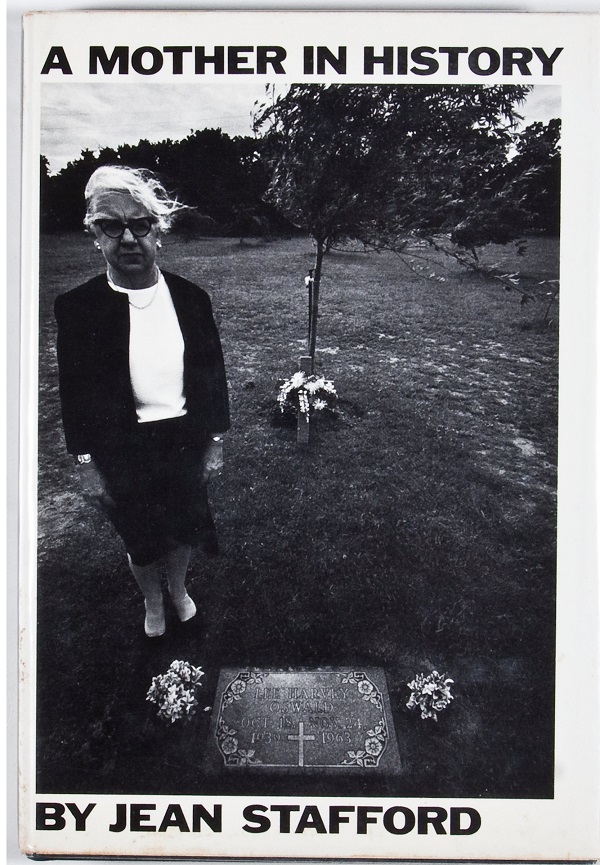
Jean Stafford’s A Mother in History (Farrar, Strauss and Giroux, 1966) was an early entry into this disgraceful body of work. I have written about it before, most recently on this Kennedys and King site. What more could I possibly have to say? Do I have an unhealthy preoccupation with this slender book, ostensibly an unbiased profile of the mother of the alleged presidential assassin?
If you Google “Jean Stafford A Mother In History” you are likely to find available copies on used book sites, along with reviews and reader opinions. Most of the opinions I found are favorable. All of them, it is safe to assume, are based solely on reading Jean Stafford’s published text. Almost certainly, none of the writers of these favorable judgments had access to some of the book’s raw material, in particular the tape-recorded Stafford-Oswald interviews. I did. Once it has been appraised, and contrasted with the published work, it is difficult to see A Mother in History as anything but a hatchet job intended to destroy Marguerite Oswald.
•
The raw material to which I refer is in the Jean Stafford collection at the University of Colorado (CU) in Boulder, part of the Norlin Library’s Rare and Distinctive Collections.

Stafford, who was from Boulder, left her papers to CU. Since she primarily wrote fiction, the source material for A Mother in History is only a small portion of that archive. This small portion includes typescripts, notes, and an interview transcript, all of which reside in one small box. Not included in the box are the interview tape recordings, which have long since been digitized.
A Mother In History was published in three sections, simply titled I, II, and III (plus an Epilogue and appendices). A breathless jacket blurb touts Stafford’s “three incredible days” with Marguerite Oswald. That, and other indicators, clearly imply each of those three book sections correspond to one day of conversation between the author and her subject.

There may have been three days of interviews, incredible or otherwise, but I am highly suspicious of the published chronology. An exchange on the book’s p. 36, as that purported first-day section nears its end, first got my attention. Here Stafford writes that she asked Mrs. Oswald if it would be okay to bring a tape recorder the next day. Marguerite agreed. Stafford does not say so explicitly, but the clear message is that the first day was not tape recorded.
The audio at CU consists of six undated .mp3 files. A CU archivist told me last summer that the original reel-to-reel tapes were transferred to audio cassette in the 1970s. They were digitized sometime in the 1980s, or perhaps a little later.
Nowhere, in the .mp3 audio, does Stafford say the day, date, or subject of her interviews. Interviewers often do; it could even be considered a best practice. It creates a record, and helps keep things in order.
The .mp3 files at CU may be undated, but they do have sequential filenames. The first is stafford-interview-with-mrs.-oswald_-part-1-a.mp3. This particular audio begins with Stafford asking, “Tell me about your early life, Mrs. Oswald. You were born in New Orleans, weren’t you?” The transcript begins the same way. It’s an amiable first question, a likely starting point, and I’m going to go out on a limb and suggest this was, in fact, the very first of the interviews: that is, the first day, which Stafford implied was not recorded.
As I described in my previous article, I had grown curious about a quote in the first section of the book – an unrecorded first day, readers are led to believe. Lee Harvey Oswald, Marguerite said, “spoke Russian, he wrote Russian, and he read Russian. Why? Because my boy was being trained as an agent, that’s why.”
In Stafford’s book there was no follow-up question. This baffled me. Even an amateur journalist, like Stafford, should have enough sense to explore such an explosive statement. Surely the audio would clarify things. Instead, it revealed that Marguerite Oswald didn’t say what Stafford quoted her as saying. It is a manufactured quote.
It’s a little complicated, so bear with me. Most of the words in that quote were, in fact, spoken by Marguerite Oswald. They were also tape recorded; I have heard the audio. But it’s a false quote, because Stafford pieced together several phrases – some of them separated by as much as three minutes. Placing it all within quotation marks implies it is verbatim – but it is not, and is thus a deception.
I can only speculate on Stafford’s motives. That false quote does not support the lone gunman thesis. Given the magnitude of surrounding events, I cannot believe creating it was innocent. I think Stafford floated the idea of Oswald-as-agent – not a common view at the time – to characterize Marguerite Oswald as paranoid, and out of her mind.
•
There are other false and manufactured quotes in A Mother In History. I have not itemized them all and don’t intend to; it would be a huge undertaking. The more I studied the source material, the more dishonesty I found.
On page 23 of A Mother In History is the following statement, attributed to Marguerite:
Lee purely loved animals! With his very first pay he bought a bird and a cage, and I have a picture of it. He bought this bird with a cage that had a planter for ivy, and he took care of that bird and he made the ivy grow. Now, you see, there could be many nice things written about this boy. But, oh, no, no, this boy is supposed to be the assassin of the President of the United States, so he has to be a louse. Sometimes I am very sad.
This is a rather inconsequential matter, but it is still false. Marguerite Oswald didn’t really say it. Here is what she did say, in answer to Stafford’s question, “Did he ever have any pets?”
Oh yes, Lee had a dog, and with his first pay he bought a bird and a cage – I have pictures of it, with ivy in it and all the food for the bird. Yes, sir. With his first pay. He had a collie shepherd dog that I had gotten for him when it was a little [bitty] puppy. And he had it all those years until we went to New York. And that dog had puppies. He gave one to his school teacher. She wrote a nice article for the newspaper saying Lee loving animals and giving her a pet.

True, the published quote roughly parallels what she really said. But it is still false. “Lee purely loved animals” does not appear in any of the audio. There is no mention of dogs in the published quote, let alone puppies, or giving one to a school teacher.
Nor does Marguerite say, “Sometimes I am very sad.” In fact, elsewhere in the recorded interviews, she said quite the opposite: “I’m not unhappy, Jean. You can see I’m not.”
As I write these words, I feel like I’m in attack mode. I have listened to all the audio that is available. Can I be certain that every last recorded word from the Stafford-Oswald interviews wound up in the CU archive? Of course not. All that CU has is what Stafford gave them. She also wrote, in her book, that when Mrs. Oswald agreed to be tape recorded, she stipulated that there be two recorders so she could have a copy.
•
The example about animals and pets is minor, compared to a false quote on pages 12-13 of A Mother In History. This one is presented as dialogue between interviewer and interviewee, and Jean Stafford goes in for the kill. It is intended, I am convinced, to make Marguerite Oswald appear nuts – to use a non-clinical term.
Marguerite spoke first:
“And as we all know, President Kennedy was a dying man. So I say it is possible that my son was chosen to shoot him in a mercy killing for the security of the country. And if this is true, it was a fine thing to do and my son is a hero.”
“I had not heard that President Kennedy was dying,” I said, staggered by this cluster of fictions stated as irrefutable fact. Some mercy killing! The methods used in this instance must surely be unique in the annals of euthanasia.
This exchange is not found anywhere in the interview audio or the transcript. Marguerite does not make the statement, and Jean Stafford does not make that stunned reply.
There is something similar to this in the interviews. Unfortunately, the digitized version of the tape recording at CU ends partway through the quote. Did the original tape end there, too? No, because the corresponding transcript, which I have found to be consistently accurate, continues for several more pages. It is convoluted, but this is what Marguerite Oswald really said.
That President Kennedy was killed by – a mercy killing – by some of his own men that thought it was the thing to do and this is not impossible and since I blame the secret service from what I saw and what I thought it could have been that my son and the secret service were all involved in a mercy killing.

A minute or so before her “mercy killing” remark, Marguerite did say “a dying President,” but “As we all know” is an invention. She says JFK was dying because he had Addison’s disease, which he did. She also called it a kidney disorder, which it is not. Addison’s can be life-threatening, but Stafford correctly points out that it is a manageable adrenal condition. And Kennedy managed his.
But Stafford can’t let this go without having some fun, falsely quoting Marguerite calling it Atkinson’s disease. In the audio, there is no doubt: Marguerite says Addison’s. It is rendered as Atkinson’s in the transcript. Maybe Stafford didn’t remember what Mrs. Oswald actually said, and later on trusted the error of the unknown transcriber. While accurate overall, the transcript does, in fact, garble certain words here and there; in places it reminds me of the sometimes-strange voicemail transcripts my Smartphone makes. The ethical thing would have been double-checking Marguerite’s presumed mistake, before putting it to print.

But the point is that Marguerite Oswald did not say her son was chosen to shoot a terminally ill JFK in a mercy killing. Jean Stafford created that illusion.
According to biographer David Roberts (Jean Stafford: A Biography, 1988) Jean Stafford later “held parties at which she played the Oswald tapes for her friends.” Roberts cites Stafford’s “fascination” with Marguerite Oswald’s voice.
It sounds more like arrogance to me. One imagines a bunch of cocktail-quaffing intelligentsia howling with laughter over Marguerite’s unschooled chatter. But maybe not. Maybe Stafford just wanted to give some of her pals a front-row seat to history. Whatever: the image this conjures is, to me, thoroughly repulsive.
•
The Stafford-Oswald interviews took place in May 1965. This is approximately ten months after Marguerite met with Harold Feldman and Vince Salandria, after which Feldman wrote “The Unsinkable Marguerite Oswald,” published in September 1964 (available online).

If Jean Stafford had done her homework, she might have answered a question she puzzled over in her book’s Appendix III. How, she wondered, was an undereducated Marguerite Oswald able to paraphrase an obscure quote from Sigmund Freud? “Without persecution,” she told Stafford, “there would not be a persecution complex.”
In his article Harold Feldman, a lay psychologist, said that the media consistently portrayed Marguerite Oswald “as a self-centered, domineering, paranoiac showoff with frequent delusions of persecution. It reminds me of Freud’s remark that there would be no such thing as a persecution complex if there were not real persecution.”
Feldman, whose writing often appeared in psychoanalytic journals, wrote about Marguerite with the deference and sympathy Jean Stafford failed to summon. He observed:
She has devoted every day since November 22, 1963, to uncovering what she believes and millions believe is a real conspiracy in which her youngest son was the fall guy. As a result, she is held up to scorn as a bitter old woman who sees snares and plots everywhere.
And he added: “… if Ibsen is right and the strongest is the one who stands alone for integrity and honor, then Marguerite Oswald is the strongest woman in America.”
Marguerite Oswald was an ordinary woman thrust, quite against her will, into extraordinary circumstances. In spite of tremendous obstacles, she defended her son against the Warren Commission and the mainstream media. She had few allies. Even family members, she told Jean Stafford, distanced themselves from her. “I’m alone in my fight, with no help.”
Marguerite Oswald may have struck Stafford as eccentric, but who doesn’t have personality quirks? Jean Stafford exploited Marguerite’s to the hilt, and did so ruthlessly, in exchange for money. I could cite many more examples of the dishonesty in A Mother In History, but life is too short.
Stafford shuffled the truth like a deck of cards, manufacturing quotes and manipulating chronology, all to create the false impression – the lie – that her subject was divorced from reality. Suffice it to say A Mother In History is even worse than I imagined when I visited the Jean Stafford archive at CU.
But it’s been more than fifty years since publication, so the damage is done.