Blog

  • William F. Pepper, The Plot to Kill King: The Truth Behind the Assassination of Martin Luther King Jr.


    The dust jacket for The Plot to Kill King quotes former United States Attorney General Ramsey Clark as stating that “No one has done more than Dr. William F. Pepper to keep alive the quest for truth concerning the violent death of Martin Luther King.” This is unassailably true. Dr. King’s murder has never received anything approaching the level of attention and scrutiny that has been afforded the assassination of President Kennedy but, for nearly three decades, Pepper has worked tirelessly to uncover the truth and bring it to the attention of the American public. As he chronicles in his latest book, Pepper was the last attorney for accused assassin James Earl Ray before his death, and tried every avenue available to him to gain his client the trial he had been denied in 1969 when the state of Tennessee and his own lawyer, Percy Foreman, broke Ray down and coerced him into entering a guilty plea.1 Pepper and his investigators spent many, many hours locating overlooked witnesses, uncovering leads, and assembling a case. Then in 1993 he took part in a televised mock trial that resulted in a “not guilty” verdict for Ray.2 After Ray died in 1998, and any and all possibility of a real criminal trial went with him, Pepper worked with the King family in filing a wrongful death lawsuit against Loyd Jowers and “other unknown co-conspirators” so that the information he had uncovered could still be put before a jury. After 14 days of testimony from over 70 witnesses, the jury found that Jowers and others, “including governmental agencies”, were responsible for the death of Martin Luther King.3

    William Pepper

    Yet Pepper is and always has been a controversial figure, even among those who share his disbelief in the official story. For example, Harold Weisberg – who worked as an investigator for Ray’s defense team in the early 1970s and wrote the classic MLK assassination book, Frame Up – referred derisively to Pepper as “a would-be Perry Mason” and described his work as “worse than worthless.”4 On the other hand, the late, great Philip Melanson once described Pepper’s research and investigation as “groundbreaking” when it came to “establishing the presence of Army Intelligence and Army Intelligence snipers” in Memphis on the day of the murder.5 Over the years, this reviewer has adopted something of an agnostic position when it comes to areas of Pepper’s work. Whilst there is undoubtedly great value in what he has uncovered and accomplished, it nonetheless remains true that there a number of legitimate reasons for doubting important elements of Pepper’s research.

    Loyd Jowers

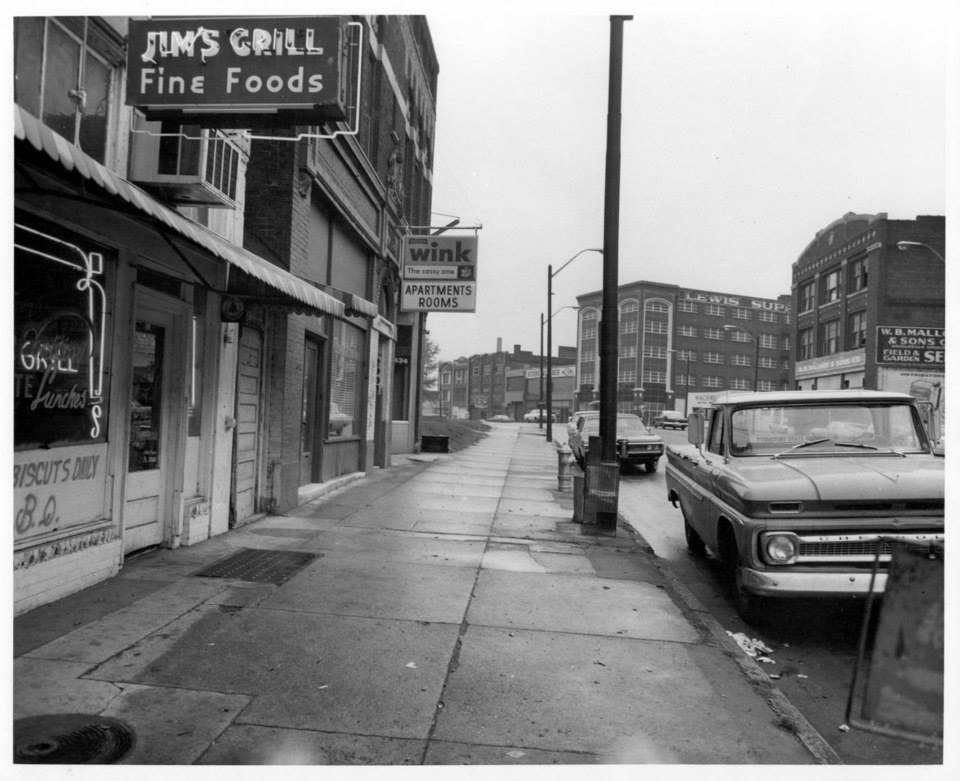
    Take for example the man at the very centre of Pepper’s conspiracy narrative, Loyd Jowers. In 1968, Jowers was the proprietor of Jim’s Grill, a restaurant located underneath the rooming house from which the state alleges Ray fired the fatal shot. For many years the only thing Jowers had to say that was of any interest to investigators was that a white Ford Mustang had been parked directly in front of the grill on the afternoon of the assassination; corroborating Ray’s claim of where he had parked his car and helping establish the presence of two white Mustangs on Main Street. But in 1993, Jowers appeared on ABC’s Prime Time Live claiming that Memphis-based produce dealer and alleged Mafia figure, Frank Liberto, had contacted him shortly before the assassination and paid him $100,000 to hire someone to assassinate Dr. King. He was then visited by a man named Raul who handed him a “rifle in a box” and asked him to hold onto it until “we made arrangements, one or the other of us, for the killing.”6

    On the face of it, Jowers’ story seems plausible enough. There is no doubt that he was at the scene of the crime and in a position to assist in carrying out the assassination. Additionally, parts of his account were corroborated by two other witnesses: former Jim’s Grill waitress, Betty Spates, and local Memphis cab driver, Jim McCraw. Also, Jowers’ claim that Frank Liberto brought him into the plot recalls the statement of civil rights leader John McFerren that, sometime in the afternoon shortly before Dr. King was shot, he overheard Liberto telling someone on the telephone to “Shoot the son of a bitch when he comes on the balcony.”7 And yet Jowers was, by any definition, a most unreliable witness. By Pepper’s own admission there were numerous different versions of his story. In fact, he contradicted himself on virtually every important detail.

    Jim’s Grill

    He initially named black produce-truck unloader Frank Holt as the gunman he had hired but changed his mind after Holt was found alive and well and passed a polygraph test, denying any involvement.8 Jowers then hinted that deceased Memphis Police Lieutenant Earl Clark was the real gunman only to tell Dr. King’s son, Dexter, that he “couldn’t swear” that he was because “All I got was a glance of him.”9 To Dexter, Jowers said that the gunman handed him the still smoking rifle, yet at an earlier time he had claimed to have picked it up after it had been placed on the ground.10 Around this time he also changed his mind about ever having been asked to hire the gunman, saying instead that he had simply been told to be out in the bushes behind Jim’s Grill at 6:00 PM and that he didn’t even know Dr. King was going to be killed.11 In this scenario, Jowers merely held onto the $100,000 until it was collected by a co-conspirator.

    Perhaps even more troubling than these inconsistencies – of which there are more – is the fact that Jowers and his friend Willie Akins are known to have contacted Betty Spates in January 1994 saying that they were interested in doing a book or a movie and they needed her to change her story. If she would say that she saw a black man handing the rifle to Jowers immediately after the shooting, they could all make $300,000.12 And if that wasn’t bad enough, in an April 1997 tape-recorded conversation with Shelby County district attorney general’s office investigator, Mark Glankler, Jowers basically disavowed his confession by stating that Ray’s rifle was the real murder weapon and that “there was no second rifle.”13

    It may also be seen as significant that Jowers never did repeat his conspiracy allegations under oath. He was not actually present for the King v. Jowers civil trial, apparently owing to ill health. The only time he gave a legal deposition after his appearance on Prime Time Live was during the 1994 Ray v. Jowers lawsuit, at which time he reverted to his 1968 story and insisted that he was in the bar serving drinks when the shot was fired. Jowers had agreed that the transcript of his Prime Time Live appearance could be entered into evidence but, through his attorney Lewis Garrison, stipulated “that the questions were asked and Mr. Jowers gave these answers”.14 Thus he did not swear to the accuracy of his alleged confession, he merely agreed that he had given it.

    In The Plot to Kill King, Pepper attributes Jowers’ many contradictory assertions to his fear of being prosecuted and an understandable desire to minimize his own role when talking to members of the King family. Pepper also argues, in spite of Jowers’ attempt to encourage Spates to lie for her share of $300,000, that it is “arrant nonsense” to suggest that he fabricated his story “in anticipation of a book or movie deal.” In fact, he says, “Jowers lost everything. Even his wife left him. There was no book or movie deal, and he was, for the most part, telling the truth.”15 Yet none of these arguments preclude the possibility that Jowers’ confession was invented as part of a money-making scheme that backfired.


    That being said, it should be borne in mind that Jowers’ initial Prime Time story did not come completely out of the blue. Suspicion had already been cast on him by statements that Spates and McCraw had given to Pepper, after which Jowers’, through Garrison, had contacted the Shelby County district attorney general offering to tell everything he knew in exchange for immunity from prosecution. Needless to say his proffer went completely ignored without anyone even attempting to speak with him. Assistant district attorney general, John Campbell, would later attempt to justify this total lack of interest by stating that the story looked “bogus” and that if they had given Jowers immunity “it would imply we thought there was some validity to his story, and that would increase the value of what he could sell it for.”16 Precisely how they were able to deduce immediately and without even talking to Jowers that his story was “bogus” is anyone’s guess.

    In the end, it will be up to each individual researcher to decide which, if any, of Jowers’ varying accounts to believe. Whilst it is true that the jury in King v. Jowers did find him partly responsible for the assassination, it is also true that his assertions were not thoroughly tested at the trial because neither Pepper nor Garrison were looking to undermine Jowers’ credibility. Legendary attorney, author, and activist, Mark Lane, was critical of the trial for that very reason, telling this reviewer that in his opinion, “It was not a real trial … both sides offered the same position and I have reason to doubt that the position they offered was sound. The jury, having seen no evidence to the contrary, had no choice. In my view, the court system should not be utilized in that fashion.”17

    Mark Lane with James Earl Ray

    Lane’s assessment is, in my view, somewhat off the mark in that it suggests a type of collusion between Pepper and Garrison that was likely not the case. In truth, Garrison was in an extremely awkward position. He could not simply deny the existence of a conspiracy without calling his own client a liar, so his strategy was to attempt to minimize Jowers’ role and convince the jury that, as he stated in his closing argument, “Mr. Jowers played a very, very insignificant and minor role in this if he played anything at all. It was much bigger than Mr. Jowers, who owned a little greasy-spoon restaurant there and happened to be at the location he was.”18 In that regard, it worked to Garrison’s advantage to allow Pepper to put on a case for a wide-ranging conspiracy without offering a rigorous challenge. Nevertheless, the result of this strategy, as Lane suggested, was that the jury essentially heard one story from both sides and for that reason the verdict was far from surprising.

    By noting these circumstances, it is not meant in any way to suggest that the civil trial or the jury’s verdict were entirely without merit. On the contrary, as Pepper details in The Plot to Kill King, numerous witnesses gave significant and often startling testimony under oath – many for the first time – and put important evidence on the record. For example, a succession of witnesses provided evidence establishing the manner in which Dr. King was, seemingly intentionally, stripped of all reasonable security, and left entirely vulnerable to a sniper’s bullet. Of particular note is the testimony of Memphis Police Department homicide detective Captain Jerry Williams who had been in charge of organizing a unit of black officers that had previously provided protection for Dr. King on his visits to Memphis. Williams said that he was not asked to form his unit on Dr. King’s final, fatal visit, and was later falsely informed that Dr. King’s organization, the SCLC, had said Dr. King did not want protection.19 Additionally, as University of Massachusetts Professor Philip Melanson testified, MPD Inspector Sam Evans had ordered the emergency services’ TACT 10 unit removed from the vicinity of the Lorraine Motel, claiming this too was done at the request of someone in the SCLC. As Pepper writes, “When pressed as to who actually made the request, he said that it was Reverend [Samuel] Kyles. The fact that Kyles had nothing to do with the SCLC, and no authority to request any such thing, seemed to have eluded Evans.”20

    Not only had Dr. King been stripped of protection but a last-minute switching of his motel room had made the assassin’s job all the easier. Former New York City police detective Leon Cohen testified that Lorraine Motel manager Walter Bailey told him on the morning after the assassination that Dr. King had originally been allocated a more secure courtyard room. But on the evening before his arrival, Bailey had received a call from someone claiming to be from the SCLC’s Atlanta office requesting Dr. King be given a balcony room instead. Bailey said he was “adamantly” opposed to the change “because he had provided security by the inner court” but his caller had insisted the rooms be switched anyway.21 Needless to say, no genuine member of the SCLC is known to have made any such request.

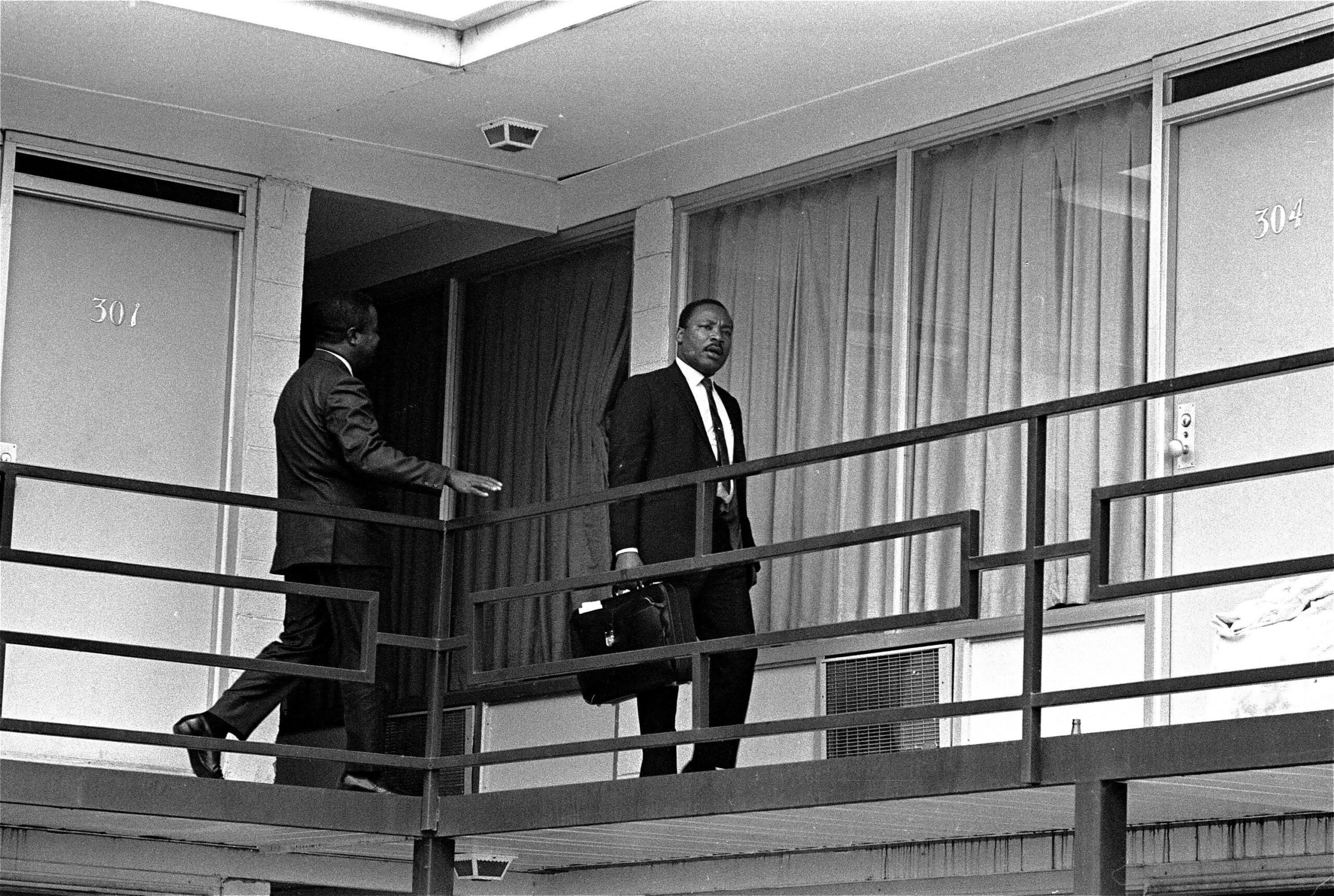
    King on the Lorraine balcony

    As well as being shown how Dr. King was maneuvered into a vulnerable position, the Memphis jury also heard much evidence helping to establish James Earl Ray’s probable innocence. The state has always maintained that Ray holed himself up in a shared bathroom in the rooming house opposite the Lorraine and waited until Dr. King appeared on the balcony at approximately 6:00 pm. After supposedly firing the fatal shot, he is said to have rushed back to his rented room, put the rifle in its box, placed it amongst a bundle of his belongings, then ran down the stairs to the ground floor. Once outside, he allegedly dumped his bundle in the doorway of Canipe’s Amusement Company, climbed into a white Mustang parked just south of Canipe’s, and quickly sped away.

    Pepper provided evidence that successfully countered every step of this most likely false narrative. The notion that Ray had been lying in wait in the bathroom was contradicted by the sworn deposition of James McCraw, who had been in the rooming house only a few minutes before Dr. King was shot. McCraw said that he saw the bathroom door wide open and there was no one inside.22 Raising the possibility that the shot was actually fired from the thick shrubbery below the bathroom window, Pepper read into the record the sworn statement of SCLC member Reverend James Orange who said that he saw what he thought was gun smoke rising from the bushes immediately after he heard the shot.23

    Ray’s alleged flight down the rooming house stairs had, according to the state, been witnessed by Charles Stephens, who occupied the room between the bathroom and the room Ray had rented. But his ability to witness anything was called into question by taxi driver McCraw, who had been called to the rooming house specifically to pick Stephens up. McCraw said that he found Stephens lying on his bed, too drunk to even get up.24 McCraw’s account was corroborated by the testimony of MPD homicide detective Tommy Smith who entered the building shortly after the assassination and found Stephens still so intoxicated that he could hardly stand.25 Not mentioned at the trial was the fact that two weeks after the murder, Stephens had been shown a picture of Ray by CBS news correspondent Bill Stout and failed to recognize him. In fact, he said Ray was “definitely not” the man he claimed to have seen fleeing the rooming house.26

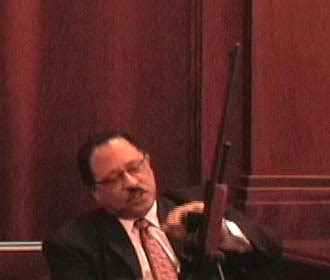
    Judge Joe Brown with
    the supposed murder weapon

    Criminal Court Judge Joe Brown, who had presided over Ray’s final appeal, took the stand to testify about a series of ballstics tests that he had ordered be performed on the Remington Gamemaster rifle found in the doorway of Canipe’s. The FBI had never been able to establish that particular rifle as the murder weapon – supposedly because the bullet removed from Dr. King’s body was too mutilated. Judge Brown, himself a ballistics expert, explained that 12 of the 18 bullets fired during his tests had contained a similar flaw – a bump on the surface – that was not present on the death slug. He also said that the rifle had never been sighted in and, as a result, had failed the FBI’s accuracy test. “ … based on the entirety of the record”, Brown said, “and the further ballistics tests I had run, it is my opinion this is not the murder weapon.”27 Brown’s opinion was re-enforced by the testimony of Judge Arthur Hanes, Jr., who, alongside his father, had been Ray’s defense attorney before Ray made the fatal mistake of hiring Percy Foreman. Judge Hanes told the court that Guy Warren Canipe had said to him in 1968 that the bundle containing the rifle had been dumped in the doorway of his store approximately 10 minutes before the assassination and he was prepared to testify to that effect.28

    Finally, Pepper showed, through the FBI statements of Ray Hendrix and William Reed, that James Earl Ray had most likely left the scene in his white Mustang shortly before the assassination, not immediately after. Ray always maintained that he parked his car directly in front of Jim’s Grill, not south of Canipe’s, and that he left the area sometime between 5:30 and 6:00 pm to try to get his spare tire fixed. The April 25, 1968, statements of Hendrix and Reed corroborated Ray’s account. The pair told the Bureau that they had left Jim’s Grill at approximately 5:30 pm and noticed a white Mustang parked directly outside. When Hendrix realised he had forgotten his jacket, he went back into the grill to retrieve it whilst Reed stood staring at the car. When Hendrix reappeared the two walked a couple of blocks north on South Main Street until they reached the corner of Main and Vance, at which point what appeared to be the very same Mustang, driven by a lone, dark-haired man, rounded the corner in front of them. This independent confirmation of Ray’s movements, essentially constituting an alibi, was hidden from the defence and the FBI kept the crucial documents from the public for decades.29 Finding these statements and having them entered into evidence, as they should have been in 1969, is one of the many things for which Pepper is to be applauded.

    Another is his effort to locate and identify the mysterious figure previously known only as “Raoul” or “Raul”. For those unfamiliar with the King case, Raul was the name of the man whom Ray always claimed had set him up for the assassination. Shortly after his escape from the Missouri State Penitentiary on April 23, 1967, Ray made his way to Montreal, Canada, hoping to obtain the travel documents he needed to flee the country. It was there in a place called the Neptune Bar that he said he met Raul, a dark-skinned man with a Spanish accent, who promised to provide the documents Ray needed if he agreed to smuggle some items across the border. For the next several months, Ray said, he received large sums of money – including $1,900 to buy the Ford Mustang – and followed Raul’s instructions. According to Ray, these instructions ultimately included purchasing the Remington Gamemaster rifle and renting a room at the flophouse opposite the Lorraine Motel.

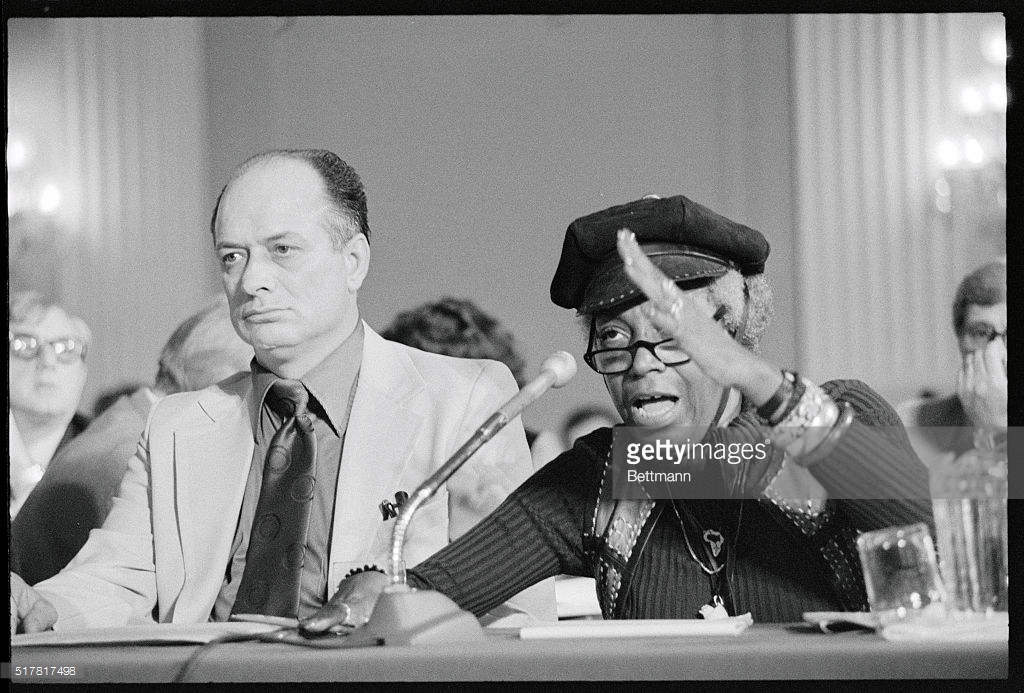
    Jerry Ray before the HSCA

    Needless to say, the state and its defenders have always maintained that Raul did not exist. Yet as Pepper points out, this leaves them with the problem of accounting for the large sums of money Ray was known to have spent whilst having no other known source of income. Desperate to explain this away, the HSCA theorized that Ray and his brothers had robbed a bank in Alton, Illinois. “The problem with this ‘theory’”, Pepper writes, “is that I called the local sheriff and the bank president in Alton. I was advised that they knew James had nothing to do with the robbery. The real culprits were known but there was not enough evidence to charge them.”30 On Pepper’s advice, Ray’s brother Jerry surrendered himself to the Alton police in 1978, offering to waive the statute of limitations so that he could be charged. He was promptly informed that neither he nor his brothers had ever been suspects.31

    Because Ray was a largely incompetent crook, and because he was never the violent racist that the media falsely made him out to be, those who spent any length of time with him rarely doubted his claim that he had been set-up by someone. Quite simply, the idea of Ray as a lone nut assassin has never made any sense. As Arthur Hanes Sr. is said to have remarked, “Unless Ray is a complete damn fool I don’t see how he could have made the decision to kill King. Before King was killed, Ray was doing all right. He was free, able to support himself with smuggling and stealing. He was driving a good car all over Canada, the United States and Mexico. He was comfortable, eating well, finding girls, and nobody was looking for him. Why then would he jeopardize his freedom by killing a famous man and setting all the police in the world after him?”32 Indeed, one might ask why Ray, being on the run from prison and desiring little more than to leave the United States for a country with whom the US had no extradition treaty, would have even re-entered the country in the first place after having made it as far as the Montreal docks? It might well be said that Ray’s actions following his prison break only make sense if we accept that someone was manipulating him.

    Pepper believed Ray’s story and, soon after agreeing to represent him, set out to find Raul. Eventually Pepper’s investigators came into contact with a rather eccentric witness named Glenda Grabow who told them that in the 1970s she had been involved in gunrunning, among other illegal activities, with a man whose nickname was “Dago” and that he had confessed to her his involvement in the murder of Dr. King. Meanwhile Pepper, who heard a rumour that Raul was living in the northeast, had zeroed in on an individual named Raul Coelho, living in Upstate New York. Investigators John Billings and Ken Herman obtained a picture of this Raul taken in 1961 when he emigrated to the US from Portugal, placed it amongst a spread of six photographs, and showed them to Grabow. According to Herman, “she pointed out Raul with no hesitation. She was sitting at the kitchen table in my house and zeroed right in on the guy.” The spread was then shown to Glenda’s younger brother, Royce Wilburn, who also knew “Dago” and he too identified the picture of the New York Raul.33

    Billings then took the obvious next step and showed the spread of photographs to Ray in his cell at Riverbend Prison in Nashville, Tennessee. As Billings later testified, “I told him we had a picture of Raul. And he seemed somewhat surprised. And I asked him if he would choose to attempt to pick out Raul in a photo spread … So we put this before him, and James put on his glasses and very – for a minute or two studied these pictures very carefully.” He then dropped his finger down on the picture of the New York Raul and said “that’s Raul.” Asked if he was positive Ray said, “Yes, I am.”34

    The pictures were also shown to British merchant seaman Sid Carthew who had come forward after watching a video tape of the televised mock trial saying that he too had met a man named Raul in the Neptune Bar, Montreal, in 1967. Over the course of two evenings, Raul had offered to sell him some Browning 9mm handguns. “He said to me, how many would you want, and I said four … and he said, four, what do you – four, what do you mean by four. I said four guns. He wanted to sell me four boxes of guns … once he knew that I would have only take – took four, he was very annoyed … it wouldn’t be worth his while to deal in such a small number, and that was the end of the conversation, and he went back to the bar.”35 Carthew selected the same photograph from the spread as Grabow, Royce, and Ray had before him. And according to Pepper, so too did Loyd Jowers.36


    In its response to the King v. Jowers trial and verdict, the Department of Justice insisted that the New York Raul had had nothing to do with the assassination and dismissed these photographic identifications as “suspect”. It said that the photo array was “deficient and unfairly suggestive” because the Raul photograph is the only one of the six to have “extremely high black and white contrast and no intermediate gray tones” and thus “stands out markedly from the others.”37 Essentially the DOJ suggested that the contrast of that particular photo causes it to draw the eye and that was why Pepper’s witnesses picked it out. This reviewer recently decided to put that notion to the test by sharing the photo array on a social media site, asking if anyone could pick out a man named “Raoul” (Ray’s original spelling) who “has allegedly been involved in drug smuggling, gun dealing, and murder.” I also hinted at a connection to the assassination of Dr. King. Of the 14 respondents, not a single one picked out the picture of the New York Raul. While this was hardly a perfect experiment, the result nonetheless stood in stark contrast to the DOJ’s suggestion that the picture of Raul Coelho was more likely to be picked over the others because of its high contrast.

    Ironically, one of the most frequently cited reasons for doubting the DOJ’s assurances and believing that the man Pepper found may well have been the real Raul is the manner in which he was assisted and protected by the US Government. As Pepper discovered after he made Raul a party defendant in the Ray v. Jowers lawsuit, despite supposedly being nothing more than a retired auto plant worker of modest means, Raul was being represented by two large, prestigious law firms. And when Portuguese journalist Barbara Reis tried to interview him, a member of Raul’s family told her that agents of the US government “are looking over us”, had visited them on at least three occasions and were monitoring their telephone calls.38 As Pepper observed, “Imagine that degree of care and consideration by the government for just a little old retired autoworker.”39

    Most of the above, actually most of what is in The Plot to Kill King, will be familiar ground for those who have read Pepper’s first two books, Orders to Kill and Act of State. In fact, the first two thirds of the new book are little more than a retread of the previous two with entire passages actually being lifted word-for-word from Act of State. The final third of the book, which details Pepper’s “continuing investigation”, unfortunately does not do much to elevate matters or add to our understanding. The new information presented therein is, in this reviewer’s estimation, of very dubious reliability.

    Pepper makes the absolutely startling claim that, although Dr. King’s gunshot wound would have been fatal anyway, he was intentionally finished off by the emergency room doctors who were supposed to be saving his life. He writes of a story that was related to him by a blind Memphis resident named Johnton Shelby, who claims that his mother, Lula Mae, was a surgical aide at St. Joseph’s Hospital and took part in Dr. King’s emergency treatment. According to Shelby, the morning after the assassination his mother gathered the family together to tell them that the emergency room doctors had been ordered by the head of surgery and a couple of “men in suits” to “Stop working on that nigger and let him die.” They were all then ordered to leave the room immediately. Shelby said that as his mother was leaving, she heard the men sucking saliva into their mouths and spitting so she glanced over her shoulder. She then saw that Dr. King’s breathing tube had been removed and a pillow was being placed over his face so as to suffocate him.40

    An extraordinary story like Shelby’s requires extraordinary proof. Yet Pepper seems to swallow the whole thing hook, line, and sinker despite the fact that, by his own admission, he spoke with numerous medical personnel who were known to have been in the emergency room and found absolutely no corroboration for it whatsoever. Shelby named a few people with whom his mother supposedly shared her experience but, needless to say, they were all conveniently dead in 2013 when he first came forward. More importantly, in accepting Shelby’s story, Pepper has to ignore the fact that it is directly contradicted by testimony that he himself put before the jury in King v. Jowers.

    At the civil trial Pepper put John Billings on the stand to testify not only about his time investigating Glenda Grabow and Raul Coelho but also about his activities on the day of the assassination. In April 1968, Billings was a junior at Memphis State University and was working as a surgical aide at St. Joseph’s. He walked into Emergency Room 1 just as Dr. King’s treatment was beginning and stood and watched as several doctors were “feverishly working … for 30, 45 minutes or so.” One of the doctors eventually walked up to Billings and told him to “go get someone in charge.” He walked out of the room and found “one or two gentleman wearing suits” who “seemed to be more or less telling everyone what to do.” He led them back into the emergency room “and the doctors informed them of something to the effect of Dr. King is – Dr. King is terminated. We have done everything that we can. We feel there’s nothing left that we can do.”41 Nowhere in Billings’ first hand account was there any reference to emergency room staff being ordered to stop working on Dr. King and leave the room. He specifically recalled that the doctors themselves made the decision to stop when they felt they had done everything they could.

    At one point Pepper hints at the idea that the “connections, associations, and personal success” linked to a career practising medicine in Memphis might explain why the numerous doctors who treated Dr. King did not recall the supposed intervention. But he cannot apply any such argument to Billings who did not follow a career in medicine and worked hard as one of Pepper’s investigators to uncover details of the conspiracy to kill Dr. King. It is readily apparent that Billings had absolutely no reason to withhold any details surrounding Dr. King’s emergency treatment. Which is probably why Pepper avoids mentioning his testimony on the issue altogether.

    Pepper also buys into a very elaborate yarn spun by one Ronnie Lee Adkins a.k.a. Ron Tyler. Ronnie’s father, Russell, worked for the city of Memphis for 20 years in the “Engineering Division”. Despite his modest means he was, according to Ronnie, both a 32nd Degree Mason and a Klansman who attended “meetings” that involved everyone from Mayor Henry Loeb and Memphis police and fire department director Frank Holloman to Frank Liberto, Carlos Marcello, and J. Edgar Hoover’s deputy in the FBI, Clyde Tolson. Russell was known as a “fixer” and, through Tolson, Hoover would give him money to perform various deeds including “local-area killings.” On one particular occasion in 1967, Tolson gave him money that was to be paid to the warden of Missouri State Prison to arrange for the escape of James Earl Ray. Of course, as any reasonable person would expect, Russell saw no need to shield his young son from his nefarious deeds, so little Ronnie not only got to see the money being handed to his father, he even got to go along to Missouri to see it passed on to the warden. Or so he says.

    According to Ronnie, in 1964 his father went on a trip to Southampton, England, with Tolson. When he returned he called a meeting with his eldest son Russell Junior and others to tell them that “The coon has got to go.” From then on “prayer meetings” were held at the Berclair Baptist Church, among other places, which eventually came to focus on how to get the garbage workers “pissed off” as a means of drawing Dr. King to Memphis. Allegedly “the word come down from Hoover” that the assassination was to occur in Memphis so that “daddy and them could handle it.” If the reader is dubious that planning for the assassination would have begun four years before it occurred, they will be even less impressed by the claim that way back in 1956 Tolson had handed Russell a “Personal Prayer List” of his and Hoover’s featuring the names JFK, RFK and MLK. That’s right, Ronnie claims that nearly five years before the Kennedys made it to the White House, and at a time when Dr. King’s activism was just beginning, Hoover had already put their names together on a list and handed it to his Memphis “fixer” for no apparent reason.

    When Russell died in 1967, Junior allegedly took over in planning the assassination alongside Holloman. Someone in their camp then supposedly engineered the deaths of Echol Cole and Robert Walker. For those who are unfamiliar with those names, Cole and Walker were two black sanitation workers who, on February 1, 1968, were tragically crushed to death in the back of a garbage truck where they were trying to hide from the rain. It was this tragic accident, and the paltry assistance the city gave to the families of the victims, that prompted Dr. King to travel to Memphis and join a city-wide march in support of the striking sanitation workers. But in Ronnie’s world, this was no accident, “Somebody pulled the hammer, pulled the lever on the truck and mashed them up in there.”

    After Dr. King booked into the Lorraine Motel, Ronnie says, Jesse Jackson – who had supposedly been paid by Russell to keep tabs on Dr King – was instructed to have his room changed to the balcony room 306. Jackson then “went down there and talked to the man and, or his wife Lurlee … and had him move Martin and Ralph up to 306.” The Reverend Billy Kyles, another alleged informant, was given the job of getting Dr. King to come out of his room and onto the balcony at precisely 6:00 pm.

    On the day of the assassination, Ronnie claims, he carried the murder weapon into town on the back of his motorbike wrapped in a bedspread and handed it to Junior and Loyd Jowers in the parking lot next to Jim’s Grill. When 6:00 pm came and Dr. King appeared on the balcony, Junior fired the shot then handed the rifle to Earl Clark who, in turn, handed it to Jowers. Junior then ran through the vacant lot between the rooming house and the fire station, climbed into the white Mustang parked outside the grill and drove away.42

    The above is but a brief synopsis of Ronnie Lee Adkins’ story. There are many more details for which there is not enough space in this short essay. Nonetheless, from what I have included I believe it is clear that calling Adkins’ story hard to believe would be a vast understatement. In fact it is, in this reviewer’s opinion, so utterly lacking in credibility that it hardly seems worth wasting time on a detailed deconstruction. Not only is there no corroboration for any of it, numerous details are in direct conflict with information Pepper has previously presented. For example, Adkins has Jesse Jackson visiting the Lorraine personally to have Dr. King’s room changed. Yet, as noted earlier, Walter Bailey told Leon Cohen that he received the instruction not in person but over the phone from someone who identified himself as a member of the SCLC’s Atlanta office. Adkins has Ray leaving the scene in the white Mustang parked south of Canipe’s and his brother fleeing in the one parked outside the grill when numerous statements establish that it would have had to have been the other way around. And he has Jowers attending some of the so-called “prayer meetings” and receiving the rifle in a parking lot despite nothing like this appearing in any of Jowers’ own accounts.

    In Adkins’ narrative there is no mention of or accounting for Raul and he names some extremely unlikely individuals as part of the plot. He even has MPD officer Tommy Smith – who, you might recall, testified on behalf of the King family that Charlie Stephens was too drunk to identify Ray – waiting in his car on Main Street and then dropping the bundle of evidence in the doorway of Canipe’s. Pepper himself is forced to admit how impossible this is given that “the bundle contained various bits and pieces, including the throw-down gun, which James had left on the bed in his rented room in the rooming house.”43


    There are also logical problems aplenty with Adkins’ story. Like why on Earth would Hoover have had the names JFK, RFK and MLK put on a list and handed to Russell Adkins in 1956? Was anyone even referring to them by their initials back then? Once Dr. King’s assassination was decided, why did it take four years for so many presumably intelligent people to formulate a plan? How did they come to decide that “pissing off” the sanitation workers was the best way of getting Dr. King into Memphis? Why was it necessary for 16-year-old Ronnie to carry the rifle to the scene on the back of his motorbike? Who thought that was a good idea? What if he had been stopped by police officers not in on the plot? Why did Junior not just take the rifle with him in the first place? And what exactly was Earl Clark doing in the bushes if he wasn’t the shooter? Would it have been so difficult for Junior to have handed the rifle to Jowers himself? It should be noted that there is no support anywhere in the record for the notion that there were three people hiding in the shrubbery.

    At the end of the day, even without these logical and factual inconsistencies, Adkins’ fantastical story is based on nothing more than the uncorroborated word of a man who, by his own account, had to quit school without graduating after he took a pistol into the lunchroom and fired off several shots.44 Accepting this man’s word without verification is, as far as this reviewer is concerned, completely unthinkable.

    It is not to Pepper’s credit that he endorses the likes of Shelby and Adkins and I believe that his critics will rightly have a field day with their stories. State apologists like Gerald Posner have delighted in quoting Pepper’s former investigator Ken Herman as stating that “Pepper is the most gullible person I have ever met in my life” and the new information he presents in The Plot to Kill King is doing very little to prove this remark wrong. Unfortunately, he compounds the problem by picking and choosing what he wishes to believe of these troublesome new tales. He rejects one of the central facets of Adkins’ account – that his brother Junior fired the shot – and asserts instead that the real gunman was a former MPD officer named Frank Strausser. Yet his strongest evidence in support of this belief is that Strausser is alleged to have accidentally admitted his involvement to Nathan Whitlock.45 This is the very same Nathan Whitlock who has long claimed that Frank Liberto admitted his own involvement in the assassination to him. Which just leaves this reviewer wondering what exactly it is about Mr. Whitlock that compels people to confess their part in this crime in his presence.

    Ultimately, I cannot say that The Plot to Kill King is a book I would recommend. As noted above, most of the book is a recapitulation of Pepper’s first two. Unfortunately, it is not as well written as either of his earlier works and is poorly edited to boot. There are numerous typographical errors – with Loyd Jowers and Marina Oswald being among those whose names are misspelled – as well as unnecessary repetition of information and witness statements being referred to before they’ve even been introduced. If the new information Pepper presented had been more reliable then it may have redeemed matters but unfortunately that was not to be. Pepper’s second book, Act of State, was a much more worthy addition to the literature. It was better written, better organized, and featured worthwhile rebuttals to both Posner and the Department of Justice. Readers are advised to track down a copy of that book instead.


    References

    1. See here for details: http://mlkmurder.blogspot.co.uk/2013/08/why-did-james-earl-ray-plead-guilty.html

    2. See Pepper, Orders to Kill, Chapters 24-25.

    3. The 13th Juror: The Official Transcript of the Martin Luther King Assassination Conspiracy Trial, p. 752.

    4. http://jfk.hood.edu/Collection/Weisberg%20Subject%20Index%20Files/P%20Disk/Pepper%20William%20F%20Dr/Item%2002.pdf

    5. Who Killed Martin Luther King?, History Channel documentary, 2004.

    6. The 13th Juror, p. 458.

    7. Pepper, The Plot to Kill King, p. 82

    8. Ibid, pgs. 90-93.

    9. The 13th Juror, pgs. 177-178.

    10. Pepper, Act of State, p. 41.

    11. The 13th Juror, p. 178.

    12. Orders to Kill, p. 336.

    13. United States Department of Justice Investigation of Recent Allegations Regarding the Assassination of Dr. Martin Luther King, Jr., June 2000, Part IV, Section C.1.b. https://www.justice.gov/crt/iv-jowers-allegations#analysis

    14. Orders to Kill, p. 383.

    15. The Plot to Kill King, p. 154.

    16. Gerald Posner, Killing the Dream, p. 291.

    17. http://educationforum.ipbhost.com/index.php?showtopic=15699&p=250020

    18. The 13th Juror, p. 739.

    19. The Plot to Kill King, p. 171.

    20. Ibid.

    21. Ibid.

    22. Ibid. p. 298.

    23. Ibid. p. 175.

    24. Ibid. p. 298.

    25. Ibid. p. 174.

    26. Orders to Kill, p. 97.

    27. The Plot to Kill King, p. 177.

    28. Ibid. p. 178.

    29. Ibid. p. 184.

    30. Ibid. p. 198.

    31. The 13th Juror, p. 343.

    32. William Bradford Huie, He Slew the Dreamer, p. 177. I say “said to have remarked” because Huie, who attributed those remarks to Hanes, is a self-admitted fabricator. Therefore nothing he wrote should be taken as absolute fact without independent corroboration.

    33. Posner, p. 296.

    34. The 13th Juror, p. 257.

    35. Ibid. pp. 270-277.

    36. Act of State, p. 222.

    37. Justice Dept. Report, Part VI, Section C.3.b.

    38. The 13th Juror, p. 295.

    39. Act of State, p. 204.

    40. The Plot to Kill King, p. 261.

    41. The 13th Juror, p. 249-250.

    42. The Plot to Kill King, p. 238-258.

    43. Ibid. p. 256.

    44. Ibid. p. 239.

    45. Ibid. p. 235.

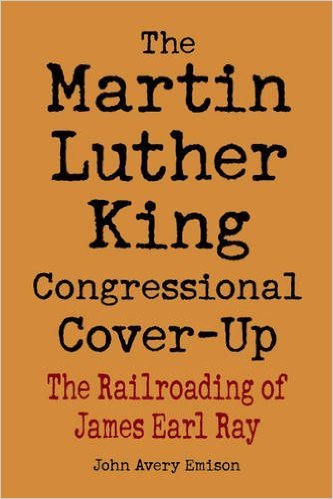
  • John Avery Emison, The Martin Luther King Congressional Cover-Up

    John Avery Emison, The Martin Luther King Congressional Cover-Up


    John Avery Emison’s The Martin Luther King Congressional Cover-Up is an interesting effort. But it has a somewhat misleading title. From that title, the reader would think that Emison was going to primarily focus on the House Select Committee on Assassinations inquiry into the King assassination. That is not really the case. The author spends more time on the local forces in Memphis who railroaded Ray and also on Ray’s unfortunate choice of Percy Foreman as attorney. He does deal with the HSCA inquiry, but this is later in the book.

    James Earl Ray

    One of the first elements of the King case that the author deals with is the racist factor. The authors who have done so much to frame Ray, for example George McMillan, have used that aspect to try and supply a motive to Ray’s alleged crime. As Emison notes, Ray was not a southerner. He was born in Illinois. (p. 25) If one goes through his military records and prison records, there are no credible indications that Ray was a racist. As for his life in crime, all the indications are that he was an inept, small-time criminal, one who was rather easy to capture by the police. But, after the murder of King, this was drastically altered. As the author notes, “Yet, for two months following King’s murder, Ray—a man who had never before flown a commercial airline—eluded the biggest manhunt in the history of the United States…” (ibid) Hiding out in such locales as Canada, England, and Portugal. Once captured at Heathrow Airport in London, he was sent back to Memphis, the scene of King’s murder.

    I

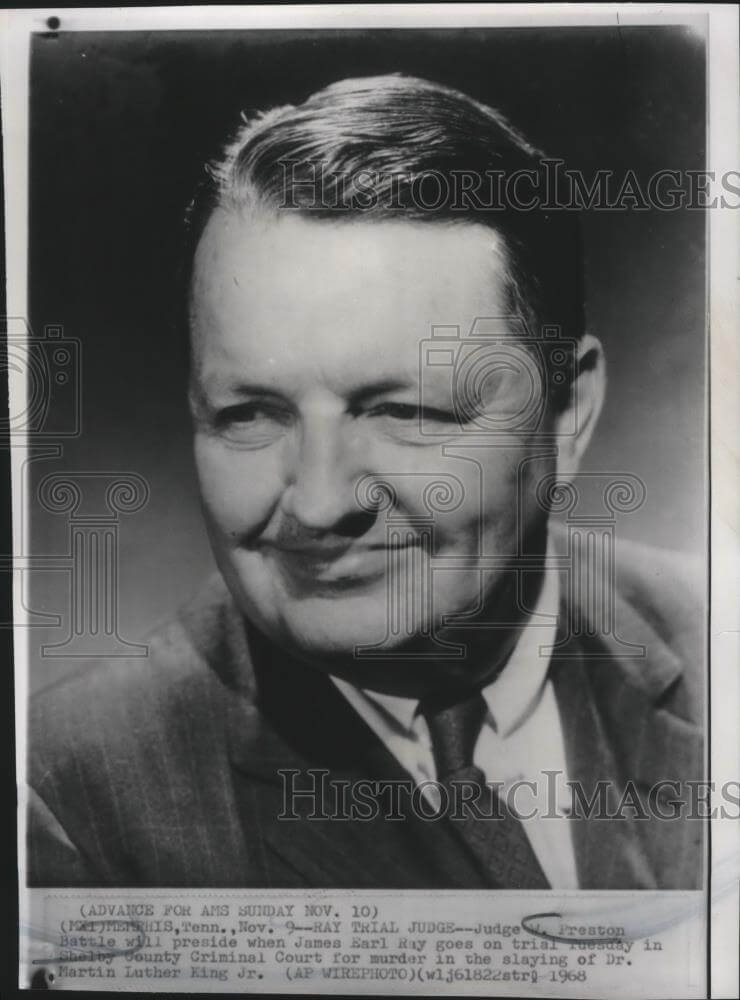
    And this is where Emison’s book really begins. As he notes, the entire proceeding of Ray and his attorney Foreman pleading before Judge Preston Battle took less than four minutes. (p. 26) During which Battle never asked any of the following questions: Did Ray have confederates, what was the origination of his funds for all the traveling he did prior to and after the assassination, where did he sight in the rifle, why did he flee to Canada and how he did he get a passport—or even, the most fundamental question of all: Why did he shoot King? (p. 27)

    Judge Preston Battle

    But a week later, Battle began to express some doubts about the efficacy of what he had done. For instance, in an interview with a reporter, he asked rhetorically: how did Ray choose the spot from where he fired? Because there was no public knowledge that King had a room at the Lorraine Motel, across from Bessie’s Boarding House. Which was the place where the police said Ray shot King. (p. 27)

    Which leads to the question: Was there an inside man in King’s entourage? It turns out there was. Many years later, it was revealed that the FBI had a paid informant in King’s camp. His name was Ernest Withers. The sheer mass of Withers’ reports is stunning. They come to a total of 93 single spaced pages. And they are absolutely complete. Down to the plans for demonstrations, who was at certain meetings, and the names and room numbers of King’s hotels. (p. 126)

    But Battle then also asked the reporter: How was it possible for Ray to escape from Memphis to Atlanta even though there was an APB out for him and his car? Which was an easy to identify white Mustang? (p. 27) As the author notes, Battle died about three weeks after the interview. At his desk when he passed away were letters from Ray requesting a new trial, which Battle was about to grant.

    Only one other person in officialdom showed any doubts about the case. That was Harry S. Avery of the Tennessee Commission of Corrections. But when Avery spoke of the possibility of a conspiracy, the governor, Buford Ellington, removed him from office. (p. 29) And this rather untoward behavior continued up until Ray’s death, when Governor Sundquist refused to grant his cooperation in a private effort for a liver transplant to keep Ray alive. He therefore died in 1998, as his lawyer William Pepper was trying to get a new trial for his client. John Avery Emison was related to the late Harry Avery. Which inspired his interest in the case and his subsequent interviews with Ray.

    Ray told the author what he has told everyone else. He purchased the alleged murder rifle, a Remington Game Master 760, while he was under the control of a man named Raoul. He had met Raoul in Ontario, Canada in the summer of 1967. He then went to work for him as a well-paid courier. To do so, Raoul bought him his one-year-old Mustang. (p. 41) Raoul paid for the Game Master rifle and Ray gave it to him the night before King was shot.

    Ray had checked into the boarding house on the afternoon of April 4, 1968, the day of the assassination. He used an assumed name, that of John Willard. Although the local authorities say that there was a chip in the window sill where the assassin laid his rifle, the FBI said such was not the case. (p. 43) Two witnesses reportedly saw a man move from the vicinity of the entrance to the communal bathroom. But neither one, Willie Anschutz nor Charlie Stephens, could make a positive identification. And Stephens was, by all accounts, stone drunk at the time. (ibid) This is what Stephens said the evening of the murder. He later changed his story.

    Continuing with the official story, it has Ray going into his room and putting together a bundle of his items in a green blanket. This included the rifle, ammunition and a prison ID. He then went downstairs, turned onto South Main Street, took a few steps to his left, and dropped the bundle in the alcove outside a store called Canipe’s Amusement Company. (p. 44)

    These last two movements create serious problems for the official story. Because although neither Anschutz nor Stephens could make a positive ID, a woman with Stephens, Grace Walden, said the man was not Ray. (p. 45) Both Walden, and another witness that Arthur Hanes (Ray’s first lawyer) secured, said the man they saw was short and wearing an army jacket. Neither of which fit the description of James Earl Ray. But further, when Hanes got the inventory of what the FBI found in Ray’s abandoned Mustang in Atlanta, it contained a small army jacket. (ibid) Hanes called this an “electrifying” piece of evidence. He thought it indicated that Raoul took the shot, because Ray could not fit into the jacket.

    The other problem was that the owner of the amusement company, Guy Canipe, was ready to testify that the bundle with Ray’s things was dropped a few minutes before the shot rang out. Hanes told the author that with these two pieces of evidence, he was confident that the defense could stymie the prosecution’s case. Hanes was ready for a full trial, and expected an acquittal. (p. 46) He even advised Ray to refuse a plea bargain that would have sent him to prison for a maximum of 13 years. Which was a much better deal than the one Foreman got for Ray.

    II

    Confounding the prosecution even more was the ballistics evidence. This came as a result of tests performed by the FBI. The death slug could have come from the Game Master, but its deformation and absence of clear-cut markings precluded a positive identification. The death slug could not be metallurgically matched to the other Remington Peters rounds. (p. 47) Further, in the bundle, there were rifle rounds that Ray did not purchase at Aeromarine Supply Company in Birmingham, where he purchased the rifle. The HSCA concluded that the cartridge found in the weapon was the only cartridge in the magazine. Which indicates that whoever loaded the rifle was supremely confident in his marksmanship abilities. And no one has ever stated that Ray was a fine marksman.

    Making this even worse for the official story is that the HSCA could find no evidence that the other cartridges had been loaded into the rifle. Therefore, the idea held out by more than one author, that Ray practiced with the Game Master, is very hard to support. (p. 53)

    And beyond that, there is no evidence that the rifle was ever mechanically sighted in, since Aeromarine Supply did not have that kind of equipment., called a collimator. Neither did Ronald Wood, the rifle salesman, take the weapon out to a firing range to test the sighting. It is also hard to think that Ray manually sighted in the rifle, because he simply did not know very much about firearms. Wood made that comment about Ray. (p. 53) All Wood did was a simple bore sighting; hence the FBI found the rifle was off three inches to the right. (p. 54)

    But there is still something else about the ballistics that raises more serious questions. Among the nine rounds found in the bundle were 4 military type bullets. The HSCA found that the markings on these differed from the sporting rounds. These appeared to have been loaded into an M1 rifle or machine gun belt. Where did those weapons come from? Where did the rounds come from, since they were not sold to Ray at Aeromarine? (p. 55)

    Ray’s fingerprints were not found in the bathroom. And his room did not have a proper line of sight to King’s room at the Lorraine. (p. 66) Considering all the acrobatics that Ray would have had to perform to shoot at King from the rim of a bathtub, it’s hard to buy this as part of a genuine case.

    III

    None of the authors who have written books to convict James Earl Ray—William Bradford Huie, George McMillan, Gerald Posner, and Hampton Sides—ever met James Earl Ray. (p. 69) Which allows them to make some rather bizarre and unfounded assumptions. For instance, McMillan wrote that after Ray escaped from prison in 1967, he tried to recruit his two brothers—John and Jerry—into a plot to kill King. (p. 71) They refused and therefore Ray proceeded on his own. This makes the timeline about ten months before the assassination. McMillan makes no allowances for how Ray got the money to do his rather extensive traveling from Canada to Mexico to Los Angeles at this time.

    Hampton Sides promotes the HSCA theory that Ray heard about an offer from a racist group in St. Louis, which put a fifty thousand dollar bounty on King’s head. But again, Sides makes for no allowances about how Ray lived prior to this, how he could prove that he had killed King to the promoters, or how he could have either found out about the bounty, or collected from the proper people. (p. 72) But further, the FBI did interviews with several wardens and inmates and there were no indications that Ray was a racist, or knew about this offer. Or that Ray ever caused any disturbances in prison. (pp. 73, 84, 88) But McMillan tried to fabricate stories that showed he was. The author does a nice job showing these are false.

    Gerald Posner writes that Ray knew where King was staying in Memphis at the time of the assassination. Yet, as the author shows, this was not broadcast on either TV or radio until after the shooting. Only one newspaper said he was at the Lorraine, and that was published on the fourth at about 3 PM. This story mentioned only that King had lunch there on the 3rd. And there was no mention of a room number. By the time the story appeared, Ray had already checked into his boarding house room. (p. 73)

    Sides also used a story that somehow Ray was helping the George Wallace presidential campaign while he was in Los Angeles. There has never been any credible evidence to support this. The most anyone has come up with is that Ray once gave a ride to three people who wanted to vote. Ray himself had never been registered to vote. (p. 79)

    Foreshadowing his main focus in the rest of the book, Avery now writes that one of the main problems the HSCA had was that they tried to characterize Ray’s plea bargain as voluntary and not made under duress. (p. 89)

    IV

    In what Emison labels as Part 2 of his book, he tries to forge his own theory as to how the King assassination came off. There is a large problem with trying to do this. There has yet to be the equivalent of the JFK Act passed concerning the King case. Consequently, there has been no Assassination Records Review Board constructed to declassify all the documents that are still classified pertaining to that case. Just considering what the HSCA did, there must be tens of thousands of pages still locked up. So the picture we have of what happened is, by necessity, not yet complete. (Although Ray’s last attorney, William Pepper, has made an interesting stab at explicating the case. And paid a high price for that attempt.)

    Emison tries to locate a CIA-based conspiracy amid limited files released on CIA officer Richard Ober. Ober was the man James Angleton placed in charge of Operation Chaos. This was a rough equivalent to the FBI’s COINTELPRO domestic operations, except Ober worked more with media. It turns out that the CIA opened a file on the King case when Ray was attempting to move for a new trial. Ober opened the file. (pp. 96-98)

    Another connection concerns William Bradford Huie. Huie went to Arthur Hanes because he wanted the rights to Ray’s story. These were granted since Huie’s name guaranteed a sale of essays and a book, which would help finance Ray’s defense. And at first, Huie wrote a couple of fairly sympathetic essays in Look. But this changed later with both the third installment and his 1970 book, He Slew the Dreamer. In these Ray went from Ray as part of a plot, to Ray as lone gunman.

    The author tries to account for this in the following way. He says that Huie hired William F. Buckley once he got out of the CIA to his magazine, American Mercury. Emison says there were other CIA linked authors that came in at this time, like Sidney Hook. He then writes that a TV show Huie appeared on, NBC’s Longines Chronoscope, was a part of the CIA’s Operation Mockingbird program. (See pp. 102-103)

    This may or may not be true. But another way to explain Huie’s behavior is the fact that Ray changed attorneys. He went from Arthur Hanes, a man who was going to defend him as an innocent victim, to Percy Foreman, a man who did not defend him, and essentially sold him out. So as the defense attorneys changed, so did Huie’s agreement with them.

    The case with George McMillan seems qualitatively different to me. McMillan worked for the Office of War Information during World War II. Which means he was a propaganda officer. He then became a favorite of the FBI, specifically J. Edgar Hoover and Cartha DeLoach. (p. 103) In 1965, McMillan wed fellow journalist Priscilla Johnson. As many, many writers have noted, Johnson was clearly a CIA asset by this time. (See James DiEugenio, Reclaiming Parkland, pp. 286-88)

    McMillan denounced in public the formation of the HSCA. This was in an article published by The New York Times. (Emison, p. 105) He then wrote his book. He told a friend that it really was not an investigation of the crime, but actually a biography about James Earl Ray. In this, it resembled his spouse’s book Marina and Lee. Is it just a further coincidence that his book was published in 1976, and hers in 1977?—just as the HSCA was being formed and then in session? The book was immediately praised by longtime CIA asset Jeremiah O’Leary, who stated that McMillan had done the committee’s work for them already. (ibid)

    There is little or no doubt that these two books and authors did much to poison the public’s attitude toward Ray. But it’s another matter to base your theory of the crime on Huie and McMillan.

    The author seems to understand this. So he now shifts gears. He now begins to enumerate all the information that appeared back in the nineties about military intelligence spying on domestic disturbances in the USA. According to Emison, this began under General Creighton Abrams in May of 1963. It was never officially approved. And it stayed in effect until it was exposed by Captain Chris Pyle in 1970. (p. 115) The program tried to make the case that many of these disturbances were communist inspired. This included urban riots and civil rights demonstrations. One of the higher ups in the surveillance program thought that King and other black activists were being financed by the USSR and China. (p. 117) All told, the military had in excess of 1500 men in plainclothes garb spying on leftist groups, including King. Abrams employed a large conference room to run the program at Fort Holabird. That room divided up the country into seven sectors and had 300 officers running the program. (p. 117)

    The 113th Military Intelligence Group out of Evanston Illinois was so extreme it had a file on Adlai Stevenson III. Why? Simply because he had talked to Jessie Jackson. (p. 118) They spied on groups like the League of Women Voters and the ACLU. And they formed their own record keeping system called CRIS, which stood for Counterintelligence Records Intelligence System. When Pyle exposed this system, a full-blown cover up followed. (p. 119) But it was discovered that military intelligence did have files on King, reports on his activities, and had his office at Ebenezer Baptist Church wired. (p. 122)

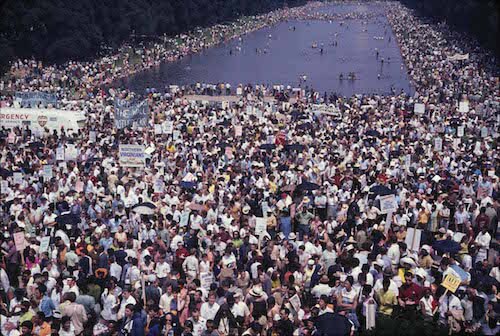
    Poor People’s March on Washington, May-June 1968

    This surveillance activity ratcheted upwards when King announced his concept to hold a Poor People’s March on Washington. This was formally planned in November of 1967, and was to take place in May of 1968. As Gerald McKnight notes in his book, The Last Crusade, the Pentagon had readied 20,000 troops to be rotated into Washington in May. (McKnight, p. 93) McKnight also wrote that the FBI prepared a special COINTELPRO program to disrupt the march and its preparations called Operation POCAM (ibid, pp. 9-10) As others have done before him, Emison notes how the FBI maneuvered King out of the Rivermont Hotel in Memphis and into the Lorraine. They did this by using their media assets to harangue him for not staying at a black-owned motel. (Emison, pp. 126-27) On April 3rd, informant Withers told the FBI that King would be staying at the Lorraine and gave them his room number. Emison makes the case that this information was closely held. It is unlikely that James Earl Ray could have known about it. (pp. 128-29)

    V

    Of course, very little of this information was available at the time Ray was apprehended in London and returned to Memphis. Even at that, for reasons noted above, Arthur Hanes Sr. was ready to go to trial. He was so confident he would win that he turned down a plea bargain deal. Which leaves the question: How then was Ray convicted? The answer to that question can be expressed in two words: Percy Foreman.

    The issue of how Foreman entered the King case has always been clouded . The main reason being that Foreman told many lies about it. Even when he was under oath before the HSCA. And either the HSCA did not do its homework on the issue, or they were not going to call him on it for the record.

    Percy Foreman

    First of all, the idea that James Earl Ray ever wanted Foreman as his lawyer or ever mentioned his name to his brothers is false. Arthur Hanes came into the case through the efforts of the English barrister Michael Eugene, who was representing Ray in London. Eugene called Hanes since he knew that Ray was going to be shipped back to Memphis to stand trial. Ray’s brothers had no contact with James in England in June. So unlike what Foreman maintained: 1.)There is no letter that James Earl Ray sent to Foreman, either on his own, or through his brothers, and 2.) James Earl Ray did not want Foreman to represent him from the start. (pp. 131-34)

    The facts indicate that Foreman did not enter the case in any way until November of 1968, about five months after he said he did. Emison states that the reason that the Ray brothers—John and Jerry—even thought of switching lawyers was simple. James wanted to take the stand in his own defense. Arthur Hanes strongly disagreed. Because of this dispute, the brothers now believed that William Bradford Huie was calling the shots, since he did not want James to testify either. (p. 148) This turned out to be a terrible miscalculation.

    The brothers first went to a local lawyer. But this attorney told them that he needed a big name partner in the case. So Huie then floated Foreman’s name. Jerry Ray then got in contact with Foreman on or about November 9, 1968. (p. 134) When Foreman flew into Memphis, there was still no letter from James Earl Ray to allow him into the jail. But he proceeded there anyway. When he got there, James did not want to see him. The warden had to call Judge Preston Battle. And after about 90 minutes, Foreman was allowed to see the prisoner. (p. 139) In short order, Hanes exited the case. The contract Huie had with Hanes over a royalty split was replaced with one with Foreman. Which is another point Foreman lied about. Since he proclaimed in public that he was foregoing any fees in this case. (p. 131)

    Just how far was Foreman willing to go in order to conceal the true circumstances of his entry into the case—which was, at the least, unethical, if not illegal? He actually insisted on his “James Earl Ray sent me a letter” story to the HSCA. When asked to produce the letter, he said that it had been transferred to the offices of a lawyer friend in Nashville, from which Foreman said they were lost. Through a partner in that Nashville firm, Emison makes a good circumstantial case that this is another lie by Foreman. (p. 137)

    The point is simple. Because Hanes was still the lawyer of record and the defendant had not solicited a change, then Foreman’s entry could be challenged as unethical, or even illegal. If that would have been established, then everything that Foreman did after could have been challenged in an effort to reopen the case.

    After Foreman took over, he briefly talked about how he would win an acquittal for his client. (p. 146) But that did not last long. Foreman had his client declared indigent so he could get help from the public defender’s office. But there really was not much point in this aid since Foreman changed his mind and decided not to put on a defense. Foreman’s deal with the DA was essentially a plea of guilty in return for the promise not to request the death penalty. And there is no doubt that Foreman used every unethical trick in the book to get James Earl Ray to go along with the plea bargain. He told his client the FBI would pick up his father on a probation violation unless he copped a plea. He told Jerry and John that unless there was a plea, the state would implicate them in a conspiracy with James to kill King. (p. 151) Foreman told his client that the state had bribed witnesses who would place him at the scene; he therefore faced electrocution.

    But that was not the worst of it. The day before the court proceeding, Foreman had sent out two letters. One was to James and one to Jerry. The latter contained a check for five hundred dollars. (The equivalent of about three grand today.) The letter to James was an adjustment in the Huie/Foreman royalty rate, which would allow James a share of the profits. These rewards were both contingent upon there being no unexpected stunts pulled during the court proceeding. (p. 153) Is there any way not to construe this as bribery?

    This relates to an important discovery by Emison. Namely that there are two transcripts of the Ray/Foreman pleading in front of Judge Battle. And they differ in a most important way. In what the author proves is the genuine transcript, the following exchange occurs:

    Battle: Has any pressure of any kind by anyone in any way been used on you to get you to plead guilty?

    Ray: Now, what did you say?

    In other words, Ray was answering a question with a question. There was no answer. Amazingly, Battle did not repeat the question, as Ray requested. He went to another question. (p. 156) Now, someone in the DA’s office obviously saw that this was a problem for an appeals court to deal with, and would therefore open up all kinds of avenues for an attorney to bring in evidence that Foreman did pressure Ray into pleading guilty. So therefore, someone altered the original transcript. In this version, Ray’s reply to the question about pressure is as follows:

    Ray: No. No one in any way.

    Emison proves in a number of ways, including tape recordings of the hearing and the actual stenographer’s signed copy, that this second transcription is a forgery. In fact, he dedicates a large part of a chapter to proving this piece of fabrication. (See Chapter 7) And he blames Battle for accepting the plea without a full answer to his question about pressure. In fact, this may be the reason Battle had second thoughts about the case and was willing to give Ray a new trial.

    What makes it even worse is that the author states that, in the subsequent appeals by Ray’s lawyers, it is this false transcript that was used. (p. 176) Which is hard to believe since, once the page is blown up a bit, it strongly suggests the altered line was typed with a different typewriter. The HSCA also used this altered transcript.

    But it may be even worse than that. The author found the surviving audiotape of the hearing, He admits it is not a good recording. But he believes that what Ray actually says in reply to the question about pressure is, “I don’t know what to say.” (p. 181)

    VI

    Emison closes the book with two interesting topics. The first concerns the mechanics behind Ray’s pleading. Harry Smith Avery, as a top official in the Corrections Department, interviewed Ray three times while in prison. He ordered his mail recorded and a log made of all incoming and outgoing letters. When Governor Buford Ellington was told about this effort to investigate the King case, he was not pleased. In fact, he ordered Avery to halt the attempt. When he did not, he was eventually terminated in May of 1969. Later, when the HSCA began its inquiry, they paid Avery a visit. When he went to retrieve his files on the case, they had disappeared.

    Avery also told the author an anecdote about visiting the governor’s office prior to the Ray hearing in 1968. As he was waiting outside the doors, he managed to overhear one side of a phone conversation. It was one of the governor’s assistants talking to a higher up of the Justice Department in Washington. Avery could only hear the Nashville side of the call. He heard the following words: “Don’t worry. Ray is going to plead guilty; there won’t be any evidence put on by the prosecution, there won’t be any evidence that is tested in court—there won’t be a trial.” (p. 200)

    The author also touches on the issue of the Tennessee law in place at the time of Battle’s death. As others have noted, according to the statute, Battle passed away in receipt of Ray’s letters requesting a new trial, and was acting on them at the time of his death; when he died he had dropped his pen on the floor. Ray should have been granted a full trial automatically by the new judge. Not only did this not happen, this part of the law code—Tennessee Code Annotated 17-1-305— was simply ignored upon appeal. (p. 203)

    The last major topic the author deals with is the amazing coincidence of the aliases Ray used in the last year of his life. These were Eric S. Galt, Ramon George Sneyd, Paul Bridgeman, and John Willard. None of the names was fabricated. They were all real people who Ray did not know. All four of them lived within a five-mile radius of each other in Toronto. And they all shared ages and physical attributes that were similar to Ray’s. Ray had been to Montreal once. But there is no recorded information he had been to Toronto prior to the assassination. The two names he used the most were Galt and Sneyd. The former alias was used in America the year before the assassination. The latter was used after the shooting, when Ray fled to Canada and then Europe.

    Complicating this is the fact that when Ray fled to Canada, he had people in direct communication with him at both places he resided at in Toronto. In the first instance, beginning on April 8, 1968, he used the name Paul Bridgeman. About ten days later, he changed locales and used the name Ramon Sneyd. (p. 274) At the first location, Ray got a phone call asking for “Mr. Bridgeman”. At the second location, Ray got a phone call and a visitor. The visitor came calling for “Mr. Sneyd”. He then gave Ray an envelope. Within hours, Ray now paid for his passport, which had been waiting for him under the name of Sneyd, and ordered a commercial flight to Europe (p. 224)

    As the author notes, the excuses that writers like Gerald Posner and Huie use to explain away the above are ludicrous. How did these other people know 1.) Where Ray was staying, and 2.) The specific pseudonyms he was using. And to any objective person, it certainly appears that the second visitor was giving Ray money to get out of Canada and into Europe. Incredibly, neither the FBI nor the HSCA interviewed the landlords, or tracked down the person who brought the envelope. That was done by the deceased researcher and author Philip Melanson.

    Emison has written a credible and important volume on the King case. The author did a lot of valuable interviews and digging into the records of the case. It is a book worth having in one’s personal library.

  • JFK and the Unforgivable: How the historians’ version of the JFK assassination dishonors the historical record – Part 2

    JFK and the Unforgivable: How the historians’ version of the JFK assassination dishonors the historical record – Part 2


    United States House of Representatives Select Committee on Assassinations (HSCA)

    Established in 1976 to investigate the assassinations of Martin Luther King and John F. Kennedy, the HSCA issued its final report in 1979. It found that there was a “probable conspiracy” in the JFK case.

    The following is a summary of their findings (source: National Archives):

    Findings of the Select Committee on Assassinations in the Assassination of President John F. Kennedy in Dallas, Tex., November 22, 1963:

    1. Lee Harvey Oswald fired three shots at President John F. Kennedy. The second and third shots he fired struck the President. The third shot he fired killed the President.
    2. President Kennedy was struck by two rifle shots fired from behind him.
    3. The shots that struck President Kennedy from behind him were fired from the sixth floor window of the southeast corner of the Texas School Book Depository building.
    4. Lee Harvey Oswald owned the rifle that was used to fire the shots from the sixth floor window of the southeast comer of the Texas School Book Depository building.
    5. Lee Harvey Oswald, shortly before the assassination, had access to and was present on the sixth floor of the Texas School Book Depository building.
    6. Lee Harvey Oswald’s other actions tend to support the conclusion that he assassinated President Kennedy.
    7. Scientific acoustical evidence establishes a high probability that two gunmen fired at President John F. Kennedy. Other scientific evidence does not preclude the possibility of two gunmen firing at the President. Scientific evidence negates some specific conspiracy allegations.
    8. The committee believes, on the basis of the evidence available to it, that President John F. Kennedy was probably assassinated as a result of a conspiracy. The committee is unable to identify the other gunman or the extent of the conspiracy.
    9. The committee believes, on the basis of the evidence available to it, that the Soviet Government was not involved in the assassination of President Kennedy.
    10. The committee believes, on the basis of the evidence available to it, that the Cuban Government was not involved in the assassination of President Kennedy.
    11. The committee believes, on the basis of the evidence available to it, that anti-Castro Cuban groups, as groups, were not involved in the assassination of President Kennedy, but that the available evidence does not preclude the possibility that individual members may have been involved.
    12. The committee believes, on the basis of the evidence available to it, that the national syndicate of organized crime, as a group, was not involved in the assassination of President Kennedy, but that the available evidence does not preclude the possibility that individual members may have been involved.
    13. The Secret Service, Federal Bureau of Investigation and Central Intelligence Agency were not involved in the assassination of President Kennedy.
    14. Agencies and departments of the U.S. Government performed with varying degrees of competency in the fulfillment of their duties. President John F. Kennedy did not receive adequate protection. A thorough and reliable investigation into the responsibility of Lee Harvey Oswald for the assassination of President John F. Kennedy was conducted. The investigation into the possibility of conspiracy in the assassination was inadequate. The conclusions of the investigations were arrived at in good faith, but presented in a fashion that was too definitive.
    15. The Secret Service was deficient in the performance of its duties.
    16. The Secret Service possessed information that was not properly analyzed, investigated or used by the Secret Service in connection with the President’s trip to Dallas; in addition, Secret Service agents in the motorcade were inadequately prepared to protect the President from a sniper.
    17. The responsibility of the Secret Service to investigate the assassination was terminated when the Federal Bureau of Investigation assumed primary investigative responsibility.
    18. The Department of Justice failed to exercise initiative in supervising and directing the investigation by the Federal Bureau of Investigation of the assassination.
    19. The Federal Bureau of Investigation performed with varying degrees of competency in the fulfillment of its duties.
    20. The Federal Bureau of Investigation adequately investigated Lee Harvey Oswald prior to the assassination and properly evaluated the evidence it possessed to assess his potential to endanger the public safety in a national emergency.
    21. The Federal Bureau of Investigation conducted a thorough and professional investigation into the responsibility of Lee Harvey Oswald for the assassination.
    22. The Federal Bureau of Investigation failed to investigate adequately the possibility of a conspiracy to assassinate the President.
    23. The Federal Bureau of Investigation was deficient in its sharing of information with other agencies and departments.
    24. The Central Intelligence Agency was deficient in its collection and sharing of information both prior to and subsequent to the assassination.
    25. The Warren Commission performed with varying degrees of competency in the fulfillment of its duties.
    26. The Warren Commission conducted a thorough and professional investigation into the responsibility of Lee Harvey Oswald for the assassination.
    27. The Warren Commission failed to investigate adequately the possibility of a conspiracy to assassinate the President. This deficiency was attributable in part to the failure of the Commission to receive all the relevant information that was in the possession of other agencies and departments of the Government.
    28. The Warren Commission arrived at its conclusions, based on the evidence available to it, in good faith.
    29. The Warren Commission presented the conclusions in its report in a fashion that was too definitive.

    The committee had other troubling conclusions: Neither Lee Harvey Oswald nor Jack Ruby were the loners depicted by the Warren Commission, and were involved in relationships that could have matured into a conspiracy; Lee Harvey Oswald was connected to David Ferrie and Guy Banister- two conspirators according to Jim Garrison; Jack Ruby was in fact connected to the Mafia (an issue sidestepped by the Warren Commission); Marina Oswald’s incriminating statements against her husband were found to be lacking in credibility; they were inclined to believe Sylvia Odio who asserted that she was visited before the assassination by two Cuban exiles and a Leon Oswald in an attempt to portray Oswald as unbalanced and hostile to JFK. Her testimony was rejected by the Warren Commission even though she had related the event before the assassination; The Lopez Report established that someone was impersonating Oswald seven weeks before the assassination in Mexico City in an attempt to get a visa to travel to Cuba and that the CIA had tampered with the electronic evidence.

    While the HSCA asked the Justice Department to re-investigate the case- it chose to only look at the acoustical evidence, which it rejected based on science that itself is also contested.

    For those who have used this final point to argue that the Warren Commission got it right and discard all the other incriminating findings- It will prove useful to read what the key members of the Committee had to say:

    Gaeton Fonzi  – Church and HSCA investigator

    Gaeton Fonzi was interviewed a number of times after the investigations. The information he brought forward in his 1993 book, The Last Investigation was considered credible and explosive. Fonzi described an exchange he had with Arlen Specter (the Warren Commission’s principal proponent of the Single Bullet theory) where he described him as being unnerved when discussing the Commission’s evidence. He also revealed how Cuban exile group Alpha 66 leader Antonio Veciana exposed his CIA handler Maurice Bishop (a cover name for top ranking CIA officer David Atlee Phillips) who he witnessed meeting with Oswald. He discussed how close contacts of CIA officer David Sanchez Morales heard him admit a conspiracy in the assassination. He described how the HSCA was stonewalled by the CIA. He also complained about second Commission head Robert Blakey’s submissive relationship with the CIA.

    Gaeton Fonzi(mid-1970s)

    In a speech in 1998 while receiving the Mary Ferrell JFK Lancer Pioneer Award he had this to say about the Warren Commission: Is there any doubt that the Warren Commission deliberately set out not to tell the American people the truth?

    There is a brief glimpse, an illustration of the level at which that deceit was carried out, in an incident that occurred during the Warren Commission’s investigation. Commission chairman Earl Warren himself, with then Representative Gerald Ford at his side, was interviewing a barman, Curtis LaVerne Crafard. Crafard had worked at Jack Ruby’s Carousel Club. But he was seized by the FBI as he was hightailing it out of town the day after the assassination, having told someone, “They are not going to pin this on me!”

    In the interview, Warren asks Crafard what he did before he was a bartender.

    “I was a Master sniper in the Marine Corps,” Crafard answered.

    The next question that Warren immediately asked was: “What kind of entertainment did they have at the club?”

    In a 1999 interview he gave to Michael Corbin, Fonzi contradicted Robert Blakey by stating that the HSCA investigation also lacked thoroughness. He also wonders out loud whether the “…the Government itself or a power elite within the government was a controlling element here”.

    He opined that the failed Bay of Pigs, the Missile Crisis followed by the cessation of secret anti-Castro operations were probably a guiding motivation for operatives linked to the JM Wave CIA station in Miami to remove the President and which end up dovetailing with Oswald’s movements in 1963.

    He makes the claim that Oswald was an agent of the intelligence establishment who was coded as a leftist. He was not a lone nut. He believes that he was also a patsy who did not fire a shot and that Dealey Plaza became a shooting gallery on November 22nd 1963.

    He describes also how David Phillips was not only seen with Oswald by Antonio Veciana, but how a lot of the cover-up and misinformation campaigns about Oswald were linked to him.

    He concludes the interview by stating :“there is no doubt that it was a coup d’état”!

    Dan Hardway and Edwin Lopez – HSCA “staffers”

    (authors of appendix 13 of the HSCA Report, “Oswald, the CIA and Mexico City”, also known as the Lopez Report)

    History Matters provides an excellent introduction about this report only released in 1996:

    The “thirteenth appendix” to the HSCA Report on the JFK assassination is a staff report entitled “Oswald, the CIA, and Mexico City.” This report describes what the Committee learned about Lee Oswald’s trip to Mexico City less than two months prior to the assassination. Questions it grapples with include why the CIA was apparently unable to obtain a photo of Oswald from any of its photographic surveillance stations (and instead produced a photo of a “Mystery Man” who was clearly not Oswald), whether Oswald was impersonated in Mexico City, and what credibility to attach to any of the indications and allegations of Communist conspiracy emanating from that city.

    The so-called “Lopez Report,” written by staffers Dan Hardway and Edwin Lopez, was released in its present form in 1996, but remains redacted in several places. It is a good starting place for grappling with some of the many mysteries of the Mexico City affair. Newly released files have provided new information not present in this report. The LBJ taped phone conversations for instance, include startling corroboration for the claim that audio intercepts of an Oswald impersonator were listened to by FBI agents in Dallas while Oswald was in custody. Declassified testimony of David Phillips, the Tarasoff couple who translated the tapes for the CIA, and others illuminate some areas and deepen the mystery in others.

    The “Lopez Report” is a good point of departure for a journey into this mysterious affair.

    Dan Hardway

    In 2014, for an ARRC conference, both Hardway and Lopez talked about their experience on the HSCA and the report. A lot of focus was put on how they had been making progress in the HSCA investigation until the CIA placed George Joannides as their resource person in charge of supervising the CIA’s interaction with the HSCA. Despite claims that Joannides was impartial, it was confirmed that he was directly involved with the Cuban exile organization called the DRE in 1963. Oswald had direct interaction with the DRE in events that became very public and were used to paint him as a communist. Hardway concludes his speech with:

    “The CIA has something to hide; Joannides knew what they had to hide. The CIA knew he knew and knew we did not know who or what he was hiding; Joannides hid what he had to hide.”

    Edwin Lopez

    Edwin Lopez confirmed the stonewalling and gave examples on how they were being spied on. He referred to the continued holding back of documents as a mess we all needed to work on together.

    They also confirmed that they felt that there were either fake phone calls done by an Oswald impostor while he was allegedly in Mexico or at least faked transcripts.

    Hardway hypothesizes that because of compartmentalization Phillips and Oswald may have found out on November 22, 1963 that Oswald was a patsy and Phillips received orders to tie the murder to Castro.

    In a critique of Phil Shenon’s work written for the AARC in 2015, Dan Hardway expresses the opinion that the CIA is heading to what he calls a limited hang-out by admitting that Oswald may have received guidance from Cuba and that the CIA director at the time, John McCone, was involved in a benign cover-up.

    In an interview he gave to Black Op Radio that same year, he recommended The Devil’s Chessboard by David Talbot, a book which exposes incriminating information about Alan Dulles and William Harvey, who can be seen now as persons of high interest in the case.

    In 2015, for a civil action where plaintiff Jefferson Morley, was suing the CIA for access to information, Dan Hardway signed a Sworn Deposition that underscores CIA obfuscation techniques as well as some of his findings during the investigation. The following are some of his statements:

    Beginning in May of 1978, the CIA assigned George Joannides to handle liaison with Edwin Lopez and me. In the summer of 1978, Mr. Joannides began to change the way file access was handled. We no longer received prompt responses to our requests for files and what we did receive no longer seemed to provide the same complete files that we had been seeing. The obstruction of our efforts by Mr. Joannides escalated over the summer, finally resulting in a refusal to provide unexpurgated access to files in violation of the Memorandum of Understanding previously agreed to by the HSCA and the CIA;

    During the course of the spring and summer of 1978 I had been looking into several areas of research which were actively impeded under Mr. Joannides’s direction. These included back channel communications methods used by the CIA’s Mexico City Station, William Harvey’s Office of Security files and his continuing relationship with certain Mafia figures, the use of an impulse camera to photograph the Cuban Consulate in Mexico City, missing production from one of the photographic installations that covered the Soviet Embassy in Mexico City as well as the impulse camera at the Cuban Consulate, and David Atlee Phillips’ possible involvement in stories about LHO that appeared after the assassination of John F. Kennedy.

    Before our unexpurgated access was cut off by Joannides, I had been able to document links between David Phillips and most of the sources of the disinformation that came out immediately after the assassination about Oswald and his pro-Castro proclivities. I confronted Phillips with those in an interview at our offices on August 24, 1978. Phillips was extremely agitated by that line of questioning, but was forced to admit that many of the sources were not only former assets that he had managed, in the late 50’s and early 1960’s, but were also assets whom he was personally managing in the fall of 1963. Mr. Phillips was asked, but could not explain, why the information that came from anti-Castro Cuban groups and individuals pointing to Cuban connections, all seemed to come from assets that he handled personally, but acknowledged that that was the case.

    We have, since 1978, learned that George Joannides was running the propaganda shop at the CIA’s Miami JMWAVE Station in 1963. It is extremely unlikely that Mr. Joannides could have occupied that position and not have known, and worked with, David Atlee Phillips. In addition, in 1963, we now know, George Joannides was the case officer handling the DRE. In 1977 the CIA specifically denied that DRE had a case officer assigned when asked that question by the HSCA.

    Robert Tanenbaum –  Chief Counsel HSCA

    In a Probe Magazine interview in 1993, Tanenbaum explained why he and Richard Sprague resigned from the Commission:

    Q: I interviewed a friend of yours down in New Orleans, L.J. Delsa. He said that he felt that one of the reasons the Congress turned against the Committee was, because of Sprague’s approach. It could have set a precedent in Washington to have really serious investigations instead of fact-finding commissions. Did you get any feeling about that?

    A: In my opinion, Congress never wanted to go forward with these investigations at all. That’s just based upon my having spoken with a lot of the membership of the House as I was asked to do by the Committee, in order to get funding. That’s something I never thought would be an issue before I went down there. They sort of politicized into it with some very distinguished members of Congress who were retiring in 1976, requesting that the Kennedy portion be investigated because they had seen Groden’s presentation of the Zapruder film and were very persuaded by it. Then the Black Caucus got involved and said well, investigate the murder of Dr. King. It was an election year and they said, “Ok, why not? We’ll do that.” But there was no commitment to really do it, unfortunately, which regrettably we found out while we were in the midst of investigating the case. They pulled our budget, they pulled our long-distance phone privileges, our franking privileges, we couldn’t even send out mail. And all of this was happening at a time when we were making some significant headway. So, L. J. may be right with respect to his perception, but at the same time I don’t believe they were ever committed to it. Tip O’Neill, who was the Speaker, was never committed to it. Only many, many years later did he realize that he’d made a tragic mistake.

    He also reveals troubling information about David Atlee Phillips:

    JD: Another thing you’ve discussed and it’s featured in your book, is this incredible movie of the Cuban exile training camp.

    BT: To the best of my recollection, we found that movie somewhere in the Georgetown library archives. The movie was shocking to me because it demonstrated the notion that the CIA was training, in America, a separate army. It was shocking to me because I’m a true believer in the system and yet there are notorious characters in the system, who are being funded by the system, who are absolutely un-American. And who knows what they would do, eventually. What if we send people to Washington who they can’t deal with? Out comes their secret army? So, I find that to be as contrary to the constitution as you can get.

    JD: Was it really as you described in the book, with all the people in that film? Bishop was in the film?

    BT: Oh, yeah. Absolutely! They’re all in the film. They’re all there. But, the fact of the matter is the Committee began to balk at a series of events. The most significant one was when [David Atlee] Phillips came up before the Committee and then had to be recalled because it was clear that he hadn’t told the truth. That had to do with the phony commentary he made about Oswald going to Mexico City on or about October 1st, 1963.

    JD: Would you describe that whole sequence, because I feel that is one of the real highlights of your book.

    Robert Tanenbaum

    BT: As I said, I had never followed the sequence of these events and I wasn’t aware of any of this, before I went to Washington. If you had told me all this before I went, I would have said, “This is madness. Talk to me about reality!” So, Phillips was saying that an individual went to Mexico City on or about October 1st and the CIA was claiming this was Lee Harvey Oswald, just as the Warren Commission claimed. However, the following occurred: “Oswald” goes to the Russian Embassy and identifies himself as Lee Henry Oswald. He wants to fake everybody out by changing his middle name. There were tapes of what he said because the CIA was bugging the Embassy the same as they were doing to the U.S. Embassy, according to Phillips. And the CIA was photographing people going in and out of the Embassy, the same as they were doing to the U.S. (We found out, from our own sources that the CIA had a contract employee named Lee Henry Oswald, in their files.) Phillips testimony was that there was no photograph of “Oswald” because the camera equipment had broken down that day and there was no audio tape of “Oswald’s” voice because they recycled their tapes every six or seven days. The problem with his story was, we had obtained a document, it was from the desk of J. Edgar Hoover, it was dated November 23rd, 1963, the very next day after the assassination. This document was a memo to all FBI supervisorial staff stating, in substance, that FBI agents who have questioned Oswald for the past 17 hours approximately, have listened to the tape made on October 1st, by an individual identifying himself as Lee Henry Oswald inside the Russian Embassy, calling on the phone to someone inside the Cuban Embassy and the agents can state unequivocally that the voice on the tape is not the voice of Lee Harvey Oswald, who is in custody.

    JD: Did you have this document while you were questioning Phillips?

    BT: No. It was a whole separate sequence of events that occurred. But, I wanted to get him back before the Committee so we could confront him with this evidence, because we were in a position to demonstrate that that whole aspect of the Warren Report, and what he had testified to, was untrue. And of course, the Committee was not interested in doing that.

    Tanenbaum also vindicated Garrison, incriminated Clay Shaw and shared thoughts about leads that were not followed up on:

    JD: You’ve said that you’ve actually seen a CIA document that says they were monitoring and harassing Jim Garrison’s witnesses.

    BT: Right. We had that information. I was shocked to read that because I remember discounting everything Garrison had said. I had a negative point of view about Garrison based upon all the reportage that had gone on. And then I read all this material that had come out of Helm’s office, that in fact what Garrison had said was true. They were harassing his witnesses, they were intimidating his witnesses. The documents exist. Where they are now, God only knows. It’s a sad commentary on the lack of oversight on the executive intelligence agencies.

    JD: I read something about you to the effect that during the brief period you ran the Committee, after Sprague left, one of the areas that really interested you was New Orleans and its connection to JM/Wave and Miami. Also, Delsa told me, as far as he was concerned, that was one of the most productive areas they were working.

    BT: That’s correct. The meeting in Clinton and the Clay Shaw connection and the fact that the government was lying about Clay Shaw and the aliases and so on. That the fact that the government and the executive intelligence agencies, not Garrison, were lying about that, was definitely an area to probe to find out what the justification for that was. Why were they involved in all this, if in fact, nothing had occurred? If it was meaningless, why get involved in creating a perjurious situation for a prosecutor in New Orleans? What was he really on to?

    JD: What’s interesting about the day that Sprague resigns, is that’s the day De Mohrenschildt is found dead.

    BT: Right. The night before the Committee vote, we had sent an investigator to serve him a subpoena. The night of the day he received the subpoena from the Committee is when he was found dead.

    JD: I guess the Committee was so crippled at that time that it couldn’t really pursue whatever investigation there may have been into his murder. And he was a key witness, right?

    BT: Right. We desperately wanted to find out what happened. He was someone who had not been subpoenaed before, certainly not by the Warren Commission. [CTKA note: he was questioned, but not subpoenaed.] And you’re right, he was a key player.

    JD: Another thing you guys were on to that Blakey never seemed to be on to, was the connection between the people in the background of the assassination and the scandal that had just happened in Washington – namely, Watergate.

    BT: Right. E. Howard Hunt, Frank Sturgis. Interestingly, some of them had been with Castro in the Sierra Maestra during the revolution and became players after the revolution. And then wound up in the Nixon White House as the “plumbers.”

    JD: You’ve stated that the Committee never got any cooperation from the Kennedys.

    BT: We called Senator Kennedy 20-30 times. He never responded once to an inquiry. I found that to be astounding, because after all, he is a member of this legislative branch of government. He conducts probes, he engages in fact-finding missions. How could he stonewall from his brethren in the other chamber? He could have just simply acknowledged a phone call. How could he know what information we wanted? The fact of the matter was, as a matter of courtesy, we wanted to let him know we knew he was around and we wanted to discuss with him areas that he felt we should look into and get his opinions. We certainly felt that they would be valid. So, we were very disappointed in that regard. Frank Mankiewicz came by as a representative of the Kennedy family, wanted to see whether or not Sprague and I had two or three heads. He told us, interestingly, Bobby Kennedy couldn’t put a sentence together about the assassination, he couldn’t even think about it, he couldn’t focus on it. Which explains, in large measure why the Kennedy family was willing to accept what the Warren Commission said, without concern. The event was so horrific, in and of itself, they really weren’t concerned with bringing someone to justice other than what the Warren Commission had said. In their minds, from what Mankiewicz said, if it wasn’t Oswald-some nonperson-then it was some other nonperson. What difference would it make?

    JD: When the attacks on Sprague began, most notably in the New York Times and a few other newspapers, did you begin to see a parallel between what was happening to Sprague and what had happened to Jim Garrison?

    BT: Of course. But, I didn’t pay much attention to it because it didn’t mean anything to me. I’m not moved to any great extent, by what people write in newspapers. They were trying to cause controversy. But, we were on a mission to do a job and nothing some dope in the New York Times or any other newspaper was going to write, that was blatantly untrue, was going to interfere with what we were doing. Whether it was a positive article or a negative article, it didn’t matter.

    In 2003, Tanenbaum spoke at the Wecht Conference and what he had to say would certainly give students of American History new insights in the assassination that would not have pleased Earl Warren or Gerald Ford and some of their disciples.

    Here are but a few of the points he made:

    What I am saying is that from the evidence we produced, there were substantial questions about the assassination …

    What I’d like to do very briefly is to explain some of the reasons why, from a prosecutorial point of view, from what our investigation revealed, there was, in my judgment, no case to convict Lee Harvey Oswald of murdering the President …

    The assassination was approximately 12:30; at 12:48 a description of a suspect was sent out: “‘white male, approximately thirty, slender build, height five foot ten inches, weight 165 pounds.” Where did that description come from?

    And the answer the Warren Commission gives is that this fellow Brennan was… looking up at the Depository window. And he allegedly sees this person – the shooter – Oswald the Warren Commission maintains, and was able to give a description, a miraculous feat … because if he stood up in the window you would only see a partial of his body [his knees] because the first few feet was opaque. [the window was close to the floor]

    Whoever the shooter was that was in that window – in that Sniper’s Nest, he was crouched down looking out that window which was raised about 12 inches. At best, if anybody saw anybody in that window, they would have seen a partial of their face, at best.

    During a 2015 interview on Len Osanic’s Black Op Radio, he talked about how the Warren Commission did not want look into a conspiracy, including Oswald’s links with intelligence and Ruby’s to the mob and the Dallas Police Department.

    Richard Sprague – Chief Counsel

    Historians can be illuminated by what this top level insider of impeccable credentials thought about the assassination and the ensuing cover-up from the many interviews he gave.

    In the BBC Documentary The Killing of President Kennedy, Sprague related the following about Oswald:

    His trip to Russia raised a number of questions that we wanted to get into. For example, when any American went to Russia and renounced his American citizenship and subsequently changed his mind and wanted to come back to this country, upon returning to this country there was a thorough debriefing by the CIA, with one exception as far as we could ascertain- Oswald…

    The photographs allegedly of Oswald going into the Cuban embassy as we all know in fact are not photographs of Oswald. Secondly it turns out that those photographs, even if they were of the wrong person, you would expect they would be of a person entering the Cuban embassy but it turns out they are photographs of someone entering the Russian embassy and the question raised how could they so mix up even what building they are talking about. In addition when we inquire where are the photographs you took of the people entering the Cuban embassy the day in question we are told the cameras were not working that day. I want to talk to the camera people I want to find out if that’s true and that’s where we got stopped.

    The CIA said they had re-used the tape prior to the assassination of President Kennedy, yet the FBI has a document stating that some of their agents listened to the tape after the assassination of President Kennedy and that the voice on there was not Oswald’s. In addition the CIA presented a transcript of that conversation; we had interviewed the typist who typed it up who said that the transcript presented was not in fact what was typed up by whoever it was who spoke in that conversation. These are areas that I wanted to get into.

    From the photographic evidence surrounding the sixth floor window, as well as the grassy knoll, Sprague, Tanenbaum and most of the staff knew Oswald had not fired any shot, they suspected no shots came from the sixth floor “sniper’s nest” window, and knew there had been shots from other points in Dealey Plaza. They knew the single bullet theory was not valid, and strongly suspected there had been a pre-planned crossfire in Dealey Plaza. They were not planning to waste a lot of time reviewing and rehashing the Dealey Plaza evidence, except as it might lead to the real assassins.

    They had set up an investigation in Florida and the Keys, of some of the evidence and leads developed in 1967 by Garrison. Gaeton Fonzi was in charge of that part of Sprague’s team. They were going to check out the people in the CIA that had been running and funding the No Name Key group and other anti-Castro groups, e.g., Willaim Seymour, Manuel Garcia Gonzalez, Jerry Patrick Hemming, Loran Hall, Lawrence Howard, and Rolando Masferrer and Carlos Prio Socarras.

    This new situation, with Richard Sprague and his team garnering so much knowledge of the CIA’s role in the murder and the cover-up caused the Establishment to face a crisis. They knew they had to do several things to turn the situation around and keep the American public in the dark. Here is what they had to do:

    • Get rid of Chief Counsel Richard Sprague.
    • Get rid of Committee Chairman Henry Gonzalez.
    • Get rid of Sprague’s key men and keep them away from more incriminating CIA evidence.
    • Install their own chief counsel to control the investigation.
    • Nominate a new HSCA chairman who would go along, or who could be fooled.
    • Limit Sprague’s investigations of CIA people. Make sure some of the people aren’t found or, if necessary dispose of CIA people who might talk.
    • Create a new investigative environment whose purpose would be to confirm all of the findings of the Warren Commission and divert attention away from the who-did-it-and-why approach.
    • Control the committee staff in such a way as to keep any of them separate from other teams and silent by signing non-disclosure agreements.
    • Control the media by not holding any press conferences.

    These things all happened. And they fundamentally altered the temperament and goals of the HSCA. It simply was not the same. As many observers think, this was the last, best chance to solve the JFK case.

    How did it happen? According to Gaeton Fonzi in The Last Investigation:

    Richard Sprague

    The key factors that drove Richard Sprague to resign as Chief Counsel of the Assassinations Committee appeared, at the time, to be apparent and on the surface. His proposed use of certain investigative equipment, his demand for an expensive, unrestricted investigation, his refusal to play politics with Chairman Gonzalez – all were apparent grounds for the vociferous criticism which, in the long run, was debilitating to the Committee’s efforts to get on with its job. However, after his resignation and a brief respite from the turmoil of Washington, Sprague was able to view his experience in a broader perspective.” … “If he had it to do over again, he would begin his investigation of the Kennedy assassination by probing “Oswald’s ties to the Central Intelligence Agency.” Recently, I asked Sprague why he had come to that conclusion. “Well,” he said, “when I first thought about it I decided that the House leadership really hadn’t intended for there to be an investigation. The Committee was set up to appease the Black Caucus in an election year. I still believe that was a factor. But when I looked back at what happened, it suddenly became very clear that the problems began only after I ran up against the CIA. That’s when my troubles really started.

    In a 2000 interview for Probe Magazine with John Williams, he described his being fired this way:

    SPRAGUE: We were just going to do that type of thorough thing. I demanded the records from the CIA, and now there was an abrupt refusal, and I subpoenaed them. At that point, Gonzales, who was Chairman of the Committee, ordered the CIA, or told the CIA that they need not respond to my subpoena, and fired me, and ordered the U.S. Marshals come in and remove me from my office.

    WILLIAMS: Oh, so that firing was directly after you had subpoenaed the records from the Central Intelligence Agency.

    SPRAGUE: Right. But there’s more involved in it than the timing …

    WILLIAMS: Right.

    SPRAGUE: … if you checked the record. That came up after that. He ordered my firing. He ordered marshals to remove me from my office in what I’m sure was the first and only time in the history of the United States Congress. The rest of the Committee, backed me to a man and overrode the Chairman, and ordered that I remain, and the marshals were directed to get off.

    Of course, that led to Gonzales taking it up in the House of Representatives, and the House backed the rest of the Committee. And he resigned and Stokes came on. [Louis Stokes was the Representative from Ohio. Eds. Note] I’m sure that’s the only time in the history in the United States Congress that in a fight between the Chairman and the Director, that the Chairman got bounced.

    But there’s a terrible price paid for that. Every Congressman dreams of being Chairman of a Committee and being all powerful. It ultimately did not sit well with the Congress that a Chairman got ousted …

    Robert Blakey – Chief Counsel and staff director 1977-79

    While Sprague’s replacement, Robert Blakey, frustrated some investigators for being too trusting of the CIA, he too did not buy the Warren Commission’s final conclusions.

    While at first Blakey felt that the HSCA had investigated the CIA enough to absolve them of any role in the assassination, in 2003 in an addendum to an interview with PBS, his opinion evolved. Because he found out that the CIA misled him and the HSCA by bringing George Joannides out of retirement as the CIA liaison with the Committee and hiding the role he had with an anti-Castro group called the DRE which played an important role by its interaction with Oswald:

    I am no longer confident that the Central Intelligence Agency co-operated with the Committee. My reasons follow:

    The Committee focused, among other things, on (1) Oswald, (2) in New Orleans, (3) in the months before he went to Dallas, and, in particular, (4) his attempt to infiltrate an anti-Castro group, the Directorio Revolucionario Estudiantil or DRE.

    These were crucial issues in the Warren Commission’s investigation; they were crucial issues in the committee’s investigation. The Agency knew it full well in 1964; the Agency knew it full well in 1976-79. Outrageously, the Agency did not tell the Warren Commission or our committee that it had financial and other connections with the DRE, a group that Oswald had direct dealings with!

    What contemporaneous reporting is or was in the Agency’s DRE files? We will never know, for the Agency now says that no reporting is in the existing files. Are we to believe that its files were silent in 1964 or during our investigation?

    I don’t believe it for a minute. Money was involved; it had to be documented. Period. End of story. The files and the Agency agents connected to the DRE should have been made available to the Commission and the Committee. That the information in the files and the agents who could have supplemented it were not made available to the Commission and the Committee amounts to willful obstruction of justice.

    Obviously, too, it did not identify the agent who was its contact with the DRE at the crucial time that Oswald was in contact with it: George Joannides.

    During the relevant period, the Committee’s chief contact with the Agency on a day-to-day basis was Scott Breckinridge. (I put aside our point of contact with the office of chief counsel, Lyle Miller) We sent researchers to the Agency to request and read documents. The relationship between our young researchers, law students who came with me from Cornell, was anything but “happy.” Nevertheless, we were getting and reviewing documents. Breckinridge, however, suggested that he create a new point of contact person who might “facilitate” the process of obtaining and reviewing materials. He introduced me to Joannides, who, he said, he had arranged to bring out of retirement to help us. He told me that he had experience in finding documents; he thought he would be of help to us.

    I was not told of Joannides’ background with the DRE, a focal point of the investigation. Had I known who he was, he would have been a witness who would have been interrogated under oath by the staff or by the committee. He would never have been acceptable as a point of contact with us to retrieve documents. In fact, I have now learned, as I note above, that Joannides was the point of contact between the Agency and DRE during the period Oswald was in contact with DRE.

    That the Agency would put a “material witness” in as a “filter” between the committee and its quests for documents was a flat out breach of the understanding the committee had with the Agency that it would co-operate with the investigation.

    The Committee’s researchers immediately complained to me that Joannides was, in fact, not facilitating, but obstructing our obtaining of documents. I contacted Breckinridge and Joannides. Their side of the story wrote off the complaints to the young age and attitude of the people.

    They were certainly right about one question: the Committee’s researchers did not trust the Agency. Indeed, that is precisely why they were in their positions. We wanted to test the Agency’s integrity. I wrote off the complaints. I was wrong; the researchers were right. I now believe the process lacked integrity precisely because of Joannides.

    For these reasons, I no longer believe that we were able to conduct an appropriate investigation of the Agency and its relationship to Oswald. Anything that the Agency told us that incriminated, in some fashion, the Agency may well be reliable as far as it goes, but the truth could well be that it materially understates the matter.

    What the Agency did not give us, none but those involved in the Agency can know for sure. I do not believe any denial offered by the Agency on any point. The law has long followed the rule that if a person lies to you on one point, you may reject all of his testimony.

    I now no longer believe anything the Agency told the Committee any further than I can obtain substantial corroboration for it from outside the Agency for its veracity. We now know that the Agency withheld from the Warren Commission the CIA-Mafia plots to kill Castro. Had the commission known of the plots, it would have followed a different path in its investigation. The Agency unilaterally deprived the commission of a chance to obtain the full truth, which will now never be known.

    Significantly, the Warren Commission’s conclusion that the agencies of the government co-operated with it is, in retrospect, not the truth.

    We also now know that the Agency set up a process that could only have been designed to frustrate the ability of the committee in 1976-79 to obtain any information that might adversely affect the Agency.

    Many have told me that the culture of the Agency is one of prevarication and dissimulation and that you cannot trust it or its people. Period. End of story.

    I am now in that camp.

    Anyone interested in pursuing this story further should consult the reporting by Jefferson Morley of the Washington Post. See, e.g., Jefferson Morley, “Revelation 1963”, Miami New Times (April 2001).

    Robert Blakey

    During his appearance for the AARC Conference in 2014, Blakey’s views seem to have crystallized by stating that at first he felt the CIA had cooperated but that he had come to change his mind. He also explained how he was sold the idea by the CIA of bringing in a facilitator in Joannides to help in the liaison between the CIA and the HSCA, and that that was when things went downhill. He also said that they were refused the DRE file and were told by Joannides that there was no case agent for the DRE, when in fact he was the case agent! It was also discovered subsequent to the HSCA hearings that Joannides was acting as an undercover agent in his dealings with the HSCA. He also said that FBI agent Regis Kennedy described Marcello as a tomato salesman who was not part of the mob.

    During this presentation and on a 2015 Black Op Radio program he confirmed his belief in the single bullet theory, but also that a shot came from the grassy knoll due to witness testimony from several people who the Warren Commission made every effort to undermine. This includes Secret Service agents, S. M. Holland, and presidential assistant Dave Powers. He said this caused him to lose confidence in the Warren Commission report. He said that “It’s not an investigation … It’s a justification to assert that Oswald acted alone … They used the testimony of Lenny Patrick – a mob shooter – to exculpate Ruby from mob connections …”  He concluded that the committees, including the ARRB, were had.

    Comments on the HSCA


    A diligent historian who prides himself in honoring the historical record should really take the time to digest the conclusions of the report and the statements of the high level insiders who are in the know… They do not buy the Warren Commission version of the assassination; they do not conclude that Oswald acted alone; they do not find that the murder was adequately investigated!

    Liberty Lobby vs. E. Howard Hunt

    Contrary to the other investigations which were governmental, this instance was a civil trial which pitted CIA operative and Watergate burglary planner E. Howard Hunt against Mark Lane. Lane came in because Spotlight was a publication which ran a piece in 1985 reporting that the CIA had a memo confirming its intention to out Hunt as having been involved in the JFK assassination, acting as something like a rogue agent. Hunt sued and won for slander but lost on appeal after Liberty Lobby hired Lane to represent them.

    Spotlight wrote the following about its victory: “Scattered news reports did mention Hunt had lost a libel case against The SPOTLIGHT. However, no media reported what the jury forewoman had told the press:  ‘Mr. Lane was asking us to do something very difficult. He was asking us to believe John Kennedy had been killed by our own government. Yet when we examined the evidence closely, we were compelled to conclude that the CIA had indeed killed President Kennedy.’”

    Mark Lane, who passed away in 2016, was among the earliest researchers who detailed problems about the Warren Commission, which he related in the best-seller Rush to Judgement. His books Plausible Denial and the Last Word cover the trial extensively.

    Comments about the Liberty Lobby – Hunt trial

    While many Warren Commission defenders have tried to discredit Mark Lane through the years, an open-minded historian should consider the jury members who were asked to play an important role in ensuring that justice was served. They took in and evaluated all the evidence. And have added themselves to the already overwhelming number of insiders who do not buy what is written in most history books, i.e., the Warren Commission version of events.

    ARRB Assassination Records Review Board

    This Board was created in 1994 after the movie JFK put pressure on Congress to pass the 1992 JFK Assassination Records Collection Act. During a four-year period, it declassified millions of documents. Its mandate was different from the other investigations:  The major purpose of the Review Board was to re-examine for release the records that the agencies still regarded as too sensitive to open to the public. In addition, Congress established the Review Board to help restore government credibility. To achieve these lofty goals, Congress designed an entity that was unprecedented.

    It was not set up to re-investigate the case, nor to solve what happened on November 22, 1963.  It nevertheless provided valuable information to assassination researchers that historians seem oblivious to. It achieved the following:

    • Reviewed and voted on over 27,000 previously redacted assassination records.
    • Obtained agencies’ consent to release an additional 33,000+ assassination records.
    • Ensured that the famous Zapruder Film of the assassination belonged to the American people and arranged for the first known authenticity study of the Zapruder Film.
    • Opened previously redacted CIA records from the Directorate of Operations.
    • Released 99% of the “Hardway/Lopez Report” documenting the CIA’s records on Lee Harvey Oswald’s trip to Mexico City before the assassination.
    • Conducted its own inquiry into the medical record of President Kennedy’s autopsy and his treatment at Parkland Hospital by deposing 10 Bethesda autopsy participants, five Parkland Hospital treating physicians, and conducting numerous unsworn interviews of Parkland and Bethesda personnel.
    • Secured records relating to District Attorney Jim Garrison’s prosecution of Clay Shaw for conspiracy to assassinate President Kennedy, including Shaw’s diaries, records from Shaw’s defense attorneys, investigative records from the District Attorney’s office, and grand jury records.
    • Made available to the public all FBI and CIA documents from previous official investigations, like the HSCA.
    • Sponsored ballistics and forensic testing of Warren Commission Exhibit 567, the bullet “nose fragment” from the front seat of the Presidential limousine (the HSCA Firearms Panel first recommended the testing in 1978, but the testing was not conducted until the Review Board existed).
    • Permanently preserved all the extant autopsy photographs of President Kennedy in digitized form, and conducted sophisticated digital enhancement of selected, representative images.

    Jeremy Gunn – Executive counsel

    On November 10, 2013 he made the following remarks for NPR:

    “There were many things that were disturbing.”

    J. Thornton Boswell (left)James J. Humes (center) Pierre Finck (right)

    When Gunn pored over the material, what stuck out most for him was the medical evidence. For instance, what he learned in his 1996 deposition of James Joseph Humes. Humes, who died three years later, was one of the doctors who performed the autopsy on Kennedy’s body.

    For one thing, Humes told Gunn that the autopsy was not performed strictly by the book; some procedures were left out, such as removing and weighing all the organs. Then, Humes made an eye-opening revelation.

    “Dr. Humes admitted that the supposedly original handwritten version of the autopsy that is in the National Archives is in fact not the original version,” Gunn says. He says Humes had never said that publicly before, even to the Warren Commission.

    Saundra K. Spencer

    When Gunn showed Saundra Spencer, the Navy Warrant Officer who processed the autopsy film, the official photos from the National Archives during her deposition in 1997, she said they were not the pictures she remembered processing. What’s more, the official pictures weren’t anything like the ones she remembered. “The prints that we printed did not have the massive head damages that is visible here,” she told Gunn. “… The face, the eyes were closed and the face, the mouth was closed, and it was more of a rest position than these show.”

    “[I] can recite a litany of other unresolved questions surrounding the Kennedy assassination — ones the Warren Commission failed to answer. For example, in New Orleans in 1963, Oswald came in contact with the FBI. When he was arrested after a scuffle at a demonstration, he asked to meet with the FBI. Why would Oswald ask to see someone from the FBI?” Gunn asks. “But an FBI agent went and interviewed Oswald, came back and wrote a memo on it, put it in the file.”

    Jeremy Gunn

    “For me, it’s quite simple,” Gunn says. “I don’t know what happened.”

    “There is substantial evidence that points toward Oswald and incriminates Oswald,” he says, “and the only person we can name where there is evidence is Oswald. But there’s also rather important exculpatory evidence for Oswald, suggesting he didn’t do it, and that he was framed.”

    “So they wanted to write the document in a way that would reassure the American public that it was a single gunman acting alone, somebody who’s a little bit unstable, and that that’s the explanation for what happened. Since the facts aren’t clear, though, that document can look like a whitewash.”

    For the Warren Commission, transparency had its own difficulties. “There are serious problems with the forensics evidence, with the ballistics evidence, with the autopsy evidence,” Gunn says. “And, in my opinion, if they had said that openly, it would have not put the issue to rest.”

    “If the president had been killed as part of a conspiracy, that needed to be known,” he says.

    “The institution that had the opportunity to best get to the bottom of this, as much as it was possible, was the Warren Commission, and they didn’t do it,” he says. “Now it’s too late to do what should have been done originally.”

    Doug Horne – Senior analyst

    Doug Horne reviewed the military records including the military autopsy for the ARRB. What he found was revealed during interviews as well as the book he wrote, Inside the ARRB, published in 2009. Its contents are fascinating and would surprise students of American history who base their beliefs on many of the history textbooks.

    Numerous persons the ARRB deposed or interviewed (FBI agents Sibert and O’Neill, mortician Tom Robinson, and others) have essentially disowned the autopsy photographs showing the back of JFK’s head intact. O’Neill said the photos of the back of the head looked “doctored” (by which he meant that he thought the wound had been repaired – put back together – not that the photo looked altered), and Sibert said the back of the head looked “reconstructed.” Tom Robinson of Gawler’s funeral home said there was a large hole in the back of the head where it looks intact in the photos. Pathologist J. Thornton Boswell said that there was a lot of bone missing in the right rear of the head behind where the scalp looks intact, but did not explain how the scalp could be intact if the bone in the right rear of the skull was missing! (See the ARRB deposition transcripts of Frank O’Neill, James Sibert, and J. Thornton Boswell, as well as the unsworn report of the ARRB interview with Tom Robinson.)

    Doug Horne

    But perhaps Horne’s most stunning conclusion was that the photographs of “the President’s brain” in the autopsy collection are really photographs of someone else’s brain … a major deception in this case. These images, which appear to show damage consistent with a shot from above and behind, were disowned under oath to the ARRB by John Stringer, the photographer who took the official brain photos at JFK’s supplementary autopsy. He disowned the images because of the angles at which they were shot, and because they were taken on the wrong film – film he did not use. (FBI agent O’Neill also disowned the brain photos in the autopsy collection, saying that there was too much tissue present, and that at autopsy over one half of the President’s brain was missing.) These photos have been used for years by supporters of the Warren Commission’s conclusions to support their shooting scenario, and to discount those who claim there were shots from the front or right front.

    General conclusions

    Most historians who talked about their sources when writing about the JFK assassination were not aware of the ARRB and the wealth of new evidence made available starting a year after Gerald Posner wrote Case Closed. As a matter of fact, not one cited any of the official investigations as a source other than the Warren Commission. Which, of course, is the oldest, most contested, highly rushed, poorly investigated, biased governmental source possible.

    That assessment does not come from independent authors who are trying to sell books. It comes from written reports of subsequent investigations and the statements of a very significant cross-section of insiders that participated in the investigations including the Warren Commission:  Senators (some Republicans, some Democrats), counsel, staff members, attorneys, researchers, historians, archivists, investigators, FBI, DPD and Louisiana State law enforcement agents. As well as from the highest ranking members of the HSCA and Church committees. As well as an impressive number of dissenting participants of the Warren Commission itself, who have voiced their opinions in reputable magazines, newspapers, documentaries and books, all easily accessible on the web. We are not talking about zany, fringe, book peddling conspiracy theorists here. These are persons that witnessed the autopsy, questioned persons of interest under oath while looking them in the eye, poured over reports and secret documents, worked in teams to analyze the evidence, etc. – people who the U.S. government entrusted to investigate the crime of the century and who curious historians may learn from.

    While they may not all know what in fact happened, they all agree on certain key points: The Warren Commission conclusions are not reliable; the investigations into the assassination were deficient (especially the Warren Commission’s); they are far from certain that Oswald and Ruby acted alone. Many of them believe that: government agencies hid the truth; the Single Bullet Theory is a fabrication; that there has been a long-lasting cover-up; that Oswald and Ruby were involved in very suspicious relationships, and the list goes on and on. All diametrically opposed to what historians, for money, are telling adolescents as part of a captive audience! Which is that Oswald did it and the Warren Commission got it right! End of story!

    The American Historical Association statement of conduct stipulates that historians are to honor the historical record.. To do so they first need to know what it is! If the next edition of their history books continues to support the cover-up, their behavior should be considered nothing less than unforgivable.


    Go to Addendum

    Go to Part 1

  • JFK and the Unforgivable: How the historians’ version of the JFK assassination dishonors the historical record – Part 1

    JFK and the Unforgivable: How the historians’ version of the JFK assassination dishonors the historical record – Part 1


    In April 2016 CTKA published this author’s article[i] that revealed how history books portray the JFK assassination as a crime perpetrated by Oswald alone and how authors’ sources are restricted to the Warren Commission and a few books that mostly support the Lone Nut scenario. Information and conclusions coming from other major investigations and pro-conspiracy authors are almost completely ignored.

    The article went on to show how the historians violate their own code of conduct on this issue and looked into possible outside influences that may have affected their work and mindsets. The unfortunate result of the lack of diligence on this issue is that captive audiences of young students have been unfairly exposed to a biased, unsound and incomplete account of the Kennedy assassination in most history textbooks.

    Another point that came out was that many historians find that independent researchers that write about possible conspiracies lack credibility. There has been much propaganda to discredit them and their work. They are called zany, dishonest, and greedy and their claims are said to be baseless and off the wall. Furthermore they are accused of undermining their own institutions, government and country. Before a serious historian can zero in on whom the reliable researchers are and focus on the soundness of their arguments, they have to cut through clutter caused by hostile, omnipresent anti-conspiracy messaging as well as the cast of shaky researchers peddling low quality work.

    This article focuses on what interested historians can easily learn from the official investigations and the opinions and statements from the actual investigators, lawyers, and staff members who were involved in six investigations that were mostly (all but one) government initiated and managed. The Warren Commission was the first one, the one most historians count on almost entirely for their writings, and as we will see, it is the most obsolete and least reliable.

    For an historian who finds research on this issue very daunting, this should serve as a starting point – especially for those who, as they did with the Warren Commission Report, have faith in their government institutions and their representatives. What follows is what can be learned from not only the official investigation reports but from the mouths of those who were direct participants in them … the real insiders: Those who were mandated and given special powers to access witnesses and evidence! It therefore discounts the theories and opinions of independent authors.

    It may prove difficult to fluff off these sources as being zany, dishonest and greedy … Doing so would suggest a far-fetched governmental conspiracy to deceive its own people and undermine important American institutions.

    It is this author’s opinion that historians are disrespecting the American Historical Association statement of conduct about honoring the historical record when they assert that Oswald alone assassinated the president based on the conclusions of the Warren Commission. If they read this article and continue to do so, their actions cannot be blamed on mere ignorance of the facts, or confusion caused by obfuscators. Thereafter, if the historian does not feel compelled to dig deeper to find out what really happened, then the word unforgivable should be added to the word subservient – at least on this issue – when describing their performance. Especially when one considers the age of the subjects who are victimized in what is supposed to be a learning environment.

    If they continue to cite the Warren Commission as their key source, they may want to consider taking up smoking cigarettes; after all some of the first studies about this product concluded that it was good for your health.

    The President’s Commission on the Assassination of President Kennedy (aka The Warren Commission)

    Established on November 29, 1963, it was set up by President Lyndon Johnson to investigate the November 22, 1963 assassination of President Kennedy. The Commission presented an 888-page report[ii] and twenty-six volumes of evidence on September 24, 1964. Its major conclusions were that Lee Harvey Oswald acted alone in killing JFK and that nightclub owner Jack Ruby also acted alone in killing Oswald two days later.

    The Commission had “not found evidence” linking either Oswald or Ruby to a conspiracy. (WR, p. 21)

    The first hint of dissension among the members of the commission is the following bewildering statement in the report which points to a rift concerning the Single Bullet theory and Connally’s testimony: “Although it is not necessary to any essential findings of the Commission to determine just which shot hit Governor Connally, there is very persuasive evidence from the experts to indicate that the same bullet which pierced the President’s throat also caused Governor Connally’s wounds. However, Governor Connally’s testimony and certain other factors have given rise to some difference of opinion as to this probability but there is no question in the mind of any member of the Commission that all the shots which caused the President’s and the Governor’s wounds were fired from the sixth floor of the Texas School Book Depository.” (WR, Page 19)

    What is not being said directly here is that certain members of the Commission, as well as John Connally and his wife, did not believe that a single bullet caused all seven wounds, which is in fact necessary to the essential conclusions. Because if one bullet caused Kennedy’s head wound and another caused bystander James Tague’s injury, then for Oswald to be the lone shooter, he would have had to have caused all remaining seven wounds with his only other shot, because even the Warren Commission acknowledges that Oswald could not have fired more than three shots.

    Statements and opinions of Warren Commission members, consultants and investigators

    While most historians continue to place their faith in the Warren Commission, it is most noteworthy that an important number of important participants in the investigation had serious doubts about crucial elements in the report.

    Roger Craig – Dallas Deputy Sheriff

    Roger Craig was very well regarded up until the assassination. He was on duty and in Dealey Plaza at the time of the assassination. In a number of interviews he explains what he witnessed on November 22, 1963: He was in the Book Depository when the alleged murder weapon was found which he confirmed as a Mauser and not the Mannlicher-Carcano that the Warren Commission claimed Oswald owned. (Contrary to what some have written, the brand name Mauser and the calibre are stamped on some editions of the Mauser rifle; see here The Mauser, the Carcano and the Lt. Day Rifle ) Furthermore Craig claimed to have seen Oswald entering a station wagon a few minutes after the assassination, which would contradict the Warren Commission’s chronology of Oswald’s movements and implicated a getaway driver – the following is part of his Warren Commission testimony:

    Roger Craig: I drove up to Fritz’ office about, oh, after 5 … about 5:30 or something like that and talked to Captain Fritz and told him what I had saw. And he took me in his office … I believe it was his office … . it was a little office, and had the suspect sitting in a chair behind a desk … beside the desk. And another gentleman, I didn’t know him, he was sitting in another chair to my left as I walked in the office. And Captain Fritz asked me “was this the man I saw” and I said, “Yes,” it was.

    David Belin: All right. Will you describe the man you saw in Captain Fritz’ office?

    Roger Craig: Oh, he was sitting down but he had the same medium brown hair; it was still … well, it was kinda wild looking; he was slender, and what I could tell of him sitting there, he was … short. By that, I mean not myself, I’m five eleven … he was shorter than I was. And fairly light build.

    David Belin: Could you see his trousers?

    Roger Craig: No; I couldn’t see his trousers at all.

    David Belin: What about his shirt?

    Roger Craig: I believe, as close as I can remember, a T-shirt … a white T-shirt.

    David Belin: All right. But you didn’t see him in a lineup? You just saw him sitting there?

    Roger Craig: No; he was sitting there by himself in a chair … off to one side.

    David Belin: All right. Then, what did Captain Fritz say and what did you say and what did the suspect say?

    Roger Craig: Captain Fritz then asked … . “What about this station wagon?” And the suspect interrupted him and said, “That station wagon belongs to Mrs. Paine” … I believe is what he said. “Don’t try to tie her into this. She had nothing to do with it.”

    In Craig’s 1971 book When They Kill a President, he describes that many in the DPD despised Kennedy, and how the DPD was excluded from security duties the day of the assassination. The following is David Ratcliffe’s summary of the Book:

    … He was a member of a group of men from Dallas County Sheriff James Eric “Bill” Decker‘s office that was directed to stand out in front of the Sheriff‘s office on Main Street (at the corner of Houston) and “take no part whatsoever in the security of that motorcade.” Once he heard the first shot, Roger Craig immediately bolted towards Houston Street. His participation in the formative hours of the investigation during the rest of that day and into the evening included observations and experiences that would have singlehandedly destroyed the entire Warren Commission fairy tale before a grand jury or a Congressional investigation.

    Roger Craig was named the Dallas Sheriff‘s Department “Officer of the Year” in 1960 by the Dallas Traffic Commission. He received four promotions while he was Deputy Sheriff. Among the most important events he witnessed: At approximately 12:40 p.m., Craig was standing on the south side of Elm Street when he heard a shrill whistle coming from the north side of Elm and turned to see a man—wearing faded blue trousers and a long sleeved work shirt made of some type of grainy material—come running down the grassy knoll from the direction of the TSBD. He saw a light green Rambler station wagon coming slowly west on Elm Street, pull over to the north curb and pick up the man coming down the hill. By this time the traffic was too heavy for him to be able to reach them before the car drove away going west on Elm.

    Roger Craig

    After witnessing the above scene, Deputy Craig ran to the command post at Elm and Houston to report the incident to the authorities. When he got there and asked who was involved in the investigation, a man turned to him and said “I‘m with the Secret Service.” Craig recounted what he had just seen. This “Secret Service” man showed little interest in Craig‘s description of the people leaving, but seemed extremely interested in the description of the Rambler to the degree this was the only part of the recounting that he wrote down. Immediately after this Craig was told by Sheriff Decker to help the police search the TSBD. Deputy Craig was one of the people to find the three rifle cartridges on the floor beneath the window on the southeast corner of the sixth floor. Originally, all three were no more than an inch or two apart. One of the three shells was crimped on the end which would have held the slug. It had not been stepped on but merely crimped over on one small portion of the rim. The rest of that end was perfectly round.

    He was among those present after the rifle was found. And, along with Deputy Eugene Boone who had first spotted the weapon, was immediately joined by police Lt. Day, Homicide Capt. Fritz, and deputy constable Seymour Weitzman, an expert on weapons who had been in the sporting goods business for many years and was familiar with all domestic and foreign makes. Lt. Day briefly inspected the rifle and handed it to Capt. Fritz who asked if anyone knew what kind of rifle it was. After a close examination, Weitzman declared it to be a 7.65 German Mauser. Capt. Fritz agreed with him. At the moment when Capt. Fritz concurred with Weitzman‘s identification of the rifle, an unknown Dallas police officer came running up the stairs and advised Capt. Fritz that a Dallas policeman had been shot in the Oak Cliff area. Craig instinctively looked at his watch. The time was 1:06 p.m. (The Warren Commission attempted to move this time back beyond 1:15 to create a plausible claim Oswald had reached the Tippit murder scene in a more humanly possible time-frame than would be the case if Tippit had the encounter with his murderer earlier.)

    Later in the afternoon Craig received word of Oswald‘s arrest and that he was suspected of being involved in Kennedy‘s murder. He immediately thought of the man running down the grassy knoll and made a telephone call to Capt. Will Fritz to give him the description of the man he had seen. Fritz said Craig‘s description sounded like the man they had and asked him to come take a look. When he saw Oswald in Fritz‘s personal office Deputy Craig confirmed that this was indeed the man, dressed in the same way, that he had seen running down the knoll and into the Rambler. They went into the office together and Fritz told Oswald, “This man (pointing to me) saw you leave.” At which time the suspect replied, “I told you people I did.” Fritz, apparently trying to console Oswald, said, “Take it easy, son—we‘re just trying to find out what happened.” Fritz then said, “What about the car?” Oswald replied, leaning forward on Fritz‘s desk, “That station wagon belongs to Mrs. Paine—don‘t try to drag her into this.” Sitting back in his chair, Oswald said very disgustedly and very low, “Everybody will know who I am now.”

    The fact that Fritz said ‘car’ and this elicited Oswald‘s outburst about a station wagon—that no one else had mentioned—confirms the veracity of Roger Craig‘s story.

    Junior counsel for the Warren Commission Dave Belin, was the man who interviewed Roger Craig in April of 1964. After being questioned in what Craig recounts as a very manipulative and selective way, Belin asked “Do you want to follow or waive your signature or sign now?” Craig noted, “Since there was nothing but a tape recording and a stenographer‘s note book, there was obviously nothing to sign. All other testimony which I have read (a considerable amount) included an explanation that the person could waive his signature then or his statement would be typed and he would be notified when it was ready for signature. Belin did not say this to me.” After Craig first saw the transcript in January of 1968 he discovered that the testimony he gave had been changed in fourteen different places.

    Deputy Sheriff Roger Craig never changed his account of what he witnessed and experienced on Friday, November 22, 1963. The passage where he describes the methodology employed by David Belin in selectively recording his testimony is highly illuminating and provides us with a glimpse of how the Commission interviewed witnesses in a very controlled way. (And is echoed by the experience of Victoria Adams, another key witness, as described in Barry Ernst’s book, The Girl on the Stairs.) Craig remained convinced, for the rest of this life, that the man entering the Rambler station wagon was Lee Harvey Oswald. He was fired from the Sheriff‘s office on July 4, 1967, and from that day forward he never again could find steady work. Multiple attempts were made on his life, his wife finally left him, and in the end, he allegedly shot himself on May 15, 1975.

    Jesse Curry (Chief of Dallas Police)

    Jesse Curry – Dallas Chief of Police

    Curry who was in the motorcade just in front of the president and interviewed Oswald after the assassination is on the record for saying: “There is a possibility that one (a shot) came from in front of us … By the direction of the blood and the brains of the president from one of the shots, it just seems it would have to be fired from the front … I can’t say that I could swear that there was one man and one man alone, I think that there is the possibility that there could be another man … “. He also stated they were never able to place Oswald on the sixth floor with the rifle in his hands.

    James Sibert and Francis O’Neill – FBI agents

    Sibert and O’Neill witnessed the autopsy in Bethesda and wrote a report about it which disproves the Single Bullet theory and explains why junior counsel Arlen Specter, who interviewed them, prevented them from talking to the Warren Commission and also kept their report hidden.

    The eventually declassified report, Sibert’s deposition to the ARRB and his interview with William Matson Law for his 2005 book In the Eye of History: Disclosures in the JFK Assassination Medical Evidence do not help Specter’s case whatsoever:

    James Sibert (FBI)

    Law: Here’s a piece I don’t know what to think of. He said – Custer again – he’s talking about finding a bullet fragment in the autopsy room. I’ve talked to quite a few people and no one else remembers this: “I called one of the pathologists over and said, ‘Hey, we have a bullet here.’ As soon as they heard that, they came down off the raised platform, they ran over and then picked it up. Then Sibert and O’Neill also came over and said, `Well, we want that.’

    Sibert: We never … the only thing we took position of, William, was a little jar with bullet fragments that had been removed from the brain. You know, metal particles?

    Law: That’s the only thing I’ve ever had reported to me, and Mr. Custer has since passed away.

    Sibert: I don’t remember anything about a bullet – you know they couldn’t find that bullet wound in the back – and they probed that and there was no exit. So, I said, “Well, let me go and call over at the lab, see if there is any kind of an ice bullet that might have fragmentized completely.” That was when I called agent Killion over at the lab, and he said, “Have you learned about the bullet they found under the stretcher over at Parkland?” Now, I came back and reported that to Humes, the chief pathologist, and that’s the only – I never saw that bullet. They were sending that bullet in, but it didn’t come into the autopsy room. I think they flew it into the Washington area, and that went directly to the FBI laboratory, the firearms section.

    Law: I’ve talked to Mr. O’Neill quite a bit about this and asked him about his belief in the single-bullet theory, and he said, “Absolutely not, it did not happen!”

    Sibert: Well, you can put me in the same category! Have you read Arlen Specter’s latest book, Passion For Truth?”

    Law: No, I haven’t. I do not believe in the single-bullet theory from all I’ve read, and how can …

    Sibert: I told them before they asked me to come up for the [ARRB] deposition, I said: “Well, before I come up, I want to tell you one thing: I don’t buy the single bullet theory.” And they said, “We don’t expect you to.”

    Law: Yes, when I talked to Mr. O’Neill, he was adamant that it did not happen.

    Sibert: In the first place, they moved the bullet wound, the one in the back. See, I don’t know if you recall, but over at Parkland, they weren’t even aware of the back wound, because they had a big fight over there as to who had jurisdiction. Texas had a law that any kind of a murder done in Texas, the autopsy had to be performed there. They didn’t know about the back wound. But they get to Bethesda – here’s the pathetic part – they found the wound in the back, of course, they took the wound in the neck as a straight tracheotomy and they didn’t find out that it was a bullet wound until the next morning when they called Parkland.

    Law: Do you think it was a straight tracheotomy?

    Sibert: Oh! They said over there that the … I forget who the doctor was there but he said he made that tracheotomy right over a bullet wound.

    Law: That was Malcolm Perry.

    Sibert: Perry, yeah. And you know, a lot of them over there said first that they thought it was an entrance wound. So, you had Parkland not knowing about the back wound, you had Bethesda not knowing about the bullet wound in the neck, taking it as a tracheotomy; which really gets you off on the right foot.

    Law: Were you surprised you weren’t called before the Warren Commission?

    Sibert: I was at the time, but now I can understand why.

    Law: Why do you think you weren’t called?

    Sibert: Why? In other words, with that single-bullet theory, if they went in there and asked us to pinpoint where the bullet entered the back and the measurements and all that stuff, how are you going to work it? See, the way they got the single-bullet theory, was by moving that back wound up to the base of the neck.

    … Law: I was going to ask you to tell me your thoughts on Mr. Specter and the single-bullet theory.

    Sibert: Well I – that single-bullet theory – when they had me come up to the ARRB deposition there at College Park, I said, “Well before I come up there, I want you to know one thing. I’m not an advocate of the single-bullet theory.” I said, “I don’t believe it because I stood there two foot from where that bullet wound was in the back, the one that they eventually moved up to the base of the neck. I was there when Boswell made his face sheet and located that wound exactly as we described it in the FD 302.” And I said, “Furthermore, when they examined the clothing after it got into the Bureau, those bullet holes in the shirt and the coat were down 5 inches there. So there is no way that bullet could have gone that low then rise up and come out the front of the neck, zigzag and hit Connally and then end up pristine on a stretcher over there in Dallas.”

    Law: You don’t believe in the single-bullet theory. Period.

    Sibert: There is no way I will swallow that. They can’t put enough sugar on it for me to bite it. That bullet was too low in the back.

    Law: Where do you remember seeing it, exactly? Your partner, Frank O’Neill, if I remember right, credits you with finding the bullet hole in the back.

    Sibert: Well, let me clarify that. When they had the body over at Parkland, they had a shoving match between the fellow who was going to do the autopsy who said that the autopsy had to be done in Texas – and they were going to do it there – and you had Kellerman telling them that he had orders from the Secret Service and also from Bobby Kennedy that it was going to be done in Washington. At Parkland, they never knew there was a bullet wound in the back. That body left there and they did not know about the bullet wound in the back. Then, Bethesda did not know there was a bullet wound where the tracheotomy was made. So that is a pathetic situation. It could have been handled if they had made a phone call. The smart thing to have done – if there hadn’t been such animosity between the partners over there – put one of those Parkland doctors on Air Force One to come right into Bethesda and say, “Here’s what we did.” And the clothing should have come in with the body. But they held the clothing – they didn’t even undo the tie over there at Parkland and there was a nick in the knot – and here you had this entrance or exit wound in the throat where the tracheotomy was.

    Law also interviewed O’Neill:

    Law: Were you surprised you were not called before the Warren Commission?

    O’Neill: Yes. Because we had pertinent information and the information that was given to the Warren Commission as a result of our interview with Mr. Specter was not a hundred percent accurate ….

    Law: I have your testimony to the ARRB. They asked you about the bullet wound in the throat and you said, “Well, I question it. I’ll tell you more later.” Why did you question the bullet wound to the throat?

    O’Neill: Because there was no such thing as a bullet wound in the throat at that particular time. We only learned about the bullet wound in the throat in particular – well, let me see – we learned about that after the doctors – not “we” – but it was learned by the doctors who performed the autopsy after they had called down to Dallas to speak to the hospital. Ah, I think it was Malcolm Perry?

    Law: Malcolm Perry was the attending physician.

    O’Neill: That’s the only time that they became aware that there was a bullet wound in the throat.

    Law: Do you believe there was a bullet wound in the throat?

    O’Neill: I have no idea. It was not a question – I mean it was a question – there was not a question in my mind about a bullet wound in the throat, it just never came up. It was a tracheotomy, period, until we found out that it was performed over the bullet wound – over a wound – because they weren’t sure it was a bullet wound at that time.

    As Law concluded, “O’Neill and Sibert are adamant that the single-bullet theory is wrong. ‘That’s Arlen Specter’s theory,’ O’Neill told me. It’s quite evident from my conversations with them that they have no respect for the one-time assistant counsel to the Warren Commission, now Senator from Pennsylvania. When I questioned Jim Sibert about the single-bullet theory and Arlen Specter, he went as far as to say, ‘What a liar. I feel he got his orders from above – how far above I don’t know.’”

    The single-bullet theory is key to the “lone-nut” scenario. If, in fact, a bullet did not hit Kennedy in the back, come out his throat, hit Governor Connally in the back, exit his right chest, slam into his right wrist, breaking the bone and cutting the radial nerve, and then pierce his left thigh and fall out in remarkably pristine condition onto a stretcher at Parkland Hospital, then there was more than one assassin and, hence, conspiracy. The single-bullet theory is the linchpin of the government case against Lee Harvey Oswald. If the theory is false, the lone-assassin concept crumbles to dust.

    Alex Rosen – Former FBI Assistant Director

    Alex Rosen told the Committee (Church Committee testimony) that the FBI was not actively investigating a conspiracy, but was “in the position of standing on the corner with our pockets open, waiting for someone to drop information into it … “ (Source: Mary Ferrell Foundation)

    Charles Shaffer – Staff member – Former Justice Department Investigator

    In a 2014 Washington Post interview Charles Shaffer admitted that he now thinks that JFK was assassinated as a result of a mob-related conspiracy involving Santos Trafficante and Carlos Marcello. He also claimed that Warren’s biggest blunder was not allowing Ruby to testify in Washington where he may have exposed a conspiracy.

    Alfredda Scobey – Staff member – Law assistant to court of appeal State of Georgia

    Scobey wrote down notes taking the position of what a defense lawyer for Oswald could have argued with respect to the evidence presented by the Warren Commission. Her observations underscore many problems the prosecution would have faced including: The denial of Oswald’s right to legal counsel; the inadmissibility of his wife’s testimony; the poor quality of Helen Markham as witness to the Tippit assassination; the number of witnesses that refused to identify Oswald as Tippit’s assassin; the lack of pertinence of the Walker incident; the evidence obtained from the Paines’ without a warrant; the chain of possession of the rifle, etc.

    Burt Griffin and Leon Hubert – Assistant counsels

    Burt Griffin and Leon Hubert were charged with investigating Jack Ruby and while they had not concluded that Ruby was involved in a conspiracy, they were clearly not satisfied with the investigation and information transferred to them by the FBI or CIA. This is made clear by memos written by them and answers Judge Griffin gave in his HSCA testimony.

    Lisa Pease, in an August 1995 Probe article, gives a good summary of the memos:

    Assistant counsels to the Warren Commission Burt Griffin and Leon Hubert wrote, in a memo to the Warren Commission members dated March 20, 1964, that “the most promising links between Jack Ruby and the assassination of President Kennedy are established through underworld figures and anti-Castro Cubans, and extreme right-wing Americans.” Two months later, Griffin and Hubert wrote another memo to the Commission, significantly titled “Adequacy of the Ruby Investigation” in which they warned, “We believe that a reasonable possibility exists that Ruby has maintained a close interest in Cuban affairs to the extent necessary to participate in gun sales or smuggling.”

    Ruby had talked about it himself while in jail, reportedly telling a friend, “They’re going to find out about Cuba. They’re going to find out about the guns, find out about New Orleans, find out about everything.” Tales of Ruby running guns to Cuba abounded in the FBI reports taken in the first weeks after the assassination, yet neither the Warren Commission nor the House Select Committee pursued those leads very far. Griffin and Hubert expressed concern over this, saying that “neither Oswald’s Cuban interests in Dallas nor Ruby’s Cuban activities have been adequately explored.”

    Burt Griffin

    Hubert and Griffin expressed in their memo of May 14 to Rankin that “we believe that the possibility exists, based on evidence already available, that Ruby was involved in illegal dealings with Cuban elements who might have had contact with Oswald. The existence of such dealings can only be surmised since the present investigation has not focused on that area.” They expressed concern that “Ruby had time to engage in substantial activities in addition to the management of his Clubs” and that “Ruby has always been a person who looked for money-making ‘sidelines’.” They even suggested that since the Fort Worth manufacturer of the famous “Twist Board” Ruby was demonstrating the night after the assassination had no known sales, and was manufactured by an oil field equipment company, that “[t]he possibility remains that the ‘twist board’ was a front for some other illegal enterprise.” But what Griffin and Hubert kept coming back to is that there was “much evidence” that Ruby “was interested in Cuban matters”, citing his relationship to Louis McWillie; his attempted sale of jeeps to Castro, his reported attendance of meetings “in connection with the sale of arms to Cubans and the smuggling out of refugees“; and Ruby’s quick correction of Wade’s remark that Oswald was a member of the Free Cuba Committee, a group populated with such notables as Clare Booth Luce, Admiral Arleigh Burke, and CIA journalistic asset Hal Hendrix: “Bits of evidence link Ruby to others who may have been interested in Cuban affairs.”

    During his HSCA testimony, Griffin made it clear that the requests to investigate Ruby further were not followed up on.

    In the documentary The Killing of President Kennedy, Griffin is even blunter: “I feel betrayed … the CIA lied to us …” He goes on to state CIA concealed their efforts to kill Castro and their links with the mafia, which would have been very important for the investigation. Griffin is also on the record as saying: “In any area where Oswald’s relation to the FBI … We could not trust Hoover”. This is important because the Warren Commission had very little investigative resources and relied heavily on the FBI for information gathering.

    Senator Richard Russell – Warren Commissioner

    Senator Russell in a stunning phone conversation with LBJ on September 18, 1964 voiced his disagreement with the Single Bullet theory very directly:

    Sen. Richard Russell

    “They were trying to prove that the same bullet that hit Kennedy first was the one that hit Connally, went through him and through his hand, his bone, into his leg and everything else. … The commission believes that the same bullet that hit Kennedy hit Connally. Well, I don’t believe it.” … “And so I couldn’t sign it. And I said that Governor Connally testified directly to the contrary, and I’m not going to approve of that. So I finally made them say there was a difference in the commission, in that part of them believed that that wasn’t so. And of course if a fellow was accurate enough to hit Kennedy right in the neck on one shot and knock his head off in the next one … and he’s leaning up against his wife’s head … and not even wound her … why, he didn’t miss completely with that third shot. But according to their theory, he not only missed the whole automobile, but he missed the street! Well, a man that’s a good enough shot to put two bullets right into Kennedy, he didn’t miss that whole automobile.”

    Just before his death Russell said publically that he believed that someone else worked with Oswald.

    Senator John Cooper – Commissioner

    Sen. John Sherman Cooper

    Senator John Cooper is also on the record for having written about the Single Bullet theory: “it seems to me that Governor Connally’s statement negates such a conclusion.” He later confirmed his stance in an interview for the BBC documentary The Killing of President Kennedy.

    Congressman Hale Boggs – Commissioner

    Boggs was neither convinced that Oswald was the assassin, nor that Ruby acted alone. According to legal advisor Bernard Fensterwald:

    Rep. Hale Boggs

    “Almost from the beginning, Congressman Boggs had been suspicious over the FBI and CIA’s reluctance to provide hard information when the Commission’s probe turned to certain areas, such as allegations that Oswald may have been an undercover operative of some sort. When the Commission sought to disprove the growing suspicion that Oswald had once worked for the FBI, Boggs was outraged that the only proof of denial that the FBI offered was a brief statement of disclaimer by J. Edgar Hoover. It was Hale Boggs who drew an admission from Allen Dulles that the CIA’s record of employing someone like Oswald might be so heavily coded that the verification of his service would be almost impossible for outside investigators to establish.”

    According to one of his friends: “Hale felt very, very torn during his work (on the Commission) … he wished he had never been on it and wished he’d never signed it (the Warren Report).” Another former aide argued that, “Hale always returned to one thing: Hoover lied his eyes out to the Commission – on Oswald, on Ruby, on their friends, the bullets, the gun, you name it.”

    Congressman Gerald Ford – Warren Commissioner

    Pres. Valéry
    Giscard-d’Estaing

    In public Gerald Ford was a staunch defender of the Warren Commission’s findings and conclusions, describing the report as a Gibraltar of factual literature. However, in private he seems to have held a very different discourse.

    Gerald Ford

    Valérie Giscard D’Estaing, ex-president of France, claimed the following in an interview he gave to RTL:

    Gerald Ford (president of the United States from 1974 to 1977, editor’s note) was a member of the Warren Commission», he resumes. «Once I was making a car trip with him, he was then President as I was myself. I said to him: ‘Let me ask you an indiscreet question: you were on the Warren Commission, what conclusions did you arrive at?’ He told me: ‘It’s not a satisfactory one. We arrived at an initial conclusion: it was not the work of one person, it was something set up. We were sure that it was set up. But we were not able to discover by whom.’»

    In 1997 the Assassination Records Review Board (ARRB) released a document that revealed that Ford had altered the first draft of the Warren Report to read: “A bullet had entered the base of the back of his neck slightly to the right of the spine.”

    LBJ – President

    In a 1969 interview with Walter Cronkite, Lyndon Johnson said that he had not completely discounted the possibility of international connections to the murder.


    Comments about the Warren Commission

    As we can see, the conclusions of the Warren Commission are far from convincing, for they are belied by many of those who played important and direct roles in the investigation. Far from the Gibraltar that Gerald Ford referred to, it was on weak footing from the outset and things only went downhill from there.

    It is clearly unsound for historians to refer to the Warren Commission as their key and only source when describing Ruby and Oswald as lone perpetrators of the crimes related to the November 22, 1963 tragedy. Considering the other government investigations that followed which impeach its modus operandi and many of its conclusions, it is like ignoring a judgement reversal after an appeal and only citing the discredited judgement of the original trial.

    The Jim Garrison Investigation

    Starting in 1966, New Orleans DA Jim Garrison investigated the assassination. This led to the 1969 trial of Clay Shaw, a well-known local businessman, who was accused of being part of a conspiracy. While the jury found Shaw not guilty, according to Mark Lane – who had advised Garrison – most jurors felt there had nevertheless been a conspiracy.

    This investigation shed light on many, up to then under-reported, issues. Let us consider some of them:

    Pierre Finck
    1. Garrison demonstrated that Oswald, while in New Orleans in the spring and summer of 1963, was seen handing out Fair Play for Cuba flyers. For which he received a lot of negative publicity in conservative New Orleans. However, in what seems to have been a blunder, some of these flyers had the address of 544 Camp Street on them. That faux pas placed his supposed office virtually within Guy Bannister`s detective office, which was, according to Garrison, really a CIA-linked hub for organizing Cuban exile paramilitary operations to overthrow Castro, and also Communist witch-hunts.
    2. Many witnesses confirmed associations of Oswald with Bannister, David Ferrie and Clay Shaw, who Garrison linked with the CIA.
    3. Garrison argued that Oswald`s learning of the Russian language while a marine, and his journey into the USSR demonstrated his links to intelligence. He also concluded that Oswald’s Fair Play for Cuba role was an attempt to sheep-dip him as a pro-Castro villain.
    4. Garrison was also probably the first person to cast doubt on a strange trip Oswald allegedly made to Mexico in September 1963.
    5. Pierre Finck, who was part of the Bethesda autopsy team, during his testimony at the Clay Shaw trial demonstrated just how incompetently the autopsy was conducted and how the pathologists were being controlled by high-level military officers.
    6. During the Shaw trial, for the first time, Garrison showed the jury the Zapruder film, and demonstrated the weaknesses of the lone shooter claim.

    Francis Fruge – Garrison case investigator – Louisana State Police Lieutenant

    Francis Fuge’s entry into the case actually began a few days before the assassination when he first encountered and questioned Rose Cheramie, a heroin addicted call girl and drug courier, who predicted the assassination, and talked about her links with Jack Ruby while she was hospitalized from November 20-22, 1963. He met her again right after the murder. Fruge later became an important investigator for Jim Garrison. His account of this extremely incriminating story was summarized in a thoroughly documented July 1999 Probe Magazine article:

    As Fruge so memorably recalled to Jonathan Blackmer of the HSCA, Cheramie summed up her itinerary in Dallas in the following manner: “She said she was going to, number one, pick up some money, pick up her baby, and to kill Kennedy.” (p. 9 of Fruge’s 4/18/78 deposition)

    At the hospital, Cheramie again predicted the assassination. Again, before it happened on November 22nd, to more than one nurse. The nurses, in turn, told others of Cheramie’s prognostication. (Memo of Frank Meloche to Louis Ivon, 5/22/67). Further, according to a psychiatrist there, Dr. Victor Weiss, Rose “…told him that she knew both Ruby and Oswald and had seen them sitting together on occasions at Ruby’s club.” (Ibid., 3/13/67) In fact, Fruge later confirmed the fact that she had worked as a stripper for Ruby. (Louisiana State Police report of 4/4/67.)

    Fruge had discounted Cheramie’s earlier comments to him as drug-induced delusions. Or, as he said to Blackmer, “When she came out with the Kennedy business, I just said, wait a minute, wait a minute, something wrong here somewhere.” (Fruge, HSCA deposition, p. 9)

    He further described her in this manner:

    Now, bear in mind that she talked: she’d talk for a while, looks like the shots would have effect on her again and she’d go in, you know, she’d just get numb, and after awhile she’d just start talking again.” (Ibid.)

    But apparently, at the time of the assassination Cheramie appeared fine. The word spread throughout the hospital that she had predicted Kennedy’s murder in advance. Dr. Wayne Owen, who had been interning from LSU at the time, later told the Madison Capital Times that he and other interns were told of the plot in advance of the assassination. Amazingly, Cheramie even predicted the role of her former boss Jack Ruby because Owen was quoted as saying that one of the interns was told “…that one of the men involved in the plot was a man named Jack Rubinstein.” (2/11/68) Owen said that they shrugged it off at the time. But when they learned that Rubinstein was Ruby they grew quite concerned. “We were all assured that something would be done about it by the FBI or someone. Yet we never heard anything.” (Ibid.) In fact, Cheramie’s association with Ruby was also revealed to Dr. Weiss. For in an interview with him after the assassination, Rose revealed that she had worked as a drug courier for Jack Ruby. (Memo of Frank Meloche to Jim Garrison, 2/23/67) In the same memo, there is further elaboration on this important point:

    I believe she also mentioned that she worked in the night club for Ruby and that she was forced to go to Florida with another man whom she did not name to pick up a shipment of dope to take back to Dallas, that she didn’t want to do this thing but she had a young child and that they would hurt her child if she didn’t.”

    Francis Fruge

    These comments are, of course, very revealing about Ruby’s role in both an intricate drug smuggling scheme and, at the least, his probable acquaintance with men who either had knowledge of, or were actually involved in, the assassination. This is a major point in this story which we will return to later.

    Rose Cheramie

    Although Fruge had discounted the Cheramie story on November 20th, the events of the 22nd made him a believer. Right after JFK’s murder, Fruge “…called that hospital up in Jackson and told them by no way in the world to turn her loose until I could get my hands on her.” (Fruge’s HSCA deposition, p. 12.) So on November 25th, Fruge journeyed up to Jackson State Hospital again to talk to Cheramie. This time he conducted a much more in-depth interview. Fruge found out that Cheramie had been traveling with the two men from Miami. He also found that the men seemed to be a part of the conspiracy rather than to be just aware of it. After the assassination, they were supposed to stop by a home in Dallas to pick up around eight thousand dollars plus Rose’s baby. From there Cheramie was supposed to check into the Rice Hotel in Houston under an assumed name. Houston is in close proximity to Galveston, the town from which the drugs were coming in. From Houston, once the transaction was completed, the trio were headed for Mexico.

    How reliable a witness was Cheramie? Extermely. Fruge decided to have the drug deal aspect of her story checked out by the state troopers and U. S. Customs. The officers confirmed the name of the seaman on board the correct ship coming into Galveston. The Customs people checked the Rice Hotel and the reservations had been made for her under an assumed name. The contact who had the money and her baby was checked and his name showed that he was an underworld, suspected narcotics dealer. Fruge checked Cheramie’s baggage and found that one box had baby clothes and shoes inside.

    Fruge flew Cheramie from Louisiana to Houston on Tuesday, the 26th. In the back seat of the small Sesna 180, a newspaper was lying between them. One of the headlines read to the effect that “investigators or something had not been able to establish a relationship between Jack Ruby and Lee Harvey Oswald.” (Fruge’s HSCA deposition p. 19) When Cheramie read this headline, she started to giggle. She then added, “Them two queer sons-of-a-bitches. They’ve been shacking up for years.” (Ibid.) She added that she knew this to be true from her experience of working for Ruby. Fruge then had his superior call up Captain Will Fritz of the Dallas Police to relay what an important witness Cheramie could be in his investigation. Fruge related what followed afterwards:

    Colonel Morgan called Captain Fritz up from Dallas and told him what we had, the information that we had, that we had a person that had given us this information. And of course there again it was an old friend, and there was a little conversation. But anyway, when Colonel Morgan hung up, he turned around and told us they don’t want her. They’re not interested.

    Fruge then asked Cheramie if she wished to try telling her tale to the FBI. She declined. She did not wish to involve herself further.

    Aftermath of the Garrison case and general comments

    Perhaps no other person who believed there was a conspiracy was vilified more than Jim Garrison. He has been called a charlatan, a publicity-seeker and crazy, among other things. With time however, many of his claims have been vindicated. While some described his case as a farce, it is often overlooked that Garrison had presented his evidence beforehand to a three-judge panel who concluded that he was justified to bring it to court, and that the subsequent HSCA investigation concluded that Garrison and his office “had established an association of an undetermined nature between Ferrie, a suspect in the assassination of President Kennedy, and Clay Shaw and Lee Harvey Oswald” – a devastating blow to Garrison detractors.

    Other information from later investigations reveals that his efforts were sabotaged by adversaries who infiltrated his volunteer team and weakened his efforts; well-orchestrated propaganda attacking both his case and reputation; refusals to his subpoenas for out-of-state witnesses and the harassment, turning and untimely deaths of some of his key witnesses, including the suspicious deaths of star-witness David Ferrie and the murder of Eladio Del Valle. Other evidence that began to emerge showed that Clay Shaw, despite his denials, was in fact a CIA asset and part of a CIA organization of interest called Permindex.

    To form their own opinion about Garrison, historians who are not of a pre-judging nature or overly stubborn are advised to read his highly revealing Playboy interview and his book: On the Trail of the Assassins.

    The United States President’s Commission on CIA Activities within the United States (The Rockefeller Commission)

    After a 1974 New York Times report on illegal acts committed by the CIA, Gerald Ford set up the Rockefeller Commission headed by his Vice-President Nelson Rockefeller in 1975. It publicized the CIA MK/Ultra mind control experiments and revealed its illegal mail opening and US protester surveillance programs (MH/Chaos). It also held a very narrow investigation into the Kennedy assassination focusing on the Zapruder film, some of the medical evidence and whether Frank Sturgis and E. Howard Hunt, who had just gained notoriety because of their roles in the Watergate scandal, were involved in the assassination. In a short eighteen-page chapter about the assassination it concluded that the CIA had not been involved and that only three shots were fired from behind the motorcade.

    Many distrusted this Commission because of the involvement of key Warren Commission members such as Ford and David Belin. It was largely superseded by the Church and HSCA committees that succeeded it and that were much farther reaching.

    It was during this period that, as Daniel Schorr later wrote, Ford let slip the bombshell that the CIA had been involved in assassinations. Which, as we saw previously, he probably learned about on the Warren Commission. But CIA Director Bill Colby then spun this to mean the assassination of foreign leaders.

    United States Senate Select Committee to Study Governmental Operations with Respect to Intelligence Activities (The Church Committee)

    This U.S. Senate Committee was chaired by Senator Frank Church and issued 14 reports in 1975 and 1976 after interviewing hundreds of witnesses and studying thousands of files from the FBI, CIA and other agencies.

    It delved into U.S. assassination plots against foreign leaders, which were a key component of CIA regime control or change operations. Their targets included Congo’s Lumumba, Castro of Cuba, the Diem brothers of Vietnam, Gen. Schneider of Chile, President Trujillo of the Dominican Republic. Ex CIA leader Allen Dulles’ pact with the mafia to assassinate Castro was also part of their findings. This information, which could have impacted the Warren Commission investigation, was kept secret by Dulles while he was one of its commissioners.

    Volume 4 of the report sheds light on HT/LINGUAL, the illegal mail intercept programs involving both the CIA and the FBI.

    The Committee also reported on the extent the CIA partnered with media and academia, in an effort to control the media, later called Operation Mockingbird: “The CIA currently maintains a network of several hundred foreign individuals around the world who provide intelligence for the CIA and at times attempt to influence opinion through the use of covert propaganda. These individuals provide the CIA with direct access to a large number of newspapers and periodicals, scores of press services and news agencies, radio and television stations, commercial book publishers, and other foreign media outlets.”

    Lead by Senators Gary Hart and Richard Schweiker, the Church Committee also conducted a focused investigation (Book 5) of the Kennedy assassination, concentrating on how the FBI and CIA supported the Warren Commission. Its report was very critical of these agencies: ” … developed evidence which impeaches the process by which the intelligence agencies arrived at their own conclusions about the assassination, and by which they provided information to the Warren Commission. This evidence indicates that the investigation of the assassination was deficient.”

    If this conclusion does not shake historians blind faith in the Blue Ribbon Warren Commission, perhaps comments from the sub-committee leaders might help create some doubt.

    Senator Gary Hart

    An interview Hart gave to the Denver Post after his stint on the committee clearly showed that he did not buy the Warren Commission depiction of Oswald, nor did he find that the FBI and the CIA were transparent with what they knew:

    “Who Oswald really was – who did he know? What affiliation did he have in the Cuban network? Was his public identification with the left-wing a cover for a connection with the anti-Castro right-wing?”

    Hart believed that Oswald was a double agent which was one of the reasons why the FBI and CIA had made “a conscious decision to withhold evidence from the Warren Commission.”

    During the fiftieth anniversary of the Kennedy assassination Hart was interviewed by the Huffington Post and one can only deduce that his views about the inadequacy of the Warren Commission investigation and mainstream media’s efforts into getting to the bottom of things had hardened based on the following statements:

    “It’s amazing to me that American journalism never followed up on that story very much, because if you found out who killed those two guys, you might have some really interesting information on your hands.”

    “I went down to Miami when [Johnny] Roselli was killed and talked to this Dade County sheriff from the Miami Police Department, and they showed me pictures of him being fished out of the water in the barrel and how he’d been killed — nightmarish stuff. And [Momo Salvatore] Giancana was killed in his own basement with six bullet holes in his throat with a Chicago police car and an FBI car outside his house.”

    “I was always amazed in that particular instance of the CIA-Mafia connection and the Cuban connection 12 years — coming up 12 years — after Kennedy was killed that somebody didn’t go after that story … New York Times, Washington Post, anybody. And they didn’t. They reported the deaths and that was it, and the strange quirky coincidence, you know, but nothing more.”

    “You don’t have to be a genius to believe that they knew something about the coincidence of events — Cuba, Mafia, CIA and Kennedy — that somebody didn’t want that out in the public 12 years later.”

    Sen. Gary Hart

    The article also underscores the following intriguing insight: According to Hart, the Warren Commission — the presidential commission charged with investigating Kennedy’s assassination that concluded Lee Harvey Oswald acted alone — remained unaware of the connections between Cuba, the CIA, the Mafia and Kennedy. Only then-CIA director Allen Dulles, who was on the commission, knew, according to Hart, but Dulles said nothing to the other members.

    During a day-long symposium in May 2015 featuring former Church Committee members and staff, held by the Brennan Center for Justice at NYU School of Law at the Constance Milstein and Family Global Academic Center of the New York University in Washington, D.C, Hart on a panel with former Church Committee Colleague Senator Mondale, added this powerful affirmation:

    ” … THE THREE MAFIA FIGURES INVOLVED IN THE CASTRO PLOT WITH THE CIA. WE HEARD FROM ONE OF THEM TWICE. THE 2nd TIME – THE 1st TIME HE CAME AND WENT WITH NO PUBLIC NOTICE AT ALL. HIGHLY SECRET. THE QUESTIONS OBVIOUSLY WERE WHO ORDERED CASTRO KILLED, WHAT ROLE DID YOU PLAY SO FORTH. I FELT AT THE TIME THAT HE WAS GENERALLY FORTHCOMING HE STILL KNEW A LOT HE WASN’T TELLING US. HE WENT HOME TO MIAMI AND DISAPPEARED AND ENDED UP DEAD. HE WAS IN HIS 70s. AND MAFIA TIMES IN THOSE DAYS THAT WAS RETIREMENT. FOR THE REST OF US NOW IT’S MIDDLE-AGED. THE 2nd FIGURE WAS PROBABLY THE TOP MAFIA FIGURE IN AMERICA. PREPARED TO SUBPOENA HIM WITH THE HOUSE COMMITTEE. HE WAS KILLED IN HIS BASEMENT. KILLED IN HIS BASEMENT WITH SIX BULLET HOLES IN HIS THROAT. NEITHER OF THESE CRIMES HAVE BEEN SOLVED. NOW, BY AND LARGE THE MEDIA INCLUDED WITH THESE WERE DISMISSED AS MAFIA STUFF. THERE IS NO DOUBT IN MY MIND THEY WERE KILLED IN CONNECTION WITH OUR COMMITTEE. THE QUESTION IS WHY? WHO DID IT AND WHY? “

    Sen. Richard Schweiker

    Sen. Richard Schweiker

    Schweiker’s comments are even more explosive.

    In 1975 he made the following statement to the Village Voice: “We do know Oswald had intelligence connections. Everywhere you look with him, there are fingerprints of intelligence.”

    In 1976 he told CBS News that the CIA and FBI lied to the Warren Commission and that the case could be solved if they followed hot new leads. He also claimed that the White House was part of the cover up.

    In a BBC documentary the Killing of President Kennedy he made the following blistering statement about the Warren Commission investigation:

    “The Warren Commission has in fact collapsed like a house of cards and I believe it was set up at the time to feed pabulum to the American people for reasons not yet known, and one of the biggest cover-ups in the history of our country occurred at that time.”…

    “The most important thing was that the intelligence agencies did all the wrong things if they were really looking for a conspiracy or to find out who killed John Kennedy.”…

    “The key is why did they let him (Oswald) bring a Russian-born wife out contrary to present Russian policy, he had to get special dispensation from the highest levels to bring his Russian-born wife out, that in itself says somebody was giving Oswald highest priority either because we had trained and sent him there and they went along and pretended they did not know to fake us out, or they had in fact inculcated him and sent him back and were trying to fake us out, but he had gotten a green light no other American had gotten.”

    In the documentary he goes on to say that the highest levels of government were behind him and his committee being mislead, and were continuing the cover-up and also that Oswald was clearly involved with pro-Castro and anti-Castro groups, which smacks of an intelligence role as a double agent, and that these relationships were not investigated.

    In an interview Bob Tanenbaum (first Deputy Counsel for the HSCA) gave to Probe Magazine, here is how he describes an exchange he had with Schweiker where the senator directly accuses the CIA:

    Q: One of the more interesting subjects you’ve mentioned in some of your talks is this meeting you had with Senator Schweiker which, I’m assuming, you give a lot of weight to, because of the evidence and because of who it was coming from.

    A: Well, it was shocking! I went up there with Cliff Fenton and Schweiker told me in his opinion the CIA was responsible for the assassination. That’s a heck of a statement to come from a United States Senator and one who had even been Ronald Reagan’s running mate in 1976, even though they didn’t make it.

    Q: Was it just you in the room when he told you that?

    A: Yeah, it was just the two of us. I was stunned! He had asked Cliff to leave and he had his own staff people leave. I had that material he had given us which contained all that information about Veciana and the Alpha 66 group and this Bishop character.

    Q: When I interviewed Schweiker, one of the last questions I asked him was if he had been on the oversight committee, for which he had not been nominated, which avenue would he have pursued. And he said, “I would have gone after Maurice Bishop.”

    A: Well, as I said, I was stunned. Even after investigating this case, I’m not going to say that the CIA did it. He was saying it definitively. What the evidence suggested when we were in Washington was there were certain rogue elements who were involved with Bishop and others, the “plumber” types in the Nixon White House, who were involved with Oswald, who were substantially involved with anti-Castro Cubans who, the evidence suggests, were involved in the assassination. I keep saying that the evidence suggested it because we weren’t there long enough to make the case. So, there was a short-circuiting that occurred. But, that’s the area we were moving inexorably toward. And then I spoke with Gaeton Fonzi and Gaeton would corroborate this to the extent that he worked with Schweiker, he knew what Schweiker’s feelings were and he knew all about that file on Veciana. And that’s when we asked Gaeton to come on board, because he had worked on the Church senate oversight committee and he had a lot of connections that would be very helpful. And he’s a very honest guy.

    Comments about the Church Committee

    Any conscientious historian who has reached this point in the article and continues to cite the Warren Commission as the key historical record in their textbooks read by unsuspecting students to conclude that Oswald acted alone, that person deserves the scorn of all who entrust academia to help shape the minds of our youth. The case against the Warren Commission made by Government officials so far is devastating; things are about to get even worse. The HSCA investigation into the assassination will turn Gerald Ford’s Gibraltar into a bowl of Jello.


    [i] The JFK Assassination According to the History Textbooks, Part 1, Parts 2 and 3

    [ii]http://www.history-matters.com/archive/contents/wc/contents_wr.htm


    Go to Part 2

    Go to Addendum

  • NOVA’s Cold Case: JFK – the Junk Science Behind PBS’s Recent Foray into the Crime of the Century

    NOVA’s Cold Case: JFK – the Junk Science Behind PBS’s Recent Foray into the Crime of the Century


    By Gary Aguilar and Cyril Wecht


    On August 7, 2013 The Los Angeles Times offered a preview of an upcoming, PBS NOVA program on the Kennedy assassination for which the David Koch Fund for Science provided major financial support.[i][ii] “Sorry, conspiracy theorists, modern forensic science shows that John F. Kennedy was likely killed by ‘one guy with a grudge and a gun,’” it reported, quoting one of the participants, John McAdams, during a panel discussion by those featured in Nova’s “Cold Case: JFK.”[iii] Sure enough, the broadcast offered seemingly impressive scientific support for the Warren Commission’s conclusion that Lee Harvey Oswald, alone, had done it. NOVA’s ballyhooed evidence came principally from three ballistics experts – the father and son team Messrs. Lucien and Michael Haag, and from Mr. Larry Sturdivan, all longstanding, ardent anti-conspiracists. CBS was so impressed that it featured Lucien and Michael Haag in on-air interviews.[iv] But because it was presented solely in video format (still available on-line[v]) students of the case were hard pressed to assess the quality of the scholarship. Things have changed.

    Apparently seeking to disseminate his findings among his professional colleagues (and to take pot shots at a fellow anti-conspiracist, Max Holland[vi]), Luke Haag got his material published in the “peer reviewed” AFTE Journal, the official outlet of The Association of Firearm and Toolmark Examiners, an organization he was once president of. If Luke Haag had expected his AFTE articles would be a kind of post NOVA victory lap, thanks to the courage and integrity of the journal’s editor, Mr. Cole Goater, his hopes have been rudely dashed.

    The editor gamely published two lengthy rebuttals Cyril Wecht, MD, JD and I wrote, 26 pages in all. In their wake, it’s likely Luke Haag rues the day he ever let his junk science see the light of day. For in answer to my request to republish his AFTE material verbatim, he emailed me, “I do not grant permission for you or Cyril Wecht to reproduce or republish any of my articles from the AFTE Journal … .”[vii] Haag clearly grasps he has a lot to hide. (Although he may have succeeded in preventing us from posting his material on-line, readers can access all of them behind a paywall at the AFTE Journal, and can download for free the first one that is as of this writing available on-line.[viii])

    We first heard of Haag’s material when a friend sent me (Aguilar) a copy of one of Haag’s articles in early 2015. A longstanding Warren skeptic, I could barely restrain my amusement and glee as I read it. My colleague and coauthor, Cyril Wecht, MD, JD had a similar reaction. The rest of the articles and letters proved to be no less entertaining, not least because most of the claims the Haags and Sturdivan made had long since been widely debunked and discredited. But perhaps what struck us most about this bounty of balderdash is not only how junk science continues to snooker the mainstream media, a phenomenon that’s been oft repeated since the release of the Warren Report,[ix] but also how this cornucopia of codswollop will warm the hearts of both Warren Commission loyalists and skeptics alike.

    Encomiums for the articles from the pro-Warren side came quickly. Dale Myers, a Haag fan and an indefatigable defender of the lone gunman scenario, crowed, “The AFTE Journal published … outstanding articles detailing Luke and Michael Haag’s investigation into the forensic aspects of the JFK murder … (that) are sobering, instructive, and a must read for anyone interested in the science behind bullet ballistics and in particular, the JFK case.”[x] (Lucien Haag and Myers are mutual admirers; in his first (of five) articles, Haag touts Myers’ pro-Warren animation work.[xi]) Not only will Warren loyalists appreciate having much of what was shown on TV available in on-line and print format, they’re certain also to welcome some riveting new fairytales that weren’t on TV.

    Especially striking among them is the fable that author Wecht, a celebrated forensic pathologist and a perennial Warren skeptic, had actually endorsed the official autopsy report in no less than the “peer-reviewed” Journal of Forensic Sciences. Another is Mr. Haag’s claim that Dr. Wecht had dismissed the Commission’s controversial “Single Bullet Theory” (SBT: the idea that one bullet caused all seven nonfatal wounds in both the President and Governor Connally) because, fabricated Haag, the forensic expert had publicly declared that “one bullet cannot go through two people.” But there’s so much more.

    To buck up the controversial SBT, Lucien Haag “proved” that the bullet that struck Governor Connally had passed through JFK first. His evidence? Haag said that the missile didn’t leave a small, puncture-type wound in the Governor’s back, like a typical entrance wound. Instead, it left an oval, 3-cm long, “yawed” entry wound, the full length of Commission Exhibit, #399, the so-called “magic bullet.” The ovality of that back wound was forensic proof, Haag asserted, that the bullet had been destabilized by passing through JFK and was traveling sideways, not point forward, when it hit Connally’s back. As we pointed out, this particular myth has long been debunked.[xii] Connally’s back wound was no more oval than JFK’s skull wound, and no one has ever argued JFK’s fatal missile had been destabilized and was yawing when it took the President’s life.

    Further, Mr. Haag and Mr. Sturdivan dredged up Dr. Vincent P. Guinn’s sunken Neutron Activation Analysis (NAA) ship, work that was once said to prove that all the recovered bullets and fragments came from Oswald’s rifle.[xiii] To the editor’s great credit, he allowed Dr. Wecht and I to point out in the letters pages the well-known fact that Guinn’s NAA metallurgy work had been repeatedly discredited in the “peer reviewed” scientific literature by authorities vastly better credentialed than those Haag cited. Among others, they include two Berkeley Lawrence Livermore Lab NAA metallurgy experts. In an emotional, splenetic riposte, the uncredentialed Sturdivan dismissed the credentialed scientists as mere “purported metallurgists” not real metallurgists, and that their anti-NAA work was nothing but an attempt “to trash the late Dr. Guinn’s reputation.”[xiv] In our response we pointed out what Sturdivan conveniently omitted: one of the metallurgists who he smeared, Pat Grant, Ph.D, studied under Vincent Guinn and is a credentialed NAA examiner who worked on NAA under Guinn at UC Irvine during graduate school.[xv]

    Haag offered additional baloney to buttress the lone gunman scenario, including claims that:

    • Duplication experiments in which human skulls were shot from above and behind with Oswald’s ammunition damaged the blasted skulls in a manner very like the damage JFK sustained. As has long been known,[xvi] and as we point out, they did no such thing. If anything, the test skulls prove that JFK was not shot in the manner the Warren Commission had alleged.
    • Haag said that JFK’s “back to the left” lunge after being struck in the head from behind had been validated scientifically as due to either, or both, a “jet effect,” as Nobel Laureate Luis Alvarez had demonstrated in test firings published in in 1976 in the American Journal of Physics (AJP), or to JFK’s neuromuscular reaction to the head injuries, as explicated by the inexpert and uncredentialed Mr. Larry Sturdivan. Neither explanation holds water.
    • Josiah Thompson, Ph.D. recently got the photo file of Alvarez’s shooting tests from a former Berkeley grad student who had participated in the tests, Paul Hoch, Ph.D. When he reviewed the images, Thompson discovered, as we describe, that the Nobel Laureate had misrepresented his own results: virtually all the objects he fired at flew away from the shooter, not toward him, except for the ones he reported in the AJP. Alvarez not only neglected to mention his inconvenient results, in the AJP he clearly implied there were none. (Paul Hoch never told anyone about his former professor’s contradictory results, despite having been asked about the tests for decades.)
    • Sturdivan’s claim JFK was rocked backward due to what Sturdivan has variously called a “decerebrate” or a “decorticate” neuromuscular” reaction is nonsense. As we lay out, from our own professional experiences as physicians and as described in the medical literature, JFK’s motions are neither; they’re best explained (as are the skull X-ray findings) as consequence of the impact of a shot from the right front.

    This is but a small sampling of the silliness that will send the spirits of both sides of the debate soaring. Neither Dr. Wecht nor I can think of a greater, single repository of nonsense, outright fabrications and junk science than what the Haags and Sturdivan have published in the AFTE journal. And but for the honesty and integrity of the editor, myriad JFK myths and falsehoods would embarrassingly have stood uncontested and uncorrected in the journal. To his everlasting credit, and AFTE’s benefit, Mr. Goater not only published an 8-page riposte Dr. Wecht and I wrote in the Summer 2015 issue in response to Haag’s first three articles, available here on-line, in the Spring 2016 issue he also published our 18-page rejoinder to the fact-challenged, choleric letters Haag and Sturdivan had put in the Journal. Included in our second riposte is the essay, “The Science Behind the Persistence of Skepticism in the Kennedy Case,” supported with over 100 citations to official and professional sources, most available on-line by clicking the provided links.[xvii]

    In Haag’s defense, it must be admitted that his forensic-ballistics work was not entirely useless. He demonstrated what had previously been demonstrated and not disputed:[xviii] that one bullet can go through two men and that penetrating bullets can cause heads to explode.[xix] If he had limited his remarks to these obvious, previously established conclusions Warren skeptics and serious students of the murder would have no quarrel. But instead, no doubt through an honest ignorance of the data, and a misguided loyalty to his collaborator, Larry Sturdivan, who’s book he cites, Haag elected to repeat long-debunked, pro-Warren Commission fairy tales. One suspects his work won’t disturb the principals of the David H. Koch Fund for Science, but Haag must hold his fellow AFTE members in low regard to believe he’d get away with publishing such rubbish in their journal.

    Haag’s cowardly refusal to permit our republishing his JFK material says it all. It can best be explained by his justified fear that a wider, informed public might see the shoddiness of his research and how poorly he grasps long established, fundamental facts in the Kennedy case. Although he demands his words be kept hidden behind AFTE’s paywall, his confections, falsehoods and severe limitations are clearly visible here on-line, in the two letters Dr. Wecht and I published in the AFTE Journal. For we did what mountebanks most fear: we quoted him accurately and in context.


    Aguilar & Wecht — Letter to the Editor: AFTE Volume 47 Number 3 — Summer 2015

    (Click here if your browser is having trouble loading the above.)


    Aguilar & Wecht — Letter to the Editor: AFTE Volume 48 Number 2 — Spring 2016

    (Click here if your browser is having trouble loading the above.)


    Footnotes:

    [i] “Major funding for NOVA is provided by the David H. Koch Fund for Science … .” http://www.pbs.org/wgbh/nova/tech/cold-case-jfk.html

    [ii] http://mediamatters.org/research/2014/08/27/myths-and-facts-about-the-koch-brothers/200570

    [iii] Gelt, Jessica, Television Critics Association Press Tour: PBS’ ‘Cold Case: JFK’ opposes conspiracy theories. Los Angeles Times, August 07, 2013 http://articles.latimes.com/print/2013/aug/07/entertainment/la-et-st-pbs-cold-case-jfk-conspiracy-theorists-20130807

    [iv] http://www.cbsnews.com/news/jfk-single-bullet-theory-probed-using-latest-forensics-tech/

    [v] https://www.youtube.com/watch?v=NzPCca1Deto

    [vi] See: Haag, L C. The Missing Bullet in the JFK Assassination. AFTE Journal, vol.47(2), Spring 2015, p. 70-74. See also, Dale Myers, “The Shot that Missed JFK: a New Forensic Study.” http://jfkfiles.blogspot.com/2015/05/the-shot-that-missed-jfk-new-forensic.html

    [vii] Personal email from Lucien Haag, June 10, 2016.

    [viii] N.E.D.I.A.I Journal, Vol.3 of 3, p. 6 ff. http://www.nediai.org/pdf_files/3of3-2014.pdf

    See also “Response from Lucien C. Haag. AFTE Journal — Volume 48 Number 2 — Spring 2016, p. 86-91.

    [ix] See Robert Hennelly and Jerry Policoff, “JFK: HOW THE MEDIA ASSASSINATED THE REAL STORY,” on-line at: http://www.assassinationresearch.com/v1n2/mediaassassination.html

    See also Russ Baker, Milicent Cranor, THE MYSTERY OF THE CONSTANT FLOW OF JFK DISINFORMATION, on-line at: http://whowhatwhy.org/2015/11/24/the-mystery-of-the-constant-flow-of-jfk-disinformation/

    [x] Dale Myers, “The Shot That Missed JFK: A New Forensic Study.”, 5.5.15, online at:

    http://jfkfiles.blogspot.com/2015/05/the-shot-that-missed-jfk-new-forensic.html

    In 2004 Myers received an Emmy Award[1] from the National Academy of Television Arts and Sciences for his computer animated recreation of the Kennedy assassination featured in ABC News’ 40th anniversary television special, Peter Jennings Reporting: The Kennedy Assassination — Beyond Conspiracy (2003). https://en.wikipedia.org/wiki/Dale_K._Myers

    [xi] Haag, Lucien C., Tracking the ‘Magic’ Bullet in the JFK Assassination. AFTE Journal, Vol. 46(2), Spring 2014, p. 110. Available on-line at: http://www.nediai.org/pdf_files/3of3-2014.pdf (see p. 15)

    [xii] See Milicent Cranor, “Trajectory of a Lie,” on-line at: http://www.history-matters.com/essays/jfkmed/BigLieSmallWound/BigLieSmallWound.htm

    [xiii] Haag, Lucien C., Tracking the ‘Magic’ Bullet in the JFK Assassination. AFTE Journal, Vol. 46(2), Spring 2014, p. 110. Available on-line at: http://www.nediai.org/pdf_files/3of3-2014.pdf (see p. 8-9)

    [xiv] Sturdivan, L. “Response from Larry Sturdivan” AFTE Journal — Volume 47 Number 3 — Summer 2015 143

    [xv] See essay by Lawrence Livermore Lab‘s Pat Grant, Ph.D., on-line at http://www.maryferrell.org/pages/Essay_-_Commentary_on_Dr_Ken_Rahns_Work_on_the_JFK_Assassination_Investigation.html

    [xvi] See Aguilar G, Cunningham K, HOW FIVE INVESTIGATIONS INTO JFK’S MEDICAL/AUTOPSY EVIDENCE GOT IT WRONG. On-line at: http://www.history-matters.com/essays/jfkmed/How5Investigations/How5InvestigationsGotItWrong_1b.htm

    [xvii] Aguilar G, Wecht, CH. AFTE Journal. Volume 48(2) Spring 2016, p. 68-85.

    [xviii] See Review of “Cold Case JFK” by David Mantik, MD, Ph.D.: http://www.ctka.net/2013/nova.html

    [xix] See testimony of Larry Sturdivan to the HSCA, Vol.1, p. 401-403, on-line at: http://www.history-matters.com/archive/jfk/hsca/reportvols/vol1/pdf/HSCA_Vol1_0908_3_Sturdivan.pdf

  • Greg Poulgrain, The Incubus of Intervention

    Greg Poulgrain, The Incubus of Intervention


    The sub-title of Professor Poulgrain’s book is “Conflicting Indonesia Strategies of John F. Kennedy and Allen Dulles.” In this author’s opinion it is a valuable book because, although it does not deal directly with the 1965 CIA-inspired coup against Achmed Sukarno of Indonesia, it traces the major events and crises that caused that epic slaughter, which is usually labeled the bloodiest CIA coup in history.

    To this day, no one can say for certain how many people perished in the overthrow of Sukarno. The estimates range from 350,000 to a million. But almost everyone who has written about that event agrees that it was the most cleverly disguised coup d’état the Agency ever executed in a foreign country.  It literally took years to even begin to really understand what had happened. Over fifty years later, there is still much to be uncovered about what happened, and why, on September 30, 1965, and how this caused the mass murders that were then enacted all the way into the summer of the next year.

    As former CIA officer Ralph McGehee once said, the Agency very much guarded how it achieved the overthrow of Sukarno. They considered it such a near masterpiece of covert action that they used it as a model to teach certain tactics and strategies. (The Nation, April 11, 1981) In fact, the Agency has so clouded its own role in the twisted affair that to this day there is no single book that comes close to constituting a definitive study of the coup, which is not the case with say, the overthrow of Arbenz in Guatemala or Mossadegh in Iran.

    In fact, one of the first hints of what really happened in Indonesia in late September of 1965 was almost inadvertently delivered by James Reston in the New York Times.  On June 19, 1966, Reston was trying to defend Lyndon Johnson’s escalation of the Vietnam War and the failure of that escalation to achieve its goals.  Therefore, he wrote that this should be balanced by more “hopeful political developments elsewhere in Asia.”  Reston then pointed to the “transformation of Indonesia from a pro-Chinese policy under Sukarno to a defiantly anti-Communist policy under General Suharto.”  Reston, of course, was lying about Sukarno being a pro-Chinese communist; he was nothing of the sort. But, as with Patrice Lumumba in Congo, this is what the CIA used to justify the overthrow of his government.  Reston then hinted that such was the case when he wrote, “Washington is careful not to claim any credit for this change…but this does not mean that Washington had nothing to do with it.”  If the reader can comprehend it, Reston’s column was entitled “A Gleam of Light in Asia.”  No comment can underscore the sick inappropriateness of that rubric.

    In his introduction to the book The Silent Slaughter, Bertrand Russell wrote that according to two witnesses he knew, the 7th Fleet was in the waters off the coast of Java at the time, and General Nasution, who led the communist crackdown along with his colleague General Suharto, had a mission in Washington; therefore, the US “was directly involved in the day to day events.”

    On February 12, 1965, the New York Times, almost eight months before the cataclysm, partly explained why the USA was determined to overthrow Sukarno. They wrote that when “Sukarno threatened the Federation of Malaysia, he placed himself in the path of U.S. and British interests to contain communist China. Washington has left active defense of Malaysia to the British Commonwealth…” but seeks to influence Indonesia by aiding her army “against the expected Communist bid for power.” Again, this is another deception. There was no bid for power by the communist party on the archipelago called the PKI.  But the CIA used this specter–first conjured up by CIA Director Allen Dulles and his brother Secretary of State John Foster Dulles–to begin the planning for the coup. 

    And, in fact, that planning may have begun the year before.  Peter Scott in an article for Lobster, (Fall 1990), quoted a letter from a former researcher who had seen a certain letter from a former ambassador who had a conversation with a Dutch intelligence officer assigned to NATO. According to the researcher’s notes, the ambassador’s letter was dated from December of 1964.  It said that Indonesia would soon fall to the west like a rotten apple. Western intelligence agencies would organize a “premature communist coup [which would be] foredoomed to fail, providing a legitimate and welcome opportunity to the army to crush the communists and make Sukarno a prisoner of the army’s goodwill.”

    According to several writers, in the early spring of 1965, the Agency sent in the so-called first team.  And according to at least one author–Donald Freed–David Phillips was part of this advance team.  One of the things they did was to organize an informal alliance of conservative generals–led by Nasution and Suharto among others. It eventually numbered over two dozen. As the months went by, it was formally called the Council of Generals. It was this body that reportedly plotted against Sukarno. Part of the point of this subterfuge was to try and provoke a response by the PKI.  In anticipation of that response, Bradley Simpson has written, “the CIA organized covert operations and propaganda efforts for the better part of a year.” As he also notes, the CIA had a role in encouraging and aiding the mass killings of PKI supporters through Moslem groups, youth gangs, and other anti communist forces. (For a gripping recreation of how this was done locally, see the acclaimed documentary film The Act of Killing)

    But Washington’s covert aid was consciously kept as secret as possible, since it would have provided a great propaganda boon to Sukarno in reining in the bloody chaos that was consuming his country. In the face of the massacres, National Security Advisor Walt Rostow recommended a policy of silence by the White House. But secretly the CIA was sending cash, small arms and communications equipment to aid the slaughter, since Nasution and Suharto had requested them. If that wasn’t enough, the American Embassy was furnishing the army with lists of PKI members. (See Monthly Review, December 2015)

    After placing Sukarno under house arrest, the Council of Generals eventually took complete power in 1966. Once the PKI was liquidated, the Council sold off their fabulously rich country to American and European imperialists. Suharto, for one example, became a billionaire; while the great mass of Indonesians lived in brutal, grinding poverty.

    As I said, I am not going to attempt to elucidate in any serious detail the chilling events that occurred in September and October of 1965 in Indonesia.  Authors who have studied it for years still have yet to convincingly explicate all of its complications. And that is not Poulgrain’s aim either.  What his book does is explain the long back-story as to why the horror of 1965 happened.  And it does so mainly through the figure of Allen Dulles.

     II

    In narrating this discouraging, sometimes depressing, tragic epic, it is imperative to understand that it was Sukarno who convened the first conference of non-aligned nations in Indonesia in 1955, which was actually arranged by his foreign minister and held in Bandung. For Sukarno, the term “non-aligned” meant just that.  These were nations that did not want to commit themselves one way or the other to the Cold War competition between the U.S. and Russia. They wanted to be neutral and to stay neutral.  They also wanted to be free to accept aid from both superpowers without the acceptance showing a commitment to Moscow or Washington. 

    This was not satisfactory with the Eisenhower administration, especially with Secretary of State John Foster Dulles and his brother, CIA Director Allen Dulles.  Yet the irony is that Sukarno and many of his allies like Nasser of Egypt staged the conference for the specific reason that they did not trust the Dulles brothers.  (Robert Rakove, Kennedy, Johnson and the Non-Aligned World, p. 3)  One could understand that readily after watching what happened in Iran and Guatemala in 1953 and 1954. Foster Dulles’s State Department issued a paper calling Sukarno’s conference and the growing non-aligned movement, “one of the most dangerous political trends of the fifties.” (ibid, p. 6) The Secretary seriously contemplated staging a shadow Bandung conference with conservative, sympathetic American allied nations. (ibid, p. 9)  In a speech Foster Dulles gave in Iowa in 1956, he called neutrality in the Cold War a false pretense and he said he had constructed his string of alliances across the world, such as SEATO, the Baghdad Pact, to eliminate neutrals. Because of this, Allen Dulles began secretly funding the Masjumi Muslim party to the tune of a million dollars in one year. In fact, the Church Committee did find some evidence that the CIA may have been behind the assassination attempt of Sukarno in 1957. (op. cit. Scott)

    This was one point of contention between Sukarno and the Eisenhower administration. Another one was the dispute between the Netherlands and Sukarno over the territory of West Irian (also called Irian Java, West Papua and West New Guinea). This was part of an island territory that the Dutch maintained control of after Indonesia won its independence a few years after World War II. As Rakove notes, although Foster Dulles was neutral about this dispute in public, privately he did not want to give the territory over to Sukarno. (p. 15)

    Kennedy and Sukarno meet at the White House

    The first researcher to fully integrate this dispute over West Irian into a comprehensive essay on the Indonesia overthrow of 1965 was Lisa Pease.  She did this in her landmark essay entitled “JFK, Indonesia, CIA and Freeport Sulphur.”  That scintillating essay was first published in the May/June 1996 issue of Probe magazineIt was Part Two of her series on the huge mining company Freeport Sulphur, today called Freeport McMoran. And although some have said that her essays are in the book The Assassinations, they are not. One has to purchase the Probe CD to read that excellent series. (Oddly, Poulgrain does not source Lisa’s work in his notes or bibliography.)

    In her essay, Lisa was one of the first to point out the importance of the Ertsberg lode and how it figured into the dispute between the Dutch and Sukarno. And further, how it later figured into the overthrow of Sukarno’s government, which he called a “guided democracy.” 

    In 1936 a Dutch geologist named J. J. Dozy discovered two enormous mineral deposits in West Irian.  One was called the Ertsberg and the other, only two kilometers away, was called the Grasberg.  The former was a mountain, the latter an elevated meadow.  (Poulgrain, p. 6) The political ramifications of this find have extended over the decades to this very day because the Dozy report was both kept hidden and also deliberately distorted.  One of the reasons for this is that Dozy discovered that the concentration of gold ore at Ertsberg was twice as rich as the wealthiest gold mine in the world at that time, which was located in South Africa. But further, the same gold ore at the Grasberg appeared to be even richer than the Ertsberg. (Ibid, pgs. 6,7)

    Needless to say, this discovery significantly altered the geopolitical importance of Indonesia—especially for the so-called Power Elite. A central reason for this was that one of the main architects of the Dozy expedition was Allen Dulles through his law firm Sullivan and Cromwell. (Poulgrain, p. 7)  Dozy was instructed not to formally announce the results of his findings for the simple reason that the Dutch control of West Irian was weak.  But further, the consortium of companies that arranged and financed the three-man expedition was a dual Dutch/American operation. On the American side, the two partners were two divisions of the Rockefeller-controlled petroleum colossus, Standard Oil. Since Sullivan and Cromwell organized the expedition, it was Standard that had a 60% controlling interest in the enterprise. (ibid, p. 17)

    As the author notes, in its decades long struggle to hang on to West Irian, the Dutch never made public the true facts of what Dozy’s expedition had discovered. But also, the American side of the consortium never accepted the Dutch offer to begin to actually break ground and exploit the mining potential of both areas. As Poulgrain postulates, the Ertsberg and Grasberg were at high elevations (about 14,000 feet) and in difficult locations for mining operations.  The Dutch did not have the wherewithal at the time to pull off such an engineering feat. In fact, as Lisa Pease points out, when Freeport Sulphur finally did break ground, they had to go to Bechtel Corporation to construct the engineering aspects of the mining.

    The Dulles brothers

    In a subsequent report about the expedition that was technical in nature, the gold potential of the Ertsberg was greatly discounted, while its copper content and remoteness was played up. (ibid, p. 24)  With this camouflage in place, the next objective for Sullivan and Cromwell was to force the Dutch out of the deal.  By refusing to cooperate with them on the mining engineering, Standard was attempting to do just that.

    In 1962, a second expedition ascended the Ertsberg. This was on the occasion of Sukarno and Indonesia taking control of the area.  This second mission actually discovered a notebook deliberately left behind by Dozy but again, the content of this notebook was kept shrouded in secrecy. In fact, Dozy lied to Poulgrain about it being returned to him. (p. 31)  Even at this late date, both Dozy and Freeport Sulphur’s geologist Forbes Wilson continued to discount the gold and silver deposits there and to exalt the copper deposits. Dozy’s secret report said that the gold at Ertsberg amounted to 15 grains per ton. In reality it was 15 grams per ton, which makes for a large difference. (ibid, p. 37)

    Around this time, something else was afoot. In interviews Poulgrain did with two Indonesian officials, they both revealed that secret money began to be siphoned to the Indonesian government. It was earmarked for the struggle with the Dutch over West Irian.  The funds were from American sources. (p. 33)  As Standard did not want to help the Dutch mine the area, the Americans did not want the Dutch to take permanent control of West Irian. Standard Oil could find its own partners and the mining company Freeport Sulphur was another Rockefeller-controlled company.

    III

    One of the most interesting parts of the book is the chapter concerning John Kennedy’s relationship with United Nations Secretary General Dag Hammarskjold. Until reading Poulgrain, much of what most observers knew about this relationship was based upon the pair’s interplay in the monumental Congo crisis. Author Richard Mahoney had made that conflict the basis for his milestone book on Kennedy, JFK: Ordeal in Africa.  Kennedy had developed a strong interest in the issues of colonialism and Africa while he was in the Senate. His stance on the two was quite different than the Eisenhower administration’s, for he did not see the emerging countries of the Third World through the “with us or against us” lens that the administration did. For instance, he understood why Nasser did not join the Baghdad Pact.  And Kennedy looked at Foster Dulles’ reaction to this–his attempt to isolate Nasser, favoring Saudi Arabia, and pulling out of the Aswan Dam project–with disdain, since, for one thing, it threw Nasser into the arms of the Russians to get funding for the dam. But Kennedy also thought that America should actually favor someone like Nasser who was more of a socialist/secularist rather than the Saudis who were more Moslem fundamentalists. (See Philip Muehlenbeck’s Betting on the Africans, p. 10ff)

    Dag Hammarskjold was a Swedish economist who worked on the Marshall Plan for Europe. He later became chair of the Swedish delegation to the UN General Assembly.  In 1953 he was elected Secretary General of that body.  Kennedy had nothing but respect and admiration for Hammarskjold.  Upon his death in 1961, he called him the greatest statesman of the 20th century.  As Mahoney pointed out at length and in depth, the two men had much in common during the Congo crisis, and Hammarskjold’s death in a suspicious plane crash in 1961 seemed to galvanize Kennedy on that front.  He was determined to back the followers of Patrice Lumumba and to prevent the mineral rich province of Katanga from splitting off from the country.  He backed a UN military action to prevent the latter. Kennedy’s Congo policy was drastically altered after his death.

    What Poulgrain adds to this equation is that Kennedy and Hammarskjold were also working on a plan for Indonesia. (p. 77)  In interviews the author did with Hammarskjold’s friend and colleague at the UN, the late George Ivan Smith, Smith told Poulgrain that JFK and Hammarskjold were discussing a solution to the West Irian crisis; the Netherlands wanted to hang onto the territory, while Sukarno thought it should be part of Indonesia. Considering the contents of the Dozy report, one can understand the motivation of the Dutch.  

    But further, Smith revealed that those discussions included a back channel by Kennedy to former president Harry Truman. (ibid)  In fact, Truman was well informed enough about the progress that upon hearing of Hammarskjold’s plane crash, he commented: “Dag Hammarskjold was on the point of getting something done when they killed him.  Notice that I said, ‘When they killed him.’”  When asked to develop that point, Truman replied with, “That’s all I’ve got to say on the matter. Draw your own conclusions.” (ibid, p. 78)  In itself, this is remarkable, but it is even more so when coupled with Truman’s famous editorial in the Washington Post a month after Kennedy’s assassination. That column was about how the CIA had strayed too far from what Truman imagined its original mission was. (James DiEugenio, Destiny Betrayed,  pgs. 378-79) With this new revelation about Indonesia, it now becomes apparent that Truman knew something–and if the Warren Commission had been a true fact finding body, which it was not, he would have been a witness before  it.

    As readers of the second edition of Destiny Betrayed know, Allen Dulles visited Truman in April of 1964.  Although Dulles was sitting on the Commission at the time, the visit was not formally related to that body. Dulles was there to try and get Truman to retract his editorial about the CIA becoming a rogue agency.  By the end of the conversation, it had become apparent that the former CIA director suspected that Truman had written the column because he felt the Agency was involved in the JFK murder. (ibid, pgs. 379-81)

    Poulgrain, using Susan Williams’s book Who Killed Hammarskjold?, adduces evidence that Dulles was involved with the murder of Hammarskjold. During the proceedings of the Truth and Reconciliation Commission in South Africa, Desmond Tutu discovered documents concerning a covert project called Operation Celeste. This appears to be a plan to murder the UN Secretary General and there were records of communications from Dulles in the file. The proposed plot machinations included planting a small bomb to disable the outside steering mechanism.  One of the communications stated that the UN had become troublesome and it is felt that Hammarskjold should be removed. Dulles agreed and “has promised full cooperation from his people…” (Poulgrain, p. 74)  And as Williams pointed out, there were two CIA planes on the same runway Hammarskjold was supposed to land on that night. Congruent with this, Dulles had also forwarded information describing the plane the Secretary General would be traveling on and the date of his arrival.  Smith, needless to day, told Poulgrain that he thought Hammarskjold was murdered.

    There was one other project Kennedy was working on with Hammarskjold.  This was something called OPEX.  Hammarskjold was determined to help colonized peoples free themselves, but as an economist, he was also going to try and aid their development once they were free of colonialism. OPEX was a UN group that would send professionals into newly freed states to aid their development–not as advisors, but as adjuncts to the new governments. (ibid, p. 80) Poulgrain writes that this was the concept Dag had in mind for West Irian.  He was planning on turning over the territory to the natives on the island called Papuans. After Dag’s death, Kennedy had to soldier both the Congo and Indonesia crises more or less alone.

    In this author’s opinion, the Hammarskjold assassination (I will not call it a plane crash anymore) has been gravely overlooked by JFK researchers and with the work of Williams, Poulgrain, and Lisa Pease, it should not be. (https://consortiumnews.com/2013/09/16/the-mysterious-death-of-a-un-hero/)  Dag’s assassination, and the Congo crisis, are of key importance in the saga of John F. Kennedy’s career and his murder.

    IV

    Allen Dulles had been working the Indonesia terrain with covert operations for six years when Kennedy became president. It is strongly suspected that the Agency was behind the use of the Moslem extremists Darul Islam in an attempt to assassinate Sukarno in 1957. As Poulgrain notes, it is important to understand that Darul Islam later morphed into Jemmah Islamiah, the terrorist group linked to the Bali bombing of 2002. (p. 86) In other words, the work of the Dulles brothers in backing Saudi Arabia against Nasser, and Darul Islam against Sukarno, had sinister and pernicious future consequences.

    In his work on the background of Allen Dulles, Poulgrain found that in working for the State Department in 1920, one of his functions was to monitor the progress of the Russian Civil War. One reason for this was American interest (read Standard Oil) in the great oil fields at Baku. (ibid, p. 97)  It was here that Dulles met Sergius Alexander Von Mohrenschildt. Sergius was a director of the Nobel family oil fields in Baku, and he was also modernizing the Russian army. Sergius was the father of George DeMohrenschildt.  At the time, George and his mother were living in Baku at the domicile of Sergius. George’s brother Dimitri was in the Russian navy and would soon emigrate (actually escape) to the United States.

    Since Sergius was a White Russian, he was arrested by the Reds but he escaped to Poland with his wife and George.  They lived on a large estate in Poland, but George’s mother died soon after the move. George served in the Polish cavalry for a period of 18 months.  He then went to Belgium for university studies. (p 98)  In 1938, like his brother, George also emigrated to the U.S. He changed his name by dropping the Von and changing it to “de.”

    Standard Oil had targeted the petroleum in the Dutch East Indies since the twenties. They even established a phony Dutch front company to do so. But it was not until 1928 when Standard got concessions for exploration from the Netherlands. Allen Dulles worked on this by telling the Dutch they might lose everything to an outside force, like Japan, because their hold of the archipelago was tenuous.

    During World War II, Dulles arranged for Standard Oil to sell petroleum to Vichy France, effectively selling it to the Germans and that case involved George DeMohrenschildt. (p. 110)  In 1938, George lived with Dimitri on Park Avenue in New York.  It is there that he met Mrs. Bouvier, the mother of Jackie Kennedy.

    The International Cooperation Administration (ICA) was frequently used for CIA cover duties. It was established by Allen and his brother in 1955.  DeMohrenschildt worked for this unit when he went to Yugoslavia as an oil and gas specialist. His job was to recruit workers for a job in Egypt using American equipment.

    Poulgrain makes the case that because of some of his controversial work for Standard Oil  (like with Vichy France), Dulles got DeMohrenschildt out of the country and working for another Rockefeller oil subsidiary called Humble Oil.  He makes a circumstantial case that George was transferred to West Irian in the Dutch East Indies to work on Standard’s oil drilling there. It turned out that in addition to the Ertsberg and Grasberg, West Irian was the home of what turned out to be the largest oil deposit in all of New Guinea. (p. 121)  It was called the Vogelkop, and again, the Dutch tried to keep this hidden. Humble Oil did some preliminary drilling and thought the prospects were promising.  But as Poulgrain shows, this was kept a secret among the Power Elite.  Like the Ertsberg and Grasberg, the idea was to not let Sukarno know about these deposits. In fact, the author makes the case that not even Kennedy knew about them; it puzzled him that the Dutch would want to hang on to what he thought was such a desolate area as West Irian.

    V

    Poulgrain has written a book about the CIA-aided rebellion of the Outer Islands military forces against Sukarno and the central government located at Jakarta.  I have not read the book yet, but he incorporates some of that work into his chapter on the rebellion. The ostensible cause of the uprising was the fact that, for example the island of Sumatra was responsible for about 70% of GDP, but only got about 30% of it back in revenues. In fact Mohammad Hatta, who was Sukarno’s second in command when Indonesia was set free in 1949, resigned from the government in late 1956 over this issue.

    Another perceived problem for the military was the growing influence of the PKI.  Which by 1955 was the fourth largest party in Indonesia. (p. 142)  Sukarno did not really perceive the party as being communists and thought they were more nationalists; this is what he told President Kennedy later. But what accented this for Allen Dulles was Sukarno’s turn toward what he called Guided Democracy. This amounted to taking advice from certain groups in society like veterans and laborers. (p. 148) which to Dulles, looked like a class-oriented government, and not, as he preferred, from the Power Elite down.

    Guy Pauker, a professor at Berkeley and an expert of Southeast Asia, was a consultant for Dulles on Indonesia.  He recommended using the Outer Island dispute to play up the threat of the PKI. (p. 152)  The problem for Allen Dulles was John Allison who was the American ambassador in Jakarta.  He did not see the PKI as a real threat to take over and he did not see Sukarno as a communist or even a pinko. The problem was that many of his reports never got through to John Foster Dulles. In fact, Allen Dulles had installed his man at a new position called the Bureau of Research and Intelligence at State. This is where the directives inside the department came to support the rebellion (p. 153) and there was a working group set up inside this agency that included navy admiral Arleigh Burke that was in direct communication with Sullivan and Cromwell. (p. 155)  Finally Allen Dulles sent a friend and colleague in the Agency named Al Ulmer to visit Jakarta.  He came back and told Foster Dulles that Allison was soft on communism. Allison was now removed as ambassador and sent to Czechoslovakia.  (p. 159)

    Allison was removed in January of 1958. The rebellion began in February.  The story of the rebellion, and its failure, was well told in the book Subversion as Foreign Policy back in 1995.  Poulgrain has clearly read that book, as he refers to it often. But his thesis is different and revisionist.  He argues that Allen Dulles never really wanted the rebellion to succeed for the simple reason that the Dutch still controlled West Irian.  His plan was to have Indonesia take control of West Irian first, and then dislodge Sukarno and decimate the PKI. For that to happen, the main tool would be the army. Dulles felt the army was not a unified force at this time, as exemplified by the dissidents on the outer islands.  Therefore, he would use the rebellion to centralize the army in Jakarta. Once that was done, the possibility of dislodging the charismatic Sukarno was much stronger but only after West Irian was part of Indonesia.

    Poulgrain argues this thesis vigorously with some interesting points that have either been ignored or which he dug up on his own. For instance, Dulles helped General Nasution (who led the counter attack for Sukarno) recover a huge weapons drop originally meant for the rebels. (p. 148)  Also, there was never any serious discussion about rescuing American personnel. Third, a CIA officer named Sterling Cottrell called Nasution four times in one night.  The reason? To be sure he was aware that there was an arms drop for him at Pekanbaru airfield on Sumatra. (p. 204)  Dulles then camouflaged this to the National Security Council by saying the arms were delivered by an unknown third country.

    But further, after the rebellion was defeated, Dulles kept supplying it at a low level even though it had no chance of success. Poulgrain argues that the aim of this was to 1) Maintain martial law, which Sukarno had declared at the outbreak; and 2) Stop any elections from being held so the PKI could not increase its power in the government.

    VI

    Joseph Luns

    In January of 1961, Nasution was in Moscow reviewing a large arms purchase from the Russians. The purchase included bombers, fighters, torpedo boats, submarines, warships and cruisers. (p. 213)  These were to be used in an amphibious assault against the Dutch on West Irian. At the same time, Nasution was talking to Australia who owned the eastern part of New Guinea. He and Sukarno wanted Australia to stay neutral in the coming conflict which they agreed to do. And finally to round off the triangular arrangements, Nasution wires Washington that there is nothing more to his visit to Moscow than an arms deal and he has no sympathies towards the Soviets. (p. 215)

    Dutch foreign minister Joseph Luns visited Washington in April of 1961. He told President Kennedy that Foster Dulles had told him that the U.S. would support the Netherlands if it came to a military confrontation. Kennedy clearly was not sympathetic to this at all.  As stated previously, he could not understand why the Dutch were so determined to maintain such a faraway and desolate island. Luns, of course, was not going to tell him about the Dozy mission and what they found there. (p. 219)

    Luns later proposed a trusteeship that would be administered by the Netherlands. Kennedy and Hammarskjold had discussed a genuine trusteeship, one that would be administered by a neutral third party. They would then allow the Papuans to vote on what they wanted in a referendum. (p. 220)  In fact, Kennedy wanted Hammarskjold to handle the issue. But when the Secretary was killed in September of 1961, the issue fell to him.

    In November of 1961, an event occurred which worked against the trusteeship/referendum concept. Nelson Rockefeller’s son Michael disappeared off the coast of New Guinea. His body was never found after his boat overturned. Although he was collecting primitive art artifacts, Michael was in direct contact with a Standard Oil exploration team. They started a rumor that Papuan cannibals had eaten him. (p. 223)  Since the story was front-page news, it seriously damaged the image of the Papuans.

    Kennedy now wrote Sukarno and told him to hold off on any military attack but Sukarno did call for a general mobilization and launched a small torpedo boat attack, which was met by two Dutch destroyers.  How did they know this was coming?  In a preview of his role in the future, General Suharto relayed the information to Clark Air Base in the Philippines. The military wanted their NATO ally, the Dutch, to be prepared.  (p. 232)

    Kennedy now arranged a conference in New York in which the U.S. would moderate between the two sides. The two representatives for the U.S. were veteran diplomat Ellsworth Bunker and Attorney General Robert Kennedy.  Luns later reported on how vociferous the U.S. was in favor of Sukarno, especially Robert Kennedy.

    Click image to see larger version

    Two notes should be added about the New York Agreement. First, President Kennedy insisted on a clause maintaining a plebiscite for the Papuans in 1969. At that time, they would choose to be independent or stay a part of Indonesia.  Since Suharto had taken control of Indonesia by then and signed a deal with Freeport Sulphur in 1967, this vote turned out to be a military-controlled sham. Second, although Indonesia was not supposed to take over the territory until 1964, they actually took control in May of 1963. This may have been to ensure that the official lease on the Ertsberg expired when it was outside of Dutch control. This was probably urged on by the numerous American allies and CIA agents inside Sukarno’s entourage, like Suharto and diplomat and economist Adam Malik, a highly paid CIA agent.

    After the New York Agreement was signed, Kennedy sent out memos to every relevant agency of  government. He wanted a full-court press in sending as much developmental aid as possible to Sukarno. (p. 236)  He wanted the economy stabilized and growing in order to keep Sukarno friendly with the west.

    A painting of Suharto

    But these good relations were short-circuited by Sukarno’s enemies in government, in Congress, and in the UK. Specifically, these included Dulles’ friend General Lucius Clay and Representative Gerald Ford.  They used Sukarno’s confrontation with the British over the creation of the state of Malaysia to begin to criticize Sukarno over his belligerence with our British friends. Sukarno now began to expel and expropriate foreign businesses, including Standard Oil’s Caltex and Stanvac. Kennedy insisted that they stay, but they negotiate profit sharing deals with Sukarno on a 60/40 basis favoring Indonesia.  Kennedy sent two trade representatives to successfully negotiate the deal. (p. 242)  In comparison, after Suharto, the split Freeport McMoran has with Indonesia today is reportedly 90/10 in Freeport’s favor. The reader can only imagine what Sukarno could have done for the people of Indonesia with the tens of billions he would have gotten in a 60/40 split over the Ertsberg and Grasberg mines.

    The Malaysian confrontation started riots in Jakarta at the British embassy. Kennedy insisted that this should not influence congressional approval over how much aid should go to Sukarno. (p. 244)  But it did and the aid package started to be pecked apart. Sukarno now told the American ambassador in Jakarta, Howard Jones, that he thought the CIA was out to topple his regime. To try and save the situation, Kennedy and Sukarno arranged a state visit for the president to Jakarta in 1964.  One of Kennedy’s goals was to wind down the tensions between Malaysia and Indonesia. In fact, he stated, why stop aid to Indonesia ”because of its attitude toward Malaysia, when three months from now it may or may not be the same as it is today?” (p. 247)

    Kennedy, of course, never got to visit Indonesia or halt the Malaysian crisis. Without Kennedy’s help, Sukarno’s prediction to Jones about the CIA toppling him came true. Sukarno said about JFK’s murder: “Kennedy was killed precisely to prevent him from visiting Indonesia.”

    Greg Poulgrain has written a provocative revisionist history of why the epochal coup in Indonesia happened as it did in 1965.  Along the way he has enlightened us on the crucial figures of Allen Dulles, Sukarno, Dag Hammarskjold and John Kennedy and how they played with and against each other and how this nexus led to a horrible tragedy.

  • The Incubus of Intervention – Chapter 2


    Kennedy’s Planned Trip to Jakarta

    In the Foreword to my book on Malaysian Confrontation, Pramoedya Ananta Toer, one of Indonesia’s leading writers, commented on President Kennedy’s anticipated visit to Jakarta in early 1964:

    Kennedy’s plans to meet Sukarno in Indonesia never came to pass: that we all know, for he was murdered….

    Pramoedya drew attention to the planned visit without elaborating, apart from saying that Kennedy, and Indonesia’s President Sukarno, had to disappear from the stage of history. Half a century has elapsed since these two leaders ‘disappeared’ and with them the political positivity of the now forgotten plan to visit Jakarta. Instead, in the mid-1960s, a proliferation of violence and military mentality suffused the nation. Indonesia still bears the scars. This outcome was in stark contrast to the ‘Indonesia strategy’ Kennedy was planning in 1963. Working in conjunction with Sukarno whose perennial aim was to unify his nation, JFK’s intended visit was lost in the turgid history of that time.

    Kennedy’s proposed visit to Jakarta ‘in April or May of 1964’ according to the long serving US ambassador in Indonesia, Howard Jones, was a strategy to end Malaysian Confrontation. This period of hostility between Indonesia and Malaysia, involving armed skirmishes and provocative political posturing, fell short of war. It started in early 1963 as Indonesian ‘protest’ against the British format of decolonisation which was simply lumping together its disparate colonial possessions in Southeast Asia to ensure the numbers of Chinese overall were in the minority. The reaction in Washington to Confrontation resulted in US aid to Indonesia being reduced to a trickle. Reopening these aid channels was part of Kennedy’s rationale in making the trip because Indonesia was a vital component of his larger strategy in Southeast Asia. Planning the visit to Jakarta involved several months of negotiation before Kennedy and Sukarno reached an agreement; then on November 20th the visit was formally announced. Because of the tragedy in Dallas a few days later, the visit did not occur. ‘The assassin’s bullet put an end to our plans and disposed of the immediate prospects for settlement of the Malaysia dispute,’ wrote Jones.1 Confrontation continued up to 1965/6 when President Sukarno was ousted by General Suharto.

    As shown in my book The Genesis of Konfrontasi, from archival evidence and interviews, Sukarno was not the instigator of Malaysian Confrontation. Instead, the principal Indonesian player was the Foreign Minister, Subandrio, who ran the largest intelligence service in Indonesia and fully expected to be the next president. As well, Confrontation did not start without various covert actions by persons linked to both British intelligence (MI6) and American intelligence (CIA), centered in Singapore and operating outside the aegis of government.

    President Sukarno’s role in Confrontation underwent a change after Kennedy’s assassination. Initially, when Indonesia became embroiled in the conflict not of his doing, Sukarno’s public statements were designed to steer a course through dangerous political currents beyond his control, whereas after November 1963 he was attempting to regain leadership of this anti-British, anti-colonial campaign. This change in Sukarno was reflected in the expression ‘Ganjang Malaysia’, popularised in Western media as ‘Crush Malaysia’. Earlier, Sukarno had disagreed with this interpretation, and actually performed for the media to demonstrate his meaning. ‘Ganjang’, he explained, was like nibbling food in your mouth to check it for taste – as would a politician, checking for any disagreeable taste of colonialism – then spitting it out! Territorial acquisition was not on the menu in Malaysian Confrontation. Nevertheless critics of Indonesia2 readily depicted Confrontation as expansionism because it came hard on the heels of Sukarno’s sovereignty dispute over Netherlands New Guinea, a dispute in which President Kennedy’s role had proved crucial. Sukarno commanded great respect as the founding father of Indonesian independence, but he himself was unable to halt Confrontation because it was driven by domestic political rivalry.

    Having ousted the Dutch from New Guinea, Indonesia in 1963 was still seething with anti- colonial venom. There were three rival streams of Indonesian opposition to Malaysia – one linked with Subandrio, another with the Indonesian communist party (PKI) and another with the Indonesian army. These three disparate groups were involved in the initial border skirmishes with Sarawak in east ‘Malaysia’ being defended by British troops, in the throes of decolonisation. The intermittent conflict drew criticism from Washington through the US ambassador in Jakarta who explained that the US government agreed that ‘Malaysia’ was the best format for decolonisation. Then, in September 1963, after the burning of the British Embassy in Jakarta, bilateral relations with USA were strained to the point where aid for Indonesia was reduced to a minimum. Kennedy’s efforts to ensure his aid program would not falter now attracted criticism from British officials who ‘told the White House with increasing frequency that UK and US interests regarding Indonesia were beginning fundamentally to diverge.’3 Republican Congressman William S. Broomfield claimed that Indonesia was misusing US assistance. Support to cut US aid came from a clique of other Congressmen including Mathias, Gross and Findley.

    Senator Wayne Morse of Oregon then endorsed the ‘Broomfield amendment’, demanding that Indonesia be dropped from the list of recipients of US aid. ’I say we should wipe it off the aid program’, he declared.4

    Kennedy’s planned visit to Jakarta was a radical move to re-open all funding as this was a vital part of the ‘follow-up strategy’ he had set in place after intervening in 1962 in the anti-colonial dispute with the Dutch. In Indonesia, Kennedy’s intervention had stirred popular euphoria in his favour, and this continued into 1963, such was the young American president’s charisma. The Bay of Pigs, the Congo, Berlin, Laos, Vietnam, the Cuban missile crisis – the Cold War crises confronting him were making global headlines which for Indonesian readers kept ‘JFK news’ current, well past the highpoint of the New York Agreement in August 1962. In terms of implementing his ‘follow-up strategy’ to the sovereignty crisis, the ideal time to exploit pro-JFK sentiment was in 1963, yet the proposed date for the visit to Jakarta in early 1964 would still benefit from the kudos surrounding President John F. Kennedy. His ‘footprint of fame’ had been greatly enhanced by intervening in the New Guinea dispute: unresolved since independence in 1949, it had created its own anti-colonial niche in Indonesia’s collective psyche.

    Malaysian Confrontation in 1963 had caused the delay and then the Bloomfield Amendment, cutting the funding for his Indonesia strategy, left JFK no alternative. Only then did he resolve to make the Jakarta visit and employ his charisma as the last political weapon at his disposal. Success for Kennedy’s visit to Jakarta depended upon the response of the Indonesian populace; and this (in late 1963) was still very positive. So it seemed a forgone conclusion that he would have achieved his goal because of the degree of veneration for JFK in Indonesia, combined with the eloquence of Indonesia’s President Sukarno for whom there was still widespread adulation. The politics of personality was the only weapon at the disposal of both Kennedy and Sukarno to bring Confrontation to a stop, and it was their intention to employ it jointly, and to the full, once the US president was in Jakarta. During his three years in office, Kennedy’s image and reputation had acquired a very positive aura throughout Asia and Africa far surpassing his predecessor, President Eisenhower. The 43-year old president was seen as pro-Indonesian – his new political stance and willingness to act decisively, capped off by his intervention in the sovereignty dispute, was in stark contrast to the blatant political interference of his 70-year old predecessor.

    Indonesians and especially Sukarno, whose oratorical skill was well-honed over four decades, welcomed the new style, the new era, as heralded in the inaugural address.

    …Let the word go forth from this time and place, to friend and foe alike, that the torch has been passed to a new generation of Americans – born in this century, tempered by war, disciplined by a hard and bitter peace….

    JFK’s political opponents ensconced in Washington throughout the 1950s were unaccustomed to a president asserting such personal control. It was his forte, especially in foreign policy. ‘Kennedy’s instinctive style which was one of personal and intimate command’5 took on unprecedented importance and became a threat to the political strategy of his opponent because it meant he was highly likely to implement the aims of his Jakarta trip.

    Kennedy was aiming for a seismic shift of Cold War alignment in Southeast Asia – bringing Indonesia ‘on side’. As Bradley Simpson stated (in 2008):

    One would never know from reading the voluminous recent literature on the Kennedy and Johnson administrations and Southeast Asia, for example, that until the mid-1960s most officials [in the US] still considered Indonesia of far greater importance than Vietnam and Laos.6

    Kennedy wanted to ensure that Indonesia was secure before implementing any policy decision regarding the US presence in Vietnam. The two interrelated parts of his action plan after the New Guinea sovereignty dispute involved utilising the predominantly pro-US Indonesian army, and large-scale US aid for development projects in Indonesia. Both Kennedy and his opponents in Washington pursued a paradigm of modernisation which had emerged in the late 1950s using the military as the most cohesively organised group in undeveloped countries. Simpson has outlined how the ‘US government’s embrace of military modernization’ in the early 1960s followed on from the March 1959 Draper Committee Report which called for using the armed forces of underdeveloped countries ‘as a major transmission belt of socio-economic reform and development’.

    Admiral Arleigh Burke and CIA director Allen Dulles argued at a June 18 NSC meeting [1959] that the United States ought to expand military training programs in Asia to include a wide range of civilian responsibilities and to encourage Military Assistance Advisory Groups (MAAGs) to ‘develop useful and appropriate relationships with the rising military leaders and factions in the underdeveloped countries to which they were assigned’. A few months later the semi-governmental RAND Corporation held a conference at which Lucian Pye, Guy Pauker, Edward Shils, and other scholars expanded on these ideas.7

    Admiral Arleigh Burke, Dulles and Pauker were ‘promoting the Indonesian armed forces as a modernizing force’ (a strategy linked to Dulles’ role in the 1958 Outer Islands Rebellion – see Chapter 4) and, continues Simpson:

    the army simultaneously pursued a counterinsurgency strategy against internal opponents while greatly expanding its political and economic power following the 1957 declaration of martial law and the takeover of Dutch enterprises.

    By the time Kennedy came to office, much of Southeast Asia-related US policy was infused with military modernisation theory. Civic action programs figured highly in Kennedy’s strategy in Indonesia, utilising the army but also the police, designed to counterbalance the attraction the PKI had for impoverished farmers – like moths to a light in the hope of salvation. The infrastructure and poverty reduction programs were tied to US funding and framed around the assessment made by Tufts University Professor Donald Humphrey. He recommended that US aid to Indonesia starting in 1963 should be in the order of US$325–390 million. Europe and Japan were to have contributed almost half of this, but Kennedy’s aid program soon encountered difficulties in the Congress.

    While still acutely wary of policy interference as occurred with the Bay of Pigs like an inaugural ‘wake-up call’, Kennedy had no way of ascertaining how his Indonesia strategy actually threatened the Indonesia strategy of his opponents. Nevertheless, the fact that JFK insisted on denying the CIA any part in his own negotiations with Sukarno is an indication of the serious distrust he held by 1963. Earlier in 1961, when Dulles was at the height of his power and JFK had been in office only a few months, he had requested a Briefing Paper from the CIA, prior to President Sukarno’s visit in April 1961. The advice given President Kennedy was that ‘we should not now entertain any major increases in the scale of economic or military aid to Indonesia’. Mindful of Allen Dulles and Guy Pauker as the mouthpiece of military modernisation, Kennedy must have interpreted such advice as hypocritical. Similarly, the CIA advice on whether or not Kennedy should support Sukarno’s quest to oust the Dutch from New Guinea lacked not so much insight as vision; it offered only a bleak prospect, saying that whichever way the President moved it would not alter the inexorable rise to power of the PKI.

    It would be gratifying to be able to propose an alternative course of action by the United States which would stand a good chance of turning the course of events in Indonesia in a constructive direction. Unfortunately, this is a situation in which the influence that the United States can exert, at least in the short run, is extremely limited, if (as must be assumed) crude and violent intervention is excluded.8

    Kennedy chose to support Sukarno’s claim to the Dutch territory and follow through with precisely the opposite to what the CIA had advised – an economic aid program to counter the PKI by addressing poverty through civic aid and development projects. When the funding restrictions imposed by Congress brought JFK’s follow-up plan to a standstill and he resolved to make an historic visit to Jakarta to restart the US aid project, the threat to Dulles’ strategy left no option. In the same way that Dulles had offered Kennedy no option in the 1961 Briefing Paper, in 1963 Kennedy’s decision to visit Jakarta left no option for Dulles (whom JFK had already ushered to the political sidelines). We can surmise how the exit of Dulles in 1961 may have seemed a positive move for Kennedy and one that should have helped him in 1963 implement the Indonesia policy he wanted. While Dulles’ removal from office did little to diminish his influence, it could only have exacerbated the threat created by Kennedy’s plan to visit Jakarta. Dulles simply had no answer to counter Kennedy’s dramatic personal initiative to visit Jakarta: or to re-contextualise the same comment from the 1961 Briefing Paper given Kennedy, Dulles had no answer in 1963 ‘if (as must be assumed) crude and violent intervention is excluded’.

    In two crucial aspects, Kennedy’s plan clashed with the ongoing strategy of ‘regime change’ which DCI Dulles had set in motion six years earlier. Firstly, JFK intended to utilise the Indonesian army as ‘servants of the state’ of Indonesia, not for the army to assume power. And secondly, Kennedy’s intention was to maintain the presidency of Sukarno. Unbeknown to Kennedy, his plan to use the army was in effect commandeering the same asset intended by Dulles to implement regime change. Not only was JFK usurping the benefits of the transformation occurring as a result of US training of Indonesian army officers – a process which David Ransome labelled with the pithy description, a ‘creeping coup d’etat’9 – but ensuring Sukarno remained president would prevent the full military option. Kennedy would not simply have overruled his opponent but, in addition, keeping Sukarno as president would have prevented gaining untrammelled access to natural resources, a project which had been many years in the planning. We may surmise Kennedy was partially aware that his overall plan was making use of a military option still in its preparatory stage, simply from the large number of Indonesian army officers being trained in the US. Their common ground was ‘the ideological focus of US officials on the military as a modernizing force’, but where Kennedy was starkly at odds with his Washington opponents was his determination to retain Sukarno as President of Indonesia.

    The visit to Jakarta was premised on an understanding between Kennedy and Sukarno to bring Malaysian Confrontation to an end, while JFK was in Jakarta. Howard Jones, US Ambassador in Jakarta from 1958, was well acquainted with Sukarno and fully aware that the key to achieving this important political change was Kennedy’s charisma, combined with the adulation and respect he commanded. Together, Kennedy and Sukarno could bring about a cessation of Malaysian Confrontation but, as Jones observes in his book Indonesia: the Possible Dream, ‘Sukarno could not initiate a settlement of the dispute himself ’.10

    JFK’s Secretary of State, Dean Rusk, in personal correspondence with me (January 8, 1992)11 wrote: ‘President Kennedy made it clear that confrontation between Indonesia and Malaysia should be stopped….’ Only after several months of negotiation with the Indonesian President did Kennedy agree to the proposed visit, after three requests by Sukarno. The one precondition set by Kennedy was his insistence on achieving a ‘successful outcome’. Rusk confirmed in writing the arrangement with Sukarno: ‘President Kennedy made it clear that confrontation between Indonesia and Malaysia should be stopped, not merely for the duration of Kennedy’s visit but on a permanent basis’. However, it was not confrontation that was stopped but rather, the visit by Kennedy himself.

    For Sukarno, Kennedy’s precondition meant declaring a permanent cessation of hostilities during the actual visit of the American president; while for JFK himself, a ‘successful visit’ meant ending the hostilities which were jeopardising the Indonesia strategy he had initiated in 1962 and which Malaysian Confrontation in 1963 was threatening to turn into just another ‘Cold War fatality’.

    As part of a wider Southeast Asian tour, the visit was described by JFK as one that would provide a much needed boost to his chances for re- election. This tongue-in-cheek explanation understated the real political significance which the visit held for Kennedy himself. Now with a half- century of hindsight, the adverse repercussions of not making that trip to Jakarta are more clearly delineated in terms of the tragedy that befell Indonesia in 1965. In Cold War terms, Kennedy’s Indonesia strategy held every chance of success – indeed, the very likelihood of success compelled the decision to prevent the trip. For Dulles’ Indonesia strategy, Kennedy’s intention to support and prolong the Sukarno presidency was political anathema.

    Why Kennedy Retained Allen Dulles

    Between election and inauguration, John Kennedy had 72 days to survey the tumult of domestic and international issues soon to be encountered as the 35th President. Some of these, among other issues, included political unrest in the Congo, Laos, Vietnam and Berlin. Two such issues actually ballooned into potential crises during his time as President-elect. One of these involved Cuba, the other Indonesia and both involved Allen Dulles as Director of Central Intelligence (DCI). President Kennedy for various reasons had retained Dulles from the Eisenhower administration, a fateful inheritance from the ailing incumbent.

    When Kennedy began organising his administration as President- elect, the first press announcement he made was that Allen Dulles would remain as DCI. In finding ‘the best person for the job’ to meet the multifarious demands of staffing the new administration, staff which finally included fifteen Rhodes scholars, Kennedy often adopted a bipartisan approach. Surely, choosing Dulles indicated that Kennedy did not regard him as being among the ‘opponents in Washington’? Yet within the first three months of the Kennedy presidency, Dulles had inflicted so much political damage this question does not bear answering, but simply prompts another: why, then, did Kennedy retain Dulles as DCI? Dulles was an icon of US intelligence. Since 1916 – before John Fitzgerald Kennedy was even born – Dulles had served in that specialised field under every US president since Woodrow Wilson.

    Another reason for retaining Dulles was linked to the narrow victory over Republican presidential contender, Richard Nixon. The winning mar- gin of votes – only 120,000 out of a total of 69 million12 – was attributed to Kennedy’s success in the televised debates. Theodore Sorensen, Kennedy’s speechwriter and special counsel throughout most of his political career, from Congressman to Senator and then President, described the debates as ‘the primary factor in Kennedy’s ultimate victory’.13 The televised debates in October 1960 were the first time such an event was held although nowadays televised debates between presidential candidates are the norm. For Kennedy and Nixon, there were four debates, four unprecedented opportunities to reach millions of Americans, and the first (which was on domestic policy) had an audience of 70 million. The second and third debates were questions and answers, while the fourth debate was on foreign policy, and this was where Allen Dulles played his hand. Castro and Cuba ‘only 90 miles from our shore’ had been much in the news during the year of presidential campaigning and claimed an important part of the fourth debate. Nixon already knew that the CIA was planning an invasion of Cuba, but of course could not mention this during the debate; but Dulles had provided Kennedy a strategically timed briefing on Cuba shortly before the debate. Dulles did not divulge information about the invasion – that would come at Palm Beach when he was President-elect and during his first week of office – but at this stage Dulles gave Kennedy the edge with other intelligence which proved crucial during the debate. And crucial too, it seems, when the time came for Kennedy to decide whether or not to retain Dulles as DCI. Dulles’ briefing must have seemed like a godsend when Kennedy was analysing the votes that won him the presidency.

    There was still another reason for Dulles being included in the President-elect’s first announcement. After winning the Democratic nomination, Kennedy had requested two persons to prepare separate reports on the anticipated transition from Republican to Democratic administration. These two persons were Columbia professor Richard Neustadt and Clark Clifford whom Sorensen described as ‘a Washington attorney’. His former experience, however, included special counsel to President Truman during the 1948 presidential campaign against Thomas E. Dewey. Special counsel for Dewey was Allen Dulles who was also ‘the confidential link on foreign policy matters between the Truman administration and the Dewey campaign’.14 So in 1960, bipartisanship in relation to Allen Dulles was revisiting Clifford’s earlier contact with Dulles. In both reports, Kennedy was advised to retain Dulles as DCI (and J. Edgar Hoover as director of the FBI).15 Ironically, in May 1961 after the Bay of Pigs fiasco, Kennedy invited Clifford into the President’s Foreign Intelligence Advisory Board to ensure the accuracy and unbiased nature of the intelligence being supplied to the President. Neustadt had recommended the directors of five ‘sensitive positions’ remain unchanged, but of these only Dulles and Hoover were retained. Sorensen quipped that, of the five, ‘Kennedy kept only the first two, whom the dinner guests the previous evening had reportedly suggested be the first to be ousted’.16

    The intelligence on Cuba, which Dulles provided to Kennedy before the crucial debate with Nixon, gave the Democratic candidate a clear advantage over his Republican rival. More than just highlighting Dulles’ familiarity with Cuba, this showed Dulles was investing in the possibility of Kennedy winning the presidency. Perhaps even more than this, it showed Dulles (who through family and social connections knew ‘Jack’ Kennedy, his wife and the extended family) already had his measure of the man. Dulles knew that Kennedy would not leave this debt unpaid. As it turned out, the narrower the margin of winning votes, the greater seemed the debt, and if Dulles’ briefing before the historic debates could be described as a pre-election psychological strategy, it worked perfectly. Kennedy’s perceived familiarity with the issue of Cuba may have proved crucial in winning the debate, but Dulles’ duplicity soon became apparent. In Kennedy’s first week in office, it was his unfamiliarity with the issue of Cuba, or rather, the CIA’s half-baked invasion of Cuba, that proved to be an international embarrassment for the new president. Sorensen commented: ‘The Bay of Pigs had been – and would be – the worst defeat of his career’.17

    Fidel Castro’s Cuba, not Indonesian Papua, became the bête noir of US foreign policy after the CIA invasion force foundered in the Bay of Pigs on April 18, 1961. Castro’s declaration of a socialist state and the importing of Soviet missiles led to a nuclear standoff. While Kennedy negotiated with Khrushchev, the world, collectively, held its breath. Cuba, however, had not become the touchstone of Cold War tension without the initial input from Allen Dulles.

    Apart from the generational difference, JFK and Dulles both were in office alongside their siblings, JFK’s younger brother Robert as Attorney General and DCI Dulles’ elder brother John Foster Dulles was Eisenhower’s Secretary of State. The depth of experience in the two Dulles brothers was unprecedented, starting from the Versailles Treaty with John Foster drawing up the reparations agreement and Allen in the intelligence section. Between them was always a fierce sense of rivalry to achieve results in international affairs, continuing the sibling rivalry that had persisted throughout their childhood. John Foster was firstborn and favourite whereas Allen, born seven years later with a clubfoot, was always trying to prove he was as good as Foster, if not better. It was Allen, not Foster, who had always wanted to be Secretary of State. There had already been two family members in that office – an uncle in the Wilson presidency and their maternal grandfather, in the Harrison presidency – yet it was John Foster not Allen who achieved that goal when Eisenhower became president in 1953.

    If there was any similar in-family rivalry in the Kennedy clan, it disappeared after the deaths of the eldest son during the war and the eldest daughter soon after the war. In the case of John and Robert Kennedy when JFK was president, the two brothers were intensely reliant on each other’s abilities and tended to act as one unit, as in Robert’s negotiations with President Sukarno and Dutch Foreign Minister Luns in the New Guinea sovereignty dispute. In Kennedy’s various elections starting in 1952, culminating in the presidency, Robert was his trusted campaign manager. In the first Eisenhower administration, the link between John Foster as Secretary of State and Allen as Director of Central Intelligence, on both official and family levels, was seen by the media as beneficial to the national interest. The Dulles brothers were perceived as having created their own legend even before serving together under Eisenhower. While acting together, however, they were not one unit as the Kennedys were in the 1960s. The media reaction to this was often expressed in religious terms, JFK being the first Catholic to reach the office of president. John Foster followed his father in the Presbyterian faith, attending church every Sunday, whereas Allen had adulterous affairs for most of his working life without jeopardising his lifelong role in intelligence.

    Similar indiscretion by John Kennedy may have led to the political pressure referred to by Frederick Kempe18 for retaining Allen Dulles and J. Edgar Hoover. Allen revelled in intelligence whereas John Foster ‘often chose to adopt the State Department mentality of knowing as little as possible about sordid operational details of intelligence’. Grose expounds this point further, saying that Allen always claimed his duty was intelligence, and policymaking was John Foster’s responsibility but ‘Allen was ever imaginative in devising intelligence operations that by their very nature determined the shape of national policy’.19

    When John Foster Dulles passed away in April 1959, after two years of failing health because of colon cancer, Allen’s covert intelligence operations entered an even more radical stage. Allen began taking bigger risks. John Foster had not wanted Allen to succeed him as Secretary of State and bluntly told him so, closing the door on that lifelong ambition. He recommended that his successor be Christian Herter who was reliant on crutches because of osteoarthritis. Christian Herter and Allen Dulles were not close friends, despite being acquainted since the First World War. With a new Secretary of State for the remaining twenty-one months of the Eisenhower administration, the change in dynamic in the upper echelon of power influenced Allen’s mode of operations. As well, John Foster’s death no doubt served as a reminder to Allen of his own mortality. He was, after all, almost 67 years old when retained by Kennedy as Director of Central Intelligence. He was reaching the end of his career and the culmination of a major project centred on the Indonesian archipelago which had first caught his attention years earlier. The CIA- assisted ‘covert operation’ in Indonesia, the Outer Islands rebellion (otherwise known as the PRRI-Permesta rebellion which is examined in Chapter 4) was but one part of this major project. Allen Dulles has been openly linked with this rebellion which started in February 1958. It ended almost immediately, although for the next few years he maintained a supply of weapons for the rebels because continuing conflict ensured the officially declared ‘state of emergency’ also continued. This effectively delayed the holding of elections in Java and precluded the possibility of the Indonesian communist party attaining any increased representation or political power through the ballot box.

    As a result of his vast experience in diplomacy, oil, intelligence and state affairs, Allen Dulles had at his disposal a network of contacts which he used in his Indonesia project. Ultimately, he was aiming for regime change, the essential ingredient of which was a central army command. Aware of the immense potential of natural resources in Netherlands New Guinea since pre-war days, Dulles wanted the Dutch territory to become part of Indonesia. While this was achieved on Sukarno’s watch, it was done only because the central army command was already amassing in the corridors of power awaiting regime change.

    When Kennedy officially ended Dulles’ role as Director of Central Intelligence on November 29, 1961, Allen’s network of contacts was like an intelligence tsunami held in abeyance. The president described the departing DCI in prophetic terms:

    I know of no other American in the history of this country who has served in seven administrations of seven Presidents – varying from party to party, from point of view to point of view, from problem to problem, and yet at the end of each administration each President of the United States has paid tribute to his service – and also has counted Allen Dulles as their friend. This is an extraordinary record, and I know that all of you who have worked with him understand why this record has been made. I regard Allen Dulles as an almost unique figure in our country.

    Yet Dulles still commanded enormous influence. The newly appointed director, John McCone, with legions of staff moved into the new building at Langley. Ironically, in the design and construction of the new head- quarters, Dulles had played a prominent role, but he never occupied the new building. He still kept his former office and, as well, took up another with Sullivan and Cromwell, the legal firm in which he had worked with John Foster in the 1930s, representing Rockefeller oil interests and the myriad of subsidiaries. Allen had not actually married into the Rockefeller family as John Foster had done, but nevertheless his lifelong association with Standard Oil made him an essential member of the extended family. In the years between the First and Second World Wars, there was no legal restriction on someone like Allen Dulles sharing his expertise between private enterprise and the State Department as mentioned by John D. Rockefeller, at 98 years of age, openly expressing his thanks in his pre-Second World War publication, Random Reminiscences of Men and Events:20

    We did not ruthlessly go after the trade of our competitors and attempt to ruin it by cutting prices or instituting a spy system…. One of our greatest helpers has been the State Department in Washington…. I think I can speak thus frankly and enthusiastically because the working out of many of these great plans has developed largely since I retired from the business fourteen years ago.

    Rockefeller’s reputation as ‘the richest man in history’ was not achieved without the acumen of Dulles gaining entry into oil rich regions, from the ‘Near East’ to the ‘Far East’, when European colonial power was still dominant. The important mining and oil exploration conducted in Netherlands New Guinea shortly before the Second World War (as revealed by Jean Jacques Dozy in Chapter 1) was an important part of the ‘oil-intelligence project’ which focused on Indonesia in its entirety. Ensuring West New Guinea changed hands, from Dutch to Indonesian control, became an integral part of Allen Dulles’ political strategy which then proceeded with the already advanced plan for ‘regime change’ in Indonesia. The problem was: for Dulles’ strategy, JFK’s notion of visiting Jakarta to support Sukarno, ensuring he would remain president, was political anathema.

    Pre-war development in the New Guinea territory was meagre – with half a dozen small colonial settlements, scattered around the far-flung coastline. These had begun as a cluster of army encampments at the turn of the century in response to the US gaining control of the nearby Philippines. Within a few years, the giant US company, Standard Oil, which then was inseparable from the name Rockefeller, had initiated a takeover bid for Dutch oil interests in the Indies. The Dutch responded by joining forces with the British in 1907 to form Royal Dutch Shell. This started decades of pressure from Rockefeller oil interests to gain exploration rights in the vast, unmapped Dutch territory of New Guinea. Ultimately, in May 1935, with the formation of the Netherlands New Guinea Petroleum Company21 which had 60% controlling US interest, Standard Oil was successful, but only with the help of their top European- based lawyer, Allen Dulles. NNGPM, as the company was called, was formed with the approval of Sir Henri Deterding, general manager of the Royal Dutch Shell group of companies since 1900. Deterding and Rockefeller, in former days, had been fierce opponents in the global oil business. When Allen joined his brother John Foster Dulles in Sullivan and Cromwell, the top Wall Street legal firm, his first big case in 1928 brought him face to face with Deterding. Despite the silver hair and penetrating black eyes which helped to create a Napoleonic presence, Deterding backed down and Allen Dulles won. Yet by the mid-1930s, when NNGPM was formed, Dulles and Deterding shared a common interest in the new leader of Germany, Adolf Hitler. Dulles had wasted no time in arranging to speak with Hitler personally, soon after he came to power in 1933, and Deterding’s friendship with Hitler led to million dollar donations. However, the key element which swayed Dutch opinion in the formation of NNGPM was the evidence that Japanese units were secretly conducting oil exploration in New Guinea territory. Without American assistance the Dutch could do little to assert colonial control and Dulles used the political tension generated by the Japanese incursion of colonial sovereignty to push through the 60% US controlling interest in NNGPM.

    Leading up to the Second World War in the Pacific, the Japanese Navy formulated a grand theory of expansion, not merely as an answer to the problems the Japanese army was facing in its program of expansion in China, but as a grand theory of new development. It was called ‘the march to the South’ or Nanshin-ron. Here lay the wealth of the Netherlands East Indies; here there was oil, and in populous Java a market for the Japanese product. For natural resources, the eyes of the Japanese Navy turned to New Guinea. They envisaged this vast island (more than twice the total area of all the islands of Nippon) becoming the source of raw materials for a new imperial Japan. Nanshin-ron took shape with industrial speed in the upper echelons of Japanese Naval Intelligence which used a vanguard of fishing ships estimated by Dutch Intelligence to number as many as 500. Admiral Suetsugu, Commander of combined Japanese fleets and later Minister of Home Affairs, described these ‘fishermen’ as an integral part of the ‘March South’. Japanese anthropologists were dispatched to collect information on the tribespeople of New Guinea. The concern about Japanese intrusion as expressed by Jean Jacques Dozy (in the interview in Chapter 1) was part of this pre-war expansion utilised by Allen Dulles to gain the 60% US controlling interest in NNGPM.

    After the Pacific War, geologists attached to General Douglas Mac- Arthur’s forces remained in the Dutch territory for most of the next decade conducting exploration. Only some of their findings were released, such as nickel on Gag Island, which (as mentioned above) was 10% of world nickel reserves. There was no mention of Dozy’s gold discovery. During the 1950s, neither Dulles nor the Dutch political hierarchy was willing to admit that the real issue at the centre of the sovereignty dispute, which so loudly proclaimed the territory had no natural resources, was how to gain control over the gold, copper and oil that lay waiting to be discovered. During the 1950s, using the Cold War to his advantage, Allen Dulles’ strategy took shape.

    At the same time as the Bay of Pigs another crisis was occurring in Indonesia, lesser known but with the same potential for superpower conflict. This dispute between Indonesia and the Netherlands, over sovereignty of the western half of New Guinea, pitted the US-Dutch NATO alliance against Soviet support for Indonesia. Kennedy’s settlement of this crisis and his follow-up strategy to bring Indonesia ‘on side’ in the Cold War came under threat with Malaysian Confrontation – hence the planned visit to Jakarta.

    Introducing Indonesia

    Before looking at Kennedy’s role in the sovereignty crisis, let me re-introduce Indonesia which after China, India and USA now has the fourth largest population in the world. Indonesia had emerged from the ‘colonial era’ only a decade before Kennedy’s involvement. When he expressed criticism of colonial rule (as he did at the UN General Assembly, September 25, 1961, upon the death of UN Secretary-General Dag Hammarskjöld) he chose his words carefully to apply not only to the colonised peoples of Africa generally but also to Indonesia specifically.

    He spoke of the exploitation and subjugation of the weak by the powerful, of the many by the few, of the governed who have given no consent to be governed, whatever their continent, their class, or their color.22

    European dominance in navigation, military technology and trade ensured the peoples of the Indonesian archipelago for centuries remained at the beck and call of colonial powers. As described by George Kahin, one of America’s most prominent Indonesia specialists, it was ‘probably the world’s richest colony … (or) ranked just after India in the wealth it brought to a colonial power’.23

    It is our collective unfamiliarity with this vast country which has led to our failure to ascertain how closely intertwined it was with the fate of President Kennedy. He very early recognised the significance of Indonesia not only in the political destiny of Southeast Asia but also in the outcome of the Cold War.

    Indonesia is by far the largest country in Southeast Asia, both in population and in area. Forty-eight degrees of longitude on the equator, Indonesia covers almost one-seventh of the circumference of the globe and has long been prized for its abundant natural resources. Over a timeframe of three and a half centuries, the archipelago gradually came under Dutch colonial control, region by region. As a reflection of Dutch colonial wealth, the 17,000 islands were once described as a ‘belt of emeralds’ slung around the equator. Sulawesi, Kalimantan and Sumatra – three of the five main islands – are intersected by the equator but the other two, Java and Papua, are entirely in the southern hemisphere.

    Not until the 20th century did Bali become part of the Dutch Realm and, after thirty years of war in the western extremity of the archipelago, so too did Aceh. In the eastern extremity, the territory of Netherlands New Guinea was twenty-three percent of the total area of the Indies and virtually untouched – a wilderness with jungle and precipice (in one location 3000m of sheer cliff) rising to cloud-forest, snow-capped mountains and glaciers, just below the equator – yet on international maps ‘Dutch’ since Napoleonic times. Colonial administration in Netherlands New Guinea, according to the official Dutch historian on the eve of World War Two (WW2) when the Japanese Imperial Army occupied the Indies, covered only five percent of the territory. So on August 17, 1945 when Sukarno declared independence, and General Douglas MacArthur’s troops had already re-occupied Netherlands New Guinea, we can say approximately 95% of the territory was occupied by the indigenous Papuan people. It was still ‘the land of the Papuas’24 as named by the Portuguese when they had unsuccessfully attempted to colonise the territory in the early 16th century.

    During the four years after Sukarno proclaimed independence, Indonesians (mainly in Java and parts of Sumatra) desperately opposed all attempts to recolonise. On December 27, 1949, the Dutch relinquished sovereignty of the Netherlands East Indies but retained the territory of New Guinea, announcing a plan to develop it further and bring the indigenous people to independence. However, a campaign to oust the remnant colonial Dutch presence from New Guinea began in the early 1950s. Indonesia claimed the rightful extent of its territory was from Sabang Island, the western extremity of the Indonesian archipelago, to Merauke in the east, a distance of 5390 kilometres (3350 miles).

    Ironically the anti-colonial campaign was focused on the continuing Dutch presence in New Guinea rather than the continuing Dutch presence in Indonesia, as pointed out by Herbert Feith.25 In newly independent Indonesia, he explained, referring to Indonesia at the start of the 1950s, ‘the largest chunks of economic power’ were still mainly in Dutch hands – ‘estate agriculture, the oil industry, stevedoring, shipping, aviation, modern-type banking … internal distribution, trade, manufacturing and insurance’ as well as exporting and, to a lesser degree, importing. It was no wonder that Sukarno often declared that the struggle for indepen- dence was ongoing, his ‘revolution’ not yet finished. Nevertheless, former Foreign Minister Sunario26 pointed out that, in the late 1950s, ‘US sources’ were providing covert funding for the Indonesian army to promote the anti-colonial campaign against the Dutch in New Guinea. Even though Sunario did not confirm the identity of the ‘US sources’, it should be pointed out that the Indonesian army by 1959 had benefitted immensely from Sukarno’s seizure of Dutch assets in Indonesia, as part of the New Guinea campaign. (Consequently, the Dutch companies pressured the Dutch government to relinquish sovereignty in New Guinea, so they could resume business as before in Indonesia.) The money from ‘US sources’ was not simply to assist the army as an investment against the PKI, but was explicitly for the anti-Dutch campaign to ensure it was not unduly influenced by the effusive campaign mounted by the PKI, even though these two anti-colonial streams ran in parallel. Sunario’s information was in the same vein as the concern expressed at that same time in the late 1950s by a prominent Australian politician, Dr Evatt, Leader of the Opposition in the Australian parliament and former President of the UN General Assembly. Evatt pointed to the possible involvement of US oil interests in the Indonesian quest to oust the Dutch from New Guinea, when he declared on November 14, 195727: ‘Surely we are not going to have an argument as to who should have the sovereignty of Dutch New Guinea unless the exploitation of that territory by certain interests is involved’.

    After losing the Indies temporarily to Japan in 1942 and then losing the Indies permanently to Indonesia in 1949, it was not until the 1950s that the Dutch attempted to impose their stamp of colonial rule on the New Guinea territory. This brief period has been recalled in a positive light by many elderly Papuans in the coastal, urban areas because they enjoyed a vast improvement in health and education, but as the Dutch presence increased so did the anti-colonial cry of Indonesia. The claim that the territory should not have been excluded from being part of Indonesia in 1949 only grew louder. The dispute reached crisis level when Indonesia had acquired a centralised army command and arms from the Soviet Union, two of the three things that led to a settlement of the dispute. The third was US intervention.

    A centralised command was an historic step forward for the Indonesian army. Prior to the CIA-assisted 1958 rebellion, the Indonesian army command system across the archipelago was a fractured patchwork of regional commanders fending for their troops. Sukarno himself was in part responsible for creating this disjointed army command in response to an attempted coup in 1952. With little financial support from Jakarta, the head of the army General Nasution had less control over his far- flung battalions than the respective colonels in the Outer Islands, and the CIA exploited this ‘tyranny of distance’. The dramatic change in army command structure, which was brought about by the PRRI/Permesta or Outer Islands Rebellion was engineered on a grand scale by Allen Dulles during the second Eisenhower administration.

    Yet the end result of CIA interference in Indonesian internal affairs via the 1958 Rebellion was depicted as failure at the time, and has consistently been depicted as failure since that time. This holds true only if the stated goal of the CIA was the same as the actual goal. Even more than five decades later, media analysis of the goal of the Outer Island rebels is still portrayed as secession, as covert US support for ‘rebels in the Outer Islands that wished to secede from the central government in Jakarta’.28 The actual goal of Allen Dulles had more to do with achieving a centralised army command in such a way as to appear that the CIA backing for the rebels failed. Dulles was able to deceive, or was capable of deceiving, friend and foe alike, all those who were monitoring the ‘covert operation’ with secession in mind as the stated goal. In the opinion of Howard Jones written more than a decade after he was the US Ambassador in Jakarta in 1958: ‘To the outside world, the conflict was pictured as anti-Communist rebels against a pro-Communist government in Jakarta. In fact, it was a much more complex affair, involving anti-Communists on both sides’.29 In reality, Dulles’ aim was the formation of a central army command from the very start of the rebellion, while the perception of failure served as a lure to his Cold War opponents in Moscow. From the Cold War perspective, the perceived failure of the CIA operation offered Moscow an opportunity to increase its influence, which it did through an arms deal so large that it forced a conclusion to the Netherlands New Guinea sovereignty dispute.

    The chief intelligence officer for the rebels was Colonel Zulkifli Lubis and the army commander under Sukarno was General Nasution. My extended interviews with both Lubis and Nasution (which began in Jakarta in 1983) have led to this completely different explanation for the so-called ‘CIA defeat’ in 1958. (As mentioned above) when Lubis declared ‘the Americans tricked us’, he was referring to the executive branch of government, not those in Sumatra. Nearly all the Americans who were involved onsite in Indonesia, genuinely helping the rebels, did not realise the rebellion was only the first stage of a larger intelligence scenario and their perception that the rebellion failed became an integral part of Dulles stratagem. In short, this 1958 operation (which is more fully explained in a later chapter) was an example of Dulles’ genius in intelligence. Another example was when Soviet penetration was suspected in the intelligence service of the British in the 1950s. It was Allen Dulles who first doubted the allegiance of Kim Philby before he finally defected to Moscow in 1963, an insight that may have helped generate Dulles’ failsafe stratagem in the Indonesian Outer Islands.

    The combination of John Foster as Secretary of State and Allen as DCI during the Eisenhower presidency brought the surname ‘Dulles’ into the public limelight in the early post-war years, so much so that Allen Dulles became the face of US intelligence. This official appointment was acknowledgement of Allen’s known achievements and brought into play his vast underlying experience. There was implicit trust that his private networks and host of contacts (not only from the Second World War but also as far back as the First World War) would somehow be used in the service of the nation. This was not to be the case. Allen Dulles, the Cold War warrior par excellence, used these ‘unknown capabilities’ to achieve his own ends, which ultimately for the nation was a disservice. Many of his friends from the wartime Office of Strategic Services (OSS) utilised their skills when re-employed under DCI Dulles in the 1950s and 1960s. Earlier, with the Cold War looming when Dulles was OSS station chief in Berlin, working alongside him was a young Henry Kissinger.30 Allen had already acquired a legendary status as OSS station chief in Berne during the Second World War, and (as I mentioned in the Introduction) it was Allen Dulles whom the Japanese approached with the first indication of surrender. Perhaps the highest accolade, however, came from Sir Kenneth W.D. Strong who ‘dominated Britain’s spy services for twenty-five years’ and who was the top British representative in the surrender of German forces in Italy after initial negotiations conducted by Dulles. Strong declared Allen Dulles was the ‘greatest intelligence officer who ever lived’.31

    Allen Dulles – Accused

    From the First World War to the Warren Commission, Allen Dulles’ life was immersed in the world of intelligence, dealing with issues that ranged from empire to armaments, national security to regime change, oil, military and many other matters. In Berne during the Second World War, the assistance he provided the Allied war effort from contacts within Germany and his own expertise was nothing less than extraordinary; so much so that in the following decade, Dulles was regarded as an icon of US intelligence and any accusation to the contrary was readily dismissed. However, six years after his death in 1969, a US investigation chaired by Senator Frank Church produced a different profile of Allen Dulles. As part of fourteen reports on US intelligence activities, the Church Committee revealed that some of the activities former DCI Allen Dulles engaged in were nefarious in the extreme and these included the assassination of foreign leaders.

    The Church Committee found that the political assassination of Patrice Lu- mumba in the Congo, which occurred three days before Kennedy’s inauguration, was directly instigated by Dulles. In arranging for an agent to kill Lumumba, Dulles had left a paper trail revealing his role in the form of a telegram to Leopoldville, September 24, 1960:

    We wish [to] give every possible support in eliminating Lumumba from any possibility resuming governmental position….

    The Church investigation found that 
two days later the Congo CIA station
 officer (Hedgman) contacted a CIA go-between named Joseph Scheider (alias Joseph Braun) who did not himself kill Lumumba but was responsible for the group of persons who did. Answering a Church Committee question, Hedgman replied:

    It is my recollection that he (Dulles) advised me, or my instructions were, to eliminate Lumumba.

    By eliminate, do you mean assassinate?

    Hedgman: Yes.32

    The killing of Lumumba, before he had served three months as the first Prime Minister of the Congo, involved much brutality and torture. This was public knowledge at the time; later, when added to the heinous role of Dulles as outlined in the findings of the Church Committee, it shocked the nation, indeed, shocked the world.

    Political instability, created by the mineral rich province of Katanga wanting to break away from newly independent Congo, was fuelled by the killing of Lumumba. In September 1961, in the wake of the violence that erupted after Lumumba’s death, the UN Secretary-General, Dag Hammarskjöld, became involved in mediation between the Democratic Republic of the Congo and Katanga. A few minutes after midnight on Sunday, September 17, 1961, as the UN plane carrying the Secretary- General and 15 others was approaching the Ndola airstrip in Northern Rhodesia (today Zambia), it crashed, killing all.

    Two Rhodesian enquiries in early 1962 concluded ‘pilot error – a misreading of the altimeters’ – had brought down the DC6, known as the ‘Albertina’. However, in March 1962, an investigation by the United Nations did not rule out sabotage although it fell short of stating officially that assassination was suspected. The Church Committee in 1975 did not make any links between Dulles and Hammarskjöld, and a 1993 investigation by the Swedish Ministry of Foreign Affairs concluded the pilot had made an error in judging altitude. Persistent investigation by George Ivan Smith, who was the Secretary-General’s spokesman and close friend, unearthed a disturbingly vital clue that the plane was forced down as a result of interference by hostile aircraft. Whether this caused the crash remained inconclusive. In 1997, more documentary evidence on the death of Dag Hammarskjöld emerged – whether accidentally or deliberately, we may never know – attached to another document, but otherwise unrelated to the widespread investigation carried out by the South African Truth and Reconciliation Commission (TRC). This chance discovery provided the impetus for a new enquiry which was started in 2012 by the Hammarskjöld Commission. It acknowledged the TRC and examined the documents and letters in some detail to decide if any new evidence justified re-opening another investigation into the death of the Secretary-General. The report of the Hammarskjöld Commission was published in September 2013, fifteen years after the TRC documents had first emerged, and a Report tabled in the UN.33

    In August 1998, the TRC Chairman, Archbishop Desmond Tutu, had called a press conference and released eight documents.34 These papers and letters were additional material discovered in a folder from the National Intelligence Agency. A member of the TRC had requested the folder, seeking information on a 1993 assassination in South Africa, and the additional material happened to be in that same folder the TRC received. The additional sheets of paper referred to an ‘Operation Celeste’ – a plan to assassinate Dag Hammarskjöld – and the letters showed Allen Dulles was involved. Details were included about a small bomb to disable the outside steering mechanism on the underside of the plane carrying the UN Secretary-General in September 1961. The documents bore the letterhead of the South African Institute for Maritime Research (SAIMR) and the name of Allen Dulles was specifically mentioned.

    UNO [United Nations Organisation] is becoming troublesome and it is felt that Hammarskjöld should be removed. Allen Dulles agrees and has promised full cooperation from his people….35

    Information from Dulles included the type of plane the UN Secretary- General would use and the date he would arrive. More importantly, even though the letter was signed by a person at SAIMR, it was directly conveying the words of DCI Dulles. As mentioned above, when Dulles initiated the killing of Lumumba, the evidence brought before the Church Committee was written by Dulles: ‘We wish [to] give every possible support….’

    The wording here seems relatively innocuous but in the context of the Church Committee investigation, the sinister import in Dulles’ euphemism acquires a meaning far more significant. It is the order to kill – but not read as such without the explanation from the CIA station chief in the Congo that Dulles requested him to kill Patrice Lumumba. Otherwise the euphemistic expression ‘give every possible support’ might well have been interpreted as if Dulles had played a secondary role when, in fact, he initiated the action that led to the assassination of Patrice Lumumba. In the case of Hammarskjöld, the TRC document states that Dulles promised ‘full cooperation’ but this was written by a ‘commander’ of SAIMR, the intelligence organisation mentioned in the documents. The same commander then states:

    I want his [Hammarskjöld’s] removal to be handled more efficiently than was Patrice.

    This sentence also links SAIMR with Dulles, whom we know already initiated the killing of Patrice Lumumba. Up until the Church Committee proved otherwise, Lumumba’s death had been regarded as the tragic outcome of violence initiated by local tribespeople. But the order to kill Lumumba was given by Dulles, to be carried out by SAIMR, and local people were involved only in the final act. Using the similar euphemistic term of ‘promising full cooperation’, an equivalent scenario for Operation Celeste would have Dulles (from his office in Washington) initiating the killing of the UN Secretary-General, and for the operators, SAIMR (as revealed in the TRC documents) to carry out the assassination using lo- cally based European mercenaries including a pilot or two in the final act.

    The ‘Operation Celeste’ documents were examined in 2011 by Susan Williams in her book Who Killed Hammarskjöld with extensive research into SAIMR. She concluded that it was involved in covert action over many years, and that its structure was in ‘cells’ which operated independently. This raises the possibility that ‘Operation Celeste’ involved SAIMR cells for three separate actions against Hammarskjöld’s plane involving hostile aircraft, a 6kg bomb to disable the steering mechanism and the altimeters.

    There is a strong possibility that the altimeters were sabotaged as one way of bringing about a crash. The 2013 Commission presented reliable evidence that incorrect barometric readings (QNH) were given to the Albertina by Ndola air traffic control. Attention was drawn to the fact that the voice recordings of the air traffic controller at Ndola were turned off, possibly deliberately. As well, before the Albertina (Hammarskjöld’s plane) departed for Ndola, where it crashed, there was a four-hour period when the plane was left unattended. If altimeters in the cockpit of the Albertina were sabotaged, how was it possible sabotage was not detected in subsequent testing of the altimeters? In the ‘Comments from the United Nations’ (attached to the 1962 crash report) it was stated there could have been a ‘misreading of the altimeters’36 as the DC6, just after midnight descended to 5000ft and was doing a procedural turn in preparation to land when it clipped trees and crashed at 4357ft. The action of a small fighter plane, which began to harass the DC6 in the final few minutes of descent, made the advice coming from Ndola air traffic control vitally important because the pilot at that moment would have been relying entirely on air traffic control and his own reading of the altimeters.

    Immediately after the crash in September 1961, one of the first actions was removal of the altimeters. There were two CIA planes waiting at Ndola airport, ready to offer assistance. The altimeters were checked in the USA and the all clear was given by J. Edgar Hoover whose FBI intelligence network often overlapped with Dulles’ CIA. The 2013 Commission findings do not seem to have even considered the possibility that the ‘official check’ on the altimeters might have been fraudulent.

    Although it has been suggested that a false QNH was given to the Albertina on its approach to Ndola, all three altimeters were found after the crash to be correctly calibrated.37

    The Commission tended to dismiss reliable evidence that the Albertina was given a false QNH on its approach simply because they did not consider the possibility that J. Edgar Hoover’s check on the altimeters might have been fraudulent. J. Edgar Hoover’s affiliation with Dulles needs no explanation (other than to say Kennedy re-appointed them both together). Because the Celeste documents refer to Allen Dulles in the plot to assassinate the UN Secretary-General, the reliability of the check on the altimeters must be seriously questioned.

    In the United Kingdom in 1983, I interviewed two UN officers, Conor Cruise O’Brien who was in the Congo at the same time as Hammarskjöld, and George Ivan Smith who was there soon after the crash. Both UN officials expressed their belief that the Secretary-General was assassinated, despite the inconclusive evidence of the official investigations. Three times I visited George Ivan Smith38 who lived at Stroud in Gloucestershire.

    He had at first worked also alongside Hammarskjöld’s predecessor, Trygve Lie, a Norwegian. The first Secretary-General of the United Nations resigned in 1953, making way for Dag Hammarskjöld from Sweden. He and George Ivan Smith worked together over a period of eight years, becoming close friends. Ivan Smith was a trusted associate of Hammarskjöld, at times taking on a dual role as spokesman and confidant. It was in this role, Ivan Smith explained to me, discussing hopes and aspirations, the Secretary-General referred to an impending UN announcement which Hammarskjöld had been formulating in the preceding months of 1961. He fully intended to implement his plans upon his return from the Congo, but he never did and the announcement died with him! The Secretary-General arrived in Leopoldville on September 13, 1961, a few days before the fatal flight to Ndola where the plane crashed shortly after midnight on September 17/18th.

    Before Dag Hammarskjöld departed on the mission of mediation which claimed his life, George Ivan Smith noted that the Secretary- General was very much focused on the plan he intended to launch at the UN General Assembly after dealing with the unrest in the Congo. Hammarskjöld had been conducting private talks with President Kennedy about the long running dispute between Indonesia and the Netherlands over sovereignty of West New Guinea. Leading up to the General Assembly meeting in 1961, these talks had crystallised into new UN policy. At the same time, Kennedy had also engaged in confidential discussion on this and other issues with former president, Harry S. Truman (who one year earlier had doubted whether the youthful JFK had the foreign policy experience that was needed in the White House.) During his first year in office, Kennedy and his wife, Jacqueline, so much won the approval of Mr and Mrs Truman that they were known to stay overnight with the Kennedy family in the White House.

    In terms of wending one’s way through Cold War issues, Kennedy’s understanding with Hammarskjöld over the proposal to resolve the New Guinea sovereignty dispute, which now held the potential for conflict with Moscow, no doubt had Truman’s support. Hammarskjöld’s resolve to implement a policy of ‘Papua for the Papuans’ was in effect a countermeasure to rising Cold War tension, an example of his Swedish- style ‘third way’ proposing a form of ‘muscular pacifism’.39 His plan was to annul all claims to sovereignty other than the indigenous inhabitants and to announce this at the UN General Assembly in October/November 1961, but his death occurred in September.

    Surprisingly, Harry S. Truman, expressing his opinion on the tragic news to reporters of the New York Times on September 20, 1961, commented enigmatically:

    Dag Hammarskjöld was on the point of getting something done when they killed him. Notice that I said ‘When they killed him’.

    The report in the New York Times continued:


    Pressed to explain his statement, Mr Truman said, ‘That’s all I’ve got to say on the matter. Draw your own conclusions’.

    The Hammarskjöld Commission in 2013 commented on the statement to the press made by Harry S. Truman:

    There is no reason to doubt the accuracy of the New York Times’ report. What we consider important is to know what the ex-President, speaking (it should be noted) one day after the disaster, was basing himself on. He is known to have been a confidant of the incumbent President, John F. Kennedy, and it is unlikely in the extreme that he was simply expressing a subjective or idiosyncratic opinion. It seems likely that he had received some form of briefing.40

    The UN Secretary-General had Kennedy’s support in formulating a plan to make the UN a central player in the sovereignty dispute over Netherlands New Guinea. From Kennedy’s perspective, Hammarskjöld was proposing a welcome initiative because it would preclude the inevitable criticism of the alternative decision Kennedy himself would be forced to make: that is, if the UN did not assume full responsibility for the Papuan people in the disputed territory of West New Guinea, then Kennedy would be forced to choose between Indonesia and the Netherlands. Hammarskjöld no doubt was aware there would be opposition to his planned intervention in the Dutch-Indonesian sovereignty dispute, not only from the two principal disputants, the Netherlands and Indonesia, but also from both the Soviet Union and China, both of whom supported Indonesia’s quest to expel Dutch colonial power from New Guinea. While it cannot be said that the UN Secretary-General or President Kennedy were oblivious to the personal and political risk they were taking in pursuing this approach to the New Guinea sovereignty issue, neither of them seemed fully aware of how high the stakes were; or rather, how high the stakes were for others who were involved – such as Allen Dulles. The battle for sovereignty of Netherlands New Guinea, from Dulles’ perspective, involved far more than the plight of the indigenous inhabitants: it had become a key issue in the struggle to ‘win’ Indonesia and so (by virtue of Indonesia’s internal politics centred on the PKI, and the offer of Soviet arms to oust Dutch colonial power) also an issue in the Sino-Soviet dispute. Papua, the PKI and Indonesia itself was all part of the ‘wedge between Moscow and Beijing’. Hammarskjöld’s radical initiative to reclaim Papua from past and future colonial rule – upgrading in the process the status of the UN to protect indigenous peoples – would have totally disrupted the Indonesia strategy of Allen Dulles.

    In terms of the totality of the disruption, both the UN Secretary- General and the US President were mostly oblivious to Dulles’ geopolitical machinations. The effect of Hammarskjöld’s plan bears a striking similarity to the effect which JFK’s planned visit to Jakarta would have had on Dulles’ Indonesia strategy. Because of this similarity, Dulles’ alleged involvement in the death of Hammarskjöld (through ‘Operation Celeste’) can be seen as a precedent for Dulles’ involvement in the death of Kennedy.

    OPEX

    Hammarskjöld’s planned intervention to settle the New Guinea dispute peacefully was following ‘unchartered UN guidelines’ but generally came within the ambit of the 1960 UN Declaration. This was a call for ‘the speedy and unconditional granting to all colonial peoples of the right of self-determination’. There were still 88 territories under colonialist administration waiting to become independent national states. Had the UN Secretary-General succeeded in bringing even half of these countries to independence, he would have transformed the UN into a significant world power and created a body of nations so large as to be a counterweight to those embroiled in the Cold War. Cameroon, for example, with a land area the same as West New Guinea, had formerly been under French and English administrations. In March 1961, the people of Cameroon conducted voting under the auspices of the United Nations Plebiscite Commissioner for Cameroons. The people of the Northern Cameroons decided to achieve independence by joining the independent Federation of Nigeria, whereas the people of the Southern Cameroons similarly decided to achieve independence by joining the independent Republic of Cameroon.

    Hammarskjöld was especially concerned about indigenous tribes- people. In the case of West New Guinea, Hammarskjöld’s intention was to declare both the Dutch and the Indonesian claims to sovereignty of the territory as invalid. He proposed to assist the Papuan people by declaring a role for the United Nations alongside an independent Papuan state, using UN officers to advise the main government departments. A United Nations Special Fund had been established, as he explained in an address to the Economic Club of New York on March 8, 1960, where he outlined this revolutionary approach already being implemented in some former colonial territories in Africa:

    We have recently initiated a scheme under the title of OPEX – an abbreviation of ‘operational and executive’ – whereby the UN provides experienced officers to underdeveloped countries, at their request, not as advisers, and not reporting to the UN, but as officials of the governments to which they have been assigned and with the full duties of loyal and confidential service to those governments. OPEX officials have already been requested by, and assigned to, several newly-independent countries, and I hope that we may be able to use the scheme much more widely in the years to come.

    As Williams has noted: ‘The activities of the UN in New York were vigorously scrutinised by the CIA’.41 Applying OPEX in West New Guinea, Hammarskjöld was threatening to take the territory and its natural resources out of the hands of all aspiring colonial powers and out of the hands of Rockefeller Oil which had first staked its claim before the Second World War. This solution to the sovereignty dispute was the antithesis of what Dulles had planned, using the Cold War to his advantage, by encouraging Jakarta to purchase Soviet armaments for the Indonesian Navy and Air Force. Hammarskjöld was constructing a solution for the Papuan people capable of withstanding Cold War pressure because he had Kennedy’s support.

    Criticism of Hammarskjöld came from both Cold War blocs. In the ensuing turmoil, both East and West seemed to have their own motives to ‘remove Hammarskjöld’. The CIA was working conjointly with British intelligence, according to the Celeste documents, a precursor of the joint force used to spark Malaysian Confrontation. Given the political situation in mineral rich Katanga, there was no shortage of mercenaries but the overriding motive was that ultimate responsibility for the (Irish) UN troops who were pitted against Katanga lay with the UN Secretary- General (rather than Conor Cruise O’Brien). The killing of Lumumba had already displayed a willingness to resort to murder and mayhem, and no doubt the radicalised mercenary element was capable of taking the life of the UN Secretary-General. Two mercenaries (according to the 2013 Commission Report) were at the Ndola airport in the group awaiting the arrival of Hammarskjöld on the night of the crash.

    However, the primary motive for Dulles’ participation was not the same as other participants in this tragic episode. His involvement in the assassination seemed driven by Cold War issues whereas the Belgian and British interests were more directly tied to the Katanga dispute. In the eyes of some, this may have added credibility to the secondary position Dulles seemed to adopt in ‘Operation Celeste’ – offering ‘…every possible support…’ but in reality Dulles’ motive to eliminate Hammarskjöld for interfering in the New Guinea dispute was far greater than any apparent motive Dulles may have had in the Congo. He was so far ahead of his contemporaries they did not suspect him of pushing a button, or causing a death, on one side of the world to benefit a covert strategy of his on the other side of the world.

    When I spoke with George Ivan Smith, he raised two important points which (in the context of ‘Operation Celeste’) now link Dulles to Ndola. The first (as mentioned above) was that Hammarskjöld was going to announce at the General Assembly in New York his solution to the West New Guinea sovereignty dispute; and secondly, there was a CIA plane full of communication equipment, its engines operating but stationary on the Ndola airstrip, the same night that Hammarskjöld’s plane was due to land. Two such planes had just arrived at Ndola but only one of these was operating on the night, its engines running to provide power for the communications equipment that the CIA personnel were using inside the plane. The Commission Report drew attention to the CIA communication planes:

    Also on the tarmac at Ndola on the night of 17 September were two USAF aircraft. Sir Brian Unwin’s recollection, in his evidence to the Commission, was that one had come in from Pretoria and one from Leopoldville, where they were under the command of the respective US defence or air attachés. Of these aircraft he said: ‘Those planes we understood had high powered communication equipment and it did occur to us to wonder later, whether there had been any contact between one or other of the two United States planes with Hammarskjöld’s aircraft, as they had, we understood, the capability to communicate with Hammarskjöld’s plane. …I do recall that when we saw these two planes on the ground we were … saying ‘Wonder what they’re up to’.

    One of the conclusions of the Commission Report was to seek the voice transmissions from the cockpit of the Albertina in the minute or so before the fatal crash. The CIA communications plane on Ndola airstrip, as shown above, had the capacity to communicate with the Albertina and may well have made a record of the final words coming from the Albertina. But given the level of involvement of Allen Dulles, it is highly unlikely that self-incriminating evidence would ever be made available.

    The Commission Report has drawn attention to several possible causes of the fatal crash – the presence of another plane that fired at Hammarskjöld’s DC6, the altimeters and a small explosive device to render the Albertina’s steering mechanism inoperable. It is possible (as mentioned above) that SAIMR tried to utilise all three. The Commission alluded to the possibility of igniting the explosive device by radio control, but it remained unclear whether this could have been done from another plane flying near the Albertina or from the Ndola airstrip.

    Earlier in his eight-year span as UN Secretary-General, during the McCarthy era, Hammarskjöld had forcefully evicted Hoover’s FBI men from the UN building, but in September 1961 the tables had turned and Hammarskjöld was ousted – by assassination.

    As a senator, Kennedy had first met UN Secretary-General Dag Hammarskjöld several years earlier, and as President-elect they met again to discuss the more urgent problems of the world. During 1961, Hammarskjöld’s proposed intervention in the New Guinea sovereignty dispute was the solution JFK preferred to solve an unwanted dilemma. OPEX implemented for the Papuan people meant Kennedy would not be forced to decide between supporting the colonial administration of a NATO ally or supporting the Indonesian administration over the Papuan people against the wishes of a NATO ally. With Hammarskjöld’s death, the pro-Papua plan was abandoned.42 So the Papuan people in the western half of New Guinea, who were on the verge of becoming an independent state under the auspices of the United Nations, were left hanging in history. Hammarskjöld’s death left Kennedy one of two options, the Dutch or the Indonesian, but Dulles’ preparation ensured Kennedy chose the latter.

    Hammarskjöld positioned himself (and the role of the UN) between or above the Cold War blocs. He intended implementing OPEX to resolve the New Guinea sovereignty dispute but did not take into account the extent of covert involvement by Standard Oil and Allen Dulles. At the funeral of Dag Hammarskjöld, September 29, Kennedy described him as ‘the greatest statesman of the 20th century’.

    Notes

    1. Howard Palfrey Jones, Indonesia: The Possible Dream, Gunung Agung, Singapore, 1980, p. 298. (First ed. 1971, Hoover Institution Publications).
    2. Nor were critics simply along East-West lines in the Cold War conflict, as Beijing fully supported Confrontation but Moscow did not. Continued hostilities delayed Indonesian elections which Moscow wanted in order to open the door to government for the Indonesian Communist Party (PKI). Moscow’s disapproval of Confrontation was strong but subdued to avoid Sino-Soviet rivalry which – as the PKI were already involved in Confrontation – would advantage only Beijing.
    3. Bradley R. Simpson, Economists with Guns, p. 98.
    4. Baskara T. Wardaya, SJ, Cold War Shadow – United States Policy toward Indonesia, 1953–1963, Galang Press, Yogyakarta. 2007, p. 377.
    5. Thomas Preston, The President and His Inner Circle Leadership Style and the Advisory Process in Foreign Policy Making, Columbia University Press, 2001, pp. 113–114.
    6. Bradley R. Simpson, Economists with Guns, Stanford University Press, 2008, p. 5.
    7. Simpson (p. 69) has incorporated quotations from the Memorandum of Discussion at the 410th Meeting of the NSC, Washington. FRUS, 1958–59, Vol. XVI, pp. 97–103.
    8. FRUS, Vol. XXIII, Southeast Asia, Doc. 155. ‘Memorandum from the Deputy Director for Plans, Central Intelligence Agency (Bissell) to the President’s Special Assistant for National Security Affairs (Bundy)’. Attachment ‘Indonesia Perspectives’, see paragraphs 9 & 10. https://history.state.gov/historicaldocuments/ frus1961-63v23/d155
    9. David Ransome, ‘The Berkeley Mafia and the Indonesian Massacre’, Ramparts 9, 1970, pp. 26-49.
    10. Howard Palfrey Jones, Indonesia: The Possible Dream, Gunung Agung, Singapore, 1971, p. 296.
    11. Personal correspondence with Dean Rusk when he was retired, at the School of Law, University of Georgia. This letter was signed January 8, 1992, although Rusk and I corresponded over a decade starting October 25, 1982.
    12. The electoral margin was 303–219.
    13. Theodore C. Sorensen, Kennedy, Harper & Row, NY, 1965, p. 197.
    14. Peter Grose, Gentleman Spy – The Life of Allen Dulles, Andre Deutsch, London, 1994, p. 288.
    15. Frederick Kempe suggests another reason (for Kennedy’s ‘unconventional decision’ to retain Allen Dulles and J. Edgar Hoover) was ‘perhaps to prevent release of damaging intelligence about his past’. Without supporting evidence and as the nature of the intelligence is not specified, one must assume this is conjecture. Frederick Kempe, Berlin 1961: Kennedy, Khrushchev, and the Most Dangerous Place on Earth, G.P. Putnam’s Sons, New York, 2011, p. 52.
    16. Sorensen, p. 230.
    17. Sorensen, p. 308. Subsequent assessment of the Bay of Pigs fiasco by General Maxwell Taylor concluded it was ‘militarily marginal’. The Taylor Committee (which included Admiral Arleigh Burke, Allen Dulles and Robert Kennedy) found that ‘the invasion plan had become quite specific well before the Kennedy administration took command’. Using only 1400 Cubans on the beachhead meant that ‘victory was never a possibility’. Providing US air support was tantamount to US invasion which Kennedy refused. The net outcome was heightened Cold War tension. From this perspective the Bay of Pigs, win or lose, was not averse to Dulles’ wider strategic interests.
    18. See note 15, p. 58.
    19. Grose, p. 341.
    20. John D. Rockefeller, Random Reminiscences of Men and Events, Doubleday, Doran & Co. Inc., Garden City, New York, 1937, p. 57.
    21. Nederlandsche Nieuw Guinea Petroleum Maatschappij, NNGPM was comprised of Royal Dutch Shell (40%), Standard Vacuum Oil and Standard Oil of California (60%).
    22. President John F. Kennedy’s address in the United Nations General Assembly, September 25, 1961, following the death (now deemed assassination) of UN Secretary-General Dag Hammarskjöld. http://www.state.gov/p/io/potusunga/ 207241.htm
    23. Audrey R. Kahin and George McT. Kahin, Subversion as Foreign Policy: The Secret Eisenhower and Dulles Debacle in Indonesia, The New Press, New York, 1995, p. 20.
    24. The Portuguese, who came mainly for spice and gold, used to delineate the (Indonesian) archipelago with a rhyming expression, ‘from the Nicobars to the Papuas’. The Nicobar Islands (now part of India) and the Andaman Islands were north-west of Sumatra, and south of Myanmar (Burma) in the Bay of Bengal. The Spice Islands were west of the ‘land of the Papuas’.
    25. Herbert Feith, The Decline of Constitutional Democracy in Indonesia, Cornell University Press, Ithaca and London, 1962, p. 104.
    26. Personal interviews in the house of Sunario, January 1988. See footnote 14, Chapter 1, Roeslan Abdulgani also referred to this source of US funding.
    27. Hansard Reports, 1957, p. 882.
    28. Kyle C. de Bouter, ‘Curbing Communism: American motivations for intervening militarily in Indonesia and Dutch Newspaper Representations, 1953–1957’. Erasmus School of History, Culture and Communication, Erasmus University Rotterdam, November 2013, p. 3.
    29. Howard Palfrey Jones, Indonesia: The Possible Dream, p. 71.
    30. Kissinger was involved with Allen Dulles and the Rockefeller Brothers Panel in the late 1950s investigating the Sino-Soviet dispute, and he helped formulate the goal to ‘drive a wedge between Moscow and Beijing’. He was on the Freeport McMoRan board 1988–95.
    31. Srodes, James, Allen Dulles — Master of Spies, Regnery Publishing, Washington DC, 1999, p. 6.
    32. US Senate, An Interim Report of the Select Committee to Study Governmental Operations with Respect to Intelligence Activities, ‘Alleged Assassination Plots Involving Foreign Leaders’, W.W. Norton & Co. Inc., N.Y. 1976, p. 24.
    33. See: United Nations General Assembly, Sixty-eighth Session A/68/800, 21 March 2014, Agenda item 175, ‘Investigation into the conditions and circumstances resulting in the tragic death of Dag Hammarskjöld and of the members of the party accompanying him’.
    34. He handed the originals over to the South African Minister of Justice, Dullah Omar, who commented no further on this matter before dying of cancer in 2004.
    35. Susan Williams, Who Killed Hammarskjöld? The UN, the Cold War and White Supremacy in Africa, Hurst & Co., London, 2011, p. 200.
    36. See: 1962 UN Crash Report (Appendix 1).
    37. See paragraph 6.5, 1962 UN Crash Report.
    38. George Ivan Smith (the ‘Ivan was short for Sullivan) came from Brisbane, my own home town, so part of our meetings involved some reminiscing. His brother was in charge of the Boggo Road Prison, which no longer operates, but the memory in silhouette of guards patrolling along the high imposing walls on Annerley Road was one of the more enduring images of my childhood. George Ivan Smith died in 1995.
    39. See: Robert Skidelsky, ‘Dag Hammarskjöld’s Assumptions and the Future of the UN’, http://www.skidelskyr.com/site/artic…sumptions-and- the-future-of-the-un/
    40. UN General Assembly, March 21, 2014, Sixty-eighth session, Agenda item 175, ‘Investigation into the conditions and circumstances resulting in the tragic death of Dag Hammarskjöld and of the members of the party accompanying him’. Annex: Report of the Commission of Enquiry, Paragraph 11.5.
    41. Declassified CIA document, ‘Memorandum for the Record. Subject: Information concerning the Accidental Death of Dag Hammarskjöld’, January 17, 1975, C00023116, DDRS, cited in Williams, Who Killed Hammarskjöld?, p. 151.
    42. In its wake came the ‘Luns Plan’, in which the Dutch Foreign Minister proposed a similarly prominent role for the UN but without the Dutch administration exiting, as envisaged by Hammarskjöld. According to the son of Joseph Luns, Huub Luns (whom I interviewed in Amsterdam) explained that before his father announced the ‘Luns Plan’ to the General Assembly, he knew it would not be approved. We may well ask: why, then, did he proceed?
  • Mark Lane Part III: The Ryder/Russo Graveyard Smear

    Mark Lane Part III: The Ryder/Russo Graveyard Smear


    Dale Myers

    The Dark Syde did not let Mark Lane’s passing go unnoticed or uncommented upon.  At his web site, Dale Myers, also known as Mr. Single Bullet Fact, printed Keith Schneider’s New York Times obituary of May 12.  Which, surprisingly, was relatively fair to the deceased. Schneider’s obituary was incomplete about Lane’s rather remarkable life.  But when one is trying to do things on a deadline, such things happen.  In retrospect, I would say that even my eulogy for Lane was incomplete, mainly because I tried to get it out there fast in anticipation of what I thought would be some rather negative notices.  But I have to say, considering who Lane was and what he represented, the MSM really did not treat his passing that badly.

    It was the Dark Syde denizens who could not present his death as objectively as Keith Schneider did.  Within one day of Myer’s posting Schneider’s obituary, a non-entity named Barry Ryder jumped on the comments thread.  To this person’s knowledge, Ryder has no published track record or literary trail in the JFK field.  What he does is troll around amazon.com to criticize any book advocating a conspiracy in the JFK field.  And he does so with saliva dripping venom and viciousness.

    Without dealing with one iota of the totality of Lane’s career—Wounded Knee, the Vietnam War, the Wassaic prison scandal, James Richardson—Ryder started in with the usual Krazy Kid Oswald ranting about Lane. He actually wrote that Lane’s writings on the JFK case “have done irreparable harm to the general understanding of the murder.”  In other words, writing and speaking throughout the country in 1964 and telling the public that 1)  The official story was dubious; and 2) The real killers may have gotten away with the murder of the president constitutes “irreparable harm” to the public on the JFK case.  Talk about Eric Blair aka George Orwell.

    Then, channeling David Belin, Ryder now states that Lane made “big money” off the JFK case.  As Lane revealed more than once, he made exactly $100 dollars from his original National Guardian essay published in December of 1963. He tried to sell the piece to larger venues but every single outlet turned him down.  For the next three years he largely abandoned his promising and growing legal practice to live a hand to mouth existence trying to alert the public, both here and abroad, that there was a distinct probability that Oswald was not guilty.  Most of the money he did make was funneled into his Citizens Commission of Inquiry.

    I would like to ask a question to Mr. Ryder:  Did Arlen Specter ever make that kind of sacrifice for the JFK case?  Did David Slawson?  Did William Coleman?  Did Wesley Liebeler?  Not to my knowledge. For that matter, did anyone on the Warren Commission? In comparison, the senior counsel on the Commission only worked part time even though they were being paid.  Many of them left by the summer of 1964 when the job was incomplete and they had only been there for about six months.  Six months of paid part-time work was too much of a sacrifice for them. After all, it was only the murder of the president. These are the kinds of men that Howard Willens of the Justice Department chose to solve the murder of President Kennedy.  And the comment troll Ryder has no problem with that.

    Ryder then says that Lane “showboated” before the Warren Commission.  Let us be simple: Lane was treated as a hostile witness by the Commission.  Anyone who reads the testimony can understand that. As Marcus Raskin wrote in 1967 in the Yale Law Journal, “Reading through the Commission Report and its record gives one the impression that Lane was put on continuous trial.”  (see Volume 74, p. 583)  And he was, because, as Raskin also disclosed, the FBI reports on Lane were forwarded to the Commission.

    How hostile was the Commission towards Lane?  Chief Counsel Lee Rankin requested that the local BAR in New York begin deliberations to discipline him. (Mark Lane, Citizen Lane, p. 155) Lane had to hire an attorney to represent him in the proceedings. 

    Beyond that, FBI agents followed him around almost everywhere he went.  At times, they were waiting for him outside his house. (Mark Lane, A Citizen’s Dissent, p. 21) They talked to radio and TV hosts, attempting to cut Lane off the airwaves.  They talked to publishers, trying to prevent anyone in America from publishing his book.  It got so bad that Lane had to find a publisher in England.  But even then, the CIA sent an agent there to try and sandbag the editing of the manuscript.  (Citizen Lane, pgs. 164-165)  Then, when the British publisher found an American outlet, the CIA tried to talk Arthur Cohen of Holt, Rinehart and Winston out of signing a contract with Lane.  (ibid, p. 357)  Does Mr. Ryder think that, say, David Belin had any of these problems publishing his books proselytizing for the Warren Report? No, Belin had help from the New York Times.

    But it wasn’t just his profession that was at stake, it was his life. Lane had a number of death threats made against him, especially when he went on tour for his book. In other words, it was not enough for the Power Elite to illegally surveil him, to try and deprive him of his ability to earn a living. Now the man had to undergo the mental duress of death threats, with at least one attempt apparently Agency sanctioned. (ibid, pgs. 168-70)

    Of course, much of  this could have been prevented if the Commission had simply abided by the request of the murdered defendant’s mother, Marguerite Oswald.  She wanted Lane to represent her deceased son’s interests before the Warren Commission.  Rankin replied that it would not be appropriate for Lane to see the investigative files of the Commission or participate in the hearings.  (CE 2033, p. 445, Vol. 24 of the WC)  Then, almost risibly in retrospect, Rankin assured Lane that the Commission would pursue the case concerning Oswald as accurately and fairly as possible. (ibid)  

    Question for Mr. Ryder:  How could that be done if Oswald had no counsel during the proceedings? 

    But beyond that, as everyone knows today, the Commission, during the entire time it was in session, worked in secret. The only information known about their proceedings was largely that which was leaked to the press by men like FBI Director J. Edgar Hoover, and Warren Commissioners Allen Dulles and Gerald Ford.  In other words, only that which incriminated Oswald.  Further, the only hearings that were open to the public were the two with Lane.  And that was because he insisted they be open!

    Why? Because if the case against Oswald was really an open and shut one, why not let the public see and hear the proceedings?  Why not let members of the press sit in on and even record the hearings?  If for no other reason than to preserve them for history.  This was a point that Lane vigorously protested: the American people should be allowed to witness the investigation of their murdered president, especially since the alleged assassin had been killed while in the custody of the very police that had arrested him.  But further, why was it necessary to lock up so much of the evidence for over 30 years? In fact, it took an act of Congress to declassify some of the Commission records; that act of Congresss became the JFK Act of 1994.  Yet, even today, over 50 years later, there is still material being withheld. (See (http://whowhatwhy.org/2016/02/04/breaking-news-list-of-withheld-jfk-assassination-documents/)

    Why Mr. Ryder?

    The obvious answer to that question is that, contrary to what Ryder wants you to think, the JFK murder was not an open and shut case. Far from it.  And, as we know today, the Warren Commission understood that. Commissioners Russell, Cooper, and Boggs did not buy the Magic Bullet fantasy. (James DiEugenio, Reclaiming Parkland, pgs. 258-60)  Later on, Gerald Ford admitted to the French president that the Commission understood there was more to the case than Oswald. (“The Kennedy Assassination: «The dream was assassinated along with the man», Giscard says.”) Junior counsel Wesley Liebeler told Sylvia Odio that the Commission had instructions to bury any leads indicating a conspiracy. (DiEugenio, Reclaiming Parkland, p. 254)  This is obviously a reflection of Warren’s first staff meeting, recorded by Commission counsel Melvin Eisenberg. (ibid, pgs. 253-54)  During that initial meeting, Warren alerted the working staff about his meeting with President Johnson in which LBJ intimidated him into taking the leadership job on the Commission.  How? By saying that if  he did not, a nuclear war would result.  In other words, the fix was in and the Commission was not going to let any defense counsel for Oswald reverse that decision. Whether it be Mark Lane or anyone else.  Somehow, none of this is worth mentioning for Ryder as well as other lone-nut supporters.

    Yet, Ryder does say that Dealey Plaza witness Charles Brehm was misrepresented by Lane in his book. Ryder mentions this and immediately drops it.  This issue first surfaced publicly in 1967.  In his book, Rush to Judgment, Lane had quoted Brehm as saying that he saw something that appeared to be part of Kennedy’s head go back and to the left as the second bullet struck him.  (Lane, Rush to Judgment, p. 56)  That is as far as he quotes Brehm.  In fact, that is the only page of the book on which Brehm’s name appears.

    Title card from 1967 CBS Special. Instead of being an honest critique of the Warren Report, the program became a one-sided account that Krazy Kid Oswald did it all by himself.

    In 1967, CBS was preparing its four-night special in support of the Warren Commission.  As the documents attained by former CBS employee Roger Feinman proved, this program began as an honest attempt to question the worth and value of the Warren Report.  Through various decisions made by the executives at CBS, especially by president Dick Salant, it turned out to be nothing but a rather sickening four-hour panegyric for the Warren Report.  This was due in large part because CBS let former Warren Commissioner John McCloy be one of the clandestine advisors—without telling the public about it. (https://consortiumnews.com/2016/04/22/how-cbs-news-aided-the-jfk-cover-up/)  Lane was one of the critics that CBS targeted.  They brought Brehm on the show to say that he never told Lane the shots came from the right and front of Kennedy, the grassy knoll area.

    This is a non-sequitur because Lane never quotes Brehm as saying that in his book.  Therefore, Brehm was not misquoted.  CBS was desperate for something to throw at Lane.  So they created this non-issue.  And when Lane asked for time to reply to this smear, CBS declined his request.  (Letter from General Counsel Leon Brooks of CBS to Lane of July 6, 1967)

    Ryder then says that Lane made up an interview with Mary Woodward.  Mary was another Dealey Plaza witness Lane used in his book to indicate the directionality of the shots. Again, Woodward is mentioned on just one page of Lane’s book. There, on page 41, Lane quotes her as saying she thought the shots came from behind her, which would indicate the picket fence.  But if one looks at the footnote, one will see that the information  does not come from an interview.   It comes from a newspaper report of November 23, 1963.  One really has to wonder: in his incontinent compulsion to urinate on Lane, did Ryder even read Rush to Judgment before he jumped on the web to trash his memory?

    Ryder then brings up the interview Lane did with Helen Markham. Markham was a witness to the murder of police officer J. D. Tippit.  The Warren Report famously gave her testimony “probative value.”  Yet, as many of the Commission counsel, including Joseph Ball, argued, she was an “utterly unreliable” witness. (Edward Epstein, The Assassination Chronicles, p. 142)  Ball said that her testimony was “full of mistakes.”  She said she leaned into Tippit’s car, yet photos showed the windows to be closed.  Markham said she talked to Tippit as he lay bleeding on the street.  Yet, the autopsy showed that the policeman died instantly.  She said she was the only person on the street, yet there were others on the scene.  Ball did not want to use her at all. (ibid, pgs. 142-43)  In fact, at a public engagement, he once famously called her an “utter screwball.”

    Wesley Liebeler, a colleague of Ball’s, felt the same way and he had also examined Markham.  He called her testimony “contradictory” and “worthless.”  (ibid, p. 143) In the famous Libeler memorandum,  he wrote that using her in the Warren Report would eventually backfire on the Commission, that no matter how the Report tried to hide her, its critics would find her and make hay with her testimony.

    Which is what happened.  And, as can be seen from the above, the Commission knew this in advance. Liebeler even mentioned Mark Lane as a person who would capitalize on Markham’s liabilities as a witness.

    Now, anyone can read Lane’s conversation with Helen Markham.  He taped it and then turned it over to the Commission and they printed it in the volumes. (See Volume 20, p. 571 ff)  Since the late Vincent Bugliosi’s bloated and empty book on the JFK case was published, it has become standard fare for Commission backers to use this tape to discredit Lane. So Ryder calls this conversation “disgraceful.”  Again, one has to wonder, did Ryder read the transcript in the Warren Commission?   Or did he just rely on Bugliosi’s boilerplate?  For instance, Bugliosi writes that Markham agreed to talk to Lane because he introduced himself as Captain Will Fritz of the Dallas Police. (Bugliosi, p. 1006)  That would be pretty bad.  But when one turns to the actual transcript in the Commission volumes, one can see that he introduces himself with this: “My name is Mr. Lane.”  (Op cit, p. 572)

    Bugliosi then goes on to write that somehow Lane did not want to give up the tape because it showed that he was unduly leading the witness.  Anyone can read the transcript. First of all, this was not a legal proceeding.  It was simply a private interview for an investigation Lane was doing for Marguerite Oswald.  Whenever Lane suggests something to Markham from newspaper interviews she gave, he lets her dispute what the report says.  And he does not then discard her revisions. In reading the transcript, one sees that the way he summarized her description of the killer of Tippit does contradict the description of Oswald.  Markham said he was short, a bit heavy, and his hair was a bit bushy.

    Witness Helen Markham: Perhaps one of the worst witnesses in the JFK case where both Warren Report apologists and conspiracy supporters agree was unreliable at best.

    Markham went on to say to Lane that no one indicated to her who she should pick out of the police lineup as the suspect she thought had killed Tippit.  How can one reply to this without being needlessly cruel?  Anyone, except perhaps Ryder, can read the examination by Ball of Markham on this point.  Ball asked her if she recognized any of the men in the line up.  She replied in the negative. Ball then asked if she recognized anyone’s face.  She again replied in the negative.  She then said she did not recognize any of these men in the line up.  Ball then replied with this leading question: “Was there a number two man in there?”  Markham, obviously cued about the number, now replied with “Number two is the one I picked.  When I saw this man I wasn’t sure, but I had cold chills just run over me.”  (WC Vol. 3, pgs. 310-11)

    Bugliosi, somehow, found no fault with Ball’s leading of the witness here.  And neither did his acolyte, Ryder. But they both found fault with Lane.

    Next up for Ryder is Lane’s treatment of the testimony of Jack Ruby. To be clear, this is another Krazy Kid Oswald shibboleth. Writers like Jean Davison and John McAdams have gone out of their way to criticize Lane’s discussion of Ruby’s testimony in Rush to Judgment.  For instance, Davison begins her (atrocious) book, Oswald’s Game, by saying that Lane shortened the context of Ruby’s testimony as to why he wanted to leave Dallas, which Ruby requested to do more than once.  Ruby even added that his life was in danger in Dallas.  (See WC Vol. 5, p. 196)  Which considering the way he died, with CIA MK/Ultra doctor Louis West attending him, may likely have been true. Davison says that the reason Ruby wanted to leave Dallas was not to tell his story further but simply to take a polygraph test, and this was going to show that Ruby was not part of a conspiracy. (Davison, p. 18)  Davison never addresses the issue of why a polygraph could not be done in Dallas if that was all Ruby wanted. Then Davison, like Ryder does in other regards, inserts her foot into her mouth. She writes that the test, taken in Dallas, proved he was telling the truth. 

    Like Ryder, this was how desperate Davison was to nail Mark Lane.  Even though she was writing almost five years after the HSCA volumes had been published, she failed to note their report on this polygraph test.  Their distinguished panel of experts reversed the Warren Report.  They determined that Ruby was not telling the truth. Because the whole test, conducted by the FBI, was a sham. It violated at least ten standard practices in the field, including the fact that the Dallas DA’s office representative was in the room for the test—and he talked to Ruby.  But further, the FBI turned down one of the biological indicators for deception on the test; it was called the GSR, Galvanic Skin Response. (For a review of this tawdry episode, which both the Commission and Davison accepted, see DiEugenio, Reclaiming Parkland, pgs. 244-46.  And the reader will see there how Bugliosi covered this up.)

    Without the Ryder/Davison censorship of the facts, the questions then become quite interesting.  First, why did the FBI rig the test?  Did J. Edgar Hoover know that Ruby was going to lie?  (I mention Hoover since it is hard to think that the operator would have done this on his own.) Second, if Ruby had gone to Washington, would he have been more truthful once away from his prosecutors?  Third, with an honest investigation, which the Warren Commission was not even close to being, could the results of the test have been used to try and break Ruby?  After all, as Jim Marrs points out, Ruby later indicated—more than once—that there were higher forces in the country that had placed him in this position.  (Marrs, Crossfire, pgs. 430-33.  See also Anthony Summers, Conspiracy, p. 472) 

    The other reason that Commission apologists give to cloud Ruby’s testimony is that he wanted to go to Washington to discuss the issue with President Johnson. John McAdams uses this one.  The problem is that Ruby brought up the Washington angle at least four times in his testimony. (See WC Vol. 5, pgs. 190, 195, 196, 210) Only near the end does he bring up Johnson’s name. Since the other requests had been turned down, Ruby may have thought if he dropped the president’s name it may have changed things.  It did not.

    In other words, Lane quoted Ruby accurately. He did say some provocative things and it turned out that he was lying during his polygraph test.  Further, from what we know today, the Warren Commission’s description of Ruby—having no significant ties to organized crime and knowing perhaps fifty Dallas policemen—is a sick joke.

    Gus Russo

    On the Myers blog, Gus Russo later joined Ryder. They both criticized the use of Marita Lorenz by Lane in his libel case against Howard Hunt.  Whatever one thinks of Lorenz, it’s pretty obvious that Lane believed her. (See Lane’s Plausible Denial, pgs. 291-303)   He also said he later talked to Gerry Hemming who backed up her story about Howard Hunt leading an assassination team to Dallas.  Is the story true?  Maybe, maybe not.  But it was not the heart of his case against Hunt.  The heart of his case was 1) There really was a CIA memo written by counter –intelligence chief  James Angleton saying that Hunt needed an alibi for 11/22/63 since he was in Dallas that day (ibid, p. 167); and 2) Lane destroyed Hunt’s purported alibi on the stand.  (ibid pgs. 272-283)  Which leaves most objective observers with the clear implication that Hunt was in Dallas on 11/22/63. If so, why? And one may add, what was David Phillips doing there? Since he himself admitted late in life he was there. (Destiny Betrayed, Second Edition, by James DiEugenio, p. 364) And, as David Talbot reveals in The Devil’s Chessboard, why was William Harvey there in November? And is it just a coincidence  that all three of those men were there along with Allen Dulles? (ibid, pgs. 197-98)

    Russo has a simple reason for going after Lane: because Lane, and to a greater extent Oliver Stone, were his entrée into the MSM.  As I revealed in an article for Probe magazine,Russo had been ostensibly in the Warren Commission critics’ camp for a while.  But right after Stone’s film JFK came out, he began to flip sides.  (Who is Gus Russo?) He first began to work with Dan Rather on his 1993 CBS special.  For Newsweek, he attacked Lane and his book Plausible Denial, specifically going after Marita Lorenz.  From there, it was onward and upward.  In addition to Rather, Russo then worked for PBS in 1993, for the late Peter Jennings at ABC in 2003, and Tom Brokaw at NBC in 2013.  In those instances, he has been well compensated. In his own words, he was flying around first class, all done in order to revivify the rotten corpse of the Warren Report. One way a media hack’s MSM ticket gets punched on the Kennedy case is by attacking Mark Lane. Russo’s career included, of course, the Dale Myers public atrocity: his computer concoction about the Single Bullet Fact for Jennings.  No one who was associated with that blatant and shameless deception should attack someone like Mark Lane regarding his work with Marita Lorenz or anything else. (Click here for a course on Myersvision, as sponsored by Russo: Dale Myers: An Introduction)

    Before closing out my comments on this tawdry instance of posthumous character assassination (actually more like urination),  I should address one more  instance of this Lane posthumous mania.  One of the witnesses that Mark Lane interviewed in Dallas was Lee Bowers.  Lane had read his Warren Commission testimony. It intrigued him since it looked to him as if Bowers was about to describe something he saw from his vantage point in the railroad yard behind the picket fence, up and above the grassy knoll. The subject was then changed.  In his Commission testimony he described three cars coming into the area behind the fence.  He then described what he called a “commotion,” one that  that he was unable to describe, except that it was out of the ordinary.  So much so that it attracted his eye.  (WC Vol. 6, p. 288)  When Lane interviewed Bowers in 1966, Bowers elaborated on this issue.  He said that he saw something like a flash of light, or smoke, “in the immediate  area on the embankment.”  (Lane, Rush to Judgment, p. 32)

    As one can see, Mark Lane was such an effective critic of the Warren Report that his ghost is haunted by its shameless defenders even in death.

    Decades later, when this interview transcript was given over to a university, it became a bone of contention between the late Gary Mack and Myers because Lane left a bit of ambiguity over exactly where on the embankment Bowers was referring. It became part of a feud concerning Mack’s concept of Badge Man and Myers’ attempt to discredit it. Which side of the fence was Bowers referring to – the inside, toward the railroad yard, or the outside toward the street? Years later, Debra Conway settled the dispute.  She interviewed Lee Bowers’ supervisor.  He said that not even Lane got the whole story from his employee, because Bowers told him he saw one of the two men throw something metallic to the other and the second man then threw it in the car.  This settled the matter, since such a thing could only have happened behind the picket fence.  (E-mail communication with Conway, 6/11/16)

    As one can see, Mark Lane was such an effective critic of the Warren Report that his ghost is haunted by its shameless defenders even in death.  But yet, it is they who are guilty of what they say he was: namely, presenting the facts in a one-sided, polemical way.  Russo did what he did because Lane was instrumental in advancing his MSM career.  So there was no way he was going to let Lane’s ghost alone.  But Barry Ryder is truly a bizarre and offensive piece of work.  We should all be on the lookout for this strange personage in the future, a personage who does not even check the database before he unleashes his baseless invective.

    Meanwhile, this will close out CTKA’s tribute to a fine lawyer, an admirable advocate for progressive causes, and a man who tried to use his skills and education to correct what was wrong around him. As the old saying goes, nobody’s perfect.  But the record of Mark Lane was far above those who opposed him. So much so that he renders the attempts by the likes of Ryder and Russo to belittle him as little more than bitter flapdoodle.


    UPDATE: The estimable British Warren Commission critic and CTKA contributor, Martin Hay, lends us some more info on Mr. Ryder. A while back, Ryder was doing his trolling at amazon.uk. This time about Jim Garrison’s On the Trail of the Assassins. He was posting the usual anti-Garrison sludge. Martin jumped on and began to counter each and every charge–eventually demolishing it all. A couple months later, when Martin checked back, he saw that Ryder had erased both his review and all of the comments by both himself and Martin. This is the kind of man that Mr. Single Bullet Fact aka Dale Myers, and Gus Russo cavort around with.

    Unfortunately for Ryder, he will not be able to erase what I wrote here at CTKA.