Blog

  • Letter from Pearl Gladstone, as published in Gambit, a weekly paper in New Orleans


    HERO TO TRUTH

    To the Editor:

    The story of district attorney staff worker Gary Raymond has reached Philadelphia, and I find it distressing and shameful. So do the eighth-grade students in my classes. America is nothing if it cannot live by its stated ideals of respect for an informed citizenry. America is nothing if it jails honest men like Mr. Raymond, who had the heroic courage to refuse to follow the bidding of his employer, District Attorney Harry Connick, and destroy historical records.

    The files of Jim Garrison’s case against Clay Shaw in the assassination of President John Kennedy are public record funded by tax money and now mandated by Congress to be reviewed by the Assassination Records Review Board. It is out history and not the private property of any elected individual. America was conceived in order to protect us from private agendas like those of King George and Harry Connick.

    Every student in our schools knows that question and hypothesis must be proved by evidence. That is basic curriculum and the foundation for civilized progress. Destruction of evidence is a deliberate act of war against the entire process of rational thought. Destruction of evidence is what Harry Connick is advocating. It is sad to witness a judicial process in New Orleans that has acted as an accessory to this reprehensible action that flies in the face of law, of Congress and of constitutional protection.

    The public has a right to know what is in files paid for with tax dollars. Elected officials who deny that right should be promptly impeached. A democracy lives only when a rich diet of information is available – then let the people decide. Harry connick is not the one to decide. He would wipe out a valuable source of data. That’s abuse of power, and a failing grade in any classroom in America.

    Too many unanswered questions remain about the murder of a president. The evidence has been withheld, and answers have been provided without evidence. That’s bad science, bad governing and abuse of power. Gary Raymond is a hero in this story, one of the many officials who have borned the slings and arrows of official hits simply because they dared to look for evidence, and perhaps for truth.

    Pearl Gladstone

  • Pete Johnson to the Columbus Dispatch (2)


    I ought to be outraged at the revelations contained in the Sept. 1 Insight article “CIA, Contras and cocaine linked to L.A. gangs,” by Gary Webb of the San Jose Mercury News. Having studied the Central Intelligence Agency’s drug trafficking, I am no longer surprised by it. However, I am surprised by the lack of reaction of the public and the press to this unacceptable governmental criminal activity.

    The details of the current story are not much different from past stories, such as those related in the book Compromised:Clinton, Bush, and the CIA by Terry Reed and John Cummings, and Cocaine Politics: Drug Armies and the CIA in Central America, by Jonathan Marshall and Peter Dale Scott.

    One common thread to the newspaper articles is the perspective that drug trafficking is a past CIA transgression, the assumption being that the current version could not be a participant. Unfortunately, there is no evidence that any administration has taken any action to curb the abuses of this corrupt, immoral agency. Another common thread is the high level of protection afforded these traffickers as a result of their work for the CIA.

    This particular story stated that “federal prosecutors obtained a court order preventing defense lawyers from delving into his (the defendant’s) ties to the CIA.”

    The author also said that agents from four organizations–the Drug Enforcement Agency, U. S. Customs, the Los Angeles County Sheriff’s Office and California Bureau of Narcotic Enforcement–“have complained that investigations were hampered by the CIA or unnamed `national security’ interests.” The reality is that the power of the federal government to conceal the truth about drug trafficking cannot be adequately conveyed in one paragraph.

    The American public should be outraged at the continuing drug trafficking by the CIA and other military intelligence organizations. The power of these organizations may exceed the power of the executive branch, making it difficult for any elected administration to curb the abuses of this entrenched and clearly corrupt bureaucracy.

    The pressure applied by an outraged American public is the necessary first step. Just as our outrage at Waco, Texas, and Ruby Ridge, Idaho, put our elected officials on notice, we must apply an even greater pressure on our “secret government.”

    Laws should be passed that ensure that any government employee (or contract agent) who conspires to facilitate large-scale drug trafficking using protections afforded by his or her position within the government should face no less than the death penalty or life imprisonment.

    The politically popular war on drugs cannot be won when it is being fought between and among powerful governmental agencies.

    Pete Johnson
    Westerville, Ohio

  • Pete Johnson to the Columbus Dispatch (1)


    A recent edition of The Dispatch carried a Forum page column by Georgie Ann Geyer, appropriately headlined “New Castro-JFK link answers no questions.” In it, she states that Lee Harvey Oswald’s strange journey to Mexico points to a Castro involvement that is hard to deny.

    At the same time, the concluding sentence is, “This new information only leads us back to one truth: We still do not really know who killed John F. Kennedy.”

    The idea that Fidel Castro (or the Mafia) killed Kennedy leaves a major question unanswered. Why, then, would the Central Intelligence Agency and Federal Bureau of Investigation cover up important facts during the investigation (as reported by Newsweek, November 1993).

    If Castro did it, why was not a complete, effective and honest investigation done, with the conspirators ultimately brought to justice? Does anyone seriously think that Castro felt he, himself, or his small renegade nation would be safer with Lyndon B. Johnson as president? Who stood to gain most by Kennedy’s death?

    The CIA lied and covered up many important facts during the investigation, but it was not alone. Anyone familiar with Harold Weisberg’s work has an idea of the depth of deception. The lies of the CIA are numerous and well-documented, up to and including the agencies aiding and abetting in the murder of an American (and let’s not forget Guatemalan) citizens, as charged by Rep. Robert Torricelli, D-N.J.

    I cannot believe the “Castro” or the “Mafia” theory until we have an honest accounting by the American government, which cannot possibly occur while the CIA operates in a lawless and immoral environment, concerned not with the protection of democracy but with the control of it.

    Pete Johnson
    Westerville, Ohio

  • R.T. Lee to the Seattle Post-Intelligencer


    The regressive ramblings of columists Marianne Means on the Kennedy assassination and Christopher Mathews dissembling on Watergate, where 10 years later we find the same collection of CIA operatives bringing down another uncooperative administration, are perfect examples of the co-option of our media into little more than a propaganda tool for the economic/political establishment running the country for their own personal benefit.

    Despite such ongoing disinformation campaigns in “our” media, the evidence unearthed by many honest researchers over the years has established beyond any doubt a CIA-orchestrated government complicity in our political assassinations and the “set up” of the Nixon/Kissinger administration. Such owner-advertiser-controlled information sources we generally rely on have not, however, been able to prevent up to 89 percent (CBS poll) of the public from drawing the obvious and correct conclusion. Neither ignoring the laws of physics in the JFK assassination or the contradictions in the chain of evidence for Watergate will make any of the examples of illegitimacy in our system of government or justice go away.

    The manifestations of the co-option of our democracy are today seen in the ongoing exploitation of the working class and the poor. With representational government now sold out to the highest corporate bidder along with our “free” press (the only check on such exploitation), the animosities and frustrations so created will increasingly be violently vented, correctly or incorrectly, against such illegitimate authority and government. As we were warned, “the love of money is the root of all evil,” so it is now evidenced.

    R. T. Lee

  • Jock Penn to Michael Beschloss


    Mr. Michael R. Beschloss
    c/o Simon & Schuster
    Rockefeller Center
    1230 Avenue of the Americas
    New York, NY 10020

    Dear Mr. Beschloss:

    I’ve just finished reading Taking Charge: The Johnson White House Tapes, 1963-1964 , your compelling and invaluable first volume of the LBJ tapes. I thought I should read it before commenting on a statement you made while being interviewed on National Public Radio by Terry Gross on October 8, 1997.

    Shortly after playing Johnson’s May 27, 1964 conversation with McGeorge Bundy, where Johnson is heard agonizing over the dilemma of Vietnam, you comment: “And [this private view of LBJ] is so different from. . .for instance, the Oliver Stone view of Johnson when you remember in JFK , Johnson comes to office, comes to power, is just desperate to get involved in Vietnam, to help the military/industrial complex. This is a very different portrait.”

    There is a widespread misconception that Oliver Stone went beyond the historical evidence when he portrayed President Johnson as immediately willing to get the United States deeply involved militarily in Vietnam. In JFK, Stone has Johnson say: “Gentleman, I want you to know I’m not going to let Vietnam go the way China did. I’m personally committed. I’m not going to take one soldier out of there ëtil they know we mean business in Asia. . .(he pauses) You just get me elected and I’ll give you your damned war.” (JFK, The Documented Screenplay, Oliver Stone and Zachary Sklar, Applause Books, 1992, pages 183-184).

    Stone and Sklar cite Stanley Karnow’s Vietnam: A History, Viking, 1983, as authority for their Johnson dialogue:

    Johnson subscribed to the adage that “wars are too serious to be entrusted to generals.” He knew, as he once put it, that armed forces “need battles and bombs and bullets in order to be heroic,” and that they would drag him into a military conflict if they could. But he also knew that Pentagon lobbyists, among the best in the business, could persuade conservatives in Congress to sabotage his social legislationunless he satisfied their demands. As he girded himself for the 1964 presidential campaign, he was especially sensitive to the jingoists who might brand him “soft on communism” were he to back away from the challenge in Vietnam. So, politician that he was, he assuaged the brass and braid with promises he may have never intended to keep. At a White House reception on Christmas Eve 1963, for example, he told the joint chiefs of staff: “Just let me get elected, and then you can have your war.” (p. 326)

    As John M. Newman points out, Karnow’s book is loosely sourced. But Vietnam: A History, was, and still is, extraordinarily popular and widely read, and it was the basis for a multi-episode documentary on PBS. A revised and updated edition was published in 1991, eight years after its first publication. We can assume that between 1983 and 1991 the book was read critically by journalists, historians, and government and military officials. Still, in the fact of all this scrutiny, the passage relied upon by Stone remains unchanged in the new edition. (Penguin Books, 1991 p. 342).

    Apparently, the reinterpretations began only after Oliver Stone took the Johnson quotation (“Just let me get elected, and them you can have your war.”) at face value. Indeed, after Johnson’s reelection, they did get their war. So how can Stone’s portrayal of Johnson be faulted?

    That said, I found your commentary in Taking Charge very balanced and insightful. And I eagerly await future volumes.

    Sincerely yours,

    Jock Penn

  • Jock Penn to Bruce Anderson on Alexander Cockburn


    Bruce Anderson, Editor
    Anderson Valley Advertiser
    P. O. Box 459
    Boonville, CA 95415

    Dear Mr. Anderson:

    Alexander Cockburn, ever obstinate, is of the opinion that JFK’s “. . .assassin, Lee Harvey Oswald, shot the president because he believed, not without reason, that this deed would help save the Cuban Revolution.” Oswald disagreed.

    From his arrest until his summary execution, Oswald spent almost 48 hours in police custody. Reportedly, twelve of those hours were spent in interrogation by state and federal police. There is no stenographic or taped record of these interrogations, and Oswald was denied legal representation. However, memoranda by some of the investigating officials were published in the Warren Commission Report. These officials report that Oswald vehemently denied shooting either the President or officer J. D. Tippit, and two of these officials also report that Oswald expected Cuban policy to remain unchanged with the death of JFK.

    According to Inspector Thomas J. Kelly of the Secret Service: “[Oswald] said there would be no change in the attitude of the American people toward Cuba with President Johnson becoming President because they both belonged to the same political party and the one would follow pretty generally the policies of the other.” (WR page 629).

    Also present, Capt. J. W. Fritz, of the Dallas Police Department writes: “Someone of the Federal officers asked Oswald if he thought Cuba would be better off since the President was assassinated. To this he replied that he felt that since the President was killed that someone else would take his place, perhaps Vice-President Johnson, and that his views would probably be largely the same as those of President Kennedy” (WR page 609).

    Sincerely yours,

    Jock Penn

  • Fernando Faura, The Polka Dot File on the Robert F. Kennedy Killing

    Fernando Faura, The Polka Dot File on the Robert F. Kennedy Killing


    I think all of us who are interested in the assassinations of the sixties carry around certain archetypal, indelible images in our heads that symbolize those moments of horror and tragedy.  Some of those images actually exist and are embedded in film or photos, e.g.,  Zapruder frame 313. Some of them were not actually captured on any kind of film. But they are so well described and documented that they have become real for us.

    The image I carry around from the 1968 Los Angeles murder of Robert Kennedy is one that many readers of this site are familiar with.  But many, many more who are not readers, and who have not done even a modicum of research on that case, have never contemplated. My image is of a young, excited, attractive girl fleeing the murder scene—the pantry—to escape out the back door of the Ambassador Hotel.  She is wearing a white dress with dark polka dots. As she and a companion run down the stairs, they met an even younger RFK worker named Sandy Serrano. When Sandy asked what happened, the girl shouted, “We shot him! We shot him!” Serrano asked, “Who did you shoot?”  The girl in the polka dot dress said, “We shot Senator Kennedy”. Sandy then went up the stairs to see if this was so. It was.  (Faura, p. 99)

    That strange, almost surreal meeting is so vivid, so compelling, that once one reads about it, it becomes almost unforgettable.  It is an image that truly is, to apply that overused word, cinematic: what with its kinetic planes of motion, its vivid colors, its almost palpably dark overtones. But beyond that, and for our purposes, Serrano’s testimony is prima facie evidence of conspiracy. For the girl used the first person plural pronoun, “We.”  And as many authors have noted, what made Serrano’s experience even more incriminating is that she told NBC newsman Sander Vanocur about it on national television.  Albeit back east it was the wee hours of the morning when she was on, lo and behold, there it was, smack dab in the middle of the MSM. (Faura, pp. 10, 99)

    At the time of the RFK assassination, Fernando Faura was employed by a newspaper called the Hollywood Citizen News. It is safe to say that no other reporter did as much work in tracking down the girl in the polka dot dress than he did.  In fact, it is also safe to say that no one even came close.  His work became a standard for other authors on the RFK case when they wrote about her. For example, when I interviewed the late William Turner, he had much respect for the work that Faura did on this crucial issue.  And his files contained some of the stories that the local reporter penned about the RFK case.

    II

    Faura has now, somewhat belatedly, written a book about his experience on the RFK case.  His work elucidates just how important his pursuit of the girl was.  No other author has ever written at this length and depth about her.

    The irony about Faura latching onto the RFK case was that Bobby Kennedy was not even his beat at the time.  He was actually covering a California assembly race in June of 1968.  He heard about the RFK shooting on his car radio. By the next morning he learned two important things about the case.  First, that prior to being at the Kennedy celebration the night of the shooting, Sirhan had reportedly been at the headquarters of Senate candidate Max Rafferty, located upstairs at the Ambassador Hotel.  (p. 13) But more importantly, the first reports about the accused assailant being accompanied by a girl shouting “We shot him!” began to circulate. (ibid, p. 16)  As Faura writes, when he heard this, he immediately began to contemplate there had been a conspiracy.  Even though his contacts in the LAPD—plus Mayor Sam Yorty and Police Chief Tom Reddin— were already battening down the hatches and proclaiming Sirhan as the lone assassin.  The other evidentiary point that made him suspicious was that, through his reporting contacts, he learned that the police had a file on Sirhan before the RFK murder.  Even though, as far as he could discern, Sirhan had no criminal record before this time. (p. 20)

    Because of his interest in the case, Faura met with Sirhan’s family lawyer Dave Marcus. Marcus handled immigration problems for Sirhan’s brothers, Munir and Saidallah. Through Marcus, he also met Jordan Bonfante and Robert Kaiser from Life magazine.  Bonfante was an editor, Kaiser a contributor.  Marcus offered Faura the opportunity to write a book about Sirhan.  Faura declined.  Kaiser then accepted. (p. 28) In retrospect, one really has to wonder about the wisdom of that decision.  Kaiser’s book was the first one out of the chute after Sirhan’s trial.  For all of his musing about Sirhan perhaps being a Manchurian Candidate, it is still an official story book.  If Faura had been first, his book would have been much more in line with what, say, Harold Weisberg did on the JFK case. It would have been a book doubting the official story.  Instead we had to wait several years for the first volume questioning what LAPD had done, i.e., The Assassination of Robert F. Kennedy, by William Turner and Jonn Christian, released in 1978.

    After Faura published a story based on a witness at the Rafferty gathering who saw Sirhan there, two things happened that changed the trajectory of his inquiry.  Bonfante got in contact and offered to work with him on the case under the sponsorship of Life.  Secondly, a man named John Fahey read the story and came to visit him at work.

    Relatively little has been written about Fahey in the RFK literature.  For instance, he is not mentioned in the aforementioned Turner/Christian book. Over a decade later, Philip Melanson did not mention him in his estimable The Robert F. Kennedy Assassination.  What makes this odd is that both books do reference Faura. And both books do discuss the girl in the polka dot dress. In reading Faura’s book it is hard not to conclude that Fahey was his most important discovery, because it is equally hard not to conclude that Fahey spent a good part of  June 4, 1968 with the girl.  He then dropped her off at the Ambassador.  A few hours later, she escorted Sirhan into the pantry.  She then ran out and told Sandy Serrano what they had done.

    Before we get into a full discussion of Fahey and his dealings with the FBI, LAPD and Faura, we should set the stage a bit more fully. For many different reasons, the RFK murder does not get the exposure it should, so even readers of this site may not be fully familiar with that case, or the importance of two related points: 1.) The issue of post-hypnotic suggestion, and 2.) The interactions between Sirhan and the girl that evening.  We should concisely deal with both of these points in order to understand how important the testimony of Fahey actually is.

    III

    Author Fernando Faura

    The first psychiatrist who analyzed Sirhan Bishara Sirhan was Bernard Diamond, a professor of forensic psychiatry at UC Berkeley.   He is often quoted as saying that it became obvious to him rather early that Sirhan had been previously programmed. Further, that his reaction to hypnosis was exceptionally keen, in the sense that he could easily be put under, fulfill a command given to him while hypnotized, and afterwards deny he had done it or acted under post hypnotic suggestion.  For instance, as authors like Melanson have detailed, once he went under, Diamond would suggest that Sirhan later climb the bars of his cell like a monkey.  Diamond would then snap him out of the trance. Sirhan would then climb on cue, e.g., Diamond would say a certain word, or make a certain facial expression.  After he did it, Diamond would ask him why. Invariably, Sirhan would deny he did so.

    After reviewing this record, the late Dr. Herbert Spiegel—perhaps the nation’s leading expert on hypnosis—came to the conclusion that, on a rating scale of susceptibility, Sirhan was a 5, meaning he was in a class of persons that amounted to less than 10% of the population—those who could be hypnotized very simply and easily. He also said that Sirhan’s background as a Palestinian refugee, with a childhood plagued with political violence, could be used as a hook for the programming.  Spiegel added the following: these painful memories could be conjured up and then utilized as direction for the intended goal of the programmer.

    Perhaps the most interesting observations on this crucial subject were those stated in a legal declaration by Dr. Eduard Simson-Kallas. Simson was the chief psychologist in Sirhan’s prison testing program.  He ended up spending over 35 hours with Sirhan.  Agreeing with Spiegel, he stated that Sirhan was easily hypnotized.  Agreeing further, he said that the Arab-Israeli conflict could have been used as a motivation.
    In one aspect, Simson went even further than Diamond and Spiegel. After spending so much time with the subject, he did not think Sirhan was sufficiently devious or unbalanced to act on his own in the murder of RFK.  He stated that Sirhan had to have been prepared in advance.  As he said so simply: “He was hypnotized by someone.”  (These and further clinical observations were stated in Simson’s’ 33-point declaration this reviewer read out of Turner’s files.)

    Simson developed a degree of trust and rapport with his subject.  Sirhan seemed to want to know what happened that night at the Ambassador.  So Simson was in the process of attempting to deprogram him when his superiors told him to stop the procedure.  Simson was so disappointed in this that he resigned and went into private practice.

    Simson had harsh words for Sirhan’s defense team.  Sirhan’s lawyers tried to plead diminished capacity at his trial.  Diamond then stated that Sirhan had hypnotized himself.  Simson could not disagree more.  He wrote that it is just not possible to render oneself into such a deep state of hypnosis and then to set up blocks of amnesia so one cannot recall it.  He then stated that it was a mistake by the defense—he called it the psychiatric blunder of the century—to admit guilt and then proclaim Sirhan as temporarily deranged.  Since Sirhan resisted the derangement syndrome, he was not cooperative with the defense and they could not unlock his mind to find out who had planted the post hypnotic suggestions.

    Phil Melanson

    How does this all intersect with the girl in the polka dot dress?  When Diamond put Sirhan under, he would often ask him to perform something called automatic writing. This is a technique that, through a slow and repetitive process of writing with a pen to paper, attempts to release the subject’s deeper thoughts and feelings. Once, Diamond asked Sirhan if anyone was with him when he shot at Kennedy in the pantry of the hotel.  Sirhan began to write out very slowly: “The girl…the girl…the girl.”  Secondly, during his discussions with Simson—while in a normal state—the doctor asked him the last thing he recalled about that night.  Sirhan replied that he recalled sitting at a small table with the girl.  They were drinking coffee.  She wanted lots of cream and sugar.  They were then asked to leave that area. She then led him into the pantry. (Faura, pp. 210-211)

    At this point, Faura begins to use excerpts from Professor Dan Brown’s interviews with Sirhan.  Brown is a professor of psychology at Harvard. At the time, he was employed by attorney William Pepper, who was making an attempt to reopen the Bobby Kennedy case.  Brown ended up spending even more time with Sirhan than Simson-Kallas did.  Brown writes that, after Sirhan followed the girl into the pantry, he recalled getting something like a tap on the shoulder. He then went into his “weapons stance”, like he was at a target range, the visual cue being the polka dots. After firing once or twice, Sirhan snapped out of it and realized he was not at a range; then people started grabbing him and he asked himself “What is going on?”

    This makes four forensic psychiatrists who have all come to the conclusion that Sirhan had been programmed. Brown states that “Sirhan has a rare combination of personality characteristics that make him highly vulnerable to … mind control methods.” He further wrote that “Mr. Sirhan’s memory report is consistent with hypnotic programming hypothesis.”  

    The forensic psychiatrist concluded that Sirhan’s act of firing at Kennedy that night was not the result of his conscious behavior.  He wrote that it is “likely the product of automatic hypnotic behavior and coercive control. … further, that the system of mind control which was imposed upon him has also made it impossible for him to recall under hypnosis, or consciously, many critical details of actions and events leading to and at the time of the shooting … .” (ibid, p. 213)  In other words, agreeing with Simson-Kallas, someone planted mental blocks in Sirhan’s mind to conceal certain keys to his programming. 

    To close out this aspect of the case, with all this in the record, it is now necessary to mention two other crucial evidentiary points.  Serrano did not just witness the girl and one companion fleeing down the stairs after the assassination.  She saw the girl also enter the hotel from that same entrance prior to the shooting. (ibid, p. 101) Except at that time, there was a second male companion with the girl, a man who she later said resembled Sirhan. Secondly, in the pantry, after the shooting, almost everyone was absolutely hysterical—shouting, screaming, weeping, attacking Sirhan.  People were panic-stricken, trying to figure out what happened. People were trying to get in the room to see what had happened.

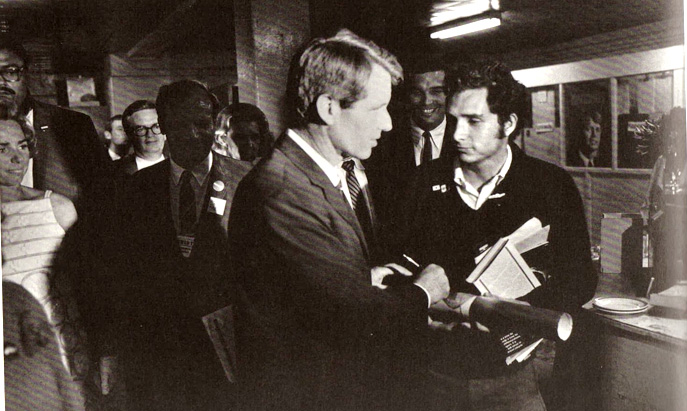
    RFK signs poster for bystander Michael Wayne minutes before he is assassinated.

    Yet, as Faura details, there were three people who were not acting like this at all.  They were not panic-stricken or overcome with grief.  They were intent on escaping from the room.  These were the girl, her original companion, and a man named Michael Wayne—who we shall discuss later.

    As the reader can see from this brief précis, ample evidence exists that Sirhan was being manipulated.  More than ample evidence exists that the girl was a key part of that manipulation.  John Fahey spent the day of the assassination with the girl. He then dropped her off at the Ambassador Hotel.

    IV

    Robert Parry

    As noted, Fahey came to see Faura after he read his first story on the RFK case, which had made the front page of the Citizen-News. Faura would find Fahey’s story so fascinating, so compelling, so potentially important to solving the case, that he recorded it on tape. He then had it transcribed. (Faura, p. 33)

    Fahey worked at a chemical company.  He arrived at the Ambassador that morning on a business matter. While waiting in the coffee shop he met up with an attractive young girl.   She would eventually give Fahey a few names, but the first one she gave him was Alice.  This is one way, Fahey felt, that she was communicating to him she was doing something secretive.  In fact, when he asked her directly what she was doing there, she put him off with words to the effect: I would not want you involved. (ibid, p. 36)  She then walked him over to the RFK headquarters part of the hotel.  She said that Kennedy would be taken care of that night, after his reception. She then said that they were being watched.  Since Fahey mentioned that he needed to travel out to Oxnard later, she asked if she could join him. Fahey accepted and they drove off.  But shortly after they hit the road, it became evident that they were being tailed.  This seemed to genuinely upset her. When Fahey asked why they were being followed, she said it had to do with what was going to happen to RFK after his reception.

    Once the pair got to Oxnard, Fahey decided to go on further to Ventura.  But he noticed that there was now a different tail behind them. (p. 41) Fahey told Faura that she said some strange things that, at the time, he did not really comprehend.  She mentioned getting a false passport to leave the country as soon as she could. She mentioned departing LA on a plane from Flying Tigers Airlines.  She also said she had come to Los Angeles from New York City, where she had met a woman named Anna Chennault.  Fahey thought she might be delusional, or inebriated.

    When they arrived back at the Ambassador it was around 7 PM.  She said she was staying at Olympic and Kenmore, which was nearby.  Fahey commented that it was pretty clear that she knew her way about every nook and cranny of the hotel. When they got back, she went to the back of the hotel.  Spooked, he did not want to be associated with her anymore. (p. 52)

    After the assassination, Fahey understood what had happened.  He went to the FBI, who interviewed him and said they would recall him. Fahey and Faura went over the route Fahey said he had driven with the girl. Fahey was very specific about where they stopped for lunch and where he got a flat tire.  Faura then took him to the police.  The reporter gave them a copy of the transcript. They also asked for the original tape to duplicate.  Which, of course, Faura did not get back until 20 years later, when it was declassified at the California Archives in Sacramento. After the LAPD interviewed Fahey they told him not to discuss his story, and for Faura not to write about it. They based the latter on a gag order placed over the upcoming Sirhan trial. Faura thought it was nonsense to apply this to the press.  But clearly LAPD was fearful that Fahey would give credibility to Serrano’s story.

    By this time, Faura was getting suspicious about what the LAPD and FBI were actually doing.  Reportedly, the Bureau had four hundred agents working the RFK case.  LAPD had set up a select unit inside the force called Special Unit Senator to investigate the case.  Yet both seemed to want to ignore the most credible leads. In fact, as Faura would later learn, LAPD wanted to discredit them—as they would attempt to do with both Serrano and Fahey.  They actually wanted to make the Girl in the Polka Dot Dress disappear, since she epitomized a sophisticated plot to kill Kennedy.

    Herbert Spiegel

    Therefore, Faura decided to go ahead and commission a drawing of the girl from Fahey’s memory.  He then got the sketch illustrated into a portrait.  This would serve as an identification instrument for other witnesses. (p. 80)

    On June 19th, Fahey called Faura and told him he was going to the Ambassador Hotel.  The FBI told him they had found the girl.  Faura found out they were actually going to pick her up and have Fahey identify her at the Kenmore Hotel, which was behind the Ambassador. Faura called Bonfante. He brought down a photographer to memorialize the moment.  The Bureau had been tipped off by Ty Hammond, manager of the Kenmore.  But it turned out that the Bureau had arrived too late and the girl was gone.  Disappointed and frustrated, Faura  decided to give Hammond the portrait of the girl.  Hammond said that yes, it looked like her. (p. 96)  He also said the girl had Arab friends and she always entered the Ambassador from his hotel.  She was not actually staying there, but lived in the nearby neighborhood.  But he was not sure she was still there.

    Just as the chase for the girl was beginning to bear some fruit, the police now called it off.   On June 21st, according to the authorities—most notably DA Evelle Younger—Serrano had taken back her story.  As the public later learned, this was not actually true, and it was done under duress. It was part of the attempt by local authorities to make the girl disappear.  By hook or by crook. (ibid, pp. 107-08)  But it actually went further than that.  Because now, his sources of information began to dry up.  When he went to see Hammond, he would not cooperate any further.  When he called Fahey, he told the reporter the FBI had seen them together and wanted him to cut off this association.

    But Faura continued to investigate.  He found two other witnesses who said they saw Sirhan with the girl.  Jose Carvajal who worked at the Ambassador saw the two talking with Sirhan on a terrace in front of the rear door of the hotel.  Vincent DiPierro saw the two seconds before the shooting.  He said that the girl smiled at Sirhan right before he began firing.  When DiPierro looked at the portrait, he had only slight modifications to the illustration.  (Pp. 117-20)

    But as the author notes, what was so odd about this was that Faura learned that the FBI was also still looking for the girl. And so was the LAPD.  But if Serrano had been discredited, and the girl did not exist, then why were they still crossing paths?  And why had Fahey been fired from his job?  (p. 136)

    An example of the continuing search for the girl was that both Faura and the FBI interviewed a woman named Pam Russo.  She said she had seen the girl with Sirhan at Rafferty’s gathering prior to the shooting.  But further, she also said that someone at Rafferty’s actually tackled a man trying to escape the pantry after Kennedy had been shot.  (p. 140)

    Which leads us to Gregory Clayton and Michael Wayne.  Clayton was the bystander who Russo was referring to who tackled a man running out of the pantry—Michael Wayne.

    V

    When Faura found out about Clayton, he tracked down his house and visited him in person. The witness told the reporter that he had seen Sirhan at Rafferty’s that night with the girl.  (p. 151)  He said that, at the Ambassador later, after he heard the first shot, he ran to the entrance of the kitchen pantry. He tackled a man running away from the murder scene.  He said there were actually two men who seemed to be fleeing together. One had an object in his hand, which appeared to “flash”.  The other man was in such haste that he was knocking a news photographer onto a table and into some chairs.  When Clayton yelled for a nearby security guard, the man with the flashing object in his hand ran the other way, into the hallway.  Clayton tripped the other man, who was then subdued by the guard.  According to the witness, the man they subdued had a “look of madness in his eyes, as if he had rabies.” (p. 153)  He then kept saying, “Let me go. Gotta get out of here. Let me go.”  As Faura later notes, these were not the words of an innocent bystander.  Clayton picked up a paper that Wayne had been carrying. It was a rather bizarre bumper sticker that read, “Kennedy Assassination a Death Hoax.”

    As anyone reading the above would understand, the Clayton story suggests there was more than one gun involved in the RFK murder.  As does the Brown/Sirhan transcript.  Because in one of these sessions Sirhan said that, during the shooting, he saw the flash of another gun firing.  (p. 212)  Finally, as almost everyone who has seen a photo of Wayne knows, the running man, who said he had to get out of here, all with a look of madness in his eyes, resembled Sirhan.

    Faura managed to temporarily make amends with Fahey.  Like a good reporter, he did two things to try and certify his story.  First, he gave him a polygraph test, which he passed.  (p. 181)  He then found the waitress who served Fahey and the girl at a restaurant in Oxnard.  Her name was Janis Page.  (p. 173) The LAPD did their best to negate both of these achievements.  They got Page to keep her mouth shut after she talked to Faura, and they gave Fahey their own version of the polygraph.  This was through their old reliable Hank Hernandez.  (p. 185) As many authors have shown, when LAPD wanted to discredit a witness, they turned him over to Hernandez.

    After this, Faura’s efforts became comparable to Albert Camus’ Myth of Sisyphus: rolling a rock up a hill, only to see it roll back down.  Fahey cut off relations with him for good.  Bonfante let him know that his supervisors at Life had told him that they would not finance any further inquiry into the RFK case.  The author tells us that this change came after a call from Washington.  (p. 191)

    Faura equates the last with the subtitle of the book, the “Paris Peace Talks Connection.”  Some background will be required for this aspect of the book.  As previously noted,  the girl told Fahey that prior to her coming to Los Angeles she had met a woman named Anna Chennault.  She also mentioned that she might be able to fly out of town on CAT or Flying Tiger Airlines. (p. 61)

    William Turner

    Anna Chennault was the Chinese wife of former military pilot Claire Chennault. Claire became famous as an aviation pilot aiding the Chinese struggle against Japan during World War II.  His initial volunteer squad was called the Flying Tigers.  This was replaced when the USAF formally entered the war and operated in the China-Burma-India air theater.

    After the war, Chennault, a big backer of the nationalist Taiwan government, created something called Civil Air Transport (CAT).  This supplied freight into Taiwan, aided the French struggle to keep their Indochina empire, and aided the Kuomintang’s occupation of Burma in the mid and late fifties.  It also helped in the early years of the American occupation of South Vietnam.

    Faura used the later dropping of these names by the girl—Fahey recalled them later, after his recorded interview—to perform two rather large functions.  He connects the girl and Chennault to the deliberate sandbagging of President Johnson’s peace talks, and he then suggests that people like candidate Richard Nixon, future Vice-President Spiro Agnew, future Attorney General John Mitchell and Senator John Tower were in on the RFK assassination.  (p. 207)

    As regards the former, Faura is referring to the rather recently discovered files by journalist par excellence Robert Parry.  Parry discovered  a file put together by National Security Advisor Walt Rostow at the Johnson Library.  That file contained information garnered by the FBI and the National Security Agency about Nixon’s efforts to subvert Johnson’s attempt to get a peace conference with the North Vietnamese prior to the fall election of 1968.  Perceiving this to be a boon for the Democrats, Nixon set out to deep-six that diplomatic effort.  Nixon did use Republican lobbyist and fundraiser Anna Chennault to communicate with the South Vietnamese government, advising them to stall Johnson, promising Nixon would give them a better deal once he was elected.

    The problem with Faura’s theory here is that, as author Ken Hughes has shown, those efforts did not begin until over a month after Robert Kennedy was killed. It was not until July 12 that Nixon alerted Chennault that she would be his go-between for these efforts to obstruct Johnson.  So if she was not aware of that function until then, how and why could she have been used prior to June 5th in the RFK plot?

    Also, although Faura mentions John Tower as a possible co-conspirator, in rereading some of the literature on Parry’s fine site, Consortium News, I could not detect his name in any of the declassified files on the illicit episode.  So, as far as I can see, the top-level players involved were Nixon, Agnew and Mitchell. Mitchell had been at the meeting in July of 1968 where Nixon appointed Chennault as his emissary. (In an interview with journalist Jules Witcover in 1994, Chennault did say that Tower did have knowledge of her mission.  See Baltimore Sun, 8/18/2014) And FBI wiretaps seem to indicate that Chennault was getting instructions from Agnew in late October of the campaign. But all of these efforts and communications are to thwart Johnson.  Just because The Girl in the Polka Dot Dress had met Chennault in New York, what is the evidence that the men mentioned above were part of the plot to kill RFK?  And if they had been, the girl would not be musing about getting a passport and flight on CAT.  She would have had her passport and been on a plane the next day.

    From what I have learned about the RFK case from writers like Turner, Melanson, and Lisa Pease, most of the evidence inherent in the crime—the MK/Ultra aspect, the associations of the leaders of SUS Hernandez and Manny Pena, the presence of former Iranian intelligence officer Khaiber Khan at RFK headquarters—seems to indicate a CIA modus operandi.

    I also have some formal criticisms of the book.  Faura was, for all intents and purposes, a participant in the RFK investigation as it unfolded. He was not an academic or a historian looking back at a past event he did not have a hand in.  Therefore, his book could have and should have been written from a first person point of view—but it is not.  At times, the author refers to himself as ‘Faura’.  Before Jim Garrison started his memoir on his inquiry into the JFK assassination, his editor Zach Sklar insisted he write it in the first person. He did this since he thought it would create personal drama and invite reader empathy, since they would be watching a real life protagonist progress through unchanneled and dangerous waters.  Sklar was correct and Garrison was grateful for that advice.  Well, someone at Trine Day publishing should have insisted on the same thing in Faura’s case.

    Also, I would have advised Faura not to use the very short chapter approach he does, some of them being literally less than two pages.  This is not the way to build and cap sustained interest.  Finally, in this vein, Faura excerpts into the book long sections of taped interrogations he did.  Again, not all that scintillating to read.  I wish he had summarized the less important parts of the interviews and only given us the key parts in the Q an A format.

    In his discussion of the Scott Enyart trial over the photos Enyart took in the pantry of the actual assassination, the (wrong) photos did not show up during the trial, but just prior to it.  (p. 219)  Finally, the author seems unkind about RFK researcher Ted Charach.  Faura does score him for some personal shortcomings.  And I agree with them. But to say that the last he heard of Charach he was still trying to sell a vinyl record—that seems really unkind and uncareful.  Charach’s 1973 film, The Second Gun, was nothing less than a breakthrough in the Bobby Kennedy case.  In fact, that film is still worth seeing today. Also, as reporter David Manning noted in an article on the Enyart trial for Probe Magazine, Charach was one of the key witnesses that turned the case in Enyart’s favor.

    All in all, we finally have a record of one of the very, very few mainstream reporters who actually delved into one of the assassinations of the sixties. Who tried to do an honest job and who actually tried to follow the evidence wherever it was headed.  He found out the hard way that the local authorities—the police, the DA’s office, Mayor Sam Yorty—did not want to do that in the least.  In fact, they were determined to not only avoid that path, but to discredit those who tried.  Including the author. This book is his testament to that process.

  • Howard Willens and The American Scholar

    Howard Willens and The American Scholar


    How far the Warren Report has fallen in public estimation is an almost humorous subject. When it was first issued in the fall of 1964, the report was met with almost universal acclaim as an historically unquestionable document. All branches of the media – the press, television, periodicals and radio – accepted it with almost no reservations. Perhaps because none of the commentators had read the nearly 15,000 pages of accompanying evidence, which was not published until a month later. To show just how strange this reception was, and how lacking in rigor the media examination was, CBS prepared a two-hour documentary on the Warren Report the day it was published! Clearly, this show was being prepared in advance of the release of the report. In other words, CBS had accepted the Warren Report without reading it. Or, someone in the government passed them a copy before anyone else had it.

    Yet, this mass propaganda deployment did not hold. Within three years, the majority of Americans now doubted the main tenets of the Warren Report. And that figure has never dipped below a majority in the nearly fifty years since. Which is a tribute to both the work of the critical community and the good sense of the American people. Because the members of the Warren Commission have never let up in their attempts to reinculcate the public with their fallacious verdict based upon, at best, incomplete evidence.

    For instance, when Oliver Stone’s film JFK was released, David Belin appeard at the National Press Club to criticize the film. (Click here for that appearance https://www.c-span.org/video/?25215-1/kennedy-assassination-controversy). When the late Dr. Charles Crenshaw, who was in residence at Parkland Hospital in 1963, published his book Conspiracy of Silence suggesting something was awry with the autopsy of President Kennedy, Belin appeared in the pages of the Dallas Morning News to denounce his book. Years earlier, Commission attorneys David Slawson and Wesley Liebeler communicated with the Justice Department to construct a limited medical examination that would hinder Jim Garrison’s investigation in New Orleans. And as Pat Speer has shown, in all probability, before Arlen Specter passed away, he got in contact with New York TImes journalist Phil Shenon to coax him into writing his limited hangout book, A Cruel and Shocking Act. (Click here for our review)

    Wesley Liebeler, Arlen Specter and David Belin have all since passed away. So today, Commission counsel Howard Willens is the most active participant in sustaining the verdict of the Warren Commission into the new millennium. In 2013, he wrote an ill-titled volume called History Will Prove Us Right. The review at this site by Martin Hay was so scathing, Willens actually replied to it on his personal web site. (Click here for Hay’s review http://www.ctka.net/reviews/willens.html, and here for Willens’ reply http://howardwillens.com/jfk_history/conspiracy-communitys-response-book/) Willens’ reply was so weak and unfounded that Martin had little trouble demolishing it also. (Click here http://themysteriesofdealeyplaza.blogspot.com/2014/06/the-watchman-waketh-but-in-vain-howard.html) Apparently, Willens did not learn his lesson. Or he is a glutton for punishment. He has sallied forward again. This time he has joined forces with survivng member Richard Mosk.

    Attorneys Willens’ and Richard Mosk’s latest defense appears in, of all places, The American Scholar. This essay on their work for the Warren Commission they served on is more notable for what they omit from the official record than what they include. “What the critics often forget or ignore,” they write, “is that since 1964, several government agencies have also looked at aspects of our work” (American Scholar, Summer, 2016, p. 59). As if the Church Committee and the House Select Committee on Assassinations (HSCA) had reviewed and applauded the commission’s work. Indeed, they did look at it. But rather than plaudits, they issued stinging rebukes, principally for the commission’s having been rolled by J. Edgar Hoover, and to a lesser extent, by the CIA and the Secret Service.

    “It must be said that the FBI generally exhausted its resources in confirming its case against Oswald as the lone assassin,” the HSCA concluded, “a case that Director J. Edgar Hoover, at least, seemed determined to make within 24 hours of the of the assassination.”1 In essence, the experienced investigators concluded that Hoover had divined the solution to the crime before the investigation began, and then his agents confirmed the boss’s epiphany. The intimidated commission went right along. And with good reason, only part of which Mr. Willens tells.

    He admits that the “FBI had originally opposed the creation of the Warren Commission,” and that Hoover “ordered investigations of commission staff members.” But he doesn’t reveal that Hoover deployed one of his favorite dirty tricks to deal not only with lowly support staffers, such as Mr. Willens, but also with the heralded commissioners themselves. “[D]erogatory information pertaining to both Commission members and staff was brought to Mr. Hoover’s attention,” the Church Committee reported.2 (emphasis added)

    Willens and Mosk also forgot to mention that Hoover had a personal spy on the Warren Commission, then Rep. Gerald Ford, who tattled on Commissioners who were (justifiably) skeptical of the Bureau’s work. “Ford indicated he would keep me thoroughly advised as to the activities of the Commission,” FBI executive Cartha DeLoach wrote in a once secret memo. “He stated this would have to be done on a confidential basis, however he thought it should be done.”3 At the bottom of the memo, Hoover scrawled, “Well handled.”4 The success of Hoover’s machinations was obvious to subsequent government investigators.

    The HSCA’s chief counsel, Notre Dame Law Professor Robert Blakey, an experienced criminal investigator and prosecutor, was impressed with neither the Commission’s vigor nor its independence. “What was significant,” Blakey wrote, “was the ability of the FBI to intimidate the Commission, in light of the Bureau’s predisposition on the questions of Oswald’s guilt and whether there had been a conspiracy. At a January 27 [1964] Commission meeting, there was another dialogue [among Warren Commissioners]:

    “John McCloy: ‘… the time is almost overdue for us to have a better perspective of the FBI investigation than we now have … We are so dependent on them for our facts … .’

    “Commission counsel J. Lee Rankin: ‘Part of our difficulty in regard to it is that they have no problem. They have decided that no one else is involved … .’

    “Senator Richard Russell: ‘They have tried the case and reached a verdict on every aspect.’

    “Senator Hale Boggs: ‘You have put your finger on it.’ (Closed Warren Commission meeting transcipt.)”5

    Testifying before the HSCA, the Commission’s chief counsel J. Lee Rankin shamefully admitted, “Who could protest against what Mr. Hoover did back in those days?”6 Apparently not the President’s commissioners. The HSCA’s Blakey also reported that, “When asked if he was satisfied with the (Commission’s) investigation that led to the (no conspiracy) conclusion, Judge Burt Griffin said he was not.”7 Moreover, author Gus Russo reported that Griffin also admitted that, “We spent virtually no time investigating the possibility of conspiracy. I wish we had.”8

    Thus, despite their clear misgivings, rather than truly investigate, the Commissioners bowed to the notoriously corrupt and imperious Bureau chief. This policy had serious repercussions when the Commission confronted two key issues: published claims that Lee Harvey Oswald had been an FBI informant, and the possibility Jack Ruby had a relationship with organized crime.

    “The Commission did not investigate Hoover or the FBI, and managed to avoid the appearance of doing so,” HSCA investigators determined. “It ended up doing what the members had agreed they could not do: Rely mainly on the FBI’s denial of the allegations (that Oswald had been a Bureau informant).”9 Hoover merely sent the Commission his signed affidavit declaring that Oswald was not an informant, and he also “sent over 10 additional affidavits from each FBI agent who had had contact with Oswald.”10 And with those self-exonerating denials, the case was closed.

    About Jack Ruby: in 1964 the FBI had his phone records, yet failed to spot Ruby’s obvious, and atypical, pattern of calls to known Mafiosi in the weeks leading up to the assassination. After performing the rudimentary task of actually analyzing those calls, the HSCA determined that, if not a sworn member of La Cosa Nostra, Ruby had close links to numerous Mafiosi.11 Thus the HSCA found that the Commission was wrong in concluding that, “the evidence does not establish a significant link between Ruby and organized crime.”12

    The list of Commission shortcomings the HSCA assembled is not short. A brief summary of them runs some 47 pages in the Bantam Books version of the report (pp. 289-336), which outlines what required much of the 500 pages of HSCA volume XI to cover (available on-line).13 “The evidence indicates that facts which may have been relevant to, and would have substantially affected, the Warren Commission’s investigation were not provided by the agencies (FBI and the CIA). Hence, the Warren Commission’s findings may have been formulated without all of the relevant information.”14 The Church Committee said that the problem was that “… the Commission was perceived as an adversary by both Hoover and senior FBI officials.” “Such a relationship,” Committee observed, “was not conducive to the cooperation necessary for a thorough and exhaustive investigation.”15

    But the FBI did more than just withhold evidence from the Commission. Although he mentions that the FBI destroyed a note Oswald wrote to Agent Hosty and withheld that information from the Commission, Mr. Willens doesn’t mention that Agent Hosty reported that his own personnel file, and other FBI files, had been falsified.16 Nor that author Curt Gentry learned from assistant FBI director William Sullivan that there were other JFK documents at the Bureau that had been destroyed.17

    Although too numerous to explore here, American Scholar readers should understand that legitimate questions persist about issues Messrs. Willens and Mosk consider settled. These include the notorious Single Bullet Theory and JFK’s hapless autopsy,18 to name but two. But if the authors cannot even be completely honest with what the HSCA and Church Committee wrote about them, then should one trust them with those two radioactive issues?


    Notes

    1 House Select Committee on Assassinations Final Report, p. 128. On-line at: https://www.maryferrell.org/showDoc.html?docId=800#relPageId=158&tab=page.

    2 In: Final Report of the Select Committee to Study Governmental Operations, Book V, p. 47, on-line at: https://www.maryferrell.org/showDoc.html?docId=1161#relPageId=53&tab=page. Also cited by: Curt Gentry. J. Edgar Hoover – The Man and His Secrets. New York: W. W. Norton & Co., 1991, p. 549.

    3 “Ford Told FBI of Skeptics on Warren Commission”, By Joe Stephens, Washington Post Staff Writer, Friday, August 8, 2008. On-line at: http://www.washingtonpost.com/wp-dyn/content/article/2008/08/07/AR2008080702757_pf.html.

    4 See copy of actual memo at Mary Ferrell: http://www.maryferrell.org/showDoc.html?docId=61488#relPageId=100.

    5 In: R. Blakey and R. Billings. Fatal Hour – The Assassination of President Kennedy by Organized Crime. New York: Berkley Books, 1992, p. 29. This testimony was also published in: Mark North. Act of Treason. New York: Carroll and Graf, 1991, p. 515-516.

    6 House Select Committee on Assassinations, Vol. XI, p. 49, on-line at: http://www.maryferrell.org/showDoc.html?docId=83#relPageId=55&tab=page.

    7 Blakey and R. Billings. Fatal Hour – The Assassination of President Kennedy by Organized Crime. New York: Berkley Books, 1992, p. 94.

    8 Gus Russo. Live by the Sword. Baltimore: Bancroft Press, 1998, p. 374.

    9 HSCA, Vol IX, p. 41. On-line at: http://www.history-matters.com/archive/jfk/hsca/reportvols/vol11/pdf/HSCA_Vol11_WC_2_FBI_CIA.pdf.

    10 HSCA, Vol IX, p. 41. On-line at: http://www.history-matters.com/archive/jfk/hsca/reportvols/vol11/pdf/HSCA_Vol11_WC_2_FBI_CIA.pdf.

    11 See excellent discussion in: House Select Committee on Assassinations Final Report, p. 148-156, on-line at: http://www.maryferrell.org/showDoc.html?docId=800#relPageId=178&tab=page.

    12 Warren Report, p. 801. On-line at: http://www.archives.gov/research/jfk/warren-commission-report/appendix-16.html.

    13 http://www.history-matters.com/archive/contents/hsca/contents_hsca_vol11.htm.

    14 HSCA, Vol. XI, p. 59. On-line at: http://www.history-matters.com/archive/jfk/hsca/reportvols/vol11/pdf/HSCA_Vol11_WC_2_FBI_CIA.pdf.

    15 In: Final Report of the Select Committee to Study Governmental Operations (Church Committee), Book V, p. 47, on-line at: https://www.maryferrell.org/showDoc.html?docId=1161#relPageId=53&tab=page.

    16 James P. Hosty, Jr. Assignment: Oswald. New York: Arcade Publishing, 1996, pp. 178-180, 184-185, 243-244.

    17 Curt Gentry. J. Edgar Hoover – The Man and His Secrets. New York: W. W. Norton & Co., 1991, p. 546, footnote.

    18 The Chairman of the Forensics Panel of the HSCA, former New York Coroner Michael Baden, MD, has written, “Where bungled autopsies are concerned, President Kennedy’s is the exemplar.” See Baden, Michael M., Unnatural Death: Confessions of a Medical Examiner. New York: Ivy Books, published by Ballantine Books, 1989, p. 5. See also, Larry Sturdivan, The JFK Myths, chapter 10, “Bungled Autopsy,” St. Paul, MN: Paragon House, pp. 185-220.

  • Joan Mellen, Faustian Bargains

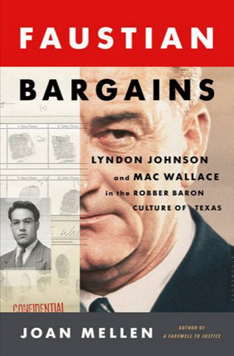
    Joan Mellen, Faustian Bargains


    In 1998,  the late JFK researcher Jay Harrison had a brainstorm. It was simple in concept.  He would secure a fingerprint impression left unidentified by the Warren Commission from one of the boxes on the sixth floor of the Texas School Book Depository. He would then secure the fingerprints of Malcolm Wallace, the man accused by ex-con Billy Sol Estes of being a hit man for Lyndon Johnson.  Estes had accused Wallace of killing John Kennedy.

    Once Harrison had these two fingerprint samples, he would then enlist a fingerprint analyst to examine them.  If it was Wallace’s print on the box, then one could safely assume that he was on the sixth floor either during, or immediately after, the Kennedy assassination.  This would indicate that somehow Johnson was involved with the JFK hit; or else why would Wallace be there?

    As many have noted, it was really Estes who had drawn the crime in this manner, i.e., with Johnson as the prime mover and Malcolm Wallace as the assassin, or chief of the hit team. He had done the first part—LBJ as the prime force behind the JFK hit—in an aside to a man named Clint Peoples, a Texas lawman who had escorted him off to jail.  (Joan Mellen, Faustian Bargains, p. 230) The second part—Wallace as assassin—was done years later, when Estes got out of jail and testified before a grand jury.  That grand jury had been called to reopen the 1961 murder of another Texas law man, Henry Marshall.  Marshall was investigating some of Billy Sol’s crimes in Texas.  Right before the case was about to explode, Marshall was murdered by rifle fire.  He had been shot multiple times.  Incredibly, the local sheriff ruled the death a suicide.  In 1984, Estes got out of prison, after his second stay there.  He appeared before the Marshall grand jury.  He implicated Malcolm Wallace as the killer of Henry Marshall. Wallace had done this at the behest of Vice President Lyndon Johnson. For whom he had also killed President Kennedy.

    If Harrison’s concept turned out to be true, then it would give new credibility to the accusations of Billy Sol Estes, who many observers had severe doubts about. Estes had promised things like tape recordings and phone records to bolster his case, but he had never produced these exhibits, even when he was asked for them by Stephen Trott of the Justice Department. 

    Harrison enlisted two fingerprint analysts to confirm or deny that the prints matched.  One was Nathan Darby; the other was Harold Hoffmeister.  Darby went first.  After examining the prints he decided they matched at 14 points of identification.  Which would be good enough for a criminal legal action.  Hoffmeister then said he agreed.  But a day later, he recanted.  He said that after doing a re-examination, he felt that since both men worked with photocopies, the identification points were not adduced in a reliable manner.  (Mellen, Faustian Bargains,  p. 256)  As we shall see, Hoffmeister’s complaint was a legitimate one. But Harrison felt that he had recanted out of fear, since he had now found out who the print examination involved.

    So Harrison went ahead.  A press conference was called.  Darby’s work was submitted to the homicide division of the Dallas Police Department and to the FBI. (ibid)  The Bureau ended up disagreeing with Darby, but they did not submit any specific critique of his work. Harrison and his coterie therefore continued along in their mini campaign about Johnson and Wallace killing Kennedy.

    And it caught on.  In fact, it caught fire in 2003 for the fortieth anniversary of the Kennedy assassination.  In that year, a man named Barr McClellan wrote a book—this reviewer would call it a novel—about the same topic. Blood, Money and Power said Johnson had organized the JFK assassination and Malcolm Wallace was the chief of the hit team.  McClellan claimed inside knowledge from his work for a law firm that handled some of Johnson’s affairs in Texas.  McClellan’s book sold well, and it featured an appendix with the alleged Harrison/Darby fingerprint match.  In fact, Harrison had helped McClellan on his book—although, to be fair to Jay, he did not at all approve of the final draft of the volume.  (ibid, p. 265)

    During the fortieth anniversary media extravaganza, McClellan got more television and radio time than any other conspiracy advocate.  This was topped off by the ever-gullible documentary producer Nigel Turner. The laughably uncritical Turner made McClellan the main talking head on his pretentiously entitled program The Guilty Men. Needless to say, the Austin conspiracy demagogue Alex Jones also bought into McClellan.

    But that was not all. The Harrison/Darby cooperation now seemed to spawn a bevy of books that, retroactively, endorsed the Billy Sol Estes paradigm of Johnson/Wallace. Among others, these included later editions of The Men on the Sixth Floor by Glenn Sample and Mark Collom, LBJ: Mastermind of JFK’s Assassination by Philip Nelson,  and Roger Stone’s The Man Who Killed Kennedy: The Case Against LBJ. These books all endorsed, to various degrees, the Harrison/Darby print analysis.

    But  the longer the parade marched on, the odder a certain aspect of this acceptance began to appear. First, no one had done an independent analysis of the print match.  After all, Hoffmeister had recanted based upon the quality of the materials he and Darby had to work with.  Apparently this did not mean much to the leaping exegetes ready to board the ”LBJ did it” train.  Second, no one worked on a real biography of Malcolm Wallace.  Was he known as a professional killer?  Did he have a close association with the people Estes said he did:  like LBJ’s factotum in Texas Cliff Carter, Estes himself, and Johnson? Was he politically committed to everything JFK was against?  If not, was there any way to see if he had monetarily profited from all the murders that Estes said he had performed for LBJ? And perhaps the most important evidentiary point of all: Was there any evidence that Wallace was elsewhere on the days that both Marshall and Kennedy were murdered?

    Incredibly, no one seriously posed these questions for well over a decade.  Innocent outsiders who listened to the LBJ cacophony were, understandably, impressed:  with all that noise emanating from so many bongo drums, there had to be a real signal in there somewhere; it couldn’t all be much ado about nothing. Could it?

    II

    This reviewer, among several others, always had some reservations about the Harrison/Darby identification. One being: Why would Johnson use someone who was—however tenuously—associated with him in the assassination? Another was:  If Johnson and Wallace decided to go ahead and kill Kennedy anyway, would not a professional hit man use gloves to make sure he left no fingerprints behind?

    Joan Mellen decided to take the issue the proverbial whole nine yards.  In 2013 I heard her speaking about the subject of the LBJ/Wallace nexus at the Cyril Wecht conference in Pittsburgh.  To her, there was something suspicious about the entire enterprise.  Why had so many people mindlessly enlisted in the ranks without asking any of the skeptical questions mentioned above, or making any serious attempt to cross check the Harrison/Darby work?  Since it appeared no one else was going to do it, she did.

    The result of her years of work is a book called Faustian Bargains: Lyndon Johnson and Mac Wallace in the Robber Baron Culture of Texas. The book has several notable achievements. First, the portrait of Lyndon Johnson she draws is, quite simply, indelible.  It is so unremitting that, by the end of the book, it had me saying to myself: enough already. For, as I will explain, I think she might have overdone it.  Secondly, for the first time, we actually get a biography of Malcolm Wallace.  He is not a cipher anymore.  Third, in the supporting cast, we get a full look at the character of wheeler-dealer Billy Sol Estes—and to a lesser extent Bobby Baker.  And finally, Mellen has enlisted a professional reassessment of the Harrison/Darby fingerprint identification.  It is unfortunate that it took nearly 20 years for this to occur.  But that says something about the JFK critical field, does it not?

    This reviewer has read several biographies of Lyndon Johnson.  But few, if any, go as far in their indictment of his character and crimes as Mellen does.  Mellen begins at a familiar point: Johnson going to Washington in 1931 as secretary to congressman Dick Kleberg. (Mellen, p. 5) Kleberg was part of the King Ranch clan, so Johnson was not exactly siding with the little guy during the Great Depression.  But once Franklin Roosevelt was inaugurated, Johnson enlisted in the ranks of the New Deal.  And he insisted that Kleberg vote for the New Deal programs he was personally  against.

    In 1935, Johnson left Kleberg’s office to take a position he had been offered in Roosevelt’s National Youth Administration. (ibid, p. 6)  Then in 1937, Johnson ran for Congress in an open seat election.  He won and maneuvered to be appointed to the House Naval Affairs Committee. It is at this point that the young Johnson began his close association with the infamous construction company Brown and Root.

    Founded in Texas in 1919 by Herman Brown and Daniel Root, when the latter died, it came under the control of the Brown brothers, Herman and George.  Once Johnson was in Congress, he began a quid pro quo program with the brothers.  He would steer lucrative federal contracts their way, and benefit in turn from large cash contributions made to his political campaigns.  By the end of World War II, Brown and Root had done over 300 million dollars worth of work for the Navy. (p. 9)  In return, the brothers contributed over 100,000 dollars to Johnson’s 1941 Senate campaign, which he narrowly lost, even though he spent $750, 000 total, the equivalent of over $12 million today. And the population of the state at that time was slightly more than six million.

    In 1941, Johnson purchased KTBC radio in Austin for seventeen thousand dollars, or well over a quarter of a million today. (Mellen, pp. 11-12) This was done in his wife Lady Bird’s name, and allegedly with her money.  But Mellen unearthed a long buried report by Life magazine reporter Holland McCombs. His work was done during the Johnson/Goldwater campaign of 1964.  McCombs went to Texas and did some on-the-ground sleuthing.  According to his reports, Lady Bird did not have that kind of money back then either.  The implication being that the Brown brothers facilitated the purchase as a payoff to their man LBJ. After an appeal to the FCC, the station was allowed to raise its wattage, alter its frequency, and broadcast 24 hours.  This greatly increased its profit margins and it later became a CBS affiliate.  That purchase was the beginning of the Johnson media kingdom.

    This is all a prelude to the infamous Senate election of 1948, one which Johnson and his backers were determined not to lose.  Johnson had previously helped George Parr, a Texas political chief from the southern end of the state, gain a pardon on a tax evasion charge. (ibid, p. 47)  He also helped Parr gain revenge on Dick Kleberg who had resisted the pardon. LBJ recruited a candidate to run against Kleberg, and Johnson’s candidate won.  Along with his continued illicit favors for Brown and Root, this put him in a good position for the 1948  senatorial race.  When it was all over, Herman Brown had invested a half million to get Johnson elected to the Senate. (ibid, p. 53)

    The problem was that his opponent, Governor Coke Stevenson, was quite formidable.  Stevenson had been a long term Speaker of the Texas Assembly, then Lt. Governor, and then a two-term governor. In fact, Parr had helped Stevenson in previous elections steal hundreds, if not thousands, of votes in his tri-county area. (ibid, p. 51) But Parr was quite appreciative to LBJ about his pardon.  He agreed to do all he could to help him win this election. (ibid, p. 50)  Did he ever.

    A lot was at stake.  Whoever won the Democratic primary was pretty much guaranteed to win the seat in Washington since, at that time, the Republican party was pretty weak in Texas.  When the first tallies came in, Stevenson was winning by about 20,000 votes.  But when San Antonio came in, Stevenson’ s lead was cut in half.  And as the Parr-controlled counties in the south came in, Stevenson’s lead was eroded further.  As Mellen notes, Duval County, under Parr control, cast well over four thousand votes. Surprisingly, only forty were for Stevenson.  (p. 51)  LBJ went on the radio and declared himself the victor, even though, officially, Stevenson was still in the lead by over a hundred votes.

    Then came Precinct 13 in Jim Wells County, also under Parr control.  Officially only six hundred votes were cast.  Yet in the first tally, Johnson got over seven hundred votes.  Later, in an amended tally, Johnson got over nine hundred votes, wiping out Stevenson who got less than a hundred. (Mellen, p. 51)  Johnson won the state primary by 87 votes.

    It turned out, of course, that Parr had stacked the vote with people who had not voted.  Stevenson tried to fight back. But at a later meeting of the executive committee of the Democratic Party, he narrowly—by one vote—lost a motion to file an official protest. A federal district judge then ordered Johnson’s name off the ballot pending an inquiry.  But Johnson’s legal crony, Abe Fortas, got Hugo Black of the Supreme Court to void the order.  (ibid, p. 55)

    In the general election, Johnson crushed his GOP opponent by a margin of 2-1.  In rather short order, LBJ rose to become one of the most powerful Senate majority leaders in history. It was from that position that he became a player on the national political stage.

    III

    Malcolm Everett Wallace was born in 1921 in Mt. Pleasant, Texas.  He had five siblings.  The family moved to Dallas in 1924.  Wallace was  a participant in many extracurricular activities in high school.  He was the vice-president of his class and played quarterback on the football team. (ibid, p. 15)

    In 1939, he joined the Marines.  But he was forced to leave after ten months due to a serious back injury. (p. 17)  When he tried to reenlist, he was turned down.  He ended up at the University of Texas in 1941.  To say he was active in college life does not do him justice. Among a few other groups, he joined the debate club and worked on the yearbook.  He also was a member of the student assembly.  (p. 18)

    It was in Austin where he met his first, and most long lasting, romantic interest.  Her name was Nora Ann Carroll.  They exchanged Christmas gifts and letters.  He even wrote her poems.  This was the beginning of a relationship that would last, on and off, for about twenty years. (p. 23)

    Wallace ended up being president of his class at Texas.  He seems to have been quite liberal in his orientation.  He wanted the voting age lowered to 18—many years before the Vietnam War.  And he was all for using the power of the government to economically ease the lives of those in poverty.  He was also friendly with Black Americans.  (On his mother’s side, Wallace was one fourth Cherokee Indian.)

    Wallace was a strong president.  He insisted on meeting with the university administrators about matters that concerned him and his constituents. (p. 26)  And he was also interested in liberal candidates in national politics.  For instance, he was quite agitated when Henry Wallace was dropped from the Democratic national ticket in 1944. But Malcolm voted for him in 1948 for president. (p. 76)

    The problem Wallace had at Texas was that the controlling board of the university , the regents, was McCarthyite before the rise of Senator Joe McCarthy. They asked the university president, Homer Rainey, to remove three economics professors because they were too pro-labor.  Rainey refused.  They were removed anyway. (See pp. 29-30)  Rainey wanted to start a school of social work. This was turned down.  After two more confrontations, Rainey was asked to resign.  Rainey refused. Both the faculty and class president Malcolm Wallace backed him.  Wallace hitchhiked to Houston to appear before the Board of Regents.  He spoke for 45 minutes. Rainey was removed anyway.  Wallace then organized a mass demonstration. He led a march of 4000 students to the state capitol building.  Governor Stevenson met with him while the crowd waited outside. (p. 33)  But the regents refused to meet with him. Wallace then led an even larger demonstration, this time with 8,000 students—which was over 90% of the student body.  This failed also.  So Wallace grabbed the microphone at halftime of a Texas/SMU football game to promote his cause.

    Wallace’s extraordinary efforts in the Rainey case actually got him some national exposure in the Chicago Sun. (p. 38) It also earned him an FBI investigation.  But it was all for naught.  Rainey did not return.

    Wallace temporarily left Texas after the Rainey affair.  He went to New York City and attended Columbia and the New School for Social Research.  He earned a degree in economics from the latter.  (Mellen, p. 71)  Wallace returned to Texas to work in Rainey’s unsuccessful bid for governor.  In 1947, Wallace gained a second degree from UT in business.  That same year, Wallace married a woman named Mary Andre Dubose Barton.  (Who will be called Andre from here on.)  Nora had warned him against marrying.  She felt he had done so simply because she had married someone else.  (ibid, p. 74)  Nora turned out to be right.  To say the least, Andre caused Malcolm Wallace a lot of problems.

    It turned out that Andre had an alcohol problem, and was bisexual. When Wallace went to Columbia to pursue an instructor’s position, Andre was rumored to have had a lesbian affair.  So he returned to Texas and the couple had a child, named Michael.  This was unfortunate for Malcolm Wallace since, by all reports, he was quite a good instructor.  (p. 75)

    In 1948, Wallace met Cliff Carter.  In return for working in Johnson’s campaign, Carter got him a job in the Agriculture Department.  Wallace moved to Arlington, Virginia where his wife joined him.  Wallace published three academic papers in the early fifties. Andre decided to return to Austin.  It was at this time that she took up with a former actor and nine hole golf course owner named John Kinser.  (p. 87)

    Wallace returned to Texas and heard about the Kinser/Andre association.  This was further complicated by both men’s relationship with Josefa Johnson, the sister of Senator Johnson.  Wallace had been invited to a gathering at the Johnson residence while he lived in Arlington.  He briefly met the Johnsons—and presumably Josefa—but he always told his children and friends that he actually talked more with Lady Bird than he did with the senator. (See p. 237)

    Horace Busby, a Johnson lackey, told several writers that Wallace had some kind of dalliance with Josefa.  But as Mellen points out, Busby seems to have had it in for Wallace.  During the FBI inquiry for his Agriculture Department job, Busby was the only source that gave him a negative evaluation. (p. 77)  Kinser, a playboy type, was indeed having some kind of an affair with Josefa.  He was trying to charm her so he could get a government loan to expand his golf course.  (p. 83) 

    Wallace felt that Kinser had ruined his wife’s chances for her recovery from her alcohol problem. On October 22, 1951 he went to Kinser’s golf course and shot him.  Witnesses identified his license plate and he was pulled over. The paraffin test determined he had fired a gun. (p. 88)  Nora’s brother, Bill Carroll, recruited one Polk Shelton to defend her sister’s former boyfriend.  Shelton brought in his friend and colleague John Cofer. (p. 96) 

    One of the most interesting parts of the book is Mellen’s explication of how Malcolm Wallace ended up walking away from the resultant murder charge. It was not through any court room pyrotechnics by Johnson’s pal Cofer.  It was through the maneuvering of Shelton with a jury ringer by the name of Deckerd Johnson. To start the trial, Cofer moved for a dismissal on technical and procedural grounds.   This was declined by the judge.  But then Shelton moved for a suspended sentence based on the fact that Wallace had no prior criminal record.  This was also declined, but it was in the record.  (p. 99)

    Johnson was from a small Texas town which contained a few of Mac Wallace’s relatives.   During jury selection, Wallace phoned his uncle who lived in that town.  The uncle called a man named Gus Lanier.  Lanier was an attorney who also was Johnson’s first cousin.   Lanier then went down to the court and sat at the defense table for a few days. He made sure that Johnson saw him shaking hands with Wallace. (ibid)  Johnson did well for his friends and relatives.  He told his fellow jurors that if it was not a unanimous verdict, Wallace would not be retried.  As jury foreman this carried some weight. But it was a false statement that the jurors mistakenly believed. With the first part of his secret agenda achieved, Johnson now went along with the guilty verdict phase of determinations.  But then Johnson, in agreement with Polk Shelton, demanded a suspended sentence.  The others disagreed and wished to send Wallace to prison for a 10-20 year term.  But Johnson threatened them by saying if they did not come back with the suspended sentence, he would change his previous vote, letting Wallace walk without a guilty verdict or any sentence at all.  Johnson’s maneuverings worked.  And this is why the Kinser jury did what it did.  (pp. 103-04)

    IV

    When Lyndon Johnson got to the Senate he continued his old vices.  He developed a close working relationship with the secretary  to the majority leader, Bobby Baker.  Baker was, by his own admission, a professional wheeler-dealer. He had no problem manipulating votes in the Senate for future payoffs, outright bribes, and using his position to advance his private business interests.  Baker and Johnson were close for several years.  But when Baker’s illicit activities caught up with him, Johnson denied any such relationship.

    Baker’s career began its collapse with a lawsuit by one Ralph Hill.  Hill was a business partner of Baker in a vending machine enterprise. Baker demanded high kickbacks with the promise of future defense contracts. When the contracts did not appear, Hill threatened to file a lawsuit.  Baker then made some ominous remarks about Hill’s future health.  In the fall of 1963, Hill filed the action anyway.  (p. 158) This opened up the flood gates.  Shortly thereafter, in early November, Life magazine published a cover story exploring Baker’s activities.  This led Don Reynolds, an insurance salesman, to come forward.  He said that through Baker, he sold LBJ and his wife two large insurance policies.  But then Johnson had requested a gift of an expensive stereo system as a reward for the sale.  This now brought Johnson into the Baker scandals.  (p. 161)  But, by this time, Baker had already stepped down from his position.  This took some steam out of the Senate inquiry, which was not really zealous to begin with, since many senators were associated with Baker’s rackets.

    Then there was Billy Sol Estes.  Estes was a large contributor to Johnson’s Texas campaigns and the 1960 Kennedy/Johnson ticket.  To say that Estes was a con man and fraudster does not really describe the nature and scope of the man’s swindles.  He first specialized in cotton allotments.  He convinced farmers who had their land taken away by eminent domain to purchase land for cotton from him.  He would then lease it back.  Once, a year later, when the first payment was due, by pre-arrangement, the farmer would default.  In other words, Estes had purchased the allotment through lease fees.  But since the transaction was not a genuine sale, the deal was illegal.  He took the money from this fraud to build another fraud. This was in the anhydrous ammonia business—fertilizer.  He sold mortgages on nonexistent fertilizer tanks by convincing farmers to buy them sight unseen. He would then lease them from the buyer for the same amount as the mortgage payment.  He used these phony mortgages to get large bank loans.  The aim was to corner the anhydrous ammonia business.  As many have said, approximately 80% of the fertilizer warehouses were empty.

    The problem with the schemes was that, in his attempt to corner the fertilizer market, Estes was underselling the product so low that he was losing millions in the process.  Not even his cotton allotment scam could bail him out.  (Mellen, p. 140)  The lending companies grew suspicious. They began to suspect the fertilizer warehouses were non-existent.  On top of that, in 1961, even though he said he was worth millions, Estes had paid no income tax in four years. (ibid, p. 141)  As with Baker, an unhappy business partner, Harold Orr, was the first to expose Estes.  He declared that there was no fertilizer in those warehouses.

    A local agriculture official, Henry Marshall, also grew suspicious of Estes’s scams, especially the cotton allotment swindles.  He theorized that Estes was paying farmers a pittance for cotton allotments he could then use to grow abundant amounts of cotton. Which tripled the value of the land. He had been persuaded by Cliff Carter to go along with over a hundred of these deals.  But he now announced that he would not do it again, unless both the buyer and seller appeared before him with all the papers in place.  (p. 141)  Estes had bribed other Agriculture officials. But Marshall was determined. Appreciating Estes’ campaign contributions, Carter and Johnson tried to influence Marshall with a promotion. It did not take.  In early June of 1961, Marshall arranged a meeting with Attorney General Robert Kennedy on June 5, 1961.  He would present his evidence, and Kennedy would now indict Estes and end his scams. (p. 143)  The meeting never took place as Marshall was murdered on Saturday June 3rd.  Although there were indications of attempted carbon monoxide poisoning, the victim died of six gunshot wounds from his own bolt action rifle. The local sheriff, Howard Stegall, proclaimed the case a suicide.  Even more surprising, he got the local coroner to go along with it.

    But the stench was too strong.  Estes was ready to fall anyway. In 1962, a local biweekly newspaper, the Pecos Independent, now began a series of reports on Estes. These exposed both the cotton allotment and fertilizer scandals.  Johnson was upset since he understood that Bobby Kennedy could use this and the Baker scandal to have his brother remove him from the ticket in 1964. (p.  147)  LBJ had J. Edgar Hoover intervene to have the author of the articles removed from the story.  But the owner of the newspaper persisted in his efforts.  He forwarded this information about the fertilizer scam to the FBI through the Justice Department.  Bobby Kennedy now descended on Estes with 75 agents, including 16 auditors and IRS agents.  It was the beginning of the end for Billy Sol. (ibid)

    Estes was convicted in both state and federal courts. He exhausted his appeals in 1965. He then went to prison and was paroled in 1971.  In  1979, he was convicted of tax fraud and went to prison for four more years.  As many authors have noted, including Mellen, Estes always blamed Johnson for his legal problems.  He somehow expected LBJ to help save him, though it is difficult to see how that could have happened after the newspaper series was published and then sent to Washington. To put it mildly, Johnson had very little, if any, influence with Bobby Kennedy.  Once the publisher sent the article to Washington, Estes was doomed—and LBJ could not save him.  Yet, irrationally, Estes seemed to think that he could.  He became obsessed with this idea, and as Mellen shows in an interview, Estes became quite embittered toward Johnson.  It was a bitterness that never left him. (See pp. 242-43)

    V

    And this is how the lives of Mac Wallace and Estes intersected—posthumously.   After the Kinser trial, Wallace sued for divorce from Andre, specifically citing her alcoholism.  (p. 107)  The judge must have believed him since he got custody of the two children, Michael and Meredithe.  He then went to work as a personnel manager in 1952 for Jonco Aircraft in Shawnee, Oklahoma. Evidently, Wallace did not want his kids to grow up without a mother. He and Andre remarried and lived together in Oklahoma.

    Two years later, the family moved back to Texas and Wallace went to work for another defense plant called TEMCO.  This company was founded by D. H Byrd, a longtime friend and backer of Johnson. Mellen notes that there is no direct evidence that Johnson intervened to get Wallace his position there.  But there is circumstantial evidence, since Johnson appears to have secured his secretary’s father a job with TEMCO.

    In 1960, Andre filed for divorce again.  This time, she accused her husband of molesting their daughter. (p. 132 . ONI, which did Wallace’s security clearances, never bought into this; see p. 171)  Wallace now decided to leave TEMCO and Texas for a job in California with an acquisition of TEMCO called Ling Electronics.  He left his two children with Andre and moved to Orange County.

    Wallace spent most of the rest of his life in California working as a control supervisor for Ling.  He married a young woman named Virginia  Ledgerwood.  (p. 169).

    Later on, ONI lowered his clearance from SECRET to CONFIDENTIAL.  This may have been due to a DUI charge Wallace had gotten. It resulted in a demotion at work. Wallace reacted poorly to this.  He got depressed and began drinking even more.  In 1969 he and Virginia divorced and sold their house.  (p. 218)  He used the money to take out insurance policies on his three children—he had a third child with Virginia.  He decided to return to Texas.

    Wallace was dealing with severe health problems at this time. On the ride back to Texas, he passed out in a diabetic coma and sustained a concussion.  A hitchhiker he picked up saved him from even worse injuries. (p. 219)  Because of this, Wallace made out a will in April of 1970.  In the last months of his life, he taught part-time at Texas A&M, and worked part-time at his brother’s insurance office.

    On the evening of January 7, 1971 Wallace died in a single car accident.  He had driven off the road and into a concrete bridge abutment. The policeman who wrote out the accident report felt that Wallace was dead at the scene.  And, in fact, he was pronounced DOA at the hospital. (p. 221) Jay Harrison  questioned whether or not Wallace died that night. But Mellen documents the fact that several of his family members saw the body at the funeral parlor in an open casket.  It was Malcolm Wallace.  To further this idea, Harrison had also stated that Wallace visited his first wife in 1980. Also not true. This was their son Michael, who resembled his father.  (p. 251)

    VI

    In 1979, as he was being carted off to prison the second time, Billy Sol Estes began to carve out the foundation for the LBJ/Wallace murder of Henry Marshall construct.  Estes told his escort, former Texas Ranger Clint Peoples, that Marshall had not killed himself.  The authorities  should be looking in another direction. Peoples assumed this to mean Washington DC.  When Estes got out of jail, he appeared before a grand jury called on the Marshall murder.  Estes would now be represented by attorney Douglas Caddy.  Caddy had been trying to get Estes’s story out even while he was in prison—through the auspices of Galveston rightwing millionaire Shearn Moody. (p. 232)  Estes now told Peoples that Mac Wallace killed Henry Marshall.   Peoples contacted  John Paschall, DA of Roberson County, where Marshall had been killed.  Peoples convinced Paschall to reopen the Marshall case by calling a grand jury.

    On March 20, 1984, over 20 years after Marshall’s murder, Estes testified that Johnson had ordered the murder of Henry Marshall at a meeting in Washington with Carter, Estes and Wallace.  Caddy then brought these charges to the attention of the Justice Department.  But later, in addition to Marshall, Estes and Caddy now listed eight other people who had been killed by Wallace at the behest of LBJ.  This included Josefa Johnson, Kinser, and John Kennedy.  Like Joe McCarthy and communists in the State Department, the Caddy/Estes number was later raised up to 17.  (Ibid, p. 236)

    Just on the material we have gone over already, let us raise some questions about the Estes’ allegations about Marshall, and JFK.

    1. Why would Estes be so angry with Johnson if LBJ had ordered the death of Marshall? How much more could LBJ do than kill someone for Estes?
    2. There is no evidence that Wallace was a sharpshooter.  So why would Johnson and Carter use him to kill JFK?
    3. If Wallace pulled off all of these murders, why did he die with such a tiny estate?  Did Wallace commit all these killings, repeatedly putting his life and family at risk, for nothing?
    4. If these were not performed for money, then what was the political angle?  Wallace was more liberal than Johnson.

    But Mellen goes beyond these points. For instance, she establishes a solid alibi for Wallace for the dates on and about the murder of Marshall.  Marshall was killed on Saturday June 3, 1961.  On that Friday, Wallace had filled out and signed a security clearance form at work. On that weekend, his brother had brought both his children, and Wallace’s son Michael, out to see Malcolm.  The party arrived Friday evening.  That weekend they went to the beach and then Disneyland. (pp. 235-36)  There are two other points to be made in this regard.  The inquiry into Henry Marshall’s death concluded that he was killed somewhere in the middle of his farm, meaning that the person or persons who killed him knew how to get to him after they came in the gate.  There is no evidence that Wallace knew Marshall. (ibid) Finally, when Estes began to broadcast his story, he described the scene where Johnson and his co-conspirators had made the decision to kill Marshall.  Unfortunately, Johnson had not moved into that home, called The Elms, at that time. (ibid)

    Concerning the death of Josefa Johnson, she was married to a man named James Moss at the time of her death in 1961.  The evening before, she had been at a Christmas Eve gathering at Johnson’s ranch.  The only other guests were John and Nellie Connally.  The cause of death was first announced as a heart attack, but was changed to a cerebral hemorrhage, or stroke. (pp. 144-45)  Again, Wallace was living in California at the time.  And further, are we to assume that he took a quickie course in inducing cerebral hemorrhages and making them look like natural deaths?

    As per the assassination of John F. Kennedy, again Wallace was in California at the time, working for Ling Electronics.  And in 1963, his son Michael had moved in with him.  Michael recalls his father being home for dinner and trying to console him about Kennedy’s murder, which occurred in his home state of Texas. (p. 257)

    Then there is Billy Sol’s and Caddy’s relationship with the Justice Department.  Caddy tried to get an interview with Stephen Trott, a prosecutor in the Justice Department, after Estes had testified before the grand jury in 1984. (p. 238)  According to Caddy, Estes now said that Wallace recruited Jack Ruby, and Ruby then recruited Oswald.  During the actual assassination, Wallace was on the grassy knoll.  Recall, even though the list kept on growing, Estes and Caddy could produce no real evidence for any of the killings.  And Caddy had never seemed to seek out what the exculpatory evidence was.  As New York City prosecutor Bob Tanenbaum said to this author, as a DA, this is something you always allow for since you do not want to be blindsided at trial.

    Taking all this into account, its remarkable what Estes and Caddy wanted in return for a deposition.  Estes demanded a pardon for his past crimes, immunity from prosecution, relief from his parole restrictions, and his tax liens removed. (p. 240)  Very sensibly, Trott countered that he would agree to immunity if Estes would forward any evidence he had in advance, name his sources, and agree to a polygraph.  Trott actually sent three FBI agents to Texas for a preliminary interview.  When Estes saw them arrive in the lobby of the hotel, he walked out. (ibid)

    But there was the Darby/Harrison fingerprint, which both men swore by, but which no one had ever cross checked.  Mellen got a copy of Harrison’s fingerprint file from author Walt Brown, who maintained Harrison’s collection.  She then got Wallace’s Navy prints from the days he was in the Marines. She secured the services of one Robert Garrett as her analyst.  She approached Garrett in the summer of 2013. He had been the supervisor of the Middlesex County prosecutor’s office crime scene unit.  He had been trained in fingerprint analysis by the FBI headquarters in Washington and then at their lab in Quantico, Virginia.  In 2013 he was in charge of the certification programs for the International Association for Identification (IAI), which still certifies fingerprint examiners and is the one accrediting agency. (p. 258)

    An important matter that Garrett discovered was that neither Darby nor Hoffmeister was accredited by the IAI at the time they did their work for Jay Harrison in 1998.  One must renew one’s license every five years.  This is done by taking education credits, continued work experience, and by passing a test.  According to Garrett, who had been in charge of the IAI certification programs, Darby’s certification had expired in 1984, fourteen years before Harrison recruited him.  Hoffmeister’s expired in 1996.  (p. 261) Why Harrison did not check on this issue in advance is extremely puzzling, especially since Harrison had been a policeman for a number of years, and had to have known what the IAI was, and how its trademark—or lack of—impacted the credibility of the work done by Darby and Hoffmeister.

    Another problem that Garrett had with the Harrison/Darby file was the same issue that Hoffmeister raised: the quality of the reproductions that Darby had worked with.  Garrett actually told Mellen that he would not have proceeded if this is what he had had to base his judgment on. (p. 258)  First, the quality of the copy of the unidentified box print from the Warren Commission was simply inferior, to the point that it was unreliable.  So Mellen got an actual first generation photograph of this print from the National Archives. And in her book she shows the difference between the two, which is quite considerable. (See the last photo in photo section.)

    But further, Garrett did not want to utilize the Wallace print from the Kinser case, which Harrison had secured from the Texas authorities. These had been smudged since “the roller used to make the inked print had not been thoroughly cleaned off after its use with the previous subject.” (p. 259)  So Mellen attained Wallace’s Navy fingerprints.

    Using high technology, including a 256 shade gray scale that Darby did not have, Garrett now went to work.  He concluded that the unidentified box print was not a match with the Wallace print.  First he noted eight points of discrepancy between the two—that is, specific mismatches.  And he described these in detail. (p. 259)  Beyond that, he brought up problems with all fourteen of the alleged matches that Darby had made.  Some of these were due to the poor copies he had to work with.  But also part of it was the black and white methodology employed.  Garrett indicated where the “plotting” was off due to incorrect alignments. (p. 260) Garrett therefore concluded that there was no doubt that the unidentified Warren Commission box print did not belong to Wallace.

    It’s discouraging that we had to wait 15 years to correct this historic misjudgment.  Meanwhile, people like Roger Stone, Barr McClellan, Philip Nelson and Nigel Turner used this evidence in their books and films.  But due to the better original quality, the higher technology, and Garrett’s certification, the Darby/Harrison identification must stand corrected.

    The remarkable part of Mellen’s book is this: I have not touched on everything yet.  I have rarely read a book of less than three hundred pages that contains so much interesting content.  The last instance I can recall is with Larry Hancock’s Nexus back in 2011. Most of what I have left out deals with other aspects of Johnson’s career and life.  But I should add, as others have pointed out, what Johnson did in Texas in 1948 was not at all unprecedented.  As some have argued, Johnson and Parr stole the 1948 election because LBJ felt he had his previous run for Senate stolen from him.  And, as mentioned, Parr had stolen votes for Coke Stevenson’s races. Further, as she notes, Billy Sol Estes was also backed by the liberal Senator Ralph Yarborough.  And finally, although she notes instances of Johnson using the word “nigger”, this was all too common in the South at the time Johnson was growing up. It should not impact Johnson’s work on the issue of civil rights, which, in my opinion, he deserves credit for.  But on the plus side, the book includes a quite informative chapter on the USS Liberty and Johnson’s part in that horrific tragedy.

    To this reviewer Faustian Bargains seems to me a unique, almost singular book in the field.  And although I have noted some reservations about parts of the volume, most of it seems exceptional to me, and I would recommend the book to the reader.


    Addendum:  Note from the Author

    Joan Mellen informs us that she attained Wallace’s Navy fingerprints through his NARA military file, not through the Navy.