Blog

  • How Max Holland Duped the Daily Beast

    How Max Holland Duped the Daily Beast


    The year 2017 contains two important milestones in the mystery of the John F. Kennedy saga—one dealing with the man, the other with the mysteries of his assassination. The end of last month marked the centennial of Kennedy’s birth in Brookline, Massachusetts. This was commemorated with glossy news magazine special editions and a few TV programs—at least one with Caroline Kennedy, the last surviving member of the immediate family. There was also an act of Congress recognizing this event.

    This October, another act of Congress will be honored in regards to John F. Kennedy. This one relates not to his life, but to his death. On October 17th, the National Archives will release well over three thousand documents relating to the assassination of President Kennedy. In other words, fifty-four years after his murder, 53 years after the Warren Report was issued, the American public will finally be allowed to read what the American government wanted to keep classified for still another 22 years. Because if it were not for Oliver Stone’s 1991 film JFK, most of these documents would have remained classified until the year 2039. But due to the firestorm of controversy created by that film, an act of Congress was passed. That act created a citizens’ panel called the Assassination Records Review Board (ARRB). From 1994-98 it declassified over two million pages of documents dealing with the assassination of President Kennedy. But there were certain restrictions placed in the legislation that allowed for exceptions until the year 2017. Those exceptions will expire this October.

    The secrets already released by the ARRB from 1994-98 were underplayed by the news media, but in fact they were quite bracing. For instance, the records of a meeting in May of 1963 helmed by Secretary of Defense Robert McNamara showed that President Kennedy did have a plan to withdraw from Vietnam. Under questioning by ARRB chief counsel Jeremy Gunn, Kennedy pathologist James Humes revealed that he had burned both his notes and the first draft of his autopsy report. We learned from declassified records of the Church Committee that INS officers—on the trail of Cuban illegals—had followed David Ferrie to Guy Banister’s office in New Orleans. And they found Lee Oswald there.

    On April 28th of this year, Max Holland published an essay on the JFK case in The Daily Beast. Holland brought up a different milestone date. This one concerned the 50th anniversary of a story originally published on April 25, 1967 in the (now defunct) New Orleans States Item. Holland’s article was called “How the KGB Duped Oliver Stone.” Holland stated that the 50-year-old article—titled “Mounting Evidence Links CIA to Plot Probe”—was a triumph for Moscow.

    The article describes the arrest of Clay Shaw by New Orleans DA Jim Garrison on March 1, 1967. Holland characterizes the arrest of Shaw for conspiracy in the JFK case as “outlandish and baseless”. He adds that the reasons for Shaw’s arrest had already been reviewed back in 1963 by the FBI and found wanting.

    But the arrest of Shaw created headlines around the world. And this led to several articles about Shaw’s work in Rome for a mysterious business entity called Centro Mondiale Commerciale (CMC). One Italian newspaper, which produced a series of articles, Paese Sera, was a leftwing publication that eventually wrote that CMC might have been a creation of the CIA, and a center of funding for illegal covert activities. Jim Garrison received copies of these Paese Sera articles. According to the author, this is how the DA now centered his investigation on CIA complicity in the Kennedy murder. The article then concludes that Garrison was really an unsuspecting dupe of Moscow. How? Because Paese Sera was really a conduit for KGB disinformation. And because Oliver Stone based his 1991 film JFK on Garrison’s memoir On the Trail of the Assassins, Stone was also made a Moscow dupe.

    Holland’s source for this? The controversial Mitrokhin archives. Vasili Mitrokhin was a former archivist for the KGB. In 1992 he defected to the United Kingdom. As Russian scholar Amy Knight has noted, the story behind Mitrokhin and his defection strains credulity. But it began a whole new genre of academic studies and books. With a skeptical eye, she surveyed the books in all of their questionable aspects, i.e., the sales and marketing of former Russian intelligence employees who spirit out their notes on KGB files. (See this article in the Wilson Quarterly)

    This new area of trade and barter reached its apogee in the instance of Alexander Vassiliev, still another former Russian intelligence officer who defected to England. In that case, it was shown that Vassiliev’s “notes” at times actually distorted the original memorandum beyond recognition.

    Once in England, Mitrokhin was furnished with an official in-house British MI5 author. In turn, Christopher Andrew set up a syndication deal with Rupert Murdoch. The subsequent volume was called The Sword and the Shield. In 1995, the political angle behind the barter was accentuated. Based on the word of still another Russian intelligence defector, Murdoch and his subordinates accused former Labor Party leader Michael Foot of accepting funds from KGB agents. Foot promptly sued for libel. Understandably, Murdoch did not want to appear in court, so he settled the case in Foot’s favor.

    Mitrokhin’s notes said that the late Mark Lane had been aided by two secret donations from the KGB: one for 1500 dollars and one for 500 dollars. As Lane later replied, the only donation he received even close to those amounts was from the extraordinarily wealthy Corliss Lamont, an heir to the JP Morgan fortune. Not a likely candidate for a KGB agent. Further, according to the Mitrokhin notes, the transfer occurred in New York City in 1966. As Lane has noted, he was living in London that year, finishing up and editing his book Rush to Judgment, which was being published by a British house. (Lane, Last Word, pp. 92-93) Third, the next largest donation Lane got for further research was from Woody Allen. It was for $50. Lane kept records of his donations. In other words, the Mitrokhin charges against him were quite dubious. Consequently, he challenged the veracity of the book in a letter to the author. Andrew never replied. (ibid, p. 96)

    II

    Which brings us to the pretext for this article. Clay Shaw was arrested on March 1, 1967. Three days later, Paese Sera began publishing its six-part series on the mysterious and suspicious activities of the CMC in Italy. The author tries to imply that there was a cause-effect relationship between the two events. He bases this on one of the notes in the Mitrokhin archive. That note says that in 1967, the Russians started a disinformation scheme in that Italian newspaper that was later picked up in New York. (ibid, p. 73) That is it. In other words, there is no specificity to the accusation. There is no mention in the Mitrokhin note of Jim Garrison, Clay Shaw, the CMC or any New York publication that picked up the story. Realizing how that paucity presents a problem, Holland had once said that there was a mention of the Paese Sera series in the socialist New York weekly the National Guardian. But this was only done because they had a contributor who lived in Rome.

    In prior presentations, Holland had realized how thin this case was. So he added the testimony of CIA officer Richard Helms before a congressional committee concerning Paese Sera. The problem with this was that Dr. Gary Aguilar exposed Helms’ testimony as being rather faulty. It turned out that Helms, in order to discredit Paese Sera, used a story in which they said the CIA was complicit in the attempts to overthrow French president Charles DeGaulle. As Aguilar ably pointed out, this story was true. Even a sympathetic CIA author like Andrew Tully admitted this as far back as 1962, after the attempted coup of the French generals over the war in Algeria. The complicity was reported even earlier than that in The New York Times by Scotty Reston. (NY Times, April 29, 1961) More recently, David Talbot hammered the point home with multiple sources in his biography of Allen Dulles, The Devil’s Chessboard. (See pp. 412-24)

    Another implication of Holland’s essay is that, somehow, the KGB dreamed up the story and gave it to Paese Sera on the occasion of Shaw’s arrest. As anyone in the newspaper business knows, usually the next day’s paper is locked down the night before. Which would mean that the KGB put the story together in about 48 hours. This author had the opportunity to read the six part series in translation. The idea that a foreign intelligence service could put together such a story on such brief notice is hard to buy. Clearly, the quite lengthy, detailed reporting was the result of a weeks-long inquiry into the whole business enterprise of the CMC. So unless this was all made up in Moscow—and it is hard to see how it could be—the idea of a KGB “planting” of the story is simply improbable.

    Why would Paese Sera be interested in such a lengthy exposé? Because the CMC was a mysterious business agency with a suspect past. Prior to moving to Italy, the enterprise had been kicked out of Basel, Switzerland in 1957. The reasons were similar to those that Paese Sera complained about: murky financing and the questionable character of the company directors. Which included one George Mandel, who had been accused of working the Jewish refugee racket during World War II. When this unsavory fact surfaced in the Swiss press, Mandel threatened to sue the paper—but he didn’t. The editor was disappointed. He commented, “Too bad. We would have heard some great things at the trial.” (Paris Flammonde, The Kennedy Conspiracy, p. 216; State Department Memorandum of April 9, 1958)

    But further, as questions about the financing in Basel began to crest, another director of the firm, former Hungarian prime minister Ferenc Nagy, mentioned J. Henry Schroder Banking Corporation as a source of funds. He also mentioned J and W Seligman. As William Davy writes in his book Let Justice be Done, Allen Dulles had been general counsel to Schroder prior to becoming CIA Director. When the Dulles brothers law firm, Sullivan and Cromwell, was still dealing with the Nazis in the thirties, they used Schroder’s as their conduit. When Dulles became DCI, he opened up a fifty million dollar emergency fund with Schroder’s. It was later reported that Schroder’s served as one of the recurring cut-outs for the Agency to transfer funds. (Davy, pp. 96-97) If one consults the book Millionaires and Managers, a 1969 analysis of the large Wall Street investment houses and legal firms, one will see that both banks—Schroder and Seligman—come under the purview and control of what the author calls the Sullivan and Cromwell/Marine Midland Group. This important back-story in Switzerland is ignored by Holland.

    In 1958, because of all the controversy in Basel, the enterprise moved to Italy. This is when Clay Shaw entered the picture. The major board players in Italy were much the same as in Switzerland. But they were augmented by people like a former member of Mussolini’s cabinet, and the son-in-law of Hjalmar Schacht, financial guru of the Third Reich. They represented “a small cross-section of the aging royalists with whom Shaw liked to hobnob on his European jaunts and whose names and phone numbers were kept in his address book.” (Davy, p. 98)

    Paese Sera was not the only newspaper that reported on the controversial company. So did Corriere della Sera, Il Messaggero and Le Devoir in Montreal. The latter likely reported on the enterprise because its general counsel was Louis Bloomfield, a Montreal corporate and international lawyer. Looking through what has been released of Bloomfield’s papers, researcher Maurice Phillips has discovered that Bloomfield was an important player in the CMC scheme. He actually coordinated meetings and investments for Nagy from some of the wealthiest men in the world, who were somehow interested in the CMC; e.g., Edmund deRothschild, and David Rockefeller. (Letter from Bloomfield to Dr. E. W. Imfeld, 2/10/60) Phillips has also uncovered documents that show that Nagy was a CIA asset and that he queried the Agency, offering them the use of CMC in any capacity. (March 24, 1967 CIA memo, released in 1998.) Phillips is now involved in a legal dispute with the Bloomfield estate, who wish to cut off any further access to these papers. This, in spite of the fact that Bloomfield’s will said his papers should be opened to the public twenty years after his death, and he passed away in 1984.

    Finally, there is information about the CIA and the CMC from FBI agent Regis Kennedy, who, along with Warren DeBrueys, was J. Edgar Hoover’s man on the ground in the Cuban exile community in New Orleans. He reportedly stated that, “Shaw was a CIA agent who had done work of an unspecified nature over a five year period in Italy.” (Davy, p. 100) That description, of course, perfectly matches both the time span and the location of the CMC. Therefore, in two strands of Holland’s sixteen-year old yarn—concerning the CIA and the DeGaulle overthrow, and the Agency connections to the Centro Mondiale Commerciale—it turns out that Paese Sera was right and Holland was, shall we say, obtuse. After all the controversy in Italy, the CMC left and went to Johannesburg, South Africa. Thus the idea that CMC was somehow connected with the Central Intelligence Agency is anything but disinformation.

    III

    But Holland goes even further here. In defiance of the ARRB declassified record, he conceals from the reader the new documents about Clay Shaw. The author writes that both the Warren Commission and the FBI investigated the true identity of a man named Clay Bertrand, who New Orleans lawyer Dean Andrews said called him to go to Dallas and defend Oswald. Holland writes that the Bureau and the Commission determined that this allegation was false, and that Bertrand was not even a real person.

    First, there is no evidence that the Warren Commission itself ever did any kind of search for the true identity of Clay Bertrand. The FBI did investigate the issue. And the results were pretty much contrary to what Holland describes. In 1967, the Justice Department committed a faux pas about it. They admitted that the FBI had investigated Clay Shaw back in 1963. (Davy, p. 191) This announcement caused much consternation at FBI headquarters, because the obvious follow up question would be: Why was the FBI investigating Shaw as part of its original inquiry into the Kennedy murder? J. Edgar Hoover did not want to answer that question. So the Justice Department issued a second announcement: the FBI had not conducted any inquiry about Shaw in 1963.

    As the declassified record demonstrates, this was false. In fact, The New York Times actually printed the truth about this on March 3, 1967. They wrote, “A Justice Department official said tonight that his agency was convinced that Mr. Bertrand and Mr. Shaw were the same man … .” Behind the scenes, FBI official Cartha DeLoach admitted that, in December of 1963, several parties had furnished the FBI information about Shaw. (Davy, p. 192, italics added) Before Shaw was arrested, the FBI had multiple sources saying Garrison was correct: Shaw was Bertrand. (ibid, p. 193) The declassified record shows that the Bureau knew this and concealed it.

    One of the most questionable statements in Holland’s essay is that it was because of the Paese Sera article that Garrison began to focus on the CIA as his chief suspect in the Kennedy murder. Again, this does not align with the record, or even with what Garrison himself has written. It is very clear what led Garrison down this path: Oswald’s Russian language test in the military, and the flyers Oswald was passing out on Canal Street in New Orleans in the summer of 1963. The former was a strong indication Oswald was receiving Russian language training in the Marines. Which suggests he was being prepared in advance for his defection to Russia upon his early release. As per the latter, some of the flyers Oswald was handing out in New Orleans contained the address: 544 Camp Street. As depicted in Stone’s film, Garrison visited this building. It turned out that Oswald had been seen there at the office of former FBI agent Guy Banister. It turned out that, again, as depicted in JFK, Banister’s office was a clearinghouse for many Cuban exiles, along with Oswald’s longtime friend, David Ferrie. And Garrison later learned that both Banister and Ferrie were involved with both the Bay of Pigs landing, and Operation Mongoose, the secret war against Cuba, also depicted in Stone’s film. Both of these were CIA sanctioned, supplied, and backed. The more Garrison peeled back 544 Camp Street, the more he discovered how residents of the address, like Sergio Arcacha Smith, were related to the CRC. This was the CIA’s anti-Castro Cuban government in exile, created by Howard Hunt. Therefore, the only way to explain Oswald’s presence amid all these CIA agents and Castro haters was that he was an agent provocateur against the Fair Play for Cuba Committee, which was billed on the literature as being located at that address. Garrison goes through all of this in his memoir, On the Trail of the Assassins. (See Garrison, pp. 22-25 and 34-36)

    But another point that caused Garrison to consider the CIA as a chief suspect was the infiltration of his office. And also the fact that suspects and witnesses in his case were being furnished lawyers associated with the CIA. Again, this point has been reinforced with the release of declassified files by the ARRB. Through that process we have discovered that the CIA maintains what they call a Cleared Attorneys Panel in major cities. This panel is called upon when the Agency gets stuck in sensitive situations. The Garrison investigation caused word to get out in the New Orleans legal community about this panel, and soon letters were being sent to CIA Director Richard Helms to volunteer for work on it. (Letter from James Quaid, May 15, 1967)

    This directly relates to the article Holland mentions in The New Orleans States Item. The Paese Sera article takes up two paragraphs in the over thirty-paragraph article. The reporting team had talked to one of the witnesses Garrison was trying to extradite back to New Orleans. Gordon Novel had volunteered for Garrison’s probe masquerading as an electronics expert who could ensure his office was not bugged. He ended up doing the opposite. Again, as Stone’s film shows, he wired the office for sound and sold some of the tapes to the producer of an upcoming NBC special. (James DiEugenio, Destiny Betrayed, Second edition, pp. 232-34) When Garrison requested Novel testify before the grand jury, he fled the state. As the article reveals, Novel had worked for the CIA since the Bay of Pigs operation. And he planned on using those credentials for his defense—if Garrison ever got him back to New Orleans. Which he did not. In other words, a former CIA operative was ingratiating himself with the DA. He was then wiring his office and selling the tapes to an upcoming negative TV special. And, as Garrison revealed in his October 1967 Playboy interview, one of Novel’s attorneys was being paid by the CIA. Kind of interesting, no? But it is left out of Holland’s story.

    IV

    As one can see from what I have indicated above, the Mitrokhin Archives represents one notch of a string of former KGB agents who understood an important historical point in time had been reached. That, after the fall of the USSR, and especially after the rise to power of Boris Yeltsin and his disastrous economic policies, the writing was on the wall. One way to escape the oncoming socio-economic crisis was to curry favor with the American State Department, as depicted in the recent film, Ukraine on Fire. Another way was to win over the west with “notes” from the KGB Archives. (Evidently Mitrokhin did not have access to a copier for all those many years he was an archivist.)

    But the East/West exchange actually goes back before Mitrokhin. It stems from the relationship of former TV/Radio journalist Brian Litman with the KGB after the USSR began to collapse in 1991. At that time, while working for an American cable TV company, Litman was living in Moscow. It is there that he began a relationship with the KGB and sold the American rights to a book called Passport to Assassination. That book proposed that Lee Harvey Oswald actually did go to the Russian embassy while he was in Mexico City. There, he met with the embassy chief consul and two assistant consuls. This occurred even though no surveillance camera captured Oswald’s image upon entrance or exit; and there was no recorded tape of his voice inside the embassy. Even though the embassy was under multi-camera surveillance and the interior was bugged.

    The portrayal of Oswald in this book is that of a desperate man at the end of his rope. He carries a handgun with him since he thinks the FBI is following him around everywhere—even in Mexico. He says ominous things, like, “For me it’s all going to end in tragedy.” Or he breaks down and weeps, because he fears the FBI will actually kill him. This is allegedly due to the fact he wrote a letter to the Soviet Embassy in Washington over the possibility of returning to Russia. In other words, by actually placing Oswald in Mexico City, this book countered what Mexico City CIA officer David Phillips said in public: namely, that when all the information is finally produced, there will be no evidence placing Oswald inside the Russian embassy. (Mark Lane, Plausible Denial, p. 82) Thus began a long migration of convenient helpers from the KGB who would paper over problems in the CIA’s version of the Cold War—including its difficulties with the Kennedy assassination. For instance, in the Litman/Nechiporenko version of Oswald in Mexico, Oswald (oh so conveniently) pulls his jacket over his head as he leaves the embassy—as if the authors were aware that the CIA surveillance took no photos of Oswald entering or leaving. One wonders, did he also do that upon entering the compound? If so, how did he know about the surveillance?

    V

    But perhaps the worst part of the essay is the charge that it was Jim Garrison who caused a loss of belief by Americans in the democratic institutions of their government. Because it was not Jim Garrison who provoked serious doubts about the Warren Commission. It was a wave of books, articles, and radio appearances by the first critics of the Warren Report, who preceded Jim Garrison. That is, writers like Edward Epstein, Vincent Salandria, Harold Weisberg, and Mark Lane. By 1967, the Gallup Poll revealed that belief in the Warren Report’s Oswald-Did-It-Alone concept was at about 30%. What drove it even lower—to 11% in 1976—were three major events, which we all know about. They were, in order, the Vietnam War, the Watergate scandal, and the exposés of the Church Committee concerning the crimes of the CIA and FBI. This all began in 1965—with the first insertion of American combat troops into Vietnam—and continued until the last reports of the Church Committee in 1976.

    The unfolding of these three events on national TV, radio, and in daily newspapers, was incessant and, in its cumulative effect, oceanic. They literally dominated all news cycles for over ten years. Has Holland completely forgot about the Tet Offensive and the cover up of the slaughter of civilians at My Lai? What about Richard Nixon’s Saturday Night Massacre? Or the indictments of over sixty employees of his administration, and the convictions of over forty of them? Perhaps he missed the Church Committee’s exposure of the attempts by the CIA to assassinate Patrice Lumumba of the Congo? Or J. Edgar Hoover’s COINTELPRO programs to infiltrate, disrupt, and sometimes eliminate leftist groups?

    It was the tremendous impact of these three events that drove down all belief in government. And anyone can see this by looking at the graph in Kevin Phillips’ 1995 book Arrogant Capitol, which first appeared in US News and World Report. But interestingly, on that US News graph, the drop-off in belief begins in 1964, the year the Warren Report was issued, three years before Jim Garrison’s inquiry was made public. This would suggest that, from the beginning—and without any outside influence—the American public thought something was awry with the official story of President Kennedy’s assassination.

    As author Larry Sabato noted in his 2013 book The Kennedy Half Century, there is an underlying reason that Kennedy’s life and death is celebrated on so many occasions. Sabato commissioned extensive polling and focus groups for his book. At the end, he revealed that 78% of those polled thought that Kennedy’s presidency had a deep impact on the USA. Which is remarkable since Kennedy only served two years and ten months of his term. Even more remarkably, 91% of the public believes that Kennedy’s murder changed the country a great deal. The last polling result was that 75% of the public did not believe the Warren Report verdict of Kennedy’s assassination, namely that Oswald acted alone.

    The Daily Beast preferred printing this article instead of previewing the upcoming releases of the ARRB in October, or the mock trial of Oswald in November in Houston. Which is somewhat surprising, since those upcoming events are rather singular in more ways than one. Holland’s article is nothing more than a rerun of an essay he started marketing at least 16 years ago. In the Spring 2001 edition of Wilson Quarterly , it was entitled “The Demon in in Jim Garrison”. In 2004, he made a very similar presentation at the Assassination Archives Research Center Conference, which, as mentioned above, was rebutted by Gary Aguilar. In 2007, the piece was printed in the CIA’s Center for the Study of Intelligence. Any differences between the versions is marginal. So if The Daily Beast paid Holland, it was like a photographer dusting off photos in his drawer from 15 years ago—easy money. But what makes it worse is that they were all done after 1998—the termination date of the Assassination Records Review Board. As the reader can see, Holland ignored the new information on Clay Shaw and Jim Garrison. Instead, he went with records from an alleged KGB archives which are easily rendered dubious.

    For many, many years now Holland has been ignoring the declassified records of the ARRB. Even when he was supposed to be reporting on those files. The fact that he still does so, even on the eve of their final disbursement, tells us all we need to know about him.


    See also:  Max Holland and Donald Carpenter vs Jim Garrison and the ARRB
  • The Deceptions and Disguises of Noam Chomsky

    The Deceptions and Disguises of Noam Chomsky


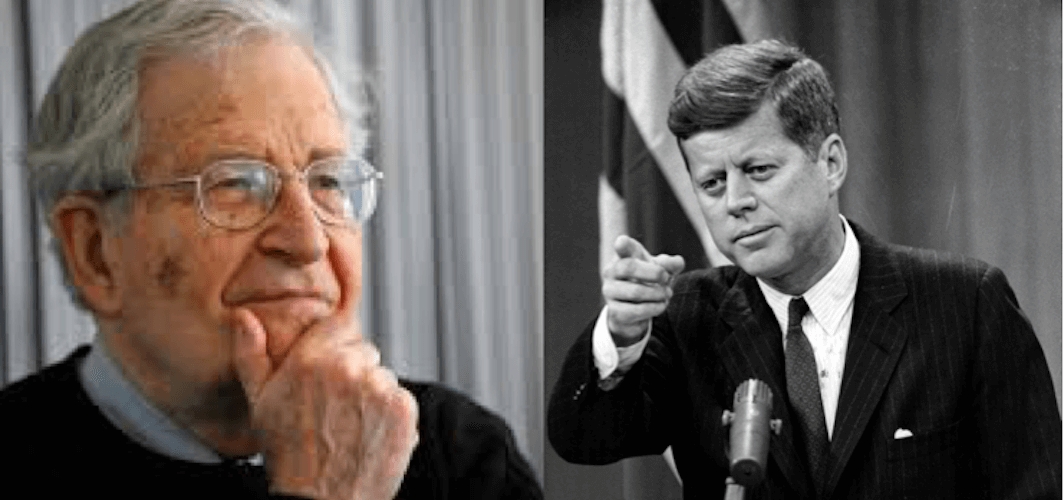
    One of the most telling moments in John Barbour’s new film, The American Media and the Second Assassination of John F. Kennedy, is his presentation of Noam Chomsky briefly discussing the JFK case. It’s a scene I will return to later. But along with Barbour’s depictions of Dan Rather and Bill O’Reilly, I thought these formed the most potent scenes in his film. I am glad Barbour depicted Chomsky because it reminds us just how bad the so-called American Left was and is on both the Kennedy assassination and his presidency. I once wrote an essay on this general subject based upon the work of Martin Schotz and Ray Marcus. (Click here for that essay) Like the Chomsky scene in the Barbour film, we will later return to Marcus’ revealing work on Chomsky.

    As many of us will recall, at the time of the release of Oliver Stone’s film JFK, Chomsky, along with his deceased cohort Alexander Cockburn, went on a jihad against almost everything depicted in the movie. Their critiques were as bad, in some ways worse, than those of the MSM. Their campaign was two-pronged. The first angle was to promote the idea that the Warren Commission was correct; that is, Oswald alone shot President Kennedy. In this regard, Cockburn obsequiously interviewed Warren Commission counsel Wesley Liebeler in the pages of The Nation. That interview amounted to a pattycake session, as Cockburn served up softball after softball to his performing seal Liebeler. Their second line of argument stemmed from the first: There was no high level plot because President Kennedy was no different than Dwight Eisenhower who preceded him, or Lyndon Johnson and Richard Nixon who followed him. So, with both polemicists, there was no political difference between, say, Kennedy and Nixon, Kennedy and Eisenhower, or Kennedy and Johnson. Even back in 1991, this was a difficult dual thesis to uphold. With the releases of the Assassination Records Review Board, it is well-nigh impossible to defend today. And later we will see how new evidence has forced Chomsky to modify his position. (For my discussion of Cockburn click here)

    There were so many crevices—actually Florida-sized sinkholes—in their arguments that it became apparent that both men were arguing from a preconceived position.

    That position, of course, is the approach to history common to the intellectual or academic Left. One might characterize the general tendency of such Marxist-influenced (or Neo-marxist) sociological analysis as ‘structural’ or ‘system-oriented’, in the sense that it views the actions of individuals as having little import or consequence, that the subject is merely an agent of larger cultural forces that impinge upon it. When applied specifically to the realm of politics, it leads to positing that institutions of power seek to protect and perpetuate themselves in a manner which is nearly blind to the choice or consciousness of the participants, that indeed the very status of the acting subject is suspect as a category of analysis. In its most extreme application, this theoretical perspective leaves no room for flexibility, for the notion that biography—personal background and characteristics—can make a difference, or that innovation from within the system can occur that can benefit many rather than a few. This concept differs somewhat from the “deep state” thesis, as advocates of the latter will allow for exceptions. But they will then note that the Deep State will correct the exception. In President Kennedy’s case, it was a correction by assassination. The former view is more rigid and zealous in its ideology insofar as it denies that there can be any political exceptions. As with extreme upholders of all theories, its proponents must work to erase the evidence that there ever were any exceptions. And as with any kind of inductive reasoning based upon dubious premises, this leads to the making of some thunderous—and pretentious—truisms.

    II

    Before we address some of Chomsky’s pronouncements on the Kennedy case, it is important to address some of his intellectual background, because it is very hard to adhere to such a system of thought without it leading to some thorny practical problems with specifics. This is simply because theories sometimes do not explain all that happens in the real world. Therefore their practitioners are forced to bend and mold facts and events in order to shape them to fit their doctrine. In the political field, this practice usually leads to questions of how ideology influences analysis. In other words it brings up questions of bias and balance. Chomsky’s career gives us prior illustrations of these characteristics. It is startling to note how Chomsky’s acolytes ignore them.

    The first is the fact that Chomsky has been known to butcher quotations for political advantage. A famous example being a quote by Harry Truman which Chomsky altered in his early book American Power and the New Mandarins. This was later exposed by Arthur Schlesinger in a letter to Commentary in December of 1969. Another example would be the misconstruing of the words of Harvard professor Samuel Huntington. Chomsky wrote that the professor said that he advocated demolishing in toto North Vietnamese society. Huntington corrected the record in the New York Review of Books (See 2/26/70)

    There are parallels to these kinds of ersatz presentations with Chomsky and the Kennedy case. With Kennedy, Chomsky has tried to insinuate that somehow JFK was involved with the assassination of Patrice Lumumba of the Congo. This wasn’t possible for the simple reason that Kennedy had not been inaugurated at the time Lumumba was killed. But further, as some have noted, Allen Dulles and the CIA most likely hastened their assassination plots against the African leader for the precise reason that Dulles knew Kennedy would not support them. (John M. Blum, Years of Discord, p. 23) In fact, there is a famous picture of President Kennedy getting the news of Lumumba’s death which shows just how pained he was by Lumumba’s passing.

    jfklumumba

    In and of itself, this photograph nullifies the Chomsky thesis that there was no difference between Eisenhower, LBJ, Nixon and Kennedy. For we can safely say that none of those other men would have reacted like this upon hearing of Lumumba’s death. According to the Church Committee, Eisenhower and Allen Dulles ordered the murder of Lumumba. (The Assassinations, edited by James DiEugenio and Lisa Pease, p. 326) Lyndon Johnson reversed Kennedy’s policies in the Congo. He ended up using Cuban exile pilots to wipe out the last followers of Lumumba, helping to destroy the first attempt at a democracy in post-colonial Africa, and allying the USA with the former colonizer Belgium to back Josef Mobutu. Mobutu became a dictator who enriched himself and his backers, and allowed his country to be utilized by outside imperial interests. (James DiEugenio, Destiny Betrayed, Second Edition, pp. 372-73) Nixon was Vice President under Eisenhower, and in National Security Council meetings spoke derisively and patronizingly of African leaders trying to break out of colonialism. He once said these leaders had only been out of the trees for fifty years. (Muehlenbeck, p. 6) Kennedy’s attitude on this subject, and Lumumba, was contrary to all these men. I cannot do better than to refer the reader to Richard Mahoney’s landmark book JFK: Ordeal in Africa, and the equally fine volume Betting on the Africans by Philip Muehlenbeck. (Click here for a review)

    To show just how pernicious Chomsky’s influence on some Left luminaries is on this subject, consider David Talbot’s last appearance on Democracy Now hosted by Amy Goodman. In discussing his book on Allen Dulles, The Devil’s Chessboard, he mentioned the differing views of Lumumba by Eisenhower and Kennedy. Incredibly, Goodman challenged him on this point. Talbot referred to the aforementioned picture of Kennedy as evidence of JFK’s feelings on the subject. But further, as Mahoney’s book demonstrates, the first foreign policy reversal of Eisenhower that Kennedy made once in office was on the Congo. And when Dag Hammarksjold was killed (likely murdered) in a plane crash, Kennedy decided to carry on the UN Chairman’s campaign for a free and independent Congo. (Click here) That any informed person could suggest otherwise shows both a massive ignorance and a massive bias on the subject. Yet, Goodman has hosted Chomsky many times. She reportedly vetoed an appearance by Jim Douglass.

    Chomsky has also tried to say that Kennedy approved the action plan to overthrow President Goulart of Brazil. (E-mail communication with Steve Jones, July 20, 2017) Yet, this plan did not occur until over four months after Kennedy was dead. Consider the information in A. J. Langguth’s Hidden Terrors. Although it is true that Kennedy wanted Goulart to broaden the political spectrum of his government, Langguth makes it clear that the actual Brazil overthrow was similar to the action against Jacobo Arbenz in Guatemala in 1954. A group of wealthy and powerful businessmen petitioned the White House for help in getting rid of a man they feared would endanger their investments. Langguth describes this group in detail. It was led by David Rockefeller. (p. 104) The author notes that Rockefeller’s coalition had not been accepted at the White House previous to January of 1964. But they were welcomed by President Johnson. And this made the difference. This demarcation is also noted by Kai Bird in his book, The Chairman. For it was John McCloy, the subject of Bird’s book, who was sent by Rockefeller’s group to make a deal with Goulart in February of 1964. When McCloy’s presence in Brazil was detected, it polarized forces of the left and right. (Bird, pp. 550-53) And this triggered the coup operation, codenamed Operation Brother Sam, which McCloy acquiesced in after causing. As Bird notes, Johnson’s willingness to cooperate with Rockefeller and McCloy ended Kennedy’s Alliance for Progress plan: “The Johnson administration had made clear its willingness to use its muscle to support any regime whose anti-communist credentials were in good order.” (ibid, p. 553) Further, anyone who has read Donald Gibson’s Battling Wall Street would understand the antipathy between President Kennedy and Rockefeller and why such a meeting was unlikely under Kennedy.

    III

    These two examples are good background for even worse gymnastics by Chomsky. And it brings us closer to Vietnam. In June of 1977, Chomsky co-wrote (with Edward Herman) a now infamous article in The Nation. It was titled “Distortions at Fourth Hand.” There is no other way to describe this essay except as an apologia for the staggering crimes of the collectivist Pol Pot regime that took place in Cambodia after the fall of both Prince Sihanouk and Lon Nol. At that time a book had been published called Cambodia Year Zero by François Ponchaud. It was the first serious look at the terrors that Pol Pot’s Khmer Rouge had unleashed in Cambodia. Chomsky and Herman criticized this pioneering work by saying that it played “fast and loose with quotes and numbers” and that since it relied largely on refugee reports, it had to be second hand. They then added that the book had an “anti-communist bias and message.” In retrospect, those two comments are startling, and again show a remarkable selectivity in an effort to discredit sources. In this same article, the two authors praised a book by George Hildebrand and Gareth Porter entitled Cambodia: Starvation and Revolution. They wrote that this book presented “a carefully documented study of the destructive American impact on Cambodia and the success of the Cambodian revolutionaries in overcoming it, giving a very favorable picture of their programs and policies, based on a wide range of sources.”

    In other words, not only were the authors attempting to discredit information that turned out to be true; at the same time, they were crediting information that turned out to be—to put it mildly—inaccurate. The net effect of this propaganda was to distort and conceal the efforts of a murderous regime in killing off well over one million of its citizens in an attempt to recreate a Maoist society overnight. Pol Pot’s was one of the greatest genocides per capita in modern history.

    What makes Chomsky’s performance here even worse is that two years later he and Herman were still discounting and distorting the Khmer Rouge in their book After the Cataclysm. They refer to what Pol Pot did as “allegations of genocide” (p. xi, italics added). On the same page they tried to imply that Western media created the mass executions and deaths. They later added that evidence was faked and reporting was unreliable. (pp. 166-77) They again attacked Ponchaud’s book by saying “Ponchaud’s ’s own conclusions, it is by now clear, cannot be taken very seriously because he is simply too careless and untrustworthy.” (p. 274) Later, more credible and responsible authors, like William Shawcross, demonstrated Chomsky’s pronouncements to be astonishingly wrong. They were so bad that Chomsky has never let up trying to minimize what he did. In fact, his whole emphasis on the Indonesian invasion of East Timor has been to try and demonstrate that that slaughter was really worse than what happened in Cambodia! The implication being that if that were true it would then somehow minimize his previous giant faux pas. And even in that he has lowballed the fatalities in Cambodia to do so. (For a complete and thorough expose of this subject, click here)

    Why is this important? Besides demonstrating what a poor scholar and historian Chomsky is, it shows that, contrary to his claim of being an anarchist, he went to near ludicrous extremes to soften the shocking crimes of a Maoist totalitarian regime. In any evaluation of Chomsky, this episode is of prime importance. For the simple reason that it clearly suggests that—as Ted Koppel recently said of Sean Hannity—ideology is more important to him than facts.

    A second notable aspect of Chomsky’s work is his association with the notorious Holocaust denier Professor Robert Faurisson. When Faurisson’s writing on this subject became public, he was suspended from his position at the University of Lyon. Chomsky then signed a petition in support of Faurisson’s reinstatement. He followed that up in 1980 with a brief introduction to a book by Faurisson. Chomsky later tried to say that he was personally unacquainted with Faurisson and was only speaking out for academic freedom. But, unfortunately for Chomsky and his acolytes, this was contradicted by Faurisson himself. For the Frenchman had written a letter to the New Statesman in 1979. It began with: “Noam Chomsky … is aware of the research work I do on what I call the ‘gas chambers and genocide hoax’. He informed me that Gitta Sereny had mentioned my name in an article in your journal. He told me I had been referred to ‘in an extraordinarily unfair way’.” (This unpublished letter was quoted in the October, 1981 issue of the Australian journal Quadrant.)

    Consequently, Chomsky’s later public qualifications about his reasons for signing the petition and writing the introduction ring hollow. He did know Faurisson. He was in contact with him personally, and apparently was encouraging him to defend his work.

    When he found this out, author and professor W. D. Rubinstein had a correspondence with Chomsky, which seemed to certify the worst fears about the noted linguist and Faurisson. Chomsky wrote the following: “Someone might well believe that there were no gas chambers but there was a Holocaust … ” (ibid) In defending Faurisson’s writings Chomsky then wrote that anyone who found them lacking in common sense or accepted the established history, was exhibiting “an interesting reflection of the totalitarian mentality, or more properly in this case, the mentality of the religious fanatic.” (Ibid) Rubinstein replied that to hold that there were no gas chambers but there was a Holocaust was an absurd tenet. Chomsky went ballistic. He wrote back that the respondent was lacking in elementary logical reasoning, and he was falsifying documentary evidence. He then said that the Nazis may have worked these Jews to death and then shoveled their bodies into crematoria without gas chambers. He concluded his blast with this: “If you cannot comprehend this, I suggest that you begin your education again at the kindergarten level.” (Click here for this remarkable article)

    As Werner Cohn has shown, Chomsky has tried to conceal his friendly relations with a Holocaust Denial group in France. This group included Serge Thion, Faurisson and Pierre Guillame. He seems to have gotten in contact with this group through Thion, another leftist critic of the idea of calling what Pol Pot did in Cambodia a genocide. This group ran a publishing house called La Vieille Taupe, which featured prints of Holocaust Denial literature. The petition that Chomsky signed contained the following sentence about Faurisson: “Since 1974 he has been conducting extensive independent historical research into the ‘holocaust’ question.” The framing of the last two words in that statement should jar anyone’s senses. (For an overview of Chomsky’s association with this group click here; for a specific example of his attempt to cover it up, click here.)

    As with his resistance to the Khmer Rouge genocide, Chomsky’s defense and association with Faurisson is startling to any objective person. Which again excludes his acolytes. Today, the low estimate for the fatalities caused by the crimes of the Khmer Rouge is 1.7 million. (see this NYT article from 2017) The idea that there were no mass gassings and crematoria at the Nazi death camps was thoroughly debunked at the trial of David Irving. Irving was a friend and colleague of Faurisson. That court action was instigated by Irving himself. There has been a very good web site constructed from the materials devoted to that trial. I strongly recommend reading the reports given to the court by Robert Jan van Pelt, Christopher Browning, and Richard Evans. They seem to me to be models of what scholarly research should be about.

    IV

    Before centering on the issues of Kennedy’s assassination and his presidency, it is important to discuss briefly the general issue of the Cold War, if only to place those subjects in historical context. As with many leftist polemicists, Chomsky usually does not do this. And when he does, he almost exclusively centers on what western powers did to cause the Cold War and continue it.

    Yet it would seem to most people to be important to review objectively these matters in any historical discussion of American foreign policy from 1945-1991—the obvious reason being that it was the most powerful influence on American foreign policy and world events in that time period. Every president from Harry Truman to George H.W. Bush was strongly influenced by it, to the point that almost every major foreign policy issue was colored by it. Therefore, if one is writing the history of this period, or a part of it, one has to factor this into the discussion. If not, then one can be accused of ignoring, or discounting, the historical backdrop.

    For to deprive these events of their context is to sap them of some of their meaning. Related to this, another problem with Chomsky—as noted above—is imbalance. The policy of aiding foreign countries in their resistance to communism was spelled out way back in 1947 with the Truman Doctrine. This was then endorsed by Congress, and legislation was passed to carry out the policy. One can argue whether or not the Cold War was exaggerated, whether it was too covert, even whether or not it was justified. But one cannot act as if it did not exist. Or that the communist side had no provocations to it, or had no atrocities done in its name. For how else can one explain the Korean War, Hungary in 1956, or the Russian invasion of Czechoslovakia in 1968? We can continue in this vein with the Chinese usurpation of Tibet or the crimes of Fidel Castro, or those of Josef Stalin and Mao Zedong, the latter of which are both mind-boggling.

    But as with Pol Pot in Cambodia, these things are minimized, discounted or ignored by people like Chomsky, and the late Alexander Cockburn. Almost all of the critical analysis was and is of the USA. But if things like balance and historical context are left out, then what is this kind of writing really worth?

    Which is another way of saying the following: A theoretical approach is only as good as the person who uses it. If that writer is too biased one way or the other, the result will suffer greatly. To make a point of comparison: Michael Parenti is also an advocate of the aforementioned style of analysis we have called “structural” or “systemic”. Yet he understands that there are men and women who occasionally manage to rise above the system and do some good for a great number of people. And Parenti also understands that political conspiracies do exist, and have been proven to exist. To use just one example, the heist of the 2000 election in Florida by Jeb Bush and Katherine Harris.

    Even though this crime was done in broad daylight—what with roadblocks set up to hinder people from voting—no person was even interviewed by any law enforcement arm, let alone indicted. The political result of this was horrendous: George W. Bush created a totally unjustified war in Iraq. A war that Al Gore would not have started. Not only do political conspiracies exist, if not addressed, prosecuted, and stopped, they can have terrible results for hundreds of thousands, even millions, of people. So to deny they occur is to deny reality. And as Parenti has said, reality is sometimes radical.

    A second problem with using this system-oriented approach is that—as we have seen with Cambodia—it tends to sweep all contrary facts or evidence into an ideological whirlpool. That is, facts get discounted, data gets warped, and key events are sometimes omitted. What is important is keeping the model of that oppressive structure intact. If facts or data collide with that model, it’s the facts or data that get discarded or discounted. The theoretical underpinnings of Chomsky and Edward Herman’s writings on Cambodia were to show that American and western media was distorting a communist revolution. Therefore, they repeatedly used phrases like “the alleged genocide in Cambodia”, or they wrote that “executions have numbered at most in the thousands”. (See this article) This last comment was written in 1979, when the Khmer Rouge regime had fallen and some reporters had visited the country to actually see the horrible devastation with their own eyes. At times Chomsky and Herman used Khmer Rouge sources and endorsed books that extensively sourced footnotes to Pol Pot’s government releases. This approach is a serious problem for people who actually care about things like accuracy, fairness, and completeness.

    In the wake of Oliver Stone’s JFK, what was so odd about the Chomsky/Cockburn allegiance to a point of view which privileges the critique of institutions as systems is that it disappeared upon their inquiry into Kennedy’s murder. That is, in both men’s comments on the Warren Commission and its presentation of evidence, you will nowhere find any discussion of the lives and careers of the persons who controlled that investigative body. Men like Allen Dulles, John McCloy, Gerald Ford, and J. Edgar Hoover. Yet, those four men dominated the Commission proceedings. (See Walt Brown’s book, The Warren Omission, especially pp. 84-87).

    This is odd—in two respects. First, it was these men, not Kennedy, who had played large parts in being ‘Present at the Creation’—that is, in forming and then supporting the Eastern Establishment, which was responsible for setting up and maintaining the structure of American government in the 20th century. Any critic of the way institutions of power function would surely be concerned with this detail, because in presenting that particular case, one does not have to juggle, manipulate, and distort the evidence. There are books on these men in which tons of evidence exist to make that demonstration. These four were clearly responsible for some of the worst American crimes of the 20th century. (See James DiEugenio, Reclaiming Parkland, second edition, pp. 234-40, 321-40.)

    Secondly, to somehow suppose that those four would not manipulate the evidence in a murder case is simply to ignore the reality of who they were. Yet this is the concept that both Chomsky and Cockburn supported. For instance, as mentioned earlier, Cockburn actually interviewed a junior counsel for the Warren Commission in the pages of The Nation. He never asked him one challenging question. Which is incredible considering the record of that Commission.

    Regarding Chomsky, consider an incident from 1994. Two subscribers to Probe Magazine, Steve Jones and Bob Dean, went to a meeting of the Democratic Socialist Club of Reading, Pennsylvania. Chomsky was the guest speaker. Both Jones and Dean were surprised when Chomsky seemed to veer off topic to go into a tirade against President Kennedy. When Jones and Dean tried to approach and talk to Chomsky about Kennedy afterwards, he became “very defensive and dismissive of us, brushing us off by saying that he’d seen all of the evidence.” Apparently, this meant the declassified record, and therefore there was nothing to address. (e-mail communication with Jones, 6/19/2017)

    Again, this tells us much about Chomsky’s respect—or lack of—for scholarly practice. Because, at that time, the Assassination Records Review Board had just begun declassifying two million pages of records that had previously been kept secret from the public on the JFK case. Hence no one had seen them prior to this time. Including Chomsky. So what was he talking about? The evidence the ARRB declassified concerning the actual circumstances of Kennedy’s murder make the case against Oswald pretty much insupportable. And in just about every way: concerning Oswald, Kennedy’s autopsy, the ballistics evidence, and Oswald’s alibi. (For the last, see Barry Ernest’s book, The Girl on the Stairs.)

    Further, neither Cockburn nor Chomsky seemed to be aware of the transcript of the final executive session of the Warren Commission. Sen. Richard Russell, Representative Hale Boggs, and Senator John Sherman Cooper—who I have previously called the Southern Wing—had planned on expressing their reservations at this meeting about the Single Bullet Theory. The idea that one bullet, CE 399, had gone through both Kennedy and Governor John Connally, smashing two bones, making seven wounds, emerging almost entirely unscathed, and losing almost no volume from its mass. Russell, especially, wanted his objections expressed in the record of this final meeting. Today, we have the record of that meeting. There is no trace of his, or anyone else’s, reservations about the Single Bullet Theory. For the simple reason that there was no stenographic record of that final meeting. (Gerald McKnight, Breach of Trust, p. 284) In other words, the Eastern Establishment figures—Dulles, McCloy, and Ford, likely coopted Chief Justice Earl Warren and chief counsel J. Lee Rankin into tricking the other members into believing there would be such a record. In fact, a woman was there masquerading as a stenographer. But the Commission’s contract with the stenographic company had expired three days prior. (ibid, p. 295) As Gerald McKnight writes about this matter, the obvious reason for this charade was to keep the strenuous objections of the Southern Wing out of the transcribed record, and thereby maintain the illusion that the Commission had been unanimous in its verdict on the case. In other words, here was an almost textbook case of the way institutions tend to ensure the survival of belief in the status quo, one made to order for critics on the Left.

    But in an unexplained inconsistency, both Chomsky and Cockburn dropped the structural approach in their analysis of the Commission. Even though it would seem to be perfectly suited for that type of analysis. Why? Because if one did explain who these men were and what they did with the evidence, then one could conclude that they covered up the true circumstances of Kennedy’s death, for the simple reason he was not a member of their club. Which is a direction they do not want to go in.

    Yet, David Talbot demonstrates this at length in his analysis of the conflicts between President Kennedy and Allen Dulles during 1961. These were centered on Kennedy’s Congo policy, Dulles’ backing of the revolt of the Algerian generals against French President Charles DeGaulle, and ultimately how Dulles lied to Kennedy about the Bay of Pigs operation. (Talbot, pp. 382-417) In other words, in just one year, the CIA Director had come into conflict with Kennedy over three important areas and events. Finally, Kennedy felt he had to terminate Dulles, along with both his Deputy Director Charles Cabell, and Director of Plans Richard Bissell. The first and only time in 70 years that has been done at the CIA. As Talbot also points out, after Kennedy was killed, Dulles lobbied for a position on the Warren Commission (ibid, pp. 573-74)—something that no one else did. As previously referred to, Walt Brown has shown that Dulles then became the single most active member of the Warren Commission. During a meeting with Commission critic David Lifton at UCLA in 1965, Dulles showed utter disdain for any of the evidence that the Commission had ignored or misrepresented to the public, e.g., the Zapruder film frames. (Talbot, p. 591)

    Let us use just one other example. Robert Kennedy was the first Attorney General who actually exercised some degree of control over FBI Director J. Edgar Hoover. The enmity between the two has been well chronicled by more than one author. After JFK was killed, Hoover had Bobby Kennedy’s private line to his office removed. (Anthony Summers, Official and Confidential, p. 315) The Warren Report itself says that Hoover and the FBI were responsible for the vast majority of the investigation. (See, p. xii) Therefore, why would such men—Dulles and Hoover—who clearly had no love for JFK, bend over backwards to find out the truth about his death? The fact is they did not. For example, the day after the murder, Hoover was so concerned about who killed President Kennedy that he was at the racetrack. (Summers, op. cit.) To leave out things like this, and much more, is not writing history. And it is not honest scholarship. It is depriving the reader of important information.

    V

    Chomsky operates his views of both Kennedy and his murder via inductive, closed-system reasoning. It is both banal and simplistic: since the USA operates in a sick political and economic system, no one can rise above it. Therefore, Kennedy was really no different than Nixon, Johnson, and Eisenhower. The underlying problem—as writers like Donald Gibson and Richard Mahoney have demonstrated—is that when one actually studies the record, Kennedy was not part of the Power Elite, and did not aspire to be part of it. This is why, as Donald Gibson has shown, Kennedy and David Rockefeller—the acknowledged leader of the Eastern Establishment at the time—had no time or sympathy for each other. (See Gibson’s Battling Wall Street throughout, but especially pp. 73-76) The reason Kennedy made his historic 1957 Senate speech on the impending doom of French colonialism in Algeria was because he had been in Vietnam when the French empire there was collapsing. He understood that the Vietnam conflict had not really been about communism, but about nationalism. And he said this many times, and took considerable heat for it. (See Mahoney, JFK: Ordeal In Africa, pp. 14-23)

    When Oliver Stone’s JFK came out, Chomsky made numerous statements questioning Stone’s thesis about Kennedy’s intent to withdraw from Vietnam. He eventually wrote an essay in Z Magazine on the topic. In essence, he denied all the withdrawal evidence as outlined by Fletcher Prouty and John Newman, who advised Stone on that subject. The problem for Chomsky today is that other scholars decided that Prouty and Newman were on to something. After all, Prouty actually worked on Kennedy’s withdrawal plan in September of 1963. John Newman was writing a revolutionary book on the subject entitled JFK and Vietnam, which was published in January of 1992.

    Seriously considering that evidence, these scholars then went to work. And today, a small shelf of books exists on the subject. These authors agree with the Stone/Prouty/Newman withdrawal thesis, e.g., David Kaiser’s American Tragedy, James Blight’s Virtual JFK, Gordon Goldstein’s Lessons in Disaster. One reason these new books are there is that the Assassination Records Review Board (ARRB) declassified many pages of documents that support the withdrawal thesis. This declassification process occurred in 1997. Any serious scholar has to consider new evidence when it is declassified. Chomsky did not. In 2000, in a book called Hopes and Prospects, in relation to this issue, he wrote: “On these matters see my Rethinking Camelot … . Much more material has appeared since, but while adding some interesting nuances, it leaves the basic picture intact.” (pp. 123, 295)

    In other words, the scores of pages of new ARRB documents released on the subject, the recorded tapes in the White House, and the new essays and books published, these amount to “nuances.” The “nuances” include President Johnson confessing in February of 1964 that he himself knows he is breaking with Kennedy’s policy. They include the transcripts of the May 1963 Sec/Def meeting in Hawaii where McNamara is actually executing that withdrawal plan—with no reference to a contingency upon victory. (These and other documents are included in this presentation)

    In 1997, that last piece of evidence convinced some MSM outlets, like The New York Times, that Kennedy was planning on withdrawing from Vietnam at the time of his assassination. We can go on and on. But the point is made. To any objective person, these are not “nuances”. They are integral.

    To show Chomsky’s bizarreness on this point, let us use two other instances of just how intent he is to disguise the facts and evidence of Kennedy’s withdrawal plan. One of his older excuses was to say that Kennedy’s advisors fabricated the withdrawal plan after the Tet offensive. (Z Magazine, September, 1992) Even for Chomsky, this is ridiculous. What is he saying? That Kennedy’s advisors falsified the then classified record while it was in the National Archives? That they also managed to get a voice impressionist to impersonate Johnson, McGeorge Bundy and McNamara discussing this withdrawal plan?

    Chomsky’s latest position is a sort of rear action retreat. He now admits that Secretary of Defense Robert McNamara offered up a withdrawal plan. In other words, it was McNamara’s plan, not Kennedy’s. Not so, and let us illustrate why.

    In November of 1961, a two-week long debate took place in the White House. The subject was whether or not to commit combat troops into Vietnam. Advisors Max Taylor and Walt Rostow had returned from Vietnam and made that recommendation. From all the accounts we have, Kennedy was virtually the only person arguing against that proposal. (James Blight, Virtual JFK, pp. 275-83) At its conclusion he signed off on NSAM 111 which sent 15,000 more advisors instead.

    Kennedy was disturbed that he had to carry the argument virtually alone. So he decided to ask someone who he knew agreed with him to write his own report on the subject. This was Ambassador to India, John Kenneth Galbraith. Galbraith did visit Saigon, and he did write a report recommending no combat troops in theater and a gradual American distancing. (Cable of November 20, 1961, which was followed by a longer report; Blight, p. 72, see also David Kaiser, American Tragedy, pp. 131-32) Kennedy later had this report forwarded to Secretary of Defense, Robert McNamara in April of 1962. This was the beginning of the withdrawal plan. We know this because on his trip to Vietnam in May, McNamara told General Paul Harkins to begin a training program for the army of South Vietnam so America could begin reducing its forces there. Harkins was the supreme military commander in Saigon. (Kaiser, pp. 132-34) Also, McNamara’s deputy Roswell Gilpatric revealed in an oral history that his boss had told him that he had instructions from Kennedy to begin to wind down the war. (Blight, p. 371) This culminated with the aforementioned declassified Sec/Def conference in Hawaii in May of 1963. At this meeting, McNamara requested from all departments—State, Pentagon, CIA—specific schedules beginning a withdrawal in December of 1963 and ending in the early fall of 1965. (James Douglass, JFK and the Unspeakable, p. 126)

    The idea that this plan was McNamara’s is another fanciful Chomsky invention. In addition to the evidence stated above—cables, oral history—there is another undeniable fact. In the November, 1961 debates described above, McNamara was asking for the insertion of combat troops into Vietnam. In fact, his proposal was the largest request of all. He told Kennedy to commit upward of six divisions, or about 205,000 men. And he framed the request in pure Cold War terms. If this was not done, it would lead to communist control over all of Indochina and also Indonesia. (Blight, pp. 276-77) The idea that afterwards McNamara had a personal epiphany and reversed himself on his own is simply not credible. Especially when combined with the above evidence. Plus the fact that it was Kennedy alone who was holding out against combat troops in November. And as with Kennedy, there is no mention by McNamara on any tape or any of the Sec/Def documents, or in NSAM 263, that the withdrawal plan would only be completed as the circumstances on the battlefield improve. Chomsky’s arguments against Kennedy’s withdrawal plan exist in a vacuum created by him and his acolytes.

    VI

    In Barbour’s film, Chomsky is shown at a seminar saying words to the effect that no one should care if Kennedy died as a result of a conspiracy. The problem with this statement is that, at the time of Kennedy’s death, it’s the people who Chomsky tries to stand up for—residents of the Third World—that felt a sharp pang of loss at JFK’s passing. And very few of them felt that Lee Harvey Oswald was the lone assassin. The president of Egypt, Gamel Abdul Nasser, fell into a deep depression and had the films of Kennedy’s funeral shown four times on national television. (Philip Muehlenbeck, Betting on the Africans, p. 228) Ben Bella, the premier of Algeria, phoned the American ambassador in Algiers and said, “I can’t believe it. Believe me, I’d rather it happen to me than him.” He then called in a comment to the state radio station saying that Kennedy had been a victim of “racialist and police-organized machinations”. (ibid, p. 227) When asked about Kennedy’s assassination in 1964, Achmed Sukarno of Indonesia began perspiring. He then said that he loved the man because Kennedy understood him. He ended the reverie by saying, “Tell me, why did they kill Kennedy?” (James DiEugenio, Destiny Betrayed, Second Edition, p. 374) Nehru of India called Kennedy’s murder a crime against humanity. He then said that Kennedy was “a man of ideals, vision, and courage, who sought to serve his own people as well as the larger causes of the world.” (Muehlenbeck, p. 231) Two weeks after Kennedy’s death, economist Barbara Ward visited the office of Kwame Nkrumah of Ghana. The president had a photo of John and Jackie Kennedy on his desk. With tears in his eyes he said, “I have written her, and I have prayed for them both. Nothing shocked me so deeply as this.” Months later, when the American ambassador presented him with a copy of the Warren Report, Nkrumah turned to the title page. He pointed to the name of Allen Dulles, and returned it to the ambassador with the one word comment, “Whitewash”. (Muehlenbeck, p. 229; Richard Mahoney, JFK: Ordeal in Africa, p. 235)

    But it wasn’t just the leaders of the Third World who were shaken and saddened by Kennedy’s passing. It was also its citizenry. As an editorial in West Africa magazine stated, “Not even the death of Dag Hammarskjold dismayed Africans as much as did the death of John Kennedy.” (Muehlenbeck, p. 229) In Nairobi, Kenya, six thousand people packed into a cathedral for a memorial service. A Kenyan politician said that never in his career had he seen this kind of grief registered over the death of a foreigner. (Muehlenbeck, p. 226) In the Ivory Coast, the American ambassador woke early the day after the assassination. There was someone waiting for him at his office. The man said he ran a small business about 25 miles away. He said he didn’t really know why he was there. But he tried to explain anyway: “I came here this morning simply to say that I never knew President Kennedy, I never saw President Kennedy, but he was my friend.” (Ibid, p. 228) According to author Thurston Clarke, upon learning of his passing, the peasants of the Yucatan Peninsula immediately started planting a Kennedy Memorial Garden.

    Were all these people wrong?

    But there is one person we can add to this list. His name is Noam Chomsky.

    In the time period following Kennedy’s murder, writer/researcher Ray Marcus tried to enlist several prominent academics to take up the cause of exposing the plot that killed President Kennedy. In 1966 he wrote I. F. Stone on the subject. In 1967, he approached Arthur Schlesinger about it. They both declined to take up the cause. In 1969, he was in the Boston area on an extended business function. He therefore arranged a discussion with Chomsky. Chomsky had initially agreed to a one-hour meeting in his office. Ray brought only 3-4 pieces of evidence, including his work on CE 399, the Magic Bullet, and a series of stills from the Zapruder film. Which had not been shown nationally yet.

    Soon after the discussion began, Chomsky told “his secretary to cancel the remaining appointments for the day. The scheduled one-hour meeting stretched to 3-4 hours. Chomsky showed great interest in the material. We mutually agreed to a follow-up session later in the week. Then I met with Gar Alperovitz. At the end of our one-hour meeting, he said he would take an active part in the effort if Chomsky would lead it.” (Probe, Vol. 4 No. 2, p. 25) Ray did have a second meeting with Chomsky which lasted much of the afternoon. And “the discussion ranged beyond evidentiary items to other aspects of the case. I told Chomsky of Alperovitz’ offer to assist him if he decided to lead an effort to reopen. Chomsky indicated he was very interested, but would not decide before giving the matter much careful consideration.” (ibid) A professional colleague of Chomsky’s, Professor Selwyn Bromberger, was also at the second meeting. He drove Ray home. As he dropped him off he said, “If they are strong enough to kill the president, and strong enough to cover it up, then they are too strong to confront directly … if they feel sufficiently threatened, they may move to open totalitarian rule.” (ibid)

    It is important to reflect on Bromberger’s words as Ray related what happened next. He returned to California and again asked Chomsky to take up the cause. In April of 1969, Chomsky wrote back saying he now had to delay his decision until after a trip to England in June. He said he would get in touch with Ray then. Needless to say, he never did. He ended up being a prominent critic of the Vietnam War and this ended up making his name in both leftist and intellectual circles. Reflecting on Bromberger’s words to Marcus, one could conclude that Bromberger and Chomsky decided that the protest against Vietnam, which was becoming both vocal and widespread, and almost mainstream at the time, afforded a path of less resistance than the JFK case did. After all, look at what had happened to Jim Garrison.

    But if this is correct, it would qualify as a politically motivated decision. One not made on the evidence. As Marcus writes, it was with Chomsky, “not the question of whether or not there was a conspiracy—that he had given every indication of having already decided in the affirmative … ” Marcus’ revelations on this subject are informative and relevant in evaluating Chomsky, both then and now. For purposes of our argument, it is important to know what Chomsky actually thought of the evidence when he was first exposed to it. This would seem to be a much more candid and open response than what he wrote decades later, when his writings on the subject were just as categorical, except the other way. In other words, Chomsky did a 180-degree flip on the issue of whether President Kennedy was killed by a conspiracy. And that first conviction lasted at least until 1976. Because in that year, he signed a petition to form the House Select Committee on Assassinations. That is very likely the reason that, in 1971, as co-editor of the Senator Mike Gravel edition of the Pentagon Papers, he allowed Peter Scott to write an essay addressing the question of Johnson’s alteration of Kennedy’s de-escalation plan in Vietnam.

    Try and find an interview or essay in which Chomsky admits how close he was to being the chief advocate for a public campaign to find out who really killed Kennedy. Yet, it is a fact. Maybe Chomsky changed his mind. But if that was the case, he has no right to be so smug and snide about others who came to the same conclusion he once did. Or perhaps, as Bromberger let out, he and Alperovitz and Chomsky decided that Vietnam offered an easier path to prominence. Which, undoubtedly, it did. If that was the case, then it was a practical choice, not an intellectual or moral one. And evidently, Chomsky and his friends did not realize that they could have combined the two.

    As we have seen, Chomsky’s recurrent posing as a scholar who has assimilated the entire declassified record on the JFK case, and on the Kennedy/Johnson Vietnam policies, is simply an empty pose. And this is part of a persona that, as we have seen in the case of Faurisson and Cambodia, substitutes an extreme and ingrained bias for what is supposed to be scholarly analysis. If there is any hope of reconstituting this nation around a viable set of values and principles, then the issue of the hijacking of America in the sixties through assassinations will have to be honestly confronted. As we have seen, Noam Chomsky refuses to do that—in fact he deliberately avoids it. He then adopts certain disguises and deceptions to conceal the way he once felt about the subject. Which is, in large part, why he is part of the problem, not the solution.

  • Requiem for Rose Lynn Mangan

    Requiem for Rose Lynn Mangan


    manganWe have been informed by Paul Schrade that Rose Lynn Mangan passed away in late February of this year. Many people probably do not know who she was, for the simple reason that she was a person who worked mostly behind the scenes. Off and on, she had been the chief researcher for Sirhan Sirhan’s defense team for many years. No one had spent as much time looking at the evidence in the RFK case than she did. Mangan lived in Carson City, Nevada, so it was not that far for her to drive to the Sacramento State Archives where much of the surviving evidence in the Robert Kennedy assassination was maintained.

    If one studies the RFK assassination, which unfortunately not very many people do, one can see how Mangan fit into the historical backdrop on that case. At the start, very few people had any inclination or intuition that the Robert Kennedy case was anything but what it appeared. A young man, apparently in a fit of rage, jumps forward out of a crowd in the pantry of the Ambassador Hotel. He then fires at the person who, most people thought, was going to be the next president. Everyone’s eye is drawn to this young man as Bobby Kennedy sinks to the floor. Sirhan is immediately apprehended and taken to the police station. No one who was alive then can forget the next day’s death announcement by Frank Mankiewicz.

    But as is usually the case in these shattering instances, something was going on that was largely undetected, even though it was happening in plain sight. First of all, a witness named Sandy Serrano was on television late that night and told newsman Sander Vanocur that she saw a girl in a polka dot dress running down the rear stairs of the Ambassador Hotel with a young man. She said, “We shot him! We shot him!” When Sandy asked, “Who did you shoot?” The girl replied, “Senator Kennedy!” She and her companion then disappeared into the night. That same evening on Ray Briem’s LA radio talk show, a professional psychologist named William Bryan called in to the program. He said that, from his experience, the suspect sounded to him like he was acting under the direction of post-hypnotic suggestion, i.e., like a Manchurian Candidate. (The Assassination of Robert F. Kennedy, by William Turner and Jonn Christian, p. 226) A young high school student named Scott Enyart took photos of the shooting at the Ambassador. He was stopped by the police at gunpoint as he left the hotel. His photos of the crime scene were taken from him—and he never got them back. As many have commented, Enyart’s pictures may have been the Zapruder film of the RFK assassination. (The Assassinations, edited by James DiEugenio and Lisa Pease, pp. 619-21)

    Then there was William Harper. Harper was a well-respected criminalist who worked for, among other departments, the Pasadena police. He had a serious problem with the RFK case from the start. The reason being that he had a professional dispute with the LAPD’s chief criminalist DeWayne Wolfer. Being familiar with the shoddiness of Wolfer’s work, he had warned Sirhan’s defense lawyer Grant Cooper not to accept any of Wolfer’s findings at face value. (ibid, p. 556) Cooper did not pay heed to this well-founded warning. He actually did the opposite. He agreed to stipulate to Wolfer’s forensic findings concerning the ballistics evidence. To say the least, this had disastrous results for Cooper’s client Sirhan Sirhan. For now the trial of Sirhan became not about the guilt or innocence of the defendant; it was about Sirhan’s mental state at the time of the shooting. Because of Cooper’s blunder, Sirhan was condemned to death. But due to a later California Supreme Court decision, this was altered to life in prison.

    Two things happened after Sirhan’s trial that changed some people’s perceptions about the RFK case. Art Kunkin, the publisher of the LA Free Press, ran a story by one of the very few people who had studied the actual ballistics evidence in the pantry of the Ambassador Hotel. Lillian Castellano had analyzed the bullet evidence in the case, and she came to the conclusion that Sirhan could not have been responsible for all the projectiles that had been fired that night. Especially in light of the fact that hotel maître-d’, Karl Uecker, said that he went for Sirhan’s gun after he fired the first shot and had it controlled, at the most, after the second shot. Besides Kennedy, there were five other people shot, one of them twice. RFK was shot four times. The maximum number of bullets Sirhan’s gun could hold was eight. Castellano’s article began to cast doubt on LAPD’s honesty in building its case against Sirhan. Inversely, it indicated just how inept his defense had been.

    Harper had read the witness testimony from the pantry, and also the lengthy autopsy report by Dr. Thomas Noguchi. He went even further than Castellano. He concluded that there had to have been two assassins firing from two different directions. Allowed to test the bullet exhibits, he then concluded that they had been fired from two different weapons. (DiEugenio and Pease, p. 556)

    When Rose Lynn Mangan became the official investigator for the Sirhan case, she and Harper became friends. He even gave her his files on the case. When his affidavit about the two firing positions went public in 1971, he became a magnet for informants inside the LAPD. One of the things he told her in no uncertain terms is: “They switched the bullets; they switched the guns.” One of the things Mangan always said about Harper was that his information always checked out. (ibid, p. 565)

    Mangan served as Sirhan’s researcher from 1969-74. Then, at Sirhan’s request, she returned in 1992. In 1996 she made a memorable appearance at the civil trial of Scott Enyart vs. LAPD. As mentioned previously, Enyart was a high school photographer who was in the pantry at the Ambassador Hotel when RFK was shot. He kept on snapping photos during the firing sequence. But as he left the scene he was accosted by the police and told to turn over all of his film. Once he did, the police said they would develop the film because they needed it for the upcoming criminal trial. That statement turned out to be false, since they did not use the evidence at Sirhan’s trial. (Ibid, pp. 619-20) But when the trial was over, Enyart asked for his pictures back. He got back less than twenty per cent of them—and no negatives. He was then told that the rest would now remain secret and be archived for twenty years.

    Enyart waited for almost 20 years. In 1988 the LAPD told him that his photos were now in the state archives in Sacramento. But when Scott wrote to Sacramento, the archivist told him they were not there. He concluded that they were gone, part of the many photos incinerated by LAPD in 1968. But since the police had always maintained that the destroyed pictures were duplicates, Scott maintained that his photos must still exist. And he wanted the originals returned to him. Since he was up on a steam table during the shooting, his photos would have significant monetary value.

    Quite naturally, Enyart felt he was being given the runaround. He sued. The city appealed on a technicality. They won the appeal. But Scott won a reversal of that decision. The case was scheduled for trial in 1996. Then something utterly bizarre happened. Miraculously, the LAPD announced that Scott’s pictures had been recovered. Scott disagreed with this pronouncement, since these allegedly recovered photos were on different film stock, and none depicted what went on inside the pantry. (ibid, p. 620) Nevertheless, these photos were sent to Los Angeles from Sacramento via courier for use at the civil trial. They were then stolen out of the back seat of the automobile while it stopped at a gas station. As Scott’s lawyer said, “Somebody, for some reason, is making sure those photos do not reach public view.” (LA Times, 1/18/96)

    At the trial, Mangan exposed another layer of perfidy in the RFK evidentiary record. The police needed to explain why and how the photos suddenly appeared out of the blue, after seemingly being lost for decades. The police tried to explain this all as a mistake in record keeping. The photos had been misfiled under another person’s name on the wrong list. By diligently crosschecking the lists, they were rediscovered. If not for the theft from the courier, all would have been explained satisfactorily.

    Scott needed someone with expansive and intimate knowledge of the files at the state archives. No one was better qualified than Mangan. Clearly, the plaintiffs were unaware of who she was and were unprepared for her testimony. Mangan completely negated this LAPD cover story. Since she was familiar with all the evidence filings across all the categories, she knew that LAPD was playing a shell game. They had played around with their own property list to create a file that was not really in the Sacramento archives, under a name that was not at all related to Scott Enyart’s. (Probe Magazine, January-February 1997, p. 8) No one else could have supplied that crucial information, which helped Enyart win a jury verdict. Her testimony also indicated that the heist of the photos from the car was most likely an elaborate ruse. This is how deeply embedded the RFK cover up is inside the LAPD.

    Shortly after her appearance at the Enyart trial, Lisa Pease visited Mangan at her home in Carson City. This was in preparation for a long two-part article in Probe Magazine. In that essay, it was through Mangan that the significance of Special Exhibit 10, and the dubious markings on the bullets, were explained, the latter for the first time. Mangan had documentation on Special Exhibit 10, the secret microphotograph that was supposed to be the ace in the hole if there was ever a reopening of the Robert Kennedy assassination. In the mid Seventies, there was a legal hearing under Judge Robert Wenke. A firearms panel was appointed to examine some of the ballistics evidence in the case. They examined Special Exhibit Ten. They discovered something that Thomas Noguchi already knew: this exhibit was a fraud. It purported to be a comparison photo of the Kennedy neck bullet with a test bullet fired by Wolfer. But the Wenke Panel deduced that such was not the case. It was actually a comparison between an RFK bullet and another victim bullet, Ira Goldstein’s. As Lisa Pease wrote, “So someone was pulling yet another fraud in this case by concocting evidence in the hopes of convincing a panel of experts that a test bullet from Sirhan’s gun matched a bullet from Kennedy himself.” (DiEugenio and Pease, p. 564)

    But on her visit to Mangan, Pease was shown still another level of deception in the RFK case. Recall what Harper told Mangan: They switched the guns. They switched the bullets. And recall what Mangan said about Harper’s reliability: his information always checked out.

    Patrick Garland was the evidence master for the Wenke Panel proceedings. In that examination, the Kennedy neck bullet, #47, bore the markings ‘DWTN’ on its base. The Goldstein/victim bullet, #52, bore only a ‘6’. But these were not the original markings. Number 47 should have had a ‘TN31’ on its base. Number 52 should have had only an ‘X’. In other words, this evidence clearly indicates that someone switched the bullets, and then made the phony photograph. Besides the inherent fraud in the false comparison, this also clearly implies that Wolfer could not get a match from the gun in evidence.

    mangan lancerAt the time of her passing, Mangan had a book contract with JFK Lancer about her life as Sirhan’s Researcher, to be published in June, 2018. It was to be based upon the extensive files she had accumulated over the decades she had worked on the RFK case and visited the Sacramento Archives. Lancer is going forward with its publication in a revised format.  Debra Conway will also be visiting Carson City to collect the Mangan files; her archives will be preserved, scanned and will be made available online along with the publication. While we await her complete files to be deposited online, anyone interested in the Bobby Kennedy case should visit her web site, which is still being maintained.
    We all owe Rose Lynn Mangan a salute upon her passing. She worked the primary evidence in the RFK case like no one else did.

    ~Jim DiEugenio


    Mangan was a guest with Len Osanic on Black Op Radio a number of times; her last appearance was on:

    Show #769 Original airdate: February 11, 2016 – Listen here


    Also, listen to a tribute by Bill Pepper, Jim DiEugenio and Lisa Pease:

    • Show #839
    • Original airdate: June 15, 2017
    • Guests: Jim DiEugenio / William Pepper / Lisa Pease / Lynn Mangan
    • Topics: Sirhan’s Researcher, Lynn Mangan (click the logo below and scroll down):

    mangan blackop

  • JFK Declassified: Tracking Oswald, Part 4

    JFK Declassified: Tracking Oswald, Part 4


    Part 1

    Part 2

    Part 3

    Part 5

    Part 6

    Part 7


    Written by Frank Cassano and Arnaldo Fernandez


    The CIA never recovered from its perfect failure at the Bay of Pigs. It generated a sort of obsession with Castro that led to an ultimate defeat in times of dirty war; but also to a carnivalesque approach to Castroist Cuba. A facet of this carnavalization became manifest in the fourth part of the series JFK Declassified: Tracking Oswald. The episode is entitled “The Cuban Connection,” but illustrates how former CIA case officer Bob Baer is disconnected from historical truth.

    The Wizard of Ozzie

    Baer opened this episode with a memo from HSCA first Deputy Counsel, Robert Tanenbaum,1 about Oswald’s involvement in New Orleans with Cuban exiles—and some non-Cuban soldiers of fortune—recruited and trained by the CIA to overthrow Castro. Thusly, he is setting the stage for a hell of a sleight of hand. Former Marine “Ozzie” Oswald, re-defector from the Soviet Union and pro-Castro activist in Dallas,2 will turn into a leftist wannabe killer of Kennedy.

    It’s easy to predict that the conjuring trick will continue with Castro knowing in advance Oswald’s criminal intent, since everything going on in the anti-Castro belligerent milieu in the U.S. was reported to him by the Cuban Intelligence Service (CuIS). On the other hand, the CIA did have the luxury of missing Oswald as a security risk, since it funded the black ops against Castro, but it ran them from afar with “little oversight”. It doesn’t matter that since April 24, 1963, the vey leader of Alpha 66 in Dallas, Manuel Rodríguez Oscarberro, had been reported to the Secret Service as security risk to President Kennedy.3

    Big-budget paraphernalia—underwater sonar, a diver, metal detector for canvassing the forest—are displayed again, as if the episode were about artifacts instead of new milestones in the well-known historical trail of the CIA dirty war against Castro. However, Baer forgot to include a crap detector and claimed that nobody else had ever really looked into the connection between Oswald, the Cubans, and the CIA. It would mean that—just for instance—New Orleans D.A. Jim Garrison never started an investigation in late 1966 or Harold Weisberg never wrote Oswald in New Orleans: Case for Conspiracy with the CIA (Canyon Books, 1967). But by skipping those authors, Baer does not have to bring up the names of David Ferrie, Clay Shaw and Guy Banister.

    The legerdemain with Ozzie included the Tourette’s-Syndrome-style reiteration that he shot Kennedy and he did it “with the same rifle” ordered by mail on March 12, 1963, and used to shoot at General Edwin Walker on April 10. Baer forgot what Tanenbaum stated in his ARRB Testimony (1996): “I don’t think from my experience that Lee Harvey Oswald could be convicted in any courtroom in America.” As it happened, the Warren Commission engaged in acts of evidentiary wizardry to do so:

    • The bullet recovered by the Dallas Police Department (DPD) from the Walker shooting was changed to incriminate Oswald as able “to carry out a carefully planned killing of another human being.”4 DPD officers Van Cleave and McElroy described a steel-jacketed 7.62 mm (30.06) bullet in their General Offense Report file the same day of the attack. Those fired against President Kennedy were copper-jacketed 6.5 mm bullets.
    • The $21.45 money order for the rifle mailed by Ozzie from Dallas was supposed to have arrived at Klein’s Sporting Goods in Chicago on March 13, less than 24 hours after it was sent from Dallas. It was then deposited on the same day of arrival at the First National Bank.5
    • The 36-inch, 5.5 pound Mannlicher Carcano carbine ordered by Ozzie does not match the murder weapon entered into evidence by the Dallas Police: a 40.2 inch, 7.5 pound Mannlicher Carcano short rifle.6 And there is no evidence of any weapon being picked up by Oswald at the post office in Dallas.7

    Down to Miami

    Baer evidently wants to travel instead of reading any books on the subject he is addressing in the TV series. As even beginners know, the “key to this whole operation” in New Orleans lies in the Miami CIA station (JM/WAVE). Hence Baer and his team go to South Florida. They track down former CIA contractor Marshall Golnick, who has “inside information” from a half century ago. They also do another archaeological search in Key Largo around a military facility.

    Golnick states that the Cuban exiles trained in New Orleans were dropped off by bus in Miami and received money and weapons. They were ready to stage raids into Cuba to destroy any infrastructure in sight; but this all ended with the fiasco at Bay of Pigs (thereby forgetting about Operation MONGOOSE). Golnick then reinforced the historical lie used by Baer himself to justify why Cuban exiles hated Kennedy: The latter ordered the Bay of Pigs invasion, but then withheld air support.

    The invasion was a so-called CIA covert operation that was unleashed with a Pearl-Harbor-style air bombing against three Cuban air force bases. Since these bombings were attributed to Castro’s defectors, they could not return to bomb again without destroying the plausible deniability required by the White House to prevent condemnation at the UN.8 And further, as Peter Kornbluh demonstrates in Bay of Pigs Declassified, the alleged D-Day air strikes were not part of the original plan. They were to be launched from an airstrip on the island after a beachhead was secured. The latter never happened.

    Finally, Golnick drops his own bomb about Oswald: likely aligned with the most radical fringe groups such as Alpha 66 and Omega 7. It does not matter that Alpha 66 was founded in 1962 and Omega 7 in 1974. According to the program, all these groups wanted to kill Kennedy and so did Oswald. Baer hammers the point home: “Oswald is a pronounced Marxist who praised Communist ideals.” Therefore, he and the radical Cuban exile groups worked together to achieve the common goal of killing JFK. Such a coincidence of contraries was strong enough to prevent the fierce anti-Castro Alpha 66 fighters from reacting to Oswald’s Castroist inclinations. By skipping authors like Weisberg and Garrison, Baer does not have to bring up the names of David Ferrie, Clay Shaw and Guy Banister.

    Amid the extremist Cuban exile paramilitary subculture, Oswald flaunted his Fair Play for Cuba Committee [FPCC] militancy in New Orleans from mid-June to late August 1963. But only members of the Student Revolutionary Directorate (DRE) cadre, Carlos Bringuier and two cohorts, confronted him in a minor fracas at Canal Street on August 9, when Oswald was distributing the sold-out 1961 first edition of FPCC pamphlet The Crime Against Cuba (1961).9 Which had Banister’s 544 Camp Street address stamped on it. Oswald had described the scuffle—including being arrested by the police—in a letter to the FPCC dated August 1st and postmarked August 4th. In other words, before it happened.

    The CIA in Limbo

    Although all the anti-Castro groups in New Orleans and Miami were CIA brainchildren, Baer and his partner, former police officer Adam Bercovici, do not give a damn about how the CIA wasn’t aware of an Oswald-Alpha 66 common goal. Instead, they do some brainstorming to find Oswald’s deeper motivation. And they discover it. Oswald had an “I’ll show them” mindset.

    They also discover, this time on the computer, that the man behind Alpha 66 was Maurice Bishop. But they don’t identify him as David Philips, who in 1963 was playing a CIA dual role: Chief of the Cuban Desk in Mexico City and Chief of Covert Ops against Cuba in Langley. They only resort to the well-known statement by Antonio Veciana about having seen Bishop with Oswald in Dallas in the late summer of 1963. Bercovici concludes: “There’s your co-conspirator. He had on-the-ground assistance in Dallas.”

    Back on the computer, they bump into the famous, late September Sylvia Odio incident.10 It’s prima facie evidence of Oswald being impersonated in Dallas while visiting Mexico City, or vice versa. But Baer limits his explanation as to why the FBI didn’t track the event in Dallas: “Because they missed it.” Indeed, they did. On October 9, 1963, the FBI cancelled the security flash on Oswald,11 but on October 10, 1963, Langley omitted in a cable (DIR 74673) to the FBI that “Lee Oswald” had spoken with Soviet Consul Valeriy Kostikov in Mexico City, Baer’s main character of the first episode (“The Iron Meeting”). Such a piece of intel would have been enough to restore the flash. This cable also provided a false description of a presumed American entering the Soviet Embassy and the related photo taken by a CIA site wasn’t Oswald’s. In other words, during these weeks, it was Murphy’s Law that pertained: Everything that could have gone wrong, did go wrong between Oswald, the FBI and the CIA.

    In closing the episode, Baer and Bercovici swallow whole Marina Oswald’s testimony about her husband shooting at General Walker. They search the DPD files on the case. Oswald appears to have never been brought up even as a person of interest by the police prior to the creation of the Warren Commission. But they focus in on the two cars seen leaving from the alley behind General Walker’s house, concluding Oswald had likely been driven in and out by accomplices.

    The preview of the fifth part, “Scene of the Crime,” showed a re-enactment of the shooting at Dealey Plaza. A rifle is fired from above and behind at a rubber head, which goes backwards after being shot. As in the Walker shooting, Oswald will surely have get-away accomplices.


    Notes

    1 In a fictionalized account (Corruption of Blood, Dutton, 1995) of his HSCA experience, Tanenbaum referred to a black-and-white silent 8 mm home movie showing military exercises. The viewer can see the pinpoints of fire from rifles and the shimmering gouts of muzzle blast from machine guns. Among the people in the film, Tanenbaum identified David Ferrie in a close-up; Oswald “in his ball cap and black T-shirt;” Antonio Veciana “in civvies this time, holding a .45 and smiling;” and “another guy in civilian clothes,” who Tanenbaum believes was David Atlee Phillips, alias Maurice Bishop (pages 143-46). Jim DiEugenio asked Tanenbaum: “Was it really as you described in the book, with all the people in that film? Bishop was in the film?” Tanenbaum replied: “Oh, yeah. Absolutely! They’re all in the film. They’re all there. But, the fact of the matter is the [HSCA] began to balk at a series of events” (Probe, Vol. 3, No 5, July-August 1996). In fact, the film vanished after Tanenbaum’s departure from HSCA.

    2 Shortly before Oswald moved to New Orleans, the FBI office in Dallas received info about him passing out pamphlets of the Fair Play for Cuba Committee [FPCC] on Main Street and wearing a placard around his neck reading, “Hands Off Cuba, Viva Fidel.” It occurred on April 15, 1963. SA Agent James Hosty reported it on September 10. See Warren Commission, Vol. XXVI, CE 2718.

    3 Eventually, a CuIS informant furnished the intel Rodríguez Oscarberro had told him that “if his involvement in the assassination was uncovered, he was a dead man, given that he was an Alpha 66 delegate in Dallas and knew too much.” See Escalante, Fabian: JFK: The Cuba Files, Ocean Press, 2000, 170 f.

    4 Warren Report, 406.

    5 Ibidem, 119. It implies that, in about 24 hours in 1963, the U.S. Post Service picked up the money order from a mailbox in Dallas and transported it to a post office where it was sorted and shipped out to the airport. Then it flew 700 miles to Chicago, was picked up there and driven to the main post office, where it was sorted, placed on a truck and driven to the regional post office. Here it was given to a route carrier who delivered it to Klein’s. After being sorted out again, Klein’s delivered it to the First National Bank of Chicago to be deposited in Klein’s account.

    6 Armstrong, John: Harvey and Lee, Quasar Ltd., 2003, 477.

    7 DiEugenio, James: Reclaiming Parkland, Skyhorse, 2013, 62.

    8 When Eisenhower approved the CIA policy paper A Program of Covert Action Against the Castro Regime on March 17, 1960, he made crystal clear to CIA Director Allen Dulles: “Our hand should not show in anything that is done” (Memorandum of Conference with the President, March 17, 1960. FRUS, Vol. VI, Doc. 486). Kennedy stuck to the script and ruled out an intervention of the U.S. armed forces under any condition, as he clearly stated at a press conference at the State Department on April 12, 1963 (Cf.: Johnson, Haynes: The Bay of Pigs, W. W. Norton and Co., 1964, 72).

    9 By that time, the CIA had ordered 45 copies. DiEugenio, James: Destiny Betrayed, Skyhorse, 2012 158 f.

    10 In late September, Mrs. Odio was visited by two Cubans (Leopoldo and Angelo) along with an America introduced as Leon Oswald. They would be “working in the underground” and looking for her help regarding funds for the Cuban exile group JURE. The next day, Leopoldo phoned Mrs. Odio and discussed Oswald, saying he was an excellent shot and had said that President Kennedy should have been killed after Bay of Pigs. When JFK was murdered in Dallas, Mrs. Odio fainted upon hearing the news and recognizing Oswald. Her account was corroborated by her sister Annie, who had briefly seen the visitors. It reached the FBI and later the Warren Commission, but the latter ultimately dismissed it because its chronology put Oswald on his way to Mexico City on the same dates.

    11 Because of that, Hoover disciplined Lambert Anderson, Marvin Gheesling, and sixteen other agents.

  • JFK Centennial Poll


    This is really something, considering all the MSM has done to smear him. 

    ~Jim DiEugenio

  • JFK Declassified: Tracking Oswald, Part 3

    JFK Declassified: Tracking Oswald, Part 3


    Part 1

    Part 2

    Part 4

    Part 5

    Part 6

    Part 7


    How The History Channel is Tracking Oswald Twistedly

    Written by Frank Cassano and Arnaldo M. Fernandez


    The History Channel series JFK Declassified: Tracking Oswald has been curtailed in the U.S. Maybe the ratings were too low, but History Canada continues airing it on Sundays at 10 p.m. (East). Maybe it had to take a break in the U.S. after two self-contradictory episodes: “The Iron Meeting” inside a bullring in Mexico City should have never happened since “The Russian Network” didn´t care about recruiting Oswald.1 The third part, “Oswald Goes Dark,” starts following in the footsteps of the CIA by trying to link the Mexican consular clerk Silvia Duran and the American visa applicant Lee Harvey Oswald outside the Cuban Consulate.2

    The Twist Party

    For this purpose, host Bob Baer recycled as “new memo”: the entirely discredited “Thomas Report”3 about Duran and Oswald at a twist party, and this was then exploited by the replacement of the Russian Network—the Cuban Intelligence Service (CuIS)—to put Oswald up to killing JFK. Using a mobile lab, Baer and his team also tracked down a witness, Francisco Guerrero Garro, who had kept his silence for more than half century, but now swears having seen Oswald and even a Cuban consul at a twist party. Oswald could have been invited by his “friend” Duran. However, a false testimony does not become a fact by repetition.

    Such a twist party4 was the ludicrous brainchild of Francisco’s aunt, the late Mexican writer Elena Garro de Paz. After having exhaustively interviewed her and her daughter twice in November 1964, the Legal Attaché (FBI) at the U.S. Embassy in Mexico City put the case at rest, simply because they “failed to substantiate the allegations.”5

    CIA Station Chief Win Scott passed along the info to CIA headquarters at Langley. On the memo, Scott’s deputy Allen White wrote down: “I don’t know what FBI did in November 64, but the Garros have been talking about this for a long time and she is said to be extremely bright.” Scott dismissed White’s remark with a lapidary handwritten comment: “She is also nuts.”6

    Garro de Paz drove others nuts as well. The late Charles W. Thomas, a political officer at the U.S. Embassy, talked with her in 1965 and raised her false story with the Secretary of State William Rogers in 1969. Baer has just joined this fruity party. It includes sound effects from the Cold War: “If we can prove that the Cubans were involved, that’s an act of war against the United States.” Thusly he is definitively “scaling the walls of high camp”, like Philip Shenon with A Cruel and Shocking Act (Henry Holt and Co., 2013).7

    A Motive to Kill?

    Baer applied another nutty scheme to put Oswald up to killing Kennedy. FBI spy Jack Childs (SOLO) managed to talk with Castro and reported to his boss J. Edgar Hoover, who summed up to Warren Commission General Counsel, J. Lee Rankin, that “no further action is contemplated by this Bureau”8 about SOLO’s report. Baer attempts to twist the intel furnished by SOLO into smoking gun evidence of Oswald’s criminal intent.

    On May 20, 1964, Jack Childs flew from Moscow to “THE BEACH” [Cuba] in the SOLO Mission 15. He spent ten days there. The gist of his report reads thus:

    “Castro said ‘I was told this by my people in the Embassy exactly how he (Oswald) stalked in and walked in and ran out. That in itself was a suspicious movement, because nobody comes to an Embassy for a visa (they go to a Consulate). [Castro] stated that when Oswald was refused his visa at the Cuban Embassy in Mexico City, he acted like a madman and started yelling and shouting on his way out, ‘I’m going to kill this bastard. I’m going to kill Kennedy’”9

    The HSCA nipped the problem in the bud: “Nothing in the evidence indicated that the threat should have been taken seriously, if it had occurred, since Oswald had behaved in an argumentative and obnoxious fashion.”10 By insisting in muddying the waters, Baer misses a proper research problem that John Newman has formulated as a mystery.11

    Both Duran and the incoming (Alfredo Mirabal) and outcoming (Eusebio Azcue) Cuban consuls were adamant before HSCA that Oswald didn’t vow such a threat at the Cuban Consulate.12 Two Cuban officials—Guillermo Ruiz and Antonio García—from the Commercial Office, located upstairs, were also eyewitnesses of Oswald’s making a scene at the Consulate and claimed they didn’t hear a threat against Kennedy.

    The Lopez Report deciphered the apparent mystery. The Consulate “was in a separate building from the Embassy.”13 In 1963, the Cuban diplomatic compound in Mexico City was at Francisco Marquez Street (Colonia Condesa) with two main entrances: One to the Embassy, on the corner of Tacubaya Alley, and the other to the Consulate, on the corner of Zamora Street. No wonder the CIA surveillance post (LIONION) in a third-floor apartment across Francisco Marquez Street employed an agent—Cesar Rodriguez Gallegos—at one window for photographing the Embassy, while a pulse camera covered the Consulate from another window.

    SOLO himself reasonably commented to Hoover that “the Cuban Embassy people must have told Oswald something to the effect that they were sorry that they did not let Americans into Cuba because the U.S. government stopped Cubans from letting them in, and that is when Oswald shouted out the statement about killing President Kennedy.” It goes without saying that Oswald was told to apply anyway for a visa at the Consulate.

    Oswald must have entered the Cuban diplomatic compound at the corner of Tacubaya Alley shortly after arriving in Mexico City on September 27, 1963. In fact, there is a clue about it besides Castro’s statement. On January 1964, FBI Special Agent Nathan L. Ferris was advised by Mexican informants that Elizabeth Mora [American-born Mexican artist Elizabeth Catlett-Mora] had spilled the beans about a conversation with Cuban Cultural Attaché Teresa Proenza. The latter confided to Mora “that Oswald walked in ‘cold’ to the Cuban Embassy. [She] was the first person he talked to [and] turned him over to the nearest person higher in rank and who spoke English.” Proenza added that Oswald had come to the Embassy for “a visa to go to Russia.”14

    Newman told Jim DiEugenio that the threat “is almost surely a forgery.” The Childs report to Hoover is part of a letter to Gus Hall, leader of the Communist Party USA (CPUSA), and “this kind of information would not be part of that letter [since] SOLO was too experienced to do that.” Notwithstanding, SOLO also reported “that he later discussed CASTRO’s statements with BEATRICE JOHNSON, the CPUSA representative in Cuba.” A forged report wouldn’t ever include a third party for running the risk of denial.

    Rocking the Refugee Boat

    From Mexico City, Baer and his well-equipped team switched their focus to Louisiana, where they pretended having uncovered certain gaps in Oswald’s timeline between August and October 1963. During his period, specifically from late August to early September, two key incidents occurred and were finally reported to HSCA.

    • Antonio Veciana met David Philips in downtown Dallas earlier than originally planned and Antonio had a brief sighting of a young man who said nothing and left. He turned out to be Oswald.15
    • Oswald was spotted in Clinton16, about 130 miles from New Orleans, during a CORE voter registration drive. He was accompanied by the rabidly anti-Communist and partner of hard line anti-Castro exile Sergio Arcacha Smith, David Ferrie, and the New Orleans businessman Clay Shaw, a part-time contract agent of the CIA with a security clearance since 1949.

    With regard to HSCA, Baer limited himself to telling his partner, former police detective Adam Bercovici, it was “the follow-up investigation to the Warren Commission.” He did not refer to Ferrie or Shaw, much less to Oswald´s close contact with Guy Bannister, head of the Anti-Communist League of the Caribbean. He was just content to assert that Oswald went off the grid so that it became easier for Baer to detonate an explosive device: The Cuban radical exiles were Oswald´s “accomplices.”

    The team drove out of New Orleans to the nearby town of Belle Chasse and reached a remote area, surrounded by swamps and thick vegetation, with some decrepit buildings still standing. They found evidence of it being a training facility and weapon arsenal. A “military-grade operation,” surmised Baer, as if nobody knew the Bay-of-Pigs-related CIA operation JM/MOVE was headquartered there in 196117, while Oswald was working at a factory in Minsk (Belarus).

    But let’s give the duo some credit. They raised the issue that Oswald was working with intelligence agencies in a secret government operation and left us with one final, juicy morsel. According to Baer, “the more we get into this the more it appears this guy was not a lone wolf. There’s overwhelming evidence to assume he had accomplices.”

    No doubt the fourth part, “The Cuban Connection”, will be breathtaking. Baer surely will twist the facts again. Oswald will appear linked to a belligerent anti-Castro group, organized and backed by the CIA, but Baer will try to perform the analytical piroutte that Castro, not the CIA, learned about Oswald’s intention to kill Kennedy, since the anti-Castro group had been infiltrated by CuIS agents who were reporting everything back to Castro.


    Notes

    1 See the previous reviews “How The History Channel is Tracking Oswald Non-Historically” and “How The History Channel is Tracking Oswald Pathetically”.

    2 At the request of the CIA Station Chief, Duran was arrested by the Mexican Federal Security Directorate (FDS) the day after the assassination. The line of questioning sought her confession of having entrapped and lured Oswald with sexual favors into a conspiracy to kill Kennedy. See McKnight, Gerald: Breach of Trust, University Press of Kansas, 2005, 78.

    3 NARA Record Number: 104-10404-10325

    4 In 1963, the twist dance craze was sweeping Mexico thanks to Bill Haley and His Comets with Twist Español, Florida Twist and other hits under the record label Orfeon. As cousin of Silvia Duran’s husband, Elena Garro de Paz would have attended such parties within the family circle. She claimed having seen Oswald at the home of her cousin Ruben Duran. Silvia never denied the possibility of being at a twist party in the house of her brother-in-law with Elena present, but always denied having met Oswald after September 27, 1963, much less outside the Cuban Consulate. Silvia agreed to be interviewed by HSCA, while Elena refused.

    5 Memo of 27 December 1965 from LEGAT (Nathan Ferris) to the Ambassador (NARA Record Number: 104-10007-10043).

    6 NARA Record Number: 104-10404-10320

    7 See the review by James DiEugenio.

    8 Warren Commission Document 1359.

    9  FBI Records: The Vault – SOLO (http://vault.fbi.gov/solo), Part 63, pp. 58-59).

    10 The Final Report of HSCA, Washington: U.S. Government Printing Office, 1979, 122.

    11 Oswald and the CIA, Skyhorse Publishing, 2008, p. 428.

    12 See JFK Exhibit F-440 A (Duran) and HSCA Report, Vol. III, pp. 173-78 (Mirabal) and 127-58 (Azcue).

    13 Lopez Report, pp. 26 f. [http://history-matters.com/archive/jfk/hsca/lopezrpt_2003/html/LopezRpt_0025a.htm]

    14 NARA Record Number: 124-10003-10386 [http://www.maryferrell.org/mffweb/archive/viewer/showDoc.do?docId=61273]

    15 Veciana, Antonio and Carlos Harrison: Trained to Kill, Skyhorse Publishing, 2017, 122.

    16 Fonzi, Gaeton: The Last Investigation, Skyhorse Publishing, 2013, 140.

    17 A diversionary force commanded by Nino Díaz (AMNORM-1) was organized, equipped and trained in great haste at Belle Chasse. After all, the mother ship couldn’t reach the intended beach 30 miles east of Guantanamo (Eastern Cuba). Cf. CIA Clandestine Service Historical Paper No. 105 (1961), 22 f.

  • The 2017 Houston Mock Trial of Oswald

    The 2017 Houston Mock Trial of Oswald


    On November 16 and 17th, the South Texas College of Law (STCL) in Houston will be hosting a two-day mock trial titled “State of Texas vs. Lee Harvey Oswald.” For the first time, this mock trial will use 21st-century technology and apply what has been learned from the Innocence Project and the 2009 National Academy of Science (NAS) report about forensic evidence to the JFK assassination.

    Forensic evidence is used in criminal prosecutions to match a piece of evidence to a particular person or weapon. The NAS report1 determined that the absence of precise and objective national criteria and methodologies as well as peer-reviewed published studies coupled with the highly subjective nature of the forensic disciplines renders this type of evidence highly suspect, unreliable and extremely prone to manipulation. The forensic methods that were found to lack sufficient scientific basis included firearms/bullets, fingerprints, hair and fiber analysis and tool marks. This kind of evidence was critical to the determination of the Warren Commission and the House Select Committee on Assassinations that Lee Oswald was the assassin of President Kennedy and calls into question the very foundations of the case against Lee Oswald.

    The STCL is not the first mock trial of the JFK assassination but it will differ from the prior events. Following is a summary of those mock trials.


    1967 Yale Law School

    This 1967 mock trial was held at Yale Law School before 500 spectators. Jacob D. Fuchsberg, a New York lawyer, served as the judge. Unfortunately, he barred a CBS television crew from filming the event. Therefore, the only reports available about this mock trial are a couple of short news clips and an article published in the April 1967 issue of the Yale Alumni Magazine.

    Law students served as defense counsel and prosecutors. A law student portrayed Oswald and testified in his own defense. The Oswald defense team argued that there was reasonable doubt Oswald was the actual assassin. The witnesses were principally law students and used the actual testimony that witnesses gave to the Warren Commission. The evidence included reproductions of photographs, bullet fragments, blood-stained clothing worn by the late President, and the alleged murder weapon.

    The bulk of the prosecution’s case centered on the testimony of Dr. James J. Humes, who had been in charge of the autopsy and prepared the autopsy report. Over the course of one-and-a-half hours of direct and cross-examination, “Dr. Humes” provided detailed testimony on his examination of the president’s body, the location of the wounds and if the wounds supported the single-bullet theory. Pointing to tests conducted under the supervision of the FBI, Humes testified that a single bullet could have inflicted the throat wound of the President as well as the chest, wrist, and thigh injuries of Governor Connally. On cross-examination, the defense tried to score points by having “Dr. Humes” admit he did not have experience with gunshot wounds and that he had not performed any ballistic tests.

    The defense also relied on eyewitnesses to introduce evidence about the number and the origin of the shots. Defense witnesses featured “Lee Bowers”, the railway switchman, who claimed to see strangers milling around the wooden stockade on the grassy knoll and later said he saw a puff of smoke or flash of light in that area. Defense witness “Bonnie Ray Williams” testified he went up to the sixth floor of the depository at noon to eat lunch and did not see Oswald or anyone else on that floor. Other defense witnesses included “Governor Connally”, who maintained that he had been hit by a separate shot from President Kennedy, “Dr. Malcolm Perry”, who testified that he thought the throat wound was an entry wound, and “Ronald Simmons”, Chief of the Infantry Weapons Evaluation Branch of the Ballistics Research Laboratory of the Department of the Army, who tested the assassination rifle and discussed problems with the telescopic sight, bolt and trigger mechanism.

    In its summation, the defense reviewed the doubts about the shots, the wounds, and Oswald. The defense closed with an acknowledgement that Oswald fled the assassination scene, concluding, “It is a heinous crime to gun down the President of the United States. It is a heinous crime to find an innocent man guilty.”

    The prosecution began its summation with the undelivered Dallas speech of President Kennedy about “not listening   to   nonsense,”   and   urged the jury to ignore the nonsense of the defense theory. The prosecution then reviewed the “hard” evidence: the shells, bullet fragments, the bag in which Oswald allegedly carried the murder weapon. As the prosecutor talked, he dissembled the rifle to show that it could have been carried in the paper bag. As the last screws came apart, he held the rifle apart and held it aloft for a moment and then passed the scope, stock, and barrel to the jury for its examination.

    A jury of 12 with two alternates comprised of volunteers from a North Haven Presbyterian Church listened to the seven hours of argument. It was 2 AM when the judge completed his charge to the jury on the two counts: first degree murder and assault with intent to kill the President. After approximately 75 minutes, the jury informed the judge that they were unable to agree on a verdict. Six jurors felt Oswald was guilty; three believed that, while he had taken part, there was reasonable doubt he had fired the fatal shot. Three thought there was reasonable doubt as to his participation in the crime at all.


    1986: London

    This is the mock trial many people recall. A four-day made-for-TV mock trial entitled “On Trial: Lee Harvey Oswald” was held in London in July, 1986. The Showtime cable network subsequently culled a condensed two-part, five and one-half hour program from this production in November, 1986. Former Los Angeles Deputy District Attorney Vincent Bugliosi served as prosecutor and Gerry Spence served as defense counsel. The jury consisted of 12 Dallas citizens who had been flown in to London. Some of the actual witnesses associated with the JFK assassination and the shooting of officer J.D. Tippit testified, along with certain medical experts and some members of the HSCA.2 After 12 hours of deliberation, the jury returned a guilty verdict. It is generally agreed upon by lawyers that Spence was not prepared for this mock trial and that his performance made a mockery of the event. (For a detailed examination of the program’s shortcomings, see Chapter 3 of Jim DiEugenio’s book, Reclaiming Parkland.)


    1992: ABA in San Francisco

    In August 1992, the American Bar association conducted a two-day mock trial at its annual Meeting in San Francisco titled the “Trial of the Century: The United States vs Lee Oswald.”3 Evidence was based on testimony derived from the Warren Commission Report and the Report of the House Select Committee on Assassinations. Actors portrayed the witnesses. The prosecution witnesses were Marrion Baker, Domingo Benavides, Howard Brennan, Wesley Frazier, Helen Markham, Harold Norman, Marina Oswald and William Scoggins. Evidence also involved computer animation and enhancement of the Zapruder film.

    The prosecution team was comprised of attorneys Jim Brosnahan, Joe Cotchett and John Keke. Representing the defense were Tom Barr, David Boies and Evan Chester. Two federal judges and a state court judge took turns presiding over the trial. The entire proceeding was televised nationwide by Court TV.

    A key witness for the prosecution was Dr. Martin Fackler, a ballistics expert. He testified that the bullet found at Parkland Hospital, fragments recovered from the president’s limousine and cartridges taken from the sixth floor of the Texas School Book Depository all, came from Oswald’s rifle. He also testified that the casings found near Patrolman Tippit’s body came from Oswald’s revolver. He then discussed how bullets move in the human body and explained the movement of

    the bullet that passed through President Kennedy and into Governor John Connally. Another important prosecution witness was Dr. Robert Piziali of Failure Analysis. He testified about the computer reconstruction developed by his firm and how it demonstrated that the shots that hit President Kennedy came from the sixth floor of the Texas School Book Depository.

    The defense team told the jury that while Kennedy’s assassination has been the most investigated killing in history, every item of evidence ever assembled against Oswald is still open to doubt.

    A key defense witness was Roger McCarthy, another ballistics expert who said the shots that killed Kennedy could not have come from the sixth floor of the school book depository. Dr. Cyril Wecht testified that the president’s wounds had come from more than one gunman.

    Prior to the mock trial, the 17 potential jurors were selected from a list of San Francisco area residents. They were paid for their participation and did not know the nature of the trial before they were asked to complete a questionnaire. Included were two questions: (1) How much they agreed with the statement that Lee Oswald assassinated President Kennedy and (2) How much did they agree he acted alone. Sixteen of seventeen jurors indicated they were neutral, or agreed that Oswald assassinated the president. Most of the potential jurors also agreed or were neutral that Oswald acted alone.

    The lawyers could strike a total of five jurors: three for the prosecution and two for the defense during voir dire. At the conclusion of the trial, the jury deliberated for 2 ½ hours, but after several ballots was unable to reach a verdict. Seven of the jurors voted to convict Oswald while five favored acquittal. The five jurors that were removed during voir dire constituted a surrogate or shadow jury. They sat through the trial and saw the same evidence as the jury. This group of dismissed jurors voted 3 to 2 for acquittal.

    Earlier that year, the jury in a mock trial by the Arts & Entertainment network, found Oswald innocent. No information was available about this proceeding.


    2013: Texas

    Three mock trials were held in Texas in 2013. One was by the State Bar of Texas, one by the Dallas Bar Association and one by the Bench Bar Conference for the Eastern District of Texas. The case was prosecuted as a federal crime, even though killing a president was still a state crime in 1963.4 The Dallas event was held at the Old Criminal Courts Building.

    Toby Shook represented the defense in each of these proceedings. For the Dallas event, U.S. Attorney for the Northern District of Texas, Sarah Saldaña, served as the prosecutor and State District Judge Martin Hoffman presided.

    The mock trials only lasted three hours each, so the attorneys were limited on the number of witnesses and evidence that could be used. Included in the evidence was: the Zapruder film, clips of Oswald speaking to the media, autopsy drawings, and a replica of the assassination rifle.

    Because of the time constraints, Shook was limited to cross-examining the prosecution witnesses and was not allowed to put on witnesses to establish the various conspiracy theories. For example, when the prosecution offered that Oswald’s prints on boxes near the so-called sniper’s nest were evidence he was the assassin, Shook countered that Oswald’s job was to move boxes, so it would be natural for his prints to be there.

    All three proceedings ended up in hung juries. About three-fourths of the 150 who watched the trial in Dallas County’s Old Criminal Courts Building indicated by a show of hands that they did not believe the gunman acted alone.


    2016: Michigan

    The Macomb County Bar Foundation and the Society for Active Retirees organized two mock trials in the fall of 2016. The mock trials were two hours. Both sides stipulated that the rifle found on the Sixth Floor was Lee Oswald’s rifle and that he had fired three shots that day. In other words, the question of Oswald’s innocence was not in dispute. There was a single witness who was a local judge who had read numerous books on the assassination. The sole question to be determined by the attendees who served as a grand jury was whether they believed Oswald acted alone or as part of a conspiracy. Given the sparse evidence before them, it is not surprising that both audiences voted overwhelmingly that Oswald was the lone gunman.


    Logistics for the STCL mock trial are still being finalized. The presiding judge for the Harris County Criminal Court, Honorable Jay T. Karahan will preside with attorney Gus Pappas serving as prosecutor. The defense team will be led by California lawyer Bill Simpich and New York lawyer Larry Schnapf. Continuing legal education credits will be offered. There will be a dinner following the first day of the mock trial. The planning committee is hoping to announce a very prominent keynote speaker. The event organizers hope to stream the mock trial. The two JFK conferences that will be held that weekend in Dallas are considering live streaming the mock trial. Stay tuned for more details.


    NOTES

    1 “Strengthening Forensic Science in the United States: A Path Forward”.

    2 The witnesses included Marion Baker, Eugene Boone, Charles Brehm, Johnny Brewer, Ted Callaway, Nelson Delgado, Buell Wesley Frazier, Vincent Guinn, James Hosty, Seth Kantor, Cecil Kirk, Edward Lopez, Monty Lutz, Bill Newman, Harold Norman, Paul O’Connor, Ruth Paine, Charles Petty, Lyndal Shaneyfelt, Tom Tilson, Cyril Wecht, The five- hour broadcast and a 90-minute highlights film are available at: http://on-trial-lho.blogspot.com/ and at: https://www.youtube.com/playlist?list=PL0O5WNzrZqIOubam491Q_OKBOBzfH7RDi.

    3 Excerpts from this trial are available at: https://drive.google.com/file/d/0BzWAr91aL-BEZlZyb1NKS3YzMXc/view.

    4 An excerpt of the mock trial held in Dallas is available at: https://drive.google.com/file/d/0BzWAr91aL-BEY01nZEdIdFE1Y0E/view.