Blog
-

Ken Burns & Lynn Novick, The Vietnam War: Part One
After a huge publicity build-up the PBS ten-part series The Vietnam War is upon us. Like previous efforts—The War, Prohibition, Baseball—it was written by Geoffrey Ward and produced and directed by Ken Burns and Lynn Novick. I predict that like those other documentaries, it will win many Emmy Awards. But not because of any intrinsic qualitative value. But because Burns has become a cultural darling. He, Novick and Ward understand how to attain funding and how to get approval through media gatekeepers. Which is not the same as writing or filming honest, valuable history. As we will see, whatever historical value this much-ballyhooed production has is quite dubious.
It begins with the 1858 attack on DaNang as the French begin to take over all of Indochina for colonial purposes. After France fell to Germany in World War II, the Japanese occupied Vietnam. Before he passed away President Franklin Roosevelt had made a statement that after the war, former colonies should be allowed freedom to choose their form of government in the future. The film mentions Roosevelt’s dictum but says President Truman turned this around due to the Russians exploding atomic bombs, China being taken over by Mao and the eruption of the Korean War. This sounds a lot like it was cribbed from David Halberstam’s bad book, The Best and The Brightest. And like much of that bloated mediocrity, it is not really accurate. And since one of the main talking heads in The Vietnam War is Leslie Gelb, the editor of the Pentagon Papers, Gelb could have corrected this.
After the British let the French back into Vietnam in 1946, there were still those in the State Department who followed the on-and-off vacillations of France’s policy toward Bao Dai. Bao Dai had been the titular leader of Vietnam since 1926. The French gave him little leeway to accomplish anything of significance. The Japanese allowed him to stay as a figurehead leader during World War II. Some in the State Department told the French to alter the successive “agreements” they contracted with Bao Dai into an effective nationalist alternative to revolutionary leader Ho Chi Minh and his followers the Viet Minh. This proved unsuccessful. And the US sensed that French unwillingness to concede political power to the Vietnamese “heightened the possibility of the Franco-Viet Minh conflict being transformed into a struggle with Soviet imperialism.” (Pentagon Papers, Volume I, p. A-5)
Therefore, American diplomats were told to “apply such persuasion and/or pressure as is best calculated to produce desired result of France’s unequivocally and promptly approving the principle of Viet independence.” And Paris was put on notice that the US “was willing to extend financial aid to a Vietnamese government, not a French puppet, but could not give consideration of altering its present policy in this regard unless real progress is made in reaching non-communist solution in Indochina based on cooperation of true nationalists of that country.” (Ibid)
This same study found that there was no strong evidence of Soviet influence with Ho Chi Minh in 1948, even though the French colonialist war had been going on for two years at that time. (Volume 1, p. A-6)
In early 1950, the French “took the first concrete steps toward transferring public administration to Bao Dai’s State of Vietnam.” This fateful move enraged Ho Chi Minh who denied the legitimacy of Bao Dai as anything more than a puppet of Paris. At this point Ho’s Democratic Republic of Vietnam (DRV) was formally recognized by China and the USSR (ibid, p. A-7) When this occurred, Secretary of State Dean Acheson now reversed the policy of neutrality that had been announced in 1948. On February 1, 1950 he made the following public statement: “The recognition by the Kremlin of Ho Chi Minh’s communist movement in Indochina comes as a surprise. The Soviet acknowledgement of this movement should remove any illusion as to the ”nationalist” nature of Ho Chi Minh’s aims and reveals Ho in his true colors as the mortal enemy of native independence in Indochina.” (ibid, p. A-7)
Acheson then tried to disguise the aim of France bestowing administrative powers on Bao Dai by saying this would actually lead “toward stable governments representing the true nationalist sentiments of more than 20 million peoples of Indochina.” (ibid) Apparently keeping tongue in cheek, he went further and said this move was backed by the countries of the world “whose policies support the development of genuine national independence in former colonial areas … .”
On the day France recognized Bao Dai, President Truman also recognized him as the leader of Vietnam. A few weeks later, France began to request financial aid for their mandarin. On May 8, 1950, Acheson acceded to that request with these words:
The United States Government, convinced that neither national independence nor democratic evolution exist in any area dominated by Soviet imperialism, considers the situation to be such as to warrant its according economic aid and military equipment to the Associated States of Indochina and to France in order to assist them in restoring stability and permitting these states to pursue their peaceful and democratic development.
As the Pentagon Papers notes, “The US thereafter was deeply involved in the developing war.” (ibid, p. A-8) Later that year, the United Sates stationed a Military Assistance Advisory Group in Saigon to help the French.
I would have gladly forfeited all the incessant Burns-Novick use of colored maps with red endangering the Far East (I counted this six times just in Part One); all of narrator Peter Coyote’s—who I used to think was a pretty decent guy—intoning the David Halberstamish warnings about Russia detonating an atomic bomb, or China going communist; I would have exchanged all of those warmed-over 1970’s clichés for just three minutes of the above passages from the Pentagon Papers. Since this was the real reason America got involved in Vietnam: our failure to stand up to the French desire to recolonize Indochina. In other words, Secretary of State Acheson valued the alliance with France more than he did Roosevelt’s pledge of colonial independence. And his failure to admit Bao Dai was a French puppet is what pushed Ho Chi Minh closer to Moscow.
Two questions so far: how can you elucidate anything as fundamental and documented as this if:
- You never mention the name of Dean Acheson, and
- You never mention the name of Bao Dai?
Incredible as that sounds, it is true. And it was at this (rather early) point that I began to question the film-makers’ honesty. It is fine and dandy to let people directly engaged in the conflict, that is, soldiers and civilians, have their say. It gives the series grounding in the day-to-day ugliness and drama of that prolonged horrific struggle. But do Tom Vallely, Duoun Von Mai and John Musgrave make up in importance for the lack of Acheson and Bao Dai? Anyone who saw the film Platoon—as millions did—knows how scary night patrol must have been in Vietnam. But one function of the historian is to explain how John Musgrave got into that precarious position. The declassified record shows it was Acheson’s decision that got America “deeply involved in the developing war.” (My citations are from the completely declassified Pentagon Papers, not the Daniel Ellsberg or Mike Gravel versions which were incomplete.)
But that is just the beginning of the crucial excisions made by Burns and Novick. How in heaven’s name can one tell the story of American involvement in Vietnam without mentioning the personages of Secretary of State John Foster Dulles, CIA Director Allen Dulles, or General Edward Lansdale? With a full 18 hours at one’s disposal, I would have thought such a thing would be impossible. Yet with Burns and Novick, the impossible becomes the possible. And by doing so, the film-makers all but erase the next major step of American involvement in Vietnam, and how Musgrave got stuck on that nighttime patrol in the jungle.
John Foster Dulles was even more extreme than Dean Acheson. His anti-communism contained an almost religious-metaphysical amplification. But he was not just anti-communist. Like his brother Allen, he would not even tolerate neutrality, or non-alignment within the boundaries of the Cold War. (See Kennedy, Johnson, and the Nonaligned World, by Robert Rakove, pp. 5-8) Therefore, the aid to France in its imperial war was greatly increased once Eisenhower became president and Foster Dulles his Secretary of State. Today, it is common knowledge that by 1954, America was footing close to 80% of the cost of the war. In the last year of the war, America had supplied France with over a billion dollars in supplies and weapons. By 1953 this meant 12 shiploads per month, which had accumulated at that point to 777 armored fighting vehicles, 13,000 transport vehicles, and 253 naval vessels (See John Prados, Operation Vulture, Chapter 1 of the e book format.)
Burns and Novick briefly discuss the 1954 battle at Dien Bien Phu, which ended the French attempt to retake their Indochina empire. Dien Bien Phu was a scheme created by General Henri Navarre to lure General Giap, Ho Chi Minh’s military commander, into the northwest corner of the country. The idea was to engage Giap in an open battle and crush his forces via artillery and aerial bombardment. That strategy backfired. And about a month into the 55-day siege, it became apparent that France had gambled and lost.
But the Dulles brothers were not going to accept the fact that they had bet on the wrong horse. They now began to arrange one of the most frightening and outrageous episodes in the entire 30-year history of the war. It was called Operation Vulture. As John Prados, Fletcher Prouty and others have noted, this was the assemblage of a giant air armada. It was made up of over 200 planes. It consisted of fighters, bombers and three special Convairs to carry three atomic bombs to bail out the French. As Prados describes in his book Operation Vulture: America’s Dien Bien Phu, this was a Dulles brothers project, done with the knowledge and connivance of Vice President Richard Nixon. Nixon had previously convinced Eisenhower to allow the French to use American support planes, which were flown by CIA pilots. And some of these planes and pilots flew into Dien Bien Phu in March of 1954. They were disguised with French insignias. (Prados, Chapter 3)
Eisenhower would only approve Vulture under certain restrictions. Two of them were congressional consultation, and also that our main ally England would join the effort. Nixon lobbied Congress, while Foster Dulles had his ambassador to England approach foreign minister Anthony Eden for approval. Dulles then went to London himself. Eden refused to go along and (correctly) labeled the effort a lost cause. (Prados, Chapters 6 and 8)
Nixon and Dulles did not agree. And Dulles and Chairman of the Joint Chiefs Arthur Radford did not give up. They had meetings with congressional leaders like Senators Lyndon Johnson and William Knowland, and encouraged the Pentagon brass to support Vulture. (ibid, Chapter 6. Although David Halberstam, in his book The Best and the Brightest, wrote that LBJ did not support direct American intervention in 1954, Prados dug up written evidence that he actually had.)
This lobbying effort included a speech in April of 1954, where Nixon proposed the insertion of American combat troops to save Dien Bien Phu. Which is perhaps the first public statement of that kind by a high ranking American politician. (Prados, Chapter 9) Foster Dulles made no attempt to reprimand Nixon for that statement. In fact, the two men were sharing working lunches on the attempt to save France. Foster Dulles now began to encourage Eisenhower to act unilaterally. At the same time Radford had sent a bombing specialist to fly over Dien Bien Phu to inspect the proper paths and altitudes for Vulture. (Ibid, Chapter 10)
When Eisenhower would not act alone, Foster Dulles played his last card. He offered the French foreign minister the use of two atomic bombs to lift the siege. Georges Bidault said his reply did not require a lot of thought. He pointed out to Dulles, “If those bombs are dropped near Dien Bien Phu, our side will suffer as much as the enemy.” (David Talbot, The Devil’s Chessboard, p. 245) What makes this so stunning is that Dulles was acting without presidential approval in making that proposal.
In watching the opening episode of this series, which deals with the French defeat in Vietnam, I did not detect one mention of Operation Vulture.
After pondering that historical black hole about the Dulles brothers, I began to think back to one of the opening statements made by poor Peter Coyote. He says that the Vietnam War “was begun in good faith by decent people out of fateful misunderstandings.” Decent people? Misunderstandings? Bidault certainly did not misunderstand the effect of thermonuclear war over Dien Bien Phu. And in this day and age, with all we know about them, how can anyone call the Dulles brothers “decent people”? One wonders if that common knowledge today is the reason that their names are left out of this installment.
From the fall of Dien Bien Phu, the episode now shifts to the peace conference at Geneva, Switzerland. As everyone who has studied that conference knows, it was essentially stage-managed by the United States, with Foster Dulles as the ringmaster. Although Ho Chi Minh and Giap had soundly defeated the French, China and Russia understood that the Dulles brothers’ unending support for the French colonial cause signaled ominous warnings for the future. Namely, as Nixon had alluded to, direct American intervention. Their allies therefore encouraged Ho and Giap to take a smaller cut of the pie than they had earned. Foster Dulles and Eisenhower had two immediate goals. The first involved the immediate future of Vietnam. They wanted a partitioning of the country between north and south at the 17th parallel with a Demilitarized Zone there. At the end of a two-year period, national elections would be held and the country would be unified under independent, democratically elected national leadership. Since the Dulles brothers were lawyers, they pulled a neat legal trick over this agreement. The United States did not actually sign the agreement. But Foster Dulles had his representative read a statement saying that America would honor the agreement. (See Vietnam Documents, edited by George Katiaficas, pp. 25, 42, 78) The other aim the administration had was to set up an anti-communist alliance called the Southeast Asia Treaty Organization. Which, of course, made the specter of American intervention more palpable.
Within weeks of the conference, Allen Dulles had given veteran black operator Edward Lansdale the assignment of creating a country called South Vietnam—which had never existed before—and propping up a new leader there named Ngo Dinh Diem. The Agency gave Lansdale a blank check, and the ambitious and imaginative CIA officer came through in spades. Knowing Diem was a Catholic, Lansdale created one of the largest psychological operations in the history of the CIA. As Ralph McGehee described in his book Deadly Deceits, Lansdale infiltrated teams into the north to disseminate propaganda about upcoming pogroms by the Chinese Communists against the North Vietnamese, and perhaps American atomic weapons used over Hanoi. As a result, in the 300 day grace period for north-south migration, about a million people fled the north, about half of them Catholics. The CIA allowed free transportation on US Navy ships and also air flights through their proprietary Civil Air Transport. Not only did this boost Diem’s constituency, it fooled many Americans into thinking that somehow Hanoi embodied evil and Saigon—the new capitol of the new country—was a democratic oasis.
Lansdale then helped further this illusion. He helped Diem rig a plebiscite that placed him officially in power with a mind-boggling 98% of the vote. Diem’s opponent, Bao Dai, was not allowed to campaign. And as Seth Jacobs wrote in Cold War Mandarin, in several districts, the vote tally for Diem exceeded the number of registered voters. What made this even harder to swallow was that voter turnout was nowhere near 100 percent. (Jacobs, p. 95) Lansdale had told Diem 60% would be plenty, but Diem insisted on the 98 number. (The CIA: A Forgotten History, by William Blum, p. 139) Lansdale had done all his masters wished, and more. In fact, as John Pilger noted in his book Heroes, Lansdale later complained, “I cannot truly sympathize with Americans who help promote a fascistic state and then get angry when it doesn’t act like a democracy.”
Although you can see his photograph twice, you will not hear Lansdale’s name mentioned in Part One. And by doing that, the CIA’s role in the rigged plebiscite and the forced migration is not revealed. Why this silence over the man who, in reality, created South Vietnam and Ngo Dinh Diem? Maybe because he wasn’t one of the “decent people”?
The effect of Lansdale’s work was to first, to stop the promised 1956 elections from making Ho Chi Minh president of a united Vietnam, and second, to spell the end of any leftover French rule in the south. With the plebiscite, Bao Dai was now gone. In fact, Diem formally banned him from visiting the country. After all this skullduggery and treachery, Foster Dulles would make the following astonishing statement: “We have a clean base there now, without a taint of colonialism. Dien Bien Phu was a blessing in disguise.” In the judgment of history, could any statement have been more wrong?
In May of 1956, Washington further violated the Geneva Agreements by sending in 350 military advisors. (ibid, Blum p. 139.) Burns and Novick try to place this violation on President Kennedy. But JFK just sent in more military advisors, they were not the first. And as far as violating the Geneva Accords, the Dulles brothers had broken that agreement to pieces already. But the importation of advisors was made necessary since the vote for Diem was so ersatz. He had no real broad-based constituency.
Since Diem could not command the allegiance of the people, the resistance against him began in the countryside. To counteract this rebellion, the CIA created a training program for Saigon security forces at Michigan State University. It was these trainees who manned Diem’s brother Nhu’s police force. A law was passed in 1957 that every Vietnamese 15 years and older was required to register with the government and carry a proper ID. Anyone without a card was considered a part of the National Liberation Front, the political arm of Ho Chi Minh’s sympathizers in the south. The military arm would be called the Viet Cong. Thus, using Lansdale’s ingenuity and the CIA’s money, the Dulles brothers created a “fascistic” police state which ended up imprisoning, torturing and executing tens of thousands of people.
But as Lansdale said, who can get angry when a fascistic state doesn’t act like a democracy?
These are the “decent men” that Burns and Novick could not bring themselves to mention.
Part 2
Part 3
Part 4
-
The “Best Speech Yet From a U.S. President”
For the second year in a row, this organization has advertised the American University Speech as the best speech given by a US president (in connection with their conference in honor of the International Day of Peace).
Note, especially, at the end: “Which is not to say that nothing came of Kennedy’s speech and the work that followed it in the five months before he was murdered by U.S. militarists.” Pretty amazing to find such a statement from a progressive organization that has no direct connection to the efforts of JFK assassination activists.
-

Jim DiEugenio at the VMI Seminar
Alan Dale:
He’s one of the most knowledgeable and tenacious researchers and writers on the political assassinations of the 1960s. He’s the author of 1992’s Destiny Betrayed, which details the New Orleans district attorney, Jim Garrison’s, investigation in the trial of Clay Shaw, which was greatly expanded for a revised edition issued in 2012. Also, Reclaiming Parkland, published in 2013, but reissued and expanded in 2016. He’s also the co-author and editor of The Assassinations: Probe magazine on JFK, MLK, RFK, and Malcolm X. He co-edited the acclaimed Probe Magazine from 1993 until 2000, and was a guest commentator on the anniversary issue of the film JFK, re-released by Warner Brothers in 2013. His website, kennedysandking.com, is one of the best and most reliable online resources for students and scholars of American political assassinations of the 60s. Please welcome Jim DiEugenio.
Jim DiEugenio:
First of all, I’d like to thank Lee Shepherd for doing this. These things are never easy to put together. And I’d like to be gracious about sharing the program with two great guys like Bill Davy and John Newman, who I’ve both known for about 25 years. I’ve worked with them for about that long also, and their books, in my opinion, would rank in any top 15 listing of the best of the JFK Library. Considering there’s 1,000 books in that library, that’s saying something.
I want to introduce what I’m going to talk about tonight by stating that my last book, Reclaiming Parkland, largely about the state of the evidence, as it was in 2013 in the JFK case, is what we call in the trade, something called a micro-study. As one reviewer said, it was really a kind of an updating of Sylvia Meagher’s classic book, Accessories After the Fact, which I thought was a very kind complement indeed.
After publishing that book, I came to the conclusion, after months on end of study of all the detailed evidence, like the bullet shells, CE399, the medical evidence, etc., that there really was no case against Oswald today, that Oswald was not the victim of a miscarriage of justice. The simple problem was that there was no justice at all. You had a rogue prosecution, led by the FBI, and the Warren Commission acted essentially as a kangaroo court. But once that evidence presented was minutely examined, the case against Oswald simply did not exist. They were allowed to get away with this because, of course, Oswald had no legal defense and there were no legal restrictions to protect his rights. After going through all this, I have no problem today saying that, to say Oswald was guilty is the legal and moral equivalent of being a Holocaust denier.
So after I disposed of that, I began to concentrate more on why was Kennedy assassinated. And I began to look more and more at Kennedy’s foreign policy. And the more I looked, the more I began to search outside of the JFK Library of books, simply because if you stay aligned with that particular lexicon, you’re probably going get like 90% Cuba/Vietnam, as if this was all Kennedy did for three years. And I found out that really was not the case, not by a long shot.
And I also discovered something else. As much as I liked Jim Douglass’ book, JFK and the Unspeakable—and I would recommend that book to anybody who hasn’t read it—I disagree with the sales slogan that was used to sell the book. This was something like “A Cold Warrior Turns”, meaning that after 1962 and the missile crisis, that JFK stopped being a cold warrior and tried to work with Khrushchev and Castro for detente.
The way I looked at this, and the discoveries I was making, is that Kennedy’s foreign policy was pretty much set once he entered the White House. There’s three key events that we have to question in order to understand who Kennedy was, once he entered the White House. These are number 1) Why did Kennedy not send in the Navy to bail out the Bay of Pigs invasion? That would’ve been easy enough. Arleigh Burke, the admiral, was there trying to get him to do that the first night of the invasion.
2.) Why, in the fall of 1961, did Kennedy not send combat troops into South Vietnam? And, by the way, I have to say, in reading Gordon Goldstein’s book, Lessons in Disaster, which is a biography of McGeorge Bundy, that culminating debate in November of 1961 was preceded by eight previous requests for JFK to send troops into Vietnam. So this is nine times in that one year that Kennedy was determined to turn down sending the military into Vietnam.
And the third question is: Why did Kennedy not bomb the missile silos during the Cuban missile crisis in 1962? Again, almost everybody in the room was asking him to take some kind of military action. And by the end of the 13 days, even McNamara, who had proposed the blockade in the first place, was leaning in that direction. But Kennedy didn’t do it. He stuck with his back channel between RFK and the Russian ambassador in Washington.
So my question is, all these books mention them, but nobody tries to explain why he did not do those things. And if Kennedy was really a Cold Warrior, he would have done all three of those things, or at least two out of the three. For instance, we know that LBJ wanted to send troops into Vietnam in 1961. In fact, we have him on tape in 1964, telling McNamara how frustrated he was, watching McNamara and Kennedy arrange this withdrawal plan. We know that Nixon would have sent in the Navy at the Bay of Pigs, because that’s what he told Kennedy to do. When Kennedy called him, either the second or third night of the crisis, he asked him “What should I do?” Nixon said “declare a beachhead and send in the Navy”, but he didn’t do that. He was willing to accept defeat in April of 1961, at the Bay of Pigs, and he was willing to withdraw, leading to an inevitable defeat, in Vietnam. So the question is: Why?
And so, I began to study this phenomenon and I began to consult books outside the Kennedy assassination lexicon and I discovered that the key to understanding this is a man who’s name was in no book up until Jim Douglass’ book. His name’s not mentioned anywhere that I could find, and his name is Edmund Gullion. Gullion worked in the State Department when Kennedy was a congressman and that’s when they first met. Kennedy needed some advice on a speech, so he went over to the State Department and Gullion gave him a consultation. In 1951, Gullion, because he spoke fluent French, had been transferred to South Vietnam.
In that same year, Kennedy was preparing to run against Henry Cabot Lodge for the senatorial seat from his home state of Massachusetts. So he flies into Saigon, because he wants to become more well versed in foreign policy, which is what senators spent a lot of their time on. He decides to ditch the French emissaries that had been sent to meet him at the airport, and he starts knocking on doors of people who have good reputations in the media, there were a couple back then, and in the State Department. One of the guys he meets with is Edmund Gullion.
So they have dinner at a roof top restaurant in Saigon, and Kennedy asks him flat out: We’re allied with the French in this thing, we’re actually bankrolling this effort, are the French going to win? Gullion says something like: There is no way in Hades that France is going win this war. Kennedy, of course, asks him: Well, how come? And he says: It’s rather simple. Ho Chi Minh has fired up the general population, to a point that you’ve got tens of thousands of these young Viet Minh who’d rather die than go back under the yoke of colonialism. France will never win a long, drawn out, prolonged, bloody war of attrition, because the home front simply will not accept it. And that’s how it’s going to end.
To say that conversation had a rather deep impact on JFK is a large understatement. When he got back to Massachusetts, he began writing letters, making speeches and doing radio addresses; criticizing both the Republican foreign policy establishment and the Democratic foreign policy establishment and, most of all, the State Department for not understanding the real plight of colonized people in the Third World. In his new way of thinking, this was not a battle between Communism and Capitalism, but it was one between independence and colonialism. And colonialism, according to Kennedy, was going to lose.

Allen & John Foster Dulles This manifests itself, on a national level, in 1954 during Operation Vulture. Vulture was John Foster Dulles—the Secretary of State at that time—it was his plan to bail out the doomed French effort in Vietnam. This was a huge air armada of about 210 planes, 3 of them were carrying atomic bombs, and this was going to bail out the French effort at the battle of Dien Bien Phu. Well, Nixon, who is the Vice President at that time, is the liaison between Congress and the White House on this whole issue. Kennedy gets wind of this, of what’s going to happen, and he begins to rail against Dulles and Eisenhower. He wants them to come down here and explain to us how nuclear weapons are going win a guerrilla war. And he then added, no amount of weaponry could defeat an enemy which was everywhere and nowhere, and had the support of the people.
And by the way, that’s a very important passage there, because one of the things historians are supposed to do is to find origins and patterns in a man’s foreign policy. And that phrase that he said, about being everywhere and nowhere and having the people’s support, that’s the argument he’s going to use in 1961; when everybody wanted to commit troops to Vietnam. Nobody had an answer to it then. I call that Kennedy’s first defining moment; his first face off against the Dulles brothers, Nixon and Eisenhower.
Three years later, there’s another one, except it’s much more public. The second one is in 1957, when Kennedy takes the floor of the Senate and he begins to attack, very specifically, Dulles, Nixon and Eisenhower again. This time it’s over their continued alliance with French colonialism, except this time it’s off the north coast of Africa, in Algeria, where France is now involved in another civil war to maintain the French colony of Algeria. Five hundred thousand troops devolved into a war of horrible atrocities. Kennedy attacked the White House again for allying itself with the hopeless struggle of a European country to maintain an overseas empire in the Third World. And he predicted that this would turn out just like what happened three years previous in Vietnam, with another French defeat. What we needed to do, he said, was to convince Paris to negotiate, in order not to destroy the country of France in a futile war against brother and sister over this horrible dispute in Algeria. But, as important, if not more important, we had to begin to free the colonized nations of Africa.
That was his second defining moment. And what was surprising about this speech, and by the way, I would say that speech is very much worth reading, even today. It’s an incredible speech for a young man to be making on the floor of the Senate, considering the makeup of the Senate and the White House at that time.
This time, Kennedy was attacked, not just by Nixon and John Foster Dulles. But by people in his own party, like Dean Acheson and Adlai Stevenson. It was a very controversial speech. It made headlines in a lot of newspapers. There were 163 editorial comments. Over two thirds of them were negative. Kennedy really thought that he made a mistake and he called up his father and asked him what he thought. His father said he hadn’t made a mistake: You watch what’s going to happen. This situation in Algeria is going to get even worse. In two years, everybody will realize that you were right. And by the way, that’s exactly what happened. Eric Sevareid made an editorial comment on CBS TV in 1959, saying: Well, John Kennedy looks like a prophet these days, doesn’t he?
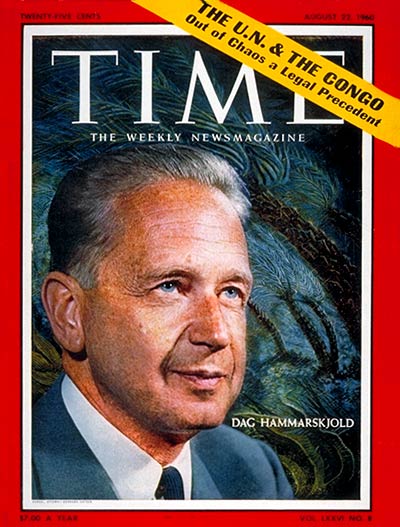
Dag Hammarskjöld But that Algeria speech actually did something else. It made him a hero to the colonized people of Africa. He now became a kind of unofficial ambassador to visiting African dignitaries. And that appeal began to spread to other Third World areas. So Kennedy now became a great admirer of the Chairman of the UN, Dag Hammarskjöld, who wanted the United Nations to be a kind of international forum that would give voice to the powerless nations coming out of colonialism and provide a lectern to express themselves. They began to make a secret alliance over the areas of Indonesia and Africa.
By 1960, Kennedy is very conscious that he’s on the edge with his foreign policy. So, on the eve of the 1960 convention, he told one of his advisors, Harris Wofford: We have to win this thing. Because if Johnson wins or Symington wins, its just going to be more of John Foster Dulles all over again. And, by the way, I have to say that, with what LBJ did once Kennedy took over, from ’64 to ’68, I think Kennedy was actually right about that.
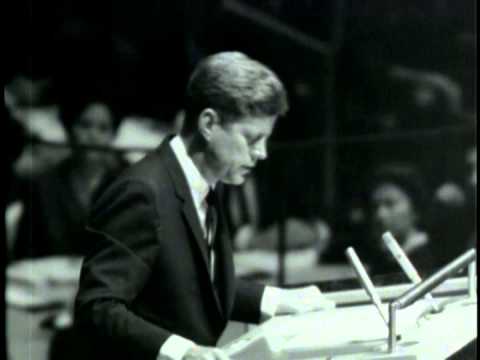
Kennedy addresses
the U.N. General AssemblyOnce Kennedy is in office, he immediately begins to alter the Dulles brothers’ policies. For example, in the Congo, where he supported Hammarskjöld’s policy to stop the country from being partitioned or recolonized by Belgium. And he began to work with Hammarskjöld, reversing American policy in Indonesia. The Dulles brothers had tried to overthrow Sukarno the Nationalist leader of Indonesia in 1958 and 59. Kennedy decided that that was going to be reversed. That he was going to support Sukarno, both politically and economically.
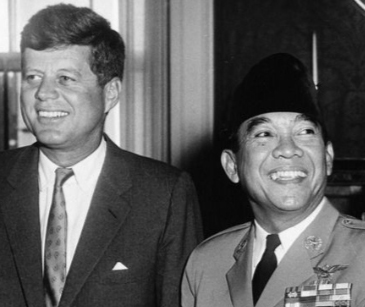
Kennedy & Sukarno Now what’s really remarkable about just those two instances, those alterations of the Dulles brothers’ foreign policy is this: That Kennedy continued those two policies after Hammarskjöld was murdered in the fall of 1961. And, by the way, I have no problem using the word “murdered”. Because all you have to do is read Susan Williams’ book, “Who Killed Dag Hammarskjöld?” You will see that that was not an accident, that airplane crash was not an accident. In other words, with Hammarskjöld dead, Kennedy was carrying this burden by himself. And, in fact, he had to go to New York to convince the United Nations, after Hammarskjöld’s death, not to give up their mission in Congo. He actually did that twice. And then he planned a State visit to Indonesia in the summer of 1964, which Sukarno was very much looking forward to.
Now I can mention other places where this occurs, that is when Kennedy comes in, he reverses the Dulles/Eisenhower foreign policy. For example, he wanted a negotiated settlement in Laos. Very important and, again, very overlooked, is that in the Middle East, the Dulles brothers had isolated Nasser and were beginning to favor Saudi Arabia.
Lee Shepherd:
Nasser, the head of Egypt.
Jim DiEugenio:

Gamal Abdel Nasser Yes, Nasser was the president of Egypt. And Kennedy reversed that, also. He began to favor Nasser and isolating Saudi Arabia. Now the reason he did that was because he thought, because Nasser was a Socialist and a secularist, that he could begin to mold the foreign policy in the Middle East away from the fundamentalism and the monarchy of places like Saudi Arabia and Iran.
And, by the way, he even mentioned that issue in 1957. Because there was a big Moslem population in Algeria. He refused to meet with David Rockefeller because he did not want to initiate a coup in Brazil, which is what Rockefeller wanted to meet him about, and he moved to isolate the military regime that had deposed the Dominican Republic’s President Juan Bosch.
Now every one of those policies, without exception, began to change at a slow rate and then at a rapid rate, under the pressure of Johnson and the CIA, in a period of about 18 months after Kennedy is assassinated. In each case, the end result was a calamity for the people living in those areas. A very good example being the CIA sponsored coup in Indonesia that took place in 1965 and which killed well over 500,000 citizens; and led to the looting of the nation by Suharto and his corporate cronies. What Kennedy wanted to do there, he was actually arranging deals for Sukarno to nationalize the industries on a very good split, the majority of the profits going to Indonesia. And Sukarno was going to use that money to start doing things like building hospitals and an infrastructure and schools, etc. He wanted those benefits of those natural resources to go to the people.
Now let me conclude with, what I think, is a very important aspect of this whole Dulles vs. Kennedy foreign policy dispute. As most people understand today, Kennedy was never going to commit the military into Vietnam. In fact, he was withdrawing the advisory force from that area at the time of his assassination. The Assassinations Records Review Board released some really important documents on this in 1997 and that, in addition to several books, including John’s book, JFK and Vietnam, for me sealed the deal on that issue.
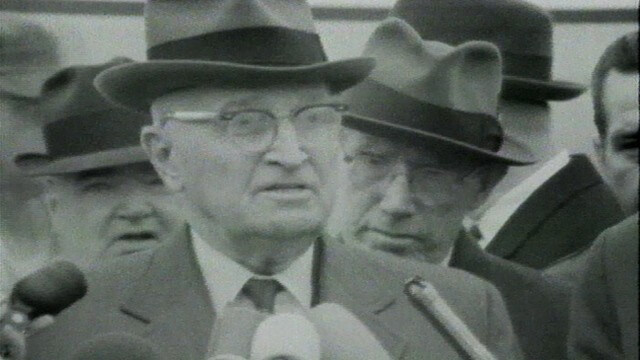
Truman reacts to the assassination Within a month of Kennedy’s assassination, I think on December 20th, 1963, former president Harry Truman published a column in the Washington Post, in which he assailed how the CIA had strayed so far from the mission he had envisioned for them when he was putting that agency together. To the point where he really kind of didn’t recognize what it had become. From his notes, it’s clear that Truman began writing that column eight days after Kennedy’s death.

“Harry Truman Writes” In the spring of 1964, while he was sitting on the Warren Commission, Allen Dulles visited Truman at his home in Missouri. This was not a social visit. He was there for one reason. He wanted Truman to retract the column. That attempt by Dulles failed. Truman never did retract what he wrote and, in fact, about a year later, in Look magazine, he repeated those same thoughts.
But a very curious exchange occurred as Dulles was leaving. As he got to the door to join his waiting escorts, he turned to Truman and said words to the effect: You know, Kennedy denied those stories about how the CIA was clashing with him in Vietnam. Which is a really startling thing to say. Because Dulles’ visit was supposed to be about Truman’s article. And Truman never mentioned Kennedy or Vietnam in the article.
Further, the two newspaper pieces Dulles referred to are likely one by Arthur Krock and one by Richard Starnes, both published in October of 1963. They both discussed the CIA’s growing influence over foreign policy and they both conclude that, if there was ever an overthrow of the US government, unlike Seven Days in May, the novel that had been made into a film around that time, it would be sponsored by the Agency and not the Pentagon. Again, Truman never went that far in his article. This whole angle was imputed to him and initiated by Allen Dulles. I think it’s pretty clear, from that conversation, that Dulles made the visit because he thought Truman wrote the column because the former president believed the CIA had a role in killing Kennedy over the Vietnam issue.
What makes this even more remarkable are these two aspects. Number one, at that time, in the spring of 1964, nobody had connected those dots: That is, the CIA, Kennedy, Vietnam and Kennedy’s assassination. No one. The first time it’s going be done is four years later by Jim Garrison.
Number two, Truman had already said to the press in 1961 that Hammarskjöld had been murdered over his Congo policy. And Dulles was aware of that. In my opinion, he saw what had happened with Hammarskjöld, and he did not want Truman to get more explicit in the Kennedy case. So in the language of prosecutors, specifically the late Vincent Bugliosi, he would have said something like this—if he had been on our side: What Dulles was doing here was showing something called consciousness of guilt, while he was sitting on the Warren Commission. Which is one more reason that the commission is really a joke.
After four years of study, 2013 to 2017, I’ve concluded that the cover up about Kennedy’s foreign policy, and how reformist it was, has been more deliberate, more strenuous, more systematic, than the cover up about the circumstances of his death. The reason being that it gives a clear and understandable motive for the Power Elite to hatch a plot against him. There were literally tens of billions of dollars on the table in the Third World, especially Indonesia. And that’s the kind of money that these people commit very serious crimes about.
This is why, at the time of his death, people like Nasser in Egypt fell into a month long depression. And he ordered Kennedy’s funeral to be shown four times on national television. It’s why Sukarno openly wept and asked “Why did they kill Kennedy?” It’s why Kwame Nkrumah of Ghana, when the American Ambassador gave him a copy of the Warren report, he returned it to him. He pointed out the name of Allen Dulles on the title page and said one word: “Whitewash.” The people about to be victimized understood what had happened. Because of our lousy media in the United States, it’s taken the American public quite a bit longer to understand.
Okay, thank you, I’ll conclude with that.
Lee Shepherd:
James, can I ask you one question.
Jim DiEugenio:
Sure.
Lee Shepherd:
You’re mentioning Dulles quite a bit.
Jim DiEugenio:
Right.
Lee Shepherd:
Who do you think is behind this whole thing?
Jim DiEugenio:
Well, I gave David Talbot’s book a very good review: The Devil’s Chessboard. And I think he makes a pretty good case, that Dulles, if I had to categorize it, I think Dulles was the outside guy and I think James Angleton was the inside guy.
Lee Shepherd:
So the assignment was given to Angleton?
Jim DiEugenio:
I think Angleton was the inside guy.
Lee Shepherd:
Okay.
Jim DiEugenio:
He was the guy working in the, what we would call, the infrastructure. And I think Dulles was the outside guy, arranging it with the people he knew had to back him.
Lee Shepherd:
But Dulles was fired.
Jim DiEugenio:
Dulles was what?
Lee Shepherd:
Dulles was fired by that stage, by John Kennedy.
Jim DiEugenio:
Yeah, he was fired. But if you read Talbot’s book, he was only fired symbolically. Because he kept on having meetings over at his townhouse in Georgetown. And he actually wrote about those meetings in his diary and anybody could read who he was meeting with, people like Angleton, people like Des FitzGerald, etc. And then on the day of the assassination, he ends up at the Farm,—
Lee Shepherd:
Yes.
Jim DiEugenio:
—which is the CIA headquarters.
Lee Shepherd:
Is that Camp Parry? Camp Parry, Virginia?
Jim DiEugenio:
Yes.
Lee Shepherd:
Secondary command post of the CIA?
Jim DiEugenio:
Right.
Lee Shepherd:
Okay, good, thank you.
Jim DiEugenio:
So he was figuratively separated from the CIA. But as Talbot says in his book, he was really more like leading a kind of like in-country junta against Kennedy.
Lee Shepherd:
Okay, James. Thank you so much.
This transcript was edited for grammar and flow.
-

Full-text searchable pdfs of the NARA documents released in July 2017
Each of the .pdf files contains multiple RIFs, thus reducing the number to 28 and 20 (from 425 and 3,369), for the postponed-in-full and released with deletions, respectively. The title tells you the first and the last RIF inside. To each file, searchable text has been added.
To search them, you will need to download them:
and view them in an Adobe Reader.
Choose “Open Full Acrobat Search”:
The full search allows you to choose how to search the documents (individually, or all documents in a folder, etc.):

Our thanks to Ramon Herrera for the preparation of these documents.
-
A title-searchable index to the July 2017 releases has been published by Our Hidden History
See JFK 2017 RELEASES, At: Our Hidden History
-

How The Atlantic Monthly and Kurt Andersen Went Haywire
 As this web site has explained at length, the MSM has been completely unable to deal with the assassination of President Kennedy in any kind of rational or evidentiary manner. Since the recent presidential election touched upon the JFK case, we posted two columns dealing with it. (Click here for one published during the election and here for one dealing with the aftermath) From those two articles the reader will understand the historical factors that allowed Donald Trump to claim his victory much more clearly than the long story on the current cover of the Atlantic Monthly.
That article was written by author and radio personality Kurt Andersen. Andersen is the current host of Studio 360, a radio program carried by WNYC in New York City. I have never listened to the show, and after reading this article, I never will. It is a weekly journal devoted to arts and culture. And that is the approach Andersen took in this essay. His rather ambitious aim is to try to explain how the last fifty odd years of American history gave us Donald Trump.
The problem is that Andersen is not a historian. In any sense of that word. And his essay does not really deal with the political or economic history of that time period. Like the program he hosts, his essay (actually an excerpt from an upcoming book) is really a cultural history. It dates, of course, from the Sixties. And on the first page, Andersen makes it clear where he is coming from and how rigged his work will be. He says that America experienced the equivalent of a national nervous breakdown in the Sixties, and in his view, we are not cured yet.
Our intrepid chronicler now gears down into what one of his main themes will be: the danger of widespread belief in conspiracy theories. After concluding that too many people do believe in conspiracy theories, he then says that this has allowed America to mutate into a Fantasyland where the public does not know what to think or believe.
Why does Andersen use the Sixties as the point of demarcation for his Fantasyland mutation? A few pages later the motive becomes clear. According to our guide, the Left began believing in these constructs because of the JFK assassination. He traces this back to Thomas Buchanan’s book, Who Killed Kennedy? published in 1964. He leaves out the facts that 1.) Buchanan’s book was originally published in France, which is where he was living at the time, and 2.) that other writers had addressed problems with the official story prior to Buchanan’s book being published in America. This allows Andersen to avoid the fact that it was not just Americans who had doubts about the JFK case—the rest of the world did also. And secondly, that respectable journals like The New Republic and The Nation had also voiced doubts about the JFK case before the publication of Buchanan’s book. And that, in 1966, Life Magazine actually devoted a cover story to the problems with the Warren Commission, entitled A Matter of Reasonable Doubt. Or that, in 1967, the Saturday Evening Post featured a cover story based on Josiah Thompson’s harsh critique of the Warren Commission, Six Seconds in Dallas. It was not just Buchanan and Mark Lane.
Let us now turn to a piece of absolutely essential cultural history—which Andersen also leaves out. The late Roger Feinman showed, with CBS internal documents, that in 1967, several reporters and mangers at CBS News wished to explore the problems with the Warren Commission’s evidence. This attempt was crushed at the executive level, most notably by CBS President Dick Salant. (see Why CBS Covered Up The JFK Assassination) That counter to a genuine journalistic effort was largely motivated by the fact that Salant’s administrative assistant was Ellen McCloy, Warren Commissioner John McCloy’s daughter. By the use of both carrots and sticks, the entire trajectory of the subsequent four-night CBS special was completely reversed by this upper level decision. Feinman demonstrates step by step how this proceeded with CBS’s own documents. Somehow, Andersen did not think that was an important piece of cultural history, even though it informs us about cultural gate-keeping.
What does Andersen think is important? Walter Sheridan’s 1967 NBC hatchet-job on Jim Garrison. No kidding. Andersen says that this infamous special, in which producer Walter Sheridan used bribes and threats to coerce witnesses, discredited Garrison’s ideas. (For an exposé of Sheridan’s reprehensible tactics, see Destiny Betrayed, second edition, pp. 235-258) Andersen ignores the fact that the program was so one-sided, so much a broadcast disgrace, that the FCC allowed Garrison to respond under the provisions of the Fairness Doctrine. Andersen also ridicules the idea that the owners of NBC, the Sarnoff family, sanctioned the program, when such has been proven to be the case. (ibid, p. 239)
But actually, Andersen’s argument is even worse than that. It’s not enough for him to ignore what was really happening in media boardrooms, or in New Orleans. He now says that all this doubt about JFK’s death was really caused by the Jungian psychic need to reject the idea that President Kennedy could have been killed by “just one nutty loser with a mail-order rifle.” He then throws in Richard Hofstadter’s “The Paranoid Style in American Politics.” Which shows how far down he is scraping. That essay has virtually nothing to do with the JFK case. Hofstadter focuses there on the movement that brought Barry Goldwater the Republican nomination in 1964. Hofstadter tried to dismiss it as odd, eccentric rightwing solipsism. Oh, how wrong he was! For that movement would revive itself 16 years later to elect that B movie actor Ronald Reagan. Like others, Andersen just wanted to use the title as another smear device.
On page 84, Andersen briefly halts his cascade of smears and mischaracterizations and comes up for air. After describing some American films of the seventies, e.g., Chinatown, The Parallax View and Three Days of the Condor, he allows himself this thought: “Of course, real life made such stories plausible. The infiltration by the FBI and intelligence agencies of left-wing groups was then being revealed, and the Watergate break in and its cover up were an actual criminal conspiracy.”
Perhaps nothing shows just how much Andersen has stacked the deck than those two sentences. First of all, he carefully does not describe the expanse of the Watergate plot. When it was over, 69 people were indicted, 48 were convicted, and Richard Nixon was forced to resign in the face of certain impeachment. Later, Alexander Haig arranged a deal with former Warren Commissioner and new president Jerry Ford. Nixon would be spared a trial with a pardon. Which, according to most polls, helped sink Ford’s short-lived presidency.
Second of all, Andersen fails to reveal how the press found out about “the infiltration by the FBI and intelligence agencies of left-wing groups”. Probably because he does not want to print the two words: “Church Committee”. If he did so, he would open up a Pandora’s Box that would largely burst the Fantasyland fairy-tale he is spinning. The Church Committee did much more than expose the infiltration of left-wing groups. It exposed CIA assassination plots against foreign leaders, like Fidel Castro and Patrice Lumumba. Further, members of that committee—i.e., Senators Gary Hart and Richard Schweiker—wrote a report that showed how the FBI and CIA had misinformed and misled the Warren Commission.
But there is even more to this story that Andersen fails to tell. The Church Committee sprang to life because its predecessor, the Rockefeller Commission, was largely seen as ineffective. In the wake of Watergate, many in Washington—like Senator Howard Baker, and future Senator Fred Thompson—thought that the official inquiry had not fully explored the role of the CIA in that crime. Therefore the Rockefeller Commission, led by Ford’s Vice-President Nelson Rockefeller, arose. But this body was perceived by many, even the New York Times, as being a set-up. After all, Warren Commission lawyer David Belin was the chief counsel, and people like Ronald Reagan were on the Commission. Therefore, at a closed press briefing, Ford was asked why he had arranged things as he did. He replied that there were certain things that had to be concealed from the public. When asked what he meant by that, Ford blurted out, “Like assassinations.” (See James DiEugenio and Lisa Pease, The Assassinations, p. 194) Ford is very likely talking about the JFK case since, at around this same time, he revealed to French Premier Giscard d’Estaing that, while on the Warren Commission, he had determined that some kind of organization had killed Kennedy, but he could not determine which one.
But that is not all that Andersen leaves out about the discoveries of the Church Committee. Consider the following:
- He does not mention the attempts by the FBI to drive Martin Luther King to suicide.
- He does not mention the campaign by the FBI to exterminate the Black Panthers. (For a summary of this, see Government by Gunplay, edited by Sid Blumenthal and Harvey Yazijian)
- He does not mention the explorations by both the Church and Pike committees concerning CIA control of the media. This was later summarized and expanded upon by Carl Bernstein in Rolling Stone’s, “The CIA and the Media”. (Click here for that article)
Actually, Andersen loads the dice even more. How can anyone write an essay about the 50-year decline of America’s belief in its media or institutions without mentioning the Vietnam War? Well, Andersen can. What is his longest mention of that incredibly divisive issue which essentially ripped America apart for the better part of a decade? He talks about Norman Mailer’s 1967 book, Armies of the Night, where student protesters attempted to levitate/purify the evils inside the Pentagon. Forget about 250,000 wounded Americans, and 58,000 killed, or over 4 million total dead as a result of a war that should never have been fought. Andersen says a few pages of Mailer’s book is what we should remember about that terrible epic tragedy, during which the American public was being lied to endlessly on almost a daily basis.
By painting such a foreshortened picture, Andersen can leave out the ten years of nightly TV broadcasts, daily newspaper headlines, and weekly magazine cover-stories which pummeled the public with words and images about the Vietnam War, Watergate and the exposes of the Church and Pike Committees. It was not the American people who suffered a nervous breakdown from frivolities like the UFO phenomenon. It was the acts of Lyndon Johnson and Richard Nixon, plus the exposure of abuses by the FBI and the CIA, that shocked the country and drove down the public’s belief in government. (See the chart in The Assassinations, p. 634) And that was a natural reaction to that continuous montage of horror stories. None of this was part of a fantasy. It was all too real.
What Andersen does not understand, but Michael Parenti does understand, is this: Reality can be Radical. Those ten years exposed a huge systemic failure. And the media was a part of it. One only has to recall how difficult it was to get the true story about the My Lai Massacre exposed. And how the Pentagon and Richard Nixon then did all they could to pardon the killers. But further, as Nick Turse demonstrates in his book Kill Anything that Moves, there were many other atrocities that the military purposefully covered up. For as Colonel Robert Heinl wrote in a famous article in Armed Forces Journal, the American army collapsed in Vietnam by 1969. (Click here) Yet Nixon kept the war going for four more years and actually expanded it into Laos and Cambodia. That is history that Andersen, again, ignores.
Did things get better after that? Well, there was the Iranian hostage crisis; the American backing of radical Moslems—which included Osama Bin Laden—to fight the Russian invasion of Afghanistan; Reagan’s interventions in Central America and the El Mozote Massacre (where more people died than at My Lai) and which was also covered up; the Iran Contra scandal; the heists of the 2000 and 2004 elections, which allowed the disastrous invasion of Iraq, the worst foreign policy disaster to befall this country since Vietnam. Again, somehow none of this is important to cultural historian Andersen. Maybe the author ignores it since none of it deals with the paranormal, it’s all real. But with his loaded dice, the former counts more than the latter.
Which brings us to the payoff of the article. That includes three themes: Fake News, the rise of the Internet, and the victory of Donald Trump. I think Andersen wants us to believe that somehow the first two resulted in the last. But as anyone who watched that election closely knows, such was not the case. The whole Fake News phenomenon arose after the election. And it’s a much more complex phenomenon than Andersen portrays it to be. As he does with many issues, Robert Parry had done the best reporting on this flashpoint. (See here for an example)
The use of the Internet probably did help Trump’s campaign, but not in the way that Andersen thinks. Steve Bannon, Trump’s chief strategist, used a little-known company called Cambridge Analytica to micro-analyze social media data and target trends and tendencies with voters. (Click here for a good article on this) Using this data he was able to detect weaknesses in Hillary Clinton’s and the Democratic Party’s supposed fortress: the Northeast Rust Belt. In an interview Bannon did the day after the election, he said Trump’s strategy was twofold: 1.) They had to hold the south, that is, North Carolina and Florida, and 2.) They had to win some states in the Rust Belt. This is why Trump visited Michigan almost twice as many times as Clinton, and why he honed his message as one of economic nationalism—rounding up illegal immigrants, building a wall, tariffs on Chinese imports—this countered Clinton’s failed use of identity politics, e.g., Alicia Machado.
Bannon realized that Clinton could not effectively counter that Electoral College strategy. The reason being that her husband’s record on fair trade was pretty much indefensible. As many have commented, Bill Clinton was the best Republican president since Eisenhower. Bannon and Kellyanne Conway ran a very astute and pointed campaign. The Clinton campaign had much more money, many more workers, and much more favorable media. And they still lost. The problem was not just campaign tactics. Hillary Clinton simply could not fire up her own base the way that Bernie Sanders could have. Which is another factor that Andersen leaves out. Sanders outflanked the Democratic establishment almost as effectively as Trump did the GOP. Did he do that with Fake News? Or an alternative reality dealing with UFO’s and the levitation of the Pentagon? Further, according to a pre-election poll, Sanders would have beaten Trump fairly soundly. Which renders Andersen’s silly article even sillier.
But what happened afterwards also renders the article silly. Trump’s ratings have cratered since he was elected. Is that also due to Fake News? No. It’s because America has realized that Bannon’s campaign was really a sales pitch. Which Trump, a real estate salesman, managed to deliver perfectly. Trump and the Republican Party really have no solutions to the complex issues that have assaulted this country: like the gutting of the Middle Class. Past his campaign slogans and themes, Trump simply has no vision for America. Except to make the health care problem even worse and cut more taxes for the wealthy. The real mystery about Trump is how he changed paths so radically from 2000 until today. If one recalls, when he was pondering a presidential run for the Reform Party ticket, he was much more moderate in his policies, more like a Democrat. No reporter ever tried to explain this paradox.
Of course, Andersen mentions the Trump/Roger Stone accusations of Ted Cruz’s dad allegedly being in a photo with Oswald in New Orleans. Yet Trump endorsed the Warren Commission verdict of Oswald being the lone assassin. And it was people in the JFK community, like David Josephs, who showed that Trump was wrong about that identification.
Yes, there is a crisis of confidence in this country. And yes, it has gotten worse over time. And, as mentioned above, for very good reasons. And as Larry Sabato showed in the polling for his book The Kennedy Half Century, and as Kevin Phillips showed in his volume, Arrogant Capitol, it began with the issuance of the Warren Report. Most people today think that the Warren Report was wrong, and something went awry with the country after the Kennedy assassination. And they are right (e.g., Vietnam).
Andersen’s ridiculous essay is a pile of smoke and mirrors designed to distract from that fact.