Blog
-

William Turner speaks with Hal Verb and Elsa Knight Thompson
Listen to the audio on YouTube.
Moderator
I am in the studio with William Turner, staff writer of Ramparts Magazine, and author of a forthcoming book, Police USA, which will be published by Putnam, Invisible Witness, Bobbs Merrill, and The Garrison Case, Award Books. Mr. Turner is a former FBI agent. He wrote the essay “The Inquest” in June Ramparts, outlining Garrison’s case, and the “The Press Versus Garrison” in the September Ramparts. This is not Mr. Turner’s first appearance in our studio. Quite a number of years ago now, several years ago, Mr. Turner appeared over this station when he was originally in the process of leaving the FBI, and us no more popular with the authorities. And so, he’s been a lot of places, and done a lot of things since then.
The second person we have with us is Mr. Harold Verb, who is a reporter for The Berkeley Barb, and has also been doing some work at San Francisco State, conducting a seminar, I believe, on the assassination of President Kennedy, and the Warren Commission report.
Now, what we’ve asked these two to come and chat with us about is what’s going on in New Orleans, and what role Jim Garrison has played in this, where it is now, and how they estimate its significance, its relevance, is it more than simply a theory that Mr. Garrison is working with? Perhaps you could bring us up to date on some of the facts, Mr. Turner.
William Turner
I’d be glad to talk about Jim Garrison’s case. Actually, Garrison first got into the assassination investigation the day after the assassination. On that Saturday, he called what he termed a brainstorming session of his staff, and they went over any possible New Orleans angles, or persons who were erratic enough to have been involved in a conspiracy. At that time, they came up with the name of David William Ferrie, who you will recall died this year, on February 22nd, after he became involved in Garrison’s current investigation.
Now, at that time, Ferrie had a rather mysterious trip to the state of Texas, leaving the afternoon of the assassination. And on that trip, he went first to Houston by car, where he appeared at an ice skating rink, and according to the owner now, he stood by the telephone for several hours on that Saturday afternoon. He apparently received a call, and then went to Galveston.
Now, Garrison was waiting for him when he got back on Sunday to New Orleans, and picked him up, and turned him over to the FBI for interrogation, because of the very suspicious nature of this trip. In other words, Garrison thought it was a very curious trip, by a curious man, at a curious time.
The FBI released him, and apparently the reason was that, number one, Ferrie had not left on that trip until well after the assassination; say, five or six hours. And also, because they determined that his small airplane was not airworthy at the time, and therefore, he couldn’t have been in on an escape plan. Now, there the matter rested, and as Garrison puts it, he said, “I had confidence in the competency of the FBI.” He himself is a former agent of the FBI. He was in approximately a year. And interestingly enough, he was in the same office that I was in, Seattle.
So, it was not until last fall when he was riding a plane to New York with Senator Russell Long of Louisiana, that his interest was renewed. Apparently, they were discussing the various books that had come out, and Senator Long the statement that he really believed that there was more to it than Oswald. And they conversed on it. When Garrison got back to New Orleans, he went into virtual seclusion, pouring over The Warren Report and its volumes, and he quietly launched his inquiry. And on the basis of the initial returns in this inquiry, he became convinced that, indeed, there was an assassination plot, and that the assassination plot had at least one aspect in New Orleans.
So, that is how he got started on it, and as you know, it’s still going on.
Elsa Knight Thompson
Well in what form is it still going on? Would one of you … How is he proceeding at this point, and where does he intend to … Has it just simply become a private investigation now? There’s nobody up for trial at the moment, is there?
William Turner
Well, yes; there is. Clay Shaw is scheduled for trial. But, let me put it this way, that Shaw was arrested … I believed it was the latter part of February. And through all kinds of legal maneuvering … maneuvering is a word that the judge down there, not mine. It’s been postponed and held off, and a trial date has not yet been set. However, Garrison stresses that he does not believe that Shaw is at the center of any web of conspiracy, that he is a peripheral participant in this. And therefore, he has a motion in open court to speed up the trial of Shaw so that he can sort of clear the decks with his own investigation.
As it is, he was held up with all these legal motions in the Shaw case. He does not have a greatly enlarged staff, and they have their normal criminal case load to handle. And he also has been subjected to attacks from Life Magazine, which insinuates that he is somehow sympathetic to organized crime, which is laughable; because probably of all the district attorneys in the nation, he has done more to clean up organized crime than anyone. By NBC, CBS, the bulk of the national media, the mass media, and therefore, he would like to be able to devote more time to the investigation.
But, he does have an investigation. He’s got main files that are set up somewhat like the FBI’s. He has an archivist to handle the Garrison archives. He has men who are specializing in the Kennedy assassination investigation, and I’ve spent a total of two weeks inside his office down there, and every day, there’s a new angle.
Elsa Knight Thompson
Well, tell me, in as much as there must be quite a few people who wish he would dry up and blow away, can he as prosecuting attorney just sit there and utilize that much taxpayer’s money to follow up on something simply because he believes in it? Is there any chance or possibility of actual either legal or political pressure to make him stop this?
William Turner
There have been all kinds of pressures brought to bear. Now, Garrison was carrying on his inquiry in secret. This is the best way, of course, to carry on an inquiry; at least in its initial stages. Now, the States-Item newspaper in New Orleans checked the disbursements of his office and found that there were what they consider these exorbitant travel expenses. People were going to Miami, they were going to Chicago, San Francisco. And this is the way they got wind of what he was doing, and they broke it in the paper.
Well, Garrison, at that time … Number one, there was a loud hue and cry that he was expending public funds on a wild goose chase. Now, he didn’t want to come out and release all his evidence to substantiate that it was not a wild goose chase. Therefore, they formed a group, businessmen in New Orleans formed a group, called Truth or Consequences, Incorporated; which is privately financing the assassination investigation. They signed up and contributed so much a month, and this is what is really subsidizing his assassination investigation.
Elsa Knight Thompson
But, through the prosecuting attorney’s office, or separate from the prosecuting attorney’s office?
William Turner
Well, through the office. Through the office. Now, you’ve mentioned pressures brought to bear. You get in his office down there, and you almost feel like you’re in maybe a Russian embassy on US soil, the way he’s been treated. For one thing, there is an organization down there called the Metropolitan Crime Commission. An ex-FBI agent by the name of Aaron Kohn is the head of this.
Now, of course, this is again, a privately subsidized operation, and Mr. Kohn has to have organized crime around in order for himself to exist. And it seems that, since Garrison’s investigation has come up, Kohn has been inordinately active in trying to say that there’s organized crime in the parish of Orleans. He’s been called before the grand jury down there several times to try and specify what he means by this, and he’s been unable to do so.
Nevertheless, that is one pressure point. As I mentioned, the national press is another pressure point. Bobby Kennedy’s former investigator Walter Sheridan was down there from the inception of Garrison’s investigation, and he has attempted … There is a legal allegation that he has attempted public bribery in getting to Garrison’s witnesses. It is alleged that Perry Russo, who is a key witness in the Shaw case, was offered some money by Sheridan. Sheridan allegedly told him that, “We’ll get you to California, and they won’t be able to extradite you from there.” And various other types of either intimidation or lures. They’ve been using the carrot and stick down there.
Elsa Knight Thompson
Yes, Hal.
Hal Verb
Yes. One of the things that Bill has mentioned are these different pressure points, and he’s pointed out the press, nationally and locally, has not given the Garrison case a fair shake. We can speak about the local press here. I think the only fair shake that they have given Garrison is that there is no news that is covered in the local press here that gives space to anything he says to counter the charges that are against him. I’ll specifically mention one. For example, when Life Magazine said that Garrison had been connected with the mafia, and this was reported in the press, Garrison had an instant reply to that, and he said, “I don’t even know Carlos Marcello,” and that was the specific individual who Life Magazine had tied him in with. “I wouldn’t even know him if he were sitting right here next to me.”
Now, this thing has never even appeared locally; I doubt if there are a few people here in the Bay Area, or in the whole state for that matter, who even know about this remark. This is typical; NBC, CBS will present their program, giving their version of what they say are both sides of the story, when in fact, it is only one side.
Elsa Knight Thompson
Yes. I believe you had something about some TV coverage that you wanted to talk about. Would this be the time that you would like to go into that a little more fully?
Hal Verb
Yes. There seems to have been what I would regard as a massive attempt to, if not obstruct the investigation, to at least put obstacles in the way of it that would prevent Garrison’s case from really coming to court, or at least having his say, with respect to what he has presented. For example, CBS presented a four part series late in the summer, I think it was the end of June, in which they references specifically to Garrison’s case. And one of the things that they mentioned was the kind of attempts that were by Garrison’s office, allegedly, what they said to bribe and intimidate witnesses.
And, for example, they pointed to a writer for the … This is a quote from one of the transcripts that I have of the four part series. They said there was a writer for the Saturday Evening Post who said he had read transcripts of what went on at those sessions. Now, the fact is that there were never any such transcripts, and this writer had actually seen Sciambria’s notes. And what this writer was trying to show was that this particular person had written a document, or statements, in which he had said that a key witness, Perry Raymond Russo, had lied about what he had presented as evidence.
The fact is that this was never the case, because there were in fact memorandums that were prepared, and that this writer actually was aware of the existence of these memorandums. Now, this did not get into TV coverage.
Elsa Knight Thompson
Well. Where would you like to go from here on this? What is Garrison’s theory? You say that the man, Shaw … Ferrie, is dead. There seem to be an awful lot of dead people connected with the whole situation …
William Turner
The tabulation goes on and on.
Elsa Knight Thompson
Yes. So, Ferrie’s dead, whatever it was he was supposed to be doing. Now, what about Shaw, and what is Garrison’s overall …
William Turner
Well, all right. In broad terms, it is this … And I think that this will also explain the orchestrated attack on him. Garrison believes that Oswald, number one, was a CIA agent, and that he probably had been trained at the Atsugi base in Japan when he was in the Marine Corps. This would have been back around 1957, ’58. Atsugi, reportedly, is a U2 installation. And in the restricted documents … there’s still classified documents in the archives … There’s a very tantalizing one entitled “Oswald’s access to U2 information”.
Now, necessarily, this means that when Oswald went to the Soviet Union, he was a CIA operative. And, of course, there is liberal evidence to back this up; most of it suggestive, rather than direct. But, for one thing, when he came back, he told a fellow employee in Dallas, where he was working in a photographic lab, about the disbursement of Soviet military forces, how they did not intermingle, or armored divisions with infantry. And then, he said, “I didn’t notice any vapor trails over Minsk.” Minsk is where he was when he was in the Soviet Union, for most of his stay.
Now, Garrison believes that Oswald’s leftist activity in New Orleans and Dallas, his attempts to insinuate himself into the confidence of the Fair Play for Cuba Committee, the Socialist Workers Party, the Communist Party USA, was nothing more than an attempt to erect a facade. Such a façade would have given him, perhaps, easier access to communist countries. It would have given him, once in, a freer movement.
Now, when Oswald went to the Soviet Embassy … or, excuse me, the Cuban embassy in Mexico City, he very careful listed all these affiliations with these groups; which, of course, existed only in his own mind. He never was formally accepted into any of them.
Now, who was Oswald then, if he was not really a leftist; who was he? Well, Garrison’s evidence will show that Oswald was affiliated with a group in New Orleans, which was anti-Castro in nature, and was paramilitary in nature, that was composed … down in that area, there is a tremendous cross-pollination of people who are members of the Minutemen, who are Cuban exiles, violently opposed to Castro, who are even members of the KKK. And it was with one of these factions with whom Oswald was traveling.
Now, with that in mind, how does the CIA come into it? Because Garrison believes that CIA is the reason that there is this orchestrated attack on him. Well, very simply, it was the CIA which sponsored these anti-Castro groups, which were supposed to, even after the Bay of Pigs failure, never relinquish their dreams of re invading Cuba. And, as a matter of fact, these groups were very active, and training in the environs of New Orleans. Garrison found one of their bases where one of the founders of the Minutemen had been arrested by the FBI and secretly let go. His name never appeared in the newspapers.
These people became very disenchanted with President Kennedy after what they call all his promises about freeing Cuba, and not coming through. And then, his apparent rapproachment with Cuba, which was in the works at the time of the assassination, was being handled through the Cuban ambassador, Carlos Lechuga and the United Nations, and through an intermediary, an ABC newswoman, who was on very close personal terms … Lisa Howard; very close personal terms with Castro.
So, what Garrison believes is these anti-Castro groups, which had been nurtured by the CIA, one of the factions, a spin off from this group, got out of hand, set up Oswald as the patsy, and assassinated Kennedy in Dealey Plaza. And Dealey Plaza ––
Elsa Knight Thompson
In other words, he doesn’t think the CIA ordered Kennedy’s assassination, but simply that a group that had been involved and financed by the CIA, went its own way …
William Turner
Right. The CIA, by its very nature, is compartmentalized, or cellular … They used to talk about communist party cells, and how one didn’t know the other. And this is exactly the structure the CIA, and it’s very easy for one of these CIA cells to become so involved in deceit, duplicity, assassination, murder, to go off and do something like this. And the operation at Dealey Plaza had all the earmarks of a paramilitary type of ambush. No question about it.
Elsa Knight Thompson
And Ferrie and Shaw were involved in that group? Is that …
William Turner
Now the legal allegations against Shaw are that he conspired, it’s a conspiracy charge, in New Orleans with David Ferrie and Oswald to assassinate the president. Garrison’s legal bill in particular states that a session in which they discussed and planned an assassination … talk, or particulars, culminated in what happened at Dealey Plaza. And, as I said before however, Garrison has gone no farther in his charges on Shaw. However, he has independent evidence to back up Shaw’s identity as Clay Bertrand, as you may know that is a big bone of contention; Shaw says he is not Clary Bertrand. Garrison says he is.
Now, Clay Bertrand comes into this way; immediately after the assassination, a New Orleans attorney, Dean Andrews, who had handled what he calls the “gay swishers” in New Orleans, and also Oswald … Oswald apparently wanted his discharge changed; said that, immediately after the assassination, he received a phone call from this man whom he knew as Clay Bertrand. And Clay Bertrand was a man who had referred Oswald to his office. And he said that Bertrand asked him if he would defend Oswald against the assassination charges. Of course, before anything further could be done, Oswald himself was killed.
Now, as I say, it is part of Garrison’s allegations that Clay Shaw is in fact the man using the name Clay Bertrand; and this he intends to prove in court. Also, the facts of the conspiracy. One of the allegations, and to prove this, is that Clay Shaw met in Baton Rouge with Jack Ruby and with Oswald. And he has a witness that will testify to this. So, this is the case against Shaw, which as I say, is up for … It has not yet been set on the calendar, but will come off late this year, or early next.
Elsa Knight Thompson
Does he have any witnesses who claim to have been a member of this group themselves? Or, is this all inferential evidence? Do you know whether or not anyone within the little right wing CIA, whatever you want to call it, type group that this plot took place in according to him; is there anyone who was a part of that, that he has been able to get as a witness?
William Turner
Unfortunately, no. Because, obviously, these people would be accessories before the fact, at the very least, if not participants, accessories after the fact. And certainly, you talked about the mysterious deaths; these people would not be very prone to talk, knowing what the penalty might be.
Elsa Knight Thompson
Well, but he must have found it out some way. I wondered, if by any chance, it was a question of someone from the group informing even if, for reasons that would be very obvious, that this would be protected.
William Turner
Let me put it this way, then, that there have been people who have been within the group, or on the periphery of it, who have been able to give him at least part of a story. No one has come ––
Elsa Knight Thompson
Well, that’s what I was at. I wasn’t expecting that anyone who had helped to plan the assassination of the president would come along and say, “I was a member of a conspiracy.”
William Turner
Like former Minutemen, for example. Yes, there have been a couple of those.
Elsa Knight Thompson
Because, for example, as far as I know, it’s never been absolutely proven that such a group existed, and that Oswald was a member of it. Well, anybody who had ever been in that group would be a valuable witness to that much.
William Turner
This is true.
Elsa Knight Thompson
I was wondering what the depth was on the witness situation.
William Turner
Yeah. There has been no one, unfortunately, who has been able to tell them that, “Yes, I was in this group. Yes, I was part of the assassination team at Dealey Plaza. Yes, so and so and so and so shot from behind the grass …”
Elsa Knight Thompson
No, I understand that, Bill. But, the point is that sometimes you have a group that might be composed of, say, 10 or 15 people, and that doesn’t mean that there wouldn’t be a minority, even within so small a group, that was doing something. But, at least that any one of those 15 people could testify, the people who belong to this group, and who normally came to our meetings were so and so, so and so. And if Oswald, and Ferrie, and Shaw were three of them, then that much would be established. It was that kind of evidence, I was thinking.
William Turner
Right Elsa. There have been a couple of cracks in this little structure. There have been.
Elsa Knight Thompson
Well, that looks as if he’s gotten that far, anyway.
William Turner
Yes, he has.
Elsa Knight Thompson
And with this, does he think this is involved … Well, you mentioned the fact that there was Cuban participation in these groups.
William Turner
Cuban exile.
Elsa Knight Thompson
Yes.
William Turner
Yes, right.
Hal Verb
May I make a point about this?
Elsa Knight Thompson
Yes.
Hal Verb
Very early in the … when the whole case about Garrison’s investigation broke, there were charges that pro-Castro Cubans had somehow been involved. And some of the press had picked up the story that, at first, Garrison ––
Elsa Knight Thompson
This is pro-Castro Cubans?
Hal Verb
This is pro-Castro Cubans.
Elsa Knight Thompson
Yes. This is the, “Was he right? Was he left?”
Hal Verb
Riight. The pro-Castro elements were involved in the assassination, and the press allegedly stated, or stated that, allegedly, Garrison had actually conceived of this as possibly one of the elements in the conspiracy. I’m talking about certain sections of the press. The fact is that, at no time was this a possibility when Garrison launched his investigation. In fact, through all of the investigations that he has conducted, there’s one thing that does stand out, and that is that Oswald, who does play, of course, an important role in this whole case, all his associations during his entire trip, both through New Orleans and Dallas, were with elements that can be considered paramilitary, right wing groups, and that all his associations were primarily of a right wing, extremist nature.
There is no evidence to show that he was, as the press had identified him, as a leftist. This was merely a cover ––
Elsa Knight Thompson
Well, I guess it did come out that he had made approaches to certain left wing groups. But, I remember that, within days, or at least very shortly after the assassination, that there was also a news item about the fact that, at one time, he had volunteered to train people to go in on the Bay of Pigs invasion. In other words, a completely contrary story. Now, that hit the press sometime very quickly after the assassination, and then died. I never saw anything more about that, but I clearly remember this, because it made a great deal more sense in the context of what one knew about Oswald, than the other story. And so, I do remember it.
Hal Verb
Yes. I think what you’re referring to is an incident when Oswald had approached a anti-Castro refugee by the name of Carlos Bringuier, in New Orleans. And, apparently, it’s my belief that when Oswald had done this, he had blown his cover, so to speak, about his connections with the CIA, at this particular point. Because Bringuier had become immediately suspicious of Oswald, that he was a double agent.
Now, while he was in New Orleans, Oswald managed to get himself a lot of publicity. I think this was on the part of an expected cover that he was expected to assume. He got on a program, on radio, WDSU, in which he debated a person who was connected with a group called INCA, which was the Information Council of the Americas Now, this group was connected with right wing, anti-Castro refugees, and had extensive operations in connection with Latin American revolutions.
Now, the thing about this INCA group is that a number of individuals who connected with this particular group, one of them, for example, is a man by the name of Mario Bermudez, who is the man who helped arrange the trip for Clay Shaw when he was here in San Francisco. Now, if you’ll recall, one of the things that Perry Raymond Russo had said in his testimony before the grand jury, was that part of the ploy that was to be executed on the day of November 22nd, when President Kennedy was killed, part of this plot would have to have the principals of the case in other cities at the time, so that no suspicion would be drawn upon them.
It was just curious to see that this man, Bermudez, is arranging a trip for Clay Shaw, the man who has now been charged with conspiring to kill the president. And here is this group, INCA, which manages to arrange this particular debate with Oswald while he’s in New Orleans.
Elsa Knight Thompson
With Oswald taking a view contrary, at that point, to the right wing view. Is that ––
Hal Verb
On this program, he took a view that he was a leftist who identified with the Castro revolution.
Elsa Knight Thompson
Yes. That’s what I mean. Yes. Quite. But, there was … I do distinctly remember seeing the item that he had … In spite of the fact that he was supposed to be on this Friends of Cuba … What was the name of the committee? You know …
William Turner
Fair Play for Cuba.
Elsa Knight Thompson
Fair Play for Cuba, and so on; that he also had been in … had volunteered, at one time, to train people to go in on the Bay of Pigs invasion, Cuban exiles. Which, would be ––
William Turner
This is probably the Carlos Bringuier episode, because he appeared voluntarily at Bringuier office. Bringuier was probably one of the best known of the anti-Castro exiles down there. And, as a sign of good faith, he presented Bringuier with his Marine Corps drill manual, or field manual. And Bringuier felt that he couldn’t be trusted, and maybe was a plant, and had nothing more to do with him. Although, that little altercation, where Bringuier, when Oswald was out in front of the International Trade Mart with his Fair Play for Cuba hand bills, and Bringuier comes up, and his little altercation. And Oswald said, “Well, go ahead; hit me if you want, Carlos.” It almost sounds like it was staged; that Oswald really was trying to say, “Well, I’m on your side.” All the evidence points that way.
Elsa Knight Thompson
Well, everything that one has ever read would give one the impression, certainly, that Oswald, whether by design, and whether on behalf of just himself, or other people, was certainly playing both sides of the street.
William Turner
Oh, yeah.
Elsa Knight Thompson
And so, you therefore have your choice as to which side of the street he was really in the pay of.
William Turner
Well, why would Oswald be associating with a guy like Jack Ruby, and Garrison has abundant evidence to show that he was. Why would he be associating with a man like that, who really is apolitical, on the surface, at least. This isn’t somebody that Oswald would just pick up and associate with, because he didn’t really like nightlife all that much to go to the Carousel Club.
Elsa Knight Thompson
What role does Garrison figure Ruby did play in it?
William Turner
Garrison feels that Ruby was manipulated in this thing, probably by the Dallas police. Now, Dallas police is too general; probably by key people within the Dallas police. And, for example, Hal mentioned Jim Phelan’s article in the Saturday Evening Post, which made Garrison look a little ridiculous. And one of the means of ridicule that Phelan used in this was to quote Garrison as saying that you have to look at this through the looking glass, almost like Lewis Carroll. And this was a source of great hilarity. But, it’s really true; you do have to look at certain aspects of it in the looking glass. You have to look at Oswald in the looking glass. You have to look at Ruby.
His facade was that he would go around in the time between the assassination and his own killing of Oswald, and he’d go down to the postal box, where [Bernard] Weissman’s answers to his advertisement, the black bordered ad, “Wanted for Treason”, President Kennedy, was coming in, and said, “Oh, isn’t that awful?” And draw attention to himself there. He would go out in the middle of the night and call up one of his employees, Larry Crafard, at the club, and go out and photograph the billboard that says, “Impeach Earl Warren” … “Isn’t that awful?” And these tender remarks about Jacqueline Kennedy, about sparing her the ordeal; in other words, this was an attempt to draw attention to the fact that he was really very pro Kennedy, and very incensed that anybody would kill Kennedy, and therefore, it creates a certain illusion. And that’s what Garrison means by the looking glass.
Elsa Knight Thompson
Yes. I can see that. But, where does he think Ruby really was? Does he think that Ruby was a part of this conspiracy?
William Turner
Oh, certainly.
Elsa Knight Thompson
And it’s obvious that if there were a conspiracy, that Mr. Oswald was very definitely the patsy.
William Turner
Yeah. Well, for example ––
Elsa Knight Thompson
Whatever he expected to be, that’s what he was.
William Turner
Yeah. I’ll illustrate by the statement of one witness, sworn statement, in Garrison’s files. I can’t name the man, but it really doesn’t make any difference, he’s evaluated as probably a reliable witness. This man was an artist, sort of a transient artist. He’d go from town to town, and then he got a little bit on the shorts in Dallas, and he went into the Dallas … Or, no; he went into the H.L. Hunts son’s business office, and asked if he could give him a little dough, or something, and H.L. Hunt’s son said, “Well, I don’t give out any … You go down to the Dallas police department, give them your social security number, and they’ll take care of you.”
Now, this man said he went down there, he gave his social security number, the officer fixed him up with some kind of a chit that would get him a full tank of gas, and he was given a little pocket money. And he said, at that point, Jack Ruby came up, and said, “Well, maybe I can get you at least a temporary job.” And he said that Ruby gave him a certain amount of money, a nominal sum, and said, “You go down to Alexandria, Louisiana, and check in the Bentley Hotel there, and somebody’ll contact you further.”
Now, this man, and his wife corroborates this, they went, and the hotel records corroborate it; they went to the Bentley hotel … At least they corroborate that they checked in there fine. His story is that he was no sooner in there, than he was contacted by a man, his phone rang, “Come down to the lobby,” and it was Oswald. And Oswald conferred with him, and made a, what at the time, he considered a very cryptic statement, to the effect that very soon, some Catholic leaders will be killed. Which, he interpreted …
Elsa Knight Thompson
Well, what could Oswald say he was supposed to do, or anything? What did they confer about?
William Turner
He said he’d be contacted further. He was just confirming that he arrived, and then there was no further contact. And after a few days, this guy left. Now, the whole annals of this thing is filled with these kinds of fits and starts, they seemed. But, there was another incident; a man by the name of Donald Norton, who claims that he is a former CIA “unpeople” who worked for CIA on certain assignments, said, number one, that at one time, he was sent to Atlanta, and that he met a man at the Atlanta Airport, who gave him … He was a courier. Norton was a courier. He was to deliver this amount of money to Havana. And this was in ’58, before Castro got to power. And that the man who gave him the money was an Eastern Airlines pilot named Hugh Ferris.
Well, he later identifies Hugh Ferris as being Dave Ferrie, and Ferrie was indeed an Eastern Airlines pilot. He also said he was on another courier assignment to Monterrey, Mexico. And that, in the course of this assignment, he delivered money to Oswald, a man he now identifies as Lee Oswald. This was in September of ’62. And then took documents from Oswald, he doesn’t know what they were, and delivered them to Calgary, Alberta, Canada, where a man gave him the password, “It’s a fine day in Tulsa.” And it was an oil firm employee. And he delivered the documents to him. He got paid by the assignment. He said he got $5,000 for that assignment.
Now, again, this man has been subjected ––
Elsa Knight Thompson
You think it all happens on TV, but I guess it doesn’t.
William Turner
I can guarantee ––
Elsa Knight Thompson
I mean, it’s just beyond ––
William Turner
–– that this thing is almost surrealistic. At times, I feel it’s too James Bond-ish to be true. But, the facts are there, and it really is the way it’s turning out.
Elsa Knight Thompson
And he feels, then, that all of this, or at least a good deal of it, can be brought to light during the trial of this guy Shaw, if he can get ––
William Turner
No, he doesn’t. Garrison has made a statement; he says, “I just hope the American people don’t think that the Shaw trial is going to bring out everything. And actually, we can only introduce what is material and relevant.” And, as he said, Shaw is not at the center of this at all. Shaw was off to the side somewhere. Ergo, he won’t be able to tell the whole story at this trial. And I know that he has a couple of other arrests in mind. But, this, of course, as I say, he is so freighted now, with the Shaw trial, and with this attack against him, that he just has to clear the decks.
Elsa Knight Thompson
And he wants to get the Shaw trial over with before he starts on what he considers to be the next step in ––
William Turner
Yeah. He’s made a motion in open court. And again, the attempt to abort the Shaw trial is very evident. And again, Shaw himself seems to have CIA connections. Now, the foreign press has reported this. I have not read word one about it in the domestic press. But, in 1958, Shaw was on the board of directors of a Rome corporation called the World Trade Center. Now, Shaw, through his attorney, admits he was on this board of directors. He said, however, he was merely asked to be on it by his own broad of directors at the International Trade Mart.
Now, on this board of directors are some very strange people. One of them is a secretary of the Italian neo-fascist party. Another is the son-in-law of Nazi finance minister, Hjalmar Schacht. Another is a fellow who is now an executive of the Bank of Montreal, and he’s a former OSS major, by the name of LM Bloomfield. This group was kicked out of Italy, the World Trade Center, because although it seemed to have plenty of money, it never did any ostensible business, and they suspected, the Italian police, that it was a CIA front. It is now headquartered in Johannesburg, South Africa, under the same name; probably a more friendly climate.
It also had a subsidiary corporation in Switzerland, which likewise, was ousted by the Swiss police, because it was suspected of being a conduit for funds for the OAS Movement; the Algeri-Français movement in Algeria. So, I must say that if Mr. Shaw can explain this in terms of his innocently being asked to go on the board, I will have to say then that the entire board of directors of the International Trade Mart in New Orleans are either extremely naive, or involved with the CIA.
Elsa Knight Thompson
Yes, Hal.
Hal Verb
May I just make this point? Bill has brought up an interesting point, and that is the deeper you get involved in this, the more the connections you see, not only with respect to quasi legal, and also secret groups, such as the CIA, and other operations, but you can see this involves the connections of people who are more or less in a position where they can use people for certain ends.
Now, for example, Clay Shaw, we’ll say, is in a position as director of the International Trade Mart, to oversee operations of the second largest sea port in this country. Now, even Gordon Novel, who was one of the witnesses that Garrison is seeking to extradite from another state, and in fact has had very little success … which, Bill has mentioned that there have been obstructions. One of the things he’s had difficulty in is getting people extradited from different states. There are three states now that have refused to extradite material witnesses in this case.
Anyway, Gordon Novel, who was a very interesting character in this whole case, who also has admitted publicly that he has CIA connections, is reported to have said that Clay Shaw himself probably was connected with the CIA. So, what I’m trying to say here is that you can understand why, then, the Shaw trial would be blocked from coming to court, because the connections that are involved here go very deep within the government, as I see it. This is my belief why that trial is being obstructed. Not only in so far as Shaw’s involvement in the assassination, I think it has a lot to do with connections that the government has set up.
Elsa Knight Thompson
Now, I would think that Mr. Garrison’s life was not worth much on the open market if he proceeds with this. Does he travel with a bodyguard? Does he feel secure? And what motivates this man? Now, you’ve met him, you’ve talked to him; what’s he in this for? You hear the crack, “Well, it’s a lot of cheap publicity. He can’t prove anything. But, it’s putting him on the front pages of all the papers,” and all this kind of thing. I would suspect that it was also, “I want to put him in his coffin.”
William Turner
Well, I believe that this could be the case, Elsa. When I first went down to New Orleans, after his case broke, I really had some reservations about what a Southern prosecuting attorney was going to be like, and what his motives might be.
Elsa Knight Thompson
It did seem a little unlikely, the whole thing, when it first began to break.
William Turner
It did seem a little unlikely. I have now come to the conclusion that Jim Garrison is an unusual man, in an unusual place, at an unusual time. Now, the allegations have been bandied around that he got into this thing for political ends. And I can only say that, if this was his motivation, that he is extremely ignorant of how politicians get elected.
Elsa Knight Thompson
So, I should think it would indicate rather bad judgment.
William Turner
Extremely bad judgment. Now, as I say, I was prepared to meet a Southern prosecuting attorney. I had a stereotype in my mind, which is always bad, but I did. And I ran into a man who was unusual in any region of the country. Garrison was at Dachau, and I think this made an indelible impression on him. Now, before the … He’s also extremely well ––
Elsa Knight Thompson
What do you mean he was at Dachau?
William Turner
With the Allied Armies that came upon Dachau. Yeah, I’m sorry. I should have elucidated a bit on that. And I think that the residual sight there just indelibly impressed him. Because when he wrote an introduction to a very well accepted criminology book, before this whole investigation came up … Now, understand that the very fact that he was asked to write this introduction is somewhat an honor. Before this, he was well known in criminology circles. It is a very sensitive and historically based introduction, and he goes back to Dachau, and the apathy of the German people that permitted this to happen. And he draws a parallel with the Kitty Genovese case in New York, where 36 people watched in their windows as this girl was slowly killed.
And he talks about this lack of commitment, and lack of involvement. And maybe I just read the tail end of this allegory that he brings up at the end of his introduction, and he’s talking about some extraterrestrial being who happens upon our self-destroyed Earth at some future date, and happens upon this human skull, and here’s what Garrison writes in his allegory; he puts the words in the mouth of this being:
“Alas, poor man; a fellow of most infinite jest, of most excellent fancy. Where are your gibbets now? Your thumb screws, and your gallows? Your treasured hates and your cruelties? What happened to your disinterested millions? Your uncommitted and uninvolved; your preoccupied and bored? Where today are their private horizons and their mirrored worlds of self? Where is their splendid indifference now?”
Now, this is Garrison, really, when you talk to the man. We were both in the FBI, and he asks me about a particular weapon that’s in a photograph, and I said, “I don’t know what it is, Jim. Matter of fact, I don’t like guns.” And he said, “Isn’t that funny? I don’t either.” So, he’s a rather unusual prosecutor, and he’s an extremely sensitive man. He told me a year ago, before this whole thing started, he said, “I was, vis-à-vis Vietnam, I was what you might call a mild hawk. I’m really a dove now. This whole thing has changed my thinking.”
Now, if this is a fool, or a knave, or a political opportunist, so be it, but I just don’t believe it. And I think that the press has portrayed him in this light, and they have portrayed him in this light in a very calculated manner. And I think that we have a very definite problem here in New Orleans. As Garrison puts it, “I am probably the only prosecutor, not defendant, that has been convicted in the press prior to trial.” And if they can silence Garrison … And when I say “they”, I mean the orchestrated attack obviously from Washington, obviously involving the mass media; if they can silence Garrison, I’m afraid they’ll be able to silence anyone. If they can portray him in an unfair light, I think they can do it to anyone. And I think that there’s over and above, or maybe parallel to the issue of who killed Kennedy, there is this issue of the press in the United States. And it’s completely slanted coverage of what is going on down there.
Elsa Knight Thompson
Is there anything else you would like to say about what you envisage as the future progress of this, before we close the interview? Either of you? Or, both of you?
William Turner
Well, I think that, as I say, every day, there seems to be a new development in Garrison’s case; not that it makes the papers, but internally. I have seen his evidence, practically all of it, at any rate. Because having researched the Minutemen a year and a half ago, and the Minutemen being involved in this thing, I would suppose that much of the information I have is valuable to his investigation. I would say that he has a very excellent case. It gets better every day. And if … As we both stated, that if we were back in the FBI, and we had 6,000 agents around the country, and we could get on that teletype and mark it urgent, and send out these leads that this assassination conspiracy would be solved inside of three weeks, and the conspirators would be in jail.
But, as I’ve outlined to you, Garrison has very limited jurisdiction, only within the parish of Orleans. He has encountered all kinds of obstructionist tactics from the FBI, from the national press, from the governors of the various states, from people within his own bailiwick, even from an infiltrator in his own organization, who CBS gave national coverage to, and CBS has yet to report that Dean Andrews has been convicted of perjury.
Elsa Knight Thompson
Dean Andrews, I take it, was the man you referred to as having infiltrated the Garrison ––
William Turner
No. William Gurvich is the one who infiltrated down there, and then went on and made some very anti-Garrison statements, and saying that the man didn’t have a case. And CBS interrupted its four part series to put Gurvich on. But, they didn’t interrupt their series the next night to report that Gurvich had been allowed to testify as to what factual material he had before the grand jury in New Orleans, and the grand jury decided that he didn’t have any facts. They didn’t interrupt their program for that.
Elsa Knight Thompson
Well, what about the man who was convicted of perjury? Because I don’t know who he is.
William Turner
Dean Andrews is the attorney in New Orleans who … I originally told you that Clay Shaw is alleged to be Clay Bertrand. Dean Andrews is the attorney who Bertrand referred Oswald to, and he’s the one that got the phone call the day after the assassination, from Clay Bertrand, to defend Oswald. And, at the ––
Elsa Knight Thompson
And did he perjure himself about this?
William Turner
Yes. It was about this. He was very … With no qualifications at all, he told the Warren commission that he could positively identify this Clay Bertrand, and if he ever got his hands on him, he’d drag him right in. So, he’s hauled before some kind of a hearing down there to see whether he can identify Clay Shaw or not as Clay Bertrand, and he says, “I wouldn’t be able to identify anyone as whether it was Clay Bertrand or not.” He’s completely changed his story.
And when Mark Lane tried to interview him, well, this was two years ago; why, first he said, “Yes. Fine. Come on up.” And by the time Mark Lane got to his office, he said, “Gosh, I’m sorry; I can’t discuss anything about it. I called Washington, and they have, in effect, told me that if I say anything, I’ll get a hole in my head.” So, he said, “I’ll take you to dinner, though.”
So, this is the kind of thing that constantly comes up; this intimidation of witnesses, trying to either bribe them, or lure them to tell a different story.
Elsa Knight Thompson
Yes, Hal.
Hal Verb
Yes. Bill mentioned Bill Gurvich. I want to show the very subtle ways in which the press can distort the picture. CBS had presented Bill Gurvich. And, in fact, the press throughout the country had presented Bill Gurvich as Garrison’s chief investigator. Now, the fact is that Gurvich was never the chief investigator. As a matter of fact, if I’m not correct, Bill, isn’t the assistant ranking district attorney the chief investigator for ––
William Turner
Yeah. Garrison’s office doesn’t really have a pecking order there, but Charles Ward is the senior district … But, they have a man, a detective, posted from the New Orleans Police Department who really is the chief investigator. His name is Louis Ivon.
Hal Verb
That’s correct.
William Turner
And he succeeded a man by the name of Pershing Gervais when Gervais resigned a year or two ago.
Hal Verb
Right. Now, CBS, in presenting this, didn’t present Gurvich’s real relationship to this Garrison investigation. He wasn’t on the payroll. He had volunteered his information, or his services. And this, of course, did not come out in the CBS interview. Another curious and interesting thing about this is the timing of Gurvich’s resignation, or declining to associate himself any further with this investigation. When did this occur? This occurred at the end of June of this year, 1967, when at the very time, the Associated Press, and CBS, and NBC were all coming out with their programs. I don’t think that this timing is just accidental; in my own view, I think this was a deliberate timing, to create the impression that Garrison was a totally discredited figure, and that his investigation had no validity to it.
Elsa Knight Thompson
But, I gather from all the detailed information and statements that you have given, and also the overall complexion of what you both had to say, that you feel that Garrison has a case, and that this is a man of high ideals and integrity who is attempting to do something that he believes in. Would that be ––
William Turner
I definitely feel that Garrison is a very committed man, and that he feels that this is very definitely a conspiracy here, and that come hell or high water, it’s his duty to investigate that conspiracy, to bring to justice those who were involved in it, and at least as far as his own jurisdiction in Orleans parish is concerned. And it would have been far more in his own interest, as far as political aspirations, any future aspirations, to have merely said, when Ferrie died, “Well, there goes my chief witness. That’s my case,” and forget it. He would have had a much better chance at becoming Louisiana senator, or whatever these aspirations are supposed to be. And I certainly hope he does have political ambitions, because I’d like to see a man of his caliber in high office.
Elsa Knight Thompson
Well, as I understand it, he says that he’s going to go on with this if it takes him the next 30 years. But, I believe that now our time is up, and I want to thank you very much, William Turner and Hal Verb, for coming in to our studios.
This transcript has been edited for grammar and flow.
-

The Larry and Phil Show, Part 3
On July 25th of this year, in The Washington Post, Larry Sabato and Philip Shenon co-authored a column in which they both recommended that President Trump not grant any appeal that an agency of government could make to delay any final releases of JFK-related assassination documents. When the Assassination Records Review Board closed its doors in 1998, they allowed that any document that they had exempted from release would have to be declassified in 2017. Included in that legal exemption were documents endangering an agent in place, or an ongoing operation. It was hard to believe 35 years after Kennedy’s assassination such a risk could be run. But the ARRB did allow for a large number of documents to be so withheld. It is well-nigh impossible to think that excuse could exist 54 years later. And it is also hard to fathom that, even if it did, that danger would outweigh the benefits to the public of finally getting to look at what the government had kept hidden from them on the JFK case. After all, many intelligent commentators have held that the secrecy about Kennedy’s death in 1963 provoked a corrosive effect upon the public’s belief in the government’s credibility.
Which is almost the exact argument that Sabato and Shenon used in their July article. They wrote:
We know we speak for an army of historians, political scientists, journalists, and concerned citizens … when we say that it is time for the federal government to release everything …. This is the moment for full transparency about a seminal event that cost many Americans’ trust in their government.
Although Sabato and Shenon got the number of documents released in July wrong, they were correct in saying that the July release was only a partial one. At that time, the National Archives had planned on doing more partial releases until the last day the law allowed for a final release, which was October 26, 2017. The authors advised that the president not listen to any possible appeal from the CIA, the FBI, the Secret Service or any other intelligence agency that wished to further delay declassification. They wrote that when it came to JFK’s murder, there were no secrets worth keeping at this late date. As for the necessity of keeping any spy’s identity secret, “logic suggests that almost all those people are now dead …”
Sabato and Shenon closed with their usual two standard trademarks. First, that somehow 21st-century forensic science has demonstrated Oswald was the lone assassin, and that if there was a conspiracy, Oswald was still the trigger man. But they closed with a request to Trump that he must release these last documents, for if the message is that the USA cannot “tell the truth about the murder of the president, it could not be expected to be honest about anything else.”
About ten days later, the duo printed another article, this time in the online journal Politico. Here they wrote that they had reviewed some of the documents released in July—although the evidence in the article suggested they had only read one. And that release revealed that somehow the CIA may have known that Oswald had killed Kennedy to avenge the CIA/Mafia plots to kill Castro. The idea that Oswald was inspired by Cuban propaganda to kill JFK is quite old. In fact, there was an entire book written about it in 1970 by Albert H. Newman, a former Newsweek correspondent. In 1984, that hoary idea was then repeated by Jean Davison in her equally bad and error-filled book Oswald’s Game. (See my review) Shenon then repeated the “Oswald was inspired by Castro” premise in his book A Cruel and Shocking Act. That volume was timed for release on the 50th anniversary of JFK’s death.
In this new article, the authors again repeated their claim that somehow 21st century forensic science had proven that Oswald acted alone. More than one person—most notably forensic pathologist Cyril Wecht—has appealed to Sabato and Shenon to please make public their evidence backing up that forensic claim. For the only instance of any such “21st century” testing was done by the father and son team of Lucien and Michael Haag for the PBS series Nova; it was entitled Cold Case: JFK. That program was literally skewered by Gary Aguilar and Wecht in a twenty-page reply published in a professional forensic journal over two installments. (“NOVA’s Cold Case: JFK – the Junk Science Behind PBS’s Recent Foray into the Crime of the Century”) The Haags were so thoroughly thrashed that they have refused to debate either Aguilar or Wecht in public. Even though Aguilar has offered to pay their air fare and hotel bill. This author knows of no other such 21st century demonstration.
But the idea behind the August 3rd story, that somehow the CIA only suspected a motive for what Oswald did and had no active role in the cover up, this was also quite questionable. And it was taken up by more than one commentator. (For an example, see “New Files Confirm the JFK Investigation Was Controlled by the CIA – Not ‘Botched’ as Some Pretended”) It is clear today that the CIA was deliberately obstructing more than one attempt to find out the truth about Oswald and the assassination. To name three examples, it has now been shown that they obstructed the Warren Commission, the Garrison investigation, and the House Select Committee on Assassinations. Nevertheless, Sabato and Shenon did not say anything in this column to revise or retract their previous plea for full disclosure of the ARRB documents.
Just two days ago, however, on October 16th, they seemed to hit an off-key note. In another co-authored article for Politico, the headline reads, “The JFK Document Dump Could be a Fiasco”. The authors mentioned that the National Archives had altered their original schedule, which was to release the final JFK documents in a staggered schedule over three months. One obvious reason this was done was so the CIA, FBI, Secret Service and other executive intelligence agencies could buy time to convince the White House to grant their appeals for delay.
But the authors criticize the decision on different grounds. They write that “with everything public at once, pandemonium is all but guaranteed, since major news organizations around the world will want to know, almost instantly, what is in the documents that is new and potentially important.” They warn that the result could be that many journalists will “reach overly hasty, cherry-picked conclusions from individual documents.” The other alternative would be for them to “throw up their hands, assuming that the confusion over the documents is simply more proof of why it is impossible to know the full truth about JFK’s death.” What makes that last statement seem a bit prejudicial is the article’s opening sentence. There Sabato and Shenon proclaim, “The federal government’s long campaign to try to choke off rampant conspiracy theories about the November, 1963 assassination of President John F. Kennedy is threatening to end this month in massive confusion, if not chaos.” They then prognosticate the worst nightmare possible for them, especially if Trump decides on further delay: it “will simply help fuel a new generation of conspiracy theories.”
This author does not follow that logic. For the simple reason that with one lonely exception, Sabato and Shenon—over three installments—have never mentioned or reviewed a single document that was released from the July disbursement. So if you always ignore what was disbursed, how can the pattern of disbursement have an impact on the content of the disbursement?
One reaction to their writing would be: Why aren’t Shenon and Sabato actually reviewing the files and describing what is in them? Another would be, why has no MSM outlet done something similar? In fact, the only lengthy discussion of any of the newly released July documents was by this author on Black Op Radio on September 14, 2017. (Click here and scroll down to that date) With the help of researcher Gary Majewski, host Len Osanic and I shared some of these delayed secrets with the audience. Which made for a most appreciative reaction.
But there is also a conclusion about the remaining documents that Sabato and Shenon seem to want to avoid. That is this: contrary to their standard refrain, maybe there is material in those long hidden papers that contravenes their recurring thesis: namely, that there is nothing of real importance there that would alter the tenets of the Warren Commission. Is that not one logical conclusion for continued classification after 54 years? Why, after over a half century, and so much controversy and damage to their reputations, would the CIA, FBI, or Secret Service still want to conceal records on the JFK case? In light of the fact of how much suspicion such secrecy has already created, why not walk down the path described by Sabato and Shenon in their first article: full disclosure? Especially when some senators and congressman have already recommended that path as the only wise one to take.
After the July release, many people complained about a long download time. There seems to be something more than just computer efficiency that made NARA alter their schedule. The evidence would suggest that there are people in high positions who want to maintain the cover-up about Kennedy’s assassination. If so, why? And if Trump agrees with that plea, the public will need to be fully informed as to why he went along with it.
This author would like to say he trusts that Sabato and Shenon will report that possible outcome accurately. But by their past record in all this, he has some reservation about the matter.
-

Eugene Dinkin: The Saga of an Unsung Hero
Few people risk their job, their reputation and their life for an important mission. But that is what Eugene B. Dinkin did. For that reason, I believe Mr. Dinkin deserves the critical community’s respect and admiration. Maybe more than that. Yet how many people, even in the research community, know who he is? If one turns to a standard reference book on the JFK case, Michael Benson’s Who’s Who in the JFK Assassination, the man merits only three desultory lines that tell us nothing about him. In the first edition of the late Jim Marrs’ Crossfire, which is really a desk compendium on the JFK case, there is no mention of him.
So who is Eugene B. Dinkin and what exactly did he do involving the assassination of President Kennedy? Dinkin was a young American soldier who was serving in the United States Army in 1963. If he is a hero, and this author thinks he is, why have we not heard about him?
One reason is this: the Warren Commission hid his name and the information he had gathered in an attempt to warn the President about a plot prior to November 22, 1963. Fifteen years later, he tried to get his information to the House Select Committee on Assassination to help solve the crime, but they also hid this information.
I first got a hint of Private First Class Dinkin when, in the early Nineties, I saw a file that referenced an Army man who had information about the murder of the President. The file was dated from the Seventies, but it did not include Dinkin’s name. I was left to wonder who the person was and what he knew. Then in the mid-Nineties Congress passed the JFK Records Act, mandating that the CIA, FBI, U. S. Secret Services and other agencies release their holdings on the assassination to the National Archives. That mandate also covered the material that the Warren Commission and the HSCA had collected. (The U.S. Army should also have released their files, but it was learned that they had destroyed their files sometime in the 1970’s, which is an important story for another time.)
Once bundles of files came to the archives, I went there looking for all that I could find on the twenty-some witnesses who took film or photos in and around Dealey Plaza on November 22, 1963. (That is a topic for another interesting story.) In the back of my mind, the Army soldier file lurked. So with the kind assistance of the personnel at the Archives, we came up with Dinkin’s name and a trove of documents about his story.
Regular Army Private First Class Dinkin was serving in Metz, France in the 599th Ordinance Group. He held a secret security clearance for his job in the crypto-section of his unit. Prior to enlisting he had attended the University of Chicago. He and his family had lived in Chicago. His studies at the university included psychology. His duties at Metz would have included deciphering cable traffic from the European Commands, NATO and so forth.
In September, 1963, Dinkin noticed material in the Army newspaper, Stars and Stripes, and other print publications, that was negative toward the president and his policies and implied that he was a weak president in dealing with the Russians. The examples that he found became more negative, the suggestion being that if he were removed as president it would be a good thing. By mid-October Dinkin had found enough information—some of it subliminal—that he was convinced that a plot was in the works. One driven by some high ranking members of the military, some right-wing economic groups, and with support by some national media outlets.
He did not tell his superior officers about this information—given that he believed that the military was involved. He did tell quite a few Army friends and some others that I will note shortly. This information probably got back to Army authorities because Dinkin was transferred to the Army Depot in Metz, France, where his duties did not require a secret clearance.
Dinkin’s studies forced him to conclude that the plot would happen around November 28, 1963, and that the assassination would be blamed on “a Communist or a Negro”. He then sent a registered letter to Attorney General Robert Kennedy. When he got no reply, he decided on other options.
In late October, 1963, Dinkin gathered up the material that he found that had psychological sets, which Dinkin would be sensitive to because of his college studies. Psychological sets are a batch of information that is used to induce a particular state of mind in an individual being exposed to the sets. The sets can be a series of pictures, events, written statements or combinations of the aforementioned examples that are used by advertisers and others to implant ideas into the mind of the people being exposed to them. In advertising, of course, the goal would be to get you, the target audience, to be interested enough in the product or service that you would buy it.
In the case of the psychological sets being used against President Kennedy, the goal was to get American citizens to believe that President Kennedy was a weak, Communist-sympathizer, whose murder would not be a bad thing. Additionally, Dinkin concluded that sets were placed in print media to implant into citizens’ consciousness the recognition of Oswald, Ruby and various other assassination artifacts.
On October 25, 1963, Dinkin left Metz and went to the United States Embassy in Luxembourg, where he tried to see Mr. Cunningham, Chargé d’Affaires at the embassy. He sent word to Mr. Cunningham that he had information concerning a plot to assassinate the president, and at one point he was able to speak to Mr. Cunningham by phone. Mr. Cunningham refused to see him or to review the newspapers and other data that he had collected that would advance his assertions. While he was at the Luxembourg Embassy, Dinkin spoke to an unnamed Marine Corps guard about his research. Not being successful in his attempt to get authorities to pass on his warning, he went back to his unit at the Army Depot.
After he returned from Luxembourg, his superiors informed him that he was to undergo a psychological evaluation on November 5, 1963. Due to this impending development, Dinkin went absent without official leave from his unit and travelled to Geneva, Switzerland to try to present his information to some higher authority.
In Switzerland, he went to the newspaper Geneva Diplomat and tried to speak to the editor. Dinkin also tried to talk to a Mr. DeWhirst, a Newsweek reporter, but he would not listen to the information. Dinkin then went to Time-Life publications and was able to speak to the secretary who was located in Zurich.
On November 6, 1963, Dinkin went to the press room of the United Nations office in Geneva. There he told reporters about the plot. One reporter, Alex des Fontaines, a stringer for Time-Life and Radio Canada, later told authorities that he and a female reporter both recalled Dinkin talking about his assassination information, which prompted Des Fontaines to file the story on November 26, 1963.
In 1977, when the House Select Committee on Assassinations was re-investigating the murders of President Kennedy and Dr. Martin Luther King, Dinkin related some of his ordeal in a letter to Jacqueline Hess, one of the chief investigators for the Committee. He wrote that on November 6, 1963, he had told the Tass News Agency representative about his forecast of the assassination. Dinkin said on November 7th and 8th that he was in Frankfurt and Bonn, Germany and had been a cryptographic operator at the 599th Ordinance Company, Metz, France. He wrote that his secret clearance had been revoked at the time messages were going across teletype lines. He noted to Hess that he had never decoded any illicit cryptographic message that appeared to relate to the JFK assassination. Six months after Dinkin wrote to Hess at the HSCA, he received a form letter, but not from Hess. It was from the HSCA Chief Counsel Robert Blakey.
An FBI Airtel from the Paris Legation to FBI Director Hoover of February 27, 1964 gives additional information about the FBI’s knowledge of Dinkin’s activities in Geneva in
early November 1963. The Airtel noted that on November 8, 1963—over two weeks before Kennedy’s assassination—a Bern Airtel contained references to Dinkin’s activities and stated that since his statements and actions apparently received considerable publicity, his case might have already come to the Bureau’s attention. If that had not already occurred, it certainly would now be that the FBI was onto it. From these intelligence documents, and his attempts to meet embassy personnel, we know that a significant number of people, some of them officials of the United States government, either met Dinkin and/or heard Dinkin’s information. They all failed to investigate it thoroughly, report it to the Secret Service, or report it to the White House.
About a month after the assassination, with the Warren Commission in process, Eugene Dinkin’s mother wrote a letter to the Attorney General’s office. In her December 29, 1963, letter she noted that she was writing on behalf of her son. She stated that, through his semantic studies, her son knew how the assassination was planned. Mrs. Dinkin wondered if the Attorney General could arrange someone to talk with Eugene so that perhaps some important information could come of this. She ended the letter by hoping that the Attorney General would look into this matter. She gave her son’s location as Walter Reed Army Hospital, right there in Washington, D. C.
Mrs. Dinkin’s letter was answered by Assistant Attorney General Herbert J. Miller Jr. Which was unfortunate, because, as writers like James DiEugenio have shown, Miller was an important part of the cover up. (See The Assassinations, edited by James DiEugenio and Lisa Pease, pp. 35-40) He replied in keeping with that pose.
In his one paragraph answer, Miller lied to Mrs. Dinkin three times. He said the matter was entirely in the jurisdiction of the Department of the Army. This was not true; the FBI had been given authority on November 29, 1963 by an executive order of the White House to investigate all matters pertaining to the murder of the President. The FBI is the investigative arm of the Justice Department. Miller’s second false statement was that his
(Miller’s) department had no authority to take action. Obviously wrong, since the Justice Department houses the FBI. His third lie was that the Attorney General had only asked him to acknowledge Mrs. Dinkin’s letter. Early after the assassination, Attorney General Robert Kennedy came to CIA Director John McCone and asked him if the Agency was involved in any way in his brother’s death. From that indication, Robert Kennedy would have been very interested in hearing what PFC Dinkin knew about the murder.
Agency cables of November 12 and 18 to CIA Director McCone should have made him interested in getting more knowledge about Dinkin or, at the minimum, alerting the Secret Service about Dinkin’s information. Neither Director McCone nor anyone from the CIA passed this knowledge on to the President or the Secret Service in time to foil the plot. The CIA and the FBI had at least 2 weeks, from November 8 to 22, to warn the Secret Service and the President. They did not do so. On November 13, 1963, after he had returned to base in Metz, Dinkin was confined to the “Psych Ward” where, on the evening of November 22nd, he was questioned by a Secret Service agent and asked if the plot was from the left or right. Dinkin said that it was “from the right”.
On December 5, 1963, Dinkin was sent to Walter Reed Hospital. There he underwent numerous psychiatric tests. He told the FBI that he was aware that the Army psychiatrist had declared him to be “psychotic” and “paranoiac”. Dinkin was at Walter Reed for 4 months. There he was given extensive therapy, including being asked to record lists of words. Dinkin had been recently discharged from the Army prior to an interview by the FBI on April 1, 1964.
The FBI interviewed Dinkin in Chicago on April 1, 1964. He told them that he had been discharged from the Army. He then related the details about his pre-knowledge of the assassination. He told the agents that he first became aware of the plot to assassinate President Kennedy in September, 1963. At that point Dinkin felt that he did not have enough facts to support his view, but by October he believed he had enough information to substantiate his theory.
So, on October 16, 1963, he wrote a letter to Attorney General Robert Kennedy setting forth his information, and signed the letter with his own name. He got a friend to send the registered letter because Eugene thought the letter might be intercepted if he showed his own name and address on the envelope. In the letter he requested that he be interviewed by a representative from the Justice Department. (He got no response, but since we know that Asst. Attorney General Herbert Miller answered Mrs. J. Dinkin’s letter to Attorney General Bobby Kennedy, it is likely that Miller intercepted this letter as well.) Dinkin informed the agents who interviewed him that he had told a number of people about his research. He listed the following individuals as having heard the plot details prior to November 22, 1963: PFC Dennis DeWitt, PFC Larry Pullen, Sergeant Walter Reynolds , a Dr. Afar, an Army psychology teacher at Metz, and R. Thomas, a student attending Friebourg University in Switzerland.
After Dinkin returned from his leave to Switzerland and Germany on November 8, he was placed in detention until November 13. While there, Dinkin was contacted by a white male who identified himself verbally as a representative of the Defense Department. This individual asked Dinkin for the location of the material that he had compiled as proof of his prediction of the assassination of President Kennedy. He added that he desired to obtain these proofs and furnish Dinkin a receipt for the papers. Eugene told the FBI agents that he instructed the man where the papers were located at the base, at which time the man left. This was prior to the assassination.
Dinkin stated that upon his release from custody, he discovered that all of his notes were missing. He presumed that the individual mentioned previously had taken them. Dinkin never received a receipt for his papers. Dinkin reasserted to the FBI agents that he believed that there had been a plot perpetrated by a “military group,” and abetted by newspaper personnel working with the group that plotted to assassinate President Kennedy.
After November 13, 1963, Dinkin was taken to Landstuhl Hospital in Germany for a psychological evaluation, and was subsequently transferred to Walter Reed Naval Hospital, where he remained for four months until he was discharged. At this point in April, 1964, Dinkin had given the FBI agents enough information for them to verify his story. They could have interviewed the individuals with whom Eugene had consulted about his assassination information. Additionally, the FBI could have interviewed the white male from the Defense Department. The FBI could have easily identified him because the CID detention center at Metz would have kept a visitor log and no one would have been able to visit a prisoner without signing in and showing identification.
So far in my ongoing research, I have found no indication that the FBI did anything that was called for to either corroborate Dinkin’s story or refute it. Hopefully when more materials are released in a few days to the National Archives at College Park, Maryland, we will get a complete picture of the Dinkin saga.
Dinkin filed a civil suit in New York against the Army and others. Writer Dick Russell references that action in his book as Civil Action No. 75C 1015 U.S. District Court for Eastern District of New York. There is no information in the record of which I am aware that has indicated that Dinkin was contacted by the Warren Commission, despite their having been made aware of him by the FBI. Also, there is no record that the Secret Service or the Justice Department contacted him for detailed interviews, even though these agencies knew of Dinkin while the investigation of the assassination was ongoing.
As noted above, on February 23, 1977, when the HSCA was reinvestigating the murder of the President, Dinkin wrote a letter to Jacqueline Hess, Deputy Chief Researcher. Dinkin noted to Hess that he felt that the enclosed material, which he called Media Demonstrations, could be used as evidence to discover the source of the crime. He noted that studies in perception, brain research, mass hysteria, and subliminal advertising should be used as a reference framework for understanding the exhibits that he enclosed. Dinkin mentioned that further examples of the demonstrations that he sent could be gotten from a civil action he had filed at the U.S. District Court, Eastern District, Brooklyn, N.Y.
Dinkin followed up with another letter dated March 10, 1977. In this letter to Jacqueline Hess, he noted some errors in the material sent by Richard Helms, CIA Deputy Director of Plans, to the Warren Commission back in 1964, that related to his activities in Switzerland and Germany during the time he was attempting to warn authorities about the assassination. He again stated to Hess that he believed that the exhibits that he had sent could be pertinent to the HSCA investigation. With the 23 examples that Dinkin enclosed with his February letter, he provided written descriptions for how to interpret the demonstrations.
Demonstration 2, for instance, is comprised of photos from the October 15, 1963 and October 18, 1963 editions of Stars and Stripes. The headline on the October 15th story is “Prospective Bosses Fire Jack With Enthusiasm”. The photo attached to the story is of Jack Pierce, an unemployed California man who has been fired 73 times. The man in the photo has a vague resemblance to Oswald. President Kennedy was often referred to as Jack, so the headline could be processed to mean getting rid of Jack Kennedy. The California man’s name reinforces this subliminal message: pierce Jack -with a bullet. The October 18th story includes a picture of an Army specialist named Clinton Pierce. This photo of Pierce has a vague resemblance to Oswald. Pierce’s job is operating heavy equipment, and the story is about his toy collecting hobby. The caption under his photo is, “so who needs a Jack?” This again could be taken to mean Jack is unnecessary and can be gotten rid of. The last name of the Army specialist is “Pierce”, again a reference to putting a hole in something.
The other demonstrations include a number of different types of psychological sets that create a variety of assassination related images in the mind of the reader/viewer. In researching the murder of President Kennedy I have found a number of examples similar to those that Dinkin discovered.
The July 2, 1963 edition of Look Magazine has a caption in the upper right-hand corner of the cover page that reads, “Why Kennedy’s in Trouble”. The caption is written in red, the color of blood. The main part of the Look cover is of Pope John kneeling in prayer. The caption and the Pope taken together could suggest the Pope praying at a funeral mass. The title of the story inside, “Why there is trouble on the New Frontier”, has the words “New Frontier” also in blood red. The story itself was critical of many of the President’s decisions on a variety of issues. JFK when first elected was likened to a new Adam, but the article focuses on the New Frontier’s lack of success in getting domestic programs passed, which suggests the fall of Adam. The article included phrases like “a dark breeze blowing through the Washington political community,” “the bloodstained frontier,” “woes descended on the head of the President,” and “White House unfurled the white flag,” suggesting the fall of the new Adam.
I have found additional demonstrations in the February 2, 1963, June 8, 1963, and the November 16, 1963, November 23, 1963 issues of Saturday Evening Post, and the July 5, 1963 issue of Life. I have not located all copies of Hearst publications dated between March, 1963 and November, 1963, so there might be more examples of psychological sets out there that were intended to predispose citizens to accept aspects of the assassination of President Kennedy. Writer Dick Russell included quite a bit of Dinkin’s information in his book The Man Who Knew Too Much. Noel Twyman also covered some of Dinkin’s story in Bloody Treason. Neither of these writers used the psychological set examples that Dinkin sent to the HSCA, probably indicating that they had not seen them.
Russell obliquely refers to material in publications as part of a cover story that Dinkin came up with to account for where he thought he had learned about the plot. This idea surfaced during the Jim Garrison investigation where, like many leads, Dinkin’s name first appeared. Russell writes that some of the military associates Garrison’s investigators talked to told the DA that while he was hospitalized, Dinkin was made to recite a cover story. This may be because when Garrison dug deeper into Dinkin he discovered that one of his functions as a code breaker was to decipher messages from the French OAS. (Dick Russell, The Man Who Knew too Much, Second Edition, p. 352) Which is interesting, since the OAS despised Kennedy for his alliance with Charles DeGaulle against their efforts to overthrow the French leader, and also Kennedy’s early advocacy for independence for the French colony of Algeria, which they violently resisted. As Henry Hurt later discovered, a member of the OAS (Secret Army Organization) was in Fort Worth the morning of the assassination, and in Dallas that afternoon. He was picked up within 48 hours and expelled back to France. (Hurt, Reasonable Doubt, pp. 414-19)
This, of course, is only a theory. But it remains such because neither the FBI, nor the Warren Commission, ever investigated the Dinkin case. And there is no evidence that the HSCA, even though they knew he was alive, ever tried to interview him. Even though it was a fact that he predicted Kennedy’s assassination well in advance of his murder. If that was not an important lead, then what was? Such was the quality of the inquiries into the JFK assassination.
Sources:
- Warren Commission Document 788
- HSCA CIA cable 11/12/63
- HSCA CIA cable 11/18/63
- CIA Text Document (Russ Holmes File) 11/29/63
- FBI File Paris Legation 02/27/64
- CIA Text Document (Russ Holmes File) 05/19/64
- DOJ Document 12/29/63, HSCA Letter 02/23/77
- HSCA Letter 08/10/77
(Click here if your browser is having trouble loading the above.)
Read now the follow-up obituary, The Death of Eugene B. Dinkin
-

Ken Burns & Lynn Novick, The Vietnam War: Part Four (The Nixon Years)
For all practical purposes it is not possible to separate out the last months of President Johnson’s stewardship of the Vietnam War from Richard Nixon’s. For they are intertwined around two crucial points.
First, after the Tet offensive and during the siege of Khe Sanh, Johnson called a meeting of the so-called Wise Men of American foreign policy, retired eminences like Dean Acheson and Robert Lovett. Johnson brought in the military to try and explain how America had actually won the Tet offensive. Acheson walked out. When Johnson called him later to ask why he left, Acheson said he would not listen to any more canned Pentagon presentations. He wanted the raw data of the intelligence reports. LBJ complied and Acheson got the real picture of what was happening in the field. (Walter Isaacson and Evan Thomas, The Wise Men, p. 687)
A couple of weeks later, Johnson told Secretary of Defense Clark Clifford to begin an in depth review of the war based on the real figures. After about two weeks of discussion, with Clifford asking the generals many probing questions, the new secretary came to the conclusion it was a hopeless military situation. (Isaacson and Thomas, pp. 683-89) As Clifford later said, “The Tet offensive’s size and scope made a mockery of what the American military had told the public about the war, and devastated American credibility.” (Carl Oglesby, Ravens in the Storm, p. 156) As a result of these two developments, Johnson decided there would be no further granting of General Westmoreland’s requests for combat troops. Shortly after, he removed Westmoreland and replaced him with Creighton Abrams.
Nixon had heard about the Wise Men meeting and understood what it meant. In March of 1968, before the presidential campaign began, he told three of his speechwriters: “I’ve come to the conclusion that there’s no way to win the war. But we can’t say that, of course. In fact, we have to seem to say the opposite, just to keep some degree of bargaining leverage.” (Jeffrey Kimball, Nixon’s Vietnam War, p. 52)
What makes that statement startling is the following episode. Realizing it was the end of the line, Johnson decided not to run again in 1968. When he announced this at the end of March, he said he would spend the rest of his administration, about ten months, trying to get a peace settlement. When the presidential race heated up in the summer of 1968, Nixon began to perceive this tactic as a way of aiding the Democratic candidate, Hubert Humphrey, LBJ’s Vice-President. Nixon decided to hatch a plot in order to stop Johnson’s negotiations from getting off the ground. With newly discovered files, writers like Bob Parry and Ken Hughes have filled in the outlines of this previously hazy conspiracy. The idea was to use sympathetic agents like GOP lobbyist Anna Chennault and Vietnamese ambassador to the USA Bui Diem to tell President Thieu in Saigon not to enter the negotiations. If he did not, he would get a better deal from President Nixon. The plot was successful. Thieu boycotted the negotiations, stymying Johnson’s efforts, thus backstopping Nixon’s narrow victory. (For a good article on the subject, see Robert Parry, “LBJ’s X File on Nixon’s Treason,” Consortium News, March 3, 2012; for a book-length treatment see Ken Hughes’, Chasing Shadows.)
Nixon managed to win the presidency, but unawares to him at the time, he was sowing the seeds of his downfall. For, as both Parry and Hughes have noted, the real provocation for Watergate was not the publication of the Pentagon Papers. It was Nixon’s knowledge that Johnson knew that he—a private citizen—had illegally subverted LBJ’s foreign policy. This was a violation of the Logan Act. For Johnson perceived something was wrong with Thieu’s reaction. He decided to have the CIA and the FBI place surveillance on Nixon’s campaign, Anna Chennault, and the Vietnamese embassy in Washington. The result of this was that Nixon’s covert campaign was discovered. But Johnson decided not to go public with the information. When Nixon took office, J. Edgar Hoover tipped him off as to what Johnson had done. Nixon commissioned a study of where Johnson had stored the file on the matter. A young aide concluded (wrongly) that it was at the Brookings Institute. On one of the declassified Watergate tapes one can hear Nixon talking about firebombing Brookings, and sending a team in under the confusion to ransack the place to find the file. This caused the creation of the so-called Plumbers Unit in the White House. It was that unit which would break into the Watergate Hotel in the summer of 1972. Nixon resigned facing impeachment charges two years later because of that event. (“Fleshing Out Nixon’s Vietnam Treason”)
The Burns/Novick documentary does a decent enough job on the above. It touches on these major points (except for Johnson’s Wise Man meeting). But it does not note two important subsidiary issues. Although Nixon acknowledged the war was lost before he entered office, he greatly increased air operations over both Laos and Cambodia. During 1969, Nixon increased bomb tonnage over Laos by 60%. (Jeffrey Kimball, The Vietnam War Files, p. 21) In Cambodia, the increase was even more radical. As William Shawcross noted in his bestselling book Sideshow, the leader of Cambodia in 1969, Prince Sihanouk, had allowed the Johnson administration to do small scale cross-border raids. This was to hinder North Vietnam’s supply route to South Vietnam, the Ho Chi Minh Trail, which crossed through Cambodia and Laos. But he never gave them permission to extend the war into his country, or to use sustained B-52 bombing. (Shawcross, pp. 70-71)
This all changed under Nixon and his National Security Advisor Henry Kissinger. And Burns and Novick drastically underplay the change. In fact, they attempt to blur the difference between the two administrations. As Shawcross writes, by the end of 1968 there were about 4,000 of Pol Pot’s Khmer Rouge rebels in Cambodia. (p. 73) Sihanouk had done all he could to walk a tightrope between Hanoi and Washington in order to protect his people and their social structure from the war, thus keeping Pol Pot at bay.
This was not good enough for Nixon. During the first week of his administration he made Cambodia and Sihanouk targets of his war plans. (Shawcross, p. 91) In March of 1969, Nixon began secret sustained B-52 bombing attacks over Cambodia. As he said, “We’ll bomb the bastards off the earth.” (Anthony Summers, The Arrogance of Power, p. 333 ) And he tried. In the next 14 months there were 3,630 B-52 sorties flown over Cambodia. That bombing campaign drove the North Vietnamese from the border areas of Cambodia inward; but the bombing raids followed them. (William Blum, The CIA: A Forgotten History, p. 151) And this began to destabilize Sihanouk’s government. (Shawcross, p. 113) To protect his right flank, Sihanouk appointed General Lon Nol as his prime minister. The general staged a coup against Sihanouk. Lon Nol allowed Nixon and Kissinger to supplement their air war with an invasion of Cambodia in the spring of 1970. From here the Khmer Rouge exponentially gained in strength until Lon Nol’s government was under siege by Pol Pot. Nothing like that existed under Johnson, let alone Kennedy. Therefore, it is quite a stretch to blur the dividing lines.
How much of an escalation in the air war was there under Nixon? Realizing in 1968 the war was lost, and later announcing a program of troop withdrawals in August of 1969, Nixon proceeded to drop more bomb tonnage over Indochina than Johnson had. And it was by a significant factor—over a million tons. (Kimball, The Vietnam War Files, p. 21)
A good question could have been posed at this time in the Burns/Novick narrative. Knowing the war was lost, why was Nixon now spreading it further beyond the borders of Vietnam? The only way to answer that question would be to trace Nixon’s involvement with Ngo Dinh Diem and President Eisenhower back to 1954-56. (Actually before that, since Nixon appealed to President Truman to support the French cause in the first Indochina War; see David F. Schmitz, Richard Nixon and the Vietnam War, p. 1). Contrary to what Nixon liked to tell interviewers like David Frost, he did not inherit the South Vietnam problem. He helped create it—through illicit means. He did so, at the foot of his master Secretary of State John Foster Dulles, by breaking the Geneva Accords and not allowing unification elections. America then handpicked a homegrown, Catholic, English speaking leader, Ngo Dinh Diem. (Blum, pp. 138-139) CIA Director Allen Dulles then had veteran black operator Ed Lansdale rig the plebiscite that got rid of the French administration and installed Diem as dictator. (p. 139) The Agency furnished Diem a police force by training his security officers at Michigan State. As former Green Beret Donald Duncan wrote, some of these security measures comprised torture techniques against dissidents like lowering the prisoner’s testicles into a vise, and also waterboarding. (pp. 141-42. It should be noted, Burns and Novick imply that Americans did not do these things. A false presumption we will return to.)
In other words, whether Nixon wanted to deny it or not, he was up to his neck in the creation of the state of South Vietnam. It would not have existed without the Eisenhower/Nixon administration. Foster Dulles, Nixon’s mentor, said in a rather famous comment, which the film ignores: “We have a clean slate there now, without a taint of colonialism. Dien Bien Phu was a blessing in disguise.” (Blum, p. 139)
Yet, in spite of all this, one of the worst things about this series is that it tries to imply that three presidents fought the war: Kennedy, Johnson and Nixon. Utter balderdash. The fact is that when Kennedy won the presidency he was presented with this fabricated country, run by a Lansdale-chosen leader, who could hardly be less wrong for the population he was representing. And Diem was backed up by Pentagon advisors, and a CIA-run police state—replete with the infamous tiger cages—and tens of millions of dollars in aid each year. In introducing Nixon, the film ignores all of this. And, as I noted in Part 1, concerning the first Indochina War and the creation of both South Vietnam and Diem: Burns and Novick deliberately cut most of this out, including the mention of Lansdale’s name. They also excised the fact that Vice President Nixon was the first high level politician who proposed sending American combat troops to Vietnam, in order to bail out the French at Dien Bien Phu.
In my opinion, this censorship is historically untenable. One has to fully grasp Nixon’s initial involvement in the conflict in order to understand his irrational actions upon becoming president. Partly because of his schooling at the foot of Foster Dulles, Nixon was an inveterate Cold Warrior, and would die as one. About the famous and serious Sino/Soviet border dispute he once said, “They are simply arguing about what kind of shovel they should use to dig the grave of the United States.” (Richard Nixon and the Vietnam War, by David Schmitz, p. 10) While campaigning for GOP Senator Barry Goldwater in the 1964 presidential election, Nixon said the war was part of Chinese expansionism into Southeast Asia, and if they won they would spread into Australia and New Zealand. (Schmitz, p. 12) In that campaign he also said LBJ was not aggressive enough and he should take the war into the north. (p. 12) In an article for Reader’s Digest, Nixon wrote that America losing in Vietnam would be like Neville Chamberlain appeasing Adolf Hitler at Munich. For, he added, the fate of all Asia relied on the outcome. (p. 13) In December of 1964, after Johnson won the election, Nixon now urged the expansion of the war into Laos and North Vietnam. For if we lost in Vietnam, it would risk a major war with Russia or China; we should therefore fight now and not later. (p. 14) Once Johnson did commit combat troops in 1965, Nixon said we needed more until the communists left. (p. 16) To say this all turned out to be wrong is not the point. It all turned out to be complete malarkey. This from a man who the MSM once framed as some kind of foreign policy guru.
On top of that, there were his multiple trips to South Vietnam, four of them in five years. All while he was out of office. (Schmitz, p. 19) The one he took in 1964 is inexplicable. (Jim Hougan tries to explain it here.) In 1967, he met in country with Ed Lansdale and tried to encourage Johnson to mine Haiphong harbor. (p. 16)
Then there was the Madman Theory. Foster Dulles called it the “uncertainty principle”. What it meant was this: you had to convince your foe that you were willing to go to previously unimagined lengths in order to persuade him you were irrational. (Jeffry Kimball, The Vietnam War Files, p. 55) He would as a result either capitulate or agree to unfavorable terms. The problem is that none of this worked in Vietnam; not the bombing of Cambodia, not the invasion of Cambodia, not the increased bombing over Laos, not the invasion of Laos, not the mining of Haiphong harbor, and so on. Yet even when the military saw that the torture and assassination program, Operation Phoenix, was not working and wanted to cut it back, Nixon insisted it be renewed. (Summers, p. 334)
The fact was that the Cold War construct that Eisenhower, Johnson and Nixon bought into was faulty. The idea that there was a colossal communist conspiracy emanating from Moscow or Bejing (or both), that Vietnam was part of this plot, and if we did not stop them there then the dominoes would fall all the way to Hawaii: this turned out to be moonshine. And by 1957, State Department officer George Kennan—the man who made up the concept of containment back in 1946—deplored the contortions that his original ideas had undergone at the hands of the Pentagon, the CIA and hardline political hacks. But he specifically excluded President Kennedy from this pack. In fact, he liked working with JFK, and after he was killed, he had a “dismal foreboding for the future of this country”. (Click here) One of the most serious failings in this 18 hour behemoth is that the underpinnings of these horribly flawed ideas are never exposed. On the contrary, at times, they are even supported.
Nixon and his National Security Advisor Henry Kissinger set up a series of secret negotiations in Paris in 1969. For a long time they did not go anywhere. The main negotiators were Kissinger and Hanoi’s Le Duc Tho. The latter saw through all the bluster that Nixon and Kissinger tried to throw at him. He told Kissinger in 1970 that Nixon’s Vietnamization program—the attempt to gradually turn over the war to South Vietnam as American troops left—was not working and would not work. He specifically mentioned the failure in Laos, and the previous failure of Johnson’s bombing campaign, Rolling Thunder. He then was quite frank: he told Kissinger that America had failed in Vietnam. (Jeffrey Kimball, The Vietnam War Files, p. 127) Hanoi’s representative made the following cogent observation: “Before, there were over a million US and puppet troops, and you failed. How can you succeed when you let the puppet troops do the fighting? Now, with only US support, how can you win?” (p. 127)
Nixon was caught between the devil and the deep blue sea. For his own political survival, he knew he could not keep American troops in Vietnam. He had to maintain his withdrawal schedule. It was the only way to at least partly neutralize the anti-war movement, which—contrary to what the film states—had a strong influence on what Nixon was doing. Jeffrey Kimball, the foremost authority on Nixon’s Vietnam policies, has clearly noted this. Prior to the giant October and November 1969 anti-war demonstrations—which took place not just throughout America but also around the world—Nixon had mapped out a multi-pronged offensive against Hanoi. It was a land-air-sea plan. It included, but was not limited to: infantry operations across the DMZ, air strikes at bridges near the Chinese border, and the mining of three seaports. It was codenamed Operation Duck Hook. It was so secret that not even Defense Secretary Melvin Laird knew about it. (Kimball, p. 101) Nixon had drafted a speech to announce this surprise offensive. But after seeing the size, scope and intensity of the protest movements, he called off the operation. He then changed his planned address to his Silent Majority speech. (p. 105) It was startling to me that Burns and Novick did not mention this strophe at all. Perhaps it was excised because one of the goals of the film was to belittle the anti-war movement, a point I will return to later.
Richard Nixon fought to the end of his life to prevent any of his records from being released through the National Archives. There was real progress made on this only after he passed away in 1994. Today, it is apparent that one reason he fought so desperately against it was due to the nature of his many discussions with Kissinger on Vietnam. The tapes would have exposed his book on the subject, No More Vietnams, as a knowing deception. For instance, Nixon wrote that he never considered bombing the dikes in North Vietnam or using atomic weapons. As Kimball discovered, during Hanoi’s Easter Offensive, in spring 1972, Nixon considered doing both. (Kimball, pp. 214-19) Although their film discusses the Easter Offensive, Burns and Novick do not play this tape.
But there was actually something else in those tapes and papers that was just as bad. Realizing the war was lost and that Hanoi would drive a hard bargain in Paris, Nixon and Kissinger decided to prolong the conflict for purely political purposes. Kissinger called this the “decent interval” strategy. (Kimball, p. 187) What it meant was that South Vietnam could fall, but only after America had left the country, the resulting perception being that America and Nixon had not lost the war, but that South Vietnam and President Thieu had. There were two motivating forces behind this construct. First, as Kissinger and Nixon both noted, Saigon had to fall after the 1972 election. If not, their political opponents and media critics would assail them with the question as to why they had stayed in the war for four more years. (pp. 138-39) Not only would this endanger them politically, but it would also give ballast to their dreaded enemies: the leftist media and intellectuals. As Kimball notes, Kissinger knew how to drive Nixon into a frenzy over this theme. At times Kimball describes a scene that almost resembles a folie à deux: Nixon would end up screaming and pounding the table over Vietnam. (p. 172) With so much time and emotion invested in a lost cause, Nixon was willing to prolong the hostilities in order to secure a second term.
Related to this was what Nixon told his Chief of Staff Bob Haldeman: He was not going to be the first president to lose a war. (Summers, p. 337) Burns and Novick note the first factor, they ignore the second.
And they understate how badly Nixon and Kissinger manipulated and then sold out President Thieu. When Thieu agreed to go along with Nixon’s 1968 plot to short-circuit Johnson’s bid for peace talks, Thieu went beyond the call. On November 1st, on the eve of the election, he made a speech in Saigon that was broadcast by all three American networks. It was a 27 minute address in which he declared he could not participate in the Paris talks, the implication being that they were politically motivated and would be bad for Saigon. Historian Teddy White wrote in his book about the 1968 election that if not for Thieu, “Hubert Humphrey would probably have won the election.” (See Nguyen Tien Hung and Jerrold Schecter, The Palace File, p. 28) Nixon speechwriter and conservative columnist Bill Safire agreed with that judgment. He wrote that because of Thieu’s assent to the scheme, Nixon probably owed his presidency to him. Safire then added, “Nixon remembered.” (Kimball, Nixon’s Vietnam War, p. 60)
But he remembered only to a point. The most obvious indication of this was the fact that Nixon excluded South Vietnam from the secret Paris peace talks. Thieu was not told about them in advance and was not consulted on them. He was only given 1-2 page summaries after the fact. (Larry Berman, No Peace, No Honor, pp. 43-44, 69) This despite the fact that Nixon had told southern delegates to the 1968 Republican convention that America could not withdraw from Vietnam because it would be sacrificing an ally. Yet this is now what he was doing. (p. 47) In less than two years, Nixon had reversed his position. But it was worse than that. At a conference on Midway Island in 1969, Nixon had promised Thieu eight more years of support: four of them would be military and four would be economic in nature. (Schecter, p. 34)
After two years of negotiations, and before his journey to China, Nixon made the secret talks public on January 25, 1972. It was at this time that Thieu was allowed to read the record of the twelve secret meetings that Kissinger had with Le Duc Tho extending back to 1969 (Schecter, pp. 47-48) What Burns and Novick do with this episode is odd. They imply that Hanoi thought Nixon—with an upcoming trip to Moscow also scheduled—was getting too close to their allies, trying to undermine their support. And this is why the Easter Offensive was launched at the end of March. This does not jibe with the record. It is true that Nixon was using these visits as a way to negotiate the war, but the record states that he was weakening his position. For instance, during his February 1972 China visit, he abandoned his demand of mutual withdrawal. America would complete its withdrawal unilaterally. (Schecter, pp. 50-51) In late March, Hanoi launched its Easter Offensive. In preparations for the May Moscow meeting, Kissinger told Soviet premier Brezhnev that Nixon would now accept a cease-fire in place, meaning troops from the north could stay in the south after the truce. (p. 58) This was a crucial concession, because Hanoi was determined not to repeat the mistake they made in 1954, which was surrendering their military position for empty agreements. Again, Thieu was not told about this key concession until afterwards.
In spite of this, Nixon still wrote a letter to Thieu in October that said, “… we both seek the preservation of a non-communist structure in South Vietnam …” (Schecter, p. 73) Yet when Kissinger presented the draft agreement to Thieu, it only talked about Indochina as three nations: Laos, Cambodia and Vietnam. (pp. 88, 108) Justifiably, he got extremely upset. And it did not help when Kissinger tried to explain this as an error in stenography. Thieu made a string of specific objections he wanted Kissinger to address with Hanoi, or he threatened not to sign the agreements.
Here, the film had a good opportunity to elucidate the true circumstances behind the infamous 1972 Christmas bombing of the north. Although Nixon threatened to enact the peace proposal without Thieu’s signature, he really wanted Saigon to sign. Without that, his recurrent rubric of Peace with Honor would ring hollow. For instance, Nixon once said in a speech in 1972, that his goal was “… peace with honor, and not peace with surrender in Vietnam.” (Schecter, pp. 116-17) This was false, and both he and Kissinger knew it was false when Nixon said it. They did not give a hoot about either peace or honor. What they wanted was political cover for the 1972 election. For in a taped conversation in August of 1972, Kissinger said to Nixon that all they needed was a way to keep the country together for a year or two beyond the agreement, after which “Mr. President, Vietnam will be a backwater, no one will give a damn.” (Ken Hughes, Fatal Politics, pp. 84-85) In fact, from the Chinese, Le Duc Tho understood what Nixon and Kissinger were angling for, since Kissinger had made the “decent interval” concept clear to Zhou en Lai. (Hughes, p. 86; also Kimball, The Vietnam War Files, p. 187)
When Thieu expressed his reservations at signing, Kissinger went back to Paris with his demands. There were many, and Le Duc Tho said he had to take some of them back to Hanoi for discussion. Kissinger told Nixon that Hanoi was being obstinate. So Nixon used this as an excuse for the Christmas bombing. But the latter was really designed to convince Thieu to sign. It was Nixon’s way of previewing to him that, as he promised, should Hanoi break the agreement, he would bring swift retaliation. (Kimball, p. 275) The bombing dropped Nixon’s approval ratings eleven points in two weeks. And contrary to conventional wisdom, it did not bring Hanoi back to the table. Nixon had to ask Le Duc Tho to return. (pp. 279-80) Even then, he was reluctant to do so. He had to be convinced by the Chinese to go back. They told him that Nixon was now on the ropes; plus his political problems—the Watergate scandal—would considerably alter the situation within a year. This is what convinced Hanoi to return. (Berman, p. 221) The agreement was then signed on January 23, 1973. Nixon could now conduct his second administration without the Vietnam albatross around his neck.
Needless to say, little of the above is elucidated in the film. And without that, one cannot really fathom the level and scope of Nixon and Kissinger’s deceit and duplicity. In their books—No More Vietnams, and The White House Years—both men denied there was any such “decent interval”. Knowing there was, Nixon deliberately polarized the country: left versus right, young vs. old, all before his phantasm of Peace with Honor, and aware the entire time it was all malarkey. Malarkey designed to guarantee his election in 1972 over George McGovern, and also to avoid saddling him with the stigma of being the first president to lose a war. This is why he so bitterly fought not to have his tapes and papers declassified.
Did Burns and Novick soften their treatment of Nixon because, in one sense they employed his tactics? As anti-war activist Christopher Koch has noted, their film seems intent on doing what it can to belittle the anti-war movement, both its character and its impact. As Koch notes, at one point, the film intercuts young people dancing at Woodstock with soldiers in combat in the jungle. The film even gets one former protester to apologize for what she did back then on the (unpictured) charge that she called a returning vet a “baby killer”. The film does the same thing to Jane Fonda. They picture her topless in the film Barbarella, and then extract an unwise thing she said in North Vietnam. This is supposed to discredit the Oscar winning actress and discount the sacrifices she made to educate the public to stop the war.
This is both unfair and untrue. As Koch notes, the vast majority of the anti-war movement respected and tried to help veterans. Mark Lane, for example, did much to organize GI coffee houses where lawyers would counsel returning veterans, or soldiers who had serious objections to being sent to Vietnam. (See Citizen Lane, pp. 232-49) Jane Fonda toured the country with former veterans and visited local colleges, addressing standing-room-only crowds. One of the things she did was have the former soldiers demonstrate the anti-personnel, three stage cluster bombs that the army was using in Indochina. I know this, since I was at one of her talks in my hometown of Erie, Pennsylvania. Cluster bombs are loaded with smaller bomblets that explode and scatter over an area as large as three football fields. (What is a “cluster bomb”?) Although the film shows many scenes of combat, these weapons are not demonstrated.
Which relates to the film’s treatment of John Kerry. At first, Kerry is depicted as a courageous and eloquent young man uttering his famous phrase, “Who wants to be the last man to die for a mistake?” But then, when Kerry mentions some of the atrocities American soldiers had committed, Burns and Novick do something cheap but predictable. They cut to other veterans disagreeing with those descriptions. Of course, because the war was so polarizing, it is easy to find someone who would reflexively object to this testimony. Yet the evidence that such things happened is overwhelming. And the film ignores it all. For example, there is no mention of the Winter Soldier Investigation held in Detroit, Michigan in early 1972. There, approximately one hundred veterans testified by live broadcast into Canada about the many, many atrocities that they had seen or, in some cases, participated in. Were they all lying? Apparently Charles Colson of the Nixon White House did not think so. He composed a memo on methods to discredit these individuals because their testimony was so potent. (Lane, p. 218) He used the same tactic that, as I mentioned in part 2, Neil Sheehan used to discredit Lane’s book, Conversations with Americans. He got in contact with the Pentagon and they said some of these vets had never served in Vietnam. This was exposed as a lie. (p. 223. For a summary of those powerful, unforgettable hearings click here) Like the attack on Jane Fonda, the questions about Kerry are uncalled for and unwarranted.
Further, in addition to stopping Nixon from launching Operation Duck Hook, there can be no doubt that the protests caused Congress to begin to cut off Nixon’s ability to prosecute the war at all. Within one year of the shootings at Kent State and Jackson State—where a total of six students were killed protesting the invasion of Cambodia—Congress had repealed the Gulf of Tonkin resolution. (McGeorge Bundy, “Vietnam and Presidential Powers” Foreign Affairs, Winter 1979-80) Contrary to what Nixon and Kissinger later said—and what the film parrots—that repeal had nothing to do with Watergate, since Watergate had not happened yet. Forced to come up with a new rationale for maintaining the war, Nixon now said he had to “wind up” what was already in process. As McGeorge Bundy explained, the reaction to Cambodia now forced the White House to explain the ongoing carnage. The “wind up” excuse was so feeble and inhuman, so condescending to Congress, that it was the beginning of the congressional movement to cut off all funding for the war. Bundy clearly elucidated that 37 years ago. If you can believe it, somehow the Burns and Novick research team missed it.
Did they also miss the Golden Triangle? How could anyone researching the Vietnam War ignore Alfred McCoy’s milestone book, The Politics of Heroin in Southeast Asia. That book demonstrated that the CIA cooperated with Southeast Asian drug lords in shipping heroin to France, with some of it eventually arriving in America. And it showed that the leaders of South Vietnam, like Nixon’s forlorn friend Mr. Thieu, knew about it. Which makes sense since Thieu’s Vice President, Nguyen Cao Ky, actually participated in the drug trade. (Henrik Kruger, The Great Heroin Coup, pp. 134-35)
The film’s last episode ends with the collapse of South Vietnam in 1975. Burns and Novick spend a great deal of time on this, but in this viewer’s opinion, it was done better in the 2014 film, Last Days in Vietnam. Better in every way: cinematically, dramatically, in conveying of crucial information, and in extracting the heroism involved. (Click here)
At the very end, Burns and Novick reprise in a montage close to all of their witnesses. In an oft-used device, captions then tell us what they do today. One of them, Tim O’Brien, reads part of a book he wrote on the war. We then hear the classic Beatles ballad Let it Be. I am still trying to understand what this all meant. We know that these people survived and went on after, or they would not be in the film. Short of all-out nuclear warfare, that was going to happen; and happens in any war. Survivors often write books about their wartime experiences. The use of the Beatles song was quite puzzling: did this signify “Hey, look at these fine people who survived. It couldn’t have been all bad?” If that was the point, it did not work since many of the individual stories were not very memorable or exceptional. I could not figure out, for example, why Denton Crocker, who died early in the war, was even included. If this combination of music and montage was meant to be a tragic ending, it did not even come close. Yet that is what the Vietnam War was, an epic tragedy, especially for Vietnam.
What I really think Burns and Novick were trying to do was perform an act of commemoration. Which might be why they do not go into the concurrent fall of Cambodia to Pol Pot in 1975. It’s well-nigh impossible to commemorate what Nixon and Kissinger caused there, which was one of the greatest genocides of the 20th century. And this is what makes the preface to the programs by Bank of America so offensive. Before each episode we hear and see the words that Bank of America is a sponsor of the show because “with perspective comes understanding.” This is a ridiculous statement, one that is simply not applicable to the study of history. Any true historian will tell you that perspective has little to do with understanding the past. And, at worst, perspective can seriously distort history. What helps us understand history is not perspective, it is the accumulation of important facts. As a famous Ivy League professor once said, facts are like sunshine, they illuminate events. Here are some facts Burns and Novick could have shown us that would have had the effect of klieg lights. In 1986, about ten years after the fall of Saigon, Vietnam opened its doors to American investment. About ten years after that, in 1995, Vietnam normalized relations with America. In 2000, Washington and Hanoi signed broad trade agreements. (Oglesby, p. 313) Which means that if Eisenhower, Nixon and the Dulles brothers had not violated the Geneva Accords back in 1954, Vietnam and America would have normalized relations by 1975. Probably sooner, since the awful residue of the war would not have existed.
You cannot understand Vietnam if you spend about six minutes out of 18 hours on the Phoenix Program. And in those few moments you do not show the viewer the segment on that subject from Peter Davis’ classic 1974 film Hearts and Minds. In that unforgettable episode, Davis interviewed a military officer who knew about the program. He described a technique they employed to get information about the Viet Cong. The agents would take a group of communist sympathizers up in a helicopter. They would ask them to reveal information. If they hesitated, they would run the suspect up to an open door. If he still did not talk, they would run him up again. If that did not work, the third time they would throw him out. The officer ended with the words that, inevitably the next suspect would talk. For me, that 1-2 minute segment revealed more about the failure of American actions in Vietnam than this entire ten-part documentary did. In miniature, that interview showed why we could not win over the populace, because we had brutalized ourselves into barbarism.
At the end of Hearts and Minds, Davis asked a returning veteran if we had learned anything from this horrendous experience. The veteran said he thought we were trying not to. Which turned out to be accurate. Because so few people knew and understood just how bad Vietnam was, George W. Bush was allowed to repeat the whole nightmare with his unprovoked war in Iraq. He made up his own phony Gulf of Tonkin pretext: the non-existent weapons of mass destruction (WMD). That war destabilized the Middle East, just as Nixon and Kissinger destabilized Cambodia and Laos. Except this time, the White House and the Pentagon did learn something. They learned not to conduct a Living Room War. They learned the secret of the “embedded correspondent,” like Judith Miller of the New York Times, who the military trusted so much, they had her still looking for WMD when they knew there were none to be found.
The other lesson learned was by the media. They learned how to cooperate with power. The Vietnam War caused a rightward drift in America. After Nixon resigned, Gerald Ford took office. The Warren Commission cover-up veteran brought with him two young conservative firebrands: Dick Cheney and Donald Rumsfeld. Those two did not care for Kissinger’s foreign policy. They actually considered him too moderate. Thus began the neoconservative movement. Which eventually took over Washington, including the Public Broadcasting System. The best evidence of that triumph is to compare the 1983 PBS series Vietnam: A Television History with the Burns/Novick version. The former is more honest, more hard-hitting, and more complete on the facts of the war. Much more rewarding than this newer version. And in a very real way, that comparison tells us how the Nixon/Kissinger view of Vietnam and the world eventually eclipsed John F. Kennedy’s.
Part 1
Part 2
Part 3
-

Bill Davy at the VMI Seminar
Alan Dale:
I have the honor of being your host, your emcee. I’d like to begin by introducing our first speaker. William Davy is a longtime researcher and writer, a respected contributor to Probe Magazine. He’s been published as an essayist and reviewer. He’s the author of a monograph on Clay Shaw, which he further developed into his illuminating and much admired work, Let Justice Be Done: New Light on the Jim Garrison Investigation. Please welcome Bill Davy.
Bill Davy:
Thank you. Thank you, thank you, Lee, and good evening everybody. Just give me a second to get settled here and get my eyes on. Okay. All right.
The topic of my presentation tonight are the new documents and the Season of Inquiry. By the Season of Inquiry, I’m talking about essentially the 1970s. It really was a season of inquiry. We have Watergate, of course, the Pike Committee, the Rockefeller Commission, the Church Committee, and House Select Committee on Assassinations. It seemed like at the time the politicians in the country in general were more interested in uncovering the political state. Pardon the term. Present company excluded, of course.
We’re going to go into some of the documentary evidence, but oftentimes when I’ve given talks to, say, a less sophisticated audience, just to start off, I’ve asked the question, “What do you feel is the government’s official position on the JFK assassination?” and people will say something like, “Well, Oswald did it,” or, “That Warren Commission thing.” I say, “No, that’s not the official position at all. The official position of the federal government is that JFK was killed by a conspiracy.”
It’s right there. That is the copy … Or it’s right here. It’s the final report of the House Select Committee on Assassinations. God knows there’s all kinds of problems with the HSCA. You can do a whole symposium on some of the in-fighting and backstabbing and so forth.
But that aside, they did some good work, and a lot of that good work found its way into the report itself. I just want to take a quick look at some of the findings of the report. I hate talking at people because everybody can read, but a few of these are worth noting.
First, “The committee believes on the basis of the evidence available to it that President John F. Kennedy was probably assassinated as result of a conspiracy.” Further, “The committee found that, to be precise and loyal to the facts it established, it was compelled to find that President Kennedy was probably killed as a result of a conspiracy.” Compelled to find, pretty strong language, even though they keep slipping the ‘probably’ in there.
We’re talking about the scientific evidence here. The evidence available to the committee indicated that it was “probable that more than one person was involved in the president’s murder. That fact compels acceptance.” Again, with the compelling. “And it demands a reexamination of all that was thought to be true in the past.”
Further, they conclude, “Neither Oswald nor Ruby turned out to be loners, as they’d been painted in the 1964 investigation,” and indeed in the media, ongoing as a matter of fact.
“The committee found that the CIA-Mafia-Cuban plots had all the elements necessary for a successful assassination conspiracy: people, motive, and means; and the evidence indicated that the participants might well have considered using the resources at their disposal to increase their power and alleviate their problems by assassinating the president.”
Again, talking about the scientific evidence. “Scientific acoustical evidence establishes a high probability that two gunmen fired at President John F. Kennedy. Other scientific evidence does not preclude the possibility of two gunmen firing at the president.” They’re talking about the stuck open mic of the motorcycle policeman who essentially recorded the assassination as it happened.
Further, in talking about the photographic evidence, “A fleshtone comparison performed by analyzing measurements of color values,” and this is on Willis photograph number five. “A fleshtone comparison performed by analyzing measurements of color values on an object located behind the west end of the retaining wall,” this is on the grassy knoll, “confirmed that the image perceived was actually a human being.” They found photographic evidence of a human being behind the retaining wall on the grassy knoll.
“The panel did perceive ‘a very distinct straight-line feature’ near the region of this person’s hands, but it was unable to deblur the image sufficiently to reach any conclusion as to whether the feature was in fact a weapon,” but they found a person and they found what appeared to be a weapon behind the grassy knoll.
“During the course of its investigation, the committee developed several areas of credible evidence and testimony indicating a possible association in New Orleans and elsewhere between Lee Harvey Oswald and David W. Ferrie.” I’ll assume most people know who David Ferrie is, so we don’t have to go down that road.
“The committee found that the Clinton witnesses … ” This may require a little explanation. What they’re talking about here is the town of Clinton, Louisiana, which is just outside of Baton Rouge. It was uncovered during the Garrison Investigation and the subsequent Shaw trial that Lee Harvey Oswald was seen in Clinton, Louisiana at a voter registration incident with not only David Ferrie but Clay Shaw as well.
“The committee found that the Clinton witnesses … ,” and there was a whole cross-section of people up there testifying to this. “The committee found that the Clinton witnesses were credible and significant. It was the judgment of the committee that they were telling the truth as they knew it.”
“If the witnesses were not only truthful but accurate as well in their accounts,” they’re talking about the Clinton witnesses, “they established an association of an undetermined nature between Ferrie, Shaw, and Oswald less than three months before the assassination.” “The committee was, therefore, inclined to believe that Oswald was in Clinton, Louisiana in late August, early September ’63 and that he was in the company of David Ferrie, if not Clay Shaw.”
“The committee also found that there was at least the possibility that Oswald and Guy Banister were acquainted.” Banister, Ferrie, and Shaw were a triumvirate of suspects and intelligence operatives that had come into the orbit of the Garrison investigation. Anybody who’s seen Oliver Stone’s film, JFK, certainly knows who these players are. The committee found that there was at least a possibility that Oswald and Banister were acquainted. We’ll show later that that was more than a possibility.
“The committee obtained independent evidence that someone might have posed as Oswald in Mexico in late September and early 1963.” This was the imposter down in Mexico City. Dr. Newman will probably be covering some of that later.
On the Warren Commission, the committee found that it “failed to investigate adequately the possibility of a conspiracy to assassinate the president”, that it “presented as conclusions in its report in a fashion that was too definitive”. It “overstated the thoroughness of its investigation”, and that “It is a reality to be regretted that the commission failed to live up to its promise.”
A summary of the House Select Committee’s conclusions. President Kennedy’s assassination was the result of CIA-Mafia-anti-Castro conspiracy. A gunman fired from the grassy knoll. Oswald was associated with Ferrie, Shaw, and Banister. Oswald was impersonated in Mexico City. The Warren Commission was a failure. Does that remind you of anybody? The House Select Committee’s conclusions vindicated Jim Garrison.
Further vindication of Garrison comes in the form of the Church Committee. This is a rather misleading title document of Oswald in New Orleans. It’s 155 pages and there’s very little in it on Oswald in New Orleans. Again, this comes from the files of the Church Committee. This is the cover sheet: Oswald in New Orleans. One that’s of importance for us here is this interview with Wendell Roach.
Now Mr. Roach at that time was in charge of the INS in New Orleans. That was the Immigration and Naturalization Service. It’s since become part of DHS, known as ICE and Customs and Border Patrol. But back before 9/11, it was known as INS. Wendell Roache was in charge of the New Orleans office. They interviewed Roach and … According to Roache, the INS’ role was to determine who was an alien and prevent unauthorized border crossings, et cetera. As part of their duties, they had the responsibility of surveilling these various Cuban groups in New Orleans, and there were a ton of them at the time, mainly these anti-Castro groups.
The INS had them under surveillance. Included in the surveillance was the group of nuts, as he calls them, headed by David Ferrie. Roache knew the details of Ferrie’s dismissal from Eastern Airlines, various sordid details of his private life, et cetera. As part of surveilling these Cuban groups, they picked up surveillance on David Ferrie because he was closely aligned with these anti-Castro groups.
As they were surveilling Ferrie and the anti-Castro groups, they picked up surveillance of Lee Harvey Oswald. As we can see here, Roache revealed that during the course of their surveillance, they picked up Lee Harvey Oswald going into the offices of Ferrie’s group. The offices of Ferrie’s group was at 544 Camp Street, which was Guy Banister’s office. Oswald had used that address and stamped that address on the literature that he was handing out in New Orleans. He was seen going into the offices of Ferrie’s group, Banister’s office, and Oswald was known to be one of the men in the group.
Here you have an investigative body of the United States government in the person of Wendell Roache admitting that in the course of their surveillance, routine surveillance, they picked up David Ferrie associating with Lee Harvey Oswald, and the two of them going into Guy Banister’s office. Let’s see if we can blow this up a little bit.
He also said that the anti-Castro Cubans have been trained by a six-foot ex-marine out of Lake Pontchartrain. He could be referring to Gerry Patrick Hemming here. Just throw that out there because he mentions … He goes out of his way mentioning a six-foot ex-marine.
His take on Garrison was that Garrison had something: I read his reports in the newspaper, and they were correct. He received good intelligence, whether he was using it for politics or not. Roache noted that Garrison was all eyes and ears in the French Quarter.
Further, he adds a little something extra to the Oswald story. When Oswald was arrested for the street scuffle with Carlos Bringuier in the summer of 1963, he was taken into custody. As the official record shows, the first thing he did he asked for an FBI agent, which was suspicious in and of itself.
But there was an extra part of this story that hadn’t been revealed, at least I’d never heard of it until I found this document, and that is when they took him into custody, Oswald would only speak in Russian. When the NOPD had him, they assumed he was a Russian. They called INS. Of course, they would have responsibility for foreign aliens and so forth.
One of Roache’s associates, this guy, David Smith, went to the police station, and he recognized Oswald as being part of the Banister-Ferrie group and said, “Look, this guy’s an American.” Once Oswald had been outed, he stopped with the Russian. It was then at that point he asked to see an FBI agent, but it was not until the INS guy had come in and said, “We recognize him from our surveillance of David Ferrie and Guy Banister.”
When the Church Committee investigators finally tracked down Roache and they finally got a hold of him, this is what he said: “I’ve been waiting 12 years for you guys. I’ve been waiting for 12 years to talk someone about this.” No one ever bothered to run him down, talk to him. Maybe he didn’t volunteer the information either, but it’s rather shameful that the FBI and the Warren Commission, who were assigned to investigate the New Orleans angle, didn’t even come across this, and this is a representative of the federal government.
As they were interviewing him over the phone, the Church Committee investigator was letting him go on and Roache began talking about Oswald. He said, “I saw him around frequently. I recall that he had an office in … ” As you can see, the interviewer cut him off. I was thinking to myself, “What are you doing?” Oswald was just obviously getting ready to say … I’m sorry. Roache was getting ready to say that they had seen Oswald had an office in Guy Banister’s building. It was obviously where he was going with that, but the investigator cut him off.
Unfortunately that is about it in the files for Roache. I could not find any more follow up from the Church Committee. There was no transition of this evidence over to the House Select Committee. It’s just a shameful lack of follow up on this committees and that we’ve got a body of the federal government, the INS, who had seen Oswald in the company of David Ferrie and Guy Banister. Again, vindicating what Jim Garrison had been saying all along.
Now what I want to do here is shift gears a little bit in that I’ll talk about … Again, this is out of the files of the Church Committee, because I think that’s been an unmined area for a lot of the researchers.
This is the testimony of Scott Breckenridge. Scott Breckenridge was a counsel for the CIA. He had written the inspector general’s report on the CIA assassination plots. It was written by Breckenridge and Greer and signed off by the IG Ehrman .
It came out of a Drew Pearson column that had appeared in The Post at the time. It was in response to a newspaper column by Drew Pearson, which had talked about Castro plots and how they may have backfired on the president, and Bobby Kennedy may be haunted by this. At any rate, the IG began their investigation of the assassination plot against Castro. This is some of what they came up with in the testimony of Breckenridge.
First of all, he states that the only person to have seen that report was Richard Helms. It was written for Helms. Ehrman was the inspector general who signed off on it and Greer was the other author of it. Helms returned the report to the inspector general.
What actually happened was they had one original and one copy. Helms ordered the copy destroyed and the one original got put in Helm’s safe at CIA headquarters. It left one copy of the IG report. For obvious reasons, Helms did not want that getting out.
First of all, Helms didn’t like the report. One of the IG’s conclusions was that they concluded that the elimination of a dominant figure in government will not necessarily cause the downfall of the government. In other words, they’re saying assassination will not necessarily cause the downfall of a government. Helms didn’t like that. He liked assassinations. He thought it could lead to the downfall of a government.
Further on, they’re talking about Phase I and Phase II plots against Castro. Phase I were the CIA-Mafia plots pre-JFK and ended under Eisenhower. Phase II were also CIA-Mafia plots. They began around November ’61, some time between November ’61 and April ’62. This is the William Harvey ZR/RIFLE-type plots.
Some of the earlier plots to assassinate Castro were concurrent with the Bay of Pigs invasion. In other words, at the Bay of Pigs operation, a major component of that was the assassination of Castro. This information was never shared with the president, as it goes on here. Was that ever authorized by the White House, the president, and the Department of Defense? Answer: We have no record for it. Castro assassination plots, with the Bay of Pigs: not authorized. This goes on. This speaks, again, about the Bay of Pigs and the assassination plots.
Breckenridge says, “I don’t think we ever found a clear record of the original authorization.” Senator Baker then asks, “Is it fair to say that Phase I of this operation included a plan for assassination of the leader of a foreign state without any authority from any agency or branch of government outside of the CIA?” Answer: “It is fair to say that our records did not disclose such authority.”
On the question of presidential authority for these plots, as I note in my marginalia here, the answer is unequivocal. There was none. The president did not authorize any of this activity, and this is coming right from the CIA’s own inspector general report. That’s why this is key, I believe.
Further, they’re talking about Sheffield Edwards. This is the briefing of Phase II by Helms and Sheffield Edwards to Robert Kennedy. They told him at the time that phase I was obviously pre-JFK and had stopped and that phase II, they did not notify him about, even though it was an ongoing operation. They told him that there were no current assassination plots.
Then they’re asking who within the CIA approved the making of these false statements to Attorney General Kennedy, making of the false statements to RFK? Sheffield Edwards and Helms knew and approved making false statements to RFK. This would indicate that Colonel Edwards knew and that Mr. Helms knew, and knew that they were making false statements to RFK when they told him that phase I had been switched off and there was no phase II going on. Let’s see who we have here.
This is CIA Director McCone. He had not been advised of any of the CIA assassination plots. In other words, they were worried that he would have stopped the assassination plots had he known, McCone. .. .so they didn’t tell him. It was just the director of the CIA. Helms and Sheffield Edwards and Harvey withheld all this information from the CIA director.
Outside of phase I and phase II, there were other Castro assassination plots. As you can see, Breckenridge says yes in response to that. There was one plot about blowing up an electric plant in Havana while trying to get into position to assassinate Castro. That was an adjunct to these Phase I and Phase II plots, a sort of off the books, off the shelf kind of thing.
There was another CIA plot where there was an assassin who tried three times and didn’t get into Cuba. After the Bay of Pigs occurred, he went on to some other activity. That was all that Breckenridge had, but there were other CIA plots to kill Castro prior to the Bay of Pigs with this one assassin trying three times.
Again, they’re talking about other plots here, dropping in Cuban rifles with silencers to be used to kill Castro, correct. Also talking about the syringe with poison. This was actually a poison pen that was given to a CIA assassin. He was told that he had the approval, the tacit approval, of RFK to proceed with the assassination of Castro. That was Desmond Fitzgerald who was telling this to AMLASH, Rolando Cubela, code name AMLASH.
Here they’re talking about other miscellaneous schemes prior to August 1960. It was when Kennedy wasn’t even in office yet. Again, Castro assassination plots ongoing prior to JFK even taking office.
“We find no evidence of any of these schemesap proved at any level higher than division, if that.” Breckenridge: “That is correct.” There was no approvals as we see. There was no approval by the executive for any of these operations.
This was something I didn’t know about. “Our record is not too conclusive, but when Mr. Colby,” they’re talking about William Colby taking over as CIA director in August of ’63, “instructed that if it had not already been terminated, it should be terminated.” They’re talking about the ZR/RIFLE assassination plots within the CIA.
Apparently, as late as 1973, this was still an ongoing operation. It was still on the books. They didn’t know if it had been switched off or not. We’ll touch a little bit more on ZR/RIFLE in just a second.
One thing I want to mention here, this gets brought up a lot in the context of Garrison and Garrison being mobbed up under the thumb of various mafiosos. They like to cite thi:s that the CIA knew about Garrison talking with Johnny Roselli in Las Vegas, and it was disturbing to them.
First of all, Garrison was investigating the assassination of the president. He should be talking to Johnny Roselli. Certainly, the House Select Committee wanted to talk to him, and they did. After that, his remains ended up in an oil barrel floating outside of Miami. At any rate, what they were disturbed about was not that Garrison was mobbed up, they were concerned that Roselli was probably spilling the beans on the Castro plots to Garrison.
It says here, they’re quoting from another CIA document, “Unhappily, it now appears that Garrison may also know this.” They’re talking about the Castro plots. Garrison may also know it because Roselli was spilling the beans to him. That’s what they were worried about, not that he was mobbed up, which he was not. That’s what they were disturbed about.
They’re talking about Desmond Fitzgerald and the AMLASH plot and the poison pen that was given to AMLASH, and told that he had the assurances of Robert Kennedy, this was approved by RFK. F.A.O. Schwarz Jr., who was a counsel, asks, “There was no approval sought from Robert Kennedy?” Breckenridge: “That is correct.” They didn’t even ask for approval from RFK. They just went ahead and did it.
This goes on to mention that there was a contingency fund of about $100,000 that could be used for these type of operations, off the book-type operations, unvouchered funds that could be used for assassination plots, foreign or domestic, and no one would be the wiser.
This is actually one of the pages from the IG report itself. In the report, they ask, “Can the CIA state or imply that it was merely an instrument of policy?” CIA: “Not in this case. While it was true that phase II was carried out in an atmosphere of intense Kennedy pressure, such is not true of the earlier phase. Phase I was initiated in ’60 under the Eisenhower administration.” Again, phase II was never revealed to RFK or JFK. That’s just the second page of that. I just want to move on quickly.
I mentioned the ZR/RIFLE program. That was the assassination program run by William Harvey. This is a document from the CIA. In 1976, probably as the HSCA was ramping up, they did a review of the ZR/RIFLE file. In so doing, they found these various ZR/RIFLE files, and note the early date pre-JFK. There’s a ZR/RIFLE administrative financial folder dated October 13th, 1960, and they’re talking about using one of their assets QJ/WIN back in 1959. As you can see, the ZR/RIFLE program predates JFK by quite a significant period. That’s just a continuation of that.
Hale Boggs was a member of the Warren Commission. He was a congressman from New Orleans. A lot of people like to cite him as one of the Warren Commissioners who didn’t believe the conclusions, didn’t believe the magic bullet theory.
Well, the FBI released these documents. In 1967, Boggs asked for a meeting with Deke DeLoach, who was J. Edgar Hoover’s right hand, if you will. He met with the Boggs in Boggs’ office. Boggs stated Garrison was making New Orleans and Louisiana the laughing stock of the world. He, Boggs, next praised the FBI and indicated that he had always been completely satisfied regarding the FBI’s thoroughness. He said that he wouldn’t be certain that Garrison had nothing which might bring disgrace upon him, Boggs, and his home state, et cetera.
Here Boggs has reread much of the Warren Commission report just to make absolutely certain there were no loopholes. He stated he had found none. Boggs was no advocate of the Warren Commission and he was certainly no advocate of Garrison as he was informing on him to the FBI.
Further discreditation of Garrison in the critical community came in a 1967-1968 broadcast by CBS. It was hosted by Dan Rather, Walter Cronkite, and their Dallas CBS reporter, Eddie Barker. It turns out that Eddie Barker was an FBI informant. “On this date, Eddie Barker, special agent in charge of contact, and news director of KBLD Radio and TV Dallas, advised me confidentially that CBS was planning a five-hour documentary. He stated the primary purpose of this was to take the books which are critical of the Warren report, particularly Rush to Judgment, and tear them apart.”
He indicated in this document that he was not going to be critical of the FBI and, in fact, would support the Warren Report. He requested that this information be kept confidential and that he would give more details at a later date. Very accommodating of CBS.
Finally, I’ll just conclude here something that’s not out of the files, but was actually in Vanity Fair magazine a few years ago. Yeah, 2009 actually. In it, they’re talking about William Manchester who wrote the book The Death of a President. Earl Warren went to Manchester and gave him the first draft of the commission’s report, of the Warren Report, and said, “Here. We’d like you to read it and approve its findings on behalf of the Kennedys.” Now is that any way to run an investigation? You’re having the Warren Report, the report with your name on it, vetted by the family of the murdered president? That’s a disgrace, frankly.
This I apologize for the illegibility of, but this was an article from a magazine called Marin Life in 1977. It was written by a reporter named Richard Raznikov. Jim DiEugenio, who’ll be on later, can vouch, as I can, that if Raznikov dug this up, it’s as good as gold.
What he revealed … It’s a little hard to read; it’s a little hard to read here … Earl Warren had attended a judicial conference in the State of Florida. At that conference, he confided to Raznikov’s source, who was a federal judge and a friend of Warren’s, that he, Warren, was ashamed of himself and of what the Commission had done and that the whole thing had been a whitewash, and he had been coerced into it by President Lyndon Johnson, which we knew.
Again, this is from an unnamed source, but I have every confidence in this report of Richard Raznikov. If he’s got a source that said it, you can be pretty damn sure that he said it. You even have Earl Warren, the man whose name is on the cover of the Warren report, revealing that the whole thing was a cover up, a whitewash, and that he was actually ashamed.
I was reading the inscription on the way in today out there, and it says, “Your services as informed citizens will be necessary to the peace and prosperity of the world.” That really touched me, and I hope that my little presentation tonight has helped you be a more informed citizenry. Thank you for your time. Thank you.
This transcript has been edited for grammar and flow.
-

Ken Burns & Lynn Novick, The Vietnam War: Part Three (The Johnson Years)
Once The Vietnam War turned to Lyndon Johnson’s stewardship of the conflict, I immediately looked for several milestones to be elucidated. For what happened in regard to Vietnam from November 24, 1963 until August 10, 1964 were the most crucial contributions to the Indochina disaster since the creation of South Vietnam and the installation of Ngo Dinh Diem in 1955. The developments under Johnson allowed the conflagration to escalate to an entirely new level of violence, one that seemed unimaginable beforehand. Those events made possible both the giant air war—codenamed Rolling Thunder—unleashed over North Vietnam in March of 1965, and the introduction of American combat troops that same month. The first would lead to the explosion of more bomb tonnage over Indochina than was dropped over Europe and Japan during World War II; the second would culminate with 540,000 American combat troops in theater by 1968. There were no combat troops in Vietnam the day President Kennedy was assassinated.
It was stunning to me to see how quickly the film moved from Kennedy’s assassination to the Gulf of Tonkin incident. This was an interval of about eight and a half months. The film glides through that period in about 14 minutes. And in those 14 minutes it portrays Lyndon Johnson as a kind of avuncular stumblebum who wants to transfer the war to the South Vietnamese so he can fulfill his ambitions on the domestic front. The only way one can present this foreshortened and ersatz picture is by refusing to consult the newly declassified record.
To understand how this colossal—and ultimately disastrous—American involvement in Indochina took place, one has to go back to 1961. In May of that year, Vice-President Johnson went on a goodwill tour to Saigon. Counter to President Kennedy’s already stated policy, he recommended that head of state Ngo Dinh Diem ask Washington for American combat troops. (John Newman, JFK and Vietnam, p. 72) As we have seen, this was a Rubicon that Kennedy never showed any signs of crossing. And as we saw in our review of Part 2, the indications are that he would have rather evacuated South Vietnam than do so. Yet Johnson is requesting Diem do just that in the summer of 1961.
A second key fact about Johnson is still enshrouded in mystery. As more than one author has noted, the Pentagon kept two sets of books on the progress being made by Diem in the war. One was announced to the public and press. This told the story that Saigon was doing well in its battle against the Viet Cong. But a second in-house set of books revealed the true facts: Diem was actually losing the battle. In some way, Johnson got access to that secret set of books in the spring of 1962. (Newman, pp. 225-29) Therefore, he knew that our side was losing. And that Secretary of Defense Robert McNamara’s forecast of the USA being able to start leaving the country in 1963 was really camouflage: PR to make the American exit easier.
Those two facts help explain Johnson’s first meeting concerning Vietnam after Kennedy’s death. This occurred on November 24, 1963. As the advisors who were there noted, Johnson’s tone and attitude were much more militaristic, uncompromising and controlling than Kennedy’s. (Robert McNamara, In Retrospect, p. 102) For example, he said, “I am not going to lose Vietnam. I am not going to be the President who saw Southeast Asia go the way that China went.” He instructed the ambassador to tell the generals in Saigon “that Lyndon Johnson intends to stand by our word.” He then told those assembled that he had never been happy with American operations in Vietnam. (Newman, pp. 442-43)
As previously noted about Part 2, Burns and Novick failed to mention NSAM 263. This was the order by which Kennedy began his withdrawal from Vietnam. It said that 1,000 advisors would be brought home for Christmas, 1963. Kennedy sent Robert McNamara out to announce this to the press. (Newman, p. 407) Which was fitting since Kennedy had appointed his Defense Secretary to supervise the withdrawal plan until its completion in 1965. Johnson not only ignored NSAM 263, he actually increased the advisors there to over 20,000. The film notes this, but does not note how that broke with NSAM 263.
As this author mentioned in Part 2, some of the most important declassified documents of the ARRB related to Vietnam. And some of these specifically revealed what happened to McNamara after Kennedy’s assassination. Largely due to David Halberstam’s bad book, The Best and the Brightest, McNamara had been pictured as the architect of the escalation of the Vietnam War, even though the declassified record reveals that, from April of 1962 to November of 1963, he was implementing Kennedy’s withdrawal plan. For example, in a taped conference of October 2, 1963, McNamara says that after the American training mission in South Vietnam is completed, we can bring all our advisors home. (James Blight, Virtual JFK, pp. 100, 124) In light of this unearthed record, the question becomes: What happened to McNamara to alter his mindset on Vietnam?
The answer to that key question is simple: President Johnson succeeded Kennedy.
Johnson understood McNamara’s crucial role in Kennedy’s withdrawal plan. In order to turn him around to his different point of view, he began to work on him as only LBJ could. In a phone call, he told McNamara, “I always thought it was foolish for you to make any statements about withdrawing. I thought it was bad psychologically. But you and the president thought otherwise, and I just sat silent.” (Blight, p. 310) This statement not only confirms Kennedy’s withdrawal plan, but it tells us that Johnson opposed it. Later, Johnson went even further. He tried to get McNamara to make a public statement denying he ever really meant his declarations about withdrawing! (ibid) Which indicates that Johnson was trying to conceal a conscious upcoming break with Kennedy’s Vietnam policy.
There is another manipulative statement Johnson made to McNamara that is probably the most revealing of all. He said, “Then come the questions: how the hell does McNamara think he can—when he’s losing a war—he can pull men out of there?” (ibid) That query indicates a revealing fact, and also a dividing line in attitude. It shows that Johnson was reading the Pentagon’s back channel reports about the true state of the war: namely Saigon was losing. Secondly, it shows that Johnson thought that Vietnam figured among America’s vital interests and it had to be defended at all costs. Because if we lost there, it would embolden the international communist conspiracy.
This is exemplified by another declassified tape. President Johnson is talking to a reporter months before the Gulf of Tonkin incident. LBJ says of the option to simply withdraw that, if he did that, the dominoes would fall, and the Republicans would attack him as they did President Truman for losing China. (ibid, p. 211) Around this time, he even said the dominoes could fall all the way to San Francisco if Saigon collapsed. (Eugene Windchy, Tonkin Gulf, p. 302) Having listened to many, many tapes of Kennedy talking about the issue, this author has never heard him make those dire comparisons. But once he was out of office, Johnson went even further. He said to a writer that his losing Vietnam would have been like Neville Chamberlain appeasing Adolf Hitler. (Blight, p. 211) This illustrates the difference between the two men. Johnson was a classic Cold Warrior who completely bought into the Domino Theory. As National Security Advisor McGeorge Bundy told his biographer, that was not the case with Kennedy. (Gordon Goldstein, Lessons in Disaster, pp. 230-32)
With all this elucidated for the viewer, what was about to happen can be much better understood. A couple of days after his first meeting on Vietnam, Johnson had Bundy alter the rough draft of National Security Action Memorandum (NSAM) 273. This document had been prepared at a conference in Honolulu a few days previous. Since he was visiting Texas, Kennedy had not read it. And because of what happened in Dallas, he never saw it. McGeorge Bundy prepared the NSAM 273 working draft. Johnson made three important changes to this document. The first allowed the USA to use its own ships to help South Vietnam stage attacks in the north (these would be codenamed OPLAN 34A). The other two made it easier to expand cross-border covert operations into Laos and Cambodia. (Newman, pp. 446-47) In other words, their net effect was expansive and escalatory. The first one—as we shall see—set the stage for the Tonkin Gulf incident.
With McNamara now co-opted to his view of Vietnam, Johnson sent him to Saigon to tender his opinion on the true circumstances of the war. In late December, McNamara reversed himself from what he was declaring two months earlier. Instead of saying that the training period was almost over and we could withdraw, he now said that unless major changes were made it was likely the communists would take over soon. (Goldstein, pp 105-07) In January, two months after Kennedy was killed, the Joint Chiefs of Staff recommend air strikes and claim US forces are necessary against the north.
On March 2, 1964 Johnson called Bundy and told him that after a meeting with the Joint Chiefs, he was thinking of escalating the war by letting American air and naval elements directly attack the north. (ibid, p. 108) But he did not want to do that without congressional support. In other words, in less than three months, Johnson was contemplating doing what Kennedy would not hear of doing in three years: inserting American combat forces into Vietnam. After sending McNamara to Saigon again in March, Johnson signed onto a report by his newly converted Defense Secretary that said the US should begin contingency planning for both “Retaliatory Actions” and a program for “Graduated Overt Military Pressure” against Hanoi. For all intents and purposes, Johnson’s agreement with this report closed off any hope of withdrawal or negotiated settlement. It was adapted as NSAM 288, and with its rubric of “retaliatory action” it foreshadowed what would happen in the Gulf of Tonkin. (Frederick Logevall, Choosing War, pp. 128-130) As Logevall wrote, McNamara’s 1964 militant approach was not really due to his own attitudes, but to his “almost slavish loyalty to his president. Lyndon Johnson had made clear he would not countenance defeat in Vietnam … .” (ibid, p. 127)
In February of 1964, Johnson announced he was creating an Inter-Agency committee to consider future actions to take in Vietnam. Again, this is something that Kennedy did not do. Two members were William Sullivan from the State Department and Bill Bundy, who worked for the Navy but would soon transition to State. (Joseph Goulden, Truth is the First Casualty, p. 87; Windchy, p. 309) This committee suggested all kinds of escalatory actions, including Johnson making a speech in advance of direct American bombing of the north, then going to Congress for a resolution authorizing further actions. Their conclusion then was that Saigon needed direct American intervention in order to win. (Goulden, p. 88) The Pentagon picked out a series of targets—94 of them—to attack. A congressional resolution was actually drafted in May of 1964 by Abram Chayes, a lawyer in the State Department. Bill Bundy then redrafted it. (Edwin Moise, Tonkin Gulf and the Escalation of the Vietnam War, p. 27) After Bundy revised it, Johnson would occasionally carry it around in his jacket pocket. (Windchy, p. 318)
By now, I need not tell the reader that almost none of the above information is conveyed in the Burns/Novick film. They deal with it all in about two sentences. In this author’s opinion, it is not possible to understand or place in context what was about to happen without knowing all of the above. For what was about to occur allowed America to directly intervene in Vietnam.
With the above in place—the inter-agency committee, the rough draft of a congressional resolution, the 94 targets list, the concept of “retaliatory action”—all that was needed to trigger these prepared paths of action was a casus belli. After Kennedy was killed, President Johnson had greatly increased the scope and size of Special Forces actions. One of these covert operations was called OPLAN 34A. (Moise, p. 7) OPLAN 34A has been described as Republic-of-Vietnam-, i.e., Saigon-, sponsored attacks against the coast of North Vietnam. But as one participant said, they “… were not really an RVN program carried out with American assistance; they could better be described as an American program carried out with RVN assistance.” (Moise, p. 7) America purchased the boats for these raids, and it appears that America employed the navigational crews, but did not land with the actual assault teams. (Moise, pp. 15-16) As the raids crept north up the coast—attacking radar installments, shooting up security posts, boarding and hijacking fishing trawlers—Hanoi decided to beef up its defensive patrols in the Gulf of Tonkin. This in turn resulted in the attack boats being furnished with large caliber, tripod-mounted machine guns so they could fire from a distance. (Moise, p. 21)
As the raids grew in number and variety, the Pentagon decided to use them for intelligence purposes and then use the gathered intelligence to map out future raids. Thus were initiated the DeSoto Patrols in January of 1964. They were performed with Navy destroyers, which were outfitted with extra communications equipment. Their mission was to take photos, make visual observations, intercept and translate Hanoi’s radio messages, and do radar tests up the Tonkin coast. In the summer of 1964, the two ships Maddox and Turner Joy were manning this mission.
No one with any objectivity could deny that the patrols were related to the raids. In fact, the USA made possible, and was controlling, both. Further, it would be difficult to deny that they were meant as provocations. In fact, two holdovers from the Kennedy administration—George Ball and McGeorge Bundy—labeled them as such. (Moise, p. 100, 240) Yet, this is what the administration said about them afterwards. These raids had been going on for months. (Windchy, pp. 152-53) The DeSoto patrols began in January, and the two that would ensnare the US in the war were the third and the fourth. The Maddox had been in Tonkin Gulf when OPLAN 34A raids took place at the end of July. Hanoi gunboats had counterattacked those raids. (Windchy, p. 75) On that mission, the Maddox had violated North Vietnam’s territorial waters. (Moise, p. 68) For that reason, when new raids occurred 48 hours later on August 2, and Maddox was still in Tonkin, Hanoi sent out three torpedo boats to head her off. After an exchange of fire, the navy called in planes. The Maddox was virtually unscathed; it was hit by one bullet. The American air assault hit all three attacking vessels with machine gun fire. One of the torpedo boats was dead in the water and was rescued by the other two. (Moise, pp. 79, 83)
The naval officer in charge wanted to discontinue the patrols. (Moise, p. 94) But Johnson personally approved another one. The idea behind this was to “show the flag” and not leave the impression Hanoi was facing us down. (Moise, pp. 104-05) But a key point that Burns and Novick leave out is this: there were further OPLAN 34A raids on the night of August 3! The Maddox, joined by the Turner Joy, were in the vicinity of those raids. This information was so sensitive it was kept secret until February of 1968. (Windchy, p. 169)
The following evening, August 4th, was the occasion for the infamous “phantom attack” on the Maddox and Turner Joy. No one knows for sure what caused the crews of the two boats to start firing. It was probably a combination of tenseness, and misinterpretation of both radar and sonar signals. (See chapter 15 of Windchy for an analysis.) The bottom line is that it was a false alarm. There was no attack. But the message was sent to Washington that there was an attack. After August 2nd, Johnson had warned Hanoi not to fire again at American ships. He now quickly came to a conclusion on two key matters: 1.) He would retaliate, and 2.) He would present the already prepared resolution to Congress.
This much the film presents. It does not present the amazing speed with which LBJ finalized those immense decisions. Johnson got news of an impending attack from Robert McNamara at about 9 AM on August 4. The first thing Johnson asked him was how fast he could put together a retaliatory air strike. (Moise, p. 211) Johnson then went down to McGeorge Bundy’s office and told him to bring up the congressional resolution his brother Bill had written. When Bundy suggested that they think about it first, the president tartly replied: “I didn’t ask you what you thought. I told you what to do!” (Gordon Goldstein, Lessons in Disaster, p. 126) As Alexander Haig later reported, after this, the air attack and resolution were faits accomplis. (Moise, p. 211)
There are other points that should be noted that are lacking in the film’s depiction of these epochal events. The film says that Johnson was told the second attack had been “probable” when he made up his mind to retaliate. This is not really accurate. As noted above, McNamara, Haig and McGeorge Bundy stated that the news of the so-called attack had not even come in when Johnson had made up his mind. Burns and Novick further muddy things when they say that the ship officers misinterpreted Hanoi’s orders to prepare an attack for the actual order to attack. According to Ray Cline, the intelligence chief for the CIA and then the State Department, that is not the case. About seven years after the fact, he finally got to review all of the messages that came in from both ships that morning—with time stamps. He concluded that, without fail, they were all referring to the first attack, not the second. (Moise, p. 199)
We next see and hear a pilot who was shot down during the retaliatory air strikes, code-named Pierce Arrow. The film does not reveal that a fellow pilot was actually killed in that mission. Burns and Novick also fail to mention a distinct possibility for why one pilot was shot down and became a prisoner and one was killed. The president insisted on going on TV to announce the attack. He wanted to get on in prime-time. When that was not possible, Johnson insisted on getting on at 11:30 EST before The Tonight Show. At that time, only four of the 64 sorties had been flown. In other words, Johnson’s announcement tipped off Hanoi. (Moise, pp. 217, 222; Windchy, p. 229; Goulden, p. 45) Burns and Novick fail to mention another interesting fact: the list of targets for the strikes was culled from the previously mentioned list of 94. In other words, everything Johnson did with Tonkin Gulf had been discussed and reviewed previously. (Moise, p. 211) None of it had ever been mentioned by President Kennedy.
But there was one great advantage that the passage of the Tonkin Gulf resolution held for the president. And thankfully, the film does present this. It served as a great political asset that allowed Johnson to outflank his GOP foe Barry Goldwater on the one issue the Republicans could use against him. In fact, Johnson actually spoke out loud about this the morning of August 4th. Referring to himself in the third person, he said: “The attack on Lyndon Johnson was going to come from the right and the Hawks, and he must not allow them to accuse him of vacillating or being an indecisive leader.” (Moise, p. 211) As the film shows, Johnson’s approval ratings on his conduct of the war zoomed up by thirty points.
The Gulf of Tonkin resolution was written in such a broad manner that it amounted to a side-door pre-dated declaration of war. In fact, in the planning for its passage back in June, Johnson’s inter-agency committee stated that they should submit it only “… if it could be passed quickly, overwhelmingly, and without too much discussion of its implications.” (Moise, p. 29) Further, they noted that if Congress asks if it is a declaration of war, they should reply that it really was not. (p. 227) It was so broadly written, it also allowed American troops to enter Laos and Cambodia. (Goulden, p. 13)
In the administration’s reports and testimony to the Senate, either by mistake or on purpose, the White House was deceptive. For instance, they called the first attack entirely unprovoked. They said the Maddox was there on a “routine patrol”, like hundreds the US Navy does around the world. (Goulden, pp. 26, 28) The White House also claimed there was no violation of territorial waters; the Maddox and Turner Joy were anywhere from 30-60 miles away from those waters. (p. 39) The White House reported that the torpedo boats had illuminated the Turner Joy, hinted there were North Vietnamese aircraft in the sky, and that the other side fired the first shot on August 2nd. (ibid) The White House denied there was any connection between the two American destroyers and the South Vietnamese raids. (p. 61) When asked the reason why Hanoi attacked, Secretary of State Dean Rusk escaped into pure Cold War boilerplate. He said there was no satisfactory explanation for the attacks since the communists see the world differently from us and it is “very difficult to enter each other’s minds …” (p. 43) I wish the film had mentioned all of this, because it was the beginning of Johnson’s credibility gap. But it was largely because of these false claims that the resolution was passed in both houses of Congress with only two dissenting votes. (Click here for an article updating Cline’s work with more documents)
With the resolution passed, and the election pretty much over, Johnson was then able to begin to militarize the conflict. At the same time, he was on the campaign trail saying things like: “We don’t want our American boys to do the fighting for Asian boys” and “We seek no wider war”. (Goulden, pp. 38, 164) As one official admitted off the record, “Tonkin saved the war for us. It was a little raft that kept us afloat from the summer of 1964 through the election, when Mr. Johnson felt the political freedom to make the decisions he made.” (Windchy, p. 317) As more than one author has noted, scores of planes now began to be sent to Vietnam from Thailand. (Goulden, p. 236; Windchy, p. 240) Around this time, air bases were built at DaNang and Bien Hoa. (Windchy, p. 313) When the latter base was attacked by Viet Cong guerrillas on November 1, 1964, it marked the start of a small wave of these assaults culminating in the attack on Pleiku in February. McGeorge Bundy was in Vietnam at the time. Just prior to Pleiku, he began to compose a famous message to Johnson that was later called the “Fork in the Road Memo”. Dated January 27, 1965, it mapped out two paths of action to the rising attacks on American installations. One was to retaliate and marshal forces against Hanoi, the other was to negotiate a way out. In the memo, Bundy wrote that he and Robert McNamara favored the former, and Johnson agreed. He ordered another retaliatory attack on the north. (Goldstein, p. 156) In the next month, this led to 1.) Operation Rolling Thunder, a titanic air campaign over North Vietnam that would last for almost four years, and 2.) The landing of combat troops at DaNang a few days later. General Maxwell Taylor strongly disagreed with the troop landing. He said that the natural tendency would be to expand that mission from protecting the air bases to an offensive mode. Which is what happened two weeks later. (Goldstein, pp. 164-169) By the end of 1965, Johnson had committed over 175,000 American ground troops into theater.
What is so remarkable about this commitment is not just its speed, but the fact that, a week before it began, Johnson had been warned by Army Chief of Staff Harold Johnson that it would take a half million combat troops five years to win the war. (Goldstein, p. 165) Sure enough, by 1967 Johnson had 525,000 men in Vietnam.
Johnson had appointed William Westmoreland as the commanding general in Vietnam. Westmoreland decided on a strategy of attrition. That is, by employing an enormous amount of American firepower, his forces would kill so many more of the Viet Cong and North Vietnamese regulars that they would have to sue for peace. That strategy was unsuccessful for two reasons. First, it failed to account for the inventive and imaginative methods the Viet Cong could use to counter that firepower advantage. Second, it did not allow for the many ways Hanoi could ship more replacement troops into the south.
But there was a third reason the strategy failed. The film barely touches upon it, yet it was crucial, since both the first commander, Paul Harkins, and Westmoreland used it: the body count figures were fudged. (John Newman, JFK and Vietnam, pp. 288, 298-99; John Ranelagh, The Agency, pp. 456-57) This was done in a number of ways: sometimes by not updating intelligence estimates; sometimes by pure fraud, e.g., creating operations that did not happen. Or, as Nick Turse shows in his book Kill Anything that Moves, at times it was done by adding thousands of civilian deaths to the enemy combatant column.
When Johnson submitted the Gulf of Tonkin resolution to the Senate, he had his friend William Fulbright of Arkansas manage its passage through the Senate Foreign Relations Committee. By early 1966, Senator Fulbright suspected he had been conned by Johnson. He decided to hold public hearings on the conduct of the war. What Burns and Novick do with the Fulbright hearings shows us what is wrong with their film.
Fulbright decided to hold the hearings not only because of what was happening with the escalation in Vietnam, but because he had discovered that Johnson had lied to him about the reasons the United States sent 25,000 Marines into the Dominican Republic in 1965. Johnson had said that the communist forces had decapitated hundreds of innocent civilians and that the insurgents had fired bullets into the embassy. (Goulden, p. 166) Fulbright’s committee had done a study after the Marines had joined the military-backed government to subdue the backers of former president Juan Bosch. The study had proven not only that the above statements by Johnson were false, but that the president had vastly overstated the number of communists backing Bosch. (Windchy, p. 40) Further, that the lie about American nationals being endangered was a cover story for sending in the Marines. Fulbright had concluded the intervention was not necessary and it was also unwise. (Windchy, p. 41; see also Goulden, pp. 165-67)
It should be added here: like Vietnam, the Dominican Republic was another example of Johnson reversing a Kennedy policy. In 1963, Kennedy had begun a series of diplomatic maneuvers to isolate the military junta that had overthrown the democratically elected presidency of Juan Bosch. Inspired by Kennedy, other nations had followed. This momentum had allowed the Bosch forces to grow and actually threaten to take back the presidency. Johnson closed the door on this with this fraudulently motivated intervention. (Donald Gibson, Battling Wall Street, pp 78-79)
Fulbright, a Democrat who Kennedy seriously considered as his Secretary of State, then gave a speech that exposed Johnson’s handling of the Dominican Republic. Fulbright hesitated to give the speech. But one of his advisors sent him the following memo, which crystallizes what was happening in America. Carl Marcy wrote that a review of developments of the last 24 months helped to explain what happened to
… turn the liberal supporters of President Kennedy into opponents of the policies of President Johnson, and the rightwing opponents of Eisenhower and Kennedy into avid supporters of the present administration. … We have tried to force upon the rest of the world a righteous American point of view which we maintained is the consensus that others must accept. Most of the tragedies of the world have come from such righteousness. (Goulden, p. 166)
When Senator Fulbright began to hold his hearings, CBS decided to cover them on a daily basis. That is, they pre-empted regular programming. The man most responsible for this daring move was executive producer Fred Friendly. Friendly thought this could be a good opportunity for Americans to see how democracy actually worked and to partake in a debate over what was becoming a controversial war.
One of the first witnesses Fulbright called was former diplomat-turned-historian George Kennan. Johnson knew that Kennan would be a potent witness against the war, because he was immune to the tactics the president was using: branding his critics as commie symps. The reason that would not work with Kennan is because in 1946, while diplomatically stationed in Russia, Kennan had been the author of the famous Long Telegram from Moscow. That 8,000-word memo outlined the philosophy of containment, which the USA would follow for the next 40 years in its relations with the USSR. But Kennan did not agree with starting wars in places that posed no threat to the national security of America. He compared them to an elephant being frightened by a mouse. Burns and Novick tell us that, for whatever reason, CBS decided not to air Kennan’s testimony on its network—the implication being that this was a failure of nerve on the part of the media.
That is wrong. And I do not for five seconds think that Burns and Novick did not know it was wrong. What really happened was this: Johnson called up the president of CBS, Frank Stanton, and browbeat him into not showing Kennan! (Randall B. Woods, Fulbright: A Biography, p. 405) In my opinion, this is a serious alteration of the record. It somehow blames the media for something that they would not have done on their own. And it softens the image of Johnson, who was becoming more and more unstable as he was being attacked for his huge escalation of the war. One would think that film-makers who work through television would be sensitive to something like that.
But as alluded to above, Johnson did not just try to neutralize Kennan. He wanted to brand the whole anti-war movement as communist-inspired. As the film notes, he called in both Richard Helms and J. Edgar Hoover, Directors of the CIA and FBI, and told them to come up with some dirt relating these protesters to Moscow or Bejing. (Church Committee, Book 3, p. 681; James K. Davis, Spying on America, p. 132) These attempts were unsuccessful; but they were terribly damaging in the long run, because, given permission to do such things, those forays evolved over time into the CIA’s MH/CHAOS program, and greatly expanded the FBI’s COINTELPRO project. Both of them involved massive surveillance of leftist groups in America. And the surveillance often turned into operations to undermine those groups. The film leaves that out.
Burns and Novick mention the split the war caused between Johnson and Martin Luther King. It does not mention the fact that as King grew more vocal in his objections, Johnson struck out at him also. He began to play the so-called “sex tapes” that the FBI had put together for Hoover as a way of driving King to take his own life. Johnson had offered them to certain journalists while entertaining them in the White House. (Curt Gentry, J. Edgar Hoover: The Man and the Secrets, p. 574) When Vice-President Hubert Humphrey argued against escalating in 1965, Johnson became enraged and barred him from future meetings on Vietnam. He actually wanted surveillance placed on Humphrey to see who he was talking to. (Goldstein p. 162)
The film also tries to imply that Johnson conducted the war only in cooperation and agreement with his advisors. As we have seen with Humphrey, that is not really true. Johnson ended up overriding his advisors. And one by one, they started leaving: Pierre Salinger, Ken O’Donnell, George Ball, McGeorge Bundy, and finally, Robert McNamara were all gone by 1967. They all ended up disagreeing with Johnson’s war policy. And O’Donnell later wrote a book with Dave Powers where he specifically stated that Johnson had broken with Kennedy’s policy on Vietnam. (Ken O’Donnell & David Powers, Johnny, We Hardly Knew Ye, pp. 14-18) As McGeorge Bundy found out, the so-called troop escalation debates were crafted in advance. Johnson had a secret telegram channel with Westmoreland in Saigon. When the general would make a troop request, LBJ would approve it. The president would then call in his advisors for a meeting whose conclusion had already been ordained. (Goldstein, pp. 214-15)
When taken with a wider lens, the picture Burns and Novick try to focus of Johnson is not really accurate or complete. The portait of Johnson drawn by the film is—to use a literary analogy—sort of like Arthur Miller’s Willy Loman: a blustering, but somewhat sympathetic elderly man who stumbles into an unforeseen mess.
This author would use two other literary comparisons: Captain Ahab and Macbeth. Ahab for the years 1963-65 and Macbeth for 1966-68. As we have shown with a surfeit of evidence, Johnson thought he knew and understood Vietnam and the Cold War better than Kennedy. So he immediately began to overturn his predecessor’s policy there. As he did so, he tried to hide the evidence of his reversal. Once he was elected in November of 1964, he began his full attack on Vietnam. Which turned into an epic tragedy for both Vietnam and America. In fact, what happened in Vietnam—short of atomic weapons—was probably the worst that could have happened. When Johnson saw how wrong he was, he turned into the Shakespearean character: striking out, and attempting to neutralize all those who opposed and criticized him. Until almost everyone had deserted him.
As depicted in Athens or at the Globe Theater, with tragedy there is always an element of both rage and violence. Johnson assiduously worked to spring his own trap on himself. And that is what is missing from this film.
Part 1
Part 2
Part 4
-
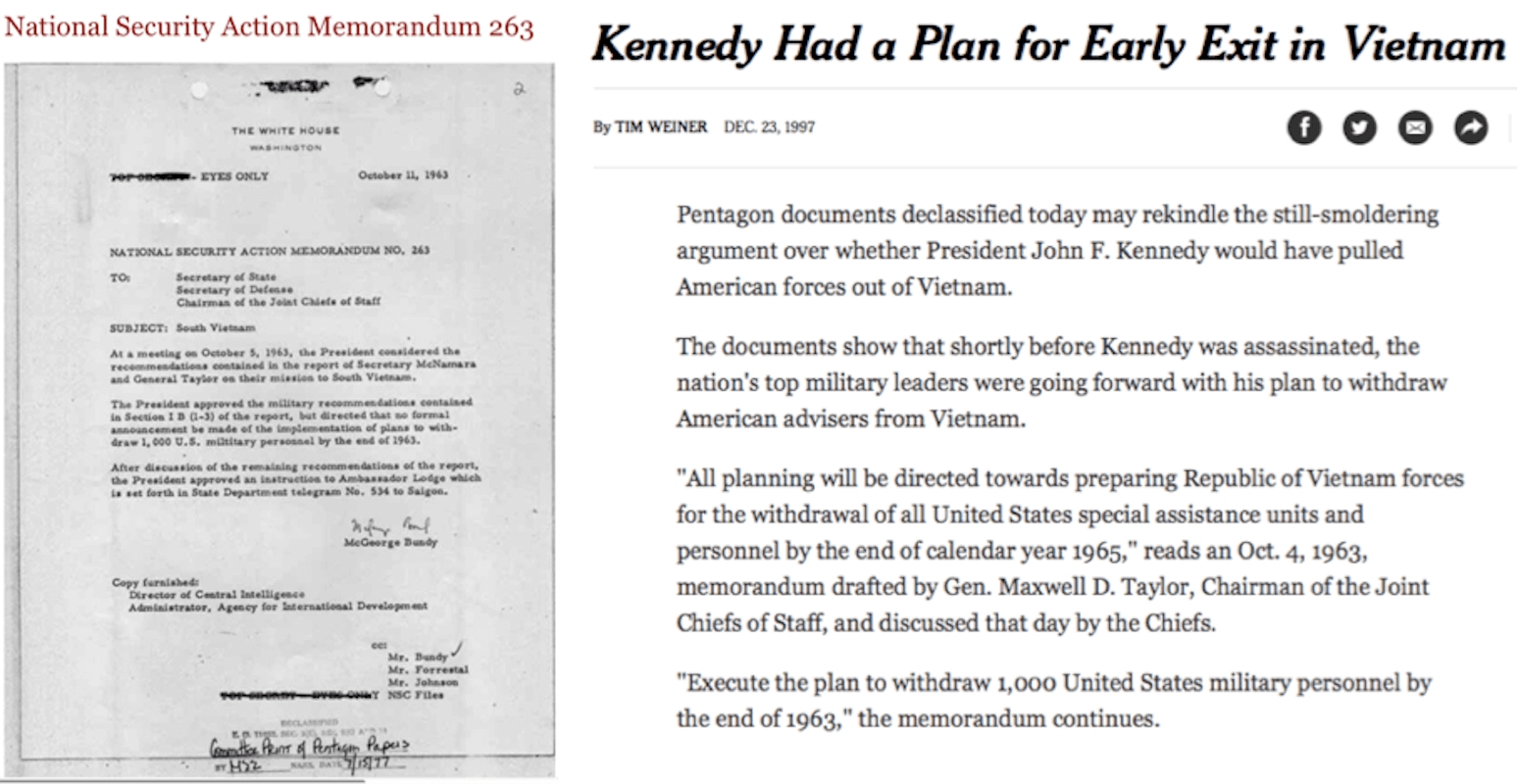
Ken Burns & Lynn Novick, The Vietnam War: Part Two

When I saw that the Koch Brothers were major backers of The Vietnam War, I suspected that Ken Burns and Lynn Novick were not going to use any of the newly declassified files concerning President Kennedy and his plans for withdrawing from Vietnam. I have been exposed to enough literature and discussion from the wealthy, organized Right to understand that the mere mention of Kennedy’s name causes something akin to bug-eyed rage. But I hoped against hope that the film would at least be fair to President Kennedy. Well, Burns and Novick might be decent people, but the best I can say about them in this regard is that they were not going to bite the (many) hands that feed them.
In Part One, Burns and Novick noted Kennedy’s visit to Saigon in 1951. And they mention his meeting with a journalist there, Seymour Topping. Like Kennedy’s meeting at the time with State Department official Edmund Gullion, Topping told the congressman that the French effort there was not winning, but losing the war. And the image of the US paled badly in the eyes of many Vietnamese because they were allied with the colonizers. The film then depicts Kennedy writing a letter to his constituents about the wrong-headedness of the American position, which would likely become a lost cause.
As with the Burns and Novick attempt to camouflage through anonymity the perpetrators behind direct American involvement in Vietnam, this strophe discounts the record to the breaking point. To elucidate just one element: Kennedy did not write just one letter to his constituents about our ill-fated alliance with France. That visit to Saigon had a transformational impact on his entire view of European colonialism in the Third World.
As Richard Mahoney depicted in his landmark book JFK: Ordeal in Africa, Kennedy now began to make radio addresses and formal speeches attacking the orthodoxies of both political parties on the issues of anti-communism versus nationalism in the Third World. He became a veritable one-man band warning that the United States had to stand for something more than just anti-communism in the Third World. He did this at the risk of alienating the leaders of his own party, e.g., Dean Acheson and Adlai Stevenson. He specifically attacked Acheson’s State Department for not recognizing the needs and aspirations of the people they were supposed to be serving in the areas of Africa and Asia. (Mahoney, p. 15) In May of 1953, with the French defeat in sight, Kennedy wrote a letter to John Foster Dulles asking him 47 questions about what his policy was for future American involvement in Indochina. (ibid) When Nixon was lobbying Congress about Operation Vulture, Kennedy assailed it by asking how “the new Dulles policy and its dependence upon the threat of atomic retaliation will fare in these areas of guerilla warfare.” (ibid, p. 16)
About one month before Dien Bien Phu fell, Kennedy took the floor of the Senate to make a long speech about America in Indochina. He began by saying the US could not declare war on nationalism:
To pour money, material and men into the jungles of Indochina without at least a remote prospect of victory would be dangerously futile … no amount of American military assistance in Indochina can conquer an enemy which is everywhere and at the same time nowhere, an enemy of the people, which has the sympathy and covert support of the people. (ibid)
It’s important to note that although Burns and Novick use Kennedy’s phrase about the Viet Minh being everywhere and nowhere, they do not attribute it to him.
JFK’s opposition to the Dulles/Nixon/Eisenhower backing of French colonialism in the Third World culminated in 1957. In a famous Senate speech, Kennedy assailed the administration for its backing of another French colonial war, this time in Algeria. In that speech, Kennedy reminded his colleagues of two things. First, that what had happened in Indochina three years previous was now repeating itself on the north coast of Africa: We were backing a fey French effort to preserve the remnants of an overseas empire. And second, we were not being a true friend to our French ally. A true friend would have counseled Paris to negotiate an Algerian settlement allowing for an orderly departure, thus sparing more bloodshed in Africa and further polarization of the homeland. (ibid, pp. 20-22)
It is hard for this writer to believe that Burns and Novick are not aware of that speech, for the simple reason that it created a mini-firestorm in both the press and at the White House. Kennedy specifically went after Secretary of State John Foster Dulles and Vice-President Richard Nixon. There were 138 editorial comments on the speech, over 2/3 of them negative. (ibid, p. 21) Kennedy was not just personally counter-attacked by Foster Dulles and Nixon, but by Stevenson and Acheson—members of his own party. The reaction was so violent that Kennedy told his father that he might have made a costly error. But Joe Kennedy replied to his son that he did not know how lucky he was. Algeria was going to get worse, and he would then look like a prophet. Which is what happened.
That speech dealt with one of the same subjects that The Vietnam War deals with: the perils of America allying itself with French imperialism. One would therefore think that Burns and Novick should have noted it, especially because it fills in the background of what Kennedy did in Vietnam once he became president. It is not noted at all. Kennedy’s lonely six-year campaign to alert members of each political party to the importance of this issue, and the folly of what Eisenhower and his administration were doing—all this is reduced to one letter.
When I saw what the film had done with this clear record, I began to wonder what Burns and Novick were going to do with the pile of new documents that had been released on the Kennedy administration and Vietnam since 1994 and the advent of the Assassination Records Review Board. Those hundreds of pages of documents, plus the research done on the subject by several authors and essayists, has created a whole new lens to look at this issue through. But when I saw that the film had almost completely muzzled Kennedy’s background on the issue, I then thought there were two paths left for the film to follow in regards to Kennedy and Vietnam. The first would be to introduce this newly declassified material out of left field, thereby making it rather jarring to the viewer; the likely reaction being: “Gosh, where is this guy coming from?” The second avenue would be simply to ignore this new scholarship and act as though it did not exist. Unsurprisingly, The Vietnam War took the latter path.
As Kennedy himself noted on the eve of the Democratic convention in 1960, he had to win the nomination. If he lost, and either Lyndon Johnson or Stu Symington won, it would just be more of John Foster Dulles. (Philip Muehlenbeck, Betting on the Africans, p. 37) George Ball, the iconoclast who worked for Kennedy in the State Department, later commented on the president’s reformist ideas by saying that JFK wanted to change the dynamic in the Third World. He thought that we should not cede the nationalist cause to the Soviets, we should not automatically befriend the status quo. By doing that we gave the advantage to the Russians. (ibid, p. xiv)
Authors like Mahoney, Philip Muehlenbeck, Robert Rakove, and Greg Poulgrain have written entire books based upon new research into this subject. This new scholarship demonstrates how President Kennedy almost immediately broke with the Dulles/Eisenhower regime in places like the Congo and Indonesia. Again, using the above authors’ work would have demonstrated that what Kennedy was about to do in Vietnam was pretty much of a piece with his foreign policy in the Third World. Burns and Novick present not a word of it.
What do they present instead? Kennedy as some kind of conflicted Cold Warrior. They cherry-pick parts of his inaugural address in order to do this. They then say that after the Bay of Pigs, his confrontation with Nikita Khrushchev in Vienna and the construction of the Berlin Wall, Kennedy felt he had to draw the line somewhere, and that place was Vietnam. So after sending Walt Rostow and Maxwell Taylor to Saigon to gather information on what the conditions were like there, Kennedy then commissioned thousands more advisors into the theater.
In doing so, the film pretty much eliminates the entire two-week debate in the White House where Kennedy faced off against virtually his entire cabinet and foreign policy advisors. As authors like James Blight have noted, for those two weeks, virtually every other voice in the room wanted to commit combat troops into Vietnam. The president was the only person holding the line against it. In Blight’s book Virtual JFK—co-edited with Janet Lang and David Welch—he spends over forty pages dealing with this landmark episode. And he produces the memorandum by Colonel Howard Burris (Johnson’s military aide) which memorialized Kennedy’s arguments against inserting combat troops. (Blight, pp. 281-83) These arguments included the facts that Vietnam was not a clear cut case of aggression as was Korea; America’s most important allies—like England—would not support such a move; the French effort, with hundreds of millions of dollars, had failed; combat troops would not be effective against guerillas and, in fact, would be quite vulnerable to attack. To say the least, Kennedy’s arguments look prescient today.
As Gordon Goldstein pointed out in his valuable book on McGeorge Bundy, this was not the first time Kennedy had turned down a request to send combat troops into Vietnam. Goldstein listed no less than nine previous instances in which Kennedy had rejected such proposals before the November debates. (Lessons in Disaster, pp. 52-58) As both Blight and Goldstein concluded, this was a Rubicon that Kennedy simply would not cross. And, in fact, National Security Advisor Bundy agreed with his biographer Goldstein on this issue: Kennedy was not going to commit American combat troops to fight a guerilla war in the jungle. (ibid, p. 235)
Of further note, when George Ball heard about this debate and Kennedy’s lonely stance against the interventionists, he thought the president might be weakening and warned him of what happened to France in Vietnam the decade before. Kennedy replied, “You’re crazier than hell George. That just isn’t going to happen.” (Goldstein, p. 62) And McGeorge Bundy, Robert McNamara, and General Maxwell Taylor—Kennedy’s three chief military advisors—all later wrote that Kennedy was never going to send the military in the form of combat troops into Vietnam. (Blight, p. 365; Goldstein, pp. 231, 238)
As the film notes, after the debate, Kennedy did sign off on National Security Memorandum (NSAM) 111. This allowed for more advisors and equipment to aid Diem’s army called the ARVN [Army of the Republic of Vietnam]. A good question could have been raised at this point. During the lengthy debate, the Hawks had expressed their pleas in the most dire terms: namely, that South Vietnam would collapse without the insertion of combat troops—and lots of them. Bundy had requested tens of thousands, Secretary of Defense Robert McNamara had asked for hundreds of thousands. (Blight, p. 71, p. 280) If such was the case, how was Kennedy’s plan to send in more advisors going to salvage Saigon’s imminent fall?
There is a parallel here with the failed Bay of Pigs invasion. After the first day of that doomed venture, when it was apparent all was lost, Kennedy was asked by both the CIA and the Pentagon to send in the navy to save the day. He refused. The film does not acknowledge that symmetry. Or the message implicit in Kennedy’s limited aid package: the US could help Diem, they could extend weapons and supplies. But they could not fight his war for him.
There is a famous quote about how strongly Kennedy framed this question to Arthur Schlesinger. What the film does with this key quote is revealing. It includes only the first part of it, where JFK told Schlesinger that committing combat troops would be like taking a sip of alcohol: the effect would wear off and you then had to take another. But it eliminates Kennedy’s much stronger punch line: “The war in Vietnam could be won only so long as it was their war. If it were ever converted into a white man’s war, we would lose as the French had lost a decade earlier.” (Goldstein, p. 63) Could anything make the issue more clear? Congressman Kennedy had seen the folly of our effort to aid the French position in their war in Indochina. But he saw that France had overextended itself: that they had no real political base and therefore had to send in a land army to fight Giap’s guerilla war. He was not going to repeat that mistake with American troops. He was not going to be perceived as continuing a colonial war in the Third World.
As mentioned above, Burns and Novick note Kennedy’s signing of NSAM 111. But they do not relate what else Kennedy did at this time. As James Blight has noted, all the indications are that Kennedy was shaken by the fact that he was almost alone in resisting the siren song of inserting the Army and Marines into Indochina as the main fighting force. (Blight, p. 281) Contrary to what the film implies, that cabinet was not unilaterally picked by JFK. It was done by committee, one that included Clark Clifford, Richard Neustadt, Larry O’Brien and Sargent Shriver. (Ted Sorenson, Kennedy, p. 258) For this reason, Kennedy decided to go outside that circle of White House advisors to enlist an ally. He notified John Kenneth Galbraith, ambassador to India, that he wanted him to visit Saigon and write up a report on how he saw the situation. Kennedy knew full well what Galbraith would say: namely, that we should begin to distance ourselves from Saigon. (Blight, pp. 69, 361) Then, when Galbraith arrived in town in early April, Kennedy sent him to see Bob McNamara to brief him on his report. The ambassador reported back to the president that he had achieved his mission and that McNamara was now on board. (ibid, p. 370) As several commentators have noted, e.g., Gordon Goldstein and John Newman, this was the beginning of Kennedy’s withdrawal plan.
What does the film do with this very important background maneuvering by Kennedy? It reduces it all by simply saying that Secretary of Defense McNamara announced in the summer of 1962 that America was making progress on winning the war and therefore a gradual withdrawal of American advisors could begin and be completed by 1965. This camouflages two important points. First, it conveys the idea that this was McNamara’s initiative. Second, it also implies that Kennedy and McNamara both thought they were actually winning the war. Both of these tenets are wrong. McNamara had to be convinced upon Kennedy’s orders to begin this plan. It was Kennedy’s plan, not McNamara’s. Secondly, there is simply no credible evidence that either of them actually thought the American effort there was militarily successful. How could McNamara think so if just six months earlier he had recommended over 200,000 combat troops be committed into Vietnam? If you don’t mention it, you don’t have to explain it.
As per Kennedy, he told his two trusted advisors, Ken O’Donnell and Dave Powers, that he had to delay his withdrawal plan and design it around the 1964 election, and complete it in 1965. Otherwise he would be decried by the right wing as a communist appeaser and that would endanger the election. (James Douglass, JFK and the Unspeakable, p. 126) Obviously, if Kennedy thought the ARVN were winning, or were going to win, he would not have expressed it that way. Further, researcher Malcolm Blunt recently sent this author a document Kennedy requested in the fall of 1963 and which was returned to the president in November, about two weeks before his death. This was an evacuation plan for American government employees in Saigon. John Newman has argued of late that Kennedy and McNamara feared that Saigon would fall before their original final withdrawal date, which was autumn of 1965. Kennedy likely ordered this plan for that reason. For as Kennedy told NSC assistant Mike Forrestal in 1963, the probability of Saigon winning was about 100-1. (Goldstein, p. 239)
Coinciding with all this is what is probably the most important document declassified by the ARRB. McNamara held regular meetings of the Saigon chiefs of agencies and the Pentagon in Hawaii. These were called Sec/Def meetings. For the one in May of 1963, he had requested that each agency and military chief bring with him their withdrawal schedule. After he had looked them over, he said they were too slow and would have to be speeded up. There was no qualification by McNamara that this withdrawal was hinging upon an American “victory” and there was no contingency plan mentioned to reinstate troops if the victory was not in sight. In fact, General Earle Wheeler wrote that he understood that any request for any overt action would be denied by the president. (Probe Magazine, Vol. 5, No. 3, pp. 19-21) These documents were so compelling that even The New York Times bannered a story with the headline: “Kennedy Had a Plan for Early Exit in Vietnam.” (ibid, p. 19) One would think that if it were good enough for that paragon of the MSM, the Grey Lady, it would be good enough for Burns and Novick. Needless to say, none of these documents are shown in The Vietnam War.
Neither is NSAM 263 exhibited. This was the order drawn up in early October of 1963 that delineated the withdrawal plan and mandated that a thousand men be returned from Vietnam by the end of 1963. The story of how the order and the report it was attached to were created is revealing, and would have been informative to the viewer. By the autumn of 1963, JFK now had everything in place to activate his withdrawal plan. But he wanted to send his two highest military advisors to Saigon, that is, McNamara and Chairman of the Joint Chiefs Maxwell Taylor. He trusted McNamara, but not Taylor. Therefore, while those two were in Vietnam, Pentagon higher ups General Victor Krulak and Colonel Fletcher Prouty were invited to the White House. Bobby Kennedy met the duo. He instructed them, upon orders of the president, that they would actually edit and compose the Taylor/McNamara report at his direction. (John Newman, JFK and Vietnam, p. 401) Once that was done, it was shipped out to Hawaii and given to Taylor and McNamara in bound form. Kennedy was not allowing for any alterations.
That report became the basis for NSAM 263. Presidentially designed, the report was used by him to ram 263 through his foreign policy advisors—some of whom were reluctant to sign on to it. But, reluctant or not, they ultimately did. McNamara was then sent out to announce the withdrawal plan to the press. As he was walking to meet the reporters, Kennedy instructed him with the following: “And tell them that means all of the helicopter pilots too.” (ibid, pp. 404-07)
One would think that if a filmmaker were trying to assemble the latest scholarship on Vietnam for an American audience—if one were really trying to enlighten them with the best and newest information—then at least some of this would be included in the presentation. Or at least he or she would communicate some of the (at least) nine sources that Kennedy or McNamara confided in about the withdrawal plan. Or perhaps play the October 2, 1963 taped conference where McNamara actually says that they have to find a way to get out of Vietnam. (Blight, p. 100)
I shouldn’t have to replay this refrain by now: None of this information is in the film. But as Burns pronounced on Marc Maron’s radio podcast of September 11th : History is malleable. Sort of like bubble gum, right Ken?
What do Burns and Novick tender us instead? They give us Neil Sheehan and Jean Paul Vann. Which means they would have given us David Halberstam if he were alive. (See my two-part review, “David Halberstam, The Best and the Brightest”) When I saw this, I realized just how much The Vietnam War wanted to be part of the MSM, and just how far PBS had fallen. For Halberstam’s The Best and the Brightest—which Warren Hinckle once called “one of the greatest bullshit books ever written”—makes McNamara out to be the chief engineer of the war. When, in fact, from April of 1962 to November of 1963, he was implementing Kennedy’s withdrawal plan. McNamara had even told his deputy, Roswell Gilpatric, that Kennedy had assigned him the task of winding down the war. (Blight, p. 371)
Jean Paul Vann was one of the military advisors stationed in Vietnam under Kennedy. By all accounts he was committed to the cause of the American created nation-state of South Vietnam. Halberstam and Sheehan were young reporters at the time. Halberstam had been sent to Vietnam after being assigned to the Congo. Which is an important point. As noted above, one of Kennedy’s first reversals of Dulles/Eisenhower Cold War policy was in the Congo. In fact, that was the first place where JFK directed specific alterations to his predecessor’s policy. These would favor leftist leader Patrice Lumumba and the cause of emerging African nationalism. In that instance Kennedy was contravening a (British aided) Belgian attempt at recolonization. (Mahoney, pp. 65-69)
Valuable research by Paul Rigby has shown that, prior to being assigned to Vietnam, Halberstam had done what he could to condescend to Kennedy’s efforts in Congo. In the pages of Times Talk—Halberstam’s employer, the NY Times in-house journal—the reporter conveyed some of those ideas. His stories, such as “It’s Chaos for a Correspondent in the Congo” and “Congo Boondocks: Land of Cannibals and Diamonds,” communicated the Establishment line that Congo could not handle independence because it was simply a land of African primitives. (William Prochnau, Once Upon a Distant War, p. 509; see also Halberstam’s The Making of a Quagmire, pp. 3-24) Halberstam seemed to be missing the overall gestalt of the struggle. He would later write of that colossal, epic conflict—which killed both Lumumba and Dag Hammarskjold—that there was less there than met the eye. (Halberstam, p. 17)
Halberstam’s outlook and attitude failed to fully grasp Kennedy’s concepts in Congo, where JFK decided to do all he could to enforce UN Secretary General Hammarskjold’s policies for Congolese independence against America’s European allies England and Belgium. Kennedy continued that policy alone after Hammarskjold was killed. (“Hammarskjold and Kennedy vs. The Power Elite”) It is clear today—as it was then—that both Lumumba and Hammarskjold were murdered by colonial powers trying to retake the mineral wealth of Congo. (“Plane crash that killed UN boss may have been caused by aircraft attack”) Yet, in 1965, Halberstam could write that the Congolese cared less for their country than white people did. (ibid, p. 18) Unlike Halberstam, Jonathan Kwitny later fully comprehended what had happened. As Kwitny wrote, Patrice Lumumba became a hero in Africa “not because he promoted socialism, which he didn’t, but because he resisted foreign intervention. He stood up to outsiders, if only by getting himself killed.” (Endless Enemies, p. 72) As the picture below illustrates, Kennedy certainly understood Lumumba’s cause and his martyrdom:

Kennedy receiving word of Lumumba’s death
(photo: Jacques Lowe)On the larger, more epic level, Kwitny also had a much richer understanding of what was at stake in Congo than Halberstam. After surveying what happened, he memorably wrote about the legacy of Lumumba and what it meant in the larger movement of African nations to break out of the servitude of colonialism:
The democratic experiment had no example in Africa, and badly needed one. So perhaps the sorriest … blight on the record of this new era is that the precedent for it all, the very first coup in postcolonial African history, the very first political assassination, and the very first junking of a legally constituted democratic system, all took place in a major country and were all instigated by the United States of America. It’s a sad situation when people are left to learn their ‘democracy’ from the Union of Soviet Socialist Republics. (ibid, p. 75)
When Halberstam got to Vietnam—actually on his second day there—he lunched with the CIA’s station chief in Saigon. (Prochnau, p. 133) As the weeks went by, many of his CIA contacts from Congo migrated there. As author William Prochnau wrote, “By now his CIA contacts from the Congo had begun to flock to the hot new action in Southeast Asia like bees to honey; Vietnam was a spook’s dream and the Agency forever had a better fix on Vietnamese reality than the American military.” (ibid, p. 169)
Halberstam admitted this in his 1965 book, The Making of a Quagmire, where he wrote, “But many CIA agents in Saigon were my friends, and I considered them among the ablest Americans I had seen overseas or at home.” (p. 222) In that book, Halberstam attempts an all-out defense of the CIA’s role in both Vietnam and the developing world. And he adds that inherent suspicion of the Agency is “the outgrowth of its bogeyman image among liberals …”. (ibid) This is especially puzzling today since the Church Committee revealed that Allen Dulles and the CIA had arranged numerous plots to kill Lumumba in the Congo, where the writer had just been stationed for many months. Later on, Halberstam attempted to distance himself from these admissions. He told Prochnau that UPI reporter Neil Sheehan had better CIA sources than he did, but he had better military sources. (Prochnau, p. 277)
Both Halberstam and Sheehan were enamored with Vann, even though they understood he was an “essentially conservative, at times [an] almost reactionary man.” (Halberstam, p. 164) In their film, Burns and Novick have Sheehan tell us that, upon his own arrival in Saigon in 1962, he believed in American ideals and the alleged US mission in South Vietnam. He also believed in the dangers of the “international communist conspiracy”. Sheehan then adds that he was there to report the truth in order to help win the war for the betterment of the United States and the world. He describes going along on ARVN helicopter missions as being part of a crusade: he was thrilled by the experience.
These attitudes made Sheehan and Halberstam easy targets for Vann. And negatively complementing that, it guaranteed that they would completely miss what Kennedy was doing. Colonel Vann was a veteran of Korea and, by 1963, had served in the military for twenty years. With Sheehan’s help, Burns and Novick spend several minutes outlining the January 1963 Battle of Ap Bac, an important conflict that Vann helped plan and supervise. Although the Viet Cong were outnumbered by a large margin, even though the ARVN had helicopter support and used armored personnel carriers, this battle turned out to be, by any accounting, a losing proposition for Vann. Saigon lost 80 dead, more than one hundred wounded, and five helicopters destroyed. The Viet Cong lost 18 dead and 39 wounded. Vann was deeply angered and confided the true facts of the defeat to his students Sheehan and Halberstam, who both wrote about the failure of the battle.
The film does not reveal a key reason for that failure, one which Vann himself had discovered. Ngo Dinh Diem had issued orders to his field commanders not to initiate large offensive operations that would provoke serious casualties. Vann’s intelligence officer, Jim Drummond, concluded that the ARVN had not really checked the growth of the Viet Cong or the area under their control. (John Newman, JFK and Vietnam, p. 299) In other words, contrary to what the commander in Vietnam, General Harkins, was saying, America was not winning the war. And Ap Bac was living proof of that.
Vann was shipped out of Vietnam in 1963 and served in the Pentagon as a procurement officer. He began to file formal reports complaining about how the war was being fought. These reports appealed to General Edward Lansdale because they clearly projected the fact that unless American ground troops were committed to Vietnam, Saigon would fall. (ibid, p. 319) As we have seen, this is the message Kennedy had listened to in November of 1961—and had rejected. Kennedy was aware of what Vann was doing. Both he and McNamara opposed the work of his acolyte Halberstam; Kennedy even asked the publisher of the Times to rotate him out of Saigon. (David Kaiser, American Tragedy, p. 261; Halberstam, p. 268)
But Edward Lansdale had been the first to advise Kennedy to insert combat troops into Vietnam. (Newman, p. 20) Sure enough, after Kennedy’s death, when Lansdale returned to the White House, he recommended sending Vann back to Vietnam. Vann did return in 1965, when Lyndon Johnson overturned Kennedy’s policy and committed tens of thousands of American combat troops to Saigon. (Kaiser, p. 384)
The reason that Sheehan and Halberstam admired Vann was simple: like him, they were Hawks. And like him—and opposed to Kennedy—they wanted more American involvement, not less. This is easily discernible by reading Halberstam’s 1965 book The Making of a Quagmire. That volume is perhaps the single most complete and coruscating condemnation of America’s Vietnam policy published to that point. It attacks every element of the American mission in that country and also the policies and personages of the Diem regime. (See Chapters 3-5) It then goes on to expose the ineptness of the ARVN (Chapters 5-7), in particular how bad Colonel Hunyh Van Cao was. The latter actually gets his own chapter: 10. Why so hard on Cao? Because Vann was the advisor attached to him, and—as with Sheehan—Vann was Halberstam’s hero in 1965. Why? Because he knew how to win the war. (See Chapter 11) So for Halberstam, when Vann departed, things got worse. (see Chapter 12).
If Halberstam could not make it more clear, he does near the end of the book. With Sheehan mentioned throughout, he proclaims: “Bombers and helicopters and napalm are a help but they are not enough.” (p. 321) He then concludes with the following: “The lesson to be learned from Vietnam is that we must get in earlier, be shrewder, and force the other side to practice self-deception.” (p. 322)
Of course, when the wishes of this troika—Sheehan, Vann and Halberstam—were fulfilled, we saw what happened. Direct American involvement ended up being an epic debacle. As many as 3-4 million people were slaughtered amid almost unimaginable horror. All in pursuit of a false goal that was not possible to attain. In other words, Kennedy was right and Vann, Sheehan and Halberstam were wrong. But neither Halberstam nor Sheehan could ever admit that. It is especially startling that Halberstam never saw the parallels of what happened in both Congo and Vietnam after Kennedy was killed: In Congo, the Agency and LBJ switched sides and joined the imperial interests; in Vietnam, the Pentagon and Johnson now broke Kennedy’s strictures and eventually imported 540,000 combat troops, making it an American imperial war. Truly puzzling that he would miss all of this.
Sheehan and Halberstam got their wish. And even after it was clear that direct American involvement would not work, it took them years to understand it. And further, that the American army was self-destructing in the jungle, as Kennedy had predicted it would back in 1961. By 1971, even the army understood this. Colonel Robert Heinl wrote a long essay on its collapse at that time, and traced it from at least 1969. (Col. Robert D. Heinl, Jr., “The Collapse of the Armed Forces”)
But author and activist Mark Lane understood it even earlier. In 1970 he published a book of personal interviews with returning veterans. The book was called Conversations with Americans. It was a shocking exposé of the individual and group war crimes that American solders had committed in Vietnam. Since there was a danger that his interview subjects would be prosecuted, he gave them the option of using fictitious names. He marked these with an asterisk in the text. He then added that the real names and full transcripts had been given over to an attorney who had worked for the Justice Department. (Lane, p. 17)
When the book was published, The New York Times trotted out Sheehan to review it. (NY Times Book Review, 12/27/70) Sheehan wrote that he had contacted the Pentagon and some of the people named in the book did not serve in the military, or were not in the places where they said they were at the time. Which implied that what Lane was writing was fictitious. After, when Lane called the New York Times to talk to Sheehan, Sheehan would not accept his calls. The Times then sent Sheehan out on tour to promote his column. Which, of course, was a promotion of the collapsing war effort. Apparently, as a believer in the international communist conspiracy, Sheehan never imagined that there was a systematic, institutionalized cover-up of these crimes after the 1968 My Lai Massacre. But there was such a cover-up, and author Nick Turse discovered it when he found the (incomplete) records. (Kill Anything that Moves, pp. 15-21) When Lane asked Sheehan about My Lai during a radio interview, the New York Times reporter replied that it was just a rumor. (Mark Lane, Citizen Lane, pp. 220-21)
Under pressure from the Times and Sheehan, Lane’s book was withdrawn from circulation.
This is the man Burns and Novick use as the main talking head in their segment on the Kennedy years. With their defense of the Dulles brothers as “decent people” in Part One, the disappearance of Kennedy’s withdrawal plan and the championing of Vann and Sheehan in Part Two, so far the net value of this documentary is something less than zero.
Addendum
Although some critics of the film JFK have stated that there was no public announcement of NSAM 263, and Kennedy was keeping it quiet, as the reader can see in the following two Newsweek articles, that is false. It was a public policy, and Kennedy had sent Defense Secretary Robert McNamara to brief the press on it after he had adopted it in October, 1963. (John Newman, JFK and Vietnam, p. 407)
Newsweek, October 14, 1963
(Click here if your browser is having trouble loading the above.)
Newsweek, December 2, 1963
(Click here if your browser is having trouble loading the above.)
Part 1
Part 3
Part 4