Blog

  • Canadian Archives sued over release of Louis Mortimer Bloomfield papers


    In some Kennedy assassination circles, where theories about who was responsible for the murder of President John F. Kennedy are discussed, Louis Mortimer Bloomfield, Montreal lawyer and philanthropist, has for many decades been considered a suspect. Bloomfield is mentioned is several books on the JFK case, including Jim Garrison’s best-seller On the Trail of the Assassins. Michael Benson’s desk encyclopedia Who’s Who in the JFK Assassination, devotes two pages to him. In reading those pages, Bloomfield relates to both Clay Shaw and the mysterious European organization called Permindex. The suspicions about him did not stop Bloomfield from donating his personal papers to Library and Archives Canada (LAC). He donated his papers to LAC with only one stipulation, that they be made available to the public 20 years after his death.1 He died in 1984 and in 2004, Montreal based researcher Maurice Philipps asked LAC to give him access to Bloomfield’s papers and LAC said no. Philipps took the archives to court and in 2006 the court ordered LAC to release Bloomfield’s papers to the public.2

    Now LAC has done it again. They have again barred the public from accessing Bloomfield’s papers. The reason cited for their action is “client-solicitor” privilege. As the papers donated to the archives contain letters from Bloomfield to his clients, they are protected by “client-solicitor” privilege and therefore cannot be viewed by the public. But this argument does not sync with the facts of this case. When the files were to be opened to the public in 2004, it was not “client-solicitor” privilege that was the stated reason for barring access to them. The reason for their refusal was Bloomfield’s widow, Mrs. Justine Stern Bloomfield, who asked that they not be released until 10 years after her death citing “… privacy concerns and safeguarding Mr. Bloomfield’s reputation.” 3

    So why did LAC again block access to Bloomfield’s papers? There can be any number of reasons; it could be fallout from the release of the JFK files in 2017. Did this trigger concerns that more conspiracy theories would be created about Bloomfield’s alleged participation in JFK’s assassination? Is there information in the files that they do not want the public to see? In his letters to his clients did he mention the name of Clay Shaw or some other person that may have been investigated by Jim Garrison during his investigation of Kennedy’s murder? The result of their action however can only create more suspicion about Bloomfield. What do they not want the public to see?

    Support, however, for the opening of his papers to the public has come from an unlikely source: Bloomfield’s nephew, Harry Bloomfield, who is also a lawyer and who lives in Montreal. In a story regarding Philipp’s battle with LAC to gain access to Bloomfield’s papers, it was stated that “Bloomfield’s nephew says he sees no reason to keep the papers shielded from public view. Montrealer Harry Bloomfield says the fight to keep his uncle’s papers behind a veil of secrecy is likely fuelling conspiracy theories tying Bloomfield to JFK’s assassination—theories that he says are completely unfounded.”4

    This author has taken LAC back to court. In the case of John Kowalski v Guy Berthiaume, Librarian and Archivist of Canada, the author has asked the Federal Court of Canada to overturn LAC’s decision to block access to Bloomfield’s papers. The case will be heard by the court over the next few months and the author will update Kennedys and King on the outcome of it when it has been decided by the court.


    1 Philipps v. Librarian and Archivist of Canada, Date: 2006-11-14, Neutral citation 2006 FC 1378,

    File numbers: T-1517-05, section 3, Federal Court of Canada, Federal Court Decision database.

    2 Philipps v. Librarian and Archivist of Canada, “Judgement.”

    3 Philipps v. Librarian and Archivist of Canada, section 10.

    4 E. Thompson “Dispute over releasing archives keeps lid on potential link to JFK’s death” CanWest News Service, January 27, 2007.

  • Ricochet of a Lie

    Ricochet of a Lie


    Ricochet of a Lie

    And Kennedy’s Throat Wound

    (A version of this essay was previously published under the title “The Magic Throat.”)


    If you believe the gaping hole in the front of Kennedy’s neck was the result of body alteration by unknown persons, the facts below may change your mind.


    Commander James Humes, M.D., the lead pathologist who performed the autopsy on President John F. Kennedy, was interviewed in 1992 by the Journal of the American Medical Association (JAMA).1 Once again, he and his team were going to set the record straight.

    As often happens on these occasions, Humes provided a fresh crop of contradictions.   One such contradiction is the subject of this article: the size Humes gave JAMA for the incision in Kennedy’s throat: less than half the size he reported earlier,2 3 and less than half the size as it appears in autopsy photographs.  

    What intrigues me about this new size is its striking similarity to the one described by Malcolm Perry, M.D., to David Lifton, author of “Best Evidence.”4


    1964, James Humes: Large Incision

    According to Humes’s autopsy report,5 the tracheotomy incision was 6.5 centimeters, but Humes told the Warren Commission it was between 7 and 8 centimeters.6 The latter description seems to match what shows in autopsy photographs. (Note: “tracheotomy” is sometimes spelled “tracheostomy”; both are correct.)


    1980, Malcolm Perry: Small Incision

    The best selling Best Evidence by David Lifton was published in 1980. In it, Lifton quotes Malcolm Perry as saying the incision was only 2 to 3 centimeters wide. When Lifton asked if it could have been 3.5 centimeters, Perry agreed. Could it have been 4 centimeters? Perry “hesitated a bit, then said yes.” How about 4.5 centimeters? Perry said he “really doubted it was that large. It just wasn’t necessary.” Lifton added, “Perry sounded distinctly uneasy.” Lifton quoted other Parkland doctors who corroborated Perry’s claims.7

    Perry’s first answer, “2 to 3 centimeters wide,” is consistent with the routine tracheotomy incision as diagrammed in Lifton’s book.

    Not the kind of incision made on a victim of a penetrating neck trauma.


    1992, James Humes: Small Incision

    Humes told JAMA that “The tracheostomy was a gaping wound, about 3 to 4 centimeters around ….”8

    Only 3 to 4 centimeters “around”? This is how one describes a perimeter. Translated, this would make the incision across no more than 2 centimeters in horizontal width—about the size Malcolm Perry gave David Lifton. A very interesting match indeed.


    What Did Malcolm Perry Actually Do?

    Small incisions are created for routine tracheotomies—the kind performed for patients with severe breathing problems, such as those due to pneumonia, for instance. David Lifton investigated and then publicized the appearance of a routine tracheotomy incision.

    What David Lifton did not investigate at all, apparently, was this relevant question:

    How do emergency room doctors respond to a penetrating wound in the neck, regardless of whether the patient has wounds elsewhere in the body?

    Doctors must quickly find and repair any life-threatening damage that has been done—and that means creating a fairly wide incision, one large enough to visualize the carotid arteries, for example. (These arteries are not in the middle of the throat; they are off to either side of the neck.)

    From Perry’s and Humes’s descriptions, it sounds like Kennedy had a “collar incision,” similar to the one shown below from the Journal of Trauma 1978; 18 (1) : 2-77 (see the Addendum at the end of this article for more extensive documentation).
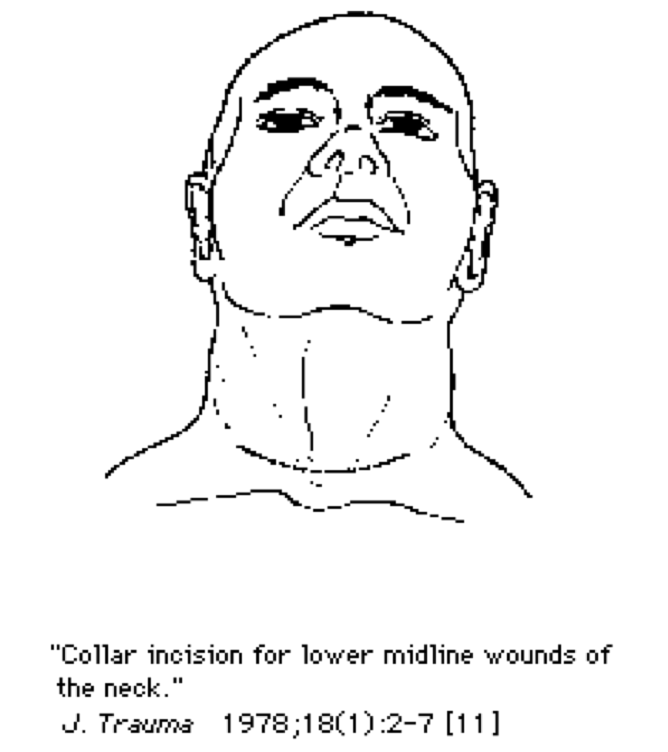
    incision

    In Kennedy’s case, it was already clear that he was having trouble breathing, and one doctor placed an endotracheal tube which proved to be inadequate. So when Perry arrived, he performed a tracheotomy. And, he said, he “made an incision right through this wound which was present in the neck.”9

    But that was not all that Perry did. He made an incision large enough to allow him to inspect the carotid arteries, the mediastinum, and other structures.

    “Once the transverse incision through the skin and subcutaneous tissues was made, it was necessary to separate the strap muscles covering the anterior muscles of the windpipe and thyroid. At that point, the trachea was noted to be deviated slightly to the left and I found it necessary to sever the exterior strap muscles on the other side to reach the trachea.”10 (His testimony on another day is similar.11)

    “I also made it big enough that I could look to either side of the trachea … I didn’t know whether I was going to encounter carotid arteries or whatever. But the path of the bullet clearly put those vessels at risk as well as the trachea, so I made the wound big enough to do that … How big it [the incision] was, I don’t know … . I made it big enough to control an underlying bleeding blood vessel if necessary.”12

    Please see the Addendum for quotations from articles on this subject—including some from a chapter in a textbook written by Malcolm Perry himself.


    Why Perry Described Such a Small Incision: A Theory

    Malcolm Perry was aware of Humes’s sworn testimony that, on the night of the autopsy, he knew nothing about a bullet wound in the throat, that he thought only a tracheotomy had been done.

    Caught off guard by Lifton’s question, Perry probably thought he had better not say anything that would contradict Humes’s story. 

    Perry was apparently confident that Humes’s earlier report of a large incision was not well known. He has said more than once that he never met anyone who had read the Warren Commission Hearings.


    Why Humes Revised the Size: A Theory

    Small incisions are not done in the presence of a penetrating wound in the throat.

    If Kennedy only had a small opening in his throat, this would have made it easier to believe Humes’s story of thinking the president only had a tracheotomy. This may have been the reason Humes gave such a different description of the incision to JAMA.

    Furthermore, he may have worried that, had he described a wider incision, one that was more consistent with those performed in the presence of trauma, then one of JAMA’s readers might well have asked, how could he have been so sure the only abnormality in JFK’s throat was the remains of a tracheotomy? Especially in the presence of a bullet wound in the back?


    What May Lie Behind the Revisions

    Had Humes admitted to being aware of a throat trauma, he would have then been obliged to deal with it: dissect its path, obtain tissue specimens, document its characteristics, photograph it close-up and under magnification.

    What if a proper study of the wound showed it to be an entrance? This would mean that at least one shooter was in front of Kennedy. But Humes and his team were under a great deal of pressure to prove the president’s wounds were created by one sniper, located above and behind.

    Better to feign ignorance of a wound that may contradict that conclusion. Better to wait until after the body was gone, when it was too late to document its nature—entrance or exit—and its alleged connection with the wound in the back.13


    But Humes Did Know

    It seems that, even on the night of the autopsy, Humes et al. did know that a bullet had passed through Kennedy’s throat, either coming or going.

    The bruising in the neck is what told him, bruising that could only have occurred during the motorcade—when the heart was still beating normally. What’s more, possibly out of vanity (and to avoid looking stupid to his peers), he wanted the Warren Commissioners to know that he knew, that he had not missed something so important, or its significance.

    “When examining the wounds in the base of the President’s neck anteriorly … we noted, and we noted in our record, some contusion and bruising of the muscles of the neck of the Present. We noted that at the time of the postmortem examination.”14

    He went on to describe wounds that were created by the Parkland doctors: incisions made in the chest for the placement of chest tubes, and in the arm and ankle for administering intravenous fluids—wounds that did not lead to bleeding and bruising, because they were made later, when the heart was barely beating.

    “Those wounds [made at Parkland, on the chest and in the arm and ankle] showed no evidence of bruising or contusion … which made us reach the conclusion that they were performed during the agonal moments of the late President … when the circulation was … seriously embarrassed, if not nonfunctional. So that these wounds … were performed about the same time as the tracheotomy wound …”15

    “So, therefore, we reached the conclusion that the damage to those muscles on the anterior neck just below this wound were received at approximately the same time that the wound here on the top of the pleural cavity was, while the President still lived and while his heart and lungs were operating in such a fashion to permit him to have a bruise in the vicinity … so we feel that, had this missile not made its path in that fashion, the wound made by Doctor Perry in the neck would not have been able to produce, wouldn’t have been able to produce, these contusions of the musculature of the neck.”16

    Ignoring Humes’s comments above, Commissioner Allen Dulles then completely changed the subject.17

    In later years, J. Thornton Boswell, the pathologist who assisted Humes, actually described seeing, on that same night, the remains of the bullet hole itself, “part of the perimeter of a bullet wound in the anterior neck”,18 and they concluded that night that the bullet exited the throat.19 When talking to the ARRB in 1996, Humes denied seeing the remains of the bullet wound, or knowing anything about its existence.20

    The lead photographer, John Stringer, described the pathologists putting their fingers into the gaping hole trying to feel for anything sharp, looking for bullet fragments, in other words.21 John H. Ebersole, M.D., Acting Chief of Radiology, said that Humes had been in touch with the Parkland doctors that same night, and, clearly, had been informed of the bullet wound in the throat.22 (This is not a comprehensive treatment of the subject; there is yet other testimony relative to this issue not included here.)


    Comic Relief: Humes “Explains”

    “And we wondered, where’s the bullet? You know. Should have called Dallas right then and there. It would have saved me a lot of worry and grief for several hours, because x-rays hadn’t found it for us. Like it could have been in his thigh or it could have been in his buttock. It could have been any damn place …”23

    So, it could have gone any damn place—except a few inches away out the hole in the front?

    “We didn’t know where it went. It was obvious after we talked to the doctors the next morning where it went. It went out. That’s why we couldn’t find it. And we weren’t going to spend the rest of the night there, you know. Meantime, George Burkley is telling me, you know, the family wants to get out of here sometime tonight. Then we proceeded with the dissection of the lungs, heart and abdominal contents and so forth.”24

    Note: Kennedy was not shot in the abdomen.

    “… it wouldn’t make a great deal of sense to go slashing open the neck. What would we learn? Nothing you know.”25

    Have sympathy for the late James Humes. He not only had to cover his own ass, he had to cover the collective ass of those who were pressuring him to come up with the “right” answers. He never did seem sure of the script.


    Was it an Entrance Wound?

    We have no way of knowing what the nature of Kennedy’s throat wound was but, considering all the lies told about it, Humes et al. probably thought it was an entrance. Based on the wound’s characteristics as reported, nothing seems to justify declaring it an entrance or an exit although, grossly, it was most typical of an entrance.

    • Exit wounds can be small;
    • Ragged wounds can be entrances;
    • Entrance wounds need not have abrasion collars, but often do;
    • Shored exit wounds always have pronounced abrasion collars.
    • Non-shored exit wounds do not have abrasion collars.

    One thing does seem certain: if the wound had been an exit, the bullet had to have exited above the shirt; it could not have gone through the shirt (the bottom part of the collar band), as alleged. This would have created a “shored wound.” In shored wounds, an obvious abrasion collar is created26 with little bits of skin hanging (like the flakes of a sunburn) as the shoring material—which usually sticks to the wound—is pulled off the victim.27

    Furthermore, skin would have been left behind on the shirt: upon exiting, the bullet would have crushed the skin against the shirt on its way out, skin that would have been visible to the naked eye.28 The FBI would surely have loudly announced such evidence had they found any.

    Kennedy’s throat wound did not have the wide, pronounced abrasion collar of a shored exit wound, but it apparently did have the abrasion collar of an entrance wound.29

    As mentioned above, exit wounds can be small, but would a jacketed bullet travelling at medium high velocity through the loose, wrinkled, tanned, leathery skin of Kennedy’s neck leave a small wound?

    Or—unhindered by any shoring material—would the bullet pull the skin forward on its way out, tenting the skin, creating the lacerations of a typical “stellate” wound of exit?

    (All of the small exit wounds in the photos that I could find were in what looked like taut, young skin in areas not unexposed to the sun and not subjected to a lot of stretching, and wrinkle-causing movement, like the neck and wrists.)

    For more on the subject of bullet wounds (including photographs and additional references) please see my article, Trajectory of a Lie Part I. The Palindrome” at www.history-matters.com.


    Conclusion

    Commander James Humes testified that, on the night of the autopsy, the only abnormality seen in Kennedy’s throat was a tracheotomy incision. For the following reasons, this seems to have been a cover story:

    • Context: there was an entrance wound, only inches away, in the back;
    • The incision was larger than one for a typical tracheotomy, though, by itself, this is not reason to suspect trauma;
    • The strap muscles were severed; this is not done in routine tracheotomies;
    • Humes testified he saw bruising in the throat muscles that he said he knew could only have occurred during the motorcade, when the president’s heart was still functioning normally;
    • Other doctors testified that they all knew of the bullet wound in the throat;
    • Part of the perimeter of the hole created by the bullet was seen.

    By denying awareness of the wound, Humes avoided documenting its nature. (He also avoided properly documenting the back and head wounds, all for the same reason apparently.)

    A few years later, in an apparent effort to support Humes’s story, the surgeon who performed the incision, Malcolm Perry, M.D., described it as small enough to be typical. This same surgeon was most accommodating when it came to revising other trajectory-related details.   Nearly 30 years later, Commander Humes himself reported the incision as small, radically contradicting his own testimony to provide a description that just happened to agree with Malcolm Perry’s.

    It is also possible that each doctor simply had a malfunction of memory.


    ADDENDUM

    Standard Response to Penetrating Wounds of the Neck

    What was the standard emergency response to a penetrating injury of the throat—whether or not the trachea (windpipe) is injured, and whether or not there is another life-threatening wound?

    Exploratory surgery—however quick and limited—was and is the standard. The incision Perry made was apparently similar to the one shown in the diagram below:30

    incision

    According to the 1971 issue of the American Journal of Surgery, the performance of an “exploratory” in these circumstances had been standard since World War II:

    “The general surgical principle of mandatory exploration of all penetrating wounds has become established during the past three decades.” 31

    Parkland Policy on Penetrating Neck Wounds

    “Since 1957 it has been the policy at Parkland Memorial Hospital to explore virtually all penetrating wounds of the neck regardless of the clinical impression as to the severity of the injury …”

    “The incision was planned to allow full exposure of the tract of injury. Proximal and distal control of the major vessels was also considered in the length and position of the incision. The sternocleidomastoid (“strap”) muscle and/or other neck muscles were taken off the insertion or transected whenever necessary to provide adequate exposure.”32

    The textbook Principles of Trauma Care contains a chapter written by Malcolm Perry, “Penetrating Wounds of the Neck.”33 Perry’s list of findings that indicate the need for exploration include some that applied to Kennedy:

    • Bleeding
    • Large hematoma
    • Shock
    • Respiratory distress
    • Subcutaneous emphysema
    • Blood in the oropharynx

    Finally, an exploratory is even appropriate in the absence of these signs because life-threatening damage can hide behind a superficial looking wound. The authors of the 1971 paper discovered the following:

    “… one third of the patients with injury to a major structure had no clinical evidence for this. This latter group included one patient with a through and through bullet wound of the carotid artery.”34


    Notes

    1 D. L. Breo, “JFK’s death-the plain truth from the MD’s who did the autopsy.” Journal of the American Medical Association 1992; 267: 2794-2803, here p. 2798.

    2 Autopsy Report. MD3, ARRB Master Set of Exhibits.

    3 J. J. Humes, Warren Commission Hearings, Vol. II, p. 361 (“some 7 or 8 cm in length”).

    4 D. S. Lifton, Best Evidence. Carroll & Graff, 1980, p. 238.

    5 Autopsy Report.

    6 WCH II, p. 361.

    7 Lifton, p. 238.

    8 Breo, p. 2798.

    9 M. Perry, Warren Commission Hearings, Vol. VI, p. 10.

    10 WCH VI, p. 10.

    11 Perry, Warren Commission Hearings, Vol. III, p. 370.

    12 Perry, ARRB Testimony, August 17, 1998, pp. 24-25.

    13 Humes, HSCA Testimony, September 7, 1978, p. 330.

    14 WCH II, p. 367.

    15 WCH II, p. 367.

    16 WCH II, p. 368.

    17 WCH II, p. 368.

    18 J. T. Boswell, HSCA Testimony, August 7, 1977, pp. 8, 12.

    19 Boswell, ARRB Testimony, February 26, 1996, pp. 34, 45.

    20 Humes, ARRB Testimony, February 13, 1996, p. 115.

    21 J. Stringer, ARRB Testimony, July16, 1996, pp. 191-2.

    22 J. H. Ebersole, HSCA Testimony, 1978, p. 20; pp. 51-52.

    23 Humes, ARRB Testimony, p. 113.

    24 Humes, ARRB Testimony, p. 113.

    25 Humes, ARRB Testimony, p. 36.

    26 V. J. M. Di Maio, Gunshot Wounds, Practical Aspects of Firearms, Ballistics, and Forensic Techniques, Second Edition. CRC Press, 1999.

    27 J. C. Aguilar, “Shored gunshot wounds of exit.” American Journal of Forensic Medicine and Pathology 1983; 4(3): 199-204.

    28 Aguilar, “Shored gunshot wounds of exit.”

    29 M. Perry, HSCA p. 302; C. Baxter, Warren Commission Hearings, Vol. VI, p. 42.

    30 For the diagram: J. D. Saletta, R. J. Lowe, L. T. Lim, J. Thornton, S. Delk, and G. S. Moss, “Penetrating trauma of the neck.” Journal of Trauma and Acute Care Surgery 1976; 16(7): 579-587; D. C. Blass, E. C. James, R. J. Reed, C. W. Fedde, and A. L. Watne, “Penetrating wounds of the neck and upper thorax.” Journal of Trauma and Acute Care Surgery 1978; 18(1): 2-7.

    31 “Exploratory since WW II”: C. Ashworth, L. F. Williams, and J. J. Byrne, “Penetrating wounds of the neck. Re-emphasis of the need for prompt exploration.” American Journal of Surgery 1971; 121: 387-391.

    32 Parkland: R. F. Jones, J. C. Terrell, and K. E. Salyer, “Penetrating wounds of the neck: an analysis of 274 cases.” Journal of Trauma and Acute Care Surgery 1967; 7(2): 228-237.

    33 M. Perry, Chapter 16, “Penetrating Wounds of the Neck.” In: G. T. Shires, ed., Principles of Trauma Care, Third Edition. McGraw-Hill Book Company, 1985.

    34 Ashworth, Williams, Byrne, “Penetrating wounds of the neck.”

  • Ted Charach, The Second Gun

    Ted Charach, The Second Gun

    rfkcharach

    During this, the 50th anniversary of Senator Robert Kennedy’s assassination, we wish to raise awareness of his life and death. We thus follow our posting of Joseph Palermo’s interview with a link to  Ted Charach’s The Second Gun.

    (Click image for video link)

  • Alec Cockburn Lives: Matt Stevenson, JFK and CounterPunch

    Alec Cockburn Lives: Matt Stevenson, JFK and CounterPunch


    The late Alexander Cockburn was an influential figure on the American Left for a long time. Born in Ireland, he moved to London and became both a journalist and author in his early twenties. About ten years later, in 1972, he moved to America and became a regular columnist for The Village Voice. In 1984 he moved over to The Nation. In 1993 he helped establish the bimonthly journal CounterPunch. He stayed an integral part of CounterPunch until his death at age 71 in 2012.

    Cockburn had a loyal following on the Left and this allowed him to publish about 20 books. I could never understand his appeal, as I learned little from either reading his columns or his books. He seemed to me to be more of a showman and self- promoter than a serious author or researcher. To me, his ambition was to be a trendsetter on the Left. Yet at the same time he did very little to justify that ambition or do anything to establish, configure, or revivify the Left. I felt that way about him both before and after his attacks on Oliver Stone’s film JFK. One of those polemics actually featured an interview with Wesley Liebeler of the Warren Commission. He never once challenged one thing Liebeler said.

    Cockburn specifically attacked one of the central features of Stone’s film: namely, the thesis that, at the time of his murder, President Kennedy was intending to withdraw from Vietnam. In advancing that thesis, Stone had relied on the work of both the late Fletcher Prouty and Dr. John Newman. Newman published a volume in 1992 that was the first book-length treatment of the subject. JFK and Vietnam was a milestone in modern American historical studies. It confronted one of the most established shibboleths of both the Left and Right: Lyndon Johnson continued John Kennedy’s Vietnam policy. Not only did the book disprove that concept, it demolished it. To the point that, after reading it, one had to think: How did that myth ever get started?

    The answer to that question was in some of the tapes declassified by the Assassination Records Review Board. The culprit was Lyndon Johnson. As shown in James Blight’s valuable book Virtual JFK, knowing that Kennedy was withdrawing, President Johnson deliberately set out to conceal that fact by coopting Secretary of Defense Robert McNamara, to the point that he even wanted McNamara to write a memo saying that he did not really mean it when he announced American advisors were coming home from Indochina. The verbatim transcripts of these conversations are sometimes startling. (See Blight, pp. 304-10) But Virtual JFK is not the only new book that abides by the Newman/Prouty thesis. Other books published since that time do the same, and with new evidence; e.g., David Kaiser’s American Tragedy, Gordon Goldstein’s Lessons in Disaster, and Jim Douglass’ JFK and the Unspeakable, to name just three. But further, in surveying those books, one will note that all of Kennedy’s military and national security advisors are on record as stating that President Kennedy was not going to enter combat troops into Indochina. This would include Secretary of Defense McNamara, National Security Advisor McGeorge Bundy, and Chairman of the Joint Chiefs, Maxwell Taylor.

    In addition to those three men, there is the written evidence of the withdrawal plan: National Security Action Memorandum 263, and the Taylor/McNamara report. The latter was the underlying basis for the former, which ordered the withdrawal of a thousand advisors by the end of 1963, and the rest by 1965. As both Prouty and Newman showed, that report was not written by Taylor or McNamara. It was written by General Victor Krulak and Prouty himself in Washington under the supervision of Bobby Kennedy, who was carrying out the orders of President Kennedy. (Newman, p. 401) It was then jetted out to Hawaii and handed to Taylor and McNamara in bound form. (Douglass, p. 187) That is how determined President Kennedy was to control the report so he could base his withdrawal order upon it.

    As Jim Douglass demonstrated in his popular book, there were several witnesses JFK had confided in about his intent to withdraw from Vietnam. Two examples would be the Prime Minister of Canada, Lester Pearson, and journalist Charles Bartlett. (Douglass, pp. 181, 188) As Douglass also noted, in his last conversation about the subject, right before he left for Dallas, Kennedy confided in someone who wanted to commit combat troops in theater, but who later admitted he was wrong about this and Kennedy was right. This was National Security Council assistant Michael Forrestal. Forrestal stated that Kennedy told him the USA had virtually no chance of winning and he wanted to educate his advisors to that point of view, so that they, like he, would begin to question the underpinnings of American intervention there. (Douglass, p. 183)

    Perhaps the most important document declassified by the ARRB was the record of the May, 1963 Sec/Def meeting in Hawaii. That document was declassified in late 1997. It actually made headlines in the MSM—for example, The New York Times and Philadelphia Inquirer. McNamara had requested timelines for each department’s withdrawal from Vietnam. When he got them at this meeting, he rejected them as being too slow. (Douglass, p. 126)

    Professor James K. Galbraith has recently done a similar summary of the case for Kennedy’s withdrawal plan. The evidence in this regard is today so plentiful that Galbraith uses a number of items not mentioned here. But still, there are elements of what this author calls the doctrinaire Left that resists this evidence. In addition to the founders of CounterPunch, there are also Tom Blanton and John Prados of the National Security Archive at George Washington University. Blanton is a case study in himself. When Michael Dobbs’ book on the Cuban Missile Crisis, One Minute to Midnight, was published in 2009, Blanton used the occasion to say that Dobbs now showed it was not JFK who saved the world from Armageddon, but a Soviet submarine commander. This was in spite of the fact that Dobbs had said on national television that Kennedy’s conduct of that crisis marked him for greatness. And anyone can see this if they read a previous book on that event, The Kennedy Tapes. That book is a near complete account of the discussions during the 13-day episode that has led even MSM authors like Fred Kaplan to pay homage to JFK’s stewardship.

    But there seems to be an almost unwritten law with the doctrinaire Left that the more one holds out against appreciating JFK, the more credence one has. This idea seems to me to be utterly silly as it is both anti-historical and anti-intellectual. One relatively recent example of this was displayed by another co-founder of CounterPunch, author Ken Silverstein. In 2015, Silverstein went public with an offer he said was made to him by Bobby Kennedy Jr. Kennedy was preparing a book on the Michael Skakel case and he asked Silverstein to be his researcher. Silverstein turned him down and said words to the effect that he would not be part of a cover up since Skakel was obviously guilty. Silverstein made a retroactive fool of himself, since Kennedy’s fine book on that case showed that Skakel had been the victim of an almost maniacal frame-up. That effort was led by the likes of Dominick Dunne and Mark Fuhrman. (See my review)

    The occasion for the preceding discussion is a recent article in CounterPunch. As part of a kind of Indochina travelogue series written by Matthew Stevenson, the author brings up Kennedy’s Vietnam policy. The title reveals the puerility of the piece: “Why Vietnam Still Matters: JFK Should have Known Better”. After an introduction describing smog problems today in Vietnam, Stevenson gets to the main theme of the piece. He describes Kennedy’s withdrawal plan as nothing but “often-heard speculation”. In other words, all that I have described above—NSAM 263, the rewriting of Taylor/McNamara, the Sec/Def meeting of May 1963, the testimony of Bundy, McNamara, and Taylor—all that and more somehow does not mean what it says.

    But Stevenson goes further than that. He traces Kennedy’s record back to his 1951 trip to Saigon. At that time France was involved in a war to regain control of its former Indochina colony. Stevenson does two very tricky things in this part of his piece. It would seem impossible today to describe that 1951 journey without mentioning Kennedy’s discussion with State Department official Edmund Gullion. But Stevenson manages to do so. That discussion was first described by Richard Mahoney 35 years ago in his seminal book, JFK: Ordeal in Africa. Gullion told Kennedy that France would not win the war because Ho Chi Minh had inspired the Viet Minh to such an extent they would rather die than return to a state of colonialism. France could not win a war of attrition in Vietnam because the home front would not support it. (Mahoney, p. 108) The strong influence this conversation had on Kennedy is evidenced by the fact that he called Gullion into the White House in 1961 to become, first his point man on, and then the ambassador to, Congo. Throughout that three-year struggle, Gullion advised Kennedy not to give in to the imperial designs of Belgium and England. Which Kennedy did not. Kennedy stayed true to the secret alliance he had made with U. N. Secretary General Dag Hammarskjold and ultimately approved a United Nations military mission there to hold Congo together in the face of Belgian/British efforts to break off the wealthy region of Katanga. (See Hammarskjold and Kennedy vs the Power Elite) That policy was altered and then reversed after Kennedy’s death by the CIA and President Johnson. (Mahoney, pp. 225-31) If you don’t mention Gullion, one does not have to mention his White House influence or relate this key angle of Kennedy’s foreign policy.

    The other trick he uses is to present a long quote from David Halberstam’s obsolete book The Best and the Brightest. What Halberstam always wanted everyone to forget, and what Stevenson goes along with is this: Halberstam wanted more, not less, American involvement in Indochina up to at least 1965. That is when he published his book The Making of a Quagmire. That book was perhaps the most extreme condemnation of American policy in Vietnam written to that point in time. And it was an attack from the Right! Kennedy knew that Halberstam’s reporting made it more difficult to execute his withdrawal plan, because it asserted that America was losing. Kennedy was using the false intelligence reports that America was winning to implement his withdrawal plan. This is why he was upset with Halberstam’s and Neil Sheehan’s reporting in 1962-63. Again, Stevenson does not elucidate this state of affairs. (See part 2 of my review of the Burns and Novick Vietnam documentary)

    After this alchemy, Stevenson then writes that Kennedy changed his tune on the issue in the mid-fifties. He can say this because he ignores Kennedy’s great Algeria speech made on the floor of the Senate in June of 1957. That speech assailed the French colonial war in Algeria and explicitly stated that the US should not ally itself with that conflict since we saw what happened to France three years earlier in Vietnam. (Mahoney, pp. 20-24) As Mahoney notes, Kennedy was attacked on all sides for this speech, including by the leaders of his own party like Dean Acheson. Now it is true that Kennedy tried to make the best of Ngo Dinh Diem. But Senator Kennedy had little or nothing to do with his installation. That was done by the Eisenhower administration, i.e., CIA Director Allen Dulles and Secretary of State John Foster Dulles. And it is strange that they are absent from this article. Because it was those two men, along with Vice-President Richard Nixon and President Eisenhower who made the commitment to install Diem. As Anthony Summers noted in his biography of Nixon, it was Nixon who first said America should commit combat troops to save the French from defeat in 1954. It was Foster Dulles who proposed using atomic weapons at Dien Bien Phu. A policy that Senator Kennedy strongly objected to. (Mahoney, p. 16) It was Foster Dulles and Eisenhower who then reneged on the Geneva Accords that were supposed to reunite the country after national elections. The Eisenhower administration then backed up Diem for five years as he and his family usurped all power and began to imprison tens of thousands of dissidents in the cities and summarily execute rebels in the countryside. In other words, Kennedy was presented with a problem that should not have been there if the free elections allowed for by the Geneva Accords had been held.

    One of the most ignorant statements in the article is the following: “Kennedy could only view Vietnam and Diem through the prism of the Cold War.” This is ridiculous. Kennedy had decided not to bail out the Bay of Pigs operation. He had opted for a neutralist solution in Laos. As noted above, the record today shows that he was willing to leave Vietnam after the 1964 election.

    After this, another statement of colossal ignorance follows. Stevenson writes that although it was LBJ who sent in combat troops and started Rolling Thunder, he was “singing from Kennedy’s hymnal together with his choir.” If anything shows the utter intellectual bankruptcy of Stevenson’s piece it is this statement. As shown above, if this happened, Johnson was unaware of it. As Virtual JFK shows, Johnson consciously overturned Kennedy’s policy and then coopted McNamara into going along with that change. I mean, how much clearer can it be than this taped conversation: “I always thought it was foolish for you to make any statements about withdrawing. I thought it was bad psychologically. But you and the president thought otherwise, and I just sat silent.” (Blight, p. 310) This plainly indicates LBJ knew that Kennedy was withdrawing and that McNamara was his point man on that plan. LBJ was so opposed to it that he thought it was “foolish”. He suffered through it because he was in a subordinate position. If one needed any more proof, in another conversation, just two weeks later, Johnson asked McNamara to take back his announcement of the withdrawal plan! (Blight, p. 310) The idea that Rolling Thunder and the troop insertion were “singing from Kennedy’s hymnal” is utter and complete malarkey. It’s a statement made not with support from the record but in defiance of the record.

    To conclude his piece of piffling, the author brings up the overthrow of Diem and the subsequent assassination of him and his brother Nhu. The author actually quotes Roger Hilsman and Averell Harriman—whom he calls Harrison—in the drafting of the infamous “coup cable” of August 1963. He then says that Kennedy went along with the telegram.

    Again, this is not writing history. It is fulfilling an agenda. There are two good sources for what happened with this cable. The first is in JFK and Vietnam by John Newman. The second is by James Douglass in JFK and the Unspeakable. Newman clearly delineates the maneuvering in the State Department by those who wished to be rid of Diem. (pp. 345-51) This included Hilsman, Harriman and Forrestal. Which is why it is not good to use them as sources. After the South Vietnamese defeat at the Battle of Ap Bac, this circle had become convinced that Diem could not win the war. (Newman, pp. 302-04) They therefore hatched a plot to deceive Kennedy into approving their plan to confront Diem with an ultimatum. As Newman describes it, they waited for the weekend of August 24, 1963, when most of the principals in the cabinet were out of town. They then manipulated the phones to get approval for a cable to Diem. They told Kennedy that CIA Director John McCone had approved the cable. This was false. (Newman, p. 348) The cable essentially told the ambassador to tell Diem that, in light of the Buddhist crisis, he must begin to discard his brother Nhu as commander of the security forces. If he did not, America would look elsewhere for leadership. If Diem refused, then the ambassador should inform the military commanders of the situation.

    The new ambassador in Saigon was Henry Cabot Lodge. As Douglass notes, Lodge disobeyed the instructions on the cable. He showed it to the military before he showed it to Diem. (Douglass, p. 164) When Kennedy returned to the White House on Monday, he was enraged when he found out what had happened. He said, “This shit has got to stop!”. When Forrestal offered to resign, Kennedy barked back, “You’re not worth firing. You owe me something … .” (Douglass, pp. 164-65) As Lodge later stated in the 1983 PBS series, “Vietnam: A Television History,” Kennedy sent him a cable that cancelled the coup. And it did not go through, at least at that time. (Newman, p. 355) But since Lodge had shown the cable to the generals, there was a perceived incentive for them to proceed at a later time.

    There had always been a question as to what ignited the coup that took place several weeks later. It turns out that Jim Douglass was correct on this point. In his book, he describes a meeting between Kennedy and AID officer David Bell in September. At that meeting Bell informed the president that the CIA had already cut off the commodity support program to Saigon. Kennedy asked him to repeat what he just said. Bell did so. Kennedy then asked him, “Who the hell told you to do that?”   Bell replied that it was done automatically when deficiencies mounted with a client government. Kennedy shook his head and muttered, “My God, do you know what you’ve done?” (Douglass, p. 192)

    William Colby was the Far East chief at the time of the Diem overthrow. Prior to that he had been the CIA chief of station in Saigon. His top-secret testimony on the matter before the Church Committee in 1975 was declassified last year by order of the JFK Act. He confirmed that the suspension of the commercial import credit program was the critical factor in reigniting the coup. (Colby testimony, June 20, 1975, p. 37)

    But getting all of this wrong, and ignoring the declassified record, this is still not enough for Stevenson. He then says that with the killing of Diem and his brother Nhu, America took ownership of the war and the debacles that were to follow.   As we have seen, before Kennedy left for Dallas, he told Forrestal America had virtually no chance to win, and when he returned he wished to lead a discussion of how the USA had even gotten involved. This was after the overthrow of Diem. On November 14, 1963 Kennedy replied to a reporter’s question that an upcoming meeting in Hawaii was about how we can bring Americans home. He then added, “Now that is our object, to bring Americans home, permit the South Vietnamese to maintain themselves as a free and independent country.” (Gordon Goldstein, Lessons in Disaster, p. 96) In other words, America had done as much as it could do to aid Saigon. And Kennedy was not going to commit American combat troops to save the day. Again, those comments were made after the Diem overthrow. It was Johnson’s decision to enter combat troops into Vietnam. There were none in theater at the time of Kennedy’s death. There were 175,000 there at the end of 1965. And Bobby Kennedy, who knew what his brother was up to in 1963, tried to convince Johnson not to militarize the conflict. (John Bohrer, The Revolution of Robert Kennedy, p. 70)

    Stevenson ends his piece with some of the most unimaginable nonsense that I have recently read on the subject. He says that Kennedy was not able “to separate the Cold War or the lessons of Munich from regional or local politics.” In Mahoney’s book, one will read an entire chapter on how Kennedy did just that from 1951-57 in written and oral communications for the entire world to see. This culminated in his Algeria speech in 1957. After that he became a hero in Africa and the unofficial ambassador to that continent, while working hard as both senator and president to decolonize the continent.   The idea that somehow Kennedy thought about losing Vietnam being the equivalent to Neville Chamberlain appeasing Hitler at Munich, is actually laughable, since that is precisely what he planned on doing after the 1964 election. He could not do it before, since it would create too many political liabilities. (Ken O’Donnell and Dave Powers, Johnny We Hardly Knew Ye, p. 16)

    Can Stevenson really not know how ignorant he is revealing himself to be? It was not Kennedy, but Johnson who voiced that opinion of Vietnam. He did so in quite literal terms, to his biographer Doris Kearns. He told Kearns the following:

    Everything I knew about history told me that if I got out of Vietnam and let Ho Chi Minh run through the streets of Saigon, then I’d be doing exactly what Chamberlain did in World War II. I’d be giving a big fat reward to aggression. And I knew that if we let communist aggression succeed in taking over South Vietnam, there would follow in this country an endless national debate … that would shatter my presidency, kill my administration and damage our democracy. (Blight, p. 211)

    In other words, not only does Stevenson attribute a false psychology to Kennedy—there is, in fact, no evidence that Kennedy ever valued Vietnam as a prime national security interest of the USA—but it was actually Johnson who thought that way about the matter. And that was the difference in the two men and their conduct of the war. If Stevenson was not aware of this then he is simply ignorant of important matters. To the point that his essay finally descends into a grotesque parody of the facts.

    CounterPunch is at times a valuable journal. In fact, I used some information from it for my book JFK: The Evidence Today, which will be released in early April. But apparently they cannot outgrow the legacy of Alec Cockburn, which they perceive as some kind of banner of lefty bona fides. As seen above, what Cockburn represented on Kennedy and Vietnam was a gross distortion of historical fact. Which is a shame when it’s done by the Left as well as the Right.


    Note: the interested reader might wish to consult an essay I wrote 18 years ago, on Cockburn’s misrepresentations in reaction to the Oliver Stone movie, “Alexander Cockburn and Noam Chomsky vs. JFK: A Study in Misinformation”, at Lisa Pease’s Real History Archives.

  • The Death of Eugene B. Dinkin

    The Death of Eugene B. Dinkin


    Read the first part of this essay, Eugene Dinkin: The Saga of an Unsung Hero.


    The long-lingering question of the whereabouts of JFK assassination conspiracy figure Pfc. Eugene B. Dinkin has a sad answer. The Kennedys and King website has learned that Dinkin died in Los Angeles in 2012 at the age of 73.

    Since my initial finding of information about U. S. Army PFC Eugene Dinkin at the National Archives at College Park, Maryland, I have attempted in a number of ways to hopefully meet him and learn more about him. I have found more information about him from a number of sources. Publishing this information about Mr. Dinkin is meant to provide a clearer picture of him prior to his joining the U. S. Army in 1960.

    Here is a recap of some basic information about Dinkin’s attempt to foil the plot that was in place to assassinate President Kennedy.

    Regular Army Private First Class Dinkin was serving in Metz, France, in the 59th Ordinance Group. He held a secret security clearance for his job in the crypto section of his unit. Prior to enlisting he had attended the University of Illinois at Champaign/Urbana. He and his family had lived in Chicago. His studies at the university included psychology. His duties in Metz would have included deciphering cable traffic from the European Commands, NATO and so forth.

    In September, 1963, Dinkin noticed material in the Army newspaper, Stars and Stripes, and other print publications that was negative toward the president and his policies and implied that he was a weak president in dealing with the Russians. The examples that he found became more negative, the suggestion being that if Kennedy were removed as president it would be a good thing.

    By mid-October Dinkin had found enough information—some of it subliminal—that he was convinced that a plot was in the works, one that was driven by some high ranking members of the military, some right-wing economic groups, and with the support of some national media outlets.

    He did not tell his superior officers about this information—given that he believed that the military was involved. He did tell quite a few Army friends and some others mentioned in my original article. This information probably got back to Army authorities because Dinkin was transferred to the Army Depot in Metz, where his duties did not require a secret clearance.

    Dinkin’s studies forced him to conclude that the plot would happen around November 28, 1963, and that the assassination would be blamed on “a Communist or a Negro”. He then sent a registered letter to Attorney General Robert Kennedy. When he got no reply, he decided on other options.

    In late October, 1963, Dinkin gathered up the material that he found had psychological sets, which Dinkin would be sensitive to because of his college studies. Psychological sets are a batch of information that is used to induce a particular state of mind in an individual being exposed to the sets. The sets can be a series of pictures, events, written statements or combinations of the aforementioned examples that are used by advertisers and others to implant ideas into the mind of the people being exposed to them. In advertising, of course, the goal would be to get you, the target audience, to be interested enough in the product or service that you would buy it.

    Hyde Park High School

    Eugene Barry Dinkin was born in Chicago, Illinois on June 10, 1938. He died in California on May 21, 2012. Eugene grew up in Chicago. He attended school there, including Hyde Park High School, where he graduated in 1956. The school is still there today, but is known as Hyde Park Academy. It is in the same location across the street from Jackson Park, the designated site of the Obama Library. The Museum of Science and Industry, Lake Michigan and beaches are about a mile to the east. The University of Chicago where Eugene took some courses is about a mile to the west.

    Dinkin’s band class photo, from his senior class yearbook
    Aitchpe (1956) 

    When he was in high school, Gene, as his friends called him, was in the high school band. He played flute (see photo at right). He also did some boxing. As a senior at Hyde Park High school, Gene and some other students were listed as camera-shy, so there is no portrait-style photo of him in the yearbook; however, I obtained a photo of him from the time that he was a student at the Urbana/Champaign campus of the University of Illinois (see photo below).

    at University of Illinois, C-U

    Gene graduated from the University of Illinois in August, 1960. While there, he received a bachelor’s degree in Liberal Arts and Science. Friends who knew him at this time say he was a friendly guy who looked a little bit like Kirk Douglas, the movie actor. They also said he was a serious person who would take a stand on what he believed. (We know this for sure based on his persistence in attempting to save President Kennedy’s life, and later when he and his mother tried to provide information to Attorney General Robert Kennedy, and later still when he sent information to the House Select Committee on Assassinations.)

    After college, we know, of course, from the April, 1964 FBI interview of him when he had moved back to Chicago and lived on Oakdale Avenue, that he had served in the 59th Ordinance Group in Metz, France. There he found the assassination plot information that he tried to get to the authorities so that they would warn the President.

    Thereafter, he had been stationed at Headquarters Company in Metz. He left there in early November and went to Luxembourg, Switzerland and Germany, where he gave plot information to several agencies. Documents from the National Archives show that he was tracked in these countries by the CIA and the FBI.

    Landstuhl Army Hospital

    Then, when he returned to base, he was placed in detention and subsequently sent to Landstuhl Army Hospital for a psych exam (see photo). Not long after that he was sent to Walter Reed Army Hospital’s psych ward. There, he was held for several months until he was discharged from the army.

    In 1977, when the House Select Committee was holding their sham re-investigation of the assassination of President Kennedy and Reverend Martin Luther King, Gene was living in Encino, California. He continued to live in California until his death of natural causes in 2012.

    Acquaintances who knew him in California say he worked as a counselor/therapist. He apparently kept an ongoing interest in the murder of President Kennedy. In 1998 he wrote an article and review based on a book about the assassination.

    I am very sorry that I did not have an opportunity to meet this very brave man. He did all that he could humanly do to save the President. He did all he could to provide information to help solve the case. I hope that my writing about him will somehow bring him the recognition and honor that he is due.

    The research into the murder of President Kennedy by many dedicated individuals has brought us to the edge of finding out who planned the assassination, how the operation was planned, and which traitors shot the President, but this information will only get out to the public if the citizens care. How can they show that they care? Demand that all of the files held by the CIA, FBI, U.S. Army and other agencies and individuals be released now, not 6 months from now. Demand that there be a new independent investigation of the murder of Senator Robert Kennedy, for all evidence found to date indicates that his murder was planned and carried out by many of the same people who assassinated the President. Demand that Eugene Dinkin be awarded the Presidential Medal of Freedom and that his family be compensated for the illegal, horrible treatment that he endured. To do less than this is to allow a great injustice to stand.

  • David Giglio interviews Jim DiEugenio on the Death of Bob Parry, and the Problems with The Post

    David Giglio interviews Jim DiEugenio on the Death of Bob Parry, and the Problems with The Post

    ohh the post

    A study in contrasts concerning the journalism of Robert Parry, whose singular groundbreaking investigative work did more than any other to shed light on the interconnected scandals of the Reagan era, vs the Washington Post, unduly celebrated by the eponymous Hanks/Spielberg film for its supposed role in publishing the Pentagon Papers.

    Listen to the audio and read the transcript at Our Hidden History.