Blog
-

Jim DeBrosse, See No Evil: The JFK Assassination and the U.S. Media
In his brief review of the extant historiography and the persistent mainstream media obfuscation surrounding the JFK assassination, Jim DeBrosse’s See No Evil succeeds in offering readers a concise and penetrating analysis of the myriad ways in which the powers that be have upheld the great shining lie of the crime of the century despite a preponderance of evidence to the contrary. Focusing initially on a chronological piecing together of the aftermath of the Warren Commission and the early works by figures like Mark Lane and other inquisitive personalities not persuaded by the half-baked official narratives offered up by the government, DeBrosse then proceeds to offer some of his own theories on other culprits who may have been complicit in the plot. While the first half of the book is impressive in its persuasive appeal to those who might be not entirely convinced of how a lie so big could be successfully maintained, the latter half of See No Evil feels less inspired, and tends to meander, which is unfortunate for such a well-researched and heavily footnoted work as this. Also, while DeBrosse takes issue with the often biased favoritism expressed in the American MSM towards anything Israel, and attempts to rope the Mossad into the JFK assassination through circumstantial evidence, his approach and ultimate conclusions on this collusion seem convoluted, misguided, and ultimately do not hold up.
Today in 2018, it almost goes without saying that President Kennedy was murdered in November of 1963 as the result of a conspiracy to remove him from office. At this point, the accumulated forensic, ballistic, circumstantial and physical evidence, along with the hundreds of eyewitness accounts, reliable insider testimonies and peer-reviewed publications, have reached a point where the official Warren-Commission story of an embittered “lone nut” Marxist firing one of the least accurate, least reliable bolt action rifles available from a sixth-floor school book depository window and successfully assassinating Kennedy, is rendered absurd. To believe it is not is to say that entire a posteriori truth-categories on which human beings rely to make informed decisions in the material world are suspect; or that all extant legal cases in which anyone was tried and convicted of anything must be reviewed if their defendants’ sentences were in any way premised on jurisprudential integrity, evidentiary chains, logical deduction, or physical evidence. To accept the official story is to admit that you have actually never read the literature or documented record of the case, which most critics of so called “conspiracy theorists” have not. If that assessment makes me one, I proudly bear the title as a theorist of conspiracy origins, since of course, everyone knows that conspiracies don’t exist, and that every history book was written by a first-person eyewitness with omniscience.
The Gulf of Tonkin Incident, the fake nukes in Iraq, Israel’s attack on the U.S.S Liberty, the United States’ blaming Cuba for the sinking of the U.S.S Maine, the FBI’s infiltration of the Black Panthers, the FBI’s bugging of Martin Luther King’s hotel rooms, the Joint Chiefs of Staff’s Operation Northwoods proposal, the CIA’s MK Ultra mind-control experiments on unwitting subjects, their helping the OAS in the failed overthrow of Charles de Gaulle, their successful overthrows of Arbenz, and Mossadegh, their complicity in the assassination of Patrice Lumumba, their five dozen attempted assassinations of Fidel Castro, their dosing of strip-joint patrons with LSD, their overthrow of Chile’s Allende government and the elected leadership of Haiti, the coups in Brazil, Nicaragua, and Indonesia. How about America’s recent role in the coup in Ukraine? And on and on. These are all demonstrably provable conspiracy plots. But of course conspiracies don’t exist. See no evil, hear no evil. Only those who “theorize” about them exist.
DeBrosse begins by claiming as much, and does a truly fine job bringing even newcomers to the JFK research community up to speed on the historiography of the incident, beginning with its immediate aftermath and concluding with President Trump’s tepid 2017 release of a number of declassified but often still-redacted documents. Based on the author’s doctoral dissertation while attending the E.W. Scripps School of Journalism at Ohio University, the 192-page book is an exploration of how the corporate media and its CIA handlers have kept the American public in the dark about one of its most heinous truths: that their own elected leader was very likely killed in a sinister domestic plot hatched by elements of the nation’s own intelligence community and associated forces.
II
DeBrosse’s own journey, he claims, began on that fateful November 22, 1963 afternoon, when as an eleven year old boy he was already expressing doubts about how quickly the case had been “solved.” Two days later, when he and his parents watched Jack Ruby rush out of the crowd of nearly seventy Dallas police officers and shoot Lee Harvey Oswald at point-blank range on live television, he says his doubts were all but confirmed, along with his father’s. (DeBrosse, p. 3) Like many people who are interested in the case, DeBrosse claims he only later came to seriously investigate it, while subtly registering at an intuitive level that something fundamental had changed in America with Kennedy’s death and his replacement by Lyndon Johnson. He goes on to detail the climate of despair that befell him and his circle of friends in the later aftermaths of the King and Robert Kennedy assassinations and the Vietnam quagmire that dragged on until 1975.
Framing his argument, DeBrosse cites a few lines from eminent historian John Lewis Gaddis as an intellectual and investigative influence on how he came to view world events and the various ways in which they may be interpreted:
We have no way of knowing, until we begin looking for evidence with the purposes of our narrative in mind, how much of it is going to be relevant: that’s a deductive calculation. Composing the narrative will then produce places where more research is needed, and we’re back to induction again. But that new evidence will still have to fit within the modified narrative, so we’re back to deduction. And so on. That’s why the distinction between induction and deduction is largely meaningless for the historian seeking to establish causation …. “Causes always have antecedents,” Gaddis writes. “We may rank their relative significance, but we’d think it irresponsible to seek to isolate—or ‘tease out’—single causes for complex events. We see history as proceeding instead from multiple causes and their intersections.”
This is, I think, the most important aspect of the book. It is a foundational concept in the honest and accurate writing of history, and it is so far removed—as DeBrosse amply demonstrates in his case studies—from the ways in which the MSM and its corporate-shill news anchors portray reality as to be entirely forgotten. At least in the United States, where I live, the idea that a multifaceted plot at the highest levels of government agencies could lead to a spectacular and world-historical moment like the JFK assassination is not accepted. To understand that would require things like the nuanced and painstaking work of folks like the authors published here at Kennedys and King and their predecessors like Mark Lane, Vincent Salandria, Jim Garrison and others. DeBrosse argues, quite convincingly, that the historic lens, as it were, must be focused correctly—not too widely, not too myopically—for the most accurate picture to emerge in a case as complex and byzantine as the JFK assassination:
It can also be filtered or unfiltered to ignore or trace the connections among the evidence in its view. An investigative lens is therefore highly subjective; its view is focused and/or filtered according to one’s theories, prejudices, and even intuitions, often without the investigator’s awareness. Regardless of their subjectivity, some investigative lenses are clearly superior to others in making sense of past events for which there is imperfect knowledge. (DeBrosse, See No Evil, p. 16)
What most of us are spoon-fed at the MSM dinner table is a carefully packaged, very safe and easily digestible nightly story that requires little attention, less thought, and which evokes plenty of reassurance or fear, depending on the intent of the programmers. This was understood at an intimate level by figures like Edward Bernays and other early practitioners of social programming who sold the First World War to an unwitting public, leading up to entrance, in 1917, of US forces into the European theater of combat. The basic premise of social engineering is that human beings are motivated by fear and reward, easily convinced of the guilt of one group and the righteousness of themselves, and susceptible to even the grandest lies if they are handled properly and if consent is manufactured. (George Creel: How We Advertised the War, 1920) Hitler infamously reverse-engineered the United States’ World War I propaganda machine for his own rise to power in World War II ; the Nazi’s own Minister of Propaganda, Joseph Goebbels distinctly cites the American model as a uniquely effective and admirable one. The very idea of a corporately managed, “fair and balanced” media is itself an ideological imposition. The truth is very often skewed, and distorted; purposefully fraudulent scholarship and criticisms ought not to be fairly treated. Orwell’s Ministry of Truth viewed itself as fair and balanced, as did the Soviet Union’s own Central Committee and associated media organs. We must decide based on the best evidence at our disposal and our critical acumen as what to include and what to dismiss, and See No Evil does a commendable job of communicating this point.
DeBrosse, after circumscribing his theoretical framework, then proceeds to analyze in chronological order the ways in which networks like CBS, and major newspapers like the New York Times and the Washington Post were complicit in the defense of the Warren Commission’s findings. Having been penetrated and compromised by the CIA through Operation Mockingbird since the early 1950s; often employing intelligence agents directly or hiring witting and unwitting “assets”, these organizations, DeBrosse argues, did not merely fail in their journalistic endeavors, but purposefully participated in the perpetual obfuscation of the evidence. His brief summary of Jim Garrison’s trial of Clay Shaw and its infiltration by intelligence operatives is a concise and articulate precis for newcomers and veterans alike. In this overview chapter, See No Evil really shines, and reads as a kind of “Who’s Who” of the JFK research community, with a broad and detailed list of scholarly citations of relevant and timely pieces by researchers like David Mantik, Jim Douglass, James DiEugenio, Lisa Pease, Jefferson Morley, David Talbot, and others in an attempt to discredit the lone gunman/magic bullet thesis that remains the official JFK narrative. It is interesting to see, given this comprehensive and compelling chapter, how anyone who has not truly looked into the case could then argue that the evidence points to Oswald, as Dan Rather and others, as DeBrosse notes, maintain. Indeed, in a personal email exchange in 2014 with Noam Chomsky, we see that even an esteemed MIT linguistics professor and fifty-year critic of U.S. foreign policy can fall victim to the “see no evil” mantra: Chomsky replied to DeBrosse,
There is a significant question about the JFK assassination: was it a high-level plot with policy implications? That’s quite important, and very much worth investigating. I’ve written about it extensively, reviewing all of the relevant documentation. The conclusion is clear, unusually clear for a historical event: no. That leaves the question open as to [who] killed him: Oswald, Mafia, Cubans, jealous husbands …? Personally, that question doesn’t interest me any more than the latest killing in the black ghetto in Boston. But if others are interested, that’s not my business.
That response is pregnant with contradictions, and leads one to reconsider just how Professor Chomsky got as far as he did in his career. Again, what is “all the relevant documentation?” Does Chomsky have a special magnifying glass that can penetrate blacked-out redactions? Or a seer stone which can magically reveal the completely blank white pages that the CIA photocopies thirty times and slaps a barely legible cover page on before “declassifying?” Similarly, just what does Chomsky consider relevant? Is the Warren Commission relevant? Is Orville Nix’s video relevant? Zapruder’s? The testimony of Roger Craig? It’s mind-numbing to read this from a person I once admired, but goes to show you how deeply the lie is ingrained in the psychic consciousness of our nation. We simply cannot admit it happened. It’s too cognitively dissonant.
III
DeBrosse’s book then proceeds, after ending the first few chapters with the recent JFK document dump in 2017—a double entendre if ever there was one—and how disappointed he is with Trump’s concessions to the intelligence community. Duly noting that perhaps no further digging will truly result in a conclusive smoking gun revelation, he still laments the CIA’s intractability in congressional and executive requests for documents and evidence. He also delves deeper into the clever ways the investigative research community is marginalized, and cites a few common techniques in which the scope of debate on topics like the political assassinations of the 1960s is narrowed to preclude a true discussion of the evidence on a national level. Among these are familiar psychological phenomena like our predisposition to self-censor to avoid ridicule, threats to our job security, a lack of access to the original records and untampered evidence of the event, and of course, the constant drum-beat and clarion call of “OSWALD DID IT, FOLKS” that is proclaimed from the high towers of the MSM every time the event is discussed. DeBrosse correctly notes that one of the major hurdles even scholars like Chomsky cannot get over is the idea that Kennedy’s foreign policy—in particular—was sufficiently different from Johnson’s to warrant his murder at the hands of the intelligence community. He credits Oliver Stone’s film JFK for reigniting his and others’ curiosity of the case, and commends Stone for being brave enough to suggest what we now know is beyond a doubt true: Kennedy was withdrawing all combat troops from Vietnam.
However, it is the second part of the book which ultimately is the most disappointing, as DeBrosse weirdly veers off into his own wilderness of mirrors, to quote James Angleton’s famous expression, in his attempt to rope the Mossad and powerful Israeli forces into the already broad list of suspects in the JFK assassination. While it is unquestionable that the Mossad has been involved in numerous false flag attacks, impersonations, kidnappings, murders, hijackings, and state-sponsored terror, it seems a bit strange to push for their complicity as hard as DeBrosse does. But there is a kind of loose logic which DeBrosse brings to bear to explain his case.
It is a well known fact now that Israel originally hid the true purpose of its Negev Nuclear Research Site in Dimona—a site ostensibly for the generation of nuclear energy—and weeks after Kennedy’s assassination, successfully brought the reactor online. All the while, their major backers were France and to some extent, Britain. A few years later, they had a working nuclear bomb. Similarly, it is now pretty common knowledge that James Angleton, the head of the CIA’s counterintelligence division from 1947 to 1974 was also a liaison of sorts between his office and the Mossad, going so far as to meet regularly in the King David Hotel with such notable figures as Shimon Peres and other foundational Israeli zionist operatives. We now also know that the Oswald file, which originated in Angleton’s SIG unit (Special Investigations) of his counterintelligence outfit, was carefully guarded by his secretary Ann Egerter, and was not accessible until a later 201 file was opened that could be viewed in the CIA’s central file index. This has always cast doubt on the official story that the CIA was not aware of Oswald prior to the assassination of Kennedy. To take one example, his “defection” to the Soviet Union in late 1959 and his offer to divulge secrets to the Russians about the U-2 spy plane and US radar parameters and capabilities ought to have triggered multiple alarms at Angleton’s office. For the simple fact that it was primarily tasked with protecting the CIA and the national security state from infiltration and from leaks to foreign states and their own intelligence agencies.
And yet none of this, in my view, implicates Israel. It definitely calls into question Angleton’s role in the cover up, particularly in light of the fact that he was the official liaison to the Warren Commission, which was de facto run by his dear friend, the former Director of Central Intelligence and avowed enemy of JFK, Allen Dulles. That is a definite problem to the official story and one which could still shed light on the mysterious person researchers continue to scratch their heads about, Lee Harvey Oswald. Yet to jump, as DeBrosse does, from French OAS assassins—professional hitman (Jean) René Souètre was reportedly deported by U.S. authorities from the Dallas/Forth Worth area on the day of the assassination—to their Mossad co-conspirators, and make the deductive claim that it could have benefitted the Zionist agenda to continue their nuclear program, seems much less plausible. The major suspicious figures in the actual operations of the plot, like Ruth Paine, Guy Bannister, and David Ferrie, to name a few, have, to my knowledge, no connection with either Zionism or the Israeli intelligence services. While DeBrosse stresses that Jack Ruby, who was a Jew and who made a few bizarre allusions to how the assassination might be blamed on his people, could have had ties to Israel, this is more speculation than even loosely circumstantial evidence.
There is no way to accurately say who indeed benefitted the most from JFK’s assassination, any more than there is an accurate way to say who benefitted the most from the Second World War, Vietnam, or the Iraq War. Diverse and multiple parties are often always involved, some knowingly and explicitly, and others the lucky benefactors of a chance event they at best intimated, or could have prevented, but did not orchestrate. In closing, I would recommend this book to anyone who is on the fence about the case through a sheer lack of time to piece together the story—which as many know, requires years—since See No Evil’s index also contains a handy compendium of books that DeBrosse deems relevant and of those which defend the Warren Commission or push a “the mafia did it” thesis. It is clear he has done his homework, read widely and deeply in the primary and secondary literature, and understands the challenges of conveying the assassination’s complexity given the journalistic barriers imposed from within and from the outside. As a professional journalist of nearly forty years who teaches the craft at a university level, Jim DeBrosse is more than qualified to speak from personal experience, and on that tip, he also succeeds.
-

Martin Hay Replies to the Authors of Killing King
In 2012, Stuart Wexler and Larry Hancock published their first book about the murder of Martin Luther King, titled The Awful Grace of God. A few months after it appeared I wrote a review of that book for this web site that went into considerable detail about its numerous, significant deficiencies. As I pointed out in my review, The Awful Grace of God presented a solution to the assassination that was simply not supported by any credible evidence. The idea, as proposed by the authors, that alleged assassin James Earl Ray took up a bounty being offered on the life of Dr. Martin Luther King by right-wing extremists is based almost entirely on speculation and wishful thinking.
I noted that Wexler and Hancock relied much too heavily on unreliable witnesses and irresponsible, untrustworthy authors like George McMillan, Gerald Posner and William Bradford Huie. I concluded that this fact caused them to accept and promote a dubious portrait of Ray, as well as to repeat long-discredited or disputed stories about his behaviour and activities before the assassination. I also showed how the authors had chosen to do little more than skim the surface of the crime scene evidence, omitting that which tends to exculpate Ray. By doing that they ignored the very real indications that King had been intentionally placed in a vulnerable position and stripped of any meaningful security.
Whilst Hancock showed little interest in my review one way or the other, Wexler was seemingly incensed by what I wrote. In an email shortly after it appeared he told me that he viewed my review as “a hit piece that fundamentally misrepresented key aspects of our book, and the facts of the case.”1 It is not surprising, then, that the authors have elected to address my review in the endnotes of their second book on the subject, Killing King: Racial Terrorists, James Earl Ray, and the Plot to Assassinate Martin Luther King Jr. What is surprising, however, is the sloppy and less than candid manner in which they have done so.
In source note 22, on page 265 of Killing King, the authors write:
Hay’s critical review of our earlier work is riddled with egregious errors that will be discussed in various endnotes and in the epilogue. The pull quote, at the beginning of the review for instance, claims that we “put Ray” at the Grapevine when we, in fact, never say that. Instead, we argue that Ray could have maintained some form of contact with the plotters by way of his brothers, who ran the bar. In the earlier book we say that Ray did not immediately pursue the plot after escaping prison; in this update we do. Hay goes on to claim that we have no credible evidence that Ray ever heard of a bounty. But to make this claim Hay dismisses the accounts of prisoners like Britton. He makes a blanket statement that all the prisoners who directly heard of Ray discussing a plot were looking for more lenient prison sentences and/or bounty rewards. But he has no actual evidence of this for any prisoner―Hay is the one speculating, not us. As a point of fact, Thomas Britton, who heard Ray discuss a $100,000 offer from a businessman’s association, was not even in prison at the time he made his claim and expressly said he did not want a reward. Brown confirmed hearing Ray discuss a bounty years after the fact.
There is so much wrong with the above passage that I almost don’t know where to begin. I should perhaps note the careless use of quotation marks around the words “put Ray” since I did not use those words in my review. I actually used the verb “placed,” not “put.” This is a rather trivial point to be sure, but there is nothing trivial about the manner in which the authors attempt to rebut points raised in my review.
On the subject of Ray and the Grapevine Tavern, I noted that Wexler and Hancock had made a “sizeable blunder” in The Awful Grace of God by suggesting that Ray “very likely” heard gossip about a bounty on King’s life in his brother’s St. Louis bar. Why did I say this was a sizeable blunder? For the simple reason that the Grapevine did not open until around six months after Ray left the St. Louis area! To counter this, the authors have apparently chosen to imply that I misrepresented what they wrote. In fact, they flat-out state that they “never say that.” They suggest, instead, that it is their contention that whilst Ray may not have been in the Grapevine himself he “could have maintained some form of contact with the plotters by way of his brothers.” This, however, is nothing like what they said in their first book.
There are two mentions of Ray and the Grapevine Tavern in The Awful Grace of God. The first appears on page 167 in a section titled “Backtracking To Saint Louis” which, as the title would suggest, deals with the time Ray spent in the St. Louis area in June of 1967. “All in all,” the book states, “it seems John Ray’s tavern, patronized by so many local Wallace supporters, would have been an ideal place for James Earl Ray to encounter gossip about a large cash offer for killing Dr. King. Of course, he may well have encountered nothing more than the same gossip he heard in prison and figured that pursuing it wasn’t his best option.” The second instance, appearing on page 249, reads thusly: “Ray heard about the offer in Missouri State Penitentiary after his escape in 1967 [sic], and he very likely heard more gossip about it at his brother’s Grapevine Tavern in Saint Louis.”
What I have presented above represents the sum total of what the authors originally had to say about Ray and the Grapevine. I invite the reader to compare these two quotations to what Wexler and Hancock are now suggesting and I challenge him or her to infer the latter from the former. In The Awful Grace of God it is quite clear from the context (i.e. discussing Ray’s time in St. Louis) and the use of the terms “encounter” and “heard” that the authors did indeed mean to place him in the bar. Additionally, there is not even the merest hint of their new suggestion that Ray was using his brothers to maintain “some form of contact” with actual conspirators. Instead, Wexler and Hancock suggested that Ray may have simply heard gossip in the bar that he chose to ignore.
It is clear that the authors made a mistake and are now altering their own words in order to not only avoid having to own up to it but also to take a needless swipe at my review. And what makes it worse as far as I’m concerned is that Wexler conceded the error to me in an email six years ago. “After reading your entire piece,” Wexler wrote, “I think the only change I’d make in our book is the part where we say a St. Louis bounty could have been reinforced in July of 1967 at the Grapevine. Factually, I think you make fair points …”2 Apparently Mr. Wexler feels it is one thing to admit an error in private and another thing to do so publicly.
Equally erroneous is the claim by Wexler and Hancock that I dismissed the accounts of prisoners who “directly heard of Ray discussing a plot” by stating that they were all looking for more lenient sentences or rewards. I did indeed raise these considerations in regard to Ray’s fellow inmates, but I did so in sole relation to those inmates Wexler and Hancock presented as evidence that Ray “wanted no part of blacks.” My argument had nothing to do with the question of whether or not Ray was heard discussing a bounty on the life of Dr. King. The authors have conflated two entirely separate issues in an attempt to buttress their false accusation that my review is “riddled with egregious errors” and, presumably, to provide them an excuse to suggest that I did not pay due attention to the likes of Thomas Britton. Yet if I am to be accused of ignoring Britton then the precise same charge must be levelled at Wexler and Hancock because the name Thomas Britton does not appear anywhere in The Awful Grace of God. Which raises an obvious question: Why would I waste time and space in my review evaluating a witness upon whom the authors did not rely or even acknowledge?
In their first book, Wexler and Hancock named one, and only one, inmate whom they said provided “independent corroboration” for Ray’s knowledge of a bounty: David Mitchell. As I pointed out in my review, Mitchell told the FBI that some “friends in St. Louis” had “fixed it with someone in Philadelphia” for Ray to kill King and he had offered to split the $50,000 he was to be paid with Mitchell if he would act as a decoy. If we disregard Ray’s soft-spoken nature and his record as a non-violent offender, the story appears somewhat plausible. That is, up until the point that Mitchell adds the far-fetched claim that after picking up the $50,000 for killing Dr. King they would be picking up another payment for killing “one of those stinking Kennedys.” I believed when I wrote my review, and I still firmly believe today, that Mitchell’s statement is self-discrediting. And it is for that very reason, I suggest, that the HSCA did not even mention his name in their report despite their own attempt to tie Ray to a bounty on the life of Dr. King.
As for Thomas Britton and [James W.] Brown, I first came across their names when reading the factually, morally and intellectually corrupt book Killing The Dream by disgraced journalist, Gerald Posner. Posner’s penchant for misrepresenting documents, interviews and testimonies, and even creating quotations entirely, had already been well established by critics of his Kennedy assassination book, Case Closed. Therefore, I was very careful to check the accuracy of much of his reporting. What I discovered was that Brown had told FBI agents that, whilst in the Missouri State Penitentiary, he heard Ray say that a “Cooley or Cooley’s organization would pay $10,000 to have King dead.”3 When Britton was interviewed, however, he told a different story, stating that Ray had actually spoken of a $100,000 bounty being offered by an unnamed “businessmen’s association.” When asked if he knew anything about a “Cooley’s organization,” Britton suggested this was a “protector and enforcer organization that operated in the prison.”4
The FBI followed up these claims by attempting to verify the existence of “Cooley’s organization” through interviews with numerous inmates and officials at Missouri State Penitentiary (MSP). They came up completely empty-handed. For example, Warden Harold Swenson, and Assistant Associate Warden of Custody, B.J. Poiry, advised the Bureau that they “have no knowledge of ‘Cooley’s Organization’ and have been unable to identify it with any segment of the population at the MSP or to verify its existence, past or present.”5 One particular inmate, John Kenneth Hurtt, stated that “he never heard of ‘Cooley’s Organization’, and he has been in the MSP for fifteen years.”6 Another, James Duane Wray, who claimed to have “lived in practically every hall in the MSP since he arrived in April of 1963”, told agents that he had “never heard of anyone by the name of Cooley or Cooley’s Organization or similar.”7
It is possible that officials at the prison were trying to save themselves from any embarrassment and that every one of the inmates interviewed kept quiet because they feared reprisals. Yet it is equally if not more likely that the FBI was unable to verify the existence of “Cooley’s Organization” because it did not exist. This fact, coupled with the fact that their stories are mutually exclusive, clearly raises doubts about the credibility of both Brown and Britton. Perhaps more importantly, when Brown was located and reinterviewed by the House Select Committee on Assassinations in 1978, he “denied any knowledge of a ‘Cooley’ organization, or of an offer of $10,000 from any group to kill Dr. King.”8 All of which leaves me wondering how Wexler and Hancock can state so confidently that Britton “heard Ray discuss a $100,000 offer” as if there were no ifs, and or buts about it, and why they fail to mention Brown’s latter day repudiation of his FBI interview.
It should also be noted that when the authors say that Britton “expressly said he did not want a reward” they are not telling the whole story. It is true that the report of his FBI interview relays the fact that Britton did not want to take a “posted reward” because he supposedly “feared Cooley Organization if it were claimed.” However, the same report also notes that he appeared “somewhat interested” in a “payment for services rendered.”9 In other words, he liked the idea of being paid for his story, he just didn’t want anyone to know about it.10
Another misrepresentation of my review―and the facts of the case―appears in note 13, page 269, of Killing King:
Martin Hay, a critic of our work, implies that Stein and his sister both lied about the nature of the Wallace visit. Hay places his stock in James Earl Ray, who refused to acknowledge the visit and had it stricken from a fifty-six-page stipulation of facts during his trial. The problem here is that unlike Ray, who had a motive to lie―to hide his associations with racists from investigators―neither Charles Stein nor his sister had an obvious motive to make the story up. What’s more, Ray made documented and repeated calls to the Wallace campaign while in Los Angeles.
The above is so divorced from what really happened that, once again, I almost don’t know how to respond. For those unfamiliar with the details, it is often claimed by state apologists that Ray was a fanatical supporter of segregationist politician, George Wallace. This notion is generally propped up by the statements of Charles Stein and his sisters who said that before he would agree to drive Charles to New Orleans, Ray insisted they stop by Wallace’s California campaign headquarters so that the Steins could register to vote. Here is everything I had to say about this trip in my review:
In their attempt to establish Ray’s racist tendencies and associations, Wexler and Hancock try to create the impression that he was politically active on behalf of Alabama governor George Wallace, a staunch segregationist. Writing that he “recruited associates to register to vote and support the Wallace campaign” in California. (Wexler and Hancock, p. 160) In truth, Ray made only a single known trip to Wallace’s campaign office, so that three associates could register. But Ray himself never did under any of his aliases.
As I’m sure the reader can easily see for themselves, I made no implication whatsoever in the above passage that the Steins were lying about anything at all. I stated matter-of-factly and without argument or qualification that Ray paid a visit to the Wallace campaign office so that his associates could register to vote. I did not imply, nor have I ever suggested, that the Steins lied about anything because I do not believe they did. There is no reasonable way in which Wexler and Hancock can credibly claim to have inferred such a thing from what I wrote.
Furthermore, their unsourced assertion that Ray “made documented and repeated calls to the Wallace campaign while in Los Angeles” is false. As the FBI discovered after the assassination when it acquired the relevant records from Pacific Telephone Company, Ray had used a phone he had had installed in his Los Angeles hotel room to make precisely 21 calls. One, and only one, of these calls was to Wallace’s office.11 Ray told the HSCA that he made this call because he, as an escaped convict, was looking to establish “some type of cover―some type of front for me to stay in Los Angeles … I had all Alabama identification. If I was stopped by the police, well, I would just say I was associated with this Wallace group out here in some manner …”12 It may be said that this explanation doesn’t entirely ring true when considered alongside Ray’s insistence on taking the Steins to Wallace’s office. I would suggest that the likelihood is that Ray, a lifetime crook, had some sort of criminal contact who worked at or around the office whose identity he wished to protect. I must stress, however, that this is nothing more than speculation and I certainly wouldn’t go so far as to suggest this was in any way connected with the assassination of Dr. King.
This brings me to the manner in which Wexler and Hancock characterize me in the main text of their book as a “pro-Ray researcher.”13 Given that the authors maintain that Ray was directly, knowingly and willingly involved in the assassination―“probably” the actual gunman in Wexler’s insupportable opinion―this label is clearly intended to suggest that my work is biased and unreliable. However, regardless of how they wish to view or portray matters, my starting point for understanding the case is not Ray’s own account. It is and always has been the crime scene evidence. And as I pointed out in my review of The Awful Grace of God, for Ray, the crime scene evidence is largely exculpatory.
Despite the state’s claims to the contrary, there is no ballistics or eyewitness evidence inculpating Ray. There is no fingerprint, hair, fiber or forensic evidence of any kind that Ray was ever in the rooming house bathroom from which the state alleged the shot was fired. And furthermore, there is not one solitary scrap of proof that the shot was even fired from the bathroom. There was, however, reason to suspect that the shot was fired from the shrubbery below the bathroom window. But, in a highly questionable move, Memphis authorities had the entire area cut down and cleaned up the following morning, thus compromising the scene. It must also be said it is beyond suspicious that, as little as two minutes after the shot was fired, police discovered a rifle Ray had purchased amongst a bundle of his possessions that had been dumped conveniently on the street outside the rooming house. No credible reason why Ray would have left all of this evidence behind to incriminate himself has ever been advanced or is ever likely to be. Additionally, Ray insisted for thirty years that he left the scene very shortly before the assassination and the statements of two witnesses corroborate this.
It is for these reasons, and many more, that Ray’s status as the designated fall guy is, and always has been, obvious. And what this means for me is that Ray is entitled to have his say; that his version of events, his story of how he ended up holding the bag over Dr. King’s death, has at least as much validity, if not more, than the narrative offered by the state. Does this mean that I unquestioningly accept everything he said? Of course not. Ray’s own account is clearly self-serving and he always made it clear that he had little desire to help investigators solve the crime and find the real killers. Which is understandable given that, had Ray ever managed to have his conviction for murdering Dr. King overturned, he would still have had 13 years to serve on his previous sentence for robbery and he had no intention of doing so as the world’s most famous snitch.
If the reader can believe it, despite the promise by Wexler and Hancock to discuss in “various endnotes and in the epilogue” the “egregious errors” with which my review is “riddled,” what I have provided above represents every reference to myself and my review in Killing King. It is tempting to suggest that the reason for this is that the authors simply could not find further errors in my review. But, in fact, as I have shown, that the two endnotes already discussed do not contain actual errors on my part. They are presented as such, but once examined and placed in context, they are not.
I had originally intended to write an in-depth review of Killing King but after having had to respond to the above, it seemed obvious that I would not be able to do so with any real degree of objectivity. Consequently, I have elected not to write one. That being said, there are a couple of points made in the book that I simply cannot let pass by without comment.
The first has to do with the reason why Ray pleaded guilty and accepted a 99-year sentence for the murder of Dr. King. Repeatedly, and until the day he died, Ray protested that the only reason he did so was because his lawyer, Percy Foreman, pressured him into it. Foreman himself denied it, of course, but any objective review of the surrounding facts and circumstances confirms the validity of Ray’s charge. Unsurprisingly, no such review appears anywhere in Killing King. Instead, the authors imply that the real reason Ray pleaded guilty is that he and Foreman both understood that “the evidence against him was damning, and a death penalty verdict was a distinct possibility.”14 Which, quite frankly, is baloney.
Wexler and Hancock make no attempt to explain precisely how Foreman was supposed to know how “damning” the evidence was against Ray when he had conducted no investigation; when he did not even ask to see the state’s ballistics evidence or the affidavits of their one and only alleged eyewitness; when he refused the investigative files of Ray’s previous lawyers despite their being made freely available to him; and when he spent only 12 hours with Ray during what should have been the investigative phase of the case. It is crystal clear that Foreman had not even the slightest interest in the state’s case against his client because he always intended to have him plead guilty.
Foreman first entered the case when he turned up at Ray’s Memphis jail cell on November 9, 1968, at the urging of Ray’s brother, Jerry. At that time, he exploited a source of friction between Ray and his then lawyer, Arthur Hanes, suggesting that the book contracts he had signed with author William Bradford Huie showed that Hanes was only interested in money. Foreman then boasted of his own accomplishments, stating that he had lost only one client in 1,500 capital cases to the electric chair, and told Ray that his was the easiest case he would ever have had to defend. Suitably impressed, Ray fired the Hanes team―who were ready and prepared to go to trial and confident in their chances of gaining an acquittal―hiring Foreman instead. This turned out to be the biggest mistake of Ray’s life.
There is no doubt Foreman was a lawyer of extraordinary ability. He once defended a woman who had shot her husband five times and left him for dead on the front lawn. After fleeing the scene she returned moments later to fire a sixth shot right in front of witnesses who had gathered around the body. Unbelievably, Foreman won her an acquittal.15 Given Foreman’s track record, and the fact that the crime scene evidence was largely exculpatory, Ray’s case should have been an easy win for the Texan attorney. Unfortunately, according to legendary author and investigator Harold Weisberg, Foreman “had a history of doing the government favors and it repaid him by not having him spend his life in jail when he was caught in one of his crooked deals in which he had arranged to put that client away. Foreman did that for the government and for individuals and both rewarded him in return.”16
As previously stated, and for obvious reasons, Foreman denied pressuring Ray to plead guilty. Yet Foreman told so many blatant lies about Ray’s case that taking his word for almost anything is completely unthinkable. For example, Foreman claimed in numerous interviews, and even in his HSCA testimony, that he had entered the case after Ray had personally sent a letter to his Houston office requesting that he do so. Of course he could never produce the letter when asked to because no such letter ever existed. As noted previously, it was actually Ray’s brother Jerry who asked Foreman to get involved and Foreman himself said so to a reporter for the Memphis Press Scimitar in November 1968. He said the same thing again the following year in a legal deposition.17
Foreman claimed to have spent up to 75 hours discussing the case with Ray during the four months he represented him. But when the committee reviewed Ray’s prison logs it discovered that Foreman had actually spent only 20 hours with him; two of those were during their first meeting when he was convincing Ray to drop Hanes and hire him instead; and six came after he convinced Ray to plead guilty. Which, as previously noted, means that Foreman spent only 12 hours with Ray during the four months he was supposed to be investigating the case.18 Foreman told the HSCA that he had personally interviewed numerous witnesses yet could not name a single one of them or provide even one written or recorded statement when asked. He even had the gall to claim that he had never recommended Ray should plead guilty despite having written a letter to Ray that did just that.19 Foreman told lie after lie in an effort to cover up his own misconduct.
As Ray explained, he had hired Foreman because he promised an acquittal. But once Foreman had pushed the Hanes team out of the way and secured his $165,000 fee through a new set of book contracts and ownership of Ray’s Ford Mustang, he abruptly changed his tune. Without having conducted any meaningful investigation whatsoever, he turned up at Ray’s cell on February 13, 1969, with a letter for him to sign, advising him to plead guilty, and stating that he now saw “a ninety-nine percent chance of your receiving a death penalty verdict if your case goes to trial. Furthermore, there is a hundred percent chance of a guilty verdict.” He told Ray that the media had already convicted him, pointing to specific articles in Life, Reader’s Digest, and the Memphis Commercial Appeal, and suggested that the court clerk would manipulate the juror pool so Ray would be up against a panel of angry blacks intent on revenge.
When Ray still insisted on going to trial, Foreman travelled to St. Louis and attempted to recruit members of Ray’s family in his effort to persuade him otherwise. Jerry recalled that Foreman was “crying and putting on a show … He told us that if Jimmy demanded a trial and took the witness stand, he would surely fry in the hot seat.”20 The family wasn’t moved by Foreman’s performance so he went back to working directly on Ray. “Let me tell you, Jim, you go to trial and they’ll burn your ass! They’ll barbecue you!”21 Still Ray would not agree to plead. It was then that Foreman resorted to what Ray called “terror tactics.” The FBI, he said, had been looking into the criminal history of the family and were going to send Ray’s father back to Iowa prison for a 40-year-old parole violation. They were also going to arrest his brother Jerry as a co-conspirator in the King slaying. Finally, according to Ray, Foreman “got the message over to me that if I forced him to go to trial he would destroy―deliberately―the case in the courtroom.”22
Ray came to believe that, rather than allowing Foreman to throw the case in front of a jury, he would be better off entering a guilty plea and then filing a “new trial” petition. Foreman encouraged this belief, offering to give Jerry Ray $500 to hire a new attorney after the plea went through. He even put this in writing in a March 9, 1969, letter that stipulated the $500 was “contingent upon the plea of guilty and sentence going through on March 10, 1969, without any unseemly conduct on your part in court.” Finally, feeling he had little choice, Ray relented, agreed to plead guilty, and accepted a 99-year sentence.
It needs to be noted at this point that, by the time Ray agreed to plead guilty in March, 1969, he had spent approximately eight months in a specially constructed cell that appears to have been designed to break him down, emotionally, physically and mentally. This maximum-security cell had steel plates over the windows and Ray was never allowed outside for a breath of fresh air. Two guards were present with him at all times, even when he used the toilet, and blinding lights were on him 24-hours-a-day, making it extremely difficult to sleep. Ray also had cameras and microphones picking up his every move so that, in order to speak privately with his lawyers, they all had to lie on the floor of the cell with the shower running. The result of these conditions, according to Jerry Ray, was that “James was sort of out of his mind at the time.”23 When Michael Eugene―the British barrister who had represented Ray in London during his June, 1968, extradition hearing―visited Ray in early 1969, he was taken aback by the deterioration in Ray’s condition, saying that he looked sick, weak, and nervous.24
Should the reader doubt that the relentless pressure from Foreman and the unsettling conditions of his incarceration are the factors which led Ray to plead guilty, they need understand only one thing: Shortly after his extradition, the state offered Ray, through the Haneses, a life-sentence in exchange for a guilty plea. A life sentence in Tennessee in 1968 was only 13 years. And, as Hanes Jr. testified in a 1999 civil case, the plea bargain they were offered at that point “allowed for parole in ten years.”25 Ray, who at that point in time was not yet feeling the full effects of his jail conditions or being subjected to “terror tactics” and threats of frying in the electric chair, turned the offer down.
This brings us to Foreman’s claim that Ray faced a 99% chance of receiving the death penalty and the suggestion by Wexler and Hancock that this was “a distinct possibility.” In truth, this notion is more than questionable. At the time of Ray’s plea in March, 1969, there had not been an electrocution in Tennessee for more than eight years and no one in Shelby County―of which Memphis is the county seat―had been electrocuted since 1948. As Judge Preston Battle noted at Ray’s plea hearing, he had personally sentenced “at least seven men to the electric chair, maybe a few more” since taking the bench in 1959, yet none of them had been executed. He noted, “All of the trends in this country are in the direction of doing away with capital punishment altogether.” Further, there is, as far as I’m aware, no evidence that the State intended to seek the death penalty for Ray. In fact, Shelby County District Attorney General Phil Canale told reporters after Ray’s hearing that “he did not see how the state could have fared better than the guilty plea and sentence …”26 So it certainly appears as if a death sentence for Ray was, in reality and contrary to the claims of Wexler and Hancock, distinctly unlikely. (For a complete expose of Foreman’s lies about his entry into the case and his lack of any trial preparation, see John Avery Emison’s, The Martin Luther King Congressional Cover Up, pp. 131-64)
But the idea that somehow Foreman was intimidated by the evidence in the case is also belied by two other sets of facts presented by John Emison. Number one, the first lawyers who were going to represent Ray, the father/son team of Arthur Hanes and Arthur Jr., were so confident in their defense, they refused a plea bargain and insisted on pleading Ray innocent and going to trial. Furthering this point, William Pepper later won a civil case in Memphis brought by the King family. There the jury agreed with his outline of a broad conspiracy, including governmental agencies. (Pepper also won an elaborate and expensive HBO-produced mock trial in which the rules of evidence did not strictly apply.) The second set of facts presented by Emison concerns Foreman’s talks with reporter Sidney Zion. Prior to the court proceedings in Memphis, Foreman told Zion that the King case was “the biggest story of our lives.” He then added that if Zion was patient he could give him a scoop that “would take the top off the country.” He then said that Ray was innocent and indeed there was a conspiracy to kill King. A few months later, while seeing Foreman in a bar in New York, Zion tried to talk to him to understand what had happened: Why did he plead his client guilty if he knew he was innocent? Foreman denied any such previous conversation. He then quickly laid down a twenty-dollar bill to pay for his drinks and left.
The final issue with Killing King that I wish to address has to do with the authors’ feeble attempt to bolster their claim that the evidence against Ray was “damning” enough to warrant a guilty plea. They write:
Ray’s movements closely track King’s from Los Angeles to Selma, to Atlanta to Memphis; he purchased a rifle in Birmingham found near the scene of the crime; only his fingerprints were found on that rifle; he purchased binoculars on the day of the crime; he registered at Bessie Brewer’s rooming house across from the Lorraine from whence witnesses heard the shot; he fled Memphis immediately after the shooting and eventually escaped in search of a country with no extradition orders.”27
In all honesty, most of this is barely worth taking the time to respond to. The suggestion that Ray’s movements show he was stalking Dr. King was dealt with in my review of The Awful Grace of God and it is not worth doing again here; the fact that the rifle and binoculars Ray purchased were found conveniently dumped at the scene was, as previously stated, clearly consistent with his being set up; the claim that witnesses “heard the shot” come from the rooming house is made without reference to any such witnesses and ignores the simple truth that there is precisely zero evidence that the shot was fired from anywhere in that building; and the fact that Ray fled the city after the police began to gather near the rooming house is hardly a surprise given his status as an escaped convict.
Finally we come to the matter of Ray’s fingerprints and their being the “only” ones on the rifle. This is not the cut-and-dried issue Wexler and Hancock make it out to be. The FBI laboratory reported finding two latent prints “of value” on the rifle that were said to match the prints of James Earl Ray. These consisted of one fingerprint “on side of rifle” and one fingerprint on the telescopic sight.28 The phrase “of value” means that these were the only prints on the rifle that were judged as complete enough for identification purposes. It does not necessarily mean that there were no other unidentifiable partial or fragmentary prints present on the weapon that may well have been left behind by someone else. Yes, the fingerprint evidence demonstrates that Ray handled the weapon—which is no revelation given that he admitted to doing so—but it does not in any way establish that no one else did. And the fact remains that the two prints in question were not where we might have expected them to be had Ray actually fired the rifle.
But beyond that, the point is this: Did the bullet that killed King come from that rifle? That key issue has never been decided. In fact, when Judge Joe Brown was intent on resolving it during a criminal trial in Memphis in 1997, he was forcibly removed from the case. (Which is why Pepper and the King family had to resort to a civil case.) Afterwards, Jerry Ray, brother of James Earl Ray, tried to get possession of the rifle. As Mike Vinson noted in his article on this site, he was denied this request. Jerry was convinced he was denied because he was determined to do the tests that Brown was not allowed to do.
I have no desire to comment further on Killing King. Having had to address the disingenuous manner in which the authors chose to respond to my review of The Awful Grace of God has left a very bad taste in my mouth. To recap: they claim that I dismissed the comments of prisoners who supposedly heard Ray discussing a bounty with a blanket statement about their motives when, in fact, I had offered that suggestion on an entirely different subject and had specifically addressed the one and only inmate Wexler and Hancock had offered as evidence that Ray had heard of a bounty in prison. They claim that I ignored two witnesses whom the authors themselves did not even refer to in their first book and then failed to note that one of those alleged witnesses, Thomas Britton, was indeed interested in receiving money for his story and that the other, James W. Brown, completely disavowed the story when confronted by the HSCA. They imply that I somehow misrepresented their argument about Ray hearing gossip of a bounty in the Grapevine Tavern when it is actually the authors themselves who failed to accurately represent their own words. And they say that I implied in my review that Charles Stein and his sisters were lying about being taken to the Wallace campaign office to register to vote when no such implication appears anywhere in my review.
Stu Wexler was in part responsible for getting the FBI’s comparative bullet lead analysis testing thrown out of the court system. Today it is discredited enough that Robert Blakey, the Chief Counsel of the HSCA—who used it to convict Oswald—now calls it “junk science”. Hancock has written two respectable books on the JFK case, Someone Would Have Talked and Nexus. But something seems to have happened to them with their entry into the King case. Since their performance in this particular instance is so different from what they did previously. What can one say about taking a simple description of three people being driven to register to vote and somehow infer from that those three people are being accused of lying?
If the reader still plans on checking out their new book then I would advise doing so with extreme caution. Double check everything.
Notes
1 Private email from Stuart Wexler, 3/10/2012.
2 Private email from Stuart Wexler, 3/10/2012.
3 See FBI Interview of James W. Brown, 5/8/68 and FBI MURK/Users/arossi/Desktop/hay-killing-king.pngIN Central Headquarters File, Section 28, p. 190.
4 FBI MURKIN Central Headquarters File, Section 33, pp. 16-21.
5 FBI MURKIN Central Headquarters File, Section 39, p. 56.
6 FBI MURKIN, Section 39, p. 56.
7 FBI MURKIN Central Headquarters File, Section 56, p. 6.
8 House Select Committee on Assassinations MLK appendix volume 13, p. 247. Wexler and Hancock write that “an FBI investigation not only confirmed the existence of the group in MSP, but raised the possibility that the group existed across the federal prison system.” (p. 68) Their source note for this claim reads, “Memo from Rosen to Deloach (8/23/68) King Assassination FBI Central Headquarters File, section 69, 58.” But a quick check reveals that the cited memo makes absolutely no mention of “Cooley’s organization” whatsoever. There is a June 14, 1968 memo from Branigan to Sullivan found in Central Headquarters File 60, p. 47, that states, “We have confirmed the existence of Cooley’s Organization …. There are indications that this organization exists in other prisons.” Yet there is no additional information of any kind offered in support of this declaration and the same memo states, “Although we have conducted extensive interviews, we have been unable to ascertain information as to its principals or membership or the extent of its network.” How it is possible to verify the existence of an organization without identifying a single one of its leaders, members, places of operation, or any other details, is anyone’s guess. However, from the context of the memo, the fact that it begins by stating that “Ray was reported to have said Cooley or Cooley’s organization would pay $10,000 to have King killed”, it seems apparent that what the memo is saying is that James W. Brown’s talk of Cooley’s was “confirmed” by Thomas Britton. Yet, as we have seen, Brown himself repudiated the whole story years later.
9 FBI MURKIN Central Headquarters File, Section 33, p. 25.
10 Buried amongst all the selective reporting and misrepresentation aimed at discrediting my review, Wexler and Hancock do manage to touch upon one fair point regarding my speculation on the motivations of Ray’s fellow inmates. Whilst I believe the speculation was entirely reasonable, I did not adequately identify it as such and overstated the surety of my argument. Mea culpa. I shall endeavour to be more careful in the future.
11 FBI Report of Special Agent Leroy Sheets; 4/18/68; Los Angeles, pp. 111-113.
12 House Select Committee on Assassinations, MLK appendix volume 3, p. 206.
13 Wexler & Hancock, Killing King, p. 197.
14 Killing King, p. 184.
15 Harold Weisberg, Frame-Up, p. 94.
16 For further details, see Weisberg’s unpublished manuscript, Whoring With History, pp. 145-148, available online at JFK.hood.edu.
17 John Avery Emison, The Martin Luther King Congressional Cover-Up, pp. 133-134.
18 House Select Committee on Assassinations MLK appendix volume 5 p. 301 and HSCA report p. 320.
19 House Select Committee on Assassinations MLK appendix volume 5, pp. 301-302.
20 Jerry Ray & Tamara Carter, A Memoir of Injustice, pp. 78-79.
21 Gerold Frank, An American Death, p. 376.
22 Frank, p. 472.
23 Mark Lane & Dick Gregory, Murder in Memphis, p. 190.
24 Lane & Gregory, p. 190.
25 The 13th Juror: The Official Transcript of the Martin Luther King Conspiracy Trial, p. 208.
26 Weisberg, Frame-Up, p. 119.
27 Wexler & Hancock, Killing King, p. 184.
28FBI Laboratory Reports, p. 1856, available online at https://register.shelby.tn.us/media/mlk/.
-

The Assassination of Robert Kennedy
From the YouTube Channel introduction:
Robert Kennedy’s killing seemed an open and shut case, yet in spite of 77 witnesses, it remains shrouded in mystery. Many witnesses at the time complained of pressure by the LAPD to change their testimony.
For the first time, we expose how evidence was changed: how an FBI officer saw bullets being removed from the scene of the assassination and how LAPD officers who didn’t toe the line found themselves suspended on ridiculous charges or taken off the case.
This hard-hitting documentary is prodced in the gripping style of “The Day The Dream Died”, the documentary which catapulted Chris Plumley to international prominence and formed the backbone of Oliver Stone’s acclaimed film “JFK”.
-

Edmund Gullion, JFK, and the Shaping of a Foreign Policy in Vietnam
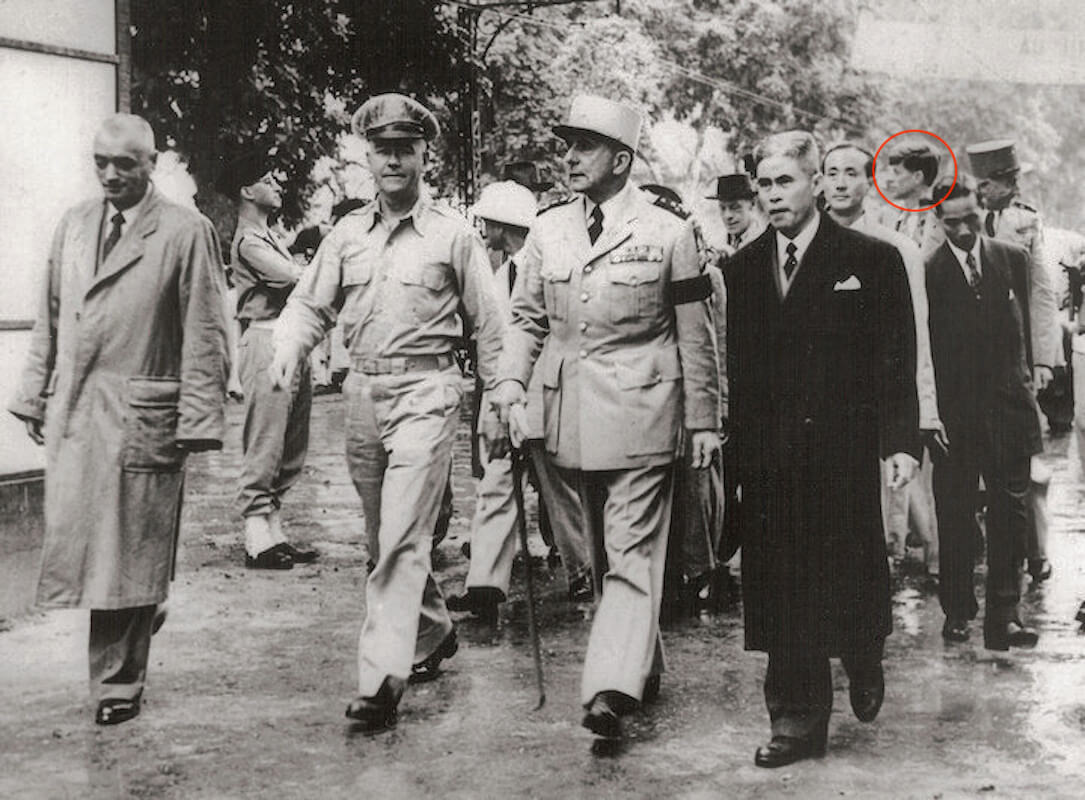
In the 1951 photograph above, General Jean de Lattre de Tassigny is leading a contingent through the streets of Saigon at a time when France was engaged in a losing cause during the First Indochina War. In the back of the pack, a young congressman from Massachusetts, John F. Kennedy, is observing the conditions on the ground in a war effort that was at the time receiving substantial American aid. Kennedy’s younger brother Robert accompanied him on the trip. RFK later ran on an anti-war platform at the height of the Vietnam War, shortly before his assassination in 1968. This study explores the impact of the 1951 trip to Vietnam on John F. Kennedy, his association with the diplomat Edmund Gullion, and the evolving vision of JFK for American foreign policy in Vietnam, which was articulated in a major address given in 1954.
Edmund Gullion (1913-98) enjoyed a distinguished career as a diplomat followed by a second life in academia as Dean of the Fletcher School of Law and Diplomacy at Tufts University, where he trained a generation of foreign officers. As a Southeast Asian specialist, he held senior positions at the American Embassy in Saigon from 1949-52 during the First Indochina War. At a time when the Truman administration was ramping up aid for France in an effort to salvage its colonial outpost in Southeast Asia, Gullion was an advocate of Vietnamese independence. Later, at a critical juncture in America’s involvement in Vietnam in 1963, Gullion asked a colleague, “Do you really think there is such a thing as a military solution for Vietnam?”1
Gullion was also a confidant of the young Congressman and World War II hero John F. Kennedy, who visited Saigon in 1951. Congressman Kennedy was there to observe up close the conditions of a foreign colonial war in progress, in preparation for his run for the Senate the next year against Henry Cabot Lodge. Later, he used Gullion as a sounding-board as he was shaping his own views on America’s role in Southeast Asia and the Third World. During his presidency, JFK appointed Gullion as ambassador to the Congo.2 Gullion’s oral interviews and the words of JFK himself help to shed light on the congressman’s formation as a statesman in the period before he acceded to the presidency. The year 1954 is an especially important crossroads in the history of Vietnam and a turning point for JFK in articulating a foreign policy for Southeast Asia.
Young John F. Kennedy was an inveterate traveler. When he was a Harvard student, he took time out to travel to Europe, the Balkans, and the Middle East in 1939, witnessing first-hand the ominous signs of the coming war. During the war itself, he survived an attack on his PT boat in the Solomon Islands, heroically rescuing a badly burned crew member and guiding his men to safety until they were rescued. At the close of the war in 1945, he worked as a journalist, attending the United Nations Conference on International Organization in San Francisco and the Potsdam Conference. As a congressman from Massachusetts, Kennedy embarked on a seven-week, 25,000-mile trip in 1951. Accompanied by his brother Robert and his sister Patricia, Kennedy visited Israel, Pakistan, Iran, India, Singapore, Thailand, French Indochina (Vietnam), Korea, and Japan. Upon his return home, he conveyed to the press that his goal for the trip was to learn “how those peoples regarded us and our policies, and what you and I might do in our respective capacities to further the cause of peace.”3
At the time, he described in a radio interview what he believed should be the primary goal of combatting communism in the Third World, which was “not the export of arms or the show of armed might but the export of ideas, of techniques, and the rebirth of our traditional sympathy for and understanding of the desires of men to be free.”4 When Kennedy met with Indian Prime Minister Jawaharlal Nehru, he asked Nehru for his view on the current war in French Indochina. Nehru replied that the military and financial assistance provided to the French by the United States was a “bottomless hole” because the war was an example of doomed colonialism.5 Upon arriving in Vietnam, the Kennedy entourage observed Charles de Gaulle and the top brass of the French military as the war was in progress. But, more significantly, the young Congressman was to have a fateful meeting with an American consular officer named Edmund Gullion.
II
While the French were optimistic about retaining their colonial empire with American support, Gullion had recognized in 1951 that they would not prevail. Kennedy had known Gullion since 1947 when they had conferred about a speech the congressman was to give on foreign policy. Now, they met privately on the top of the Hotel Majestic in Saigon. Earlier in the day, Kennedy had been told by the French commander, General Jean de Lattre de Tassigny, that with 250,000 troops, it would be impossible for the French to lose.6 But as JFK listened to the twilight mortar shells exploding in the distance from the artillery of the Viet Minh, Gullion informed him that
In twenty years there will be no more colonies. We’re going nowhere out here. The French have lost. If we come in here and do the same thing, we will lose, too, for the same reason. There’s no will or support for this kind of war back in Paris. The homefront is lost. The same thing would happen to us.7
Congressman Kennedy would never forget the prophetic words of Gullion. A decade later, in the now famous debates in the White House in November of 1961, he recalled them to his cabinet members. As John Newman and James Blight have described, these men were pressing him as commander-in-chief to augment military advisors in Vietnam with American combat troops, a request that JFK adamantly rejected.8
When Kennedy returned from his 1951 trip, it was clear that he was deeply affected by the words of Gullion. Robert Kennedy later recalled that the experience had been “very very major” [sic] in shaping his older brother’s vision for American foreign policy in the countries he had visited.9 In describing this period in Kennedy’s life, historian Herbert S. Parmet writes that,
… at a time of containment as the sine qua non of meeting the spread of the ‘international Communist conspiracy,’ Jack Kennedy was evolving into a spokesman for a more sophisticated view. He was beginning to call attention to the soft spot of the Western cause, to the frustration of a region that had long contended with colonial domination.10
In March of 1952, Kennedy spoke to an audience in Everett, Massachusetts, voicing his opposition to sending American troops to assist the French in Indochina. In April, he addressed a Knights of Columbus chapter in nearby Lynn, stating that “we should not commit our ground troops to fight in French Indochina.”11 In an editorial in The Traveler,the Congressman received praise for taking a stand against the status quo: “Mr. Kennedy is doing a service in prodding our conscience.”12 It was clear in 1952 that Kennedy was as outspoken of American aid to the French as he was against the French colonial war itself.
Gullion returned to Washington in 1953, at which time he renewed his association with Kennedy, who had recently been elected to the Senate. They had many conversations and bonded in their minority opinion about the policy of pouring aid into the French war effort in Indochina. The State Department even suspected Gullion of contributing to Kennedy’s speeches on foreign policy. But Gullion recalls an independently minded Kennedy, who not only did not require Guillon’s assistance as a speechwriter, but was shaping a vision entirely on his own. In reflecting on his meetings with Kennedy in an oral history interview in 1964, Gullion modestly recalled that from the very first speech in which Kennedy had sought Gullion’s aid in 1947, the young politician was thinking for himself:
Actually, it was a very realistic and an advanced kind of perspective that he had, and it was his own. My own contributions to it were factual, and I volunteered some opinions and some sentences, but I was somewhat surprised and, I suppose, my own very youthful egoisms somewhat checked when I saw the finished product and realized how much of this was Kennedy and how little of it was mine. It was quite an interesting product.13
Gullion also recalled that after his 1951 trip, Kennedy’s “stance on Indochina certainly went against the prevailing opinion …. Now when he came back he prepared an address in the Senate which was one of his most important.”14 In his work on this major address, Kennedy conferred with Gullion, and, once again, his views were “entirely his own,” according to Gullion.15
JFK’s speech in the Senate came at a turning point in the modern history of Vietnam in the year 1954. After a brutal, fifty-seven day standoff in northwestern Vietnam, Dien Bien Phu fell to the forces of Ho Chi Minh on May 7. With aid from the Chinese and Russians, the Viet Minh commander Võ Nguyen Giáp had amassed troops and, most importantly, heavy artillery that negated the formidable French airpower. The collapse and surrender of the French that followed were the result of Giáp’s brilliant tactical campaign at Dien Bien Phu. In July, French Prime Minister Pierre Mendès-France put his signature to the Geneva Accords that effectively marked the end of French control of Indochina. The Geneva agreement stipulated that in the nation’s transition to independence, there would be a temporary partition of the country pending a national election to be held in the summer of 1956.
But the United States never signed the Geneva agreements, and almost immediately, the CIA aggressively began to transform Vietnam with the same zeal that had just effected regime changes in Iran and Guatemala. Now, to counter Ho Chi Minh in the north, the search was on for a United States backed leader in the south, whose rise to power would be facilitated by the CIA specialist in black operations, Edward Lansdale. In early 1954 and prior to the French defeat at Dien Bien Phu, Ngo Dinh Diem was made prime minister of Vietnam by France’s longstanding puppet ruler Bao Dai. Within the next two years, Diem would take control of South Vietnam through the sophisticated psychological warfare and propaganda campaigns of Lansdale.16 With Diem in place, Secretary of State John Foster Dulles was able to boast that, “We have a clean base there now, without a taint of colonialism. Dien Bien Phu was a blessing in disguise.”17 The elections that were to unify Vietnam never occurred in 1956, because the United States knew that Ho Chi Minh would be elected in a landslide. Instead, the partition between North and South Vietnam was no longer “temporary,” the North Vietnamese were identified as the “communists,” and, propped up by American economic and military support, the “free” nation of South Vietnam under Diem came into existence.18
III
As the turbulent events of 1954 were unfolding in Vietnam, and a month before Dien Bien Phu collapsed, John F. Kennedy rose to deliver an address in the Senate on April 6, 1954. The structure of the speech was a detailed, year-by-year recapitulation of the massive American support given to the struggling French mercenary army through administrations of both a Democrat (Truman) and a Republican (Eisenhower). Kennedy had done his homework for the speech. This included sending a list of forty-seven detailed questions to Secretary of State John Foster Dulles about the purpose of American involvement in Vietnam.19 But Kennedy was not aware that the United States national security network had already recognized the futility of American intervention in Vietnam by 1954. In 1971, the release of the secret Pentagon Papers revealed that in 1954,
… unless the Vietnamese themselves show an inclination to make individual and collective sacrifices required to resist Communism, which they have not done to date, no amount of external pressure and resistance can long delay complete Communist victory in Vietnam.20
With that knowledge, the Eisenhower administration continued its unalloyed engagement in Vietnam.
On the floor of the Senate, Kennedy prefaced his chronological survey by demanding the government’s accountability to the American people for adventurism and potential war in Vietnam:
If the American people are, for the fourth time in this century, to travel the long and tortuous road of war—particularly a war which we now realize would threaten the survival of civilization—then I believe we have a right—a right which we should have hitherto exercised—to inquire in detail into the nature of the struggle in which we may become engaged, and the alternative to such struggle. Without such clarification the general support and success of our policy is endangered.21
Kennedy was most likely expressing to Eisenhower his personal outrage when he had learned that secret discussions had occurred about deploying atomic warfare in Vietnam to support the fading French prospects of victory. In his speech, Kennedy’s concerns for disclosure were being raised prior to the outcome of the battle of Dien Bien Phu and months before the American subversion of the Geneva Accords that resulted in the artificial division of Vietnam against the will of the Vietnamese people. As he was speaking in the Senate, there was as yet no design for a portion of Vietnam to become an American client state led by a puppet ruler like Diem. It was precisely such a scenario that Kennedy feared.
Kennedy then went on to warn of the dangers of an American military commitment to Vietnam in the wake of the French struggle he had observed in 1951, based on his first-hand experience and the perspectives he had gleaned from Edmund Gullion:
But to pour money, materiel, and men into the jungles of Indochina without at least a remote prospect of victory would be dangerously futile and self-destructive. I am frankly of the belief that no amount of American military assistance in Indochina can conquer an enemy which is everywhere and at the same time nowhere, “an enemy of the people” which has the sympathy and covert support of the people.22
In hindsight, the prophetic nature of Kennedy’s 1954 address underscores a set of lessons that would eventually be learned the hard way by the policymakers after the horrific number of American and Vietnamese casualties during the war that unfolded between 1965-75. Kennedy closed his address by issuing a warning about the potential consequences of military adventurism in Vietnam, including a nod to Thomas Jefferson’s prudence and caution, prior to leaping into the unknown with a military entanglement abroad:
The time to study, to doubt, to review, and revise is now, for upon our decisions now may well rest the peace and security of the world, and, indeed, the very continued existence of mankind. And if we cannot entrust this decision to the people, then, as Thomas Jefferson once said: “If we think them not enlightened enough to exercise their control with a wholesome discretion, the remedy is not to take it from them but to inform their discretion by education.”23
This coda to Kennedy’s speech could have been a road map to the future to avoid what became the tragedy of the Vietnam War.
IV
JFK’s tour-de-force Senate address of 1954 was not political grandstanding. Rather, it was a carefully formulated examination of the question of American intervention in Vietnam at a pivotal moment for both nations. Prior to the Senate speech, Kennedy had spoken to the Cathedral Club in Brooklyn, New York, stressing that the French could not withstand the united forces of Ho Chi Minh, who “has influence penetrating all groups of society because of his years of battle against French colonialism.”24 As he would say again in late 1961 to his advisors, the situation was far different from the recent Korean conflict, wherein an independent government in the south was threatened by the invading communists from the north. Even before the Geneva Accords had mandated free elections to unify Vietnam and before Eisenhower began to use the expression “domino theory,” Kennedy had identified the unique circumstances of Vietnam’s long struggle for independence, as distinct from a nation that America could potentially “lose” to communism.
After the Senate speech, Kennedy followed up with a television appearance, indicating that the French could not possibly retain Indochina and that again, as he would say seven years later, “American intervention with combat troops would not succeed.”25 In another 1954 speech in Los Angeles, Kennedy asserted that the American people “have been deceived for political reasons on the life and death matters of war and peace.”26 He reiterated this theme before the Whig-Cliosophic Society of Princeton University and the Executives Club in Chicago, stressing above all the importance of recognizing independent movements for nationhood in the Third World and distinguishing them from the global expansion of communism. In response to Vice President Richard Nixon’s call to send American ground troops into Vietnam, Kennedy responded that if we were to do that, “We are about to enter the jungle to do battle with the tiger.”27 By the end of 1954, an imaginary line would be drawn across Vietnam as a result of the Geneva Accords. But a very different line was being drawn in the sand by John F. Kennedy: one that proscribed American military intervention. The 1954 Senate speech, which was addressed to President Eisenhower, was a prescient warning about repeating the mistakes of the French. Ultimately, it was advice that was ignored after the death of President Kennedy by his successors, Lyndon B. Johnson and Richard M. Nixon.
In Adlai Stevenson’s bid to unseat Eisenhower as president, Kennedy delivered speeches in support of Stevenson in the run-up to the 1956 presidential election. But when he discussed foreign policy, Kennedy refused to engage in partisan politics. In describing American interference in the developing nations of Africa and Southeast Asia, Kennedy observed that
… the tragic failure of both Republican and Democratic administrations since World War II to comprehend the nature of this revolution, and its potentialities for good and evil, has reaped a bitter harvest today. And it is by rights and by necessity a major foreign policy campaign issue that has nothing to do with anti-communism.28
After such speeches, the Stevenson election team asked Kennedy to refrain from making further foreign policy remarks in the course of the campaign. Senator Kennedy was unsuccessful in his quest for the nomination of Vice President on the Stevenson ticket. Which was probably a blessing in disguise.
During the late 1950s, the focus of Southeast Asian foreign policy of the Eisenhower administration was on preventing the nation of Laos from becoming the first fallen domino. During the 1960 presidential campaign, Kennedy stressed that we would never succeed in Laos against “guerrilla forces or in peripheral wars … We have been driving ourselves into a corner where the choice is all or nothing.”29 As a senator, Kennedy had recognized that “public thinking is still being bullied by slogans which are either false in context or irrelevant to the new phase of competitive coexistence in which we live.”30 By the time he was elected President in 1960, Kennedy had the wisdom to see beyond the Cold War slogans of “the domino theory,” “godless communism,” and “Soviet master plan.” In his first year in office as President, Kennedy traveled to Vienna for a summit with Khrushchev. While en route, he was warmly received in Paris by President Charles de Gaulle. After Kennedy presented de Gaulle with a gift of an original letter written from George Washington to the Marquis de Lafayette, de Gaulle proffered advice to Kennedy on Vietnam, telling him that intervention in Southeast Asia would be “a bottomless military and political quagmire.”31
This counsel reflected the lessons learned by de Gaulle himself from Dien Bien Phu and Algeria. But John F. Kennedy hardly needed this advice from de Gaulle, as his thinking about the emerging nations of Africa, the Middle East, and Southeast Asia had been formed after a decade of close study and hands-on experience during his travels. His 1954 address in the Senate could be a blueprint even today for correcting the misguided American attempts at “nation building” abroad.32 From the time he traveled to Vietnam until his death, Kennedy had the clarity of thinking to understand that the struggle in Vietnam was the story of nationalism, not a Cold War intrigue. And the thinking that informed his vision was guided at the outset by the words he had heard in 1951 from Edmund Gullion.
Afterword
The history of the Vietnam War is invariably delineated by historians as a continuum of escalating involvement from the administrations of Eisenhower to Kennedy to Johnson to Nixon in the form of an incremental progression.33 This essay challenges that notion as apparent in the vision of John F. Kennedy, one that vehemently opposed conventional warfare in Vietnam. According to JFK’s speechwriter Theodore Sorensen, Vietnam was
… not central to the foreign policy of the Kennedy presidency. Berlin was, Cuba, the Soviet Union, but not Vietnam. Vietnam was a low-level insurrection at that point.34
While there were sixteen thousand military advisors in Vietnam at the time of his assassination on November 22, 1963, Kennedy had resisted the pressure to send in combat forces. According to Sorensen, Kennedy listened to his hawkish advisors, “but he never did what they wanted.”35 Similarly, Võ Hong Nam, the son of the North Vietnamese general Võ Nguyên Giáp, informed researcher Mani Kang, in an interview in 2011, that “President Kennedy was finally changing his foreign policy in regards to Vietnam in 1963” and “he was withdrawing.”36
The military historian John M. Newman observes that “at 12:30 P.M., on Friday, November 22, the rifle shots rang out in Dealey Plaza that took the president’s life. His Vietnam policy died with him.”37 Lyndon Johnson’s decision to use the Gulf of Tonkin affair as the pretext to send combat troops into Vietnam, escalate the war, prop up a string of South Vietnamese dictators in a client state, and, finally admit failure, when choosing not to run for reelection as President in 1968, has tended to erase the memory of JFK’s goal of withdrawing all military advisors no later than 1965.
Speaking before a large gathering at the LBJ Library on May 1, 1995, Robert McNamara, JFK’s Secretary of Defense and, later, one of the principal policymakers of the Vietnam War under LBJ, recalled the strategic meetings of the National Security Council (NSC) on October 2 and October 5, 1963, wherein, against the will of the majority of the NSC committee members, President Kennedy had made the determination for complete withdrawal of United States military advisors from Vietnam by December 31, 1965. Historian James DiEugenio has effectively summarized the psychology that JFK was using against a powerful national security network that opposed his plan for withdrawal from Vietnam:
Kennedy had based his withdrawal plan on taking advantage of the differences between what the real battlefield conditions were and what the Pentagon said they were. Knowing that the American-backed South Vietnam effort there was failing, the Pentagon was disguising this with a whitewash of how bad things really were. Therefore, Kennedy was going to hoist the generals on their own petard: If things were going so well, then we were not needed anymore.38
In Kennedy’s plan, the initial phase-out of one thousand advisors would be accomplished by the end of 1963. A public announcement would be made to set these decisions “in concrete.”39 McNamara’s recall of the NSC meeting was corroborated when, in the late 1990s, the Assassination Records Review Board (ARRB) released tape recordings of key meetings during the Kennedy presidency, including those of the National Security Council sessions of October 2 and October 5, 1963, wherein all of McNamara’s points were confirmed. McNamara’s voice appears on the tape, stating, “We need to get out of Vietnam, and this is a way of doing it.”40 Shortly after the NSC meetings, JFK approved the Top Secret National Security Action Memo 263. Declassified in the early 1990s, the document identifies the first phase of the withdrawal of one thousand U.S. military personnel by the end of 1963. The combination of contemporary eyewitness testimony, oral history, recollections of statesmen, tape recordings of meetings, documentary evidence, and, above all, President Kennedy in his own words, points to his capacity as commander-in-chief to steer the United States away from what became the tragedy of the Vietnam War following his assassination.
Notes
1 Wolfgang Saxon, “Edmund Asbury Gullion, 85, Wide-Ranging Career Envoy,” obituary, The New York Times, March 31, 1998. (https://www.nytimes.com/1998/03/31/world/edmund-asbury-gullion-85-wide-ranging-career-envoy.html)
2 At a critical stage in the crisis of the Diem regime in Vietnam in the summer of 1963, JFK wanted to appoint Gullion as ambassador in Saigon. But Secretary of State Dean Rusk opposed the nomination of Gullion in favor of an opposition party member, the Republican Henry Cabot Lodge. In an effort to show bipartisan unity, JFK went along with Rusk. But the appointment of Lodge was a grave mistake that eventually JFK would regret. Robert Kennedy had also preferred the selection of Gullion, warning his brother that Lodge would create “a lot of difficulties in six months.” RFK’s words were prophetic, especially at the time of the CIA-backed assassination of Ngo Dinh Diem that occurred six months later and unbeknownst to the President. James W. Douglass, JFK and the Unspeakable: Why He Died and Why It Matters (Mary Knoll, NY: Orbis Books, 2008), 151.
3 Robert Dallek, An Unfinished Life: John F. Kennedy—1917-1963 (New York: Little Brown and Company, 2003), 165.
4 Dallek, 167.
5 Dallek, 168.
6 Douglass, 93.
7 Douglass, 93.
8 Kennedy’s advisors included Robert McNamara, Dean Rusk, McGeorge Bundy and his brother William, and Eugene Rostow and his brother Walt. These were the men identified by journalist David Halberstam as “the best and the brightest” of the intellectuals in JFK’s administration. After the president’s assassination, these civilian policy makers would be complicit with Lyndon Johnson as the chief architects of the disastrous war in Vietnam.
9 Herbert S. Parmet, Jack: The Struggles of John F. Kennedy (New York: The Dial Press, 1980), 228.
10 Parmet, 228.
11 Parmet, 228.
12 Parmet, 228.
13 Oral History with Edmund A. Gullion, July 17, 1964.
14 Oral History with Edmund A. Gullion, July 17, 1964.
15 Oral History with Edmund A. Gullion, July 17, 1964.
16 The clandestine operation of Lansdale has been documented with great thoroughness by Talbot and Douglass, as per bibliography.
17 Richard Mahoney, JFK: Ordeal in Africa (Oxford and New York: Oxford University Press, 1983), 139. Quoted in James DiEugenio, Destiny Betrayed—JFK, Cuba, and the Garrison Case, second edition (New York: Skyhorse Publishing, 2012), 24.
18 The 1958 bestselling novel The Ugly American, written by Eugene Burdick and William J. Lederer, exposed the smooth tactics of counterintelligence, propaganda, and force exerted by American operatives to win “hearts and minds” in a fictitious Southeast Asian nation. The thinly veiled portrait of Lansdale was apparent in the wily character of Colonel Edwin Hillendale, whose psychological ploys sought to convert the nation to the American way. Senator John F. Kennedy loved the novel and purchased one hundred copies for distribution to the entire United States Senate. He also paid for a large advertisement of the book in The New York Times.
19 Mahoney, 15.
20 The Complete Pentagon Papers, The New York Timesonline, 1945-67 (http://www.documentcloud.org/documents/205509-pentagon-papers-part-iv-a-4.html)
21 John F. Kennedy, Senate Address on Indochina, April 6, 1954 (https://www.jfklibrary.org/Research/Research-Aids/JFK-Speeches/United-States-Senate-Indochina_19540406.aspx)
22 John F. Kennedy, Senate Address on Indochina, April 6, 1954. Shortly after the period in which Edmund Gullion was stationed in Vietnam, Charlton Ogburn became an intelligence officer in Southeast Asia, writing memos to the State Department and warning of the dangers of military involvement in Vietnam. His voice was completely ignored by the overconfident civilian leaders in Washington. Ogburn believed that the reach of the authorities was “totalitarian” in nature, a reality that was grasped by Plato, who may have been the first to identify the amorphous power of the “State” in the example of ancient Athens. For Ogburn, Vietnam was a “laboratory” for understanding how dogma is wielded by authority figures. He later recalled that “we lost over fifty thousand lives in Vietnam because the authorities could not be budged. Their appraisal of themselves was based on their being right …. They had to be right.” The passage of time would prove Ogburn to be correct in his assessment of Vietnam. Writing in 1989, Andrew Jon Rotter in The Path to Vietnam—Origins of the American Commitment to Southeast Asia (Ithaca, New York: Cornell University Press, 1989) refers to Ogburn’s dispatches to State Department officials as “startling and prophetic” in his early critique of the false assumptions guiding U.S. policy. Ogburn concluded one of his memos to Dean Rusk with a statement that spoke for the rights of Third World nations caught up in the Cold War. Referring to the people of Southeast Asia, Ogburn wrote, “Darn it, they are the ones who are threatened with a fate worse than death—not we.” Around the same time, John F. Kennedy was making virtually the same argument in his Senate speech of April 4, 1954.
23 John F. Kennedy, Senate Address on Indochina, April 6, 1954.
24 Parmet, 281.
25 Parmet, 286.
26 Parmet, 285.
27 Parmet, 285.
28 Remarks of Senator John F. Kennedy at the Los Angeles World Affairs Council Luncheon at the Biltmore Hotel on September 21, 1956. (https://www.jfklibrary.org/Research/Research-Aids/JFK-Speeches/Los-Angeles-CA-World-Affairs-Council_19560921.aspx)
29 Arthur Schlesinger, Jr., A Thousand Days—John F. Kennedy in the White House (New York: Fawcett, 1965), 310-11.
30 Quoted in James DiEugenio, Destiny Betrayed—JFK, Cuba, and the Garrison Case, second edition (New York: Skyhorse Publishing, 2012), 25.
31 Dallek, 397. Prior to acceding to the presidency, Kennedy paid a visit to General Douglas MacArthur who, like de Gaulle, advised him to “never get involved in a land war in Asia.” (https://www.cnn.com/2016/09/08/politics/caroline-kennedy-axe-files)
32 As observed by biographer David Talbot, “Kennedy’s thinking about the historical imperative of Third World liberation was remarkably advanced. Even today, no nationally prominent leader in the United States would dare question the imperialistic policies that have led our country into one military nightmare after another. Kennedy understood that Washington’s militant opposition to the world’s revolutionary forces would only reap ‘a bitter harvest.’” Talbot, The Devil’s Chessboard—Allen Dulles, the CIA, and the Rise of America’s Secret Government (New York: Harper Collins, 2015), 362.
33 In the popular Steven Spielberg film The Post, the screenwriters lump together on multiple occasions the American Presidents from Eisenhower to Nixon, suggesting that each President was on board with military intervention in Vietnam, as the American commitment grew exponentially from one administration to the next. But the historical record suggests that this was not the case during Kennedy’s thousand-day presidency.
34 David Talbot, Brothers—The Hidden History of the Kennedy Years (New York: Free Press, 2007), 215.
35 Talbot, Brothers, 215.
36 Mani Kang, “General Giap Knew,” Kennedys and King, August 30, 2013. (https://kennedysandking.com/john-f-kennedy-articles/general-giap-knew)
37 John M. Newman, JFK and Vietnam—Deception, Intrigue, and The Struggle for Power (self-published, 2016), 458.
38 James DiEugenio, Reclaiming Parkland—Tom Hanks, Vincent Bugliosi, and the JFK Assassination in the New Hollywood (New York: Skyhorse Publishing, 2016), 188.
39 James K. Galbraith, “Exit Strategy: In 1963, JFK Ordered a Complete Withdrawal From Vietnam,” Boston Review (September 1, 2003).
40 Galbraith.
Works Cited Bibliography
The Personal Papers of Edmund A. Gullion. The John F. Kennedy Library, Boston, Massachusetts (https://archive2.jfklibrary.org/EAGPP/EAGPP-FA.xml )
Historic Speeches of John F. Kennedy. The John F. Kennedy Library, Boston, Massachusetts (https://www.jfklibrary.org/JFK/Historic-Speeches.aspx )
The Complete Pentagon Papers, The New York Timesonline, 1945-67 (http://www.documentcloud.org/documents/205509-pentagon-papers-part-iv-a-4.html )
Dallek, Robert. An Unfinished Life: John F. Kennedy—1917-1963. New York: Little Brown and Company, 2003.
DiEugenio, James. Destiny Betrayed—JFK, Cuba, and the Garrison Case, Second Edition. New York, Skyhorse Publishing, 2012.
DiEugenio, James. Reclaiming Parkland—Tom Hanks, Vincent Bugliosi, and the JFK Assassination in the New Hollywood. New York: Skyhorse Publishing, 2016.
Douglass, James W. JFK and the Unspeakable: Why He Died and Why It Matters. Mary Knoll, NY: Orbis Books, 2008.
Galbraith, James K. “Exit Strategy: In 1963, JFK Ordered a Complete Withdrawal From Vietnam,” Boston Review, September 1, 2003.
Mahoney, Richard. JFK: Ordeal in Africa. Oxford and New York: Oxford University Press, 1983.
Newman, John M. JFK and Vietnam—Deception, Intrigue, and the Struggle for Power, second edition. Self-published, 2016.
Parmet, Herbert S. Jack: The Struggles of John F. Kennedy. New York: The Dial Press, 1980.
Rotter, Andrew Jon. The Path to Vietnam—Origins of the American Commitment to Southeast Asia. Ithaca, New York: Cornell University Press, 1989.
Saxon, Wolfgang. “Edmund Asbury Gullion, 85, Wide-Ranging Career Envoy. “ Obituary, The New York Times, March 31, 1998.
Schlesinger, Arthur, Jr. A Thousand Days—John F. Kennedy in the White House. New York: Fawcett, 1965.
Talbot, David. Brothers—The Hidden History of the Kennedy Years. New York: Free Press, 2007.
Talbot, David. The Devil’s Chessboard: Allen Dulles, the CIA, and the Rise of America’s Secret Government. New York: Harper Perennial, 2016.