David Mantik’s home site can now be found at http://themantikview.com
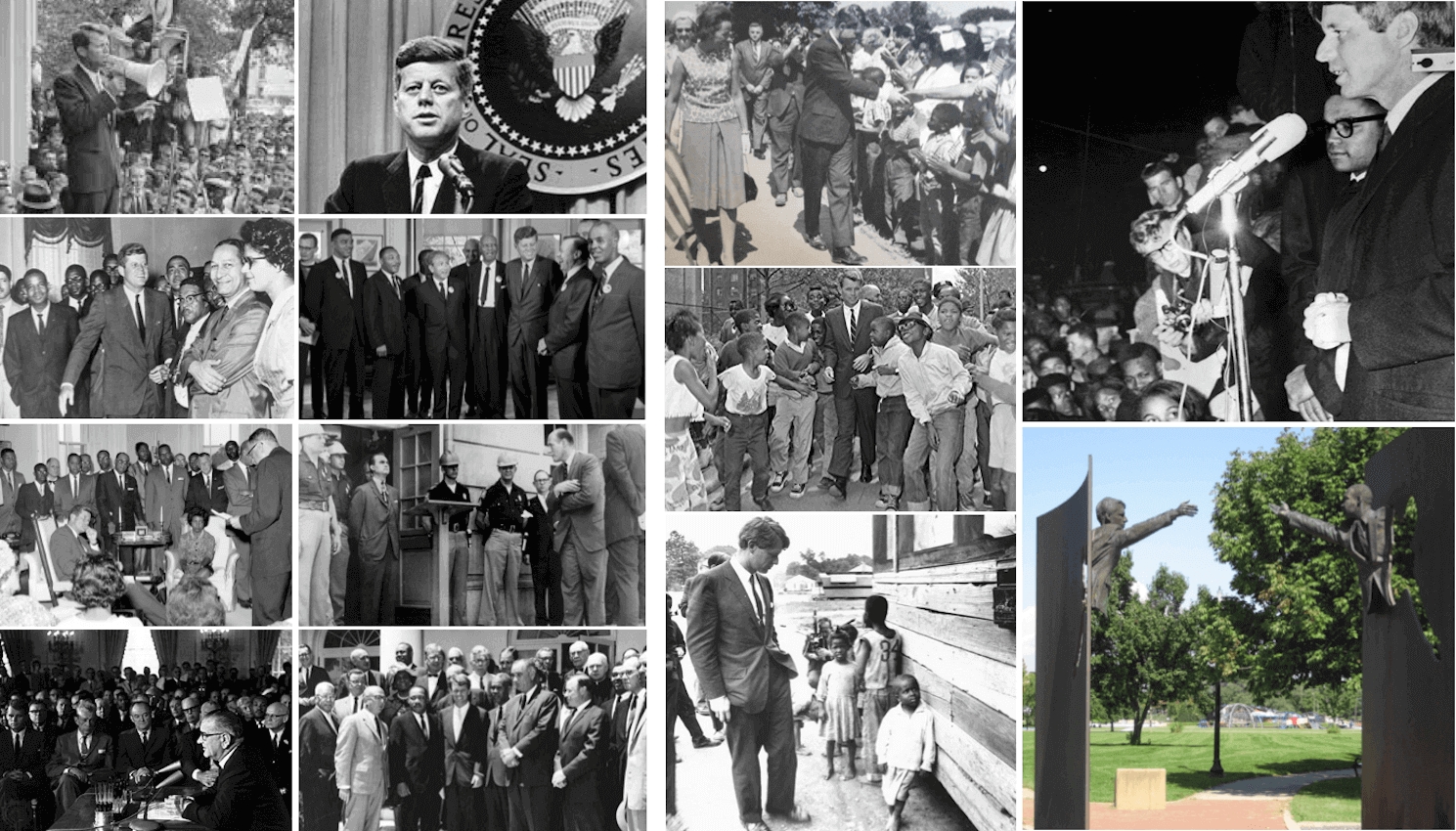
John F. Kennedy “literally shook his head with incredulity” when he learned that Prince Edward County abandoned public education.
~ Brian E. Lee, A Matter of National Concern
In speaking of the years 1961-64, there can be little doubt that the major impetus for the monumental Civil Rights Act of 1964—which eliminated Jim Crow laws in the South—was President Kennedy at the White House, and Robert Kennedy and his assistant Burke Marshall at Justice. In close support was a group of individuals who—like Philip Randolph and Charles Houston—almost never get the recognition they deserve. These were the judges of the Fifth Circuit Court of Appeals. That court encompassed six former states of the Confederacy: Alabama, Mississippi, Florida, Georgia, Louisiana and Texas. They worked in concert with RFK and Marshall to overturn lower court rulings that went against the attorney general, and to cite individuals—including governors—for contempt when they disobeyed court orders. The men on that circuit are so important that at least four books have been written about them. It is a measure of the historical value of the four volumes under review that I could find no reference to that court in any of them. Yet it was their cooperation with and support of the attorney general that kept the pressure on until 1963 when the tactics of Sheriff Bull Connor ignited the issue into national consciousness in Birmingham. By that time, May of 1963, JFK already had a civil rights bill in process.
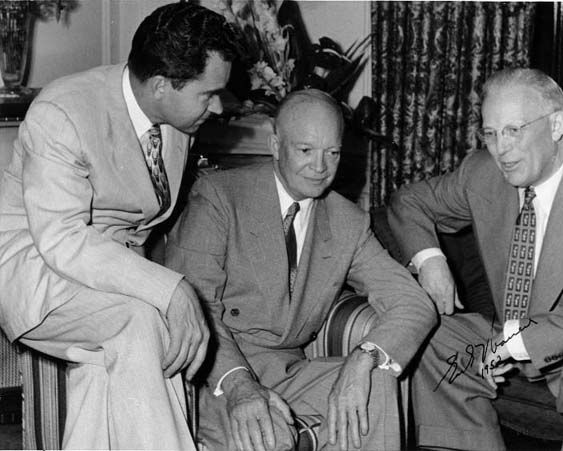 |
| Eisenhower tried to persuade Earl Warren not to decide in favor of Brown |
Harris Wofford was an assistant to the Civil Rights Commission set up by the Johnson/Eisenhower bill of 1957. As he writes in his book, Of Kennedys and Kings, President Eisenhower resisted enacting every recommendation that the commission suggested. (p. 21) As we have also seen, both Eisenhower and Nixon failed to back the Brown v Board decision of 1954. In fact, Eisenhower actually tried to discourage Chief Justice Earl Warren from deciding in favor of the plaintiffs in the Brown case. As we have seen, the only time that Eisenhower acted to apply the decision was in Little Rock, Arkansas in 1957. In that case, Eisenhower had to be asked to join the case. And he waited three weeks to send in troops to protect the students after being badgered by the mayor to do so. (Brauer, p. 4) In the Autherine Lucy case at the University of Alabama in 1956, Eisenhower failed to back the NAACP court order that allowed Lucy to continue her education in graduate school. The college and the student body literally ran her off the campus. Eisenhower did not send in marshals to escort her to class, nor did he federalize the National Guard to maintain order on campus. (Bernstein, p. 97; Jack Bass, Unlikely Heroes, p. 64)
This nod and wink by Eisenhower to the South encouraged their power brokers to find ways to dodge the court order or scheme around its objective. And this was something they were primed and ready to do. For example, in 1955, Senator James Eastland of Mississippi stated that the Brown decision wrecked the Constitution because it disregarded the law in deciding integration was right. He then closed with, “You are not required to obey any court which passes out such a ruling. In fact, you are obligated to defy it.” (Bass, p. 17) That kind of plea was made viable because Eisenhower had never stood up for the issue. For a Republican, Eisenhower had done well in the South in the 1952 election, and even better in 1956. As Charles Houston and Thurgood Marshall were closing in on Plessy v Ferguson, the Southern solution had been to build newer, nicer, separate schools for African American students. But when the Supreme Court restated the 1954 decision in 1955, it stressed that public schools should be integrated and there was no point in building new schools and arguing that these schools were equal.
As we have seen, President Kennedy was already on record as supporting the Brown decision. After he was inaugurated, there were two specific cases that Eisenhower had dawdled on which fell to him. One was in New Orleans, the other in Prince Edward County, Virginia. As we shall see, the contrast with Eisenhower—who called these issues a local problem—could not have been more dramatic. Even in 1956—after the Brown restatement—when the governor of Texas called out Texas Rangers to stop African American children from registering at court-ordered integrated Mansfield High School, Eisenhower failed to act. (Bass, p. 122)
Led by Senator Harry Byrd and columnist James Kilpatrick, Virginia was urged to abandon public education altogether. The state now passed laws decreeing any district that obeyed Brown would have funding ceased. (Nancy McLean, Democracy in Chains, p. 25) In January of 1959, higher courts overturned this action. (p. 65) The state schemed again, this time by using state vouchers for a segregated private system. This ultimately failed due to another court challenge. But in the meantime, 1,800 African American children in Prince Edward County had no schools to attend. What made this most notable was that Prince Edward was one of the five counties that Charles Houston had targeted to overturn Plessy v Ferguson. As Brian Lee wrote in his Ph. D. thesis, A Matter of National Concern, Eisenhower actually encouraged this scheme by saying that states were not required to maintain a system of public education, and therefore the president was “powerless to take any action.” (Lee, p. 50)
The Kennedys disagreed. The attorney general called Prince Edward “a blight on Virginia” and “a disgrace to our educational system and to our country”. (Lee, p. 22) President Kennedy now began to remake the 4th Circuit Court of Appeals, governing Virginia and nearby states, altering Eisenhower’s composition in order to strike down these schemes. (Lee, p. 6) In the meantime the White House did something that is probably unprecedented. While the president altered the court, the attorney general asked William Vanden Heuvel to raise money to build a free school system to educate the Prince Edward African American students left behind. Further, Burke Marshall attempted to join the NAACP legal action in Virginia, not as a friend of the court, but as a plaintiff. This had never been done by Eisenhower in six years. (Lee, pp. 145-150)
 |
| New Orleans: Ruby Bridges was the only student left at the school |
This unprecedented action in Virginia was paralleled by what the administration immediately did in New Orleans. That school district, after a successful lawsuit to integrate schools, at first stalled and then schemed. Finally, federal Judge J. Skelly Wright ordered integration to proceed in September of 1960. The state legislature now passed laws circumventing Wright’s order. The Eisenhower administration asked Wright to delay issuing his new order declaring the state laws unconstitutional until after the November elections. They did not want to deal with another Little Rock. (Bass, p. 132)
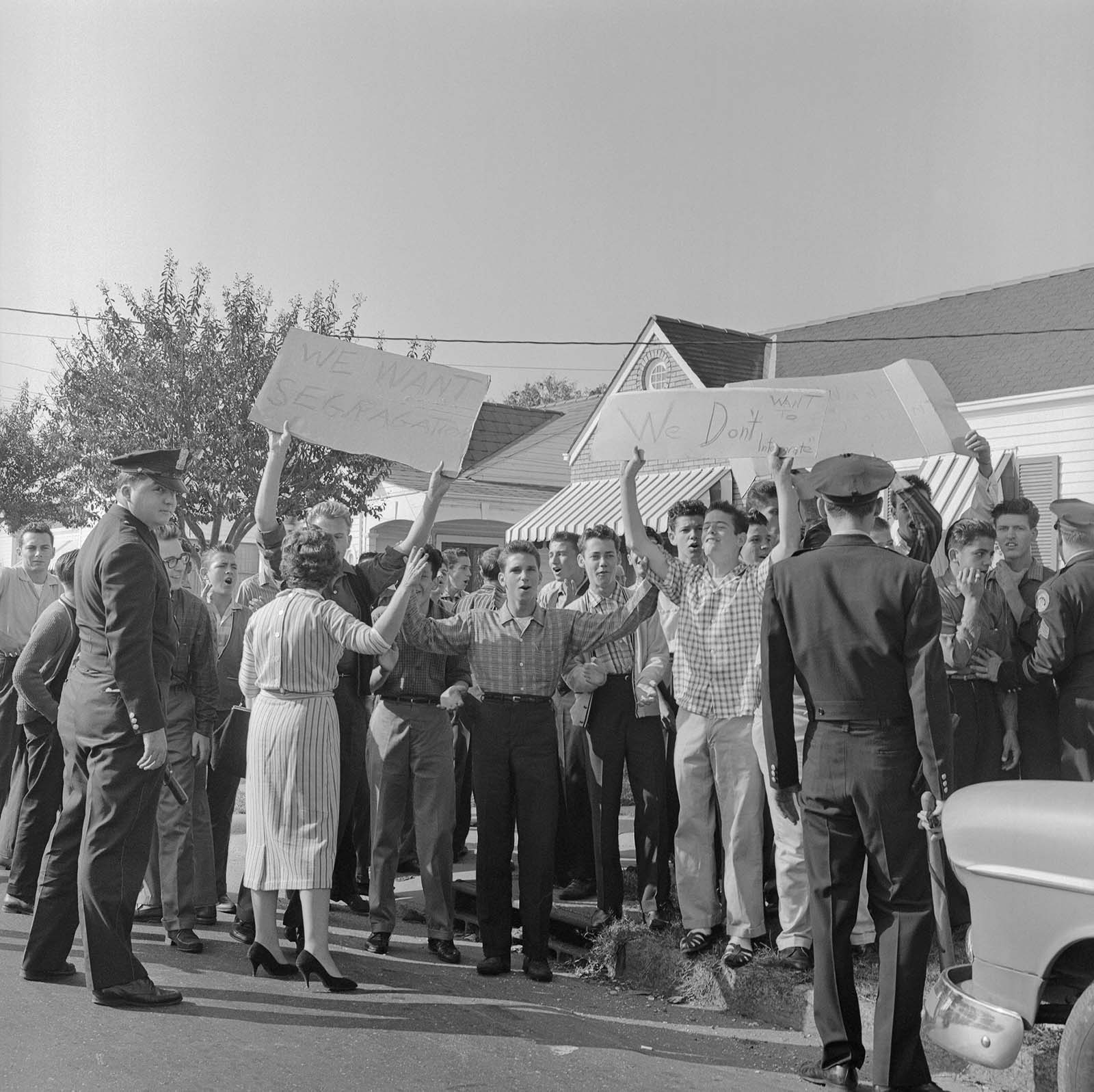 |
| Across from the school: this is what she was being protected from |
The pathology sanctioned by the White House continued. The state legislature passed laws to oust school board members and to even fire teachers who agreed to work with black students. (New Orleans Magazine, “The Struggle for Education”, January 2016) Wright again struck them down. The judge then asked for federal marshals to escort the students of color to their new schools. Louisiana now took up a scheme inspired by Orval Faubus in Arkansas. The schools ended up being largely empty, since the white students boycotted them and their parents picketed them. (Bass, p. 129)
As in Virginia, the legislature threatened to close down schools by withholding funds. Wright now called RFK’s assistant Burke Marshall. Marshall advised Bobby Kennedy of the situation. The attorney general replied, “We’ll have to do whatever is necessary.” (Bass, p. 131)
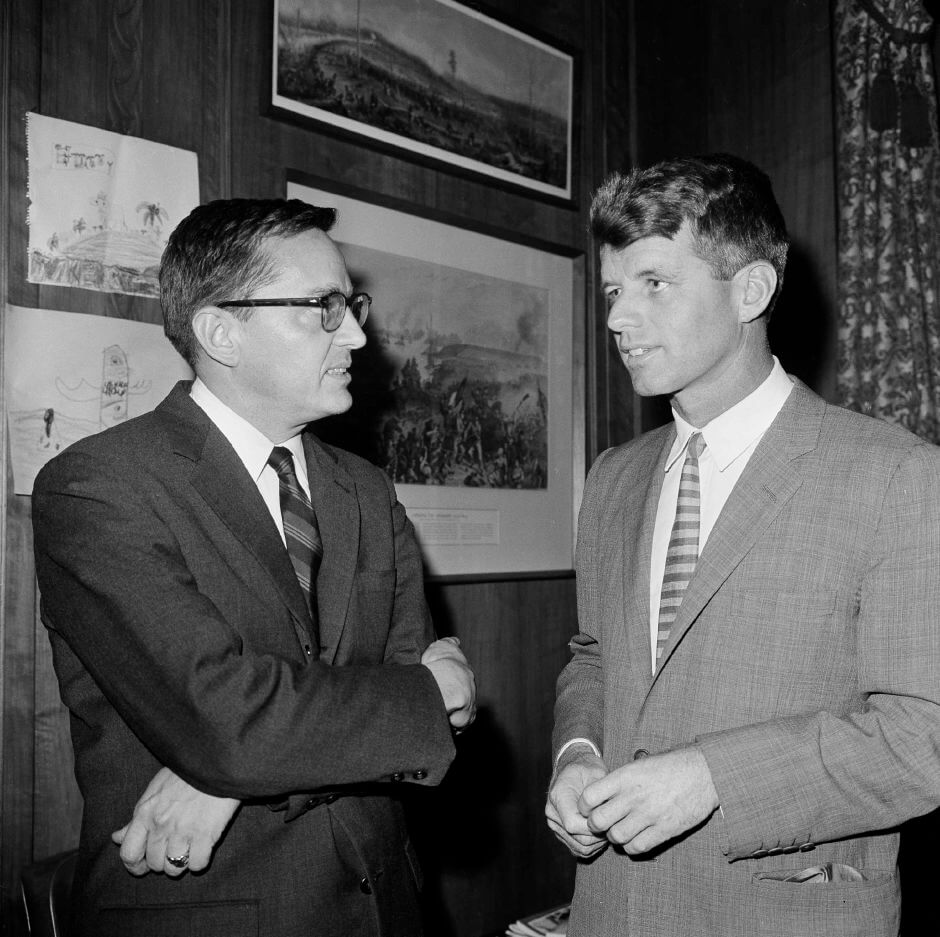 |
| Burke Marshall & RFK |
The Kennedy administration again did something unprecedented. In February of 1961, Burke Marshall filed charges against the state secretary of education, Shelby Jackson. Marshall’s aim was to block the attempt by the governor to cut off funding for integrated schools. (Bass, p. 135) Wright set a trial date to begin proceedings against the secretary for contempt of court. Jackson backed off and said he would not interfere. He avoided a prison sentence by pleading he had a weak heart.
Steven Levingston does not mention Shelby Jackson. Nor does he note the New Orleans schools case or Judge Wright. You will also not see the Prince Edward Free Schools listed in his index. But I should also note, these two cases were done without any consultation with King, though he would have endorsed them both, as other civil rights leaders did. Thus Levingston’s twin themes—that somehow King was the only focus of the race issue, and the Kennedys were denying his requests and did not understand his message—are simply not substantiated by the record. And this is in early 1961!
The administration also began to finish up Charles Houston’s work that, again, Eisenhower had abandoned. Bobby Kennedy made it a point to speak at the University of Georgia Law Day on May 6, 1961. As historian Carl Brauer wrote, this was the first time in memory that an attorney general had directly addressed the civil rights issue in the South. (Brauer, p. 95) He did this partly in order to congratulate the university for its efforts in integrating the college with relatively little violence in January of that year; partly to aid the efforts of the Fifth Circuit, for they had completed the process of integration at that university. (Bass, p. 136) In that address, the attorney general said that he planned on abiding by and enforcing the Brown decision. He spent half the speech talking about civil rights. The Kennedys would also make good on the Charles Houston goal of completing integration of higher education—a goal Eisenhower abandoned with the Lucy case—and this address was part of achieving that goal.
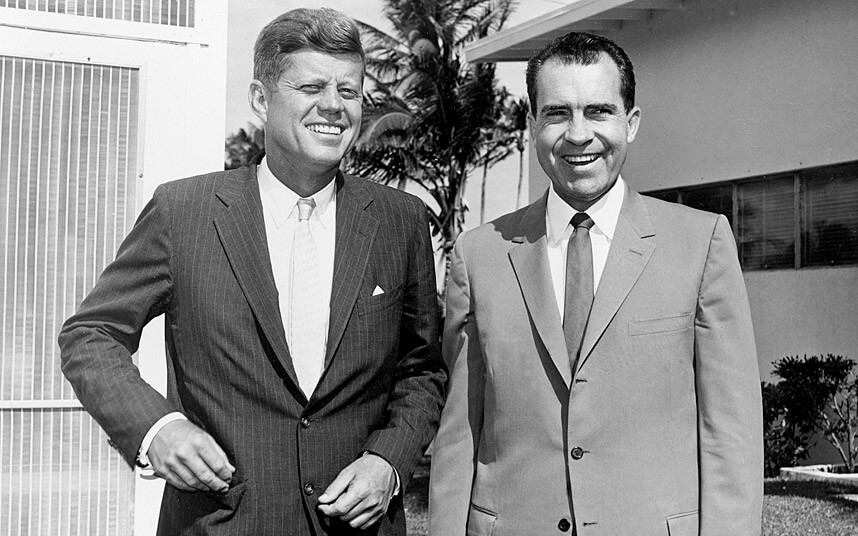 |
| Senator Kennedy compared his civil rights record to Nixon’s |
In a larger sense, these were the first steps toward fulfilling a campaign promise that Senator Kennedy made on November 1, 1960 in Los Angeles. Neither Levingston nor Margolick deal with this speech, so we are left with the impression that civil rights were not an issue in that race. That is not accurate. In that speech, Senator Kennedy compared his congressional record with Richard Nixon’s on civil rights. He also compared his stand on the minimum wage, which when boosted would help many African Americans. He concluded by saying that although not everyone can have equal abilities, “everyone should have the same chance to develop their talent.” Which was something he was trying to do with education.
In Part 2, we discussed the Freedom Rides of May, 1961. The end result of all this was that two lawyers from the attorney general’s office filed a petition to the Interstate Commerce Commission. In the latter part of May, a request went up to issue regulations eliminating segregation at bus terminals. Under pressure from Burke Marshall, the ICC issued these in September. Marshall convinced Senator John Stennis to get the last three towns in Mississippi to remove their discriminatory signs. (Brauer, p. 109) By the end of 1962, Jim Crow was eliminated in interstate transportation. (Bernstein, p. 68)
In Wofford’s memo of December 1960, he wrote, “Ending discrimination in voting is the point of which there would be the greatest areas of agreement and the greatest progress could be made.” (Bernstein, p. 68) This was a primary goal of candidate Kennedy as opposed to Richard Nixon. In October of 1960, JFK proposed to his civil rights advisory group that they use access to voting records that the Civil Rights Commission had gained to file lawsuits in court based on voting discrimination. On the day Bobby Kennedy was confirmed as attorney general, the judiciary chairman, James Eastland of Mississippi, commented that his predecessor had never filed a civil rights case in Mississippi. This was true. It was also an understatement. During Eisenhower’s two terms, his administration had filed a total of ten civil rights lawsuits. Two of those were posted on his last day. (Golden, pp. 100, 104) The day after RFK’s confirmation, his brother sent him a note saying, “Get the road maps—and go!” Which meant: start sending your men into the backwoods of the South to secure those records and file cases.
In one year RFK doubled the amount of lawyers in the civil rights section. During that same year he doubled the amount of cases that Eisenhower had filed in two full terms. By 1963, the number of attorneys in that section had quintupled. (Golden, p. 105) RFK then hired 18 legal interns to search microfilm records in suspect districts. That opened 61 new investigations—in just a year. Prior to the Kennedy administration, it is clear that neither the Brown decision nor the strictures of the Civil Rights Commission were being obeyed. To increase the tempo, Bobby Kennedy went from suing districts to filing against a whole state, e.g., Mississippi. Although the president got regular reports on this tactic, he memorably scrawled across the bottom of the Justice Department report for 1962, “Keep pushing the cases.” (Golden, p. 111)
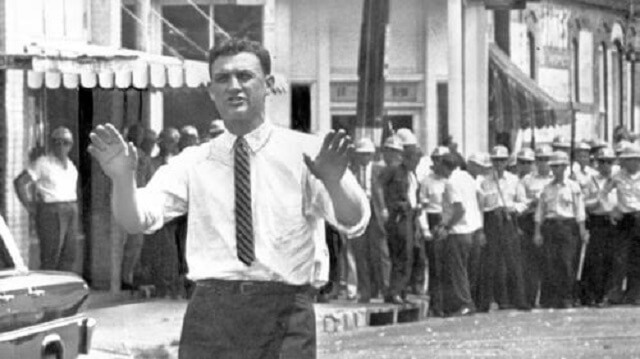 |
| John Doar |
The weight of the residue of the previous administrations was staggering. When attorney John Doar attempted to interview people in Tennessee, he found that in 13 counties, none had registered. (Bernstein, p. 68) To show just how intent southerners were to stop this effort, some of the people who talked to the Justice Department were then evicted from their lands as tenant farmers. The White House then organized an effort to send aid to those who were evicted. (Brauer, p. 72)
Useful in the voter registration regard was another mission that the Eisenhower administration never attempted. This was the voter registration drive. This presented a huge challenge. For example, in 1960, in the parish of East Carroll in northeast Louisiana, there were more African Americans of voting age than whites. But there were 2,845 whites registered to vote, and no African Americans. In the northwest parish of Bienville, almost every white voter was registered. Of the over 4,000 African Americans, only 25 were registered. (Golden, 136) The emerging problem was that these kinds of field projects are expensive, since one must send workers out with canvassing lists to knock on doors and get both information and documentation. The government itself could not supply the funds. So Marshall and Wofford went to various foundations in the north to get the money. (Bernstein, p. 72) They then parceled it out to the various civil rights groups like the NAACP, SCLC and CORE. The overall title given to the drive was the Voter Education Project (VEP). It cost $870,000, or about 7 million today. The VEP lasted until 1964. As one commentator noted, it gained an increase in its short duration that would have taken ten years to achieve under normal conditions. But more important, “It moved Negro registration off dead center, where it had been for most of the previous decade, and reestablished momentum.” (Bernstein, p. 73)
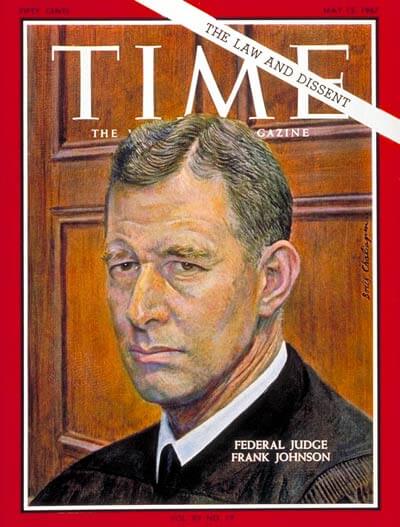 |
| Judge Frank Johnson |
In this regard, Kennedy and Marshall did something that most people would have found next to impossible. They actually got the FBI to help investigate cases of voting rights violations. This appears to be some kind of milestone for J. Edgar Hoover. (Brauer, p. 117) Extensive research in voting rights abuses were then presented to the judges of the Fifth Circuit Court. In Louisiana, with the help of Judge Minor Wisdom, the attorney general got the voting test requiring an interpretation of the Constitution thrown out in 21 parishes. That figure made up a third of the state. (Golden, p. 137) It was the Fifth Circuit’s Frank Johnson—who had worked with Robert Kennedy during the Freedom Riders crisis—who gave the attorney general his first win in a voting rights case. With Johnson’s help, the number of registered African American voters went from 13% to 42% in Macon County, Alabama. (Brauer, p. 118, 120) As Judge Johnson later said to his biographer:
The Macon County case would be the one that began to erode Southern voting discrimination … The Middle District of Alabama federal court took the lead in voting rights and the Fifth Circuit and the Supreme Court consistently upheld those rulings. When the Selma demonstrations started in 1965, the black citizens in my section of the state of Alabama had already won the right to vote. (Frank Sikora, The Judge, e-book, chapter 12)
Utilizing the Fifth Circuit, with judges like Johnson and Wisdom, plus the evolving Fourth Circuit in the upper South, and the Supreme Court sustaining their decisions, Bobby Kennedy thought he would be done securing voting rights in the South by 1968. (Golden, p. 131) The Selma demonstration, which caused the Voting Rights Act, hurried that up by three years. But as Johnson points out above, it was already happening. Clearly, this was a deliberate strategy by the attorney general. In his book on the Fifth Circuit, Jack Bass wrote that Bobby Kennedy urged civil rights groups to use the judicial process as a way to get them to their ultimate goal. (Bass, Unlikely Heroes, p. 25)
That Levingston never mentions this crucial Fifth Circuit aspect shows the worthlessness of his book. As Judge Johnson later said, no one in Washington was doing anything substantial on civil rights in the fifties, including Eisenhower. He added that when Kennedy came in, “there was almost an immediate and dramatic change. He was like electricity compared to Eisenhower … [He] put the nation on notice that there were changes that were long overdue.” (Sikora, chapter 6)
Related to this, the administration tried to get a voting rights bill through Congress in 1962. Eisenhower called a press conference and labeled this modest proposal for voting rights “unconstitutional”. (Brauer, p. 135) As with Johnson in 1960, there were problems with the Southern bloc in the Senate. Due to their filibuster, the effort failed. (Edwin Guthman & Jeff Shulman, eds., Robert Kennedy in His Own Words, p. 149) But this did help inspire the 1962 congressional proposal to do away with the poll tax by amendment. The 24th amendment outlawing the poll tax was ratified in January of 1964. (Brauer, p. 132)
In one of his lesser-known achievements, it was President Kennedy who began the idea of affirmative action. And it started on inauguration day. Kennedy noticed that, during the parade, there were no black faces in the Coast Guard detachment. That night he called Treasury Secretary Douglas Dillon and asked that something be done about it. (Bernstein, p. 52) Two days after Kennedy’s phone call, the academy began an all-out effort to recruit African Americans. One year later, the streak was broken and an African American student entered the academy. (Bernstein, p. 52) In 1963, the Coast Guard made it a point to visit 199 high schools, addressing 11,000 students and then interviewing 561 African American candidates. (Golden, p. 114)
That was just the beginning. At his first cabinet meeting, Kennedy brought up the incident and told each member that he wanted the figures on the racial balance in his respective department. He did not like the results. For instance: at the Department of Justice, only 19 of nearly 1700 lawyers were African American. Kennedy also discovered that most of the people of color were at the lower rungs of the hierarchy. The president now told everyone that he wanted the situation remedied and he also wanted regular reports on their progress. (Bernstein, p. 53) Kennedy got so involved in the process that his administration became the first to appoint an African American ambassador, Clifton Wharton, to a European country. As Roy Wilkins later said, “Kennedy was so hot on the Department heads … that everyone was scrambling around trying to find himself a Negro in order to keep the president off his neck.” (Bernstein, p. 53) In fact, Kennedy assigned a civil rights officer to manage hiring and complaints for each department. He then advised the Civil Service Commission to begin a recruiting program to target historically black colleges and universities. (Brauer, p. 72, 84)
The president then set up two interagency groups in order to monitor and push the issue forward. One was headed by Harris Wofford and it oversaw the entire federal government; Fred Dutton’s concentrated on the cabinet positions. On March 6, 1961—45 days after his inauguration—Kennedy issued an executive order outlawing discrimination in the workplace and making sure that affirmative action employment practices were followed.
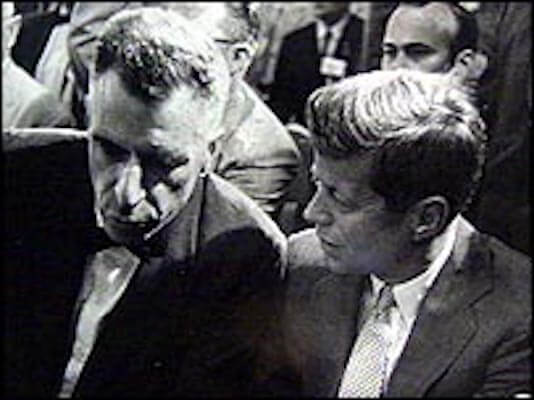 |
| Galbraith & JFK |
This concept of seeking out qualified people of color to serve in the government was complemented by another action. Together with his longtime friend, John Kenneth Galbraith, Kennedy decided to protest the color barrier at two posh clubs in the Washington, DC area, namely the Metropolitan and Cosmos clubs. (Richard Parker, John Kenneth Galbraith, p. 387) At the Metropolitan, Galbraith sponsored Kennedy as a member. But Kennedy refused to join when they declined service to a visiting African diplomat. At the Cosmos Club, Kennedy withdrew his application when the club refused to admit federal employee Carl Rowan. Kennedy got other government members and friends to follow suit and resign membership. Due to the bad publicity, both clubs later reversed policy. The notable thing about these episodes is that both were private clubs. (Washington Daily News, January 15, 1962, p, 21; Wofford, pp. 149-50) Kennedy then announced that neither he nor any member of his administration would attend functions at segregated facilities. (Bernstein, p. 53) To top it off, some of the members who resigned in protest then banded together to form a non-discriminatory club called the Federal City Club. (Brauer, p. 70)
But Kennedy wanted to go beyond just the direct reach of government employment and the upper classes of Washington, DC. As noted previously, President Truman could not sustain the Fair Employment Practices Committee that Philip Randolph had pressed on Franklin Roosevelt. So first Truman, and then Eisenhower, set up advisory committees on the issue. The aim was to make the companies that won federal contracts adhere to non-discriminatory employment practices. In reality, if, say, the army contracted out to a textile company to manufacture rolls of cloth to make uniforms, that company would have to show that it hired some people of color. Kennedy established the Committee on Equal Employment Opportunity (CEEO) as part of his March 6, 1961 Executive Order on affirmative action. (Golden, p. 59)
Under Eisenhower, Nixon had run their employment program, so President Kennedy put Lyndon Johnson in charge of the CEEO. Again, the contrast in activity is startling. In seven years, Nixon filed six suits. In a bit over two years, the CEEO heard almost four times as many complaints—1700—as Eisenhower and Nixon did in seven years, and acted favorably on over 70% of them. For example, there was a desegregation lawsuit filed against Socony in Texas. (Golden, p. 60; Bernstein, p. 59) Kennedy’s plans for retaliatory action went beyond Eisenhower and Truman. The CEEO allowed for the publication of the names of those who were violators, lawsuits by the attorney general, cancellation of the contract, and the foreclosure of future contracts. (Bernstein, p. 56) As a result, by 1963, you had people of color working alongside whites in the carding rooms of textile mills in the South. As a mill supervisor explained, “We work together for the simple reason we must if we want the government contracts. Without those contracts, we close down.” (Golden, p. 61) Its greatest achievement under Johnson was a settlement with Lockheed to integrate all of its facilities and begin a program of affirmative action in hiring. This was important since Lockheed was a large employer in Georgia. (Bernstein, p. 58)
Kennedy’s stricter program also extended to funds given to institutions of higher learning. As Melissa Kean noted in her 2008 book:
With the election of John F. Kennedy, the reach of federal nondiscrimination requirements in contracting finally extended into the admissions policies of private southern universities. Failure to comply meant ineligibility for the federal grants and contracts that were the life-blood of the advanced programs at these schools. (Kean, Desegregating Private Higher Education in the South, p. 237)
As a result of Kennedy’s more rigorous policies, large private universities like Duke and Tulane chose to quietly and peacefully admit African Americans.
The CEEO also developed a parallel program for non-discrimination in labor unions. This was called the Programs for Fair Practices. The AFL-CIO, covering about 11 million members, chartered it. (Bernstein, p. 60)
Since Johnson ran the program, the sternest critic of the CEEO was Robert Kennedy. He thought Johnson was not aggressive enough. For instance, RFK filed a lawsuit in December of 1961 against hospitals who received federal funds but discriminated against doctors or patients. (Golden, p. 113) President Kennedy felt so strongly about this issue that in June of 1963 he issued another executive order that both strengthened and extended the mandate of the CEEO. This agency later became a permanent part of the government and was renamed the Equal Employment Opportunity Commission. Kennedy had achieved what Truman could not and what Eisenhower and Nixon simply were not interested in.
At this point we should address an issue that some professional writers on the Left, like Paul Street, have brought up: the idea of federal protection for those struggling for rights. This was obviously an issue in the 1963 RFK/Marshall meeting with James Baldwin and Jerome Smith. In addition to the violence during the Freedom Riders demonstrations, there was also the riot at Ole Miss in 1962, which we shall discuss, and the nationally televised tactics used by Sheriff Bull Connor in 1963 at Birmingham which Baldwin mentioned in one of his telegrams to Robert Kennedy before the meeting. (Dyson, p. 25) As Robert Kennedy later said, in addition to Jerome Smith throwing the meeting off subject, the other problem was how little Baldwin and the others knew what the law was. (Guthman and Schulman, pp. 224-25)
Burke Marshall had studied this entire field and examined the legislation that was on the books and how it fit into the system of federalism. In 1964, he wrote a brief book on the subject called Federalism and Civil Rights. To indicate his quality of scholarship, Michael Eric Dyson never mentions it anywhere in his book. Neither does Levingston. Professional historians Arthur Schlesinger and Carl Brauer do more than mention it: they spend several pages explaining Marshall’s book.
No one can deny that the Birmingham images of youngsters being attacked by rabid dogs and bounced around by fire hoses were shocking to behold. Yet no one can deny that RFK and Marshall were on the protesters’ side. So the question then became: Why didn’t they do anything to preempt it?
The answer that Marshall got sick and tired of giving was simple: America does not have a national police force. The police function is a local function. With very rare exceptions, the FBI is an investigative force, one that is supposed to help and support local and state police. Marshall then added, “There is no substitute under the federal system for the failure of the local law enforcement responsibility.” (Letter from Marshall to R. H .Barrett, 1/3/64) None other than Thurgood Marshall backed him in that judgment. The man who argued Brown v Board said that the police authority does not lie with the federal government, but within the states. That was a point that he, as a civil rights lawyer, could understand, “but the average layman cannot understand it.” (Schlesinger, Robert Kennedy and His Times, p. 318)
What both men were saying amounts to this: Robert Kennedy could not go in and arrest Bull Connor and the entire Birmingham police force. There simply was no federal mechanism that allowed him to do so. But beyond that problem, there was also the matter that, before the Civil Rights Act of 1964 was passed, Connor was abiding by the state and local laws. In that regard, we must recall Part 1 of this series, where the author explained how the Supreme Court had neutered the Reconstruction laws and amendments. In addition to that, each locality has municipal laws guiding the administration of demonstrations. Fred Shuttlesworth, father of the Birmingham demonstrations, knew he was violating them. That was his point: to use civil disobedience and moral suasion to defeat misguided power.
There was an exception in the law. And this allowed the White House ultimately to send in federal marshals and troops to Oxford, Mississippi and also to Alabama during the Freedom Rides. Sections 332-334 of Title 10 of the US Code allows the president to send in troops in instances of a large scale failure of law and order. Burke Marshall was hesitant to use Title 10. As the famous legal scholar Alexander Bickel once wrote, “As a regular and more or less permanent device, it is something from which we recoil, deeming it destructive of a free society.” John Doar also found that route to be a dangerous one: the federal government should not be a police state. (Schlesinger, p. 318-319)
A good point of comparison would be the famous incident when Robert Kennedy heard that local police had arrested a Chicano demonstrator in Delano, California before he broke any laws. This was during the time that Cesar Chavez was trying to organize fruit pickers in the central valley area. Kennedy had flown there for a hearing on their organizational rights. When he heard that, RFK advised the police officer to read the Constitution during the lunch break. (Schlesinger, p. 826) As Attorney General Kennedy had said to Anthony Lewis, the investment of dictatorial powers in the executive branch might seem convenient or expedient during times of stress. But it should be resisted, since it would boomerang later. (Schlesinger, pp. 319-20)
Today, living in the shadow of Dick Cheney, water boarding, drones, Edward Snowden and Guantanamo, I think we all understand what the attorney general meant. But the meeting with Baldwin and Smith was not the most appropriate time for Burke Marshall to take out a chalkboard and play law professor.
In addition to attempting to pass a voting rights act in 1962, the Kennedy administration was also working with the NAACP and the Fifth Circuit to complete the integration of colleges and universities in the South. As noted above, President Kennedy used restrictions on grants to private universities to shoehorn integration. With public universities, Burke Marshall decided to work with the NAACP to attain court orders from the Fifth Circuit. In 1963, Clemson and South Carolina integrated peacefully. Such was not the case with Ole Miss and Alabama.
The day after JFK was inaugurated, James Meredith decided to become the first African American student at Oxford. Both the NAACP and Burke Marshall decided to take part in his attempt. (Brauer, pp. 180-81) Governor Ross Barnett now invoked a policy that southern universities had used many times before. He offered to pay for Meredith to go elsewhere. When that did not work, he started shouting “states rights” and John Calhoun’s specious claims about interposition.
Robert Kennedy formally entered the Justice Department into the legal proceedings. President Kennedy began to lobby business leaders in the state. (Brauer, pp. 182-83) When the university tried to deny Meredith’s application, the Fifth Circuit, in an opinion written by Minor Wisdom, overruled the denial. (Bernstein, p. 77)
But now, the trustees of the college transferred power over to Barnett. The Fifth Circuit first charged the trustees, then Barnett, with contempt. (Brauer, p. 184) At Millington air base in Memphis, the president now began to build up a force of federal marshals and draw up a military contingency plan which would eventually include 20,000 troops. (Bernstein, p. 81)
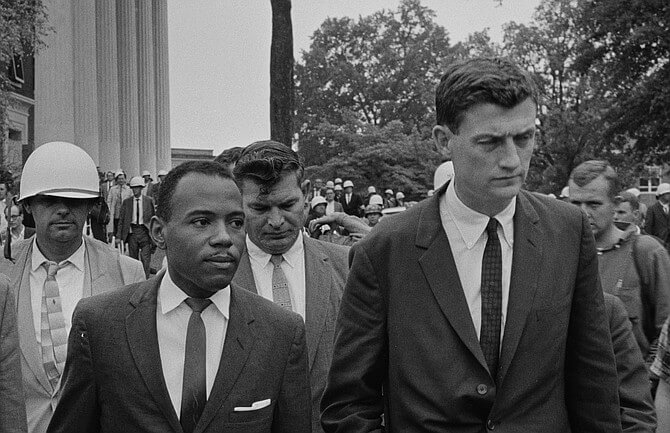 |
| James Meredith & John Doar |
Ross Barnett ended up double-crossing the White House. And his stalling tactics had allowed General Edwin Walker to build up an angry crowd estimated at anywhere from two to three thousand rabid segregationists, including Klansmen. On the Sunday evening of September 30th, Deputy Attorney General Nicolas Katzenbach headed the escort to prepare for Meredith’s next day registration. Just before that was to occur, Barnett pulled the state troopers who were supposed to maintain order until Meredith was processed. (Bernstein, p. 83) A riot ensued and Walker’s crowd outnumbered the federal marshals. What made it worse was that Katzenbach’s communications network went down, and the troops that were supposed to arrive in a contingency failed to arrive when they were scheduled. Two bystanders were killed, scores of marshals were injured and 13 men were indicted. President Kennedy had marshals escort Meredith constantly until he graduated. (Brauer, pp. 195-97)
The next year, at the University of Alabama, things went smoother. This was part of perhaps the most groundbreaking three days any president has had since FDR. On June 9th, President Kennedy had made a strong speech for civil rights at a mayor’s conference in Hawaii. (Andrew Cohen, Two Days in June, pp. 18-19) Coming back from Hawaii, on June 10th, the president announced his plans for détente with the Russians in his speech at American University.
The next day, President Kennedy had his showdown with Governor George Wallace in Tuscaloosa. Robert Kennedy had tried to talk to Wallace in order to prevent anything like Ole Miss from happening. (Cohen, p. 235) Again, an associate of Frank Johnson, Judge Seybourn Lynne, had written the order for two African American students to enter the university. (Cohen, p. 236) Wallace had arranged for a combined force of 895 state troopers and police to back him. The White House brought in 3000 troops; this time they were only minutes away. (Cohen, pp. 243-47)
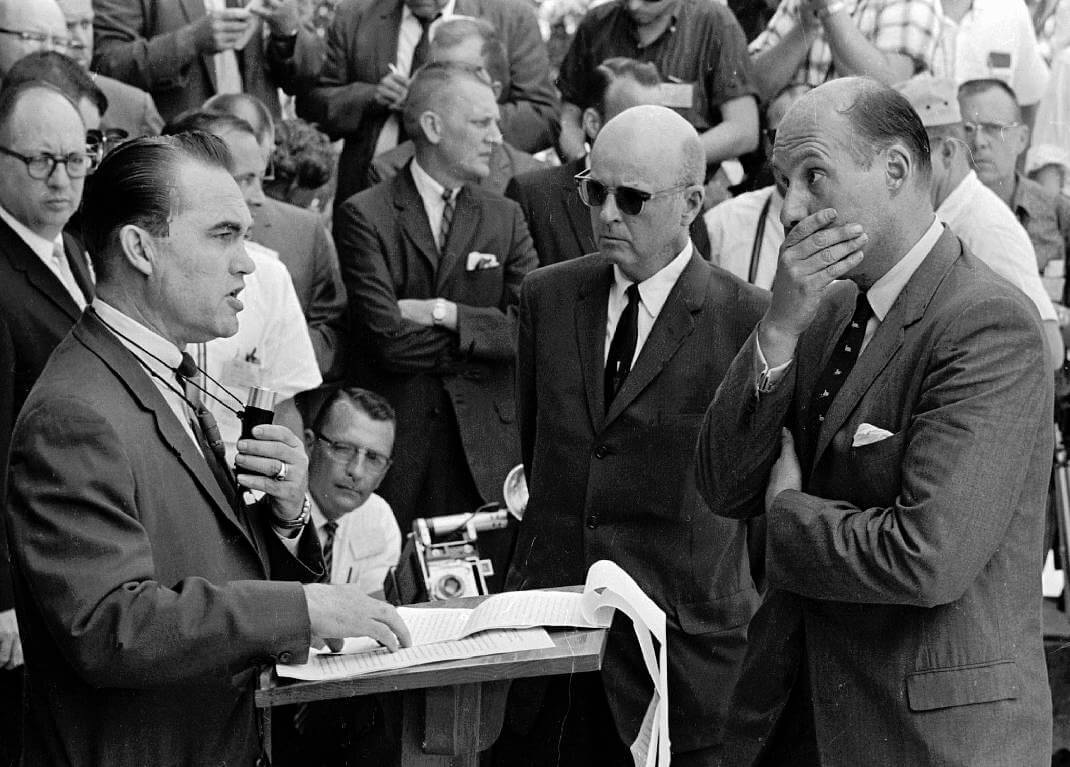 |
| Wallace confronted by Katzenbach |
Contrary to what MSM hacks like Evan Thomas claim, no one knew what Wallace was going to do that day. The proof of this is that in the documentary film made of this event, Robert Drew’s Crisis, Bobby Kennedy is suggesting that they may have to shove the students through the furthest door at the main entry. That discussion went on as Katzenbach was preparing to confront Wallace. Andrew Cohen, who has written one of the longest and most detailed studies of the event, agrees with that view. According to Cohen, the plan was only finalized that morning. (Cohen, pp. 247-49) When Wallace refused to leave, President Kennedy nationalized the state guard. General Henry Graham threatened to arrest Wallace, so he stepped aside. The other point that had an impact on Wallace’s decision was that Lynne had promised to cite Wallace for contempt if he obstructed the students’ entry. (Bernstein, p. 97)
That evening, President Kennedy gave what many believe was the finest speech given on the race issue since Abraham Lincoln. As Cohen writes, what makes that speech even more impressive is that it was written in two hours. (Cohen, p. 321) After King heard it, he told the person he was watching it with, Walter Fauntroy, “Walter, you believe that white man not only stepped up to the plate, he hit it over the fence.” (Cohen, p. 339)
But Wallace was not finished. On July 22, 1963, Judge Johnson signed an order for 13 African American students to attend Tuskegee High School in Macon County, Alabama. In addition, the same would happen in Mobile and Birmingham. (Sikora, chapter 22) On the day those 13 students were supposed to be in attendance, there was a large force of state troopers awaiting them. Wallace also sent an order to the superintendent that the school would not open.
Bobby Kennedy now convened a five-man panel of the Fifth Circuit to issue a restraining order enjoining Wallace from interfering with the integration of the three schools. Wallace tried to get around that by now sending the National Guard in to stop the students from entering. That afternoon President Kennedy ordered the guard to be nationalized, that is, placed under his control. (Sikora, chapter 23)
At the end of 1962, President Kennedy issued his executive order to integrate housing. It inserted nondiscrimination clauses for all new public housing developments and urban renewal projects, and took action against housing contractors who practiced discrimination. Because it was an executive order, its scope was limited. (Brauer, p. 210) This relates to a criticism made by several writers, such as King biographer Taylor Branch, and which Levingston continues. (pp. 205-06, 213, 226) King wanted Kennedy to issue an executive order in 1963 as a new Emancipation Proclamation to strike down segregation in the South. Kennedy did not and writers like Branch and Levingston imply that this was some kind of missed opportunity that King offered the president.
This author decided to get into contact with the Dean of the law school at Cal Berkeley, Professor Erwin Chemerinsky. I queried him, since he is one of America’s most illustrious constitutional scholars and has a liberal reputation. He replied that if Kennedy had done that, it would have only applied to the executive branch of government, not to private businesses and not even to state and local governments. (email communication, October 15, 2018) Since, as we have seen, Kennedy was already integrating the executive branch by other means, the Levingston/Branch implication is baseless.
As noted previously, President Kennedy submitted a civil rights bill to Congress on February 28, 1963. (Risen, p. 36) He accompanied this with an address. That address, like other statements he had made on the subject—going all the way back to when he was a senator, and during the 1960 campaign—had a moral dimension to it. Which counters the idea of playwright Levingston: that JFK only understood the moral dimension in his June 1963 televised address. (Levingston, p. 405) The February bill was significantly revised as the year went on due to media pressures which finally made civil rights a continuing front page/TV news lead story.
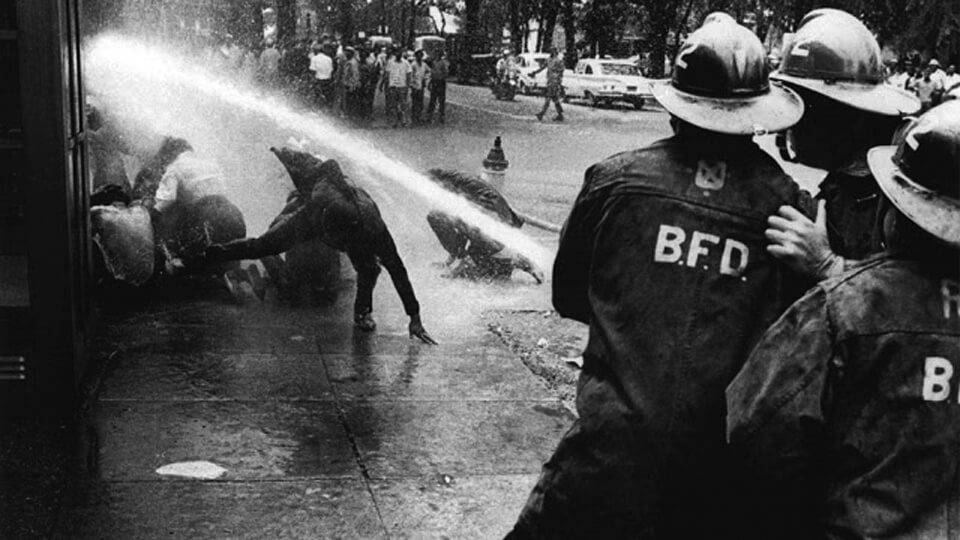 |
| Birmingham, May 1963 |
As the conflict in Birmingham took hold and the media began to report on it, the opportunity presented itself to make the bill even stronger. The masterstroke at Birmingham was using schoolchildren in illegal demonstrations, knowing that Bull Connor would overreact. Which he did, using powerful fire hoses and attack dogs. It was those newspaper and TV images that altered the consciousness of this issue in the north. It also made John Kennedy understand the sick pathology of many of the power brokers in the South, and that he had been wrong in his characterization of Thaddeus Stevens in Profiles in Courage. (Brauer, p. 240)
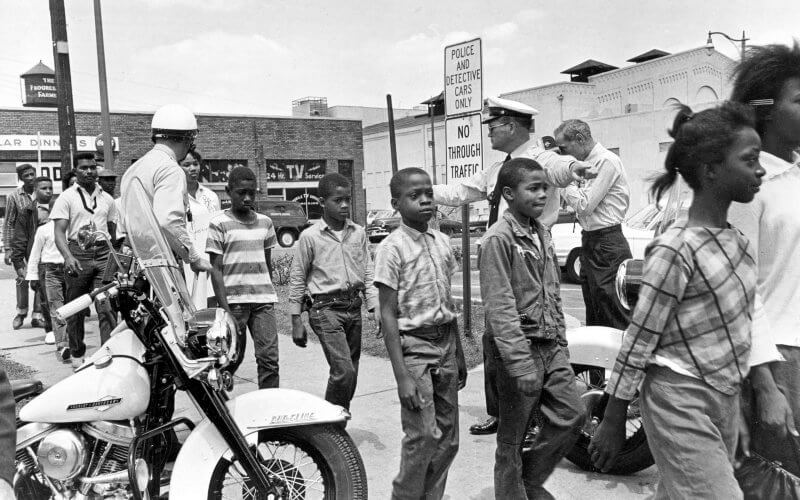 |
| It was James Bevel who organized Birmingham school children |
That maneuver was not proposed or executed by King. In fact, at this point, on his own, King could not get enough demonstrators in the streets. It was James Bevel who went on local radio and gathered scores of school kids in a church on April 24th, a move that King actually opposed at the time. (McWhorter, p. 361) Then, with King out of town, Bevel began to work with and organize the students. He told them to listen to a secret code word he would use on the radio. And on May 2nd, with King still mulling the idea over, Bevel launched his first student wave. Six hundred kids went to jail. But Bevel continued it a second day, with even more students involved. (McWhorter, pp. 368-71) The ugly media exposure was a body blow to the power structure in Birmingham. Vincent Townsend, CEO of the local newspaper, got someone in the sheriff’s office to call Burke Marshall. He flew down and that was the beginning of the city-wide settlement. (McWhorter, pp. 380-81)
Both the president and Bobby Kennedy now realized that this was the time to stamp out Jim Crow in the South. In 2003, in an interview with Dick Gregory on the Joe Madison show, he said that President Kennedy had called him after he had visited Birmingham. After Gregory described just how bad it was, Kennedy replied: “We got those bastards now!” Consequently, the February bill was overhauled by the Justice Department to focus on public accommodations. (Risen, pp. 45-49) Once that was decided, the president now began an unprecedented, massive lobbying effort. He brought to Washington dozens of groups of people: lawyers, mayors, governors, business leaders and, most important of all, the clergy. This effort lasted from May 29 through June 22nd: in other words, right up until when the bill was presented to Congress. (Risen, p. 63) From those meetings, which were attended by 1,558 persons, spin-off groups back home were created. And those groups now traveled to Washington to lobby Congress during the long debate on the bill. Senator Richard Russell later noted it was this impact that won in the end. What JFK had done was something King could not do. He got a wide array of church leaders to back his bill. (Risen, pp. 96-97, 148-49) As Russell put it, “We had been able to hold the line until all the churches joined the civil rights lobby in 1964.” (Risen, p. 5) As Risen notes, King had little or nothing to do with the passage of the bill. (pp. 83-84)
The even bigger myth is that it was LBJ who got the bill passed. This was a deception first advanced by Kay Graham and the Washington Post in order to aggrandize her friend and mentor President Johnson. It was then furthered by Robert Caro in The Passage of Power. Caro pretty much followed what his subject Johnson had written. (The New Republic, “The Shrinking of Lyndon Johnson”, February 9, 2014) The people who really got the bill passed were Hubert Humphrey, Bobby Kennedy and his Justice Department team, and Senator Thomas Kuchel. This is why RFK did not resign as attorney general until the bill was passed.
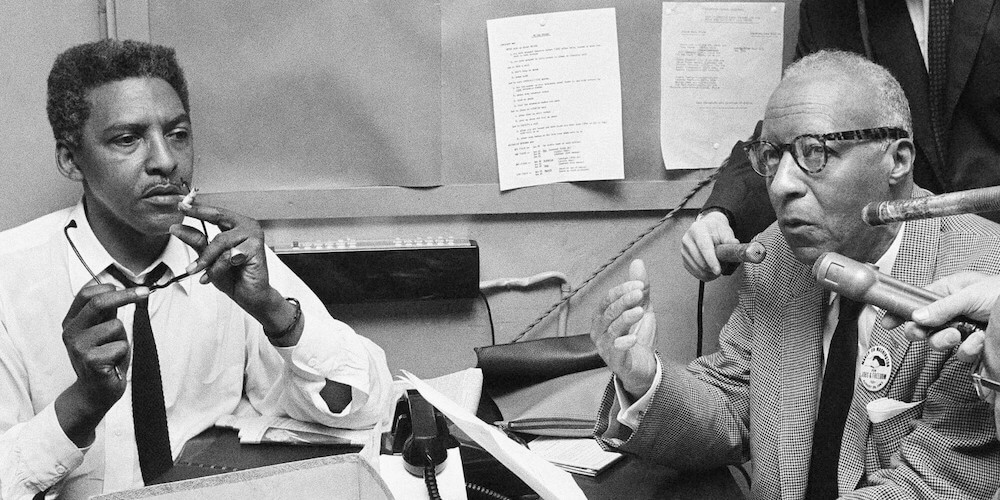 |
| Bayard Rustin & Philip Randolph |
King made a charge at this time that was simply wrong. He said that President Kennedy wanted to call off the proposed March on Washington. (Risen, p. 83) Levingston’s lousy book takes a little lighter approach and tries to insinuate that JFK had nothing to do with the march. (Levingston, p. 423) First, as several books have pointed out, the March on Washington was not King’s idea or a product of the SCLC. It was the proposal of Philip Randolph and Bayard Rustin. (Charles Euchner, Nobody Turn Me Around, pp. 17-18; Patrick Henry Bass, Like a Might Stream, p. 107; Bernstein, pp. 112-13) It was meant as a fulfillment of what Randolph had negotiated away to FDR and Truman. Kennedy was not opposed to the idea. He was opposed to the first draft design. Rustin’s concept was to have a two-day mass demonstration aimed at Capitol Hill. Arthur Schlesinger was at the early meetings where it was presented to President Kennedy. (Schlesinger, A Thousand Days, pp. 969-972) Kennedy’s objection was that this was the wrong approach, it was too confrontational. Both Whitney Young and Roy Wilkins agreed with JFK. (Euchner, p. 77) So after the president got some of his own people on the organizing committee, like Walter Reuther, it was scaled back to a one-day event, and centered in front of the Lincoln Memorial. Rustin insisted he could live with these revisions since the important factors were the size of the live audience and the scope of the televised audience. (Euchner, pp. 77-78) Once that was done, President Kennedy became the first white politician in Washington to endorse the march. He then had his brother Robert assign men from the Justice Department to assist with the logistics and to arrange security. It is doubtful that the event could have come off as well as it did without that help. (Bernstein, pp. 114-16)
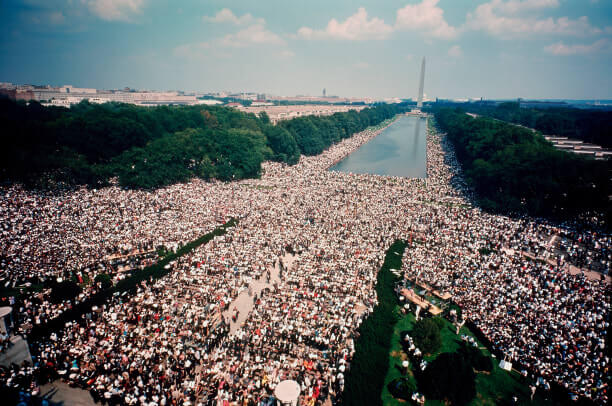 |
| The March on Washington |
One last point on this event. Some have questioned why President Kennedy did not speak that day. The answer is simple: the principal organizer, Bayard Rustin, did not want him there. Not because he did not like Kennedy—he did. But because he thought it would detract from it being their moment, that is, the civil rights leaders’ time in the sun. So he and Wilkins made up an excuse that his life would be endangered, and they would see him afterwards instead. (Euchner, pp. 79-80)
Kennedy realized his presidency was on the line with the civil rights bill. He had now become hated in the South. The joke after his showdown with Wallace was: Why does Alabama have so many Negroes and Massachusetts so many Kennedys? Because Alabama had first choice. (McWhorter, p. 380) By June of 1963, his approval rating there had plummeted from 60 to 33%. He was losing votes on his other programs because of his stand for civil rights. But as Kennedy told Luther Hodges, “There comes a time when a man has to take a stand and history will record that he has to meet these tough situations and ultimately make a decision.” (Brauer, pp. 247, 263-64)
When the bill first went up, Humphrey had 42 votes, well short of the 67 he needed to force a cloture on the filibuster. (Brauer, p. 269) It was the full court press done by the president and then by the Department of Justice that finally turned it around through pressure on conservative Midwest Republicans. (Risen, p. 97) It is hard to exaggerate the impact of this bill. “It reached deep into the social fabric of the nation to refashion structures of racial order and domination that had held for almost a century—and it worked.” (Risen, p. 12)
As the reader can see, no president before Kennedy ever confronted the civil rights issue as he did. No one was even close. It was the preceding century of near inertia that created the immense problem that President Kennedy faced in 1961. But to his credit, Kennedy pressed the issue from the outset. Finally, the pressure from his administration, and the inspiration and support he gave the civil rights movement, provided the opportunity to pass what Clay Risen has called the “bill of the century”. What JFK achieved in three years is remarkable, especially when compared to his predecessors. As historian Carl Brauer wrote, what President Kennedy did was to pick up the narrow trail that Truman attempted and widen it into broad avenues. (Brauer, p. 315) And those avenues are still being traversed today. Yesterday (November 2, 2018), Kristen Clarke, the president of the Committee for Civil Rights Under Law, announced a victory for the Democrats in Georgia. Agreeing with Clarke, the court made a ruling weakening the state’s attempt to limit voting among the poor and minority groups. Clarke’s activist committee was founded in 1963 by President Kennedy for the express purpose of counteracting attempts at discrimination in the Deep South. (On the list of achievements following this essay, the reader can see it at number 20.)
When the news of President Kennedy’s assassination reached Atlanta, King grew very quiet, thinking that a similar fate awaited him. During the funeral his six-year-old son asked him, “Daddy, President Kennedy was your best friend wasn’t he?” Coretta King replied, “In a way, he was.” (Wofford, p. 175)
|
FDR (13 years in office) |
TRUMAN (7 years in office) |
EISENHOWER (8 years in office) |
KENNEDY (3 years in office) |
|
|
1 |
Fair Employment Practices in Defense Plants (FEPC) |
Integrated the Military |
Sent troops to Little Rock in 1957 |
Orally committed to backing the Brown decision |
|
2 |
Appointed African Americans as policy advisors |
Tried to pass a civil rights bill |
Established Civil Rights Commission |
Indicted school officials who defied court orders on Brown |
|
3 |
|
Made speeches on civil rights in 1952 |
|
Created a Free Schools district when Virginia decided to drop public education |
|
4 |
|
|
|
First administration to join civil rights cases as a plaintiff, not a friend of the court |
|
5 |
|
|
|
Petitioned the ICC to integrate interstate busing and terminals |
|
6 |
|
|
|
Systematically began to file cases to break down denial of voting rights in the South |
|
7 |
|
|
|
Financed voter registration drives in the South |
|
8 |
|
|
|
Began the drive to ban poll taxes with the 24th amendment |
|
9 |
|
|
|
Started a massive and rigorous affirmative action program in all branches of federal government |
|
10 |
|
|
|
Announced that no member of his administration would join a segregated establishment or speak at a segregated event |
|
11 |
|
|
|
Revived FDR’s FEPC with the CEEO |
|
12 |
|
|
|
Established rigorous contract and grant requirements to integrate private colleges in the South |
|
13 |
|
|
|
Established a program to make federal contractors follow non-discriminatory hiring practices |
|
14 |
|
|
|
Carried out court orders to integrate the last public universities in the South |
|
15 |
|
|
|
Exploiting an exception to the law, sent in federal marshals and troops to Oxford, Mississippi and to Alabama during the Freedom Rides |
|
16 |
|
|
|
Signed the Housing Act of 1962 |
|
17 |
|
|
|
Negotiated a settlement to the Birmingham demonstration in 1963 |
|
18 |
|
|
|
Endorsed the March on Washington in 1963 |
|
19 |
|
|
|
In a nationally televised address of 6/11/63, made the most forceful presidential address on civil rights since Lincoln |
|
20 |
|
|
|
Established the Lawyers’ Committee for Civil Rights in 1963 to represent victims of civil rights abuses in the South |
|
21 |
|
|
|
Submitted the epochal Civil Rights Act of 1964 and began a massive lobbying program to pass it |
So much for the received wisdom that the Kennedy administration “moved cautiously on civil rights” until they were pushed into it.
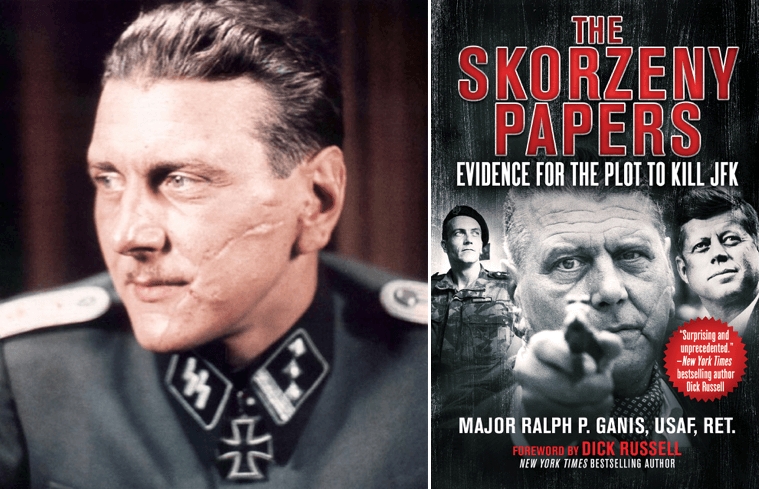
When I heard that a previously undiscovered collection of personal correspondences from SS Colonel Otto Skorzeny had recently surfaced, I was truly interested. Besides his famous exploits in WWII, including the daring mountaintop rescue of Benito Mussolini and the kidnapping of Hungarian regent Miklós Horthy’s son from his Bucharest palace, Skorzeny was infamous for his postwar dealings with a number of intelligence agencies the world over. As a child, my grandfather, Marcel, a French resistance fighter, used to tell me stories of Otto’s exploits during car rides. I thought I was in for a real treat when I found this book. That Skorzeny could have had a hand on the team that killed President Kennedy was also an interesting hook.
The subtitle of this book is “Evidence for the Plot to Kill JFK,” and therein lies its true problem: if by evidence we are referring to clear-cut forensics, incriminating memos, newly declassified documents, newly discovered tapes, or reliable eyewitness testimonies that place Skorzeny either at the scene or in a position directly responsible for the assassination of JFK, then we have little to no “evidence” to justify the book’s subtitle. What the author of the book, Major Ralph Ganis, USAF (retired) seems to suggest is largely tangential to the actionable plot that took Kennedy’s life; that is, Skorzeny, from his position in Madrid as a jack of all trades with ties to postwar Nazis, Texas oil moguls, the Mossad, and French intelligence operatives, could have been a link in a long and winding chain of figures who eventually connected to those who executed the crime of the century. And yet, as we will see, even that supposition is largely based on fantastical leaps of logic, a primary source base that we are never allowed to verify—or see a picture of, or direct reference to—and a conclusion that is not only ridiculous but insulting to the JFK research community.
Dick Russell, who wrote the introduction to The Skorzeny Papers, rightly claims that the book provides a “chronological tracing of the dark alliances that sheds fresh light on how long-suspicious CIA officials like William Harvey and James Angleton wove Otto Skorzeny into their tangled web, or vice versa.” I will give Ganis and Russell that—most of the book is largely this, an extremely dry, almost colorless list of dozens and dozens of figures who were responsible for placing Skorzeny in a secure position from which to run his operations after the war: within only a few pages in chapter seven we have “Enter Major General Lyman L. Lemnitzer and the NATO Link,” “Enter Clifford Forster,” “Enter Don Isaac Levine.” I like to think I have a pretty good memory, but the sheer volume of second- and third-string players in this book is bewildering, with connections seemingly drawn from any and all personnel affiliated with anything remotely clandestine, few of which are ever revisited, and none of which seem truly important given the book’s central thesis, which is that Otto Skorzeny was somehow a key aspect of the Kennedy assassination.
The so-called “Skorzeny Papers,” which Ganis acquired through an American auction house bid in 2012, are alleged correspondences between Skorzeny and some of these underworld and intelligence-based figures, along with letters to his wife, who aided him in his dirty work to some degree. “As the story goes, many of the papers were burned over time, but a fragmentary grouping of documents (the ones used for the research in this book) survived. The archive ranges from 1947 to around the period of Skorzeny’s death.” (xv).
But since we are not allowed to view them or translate them from the German ourselves, we must take the author’s word that they are not mistranslated or even fraudulent.
Ganis begins his book’s preface with a bold proclamation: “Why was President John F. Kennedy killed and who carried it out? All of the investigations, commissions, and academic works have not answered these questions. This book integrated startling new information that does resolve the mystery.” (p. xxi) Let’s unpack that for a moment. Not all commissions are equal. The Warren Commission is not the same as Jim Garrison’s investigation of Clay Shaw, the HSCA, or the later ARRB. The latter three found quite compelling evidence that a domestic intelligence outfit indeed murdered JFK. The former was staffed by Allen Dulles and was essentially a disinformation campaign whose objective was to obfuscate the truth and put the story to bed for the nightly news, which had also been compromised through the Central Intelligence Agency’s media liaisons. As much has been exhaustively detailed in scholarly works, from John Newman’s Oswald and the CIA, to Jim DiEugenio’s Destiny Betrayed, to Jim Douglass’ JFK and the Unspeakable. That we cannot say with certainty who pulled the trigger on the fatal shot so vividly captured in the Zapruder film is ultimately inconsequential; for all intents and purposes, given the time elapsed since that fateful November afternoon fifty-five years ago, we do have a clear picture of the likely suspects behind the plot’s orchestration, along with compelling motives for why JFK was targeted. Bold claims like Ganis’s require even bolder evidence, and to open with a whopper like that, one would presume that Skorzeny’s purported personal papers contain something akin to the map of Dealey Plaza’s sewer system that investigators found in Cuban exile Sergio Arcacha Smith’s apartment, or a handwritten “thank you” note from James Angleton after the Warren Commission had ended for services Skorzeny rendered to the CIA. And yet not only is Otto Skorzeny himself only a tangential part of a book entitled The Skorzeny Papers, but the “evidence for the plot to kill JFK” is awkwardly squeezed into the last two pages of a 346-page work, with a final revelation that made me both angry for investing hours of my life reading the tome, and confused as to how an author with a true breadth of working knowledge about postwar intelligence networks could presume so myopic an assassination motive.
Otto Skorzeny was an Austrian by birth who joined the Nazi party somewhat reluctantly, mainly as a way to make a living as the outbreak of the Second World War ramped up in the late 1930s. A mechanic by trade, and a semi-professional fencer, his notorious scar across his face from a missed parry and his 6’4 stature made him something of an icon in the German army. Skorzeny was known for his fearlessness, guile and unconventional approach to commando warfare. As he once said in a postwar interview, “My knowledge of pain, learned with the sabre, taught me not to be afraid. And just as in dueling when you must concentrate on your enemy’s cheek, so, too, in war. You cannot waste time on feinting and sidestepping. You must decide on your target and go in.” (Charles Whiting, Skorzeny, 1972, p. 17) In many ways, his belief that small units could actually move world history in a similar or even greater fashion than regiments and divisions was affirmed after his thirty-man glider-borne SS unit spirited away Mussolini from the Gran Sasso Hotel with not even a single shot fired. Even Winston Churchill heaped praise on him for his bravery in the face of incredible odds.
Rearranging signposts during The Battle of the Bulge, his commandos, who wore captured American uniforms and spoke fluent English with almost no accent, attempted to sow chaos behind Allied lines, seeking to misdirect troops and armored units away from key areas. While the entire Wacht am Rhein [“Watch Along the Rhine”] operation, which was the German code name for Hitler’s last desperate gamble to capture the Belgian port of Antwerp and cut the British and American forces in two, was ultimately a futile dying gasp of an already-defeated Nazi war machine, it proved so devastating to Allied morale (and killed 75,000 Americans) that some planners did reconsider whether the war would be over any time soon. And when a handful of Skorzeny’s men were captured in their false uniforms during that bitterly cold winter of 1945, panic spread throughout SHAEF (Supreme Headquarters Allied Expeditionary Force), leading to a comical scene in which General Eisenhower frantically argued with his staff who insisted he station twenty guards with sub machine guns around his Paris office at all times in case Skorzeny tried to kill or abduct him. In the middle of the night, the future Director of the CIA, Walter Bedell Smith, Eisenhower’s aide-de-camp, ran out with his staff in pajamas and started firing his carbine into the brush just beyond the headquarters’ window.
He and his men later found the dead cat that had been scurrying about in the dark, but the legend of Otto Skorzeny had taken hold.
Dubbed “the most dangerous man in Europe,” Skorzeny finally surrendered to the Allies in occupied Germany, after seeing the futility of carrying out Hitler’s final order for his “werewolves” to continue the war after the end of hostilities. He was summarily booked and processed, and awaited trial for his role as a top Nazi official and a one-time personal bodyguard of Adolf Hitler. He was later approached by OSS officers as he languished in his holding cell at Darmstadt Prison and it is from this first contact that Ganis believes the true exploits of Skorzeny began. While stories differ as to the mechanics of his escape—Skorzeny claimed in his memoirs that he stole away in the trunk of a car and had a German driver unwittingly smuggle him through the checkpoints; while Arnold Silver, his American point of contact and debriefer said he was released on official terms—he nonetheless was a free man by 1948. After relocating to Paris, where he was unofficially used as a conduit through which CIA officials could monitor communist activity in postwar Europe, Skorzeny was quickly identified due to his conspicuous face and looming profile, and was outed by the French press during one of his many strolls down the Champs-Elysée with his wife Ilse.
Relocating to Madrid, it is here that Ganis believes his real work began, work that—Ganis believes—would ultimately find him involved with dark forces that killed JFK a decade later. Set up in a comfortable office that saw Skorzeny ostensibly managing a construction company that also handled imports and exports of mechanical parts to places in Central Africa and elsewhere, he for all outward purposes seems to have lived a quiet life. Writing memoirs, consulting with foreign governments for a variety of clandestine work, and running a low-key commando training school whose members included some of his former comrades from the SS, French OAS soldiers, American special forces officers, and a rogue’s gallery of other unsavory characters, his postwar life had little in common with his daring exploits during WWII.
The bulk of The Skorzeny Papers deals with the nebulous formation of both the CIA and its shell companies from the remains of the OSS, with familiar figures like Frank Wisner, Arnold Silver, Bill Harvey, and William Donovan featured prominently in Ganis’ narrative. The central portion of the book meanders from French anti-communist hit teams and their American handlers, to the also newly-formed Mossad and its eventual use of Skorzeny for the removal of Egyptian nuclear scientists, to a whole host of West German ex-Nazi intelligence personnel and their largely dull exploits passing mostly fabricated evidence of an impending Soviet invasion to Washington in exchange for their freedom and a career on the American payroll. Somewhere in this tangled web, Ganis situates Skorzeny who, because of his extensive contacts and personal daring during the Second World War, seems—in Ganis’ estimation—uniquely positioned to wrangle these disparate forces into something of a rogue network that is totally off the books. Ganis reiterates this throughout the book, seeking to distinguish ostensible layers of the spy world from what he considers its truly dark realm, which he identifies as a series of assassination teams bankrolled through corporate shell organizations like SOFINDUS, which eventually morphed into the World Commerce Corporation (WCC). In The Skorzeny Papers the WCC is akin to SPECTRE from the old James Bond novels; a looming, impenetrable evil menace whose tentacles reach into almost every aspect of Cold War politics and planning, Ganis spends a considerable amount of the book detailing its creation, key operators, possible ties to international Nazi groups and ultimately its potential role as the dark budget from which Skorzeny was able to fund his various international commando operations after the war. In reality, while I’m sure this is all very interesting to someone truly looking for an exhaustive account of postwar dirty money, it has very little to do with Skorzeny, and almost nothing to do with the domestic assassination of John F. Kennedy in Dealey Plaza.
The book then delves into the French OAS, focusing on the enigmatic Captain Jean René Souètre, who of course was allegedly deported from Fort Worth, TX, the afternoon of the JFK assassination. And while I am not denying that Souètre could have indeed been on the ground in Texas in some capacity, Ganis goes to great lengths—even putting him on the book’s cover next to Skorzeny and Kennedy—to implicate him in the plot: “The actual sniper, or team of snipers, was directed by Jean René Souètre, the former OAS officer wanted by French security services for an attempt on the life of President Charles de Gaulle in 1962.” While Souètre was a known paramilitary outlaw who hated the idea of Algerian independence from France—which Kennedy firmly championed from the Senate floor in the mid 1950s—he seems from the available evidence to have been a rogue player who drifted through these turbulent times, training commandos, taking exotic posts with his OAS buddies, and advising the CIA on a handful of ultimately uninteresting developments in the Third World. To suggest, as Ganis does, that he was the lynchpin of the ground operations in and around Dealey Plaza, while ignoring the more probable Cuban exile culprits, seems strained.
The Souètre chapter ends with a few lines that reveal a frustrating and repeated aspect of this book, where the author assumes that one’s proximity to a situation necessarily guarantees association and willing complicity. For example, Ganis argues:
The movements of Skorzeny during this period point to his being in attendance at the Lisbon meeting between Souètre and the CIA. In fact, Skorzeny made several trips to Portugal between March and July 1963 concerning his businesses. With the OAS cause now unsustainable, it appears Souètre left the meeting with a new option for employment, signing on with Skorzeny. Captain Jean René Souètre was now a soldier of fortune working for Otto Skorzeny in one of the most guarded secret organizations in the history of American intelligence.” (p. 248, italics added)
It’s not at all clear that these conclusions can be verified, and as Skorzeny’s whereabouts are only deduced from “the Skorzeny Papers,” which are never directly quoted—here or anywhere in the book to my knowledge—one must once again have faith that Ganis is being honest and accurate.
III
The book then spends a considerable amount of time on the Third World and its myriad decolonization movements, with a quite lengthy digression into Ganis’ analysis of the Congo Crisis, exploring the potential for Skorzeny to have been the mysterious QJ/WIN assassin the CIA hired to kill Patrice Lumumba. Ganis takes a fairly condescending approach to his analysis of Lumumba’s rise to power, claiming “As well-founded as Lumumba’s words may have been, they were politically ill-advised. This tense atmosphere was further compounded by the lack of a plan for the organized transition to power.” (p.279). As I have detailed in my article, “Desperate Measures in the Congo,” the United States destroyed any hope for a free Congo before Lumumba had risen to anything nearing real power. In fact, both Belgium and the CIA had planned on separating Katanga, the Congo’s richest area, from the country before it became independent. Belgium had stolen the country’s gold reserves, brought them to Brussels and refused to return them. President Eisenhower refused to meet with Lumumba after the Belgians had landed thousands of paratroopers inside the country. By the time Lumumba’s plane had landed back in Africa, Allen Dulles and friends all but marked Lumumba for death. For Ganis to say he had no plan for an “organized transition to power” smacks of paternalism: given his eloquence, popular appeal and vision of a new dawn for his recently unshackled nation, Lumumba may well have succeeded if he had not been undermined in advance.
The assassination mission was later aborted when the CIA and Belgian intelligence aided Katangese rebels with Lumumba’s capture after he fled his UN protection in a safe house. While I can see where Ganis is going, and how it could be possible, given that Skorzeny seems to have been in the Congo around this time, to my knowledge it’s been pretty strongly established that QJ/WIN, the CIA digraph of one of two selected assassins for the Congo plot, was actually Jose Marie Andre Mankel. To have sent a person as instantly recognizable as Otto Skorzeny into an unfolding international crisis involving the Soviet Union, Belgian and Congolese troops, U.N. officials from multiple nations, and American station personnel seems, to put it mildly, unwise. Indeed, WI/ROGUE, another CIA-sponsored hit man and agent sent on the assignment, had had plastic surgery and was said to be wearing a toupee during his visit. No matter Skorzeny’s connections to Katanga Province’s mining operations, which were real, he was more likely a visiting business opportunist rather than an actionable agent during the Congo Crisis, if he was present there those critical weeks surrounding Lumumba’s capture and execution at all.
Ganis then details Skorzeny’s one brief interview with a Canadian television program in September 1960, in which he boasts about being in high demand by both the enemies of Fidel Castro and Fidel himself, explaining a plot which he takes credit for being the first to discover. This was Operation Tropical, in which the CIA was allegedly training Skorzeny and his commandos for a kidnapping of the Cuban premier in early 1960. Ganis bases his description on an unnamed newspaper clipping found in the papers he secured in his winning auction bid. Curiously, I happened upon Operation Tropical in a perusal of the CIA’s online reading room months before I’d read this book, and searched in vain for the newspaper they cite as having outlined the plot, which they claim is the Sunday supplement edition of the Peruvian newspaper, La Cronica, dated August 7, 1966. I would be interested to read it if anyone can secure a copy. It would go a long way in verifying the validity of Ganis’ main body of evidence, and would be an interesting find for researchers more broadly. In any case, with the aborted Castro plot and a mainstream boilerplate description of the “failed Bay of Pigs invasion,” which of course Ganis attributes to Kennedy’s refusal to release nearby carrier-based air support (something Kennedy staunchly forbade before the operation was underway, a point which Ganis’ omits), we now enter the final stretch of the book, which looks directly at Skorzeny’s role in the JFK assassination.
Spoiler alert—there is none.
“General American Oil Company,” “Colonel Gordon Simpson,” “Algur Meadows,” “Sir Stafford Sands,” “Colonel Robert Storey,” “Jacques Villeres,” “Permindex,” “Judge Duvall,” “Paul Raigorodsky,” “Thomas Eli Davis III,” “ Robert Ruark,” “Jake Hamon,” and about twenty other sub-headings flash across the first dozen or so pages of the final chapter of The Skorzeny Papers. The organization of the book centers on these disjointed, one-to-two-page sub-chapters which give the reader the disorienting and queasy feeling of reading it through glasses with the wrong prescription. Not only did Ganis miss the opportunity to style the life and times of Nazi Germany’s most infamous commando personality along the lines of a thrilling narrative, with exotic locales and shady deals over drinks and cigars, but he arranged the book in so awkward a fashion that he constantly has to end sentences with “and we will get back to him shortly,” or “and I will show you how this ties in later.” Even if one were to storyboard his entire panoply of tertiary personalities, it would look more like a Jackson Pollock art installation than a coherent plot with a compelling impetus culminating in the JFK assassination as we understand it. A story should be clear enough to draw the reader in with its simple facts, and should sensibly unfold on its own accord so as to prevent the need to constantly handhold during the descent into the labyrinth.
Conspicuously absent in The Skorzeny Papers are any substantial sub-headings detailing Cuban exiles, Allen Dulles, the Joint Chiefs of Staff, or any of the genuine suspects of the JFK assassination, save for meanderings on James Angleton’s and Bill Harvey’s roles in the creation of Staff D, the CIA’s executive action arm. Ruth and Michael Paine are nowhere to be found. Neither is a description of the aborted Chicago plot, or any substantive explanation of how Lee Harvey Oswald was moved into the Texas School Book Depository, or a note about David Phillips’ role in the whole affair from his Mexico City station. While these very real aspects of the actual JFK plot are infrequently touched upon in passing—Ganis cannot ignore the entire body of evidence, despite his best efforts—he insists on crow-barring his newfound “primary source data” into a story that at this point doesn’t permit much unique interpretation. It’s safe to say, in 2018, that President Kennedy was assassinated by a domestic, military-industrial-intelligence apparatus that viewed his foreign policy as anathema to both the “winning” of the Cold War and to their image of the United States’ role in world affairs. That Kennedy was a staunch decolonization advocate, a friend and champion of Third World leaders like Sukarno in Indonesia, Nasser in Egypt, Lumumba in the Congo, and sought diplomatic solutions to prevent the impending nuclear Armageddon with Nikita Khrushchev’s Soviet Union is all but ignored in Ganis’ conclusions as to why JFK was shot in Dallas. None of it is suggested. What ultimately led to the tragedy in Dealey Plaza, according to Ganis, is something much bigger.
It all comes down to JFK’s sexual indiscretions, folks. That’s right. Jack Kennedy just couldn’t resist the advances of the hundreds of femme fatales who threw themselves at him, and according to Ganis, the high command had to take him out when he cavorted with the ultimate Cold War honeypot.
I wish I were kidding. But unfortunately I’m not.
The author submits to the reader that the act to assassinate President Kennedy was carried out for reasons that far exceeded concerns over U.S. National security. In particular, they arose out of a pending international crisis of such a grave nature that the very survival of the United States and its NATO partners was at risk. At the source of this threat was breaking scandals that unknown to the public involved President Kennedy. To those around the President (sic) there was also the impact these scandals had on the president’s important duties such as control of the nuclear weapons and response to nuclear attack. It also appears the facts were about to be known. The two scandals at the heart of this high concern were the Profumo Affair and the Bobby Baker Scandal. (p.294)
I will spare anyone reading this a rebuttal of the relevance of this assertion, but suffice it to say, Ganis places the final straw at Kennedy’s—demonstrably disproven—affair with Eastern Bloc seductress Ellen Rometsch. Ganis claims, “Historians are taking a hard look at this information, but preliminary findings indicate Rometsch was perhaps a Soviet agent.” (p.295) He continues, “Her potential as a Soviet agent is explosive since Baker had arranged for multiple secret sexual liaisons between her and President Kennedy.” (p. 295)
He then scrapes together a weird narrative of how Attorney General Robert Kennedy was pleading with J. Edgar Hoover and the FBI to withhold these revelations in a “desperate effort to save his brother and the office of the presidency.” (p.296), He argues that “As President Kennedy was arriving in Dallas, Texas, on November 22, 1963, a very dark cloud of doom was poised over Washington, and the impending storm of information was hanging by a thread.” (p. 296). That’s when Skorzeny—from Madrid—was activated to save the Western world. It seems pointless to add that retired ace archive researcher Peter Vea saw the FBI documents on this case. The agents had concluded there was no such liaison between the president and Rometsch. In other words, to save himself, Baker was trying to spread his racket to the White House. Bobby Kennedy called his bluff.
Ganis pretentiously concludes, “In the end, the assassination network that killed JFK was the unfortunate legacy of General Donovan’s original Secret Paramilitary Group that included as a key adviser from its early inception—Otto Skorzeny. Furthermore, the evidence would seem to indicate Skorzeny organized, planned and carried out the Dallas assassination, however, we may never know what his exact role was.” (p. 342)
Indeed we may never, because there does not seem to be any. Ganis continues, “On November 22, 1963, an assassination network was in place in Dallas; it was constructed of associates of Otto Skorzeny and initiated by his minders in the U.S. Government and clandestine groups within NATO.” Wrapping up, the author reiterates, “The events that led to this killing were triggered by a limited group of highly placed men in the American government. They were convinced that the West was in imminent danger and posed to suffer irreparable damage, and, for some of them, imminent exposure to personal disgrace beckoned. All of this sprang from reckless debauchery in the White House and beyond. With the situation breached by Soviet intelligence and ripe for exploitation, it became untenable for this group. They took action.”
I’ll give you a few minutes now to wipe the tears from your eyes. Okay, good. Are you still with me? Overall, The Skorzeny Papers could, I suppose, serve as something like a compendium or glossary for those who just have to know the minutest details of the inner workings of this or that shell corporation that may or may not have had a hand in some world affair during the Cold War. But there are much better books on that. Ultimately, Ganis’ book is an uncomfortable, freewheeling careen down strange dead-end tracks, with unannounced detours through cold dark streets full of faceless characters, and later, journeys through mirror-filled fun houses of speculation, with a final twist and turn that spits you out right over Niagara Falls, barrel and all.
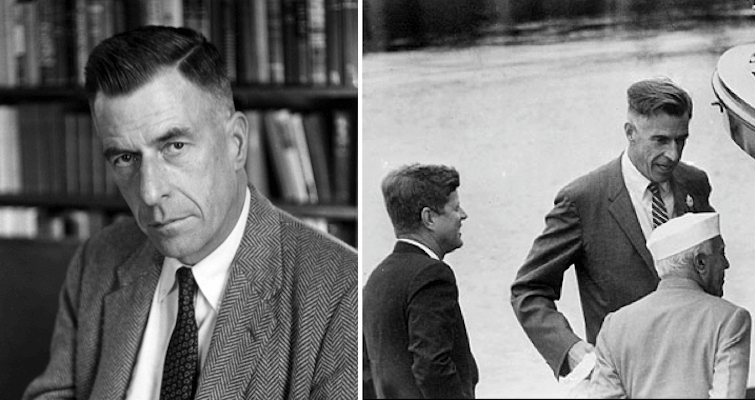
As many who are interested in the JFK case know, John Kenneth Galbraith was truly A Man for All Seasons. There are few men in public life who pulled off the triple crown like he did: serving with distinction as a public figure, an academician, and as a man of letters. Specifically, Galbraith was an advisor to Presidents Franklin Roosevelt, Harry Truman, John Kennedy and Lyndon Johnson; he served as an instructor at Harvard for over 25 years; was a writer and editor at Fortune and, all told, wrote over forty books. Two of them are considered classics: The Great Crash and The Affluent Society. To have performed just one of those endeavors would make an individual a significant figure in American life. To have done all of them is a remarkable achievement. To have done them with the wit and style that Galbraith possessed makes what he did just about unique in modern American history.
Galbraith was born in Ontario, Canada in 1908. He was granted an undergraduate degree at a branch of the University of Toronto in 1931. He then went to the University of California, Berkeley to attain his Masters and Ph. D. in agricultural economics. After graduation he taught at both Harvard and Princeton from 1934-40. He worked in the Office of Price Administration for Roosevelt, and then as one of the directors of the Strategic Bombing Survey under Truman. In the last position, he disagreed with his boss, the eternal hawk Paul Nitze, on the effectiveness of the bombing over Germany in reducing war production. After this he went to work at Henry Luce’s Fortune and then in 1949 he was appointed a full professor in economics at Harvard.
Galbraith had a role in writing the summary reports for both the bombing survey of Germany and Japan. He concluded that war production had expanded during the bombing of Germany. Some strategic targets were impacted; others were not. But bombing had not decided the war in Europe. The air war cost America more than it did the Germans; it was just that the USA could afford it at the time. The real value of the bombing was in support of ground troops. They had won the war. (Richard Parker, John Kenneth Galbraith, p. 183)
Galbraith’s input into the summary survey of the bombing of Japan was probably even more important at dispelling myths. He described the terrible fire bombings of Japanese cities that sometimes consumed as many as 16 square miles, causing massive numbers of civilian deaths, but barely touching industrial production. He then wrote that in all probability, Japan likely would have surrendered in December of 1945, or maybe even in November, without the two atomic bombs being dropped. (Summary Report, Pacific War, July of 1946, p. 26)
These insights by a skilled economist like Galbraith seem to be quite valuable, especially in light of the later emphasis placed on bombing in both the Korean War and especially the war in Indochina. The tons of bombs dropped over Indochina exceeded the tonnage dropped over both Germany and Japan during World War II. In fact, it was not even close. Yet none of the countries in Indochina—Laos, Cambodia and Vietnam—had a real industrial base as did Japan and Germany. Most of the population made its living from agriculture. So Galbraith had a real perspective on this issue during his advisory years with President Kennedy.
It was during his first stretch of employment at Harvard that he met young John Kennedy. From 1936-39, Galbraith tutored JFK at Winthrop House. (Parker, p. 324)
It is difficult to overestimate how much Galbraith liked writing and being on the faculty at Harvard. For instance, in 1946, he turned down an offer from Nelson and David Rockefeller to become chief economist for the Rockefeller family. (Parker, p. 222) I should not have to inform our readers the kind of money and status that position would have offered him.
In 1956, Senator Kennedy sought his advice on an agricultural issue. After that, Kennedy developed a rather close relationship with Galbraith as an unpaid advisor. The relationship deepened after the launch of Sputnik in 1957. The two would often meet in Cambridge when Kennedy was in Boston. Kennedy came to rely on Galbraith briefing him before his major appearances. (Parker, p. 325)
In 1960, Galbraith was one of candidate Kennedy’s floor managers at the Los Angeles Democratic convention. He then wrote several speeches for the nominee during the campaign and prepped him for the third debate with Richard Nixon. He was at Kennedy’s campaign headquarters the night of the election. (Parker, p. 336)
As most people who have studied Kennedy’s political career know, he had a genuine interest in the huge country of India. He felt that being the largest democracy in the world, and sitting in south Asia, it was of large strategic importance. In the late fifties, he wrote an article for The Progressive on the subject. With Senator John Sherman Cooper, he drew up an aid bill for the country. (Cooper had been President Dwight Eisenhower’s ambassador to India.)
But another reason Kennedy viewed India to be of central importance is because of its proximity to Red China, and also to the former countries of French Indochina. If there were tensions in that area—as there were bound to be—then India could be both a counterweight, and also a nearby emissary. If such were the case, Kennedy would need a man whom he trusted implicitly to be the ambassador there. Which is why he chose Galbraith for the position.
But with the kind of relationship the two men had, Galbraith was still advising Kennedy on a wide variety of subjects. On economics, Galbraith was a disciple of the great Englishman John Maynard Keynes. So he urged Kennedy to adapt an expansive economic policy in order to encourage growth. As almost any observer of the Kennedy presidency knows, the years 1961-66 were probably unmatched in post-war American economic history. Gross National Product averaged 5% growth each year, employment grew 2.5% each year, unemployment receded to 3.9%, poverty declined by a third and inflation was at a quite manageable 2 per cent. All of this was done with no significant budget deficits and a positive balance of payments.
To show how in sync Galbraith was with Kennedy, during his confirmation hearings, the economist suggested that the USA recognize Red China. This created quite a stir on the committee. (Parker, p. 351) But as our readers know through the recently posted interviews with State Department official Roger Hilsman, this is what Kennedy had discussed with Hilsman as early as 1961.
Galbraith tried to warn Kennedy about committing to the Bay of Pigs operation. He also warned about using American ground troops in Laos. (Parker, pp. 354-56) Kennedy agreed with this and told Richard Nixon, “I just don’t think we ought to get involved in Laos, particularly where we might find ourselves fighting millions of Chinese troops in the jungle.” (Galbraith, Ambassador’s Journal, pp. 45-48)
And, of course, there was Vietnam. Kennedy had been advised by the likes of Edmund Gullion, Nehru of India, and General Douglas MacArthur on the subject. They all advised him not to send in combat troops. Galbraith agreed with them. Inside the Kennedy White House, he sided with Chester Bowles and George Ball for non-intervention. In prior treatments of precisely what Galbraith’s role was in these debates, the picture painted of it was, to say the least, a bit murky.
For instance, in David Halberstam’s long book The Best and the Brightest, Galbraith is portrayed as being some kind of outsider, on the periphery of Kennedy’s circle. (Halberstam, p. 152) To state it kindly, Halberstam’s book has not aged well. To be unkind, today it seems quite misleading; so much so that this author would call it pernicious. In addition to getting the role of Robert McNamara wrong, the highly praised Halberstam also mischaracterized Galbraith’s part.
John Newman came closer to what the true facts and characterizations were in his milestone book JFK and Vietnam, first published in 1992. There, Newman wrote that Galbraith had written Kennedy in March of 1962 after visiting Vietnam. He was quite derisive about America being involved there at all. He suggested a neutralist political solution, similar to what the administration was negotiating for in Laos. (Newman, p. 236) This is more accurate but is still unsatisfactory since it is incomplete.
Galbraith’s role in all this began even before the famous two week long November, 1961 debate over committing combat troops to Saigon. In July of 1961, Galbraith wrote the president, warning him about the information he was getting about Indochina. He said that President Ngo Dinh Diem was not the right man to lead South Vietnam. He had alienated the public to a much further degree than the newspaper reporters have let on. (Galbraith, Letters to Kennedy, pp. 76-77) But it turns out that Galbraith was directly involved in the November debates.
The ambassador was in Washington to accompany Prime Minister Jawaharlal Nehru on a state visit. Galbraith had already heard about the mission President Kennedy had sent General Max Taylor and Deputy National Security Advisor Walt Rostow on in October. The ambassador feared America’s entry into a war in Vietnam would be a disaster. It could endanger Kennedy’s domestic programs, tear the Democratic Party apart, and perhaps provide the opening for a new conservative era in American politics. (The Nation, February 24, 2005, “Galbraith and Vietnam”)
Galbraith had arranged the luncheon to be at the Newport Rhode Island home of Jackie Kennedy’s mother, so no other State Department representative would be there. Kennedy and Galbraith asked the Indian leader to participate in a neutralist solution for Vietnam. They even asked him to talk to Ho Chi Minh about forming a UN observer team as a first step in that direction. Nehru was non-committal except for saying that America should not get into a shooting war in Indochina. (Galbraith, A Life in our Times, pp. 470-77)
The next day in Washington, Galbraith made a beeline for Rostow’s office. He questioned Rostow about the actual contents of the report. Rostow said it was highly classified. Then the phone rang. With Rostow distracted, Galbraith stole a copy of the report from his desk and left. (The Nation, 2/24/2005)
Reading it back at his hotel, the ambassador was stunned. He realized that this report and its recommendations would create the first commitment of combat troops to Saigon and that would then be the pretext for an open-ended conflict. The first group of 8,000 men were to go in under the guise of “flood relief workers”. The report recommended deepened cooperation between the CIA and Saigon’s intelligence, more covert operations and massive training of Vietnamese soldiers. Plus the use of a sprayed herbicide which Secretary of State Dean Rusk told Kennedy was really a weed killer. (At first this was called Agent Purple, it later turned into Agent Orange.)
Kennedy had seen Galbraith the day before the Newport meeting. Realizing there was going to be a long debate over the Taylor-Rostow report, he had asked him to prepare a paper to contest direct American involvement. This now became the basis for his memo to the president. JFK read both documents and then postponed the meeting on Vietnam. Meanwhile, Galbraith did something that the president had already done. (Jim Douglass, JFK and the Unspeakable, p. 107) The ambassador started leaking stories to the press that Kennedy was opposed to the escalation his advisors were pressing on him. Before Galbraith left to return to India, he told Kennedy it would be a good idea if he stopped off in Saigon. JFK agreed and then instructed the ambassador to report back to him alone. (The Nation, 2/24/2005; Parker, p. 370-72)
At the crucial meeting, which occurred on November 11, Galbraith’s biographer Richard Parker notes something that Newman did not mention, namely that Bobby Kennedy was in the room. Later, authors like David Kaiser and Gordon Goldstein did write about this information, based upon recovered notes. In what appears to be a mapped out plan, the Attorney General would repeatedly deny any suggestion of ground troops by saying flatly, “We are not sending combat troops. Not committing ourselves to combat troops.” (David Kaiser, American Tragedy, p. 113) Then the president would add that if there was ever going to be a troop detachment sent in it would be a multilateral mission, under the aegis of the UN or SEATO. (Parker, p. 371)
As most of us know, this two week long debate ended with Kennedy issuing NSAM 111. That order significantly increased the number of American advisors to over 15,000 and it sent in more equipment, like helicopters. But this is as far as Kennedy was going to go. He was going to aid Saigon, but he was not going to fight their war for them. He never allowed combat troops into theater. In fact, there was not one more combat troop in Vietnam on the day Kennedy was killed than on the day he was inaugurated. The president even wanted to replace Frederick Nolting as ambassador to Saigon with George McGhee, who he knew was opposed to intervention. But Dean Rusk, who had been one of the leaders for troop insertion during the debate, nixed this idea by saying Nolting should stay since he had Diem’s confidence. (Parker, p. 376)
It seems to this author that with the information about Bobby Kennedy’s role in the November, 1961 debates, the attempt by Kennedy to replace Nolting, and the now fully revealed role of Galbraith, this episode is even more clearly a demarcation line than before. Kennedy simply was opposed to transforming Vietnam into America’s war, and he knew that was what it would become if ground troops were placed in theater. As the president had told Arthur Schlesinger:
They want a force of American troops. They say it’s necessary in order to restore confidence and maintain morale … The troops will march in; the bands will play, the crowds will cheer, and in four days everyone will have forgotten. Then we will be told we have to send in more troops. It’s like taking a drink. The effect wears off and you have to have another … The war in Vietnam could be won only so long as it was their war. If it were ever converted into a white man’s war, we would lose as the French had lost a decade earlier. (Gordon Goldstein, Lessons in Disaster, p. 63)
Upon Galbraith’s return to Asia, he did file a report from Saigon. In fact, he eventually filed three of them. These all ended up being back channel cables, meaning they bypassed the usual State Department protocols. They were laced with Galbraith’s blend of impatience and sarcasm: “Who is the man in your administration who decides what countries are strategic? I would like to … ask him what is so important about this real estate in the Space Age.” (The Nation, 2/24/2005) And again, Halberstam was wrong about what happened as a result of these, just as he was wrong about how Kennedy regarded his advice in November of 1961. For Galbraith was not on the periphery, he was at the center of the story—in two ways.
First, Kennedy attempted to follow up on the ambassador’s proposal to open negotiations for a neutralist Vietnam settlement through India. Unfortunately, he tasked the wrong person with the mission. Averill Harriman was Kennedy’s point man on the attempts to defuse the Laotian situation with a coalition government. Apparently he did not feel the same way about Vietnam. In December of 1961, Harriman had been appointed to Assistant Secretary of State for East Asian and Pacific Affairs. Kennedy asked Harriman to send instructions to Galbraith about pursuing a peace plan by having Indian and Russian diplomats approach Hanoi. Harriman suggested a delay, which the president agreed to. But Kennedy concluded “that instructions should nevertheless be sent to Galbraith, and that he would like to see such instructions.” Harriman said he would send them. (Douglass, p. 119) Harriman did send instructions, but “he struck the language on de-escalation from the message with a heavy pencil line.” The diplomat dictated a memo to his colleague Edward Rice which changed the de-escalation approach to a threat of escalation of the war unless Hanoi accepted American terms. When Rice tried to rewrite the memo with the original instructions, Harriman again struck Kennedy’s language. He then simply killed the telegram altogether. (Gareth Porter, Perils of Dominance, pp. 158-59)
Galbraith’s other attempt at de-escalation was more successful. In early April of 1962, the ambassador was visiting the Kennedy family for a weekend at Glen Ora, their rented estate in the Virginia countryside. Jackie Kennedy had just made an official visit to India and they were watching a TV special about it. He then told the First Lady about his talk with the president about the situation in Saigon, his later visit to Defense Secretary Robert McNamara, and the memo he left behind. (Parker, p. 389)
It turned out that Kennedy had been giving the Galbraith memos about Vietnam a lot of attention. He wanted the ambassador to put his thoughts in writing and give a copy to McNamara. In that memo, Galbraith stated American policy should keep the door open for a political solution. We should also measurably reduce our commitment to the present leadership of South Vietnam. He then added that the advisors who were already there should not be involved in combat and kept out of any combat commitment. Their roles should become as invisible as the situation allowed. (Newman, p. 236)
As described in JFK and Vietnam, this memo was mightily resisted by the Pentagon, because, just five months after sending in advisors and equipment, Kennedy now had an alternative. Newman also notes that Kennedy had said at that time “he wished us to be prepared to seize upon any favorable moment to reduce our commitment, recognizing that the moment might yet be some time away.” (Newman, p. 236) In other words, Galbraith had just given Kennedy support for what he really wanted to do in Indochina. As both Douglass and Newman have written, Galbraith’s visit to Washington and the handing off of his memo to McNamara were the beginning of Kennedy’s withdrawal plan from Vietnam. (Newman, p. 237; Douglass, p. 119)
The very next month, in May of 1962, Robert McNamara now delivered a surprising message to his subordinates in Vietnam. Arriving in Saigon for one of his so-called SecDef meetings, McNamara asked some of the higher-ups to stick around after the formal meeting ended. The defense secretary now echoed what the president had told Arthur Schlesinger: “It was not the job of the U.S. to assume responsibility for the war but to develop the South Vietnamese capability to do so.” (Douglass, p. 120) He then asked when they thought Saigon would be able to assume sole responsibility for all actions. The secretary got no satisfactory reply, since everyone was shocked by the question. So he proceeded to tell the commander in charge of the American advisory command, General Paul Harkins, “to devise a plan for turning full responsibility over to South Vietnam and reducing the size of our military command, and to submit this plan at the next conference.” As Jim Douglass notes, Kennedy and McNamara only wanted a plan for withdrawal at this time. For as he had told Galbraith in November of 1961, “You have to realize that I can only afford so many defeats in one year.” (Galbraith, A Life in Our Times, p. 469) The president was referring to the Bay of Pigs and Laos, the latter of which he knew the Pentagon would consider a defeat.
It took quite a long time for the commanders of all departments in Vietnam to prepare their withdrawal schedules for McNamara. More than a year to be exact. But finally, in May of 1963, at a SecDef meeting in Hawaii, they were presented to McNamara. McNamara said they were not fast enough and requested they be accelerated “to speed up replacements of U.S. units by GVN units as fast as possible.” (Douglass, p. 126) This plan was then coordinated with Kennedy’s NSAM 263 order and its accompanying report, which dictated that a thousand men would be withdrawn from Vietnam by the end of 1963, and all American advisors would be removed by 1965. So much for Galbraith being at Halberstam’s “periphery”. In a very real sense, the ambassador had provided the rationale for Kennedy’s withdrawal plan.
Galbraith always said that he would only serve under Kennedy for a bit more than two years since he had to get back to Harvard in order not to lose tenure. How badly did Kennedy want him to stay? He offered him the ambassadorship to the USSR. (Parker, p. 406) If Kennedy had lived, and Galbraith had taken that position, one can only imagine how relations between the two superpowers would have turned out. But the fact that JFK offered him the position shows what the president had in mind for the future. He saw how visionary Galbraith was on Vietnam, and he wanted to try more of that with Russia.
Galbraith continued to be an advisor to the White House after Kennedy’s assassination. But he and President Johnson simply did not agree on Indochina policy, and Galbraith really did not like how the escalation of the Vietnam War began to downsize the War on Poverty. In January of 1966, he wrote a memo to Johnson saying that America had no national interest at stake in Vietnam. A few months later he tried again. He offered to write a speech that would set the stage for American withdrawal. Johnson did not appreciate the advice. And that was about it for their relationship. (Parker, p. 431)
But about four months before that happened, and probably provoking the exchange, Galbraith had shared a dinner with Richard Goodwin, Carl Kaysen, Arthur Schlesinger, and Defense Secretary McNamara. By this time, January of 1966, each of these men, except for McNamara, had left the White House. Galbraith described the meeting as jarring. McNamara was extremely emotional as he described what was happening in Indochina and at the White House. The Defense Secretary said the war was spinning out of control. Rolling Thunder, the bombing campaign Johnson had banked on, was not effective. Johnson was getting depressed over the results. But he still seemed insistent on victory, even if it meant more escalation. If America did not find a way out soon, we would lose the war. (Kai Bird, The Color of Truth, p. 345; Galbraith, A Life in our Times, pp. 482-83) This is why he wrote to LBJ. Instead, Johnson escalated the war further. He then pushed McNamara out of office. But it was very likely that dinner which caused McNamara to begin the task of writing the Pentagon Papers.
Galbraith now wrote a book entitled How to Get out of Vietnam. It sold 250,000 copies. Along with Schlesinger and Goodwin, he organized a protest group called Negotiations Now. He had concluded that if LBJ would not end the war, someone who would must run against him in 1968. Things go so bitter between the two men that Johnson told White House advisor John Roche to start attacking Galbraith in the press. (Parker, p. 432)
Galbraith finally did find someone to run against Johnson. It was Senator Eugene McCarthy. When Bobby Kennedy later announced he was also in the race, Galbraith was in a sticky position. But he felt he should be loyal to his first choice, so he stuck with McCarthy, even though after Johnson made his shocking announcement not to run, it was apparent RFK was the stronger candidate with a better chance to defeat Richard Nixon in the fall.
After Robert Kennedy was assassinated, McCarthy, for all intents and purposes, dropped out of the race. After Kennedy’s funeral, Galbraith visited him in Washington. He later wrote the following about that meeting:
Gene was deeply depressed; the death of Robert Kennedy showed the hopelessness of the game. What had been real would now be pretense; what had been pleasure was now pain … I pleaded that he carry on. The banality of my argument still rings flatly in my ears. Gene remained sad and unmoved, but proposed another talk in Cambridge a few days later. This we had with Coretta King and a number of McCarthy’s local supporters present. His mood was better … but I don’t believe that Eugene McCarthy’s heart was ever again wholly in the battle. (Galbraith, A Life in our Times, p. 499)
The Kennedy administration was responsible for being the first to bring some remarkable men into the White House, or promoting them to their highest positions. These individuals were not just outstanding civil servants; they were extraordinary men in their own right. People like Robert Kennedy, George Ball, Richard Goodwin, Harris Wofford, Ted Sorenson, Sargent Shriver, Arthur Schlesinger, Edmund Gullion, Adam Yarmolinsky and G. Mennen Williams were all distinguished individuals and personalities who have yet to be surpassed in talent and achievement by those who followed. As a group no other administration comes close.
John Kenneth Galbraith is one of the most distinguished of them all.

As I said in my introduction to Part 1, from the work of Larry Sabato in 2013, I suspected the MSM would attempt a preemptive strike against President Kennedy’s civil rights achievements at the 50th anniversary of the MLK/RFK assassinations, for the obvious reason that both of those men were strongly involved in that struggle. Steven Levingston, of the Wall Street Journal and Washington Post, led it off. I would like to give Levingston some career advice. He missed his calling. He should have been a playwright. His 2017 book Kennedy and King is such a carefully crafted confection it would have done Tennessee Williams or Edward Albee proud. As history, it is worthless; but that is not what Levingston is interested in. At the outset, he sets up an external dramatic agon between Martin Luther King and John F. Kennedy, declaring that “King had to overcome White House mistrust, disregard, and stonewalling before his message sank in.” (Levingston, p. xi)
 |
| Steve Levingston: Missed his calling |
This is utterly false. As opposed to Eisenhower, the Kennedys began working on the racial issue quite quickly—without King. And they did not stop until they did something that neither Eisenhower nor Truman came close to doing—they got an omnibus civil rights bill into Congress and worked hard to see it through. (As we shall see, the idea that Lyndon Johnson got the milestone Civil Rights Bill of 1964 passed is a myth.)
In Part 1, I described the terrible conditions that existed in the South due to the failure of Reconstruction. This created a huge obstacle in trying to correct the immense problem, since the power structure of the South was built upon it. How does Levingston assess this horrendous record that confronted the Kennedy administration? About all the horrible things done in the South from Reconstruction onward, Levingston is rather dismissive. He writes, “So far from being modernized, in many ways the Southern Mind has actually always marched away from the present toward the past.” (p. 16) Well, that is one way of dealing with the torture murder of Sam Hose, the massacre at Rosewood, and the destruction of a whole section of Tulsa. But as far as establishing a historical backdrop, it means zilch. On top of that, there is next to nothing about the paltry record of FDR, Truman and Eisenhower.
Another part of the plan is to make Kennedy out to be rather timid on a number of issues, not just race. Like every other cheapjack writer on the scene, Levingston does what he can to make the worst of the Joe McCarthy episode for Senator Kennedy. He tries to say that somehow Kennedy’s failure to show up and vote during the censure roll call against Joe McCarthy in December of 1954 exhibits this character flaw. But he also acknowledges that Kennedy was in the hospital at the time, seriously ill, lapsing in and out of consciousness. (Levingston, pp. 22-23) As Harris Wofford relates in his book, Of Kennedys and Kings, Senator Kennedy had been through a near-death experience—he was given last rites—due to a back operation at this time. (Wofford, p. 35) Should he have been wheeled onto the Senate floor, with his doctor next to him? The vote was overwhelming for censure anyway; the final tally was 67-22. This makes the idea that somehow Kennedy should have called in and “paired” his vote with someone who was against censure silly. Why? In order to add one more vote to the landslide? But further, in his weakened state, his assistant Ted Sorenson had written a speech for him to give in favor of the censure vote. So there is no doubt where he stood on the issue.
A key point Levingston completely leaves out is that it was the senator’s brother, Robert Kennedy, who had started the movement to censure McCarthy in the first place. Bobby Kennedy had been on McCarthy’s committee. He resigned since he did not like the direction in which Roy Cohn, McCarthy’s chief counsel, was taking that body. The Democratic minority later asked him back to be their chief counsel. In the summer of 1954, after both McCarthy and Cohn imploded during the Army-McCarthy hearings, Bobby Kennedy essentially took over that committee. He retired the cases against Irving Peress and Annie Lee Moss, dismissed the accusations of mass infiltration of defense plants, and then authored a report that was so critical of McCarthy and Cohn that some Democrats would not sign on to it. It recommended the Senate take action for their abuses. It was this report that led to the censure vote against McCarthy in December of 1954. (Arthur Schlesinger, Robert Kennedy and His Times, pp. 118-19)
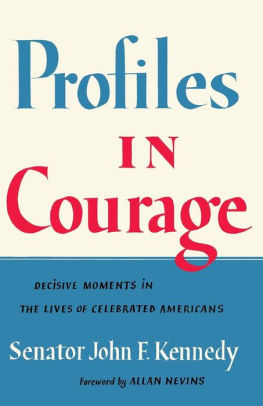
But that’s not enough for Levingston. He now does something worse. He says that Senator Kennedy wrote his book Profiles in Courage to somehow apologize for not showing up on a gurney to mark the 68th vote to censure McCarthy. (Levingston, p. 25) Even for a reporter who worked for the Wall Street Journal, this is really out there. Profiles in Courage is about men in politics who did things that had no political advantage for them; they did them anyway since they thought they were right. Now, since 1951, John Kennedy had been out there by himself—in both the House of Representatives and the Senate—harping away against the Truman/Eisenhower approaches to communism in the Third World. In other words, he was, in part, criticizing his own party. It may have been crowd-pleasing and popular to suggest that the communist threat was the monolithic monster that the domino theory suggested, but Kennedy said that was not true. The force of nationalism, the desire to be free from European colonialism, was really responsible for much tumult in the Third World. (See my Destiny Betrayed, pp. 17-25) Senator Kennedy made speeches on this subject, gave radio interviews, and wrote letters to his electorate about it. But he had no Capitol Hill or White House followers in this crusade at the time. Would it not therefore be logical to assume that this is what motivated him to write the book? I mean, was he not doing something that garnered him little if any political favor simply because he felt it was the right thing to do?
But Levingston can’t go there. He can’t even mention it. First, it would illustrate the political and moral courage that Levingston wants to strip away from Kennedy. Second, it would also show that, from early in his political career, Kennedy had some understanding of the conditions of colonialism and imperialism that were imposed on people of color in places like Africa.
In keeping with his preplanned construct, Levingston does not begin to address Kennedy’s actual involvement with the whole race issue until 1959 and his preparations to campaign for the Democratic presidential nomination. This eliminates a rather important fact: namely, that, unlike Eisenhower or Nixon, neither of whom endorsed the epochal Brown decision, Senator Kennedy did so in 1956:
The Democratic Party must not weasel on the issue … President Truman was returned to the White House in 1948 despite a firm stand on civil rights that led to a third party in the South … We might alienate Southern support but the Supreme Court decision is the law of the land. (NY Times, 2/8/56, p. 1)
That speech was made in New York, a liberal city and state. But in 1957, Kennedy went south to Jackson, Mississippi. He said the same thing: the Brown decision must be upheld. (Harry Golden, Mr. Kennedy and the Negroes, p. 95) The fact he did this in the Deep South would seem to denote the courage Levingston said Kennedy lacked. For, as author Harry Golden notes, it was at this point that Kennedy began to lose support in the South and even get angry letters about his advocacy of the Brown decision. But by not mentioning these incidents, Levingston can say that Kennedy exhibited little courage or morality on the issue. What makes it worse is that when one turns to his bibliography, Levingston lists Harry Golden’s book, which noted the incident way back in 1964. This is what I mean about being a playwright.
In passing, the author mentions Senator Kennedy’s vote on the bill constructing the 1957 civil rights commission. Levingston writes that Kennedy sided with the segregationists on a complicated procedural matter that watered down that bill. (p. 58) Even for Levingston, this is sorry. What watered down the bill was the removal of something that Kennedy voted for. This was called Title III. It allowed the attorney general to sue cities in civil court over voting rights and school integration. Kennedy backed that part of the bill. So how does being for that aspect jibe with siding with the segregationists? That part of the bill was voted down. (Golden, p. 94) And as anyone who has read anything about that vote understands, the man who engineered its defeat was Majority Leader Lyndon Johnson.
The bill originally sent up by Eisenhower’s attorney general was completely commandeered by Johnson, to the point that, when it was completed, it was really Johnson’s bill. He planned it that way because he observed the fate of his mentor, Senator Richard Russell of Georgia. Due to his segregationist stance, Russell could not advance his presidential ambitions on the national scene. Noting this, Johnson was intent on broadening his profile beyond the South; he did not want to be pigeonholed as a regional candidate. (Rowland Evans and Robert Novak, Lyndon B. Johnson: The Exercise of Power, pp 122-25) So he took over this bill, made it his own, and made sure it would pass the Senate. How did this occur?
 |
| Strom Thurmond and Richard Russell |
Johnson made a deal with Russell and Senator Strom Thurmond: if he defanged the bill, they would not filibuster it. One way he did so was eliminating Title III. The other way was by adding a jury trial amendment. This meant that if there was an obstruction of voting rights, the accused would be tried by a jury. Which at that time in the South meant the defendant would very likely be acquitted. Johnson had specifically targeted Kennedy as a northern vote and he sent two people to convince him to vote for it. When Kennedy resisted, LBJ himself went to his office to lobby him. The issue was presented as follows: the amendment must be added or the bill would fail. Kennedy then consulted with some Ivy League lawyers and they told him that having some kind of a Civil Rights Commission—which was largely what was left of the bill—was at least a step in the right direction. (Evans and Novak, pp. 136-37)
In contradistinction to what Levingston claims, what happened was not Kennedy siding with segregationists; it was a first term senator siding with the majority leader in order to get half a loaf instead of none. It should be added: even with Johnson’s severe alterations, Senator Strom Thurmond broke his agreement with him. He enacted a one-man record-setting filibuster. This was meant as a warning to LBJ: this was a one-time exception; don’t try it again.
 |
| Abraham Ribicoff, JFK’s first choice for attorney general |
One of the silliest contentions in Levingston’s volume is that as president JFK appointed his brother Robert as attorney general because of his habit of turning to his older brother Joe in childhood tussles. In other words, he depended on his brothers to fight his battles for him. (p. 7, p. 168) Again, this fruitiness can only survive by not consulting the record. Bobby Kennedy was not JFK’s first choice for attorney general. Kennedy’s first choice was Senator Abraham Ribicoff. (Schlesinger, p. 237) So what would have become of Levingston’s argument if Ribicoff had accepted the position? And to show what a careful playwright the author is, Ribicoff is not mentioned in his book.
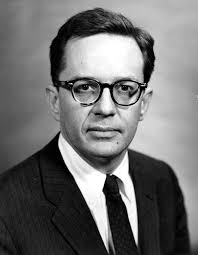 |
| Burke Marshall |
But even more damaging to Levingston’s attempt at pop-psychology is the following. President Kennedy’s first civil rights advisor, Harris Wofford, had written a long memo to him before the inauguration. That memo stated that since the upcoming civil rights battles would largely take place in court, the Department of Justice should be the focal point of the conflict. He therefore pointed out that the key spots in the administration on civil rights would be the attorney general, and his civil rights deputy. This prediction by Wofford ended up being correct. From this standpoint, Kennedy may be said to have been following Wofford’s memo, which turned out to be farsighted, especially when RFK made the fine choice of Burke Marshall as his deputy on civil rights. (Irving Bernstein, Promises Kept, pp. 40-41)
The main body of Levingston’s confection relies on a thesis he borrows from one of the most bizarre, eccentric books on the Kennedy administration ever published. This is BBC reporter Nick Bryant’s 2006 volume entitled The Bystander. Both Levingston and Bryant argue that Kennedy should have moved for a civil rights bill faster then he did. Which would mean in 1961 or 1962. (Levingston, pp. 120-21)
The problem with this idea is that there is simply no empirical evidence to sustain it. From the 1870’s to the late 1950’s, no civil rights bill had ever gotten through the southern bloc in Congress. (Evans and Novak, p. 121) And just from 1917 forward, there had been nine different attempts to do so. They all failed. (Bernstein, p. 39) As noted in Part 1, the Truman administration had tried in 1949. They were routed. As also noted, the only reason the 1957 bill got through was because Johnson had pretty much denuded it and told the southern Senate leadership—made up of Russell, Thurmond, and Sam Ervin of North Carolina—that he would do so in advance. But in 1960, when the administration tried to add to that bill to strengthen voting rights, Johnson could not defeat the filibuster. He did not even come close. (Evans and Novak, p. 221) If Johnson, the man who was the maestro, the Toscanini of the Senate, could not come close to breaking the filibuster in 1960, how could Kennedy in 1961?
On top of that, Kennedy was assured this was indeed the unfortunate state of affairs by his advisors. In his long memo planning a civil rights strategy submitted in late December of 1960, Harris Wofford did not even mention passing a bill as a possibility. (Bernstein, p. 48) Joe Clark of Pennsylvania, one of the most liberal senators in the body and a strong advocate for the issue, also told Kennedy it was not possible. (Bernstein, p. 50) The president’s chief vote-counter in Congress, Larry O’Brien, also said the votes were not there, even in 1962. (Andrew Cohen, Two Days in June, p. 82) The new Senate majority leader, Mike Mansfield, did not think a civil rights bill would pass, and this was in 1963. At that time, Vice President Johnson felt the same way; further, he thought the very attempt would kill off other parts of President Kennedy’s program. (Carl Brauer, John F. Kennedy and the Second Reconstruction, p. 245) Yet we are supposed to think that a British BBC reporter today, like Bryant, knows better than the experts on the scene did at the time.
But the ultimate proof that both Bryant and Levingston are wrong on this point emerges from the list of events that had to occur for the bill finally to pass in the summer of 1964.
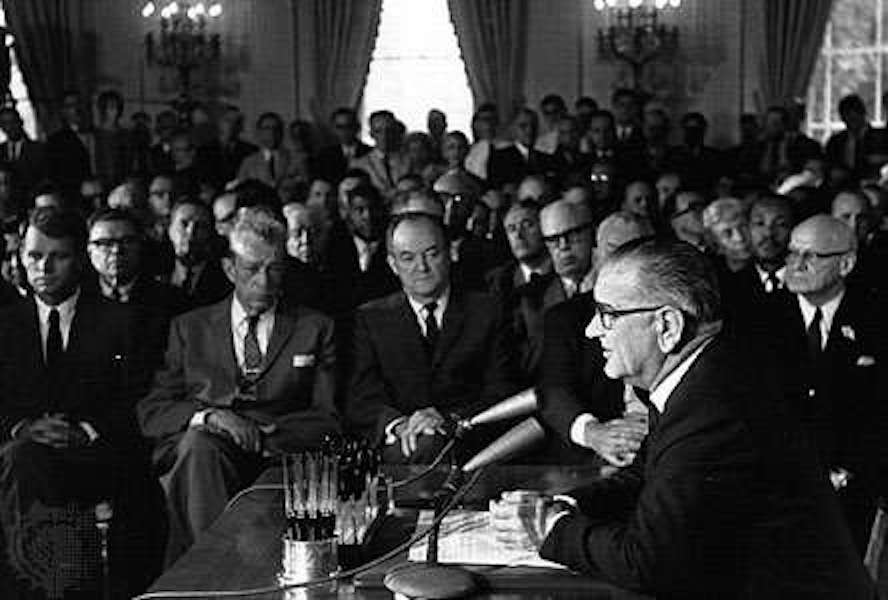 |
| Signing the 1964 Civil Rights Act |
Even with all of those momentous events, it took one year to pass Kennedy’s civil rights bill. It was the lengthiest debate in congressional history, featuring the longest filibuster in Senate history. This is how determined the South was to block it, since they knew it would mark the beginning of the end of the system this author outlined in Part 1. How do Levingston and Bryant surmount this overwhelming evidence that they are wrong? They don’t deal with it. Talk about profiles in courage. Levingston mentions the passage of the bill in one sentence (Levingston, p. 432), while Bryant does not even refer to it. In fact, in his usual manic, over-the-top manner, Bryant says that Kennedy was not really concerned with the bill’s passage at the time of his death. (Bryant, p. 452) This is completely contradicted by the record produced in Clay Risen’s book, The Bill of the Century, describing the passage of that act. (See pages 97-134) Need I add that playwright Levingston listed the Risen book in his bibliography?
To characterize the value of the efforts of Levingston and Bryant: If the main thesis of your book—that Kennedy could have gotten a civil rights bill through earlier—is so weak and unfounded that you cannot even present the evidence that counters and neutralizes it, then, 1) How honest are you being with the reader? And 2) What is your book worth? I would add a third question: Why would you write such a book? Because to anyone familiar with the issue, the person who dawdled on civil rights was not Kennedy, it was Eisenhower.
 |
| David Margolick |
David Margolick’s The Promise and the Dream and Michael Eric Dyson’s What Truth Sounds Like, deal much more with Bobby Kennedy than with President Kennedy’s role in civil rights. One of the strangest parts of Margolick’s book is where he actually seems to endorse Levingston’s flatulent volume as being accurate about JFK’s role in that cause. He calls President Kennedy’s position passive for the first two years. (Margolick, p. 112) As we shall see, this is not supported by the record.
But in keeping with these questionable characterizations, Margolick, as with Levingston on JFK, wishes to shrink Bobby Kennedy in relation to King. So Bobby is represented as a committed Cold Warrior (similarly to the appraisal of his brother which has mistakenly prevailed), and that somehow, “like him and so many others, [RFK] had seen Vietnam as a place to take a stand against communism.” (Margolick, p. 235) His main source for this is a nearly fifty-year old book by David Halberstam. It is notable that he ignores the more recent research by Richard Parker which reveals that Bobby Kennedy was in the room during the November 1961 debates about committing combat troops to Vietnam. In newly discovered notes, Bobby kept insisting, “We are not sending combat troops.” This was clearly meant to back up his brother, who then said that if troops were ever sent it would only be as part of a multilateral force under the aegis of the United Nations. (The Nation, 2/24/2005, “Galbraith and Vietnam”)
Bobby Kennedy’s role in 1961 is bookended by the fact that, in 1963, he served as the liaison between his brother and the writing team of General Victor Krulak and Colonel Fletcher Prouty, who actually composed the McNamara/Taylor trip report in Washington. When it was finished, it was then bound and sent to Hawaii so Secretary of Defense Robert McNamara and General Maxwell Taylor could read it on their return trip from Saigon, on the plane flight to Washington. RFK knew that this dictated report would serve as the backing for NSAM 263, Kennedy’s order for a military withdrawal from Vietnam. (John Newman, JFK and Vietnam, p. 401) Why Margolick would use the 1969 work of a man like Halberstam, whose writing on Vietnam is pretty much obsolete, and ignore Parker, is kind of odd.
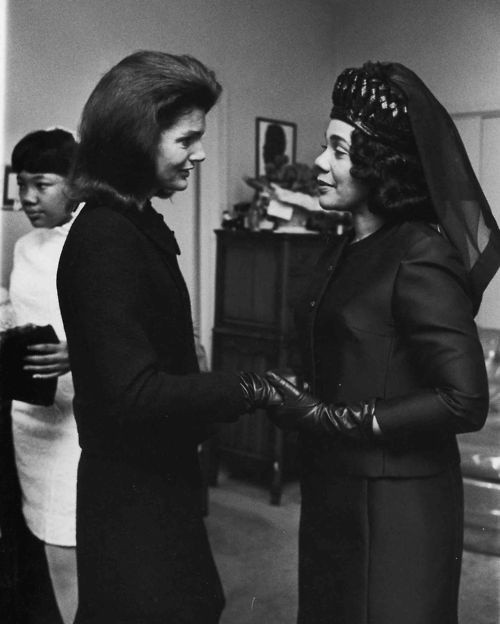
But there is some creditable work in Margolick’s book. He produces clear evidence that when Bobby Kennedy was killed in Los Angeles in June of 1968, both Jackie Kennedy and Coretta King journeyed to California to be on the plane that carried his body back to New York with Ethel Kennedy. It is as if they knew that with the murder of RFK, what their two husbands had done so much to build was now going to be dissipated. What makes this even more tragic is that Jackie Kennedy did not want RFK to run for president in 1968, because she felt he would also be killed. (Margolick, p. 312) On the plane back, Jackie said to RFK’s aide Frank Mankiewicz, “Well, now we know death, don’t we, you and I. As a matter of fact, if it weren’t for the children, we’d welcome it.” (Margolick, p. 380)

The fact that Coretta King was there may partly be due to what her husband had said a few months before, namely that Bobby Kennedy would make a great president. (Margolick, p. 295) It may also owe to what RFK did in her time of need. After her husband had been killed two months previous in Memphis, Bobby called her and asked if she needed anything. She asked if he could arrange to have King’s body transported back to Atlanta. He said he would do so but he wanted no publicity about it. He then paid for more phone lines to be tied into her home, arranged for a jet to fly her to Memphis, and booked dozens of hotel rooms for celebrities and dignitaries flying in to attend the funeral. (Margolick, p. 347) When that was done, as he previously promised, he went and met with the youths who had organized his aborted rally in Indianapolis that evening. They called themselves the Radical Action Program. (Margolick, p. 348)
I should add one more detail about RFK and the death of King. When Bobby first heard that King had been shot, he was in Muncie, Indiana. He heard about it as he was boarding a plane to fly to Indianapolis. He was not sure King was dead. But on the plane he already looked bereaved and ashen. He rejected the drafts for speeches offered by Mankiewicz and Adam Walinsky. Those were his own words he delivered. As many have said, it was probably the most memorable speech he ever gave. (Margolick, pp. 337-39) That night, as he spoke, he was wearing his brother’s overcoat.
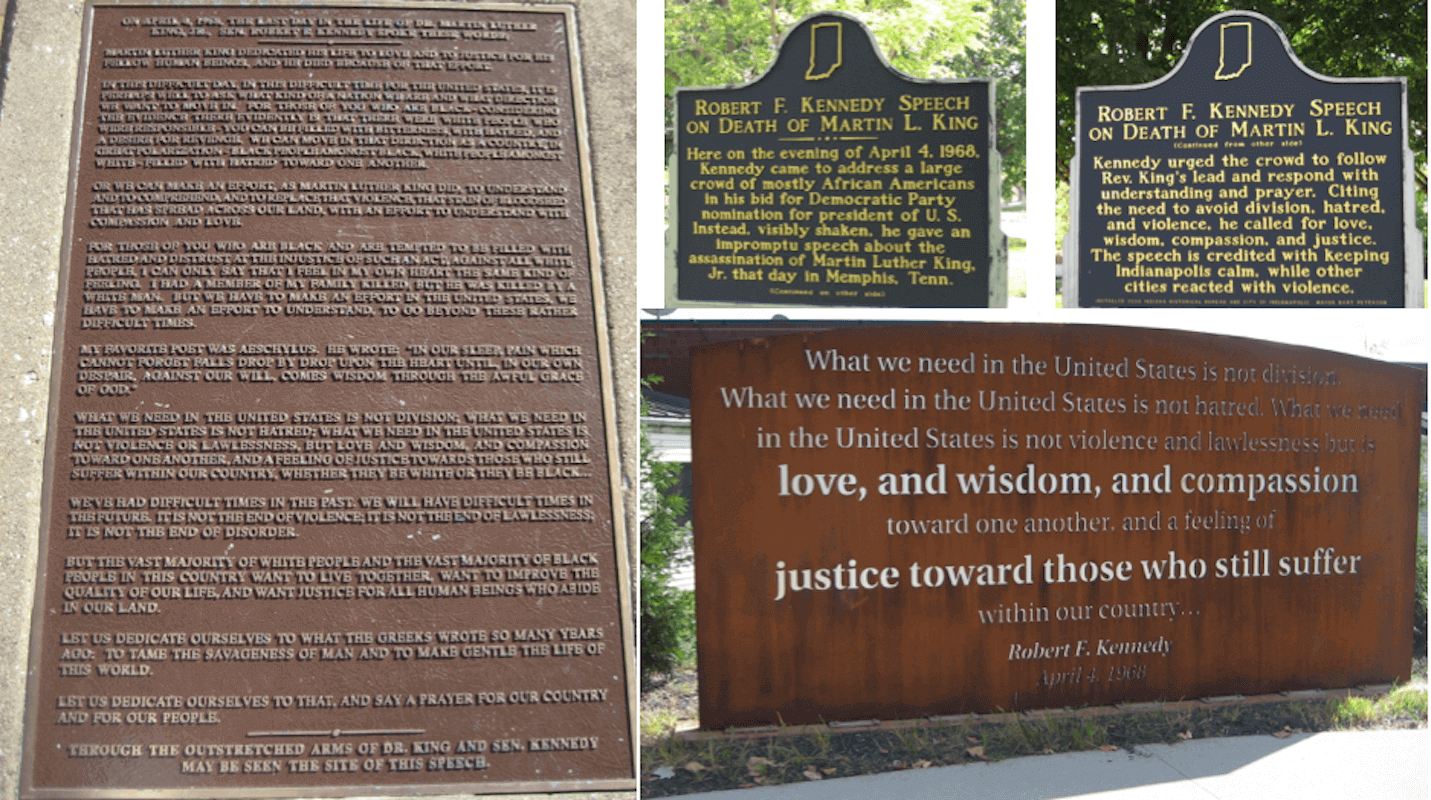 |
|
Kennedy & King Park, Indianapolis IN |
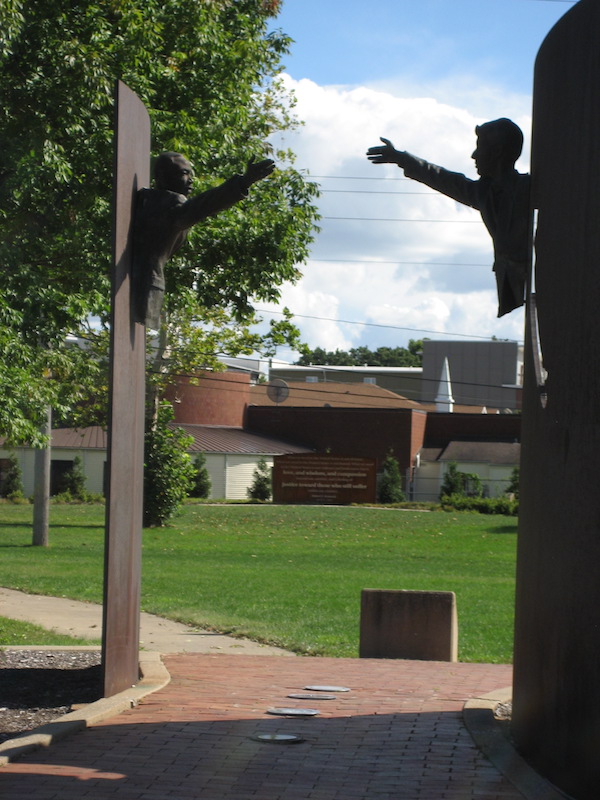 |
|
Landmark for Peace Memorial |
Commenting on what RFK did that evening, the great decathlon athlete Rafer Johnson said, “Bob Kennedy knew better than anyone else, better than Martin Luther King, that if something wasn’t done … to somehow solve the racial strife, then we’re in deep trouble.” He continued by saying that no African American could have brought black militants and moderates together as Robert Kennedy could have, and no American could have spoken to both races as he did. He then concluded:
Senator Kennedy proved that color doesn’t make any difference. He was—in terms of the Negro—as much a Negro as Adam Clayton Powell … As Ralph Bunche or Senator Brooke. He was as much a Negro as Jesse Owens or Joe Louis because he did right by people. (Margolick, p. 349)
I should add that Margolick’s book is profusely illustrated with some powerful and rarely seen pictures. If one can discount the several specious passages, such as those quoted above, then the book is readable. If for some reason I had to recommend one of these four volumes, Margolick’s would be the one. But only with severe reservations—most importantly, concerning his statements that James Earl Ray killed King and Sirhan Sirhan shot Kennedy. But he worked for the NY Times for a number of years, so he has to say these things.
 |
| Michael Eric Dyson |
Michael Eric Dyson’s book might be the worst of the bunch, which is saying something. First of all, it is not even a book. Dyson slapped a series of disconnected essays together, put them into a small format book with large spacing between lines, and the publisher somehow had the temerity to call this a book.
Dyson begins his confection with a description of Martin Luther King’s funeral in Atlanta. Right there, on pages 2 and 3, I sensed something was upside down. Why? Because he mentions some of the luminaries who were there, like Thurgood Marshall and Richard Nixon. But he does not mention Bobby Kennedy being in attendance. And he does not note RFK’s role in arranging the ceremony, as Margolick outlined above. Dyson then adds that President Johnson was not there since he did not “want to drape the service in the controversy of the Vietnam War …”
These are hints of what Dyson is up to. Two of the goals driving his manufactured history are to do everything possible to smear RFK, and to be as soft as possible on Lyndon Johnson. For Dyson to write that Johnson was not in Atlanta because of some personal abnegation is simply not being honest about the relationship between King, Johnson and RFK, not only by 1968, but even before that. By this time, Johnson was involved in a bitter feud with both RFK and MLK. It was not just over what he had done with the Vietnam War. As we shall see, it was also over what Johnson had done with JFK’s plan to attack the problems of African Americans through a “war on poverty”, something which Bobby Kennedy had been at work on since 1961. In fact, according to Harris Wofford, the reason LBJ did not attend is because he thought he would be overshadowed by Robert Kennedy. Which is precisely what happened. According to Wofford, at the funeral, everyone understood that with King dead, RFK was their last best hope, since LBJ had blown it. (Wofford, pp. 221, 227)
Peter Kunhardt’s film, King in the Wilderness, opens with King calling Johnson from the scene of the Watts riots in 1965. It is a tense, desperate call, with King telling the president that he has to do something about the economic aspects of the race problem in order to give youths in the ghetto some hope. As we shall see, by 1968, LBJ had all but abandoned the concept begun by JFK in 1963.
But further, it is instructive to compare what King said about that riot with what Bobby Kennedy said. King saw it as a stirring of those in society who had been bypassed by the prosperity of the decade; he wished to minimize the racial aspect, since it was more the rumblings of the “have nots” inside of the affluent society. (LA Times, 8/12/15, “Viewing the Watts riots through different eyes”) Rhetorically, Bobby Kennedy went beyond King. When Eisenhower and Johnson used the word “lawbreakers” in regard to the riots, RFK replied with this: “There is no point in telling Negroes to obey the law. To many Negroes the law is the enemy. In Harlem, in Bedford Stuyvesant, it has almost always been used against them.” (Schlesinger, p. 815) Kennedy also said that too many civil rights leaders had ignored the problems in the north, so the larger population of the deprived in the north had no real leadership. He also stated that the tactics used in the south—marches and sit-ins—would not work in the northern cities. (LA Times, 8/12/15)
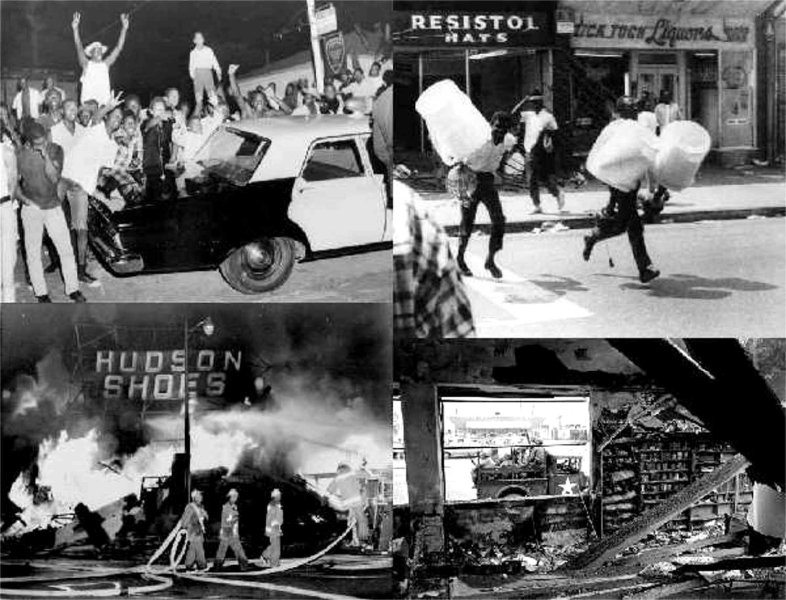 |
| Images of the Watts Riots |
The last observation by RFK is directly relevant to Dyson’s principal subject. So it makes perfect sense that he would ignore it. For besides RFK and Lyndon Johnson, the third main character Dyson deals with is author James Baldwin. And as we shall also see, because Dyson is intent on smearing RFK, he correspondingly inflates and elevates Baldwin.
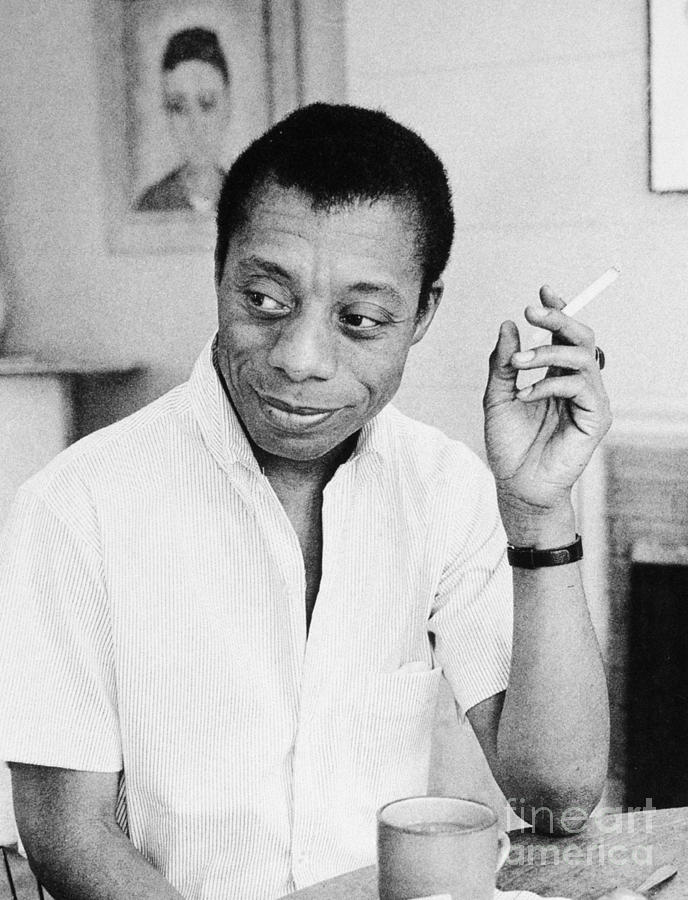 |
| James Baldwin |
Dyson’s series of essays is superficially based on a meeting that was held in May of 1963 between Attorney General Bobby Kennedy and a group of African American intellectuals, writers and artists. It is a meeting that became famous when Baldwin revealed it afterwards to a reporter from the New York Times. (Dyson, p. 11) And it has been used by hack writers like Levingston and Larry Tye to disparage RFK. After reading further on the meeting and on Baldwin, I have come to a different point of view on this matter than the MSM, and certainly Mr. Dyson.
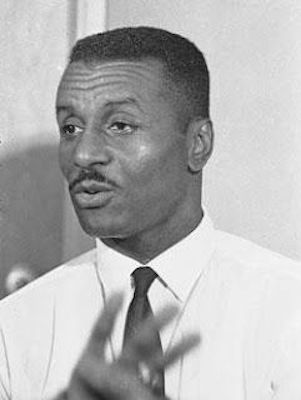 |
| Fred Shuttlesworth |
In setting the stage, Dyson shows what a poor historian he is. He says the Birmingham demonstrations were led by King. (Dyson, p. 12) Not so. Local leader Fred Shuttlesworth began the Birmingham demonstrations months before King’s group, the SCLC, ever got there. They were carried out by a group of students from nearby Miles College who were inspired by Shuttlesworth. (Diane McWhorter, Carry Me Home, pp. 265-72) It was Shuttlesworth who, in the summer of 1962, first suggested that the SCLC go to Birmingham to extend the protests. He suggested this because he thought (correctly) that Sheriff Bull Connor would play into their hands. Then, in June of 1963, Shuttlesworth pushed it on the SCLC again, but King was still noncommittal. Finally, the Birmingham leader made an impassioned plea: “We’ve been hammering away for 7 years with no impact. If segregation is going to fall, we’ve got to at least crack the wall in Birmingham!” That is what finally made the SCLC move. (McWhorter, p. 307)
Dyson follows this up with another faux pas. He writes that it was Birmingham that forced JFK to submit a civil rights bill to Congress. On February 28, 1963, well in advance of the SCLC beginning its Birmingham action, President Kennedy made a speech on civil rights. He concluded by saying that action must be taken for the simple reason that it is the right thing to do. He also said that he had gone about as far as he could with executive orders. It was time for Congress to step in and fulfill its obligations. (Clay Risen, The Bill of the Century, p. 36) He then outlined a bill he was going to send to Congress. It was the draft of this bill, praised by leaders like Whitney Young and Roy Wilkins, which formed the basis of the Civil Rights Act that was passed in 1964. Again, Risen’s book was published four years before Dyson’s. If Dyson were serious about his subject, he would have consulted that book.
But he didn’t. Dyson is only interested in polemical smears. From here, he writes one of the most preposterous passages I can recall in the literature. He says that:
… the brothers claimed interest in race but let the moment pass, and they spoke out of both sides of their political mouths, to black leaders and conservatives alike, doing little to move the racial needle. (Dyson, p. 15)
What a pile of bird dung. By the fall of 1962, with the calling in of 20,000 federal troops to quell the insurrection, partly organized by General Edwin Walker, at Ole Miss over the admittance of James Meredith, the Kennedys were now seen as the hated enemies of the South. During that battle, the rallying cry of the Klansmen was “2-4-1-3 we hate Kennedy”. Another one was “Go to Cuba, nigger lovers”. (Brauer, p. 192) The right-wingers in Alabama, knowing another showdown would occur there the next year, tried to vote out moderate Democrats who would side with the Kennedys; they had to “show the Kennedys we will not be kicked around any longer.” (Brauer, p. 201) This is why John Bohrer notes in the introduction to his book The Revolution of Robert Kennedy that the attorney general was writing a letter of resignation to his brother in November of 1963. He thought that by being too far out there on civil rights, he had lost the entire South for the 1964 election. How is this playing both sides?
What on earth is Dyson saying when he asserts that JFK had “let the moment pass” on civil rights? President Kennedy was right about the filibuster issue, as proven with abundant evidence above. The spring of 1963 was the correct moment to submit a bill, since the issue was dominating the air-waves. As per the concluding remark, how any writer can say that the Kennedys “did little to move the racial needle” is absurd. What the Kennedys did with Brown v Board in 1961, at Ole Miss in 1962, at Tuscaloosa, Alabama in 1963, and with the Civil Rights Act of 1964—just those four achievements were enough to surpass any previous administration. But there is much more, and I will enumerate it in Part 3. What can be stated here is that with this kind of junk, Dyson already acquires little credibility for the informed reader, even before he gets to the main topic of his concoction.
Baldwin had been sending telegrams and letters to RFK. (Dyson, p. 25) In May of 1963, Robert Kennedy met with Baldwin briefly at Kennedy’s home in Hickory Hill. Kennedy then asked him to bring some people he knew to his apartment in New York the next day. He would be there since he was lobbying some department store executives to give more positions in their southern stores to black applicants. (Schlesinger, p. 345) What RFK told Baldwin he wanted to discuss were ideas about attacking the racial problem in the north. (Robert Kennedy in his Own Words, Ed Guthman & Jeff Shulman, eds., p. 223)
There is some confusion about who was at the meeting. But to be fair to Dyson, this is his roster of African Americans:
There were four white persons there. Baldwin had invited the actor Rip Torn, and Kennedy was accompanied by two assistants, Burke Marshall and Ed Guthman.
Since it was an informal meeting, there was no stenographic record. We are thus reliant upon people who were there to convey what happened. By most accounts, Kennedy started the meeting trying to state what the administration had done in the South up to that time. This was clearly meant as a segue to what he wanted to talk about now: addressing the urban cities in the north. Which, considering the series of devastating and deadly riots that occurred from about 1965-1967, seems rather prescient.
By almost every account, the discussion never got that far. Smith shattered any kind of profitable discussion by saying that being in the room with Robert Kennedy made him want to vomit. (Risen, p. 51; Dyson, p. 43) Before we get to why Smith said something like that and why he was wrong in saying it, I wish to ask a pertinent question no one has ever posed before, namely: What was Smith doing there? If the discussion was to be about countering racism in the north, what did Smith know about that? Smith was born in the South and joined the CORE [Congress of Racial Equality] faction in New Orleans. The bill the Kennedys were revising for congressional passage was aimed at the eradication of Jim Crow in the South. As noted above, Bobby Kennedy stated, in his response to Eisenhower and Johnson about the Watts riots, that he knew it would take different leadership and tactics to address problems in the north. So what were Smith’s qualifications in this regard?
Needless to say, Smith completely sidetracked the conversation. He seemed to be striking out at RFK personally because he had been attacked during the Freedom Rides in 1961. And this managed to turn the conversation into a kind of competition. Reportedly, Clark and Berry had come to discuss what Bobby Kennedy wanted to talk about. (Schlesinger, p. 345) But that all went out the window with Smith’s sideswipe and Baldwin’s encouragement of it. In fact, Hansberry actually said that the man RFK should be listening to was Smith, in spite of the fact that JFK’s bill was designed to eliminate discrimination in the South. (Schlesinger, p. 345)
Dyson is such a cheerleader for Baldwin that he never even ponders the fact that Smith may have been wrong in his vindictiveness. For instance, one of the things that Smith reportedly said was that Bobby Kennedy’s men stood around taking notes while he was getting beaten up. This is not accurate. It was the FBI that stood around. And what makes it worse is that the informant the Bureau had inside the Klan cadre that performed the assault had actually told them a week in advance that the Freedom Riders attack was coming. That information never got to the attorney general. (Schlesinger, p. 307; Wofford, p. 152) When Bobby did learn about the attacks, he sent two of his men to the scene: John Siegenthaler and John Doar. Siegenthaler tried to help a fleeing victim who warned him he was going to get hurt. He was then clubbed unconscious and sent to the hospital. Doar was on the phone from Montgomery telling RFK what was happening. When Kennedy learned that the local authorities were not doing anything to keep order, the attorney general sent in five hundred marshals under the command of his assistant Byron White. (Schlesinger, p. 309)
As Bobby Kennedy said more than once, he did not know the Freedom Riders were going to test the interstate buses when they did. (Schlesinger, p. 307) During an oral history interview for the JFK library, he once said that he first learned about it in the papers. And in fact, while the Riders had been in the upper South, there were no notable disturbances. But once they entered the Deep South, things got brutally violent. As the attorney general said, a mobile demonstration like this was pretty much unprecedented. He and Burke Marshall were working the phones willy-nilly trying to find ways to save the situation.
But the attacks could have all been prevented. And it was not just J. Edgar Hoover’s fault. The organization Smith worked with, CORE, had chosen to make it a dramatic confrontation. As Harris Wofford wrote in his book, Bobby Kennedy had met with some civil rights leaders at his office in April. They had asked him about this very issue: when interstate transportation would be straightened out and the segregation signs pulled down at the terminals. A Supreme Court case had been decided in that regard two months prior. The attorney general said he was working on it at the time but the body involved with the details, the Interstate Commerce Commission, was slow in issuing its orders. CORE was one of the groups in attendance at that meeting. They did not tell Kennedy about their planned Freedom Rides scheduled for the next month. Why? As their leader James Farmer later explained, “Our philosophy was simple. We put on pressure and create a crisis and then they react.” (Wofford, p. 151) The first edition of Wofford’s book was released in 1980. Are we to believe that Dyson never read it? This is why his book is so mistitled. Smith’s outburst was not based on truth. Not even close. So the book’s proper title is: What Ignorance Sounds Like.
Based on this false information, most everyone in the room either joined Smith’s side or stayed quiet, even when Bobby Kennedy said things that were clearly correct. For instance, that his department had helped King in Birmingham—which they had done by raising bail money and monitoring King’s treatment while he was arrested and imprisoned. They also sent Burke Marshall to arrange a settlement between the city and the civil rights demonstrators to begin integration. When RFK brought this up, they laughed and jeered. (Schlesinger, pp. 342-43, 47) After the meeting was over, Clarence Jones tried to make amends to RFK since he knew that this was the case. Belafonte also tried to explain his silence. His excuse was that if he sided with RFK he would forfeit his position with the others, whom he still had a chance to influence. (Schlesinger, p. 347)
Some have tried to say, as Dyson does, that this meeting somehow helped the attorney general by sensitizing him. I disagree. By this point, Bobby Kennedy had been at this for going on three years. He understood the situation, and as Belafonte had told him, he had done more for civil rights than any prior attorney general. What this meeting did was convince RFK that he had to consult with men like King and Wilkins, and later Cesar Chavez, on minority rights, because those men had a degree of understanding, knowledge and vision about them. Baldwin was so misinformed on the racial issue that he once verbally attacked the perennial champion of that cause, Washington lawyer Joe Rauh, in his own house. (Michael Parrish, Citizen Rauh, p. 155) Even someone as moderate as Henry Louis Gates, who liked Baldwin and is featured in the writer’s last play, has said that as a civil rights leader Baldwin had neither a grasp on his role nor an unambiguous message. And when this was discovered later, “he was relieved of his duties and shunted aside as an elder and retired statesman.” (Herb Boyd, Baldwin’s Harlem, p. 156)
After reading three books on Baldwin, I would have to agree. Baldwin simply did not possess the emotional or mental stability to be any kind of a political leader. Even his sympathetic biographer, David Leeming, understood this. He begins his volume by describing Baldwin as somewhat paranoid and not always psychologically or emotionally stable. (James Baldwin: A Biography, p. xii) He further notes that, by 1967-68, Baldwin thought that people like Stokely Carmichael, Huey Newton and H. Rap Brown were the new hope of the black movement. If the reader can comprehend it, Baldwin predicted that this new emerging black consciousness meant the beginning of the end of America. (Leeming, pp. 292, 311) This is why the celebrated African American journalist Ralph Matthews once called Baldwin the Genghis Khan of the civil rights movement. (Schmitt, p. 57) I could go on about Baldwin, but I really don’t think pointing out all of his personal and public failings is worth it, except to show that Dyson is intent on concealing them.
Let me gladly conclude my discussion of Dyson’s sorry pastiche by addressing his points about Lyndon Johnson and civil rights. He gives Johnson credit for the Civil Rights Act of 1964, the Voting Rights Act of 1965 and the Fair Housing Act of 1968. (Dyson, p. 56) This makes Dyson one of the worst historians ever. As mentioned previously, Clay Risen’s book proves that Johnson did little to pass the 1964 act. The men who were most responsible for breaking the filibuster were Robert Kennedy, his Department of Justice team, Senator Thomas Kuchel, and Senator Hubert Humphrey. (Risen, pp. 222-23)
As per the Voting Rights act of 1965, Johnson told King that he did not have enough capital left after the 1964 act to get that bill passed—unless King did something. So King did something in Selma. (Louis Menand, “The Color of Law”, The New Yorker, July 8, 2013) For this writer, that was King’s most significant achievement. For Dyson to give the credit to Johnson shows just how agenda-driven he is.
As per the 1968 Fair Housing Act, this was an expansion and extension of what President Kennedy had signed into law in late 1962. Johnson sent this bill up in 1966. But it only passed in 1968, as a result of King’s assassination.
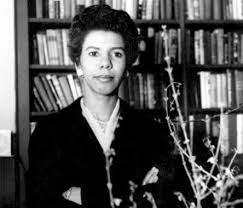 |
| Lorraine Hansberry reporter, playwright, author |
The rest of Dyson’s screed is just as useless as the first part. Since he has to fill out a couple of hundred pages, he now attempts to relate the African Americans at the meeting to modern day equivalents. Anybody who would parallel the work of someone like Hansberry with the films Black Panther and Get Out! is an even worse cultural critic than historian. He gets even sillier when he tries to say that Muhammad Ali—who was not there—was some kind of civil rights leader of the sixties. The man who really fits that bill is the great NFL running back Jim Brown. But Dyson does not want to go in that direction, since Brown has little but disdain for most of the black athletes of today.
The worst thing about Dyson’s mess is that Amy Goodman of Democracy Now chose to feature it on the anniversary of Robert Kennedy’s assassination this year. In other words, the individual who did so much to get the 1964 Civil Rights Act passed, who came out strongly against Johnson’s mad pursuit of the Vietnam War, who faced off against Governor Wallace at the University of Alabama, who encouraged the peasants of Brazil to overthrow their government in 1965, who ran the incandescent progressive campaign of 1968—this figure was entirely ignored. On the fiftieth anniversary of Bobby Kennedy’s assassination, Amy Goodman wanted her listeners to remember RFK through Dyson’s completely lopsided view of his dispute with James Baldwin and Jerome Smith. And to also ignore the good that could have come out of that meeting if Smith and Baldwin had not been there.
What a disgrace.
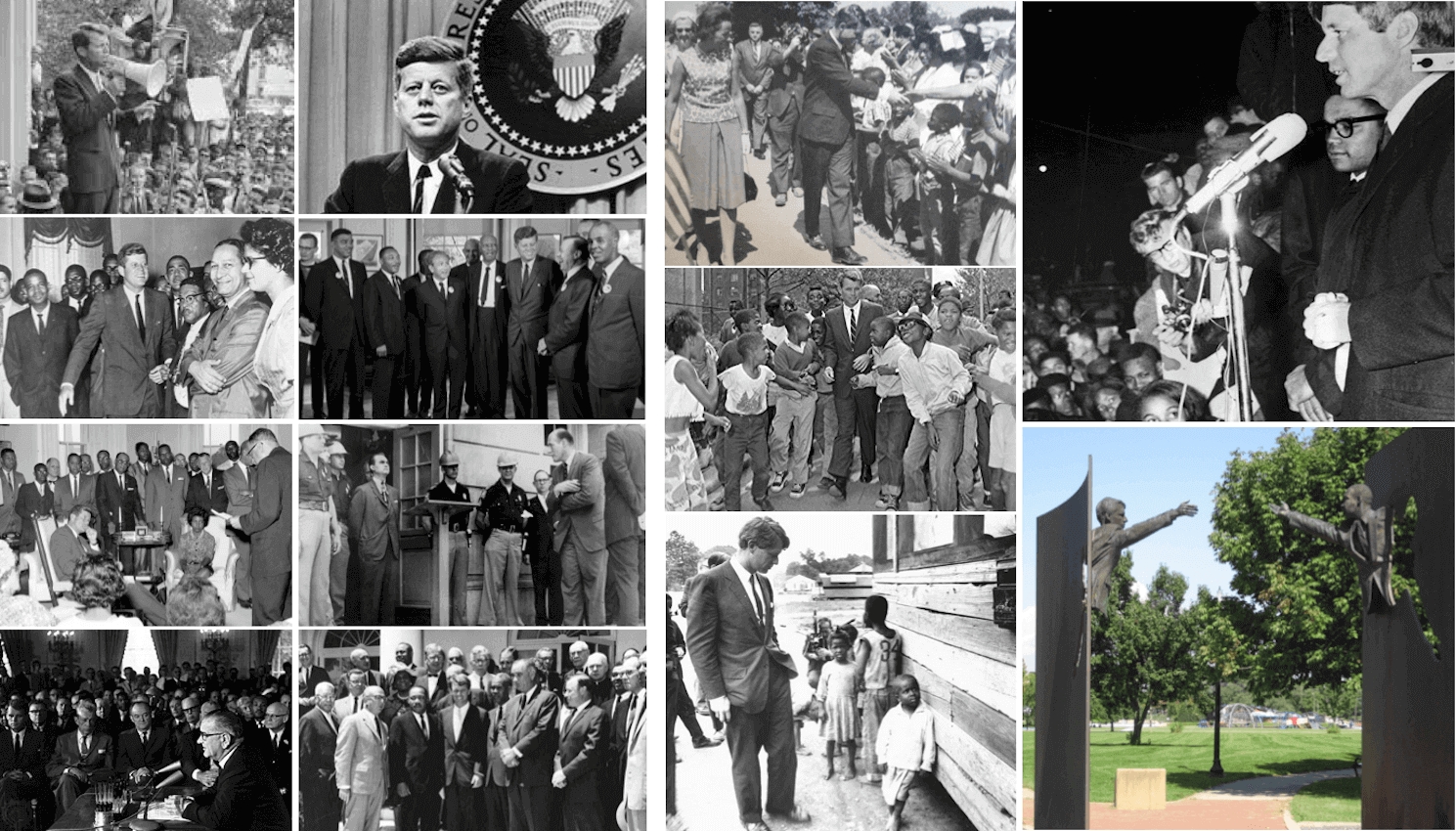
Books reviewed in this essay:
Approximately five years ago, on the fiftieth anniversary of President Kennedy’s death, I reviewed Larry Sabato’s book, The Kennedy Half Century. In that review, I wrote about something that I had not really noted before in book form. One expects an MSM shill like Sabato not to recognize any of Kennedy’s clear alterations to President Eisenhower’s foreign policy: e.g., in the Congo, or with the Alliance for Progress. That would be par for the course. But Sabato did something that I had not really observed before. At length, the author tried to revise downward Kennedy’s record on civil rights. This was disturbing since Kennedy’s record on that issue was far superior to not just Eisenhower’s, but to all the presidents who had preceded him—both during and after Reconstruction. In my review of Sabato, I showed how silly this was by spending a few pages countering the obtuse arguments he had made (see section three of this review).
Read more interesting civil rights movement facts here!
At the end, I noted that this weird spin indicated once more that it was not enough for the MSM to deny the true facts of Kennedy’s murder. There was a concomitant effort to discount his achievements in the White House. In the back of my mind I was wondering: was Sabato’s goofiness on JFK and civil rights a preview of what was to come? After all, the next big milestone would be the dual anniversary of the murders of Martin Luther King and Bobby Kennedy. That would be made to order for the issue.
Well, I was largely right, but a little wrong. That dual anniversary did produce at least three books on the matter. These are Steven Levingston’s Kennedy and King, David Margolick’s The Promise and the Dream, and Michael Eric Dyson’s What Truth Sounds Like. They all pretty much traversed the same path that Sabato did. And they all used the same tactics that Sabato employed: downplaying or completely eliminating the record, and/or not contrasting it with Kennedy’s predecessors. (But I should say from the outset: unlike the other two, Margolick’s book has some saving graces, since he actually did some research.)
This last point, concerning contrast and presidential comparison, is crucial. Presidents should not be evaluated in isolation. In discussing their records, it is necessary to detail what came before and, at times, what came after. There can be no absolute value given to what a president says or does—as, say, there might be with anti-war leaders, or civil rights leaders—the reason being that the latter two groups are not running for office. A true presidential historian attempts to delineate and characterize words and actions in relation to other presidents, first by gathering as much of the pertinent data as necessary; then by sifting through it in order to find origins and patterns and to measure achievements; and finally by trying to make accurate comparisons with chief executives who came before and after. None of the authors mentioned even came close to doing this.
Before comprehensively addressing this issue, it should be said that the struggle for civil rights is even larger and more complex than, say, the issue of the Vietnam War. This is simply because it extended back even farther in its origins, and therefore involved more major factors and participants. None of these books under review pays any respect to that backdrop either. One ought to deal with it nonetheless, for in my opinion, it provides one explanation as to why so many previous presidents did nothing about the serious problem the issue presented. (As we shall see, some of them in fact exacerbated the problem by symbolically allying themselves with the image of the Confederacy.) It also helps explain why, with the stirrings of the civil rights movement—which did not begin with Martin Luther King—presidents like Franklin Roosevelt, Harry Truman, and Eisenhower did so little. What that sorry record of inaction did was to create an abyss the size of the Grand Canyon that John Kennedy faced when he entered the White House.
I would have more respect for these authors if they spent just a few paragraphs elucidating this crucial background. After all, that is the way the practice of history works. Recording accurate history is not, however, why these books were produced. But since this review will encompass all three of these volumes—plus a fourth that Levingston uses and relies on as a credible source—this author will first supply that missing background. This will help make clear both the failure of previous presidents in the face of this large and painful issue, as well as the reasons for it—presidents who, in other ways and on other fronts, have been praised by many authors (for instance, Teddy Roosevelt and Woodrow Wilson).
Our exposition of this backdrop will not go all the way to the origins of the slave trade. What I will outline here is what happened during Reconstruction, since that created the historical foundation for the conditions of segregation, discrimination, and landless poverty that enveloped the existence of African Americans in the South after the Civil War. (I will not footnote this section, since it only pretends to offer a greatly abridged synopsis of what has been established in depth by an array of illustrious historians, such as John Hope Franklin, C. Vann Woodward, W. E. B. DuBois, Herbert Aptheker, Kenneth Stampp, and Eric Foner, among others.)
It is an open question as to whether Reconstruction would have succeeded if Lincoln had lived. But there is little doubt that what did happen was a calamity for the newly freed slaves. President Andrew Johnson’s actions in pardoning so many of the former political and military leaders of the Confederacy outraged many of those who were against what the South stood for and was based upon. Johnson’s actions almost allowed the former vice president of the Confederacy, Alexander Stephens, to take a seat in Congress right after the war. Stephens was the man who, in 1861, declared that the cornerstone belief of the South was that the African American was not equal to whites and “that slavery—subordination to the superior race—is his natural and normal condition.”
This was too much for the Radical Republicans in Washington. Men like Senator Charles Sumner of Massachusetts were simply not going to let Johnson do that. So they went to war with him. For a relatively brief period of time, these men passed several laws over Johnson’s veto in an attempt to aid the freedmen in the South and make it harder for former rebel states to return to the Union. The Civil Rights Act of 1866 and the fourteenth and fifteenth amendments were examples of laws they passed aimed at making the former slaves citizens who would be protected by the government. They also made it possible for teachers to go to the South, the creation of public schools there, the stationing of Union troops in the former Confederacy and the extension of the Freedmen’s Bureau—the only arm of government that gave direct aid to the newly freed slaves and their families.
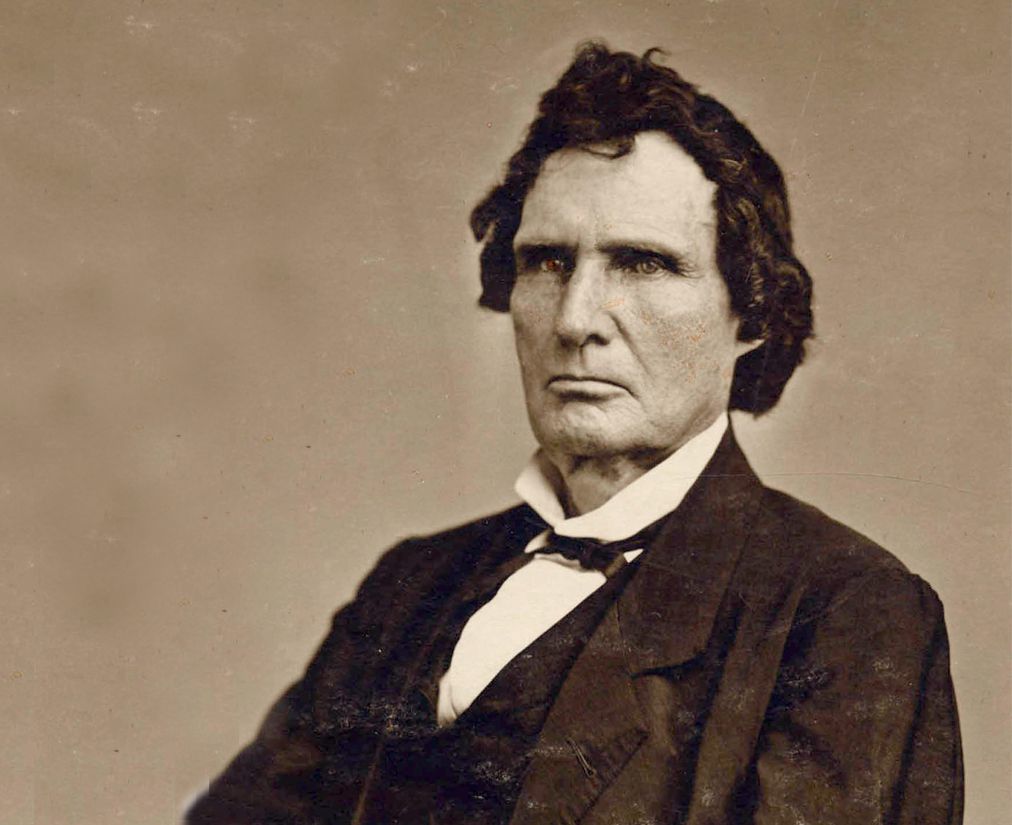 |
| Thaddeus Stevens |
It is puzzling today as to why men like Senator Sumner, congressman James Hinds (who was murdered by the Klan in 1868), Senator Benjamin Wade and, of course, congressman Thaddeus Stevens, were called radicals. They were clearly correct in their ideas about what it would take to incorporate the Confederacy back into the Union. But they were opposed by formidable enemies in Washington and outside it, like the Ku Klux Klan. As DuBois first pointed out, the Union never had enough troops in the former insurrectionist states to occupy that wide expanse of territory. Consequently, former Confederate forces were allowed to roam free and organize militias to thwart the actions of those who wished to carry out a reconstruction of the South. The Klan was only one of these terrorist organizations. There were also groups like the White League, the Red Shirts, and the White Line in Mississippi. They constituted something called the Redeemer Movement, whose goal was to restore pre-war white supremacy to state power. As African Americans took office—a mere 17 in Washington during the period of 1870-76, but many more on the state and local level—these terrorist groups began to rise in reaction.
Since they were well armed and organized, the only way to control them was by maintaining a much larger occupying force in the South for a longer period of time. That did not happen. The Reconstruction Act of 1867 allowed only 20,000 men to occupy ten former states. This included areas as large as Texas and Louisiana. President Ulysses S. Grant had to send additional military forces into the South for elections in 1870 and 1876.
No high-school textbook, and very few American history college texts, detail the horrors perpetrated by the Redeemer Movement, so much of the brutality and ugliness in the following account will likely be new to the reader. But as shameful and hideous as that chronicle is, the historian must describe it in order for the reader to begin to approximate the extreme pathology—imbued by centuries of slavery—that possessed these men. It is the only way to explain the shocking outbreaks of violence that took place at this time: the Opelousas Massacre of 1868; 1871’s Meridian Race Riot; the Colfax Massacre of 1873; New Orleans’ Battle of Liberty Place in 1874; and the Hamburg Massacre of 1876. In the Meridian and New Orleans instances, the Redeemers’ aim was to overthrow, respectively, the local and state government. In Meridian Mississippi, the Redeemers shot and killed a judge during a trial, and massacred as many as thirty freed slaves, ultimately driving the mayor from office. A force of three hundred Redeemers then escorted the mayor to a train and literally packed him off to New York, thereby achieving their goal of overthrowing the municipal government.
 |
| The Battle of Liberty Place |
The Battle of Liberty Place was enacted on Canal Street in New Orleans. It was a large-scale military insurrection. The Redeemers’ White League organized an army of five thousand men to force the Republican governor, William Pitt Kellogg, to resign. The governor was defended by a combined force of about 3,500, made up of state militia and local police. The White League defeated Kellogg’s forces, thereby overthrowing the governor. President Grant finally sent in federal troops, the White League dispersed and Kellogg was restored. But no one was arrested or tried. This paved the way for the White League to control the state once the Union army left.
It is worth describing a smaller scale event in more detail in order to understand the murderous mania that possessed the Redeemers. In September of 1875, in Hinds County Mississippi, the Republican Party decided to hold a combination barbecue and rally for the upcoming elections. Freedmen had been voting for about eight years there, so this type of event was not uncommon. For purposes of policy debate, they invited the Democrats to attend. The Democrats sent a spokesman, accompanied by about 75 White Line men with concealed weapons. The Democrat spoke without interruption. The Republican speaker thanked and congratulated his opponent. But as he began to address the crowd, he was heckled. He was then accused of being a liar. The leading black politician in the area, Charles Caldwell, stood up and asked the former slaves not to let themselves be goaded into a confrontation. Then a Republican freedman, Lewis Hargraves, was shot in the head at point blank range. In what appeared to be a choreographed action, the White Line men let loose with a series of volleys. The Freedmen, some whom came armed, fired back. Mothers began gathering up their children and running for cover in the nearby woods. At the end of the first day, three White Liners and five freedmen were dead.
The Redeemers called in reinforcements. In a move that had to be planned in advance, hundreds came in by rail. As one witness noted, they began to hunt down every black man they could see: “They were shooting at him just the same as birds.” Many freedmen were stalked to their homes, taken from their domiciles, shot to pieces, and their mangled corpses tossed into swamps. One of the victims was an old enfeebled grandfather. Some freedmen were forced to stand on tree stumps before they were killed. Caldwell escaped, but the posse told his wife that no matter how long it took, they would find him and he would perish like the rest:
We have orders to kill him and we are going to do it, because he belongs to this Republican Party and sticks up for these negroes … We are going to have the South in our own charge … and any man that sticks by the Republican Party, and he is a leader, he has got to die.
This anarchy and bloodlust eventually resulted in the infamous Mississippi Plan. What happened in Hinds County was repeated throughout the South by different terrorist groups. Once the violence had achieved its goal—which was to cower and intimidate the potential Republican voters—that result was often sealed by a bizarre, symbolic ritual. On the eve of an election, the Redeemers would mount up armed on horseback, usually in some sort of costume. At night, they would then parade through the main street of town with torches in hand. The idea was to remind any former slave or white sympathizer that there was no political order, no escape, and therefore that the Reconstruction amendments did not apply. The Redeemers held all power, and the opposition was not to be seen at the polls. The impact was overwhelming. During the peak years of Reconstruction, when the Republicans controlled parts of the South and freedmen were part of the state governments, African Americans had voted 90% of the time. Once the Redeemers took power, in some Mississippi townships, no Republican votes were tallied at all. In less controlled counties, the percentage declined by 75%.
Due to the disputed presidential election returns from three states of the South in 1876, both parties agreed on a political compromise. This allowed the Republican, Rutherford B. Hayes, to become president. In this shameful bargain, neither political party had clean hands. In return for the White House, Hayes agreed to remove the last of the Union armies from the Confederacy. Hayes also agreed not to intervene in the future. The GOP now began to devote itself to the interests of big business in the north. As a result, the Democrats took over what would later be called the Solid South. As the Reconstruction governor of Mississippi, Adlebert Ames, wrote to his wife on November 4, 1874:
What sorry times have befallen us! The old rebel spirit will not only revive, but it will make itself felt. It will roam the land, thirsty for revenge, and revenge it will have … the war is not over yet.
Once Hayes agreed to remove the Union army, and the Mississippi Plan held, the Redeemers began to construct a social, political, and economic system that would approximate the ante-bellum South. To understand why, one must not just acknowledge the racial pathology prevailing there, but also slavery’s economic underpinnings. As one historian has noted, “the economic value of property in slaves amounted to more than the sum of the money invested in railroads, banks and factories in the United States.” (Eric Foner, Forever Free, p. 11) The former Confederacy did not want to develop a new economy to replace what they had. So local and state laws called Black Codes were inscribed. These stated, among other things, that the freedmen had to show evidence of employment while in the city. If not, this constituted proof of the crime of vagrancy. The codes were designed to force the former slaves out of the city and back into the rural areas. There, a new plantation plan was enacted: sharecropping. This system nearly guaranteed that the sharecroppers would never own their own land. The clear alternative to this new form of peonage was to have divided up the great plantations and given them to the newly liberated slaves. In one stroke of justice, this would have gravely weakened the fallen regime and given their former subjects a viable economic future, one which would have provided for the upward social mobility of future generations. This is what the freedmen thought would happen. As Eric Foner has shown, in very, very few instances did it occur. (Foner, p. 60) The Black Codes would later evolve into Jim Crow laws, and those laws would construct a new social system that would make the former slaves into third class citizens—if that. The sharecropping plan would provide much of the new economic system. It would keep the former slaves in the countryside, in debt, and unable to assert any claim to their rights.
As DuBois wrote in his 1935 book, Black Reconstruction in America, the ultimate defeat of the Radical Republican version of Reconstruction was not just a national tragedy. It went further than that. It set an example for subjugation as far away as South Africa and Australia. For now, in a democracy, a standard was set to deprive nonwhite peoples of their political rights simply on racial grounds. (“Why Reconstruction Matters”, NY Times, 3/28/15)
At this point, we come to an episode that resembles a dark fantasy. The Supreme Court of the United States now began to further the Redeemers’ goal in a political manner. Piece by piece, the high court undid what the Radical Republicans had achieved. That is, they neutralized the 14th and 15th amendments, and also the laws the Radicals passed making it illegal to obstruct the rights of the freedmen. The Supreme Court would, over a period of 20 years, in a methodical and systematic manner, negate it all. By doing so, it would reverse Alexander Hamilton’s dictum in the Federalist Papers. There, he wrote that the court would be the last bastion of protection for the weak against the strong. He then added that the lifetime appointment and lack of accountability would constitute a saving grace for liberty. To put it mildly, he was wrong. (Lawrence Goldstone, Inherently Unequal, pp. 10-13)
Thaddeus Stevens had passed on in 1868, and Charles Sumner in 1874. As several authors have noted, partly due to that, the GOP began to drift away from any further interest in Reconstruction and more toward its ultimate business orientation. The Radicals had favored plantation confiscation and redistribution of land to the freedmen. But the moderate Republicans would not stand up for it. (Goldstone, pp. 28-36) Meanwhile, with their growing interest in big business, the Republicans became enchanted with the writings of Herbert Spencer and Yale professor William Graham Sumner (no relation to Charles). Both writers advanced the ideas of Social Darwinism, which, to put it in simplified terms, postulated that the rich were rich because they deserved to be. As author Lawrence Goldstone notes, it was this philosophy’s growing influence on the Republican Party that forged a spurious intellectual link between the northern industrialists and the planter class in the South. This was furthered by the fact that President Grant appointed two corporate lawyers to the Supreme Court who had both formerly represented railroads. Hence, over a period of 20 years, from 1876 to 1896, the Supreme Court certified and upheld the beliefs of the Redeemers. (Goldstone, p. 72)
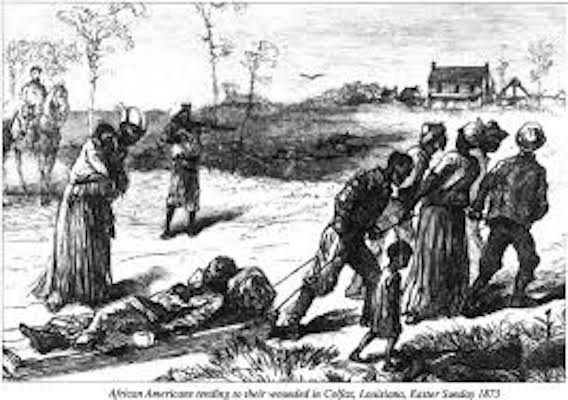 |
| The Colfax Massacre |
The two cases that began this reversal were U.S. v Cruikshank and U.S. v Reese, both in 1876. The first case arose from the aftermath of the terrible Colfax Massacre, where an estimated 105 freedmen were killed. The Cruikshank decision set free the only three men who had been brought to justice for those killings. In a decision begun by one of the high court’s railroad lawyers riding circuit, the Supreme Court nullified the convictions. The basis for this, the court held, was that the 14th amendment, with its equal protection clauses, only applied to state actions, not to those taken by individual citizens. (Goldstone, pp. 91-96) In other words, if the Klan or any other terrorist group was going to harass, injure or kill anyone, the state would have to bring them to justice—something that, with the Union army gone, was not likely to occur. The Reese case had a parallel effect on voting rights. In that instance, a former slave tried to exercise his right to vote but was denied due to his alleged failure to pay a tax. The Supreme Court upheld the circuit decision against the plaintiff. This decision severely qualified the 15th amendment, which had granted the rights of citizenship to all, no matter of what race. It paved the way for states in the south to use all kinds of qualifying barriers like poll taxes, literacy tests and grandfather clauses to limit, or eliminate, freedmen from exercising the ballot. (Goldstone, p. 97)
 |
| Justice Joseph P. Bradley |
Two more mortal blows followed. In 1883, the court gathered five cases that had been awaiting a hearing and combined them into one: The Civil Right Cases. These cases all concerned discrimination in public accommodations, which had been outlawed by the Civil Rights Act of 1875. Once more, the court ruled against the plaintiffs, even though the act was grounded in the 13th and 14th amendments. The opinion in this case was again written by former railroad lawyer, Joseph Bradley. His contention against the 13th amendment was that discrimination did not necessarily translate into a form of subjugation. With the 14th amendment, which provided equal protection to all citizens, Bradley wrote that Congress did not have the power to nullify private discrimination or overrule a state if it chose to ignore such a private or local law. Consider this statement: “Individual invasion of individual rights is not the subject matter of the amendment.” (Goldstone, p. 124)
If the reader can believe it, the NY Times endorsed the decision (Goldstone, pp 127-28), even though the supposition would be that only when a state announces its intent to discriminate against a particular race, only then could the federal government step in. What was so bizarre about all this was the following: as the justices were diminishing the 14th amendment’s efficacy to maintain rights for the freedmen, which was its original intent, it was expanding the amendment for the purposes of corporations—which had nothing to do with its original purpose. (Goldstone, pp. 144-45)
The coup de grâce in all this was the Plessy v Ferguson case of 1896. As everyone understands, this case concerned the rights of African Americans to travel on the same facilities as everyone else. The case arose out of state law that was inspired by the 1883 decision that segregated races in Louisiana on rail cars. The case went up to the Supreme Court where, once again, the high court decided against the plaintiff. This case established that separate facilities were not necessarily unequal. It was clearly a racist decision. One of the judges wrote, “If one race be inferior to the other socially, the Constitution of the United States cannot put them upon the same plane.” (Goldstone, p. 167)
There were other cases, but these four politically nullified the post-Civil-War amendments and laws meant to correct the conditions in the South that caused that conflict. Goldstone writes that with these in place, the Redeemers’ aims were now achieved. Jim Crow, the separation of races in every respect, was now legal. For the freedmen, civil order in the South was neutralized. There was little fear of retribution or justice. Given these precedents, something like the torture execution of Sam Hose could take place—in public. In 1899, the African American Hose killed his boss in self-defense. The two had argued over money Hose felt he was owed, and the next day the employer came at Hose with a gun. The employee was chopping wood and threw his axe at him, killing the man. Quite naturally, Hose fled. The dead man’s wife now said that Hose had also raped her. A huge manhunt captured the accused and he was brought back to the jail in Newnan, Georgia.
 |
| Lynching of Sam Hose (Wilkes) |
A large crowd estimated at almost 2000 people gathered around the jail and demanded the sheriff turn over his prisoner. Fearful of an assault on the building, he did. The wild, violent crowd marched Hose several blocks to the public square, yelling, “Burn him.” The governor, who lived there, and a judge pleaded with the crowd to return him to the sheriff. They refused. They then marched outside the town. He was roped to a pine tree and three or four men came at him with knives pulled. One man severed one ear and another the other. His body was stripped and mutilated further. He was dowsed with oil. He was then set afire, and as his body fell loose from the tree, he was kicked back into the flames. When the flames died out, his heart was carved into pieces and sold off as souvenirs. (Goldstone, pp. 5-8; also see this article)
 |
| The Rosewood Massacre |
This was not the end of it. Not even close. The Supreme Court had unleashed a peculiar mass psychology that, for some, knew no bounds. What happened to Sam Hose was repeated on a much larger scale at places like Rosewood Florida, where an entire village was virtually incinerated; Tulsa Oklahoma, where a whole section of the city was charred in flames and perhaps 300 African Americans were killed; and in Ocoee, Florida, where approximately sixty African-American were killed, 330 acres were burned, and the survivors were forced to leave town. At Ocoee the crime was trying to vote. Whenever one hears a speaker droning on about American Exceptionalism, the reader should mention these incidents, and these Supreme Court decisions. In this author’s opinion, the pattern of these atrocities resembles the first outbreaks of violence against the Jews in Nazi Germany.
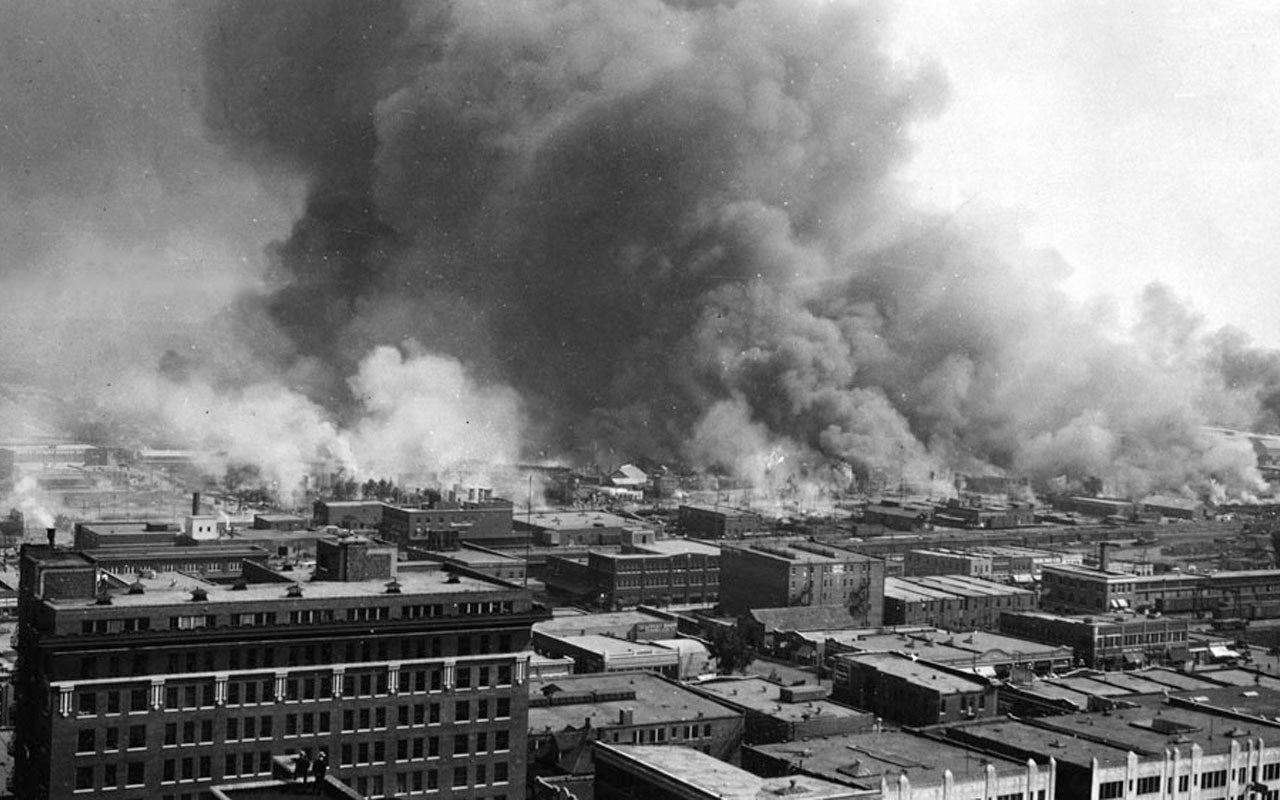 |
| The Tulsa Massacre |
(The following article from The Atlantic also reviews how a Republican dominated Supreme Court nullified, step by step, the achievements of Reconstruction, aiding the Redeemers. It then draws a parallel with the Roberts court and its approach to minority groups, including Muslims. See “The Supreme Court is Headed Back to the Nineteenth Century”.)
But the myth of American Exceptionalism had to live on, at least with the masses. So a cover-up about Reconstruction was snapped on. It worked on two levels: one with the mass media, and one in academia. On the first level, best-selling authors, like Thomas Dixon and Claude Bowers, began to turn what had happened into an antiseptic fairy tale. The African Americans who briefly played political roles during the era were caricatured as aimless wastrels who bankrupted certain states. The Redeemers were glorified as the rescuers of southern sanctity. Thus the “Lost Cause” mythology was constructed. Dixon did this with a trilogy of novels called the The Leopard’s Spots, The Clansman and The Traitor. How bad were these books? Consider this: “The Negro is the human donkey. You can train him, but you can’t make of him a horse … What is called our race prejudice is simply God’s first law of nature—the instinct of self preservation.” (The Leopard’s Spots, p. 237)
The Clansman was made into a popular play. In 1915, D. W. Griffith transformed it into a spectacularly successful film (Birth of a Nation). Former history professor and then President Woodrow Wilson screened the film at the White House. In the novels, play and film, the facts of Reconstruction are turned upside down. It is the white citizens who are preyed upon by the imperious blacks, and it is the Klan who rescues these poor people from the clutches of the primitives who—according to Dixon—had now descended into their natural state and ruined the South. The Klan saved them. (Foner, pp. 217-18)
The other level of the cover-up was constructed through academics like John W. Burgess, James Ford Rhodes and, above all, William Dunning. The views of these authors were not as melodramatic as Dixon’s, but the picture was pretty much the same. For, as Burgess once wrote, “… a black skin means membership in a race of men which has never of itself succeeded in subjecting passion to reason, and has never therefore created any civilization of any kind.” (Foner, p. xxii) For Burgess, both the Mali and Songhai empires of Africa did not exist. From what was later termed the “Dunning school”, the dominant portrait of Reconstruction was a colorful tableau full of southern Scalawags, northern Carpetbaggers, and incompetent Negro legislators. They combined to run their state economies into the ground. The mad, homicidal mass murders of the Redeemer cause were nowhere to be seen. Because Dunning came from an Ivy League college, namely Columbia, and had his graduate students do advanced work on different aspects of Reconstruction, he was enormously influential. His work became the standard for adopted college and high school textbooks. In fact, author John F. Kennedy used Dunning’s foreshortened portrait of Stevens in his book Profiles in Courage. As we shall see, after a three-year ordeal with the modern Redeemers, Kennedy realized he had been taken.
This sorry record could not have continued unless one had a series of presidents who were willing to ignore it. Woodrow Wilson was not just willing to ignore it. He exulted in it. Birth of a Nation was not just screened at the White House; Griffith used quotes from Wilson’s history books as subtitles. (Foner, p. xxii) Another progressive president, Teddy Roosevelt, was not much better. Roosevelt once wrote (falsely) that, during the Spanish American War he had to fire a gun at his own African American troops to get them to join the battle in Cuba. There was also the Brownsville Affair where, after the shooting of a white bartender, Roosevelt dismissed all the African American troops stationed in three companies of the 25th Infantry Regiment. This amounted to discharging without honor 167 men who now lost their pensions and any opportunity for civil service jobs. Roosevelt’s idea of progress in race relations was to dine at the White House with Booker T. Washington. Washington was the man who urged African Americans to he happy with their lot and learn self-subsistence.
 |
| Coolidge with Confederate veterans |
William Howard Taft, the third progressive president, also befriended Booker T. Washington. Taft once told a college graduate class at a historically black college, “Your race is meant to be a race of farmers, first, last and for all times.” Campaigning in the South, he said he would never enforce “social equality”. He then told a primarily African American audience that the white Southern man was their “best friend”. Later on, Republican presidents Harding and Coolidge failed to stop, or even criticize, parades of Klansmen before the White House. Herbert Hoover accepted covert backing from the Klan. So much for the party of Lincoln.
The man who began to turn this sorry record around is someone who few people know about. But it was he, not Martin Luther King, who really started the modern civil rights movement. So important a figure does he seem to me that if I had the power, I would level every last Confederate monument and replace each with his image. His name was Charles Hamilton Houston. Because Houston worked in a much less spectacular manner than King, he does not get the attention he deserves. This is a failure of both our media and academia. Every person concerned with this issue should know who he was. He was that crucial.
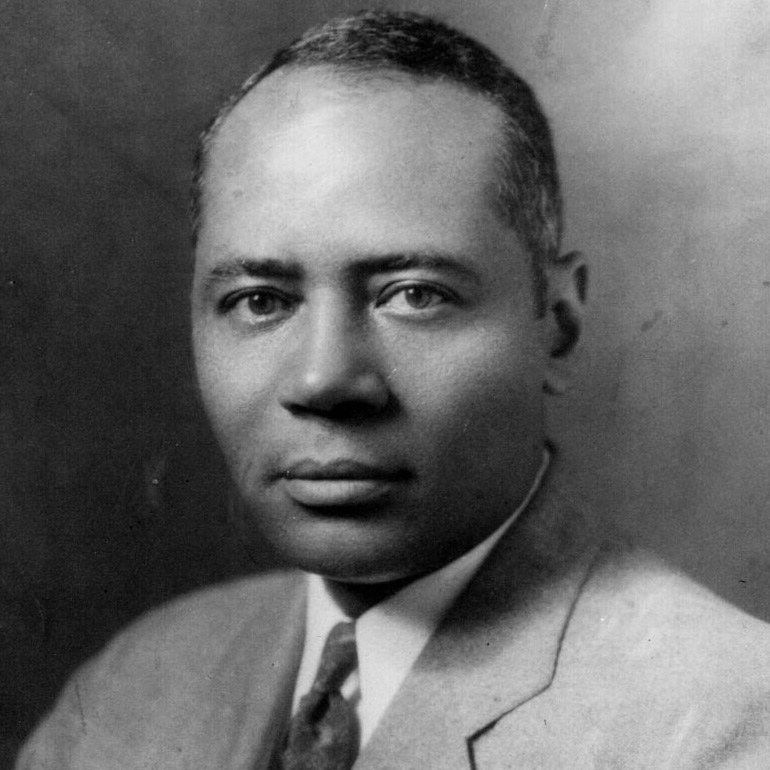 |
| Charles H. Houston |
Houston graduated from Amherst and then served as an officer in World War I. He was greatly disappointed by discrimination in the military, so he decided upon returning to the USA that he would do something about it. As he noted, “My battleground is in America, not France.” He was accepted by Harvard Law School and wrote for the Harvard Law Review. Upon graduation, he decided to create his own version of Harvard at Howard School of Law. His objective was to train a generation of lawyers in order to—piece by piece—reverse the mockery of justice the Supreme Court had decreed in the cases described above. Houston visited the major cities of the southeast and decided his students should go there after graduation, since there were not nearly enough African American attorneys to defend all the cases that needed to be adjudicated.
Houston’s reputation drew him to the attention of NAACP leader Walter White. He became, first, their unofficial lead attorney, and then their special counsel in civil rights proceedings. After participating in the famous Scottsboro Boys case, Houston set his goal as dismantling Plessy v Ferguson. He planned on doing this through challenging the underlying thesis of that decision: that facilities for his race were equal to those for whites. He decided to concentrate his efforts in the field of education. Houston felt that poor schools, especially in the South, were designed to make their students meekly accept an inferior lot in life.
Houston knew he could not directly confront Plessy v Ferguson without creating his own precedents. He began his methodical campaign by attacking the wretched acceptance policies and study conditions for African Americans in graduate and professional schools. Houston observed that in 17 of 19 southern and border state universities there were no students of color in those graduate schools. Two of those states—Missouri and Maryland—paid to have African American students attend schools in the north instead. From 1936 to 1950, in a series of carefully chosen and cogently argued cases, Houston and his student Thurgood Marshall, among others, won a series of cases—e.g. Sweatt v Painter—that set the stage for the objective that Houston had planned for: a reversal of Plessy v Ferguson. Unfortunately, Houston would not live to see the ultimate justification of his life and career. In 1950, his heart failed him due to exhaustion and overwork. Thurgood Marshall paid Houston the ultimate compliment, “We’re just carrying his bags, that’s all.” (see this profile)
There seems little doubt that, as circulated through the scores of African American newspapers—Chicago Defender, Pittsburgh Courier, Roanoke Tribune, among others—what Houston and the NAACP had begun was to awaken the conscience of many intelligent citizens, both black and white. And this national stirring—after 75 years of dormancy or worse—had an effect on the White House.
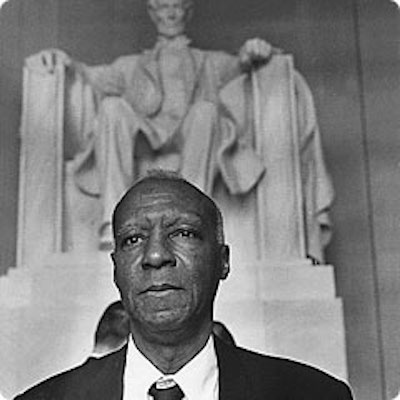 |
| A. Philip Randolph |
In 1941, union steward A. Philip Randolph and civil rights leader Bayard Rustin organized a large demonstration in Washington. The protest was about passing an anti-lynching law, integrating the military, and fair employment practices in the defense industry. After meeting with President Roosevelt, the latter agreed to issue an executive order for the last demand. Randolph and Rustin reluctantly called off the demonstration.
As a young man, President Harry Truman was quite prejudiced. But he managed to rise above it, at least in public, after FDR passed. He asked a panel of prominent authors and activists to present a series of reforms the government could take to break down the barriers of segregation. The report was called To Secure These Rights. Truman tried to get it passed as a civil rights bill. He was crushed by the southern bloc in both the House and Senate. (See William Berman, The Politics of Civil Rights in the Truman Administration, pp. 148-9; 162) The southern Democrats had decades of seniority in key committees of both the House and Senate. They had set up a system of barriers, especially in the Senate, to block any civil rights bill from making it through both houses. In the upper house, they had a very strong and disciplined corps that would filibuster any such bill to certain abandonment. This is what happened to Truman. But Philip Randolph managed to salvage one of the aims he lost with Roosevelt by doing the same thing to Truman as he did to FDR. He threatened the president and Congress with a massive display of civil disobedience in Washington unless the military was integrated. Truman signed the order. (Berman, p. 102)
Dwight Eisenhower was never one to inspire the public with his belief in equal rights. Knowing this, Truman made some very strong speeches against Eisenhower in the 1952 presidential election. (Berman, pp. 226-28) Eisenhower even resisted Truman’s integration order by suggesting the army should just integrate intact African American platoons into white companies. (Berman p. 205) Eisenhower also did not like what FDR had done with the fair employment statute. (New York Times, 6/6/1952, p. 1) Commenting on it, he said, “I do not believe that we can cure all of the evil in men’s hearts by law … ” Which may be true, but at least a law could prevent that evil from killing someone.
There was a civil rights section in the Justice Department when Eisenhower and Vice President Richard Nixon were in the White House. As Burke Marshall, Bobby Kennedy’s assistant on civil rights, later said, the section was small and seldom used. (Marshall interview with LBJ Library, 10/28/68) Eisenhower and Nixon only filed ten civil rights lawsuits in eight years, and two of those were filed on the last day of his administration. What makes that record so bad is that, for six of those years, the epochal 1954 Brown v Board case was in effect. (Harry Golden, Mr. Kennedy and the Negroes, p. 104) With Brown, Houston’s successors had succeeded in overturning Plessy v Ferguson. Separate facilities were not equal and the court ordered public schools to be integrated with deliberate speed.
That decision sent a shock wave through the South. Segregated public schools and undergraduate education had been twin keystones of Jim Crow. But Eisenhower paid no real heed to the Brown case. In fact, he once told a reporter that the decision had set back progress in the South at least 15 years. (John Emmet Hughes, The Ordeal of Power, pp. 200-1) Nixon pretty much agreed. He said, “… if the law goes further than public opinion can be brought along to support at a particular time, it may prove to do more harm than good.” (Golden, p. 61) This was a self-fulfilling prophecy. The law was not going to go very far since the administration was not supporting it to any real degree. In the six years after the Brown case, neither man ever stated publicly that they were behind the decision.
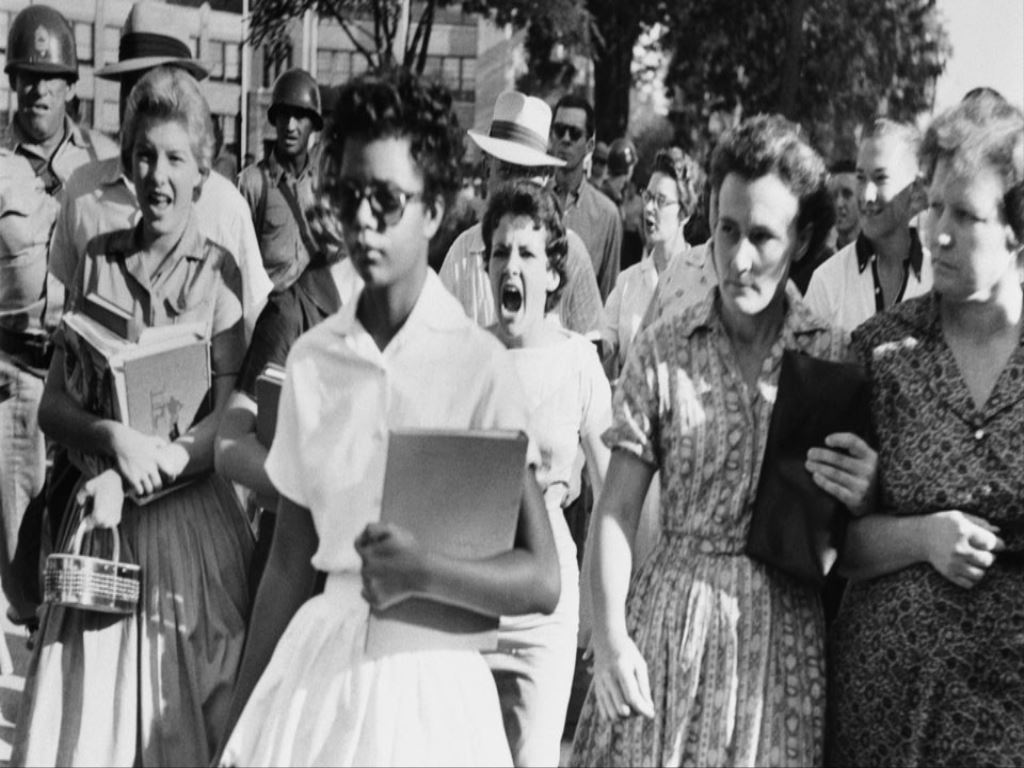 |
| Elizabeth Eckford, one of the “Little Rock Nine” |
During Eisenhower’s two terms, two explosions ripped through the South: Brown v Board and the Rosa Parks/Martin Luther King Montgomery bus boycott. During those eight years, Eisenhower had two achievements in the civil rights field. In 1957, acting on the Brown decision, the Little Rock School Board voted to integrate Central High. Governor Orval Faubus decided to defy the board. On September 3rd, the first day of class, Faubus stationed the National Guard around the school to keep the designated African American students—called the Little Rock Nine—outside. While the court and the board were being defied, Eisenhower did not blame the governor and he did not consider the event Washington’s business. In fact, he went on vacation to Newport, Rhode Island. (LA Times, 3/24/1981, “Is Eisenhower to Blame for Civil Rights Explosion?”)
 |
| Bill Clinton with Orval Faubus (1991) |
As the spectacle dragged on for days on end, Faubus visited Eisenhower in Newport. The president thought the governor understood he had to pull out the National Guard. He did not, and the nine students were left ostracized. Under threat of a court injunction, Faubus pulled out the Guard on Friday, September 20th. On the following Monday, with no authorities there, as the nine students tried to go inside, they were assailed, jeered and spat on by the angry crowd outside. It was not until the 25th that the White House finally decided, with the state authority gone, to send in federal troops to control the mob. The school was now integrated. (LA Times, “Is Eisenhower to Blame”)
That 22-day standoff helped convince many people of color that the Republican Party did not have their interests at heart. As Robert Shogan wrote in the LA Times, Eisenhower was in a strong position to do something about the racial issue. He had won two landslide elections. He enjoyed strong popularity and trust in both the North and South. He could have assured everyone that this move towards reconciliation was in their interest. Ideas about the issue were in an emerging, moldable form. (LA Times, “Is Eisenhower to Blame”) What did he choose to do at this fateful crossroads?
Not much. In 1957 his Attorney General, Herbert Brownell, sent a bill to Congress creating something called the US Civil Rights Commission. This was a six-person panel furnished with a chief counsel. It was supposed to submit a report on its racial findings to the White House. In its final form it was as much Senate Majority Leader Lyndon Johnson’s bill as it was Brownell’s or Eisenhower’s. Knowing that the bloc of southern Democratic senators would derail the bill in its original form, Johnson agreed to remove its most potent aspects. LBJ saw this as an opportunity to keep his own party united while making himself more palatable to northern and western liberals for a possible run at the White House in 1960. (Rowland Evans and Robert Novak, Lyndon B. Johnson: The Exercise of Power, pp. 122-25) Although it concentrated on voting rights, most informed commentators considered the bill largely symbolic, since it had little power to enforce its own recommendations. The bill also turned the Justice Department’s civil rights section Truman had established into a formal division. Later on, in 1960, the act was slightly modified by giving the Justice Department the power to inspect local voting rolls and introducing penalties for anyone who obstructed a citizen’s attempt to vote. Again, this was all Johnson could get through since he could not halt the filibuster. (For a chronicle of what the commission accomplished, see Harris Wofford, Of Kennedys and Kings, pp. 461-83) Many accused Eisenhower of leaving the whole civil rights imbroglio, now highlighted by bombing and assaults over the Brown decision, to his successor.
To summarize: under pressure from Philip Randolph, Roosevelt issued a fair employment order for the defense industry and Truman integrated the military. (The former lapsed when Truman could not get it renewed.) After three weeks of state military resistance, Eisenhower sent troops to integrate Little Rock. He then, along with LBJ, created a civil rights commission with little enforcement power. This was the sum total of what had been done in 84 years for the sorry plight of African Americans in the South since the Redeemers’ bloody triumph in 1876.
He leaned on JFK to stay out of Vietnam. Had Kennedy survived, might history have been different?
By Mark Perry, At: The American Conservative
In part 2 we will continue our journey into Oswald’s wondrous world and discover that his USSR defection was only a part of the larger picture. Moscow and Minsk were only stops, but not the destination of his journey. These stops were to become part of his resume, to create a “Legend” who will return home pretending to be a Soviet spy in order to infiltrate suspected communists, subversives, and supporters of Castro. From the beginning that destination was Cuba; it has always been about Cuba.
Marguerite Oswald was in disbelief when she was informed that her son had defected to the Soviet Union. In September, her son visited his mother in Fort Worth after his discharge from the Marines and told her that he wanted to travel to Cuba. In February, an FBI agent, John Fain, interviewed Marguerite regarding the whereabouts of her missing son. He later stated in his report that “Mrs. Oswald stated he would not have been surprised to learn that Lee had gone to, say, South America or Cuba, but it never crossed her mind that he might go to Russia or that he might try to become a citizen there.”1
When Oswald tried to defect to the USSR, a wire service noted that his sister-in-law said “that he wanted to travel a lot and talked about going to Cuba.”2 Similarly, when he returned back to the States, a 1962 Fort Worth newspaper recalled what Oswald said to his family: “He talked optimistically about the future. Some of his plans had included going to college, writing a book, or joining Castro’s Cuban army.”3
Oswald’s travel destinations included Cuba, the Dominican Republic, England, Turku Finland, France, Germany, Russia and Switzerland. One has to wonder how the recently discharged Marine would have been able to fund a trip that involved so many countries that were far apart from each other, like Cuba and Russia. Before leaving the Marines, he applied for a passport on September 4, 1959 and received it on September 10, 1959. To apply for the passport he used for identification a Department of Defense (DOD) I.D. card, although he could have provided his birth certificate. As George Michael Evica noted, “Lee Harvey Oswald should never have had a DOD I.D. card on September 4, 1959, possibly on September 11th, but not on September 4th.”4 September 11 was the date that he was to be transferred to the Marine Corps Reserve, once his active duty was over.
The Marine Corps confirmed that it had issued the card before he was discharged, but this kind of practice ended as of July 1959, so he was probably issued the DOD I.D. card because he was going to fill a civilian position overseas that required it.5
Too many peculiarities surround the young ex-Marine, his DOD I.D. card, his passport application, the countries he was planning to visit and the expenses needed to support such a trip. All these were enough to sound the alarm bells in the intelligence community, but somehow this did not happen.
Oswald had also stated in his passport application that he intended to study in Europe, and he named two institutions. One was the Albert Schweitzer College (ASC) in Churwalden, Switzerland, and the second was the University of Turku in Finland.
Oswald sent his application to the ASC on March 19, 1959, informing them that he was going to attend the third (spring) term of the trimester schedule, from April 12, to June 27, 1960, followed by a registration fee payment of $25 on June 19. However, this time length posed a problem by itself. Oswald’s passport was valid for four months overseas, so if he wanted to attend its third trimester, then his passport should have been valid for nine months, an extra five months. According to his passport, he could have only made it to study the fall trimester of 1959, and then only if he was given an early discharge, which actually happened.6 Oswald was released from the Marines with a dependency discharge on September 11, 1959 to go to Fort Worth to take care of his injured mother. However, his mother had only a minor injury and Oswald left for New Orleans on September 17, 1959, to begin his trip to Europe. A year later, after his defection to the Soviet Union, he was given an undesirable discharge from the Marine Corps, something that was to haunt him to his final days.
In 1995 the Assassinations Records Review Board (ARRB) revealed the communication between the FBI Legat at the Paris Embassy and FBI Director Hoover. The FBI Legat had sent Hoover five memoranda regarding Oswald’s intentions to study the ASC.
The first memorandum was dated October 12, 1960. It was based on information from the Swiss Federal Police and stated that Oswald was planning to attend the fall trimester of 1959. The second memorandum was a strange one, since it stated that Oswald “had originally written a letter from Moscow indicating his intention to attend there (at Churwalden).”7
This was an extraordinary turn of events, as the second memorandum implied that Oswald was planning to attend the third trimester, similar to his college application and the Warren Commission’s conclusion.
The fourth and fifth memoranda were even more peculiar. They revealed that Oswald had not attended the course under a different name and that there is no record of a person possibly identical to Oswald attending the fall trimester.
The above information should have sounded the alarms in FBI HQ because they suspected that since he did not attend the college he had brought with him his passport and his birth certificate to the Soviet Union. Even Marguerite Oswald, when asked by FBI agent Fain about her son’s whereabouts in Europe, replied that Lee has taken his birth certificate with him.
The above information forced Hoover to send an enquiry to the Office of Security in the Department of State regarding the “missing” Lee: “Since there is a possibility that an impostor is using Oswald’s birth certificate, any current information … concerning subject (Oswald) … ”8
Hoover, like his agent before him, suspected that Oswald had fallen victim to a Soviet spy ring that would have used his birth certificate to create a false identity which an “illegal” spy would adopt to enter the United States as a sleeper agent.
The illegals were not under diplomatic protection like their legal counterparts that were usually connected to a Soviet embassy. They would resume the life of an American, probably one that has died, live a normal capitalistic life and would be activated when the need arose.
Switzerland had been a center of espionage since WWII. Soviet illegals would never send or receive mail directly to/from the Soviet Union but would use neutral countries like Switzerland as a cover address to avoid detection. It is a surprise that the CIA counter-intelligence mole hunters did not open a 201 file on Oswald as soon as he defected. In fact, they did not do that for over a year. Instead, they put him on the HT/LINGUAL list of about three hundred Americans whose mail was secretly being opened.9 This would be an indication that Oswald was used to detect illegal networks in Switzerland by detecting their mails.
The ASC was reputed to be a place where liberals, communists and Marxists would go to study, perhaps being a possible illegal passing point. By applying to this college, even if he never went there, it could appear that his birth certificate was used to create an illegal in Switzerland that would later use his identity and papers to travel to the States. Another scenario would have been that someone looking very similar to him, someone almost identical in appearance, could have taken his place, like a Soviet illegal. Alternatively, the US intelligence services would have looked suspiciously on Oswald upon his return to the States, wondering if he had been turned into a Soviet spy coming home on behalf of his new Soviet handlers.
Regardless of the truth, Oswald—wittingly or unwittingly—had created a “Legend” for himself that could be used any time against various targets. Most importantly though, the US intelligence services would suspect that Oswald was probably impersonated by someone else for sinister purposes. This was to be the first time but it would not be the last.
How did Oswald find out about this obscure college somewhere in Switzerland? It has been suggested by various authors that Kerry Thornley, one of Oswald’s Marine friends at Santa Ana, brought it to his attention and helped him with the application.
Thornley was a New Age writer, satirist, mystic and crypto-fascist, and a native Californian who had studied at USC. He had been six months in active duty, following time in the reserves when he met Oswald at El Toro base near Santa Ana. Oswald even gave Thornley his copy of George Orwell’s 1984 to read.10 Thornley claimed that he met Oswald a week after Oswald applied to the ASC. As Greg Parker notes, it is possible that Thornley met and knew Oswald before his application to the college.11
Thornley testified to the Warren Commission:
I believe it was the First Unitarian Church in Los Angeles. I had mentioned earlier at the time I was talking to Oswald, and knew Oswald, I had been going to the First Unitarian Church in Los Angeles. This is a group of quite far to the left people politically for the most part, and mentioned in order to explain my political relationship with Oswald, at that moment, and he began to ask me questions about the First Unitarian Church and I answered, and then he realized or understood or asked what Oswald’s connection with the First Unitarian Church was and I explained to him that there was none.
We do know that Oswald had visited Los Angeles, at least to get his passport, although he may have visited the Cuban Consulate as we shall see later on.
The leader of this church was Minister Stephen Fritchman. He was a peace activist who had supported the Nuclear Test Ban Treaty, had been called by the Un-American Activities Committee and had attended the World Congress for Peace in Stockholm in May 1959.12
Was there a connection between Oswald, Thornley, Fritchman and the ASC? The National Archives and Records Administration (NARA) included in its assassination files about Oswald a sixty-page report on Fritchman. Additionally, the Warren Commission and the FBI were interested and curious about Oswald and Thornley’s Unitarian Church link while trying to explain how Oswald obtained information about the ASC.13
Evica believed that “Oswald’s mysterious source of information about Albert Schweitzer College could be explained by Thornley’s attendance at Fritchman’s First Unitarian Church in Los Angeles … the pastor may have possessed detailed information about the college and copies of the college’s registration forms. When Oswald visited LA, he could have picked up the materials at the church … Alternatively, Thornley … could have picked them up and passed them on to Oswald.”14
The Liberal Religious Youth (LRY) was a group that cooperated with the ASC. Reverend Leon Hopper, one of its members, said to Evica in March 2003 that “student recruitment was almost always through personal contacts … also confirmed that Stephen Fritchman could have been an information source … Finally Hopper confirmed that the LRY concentrated on the summer sessions of ASC, reaching prospective students through personal contacts.”15
The ASC was located in the small village of Churwalden, Switzerland, and there was something peculiar about it since it did not offer degrees. Even the Swiss authorities did not know it existed until the early 60s when there were accusations of a narcotics and fraud scandal involving the college. Soon the college was in debt, and closed only after an unknown entity from Liechtenstein paid off all of its debts.16 The peculiarities did not end there. Since the village was very small, it did not have a hospital, a library, a fire department or a police station. The village was many miles away from the nearest town of Chur, and one had to drive through poor roads and across mountains to reach the village.
The college was housed in the village’s larger building, the hotel Krone with thirty rooms capacity.17 It opened in 1954, and the first list of students available revealed there were no Swiss students at all, which served to keep it unknown to the Swiss Government.18
The ASC was created by the International Association for Religious Freedom (IARF). According to Richard Boeke, first President of the American chapter of IARF, it was the crown jewel of all the IARF’s associate religious centers and had initially been “good for Liberal Swiss Protestants.”19 The IARF originated in 1900 as the International Council of Unitarian and Other Liberal Religious Thinkers and workers on May 25, in Boston. The stated aim was “opening communications with those in all lands who are striving to unite Pure Religion and Perfect Liberty, and to increase fellowship and cooperation among them.”20 It would include religions like the Unitarian, Buddhist, Humanist, Muslim, Scientology and Theosophy.21
The ASC was operated by the Albert Schweitzer College Association—a non- profit organization with its legal HQs in the village of Churwalden—and the Unitarian “American Friends of Albert Schweitzer College” which was also a non-profit organization. The “American Friends of Albert Schweitzer College” had its offices in Boston. It was incorporated in New York in 1953 with the purpose of receiving tax-deductible contributions from United States citizens and corporations.22 Its directors were John H. Lathrop (Brooklyn, NY), John Ritzenthaler (Montclair, NJ), and Percival F. Brundage (Montclair, NJ).23 Brundage was the most interesting individual out of the three directors, a true member of the “Power Elite”, with government and intelligence connections.
Who was Percival F. Brundage? Brundage was the son of a Unitarian Minister who graduated cum laude from Harvard University in 1914 and afterwards became a successful accountant, probably one of the best of his era. In 1916 he worked as a civilian in the Material Accounting Section of the War Department’s Quartermaster Depot Office in New York which involved record keeping of sensitive military procurement operations.24
He became a senior partner in the accounting firm, Price-Waterhouse. He was director, and then president of the Federal Union that argued for the federation of the Atlantic democracies.25
Brundage had a significant connection to the Unitarian Church and the ASC. He was a major Unitarian Church officer from 1942-1954 when the Unitarian Church was cooperating with, first, the OSS, and later the CIA.26 He was also president of the International Association for Religious Freedom (IARF) from 1952-1955 and president of the American Friends of Albert Schweitzer College from 1953-1958. Most importantly, Brundage became the most prominent member of the Bureau of Budget (BOB) during the Eisenhower presidency. He was its deputy director from 1954-1956, its president from 1956-1958 and he served it as consultant until 1960.27
As the head of the BOB, Brundage was controlling the United States budget, and from that privileged position he would be familiar with the Pentagon’s and CIA’s secret black budgets but without ever exposing or surveying them. It seemed that Brundage would turn a blind eye and let them do their secret work without the government ever bothering them.
One of Brundage’s closest friends was a fellow Unitarian, James R. Killian Jr., president of the Massachusetts Institute of Technology (MIT).28 Killian was appointed the chairmanship of president Eisenhower’s Technological Capabilities Panel in 1953 to measure the nation’s security and intelligence capabilities and also to study both military and intelligence applications of high-flight reconnaissance.29 Killian appointed Edward H. Land, inventor of the Polaroid land camera, as chief of the top-secret intelligence section of the Air Force Technological Capabilities Panel that helped create high-flight reconnaissance, like the U-2 and satellites. Land was also responsible for the CIA receiving the responsibility for the U-2 program.30 In 1957 he was appointed by Eisenhower as Special Assistant for Science and Technology, and in 1956 became Eisenhower’s chairman of the US Board of Consultants on Foreign Intelligence Activities, reporting to the president the activities of the intelligence community, especially the CIA.31 This board was supported by Brundage’s BOB. Later, Killian advised Eisenhower that the Air Force was incapable of developing photographic reconnaissance satellites. This allowed him to turn over that assignment to the CIA, which led to the CORONA satellite program32 that was discussed in part 1.
Killian, Brundage and Nelson Rockefeller were the three men who transformed the national Committee of Aeronautics (NACA) into the civilian agency responsible for the US space program. It was renamed NASA. Brundage was responsible as the head of BOB for drafting the congressional legislation for the creation of NASA.33 Brundage was also involved in Operation Vanguard, which was “intended to establish freedom of space, and the right to overfly foreign territory for future intelligence satellites.”34
In 1960, Brundage and one of his associates, E. Perkins McGuire, were asked to hold the majority of a new airline stock “in name only.”35 They both agreed to act on behalf of the CIA. The airline was none other than Southern Air Transport, which was used in paramilitary missions in the Congo, the Caribbean and Indochina. The Newsweek issue of May 19, 1975 linked Percival Brundage to Southern Air Transport, Double-Check Corp, the Robert Mullen Company and Zenith Technical Enterprises. The Double-Check Corp was a CIA front that was used to recruit pilots for covert missions against Cuba; Robert Mullen’s advertising company provided cover for CIA personnel abroad; and Zenith Technical Enterprises was the front that provided cover for CIA’s JM/WAVE station in Miami.36
Southern Air Transport was created by Paul Helliwell, an originator of the CIA’s off-the-books accounting system and nicknamed Mister Black Bag. Helliwell was a member of the OSS and later of the CIA in the Far East; he was one of the most prominent members of the China Lobby. His mission was to assist Chang Kai-Shek and his Kuomintang (KMT) army in Burma to invade China. This army managed and controlled the opium traffic in the region. Helliwell created two front companies to help KMT to carry out its war and the drug trade. One was Sea Supply in Bangkok and the other was CAT Inc., later Air America in Taiwan.37 Helliwell had organized a drug trafficking network supported by banks to launder CIA’s drug profits in the Far East.
Richard Bissell brought Helliwell back to the States to plan a similar network of front companies and banks to finance the Agency’s war against Castro. Similar to Sea Supply and Air America, he created Southern Air Transport in Miami to fly over drugs and guns to support not only the war on Cuba but also in Laos, Vietnam and Cambodia.
In his book Prelude to Terror, Joseph Trento claimed that Helliwell’s main objective was to cement the CIA’s relationship with organized crime.38 Meyer Lansky and Santo Trafficante were both planning to invest in the Far East by bringing heroin back to the States. Helliwell established banks in Florida and became the owner of the Bank of Perrine in Key West, “a two-time laundromat for the Lansky mob and the CIA”, and its sister Bank of Cutler Ridge.39 Lansky would deposit money into the Bank of Perrine, reaching the US from the Bank of World Commerce in the Bahamas. Lansky also used the small Miami National Bank, where Helliwell was a legal counsel, to launder money from abroad and from his Las Vegas casinos.40 Peter Scott claimed that Helliwell worked with E. Howard Hunt, Mitch WerBell and Lucien Conein on developing relationships with drug dealing Cuban veterans of the Bay of Pigs invasion, and became CIA paymaster for JM/WAVE to finance Chief of Station Ted Shackley’s operations against Cuba.41 Sergio Arcacha-Smith, one of the New Orleans Cubans who knew Oswald and E. Howard Hunt, was involved in the lucrative business of contraband transportation from Florida to Texas, specializing in drugs, guns, and even prostitution.42
In other words, Percival Brundage was no ordinary citizen. His BOB activities with the U-2, the satellite programs, the Pentagon, the CIA, and especially his involvement with the ASC, linked him indirectly to Lee Harvey Oswald. The young Marine had applied to the ASC to study in Switzerland and his defection to the Soviet Union was unwittingly connected to the U-2 and CORONA projects that brought an end to the Paris Peace talks and prolonged the Cold War. When Percival Brundage became a part of Southern Air Transport, he entered a nexus of CIA, Mafia, drug trafficking, money laundering and anti-Castro Cubans, one which later met and manipulated Oswald, and some of whose members were very likely involved in the assassination of John F. Kennedy. It is also very plausible that the assassination was financed by this drug trafficking and banking network instead of oil-men money as many believe.
Was Oswald a communist sympathizer from his early days, like the Warren Commission concluded? Had he been in contact with the Cuban Consulate in Los Angeles?
Corporal Nelson Delgado was a Puerto Rican stationed at El Toro Marine Corps base who became close friends with Oswald. They were both loners but they had a common interest, and that was Cuba. Both admired Castro because he seemed to be a freedom fighter against Batista’s tyranny who could bring democracy to Cuba. They were dreaming that they could go there and become officers and free other islands like the Dominican Republic. Delgado could speak Spanish and Oswald would configure his ideas about how to run a government—so they kept dreaming.
Things got a little strange when Oswald became serious about it and was trying to find ways to actually go to Cuba.43
When interviewed by the Warren Commission, Delgado said he advised Oswald to go and see the Cubans at the Cuban Consulate in Los Angeles. Wesley Liebeler, a Warren Commission lawyer, took Delgado’s testimony and stretched it by the ears to make it look like Oswald was in contact with the Cubans all along. According to Australian researcher Greg Parker, “Liebeler, adroitly took a bunch of assumptions and leaps of logic by Delgado and magically recast them as proven fact leading to an inevitable conclusion.”44
According to Delgado:45
Based on the above, Liebeler instructed Delgado to “tell me all that you can remember about Oswald’s contact with the Cuban Consulate.”46
Delgado also noted that after Oswald allegedly visited the Cuban Consulate, he started receiving mail, pamphlets and a newspaper. Naturally, he assumed that they must have come from the Cuban Consulate and concluded the newspaper was communist, since it was written in Russian. He asked Oswald if it was a communist newspaper and he replied that it was White Russian and not communist. Still, Delgado, who did not know what White Russian meant, concluded it was a Soviet newspaper.47
One of the pamphlets had a big impressive seal that looked like a Mexican eagle with different colors, red and white and a Latin script with the word “United” included. Parker believes that Delgado probably was describing the logo of a Russian Solidarist movement known as NTS (HTC in Russian), standing for Narodnyi Trudovoy Soyuz (National Labor Union) in English.48 Below we can see the NTS logo with something that looks like an eagle, and the colors white, blue and red in the background.
 |
| NTS logo |
More information about NTS can be found in Stephen Dorill’s book MI6: Inside the Covert World of Her Majesty’s Secret Intelligence Service. According to Dorill, NTS was founded in Belgrade in July 1930 by Prince Anton Turkul and Claudius Voss, and it stood for National Labor Council. Prince Turkul was a member of the White Russian Armed Services Union (ROVS) and its purpose was to restore Tsarist Russia. Voss was the head of ROVS in the Balkans and “a British intelligence agent and ran ROVS’ MI6-friendly counter-intelligence service, the Inner Line, that sponsored NTS.”49
Dorill also revealed that “the Russian émigré organizations were working overtime through bodies such as the NTS … to undermine the Soviet regime and to form a provisional government when the Soviets collapsed.”50 Dorill described NTS’ origins: “Initially a left-of-centre grouping, NTS soon moved to the right, promoting an anti-Marxist philosophy of national labor solidarity, based on three components: idealism, nationalism, and activism. It enjoyed the support of several European intelligence services, in particular MI6, and also attracted substantial funds from businessmen with interests in pre-revolutionary Russia, including Sir Henry Deterding, chair of Royal Dutch Shell, and the armaments manufacturer, Sir Basil Zaharooff.”51
If Parker is right, and the pamphlets that Oswald was receiving were not communist but on the contrary from the NTS, then we can conclude that Oswald was in contact with fervent anti-communist White Russians. In that context, then, his trip to the Soviet Union could be viewed from a different perspective.
Oswald received help to apply to the ASC and travel to the Soviet Union, most likely from a nexus that involved the CIA and anti-communist organizations with relations to the military-industrial complex. When Oswald applied to the ASC, he listed his favorite authors as Jack London, Charles Darwin and Norman V. Peale.52 Jack London was one of the founders of The League for Industrial Democracy (LID), whose purpose was to extend democracy in all aspects of American life. During the Cold War, it was renamed the Student League for Industrial Democracy (SLID), had close ties to the CIA and had become anti-communist.53 Jack London was a supporter of social Darwinism, eugenics, Nietzschean philosophy and Jungian psychology.54
Darwin was a Unitarian and author of “Origins of the Species.” His cousin Francis Galton studied heredity based on Darwin’s work and as a result he coined the word “eugenics”, the theory that selective breeding will improve the human race.55
Norman Vincent Peale was a minister of the Lutheran church, politically conservative, and opposed the liberal and Catholic Jack Kennedy. He believed that as a Roman Catholic President Kennedy would align with the Vatican with respect to US foreign policy.56 He headed a group, which included Billy Graham, that held a secret meeting to discuss how to derail Kennedy’s election bid.57 Some of Peale’s associates were supporters of lynching, while others were against the Eisenhower-Khrushchev Paris peace summit.58 He was also friends with the conservatives Nixon and Hoover.59
If Oswald was, as he is alleged to be, a communist sympathizer, these interests and connections to the reactionary and elitist Right come as a surprise. Indeed, they would seem to indicate, on the contrary, that Oswald was actually instructed and guided by people who were anti-communist and probably tied to the CIA.
Even Hans Casparis, the founder of the ASC, had probable CIA connections. Casparis claimed that he had graduated from three universities, studied at a fourth and was a full-time lecturer in German and philosophy at the ASC. There were no specific degrees listed on the ASC brochure presenting Casparis, while five other lecturers held doctorates, and another one, along with Casparis’ wife, Therese, held a BA.60 Casparis claimed that he was a lecturer in education at the School of European Studies at the University of Zürich, but when Professor Evica asked the university to confirm it, they replied that Casparis had never lectured there.61 Records indicated that Casparis had studied at the University of Chicago (1946-1947), and the University of Tübingen (1922-1923), but never received degrees from either of the two.62
The same ASC brochure said that Therese Casparis, his wife, had a BA degree in education from the University of London. However, the university’s assistant archivist revealed that Therese had received a second-class honors degree in German and then enrolled to take a teacher’s diploma, but she left without taking an exam, so she never received a BA in education from that university. Therese gave birth to five children from 1934 to 1948, but Evica could not find any college in Europe or England which awarded a degree to Hans or Therese. 63 It was a mystery how they were able to raise five children without any higher degrees, yet were able to attract support from important Unitarians to establish a college in an unknown village somewhere in Switzerland. It is likely that Hans and Therese were employed by the CIA to infiltrate this liberal college. If we consider Evica’s findings that Allen Dulles had used religious organizations like the Unitarians to create humanitarian front organizations in order to conceal OSS and later CIA covert operations to destabilize Eastern Europe, South America and South East Asia, we can conclude, or strongly suspect, that ASC was such a front cover.
When Oswald was arrested in New Orleans during the summer of 1963, he was asked by police officer Frank Martello how he came to be a member of the Fair Play for Cuba Committee (FPCC). To that he replied that “he became interested in that committee in Los Angeles … in 1958 while in the US Marine Corps.”64 Although he gave the wrong information, since the FPCC was established in April of 1960, he simultaneously revealed that when he was visiting Los Angeles he most likely met the pro-Castro people that had organized the FPCC’s Los Angeles branch at the first Unitarian Church of Robert Fritchman.65
In 1963, Richard Case Nagell was investigating the FPCC branch in Los Angeles, leftists and Unitarians. In his notebook were written the names of: Helen Travis of the FPCC, Dorothy Healy of the Communist Party, USA, Reverend Robert Fritchman of the First Unitarian Church, and the officials of the Medical Aid for Cuba Committee.66
Is it possible that all along Oswald was being groomed to penetrate the FPCC?
A 1976 CIA internal memo stated, “In the late 1950’s, Hemming and Sturgis, both former US Marines, joined Fidel Castro in Cuba but returned shortly thereafter, claiming disillusionment with the Castro cause.”67 Delgado testified that a mysterious man visited Oswald at the gate of El Toro base. He had assumed that he was someone from the Los Angeles Cuban Consulate. However, Gerry Patrick Hemming revealed later on that he had met Oswald in the Cuban Consulate in Los Angeles and went to confront Oswald at the gate of El Toro base.
There are indications that this actually happened. A CIA memo stated that “Henning (Hemming) returned to California in October 1958 … he left for Cuba by air via Miami on or about 18 February 1959, arriving in Havana on 19 February 1959. He claimed to have contacted the officials in the Cuban consul’s office in Los Angeles prior to his departure.”68 Another CIA Security Office memo from 1977 linked Oswald to Hemming: “The Office of Security file concerning Hemming which is replete with information possibly linking Hemming and his cohorts to Oswald … ”69
Could it be possible that Oswald was being “put together” to penetrate pro-Castro organizations like the FPCC as Hemming had been associated with Castro and his allies before him?
In a 1976 article in Argosy, it was stated that, “Hemming maintains that the US should utilize a number of Special Forces types … who could penetrate revolutionary movements at an early stage, gain influential positions, and then channel them into more favorable areas.70 It was during that period late 1959, early 1960, when Oswald defected to the Soviet Union that the US Government—and Hemming—had realized that Castro was pro-Soviet. He was a Communist who could pose a threat to the US interests and an option would have been to have him “eliminated.”71
It is likely that Oswald was sent to the Soviet Union to build up a “Legend” as a pro-communist, pro-Soviet sympathizer. One who appeared to have provided secret information to help the Soviets shoot down the U-2—even if he did not—and then return home as a Soviet spy, or as someone who had helped create a Soviet illegal. His mission would have been to infiltrate leftist, subversive and pro-Castro organizations while pretending to be on their side.
In Part 3, we examine the Oswald legend in Dallas, New Orleans and Mexico City.
1 John Newman, Oswald and the CIA, Skyhorse Publishing Inc. 1995, p. 92.
2 Newman, p. 92.
3 Newman, p. 92.
4 George Michael Evica, A Certain Arrogance, Trine Day 2011, p. 21.
5 Evica, p. 22.
6 Evica, pp. 25-26.
7 Evica, pp. 68-69.
8 Evica, p. 59.
9 Newman, p. 423.
10 Greg Parker, Lee Harvey’s Oswald Cold War, vols. 1 & 2, New Disease Press, 2015, p. 283.
11 Parker, p. 285.
12 Parker, p. 287.
13 Evica, p. 35.
14 Evica, pp. 35-36.
15 Evica, p. 87.
16 John Armstrong, Harvey and Lee, Quasar Press, 2003, p. 227.
17 Armstrong, pp. 227-228.
18 Armstrong, p. 228.
19 Evica, p. 83
20 Parker, pp. 287-288.
21 Parker, p. 288.
22 Evica, p. 86.
23 Armstrong, p .228.
24 Evica, p. 237.
25 Evica, p. 238.
26 Evica, p. 276.
27 Evica, p. 238.
28 Evica, p. 245.
29 Evica, p. 247.
30 Evica, p. 248.
31 Evica, p. 248.
32 Evica, p. 250.
33 Evica, pp. 255-256.
34 Parker, p. 290.
35 Evica, p. 272.
36 Armstrong, p. 229.
37 Peter Dale Scott, The American Deep State, Rowman & Littlefield, 2015, p. 126.
38 http://spartacus-educational.com/JFKhelliwell.htm.
39 http://www.globalresearch.ca/deep-events-and-the-cia-s-global-drug-connection/10095.
40 http://www.globalresearch.ca/deep-events-and-the-cia-s-global-drug-connection/10095.
41 http://spartacus-educational.com/JFKhelliwell.htm.
42 James DiEugenio, Destiny Betrayed, Skyhorse Publishing, 2012, p. 329.
43 Newman, pp. 96-97.
44 Parker, pp. 280-281.
45 Parker, p. 281
46 Parker, p. 281.
47 Parker, p. 282.
48 Parker, p. 282.
49 Stephen Dorril, MI6: Inside the Covert World of Her Majesty’s Secret Intelligence Service, Harper Collins, 2002, p. 405.
50 Dorril, p. 405.
51 Dorril, p. 406.
52 Parker, p. 296.
53 Parker, p. 297.
54 Parker, p. 297.
55 Parker, p. 297.
56 Parker, pp. 297-298.
57 Parker, p. 300.
58 Parker, p. 301.
59 Parker, p. 302.
60 Evica, pp. 95-96.
61 Evica, p. 96.
62 Evica, p. 96.
63 Evica, pp. 100-101.
64 Evica, p. 36.
65 Evica, p. 36.
66 Dick Russell, The Man Who Knew too Much, Carroll & Graf, p. 226.
67 Newman, p. 101.
68 Newman, p. 102.
69 Newman, p. 103.
70 Newman, p. 104.
71 Newman, pp. 115-121.