Blog

  • Life Magazine Warren Commission Issue, October 2, 1964

    Life Magazine Warren Commission Issue, October 2, 1964


    Findings of the Warren Commission

    “Like most of us who are interested in the Kennedy assassination, I was aware of the existence of different versions of the Life Magazine Special Warren Commission issue dated October 2, 1964. I had read that there were three versions of the issue. The explanation researchers have given for the different versions is that Life Magazine was trying to make the issue released to the public (the newsstand issue) support more clearly the lone assassin Warren Commission results.

    It turns out that I subsequently was able to confirm firsthand the existence of at least two different versions, by a bit of serendipity. I already possessed the newsstand version but wanted a copy in a better condition. I checked out the best issue on e-bay that was available and purchased it. When I received my newly acquired issue, I was surprised at this version’s Warren Commission results. They were indeed different from the newsstand issue that I previously owned. It appeared to be the first version of the three versions of this issue that Life produced.”

    The main purpose of this article is to demonstrate for the readers of Kennedys And King what those differences are. The three versions of this issue are as follows:

    • Version one [V1]: issue with different frame 6 of Zapruder film stills shown and different caption describing frame 6 shown (different from newsstsnd copy). This copy I possess.
    • Version two [V2]: issue with different frame 6 of Zapruder film stills shown (different from newsstand copy) and caption describing frame 6 the same as the newsstand copy. This is alleged since I do not own this version.
    • Version three [N]: newsstand issue. This one I possess.

    These were produced in the order shown above, with version three being the final result sent to subscribers and the newsstands.

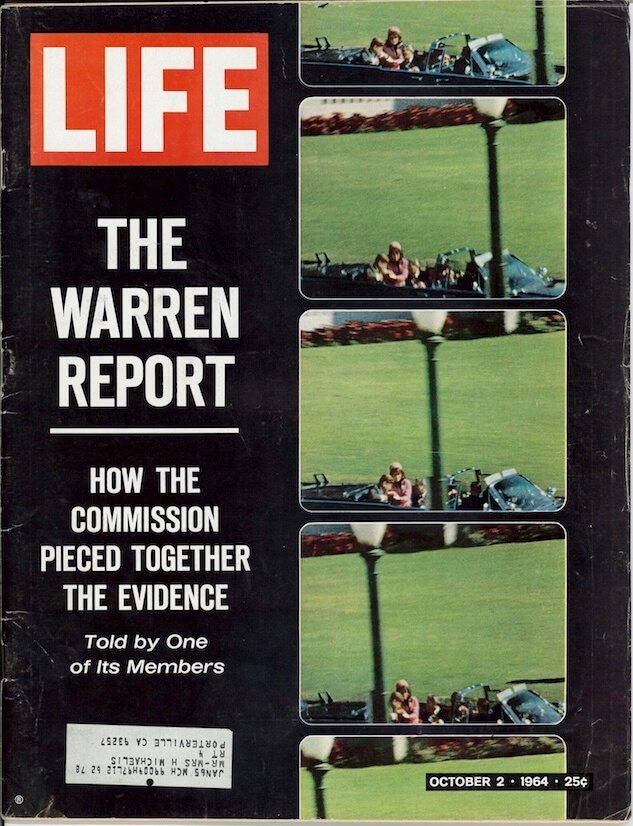
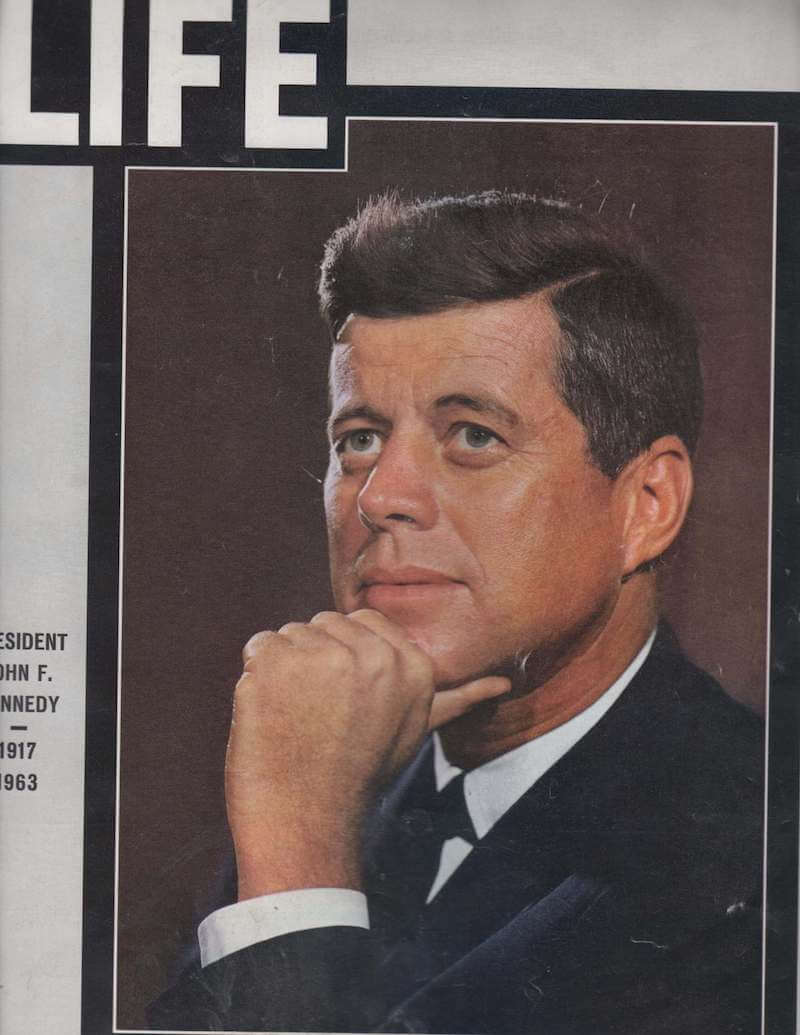
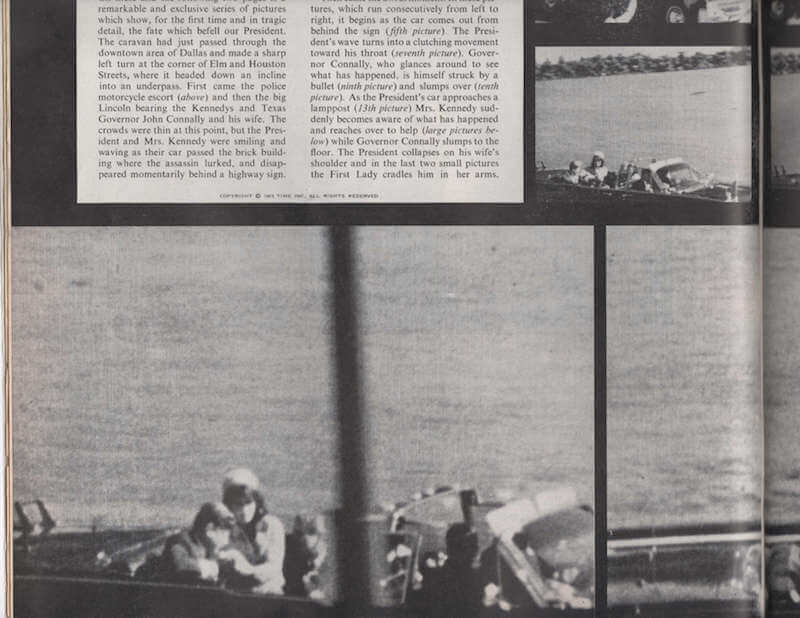
    The following set of images are reproduced from the two versions I own. I have included here the cover of the October 2, 1964 issue, the first page of the Warren Commission article (p. 42), and the eight still frames of the Zapruder film shown directly after page 42. First, the final newsstand issue [N], with exhibits numbered one through seven:

     
    Exhibit 1: Newsstand Cover   Exhibit 2: Newsstand p. 42
     
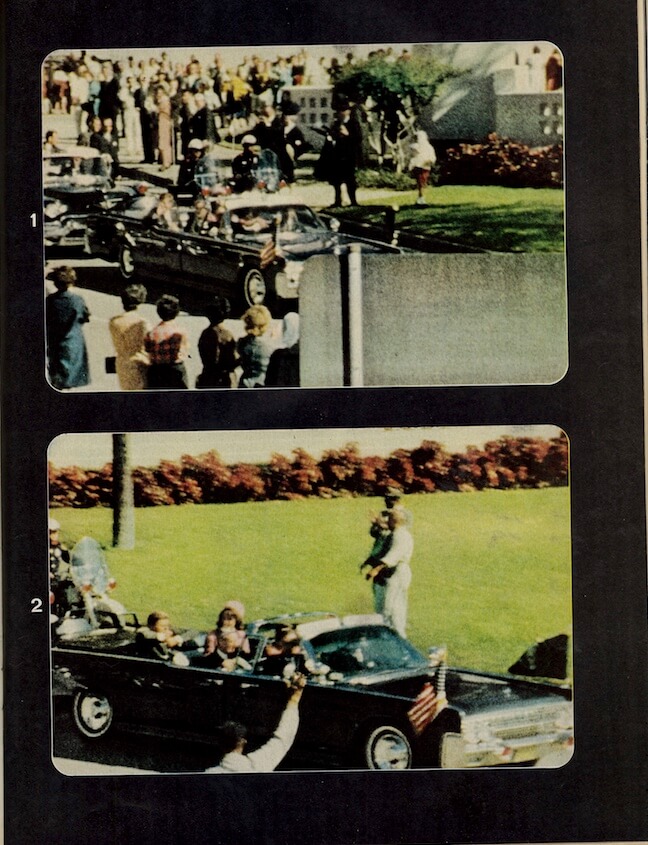
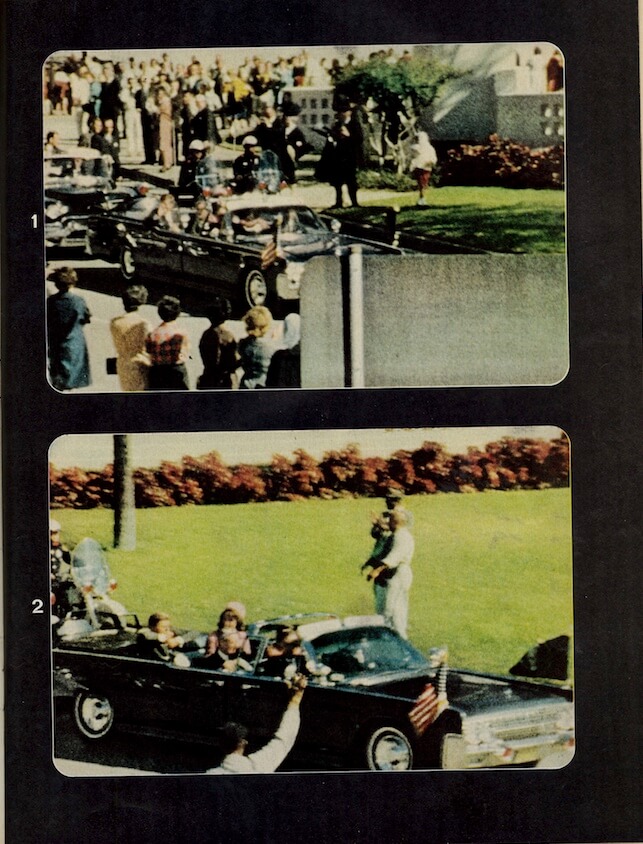
    Exhibit 3: Newsstand Frames 1 & 2   Exhibit 4: Newsstand Frames 3 & 5
       
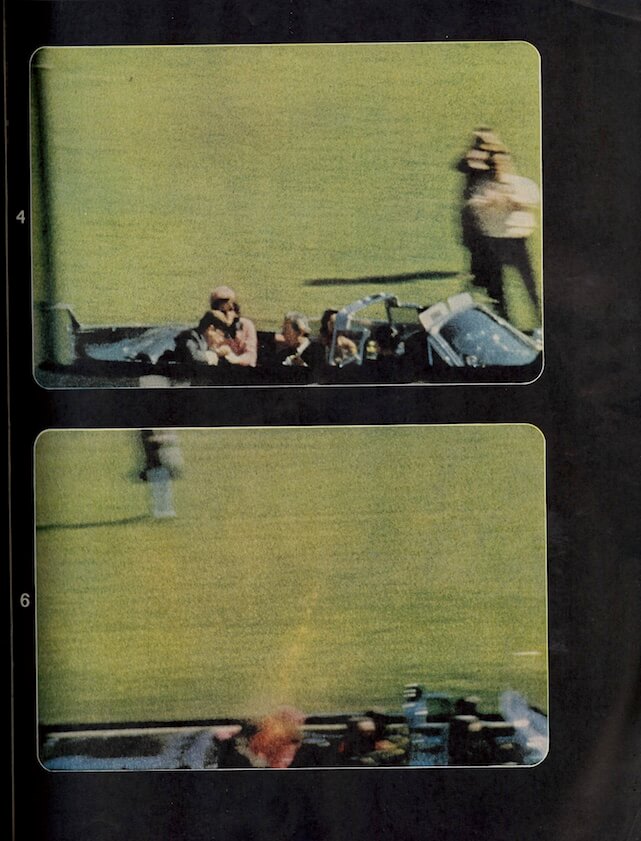
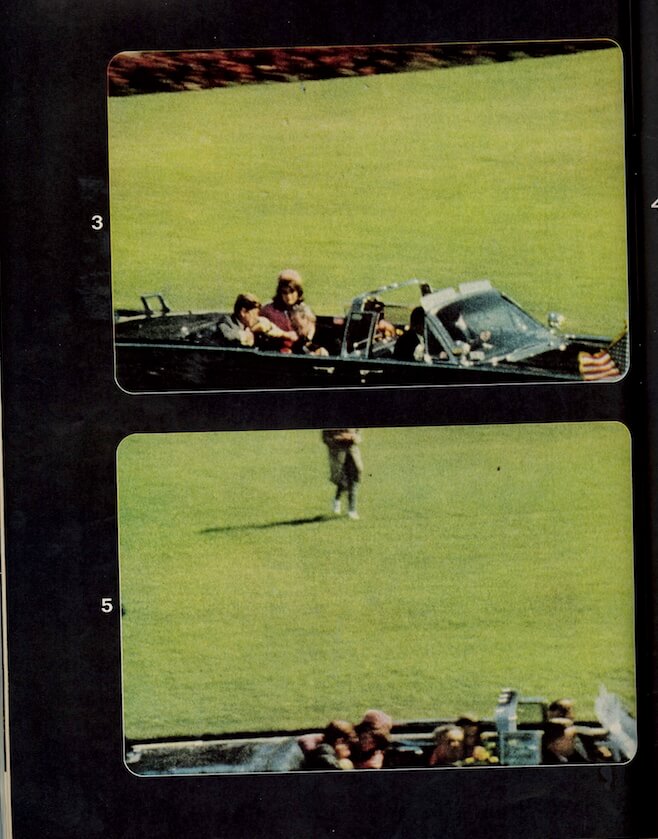
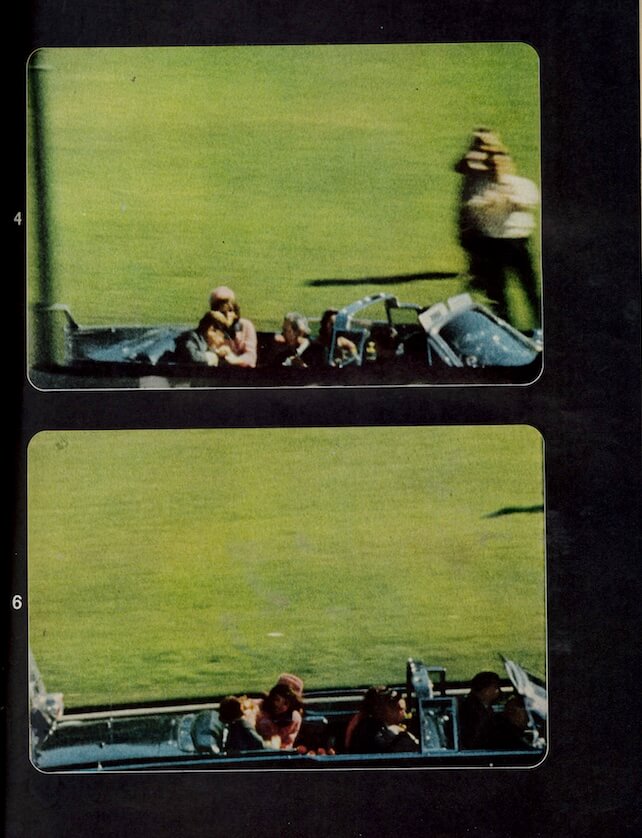
      Exhibit 5: Newsstand Frames 4 & 6  
     
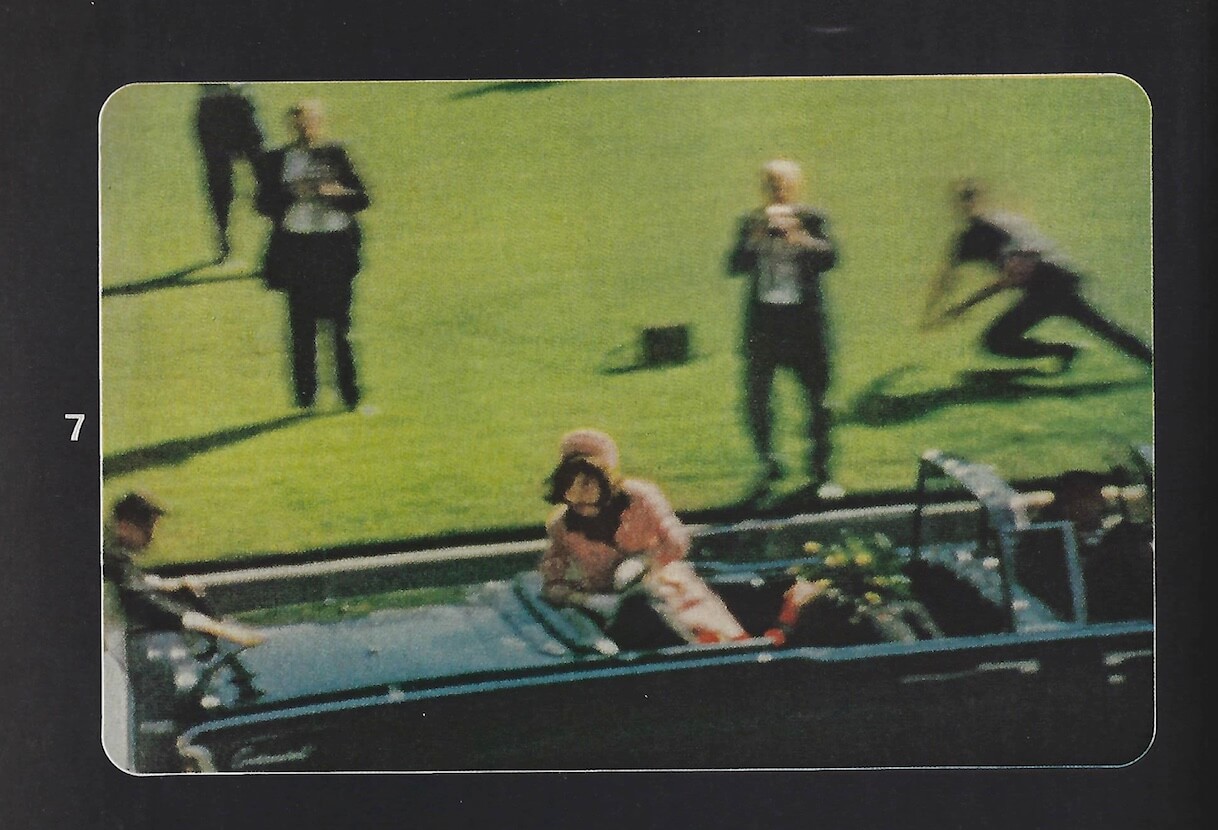
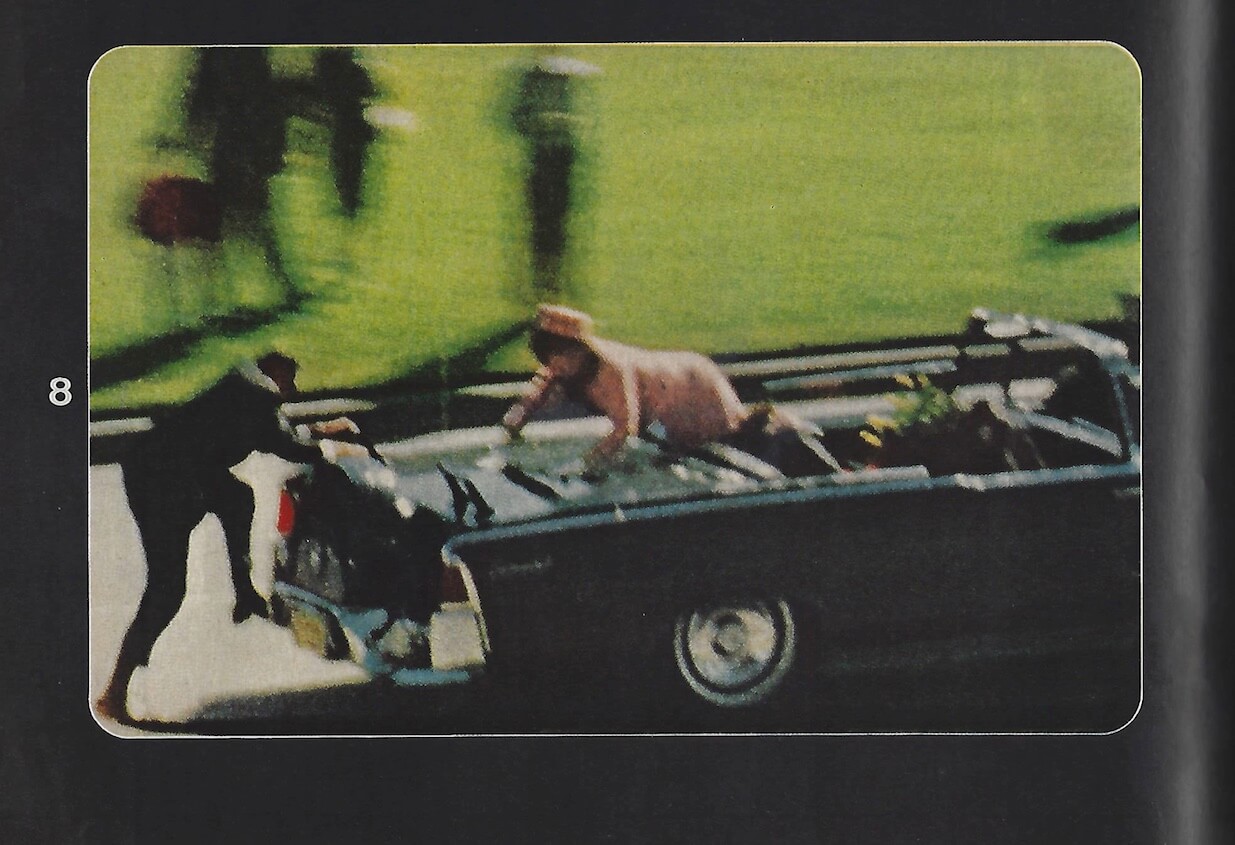
    Exhibit 6: Newsstand Frame 7   Exhibit 7: Newsstand Frame 8

    Next, the copy of the earlier version [V1], with exhibits numbered eight through fourteen:

     
    Exhibit 8: Alternate Cover   Exhibit 9: Alternate p. 42
     
    Exhibit 10: Alternate Frames 1 & 2   Exhibit 11: Alternate Frames 3 & 5
       
      Exhibit 12: Alternate Frames 4 & 6  
     
    Exhibit 13: Alternate Frame 7   Exhibit 14: Alternate Frame 8

    The feature begins with a story by Gerald Ford on the workings of the Warren Commission. On this same page are also eight captions describing the corresponding eight still frames of the Zapruder film displayed on the next four pages.

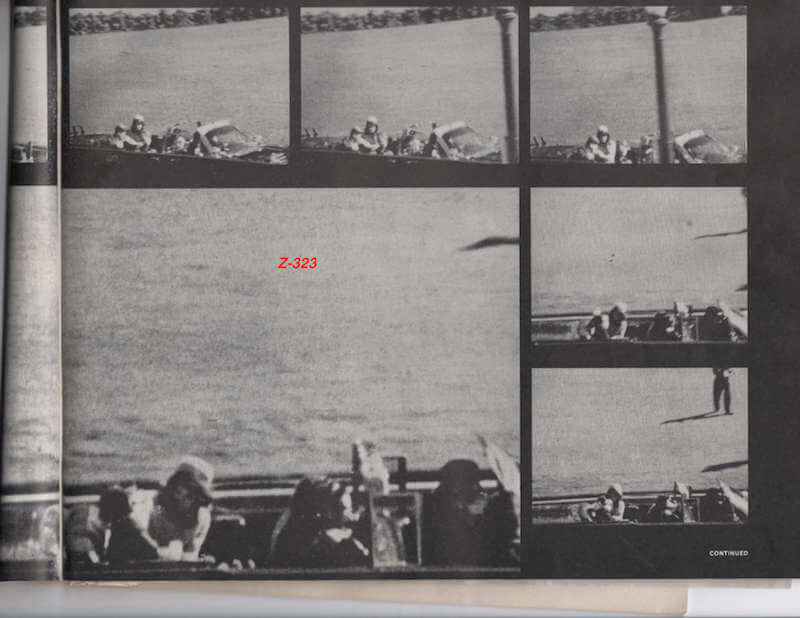
    The difference between the two issues (I reserve comment on the putative second version [V2] since I have not seen it) centers on the frame 6 Zapruder film still and its corresponding caption. The earlier alternate version [V1] (produced before the final issue version was sent to the newsstands) shows JFK’s head and body up against the rear seat cushion, suggesting, when seen in sequence with the preceding frames, that he had moved backwards and to the left (see exhibit 12). This frame corresponds to Z-323. The caption for this frame on page 42 reads as follows: “The assassin’s shot struck the right rear portion of the president’s skull, causing a massive wound and snapping his head to one side” (see exhibit 9). The caption, however, seems to be telling you something different from what your own eyes tell you. Would you, from comparison with frame 5, exhibit 11, be led to conclude that JFK’s head was “snapping to one side” or backwards and leftwards?

    With the newsstand issue [N], this Zapruder frame has been swapped out in favor of Z-313, which shows the famous halo of red exploding on the right side of JFK’s head (see exhibit 5). The caption for this version now reads: “The direction from which shots came was established by this picture taken at instant bullet struck the rear of the president’s head, passing through, caused the front part of his skull to explode forward” [sic] (see exhibit 2).

    While arguments have been made that the preceding frame, Z-312, in sequence with this one, shows the head moving forward, that motion (which may not be due to a bullet strike) is so imperceptible as to be negligible to the normal viewer, much less one perusing a selected sequence of stills. In fact, judging from the motion of the head, there really is no unequivocal proof of a bullet strike from the rear in the film, much less so in the frame that was originally chosen to represent the fatal shot (Z-323). One can only conjecture here that this was recognized by redaction. The misleading description of what is depicted in Z-323 already raises the suspicion that the authors of the feature struggled to choose a frame for the fatal shot which would unamibiguously support the offical story. The further possibility that Z-323 might actually suggest just the opposite (motion backwards) must have eventually led them to opt for the more gruesome frame they were evidently avoiding, because the latter showed that some blood, brains and skull went forward, implying (for the non-expert, at least) a rear-to-front bullet trajectory.

    It is the substitution of this telltale frame and caption that suggests an effort to make the newsstand version of the Life issue better conform with the Warren Commission’s single assassin findings; the swap was ostensibly made both to be more visually consistent with them, and to mask from the public the motion of Kennedy’s head and body which could denote, even via a still sequence, a bullet fired from the right front.


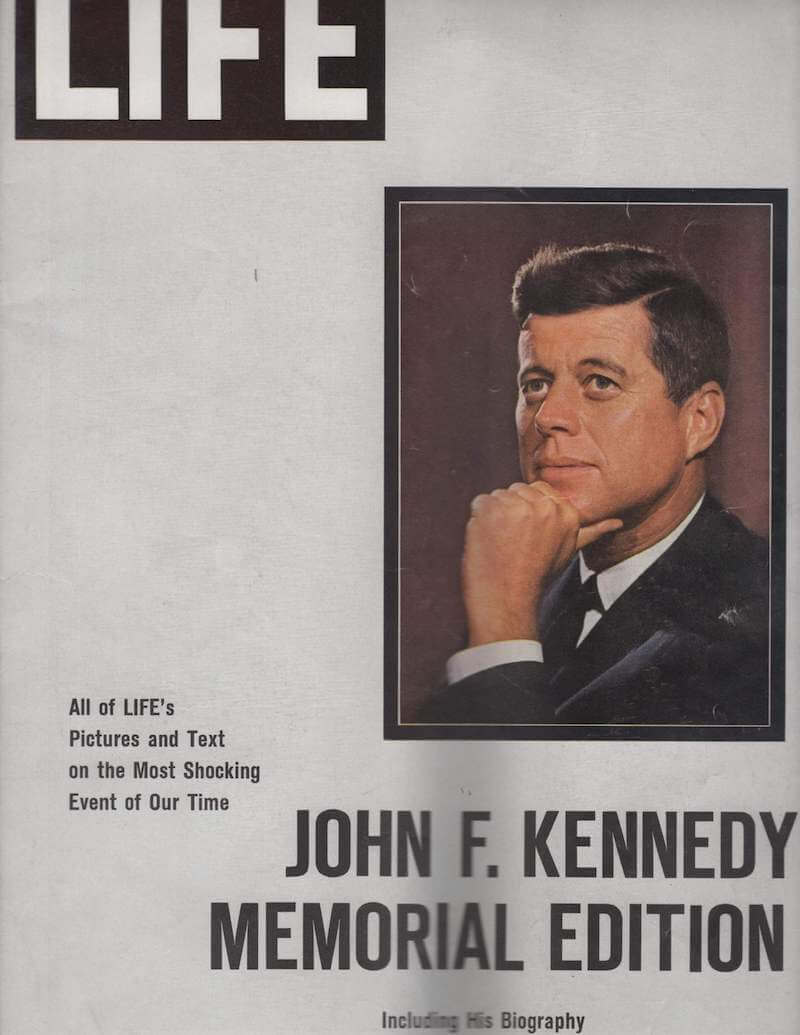
    There is a rather bizarre déjà vu in this legerdemain by the editors of the October 2, 1964 Life issue: something very similar had already been done once before. On November 29, 1963, Life published an issue mainly dedicated to John F. Kennedy and the assassination. This was a regular issue in that it contained, along with the assassination reportage, the usual full-page ads, unrelated features, and so forth. Shortly thereafter, Life decided to excerpt and rerun the relevant material from the November 29th issue in a separate, ad hoc volume, the John F. Kennedy Memorial Edition, of about 80 pages in length (only about 20 pages less than the total number of pages in the regular issue). The date is not clearly given on the cover or credits page, but the issue appears to have been published December 14, 1963.

    As can be seen from the covers, these two versions are readily distinguishable.


    The special edition, while carrying over what was originally published on November 29 (including the insert on LBJ), has also greatly amplified the text and photos for its now multifeatured retrospective on Kennedy’s life, presidency, and assassination. But what is most noteworthy for our purposes is the difference between the two versions in their respective presentation of the Zapruder film. What was in the regular issue a black-and-white, fuller sequence of frames is swapped out for a more limited, in-color, and somewhat magnified sequence of frames. The captioning is also very different.

    The November 29, 1963 issue carries the caption for the entire sequence:

    SPLIT-SECOND SEQUENCE AS THE BULLETS STRUCK

    There is no explicit commentary on the direction of the shots in this issue, except for what has been underlined. Here is a partial reproduction of the frame sequence, which is spread out over four pages:


    The December 14th Memorial Edition, on the other hand, carries the caption for the entire sequence, now running across the first two pages of the four-page color spread:

    SPLIT-SECOND HORROR AS THE SNIPER’S BULLETS STRUCK

    One immediately notes the not-so-subtle variant, “horror”, and the addition of “the sniper’s” in the singular. The selected frames are now larger and fewer:


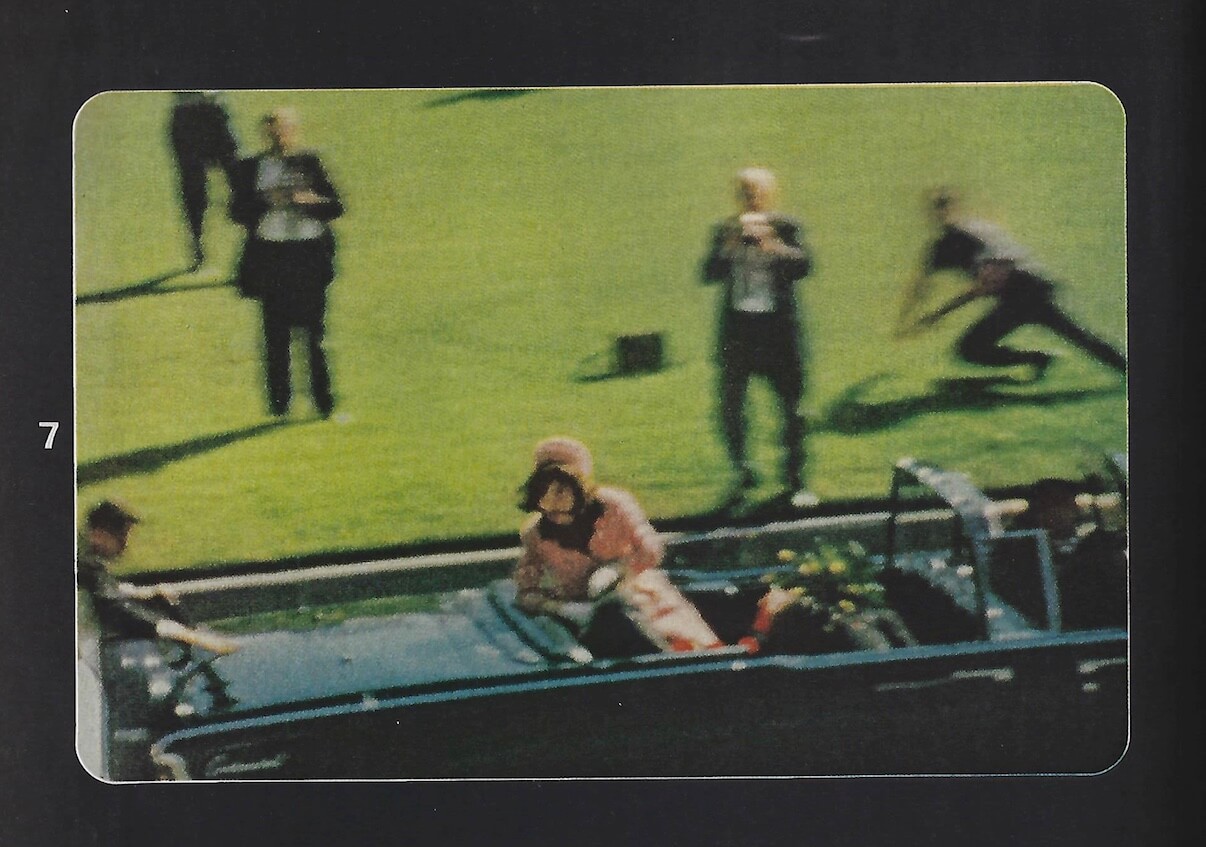
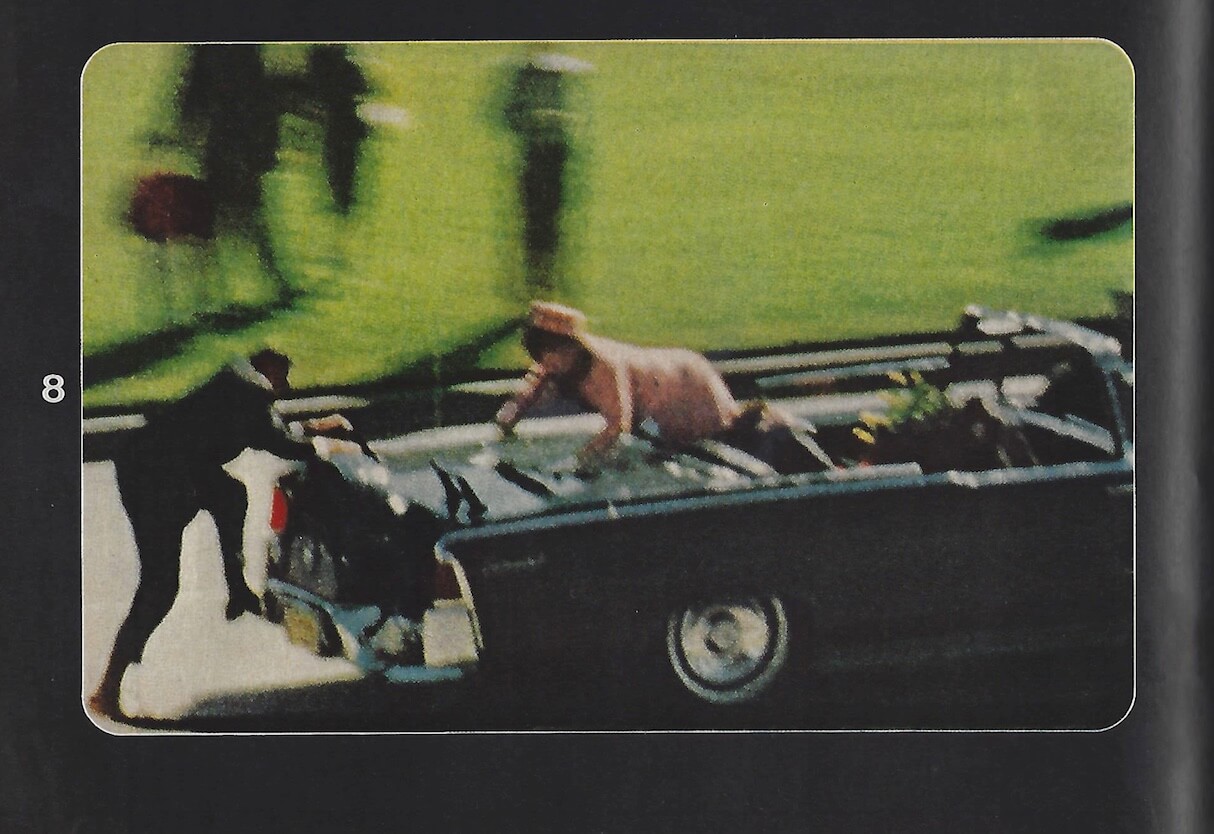
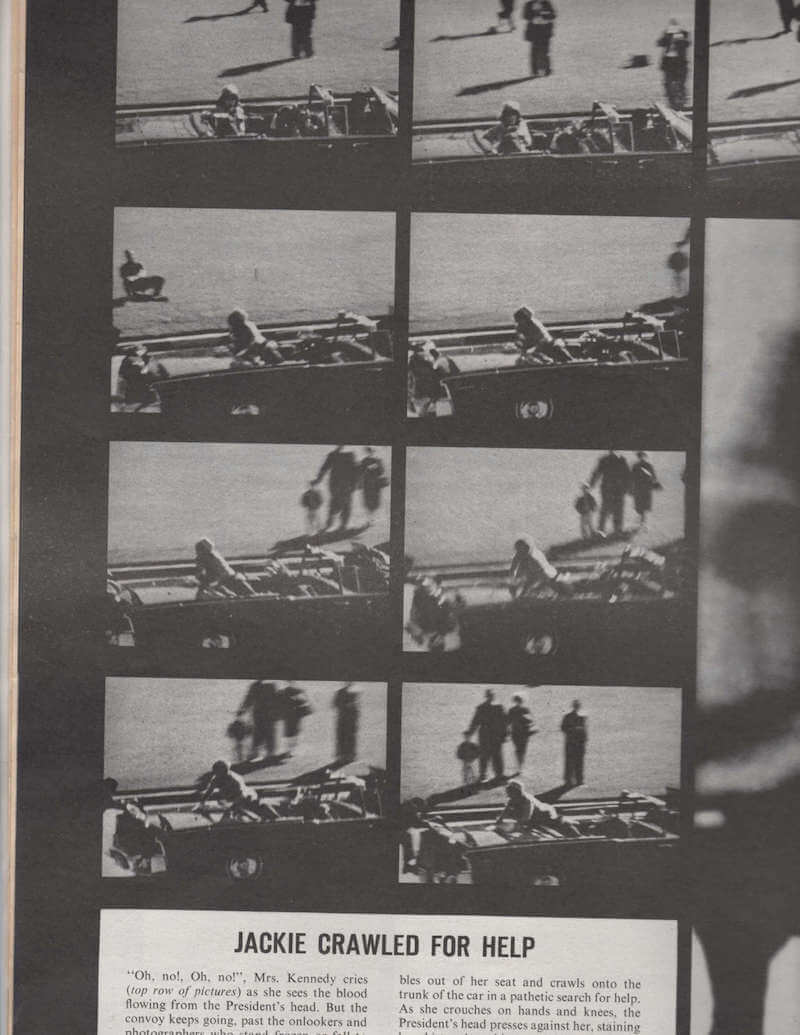
    One could, of course, argue that some of these changes were constrained by marketing choices. Color reproductions, something Life was famous for, would undoubtedly sell more copies. Given the relative expense of color vs. black-and-white, and the further magnification of some of the frames on the page, it might seem inevitable that parts of the previous frame sequence would be curtailed. On the other hand, the special edition contains a number of other color photos besides the full-page blow-up, also in the November 29th issue, of Jack and Jackie as they step off Air Force One at Love Field, which tends to undercut the idea that the change in the presentation of the Zapruder frames was guided by purely economic considerations. In any case, what was (quite conveniently) excised is telling: the frames following Z-323 depict JFK bouncing off the rear seat and Jackie scrambling out onto the hood, image sequences capable of raising questions in the reader about why JFK would move this way, and what Jackie actually might have been doing (other than crawling for help). The fuller sequence also hints at the embarrassing interval before Clint Hill reached the limo (we see in the special issue only three of those frames, two of which occupy the entire fourth of the four pages, not shown here). At the very least, providing answers to these questions would have embroiled the magazine in something more easily left to silence.

    But even if these frames were innocently removed as a result of some sort of design decision, one frame substitution cannot so be explained. Indeed, we may ask ourselves, how is the fatal shot indicated in the black-and-white sequence in the original issue? The captioning is vague, but given the absence of both Z-312 and Z-313, and the fact that it is one of the larger frames, the only candidate for this is Z-323 (marked in red in the reproduction above). But where is this frame in the Memorial Edition? It has once again been removed, with Z-312 (also in red, above) now being used to “demonstrate” the bullet strike to the rear of the head (Z-313 was probably considered just too shocking for public consumption at that time). Granting Life the benefit of the doubt and attributing this change to “clarifications” afforded by the passage of two weeks between the two editions, it is still remarkable that no frame from the fatal wounding sequence after Z-312—much less Z-323—is printed in the special edition.

    Aside from this sleight of hand with frame selection and elimination, the Memorial Edition also exchanges the original text for significantly modified copy, which names Oswald and clearly places him in the TSBD, firing three shots with a carbine, and in general adds details that follow the official story more explicitly. In this regard, one is tempted to reflect further on the main caption it has borrowed from the original issue, not only because it now declares the shots to be from a single gunman, but because the switch to “horror” there almost seems too glib. At first blush the new diction might suggest an effort to render more vividly the shared experience of Dealey Plaza witnesses, to invest the description with evaluative, rather than simply objective, content (and direct that judgment squarely at the sole perpetrator). But the word also serves as a trace, a verbal stand-in for what has been visually erased, naming the very emotion that is simultaneously denied the reader through a fuller graphic re-experiencing of the event. If this rhetorical ploy is not cynical in origin, its final effect is nonetheless ironic.

    That such editorial “rethinking” occurred twice at a distance of ten months, both times involving, among other things, the suppression of the same Zapruder frame (Z-323), is astonishing and, from the standpoint of what was going on internally at Time-Life, puzzling. But in connection with this peculiar repeat performance, let us not forget what Life reporter Paul Mandel wrote in the December 6, 1963 issue in another article on the assassination, “End to Nagging Rumors: The Six Critical Seconds”. Mandel realized that Kennedy’s treating doctor, Malcolm Perry of Parkland Hospital, had said the bullet hole in his throat was an entry. Since the moment of that impact was considerably past the time Kennedy’s limousine could have been in front of the Depository building, and in fact, Kennedy’s back was now facing the alleged sniper, Life and Mandel had a serious problem with directionality. They solved it by blatantly misrepresenting what is in the Zapruder film:

    Since by this time the limousine was 50 yards past Oswald and the President’s back was turned almost directly to the sniper, it has been hard to understand how the bullet could enter the front of his throat. Hence the recurring guess that there was a second sniper somewhere else. But the 8mm film shows the President turning his body far around to the right as he waves to someone in the crowd. His throat is exposed—toward to the sniper’s nest—just before he clutches it.

    As Life must have known, since they had the film, no such movement exists. On December 14, Life is still sticking to this story, as can be seen by the caption to frames 1 & 2 above:

    Past the book warehouse the President turned to his right to wave to someone (1). Just as his car passed behind the road sign shown in the foreground the first bullet struck him in the neck. He clutched at his throat (2).

    Though less clearly articulated here, one has only to read further in the issue to find Mandel’s article reprinted under a slightly different title (“First Answers to Nagging Rumors: What Lay Behind Six Crucial Seconds”), but with essentially the same text containing the crucial gloss quoted above. The only way to sustain this ruse was to omit the intermittent frames which would have given the lie to this explanation. The frame with Kennedy waving has purposely been made the focus here; interestingly, it was missing from the black-and-white sequence in the November 29th issue, which shows only three of the frames before the limousine emerges from behind the Stemmons Freeway sign. In just four more days, however, this entire charade will no longer be necessary: on December 18th, the NYT and Washington Post will relate “autopsy findings” which appear to derive either from the FBI or possibly some earlier, destroyed version of the autopsy report, where the wound in the back/shoulder does not exit and the puncture in the throat is from an exiting fragment from the head shot; see this article by Jefferson Morley from 2012.

    Together with the Mandel story, the frame sequence evidence we have presented above establishes that at least three times in less than a year Life colluded in deceiving the American public about the circumstances of President Kennedy’s assassination.

  • Bullet Trails on the Zapruder Film?

    Bullet Trails on the Zapruder Film?


    Years ago, on a shadowy website for snipers, I saw an interesting complaint. It had to do with the problem of killing people in very humid weather. The sniper was concerned about bullet trails leading back to his hidden position. These tell-tale bullet trails are condensation, not muzzle flashes, and certainly not tracers.

    The trails he was worried about are water vapor. A bullet creates a partial vacuum in its path, and a vacuum is very cold. Moisture in the air condenses around things cold. If you quickly pump an aerosol can until it’s nearly empty, it will become cold inside, and the can will “sweat,” that is, moisture in the air will condense on it.

    In dry air, any vapor trails created are quickly absorbed. But in humid weather, vapor dissipates more slowly. That’s why you can see your breath in the winter only when it’s cold enough and humid enough.

    Here is what a trail caused by a 6.5mm, 122 grain bullet traveling very fast (over 3000 feet per second) through “very humid” air looks like, as recorded by a high speed camera:


    https://www.youtube.com/watch?v=LZ2a80vxvrY

    We do not know what kind of bullets were fired at Kennedy, or their muzzle velocity, but it is doubtful they were as fast as the one above. (Weatherman Dan Satterfield told me in a private email that at 12:30 in Dallas on that day it was 66 degrees, with a west wind of 15-20 MPH. He did not know the humidity, but it had rained earlier.)


    Trails on the Zapruder Film?

    I suspected that such trails show on the Zapruder film of the Kennedy assassination, especially in frame 313. But what I claim to be bullet trails leading to the head are assumed to be matter leaving from the head—the two long, fairly straight, white lines.

    On some of the earlier copies of the film, the lines are longer. On other copies, the lines are not only shortened, they are smeared together. I have been unable to find a copy of the film as clear as the one I saw years ago, but here is a copy of frame Z-313 that isn’t bad:

    Over 20 years ago, I showed those Zapruder frames to two scientists—one from the Jet Propulsion Lab in Pasadena, California, and one from the Weizmann Institute of Science in Israel—both of whom wish to remain anonymous. Both agreed: the lines are most likely bullet trails.

    In any case, they said condensation trails from bullets had to have occurred, whether seen or not.

    Since they would not allow me to quote them by name, I asked for a textbook reference on the phenomenon. One suggested a book I could not get my hands on. The other told me to look into the work of Daniel Bernoulli—and the phenomenon of an aircraft’s “wingtip vortices”, which are easy to see:

    Go here for a fuller explanation. (Note: these are not the “contrails” that come from a jet engine’s exhaust. The wingtips are not excreting vapor, they are causing it to form.)

    (I am not the only researcher to suggest the white lines are bullet trails. In the early 90s, when I went to Jim Lesar of the Assassination Archives Research Center to tell him of my findings, he had no comment, but showed me a letter from Robert Morningstar, another researcher interested in the white lines. Morningstar’s interpretation was nothing like that of the scientists. He called them “heat tracks.”)


    Exploding Brain

    Bullet-related exploding brain looks nothing like those lines.

    Consider what happens when a bullet fired by a high powered rifle perforates the skull: the bullet goes in and out, leaving holes in the skull that are almost the same size. Milliseconds later, a process known as “cavitation” takes place. Exploding brain thrusts open the skull, creating adherent as well as loose bone fragments, and a massive wound—usually on top, regardless of where the bullet enters. This process is known as “cavitation.” How it happens:

    “With high-velocity wounds, there is … a sudden sharp increase in intracranial pressure … (and a) temporary cavity … formed by the radial motion imparted by the missile, through creation of oscillating positive and negative pressure along the path of the missile …” (Youmans, J.R. (ed.), Neurological Surgery, Vol.4, p. 2056, W.B. Saunders Company) 

    Scientists discovered the difference between holes created by cavitation, and those created by exiting bullets when they shot empty skulls. Without brain or brain simulant, there is no cavitation. And both entrance and exit wounds were almost the same size. The exit wound is usually only slightly larger because the bullet deforms or tumbles. Sometimes the bullet takes a small amount of adjacent skull with it, and then the hole is bigger.

    If exploding brain creates massive holes—and we know JFK had a massive hole at the top of his head extending into the right rear—then how could exploding brain appear as two long, rather straight, slender lines? Or, as some say, exiting bone fragments leaving the head, one behind the other?

    Fluid forced through small holes under high pressure will come out as long streams—but would such streams have the strength to blow off so much bone?

    And why would they remain in the air—afterward?

    The more visible line seen on the Zapruder film is broken into small, fairly evenly spaced, individual bits. Magnified, the bits seem to be little spirals. The most prominent one lies across Kennedy’s head in frame 313, leaning to the right at about a 50 degree angle.

    This bullet trail—if that indeed is what it is—suggests the bullet skated across Kennedy’s right temple, creating a shallow tangential wound that flipped out a flap of bone—and kept on going.


    Did Rockefeller Commissioner See Those Lines?

    An exchange between Robert Olsen of the Rockefeller Commission and John Lattimer, MD, who examined the autopsy materials (President’s Commission on CIA Activities, 1975, pages 28-30):

    Doctor, did you find any evidence whatever that would support postulating a tangential shot from the front or right front which would not have penetrated the President’s head, but merely would have glanced off the right side of his skull?.

    Lattimer said he saw no such evidence.

    What about the possibility of the President having been struck from the rear … and then that being followed, within a fraction of a second, by a tangential blow by a bullet from the front, or the right front, glancing off the right side of the head? Is there any possibility?

    Again Lattimer said he saw nothing to indicate that. But why did Olsen ask such questions?


    Following the Trail

    In the early 90s, I went on a fool’s errand to Dealey Plaza to see if I could find where that bullet trail might have led back to. The most likely spot, in my non-expert opinion: The sniper was to the left of Zapruder, firing from behind the pergola through one of the lattice holes, about midway between the left and right side of the crescent-shaped structure, concealed from behind by the parked cars. The shot would have been nearly horizontal.

    All just conjecture, of course.

  • The Murder of Hammarskjold

    The Murder of Hammarskjold


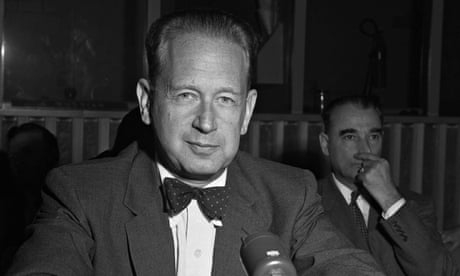
    Dag Hammarskj ld 011For a long time this site has tried to point out that the Congo struggle was one of the most important, yet underreported, foreign policy episodes that took place during the Kennedy administration. Sloughed off by the likes of MSM toady David Halberstam, it took writers like Jonathan Kwitny and Richard Mahoney to actually understand the huge stakes that were on the table in that conflict, namely European imperialism vs African nationalism. Kennedy had radically revised America’s Congo policy from Dwight Eisenhower to favor the latter. Not knowing he was dead, JFK was trying to support Congo’s democratically elected leader Patrice Lumumba. JFK was also one of the few Western leaders trying to help UN Secretary General Dag Hammarskjold stop the Europeans from crushing Congo’s newly won independence.

    In September of 1961, just eight months after Lumumba was murdered, Hammarskjold died in a plane crash. It was officially ruled an accident. But there were doubts from the beginning. For example, Harry Truman told the New York Times, that Hammarskjold was on the verge of getting something done “when they killed him.” It now turns out that Kennedy’s ambassador to Congo, Edmund Gullion, also suspected Hammarskjold’s plane was shot down. And he suspected it the night it happened. This key fact was not revealed for fifty years.

    Below we link to three stories in the press of late that have finally circulated about the true circumstances of what happened to the Secretary General, the man who Kennedy called, “the greatest statesman of the 20th century.”

    It is nice that the MSM is finally catching up to what we wrote about 20 years ago in Probe Magazine.  In particular:

    In the first of these two articles, Jim DiEugenio lays out the overall struggle of Kennedy and Hammarskjold to keep Congo free and united against the imperial forces of Belgium and England. In the second, Lisa Pease examines the murders of Lumumba and Hammarskjold within eight months of each other. Those assassinations left Kennedy standing alone. When he was killed, the imperialists triumphed.

    During the ensuing decade, CTKA continued to focus on this important story, again underscoring the links between Kennedy and Hammarskjold, but now reinforced by the work of historian Greg Poulgrain with regard to their cooperation over Indonesia. See:

    Finally, two decades later, the MSM is acknowledging that work. We don’t like to toot our own horn, but … Honk! Honk!

  • Gayle Nix Jackson, Pieces of the Puzzle: An Anthology, (2017)

    Gayle Nix Jackson, Pieces of the Puzzle: An Anthology, (2017)

    While there is nothing particularly groundbreaking in her conclusions, the strength of her work lies in its systematic and powerful refutation of any attempts by naysayers or the mainstream media to explain away the numerous discrepancies between the ballistic, forensic, eyewitness and historical evidence of the case and the “official” story we’re spoon fed every anniversary of the tragedy by paid MSM actors standing in Dealey Plaza. While the book focuses heavily on the events surrounding the unsolved case of the alleged attempt on General Walker’s life in his home in Dallas, it also includes the author’s lengthy interview and subsequent correspondences with one key witness who heretofore had remained silent. Overall, while not a book for those not already deeply invested in the case–given how much research it presumes readers are already bringing to the table–it should appeal to those who are still interested in some of the finer details of the assassination, despite the hundreds of theories, allegations and mysteries that still are so much a part of this, the crime of the century.

    Pieces of the Puzzle is written mostly by the author, Gayle Nix Jackson, whose grandfather’s (Orville Nix) grainy 8mm home video of the motorcade stands beside the Zapruder film as one of at most three total films of the incident captured that day. Four contributing members of the JFK research community also weigh in with individual chapters on their respective experiences or research findings: James Wagenvoord, Steve Roe, Doug Campbell, and Chris Scally all do a fine job in adding their unique perspectives to the book. The chapters dovetail together neatly, and more than anything, they paint a vivid and compelling picture of the bizarre tapestry that was early 1960s Dallas. From disgruntled Cuban exiles shuttled across the Gulf of Mexico and placed in strange intelligence-gathering asset roles through organization’s like the Cuban Catholic Committee, to Jack Ruby’s frantic dealings with underworld contacts and the CIA, to homegrown American Nazi factions seeking political recognition in this turbulent time of desegregation; more than anything, Pieces of the Puzzle presents a fascinating and often disturbing window into the dark side of the United States at mid-century. What readers will probably take away from this extensively researched work is the sense that the United States–far from ever being a stable nation with a strong identity based around a unified populace that somehow came “unhinged” during the 1960s–has really never found peace with itself. From the horrible legacy of a failed Reconstruction, to the lackluster federal civil rights initiatives prior to Kennedy, to the seemingly intrinsic destructive nature of the intelligence communities which have, since their inception in the postwar period, sought to undermine what limited democracy we already had, Nix and her colleagues leave readers with a painful reminder of why America was never “great,” in any fair sense of the word. That it could have been, had JFK, his brother, Dr. King and Malcolm X lived, is another story; but by this point, I don’t think I have to convince readers why they did not.

                                                                                     II

    The book opens with a fascinating first hand account by James Wagenvoord, who worked for LIFE Magazine at the time of the assassination. He details in thrilling fashion how he came to learn of the events that fateful day and how only eighteen hours later, the Zapruder film came into his company’s headquarters in New York. Delving into the whirlwind of activity at the office that day, he makes an important point about how events seemed oddly pre-planned to implicate Oswald despite less than a day having elapsed from his already strange arrest, his identification in the window by a still-unknown caller tipping off Dallas police, and no serious investigation into his past. An FBI agent visiting Wagenvoord that day presented him a manila envelope. “ ‘This is Oswald material’, he said.” Wagenvoord continues, “The film was footage, shot weeks earlier by a New Orleans television station news cameraman, of Oswald handing out Pro-Castro flyers on Canal Street near the World Trader Center in New Orleans. An hour later The Fat Lady sang an encore. Jack Ruby shot Oswald.” (p. 23)

    As researcher John Allen Stern noted in his excellent book C.D. Jackson: Cold Warrior for Peace, Time-LIFE, owned by Henry Luce, a dear friend of CIA Director Allen Dulles, and headed by C.D. Jackson, a CIA asset and one-time special adviser of war propaganda to President Eisenhower, was fully in bed with the intelligence community as part of Operation Mockingbird, the CIA’s wildly successful disinformation and propaganda initiative that sought to compromise the, thousands of local, and the handful of major newspapers in America from the early 1950s onward. That LIFE was immediately in possession of the “facts” surrounding Oswald’s alleged Communist and pro-Castro ties only hours before he was murdered in a police headquarters parking garage should not be surprising. Wagenvoord was allowed to view the Zapruder film in a brief screening, and watched in disgust and shock as the now-infamous kill shot struck home. As he recalls, “I had seen it, an unspeakable piece of pornography.” (p.25) He notes:

    “An avalanche of images was already rolling in to the Time-LIFE building. Oswald standing next to a clapboard house holding a rifle, a folded newspaper in his right hand. Pictures of his Russian wife, Marina, were in transit. The magazine’s entertainment editor, Tommy Thompson, had rushed to Forth Worth, located her, and put her up in a motel the night of the assassination.” (p.25)

    Wagenvoord was also present when Orville Nix, whose own 8mm home movie of the events in Dallas was of interest to LIFE, found his way into his office.

    Also of note in this engaging first chapter is the payola racket Wagenvoord witnessed in his four years at LIFE. Recalling how company checks for minor, even inconsequential work found their way into the hands of active Warren Commission members Allen Dulles and Gerald Ford, he remembers the curious way they were justified:

    The check for Congressman Ford was ordered by Arthur Keylor, General Manager of the LIFE magazine division. I was called into his office and introduced to the Congressman’s senior aide. Keylor wanted a check for $5,000 from the department made out to Gerald Ford. My job? Rush the request through the corporate accounting office, turn it into a check payment ‘re: editorial services’, and have it back to his office within an hour. Sure. Got it. A frantic hour and I was back in the Keylor office with the check and a release for Ford’s man to sign, or at least initial, giving the money a reason to be transferred, e.g. translation publishing and licensing world rights to the Ford signed text and any upcoming work as a writer or signature. Actually, there had been no overseas action on the already published staff-written Ford-signed Warren Commission Results essay. (p.36)

    Upon being asked to deliver a visiting Allen Dulles a $1,500 check for rights to a 1500-word excerpt of his own book about spy craft that had been published in LIFE, Wagenvoord recalls, “I thought, ‘Holy shit!’ It was another of those ‘within an hour’ check runs. I handed a $1,500 check in an envelope to a Master Spy and said, ‘Great to meet you.’ He did not offer a hand to shake.” (p.38)


                                                                                   III

    The following few chapters spend considerable amount of time looking through the bizarre kaleidoscope of Dallas at the time of the assassination, and touch on many of the odds and ends surrounding the alleged attempt on ultra-right wing US Army General Edwin Walker’s life. As contributing author Steve Roe observes:

    If Dallas was a bowl of gumbo, here’s what went into that recipe in the early 1960s: part old antebellum southern tradition, part western cowboy, part jet-set businessman, part old time religion, part military patriotism and a big dash of ‘grab the bull by the horns’ mentality. (p.48)

    Roe traces the rise and reach of the John Birch Society, and exhaustively details its connections to figures like Walker and other prominent members of Dallas society. A small group of staunch anti-communist, largely racist and retrograde white men who sought in part a return to the pre-Reconstruction halcyon days when life was simpler:

    Dallas Birchers preferred a low profile with small gatherings or meetings held in homes or local civic clubs. An informal network was set up through personal contacts or friends. Occasionally an avowed Bircher would invite the general public to a talk. (p.52)

    Allied with these folks were the Cuban exiles driven from their land by Fidel Castro’s 1959 revolution and eventual takeover of the island from Fulgencio Batista. As Roe estimates:

    119,922 Cuban exiles entered the U.S. Legally from 1959-1962. After 1961, Castro still allowed Cubans to leave, but with only $5 cash and surrendering (sic) all their property to the new communist government. In the Dallas area, various churches provided assistance to the new emigres; however the most notable with the Cuban Catholic Committee. (p.54)

    I think this is an important fact to consider, as I feel too often we forget just how large in scope the Cuban exile population really was in Dallas. From these disenfranchised many, it would not be difficult to pull together a team with the full cover and backing of both the intelligence communities that had been training them for the failed Bay of Pigs invasion, and the various religious congregations that facilitated their ingress and egress from the area.

    The presence of prominent White Russians like George DeMohrenschildt and others further complicated the picture, given their own avowed hatred for communism in the wake of the Russian Civil War and the rise of totalitarian terror under Lenin and Stalin. Neo-Nazi groups were also found passing out anti-Semitic pamphlets in Dallas in 1963, and at one point, plastered a series of Jewish-owned businesses on Elm Street and Commerce Street with swastika-ridden decals which read, “We Are Back!” (p.117) I think some of the cryptic remarks Jack Ruby made about the assassination before his death which alluded to Nazis are a direct result of his personally seeing these stickers near the shops be frequented and his own Carousel Club, located on Commerce Street. The Holocaust was, after all, only eighteen years in the past at this point, and Jews like Ruby were no stranger to anti-semitism. Indeed, whether these fringe groups played a direct role, we cannot say for sure, and one of the strongest points of Nix’s book is just that: her and her co-contributors’ refusal to jump to conclusions without substantial evidence to support them. Yes, there were a lot of strange players in town that weekend. No, we are not attempting to tell you who killed Kennedy, all these years later. As the title aptly denotes, these are all “pieces of the puzzle” as it were.

    But what a puzzle indeed. Dallas in the 1960s was a hotbed of both disgruntled exiles and homegrown “patriots” who largely conflated nationalist decolonization attempts and socialist reforms, both abroad and at home, with the looming specter of real totalitarian communism as practiced in China, the Soviet Union, and to a lesser extent, Castro’s Cuba. For many of them, John F. Kennedy, rather than a figure for peace, Third-World independence, social justice in the inner city, and reconciliation with the Soviet Union, was a communist traitor. Thus, in light of the assassination plots which were either aborted or thwarted at the last minute in places like Miami, Tampa, and Chicago, the successful one pulled off that November 22 in Dallas had a significant proportion of the city who did not mourn JFK’s untimely end. That Dallas Mayor Earle Cabell, brother of CIA Deputy Director under Allen Dulles, Charles Cabell – who Kennedy fired, along with Dulles, after the Bay of Pigs disaster – was a CIA asset is also troubling, given that he was on the phone with Dallas Chief of Police, Jesse Curry, immediately following Oswald’s arrest.

    General Edwin Walker, a far-right former U.S. Army officer who lived off Turtle Creek Road in Dallas was sitting in his study one April evening, having returned from a coast to coast anti-communist speaking tour, when a single shot rang out from the darkness outside his home. Missing his head by only a few inches, the infamous Walker shooting, as it became known after the JFK assassination, was of course attributed to Lee Harvey Oswald, despite an extremely tenuous explanation of his whereabouts that night, contradictory eyewitness testimonies of the shooting, and as Gayle Nix Jackson explains, Walker’s own bizarre back story.

    While many have detailed the life and times of General Walker, including his role as a sort of agent provocateur at Ole Miss, where, in 1962, he helped incite a large race riot in his attempt to preserve the legacy of a segregated South, Pieces of the Puzzle presents a few more strange clues as to what may or may not have happened that fateful night of the shooting. Nix claims she was given a taped interview in 2013 of one David Surrey, son of Robert Surrey, General Walker’s aide-de-camp during his time in Dallas as a rabble-rouser and right-wing public speaker and author. Robert, who flew the Nazi flag outside his Dallas home, and whose wife wrote under more than twenty aliases in her own propaganda efforts to prop up fellow American Nazi Party and John Birch Society initiatives, stated four separate times during his Warren Commission testimony that he arrived at Walker’s house after the shooting. However his son clearly remembers the family being in General Walker’s Turtle Creek residence when the shot rang out, since his father shouted for him and his brother to hit the floor. David also distinctly remembers he and his father driving off immediately after and pulling up behind a parked car about three blocks away shortly after circling the neighborhood. “My dad got out and went up to this car. A guy got out of this car. It was dark and I couldn’t see at night. He (Surrey) says, ‘Did you get him?’ And he said, ‘No I missed.’ At the time I thought he meant he didn’t see the guy who shot at him, they looked for him and just missed him.” (p.218)

    Interestingly, a Dallas Police Department report of the night of the shooting states Robert Surrey was indeed present at the home when they arrived. Why Surrey would concoct a story for his Warren Commission testimony is strange; if there were not some alternative explanation of who was really responsible for the Walker shooting, or any of the events that transpired that night, why not just say you were there? Also of note is that during his Warren Commission testimony, he offhandedly mentioned that when he “arrived,” at Walker’s house and saw police digging the bullet out of the wall, he facetiously asked if they’d found a bug:

    Mr. Jenner: Would you explain your facetious remark? I don’t get the fact that it is facetious.

    Mr. Surrey: Well, actually, it may not be. It is a common joke around the General’s house that there may be microphones. (p.220)

    The Surreys, who also helped Walker run the American Eagle publishing company, which promulgated fascist literature around the Dallas area, were convinced that a looming Communist menace threatened the Western way of life, going so far as to construct a doomsday home deep in the Oklahoma wilderness, complete with rotating machine gun turrets high on the roof, with the compound accessible only by fording a shallow creek, complete with a military-grade field telephone and other survival systems. Robert Surrey’s Dallas home was later found to contain an elaborate and hidden audio surveillance system which the FBI dismantled and confiscated decades later before a new homeowner was allowed to move in.

    This is curious enough, but as Nix discovered, both of Surrey’s surviving sons distinctly remembers their father, Robert, shooting rifles in the backwoods of what is now Richardson, Texas with a friend he introduced as “Lee.” Dad insisted that the kids, who he took separately on multiple occasions, pick up the spent shell casings. That Oswald’s notebook was found to have both General Walker’s and Robert Surrey’s phone numbers scribbled in it is another issue we are not able to square away with the Warren Commission’s ridiculous description of Lee Oswald as a disgruntled ex-Marine turned Communist. It’s another of the glaring discrepancies the MSM could never bother to explain. The “backyard photo” of Oswald (Which many rightly believe was doctored), showing him with rifle in hand brandishing two diametrically opposed “Communist” newspapers is just as sloppy a frame-up job as the official story, which has him taking a pot shot at an ultra-right wing U.S. Army general on the one hand, and months later, assassinating probably the most progressive president in U.S. history on the other. It only makes sense if the public is never made aware of these facts, just as Oswald’s “radical” and “Pro-Castro” life and times in New Orleans only make sense – and barely at that – if you ignore the fact that he was working out of hard-line anti-Communist Guy Bannister’s office at 544 Camp Street.

    Nix’s final chapters are especially strong, given her personal involvement with her grandfather’s missing original footage of the assassination, and her own recent interview of one Father Walter Machann, a lead coordinator for the Catholic Church’s efforts to relocate and employ Cuban exiles in Dallas and its surrounding suburbs. Of particular import is the fact that Machann remains adamant that the night Silvia Odio met Lee Harvey Oswald, along with two of his associates, was the same night Janet Leigh, a prominent actress, was in town. He remembers this because he was upset that Silvia, a close friend of his, did not invite him out with her. Since that night was September 27, 1963, this makes it impossible, logistically, for Oswald to have been where the Warren Commission said he was that evening: in Mexico City. Most of the evidence now strongly indicates that Oswald was not there, that someone impersonating him actually visited the Cuban consulate, as evidenced by the fact that there is no single picture of him being taken by the CIA hi-tech cameras located around the area he was alleged to have visited. Further, the FBI concluded it was not his voice on any of the retrieved tapes of his visits to the consulate, that is also a major blow against the Warren Commission’s conclusions. But to have a corroborating eyewitness who is still alive and who clearly remembers that night is one more piece of the puzzle, so to speak. And for Nix to have tracked him down and cultivated a relationship with him that culminated in an extensively documented interview on his life at the time of the assassination is a really strong part of what makes this book important. As Father Machann, himself a doubter of the official narrative bestowed upon the American people in the wake of the assassination, told Nix, “I think it was power at the very highest levels.” He continues, “I’m just afraid this was a power elite type of conspiracy. They have the confidence of power. They can do all kinds of things.” (p.308).

    While it is beyond the scope of this review to detail all aspects investigated in Pieces of the Puzzle, suffice it to say that the reader is left not only with a profound sense of bewilderment at the intertwining of so many colorful characters, agencies, and henchmen who either directly or tacitly facilitated or possibly orchestrated the assassination of JFK, but a real sense of disappointment that it is up to private citizens like Nix and her associates to solve what should very plainly have been solved in its immediate aftermath. And yet, as we have seen in countless other instances, books, and articles, the true genius of those who planned this tragic affair, lies in the cover up. Instead of refining the details and curiosities of a monstrous crime against the American people, prosecuted by a fair and balanced panel of experts, physicians, and eye-witnesses, we are left, in the wake of the Warren Commission and the actively-sabotaged Jim Garrison trial of Clay Shaw five years later, with a nearly impossible task. Piecing the puzzle together, as Nix and her colleagues remind us through their painstaking work, is a potentially impossible undertaking, given the time elapsed, the deaths of key players, the CIA’s continual and illegal refusal to fully declassify in unredacted form its full catalog of JFK files, and a complicit US mainstream media whose agenda, if not fully sinister, is so averse to truth, that it remains unwilling to seriously engage with any version of the JFK narrative that runs contrary to the lies upon lies we have been forced to endure for fifty-five years. As James Wagenvoord argues:

    …the mystery continues; lower-case details add texture and dimension to the story as it continues to unfold. Now, more than half a century after bullets smashed into a young President, individual jig-saw pieces are still being fitted in place, filling out the truth of how and why. (p.12)

    I would recommend this book to those already heavily invested in this case, as there were numerous caveats and lacunae that, while perhaps just that, could truly open up doors to those who specialize in that particular field. Those interested in the minutiae of the Cuban exile population’s comings and goings in Dallas in the early 1960s will definitely enjoy that chapter, and for anyone seeking a comprehensive timeline of the wanderings of Orville Nix’s original film, Gayle Nix Jackson’s final chapter is a must-read. Overall, I enjoyed Pieces of the Puzzle, despite the few times it seemed to bog down in extraneous details, particularly in the Machann chapter– we don’t really need to know what kind of furniture he had in his house during the interview, or what his son is doing overseas. But overall, especially in comparison with the myriad of disappointing manuscripts that should have never been published on the JFK case, this is a serious book, for serious researchers, written at an expert level.

  • JFK and Far-right Conspiracy Rhetoric

    JFK and Far-right Conspiracy Rhetoric


    The untimely demise of John Fitzgerald Kennedy has been an event of deep analysis and obsessive investigation. His death has even been used as a political tool to justify the belief systems of various individuals and groups. We’ve seen this extensively with the far-right, and its use of assassination conspiracy rhetoric to prove the existence of a “deep state” or shadow government e.g. Roger Stone. In their minds, the JFK assassination was a coup that toppled the government and proved that even the US president wasn’t untouchable. I plan to examine these theories, and determine whether there’s any truth behind them. Is the Kennedy assassination truly a product of the “deep state”, or the paranoid delusions of far-right conspiracy theorists?

    Far-right JFK assassination conspiracy rhetoric is not new

    One of the earliest far-right groups to discuss a conspiracy behind the Kennedy assassination was the John Birch Society. Founded by wealthy candy manufacturer Robert H. Welch in 1958, the John Birch Society was and is a right-wing anti-communist group. Mr. Welch named the society after an American airman killed by Chinese communist militants at the end of World War II. Welch believed that communists were inherently evil and omnipresent and that they were involved in a far-reaching conspiracy to rule the world. Welch was so fixated on this idea that he actually made up a quote by Lenin in order to propagate the world conquest concept. (Mulloy, p. 139)

    The John Birch Society did not just believe, as Joe McCarthy did, that certain elements of the government were infiltrated by communists. They also believed that, for example, the civil rights movement was being run from Moscow. They therefore opposed Kennedy’s civil rights act which was eventually passed after his death in 1964. Their excuse for opposing the bill was that it was an example of Washington overriding the doctrine of states rights. (Mulloy, p. 110) In that regard, it may be important to note that Harry Lynde Bradley and Fred Koch were among the society’s founding members. (Mulloy, p. 9) Bradley was part of the Lynde and Harry Bradley Foundation, and Fred Koch was the father to Charles and David Koch, who to become incredibly influential in the political field today.1

    Mr. Welch describes his view of the worldwide communist conspiracy in The Blue Book of the John Birch Society:

    Communism, in its unmistakable present reality is wholly a conspiracy, a gigantic conspiracy to enslave mankind; an increasingly successful conspiracy controlled by determined, cunning, and utterly ruthless gangsters, willing to use any means to achieve its end. (Mulloy, p. 3).

    Welch’s beliefs–which remind us a bit of George C. Scott’s General Turgidson in the film Dr. Strangelove–were major components of the John Birch Society. They seemed to be pervasive amongst its membership. And as in Dr. Strangelove, Welch preached against water fluoridation as some sort of an anti-American plot.

    Revilo Oliver and the JFK Assassination

    Therefore, it was no surprise that when Kennedy was assassinated the JBS formed a conspiracy narrative surrounding his death. In a Dec. 15, 1963 advertisement the JBS proclaimed: “We believe that the President of the United States has been murdered by a communist within the United States” (Mulloy, p. 84). This was a fair assumption, seeing as Lee Harvey Oswald was considered the perpetrator, and was a fairly well known communist in New Orleans. But their views get muddier down the line.

    Welch believed that the assassination was planned by communists “high up in their hierarchy” within the U.S. (Mulloy, p. 85). Welch’s colleague, former congressman Martin Dies, disagreed with this assertion. He believed that Oswald “was acting under instructions which had their original source in Moscow” (Mulloy, p. 85). These instructions were relayed to Oswald by Fidel Castro. (Although he never had solid proof of this accusation). Another founding member of the JBS, Revilo Oliver, believed there was a “communist conspiracy” that killed the President.

    Surprisingly, all three men did agree on one aspect of this large scale communist conspiracy. They believed Kennedy was assassinated to “…attack and discredit, if not destroy, anticommunist and other conservative forces within the United States, including the Birch Society” (Mulloy, p. 85). This was largely based on the prominent rightwing elements and figures in the city of Dallas, where JFK was killed. They agreed that this communist conspiracy was planning to blame “right-wing extremists” for the assassination, and this would lead to the persecution of conservatives:

    Thus the mind of America was to be converted temporarily into an unreasoning mob mind, boiling over with misunderstanding, anger, and excitement. And with that springboard from which to jump, the wholesale arrests of anti-Communists was to have been carried out just as rapidly as possible. (Mulloy, p. 85).

    If this sounds a bit illogical—a communist assassin causing pogroms against the right—prominent Bircher Revilo Oliver tried to elucidate it all. Oliver’s February, 1964 article Marxmanship in Dallas adds more layers to this communist takeover conspiracy. According to Mr. Oliver, Kennedy was a part of the secret communist conspiracy that assassinated him. These communists were also planning for a large-scale domestic takeover of American soil.

    And if the vermin succeed in the occupation of our country, Americans will remember Kennedy while they live, and will curse him as they face the firing squads or toil in a brutish degredation that leaves no hope for anything but a speedy death. (Mulloy, p. 87).

    In Welch’s Blue Book he stated that both the American and Soviet governments were being controlled by the same secret cabal of internationalists, banking interests and corrupt politicians. Someone like Armand Hammer, who did business with the Soviets from an early date, would be an example. Later on, the Rockefeller family became a prominent target of their suspicions. This was done largely through the writings of Gary Allen. Allen brought out his first three books through the publishing group Western Islands, which was owned by the John Birch Society. Allen wrote about an internationalist conspiracy executed through groups and organizations like the Council on Foreign Relations. The Birchers saw as this group’s ultimate aim a betrayal of America to a one-world socialist movement. They considered the United Nations as a stalking horse for that goal. The gradual movement would be from welfare state, to socialism and finally to communism. In Welch’s view, American liberals gave cover to this movement and were, in fact, acting as traitors. This is how President Kennedy fit into Revilo Oliver’s view of what happened on November 22, 1963.

    Revilo Oliver was a professor of the classics at the Univeristy of Illinois for a number of years before joining up with Welch and publishing in his journal American Opinion. There, in February of 1964, he published a two-part article entitled Marxsmanship in Dallas. Those articles met with some notoriety and he decided to do a series of lectures based on them. (WC Volume 15, p. 732) When he was called to testify before the Warren Commission, attorney Albert Jenner seemed mainly interested in finding out his sources for the article. It turned out that Oliver was strongly plugged into the rightwing propaganda network throughout the country, and one of his sources was the infamous and notoriously unreliable reactionary pamphleteer Frank Capell. (ibid, p. 724)

    Robert Alan Greenberg discusses more of Revilo Oliver’s views in Enemies Within: The Culture of Conspiracy in Modern America. “The conspirators had become impatient with Kennedy when his efforts to foment domestic chaos through the civil rights movement and ‘economic collapse’ had fallen behind schedule” (Greenberg, p. 110). Oliver’s article was heavily criticized throughout the media, and even lead to boycotts against the John Birch Society. Oliver was later expelled from the Society in 1966, for exhibiting anti-semitism during a speech. (For samples of Oliver’s work, click here http://www.revilo-oliver.com/news/tag/lee-harvey-oswald/)

    The JBS vs Chandler, Kennedy and Buckley

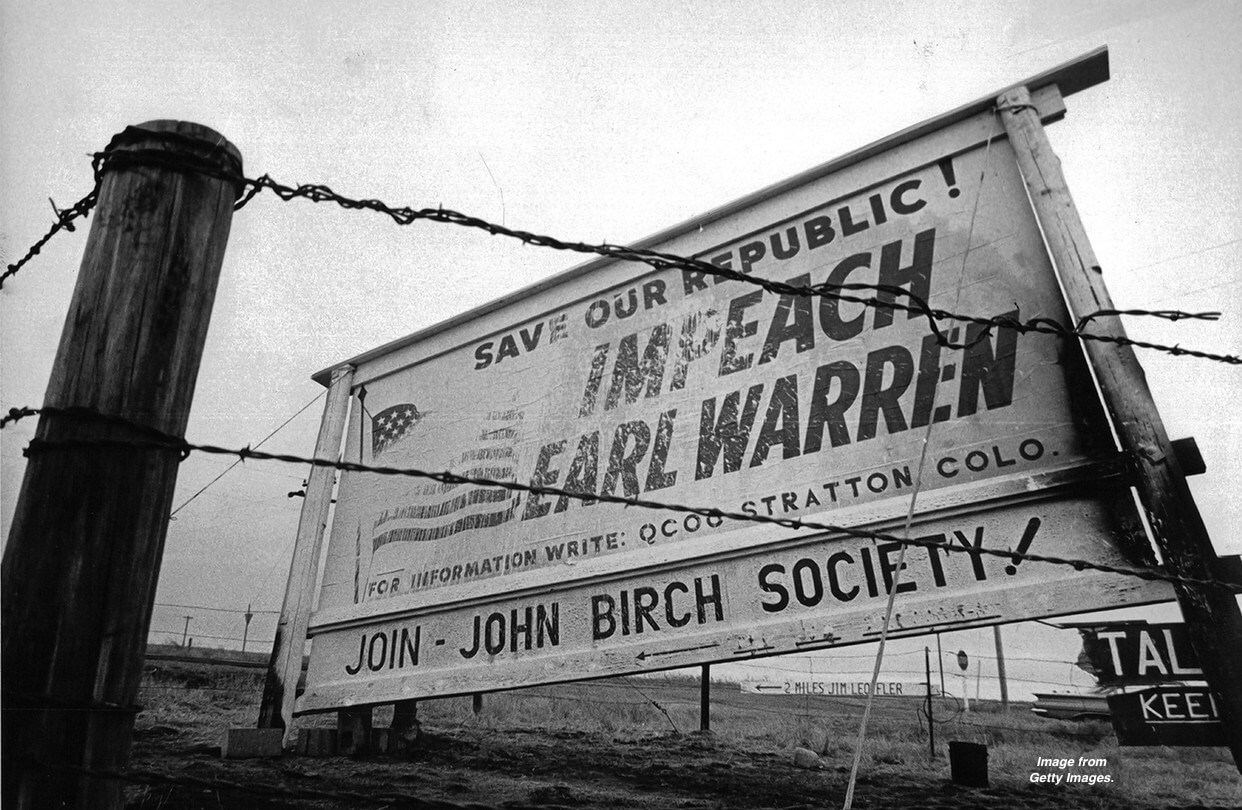
    By early 1961, the John Birch Society had an estimated 60,000 to 100,000 members.2 It published a journal which later came to be called American Opinion and later added a magazine called Review of the News. It had a central office staff and dozens of field coordinators throughout America. (Mulloy, p. 75) One of its favorite targets was Earl Warren and the Supreme Court. The John Birch Society is sometimes credited with beginning the “Impeach Earl Warren” movement. The Bircher view was that the Brown vs. Board decision coupled with the 1957 Watkins case—which allowed suspected communists to refuse to answer questions before congress—had now given the communists a free hand to infiltrate the civil rights movement. (Mulloy, pp. 110-12)

    It is important to note here that, even prior to Kennedy’s assassination, there began to occur significant splits in the conservative movement. In 1961, the newly appointed publisher of the Los Angeles Times, 32 year old Otis Chandler, decided that he was going to break with the much caricatured past of that predictably conservative daily. He began to hire reporters, sportswriters and even cartoonists away from other newspapers. He also decided to commission a five part study of the John Birch Society in southern California by reporter Gene Blake. That series was capped by a negative editorial about the organization. In fact, the editorial was rewritten by Chandler since he did not think it was hard hitting enough as a first draft. (“Otis Chandler: A Lion of Journalism” LA Times, February 28, 2006) His rewrite ended with this: “Subversion whether of the left or right is still subversion.” Richard Nixon approved of the editorial and so did Occidental College president Arthur Coons. (Pasadena Star News, August 29, 2017, “John Birch Society a Local Issue in 1961”.) In November of 1961, and perhaps not coincidentally, President Kennedy criticized both the Minutemen and the John Birch Society. (Mulloy p. 61) The founder of the Minutemen was a former Bircher, Robert DePugh. They were seen as a more militant version of Welch’s group who often had caches of arms on hand. Kennedy described these groups as “discordant voices of extremism” at work in America. He accurately described Welch as equating the Democratic Party “with the welfare state, the welfare state with socialism and socialism with communism. They object quite rightly to politics intruding on the military—but they are anxious for the military to engage in politics.” Kennedy was likely referring to the removal of General Edwin Walker from his command in Germany that year for distributing John Birch Society literature to his troops. (Mulloy, p. 43)

    Just three months later, William F. Buckley also joined in the continuing fusillade against the JBS. In the pages of his magazine–the February 13, 1962 issue of National Review–he penned a polemic entitled “The Question of Robert Welch”. Buckley’s attack was really about the competition for the leadership of the Republican Party. For in The Politician, a privately distributed manuscript, Welch had called President Eisenhower and his brother Milton, communist agents. (Mulloy, pp. 15,16) Buckley did not care much for Eisenhower himself, but he understood that this kind of unfounded accusation was a real liability for the future of the GOP. As he put it: “How can the John Birch Society be an effective political instrument while it is led led by a man whose views on current affairs are, at so many critical points, so critically different from their own, and, for that matter, so far removed from common sense?” Buckley ended up winning this struggle for control of the party, as the more Welch led the John Birch Society into a web of dark forces and unfounded conspiracy plots–the Illuminati and Adam Weishaupt–the more marginalized the Birchers became.

    In November of 1964, on the eve of the smashing Barry Goldwater defeat, in the pages of Harper’s, Richard Hofstadter had written his celebrated essay, “The Paranoid Style in American Politics”. It was largely about McCarthyism and how it had influenced Robert Welch. In October of 1965, Buckley moved to eliminate the John Birch Society from the Republican Party. (Mulloy, p. 102)

    The Spotlight

    Another major right-wing group that espoused assassination conspiracies was The Spotlight. The Spotlight was a weekly publication created in 1975, that was owned and operated by the Liberty Lobby. (Liberty Lobby was a far-right advocacy group created by Willis Carto, a radical right activist and Holocaust denier). Just like the JBS, Spotlight was permeated by far-right conspiracy rhetoric. “The paper endeavors to ‘get behind’ the important stories of current affairs, and often in doing so, expose the sinister machinations of conspiracies imputed to them” (Michael, p. 104). As such, it was no surprise that they presented their own conclusions of the Kennedy assassination.

    In 1978, The Spotlight published an article by former CIA officer Victor Marchetti detailing his investigation into the Kennedy assassination. Marchetti accused E. Howard Hunt (the famous Watergate burglar) of being involved in the plot to kill Kennedy. Mr. Hunt then sued The Spotlight for libel, and won in 1981. The case was retried. This time with famous JFK conspiracy author Mark Lane as Liberty Lobby’s defense attorney. The retrial was a success for Lane. In 1995 the jury decided that Liberty Lobby had not committed libel. The Spotlight was ecstatic, and believed the retrial answered a lot of questions about the Kennedy assassination.

    In Liberty Lobby’s 1986 book JFK: The Mystery Unraveled, they discuss all of the evidence discovered during the trial. A witness named Marita Lorenz was able to place Hunt in Dallas the day of the shooting; Hunt and Lee Harvey Oswald were said to be a part of the Bay of Pigs operation; Hunt supposedly bought guns from Lorenz and Frank Sturgis while he was in Dallas, etc. The list goes on and on. The book is filled with these types of statements, but never actually proves who killed Kennedy. “This series has not proven who killed Kennedy. But it has presented material in a form that has never been done before and it has shown you how to think about the assassination” (Liberty Lobby, p. 107).

    Liberty Lobby doesn’t even say that Hunt is the killer–just that he was involved in some way. “Hunt was a mid-level operative who took orders as well as giving them. Was he brought to Dallas (something he denies) to confuse the issue?” (Liberty Lobby, p. 107). However, the book does list 16 possible suspects including Jacqueline Kennedy, Aristotle Onassis, and “political zionists”. They spend a particular amount of time discussing the Kennedys and their pro-zionist, (or in Joseph’s case “anti-zionist”) policies. They even discuss the possibility of the Zionists conspiring with other groups to kill Kennedy. “Could internationalist Zionists, perhaps in cooperation with the international ‘movers and shakers’ of the Bilderberg group and Trilateral Commission, have planned and executed not only the assassination of JFK but the cover-up as well?” (Liberty Lobby, p. 107). This shows a remarkable lack of academic insight because recently decalssified documents show that, with the exception of Jimmy Carter, President Kennedy was the most fair arbiter in the entire 70 year saga of the Arab/Israeli dispute.

    The Patriot Movement        

    The Nineties saw an increase in far-right conspiracy rhetoric, particularly among the militia movement. The militia movement is a far-right social movement that focuses on the formation of small, antigovernment, paramilitary groups. Militias are a part of the overarching Patriot Movement, which is a large-scale far-right social movement. (Tax protesters, sovereign citizens, and Christian survivalists are also a part of the Patriot movement). Some commentators trace the origins of the movement to the JBS, and the Liberty Lobby.

    According to D.J. Mulloy’s American Extremism, the ideology of militia groups is completely influenced by conspiracy theory. “The embrace of conspiracy theories by militia members is the most well-known and most thoroughly documented aspect of their ideological and rhetorical concerns” (Mulloy, p. 169). Mulloy goes on to state that the Patriot Movement itself is dominated by conspiracy theory. “The conspiracy theories that dominate Patriot propaganda all have as a central theme the notion that the U.S. government, in collusion with international powers, is intent on disarming Americans and creating a one-world government” (Mulloy, p. 169). In fact one of the member groups, the National Alliance has published what many consider the battle cry book of the movement, The Turner Diaries, originally published in 1978.

    One of the top conspiracy theorists of the militia movement was the late William “Bill” Cooper. Cooper was a radio host and author who Alex Jones listened to as a youth. Which is ironic, as Cooper later denounced Alex Jones as a “liar” (“The Strange True Story of the Godfather of Conspiracy Theories,” Vice News, Aug 27, 2018). Cooper claimed to have been a former naval intelligence officer and to have served in Vietnam. He became a conspiracy theorist in the late 1980’s. His 1991 book Behold a Pale Horse, was considered his magnum opus. It was so popular among the members of the militia movement that it sold 300,000 copes. The Guardian even proclaimed his book: “the manifesto of the militia movement” (Vulliamy and Dirks, 1997). While Cooper began as a UFO researcher, he quickly transitioned into an investigator of the “New World Order”. In Cooper’s mind, the NWO was behind almost every sinister event in human history- even the JFK assassination.

    Cooper believed that President Kennedy was assassinated by Secret Service agent William Greer, as he drove Kennedy’s limo. “His assassination was ordered by the Policy Committee and the order was carried out by agents in Dallas. President John F. Kennedy was murdered by the Secret Service agent who drove his car in the motorcade and the act is plainly visible in the Zapruder film” (Cooper, p. 215). Cooper’s wild accusations didn’t just stop there. According to him, every witness that was close enough to see Greer was killed. “All of the witnesses who were close enough to the car to see William Greer shoot Kennedy were themselves all murdered within two years of the event” (Cooper, p. 215). Many will ask where is Cooper’s proof of Greer shooting Kennedy? And why would the Policy Committee (a secret subcommittee within the Bilderberg Elite Committee) order JFK’s assassination? Cooper had answers to both those questions.

    According to Cooper, he bought the Greer footage from a man named John Lear in 1981. John Lear had obtained this film from a CIA acquaintance, but Cooper found out it originated from a man named Lars Hansson. “John told me that he obtained it from a CIA acquaintance whom he was not at liberty to name. I later found out the originator of that version of the Zapruder film was Lars Hansson” (Cooper, p. 216).

    As for the explanation behind the Policy Committee’s decision to assassinate Kennedy; it gets very outlandish. Cooper said that the Policy Committee was ordered to kill JFK because he planned to reveal the existence of aliens to the American people. “He informed Majesty Twelve that he intended to reveal the presence of aliens to the American people within the following year, and ordered a plan developed to implement his decision” (Cooper, p. 215).

    Much of Cooper’s “evidence” was completely disproved by Jim Marrs in the 2013 edition of Crossfire: The Plot that Killed Kennedy. Marrs explains the origins of Mr. Hansson’s copy of the Zapruder film, and notes that it is a defective copy. “…Lars Hanson of California, who upon viewing a bad fourth-or fifth-generation copy of the Zapruder film, speculated that the driver turned and shot Kennedy” (Marrs, p. 229). Marrs also discusses how Cooper was warned of his copy’s inauthenticity, yet still continued to assert that it was real. “Upon careful inspection of the film and further reflection, Hansson denounced his own theory but this did not stop Cooper from selling bad copies (some so bad there was no color) of the Zapruder film and continuing to assert the driver had shot JFK even though Hanson and several other JFK researchers, this author included, warned him it was a false claim” (Marrs, 229). As for Cooper’s Policy Committee theory, it’s debunked by the fact that he gave no sources whatsoever to prove the existence of the Committee. He blatantly says it happened, with no evidence or proof to back it up.

    Cooper’s life came to a close in 2001. He died in a hail of gunfire from local deputies, and he remains a martyr for the Patriot movement. Cooper’s JFK theory was used to connect the nebulous tendrils of the “New World Order”, and to show that there are people so powerful they can murder a President and get away with it. The NWO and shadow governments were (and still are) a fixture of the Patriot movement, and JFK’s death stands a testament to their power.

    JFK conspiracy rhetoric in modern political discourse

    Conspiracism seems to be a regular aspect of American political discourse. Going back to the 19th century, movements such as the anti-Masonic party and the Know-Nothing movement propagated mass conspiracies against both Catholics and freemasons. This conspiracy-minded sentiment still exists today, and still ties into the JFK assassination.

    A 1963 Gallup poll showed that 52 percent of Americans believed that there was a “conspiracy” involved in JFK’s death (Swift, 2013). By 1973 the number had “swelled to 81%” (Swift 2013) A 2013 poll by The Washington Post showed that 6 out of 10 (60%) believed there was a plot to kill Kennedy. And a 2017 NBC poll released around the time of the JFK document release, said “more than 60 percent of people believe Lee Harvey Oswald did not act alone” (Chinni 2013). It’s obvious from these figures that JFK’s death still resonates with the American people, and the majority of those polled believe he was killed via a conspiracy of some kind.

    The October 2017 release of JFK documents by the Trump administration brought new life back into the world of JFK conspiracism. (And just conspiracism in general). Mainstream and alternative news outlets alike were pouring through thousands of files to give their readers a summary of these documents. Websites such as Who.What.Why even hired volunteer researchers to help them catalogue and analyze thousands of government documents.

    The fact that the Trump administration decided to release these documents is quite interesting considering the far-right fascination with President Trump. To the far-right they both face a common enemy: the Deep State. JFK was assassinated by a deep state conspiracy, and Trump is being subverted by deep state forces. We can see this with the popularity of the Seth Rich conspiracy, Pizzagate, and QAnon.

    In many of these narratives liberal politicians are a part of a secretive shadow government that, behind the scenes, causes tragedies. The Clintons killed Seth Rich to silence him, the Democratic establishment sex trafficked children, and according to QAnon, Trump is waging a secret war against the deep state. These narratives should sound familiar to any Kennedy assassination researcher. JFK was killed to silence him, the conservative establishment staged a coup against him, and JFK was killed because he was waging an all out war against the Mafia and the national security state. Conspiracy rhetoric rarely seems to change, even in a modern political context. Especially, when this narrative is being formed on the far-right.

    Is the far-right correct? Does the deep state really exist?

    To answer the question of whether there’s really a deep state, I must first define the phrase “deep state”. Time magazine reporter Alana Abramson discussed the origins of the term. “The term, which emerged toward the end of the 20th century, was originally used to describe a shadow government in Turkey that disseminated propaganda and engaged in violence to undermine the governing party.” (Abramson 2017).

    As Abramson said, the “deep state” is a secretive section of the government, one that operates with impunity and usually engages in illegal actions to accomplish some sort of political goal. This concept is almost interchangeable with the term “shadow government”, as both describe a hidden government behind the guise of the public government. The only difference is that members of a shadow government are generally supposed to be unelected officials. (Businessmen, clergymen, financial leaders, etc.)

    But the question at hand is whether or not the far-right version of the deep state exists, and whether Kennedy was killed by the deep state. To answer that, we must look at some of the evidence that has come to light over the years. We will look at the most important details, as it will be difficult to discuss every single clue that has been found by researchers over the years. (I’m not Jim Marrs or Vincent Bugliosi, so I’m not going to write a magnum opus of JFK research).

    To start off, there were two investigative commissions, each came to different conclusions. The Warren Commission states: “10. In its entire investigation the Commission has found no evidence of conspiracy, subversion, or disloyalty to the U.S. Government by any Federal, State, or local official. 11. On the basis of the evidence before the Commission it concludes that Oswald acted alone” (United States 22). The HSCA states: “The Committee believes, on the basis of the evidence available to it, that John F. Kennedy was probably assassinated as a result of a conspiracy. The Committee is unable to identify the other gunman or the extent of the conspiracy” (United States 6).

    According to a 2015 article by Politico, John McCone (the CIA director in 1963) hid evidence from the Warren Commission. “McCone and other senior CIA officials were ‘complicit’ in keeping ‘incendiary’ information from the Warren Commission” (Shenon, 2015). McCone specifically withheld information about the CIA’s plots to kill Castro, which would have allowed the Committee to ask questions about Oswald’s involvement in these groups.

    The CIA also withheld (until November 2017) 676 records that detailed Oswald’s visit to the Soviet Embassy in Mexico City. According to The Washington Post, one of these files details a conversation between Oswald and a KGB operative. “…a CIA cable about Oswald’s contacts in Mexico City that had up until Friday been partially redacted. The Oct. 8, 1963 cable discussed Oswald’s interactions with a Soviet consular official named Valery Kostikov, the reputed head of the KGB’s assassinations operations.” (Shapira, Miller 2017). But what makes this even more interesting is that in the declassified Lopez Report, it is revealed that the voice on these calls is not Oswald.

    FBI Director J. Edgar Hoover later wrote on the marginalia of a memo that he did not trust the CIA anymore because of the snowjob they had given him about Oswald being in Mexico City. He also supposedly said: “The thing I am concerned about is having something issued so that we can convince the public that Oswald is the real assassin” (BBC News 2017). In addition, an FBI memo details how the Dallas PD was warned about possible attempts against Oswald’s life. Hoover said: “We at once notified the chief of police and he assured us Oswald would be given sufficient protection. However, this was not done” (BBC News 2017).

    According to The Guardian, Charles Thomas (a diplomat who worked at the U.S. Embassy in Mexico City), repeatedly attempted to reopen an investigation into Oswald’s Mexico trip. “Previously declassified records referring to Thomas show that he was repeatedly rebuffed when trying to reopen an investigation of Oswald’s Mexico trip” (Shennon 2018). In 1969, Thomas was denied a promotion and removed from his post in Mexico City. In 1971, he committed suicide.

    And for my final fact, I will use some of the original evidence from the Warren Commission. The Warren Commission report describes the discovery of the single bullet, or the so-called “magic bullet”. In the report it states: “…Darrell C. Tomlinson, the hospital’s senior engineer, removed this stretcher from the elevator and placed it in the corridor on the ground floor, alongside another stretcher wholly unconnected to the care of Governor Connally. A few minutes later, he bumped one of the stretchers against the wall and a bullet rolled out” (United States 81). The report goes on to say: “Although Tomlinson was not certain whether the bullet came from the Connally stretcher or the adjacent one, the Commission has concluded that the bullet came from the Governor’s stretcher” (United States 81). Numerous questions should come to mind from reading these quotes. How did the Commission conclude that this bullet came from Connally’s stretcher when Tomlinson is unsure which stretcher it came out of? Why does the report not mention any blood or deformities found on the surface of this bullet? (One would think the bullet that penetrated two men would have some sort of blood evidence on it).

    In conclusion, I cannot decisively state that JFK was assassinated by the “deep state”. Nor can I say that the far-right version of the deep state exists. What I can say, is that the government has lied and covered up numerous details surrounding Kennedy’s death. I can also agree that in certain moments, the U.S. government operates like a deep state. I think many of the far-right assassination conspiracies I’ve discovered are preposterous, and don’t mesh well with the evidence that’s been uncovered by the ARRB and the top researchers. I think the evidence does point to a coverup, but the motive behind this coverup is still a mystery.


    Emendata

    1 This sentence should be replaced by the following: “Robert Welch invited 12 men to attend the founding meeting in December 1958 at the home of Marguerite Dice in Indianapolis IN. Eleven accepted his invitation. Bradley was NOT among those invited.” See Documentary History of the John Birch Society, Chpt. 9.

    2 This sentence should be replaced by the following: “Internal financial documents show that the JBS’ membership was around 9,200 in 1961.” See again Documentary History of the John Birch Society, Chpt. 9.


    Bibliography

    • Abramson, Alana. “Donald Trump and the Deep State: What’s the Deep State?” Time, 8 Mar. 2017, time.com/4692178/donald-trump-deep-state-breitbart-barack-obama/.
    • Bump, Philip. “The Kennedy Assassination Is a Rarity These Days: A Bipartisan Conspiracy Theory.” The Washington Post, WP Company, 26 Oct. 2017,
    • Chinni, Dante. “The One Thing All Americans Agree on? JFK Assassination Conspiracy.” NBCNews.com, NBCUniversal News Group, .
    • Cooper, Milton William, and Joanna Heikens. Behold a Pale Horse. Light Technology Pub, 1991.
    • Ferranti, Seth. “The Strange True Story of the Godfather of Conspiracy Theories.” Vice News, 27 Aug. 2018, www.vice.com/en_us/article/ne55p8/the-strange-true-story-of-the-godfather-of-conspiracy-theories
    • Goldberg, Robert Alan. Enemies Within : The Culture of Conspiracy in Modern America. Yale University, 2001
    • “JFK Files: FBI Anxious to ‘Convince Public’ about Oswald.” BBC News, BBC, 28 Oct. 2017, .
    • JFK: the Mystery Unraveled. Liberty Lobby, 1986.
    • Marrs, Jim. Crossfire : The Plot That Killed Kennedy. Revised and updated ed., Basic Books, 2013.
    • Mulloy, D. J. The World of the John Birch Society : Conspiracy, Conservatism and the Cold War. Vanderbilt University Press, 2014.
    • Shapira, Ian, and Michael E. Miller. “New Batch of JFK Assassination Files: Oswald in Mexico City and the Watergate Burglars.” The Washington Post, WP Company, 4 Nov. 2017,.
    • Shenon, Philip. “JFK Documents Could Show the Truth about a Diplomat’s Death 47 Years Ago.” The Guardian, Guardian News and Media, 22 Apr. 2018, .
    • Shenon, Philip. “Yes, the CIA Director Was Part of the JFK Assassination Cover-Up.” POLITICO, POLITICO, 6 Oct. 2015, .
    • Swift, Art. “Majority in U.S. Still Believe JFK Killed in a Conspiracy.” Gallup.com, 15 Nov. 2013, news.gallup.com/poll/165893/majority-believe-jfk-killed-conspiracy.aspx.
    • United States. Congress. House. Select Committee on Assassinations. Final Report of the Select Committee on Assassinations, U.s. House of Representatives, Ninety-Fifth Congress, Second Session : Summary of Findings and Recommendations. U.S. Govt. Print. Off, 1979.
    • United States. Warren Commission. The Warren Commission Report : Report of the President’s Commission on the Assassination of President John F. Kennedy. St. Martin’s Press, 1992.
    • Vulliamy, Ed, and Bruce Dirks. “New Trial May Solve Riddle of Oklahoma Bombing.” The Guardian, Guardian News and Media, 3 Nov. 1997, www.theguardian.com/world/1997/nov/03/mcveigh.usa.
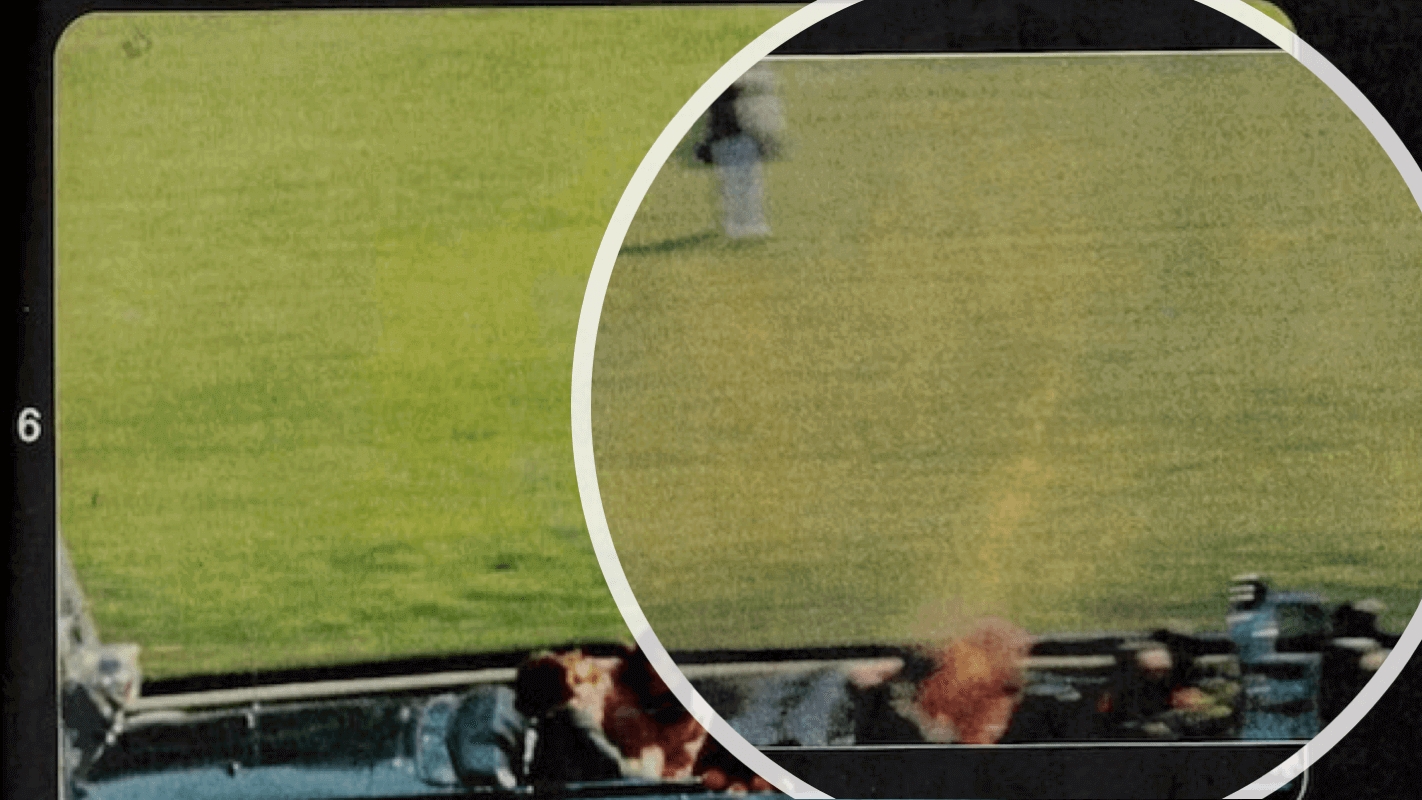
  • The Crimes of Quillette

    The Crimes of Quillette


    I’ll say this for Fred Litwin: He knows where to go to advance his cause.

    On Steve Paikan’s Ontario TV show The Agenda, Litwin stated that nothing in the declassified files of the ARRB indicated anything about a conspiracy in the JFK case. This is simply and utterly false. As I wrote about Litwin’s essay on Jim Garrison, this statement proves one of two things: 1.) He did not read any of the declassified files, or 2.) He did read them and is deliberately misrepresenting them. In my review I proved that such was the case with several specific examples. This exposure reduces Litwin to the level of Leslie Nielson as Lt. Frank Drebin in The Naked Gun: proclaiming to a gatheringcrowd there was nothing to see as, behind him, bombs explode a fireworks factory. But this is the kind of poseur that Litwin is, except he is not nearly as funny as Nielson.

    In addition to his interview, Litwin has also done an article for an online journal. That online journal is something called Quillette, which I never knew existed until someone pointed out the Litwin article. I would have never found this journal on my own, and I would not have been missing anything.

    Quillette is a libertarian inspired anti-PC, anti-liberal journal founded by one Claire Lehmann. Journalist Bari Weiss grouped Lehmann as a member of the Intellectual Dark Web, along with the likes of Jordan Peterson and Ben Shapiro. (See this article for info on Peterson) Shapiro is the snarky right-winger who went on MSNBC to defend gun rights by handing the host, Piers Morgan, a copy of the constitution. Unfortunately Morgan, a Brit, did not reply with, “Ben, do you also believe that African Americans should count as 3/5 of a person for census purposes? Because that is what this document says. Should they, and also women, be allowed to vote? Because under this document they were not.” As Alice Dreger wrote, opinions are not scholarship, and that is what the members of this group generally offer. (“Why I escaped the ‘Intellectual Dark Web’’’, Chronicle of Higher Education, 5/11/2018) She could have added that snark does not denote intelligence. As with the Shapiro exchange, it’s often just an excuse for being a smartass. Quillette published the so-called “Google memo” by James Damore, in which he accused that company of practicing reverse discrimination which somehow hurt Asians and whites and males. The right loves this kind of thing since it is a way to repudiate the affirmative action policies originated by President Kennedy. Except, by reading some of their articles concerning JFK, I would be willing to wager than no one at Quillette even knows that JFK started that policy. The Intellectual Dark Web is really the cover layer for the rise of the Trumpian alt-right. If the reader understands all that, then everything that follows is as natural as water running over a rock.

    I

    On September 27, 2018, Quillette published an article by Litwin based on his book I Was a Teenage JFK Conspiracy Freak. That article tried to make the case that somehow the KGB was involved in fostering JFK conspiracy thinking in the USA by planting disinformation stories. Litwin, not the most original researcher, largely based his piece on the work of Max Holland. He labels Holland an historian—which he is not. Two of the three pieces that Holland says are KGB produced disinformation are not disinfo at all. I dealt with them in my critique of Holland’s original article that The Daily Beast was dumb enough to print. As I noted there, the late Mark Lane did not get secret donations from the KGB. And he proved this in his book, The Last Word. (pp. 92-96) As I showed in my critique of Litwin’s essay on Jim Garrison, the last thing in the world that Permindex was was a creation of the KGB. And Shaw’s association with it was something he himself acknowledged. I demonstrated this, not just in my previous essay on Litwin, but also in my lengthy exposure of Holland.

    The third piece of alleged KGB mischief that Litwin brings up is the famous “Dear Mr. Hunt letter”. In book form this was first produced in Henry Hurt’s volume Reasonable Doubt. It is a note dated November 8, 1963, and addressed to a Mr. Hunt. It is written in cursive and reads, “I would like information regarding my position. I am only asking for information. I am asking that we discuss the matter fully before any steps are taken by me or anyone else. Thank you.” Oswald’s signature follows. (See HSCA Vol. 4, p. 337) Again, Litwin says this was part of a Russian intelligence operation codenamed Arlington.

    One of the problems with that pronouncement is that the Dallas Morning News ran a story saying they had three handwriting analysts look at the note: Mary Harrison, Allan R. Keon and Mary Duncan. They compared it to samples of Oswald’s writing. All three concluded it was genuine. (NY Times, April 4, 1977) The trio belonged to a professional organization called the Independent Association of Questioned Document Examiners. Harrison said she would be comfortable going into court and presenting her analysis. Litwin gets around this problem by saying that the NY Times wrote of the note’s possible authenticity. As the reader can see, that is not what the Times reported. The HSCA did not make a conclusive judgment about the note because it was a photocopy. (Henry Hurt, Reasonable Doubt, p. 236) On this point, Ms. Harrison stated that reproductions are often presented in court.

    Most of the Litwin/Holland material was produced by KGB defector Vasili Mitrokhin. Making the Mitrokhin case look even worse on this matter is the work of researcher Greg Doudna. Doudna did his best to track down the evidence Mitrokhin had purloined from the KGB showing the note was a forgery. In Mitrokhin’s book, The Sword and the Shield, there is a footnote referencing some original papers at a British university. (Mitrokhin and Christopher Andrew, pp. 228-29) Greg got in contact with the curator at Churchill Archives Centre, Churchill College, and part of the University of Cambridge. To cut to the chase, there is no evidence for this forgery in the Mitrokin collection. All there exists to back up that footnote is a typed draft of the book. This is the kind of scholarship Litwin offered and Quillette accepted. (E-mail communication with Doudna, 11/28/2018)

    Mitrokhin was a former KGB archivist who became a defector. Apparently, neither Litwin, nor anyone at Quillette, ever read Amy Knight’s coruscating review of his role in the wave of alleged Soviet defectors finding their home with Anglo-American publishers and newspapers owned by the likes of Rupert Murdoch. As she points out, when first drafts by these defecting authors were not sensational enough, they were spiced up. And presto! They now included information like, well, how about Niels Bohr, Enrico Fermi and Robert Oppenheimer were giving atomic secrets to the USSR? And Oppenheimer recruited Klaus Fuchs—who actually was a spy—to Los Alamos, the location of the Manhattan Project. Knight, a real scholar in the field of Soviet studies, had some fun with that one. (“The Selling of the KGB”, Wilson Quarterly, Winter 2000) She had more fun with the source for both Holland and Litwin. The idea that an archivist did not have access to a copier for 12 years and therefore had to scribble down notes from documents, instead of copying the documents themselves, this simply strains credulity. But if one sees this new field of exchange as a marketable continuation of the Cold War—with impoverished KGB agents finding a way to make mucho bucks from an American/British Establishment that has a lot invested in the justification of that Cold War—then it makes sense. Somehow, the anti-PC Quillette fails to acknowledge that angle. Which indicates what their political correctness is all about.

    In fact, on the matter of the JFK case, Quillette is Establishment to the hilt—and beyond. On the 55th anniversary of the murder of President Kennedy, they gave Litwin an encore. They ran an echo to his book. One of the editors, Jamie Palmer, penned a piece called “My Misspent years of Conspiracism”. All I can say to Mr. Palmer is that if this was an audition for the big-time MSM, he should be getting a few calls from the Fox network in the near future.

    II

    In Litwin’s book, he says that what originally convinced him there was a conspiracy in the JFK case was ABC TV’s public showing of the Zapruder film in 1975. In Palmer’s Bildungsroman, it was his viewing of the film JFK. But even in describing that experience the reader can see why, as with Litwin, Palmer ended up being a Warren Commission shill. He writes that somehow the Mr. X character in that film turned out not to be credible. That character is based on Fletcher Prouty, and virtually everything he related from his own experience at the meeting in Washington with the Jim Garrison character has turned out to be accurate. That Mr. X/Garrison conversation on a park bench concerning Vietnam has revolutionized our thinking about that entire conflict. It inspired several books that have advanced the film’s thesis even further. Namely, that President Kennedy was not going to escalate the Vietnam quagmire any further, that no combat troops would be sent into theater, and the advisors America had there were going to be recalled. From what I have seen of Quillette, they would not print scholars like David Kaiser or Gordon Goldstein or James Blight. That’s not what they are about. Litwin is.

    Palmer is unintentionally funny when he gets to the turning point of his personal saga. He says that his original beliefs about the case were reversed when he watched the 2003 program on the assassination that was produced by Peter Jennings at ABC and broadcast in England by the BBC. This site carries an entire section consisting of 16 critical articles demonstrating why Jennings’ show was a three-ring circus. From Jennings’ hiring of Gus Russo as his main consultant, to the “computer simulation” of the Magic Bullet, the program was a set up to revivify the corpse of the Warren Report. Our articles expose that agenda in gruesome detail. Somehow, Palmer swallowed it whole. In fact, he calls this program “a masterpiece of methodical argument”.

    Palmer goes on to describe certain parts of that “methodical argument” for an entire section of his long essay. What is incredible about his recitation is that, with one exception, it is all recycled Warren Commission drivel used to convict Oswald in 1964. Are we to believe that in over ten years of his belief that Oswald was innocent Palmer never read any of this material? Not even in books critical of the Commission? For he now says that he sees that Stone was remiss by not including the shooting attempt at General Edwin Walker in his film. Palmer writes, “Oswald had tried to assassinate someone else in April 1963.” The case against Oswald in the Walker shooting has been well examined by, among others, Gerald McKnight in his fine book Breach of Trust. That book is 13 years old, so if Palmer wanted to check up on that incident, he could have.

    First off, the Walker shooting was investigated by the Dallas Police for over seven months and Oswald was never a suspect. Why? For one, the best witness was Kirk Coleman. He ran out of his neighboring house right after hearing the shot. He saw two men escaping, in two separate cars. Further, when he was shown pictures of Oswald by the FBI, he failed to identify him as either man. (McKnight, p. 57) But beyond that, a cursory look at the Warren Report reveals that Oswald did not drive, or own a car. Another witness, Robert Surrey, told the police that two nights before the shooting he had seen two men casing Walker’s house. They left in a Ford. Again, he said that neither man looked like Oswald. (McKnight, p. 58) Tough to go into court when the two eyewitnesses deny the defendant was there.

    But it’s worse than that. The bullet recovered from the scene of the crime, which missed Walker from about 25 feet away, was not the correct ammunition for the alleged Oswald rifle. In newspaper and police accounts it was reported as a 30.06 projectile, not 6.5 mm. Plus, it was steel jacketed, not copper jacketed as was the ammunition used for the Oswald rifle, and therefore was a different hue. (James DiEugenio, The JFK Assassination: The Evidence Today, p. 100) The reason the FBI and the Warren Commission had to pin the Walker shooting on Oswald was because there was next to nothing in his past to connect him to such an outburst of murderous violence as occurred in Dealey Plaza, and later, with the killing of Patrolman Tippit. In the Marines, Oswald accidentally injured himself when a derringer went off as he opened a locker. He then had a dispute with an officer and threw a drink in his face. (James DiEugenio, Destiny Betrayed, second edition, p. 130) What makes that sum total even weaker is that Oswald liked and admired President Kennedy. (Dick Russell, On the Trail of the JFK Assassins, p. 206)

    The one exception to his warmed over Warren Commission refuse is contained in Palmer’s final and thunderous J’accuse against Stone. The author concludes his conversion story by praising the ABC-produced Dale Myers computer simulation of the Magic Bullet done for the Jennings program. That simulation was supposed to show the Warren Commission was correct in saying that one bullet went through both John Kennedy and Governor John Connally, making seven wounds, smashing two bones, and emerging from its journey in pretty much unscathed condition, missing only 3 grains of its original mass. There have been several devastating critiques of this simulation. All Palmer had to do was search the web and he would have found them. In our section on this site, we feature three full-scale dismantlings of Myers and his cartoon. The Single Bullet Theory, the sine qua non of the Warren Report, simply did not happen. And when one has to cut as many corners as Myers does in order to create a Rube Goldberg contraption to say it did, then such is the proof of the plot. That Mr. Palmer did not consult any of these critiques says a lot about his personal bias and also his honesty with his readers. He actually writes that he found Myers’ simulation “too convincing to dismiss”.

    Robert Harris showed how easy it was to dismiss. He demonstrated that Myers deliberately misplaced the positions of Kennedy and Connally in the car for ABC. Harris proved this was the case by using actual images from the Zapruder film to demonstrate that Myers had jammed the two victims much closer together than they were, thereby foreshortening the firing trajectory. Myers also changed the position of the two men and altered the image of the car within the same traveling shot. He did this in order to conceal the fact that when placed in their proper perspective, the Magic Bullet comes in way too low to strike Connally in the right rear shoulder. In spite of all this, Palmer concludes this section of his essay by saying that if this same technique would have been used to demonstrate a frontal shot, he would have considered it “decisive and final”. I would like to inform Quillette that by using these techniques, one could simulate a sniper hitting Kennedy and Connally from the top of the Hertz sign in Dealey Plaza. But for Palmer and Quillette, in keeping with Mr. Litwin’s approach, it’s not the accuracy of the presentation that matters, it’s the result. Or to use an old realpolitik adage: the ends justify the means.

    III

    But Palmer has to maintain his whole “personal saga” pretense. So he now shifts gears into the New Orleans aspect of Stone’s film and also to Garrison’s book, On the Trail of the Assassins. But, like Litwin, Palmer refuses to acknowledge an important aspect of the overall calculus: the Assassination Records Review Board (ARRB). Litwin simply misrepresents the discoveries of that body. Palmer simply ignores them. As I noted in my review of Litwin, this tactic is convenient for Warren Report shills since so much of what Garrison was talking about back in 1967 has turned out to be accurate. In fact, because Garrison was correct on much of what he said, the FBI and CIA had to cover up the facts, and the CIA had to launch subversive operations against him.

    Part of the subversion was to launch infiltrators into Garrison’s camp. As Garrison describes in his book, one of them was a man he called Bill Boxley, his real name being William Wood. In Stone’s film, he and co-screenwriter Zach Sklar named him Bill Broussard. Palmer actually calls the character, “a composite of various Garrison staffers” and “is allotted the role of the villain in Stone’s film”. Wrong again. From talking with co-screenwriter Zach Sklar, Broussard was based upon Boxley. And if anything, Stone and Sklar underplayed the damage Boxley did to Garrison. This author spent several pages dealing with the havoc the man unleashed, and also the investigative files he stole—some of which were never recovered. (DiEugenio, Destiny Betrayed, pp. 278-85) If you can believe it, Palmer actually tries to make the guy some kind of hero. What is even more bizarre is that Palmer also relies upon Tom Bethell, the man who was supposed to be in charge of Garrison’s archive. On the eve of the Shaw trial, Bethell turned over the DA’s trial brief to Shaw’s defense. Through research into the Garrison files declassified by the ARRB, Peter Vea discovered that, unlike what Bethell tried to imply years later, he did not admit this to Garrison. Lou Ivon, Garrison’s assistant, conducted an investigation and found out Bethell was the culprit. According to Peter’s work, Bethell broke down and wept upon discovery. Before Garrison could decide what to do with his case, he fled to Dallas. As stated to this author in a conversation he had with the late Mary Ferrell’s estranged son, for whatever reason, Bethell ended up at her doorstep. With touchstones like this, you can do a lot to downgrade Jim Garrison.

    And Palmer cannot let go of Litwin’s false idea that somehow Garrison’s witness Perry Russo was drugged and fed leading questions to get him to identify Shaw as Bertrand. In my review of Litwin I showed this was not the case. It was a trick set up by Shaw’s lawyers with the aid of compromised journalist James Phelan. They rearranged the two sodium pentothal (truth serum) sessions to make it appear that this is what occurred. When read in their true order no such thing happens. Russo introduced the character of Bertrand on his own without being coached. The two best exposures of this charade are by Lisa Pease (Probe Magazine, Vol. 6 No. 5, p. 26), and Joe Biles in his book on Garrison entitled In History’s Shadow (pp. 43-47). Both have been available for over 15 years.

    But Palmer goes beyond Litwin. He says that Perry Russo flunked his polygraph test according to the administrator. The administrator he is referring to is one Ed O’Donnell. O’Donnell was a policeman who Garrison had tried to draw up on charges for police brutality against African American suspects. Both he and Ray Jacob, another technician used by the DA, were intent on unsettling Russo in order to get the wrong indications on the test. (Joan Mellen, A Farewell to Justice, p. 147) When Russo complained to Garrison about these tactics, Garrison called O’Donnell into his office. He asked him if he had a tape of Russo denying that Shaw/Bertrand was at a gathering at Ferrie’s apartment. The policeman said no he did not. Yet he had told Russo he did. Garrison terminated his services upon hearing this. (Clay Shaw trial testimony of 2/26/69) The proof of who O’Donnell really was is that he ended up being an advisor to Shaw’s defense team at the trial. (Mellen, p. 309)

    If you continually and falsely smear the DA’s investigation, and then assume that Oswald shot Kennedy—which we know today did not and could not have happened—then you can characterize Garrison’s inquiry as “inconsequential”. But you would have to add that the Richard Schweiker/Gary Hart investigation for the Church Committee was also meaningless, and the Richard Sprague/Robert Tanenbaum phase of the House Select Committee on Assassinations (HSCA) was also adrift. The problem with saying that is you are now dismissing two fine senators and two excellent prosecutors. Between them, Sprague and Tanenbaum prosecuted about two hundred homicide cases. The combined record was one loss in well over twenty years. Sprague was the lawyer who prosecuted the famous Jock Yablonski murder conspiracy case and convicted corrupt labor leader Tony Boyle. (DiEugenio, Destiny Betrayed, p. 326) According to Tanenbaum, when he was privately briefed on the Church Committee inquiry by Schweiker, the senator told him that, in his view, the CIA had killed Kennedy. He then handed him a research file compiled by his chief investigator Gaeton Fonzi. (Probe Magazine, Vol. 3 No. 5, p. 24) Need I add that this was the same conclusion that Garrison had come to a decade earlier? But Dale Myers and ABC have magically made this information “inconsequential”. And with a stroke of his pen, or keyboard, Palmer has made Schweiker, Hart, Sprague, Tanenbaum and Fonzi all disappear. In fact, from his perspective, they never existed.

    Without that backdrop, and without the relevant discoveries of the ARRB about New Orleans, then you may as well be writing about Jim Garrison from the viewpoint of some MSM hack journalist in 1968. For instance, like Litwin, Palmer wants to discount the fact that we can now prove that the mysterious Clay Bertrand, who called Dean Andrews, was really Clay Shaw. (DiEugenio, Destiny Betrayed, pp. 385-86) He fails to mention that we know today that it was Shaw and his friend David Ferrie who were escorting Oswald around the villages of Clinton and Jackson 100 miles north of New Orleans in the late summer of 1963. They were trying to register Oswald to vote in a parish far away from where he lived so he could get a job at a mental hospital. (Bill Davy, Let Justice be Done, pp. 101-17) Shaw lied about all these matters: that he knew Ferrie, or Oswald, that he used the Bertrand alias, and that he was in Clinton-Jackson with those two men that summer. Shaw also knew Guy Banister. (Davy, pp. 93-94) Oswald spent many days of that fateful summer of 1963 in Banister’s office preparing his Fair Play for Cuba Committee flyers and pamphlets, with Banister’s address on the early copies. (Davy, pp. 37-42)

    Somehow, Palmer does not understand that it was these activities in New Orleans that summer that were injected into the media within hours of President Kennedy’s murder and did much to convict Oswald in the public mind as the sociopathic communist who killed the president for ideological reasons. It thus makes sense that Shaw would call his acquaintance Andrews to go to Dallas to defend Oswald—not knowing Oswald was going to be killed within 48 hours of his apprehension. Shaw would know that Andrews could be compromised, or be used as an incompetent lawyer.

    This is where, as they say, the plot thickens, and again, Palmer leaves it out. Through the ARRB, we know today that Oswald was not a sociopathic communist. He was very likely working through Banister as a CIA agent provocateur. The CIA had set up an anti-FPCC campaign under the tutelage of David Phillips, who was one of the men running that operation. (Davy, p. 286) Further, a man fitting the description of Phillips was in Banister’s office in 1961 trying to arrange a citywide telethon for the Cuban exile cause. (Davy, pp. 21-24) Phillips’ was also seen in film made of one of the nearby New Orleans CIA training camps, a film which the HSCA temporarily had in their possession. Along with Oswald and Banister, witnesses also identified him as being in the film. (Davy, pp. 30-31)

    With this background now filled in a bit, Palmer may want to ask himself if it explains the curious provenance of Oswald’s pamphlet, “The Crime Against Cuba” by Corliss Lamont. Oswald stamped it with 544 Camp Street, Banister’s address. Oswald’s version of the pamphlet was printed in 1961. It had gone through at least four more printings by the time Oswald was leafleting with it in 1963. Yet his was from the first edition. The CIA purchased 45 copies of the original edition in 1961. Is this how Oswald got the outdated version, perhaps through Phillips who was running the subversive program against the FPCC? To make it all a bit more curious, Oswald wrote about his altercation with the Cuban exiles, which got him arrested and the pamphlet confiscated, before it happened. (Davy, p. 38)

    As the reader can see, these are the provocative questions that Oswald’s activities in New Orleans pose when they are presented with the full information we have today. Much of it was available at the time of the Jennings special. Mr. Jennings was not going to touch it. We explain why in our special section reviewing that very poor and unethical documentary. In a nutshell, in 1984, ABC Nightly News did a report on the exposure of a CIA front company in Hawaii and the Agency’s involvement in a possible murder plot. It was a fascinating two-part installment. CIA Director William Casey was very upset by that reporting. So he arranged to have some of his friends and colleagues at Capital Cities buy the network. Jennings, the host of the program, got the message. After Casey and Cap Cities bought the network, Jennings, who had originally stood by the story, now said he had no problem with the CIA’s denial of it.

    Palmer closes his essay with a reference to Litwin’s book, saying that somehow the technical panels set up by the HSCA on things like forensic pathology, photographic evidence and the rifle tests sealed the deal against Oswald. By now, one really wonders just what Palmer was doing in those ten years he doubted the Warren Commission. He certainly was not reading the journals on the subject. Because if he had been, he would have known that people like Dr. Gary Aguilar, Dr. David Mantik and this author completely took apart these very flawed tests made by the HSCA. And, in fact, the chair of the HSCA, Robert Blakey, also took one of them back, the one he relied upon as the lynchpin of his case against Oswald, namely the Comparative Bullet Lead Analysis (CBLT). He has now termed it junk science. (For a full scale, in-depth analysis, see The Assassinations, edited by James DiEugenio and Lisa Pease, pp. 69-85; pp. 250-91) Those 58 pages simply devastate the so-called findings that Litwin, in four pages, trumpets. And one will find evidence in those pages indicating that the HSCA simply and knowingly misrepresented some of their forensic findings.

    IV

    At the end of Palmer’s article, he sourced a previous piece in Quillette from 2017. This was from one Craig Colgan. Colgan fits right in with Quillette’s agenda. He once wrote an article about the National Museum of African American History and Culture and complained that although there was an exhibit for Anita Hill there was none for Clarence Thomas. Anita Hill was the first woman who actually brought the issue of sexual harassment into national consciousness. The fact that she was an African American testifying against the Establishment-backed Thomas made what she did even more courageous. (See this article)

    The title of Colgan’s November 25, 2017 piece was “Are the JFK Conspiracies Slowly Dying?” He begins his article with a reference to Dylan Avery and his film on 9-11 called Loose Change. He then says that since Avery has backed away from some of his more extreme statements, perhaps those who attack the Warren Report should also. Toward the end of the piece, he says he would allow a kind of Robert-Blakey-inspired Oswald-did-it-with-some help concept. And that is what the JFK critical community should be aiming for.

    I don’t know very much about the 9-11 controversy. But I do know that the official investigating committee issued a report without an accompanying set of volumes of evidence. The Warren Commission issued an over-800-page report with 26 volumes of testimony and evidence. The incredible thing about the early critics is this: some of them actually read those volumes. They came to a clear conclusion: the evidence in the volumes did not support the tenets of the report. The late Maggie Field wrote an unpublished book in which she reproduced pages from the report”s conclusions, then juxtaposed to them extracts from the supporting volumes of evidence that directly contradicted them. One could similarly refer to Sylvia Meagher’s classic study Accessories After the Fact. Unlike with 9-11, then, in the case of President Kennedy’s murder, there is nothing to retreat from. In fact, as tens of thousands of declassified pages have later been released, Field’s book has not just been ratified; it has been shown to be too mild, for we know today certain agencies were concealing evidence that would have indicated how parts of the plot and, even moreso, the cover-up, worked. (For example, see section III of this essay and the discoveries about David Phillips and New Orleans.)

    At this point, one must accentuate the fact that even though Quillette is known as a scientific and technically oriented journal, that is what is completely missing from any of its articles on the JFK case. For instance, Colgan mentions a conversation he had with Gary Aguilar about his critique—co-written with Cyril Wecht—of the PBS special Cold Case JFK which aired at the 50th anniversary of the JFK murder. But he does not devote a single sentence to the total demolition of that series that Aguilar and Wecht performed—in a peer review journal on ballistics! And he does not link to the two-part review. Nor does he note that, although Gary offered to pay for both their flight and hotel accommodations, the father and son team who were featured on that program refused to debate him in public.

    Colgan also notes the decline in the public’s belief that there was a plot behind Kennedy’s murder. This is accurate. At the fiftieth anniversary of Kennedy’s death, Hart Associates did a poll for Larry Sabato’s book, the Kennedy Half Century. It statedthat 75% of the public did not believe the Commission’s lone gunman verdict. This was down from the over 90% during the time that Stone’s film JFK premiered. (Sabato, p. 416) The reason for this is simple to discern. Due to Stone’s film, for about one year—from 1991-92—there was actually an open discussion in the media about Kennedy’s murder. And there were actually programs and front-page stories in magazines that addressed it in an even-handed way. The Power Elite was quite upset by that hubbub. They did three things to counter it. Random House, through editor Bob Loomis and publisher Harold Evans, decided to recruit Gerald Posner and give his book one of the most massive publicity barrages in recent publishing history. We know this from the lawsuit the late Roger Feinman launched against Random House concerning that book.

    Secondly, they decided that there would be no more open debate on the issue in the media—and there has not been. We know this from written communications between researcher Walt Brown and Loomis as well as from Alec Baldwin’s speech in Houston last year at a dinner during the JFK mock trial. Baldwin said he had approached NBC with a proposal for a documentary program on Kennedy for the 2013 anniversary. It was rejected without a hearing, with words to this effect: We have reconciled ourselves to the official version. Another example would be what happened in Dallas at the fiftieth anniversary. With the world’s media on hand, Mayor Mike Rawlings completely controlled and cordoned off Dealey Plaza so that no critic could be heard by them. (See our report on the subject as well as this one at jfkfacts.org)

    Third, virtually every single program since—and there have been more than a few—has endorsed the Warren Report, specifically the Single Bullet Fantasy and the no-frontal-shot concept. The problem with these productions is that each one has falsified the facts of the case. (See this video or read this essay)

    Judging from their articles, Quillette is really more of a politically oriented journal than a scientific or technical one. At that, they should have understood the politics of the Warren Commission. The policies of the most active member of that body, Allen Dulles, were opposed to those of President Kennedy. But from this review, the reader can see that both Litwin and Quillette were more in sympathy with Dulles than JFK.