Blog
-

Suppressed Evidence of JFK Throat Entry
For years, distinguished pathologist Cyril Wecht, MD, JD has expressed doubts that Kennedy’s throat wound was an entry because no one could tell him where the bullet went. “The throat is all soft tissue, where did it exit?”
Good question, but it’s based on the premise that if the bullet had been found … we would know about it.
Well, we don’t know where that bullet went, but we do know about another bullet that was found—but never mentioned in the official record.
A Navy doctor published an obscure memoir in which he reports that petty officers sent to retrieve bone fragments from JFK’s car also found a misshapen, but whole bullet in the back of the car. (Official reports only mention bullet fragments, and they were found in the front of the car.)
That doctor, James Young, briefly inspected it, then gave it back to the petty officer who gave it to James Humes, the lead pathologist. Then where did it go? Humes made a big show of looking for bullets that night.
Young was puzzled when, years later, he could find no report on that bullet. He wrote to President Gerald Ford asking about it, and got a useless response. We have researcher Randy Robertson to thank for this discovery. (To see more on this, please go here.)
Maybe you can’t quite believe the above story, but you should be even more skeptical of anything you are told by the government. And you should wonder about what you are not told.
Humes et al Suppressed Fundamental Evidence:
(1) Kennedy’s cerebellum. You will not find one word about it in the main autopsy report, which only describes the upper brain, as well as organs not even relevant to the murder. Nor will you find mention of it any of Humes’s testimony. (The supplementary report mentions a microscopic analysis of a small piece of it.) The Parkland Hospital doctors described massive damage of this organ, damage inconsistent with the official narrative. (For more on this, go here and here.)
(2) Kennedy’s throat wound. Humes et al pretended they were completely unaware of it on the night of the autopsy, when the body was still available. And so they did not document it or explore it further. Years later, a pathologist who assisted Humes, said they saw the remains of the bullet hole itself, “part of the perimeter of a bullet wound in the anterior neck.” (For the complete story on this, go here.)
And so again I ask, why assume no bullet entered JFK’s throat because you don’t know where it went?
Throat Wound: Abrasion/Contusion Collar
Not long ago, I saw an email in which a researcher said Kennedy’s throat wound had no abrasion collar. He didn’t say that he saw no report of one, or that blood obscured the wound so that none was seen (a lone nutter claim). He just omnisciently asserted that none had existed. People are entitled to their opinions, but they should be given along with all the facts readers need for making up their own minds.
Here is probably the most relevant fact of all: When Malcolm Perry—the Parkland Hospital doctor who worked on the throat wound—was specifically asked by the HSCA to describe the wound’s edges, he included these words: “The edges were bruised.” A bruise is a contusion. Perry seems to have been referring to a contusion collar—which, like an abrasion collar, is definitive of an entrance wound.
Some authors use the expressions “abrasion” and “contusion” rings or collars interchangeably. But though related, they are not the same. Both are said to be caused by temporary over-stretching of the skin. And the skin on the perimeter of the bullet hole is abraded. A few millimeters away, damaged blood vessels in the dermis bleed beneath the skin, resulting in a visible bruise. Here’s an illustration from an article on the characteristics of entrance wounds by jacketed bullets, fired at a distance.

Note: Jacketed bullets from centre fire rifles do not always cause abrasion collars. Also, entrances can have slightly ragged edges. (Gunshot Wounds Aspects of Firearms, Ballistics, and Forensic Techniques, Second Edition, by Vincent J.M. Di Maio, MD, CRC Press, 1999.)
To the Warren Commission, Perry had described a typical entrance wound: “approximately 5 mm in diameter…exuding blood slowly which partially obscured it. Its edges were neither ragged nor punched out, but rather clean.”
Later he was again asked about the wound, and this time Commissioner Arlen Specter clarified something significant. Perry seems to have said the wound was “not punched out,” but he also said it was “not pushed out.” Specter specifically asked if the wound was “pushed out”—“everted” in the language of forensics—and characteristic of an exit. Perry said it was not. (Nor did he say it was pushed in.)
Don Thomas: Throat Wound Was an Exit
In his book Hear No Evil. Politics, Science & the Forensic Evidence in the Kennedy Association (Mary Ferrell Foundation Press, 2010), Donald Byron Thomas promotes the idea that the wound was an exit.
The author seems to believe the back and throat wounds were proven to be connected when in fact there was no proof. This was an inference based on incomplete information. Very few researchers claim the back wound was anything but an entrance, but we cannot explain where that bullet went. Since it created such an apparently shallow wound, it may have fallen out. It may have been the slightly bent bullet found in the limousine.
As for explaining what happened to the bullet that we say entered the throat, we cannot. But, based on all the other key evidence that went unreported, it’s not unreasonable to assume that if it had been found during the autopsy, it would not have been reported. (Thomas does not mention any of the known suppressed key evidence described above.)
Thomas also seems to believe the pathologists who performed the autopsy saw no evidence of the bullet wound in the throat. On page 238 of his book, he said “The precise nature of the wound cannot be determined because the wound was obliterated.” In fact, it was only bisected, not obliterated and, as mentioned above, one of the pathologists reported seeing part of it.
The author does not report any of the telling details Perry described, aside from the wound’s smallness. And instead of providing recent information on wounds, Thomas quoted from a not very informative book written in the early 1920s:
Provided no bone lesion is present, the exit aperture is often difficult to discriminate from the entrance wound. The two wounds maybe [sic] equal in size, the entrance wound may show inverted edges, while in the exit wound the edges are generally everted [pushed out]. When the bullet has passed through soft parts alone, the exit wound is apt to be circular in shape. (Thomas, p. 238) [Emphasis added.]
But Perry had specifically said the edges were not everted, that is, not pushed out. More important, Thomas said nothing about the bruised edges.
An Invalid Explanation for Wound’s Smallness
Thomas said that, though the wound was small, it was still an exit, and its size could be explained by the phenomenon of “shoring” or “buttressing.” Meaning the skin was held in place by Kennedy’s collar and necktie. And he quoted experts who say that when the skin is held in place by something, like a wall, floor, chair back, or supportive clothing, the bullet can’t stretch the skin outward until it tears (one reason why exits are small and star-shaped)—and a small “shored” wound is created.
But for this to be possible, the wound has to be right behind the shoring material.
Parkland Hospital’s Charles Carrico, MD—who saw the wound while Kennedy was still fully dressed—said the wound was “right above” the neck tie. And Malcolm Perry, the doctor who cut across the wound, said the bullet struck at the level of the second or third tracheal ring, just below the Adam’s apple.
Instead of deferring to these doctors who provided facts, Thomas gave his opinion, based on a photo showing JFK in an unnatural position with his neck hyperextended: “… it would seem more likely that the bullet passed below the necktie.” (p. 236)
Below the necktie? As you can see from this photo, his Adam’s apple is well above his collar and necktie.

Though Thomas disagreed with what Carrico said about the wound’s location, he argued the idea of shoring even if Carrico was right: The amount of buttressing would still be appreciable whether just above or just below the exiting bullet’s path.” (p. 236) He did not buttress this assertion with any references.
Here’s another good reason to doubt the wound was buttressed. Take a close look at what actually happens: Skin between the outgoing bullet and the buttressing material is crushed, and it becomes stuck to the material. When that material is pulled away, it creates a wide abrasion collar consisting of skin tags that resemble a peeling sunburn. More important—grossly visible skin is left behind on the material. (Am J Foren Med Path 1983; 4(3): 199-204)
The FBI closely inspected Kennedy’s shirt and tie, and did not report seeing skin on either garment.
Relevance of Bullet Velocity
What Malcolm Perry said about the internal damage in the neck reveals that if a bullet entered the throat, it was probably traveling at medium velocity (as defined circa 1963.).
There’s some concussive damage to surrounding organs—these are the kind of things one sees with gunshot wounds, in a blast injury … And with high velocity, we do see a lot. Now the low velocity stuff, it’s often just a track, a wound track, with very little concussive or blast injury. This one was in between. There was evidence of some blast injury, but not like, say, what one sees with a high velocity rifle, like a 3006 or 223 …
A bullet traveling that fast would have left a much larger exit wound. And this was proven by Army experiments involving the assassination of goats.
Yet other experiments proved that when non-deformed jacketed bullets exit straight out—as opposed to sideways—the size of the wound created is directly proportional to their exiting velocity. (J Trauma 1963; (March) 3(2): 120-128, p. 122) (Gunshot Wounds: Aspects of Firearms, Ballistics, and Forensic Techniques, Second Edition, by Vincent J.M. Di Maio, CRC Press, 1999.) (Thomas did not report this, but possibly he was unaware of these experiments.)
Translated: When all other things are equal, the slower the bullet, the smaller the exit wound. Put another way, the smaller the exit, the slower the bullet.
Translated further: If a bullet really did exit the president’s throat, it would not likely have had the energy to make it through Connally’s mohair jacket, let alone his chest and wrist.
And there goes the Single Bullet Theory.
-

John Newman, Countdown to Darkness, Volume 2
John Newman has just released the third part of his series on the murder of John F. Kennedy. Titled Into the Storm, we are running an excerpt from it on our site, while linking to another excerpt. This review deals with the second volume, Countdown to Darkness. It is indefinite as to how long this series will be. I originally heard it would be a five-volume set. But now I have heard from other sources it may be six. (I will comment on this length factor later.)
Countdown to Darkness assesses several subjects. Some of these the author deals with well. Some of his treatments disappoint. The point is the book is wide-ranging in scope, as I imagine the rest of the series will be. It does not just deal with topics relating to the JFK murder. There are subjects dealt with that are more in keeping with a history of Kennedy’s presidency. Therefore, the book is broad based.
Countdown to Darkness begins with the peculiar arrangement surrounding the dissemination of Oswald’s file at CIA. This valuable information is a combination of Newman’s examination of the file traffic, plus insights gained by the estimable British researcher Malcolm Blunt. Those insights were achieved through Blunt’s discussions with the late CIA officer Tennent Bagley. In this analysis, Newman repeats his previous thesis that although the first Oswald files went to the Office of Security, they should have gone to the Soviet Russia Division. (p. 3; all references to the e-book version) He expands on this by saying this pattern appears to have been prearranged. The mail distribution form was altered in advance to make this happen. (p. 2) One effect of this closed off routing was that there was little chatter about Oswald’s implied threat to surrender radar secrets. When Blunt talked to Bagley, Malcolm told him about this dissemination pattern. Bagley asked Blunt if he thought this was done wittingly. When Malcolm said he was not sure, the CIA officer replied he should be—because it was set up that way in advance. Blunt said that this disclosure was “a significant departure from Bagley’s normal cautious phrasings.” (p. 30)
II
From here, the book turns to Cuba and President Dwight Eisenhower’s intent to overthrow Castro. CIA Director Allen Dulles with Vice President Richard Nixon first discussed this idea in 1959. The initial planning on the project was handed to J. C. King and Richard Bissell; the former was Chief of the Western Hemisphere, the latter was Director of Plans. (p. 32) The author traces the familiar story of how the original idea—to integrate a guerilla force onto the island to hook up with the resistance—began to evolve into something larger in January of 1960. This was coupled with the Allen-Dulles-inspired embargo, which extended to include weapons from England. This was meant to force Castro to go to the Eastern Bloc and the USSR for arms. (pp. 36-37) Dulles also wanted to sabotage the sugar crop, but Eisenhower turned that request down.
Bissell turned over the architecture of the overthrow plan to CIA veteran officer Jake Esterline. (p. 48) Esterline had been a deputy on the 1954 task force in the coup against Arbenz in Guatemala. Like David Talbot before him, the author points out the fact that warnings about the overall design problems, and how the objective differed from Guatemala, were deep-sixed. (p. 55) By March of 1960, Eisenhower started talking about a different approach, a strike force type invasion. The president wanted OAS support for this plan. And here the author introduces something new to the reviewer: his concept of Eisenhower’s Triple Play. That is, in order to achieve such outside support, the White House and CIA would rid Latin America of a thorn in its side, namely, the bloodthirsty dictator of the Dominican Republic, Rafael Trujillo. (p. 90) This will later expand into an attempt to also get NATO behind the overthrow. Hence, Ike’s Triple Play will include the assassination of Patrice Lumumba of Congo.
One of the contingencies upon which Eisenhower based his overthrow of Castro was the establishment of a government in exile. This consisted of the banding together of several individual groups of Cuban exiles under an umbrella called the Revolutionary Democratic Front, or FRD. (p. 127) This endeavor ended up being quite difficult, for two reasons. First, some prominent exile members, like Tony Varona, did not want to join. Second, a principal officer involved for the CIA, Gerry Droller (real name Frank Bender), had rather poor organizational skills. The author gives us more than one example of this trait. (pp. 129-32)
As the operation morphed from a guerilla-type incursion into a brigade invasion concept, more managers were grafted onto the project. The author first names Henry Hecksher. (p. 140) Hecksher worked with David Phillips on the Arbenz overthrow, then went to Laos, and then was assigned to Howard Hunt’s favorite exile, Manuel Artime, in 1963-64. (pp. 142-44) Another person named by the author as part of this expansion is Carl Jenkins.(p. 147) Jenkins worked at the Retalhuleu military base in Guatemala. A base was also set up in Nicaragua and some of the Alabama National Guard pilots were enlisted.
As the brigade concept was escalating, false information was entered into the information flow. Undersecretary of State Douglas Dillon said only 40% of the Cuban populace would end up supporting Castro. (p. 170) Which, to put it mildly, turned out to be almost ludicrously wrong. Castro now began to import a flow of Eastern Bloc arms through Czechoslovakia. (p. 171) As this occurred, Eisenhower, through Dulles, began to activate the Trujillo aspect of the Triple Play. This appears to have been set in motion between February and April of 1960. (p. 172)
When Castro began to seize oil companies like Texaco, Esso and Shell, Vice President Nixon began to urge Eisenhower into action. He recommended “strong positive action” to avoid becoming labeled, “uncle Sucker” throughout the world. (p. 174) National Security Advisor Gordon Gray said much the same thing: “… the U.S. has taken publicly about all it can afford to take from the Castro government ….” (p. 174)
On July 9, 1960, Nikita Khrushchev threatened the USA with ICBMs over Cuba. Eisenhower replied that America would not be intimidated by these threats. (p. 176) The author mentions that at this time there was an attempt by the Agency to solicit a Cuban pilot to assassinate Raul Castro. Newman scores author Evan Thomas for distorting this as the pilot’s idea, when the impetus was clearly from the CIA. (p. 182) General Robert Cushman, working on the staff of Richard Nixon, urged Howard Hunt to use as much skullduggery as possible to get rid of Castro. (pp. 184-85)
But as the Inspector General report by Lyman Kirkpatrick later revealed, the attempt to arm and supply the dissidents on the island was not working. In fact, at times, it was counter-productive, since Castro’s forces would recover the supplies and arms. As the threat grew, Russia sent in more arms to the island: tanks, mortars, cannons. With these advantages Castro began to close in on the resistance. And this was another reason the original guerilla plan was modified into a brigade-sized invasion. (p. 185)
III
We now come to what this reviewer feels is probably the highlight of the first two books in the series: the author’s work on the assassination of Patrice Lumumba of the Congo. Newman devotes four chapters to this subject. In my opinion the result is one of the best medium-length treatments of the Congo crisis I have read. As noted above, Eisenhower felt that by getting involved in Belgium’s colonial problems, this would encourage NATO allies to stand by him in his attempt to overthrow Castro. After all, the NATO alliance began in 1948 with the Brussels Treaty.
As early as May 5, 1960 Allen Dulles was aware that Belgium was attempting to set up a breakaway state in the Congo called Katanga. This was two months before the ceremony formalizing the Belgian withdrawal from its African colony. (p. 153) Katanga was the richest region in Congo, and perhaps one of the richest small geographical areas in the world. If the Katanga secession were successful, it would do much to benefit Belgium and its covert ally England, at the same time that it would damage the economy of the new state of Congo.
Dulles was predisposed to favor Belgium because of his prior career as a corporate lawyer with the global New York law firm of Sullivan and Cromwell. That firm represented many companies that benefited from low wage conditions in the Third World. Therefore Dulles and his deputy Charles Cabell began to smear independence leader Patrice Lumumba at National Security meetings in advance of his assuming power. Combined with the fact that the Belgian departure was not total, this pitted Lumumba against both the former imperialists and the growing malignancy of the USA. (p. 154)
Lumumba’s stewardship was not just hurt by the Katanga secession, but also by the fact that Belgium had removed Congo’s gold reserves and placed them in Brussels prior to independence being declared. (p. 155) With little cash on hand, Lumumba’s army mutinied and spun out of control. This created the pretext for Belgium to send in paratroopers. The Belgians now began to fire on the Congolese. On July 11th, Katanga declared itself a separate state. By July 13, 1960, two weeks after independence, the Belgians occupied the Leopoldville airport and Lumumba decided to break relations with Brussels. The next day the United Nations, under Secretary General Dag Hammarskjold, passed a resolution to send troops to Congo. In the meantime Allen Dulles was working overtime to tell anyone on the National Security Council and in the White House that Lumumba would tie Congo to Egypt’s Gamal Abdel Nasser, Castro and the Communist Bloc. (pp. 162-63)
This tactic worked. When Lumumba arrived in Washington to ask for supplies, loans and aid in expelling the Belgians, Eisenhower was not on hand to greet him. Instead, Lumumba talked to Secretary of State Christian Herter and Under Secretary Douglas Dillon. They lied to him by saying they were working through Hammarskjold. (p. 220) This left Lumumba little choice but to ask Russia for supplies. The USSR sent him transport planes and technicians. (p. 222)
When the Russians sent Lumumba the military aid, it sealed his fate. On August 18, 1960 Leopoldville station chief Larry Devlin sent a cable that was drawn in the most hyperbolic terms imaginable. Devlin told CIA HQ that Congo was now experiencing a classic communist takeover, and there was little time to avoid another Cuba. (p. 223) This was clearly meant as a provocation. It worked. On the day this cable arrived, Eisenhower instructed Dulles to begin termination efforts against Lumumba. This was kept out of the meeting record. It was not revealed until the investigations of the Church Committee. The recording secretary to the meeting, Robert Johnson, told the committee that it was too sensitive to be included in the minutes. (p. 227)
The plot began the next day. Director of Plans Dick Bissell told Devlin to begin action to replace Lumumba with a pro-Western leader. On August 26, Allen Dulles sent an assassination order to Devlin that authorized a budget of $100,000 to terminate Lumumba, the equivalent of close to a million dollars today. (p. 236) Bissell now called in the head of the Africa Division, Bronson Tweedy, and they began to assemble a list of assets they could employ in order to do the job. (p. 246) One of these was the infamous Dr. Sydney Gottlieb, who began to prepare poisons for use in the assassination. Devlin also got President Joseph Kasavubu to remove Lumumba from his position as prime minister. At this point Hammarskjold sent his own emissary, Rajeshwar Dayal, to Congo to protect Lumumba.
This was necessary because, in addition to Gottlieb, Devlin now bribed the chief of the army, Josef Mobutu, to also assassinate Lumumba. (p. 265) At around this time, two CIA-hired killers, codenamed QJ WIN and WI ROGUE, both arrived in Leopoldville. Not knowing each other, they both stayed at the same hotel. Gottlieb then arrived in Congo. (p. 268) In September of 1960, with a multiplicity of lethal assets on hand, Tweedy now cabled Devlin to produce an outline of how he planned on terminating Lumumba.
The use of the two codenamed assassins in Congo marks the beginning of the ZR/Rifle program. This was the CIA’s mechanism for exterminating foreign leaders. It began under Eisenhower in September of 1960. (p. 280) The next month it was taken over by CIA officer William Harvey. ZR/Rifle was sort of like the reverse side of Staff D, which was a burglary program to break into embassies and steal codebooks. Harvey and his assistant Justin O’Donnell recruited safe crackers, burglars and document forgers for that part of the program. (pp. 284-85) When Harvey testified before the Church Committee, he lied about the use of ZR/Rifle in the Lumumba case. He was fully aware of what the two men were doing in Congo. (p. 290)
Mobutu now tried to arrest Lumumba, but Dayal blocked the attempt. Three things happened in November of 1960 that penned the final chapter. CIA officer Justin O’Donnell arrived in Congo to supervise the endgame. John Kennedy, who the CIA knew sympathized with Lumumba, was elected president. And third, America and England cooperated in seating Kasavubu’s delegation at the United Nations. This last event provoked Lumumba into escaping from Dayal’s house arrest. O’Donnell had decided that the CIA should not actually murder Lumumba. But they would help his enemies do the deed. Therefore, Devlin cooperated with Mobutu to cut off possible escape routes to Lumumba’s base in Stanleyville. He was captured, imprisoned and transferred to Elizabethville in Katanga. (p. 295) Lumumba was executed by firing squad and his body was soaked in sulphuric acid. When the acid ran out, his corpse was incinerated. (p. 296) Thus was the sorry end of the first democratically elected leader of an independent country in sub-Saharan Africa.
As I said, for me, this section on Lumumba is the highlight of the first two volumes.
IV
Another topic that the author spends significant time on is the CIA/Mafia plots to kill Castro. The author traces this idea from Allen Dulles to Dick Bissell. He believes that Eisenhower gave his tacit approval to the plots. He also believes that Bissell dissembled in his testimony on how the plots were hatched, and he mounts several lines of evidence to demonstrate this. (p. 327) Bissell dissembled in order to conceal the fact that it was he who approved of giving the assignment to the Mafia through CIA asset Robert Maheu. By mid-August of 1960, the CIA’s Technical Services Division was at work manufacturing toxins to place in Castro’s cigars.
Maheu offered gangster Johnny Roselli $150, 000 to kill Castro. (p. 331) Both Allen Dulles and his deputy Charles Cabell were briefed on this overture in late August by Chief of Security Sheffield Edwards, who was part of the Mafia outreach program. Meetings were arranged with Roselli in Beverly Hills and New York City. Maheu and CIA support officer Jim O’Connell masqueraded as American businessmen who wanted to protect their interests by getting rid of Castro. But Maheu eventually told Roselli that O’Connell was CIA. Therefore, the veneer of plausible deniability was lost. (p. 333) Roselli now began to recruit Cubans in Florida for the murder assignment. He also arranged a meeting in Miami for Maheu to be introduced to Sam Giancana and Santo Trafficante, respectively the Mafia dons for Chicago and Tampa. When this occurred the author writes that, because of the reputations and history of these two men, the plots and the association should have been reassessed and approval cancelled. They were not.
They should have been. Because the recruitment of Giancana was a huge liability. Not just because of his history of being a hit man; but also because of his inability to keep a secret. Feeling emboldened, since he was now in the arms of the government, he bragged about his role in the plots to at least two people. From there the word spread to others, including singer Phyllis McGuire. Giancana revealed both the mechanism of death—poison pills—and the projected date of the assassination—November of 1960. (p. 334-35) Through his network of informants, FBI Director J. Edgar Hoover found out about Giancana’s dangerous chatter. But Hoover did not know that the CIA had put him up to it. The Director told Bissell about it, but Bissell did not inform Hoover about his role as recruiter.
Maheu now arranged to have McGuire’s room wired for sound in Las Vegas. This was done for two reasons. First, to see if she was talking about the plots; and second, as a favor to Giancana, who suspected she was cheating on him with comedian Dan Rowan. The police discovered this illegal bugging. In addition to the security problem, this all had disturbing repercussions when Attorney General Robert Kennedy began his crusade against organized crime in 1961. (p. 336)
Along with these assassination plots, on November 3, 1960, National Security Officer Gordon Gray came up with the idea of using Cuban exiles dressed as Castro soldiers to stage an attack on Guantanamo Bay as a pretext for an invasion. (p. 346) As the author suggests, the very fact that the murder plots and this false flag operation were contemplated show that those involved in managing the strike force invasion understood that its chances for success were low. (pp. 345-46) To further that miasma of doubt, at this same meeting, a question was asked about “direct positive action” against Fidel, his brother Raul and Che Guevara.
There was good reason for both the doubt and the fallback positions, because about two weeks later, CIA circulated a memo admitting that there would not be any significant uprisings on the island due to any incursion, and also that the idea of securing an air strip on the island was also not possible unless the Pentagon was part of the attempt. (p. 348) This memo was not shared with the incoming President Kennedy. The author deigns that it was not shared because the internal uprising myth was used to manipulate Kennedy into going along with the operation. It thus became part and parcel with the new “brigade strike force” concept. (pp. 352-53)
On January 2, 1961, Castro broke relations with the United States. The favor was returned two days later. These actions caused the training of the exiles in Central America to be expanded, and also for the action against Trujillo to be accelerated. (p. 355) On January 4th, Chief of the CIA paramilitary section wrote a memo to one of the operation’s designers, Jake Esterline. The memo said the invasion would be stuck on the beach unless an uprising took place or there was overt military action by the USA. (p. 355) As the author notes, this is another indication that the people involved at the ground level understood that, left to its own devices, the prospects for the invasion were fey. Hawkins added that Castro’s military forces were growing. They would soon include featured tanks, artillery, heavy mortars and anti-aircraft batteries. Given those facts, Hawkins warned that:
Castro is making rapid progress in establishing a communist-style police state that will be difficult to unseat by any means short of overt intervention by US military forces. (p. 356, Newman’s italics)
Since Bissell was a supervisor of both the assassination plots and the invasion, one wonders if he was banking on the murder of Castro to bail out what looked like an upcoming failure on the beach. In fact, as the author notes, at NSC meetings of January 12 and also January 19, the idea of overt intervention was brought up again. What made the time factor even more pressing was that the CIA had information that the shiploads of these munitions would reach Cuba in mid-March and continue with daily arrivals after that. This is why Hawkins urged that the invasion be launched in late February and no later than March 1. (p. 356) This would not happen, since Kennedy rejected the first proposal for the operation, namely the Trinidad landing site.
V
Kennedy had two meetings on the subject during his first week in office. At neither did he appear enthusiastic about it. On February 3, 1961 the Joint Chiefs wrote a ten-page report in which they viewed the plan favorably. This was something of a reversal from their previous assessments. But they cautioned that the plan was reliant on indigenous support from the island, meaning defections from Castro. They foresaw that if the force retreated to the mountains it might need overt American intervention. But even with these reservations, the executive summary at the end was positive. (pp. 363-64) Newman comments that one way to explain this reversal is that the Joint Chiefs felt that if the CIA plan failed, they would be called in to save the day and collect the glory.
Kennedy now chimed in with his reservations about having the operation look too much like a World War II amphibious assault. He asked if it were possible to configure it more like a guerilla operation. (p. 366) This was a harbinger of what was to come from the president, who clearly never liked the operation in the first place. Knowing this, those pushing the plan tried to convince Kennedy that the strike force would ignite a rebellion on the island, even though they knew that such was not the case. (p. 383) Newman writes that this manipulation was done so that JFK would not cancel the operation—the gamble being that he would feel obligated to send in the Pentagon once he saw the invasion faltering. This hidden agenda to the Bay of Pigs episode was pretty well established in 2008 by Jim Douglass in his fine book JFK and the Unspeakable.
At White House insistence, the location of the plan was moved away from Trinidad, 170 miles southeast of Havana, at the foothills of the Escambray Mountains. (p. 389) The reason for the switch was that Trinidad had a population of about 26,000 people. This decreased the odds of surprise and opened up the possibility of civilian casualties. Trinidad also did not have a proper length airfield for B-26 bombers. For these reasons, the locale was shifted to the Bahia de Cochinos (Bay of Pigs), east of the Zapata Peninsula. The CIA now went to work tailoring a plan for the new location.
There was a serious problem with these delays. The longer it took to launch the operation, the more time Castro had to import weaponry from the USSR. The arms supplies began arriving in earnest on March 15. After that, one or two ships would unload per day. (p. 392) At this point, both Esterline and Hawkins wanted to leave the project.
As the author notes, another important alteration was that the air cover and assaults were gradually whittled down in frequency and scope. This was owed to the reluctance of Kennedy and Secretary of State Dean Rusk to reveal the hand of American involvement. The first Hawkins-Esterline plan featured well over one hundred sorties in five different waves. (p. 390) When Kennedy asked Bissell how long it would take for the invasion force to work its way off the beachhead, he replied about ten days. In light of what actually happened, this was absurd, since no beachhead was ever established to break out of.
As late as an April 4 meeting, Kennedy was still trying to argue for an infiltration plan. Inserting groups of 200-250 men and developing a build-up from there. Kennedy was trying to make it appear less as an invasion and more as an internal uprising. The CIA replied that this would only alert Castro, and each group would then be eliminated. (p. 394) The next day Kennedy asked assistant Arthur Schlesinger what he thought of the project. Schlesinger said he opposed it. He felt that Castro was too entrenched to be displaced by a single landing force. And if the landing did not cause uprisings, logic would dictate American intervention. The author notes the late date of this cogent observation: ten days before the launch from Central America. Newman also notes the fact that no one from the Pentagon pointed this out at the meeting; just as there was no real discussion of the air cover plan. Making it all the worse: Kennedy had instructed Bissell to tell the brigade leaders that no American military forces would participate or support the invasion in any way. (p. 393)
But further, Kennedy drastically cut back on the amount of air sorties he would allow. And this is what had Esterline and Hawkins ready to depart the project. (p. 396) As stated previously, they insisted there had to be five waves of air strikes and over 100 individual sorties. Kennedy and Rusk opposed this aspect. Newman blames the Joint Chiefs for not stepping in and pointing out the difference between the Esterline/Hawkins design and what was happening to it. The author, citing Bissell, now says that what was left was the strikes scheduled the day before, and also the D-Day air strikes. Newman, citing Bissell, says that Kennedy then cancelled the latter the day before they were scheduled. (pp. 399-400) I was surprised to see the author adopt this interpretation of the controversial issue. This is a point of dispute which I will delve into later.
The invasion was an utter failure and the battle was decided within the first 24 hours. There was no surprise. There were no defections. And in the first 24 hours there was no Allen Dulles. Bissell had encouraged him to keep a speaking engagement in Puerto Rico. Dulles did keep it. Newman makes an interesting observation about this. Dulles kept the engagement to give the appearance that the operation was really Bissell’s. Therefore, after the Navy saved the day, he should be forced to resign while Dulles kept his job. (p. 402)
What no one thought would happen did happen at midnight on April 18. Joint Chiefs Chairman Lyman Lemnitzer and Navy Chief Arleigh Burke tried to convince the president that he must intervene. (p. 403) Kennedy turned down this last attempt to get him to commit American power into the failed beachhead. Dulles’ plan to overthrow Castro and save his position had failed.
Burke was relieved of duty in August of 1961. Later in the year, Dulles, Bissell and Cabell were also terminated. Lyman Lemnitzer was moved to NATO command and replaced by General Maxwell Taylor. In a conclusion, the author writes that after doing the research for this book, he has now downgraded his opinion about Eisenhower as a president. (pp. 404-405) After doing my own work on the man, I would have to agree. But I would make this judgment not just on foreign policy but also with civil rights. Eisenhower had some remarkably good circumstances accompanying his presidency; for instance, a growing economy, positive net trade balance in goods and services, a great military advantage over the USSR, and a unified populace behind him. In retrospect, he had a lot of political capital to make some daring decisions with, both abroad and on the domestic scene. For whatever reason, he chose not to. He passed those decisions on to his successor.
VI
I might as well begin the negative criticism with the subject of the Bay of Pigs. As the reader can see from my above synopsis, the author advocates for the stance put forth by Allen Dulles and Howard Hunt in their Fortune magazine article, saying that Kennedy cancelled the D-Day air strikes. (September, 1961, “Cuba: The Record Set Straight”) And that somehow this was the fatal blow delivered to the enterprise. (Newman, p. 400)
I would have thought that by now, this stance would have been discredited. In the penetrating report delivered by CIA Inspector General Lyman Kirkpatrick, he poses the hypothetical: Let us assume that Castro’s air corps had been neutralized. That would have left about 1,500 troops on the beach against tens of thousands of Castro’s regular army, reinforced by a hundred thousand or more men in reserve. And the Russians had been delivering shiploads of artillery, mortars and tanks every day for over a month, the very weapons one uses to stop an amphibious invasion on the ground. (Peter Kornbluh, Bay of Pigs Declassified, pp. 41, 52. This book contains most of the Kirkpatrick Report and its appendixes.) What made this aspect even worse is something Newman barely mentions: the element of surprise. One reason Kennedy moved the operation out of Trinidad is that the area was too populated, which would mitigate against that element. The Zapata peninsula was sparsely populated and the CIA said there was no paramilitary patrol there. This turned out to be false. There was a police force at Playa Giron beach the night of the landing. (Kornbluh, p. 37) They alerted Havana. Castro had his troops, with armor and artillery, on the scene within ten hours. But it’s actually worse than that. Castro had so thoroughly penetrated the operation by his intelligence sources that he knew when the last ship left Guatemala. (Kornbluh, p. 321) Therefore, on high alert, he was literally waiting for the landing. To top if off, the other element that the CIA said would be important to the invasion’s success, mass defections from the populace, was non-existent. In fact, Castro later crowed about how even the small number of people on the scene had backed him against the exiles. (Kornbluh, pp. 321-22) Therefore, with no defections, no surprise, being massively outnumbered, and with mortars, tanks and artillery shelling the force on the beach, as Kirkpatrick wrote: What difference would it have made with or without Castro’s air corps in operation?
But I would further disagree with the author’s presentation. There is today an ample body of evidence that the so-called D-Day air strikes were not actually cancelled. They were contingent on being launched from an airfield on the island, which is one reason the Zapata Peninsula was chosen. Prior to the invasion, the CIA had agreed to this in their March 15th outline of the plan. In fact, they mention the issue three times in that memo. (Kornbluh, pp. 125-27) Further, both the Kirkpatrick Report and the White House’s Taylor Report mention this stipulation. (Kornbluh, p. 262; Michael Morrisey, “Bay of Pigs Revisited”, The Fourth Decade, Vol. 1 No. 2, p. 20) In the latter, the report states that National Security Advisor McGeorge Bundy explicitly told CIA Deputy Director Charles Cabell that such would be the case. (p.23)
This speaks to another issue directly related to the alleged cancellation of the D-Day air strikes. Newman says that both Cabell and Bissell went to the office of Dean Rusk and pleaded their case for the strikes. Rusk was against it and he then got Kennedy on the line and he was also against it. This disagrees with both Dan Bohning’s book, The Castro Obsession, and Peter Kornbluh’s fine volume, Bay of Pigs Declassified. Both of those works say that Rusk offered to get Kennedy on the line, but the offer to talk to JFK in person was turned down. (Bohning, p. 48, Kornbluh p. 306) There is a good reason why Cabell would not want to talk to Kennedy about this subject. It comes from an unexpected source, namely Howard Hunt. In his book on the subject, Give Us this Day, he describes being at CIA headquarters monitoring the operation. He writes that Cabell actually stopped the D-Day strikes from lifting off. Cabell did so because he knew this was not part of the final plan! (Hunt, p. 196)
Newman’s source for much of this rather controversial material is Dick Bissell’s memoir, Reflections of a Cold Warrior. To put it mildly, between his role in the CIA/Mafia Castro plots and the Bay of Pigs—and his dissembling about both—one would think that any author would look at what Bissell had to say about those topics with an arched eyebrow. Larry Hancock, who is quite familiar with the Bay of Pigs, actually called Bissell an inveterate liar on the subject. For instance, he kept on lying to Esterline and Hawkins about his meetings with Kennedy and about the cutting down of the air strikes. He also told them that if there was too much cut back, he would abort the project. He did not. (e-mail communication with Hancock, 2/23/19)
If for some reason the author feels all of this information is wrong and Bissell was correct, then he should have at least acknowledged the discrepancy and explained why he felt such was the case.
But probably worse than this are the two chapters Newman devotes to Judith Exner, Sam Giancana and Kennedy. Before I read this book, I would have thought I would have never seen anything like that topic in a book penned by Newman, for the simple reason that he has almost always been circumspect about the sources he uses for his writing. What caused him to drop his guard on this topic is inexplicable to this reviewer. But whatever the reason, he did.
And he dropped it all the way down. He buys into just about everything Exner ever authored. To the point that he actually writes that the Church Committee allowed her to get away with lying to them. But that somehow, some way, she did tell the truth to—of all people—Seymour Hersh for his hatchet job on JFK, The Dark Side of Camelot. (p. 203) And I should add, it is not just Hersh. The author’s sources for these two chapters include people like Tony Summers on both Exner and Frank Sinatra, and Chuck Giancana on Sam Giancana. I don’t know how he missed the likes of Randy Taraborrelli and Sally Bedell Smith.
If one is going to buy Exner’s stories, one has to examine them in order and be complete about the inventory, or relatively so. The first time she ever spoke in public about her affair with JFK was in her book, My Story, published in 1977. That book was co-authored by Ovid Demaris, an experienced crime author who wrote a fawning book about J. Edgar Hoover called The Director. He also co-wrote a book called Jack Ruby, which pretty much takes the stance toward Oswald’s killer that the Warren Commission did. In that work, he also went out of his way to criticize the Warren Commission critics, like Mark Lane. So right from the beginning, one could at least find evidence that Exner was being used as a vehicle.
My Story was 300 pages long. Demaris was anti-JFK, and he made this clear in his own introduction. If Exner had anything significant to say beyond her Church Committee testimony, she had the opportunity and, in Demaris, the correct author to do it with. She did not. But eleven years later, she did. In a February 29, 1988 cover story for People magazine, Exner was now billed as “the link between JFK and the Mob.”
What did that title signify? Exner was now telling America that, since she knew both Giancana and Kennedy, they were using her as a messenger service for things like buying elections and also the CIA/Mafia plots to kill Castro. But this was all done with Exner being unaware of what she was doing. Newman writes that Exner likely first talked about this in 1992 with talk show host Larry King. (Newman, p. 203) The author apparently never looked up this 1988 story. This allows him to miss some important aspects of the Exner saga.
There was another key point in the Exner tales. This came in 1997 with a double-barreled blast from both Liz Smith in Vanity Fair and Hersh in his hatchet job. All one needed to do is compare the installments for an internal analysis to see if they were consistent with each other. One easily finds out they are not. For instance, in 1977 Exner said the idea that she had an abortion was a lie spread about her by the FBI. She denies it in the most extreme terms. She actually said she wanted to kill the agent for slandering her. (The Assassinations, edited by James DiEugenio and Lisa Pease, p. 336) But in 1997, she now said she did have an abortion and beyond that, it was JFK who impregnated her. Major revisions like that should raise serious doubts in anyone’s mind about Exner and how she was being used.
But that’s not all. For People magazine, Exner said she was not cognizant of her role as a message carrier. She never bothered reading any of the messages between Giancana and Kennedy, or opening any of the containers. But as Michael O’Brien later wrote, this was contradicted in 1997 for Smith, to whom she said that Kennedy showed her what was in one of the large envelopes. Supposedly it was $250,000. Somehow, in 1983, she forgot about being shown that much money. (Washington Monthly, December 1999, p. 39)
There is another whopper in this trail of horse dung. In 1992, when asked by Larry King if Bobby Kennedy had anything to do with this message-carrying service or if she had any kind of relations with him at all, she said no she did not. Either Exner lost track of all the lies she told, or her handlers didn’t give a damn, because in 1997 this was reversed. Now she said that when she was at the White House having lunch with JFK, Bobby would come by and pinch her on the neck and ask if she was comfortable carrying those messages back and forth to Chicago for them. (Washington Monthly, p. 39)
If Newman had done his homework on this, he would have discovered just how and why the 1983 fantasy version started. Exner knew she could make money off her story. Contrary to what Newman writes, she ended up making hundreds of thousands of dollars selling her tall tales to the anti-Kennedy press. (DiEugenio and Pease, p. 330) She was paid $50,000 to sit down with Kitty Kelley for the People story in 1983. (O’Brien, p. 40)
As biographer George Caprozi later revealed, the two did not get along at all. The problem was that Kelley kept on trying to pump Exner for information about Frank Sinatra. She was preparing one of her biographies about him at the time. Exner did not like this and so the two fought like cats and dogs. Nothing productive came out of the meetings. Since they had to pay both women, the editors decided that they themselves would pen the story. (DiEugenio and Pease, p. 334) I should not have to ask Newman, or anyone reading this review, who owns People magazine. The purview of the cover story would come under the aegis of Time-Life. The people who hid the Zapruder film for eleven years; who edited the stills from the film so as not to reveal the head snap; the same people who, on February 21, 1964, placed a dubious photo of Oswald on their cover with the alleged weapons he used to kill Officer Tippit and JFK. In 1983, the time of the story’s publication, the principals were all dead: Sam Giancana, John Roselli and John F. Kennedy. With Exner bought off, the story was libel-proof.
Finally, to prove that Exner was being used as an anti-Kennedy vehicle, consider the Martin Underwood appendage to the saga. By 1997, Exner had gone hog-wild with her mythology. She now said she was carrying money and messages to Chicago from the White House and she would deliver them to a train station with Giancana waiting for her. This was so silly on its face that Hersh knew he needed a corroborating witness for it. So apparently, with help from Gus Russo, he tried to recruit Martin Underwood to accompany Exner in this film noir scenario. Underwood had worked for Mayor Richard Daley in Chicago and then did some advance work in 1960 for the Kennedy campaign. But the Exner follies now collapsed. Under questioning from the Assassination Records Review Board, Underwood would not go along with the scheme and said he knew nothing about such train travel or Judith Exner. (O’Brien, p. 40; see also “ Who is Gus Russo?”)
I could go on and on. But I think the above is enough to expose Judy Exner for what she was: a lying cuss. Someone who would sell her soul for money and tinsel to the likes of Hersh, Smith and Time-Life. She did not deserve one sentence in this book, let alone two chapters.
Let me make one final overall criticism. I have reviewed parts one and two of the series. Countdown to Darkness ends with the debacle at the Bay of Pigs. That took place in April of 1961. Kennedy had been in office for all of three months. I don’t have to tell the reader how long this series could be if the author keeps up this pace. The overall title of the series is The Assassination of President Kennedy. That is not what the series is really about. The book is really about the Kennedy administration. For instance, Volume 3, Into the Storm, features chapters on the association of the Kennedy administration with Martin Luther King. Unless the author is going to say the Klan killed Kennedy, I fail to see how that fits the overall rubric.
When I was talking about and reviewing Vincent Bugliosi’s elephantine Reclaiming History, I wrote that because something is bigger does not make it better. In my opinion, with an astute and sympathetic editor, these first two volumes could easily have been collapsed into one—with the Exner garbage completely cut. More does not automatically connote quality. Sometimes it’s just more. I had the same complaint about Doug Horne’s five volumes series. Our side does not have to compete with the late Vince Bugliosi to exhibit our knowledge or bona fides. This is a long way of saying that I really hope Newman contains himself, or finds a decent editor who he respects and will listen to. He should stop at five volumes.
There is a saying among actors: Sometimes, less is more.
SEE ALSO:
- Our review of volume 1, Where Angels Tread Lightly
- “Berlin 1961—The Most Dangerous Place on Earth” (excerpt from Chapter 5 of volume 3, Into the Storm)
- “When Fiction is Stranger Than Truth: Veciana and Phillips in Cuba — 1959-1960” (excerpt from Chapter 3 of volume 3, Into the Storm), at WhoWhatWhy
-
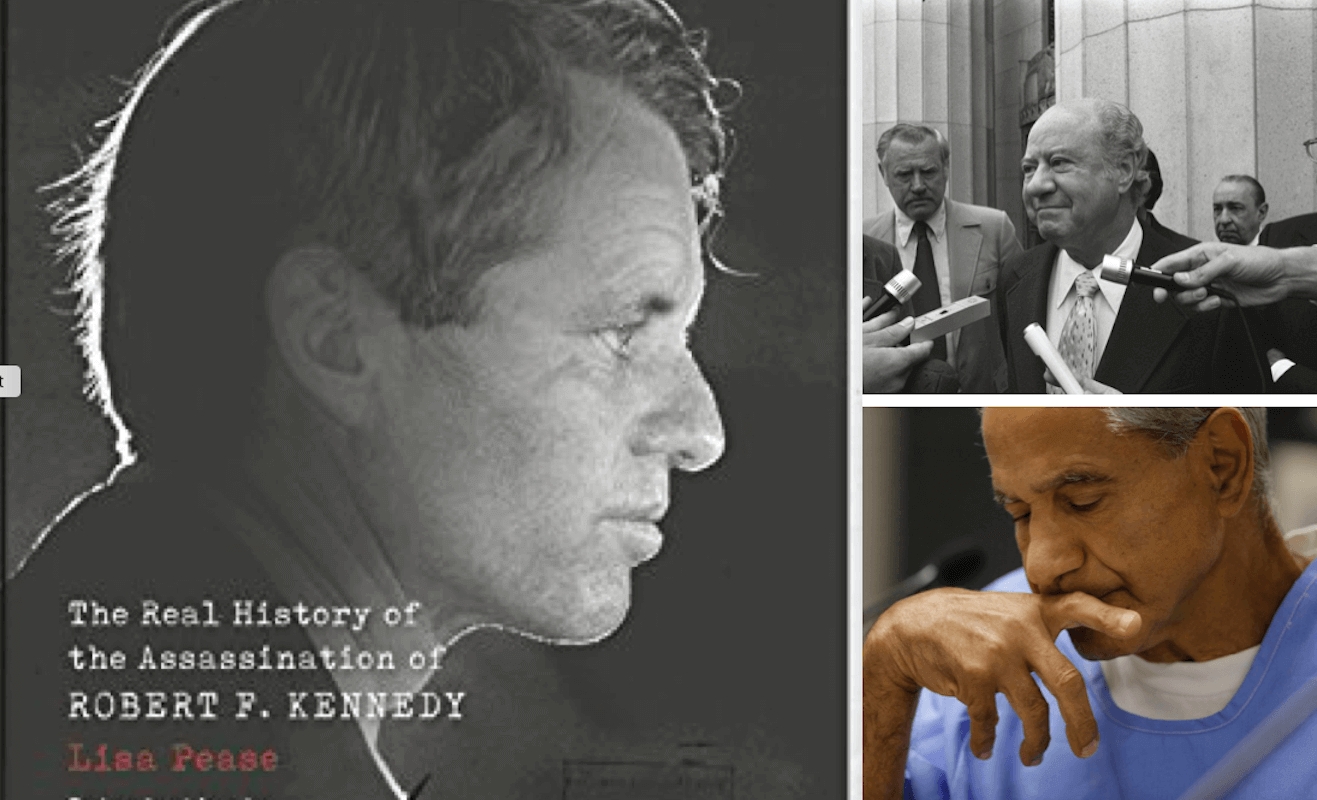
Lisa Pease, A Lie Too Big to Fail: The Real History of the Robert Kennedy Assassination
 It’s a rare thing indeed when a book actually delivers everything you could wish for—and then some. I can count on one hand the number of books in recent memory that have achieved this. Incorporating over twenty years of research, personal interviews, deep archival digging, and a comprehensive survey of nearly all the extant literature and articles surrounding Robert Kennedy’s encounter with the unspeakable in the pantry of the Ambassador Hotel on the night of Jun 5, 1968, A Lie too Big to Fail will no doubt stand the test of time as the definitive book on the RFK murder. Pease establishes not only the most compelling case against the LAPD’s compromised (non-)investigation of the case to date, but reveals startling new discoveries, including previously unexplored forensic evidence, new witnesses to multiple shooters, and evidence of foul play at the highest levels of the United States political apparatus.
Digging deep into the court records and transcripts of the also-compromised defense attorney who sold the 24-year old Sirhan Sirhan down the river before he ever had a chance at anything approaching a fair trial, Pease presents a firm case for why his fate—as he sits locked up in a California prison for life—cannot be justified in a democratic society. That Sirhan is still alive and paying for a crime he never committed brings a necessary urgency to her plea that the case be reopened. Because not only did Robert Kennedy’s murder signal the death knell of true progressivism in the United States political arena, but it served as perhaps the most arrogant abuse of power by a hidden hand that, for five decades, hijacked the United States’ foreign and domestic policy. Written with a gripping, driving cadence, the author’s narrative gifts are as pronounced as her investigative acumen. And with this book as her lifetime achievement on a case that still remains relatively obscure in light of the JFK assassination, she will likely establish herself as the preeminent authority on the subject for years to come.
II
Officially, minutes after delivering his victory speech in the Embassy Ballroom of the Ambassador Hotel in Los Angeles just after midnight, Senator Kennedy—to the cheers of his teeming supporters and staff—excused himself from the podium, proceeded backstage through a small passage leading to large double doors, entered the hotel’s kitchen pantry, shook hands with cooks and a busboy, and was shot to death. The sole perpetrator was held to be Sirhan Bishara Sirhan, a 24-year-old Palestinian immigrant who appeared in the confusion of the crowded space in front of the senator and fired a .22 caliber revolver at Kennedy, mortally wounding him and injuring five other people with his eight-shot discharge.
Kennedy died almost a day later. He had multiple brain surgeries and finally succumbed to the massive damage of the shattered bullet fragments: his heart rate lowered to barely a pulse, then stopped. His funeral ceremony was one of the most highly attended in U.S. history. For people like Tom Hayden, original author of the Port Huron Statement, who sat crying in a church pew upon learning of the death of his hero, the senator’s untimely death was also the death of hope for a generation seeking to take their nation on a course of peace and social justice. With Richard Nixon’s victory all but assured in the confused scrambling of the Democratic Party to promote their second tier candidates, the United States was going to fundamentally change.
That’s the official version of events we teach our kids in school and repeat ad nauseum in the mainstream media. The problem, of course is that when Thomas Noguchi, the LA County coroner who was tasked with performing Robert Kennedy’s autopsy, was finished, he discovered that the fatal shot, just behind his right ear into the victim’s brain, was fired with the gun barrel at contact range, which could not have been more than three inches. This was demonstrable, as Kennedy’s neck exhibited tell-tale signs of powder burn tattooing, or stippling, which Noguchi took great pains to demonstrate by setting up a test-firing at the LA Police Academy on mock human skulls made of latex and pig ears after the autopsy. Each officer was asked to fire at his respective target from six ranges: barrel-pressed against the target, a quarter inch, half inch, two inches, three, and finally four. Only at three inches, did the stippling dispersal pattern match that on Kennedy’s corpse. Of the nearly seventy witnesses in the pantry that night, none placed Sirhan closer than three feet, and most average a distance of approximately five to six feet. Equally troubling was the fact that the three shots which struck Kennedy were fired from behind and at equally sharp vertical angles, from low to high, which makes it physically impossible for them to have come from Sirhan’s gun, which even before he was attacked and restrained by bystanders, was by all accounts pointed directly at Kennedy in a flat, arm-outstretched fashion. We know Kennedy only perceived a threat from the front by the fact that numerous witnesses recall his hands defensively coming up to cover his face at seeing an approaching Sirhan before he fell to his knees, wounded, and then slumped to the floor where he lay dying in a pool of gathering blood from his fatal head wound.
The immediate aftermath of the shooting is another one fraught with contradictory claims. Officially, the LAPD concluded—or as we will see, decided actively to conclude, with the urging of two former CIA interrogation experts who took over the investigation within days of the murder—there was no conspiracy. Sirhan was apprehended, everyone saw him shoot, Kennedy went down, case closed. And yet, as Lisa Pease aptly demonstrates, that is not at all what witnesses reported. Almost thirty separate people placed Sirhan in the company of a young lady in a polka dot dress, along with several male accomplices. Many of them saw her in the pantry, seemingly holding Sirhan, and having the same sickly smile on her face as they claim he did before he lurched forward with gun outstretched to make his move. Witness Sandy Serrano places her in the immediate aftermath of the shooting running down the fire escape to the back parking lot with her male companion—both of whom Serrano witnessed entering the hotel via this very fire escape with Sirhan Sirhan earlier in the evening. Serrano said she was exuberantly shouting, “We shot him!” When asked by Sandy who did she kill, the girl responded, “Kennedy! We killed him!”. They were overheard by the Bernsteins, an elderly couple in the parking lot who reported the incident to first-responder Paul Sharaga, of LAPD. When Sharaga put out an APB for these two suspects, he was told moments later by a superior at Ramparts station that, “We don’t want them to get anything started on a big conspiracy.” (Larry Hancock, “Incomplete Justice, Part One: At the Ambassador Hotel,” 5/19/2007) The APB was subsequently pulled, allowing any accomplices ample time to make their escape.
Lisa Pease details this familiar chain of events and the controversy surrounding the clearly real accomplices, sited by dozens of witnesses throughout the ballroom and surrounding areas that night. With regard to figures like the infamous girl in the polka dot dress, she brings some fascinating new insights to the case: including the likely use of multiple teams and multiple polka dot women who were also part of the plot. Many have wondered: What would have happened had Kennedy exited via a different route? The author is quick to note that he was marked for death that night by the sheer number of likely assassins actually positioned in the Ambassador Hotel that evening. While as many as three shooters could have been in the pantry, the LAPD was immediately told to stand down in their pursuit of leads concerning anyone but Sirhan’s immediate family and friends. Therefore, we will probably never be able to say conclusively who these people were. Lisa Pease provides some excellent considerations though, and that is perhaps one of the most exciting parts of her new findings, along with some of her personal interviews which to my knowledge she is sharing here for the first time in print. That, plus the fact that SUS officers at Ramparts station also burned over 2,400 photos taken at the Ambassador ballroom in a hospital incinerator, removed and later destroyed key ceiling and door panels containing bullet holes because they “didn’t have room to store them,” and both discredited and intimidated major credible eyewitnesses: all this smacks of a systematic cover-up.
III
Stylistically, A Lie To Big To Fail achieves a fine balance between the immense complexity of the case—with its thousands of files, its many bizarre suspects and characters, its hypno-programming realities, and other strange but relevant source data—and the inherent drama of the event. We begin with an almost Raymond-Chandler-styled portrait of those fateful California nights spent with folks like director of The Manchurian Candidate John Frankenheimer (talk about situational irony) and other supporters, then progress to the primary victory speech at the Ambassador Hotel. The book is instantly engaging, no matter how familiar readers might be with the case. The accessibility of the book is another commendable feat Pease has pulled off; experts who have studied the case for decades will still find evidence and propositions they had never seen or considered, while a friend I loaned the book to—who had never examined the case—could just as easily engage with the text. That is no small feat. Too often a book in the assassination field presumes a level of familiarity with the subject material that is beyond the scope of most readers, while those that are more accessible often gloss over the depth and complexity of the subplots, and also motives and new information gleaned from recent declassifications. A Lie to Big to Fail does neither, and presents an eminently readable, thoroughly substantiated story that, in many respects, is stranger than fiction.
Covering the gamut of the LAPD’s Special Unit Senator files, along with newly discovered archival footage from places like the California State Archive and local news agencies, Pease’s book is probably the most comprehensive I have ever read on this case, incorporating not only the limited but extremely useful secondary literature from the 1970s, 80s and recent times, but also combing the entire primary source record of the case as well. The author poured thousands of hours of personal research into the book. And it shows. Sources are meticulously detailed and annotated, in the classical manner with the references at the bottom of the page. This allows anyone with an internet connection to fact check most of her findings; some must be accessed in person in Sacramento and elsewhere.
The other thing that really stands out in the book is the author’s refusal to argue she’s definitively solved the case. Don’t get me wrong: if anyone has come close to figuring out exactly what happened that night, it’s Lisa Pease. What I mean is that too often plots of this magnitude, which require not only clandestine funding, months of planning, a deeply complex cover-up often stretching decades, and the complicity of many high-level officials and planners, are traced to a single source: the mob, the CIA, the Minutemen, Nixon. What seems to be the case, and I will let readers reach their own conclusions, is that, as Lisa notes, there were aspects of both underworld crime liaisons, private military contractors, and off-the-books involvement of the Central Intelligence Agency in the persons of say Hank Hernandez and Manny Peña (USAID/CIA), and of course Robert Maheu (Howard Hughes Corporation/CIA). Thane Cesar has been and still is a prime suspect, given his anti-Kennedy, pro-segregation views and convenient placement as RFK’s escort in the pantry. That he “retired” from Ace Security, a job he’d had for only a few weeks, as he sarcastically stated during his exit interview with the LAPD, is also extremely suspicious. (RFK LAPD Microfilm, Volume 122, Reporters Daily Transcripts, Reinvestigative Files 1974—1978) p. 314). That Nixon was basically handed the presidency does not, of course, implicate him personally; though as the end of the book suggests, there is anecdotal evidence his brother Don was indeed apprised of the events surrounding the assassination and informally debriefed shortly thereafter. In a diary entry that Pease personally procured from John Meier, a Howard Hughes top aide from 1966 to 1970, Meier wrote on June 6, 1968:
Bob Maheu called to ask about the Don Nixon meeting and suggested 8:30 breakfast at the Desert Inn Country Club (in Las Vegas). I went to the club. Maheu was all smiles, and Don Nixon walks in an all smiles. What followed next had to be seen to be believed. They embraced each other and Don Nixon said, “Well that prick is dead,” and Maheu said, “Well it looks like your brother is in now.” (Pease, p. 493)
This book also presents perhaps the most balanced look at the controversy surrounding the potential and very likely programming Sirhan underwent before his arrival on the scene. Drawing from both familiar and quite obscure cases, where people were indeed exposed as hypno-programmed assets operating against their will with no working knowledge of how or why they performed various acts and crimes, she gives those in the research community a solid footing on which to stand in what amounts to the hardest part of the case for the MSM to digest. Given the CIA’s millions of dollars of research into its MK-ULTRA and related mind control experiments, along with the accounts provided in Pease’s later chapters, even the most skeptical critics will be hard pressed now to discredit this exotic but very real use of actionable hypnosis.
IV
Sirhan remains languishing in prison to this day, narrowly avoiding the gas chamber by a lucky break which saw California abolish the death penalty in 1972. Despite his good behavior, insistence that he has no memory of the events in the pantry, his numerous and sincere interviews with new therapists and hypno-suggestive experts, his fate remains sealed. William Pepper, the attorney and barrister who represented the King family during their 1999 civil trial against Lloyd Jowers, in which a Shelby County jury determined Martin Luther King had been assassinated as a result of a conspiracy, has joined attorney Laurie Dusek in a bid to free Sirhan from a crime we know he could not possibly have committed.
Senator Kamala Harris, who served as the California Attorney General until 2017, and who was also the DA of San Francisco from 2004 to 2011, insisted since the parole hearing reached her desk in 2012 that Sirhan is still guilty. Following the release of an audio tape found in the California State Archives which captured what acoustics expert Philip Van Praag believes is thirteen distinct shots in the pantry, Harris was confronted by the very real possibility that Sirhan was not a lone gunman. Harris calls Van Praag’s analysis “pure speculation.” (Martinez and Johnson, “Prosecutors, attorneys argue: Was there a second gun in RFK assassination?” CNN, 3/12/2012)
Similarly, despite the very real fact that hypno-programming has been successfully deployed in military, civilian, and criminal plots, and other special operations dating back to the early 20th century, Harris refuses to accept its possible use on Sirhan in the RFK saga. Upon reading the adamant testimony of Harvard professor of forensic psychiatry and hypnosis, Dr. Daniel Brown—who spent over sixty hours interviewing Sirhan—Harris claimed, “The theory that a person could be hypnotized into planning and committing a murder against his will is a controversial (if not fantastic) one and has not been adopted by most of Brown’s peers, including the American Psychological Association.” She continues, “Thus, even if Sirhan could show that some psychologists believe in mind control or hypno-programming, his showing of actual innocence is nevertheless based on a debatable theory that is not universally accepted in the psychology community.” (CNN, 3/12/2012) Brown, in a signed 2011 affidavit, stated, “I have written four textbooks on hypnosis, and I have hypnotized over 6,000 individuals over a 40-year professional career. Mr. Sirhan is one of the most hypnotizable individuals I have ever met, and the magnitude of his amnesia for actions under hypnosis is extreme.” (Tom Jackman, “The Assassination of Bobby Kennedy: Was Sirhan Sirhan hypnotized to be the fall guy?” Washington Post, 6/4/2018)
What is actually a debatable theory, in reply to DA Harris’ conclusions, is that three bullets fired at very close range and one at contact range (the fatal head shot behind the right ear), all from behind and at a steep upward angle are supposed to have come from a weapon that was always at least three feet in front of the target. Or that at least thirteen bullets were fired from a gun which could only hold eight, and which likely fired no real bullets, just blanks. These are solidly based facts of the case, yet they are treated as conjectures. If other major legal cases were handled with this much disregard for forensic evidence, lawyers would be disbarred. And if Sirhan had been offered a fair trial—another exceptional chapter of A Lie Too Big to Fail—it is almost certain he would be a free man. But the special logic applied by those seeking to obfuscate the sinister implications of the final major assassination of the 1960s continues to hold fast, at least at the legal level.
Things are changing though, and it would seem that the concerted efforts of those like Lisa Pease, along with the recent public denial of the official version of events by none other than Robert Kennedy Jr., may be turning the tide towards the real evidence which supports a concerted high-level conspiracy to remove a potential president. It was with a real sigh of relief that I read a recent Washington Post summary of Lisa’s new findings, one that, for a change, actually took her argument seriously and did not attempt to reduce her thesis to fringe theory. In the fifty-one years of relative silence surrounding the case, dotted here and there by books and talks by people like Allard Lowenstein, Ted Charach, Philip Melanson and others, that’s a true testament to the work of informed citizens uncovering the darker chapters of their nation’s history. As journalist Tom Jackman’s article notes, “Robert F. Kennedy Jr., the son of the slain senator, said he thought Pease was ‘a great researcher.’ Similarly, Kennedy said that his own investigation, which included meeting with Sirhan in prison in December 2017, showed that ‘Sirhan could not and did not fire the gun that shot and killed my father.’” (Jackman, “CIA may have used contractor who inspired ‘Mission Impossible,’ to kill RFK, new book alleges,” Washington Post, 2/9/2019)
V
A Lie Too Big To Fail is more than a window into one of the most fascinating and disturbing assassinations of the sixties. It is a work whose implications are relevant to anyone trying to understand how the United States devolved into a shell of a country whose tenets of equality, freedom and justice have gone by the boards, leaving us with a paper-thin facade of a democracy embodied by charlatans who wear red and blue uniforms but who essentially represent the same corporate and military-industrial overlords, or what Colonel Fletcher Prouty once referred to as “The Secret Team:”
It is a sinister device of opportunity and contrivance. What does exist is the mechanism. What exists is the automatic system, much like a nervous system or an electrical system. More properly, what exists is like a giant electronic data processing machine … which has its own power to grow, to reproduce, and to become more insidiously effective and efficient as it operates. It is a great intra-governmental infrastructure that is fed by inputs from all sources. It is big business, big government, big money, big pressure, and headless—-all operating in self-centered, utterly self-serving security and secrecy. (Prouty, The Secret Team: The CIA and its Allies in Control of the United States and the World, p. xvii)
It was Jim Garrison who eerily predicted this in an obscure and brief interview less than a month after the RFK slaying. Art Kevin, host of Los Angeles’ KHJ Radio, asked the New Orleans District Attorney,
AK: Jim … are you prepared to say that the same elements responsible for the death of John F. Kennedy were responsible for the deaths of Senator Robert F. Kennedy and perhaps even Martin Luther King?
JG: Well, you can remove the perhaps. The answer is “of course,” except that in the case of Senator Kennedy, they apparently interposed a cover organization.
A bit later:
JG: But there’s no, I don’t think there’s any question about the fact that the same forces removed everyone. Every one of these men were humanists. They were concerned about the human race. They were not racist in the slightest way, and above all, they were opposed to the evolution of America into an imperialist empire-seeking warfare state. Which it has become, I’m afraid. And now there aren’t too many, now there aren’t too many leaders left to talk out loud against the war in Vietnam. They’re eliminating them, one by one. Always a lone assassin. (“Jim Garrison says RFK was Hip to Murder Plots,” San Francisco Express-Times, 7/3/1968)
Entrenched in an almost two-decade long foreign policy disaster in the Middle East and Afghanistan, riddled with crippling, insurmountable debt, with young people more despondent and driven to self-medication and violence, the United States of 2019 is unquestionably the dark legacy of those tiny .22 caliber slugs flying through the pantry that fateful July night. As political philosopher Sheldon Wolin described it, the United States in the past half-century has come to resemble an inverted totalitarian government. By that he means, a state run not by a traditional dictator like Stalin, Mao or Mussolini, but one even more ruthlessly efficient at quelling dissent and spreading disinformation through a diffuse and impossible-to-pin-down network of powerful and manipulative factors, from the corporate media to lobbyist groups, to the hollow candidates propped up every four years for the election circus:
Antidemocracy, executive predominance, and elite rule are basic elements of inverted totalitarianism. Antidemocracy does not take the form of overt attacks upon the idea of government by the people. Instead, politically it means encouraging what I have earlier dubbed ‘civic demobilization,’ conditioning an electorate to being aroused for a brief spell, controlling its attention span, and then encouraging distraction or apathy. The intense pace of work and the extended working day, combined with job insecurity, is a formula for political demobilization, for privatizing the citizenry. It works indirectly. Citizens are encouraged to distrust their government and politicians; to concentrate upon their own interests; to begrudge their taxes; and to exchange active involvement for symbolic gratifications of patriotism, collective self-righteousness, and military prowess. Above all, depoliticization is promoted through society’s being enveloped in an atmosphere of collective fear and of individual powerlessness: fear of terrorists, loss of jobs, the uncertainties of pension plans, soaring health costs, and rising educational expenses. (Wolin, Democracy Incorporated, p. 239)
Indeed, many of these issues, which could have been addressed in Dr. King’s Poor People’s March—which RFK conceived and encouraged MLK to undertake—have never been seriously resolved in the last fifty years of American history. The powerful and vigorous aspirations of those like Tom Hayden, which burned briefly and flickered out with RFK’s assassination, have not been rekindled. After Robert Kennedy’s death, there have not been any significant, ideologically divergent political candidates offering real change or practical solutions to basic entrenched issues in the United States. What we got was Richard Nixon, Gerald Ford, Jimmy Carter. It then got worse with the full-blown neoconservative movement’s apotheosis in the persons of Ronald Reagan, followed by George H. W. Bush, and W. In effect, the antithesis of everything which people like Martin Luther King, JFK, Malcolm X, and Robert Kennedy represented.
But we must not lose hope, however bleak the future looks. And it is our responsibility not to. As Lisa Pease has so expertly done in her recent book, everything is in our power to expose the lie which still surrounds RFK’s untimely end. As the author concludes in her final passages, “He spent the last years of his life tilting at the windmills of greed and self-interest that ultimately cut him down. But his song lives on in all of us who strive, in whatever ways we can, to reach those unreachable stars.” (Pease, p. 504)
Some related items:
-

The Canadian Archives, Michele Metta, and the latest on Permindex
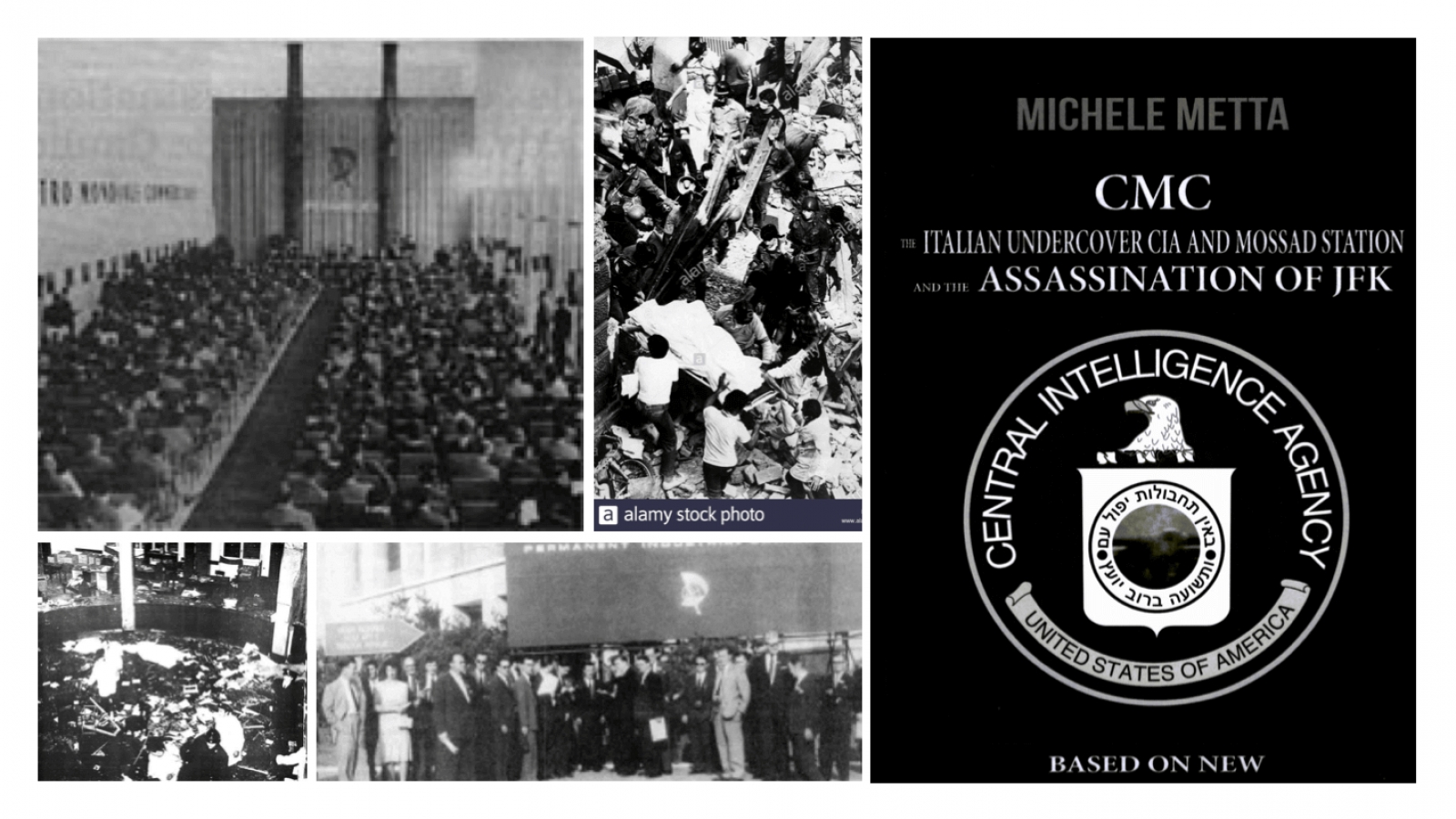 A review of
CMC: The Italian Undercover CIA and Mossad Station and the Assassination of JFK
by Michele Metta
with two Appendices
In his book, Michele Metta has provided his readers with a glimpse into the world of Centro Mondiale Commerciale (CMC). But along with that, the author gives us an insight into the politics of post-war Italy that is quite encompassing and incisive. It’s very clear that Italy was a hard target of American interests in the Cold War. With the help of some books published in Italy that would not normally be available to an Western audience, Metta takes us further into those attempts to control Italian politics.
Centro Mondiale Commerciale came to the attention of Jim Garrison’s investigation into John F. Kennedy’s assassination because Clay Shaw, the man he would accuse of participating in a plot to murder Kennedy, was a member of its board of directors. As more than one author had noted, that shadowy corporation had a rather curious background prior to opening in Rome amid much hoopla. They had previously been thrown out of Switzerland due to the controversial nature of some of its members, and also due to the mystery surrounding the company’s financial backing.
The charge made by Garrison against Shaw is one of the reasons why there is so much discussion on the internet about CMC, located in Rome Italy, and its associated company Permindex, located in Basel, Switzerland. The discussion has also included much unreliable and/or unverified information that is rooted in accusations made by Lyndon Larouche’s Executive Intelligence Review (EIR) and David Copeland, aka William Torbitt, who wrote Nomenclature of an Assassination Cabal. This includes stories depicting Permindex as a front company operated by Montreal lawyer, Louis M. Bloomfield, from which Bloomfield supervised assassinations. These stories have been circulating for many decades and for some people these stories about Bloomfield and Permindex are considered as fact.
When I discovered that an Italian journalist, Michele Metta, had done research on CMC, I was hopeful. Finally, a study of this company that would not build on the falsehoods created by Larouche and Copeland, and instead would provide the reader with a narrative supported by actual evidence. What I found however, was a bit of both. Metta provides evidence that actually proves that Shaw was on the board of directors of CMC, that CMC member Ferenc Nagy was a CIA asset, and that another CMC member, Georges Mandel, aka Giorgio Mantello, was connected to Israeli intelligence. The author further describes connections between CMC and the notorious Italian organization, Propaganda Due (P2), that is linked to the “Strategy of Tension” that was responsible for a wave of bombings and violence in Italy. He also provides connections to persons involved in Kennedy’s assassination. But the book falls short in another aspect of its story. Metta attempts to link CMC to the “Strategy of Tension” and the assassination of John F. Kennedy. Although he makes some interesting connections in those regards, he does not really achieve his aim.
The book however does an excellent job at showing connections. Metta’s research links many members of CMC to Mussolini’s old fascist guard and neo-fascists associated with the “Strategy of Tension.” He does this by providing names of CMC members and then describing their personal histories. He demonstrates that these ardent cold warriors dreaded socialist and communist parties controlling the Italian government, and were prepared to go to great lengths, including violence, to stop them from achieving power. These are the same people who would also oppose Kennedy’s soft-on-communism foreign policy, including his conciliatory attitude towards leftists in the Italian government. These numerous right-wing connections to CMC make it apparent that it could be used as a vehicle for promoting subterfuge in Italian politics and perhaps even play a role in Kennedy’s assassination. But connections alone do not constitute proof. The fact that one person knows another, and that person is somehow connected to CMC is not proof that CMC played a role in the Dallas plot. These numerous right-wing connections, however, create a lot of suspicion about this company’s activities, a suspicion so great that it demands further investigation into its operations. It also shows that Garrison’s interest in the organization was merited and that later attempts to somehow demonstrate that this was all a KGB disinformation ploy are not founded. But more research is needed to provide the actual details of how CMC participated in Kennedy’s assassination. Metta does not provide this important evidence. For example, when he attempts to link the financing of the plot to Valerio Borghese and CMC, he offers only more connections, instead of how money went into CMC’s bank account and then out to the assassination team.
The author informs us of other events he tries to link to the members of the CMC: for example, interfering with President Jimmy Carter’s re-election bid in 1980 and an assassination attempt on his life. He also tries to tie CMC to the assassination of Italian politician, Aldo Moro, in 1978. But again Metta offers only connections between people as proof that CMC played a role in these events.
Before examining his book in more detail, we must first examine the question mentioned earlier: why all the interest in CMC/Permindex, and why it has continued to be a topic of interest for Kennedy researchers for such a long time.
II
As previously stated, this interest in CMC began with Jim Garrison’s prosecution of Clay Shaw for conspiracy in the death of President Kennedy. In his investigation he found out that Shaw, who had been the manager of the International Trade Mart (ITM) in New Orleans, had also served on the board of directors of CMC. To the casual observer, Shaw’s appointment made sense. CMC, like Permindex and the ITM, were both created to provide a showcase for goods produced by different companies. Given his many years of experience managing the ITM, he appears to have been a good candidate for work with CMC. But Garrison’s suspicions were raised when he discovered that Montreal lawyer, Louis M. Bloomfield, who he believed was a former member of the Office of Strategic Services (OSS), a precursor to the CIA, was a major stockholder in CMC.1 Garrison also indicated in his book that Le Devoir, a French-language Canadian newspaper, had published an article in 1967 that stated that Bloomfield had done espionage work for the United States government and was a major stockholder in Permindex.2 While I have yet to see credible evidence that Bloomfield was an OSS agent, Garrison was right about his suspicions regarding CMC. Once the public found out about them it was only a matter of time before stories, ever the more wild, began to circulate about both Permindex and Bloomfield. These accusations came to Bloomfield’s attention, and in a letter to I. G. Alk in 1979 he lamented:
There is an outfit calling itself the North American Labour Party run by some fellow called Larouche, apparently whose propaganda is not treated seriously, but whose propaganda accuses me and other prominent Canadians of all sorts of heinous crimes. (Exhibit 13 )
These attacks and the perceived damage to his reputation, along with other misinformation about him, were the probable reasons for his wife to ask Library and Archives Canada (LAC) not to release his papers to the public. The archive’s compliance with her wishes resulted in two lawsuits against them. (A discussion of these two lawsuits and a third one brought by me can be found in Appendix 1.)
Metta continues in this vein. He believes Bloomfield to be a stockholder in the companies and states that he founded Permindex. (p. 7) The evidence from LAC does not support these statements. He is not a direct shareholder nor a founder of Permindex. (A description of his actual role with these two companies can be found in Appendix 2.)
III
One of the insights I gained about the anti-Kennedy forces in Metta’s book is found in a pact made between Italian and American Freemasons against Kennedy, which included a member of CMC and the CIA. This is an important assertion, since it is implying that CMC is involved in an anti-Kennedy plot. It also shows a connection between a member of CMC’s board of directors and the CIA. (p. 10) This pact involved Dr. Gigliotti, who was a CIA agent, and was organized by Giuseppe Pièche. (p. 13) Pièche was a member of CMC’s board of directors. (p. 15) The purpose of this pact was to oppose Kennedy’s bid for the 1960 presidential election. In a letter from the Grand Master of the Freemasons, Enzio Milone, to the Christian Democratic Member of Parliament, Elio Rosati, dated September 24, 1960, he told them to:
… propagate as much as possible the protestant idea—influence Italian immigrants in the USA to vote against Kennedy … (p. 10.)
But is the pact subversive? To many people, including this reviewer, it looks like typical election politics: encouraging a certain ethnic group to vote a certain way. The fact that it stemmed from a foreign country, Italy, is also not that unusual.
Giuseppe Pièche, who organized the above-mentioned anti-Kennedy pact, also provides a link between CMC and far-right Italian politics. This connection is important because CMC has always been a suspicious entity, the suspicion being that the company owed its existence to a motive other than profit. And Metta does provide the reader with reasons to be suspicious. Pièche was a general in Mussolini’s army. If this isn’t enough of a fascist credential, Metta goes on to state that he and Mario Scelba “created and directed” the Servizio Antincendio [Fire Service]. He was assisted in the Fire Service by Edgardo Sogno who was connected to P2 and who later told the press that the Fire Service was a NATO organization linked to the Gladio network. (p. 13.4) The author also informs the reader that Pièche and Sogno created and ran an organization called “Pace e Libertà” [Peace and Freedom], which received funding from Allen Dulles. (pp. 14-15) These are credentials that should make any reader be wary. But then Metta makes a strained conclusion. He states that Pièche was a member of the CMC Board of Directors; that Antonio Trabuchi, who was present at the signing of the Freemasons’ pact, was a also a member of the government led by Fernando Tramboni, who wanted to make Italy into a dictatorship (pp. 9, 15); and finally, that Tramboni’s son-in-law, Franco Micucci Cecchi, was also a member of CMC (p. 15).
From these facts he concludes: “Therefore, there is ample evidence so far to sustain that CMC was behind the pact against JFK.” (p. 15) Yet, he has already told us that the pact against Kennedy was between American and Italian Freemasons. (p. 9) If CMC was the catalyst for the pact, he should have demonstrated how CMC’s board of directors had created and implemented it.
IV
Metta then introduces a new statement into his narrative. It is an assertion which is truly sinister, one that implies Freemason participation in Kennedy’s death. At a meeting of the Sacro Collegio del Rito [Sacred Panel of Rites] held on December 5, 1981, which Metta describes as “… the high assembly of top Italian Freemasons,” there were concerns about a document in the possession of Enzo Milone, whose letter described the anti-Kennedy pact of 1960 mentioned above. (p. 16)
At this meeting, Milone stated: “Everything happening [today] had its matrix in what occurred in 1962.” (p. 18) During this meeting, Franco Nataloni stated that: “If these papers were to get into the hands of the D.C. Tina ANSELMI, this could put all of us in trouble.” (p. 19)
The Freemasons had a good reason to be concerned about Tina Anselmi. She led an Italian government commission of inquiry that could connect Italian Freemasons to P2 and other subversive activities. (p. 9) Metta then reminds us that the statement regarding what happened in 1962 was after Kennedy was elected and was residing in the White House at the time, so it does not have anything to do with their pact to block his election to the presidency. He goes on to state: “Milone says 1962; when Kennedy is already in the White House, and to stop him means something else; it means things like Dallas.” (p. 18)
Is he implying that 1962 was the year that the Freemasons began their plot to assassinate Kennedy? It certainly seems like it because he mentions Dallas. But what actually did occur was a lot less sinister. The author also states: “Besides, in 1962 the plot against JFK started involving a key figure of the Italian Intelligence and Freemasonry: Giovanni De Lorenzo, an individual who was closely linked to the CMC …” ( p. 24)
But the plot was not an assassination plot; it was a five-point plan to oppose left-wing parties in Italy. These are enumerated by Metta (pp. 34-35):
- Point 1. Program diverse actions for possible emergency situations.
- Point 2. Intensify finances to the forces which oppose the political swing [to the left].
- Point 3. Support single leaders in the Christian Democratic Party (DC) and political lobbies willing to rally around the new President of the Republic Antonio Segni (Segni, like Gronchi before him, placed full trust in General De Lorenzo), who did not like the party’s opening to the left.
- Point 4. Support any action which seeks to weaken the structure of the Socialist Party and favor any kind of internal split.
- Point 5. Strengthen voices in the media who are able to influence public opinion in the field of economics and politics.
As can be seen, this was a plan to disrupt the attempt being made by left-wing parties to gain the confidence of Italian voters. As David Talbot mentioned in his book on Allen Dulles, The Devil’s Chessboard, Kennedy thought that the ruling party in Italy, the Christian Democrats, should open itself up to the Socialists. This “plot against Kennedy” thus was in opposition to “l’apertura a sinistra”, the opening to the left that Kennedy would propose on a trip to Rome the next year. (Talbot, p. 464)
V
Metta does however create some suspicion about CMC’s connections to the Masonic Lodge P2. P2 was, according to the author, linked to the “Strategy of Tension,” which was responsible for much violence in Italy, including the Bologna railway station massacre that killed 85 people and injured over 200 people in 1980. The goal of these attacks was to terrorize the Italian public into accepting an authoritarian government. (p. 21) Led by Licio Gelli and financier Michele Sindona, P2 was declared by the Anselmi Commission to be a criminal organization. P2 was a remarkably dangerous and secret society. Their influence extended beyond Italy, as far away as Argentina. As a result of the Anselmi Commission, it was eventually outlawed.
Metta believes that the P2 lodge and CMC were so closely linked that: “In fact, we are now about to discover in how many infinite ways the CMC is indistinguishable from the Masonic Lodge P2 …”(p. 21)
The evidence he cites to connect CMC to P2 is a company called IAHC, which was a subsidiary of CMC. (p. 21) He then tells us that its board of directors meetings were held at the office of Roberto Ascarelli, whom he also links to Licio Gelli, found guilty of the Bologna massacre. (pp. 21-22) Anselmi’s commission stated that P2 also met at Ascarelli’s office. (ibid)
This is important evidence. It certainly creates a link between P2 and CMC’s subsidiary IAHC, and therefore to CMC itself. Sharing the same offices is similar to the situation Lee Harvey Oswald found himself in, sharing office space with Guy Banister at 544 Camp Street in New Orleans. But while this is evidence of possible collaboration between CMC and P2 through its subsidiary, IAHC, it does not prove conclusively that CMC is indistinguishable from P2. Metta is relying on a connection, and while that is important, it does not tell the reader what subversive activities IAHC participated in. Although this is definitely a step forward in describing CMC, more research is needed to show how IAHC participated in P2 operations and how it participated in the Dallas plot.
VI
Metta also tries to explain to the reader another aspect of the assassination plot; how it was financed. His attempt to link Valerio Borghese to the Dallas plot gets mired in a large number of connections. It does create suspicion that certainly warrants further research, but does not prove that CMC was somehow connected to Kennedy’s murder.
Borghese was a naval officer under Mussolini. After the war he was rescued and then mentored by James Angleton. Nicknamed the Black Prince, he became a hardline fascist political figure in postwar Italy. He took part in an attempted coup in 1970. After it failed, he fled to Spain where he lived out the last years of his life.
Metta introduces the reader to a bank called Credito commerciale e industriale, which is abbreviated to Credicomin. Credicomin was bought by a company called Società finanziara italiana (SFI). On the board of directors of SFI is a man named Antonio Covo, whose brother-in-law is Giovanni Gronchi, who is linked to CMC members, (p. 47). He then tells us that Credicomin came into the hands of Ramfis Trujillo (p. 50), the son of Rafael Trujillo, the former dictator of the Dominican Republic. Borghese then became Credicomin’s president and Trujillo deposited 10 billion lira into Credicomin. This money promptly disappeared. (p. 50) He also adds to the mix the story Gerry Hemming gave to a newspaper in 2005, in which he said that Ramfis Trujillo and Johnny Abbes Garcia, Rafael Trujillo’s former intelligence director who tried to assassinate Fidel Castro, met in Haiti in February 1963 to finance Kennedy’s assassination. (p. 49) He also mentions that the telephone number of Marcella Borghese, a cousin of Valerio Borghese, was found in Clay Shaw’s telephone book. (p. 50)
Though some have doubts about Hemming, if this is all accurate, it does look sinister. Shaw, the accused Kennedy plotter, knows Borghese’s cousin. Money is disappearing from a bank controlled by Ramfis Trujillo, who Hemming accused of meeting in Haiti to finance the Dallas plot. These are certainly interesting links; but there is a problem. Metta does not tell us how CMC participated in the financing of the assassination. Yes, Shaw was on CMC’s board of directors and Gronchi is connected to CMC, but what exactly did CMC do to facilitate the financing of Kennedy’s murder? These connections between SFI, Credicomin, Borghese, Trujillo and Shaw also do more to implicate Credicomin than CMC in Kennedy’s assassination, because money disappeared from a Credicomin bank account, not from CMC’s bank account.
VII
Metta does however produce real evidence that links CMC to the CIA. Here he provides a document from which the following facts emerge: Dr. Ferenc Nagy, President of Permindex, had asked the CIA to place an American businessman on the board of Permindex and also that a CIA agent be placed on the staff of Permindex. Nagy then goes further. He even asks CIA to invest money in Permindex so that it can have input into the management of the company. (p. 87 fn. and p. 88, Exhibit 25) This evidence is very important because it confirms that this company’s purpose was not just to provide an exhibition hall for companies wanting to sell their products, but that there was also an intelligence aspect to it. This evidence is further corroborated by a document provided by Metta that shows that CIA asset Clay Shaw was a member of CMC’s board of directors.6
Metta establishes another link between CMC and an intelligence agency. Georges Mandel, aka Giorgio Mantello, a member of CMC, was connected to the Israeli Intelligence Service (ILS). Quoting a CIA memorandum, the author states: “ … at Point 5, makes a very detailed but also formidable revelation: witnesses identified Georges Mandel alias Giorgio Mantello, as belonging to the Israeli spy network.” (p. 114) He also informs us that he was employed by the Banque Pour le Commerce Suisse-Amérique Centrale in Geneva that hired ILS agents. (p. 114)
There are now three persons linked to Permindex and CMC—Nagy, Shaw and Mandel—who have or had intelligence connections. It is getting harder to believe that this company’s only purpose was commercial. But once again it must be said that these intelligence connections alone do not support Metta’s theory that CMC played a role in the Dallas plot. What is needed is evidence that the intelligence assets used CMC as a conduit to carry out the plot.
VIII
In his narrative Metta tries to link the Organisation de l’Armée Secrète (OAS) to Kennedy’s murder and CMC. The challenge here is to see if he offers proof that the OAS, the same organization that was behind assassination attempts on Charles de Gaulle, was involved in Kennedy’s murder, and then connect the dots to CMC.
He does offer some proof about a possible OAS involvement in the Dallas plot. He provides the reader with the contents of a CIA memorandum which states that Jean Souetre was:
… in Fort Worth the morning on 22 November and in Dallas in the afternoon. (p.128)
The memorandum also states that Souetre: “… is believed to be identical with a Captain who is a deserter from the French army and an activist in the OAS.”
He then presents us with more incriminating information. He reminds us that Fernando Tamborini, who was linked to the masonic pact against Kennedy and whose son-in-law, Franco Micucci Cecchi, was a member of CMC, had a “special office” that was, quoting SISMI papers: “… probably, also the headquarters for OAS activities in Italy (at least at the high level).” (p. 131)
The Souetre presence in Dallas on November 22, 1963 has always been fascinating, for more than one reason. For instance, the OAS had been bitterly opposed to Kennedy since 1957, when he advocated for Algerian independence. Metta does make a connection between the OAS and Tamborini, but this connection is attenuated because the SISMI paper qualifies the identification of Tamborini’s office with “probably”. He then attempts to connect the OAS to CMC using Tamborini’s son-in-law but does not provide evidence to show how Cecchi involved CMC in the Dallas plot. Again, this is new and interesting evidence, but it does not go as far as it should in the details.
IX
Connections, connections, connections; this is the core of Metta’s book. He attempts to show that a myriad of connections between the far-right of Italian politics, the CIA, Israeli intelligence and CMC all came together to plot and carry out the assassination of John F. Kennedy. The author even states after describing still more connections between members of CMC and various right-wing personalities: “Yes, for the umpteenth time, everything is connected.” (p. 139)
But connections are a double-edged sword. Connections can draw the attention of the reader to important relationships between members of the CMC and fascists, and perhaps even to the Dallas plot because the likely suspects were members of the far-right. But connections alone are not enough, because they do not show the crucial details of how Kennedy was murdered: who gave the orders, how the plot was organized, how the snipers were recruited, and what role CMC played in this tragic event.
Metta does make an interesting connection between the P2 and CMC subsidiary IAHC, but this needs more work because he does not tell the reader what subversive activities it was involved in.
He also fails to show the reader how CMC was used as a conduit in the Dallas plot. For example, he attempts to link the financing of the assassination to Borghese, Trujillo, Credicomin, Shaw and CMC, but here again we have that double-edged sword. These connections are interesting: missing money, Shaw on the board of directors of CMC and Shaw with Borghese’s cousin’s telephone number. But he does not show how the money went from Credicomin’s bank account to CMC’s bank account and from there to the actual plotters. These connections do raise suspicions, and they should be investigated further. But by themselves they do not prove that CMC acted as financier for the Dallas plot.
He also provides evidence to establish that there were at least three people, Nagy, Shaw and Mandel, who were connected to intelligence agencies. This is important because it confirms the suspicions of the newspaper Paesa Sera that there was more to CMC than just providing exhibition space for companies to sell their products.
Metta also includes CMC links to events that occurred after the assassination. He attempts to connect CMC to election meddling by participating in a plot to scandalize President Carter’s brother and to an attempt on Jimmy Carter’s life. He also tries to connect CMC to the murder of Aldo Moro, but CMC’s alleged role in these two events does not inform us about the events of 1963 in Dallas.
Metta’s book also has a problem with its format: the book does not have an index. This creates a lot of difficulty for the reader because so much of what the author writes about is connections. Attempting to follow the histories of different persons mentioned in his book is difficult without knowing on which pages a person is mentioned. This requires the reader to re-read whole sections of the book to locate information about an individual and this is frustrating. Particularly for a reviewer. Hopefully, this will be improved in a later edition.
Appendix 1: The Bloomfield Papers Law Suits
In 1978, Montreal attorney Louis M. Bloomfield donated his personal papers to Library and Archives Canada (LAC). His papers contained a wide variety of items, including a large number of his letters, articles and manuscripts written by him, including photographs. A complete list of what he donated to LAC can be found in the archives finding aid. (Exhibit 3)7 When he donated his papers to LAC he stipulated that all items donated by him were to be released to the public, without any restrictions whatsoever, 20 years after his death. In the intervening years, between the time of his death and the papers’ release date, his wife, Mrs. Justine Cartier, now remarried, would act as literary executrix. Her control of the documents would cease 20 years after his death.
In 1984, while on a trip to Israel, Bloomfield passed on. In 2004, Maurice Philipps, author of a book about Kennedy’s assassination called De Dallas à Montréal, asked LAC to grant him access to Bloomfield’s papers. According to his will, this should have been done automatically because 20 years had elapsed since his death. The archives consulted with Bloomfield’s widow and asked her about granting Philipps access to her husband’s papers. She told them to deny Philipps access. The archives complied with her wishes, even though her request contravened her husband’s stipulation. Philipps, after being informed that he could not access Bloomfield’s papers, asked the Federal Court of Canada to review the archive’s decision to not allow him to review Bloomfield’s papers. In 2006 the Court ruled in Philipps’ favour and ordered LAC to review their decision.8
In 2007, after consulting with Mrs. Cartier, the archives made a decision to release some of Bloomfield’s papers, and to hold others back. The papers that were held back were those deemed by LAC to be subject to “solicitor-client privilege” (SCP). This was due to Bloomfield’s status as a lawyer, and they would therefore be released 50 years after the last date in the file in which those papers were contained. The archives created a document that listed all items in the Bloomfield papers and indicated which ones were open for public review and which ones would only be released when the documents were 50 years old. (Exhibit 4) Philipps appealed this decision and asked that all files be released immediately. This time the Court ruled in favour of the archives. Their decision to hold certain files back for 50 years would stand.9
As a result of his actions, Philipps was finally able to review some of Bloomfield’s papers. He created a website called “I Have Some Secrets for You” in which he provided copies of letters written by Bloomfield in regard to his work with Permindex. Philipps discovered some interesting communications in this first release, specifically between Bloomfield, Permindex and David Rockefeller. Apparently, Ferenc Nagy was trying to solicit funds for Permindex from one of the richest men in America. There was also a CIA connection since Nagy had invited the Agency to use this new company in Rome for any purposes it wished. There is more, as the reader can see by clicking through to his web site.
I began my own research into Bloomfield’s papers in 2012. The examination began with those files that were already open and then continued with those papers that could only be reviewed after they were 50 years old. This required me to return to LAC as different papers, which had reached 50 years of age, were opened by LAC for review by the public. I accessed them on a number of occasions, and as late as 2017 had been granted access to them. In January 2018, I asked for those papers that were now available for review and was told by the archives that they could not be viewed by the public. The reason given by LAC was that those files were considered to be covered by SCP. In an email from Guy Berthiaume, Librarian and Archivist of Canada, he stated that it was not Mr. Bloomfield’s prerogative to donate his legal papers to the archives because SCP protects communications between a lawyer and his client from being divulged to the public. In response to this decision by LAC to not release his papers to me I submitted an “Application for Judicial Review” to the Federal Court of Canada asking the Court to review the archive’s decision.10 In my case I argued that Bloomfield’s papers were not subject to SCP because they did not meet the legal test for privilege that can be found in Canadian case law. The archive agreed to do a second review of those files they deemed to be subject to SCP. They subsequently released over 2,000 documents to me and held back just 69 documents. The archives also agreed to update the access forms on their website so future researchers would be aware that, except for the 69 documents held back by them, his papers can now be accessed without waiting for them to reach 50 years of age.
But what would cause the archives, after two previous court cases, to again try to block public access to Bloomfield’s papers? I do not have a definite answer to this question but do have a theory. The most likely cause of this problem was the October 2017 release of Kennedy assassination documents as stipulated by the Assassination Records Review Board in Washington. The release of these documents is rooted in the decision by the United States government, taken in the 1992 President John F. Kennedy Assassination Records Collection Act, to declassify all documents pertaining to Kennedy’s murder in 25 years. Therefore all documents were to be released in 2017. When the time came for the documents to be open to the public, the media was full of stories about the releases. I was still able to access Bloomfield’s documents as late as November 2017, but with all of the media attention given to the JFK documents release, a decision was made to block access to them. The reason for blocking access to them, using the excuse that they were subject to SCP, was most likely caused by all of the media hoopla in America.
II
On December 18, 2018, LAC released to me over 2,000 documents previously deemed subject to SCP. These files had been reviewed by the archives and deemed to be not subject to SCP. Only 69 documents from the Bloomfield papers were not released because LAC claims they are subject to SCP. A list of Bloomfield’s correspondence that will not be released is in Exhibit 5.
A review of the papers that were released did not reveal anything new. The documents found there were the same ones that had previously been considered subject to SCP and held back for 50 years, and these I had reviewed on a number of occasions since 2012. The papers released in 2018 are comprised of letters and cablegrams from Bloomfield to his business associates and other personal contacts. The fact that interesting connections were found but nothing incriminating is not surprising because it appears that Bloomfield was not actually a shareholder in either Permindex or Centro Mondiale Commerciale. His role with these two companies was to protect the interests of certain other shareholders who may have been from the class of the Power Elite. If he had dealings with Director Clay Shaw, or was aware of the company’s intelligence connections, he did not include these documents with the papers he donated to the archives. A review of the correspondence in Exhibit 5 also reveals that important Permindex and Centro Mondiale Commericale figures such as Georges Mantello, Joseph Slifka, Hans Seligman and others, do not appear as recipients on the list of 69 documents that will not be released.
Appendix 2: Bloomfield’s Role in Permindex and Centro Mondiale Commerciale
For a long time Bloomfield has been the object of suspicion on many internet forums, and also in some books. Some have insinuated he was the mastermind behind the creation of Permindex, which has allegedly organized a few assassinations. These rumours began during the Jim Garrison investigation. Garrison had been given articles written about Permindex by writers like Ralph Schoenmann and the late Paris Flammonde. But Garrison, for whatever reasons, never brought this information up at the trial of Clay Shaw. After the acquittal of Shaw, a man named David Copeland, using the alias of William Torbitt, wrote a pamphlet called Nomenclature of an Assassination Cabal. This pamphlet began to circulate widely in the research community. And it was here, for the first time, that both Bloomfield and Permindex were accused of being part of the JFK assassination. In fact, the very first chapter of the pamphlet focuses on Permindex and names Bloomfield as the top supervisor of the plot. As Jim DiEugenio, in his book Destiny Betrayed, Second Edition notes, there are many, many scholarly problems with this pamphlet, one being that its few references do not check out.
Years later, in 1981, Lyndon Larouche—in an issue of Executive Intelligence Review written by Jeffery Steinberg and Peter Goldman—published at length about Permindex. Again, Bloomfield was a central focus of that long essay. For the most part, author Michele Metta thankfully does not go that far. He does not accuse Bloomfield of being the leader of an assassination team, but the evidence does indicate that he made some skewed assumptions about Bloomfield’s role with Permindex. He also raises some suspicions about him because he corresponded with the late George H. W. Bush.
In his book, he states that Bloomfield was the founder of Permindex. But he does not supply a source for the statement. Without evidence from the author to support it, we need to look to the Bloomfield papers for an answer. What does Bloomfield have to say about his relationship to Permindex?
In a letter from Bloomfield to J. Metzger dated April 8, 1960, he informs him: “…I am not the Treasurer of Permindex but am acting solely in the capacity of lawyer for certain shareholders.” (Exhibit 611 ) Who these shareholders are, he does not tell us, but we now know he is stating that he is not an investor in Permindex.
In a letter to Enrico Mantello dated January 21, 1960 he writes: “I would have never undertaken this job if I had not been assured of your cooperation.” (Exhibit 712 ) Those are not the words of a founder, they are a statement being made by a representative.
In a letter to Tibor Rosenbaum dated July 12 1961, Bloomfield discusses ownership positions in a syndicate created to buy the shares of a development called Marina Reale (Exhibit 813 ):
… so the position today…
George Mantello 25% Enrico Mantello (and Tim Fales) 25% Dov Biegun 10% Joseph Slifka 15% L.M. Bloomfield (in trust for clients) 10% Max and Moe Pascal 7 ½% Nate Dolin 7 ½% Total 100%. Again it appears from the evidence that Bloomfield is acting on his client’s behalf and does not have a financial stake in Marina Reale.
Metta also tries to raise suspicion about Bloomfield’s correspondence with George H. W. Bush, a director of the CIA, who later became both Vice President and President of the United States. His cites as evidence Bloomfield’s connection to Bush, the implication being that since they knew each other, there must be wrong-doing here. He also states that the correspondence between Bloomfield and Bush has been blocked from public access. This is not accurate today. The files are available for public review because LAC only blocked access to those files that they deemed to be subject to SCP. Given that Bloomfield was not Bush’s lawyer, their correspondence is open for review. He also states that the correspondence is “dense”, suggesting that they exchanged many letters. (p.110.) This writer could find only 18 items in Bush’s file and they do not discuss Permindex or CMC, or conspiratorial matters. All of these items can be found in Exhibit 9.14 This does not mean that we can automatically excuse President Bush, or Bloomfield for that matter. It is simply stating that the evidence is not there in these files.
A question that must also be posed is why Larouche and Copeland would accuse Bloomfield of such major crimes. In Copeland’s case the reason seems to be to simply obfuscate the Kennedy case. At the early date he began to circulate his pamphlet, very little was known about Permindex or the CMC. Thus the field was wide open to attribute all kinds of illicit actions to those bodies. A review of available literature can provide some insights into Larouche’s motivation. His organization and much of his writing tends to accuse the United Kingdom for many international problems. It is not an exaggeration to say that, to the editors of Executive Intelligence Review, Great Britain is the locus of much of the evil in the world. In the 1981 article we mentioned earlier, the authors attempted to connect Bloomfield to the legendary Canadian/British intelligence officer William Stephenson. In 1940, Winston Churchill sent Stephenson to New York as the chief of British Security Coordination. He was also the chief liaison to American intelligence during that conflict. His office was located in Rockefeller Plaza in New York City. There is no evidence in Bloomfield’s war file that he worked with Stephenson; his correspondence, however, indicates that he may have known Stephenson in the 1950s. (Exhibit 10)15 Bloomfield felt that there was also a tinge of anti-Semitism in these accusations. For instance, the Anti-Defamation League had written that, “The LaRouche operation has been marked since 1978 by continuous emanations of anti-Semitism. Its publications single out prominent Jews, Jewish families, and Jewish organizations for particular abuse.”16
Bloomfield was affected by this anti-Semitic campaign because only a year later, in 1979, in a letter to I. G. Alk, he told him what Larouche was saying about him and other prominent Canadians. (Exhibit 1)
Exhibits
Exhibit 1 – Bloomfield letter to I. G. Alk
Exhibit 2 – Nagy asks CIA to make Permindex a CIA front company
Exhibit 3 – Bloomfield collection finding aid
Exhibit 4 – Bloomfield collection file release dates
Exhibit 5 – Bloomfield collection files not released by Library and Archives Canada
Exhibit 6 – Bloomfield role with Permindex/CMC
Exhibit 7 – Bloomfield role with Permindex/CMC
Exhibit 8 – Bloomfield role with Permindex/CMC
Exhibit 9 – Bloomfield Bush Correspondence
Exhibit 10 – Bloomfield connection to William Stephenson
Notes
1 Jim Garrison, On the Trail of the Assassins, Warner Books Edition, New York 1991, p. 101.
2 Garrison, p. 102.
3 Library and Archives Canada, Louis M. Bloomfield, MG 31-E25, Container 29 File 16, General Business Correspondence 1979.
4 Gladio in Italy was part of a larger group of secret armies under the command of NATO that operated in different countries using different names. In Denmark it was called “Absalon”, in Norway it was called “ROC” and in Belgium it was called ‘SDRA8.” They were set up by the CIA and MI-6, and their job was to act as a stay-behind orce that would operate in countries that might be occupied by the Soviets after an invasion of Western Europe. Their objective was to help local resistance movements in occupied territories, evacuating pilots who were shot down and sabotaging enemy supply lines. This network was modeled on the British Special Operations Executive that sent soldiers behind enemy lines during World War II to fight a secret war. Daniele Ganser, NATO’s Secret Armies: Operation Gladio and Terrorism in Western Europe, Frank Cass, London 2005, pp. 1-2.
5 Metta’s source for this document is CIA. HSCA Segregated CIA Collection, (microfilm—reel 17: Ruiz-Webster), Memorandum: Subject—Trace results on persons connected with Centro Mondiale Commerciale (World Trade Center). NARA Record Number: 104-10181-10114. The document in exhibit 2 was sourced from The Black Vault website.
6 On p. 8 of Metta’s book is a link to a website that contains documents provided by the author. One of the documents shows that Clay Shaw was on CMC’s board of directors.
7 Library and Archives Canada, Louis M. Bloomfield, MG31-E25.
8 Philipps v. Librarian and Archivist of Canada, Date: 2006-11-14, File numbers: T-1517-05. A copy of the Court’s decision, including the facts of Philipps’ case and legal issues can be found on the Federal Court’s website.
9 Philipps v. Librarian and Archivist of Canada, Date: 2008-09-16, File numbers: T-1192-07. A copy of the Court’s
decision, including the facts of Philipps’ case and legal issues can be found on the Federal Court’s website.
10 John Kowalski v. Guy Berthiaume, Librarian and Archivist of Canada, File numbers: T-381-18. While documents have been released, the facts of this case and legal issues has not been published on the Court’s website.
11 Library and Archives Canada, Louis M. Bloomfield, MG 31-E25, Container 23, File 1, Letter Book 14, 1960.
12 Library and Archives Canada, Louis M. Bloomfield, MG 31-E25, Container 23, File 1, Letter Book 14, 1960.
13 Library and Archives Canada, Louis M. Bloomfield, MG 31-E25, Container 23, File 3, Letter Book 16 1960-1961.
14 Library and Archives Canada, Louis M. Bloomfield, MG 31-E25, Bush, George (Sr.)—Correspondence 1976-1984, Container 16, file 1.
15 Library and Archives Canada, Louis M. Bloomfield, MG 31-E25, Container 19, File 1, Letter Book 3, 1953-1954.
16 The LaRouche Political Cult: Packaging Extremism A case study, Anti-Defamation League of B’nai B’rith, New York, Spring 1986, p.2.