Blog

  • NewsBuster: Busting Up the JFK-Assassination Research Findings

    NewsBuster: Busting Up the JFK-Assassination Research Findings


    NewsBuster is a media watchdog that styles itself as “Exposing and Combating Liberal Media Bias.” It runs as a kind of blog of the Media Research Center (MRC), founded in 1987 by American conservative writer and activist Leo Brent Bozell III, and based in Reston, Virginia. Bozell was the nephew of the late conservative columnist and TV personality William Buckley. Before starting the MRC, Bozell ran the Conservative Political Action Conference.

    This MRC blog is having a good time amidst the mainstream media meltdown as Robert Mueller’s Russia Gate probe was completed without any evidence of Trump-Putin collusion during the 2016 elections. One of its contributing writers, Jeffrey Lord, has branded the reaction of MSM against Attorney General William Bar as “grassy knoll media attack,” after Barr added to the no collusion finding that there had indeed been spying on the Trump campaign.

    According to Lord, “grassy knoll” was once upon a time an American slang reference to the “conspiracy theorists” who argued that President John F. Kennedy was not killed by the lone gunman Lee Harvey Oswald, but by “assassin or assassins firing from the grassy knoll” in Dealey Plaza. Adding insult to injury, Lord asserted that the Warren Commission “concluded otherwise as there was no proof, but this didn’t stop the conspiracy theorists.”

    Ever after, Lord pointed out, “grassy knoll” became a part of the American vernacular indicating that someone was a bit of a wacko, and a theorist of whatever was just a nutty conspiracy. He seems unaware of the fact that the Warren Report only got one thing right, as Jim DiEugenio remarked in his introduction to the series on its 50th Anniversary, namely that Jack Ruby shot Lee Harvey Oswald. And that was because the occurrence was captured live on TV.

    In contrast to Lord, most Americans refuse to swallow the Warren Commission’s pill since the very day of the killing, as Gallup has been tracking decade after decade. Nonetheless, questioning the lone gunman hypothesis has become ingrained in the American culture not as a matter of opinion, but as a simple examination of the evidence.

    Witness Accounts

    Literally hundreds of people witnessed the shooting at Dealey Plaza on November 22, 1963. The Warren Commission failed to do any rigorous and systematic analysis of their accounts. Nor did it lend any credence to those who said the shots came from the grassy knoll. A survey by History Matters found that 52 witnesses placed the source of the shots there, 48 at the Texas School Books Depository (TSBD), 5 in both locations, 4 elsewhere and 37 couldn’t tell. But most of all, 21 witnesses with crime scene training —from Secret Service men to Dallas Police officers— said their reaction to the gunfire was to go search the grassy knoll. The Warren Commission ignored all their testimonies and reported there was “no evidence” of a shot from there.

    Forensic Analysis

    Instead of focusing on the X-rays and photographs, the Warren Commission also admitted into evidence a drawing that did not accurately depict Kennedy’s head wounds. The Zapruder film contradicts the drawing, which has Kennedy leaning forward in a wrong position and the path of the bullet through the head wounds descending from back to front, as it would have been fired from the TSBD. The Zapruder film’ s frame before the fatal shot shows Kennedy in the right position and so the path of the bullet clearly rises from back to front.

    Thusly, Lord faces the devastating dilemma of all the advocates of the Warren Commission. If the drawing accurately represents Kennedy’s head wounds, then the Zapruder film was altered, hence conspiracy, hence cover-up. On the contrary, if the Zapruder film is authentic, then the drawing is a false representation, hence conspiracy, hence cover-up.

    A Homeopathic Approach

    Ironically, Lord fell into the delicate position of taking the grassy knoll reference with a blatant bias in a blog expressly devoted to expose and to combat bias.

    The grassy knoll is linked neither to a wacko, nor to a nutty conspiracy theory, but to the conspiracy fact proven (and overlooked by both the U.S. government and the MSM) by mere observation of the Zapruder film: a shot from the front entered at Kennedy’s right temple and blew out his right occipital, followed by instant back spatter and a back and to the left movement like a billiard-shot response in accordance to the basic laws of physics.

    Conspiracy and cover-up in the JFK assassination are not theoretical questions, but findings derived from serious research. What we have with Mr. Lord is a right-hand-thread wingnut trying to tighten the MSM —due to their bias on Attorney General Barr— by distorting the actual meaning of the grassy knoll in modern U.S. history, which is the claim of transparency and facts in the JFK assassination, as Lord himself is supposedly doing regarding the Trump-Russia collusion.

    Addendum

    It should be noted that in the matter of the JFK murder, left at times meets right. Michelle Goldberg has written for Salon, The Nation and The American Prospect. On April 19, 2019, Goldberg wrote an editorial for the New York Times about the Mueller Report. She wrote that she had desperately hoped for clarity,

    ….a rough public consensus on what had happened in the 2016 election and its aftermath, akin to the Warren Commission report on the assassination of President John Kennedy….A set of facts that serious people could agree on, leaving conspiracy theories at least somewhat marginalized.

    Please observe that whereas Lord praises the Mueller Report for his political agenda of exonerating President Trump, Goldberg praises it for her agenda of impeaching Trump. Which makes their mutual reference to the Warren Report even sillier. Especially with both writers holding up the report as a model of clarity capable of dispelling rumors or countering other renditions of the crime. Goldberg is even more humorous when she writes that the report presented “a set of facts that serious people could agree on”. This is the last thing the report does.

  • CBS and their 1964 JFK Cover-Up

    CBS and their 1964 JFK Cover-Up


    cbs warren reportAs most people who read this site understand, the MSM has not been trusted or admired for their work relating to the assassination of President John F. Kennedy. In fact, one can effectively argue that the major media bastions—newspapers, magazines, and broadcast media—were so biased in favor of the official story that they have little or no credibility on the case today. This began almost from the start, and continues to the present.

    One of the worst instances of the media’s obeisance to the Powers That Be concerning the JFK case occurred upon the issuance of the Warren Report. If the reader will recall, this happened in late September of 1964. The report was handed to President Lyndon Johnson on Thursday, September 24. There was an official photograph taken on that day in the Oval Office. All seven commissioners, plus Chief Counsel J. Lee Rankin, were pictured. Chief Justice Earl Warren handed LBJ the 888-page report. This was, for all intents and purposes, a photo op, as the report was not released to the public until Sunday evening, the 27th.

    A funny thing happened that Sunday evening. Both the CBS and NBC networks broadcast specials on the JFK case. Both were based upon, and endorsed, the Warren Report. This was odd in two respects. First, how could anyone have read the quite lengthy and complicated report that fast? What makes that even harder to understand is that the Warren Commission worked in almost complete secrecy. Their hearings were closed to the press and the public. The only exceptions among the approximately 500 witnesses the Commission itself interviewed were the two depositions of Mark Lane. They were excepted for the simple reason that Lane insisted his appearances be done in the open. (Walt Brown, The Warren Omission, p. 244)

    As author Seth Kantor notes, inside the Commission itself, the working staff of attorneys was pretty much kept away from the seven commissioners and the chief counsel. (Seth Kantor, The Ruby Cover-Up, p. 163) This information above leads to the conclusion that the two broadcast programs were produced by directed leaks from the top level of the Warren Commission. The only other logical possibility would be that they were done with the help of FBI Director J. Edgar Hoover, since he did the great majority of the investigative work for the Commission.

    It was very soon discovered that, although the Warren Commission tried to label itself a fact-finding committee, that rubric is not really accurate. After one studies their deliberations, their conduct of interviews, and their methods of investigation, it is quite obvious that there were significant holes in their fact-finding quest; for instance: Oswald in New Orleans, Oswald in Mexico City, Kennedy’s autopsy, Jack Ruby’s entry into the Dallas Police basement. But even with their foreclosed database, the Commission clearly produced a prosecutor’s brief. (Mark Lane, Rush to Judgment, p. 378) For two reasons, that end result was almost inescapable. First, the Commission decided that Oswald had been the lone gunman before they interviewed their first witness. (Lane, pp. 365-66) Secondly, the Commission refused to grant Marguerite Oswald the right to appoint a counsel to represent her deceased son’s interests. (Lane, p. 9) On the issue of fairness to the alleged assassin, the Commission tried to cover itself by saying that they had enlisted the services of one Walter Craig, the president of the American Bar Association, to find if the “proceedings conformed to the basic principles of American Justice.” (Sylvia Meagher, Accessories After the Fact, p. xxix) Craig only attended hearings from February 27 to March 12, 1964. Any suggestion he made in deference to Oswald’s rights is not visible in the record. As Sylvia Meagher concluded in this regard, “The whole sorry arrangement was a mockery that further compromised the Commission’s claim to impartiality.” (p. xxix)

    What is so fascinating in reading and viewing the immediate endorsement of the MSM upon issuance of the report is that none of the commentators even mentions this large lacunae in the Commission’s procedure. As any attorney will state, the whole basis of the American justice system is the adversary procedure. One of the fulcrums of that adversary procedure is the cross-examination of witnesses, the right to examine documents, the right to make objections, etc. Even in fact-finding procedures done for Congress (e.g., Watergate or Iran/Contra), there was a majority and minority counsel, so one gets something resembling an adversary procedure. To put it mildly, that did not happen with the Warren Commission. But somehow, in their eagerness to embrace the official story, the press ignored this issue with a completeness that is almost astonishing. It is made even worse by the fact that the reporter who did the immediate endorsement for the New York Times, Anthony Lewis, had just written a best-selling book on the subject. Lewis’ book was called Gideon’s Trumpet. It was about the 1963 Gideon v. Wainwright Supreme Court case. In that case, the court ruled that defendants in criminal cases must be supplied an attorney even if they could not afford one. How Lewis could turn his back on his own book is puzzling.

    The press did not just accept the Warren Report, it did not just embrace it, but as the evidence above indicates, they colluded with its creators to present it to the public as the ultimate truth about the murder of President Kennedy. Near the end of the 1964 CBS special, Walter Cronkite goes so far overboard in this regard that today it is almost embarrassing to view. Cronkite says that it is hard to imagine a more thorough inquiry could have been done, and that Oswald lied about every major point he was questioned on.

    What makes these pronouncements patently absurd is the fact that the 26 volumes of testimony and evidence the Warren Report based their conclusions on would not be published for two months: that is, November 23, 1964. Those volumes contained over 17,000 pages to inspect. With that paradox, we are left with two alternatives to ponder. Either someone on the Commission leaked both the report and its evidentiary volumes to the media, or someone associated with the inquiry gave them advance summaries of what that evidence would say. I should not have to add the serious journalistic problem in this collusion. As demonstrated above, the Commission was extremely biased in their presentation. They would not even allow a representative for Oswald. Since they worked in secret, there was no way to cross check their procedures or methodologies. So to accept at face value the Commission’s presentation was a huge gamble. People like Cronkite and Lewis risked losing the trust of the public in both the government and the media if they were wrong.

    The CBS special that was broadcast on the night of September 27 was longer than the NBC rendition. It ran for two hours. The producers interviewed a number of witnesses who the Commission relied upon for its guilty verdict: Ruth Paine, Marina Oswald, Howard Brennan, and so forth. The story about how Brennan was included on the CBS special bears mentioning. At first, he was not going to appear. This probably owes to the fact that there was a debate inside the Commission as to whether or not the man was credible, or whether his liabilities outweighed his probative value. (Edward Epstein, Inquest, p. 136) When CBS first announced its schedule of over twenty witnesses, Brennan was not included. But when the Commissioners decided that Brennan was necessary, the CBS script was revised and Brennan was sent to New York to be interviewed before the program’s deadline. This is how close the ties were between CBS and the Commission. (Mark Lane, A Citizen’s Dissent, pp. 77-78)

    In 1964, Emile de Antonio had released a cinema-vérité-style documentary about the fall of Senator Joseph McCarthy. For Point of Order de Antonio relied largely on film from the CBS kinescope archives. (Lane, A Citizen’s Dissent, p. 75) In 1966, de Antonio was working with Mark Lane on a documentary about the Kennedy assassination. It would eventually take the same title as Lane’s book, Rush to Judgment. The director got in contact with the CBS library and proposed to repeat the process of purchasing film from that network. The response from librarian Virginia Dillard was positive. (Washington Journalism Review, Sept-Oct, 1978, article by Florence Graves; hereafter referred to as Graves in WJR) Lane and de Antonio arranged to go to the CBS archives after hours and sit in front of a movieola to view the outtakes from that 1964 production.

    As Lane writes in A Citizen’s Dissent, he and de Antonio were unprepared for the interviewing techniques they saw being used. If a witness was asked where he thought the shots came from and answered with “the knoll area”, the interview was halted. There was an interim that was not accounted for and now the witness would reply that although he originally thought the shots came from the knoll, he now thought they came from the Texas School Book Depository. On the third take, the witness would be asked where he thought the shots came from and he would reply, the depository building. This would be presented as the interviewee’s answer. (Lane, A Citizen’s Dissent, p. 78)

    De Antonio described the same pattern in an interview he did for journalist Florence Graves in 1978. He said that what he recalled was people in these outtakes saying things that did not get on the program since they contradicted the official story. He then said that it was clear that the interviewer was leading the subjects to a predetermined conclusion. He summed it up with, “The interviewer was more like a prosecuting attorney leading a witness to support the state’s case.” In other words, CBS not only served as an outlet for the Commission, they even did their dirty work for them. (Graves in WJR)

    Lane and de Antonio now ordered up the outtakes they wished to use. But the next day Dillard told them the deal was cancelled. She said that CBS never sold outtakes. (Graves in WJR) This, of course, was pure malarkey. They had done so with Point of Order, and they had just agreed to do so in the JFK case. This reversal must have come down from the executive suites at the network. Either Dillard or the movieola operator had informed them what was happening. Someone like CBS president Richard Salant then overruled the Dillard agreement and the previous de Antonio precedent. The Kennedy case was that important.

    In the 1978 Florence Graves article, it is revealed that one of the producers of the 1964 CBS program, Bernard Birnbaum, admitted there were leaks from the Commission for that special. He added that some of the interviews went on for as long as an hour. But further, and perhaps most importantly, he said the production was months in the making.

    Why did Graves write her piece in 1978, 14 years after the original special aired? Because in the fall of that year, there was a controversy in the press about whether or not the House Select Committee on Assassinations (HSCA) had tried to secure these important pieces of film that had been denied to Lane and de Antonio. The Washington Post reported at the time that the HSCA had not tried to secure the 70 hours of film that CBS still had. (Washington Post, 9/17/78, report by Larry Kramer) And they used Robert Blakey, chief counsel of the HSCA, as their source. That article quoted witnesses landlady Earlene Roberts and cab driver William Whaley as saying things to CBS that contradicted what was reported by the Commission. The Post reporter speculated, as did Graves, that what the witnesses said could back up the concept of a Second Oswald, an idea that some critics had postulated as far back as 1966.

    For the Post article, the pretense that Salant was using to keep the outtakes away from Lane, de Antonio and the HSCA evolved into comparing the film with an investigative reporter’s notes. Which is hard to comprehend. The latter is tied in with the whole idea of a reporter’s need to keep certain sources secret in order to develop information that would benefit the public. Usually, arrangements are made prior to the interview about these special circumstances. Nothing like that would exist in the CBS example. Birnbaum told Graves that the only guarantee he made to the witnesses was the broadcast would not be aired until the Warren Report had been released. Also, why could a witness agree to go on camera if there was anything dealing with personal secrecy involved? In the CBS case, clearly, the value of the transmittal would greatly outweigh the value of keeping the information secret. Or as de Antonio said to Graves for the WJR article, “Does CBS have an Official Secrets Act like the CIA? What is it afraid of?… What is CBS hiding? I won’t guess.”

    For the Graves article, Salant contradicts what Blakey said about the matter. Salant told her that the HSCA did make such a request for all film, including outtakes, in both the JFK and Martin Luther King cases. This was done both orally and in writing. Graves found out from other sources that the HSCA did want the outtakes but CBS would not surrender them. Realizing that this would be a long legal battle that would detract from the investigation, the Committee decided not to issue a subpoena.

    As this site had explored before, CBS was and is one of the worst media agencies to ever broadcast on the assassination of President Kennedy. Through former employee Roger Feinman, we showed that the upper level of management vetoed and then reversed the desire of the reporters and lower managers to honestly investigate the JFK case in their 1967 four night special. In that article we intricately demonstrated how the CBS cover-up of the facts worked and how it pervaded that special. We also showed how CBS then denied that it had done the things it did, such as employing Warren Commissioner John McCloy as a secret advisor to the program. Based on Feinman’s inside information, plus the testimony of Lane and de Antonio, it is not unwarranted to suspect the worst about 1964, and Salant’s refusal to admit it in 1978. After all, Salant refused to admit the role of McCloy in the 1967 special as late as 1977, just one year before the Graves article appeared. Salant finally did admit to the McCloy role in 1992 when Jerry Policoff confronted him with written evidence of the memos McCloy wrote. (Go here for that story) In other words, Salant covered up what he knew to be true for 25 years about what McCloy had done in 1967.

    With that record, who would believe his protestations in 1978 about what had happened in 1964?


    (The author would like to thank Bart Kamp and Malcolm Blunt for the sources used in this piece.)

  • Truthdig, Major Danny Sjursen and JFK

    Truthdig, Major Danny Sjursen and JFK


    truthdigOn April 6, 2019 Truthdig joined the likes of Paul Street and Counterpunch in its disdain for scholarship on the subject of the career and presidency of John F. Kennedy. To say the least, that is not good company to keep in this regard. (see, for instance, Alec Cockburn Lives: Matt Stevenson, JFK and CounterPunch, and Paul Street Meets Jane Hamsher at Arlington) What makes it even worse is that the writer of this particular article, Major Danny Sjursen, was a teacher at West Point in American History. In that regard, his article is about as searching and definitive as something from an MSM darling like Robert Dallek. The problem is, Truthdig is not supposed to be part of the MSM.

    Sjursen’s article is part of a multi-part series about American History. The title of this installment is “JFK’s Cold War Chains”. So right off the bat, Sjursen is somehow going to convey to the reader that President Kennedy was no different than say Dwight Eisenhower, Harry Truman, or Richard Nixon or Lyndon Johnson in his foreign policy vision.

    Almost immediately Sjursen hits the note that the MSM usually does: Kennedy was really all flash and charisma and achieved very little of substance in his relatively brief presidency. And the author says this is true about both his foreign and domestic policy. Like many others, he states that Kennedy hedged on civil rights. I don’t see how beginning a program the night of one’s inauguration counts as hedging.

    On the evening of his inauguration, Kennedy called Secretary of the Treasury Douglas Dillon. He was upset because during that day’s parade of the Coast Guard, he did not see any black faces. He wanted to know why. Were there no African American cadets at the Coast Guard academy? If not, why not? (Irving Bernstein, Promises Kept, p. 52) Two days later, the Coast Guard began an all-out effort to seek out and sign up African American students. A year later they admitted a black student. By 1963 they made it a point to interview 561 African American candidates. (Harry Golden, Mr. Kennedy and the Negroes, p. 114)

    This was just the start. At his first cabinet meeting Kennedy brought this incident up and said he wanted figures from each department on the racial minorities they had in their employ and where they ranked on the pay scale. When he got the results, he was not pleased. He wanted everyone to make a conscious effort to remedy the situation and he also requested regular reports on the matter. Kennedy also assigned a civil rights officer to manage the hiring program and to hear complaints for each department. He then requested that the Civil Service Commission begin a recruiting program that would target historically black colleges and universities for candidates. (Carl Brauer, John F. Kennedy and the Second Reconstruction, pp. 72, 84) Thus began the program we now call affirmative action. Kennedy issued two executive orders on that subject. The first one was Executive Order 10925 in March of 1961, three months after his inauguration.

    Kennedy’s civil rights program extended into the field of federal contracting in a way that was much more systematic and complete than any president since Franklin Roosevelt. (Golden, p. 61) In fact, it went so far as to have an impact on admissions of African American students to private colleges in the South. As Melissa Kean noted in her book on the subject, Kennedy tied federal research grants and contracts to admissions policies of private southern universities. This forced open the doors of large universities like Duke and Tulane to African American students. (Kean, Desegregating Private Higher Education in the South, p. 237)

    I should not have to inform anyone, certainly not Major Sjursen, about how this all ended up at the University of Mississippi and then the University of Alabama. The president had to call in federal marshals and the military in order to escort African American students past the governors of each state. In both cases, the administration had helped to attain court orders that, respectively Governors Ross Barnett and George Wallace, had resisted. That resistance necessitated the massing of federal power in order to gain the entry of African American students to those public universities.

    After the last confrontation, where Kennedy faced off against Governor Wallace, he went on national television to make the most eloquent and powerful public address on civil rights since Abraham Lincoln. Anyone can watch that speech, since it is on YouTube. By this time, the summer of 1963, Kennedy had already submitted a civil rights bill to Congress. He had not done so previously since he knew it would be filibustered, as all other prior bills on the subject had been. Kennedy’s bill took one year to pass. And he had to mount an unprecedented month-long personal lobbying campaign to launch it. (Clay Risen, The Bill of the Century, p. 63) When one looks at Kennedy’s level of achievement in just this one domestic field and locates and lists his accomplishments, it is clear that he did more for civil rights in three years than FDR, Truman and Eisenhower did in nearly three decades (see chart at end).

    The reason for this is that the Kennedy administration was the first to state that it would enforce the Brown vs. Board decision of 1954. The Eisenhower administration resisted enacting every recommendation sent to it by the senate’s 1957 Civil Rights Commission. (Harris Wofford, Of Kennedys and Kings, p. 21) As Michael Beschloss has written, Eisenhower actually tried to persuade Earl Warren not to vote in favor of the plaintiffs in that case.

    Kennedy endorsed that decision when he was a senator. In fact, he did so twice in public. The first time was in New York City in 1956. (New York Times, 2/8/56, p. 1) The second time he did so was in 1957, in of all places, Jackson, Mississippi. (Golden, p. 95) Attorney General Robert Kennedy then went to the University of Georgia Law Day in 1961. He spent almost half of his speech addressing the issue: namely that he would enforce Brown vs Board. Again, this speech is easily available online and Sjursen could have linked to it in his article. So it would logically follow that in 1961, the Kennedy administration indicted the Secretary of Education in Louisiana for disobeying court orders to integrate public schools. (Jack Bass, Unlikely Heroes, p. 135)

    Once one properly lists and credits this information, its easy to see that the Kennedy administration was intent on ripping down Jim Crow in the South even if it meant losing what had been a previous Democratic Party political bastion. (Golden, p. 98) Kennedy’s approval rating in the South had plummeted from 60 to 33% by the summer of 1963. He was losing votes for his other programs because of his stand on civil rights. But as he told Luther Hodges, “There comes a time when a man has to take a stand….” (Brauer, pp. 247, 263-64)

    In addition to that, Kennedy signed legislation that allowed federal employees to form unions. (Executive Order 10988 , January 17, 1962) This was quite important, since it began the entire public employee union sector movement, today one of the strongest areas of much diminished labor power. In March of that same year, Kennedy signed the Manpower Development and Training Act aimed at alleviating African American unemployment. (Bernstein, pp. 186-87)

    On April 11, 1962 Kennedy called a press conference and made perhaps the most violent rhetorical attack against a big business monopoly since Roosevelt. Thus began his famous 72-hour war against the steel companies. Kennedy had brokered a deal between the unions and the large companies to head off a strike and an inflationary spiral in the economy. The steel companies broke the deal. Robert Kennedy followed the speech by opening a grand jury probe into monopoly practices of collusion and price fixing. He then sent the FBI to make evening visits to serve subpoenas on steel executives. No less than John M. Blair called this episode “the most dramatic confrontation in history between a President and corporate management.” (Donald Gibson, Battling Wall Street, p. 9) When it was over, the steel companies rescinded their price increases.

    Three months later, Kennedy tried to pass a Medicare bill. It was defeated in Congress. But on the day of his assassination, he was working with Congressman Wilbur Mills to bring the bill back for another vote. (Bernstein, pp. 256-58) In October of 1963, Kennedy’s federal aid to education bill was passed. This was the first such bill of its kind. (Bernstein, pp. 225-230)

    At the time of his assassination, due to the influence of Michael Harrington’s The Other America, Kennedy was working on an overall plan to attack urban poverty. As careful scholars have pointed out, the War on Poverty was not originated by Lyndon Johnson. Kennedy had been working on such a program with the chairman of his Council on Economic Advisors, Walter Heller, for months before his murder. (Edward Schmitt, The President of the Other America, pp. 92, 96) As more than one commentator has written, what Johnson did with the Kennedy brothers’ draft of that plan was quite questionable. (Wofford, p. 286 ff.) To cite just one example, LBJ retired the man—David Hackett—who the Kennedys had placed in charge of the program.

    I could go on with the domestic side, pointing to Kennedy’s almost immediate raising of the minimum wage, his concern for lengthening unemployment benefits, his establishment of a Women’s Bureau, the comments by labor leaders that they just about “lived in the White House”, etc., etc. In the face of all this, for Sjursen to write that Kennedy’s administration contained “so few tangible accomplishments” or did nothing for unemployed African Americans, this simply will not stand up to a full review of the record.

    Sjursen’s discussion of Kennedy’s foreign policy is equally obtuse and problematic. He begins by saying that Kennedy fulfilled “his dream of being an ardent Cold Warrior.” He then writes that “Kennedy was little different than—and was perhaps more hawkish than—his predecessors and successors.”

    In the light of modern scholarship, again, this will simply not stand scrutiny. Authors like Robert Rakove, Philip Muehlenbeck, Greg Poulgrain, and Richard Mahoney—all of whom Sjursen ignores—have dug into the archival record on this specific subject. They have shown, with specific examples and reams of data, that Kennedy forged his foreign policy in conscious opposition to Secretaries of State Dean Acheson, a Democrat and Republican John Foster Dulles.

    This confrontation was not muted. It was direct. And it began in 1951, even before Kennedy got to the Senate, let alone the White House. His visit to Saigon in that year and his meeting with a previous acquaintance, State Department official Edmund Gullion, about the French effort to recolonize Vietnam, was the genesis for a six-year search to find a new formula for American foreign policy in the Third World. Congressman Kennedy was quite troubled with Gullion’s prediction that France had no real chance of winning its war against Ho Chi Minh and General Vo Nguyen Giap. Upon his return to Massachusetts, he began to make speeches and write letters to his constituents about the problems with America’s State Department in the Third World. In 1954, Senator Kennedy warned that

    … no amount of American military assistance in Indochina can conquer an enemy which is everywhere and at the same time nowhere, an enemy of the people which has the sympathy and covert support of the people.

    In 1956, he made a speech for Adlai Stevenson in which he criticized both the Democratic and Republican parties for their failures to break out of Cold War orthodoxies in their thinking about nationalism in the Third World. He stated that this revolt in the Third World and America’s failure to understand it, “has reaped a bitter harvest today—and it is by rights and by necessity a major foreign policy campaign issue that has nothing to do with anti-Communism.” (Richard Mahoney, JFK: Ordeal in Africa, pp. 15-18) Stevenson’s office wired him a message asking him not to make any more foreign policy statements associated with his campaign.

    My question then to Mr. Sjursen is: If you are too extreme for the liberal standard bearer of your party, how can you be “little different than” or even “more hawkish” than he is?

    This was all in preparation for his career-defining speech of 1957. On July 2 of that year, Kennedy spoke from the floor of the Senate and made perhaps the most blistering attack on the Foster Dulles/Dwight Eisenhower Cold War shibboleths toward the Third World that any American politician had made in that decade. This was Kennedy’s all-out attack on the administration’s policy toward the horrible colonial war going on in Algeria at the time. He compared this mistake of quiet support for the spectacle of terror that this conflict had produced with the American support for the doomed French campaign to save its colonial empire in Indochina three years previously. He assaulted the White House for not being a true friend of its old ally. A true friend would have done everything to escort France to the negotiating table rather than continue a war it was not going to win and which was at the same time tearing apart the French home front. In light of those realities, he concluded by saying America’s goals should be to liberate Africa and to save France. (John F. Kennedy, The Strategy of Peace, pp. 66-80)

    Again, this speech was assailed not just by the White House, but also by people in his own party like Stevenson and Harry Truman’s Secretary of State Dean Acheson. (Mahoney, p. 20) Of the over 130 newspaper editorials it provoked, about 2/3 were negative. (p. 21) A man who was “little different” than his peers would not have caused such a torrent of reaction to a foreign policy speech. To most objective observers, this evidence would indicate that Kennedy was clearly bucking the conventional wisdom as to what America should be doing in the Third World with regards to the issues of nationalism, colonialism and anti-communism. As biographer John T. Shaw later wrote about these speeches, what Kennedy did was to formulate an alternative foreign policy view toward the Cold War for the Democratic party. And this was his most significant achievement in the Senate. (John T. Shaw, JFK in the Senate, p. 110) But for Mr. Sjursen and Truthdig, this is all the dark side of the moon.

    By not noting any of this, Sjursen does not then have to follow through on how Kennedy carried these policies into his presidency. A prime example would be in the Congo, where Kennedy pretty much reversed policy from what Eisenhower was doing there in just a matter of weeks. The man who Kennedy was going to back in that struggle, Patrice Lumumba, was hunted down and killed by firing squad three days before the new president was inaugurated. Eisenhower and Allen Dulles had issued an assassination order for Lumumba in the late summer of 1960. (John Newman, Countdown to Darkness, p. 236) After he was killed, the CIA kept the news of his death from President Kennedy until nearly one month after Lumumba was killed. But on February 2, not knowing he was dead, Kennedy had already revised the Eisenhower policy in Congo to favor Lumumba. (Mahoney, p. 65) In fact, this was the first foreign policy revision the new president had made. Some have even argued that the plotting against Lumumba was sped up to make sure he was killed before Kennedy was in the White House. (John Morton Blum, Years of Discord, p. 23)

    How does all of the above fit into the paradigm that Sjursen draws in which the Cold War heightened under Kennedy and his vision had no room for nuances of freedom and liberty? Does anyone think that Eisenhower would have reacted to Lumumba’s death with the pained expression of grief that JFK did when he was alerted to that fact? Eisenhower was the president who ordered his assassination. (For an overview of this epochal conflict and how it undermines Sjursen and Truthdig, see Dodd and Dulles vs Kennedy in Africa)

    One of the most bizarre statements in the long essay is that Kennedy was loved by and enamored of the military. The evidence against this is so abundant that it is hard to see how the author can really believe it. But by the end of the 1962 Missile Crisis, the Joint Chiefs of Staff were openly derisive of JFK. They told him to his face that his decision to blockade Cuba instead of attacking the island over the missile installation was the equivalent of Neville Chamberlain appeasing Hitler at Munich. (James DiEugenio, Destiny Betrayed, Second Edition, p. 57) They were also upset when he rejected the false flag scenarios outlined in their Operation Northwoods proposals, e.g., blowing up an American ship in Cuban waters. These were designed to create a pretext for an invasion of the island. He also writes that Kennedy deliberately chose the space race since it was a popular way to one-up the Russians. This ignores the fact that Kennedy thought it was too expensive and wanted a joint expedition to the moon with the Soviets. According to the book One Hell of a Gamble by Tim Naftali and Aleksandr Fursenko, Kennedy actually attempted to do this earlier, in 1961, but was turned down by Nikita Khrushchev.

    Sjursen blames the failure of the Bay of Pigs on Kennedy. First of all, the Bay of Pigs invasion was not Kennedy’s idea. And anyone who studies that operation should know this. It was created by Eisenhower and Allen Dulles. Dulles and CIA Director of Plans Dick Bissell then pushed it on Kennedy. They did everything they could to get Kennedy to approve it, including lying to him about its chances of success. The important thing to remember about this disaster is that Kennedy did not approve direct American military intervention once he saw it failing. This had been the secret agenda of both Dulles and Bissell, who knew it would fail. (DiEugenio, p. 47)

    Kennedy later suspected such was the case and he fired Dulles, Bissell and Charles Cabell, the CIA Deputy Director. There is no doubt that if Nixon had won the election of 1960, he would have sent in the Navy and Marines to bail out the operation. Because this is what he told JFK he would have done. (Arthur Schlesinger, A Thousand Days, p. 288) And today, Cuba would be a territory of the USA, like Puerto Rico. Again, so much for there being no difference between what came before Kennedy and what came after.

    Sjursen then tries to connect the Bay of Pigs directly to the Missile Crisis. As if one was the consequence of the other. Graham Allison, the foremost scholar on the Missile Crisis, disagreed. And so did John Kennedy. After the Bay of Pigs, Kennedy had a meeting with Khrushchev in Vienna. He found the Russian leader obsessed with the status of Berlin. So much so that during the Berlin Crisis in the fall of 1961, the Soviets decided to build a wall to separate East from West Berlin. In the fine volume The Kennedy Tapes, still the best book on the Missile Crisis, it is revealed that Berlin is what Kennedy believed the Russian deployment was really about. (See Probe Magazine, Vol. 5, No 4, pp. 17-18) That whole crisis was not caused by Kennedy. It was provoked by Nikita Khrushchev. And again, Kennedy did not take the option extended by many of his advisors, that is, using an air attack or an invasion to take out the missiles. He insisted on the least violent option he could take. One person died during those thirteen days. He was an American pilot. Kennedy did not take retaliatory action.

    I should not even have to add that Sjursen leaves out the crucial aftermath of the Missile Crisis: that Kennedy developed a rapprochement strategy with both Fidel Castro and Nikita Khrushchev. Both of these are well described by Jim Douglass in his important book JFK and the Unspeakable. (see pp. 74-90 for the Castro back-channel; pp. 340-51 for the Kennedy/Khrushchev détente facilitated by Norman Cousins) The rapprochement attempt with Russia culminated with Kennedy’s famous Peace Speech at American University in the summer of 1963. Which, like Kennedy’s Algeria speech, Sjursen does not mention.

    Predictably, Sjursen ends his essay with Kennedy and Vietnam. He actually writes that Kennedy’s policies there led the US “inexorably deeper into its greatest military fiasco and defeat.” What can one say in the face of such a lack of respect for the declassified record?—except that all of that record now proves that Kennedy was getting out of Vietnam at the time of his murder. (Probe Magazine, Vol. 5 No. 3, pp. 18-21) That Johnson knew this at the time, and he consciously altered that withdrawal policy, and then tried to cover up the fact that he had. And we have that in LBJ’s own words today. (Virtual JFK, by James Blight, pp. 306-10) There was not one combat troop in Vietnam when Kennedy was inaugurated. There was not one there on the day he was killed. By 1967, there were over 500,000 combat troops in theater.

    Many informed observers complain about the censorship and distortion so prevalent on Fox News. But I would argue that when it comes to this subject, the journals on the Left do pretty much the same thing, ending up with the same result: the misleading of its readership. I would also argue the very process—from the editor on down to the choice of author and sources used—skews the facts and sources as rigorously and as stringently as Fox. On two occasions, I have asked Counterpunch to print my reply to anti-Kennedy articles they have written. I sent an e-mail to Truthdig to do the same with this essay. As with Counterpunch, I got no reply. This would suggest that there is a Wizard of Oz apparatus at work, one which does not wish to see the curtain drawn. Such a contingency reduces this kind of writing to little more than playing to the crowd. With Fox, that crowd is on the right. With Counterpunch and Truthdig, it is on the left. In both cases, the motive is political. That is no way to dig for truth.

  • Was there a Wedding Ring?

    Was there a Wedding Ring?


    THE RING, Part One: An Untrustworthy Narrative

    I never expected my research on the provenance of Lee Oswald’s wedding ring to take so many twists and turns. I didn’t start with any expectations at all. It started as just a mental exercise in staying the course and following the evidence and new leads as they appeared; a necessary endeavor to discipline myself for larger tasks.

    It is a complex story, but only in the telling. As it played out, it was akin to a carnival shell game spread over 50 years where no one paid attention because no one knew the game was even being played. Each new story about which shell the ring was under became “the facts” and all previous sets of “facts” ceased to exist. Well, that’s not quite right. They still exist. They had just never been remembered, assembled, or compared, until now.

    The result of this work:

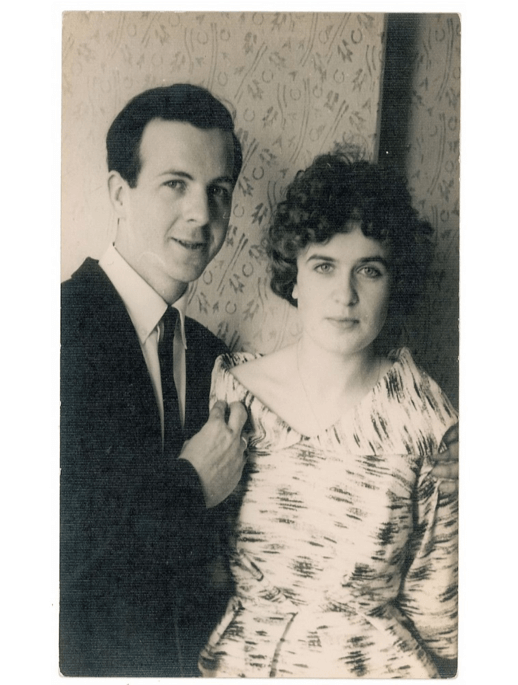
    Wedding photo showing ring worn
    on right hand per Russian tradition

    The wedding ring held and on exhibit through the Sixth Floor Museum as once having belonged to Lee Oswald, did not belong to him. It is most likely a Soviet era wedding ring of the type Oswald did indeed wear at his wedding—but as far as can be ascertained, never again thereafter. Leading to the conclusion that the ring he wore that day was borrowed for the occasion.

    The evidence leading up to the above conclusion, broken down into specific areas:

    Did Lee Oswald buy himself a wedding ring?

    What little evidence there is suggests he did not.

    Oswald made inquiries with Ella German about marriage customs in the Soviet Union—referencing silver engagement rings being swapped for gold wedding rings. He was clearly only talking about the bride-to-be. (Oswald’s Ghost, by Norman Mailer, p. 127). This fits with his noted frugality. Two rings for Marina is one thing. Another for himself is out of character.

    It should also be noted that Western males wearing wedding rings at all had only started to take off during the second half of the 20th century. (“Wedding rings: Have men always worn them?”, by Stephen Robb, BBC News Magazine, Dec 8, 2011) and that until the 1960s, wedding rings were frowned upon in the Soviet Union as a symbol of “bourgeois decay, ostentation and sanctimoniousness.” (The Land of Weddings and Rain: Nation and Modernity in Post-Socialist Lithuania, by Gediminas Lankauskas, p. 254)

    After this discussion with Ella, he purchased a silver engagement ring with a red stone, and for the wedding, a small plain gold band. After Lee’s death, undertaker Paul Groody was quoted in a newspaper account of Oswald’s funeral saying that the casket was open before burial and he had helped Marina place two rings on his finger but couldn’t get them “over the joint”. He described one as a “little ring with a red or black stone-maybe all they could get for an engagement ring in Russia.” (FBI 62-109060 JFK HQ File, Section A3, p12) The two rings placed on Oswald unquestionably belonged to Marina, with the second being her gold wedding ring. At the 2nd autopsy in 1981, the rings were taken from the little finger of the left hand. This confirms that the rings were too small to fit on Oswald’s ring finger—again indicating they had belonged to Marina.

    Tom Bargas was Shop Foreman at Leslie Welding. He told the FBI that he knew Oswald was married only because it said so on his application. (Oswald 201 File, Vol 3, Folder 9B, Part 1, p. 40) Bargas had interviewed Oswald for the job, (WCH Vol X, p. 163) so we know from this, that Oswald was wearing no wedding ring at the time of the interview—or at work at any other time.

    There are no photos available that clearly show Oswald wearing a wedding ring. There are very few photos showing a ring at all.

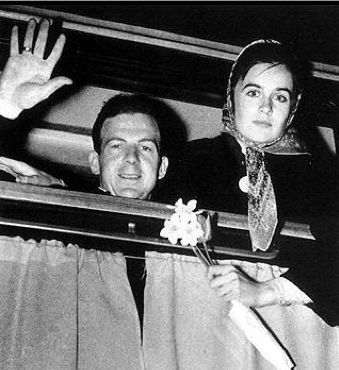
    Lee and Marina leaving Minsk

    The first of these is a black and white photo showing Lee and Marina leaving the Soviet Union. This shows a ring being worn on the right hand. Although some assume it is a wedding ring, it could just as easily be his Marine Corps ring. The assumption is largely based on claims made some days after the assassination when the ring-left-on-the-dresser story was developed. Marina buttressed the importance of this story by claiming that Lee never took his wedding ring off.

    The day before leaving Minsk, Oswald offered his friend, Ernst Titovets “a large silver ring that he had bought in Japan and wore constantly. Titovets told Oswald he was touched but could not accept the ring. It was too expensive. Oswald, we’re told, complied with his friend’s wishes and put the ring back on his finger…” (The Interloper: Lee Harvey Oswald inside the Soviet Union, by Peter Savodnik, unpaginated ebook edition).

    Since Oswald was following local traditions and wearing any rings he had on his right hand, we will logically assume that this is the “large silver ring” he had tried to give his friend just the day before. We also now know, as a result of that quote from Titovets, that it was his Marine Corp ring that was worn constantly and not a wedding ring.

    The next photos showing a ring are two of the Backyard photos. Without getting sidetracked by the authenticity debate of these photos, and that the ring seems to jump from one hand to the other, the consensus is that the ring is the Marine Corp ring.

    The last is one of the arrest photos and is something of a duel-edged sword. It clearly shows that the ring he is wearing—back on the left hand as per Western tradition—is his Marine Corp ring. It later appears in evidence lists under that description. The problem is that in not showing a wedding ring, the “ring-left-on-the-dresser” story gets additional support. It is a neat trick indeed, to use something you don’t see as evidence that it exists. God would be smiling.

    Was a ring left on the dresser on the morning of Nov 22, 1963?

    The short answer is “no, there was no ring left on the dresser of the morning of Nov 22, 1963”.

    A list of some of Marina’s purported statements on the subject, speaks for itself.

    …the following day (Friday) when she got up from bed, after the departure of her husband, she noticed his wedding ring laying on the top of their bedroom dresser. She stated that he never, to her knowledge, took off his ring before, and at that time she thought it a strange thing to do.” (CD 79, p. 3 Nov 30, 1963)

    “…she had not discovered Oswald’s wedding ring on the dresser in her room at the Ruth Paine home the morning of November 22, 1963, upon getting up that morning. She said she had not seen it until the police came to her house to search it, following the arrest of Oswald on November 22, 1963.” (CE 1820, Jan 14, 1964)


    Marina advised that on November 22, 1963, when the police came to the Paine house and searched it, they had found Oswald’s marriage ring on the dresser in the room which she, Marina used.” (FBI 105-82555 Oswald HQ File, Section 16, p. 93)

    MARINA: At one time, while he was still in Fort Worth, it was inconvenient for him to work with his wedding ring on and he would remove it, but at work—he would not leave it at home. His wedding ring was rather wide, and it bothered him. I don’t know now, he would take it off at work.

    RANKIN: Then this is the first time in your married life that he had ever left it at home where you live?

    MARINA: Yes.

    (WCH Vol 1, Feb 5, 1964)

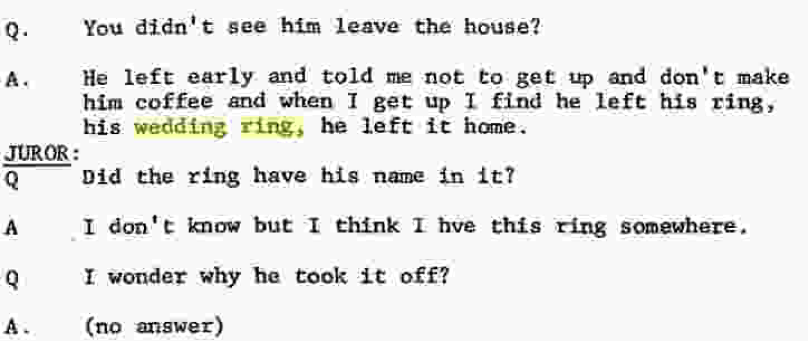
    Juror: Did the ring have his name on it?

    Marina: I don’t know but I think I have this ring somewhere.

    (New Orleans Grand Jury testimony of Marina Oswald Porter, Feb 8, 1968, p. 69)

    “Marina later made a terrible discovery. She happened to glance at the bureau and saw that, again by a miracle of oversight, the police had left another of her possessions behind. It was a delicate little demitasse cup of pale blue-green with violets and a slender golden rim that belonged to her grandmother. It was so thin that the light glowed though it as if it were parchment. Marina looked inside. There lay Lee’s wedding ring. (Marina and Lee, by Patricia Johnson McMillan p. 544)

    Mrs. PORTERWell, I do not—I remember the demitasse, but it is missed. I don’t know where it is. Are you asking me did I find Lee’s ring?

    Chairman STOKESDid you find his ring?

    Mrs. PORTER—Yes, sir.

    Chairman STOKESAnd then did you tell Miss Johnson this: “Oh, no,” she thought, and her heart sank again, “Lee never took his ring off, not even on his grimiest manual jobs. She had seen him wearing it the night before. Marina suddenly realized what it meant. Lee had not just gone out and shot the President spontaneously. He had intended to do it when he left for work that day. Again, things were falling into place. Marina told no one about Lee’s ring.” Did you tell Miss Johnson that?

    Mrs. PORTERYes.

    (HSCA Report, Vol 2, p. 301)

    Marina Oswald is the sole witness to a ring left on the dresser that morning and as we can see, her statements about the ring have little or no consistency. Nor were they made early on. The claims did not start emerging until at least a week after the assassination, during a period in the protective custody of the Secret Service. We will look more closely at this later.

    Was a ring left on the dresser later that day?

    The closest statement to the truth made about this subject by Marina was possibly one made to Priscilla Johnson McMillan for her book, Marina & Lee. In this statement, she said that “by some miracle” the police missed seeing it in their search. Since the police took Marina, Ruth Paine and Michael Paine in for questioning immediately after the search, she most likely put her own ring there some time prior to leaving the Paine household for good. In short, it was not there at the time of the police search. This explains the police not taking it. It also explains why she did not lead them to it.

    What happened after that?

    The following day, November 23, Marina and Marguerite were given three rooms at the Adolphus Hotel paid for by Life Magazine. (WCH Vol 1, p. 444) After visiting Lee that day, Life moved the women to the Executive Inn to hide them from rival journalists. While there, Marina phoned Ruth Paine to advise her “about the ring” on the dresser. (CD 329, p. 116). Although this FBI report dated January 16, 1964 alludes to the ring as belonging to Oswald and that he had left it there before going to work, the truth is more likely to be that Marina phoned upon realizing that she had forgotten her own wedding ring and she was asking Ruth Paine to look after it until it could be picked up with her other belongings.

    Ruth Paine was not asked, nor did she volunteer any information about this call before the Warren Commission. On November 24, the mother, wife and daughters of the accused were taken into protective custody by the Secret Service. According to Marguerite, they were picked up after Lee was murdered. According to Peter Gregory, who was among the entourage who arrived at the Executive Inn, they only heard the news regarding Lee en route to Robert Oswald’s house, and this caused them to divert to the house of the Irving Chief of Police instead, where Marina again phoned Ruth. (WCH Vol 2, p. 345) I believe that Marguerite’s version is the more accurate regarding the timing of being picked up. It was done with great urgency, and with a Secret Service escort. Something triggered that urgency. That trigger could only be Lee’s death.

    Marina Oswald testified that “They [the entourage that had picked her and Marguerite up] stopped at the house of the Chief of Police Curry [it was actually the Irving Police Chief, but Marina would not have been familiar with either of them]. From there, I telephone Ruth to tell her that I wanted to take several things which I needed with me and asked her to prepare them. And that there was a wallet with money and Lee’s ring [or as more likely, her own wedding ring].” (WCH Vol 1, p. 81)

    Just a little while later, in the same session, the questions and answers seemed to get muddled as to sequence of events when she responded to the question, “what did you do after you went to the motel?” by saying, “I left with Robert and we prepared for the funeral.” This must be out of sequence because she had testified previously that Robert had left by then. It therefore must have occurred prior to going to the house of the Irving Police chief and phoning Ruth. Mortician Paul Groody is known to have gone through the same things he did with all bereaved by asking Marina about what clothes and jewelry she would like Lee to be laid to rest in.

    We then go to Ruth Paine’s testimony:

    Mr. JENNER—Do you recall an incident involving Lee Oswald’s wedding ring?

    Mrs. PAINE—I do.

    Mr. JENNER—Would you relate that, please?

    Mrs. PAINE – One or two FBI agents came to my home, I think, Odum was one of them, and said that Marina had inquired after and wanted Lee’s wedding ring, and he asked me if I had any idea where to look for it. I said I’ll look first in the little tea cup that is from her grandmother, and on top of the chest of drawers in the bedroom where she had stayed. I looked and it was there.

    Did Ruth take a lucky guess at where to look or did Marina tell her exactly where it was because she herself had put it (her own ring) there? We are not told when this happened, but we do at least know that the request by Marina was made on the afternoon of her husband’s murder. We also know from Marina’s testimony that she had advised Ruth that she “needed” the items requested. This is curiously as absent from Ruth’s testimony as the date for the pick-up is. The question is, was Marina ‘s need for the ring so that it could be placed on Lee’s finger for burial? Was Ruth deliberately vague on detail because, the ring having magically transformed from Marina’s ring to Lee’s ring, it now cannot be associated with the ring put on at the funeral?

    The real sequence of events would be:

    • Nov 22 am—Lee Oswald leaves for work. Marina gets up later
    • Nov 22 pm—JFK is assassinated. Paine home is searched. No ring is found on dresser because no ring is there. Marina and Ruth and Michael Paine are taken in for questioning
    • Nov 23—Marina and Marguerite are moved into rooms at the Adolphus Hotel before being moved again to the Executive Inn on the edge of town. Marina phones Ruth to let her know she has left her ring/s and savings behind and asks Ruth to look after them
    • Nov 24—Lee Oswald is murdered. Robert Oswald, Peter Gregory and some Secret Service agents hustle the women into moving quickly to another location. They are now in Secret Service protective custody. Robert takes Marina to the Mortician, Paul Groody, and she tells Groody she wants Lee buried in her wedding and engagement rings as the police have his ring and bracelet. They go to the home of the Irving Police Chief where Marina again phones Ruth, telling her she needs the ring and that someone is coming to collect it. It is picked up by FBI Agent Bardwell Odum. Ruth knows where the ring is because Marina has told her
    • Nov 25—Lee Oswald is buried after a quick service at Rose Hill Cemetery. The casket is open until just prior to internment and Groody assists Marina in placing the rings on Lee’s little finger as they are too small for the traditional ring finger (FBI 62-109060 JFK HQ File, Section A3, p. 12)
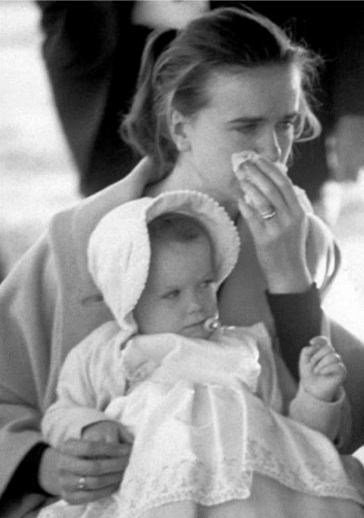
    Marina at City Hall on Nov 22. She is still wearing her ring

    What this timeline shows is the improbability of the ring/s (it was more likely both her wedding and engagement rings) on the dresser having belonged to Lee Oswald. Moreover, it makes sense of the phone calls to Ruth on consecutive days and shows that the second call fits with the need for the rings in time for the funeral. It is surmised that Marina took her rings off sometime before leaving the Paine household on Nov 23 as Marguerite testified that both babies had diarrhea. This would cause a lot of changing of nappies and wiping of bottoms—something best done without jewelry on the fingers.

    The three-ring circus

    Two rings on left hand and one on right

    As we can see above, on November 22, Marina wore one ring. Yet on the day of Lee’s funeral she was photographed wearing what looks like three almost identical plain wedding bands. I have no explanation for this other than to suggest that there were a number of rings left in that demitasse saucer picked up from the Paine’s by Odum and delivered to Marina—all of which belonged to Marina—as shown from they way that they fit.

    Where did the story originate that the dresser ring belonged to Lee?

    As shown above, the Secret Service took Marina and Marguerite into protective custody immediately after Lee Oswald was murdered. The day after the funeral, Nov 26, serious interrogations began, with both the Secret Service and the FBI. These went through until Dec 1, though further interviews were conducted periodically after that.

    The interrogators quickly realized that Marina was the person they needed to concentrate on. She was vulnerable on several levels, but more importantly, she was also more flexible and pragmatic of mind. It would be a mistake to suggest this made her submissive. She was simply a survivor first and foremost. Marguerite on the other hand, had a clear and immovable portrait of her son, and it was not the portrait that investigators wanted to hear. She would be set aside and marginalized as an avaricious, nutty and neglectful mother. In fact, Marguerite testified to the Warren Commission that “I was never questioned by the Secret Service or the FBI at Six Flags. My son, in my presence, was questioned and taped, and Marina was continuously questioned and taped. But I have never been questioned.

    The Reid Interrogation Technique

    The Reid Interrogation Technique is practiced throughout most law enforcement agencies and police forces in the US where suspects and witnesses are routinely interviewed. This includes the FBI and the Secret Service. It was developed in consequence to Brown Vs Mississippi (1936) which held that confessions obtained through physical violence would be inadmissible in court. It simply replaced the violence with social psychology involving isolation, induced despair, limiting opportunities for denials and alibis, and the delay of legal counsel at least until the person has been broken down and has provided a confession. Other tools used to get to this point include lying to the suspect, pretending to have witnesses or evidence that don’t exist, or showing evidence that is fraudulent, giving leading questions and finally, throwing a lifeline by offering excuses for the crime and offering support if they will only make the admission. Parallel to that is the construction of a scenario around the crime that goes to the guilt of the suspect.

    The method works. The method also does not discriminate. If you are the focus of an investigation, it may only be because your psychological reactions have not been within the “norm”. For example, a woman finding her husband or child dead would be expected to be an emotional wreck. Other signs of guilt are also looked for, such as an inability to make eye contact, fidgeting, stuttering etc. All too often, once police become convinced of your guilt, based solely on their psychological evaluation, lack of evidence is of secondary importance. They will either break you or frame you.

    Or in the case of Oswald, arrange your televised execution.

    The method is not confined to suspects. It is also used on witnesses to get them on board with a scenario that helps their case.

    Marguerite intuitively knew that something was happening, even if some of her conclusions may not have been accurate.

    Mrs. OSWALD. No. I am saying—and I am going to say it as strongly as I can—that I—and I have stated this from the beginning—that I think our trouble in this is in our own Government. And I suspect these two agents of conspiracy with my daughter-in-law in this plot.

    The CHAIRMAN. With who?

    Mrs. OSWALD. With Marina and Mrs. Paine, the two women. Lee was set up, and it is quite possible these two Secret Service men are involved.

    Mr. RANKIN. Which ones are you referring to?

    Mrs. OSWALD. Mr. Mike Howard and the man that I did not—did not know the name, the man in the picture to the left. I have reason to think so because I was at Six Flags and these are just some instances that happened—I have much more stories to tell you of my conclusions. I am not a detective, and I don’t say it is the answer to it. But I must tell you what I think, because I am the only one that has this information. Now, here is another instance——

    What Marguerite witnessed between the agents and Marina and assumed to be evidence of conspiracy between them in the assassination was really the Secret Service coopting Marina to assist with building the case against her husband. What Marguerite witnessed was initially Marina being isolated, threatened, asked leading questions and finally being offered all manner of assistance as her cooperation grew and she saw the money rolling in from a shocked nation. Meanwhile, Marguerite was being denied a ride home for more clothes and having her news clippings and mail confiscated. In all other respects, she was totally ignored.

    Marina’s cooperation with the Secret Service then was vouchsafed by early promises arranged through immigration that she would not be deported, and by having firemen sitting within view of her as they counted the money coming in from concerned citizens around the country—a reminder that the money was within reach—but not hers until the Secret Service was happy enough with her to hand the money over. Both measures infuriated the FBI as they left Hoover’s men no bargaining chips whatsoever—and that was probably another outcome the Secret Service hoped to achieve. They now owned Marina. (Assignment Oswald, by James P Hosty, p 89). The money ended up totaling $70,000—the equal of nearly $600,000 today. Given her parlous state, the murder of her husband, two small children, and poor prospects in a foreign and now possibly hostile environment, no one should blame Marina for effectively going along with the stage play. Taking the carrot in America was certainly a better prospect than facing the stick back in the Soviet Union.

    The sole purpose of the evolving ring story was simply to imply motive. Lee, it would be claimed, knew his marriage was over so he planned instead to make his mark in history. But the marriage was not over. The savings also found on the dresser—and often cited as another clue he was never coming back, had been an amount accumulating on that very dresser every pay day, not left all at once. It was money meant for an apartment to reunite the family and there is solid evidence he had found one. That information too, had to be buried and left uninvestigated. Unfortunately, it is also outside the bounds of this work.

    (With thanks to Ed Ledoux for the photos used.)


    THE RING, Part Two: Authentication, Sale & Acquisition

    If, as shown in Part One, it is likely that Lee Oswald never owned a wedding ring, it stands to reason such a ring could not be sold at auction.

    Yet a wedding ring purported to have belonged to the accused assassin was indeed sold at auction in 2013. Here, we will try and trace the history of how this came about.

    2004 and the Markward file

    Ring and receipt discovered by Dave Perry

    In July 2004, the Fort Worth law firm of Brackett & Ellis located the Marina Oswald file of retired lawyer Forrest Markward.

    At 90 years old, Markward was long retired and by now in the early stages of Alzheimer’s, so the law firm instead, called in local JFK assassination expert, Dave Perry to go through the material.

    Inside the file, Perry found an envelope containing a gold wedding ring and a receipt—allegedly from the Secret Service. This is suggested by the file reference at the top right which was the reference the Secret Service used for all JFK assassination related material. (Lost History episode, air date december 1, 2014).

    Stan Dane’s MS reproduction matches perfectly

    Issues with the receipt as photographed

    As can be seen, the receipt bears no signature or date and is not on Treasury or Secret Service letterhead. In short, it is the type of document that could easily be typed up by anyone. Indeed, it looks very much like it was typed using MS Word using 10-point fonts or, alternatively it was typed on an IBM Selectric typewriter using 12 pitch characters (all but identical to the 10-point fonts of MS).

    Author Stan Dane proved the point by reproducing the receipt using MS Word and comparing the result to the original.

    Issues with the ring as photographed

    Building on the work of Dane, Jake Sykes measured the ring size with the following formula:

    “Using 1/16″ (the 10-point font measurement) yields 9-1/2 lower case “s” letters. 9.5 x 1/16″ = .594″ for the ring diameter.” This means the ring is just below the average woman’s ring size of .60”. (reference.com article, What Is the Average Ring Size for a Woman?)

    What we are left with is a receipt that bears indication of fakery and a ring too small to have been worn by Lee Oswald, but quite possibly one that would fit Marina.

    The strange articles of Dave Perry and Hugh Aynesworth

    Before getting into those articles in detail, allow me to note one of the first things that struck me about the pair—they both spell lawyer Forrest Markward’s surname as “Marquart” indicating a certain amount of cribbing from each other. I have found no indication that the name was ever spelled any other way than “Markward”. It is for instance, spelled that way in Secret Service records dated Feb 7, 1964 and in online obituaries (findagrave.com, date of death Nov 30, 2009), so if Perry went through the lawyer’s file on Marina, how on Earth did he manage to misspell his name? I will leave that detail for others to ponder.

    Is This Lee Oswald’s Wedding Ring? By Dave Perry, undated

    Perry starts out appearing to be wearing his investigative reporter hat. He does this by going through some (but not all) of Marina’s different and contradictory statements concerning the ring. He then notes that Oswald was buried on Nov 25, 1963 before quoting Linda Norton, the doctor who headed the exhumation autopsy in 1981:

    “Upon entry into the casket a moderate malodor emanated from the decomposing body. As measured in the casket from superior skull to heel region on the left, a body length of 177cm (69½ in.) was obtained. A gold wedding band and a red stone ring were removed from the fifth digit of the left hand (subsequently identified by Mrs. Porter as representative of items placed upon the body at the time of initial burial).” (The Journal of Forensic Sciences, V. 29, N. 1, January 1984, p. 24)

    To get the full flavor of the Perry piece from this point, it would be best just to quote it directly.

    Originally, I believed the ring in the possession of Attorney Luke Ellis of Brackett & Ellis of Fort Worth, TX was the wedding ring removed by Dr. Norton. I thought a member of the firm, Attorney Forrest Marquart, had appeared with Marina at the exhumation autopsy.

    When I visited the law firm, I found documents showing that Marina was using the firm’s services in 1964—after the burial but well before the exhumation autopsy. Marina went to the law firm in 1964 to sign documents (for example: the contract with Priscilla McMillan and publisher Harper & Row for the book that would become Marina and Lee.) and at that time presented the ring to Attorney Marquart.

    With the ring is the following typed notation:

    CO-2-34, 030

    Receipt is hereby acknowledged of a gold wedding band which had been turned over to the United States Secret Service on December 2, 1963 by Mrs. Ruth Paine.

    _____________________________

    Date _________________________

    I surmised the law clerk that received the ring, transcribed Marina’s comment that this was the ring that Ruth Paine turned over to the Secret Service on December 2, 1963. The Secret Service then gave it to Marina who brought it to the law firm as payment for services.

    I now had no idea what ring the law firm had until I found the following:

    “The lid was raised. Forty reporters peered over the (police) officers’ shoulders. Marina, who had been following TV and was learning about images, kissed her husband and put her ring on his finger.” (The Death of a President, by William Manchester, p. 568)

    It would seem Marina put HER wedding ring on the body only to retrieve it years later at the exhumation. And this means the ring in the law firm’s possession is Lee Oswald’s wedding ring.

    The issues and items not mentioned are just as telling as his inevitable “nothing-to-see-here” conclusion. This includes the circumstances of his appearance to inspect Markward’s file on Marina, the exact date this happened, any description or photo of the envelope and any contact he had with Marina about the discovery.

    Coming Full Circle by Hugh Aynesworth, September 1, 2004

    This should have been subtitled “Wither Thou Goest” such are the ties that bind the two Keepers of the Warren Commission Flame, though carrying it on opposite sides of the street.

    Aynesworth, continuing the path beaten by his ally, opens with the hortative that a small gold wedding band

    believed to have been worn by Lee Harvey Oswald until just a few hours before he purportedly assassinated President John F. Kennedy has been locked in a safe at a law firm here for more than a generation.

    Is this really Aynesworth? “Believed”? “Purportedly”?

    “Oswald’s friends and family, and lawyers and doctors involved in the case, say that the ring may be the one that the suspected assassin wore.”

    And there is the trifecta—“may”. And we really don’t get told who these people are. Sure, Marina and Ruth. But who are the others? Markward had Alzheimer’s and had no memory of any of it. The other lawyers who called Perry in had no inkling regarding the history or ownership of the ring. The doctors is one doctor, not two or more—Linda Norton—and all they had from her was the quote made in the Journal of Forensic Sciences and that quote says nothing about who owned the ring. Aynesworth is stretching credulity big time.

    “JFK investigator Dave Perry, of Grapevine, Texas, believes that the ring was Oswald’s and might have been given to federal authorities in December 1963 either by Oswald’s widow, Marina, or by Ruth Paine, the Irving, Texas, woman who let Mrs. Oswald and her two young children live with her during the fall of 1963.”

    With five qualifiers in three short paragraphs, Aynseworth is suddenly in unfamiliar territory. And remember also that these qualifiers are about the history and ownership of a ring which would eventually be sold in 2013 as a bona fide historical artifact. Clearly though, as of 2004, there was far from any certainty about either ownership or history.

    The next few paragraphs just add to the uncertainty. Luke Ellis, representing the law firm that held Markward’s file, admits he has no clue about what to do with any of the material. Ruth Paine is contacted. She falls back on how long ago it all was but concedes it is possible she gave the ring to the Secret Service on the date noted. The fact is though that Ruth Paine consistently stated during the days of the various investigations, that she gave the ring to the FBI—moreover, she names the agent as Bardwell Odum. The only thing she never mentioned was when she gave it to him. But since Marina advised her that she needed it on November 24, and the likely reason for needing it was to place on her husband’s finger for burial the next day, it is a good bet that it was collected no later than the morning of November 25.

    The next piece of information of any value is that the Times contacted Marina during late August about the ring and was told by her that she did not recall seeing the ring after the police raid on the Paine home. When pressed as to what she thought happened to Lee’s ring, Marina simply replied “Oh, I don’t know. It’s been so long ago. If someone else has it, I don’t care.

    Compare that to what she told the Grand Jury in New Orleans

    So, in 1968, She thought she still had the ring somewhere but could not recall if it was even inscribed, then by 2004, her memory was that she had not seen it since November 22, 1963! And I again remind readers that her stories constantly changed on the subject beyond these two versions. We know this is not the only subject in which Marina has given mutually exclusive accounts, with most of those being in legal settings

    Back to Aynesworth:

    Though the ring having been stored along with several legal documents might appear to indicate that Mrs. Oswald had given the ring to Mr. Marquart as payment for legal services, Mrs. Oswald did not recognize the lawyer’s name and said that she could not recall having the ring at any time after the Kennedy assassination.

    Originally, Mr. Perry and another investigator, David Murph of Grapevine, Texas, conjectured that the ring might have been removed from the casket when the body of Oswald, who was killed by Jack Ruby two days after Kennedy’s death, was exhumed in 1981.

    But Mrs. Oswald and the doctor who led the team that exhumed the body dispute that theory.

    Dr. Linda Norton, a forensics specialist from Dallas, said last week that there was no male wedding band on Oswald when he was disinterred to confirm that the body buried under his name was indeed him.

    “There were two rings, one small wedding band and a ring with a small red stone in it,” she said. “The wedding band was too small even for his little finger—so that couldn’t have been his.

    “Afterward, I replaced both on his fingers before they closed the casket and reburied him,” she added.

    There we have it. It could not have been Marina’s ring from the corpse because it was placed back on the body before reburial. Not explained is how they could have ever considered this was the ring in the files when they maintain that the ring in the files was a male size and not female (as the ring on the body was). But as we have shown already, the ring in the files was indeed a ladies’ size. Moreover, it looks like Linda Norton’s memory of putting both rings back on the body was not accurate.

    Morgue: A Life in Death by Dr. Vincent Di Maio, Ron Franscel, pp. 114-122

    Dr. Norton was assisted in the 1981 autopsy by Dr. Vincent Di Maio. This is what di Maio tells us in his autobiography

    “First, we removed the rings on the corpse’s finger and gave them to Marina… Back in the autopsy room, before Oswald’s new casket was closed and he went back into the damp earth of Rose Hill, a grateful Marina gave Dr. Norton an odd gift: the red gemstone ring we’d taken off the corpse’s pinky. It was her way of saying thanks for the team’s work. But Linda was visibly uncomfortable with this morbid reward. As soon as Marina left the room, she inconspicuously slipped it into my hand. She didn’t want it. Neither did I. As well-meaning as it might have been, it was a sordid souvenir of a grim task and an even grimmer history. I wished for the whole wretched mess to just be buried once and for all. So just before they sealed Lee Harvey Oswald’s coffin for his next eternity, I dropped the ring into the box with him and then drove home to San Antonio in the dark.

    There is just too much detail here to have been made up. In any case, for what purpose would he make such a thing up?

    We can see here that both rings were given back to Marina, but only the ring with a stone was returned to the coffin. Put anther way, Marina kept the gold wedding band—which we know was hers.

    Where does this leave us? As of 1981, Marina had her own wedding band back in her possession. But we also know from Di Maio that Marina was keen to be rid of the rings and whatever memories they held. She in fact believed she had successfully given away the engagement ring. Given this mindset, Perry’s initial impression that she had given the band to Markward who was representing her interests at this autopsy, holds up perfectly well. This in turn, fits with the measurements showing the ring found was that of a female, not a male. Again, it was Marina’s own ring.

    “Mystery surrounds Lee Harvey Oswald’s ring”, by Hugh Aynesworth for the Dallas Morning News, October 27, 2007

    This is basically an updating of the 2004 story. The only new information apart from declaring that the Sixth Floor Museum has an interest in acquiring the ring, is the following.

    “A Secret Service document that Marina signed Dec. 30, 1964, indicates that federal agents returned the wedding ring to her on that date. The Secret Service had been given the ring, the memo said, on Dec. 2, 1963, by Ruth Paine, the Irving woman who had provided a home for Marina.”

    Since when does the Secret Service get the civilian subjects of memos to sign said memo? Nor does Aynesworth attempt to explain why it took from December 2, 1963 when it is alleged that the Secret Service took possession of the ring from Ruth Paine, until December 30, 1964 to return it to the rightful owner. In fact, the prejudicial word used in all the stories about the sale of the ring and its background, is “confiscated”—that is, the ring was “confiscated” from Ruth Paine—indicating that the Secret Service had taken it forcefully as “evidence”. This is at complete odds with what Ruth Paine maintained throughout 1964 and beyond. She has steadfastly stated that the FBI came to collect it at Marina’s request on an unspecified date, but in context, had to be November 24 or 25, 1963. It is only in recent years, under apparent pressure, that she has claimed she cannot recall, and so concedes it is possible that the Secret Service did pick it up on December 2, 1963. It became obvious a long time ago that Marina and Ruth had separated into different “teams”. Marina gave her allegiance to the Secret Service while Ruth gave hers to the FBI.

    As far as this writer has been able to ascertain, such a memo has never surfaced, and as stated above, it was not mentioned in the original story.

    It seems at some stage, the “memo” was dropped as quickly as it had been “discovered” because all it states in what purports to be the official ring timeline as published by the Dallas News is this:

    Dec. 30, 1964: The Secret Service returns the ring to a Dallas lawyer who once represented Marina Oswald; that lawyer included it in files transferred to a Fort Worth attorney, Forrest Markward of Bracket & Ellis, who represented Marina Oswald from late 1963 to early 1965. (“Lee Harvey Oswald’s wedding Band Heading to Auction Block” by James Ragland, July 2013)

    The only thing left of the claim is the date. But that is far from the only issue with this timeline entry. Who was the lawyer who supposedly took receipt of the ring? Why was the ring not passed on directly to Markward by the Secret Service since he was the one currently acting for Marina? The Secret Service certainly knew about Markward since he is named in a Feb 7, 1964 memo as attending a meeting with Marina, James Martin and his family, Secret Service agents and a Mr. Louis Saunders in the Grand Prairie office of John Thorne (CD 372, p. 12). Saunders was Executive Secretary for the Fort Worth Area Council of Churches—all-in-all, a diverse group meeting indeed. No doubt the agenda items would have been intriguing. Lastly, there is a key error of fact in that entry. Brackett & Ellis is on record as stating that Markward did not begin with the firm until the late 1970’s. (“Coming Full Circle”, by Hugh Aynesworth, Washington Times, September 1, 2004) Any files transferred to him in 1964 were not therefore transferred to him while working at Brackett & Ellis. The fact is that Markward not only represented Marina in the 1963-65 period, but also for the 1981 exhumation—a fact that Perry hints at early in his “investigation” of the ring, but then drops like the proverbial hot potato when it becomes an inconvenience to his predictable conclusion.

    The RR Auction sale of the ring

    Forrest Markward died on November 30, 2009. It took until July 24, 2012 for Brackett & Ellis to formally write to Marina and advise of the ring’s discovery. That is about 30 months after the death of the lawyer and a full 8 years after it was discovered in his old files. By the same token, Marina was in no rush to obtain it; not picking it up from the law firm until early 2013. Then in May of that year, she wrote a 5-page document outlining the history of the ring for RR Auctions—a history she has constantly rewritten through questioning under oath and through numerous interviews with various law enforcement officials, authors and the media. In that light, it is unsurprising that she wrote this history on the proviso that certain parts of it would not be made public. Five months later, the ring sold for $108,000. As a 14k gold ring, it has an intrinsic value of about point one or two percent of that amount.

    Authentication

    RR Auctions commissioned David Bellman of Bellman’s Jewelers to authenticate the ring. In 2017, Mr. Bellman posted a video to You Tube as part of a series called Jewelry in History. This episode was titled Lee Harvey Oswald—Authenticating His Wedding Band. What this video demonstrates is a basic process of showing it was a Soviet made 14 karat band by the markings inside it. But does this prove it belonged to Lee Oswald as claimed? Of course not. Marina’s secret statement was accepted as the sole authentication of that.

    By the time I found this video, someone else had already asked what size the ring was. The jeweler replied that as best he could recall, it was .95 (of an inch)—which is the average size of a male ring (the Sixth Floor Museum lists as having a diameter of 15/16”). He failed to respond to my request for personal contact regarding the matter.

    The Sixth Floor Museum

    Two years later, the Sixth Floor Museum acquired the ring. During my research for this essay, the museum was contacted to alert them to the issues surrounding the ring. Here is that email, along with the reply:

    Regarding the acquisition of Lee Oswald’s wedding ring:

    I understand that Marina Oswald wrote a 5-page history of the ring to go with the it when she sold it at auction. Did the museum acquire it, as well?

    I also understand that the ring you have was found in the files of a Fort Worth lawyer, in an envelope also containing a receipt from the Secret Service dated Dec 2.

    So as to provide accurate information to the public, you need to know that this story conflicts with past stories—which are themselves all mutually exclusive.

    Ruth Paine testified to the Warren Commission that the ring was picked up from her home by Bardwell Odum of the FBI.

    Marina herself is documented as telling the FBI that the police found the ring on Nov 22.

    But then during her testimony to the New Orleans Grand Jury, Marina testified that she found the ring after Lee went to work that morning and that she still had it “somewhere”.

    That is 4 different versions, when including the Secret Service version. Two of those conflicting versions came from Marina herself. I would like to know if the 5-page note contains yet another version or incorporates one of her earlier versions.

    In any case, the provenance of the ring you have, must be treated with some trepidation.

    The story that Oswald always wore the ring and therefore leaving it on the dresser that Friday morning, shows he knew he would not be coming home, in my opinion, is the reason for these conflicting stories. Marina did testify that she knew Lee had taken the ring off once at work.

    Here is what she said:

    “At one time while he was still at Fort Worth, it was inconvenient for him to work with his wedding ring on and he would remove it, but at work—he would not leave it at home. “

    I think a lot of manual laborers would take rings off while working. It makes sense to me that Oswald did not do this just once but did it as a matter of habit. Additionally, her claim that he would never leave it at home makes no sense. Why would he wear it to work, but then take it off and carry it in his pocket all day? Wouldn’t it make better sense to leave it at the Paines’—especially if he expected to be returning there that evening?

    What should have been regarded as evidence of his innocence (or at the very least, evidence of nothing either way), was completely turned on its head to make him look guilty.

    I also note that in his 2013 book, Mr. Fagin pushes the line that Oswald not only left his ring, but also $170.00. This is not true. He did not “leave” it there. That wallet was kept there, and he added to it every pay day—that is according to Marina’s testimony on it.

    Any museum needs to ensure it gets its facts straight and does not simply push official propaganda that is not supported by the evidence. Not unless the museum is in a totalitarian country, anyway.

    Five days later, I received the following reply from Stephen Fagin:

    Good afternoon Mr. Parker,

    Thank you for your interest in the Museum’s Collection. As our educational and public programs have demonstrated over the years, there is rarely one way of exploring evidence in a case that remains controversial and fiercely debated around the world. We value your feedback regarding Lee Harvey Oswald’s wedding ring, and the resources that you cite are available to students, researchers and the general public via our Reading Room.

    We do have the May 2013 letter from Marina Oswald that you referenced in your e-mail. In it, Marina indicates that she did not see the ring that morning but believes—based on records associated with the ring—that Ruth Paine gave it to the Secret Service. She assumed that the government had kept all of their personal belongings (including the ring) and did not learn that the ring had been returned until “receiving a letter from a Fort-Worth law firm in July 2012 stating that they had it in their files for past 49 years.” She recalled that Forrest Markward, the attorney who had possession of the ring, had provided her with some pro bono legal work following the assassination. Marina recognized the ring upon examining it.

    The Museum is confident, based on available documentation and research, in the provenance of the ring we currently have on display.

    Again, we appreciate your interest.

    Sincerely,

    Stephen Fagin | Curator

    Mr. Fagin failed to respond to two follow-up emails made in response to this carefully crafted, polite brush-off.

    So, let us put the reply under the microscope here:

    What does “there is rarely one way of exploring evidence in a case that remains controversial and fiercely debated around the world” even mean in terms of arriving at an accurate conclusion? It is nothing but a throw-away line meant to sound profound. Either the ring held is authentically one that belonged to Lee Oswald, or it isn’t. The next statement that “the resources that you cite are available to students, researchers and the general public via our Reading Room” is equally misleading in its banality. The resources cited would not be found unless specifically searched for and it is a painstaking exercise to run down all sources and all versions of and about the one story. The only version that is easy to find, is the official one because it is plastered all over the net. Mr. Fagin’s laisse-faire attitude to real history is offputting, yet still unsurprising. Being a water-carrier with only make-believe water does at least have the saving grace of being wryly amusing.

    it is, however, his description of the 5-page statement regarding the history of the ring, made by Marina in order to procure a sale, that is really telling.

    In it, Fagin states that according to Marina,

    • She did not see the ring that morning (of Nov 22, 1963). My response: Yet she is on record as saying otherwise in the past.
    • She believes, based on the records, that Ruth Paine gave it to the Secret Service. My response: Yet there are no such records that I have been able to find, apart from the alleged receipt found with the ring. And as already established, Ruth Paine testified she gave it to Mr. Odum of the FBI.
    • She did not know about the existence of the ring until receiving the letter from Brackett & Ellis in July 2012. My response: Yet we have seen that she was contacted by the NYT (possibly by Hugh Aynesworth himself) for Aynesworth’s 2004 story on the finding of the ring.

    Based on the results of this investigation, Mr. Fagin’s assertion that “The Museum is confident, based on available documentation and research, in the provenance of the ring we currently have on display” is a bit risible.


    THE RING, Part Three: Timeline & Conclusions

    1957-1958: Lee Oswald buys a Marine Corps ring while stationed in Japan

    1960-61: Lee is making inquiries about Russian marriage customs concerning silver engagement rings and gold wedding rings for the bride-to-be. He makes no inquiries about rings for grooms-to-be. (Oswald’s Ghost, by Norman Mailer, p. 127)

    Jan 1960-Nov 22, 1963: Lee takes his Marine Corps ring off while at work (WC testimony of Marina Oswald “At one time while he was still at Fort Worth, it was inconvenient for him to work with his wedding ring on and he would remove it, but at work—he would not leave it at home. His wedding ring was rather wide, and it bothered him. I don’t know now, he would take it off at work.” There is no reason to believe that Oswald ever wore a wedding ring at any job and the ring that he wore constantly was his Marine Corp ring—a wide ring, which is what Marina described)

    1961: Lee buys a silver engagement ring and gold wedding ring in Minsk for Marina Prusakova.

    April 30, 1961: Lee marries Marina. Speculation: Lee borrows a ring for the ceremony. This must be true since Marina testified as above that the wedding ring was inconvenient to work in because of its width. The wedding photo does not show a wide ring. As above, the wide ring could only be his Marine Corp ring—this being the same ring that Titovets said Lee wore constantly as shown in next entry)

    May 22, 1962: Lee offers to give his friend, Ernst Titovets his Marine Corps ring as he is departing the next day to the US and wants to leave his friend something to remember him by. Titovets refuses to accept it, noting that Lee wears it “constantly” (The Interloper: Lee Harvey Oswald Inside the Soviet Union, by Peter Savodnik, ebook, unpaginated)

    Nov 22, 1963: After the search of the Paine house, Marina is taken in for questioning by the DPD and provides an affidavit This statement contains nothing about a ring being left by Lee that morning. (affidavit of Marina Oswald, Nov 22, 1963). Just after 4:00 pm, Lee gives his USMC ring to Det. Sims during a body search.

    Nov 23, 1963: Speculation: Marina takes her own wedding ring off while changing nappies of her babies, both of whom have diarrhea and places it in a cup or saucer on her dresser. She then leaves the Paine household for good, initially being looked after by Life Magazine. She phones Ruth later that day to let her know she left a ring behind. (FBI report dated Jan 16, 1964). The report is non-specific about which ring is being referenced. Speculation: Specifically, this call is to let Ruth know she has left her wedding ring inside the cup on her bedroom dresser and asks Ruth to keep it until she is able to pick it up.

    Nov 24, 1963: Marina phones Ruth Paine again after Lee is murdered. She tells the Warren Commission on Feb 3, 1964 “I telephone Ruth to tell her that I wanted to take several things which I needed with me and asked her to prepare them. And that there was a wallet with money and Lee’s ring.Speculation: it is not Lee’s ring she mentioned at all since the only ring he had was a Marine Corp ring and it had been taken by police. She is referring to her own ring. This call is really to ask for the return of the rest of her belongings and for the return of her ring so it can be placed on Lee before burial. Ruth Paine testified that Robert Oswald came by for all Marina’s other belongings—but the ring and money were given to FBI agent Odum.

    Nov 25, 1963: Lee Oswald is buried at Rose Hill Cemetery. Marina’s wedding and engagement rings are placed on Oswald’s little finger on the left hand. Historian William Manchester tells us that “the lid was raised. Forty reporters peered over the (police) officers’ shoulders. Marina, who had been following TV and was learning about images, kissed her husband and put her ring on his finger.” (The Death of a President, by William Manchester, p. 568). And from Dr. Vincent Di Maio, one of the autopsy team at the 1981 exhumation, we have “…Groody placed two rings on Oswald’s fingers. One was a gold wedding band and the other a smaller ring with a red gemstone that Oswald’s wife had requested he be buried with.” (Morgue: A Life in Death, by Dr. Vincent Di Maio and Ron Franscell, p. 106). Paul Groody was the mortician who prepared the body for burial. He himself was quoted in a newspaper article saying that he assisted Marina in putting the rings on Lee. (Associated Press, Lee Harvey Oswald Casket Controversy Continues by Mike Cochrane, p. 36 Aug 16, 1981)

    Nov 26—Dec 1, 1963: Marina Oswald is subjected to intense interrogation by the FBI and Secret Service. (see especially, CE 1787) Speculation: It is during this period that the story of Lee leaving his wedding ring on the bedroom dresser first emerges. This is typical of the Reid Technique. Isolate a witness, create a narrative incriminating the accused and use any and all manner of psychological tools to get the witness to “own” that narrative. The incrimination was implicit in the alleged act because, claim the authorities, Lee knew his marriage was over and that he was not returning. He was instead, going to leave his mark on history. Speculation: The FBI and/or Secret Service built this part of the narrative based on finding out that Marina had left her own wedding ring at Ruth’s and had asked the FBI to pick it up for her so it could be placed on Lee’s finger at the funeral. All they had to do was act like the ring on the dresser had been Lee’s and truthfully say that the ring placed on Lee for the funeral was Marina’s. Now, instead of it being the same ring—Marina’s ring in both cases—they have transformed it into two different rings. From here on, Lee’s (fictional) wedding ring would be the one it would be claimed he never took off (when this was really his Marine Corp ring per Titovets). The last requirement would be to blur what happened to the (fictional) wedding ring. The fact of FBI Agent Odum picking up the “dresser ring” to give to Marina prior to Lee’s funeral, was replaced with the Secret Service “confiscating” the ring on Dec 2, 1963, before finally returning it to Marina on Dec 30, 1964. This in turn got changed to a scenario in which it was given to an unnamed lawyer who had been representing Marina who in turn passed it on to Forrest Markward.

    Dec 2, 1963: this is the day that the official time-line designates as the date that the Secret Service “confiscates” the ring from Ruth Paine. An exhaustive search of records in the Mary Ferrell Foundation data base has failed to locate any evidence of this. It is, however, the day following the FBI and Secret Service interrogations of Marina and is the day both agencies began serious investigations—largely based on the Marina Oswald interviews, as well as those of Ruth and Michael Paine, Buell Wesley Frazier and his sister Linnie Mae. Together, this group of witnesses provided, or agreed to, the dot points cobbled together to form the backbone of the case. The investigation was meant to add the flesh to this burgeoning false narrative.

    By 2004, Ruth Paine’s memory is a little fuzzy as she allegedly tells Hugh Aynesworth, that she may have given the ring to the Secret Service (“Coming Full Circle”, by Hugh Aynesworth, Washington Times, Sep 1, 2004). It is much more likely that Aynesworth told her it was the Secret Service and she simply agreed it may have been. She does stick solidly to the bit about it being done at Marina’s request.

    Dec 30, 1964: This is the day that the official timeline designates as the date that the Secret Service rids itself of the ring. According to a 2007 article—again by Aynesworth. This is supposedly based on a Secret Service memo signed by Marina. To quote from the Aynesworth article, “A Secret Service document that Marina signed Dec. 30, 1964, indicates that federal agents returned the wedding ring to her on that date. The Secret Service had been given the ring, the memo said, on Dec. 2, 1963, by Ruth Paine, the Irving woman who had provided a home for Marina.” (“Mystery Surrounds Lee Harvey Oswald’s Ring”, by Hugh Aynseworth, Dallas Morning News, Oct 27, 2007). Not explained is why it took from Dec 2, 1963 to Dec 30, 1964 to return the ring. Also not explained is what Marina is doing signing a Secret Service memo. It appears some of these issues finally dawned on those involved. In an article by Aynesworth written three years earlier on the same subject, there is no mention of any Secret Service document signed by Marina acknowledging the return of the ring. Now, in the official timeline, the only part left of these claims is the date. The alleged document signed by Marina acknowledging return of the ring on Dec 30, 1964 has disappeared and what we now have is “December 30, 1964: The Secret Service returns the ring to a Dallas lawyer…” No Marina—no Marina signing a memo…

    Oct 4, 1981: Lee Oswald’s body is exhumed through legal pleadings from author Michael Eddowes and Marina Oswald-Porter. Eddowes had written a book claiming the person buried was a Russian imposter, switched with Oswald while he was behind the Iron Curtain. Here we again run into differing versions of what transpired regarding the rings on Oswald’s fingers. In fact, there are even two different versions regarding Marina’s presence during the second autopsy. Dealing with the latter first, we have “Her [Marina’s] presence was unusual—most widows don’t attend their husbands’ exhumations and autopsies—but she didn’t seem to be shaken by the macabre nature of the moment.” (Morgue: A Life in Death, by Dr. Vincent Di Maio, Ron Franscel, p. 115). Then we have this, from a contemporaneous news report: “The 40-year-old Mrs. Porter, who married a carpenter, Kenneth Porter, refused to view the remains but had trusted friends do it.” (“Oswald’s Body Is Exhumed; An Autopsy Affirms Identity”, New York Times, Oct 5, 1981, p. 1).

    To the first part concerning the ring(s), we have these versions: “Dr. Norton explained that examiners found two rings on Oswald—one a small wedding band, the other a ring with a small red stone in it. The rings were re-buried with him. That small ring was ‘too small even for his little finger [and] could not have been his,’ said Dr. Norton.” (“Mystery Surrounds Lee Harvey Oswald’s Ring”, by Hugh Aynseworth, Dallas Morning News, Oct 27, 2007). Against that, there is this from Dr. Di Maio, “First, we removed the rings on the corpse’s finger and gave them to Marina… Back in the autopsy room, before Oswald’s new casket was closed and he went back into the damp earth of Rose Hill, a grateful Marina gave Dr. Norton an odd gift: the red gemstone ring we’d taken off the corpse’s pinky. It was her way of saying thanks for the team’s work. But Linda was visibly uncomfortable with this morbid reward. As soon as Marina left the room, she inconspicuously slipped it into my hand. She didn’t want it. Neither did I. As well-meaning as it might have been, it was a sordid souvenir of a grim task and an even grimmer history. I wished for the whole wretched mess to just be buried once and for all. So just before they sealed Lee Harvey Oswald’s coffin for his next eternity, I dropped the ring into the box with him and then drove home to San Antonio in the dark.(Morgue: A Life in Death , by Dr. Vincent Di Maio, Ron Franscel, pp. 114-122). What we see here is a key to the mystery. Marina was given both rings at the start of the 1981 autopsy. She later gives her engagement ring to Dr. Norton who did not want it and passed it surreptitiously to Dr Di Maio—who also did not want it, and he drops it back in with the corpse. Marina kept her wedding ring. Since we now know she tried to give away her engagement ring, it is plausible that she did give the wedding ring to one of her lawyers—just as originally suspected by the law firm and by Perry. We know she had more than one lawyer looking after her interests during this 2nd autopsy because we have this from the same New York Times story as previously cited; “Mrs. Porter spent hours yesterday in meetings with lawyers in Dallas planning the event. She recalled the years of work leading to it.”

    Jul 2004: The Markward Marina Oswald file is found. It is unclear as to the exact circumstances. This is what Aynesworth wrote in 2004, “Mr. Ellis said that Mr. Marquart had joined the firm in the late 1970s and just recently mentioned the materials in the firm’s safe.” Yet in 2007, Aynesworth was reporting that, “We (Brackett & Ellis law firm) have tried to get him to talk about the ring and his files, but he has refused… The firm had sent representatives to Mr. Marquart’s home ‘on several occasions’ to determine how the ring came to be with his materials, ‘but he apparently doesn’t remember,’ Mr. Ellis said.” Aynesworth goes on to say that “Marina Oswald used the services of Mr. Marquart shortly after the assassination to set up and manage a trust fund for her young daughters, June Lee, 2, and Rachel, 2 months…

    It is also noteworthy that Aynesworth claims Markward was used by Marina to set up trusts for the two girls from all the money donated post-assassination, while Perry claims the work done by Markward was sorting out the book contracts with Priscilla McMillan and Harper & Row. The end result of all of this important legal work? According to Aynesworth, McMillan “never heard of Mr. Marquart and couldn’t recall Marina discussing him during lengthy interviews with Marina in 1964.” And Marina “likewise has said she did not recall Mr. Marquart or what he might have done for her.” Miraculously however, Marina suddenly recalled who Markward was when writing up the ring history for RR Auctions in preparation for its sale. Meanwhile Markward was, as of 2004, over 90, suffering Alzheimer’s, didn’t want to discuss any of it and claimed no memory of any of it—all according to Luke Ellis. Yet we do know Markward did at the very least, meet with Marina (CD 372, p. 12 shows Markward met with Marina and Louis Saunders in the office of John Thorne at 6:10 pm on Dec 23, 1963. The nature of the meeting is not noted). The fact that Markward was one of the lawyers assisting Marina with the exhumation has been deep-sixed after the initial (and accurate) speculation that Marina had given the ring to this lawyer—just as she had given the engagement ring to Linda Norton.

    The ring itself is allegedly found by Dave Perry among the newly discovered files of the retired lawyer. This was stated in a 2014 History Channel show called “Lost History” and Perry himself confirmed it was true after the show aired—but again without revealing the circumstances of the find. In sum, we have Dave Perry finding a ring among files discovered in a law firm office, with said files belonging to an ex-partner in that firm and who it is claimed, did very important legal work for Marina in the 1963-64 period. The law firm itself, however, somehow missed seeing the ring among those files. The lawyer in question, Forrest Markward, had—or may have had—no memory of the files (reports on this are conflicting), nor of the ring and—neither Marina nor Priscilla McMillan recall Markward or what legal work he did for Marina, although Marina did finally recall him in 2013. These are the circumstances that the Sixth Floor Museum relies upon to verify the authenticity of the ring. Which is perfect. Perfect that is, that the ring is not found until after it becomes known that the owner of the files has Alzheimer’s and can’t recall a gosh darn thing! Sort of like Bob Woodward naming Mark Felt as Deep Throat when he is suffering from old age dementia.

    Perry claimed in his undated online article that “originally I believed the ring in the possession of Attorney Luke Ellis of Brackett & Ellis of Fort Worth, TX was the wedding ring removed by Dr. Norton. I thought a member of the firm, Attorney Forrest Marquart, had appeared with Marina at the exhumation autopsy.” Perry eventually ditched this theory on the basis that Dr Norton claimed to have placed the ring back on Oswald’s corpse—thus Marina could not have given it to anyone. Let us deconstruct this. Firstly, Perry would have been well aware that the ring placed on Oswald at the original burial was Marina’s wedding ring. For Perry to consider the ring found in the files could be this very ring, it would have been obvious it was not a man-sized ring, but one to fit a petite female. If it had been a man-sized ring, he would not have considered this theory for a nanosecond. Secondly, on what basis did he think Markward had represented Marina at the 1981 autopsy? Since the ring was found with files of the work Markward had done for Marina, maybe those same files revealed this work as well as the work done in 1963-64? If so, as previously suggested, that evidence would have been destroyed once the deception was mapped out.

    Oct 2007: Luke Ellis tells Aynesworh that “We could file a lawsuit, get a judicial determination of ownership, but that’s very time-consuming and nobody really wants to do it if you don’t have to.” Yet three years have already sailed by without any claimant to a ring which would eventually fetch over 100K at auction.

    July 24, 2012: A letter from Luke Ellis informs Marina Oswald-Porter of the ring’s discovery in Markward’s files making it another five years—eight in total, without a determination, before the most logical owner is formerly notified of its existence—yet still no court has determined legal ownership.

    Early 2013: Marina Oswald-Porter goes to Fort Worth and gets the ring back from Luke Ellis. It seems Marina’s word is good enough, despite the discrepancies and contradictions in her stories about the ring over the years being big enough to drive a truck through—and despite there being no paper trail for it, except a quite dubious, undated, unsigned receipt.

    May 5, 2013: Marina Oswald-Porter writes a five-page letter for RR Auctions documenting the ring’s history. She advises that only a very small specific section of this document may be released to the public.

    Oct 24, 2013: The ring sells at auction for $108,000.

    Oct 2015: The ring is acquired by the Sixth Floor Museum, Dallas, which had expressed interest in obtaining it since at least 2007.

    Conclusions

    I. Oswald did not buy himself a wedding ring.

    II. The ring left on the dresser was Marina’s and was not placed there until after her interview with Dallas police on Nov 22, 1963.

    III. After being taken away by Life Magazine, Marina phoned Ruth Paine on Nov 23 to advise she had left the ring behind and asked her to look after it and the wallet until she could pick up the remainder of her belongings.

    IV. After Lee is murdered on Nov 24, Marina phones Ruth again and advises she needs the ring and will arrange for it to be picked up. The wallet and ring are picked up that day or early the next morning by FBI Agent Odum. Other belongings of Marina’s are picked up on a later date by Robert Oswald.

    V. Marina’s wedding and engagement rings are placed on Oswald’s left little finger by Marina and mortician Paul Groody in preparation for the burial service on Nov 25.

    VI. The rings are removed from Oswald by Dr Linda Norton on Oct 4, 1981 in preparation for a second autopsy. They are given to Marina who is present during the whole procedure.

    VII. After the autopsy, Marina gives the engagement ring as a gift to Dr Norton. Once Marina is out of sight, Dr. Norton gives the ring to Dr Di Maio who likewise does not want it and places it back in the casket. Marina still has her wedding ring.

    VIII. In July 2004, a ring is discovered among files pertaining to Marina. The files belong to a by now retired lawyer named Forrest Markward who had done legal work for Marina in the past. Markward has no memory of the ring due to Alzheimer’s. The finder of the ring, Dave Perry, initially assumes that the ring was payment, or a gift for legal services during the second autopsy. This was possible because ( a ) we now know it did not go back into the casket and ( b ) we also now know that Marina gifted the engagement ring to the head autopsist, Dr. Norton

    IX. The ring found in 2004 was Marina’s wedding ring, either placed in the files by Markward after being given the ring by Marina in 1981, or it was placed there by someone else later for Perry to discover when he was called in to assess the legal documents. (Though the former seems more likely, it may be telling that the lawyers who found the files, missed seeing the ring themselves). Additionally, the receipt found with the ring is almost certainly a forgery to try and authenticate the original false narrative of the ring on the dresser as belonging to Oswald, and that it was picked up from Ruth Paine by the Secret Service and not the FBI as Paine testified

    X. The ring sold at auction was a male size ring and not the ring found and photographed with the alleged receipt which has been shown to have been a female ring size. Further it was misrepresented as belonging to Lee Oswald, making it a valuable historical item. The authentication of the ring done by a jeweler was simply authenticating it as a Soviet made wedding ring. The authentication that it belonged to Lee was solely on the say-so of Marina. The sale of historical memorabilia is a huge and largely unregulated industry where many fraudulent transactions have come to light in recent years. In this case, sourcing a Soviet made 14-karat gold wedding band, men’s size 9 1/2 would not be difficult as a quick search of the internet will reveal.

    Here is a size 13 Soviet 14K wedding band for sale on Ebay as at March 13, 2019. Asking price is $269.00.

    XI. In the end, the babies having diarrhea and needing lots of diaper changes on the morning of Nov 23, causing Marina to take her ring off and leaving without it, is what made a very questionable narrative about the ring possible. That narrative would lead to the sale of a ring presented as Oswald’s, with the only evidence being Marina’s word and a dubious, undated, unsigned receipt. As commented to me by a reviewer of this series of articles, Ebay wouldn’t even buy this story to satisfy the bona fides of the sale item. But it’s good enough for the auction house who sold it and the Sixth Floor Museum who later purchased it.

    Which shows that Mr. Fagin has enough money at the Sixth Floor where a hundred grand does not really mean that much. As long as it backs up the official story.

    The sale of this ring should be the subject of a police bunco investigation.

  • The Mysterious Life and Death of James W. McCord

    The Mysterious Life and Death of James W. McCord


    Usually when a high profile person in the field of entertainment, politics or news passes away, it is noted with almost lighting-like immediacy. We live in the Internet world, one with a 24/7 news cycle. That cycle does not sleep. It doesn’t even nap.

    For some reason it did in June of 2017.

    On June 15, 2017, James W. McCord of Watergate fame passed away. That’s correct. He passed on nearly two years ago. (here is one confirmation; here is another) If one can believe it, you will not find an obituary for him on the web. If one checks, say Wikipedia, he is still alive. You will only find a date of death through Ancestry or Find a Grave.

    Corroboration comes from Shane O’Sullivan’s book, Dirty Tricks. According to the author, McCord’s family wanted to keep his passing quiet. (O’Sullivan, p. 405) They succeeded to a remarkable, in some ways, an unprecedented degree. The logical question, which I am not sure O’Sullivan asked, is this: What was the purpose behind all the secrecy? Since today, nearly no one knows he is dead, no one can ask his family that question. But with help from genealogist Rob Couteau, and on the ground investigation in Pennsylvania by Steve Jones and Jerry Policoff, Kennedys And King can confirm that O’Sullivan is correct. McCord passed on nearly two years ago—in mystifying silence. This is therefore the first obituary anyone will read about him. Which is startling considering the impact James Walter McCord had on modern American history.

    Owing to Couteau’s work, we know that McCord’s family originated in Scotland. His great-grandfather served in the Tennessee militia during the War of 1812. McCord’s grandfather, James Allen McCord, was from Alabama and served in the Confederate army. Both his mother and father hailed from Texas. His father was a public school teacher. Although some entries place his date of birth in June, McCord was born in Waurika, Oklahoma on January 26, 1924. He attended public schools there. In 1943 he enlisted in the Army Air Corps in Miami, Florida. When that split off from the army to create the Air Force, he eventually attained Lt. Colonel status in the U. S. Air Force Reserve. After World War II, he attended Baylor before graduating from the University of Texas at Austin in 1949. He began his professional career by working briefly for the FBI. He was then employed for nineteen years by the CIA. He allegedly retired and went to work for the Committee to Reelect the President, commonly knows as CREEP, in late 1971. The man who hired him to work on the Richard Nixon campaign was Jack Caufield.

    Ambrose McCord, 
    James’s great-grandfather,
    served in the Tennessee militia
    McCord’s mother

    McCord’ high-school yearbook

    McCord’s selective service card

    McCord’s wife Sarah’s tombstone

    Caufield was a former New York City police detective. He was invited by John Ehrlichman to set up a private security agency to provide intelligence on Nixon’s political opponents. It was Caufield who first suggested forming Operation Sandwedge: illegal electronic surveillance of Nixon’s political opponents focusing on their sex lives, drinking habits, tax records and marital problems. (The Telegraph, July 11, 2012) Later on, when the so-called Plumbers Unit was formed, McCord migrated there and joined Howard Hunt for their break-ins of the Democratic National Committee. It was called the Plumbers Unit because it was partly designed to plug leaks, like the Pentagon Papers. In fact, one of the first missions the unit executed was a raid on the Los Angeles office of Daniel Ellsberg’s psychiatrist. Ellsberg had leaked the Pentagon Papers to the NY Times and Washington Post. The objective was to dig up dirt on him and smear his character in the press.

    To say that McCord was a secretive and odd person understates both his character and career. He was one of the several personages who were involved in both the John F. Kennedy assassination and the Watergate caper: two seismic shocks to the system that occurred within a decade of each other. They were both so colossal in their impact that complex and multi level cover-ups ensued afterwards to conceal their true natures. In the JFK case, it took about three years to fully expose the official Warren Report as a cover-up.

    With Watergate, where McCord’s role was much more front-and-center, it took quite a bit longer. Most analysts of that expansive and complicated phenomenon would date the beginning of its true elucidation to 1984, ten years after Richard Nixon resigned the presidency. That was the year Jim Hougan published Secret Agenda, his watershed book on Watergate. Secret Agenda is now recognized as a classic in the field. Some would go even further and deem it as one of the finest pieces of investigative political reporting in the last 40 years. No objective observer can read the book without feeling the official story handed to them on Watergate was, to say the least, both faulty and incomplete.

    What was that official story composed of? It was a combination of two factors. First, the coverage by Bob Woodward and Carl Bernstein in the WashingtonPost. This was largely supervised by editor Ben Bradlee. It was made world famous by Robert Redford in his film of their bestselling book, All the President’s Men. The second element of this official story was then adduced by the Senate Watergate Committee. In the summer of 1973 that committee’s hearings were probably viewed proportionately by as many spectators as the 1954 Army/McCarthy hearings. Led by Senator Sam Ervin, the committee pretty much followed the story that had been laid out by the Washington Post. It was this unrelenting and massive media glare that paved the way for Nixon’s resignation in August of 1974.

    One of the worst things about Watergate was that the praise and fame heaped upon Ervin, Bradlee, Woodward and Bernstein left the impression that the system had worked. Through the political and journalistic process a grievous crime had been self-corrected. We all felt good. The system had purified itself.

    A few years later, Jim Hougan walked into the FBI research library and made a request. When his documents were delivered he quickly realized that someone had made a mistake. He was getting papers that were still classified. Realizing the error would be discovered, he immediately began copying hundreds of pages from the original FBI Watergate investigation, documents that had not seen the light of day. Stuffing them into his briefcase before they were recalled, he managed to take them home. They confirmed his suspicions about what had really happened.

    Hougan opens his book with an unforgettable chapter entitled “Of Hunt and McCord”. (pp. 3-26) It is clear from these pages that Hunt and McCord lied before the Ervin Committee when they said they did not know each other prior to going to work for the Plumbers. Hougan also pointed out that when Howard Hunt retired from the CIA in 1970, that was the third time he had done so. (Hougan, p. 6) At the recommendation of Director Richard Helms, he then went to work for a CIA associated PR group called the Mullen Company. That company would then be sold by Mr. Mullen to another CIA asset, Robert Bennett. Bennett and Hunt then badgered Nixon’s hatchet man at the White House, Charles Colson, into giving Hunt a job. (Hougan, p. 33) From there, Hunt went on to perform a series of alleged intelligence assignments that were so poorly conceived and badly executed that one has to wonder if they were just Keystone Kops hijinks or something worse. Yet even though Hunt was now supposedly retired and working for the White House, the CIA continued to technically support his efforts. In fact, the Agency reviewed and extended Hunt’s Top Secret security clearance prior to his retirement. (Hougan, p. 7) His security clearance was now the same one Clay Shaw had in New Orleans. (William Davy, Let Justice be Done, p. 196)

    Four months after Hunt joined the Mullen Company, James McCord decided to retire from the Agency after 19 years of service. Although he was later billed as a technician, he worked out of the Office of Security’s secretive Security Research Staff program (SRS). (Hougan, p. 9) As John Newman later discovered, it was here where McCord teamed up with David Phillips to supervise the Agency’s anti-Fair Play for Cuba Committee campaign, of which Lee Harvey Oswald had all the earmarks of being a component. (James DiEugenio, Destiny Betrayed, Second Edition, p. 158)

    Hunt reportedly worked with McCord on Manuel Artime’s “Second Naval Guerilla” operation out of Nicaragua and Costa Rica. This was attested to by Cuban exile Harry Williams to author William Turner. (Hougan, p. 10) But Hougan dug up evidence that the pair worked together even earlier than that, back in the fifties on the Asian mainland. (p. 19) He then showed that the two men had also worked together in a domestic surveillance operation in 1969. We should add one other point. When McCord arrived at CREEP, he did not have a picture of Nixon in his office. He had a photo of Richard Helms on the wall. It was inscribed, “To Jim, With deep appreciation”. The emphasis was in the original. (Hougan, p. 22. We will reveal later a possible reason for that “deep appreciation.”)

    So just from the little noted above, the questions come rapid-fire. Why did Hunt and McCord lie about not knowing each other prior to 1972? Why did the Agency let the lie stand? Were Hunt and McCord really retired when they eventually joined, respectively, the White House and CREEP? Why was Robert Bennett so eager to get Hunt into the White House? Why was McCord working for Nixon while his allegiance appears to be to Helms? But beyond that, why did it take ten years for anyone to ask these questions?

    It is not completely accurate to write that no one investigated this aspect of the caper until Jim Hougan. There actually were two inquiries that attempted to explore the role of the CIA in Watergate. The first was the minority report of the Ervin Committee. The Republicans, led by Tennessee’s Senator Howard Baker and Minority Counsel Fred Thompson, did try to inquire into things like the role of the Mullen Company and the true goal of the burglary at the Watergate complex. Thompson and Baker theorized that the burglars’ real goal was not political intelligence for the 1972 election. It may have been surveillance of Democratic Chairman Lawrence O’Brien’s representation of Howard Hughes. Nixon’s association with Hughes, and his past attempts to bribe the president, were fairly well known at the time. The White House may have feared that O’Brien had more evidence of the same. In fact, John Meier, who worked for Hughes, told Nixon’s brother Donald that he was thinking of turning over everything that he had on Hughes. This included his knowledge of a million dollar secret donation from Hughes to Nixon. According to Age of Secrets, Don then informed his brother of this. (Probe Vol. 3 No. 2, pp. 9, 11, 15)

    Besides Baker and Thompson, the other committee that explored the CIA angle was the House Committee on Intelligence. This was led by Representative Lucien Nedzi, until he controversially resigned his chairmanship. (“House Supports Nedzi”, Washington Post, June 17, 1975) This committee did produce a report that Hougan sourced several times in his book.

    But the fact was that very, very few people knew anything about these two investigations. This overall ignorance continued even when Fred Thompson published his 1975 book based on the Baker inquiry entitled, At That Point in Time. The fact that this book was all but ignored bears witness to the enormous torque created by the Washington Post, the Woodward/Bernstein best seller, and the Academy-Award-winning hit film. A veritable whirlpool was constructed, one which carried the entire MSM along with it.

    As Jim Hougan later told me, he just never thought very much of Woodward’s reporting skills. One of the most revealing sections of Secret Agenda is in Appendix V. There the author publishes documents describing Robert Bennett’s communications with his CIA case officer. It is revealed that Bennett was actively spinning reporters like Sandy Smith and Woodward away from the Agency’s association with the Mullen Company, and selling them on the angle that his newly purchased PR company was actually “clean”. For this “information”, Woodward had agreed that these stories would not be attributed to Bennett. Bennett also had access to Senator Ervin and he had been assured that the senator would conceal the Mullen Company’s overseas role in placing agents for the CIA. (Hougan, pp. 332-335)

    To put it mildly, that memorandum raised issues about Woodward’s independence and honesty. Hougan then raised questions about the Post’s major secret source. This was the man Woodward labeled “Deep Throat” in his book. Hougan specifically raised questions about the signaling system the duo would use when Deep Throat would request a nightly meeting in a parking garage. (Hougan, pp. 291-93) Hougan and others have also explored Woodward’s military background and his high-level security clearances as part of the national security state. This has led some to believe that one reason the reporter was so keen to assault Nixon was that, unlike Bernstein, Woodward was politically to the right of the president.

    Because of this enormous propaganda apparatus, both the public and press were diverted from an alternative view of James W. McCord. Far from being a mere put-upon technician, McCord may have been a central operator. Consider just two major instances in the two-year Watergate episode. After the discovery of the break-in, the case had reached an impasse at the trial of the burglars. If they all kept silent, the conspiracy would likely be limited to them only—it would not reach into the White House. But in March of 1973, McCord radically raised the stakes. He wrote a letter to Judge John Sirica stating that perjury had been committed in his courtroom and pressure had been brought to bear for the seven burglars to remain quiet. When Sirica read McCord’s letter in court, it created pandemonium. It seemed to affirm all the stories that Woodward and Bernstein had been writing, and Bradlee publishing, in the Post.

    But, in retrospect, the question should have been: If not for James McCord, would there have been a trial at all? As most analysts of the June 17, 1972 final break-in have noted, there was something odd about the way the burglars were caught. McCord had taped the locks on numerous doors to keep them open during the break-in. The security guard, Frank Wills, had found these doors and removed the tape. (Hougan, p. 196) When the burglars entered the building at about 1:10 AM, they found a previously taped door that was now stripped. McCord then conferred with higher-ups Hunt and Liddy. According to everyone but McCord, it was he who insisted on not aborting the mission. (Hougan, pp. 197-98) The door was retaped. But after McCord entered the building, he told his low-level cohorts that he himself had removed the tape on the doors. This was not true. (Probe, Vol. 3 No. 2, p. 14)

    But that is not all that McCord had done. On the previous break-in—there were four attempts in all—it appears that McCord also switched the informational photos that had been taken inside the DNC, which were supposed to be of papers inside O’Brien’s desk, to a set of innocuous ones taken inside a Howard Johnson’s hotel room. (Hougan, pp. 153, 157) He also placed a faulty bug inside O’Brien’s office. (pp 162, 166) This from a man who when he was arraigned said—truthfully—that he had been a security consultant for the CIA. These alleged faux pas made another break-in necessary.

    Wills discovered the new tape on the same door. It was almost impossible to miss it since McCord taped as many as eight doors that night—he even taped doors on floors that would never be used, like a floor above the DNC. (Hougan, p. 207) At 1:47 AM, Frank Wills called the Washington Police Department. Just a few minutes later, the police arrived at the scene. Reinforcements soon arrived. McCord, along with four Cubans recruited by Hunt, were arrested. They were Virgilio Gonzalez, Bernard Barker, Eugenio Martinez and Frank Sturgis. Things then got worse. Surprisingly, Barker and the others had been allowed to keep their hotel keys with them. And further, neither McCord nor Hunt had sterilized the hotel rooms. Therefore, when the police entered the rooms, they discovered a treasure trove of evidence. This included their notebooks with Hunt’s name and phone number, which included the abbreviation W. House next to it. (Probe Vol. 3 No. 2, pp. 14-15) Hunt was traced to the White House. Liddy was linked to CREEP.

    But the circus even went beyond that. Hunt had paid off the burglars in sequentially numbered hundred dollar bills. The money trail would lead from Miami, to Mexico City and back to CREEP. (Probe 3.2: 14-15) And that would lead to the chairman of that body, former Attorney General John Mitchell. The notebooks with Hunt’s name and phone in them would lead to Charles Colson who ran the Plumbers Unit at the White House.

    Once apprehended—as was the case with Bennett—McCord did all he could to keep the spotlight off the CIA and on the White House. His first lawyer, Gerald Alch, had proposed an Agency cover defense. (O’Sullivan, p. 268) He was later jettisoned and replaced by Bud Fensterwald. Fensterwald wasted little time in announcing, “We’re going after the president.” (Hougan, p. 307)

    When Alch first suggested his CIA defense, McCord began to write Paul Gaynor, chief of the SRS division at CIA. He advised Gaynor to pre-empt this attempt with multiple and effective leaks to the press before the CIA defense could gain traction. Meanwhile, he would keep Gaynor informed of the legal tactics planned by the defendants. (O’Sullivan, pp. 269-70) A few days later, McCord wrote Jack Caufield at the White House. McCord stated that if Watergate was dumped off on the CIA and Richard Helms was fired,

    … every tree in the forest will fall. It will be a scorched desert. The whole matter is at the precipice right now. Just pass the message that if they want it to blow, they are on exactly the right course. (Letter of December 28, 1972)

    In spite of this warning, Helms was terminated about a month later on February 2, 1973. Around six weeks after, Caufield met with McCord. He offered him money, a job and executive clemency if he would plead guilty and remain silent. Caufield said this offer came from the highest levels of the White House. (NY Times, June 23, 2012, article by Douglas Martin.) McCord refused the deal. His allegiance was to Helms and the CIA. Shortly after, he wrote the letter to Sirica about pressure being brought to bear and perjury in his courtroom. For all intents and purposes, that is what blew the case wide open.

    Because, as McCord had warned, the Nixon White house could easily be turned into a scorched desert. And it was. Through a steady stream of disclosures by people like McCord and White House counsel John Dean, the seamy underside of the Nixon White House was placed on public display. As McCord warned, it was not a pretty sight. The secret bombing of Cambodia, the August 1971 break in at Daniel Ellsberg’s psychiatrist’s office, Nixon’s attempt to form a super intelligence group to counter student protests (commonly called the Huston Plan), the proposed fire-bombing of the Brookings Institute, etc. And, in this author’s opinion, the worst went undiscovered, because this last caper, the fire bombing of the Brookings Institute, was first thought to be part of Nixon’s war against the leaking of the Pentagon Papers. As the late journalist Robert Parry discovered, such was not the case. That proposal was really designed to find out if the evidence of Nixon sabotaging President Johnson’s Vietnam peace plan was located at Brookings. Candidate Nixon had arranged for Saigon not to cooperate with President Lyndon Johnson in his attempt to arrange a truce in Indochina before he left office. This tilted the election to Nixon and extended the war. Once in office, Nixon was worried that this evidence, like the Pentagon Papers, could be leaked to the press.

    By the summer of 1973, Nixon seemed to realize what had really happened. He called up H. R. Haldeman at four in the morning, and asked him some pointed questions:

    • “Do you know anything about the Bennett PR firm, the Mullen Company?”
    • “Did you ever employ them at the White House? Were they ever retained by us for any purpose?”
    • “Did you know they were a CIA front?”
    • “Did you know that Helms ordered Bennett to hire Howard Hunt?”
    • “Did you know that Hunt was on the payroll at the Bennett firm at the same time that he was on the White House payroll?” (Probe, Vol. 3 No. 2, p. 32)

    It was too late.

    Because of his willingness to cooperate with the court and the Ervin Committee, McCord served by far the briefest prison time of the seven men directly involved with the break in: four months. Hunt served almost ten times that long. Gordon Liddy was in prison for almost five years before being pardoned by President Carter.

    Forty-five years later, the conventional view of Watergate still largely reigns in the MSM. This is partly due to Woodward’s occasional attempts to prop up that version. For instance, when FBI officer Mark Felt was close to dying, Woodward wrote a book saying that Felt was Deep Throat. In 2017, Mr. Hollywood Mythology, Tom Hanks, then had a hand in making a truly mediocre film based on an even more mediocre book about Felt.

    But, in 2009, Ed Gray, son of L. Patrick Gray, had published an interesting book about Watergate titled In Nixon’s Web. Patrick Gray had been appointed interim director of the FBI after J. Edgar Hoover died. He supervised the initial FBI inquiry into Watergate until he resigned. He passed away before he could finish the book. It was then completed by his son. In the epilogue to that volume, Ed Gray demonstrates that Deep Throat was a composite character. And he does it with Woodward’s own notes. He also proves that Mark Felt was leaking stories to the press that sunk Gray’s nomination. The reason was Felt’s own personal ambition: he wanted the Director’s position. Again, because of the MSM censorship on Watergate, very few people know these important facts.

    The idea promulgated by Hougan, that Watergate was really a trap set for Nixon, was also a part of John Meier’s book Age of Secrets. (Co-authored by Gerald Bellett) As Bellett wrote in the introduction to the Meier book:

    Watergate was a set-up, a classic ploy as old as espionage itself. In its favor it had simplicity of execution, an irresistible bait and a spy on the inside. It was flawless. So completely were the anti-Nixon conspirators in control, that they knew an intrusion into the Democratic Party’s national headquarters was being plotted, yet did nothing to prevent it. (Bellett, p. viii)

    That last sentence refers to the fact that Lawrence O’Brien was actually tipped off in advance that the Democratic National Committee was under surveillance. He was warned of this by a prominent Democrat and newspaper publisher by the name of William Haddad. (Hougan, p. 79) Haddad was apprised of this from a private investigator named A. J. Woolston Smith. Smith apparently gained the information from an agency called the November Group. This was a set of advertising executives working on Nixon’s campaign. Liddy was the agency’s incorporator and secretary. McCord was in charge of the November Group’s security. Haddad actually told a DNC representative in advance that they would be bugged and burglarized. And that McCord and Liddy were somehow involved in the effort. Further, that other operators would be recruited from Little Havana in Miami. (p. 79)

    One of the chief investigators for the FBI on the Watergate case was Angelo Lano. O’Sullivan quotes Lano from a previous interview where he stated that he always thought the caper was a set-up. He noted that the neat arrangement of the evidence the burglars left behind at the hotel felt planted—”everything was arranged like somebody knew it was gonna happen.” And Lano could not ignore the tape:

    You’ve got a guy who’s expert in key entry, burglary [Virgilio Gonzalez]. Why did they have to put the tape back on? You put the tape on one door; it wasn’t necessary to put it on six doors. There’s always been a question in my mind [about] the response of the police department—2:30 in the morning—the placement of the items in the hotel room, the tape. To this day I still think that one of those guys tipped off the police department and it was either Hunt or McCord. (O’Sullivan, pp. 404-5)

    In 2012, Max Holland published a book about Watergate called Leak. It largely focused on the FBI inquiry. Predictably, he could not find enough space to include Lano’s insightful quote.

    As more than one person said later, James McCord was not just a technician. He was an operator. But it’s something he tried to conceal. For instance, after he moved to Pennsylvania, a reader of this site got in contact with him. He asked him about his service with David Phillips and their campaign against the FPCC. McCord said he was not a part of that; it was the FBI’s function. Since the ARRB had released those documents, I said he should question him again with the papers in hand.

    But beyond that, when Lisa Pease and I were publishing Probe magazine in the nineties, we met up with former CIA pilot Carl McNabb. He said that prior to the Bay of Pigs, he had been briefed at the Miami CIA station, since he was part of the aerial facet. He noticed that McCord was in the room and he was struck by how taciturn he was. Afterward, he asked the briefer who he was. He told him his name. He then added that he was Helms’ Zap Man. McNabb later showed me the very old notes with this information recorded on it. I asked him what the term meant. He replied McCord was his liquidator.

    Which may tie in with a quite interesting piece of information in O’Sullivan’s book. Alfred Baldwin was a former FBI agent who was recruited by McCord for the Watergate operation. He was supposed to make a log of the surveillance coming out of the Democratic National Committee. O’Sullivan found out through James Rosen that McCord told Baldwin he was in Dallas on the day of the Kennedy assassination. (O’Sullivan, p. 405) If this is true, and I am not saying it is, then it makes a quite intriguing list of CIA associated personages in that city either on the day Kennedy was killed, or a few weeks prior:

    1. Allen Dulles (James Srodes, Allen Dulles: Master of Spies, pp. 554-66)
    2. William Harvey (David Talbot, The Devil’s Chessboard, p. 477)
    3. David Phillips (Dick Russell, The Man Who Knew too Much, 2003 edition, p. 272)
    4. Howard Hunt (Mark Lane, Plausible Denial, p. 152)
    5. James McCord (Shane O’Sullivan, Dirty Tricks, p. 405)
    6. Sergio Arcacha Smith (James DiEugenio, Destiny Betrayed, second edition, p. 329)
    7. Bernardo DeTorres (Gaeton Fonzi, The Last Investigation, p. 238)

    What makes the list rather striking, as I have arranged it, is that it goes from the top of the hierarchy, through the middle, down to the lower ranks, men who would act as foot-soldiers or mechanics. Does the above explain why the McCord family wished to keep the death of James McCord so quiet?

  • Paul Blake Smith, JFK and the Willard Hotel Plot

    Paul Blake Smith, JFK and the Willard Hotel Plot


    When I was asked to do a review of this book, I was quite hesitant. I do not like to comment on other people’s work, especially when a lot of effort has been put into it. The reason I accepted this time is that it was related to research I have been doing over the last two years on prior plots to assassinate JFK and the framing of other potential patsies.

    Some who have read my articles wondered why I had not included an attempt in Washington in my analysis. Paul Blake Smith’s book subtitles itself as The Explosive Theory of Oswald in D.C. I felt this could perhaps add yet another plot to the long list of those already exposed. However, Blake Smith’s pitch that he would present compelling evidence that Oswald was in Washington as part of a squad of shooters taking aim at Kennedy from the Willard Hotel is just one of the things he promises to deliver. He states that his book is unique in that it “utilizes the revealing treasury report on Oswald-at-the-Willard”, and many other small clues: “The document is the lynchpin that holds together a solid conspiracy theory and is nearly a Rosetta Stone for deciphering the overall scope of the historic mystery.” The book would also reveal how Mafia chieftain Carlos Marcello was behind this plot and the eventual, successful Dallas assault plan. Extravagant promises, tempered by his admission that we need more facts and that a lot of his evidence is circumstantial.

    I had been expecting to read a tightly knit exposé of a Washington cabal. Instead, when the book arrived, I was faced with 433 pages that covered so much ground about not only the alleged plot, but a whole parallel look into the Lincoln assassination, the similarities between the two, and the author’s analysis of who was behind JFK’s assassination—from the orchestrators to the shooters.

    In the introduction (p. 5), the author takes precautions not to be labeled a conspiracy theorist: “In other historic dramas, like the RFK or MLK murders in mid-1968, there doesn’t seem to have been any conspiracy at all, just a true lone gunman responsible. I certainly do not see conspiracies behind every bush …”

    This is really too bad because the author has blocked himself off from potential comparative case analysis where the conspiracies behind them are perhaps as easy to demonstrate as with the JFK assassination. The MLK assassination was also judged a conspiracy by the HSCA and the RFK assassination was proven one by the autopsy alone. Even the late Vincent Bugliosi was greatly troubled by the RFK investigation. By negating these plausible conspiracies, the author has blocked off a source of information that relates to the JFK assassination—certainly when it comes to analyzing motive, media cover-up and shoddy investigations. Many of the authors Blake Smith lists in his bibliography have just signed a petition to have these cases, along with Malcolm X’s murder, re-opened. Lisa Pease just launched her book about RFK’s assassination, A Lie Too Big to Fail, which has received excellent reviews from no less than the Washington Post. In it, she presents Robert Maheu’s and John Roselli’s links to that case. Sound familiar?

    Also on the back cover, the author promotes another of his books, MO-41: The Bombshell Before Roswell. I took the time to do a little web research and found Amazon comments on it: some good and some less so. This comment got my attention:

    The narrative flows along, but there are no footnotes; and there is too much hearsay reported, especially from online chat rooms and email, which is not substantiated. More needs to be done, before I’ll buy this book’s premise/theory. The Roosevelt information is another matter altogether. The author asserts that F.D.R. shot himself due to his knowledge of the aliens, etc. of the UFO events previously described in the previous chapters.

    I had to put the book down many times and fight off my instincts to pre-judge it because I could see that it quickly staked out positions that were diametrically opposed to where I stand on the case. By the time I was through the first chapter I was dejected and regretted my decision to accept this mandate. However, a promise is a promise, so I read on. The more I read, the less I regretted taking on this endeavor, not because this was by any means a masterpiece. It is not. However, there is useful information which the author deserves credit for underscoring.

    After thinking somewhat about how to evaluate his work, I decided to focus on three basic theories that he advances: 1) That there was a plot in the works to terminate JFK in Washington in early October 1963; 2) That Oswald was in Washington leading this mission at around this time; and 3) That Carlos Marcello was the leading figure behind this plot and the eventual assassination in Dallas, “with some insider help”.

    So before analyzing the author’s evidence, let’s first get an idea of what some of his key positions are, which I must admit is not easy, as many seem to evolve from chapter to chapter and sometimes from page to page. We will first look at his views on the nature of the conspiracy.


    A Mob-led conspiracy

    At the beginning of chapter 1, Carlos Marcello’s famous rant is quoted: “Yeah I had that Sonuvabitch killed”, and then the author states shortly after: “This book aims to tell more precisely how Carlos got just what he wanted”.

    As for motive, we are given the usual litany of mob frustrations with the Kennedys. They helped get JFK elected and instead of having their guy in the White House, they were double-crossed when Bobby aggressively went after them; Marcello had been exiled to Guatemala by Bobby in 1961, etc.

    Therefore, “Carlos was determined to pay back the young president (and his cocky brother) in the most violent and extreme way he could think of: By having John F. Kennedy gunned down right at his precious White House, maybe even from the very same attractive Willard Hotel of 61”. He explains the importance of choosing cold-blooded, scummy killers that were not traceable to the Mafia: “It was just a matter of finding the most greedy, unprincipled persons” (p. 22) Remember this last line when we explain why Blake Smith believes the assassins had Kennedy in their sights from the Willard Hotel but decided not to shoot.

    He goes on to state that Carlos got buy-in from a few of the top hoodlums and came to realize he needed to hire a guilty-looking oddball who could not be tied directly to the Marcello “outfit”. By page 31, Blake Smith begins presenting a Mafia/KKK partnership since they also shared a hatred of Kennedy.

    On page 33, he makes the following statement: “Thus it seems pretty accepted today that Marcello recruited his oldest Mafia contacts, Giancana and Trafficante, to help him rub out the president.”

    The author has taken it upon himself to identify Marcello, Giancana and Trafficante as “the Big Three” of the Mafia in the early sixties. This seems both arbitrary and questionable, as it eliminates men like Meyer Lansky, and all the heavy hitters from the East Coast. In fact, none of these men were members of the governing commission of the Mafia at this time. (HSCA, Volume 9, p. 18) Marcello was not particularly tight with Giancana. He was actually in competition with Trafficante for the drug traffic in the Gulf area. Why propose a hit to someone who will have leverage over you?

    The CIA in all this? In 1960, the Big Three:

    … accepted CIA cash in exchange for assassinating Castro, but instead they took the money, gave lip service in return but no real effort and then chocked up [sic] another marker to call in for future schemes. A kind of blackmail to expose unless the CIA cooperated on certain future Mafia proposals: Like murdering their own commander in Chief. (p. 37)

    Actually, they did not give lip service. As the CIA Inspector General Report shows, there were three different attempts to poison Castro and the last one may have worked had the CIA not screwed it up by putting Tony Varona on ice during the Bay of Pigs landings. (These are described in the CIA Inspector General Report, pp. 31ff, and are termed the Phase 1 plots.) In addition, the mobsters refused to take any payment for their efforts. (p. 16)

    Blake Smith then broadens out to say a rotten apple was recruited from within the Secret Service to help in the plot. However, the number grows significantly in a couple of later chapters.

    When it comes to describing Lee Harvey Oswald, the author is consistent, direct and does not pull any punches.

    Blake Smith takes everything negative ever said about the alleged assassin and kicks it up a notch: “rat-faced fellow from Marcello’s New Orleans”; “Perpetually unemployed Marxist-spouting, ex-Marine defector”; “Had problems getting along with others, the high-strung abusive oddball, was obsessed with the anti-American hero … pro Fidel Castro”; “Lonely Lee”; “Lazy Lee”; “Handed out pro-Marxist sheets making a fool of himself”; “Arrogant L.H. Oswald was of course the same southern-fried, rifle-clutching, wife-beating school drop-out”; “Miscreant Lee in the summer of 63 was so obsessed with Soviet-linked Castro he spoke only Russian at home”; “LHO often padded around “The Big Easy” with his old military training manual … and around house with his .38 caliber pistol … plus his Mannlicher Carcano …”; “a lazy little mouse who wanted to roar”; “Lee really didn’t have the size, education, the guts and strength to accomplish anything positive”; “Puny Lee craved money, recognition, respect”… “Chronic Creep Lee had to get out of Dallas that mid-April to escape the heat from his brazen attempted assassination of retired General Edwin Anderson Walker”; “Lee had himself photographed by his wife posing with a pistol and a rifle and communist literature”; “Anyone who criticized and threaten his beloved Castro was an imperial fascist who deserved to be shot …” The author also shows us some of his prowess in psychiatry by diagnosing Oswald as semi-psychotic: a qualifier he uses throughout the book. This comes in handy, because now he can explain almost anything Oswald does henceforth in his exposé, no matter how illogical.

    According to the author, Oswald was brainwashed into killing Kennedy by figures connected to Marcello, by telling him the president wanted Castro dead and the American Mafia out of power for good.

    The Warren Commission could not find any motive for Oswald. Blake Smith spells out what it missed: Oswald would “help kill Kennedy to save Castro and expect rewards including legal passage to Cuba as an accepted resident there outside of extradition.”

    Blake Smith opines that Oswald did fire twice at Kennedy and then once at Connally, nailing both men in the back (page 324). His third shot hit the curb. He then killed Officer Tippit before Marcello had Ruby rub him out. And there is this peculiar statement: “Lee’s shots were in reality only to get people—especially JFK’s Secret Service Agents—to look the wrong way, a distraction for the knoll gunman’s crucial kill shot.” Never mind that it appears the throat shot from the front preceded the back wound shot.

    Lee Harvey Oswald in Washington

    Concerning this aspect of the Willard Hotel plot, the author does not waste any time summarizing ten clues in Chapter 1 that “reveal the reality of Lee Oswald in Washington and some aspects of the two planned “Willard Hotel Plots” in Washington.

    These include:

    1. What he calls a formerly buried Willard Hotel Secret Service report.
    2. The Joseph Milteer tape where the white supremacist can be heard predicting the assassination.
    3. Richard Case Nagell’s letters warning the FBI of a Washington plot towards the end of September.
    4. Lee Harvey Oswald’s letters talking about moving to Washington at this time.
    5. J. Edgar Hoover’s memos stating that Oswald had been in Washington.
    6. David Ferrie’s rants about killing Kennedy in Washington.
    7. Statements made by a Cuban exile made in Miami before the assassination.
    8. Documents retrieved from a pile of burned leaves in Pennsylvania.
    9. A scorched memo sent to a researcher that “supposedly” was retrieved from James Angleton’s fireplace.
    10. A Secret Service report on Marina Oswald.

    After reading the whole book, my opinion is that there is a good argument to be made that there were many contingency plans in place to kill JFK at locations he visited throughout the last three quarters of 1963 and perhaps even earlier. That Washington was on the list is probable and can be based not only on the author’s (and others) writings, but by the numerous other plots that have been documented. The idea that Oswald was being maneuvered to be a patsy there is plausible. However, Oswald’s pro-Marxist behavior was a matter of sheep-dipping by intelligence and not, as the author writes, an expression of his ideology. Washington was not the original plot to bump off JFK as claimed by the author, as cabals in L.A. and Nashville preceded it. Finally, the proof that Oswald was in fact in Washington in late September and early October 1963, as laid out in this book, is a lot weaker than what the author argues. We will discuss this later, as well as the case made about the Willard Hotel being a place that the shooters actually occupied when they had Kennedy in their sights.

    Summary

    I don’t think kennedysandking readers need me to find arguments against much of the author’s often debunked and rehashed mob-led conspiracy theory. Many of the arguments the author presents in his “Marcello mastermind” scenario only demonstrate mob involvement as a very junior partner in the conspiracy. As a matter of fact, he could have put more emphasis on Ruby’s probable visit to Trafficante in Cuba, the analysis of his phone calls during the days leading up to the assassination, as well as the fact that one of Ruby’s first visitors while in jail was alleged Dallas mobster Joe Campisi. Other arguments the author presents are on shaky ground. When it comes to the hierarchal structure of the coup, his pecking order needs revising. If he is looking for arguments to do so, I will refer him later to his own sources.

    In this day and age, the fact that the author does not even want to entertain the notion that Oswald may not have been a commie nut is faintly ludicrous, and has been ever since the following famous statement was published:

    We do know Oswald had intelligence connections. Everywhere you look with him, there are fingerprints of intelligence.

    ~ Senator Richard Schweiker, The Village Voice, 1975

    From 1975 to 1976, Schweiker was a member of the United States Senate Select Committee to Study Governmental Operations with Respect to Intelligence Activities. According to Blake Smith, Oswald would kill any who would dare threaten Fidel Castro. Yet Oswald spent the latter years of his life in the Marines, with White Russians, and right wing extremists like David Ferrie and Guy Banister, Cuban exiles hostile to Castro, perhaps with Mafiosi who wanted the island back, CIA contacts … the crème de la crème of Castro hostiles. When he was arrested on Canal Street, Oswald asked to meet with FBI agent Warren de Brueys, who was responsible for monitoring the Fair Play for Cuba Committee and Cuban exiles. This may be why Gerald Ford wrote about a Warren Commission meeting presenting information that Oswald was a government informant.

    One would also wonder whom from the Mafia, or the Secret Service, would even risk exposing themselves and their roles in a plot by conferring so much responsibility to such a loose cannon. Blake Smith also speculates Oswald is capable of quite the accomplishments for such a loser: sending one or two of his doubles down to Mexico City to set up an alibi, receiving inside information from Secret Service agents in Washington, placing two shots in the back of both JFK and Governor Connally with a terrible weapon …

    Schweiker was not alone in having his doubts about Oswald’s Warren Commission persona, and who was really behind the assassination. HSCA Chief Counsel Richard Sprague, attorney Mark Lane, investigator Gaeton Fonzi and New Orleans DA Jim Garrison all expressed similar opinions. These later snowballed into a consensus that we can now read in the recently written Truth and Reconciliation joint statement, signed by many of the researchers Blake Smith refers to. In it, you will not see a whiff of consent around a mob-led conspiracy scenario. You will see that these writers think the mob figures were themselves being led! The first paragraph speaks for itself:

    In the four decades since this Congressional finding, a massive amount of evidence compiled by journalists, historians and independent researchers confirms this conclusion. This growing body of evidence strongly indicates that the conspiracy to assassinate President Kennedy was organized at high levels of the U.S. power structure, and was implemented by top elements of the U.S. national security apparatus using, among others, figures in the criminal underworld to help carry out the crime and cover-up.

    We will return to flaws in the author’s logical construction later. I did find some positive contributions in this work, at least points useful in my own investigative objectives. Here is what I feel are some of the stronger points of the book:

    1. The author does cover either numerous areas that reminded me of interesting anecdotes or issues I had read a while back but I had forgotten about, and some I had not heard of.
    2. He presented arguments around the work of some reliable researchers that have convinced me that there could well have been a plot to assassinate Kennedy in Washington that would have framed Oswald. This is of strong interest to me because of my research in the prior plots to assassinate Kennedy.
    3. Related to this point, the author presents some context on the goings on in D.C. during the period Oswald was scheduled to be there.
    4. While his attempts to link the KKK to a Mafia-led plot are weak, his writings allowed me to better understand some of the history and structure of American hate groups and the arguments others have put forth about their alleged contribution to the coup.
    5. Some of the writings around the mob, and I say some, could be interesting to novice readers.
    6. I, along with a growing number of researchers, concur with his conclusions that Oswald never visited Mexico City. I also applaud his attempt to answer the obvious question that arises because of this: Where was Oswald during these crucial dates? This is an important debate that researchers must have.
    7. While his writings about Secret Service participation are at times contradictory, he did a smart thing in relying heavily on Vince Palamara in his research, which resulted in two of his best chapters.

    Unfortunately, these also included two major negatives. He contaminated them somewhat with some of the worst of the Dark Side of Camelot and other TMZ-style gossip about Kennedy’s private life. And then, for some very weird, unexplained reason, he decided to use the pseudonym Trip-Planner Perry to identify (or hide) one of his leading suspects from the Secret Service. I will speculate later on why I think he chose this very unfortunate writing strategy. Whatever the reason, as a reader I felt very manipulated and frustrated.

    I also have written about how the CIA, Mafia and Cuban exile network involved in the assassination had roots going back many decades. I am now interested in how the Secret Service could have logistically worked with this network. Blake Smith does present some good leads to follow up on.

    My philosophy about reading in general is that if, at the end of a book, I have learned something new and important, or my view about an issue has evolved, there has been progress. However, the struggle to get there can be often very demoralizing—talk about mixed emotions!

    Research and analysis

    One of my frustrations with Blake Smith’s book was trying to make sense of the author’s sources. His footnote management is very inconsistent; his exhibits, especially the documents, are poorly identified and made almost impossible to read because of poor reproduction; his sources are difficult to consult and he is often guilty of citation malpractice. Trying to figure out the soundness of his research was quite time-consuming and represented a heavy burden for readers like me who like to evaluate the solidity of the argument or dig to find out more. Throughout the book, I felt the author was playing a game of hide-and-seek with his primary data. I will give a few examples later. If you are going to make a case on circumstantial evidence, you really need to back up your observations with solid, easy to consult references.

    Blake Smith’s sources and evidence are often so scrambled, mysterious and sketchy that the real sleuthing related to this work is trying to figure out what they are. All too often, you cannot try to expand your knowledge or verify the authenticity of the evidence. We are left to trust his evaluation of evidence that we cannot explore. On many occasions, he uses the National Enquirer technique of presenting an unidentified source as his basis for making a claim. We are left guessing who-the-heck said what and how credible this informer is.

    Here are some examples of the vagueness and lack of sourcing that goes on throughout the book: “On May 15th, 2006, five knowledgeable JFK assassination experts were invited to a special conference …” (we never find out who); exhibit on page 17—FBI report about Marcello that is illegible; page 17, incriminating quotes made by Marcello with no footnotes. Then there is this citation: “He wanted that particular American leader dead in 1963 and hired others to do the job. (source: an FBI report dated the following 3/7/85); “Some legal and media investigations have shown that Marcello had upset the Kennedys; At one point in 1963, researchers have now learned, the devious Mafia plan was becoming so increasingly whispered; According to biographers, for a few weeks spiteful, unstable Oswald ran wages and numbers to gamblers for Murrett; Undoubtedly some Cuban refugees and two key private investigators also worked on Lee Oswald that summer, hammering away at his psyche”—with not one footnote to the entire passage. This is just chapter one. Sometimes, when we are lucky, a whole book is mentioned as the source.

    The author could have profited from a reliable editor, one who would have helped with grammar, fact checking and general guidance. I cannot say how many times this has helped me for articles I have written that are less than one tenth the length of his book. Even though the author has an energetic, whimsical style that can be entertaining, the number of punctuation errors, faulty page breaks, misspelled words (assasin, guiilt, coup d’eta to name but a few) and especially name identification errors (Dan Hardway becomes Don Hardaway, Douglas Dillon is at times Douglass, Douglas Horne is also spelled Douglass, Hersh is Hirsh, Harold Weisberg is Weisburg, ZR Rifle is at times just Rifle, and Robert Maheu is misspelled Mahue throughout). This laxness permeates the entire book.

    A good editor would have also helped with fact checking and helped avoid blunders, or strongly urged the author to provide the evidence for some of the questionable claims that are often made. The next two sections furnish examples.

    The Sylvia Odio incident (page 90):

    Blake Smith: (at Odio’s residence on September 25) “Leopoldo and Angelo spoke in Spanish on his (Oswald’s) behalf around sundown, talking about how loco he was in his pro-Castro, anti-Kennedy views.”

    Now compare this to what Sylvia Odio said in her testimony to Wesley Liebeler in 1964:

    He (Leopoldo) did most of the talking. The other one kept quiet, and the American, we will call him Leon, said just a few little words in Spanish, trying to be cute, but very few, like “Hola,” like that in Spanish.

    … I unfastened it after a little while when they told me they were members of JURE, and were trying to let me have them come into the house. When I said no, one of them said, “We are very good friends of your father.” This struck me, because I didn’t think my father could have such kind of friends, unless he knew them from anti-Castro activities. He gave me so many details about where they saw my father and what activities he was in. I mean, they gave me almost incredible details about things that somebody who knows him really would or that somebody informed well knows. And after a little while, after they mentioned my father, they started talking about the American.

    He said, “You are working in the underground.” And I said, “No, I am sorry to say I am not working in the underground.” And he said, “We wanted you to meet this American. His name is Leon Oswald.” He repeated it twice. Then my sister Annie by that time was standing near the door. She had come to see what was going on. And they introduced him as an American who was very much interested in the Cuban cause. And let me see, if I recall exactly what they said about him. I don’t recall at the time I was at the door things about him.

    I recall a telephone call that I had the next day from the so-called Leopoldo, so I cannot remember the conversation at the door about this American.

    I asked these men when they came to the door—I asked if they had been sent by Alentado, became I explained to them that he had already asked me to do the letters and he said no. And I said, “Were you sent by Eugenio,” and he said no. And I said, “Were you sent by Ray,” and he said no. And I said, “Well, is this on your own?”

    And he said, “We have just come from New Orleans and we have been trying to get this organized, this movement organized down there, and this is on our own, but we think we could do some kind of work.” This was all talked very fast, not as slow as I am saying it now. You know how fast Cubans talk. And he put the letter back in his pocket when I said no. And then I think I asked something to the American, trying to be nice, “Have you ever been to Cuba?” And he said, “No, I have never been to Cuba.”

    And I said, “Are you interested in our movement?” And he said, “Yes.”

    This I had not remembered until lately. I had not spoken much to him and I said, “If you will excuse me, I have to leave,” and I repeated, “I am going to write to my father and tell him you have come to visit me.”

    And he said, “Is he still in the Isle of Pines?” And I think that was the extent of the conversation. They left, and I saw them through the window leaving in a car. I can’t recall the car. I have been trying to. …

    So Blake Smith has the residence meeting all wrong. Let us see how he does with the follow-up call (which he speculates was made from the Willard Hotel) where he states: “That on the evening of the 27th (48 hours later), one of the two Cubans with Oswald called Sylvia Odio and said Oswald wanted to shoot the president.”

    Here is Odio’s testimony:

    The next day Leopoldo called me. I had gotten home from work, so I imagine it must have been Friday. And they had come on Thursday. I have been trying to establish that. He was trying to get fresh with me that night. He was trying to be too nice, telling me that I was pretty, and he started like that. That is the way he started the conversation. Then he said, “What do you think of the American?” And I said, “I didn’t think anything.”

    And he said, “You know our idea is to introduce him to the underground in Cuba, because he is great, he is kind of nuts.” This was more or less—I can’t repeat the exact words, because he was kind of nuts. He told us we don’t have any guts, you Cubans, because President Kennedy should have been assassinated after the Bay of Pigs, and some Cubans should have done that, because he was the one that was holding the freedom of Cuba actually. And I started getting a little upset with the conversation.

    And he said, “It is so easy to do it.” He has told us. And he (Leopoldo) used two or three bad words, and I wouldn’t repeat it in Spanish. And he repeated again they were leaving for a trip and they would like very much to see me on their return to Dallas. Then he mentioned something more about Oswald. They called him Leon. He never mentioned the name Oswald.

    Mr. LIEBELER. He never mentioned the name of Oswald on the telephone?

    Mrs. ODIO. He never mentioned his last name. He always referred to the American or Leon.

    Mr. LIEBELER. Did he mention his last name the night before?

    Mrs. ODIO. Before they left I asked their names again, and he mentioned their names again.

    Mr. LIEBELER. But he did not mention Oswald’s name except as Leon?

    Mrs. ODIO. On the telephone conversation, he referred to him as Leon or American. He said he had been a Marine and he was so interested in helping the Cubans, and he was terrific. That is the words he more or less used, in Spanish, that he was terrific. And I don’t remember what else he said, or something that he was coming back or something, and he would see me. It’s been a long time and I don’t remember too well, that is more or less what he said.

    And then there is this:

    Mr. LIEBELER. Now, a report that we have from Agent Hosty indicates that when you told him about Leopoldo’s telephone call to you the following day, that you told Agent Hosty that Leopoldo told you he was not going to have anything more to do with Leon Oswald since Leon was considered to be loco?

    Mrs. ODIO. That’s right. He used two tactics with me, and this I have analyzed. He wanted me to introduce this man. He thought that I had something to do with the underground, with the big operation, and I could get men into Cuba. That is what he thought, which is not true.

    When I had no reaction to the American, he thought that he would mention that the man was loco and out of his mind and would be the kind of man that could do anything like getting underground in Cuba, like killing Castro. He repeated several times he was an expert shotman. And he said, “We probably won’t have anything to do with him. He is kind of loco.”

    When he mentioned the fact that we should have killed President Kennedy—and this I recall in my conversation he was trying to play it safe. If I liked him, then he would go along with me, but if I didn’t like him, he was kind of retreating to see what my reaction was. It was cleverly done.

    In a nutshell, the author in just a few lines of copy, confuses who spoke, what was said during the meeting at the residence, when the follow-up call took place, the claim that Oswald was described as pro-Castro, and while Leopoldo claimed that Oswald said that the Cubans should have killed Kennedy because of the failed Bay of Pigs, he did not say Oswald wanted to shoot the president.

    In fact, he is depicted as one who could kill Castro. (WC Vol. 11, p. 377) On the surface, why would three persons seeking (or pretending to seek) to collaborate with an organization that has as its objective the overthrow of Castro, and talk to a person whose father is languishing in a Cuban prison, present Leon as pro-Castro? It is more likely that they were hoping to link the future patsy with JURE an organization favored by the Kennedys for when a potential overthrow took place, but clearly despised by the intelligence apparatus and the other stakeholders.

    Throughout the book, the author often distorts evidence, to the point that it appears he has not examined the primary data closely and wants it to point to Oswald being pro-Castro at the Willard Hotel in late September. This tendency is recurrent to the point that the presentation becomes biased and exaggerated.

    Jack Ruby and the Mob

    On page 376, he makes the claim that Ruby’s motivation to kill Oswald (in part) was his own impending death: “Oswald’s stalker—murderer had been diagnosed with cancer before Kennedy came to Dallas”. His source: talk show host Morton Downey Jr. (1932-2001), who claimed to have interviewed Dr. Alton Ochsner, who would have diagnosed Ruby with cancer in August 1963. Consequently, he knew his time on earth was limited. Never mind that Ruby was based in Dallas and Ochsner in New Orleans, or that there is no corroboration in the literature for this information. Need I also point out that Downey is known for having pioneered Tabloid TV?

    In addition, a solid editor would have suggested that he leave out many of his stories that were based on hearsay, outdated evidence and are often irrelevant. I believe that his focus should have been a 200-page analysis of the Washington plot instead of 420 pages on every anecdote there is about the assassination, no matter how wild.

    In reading his bibliography, I began to understand why his writings are skewed towards the discredited Mafia-did-it theory. It contains a long list of some 60 books. Among the authors referred to, you will find Waldron, Stone, Chuck Giancana, Shenon, Davis, Hersh, Janney, Aynesworth and Bugliosi. Having read some of the work he includes such, as JFK and the Unspeakable, The Devil’s Chessboard and Survivor’s Guilt, I could not understand his conclusions about the assassination motive or logistics. If he did read them, he seems to have very little regard for the evidence they put forth, since it is at odds with his theories of the crime. Books that seemed to have made a strong impression on him include Double Cross, some of Robert Morrow’s work and Ultimate Sacrifice, since these are among the most referenced. The Robert Blakey (HSCA) quotations he uses are the ones that most support his theory, certainly not the ones Blakey made after coming to terms with the fact that the CIA had duped him by placing obfuscator George Joannides as CIA liaison during the HSCA investigation. This probably goes a long way in explaining his “the Mafia killed Kennedy” view of things.

    That bibliography is also notable for what it does not include: None of the work by Newman, Prouty, Simpich, Hancock, DiEugenio, Mellen, Davy, Armstrong, Fonzi, McBride, Ratcliffe, or Lane is listed! How most of these highly respected researchers are not in one’s top sources is difficult to fathom. It explains, in my opinion, why this author’s analysis is mired in the past.

    The author’s key theories under the microscope: A Marcello-led Plot

    On page 23, the author relates this old tale to us: “You must get a nut to do it.” Marcello allegedly told an FBI informant, who reported those words back to the Bureau and eventually to the press. On page 25, he quotes Marcello as saying he wanted it done so that it could not easily be traced back to him. “If you cut off the tail of a dog, he lives. But if you cut off his head he dies,” Marcello famously explained to his trusted visitor.

    For some reason, as he often does, the author presents no footnotes, does not tell us who the informant was and accepts this story at face value. I wondered why a Mafioso would incriminate himself so pointlessly.

    According to a 1993 Washington Post article, the informant alluded to here was Las Vegas “entrepreneur” Ed Becker. The following lines prove this: Ed Becker was told by Marcello in September 1962 that he would take care of Robert Kennedy, and that he would recruit some “nut” to kill JFK so it couldn’t be traced to him, according to several accounts. Marcello told Becker that “the dog (President Kennedy) will keep biting you if you only cut off its tail (the attorney general)” but the biting would end if the dog’s head was cut off. Becker’s information that Marcello was going to arrange the murder of JFK was reported to the FBI, though the FBI says it has no records of the Marcello or the Trafficante threats, nor of wiretapped remarks of Trafficante and Marcello in 1975 that only they knew who killed Kennedy.

    Becker, who became a key source in Ed Reid’s 1969 book, The Grim Reapers, was shown to be problematic by the HSCA. Here are a few key lines that seriously undermine Becker (follow the link for the whole report on the debunked Marcello threats):

    ALLEGED ASSASSINATION THREAT BY MARCELLO

    • As part of its investigation, the committee examined a published account of what was alleged to have been a threat made by Carlos Marcello in late 1962 against the life of President Kennedy and his brother, Robert, the Attorney General. The information was first set forth publicly in a book on organized crime published in 1969, “The Grim Reapers,” by Ed Reid. (160) Reid, a former editor of the Las Vegas Sun, was a writer on organized crime and the coauthor, with Ovid Demaris, of “The Green Felt Jungle,” published in 1963.
    • In a lengthy chapter on the New Orleans Mafia and Carlos Marcello, Reid wrote of an alleged private meeting between Marcello and two or more men sometime in September 1962. (161) His account was based on interviews he had conducted with a man who alleged he had attended the meeting. (162)
    • According to Reid’s informant, the Marcello meeting was held in a farmhouse at Churchill Farms, the 3,000-acre swampland plantation owned by Marcello outside of New Orleans.(163) Reid wrote that Marcello and three other men had gone to the farmhouse in a car driven by Marcello himself. (164) Marcello and the other men gathered inside the farmhouse, had drinks and engaged in casual conversation that included the general subjects of business and sex. (165) After further drinks “brought more familiarity and relaxation, the dialog turned to serious matters, including the pressure law enforcement agencies were bringing to bear on the Mafia brotherhood” as a result of the Kennedy administration. (166)

    Reid’s book contained the following account of the discussion:

    It was then that Carlos’ voice lost its softness, and his words were bitten off and spit out when mention was made of U.S. Attorney General Robert Kennedy, who was still on the trail of Marcello. “Livarsi na petra di la scarpa!” Carlos shrilled the cry of revenge: “Take the stone out of my shoe!” “Don’t worry about that little Bobby, son of a bitch,” he shouted. “He’s going to be taken care of!” Ever since Robert Kennedy had arranged for his deportation to Guatemala, Carlos had wanted revenge. But as the subsequent conversation, which was reported to two top Government investigators by one of the participants and later to this author, showed, he knew that to rid himself of Robert Kennedy he would first have to remove the president. Any killer of the Attorney General would be hunted down by his brother; the death of the president would seed the fate of his Attorney General. (167)

    No one at the meeting had any doubt about Marcello’s intentions when he abruptly arose from the table. Marcello did not joke about such things. In any case, the matter had gone beyond mere “business”; it had become an affair of honor, a Sicilian vendetta. Moreover, the conversation at Churchill Farms also made clear that Marcello had begun to move. He had, for example, already thought of using a “nut” to do the job. Roughly 1 year later President Kennedy was shot in Dallas—2 months after Attorney General Robert Kennedy had announced to the McClellan committee that he was going to expand his war on organized crime. And it is perhaps significant that privately Robert Kennedy had singled out James Hoffa, Sam Giancana, and Carlos Marcello as being among his chief targets.

    FBI investigation of the allegations:

    • The memorandum goes on to note that a review of FBI files on Reid’s informant, whose name was Edward Becker, showed he had in fact been interviewed by Bureau agents on November 26, 1969, in connection with the Billie Sol Estes investigation. (185) While “[i]n this interview, Marcello was mentioned * * * in connection with a business proposition * * * no mention was made of Attorney General Kennedy or President Kennedy, or any threat against them.” (186)
    • The memorandum said that the agents who read the part of Reid’s manuscript on the meeting told the author that Becker had not informed the Bureau of the alleged Marcello discussion of assassination. (187) In fact, “It is noted Edward Nicholas Becker is a private investigator in Los Angeles who in the past has had a reputation of being unreliable and known to misrepresent facts.” (188)
    • Two days later, in an FBI memorandum of May 17, 1967, the Special Agent in Charge (SAC) of the Los Angeles office reported some additional information to Hoover. (194) In the memorandum, the Los Angeles office set forth some alleged information it had learned regarding Becker, who, the memo noted, claimed to have heard “statements supposedly made by Carlos Marcello on September 11, 1963, concerning the pending assassination of President Kennedy.”(195) The FBI memo stated that 1 day after the Bureau first learned of the Reid information, its Los Angeles office received information regarding Edward Becker which was allegedly damaging to his reputation. (196) According to the information, Sidney Korshak had been discussing Becker and:

      Korshak inquired as to who Ed Becker was and advised that Becker was trying to shake down some of Korshak’s friends for money by claiming he is the collaborator with Reid and that for money he could keep the names of these people out of the book. (197)

    • The memorandum also stated that Sidney Korshak had further stated that “Becker was a no-good shakedown artist,” (198) information which in turn became known to the Bureau. (199)
    • Where Becker is referred to as an “informant,” it should be noted that this applies to his relationship to Reid and not to a Federal law enforcement agency.
    • On May 31, 1967, according to the same memorandum, a special agent of the Los Angeles office was involved in a visit to Reid’s (208) in a further effort to persuade him of Becker’s alleged untrustworthiness. (209) During this visit, the Bureau’s possible confusion over the time periods involved in the matter was further evidenced in the memorandum, which said that “in November 1969” Becker had “not mentioned the reputed * * * statements allegedly made by Marcello on September 11, 1963.” (211) Again, both Reid and Becker have maintained consistently that they made clear that the meeting was in September 1962, rather than September 1963 (212), and that the specific reference in the Reid book stated “September 1962.” (213) Additionally, the Bureau’s own files on Becker (while not containing any references to assassination) clearly indicated that Becker had been interviewed by agents in November 1962, following a trip through Louisiana that September. (214) Committee investigation of the allegation.
    • Becker was referred to in a second FBI report of November 21, 1962, which dealt with an alleged counterfeiting ring and a Dallas lawyer who reportedly had knowledge of it. (222) This report noted that Becker was being used as an “informant” by a private investigator in the investigation (223) and was assisting to the extent that he began receiving expense money. (234) The Los Angeles FBI office noted that the investigator working with Becker had “admitted that he could be supporting a con game for living expenses on the part of Becker * * * but that he doubted it,” as he had only provided Becker with limited expenses. (225)
    • The November 21, 1962, Bureau report noted further that Becker had once been associated with Max Field, a criminal associate of Mafia leader Joseph Sica of Los Angeles. (226) According to the report, “It appears that Becker * * * has been feeding all rumors he has heard plus whatever stories he can fit into the picture.” (227)
    • On November 26, 1962, Becker was interviewed by the FBI in connection with its investigation of the Billie Sol Estes case on which Becker was then also working as a private investigator. (228) Becker told the Bureau of his recent trips to Dallas, Tex., and Louisiana, and informed them of the information he had heard about counterfeiting in Dallas. (229) At that point Becker also briefly discussed Carlos Marcello:

      He [Becker] advised that on two occasions he has accompanied Roppolo to New Orleans, where they met with one Carlos Martello, who is a long-time friend of Roppolo. He advised that Roppolo was to obtain the financing for their promotional business from Marcello. He advised that he knew nothing further about Marcello. (230)

    • Becker was briefly mentioned in another Bureau report, of November 27, 1962, which again stated that he allegedly made up “stories” and invented rumors to derive “possible gain” from such false information. (231)
    • Three days later, on November 30, 1962, another Bureau report on the Billie Sol Estes case made reference to Becker’s trip to Dallas in September and his work on the case (232). The report noted that Becker was apparently associated with various show business personalities in Las Vegas (233). Further, a man who had been acquainted with Becker had referred to him as a “small-time con man.” (234)

    And the report goes on and on in undermining this entertaining but dubious saga.

    Becker’s reliability took another sharp turn for the worse just recently when in December 2018, on BlackOp Radio, a show Blake Smith should listen to in order to evaluate his sources, Len Osanic interviewed Geno Munari. Geno knew someone who met Carlos Marcello with a very nervous Edward Becker. In that interview, Geno explains how his acquaintance met Marcello and got to interview him years after the assassination, how he was accompanied by Becker and how it was quite obvious that Becker and Marcello had never met before.

    In itself, this casts much doubt on the Marcello accusations which have circulated for decades and that Blake Smith has rehashed as one of his foundational arguments. This analysis, along with the Sylvia Odio section, point to another problem I have with the author’s research efforts: He does not seem to seek corroboration from primary sources when this is easily available. Furthermore, neither Reid nor Becker (who later co-wrote a book on John Roselli) are in his bibliography. So one must ask, with this many layers between the author and the primary data, where does he get his information?

    It is very difficult to recount what the author’s position on a subject can be, because he speculates in so many directions that it can leave your head spinning. Here are some examples:

    • If Marcello wanted to create distance between the assassination and the Mafia, you would think this would be reflected in the hit-team that was put together. In his top ten suspects in Dallas, the author names in fourth place Johnny Roselli, in fifth place Sam Giancana’s top enforcer Charles Nicoletti and Trafficante’s personal bodyguard Herminio Garcia Diaz is in third.
    • Blake Smith expresses doubt that Alpha 66 leader Antonio Veciana ever met David Phillips because he only confirmed this after Phillips passed away. He does not believe the Veciana claim of having seen Oswald with Phillips in Dallas (p. 105). However, to prove that Oswald was never in Mexico City, he relates how Veciana said that Phillips offered him a large sum of money to lie about Oswald visiting a relative in Mexico City, and concludes that if Oswald were in Mexico City, why would one need to bribe someone to lie about it?
    • And remember Marcello’s short list of cold-blooded, scummy killers that would be recruited to do the job? Here is one of the author’s reasons the hit team decided not to fire when they had Kennedy in their sights with his family close by: “one would think that women and children would be off limits to any shooter with an ounce of self-respect, when pondering firing a kill shot at the president, from afar or just from the sidewalk, behind the fencing. A sniper with a clear shot could not very well plant a bullet into the skull of a president in front of his loving spouse and offspring and expect safe quarter from any citizen or sympathetic anti-Kennedy supporter in the aftermath, when trying to escape capture. The whole country would have turned on such a heartless, coldblooded villain. Thus the “South Lawn Plot” was a total flop.” (p. 398)
    • On page 164, he further confuses matters by writing: “But it had to be the president who had to be lured into place too, into the open somehow, in this scenario. Perhaps at an outdoor welcoming ceremony, or concert, or playtime with the children.”
    • The author also states that a reason for the failure was that Oswald chickened out (page 321). Question: Did all the shooters chicken out simultaneously? Other question: What made Marcello think that he would not chicken out again firing from his place of work in Dallas?
    • Then we have the October Surprise: “anyone who longed to gun down the president, at the White House or in his Washington parade. And it was all due to the power of chlorophyll: a healthy bright green. Nature’s green leaves and thick shrubbery saved the day” … ”Very large, full trees lined the South Lawn in particular, blocking the view from the sturdy Willard Hotel, and even in some locations the ground-level views from the sidewalk.” … “foiled by foliage.”

      I do not even know where to begin with this one. How long did it take for these Keystone-Cops plotters casing the joint since September 26 to figure this out? Would the leaves having begun to turn orange improved the view that much? Not where I come from! Finally, living significantly farther north than Washington D.C., I highly doubted that the leaves begin changing colors a full two weeks before those in Quebec City. This is what is confirmed on any website for autumn tourists: “Fall is especially beautiful in the District of Columbia, Maryland, and Virginia. Leaves begin to turn red and yellow in the middle of October. The timing and intensity of colour depend on temperature and rainfall. The peak of fall colors can be seen till the end of October, and then the trees start losing leaves.”

    • As for his one bad apple in the Secret Service: this is a point he makes in his relatively good work in his Secret Service chapters and elsewhere. But the list kept growing to include Trip-Planner Perry, Kellerman, Greer and possibly others. And even here, the author tends to fall into the trap of using debunked sources, something that happened to me in some of my early writings.

      Way back, I too fell for the Mafia-connected Judith Campbell hoax. Campbell claimed to be Kennedy’s mistress who acted as courier between Sam Giancana and Kennedy. One of the persons who edited my work convinced me to put a stop to this because she simply could not be trusted. In a list of ten outrages, the author explains why some in the Secret Service turned on JFK, including his alleged affairs with Mary Meyer and Judith Campbell, involvement in group sex and homemade porn, hotel hookers, the president’s gay lover, and drug abuse. While he does use the word “alleged” at times and also the qualifier “according to”, he rarely shows an inclination to explore the debunking of these sensationalistic claims. Not to say that JFK was a choirboy, but after reading “The Posthumous Assassination of John F. Kennedy—Judith Exner, Mary Meyer and Other Daggers” by Jim DiEugenio, I realized how much I had fallen for some of the worst exaggerations out there. Blake Smith continues to do so.

    • In his chapter 4, on hate groups, he underscores links between them and the Mafia-linked persons of interest, such as the alleged ones between Joseph Milteer and Guy Banister that we will talk about below. Since I had not looked into this area very closely in the past, I found myself interested in the anecdotes presented. But here again the author provides little primary data when it comes time to proving meaningful links between them and the Marcello gang. It all becomes tenuous and fragile.
    • Sometimes the author uses a source and then candidly puts on the brakes to point out serious credibility problems with the source. But he then keeps coming back to it. On page 196, he tells us about how Terri Williams, in a small town in Mississippi, remembered her classmates and teachers whooping it up after learning of the JFK assassination. The excited principal went from class to class proudly announcing his death. The principal even singled out a ten year-old boy’s father’s expert marksmanship in Dallas. And the Williams family was also congratulated for their Uncle Albert Guy Hollingsworth being part of the team. Terri’s story goes on to implicate the unstable, ex-marine uncle. She claims he became the Zodiac Killer. Since the Zodiac Killer was never caught, the author opines, “Who knows? Miss Williams might be right”. Terri did, however, “concede that her uncle was in reality a lousy shot, having once blown off one of his own toes.”

      This goes on for seven pages, then eventually the author transparently states: “Her tale is compelling but she has not produced a shred of evidence to back it up … Some other online allegements [sic] by Terri Williams seem to become more suspect and farfetched-sounding [sic].”

      Seven pages on an online source like that … Really! What’s worse is that after completely undermining her credibility, he still goes back to her at least twice in later sections to emphasize points. Now guess who makes it on to his list of top ten suspects in Dallas? In eighth place: Al Hollingsworth!

    • His attitude towards the CIA’s involvement with this whole cabal is difficult to pin down. Sometimes we get the feeling that they are just a little bit pregnant, but then he will anecdote-drop key points that he leaves undeveloped and fluffs over their significance. On page 296, he dabbles a little bit in William Harvey, who helmed the ZR Rifle assassination program and who was close to John Roselli and hated the Kennedys. However, he then comes to a sudden stop around this intelligence subject. On page 248, he uses The Devil’s Chessboard to allude to Dulles perhaps conniving with Treasury Department head Douglas Dillon, but does not develop it much further. He alludes to some suspicious behavior by the CIA’s David Phillips around the Mexico City charade (p.81).

    It now appears that Jim Garrison has been vindicated with respect to Clay Shaw, whose role as a well-paid CIA asset has been confirmed; moreover, many witnesses, judged credible by the HSCA, saw him in the company of Oswald and David Ferrie. Yet Clay Shaw is barely mentioned. He does describe the Bethesda military autopsy room on the night of the assassination as being filled with military men, but without understanding the implications.

    Had he taken a little trouble to reflect on these important observations and added to them a consideration of both the timely propaganda efforts conducted in the blink of an eye by key CIA assets such as Hal Hendrix, Ed Butler and DRE members, all in synch with one another, as well as the ensuing cover-up, he would have seen that there is little probability this conspiracy was Marcello-led.

    The Willard Hotel Plot

    It goes without saying that I have issues with the author’s overall scenario. However, my interest in his book had more to do with his theory that there was a planned Washington plot in the works and that Oswald was there with a team of shooters who were in position at and around the Willard Hotel to fire away at the president. Let us see how he does in these areas.

    We do not have to wait very long for the author to make his case. The author deserves credit for describing the goings-on in the Capital during the time that Oswald was scheduled to move there. The fact that there was a motorcade on October 1 with Ethiopia’s Haile Selassie is important. The discussion around the Kennedy use of the South Lawn for ceremonies, playtime with the children and other activities is also useful. The descriptions of what the two possible Willard Hotel plots —one involving triangulated firing at the motorcade, the other involving sniping at JFK on the South Lawn from the Willard Hotel and locations close to it—these deserve our attention and are a first step for us to debate a potential Washington plot.

    One area that I found interesting was the actual description of the Willard Hotel and its potential for such plots. The author sometimes uses vague expressions like “potentially” or “in theory” in ways that made me believe he had not done much groundwork in sizing up the feasibility of actually carrying out an assault from a place in proximity to the White House. I was skeptical about the mere notion that a president could be picked off like a sitting duck from a hotel window near his home. I would have liked to see more pictures of the hotel and the views it offered as well as diagrams and distance measurements. I would have welcomed more information about the standard security arrangements to counter such an obvious, omni-present threat. I would have appreciated knowing more about the getaway challenge. It would have been good if the author had conducted his own interviews of hotel workers and even current Secret Service representatives. Steps like these are what made James Douglass’ description of the Chicago plot persuasive. The author visited potential patsy Thomas Arthur Vallee’s place of work and covered Secret Service agent Abraham Bolden’s account of security sabotage in detail. When you consider that the Willard Hotel figures prominently in the title and throughout the book, you would think that the geography and spatial relationships of the edifice deserved more scrutiny.

    In chapter one he provides his list of ten clues. Let us look at some of the main ones:

    (1) The Joseph Milteer tape (Page 47)

    Here the author quotes the following passages from this right wing extremist when he talked to an informant (William Somersett) about the assassination he predicted: “It’s in the works” “with a high powered rifle” “in Washington” from “a hotel across from the White House” … “when he steps out on the veranda”.

    Then he follows up on this by alluding to possible links with Guy Banister through their common links to brutal extremist groups. The problem is that no one has ever been able to produce any direct link between the two men. Jeffrey Caufield wrote a 700 page book on his inquiry into a Radical Right plot to kill Kennedy. He never even touched the subject of a direct link between the two.

    Instead of talking about Terri Williams for seven pages or providing a bonus chapter, the author really should have reproduced the complete exchange:

    Somersett: … I think Kennedy is coming here on the 18th … to make some kind of speech … I imagine it will be on TV.

    Milteer: You can bet your bottom dollar he is going to have a lot to say about the Cubans. There are so many of them here.

    Somersett: Yeah, well, he will have a thousand bodyguards. Don’t worry about that.

    Milteer: The more bodyguards he has the easier it is to get him.

    Somersett: Well, how in the hell do you figure would be the best way to get him?

    Milteer: From an office building with a high-powered rifle. How many people does he have going around who look just like him? Do you now about that?

    Somersett: No, I never heard he had anybody.

    Milteer: He has about fifteen. Whenever he goes anyplace, he knows he is a marked man.

    Somersett: You think he knows he is a marked man?

    Milteer: Sure he does.

    Somersett: They are really going to try to kill him?

    Milteer: Oh yeah, it is in the working. Brown himself, [Jack] Brown is just as likely to get him as anybody in the world. He hasn’t said so, but he tried to get Martin Luther King.

    Milteer: Well, if they have any suspicion they do that, of course. But without suspicion, chances are that they wouldn’t. You take there in Washington. This is the wrong time of the year, but in pleasant weather, he comes out of the veranda and somebody could be in a hotel room across the way and pick him off just like that.

    Somersett: Is that right?

    Milteer: Sure, disassemble a gun. You don’t have to take a gun up there, you can take it up in pieces. All those guns come knock down. You can take them apart.

    Milteer: Well, we are going to have to get nasty …

    Somersett: Yeah, get nasty.

    Milteer: We have got to be ready, we have got to be sitting on go, too.

    Somersett: Yeah, that is right.

    Milteer: There ain’t any count-down to it, we have just go to be sitting on go. Countdown, they can move in on you, and on go they can’t. Countdown is all right for a slow prepared operation. But in an emergency operation, you have got to be sitting on go.

    Somersett: Boy if that Kennedy gets shot, we have got to know where we are at. Because you know that will be a real shake …

    Milteer: They wouldn’t leave any stone unturned there. No way. They will pick somebody within hours afterwards, if anything like that would happen, just to throw the public off.

    Somersett: Oh, somebody is going to have to go to jail, if he gets killed.

    Milteer: Just like Bruno Hauptmann in the Lindbergh case, you know.

    Not only does this admittedly eerie conversation take place on November 9th after the purported Washington plot; you can see that Milteer knows nothing about Oswald, Dallas, Marcello, or any definite plans about Washington. Washington is simply name-dropped as a hypothetical example of where it could potentially be done.

    (2) The FBI memos

    Most researchers by now are aware of Hoover’s communications to Lyndon Johnson and other information that has emanated from the Lopez Report, which has convinced most of us that Oswald was impersonated in Mexico City and that he quite possibly never even went there. But with this clue, the author makes an incredible claim: In another memo from hours after the assassination, Hoover dropped an even bigger bombshell: “Oswald has visited the Soviet Embassy in Washington D.C.” He repeats this claim on page 98. “And finally the coup de grace: It was learned in that an unsigned FBI memo was sent to new President Lyndon Johnson in the hours after the murder … One of those stunning facts was that Lee H. Oswald had visited the embassy in Washington D.C.”

    No timing, context or peripheral info about the purported meeting, nor anything around the document itself. Question: As was the claim in Mexico City, were the cameras pointed on the Washington embassy also malfunctioning?

    If ever a detailed footnote, or a full memo exhibit, or a link to a bombshell piece evidence was needed, this was it. But the author decided to leave out a cornerstone of his argument. He does not even print a full transcript. Out of the hundreds of points he tries to make in his book, this would have been the most important to cover in a serious, detailed fashion.

    Why had I not ever heard of this memo? I went into a mad scramble trying to find it—without success. I did find reports that spoke of Oswald making contact with the embassy by mail in 1962 to take care of issues pertaining to Marina; another report about a likely fake letter implicating Oswald and the Russians sent to the Russian embassy just a few days before the assassination. This letter was shown to be suspect by Russian representatives who correctly argued that it was the only typed letter Oswald ever sent them (Douglass, JFK and the Unspeakable, page 231). I had no luck confirming, or coming close to confirming, that Hoover had made such an explosive claim.

    So I tried networking. I got in contact with Larry Hancock, one of the top experts in documentary analysis in connection with this case and a writer of noted books on the assassination, communicated the following to me:

    Hi Paul, I’m afraid I can’t help you on the Soviet embassy visit; personally I would be very suspicious of such a document for a variety of reasons, including the fact that Hoover would have loved to tie Oswald to the Commies and actually asked LBJ to let him put something of that nature in the FBI report on the assassination. Johnson just ignored him. I think if he had a document as described we would have seen it … and there is nothing terribly suspicious about it given that Oswald had written them and was clearly trying to get Marina back into Russia (or at least give that impression, not sure how much she knew about his efforts).

    Forgive me for not taking this documentary clue for granted. If the author, or someone out there, can produce this document, I am certain it will be much appreciated by the research community.

    (3) The Nagell letters

    Before analyzing this clue, let me begin by quoting a passage from Dick Russell’s The Man Who Knew Too Much:

    Who was Richard Case Nagell? A decorated Korean War veteran, Nagell was in a plane crash in 1954 which left him in a coma for weeks. Despite this, he was subsequently granted a Top Secret clearance and served for several years in Counter-Intelligence in the Army. Was Nagell’s later strange behavior a sign of brain damage or psychological difficulties, or was he sheep dipped for a role in undercover work?

    The Nagell story is truly one of the strangest in the JFK assassination literature. Critics of it point to Nagell’s inconsistencies, his failure to ever come up with the hidden-away evidence he claimed he had, and his tendency to “let out” information just at a time where he might have acquired it through public channels. But some of his knowledge remains unexplained. The FBI inquired of the CIA about seven names found in a notebook in Nagell’s possession at the time of his arrest. A review determined that all of them were involved in intelligence, and the CIA wrote back to the FBI asking “How the above names came into the possession of Nagell.” The question was never answered.

    Dick Russell is certainly the author who knows the most about Nagell, having interviewed him a number of times. There is compelling evidence that links Nagell to Oswald. Nagell even fired shots in a bank to have himself arrested and protected from being implicated in the JFK assassination. He then waited around to make sure he was arrested.

    Blake Smith recounts how Nagell claimed to have tried to talk Oswald out of the Washington plot and how he typed up warning letters sent by registered mail in mid-September stating that “Lee Harvey Oswald of New Orleans” was currently taking part in a scheme “to shoot the president”, probably “in Washington” “in late September”.

    This is important information to argue that there was a plan in the works, but this should be tempered by what Dick Russell confirmed to me just recently: These letters were never seen by researchers.

    (4) Oswald’s letters

    Here the author refers to LHO letters stating his intention to move to Washington. He refers to a September 1 letter to the American Communist Party inquiring about how to contact “the Party in the Baltimore/Washington area, to which I will locate in October” (page 92). Another letter was sent to the SWP saying he wanted to get in touch with “their representatives in the Baltimore/Washington area,” where “I and my family are moving in October.”

    These letters dovetail with the Nagell claims and are significant in arguing that a plot for Washington was being planned. To many it smacks of Oswald being set up to leave traces of his fake Marxist persona that could tie the SWP, ACP and FPCC to him if something went down.

    Therefore, while these last two clues are evidence of a possible plot brewing for Washington, they in no way prove that Oswald ended up there.

    (5) Marina’s Secret Service report

    This clue is interesting in that the documents do exist and the Secret Service asked Marina about Oswald’s trips to Washington and Mexico City. Her response, according to the author, showed no knowledge of his journey to the capital.

    Here are some judicious comments from Larry Hancock on this issue:

    What we do know is that Oswald wrote a series of letters at the end of August to CPUSA and SWP, maintaining he was moving to the DC area and offering his services, even volunteering to do photographic and layout work for publications, brochures etc. Beyond that, he actually asked CPUSA for advice on going underground. Based on those letters we certainly know he was at least thinking about Washington. Another item of documentation is that in the very first FBI interview with Marina after the assassination, specific questions were asked about Oswald’s travel to both Washington D.C. and Mexico City. We have no concrete idea of what prompted the questions but it may have been that they came from the FBI’s having obtained one or more of the letters.

    More than one author, including James Douglass, who Blake Smith admires, agree with the following denouement of the planned Washington plot as described on page 154 of JFK and the Unspeakable:

    Nagell’s shots in the El Paso bank gave his FBI letter a public exclamation point … Up to that point Oswald had apparently been scheduled to be moved into position in the Washington D.C.—Baltimore area … After Nagell was arrested in El Paso, Oswald was redirected to Dallas.

    Another problem around the Oswald in Washington theory between September 26 and October 2 comes from the recollections of Sylvia Odio’s friend and confidant, Father Walter Machann, who was interviewed by Gayle Nix Jackson and who places the date of the Leon visit with his Cuban colleagues to Odio on September 27. Machann said:

    The one thing I did tell them was that I remember that date because Sylvia and Lucille were going to a celebrity party with that actress (Janet Leigh) … and I felt slighted. I wondered why they didn’t ask me to go. I would have liked to have gone. I just remembered when she called and told me … I connected it to that party I didn’t go to … I do know she told me the day she said they came was the day they were going to the party.

    Gayle found a Tuesday, September 24, 1963, newspaper report on the Galaxy Gala Ball that was scheduled for the following Friday, September 27, setting the date of the visitors with some precision.

    Even this account requires inspection, as the Odio encounter was supposed to have happened at around 9 in the evening and Odio believed that Leopoldo’s call was the next day after she had come back from work. More would have to be known about the gala hours and if Odio worked on Saturdays.

    (6) David Ferrie’s rant

    Here the author refers to what he saw in the movie JFK by Oliver Stone where, after a night of drinking, David Ferrie rants at a party, with Oswald, Clay Shaw, and some Cuban exiles. Ferrie says, “I’ll kill him! Right in the (expletive) White House.” This is based on the recollections of Garrison witness Perry Russo. I don’t think we can base too much on a drunken rant about where he would kill Kennedy from this account. The more important point was the intention of murder being discussed with a person of interest like Clay Shaw present. This hardly constitutes a plan, and does not even come close to placing Oswald in Washington D.C.

    Now let us look at the clue that gets top billing, used on the back cover of his book to promote it:

    The Treasury Department report

    (7) The Willard Hotel Secret Service report

    This particular document is reproduced in the book in its entirety (page 44). It is quite difficult to read because of small font size, blurriness and poor contrast. I wonder how many readers would take the time to go through it. After buying a magnifying glass, I did. I later found it on a website. It seems to have been originally posted by Vince Palamara on his website on September 14, 2017. In an Education forum exchange he says it is courtesy of Bill Simpich.

    This document is important in my view, but for very debatable reasons. Reasons that many readers cannot figure out because of a very confusing writing strategy the author uses which we will discuss later. This almost caused me to overlook a critical element of information that the author could have pounced on. However, by doing so he would undermine the argument that Oswald was in fact in Washington D.C. in late September 1963.

    I strongly suggest that the reader take the time to read and interpret the article in the following link, before going on. We will see what is said by the author about the document, compare it to what is written and I will propose what I think it really means.

    1. The author identifies it as the Willard Hotel Secret Service report on page 43. Much later he says the file is named Harvey Lee Oswald (page 141), whereas the actual name is:
      Comment: Note the word alleged.

    2. He describes the witness as a trusted chauffeur (Bernard Thompson) for a Kennedy Cabinet Secretary.

      Comment: Kennedy’s chauffeur Greer, and other Secret Service people of interest, were also “trusted.”

    3. The witness describes an encounter where an agitator stuck out as very high-strung:
    4. Blake Smith then states that the chauffeur even selected Lee Harvey Oswald’s photo from a stack of suspect pictures, convinced he was the stranger in question, nearly in the shadow of the U.S. Treasury Building. He then speculates that this strongly indicates that Oswald or one of his handlers was being tipped off with insider information.

      Comment: The last point is very speculative and presumes that this is in fact Oswald. There is nothing surprising that he picked out Oswald because when he saw Oswald’s picture after the assassination he thought he recognized him.

      On page 141 Blake Smith states that “President Kennedy’s accused and slain assassin was once seen by three different government employees on a street in Washington D.C. on Friday afternoon, September 27” of 63. A government chauffeur. A policeman. And a Secret Service agent—(not certain how he knows the occupation). This really gives the impression that three people identified Oswald in front of the Willard Hotel. Now read the report:

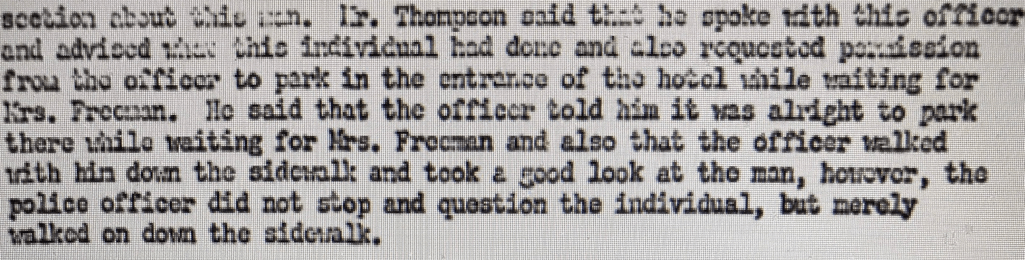
      Comment: The description of the incident should state that the chauffeur thought he recognized Oswald and thought that a picture of Oswald shown to him closely resembled the agitator. This claim would also be more accurate: though Thompson knew of two people he felt closely saw the agitator (a Policeman and a possible Secret Service agent)—no one is known to have corroborated that the agitator was in fact Oswald in Washington D.C. on November 27, 1963.

    So while this document is important, the author gives it his usual bend by cherry-picking and distorting what it relates instead of just letting the facts speak for themselves. On why the author is certain this agitator could not have been an impostor: “A fake Lee Oswald, a double, would likely have fit the pattern of overt bragging about money he was going to come into soon, or how much he loved Russia and or Cuba over America and how much he wanted to kill the president … This was the real Lee Harvey Oswald alright.”

    Question: Why would the real Oswald, a person who, according to the author, may have been getting inside information in this area from Secret Service traitors, make himself so visible in front of the very place he planned to shoot the president from?

    Blake Smith makes a point “that agent Floyd Murray Boring took this information on LHO in D.C. very seriously in early December of 63, interviewing the main eyewitness. (Agent Boring has been described as an extremely serious, experienced lawman, wanting to be like his two older brothers, who patriotically served their country in the military)”…“The witness was a U.S. government chauffeur and also a trusted friend to agent Boring.” We can see that it was important for the author to establish the credibility of the interviewer and the interviewee. Like the author, I am a fan of Vincent Palamara; his studies on the Secret Service are unmatched. I remembered vaguely an article he wrote about Boring: not a very positive one, but it was vague. I decided I would explore this later.

    The author did not have much else to say about him … or did he?

    Let us flash forward to the two best chapters of the book. Those that focus on the Secret Service. In these chapters I felt he was on more solid ground referring often, and rightly so, to Palamara’s excellent work. Here, he talks about how Kennedy came to suspect people close to him were plotting against him. He takes us through ten steps that were taken to weaken security. He chronicles how the Russians suspected there was a conspiracy involving weakened security. He references previous plots, how the FBI cancelled special security surveillance of Oswald, how Oswald was seen getting packages from possible agents in New Orleans, how the Secretary of the Treasury, Douglas Dillon, was in communication with Allen Dulles. He summarizes how Secret Service agents manipulated evidence.

    He also points out the roles of persons of extreme interest. Greer, Kellerman and, tum ta ta tum, Our Number One Suspect, “in collaborating with the Mafia-based public assassination plan”. Here is where something really weird happens: the author decides to exclusively use the pseudonym Trip-Planner Perry to identify him! The only time he does something like this in the entire book.

    He clearly does not trust Trip-Planner Perry:

    • He was very much involved in setting up the president like a bowling pin;
    • His motivation was likely patriotism, to remove the “National Security threat”;
    • This was a very real Treasury Department employee;
    • A high-ranking 48-year-old Secret Service man who had close access to the president and agency files in planning JFK motorcades;
    • … had served Roosevelt, Truman and Eisenhower;
    • … had been aghast at the adulterous president;
    • Had used his .38 to shoot and kill a man in defense of a past president;
    • He sure seems to be the main federal agent who arranged John F. Kennedy’s complete lack of safety in Dallas;
    • He even makes it on the top ten list as possible shooters in Dallas;
    • The author suggests Perry is misleading in saying that he found “nothing unusual” to protect Kennedy in his Texas visit;
    • He also volunteered to protect Kennedy in Washington D.C.;
    • He also handled security in Chicago;
    • Perry denied totally he had anything to do with security in Dallas—a blatant lie;
    • The author suspects Perry of getting the FBI to scale back security;
    • He believes that he may have been contacted by someone like Banister;
    • He led the cover-up efforts;

    and so on and so forth.

    So who was this lying, murderer, key plotter, traitor? I think that if you rely on Vince Palamara’s research or read the Wikipedia profile, you can only conclude that Trip-Planner Perry and Floyd Boring are one and the same: One of the people whose credibility is crucial in the whole Secret Service report about Oswald in D.C.!

    By hiding the real identity of Trip-Planner Perry, most readers are left with the impression that the agent who interviewed the chauffeur was reliable, as he is portrayed when identified as Floyd Boring. This artificially augments the perceived value of Boring’s acquaintance’s testimony. It blocks all critical thinking one can have around this whole scenario which perhaps was another of many ruses to frame the supposed Marxist Oswald.

    The significance of this masked information seems to have been on the mind of none other than Vince Palamara during his online exchange:

    Posted September 20, 2017

    As I detail in my first and third books, there were credible threats to JFK’s life on 3/23/63 (Chicago), 11/2/63 (Chicago again), and Florida on 11/18/63 (technically, 11/9/63 onward—the Joseph Milteer prediction/threat, etc.). This statement—ORIGINATED BY AGENT FLOYD BORING, of all people—just adds more grist for the mill, so to speak.

    Was this the real Oswald?

    Was it an impostor setting an Oswald trace, in a plan that had been aborted?

    Was it a miss-identification?

    Was it a fabricated story made by an acquaintance under the direction of Boring?

    Was Boring trying to close up loose ends when the W.C. was fully in lone-nut mode? For now, this is open to interpretation.

    Was Oswald in Washington on September 27, 1963? Perhaps—since he was most likely not in Mexico City, we do not know where he was. As the author points out (p. 407): LHO “told no one about his Washington D.C. trip.” There are no photos, film footage, documents or witnesses that can corroborate what an acquaintance of a suspicious Floyd Boring recollected. To go from the clues the author puts forth and opine that there was a plot in the works for Washington is logical, to actually place Oswald there is a long stretch but possible, to go on and describe a full-fledged aborted attempt on October 1, 1963 from the Willard Hotel is pure speculation at its wildest.

    A new lead?

    When I tried to find the FBI memo the author referred to, I came upon a report that underscored a startling piece of information I had not seen before. Jim Douglass did write about how a singularly-typed letter (supposedly by Oswald) had been sent to the Washington Soviet embassy that contained incriminating writings that could serve as evidence to show that Oswald was guilty, had met the head of assassinations (Kostikov) in the Soviet consulate in Mexico City, and how the Russians were complicit.

    This recently released report adds even more meat to the frame-up strategies and for a second time connects Oswald to a Soviet assassination operative. According to this FBI memo—the letter was addressed to the “man in the Soviet Embassy in charge of assassinations”:

    This, over and above the Mexico City hoax, seems like a brazen attempt to connect Russia to the assassination as per the ZR Rifle assassinations template.

    For now, I am just throwing this out there. At the time of this writing, I have not been able to confirm its authenticity or whether it has been analyzed in the past. I am currently awaiting comments from some esteemed researchers. Perhaps the readers can weigh in.

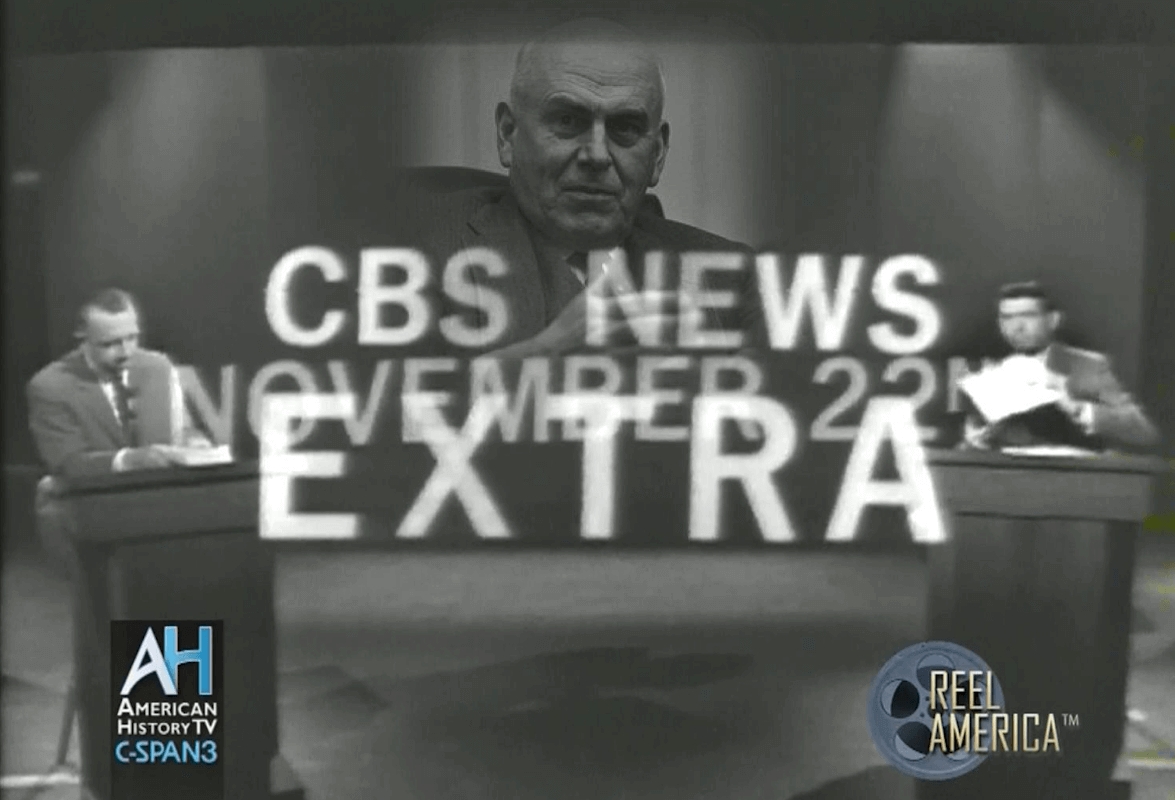
  • Clue to When JFK Was Shot in Back


    Previously I posted an article here on the significance of S.S.A. Glen Bennett’s statement:  He saw Kennedy shot in the back—and, as you will see from the story, this had to have happened at least two seconds after he was hit in the throat (see the link above).

    This could explain the puzzling nature of JFK’s back wound—the way its abrasion collar suggests a shot coming from below.  Some have explained it by insisting JFK was hit while he was leaning over.

    As anyone can see from films, JFK was not leaning over at the time he first began to react.

    But if Glen Bennett was telling the truth when he said he was looking at JFK’s back the instant he was struck in the back, photographic evidence shows this had to have happened after Kennedy was already hit.

    The interesting thing is, seconds after that first hit, Kennedy actually did begin to lean forward. And so no wonder the abrasion collar was on the bottom edge of the back wound.

    This is further proof that Kennedy was first hit in the throat, then in the back, but only after he began to sag in his seat.


  • The Hidden Hand:  The Assassination of Malcolm X

    The Hidden Hand: The Assassination of Malcolm X


    “I know, too, that I could suddenly die at the hands of some white racists. Or I could die at the hands of some Negro hired by the white man.”

    ~ from The Autobiography of Malcolm X


    Conspiracy theories have engulfed the four major American political assassinations of the 1960s since inception. Even before the controversial Warren Commission was empaneled, reasonable doubts emerged about Lee Harvey Oswald being the lone assassin of President John F. Kennedy in Dallas on November 22, 1963.

    Within days of the assassination of Dr. Martin Luther King Jr. in Memphis on April 4, 1968, his confidantes and constituents expressed skepticism over government claims that James Earl Ray, an ill-educated, inept stick-up artist from the south side of St. Louis acted alone.1

    When Robert F. Kennedy was felled inside a Los Angeles hotel during a campaign stop on June 6, 1968, many Americans questioned the official version about a poor Palestinian immigrant shooting the presidential candidate in the back of the head, primarily because key eyewitnesses stated that Sirhan Bishira Sirhan was facing Kennedy when he fired.2

    More than half a century later, government accounts stick to the “lone assassin” theory in those cases despite overwhelming evidence to the contrary. Most Americans harbor the delusion that every government but their own assassinates its citizens on occasion.

    Only in the fourth case, the assassination of Malcolm X, is there incontrovertible proof of conspiracy. On February 21, 1965, Malcolm X, a charismatic African American revolutionary, was shot to death inside New York City’s Audubon Ballroom just seconds after greeting a crowd of about three hundred. To many, the assassination was the predictable culmination of a battle between him and the black separatist sect that ousted him eleven months earlier.3

    Once home to Rabbi Max Koppel and Congregation Emes Wozedek in the 1930s4, the Audubon was located in a Washington Heights neighborhood bordering Harlem, where Malcolm had until recently headed Muhammad’s Mosque Number Seven. (Malcolm X was born Malcolm Little in Omaha, Nebraska in May 1925.)

    Now an orthodox Muslim, Malcolm used the Audubon for weekly rallies sponsored by his newly formed group, the Organization of Afro-American Unity (OAAU). The group was patterned after the Organization of African Unity (OAU), founded in 1963 with the goal of uniting African nations that had recently wrestled their independence from American, Russian, and European colonialism.

    Both the OAU and OAAU had a common goal: to promote Pan Africanism as a vehicle for alleviating economic, social, and political oppression. Sensing that his organizational skills, intelligence, and understanding of American politics could be instrumental in altering the world’s geopolitical landscape, African, Asian, and Latin American leaders had begun appealing to Malcolm X to champion their causes.

    An electrifying orator, Malcolm had impressed Third World leaders during two extended trips to Africa in April and July of 19645. The first trip occurred weeks after his official break with the so-called Nation of Islam, a quasi-religious group promoting segregation in a quixotic quest for a separate nation within America exclusively for African Americans.

    Malcolm X drew large crowds during rallies in Harlem. His popularity was seen as a national security risk by the FBI.

    Malcolm quit the sect in March 1964 after discovering that Elijah Muhammad, the leader of the NOI who claimed to be a divine prophet, had fathered over half a dozen children by at least six of his former personal secretaries, some of them teenagers. Muhammad denied the allegations and blamed Malcolm for spreading malicious “rumors,” precipitating helter-skelter plots against Malcolm, former national representative of the NOI.

    Nearly a dozen attempts were made on his life between December 1963, when Malcolm was suspended as spokesman for the NOI, and February 1965. He was ostensibly excommunicated for describing the assassination of President John F. Kennedy as a case of the “chickens coming home to roost.” (At the time, the Central Intelligence Agency was suspected of the actual or attempted assassination of numerous Asian, African and Latin American heads of state, among them Patrice Lumumba of the Congo, Jacobo Arbenz of Guatemala, and Fidel Castro of Cuba.6 As such, Malcolm postulated that American violence against foreign leaders had boomeranged and claimed the life of an American president.)

    Newspaper account of the suspension of Malcolm X from the Nation of Islam in December 1963.

    But the underlying cause of his suspension was a scandal that had shaken Malcolm to his core. In 1962, a rumor began circulating that Elijah Muhammad had fathered children by several of his secretaries. Since nonmarital and extramarital sexual relations were verboten and grounds for expulsion, almost no one in the sect believed it, and certainly not about their “infallible” messiah (Muhammad claimed to have been educated by God in “the person of Wallace D. Fard,” founder of the Nation of Islam in Detroit in 1931.) For them, anyone making such an outlandish claim was a demonic hypocrite “worthy of death.” Like the majority of NOI members, Malcolm ignored the salacious gossip. In the fall of 1963, however, the rumors were confirmed by three unimpeachable sources: Wilfred X Little, minister of the Detroit NOI mosque and Malcolm’s oldest brother, and Wallace Muhammad, Elijah’s son and putative heir to the throne upon his father’s demise. The third source was none other than Elijah himself.7

    UPI story broke in early 1964 about paternity suit filed by two young black women against Elijah Muhammad, the married leader of the Nation of Islam.

    In explaining his actions during a private meeting at his Chicago mansion, Elijah said that his extramarital affairs were merely the fulfillment of biblical prophecy. “When you read about how David took another man’s wife, I’m that David,” he said. “You read about Noah, who got drunk—that’s me. You read about Lot, who went and laid up with his own daughters. I have to fulfill all of those things.”8 Weeks after recovering from the paralyzing shock of the confession, Malcolm suggested that Elijah permit his ministers to tell their assemblies that his moral transgressions were akin to what other prophets had done and yet held favor with God.

    Thinking that Elijah had approved, Malcolm told several prominent ministers that the rumors were true, and that they should explain it in biblical terms to followers. Several ministers, among them Louis X [Farrakhan] of Boston, called Muhammad and told him that Malcolm was one of the “hypocrites” spreading the rumors about the secretaries.9

    Louis Farrakhan denounced Malcolm X in Muhammad Speaks newspaper as the “chief hypocrite” in the Nation of Islam and said that Malcolm was “worthy of death.”

    Elijah summoned Malcolm to his home in Phoenix and castigated him for telling them. Malcolm apologized, saying that he thought he had Elijah’s approval. Elijah retorted that he had in no way approved of Malcolm’s suggestion and said that his three-month suspension for the JFK comment was now indefinite. A few days after the meeting, Elijah contacted several prominent East Coast members of the NOI and said that Malcolm was the sect’s chief hypocrite and that it was therefore time to “close his eyes.”10

    Declassified FBI memo summarizes wiretapped telephone conversation between NOI leader Elijah Muhammad and a Boston mosque official in which murdering Malcolm X is discussed.

    Several attempts to kill Malcolm soon followed. When he discovered from a prominent Muslim that Elijah had sanctioned the plots to kill him, Malcolm publicly denounced the Nation of Islam and warned that any further attempts to harm him would be met with the biblical justice. He vowed to exact an “eye for an eye, a tooth for a tooth, and a life for a life.”

    Malcolm was bearing a heavy cross when he arrived at the Audubon on February 21. The war with Muhammad had taken its toll; it was one man fighting a legion of zealots. Associates were alarmed by his appearance that morning. They recall him looking haggard, anxious, and exhausted.

    The most notable attempt to kill him had occurred seven days earlier. Around two o’clock on Valentine’s Day, Molotov cocktails crashed through bedroom windows of his tiny Elmhurst home. If his four-year-old daughter had not been awakened by breaking glass, Malcolm and his wife Betty would have perished along with their four daughters. Betty was pregnant with twin girls.11

    An around-the-clock harassment campaign which followed the bombing had unnerved Malcolm. He told several colleagues that he could understand why Elijah Muhammad wanted him silenced, but he could not fathom the religious leader approving the murder of women and children to accomplish that goal.

    He was debilitated by the fire not only because of the near-death of his entire family, but because, he said, the fire revealed that the NOI’s attempts were being aided by the New York Police Department, the New York Fire Department and possibly even the federal government. “The police in this country know what’s going on. This is a conspiracy that leads to my death,” he said at a press conference.12

    A few hours after the fire, investigators claimed that they discovered an unlit Molotov cocktail on a dresser in his daughters’ bedroom. The explosive concoction was in a whiskey bottle. Police officials insinuated that Malcolm might have set the house on fire because he had been evicted days earlier by court order. NOI officials who filed the lawsuit repeated the claim, noting that Malcolm’s home legally belonged to the sect.

    New York Police Department and Nation of Islam both argue that Malcolm X firebombed his own house.

    Malcolm and Betty dismissed the speculation as nonsense. To begin with, Betty replied, they would never have alcoholic beverages in their home. Malcolm said angrily that only a madman would set fire to his home with his family asleep inside. Moreover, a black fireman who secretly met with them said that he saw a white man in a firefighter’s uniform place the Molotov cocktail on the dresser after the fire was extinguished. The revelation nearly caused Malcolm to have a psychotic break, the reason being that he knew his death was both imminent and inevitable if governmental forces were in cahoots with the Nation of Islam. A close friend noticed his agitated state and arranged for him to see a doctor to get something to help him sleep.

    On the evening of February 20, Malcolm checked into a downtown New York hotel under a pseudonym. Nearly undone by the arson attack, he took a sedative and fell asleep. His rest was interrupted, however, by the loud ringing telephone. “Wake up, Mr. Small,” the caller said before hanging up. The call was ominous because only his wife and two close aides knew where Malcolm planned to stay that evening. Unbeknownst to him, a group of Muslims had shown up at the hotel a few hours after he checked in, demanding the desk clerk to tell them which room Malcolm X was in. The clerk said he knew nothing about Malcolm X being there.

    At three o’clock on February 21, with his wife and children looking on, Malcolm stood at the podium on the ballroom’s stage. “As Salaam Alaikum,” he said, meaning “peace be with you.”

    Suddenly, two young black men seated in the middle of the room stood up and started arguing. “Niggah,” one of them said, “get your hand out of my pocket!”

    “Hold it, hold it, hold it,” Malcolm pleaded. Three young black men on the center front row stood up, removed firearms from underneath their coats, and fired at Malcolm. Two were armed with handguns while the third had a sawed-off shotgun. A tall tout black man with the shotgun crouched before the stage and fired twice, striking Malcolm in the chest. Three pellets landed near his heart. The force of the blasts hurled Malcolm backward, and his head hit the stage with a loud thud.

    During the ensuing pandemonium, the shotgun assassin wrapped up his weapon in a jacket and dropped it on the ballroom floor as he escaped. The assassin with the German Luger fired at crowd members trying to capture him as he made his escape. The third gunman wasn’t so lucky. He was shot in his left thigh by a member of Malcolm’s security team. As he fell, he dropped his .45 automatic and was tackled and beaten by the crowd.

    On the afternoon of the assassination, police were conspicuous by their absence. On past Sundays, there were nearly two dozen officers present in and outside the Audubon. Police arrived as people dragged the man outside. As police tangled with Malcolm’s supporters for custody of the assassin, the other two assassins and the two men who caused the initial distraction escaped.

    Thomas Hagan, the wounded suspect, refused to divulge the name of his accomplices. Eyewitnesses, however, gave police descriptions consistent enough to lead them to Norman 3X Butler and Thomas 15X Johnson, lieutenants in the Harlem mosque where Malcolm was minister until his ouster. Butler and Johnson were well-known as enforcers with a reputation for brutalizing wayward Muslims.13 In fact, they were awaiting trial for attempted murder of Benjamin Brown, a NOI defector who had recently opened his own storefront mosque. When the defector refused to remove a photograph of Elijah Muhammad from the front window, Butler and Johnson went to his home. After he opened the door, Johnson shot him at point-blank range in his chest with a rifle. The defector somehow managed to survive the blast.

    Butler was arrested on February 26 and Johnson shortly thereafter. All three suspects pleaded not guilty. Following a joint trial one year later, a jury found them all guilty of the assassination and each received a life sentence.14

    Case closed, or so it seemed.

    Butler and Johnson both steadfastly denied involvement in the assassination. Their case was buttressed by some of Malcolm’s chief aides, who claimed that it would have been virtually impossible for Butler and Johnson to have entered the ballroom that day without detection by the OAU’s security team.

    But Johnson and Butler had shaky alibis. Both men, incredulously, claimed to have been immobilized by leg injuries at the time of the assassination. Johnson’s case was helped somewhat by eyewitness accounts, nearly all of whom described the shotgun assassin as a tall, stout, dark-skinned black man sporting a short beard.15 Johnson had a caramel-colored complexion, was of average height, and clean-shaven but for a pencil mustache. Conversely, eyewitnesses described Butler perfectly. One of them, Sharon X Poole, even said that she recognized him as a fellow member of the Harlem mosque.16

    Although Norman 3X Butler denies involvement in the assassination of Malcolm X, he appears on film outside the Audubon Ballroom moments after the murder, attempting to get a look at Malcolm X’s body.”

    For ten years, there was little to refute the official version of the assassination. Malcolm X was killed as a result of a feud with Elijah Muhammad stood as gospel despite suspicions by his admirers and Third World leaders of American government involvement.

    In March 1971, white radicals broke into the FBI’s document storage facility in Media, Pennsylvania and made off with a goldmine of files detailing the agency’s decades-long clandestine wars against political and social organizations of every hue and stripe, the Ku Klux Klan and Nation of Islam among them.17 A counterintelligence program—COINTELPRO—which started in the 1950s to combat the spread of Communism in America, soon engulfed thousands of groups, even the benign National Association for the Advancement of Colored People (NAACP).

    When several thousand pages were released from the COINTELPRO operations against Malcolm X in the early 1980s, they revealed a massive campaign against him and the Nation of Islam. The initial campaign, started in 1953 (a year after he was released from prison), was intended to retard the astronomical growth of the Nation of Islam.

    They also show that in 1964, following a complaint by White House aide Benjamin H. Read that Malcolm’s affiliations with Third World leaders were damaging American foreign policy in Africa, the Central Intelligence Agency was asked to consider killing Malcolm X.

    White House official Benjamin H. Read asked the CIA to consider treating Malcolm X the way it did hostile foreign leaders.

    Richard Helms, the CIA’s Deputy Director of Plans, told Read that the CIA had serious qualms about killing American citizens but would nonetheless explore the possibility of neutralizing Malcolm.18 The FBI had been spying on the Nation of Islam since the 1940s after its male members refused to register under the Selective Service Act. By 1964, it had informants in the highest ranks of not only the NOI but inside Malcolm’s Organization of Afro-American Unity as well.

    In addition to being under surveillance by the CIA and FBI, the New York Police Department’s Bureau of Special Services and Investigation (nicknamed BOSSI) had Malcolm under close surveillance and had several high level informants in the OAU. At least one of them, Eugene “Gene” Roberts, was a member of Malcolm’s security detail and on duty at the hour of reckoning.

    Gene Robert (in circle) was an undercover NYPD detective who infiltrated Malcolm X’s organization and became part of his main security detail.

    Malcolm X had been on around-the-clock surveillance by the FBI for more than six months before his assassination. Transcripts of wiretapped telephone conversation between Malcolm X and other prominent black activists are included in the files, some of them heavily redacted.

    Declassified FBI documents include a detailed account of the FBI sending anonymous letters to Elijah Muhammad’s wife and NOI ministers across the country about Elijah’s extramarital activities. Bureau agents bragged in several memos about starting the disputes which led to the ouster of Malcolm from the NOI and fomenting a war between Malcolm and Elijah Muhammad.19

    The FBI was alarmed that Malcolm X had begun courting Dr. Martin Luther King Jr. and other civil rights leaders following his ouster from the Nation of Islam in March 1964.

    While the CIA and State Department have been reticent to release many documents from their files on Malcolm X, those released thus far reveal an urgent counterintelligence campaign to “neutralize” Malcolm X after several African and Arab countries offered him financial support in 1964 and vowed to support his petition to the United Nations in which he accused the United States government of violating the human rights of African Americans.

    Along with Che Guevara, the physician-turned-revolutionary who played a major role in Cuban revolution of 1959, Malcolm X was expected to be one of the preeminent attractions at the Second Asian-African Congress commencing on February 26 in Algeria. The conference was postponed due to the overthrow of Ahmed Ben Bella, an event most reputable historians attribute to the CIA and British intelligence.20 Ben Bella and Malcolm had become friends, and the Algerian leader was a staunch supporter of both Malcolm X and the civil rights movement.

    The CIA was concerned about Malcolm X’s impact on US foreign policy in Africa.

    Declassified FBI and CIA documents suggest that the American government was extremely eager to prevent Malcolm from attending at all cost. He was assassinated five days before the aborted assembly. As it happens, Malcolm’s assassins were recruited in late June 1964, within weeks of the White House’s request to the CIA to handle Malcolm X the way it did hostile foreign leaders.21

    In April 2011, Newark NOI member William Bradley was identified as the shotgun shooter. The day after the New York Times asked the Justice Department whether it would investigate the allegations against Bradley, a spokesman said that there was nothing the FBI could do because no federal laws had been violated.

    William Bradley (standing, in circle), the man who fired the shotgun at Malcolm X, was captured on film outside the Audubon as he attempted to free assassin Thomas Hagan from police and angry Malcolm X supporters.

    That was, of course, an egregious error. The assassins had traveled from New Jersey to New York to assassinate Malcolm X. Traveling across state lines to commit murder is a federal crime. And under both federal and state laws, there is no statute of limitations for murder.

    The Justice Department’s hasty decision to reject reopening the case involving the civil rights movement leader Malcolm X was predictable. After all, it was revealed more than three decades ago that the man seen in the famous Life magazine photo administering mouth-to-mouth resuscitation to Malcolm X was none other than Gene Roberts, an undercover detective for BOSSI. Moreover, a top aide to Elijah Muhammad was linked to the FBI. Although he has denied any involvement with the FBI and the Malcolm X assassination, prosecutors of Malcolm’s assassins had an eyewitness willing to testify that the aide met at the Americana Hotel with the assassins the night before the assassination.


    Notes

    1 Schechtman, Jeff. “The Plot to Kill King: A Look at Who Really Killed Martin Luther King,” April 4, 2018. https://whowhatwhy.org/2018/04/04/the-fbi-in-peace-war-and-assassination/.

    2 “The Robert F. Kennedy Assassination,” https://www.maryferrell.org/pages/Robert_Kennedy_Assassination.html

    3 Drash, Wayne. “Malcolm X Killer Freed After 44 Years,” April 28, 2010. http://www.cnn.com/2010/CRIME/04/26/malcolmx.killer/index.html

    4 Lowenstein, Steven M. Frankfurt on the Hudson: The German-Jewish Community of Washington Heights, 1933-1983, Its Structure and Culture (Detroit: Wayne State University Press, 1991). pp. 109-110. Also see:   http://www.nypap.org/preservation-history/audubon-ballroom.   Rabbi Mas Koppel, founder of the Emes Wozedek Congregation, was murdered in 1974. Seigel, Max H. “Neighbors Call Slain Rabbi Friend to All,” New York Times, December 18, 1974, A49.

    5 Jacobs, Sean. “When Malcolm X Went to Africa,” June 2011. https://africasacountry.com/2011/06/malcolm-x-in-africa1/

    6 “Alleged Assassination Plots Involving Foreign Leaders,” (1975). https://cia.gov/library/readingroom/document/cia-rdp83-01042r000200090002-0

    7 Haley, Alex with Malcolm X. The Autobiography of Malcolm X (New York: Grove Press, 1965) See, in general, ‘Chapter 16: Out.”

    8 Ibid.

    9 Ibid.

    10 FBI Main file on Malcolm X, memo dated March 23, 1964.

    11 “Malcolm X’s Home is Firebombed in 1965,” (reprint) New York Daily News. https://www.nydailynews.com/news/crime/malcolm-x-home-firebombed-1965-article-1.2529655

    12 Scott, Stanley. “Recalls Prophetic Words: Newsman Witnesses Murder of Malcolm X,” Desert Sun, February 22, 1965, pA6.

    13 Newman, Andy and John Eligon. “Killer of Malcolm X is Granted Parole,” New York Times, March 19, 2010, A13.

    14 “Three Men Convicted of the Assassination of Malcolm X in 1966,” New York Daily News. https://www.nydailynews.com/news/crime/men-convicted-murder-malcolm-x-1996-article-1.2558206

    15 Based on documentary footage from local television news in the archives of the University of Los Angeles Film School.

    16 Kihss, Peter. “Malcolm X Shot to Death at Rally Here; Three Other Negroes Wounded—One is Held in Killing,” New York Times, February 22, 1965, A1.

    17 Mazzetti, Mark. Burglars Who Took On FBI Abandon Shadows,” New York Times, January 7, 2014, p. A1.

    18 CIA file on Malcolm X, memo from Richard Helms dated August 11, 1964.

    19 See, in general, the FBI New York Field Office file on Malcolm X and the New York Police Department’s Bureau of Special Services and Investigations file on Malcolm X.

    20 Gleijeses, Piero. Conflicting Missions: Havana, Washington, and Africa, 1959-1976. (North Carolina: University of North Carolina Press, 2011).

    21 The assassins, all of them from the Newark mosque of the Nation of Islam, was recruited in late June 1964, according to Thomas Hagan.


    Also of interest: