Blog

  • Dennis Breo, the New York Times, and JFK

    Dennis Breo, the New York Times, and JFK


    On November 8, 2019, the New York Times printed a letter from an author named Dennis Breo. This was in reply to a review of Jack Goldsmith’s book In Hoffa’s Shadow. In the review of that book, Chris Nashaway wrote that the disappearance of Hoffa ranks with mysteries like the disappearance of Amelia Earhart and the identity of the so-called second shooter on the grassy knoll. Please note the term “so-called” in front of the second shooter.

    Well, even that large qualifier was not enough for one Dennis Breo. Breo promptly wrote a letter to the Times who, quite willingly, accommodated him.

    Dennis Breo

    Stepping up to his soap box, Breo wrote that what the Times had done by printing that sentence was a “serious disservice to history.” He then said that he had been a journalist for the Journal of American Medicine Association (JAMA) when they did interviews with the three autopsy doctors on the JFK case in May of 1992. He wrote that, because of that, he could assure the Times that “there was no second shooter from the grassy knoll or anywhere else.” He then said that the autopsy doctors proved that both wounds in Kennedy went from back to front, that is, his back of the neck wound and his head wound. Therefore, the only possible shooter was Lee Harvey Oswald. He then ended his letter with the fact that the Times endorsed that article saying that “it offers proof against paranoia.”
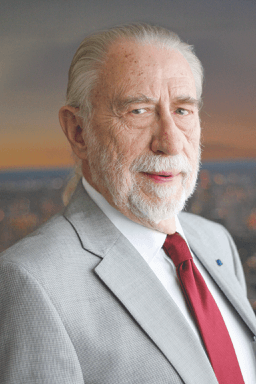
    Dr, George Lundberg

    This was the first letter on the correspondence page. Above it, the Times bannered the letter with the rubric “There was no Second Shooter on the Grassy Knoll,” all seeming a bit much for printing the phrase “the so called second shooter.”

    Naturally, the Times did not reply to Breo’s letter to defend what they originally printed. They did not even let Mr. Nashaway respond. They were wise in doing so, because Breo is a huge target for anyone disputing the Warren Report’s version of events.

    First, Dennis Breo is not a doctor and has never been a doctor. He is now a retired journalist, living in Florida. At the time that the film JFK came out, he was working with Dr. George Lundberg, the editor of JAMA. Lundberg did not like the portrayal of his friend Dr. James Humes in that picture. Evidently, he did not care to find out that it was not really a portrayal. It was all based upon facts that were adduced at the trial of Clay Shaw in 1969 in New Orleans. Those facts, recited under oath by Dr. Pierre Finck, were accurately scripted for the film. There was nothing defamatory about these scenes. The film reflected Finck’s testimony on the stand, according  to the trial  record, which director/writer Oliver Stone had secured.

    Finck’s testimony, in and of itself, is quite a story. He was called by the defense. The reason being that Dr. John Nichols, a pathologist, had been an effective witness for the prosecution. He testified that, in his opinion, the Zapruder film proved a shot from the front and, therefore, showed a conspiracy. (James DiEugenio, Destiny Betrayed, second edition, p. 299) The defense was worried about the impact of both the Zapruder film and Nichols. So they called Kennedy autopsy physician Pierre Finck as a witness. The Justice Department was coordinating its coverage of the Clay Shaw trial through attorney Carl Eardley in Washington. (ibid, p. 299)  Eardley was the point man on the cover up of the medical evidence in the JFK case. For example, he had coordinated a meeting in 1966 so that four of those present in the Bethesda morgue room—where Kennedy’s autopsy was performed—would testify that all the photos of that procedure were accounted for. Even though everyone knew they were not, including Eardley. (ibid, p. 305). Eardley wisely kept his name off the final draft of the false document.

    Finck’s testimony in New Orleans was coordinated with Eardley in advance. (DiEugenio, p. 299) Finck was fine under direct examination. He was reduced to mumbling and bumbling by Jim Garrison’s assistant DA Alvin Oser under cross examination. The Shaw trial was the first direct exposure of the corrupt practices and hierarchical control of what went on in the Bethesda morgue on the evening of November 22, 1963. The examination got so bad that Finck began dodging questions and refusing to answer. The judge had to order him to answer. When he did, he admitted that Kennedy’s back wound was not dissected because the doctors—Humes, Finck, and Thornton Boswell—were ordered not to do so. He also admitted that Humes had to stop the examination once, because of all the interference. Once halted, Humes then asked aloud: “Who is in charge here?” Finck testified that an army general replied, “I am.” Finck then added: “You must understand that in those circumstances, there were law enforcement officials, military people, with various ranks and you have to coordinate the operations according to directions.” (DiEugenio, p. 300, italics added)

    Finck had given away the game. Kennedy’s back wound was not dissected, because the military presence there would not allow it. The doctors were not in charge; the Pentagon officers were. Because of this, no one would ever know for certain the precise circumstances by which President Kennedy was killed. Did the back wound transit the body? Did it meet the anterior neck wound as part of its trajectory? Those questions can never be answered, because of the military control of the Bethesda autopsy.

    Finck’s testimony was devastating to the official story, so much so, that when local US attorney Harry Connick informed Eardley what the doctor was saying, the maestro of the medical cover up panicked. When Dr. Boswell testified to the Assassination Records Review Board, he said that Eardley was really upset about what Finck said under oath at the Shaw trial. (DiEugenio, p. 304) Eardley told Boswell that he had to get someone to New Orleans quickly, because Finck was “really lousing everything up.” In other words, telling the truth was screwing up Eardley’s cover up efforts. Eardley flew Boswell to New Orleans, where he was met by Connick. But Eardley changed his mind and Boswell did not testify. Eardley’s intent was to have Boswell smear Finck as a “strange man.” Eardley probably changed his mind, because he realized that Finck was more experienced as a forensic pathologist than Humes or Boswell was. That was why they called him in a bit late in the procedure. It would have been difficult to discredit someone with better credentials than yourself. (DiEugenio, p. 304)

    This was what writers Oliver Stone and co-writer Zachary Sklar had based this part of the film upon, although they had not yet seen the declassified machinations behind the scenes from Washington with Eardley. But this was all sworn testimony at the Shaw trial. JAMA could have availed themselves of it rather easily by calling Mr. Stone or the court stenographer of the Shaw trial—Helen Dietrich—who was still alive at the time. There is no evidence that Lunderg or Breo did either. Lundberg’s reaction to the film was not at all scientific or medically sound. After he saw the picture, he wrote a letter to his friend Jim Humes. It said:

    Have you seen the movie JFK? Three hours and fifteen minutes of truth mixed with non-truth mixed with alleged truth. For the younger person, not knowledgeable about 1963—very difficult to tell the difference. Please either write the truth now for JAMA or let Dennis Breo (and me?) interview you…to set the record straight—at least about the autopsy. (Brad Kizzia in Assassination Science, edited by James Fetzer, p.73)

    In other words, Breo and Lundberg went to work to counter the facts that JFK had set forth. Which were based upon Finck’s sworn testimony. It was later revealed in a deposition that Lundberg likely did not know that these autopsy scenes were based upon Finck’s testimony, when he wrote that letter to Humes. (Brad Kizzia in Trauma Room One, p. 165, by Dr. Charles Crenshaw.)

    Dr, Charles Crenshaw

    Something else had happened while Lundberg and Breo were setting about their task to rehabilitate one of the worst autopsies ever performed. Dr. Charles Crenshaw had published his book, Conspiracy of Silence. In that volume, Crenshaw revealed that upon being shown the autopsy photographs by researcher Gary Shaw, he was taken aback, because they did not conform with what he recalled. (Crenshaw, p. 18) Crenshaw said the back of the head photo did not reveal the blowout wound he saw and the anterior neck wound seemed widened and enlarged. Crenshaw’s book was published in April of 1992. It became a best seller.

    Breo and Lundberg prepared the May 1992 issue of JAMA for the original autopsy doctors to tell their story. They even called a press conference, in advance, in New York City. The article and the press conference also brought into question the efficacy of Crenshaw’s book. In fact, Lundberg and Breo even questioned if Crenshaw was in the emergency room. (Crenshaw, pgs. 153, 161, 165)

    Somehow, in his recent letter to the New York Times, Breo forgot to mention some rather embarrassing reporting in the Times about that press conference. Dr. Lawrence Altman was at that 1992 event in New York. His two reports for the Times showed that all one had to do was peruse the Warren Commission volumes to discover that Crenshaw was in the emergency room at Parkland Hospital when Kennedy was there. (Crenshaw, p. 166). Even though the Altman articles were published before the issue of JAMA was distributed, there was no correction added to the issue.

    Crenshaw requested a right to reply and Lundberg refused. Crenshaw then launched a lawsuit for defamation. Brad Kizzia represented the surgeon. The depositions in that case were rather interesting. It is quite obvious that Lundberg and Breo had an agenda. And they did not care about the long factual record of the Kennedy case. For instance, in his letter to the Times claiming he knows there were only two shots from the rear and they were by Oswald, Breo writes that the lower rear wound came in at the neck. This proves that not only did Breo not study the case before he wrote the JAMA articles—he has not studied it since. The House Select Committee on Assassinations (HSCA) had the autopsy photographs. They published artists’ renditions of the wounds. That wound, which Breo says is in the neck, is clearly in Kennedy’s back. (Crenshaw, p. 269) This is a fact that not even Dr. Michael Baden of the HSCA could deny. If a writer will not even admit that, then how can anyone trust him with the rest of the facts of the JFK autopsy.

    For in addition to the autopsy doctors being stopped from dissecting the back wound, there is no existing record of them sectioning Kennedy’s brain. This should have been done, in order to track the bullet path through the skull. No examining doctor since—from the HSCA or the ARRB—has been able to find any records from a sectioning process. (Although Doug Horne has made the case it was done and then covered up. Click here to read that essay.) To say that this was a failing is a monumental understatement.  For if the brain was not sectioned, then:

    1. How can one chart the bullet path through the skull?
    2. Say with confidence that JFK was hit by only one bullet in the head?
    3. Tell us that only one bullet came in from behind?

    Adding to this problem, the angle from the sixth floor of the Texas School Book Depository to the limousine below is slightly right to left.  But if one believes the autopsy, the bullet exited going left to right. There is also the problem that the 1968 Ramsey Clark Panel moved the rear skull wound up four inches to the cowlick area. But yet, for JAMA, Lundberg and Breo moved it back down again. These serious issues in the Kennedy case were all either discounted or ignored by JAMA. (Crenshaw, p. 203) As was the riddle of the weight of Kennedy’s brain. The supplementary autopsy report, filed on December 6, 1963, says that the weight was 1500 grams. (ibid, p. 238) This is virtually impossible to believe. Too many witnesses saw a brain that was missing a significant amount of mass. Secondly, from films and pictures of the assassination, one can see the blood and tissue that was ejected from Kennedy’s skull. This has led many to believe that there was some real subterfuge going on, with not just the autopsy, but the supplemental autopsy days later. It is why so many observers, e.g. forensic scientist Henry Lee, believe that the autopsy in the JFK case was such a mess that no observer can come to real conclusions about precisely how Kennedy was killed. (Lee said this in an interview with Oliver Stone for the upcoming documentary JFK: Destiny Betrayed)

    As both Gary Aguilar and Cyril Wecht noted in their review of JAMA’s articles (there was more than one), the fundamental factual errors that Breo and Lundberg made would not pass muster in a high school class on the JFK case. In the first sentence of the first article, Breo wrote that only Humes and Boswell knew what really happened during the autopsy of JFK. Thus ignoring Pierre Finck, who actually was the only experienced forensic pathologist of the three. (Aguilar and Wecht in Crenshaw, p. 202) Breo then added that the JAMA interview was the only time that Humes and Boswell had publicly discussed the JFK case. This was wrong in more than one sense. In 1967, Boswell had granted an interview to Josiah Thompson for attribution in his book Six Seconds in Dallas. In that same year, Humes gave an interview to Dan Rather for a CBS special broadcast in the summer of 1967. All three doctors had appeared in public before the HSCA; Humes was even on television for a second interview done alone. Boswell had given interviews to both the Baltimore Sun and the New York Times. Humes had given an interview for attribution to David Lifton. All of this betrays the fact that JAMA wanted to trumpet their articles as being somehow unprecedented in the literature, when, in fact, that was not an accurate assessment.

    In the second article, JAMA stated, through one of the Parkland doctors, that none of what the Dallas doctors saw contradicted that the bullets were fired from behind Kennedy and above. Now, at this time, the Assassination Records Review Board had not declassified the drawings and affidavits given to the HSCA. These clearly denoted a large, avulsive wound in the rear of Kennedy’s skull, which would suggest a shot from the front. But even in 1992, there was testimony and evidence that such was the case. To cite just two examples: the Warren Commission testimony of Secret Service agent Clint Hill and the drawing on page 107 of  Thompson’s book Six Seconds in Dallas directed by Dr. Robert McClelland. (Click here for Hill)

    One of the worst things about the JAMA articles and Breo’s performance was that, as attorney Brad Kizzia discovered, neither Lundberg nor Breo ever talked to Crenshaw himself. (Crenshaw, p. 164) But, beyond that, Kizzia also discovered that there was no peer review of Breo’s writing about the JFK case. (ibid, p. 165) The excuse given was that Breo’s work was only considered journalism. Considering that this “journalism” discussed and reviewed a quite complex and controversial subject and that Breo was not a physician, this is a truly remarkable decision by the editors at JAMA. And it’s why many doctors suspended their subscriptions to the magazine afterwards. Making all this even more troubling was the fact that Lundberg was a pathologist. Yet he admitted he had not read any books about the JFK case. (Crenshaw, p. 165) JAMA ended up settling with Crenshaw for about a quarter of a million dollars.

    The AMA board terminated George Lundberg seven years later. At that time, during the Bill Clinton impeachment proceedings, he was running an article about what college students considered oral sex to be. The executives at the AMA declared that he had compromised “the integrity of the journal” and they had been inserted “into a debate that had nothing to do with science or medicine.” (BBC News, 1/18/99)

    That judgment could have been asserted back in 1992.
  • NOLA Express Interview with Mark Lane

    NOLA Express Interview with Mark Lane


    In the spring of 1968, Mark Lane was in New Orleans helping Jim Garrison with his case against Clay Shaw. While there, Lane met with the editors of an alternative newspaper called NOLA Express. He granted them an interview, which became part of his FBI file. We have extracted that interview for our readers to peruse. We should note that the FBI had surveillance on Lane almost everywhere he went at this time. He was not only aiding Garrison, but he also was helping young men resist the draft.

    Rob Couteau pointed out the interview which is housed at Black Vault.


    (Click here to open the document in another page.)

    Dennis Riches has provided this typed transcription of the Mark Lane interview.


    (Click here to open the document in another page.)

  • The Wilcott Affidavit and Interrogation by the HSCA

    The Wilcott Affidavit and Interrogation by the HSCA


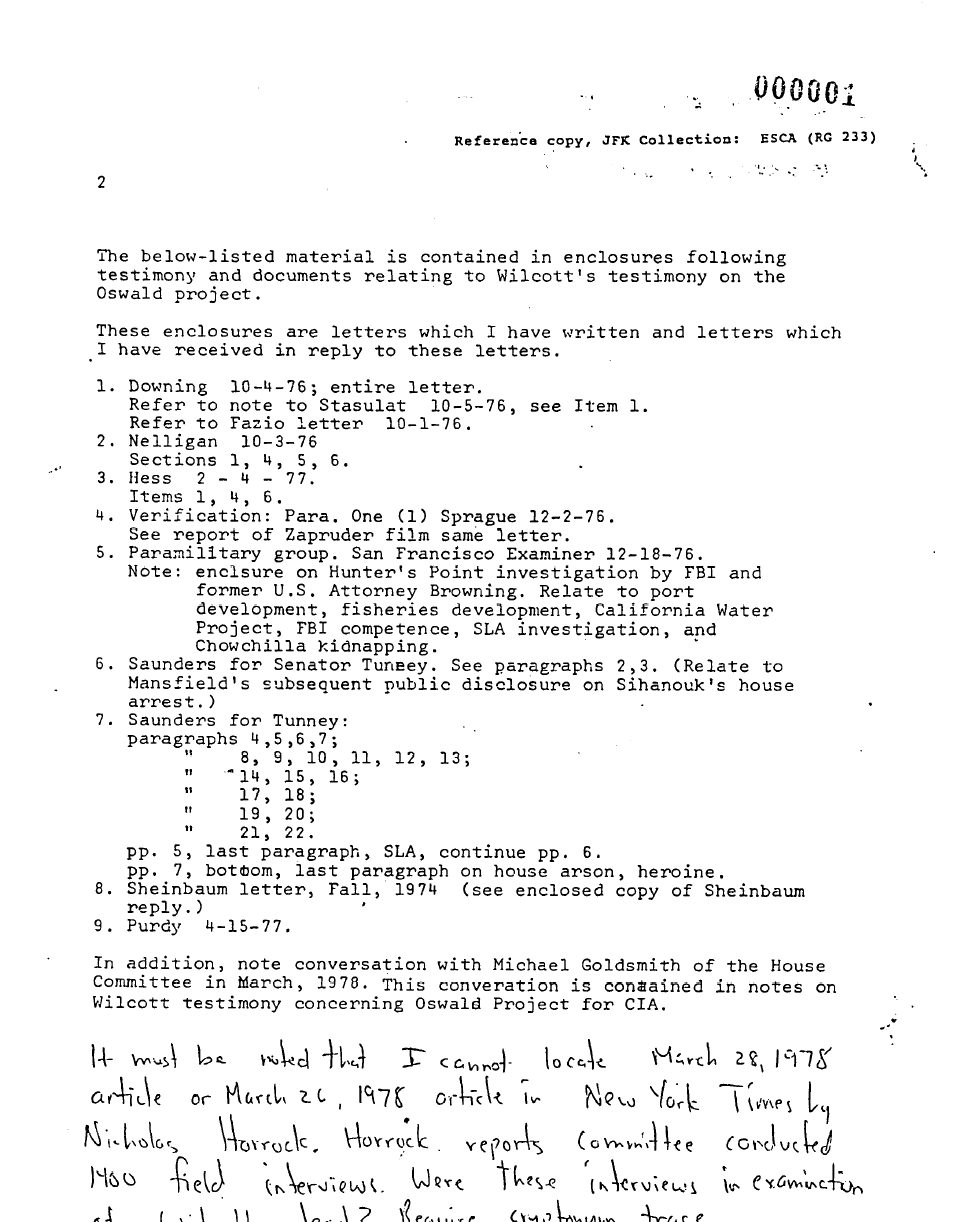
    James Wilcott worked out of the Tokyo CIA station at the time of the assassination. He was not questioned by the Warren Commission. His information was that he had been unwittingly involved with paying Oswald through a high security clearance, since he worked in the finance office. He learned this after the fact through various sources within the Agency, who all recognized what had happened after the assassination and the association of Oswald’s name with the crime. Wilcott’s affidavit and deposition were declassified by the ARRB. We think our readers would be interested in reading his evidence./p>


    (Click here to open the document in another page.)

  • The Assassin Next Door Focuses On the Wrong Target

    The Assassin Next Door Focuses On the Wrong Target


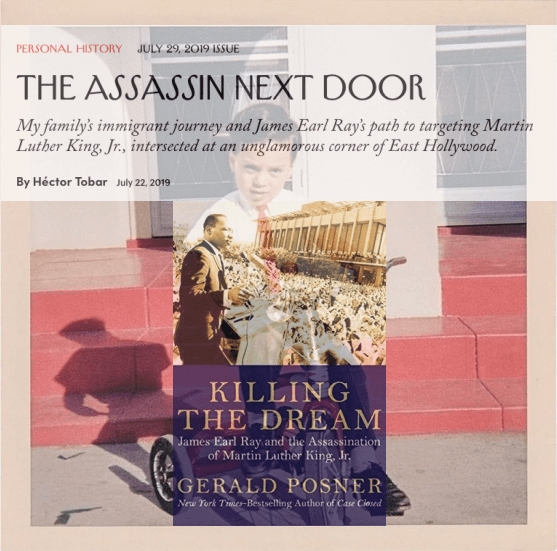
    This past July, venerable The New Yorker Magazine, as part of an ongoing series captioned Personal History, published “The Assassin Next Door”, by Hector Tobar. The relatively short essay reflects a contemporary trend by using biography to negotiate the intersection of personal identity within larger cultural currents. Here, the author reflects on the individual trajectories of his Guatemalan immigrant parents and himself, born and raised in Los Angeles in the late 1960s, in a set contrast to the life and personal trajectory of the officially designated assassin of Martin Luther King, James Earl Ray. Ray, apparently, lived for a period of time in the same East Hollywood neighbourhood as Hector Tobar, a fact revealed by his reading Gerald Posner’s book on the MLK assassination Killing The Dream (1998), which he describes as an “excellent reconstruction of Ray’s life and King’s murder.”

    Cued by the Posner book, Tobar understands Ray as holding “an abiding hatred of black people” and who murdered King “in the name of white supremacy.” His pathology assumes an essentialist nature—“his whiteness meant that he deserved better than what he had”—from which the author can free associate: “I felt Ray’s presence on the building’s front steps, beneath a stunted palm tree. I imagined his ghost lurking about, disgusted at the polyglot city around him, and raging at the futility of his act of murder.” The function of this essay, it seems, is a sort of riff on various levels of meaning imbued by racial identity in America. It is Tobar’s “personal history” in conjunction with Gerald Posner’s version of James Earl Ray.

    James Earl Ray himself consistently denied holding a racist viewpoint. Those who met him during his thirty-year struggle to clear his name, including members of MLK’s immediate family, did not believe Ray to be a racist. The racial angle, such as it was initially applied, could be considered a conclusion arrived ahead of the evidence—a useful conclusion which promoted a motive for the assassination (other than a rumoured bounty), assigned to a man who otherwise lacked one. Posner also seems to start from this position, as he builds his portrait through uncorroborated statements of men who were Ray’s fellow prisoners, and over-emphasis on certain ambiguous details (such as presumed campaign work for George Wallace, discussed below).[1]

    How is it possible, in the year 2019, that an author such as Gerald Posner—whose work has been variously criticized for plagiarism, non-existent sourcing, bias, and misrepresentation of the documented record—could be considered by anyone as an “excellent” resource for historical understanding?[2] Posner’s notorious Oswald-lone-nut book Case Closed (1992) had been roundly criticized for its factual errors and fake interviews and was described by academic David Wrone (who was interviewed by Posner) as “one of the stellar instances of irresponsible publishing on this subject.” In both of his books on the 1960s political assassinations, Posner assumes the role of plucky investigator even as he presents a prosecutor’s brief, emphasizing the points which support his case and downplaying, if not ignoring, the evidence which doesn’t. Both books were timed to be released on the thirtieth anniversaries of their central event and both books became heavily promoted in the mainstream establishment media. In the case of Killing The Dream, as reporter Mike Golden put it, Posner’s legacy “is that his bogus narrative of what happened in the MLK case has become the traditional hack standard of what the (mainstream) media will allow to be considered what really happened in Memphis, April 4, 1968.”[3]

    In the mainstream media, Posner’s “bogus narrative” received rave four-star reviews. Anthony Lewis, for example, writing in the New York Times Book Review, effused that Killing The Dream was “a model of investigation, meticulous in its discovery and presentation of evidence, unbiased in its exploration of every claim.”[4] In the Times itself, Richard Bernstein praised it as “the most comprehensive and definitive story of the King assassination”.[5] This trend line continues in most all the contemporary reviews and related content, which served as the only coverage most Americans would be exposed to. These reviews, particularly from the core establishment newspapers, would create a “seal of approval” of Posner’s scholarship, largely determined by reviewers who themselves knew little of the case beyond what appeared in the book itself. The “seal of approval” carries on through the years, presumably informing Tobar’s characterization of excellence two decades later.

    A more savvy reader of Killing The Dream, understanding this is contested subject matter, would eventually pick up on Posner’s evasiveness despite his posture of certainty, particularly as applied to problematic witnesses and Ray’s contradictory behaviour. For a book praised for its biographical portrait of an assassin, the James Earl Ray presented is curiously meticulous and crafty when necessary, but lazy and drifting otherwise. Posner, in general, fails to apply honest reflection on Ray’s odd meandering journeys in 1967-68, preferring to first dismiss speculation and then speculate on what “likely” happened. A reader’s tolerance for such tactics depends on the extent the mainstream establishment’s endorsement of Posner’s investigative prowess holds sway. A sceptical attitude seems invited by his divergent descriptions of Ray as either settled in obscurity or a desperate fugitive, which serves to rationalize behaviour which never really ties together in his earnest account.

    For example, Posner steps very carefully around the salient coincidence that three of Ray’s aliases, beginning as he arrived in Montreal on July 18, 1967, were actual persons living in close proximity on the outskirts of Toronto. He argues Ray must have randomly “stumbled across” the Eric Galt name and speculates the other two were found by perhaps consulting old birth notices and phone books. The account of Ray’s quick journey from Los Angeles to New Orleans and back in January 1968 presents a jumble of motivations from participants who all seem to possess reason to be less than forthright, which doesn’t prevent Posner from highlighting the least plausible scenario as it fits seamlessly with the “white supremacist” narrative (and which Tobar jumps on).[6]

    Later on, Posner announces his intention to directly confront the fact that the only witness to place Ray near the rooming house bathroom at the time of MLK’s shooting was falling down drunk (or “less than sober” as he prefers), but he never actually does. Instead, he switches attention from Charlie Stephens’ alcoholism to Grace Waldron’s alcoholism and mental health issues and manages to make her the unreliable witness, even as the most important fact is it is Stephens’ inebriation that afternoon which calls his ID of Ray into question. That Posner must frame this entire section as responses to legal arguments made by Ray’s representatives over the years should alert any reader that his book is functioning as a prosecutorial argument rather than investigative objectivity.

    In fact, Killing The Dream eventually becomes so focussed on answering issues raised by Ray’s then attorney William Pepper, who would later represent the King family during the 1999 civil trial, that serving as a public rebuke to Pepper appears one of the book’s operative functions. Contemporary reviewers evidently picked up on this. The Washington Post Book-World noted that “members of King’s family are among the many who doubt that Ray had anything to do with it…Posner has taken on the task of liberating everyone from surmises.” The Tampa Tribune used its review to editorialize: “The King family should read Killing the Dream instead of asking the Justice Department to open a new investigation into the assassination.” If the wide publicity afforded Posner’s book had the effect of pre-conditioning the public to pay less attention to the King family’s efforts, that may have been its intention all along. The federal Department of Justice did not participate in the civil trial, and rather conducted its own review which actually referred often to Posner’s work, epitomizing the effort to shut the door on inquiry and understanding.

    Ironically or not, in his New Yorker piece Tobar relates a facet of his own personal history while, following Posner, withholding the same privilege to the late James Earl Ray, other than one filtered through presumed malignancies such as racial bigotry and “supremacy”. To be sure, Ray, on his own admission, would prove to be an unreliable narrator, such that it is difficult to really know his own motivation or reasons for anything, but the racist angle seems particularly contrived and void of hard corroborating fact. Of course, imbuing Ray with the stigma of white supremacy as determinedly as Posner does allows the negative trait to be embodied solely with the alleged assassin, such that the messier reality can be neatly sidestepped: federal and local police forces of the time were racially biased as well. If Ray’s supposed date with destiny was motivated by his innate prejudice, as Posner seems to argue, then why does the same motivation not hold for provably biased figures in the FBI or Memphis police? That Tobar does not ask that question is not entirely his fault, as it takes a fair amount of inquiry from different sources to understand it is a question worth asking in the first place. Subtle conditioning favouring establishment voices and narratives often, consciously or not, promotes deferral to whatever history the New York Times says is worth four stars. As Douglas Valentine put it : “Was institutionalized, government-sanctioned racism one of the reasons Dr. King was assassinated? You bet it was.”[7] That it is these institutionalized forces which are more in alignment with, for instance, the pressures which caused Tobar’s parents to flee Guatemala in the first place than an allegedly racist lone-nut career criminal ever could be—well, there’s a personal history also worth mulling over.

    It’s worth noting that, along with The New Yorker’s casual promotion of one side of a disputed narrative, this past summer witnessed a renewed wave of calls for various levels of censorship and fact-vetting directed at social media platforms, culminating recently in Twitter’s announcement it would not accept political advertising during the US 2020 political campaign. Two years previously, Google had announced a change in its search algorithms to promote “authoritative sources” over “alternative viewpoints.” Facebook’s CEO Mark Zuckerburg, not a free-speech firebrand, was shouted down in the mainstream media after publicly declaring “I don’t think it’s right for a private company to censor politicians or news in a democracy.” This has sparked a debate about money, politics, and free speech which has itself been largely detached from the factual realities of the intersection between the three in the real world. A deliberate focus and over-emphasis on “crazy” marginal (and marginalized) points of view has had the effect of implicitly endorsing the authority of the establishment, which is responsible for the overwhelming majority of political advertising. The point is, ultimately, not to reduce the level of spending on information management, but to reduce voices and viewpoints through vetting against “fake news” or unauthorized expression. The vetting of Gerald Posner two decades ago should caution against mis-attributed faith in establishment institutions to be somehow trustworthy.

    A groundswell of support for critical thinking and media literacy programs in the education system seems called for. Instead, a fear has been cultivated, most often by college-educated liberals, of “lies” and “fake news” lurking unseen in the water, producing an “incredibly dangerous effect on our elections and our lives and our children’s lives.”[8] Average citizens, it is declared, are not able to “discern the veracity of every political ad” and should therefore be protected from fake news in favour of the “diplomats, intelligence officers and civil servants” which “provide the independent research and facts” which are “legitimate”.[9] The New Yorker itself joined the fray, knocking Facebook for creating “the world’s biggest microphone” only to allow access for “liars, authoritarians, professional propagandists, or anyone else who can afford to pay market rate.” It is then noted approvingly that Facebook recently announced its own “official news tab…where users can find high-quality news from trusted sources”, (which, it turns out, includes The New Yorker).[10] One might get the impression that the lack of a level playing field or abandonment of professional journalistic practice is not the real concern of these self-appointed gatekeepers, it is the loss of control over the creation and reinforcement of official narratives which must be restored.

    Similarly, the term “conspiracy theory” has recently returned to some prominence, serving as an evil twin of sorts to the scourge of “fake news.” The week before “The Assassin Next Door” appeared in the New Yorker, NBC’s website featured a generalized thesis attacking “conspiracy theorists” written by Lynn Stuart Parramore, PHD,[11] which conflated the Moon landing, lizard people, and the assassinations of the 1960s while faithfully parroting—knowingly or not—a number of the directives offered by the infamous 1967 CIA memorandum on the topic.[12] Attempting to redefine the alleged “problem” as based in psychological deficiencies and narcissistic traits, Parramore rather encourages the normalization of the “paranoid style” she warns about, as the utterance of “conspiracy theory” ( or non-vetted information) becomes associated with a form of mental illness, just as the latest federal judicial theories encourage active “disruption” of “potential threats” based in part on “symptoms of mental illness.”[13] Through their own blinkered logics, the liberal intelligentsia in America are setting the foundation stones for exactly the country they claim they are trying to prevent. Critical thinking skills and clear-minded analysis remain the best tools moving forward.


    [1]On Posner’s investigative techniques see Mike Vinson “Nailed To The Cross: Gerald Posner on the King Case” Probe Magazine Vol. 6 No. 3 https://kennedysandking.com/martin-luther-king-reviews/nailed-to-the-cross-gerald-posner-on-the-king-case

    [2]Jim DiEugenio “He’s Baaack! The Return of Gerald Posner” https://kennedysandking.com/martin-luther-king-reviews/he-s-baaack-the-return-of-gerald-posner

    [3]Mike Golden “Assassination By Omission: Another Look At Serial Plagiarist Gerald Posner” Exiled Online Sept 30, 2010 http://exiledonline.com/assassination-by-omission-another-look-at-serial-plagiarist-gerald-posner/

    [4]Anthony Lewis “Beyond A Shadow of a Doubt” New York Times Book Review April 26, 1998 https://archive.nytimes.com/www.nytimes.com/books/98/04/26/reviews/980426.26lewist.html

    [5]Richard Bernstein “‘Killing The Dream’: Ray Was King’s Lone Assassin” New York Times April 22, 1998 https://archive.nytimes.com/www.nytimes.com/books/98/04/19/daily/posner-book-review.html

    [6]Tobar writes, following Posner’s lead: “In December, 1967, Ray visited the North Hollywood Presidential-campaign office of George Wallace, the former governor of Alabama, who had become a folk hero among segregationists… Ray had gathered signatures to help get Wallace on the California ballot.” Rather than “gathering signatures”, Ray claimed he stopped at the Wallace office on the request of his passengers, just ahead of the New Orleans trip. One of these passengers claimed to the FBI that Ray appeared very familiar with the office, but subsequent investigation cast doubt on this. It was suggested that Ray offered to cover the expenses to New Orleans in return for his acquaintances registering with Wallace, but that is possibly if not likely a weak rationale for behaviour and motivations the participants prefer to be less than honest about. There is no other instance of overt political activity on behalf of Ray. Posner acknowledges the overall sketchy milieu of this incident.

    [7]Douglas Valentine “Deconstructing Kowalski” Probe Magazine Vol. 7 No. 6. https://kennedysandking.com/martin-luther-king-articles/deconstructing-kowalski-valentine

    [8]Aaron Sorkin “An Open Letter To Mark Zuckerburg” New York Times October 29, 2019 https://www.nytimes.com/2019/10/31/opinion/aaron-sorkin-mark-zuckerberg-facebook.html

    [9]Thomas Friedman “Trump, Zuckerburg, and Pals Are Breaking America” New York Times October 29 2019 https://www.nytimes.com/2019/10/29/opinion/trump-zuckerberg.html. Note that The New York Times had been at the forefront of promoting two of the most consequential instances of “fake news” in this young century—Iraq WMD and Russiagate.

    [10]Andrew Marantz “Facebook and the Free Speech Excuse” The New Yorker October 31, 2019 https://www.newyorker.com/news/daily-comment/facebook-and-the-free-speech-excuse. Note that The New Yorker, not shy to publish reflexive support for one side of contested official narratives as discussed above, also bought into the empty Mueller / Russia collusion narrative with some enthusiasm.

    [11]Lynn Stuart Parramore “From Trump to Alec Baldwin, Conspiracy Theories, Narcissism, and Celebrity Culture Go Hand In Hand” https://www.nbcnews.com/think/opinion/trump-alec-baldwin-conspiracy-theories-narcissism-celebrity-culture-go-hand-ncna1029941

    [12]thelastheretik “CIA Memo 1967: CIA Coined & Weaponized The Label ‘Conspiracy Theory’” https://steemit.com/history/@thelastheretik/cia-coined-and-weaponized-the-label-conspiracy-theory

    [13]Whitney Webb. “AG William Barr Formally Announces Orwellian Pre-Crime Program” Mint Press News, October 25, 2019 https://www.mintpressnews.com/william-barr-formally-announces-orwellian-pre-crime-program/262504/

  • Part 2:  Martin Scorsese and Robert DeNiro’s The Irishman

    Part 2: Martin Scorsese and Robert DeNiro’s The Irishman


    After reading the first part of this review, which focused on the book about Frank Sheeran by Charles Brandt, it’s hard to understand why director Martin Scorsese and actor/producer Robert DeNiro were intent on making a film from his book, I Heard you Paint Houses. And, further, why they would spend 160 million to do so. That point is important to discuss, but I will delay speculation on that issue for later in this review. The fact is, they did make the film. So, let us review and analyze the product before us.

    The first thing that struck me about the picture is its length. It three and a half hours long with no intermission. To put it frankly: Lawrence of Arabia justifies its length; The Irishman does not. There are many scenes that are simply extended or not necessary at all. When Sheeran goes to Detroit to meet Hoffa for the last time, we see him getting on the plane. Then after he kills him, the film shows him returning through the airport. Why? When the hit team goes to pick up Hoffa for that meeting from the restaurant, the picture depicts the drive and the actors in the front seat get into a stupid discussion about the fish that the driver previously had in the car. That is not a mistype. They discuss a fish as they go to pick up Hoffa, in order to kill him. If this was supposed to be a kind of Pinteresque/David Mamet touch, it did not work for this viewer. These are not the only scenes that could have been either cut or shortened. Not by a long shot.

    Then, there is the protracted, over-extended ending section. The dramatic and intellectual ending of the film is the murder of Hoffa and the cremation of his body. But the picture goes on and on from there. We see Sheeran being tried in court for other crimes, we see him in prison with Bufalino, and then there is a long section after he gets out with scenes with his monsignor—two of these. We then see him trying to reconcile with his estranged daughter, falling down at home, and being placed in a retirement center. We then watch as he picks out a casket and chooses a cemetery lot etc. After the film was finished and I was driving home, I tried to figure out what that long extended ending was about. When I got home, I realized why. The film makers were trying to make Sheeran into some kind of sympathetic character; they were trying to wring pathos from the audience.

    Think about that. If we view Sheeran through the eyes of Charles Brandt, why on earth should he be any kind of sympathetic character? Here is a man who killed his friend and employer. And who put up no protest about it. And, according to Brandt, he then killed many other people in what were clear cut cases of murder. There was nothing fair or just about them, since they were allegedly mob hits. Why on earth should anyone feel any kind of sympathy for this guy?

    But in a deeper sense, as I have already made the argument for, if Sheeran is a liar, and if he conned Brandt, and if the book then conned the film makers, in my eyes, that makes it even worse. Why would we feel for a man who simply was a flimflam artist? But, further, his flimflammery was over a variety of serious subjects (e.g. the Bay of Pigs invasion, the assassination of President Kennedy, and the murder of Jimmy Hoffa).

    In comparison with Brandt, the film stays pretty much faithful to the story line of the book. Since the book is about 280 pages long, the distended length is chalked up to director Martin Scorsese’s dilated approach. Another example of that approach is—if you know Scorsese—pretty predictable. To give one example: In the book, Sheeran notes a brief anecdote about an organizing battle between the Teamsters and the AFL-CIO over a taxi company. He says that a method they would use was to steal an idle cab every once in a while and drive it into the river. Well, with Scorsese, this becomes a whole fleet of taxis parked conveniently near the river and all of them are thrown into the water at once. If that was not enough, other taxis are then blown up with explosives.

    The problem with this false, over-the-top treatment is that one wonders: How did Sheeran and Hoffa lose the organizing battle? Because they did. (Brandt, p. 137) I guess the rationale for these scenes are, if you have 160 million to spend, you spend it. Forget what actually happened. Because in the book, the author states that they paid the cops to look the other way for each taxi driven into the river. In reality, with the wholesale destruction depicted here, there would have been front page stories, a police investigation, and court hearings.

    The script also follows the aspect adapted by Sheeran and Brandt from the fairy tale Giancana concoction Double Cross. That is, Giancana made a deal with the Kennedys over the 1960 election, but Bobby would not let up on them once they got to the White House. The script has Sheeran saying years later something like, go figure that out. For anyone with any brains or knowledge, there isn’t anything to figure. Because it never happened.

    But there is a deeper fault here. The battle between Hoffa and Bobby Kennedy was the stuff of real epic drama. There was a lot at stake. And there were moral problems on both sides of the war. Unlike others, I do not think this was RFK’s finest hour. There were many things that chief investigator Walter Sheridan did that I believe were unethical. Rigging a lie detector test being only one of them. I do not know if RFK was aware of all these shenanigans. But, beyond that, what RFK thought about the problem turned out to be at least partly wrong. Because once Hoffa left the scene, the Teamsters union was not cleaned up. That effort went on for decades. So here is an actual political conflict—not the phony Giancana one—that one could really get involved in on a number of levels: the historic, the personal, the dramatic, and the epic. What do Scorsese, DeNiro, and writer Steve Zaillian do with this huge, violent confrontation?

    I hate to say it, but all the picture does is pay lip service to that titanic struggle. Bobby Kennedy is in the film for about five minutes. And those scenes are not at all gripping. You can see newsreels on You Tube that are much more interesting and intense than what is depicted in this film. I don’t see how one can make a less complementary comment on the picture than that. But it happens to be true. Apparently, no one involved in the film in any creative way thought this actual battle was worth spending much time or effort on. Making up scenes about dozens of taxis being thrown into the river somehow was.

    The film depicts the paper mâché scene about David Ferrie meeting Sheeran and giving him a weapons delivery to take to Florida. It cleverly introduces that episode by having actor Joe Pesci as Russell Bufalino tell Sheeran, words to the effect: in Baltimore you will meet a fairy named Ferrie. For those who saw Pesci play Ferrie in the film JFK, the irony and humor are neatly understated. The film then depicts the almost impossible to digest hand off to Howard Hunt. The movie does not include the delivery by Sheeran of the rifles to Ferrie in the weeks leading up the Kennedy assassination. The JFK murder is depicted in the film as Sheeran, Hoffa and others in some kind of ice cream parlor as the bulletin comes on about President Kennedy’s murder. As this occurs, the characters move closer to the TV set to hear the news. Everyone except Hoffa, that is, who stays seated at his table eating his ice cream. But there is little doubt about who killed Kennedy according to this picture. Because later in the film in a discussion between Bufalino and Sherran, the latter says that Hoffa is a pretty high up guy. Bufalino replies that if they can kill the president, they can kill the president of a union. We are supposed to buy the idea that the Mafia killed the president. On the word of Joe Pesci playing Bufalino. Hmm

    What is also a little more than baffling is the fact that the script largely discounts the interactions between Hoffa, Fitzsimmons, and the Nixon White House and all their ramifications. Again, the reason for this escapes me. Because, unlike the baloney about the JFK assassination and the Giancana deal, these are all true and pretty much proven. Because of his bitter hatred of the Kennedys, Hoffa did try and develop a relationship with Richard Nixon. And after he was imprisoned, he did work through channels to get Nixon to grant him a pardon. There are even tapes on this now. (Chicago Tribune, 4/8/2001, article by James Warren) But the White House tricked Hoffa by putting restrictions on his pardon. Hoffa was challenging these in court at the time of his murder. Clearly, Frank Fitzsimmons, who Hoffa picked as his replacement, was working with the White House to trade a Teamsters Nixon endorsement in return for Nixon making sure Hoffa could not run against him in 1976. This is important, some would call it crucial information to understand, but the script really underplays it.

    Which brings us to two interrelated points about this 210-minute saga. If one is not really interested in history, why make a film out of a book that tries to seriously impact on historical matters of the utmost importance? For all its failings, the book by Brandt does a much better job of supplying details and context to the Fitzsimmons/Nixon interchange and how it impacted the plot to kill Hoffa. If there had been no restrictions on the Nixon pardon, Hoffa would have easily defeated his replacement without undertaking a bitter crusade, one which touched on Fitzsimmons’ record with the Mafia loans from the Teamster pension fund. But in watching this film, one cannot really understand that rather key issue. The script and Scorsese’s interests are elsewhere.

    Which leads me to an interview that the director gave before the picture’s release. Scorsese told Entertainment Weekly that he was not actually concerned about what really happened to Hoffa. He then added, “What would happen if we knew exactly how the JFK assassination worked out? What does it do? It gives us a couple of good articles, a couple of movies and people taking about it at dinner parties.” He then added that his film is really about Sheeran and what he had to do and how he made a mistake.

    In my opinion, this tells us a lot about Scorsese; both his mentality and his career. Concerning the first, can the man be serious? When Oliver Stone made a film about a measured hypothesis of what happened to Kennedy, it unleashed a tidal wave of controversy which enveloped the nation for over a year. This was unprecedented in cinema history. If that movement had not been diverted by the MSM, who knows where it would have gone? But it gave us not a few articles, but a whole flood of books, TV shows, newspaper articles, front page magazine covers plus an act of congress to declassify all the documents on the JFK case. And that act has still not been fulfilled 21 years after the legislation’s authorizing agency expired. So, what on earth is the guy talking about?

    But what makes it worse is that what he endorses, namely Sheeran’s story, simply does not survive real examination. In reality, it’s the stuff of John Ford’s films, which the fine film critic Vernon Young memorably described as mythomania masquerading as myth. Which is odd, because it was those kinds of films that, early in his career, Scorsese dismissed as the kinds of pictures he did not want to make. (And make no mistake about this, because the recent film about Nicola Tesla, The Current War, involved both Scorsese and Zaillian. And in its own way, it is as crushingly disappointing as this picture.)

    Does The Irishman redeem itself in its making? Not really. Al Pacino can be a good actor (e.g. Dick Tracy, Dog Day Afternoon). He can also be a guy walking his way to a huge paycheck. Scorsese let him walk. Pacino is not Hoffa. He is Pacino. If you want to see the difference between creative method acting and what was called at the Actor’s Studio indicative acting, compare what Pacino does here with Jack Nicholson’s portrayal in the 1992 film Hoffa. DeNiro as Sheeran tries to find the center of a character who, because he’s a confection, doesn’t really have one. Therefore, the fine actor delivers a studied, surface performance. When DeNiro strikes the center of a role—as he did in The Last Tycoon, or The Untouchables—he inhabits his character and the exterior simply becomes a surface to reflect that transformation. That doesn’t happen here. Joe Pesci does a decent enough job as Bufalino, but, again, the director didn’t push him hard enough to fill in points of character geography that are missing from the script. None of the other performances are worth noting. For example, Jessie Plemmons plays Chuck O’Brien. This is the fourth time I have seen him. Any difference between this performance and the prior three are due to hair style and costume.

    In his early films, Scorsese seemed to think that the aim of film art was to show us men with guns shooting each other and then supplying the audience with lots of gore and blood. For example, in the final shoot out in Taxi Driver, the director made sure that Travis Bickle blew off one of his assailant’s hands and the next one’s eye. Then the guy with the blown off hand arose and started hitting Bickle with this severed stump. This was Scorsese’s idea of realism. With a few exceptions, as in The Departed, he doesn’t do that anymore. But there is something else that has impacted Scorsese’s directorial approach and his oeuvre.

    That something else was Vince Gilligan’s Breaking Bad. That TV crime series based itself around an original and fascinating idea. Let’s take a perfectly average middle-class male, a high school science teacher. Let us equip him with a middle-class family and house. Growing frustrated with his economic problems and introduced to a drug/crime element through his drug enforcing brother in law, Walter White evolved into an amoral, drug dealing killer, as did his high school partner Jesse Pinkman. That concept was original and daring. And it was treated with intelligence, a sense of irony, and a realism which did not include people getting their hands and eyes blown off. It was so interesting and well done that it created a mini-sensation with both the public and in the film industry. For me, Gilligan’s approach has made Scorsese’s both uninteresting and a bit obsolete. Gilligan showed there was a way to make crime sagas without having to deal with what are, in the end, pathological, dedicated and two-dimensional criminals. Therefore, you didn’t have to look for excuses to throw corpses out of tall buildings and have them land on car hoods.

    That approach was, I thought, limited enough. But with the Scorsese interview quoted above, we can see why it was such. And why The Irishman is a crushing disappointment.

  • Part 1:  Charles Brandt’s I Heard You Paint Houses

    Part 1: Charles Brandt’s I Heard You Paint Houses


    Charles Brandt published I Hear You Paint Houses, about the murder of Jimmy Hoffa, back in 2004. This was about a year after the protagonist of the book, Frank Sheeran, passed away. Because of its sensational nature, it became a best-seller, because Sheeran did not just say he assassinated former Teamsters leader Jimmy Hoffa. He was also involved with the murder of President John F. Kennedy. He also killed Joey Gallo in 1972. And he also killed another mobster, Salvatore Briguglio in 1978. And that was not all. The hit list went on for about 10-12 more people. Sheeran was a veritable Murder Incorporated unto himself.

    Brandt had been a criminal lawyer who eventually began to focus on medical malpractice. He and a partner were responsible for getting Sheeran out of prison due to a medical hardship. He had been put away for two felonies for approximately 30 years. Brandt struck up a friendship with his client and did a long series of interviews with him spreading out over several years. The longer they talked, the more Sheeran managed to dredge up. And the more he dredged up, the more Brandt wrote down and found credible and included in his book.

    The book proper begins with a dispute between some Mafia leaders who do not want Hoffa to run for president of the union in 1976. One of those mob leaders, Russell Bufalino, is trying to arrange a meeting between Hoffa and some of his cohorts in Detroit. This is a frame that Brandt will return to later in the volume as it’s the reason for the book.

    As many other types of these works do, the book then uses a long flashback to explain how the protagonist got to this point in his life. Sheeran’s life is kind of nomadic in its early years. He got expelled from school and joined the carnival. He then got into logging and later become a competition dancer, while working days for a glass company. In 1941, he joined the army infantry in Europe. According to Brandt, Sheeran saw a remarkable 411 days of combat. He participated in the Italian campaign, most notably in the battles of Monte Cassino and Anzio. He was also involved in the invasion of Southern France in August of 1944. He took part in the liberation of Dachau and also the assault on Munich. He was discharged in October of 1945.

    He returns to West Philadelphia and his glass works job. He then got a union job as a truck driver for a meat delivery company. He is caught stealing from that company and falls in with some Pennsylvania mobsters, namely Angelo Bruno and Bufalino. He cases out a linen company that a friend wants him to blow up, since its serious competition for his own business. But he is spied on as he cases it out and unbeknownst to him, Bruno has a piece of the business. He is now told to do away with the man who put him up to this. He does, and this is what makes him a soldier and hit man for Bufalino.

    Very early in the book, that is before page 100, I began to suspect that Brandt was aggrandizing his cast of characters, in order to swell his volume into something like an epic. The author compares Bufalino to Al Capone. (p. 75) Bufalino was the boss of my hometown, Erie Pennsylvania. At its peak, Erie had about 180,000 people. He had some other areas, but he was never the capo of a major or, even, mid-major city. He then adds that Hoffa was as famous as the Beatles or Elvis Presley. (p. 86) There is no doubt that Hoffa was a colorful and outspoken character, but to compare him to those two musical legends is really stretching it beyond any kind of normal judgment. And it was here than I began to question the author’s credibility and frankness.

    Brandt quickly lays in Hoffa’s rise in the union movement and he then gets to the reason that Hoffa was famous, which was his duel with a young Robert Kennedy before the McClellan Committee. After Teamsters president Dave Beck was suspected of embezzling hundreds of thousands of dollars from his own union, Hoffa became its president. (p. 91) Shortly after this, Bufalino got Sheeran a job with Hoffa. According to the author, the first time Hoffa talked to Sheeran on the phone, he asked him, “I heard you paint houses.” This meant that Sheeran was a liquidator. (p. 101) Hoffa hires him and Bufalino buys him a plane ticket to Detroit.

    As almost any author in the field of Teamster studies knows, Hoffa was on friendly terms with organized crime. He even allowed some of the mob chieftains, like Tony Provenzano, to lead certain local unions. He also allowed the Mafia to borrow large sums of cash from the Teamster pension fund, in order to construct gambling casinos in Las Vegas. Hoffa set up Allen Dorfman to manage this aspect of union business and the president got a cut of the loan as a finder’s fee. These kinds of activities set up the confrontation between Hoffa and RFK on Capitol Hill.

    Bobby Kennedy was the chief counsel to the McClellan Committee, sometimes called the Rackets Committee. His brother, Senator John Kennedy, also served on that committee. It was at this time that Bobby Kennedy began to raise his political profile as a dreaded enemy of organized crime and, because of his association with gangsters, Jimmy Hoffa. Bobby Kennedy did everything he could, and then some, to try and remove Hoffa from power and place him in prison. But since Hoffa was allowed to use the Teamsters treasury to finance his legal defense, he remained an elusive target. In fact, as Brandt notes, Hoffa eluded three court cases against RFK. But once Bobby became Attorney General under President Kennedy, he assembled a Get Hoffa Squad at the Justice Department. The tactics used by its leader, Walter Sheridan, were extremely controversial. Author Fred Cook of The Nation was a vociferous critic of Sheridan’s tactics. Victor Navasky, in his book Kennedy Justice, also criticized RFK for the enormous amount of Justice Department resources that the Attorney General spent on the Hoffa case.

    Brandt does not criticize Sheridan at all and he presents Edward Partin as pretty much a straight shooter. Partin was a mole set up by Sheridan in Hoffa’s camp and was the principal witness at his jury tampering trial. Partin had a record a mile long prior to his employment by Sheridan. So, Sheridan tried to clean him up by giving him a polygraph test, which, quite predictably, he passed. Sheridan then trumpeted this to the press and Partin was now considered credible by the media. Years later, a society of professional polygraphers got hold of the Sheridan arranged test and unveiled their analysis at a trade convention. I was furnished this discussion by researcher Peter Vea and I reviewed it during a speech I made at the 1995 COPA Conference in Washington.

    It turned out that the polygraph experts concluded that Partin had been deceptive throughout the test. But they concluded the most egregious lie was told when Partin said Hoffa had threatened RFK’s life. The analysis concluded that the administrator had to have turned down or misrepresented some of the indexes to the test to pass Partin. And, in fact, one of the original technicians was later indicted for fraud in his practice. In other words, Sheridan had rigged the test. The fact that Brandt does not know this is indicative of the lack of scope and depth to the book. For although it is largely told through Sheeran’s eyes, the author interjects frequently to give background to the protagonist’s story.

    It is through this part of the story that Sheeran begins to insert the JFK case into the narrative. Sheeran begins to work for Hoffa in Detroit and, since Chicago is in proximity to Detroit, Sheeran now says that he saw Sam Giancana with Jack Ruby a few times. (p. 119) And once Giancana is in the story, Sheeran now begins to recite the whole phony tale about how Joe Kennedy was a bootlegger with the Mafia and he made a deal with them to get his son elected to the presidency in 1960. And, somehow, the Mafia felt double crossed when Bobby Kennedy continued to prosecute them after the election. (p. 1200)

    I noted in my review of Mark Shaw’s book Denial of Justice that this concept is simply spurious. It was clearly manufactured as a way to smear JFK during the latter stages of his race against Richard Nixon in 1960. (See Daniel Okrent, Last Call, pp 367-69) Prior to that, in all the reviews that Joseph Kennedy had to undergo through his six appointed positions in the federal government, there was never a word mentioned by anyone about it. Author Daniel Okrent reviewed the voluminous files in the reviews. Once this phony accusation made it into the press, gangsters like Frank Costello and Joe Bonanno then sued it in their cheapjack books as a way of getting back at Bobby Kennedy for bringing the Mafia out of the shadows and making life much more difficult for that enterprise.

    In 1992, Sam and Chuck Giancana decided to capitalize on the success of Oliver Stone’s film JFK.

    They wrote a book based on this false thesis called Double Cross. This book was almost entirely a ludicrous confection. (For the salacious details as to why, see my review of Mark Shaw’s book noted above.) Yet, it became a best seller and the nutty thesis has been popularized. Even John Newman repeated it in his series on John F. Kennedy. How he could do so when the House Select Committee collected just about every file available on organized crime and the JFK case, and this was not in them, escapes me. But again, Brandt accepts this with no investigation, probably so that Sheeran can say that his boss Jimmy Hoffa warned Giancana against this because Bobby Kennedy could not be trusted in any negotiation. (p. 125)

    Brandt then has Sheeran go even beyond this. He has Giancana tell Hoffa that John F. Kennedy was going to help get Castro out of Cuba. And this would aid the Mob in getting their casinos back. (p. 121) This is obviously a reference to the Bay of Pigs operation. So we are also supposed to think that somehow President Kennedy told Giancana about this operation prior to the election. Somehow, the Erie Pennsylvania Don, Bufalino also knew about this. Somehow, Joe Kennedy told Russ this.

    But Brandt and Sheeran are not done with this concept. Sheeran now says that at a meeting at the Gold Coast Lounge in Hollywood, Florida he was sitting in the midst of Santo Trafficante, Bufalino, and Carlos Marcello. This was in the 1960-61 time period. He tells Brandt that David Ferrie was also there. Why Ferrie would be there is not explained in any way.

    Brandt then writes something that is even more far-fetched. On the orders of Hoffa, Sheeran is to go to a cement plant in Baltimore with a borrowed truck. He is to go to a tiny landing strip and there he meets Ferrie in a small plane. Ferrie tells him to reposition his truck nearby some other trucks. Soldiers carrying arms emerge from these trucks and place their weapons in the back of Sheeran’s vehicle. Ferrie tells him that the weapons are from the Maryland National Guard and that he is to drive these to Jacksonville. (p. 129) There he will be met by a man named Hunt. We later find out that this is Howard Hunt of Watergate fame.

    Again, apparently Brandt asked no questions about any of this. I will. Having read all of the reports on the Bay of Pigs, I have yet to see anything anywhere that says the CIA needed help from Hoffa to drive arms from Maryland to Florida. The ships carrying arms to Cuba in that aborted invasion had thousands of rifles, but they were furnished by the Pentagon. (James DiEugenio, Destiny Betrayed, second edition, p. 42.) Ferrie did do training for the Bay of Pigs, but it was all done in and around New Orleans. I have never seen any evidence he was part of the logistics side of the operation. Howard Hunt worked on that operation, but not on the military side, on the political and propaganda side. That is, organizing an exile government group. (ibid, p. 40) Finally, why would Hunt use his real name with a total stranger? And why would Ferrie blow his cover?

    In 1963 Bobby Kennedy again indicted Jimmy Hoffa on two charges, one for fraud and one for jury tampering. (The liar Partin was important in the latter.) Bobby was now really on the warpath against the Cosa Nostra. He had a defecting Mafia soldier giving him the secrets of the organization. His name of course was Joe Valachi. RFK did all he could to promote him and place him in the public eye. In November of that year, Hoffa calls Sheeran and asks him to go to Brooklyn to a Genovese hangout called Monte’s. (Brandt, p. 163) While there, Tony Provenzano hands him a duffel bag and tells him to drive down to the same cement company as he had before. There he meets David Ferrie again and hands him the bag with three rifles in it. (ibid) This is later explained with the following:  Hoffa actually supplied the rifles for the murder of John Kennedy. The original hit team somehow lost their weapons in a car crash. They needed Ferrie to supply them with replacements. (pp. 241-242) Brandt apparently did not bother to ask: Why did they have to get them from New York? And with four intermediaries? (The author tells us that Ferrie had an accomplice with him.). This is all hammered home when Hoffa begins to get out of line and Bufalino tells him that there are people higher in the Mob than him who are complaining Hoffa has not shown any appreciation for Dallas. (p. 240)

    As everyone knows, the Justice Department eventually convicted Hoffa on two felonies and sent him to jail for 13 years. Hoffa’s handpicked replacement was Frank Fitzsimmons. Hoffa did all he could to get out of prison early. According to Sheeran, money was being sent to Nixon’s White House for Hoffa. (p. 197). Fitzsimmons did get Nixon to pardon Hoffa at Christmas of 1971. But it’s pretty clear that Nixon and Fitzsimmons duped him. They first made Hoffa resign as president, a title he still had in prison. He was then turned down on a parole bid, one he thought was going to be granted. Then Nixon pardoned him on condition that he not run for president of the union again until 1980. In return, Fitzsimmons had the Teamsters endorse Nixon in 1972.

    But, as the reader may suspect by now, Sheeran had driven down to Washington from Philly with a suitcase full of money. He met Attorney General John Mitchell at the Hilton and turned over a half million in cash to him. (p. 204)

    When Hoffa got out, he assembled a legal team to go ahead and challenge the restrictions on his pardon. When his parole period ended, Hoffa began to now began to intimate he would challenge Fitzsimmons for the presidency in 1976. Hoffa made it known that he felt Fitzsimmons was not getting good deals from the Mob for the pension loans. He also implied he could prove it. (p. 240) Bufalino now tells Sheeran to talk to Hoffa and convince him to wait until 1980 to run. Bufalino tells Sheeran that if the Mob could take out the president they could remove the president of a union.

    Hoffa did not heed the advice. Bufalino and Sheeran drive to an airport at Port Clinton near Toledo, Ohio. Sheeran then flew on to Pontiac, Michigan. From there, Sheeran drove to a house near the Machus Red Fox Restaurant outside Detroit.  At the house were Sal Briguglio and the Andretta brothers, Steve, and Tom. (Sheeran does not actually name Tom, but he implies it.) There they waited for Chuck O’Brien, a virtual step son to Hoffa to pick up Sheeran and Briguglio. When he arrived, the three went to the restaurant, picked up Hoffa, and convinced him that a meeting to straighten out his political problems with local Don Tony Giacalone and Provenzano was to occur at a nearby house. Hoffa fell for this, and once in the house, Sheeran killed him with two shots to the head. (p. 257). He left his gun there and departed, while the Andretta brothers did the clean-up job and disposed of the body.

    The rest of the book deals with the aftermath of the murder. Although the FBI never did indict anyone, they focused on several people who they thought were involved. And they ended up making their lives quite difficult. Sheeran continued a life of crime and he was busted on two felonies. He ended up in Springfield with Bufalino and Tony Salerno, who some think approved the Hoffa murder. (pp. 276-77) Sheeran’s health failed him and one of the attorneys who got him out on a medical hardship was Brandt. And that was the genesis for the book.

    I have pointed out what I think are some serious problems with the book. And I will be quite frank about these:  I don’t believe any of them happened. As far as these stories about rifles sent by Hoffa through New York to Dallas, and Ferrie instructing arms to be sent to Florida, and Joe Kennedy’s deal with Giancana etc. I give these tales about as much credence as I do to the stories of people like Chauncey Holt, Judy Baker, and James Files. But I have to add, other critics of Brandt also do not find the specifics about Sheeran’s many stories about Mob hits to be credible. For instance, Brandt has Sheeran killing Joey Gallo at Umberto’s Clam House in 1972. The suspected killer was Carmine DiBiase and Gallo was set up by one Joseph Luparelli. The original descriptions describe DiBiase not Sheeran. And Luparelli later turned state witness and implicated DiBiase. Gallo’s widow, who was there that night, also said the men she saw did not match Sheeran’s physical profile. Shereen was 6’ 4”, pale complexion, and sandy haired. Gallo’s bodyguard, who was also shot that night said DiBiase was the shooter. Nicholas Gage, who covered the Mob for two newspapers and wrote a book about the organization, said that Brandt’s book “is the most fabricated mafia tale since the fake autobiography of Lucky Luciano forty years ago.” (“The Lies of the Irishman”, Slate, by Bill Tonelli, 8/7/19)

    In fact, in Tonelli’s article, he talked to several people who knew Sheeran back there in Philadelphia. One source, the reputed head of the Irish Mob, told Tonelli that Sheeran was full of it. That the man never killed a fly, but he did crush many bottles of red wine. Tonelli wrote that no policeman, no prosecutor, no known criminal ever harbored any suspicion that Sheeran was a hit man. A former FBI agent named John Tamm told Tonelli that Sheeran’s story was baloney and he never heard that Sheeran killed anyone. Further, no one except Ed Partin has ever said that Hoffa ordered anyone dead.

    And then there are the problems in the text. On page 340, Brandt writes that Tom Andretta was dead in 2004. This was not accurate as one can see by clicking the linked Wikipedia entry. Vince Wade was a reporter for a local TV station in Detroit when Hoffa disappeared. Wade discovered the air strip in Pontiac that Sheeran thought was gone is still there. It is now called Pontiac International Airport. When Sheeran got to the location, he drove right past the restaurant, because he said the location was back quite a ways from the parking lot. This is also not accurate. It is only separated by a sidewalk and a row of parking spaces. (The Daily Beast, 11/1/19)

    Then there are the problems with Sheeran’s evolution of his story. In 1995, these began with a story about contract killers being hired by the Nixon White House to kill Hoffa. He then modified that story to Vietnamese contract killers who killed Hoffa for John Mitchell and that he had diagrams showing where the body could be found. He was apparently looking for a book deal with these disclosures. In 2001, as he was about to enter a nursing home, Sheeran now said he was involved in the killing. NBC was going to run with the story, but decided not to because of Sheeran’s past history of storytelling.

    When Sheeran passed away in 2003, differing “confessions” were found. John Zeitts, who was working on a book about the man, produced a confession saying Sheeran only disposed of the body, but did not kill Hoffa. But Sheeran’s daughter said this was a forgery, since the signature did not belong to her father. Then Zeitts produced tapes of conversations in which Sheeran now said he was innocent and not involved with the Hoffa case. Then, weeks before he died, Brandt got Sheeran to go on camera to say that what was in the book was accurate. Right after this, Brandt said his camera battery died.

    Brandt did not publish the entire video. But he did give a copy to Andrew Sluss in 2008. Sluss was lead investigator on the Hoffa for the FBI for 15 years. Sluss said the Sheeran video was ludicrous. (Jack Goldsmith, New York Review of Books, 9/26/2019)

    The oddest thing about this book is that Brandt plays himself up as a very able and efficient prosecuting attorney. But in his zeal to acclaim Sheeran as a hitman and killer of Hoffa, he shows about as much discrimination as Arlen Specter did for the Warren Commission. And I have some bad news for those interested. Brandt has now decided to focus on the murder of John Kennedy. Oh no, I can just see him tracing those rifles from Brooklyn to Baltimore and Ferrie picking them up. Robert Blakey’s fantasy is now going to be furthered. Pity us all.

    see Part 2: Martin Scorsese and Robert DeNiro’s The Irishman

  • Review of Stephen Kinzer, Poisoner in Chief:  Sidney Gottlieb and the CIA Search for Mind Control (Henry Holt and Co., 2019)

    Review of Stephen Kinzer, Poisoner in Chief: Sidney Gottlieb and the CIA Search for Mind Control (Henry Holt and Co., 2019)


    I

    In his latest book on the Central Intelligence Agency’s history of dirty tricks, longtime historian Stephen Kinzer attempts to paint a picture of the vast and shadowy tapestry that was the American intelligence apparatus at mid-century, using one of its most infamous henchmen, Dr. Sidney Gottlieb, head of the Technical Services Division of the CIA, as its focal point. While the title would suggest that Kinzer has unearthed new biographical information about this sinister character, I found little that was not already available in other surveys of the field. Knowing the quotidian details of Sid’s family life, his habits, and his strange charm really did not advance a story, which was essentially a rehash of known facts repackaged as a biography of what Kinzer deems the CIA’s “Poisoner in Chief.” While there is some survey value in this book regarding the technical perspective of how the CIA dreamt up its machinations of torture, mind-control, psychological warfare, and exotic poisons, its real strength is in Kinzer’s narrative flair. I read it in a single, very uncomfortable sitting. And for that, I feel it does play a valuable role in the historiography of this unsettling topic, one of which most Americans are barely aware, or at best, would rather forget, despite its present-day relevance.

    Kinzer begins his book with a stark postwar vignette:

    White flags hung from many windows as shell-shocked Germans measured the depth of their defeat. Hitler was dead. Unconditional surrender had sealed the collapse of the Third Reich. Munich, like many German cities, lay in ruins. With the guns finally silent, people began venturing out. On a wall near Odeonsplatz, someone painted:  “CONCENTRATION CAMPS DACHAU—BUCHENWALD—I AM ASHAMED TO BE GERMAN.” (p.13)

    The Allies were faced with some of their most trying decisions after the Soviet Union’s capture of Berlin and the subsequent surrender of all Nazi forces in Europe. Many Allied officials knew that ideologies as entrenched, compelling, and destructive as fascism died hard. Just because their nation was in ruins, leaderless, and at the mercy of rampaging Red Army troops on one end and embittered, battle-weary Americans on the other, this did not necessarily mean the German people would go quietly into the night and embrace ideas like peaceful co-existence with their European brethren, or even American-style “democracy.” Some, like Roosevelt’s Secretary of the Treasury, Henry Morgenthau, wanted Germany reduced to an agricultural backwater with no future prospect of industrial production, military rearmament, or political clout in a world they had only years earlier sought to conquer and rule. Others had different ideas.

    As the OSS would soon discover, clandestine warfare and the implied threat of biological warfare had played a major role in both the Japanese and German governments’ early chess moves. As new to the game, that spy agency was only beginning to understand these matters. While Roosevelt begrudgingly fulfilled Winston Churchill’s 1944 request for half a million bomblets filled with anthrax, by the time the batch was coming off the production lines of a converted factory in Indiana, the Nazis had surrendered.

    In the ensuing discoveries made in the wake of German capitulation, however, word soon spread that Nazi doctors like Kurt Blome had weaponized dozens of biological agents, diseases, and plagues. Further, that he had been in friendly competition with the sadistic Japanese scientist and biological researcher Shiro Ishii, whose Unit 731 committed human atrocities on captured Allied and Chinese soldiers and civilians that would have made Caligula wince. Much like in their technical advances in rocketry, jet propulsion, tanks, artillery, and submarines, the Nazis were apparently leaps and bounds ahead of the United States in this dark field too. OSS officers on the ground were curious and would soon make a choice that would color and shape the moral landscape of the newly formed CIA in the years to come. As Kinzer notes:

    Nazi doctors had accumulated a unique store of knowledge. They had learned how long it takes for human beings to die after exposure to various germs and chemicals, and which toxins kill most efficiently. Just as intriguing, they had fed mescaline and other psychoactive drugs to concentration camp inmates in experiments aimed at finding ways to control minds or shatter the human psyche. Much of their data was unique, because it could come only from experiments in which human beings were made to suffer or die. That made Blome a valuable target—but a target for what? Justice cried out for his punishment. From a U.S. Army base in Maryland, however, came an audaciously contrary idea:  instead of hanging Blome, let’s hire him. (p.14)

    The author then continues:

    For a core of Americans who served in the military and in intelligence agencies during World War II, the war never really ended. All that changed was the enemy. The role once played by Nazi Germany and Imperial Japan was assumed by the Soviet Union and, after 1949, “Red China.” In the new narrative, monolithic Communism, directed from the Kremlin, was a demonic force that mortally threatened the United States and all humanity. With the stakes so existentially high, no sacrifice in the fight against Communism—of money, morality, or human life—could be considered excessive. (p.25)

    The psychic shock of totalitarian ideologies, unleashed in those roughly five and a half brutal years of WWII, was an enduring one for the case officers and assets that now made up the fledgling CIA. And with President Truman’s signing of the National Security Act in 1947, clandestine operations were essentially ratified in legal writ, with the stamp of the highest offices of government, a decision Truman would famously lament in his retirement. As Kinzer shows, the nebulous and ill-defined limits circumscribing this new shadow warfare were quickly pushed to their logical end by those who seemed to believe nothing was too extreme when the fate of the “free world,” as they understood it, was concerned. Given an unprecedented opportunity to play James Bond, an almost unlimited budget to fund new and exciting ways to overthrow governments, assassinate leaders, poison food supplies, and expose innocent people to mind-shattering substances in their search for mind control, they took the ball and ran with it. Things fell into place. Truman left office in 1953 and President Eisenhower and his Secretary of State, John Foster Dulles, were all too willing to use the CIA to achieve political ends. With John’s brother, Allen Dulles, now appointed as head of the Central Intelligence Agency, the circle was complete:  foreign policy would be a spy’s game, with very real conventional wars interspersed for flavor, but essentially, a secret and enduring war in the shadows. And to play the game, they needed the tools.

    Kinzer’s ability as a storyteller is pronounced in these early chapters. The book at this point reads like a John Le Carré novel, as much as it does a well-researched, thoroughly footnoted monograph of the early Cold War. Familiar names are given a face, a voice, a temper:  Wild Bill Donovan, Bill Harvey, Ira Baldwin, and of course, a young Jewish man from the Bronx named Sid with a club foot and a stammer who was studying biology back in the States.

    II

    Lysergic acid diethylamide, LSD, or “acid” on the street, plays a central role in Kinzer’s book, with many chapters devoted to the CIA’s explorations into its potential to manipulate human beings for political and social engineering ends. Wilson Greene, an officer of the United States Chemical Corps, discovered scattered reports and rumors of a Swiss doctor named Albert Hoffmann, who Kinzer believes is the first person ever to have had an acid trip. Though Hoffmann, who worked for the Swiss pharmaceutical company Sandoz, had taken this journey in 1943, it would not reach Washington until 1949. Kinzer describes the thesis of Greene’s paper to government officials, entitled:  “Psychochemical Warfare:  A New Concept of War:”

    Their will to resist would be weakened greatly, if not entirely destroyed, by the mass hysteria and panic which would ensue. The symptoms which are considered to be of value in strategic and tactical operations include the following:  fits or seizures, dizziness, fear, panic, hysteria, hallucinations, migraine, delirium, extreme depression, notions of hopelessness, lack of initiative to do even simple things, suicidal mania. Greene proposed that America’s military scientists be given a new mission. At the outer edge of imagination, he suggested, beyond artillery and tanks, beyond chemicals, beyond germs, beyond even nuclear bombs, might lie an unimagined cosmos of new weaponry:  psychoactive drugs. Greene believed they could usher in a new era of humane warfare. (p.29)

    This, along with reports of recently-returning soldiers from the Korean War who seemed to sympathize more with the enemy they were sent to kill than their American brethren, led some policy planners in Washington to suspect that the Reds were up to more than conventional propaganda. That, as Kinzer notes, none were actually “brainwashed” as Washington suspected, but simply critical of what they viewed as a hypocritical, unjust, capitalistic and segregated mid-century America, didn’t matter in the binary option set of hard line anti-communists like CIA officers Dulles, James Angleton, Richard Helms, and their colleagues. These were the same people who essentially green-lit what would eventually turn into the MK-ULTRA program, whose directive was to probe the limits of the human psyche, with the express aim to eventually discover how a fully functional person could be “depatterned” and remade, as it were, in the image of his or her handler for any number of field-deployable roles.

    While that program is exhaustively detailed elsewhere, Kinzer does add some colorful vignettes to the story that seem like they jumped from the pages of a Thomas Pynchon novel rather than the historical record:  secretly dosing colleagues at dinner parties, most famously Frank Olson, who of course “jumped or fell” from a 13-story Manhattan hotel room after having an acid-induced nervous breakdown and frantically seeking an exit from the intelligence field, paying crooked cops in cash to sit behind two-way mirrors in rented San Francisco brothels to watch prostitutes try to illicit sensitive information from acid-dosed patrons, injecting an elephant at an Oklahoma zoo with a lethal dose of LSD, releasing “benign” but actually toxic bacterial aerosols off the coast of California (Operation Seaspray) to test their dispersal pattern on an unaware American population getting their Sunday morning newspapers. The list goes on and only gets more absurd as it does.

    What Kinzer accomplishes in Poisoner in Chief is to show just how unscientific so much of what we call MK-ULTRA and its hundred-plus “sub-projects” really were. With little oversight, and an actual legal license to kill, torture, abduct, and abscond, the early case officers and assets tasked to the CIA’s biological and mind-control initiatives were dangerously out of control, yet in some sense, legally justified, given the vague language and imperatives of the National Security Act which legitimized their activities. As George White, the crooked cop mentioned earlier, said years later in a grateful letter to his mentor and boss, Sidney Gottlieb, “… it was fun, fun, fun. Where else could a red-blooded American boy lie, kill and cheat, steal, deceive, rape, and pillage with the sanction and blessing of the All-Highest?” (p.155)

    Indeed. Where else but in the CIA?

    III

    Poisoner in Chief proceeds predictably enough through the sixties and seventies, with the major uses of Gottlieb’s Technical Services Division of the CIA highlighted against the backdrop of a given foreign policy episode. Crafting ever sillier ways to kill Fidel Castro—boots laced with thallium to make his mighty beard fall out, exploding ornate seashells to catch his eye on one of his frequent scuba dives, and botulin-laced cigars that only needed to be held between the lips for seconds to kill—Gottlieb and his junior staff of kids from local technical colleges and workshops were never out of ideas. Poisoned tubes of toothpaste for the first democratically elected leader of the Congo? No problem. “Joe from Paris” (Gottlieb’s code-name in the Congo operation) will arrive in Leopoldville shortly. So will QJ/WIN, the backup shooter. Standby.

    This is an exciting part of the book and provided a rare glimpse into the devil’s workshop that was TSS (Technical Services Staff). But, at the same time, it contains some critical oversights that must be addressed. Namely viewing President Kennedy as a younger, fresh-faced continuation of Eisenhower, and someone who laid the groundwork for Johnson, rather than as someone opposed to either of his executive bookends. A president who was rather unique in his conciliatory vision of peaceful coexistence; a president who, unbelievable as it may sound today, had genuine empathy for the developing nations of the world. This is not a debatable point in 2019, despite the MSM’s dogged, fifty-five-year smear campaign against a most promising U.S. leader, as any reader at Kennedys and King should know by now.

    Yet there is a real political vacuum in this section of the book. In his tracing of the Gottlieb attempts to poison Patrice Lumumba of the Congo, there is no mentioning of how these plots were hurried in late 1960 after John F. Kennedy won the election. Yet, there are authors who have come to this conclusion after reading the cable traffic. (John Morton Blum, Years of Discord, pp. 175-76) Almost everyone agrees today that Kennedy clearly favored Lumumba in his struggle to free Congo from European imperialism. And it appears that the CIA knew that.

    As most authors also realize today, the CIA plots with the Mafia to assassination Fidel Castro did not have presidential sanction. This was the conclusion expressed by the Church Committee in 1975 and is fortified by the release by the Assassination Records Review Board of the CIA Inspector General Report on that subject. Yet, in the face of all this, plus the declassified files of the Assassination Records Review Board, former New York Times reporter Kinzer claims,

    Plotting against Castro did not end when Eisenhower left office at the beginning of 1961. His successor, John F. Kennedy, turned out to be equally determined to “eliminate” Castro. The spectacular collapse of the CIA’s 1961 invasion of Cuba at the Bay of Pigs intensified his determination. Kennedy and Attorney General Robert Kennedy, his brother, relentlessly pressured the CIA to crush Castro and repeatedly demanded explanations of why it had not been accomplished. Samuel Halpern, who served at the top level of the covert action directorate during this period, asserted that “the Kennedys were on our back constantly … they were just absolutely obsessed with getting rid of Castro.” Richard Helms felt the pressure directly. “There was a flat-out effort ordered by the White House, the President, Bobby Kennedy—who was after all his man, his right-hand man in these matters—to unseat the Castro government, to do everything possible to get rid of it by whatever device could be found,” Helms later testified. “The Bay of Pigs was a part of this effort, and after the Bay of Pigs failed, there was even a greater push to try to get rid of this Communist influence 90 miles from United States shores … The principal driving force was the Attorney General, Robert Kennedy. There isn’t any question about this.” (p.122)

    First, to take the testimony of a practiced liar like Richard Helms regarding his sworn enemies, the Kennedy brothers, at face value, is almost comical. Richard Helms ordered Sidney Gottlieb to shred every accessible document pertaining to MK-ULTRA before congressional investigations discovered his illegal program’s dirty paper trail. Helms famously walked into the Oval office with a rifle, plopped it on JFK’s desk, and said the CIA had just discovered (through acid-based swaths), a Soviet serial number on the stock, and that the gun was from Cuba, strengthening, so he thought, his case that Kennedy should immediately invade the island before the Russians had time to reinforce Castro. Kennedy asked to see more proof, since Helms said the magic acid test only worked for a few seconds and then destroyed the numbers it allegedly revealed. Kennedy then waved him out of the office to finish opening his daily mail. Not exactly hell-bent, as Kinzer would have us believe.

    Allen Dulles and Richard Bissell planned the Bay of Pigs to fail, stacking the initial invasion waves with the lowest quality, most poorly trained groups of the Cuban exiles slated for the assault. They did this anticipating that Kennedy would cave once reports got back to him that they could not get off the beach and capture strategic inland objectives without naval and air support (and, in all likelihood, the landing of U.S. Marines). Kennedy later understood this and complained about it. But the lie was fortified when Allen Dulles and E. Howard Hunt commissioned a ghost-written article in Fortune that created the narrative Kinzer and others have fraudulently promulgated:  JFK got cold feet and “called off” the air support, leaving those poor Cuban exiles stranded on the beach. Kennedy inherited the operation from Eisenhower, reluctantly green-lit it only because the CIA was lying to him at every step, and when he realized its quixotic goals were impossible without escalation and the commitment of non-clandestine U.S. forces, sat anxiously in his briefing room as it fell apart. He then quietly fired Dulles, Bissell, and Cabell.

    Similarly, to say that Robert Kennedy was hell bent on killing Castro is to fail to acknowledge the declassification of the CIA’s Inspector General report on the CIA/Mafia plots. That long report states that Robert Kennedy had to be briefed about the plots by the CIA after the FBI accidentally discovered them. Obviously, if the Kennedys had been in on them, there would have been no briefing necessary. But making it worse, the CIA told Robert Kennedy that they would now put a halt to them, since RFK was very upset by the briefing. This was a lie. The plots continued along without his knowledge, pairing mobster John Roselli and CIA officer Bill Harvey. (The Assassinations, edited by James DiEugenio and Lisa Pease, pp 327-28) The obvious question that Kinzer does not ask is:  Why would the CIA have to lie to RFK, if he was in agreement with the plots? Kinzer also overlooks the apparent understanding of Castro’s own feelings towards the matter. He ignores the fact that it was largely Robert Kennedy, through Soviet back channels during the Cuban Missile Crisis, who averted what looked almost certainly to be a nuclear Armageddon. That incident provided a perfect opportunity to invade Cuba and overthrow Castro. Afterwards, Castro suggested a détente with Washington and JFK obliged him. It’s easy to see why the CIA hated both of the brothers. And while this misreading of history is only a few paragraphs of an otherwise fairly well researched and engaging book, it provides a disappointing and misleading aspect that readers unfamiliar with the true history of the Kennedys’ views about the developing world. If anyone disagrees, it would be good for them to fact-check for themselves. Reading the IG report would be a good place to start. (Click here for that link)

    Overall, while largely a repackaging of long-known facts, the book is an interesting introduction for those unacquainted with the dark side of the CIA at mid-century and into the latter years of the Cold War. Gottlieb remains a mysterious, infrequently quoted figure in the book, with a few interspersed interviews with his children and friends. Perhaps most interesting is Kinzer’s chapters on Gottlieb’s attempted retirement and disappearance from the TSS, floating around abroad, in a leper colony in India and other exotic hideouts. His very face and name would have remained unknown to the general public and, likely, the research community had it not been for late 70s probes like the Church Committee. Kinzer does a fine job here and this probably represents the only unique aspect of the book, focusing as it does on their attempts to see how deep the CIA’s rabbit hole was when they stumbled upon the last surviving documents detailing projects like MK-ULTRA and MKNAOMI.

  • JFK Records Release:	Why the Redactions?

    JFK Records Release: Why the Redactions?


    Like many Americans dedicated to learning the truth of the political assassinations of the 1960’s, I was eager to see in October of 2017 what our government had been withholding for decades. The President John F. Kennedy Assassination Records Collection Act of 1992 (referred to throughout as the Act or JFK Act), passed into law by President Clinton, ensured the American public complete access to the government’s records concerning the assassination of President John F. Kennedy subject to very specific exceptions.[i] Needless to say, after spending many hours reviewing the “newly released” JFK assassination records, I have been frustrated and outraged by the government’s efforts to comply with the JFK Act.

    JFK Records Collection Act: Brief Overview

    If one reads the actual text of the JFK Act, something jumps off the page at the very beginning. In its “Findings, Declarations and Purposes” behind the legislation, the U.S. Congress states: “most of the records related to the assassination of John F. Kennedy are almost 30 years old, and only in the rarest of cases is there any legitimate need for continued protection of such records.”[ii] This declaration of Congress was made in 1992!

    Now, almost 27 years after the creation of the JFK Act, and almost 56 years after the John F. Kennedy assassination, we should be, according to the JFK Act, fully informed on the history surrounding the assassination of our 35th president, subject only to the rarest of exceptions and with specific disclosures to the American public regarding the continued postponement of any record. That is what the JFK Act says in the clearest of language. Well, we are not even close to what the Act required and one could argue that the recent “records release” has put the American public in an even worse position. The reader may be asking how we can be in a worse position in light of the recent records “release”. As explained in this article, the records we have access to are still in redacted form. A “protected collection” is still withheld in full. Unfortunately, the American public must now take legal action and that should be extremely troubling to our citizens considering the clear requirements of the JFK Act.

    Where Are the “New” Records?

    The JFK Act authorized the creation of the Assassination Records Review Board (ARRB), an independent body of individuals who were given authority to collect and review assassination records and make determinations regarding disclosure to the public. Many people do not realize, however, that most of the government’s assassination records were already released by the ARRB in the 1990’s. Oliver Stone’s 1991 film “JFK” sparked a major public interest in the assassination, compelling a response from Congress. As discussed above, that response was the JFK Records Collection Act and the creation of the ARRB. A significant portion of the records released in the 1990’s were archived on a fantastic website operated by the Mary Ferrell Foundation.[iii] That website now has a searchable database for assassination records known as the “JFK Database Explorer”.[iv] The problem we face is that the records release of the 1990’s was a collective maze of redacted records. The redactions resulted in an unexplained and unclassified removal of names (i.e. intelligence code names, in particular), locations and addresses. The redactions make it difficult if not impossible for a researcher to make any determination of what the records actually say. The mandated 2017 release was supposed to reveal new records and previously-released records without redactions. As explained below, the Act requires a certification from the President for any portion of a record that is not released in full (i.e. un-redacted) by now. Not only has this not happened to date, but what have seen since October 2017 is a blatant and continuing disregard of the JFK Act.

    What Did I Find?

    Assassination records can be searched and viewed through the “JFK Assassination Collection Reference System” maintained by the National Archives.[v] In the past 24 months, the national media has covered the various batches of new records released or “re-released” in 2017 and 2018. I say “re-released” because a significant portion of the “new” records released in 2017-2018 were again released, but with the same redactions. Did the people in charge of these records do any actual work, or were they directed to do a superfluous job? More troubling is that the same records with the same redactions were released without any kind of explanation or certification from the President or any other government official as required by the JFK Act.

    Another group of records have been released with some redactions removed. The problem is that the vast majority of “new” information I have seen involves only the names of cities and countries, again with no explanation from a government agency regarding the purpose or rationale for now providing “new information” but withholding other information within the records. When read in context, it appears that these cities and countries identify foreign CIA stations that were exchanging information on various subjects of interest. However, the author or recipient of the record remains redacted in almost every case, so it is difficult to learn any new information from the record. At the end of this sentence, we have provided a hyperlink to some select samples of these so-called “new” records, which allow the reader to see how unhelpful the “new” records are in terms of receiving the actual history and circumstances surrounding the assassination.

    104-10320-10039

    104-10326-10075

    104-10326-10077

    104-10326-10078

    104-10326-10079

    104-10326-10080

    How Bad is it, and What Can We Do About it?

    The violation of the JFK Act is obvious. We are left with a collection of incomplete records that the government is apparently comfortable in releasing. Is it laziness, or something worse? The good news is that the violation of any law or statute has a remedy for the wronged party. This is no different. There is a troubling atmosphere regarding the public disclosure of the JFK records, as if it’s acceptable to continue violating the Act due to the “sensitivity” of the JFK assassination. Is it the assassination itself that is still sensitive, or is it the information in these “protected” records that is too embarrassing to those individuals or agencies that were involved? As we approach 2020, 56 years after the JFK assassination, we should have extreme discomfort about the operations of our government that apparently are still in use today. Can we assume otherwise? We have not received an explanation for continued postponement on one single assassination record.

    Those interested in the truth of our nation’s actual history must remember that the JFK Act is a federal law. Why should it be treated as a mere “suggestion” or a casual attempt to provide Americans with a hint of what may have occurred in 1963? The Act has a clear and defined process for continued postponement of assassination records. Specifically, the Act requires that each assassination record be publicly disclosed in full by October 26, 2017 unless the President certifies based on clear and convincing evidence that: (1) continued postponement is made necessary by an identifiable harm to the military defense, intelligence operations, law enforcement, or conduct of foreign relations; and (2) the identifiable harm is of such gravity that it outweighs the public interest in disclosure.[vi] For continued postponement, the Act requires an unclassified written explanation specifying the decision for postponement on very specific grounds.

    What are the grounds for continued postponement of the JFK assassination records? The specifics may surprise you and will probably upset you given that the assassination occurred 56 years ago. Postponement, in whole or in part, is only authorized by the Act if there is clear and convincing evidence that:

    (1) the threat to the military defense, intelligence operations, or conduct of foreign relations of the United States posed by the public disclosure of the JFK assassination (record) is of such gravity that it outweighs the public interest, and such public disclosure would reveal:

    (a) an intelligence agent whose identity currently requires protection;

    (b) an intelligence source or method which is currently utilized, or reasonably expected to be utilized, by the U.S. government and which has not been officially disclosed, the disclosure of which would interfere with the conduct of intelligence activities; or

    (c) any other matter currently relating to the military defense, intelligence operations or conduct of foreign relations of the U.S., the disclosure of which would demonstrably impair the national security of the United States;

    (2) the public disclosure of the assassination record would reveal the name or the identity of a living person who provided confidential information to the U.S. and would pose a substantial risk of harm to that person;

    (3) the public disclosure of the assassination record could reasonably be expected to constitute an unwarranted invasion of personal privacy, and that invasion of privacy is so substantial that it outweighs the public interest;

    (4) the public disclosure of the assassination record would compromise the existence of an understanding of confidentiality currently requiring protection between a government agent and a cooperating individual or foreign government, and public disclosure would be so harmful that it outweighs the public interest; or

    (5) the public disclosure of the assassination record would reveal a security or protective procedure currently utilized, or reasonably expected to be utilized, by the Secret Service or another government agency responsible for protecting government officials, and public disclosure would be so harmful that it outweighs the public interest.[vii]

    Those were the criteria for postponement in 1992, and they are still the criteria today. If there are in fact records in existence that would harm the United States and its national security operations for a reason stated above, we are still entitled under the JFK Act to an unclassified written document explaining for the specific reason for postponement, and this applies to each and every record.[viii]

    To me, there is a logical remedy for this continuing struggle, which is contained in the JFK act itself. As explained above, the ARRB was appointed to ensure an independent review of assassination records for disclosure to the public. While the ARRB did a lot of great work, resulting in the transfer of thousands of assassination records to the National Archives for disclosure to the public, we are still left with the redacted records and no legitimate certification from the President regarding the continued postponement.

    I think the ARRB is still relevant, and there is no reason that it could not reconvene and finish the work required by the Act. In fact, the President with support from Congress has the authority to do it.[ix] The Act has certain provisions for the winding down and dissolution of the ARRB, but that assumes that the ARRB was allowed to complete its work. Given the secrecy and inaction we still face to this day, it is certainly appropriate and warranted under the JFK Act to reconvene the ARRB or some independent body that has authority to complete the review of the “protected collection” and make the appropriate disclosures to the public.

    What is the “protected collection”? If approved for postponement by the ARRB in the 1990’s, under the specific standards of the Act and based on clear and convincing evidence, the ARRB was required to transmit these records to the National Archives as part of a “protected collection”.[x] The National Archives was then required to consult with a Congressional committee regarding the treatment of this “protected collection”. This committee is a joinder of a) the Committee on Government Operations of the House; and b) the Committee of Government Affairs of the Senate.[xi] What have these committees done, if anything? What we do know is that these committees continue to have jurisdiction over the disposition of postponed records following the termination of the ARRB.[xii]

    One would think, based on the lack of continued progress from 1992 until 2017, that there was a 25-year delay authorized by the JFK Act. Again, that is wrong. After the creation of this “protected collection” as approved by the ARRB, the government agencies that created the assassination records were required to continue a “periodic review” of the protected records in order to ensure compliance with the Act.[xiii] This was the mechanism installed into the Act to ensure that disclosure of the assassination records would continue after the dissolution of the ARRB. Notably, the postponement of release of any assassination record required an unclassified written description of the reason for the continued postponement, to be provided to the National Archives and published in the Federal Register.[xiv] What happened instead? The ARRB was permitted to wind down, and to our knowledge all government agencies ignored their continuing “periodic review” obligation.

    Moving forward to 2017, there should have been little drama concerning the mandated final release after 25 years. After all, if the government agencies responsible for the “periodic review” had done their jobs, the 2017 deadline should have been a non-event. What happened instead? On the eve of the final deadline, we saw tweets from the President about a full release as if that was a gift to the American public. However, at the eleventh hour, for reasons not disclosed to the American public, President Trump backed down and authorized another 6-month delay. Did we get an explanation under the criteria required by the Act? No. This was on the heels of a 25-year period in which those agencies and security committees in charge of the “protected collection” were obligated to perform a periodic review for public disclosure and provide the National Archives with an unclassified written descriptions of the reason for any continued postponement. Clearly this critical part of the JFK Act was intentionally ignored or at best carelessly neglected by those in charge.

    Giving the government the benefit of the doubt, let’s assume that there were in fact a handful of records that legitimately qualified for continued postponement after 25 years. Remember, Congress declared in the Act that this could happen in the rarest of cases. What was the President supposed to do in October of 2017 regarding these records? The President was required to issue a written certification stating that (i) continued postponement is made necessary by an identifiable harm to the military defense, intelligence operations, law enforcement, or conduct of foreign relations; and (ii) the identifiable harm is of such gravity that it outweighs the public interest in disclosure.

    The reader may be asking if certain assassination records may be exempt or subject to special treatment. The answer is no. The disclosure requirements of the Act apply to executive branch records, Warren Commission records, and records of all intelligence and assassination Congressional committees including the House Select Committee on Assassinations (HSCA). The HSCA determined in 1978 that JFK was probably assassinated in a conspiracy, perhaps involving elements of organized crime and Miami-based anti-Castro Cubans. We have known for years that the CIA, before JFK took office, had been involved in creating and training an assassination team involving organized crime and anti-Castro Cubans. Researchers have found evidence that this assassination program is linked to the JFK assassination. Is this what the government is trying to “conceal” by continuing to postpone the release of records? Or is there something deeper? We may not know the answer by having access to all records in unredacted form. However, the JFK Act is a federal law still in effect, and what we do know without question is that the government to date has been allowed to treat the JFK Act as a weak “suggestion” of how to treat these important records.

    So what actually happened at the statutory 25-year “deadline”? We have already discussed President Trump’s last minute delay and the fact that we received no certification from the President as required by the JFK Act. However, what’s equally alarming is that the records were released to the National Archives in 2017 and 2018 in redacted form and without the unclassified written explanation on the specific reasons for continued postponement. It’s certainly worth noting that the JFK Act has a specific and separate provision governing executive branch assassination records.[xv] Presidents Nixon and Bush (George H.W.) were involved in operations linked to the assassination, including the aforementioned assassination team and the Bay of Pigs operation. President Nixon was in charge of anti-Castro operations as Vice President and was doing so when the deal between organized crime, the CIA and anti-Castro Cubans to form and train a political assassination team was enacted. President Bush was CIA Director when the HSCA encountered significant obstacles in obtaining CIA assassination records. We now know that the CIA assigned a “liaison”, George Joannides, to the HSCA during its investigation, without disclosing to the HSCA that Mr. Joannides was managing the anti-Castro group that had a staged public altercation with Lee Harvey Oswald in New Orleans before the assassination. We now know that this altercation and other intelligence operations were designed to portray Oswald as a pro-Castro communist when in fact that was untrue. Former ARRB chairman John R. Tunheim commented to the Boston Globe in 2013: “There is a body of documents that the CIA is still protecting, which should be released. Relying on inaccurate representations made by the CIA in the mid-1990s, the Review Board decided that records related to a deceased CIA agent named George Joannides were not relevant to the assassination. Subsequent work by researchers, using other records that were released by the board, demonstrates that these records should be made public.” Mr. Tunheim said in a separate interview “It really was an example of treachery…If (the CIA) fooled us on that, they have fooled us on other things.”[xvi]

    We also now know that President Bush was affiliated with the CIA at the time of the assassination. Bush’s oil company “Zapata Oil” supported the Bay of Pigs operation (named “Operation Zapata” by the CIA). Bush was also specifically referenced in a memo issued by J. Edgar Hoover immediately after the assassination as the CIA contact for suspected Miami-based anti-Castro Cubans.

    This again comes back to our current President. The JFK Act states that the President has the “sole and non-delegable” duty to disclose the executive branch records to the National Archives, and he is only allowed to continue postponement with an unclassified written explanation stating the applicable grounds under the JFK Act.[xvii] Given the extreme power given to the President under the Act, one is left to wonder whether the executive branch is continuing a cover up of assassination operations going back 60 years now. If that is not the case, then it should be relatively easy for the President to state the reason(s) for continued postponement as required by the JFK Act.

    Again, one obvious remedy is for Congress to authorize the reconvening of the ARRB. An independent body with proper experience and a proper budget could finish the work that was intended by the JFK Act. If appropriate pressure was put on the President and the aforementioned House and Senate security committees, they should be compelled to respond. However, the concern is that a second ARRB would encounter the same inaction from the executive branch and other agencies that continue to violate the Act. However, it is a start. The JFK Act authorizes the ARRB to seek assistance from the Attorney General regarding any records that may be held under court seal or injunctive order. The Act also requires all executive agencies to cooperate in full with the ARRB to seek the “disclosure of all information relevant to the assassination of President John F. Kennedy consistent with the public interest.”[xviii]

    Some closing provisions of the JFK Act may answer our frustration, and they are somewhat troubling. Section 11(a) of the JFK Act states that the Act has precedence over any other law of the United States other than a) tax laws that prohibit the disclosure of an individual’s tax return; and b) deeds of gifts or donation of assassination records to the U.S. government. The JFK Act was Congress’s attempt to set the one and only legal standard for release of assassination records, so are we to assume that the only records in the “protected collection” are tax returns and records donated by the Kennedy family? Not likely. We know the reasons (if any) given to us for postponement, namely that protection of the records was and is still necessary for reasons of “national security”. However, that is not a legal standard or authority, and the JFK Act clearly mandates the authority for release of assassination records.

    The good news is that the JFK Act is still a valid law that can be enforced. Specifically, section 12 of the Act states that it will remain in effect until the National Archives has certified that all assassination records have been disclosed in full to the American public, and it authorizes judicial review of any final action taken by a government agency with respect to the records.

    As we approach 2020, it is time to recognize that the President and the other committees and agencies in charge of these records have taken “final action”. That action is an unexplained refusal to provide unredacted assassination records to the public in blatant violation of the JFK Act. We are either entitled to a complete release of records, or an explanation on why disclosure would compromise the national security operations of the United States. In 1964, our government concluded that the assassination was committed by a single man who had no accomplices. In 1978, our government concluded that the assassination was the result of a probable conspiracy perhaps involving organized crime and anti-Castro Cubans. If one or both were true (i.e. that Lee Harvey Oswald acted alone or was involved but assisted by organized crime and anti-Castro Cubans), there would seem to be zero correlation with the continuing security of our nation at this time. The only explanation is that we are continuing to use organized crime and/or Cuban agents to protect our nation, or the full disclosure of records would compromise certain other individuals or operations that still need protection for reasons of “national security”.

    Almost 60 years later, and almost 28 years after the ARRB was formed, it is difficult to imagine that there is a legitimate harm in releasing the records. Perhaps certain agencies or individuals would be embarrassed, but it’s time to get over that. At a minimum, we are entitled to a detailed certification, or judicial review if necessary, on each and every record still withheld. Fortunately, the JFK Act is still in effect and there are multiple alternatives within the Act itself to finally ensure compliance.


    [i] President John F. Kennedy Assassination Records Collections Act of 1992, 44 U. S. C. §2107, Public Law 102-526 (October 26, 1992), referred to in citations as the “JFK Act”.

    [ii] JFK Act, §2(a)(7).

    [iii] Mary Ferrell Foundation, maryferrell.org/pages/Documents.

    [iv] Mary Ferrell Foundation, maryferrell.org/jfkdb.php.

    [v] National Archives, archives.gov/research/jfk/search.

    [vi] JFK Act, §5(g)(d)

    [vii] JFK Act, §6

    [viii] JFK Act, §5(g)(2)(b)

    [ix] JFK Act, §7(b)

    [x] JFK Act, §5(e)(2)

    [xi] JFK Act, §4(d)

    [xii] JFK Act, §7(k)(1)

    [xiii] JFK Act, §5(g)

    [xiv] JFK Act, §5(g)

    [xv] JFK Act, §9(d)

    [xvi] Wikipedia, en.wikipedia.org/wiki/President_John_F._Kennedy_Assassination_Records_Collection_Act_of_1992

    [xvii] JFK Act, §9(d)

    [xviii] JFK Act, §10