
(Click here to open the document in another page.)

The Executive Director of the so-called Cuban Studies Institute (CSI), Pedro Roig, presents himself as an attorney and historian in posting “Castro’s Complicity in Kennedy’s Assassination.” The piece leaves much to be desired of Roig’s expertise in both legal and historic studies. It exposes the CSI as a sanctuary of shameless and mindless anti-Castro propaganda. Let’s review Roig’s endeavor to persuade without regard for truth.
Oswald Contact with Cuban Security Agents
No, it’s not. The FBI interviewed 26 U.S. Marines acquainted with Oswald at El Toro. None of them connected Oswald to the budding Castro’s foreign intelligence. Roig cherry-picked Nelson Delgado and disguises his presumptions as quantum of proof.
Let’s summarize what Wesley J. Liebeler, assistant counsel of the Warren Commission, got from Delgado under oath, upon which Roig dares to even suggest that a Cuban handler came to a U.S. military base at night to talk with his agent Oswald.
Liebeler: You never asked Oswald who this fellow was that he talked to?
Delgado: No, no.
Q: Did you connect this visit that Oswald had at that time with the Cuban Consulate?
A: Personally, I did, because I thought it funny for him to be receiving a caller at such a late date time … After he started to get in contact with these Cuban people, he started getting little pamphlets and newspapers.
Q: Did you have any reason to believe that these things came to Oswald from the Cuban Consulate?
A: Well, I took it for granted that they did after I seen the envelope…
Q: What was on this envelope that made you think that?
A: Something like a Mexican eagle, with a big, impressive seal, you know. They had different colors on it, red and white … But I can’t recall the seal. I just knew it was in Latin, United, something like that.
Q: You don’t know for sure whether it was from the Cuban Consulate?
A: No. But he had told me prior, just before I found that envelope in his wall locker, that he was receiving mail from them.
Q: Did he tell you what his correspondence with the Cuban Consulate was about?
A: No, he didn’t.
As earwitness, Delgado didn’t know who visited Oswald one night at El Toro; as eyewitness, he described an impressive seal that could be anything but Cuban stuff. Roig has simply recycled the failed 1975 CIA trick of giving Delgado evidential weight to dispel the growing cloud of suspicion over the CIA itself and to point the finger at Castro. Thus, Roig has only proven that the CSI comes to the JFK research community with the spurious arguments of a previous generation.
In Oswald and the CIA (Carroll & Graf, 1995, 627 pages / Skyhorse, 2008, 696 pages), retired Major John M. Newman, who spent 20 years in U.S. Army Intelligence and became executive assistant of the National Security Agency (NSA), killed the two Delgado birds flown by the CIA with one stone. The ex-Marine Gerry Patrick Hemming told his 1960 CIA debriefers that he had met Oswald at the Cuban Consulate in Los Angeles and then confronted him about it outside the gate at El Toro the night before flying to Washington. In an interview by Dick Russell, Hemming destroyed the wild presumption of a 1959 link between Oswald and the budding Castro’s intelligence services:
I ran into Oswald in Los Angeles in 1959, when he showed up at the Cuban Consulate. The coordinator of the 26th of July Movement [Castro’s political group] called me aside and said a Marine officer had showed up, intimating that he was prepared to desert and go to Cuba to become a revolutionary. I met with the Marine … I thought he was a “penetrator” [and] I told the 26th of July leadership to get rid of him. (Argosy, Vol. 383, No. 3, April 1976)
In contrast to Oswald, Hemming did manage to join Castro’s army; in line with Oswald, he also exemplifies the adventurous spirit among many Americans in the early days of the triumphant Cuban revolution. Oswald was released by the U.S. Marine Corps at El Toro on September 11, 1959. On September 3-4, 1959, U.S. Ambassador Phillip Bonsal still expressed “the general sympathy with objectives of Cuban revolution and similarity with many of our own aims and aspirations.” (Foreign Relations of The U.S., 1958–1960, Volume VI, Cuba, Document 359)
Roig hides this Zeitgeist to portray Oswald as a fully dedicated soldier for Castro: “[Delgado] testified that Oswald kept on asking him ‘how he could help Castro’”. Roig stops here, but the beat goes on with Delgado explaining: “We were on friendly terms with Cuba, you know, so this wasn’t no subversive or malintent”. Delgado clearly revealed the adventurous spirit:
[W]e had a head start, you see. We were getting honorable discharges, while Morgan [Delgado meant Major William Morgan, who also had been infatuated with the Cuban revolution and ended up executed by firing squad under charge of rebellion against Castro] got a dishonorable discharge from the Army and he went to Castro and fought with Castro. So, we could go over there and become officers and lead an expedition to some of these other islands and free them too … [W]e would do away with Trujillo [The dictator of Dominican Republic, the Caribbean nation that shares the island of Hispaniola with Haiti].
However, Roig keeps on building a body of evidence about a Castroite Oswald, in a way that resembles the fate of the Cuban character “Chacumbele,” who killed himself. After acknowledging that “defectors like Oswald [were] under close surveillance” by the KGB, Roig broaches a “suspicious coincidence.” In Minsk (Belarus), Oswald was directed to enroll in a Foreign Language School “adjacent to the KGB Academy, attended by Cuban security personnel.”
The coincidence is not suspicious, but absolutely irrelevant. There is not a shred of evidence in reference to Cuban security personnel and Oswald in his KGB file, which includes daily reports of intensive surveillance, even through a peephole into his bedroom. In addressing this lack of evidence, Roig has concocted an undrinkable cocktail: Marina Oswald “testified that Oswald bragged that he had gotten close to some of the Cubans [and] remembered the Cubans with pleasant memories.”
Marina clearly stated that Oswald knew “a Cuban family” and she had heard about 300 Cubans in Minsk, “but I never knew even a single one.” In fact, Oswald knew a man named Alfred (last name unknown) from Cuba and a picture of them together is provided by [Warren] Commission Exhibit 2612. Newman demonstrated Alfred does not provide scope for suspicions. He was a student at the University of Minsk and his parents visited him. Oswald knew him through Anita Zieger, who was courted by Alfred. She and her family—of Argentinian origin—were friends of the Oswalds in Minsk.
Oswald’s Alleged Visits to the Cuban Consulate in Mexico City
Roig continues his deceptive handling of the facts by masking Oswald as “a militant advocate of the Fair Play for Cuba Committee.” He also labels the FPCC “as a Communist front that supported the Castro’s Marxist-Leninist revolution.” Ironically, this remark closes his new avenue of deception for good.
In the Spring 1963, Oswald formed a one-man New Orleans chapter of FPCC. Although its leadership warned him about “unnecessary incidents,” Oswald walked into a lair of the anti-Castro Student Revolutionary Directorate (DRE) to offer help. On August 9, he was handing out pro-Castro leaflets in downtown New Orleans. A brawl with DRE militants eventually ensued, but it was staged. Oswald had described the incident in a letter to FPCC postmarked five days before. Less than two weeks thereafter, Oswald and the local DRE head, Carlos Bringuier, met again on a debate at WDSU radio.
Bringuier exposed Oswald as a re-defector from the Soviet Union. Oswald turned the tables by boasting about his stay there as “excellent qualification to repudiate charges that the FPCC is Communist controlled.” He stressed: “It is inconsistent with my ideals to support Communism … We do not feel that we are supporting international Communism in supporting Fidel.”
Within a week, Oswald wrote to the Communist Party USA (CPUSA), in order to leave a paper trail of the very linkages he had denied on the air: “I am the secretary of the local brach (sic) of the FPCC, a position which, frankly, I have used to foster communist ideals.” A prime soldier for Fidel Castro does not stab him in the back.
Roig circumvents the most burning question about Oswald in Mexico City by quoting from the unpublished autobiography of Winston Scott [CIA Chief of Station]: “Every piece of information concerning Oswald was reported immediately … These reports were made on all his contacts, with both the Cuban Consulate and the Soviets … Persons watching these embassies photographed Oswald as he entered and left; and clocked the time he spent on each visit.”
The core factual issue is that the CIA has never produced either a photo of Oswald nor a tape with his voice on it from Mexico City. Win Scott himself overlooked Oswald in his September 1963 report on the CIA telephone tapping program LIENVOY, although an American in phone contact with both Cuban and Soviet embassies was ipso facto of operational interest. In his attempt to escape from the facts, Roig falls into a preposterous dual story:
In March 1968, President Lyndon Johnson … requested from his close associate (sic) Marty Underwood to meet with Scott in Mexico City. The timing was excellent … In the meeting with Underwood, Scott stated that early in the morning of November 22, 1963, a small Cuban airplane landed at the Mexico City Airport. The passenger transferred to another plane, that immediately took off for Dallas, Texas. Later that evening, the same plane returned from Dallas and the individual transferred to the Cuban aircraft the flew back to Havana. After many months of investigation, the CIA was confident that the individual was Fabian Escalante.
Just the timing reveals Roig’s ignorance. Underwood’s only trip to Mexico City occurred in 1966. During his brief meeting with Scott, according to Underwood’s own notes, there was not the slightest reference to November 22, 1963. As a White House advance man, Underwood sought help from Scott for Johnson’s upcoming visit to Mexico. (ARRB Final Report, p. 136) And Escalante—as counterintelligence officer in the Section Q of Castro’s G-2—was so busy in 1963 watching anti-Castro fighters inside Cuba or in exile that he couldn’t have timed a wet operation, id est, involving spilling blood.
It is incredible that Roig would fall for the deceased Underwood. Because, as noted above, Underwood was exposed for telling fairy tales back in 1998 when the Final Report of the Assassination Records Review Board was published. Not only was his canard about Scott then revealed, but he had also been telling tall tales to Gus Russo and Sy Hersh for the deceitful Judith Exner. And those two willingly gobbled them up. (Ibid)
State Department: “Do Not Implicate Cuba”
From the bamboozler Underwood, Roig jumps to Thomas Mann, U.S. Ambassador to Mexico, who “has the answer” about what happened to the CIA files on Oswald in Mexico City. Mann “was personally ordered by the State Department, a few days after Oswald murdered President Kennedy, to shut down any investigation that would implicate Cuba’s involvement.” Roig added that a top CIA official, Tom Karamessinger (sic), memoed Scott: “Arrest of Sylvia Duran is extremely serious matter which could prejudice (us) … Request you ensure that her arrest is kept absolutely secret, that no information from her is published or leaked.”
Roig is muddying the waters as if the report Oswald, the CIA, and Mexico City (1978), written by HSCA staffers Dan Hardway and Edwin Lopez, hasn’t gone through rounds of declassification since 1993. It became clear that the CIA knew Oswald had been impersonated by phone on September 28 and October 1. Duran was also impersonated on September 28.
That Saturday, a caller to the Soviet Consulate identified herself as Duran and announced that “an American that was just at the Soviet Embassy … is going to talk with you.” The CIA transcriber, Boris Tarasoff, commented that the American “speaks terrible, hardly recognizable Russian.” On October 1, a caller to the Soviet Consulate identified himself as Lee Oswald. Tarasoff noted he was “the same person who had called a day or so ago and spoken in broken Russian.” Duran was arrested and harshly interrogated by the Mexican Police on November 23 and November 28. The info taken from her included that she neither met Oswald nor made any call to the Soviet Consulate on September 28.
Duran emphasized “she had no fear [of] extradition to the United States to face Oswald.” On the contrary, the CIA was afraid [that] “any Americans [might] confront Silvia DURAN or […] be in contact with her” [DIR 85318, 11-27-63, in [Duran’s] Information – NARA Record Number: 104-10102-10145, p. 14]. That’s why neither the eyewitness Duran nor the earwitness Tarasoff were ever questioned about the call by the Warren Commission. The CIA itself, not the State Department, shut down any further investigation on a Cuban connection after its Mexico City station not only produced both a tape and a photo that weren’t Oswald’s, but also spread stories—all of them debunked—of Communist conspiracies:
Fidel Castro vs. John F. Kennedy
Roig comes to his overarching issue with an “unavoidable” clash between Castro and JFK. As veteran of the Brigade 2506, he is as misguided in his analysis now as he was as a member of the force that failed twice in making a diversionary landing near Guantanamo in mid-April 1961. Roig rarefies JFK’s oath—in the December 29, 1962, ceremony at the Orange Bowl stadium (Miami) with the participants in the Bay of Pigs invasion just released from Castro’s prison—that the flag of the Assault Brigade 2506 was to “fly again in a free Havana.”
For Roig, it was the spark that ignited Castro to engage in “a personal fight to the end” against Kennedy but that’s an utter cognitive distortion of history. On Christmas Eve 1962, the American lawyer Jim Donovan boarded the last flight with the Bay of Pigs prisoners airlifted to Miami as result of his negotiation with Castro. Just before departure, Castro’s aide Dr. Rene Vallejo broached the subject of re-establishing diplomatic relations between the two countries.
Let’s suppose Castro was, indeed, trying to lure Kennedy. Even so, killing the sitting U.S. President offered nothing else to gain than having Johnson in the White House with no hope of more favorable U.S. policies toward Cuba. The Soviet bloc’s diplomats in Havana were aware of it. On March 31, 1963, Hungarian Ambassador János Beck set out in a secret report to Budapest that Castro was convinced “Kennedy is the best” option among the possible candidates for the U.S. presidency in 1964 (“Talks between Cuba and the USA, March 31, 1963,” in Selected Hungarian Documents on Cuba, 1960-1963,” Cold War History Research Center [Budapest]).
The anti-Castro fighter Roig is not aware yet of who his greatest enemy was. Castro knew that killing JFK wouldn´t solve anything and entailed risking everything. His personal fight was system-centered. Accordingly, he proceeded to infiltrate both the CIA and the Cuban exile community. Thus, Castro managed to win in the dirty USA-Cuba war.
Rolando Cubela Secade (sic): The Double Agent Chosen to Kill Fidel Castro
Nonetheless, Roig obsessively resorted to the neither logically nor circumstantially justified hypothesis brought by Senator Robert Morgan (D / N.C.) of the Church Committee: “JFK was assassinated by Fidel Castro or someone under his influence in retaliation for our efforts to assassinate him [and] this fellow [Cubela] was nothing but a double agent.”
This fellow [AMLASH-1 for the CIA] was involved in two assassination plots against Castro. His key co-conspirators were the CIA officer Desmond FitzGerald [Chief of the anti-Castro Task Force known as Special Affair Staff (SAS)] and the CIA golden boy Manuel Artime [Chief of the anti-Castro paramilitary group Revolutionary Recovery Movement (MRR)]. Cubela does not fit at all into the facts as double agent loyal to Castro.
At the XI World Festival of Youth and Students in Havana, Castro set up an agitprop court to prosecute the crimes committed by Yankee imperialism. On August 2, 1978, Cubela confessed to both CIA assassination plots against Castro and spelled an inconvenient truth for Roig: “It is absurd to think that a double agent would have spent 12 years in jail.” Cubela also testified before an HSCA panel in Havana. Castro rewarded him by granting the parole legally prescribed after serving half the sentence.
The Cuban Exile Clandestine Operations
As a fugitive from history, Roig runs so fast that he misses the two-track policy of the Kennedy administration towards Cuba after the debacle of Operation Mongoose. Roig just follows the track of (sometimes) autonomous operations by select Cuban exile groups, backed, in any event, by the CIA, and forgets the parallel track of accommodation with Castro. In fact, due to the ARRB, we now know just how feeble this activity was. For the incoming president Lyndon Johnson, CIA officer Desmond Fitzgerald wrote a report on what these operations consisted of at the time. He wrote that in the entire second half of 1963, there had been a total of five raids against Cuba. There were only fifty men involved in three cadres. In this letter, Fitzgerald admitted it was completely unrealistic to think that such a meager force would result in any real change in Cuba. He stated that they had now become counter productive, since they could not be taken seriously. And he advised they be discontinued. (Letter from Fitzgerald to McGeorge Bundy, 3/6/64)
Ignoring this factual aspect, Roig can please himself with a pharisaic righteousness: Kennedy remained “true to his commitment to get rid of Fidel Castro,” thus ignoring Kennedy’s crackdown on other anti-Castro belligerent exiles groups. How the administration was going to overthrow Castro with fifty men is the author’s secret. Perhaps Roig was modeling his essay on the Peter Sellers comedy The Mouse that Roared?
“Listen to Communications from Texas”
After such an intermezzo, Roig next stages an act against intellectual integrity. The protagonist is the late Cuban defector Florentino Aspillaga, who back in 1963 was working for Castro at a listening post in Jaimanitas [a small beach town near Castro’s main residence, dubbed as Point Zero, seven miles west of Havana]. The script reads thus:
On Friday morning, November 22, 1963, Aspillaga received precise orders: “The leadership wants you to stop all your CIA work, (repeat), All your CIA work” and listen to communications from Texas. Around 1:30 (Havana Time), “I began hearing broadcast on amateur radio bands about the shooting of President Kennedy in Dallas.”
Roig drops the question: “Did Fidel Castro know Kennedy would be killed?” instead of asking: “Who would believe such a tale?” Castro would have never resorted to electronic intelligence to learn something that would have been instantly available through mass media. In 1963, info about anything occurring in Dallas during the JFK visit meant broadcast reports interrupting soap operas on the three national TV networks, and radio stations giving breaking news.
Aspillaga was in fact a self-defeating storyteller. Radio amateurs must have just been chatting about what the commercial media had already reported. In late 1963, a unique witness gave conclusive evidence contradicting Aspillaga’s claim. French journalist Jean Daniel wrote a first-hand account (“When Castro Heard the News,” The New Republic, December 7, 1963). As Kennedy’s emissary, he was talking with Castro in Varadero Beach the very day of the assassination. After a phone call by Cuban President Osvaldo Dorticós, Castro got all the news “from the NBC network in Miami.” Daniel also recounted Castro was utterly shocked and turned to him saying—about the plans for rapprochement—that everything was going to change.
Aspillaga told Dr. Brian Latell in 2007 that the CIA had learned the Jaimanitas’ story during his debriefing in 1987. However, it is not to be found among the documents—either declassified or withheld—from the National Archives and Records Administration (NARA) on the JFK assassination. The CIA would not have objected to furnishing a carefully redacted Aspillaga debriefing to the Assassination Records Review Board (ARRB).
The Paris Meting (sic): Assurance of American support
In this intermezzo, Roig again addresses Operation AMLASH to reinforce the discredited notion of Cubela as fake conspirator. The Castroite General Directorate of Intelligence (DGI) did not control but rather watched Cubela with a certain inefficiency. Before the Church Committee, the CIA moved to transfigure him into a double agent, even a provocateur, to hide its own shortcoming in recruiting a heavy-drinking, loquacious, third-rate Castro official who couldn’t provide any valuable service.
The DGI manipulated Oswald’s Violent Outburst at the Cuban Consulate in Mexico City?
Roig stages this act with an outright lie:
Oswald requested at the Cuban Consulate in the City of Mexico a transit visa to Russia via Cuba and was denied. Oswald turned violent and began screaming “I am going to kill Kennedy.”
As FBI super-spy Jakob “Jack Childs” informed J. Edgar Hoover, Castro himself recounted:
I was told this by my people in the Embassy exactly how he (Oswald) stalked in and walked in and ran out. That in itself was a suspicious movement, because nobody comes to an Embassy for a visa (they go to a Consulate) [W]hen Oswald was refused his visa at the Cuban Embassy in Mexico City, he acted like a madman and started yelling and shouting on his way out, “I’m going to kill this bastard. I’m going to kill Kennedy” [Castro]was speaking on the basis of facts given to him by his embassy personnel, who dealt with Oswald, and apparently had made a full, detailed report to Castro after President Kennedy was assassinated.
The Consulate was in a separate building from the Embassy. The Cuban diplomatic compound in Mexico City was located at Francisco Marquez Street (Colonia Condesa) with two main entrances: one to the Embassy, on the corner of Tacubaya Alley, and the other to the Consulate, on the corner of Zamora Street. Both the outgoing (Eusebio Azcue) and incoming (Alfredo Mirabal) consuls testified before HSCA that they did not hear Oswald threatening Kennedy’s life. Neither did the Mexican employee Sylvia Duran, who was consistent about it in both her interrogation by Mexican Police and her interview by the HSCA, nor did two other witnesses who had come downstairs from the Commercial Office.
Roig’s opera seria continues as a vaudeville with a substandard duet: DGI defector Vladimir Rodriguez [dispatched by his own CIA debriefer, Harold Swenson, as lacking “any significant information” on Oswald] and Oscar Marino [an alleged former Cuban intelligence officer imported from the bestiary described by Gus Russo and Stephen Molton in Brothers in Arms (Bloomsbury USA, 2008)]. Roig closes the act by foisting two “outrageous lies [on Castro as] part of a premeditated deniability perfidy[:] that he knew nothing of Oswald’s existence before the Dallas assassination and that he was never informed of Oswald’s threatening remarks against Kennedy in the Cuban Consulate in Mexico City”. The latter is refuted by Childs’ report; the former is still wanting for any evidence.
Fidel Castro Got Kennedy First
Before the curtain falls, Roig concocts a Castroite Oswald with a Castro prone to react to the CIA plots against him in the spaghetti western manner summed up by Lyndon Johnson: “Kennedy was trying to get Castro, but Castro got to him first.” Such a fact-free approach thrives only on claques of people who cannot think logically or will not think logically, because they have a fanatical and counterproductive anti-Castro agenda.
So much time is spent in the JFK assassination debate arguing about shaky evidence that we have seen serious researchers sometimes turn on one another and lone-nut apologists then pounce and deliver their salvos portraying the research community as made up of quacks. This is even though the official HSCA conclusions, as well as the opinions of an overwhelming number of government inquiry insiders, clearly discredit the Warren Commission conclusion that Oswald and Jack Ruby both acted alone. Therefore, this author has steered clear of discussions around subjects such as Judyth Vary Baker, Madeleine Brown, James Files, the Badge Man photo, the Prayer Man photo, etc.
My focus has always been on smoking gun evidence. There are three levels of smoking guns:
There are a number that prove the first two points:
There are none at this point that prove beyond a shadow of a doubt who the conspirators were. Some do expose persons of extreme interest, these include:
In this article, we will look at another important piece of evidence and let the reader decide whether it rises to the level of a smoking gun: Oswald’s last letter!
Dueling Spins
On the very day that Kennedy was assassinated, forces that desperately wanted the overthrow of the Castro regime went into a press relations frenzy, most likely led by CIA propaganda whizz David Atlee Phillips. The tale they were peddling was that Cuba and Russia were Oswald’s backers.
Much has been written about the steps taken to sheep-dip Oswald in 1963, so that he could come out looking like an unbalanced Castro sympathizer: the famous backyard photos of him holding alleged murder weapons, as well as communist literature, his recruitment efforts for the Fair Play for Cuba Committee, his scapegoating in the General Walker murder attempt, and his interviews in New Orleans where he openly paints himself as a Castroite.
Some steps, however, went further. They were designed to make Oswald seem to be in league with Cuban and Russian agents, plotters, and assassins. They came out of the assassination play-book code-named ZR Rifle, authored by exiled, CIA super-agent William Harvey. It would have given the U.S. the excuse they needed to invade Cuba. But the new President Lyndon Johnson eventually nixed this stratagem.
Persons of interest like John Martino, Frank Sturgis, and Phillips-linked contacts (Carlos Bringuier, Ed Butler, and journalist Hal Hendrix) began a “Castro was behind it” spin to the assassination.
Carlos Bringuier of the DRE, who had gotten into what was likely a staged fight with Oswald on Canal Street in New Orleans in August of 1963, also wrote a press release that was published the day after the assassination to position Castro as being in cahoots with Oswald.
The DRE was actually set up under William Kent in 1960, working for David Phillips. David Morales was the group’s military case officer. Later, with Phillips in Mexico City, Kent was George Joannides supervisor. Kent’s daughter told Gaeton Fonzi that her father never mentioned Oswald except one time over dinner. He stated that Oswald was a “useful idiot”.
Through Ed Butler and the CIA-associated INCA, Oswald’s apparent charade and his televised interview went a long way in painting his leftist persona to the public at large. INCA had been used by Phillips for propaganda purposes during the period leading up to the Bay of Pigs. Butler was quick to send recordings to key people on the day of the assassination.
These frame-up tactics were the ones the cover-up artists wished had never occurred and worked hard to make disappear. The perpetrators of the framing of Castro offensive soon ran into stiff competition after Oswald was conveniently rubbed out. The White House and the FBI concluded, without even investigating, that both Oswald and Ruby were lone nuts. The pro-Cuba invasion forces were overmatched and their intel leaders had no choice but to fall in line.
But it was too late, there was too much spilled milk around plan A. In time, government inquiry investigators like Gaeton Fonzi, Dan Hardway, and Eddie Lopez, along with some very determined independent researchers, would uncover leads that all pointed in the same direction: Oswald was framed to appear to be in league with Cuban and Russian agents.
This can only lead to two possibilities. If Oswald was in cahoots with foreign agents, there was a foreign conspiracy to remove the president. In the more likely scenario that Oswald was being framed to look like he was cahoots with foreign agents, there was a domestic conspiracy to remove the president. In both cases, the lone-nut fairy-tale is obliterated.
Spilled Milk
Oswald and Kostikov
On September 27, 1963, Oswald allegedly travelled to Mexico City and visited both the Cuban consulate and the Russian embassy, in a failed attempt to obtain a visa to enter Cuba. FBI agents, who had listened to tapes of Oswald phone calls made while in the Cuban consulate, and Cuban consul Eusibio Azque, confirmed that there was an Oswald imposter.
In October 1963, the CIA produced five documents on Oswald that linked him to Valery Kostikov. One of the claims was that they had met in the Russian Embassy in Mexico City. Kostikov was later described as “an identified KGB officer … in an operation which is evidently sponsored by the KGB’s 13th Department (responsible for sabotage and assassination).” They also confirmed that they felt that there were either fake phone calls made by an Oswald impostor to Kostikov while he was allegedly in Mexico or at least faked transcripts.
In September 1964, the case against Kostikov took a bizarre turn, when a September 1, 1964, Hoover memo (105-124016) to the CIA seemed to indicate that the CIA (James Angleton’s department) in fact had no evidence to prove Kostikov was part of the infamous Department 13.
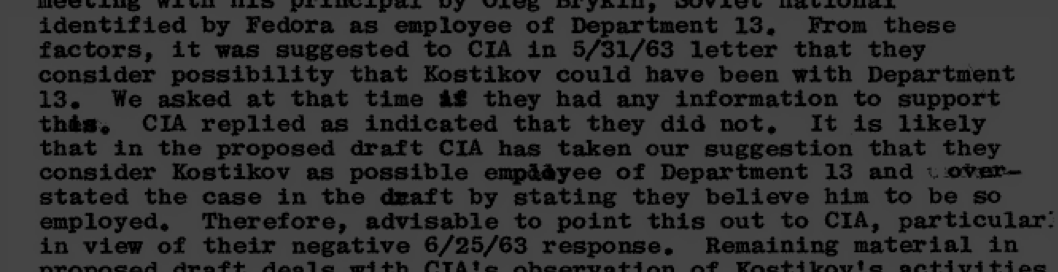
This means either one of two things:
David Atlee Phillips’ dirty tricks
HSCA investigator Dan Hardway hypothesizes that, because of compartmentalization, Phillips and Oswald may have found out on November 22, 1963, that Oswald was a patsy and Phillips received orders to tie the murder to Castro.
In a critique of Phil Shenon’s work written for the AARC in 2015, Hardway expresses the opinion that the CIA is heading to what he calls a limited hang-out by admitting that Oswald may have received guidance from Cuba and that the CIA director at the time, John McCone, was involved in a benign cover-up.
Following the assassination, it became obvious that Phillips was connected to several disinformation stories trying to link Oswald to Castro agents. HSCA investigator Hardway called him out on it:
Before our unexpurgated access was cut off by Joannides, I had been able to document links between David Phillips and most of the sources of the disinformation that came out immediately after the assassination about Oswald and his pro-Castro proclivities. I confronted Phillips with those in an interview at our offices on August 24, 1978. Phillips was extremely agitated by that line of questioning, but was forced to admit that many of the sources were not only former assets that he had managed, in the late 50’s and early 1960’s, but were also assets whom he was personally managing in the fall of 1963. Mr. Phillips was asked, but could not explain, why the information that came from anti-Castro Cuban groups and individuals pointing to Cuban connections, all seemed to come from assets that he handled personally, but acknowledged that that was the case.
One of these assets was Nicaraguan double agent Gilberto Alvarado who, on November 25, claimed to have witnessed Oswald being paid off to assassinate Kennedy when Oswald was in Mexico City. A tale that was quickly debunked.
While the HSCA hearings were going on, Phillips himself made the claim to a Washington Post reporter that he had heard a taped intercept of Oswald when he was in Mexico City talking to a Russian Embassy official offering to exchange money for information (Washington Post, November 26, 1976). Something he never repeated. Phillips also tried to get Alpha 66 operative Antonio Veciana to get one of his relatives in Mexico City to attest that Oswald accepted bribes from a Cuban agent.
Letters from Cuba to Oswald—proof of pre-knowledge of the assassination
For this obvious frame-up tactic, it is worth revisiting what was written in this author’s article The CIA and Mafia’s “Cuban American Mechanism”.
In JFK: the Cuba Files, a thorough analysis of five bizarre letters, that were written before the assassination in order to position Oswald as a Castro asset, is presented. It is difficult to sidestep them the way the FBI did. The FBI argued that they were all typed from the same typewriter, yet supposedly sent by different people. Which indicated to them that it was a hoax, perhaps perpetrated by Cubans wanting to encourage a U.S. invasion. However, the content of the letters and timeline prove something far more sinister according to Cuban intelligence. The following is how John Simkin summarizes the evidence:
The G-2 had a letter, signed by Jorge, that had been sent from Havana to Lee Harvey Oswald on November 14th, 1963. It had been found when a fire broke out on November 23rd in a sorting office. “After the fire, an employee who was checking the mail in order to offer, where possible, apologies to the addressees of destroyed mail, and to forward the rest, found an envelope addressed to Lee Harvey Oswald.” It is franked on the day Oswald was arrested and the writer refers to Oswald’s travels to Mexico, Houston and Florida …, which would have been impossible to know about at that time!
It incriminates Oswald in the following passage: “I am informing you that the matter you talked to me about the last time that I was in Mexico would be a perfect plan and would weaken the politics of that braggart Kennedy, although much discretion is needed because you know that there are counter-revolutionaries over there who are working for the CIA.”
Escalante informed the HSCA about this letter. When he did this, he discovered that they had four similar letters that had been sent to Oswald. Four of the letters were post-marked “Havana”. It could not be determined where the fifth letter was posted. Four of the letters were signed: Jorge, Pedro Charles, Miguel Galvan Lopez, and Mario del Rosario Molina. Two of the letters (Charles & Jorge) are dated before the assassination (10th and 14th November). A third, by Lopez, is dated November 27th, 1963. The other two are undated.
Cuba is linked to the assassination in all of the letters. In two of them, an alleged Cuban agent is clearly implicated in having planned the crime. However, the content of the letters, written before the assassination, suggested that the authors were either “a person linked to Oswald or involved in the conspiracy to execute the crime.”
This included knowledge about Oswald’s links to Dallas, Houston, Miami, and Mexico City. The text of the Jorge letter “shows a weak grasp of the Spanish language on the part of its author.” It would thus seem to have been written in English and then translated.
Escalante adds: “It is proven that Oswald was not maintaining correspondence, or any other kind of relations, with anyone in Cuba. Furthermore, those letters arrived at their destination at a precise moment and with a conveniently incriminating message, including that sent to his postal address in Dallas, Texas … The existence of the letters in 1963 was not publicized or duly investigated and the FBI argued before the Warren Commission to reject them.”
Escalante argues: “The letters were fabricated before the assassination occurred and by somebody who was aware of the development of the plot, who could ensure that they arrived at the opportune moment and who had a clandestine base in Cuba from which to undertake the action. Considering the history of the last 40 years, we suppose that only the CIA had such capabilities in Cuba.”
We will see that these letters are suspiciously similar to Oswald’s “last letter.”
Policarpo Lopez
Attempts to link foreign governments to the assassination were not just limited to the framing of Oswald. As reported in the article The Three Failed Plots to Kill JFK, eight alternate patsies were profiled and no fewer than five of these made strange trips to Mexico City and at least four had visited Cuba.
One who did escape authorities to Mexico and was reportedly the lone passenger on a plane to Cuba shortly after the assassination was Policarpo Lopez. Even the HSCA found this case egregious.
The HSCA described parts of what it called the “Lopez allegation”:
Lopez would have obtained a tourist card in Tampa on November 20, 1963, entered Mexico at Nuevo Laredo on November 23, and flew from Mexico City to Havana on November 27. Further, Lopez was alleged to have attended a meeting of the Tampa Chapter of the FPCC on November 17 … CIA files on Lopez reflect that in early December, 1963, they received a classified message requesting urgent traces on Lopez … Later the CIA headquarters received another classified message stating that a source stated that “Lopes” had been involved in the Kennedy assassination … had entered Mexico by foot from Laredo on November 13 … proceeded by bus to Mexico City where he entered the Cuban Embassy … and left for Cuba as the only passenger on flight 465 for Cuba. A CIA file on Lopez was classified as a counterintelligence case.
An FBI investigation on Lopez through an interview with his cousin and wife, as well as document research, revealed that … He was pro-Castro and he had once gotten involved in a fistfight over his Castro sympathies.
The FBI had previously documented that Lopez had actually been in contact with the FPCC and had attended a meeting in Tampa on November 20, 1963. In a March 1964 report, it recounted that at a November 17 meeting … Lopez said he had not been granted permission to return to Cuba, but was awaiting a phone call about his return to his homeland … A Tampa FPCC member was quoted as saying she called a friend in Cuba on December 8, 1963, and was told that he arrived safely. She also said that they (the FPCC) had given Lopez $190 for his return. The FBI confirmed the Mexico trip (Lopez’ wife confirmed that in a letter he sent her from Cuba in November 1963, he had received financial assistance for his trip to Cuba from an organization in Tampa) … information sent to the Warren Commission by the FBI on the Tampa chapter of the FPCC did not contain information on Lopez’ activities … nor apparently on Lopez himself. The Committee concurred with the Senate Select Committee that this omission was egregious, since the circumstances surrounding Lopez’ travel seemed “suspicious”. Moreover, in March 1964, when the WC’s investigation was in its most active stage, there were reports circulating that Lopez had been involved in the assassination … Lopez’ association with the FPCC, however, coupled with the fact that the dates of his travel to Mexico via Texas coincide with the assassination, plus the reports that Lopez’ activities were “suspicious” all amount to troublesome circumstances that the committee was unable to resolve with confidence.
Oswald’s Last Letter
On November 18, 4 days before JFK’s assassination, the Russian Embassy received a letter dated November 9 from “Oswald”, which was uncharacteristically typed and was in an envelope post-marked November 12. The letter, as was the case for all mail sent to the Russian embassy, had been intercepted by the FBI (Hoover phone call to Johnson November 23 10:01). The envelope is addressed to Tovarish Reznekohyenko, N. (note that Tovarish means Comrade).
Before this incriminating letter, there were at least 6 exchanges in writing between the Oswalds and the Russian Embassy between February and November 1963, where the Russian contact was Nikolai Reznichenko according a number of Warren Commission exhibits. We can assume he is also the recipient of the last letter, despite different spellings.
The FBI sent a briefing about the letter to the FBI Dallas office who received it on the day of the assassination. The Russians, sensing they could be blamed, handed over a copy of the letter to the Americans after noting correctly that it was the only one of all the letters from Oswald that was typed and that its tone differed from all previous correspondence. As the Soviet Ambassador pointed out at the time, the tone was also quite dissimilar to anything Oswald had communicated before; it gave “the impression we had close ties with Oswald and were using him for some purposes of our own.” Their opinion was that it was either a fake or dictated to him. Previous letters were more straight to the point dealing with visa applications.
This letter became a hot potato. One that posed problems for the Warren Commission and the HSCA, which were amplified by the different takes Ruth and Michael Paine, Marina Oswald, the CIA, and the Russians had on it and the incredible lack of depth in the Warren Commission probe.
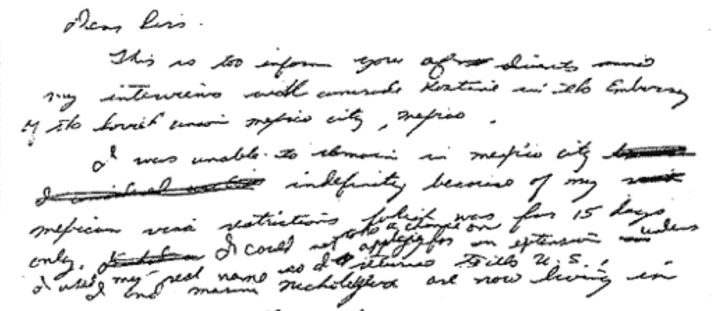
With time, researchers like Peter Dale Scott, James Douglass, and Jerry D. Rose pointed out several troubling points, not only in the letter itself, but also with a Ruth Paine generated handwritten draft of the letter, as well as a Russian analysis of it.
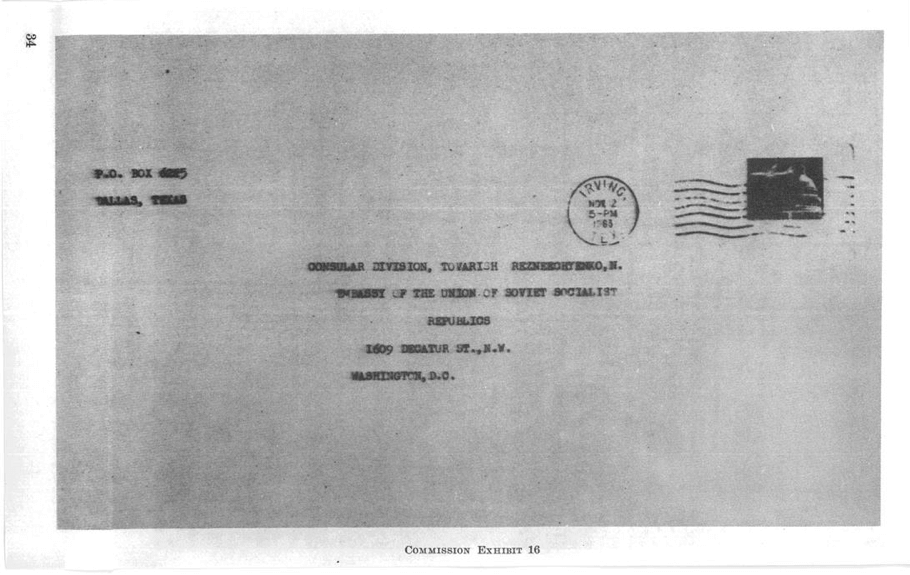
Warren Commission Volume 16 Exhibit 16
Letter from Lee Harvey Oswald to the Russian Embassy, dated November 9, 1963:
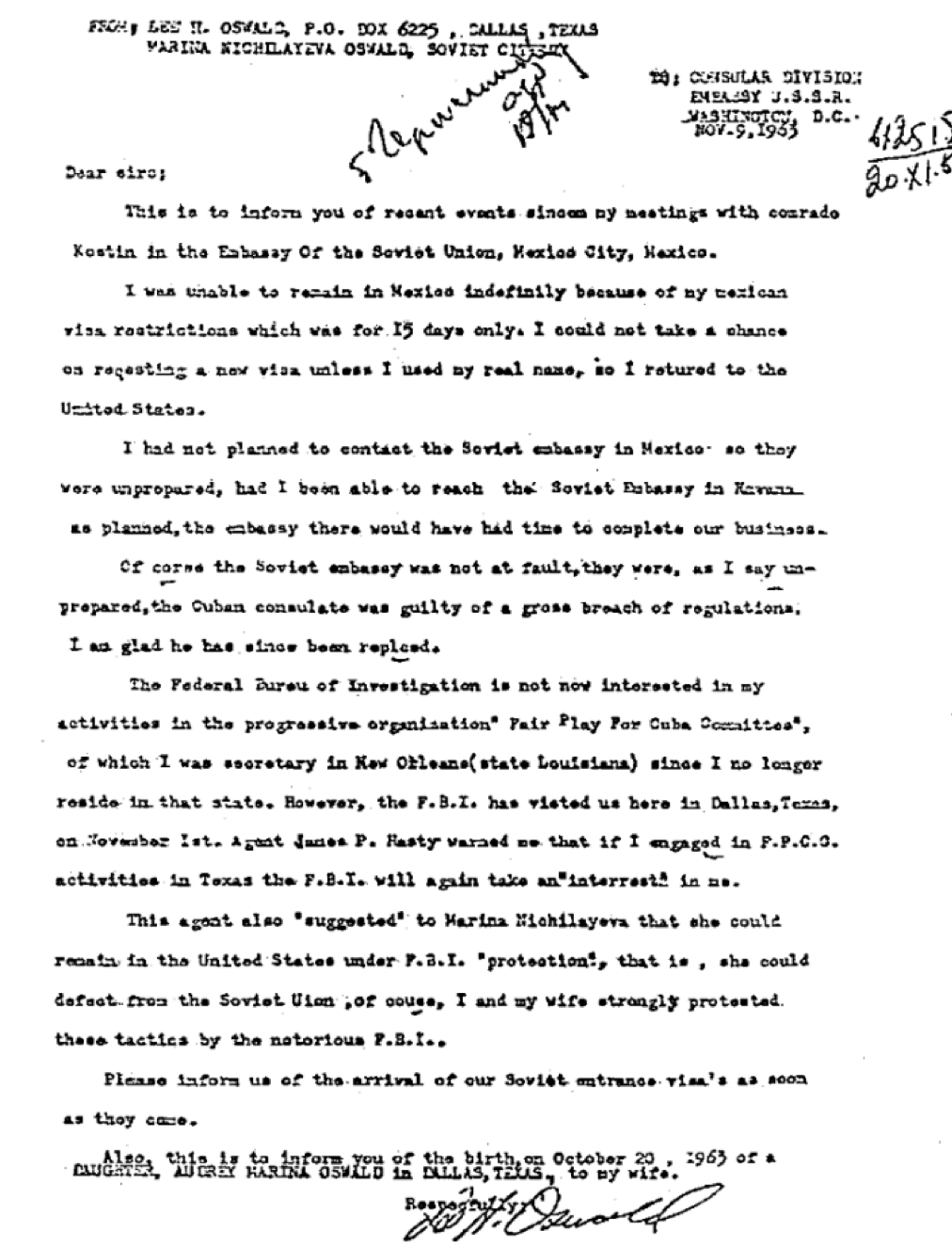
Warren Commission Volume 16 Exhibit 15
The mistake-riddled letter was linked to Ruth Paine’s typewriter. Ruth Paine and Marina Oswald testified that they had seen Oswald working on the letter shortly before it was sent and Ruth and Michael Paine both testified that they had seen a handwritten draft of the letter, which Ruth Paine handed over to an FBI official on November 23. Somehow, investigators who had combed through the Paine house had missed it. Handwriting analysis apparently confirmed it had been written by Oswald.
For some incredible reason, by April 1964, the Warren Commission had accepted a Ruth Paine request to have Oswald’s draft returned. However, when the Dallas FBI did return it to her, she decided to send it back to the Commission, because, finally, she felt it would be more proper for it to be kept in the public archives, but would take it in the event it would not be archived. Hoover said with finality that the Commission would not hold onto it and, by May 1964, had the original sent back to Ruth Paine, which escaped further examination as to its authenticity. (JFK and the Unspeakable, p.443)
Oswald’s draft of the letter found by Ruth Paine:
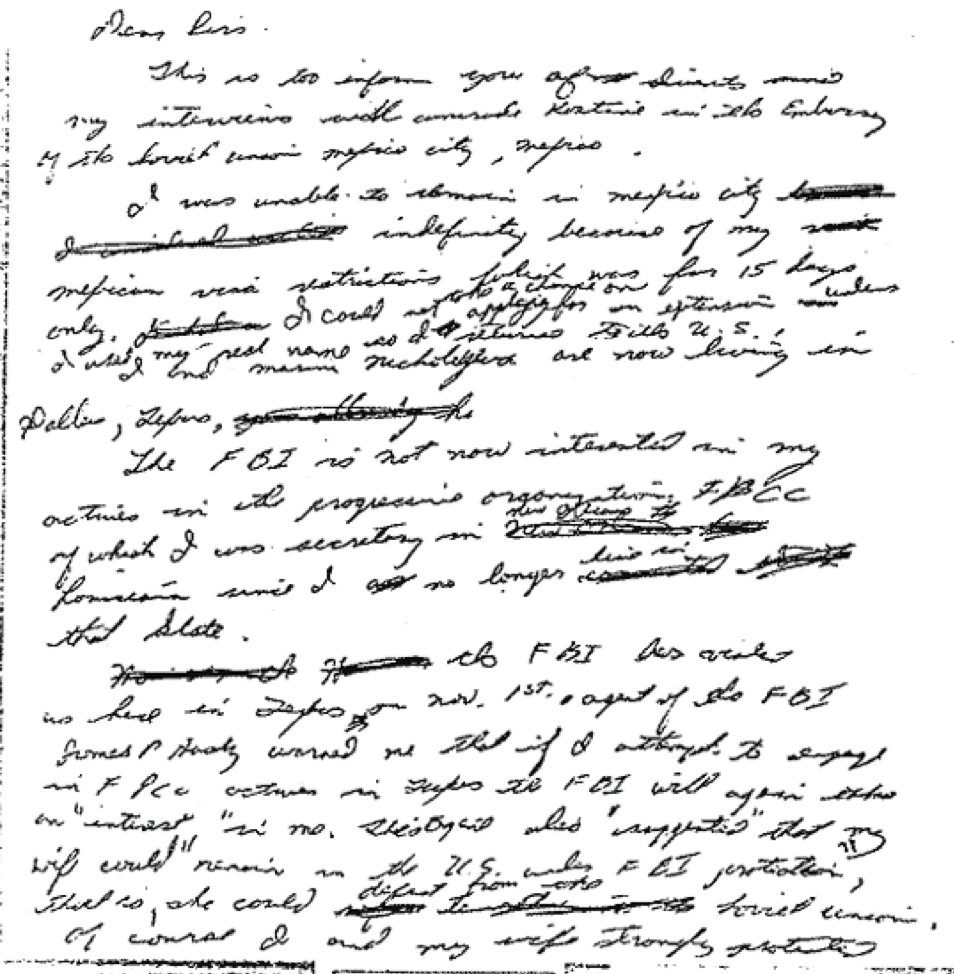

HSCA exhibit F 500/Warren Commission exhibit 103
The Warren Report’s descriptions of Oswald’s trip to Mexico City and his last letter are among the best examples of just how weak their investigation was and how misleading they were in their disclosures.
It seems the only thing that they found perplexing from the letter was how a “drifter” like Oswald could have known that a consul from the Cuban consulate in Mexico City could have been replaced. So, they asked the CIA to weigh in. The CIA surmised that the consul in question was Eusebio Azque and speculated that Silvia Duran or some Soviet official might have mentioned it if Oswald had complained about an altercation with Azque.
The Commission recognized that Kostin, who Oswald talks about, was KGB officer Valery Kostikov, but dilutes the meaning of this by stating “that it was common procedure for such KGB officers stationed in embassies to carry on normal duties along with undercover activities”.
Buried in the appendices of the Report, we can find a memo (Warren Commission Document 347 of January 31, 1964, p. 10) by the FBI’s Ray Rocca, sent to the Commission in January 1964:
Kostikov is believed to work for Department Thirteen of the First Chief Directorate of the KGB. It is the department responsible for executive action, including sabotage and assassination. These functions of the KGB are known within the Service itself as “Wet Affairs” (mokryye dela). The Thirteenth Department headquarters, according to very reliable information, conducts interviews or, as appropriate, file reviews on every foreign military defector to the USSR to study and to determine the possibility of using the defector in his country of origin.
Richard Helms, while heading the CIA, went on to confirm this very important detail. Kept hidden from the public was an allegation that Oswald had met Kostikov just a few weeks earlier in Mexico City and that a likely Oswald impostor had placed a call to Kostikov that was intercepted by the CIA! This makes the reference to “unfinished business” that we can read in the letter quite suggestive.
It is interesting to note that the letters from Cuba designed to incriminate Oswald and link him to Cuban agents use some of the same suggestive language. “Close the business”, “after the business, I will recommend you”, and “after the business I will send you your money” are some of the phrases that can be found in just one of the letters. Others talk about “the matter” or “the plan”.
A real investigation and transparent report would have revealed a lot more about Kostikov’s explosive background and would have blown the lid off what really happened in Mexico City. It would have also delved into who the recipient of the Washington letter was and its important significance, if Plan A (blaming foreign foes for the assassination) had been pursued. Something we will discuss later.
Instead, the report concludes its extremely hollow analysis on a whimper: “In the opinion of the Commission, based upon its knowledge of Oswald, the letter constitutes no more than a clumsy effort to ingratiate himself with the Soviet Embassy.” The truth was that, had plan A gone ahead, the letter would have been peddled as further proof of complicity between the president’s “murderer” and foreign adversaries.
The Warren Report on the letter
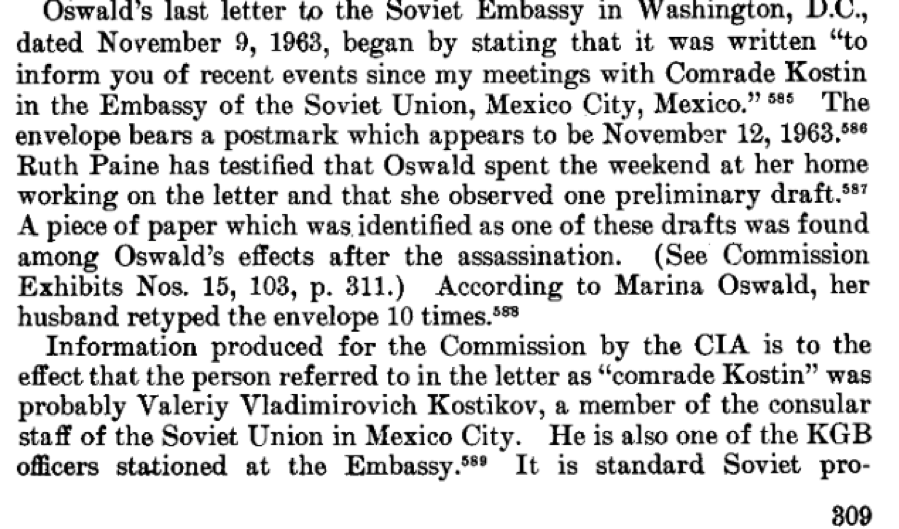
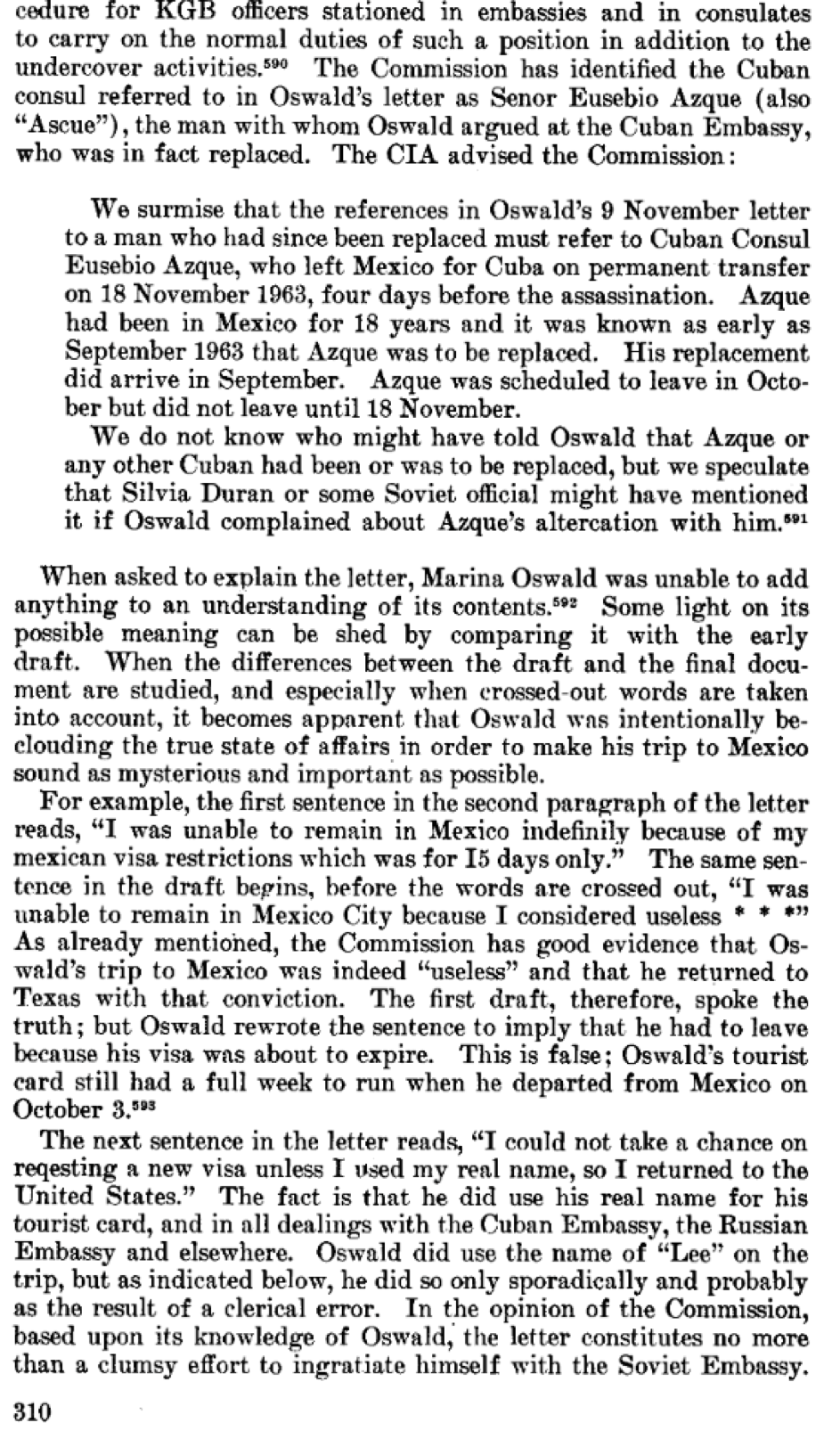
While Jim Garrison clearly suspected something unholy occurred in Mexico City, as well as with the letter, the public had to wait until 1970 to see some of the first clues about what the FBI really thought about this correspondence, when newsman Paul Scott revealed the following:
The F.B.I. discounts the C.I.A. suggestion to the Warren Commission that Silvia Duran, a pro-Castro Mexican employee of the Cuban Embassy, might have told Oswald about Azque being removed. In her statement to Mexican officials concerning her discussion with Oswald, Mrs. Duran made no mention of Azque. And, although she was questioned at the request of C.I.A., no attempt was made to quiz her about whether she knew of Azque’s recall. This makes the C.I.A. conclusion highly dubious, to say the least.
Although the F.B.I. still has not been able to resolve the key mystery of the Oswald letter, it has narrowed the sources of where he might have obtained information about Azque. These sources are: (1) An informant in the Cuban Embassy in Mexico City who contacted Oswald after he returned to the U.S. (2) The Central Intelligence Agency. Or (3), the Soviet Secret Police (K.G.B.) in Mexico City. Significantly, the F.B.I. probe discovered that the K.G.B. and the C.I.A. learned of Azque’s replacement at approximately the same time and not until after Oswald visited Mexico City. This finding has raised the possibility that whoever informed Oswald contacted him after he returned to Dallas from Mexico City.
According to Paul Scott’s son Jim, his father was wiretapped for over 50 years, because of his dogged investigations into the assassination.
The HSCA
Perhaps the biggest blow to the Lone Nut fabrication came when the Church Committee and the HSCA investigations deciphered one of the most important ruses, which would turn the tables on the frame-up artists who concocted the aborted Plan A stratagem. This had to be kept secret.
One thing the Lopez Report makes very clear is that an Oswald impostor made a phone call designed to lay down a trace that would be used as proof of Russian complicity in the assassination and would provide the types of motives and stratagems that were part of the ZR/RIFLE and the Joint Chiefs of Staffs Operation Northwoods play books, both which involved having adversaries blamed for their own covert acts of aggression. The letter served to authenticate the Oswald-Kostikov relationship and add a third player to the mix. The potato became scorching hot.
This analysis needed to be buried as much and as long as possible. The HSCA did not want to be the ones exposing this in the 1970s. The world had to wait nearly 25 years for the declassification of the explosive reports concerning Oswald’s trip to Mexico City and the mysterious letter and sometimes much later for their eventual release.
The HSCA’s conclusions about the letter were even more hypocritical than the Warren Commission’s. While they recognize that it is “disturbing”, they seem to ignore the fact that the letter had been intercepted by the FBI and do not factor in the explosive findings of their very own Lopez Report, nor the confirmations about Kostikov’s role as Russia’s head of assassinations for the Western Hemisphere. When we consider the proof that they were sitting on, that an Oswald impersonator was recorded talking to Kostikov, and that Oswald (or an impostor) was said to have actually met him, we can easily see that the context of the letter and its explosive meaning were completely sidestepped in the Report:
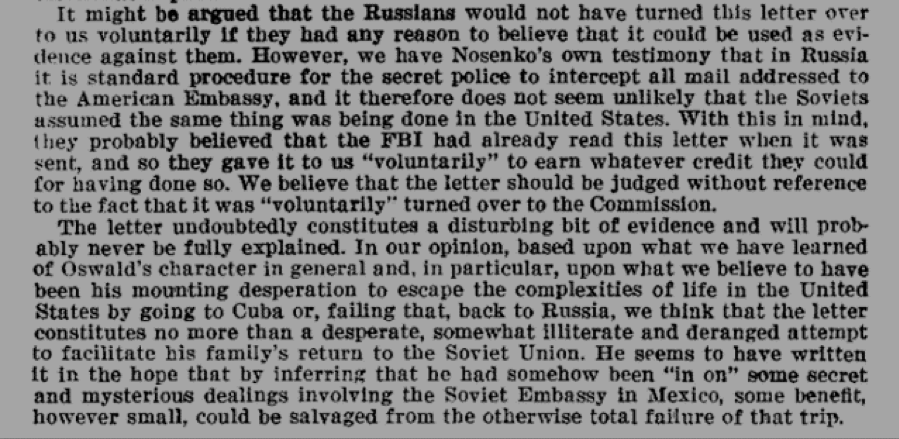
While the second paragraph represents a fake opinion designed to deviate from the real implication of the letter, the first one represents a blatant deception that can be proven outright by the transcript of Hoover’s call to President Johnson the day after the assassination:
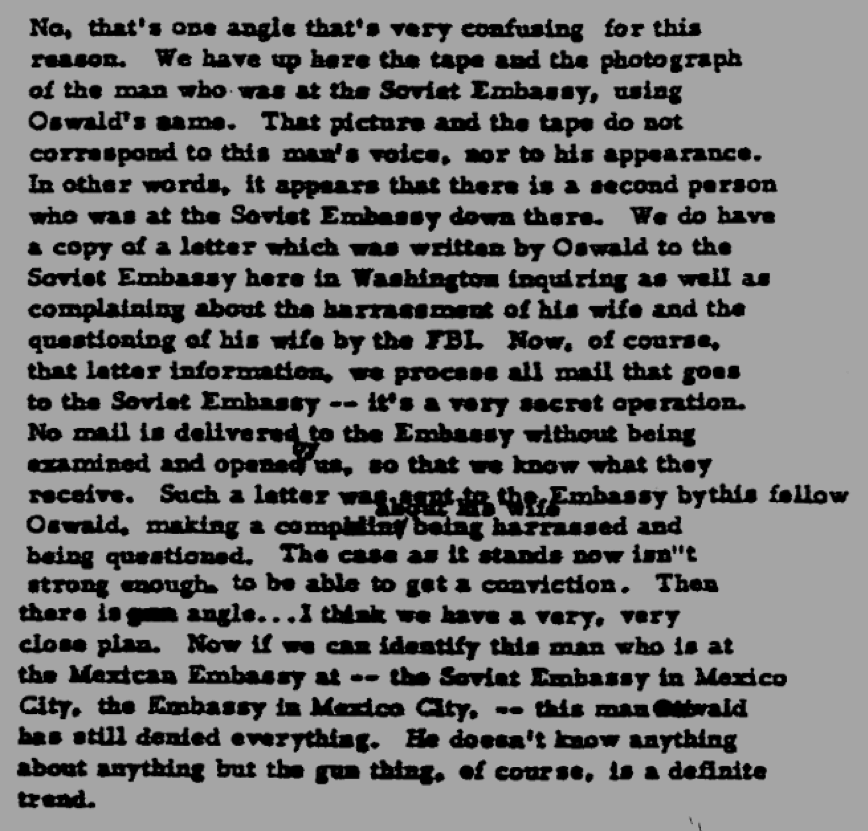
In short, the FBI did in fact examine all mail sent to the Soviet Embassy and had a copy of the letter all along.
The ARRB and Russians Weigh In
Thanks in large part to Oliver Stone and his landmark JFK movie classic, the ARRB was founded in 1992 and began declassifying files shortly after on the JFK assassination. In 1996, the Lopez Report was available. By 2003, a less redacted version was released. The explosive document shed light on Oswald impersonators, missing tapes, photos, and bold-faced lying by top CIA officials. The lone drifter was not alone!
As reported by Jerry Rose in the Fourth Decade, in 1999, Boris Yeltsin handed Bill Clinton some 80 files pertaining to Oswald and the JFK assassination. One of the memos reveals that, at the time of the assassination, Russian ambassador Anatoly Dobrynin had right away seen the letter as a “provocation” to frame Russia by the fabrication of complicity between Russia and Oswald, when none existed. “One gets the definite impression that the letter was concocted by those who, judging from everything, are involved in the president’s assassination,” Dobrynin wrote. “It is possible that Oswald himself wrote the letter as it was dictated to him, in return for some promises, and then, as we know, he was simply bumped off after his usefulness had ended.” In late November, the Russians sent the letter to U.S. Secretary of State Dean Rusk explaining why the letter was a fraud. By then, the White House was peddling the lone nut fable. Kept hidden was the fact that the FBI already had a copy of the letter.
In his article, Rose points out that the typed letter had many more spelling errors in it than the rough draft. Very odd indeed.
If you go back to how the Warren Commission fluffs off the alleged Kostikov/Oswald (and/or impostor) exchanges and compare it with what is written by Bagley in the CIA’s November 23rd 1963 memo (declassified in 1998), you will see a startling difference in Kostikov’s status:

Memo of 23 November 1963 from Acting Chief, SR Division, signed by Tennant Bagley, “Chief, SR/Cl.” CIA Document #34-538
Just one of the reasons the Warren Report was impeached! But wait, it gets worse.
The FBI’s Reaction to the Letter and the Mysterious Tovarish Reznkecnyen
Since the mid-1990s, there have been a few revealing writings about the letter, but very little about the FBI’s take on it.
Now, thanks to document declassification, we can see it through a wider scope that includes troubling dovetailing facts, such as the impersonation of Oswald in Mexico City and multiple hoaxes to tie him in unequivocally with sinister foreign agents and the chief assassination officer in Mexico—Kostikov. The analysis of tape recordings and transcripts, the mysteriously disappearing evidence, the fake letters from Cuba, and the full-fledged perjury of CIA officer David Atlee Phillips during the HSCA hearings prove there was subterfuge beyond a shadow of a doubt.
Hoover’s phone call to Johnson is already very revealing. The following FBI report (HSCA Record 180-10110-10104), released only in 2017, is nothing short of stunning. It was the one Scott wrote about in 1970. It is strongly urged that you follow the above link to understand the full implication of the report, which sheds light on the investigation mindset which preceded the whitewash. However, for this article, our attention will be on the following paragraph of the report which focuses on the letter Oswald sent to the Soviet Embassy in Washington.

Oswald’s letter deeply troubled the FBI for a number of reasons. Its tone was one of ongoing complicity referring to “unfinished business” and convenient reminders of the alarming exchange between Oswald and Kostikov. But the letter stretches the elastic to add yet another element that has so far gone under the radar.
The fact that the letter was sent to Tovarich Nikolai Reznichenko all of a sudden became alarming, even though the Oswalds corresponded with him several times in 1963. The FBI report clearly refers to him as “the man in the Soviet Embassy (Washington’s) in charge of assassinations.” In 1970, Scott had described him as “one of the top members of the Soviet Secret Police (K.G.B.) in the United States.”
The significance of this report leads to many conclusions and as many unanswered questions. Hoover had already decided that Oswald acted alone and they would not “muddy the waters internationally”. The HSCA, who possessed this document, in reports debates the authenticity of the same letter that was given to Dean Rusk by the Soviet ambassador, when they knew full well of its existence and FBI worries about its explosive implications. While this author has found little corroboration about Nikolai Reznichenko’s status, or perceived status, he believes it should not be dismissed as a mistake or confusion with Kostikov. This is an official FBI report that was written in 1963. There have not been any clarifications made about this very significant statement, despite the fact that Paul Scott exposed this in 1970 and its access to HSCA investigators.
The mere fact that he worked in the Russian embassy and that he often corresponded with a “defector” on a watch list and his Russian wife and that the last letter by Oswald addressed to him has a complicit tone while name dropping the Mexico-based KBG chief of assassinations and talking about unfinished business suggests that both the FBI and the CIA had files on him. Where are they? For him to be described by Hoover as the head of assassinations in Washington on the part of the Soviet government in an official FBI document is of utmost significance and requires an explanation.
This is one issue that deserves more debate in the research community.
Conclusion
The last letter on its own, perhaps, does not rise to the level of a smoking gun that proves there was conspiracy. It is another compelling piece of evidence that does prove that the Warren Commission and the HSCA shelved important evidence and information from the public that they found bothersome.
If one adds this letter to the other attempts to pin the blame on foreign agents, including the charade in Mexico City, false testimonies by CIA contacts, the perjury of CIA officials of interest in the case, the Policarpo Lopez incident, and the incriminating letters from Cuba, we have proof beyond a shadow of a doubt that there was conspiracy. The naysayers cannot have it both ways. Either these events were genuine, which proves an international conspiracy, or they were not, which proves a domestic conspiracy. There has been enough evidence to demonstrate that they were not genuine.
The letter has one attribute that can play an important role, actually proving who some of the conspirators were. It pre-dates the assassination. As it refers to happenings and ruses that took place in Mexico City two months earlier that few knew about, we can narrow the scope on who was involved. When we inspect the propaganda aspect of the operation, the case against David Atlee Phillips as a person of extreme interest is almost airtight. He had many touch points with Oswald and is easy to link to all of the ruses behind the sheep dipping activities, including the incriminating last letter.

On the night of September 17, 1961, Secretary General of the United Nations Dag Hammarskjold boarded his plane, the Albertina, in Leopoldville. He had authorized a mission that was unprecedented in UN history. The UN had committed troops to put down a rebellion against the new African nation of Congo by a breakaway state called Katanga.
Hammarskjold was trying to arrange a cease fire between the UN forces and the Katangese mercenaries. He was to land at the Ndola airport in Northern Rhodesia, a British protectorate. His plane crashed several miles from the airport. In addition to the Secretary General, 14 other people perished. There was a survivor who died six days later. Although the first local inquiry, done by British colonial authorities, blamed the crash on pilot error, there have always been suspicions of foul play. A number of witnesses saw a large fireball explode in the sky around the airport. The survivor, Harold Julien, said the plane was in flames before it crashed. More than one witness said they had seen a smaller plane behind and above the Albertina. But in spite of these observations, the UN’s inquiry was inconclusive.
In 2011, English scholar Susan Williams wrote a book entitled Who Killed Hammarskjold? It contained both the older evidence combined with new evidence, which she had traveled the world tracking down. This included two servicemen, one Swedish and one American, who heard recorded messages saying that the second plane was in hot and hostile pursuit of the Albertina. She also wrote that witnesses saw land rovers driving to the scene of the crash within an hour; other witnesses said they had reported the crash much earlier than the official time of discovery, which was 3 PM the next day. These would be indications that:
But, perhaps, the most memorable detail revealed about the crime scene in the Williams book was this: photos showed an unidentifiable playing card stuffed into the dead Hammarskjold’s ruffled tie. A witness said it was the ace of spades. The ramifications of that picture are quite malevolent.
Williams’ book was so well sourced and provocative that it caused a new UN investigation. That inquiry has stretched on over several years, because it has been stymied by the lack of cooperation from countries like South Africa, England and the USA. But the renewed interest in Hammarskjold’s death has also inspired a new film titled Cold Case Hammarskjold. The documentary was made by Danish director Mads Brugger in consultation with Swedish investigator Goran Bjorkdahl.
Brugger begins his film with an animated depiction of the crash. He then cuts to a hotel room, where he is dressed in white dictating the story of his search. Through that narrative device, plus the use of chapter headings, he filters his six-year search for the facts. After giving us some background on Hammarskjold’s struggle to make the UN an effective advocate for nations emerging from colonialism, we join in Bjorkdahl’s field investigation. Not only did the witnesses see the plane in flames before it hit the ground, but they said the lights outside the airport went dim after the crash. Further, the air traffic controller’s notes were lost and then reconstructed two days later. In an interview with the first civilian photographer on the scene, he describes an oddity that Williams also noted: all the bodies were burned and charred—except Hammarskjold’s. Was Hammarskjold thrown from the plane on impact? We also learn that the Albertina was unguarded for two hours before it took off for Ndola. This had fostered suspicion that a bomb could have been planted on board.
The other suspected method of murder was fire from the following plane. The film investigates this aspect and focuses on the Belgian mercenary pilot Jan Van Risseghem, nicknamed the Lone Ranger. Through declassified documents, we learn he had been suspected of causing the crash by the American ambassador to Congo, Edmund Gullion. But the film ends up ruling this out when they learn through scientific testing of a metal plate from the Albertina that the holes were not made by bullets.
This leads Brugger and Bjorkdahl to investigate a fascinating lead that was first uncovered by the South African Truth and Reconciliation Committee (TRC) in 1998. These were documents outlining a plot to kill Hammarskjold codenamed Operation Celeste. The film shows the press conference at which these documents were first announced to the public by Bishop Desmond Tutu. For her book, Susan Williams wrote two chapters about the documents. The papers originated in 1961 from an agency called the South African Institute for Maritime Research (SAIMR). The TRC revealed that they were discovered in a file related to the 1993 assassination of Chris Hani, the leader of the South African Communist Party. The TRC did not do any extensive investigation or forensic testing to affirm the validity of the documents. But to say they were explosive is understating what was in them. In sum, they described a plot in which Hammarskjold would be removed by means of some kind of air accident, which SAIMR would be free to devise on its own. The sanction for the SAIMR operation was through both British intelligence and Director Allen Dulles of the CIA. The directions call for SAIMR to infiltrate the airport and that Hammarskjold’s assassination be pulled off more efficiently than the murder of revolutionary Congo leader Patrice Lumumba—which the CIA also had a significant role in. Operation Celeste consisted of two main techniques: planting a bomb on the Albertina and having a fighter plane follow as a fallback, if the bomb did not explode. The SAIMR after-action report stated that the bomb did not go off upon takeoff, therefore the fighter plane followed. But the bomb did go off before the landing. The fighter pilot is not necessarily Van Risseghem. Williams thought it could refer to Hubert F. Julian, an African-American mercenary pilot. Julian appears to have been in the employ of Moise Tshombe, leader of the breakaway state of Katanga, which the UN had been trying to reincorporate back into Congo.
At the time of their exposure, the SAIMR documents were attacked by both British intelligence and the CIA as being planted forgeries, perhaps by the KGB. This film takes the exploration of SAIMR further than Williams did. Williams had an unnamed source talk about the group. Brugger has two sources who agreed to be filmed. In addition, he found the family of a former member of SAIMR who was murdered. The chief witness in the film is a former SAIMR operative named Alexander Jones. Jones said that, while he was employed by SAIMR, he saw three pictures from the Hammarskjold crash site. One of the men he saw in the photo was Keith Maxwell, an action operative of SAIMR. The other person he recognized was an agent codenamed Congo Red, also involved in the group. Were these men in the land rovers that the witnesses saw driving toward the crash site? Were they driving to the scene to see if anyone survived the crash? And was their function to do away with the survivors?
Maxwell later revealed a roman-à-clef manuscript to the mother of the young girl, Dagmar Fiels, that Jones believes SAIMR assassinated. In that manuscript, he disguises the name of the supervisor of the plot as a man named “Wagman”. Both Williams and Brugger understand this to be a nom de plume for SAIMR operative Bob Wagner. The information in the SAIMR documents closely aligns with the manuscript. The film reveals the only picture ever discovered of Maxwell.
Although Cold Case Hammarskjold does attempt to place the murder of Hammarskjold in a wider political context, my one serious reservation about the picture is that I wish it would have done more in that aspect. The political struggle in Congo went on for approximately five years, beginning with the Eisenhower administration, going through the Kennedy administration and concluding with LBJ. It was no less than an epochal conflict that impacted the entire continent. The film does not deal, at all, with the murder of Patrice Lumumba, yet that is why Hammarskjold was there. Lumumba had asked the UN to help him get the Belgian imperialists out of his newly independent country. Belgium had brutally colonized Congo for decades. They had promised to set the country free. But they had now returned by dropping paratroopers back in country on the pretext of restoring order. Hammarskjold was trying to keep the country independent from a recurrence of European colonialism or imperialism. President John Kennedy was also quite sympathetic to what Hammarskjold was attempting to do. The murders of these three men—Lumumba, Hammarskjold, and Kennedy—caused the reversion of Congo back to European imperialism. Jonathan Kwitny commented on this in his book Endless Enemies:
The democratic experiment had no example in Africa and badly needed one. So perhaps the sorriest, and the most unnecessary, blight on the record of this new era, is that the precedent for it all, the very first coup in post-colonial African history, the very first political assassination, and the very first junking of a legally constituted democratic system, all took place in a major country and were all instigated by the United States of America. (p. 75)
The death of Lumumba had been ordered by Dwight Eisenhower at an NSC meeting and then initiated by Allen Dulles. (John Newman, Countdown to Darkness, p. 227) Therefore, in that aspect, the SAIMR documents concerning Dulles’ putative role in Hammarskjold’s death are consistent with the discoveries of the Church Committee. Hammarskjold’s vision of the UN was as a world congress where the poor, nascent and weaker nations would have a platform to speak out against the rich, powerful and established ones. What SAIMR seems to have been was a kind of paramilitary, off the shelf, secret commando group. One which had covert support and sanction from not just South Africa, but also the USA and England. In other words, SAIMR was doing dirty work for both colonial and white supremacy interests. Once Hammarskjold was killed, Kennedy did his best to carry out what he perceived as the UN Secretary General’s aims. It was a creditable effort. But after Kennedy’s assassination, the whole enterprise went south in a hurry. Seeing the writing on the wall, the United Nations pulled out. Then President Johnson and the CIA decided to neutralize the last of Lumumba’s followers. This resulted in Josef Mobutu becoming the strong man backed by imperial interests, which is what Hammarskjold was trying to prevent.
As President Kennedy said of him, “Dag Hammarskjold was the greatest statesman of the 20th century.” As the film states, the history of modern Africa might have been different had he survived. Thanks to Williams, and now Brugger, we are a lot closer to what actually happened to this admirable statesman. With their work, no one can call his death a plane accident again.

{aridoc engine=”google” width=”700″ height=”400″}images/ppt/FBI-JFK-Garrison-2019.ppsx{/aridoc}