Blog

  • The Evidence is the Conspiracy – The Carbine on the 6th Floor

    The Evidence is the Conspiracy – The Carbine on the 6th Floor


    I will be sharing with you how the DPD, Secret Service, and FBI dealt with the rifle evidence they gathered, as they gathered it, and how Hoover’s FBI, with the help of the US Postal Service, steered this evidence toward Oswald.

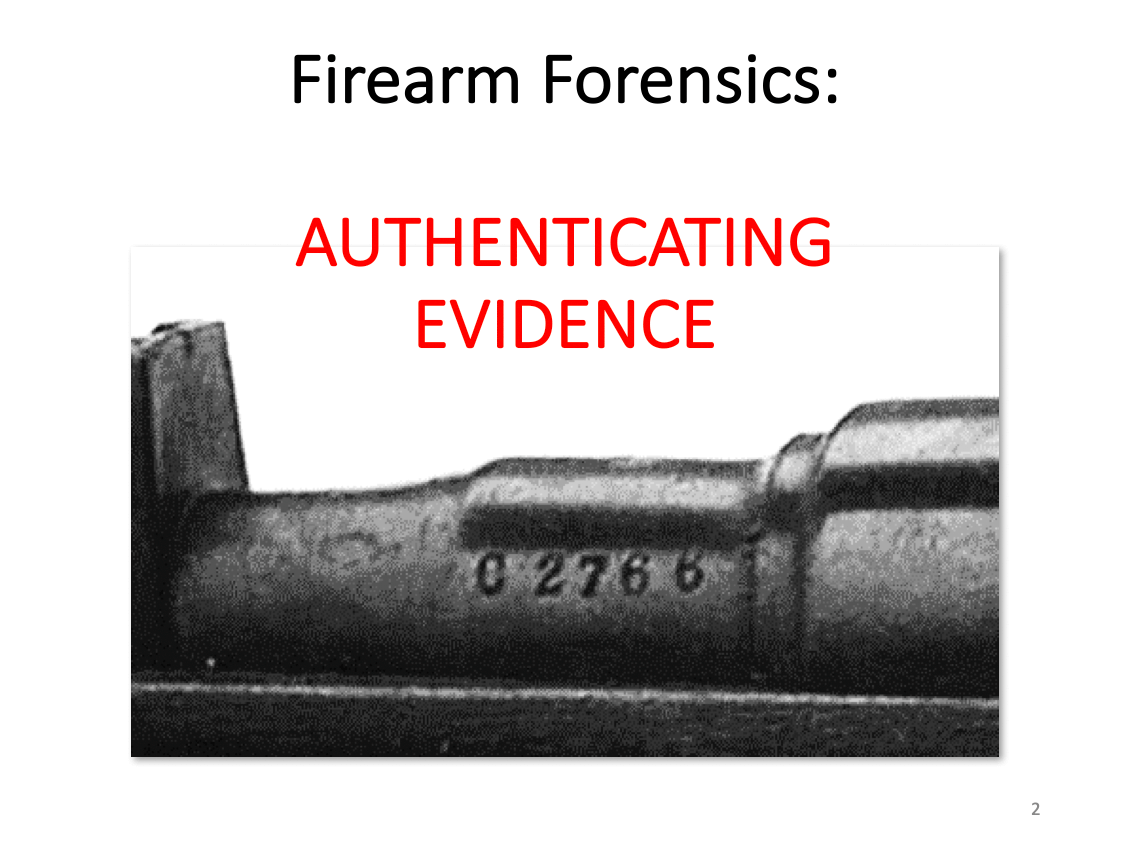
    Forensics with firearms includes examining those things that make the firearm unique, which is one of two ways to authenticate our evidence. Authentication, in the law of evidence, is the process by which documentary evidence and other physical evidence is proven to be genuine and not a forgery. Generally, authentication can be shown in one of two ways. First, a witness can testify as to the chain of custody through which the evidence passed from the time of the discovery up until the trial. Second, the evidence can be authenticated by the opinion of an expert witness examining the evidence to determine if it has all of the properties that it would be expected to have if it were authentic.

    The Roman numeral XVIII (18) and the bottom of TERNI do seem ground off—yet we can’t be 100% sure. 1940 only needed adding if the original was from a different year or the entire year and Roman numerals were removed. If the rifle had been a 1939 or 1938, there is a greater likelihood it was a 7.35mm FC carbine.

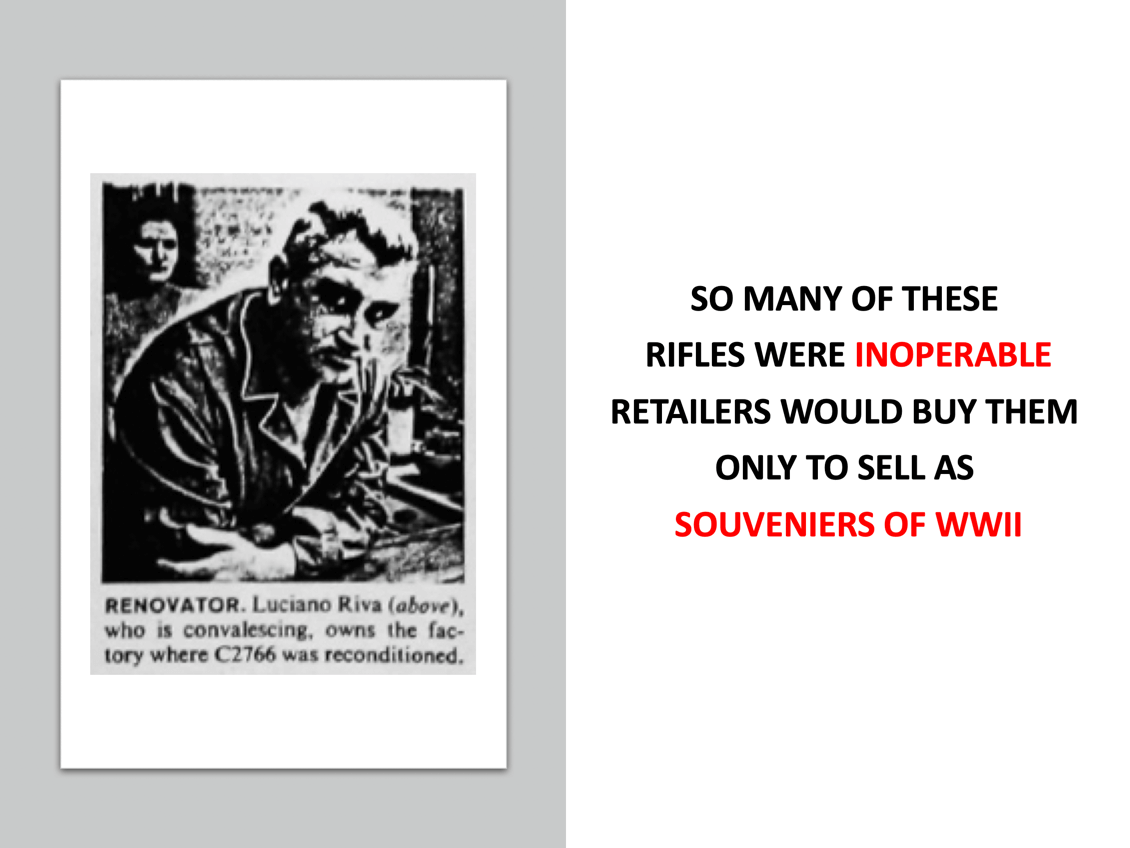
    Luciano Riva, or someone else, did grind some things off and added others. The rifles were so unsound, that without first checking them, the first batches sold for use caused horrific accidents and even deaths. It is from Crescent (Louis Feldsott’s sister business to Adams Consolidated) that retail orders are first forwarded to Fred Rupp, a licensed gun dealer who was enlisted to check, then fix, and/or replace defective rifles, noting the change on the enclosed packing slips. Our 10 slips show no changes, no substitutions, and still represent the shipments from Italy to Crescent in NYC.

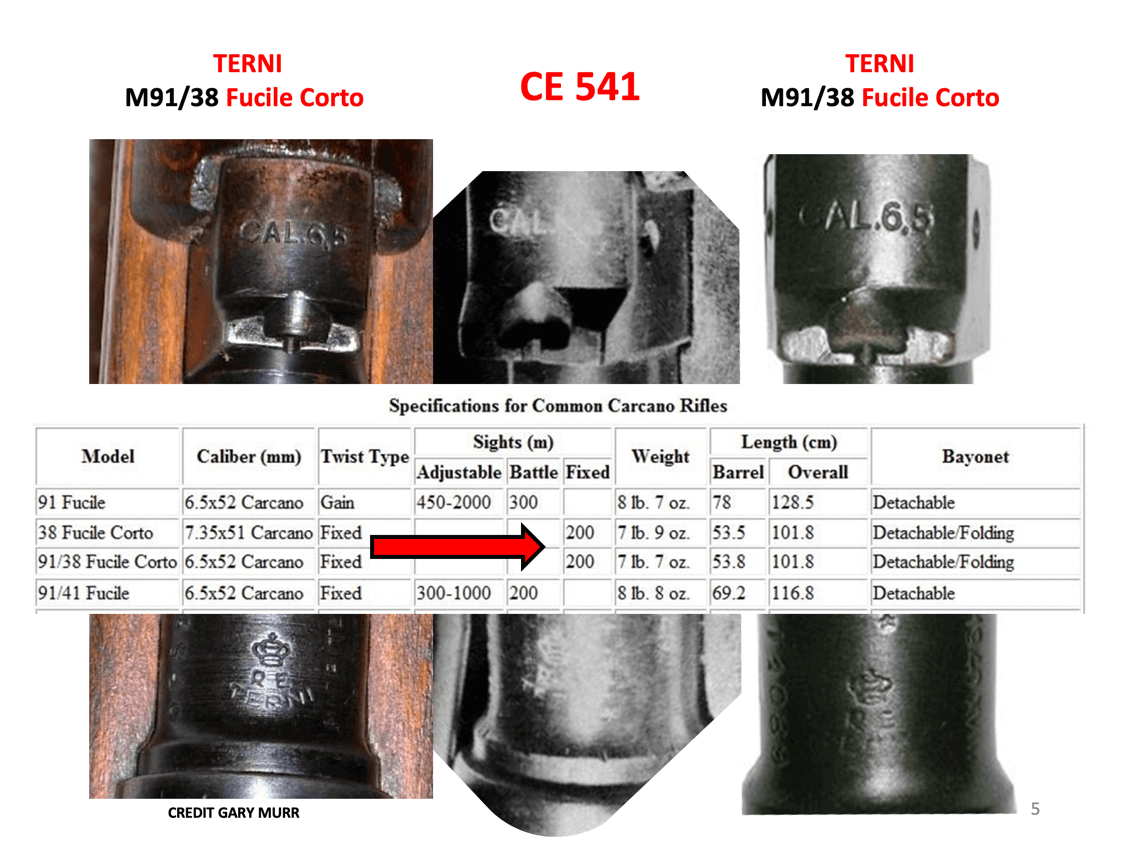
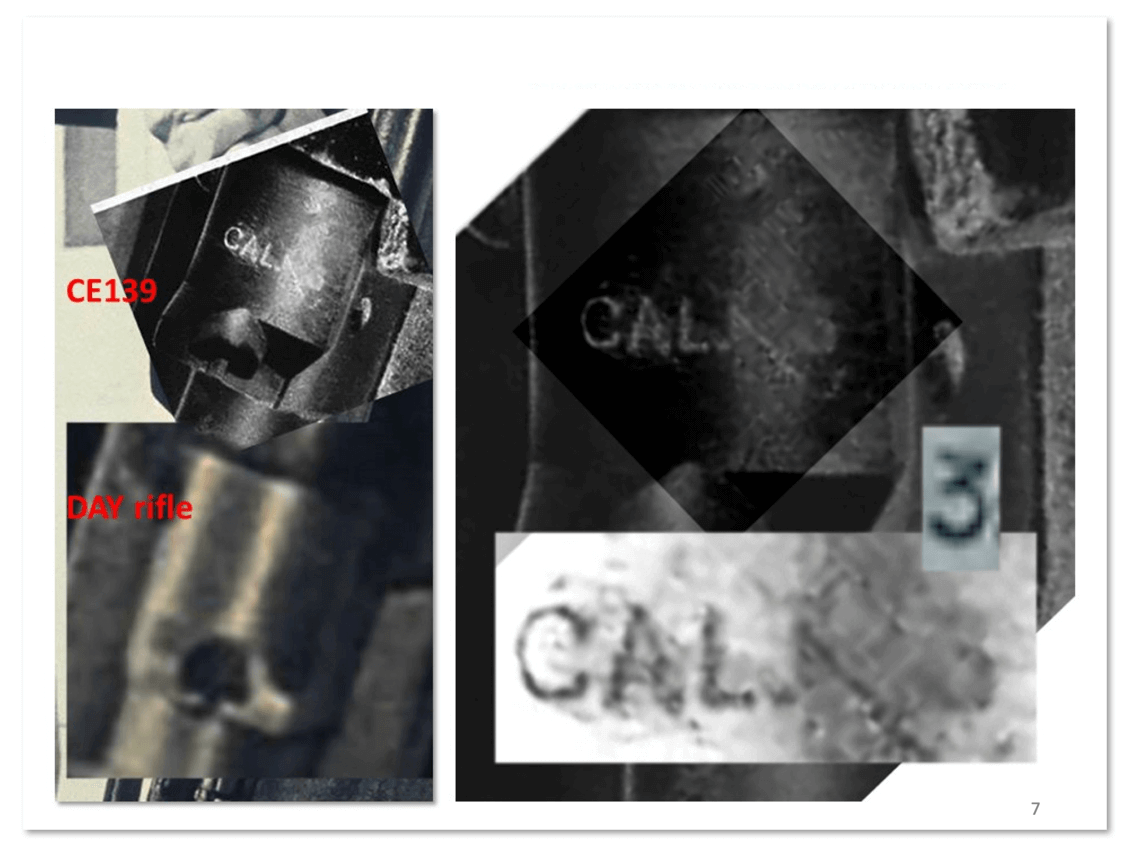
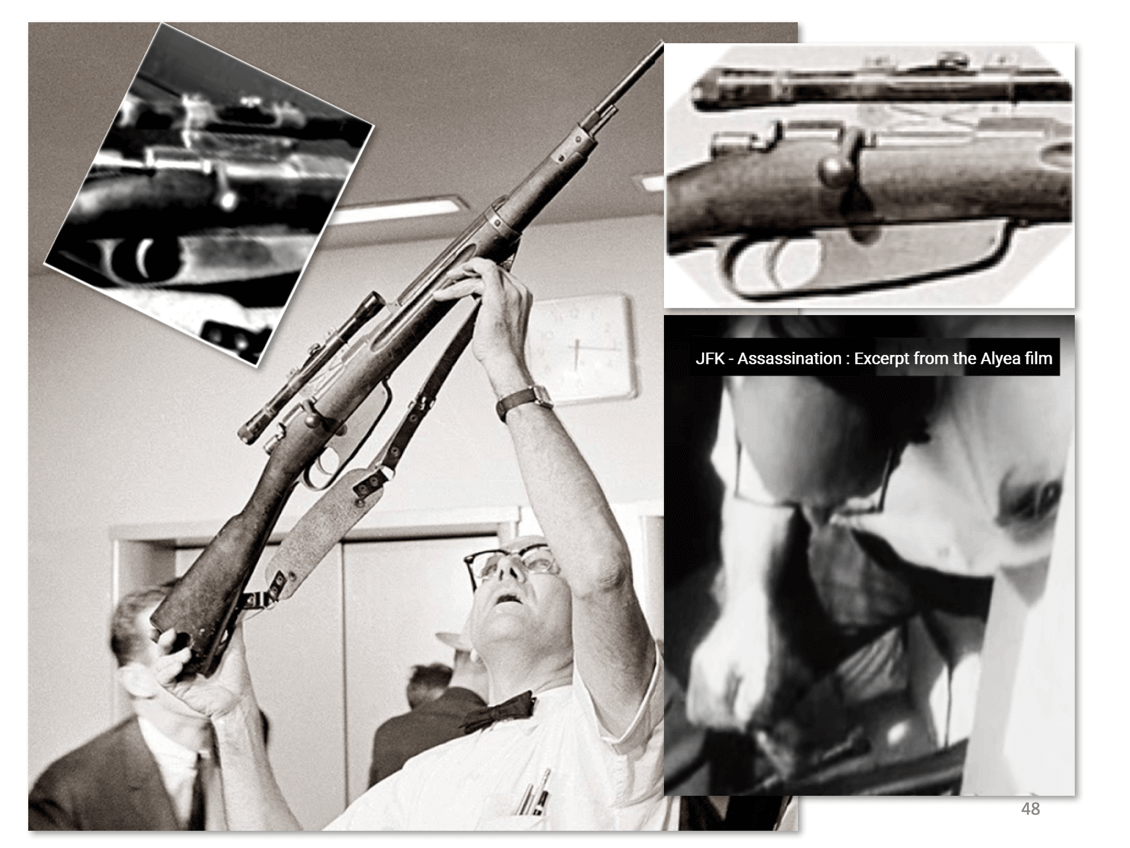
    We have 2 – 6.5 stamped Fucile Corto Barrels and an image from CE541. This is the ONLY image of the caliber on a rifle claimed to be CE-139. I welcome any detailed images of the carbine caliber prior to this image. As you will see, the 6.5 and 7.35 FC rifles are virtually identical.

    The 7.35 Fucile usually had the caliber burned into the butt of the stock on the side with the sling mount. In 1940, when the Army goes back to 6.5mm, it is stamped on the fixed rear sight, in order to help avoid an ammunition mix-up. In the 15-20 years since their use, the parts and pieces of numerous rifles used for parts, can be found in a single, finished weapon.

    We have a wonderful image of Lt. Day carrying the rifle from the TSBD. It is both very large and very clear. Since we’ve never seen an image of the rifle prior to the FBI exhibit images, the possibility of a rifle with no CAL markings prior to the FBI acquiring it – is not so far fetched.

    Early reports from Italy claim the rifle in question is a 7.35 M91/38. Without a clear image of the CAL designation, the 6.5mm shells on the floor – especially in their condition – may have had little to do with the rifle. The white versus black numbers will be a reoccurring theme.


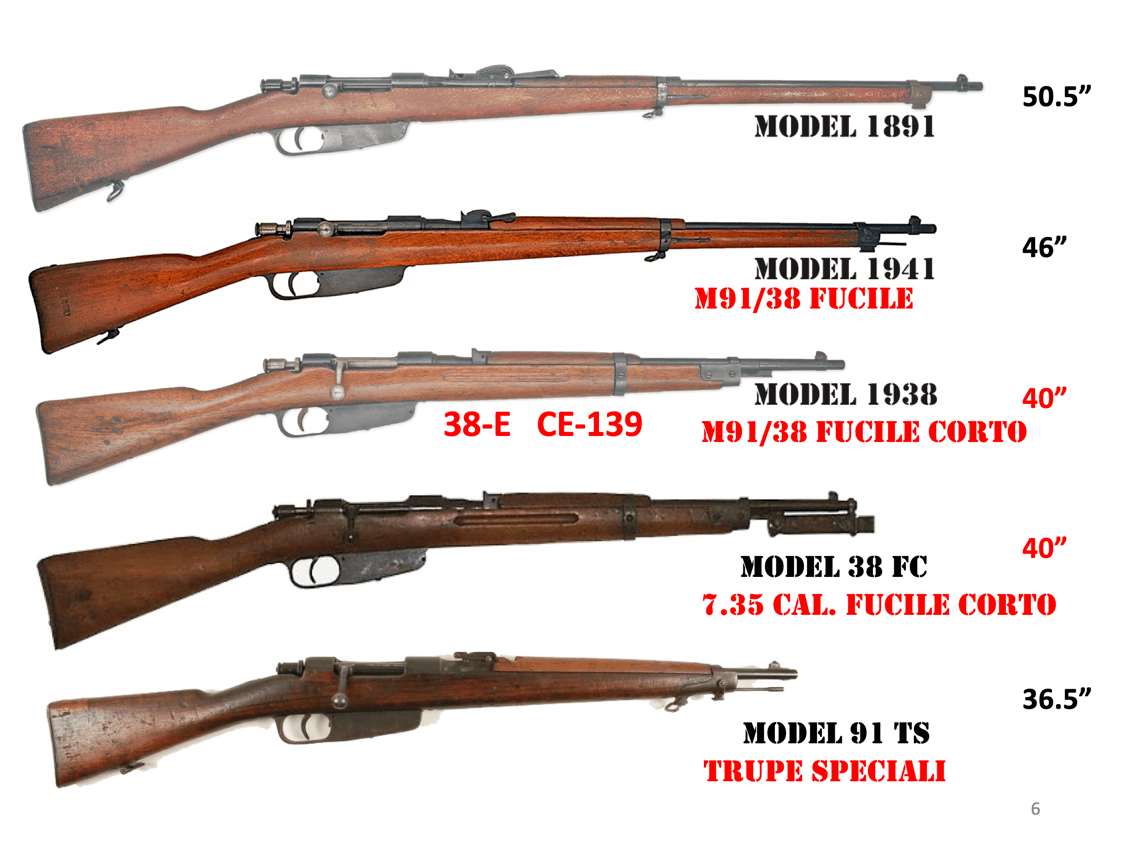
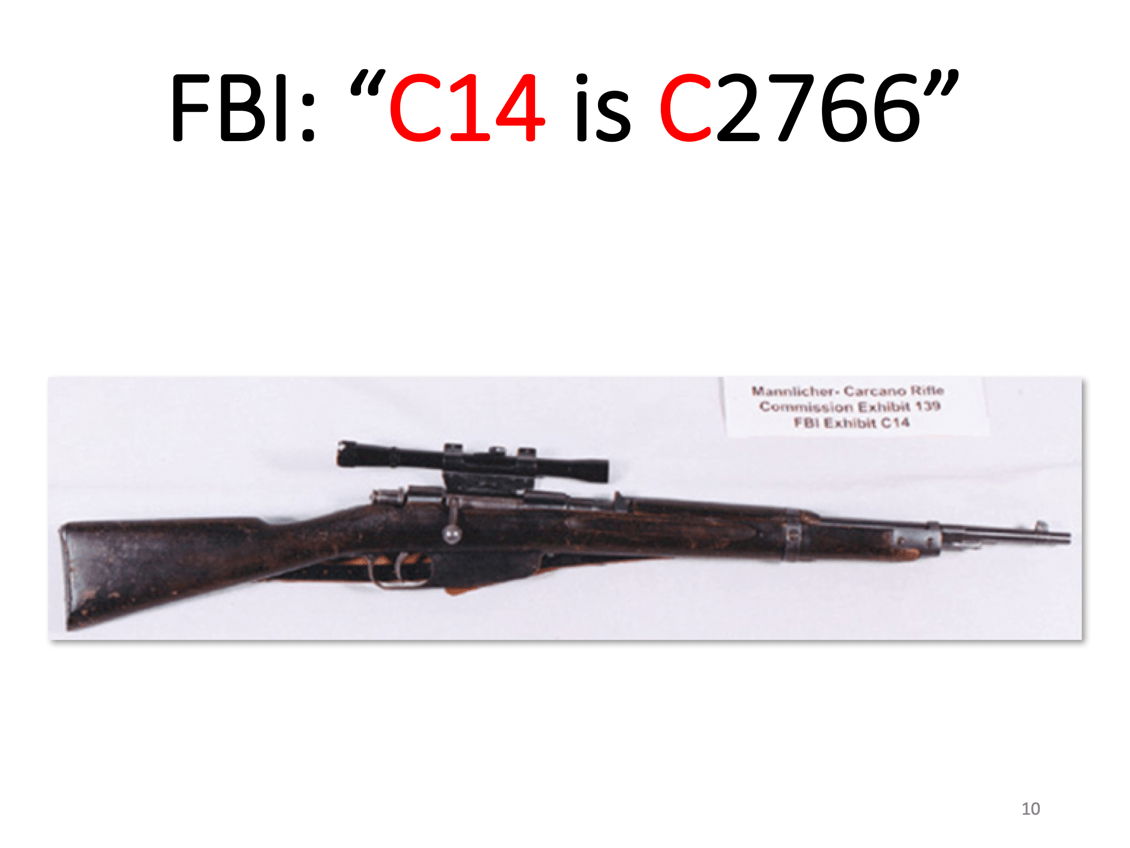
    “C14 is C2766” is a FBI fib used to incriminate Oswald. This declaration came in early December. The report from William Harvey’s Italy said it was a 7.35 model 91/38, among all sorts of interesting things that never made their way into the Warren Commission Report (WCR). Instead, we are told by the FBI that C14 is C2766. Hail Hoover. C14 ≠ C2766b>. On March 27, 1964, Alfred Finish, “professional gunsmith at the Empire Wholesale Sporting Goods,” Montreal, Canada, “assisted in taking critical measures” of the rifles then shipped to Mr. Ouimet. Mr. Ouimet claims to be the owner of Empire Wholesale (aka Century International Arms) owned by William Sucher and source for 700 identical rifles to the one pictured above. We’ll return to Mr. Sucher and Century International Arms (C.I.A.). Mr. Ouimet gives these measures of an “identical model” of the rifle used in the JFK assassination: total length 40 3/16″ – stock 34 3/4″ – barrel and action 28 15/16″ – barrel only 21 1/8″ – rear to receiver 26 1/2.” He underscores the Carcano he had examined during the years “had no set pattern regarding serial numbers.”

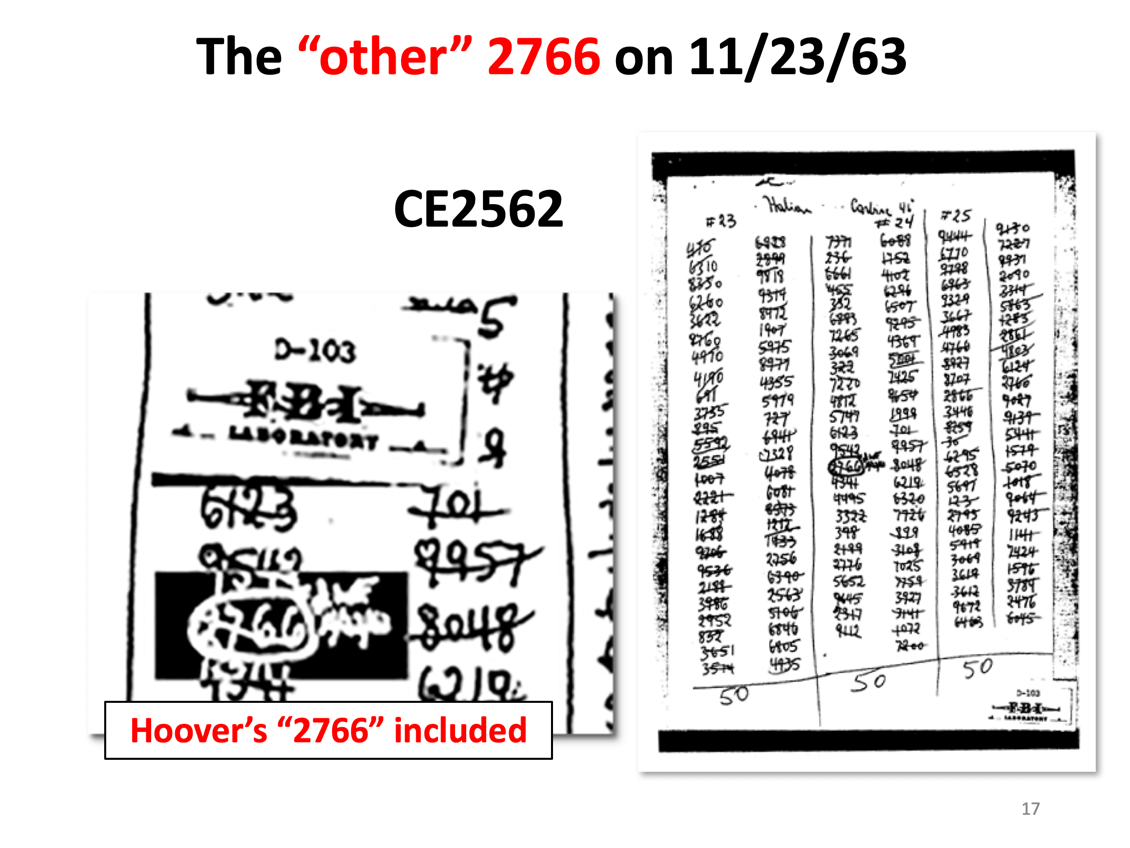
    For argument sake, let’s agree with “C2766” identifying that rifle uniquely. It’s much easier to create paper copies of copies than to stamp a rifle.

    Given Texas in 1963, how did they fall upon Feldsott in NYC?

    FBI SA Nat Pinkston is listed as a TSBD employee in the WCR index. He was an FBI agent. His testimony only dealt with Oswald’s clipboard from December 2. His name is on this report having spoken to Al Yeargan about the rifle at the H.L. Green Company (a local department store selling surplus WWII weapons), yet he is never asked about the conversation. 40 years later, H. L. Green is no longer included. We go from Titche-Goettinger right to Klein’s. What SA Pinkston did in 1963/4 and recounts years later bear little resemblance to each other. His recent revelations are uniquely his and are not authenticated or corroborated by any other evidence.

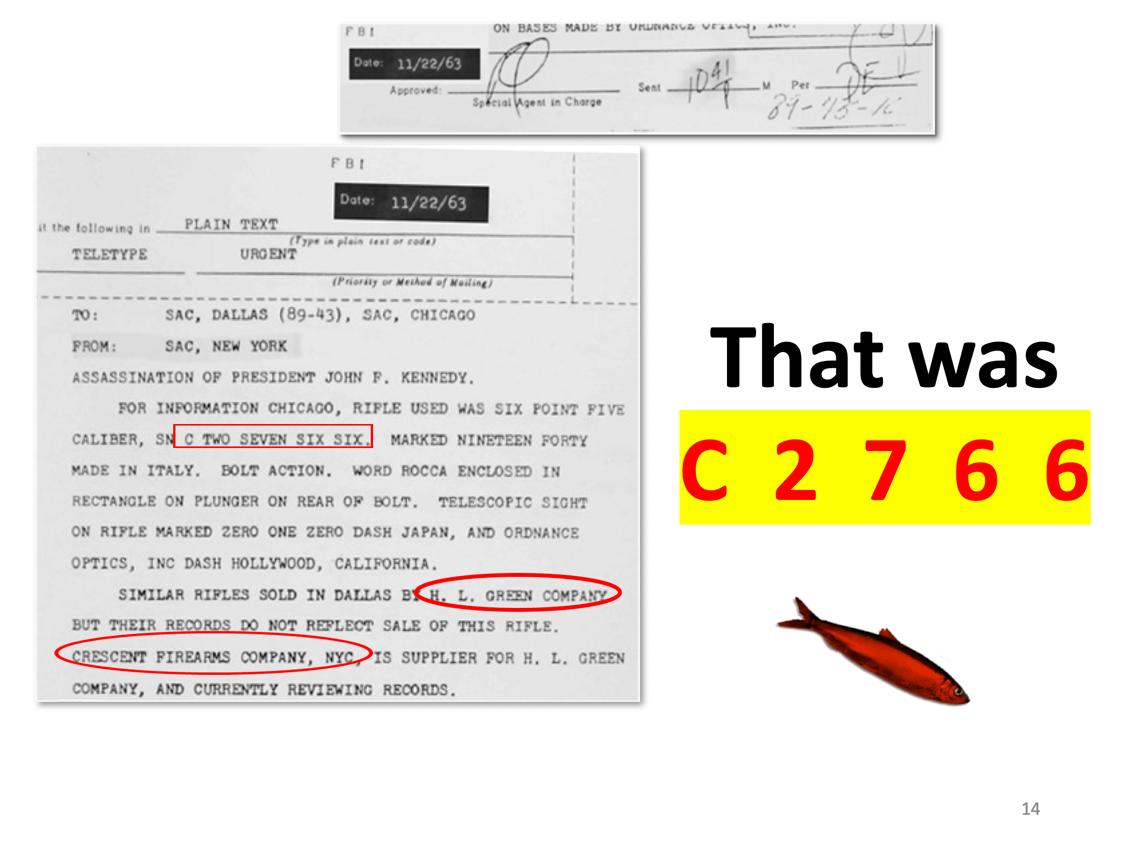
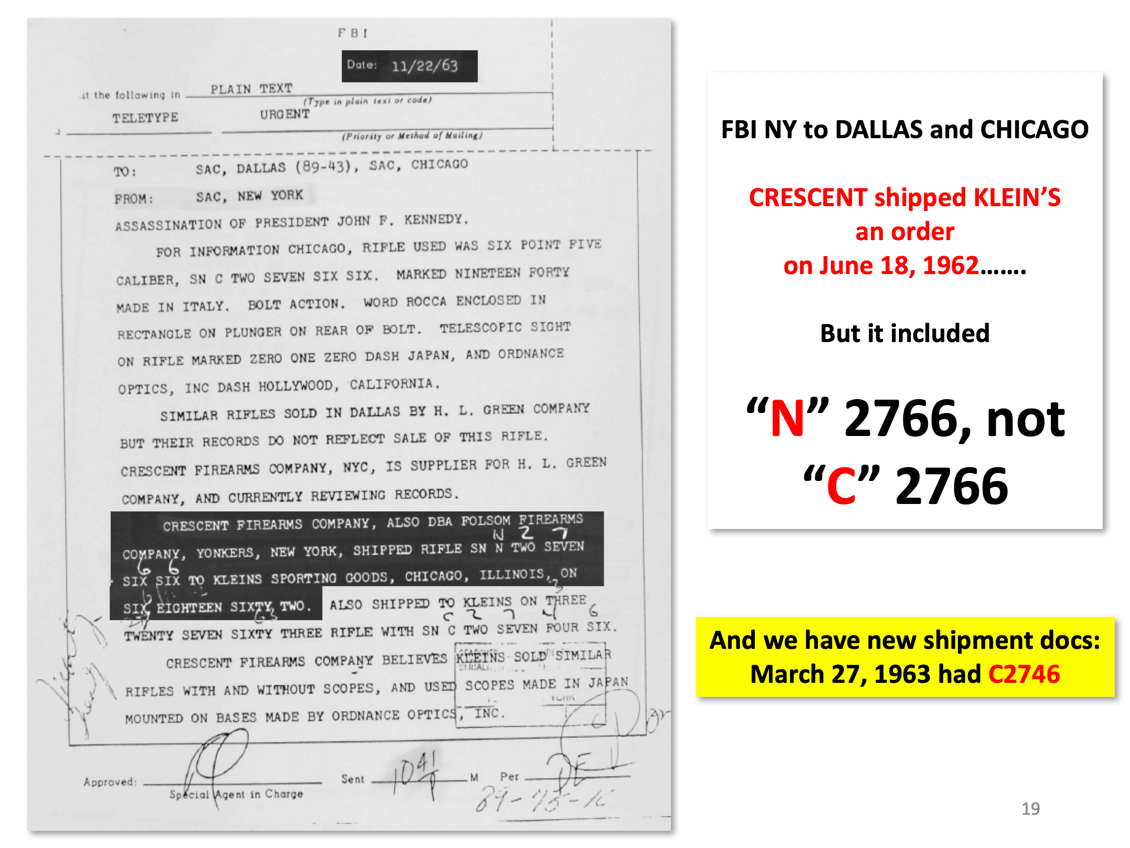
    The SAC in New York City is talking about the records of H. L. Green in Dallas to Chicago 7 hours after the fact. Green says they get their stuff from Crescent Firearms in New York City. Again, info on a 6.5mm C2766 takes 7 hours to convey thru New York City to Chicago, so the Chicago FBI can go to Klein’s?

    Here is the famous affidavit and, not so famous, Rankin note that came with it. Rankin sends Al Feldsott a completed affidavit for his signature and notarization in July 1964. The same thing happens with the H. L. Green employees. This concludes that C 2766 was, indeed, sold to Klein’s Sporting Goods on June 18, 1962, and this info was conveyed to the FBI on the night of November 22. Subsequently, other records are turned over as well.

    On the evening of November 22, the FBI has its evidence. “Mr. White in the study with a candlestick” à la the game, Clue. Crescent to Klein’s on June 18th with C2766.

    William Sucher, owner of Century International Arms, Inc., and Empire Wholesale are the sources to the FBI that the serial numbers on World War 2 surplus rifles are by no means unique. Not one of the 700 has a letter prefix identified. As I discovered, James Ouimet, who is referred to as the “President” of Century Arms, was actually a figurehead, put in place by Sucher and his associates to run Century on their behalf. (G. Murr Education Forum post of 11/26/17) Owner: Empire Wholesale & International Firearms Limited, now known as Century International Arms, CIA.

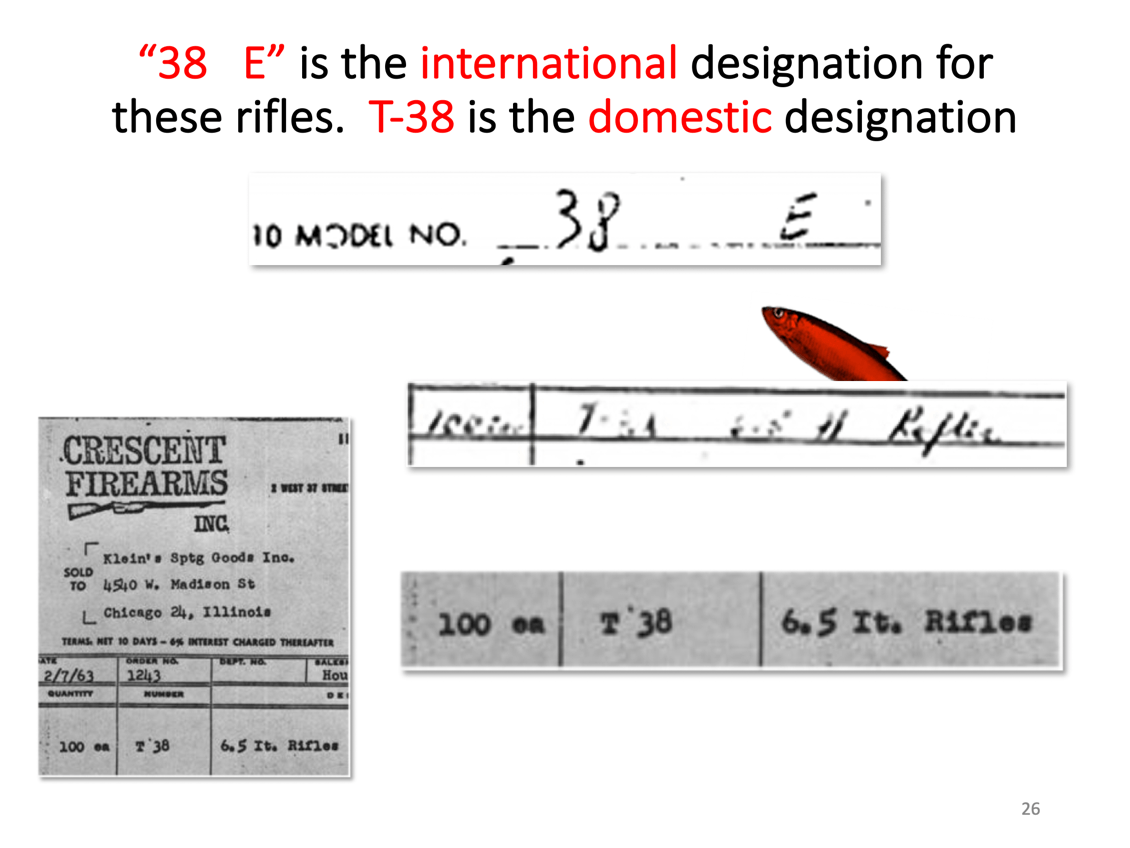
    We also learn that they are the exact same rifles as the Century 700. “38E” internationally known and “T-38” domestically known as Carcano Fucile Corto rifles. The Klein’s customer invoice copies are simply the duplicates of the original 1960 shipments to Crescent from Italy.

    The rest of that November 22 memo confirms a June 18, 1962, shipment sent to Klein’s, yet the rifle listing only includes an N 2766, not C.

    The New York City FBI SAC confirms with the FBI lab that the rifle in question has 5 digits: C 2766. The records of Klein’s from the night before shows they received “N 2766”. What is the FBI at Klein’s to do now?


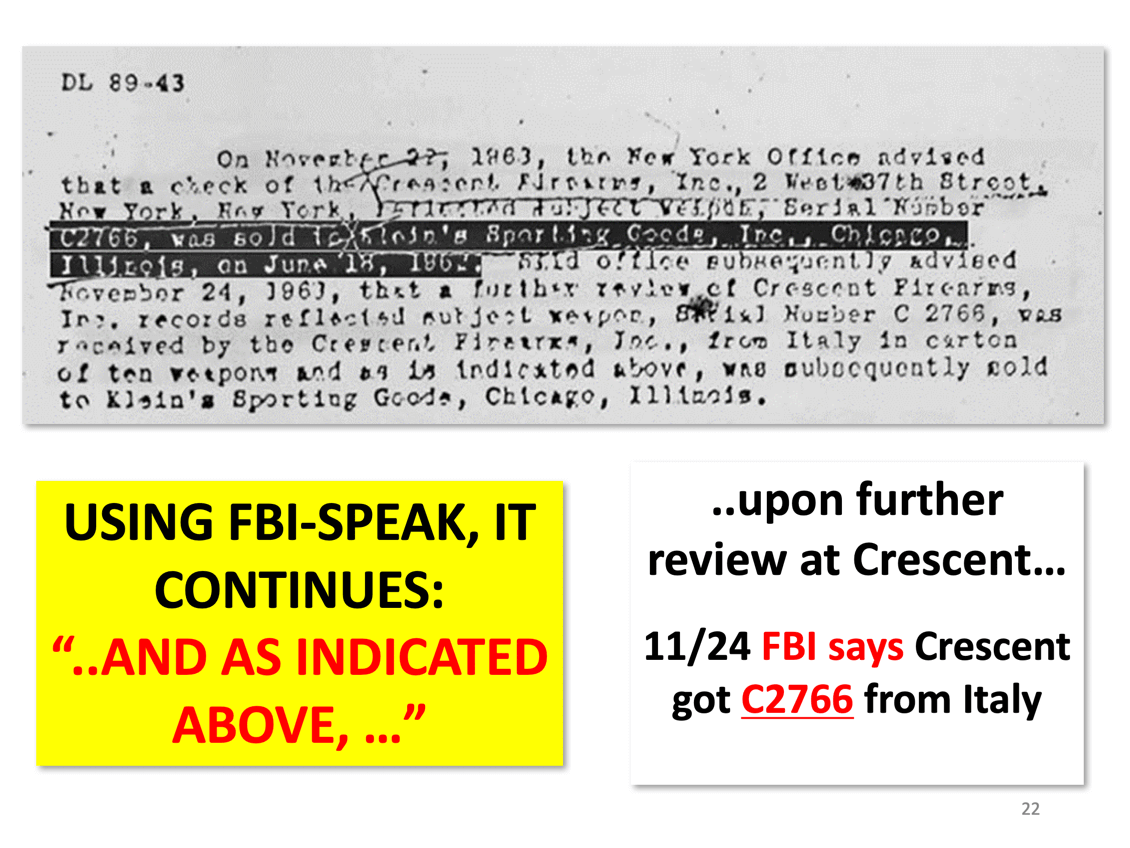
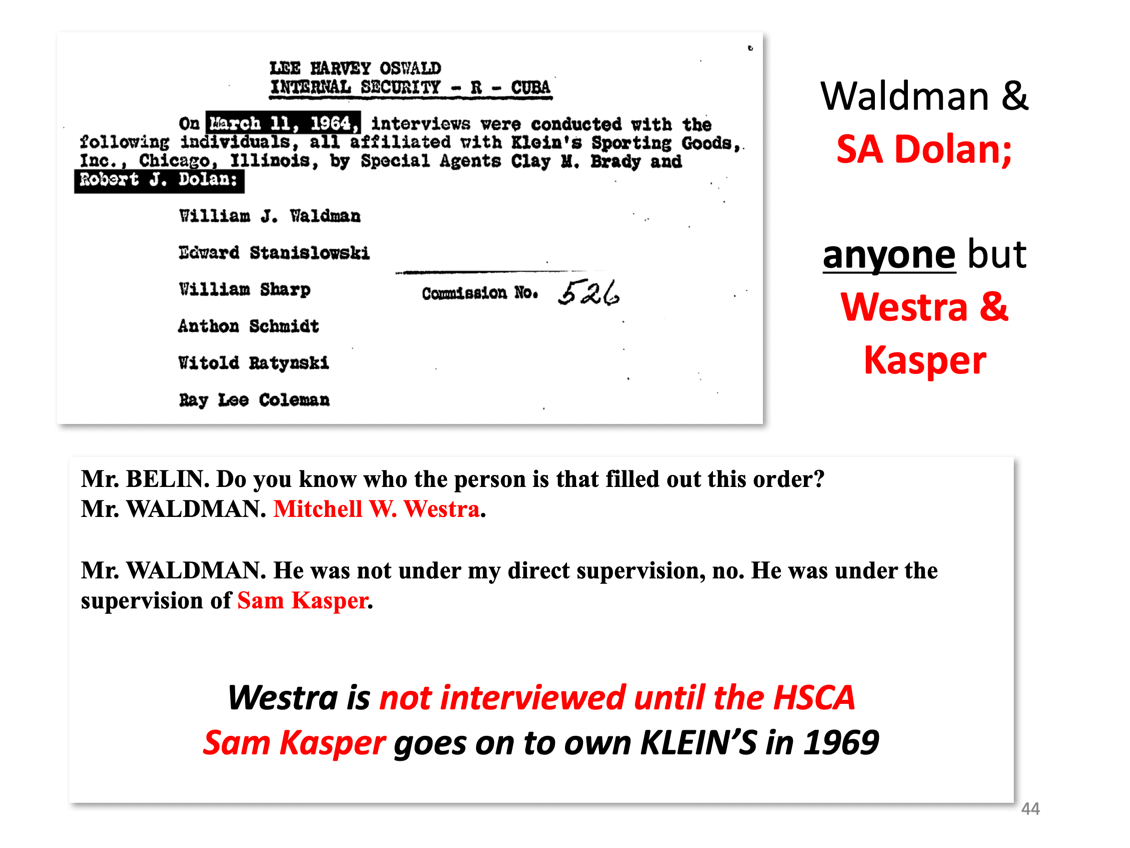
    The New York City FBI revises their story on the November 24, confirming that C2766 was received by Crescent from Italy. Thank you, Sherlock Holmes. That it was sold to Klein’s “subsequently” as indicated above, on June 18, 1962. Yet somehow, 2 days earlier, SA Dolan and Waldman and Scibor from Klein’s find the order blank on microfilm.

    Does the FBI know something we didn’t that needed proof by November 24?

    N 2766 does not appear anywhere in the WCR. June 18, 1962, is on the Feldsott contact sheets, an affidavit, and reconfirmed a number of times in FBI documentation.

    This single sheet of paper related to a February 1963 delivery is based upon 10 packing slips sent from Italy to Crescent for Adams Consolidated and in the possession of the FBI on Friday evening, according to the evidence. Notice the 1259 in the top right-hand corner. Yet, the order was 1243, as testified to by General Manager Michael Scibor and Klein’s VP William Waldman. It is very possible the original order written on this page was 1259. As we saw, there were orders in June 1962 and March 1963 in the Klein’s and Crescent records, not February 22, 1963.

    The 10 Feldsott slips would not have been sent to Klein’s as part of their order. Sadly though, we do not know what they would send, for all we have are these 10 slips referring to 38 E, not T-38. It is a small detail I know, yet another brick in the wall.

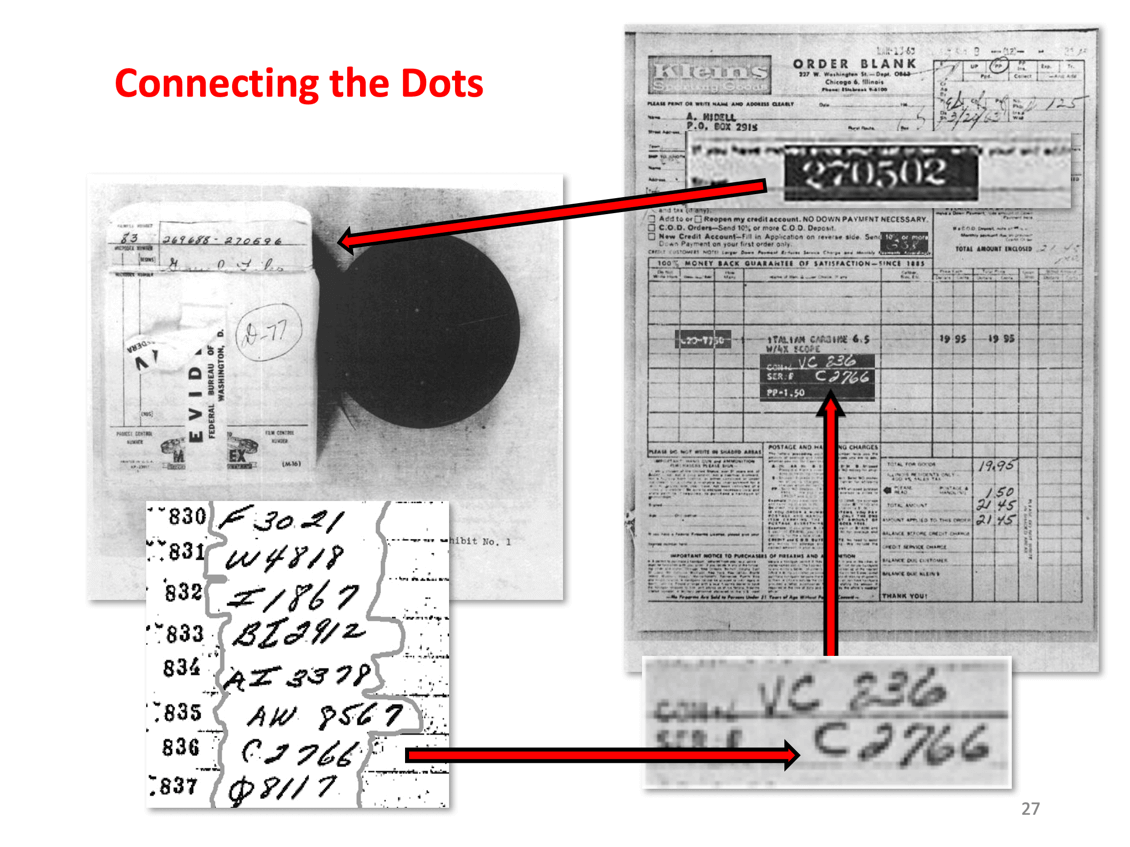
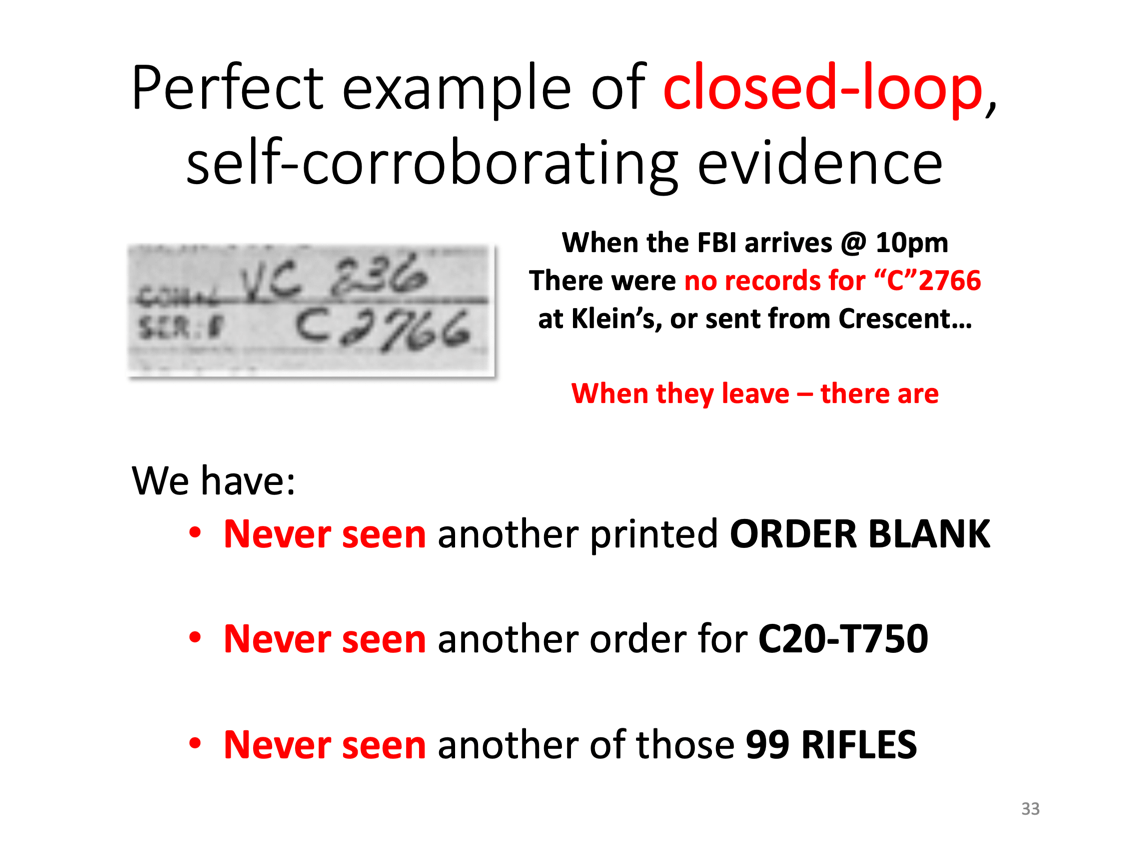
    Here’s the evidence, the microfilm creates the order blank. The order blank’s handwriting connects the rifle with the list and nothing else. The “VC=Serial # list” claimed to be kept in a master ledger by Klein’s General Manager Michael Scibor, is claimed to be Klein’s way of tracking serial numbers on rifles. When a shipment comes in, the next blank VC# is used to start listing the rifle serial numbers in the shipment. Unless we can see another VC=Serial # list that actually matches real rifles with real orders or any other order showing any one of these 99 rifles, the data on this page could conceivably have been created that night. The details of the evidence will bear this out. At this point, the “VC List Evidence” simply corroborates itself and only for this one rifle. There were 99 more in inventory.


    With just those 2 pieces of evidence, the FBI is able to connect the receipt of C2766 with an order sent to Klein’s in February 1963. Yet, the FBI also told us on the 22nd about the March 1963 order with C2746. On November 22 and 23, there was no mention of a February 1963 order at either Crescent or Klein’s. There is more to it than that, but you’ll need to read my paper, The Klein’s Rifle.

    This is page 2 of 2 for order 1243. The original order number from January 1962. It also says “1259 Page 2 of 2 pages”. A subsequent order becomes the February 1963 order now containing C2766.

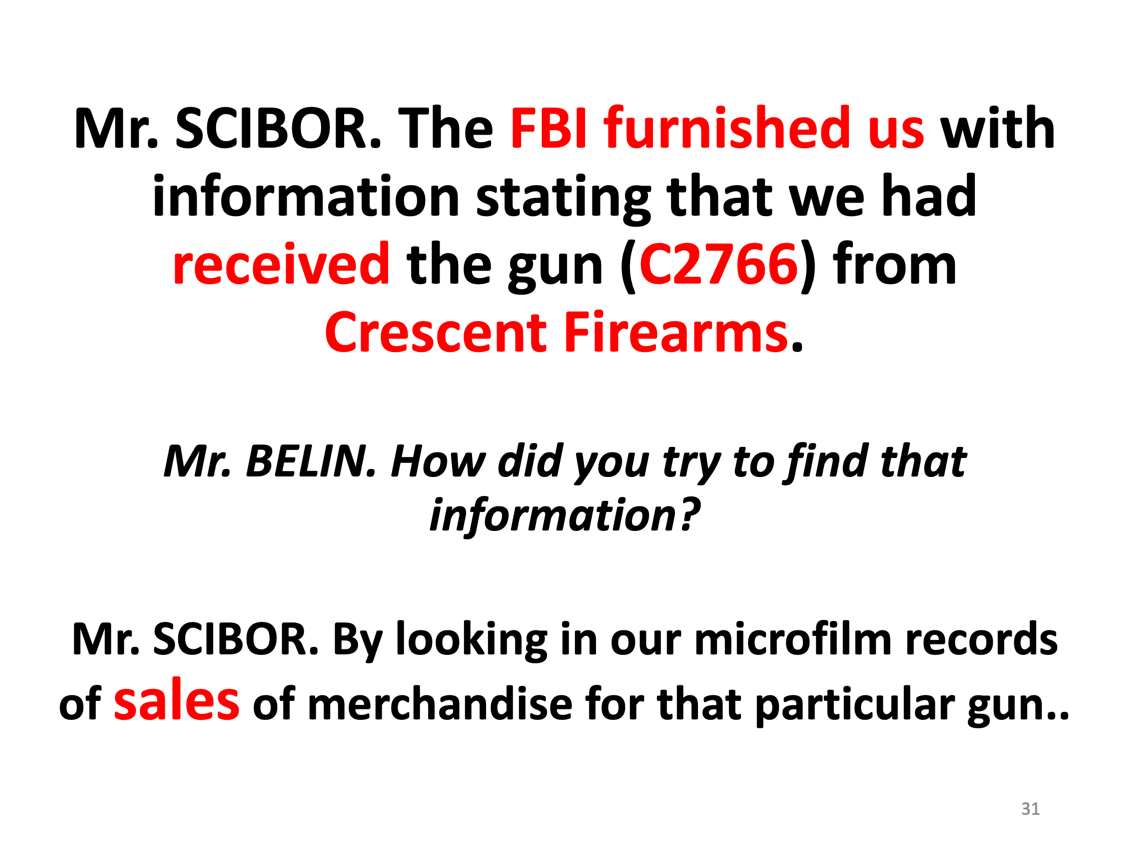
    How did they use the information that Crescent supplied the rifle to find this customer order? (Does this make any logical sense?)

    The receiving records from vendors would make it much easier to locate a shipment from a vendor, whereas how does one even begin to locate a sales order with only the serial number and vendor? Those 2 memos on the 22nd and 23rd left the FBI kinda screwed.

    Remember that on Friday and Saturday there are no records for C2766.

    Or that Crescent sent them orders in June of 1962 and March of 1963, not February 1963.

    After Friday evening into Saturday morning, 3 FBI Special Agents including Dolan put their names on a report (WCD7, page 187). SA’s Toedt and Mahan will provide virtually nothing else to the Warren Commission Documents.

    The next page of the report/memo does not have any signatures, but does tell us that Waldman kept the microfilm.

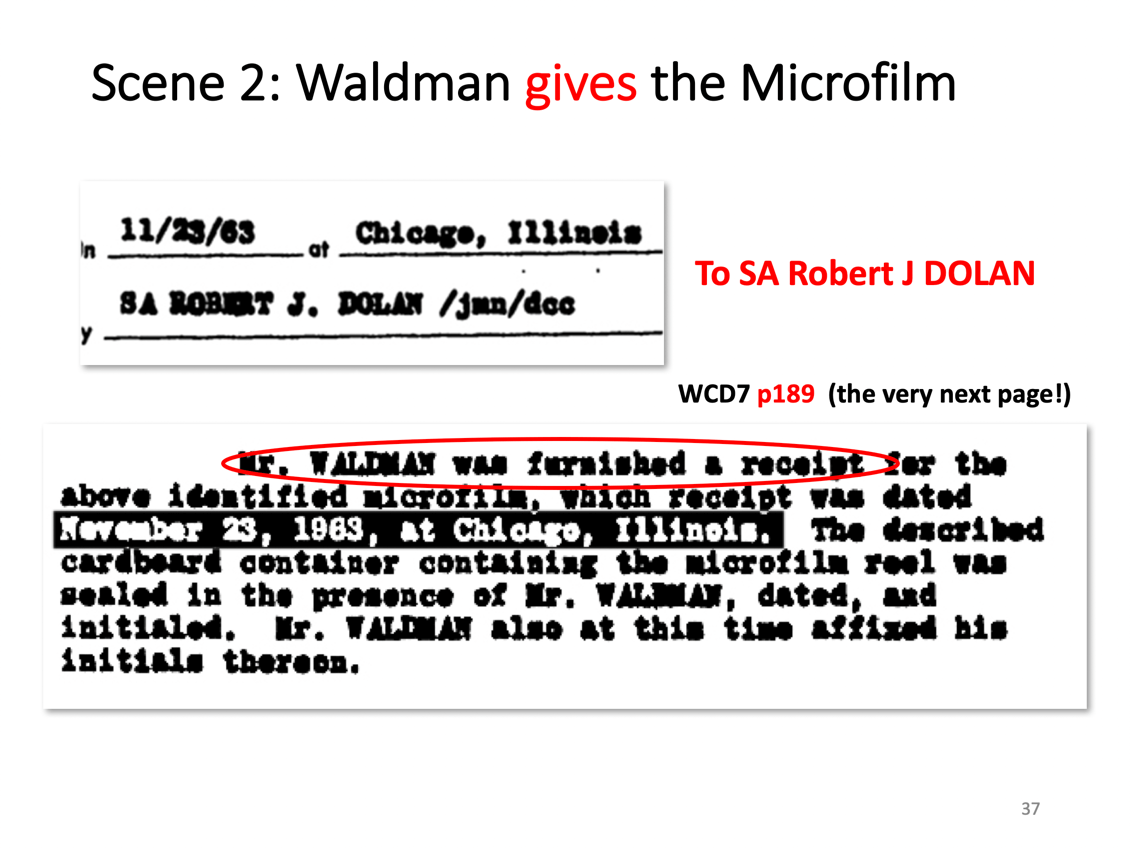
    Virtually the same report is found on the next page (WCD7, page 189), yet the outcome is completely different. This time only Dolan writes a report, in which he claims to have taken the microfilm and provided Waldman with a receipt. The chain of custody for this microfilm is now a hot mess.

    Months later, in testimony, Waldman is no longer talking about his safe and being subpoenaed. He gave that microfilm to the FBI. I’m told by those who went, the microfilm itself is no longer in its box at the archives. Just an empty box. If only a copy of the film was made.

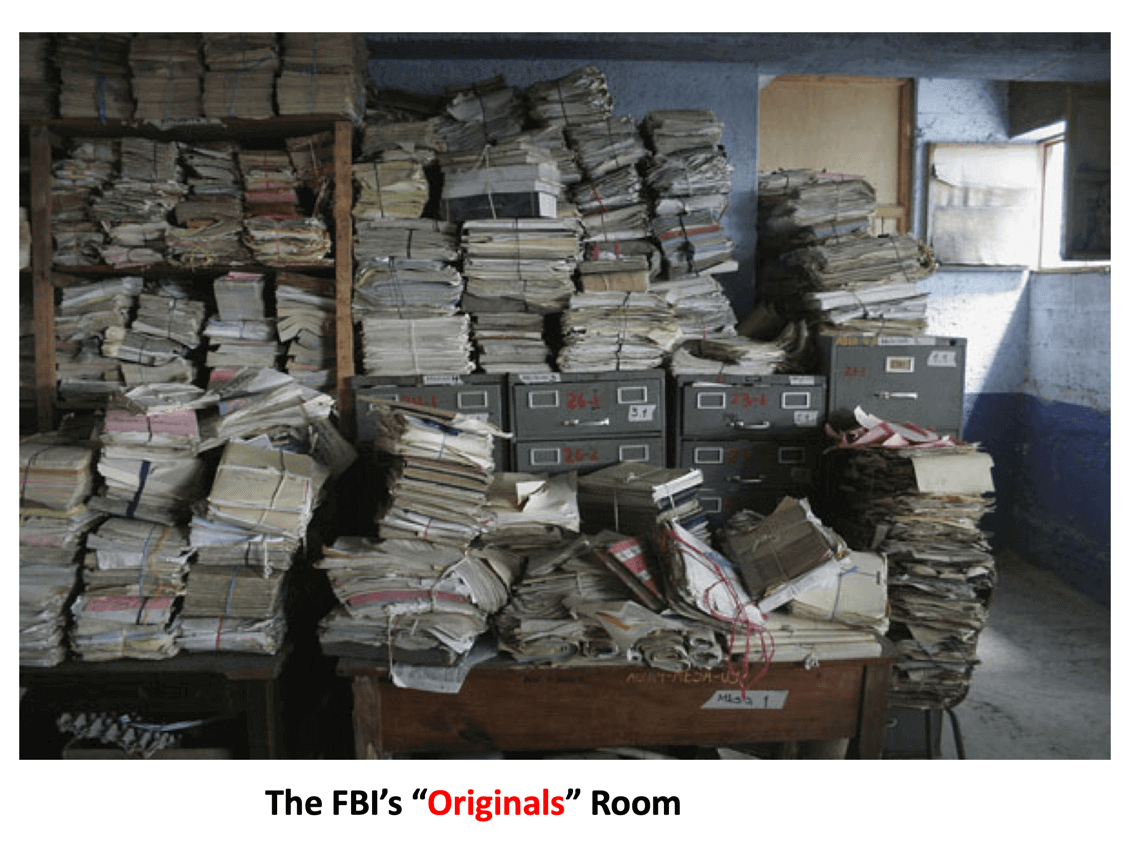
    FBI SA Dolan alone claimed he took the microfilm by the morning of the 23rd. What we come to learn is that copies of this film are made in the weeks after November 22. Dolan gives a copy back to Waldman and once again it is said that Dolan acquired the film from Waldman on the 23rd. Originals with the FBI and copies to the Warren Commission were standard FBI operating procedure. With the original in the FBI’s hands from November 23 until the first copy is returned on December 6, there is no way to know what transpired with that film. I wonder if the copy and the FBI original have the same things on them?

    The microfilm creates the Order Blank. The Order Blank connects to the February Klein’s shipment via 1 piece of paper. What was on the original microfilm is simply no longer knowable.


    Waldman tells us he removed the remaining stock of “assassination” rifles on Monday the 25th. In 1978, we learn the FBI had Klein’s mount scopes on at least 12 rifles, that 40″ rifles were not scoped, and some rifles have no inscription at all. Sharp is not called to the Warren Commission.

    It’s as if those 100 rifles were never at Kleins in the first place.

    None of the people who were actually involved in receiving/shipping this product are interviewed, while Dolan remains an integral part.

    Westra concurs with Sharp about scoping 40″ rifles, but then is set straight. Since the 40″ rifle at the archives is scoped, y’all must have done it. Any information on Lido Luccesi would be appreciated.

    Given the mountain of paper we are given in this case, it remains an obvious “mystery” how Oswald can go through his paces from January 1963 to November 1963: order, pay for, and get delivered both a rifle and a pistol—and yet not have a single page written about those occurrences in any report from any agency prior to November 22nd.

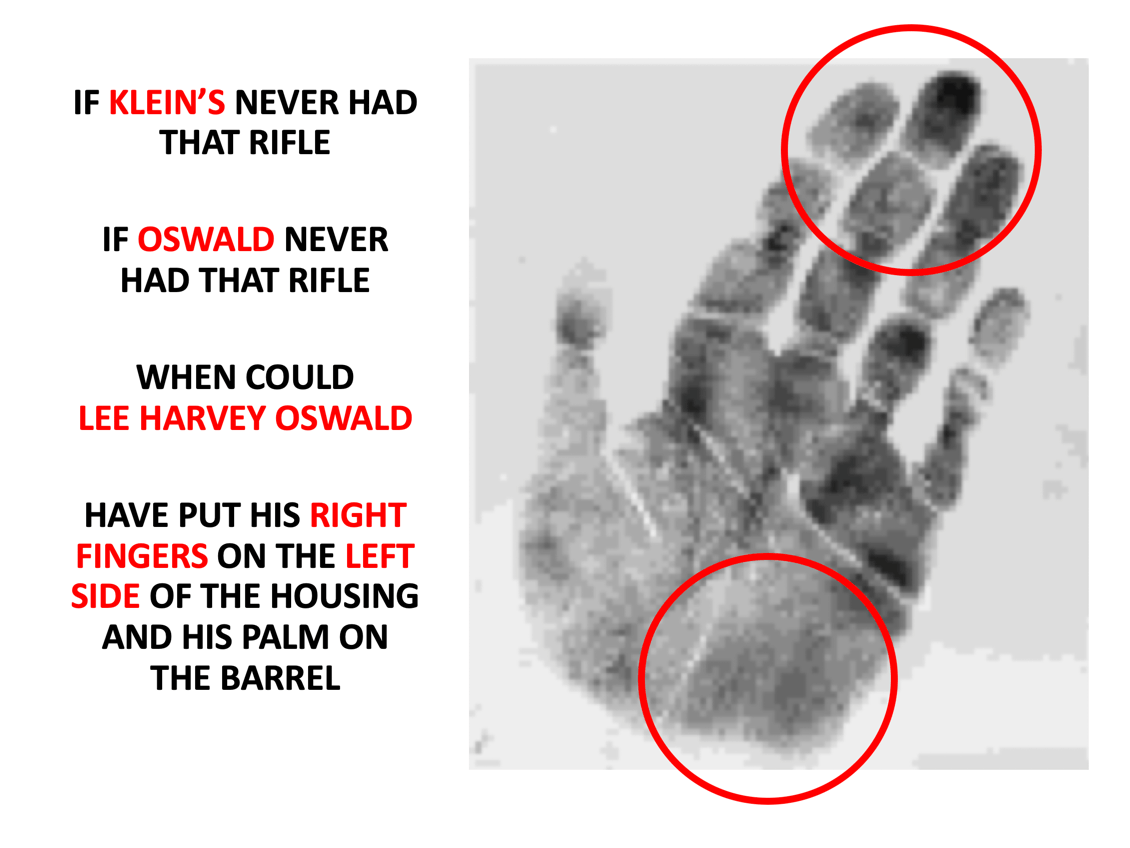
    At the end of the day, the only things with a print of Oswald’s are a box and some paper. The rest is Lieutenant Day being helpful.

    It is not until well after Oswald is dead, that these fingerprint lifts even get consideration at the FBI.

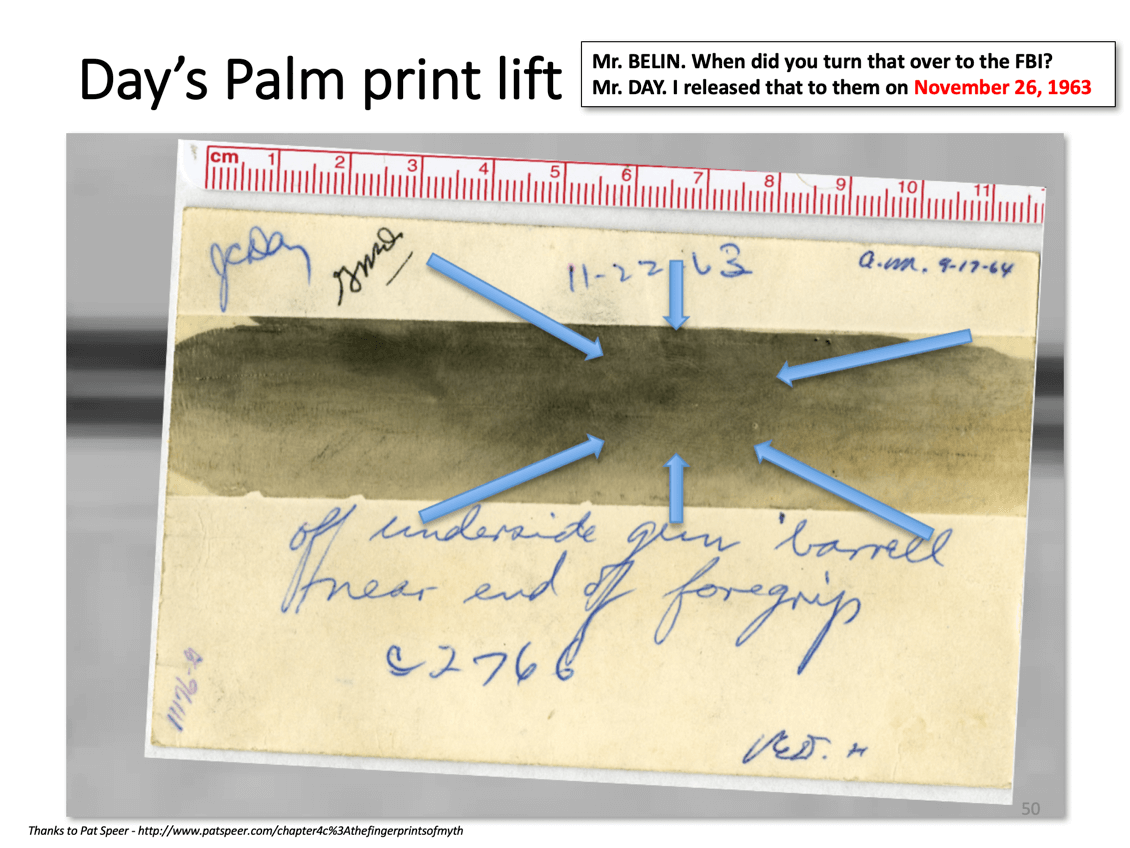
    The rifle goes to Washington DC with SA Vincent Drain on the night of the 22nd, only to be returned and taken again on the 26th. Amazingly, the prints travel from one side of the trigger guard to the other.

    Having taken no photos of the print where it was found, there is only a photo of the lift which was not sent to the FBI with everything else that night.
    There is no part of the barrel showing from the underside of the rifle. Day’s palmprint appears to exist only to suggest Oswald assembled and disassembled the rifle. Despite numerous smooth metal parts including the shells and clip, Day’s prints are highly suspicious.

    Lt. Day needed to explain quite a few things that went awry that first day. Claiming he was told to stop working on the rifle, he claims that’s exactly what he did in mid stroke. Subsequent reports are filled with his excuses.

    In 1978, the HSCA requested to see this “lift”, seeing it was part of the evidence Drain takes again on the 26th. Yet again, we have Day stating all the evidence was taken the 22nd. This palmprint cannot be found—the official reason states:

    In other words, they lost it.

    In the 50’s, the FBI copied and planted prints regularly, along with lying about informants, as well as, virtually all manner of evidence.

    What if there was no money order, like there was no February order? But the FBI needed evidence of one.

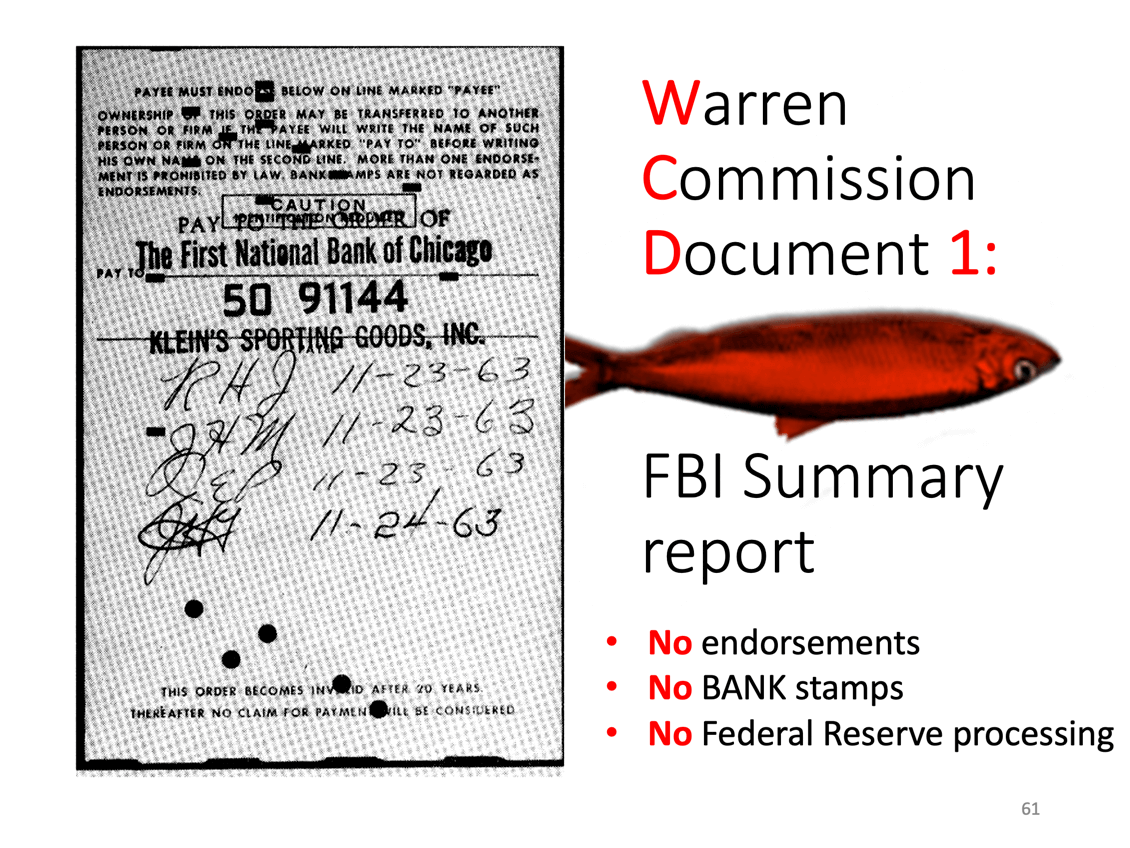
    The evidence shows the Postal Money Order (PMO) found on 3 different timelines.

    The first is in Kansas City by the Secret Service

    The second is reverse engineered by Holmes and gang by looking at magazines and guessing about shipping. “Now you thumb through those,” I said, “and when you come to Klein’s Sporting Goods, let’s see what it looks like.” It wasn’t but a couple of minutes that one of the girls hollered, “Here it is!” So I looked at it and down at the bottom of the ad it said that that particular rifle was such and such amount. But if it could not be carried on a person, such as a pistol, like a shotgun or a rifle, then it was $1.25 or $1.37 extra. Shipping charges were also added, so I added those together, took that figure and called around to all the different stations and the main office where these crews were checking stubs. It wasn’t ten minutes that they hollered, “Eureka!” They had the stub!

    The third, and most interesting, is that of the FBI’s in Alexandria, Virginia. You can read all about it in the Rifle Money Order Timeline. For our purposes, the most important things to know about this money order are:

    Remember, the year is 1963. Who saw Catch Me If You Can? Passing bad checks was easier then, because the process took so long and was not computerized.

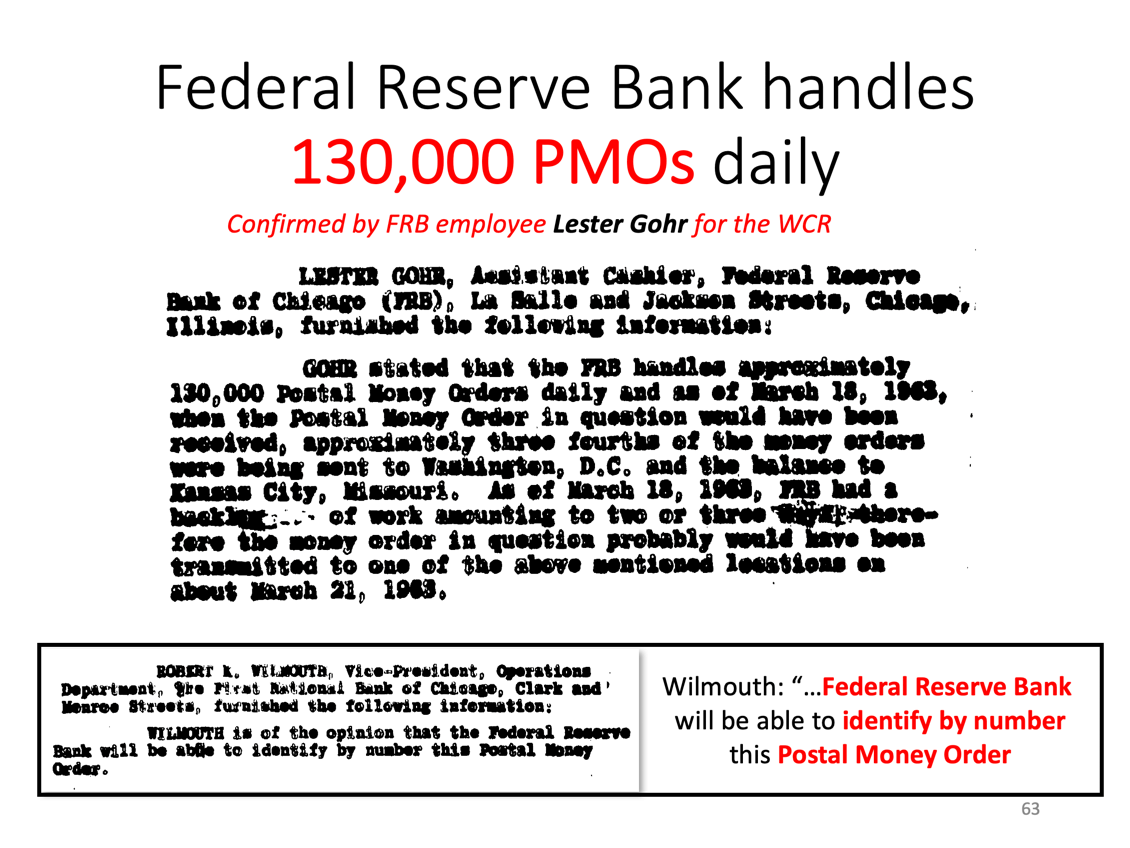
    We have a number of proofs outside of the Warren Commission Report. J. Harold Marks—the same man—testified in 1960 about tracking Postal Money Orders “as paid through the Federal Reserve Bank.” Another 1960 bit of evidence is this New York Federal flyer explaining how Postal Money Orders are to be accepted as cash items.

    And finally, in the Warren Commission Documents themselves, with Lester Gohr of the Federal Reserve and Wilmouth of Chicago 1st National reconfirming that Postal Money Orders are processed and recorded by these banks for very specific reasons.


    I’d like to begin finishing up with some of the evidence which suggests there were never any shipments of merchandise to Oswald. At his Dallas Post Office Box, Hidell was not listed. Given what was going on with the Dodd investigations (a Senate Committee investigating mail order pistol and rifle sales in the US—Klein’s and Seaport were 2 of their targets), it would seem that a 5′ carton addressed to the wrong person constitutes “where possible”. In the weeks after the assassination, VP Waldman will tell his “partner in microfilm crimes”, SA Dolan, that Senator Dodd’s Committee “was on his back.” It was known that Dodd used “cut-outs” to order rifles as part of his investigation—some surmise that Oswald may have been one of these cut-outs using the name Hidell.

    Given the reality of this and how this rifle suddenly appears after November 22, it defies common sense and logic to believe this goes unnoticed.

    In fact, a box of that size would have triggered the mailing of a notice for Oswald to come claim his oversized package. Yet the package is addressed to Hidell.
    With the need to generate this notice, the rules and regulations are put to an even more stringent test. As we now know, none of this happened.

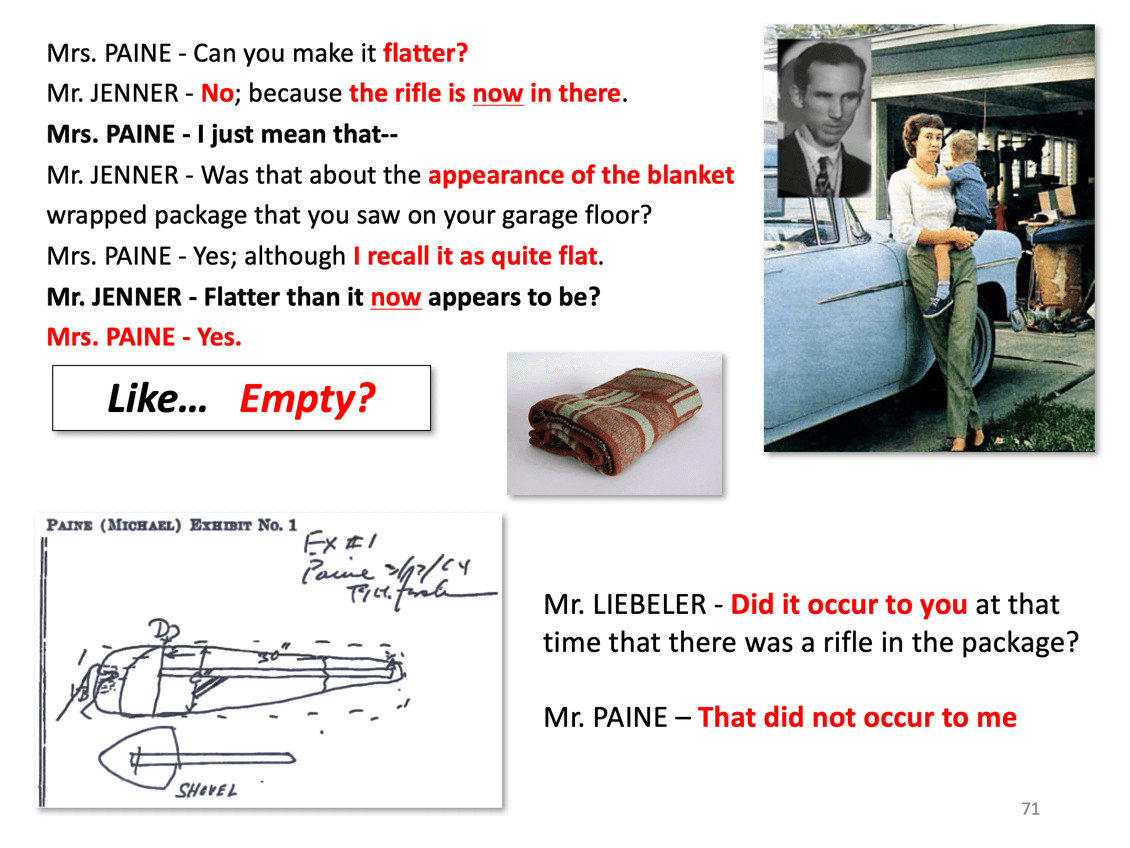
    I’d like to end today with some more evidence, which I see betraying the conspiracy. The evidence shows that he took 2 small bags with him, when leaving Magazine Street after Ruth leaves with Marina. Yet, the rifle is placed at the Paine’s in October. There’d be only 1 way to get it there.

    If Ruth was supposed to help incriminate Oswald, this didn’t help.

    Neither did this and neither does Michael.

    While many have erroneously injected themselves into this storyline for personal gain or profit, we must look to those who suffered at the hands of the FBI for telling an inconvenient truth.

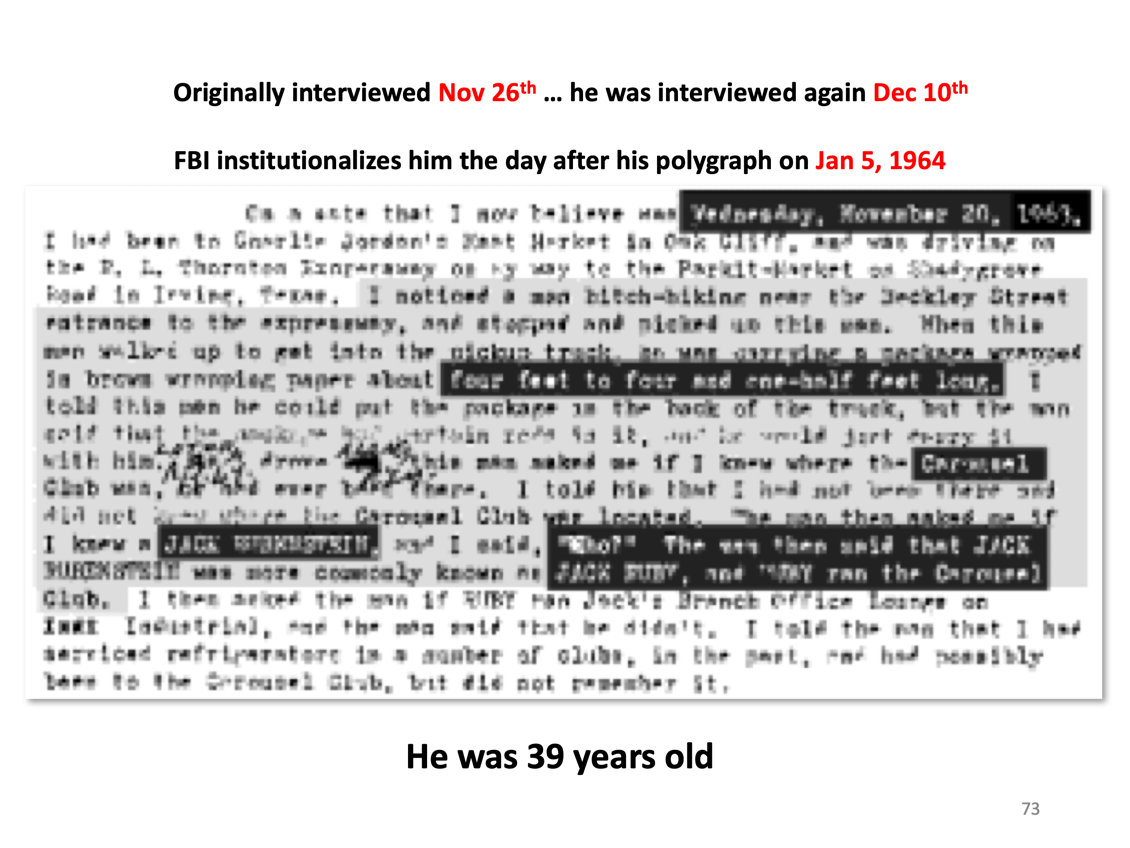
    Abraham Bolden comes to mind. FBI recalls Yates for a polygraph January 4, 1964: “No significant emotional responses were recorded.” The FBI could therefore not reach a conclusion about Yates. On January 5, 1964, at the insistence of the FBI, Yates begins 11 years of mental institutionalization. “They told me that he was telling the truth [according to the polygraph machine], but that basically he had convinced himself that he was telling the truth. So that’s how it came out. He strongly believed it, so it came out that way.” (Dorothy Yates Walker 2006)

    Despite being the object of numerous 3 letter agencies, we find nothing in the evidence related to these weapons prior to November 22nd.

  • Goodbye and Good Riddance to Chris Matthews

    Goodbye and Good Riddance to Chris Matthews


    On Monday March 2nd, Chris Matthews, host of the MSNBC program Hardball, announced on the air that he was resigning after 20 years. That resignation was effective immediately. Therefore, he would not be around for the next day’s Super Tuesday primary elections. Which suggests that this was not his idea and he was forced out. Furthering this idea was how he announced his leaving, which he said was not due to his lack of interest in politics. (For the brief sign-off, click here)

    To put it mildly, Matthews has had a pretty bad last couple of weeks. Even for a dyed-in-the-wool MSM zealot, he has made some real bonehead comments. When Bernie Sanders won the Nevada caucuses, Matthews compared that victory to the Third Reich’s successful invasion of France in 1940. After the New Hampshire debate between Democratic candidates, Matthews indulged himself in a diatribe against socialists. During that tirade, in John Birch society mode, he confused socialism with communism and said that if Fidel Castro had won the Cold War, there would have been executions in Central Park and he would have been killed while others were cheering. He then added, “I don’t know who Bernie supports over these years, I don’t know what he means by socialism.” This reveals either extreme bias or a feigned ignorance, since Sanders has held political office for about 35 years.

    In another blunder, last week Matthews confused Jaime Harrison, an African American candidate for the Senate in South Carolina, with another black politician, Tim Scott, who is the GOP incumbent senator from that state. After Harrison corrected him, Chris apologized for the “mistaken identity”. Perhaps the last nail in the coffin was a column by writer Laura Bassett appearing on Saturday in the magazine GQ. In that column she complained about some sexist comments Matthews had made to her while she was in the makeup chair.

    Jimmy Carter
    Jimmy Carter
    Jimmy Carter
    Tip O’Neill

    Matthews began in Washington as an officer with the United States Capitol Police. He then became an aide for four Democratic members of Congress before he failed in an attempt to win a congressional seat in Pennsylvania. After this, he became a speechwriter for President Jimmy Carter. When Carter failed to win reelection in 1980, Matthews signed up with House Speaker Tip O’Neill. Matthews then switched over to print journalism for 15 years.

    Jimmy Carter
    H.R. Haldeman
    Jimmy Carter
    Richard Helms

    It was in his position as a columnist that Matthews now emerged as a rabid, mocking conservative member of the Washington establishment. After Oliver Stone released his film Nixon, Matthews criticized that picture for its use of a passage from H. R. Haldeman’s book The Ends of Power. In that passage, Haldeman had described a meeting with CIA Director Richard Helms in which the Bay of Pigs invasion was discussed. Helms’ reaction was so extreme that Haldeman concluded that Nixon’s use of the incident had been code for the Kennedy assassination. In a December of 1995 column, Matthews said this was all strained interpretation by Stone that Haldeman had blamed on his co-author Joe DiMona. Matthews could write this since he did not visit with DiMona. Dr. Gary Aguilar did so, and he learned why Matthews had not. DiMona told Aguilar that the book had gone through five drafts and Haldeman made many changes, but he never altered that passage. Clearly, Matthews had realized that after his films JFK and Nixon, Stone had become a lightning rod for the MSM. And if he was going to advance up the ladder, he had to join in the assault.

    Therefore in 1996, Matthews published his book entitled Kennedy and Nixon. This was supposed to be a dual biography of these two central political characters. But to anyone who knew who Matthews was, and understood the two men, there was a not so subtle subtext to the volume. Matthews was actually trying to say that, contrary to popular belief, Richard Nixon and John Kennedy had more in common than they had differences. Oliver Stone agreed that this was an unjustified interpretation. The LA Times allowed him to review the book in June of 1996. He took the author to task for his unwarranted assumption that the two were somehow chums and comrades in arms. Two weeks later, on June 30, 1996, the Times allowed Matthews to reply. The columnist said he had nothing but contempt for Stone and all but called him a liar.

    This got his ticket punched and Matthews now made the transfer into television. He first became a commentator for ABC’s Good Morning America, and then he got his own CNBC show titled Politics with Chris Matthews. That program eventually morphed into Hardball and was then placed on MSNBC.

    While the host of this program, Matthews made good on his promise to be one of the foremost bastions of the MSM. How bad could Matthews get? He even visited the disgraced Tom DeLay at his home in Sugarland, Texas after he forcibly left Washington. The alleged Democrat admitted to voting for George W. Bush in 2000. He later defended this admission by saying that he thought Al Gore was kind of strange. Is it only a coincidence that Gore was one of the high-level politicians who had no problem admitting that he thought John F. Kennedy was killed by a conspiracy?

    For, as Doug Horne writes on his blog in the wake of Matthews’s resignation, the Hardball host was one of the foremost defenders of the Warren Commission during his 20-year span. In all of those years, this writer can only recall one small exception to the rigor with which Matthews took pains to mock and ridicule those who held a different view of the JFK assassination than the Warren Report did. This was after Jesse Ventura did an interview for Playboy back in 1999.

    Jimmy Carter
    Jesse Ventura

    At that time, Governor Ventura was making the rounds of talk shows after the controversy caused by his rather bold pronouncements during that interview. One of the interviews he did was with Matthews at Harvard. (Probe, November/December 1999) When Matthews asked Ventura about his opinion of Vietnam, Ventura very soberly said that the United States should have never sided with France in that conflict. This was a mistake that prefigured our own involvement in Indochina. Matthews replied by saying the American buildup actually started under Kennedy. When Ventura stated that there were certain elements in the country that favored us going to war in Indochina, Matthews said that it was Kennedy who was giving them what they wanted from 1961-63. Ventura did not think fast enough to say, “Chris, there was not one more combat troop in Vietnam after Kennedy’s death than when he took office. So please show me the huge expenditures made by Kennedy?”

    Matthews then shifted to the assassination itself. He tried the old chestnut about having to believe in a large conspiracy if one advocated for a plot. Ventura replied that if one thinks the Dallas Police were involved, then their negligence does not denote a wide conspiracy. Ventura turned the tables and asked a question of Matthews: Why didn’t the Commission call all the witnesses who smelled smoke on the grassy knoll? To which Chris finally made his minor exception. He beat a tactical retreat by saying that he would admit the Warren Report was a rush job and he agreed with Ventura’s critique of their work. But this author has to note that Matthews’ retreat was very limited. In his book Kennedy and Nixon, he endorsed the verdict of the Commission and said that Oswald shot Kennedy.

    Towards the end of the interview, Matthews went completely off the rails. He characterized Oliver Stone’s film JFK in a completely nutty, wild manner by saying that somehow Nixon was involved in the plot depicted in the film. Since Nixon does not appear in the film except for the introduction over the credits, this is simply a smear. In fact, even if we expand this to the film Nixon, it is still not true. But Matthews really showed who he was when, near the end of the interview, he said that Stone tried to portray Kennedy as a peacenik when, in fact, he was a Cold Warrior. He then added that no one in JFK’s administration said he was trying to get out of Vietnam. Which is astonishing. For even at that time one had people like Roger Hilsman of the State Department, and Robert McNamara, Secretary of Defense, who both said such was the case. One can also add in Joint Chiefs of Staff Chairman Max Taylor, advisor Ted Sorensen, and assistants Dave Powers and Ken O’Donnell. All of these men said that Kennedy would never have gone into Vietnam with combat troops and direct American military intervention. So what was Matthews talking about?jfk no vietnam

    But this nonsense is consistent with Matthews’ book on Kennedy, titled Jack Kennedy: Elusive Hero. In that book, Matthews never mentioned NSAM 263. This was the order issued by Kennedy in October of 1963 which began a formal withdrawal from Vietnam of a thousand advisors by the end of the year and the rest of the advisors by early in 1965. If one does not mention that document, then one can say the things Matthews does. And I do not for one moment believe that Matthews did not know about it, since it was featured so prominently in Oliver Stone’s film. Matthews chose to ignore it due to his own bias against Stone.

    He is now gone, from at least MSNBC. I cannot help but wonder who will replace him, and if that person will be any kind of an improvement. I would think he or she could not be much worse.


    Link to Jim DiEugenio’s review of Jack Kennedy: Elusive Hero : https://consortiumnews.com/2012/01/03/why-mr-hardball-found-jfk-elusive/

    Link to Jim DiEugenio’s review of Bobby Kennedy: A Raging Spirit: https://consortiumnews.com/2018/06/04/distorting-the-life-of-bobby-kennedy/

  • Ark Media and Malcolm X:  Bad Acting and Half-Truths

    Ark Media and Malcolm X: Bad Acting and Half-Truths


    If the truth will set us free, a lie will keep us in bondage. If you know the whole truth about something but deliberately withhold part of it, you are no better than a person who creates events out of whole cloth. An old adage is that “a half-truth is the same as a whole lie.”

    Having watched the six-part Netflix series, “Who Killed Malcolm X,” I can say emphatically that the makers of this series are peddling a half-truth even though the whole truth was available to them. As such, the series is more propaganda than inquiry, more deception than honesty.

    Why do I call it a half-truth? Because Ark Media had access to the complete film footage of the scene outside the Audubon Ballroom moments after three members of the Nation of Islam assassinated Malcolm X, a charismatic revolutionary who inspired tens of thousands before his death on February 21, 1965, and who inspires millions across the globe today.

    They had access to the complete footage, but they only revealed half of it. They show the footage of two of the assassins—Talmadge Hayer and William Bradley—fighting with police and spectators, but they deliberately suppressed footage of the third assassin—Norman 3X Butler—wrestling his way through the crowd as the body of Malcolm X is wheeled from the Audubon to the Columbia Presbyterian Hospital across the street.
    There are a host of problems with the series, but the major offenses and omissions are these:

    • They minimize the role of the intelligence agencies in orchestrating the assassination. There is, for example, only one reference to the State Department’s hostility toward Malcolm X, but they don’t show a single document to substantiate it.
    • They fail to make a single reference to the CIA’s spying on Malcolm X while he was in Africa, and they make no mention of Benjamin H. Read, a White House official, telling CIA Director Richard Helms in the spring of 1964 that Malcolm was damaging America’s foreign policy in the Third World and should be “dealt with” the way the CIA dealt with other foreign leaders who cause problems for America.  This information is in the declassified CIA documents on Malcolm X and is readily available.
    • Instead, the entire series is aimed at convincing viewers that Malcolm X was killed by a group of five Black Muslims from the Newark mosque who were acting independently of any leaders of the sect.
    • To buttress this argument, nearly all of the NOI members interviewed are from Newark. There were no interviews with members from Philadelphia, Chicago, or even Harlem, an inexcusable omission.
    • While there is a brief mention of a mandatory meeting of officers in the NOI’s Fruit of Islam group called by Elijah Muhammad Jr., during which he ordered them to kill Malcolm X, there is no mention that Junior added an extra incentive of $10,000 to the person who killed Malcolm.
    • The central premise of the series is that two of the three men convicted for murdering Malcolm X were innocent. While it succeeds in establishing the innocence of Johnson through eyewitness accounts and FBI documents, they fail to show any reliable evidence whatsoever to support Butler’s claim of innocence.
    • They give the false impression that Abdur-Rahman Muhammad is this brave, defiant soldier hell-bent on confronting William Bradley, the shotgun assassin of Malcolm X, but Bradley died before he could do so. This is, of course, utterly ridiculous. Rahman wrote on his blog on April 22, 2010, that he had discovered Bradley’s whereabouts.

    Bradley didn’t pass until October 2018. By then, Ark Media was a full ten months into the project. If Rahman had eight years to confront Bradley, to give the impression that he didn’t locate Bradley until shortly before the latter’s death is dishonest, one of many half-truths in the series.

    The Bradley confrontation hoax is one of many.  Another half-truth is Rahman’s account of how he discovered Bradley’s whereabouts. He claims now that he was visiting a mosque and asked about Bradley when someone gave him Bradley’s new name, Al-Mustafa Shabazz.

    This is at odds with what Rahman told me and other researchers in 2010, when he said that he was the Howard University classmate of the nephew of a prominent NOI official whose name has surfaced repeatedly in relation to the assassination. The nephew was the person who led him to Bradley.

    Here are some of the key problems with the series, episode by episode. I refer to them as “acts” because the series is more theater than documentary.

    Act One

    Rahman begins that he was bothered that no one seemed interested in discovering who killed Malcolm X, and that he spent 30 years wondering “why someone doesn’t want to get to the bottom of this.”

    Rahman knows Professor Zak Kondo of Baltimore and apparently has read his book on the assassination. He began emailing me in 2010 and expressed familiarity with my books, one of which focuses on the assassination. Since Kondo’s book was published in 1993 and mine in 1992, he knows full well that people have tried to solve the question of who actually killed Malcolm X.  Moreover, Newsweek writer Peter Goldman wrote one of the first in-depth accounts of the assassination in 1973, when Rahman was a nine-year-old named Kenneth Oliveira living in Providence, Rhode Island.

    David Garrow: This brings us to the next problem. David Garrow, a white writer who has written a book in which he called Dr. Martin Luther King Jr. a “sexual athlete” (based solely on his opinion, of course), followed by other salacious statements about Dr. King. Garrow’s career has been in the toilet of late, especially after writing a disreputable, overly long biography of President Barack Obama (based almost exclusively on the views of a white girl who dated Obama a hundred years ago, so to speak). His descent into disreputability continued last year when he claimed that Dr. King laughed while one of his associates raped a prostitute.

    “No one alive has done more” than Rahman to solve the riddle of the assassination, Garrow claims.  Even though Rahman claims to have been investigating the assassination for thirty years, he has not in all that time published a single book about his findings. He hasn’t had a single magazine article about his findings. He has blogged for nearly a decade, yet he has never blogged about his findings except to mention that he had located William Bradley.

    So what, Mr. Garrow, has Rahman done to deserve your adulation? There are several university professors in the series, yet none of them express any familiarity with Rahman. I’ll lay you ten-to-one odds that if you had asked any of the professors “Who Is Abdur-Rahman Muhamad?” before April 2010, they would have replied: “I have no idea.”

    This is the first time we hear the theme of the series, namely, that Butler is innocent. Not a single shred of evidence is shown to support this contention.

    Part One ends with the proverbial scene of “The Investigator” (played by Rahman) tacking items about Malcolm X’s assassination to a bulletin board.

    Act Two

    It begins with Rahman arguing that Talmadge Hayer, the assassin caught at the scene, told the jury the truth during the trial but that he was not believed. This is another whopper, one that anyone who has read the trial transcript would recognize. Hayer told so many lies during the early part of the trial that the jury must have thought he was insane.

    Butler wasn’t much better. He was disrespectful to the prosecutor and got caught in a number of misstatements, so much so that he essentially convicted himself. For example, the prosecutor asked Butler whether he ever heard any language besides English in the mosque. Butler became indignant and replied that Muslims were not permitted to speak anything but English in the Nation of Islam.

    The prosecutor then asked him whether “As Salaam Alaikum” was an English phrase. To which Butler replied, “Oh, that’s different” or something to the effect.

    During a break in the trial, Thomas Johnson (whom I interviewed over a span of about five years) said that he, Hayer, and Butler were standing outside the men’s room when he said to them in a stern but calm voice: “Man, y’all are jamming me up. Y’all know I wasn’t there.”

    He was furious at Butler, he said, because Butler “stole my alibi.” He had proof from his physician that he was at home at the time of the assassination sitting in a chair with his right leg propped up due to a circulatory problem.

    When Butler took the stand, he said the same thing. However, when Butler’s doctor was called to testify, he said that he did not see Butler until February 25, four days after the assassination.

    Halfway through the second hour, Garrow is cued again. Apparently, you need a white person to make an argument truly convincing.

    “Historians universally accept that Johnson and Butler are innocent,” he tells us. None of the black historians in the series concurs with this statement during the entire series.

    The rest of the time is spent interviewing members of the Newark mosque and showing footage of the former Newark mosque minister, James 3X Shabazz, a former protégé of Malcolm X who grew jealous of Malcolm’s rise to the forefront of the Nation of Islam.

    Act Three

    Garrow makes his third appearance, during which he tells us that “the FBI had multiple informants inside the Nation of Islam—almost certainly so.” Well, did it or didn’t it?  Again, apparently we are to take this as an article of faith because Garrow has won the Pulitzer Prize or because he is white, or both.  What becomes disturbing at this point is that Garrow, whose reason for being in the series is never explained other than the aforementioned possibilities, is given nearly five times as much air time as Zak Kondo and other black historians in the series. In contrast, these African American historians have written five times as much about Malcolm X as Garrow.

    On a positive note, former New York police officials admit repeatedly during the series that Malcolm X was a thorn in their side and that they therefore routinely violated his privacy rights, worked with FBI agents to surveil him, and had informants inside Malcolm’s group, the Organization of Afro-American Unity. FBI Agent Arthur Fulton admits that the Bureau had informants inside the group.

    In yet another appearance, we see Rahman visiting Garrow’s home, where Rahman seems a bit surprised to see an FBI document about Elijah Muhammad’s adultery. Now, if Garrow believes that Rahman is the most knowledgeable person in the universe about Malcolm X, why does he need to show him a document that Rahman should know by heart?

    Another glaring omission is exposed at this point. When Garrow takes Rahman to the room where he keeps his research, we see boxes and boxes of files, all neatly organized. Even though the series shows Rahman at his home praying and sticking things on a board, we never see any evidence of his alleged thirty years of research, not so much as a single box. He has a few files on a table, but hell, those could well be something that he received from Garrow.

    Garrow also claims that the FBI had three informants inside Elijah Muhammad’s inner circle. He has a document on the table, but we never see it, unlike most of the other documents he discusses. He then claims that three of the ten people in Elijah Muhammad’s inner circle were FBI informants. Once again, we are asked to take this as an article of faith.

    John Ali, an individual long suspected of being an FBI informant, makes for the first time an interesting admission. He says that he applied for a position (which one is unclear, but presumably an agent) with the FBI but was turned down.

    The balance of the hour is spent discussing Malcolm’s mentoring of Muhammad Ali. Historian Peniel Joseph and Jonathan Eig, an award-winning biographer, make brief appearances.

    Act Four

    The scene begins with a rather disturbing and certainly questionable piece of hyperbole about Malcolm X’s mental state during the last year of his life. “He needed a therapist,” Joseph says. “He needed two therapists,” he adds with a grin.

    This is followed by a comment from Lance Shabazz, a diehard believer in Elijah Muhammad and someone who has written critically about Malcolm X for many years. “Malcolm X lost his mind,” he claims.

    A layperson is liable to believe that both men are speaking literally, and perhaps they were given the tone of the segment. In truth, Malcolm X was in great spirits until the last month or so of his life. He was anxious about the numerous attempts on his life, but was functioning as well as he always had. He was holding it all together until members of the Nation of Islam firebombed his home during the early morning hours of Valentine’s Day, 1965.

    He and his wife and daughters would have perished in the fire, but for a stroke of luck. One of the Molotov cocktails aimed at his daughter’s room on the second floor ricocheted, giving the family time to escape.

    What the series fails to note is that the person who threw the homemade incendiary device at the window was none other than Alvan Farrakhan, brother of NOI leader Louis Farrakhan. Farrakhan is seen in the background of several pieces of footage, but I don’t recall hearing his name mentioned more than once or twice.

    The reason why this is an unforgivable omission is because Alvan lived less than half a block from Malcolm X. The gang of Muslims who firebombed the home in all probability threw the bombs and then ran down the street to Alvan’s apartment.

    This is another example of the half-truth nature of the series. They want viewers to believe that the entire plot to kill Malcolm X emanated from Newark, when nothing could be further from the truth.

    Muslims, including John Ali and Butler, claim that Elijah Muhammad ordered his followers not to lay a finger on Malcolm X. There is no mention of the attempt to kill Malcolm X in Boston, the attempt by Boston mosque minister Clarence 2X Gill to obtain a silencer to kill Malcolm X, or the brazen attempt to kill Malcolm X right in front of his home.

    The comedy relief in the otherwise mundane series comes in this hour, when Rahman is visiting Garrow once again (around the 23-minute mark). Garrow shows Rahman and FBI transcript of a wiretapped telephone call between Elijah Muhammad and one of his ministers. During the call, Elijah Muhammad said that it was time for the NOI to deal with Malcolm X the same “way Moses and the other ones did” their bad apples.

    Rahman chimes in that he understands what that meant. It was a reference to how Moses wanted to kill certain Christians who resorted to idolatry when he had to go away for a while.

    When Garrow replied, I nearly bowled over laughing. I could just see them in a comedy.

    Garrow: “Well, golly, Mr. Rahman, I don’t know nothin’ ‘bout Moses. You really need someone with your background to understand all this Moses stuff!”

    It was one of the worst instances of patronizing conduct I have ever witnessed. Garrow has written numerous books and articles about Dr. Martin Luther King Jr. Garrow grew up as a Christian. Yet he sits there with this ridiculous look on his face swearing that he had no idea what the reference to Moses meant.

    Near the end of the segment, Garrow tells us that Rahman “is a person with a cause. He’s one of deep commitment and deep faith and deep courage. What Rahman is doing, he adds, is “dangerous. Rahman knows that.”

    Garrow was doing so much sucking up to Rahman that I expected to find Rahman nursing him in the next episode.

    Act Five

    After telling us at the end of Act Four what a brave man this Rahman fellow is, Act Five opens with Rahman showing a video clip of the scene outside the Audubon moments after the assassination of Malcolm X.  This person, he says, pointing to a tall black man on the screen, “looks a lot like William Bradley.”

    “If I can prove it,” he adds, “I want to confront him face to face.” We see Rahman driving by Bradley’s gym and a daycare center, he says, that have closed. Poor Rahman is foiled again! (the audience laughs)

    This scene was presumably shot sometime before Bradley’s death in 2018.  As I said earlier, Rahman had eight years to confront Bradley, if that was ever his intent. Bradley was a dangerous man and you would have to be more crazy than brave to confront him without backup. That’s why we know this is only theater.

    The premise gets repeated, namely that Butler and Johnson were framed. We are told that there is no physical evidence linking them to the crime. What we are not told—and hence the half-truth aspect—is that many of the eyewitnesses to the assassination described one of the assassins as a man about Butler’s height and Butler’s complexion. Oh yes, they also mention that the assassin wore a tweed coat.

    Butler was the father of six young children at the time and as poor as a mosque mouse.  He had a tweed coat that was a bit too large and a brown suit that he wore two or three times a week. Another way to pick him out of the crowd was the way he wore his black fedora. He wore it at a forty-five-degree angle, always.

    Benjamin Karim, one of Malcolm’s top aides, swore in an affidavit that Johnson and Butler could not have been inside the Audubon that day because he or one of the guards would have seen them and put them out or barred their admittance.

    This affidavit is what threw every historian and researcher off track for decades. In 1992, I wrote in The Judas Factor that Butler and Johnson were not there because Karim said so. Peter Goldman wrote the same thing in 1973 and Kondo reiterated it in 1993. “If Butler and Johnson were there,” Kondo said in “Brother Minister (1994),” I was there.”

    The fundamental problem with Karim’s affidavit is that he did not witness the assassination, so how could he possibly swear that neither Johnson nor Butler was present?

    Ironically, the woman with whom Karim was having an affair in 1965 was also inside the Audubon. After the shooting, she and a group of women were the first people who rushed to help Malcolm. Most of the men were either hiding backstage or hiding under the chairs. Two of the women, a nurse named Yuri Kochiyama and Sharon 6X Poole, a former member of the Harlem mosque who quit to join Malcolm’s new group, positively identified Butler as one of three assassins.


    Sharon was Karim’s mistress. He never mentions that she identified Butler, and he never mentions her in his autobiography. Again, the problem of the half-truth.

    Karim doesn’t mention that Malcolm’s security was compromised by former members of the Newark mosque. Nor does Manning Marable mention that James 67X Warden, a former Harlem mosque member who left with Malcolm, was overheard on February 19 by a member of the security detail threatening to have Malcolm killed.

    “We,” Warden said, “will kill you.” Two days later, Malcolm was killed. Warden was a key adviser on Marable’s biography of Malcolm X.

    A positive scene in this act is the entrance of Eugene “Gene” Roberts, a member of Malcolm’s security detail who was an undercover detective for the New York Police Department’s Bureau of Special Services and Investigations (BOSSI).  He describes how quickly he was hired by BOSSI and how he was essentially a paid informant.

    Another note of interest is Arthur Fulton’s admission that the FBI had at least nine informants in the Audubon Ballroom when the assassination occurred.

    Act Six

    From the opening scene with Malcolm in Africa, we finally think that the series will discuss the revolutionary’s lasting impression on African, Asian, and Latin American leaders. They show a photo of him with Prince Faisal of Saudi Arabia, but they fail to show him with Fidel Castro or Kwame Nkrumah and other prominent Third World leaders.

    Instead, they return us to Garrow’s house, where Rahman, the greatest expert on Malcolm X in the universe, is being educated again by Garrow. Garrow has been amassing files on Malcolm X for over a decade. Presumably, his glowing adulation of Rahman is in anticipation of a biography crediting both of them as the authors.

    In a return to the “Hunt for William Bradley” subplot, Rahman is shown in Newark again. Just as he was about to confront Bradley, he receives a phone call telling him that Bradley had died.

    Rahman attends the funeral, or at least stands outside. He then interviews the same groups of Muslims for the fifth or sixth or tenth time. They assure him that Bradley was a changed man when he died, that he made the hajj and had all of his past sins wiped away.

    “I have given so many decades of my life to unveil who killed him,” Rahman says wistfully. He sacrificed his career (he works as a tour guide in Washington and has held other jobs) and time with his children in his quixotic journey to find the killers.

    As the scene closes, Rahman meets again with Butler. He vows to do everything in his power to get him exonerated.

    If that happens, Butler can sue the city of New York for wrongful conviction and get millions and millions of dollars. The lawyers representing him will take their cut, and everyone lives happily ever after.

    Except those like me who know that Butler was guilty and deserves every day he spent in prison and more.

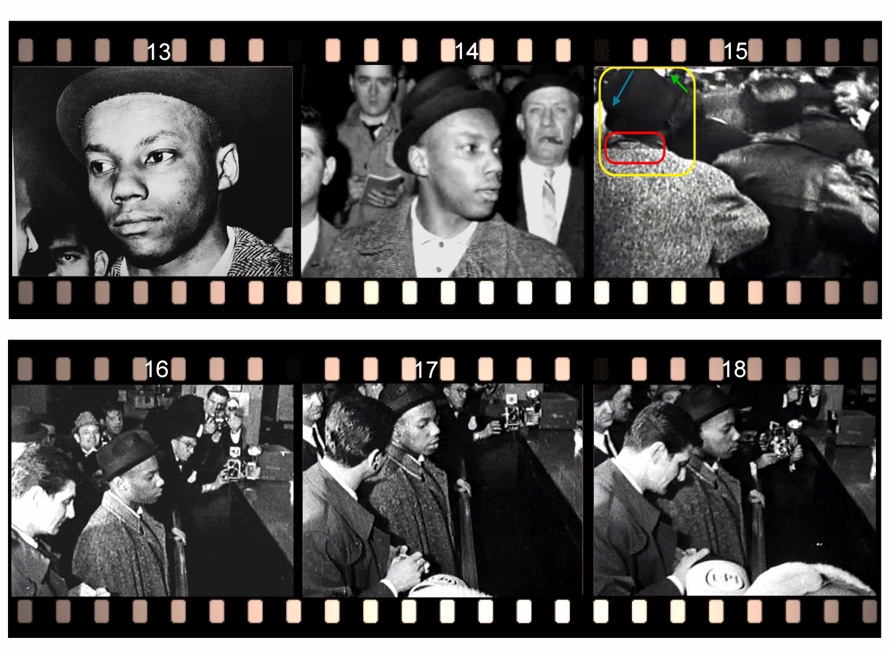
    Below are photos from the footage shown in the series. They show Bradley and Hagan outside the Audubon shortly after the assassination.


    These photos are from the same footage. It shows Butler at the Audubon as he attempts to view Malcolm’s body to make sure he’s dead. This is the footage that Ark Media deleted. The company purports to seek the truth, the whole truth and nothing but the truth about the assassination.

    But what it delivers is a half-truth. A half-truth is the same as a whole lie.


    The full footage begins at the 16-minute mark in this YouTube film.

  • Was the TFX Case a Scandal?

    Was the TFX Case a Scandal?


    The first time I ever heard of the TFX affair—as we shall see, it should not be called a scandal—was in doing work on my first book about the JFK assassination. That was the first edition of Destiny Betrayed back in 1991-92. I was assisted in writing the footnotes for that book by Bob Spiegelman. Bob had worked as a researcher on the film JFK. He had access to an unpublished manuscript by Peter Scott called The Dallas Conspiracy, issued in 1971. Therefore, in the notes section to the first edition of Destiny Betrayed, one will see a mention of “the TFX scandal” in relation to Navy Secretary Fred Korth and also to Lyndon Johnson. That passage states that President Kennedy forced Korth to resign in October of 1963 over the TFX affair. Bob also added that the episode had the potential to destroy Lyndon Johnson. (See footnote 2 on page 340)

    I don’t stand by that information today. I have found no credible evidence that Korth was asked by Kennedy to resign and neither is there credible evidence showing his resignation was related to the dispute over the tactical experimental fighter/bomber plane (TFX), eventually called the F-111. (Boston Globe, October 15, 1963, article by Robert Thompson) But the fact that these accusations were made shows just how wild the misinformation got about this defense project procurement episode. There are, of course, several other mentions of the TFX affair in other Kennedy assassination volumes, e.g. Seth Kantor’s The Ruby Cover-Up (p. 51). But, to my knowledge, in those volumes there has been little detailed discussion of the TFX dispute in historical and factual terms. As President Kennedy complained, there had been nothing more than innuendo. (See aforementioned Thompson article)

    But yet, despite this rather barren database of information, partly made up of newspaper stories by people like Drew Pearson, the F-111 affair lives on. In fact, a bit over a year ago, a protégé of Scott’s, Jonathan Marshall, made an entire speech about the episode. Many years ago, Marshall contributed to a journal Scott put out called Parapolitics and he has co-authored two books with Scott. I expected to hear something new and scholarly on the subject at such a late date. I was disappointed when I didn’t. What Marshall spoke about was pretty much what he had written about back in 1996 and what Scott had written about back in 1971. (Click here for a sample)

    This was jarring, because the affair was as old as Kennedy’s assassination, of which there has been much new information released. And several speakers addressed that information at the informal, Gary Aguilar sponsored seminar Marshall spoke at. Because of this critical lapse, much of what follows will be new to the reader.


    I

    The TFX plane, that would eventually become the F-111, was not a product of the Kennedy administration. It was presented for production during the Eisenhower administration. In the period of 1959-60, General Frank Everest was commander over the Tactical Air Command and also a commander of U. S. Air Forces in Europe. (Robert T. Art, The TFX Decision, p. 15) Everest had decided that the current fighter/bomber in use for Europe, the F-105, was outdated. He envisioned a new plane to replace it. To say that his vision was ambitious is too modest a characterization. Everest wanted the new fighter/bomber to be able to:

    1. Participate in air to air combat over the battlefield
    2. Be able to impose effective interdiction of supply routes behind enemy lines
    3. Supply air to ground cover for combat troops
    4. Be able to take off from and land on short sod runways

    This last requirement was formed to counter what the Air Force saw as a problem in their role as part of the nuclear triad (i.e. missiles, submarines, and bombers). Namely, that when the F-105 was stationed in Europe on a long 11,000-foot runway, it would be easily detectable and, therefore, easy to knock out. Therefore, it would not be a factor in an atomic exchange. (Robert Coulam, Illusions of Choice, p. 93) So this design requirement was made to neutralize that criticism and maintain an Air Force role in the atomic triad. But Everest went further in this aspect. He also wanted the plane to be able to cross the Atlantic nonstop, without refueling in the air. The point was to further safeguard the TFX from being knocked out on the ground. (Coulam, p. 37)

    What made the upcoming decision on Everest’s plane more complicated was the fact that the Navy also wanted a new fighter. This was called the F-6D Missileer. Eisenhower’s Secretary of Defense Thomas Gates stopped development of both planes before leaving office. But further, the Eisenhower administration cancelled the F-6D.

    So, from the beginning, the reader can see two important problems with Everest’s vision. First, the aim was to preserve a role for his branch of the service in an evolving Cold War scenario that would be dominated by missiles and submarines. Second, Everest’s ambition for the F-111 was unprecedented. As authors Robert Coulam and Robert T. Art have stated, Everest wanted a plane that was not just a combination fighter/bomber. He wanted a plane that would operate and perform missions at both high and low altitude. And when the design stage was over, the requirement was it had to do these things at supersonic speed. (Art pgs. 17-19; Coulam, pp. 94-95)

    It is necessary to explain what made Everest’s design so difficult to achieve. The prime mission of the plane for the Air Force was that it be able to fly at extremely low altitude at a considerable distance in order to evade radar and drop its atomic payload without being shot down. (Coulam, p. 94). The performance requirements that it had to be able to take off on short runways, yet achieve high speeds for tactical combat above the battlefield, complicated the wing structure of the plane. On short takeoffs, the plane would need long, unswept wings; for high speed air combat at Mach 2.5, it would need short, sharply swept wings. (Coulam, p. 380) The many missions that Everest imagined for the plane created complex technical problems. To name just one: the differing wing necessities eventually caused the creation of the variable wing configuration. In other words, the plane’s wings could be altered. This had never been done successfully on a military plane before. But with the help of NASA engineer John Stack, it worked for the F-111. This was a significant design and development achievement. (Art, pp. 21-22) As Peter Davies notes in his detailed examination of the plane’s features and performance, that variable wing design was imitated later in at least seven different Air Force planes. (Davies, General Dynamic’s F-111 Aardvark, see Introduction)

    Davies’ analysis goes on to mention the fact that, to fulfill its many functions, the F-111 was the first fighter plane to have afterburning turbofan engines along with supersonic performance. As opposed to turbojets, this allowed the plane to increase its flying time by using less fuel. (Davies, Introduction) Finally, and again in following with the plane’s multi-missions, Davies also shows how the F-111’s excellent avionics allowed the aircraft to fly at night, in bad weather, and over all types of terrains. (ibid)

    But even that does not do justice to what the F-111 was supposed to ultimately do. To explain why the plane’s mission got even more complicated, we must turn to the career and character of the incoming Secretary of Defense, Robert McNamara.


    II

    To begin with a truism: McNamara was a brilliant student in mathematics and economics. He had an impressive ability to quantify both problems and solutions. After graduating from Berkley, he attended Harvard Business School. With a Harvard MBA in 1939, he took an accounting job at Price Waterhouse in San Francisco. But, in a year, he was invited back to Harvard to become their youngest professor. When the war broke out, Harvard helped the Defense Department form a production team to turn out aircraft. (Robert McNamara, In Retrospect, p. 8) McNamara was on that management team. By all accounts, McNamara was a good professor—but he was an even better manager. His talent for mathematical quantification, statistics, and computations, plus his ability to articulate his ideas, all became the stuff of legend. He attained the Legion of Merit by the time he left the service in 1946.

    After the war, through his friend and military colleague Tex Thornton, McNamara attained a management position at Ford Motor Company. At Ford, McNamara furthered his already formidable reputation for managerial analysis and problem solving. When McNamara and his colleagues came into Dearborn Michigan, the company was ailing. Henry Ford II knew he needed a young, energetic team to turn Ford around. Before Ford even met McNamara and his service cohorts, he had decided to hire them. (McNamara, p. 11) For what McNamara and his team achieved at Ford, they earned the nickname the Whiz Kids. McNamara began in planning and financial analysis; he soon rose to senior executive levels. He became known for his “scientific management” techniques (e.g. his uses of computers and spreadsheets, which were pioneering). He eventually became president of Ford, as he had brought them from a sickly state into striking distance of General Motors. His presidency lasted ever so briefly, since he soon got a phone call from Bobby Kennedy. His president elect brother wanted McNamara to be his Secretary of Defense.

    This is the point where John Kennedy’s ideas about reforming defense programs set up by Dwight Eisenhower and John Foster Dulles meets up with Robert McNamara’s managerial skills. From his senate seat, Kennedy had criticized President Eisenhower and Secretary of State Dulles quite often and on a wide variety of issues. Among them were their defense strategies of brinksmanship, the New Look, massive retaliation, and—closest to our subject—the duplication of weapons systems. Kennedy was referring to things like Intermediate Range Ballistic Missiles (IRBM’s), cruise missiles, and anti-aircraft missiles. (Coulam, p. 46) Kennedy planned on overhauling all of these ideas, because he felt that they forced America into dangerous, atomic-threatening scenarios much too quickly, thus depriving the president of different registers of response to perceived security threats. This is where JFK’s concepts like flexible response and counterinsurgency came into play. Kennedy also felt that there was too much service rivalry to build exclusive weapons systems that, in reality, could be interchanged with other branches, in order to save money through economies of scale. The intelligent, experienced, imaginative Robert McNamara was going to be Kennedy’s agent of change in these matters.

    But there was one factor involved in all this which made the concept of what became the F-111 even more difficult to achieve—even for someone as highly skilled in these affairs as McNamara. As previously mentioned, Eisenhower had cancelled the F6-D. When McNamara entered office, he now cancelled the F-105, but approved continued production of the F-4, which was originally designed as a Navy fighter without a nuclear mission. (Coulam, p. 49) The importance of these decisions was that the Air Force now needed the F-111 for atomic bombing missions to replace the F-105. McNamara liked the versatility of the F-111 and he decided to do something rather daring. He wanted it to be an inter-service project from its inception. In other words, both the Air Force and the Navy would cooperate in the planning and development of the plane from the start. The Navy was meant to use the plane for fleet protection and infantry (Marine) support. But since the plane’s primary mission was going to be the atomic delivery angle, the Air Force would have the lead in the design stage.

    The Navy did not like the subordinate idea and they were not shy about voicing their disagreement. (Coulam, pp. 52-53) But McNamara was intent upon beginning a successful inter-service program, that he thought would reform weapons procurement. In fact, at the start, McNamara actually wanted the F-111 to be used by every branch of the military. (Art, p. 29) But he scaled that back to both the Navy and Air Force before the bidding process began.

    Before we get to that stage of the story, it should be stressed that—because of the plane’s many missions—the project was going to be a very difficult one from the start. To use just one example: no plane had ever been required to do a low-level mission combined with a transoceanic ferry mission before. (Art, p. 20) To only make Air Force General Everest’s dream a reality was going to be an uphill task. Versatility is a laudable aim, but one can have so much of it that, in achieving the different aims, they begin to erode the others. To use one example: the Air Force wanted the atomic delivery mission performed at supersonic speed. This required more fuel, which made the plane heavier. The Navy argued that the heavier weight would decrease the time the plane could stay in the air above ships for fleet protection. (Coulam, pp. 241-44) To have just succeeded as an Air Force plane, the multi-missioned F-111 would have required all of McNamara’s managerial skills and experience. His attempt to turn it into an inter-service plane went beyond even his abilities.


    III

    F-111 Aardvark

    In almost any discussion of the F-111 controversy, the process of the source allocation and bidding by manufacturers is made into a matter of intrigue and mystery. The reason being that, when the four bidding rounds were completed, the Pentagon unanimously endorsed the offer by the Boeing company. Because of the plane’s grand ambition and technical problems, this process went on for 14 months, until November of 1962. (Art, p. 55) The competition began with six competitors. There were three bids by single companies and three dual bids. In the last two rounds, the two competitors were Boeing and a dual bid by General Dynamics/Grumman. The Pentagon had worked out a complex multi-stage evaluation process that was point scored over four major areas.

    Almost every commentator notes that McNamara ended up overriding the Pentagon’s decision and awarding the contract to General Dynamics/Grumman. What no one notes is, that based on the Pentagon’s own points evaluation system, General Dynamics/Grumman won the competition! (Art, pp. 112-115) In other words, the Pentagon overruled its own evaluation. McNamara was restoring the original scored decision. It’s true that the scores were quite close. But in some areas, like the Technical and Management categories, General Dynamics/Grumman won by large margins. The Pentagon preferred the Boeing bid, because the company promised higher performance in certain areas. But as Robert Art points out, the Boeing bid was based upon an engine that was only in the planning stages. It had yet to be built or tested. And it would probably not be perfected and ready for the assembly line until 1967. (Art, p. 64) Whereas the General Dynamics/Grumman plane was scheduled to fly in 1965.

    The other factor that is usually used in adding intrigue to the episode is the fact that the Boeing bid was lower in price. As any experienced author in the field of weapons procurement understands, this issue is a tempest in a teapot, for the simple reason that it is a rarity when a weapons system comes in on time and on budget. For this reason, very few participants believe the original estimates anyway. By 1968, the average weapons procurement contract was 220% over budget and 36% over schedule. (Art, p. 86) Most everyone understood that many of these estimates were unrealistic for a purpose: they wanted the Pentagon to buy into the project on the promise of higher performance. By nature and experience manufacturers knew the Pentagon liked things like higher speed and more explosive power. Therefore, contractors would deliberately lower the price of their projects to make it easier for the generals to sell the contract to the Defense Secretary. A good example of this corrupt process occurred with the F-111. During congressional hearings, it was discovered that one of the evaluators, Admiral Frederick Ashworth, had not even read the final evaluation report. (Art, pp. 162-63) The practice that had become routine was this: the Pentagon would decide on the weapon it wanted, the company would fudge the figures to make it attractive, and all that would be required was an oral briefing so each evaluator would get the same canned message. (ibid) This was the system that McNamara and Kennedy were trying to challenge.

    Coming from his background, McNamara’s disagreement with all this was not just that the system was rigged and bloated—which it was. But that the Pentagon was a sucker for performance that went beyond the contract requirement. McNamara was specific about this in an interview he did with the Government Accounting Office. The Pentagon’s penchant for high performance caused decisions which misallocated scarce resources. And the Pentagon did this understanding that “greater incremental costs were inevitable because of the greater development risks…”. (GAO interview with McNamara of April 16, 1963) In other words, the promised performance would only be achieved after the contract was awarded in the form of additional, unawarded but substantial cost overruns.

    Which was another area that McNamara and Kennedy were trying to reform. As one observer wrote of him, “It has been said of Robert McNamara that he was the first Secretary of Defense to read the description of his job and to take it seriously.” (Coulam, p. 45) Prior to McNamara, almost all Pentagon contracts had been figured on cost plus terms. Which loosely meant that whatever the overrun was, it would be covered by the original contract. This had led to increases in the research and development phase of contracting of 300 % from 1953-63. (Art, p. 89) McNamara wanted to change this also. He wanted to alter the system by adding a ceiling price and also incentives for coming in ahead of schedule. In the case of the TFX, McNamara wanted more realistic estimates from both companies, since he understood the Pentagon’s past habit of buying into a false contract. His goal was to achieve high quality at the most economical price.

    Which leads into an important point that Jonathan Marshall misconstrued in his presentation about the TFX. Marshall said that when going through the final estimates McNamara did not present written reports before he made his decision, which ignores the fact that everyone was working from the same estimates that the Air Force had prepared. (Art, p. 134) McNamara thought both sets of estimates were unrealistic, but he thought Boeing’s was worse in that aspect. And he was specific in his analysis about the areas where he felt they had fudged the numbers, thereby showing that the price difference was a mirage (ibid, pp. 139-142) But McNamara also felt that he had to do this, because the Pentagon had performed a lousy job in their analysis of costs. During the entire long evaluation process, only 1% of their time had been spent on this important area. (ibid, p. 137)

    Another point missed in this regard is quite relevant: the Secretary of Defense did not have a systems analysis department in 1962. If the reader can comprehend it, for 14 years, the Defense Secretary was in essence rubber stamping what the Pentagon placed on his desk. It was McNamara who began systems analysis and it was a direct result of the TFX episode. (ibid, pp. 139-140)

    But the truth is that McNamara did have written reports at his disposal. He had a secret study made by a private consulting firm. Understandably, he did not wish to reveal this at the time. (Coulam, p. 59) Based on this private analysis, McNamara concluded that the Boeing estimate and plan was too risky technically, overindulgent in cost estimates, and almost ignored the interchangeable parts formula the secretary wanted between the Navy and Air Force version of the planes. (ibid, p. 58)

    In that last, crucial regard, the numbers were overwhelmingly against Boeing. By measurement against structural weight of the Air Force and Navy versions, the General Dynamics/Grumman model had a ratio of 92% interchangeable parts; Boeing’s rate was 34%. (Art, p. 150) The Defense Secretary noted that the General Dynamics/Grumman design has “a very high degree of identical structure for the Air Force and Navy versions. In the Boeing version, less than half of the structural components were the same.” (Davies, section on Design and Development.) McNamara justifiably concluded that, in reality, Boeing was going to produce two different planes. Yet, they were going to charge the Defense Department less for this? As Robert Art points out, this factor would greatly increase costs in the development of the plane. Yet it is one reason the Pentagon preferred Boeing. They preferred two separate planes. (Art, pp. 151-53)

    As McNamara stated early in his tenure during an interview with NBC News:

    I think that the role of public manager is very similar to the role of a private manager; in each case he has the option of following one of two major alternative courses of action. He can either act as judge or a leader. In the former case, he sits and waits until subordinates bring to him problems for solution or alternatives for choice. In the latter case, he immerses himself in the operations of the business or governmental activity, examines the problems, the objectives, the alternative courses of action, chooses among them, and leads the organization to their accomplishment. In the one case, it’s a passive role, in the other case an active role. I have always believed in and endeavored to follow the active leadership role, as opposed to the passive judicial role.


    IV

    As the reader can see, when presented with the true elements of the TFX case, McNamara and Kennedy were trying to reform a well-entrenched system that needed reforming. For whatever reason, the journalists working the story did not want to reveal that fact. Particularly poor in this regard was the work of Drew Pearson and Jack Anderson, who knew no boundaries in writing up unfounded rumors and gossip about the TFX, even if it came from the likes of Bobby Baker. But even more important in manufacturing the tidal wave of misinformation about the conflict was a figure who Marshall did not mention. This was Senator Henry Jackson from Washington. Jackson is important to this saga, because his nickname was “the senator from Boeing”. To leave Jackson out of the TFX affair is like not revealing that Jim McCord had worked for the CIA prior to his role in Watergate. As Joe Baugher notes at his web site, it was Jackson who instigated the initial congressional hearings on the subject, which went on for the better part of a year. (Art, p. 4) As Peter Davies observes, the many trials it took to perfect all of the plane’s technical achievements—variable wings, turbofan engines, the avionics—these all provided fodder for its congressional critics. (Davies, Introduction)

    Jackson’s investigation, chaired by Senator John McClellan of Arkansas, was created to prove that somehow McNamara’s supervision of the process was corrupted and this was why he rejected Boeing. By doing this, it managed to fudge the fact that the Pentagon did not stand by its own scoring system. For the many months that the congressional inquiry went on, nothing stuck to either McNamara, Johnson, or Kennedy. But since the inquiry was politically motivated—so that Jackson could stay on indefinitely as the senator from Boeing—the committee was forced to come up with something, anything. If they did not, then it would have exposed the fact that Jackson was running a political vendetta for his backers.

    What did they come up with? That Fred Korth, the Secretary of the Navy in 1962 and 1963, had been the president of a bank which had once loaned money to General Dynamics. The fact that this was what banks are supposed to do and that the loan occurred years prior to the TFX being bid on did not matter. The other point that the committee harped on was that Roswell Gilpatric, a deputy of McNamara’s, had done some work for General Dynamics at the law firm of Cravath, Swaine, and Moore. The fact that his firm had also worked for Boeing did not matter, since the work they did for General Dynamics was more expensive. The fact that Gilpatric had next to nothing to do with the decision to award the contract was also not important to Jackson. (Art, pp. 4-5) As Robert Coulam points out in his book on the matter, not only could the committee not prove any impropriety, but they could not disprove that McNamara had awarded the contract on the merits. This made their failed attempts to show untoward influence even weaker. (Coulam, p. 64) Since the Jackson effort was political, Senator McClellan ended up being an ally of the Navy and their objective had always been to kill the plane. As Coulam notes in his book, during the evaluation process, at a flight demonstration, a Navy admiral told an Air Force officer, words to the effect: You will never see this airplane fly off the deck of an aircraft carrier.

    That prediction ended up being correct. Yet, in one of the most revealing sections of his book, Robert Coulam demonstrates in detail that every objection the Navy made to the F-111 could also have been made to the F-14 Tomcat—called the VFX in its development stage. But because it was originally designed as a Navy plane and they were in the driver’s seat throughout, failures the Navy would not accept in price and performance with the TFX, they would accept with the VFX. (Coulam, pp. 247-51) And he also shows that the much-storied expense of the F-111 was easily surpassed by the F-14. Yet, that plane was only a fighter, not a fighter/bomber. Thus, he proves the ingrained bias that McNamara was trying to overcome. And this is the bias and narrowness that Jackson and McClellan took advantage of to keep a corrupt and wasteful process intact. In fact, the moment the Navy learned about McNamara’s intent to resign in 1967, they began to go around him in order to cancel their version of the plane. (Coulam, p. 76) If the reader can believe it, around this time, congressional hearings resumed, led by Armed Services chairman John Stennis. The admiral mentioned above was quite prescient about what the Navy would do to stop the plane.

    Marshall ended his presentation with the usual Jackson/Pentagon talking points: the F-111 was an utter failure once it was used by the Air Force. Therefore, backward reasoning would dictate that this was owed to the corrupt process condoned by Kennedy and McNamara and influenced by those (unproven) criminals Korth and Gilpatric.

    The problem with this is simple: it’s not true. The F-111 stayed in use in America for 30 years and in Australia ten years longer, which is about an average to slightly above average run for such a plane. As Joe Baugher explains at his web site, the F-111 “turned out to be one of the most effective all-weather interdiction aircraft in the world” with a very good safety record. The reason it stayed in use for so long is that there was no other aircraft the Air Force had which could carry out its mission “…of precise air strikes over such long ranges in all-weather conditions.” Baugher continues, the amazing thing about the F-111 was that it could be fitted with up to as many as 50 750-pound bombs and it could carry a large payload over a range of 1,725 miles. Thus, although it was not designed for that conflict, it was often used during the Vietnam War. (It would later be used in Libya in 1986 and Desert Storm in Iraq.) As William Vassallo notes at history.net, one of the best things about the F-111 was its ability to fly at almost tree-top level, thus avoiding obstacles and radar. And, therefore, making bomb runs more accurate. Vassallo quotes Colonel Ivan Dethman, who commanded a detachment of the planes in Indochina: “That…was the best plane I had ever flown.” He even quotes a Navy pilot who flew the F-111B, the prototype made for that service: “There’s no aircraft now flying that can match it in the sky.” It also fulfilled its design mission of being able to land on runways less than 3,000 feet long. As Vassallo notes, “…even today this is unparalleled in most fighter aircraft.”

    But, as Vassallo also writes, the most impressive aspect of the F-111 was its overall ordnance carrying ability: “Never before had a fighter been as capable of carrying and launching such a mix.” This included conventional bombs ranging from 500-3,000 pounds, napalm, long range rockets, nuclear weapons, cluster bomb units, and even a Gatling gun. For a large plane, it could zoom to 60,000 feet at 1,750 mph. Finally, the plane had a terrain following radar and this allowed the navigator to see not just down and ahead, but also to each side. In addition to this, the plane could fly at well above MACH 2, because of its innovative afterburning turbofan engines. (Robert Bernier, Air and Space Magazine, 9/18) Because of this unusual speed and size combination, maintenance supervisor Mike Glenn, who worked on both planes, said that the later versions of the F-111 could fly circles around the early F 14s. Finally, one of the Navy’s prime objections was that they did not think the plane could land smoothly on a carrier deck. The Navy guaranteed that this criticism would stay alive, since they never landed the plane on a carrier until after it was cancelled. But in the summer of 1968, it did attempt such a landing. It was achieved without problems on the USS Coral Sea. (See Bernier)

    Major Jim Icenhour said, it was:

    …a hell of an airplane! It had an ordnance carrying capacity and internal fuel load that far exceeded any other fighter of the time. It was superb at low level. That faster it went, the better it handled. (Davies, ibid)

    As Peter Davies writes in his book about the plane, the F-111 was so good as an interdiction aircraft that, after production was halted in 1978, the Air Force had a hard time finding a replacement that could match it. In fact, the Air Force Study Group on the subject recommended bringing it back instead of buying into its successor, the F-15E Strike Eagle. In the interim, that service went ahead and rebuilt 13 F-111’s, because there was a shortage of them in use. The Air Force then planned on updating the plane and keeping it in use until 2015, which would have meant the plane would have been flying for a remarkable half century. But the budget cuts introduced under President Clinton ended up ruling this out. (Davies, see Conclusion) Davies closed his detailed study of the plane with the following:

    The F-111 overcame unrealistic design goals, muddled management, inter-service conflict, and ill-informed press criticism to become one of the most successful combat aircraft of the 20th century and the progenitor of an international generation of “swing-wing” designs.

    He also paid it the highest compliment, writing that the plane “…was in a class of its own…Its demise has left a gap in tactical strike capability that has not yet been filled”. The idea that the F-111 was a failure is a necessary part of a misleading myth.


    V

    In theory, I have no objections to the Deep Politics/Parapolitics approach to complex and officially unsolved political crimes. At times, in those instances, one has to resort to such oblique techniques, because of the deliberate cover ups employed. But, in practice, it should not be used in the place of real scholarship and genuine, relevant data collection. In his book, Deep Politics and the Death of JFK, Scott wrote that what he described there is a system of accommodations featuring alliances and symbiosis between lawless forces which the system is supposed to eradicate. (p. 312) But with the TFX, that kind of analysis resulted in errors and omissions that somehow missed the main culprit—the Pentagon’s corrupt practices—and mischaracterized the man who was trying to eradicate the practices, Robert McNamara. At the end of Marshall’s speech, he gave the impression that he had read at least some of the books written on the subject. To be kind, I hope he was bluffing. Because if he did read those books and he recycled the Pearson/Jackson talking points instead, it does not speak well for him.

    As a result of these lacunae, in all the instances where the subject was discussed in relation to the JFK case, it has been largely mischaracterized, and in just about every way. I have little problem in saying that what entered into the assassination literature was a diversion from what really happened. As I have stated elsewhere, one can make the argument that Henry Jackson was one of the fathers of the neoconservative movement. Like Ronald Reagan, he was ready to give the Treasury over to the Pentagon in his pursuit of a hawkish foreign policy. I never considered Drew Pearson a genuine journalist. But yet, using those kinds of sources, one can conceal what the true conflict really was in the TFX affair. It was not about the Chicago Outfit, financier Henry Crown, Fred Korth, or Roswell Gilpatric. It was about McNamara’s and Kennedy’s desire to reform the military and specifically the process of weapons procurement. As Robert Art has written, McNamara had done something no prior Secretary of Defense had done: “He developed the ability to make informed decisions on which of the choices before him would contribute the most to integrating and balancing military instruments of force.” (Art, p. 158) The military did not like McNamara’s integrating and balancing act. But McNamara understood how the procurement process in place would resist that kind of reform. As a result, in addition to setting up a systems analysis unit, he reversed the source allocation process from one of recommendation to one of advisement. (ibid, p. 164) By ignoring all of this (quite) relevant data, the Deep Politics/Parapolitics approach to the TFX episode has proven to be superficial at best and misleading at worst. And it does not appear to have been done as a last resort but as a first resort—and a repeating resort lasting about 50 years. It is not easy to read congressional hearings and Pentagon reports or to interview important people—some who wish to remain anonymous—but yet this is what primary sourcing is all about. And this is what good historical analysis is made from.

    Because of the flaws inherent in that approach and methodology, many people will only now have a (long-delayed) knowledge of what the whole TFX mélange really concerned, what the real battle was about—and how Jackson guaranteed McNamara would end up losing. Contrary to what many have wrongly conveyed, the F-111 was an exceptional plane. But the Navy was never going to admit that. As McNamara said, they sabotaged the aircraft rather than let it fly off their carrier decks.

  • Forensics Journal Unintentionally Proves Conspiracy in Cover-Up of JFK Assassination

    Forensics Journal Unintentionally Proves Conspiracy in Cover-Up of JFK Assassination


    Lucien C. Haag, BS, describes himself as a “former criminalist and technical director of the Phoenix Crime Laboratory, with nearly 50 years of experience in the field of criminalistics and forensic firearm examinations; president, Forensic Science Services Inc.” And he was an “expert witness” in the November 2017 mock trial of Lee Harvey Oswald, hosted by South Texas College of Law.

    In the December 2019 issue of the American Journal of Forensic Medicine and Pathology, Haag demonstrates this “expertise” with his article, The Unique and Misunderstood Wound Ballistics in the John F. Kennedy Assassination.

    When it comes to this case, his expertise seems to be in the specialty of propaganda.

    His article demonstrates scholarship below the level of a junior high school term paper. The title, like the rest of his story, is misleading. The wounds were not unique, and would have been understood had they been properly explored, and truthfully explained in previous investigations. But Haag is correct when he says the evidence is misrepresented — and he himself grossly misrepresents the evidence in crude attempts to perpetuate the government-approved narrative. His techniques include the following:

    • Presents highly misleading and sometimes outright false information to support the Warren Commission.
    • Omits documented key facts that contradict it.
    • Provides almost no references to primary sources. Instead, he uses mostly his own articles as references. In other words, his “proof” of a particular statement is … that he said it before.
    • Litters the discussion with an obstacle course of “alternate facts” and distracting irrelevancies.

    Haag focusses on promoting a slightly tarted-up version of the single bullet theory: a bullet entered high in the base of JFK’s neck, exited his throat — traveling around 1800 fps (feet per second) — struck Governor John Connally while “yawing” (tumbling), perforated his torso, then wrist, and finally created a puncture wound in his thigh.


    Bullet Probably Not Yawing

    Haag’s main “proof” the bullet first went through Kennedy is the 15 mm elliptical wound in Connally’s back.

    Haag claims its size and shape prove the bullet struck Connally while turned somewhat sideways, that is, yawing (tumbling) — presumably a result of having first gone through JFK.

    Haag does not tell you that the wound in the back of Kennedy’s skull was also 15 mm long. No one claims that bullet had been yawing.

    Obviously there are two possible explanations for an ovoid or elliptical wound:

    The bullet strikes while turned sideways.

    The bullet strikes nose-on — but at a slant, and the nose travels a bit on the surface before entering the body. This is a tangential hit.

    Had the Connally hit been a tangential one, would the bullet have made a fairly straight path through his torso? Is this why Haag created this picture of a confused bullet tumbling around inside the governor?

    There is an additional, critically important fact to understand, which is either not understood or deliberately dismissed by conspiracy advocates who draw straight wound paths through Governor Connally’s torso … A yawing, tumbling, destabilized bullet entering the Governor’s body is not at all likely to follow a straight path through his body. Because Governor Connally lived, we do not have the benefit of an autopsy report and autopsy photographs through which the actual wound path might be ascertained

    Then why not report what Connally’s thoracic surgeon said about it?

    Robert Shaw, MD testified to seeing indications of a straight path though the torso. Among his observations: the bullet created a small “tunneling wound … The bullet struck the fifth rib in a tangential way.” And it “followed the line of declination of the fifth rib.” Even more revealing was “the neat way in which it stripped the rib out without doing much damage to the muscles that lay on either side of it.” Apparently not the behavior of a tumbling bullet.

    And watch how Haag tries to trick you into thinking the FBI said the bullet was tumbling:

    The yawed entry of a de stabilized bullet was confirmed by FBI firearms expert Robert Frazier upon an examination of the governor’s suit coat, which also showed an elliptical entry hole approximately 5/8 of an inch in length.

    In fact, the FBI couldn’t even swear the hole was caused by a bullet, let alone whether it was destabilized. Here’s what Frazier actually said:

    On the hole on the back of the coat although it had the general appearance and could have been a bullet hole, possibly because of the cleaning and pressing of the garment, I cannot state that it actually is a bullet hole nor the direction of the path of the bullet, if it were a bullet hole.

    No wonder Haag gives no references to primary source materials.

    (Nor does he mention that Frederick W Light, Jr, MD, Former Chief Wound Assessment Branch, Edgewood Arsenal, testified to the Warren Commission that he was not convinced Connally was struck by a yawing bullet.)


    JFK’s Throat Wound

    Haag mentions the well-publicized smallness and roundness of JFK’s throat wound, but says nothing about its lesser known but more compelling features. Malcolm Perry, MD who performed the tracheotomy said it was approximately 5 mm (originally he said 3-5mm, later he seemed to have been persuaded to say it was a bit larger), punctate, had clean edges, not punched out (i.e. not everted) and, more important, something considered by many to be definitive of an entrance — it had a contusion ring. And figures for its small size included this bruising. (Charles Baxter, MD who assisted Perry, supported this observation.) To see more on contusion rings, please go here; and to see my own work on the throat wound, go here.

    No one can say for sure whether the wound was an exit, but I cannot find any record of an exit wound associated with such bruising. And the back wound was never proven to connect with the throat wound. It was never dissected, and could not be probed with a finger. And, while viewing the open chest from the front, an autopsy technician said there was no entrance into the chest cavity from behind, and the bullet seemed to have stopped at the apex of the right lung.

    Haag tries to sell the wound as an exit:

    There is a common expectation that exit wounds from high-velocity rifle bullets will be larger than the entrance wound … The 6.5-mm Carcano bullet is not at all likely to behave this way. As will be shown, it is extremely stable as it penetrates soft tissue, resulting in exit wounds that are little different, to no different in dimensions, from entry wounds. This was, in fact, the case insofar as President Kennedy’s first gunshot wound.

    Further below, I present reasons for why Haag’s research proves no such thing. But first you should take a look at this next specimen. But don’t step in it. Step around it:

    The Carcano bullet, and others like it, are essentially a cylinder with a blunt, hemispherical nose. In such bullets, the CG [center of gravity] and CP [center of pressure] nearly coincide so the distance between them is very small. Any destabilizing force applied to the blunt, rounded nose when such a bullet deviates slightly from its nose-forward penetration into soft tissue is quickly counteracted by a much greater correcting force aft of this bullet’s CG … many, many shots have been fired by this writer into blocks of ballistic soap, 10% ordnance gelatin, 20% ordnance …These bullets consistently remain nose-forward throughout their journey …

    The above may be true, but is a distraction from more relevant realities.


    Relation of Wound Size to Exiting Velocity

    The very small size of Kennedy’s throat wound suggested it was an entrance — but that’s not the biggest problem for the single bullet theory.

    Here’s the biggest problem: a bullet, especially a 6.5mm FMJ bullet, exiting at 1800 fps, or even 1600 fps, does not create a 5mm wound — even if it exits straight out, that is, nose-on, and not sideways.

    This was proven with experiments using steel spheres performed by Frederick W Light, Jr, MD, (mentioned above). Their shape eliminates such variables as bullet orientation (sideways vs nose-on) since the presented area of a sphere is always the same. Light said “the size of the wound at a given point in a given type of tissue depends basically on only two things: (1) the presented area of the missile at the point, and (2) velocity of the missile at the point.”

    But what sort of wound would be created by an undeformed FMJ from a centerfire rifle, exiting straight out, without tumbling, at a velocity of ~1800 fps?

    Larry Sturdivan, an Army wound expert consulted by the HSCA — and one of Haag’s sources — told me in an email that such a wound would be large with obvious lacerations radiating from the center (“stellate”). He described how these lacerations are formed:

    Poke a finger through something flexible, such as cloth or saran wrap, and you will first see a “tenting effect,” a cone, with the tip of your finger at the small end. Push forward and you tear a hole in the material, and the tear grows into a laceration as you perforate the material.

    Sturdivan said that Kennedy’s throat wound would have looked like a typical exit — i.e., much larger than 5mm, had it not been a “shored” wound.

    Haag does not mention this argument about a shored wound, but you should be aware of it, lest he try to use it in the future: Sturdivan and the late John Lattimer, another favorite source of Haag, have spread the false claim that JFK’s throat wound was kept small and prevented from being stretched outward, because it was buttressed, or “shored,” by the collar and necktie. To understand why this could not have happened in this case, please take a look at what happens when shoring occurs:

    Skin between the outgoing bullet and the buttressing material is crushed, and it becomes stuck to the material. When that material is pulled away, it creates a wide abrasion collar consisting of skin tags that resemble a peeling sunburn.

    More important — grossly visible skin is left behind on the material. (Am J Foren Med Path 1983; 4(3):199-204) The FBI closely inspected Kennedy’s shirt, inside and out, and did not report seeing any skin on it.

    Another thing. The wound was reported to have been “right above” any material that might have shored it.


    Haag’s Scam: Don’t Use Skin! Don’t Even Mention it!

    Haag assassinated many blocks of gelatin in his quest to prove that a Carcano bullet does not tumble when burrowing its way through 7 inches of the stuff. That is the assumed distance between the alleged high entrance in back to the throat. But it tumbles after it exits.

    Therefore, says he, the bullet would (1) create a small exit, and (2) then tumble its way to fulfilling its job as a magic bullet. And never mind the effect of velocity alone on the size of the wound. He won’t tell you about that, even if he knows.

    But here is yet another reason to doubt Haag’s conclusions: The behavior of skin. Entrance and exit wounds are in skin. And, according to one study, gelatin “does not replicate the significant resistance that human skin provides in preventing penetration into sub-dermal tissue.” [And presumably out of such tissue.] According to another study,

    Hydrogels prepared from water solutions containing 10-20 mass% gelatin are generally accepted muscle tissue simulants in terminal ballistic research. They, however, do not have a surface layer which simulates the effect of human skin.

    Haag said the stable Carcano bullets went through gelatin without yawing. So of course their exit holes — in that simulant — were not much larger than the bullet’s diameter.

    Haag makes much ado about this. Look, he says, no yawing during its course through the simulant, and that “proves” why Kennedy’s throat wound was an exit, though small. And look, he says, the bullet does tumble right after it exits through those 7 inches. This “proves” why Connally’s wound was the size of a tumbling bullet.

    But in none of his experiments did Haag give the bullet the job of exiting skin.

    And he does not mention the fact that when the Warren Commission had the US Army perform experiments to reproduce the assassination — they did use skin, animal skin — but they did not reproduce small exits. Most of the bullets began to yaw during their exit, after going through only 5.3 to 5.7 inches of gelatin.

    But back to Haag’s penetration of 7 inches before the bullet yawed, how many more inches were between Kennedy’s throat — and the true location of his entrance in the back? Might that longer journey, plus an exit through skin, have resulted in more yawing? (See next section.)

    In any case, if Kennedy’s throat wound had been an exit, its small size suggests the bullet that created it was nearly out of energy — and could not have gone on to perforate Connally’s torso and smash his wrist.

    (And those who say a bullet exited Kennedy’s throat wound, but did not go on to strike Connally in the back should explain where it did go.)


    Haagwash Regarding JFK’s Back Wound

    A big problem for the government-approved narrative was, and still is, the location of the back wound. It was lower than the throat wound. How could a bullet from the sniper’s nest above come down, enter the back — then go back up again?

    To solve the problem, the late John Lattimer — one of Haag’s main sources of “information” — raised the back wound to the sixth cervical vertebra (C-6), using deceitful props, false reporting on X-ray findings, and fraudulent representation of neurological implications.

    If you want to see instant proof of how much of a fraud Lattimer was, just look at the picture below. It says it all.

    lattimer skeleton

    lattimer skeleton caption

    And the caption that went with the picture demonstrates one of Lattimer’s techniques in conning people. Lattimer created this prop himself, then said — as if he were an independent observer — “It appears that the first bullet … grazed the tip of the transverse process of his sixth cervical vertebra.” Of course it did: he put it there. (Note: the fragments of bone he mentions were dismissed as artefact.)

    Haag appears to have learned from past experience that some of Lattimer’s “research” is too blatantly fraudulent, so he would not likely want you to see Lattimer’s contrivance shown above. It is conspicuously at odds with the autopsy photo below:

    backwound

    Photo credit: JFK Lancer


    Like Lattimer, Haag tried to use X-ray reports to sell the higher entrance wound: He said:

    [There was a] possible graze to the right traverse [sic] process of one of the cervical vertebrae at, or adjacent, to C6.

    As usual, he provides no reference to support this assertion. In fact, the graze, if it happened, was assumed to have occurred lower, at the first thoracic vertebra — T-1, not the higher C-6:

    “There is an undisplaced fracture of the proximal portion of the right transverse process of T-1 … There is no evidence of fracture of the cervical spine or its associated appendages.”

    And why doesn’t Haag mention what is in the autopsy report? It said the wound was “just above the upper border of the scapula.” (But numerous witnesses thought it was even lower. Kennedy’s own physician said it was at the T-3 level.)

    Haag also recycles another Lattimer hoax — the “Thorburn position.” He repeats the false claim that JFK was struck at the C-6 level, based on the way he moved his arms after being shot for the first time. He said it was a reflex, tied exclusively to C-6, as described by the surgeon, Sir William Thorburn. As Haag put it:

    When the President first reappears from behind this sign [on the Zapruder film], his arms are in a very odd position, and it looks as though he is reaching for his throat. This is not the case; rather, it has been attributed to a little-known, involuntary response first described by the English spinal surgeon and military doctor, Sir William Thorburn,1 in 1887 …

    In fact, Thorburn described an entirely different position of the arms in response to damage at C-6. At no time did Kennedy ever move his arms in a way that resembled the position of Thorburn’s C-6 patient. That patient’s arms were abducted; Kennedy’s adducted.

    (Many readers of KennedyandKings.com are already familiar with this scam. Those who are not can go here for my detailed report. And see also Donald B. Thomas’s fraudulent revision of Lattimer’s scam.)

    Aside from using deceitful means for establishing a back wound at C-6 while omitting documented information that contradicts it, Haag pretends Kennedy’s back wound controversy concerns whether it is was an entrance or exit:

    Regarding this matter of entry or exit for this singular perforating gunshot wound, it is definitively solved by Federal Bureau of Investigation (FBI) firearms examiner Robert Frazier when he notes and documents the presence of bullet wipe around the margin of the small, circular hole in the upper back of the President’s suit coat.


    Kennedy’s Head Wound

    Haag repeats the old government-approved line:

    A massive exit site with expulsion of bone, tissue, and brain matter was produced in the upper right-front of the President’s head.

    Yes, the wound was in right front and right side — but also the right rear, which he omits. Even the autopsy report says so: the wound extended into occipital bone. According to Parkland Hospital’s former chief of neurosurgery, enough occipital bone was missing to reveal a great deal of missing cerebellum.

    Haag also made this strange claim:

    The WCC Carcano bullet’s ability to totally change character into that of an expanding bullet once its nose area is breached by striking thick bone. In this situation, testing by this author and others (Lattimer2 and Sturdivan7) has shown that the nose of the full metal jacket Carcano bullet can be breeched [sic] upon striking skull bone, after which the bullet behaves much like a soft-point hunting bullet.

    But Lattimer said that, in all experiments — his and those performed by the Army — there was a “complete separation” of the copper shell and the lead core. After that, much of the bullet’s energy has been spent. So how could the jacket alone go on to do the damage of a soft-point hunting bullet? That sort of bullet does its damage immediately on contact.

    (Lattimer also claimed a complete separation of shell and lead core in the case of JFK’s head wound. But what was found in the front seat, and presumed to have been “the” head bullet, were two jacketed fragments, but that is another story.)

    Regarding JFK’s backward head movement, Haag chose not to get into this issue. Instead, he referred readers to past articles on the jet effect.

    Please go here to see my gallery of amazing scams related to this case, including my exposure of fraud — based on the omission of one fundamental fact — in all presentations of the so-called jet effect.


    Conclusion

    Haag published his article in a journal that makes the following claims about itself:

    Drawing on the expertise of leading forensic pathologists, lawyers, and criminologists, The American Journal of Forensic Medicine and Pathology presents up-to-date coverage of forensic medical practices worldwide. Each issue of the journal features original articles on new examination and documentation procedures. (Emphasis added.)

    Original? Haag is just a recycler. And what he recycles is crude pseudoscience.

    New examination? He repeated experiments performed long ago by others, and they don’t back up his conclusions with respect to Kennedy’s wounds..

    Documentation procedures? Haag violates the most basic principles of documentation. He provides no references to the primary sources that he pretends back up his misleading assertions. And he leaves out critical facts that challenge them.

    How does such an unscholarly piece get into a peer reviewed journal? Obviously its vetting process has been corrupted by the deep, insidious contamination of politics.

  • Vince Foster, JFK and the Rise of Chris Ruddy

    Vince Foster, JFK and the Rise of Chris Ruddy


    One of the most nauseating characteristics of the New Right is its hypocrisy. For instance, the GOP has historically been the party of sound money and banking. Yet, in their devotion to supply-side/trickle-down economics, it was their party which ran up the national debt to heights no Democrat ever dreamed of doing. And it was a Republican administration which oversaw the worst banking/real estate crisis and economic downturn since 1929. Another example: for all of their pontificating about religion and family values, most of the GOP evangelist preachers endorse a president who had to pay off two former girlfriends to keep quiet during his election campaign.

    Which brings us to the subject of this article. On December 17th, a week before Christmas, a man named Paul F. deLespinasse wrote an article for the conservative website Newsmax. It was titled: “Conspiracy Theories Merit Only Undivided Suspicion”. Mr. deLespinasse began by saying that such theories are meant to confuse the public, “often for political purposes.” As most conservative shills do, he tried to belittle this kind of thinking with a ludicrous example. He said that Nicholas II of Russia faked his overthrow and ruled from the back room. Obviously, he concedes, he made that up out of whole cloth. But the author said since it made sense to his students, he went on and “concocted new conspiracy theories about the Kennedy assassination.” He goes on to mention two truly ridiculous ones about the JFK case. The first was that Joe Kennedy wanted to have Jackie killed so she would not divorce his son while in office. So the father hired Lee Oswald, but Oswald missed. He then writes, well maybe JFK learned that his medical problems would kill him within months. Therefore he staged his own assassination to become a martyr in order to increase the chance his brothers would follow him into office. (In both of these examples, it is still Oswald as the killer.)

    As was his intention, the author then goes on to ridicule any and all other kinds of alternate ways of thinking about certain momentous events: the 9-11 attacks, Pearl Harbor, the death of Franklin Roosevelt, the idea that America never went to the moon. Note the way he has deliberately mixed in events of genuine interest and scholarship with those that amount to piffling: JFK and the moon landings, for instance. Consequently, he concludes that the best way to remain of sound mind is just to ignore “conspiracy theories and regard their propagators as probable cranks.” Which, of course, is what the Power Elite would like the general public to think, so they can continue on their rampage, killing whatever hopes we have of recovering our democratic processes.

    The reason I mention this piece of claptrap is because it was run in Newsmax. For anyone who knows something about that business entity, the irony of the posting of this article is too rich to be ignored. It underscores the hypocrisy I just pointed out. How so? Because the CEO and founder of Newsmax is Chris Ruddy. And Newsmax would not exist if not for Ruddy’s propagation of one of the wildest and most rudderless conspiracy theories of recent decades––namely, that Vince Foster was murdered by sinister forces employed by Bill and Hillary Clinton. Why would the Clintons murder their close friend and legal colleague? Well, for any number of reasons. These would include that he was having an affair with Hillary Clinton or he was about to give away the secrets of the Whitewater scandal to Congress. But since there were no secrets to that manufactured scandal, then it must have been the first reason. Even though there was no credible evidence of that either. Note that deLespinasse did not mention the Foster case in his long listing, probably because he was aware that it was Ruddy’s hand that was feeding him.


    II

    Vince Foster was a legal and political colleague of Bill and Hillary Clinton in Arkansas. He worked with her there at the Rose Law Firm. By all accounts, he was an effective and successful lawyer. After the 1992 presidential election, the Clintons invited Foster to move to Washington and work for the Clinton administration. He did so, and this turned out to be a serious mistake on his part. Foster was a sensitive soul who was not cut out for what author James Stewart later termed the “blood sport” of Washington DC during the Clinton years.

    It is important to recall an ignored historical milestone at this point. Late in the presidency of Ronald Reagan, the Republicans had managed to achieve one of their longtime goals. They negated the Fairness Doctrine and the Equal Time provisions of FCC law. This was quickly followed by ABC moving Rush Limbaugh from Sacramento to New York and channeling him nationwide. Rupert Murdoch had now become an American citizen. His purchase of Metromedia TV and a share of 20th Century Fox around this time would be the kernel that would launch Fox TV. In other words, what David Brock termed “The Republican Noise Machine”—a huge propaganda network––was now in place, well-positioned to amplify and aggrandize the so-called Clinton Scandals.

    The first two out of the box were the Travel Office affair and the Whitewater real estate imbroglio. Foster worked as Deputy White House counsel. He was involved in the first, and tangentially in the second––which was even more of a pseudo-scandal than the first. Foster was also involved in vetting candidates for positions in the administration; for example, the Nannygate episode over the nomination of Zoe Baird for attorney general. Because of the controversy over these instances, in June and July of 1993 Foster came under political attack in the Wall Street Journal. By several different accounts, Foster was now suffering from depression and anxiety over these attacks. (Dan Moldea, A Washington Tragedy, pp. 203-12). His sister recommended he see a psychiatrist, and he called one to set up an appointment. In the meantime, his personal doctor gave him prescriptions for anti-depressants. Foster was so distraught that he thought of leaving Washington and going back to Little Rock. But he felt that this would be admitting defeat. (Moldea, p. 215). On July 20, 1993 Foster shot himself at Fort Marcy Park in Virginia with a handgun given to him by his father many years previous.

    The first investigation of his death was submitted by the U.S. Park Police on August 10, 1993. The police had been supplemented by the FBI and Justice Department. Relying on that investigation and the medical examiner’s findings, they concluded that Foster had taken his own life. But now something absolutely remarkable began to occur. And for this author, it was the first manifestation of the awesome power of the advancing rightwing media.

    To fully understand the spectacle, worthy of the Roman Colosseum, that was about to be unleashed on the national stage, one needs to outline the metamorphosis that the Republican Party had undergone. To do that, one must delve into a brief––but appropriate––historical synopsis.


    III

    Prior to the election of 1960, the two leaders of the Republican Party had been Senator Robert Taft and President Dwight Eisenhower. In 1952, those two had fought a close and bitter battle all the way to the convention for the Republican nomination for president. It was only through a questionable ploy at the convention that Eisenhower managed to win the nomination.

    There are two points that should be drawn about these men in order to understand the subject at hand. First, Taft was a non-interventionist in foreign policy, to the extent that he was opposed to American involvement in World War II, the Nuremburg Trials and the formation of NATO. Second, Eisenhower more than once said that he was not about to repeal FDR’s New Deal. When Eisenhower left office after eight years, the income tax rate was 91 per cent for the highest income earners.

    One last point needs to be made in order to delineate the dichotomy that was to come. Around this time—early to middle sixties––there was actually a moderate wing to the Republican Party. People like Senator Mark Hatfield, Governor George Romney, Senator Charles Percy, Senator Jacob Javits, Governor Raymond Shafer, Senator Charles Mathias, Governor William Scranton, Senator Margaret Chase Smith, Congressman Pete McCloskey, these and others constituted a minority, but an influential one, within the GOP. As many have noted, what began to alter the Republican Party, and eventually made its moderate wing extinct, was the Barry Goldwater campaign of 1964. That nomination brought to the forefront the extreme rightwing elements of the party—the John Birch Society types—who declared war on the moderate elements in the party. Although the Goldwater forces lost, they succeeded in establishing a beachhead in the GOP. Senator Goldwater had voted against the Civil Rights Act of 1964, was against the high taxation rate, and felt President Johnson was soft on communism. He became the first Republican nominee to consciously run on a Southern Strategy, one which was designed to break up the Democratic majority in the south by employing racist symbology. That strategy, plus the fact that Goldwater was from Arizona, began to rebuild the Republican party on a Southern/Western axis.

    This included California Governor Ronald Reagan. Reagan made a last-minute televised appeal for Goldwater in 1964. And that appeal first put him on the national political map. At that time, the highest political office Reagan had attained was president of the Screen Actors Guild.

    It was not just Reagan who supported Goldwater; it was also William F. Buckley Jr. Buckley’s Young Americans For Freedom supplied the shock troops for the Goldwater campaign. Goldwater was trounced, but Buckley and Reagan now started to pull the Republican party to the far right. In a blatant effort to exterminate them, Buckley began to defame and run against those from the moderate wing of the party: for instance, Charles Goodell and John Lindsay. The very threat of a Reagan run in 1976 provoked President Gerald Ford to perform the Halloween Massacre. That panic-stricken move, for all intents and purposes empowered the neoconservative movement and triggered the rise of Dick Cheney.

    Once Reagan won the White House in 1980, he began to meet with representatives of the Religious Right in order to incorporate them into the GOP. But as writers like Sidney Blumenthal have noted, this was really a kind of flirtation that never made it to the altar. Reagan never gave people like Jerry Falwell what they really wanted, things like prayer in school or a bill banning abortion. But allowing them tea time was enough incentive to make them attack dogs against the Democratic Party. They therefore were useful politically. (Salon, 10/24/15, article by Neil J. Young.)

    Because of all this, by the nineties, the Republican Party had undergone a stunning metamorphosis. Its philosophy had become the antithesis of Taft’s non-interventionism. The GOP now went looking for wars, such as against the Sandinistas in Nicaragua. Reagan assailed the War on Poverty by saying that the result of it was that poverty had won. This kind of talk eventually allowed his acolytes like Newt Gingrich and Paul Ryan to begin the effort to privatize Social Security. Reagan had called Medicare “socialism”. His success allowed the new GOP to do what Eisenhower said he would not: assault the New Deal. (LA Times, 12/8/2017, article by Michael Hiltzik) With the cooperation of Bill Clinton, they almost succeeded at this. (See US News and World Report, 5/29/2008, “The Pact Between Bill Clinton and Newt Gingrich”)

    The new Republican Party had cultivated a more reactionary base. Through Limbaugh-led talk radio, and people like Falwell, it traded on social conservatism, Christian fundamentalism, so-called family values, xenophobia, veiled racism and hostility toward immigrants (the anchor baby syndrome). The new GOP had no problem in depriving minority groups of their right to vote by scrubbing election rolls, which gave George W. Bush his win over Al Gore in the 2000 election heist in Florida. All of this was amplified and channeled into the Limbaugh/Fox sound machine. It was designed to appeal to what many have called “the angry white man vote.” This propaganda formula was so powerful that it managed to convince millions of working-class Americans that their interests coincided with those of billionaires like Richard Mellon Scaife and later the Koch brothers.


    IV

    The staggering force of this new apparatus broke dramatically into the open during the rightwing war against Bill Clinton.

    After the first verdict in the Foster case was rendered by the Park Police, unfounded rumors now began to circulate, like the claim Foster’s body had been moved while wrapped in a carpet and there was no exit wound, even though Foster had shot himself through the mouth. As we shall see, these were both false. In fact, the autopsy report described the exit wound at the rear of the skull. But at that time, Richard Mellon Scaife was also in the process of forming the so-called Arkansas Project—hiring people to dig up dirt on the Clintons from their Arkansas days—through the conservative magazine American Spectator, and Limbaugh was now pushing that journal on his radio show. The Foster case and Whitewater were an early instance of the powerful rightwing propaganda outlets bleeding over into the mainstream media. The first book on the Foster case was published in February of 1994, entitled, The Murder of Vince Foster. It concluded that the Clintons had Foster killed. (Moldea, p. 286)

    More importantly, Chris Ruddy was about to leave Murdoch’s New York Post, where he had already written some stories on the Foster case, for the Pittsburgh Tribune Review. That newspaper was owned by Scaife. With the creator of the Arkansas Project now his boss, Ruddy had free reign to go after the Clintons and the Foster case. After 12 years of Republicans in the White House, the conservative media barons were intent on bringing down the new Democratic president––and it did not matter how they did it. The incessant work of people like Ruddy resulted in enough buzz for the appointment of a special prosecutor. Attorney General Janet Reno appointed a respected Republican lawyer named Robert Fiske to helm that inquiry. Opening an office in Little Rock, Fiske employed 15 lawyers and 25 FBI agents. (New York Times, “Muddy Water”, March 24, 1996) After a careful inquiry, during which he interviewed 125 people, Fiske concluded that the Clintons had not wielded undue influence in the Whitewater matter and that the original police inquiry was correct about Vince Foster’s death.

    On the day that Fiske issued his report, President Clinton signed the reauthorization of the Independent Counsel law, with the difference that instead of being chosen by the Attorney General, a special prosecutor would now be picked by a panel of federal judges. The panel was led by Judge David Sentelle. Sentelle was elevated to the federal court upon the request of Senator Jesse Helms. Under the influence of Helms, Ronald Reagan duly appointed Sentelle in 1985. Reno requested Fiske be reappointed. Under the influence of Helms and fellow reactionary senator Lauch Faircloth, Sentelle and his two cohorts declined to do so. (Washington Post, 8/12/94, article by Howard Schneider). In August of 1994, they replaced Fiske with the even more conservative Ken Starr.

    The Foster case was one of the most bizarre and, at the same time, most assiduous instances of a national political paroxysm this writer can remember. The entire effort to manufacture the case was backed by the late Jerry Falwell, the late billionaire Scaife, with people like reporter Ruddy and west coast political hatchet-man Pat Matrisciana. Matrisciana produced the dubious videotape The Clinton Chronicles. That infamous video began the whole fairy tale about the “Clinton body count”. This quartet perfected a combination business/political model that rose to a grand scale, prefiguring the rise of Alex Jones. Falwell raised money for Matrisciana and Ruddy by selling their productions, which then helped produce more films. Scaife paid for the ad campaigns for Ruddy’s pamphlets on the Foster case. By 1997, Matrisciana and Ruddy had a shared bank account worth over 3 million dollars.

    Some of this massive haul was spent on paying off “witnesses” to talk about the alleged crimes of the Clintons. In other words, it was checkbook journalism. This included signing up Arkansas State Troopers Roger Perry and Larry Patterson. Their contract was designed to pay them to make statements saying that Vince Foster had not died in Fort Marcy Park in Virginia. Foster had actually died in the White House parking lot. This concoction quickly collapsed when the person who was supposed to have made a phone call revealing this––White House aide Helen Dickey––testified and proved that she did not learn of Foster’s death until late in the evening, not in the afternoon, which was when Foster’s body was discovered. As reported by Robert Parry, Starr concluded that Dickey was telling the truth and the troopers were not. (The Consortium, March 30, 1998; see also New York Review of Books, August 8, 1996, reply by Gene Lyons to Ambrose Evans Pritchard)

    Just how far would these deceptive practices go? During an infomercial, Falwell interviewed a witness in silhouetted background he labeled an investigative reporter. The mystery witness said that he knew his life was in danger because not one, but two insider witnesses had been killed before he got their stories. They both died in plane crashes. (Note, the idea of neutralized witnesses was apparently borrowed from the JFK case.) The silhouetted “investigative reporter” then asked: “Jerry, are these coincidences? I don’t think so.” It was later revealed by journalist Murray Waas that the mysterious investigative reporter was Matrisciana himself. When the scheme was later exposed, Matrisciana tried to blame the idea on Falwell. (See again Parry, cited above) With this in mind, again note the hypocrisy: the name of Matrisciana’s business outfit was Citizens for Honest Government.

    What troubled me about this outbreak of rightwing profiteering designed to increase political dementia was this: When I once mentioned it in Probe Magazine, I got a letter saying that somehow I was wrong to belittle the efforts of Ruddy and Matrisciana. The author then equated the death of Vince Foster to what had happened to President Kennedy. And that somehow, the “cover-up” around Foster’s death equated to what the Warren Commission did to JFK’s murder. I was disheartened by the letter. If one of our readers could not tell the difference between the political flackery around Foster’s death and the real criminality and cover-up around President Kennedy’s demise, then I was not doing a very good job as a writer or researcher. Either that, or the forces arrayed against me were simply too awesome to contemplate.


    V

    At around this time (1994-95), another Scaife-funded journalistic entity, Western Journalism Center (WJC), began to issue pamphlets based on Ruddy’s writings on the Foster case. These were supported by full-page ads in numerous newspapers throughout the nation, including the Washington Times, Chicago Tribune and New York Times. This writer was given one of Ruddy’s WJC reports by a friend. I immediately began to note even further that the techniques Ruddy was using were reminiscent of what the early critics of the Warren Commission had done. Ruddy was questioning the forensic basis of the prior pronouncements on the case by trying to find errors, misstatements or inconsistencies in those judgments. For example, Ruddy said that, although Foster’s body was found with the gun in his right hand, Foster was actually left-handed. Like so many other Scaife-sponsored “facts”, this turned out to be false. (Sixty Minutes, October 8, 1995). But this did remind me of the strange circumstances in the death of Gary Underhill, one of the earliest witnesses to proclaim a conspiracy in the death of President Kennedy. (Destiny Betrayed, Second Edition, p. 100) So Ruddy seemed to be imitating the early Warren Commission critics. The problem as I saw it was that there was simply no comparison between the circumstances of the two cases—in any manner. And by 1995, two more judgments had been rendered on the Foster case. One by the Senate Banking Committee and one by Congressman Bill Clinger of the Government Operations Committee. Both concluded that the original police investigation was correct. What I found striking about this was Clinger was a Republican and the Senate investigation was completed under the co-leadership of the highly partisan Republican Al D’Amato. (Starr Report on Foster, Section 2, part C)

    This point was rammed home when, once Starr replaced Fiske, Brett Kavanaugh found a way to reopen the Foster case. (See article by Charles Pierce, Esquire, August 3, 2018). As any objective observer can conclude, Ken Starr had a rather unethical reign as independent counsel. More plainly: Starr had an agenda. He also utilized questionable methods in order to fulfill that agenda. (For a rather harrowing look at those methods, see Susan McDougal’s book The Woman Who Wouldn’t Talk.) Yet, in spite of this, Starr came to the same conclusion everyone else did. (Although he delayed announcing it for well over a year to keep the controversy brewing.) But he did employ the man who many consider to be the finest criminalist in America, Henry Lee. Lee is noted for his independence. He has bucked the establishment in the OJ Simpson case and the JFK case. Lee teamed up with two other experts, Dr. Brain Blackbourne and Dr. Alan Berman, to certify that Starr agreed with Fiske.

    The beginning of Starr’s Report relies upon the work of two doctors: James Beyer and Donald Haut. Dr. Haut was at the crime scene and Dr. Beyer did the autopsy. Unlike with the JFK case, the doctors identified the wound path with no ambiguities. (Moldea, p. 30) And there was an alignment between the entrance and exit wounds. In other words, there was no impossible Single Bullet Theory to contend with. Nor, as with Kennedy’s head wound, did the bullet come in from one angle and then veer 90 degrees to the right for its exit. (Read it here)

    The Office of Independent Counsel traced the purchase of the .38 handgun as far back as 1913. Henry Lee actually determined how Foster carried the weapon that day. Lee also detected blood stains on nearby vegetation. These investigators, along with the FBI lab, also determined where the carpet fibers on Foster’s clothes came from, which was Foster’s home in Washington and the White House. These two evidentiary conclusions effectively countered Ruddy’s suppositions that, first, the weapon was not traceable, and therefore was not Foster’s; second, that Foster was killed elsewhere––or took his own life elsewhere––and then his body was transported to the park; and third, contrary to what Fiske’s critics reported, that there was a considerable amount of blood at the Fort Marcy Park scene (Moldea, p. 203), thus neutralizing reports saying there was not very much there and consequently Foster must have been killed elsewhere. (See section 6 of the report, part B; see also Moldea, pp. 312-17)

    The work of Henry Lee and forensic pathologist Brian Blackbourne was devastating to the likes of Ruddy and conservative media attack dog Reed Irvine. In addition to the above, Foster’s DNA was found on the barrel of the handgun. There was a bone chip on a nearby piece of brown paper, and through DNA testing it was proven that the chip was part of Foster’s skull. Contrary to another myth, Lee found that Foster’s shoes did contain soil materials and vegetative matter. (See again Moldea, cited above)

    The findings by Lee and Blackbourne were so compelling that when Ruddy issued his book on the Foster case—The Strange Death of Vincent Foster—even critics of conservative orientation, like Byron York and Jacob Cohen, panned the book. The American Spectator, home of the Arkansas Project, also filed a negative review of Ruddy’s volume. (Moldea, p. 320). When Scaife heard about the latter, he pulled his funding for the magazine, which indicated what the whole sorry episode was really about. Because of that, the journal went into a financial tailspin and was later sold to George Gilder. (Washington Post, May 2, 1999, “Arkansas Project Led to Turmoil and Rifts”)

    As the reader can see, the Foster case and Kennedy case are not at all forensically equivalent. Virtually every forensic aspect of the JFK case is genuinely susceptible to challenge. These are challenges that, when followed through on, prove the opposite of what the Warren Commission concluded; this is especially the case with the medical and ballistics evidence, including Oswald’s alleged possession of the rifle and handgun.

    Neither was there any credible evidence that the Foster autopsy was obstructed by officials on the scene. Or that notes were burned and the autopsy was rewritten once or twice. In the JFK case, both David Mantik and Doug Horne have argued that the autopsy we have in the JFK case is likely the third version. (See Doug Horne, Inside the ARRB, Volume 3, pp. 851-878) And this change occurred the morning of Sunday the 24th, when Jack Ruby killed Oswald, a murder which guaranteed there would be no trial for the defendant. I won’t even detail the wholesale revisions made in the Kennedy autopsy by the Ramsey Clark Panel in 1968. But the record shows there has never been a true official forensic inquiry into the JFK case. What Arlen Specter and the Warren Commission did was pretty much a pathetic disgrace. The forensic examination by the House Select Committee on Assassinations was flawed beyond recognition by its use of the junk science of Thomas Canning and the late Vincent Guinn. (The Assassinations, edited by James DiEugenio and Lisa Pease, pp. 76-82) On top of that, the HSCA concealed much of their evidence, and then misrepresented the evidence that was concealed. (Essay by Gary Aguilar in Trauma Room One, pp. 208-11) This is why, in the upcoming Oliver Stone documentary, JFK: Destiny Betrayed, the public will––for the first time, fifty-seven years after the fact––see a real forensic review of the evidence in the JFK case.


    VI

    I would like to close the crime detection part of this essay with a direct comparison of the findings of a so-called expert in forensics who participated in both the Foster and JFK cases. That man is the late Vincent Scalice. Like many who worked for the House Select Committee, Scalice came out of the New York City Police Department. He was hailed as a fingerprint expert.

    As both Sylvia Meagher and Henry Hurt have noted, there was a timing problem with the discovery of Lee Harvey Oswald’s palmprint on the barrel of the Mannlicher Carcano rifle found at the Texas School Book Depository. On the night of the assassination, there was no print announced by the Dallas Police. (Sylvia Meagher, Accessories After the Fact, p. 124) Their identification expert, Carl Day, was supposed to have been working on the rifle at the time it was taken from the police and sent to the FBI. Vincent Drain was the FBI agent who picked up the rifle from Day that evening and shipped it to Washington. Drain told author Henry Hurt that no such print was pointed out to him by Day when he picked up the rifle on the evening of the assassination. (Henry Hurt, Reasonable Doubt, p. 109)

    What makes Drain’s statement compelling is that when the rifle was examined by FBI expert Sebastian Latona, he said that there were no prints of value he could discern on the weapon. (Hurt, p. 107) Latona was probably the foremost authority on the subject at that time. In conversations with Chief of Homicide in New York, Robert Tanenbaum, he told this writer that every DA in America wanted Latona for his case, for the simple reason that his pamphlet on fingerprint analysis was used by most local police departments as an instruction guide.

    What happened after Latona came up with a negative verdict on the prints shows why the Dallas Police Department was later exposed as the single most corrupt police force in the country. (James DiEugenio, The JFK Assassination: The Evidence Today, pp. 196-98) After the rifle was returned to Dallas, DA Henry Wade announced that, presto, they now had a print on the rifle. What made the late arriving print even more suspect was this: After Oswald was killed by Jack Ruby on the 24th, his body was taken to Miller’s Funeral Home in Fort Worth. In 1978, agent Richard Harrison told Gary Mack that he had driven another agent to the funeral parlor with the alleged “Oswald rifle”. His understanding was that this other agent was to get a palm print off the corpse for “comparison purposes”. This makes no sense since Oswald had been fingerprinted three times while in detention. (Jim Marrs, Crossfire, 1989 edition, p. 444) The owner of the parlor, Paul Groody, later said it took a long time to remove all of the “black gook” from the hand of the corpse. And that convinced him the agents were there to retrieve a palm print. (Hurt, p. 107) When the Warren Commission wanted Day to sign an affidavit to the effect he had identified the print before the rifle was turned over to the FBI, Day refused to execute the document. (Marrs, p. 445) Because of these rather suspicious circumstances, no serious author on the JFK case believed the palmprint was legitimate.

    Then, in 1991, a man named Rusty Livingston entered the scene. Livingston had worked for the Dallas Police, and his nephew Gary Savage later produced a book, called First Day Evidence, based on his uncle’s remembrances and souvenirs. Livingston claimed that, in addition to the palm print, there was a fingerprint Day developed on the trigger guard. He had pictures to prove such was the case. When the late Mike Sullivan of PBS heard about this, he and his crew—which included Gus Russo and Scott Malone––hurried to talk to Rusty and Gary. And this new evidence turned out to be the final sequence for their (quite flatulent) 1993 Frontline special entitled Who Was Lee Harvey Oswald?

    Savage had tried to get a confirmation that the trigger guard prints were Oswald’s from an examiner named Jerry Powdrill. Powdrill’s examination was quite weak; he only said he could match three points. This number is four times less than the usual standard in US courts, and five times less than in British courts. (Savage, p. 109)

    Sullivan was undeterred. PBS then brought in a former FBI examiner, George Bonebrake. He said the prints were not clear enough for identification purposes. But that still did not discourage Sullivan and PBS. They now brought in Vincent Scalice. As Pat Speer notes in his fine article, “Un-smoking the Gun”, back in 1978, when working for the House Select Committee on Assassinations, Scalice said these trigger guard pictures were not defined enough for identification purposes (Volume 8, p. 248). But now, Mr. Scalice determined the prints were Oswald’s. He explained this switch by saying that he now had more and better pictures to work from.

    As Speer notes, Scalice and Savage were wrong about the new and better photos which allowed the new determination. After separating out blow-ups from originals, Speer determined that Scalice worked from all of two photos––not as PBS said, “a set”. Scalice was also wrong when he said he had only seen one photo of the trigger guard prints while with the HSCA. He had seen more than one while working for that committee. (HSCA Admin Folder M-3, pp. 5-6, at Mary Ferrell Foundation Archives.) PBS was also wrong when they said that the trigger guard prints had been ignored prior to 1993. They had been examined by the HSCA and the FBI. (See preceding link)

    But as Speer points out, although the misrepresentations above were pretty bad, they were not the worst part of the dog and pony show that Sullivan and PBS had produced. Sullivan realized PBS had a problem with the FBI work on the rifle which occurred the very evening of the assassination. So when PBS presented the program for the 40th anniversary of Kennedy’s murder in 2003, they wrote the following piece of narration: “The FBI says it never looked at the Dallas police photographs of the fingerprints ….” This statement strongly implies that when Latona examined the rifle for the Warren Commission, he did not have the DPD photos.

    Again, this is false. In his Warren Commission testimony, Latona is quite clear on this point. He states that he did examine photos of the trigger guard area that were sent by the Dallas Police. (WC Vol. IV, p. 21). And he went beyond that. He says that he examined the area with a magnifying glass. (WC Vol IV, p. 20). He then adds that he called in a photographer and took his own photos. He states that they tried everything, “highlighting, side-lighting, every type of lighting that we could conceivably think of ….” Latona also said that he then processed the entire rifle, to the point of dismantling the weapon and breaking down all its parts. He concluded that there were no prints of value on the rifle. (WC Vol IV, p. 23)

    It’s one thing to make a mistake. We all do that. But when you state as fact the opposite of what happened, then the audience has a right to suspect that the producer of the program––in this case Mr. Sullivan––has an agenda. I simply do not believe that every person involved with this program had failed to read Latona’s sworn testimony. Not when this issue was the concluding segment of the show. They had to have read it. But they were so eager to pronounce Oswald guilty that they ignored it. They did not want to explain why the best fingerprint expert the FBI had––using every technique he could muster––could not find a print on the weapon while Oswald was alive; but the most corrupt police department in America did find it after he was dead. If the case had been presented that way, then the audience would have been thinking: “Where did Day’s prints come from?” And they would have been justified in asking that question. As they would have been in asking these questions: What the heck is PBS up to? Didn’t this used to be a reputable network? And also this one: Why is Scalice going along with this cheap charade? (I strongly advise the reader to peruse the rest of Speer’s article, because, if you can believe it, the smelly evidentiary trail of this print gets even worse.)

    After retiring from the NYPD Scalice had become a forensic examiner in the private field. In other words, he was for hire. And, yes sir, after his work for PBS and Sullivan, he later took part in the Foster case. And he joined it with a vengeance. In April of 1995, he issued a report through the WJC agreeing with the idea that Foster’s body had been transported to Fort Marcy Park from an outside location. (Moldea, pp. 249-50). Part of this “analysis” was based on the phony tenet that there was not any soil found on Foster’s shoes. (Associated Press Report of 4/28/95) The problem with this, as we have seen, is that Henry Lee proved it was wrong.

    But Scalice now plunged further into the Foster mire. A few months later, he switched hats and became a document examiner, one specializing in handwriting analysis. Investment advisor James Davidson was friendly with both Ruddy and Republican stalwart Grover Norquist. He also later became a board member of Newsmax. In 1995, Davidson called a press conference. Vince Foster had written a note prior to his death. He had ripped it up and thrown it into his briefcase. It expressed his discouragement with the Washington scene and his disdain for the unfair attacks on him. It was found four days after his body was discovered. Both the Fiske and the Starr inquiries had employed authorities who determined the note was written in Foster’s hand. (See Final Report of Independent Counsel, Volume 3, Part 3, p. 278, published in 2001 and finalized by attorney Robert Ray)

    Well, to counter this, Davidson put Scalice on a panel with two other men, including one Reginald Alton from England. (Alton seems to have been a bit biased against the Clintons; see Moldea, p. 373.) Their analysis differed from the prior ones and said the note was a forgery. That analysis was vitiated by Marcel Matley in the Volume 21 No.1, Spring 1998 issue of the Journal of the National Association of Document Examiners.

    After reading the above analysis, this author is compelled to note that when Scalice offered up his confirmation statement of the Oswald fingerprint for PBS, he did not furnish any comparison charts. This would have been standard procedure for any legal proceeding. As Pat Speer wrote, this should have been easy for him to do, as exemplars of Oswald’s prints were in the record going all the way back to his Marine Corps days. Because of that, and the other points mentioned above, it is safe to suggest that, by the nineties, Scalice was pretty much planning for his retirement. Masquerading as a versatile forensic expert, he was the equivalent of a think-tank academic for hire. With the confirmation bias agreed upon during the signing.


    VII

    As the reader can see, unlike the first generation of critics in the JFK case, people like Chris Ruddy and Reed Irvine had a sugar daddy who was supplying them with bucketloads of cash. This patronage both furthered their endeavors and allowed them to be publicized via full page ads in large newspapers, thus ensuring their information would be available to millions of readers. This is almost the opposite of what happened with writers like Harold Weisberg, Mark Lane, Vincent Salandria and Sylvia Meagher. Weisberg was reduced to self-publishing his books after his first. The FBI stopped Lane from publishing Rush to Judgment in the USA, leading to its first being published in England. (Mark Lane, Citizen Lane, pp. 160-61) Whatever that first generation of critics achieved was largely due to the quality of their work, not to any promotion by wealthy rightwing backers.

    But it was that rightwing backing that kept on advancing further inquiries into the Foster case. And these further official inquiries were all done by those who would be politically in line with the likes of Ruddy and misaligned with the Clintons. Again, this is contrary to the Kennedy case. The Warren Commission was clearly politically biased from the start to attain a no-conspiracy verdict. (See James DiEugenio, The JFK Assassination: The Evidence Today, Chapter 11) Once Dick Sprague and Bob Tanenbaum left the the House Select Committee on Assassinations, Robert Blakey attempted to convict Oswald, using a lot of the same dubious evidence the Warren Commission did. (See The Assassinations, edited by James DiEugenio and Lisa Pease, pp. 63-89). Because of this innate bias, there has never been anywhere close to a real examination of the true circumstances of Kennedy’s death. This bias is furthermore why both of those inquiries proffered the ridiculous Single Bullet Fantasy as the sine qua non of their verdicts against Oswald.

    But forensics was not what the Foster case was about. It was a political crusade. So––as we have seen––facts were not important. When needed, they could simply be made up. (For some further examples of this, see the Salon 12/23/97 article by Gene Lyons.) The idea, as future Solicitor General Ted Olsen told his then ally David Brock, was to publish speculation that even they understood was false, so that it would preoccupy the White House until a new scandal came along. (Washington Monthly, article by Martin Longman, 5/24/16). Can anyone in their right senses say that this stands in any comparison to what authors and activists in the Kennedy case were doing? But the underlying results in the Clinton case seem fairly obvious: it was effective. And it clearly drove Bill Clinton to the right. Which is why he hired the likes of Dick Morris to run his political office and his 1996 campaign.

    The Clinton Wars brought some of the worst political hacks into the MSM. In addition to those I have mentioned, there were Ann Coulter, Laura Ingraham, Floyd Brown, and David Bossie. And it was these characters who further decimated the Republican Party of any political beliefs it previously held under Taft and Eisenhower. They are and were simply shock troops. As congressman Trey Gowdy recently said upon leaving congress, the GOP is about one thing: winning. And since that party has been reduced to the level of Coulter and Bossie, it is about winning through a scorched earth policy, as in the case of Donald Trump Jr. trying to revive the Foster case in 2017. (CNN Report of May 11, 2017 by Andrew Kaczynski) Along with this, there was the constant refrain from the Right that the MSM was too liberal. This, of course, was preposterous. The Power Elite, which has owned the media in America for eons, was never liberal––which is why they cooperated so completely with the cover-ups of the assassinations of the sixties. As Eric Alterman has noted, this refrain about being too liberal was the equivalent of “working the refs” in sports. You softened up the gatekeepers in order to get your message on the field. And it worked. It also caused writers who had formerly been on the left to move right in order to to gain access, one example being the late Christopher Hitchens.

    The Republican Party has become so bereft, so craven by this continuing devolution that it all but ignores the real scandals that have taken place in order to distract the public with these ersatz ones. The heist of the 2000 election, the probable stealing of the 2004 election, the Iran/Contra scandal, the importation of drugs into the USA by the CIA, these all are minimized or ignored by the GOP. In fact, during the Brett Kavanaugh confirmation hearings, Senator Lindsay Graham said the fact that the Senate allowed a sexual assault accuser to testify against Kavanaugh was one of the worst things he saw in his political career. Evidently, the Supreme Court and Roger Stone stealing the 2000 election––thus allowing the deaths of 600,000 Iraqis in a phony war––this did not count for anything to Graham. That is how bonkers that party has become. Their aim is to be constantly riling up the base, which does not really understand they are being used as lemmings to ensure policies that will make their lives worse.

    To be clear: I never voted for either of the Clintons. Since I live in the safe state of California, I could vote Green in the general election. I never voted for either one in the primaries. As Robert Reich later noted, the Clintons were really Eisenhower Republicans. I mean, can anyone imagine Bobby Kennedy attending H. L. Hunt’s funeral, like Bill Clinton did Scaife’s? (CBS News, August 3, 2014, report by Jake Miller) My point here is that the political antics that surrounded them was nothing but a cheap and tawdry circus, one which, without Scaife’s money, likely would have never existed. And when all the investigations were done, what real charges were there? Monica Lewinsky. Talk about hypocrisy, as Larry Flynt later showed: the GOP was full of similar instances. (See SF Weekly, 9/15/99, article entitled “Inside Flynt”) To take the hypocrisy of the Lewinsky matter even further: Scaife himself carried on a long affair with a call girl, one which his wife found out about and exposed. (Vanity Fair, 1/2/08, article by Michael Joseph Gross) There were two good books written on the stupidity of all this. First, there is Blood Sport by James Stewart from 1997; and then The Hunting of the President by Joe Conason and Gene Lyons, which came out in 2001. The latter was made into a documentary film in 2004.

    Chris Ruddy rode the tidal wave of ridiculousness. He was well rewarded by his backers for his incessant efforts to aggrandize nonsense and create an aura of mystery where none actually existed: to suggest there was some kind of kill squad employed by the Clintons; that Vince Foster had to have been murdered and then, James Angleton style, the murder was made to look like a suicide; and that this was all over the Whitewater real estate deal in which the Clintons lost money. Today he runs Newsmax, which employs people like Mr. deLespinasse, who ridicules all ideas about conspiracies, but conveniently passes over the Foster mythology in silence. But when Ruddy does run a story and documentary on a possible JFK conspiracy, who is it about? The poseur James Files. (Report on Newsmax by Jim Myers, August 29, 2016). Ruddy has us nailed both ways.

    Donald Trump has complained that he is the most attacked president in decades. Mr. Trump has a short memory. Bill Clinton was. Just ask Chris Ruddy how he did it. And how he benefited so much from it.