Blog
-

The 3 Faces of Dr. Humes
Warren Commission
The autopsy on President John F. Kennedy is certainly one of the most controversial aspects—if not THE most controversial aspect—of the assassination. It has spawned the most bizarre theories, some of which are beyond ridiculous, others are outright obscene, yet some researchers’ conclusions are probably closer to reality than the actual autopsy protocol. What I propose to do is to take a look at the record of Commander Dr. James Joseph Humes, the lead autopsy doctor on the evening of November 22, 1963. We will cover his testimony before the Warren Commission, House Select Committee on Assassinations, and the Assassination Records and Review Board.
Dr. Humes testified before the Warren Commission in 1964, the House Select Committee on Assassinations in 1978, and the Assassination Records Review Board in 1996. These three different interrogations deserve examination. Many questions have loomed—and still remain—as to what really happened during the evening of November 22, 1963. Humes was the head autopsy doctor that night. To quote Al Smith, “Let’s take a look at the record.” Our decisions about believing him will rest largely on his testimony, correlated with other data we have assimilated over the years.
On March 16, 1964, Dr. Humes appeared before the Warren Commission with Arlen Specter, the Commission’s designated medical attorney, handling most of the inquiry. Commander Humes stated that “the body [of President Kennedy] was received at 25 minutes before 8 and the autopsy began at approximately 8:00 p.m. on that evening” (2H 349). Early in the questioning, Dr. Humes mentions that all of the autopsy photos were not taken at the same time, but “were made as the need became apparent to make such” (2H 349).[1] This point will come up again during his ARRB deposition. The photos made before the proceedings began were, as Humes stated, “the face of the President, the massive head wound and the large defect associated with it. He mentions 15-20 being made before these proceedings finished. This number seems low, especially when there was litigation in 1993 to have 257 photos and x-rays released.[2] The point is that Humes indicated the autopsy photos were not all taken at once, but throughout the procedure as the need arose. Specter asked Dr. Humes to dilate on the neck wound, which really means the back wound, which was five and three-eighths inches down from the top of the shirt and coat collars.[3] There never was or will be a neck wound in the back. This needs to be settled once and for all. Whether you agree with Admiral Burkley’s assertion on the death certificate, or just look at the autopsy pictures, President Kennedy was shot in the back, not the neck. This is important for the sake of accuracy: the Gerald Ford revelation about changing the language in the Warren Report from “back” to “back of neck,” which he confessed to doing “for the sake of clarity,” was, in fact, a key element in salvaging the Single Bullet Theory, which is the foundational point for the government’s case against Oswald, and also for there being only one shooter firing that fateful day. Specter then asked if it would have helped to have the photos and x-rays, to which Humes responded that it might be helpful. Specter follows this up with a rather memorable observation: “Is taking photos and x-rays routine or something out of the ordinary?” (2H 350). Having Harold Rydberg execute medical illustrations for the Commission volumes because the autopsy photographs weren’t available, this was both unnecessary and absurd. Humes both relied on deceitful drawings in testifying before the Commission and he and fellow pathologist Thornton Boswell described those drawings for Rydberg, instead of using the actual photographs, which he did not see until November 1, 1966. That is two and a half years after the fact. Recall: the third pathologist, Pierre Finck, did not appear until the brain had been removed, late in the game.
Simply compare the Rydberg drawings with the actual stills of the Zapruder film and you might conclude they are from two different crimes. JFK’s head is not in the slightest bit in the same position as Zapruder frame 312, when compared to the Rydberg drawings. Keep in mind, early in the history of this case, the only way you could compare frame 312 with the Rydberg drawings was to actually own a set of the 26 volumes of hearings and exhibits (and the frames only went up to 334 in the volumes).
This is the death of the President of the United States![4] Humes went on to describe the posterior wounds. The back wound was 7 x 4 mm; it had a long axis roughly parallel to the long axis of the vertical column. The back-of-the-head wound was 2.5 cm to the right of midline and slightly above the external occipital protuberance. There was also a wound of exit, which created a huge defect over the right side of the skull, leaving fractures and fragments. Its greatest diameter was 13 cm. Humes stated that, after they reflected the scalp, they found a corresponding defect on both tables of the skull. After Humes described the head wound, Specter asked him if he was referring to the wound on the lower part of the neck! Specter, throughout his interrogation of the doctors, is always trying to divert, deflect, or ask them hypotheticals that are irrelevant to the evidence at hand. Does he have an agenda? Yes. If you doubt that assertion, then I ask you to please go back and read his questioning of any of the medical personnel.
Humes went on to say that portions of JFK’s skull came apart when they reflected the scalp. This has led some to believe that the President’s head cracked like an eggshell, when it exploded due to the force of the missile entry. Humes said they received three portions of skull late in the evening or early morning hours of the 23rd.[5] They were roughly put together to account for the portion of the defect that Humes thought was the exit wound. It still left one-fourth of the defect unaccounted for. Again, fragments of scalp fell to the table as it was reflected.
Humes then mentioned their attempt to locate non-movable points of reference. He mentions the mastoid process and the acromion process. Basically, the measurements are movable if the torso can swivel. When Humes measured the “back” wound at 14 cm below the mastoid process, he is measuring the back in terms of the ear. Was the body straight? Arched back? Arched forward? These factors would make a significant difference in determining the actual distance. The head wound, however, is 2.5 cm to the right of midline and slightly above the external occipital protuberance, which is fixed and not movable. An attempt to “take probes and have them satisfactorily fall through and definite path” proved unsuccessful. (2H 361) Robert Knudsen, White House photographer (HSCA Agency File Number 014028), when interviewed by Andrew Purdy, stated he saw at least two probes going through the body of President Kennedy; there may have been as many as three. This will come up again during Humes’ ARRB encounter. Another possibility, if they didn’t use probes, is that the back wound was not penetrable, because the doctors never bothered to rotate the musculature of JFK which could have loosened things up enough for them to correctly probe the wound.[6]
Dr. Humes said he didn’t talk with Dr. Perry at Parkland until the next day, November 23rd. I find it hard to believe that anyone, including Dr. George Burkley—who was the only medical person to have been at both Parkland and Bethesda—wouldn’t have said something to the pathologists, especially if he saw the throat wound before the tracheotomy was performed, an assumption many have claimed, but have not proven. There has been a lot of controversy whether Dr. Humes made the customary Y-incision or some alternative, perhaps a U-incision. Humes stated to the Warren Commission, as well as putting it in the autopsy report, that he made the customary Y-incision, perhaps because someone did not want JFK’s adrenal glands examined. This will also come up during his ARRB discussion, where he repeats his claim that he made the Y-incision. Humes said he saw JFK’s clothing for the first time the day before his WC testimony. This implies many things; the most obvious being negligence on Humes’ part, assisted by the Secret Service. He addressed this issue again during his ARRB questioning.
Humes stated that the missile traversed JFK’s neck from interior to exterior, due to an analysis of the fibers on the front side of the shirt. This also correlates with the left anterior tie defect. This depends on what is the cause of the cut shirt and tie nick. Some argue this is due to a scalpel cut when his clothing was removed. (Harold Weisberg argued this in a letter to the Washington Post of January 11, 1992) Humes went on to say that the wound in the anterior portion of the neck was physically lower than the posterior wound in the back. This has to be the party line for the Single Bullet Theory to survive. A mere look at the autopsy photo showing the back wound (Fox-3) warrants this as dubious. At the COPA conference of 1995, investigator Andy Purdy and both Dr. Cyril Wecht and Dr. Michael Baden agreed to this, the back wound entered at a slightly upward angle, 11 degrees, based on the abrasion collar around the entry wound. What the Forensic Pathology Panel did—in conjunction with the work of astrophysicist Thomas Canning—was have JFK leaning sufficiently forward so that a level of upward track through the body itself became a downward path. (HSCA Vol. VII, pp. 87, 100) Therefore JFK was leaning sharply forward, while behind the Stemmons Freeway sign. And he does this for precisely .9 seconds. But since JFK was sitting nearly upright while in the car, the photographic panel for the HSCA concluded that the back wound was even with or lower than the throat wound. But in a very odd reference the photographic panel said it would leave the final figures up to Tom Canning. (See footnote in Vol. VI, p. 33)
Humes stated that he didn’t feel the X-rays would assist the Commission materially in specifying the nature of the wounds. This may make more sense when we get to his testimony before the ARRB. It seems an odd sort of reasoning for a medical doctor to say the x-rays wouldn’t help or assist the Commission in determining the nature of JFK’s wounds. A point of controversy in recent years was in respect to what Dr. Humes actually burned in his fireplace the weekend of the assassination. He stated before the Warren Commission that the draft of the autopsy report was “burned in the fireplace of my recreation room” (2H 373). There was a question as to whether he burned an autopsy draft or his autopsy notes—a significant difference. This will get cleared up when we get to his ARRB testimony. Dr. Humes concluded his testimony by declaring that CE-399 could not have inflicted the wound to Governor Connally’s wrist or left thigh, due to the fragments that were discarded while the jacket of the bullet remained intact. He implied that one bullet could have caused both wrist and thigh wounds, but not CE-399. He also suggested that one bullet could have penetrated President Kennedy and also Governor Connally, but not have caused any further damage. This is a key point that is very much underplayed.
House Select Committee on Assassinations
On September 7, 1978, Commander Humes, appearing before the HSCA, was asked a scant 44 questions by Gary Cornwell. This should not pose much of a surprise, since the Warren Commission asked all three autopsy doctors a total of only 304 questions (Humes was asked 215; Boswell and Finck essentially nodded their heads to what Humes had already replied to Specter). With little exaggeration, it could be stated that the testimony of Commander Humes could be the entire autopsy statement. To say, “Humes, Boswell, and Finck,” only means they were all in the same room together at the same time, which Specter allowed them to be while testifying, though you would think the opposite should have been done to avoid collusion. Specter asked Boswell if he agreed with Humes, which turned him into a bobblehead of agreement. Specter questioned Finck more than he did Boswell. This was odd, because a lot of cutting had been done before Finck entered the morgue. What is disturbing is that at least 92 other witnesses were asked more questions than the three pathologists combined. Thoroughness was not the aim of the Commission. But for the HSCA, the third question that Mr. Cornwell asked already makes you think Dr. Humes is being excused for his incompetence. Cornwell asked, “You had received special education and training in the field of pathology; is that correct?” Humes: “That is correct, yes, sir” (HSCA, Vol. I, p. 324).
Humes then states the autopsy began “about 7:30 pm in the evening and after some preliminary examinations, about 8 or 8:15” (HSCA, Vol. I, p. 324). He said they noticed almost immediately the two wounds, one in the head and one in the back of the neck. Humes is rather liberal, as was Specter before him, with the use of “back of the neck,” since the photos, drawings, and clothing all show the wound in the upper back. Humes, responding to a question by Mr. Cornwell, said the autopsy ended around midnight, even though he said 11 pm to the Warren Commission.
The questioning then turned to the subject of Dr. Humes being interviewed by the Forensic Pathology Panel in the Archives. When Mr. Cornwell said the panel disagreed with Dr. Humes about the location of the head wound, Humes—on the PBS videotaping of the proceedings—was visibly shaken. He attempted to jot down some notes, while at the same time steadying his hand to do so. He told the panel that the small droplet—which looks like a piece of tissue paper one applies to a cut after shaving—in the lower portion of Fox-3 (F-48 according to the HSCA exhibits) was a “wound of entry and that that was the only wound of entry” (HSCA, Vol. I, p. 325). Cornwell then proceeded to an observation by Dr. Petty about the supposed defect in the cowlick area (in looking closely at this, the supposed wound appears to be somewhat below JFK’s cowlick area, which was higher on his head). Yet, the alleged defect is much more apparent in the Ida Dox drawings than in the Fox-3 autopsy photograph. This is because Dox was given pictures of gunshot wounds, which she then superimposed in that area of the skull, highly exaggerating what was really there. Documents revealing this kind of alteration by Dox, urged on by Baden, were declassified years later, making it even more offensive. In fact, with Baden in his presence, Dr. Randy Robertson presented these at Cyril Wecht’s Duquesne Conference in 2003.
Both the back of the head photograph and the Dox drawing are easily obtainable on the internet. Compare and prepare to be bedazzled! Humes replied to Petty:
I don’t know what that is. No. 1, I can assure you that as we reflected the scalp to get to this point, there was no defect corresponding to this in the skull at any point. I don’t know what that is. It could be to me clotted blood. I don’t, I just don’t know what it is, but it certainly (my emphasis) was not any wound of entrance. (HSCA, Vol. I, p. 326)
Humes then stated to Cornwell that he only had short notice to prepare and hoped they could straighten things out. Humes saw the wound on the night of the autopsy. He knew the HSCA location of the wound was too high. There are certainly valid reservations that the image in the cowlick area is even a wound at all. Maybe if we had both the back of the head photos, as inventoried in HSCA, Vol. VII (medical and firearms evidence), in stereo viewing it would help with the orientation. Cornwell continued verbal probing about the head wound: “If…you have a more well-considered or a different opinion or whether your opinion is still the same, as to where the point of entry is?” Humes then made a rather weird characterization as to his appearance before the pathology panel: “Yes, I think I do have a different opinion. No. 1, it was a casual kind of discussion that we were having with the panel members, as I recall it” (HSCA, Vol. I, p. 327). Humes then digressed about the photographs, saying that he first saw them on November 1, 1966, and again on January 27, 1967, when the three (he indicated Finck wasn’t there when talking to the ARRB) autopsy doctors went to the Archives to categorize and summarize their findings.[7]
Humes then stunned everyone when he said that the alleged cowlick area wound would fit as being above and to the right of the external occipital protuberance, and:
…is clearly in the location of where we said approximately where it was…therefore, I believe that is the wound of entry…By the same token, the object in the lower portion, which I apparently and I believe now erroneously previously identified…is far below the external occipital protuberance and would not fit with the original autopsy findings” (HSCA, Vol. I, p. 327).
Dr. Humes seemed unaware of Baden’s hidden agenda. Michael Baden was determined to have the HSCA panel agree with the Ramsey Clark Panel of 1968. In that brief 48-hour medical affair, Dr. Russell Fisher and his three cohorts made five alterations to the original autopsy. (see more here)
What is amazing about that feat of medical alchemy is that Fisher did it all without exhuming the body or consulting with the original pathologists, which is probably why Humes appeared surprised before the HSCA. One of the things Fisher did was to raise the rear skull wound 4 inches upward. Yet Cornwell probed no further! Is there any wonder that some critics have suggested the photos may have been tampered with, if the doctor who performed the autopsy can’t remember where the wound of entrance is located on the head of the President of the United States while looking directly at them? This will be even more evident during his ARRB testimony in regard to the X-rays. Mr. Cornwell then asked Humes to step to the easel to locate the wound of entrance on the lateral x-ray of the skull. It is obvious when you watch his testimony on video that Dr. Humes was very reluctant to address the easel. Humes agreed with Dr. Baden on the location of the wound to the skull at the point of a fracture line that juts out a bit. He concludes this tête-à-tête by saying they were presently engaged in semantics about the location of the wound of entrance to the head. After all that has preceded, with Humes admitting he was wrong about the head wound entrance, changing from slightly above the external occipital protuberance to the area of the cowlick, he then revealed something that is equally shocking. Cornwell: “The testimony today indicated that the panel places that (head wound entrance) at approximately 10 centimeters [c. 4 inches] above the external occipital protuberance. Would that discrepancy be explainable?” Humes: “Well, I have a little trouble with that; 10 centimeters is a significant—4 inches” (HSCA, Vol. I, p. 329). Cornwell again did not ask Humes to expand on the dilemma. The question is: What does Dr. James J. Humes believe about the wound of entrance to the head? He seemed to agree with the forensic panel and then turns right around and states that 4 inches is significant and that he has a little trouble with that. So, do a lot of other people. This issue was revisited during his ARRB testimony.
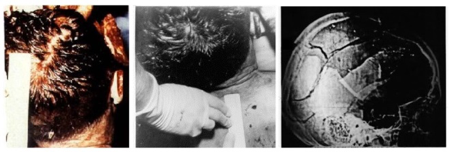
When Humes and Boswell were behind closed doors talking with the medical panel, they were both quite vociferous that the entrance wound in the back of the head was below the external occipital protuberance. When the cowlick wound was then pointed out to him he says, “No, no. That is no wound.”
Humes stated that he stayed with the morticians to help prepare the President’s body until about 5:00 a.m. He began to write the autopsy report about 11:00 pm the next evening. He finished about 3 or 4 o’clock the following morning, Sunday the 24th. Cornwell asked Humes: “was the distance between the wound and the external occipital protuberance noted on those notes?” Humes replied: “…not…in any greater detail than appears in the final report” (HSCA, Vol. I, p. 330). He thought the photographs and x-rays would suffice to accurately locate this wound. He will share that same notion with the ARRB. Is it Humes’ contention that this would be better than the body itself, which he had? How does this explain the ruler in the Fox-3 autopsy photograph? Was someone not measuring? This seems to have been the most opportune time to measure the exact location of the wound. He then continued about the autopsy notes, saying the original notes had the President’s blood on them and he didn’t want them to fall into potentially untrustworthy hands after the fact. He will give a more detailed account before the ARRB. Didn’t military procedure bind him to turn the notes over to his commanding officer, after he adapted the information from them into his report? He wouldn’t have been allowed to take them out of the building. What he took out and what his affidavit specifies are “draft notes.” In other words, a rough outline of notes for an autopsy report. He then wrote a more coherent draft the next day and burned the “draft notes” in his home fireplace. Given the circumstances under which they were written, they may have gotten blood on them, perhaps from the original notes, or from Humes’ gloves or clothing, that is if he wrote draft notes before changing out of his autopsy garb. Or it was the original notes that he burned and he did not want to admit that.
Humes closed his testimony by restating he had no reason to change his opinion that only one bullet struck President Kennedy in the back of the head, without ever being asked. He doesn’t seem as sure, however, as to where that bullet struck. Cornwell closed the questioning and no one else raised one question to Dr. Humes. Odd, that the one man who may have the most vital information about the condition of the late President’s body isn’t probed more aggressively? You get the feeling the Committee is somewhat embarrassed for Dr. Humes, given his somewhat waffling testimony. They shouldn’t have been.
Assassination Records Review Board
On February 13, 1996, the Assassination Records Review Board questioned Dr. Humes for almost 7 hours. The examination was conducted by Jeremy Gunn, General Counsel of the ARRB. Early in the questioning, Gunn asked Humes about JFK’s adrenal glands. Humes seems irritated—as he does throughout the deposition—and said about his conversation with Dr. Burkley, “…the nature of that conversation I don’t think I should discuss with you people” (ARRB p. 29). I have never understood why Humes was so annoyed about JFK’s adrenal glands being discussed. The Parkland doctors spoke without hesitation of what they often called his “adrenal insufficiency.” Why he would feel so bound to what was by then a non-secret befuddles me. The Kennedys no doubt didn’t want JFK’s Addison’s Disease exposed, but today, as in 1996, it’s foolish to try and avoid it as some kind of taboo subject.
Humes repeated that he called Dr. Perry the next morning about 8 or 9 o’clock—which gives us a time frame—and only then learned about the wound in JFK’s throat. Before the Warren Commission, he claimed that he “had to take one of my children to a religious function that morning, but then I returned and made some phone calls and got hold of the people in Dallas, which was unavailable to us during the course of the examination.” Is he serious? He tried, but couldn’t get in touch with any of the Parkland doctors, specifically Dr. Perry. So, let’s see if I get this right: the FBI could compile a complete dossier on Lee Harvey Oswald within hours of the assassination, but no one could seem to find the most important doctor in the world on that night, the one who had obliterated that anterior neck wound with his tracheotomy. Humes admitted to not knowing about standard autopsy protocol for gunshot wounds and autopsy of the neck. He stated early in this testimony that he had experience with gunshot wounds at Tripler Hospital in Hawaii and possibly in San Diego. In this part of his testimony, Dr. Humes still refers to the back wound as the back of the neck, which is amazing after the Clark Panel and the HSCA. He repeats there were some superficial attempts at probing, but the effort was aborted. He doesn’t deny probing—perhaps because of what Robert Knudsen told the HSCA—but only says it wasn’t effective. He also mentions he should have requested JFK’s clothing. He also remembers giving Dr. Burkley JFK’s brain in a pail after his interment. He said that Robert Kennedy, being the spokesperson for the family, wanted to inter it with the body. He stated he gave it to Dr. Burkley about ten days after the autopsy, after JFK had been interred. So, what was the point?
Another oddity is that Dr. Humes claimed to have never even seen the autopsy manual produced by the Departments of the Army, Navy, and Air Force, dated July 1960. If this seems like topic hopping, it is because the ARRB did this periodically. Humes admitted the possibility of phone calls during the autopsy, but that he was not directly involved. There are witnesses who report calls between Parkland and Bethesda the evening of the autopsy. Humes said one of the biggest problems that night was the people in the autopsy room. He says he should have thrown them all out. He approximates 15-20 people were in the room that night.[8] He appeared frustrated, however, as to who was actually in the autopsy room.
One of the reasons Humes had no idea who assistants like Jerrol Custer, John Stringer, and Paul O’Connor were is that he didn’t do autopsies. At this stage of his career, he was really an administrator. He initially said that Admiral Calvin Galloway wasn’t there, but then says he may have been, but played no role whatsoever. Yet Galloway was the commander at Bethesda Medical Center. He can’t recall Admiral Edward Kenney being there either, though he may have stuck his head in the door at some point. Kenney was the Surgeon General of the United States Navy, the highest medical officer in the corps. He says if General Philip Wehle was in there, he was unaware of it. This certainly doesn’t seem to line up with the Sibert-O’Neill report, which stated the presence of both Galloway and Wehle. When asked why he didn’t weigh the brain, thymus, or thyroid, Humes repeated, “I don’t know.” He went on to say that he didn’t understand why Dr. Burkley verified and signed the autopsy report. He didn’t recall him doing this.
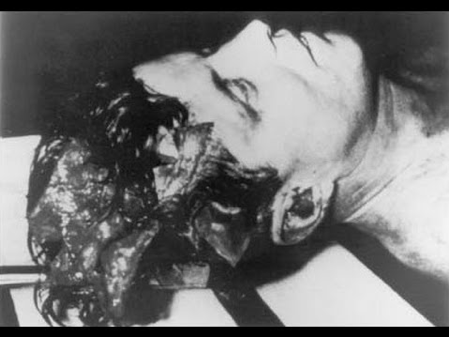
Dr. Humes stated that all of the photos, excluding Fox-8, were all taken before the head was cleaned. Fox-8 was taken, obviously, after the brain was removed, near the end of the autopsy. As a sidebar, he thought most of the x-rays were taken before the photographs. He also remarked they had all of the x-rays developed during the autopsy. As he stated to the Warren Commission, the skull fell apart when he reflected the scalp. When discussing the removal of the brain, he never mentions Paul O’Connor, though he is listed in the Sibert-O’Neill report. Humes stated that Dr. Boswell may have helped him remove the brain; he wasn’t sure. He felt the brain was disrupted by the “force of the blow rather than by the particular passage of any missile…” (ARRB, p. 103). He said the lacerations were in the mid-brain posteriorly. Keep in mind, when Humes testified before the Warren Commission, he said, “at the time of the post-mortem examination, we noted that clearly visible in the large skull defect and exuding from it was lacerated brain tissue which, on close inspection, proved to represent the major portion of the right cerebral hemisphere.” In other words, one of the two hemispheres was almost completely missing. Oddly, that same brain, when weighed at the supplementary examination, was assessed to weigh more than a normal human brain.
On page 111 of his ARRB deposition, Dr. Humes said he spent 30-45 minutes examining the cranium after the brain was removed. How could you not remember exactly where the point of entry was in the rear of the head?
He said they didn’t actually record the autopsy, because that procedure was relatively new and they had just begun doing that. But it had started recently and you would think that especially with the autopsy of the President of the United States you would want to record the proceedings for posterity—unless there were external forces that felt otherwise. Humes said: “I don’t think any real thought was given to it, to tell the truth” (ARRB p. 118). Apparently a lot of things weren’t given much thought that night.
When the burning of his notes came up for discussion, he gave rationale as to why he did it. He remembered going to Greenfield Village, home of the Henry Ford museum, and seeing the chair Lincoln was sitting in when he was shot. He said the tour guide pointed out a drop of Lincoln’s blood on the back of the chair. He thought that was macabre and didn’t want anyone to ever get these documents, hence the burning of the notes. What follows is some quibbling as to whether he burned his autopsy notes or a draft of the report, Humes replied, “It was handwritten notes and the first draft that was burned” (ARRB, p. 134). Later, Humes goes further: “Everything that I personally prepared until I got to the status of the handwritten document that later was transcribed was destroyed” (ARRB, p. 134). He only wanted to hand Dr. Burkley a completed version…everything else was burned. He added that he may have burned a draft of the report due to spelling errors. “I don’t know. I can’t recall. I absolutely can’t recall” (ARRB, p. 138). So much for a good memory—an absolute pre-requisite for an individual whose work might well include courtroom testimony. When questioned about non-movable points for measurement, Humes got annoyed, he asked if he did anything wrong, and said that he didn’t want to get into a debate. When asked about Burkley placing the back wound at about the level of the third thoracic vertebra, Humes said he didn’t know if that was correct, since he didn’t measure from which vertebra it was. He went on to say, “I think that’s much lower than it actually was” (ARRB, pp. 141-142).
Mr. Gunn then proceeded to have Dr. Humes comment on the Fox autopsy photographs. He begins with Fox-4, which is the left profile. The only comments by Humes are in regard to any incisions being made before the photo was taken. Humes denied this, with the exception of having to make a coronal incision to remove the brain.

[Note: James Jenkins’ book, At the Cold Shoulder of History, has suggestions that this was NOT the Bethesda morgue, because of the phone placement, the tiles, and the metal head rest used, as Bethesda simply used a wood block.]
The second photo was the right superior profile, sometimes referred to as G-1 (Groden-1). When asked about the triangular shaped object above the right ear—what the late Harry Livingstone referred to as the “devil ear”—Humes replied, “That’s a flap of skin turned back” (ARRB, p. 158). What Livingstone referred to as “bat wing configuration sutures,” Humes dismissed as a “piece of skull” (ARRB p. 159). The other sharp line that creates another V, Humes again said it’s another piece of skull. On the top of JFK’s head, there is matter that is extruding; Humes notes “that’s scalp reflected that way” (ARRB p. 160).
The next photos were Fox-6 and Fox-7. The matter on the top of the head Humes says is simply scalp folded back. In reference to the object over where the right ear would be, Humes says it is a piece of bone.
The fourth photos Humes looked at was Fox-5, which is the back-wound photo. Humes stated there may have been some slight cleaning in this photograph. When asked about the ruler, he said they may have been trying to record visually the size of the wound. Gunn then asked about the two marks, one at approximately the second-centimeter line and the other at the six-centimeter line. Humes said the one lower in the back may represent a drop of blood, when questioned directly about it, Humes then said, “I have no idea” (ARRB, p. 167). He did not think there were two wounds of entry in the picture. Gunn then digressed about the head wound and missing bone and Humes responded, “It was just a hole. Not a significant missing bone” (ibid, p. 171). During this same exchange, Humes says something that is significant. When Gunn asked him if there was any missing bone in the rear of the skull, Humes said, “There basically wasn’t any…not a significant missing bone.”
The reader should understand a key issue at this point. According to the record, the Harper fragment was discovered the day after the assassination. It was given over to some medical experts in Dallas, photos were made, and then it transferred to the FBI. The Bureau flew it to Washington where it was given to Admiral Burkley. After that, it disappeared. Which means that Humes never saw it. It is certainly an important piece of evidence that represents a rather significant area of space—according to David Mantik—on the rear of Kennedy’s skull. (See the photos presented by Mantik in Murder In Dealey Plaza, pp. 226-27) Could Humes really not have been aware of any of this? And if so, why did Jeremy Gunn not bring it up in the questioning at this point?
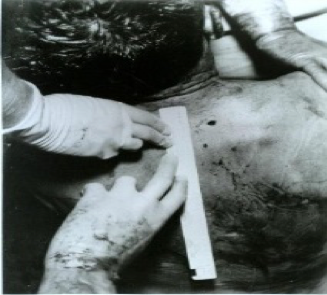
The discussion then went to Fox-1 and Fox-2, usually referred to as the “stare of death picture” in the photographic record. This showed Kennedy from the front, thus including the tracheotomy. Humes suggested there might be an exit wound in the inferior portion of the wound that was obliterated by that tracheotomy. (ibid, p. 175)
Humes then proceeded on to Fox-3, the back-of-the-head photograph. When Dr. Humes was in closed session with the HSCA forensic panel, he picked the lower point, the little white droplet, as the entrance wound. And this is what the three autopsy doctors said was the entry point of the rear skull wound. Then before the HSCA in public session, he chose the higher point, near the cowlick area, as the point of entrance. Now, before the ARRB, he can’t pick either, while looking at the photograph. (See pp. 180-83) He was simply unable to identify the entrance wound in the back of the head. He then went on to say he isn’t aware of where the HSCA forensic panel placed the wound. He commented that it is possible the scalp is being pulled forward in Fox-3. He added that he cannot place the entry wound in the high mark, close to the cowlick area. He also doesn’t have the “foggiest idea” of what the marking is toward the bottom (white droplet), near the hairline (ARRB, p. 180). He says he has problems identifying the entry wound in the photos, but didn’t on the night of the autopsy. He also says he can’t see ANY wound in the upper area in the black and white copy of Fox-3. The flap above the ear was possibly dura, according to Humes. Despite what any of us might think, and for whatever it is worth, no matter what anyone thinks of the photos, the doctors at Parkland Hospital, the morticians, Mrs. Kennedy, and Clint Hill and almost all of the medical personnel place a wound in the back of the head. And although Humes was befuddled by the photos as presented to him by Gunn, the lead pathologist did revert back to his original work for the lower location of the skull wound in his 1992 interviews in the for the Journal of the American Medical Association. And with Gunn, as we shall see, Humes seemed to defer to that earlier opinion.
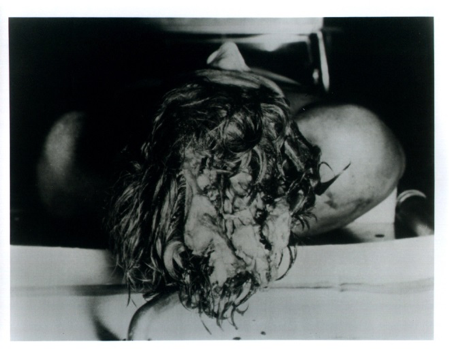
Humes waffled once again, when asked about a reflected scalp photo of the posterior portion of the head. He now said he cannot recall it specifically. He can’t seem to identify Fox-8—the mystery autopsy photo—as either posterior, frontal, or parietal. He says the scalp is reflected downward in Fox-8. Humes seemed to imply that the large gaping hole is an exit wound, though you get the impression he thought he was looking at the temporal-parietal area of the head, not the occipital region. Humes also seemed troubled about not seeing a photo of the interior of the thorax. He regretted not having a photo of the posterior cranial fossa, where the defect was. On page 203 of the deposition, Humes stated that the right side of the brain, the cerebrum, appears to be intact. He says, “That’s not right, because it was not” (ARRB p. 203). He then realizes he was looking at the photo of the brain backwards! In his confusion, he suggested the left cerebrum was disrupted due to the explosion of the bullet striking the skull and the brain bouncing off the interior of the head. The discussion turned to the X-rays, with the anterior-posterior X-ray discussed initially. He said the large gap in the top right quadrant was the result of being removed by the path of the missile. The second x-ray, lateral, was then probed for any details Dr. Humes might be able to add to the record. He noticed fracture lines in the top of the parietal bone as well as into the occipital bone. He thought there were fragments towards the vertex in this picture. He also said he had previously seen fragments corresponding to a small occipital wound in the x-ray, but now doesn’t see it (ARRB p. 222).
Again, this is a key evidentiary point that Gunn seemed to understand and was prepared for. In the autopsy report in the Warren Report, Humes described a line of particles in Kennedy’s skull that went from the low wound in the posterior up to a line of particles up higher. Gunn expressed it like this:
Gunn: Do you recall having seen an X ray previously that had fragments corresponding to a small occipital wound?
Humes: Well I reported that I did, so I must have. But I don’t see them now. (ibid)
In other words, the way this lower wound connected to the particle lines in the upper skull was now gone. Did someone make them disappear? In other words was the X ray altered? Or as some people think: Did that lower to upper trail simply never exist? If it did not, then did the trail of fragments in the upper skull forensically reveal a shot from the front? At any trial of Oswald—like the Harper fragment—this would have been a significant issue for the defense. And it would pose a serious problem for the prosecution.
Humes also said he didn’t understand the big, non-opaque area that takes up half the skull. He didn’t remember seeing this the night of the autopsy. He was then asked, rather awkwardly, about the existence of a photo or X-ray of a probe inserted into the posterior thorax. Humes responded, “No, absolutely not” (ARRB, p. 224). Yet, in his Warren Commission testimony, he talked about superficially attempting to insert a probe. He also mentioned taking X-rays of extremities in case a missile might have lodged there, but no serious pieces of metal were ever found.
The interview concluded with Humes stating how confused he has been and how even more confused he was before the HSCA. The final page of the deposition, in a letter from Dr. Humes to Mr. Jeremy Gunn said:
I experienced great difficulty in interpreting the location of the wound of entrance in the posterior scalp from the photograph. This may be because of the angle from which it was taken, or the position of the head, etc. It is obvious that the location of the external occipital protuberance cannot be ascertained from the photograph. I most firmly believe that the location of the wound was exactly where I measured it to be in relation to the external occipital protuberance and so recorded it in the autopsy report. After all that was my direct observation in the morgue and I believe it to be far more reliable than attempting to interpret what I believe to be a photograph which is subject to various interpretations. (ARRB, p. 248).
Did Humes suffer from intellectual agnosia? He didn’t seem to remember the location of the alleged entrance wound into the back of the head of the President of the United States. From his different testimonies over the years, he couldn’t seem to recall a number of things. Dr. Humes seemed to want all of this to just go away, but as long as doubts, inconsistencies and subterfuge exist, hopefully there will be enough interest around to keep pouring over the record, trying to figure out what really happened. Dr. Humes passed away in May of 1999. I think we can agree that at a trial of Lee Harvey Oswald, the defense would have looked forward to cross examining Humes. That questioning would not have resembled the examination given to Humes by Arlen Specter for the Warren Commission.
Addendum, from James Jenkins’ book: Earlier, it was noted that Humes was uncertain about Galloway and others; more to the point, he had no idea who James Jenkins or Paul O’Connor were. Jenkins stated for the record that he had never assisted in an autopsy performed by Humes, whom he characterized as “…more of an administrator.” So the autopsy of the murdered president was conducted by a man who knew none of the corpsmen involved. The second pathologist, Boswell, was a moonlighting lab pathologist, and the final addition to the lineup was supposed to be the guy to keep them informed by reviewing their work, an Army Lt. Colonel. The radiologist was not a pathology radiologist but a radiation oncologist. When Humes asked for an outside forensic pathologist to join them, the request was denied. Dr. Milton Halpern, the medical examiner in New York City, expected to be called in to oversee the autopsy. He was surprised when he was not called.
[1] It goes without saying that it would be challenging if not impossible to take pictures of the body at the same time you take photos of the interior of the skull cavity, even though the latter group of exposures have vanished without a trace.
[2] Part of that bizarre numerical inconsistency is due in part to the fact that some of the so-called “Fox” poses involved four exposures, multiplying Humes’ 15-20 estimate to 60-80, but still coming up short. Add to that the bizarre fact that three full sets of X-rays were taken, as they were going to X-ray until they found something, and the number grows again.
[3] It has been argued that JFK’s coat was “bunched,” but although that could explain some discrepancy in the coat, it would not explain the shirt.
[4] It should surprise no one that Rydberg, upon seeing the photos after he made the drawings, immediately impugned the accuracy of his own drawings. Dox, at best, admitted to having help with her tracings.
[5] There is no tangible evidence as to the provenance of the skull pieces, or who delivered them.
[6] James Jenkins, in his recent publication, insists that the lungs were not penetrated.
[7] Finck was not present for the November, 1966 look-see; he was brought back to DC from Viet Nam for the 1967 event.
[8] In the recent work by Jim Jenkins, At the Cold Shoulder of History, the number is suggested as 30 or 31.
-

Counterpunch, JFK , and Vietnam
As readers of this site will understand, Counterpunch has consistently been one of the far left’s bastions of ideological purity. They do some good work from that vantage point. But one of the problems with that point of view is that it tends to sweep up all of history into a sanctimonious vacuum. And one of the things that gets swept up and homogenized is the issue of John Kennedy and Vietnam. (Here is a previous example.)
Their latest in this vein was posted on April 30, 2020. It is another of their “Letters from Vietnam” series. This one is from an American living in Vietnam named Mark Ashwill. Ashwill is an educational entrepreneur. The occasion for him writing his letter is the 45th anniversary of America leaving Indochina in 1975. This was due to the agreements that were negotiated by Henry Kissinger and Alexander Haig under Richard Nixon’s supervision in Paris.
Ashwill writes the letter as if he were a citizen of Vietnam (which he may well be) and is preaching to his former countrymen about the evil that they visited on his new nation. I would like to inform the editors of Counterpunch and also Mr. Ashwill that this history lesson is not exactly new. It has been going on at least since the rise of Students for a Democratic Society early in the sixties. It was given popular voice in the pages of Ramparts magazine, and was in book form during that decade through the work of men like William Appleman Williams and historians influenced by him who created New Left studies.
In fact to go through his rather antique complaint today is kind of boring. Most of us know that Ho Chi Minh declared Vietnam free from French domination at the end of World War II. That he used American historical documents like the Declaration of Independence to do so. Many, many years ago Williams produced the letter that Ho sent to Harry Truman in 1945 asking the American president to cooperate with his cause against France. We also know how that letter was ignored and Harry Truman and his later Secretary of State Dean Acheson decided to side with France. And America ended up bankrolling about 80% of the French war effort. We also know the rest of Ashwill’s litany: how the defeat at Dien Bien Phu led to the Geneva Accords, and how President Eisenhower and Secretary of State John Foster Dulles sabotaged that agreement by not holding elections in 1956. And that this key event inevitably led to the USA getting involved in a second war against North Vietnam. This would have been prevented if the Geneva Accords had been honored.
Ashwill now makes a large leap to 1961 and President John F. Kennedy. The reason I say this is a large leap is because by leaving out 1956-60, in his own David Halberstam-ish way, the author eliminates a central point. John Foster Dulles clearly ran the American participation at Geneva. The attorney realized that his oral agreement with the Accords could easily be broken if he did not sign them and this is what he advised the president to do. (William Blum, The CIA: A Forgotten History, p. 137)
Within days of the end of the conference, Foster Dulles and his brother Allen, director of the CIA, began a long series of clandestine actions in order to create a new country called South Vietnam. These actions were supervised by General Edward Lansdale, who was in reality a high-level CIA action officer. It included a psychological terror war in the north to convince the Catholics that they would be persecuted by Ho Chi Minh and they should flee to the south. This helped prop up America’s chosen leader of this new country, the Catholic Ngo Dinh Diem. Once this creation was completed, Foster Dulles made the infamous assertion, “We have a clean base there now, without a taint of colonialism. Dien Bien Phu was a blessing in disguise.” (Blum, p. 139). Leaving out Lansdale and the Dulles brothers is not just reminiscent of Halberstam, it is also what Ken Burns and Lynn Novick did more recently in their long dud of a documentary series called The Vietnam War.
There was no South Vietnam before this. Eisenhower, the Dulles brothers and Vice President Richard Nixon created it. Once it was created, the USA was committed to propping it up any way it could. It was through Diem that America formally cancelled the scheduled unification elections. (Blum, p. 139) This also meant using the fig leaf of communist infiltration from the north as a pretext to invoke the Southeast Asia Treaty Organization (SEATO) as a mutual defense doctrine. Omitting these details thus ignores the fact that those four men had split the country in half and then fabricated a civil war for their own purposes. It was this threat that gave Ho Chi Minh pause about enforcing the Geneva Accords and forcibly holding the elections––which could have easily been achieved. ((Blum, p. 139)
The USA now began to send new military advisory units to Saigon in further defiance of the Geneva Accords. Lansdale began to rig elections to keep Diem in power. The Dulles brothers were not furthering democracy. They had installed and now supported a dictator. And they trained his security forces at Michigan State University. (Blum, p. 140) These techniques included torture and imprisonment in the infamous “tiger cages”.
To skip over all this, plus the large amounts of aid we were giving Diem, is to paper over why it was not easy to get out. The Saigon government was a creation of Washington. And, to say the least, Diem was not a good choice for its leadership. But in doing all this, it created a tactical and strategic commitment that had not existed in 1952. In my opinion, it is not something that can be discounted or ignored, since in historical terms, it is crucial. To make this Bob Beamon leap to President Kennedy and 1961 is bad history, even for an informal letter.
What makes it all worse is the fact that the editors at Counterpunch then placed a picture of President Kennedy at the top of the article next to a map of a divided Vietnam. As if, somehow, Kennedy was involved in the decision to split up the country. This is misleading not just because he was not involved, but because Kennedy was one of the very few voices in Washington to oppose the Dulles/Eisenhower policy not just in Vietnam, but throughout the Third World. This conflict between the senator and the White House was documented by Richard Mahoney back in 1983 in his important book, JFK: Ordeal in Africa. In that book, Mahoney specifically noted Kennedy’s 1957 landmark speech about the ongoing French colonial war in Algeria. During that speech Kennedy harked back to Dien Bien Phu and said what happened in Indochina will happen in Algeria, and that it would thus behoove America to be on the right side of history this time. (The Strategy of Peace, edited by Allan Nevins, pp. 66-80)
So there is ample evidence that Kennedy understood the appeal of nationalism in Third World countries emerging from the shackles of colonialism. (For more current scholarship describing Kennedy’s familiarity with the issue, please read Betting on the Africans, by Philip Muehlenbeck, and Kennedy, Johnson and the Nonaligned World, by Robert Rakove.) But further, what Ashwill does with Kennedy’s presidency in relation to Vietnam is, well, the best word I have for it is “minimalist”.
Ashwill describes a meeting between Kennedy and French President DeGaulle in May of 1961 in Paris where the former French resistance leader warned Kennedy about the quagmire he would be getting into if America intervened in Indochina, that it would be an endless entanglement America could not win. He then quotes DeGaulle as later saying that Kennedy listened to him but that events proved he had not convinced him.
First of all, this discussion between Kennedy and DeGaulle is again an antique bit of news. To cite just one source, it was already described back in 1972 by Dave Powers and Ken O’Donnell in Johnny We hardly Knew Ye. (p. 13) But Kennedy was not just getting this kind of advice from DeGaulle. He also got it from General Douglas MacArthur. The retired general warned him that even if he placed a million men in Asia, it would not work. (Powers & O’Donnell, pp. 13-14). He also got the same advice from Senator Mike Mansfield. (p. 15) And most importantly, he heard the same thing from his ambassador to India, John Kenneth Galbraith.
This is why during the debates in the oval office in November of 1961, Kennedy refused to commit combat troops into the theater. And that was a line that he never crossed. (John Newman, JFK and Vietnam, pp. 136-39). But, as Galbraith biographer Richard Parker demonstrates in the above link, Kennedy went further than this. He sent Galbraith to Saigon and asked him to write a report, knowing that the ambassador would advise against any further involvement. (Virtual JFK, edited by James Blight, pp. 72-73). Galbraith did write such a report, and when the ambassador returned to Washington in April of 1962, Kennedy had him hand deliver it to Secretary of Defense Robert McNamara. (Newman, pp. 236-37). One month later, McNamara arranged to meet with all the inter-agency chiefs of all American forces in Vietnam. After going through the regular agenda items and adjourning the meeting, he called aside General Paul Harkins, the overall commander of American forces in Indochina. He told Harkins that it was time to switch responsibility for the war over to the ARVN, the Army of South Vietnam, and he wanted to begin the planning on the reduction of American advisors as soon as possible. This was the beginning of Kennedy’s withdrawal plan. (Newman, p. 254)
As anyone familiar with the newly declassified record should know, in May of 1963, McNamara called another such meeting, this time in Hawaii. At this meeting the withdrawal schedules were submitted to the Secretary. He said that they needed to be accelerated. He wanted a thousand advisors withdrawn by the end of the calendar year. He directed that those plans be drawn up. (James Douglass, JFK the Unspeakable, p. 126). In October of 1963, Kennedy signed National Security Action Memorandum 263 ordering the first thousand advisors to be withdrawn by the end of the year and the rest by 1965. (Douglass, p. 188). In other words, there was not one more combat troop in Vietnam at the time of Kennedy’s death than there was when he took office. And he was in the process of removing all advisors.
Somehow, Mark Ashwill missed all of this with a completeness that is astonishing. But the Vietnamese educator also missed a chance to have this confirmed by a source in his adopted country, namely, the son of the late North Vietnamese General Vo Nguyen Giap. If someone visiting Vietnam from the USA could do this, then why couldn’t Mr. Ashwill?
From here, Ashwill takes another leap forward. This time to 1966. By the end of that year, Lyndon Johnson had committed 385,000 combat troops, with 60,000 sailors stationed offshore. In just that one year, 6,000 Americans would perish and 30,000 would be wounded. Ashwill discusses a speech by Ho Chi Minh in which the North Vietnamese leader says America took “the wrong fork in the road”. Ashwill never explains how America went from having no combat troops in Indochina to having nearly 400,000. The man who took the wrong fork in the road was Lyndon Johnson. And if any president’s picture should be at the top of the article, it should be his.
As any serious study of the Vietnam War reveals, there were three events that took place––a meeting and two specific orders issued––that overturned Kennedy’s withdrawal plan and replaced it with an escalation plan that was quite apparent by 1966. These were the first Lyndon Johnson meeting on the war on November 24, 1963; the last draft of NSAM 273 signed on November 26th; and NSAM 288 finalized in March of 1964.
At the November 24th meeting, the principals realized that Johnson’s attitude and style about Vietnam were both quite different from Kennedy’s. He said things that Kennedy never did. For instance: “I am not going to lose Vietnam. I am not going to be the President who saw Southeast Asia go the way that China went.” (Newman, p. 442) Kennedy never expressed these kinds of Cold War sentiments about Indochina. He simply did not think Vietnam was imperative to American security. National Security Advisor McGeorge Bundy agreed with this evaluation in comparing the two presidents. And he expressed those characterizations in discussions with both James Blight and his biographer Gordon Goldstein. (Goldstein, Lessons in Disaster, p. 231)
NSAM 273 was altered to allow direct American naval involvement in patrols against the North Vietnamese coast. According to Bundy, it was altered by Johnson. (Newman, pp. 445-49) This allowed for the OPLAN 34 A plans and the so called DE SOTO patrols. The former were hit-and-run attacks by speedboats, the latter were American destroyers meant to decipher where return fire from North Vietnamese bases was coming from. In December, Johnson requested these types of covert actions against the North, with the help of Americans forces if need be. The operations ended up being largely American. (Edwin Moise, Tonkin Gulf and the Escalation of the Vietnam War, pp. 5, 7-8, 14) As many commentators agreed , including those inside the White House, these patrols were, in fact, provocations. (Moise p. 68; Goldstein, p. 125)
NSAM 288 was Johnson’s specific preliminary design to escalate the war, including an air war against North Vietnam. This included 94 bombing targets. In three years Kennedy had never even contemplated this. The combination of the DESOTO patrols with NSAM 288 resulted in the casus belli the White House sought in order to escalate the war. (Moise, pp. 26-28) This was of course the Tonkin Gulf incident. And this is what Ashwill skips over to get to 1966.
The rest of the article is a listing of all the damage inflicted on Vietnam, in bombs, land mines, defoliants, and so forth. Which, of course, any interested party already is cognizant of. Are we supposed to believe that the editors at Counterpunch do not know that 99% of all this happened after Kennedy’s death? And if his plan had been left intact, we would not be having this discussion? That is not speculation. Today, with the declassified documents of the Assassination Records Review Board, it can be proven.
Near the end, Ashwill says that the American leaders did not understand what the war was really about. As I have labored to show, President Kennedy did know what it was about. That is why he was getting out. Just ask General Giap’s son.
-

The House of Kennedy, by James Patterson and Cynthia Fagen
There is no reason for anyone to read this book. On the other hand, there are a lot of reasons not to read it. In its own way, the James Patterson/Cynthia Fagen book, The House of Kennedy, redefines the rubric “hatchet job.”
This volume portrays itself as telling the entire story of the Kennedy clan from two generations before Joseph P. Kennedy, to the death of John Kennedy Jr. in a plane accident in 1999. It is hard to believe that Patterson, who at least started his career as a detective novelist and has written dozens of those kinds of books, actually wrote and researched it, or even designed it. I write that for two reasons. As many people know, Patterson has become so incredibly successful as a writer that he really does not have to write anything anymore. He sells more books than Stephen King, John Grisham and Dan Brown combined. In fact, the inside joke in the industry is that Patterson can write two novels in 12 hours. Based on that kind of information, I would be willing to guess that the TV producer and print journalist Fagen probably did most of the work on the book. From what I could garner, she worked on Inside Edition, Bill O’Reilly’s old program, and she wrote for the New York Post. The Post is owned by Rupert Murdoch and it is a tabloid. If one recalls, during the Jeff Bezos divorce scandal, it ran the infamous front-page headline “Bezos Exposes Pecker”. Referring, of course, to The National Enquirer’s David Pecker’s role in catching Bezos cheating on his wife.
The House of Kennedy is written at about the New York Post tabloid level. When an author writes a non-fiction group biography that is supposed to tell the story of an entire clan, each chapter needs to be guided architecturally, in order to create some kind of narrative arc. To be mild, that does not happen here. For all the planning and design in The House of Kennedy,,it might have been clipped from a series of New York Post articles. And that does not include the clumsy composition and graceless writing.
Yet that is only the beginning of the problems with this weak excuse for a book. Although it spends time on the assassinations of both President John Kennedy and Senator Robert Kennedy, you will learn next to nothing about how each of those two men died. And, in fact, what you will read about those matters is sometimes false in its own terms. That is, Fagen and Patterson abide by the official stories in both cases, but at times they go beyond that, in order to hammer home their verdicts that both Lee Oswald and Sirhan Sirhan acted alone.
But before we get to that part of the book’s utter failure, let us deal with the three main biographies contained within the covers of the book. Those would be Joseph P. Kennedy and his two sons, John F. Kennedy and Robert F. Kennedy. If you want to learn anything about those three men, you won’t in this book. For the simple reason that I could find no original research in it. For example, in David Nasaw’s biography of Joseph Kennedy, The Patriarch, one will learn—in extraordinary detail—how Joe Kennedy built his enormous fortune, especially how he made millions in the film business through distribution deals and the fact that his success made him much in demand as an executive. He was an executive who could request and receive both a large salary and stock options. Nasaw was very specific about which companies hired Kennedy and what his salary and option plans were. Also, he was allowed to run one company, while investing in other film companies. There is next to none of that in The House of Kennedy. Nasaw also found evidence that countered the recurrent charge that Joe Kennedy was some kind of rabid anti-Semite. Well, you won’t find that here either. This book does not deal in the creation of three-dimensional character portraits. Not even two dimensional. Every person described comes out like a cardboard cut out used as a stage prop.
But Joe Kennedy is just where this book gets started. The section on John Kennedy is the longest and, in my view, probably the worst. How can anyone today write any kind of sustained narrative about John F. Kennedy without bringing up the topic of Vietnam? I would have thought that impossible. Even Ken Burns and Lynn Novick had to deal with the subject in their crushingly disappointing PBS mini-series on the subject. They had to for the simple reason that Congressman Kennedy visited Vietnam in 1951 and that visit had a strong impact on not just his view of the French Indochina conflict, but his perspective on the Third World in general.
The House of Kennedy does something I would have thought no writer, or team of writers, could possibly do in 2020. In the long section dealing with JFK, I detected not even the mention of the Vietnam conflict. This is astonishing—for two reasons. First, there have been many important documents released by the National Archives that help define President Kennedy’s intentions and policies in Vietnam. If the authors did not want to read those documents—and it’s pretty clear whoever the team was behind this product did not—then there were books based on those documents that one could consult. Patterson and Fagen did not do that either.
Here is my question: how on earth can anyone write any kind of biography of John Kennedy, or description of his presidency, and leave that subject out? That leads to my second reason as to why this is hard to fathom, because under Kennedy’s successors—Lyndon Johnson and Richard Nixon—that war escalated beyond recognition and it expanded from Vietnam into Laos and Cambodia. And if one goes by the most current estimates, that Johnson/Nixon escalation and expansion took the lives of close to 6 million people—about 3.8 million in Vietnam, and about 2 million in Cambodia. (See the June, 2008 British Medical Journal study by Zaid Obermeyer for the former, see this link for the latter). The fact that this book ignores all this, I believe that tells us a lot about what its agenda was from the start.
But what is remarkable about The House of Kennedy is this: except for the appearance of Senator John Kennedy with his brother Robert on the McClellan Committee—commonly referred to as the Rackets Committee—you will not learn anything about what Jack Kennedy did in his 14-year congressional career in this book. That is quite a negative achievement, because author John T. Shaw wrote an entire book about that subject. Although Shaw’s book is called JFK in the Senate, the book covers his house years also. Shaw came to the conclusion that Kennedy’s most important achievement on Capitol Hill was his forging of a new foreign policy toward countries emerging from the bonds of European colonialism. This policy grew directly out of Kennedy’s opposition to what had come before him in the form of both the administrations of Harry Truman and Dean Acheson and that of Dwight Eisenhower and John Foster Dulles. (See Shaw’s book, page 110)
As everyone who studies that record comprehends, the great schism between Senator Kennedy and Eisenhower/Dulles came in the form of Kennedy’s famous Algeria speech of 1957. In that speech, the senator denounced the Eisenhower administration’s inability to break away from loyalty to France in the colonial war then taking place on the north coast of Africa. (Shaw, p. 101) Kennedy said that the White House did not seem to understand that what was going to happen in Algeria was a reprise of what had just happened in 1954 at the siege of Dien Bien Phu in Vietnam. That is a resounding French defeat, with the USA on the wrong side of history again. Senator Kennedy said that the American objective should be to free Africa and save the French nation, which was coming apart over this war. (See, The Strategy of Peace, edited by Allan Nevins, pp. 66-80) Are we to presume that Patterson and Fagen never heard of the most famous speech Kennedy ever gave in the senate, one that provoked comment—most of it negative—from literally scores of newspapers throughout the country? (For a review of the Shaw book, click here)
If the reader can believe it, this methodology continues into JFK’s presidency. There is very little discussion of what President Kennedy tried to achieve or what he did achieve. You will not read anything about Kennedy’s stand against the steel companies, his attempt to get Medicare through congress, the signing of the Manpower Training Act, the forging of affirmative action, or Kennedy’s Aid to Education Act. (For a description of what Kennedy did achieve in office, click here). Again, are we to believe that a writer who has sold 300 million books and a publisher as large at Little, Brown could not perform the most perfunctory kind of research as this?
And when Patterson and Fagen do try to describe one of President Kennedy’s policies, as with Cuba, they get it wrong. In fact, their description of the Bay of Pigs invasion is so bad its risible. They say that the master plan was to attack Castro while he was lounging at a beach, follow this with an air strike, and then culminate with an amphibious invasion. (Patterson and Fagen, p. 95) To be kind, this is not what the final plan entailed. As anyone can figure through any number of books that have been published on the subject, the final plan consisted of preliminary air strikes against Castro’s Air Force, followed by a diversionary amphibious attack, culminating with a real landing at the Bay of Pigs. And contrary to what this book says, it did not all end in one day. (ibid, p. 97) The actual conflagration went on for three days, but the back of the invasion was defeated in about 36 hours. (Peter Kornbluh, Bay of Pigs Declassified, pp. 307-19)
Our Dynamic Duo of Patterson and Fagen want to include President Kennedy in some kind of plot to kill Castro as part of the invasion. This was not part of the invasion plan and nothing has ever been declassified that says it was. Patterson and Fagen also want to include the myth of the cancelled D-Day air strikes—that is an air attack on the morning of the invasion—as part of the book. (op. cit. p. 97) Again, the declassified files reveal this to be false. Kennedy only permitted these strikes from a strip secured on the island. Since no beachhead ever secured that strip, this is why they did not occur. (Kornbluh, pp. 125-27)
By now, the reader understands what kind of book this is. So, predictably, it also includes the Judith Exner tall tale story from People Weekly in 1988. That, somehow, Exner was a go between for President Kennedy and Mafia Don Sam Giancana to arrange both the Castro assassination plots and to swing elections, e.g. the 1960 West Virginia primary. That particular story has been discredited in so many different ways that its inclusion contributes to the unintentional humor of this book. First of all, although the references in the book attribute that Exner article in People to Kitty Kelley, this is not accurate. According to author George Caprozi in his biography of Kelley called Poison Pen, she did not write the article. The editors at Time/Life did. Kelly and Exner did not get along, so in order to salvage their sizeable monetary investment, the story was manufactured in New York. Second, most authors—except Patterson and Fagen—realize today that Exner should not be taken seriously. By the time of her death in 1999, she had simply told too many different versions of her ever expanding tall tales, all of which differed from her original book, My Story. (Click here, for a good summary of her credibility problems)
Third, the Assassination Records Review Board (ARRB) declassified the CIA’s Internal Inspector General Report on the plots to kill Castro. That report dealt with whether or not the Agency had White House or Department of Justice approval for their outreach to the Mafia to kill the Cuban leader. That report concluded, in several places, that such was not the case. In fact, the report concluded that there was a deliberate attempt inside the CIA not to inform the White House or the Attorney General—Robert Kennedy—about the plots. (See pages 62, 64, 118, 130-32) Therefore, the factual basis for what the book is conveying is impugned.
The authors are so desperate to involve the Kennedys with unsavory characters, that they actually go ahead and use another discredited source: the novel produced by the late Chuck Giancana back in 1992. It was entitled Double Cross. (Patterson and Fagen, p. 85) The idea behind that earlier fabrication was that, somehow, Joe Kennedy was in the bootlegging business and he had Mob contacts, because of that past partnership. Therefore, in order to arrange for Jack Kennedy’s victory in 1960 over Richard Nixon, he had a meeting with Sam Giancana, the Chicago Boss. In return for the Mob stealing votes in the 1960 election—in both the West Virginia primary and the Illinois general election—Joe would get his other son Robert to lay off the Mafia when he became Attorney General. Later, Sy Hersh tried to fill in this design with his hatchet job of a biography of John Kennedy, The Dark Side of Camelot. Predictably, Patterson and Fagen, use the Hersh book as a source, perhaps because it was also published by Little, Brown.
Hersh’s book was so bad, and used so many dubious sources, that even Garry Wills—no fan of the Kennedys—went after it on those grounds in his long review in The New York Review of Books. (See the article entitled The SecondAssassination in the 12/18/1997 issue.) For example, Hersh relied on a disbarred lawyer, one who was also an ex-alcoholic and who had been convicted of both bribery and forging money orders, as his source for the meeting between Joe Kennedy and Giancana.
But beyond that, as both Daniel Okrent in Last Call his definitive book on Prohibition and David Nasaw in his previously mentioned biography of Joe Kennedy show, there was never any credible evidence that Joe Kennedy was ever mixed up in bootlegging or knew any mobsters. How do we know this? Because as Okrent demonstrated, every time Joe Kennedy was appointed to a government position—as he was six times in his life—he had to undergo an investigation. Each one of those inquiries occurred after Prohibition was lifted, therefore there was ample opportunity for anyone to reveal Joe Kennedy’s illicit activity. In hundreds of declassified pages that Okrent secured, there is nothing about any such Mob relationship. (Okrent, p. 369)
If either Patterson or Fagen had read the CIA Inspector General Report I mentioned above, they would have realized another problem with Chuck Giancana’s novel. At a 1959 meeting with the Kennedys, including Jack, Sam Giancana revealed to the senator that he was working with the CIA to kill Castro. (Double Cross, p. 279) This poses a large time continuum problem for that Chuck Giancana novel. For the Inspector General report reveals that the CIA/Mafia plots did not begin until the next year, 1960. (See IG Report, p. 3) With these two facts, furnished by Okrent and the declassified IG report, Double Cross is exposed for what it is: deceitful rubbish. And the question now becomes: Why on earth would Patterson and Fagen use Giancana’s discredited book?
And this is a serious problem for The House of Kennedy. I detected only one mention of any use of declassified files by the ARRB in the book, which speaks reams in and of itself. The overwhelming number of sources that the authors use are books by the likes of Ron Kessler, Sy Hersh, Edward Klein, John Davis, and Thomas Reeves, among others of dubious merit. As I and others have shown, these books all have serious critical problems. If one relies on this kind of problematic sourcing, one naturally ends up with a problematic book, one that no one should rely upon for factual data or conclusions.
But there is another point that needs to be made about using this kind of sourcing. One definition of a hatchet job is when a work goes beyond even the official flawed record in order to present a slanted view of the subject. This book does not just wish to present a completely distorted view of the Kennedys. It wants the reader to believe that there is really no question about the assassinations of either John Kennedy or Robert Kennedy. That proposition, on its face, is ludicrous in light of what we know today about those two murders. But to indicate the quality of this book consider what it says about the alleged assassin in the JFK case, Lee Harvey Oswald. The authors say that Oswald was fully aware of the routing and timing of the Kennedy motorcade through Dallas on 11/22/63. Therefore, Oswald was primed and ready to kill JFK that day. (Patterson and Fagen, p. 111) Their ostensible source for this is a general reference to Chapter Four of the Warren Report. In perusing that chapter, I can inform the reader that there is no information at all there about what this book has presented as a fact.
The same stunt is pulled with Sirhan Sirhan and the Robert Kennedy assassination. Patterson and Fagen say that Sirhan concealed his handgun in a rolled-up poster, while waiting for Bobby Kennedy in the pantry of the Ambassador Hotel. Again, this is not true. Sirhan had no poster to conceal the weapon with. I consulted on this issue with Lisa Pease, who wrote the most recent and best book on the RFK assassination, A Lie Too Big to Fail. (E-mail communication with Lisa Pease on April 20th) Secondly, Patterson and Fagen use the testimony of garbageman Alvin Clark to say that Sirhan had told him in advance he would shoot Robert Kennedy. Again, Patterson and Fagen should have read A Lie Too Big to Fail before including Clark. As Lisa notes in her book, the FBI recruited Clark to testify against his will. But further, the Los Angeles DA’s office worked on Clark, who claimed he was being harassed. But the LAPD found out about certain problems Clark had with the law, including burglary and child molesting which could explain his reluctance to testify. And, as Pease notes, this may have provided some leverage for the police to overcome his reluctance. (Pease, pp. 168-69) Can one imagine using Clark against Sirhan and not providing this important context?
Since this is a tabloid type of book, Patterson and Fagen write that both John Kennedy and Robert Kennedy were having affairs with Marilyn Monroe up to the time of her death in 1962. Again, this can only be concluded if one ignores the best work in that case, which, predictably, our Dynamic Duo does. In 2018 and 2019, author Don McGovern wrote the first and second editions of his outstanding book on the Marilyn Monroe case entitled Murder Orthodoxies. In that fine piece of objective scholarship, one will see all the Monroe mythology that The House of Kennedy wants to impose of its readers—Fred Otash, Jack Clemmons, George Smathers, Robert Slatzer—disposed of quite cogently.
There is one other key point about this poor book. As most biographers of Robert Kennedy note, he was the first Attorney General to enforce the milestone Brown vs. Board decision, which banned school segregation. This is saying something, because that case was decided in 1954. This means that President Eisenhower and Vice President Richard Nixon, who were in power for eight years and had two Attorney Generals who could have enforced that law, did next to nothing about it. In a speech Robert Kennedy made at the University of Georgia in 1961, he made it clear that this would not be the case under him. In all the chapters on Bobby Kennedy, you will not see any mention of that important speech in this book. And you will not read anything about Robert Kennedy’s face-off with governors Ross Barnett of Mississippi or George Wallace of Alabama in order to get Ole Miss and the University of Alabama integrated. Nor, as with his duel with the steel companies, do the authors write about John Kennedy’s June 11, 1963 watershed national speech on civil rights. One which many historians agree was the most important speech on the subject since Abraham Lincoln.
This almost monomaniacal one-sided approach extends to what the authors call “the Kennedy cousins”. This includes the Michael Skakel/Martha Moxley case, about which Robert Kennedy Jr. wrote a book exposing that for the fraud it was. (Click here for a review of that book)
I could go on and on. Paragraph by paragraph, chapter by its many chapters, this is a worthless book. The agenda behind it is pretty clear. The idea is to present the Kennedy clan as a bunch of useless wastrels, whose two most prominent political representatives were murdered by lone nuts. Therefore, those murders have no political or historic importance. The problem for the authors is that one can only come to that conclusion if one does major alterations in the historical record: censoring important material, depriving the reader of information he has to know in order to make an informed judgment. When one does those kinds of things, one is not writing history. He or she is producing a dramatic construct, without labeling it as such. And that is really one of the last things this country needs at this time.
-

The CIA and the Texas School Book Depository
According to former CIA finance officer James B. Wilcott’s testimony before the House Select Committee on Assassinations (HSCA), Lee Harvey Oswald “was a regular employee, receiving a full-time salary for agent work, for doing CIA operational work.”[1] A memorandum by Warren Commission general counsel J. Lee Rankin said that Oswald’s CIA payroll number was 110669.[2] As we shall see, there is evidence that Oswald worked with another CIA agent in Dallas. That would be William Shelley, who Oswald worked under for six weeks as an order filler for the Texas School Book Depository (TSBD). With perhaps two CIA agents on the same premises, a careful scrutiny of the company they worked for is needed to understand what happened the day President Kennedy was killed.
The book depository was in a seven-story, red brick building located at 411 Elm Street. Also at this location were the office suites of eight schoolbook publishing companies, including Scott Foresman, Southwestern, Macmillan, and McGraw-Hill. These companies were part of a complex system involving:
(a) the state legislature, which purchased textbooks through a process called adoption
(b) the publishers, who were responsible for maintaining sufficient reserves
(c) the book depositories, which received the books, stored them, and shipped them out as needed to schools around the state
There were two depositories in the state of Texas. The other one was the Lone Star School Book Depository, also located in the city of Dallas.
On November 22, 1963, there were sixty-nine people working in the building at 411 Elm Street—thirty-three for the TSBD and forty-six for the publishers. In the decades following that fateful day, former employees of these companies have been reluctant to answer questions. If they do agree to be interviewed, they are truthful in what they say, except on one particular point: the year when they moved into the building. Retired TSBD vice president Ochus Campbell said the move took place about five years prior to the assassination. Spaulding Jones, former branch manager of MacMillan, said they moved in around 1957 or 1958. Mary Lea Williams, a receptionist for Allyn & Bacon, said the move occurred two or three years before the assassination. Dorothy Ann Garner, former staff supervisor of Scott Foresman, thought the move occurred around 1960 or maybe a little later.[3]
Actually, the move took place a few months before the assassination. According to an FBI report dated November 22, 1963, warehouse manager Roy Truly said, “The Texas School Book Depository has occupied the building at 411 Elm Street for only a few months. Prior to this time, the building was occupied by a wholesale grocery company engaged in supplying restaurants and institutions.”[4] The wholesale grocery company was the John Sexton Company. Two retired Sexton officials told me that they moved out of the building on November 14, 1961, and that it remained vacant for at least a year.[5] Examination of city directories and phone books in the Dallas Public Library shows that the book depository and the publishing companies did not have the 411 Elm Street address until 1963. (Their previous address was 501 Elm Street on the first floor of the Dal-Tex building.)
Was there something more to this move than meets the eye? Occupation of the building during the summer of 1963 could be a first step in a planning stage. This would include things like:
(1) determining lines of fire from upper story windows
(2) planning the access and escape routes for the sniper team
(3) positioning and controlling the designated patsy as a workman inside the building
(4) fabricating evidence such as rifle, cartridges, and paper bag to implicate the patsy
(5) selecting the so-called “sniper’s nest” where the ersatz evidence would be planted
And perhaps even having people inside the TSBD as assets.
As described to me by Joe Bergin, Jr., son of the regional manager of Scott Foresman, working conditions changed dramatically after the assassination. New security officers appeared.[6] They held a big meeting during which they warned everyone not to discuss the assassination with outsiders. All visits to the building must be strictly business-related. For example, Joe’s father had to clear visitors with Roy Truly, the building manager, even though they were top executives from the company headquarters in Chicago. Reminder warnings were given on an individual or a small group basis. The rationale for these restrictions was to prevent unscrupulous people cajoling them for information or committing hostile acts against them, because of the notoriety Dallas was suffering. As we shall see, this might have been designed to conceal the fact that some people working there were being harassed and bullied.
The home of Joe Bergin, Sr. and his wife seemed to have been a target for persecution, perhaps because Mrs. Bergin was strongly pro-Kennedy and actively worked for his election in 1960. She enjoyed keeping up on the Kennedy family during their years in the White House.[7] The Bergins’ house appeared to be under surveillance and their telephone line seemed to have been tapped. They received threats over the telephone, even death threats. Ruffians driving by yelled derogatory things and threw objects at the house such as half-empty beer cans.
Conditions at home and at work put a severe strain on Joe’s parents. His father lost weight and developed a stoop in the way he stood and walked; his hair and facial features aged prematurely. His mother was a strong, confident woman before the assassination, but afterwards she suffered a complete breakdown in her health and had to be hospitalized. She died in 1969. About a year or two after her death, while his father was away, someone broke into the house and set it on fire, creating a furious blaze. It was a total loss. Joe was unable to determine if the arson was assassination-related.
Other people who worked at the book depository suffered as well. Jack Cason, the TSBD president, was a stocky, robust man before the assassination. Afterwards, Joe visited him in his office and could hardly believe the change that came over him. He was sickly looking, and, like his father, had lost weight. Unknown adversaries tormented Cason so much at his home on Druid Lane, that he was forced to relocate to another part of the city.
Apparently, security measures to keep people from talking continued even after they went into retirement or found other occupations. Roy Truly was, up to the time of his death in 1985, continuously frightened by “federal authorities.” His wife Mildred refused to talk about the assassination even with members of her own family.[8] Carolyn Arnold, a secretary for Vice-president Ochus Campbell, told a friend in 1994 that she had been, and still was, terrified. She said that “there is a whole lot more to tell about the TSBD than what has been published—that the whole building should be suspected as more or less of a ‘safe base’ to operate from that day in November 1963.”[9]
II
This fear casting a shadow over the lives of former employees was also directed against journalists seeking to lift the veil of secrecy. Consider the following letter:
June 2, 1989
Doug Kellner and Frank Morrow
The Alternative Information Network
P.O. Box 7279
Austin, Texas 78713
Re: THE ASSASSINATION OF PRESIDENT JOHN F. KENNEDY
Dear Mr. Kellner and Mr. Morrow,
While working as a journalist in Dallas late in 1974 and early 1975, I met and spoke with Lee Harvey Oswald’s supervisor at the Texas School Book Depository in Dallas, Texas. (At this time the school book depository had been relocated to a warehouse near the intersection of Royal Lane and Interstate 35.)
During this same time, I also met and spoke with relevant employees who later worked for Lee Harvey Oswald’s supervisor after the assassination of President Kennedy. One of said employees, her husband, and child, disappeared without a trace a few hours after granting me an interview.
In addition, all of my interview notes and tapes inexplicably disappeared. Finally, under threats and intense harassment from Dallas Police, I was forced to flee Dallas in early 1975.
In late 1977, while working as a reporter for the Avalanche-Journal newspaper in Lubbock, Texas, I submitted written testimony to the United States House of Representatives’ newly-formed Select Committee on Assassinations. Enclosed is a copy of the response from G. Robert Blakey, Chief Counsel and Director of the Select Committee on Assassinations. Copies of my written testimony have disappeared from my personal files.
My testimony included numerous meetings with a man named Bill Shelly (I am no longer certain of the correct spelling of his last name.) Mr. Shelly was Lee Harvey Oswald’s supervisor at the time of the assassination of President Kennedy. Mr. Shelly claims to have been an intelligence officer during World War II and thereafter joined the CIA.
Bill Shelly claims he was arrested by the Dallas Police and formally charged with the assassination of President Kennedy. He claims the charges were dropped, but he stated that he turned away several newspapers and magazines offering huge amounts of money for his personal account of the assassination. He refused to let me quote him or use his name in print.
One of the aforementioned employees (whose name I cannot recall) stated that when she went to work for Bill Shelly at the school book depository in the early 1970’s she was interviewed for the job by some type of “government agents” who asked if she had been recruited by the F.B.I. or C.I.A. As you can well imagine, she was quite confused because the job was low-paying and involved minor duties.
This employee said that fellow employees were subjected to similar job interviews by government agents. As mentioned, this woman, her husband, and young child disappeared within hours after my interview. Their apartment looked as if no one had ever lived in it. All I remember is that her husband was previously a member of the musical group “The Nitty Gritty Dirt Band.” She didn’t show up for work the next day and didn’t pick up her final paycheck. Their whereabouts are completely unknown.
The day after their disappearance, an estimated 20 Dallas policemen pulled up on front of my apartment. They lingered in front of my apartment for nearly an hour, pointing their pistols at my window and shouting in a very threatening manner. As mentioned, I was forced to flee Dallas until another day.
Insofar as I know, this information has never been made public. Feel free to use any part of it as you please. However, please contact me before mentioning my name to anyone. I will help any way—I just want to be forewarned. There is a very large spider guarding this web of secrecy. I have entered other webs, but this one is different because the spider leaves the web and stalks its prey—sometimes for many years.
By the way, I am a Mr.—not a Ms.—as the letter from Mr. Blakey indicates.
In Solidarity,
(name inked out)
Cc: My Will
Below is the letter from Blakey:
Dear Ms. Glaze,
Thank you for your letter. It has been directed to the Deputy Chief Counsel in charge of the investigation for his review. Your interest in the work of our Committee is appreciated.
Sincerely,
G. Robert Blakey, Chief Counsel and Director
Obviously, if Shelly had been arrested, someone with the police had that record expunged.
The letters themselves came to me from Larry Ray Harris, a prominent researcher of the Kennedy assassination, who knew a lot about the shooting of Officer Tippit and was featured in the British television documentary The Men Who Killed Kennedy. During a phone conversation, he told me that he had a letter that mentioned Shelley joining the CIA. At my request, he sent me a copy. He also sent a copy of the letter from Blakey as well as a 1978 article from the Dallas Morning News concerning the aforementioned Carolyn Arnold, “who states she definitely saw Oswald in the second-floor lunchroom at 12:25 pm.” She told a reporter that the FBI falsified her statement to read that she “thought” she caught “a fleeting glimpse” of Oswald on the “first floor” at “12:15.”
Below is an excerpt from Harris’s letter dated December 15, 1992:
Dear Bill,
Enclosed is the Bill Shelley document I read to you over the phone. I don’t recall its origins with clarity, but I think it was given to me by a professor at Southern Methodist University here in Dallas. Regardless, it ended up in my files around the time we opened the JFK Center in 1989. I don’t know that anyone has ever looked into it. It could be a hoax, but sounds sincere. It would be easy to verify:
(1) if a reporter named Glaze has ever worked for the Lubbock newspaper
(2) if a journalist named Glaze was living in Dallas in 1974/1975
(3) if there is/was an ‘Alternative Information Network’ in Austin, or if Kellner and Morrow are real persons and remember receiving the letter.
If it is true that Shelley was affiliated in some way with CIA or U.S. intelligence, that would be a disturbing and potentially significant development.[10]
III
My efforts to follow up on the leads suggested by Harris were initially unsuccessful. I called the number of the Avalanche Journal in Lubbock, Texas and got the personnel director. She said that no one by the name of Glaze was currently working for the newspaper, nor was that name among the files of past employees. She said that she had been in the personnel department since 1982, and she never knew anyone by that name. Years later, I found out that he moved to Austin, Texas, where he began working for the Austin American Statesman in 1979.
My next call was to the Alternative Information Network founded by Doug Kellner and Frank Morrow. They were co-hosts of a program called “Alternative Views” featuring news, interviews, and opinion pieces from a progressive point of view. It was first broadcast in 1978 on a public access television channel in Austin, Texas. In 1984, they began sending tapes of their programs to public access channels in Dallas and San Antonio and then to other cities around the country, hence the name of the umbrella organization, the Alternative Information Network.
When Doug Kellner answered the phone, I described to him the contents of the letter. He said he never saw it and said it was strange that I should possess a letter that was addressed to him. He asked that a copy of the letter be sent to his home—not to the business address—and after he read it, he would check into it. Two weeks later when I made a follow-up call, Kellner said that his partner Frank Morrow vaguely remembered the letter, but could not provide any additional information.
I next called John Peets, the manager of the Nitty Gritty Dirt Band. The band started out in 1966 in Long Beach, California, and became known for its unique blend of country western and rock and roll. It achieved commercial success in 1970 with a hit song called “Mr. Bojangles.” In 1992, the band was still active, touring the country and recording albums. I asked Mr. Peets if he knew of any member of the band who disappeared in Dallas in the mid-1970s. He said there were two musicians who had been with the band since the beginning and he would speak to them. During a follow up call, he told me that the two musicians were not in contact with former members of the band and knew nothing of their whereabouts nor of their current activities. It was not until 1999 that I located and spoke with Leslie Thompson, one of the original members. Although he left in December 1973, he was certain that the musician who disappeared in Dallas was not among the core members of the band. Instead, he might have been one of the temporary musicians. In the mid-1970’s, the band employed a ten-piece orchestra to back them up.
IV
After failing to get anywhere, I let the matter sit for six years. In 1999, a friend and fellow researcher named Steve Gaal discovered among the listings of the JFK assassination section of the National Archives website a notice of a letter written by a Mr. Glaze to the HSCA. Upon request, the National Archives sent me a copy of the letter. It was dated December 12, 1977,[11] and, at the bottom, it had the author’s full name. I then proceeded to write an article called “The Glaze Letters” for the May 1999 issue of Jerry Rose’s JFK assassination research journal called The Fourth Decade. Below is Mr. Glaze’s letter:
House of Re. Kennedy Assassination Committee
Wash, D.C.
Dear Persons,
I have some information concerning the assassination of President John Kennedy that I wish to submit for your scrutiny.
While working as a journalist in Dallas, Tx. In 1974, I met a person who says she was at that time working for Bill Schelly, who says he was Lee Harvey Oswald’s superior at the time of the assassination.
According to this person, shortly after going to work for Bill Schelly, she & another new employee were subjected to some rather odd questioning when considering they were hired as clerks.
Two men, who identified themselves (with I.D.) as members of the F.B.I., approached the two new employees at work & took them to an empty room inside the building. The two new employees were administered a written questionnaire asking about their opinions of current topics of the day, especially social issues. After completing the questionnaire, the two F.B.I. men asked the employees point blank if they were members of the C.I.A. The incident occurred in about 1969.
The incident interested me enough to question the F.B.I. about it & possibly do a story on it. However, the woman became terrified at the mention of it & said she would deny she ever said it if I tried to publicize the incident.
She & her husband left Dallas shortly afterward.
I must admit that my own fear of getting involved in the investigation has prevented me from writing you earlier. I apologize.
Please excuse this messy letter. Of all times to break down, my typewriter chose tonight to do it. Obviously, my handwriting has long been broken down.
If you should need to contact me, you may do so in care of the Lubbock Avalanche Journal newspaper in Lubbock, Tx. I am a reporter there.
God bless you all,
Nervously yours,
Elzie Dean Glaze
Common to both the 1977 and 1989 letters are the strange men asking strange questions. They appear to be members of the security staff described by Joe Bergin, Jr. Glaze’s letters add a further detail that they were members of the FBI. It must have been puzzling to Glaze, as it is to us reading his letters, why a government agency would be providing security for a privately-owned company. Also puzzling is the manner by which they asked new employees “point-blank” if they were members of the CIA. Why would men who had just shown their FBI identification badges suspect that new employees were concealing the fact that they too were connected to an intelligence agency?
The search for a solution to these riddles leads into the murky world of intrigue involving the FBI and CIA dirty work. CIA finance officer James Wilcott said, “Several different individuals or firms in Dallas had been involved in one way or another with acting as cut-outs for arms shipments to Cuban exiles for the invasion. This we concluded from putting various pieces of information together. I remember hearing about some CIA people who had somehow helped the right-wing Minute Men in Texas to get arms, originally intended for the invasion.” Among the Dallas individuals and companies engaged in supplying arms to Cuban exiles and the Minute Men might have been the ones occupying the building at 411 Elm Street.[12]
A suggestion of smuggling activities within the TSBD comes in the form of boxes too large to be practical containers of books. Henry Hurt, author of Reasonable Doubt, discovered such boxes while investigating the claims of an alleged conspirator. This man said that a large wooden box, 36 x 48 x 60 inches, was used to import arms into the building, one with a false bottom. Hurt initially doubted that such a large container could be moved into the building inconspicuously. The largest typical box for books measured 12 x 14 x 18 inches, was made out of cardboard, and when filled with books weighed 55 pounds. However, while visiting the vacant building in 1983, Hurt saw seven large wooden boxes on the sixth floor, left behind by the TSBD when it moved to a new location in 1970. All seven boxes had the names of schoolbook publishers stamped on them. One label read Texas School Book Depository, 500 Red Pony books by John Steinbeck, from Bobbs-Merrill. Three of the seven boxes appear in a photograph in his book. By comparing the window next to them, which measured 14 inches off the floor, one box was about 15 x 30 x 60 inches, and thus had an estimated capacity of 15 cubic feet. Since a cubic foot of books is about 25 to 30 pounds, a box such as this, when loaded with books, would have weighed around 375 to 450 pounds—too heavy to manage with a handcart.[13]
(As an aside, CIA officer William Harvey worked for Bobbs-Merrill in the last years of his life as a law editor.[14])
Oversized boxes were also seen by Joe Bergin, Jr. when he visited his father at the 411 Elm Street building. He could not remember when this occurred, but it was before the assassination, but after extensive remodeling had been done on the third and fourth floors to add office suites for the publishing companies. This would put his visit in a period sometime during the summer or fall of 1963. When Joe entered the building, he took a recently installed passenger elevator to the fourth floor. Upon exiting the elevator, he saw a short hallway. To his left was a door that led into the office of Scott Foresman. At the end of the hallway to his right was another door. Out of curiosity, he opened this door and saw a large storage area that took over half of the square footage of the fourth floor. In this area were numerous cardboard boxes, four feet square by five feet high. Since the floors were not strong enough to accommodate forklifts, he wondered how the warehouse men could have moved such enormous boxes.
Yet the mere existence of oversized boxes on the premises does not constitute proof of ongoing illegal activities. The significance of Glaze’s 1989 letter is that it provides a tantalizing piece of information which may indicate a covert side to the depository itself. Namely the mention that Shelley was a CIA operative, while at the same time he was an employee in the schoolbook business.
At the time of the assassination, Shelley was in his sixteenth year of employment at the TSBD. His first day on the job was October 29, 1945. Earlier that year, he graduated from Crozier Technical School in Dallas. According to his testimony to the Warren Commission, after graduating from high school, he “worked in defense plants a little bit during the war and started working at the Texas School Book Depository.”[15] The short amount of time between his graduation in late May 1945 and the end of World War II on September 2 plus his employment in defense plants seems to conflict with his claim that he joined an intelligence service and became an officer. However, information on the Prayer-man.com website shows that Shelley was indeed an officer during the war, albeit as a lieutenant in the Reserve Officer Training Corps at Crozier Tech. Shelley’s claim that he was an “intelligence officer” would make sense if, as an ROTC lieutenant, he received intelligence training and perhaps even given some assignments in counterespionage. After leaving high school he might have continued as an intelligence operative working undercover in local “defense plants” (plural) during the last months of the war.
Shelley’s second claim was that he joined the CIA. In 1947, the year when the CIA was formed, the Dallas city directory lists William Shelley as a clerk for the Hugh Perry Book Depository (the old name for the Texas School Book Depository), and that he had a room at 515 Martinique Avenue. The 1960 directory lists him as a department manager for the Texas School Book Depository, living in a house at 126 Tatum Avenue. He was still living on Tatum Avenue at the time of the assassination. If Shelley’s claim to Glaze about his association with the CIA is true, it indicates that he was leading a double life as a schoolbook man as well as an intelligence operative.
Having a double life would not have made Shelley unique among the people who worked at the book depository. Roy Truly, who started working for the book depository in 1934, took a part-time job at the North American Aviation plant in Arlington, Texas during the war years.[16] At the same time, the president of the company, Jack Cason, spent five days a week, Monday through Friday, in uniform at Fort Wolters at Mineral Wells (80 miles west of Dallas). It was an infantry replacement center as well as a German POW camp.[17] Joe Bergin, Sr. became a Texas Ranger in 1934, while serving concurrently as a school superintendent in Greenville, Texas. In 1938, he became a salesman for Scott Foresman. That he continued to serve in a military, or semi-military, capacity at the same time he was working for a schoolbook company is indicated by his obituary, which said he was a veteran of World War II. Joe Molina, credit manager for the book depository since 1947, worked with FBI informer William Lowery in infiltrating leftist organizations. Apparently, work at the book depository was not so demanding as to preclude these forays into military, law enforcement, or intelligence organizations.
Investigations of the CIA in the 1960s and 1970s shows that the agency had embedded agents in a wide variety of organizations and institutions, including labor unions, airlines, college student associations, foundations, law firms, banks, savings and loans, investment firms, travel agencies, police departments, post offices, publishing companies, newspapers, call girl services, and mental health institutions. Considering the far-reaching extent of control over so many occupations in American society, the CIA could very well have infiltrated the schoolbook depositories and their associated publishers. The owner of the establishment, rightwing oil man, D. H. Byrd would have had little problem approving that kind of clearance.
Carolyn Walther, a street spectator waiting to see the president’s motorcade, observed a two-man sniper team at a window on the fifth floor on the far-right side of the building. One man had blonde or light-brown hair, wore a white shirt, and was armed with a rifle. Standing next to him was a man wearing a brown suitcoat. Walther was sure they were not as high as the sixth floor. Confirming these observations were two more spectators, Ronald Fischer and Robert Edwards, who saw a man with light-colored hair and a light-colored open-neck shirt at a window on the fifth floor.[18]
Less than a minute after the assassination, two Scott Foresman employees, Victoria Adams and Sandra Styles, who were on the fourth floor, ran down the stairs to the first floor. Near the two freight elevators were Shelley and co-worker Billy Lovelady. Adams said, “I believe the President has been shot.” Neither Shelley nor Lovelady said anything in reply.[19] Immediately after Adams and Styles went out the back door, Officer Marion Baker came in through the front door and met Roy Truly. He saw two white men sitting by the stairs.[20] Before going up the stairs, Truly paused to tell Shelley to guard the stairs and elevators to make sure no one uses them.[21]
There is an interesting paradox about this issue. For in Barry Ernest’s book, The Girl on the Stairs, the reader will read that both Vickie Adams and Sandy Styles told Barry that they did not see either Shelly or Lovelady when they descended from the fourth floor to the first. The Warren Commission did all they could to delay the arrival time on the first floor by Adams and Styles in order to remove the two girls from the stairs when Oswald would have likely been on them.[22] And this likely included coaxing Shelly and Lovelady into making an ersatz trip across the street to the railroad yards before their return to the TSBD, which is now when they said they saw Styles and Adams.
About a minute or two later, NBC news reporter Robert MacNeil came in through the front door, amazed to see three calm men.
I went immediately into the clear space on the ground floor and asked where there was a phone. There were, as I recall, three men there, all I think in shirt sleeves. What, on recollection, strikes me as possibly significant is that all three seemed to be exceedingly calm and relaxed, compared to the pandemonium which existed right outside their front door. I did not pay attention to this at the time. I asked the first man I saw—a man who was telephoning from a pillar in the middle of the room—where I could call from. He directed me to another man nearer the door, who pointed to an office. When I got to the phone, two of the lines were lit up. I made my call and left. …I was in too much of a hurry to remember what the three men looked like. But their manner was very relaxed.[23]
The man using the pay phone was Shelley, for in an affidavit made out that same afternoon, he said, “I went back into the building [from outside where he viewed the shooting of the president] and went inside and called my wife and told her what happened.”[24] Lovelady must have been one of the other calm men, since, as previously noted, he made no response when Adams said that the president had been shot. The third calm man was probably Wesley Fraizer, who stuck close to Shelley and Lovelady. After standing on the front steps to see the shooting of the president, Frazier did something odd, about which he seemed to contradict himself about in an interview with the Sixth Floor Museum in 2013. He said he went back inside and went into the basement for ten minutes, supposedly eating his lunch.[25]
There was a fourth calm man, perhaps unnoticed by MacNeil, who was getting a coke on the second floor. According to one of the FBI reports of the first interrogation of Oswald in the Dallas homicide office:
OSWALD stated that he took this Coke down to the first floor and stood around and had lunch in the employees’ lunch room. He thereafter went outside and stood around for five or ten minutes with foreman BILL SHELLEY, and thereafter went home. He stated that he left work because, in his opinion, based upon remarks of BILL SHELLEY, he did not believe that there was going to be any more work that day due to the confusion in the building.[26]
Pierce Allman, a local newsman, later said that after he approached the TSBD, a man he recalled as Oswald near the front of the building, directed him to a phone inside.[27]
Considering the noise of gun blasts and the uproar going on outside, it is odd that Oswald continued to be unconcerned. Like Frazier, who was “eating lunch” in the basement, Oswald went to the first-floor lunchroom to eat his lunch. The fact that he went and got his gun afterwards and then walked to the Texas Theater, perhaps to meet with someone, this suggests that he had some kind of agenda to fulfill. What it was is hard to guess. Yet judging by the disgust in his voice when he said at the police station “I’m just a patsy,” he probably did not know that he would be the one accused of killing the president.
V
Not long after Oswald departed from the scene, Shelley told Truly that Oswald was missing.[28] A roll call of warehouse employees seemed to indicate that Oswald was indeed absent. Truly notified Police Captain Will Fritz, who immediately thought that it was “important to hold that man.”[29] What makes this even more interesting is the following new information. In the work that Oliver Stone has done for his upcoming four-part documentary series on the JFK case, he uncovered information that Truly was not being paid directly through the Texas School Book Depository in 1963. Which he was allegedly working for. We should not jump to conclusions, since we do not know the entity that was actually paying him. But in the light of the information in this essay, it seems interesting that it was Shelly and Truly who took the name of Oswald to the police. Fritz was on the sixth floor examining the scene when Truly told him of this. Which seems to be an odd premise, especially since, as Jerry Rose pointed out in his article, “Important to Hold that Man” there were at least 14 people missing from the building at the time; and they would not return until 1:30 PM. Charles Givens, like Oswald, had left the building after the assassination.[30] In that same article Rose writes that Shelly was one of the building employees who identified Oswald for the police when he was brought in to the station. As Rose points out, this is a bit odd also, since most of the building witnesses were taken to the sheriff’s office, which was much closer to the TSBD than police headquarters.
Shelley told Glaze that he himself was arrested for the assassination. There are photos of him getting into a police car along with Bonnie Ray Williams and Daniel Arce. No doubt the police asked Shelley a lot of questions, and it is possible that they kept him in custody until he gave satisfactory answers. Admittedly, there is no record of Shelley’s arrest, but that does not necessarily mean Glaze was wrong. Missing evidence could be attributed to the systematic destruction of anything contrary to the official version.
A puzzling aspect of Glaze’s 1989 letter was his reference to the book depository having moved to a location near the intersection of Royal Lane and Interstate 35. In 1970, the TSBD and the schoolbook publishers moved out of the old 411 Elm Street building. Yet their new location was seven miles south of the intersection of Royal Lane and Interstate 35 at 8301 Ambassador Row. Obviously, the distance to Ambassador Row was too great to serve as a useful guide to anyone seeking to verify Glaze’s account.
It was not until 1999 that I spoke to someone who could solve this apparent discrepancy. Dorothy Ann Garner was a former office supervisor of Scott Foresman. She and three co-workers—Victoria Adams, Sandra Styles, and Elsie Dorman—viewed the shooting of the president from their fourth-floor office window. About four or five years after the assassination, she said, Scott Foresman and another publisher called Southwestern decided to sever ties with the Texas School Book Depository. They constructed a new building in the northwest part of Dallas, which both companies shared. I asked her if the new building was near the intersection of Royal Lane and Interstate 35, and she said yes, on Gemini Lane. (Its address, I later learned, was 11310 Gemini Lane.) Garner went on to say that at the same time, around 1969, William Shelley quit the book depository and began working for Scott Foresman. He was still there when Garner retired in 1986.
Glaze’s meetings with Shelley were therefore not at the Ambassador Row facility, as I originally believed, but rather they occurred at the building on Gemini Lane. The incident involving two government agents asking new employees strange questions also occurred at this location.
A fellow researcher named Eric Lee Jordan visited the site and took pictures of it. The building is a large, one-story, concrete tilt-up, ideal for storing and moving huge quantities of material goods with forklifts and palettes. Behind the building are five loading docks and an asphalt lot extensive enough to accommodate a number of trucks of any given size. Enclosing the back area is a high, chain-link fence with coils of barbed wire on top. At the time he visited the place, Scott Foresman was gone, and a carpet company was occupying the building.
When the woman heard that Glaze was planning to go to the FBI, or had already been to the FBI, she was terrified and told him that she would deny everything. Afterwards, she, her husband, and their child quickly disappeared. This is an indication that the covert side of the schoolbook business had shifted to the Scott Foresman and Southwestern building, perhaps because the notoriety of the TSBD had hampered its ability to conduct smuggling operations and thus had to be discontinued.
Just as in the case of Carolyn Arnold and Roy Truly, the strange menace that Glaze encountered in early 1975 continued to follow him through the course of his life. His desire to tell what he knew overcame his fear at least twice in his life. In the closing paragraphs of his 1977 letter, he wrote, “I must admit that my own fear of getting involved in the investigation has prevented me from writing you earlier. I apologize.” He closed his 1989 letter with a lurid metaphor: “I will help any way—I just want to be forewarned. There is a very large spider guarding this web of secrecy. I have entered other webs, but this one is different because the spider leaves the web and stalks its prey—sometimes for many years.”
Through another researcher, I obtained Glaze’s mailing address. In my letter to him, I praised him for his courage and expressed the hope that someday he might fill in the gaps of his story for the sake of history. Two weeks later, he wrote back:
July 14, 1999
Dear Mr. Weston,
Received your letter of July 7, 1999. Thank you for your kind words and interest. All that I know—and the attending dead ends—were passed along to a researcher and author in Dallas a few years ago. He is about to publish his book and, as you can understand, friendship and loyalty make me reluctant to discuss this matter with anyone else. It’s perhaps a moot point anyway, because based on what you’ve told me, you now know more than I do. Mine was a happenstance meeting and short, casual friendship with a man who appeared to have fallen through the cracks. Had the seemingly insignificant trail of bread crumbs I stumbled across had not been so he avidly guarded, I might never have given it a second thought. My actions were less courageous than they were the result of being naïve. I was up to my neck before I realized it. You may have noticed that at the end of my letter to “Alternative Views” I carbon-copied to “my will.” It was intended as a jab at myself lest I get too full of myself rereading it 50 years from now.
“With that, I pass along my rather tiny candle, plus my best wishes and encouragement. Those generations who were there in 1963 are grateful that people like you are continuing the pursuit and taking another look at events which may have been too shocking for the rest of us to ever fully comprehend. Perhaps that is why I was so unprepared during that brief step into the looking glass.”
Sincerely,
Dean Glaze
As far as I know, the unknown Dallas author who interviewed has not published his book.
Elzie Dean Glaze passed away on November 15, 2019. Below is an obituary from the Austin American-Statesman published on Dec. 15, 2019.
 GLAZE, Elzie Dean Age 66, is celebrated by his family for his compassion, humor and willingness to help family, friends and the world at large. He was an accomplished journalist and author and had worked as a radio engineer in his early career. For many years he assisted organizations that helped veterans, monitored the nuclear power industry, and worked to ensure basic human rights. He had keen interests in history and weather, and much of his writing related to these. He followed environmental concerns and space exploration, and he enjoyed playing and watching sports. He was fortunate to have many travels, including celebration of his 60th birthday in Antarctica. Dean was the son of Elzie L. Glaze and Geneva I. Glaze and was born in Lubbock, Texas. He passed away on November 15, 2019, after a fall causing brain injury. He is loved and will always be remembered by his wife Sylvia Glaze, daughter Hailey Glaze, and sister, brothers, nieces, nephews and friends. He enjoyed giving to others, and loved the companionship of his four dogs. Many notes and gifts, often created by him, are left for us as a tribute to his kindness and love.
[1] Testimony of James B. Wilcott, RIF 180-10116-10096, pp.25-26.
[2] Midnight/Globe, February 14, 1978. The memo said that Oswald’s FBI informant number was S172 and that his CIA number was 110669. Mae Brussell showed copies of this document to the editors of Globe.
[3] Telephone interviews of Campbell March 19, 1994; Jones, March 19, 1994; Williams, April 4, 1994; Garner, August 14, 1999.
[4] FBI report of Roy Truly interview by Nat Pinkston, November 23, 1963, File No. DL 100-10461.
[5] Interviews of Ted Leon and Thomas H. Butler. The November 14, 1961 date came from Leon, Sexton branch manager in Dallas from 1961 to 1964. He kept his pocket calendars from his years of employment, and he noted when the grocery company moved out of the building to a new facility in another part of Dallas. Butler took over as branch manager after Leon transferred to Los Angeles. Butler said that the 411 Elm Street building was vacant for at least a year after his company moved out.
[6] Interviews of Joe Bergin, Jr. February 12 and 26, 1994 and August 7, 1999. When I interviewed him, he was living alone with his three cats, depending for his income on the charity of his father and disability checks. His father died on November 2, 1990. Joe died on August 29, 2001 at the age of 55.
[7] Through some insider intrigue, a saleslady at Neiman Marcus found out what Jacqueline Kennedy was going to wear the day of her arrival in Dallas. She confided this information to Mrs. Bergin and told her that she had a copy of the First Lady’s dress, pink in color with the black velvet collar. Mrs. Bergin paid a great deal of money for that dress. She planned to wear it that Friday evening at a social gathering. Needless to say, she never did wear that dress.
[8] Jim Marrs, Crossfire (Carroll & Graf. New York, 1989) p. 319.
[9] Carolyn Arnold statement in “Byrd/TSBD Concerns” posted by Martin Barkley on May 24, 2000 on the JFK Today website.
[10] Larry Ray Harris at the age of 44 died in an automobile accident on October 5, 1996. He was traveling from his mother’s house in Ohio to Georgia. Supposedly, he fell asleep at the wheel, or committed suicide, when he rammed into the back of a semi-truck. Since the CIA has the capability of engineering car crashes to look like accidents, Harris’s name should be added to the list of mysterious deaths, along with Warren Commission witness Lee Bowers, who died when his car ran off the road and ran into a freeway abutment.
[11] Glaze misdated his letter as “12/12/74.”
[12] Wilcott’s 3/22/78 HSCA deposition, pp. 25-26.
[13] Henry Hurt, Reasonable Doubt (New York: Holt, Rinehart, and Winston, 1985), pp. 359-360, 386-387.
[14] William Harvey obituary in The New York Times, June 14, 1976.
[15] Shelley testimony, Volume 6 of the Warren Commission Hearings and Exhibits on page 327, hereafter to be cited as 6H327.
[16] Roy Truly testimony, 3H213.
[17] Gladys Cason, One Life, self-published book, 2004, pp. 66-67.
[18] Carolyn Walther, 24H522; Edwards, 24H207; Fischer, 24H208.
[19] Adams testimony, 6H388-390.
[20] Baker testimony, 3H263.
[21] Shelley testimony, 6H330.
[22] Sylvia Meagher, Accessories After the Fact, p. 74.
[23] William Weston, “Robert MacNeil and the Three Calm Men”, in the November 1994 issue of The Fourth Decade.
[24] Shelley affidavit, 24H226.
[25] Frazier testimony, 2H23.
[26] FBI report of Oswald at the police station, Warren Report, p. 619.
[27] Gerald McKnight, Breach of Trust p. 115.
[28] The Third Decade, May of 1986.
[29] Shelley affidavit, 24H226.
[30] Fritz testimony, 4H206.
-
The Dylan/Kennedy Sensation
As everyone who reads this site must know by now, Bob Dylan’s newly released song Murder Most Foul has created nothing less than a cultural and popular mini earthquake. (Click here) As of this writing, the song, his first in about 8 years, has registered 2.4 million views on You Tube. Over two million in 96 hours! The song is themed around the murder of President Kennedy, but I hesitate to call Murder Most Foul a song. Because, as most people understand, Dylan is one of the finest lyricists in the modern history of music. At his best—in classics like Blowin’ in the Wind and Like a Rolling Stone—he does not really write song lyrics, not in the normal sense. He writes poems. And to anyone who knows anything about the Kennedy assassination, this song is really a poem. It is an intricately designed, multi-leveled, cleverly-referenced poem about both the Kennedy assassination and what happened to America after that cataclysmic event. (Click here for a written lyric version of the song)
For people who have studied the Kennedy case, Dylan has centered the lyrics around a conspiracy to kill JFK in Dallas. Consider these three lines: “We’re gonna kill you with hatred, without any respect/We’ll mock you and shock you and we’ll put it in your face/We’ve already got someone here to take your place”. (Click here for the official lyrics themselves) But, then, this theme gets hammered home a few lines later:
Thousands were watching, no one saw a thing
It happened so quickly, so quick, by surprise
Right there in front of everyone’s eyes
Greatest magic trick ever under the sun
Perfectly executed, skillfully done
Many writers on the JFK case, including our own Milicent Cranor, have referred to the murder of JFK as a “magic trick”. One that was planned and designed in advance. Dylan captures this by saying that although the event took place right in front of all the spectator’s eyes, no one saw how it was really done due to the intricate trickery involved.
The writer then shows how well he knows the literature on the Kennedy case. And beyond that, how well he has hidden his references and mixed them in with the historical period. He writes: “Slide down the banister, go get your coat/Ferry cross the Mersey and go for the throat/There’s three bums comin’ all dressed in rags/Pick up the pieces and lower the flags.” Vince Palamara had to point out to me and others that Dylan is likely referencing in the first line, Guy Banister, and in the second, David Ferrie. He then posits in more scenery from the assassination with the Three Tramps. He has covered this in a movement referencing the British rock invasion and a song by Gerry and the Pacemakers from 1965, Ferry Across the Mersey. This reference is intermixed with one to “The Beatles are comin’, they’re gonna hold your hand.” The Beatles first big hit in the USA, as opposed to England, occurred in December of 1963. It was the single, I Want to Hold Your Hand. This sub-theme of escape into music is accentuated with “Pick up the pieces and lower the flags/I’m goin’to Woodstock, it’s the Aquarian Age/Then I’ll go to Altamont and sit near the stage.” Altamont was a free music festival held in California four months after Woodstock, featuring The Rolling Stones. Altamont was marked by the heavy usage of drugs and alcohol, which resulted in numerous fistfights. Four people died during the event, and one of them was killed near the stage. (See the documentary film Gimme Shelter)
This is where the elegiac part of the poem begins to assert itself. Dylan tops off the Altamont reference and links it to the JFK murder adroitly and pungently. Right after the mention of Altamont, he writes “Put your head out the window, let the good times roll/There’s a party going on behind the Grassy Knoll.” Does it get much better than this kind of historical allusion per cause and effect? America was escaping into the drugs and hard rock music exemplified by Woodstock and Altamont. This is not Taylor Swift.
II
The entire 17-minute song is chock full of these kinds of references, including to the late disc jockey Wolfman Jack. The Wolfman became famous in movie history through his appearance in George Lucas’ 1973 film American Graffiti. That picture had an elegiac tone to it. In fact, its ad campaign featured the question, “Where were you in’62?” That bubbly film about Camelot America, the early sixties, ended with a punch in the gut. At the end of the picture, it tracked its male protagonists past 1962: with one of them dying in Vietnam and another living in exile in Canada to escape the draft. As one critic described it, the film’s lighthearted tone was extinguished by a ten-foot wave showing an Ozzie and Harriet like American youth being thrown headlong into disaster. That awful fate was amplified even more by the 1991 film JFK and its accompanying book: John Newman’s JFK and Vietnam. Bob Dylan gets it.
The title Murder Most Foul is a reference to Shakespeare’s Hamlet. In Act One of that play, during the famous ghost scene, an apparition of his father tells Prince Hamlet that he, the former king, was murdered. The ghost then refers to his killing as, “Murder Most Foul”. He tells his son that he was done away with by the new king: his brother Claudius. His brother then married his widow to become Hamlet’s stepfather. This surreal revelation is what sets the action of the play in motion: a drama of crime detection and ultimate revenge. It all becomes a tragedy when, at the end, the stage is littered with the corpses of not just Claudius, but also Hamlet, his mother Gertrude, and the son of Polonius, Laertes. But beyond that, and cut from most film versions of the play, these deaths make possible the entry of an army from nearby Norway, led by the character Fortinbras. As Dylan notes: “We’ve already got someone here to take your place.”

Front cover of Murder Most Foul by Stanley Marks
But Kennedys and King contributor Rob Couteau has alerted us that the title may go even further than that. For there is a little-known book with that same Shakespearean title in the Kennedy canon. In 1967, writer Stanley J. Marks wrote a short volume on the case. He entitled it Murder Most Foul. From its appearance—Couteau actually has a copy of the book—it did not appear to be printer typeset. The volume looks like it might be self-published and, therefore, did not get much distribution. If so, that is understandable. The contents of the book and its political views on the assassination, especially those at the end, are far ahead of the intellectual arguments in classic texts like Accessories After the Fact and Six Seconds in Dallas, both published in 1967.
The approach to the case taken by Stanley Marks is that of a magisterial judge out of the British system. During the course of the book, this judge (Marks) relentlessly asks question after question of the prosecution. By the book’s finish, the question count tallies to 975. Quite accurately, through his questioning, Marks concludes that the Commission suppressed important evidence and neglected to question certain important witnesses. His penultimate chapter is called “The Rape of the American Conscience”. There, one of his first conclusions is that the Warren Commission, contrary to what it wrote, discovered a conspiracy. Marks is utterly disdainful of both the efforts of the Commission and its aides. In that penultimate chapter, he accuses them of abusing legal procedure and the rights of witnesses. He calls the performance by the Commission both negligent and slothful. He says that the report deserves all the criticism it has gotten, for it could not even withstand exposure by the noon day sun.
Marks then sounds a note that no other critic of that time voiced, but which is appropriate to Dylan. He says that because of the disbelief in the Warren Report, a cynicism has gathered in the public and this bodes ill for the future of the nation. For a nation whose moral fiber has been torn and shattered cannot long live.
Marks expounds on this idea by writing on page 139 that the Constitution contains the American Creed in the preamble. The Warren Report violated that creed. Because the United States, “…was not born on the idea that its president could be shot like a dog on the street and his murderers be shielded from that day on, because it would be ‘against the national interests’.” He concludes his penultimate chapter with what could be called an ode: “How long O how long, Americans, will we permit our silence to perpetuate the evil in the Warren Report?” This condemnation is a far cry from say Josiah Thompson who, at the end of his book, said he was not really sure that the evidence he adduced justified a conspiracy. (Six Seconds in Dallas, p. 246)
In his final chapter, Marks again does something that neither Meagher nor Thompson did—quite the contrary. He praises and appreciates the efforts of New Orleans DA Jim Garrison. He compares Garrison’s ordeal against the media to St. George galloping forth to duel with the dragon. He also says something quite prescient for the time: he accuses some of Garrison’s attackers of being in bed with the CIA. Which, we now know, is an accurate assessment. Again, if Bob Dylan knew about this obscure book, even more praise to him.
The poem never lets up on the impact of November 22, 1963. It mentions the Zapruder film and also the deeply flawed autopsy—“They mutilated his body and they took out his brain”—and even the magic bullet and Oswald’s pronouncement that he was just a patsy. Dylan even seems to reference some of the work done by authors like myself on the attempt to smear Kennedy’s reputation posthumously. This is suggested when he writes in verse 3, “They killed him once and they killed him twice.”
The elegiac part really picks up at the end of verse 3 when, right after mentioning “they killed him twice”, Dylan writes:
The day they killed him, someone said to me, “Son
The age of the Antichrist has just only begun”
Air Force One comin’ in through the gate
Johnson sworn in at 2:38
Let me know when you decide to throw in the towel
It is what it is, and it’s murder most foul
I really don’t see how the lines about the Antichrist, Johnson, and throwing in the towel could be any clearer in their meaning.
As they should, with the mention of the Antichrist, in verse four, the elegiac tones become more pronounced. Dylan begins that verse with a reference to the forgettable 1965 film written by Woody Allen, What’s New Pussycat? He then juxtaposes the frivolity of that piece of ephemera with the following lines: “I said the soul of a nation has been torn away/And its beginning to go into a slow decay”. He then lists some songs Wolfman Jack could turn, pointedly including Only the Good Die Young and saying Wolfman should also play a song “for that strip club owner named Jack.”
In the last verse, verse five, the author asks the Wolfman to play a song for Jackie Kennedy, since she “aint’t feeling very good”. He then lists a whole slew of songs, some with suggestive titles like In God We Trust and Another One Bites the Dust. He then begins to turn to his main theme when he writes:
Don’t worry Mr. President, help’s on the way
Your brothers are comin’, there’ll be hell to pay
Brothers? What brothers? What’s this about hell?
Tell them, “We’re waiting, keep coming” we’ll get them as well
Love Field is where his plane touched down
But it never did get back up off the ground
Was a hard act to follow, second to none
As we know, they did get JFK’s brother, Bobby, through another murder and Ted was blocked from the White House through the tragedy of Chappaquiddick. (Or as Pamela Brown has suggested the other brother could be, figuratively, Martin Luther King.) And evidently, like most of the American public, Dylan thinks that the following presidents were not up to Kennedy’s standard. (Dylan wrote the song several years ago, the occasion of President Trump’s epic fail on the novel corona virus may be the reason he released it at this time.) After listing some other evocative song and film titles like Lonely are the Brave and Lonely at the Top Dylan concludes with this:
Play darkness and death will come when it comes
Play “Love Me Or Leave Me” by the great Bud Powell
Play “The Blood-stained Banner”, Play “Murder most Foul”
Bud Powell was a great American pianist and Love Me or Leave Me was the name of both a famous song and much later, a lesser known film. But The Blood-Stained Banner is a name given to the confederate flag. And we know where the line Murder Most Foul comes from, it happens to be the title of the song everyone is listening to. I believe the reference to the confederate flag works in three ways: the predominant color in the flag is red, Kennedy died in the south, and JFK—as Dylan well knows—had all kinds of problems in his struggle against Jim Crow at places like the University of Alabama and Ole Miss. In other words, the ugly side of America, as represented by the confederacy, eventually won out. Dylan is to lyric composition what Frank Lloyd Wright was to designing home architecture.
III
The reaction to this evocative and moving piece of poetry and song writing has been both troubling and predictable. I can do no better than to quote David Talbot at length to illustrate it:
Idiot Wind. This is how pathetic and cowardly and willfully ignorant that our media is. Bob Dylan, America’s greatest living songwriter, has just released a profoundly disturbing song about the powerful conspiracy that killed President Kennedy and the subsequent loss of our nation’s soul. Stop the presses! There’s your story, quarantined media hacks with nothing better to do—call up Dylan and ask him why he released this stunning song now, his most politically charged work in decades. Or call assassination researchers who actually have investigated Kennedy’s “murder most foul”—authors whose work probably informed Dylan.
Instead, what do NPR’s intrepid culture reporters—Bob Boilen and Ann Powers—do? They put together a playlist of the songs that Dylan references in his epic ballad. Likewise, the New York Times’s Jon Pareles also can’t bring himself to explore the meaning of Dylan’s haunting lyrics. He’s obviously read the memo from the Times front office—don’t go there if you value your job. All of these music critics are old enough and wise enough to know the huge import of this new Dylan song. And none of them has the guts to wade into these dark waters.
What sniveling and cowering “journalists.” This is why America’s Fourth Estate has been complicit with the Kennedy assassination conspiracy for over five decades. While American democracy was riddled with bullets and buried so deep we now have a mad clown as president, our press “watchdogs” licked the hands of the conspirators and snarled at anyone brave enough to question the official story.
But hey, instead of pondering the light in Dylan’s darkness, we can all listen to this fun NPR playlist!
The New Yorker compared some of the lyrics to QAnon, which shows that one can only understand this poem if you know or care anything about the JFK case. (Kevin Dettmar, 3/28/2020) Ty Burr, in the Boston Globe, said that the musical arrangement should have been stronger and more pronounced. (March 28, 2020) Mr. Burr does not understand that this work is really meant as a poem; therefore, the music is in the background. If one can believe it, the Rolling Stone said that the song is about how music can comfort us through troubled times. (3/27/20, by Simon Voznick Levinson). As I pointed out, in the work’s overtones, what Dylan is showing is how the shallowness of American culture could not deal with an event the size, scope and trauma of the Kennedy assassination. Our cultural and media gatekeepers just wanted to bypass it as quickly and as easily as possible.
In that aspect, Dylan has come a long way on the subject. Accepting an award in 1964, in an allegedly drunken state, he said he could see how some people could relate to what Oswald did. Like most of us today, he understands Oswald did not do anything that day. Like the alleged assassin said of himself, he was just a patsy. The damage was done by assailants unknown to America.
There are few poems, and even fewer songs today, that can be called folk epics. Perhaps in remembrance of his boyhood idol Woody Guthrie, this one lays claim to that rubric.
Additional materials provided by Rob Couteau:
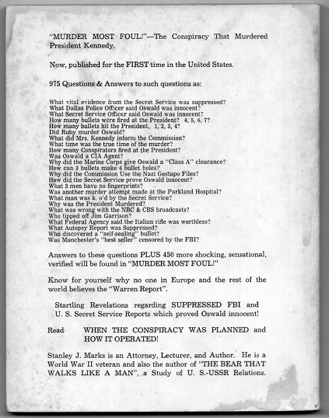
Rear cover of Murder Most Foul by Stanley Marks

Stanley Marks indexed by the HSCA Volumes 11-12 page 695
-

Gerald “Jerry” Policoff (Feb. 27, 1947—March 7, 2020)
Longtime assassination researcher Gerald “Jerry” Policoff died in an automobile accident in Lancaster, Pa. on Saturday March 7. Jerry first became involved in the research community as a 19-year-old in 1966, when he was inspired to seek the truth after reading Mark Lane’s seminal work Rush To Judgement. The next year, he decided to buy the 26 volumes of the Warren Commission. His mother could not understand his growing obsession. When he tried to explain to her that illegitimate forces had taken power in a clandestine way, she did not understand what he meant. Then one day after he came home from one of his college classes, he noticed that she was putting away Josiah Thompson’s book Six Seconds in Dallas. She turned and said to him, “You’re right. And I don’t ever want to talk about it again.” Which, of course, explains the problem critics have with this case.
Jerry made his living in broadcast advertising for more than 40 years, while pursuing his research and writing about the JFK assassination. His main area of interest was on the mainstream media’s inadequate and dishonest coverage of the assassination. The night Robert Groden and Dick Gregory showed the Zapruder film live on ABC TV, on Geraldo Rivera’s program Good Night America, Policoff was in the wings since he was a friend of Groden’s. Even though Rivera went to the mat with ABC in order to show it, Jerry often said that up until the moment it was screened, he, Groden, and Gregory all thought that management was going to call off the show. Thank God they did not.
In 1975, shortly after that monumental event on Rivera’s show, Jerry was the first person to expose Life magazine’s changing the order of printed frames, and printed captions, in its October 2, 1964 issue, in order to conform to the Warren Report’s conclusions of only shots from the rear. Jerry’s subsequent article on this deception “The Media and the Murder of John Kennedy” appeared in the August 8, 1975 issue of New Times and was included in the anthology The Assassinations: Dallas and Beyond. One of his most famous and distinguished essays was called “How All The News About Political Assassinations Has Not Been Fit to Print In The New York Times”. That was published in the October, 1972 issue of The Realist. Another of his most accomplished and popular stories was “JFK: How The Media Assassinated The Real Story,” in the March 11, 1992 Village Voice, which also appeared as a chapter in JFK: The Book Of The Film. In that pungent article, Policoff became the first journalist to reveal the fact that CBS had used Warren Commissioner John McCloy as a consultant on their 1967 four-part series defending the Warren Commission. They did so without informing the audience of this fact. This had been done through the use of his daughter Ellen McCloy, who was the administrative assistant to Richard Salant, president of CBS News.
Roger Feinman, a friend of Policoff’s, was a former CBS employee who pilfered the McCloy/Salant documents out of CBS. Roger had written several letters to CBS’ Standards and Practices division, complaining of the lapses in journalistic ethics CBS was taking to endorse the Warren Commission. In the seventies, after he was terminated, he tried to get Salant and John McCloy to admit to this illicit relationship. They both denied it, as did the CBS four-part series producer Les Midgley. But when Policoff confronted them with the actual memos—with their names on them—both Ellen McCloy and Salant were finally forced to admit what they had done.
Although most people will remember Jerry as being the first to systematically focus on just how bad the media was in the JFK case, he had a good all-around background on the Kennedy assassination. This is why he was hired by editor Robert Sam Anson at New Times to cover the House Select Committee on Assassinations (HSCA). His contemporary reporting on that body was almost unrivaled in the field. Policoff knew how to cultivate sources who were unhappy with what the HSCA was becoming. They, therefore, confided in him, since they knew he would keep their identities secret.
While covering the HSCA for New Times, Jerry broke the story that acoustics analysis proved that at least one shot was fired from the grassy knoll area to the right front of Kennedy and not from the Texas School Depository. As the HSCA was getting started, he appeared on the Feb. 24, 1977 episode of the PBS McNeil/Lehrer News Report to draw attention to the media’s “unwarranted deference to the official findings” on the JFK murder. He was one of very few assassination researchers afforded such opportunity by the mainstream media.
In more recent years, Jerry served as the Executive Director of the Assassination Archives and Research Center( AARC) and, along with Jim Lesar, organized the 2014 Bethesda, Maryland conference entitled “The 50th Anniversary of the Warren Report”. He was instrumental in bringing 90-year-old Antonio Veciana to the conference to say publicly for the first time that the man he knew as Maurice Bishop, was indeed CIA officer David Atlee Phillips. Another famous guest he secured was Wesley Buell Frazier, who worked with Lee Oswald at the Texas School Book Depository.
Jerry was an original board member of both the Coalition on Political Assassinations (COPA) and the Citizens Against Political Assassinations (CAPA). In 2013, through the group JFK Lancer, he was a recipient of the Mary Ferrell Pioneer Award, in appreciation of a lifetime searching for the truth in the assassination of President John F. Kennedy.
Last year, Jerry became a Senior Editor at OpEd News, contributing articles and being the official screener of any submissions on the JFK, RFK, or MLK assassinations.
After Jerry retired to Lancaster, Pa. in 2004, he became very active in progressive politics. In 2005, he formed “Progressives For Pennsylvania” which, for several years met bi-weekly at his apartment. As a fierce advocate for single-payer healthcare, in 2007 he became a Board Member and Chair of Research for “Healthcare For All PA.” He was driving to speak on Bernie Sanders’ Medicare For All proposal at the annual Keystone Progress conference in Philadelphia, when was killed.
In 2010, he ran as the Democratic candidate for the 41st District of the PA. State House of Representatives. Despite unapologetically campaigning for single-payer healthcare, he still won 42% of the vote, which still stands as a record for any Democratic candidate in a very conservative district.
Jerry Policoff will be remembered as being passionate in pursuit of the truth of the assassination of President Kennedy, as well as trying to make the United States a more just and equitable nation for all. He will be deeply missed.
Articles by Jerry Policoff published by Kennedys And King:
JFK: How the Media Assassinated the Real Story
For more remembrances of Jerry Policoff from Steve Jones, Gary Schoener, Lisa Pease, and Dawn Meredith, listen to the BlackOp Radio installment below:

-

Who Killed Malcolm X? (Review)
On February 9, 1965, less than two weeks before he was murdered, Malcolm X was prevented from entering France. Police met him at the airport and denied him entrance into the country, forcing him to fly back to England where he had been speaking.
This was not because the French government was afraid of Malcolm X.
It was because Charles De Gaulle, the French President, was worried that the CIA would kill Malcolm while he was in the country and France would get the blame. As reported by Jim Douglass in his excellent essay, “The Murder and Martydom of Malcolm X,” the reasoning was revealed by a North African diplomat to journalist Eric Norden a couple of months later. “Your CIA is beginning to murder its own citizens now,” the diplomat said.[1]
That story, and a great many other things, have been left out of streaming giant Netflix’s new six-part documentary Who Killed Malcolm X? In theory, this should be the kind of thing we should cheer about: For an estimated cost of $1.2 million, featuring a terrific theme song and fine craftsmanship behind the camera, the documentary has made such a splash that there is talk it may actually reopen the case. Great, right? Let’s light up cigars. Especially since, unlike the “other” major assassinations of the 1960s—JFK, MLK, and RFK—there is a substantial lack of mainstream interest. Most people, if they know anything at all about the man, assume that he was a violent man reaching a violent end, no more worthy of interest than intra-gang or mob warfare. (I have found this to be true even among political researchers, who also often demonstrate no interest in the COINTELPRO war against the Black Panthers.) If Who Killed Malcolm X? can get a more mainstream audience to pay attention to Malcolm’s story, this is terrific news.
Unfortunately, this series falls short in most other aspects.
So the first thing that seemed strange is that it lacks any major scholars who have dealt with Malcolm X in a comprehensive way. If somebody gave me money to make a documentary on Malcolm X, the first thing I’d want to do is make sure we get Karl Evanzz. And Baba Zak Kondo. And Dr. Jared Ball. And the aforementioned Jim Douglass. For starters. This series only features Zak Kondo. Now the filmmakers do get a number of folks—eyewitnesses and people on the ground—who are fascinating in the stories they have to tell, but the documentary doesn’t have any input from anyone who could put these stories into a bigger picture. Which is because, for whatever reason, the directors Phil Bertelsen and Rachel Dretzin choose to frame everything around the investigation of one man: Abdur-Rahman Muhammad.
Abdur-Rahman Muhammad tells us right out that he is just a regular guy, an average person who took an interest in the case and studied it for thirty years. The case never sat right with him and he was determined to get at the truth. So this series makes out Muhammad to be their Jim Garrison. Which is a fair enough approach, all things considered. And one thing he is good at is getting people to go on-camera. His status as someone from the neighborhood, as well as his Muslim faith, gives him an edge to anyone else trying to do the man-on-the-street investigation he tries to do. However, what Muhammad does throughout the series, over and over through six parts, is continually tease the uncovering of the TRUTH, just around the next corner. This leads one to believe that the sixth part in this series will be a humdinger, the thing that will develop all the various themes into a strong finish. It doesn’t, but it will take a little explanation to understand why.
For the first episode I was willing to go along with the ride. It seemed like it was at least citing some of the major aspects of the case. However, somewhere through the course of the second episode, it began to dawn on me that this was going nowhere. Part of this is a question of emphasis, but unfortunately there is a large element of omission.
MALCOLM X IN HISTORY
The story of Malcolm X and his assassination requires some knowledge of his background and the background of black civil rights. To begin at the beginning, Malcolm Little was born in Omaha, Nebraska, in 1925. His father was murdered by white supremacists—the Klu Klux Klan. His father, a preacher, had been a supporter of Marcus Garvey. This is an important point, because the Garveyites were separationists. Garvey created the ‘Black Star Line,’ which was supposed to transport black people back to Africa. Garvey had given up on assimilation; in his eyes, only a return to the Homeland could make African Americans come back into their own dignity, as equals with one another. For a variety of reasons, the Black Star Line never worked—one of the principal ones being that the ships were often barely usable, and Garvey eventually lost his grip on reality.[2] It is ultimately a tragic story.
It’s also an incredibly important story, not the least of which because it underlines the two main approaches that would be taken over the course of the century—one line essentially assimilationist and another separationist. On the assimilationist side was Garvey’s rival W. E. B. DuBois, the first black man to graduate from Harvard with a doctorate. DuBois proffered a theory of the “talented tenth,” the idea that black political equality and civil rights would be gained through the achievements of the best and brightest among the people. It was the sort of theory one might expect from a man with a Harvard doctorate and one unlikely to ever win mass popular support. (DuBois was a strong proponent of the “great man” theory of history, writing short profiles of men he felt were especially important. This included Abraham Lincoln and Joseph Stalin.)
On the separationist side, Garvey founded the United Negro Improvement Association (UNIA), an organization which—following the Bolshevik Revolution of 1917—grew large enough to attract the attention of a 22-year-old J. Edgar Hoover. Under President Woodrow Wilson, at the direction of John Lord O’Brian, Hoover went to work for the Alien Enemy Bureau. As would become a repeated pattern through the years, government agents were sent to infiltrate UNIA and retrieve intelligence. By 1919, Hoover himself grew to be the head of the General Intelligence Division of the Bureau of Investigation.[3] The next year he joined the Federal Lodge No. 1 in Washington, D.C. and by 1924 he was director—at the age of 29. That is to say, Hoover’s personal history mirrors the rise of black civil rights movements of the 20th century and his first connection with it was conflated with Communism and anti-Americanism.
Returning to Malcolm, he would wind up in prison in 1946. As related in his classic autobiography, as “told to” Alex Haley, he met a man called John Bembry in prison who converted him to the Nation of Islam (NOI). He became an American Muslim. This is not the same thing as mainstream Muslim faith, but a peculiar strain of Islam with somewhat tenuous connections to other strains.
Malcolm Little became Malcolm X, disposing of his “slave name.” The NOI, led by the Honorable Elijah Muhammad, dictated that adherents get rid of their surnames since they had nothing to do with their origins but rather served as a kind of American costume. It was no accident that so many American founder names grew to become stereotypically “black” names—Jefferson, Washington, Franklin, and the like. It is natural to bestow a name of distinction on oneself, lacking other options; however, in the case of black Americans, this state of affairs did not emerge from an adoption but from a kidnapping.
THE DOCUMENTARY
This is roughly the point at which the documentary begins. It details the rise of Malcolm X as a public figure from the late 1950s to his ultimate murder in 1965. Malcolm, later Malik El-Shabazz, gave everything to the Nation of Islam and received everything in return—his home, his wife, his place in the community. However, Malcolm became so popular that he eventually posed a threat to Elijah Muhammad and his sons and they broke with one another. Eventually, there were threats and actual violence as Malcolm revealed that Elijah Muhammad had slept with several of his young secretaries and fathered children with them. This revelation had little effect on his believers, except to galvanize their opposition to Malcolm.
And it’s this internal Muslim conflict that drives the film. In interview after interview shown in the documentary, Abdur-Rahman pursues the questions that personally bother him, which involve (for the most part) concerns about the importation of New Jersey mosque members to murder Malcolm. Curiously, however, he does not explore the fact that the current head of the NOI, Louis Farrakhan, has a connection. The former Louis Walcott, Farrakhan wrote and distributed a document which spelled out his feelings following Malcolm’s betrayal of his former master:
The die is set, and Malcolm shall not escape, especially after such evil, foolish talk about his benefactor (Elijah Muhammad) … Such a man as Malcolm is worthy of death and would have met with death if it had not been for Muhammad’s confidence in Allah for victory over the enemies.[4]
There is no doubt of a climate of hate surrounding Malcolm with respect to his former associates within the Nation of Islam. However, there was also continual harassment and violence emanating from the police and FBI.
To take one example, in January of 1958 a pair of detectives working for the NYC police went to Malcolm’s apartment without a warrant to search for a woman called Margaret Dorsey. Malcolm told the detectives he wanted to see a warrant. Instead, the detectives opened fire on the apartment where his pregnant wife was also living. Although they did not hit anyone, this brought home the level of danger surrounding the minister even at this relatively early date.[5]
However, in addition to these direct assaults, there were plots being developed within the government. CIA Director Richard Helms had made tracking Malcolm a “priority” beginning in 1964.[6] Strikingly, this was three years before the CIA began its own MH/CHAOS program, which was designed to track and destroy left wing and black resistance movements, and which began via the involvement of Helms and another name familiar to JFK researchers: James Jesus Angleton.[7]
Further plots arose out of COINTELPRO[8], a program designed specifically to overthrow, neutralize, or kill black leaders and replace them with FBI-approved figures. (In other words, to mirror domestically what covert operations had been doing successfully in other countries.) William Sullivan, J. Edgar Hoover’s handpicked assistant for all investigative operations, helmed the project. Sullivan, through COINTELPRO, successfully infiltrated and damaged left-wing movements in the period between 1956 and 1971.
In 1964, Sullivan circulated a memo proposing that a “new national Negro leader” be selected after first destroying their three main targets: Elijah Muhammad, Malcolm X, and MLK. Sullivan even had an idea for their replacement: a corporate lawyer named Samuel R. Pierce, Jr.[9]
Later that same year, a rumour circulated that “Black Muslims” were planning to assassinate Lyndon Johnson. According to news reports, Malcolm X was wanted for questioning. Malcolm immediately realized what was going on—and although he had been meeting Alex Haley to discuss his life, he did not want to discuss the Johnson assassination rumor. If ever there was a day to be a little frightened, that would have been the day. He would have realized the scale of the forces aligned against him.
Karl Evanzz notes that Elijah Muhammad would have understood the meaning as well:
For Muhammad, the meaning of the report was readily apparent. He knew that the allegations were a fabrication, but he also realized the underlying message: if the FBI leaked a story linking Malcolm X with Lee Harvey Oswald and the Fair Play for Committee, Muhammad would once again find himself in Washington facing the microphones of the House Un-American Activities Commission. Another HUAC probe could land both him and Malcolm X in prison … There was no way he could permit Malcolm X to return to the Nation of Islam.[10]
Similarly, in July of 1964, Malcolm went to an outdoor restaurant in Cairo. His food tasted strange to him and he realized that he recognized his waiter from having seen him before in New York. He had been poisoned. He was rushed to the hospital, had his stomach pumped, and barely survived. Malcolm of course understood that the Nation of Islam did not have global agents. This had to be a U.S. government operation.[11]
THE NIGHT OF THE ASSASSINATION
For the most part, the documentary shows the basic facts of the actual murder of Malcolm X with reasonable fidelity, although once again there are serious omissions. The assassination took place on February 21, 1965, in the Audubon Ballroom in New York City. Malcolm had been invited to give a speech at this location.
The Audubon consisted of a long hall. Malcolm was on one side on a stage with a podium.
At the other end of the hall, facing him, was the main entrance to the building. In between some folding chairs had been set up.
Before the talk begins, as Malcolm arrived at the podium, there was a fake altercation between two men—that drew people’s attention to them. One of the men yelled, “Get your hands out of my pockets!” Meanwhile, a smoke bomb was thrown into the room.
First, one man with a shotgun ran up to Malcolm and shot him. He then ran out a side door.
Then, two men with .45 caliber pistols ran up and shot Malcolm some more, while he was on the ground. They fled out the back way, out the main entrance. One of the men who ran out the back was caught by the people outside, who proceeded to beat him almost to death.
The documentary makes a big deal out of revealing the identity of William X Bradley as the man with the shotgun who murdered Malcolm X. However, this is not a reveal to anyone who followed the case. Also, the fact that he lived in the neighborhood and had been brought up on charges was well known. One of the bright spots in Manning Marable’s book, for all its flaws, is that Marable points out that Bradley appears to have been protected by the government—even years later:
On April 11, 1968, the Livingston National Bank of Livingston, New Jersey, was robbed by three masked men brandishing three handguns and one sawed-off shotgun. They escaped with over $12,500. The following year Bradley and a second man, James Moore, were charged with the bank robbery and were brought to trial. Bradley, however, received privileged treatment and he retained his own attorney separate from Moore. The charges against him were ultimately dismissed; meanwhile, after a first trial ending in a hung jury, Moore was convicted in a second trial.
Bradley’s special treatment by the criminal justice system in 1969-1970 raises the question of whether he was an FBI informant, either after the assassination of Malcolm X or very possibly even before. It would perhaps explain why Bradley took a different exit from the murder scene than the two other shooters, shielding him from the crowd’s retaliation. It suggests that Bradley and possibly other Newark mosque members may have actively collaborated on the shooting with local law enforcement and/or the FBI.[12]
One of the real missed opportunities of the documentary is the stunning interviews with Senator Corey Booker and Lieutenant Governor Sheila Oliver in episode five of the series. The filmmakers spring the news to Booker that Bradley, the alleged assassin of Malcolm X, appeared in one of his campaign videos. When asked whether he knows Bradley, Booker says yes and that he’s a wonderful man in the community. Booker looks shocked and purports not to have ever heard of the fact that Bradley had a connection to Malcolm X.
Except that in the other interviews in the documentary, individuals repeatedly assert that everyone in the community knows about Bradley. They just choose to “leave it alone.” However, instead of asking any follow up questions, the documentary moves on to other matters. It’s incredible. They just let Booker off the hook as soon as they catch him on it.
Now, normally there were a lot of police officers when Malcolm X spoke anywhere, but there were none on the day of the assassination. The lack of police presence was notable and the documentary has interviews with witnesses who confirm this. They also describe how lackadaisical the police were in their response afterward to the shooting.
What is glossed over is the fact that numerous FBI infiltrators were present in the Ballroom that day. One of them, John X. Ali, met with one of the shooters the day before the shooting. Another FBI man, Gene Roberts, was the man who got to the body of Malcolm X before anyone else and attempted CPR to revive him.[13] Meanwhile, Betty Shabazz screamed and tried to get to her husband.
It is interesting that Roberts was the man who got to Malcolm X first, because it fits a pattern of other assassinations. Three years later, when Dr. Martin Luther King was murdered in Memphis, the first person to get to his body was an FBI informant named Marrell McCullough. McCullough later went on to work for the CIA.[14] Then, in December 1969, when the Black Panther organizer Fred Hampton was murdered by Chicago police, the man who drugged Hampton so he wouldn’t wake up was the BPP treasurer and also, an FBI informant.[15] When the assassinations take place, it seems efforts are made to have the FBI asset confirm the deceased.
FINAL THOUGHTS
Malcolm X was killed at about 3 PM.
That night, the Audubon Ballroom was scheduled to host the George Washington Celebration.
Instead of canceling the event, the body was removed, the blood cleaned off the floor, and by 7 PM the party went on as scheduled. Four hours after he was killed, people were dancing literally on the spot he died. They danced in honor of George Washington.
Symbolism doesn’t get any more obvious than that. Or, as Malcolm himself put it: “The job of the Negro civil rights leader is to make the Negro forget that the wolf and the fox both belong to the same family. Both are canines; and no matter which one of them the Negro places his trust in, he never ends up in the White House, but always the doghouse.”[16]
About a month before he was assassinated, Malcolm met with the poet and activist Amir Baraka. In that meeting, Malcolm proposed that activists needed to concentrate on making “…politically viable a Black united front in the U.S.” As Baraka points out: “This is the opposite of the religious sectarianism of the Nation of Islam. It is an admission that Islam is not the only road to revolutionary consciousness and that Muslims, Christians, Nationalists, and Socialists can be joined together as an anti-imperialist force in the U.S.”.[17]
Malcolm was opening up in that last year of his life, which terrified the reactionary elements in the U.S. government who arranged his assassination. Any documentary worth its salt has to take that as its starting point and move forward from there, because it is frankly obvious. It also becomes even more obvious when the greater context of the other assassinations, the movements, and the specific government operations for which voluminous documentation exists. The ultimate message of Who Killed Malcolm X? sacrifices clarity and context by treating the assassination like an ordinary murder, chasing individual suspects and missing the underlying political structures. Unfortunately, that means the six hours of this series wind up in disappointment, as for the most part it relies on the most unedifying aspects of the story.
But perhaps it’s to be expected. It was always unlikely that Netflix was going to bankroll something that really rocks the boat. In fact, we know what happens to people who try. The filmmaker Louis Lomax, in 1968, who originally brought The Hate that Hate Produced to the attention of Mike Wallace in the Fifties, wanted to make a film about Malcolm X. A film in which the intelligence agencies, not the Nation of Islam, would be blamed for the murder. In other words, it was an attempt to make an Executive Action-style film, an extremely radical project.[18]
The film never got made. The brakes on Louis Lomax’s car stopped functioning one day in July 1970. Lomax died in the resulting crash.[19] That too, alas, is familiar.
In the wake of the new documentary series, Jared Ball has also registered his dissent with it:
New Netflix Documentary Avoids the Why in Favor of the “Who Killed Malcolm X?
[1] DiEugenio, Jim, and Lisa Pease, ed. The Assassinations (Feral House: Los Angeles CA 2003), 404.
[2] Grant, Colin, “Negro With a Hat: The rise and fall of Marcus Garvey,” The Independent, 10 February 2008.
[3] Powers, Richard, The Life of J. Edgar Hoover: Secrecy and Power (The Free Press: New York 1987), 50.
[4] Carson, Clayborne, Malcolm X: The FBI File (Carroll & Graf: New York 1991), 43.
[5] Evanzz, Karl, The Judas Factor: The Plot to Kill Malcolm X (Thunder’s Mouth Press: New York), 73.
[6] Randeree, Bilal, “The Malcolm X Story Lives On,” Alajazeera News, 28 April 2010.
[7] Rafalko, Frank J., MH/CHAOS: The CIA’s Campaign Against the Radical New Left and the Black Panthers (Naval Institute Press: Annapolis, MD 2011), 15.
[9] Evanzz, 172.
[10] Evanzz, 175.
[11] DiEugenio and Pease, 396.
[12] Marable, Manning, Malcolm X: A Life of Reinvention (Viking: New York 2011), 475.
[13] Marable, 439.
[14] DiEugenio, Jim, “The 13th Juror,” (review).
[15] Green, Joseph E. “The Open Assassination of Fred Hampton,”
[16] X, Malcolm, The End of White World Supremacy (Arcade Publishing: New York 2011), 137.
[17] Baraka, Amir, “Malcolm as Ideology,” Malcolm X in Our Own Image (St. Martin’s Press: New York 1992), 29.
[18] Canby, Vincent, “Two Studios Plan Malcolm X Films: James Baldwin and Louis Lomax writing scripts,” The New York Times, 8 March 1968.
[19] Evanzz, 319.