Blog
-

Oliver Stone amid the Trolls: Tom Fordy and The Telegraph
Unless you are aware of the timely release of Oliver Stone’s autobiography, Chasing the Light, then you will be blindsided by the most recent attack article on the famous film director.
The Telegraph is a notoriously hard right newspaper, so much so that it is sometimes called The Torygraph. From 2018 to 2019, its popularity declined to the point that it withdrew from newspaper circulation audits. From 1980 to 2019, it has been estimated that the publication lost about 80% of its readership. It was fined in 2015 for emailing readers and urging them to vote conservative. The reason for this is, perhaps, because the publication has been owned by Conrad Black from 1986–2004 and the Barclay Brothers since 2004. Business has been so poor of late that the billionaire brothers have reportedly been looking for a buyer.
On July 15th, The Telegraph featured an article by one Tom Fordy. Fordy is essentially a writer on films. Yet The Telegraph billed his piece, “Why Oliver Stone’s JFK in the greatest lie Hollywood ever told.” The problem with that pompous and self-righteous title is this: Fordy has no grasp of the facts he is about to address. As we shall see, he is a Warren Commission shill who might as well be writing in 1967.
Yet in some cases, he is even worse than that. As everyone knows, the 1991 film JFK was based largely on Jim Garrison’s 1988 book On the Trail of the Assassins. That book was essentially Garrison’s memoir of his investigation into the murder of President Kennedy which he conducted through his position as DA of New Orleans Parish. Stone’s film was so cinematically powerful and its intellectual effect so shocking that it provoked the creation of a new agency of government: The Assassination Records Review Board. That board was in session from 1994–98 and declassified 2 million pages of previously redacted papers; 60,000 documents in all. It then declassified, on a timed-release schedule, thousands more.
How uninformed is Tom Fordy? He actually writes the following:
- George Bush established the Assassination Records Review Board (ARRB)
- Which led to the release of more than 3,000 documents
- In 2017
- Though there were no major revelations
When you can write a sentence packed with four errors in it, that tells you how trustworthy Fordy is. Plus, this: The Telegraph has little or no fact checking apparatus.
George H. W. Bush did not establish the Board. He tried to sandbag that establishment. He let the clock run out on his appointments, so they could not be approved by Congress and begin their work of declassification. When Bill Clinton took office, he had to start the process all over. Therefore, it was he who actually established the Board and it began work in 1994.
As mentioned, the ARRB released about 60,000 documents containing 2 million pages in four years. In other words, about 20 times more than the number Fordy lists. But it’s even more than that, since there was a “timed-release” program that allowed other documents to be declassified after 1998.
The significance of the year 2017 is that this was when all the JFK documents were supposed to be finally declassified en toto. This meant no redactions at all. Fordy is so uninformed that he does not even understand the significance of what happened that year. Because, as he could have figured out from journalist Jeff Morley or archivist Rex Bradford, today there are still 15,000 pages still being withheld in whole or in part—in defiance of the JFK Act. That law stated that if there were any withholdings in place in 2017, there had to be a presidential explanation for doing so. Well, the government is withholding a lot of pages. There has been, to my knowledge, no presidential explanation for doing so. What is worse is that with hapless writers like Fordy, the public will never know that this is happening.
The idea that, amid all of those hundreds of thousands of pages of documents, none of them offered any major revelations, this is either pure ignorance or pigheaded bias. And it implies that either Fordy or one of his authorities actually read all those pages. To show just how false that assumption is and how misleading Fordy’s instantly obsolete article is, consider this: the author is apparently not familiar with the Lopez Report. This was the 300 page report prepared by Dan Hardway and Ed Lopez for the House Select Committee on Assassinations. That report had access to documents and CIA officials that no one ever had access to before. Clearly, Fordy never read it. In fact, from what he writes, he never even heard of it. It had been secret up to the coming of the ARRB. It was one of their prime objectives to have it declassified.
The so-called experts that Fordy summons on this issue are just as ignorant about that landmark report as he is. In fact, if one has read the Lopez Report, it is almost embarrassing to read what they say. Two non-entities in the field, Tom Stone and Michel Gagne, say that Oswald made mysterious visits to the Cuban and Soviet Embassies in Mexico City. They then add that perhaps someone he talked to while at those places influenced Oswald’s later actions. Tom Stone actually says, “If we could ever know who said what to Oswald in Mexico City, we’d have a solution to the case.” Stone teaches a class on the JFK case at SMU. Evidently, part of that curriculum does not consist of the Lopez Report. Because the main question one is left with after reading that report is this: Was Oswald ever in Mexico City? Why do we ask?
- The CIA had a number of cameras outside the Soviet and Cuban consulates. They should have captured Oswald entering and exiting those places ten times. In 57 years, the Agency has yet to produce even one picture of Oswald doing so.
- The Mexico City tapes capturing Oswald speaking, these are not his voice. The FBI agents in Dallas heard these CIA tapes. They were talking to Oswald at the time, they knew his voice, these tapes were not him.
- Virtually none of the people in the Cuban consulate who should have been able to ID Oswald were able to do so. This includes receptionist Sylvia Duran and diplomat Eusebio Azcue. Outside the consulate, student organizer Oscar Contreras also failed to identify him.
- The CIA had two undercover agents in the Cuban consulate. After the assassination, the CIA asked them if they had seen Oswald there. They said not they had not. This information was declassified in 2017.
Somehow Fordy did not read any of these declassified documents and neither did any of his “experts”. They do not indicate any kind of “solution to the case”. They create a puzzle about Mexico City that Fordy wants to avoid telling his readers about.
Ken Drinkwater has an advanced degree in philosophy. He is another of the “experts’ Fordy consulted. Drinkwater is also passing Fordy howlers, which he then prints. Drinkwater’s foot in mouth moment is when he says that Kennedy signed off on an attempted assassination of Fidel Castro. Again, this shows that neither Fordy nor Drinkwater ever read the declassified documents of the ARRB, because, in 1995, the Board issued an unredacted version of the CIA’s Inspector General Report on the plots to kill Fidel Castro. On several pages of that report, one will see the issue of presidential authorization of the Agency plots addressed. In every instance, the reply comes back in the negative. In other words, the CIA had no such presidential authorization from Kennedy or any other president, i. e. Dwight Eisenhower or Lyndon Johnson.
As noted, Fordy writes that there were no major revelations declassified by the Review Board. I would say that the two matters I mentioned above qualify as “major revelations”. And he and his “authorities” got them both wrong. You can have little doubt about why this is so. In a November 20, 2003, article at CNN.com, Tom Stone revealed he was in the Warren Report camp. At that time at least, he thought Oswald had shot Kennedy.
But that is in keeping with all the authorities that Fordy uses for his propaganda piece. For instance, he called up Don Carpenter for his views on Jim Garrison and Clay Shaw. Again, in writing his book on Shaw, Carpenter managed to avoid the ARRB documents on the subject. (Click here for details) His other authority on New Orleans is the late Patricia Lambert. Malcolm Blunt has recently discovered letters from Lambert to the CIA saying she was going to do all she could to explode Jim Garrison. And she needed their help on Shaw’s covert background. If she got any, it did not aid her book. (Click here for details)
But perhaps the worst example of Fordy stooping to a source in order to attack Stone’s film is his use of the late Vincent Bugliosi. Fordy actually writes that, in his chapter on JFK, Bugliosi dismantled the film’s claims “with convincing ferocity”. One doesn’t know whether to laugh or cry at that statement. Although, with Fordy, I tend towards laughter.
This author wrote a book length review of Bugliosi’s elephantine Reclaiming History. Elephantine is putting it mildly. For when one adds in the material on the attached CD, that book clocks in at over 2,600 pages. I was one of the very few people who read all of them and took notes. One of the worst chapters in Bugliosi’s door stop of a book is the one on New Orleans and Jim Garrison. And that chapter is even worse in light of the declassified records of the ARRB. In my volume, I minutely examined the opening third of Stone’s film in light of that newly released record. Bugliosi questioned it all. Like Fordy, he takes a carpet-bombing approach to the film. In my book, I went through the first 16 scenes in the film. I described the action in each of those scenes. I then commented on the evidence we have today for what was presented. (See The JFK Assassination: The Evidence Today, pp. 190–93) As I concluded in my scene by scene by scene analysis, there is nothing in those first 16 tableaux that one can term an excessive use of dramatic license. In fact, in a couple of instances, in light of what we know today, Stone understated the case.
Bugliosi indulged himself in so much hyperbole and grandstanding that it is almost embarrassing to read his book today. Reclaiming History is an argument by length and invective. What Fordy used from Bugliosi is simply not supported by the factual record, for instance, on Oswald’s marksmanship. By the time Lee Harvey Oswald left the Marine Corps, he was not a good marksman. In fact, he was something of a joke at that time. This information comes from eyewitnesses who saw Oswald shoot. For example, Sherman Cooley said there was no way Oswald could have pulled off what the Commission said he did. (Henry Hurt, Reasonable Doubt, pp. 99–100)
Fordy then says that one of the marksmen that the Commission used actually improved on what the Warren Report says Oswald did. Again, do you laugh or cry? As has been exposed since the days of Sylvia Meagher and Mark Lane, the Commission knew that duplicating the shooting sequence in Dealey Plaza was going to be quite difficult. Therefore, they cheated on their tests. Their marksmen—and, unlike Oswald, they really were expert shots—did not fire from sixty feet up, but thirty feet. And they did not fire at a moving target, but at stationary targets. Therefore, the so-called tests were invalid from the beginning. (See Sylvia Meagher, Accessories After the Fact, pp.106–09; Mark Lane Rush to Judgment pp. 125–27)
When it comes to the presentation of Vietnam in the film, again the English professor chimes in. Tom Stone says he does not think it’s possible to know what Kennedy was going to do about Vietnam. At the beginning, Fordy writes about the long sequence with Donald Sutherland as Mr. X depicting the withdrawal from Vietnam as a piece of “hokum”. Again, Fordy has a big problem here. He is either ignorant of the ARRB work on this or he is ignoring it.
In 1997, the Review Board declassified the records of the May 1963 Sec/Def Conference. That meeting was one of a series that Secretary of Defense Robert McNamara held on progress in Vietnam. This one was in Hawaii and all the representatives of departments from Saigon were in attendance: State, CIA, Pentagon etc. At that meeting, McNamara had alerted the attendees in advance to bring withdrawal schedules with them. McNamara then collected them and read them. He then turned around and said that the schedules were too slow. (See Probe Magazine, Volume 5 No. 3, p. 19) That batch of documents was so compelling that even the MSM was forced to admit that Kennedy had an early exit plan for Vietnam (e.g. The New York Times and Philadelphia Inquirer). From the document release, it was clear that everyone in attendance knew that Kennedy was getting out of Indochina. That withdrawal would begin in December of 1963 with a pullout of a thousand men and be completed in 1965, when all advisors would be out. (ibid)
But Fordy, as he usually does, now gets worse. He writes that NSAM 273, which the film claims would give the military its war, by reversing Kennedy, was actually drafted before Kennedy’s assassination. What Fordy leaves out, and it is hard for him to claim ignorance, is this: NSAM 273 was not drafted by Kennedy. He never even saw it. It was drafted by National Security Advisor McGeorge Bundy and it was then modified by President Johnson. (John Newman, JFK and Vietnam, 1992 edition, pp. 445–49) It was those modifications which allowed for direct American intervention and cross border raids, allowing for expansion into Cambodia and Laos. (DiEugenio, The JFK Assassination, p. 188, op. cit. Probe Magazine, p. 19)
But further, Fordy never mentions NSAM 288. That memorandum was signed in March of 1964. It contained a bombing list of sites in North Vietnam that numbered over 90 targets. That document was really a plan to carry the war to Hanoi, it was the design for a full scale war in Indochina. In other words, what Kennedy never even contemplated in three years, Johnson was now planning for in just three months. (DiEugenio, p. 189) Those plans were first activated five months later, after the Gulf of Tonkin incident.
Fordy then continues by saying that Kennedy was late to civil rights. As I explained, in detail, in my four-part essay on this subject, this is a myth that the MSM has created to disguise the fact that JFK did more for civil rights in three years than FDR, Truman and Eisenhower did in nearly three decades. The truth is that Kennedy went to work on civil rights his first day in office. And the Kennedy program went down several paths until they were reasonably certain they could pass an omnibus bill. (Click here for details) He then says that Kennedy had ties with mobsters. This is another piece of malarkey that has come down the pike mainly through the horrendous book Double Cross. This has also been exposed. (Click here for details)
Gagne then adds that, unlike what is presented in the film, if one reads the Warren Report one can see that the Single Bullet Theory trajectory is really a straight line. How Gagne can say this is so, based upon the Warren Report, is baffling, because that report misrepresents Kennedy’s back wound by placing it in neck. Like most of the stuff in this article, this is incomprehensible, because one of the major releases of the ARRB was the final draft of the report. That draft showed that Commissioner Gerald Ford had moved up the wound in Kennedy’s back to his neck. (Click here for details) Again, this made the Associated Press and NY Times. How could a bullet fired right to left, at a downward angle, into Kennedy’s back move up through soft tissue to exit his throat? And then move right to hit Connally on the extreme right of his scapula? Ford himself knew that the Single Bullet Theory—that one bullet went through Kennedy and Connally making seven wounds and smashing two bones—was simply not tenable. So, he altered it. Because he knew it betrayed more than one sniper.
But perhaps the silliest part of this article is Gagne’s complaint that Oliver Stone did not “consult mainstream historians”. Thank God. If Oliver Stone had not found John Newman, he might never have known about Kennedy’s withdrawal plan. And if he had not depicted it in his film, the world might never have known about Johnson’s treachery. What is so impressive about what Newman and Stone did is that it influenced a whole fleet of modern historians who unearthed more about the withdrawal plan and other aspects of Kennedy’s reformist foreign policy (e.g. David Kaiser, Howard Jones, Robert Rakove, and Philip Muehlenbeck).
When one encounters a point of censorship this extreme, one is not practicing journalism. This is just plain hackery, performed to bamboozle the reader.
Addendum
There was an equally nutty article written a bit before Fordy’s fiasco. This was by rightwing talk radio shill Howie Carr. His column was printed on July 4th in The Boston Herald.
As everyone knows, as a result of the George Floyd murder in Minneapolis, a series of monuments and statues were torn down to reflect the public’s rage at the state of the race issue in America. Statues of historical figures like Columbus, Albert Pike, Stonewall Jackson, Jefferson Davis, and Robert E. Lee were defaced, toppled, or removed by government action. The vast majority of these were monuments to the Confederacy or their representatives. Most of the monuments were constructed during the Gilded Age. They accompanied the rise of Jim Crow in the south. And most all of them are located in the south. (Click here for details)
In other words, as many historians have written, they were constructed as a reminder to African Americans that, although the Confederacy had lost the war, they had won the peace. Which was true. The system that was allowed to spring up in the South—Jim Crow and tenant farming—was as close as the southern plantation owners could get to slavery after the Civil War amendments were passed.
As I, and many others, have written, this replacement system owed itself to the utter failure of Reconstruction. (Click here for details) The Republican Party controlled Reconstruction. The GOP had sprung up as an anti-slavery reaction, but generally their attitude toward the defeated Confederacy at the presidential level was grievously weak. Let us be plain: The Confederate States of America had decided to split off from the USA and create its own nation, with its own government. Robert E. Lee made a conscious decision to stay loyal to the slave state of Virginia. Let us be plain again: the war was about the slavery issue. The economy of the South, and its Power Elite, knew how valuable the peculiar institution was to them. The Vice President of the Confederacy, Alexander Stephens, had stated this in his famous Cornerstone Speech. He made that speech in March of 1861 in Savannah. He said “that the Negro is not equal to the white man; that slavery—subordination to the superior race—is his natural and normal condition,” to which the crowd applauded. He then went on to say that this was a scientifically proven fact. (Click here for details)
I could go on and on, but contrary to any kind of Lost Cause mythology, this is what the Civil War was about. That Ken Burns allowed the late Shelby Foote, a southern apologist if there ever was one, by far the most talking head time on his PBS series The Civil War was a disgrace. But it was this kind of cinematic blurring of history (e.g. Gone with the Wind), that has allowed—with few exceptions—the real horror of what the South was to escape both our media and our history books. The most remarkable example being the fact that Woodrow Wilson supplied the captions for D.W. Griffith’s smash hit cinema consecration of both the South and the Klan in Birth of a Nation.
In this author’s opinion, what should have happened after the Civil War was the following:
- The entire upper level of the Confederacy should have been arrested and placed on trial for treason and insurrection.
- The large plantations should have been divided up and given to the former slaves.
- An occupying army of at least 100,000 men should have been sent into the south and stayed there for 30–40 years.
These are not at all drastic, not considering what the Confederacy had done, which resulted in about 700,000 dead. (Click here for details) As it was, during Reconstruction, the Union never had more than 20,000 troops in the South. This is what allowed the former Confederate soldiers to organize the Klan, which then turned into the Redeemer Movement. When the Compromise of 1876 occurred, the last soldiers left the South. The Redeemers were in control. They won out, through terror and lynchings and other forms of intimidation and murder. If the three steps above had been taken, that would not have happened.
Carr is a leading rightwing author and talk radio host operating out of the New England area. Conservative talk has somehow convinced a vast stretch of Middle America and working-class America that their interests coincide with the Power Elite—the connecting point being the GOP. This is the same GOP that has practiced voter suppression to keep themselves in power by constricting the minority vote.
Howie’s column on the leveling of Confederate monuments pulled a neat trick. It managed not to mention one single Confederate. Not Lee. Not Jackson. Not Jeff Davis. Not Stephens. No Cornerstone Speech. I am not kidding. Don’t ask me how he did it, he did it. He also never mentioned Mr. Floyd. He also never mentioned all the demonstrations or the military deployed against the peaceful demonstrators in Lafayette Park. (Click here for details)
But then what was Howie’s column about? Are you sitting down? Good. Howie said that in all this anger and fury at tearing down remnants of the past evils of American history, somebody forgot something: the Kennedys. Yep, this is how bad conservative talk radio has become. The first president and attorney general to take real action for the civil rights of African Americans should somehow be grouped with Robert E. Lee.
What does he base this upon? It’s the usual MSM, and rightwing BS bandied about by the likes of Sy Hersh—who he actually names in his article as a reference point. Against all the recent scholarship in the field, he calls Kennedy a Cold Warrior and says he attempted to kill Fidel Castro, a deception I just dealt with. He then repeats the Timothy Leary baloney about Mary Meyer giving JFK acid in the White House. This is more rubbish and I exposed it as such years ago. (The Assassinations, edited by James DiEugenio and Lisa Pease, pp. 341–42) In other words, Howie’s column is a litany of the conservative and politically motivated vendetta that is trotted out every time the reactionaries think: “Hey, things have gotten so bad that the public might be reminded of how much progress was made during the Kennedy presidency.” If you can believe it, Howie never mentions James Meredith at Ole Miss or Vivian Blaine at the University of Alabama. When Blaine was asked why she risked integrating that college with George Wallace and 900 state lawmen standing in her way, she said that she knew the Kennedys would protect her. Right after that event, JFK want on TV to deliver what many considered the greatest civil rights speech since Lincoln. Somehow Howie forgot that speech and the fact that Bobby Kennedy suggested his brother do it that night.
Sorry Howie, not buying your baloney. Most of us do remember. With sorrow and regret. (Click here for a video of that speech)
-

Matt Stevenson, Counterpunch, and Double Cross
If the reader recalls, the last time we visited Matt Stevenson it was to comment on his so called “Letter from Vietnam”, a semi-regular installment in his ‘zine CounterPunch. In 2018, I replied to his fact-fudged and data-barren “letter” in these pages. (Click here for the article)
Well, Matt is at it again. But this time, mercifully, it’s not a sustained machine gun attack on the record. This time it’s a brief drive-by sniping. On June 17, 2020, Stevenson wrote in CounterPunch that in contemplating the upcoming choice of Donald Trump vs Joe Biden, this drove him to question whether we should just replace the whole institution of the presidency. In getting to the point of his essay, he traces how he came to this conclusion. This is how he begins, “For some time now, but maybe since the Kennedy administration (which ended in a hail of voter-suppressed gunfire) …”
This seems to me to be referring to the mythological rigging of the election of 1960 in Illinois. It seems to refer to that whole sorry thesis from the 1992 fiction written by Chuck and Sam Giancana, Double Cross. If one recalls it, somehow the Mob had gotten votes for Kennedy, they then felt screwed over by the policies of Bobby Kennedy, so they decided to revenge themselves “in a hail of voter-suppressed gunfire,” although Matt himself seems confused about what he is talking about. Later in the piece, he goes back to this point by saying that Mayor Daley had dead men voting in Cook County. Matt, do you want us to think Mayor Daley arranged the shooting in Dallas? But this is a sample of the kind of thinking one gets on the left about both President Kennedy and his assassination.
I don’t think that even Matt Stevenson thinks that Daley was involved. The only way this makes a modicum of sense at all is with the Giancanas’ meme, except Matt misses a major point in the argument, one that defeats the thesis. Even if Richard Nixon had won in Illinois, the vice-president still would have lost the election. As Matt knows, the Electoral College rules in presidential elections. When one does the arithmetic, even without Illinois, Kennedy cleared the 270-elector bar one needs to win. So, his particular argument is flapdoodle at its base.
But I should address the Chuck/Sam Giancana meme, since it’s a popular one on the left. I have only addressed it as part of another review before. But since, in addition to Stevenson’s rather confused instance, I have heard it expressed by the late Gore Vidal and also the late Christopher Hitchens, I will make Double Cross the main point of this essay. It appears that, somehow, one cannot carry any status on the doctrinaire left unless one takes shots at the Kennedys. Even if they are false, they make you look chic: which is kind of puzzling.
As most of us understand, what the left is supposed to stand for is rigor of academic analysis and a consequent moral and intellectual honesty, as opposed to the kind of analysis that proliferates on the right, which usually ignores this kind of vigorous digging into the record, preferring to come to a conclusion first. A good example of this was the infamous Trish Regan screed that somehow COVID-19 was part of a Democratic hoax to derail President Trump.
This is the problem that someone like myself has with the mindless voicing of the Stevenson claims without any analysis. And I must also note the inconsistency involved. Stevenson referred to all the evidence adduced for the Vietnam withdrawal as, in his terms, often heard speculation. When, in fact, as James Galbraith shows us above, much of this is in black and white declassified documents. One of them was the declassified record of the May 1963 Sec/Def conference in Hawaii, with Secretary of Defense Robert McNamara requesting withdrawal schedules from each agency convened there from Vietnam, e.g. CIA, Pentagon, State Department. To use just that example: this is not speculation. It is one fact in a chain of facts.
What is speculation—I would call it a fairy tale—is the Vidal/Hitchens endorsed novel, Double Cross. If one recalls, in the wake of the sensation caused by the release of Oliver Stone’s film JFK, scores of books were either released or republished in order to capitalize on that publicity wave. Many of these were utterly worthless, but that did not matter to the MSM. Since Chuck Giancana had a famous last name, he got exposure. Chuck was the half-brother of “Momo” Giancana, the Chicago don. Sam was his half-nephew and they co-authored the book. Therefore, these two collaborators were taken at their word, without any due diligence done by the media or any consultation with experts in the field who could give them such analysis.
I read Double Cross twice. Once when it came out and more recently in preparing a book review for this site. I had little regard for it when I first read it; I have less for it now. In fact, today, not only do I think it is mythological, I think it is scatological. It has the historical value of a Harold Robbins novel.
The underlying idea for the Giancanas’ tall tale is this: Joseph P. Kennedy was in the bootlegging business with the Mob. There is a serious problem with stating this as a ground level thesis, from which all else arises. Because he was appointed to six government agencies, Joe Kennedy underwent six investigations into his background under three presidents, both Republican and Democratic. Each one of these appointments occurred after Prohibition was both enacted and repealed. Therefore, if the Double Cross concept were true, there should have been plentiful evidence uncovered about Joe’s ties to organized crime and bootlegging. Yet, as both Daniel Okrent and David Nasaw have written, there was nothing uncovered. Joe Kennedy’s first three appointments occurred right after Prohibition had been repealed. Therefore, if what the Giancanas were selling was kosher, there should have been a lot of people just waiting to rat out Kennedy. Where were they? Okrent, for example, looked at literally hundreds of pages of documents and found nothing. (Okrent, Last Call, p. 369)
But in addition to that, there were many journalists operating in the forties and fifties who did not like Joe Kennedy. None of them, like Drew Pearson, wrote anything about this and, recall, both John and Robert Kennedy were establishing high profile names in the fifties.
So when did this story about Joe Kennedy first appear? In October of 1960 in the St. Louis Post Dispatch. (Ibid) For anyone in the know, what happened is pretty obvious. Realizing he was in an unexpectedly close race, one of Nixon’s hatchet men got this story into the press late in the race to hurt Kennedy. As Okrent traces the mythology, it was from this point that mobsters publishing books now began to finally remember, oh yeah, oh yeah, we dealt with Joe Kennedy in his bootlegging, e.g. Joe Bonanno and Frank Costello. As anyone can understand, these unfounded accusations are clearly a way for these men to get back at the Kennedy administration, especially at Bobby Kennedy’s ruthless and almost obsessional attack on the Mafia. For by 1963, there was evidence that the American Mob was on the ropes due to RFK’s full court press. (HSCA Vol, 5, p. 455)
Joe Kennedy did get into the liquor business, but it was only after Prohibition was repealed. Therefore, his business was not bootlegging at all. It was legal. (Okrent, p. 367)
But here is my question to all of this, especially the MSM which reported it as true back in 1992: why would Joe Kennedy ever think of doing such a thing? David Nasaw did the most extensive survey of how Joe Kennedy attained his wealth. It goes beyond any previous biography of the man, including Richard Whelan’s The Founding Father. Joe Kennedy got into the world of high finance after graduating from Harvard with a degree in economics. His first job was a bank examiner. Now familiar with their internal workings, he borrowed the money to buy a controlling interest in Columbia Bank Trust. He quickly became the president of the bank at age 25. He then got into real estate. In 1919, he joined Hayden/Stone, the largest stock brokerage house in New England. Recall, 1919 is when Prohibition was passed. Does anyone think that Hayden/Stone would have allowed its members to moonlight in bootlegging? Does anyone think it would have been a wise thing for Joe to do so?
As Nasaw writes, in reality, Joe Kennedy was investing in the stock market and distressed properties at this time. He then decided to get into the movie business. He constructed a distribution and exhibition company and he purchased theaters in the northeast. (Nasaw, The Patriarch, pp. 59-76) Joe Kennedy made so much money on a booming stock market that he reinvested it into the film business. And Nasaw makes a key point: insider trading was legal at that time. (Ibid, p. 78)
How well was Joe Kennedy doing by 1922? He resigned Hayden/Stone and opened his own banking business. He made tons of money in the film business and he moved to New York—and then bought a second place in Beverly Hills on Rodeo Drive, which is like Fifth Avenue in NYC. Both estates had chauffeurs and servants. Joe Kennedy needed one, since he had purchased a Rolls Royce. (Nasaw, pp. 87-89) But here is the key revelation about how well Joe Kennedy was doing in films. In just one year, Kennedy’s company distributed 51 pictures. (Ibid, p. 107) In the twenties, there were over 20,000 movie theaters in America, as opposed to less than 6,000 today.
If you know anything about the film business, you will understand how important that is. It’s the reason that, when the studios had to divest themselves of one aspect of the business, it was exhibition, not distribution. In the movie business, distribution is where the cash money is. What happens is that the theater owner signs a contract with the distributor to exhibit his film. Most of the time, there is a descending split on the gross. It begins highly in favor of the distributor and then goes down after a few weeks to say 50-50 and then it goes in favor of the theater to 40-60, 30-70, etc. But Kennedy also profited in two other ways from the film business. First, through his insider knowledge, he purchased stocks in other movie companies. Second, he was in demand as an executive: he eventually ran three companies. As an executive he got a sizeable salary—today in the millions—but more importantly, he was allowed to purchase stock options. This meant he could choose when to sell them or even sell short. (Nasaw, pp. 119-27)
The idea that he would jeopardize all the legal millions he was making to get into criminal bootlegging—and make less—is too ridiculous to even consider—except for perhaps the MSM. Especially when we throw in the fact that one reason he worked so hard at making hundreds of millions is so his offspring could pursue political careers without having to worry about money. It worked out fairly well with John Kennedy. So, with the evidence advanced above, the reader can see that the whole basis of Double Cross is nothing but patent nonsense.
Let us briefly deal with three other tendrils from the book.
Joe Kennedy decided to request help from Momo Giancana for the upcoming election of 1960. At a meeting in Florida in 1959, the mobster tells Senator Kennedy he is working for the CIA. (Giancana, p. 279) Does anyone do fact checking anymore? Because the CIA/Mafia plots to kill Castro did not begin until August of 1960. (CIA Inspector General Report, p. 3) But the authors of Double Cross simply cannot help themselves. In their insatiable hunger for trash, they now add the lying Judith Exner into the mix. And they say that Exner was actually carrying messages about the plots to Kennedy! (Giancana, p. 283) This is:
- Before the plots have even begun
- Three years before the Kennedy White House was even alerted to their unauthorized existence.
There have been two exposures of the chronically fabricating Exner. One by Michael O’Brien in The Washington Monthly (December, 1999) and one by this author as part one of the essay, “The Posthumous Assassination of John F Kennedy.”
And now the alleged vote heisting begins. Double Cross and, previously, Exner had both said that the Mob helped Jack Kennedy win the primary in West Virginia. And in all of these tales, that state is deemed crucial to Kennedy winning the nomination, even though there had been ten primaries up until that one and JFK had won seven of them—the only ones he had not won are the ones he had not entered. There was a deal for the Chicago Don to send his agent Skinny D’Amato to West Virginia to help JFK win the state. (Giancana, p. 284) Dan Fleming wrote a good book on the West Virginia primary of 1960. He interviewed over 80 people. He looked high and low for anyone who recalled D’Amato doing anything, anywhere. No one recalled the man, even though Fleming went to some rather unsavory places looking for the information. (Kennedy vs Humphrey, West Virginia, 1960 pp. 170-71)
As Fleming wrote in his exhaustive book on the subject: no subsequent inquiry by the FBI or the state Attorney General ever revealed anything illegal about the race. Nothing was found, even when Barry Goldwater hired a former FBI agent to do the same thing. (Fleming, pp. 107-112) Consequently, this is why the Nixon campaign did what it did in planting a false story. As a former Humphrey advisor later told Fleming, Bobby Kennedy ran a smart race, “and if we had the money they had, we would have spent it too.” (Fleming, p. 151)
“I help Jack get elected, and in return, he calls off the heat.” (Giancana pp. 279-80) As we have seen, there was no evidence for this in West Virginia. And the same deduction applies to Chicago. Because as author John Binder has shown at length, there is no evidence in the Mob-oriented wards that Giancana delivered any advantage to Kennedy in 1960. From his statistical study, Binder determined that the numbers did not indicate any kind of decisive influence in the allegedly Giancana-controlled wards. Let us make no mistake, according to Double Cross, Momo and his Mob allies did a lot: fraudulent voting (perhaps this was what Stevenson meant about dead men) and goons placed inside polls to intimidate voters, to the point of making naked threats. (Giancana, pp. 289-90) Gus Russo, in his book The Outfit, backs up Giancana, but goes further. He says that from information passed indirectly through a Chicago mobster, Murray Humphreys, the word was supposed to have gotten out nationally to all mob infiltrated unions. (Russo, p 379, 401)
But as Binder writes, Len O’Connor, an expert on Chicago voting, notes that, in at least three Mob-controlled wards, the results for Kennedy in 1960 were below what was to be expected. He concluded the Outfit was wary of Kennedy and especially displeased with Bobby Kennedy. (Binder, p. 5) In fact, O’Connor found evidence to contradict Russo. Charlie Weber, a ward alderman, told him that his pal Humphreys advised Weber to oppose Kennedy’s candidacy. (ibid)
This is important, because, as Binder notes, the Mob controlled the practical machinery in only five of the fifty wards in Chicago. Binder also writes that it is highly implausible that Momo Giancana could have influenced other American Dons to back this idea, especially with Jimmy Hoffa publicly endorsing Richard Nixon. As per Chicago, Binder concluded that the Mob did little or nothing for Kennedy in 1960. (Binder, p. 15) It’s not like they could not have done so if they tried, because, as Binder shows, the Mob really did want to defeat a Republican Cook County state attorney and they achieved that. Since his opponent was a Democrat, whatever impact JFK got was a bleed over from that vote. (Binder, p. 16) As per the claims of Giancana and Russo, after his analysis, Binder wrote that they “appear to have no basis in fact.” (Binder, p. 18) (Click here for that study)
Double Cross also stated that the Outfit owned the contract of Marilyn Monroe. As the esteemed Don McGovern notes in his book on the subject, this is more bunk. On pages 394-427 of his fine volume Murder Orthodoxies, the reader will learn that Giancana had nothing to do with Monroe’s career. The two influential men who did help her were producer Joe Schenck and agent Johnny Hyde. McGovern actually renders the Double Cross version of Outfit influence on Monroe to be utterly ridiculous, because it would have extended all the way back to before her acting career began, when she was married to Jim Dougherty and lived as a housewife in Van Nuys. (See especially, pp. 410-13) McGovern goes on to demonstrate how Double Cross libels Schenck and Monroe about both their personal reputations and professional careers. As McGovern also notes, if the Outfit had anything to do with Monroe’s career they would have had an interest in her eventual production company. (McGovern, p. 414. Monroe was the second woman, after Mary Pickford. to have one.) Certainly, if Double Cross was right about this, they would have at least mentioned that company. The book does not.
If that is not goofy enough for you, how about this. The book claims that Giancana had Monroe killed on orders of the CIA. The Don sent four assassins to her house and they killed her with a rectal suppository. As McGovern notes, Momo Giancana must have had some great chemist working for him, because the type of suppository described in the book was not invented at the time of Marilyn’s death in 1962. (McGovern, pp. 511-14) I won’t even go into the issues of why the CIA would want Monroe killed or why, of all people, they would contract that assignment out to Giancana. I will say, though, that when Double Cross came out in 1992, there were multi-segment specials about it on the programs ET and Hard Copy. They accepted the book at virtually face value. This while people like Oliver Stone, Fletcher Prouty and John Newman were being attacked nearly non-stop. Thus is the culture we inhabit.
Sorrowful Addendum: Martin Scorsese included this Joe Kennedy/Giancana Double Cross rubbish in his film The Irishman. (Click here for a review) That film was made from another piece of legerdemain, Charles Brandt’s I Heard You Paint Houses. Scorsese later related that Brandt is now working on a book about the JFK case. Mercy on us all.
-

Did EVEN the Warren Commission Believe Howard Brennan?
Howard Leslie Brennan was born on March 20, 1919, in Oklahoma. One does not have to travel very far through the assassination literature to discover him. He appeared in front of the Warren Commission 3 times, all on the same day. There are also 2 affidavits connected to him as well. It is our job to sort through all of this and see if we can make any sense of his testimony. He was the poster boy, who supposedly identified Oswald in the sixth-floor window. So, in that sense, he is vitally important. His testimony, like so many others, is a metaphor on how the Warren Commission treated their witnesses: steered them a particular direction when they didn’t say what the Commission wanted to hear, ignored and moved on when they were obviously lying, ignored them when they said things that were at variance with what the Commission wanted to hear, or created hypotheticals that had nothing to do with the case and end up being red hearings diverting away from the real evidence at hand. Read through the testimonies of the medical personnel and see how many times Arlen Specter guides the witnesses down a path that leads nowhere, or better yet, creates hypotheticals in an attempt to get them to say something they really didn’t. Brennan will be no different. Again, keep in mind, he is their Golden Ticket, because his description eventually leads to the identification and arrest of Lee Harvey Oswald. Let’s see how this worked itself out that weekend and beyond.
Brennan testified, on March 24, 1964, at around 9:00 a.m. in Washington, D.C. His testimony resumed twice that day in the presence of other witnesses who gave testimony on that day. This was common, as all three autopsy doctors were in the same room during each of their testimonies. It was common for the Commission, but ridiculous and should not happen in a murder investigation. Warren Commission members present for Brennan were Earl Warren, Representative Gerald Ford, John McCloy, and Allen Dulles; also present were chief counsel J. Lee Rankin, senior counsel Norman Redlich, and junior counsels David Belin and Joseph A. Ball, and finally Charles Murray, “observer.” It is interesting to note who was not there, namely Richard Russell, Hale Boggs and John Sherman Cooper. As some critics have pointed out, these three had their differences with the majority. And, in fact, Russell filed a dissenting report at the final Commission executive session meeting. Were these differences manifest in their lack of attendance?
As noted above, also present in the hearing room were Bonnie Ray Williams, Harold Norman, James Jarman, Jr., and Roy Truly. Notice has been taken of the absurdity of such a process, as Williams, Norman, and Jarman, who were friends, were not about to criticize each other. It just was not going to happen.
Brennan remarked that upon his arrival into Dealey Plaza, “there was a man having an epileptic fit, a possibility of 20 yards east—south of this corner. And they were being attended by some civilians and officers and I believe an ambulance picked him up.” (3H 141-142) We know that the person in question is Jerry Belknap, who did have an “apparent” seizure, but upon arriving at Parkland hospital decided to not stay but instead left. He did pay the medical expenses for his short trip to the hospital, but it remains somewhat of a mystery as to what was happening. So much so, that someone should have interviewed him and attempted to find out what was really going on with Belknap that day, if anything. It just seems odd.
Brennan then told David Belin, who was the main interlocutor for questioning him, that he “jumped up on the top ledge.” (3H 142) The witness was referring to the retaining wall around the reflecting pool opposite the Book Depository. But it an odd statement, because his inarticulateness makes it sound like he literally jumped on the top ledge and was standing, which he wasn’t and that there is more than one ledge, which there isn’t. He simply sat down, which I will assume is what he meant in all of his unletterdness.
The interview takes a turn and with a quick sleight of hand a moment of monumental proportion is lost. Belin shows Brennan CE-479 and notices that Brennan’s legs are not dangling on the front side, which they would be if he was sitting and facing north toward the Texas School Book Depository. Listen to the exchange:
Mr. BELIN: All right. I hand you now what the reporter has marked as Commission Exhibit 478. (The document referred to was marked Commission Exhibit No. 478 for identification.)
Mr. BELIN: I ask you to state, if you know, what this is.
Mr. BRENNAN: Yes. That is the retaining wall and myself sitting on it at Houston and Elm.
Mr. BELIN: You remember that the photographer was standing on the front steps of the Texas School Book Depository when that picture was taken on the 20th of March?
Mr. BRENNAN: Yes; I do.
Mr. BELIN: And the camera is pointed in what direction?
Mr. BRENNAN: South.
Representative Ford: Are those the positions where you were sitting on November 22?
Mr. BRENNAN: Yes, sir.

Warren Commission Hearings Volume XVII p. 197 (CE-477 and CE-478)

Warren Commission Hearings Volume XVII p. 198 (CE-479)

Howard Brennan facing east looking over his left shoulder (color slide of Z-188)
As we shall see, this is not true, but Belin clearly let it slide, because Brennan was one of their stars. This preempted them from questioning Brennan about the real facts underlying his testimony. That function was left to researchers and they revealed the shenanigans of the witnesses and far worse, the Warren Commission itself. His testimony was not only believed that day, but was blessed with the imprimatur of the Warren Commission. Belin, had to know this was not accurate, because he noted that Brennan’s legs were “not dangling on the front side there, is that correct?” Brennan replied they were not. But Belin did not press the matter. He quickly moved on to ask Brennan what he was wearing on that fateful day. This is your next question after wondering why Brennan’s legs aren’t seen, as they should have been, had he been where he said he was sitting.
Belin had showed him one negative, (couldn’t the FBI provide photos or at least a decent diagram for Brennan to respond to regarding his location?) or one frame from the Zapruder film—seems to be Z-188—which absolutely shows him looking east toward the jail and not north, where he is positioned during the reenactment photo shoot. Belin handed him a magnifying glass. The negative had been enlarged. (Not by much if a magnifying glass is needed, although Brennan by this time had suffered diminished eyesight due to an accident.) Listen to how Warren Commission Counsel David Belin broaches the topic:
“This appears to be a negative from a moving picture film [Z-188, approximately—and keep in mind, the negative of which he was handed had already been published in Life magazine as a color photo]. And I will hand you a magnifying glass—the negative has been enlarged. This negative appears to be a picture of the Presidential motorcade on the afternoon of November 22nd. I ask you to state if you can find yourself in the crowd in the background in that picture.”
From his previously noted reply, Brennan also knew that exhibits CE-477 and CE-478—which were recreations shot in March—were inconsistent with what he was swearing to. The actual photo, CE-479, shows Brennan sitting on the ledge of the reflecting pool, facing east towards Houston Street, not north toward the Texas Schoolbook Depository. Yet, note what author Richard Trask writes: “Brennan had been sitting on the concrete retaining wall by the north reflecting pool and was facing the Book Depository.” (Richard Trask, Pictures of the Pain: Photography and the Assassination of President Kennedy, p. 493) That is rubbish and Trask must know it. He has a keen eye for detail and often brings out matters that the casual reader would not necessarily notice. It is clear from a collection of Zapruder frames that Brennan was, in fact, facing east and had to lean his left arm well back to look over his shoulder to see Kennedy’s car when it was in front of the Depository. Brennan would pose, on March 20 (his birthday), sitting right in the middle of the concrete wall looking into the Depository, and again, David Belin caught him lying. Yet when the Warren Commission staffers placed Brennan for purposes of understanding his visual abilities on November 22nd, they went along with this deception. They moved him a full 90 degrees and approximately 25 feet, around the concrete wall at the north end of the reflecting pond, so that Brennan, for “witness credibility” was sitting directly in front of the door of the Texas School Book Depository, facing north.
II
At least one early critic seems to have noted this departure from the record. Josiah Thompson included a photo to verify that fact on page 185 of Six Seconds in Dallas. The photos on that page show the Presidential limousine passing between the center of the concrete wall and the front door of the Book Depository—and nobody is sitting there.
Researcher Dale Myers once told me that if I only understood the geography of Dealey Plaza, then and only then, would I truly understand the testimony of Howard Brennan. In his book, With Malice, he says concerning Brennan’s placement in the Plaza as “perched atop a cement wall directly across from the Book Depository.” It gives the impression—and I know this because Myers clarified this for me in an email—that Brennan was directly across from the Depository as in CE-478. Dale Meyers is wedded as much as Belin to Brennan, let us call them the B&B’s.
Reading Belin and Brennan is what leaves informed people aghast when they comprehend Commission assertions, and someone who did as much research as Myers should be cautious not to repeat things which have caused a large segment of the public to lose confidence in the Warren Report. Brennan’s “directly across” from the Depository statement before the Warren Commission is undermined, because the Zapruder frames in 18H always show Brennan facing east. (see 3H 142 and 18H 1-20) And he is looking toward Houston Street, with his back to the camera, and not, as he posed for the Commission, facing north, into the front door of the Texas School Book Depository. Brennan diving behind the wall as the report rang out, would be senseless if he was where the Commission said he was. He wasn’t.
Brennan marked the inaccurate photo that he posed for to show where he “dived” “as the gunfire rang out.” It is not “behind the wall,” where Brennan portrayed himself. It’s behind the wall from where he actually was, and by diving, he could not have seen anything in the sixth-floor window, hence, another problem. If he had dived like he said he did, the distance would have been somewhere around 30 to 35 feet! When the dust settles, and it does quickly for Howard Brennan, and you make him your star witness like the Warren Commission did, all bets are off.
His falsehoods began on the afternoon of the assassination to Sheriff Decker’s office, stating the same nonsense he blathered on about before the Commission. In Decker Exhibit 5323 (19H 454-543, passim), Brennan stated the following:
I proceeded to watch the President’s car as it turned left at the corner where I was and about 50 yards from the intersection of Elm and Houston and to a point I would say the President’s back was in line with the last window I have previously described [when] I heard what I thought was a back fire.
To allude that he was tracing the path of the motorcade and saw how the President could be Oswald’s target is absurd based on CE-479, where we can see exactly which direction he is facing and he is not, I repeat, he is not following the movement of the limousine as it turned from Houston onto Elm and proceeded in a westward direction.
Howard Brennan is positioned by William Manchester “directly across from Roy Truly’s group at the warehouse entrance.” There may be some Euclidean truth to that, in that a straight line could be drawn between Truly, et al, and Brennan, but their lines of vision would most assuredly not intersect. As Brennan perjured himself in front of the Warren Commission repeatedly and was caught by Warren counsel David Belin, so Manchester accepts this falsity at face value. One rule of research: check the sources, especially original sources. A lot of embarrassment can be averted if this was done on a more regular basis. Truly, et al, were looking south. Brennan was facing east, as shown in the approximate range of Z-200—the sequence where Phil Willis is shown stepping briefly off the curb. Brennan is facing the jail and has his left arm well behind him, in order to look over his left shoulder—had he desired to see Truly and company. There is no evidence he ever did see him during the 26.55 second run of the Zapruder film.
Belin asks him what happened after he first sat down. He goes on to explain he was people and window watching, which is okay, but when the President approached and passes by him, you would expect him, or anyone for that matter to focus on the President and the rest of the motorcade. He is asked to identify the window where he claims to have seen someone and then after some odd remarks by Brennan, he finally circles the window and places the letter A next to it. He says he saw a man in the 6th floor window and then is asked to describe what he saw. Grab your socks and hold on, you can’t make this stuff up. He says, referring to the shooter in the 6th floor window:
He was standing up and resting against the left window sill, with gun shouldered to his right shoulder, holding the gun with his left hand and taking positive aim and fired his last shot. As I calculate a couple of seconds. He drew the gun back from the window as though he was drawing it back to his side and maybe paused for another second as though to assure himself that he hit his mark, and then he disappeared. (3H 144)
At this point, I can assure you there is something Brennan did not know. The window is thirteen inches from the floor at its bottom and twenty-six inches from the floor at the top of its opening. Our possibilities are somewhat finite, either the shooter was kneeling down and then stood up or he shot through the glass, which is beyond ridiculous. He saw the man in the window from the waist up, even though the window opening was below the knees of a man between 5’9” and 5’11”, Oswald’s changing heights.
Yet, according to Brennan, he was able to describe the shooter with precise accuracy and what he was thinking as well. Not sure how Brennan could possibly know the what and the why of the shooter he described. He also did not observe a scope. I’m not sure why; he described everything else with almost divine-like accuracy. But then again, he said the colored men he saw on the 5th floor “were standing with their elbows on the window sill leaning out.” (3H 144) One other thing before we leave the B&B show is that he claimed to be able to see the shooter from the hips up. This is now getting beyond ridiculous. Howard Brennan did not identify Lee Oswald and he could only have seen the window in peripheral vision from how he was positioned. By the time of his Warren Commission testimony, his vision was quite poor, mainly because of an accident involving steam after the assassination. On January 31, 1964, he was sandblasted, causing extreme damage to his vision. He was treated for something like 6 hours by a Dr. Black, who said Brennan’s eyesight was not good. He would have had trouble seeing the Book Depository, but I’m not sure his eyes were so badly damaged that he would have forgotten, by a distance of twenty to twenty-five feet where he had been sitting. (3H 147) As a side note, speaking of the Depository, there were several questions asked of Brennan regarding “the Texas School Book Depository,” but Brennan continued to testify regarding the “Texas Book Store.” His grammar and syntax are among the worst of any witness in terms of command of the English language. Similar disregard for linguistic niceties would be present in the testimony of the limo driver, William Greer, and Mary Bledsoe. With 488 witnesses who appeared before the Warren Commission, this was probably to be expected.
III
Brennan, at times, seems to be carefully placed that day and when he isn’t, just change the direction and he will be placed where you want him. One photo is taken from the door, straight on, to Brennan. The other is taken from behind, and he hasn’t moved. In a subsequent exhibit, he will mark the spot—behind the entirety of the cinderblock wall at the corner of Houston and Elm—where he “dove” for cover while he was admittedly watching the assassin take aim for his last shot and then depart the window. Once the assassin left, according to Brennan, he dove for cover—a dive that amounted to approximately 25 feet. The reality of where Brennan was, when coupled with the other fairy tales he told about meeting and greeting all seven commissioners present (there were four), knowing “Governor Warren” well, and the invite to meet Mrs. Kennedy, disqualify him from any pretense to credibility. It is almost as if a “mystery weekend” was going to be staged, so that it could not be overlooked in the scenario that day, to make him fit into the Commission’s preconceived evidence trail. Again, taken with all his qualifications, Brennan is a metaphor, like so many others.
Let’s briefly mention some of the medical witnesses that fit into the metaphor scenario I have been mentioning, so you can see what I mean. When Specter is questioning Dr. Humes, the lead autopsy doctor, he was talking about the fragments in JFK’s skull and asks a question with a predetermined end. Specter asks, “Were these all fragments that were injected into the skull by the bullet?” (2H 353) It was Specter’s very slick and skillful way of limiting the inquiry to one bullet, hence we see the magic bullet in gestation. Even Humes, didn’t say this, but Specter sure did. Specter engaged in his “let’s assume for a moment,” just so there is something in the record that at least makes it look like the witness said something they really didn’t. At times, Humes seemed befuddled.
When questioning Dr. Charles Carrico, the good doctor is telling of a 5mm by 8mm wound in the front of the neck. Commissioner Dulles asked, “Where did it enter?” Carrico: It entered—at that time we didn’t know—…” Dulles (interrupting): “I see.” (3H 361-362)
There are times when questioning the medical witnesses Arlen Specter will engage in his ‘Let’s assume for a moment,” in which he asked Carrico, and not just him but successive medical witnesses, to make a variety of postulations. They were all the same: if the President had been shot from behind, in the rear neck, would the wound in the front be an entrance or an exit. Of course, only one answer applies in that case and it matched with what the Commission wanted to hear. (3H 362)
When Specter was interrogating Dr. Kemp Clark, the resident neurosurgeon at Parkland Hospital, he testified to “a large, gaping wound in the right posterior part, with cerebral and cerebellar tissue being damaged and exposed. (6H 20) Clark would later comment that he thought this was an exit wound. (6H 21) A few pages later, Specter asked, “Now, you described the massive wound at the top of the President’s head, with brain protruding…” (6H 25) This all has to be seen for exactly what it is. It isn’t just Howard Brennan committing perjury and it being ignored, because it happened all through the Warren volumes. Just see how Specter directs the choir to get just the right note from each individual, so as to get the same refrain every time: all shots came from behind and the magic bullet is the only reality that explains what happened with those seven wounds to those two men.
Before Dr. Clark is finished, Arlen Specter asks, what has to be, one of the most asinine questions out of the 109,930 that were asked to the 488 witnesses. Specter asks, “Dr. Clark, in the line of your specialty, could you comment as to the status of the President with respect to competency, had he been able to survive the head injuries which you have described and the total wound which he had?” (6H 26) Clark says the wound was massive and in the back of the head. Specter never buckles and his pressure causes Dr. Clark to realize what is happening and he actually answers this silly question, when everyone and his mother know there was no way JFK could have survived those wounds.
The testimony of another witness, Dr. Charles R. Baxter was engaging and tended to slap back at Specter. His observations were quite telling. At one point he said, “…literally the right side of his head had been blown off. With this and the observation that the cerebellum was present—a large quantity of brain was present on the cart (6H 41). Baxter continued to describe the right side of the head and what he saw. Specter then asks, “Did you notice any bullet hole below the large opening at the top of the head?” (6H 42) There it is again, Specter was constantly referring to the top of the head when talking with the doctors, yet I don’t recall Baxter ever mentioning the top of the head. A massive wound or hole in the back of the head will not work for the Commission and Specter was not about to let that happen.
I will mention one more example of Specter’s shenanigans. When he was questioning Dr. Ronald Jones, he continued with his back of the head reference by the doctor and then his mentioning the top of the head. Jones simply testified to the destruction to the back of JFK’s head, with brain matter hanging out. (6H 63-4, 56)
The point of these examples is that it doesn’t matter if it was a Parkland doctor or Howard Brennan. Brennan is simply one example—but a good example, because he was their poster boy as to what was seen in the sixth-floor window and the eventual arrest of Lee Harvey Oswald—of how the Warren Commission and their disciples guided witness after witness. It was virtually always down the same path of substituting top for back, not believing the testimony or description of a witness, not recognizing perjury or doing anything about it when they did. They attempted to drive witnesses down a particular narrative road and all in the name of sustaining their lone-nut scenario and single bullet silliness. It’s easy to locate when it is happening, whether it be led by Belin or Specter or Dulles. But its retroactively reprehensible that it was fostered on the American public to conceal the fact that the perpetrators that constructed a coup in 1963.
Lest you think it can’t get any more bizarre, let’s hearken back to Brennan and watch the metaphor continue to blossom. Brennan claimed, after Belin asked him what direction the gun was pointing, that it was 30 degrees downward and west by south. Are you serious? He doesn’t seem to be able to distinguish east from north or standing from sitting, but then we are asked to believe this man, with obvious limited intelligence, can say what direction and the degree of angularity the gun was pointed? Maybe later he would express it in terms of algebraic geometry. Yet recall, he did not observe a scope! Even though he said he saw up to 85% of the rifle. (Vol. III, p. 144)
When Belin asked him how many shots he heard, he remarked that, “positively two. I do not recall a second shot.” (3H 144) I don’t mean to nitpick, but really, I heard positively two, but then says he doesn’t recall a second shot! Apparently, the word positively needs to be redefined. Belin tried to bail out his friend, he replies to this contradiction by saying, “You mean a middle shot between when you heard the first noise and the last noise?” How can there be a middle shot between two shots? He then adds he thought the first shot was a backfire. And he then says “…subconsciously I must have heard a second shot, but I do not recall it.” (ibid) Wisely, Belin dropped the subject and asks him for a description of the shooter.
He describes the man he saw in the window as 5 foot 10 inches, 160-170 pounds and white. After the shots were fired, Belin asked him what he did next. Brennan said he asked a police officer, within just a few minutes of the assassination, to get him someone in charge, “a Secret Service man or an FBI.” (3H 145) The policeman took him to a Mr. Sorrels, who was sitting in an automobile in front of the TSBD. This is likely another Brennan shenanigan. Secret Service agent Forrest Sorrels went to Parkland hospital with the motorcade and didn’t return to the corner of Houston and Elm for about 25 minutes. Sorrels would subsequently testify that he did not return to Dealey Plaza until 12:55. This means that Brennan’s quite brief interval could have been no less than twenty-five minutes. Brennan would tell Sorrels, “I could see the man taking deliberate aim and saw him fire the third shot,” and said “then he just pulled the rifle back in and moved back from the window, just as unconcerned as you could be.” (Deposition of Forrest V. Sorrels, 7H 348-349)
This raises a couple of issues. First, on the 12/3/63 Dallas police log of radio transmission, at 12:44 PM, there is a description of the suspect as being 5’ 10”, white, male about 30, weighing 165, carrying what looked like a 30-30 or some type of Winchester. As we have seen from the time factor involved, it is highly unlikely that Brennan was the source of the “description of the alleged assassin.” But then who was? The sinister quality of this is what is really unsettling. The Dallas police were also horrifying in the area of records keeping that afternoon.
Yet Inspector Harold Sawyer got a description broadcast at 12:44, and it is usually credited to Howard Brennan’s keen observations, although we know he couldn’t have been the origin of such a description, because he was looking in a different direction and diving at the same time. And Sawyer said he did not recall who his witness was. (Michael Benson, Who’s Who in the JFK Assassination, p. 408)
By Brennan’s account, he stated clearly that he had seen an individual with a rifle aim for a shot. Yet Sawyer’s broadcast, as it appears on the Dallas police radio logs, stated to the dispatcher, “It’s unknown whether he is still in the building or not known if he was there in the first place.” (CE-1974) How could this be Brennan?
So, it can be stated that Brennan spoke to Sorrels, but clearly not at the time implied by the Warren Commission. And not before 12:55—after the “description of the suspect” was broadcast—if, in fact, there had been a suspect in the Texas School Book Depository Building.
Brennan was not the source. And, in fact, after a thorough inquiry, J. Edgar Hoover declined Brennan as the source for Sawyer. (FBI memo from Rogge to Rankin 11/12/64)
Somebody had to be given credit, so the Warren Report placed Brennan “on Elm Street directly opposite and facing the building.” (p. 5) And now the Warren Report stated that the broadcast description was “based primarily on Brennan’s observations” and that Brennan’s visual accuracy most probably led to the radio alert at 12:45 p.m. (Warren Report, pp. 5, 144, 649)
Primarily? But if it wasn’t Brennan, then who was it? And why don’t we know “who was it”? As I have argued, Howard Brennan’s credibility has to be questioned. He would state that he only saw the assassin from the chest and upward, but that is clearly an invention by Brennan, predicated on the fact that he assumed the windows in the Texas School Book Depository were at the normal height where windows would be installed. However, to repeat, the sixth floor Depository windows were thirteen inches above the ground, which means that when “Brennan’s assassin” fired and then stood up, Brennan would have had to strain to identify the man’s knees. considering that the window he allegedly fired from began at a height of only thirteen inches above the floor, how could anyone reasonably approximate his height at slightly below six feet? You simply couldn’t.
There is simply too much falsity in his subsequent testimony to the Warren Commission—and they caught him at it, but since his “seeing the assassin” was critical, this was overlooked. Again, Brennan, like so many others is a metaphor on how to invent, ignore and guide all of us through the labyrinth of deceit that is the Warren Report.
Please keep in mind that Brennan later wrote a book that was posthumously published. The title of the book was Eyewitness to History, which, as seen above, is almost risible. As I mentioned earlier, he stated that he was good friends with “Governor Warren,” personally gave testimony to all seven members of the Warren Commission, which he did not. Only four were present during his testimony. And he claimed he was guarded by an FBI agent who was a JFK look-alike and doubled for JFK often. And he was asked by Chief Justice Warren if he would like to meet Mrs. Kennedy. This is a widow who was so full of grief that she wouldn’t give her only testimony to the Commission for another four months, but, of course, she would just love to have tea and crumpets with Howard.
Nothing should surprise us about Brennan’s book or testimony. But just keep in mind: this was the Commission’s star witness. When I interviewed Professor Robert Blakey in 1998, who was the Chief Counsel for the HSCA, I asked him why they never called Brennan. He commented that he would have done more harm than good. Yet in Volume 2 of the HSCA volumes on page 3, even they, however, cannot get away from Brennan, when the same Blakey says that Howard Brennan saw a man fire one shot from the depository.
IV
The police lineups rear their head eventually. Oswald, as everyone should recall, protested these assemblies vociferously, because—due to his dress and age—he stuck out like a sore thumb. Brennan admitted to seeing Oswald on TV multiple times when he got home, at somewhere between 2:45 – 3:00 p.m., CST. Yet then told the police at the lineup (Brennan was escorted to the Dallas Police Station c. 6:00 p.m.) that he couldn’t positively identify anyone. (3H 148) He then revised his story and said he didn’t identify Oswald, because he thought the assassination might have been part of a Communist plot and so he feared for the safety of his family. Brennan would later state that he feared he would be a target of an international conspiracy if he identified Oswald (Deposition of Forrest V. Sorrels, 7H 354-355). Yet, if he was the courageous patriot the Warren Commission made him out to be, then we would expect him to stand his ground and take his chances. He didn’t. Accordingly, the FBI had to supply him with the “communist plot” excuse, which he then adapted. (Mark Lane, Rush to Judgment, p. 91). Yet, there is further evidence of just how suspect these line ups were. Consider the following:
BELIN: “Do you remember how many people were in the lineup?”
BRENNAN: “No; I don’t. A possibility seven more or less one.”
BELIN: “All right.”
No, it’s not even close to being all right. Brennan has just indicated the lineup was somewhere between six and eight individuals. There never was any such thing. We know there were four people in the lineup. It was only four people for each of the lineups in which Lee Harvey Oswald was a participant.
BELIN: “Did you see anyone in the lineup you recognized?”
BRENNAN: “Yes.”
BELIN: “And what did you say?”
BRENNAN: “I told Mr. Sorrels and Captain Fritz at that time that Oswald—or the man in the lineup that I identified looking more like a closest resemblance to the man in the window than anyone else in the lineup…”
BELIN: “Were the other people in the lineup, do you remember—were they all white, or were there some Negroes in there, or what?”
BRENNAN: “I do not remember.”
This is Texas in 1963, three months after the March on Washington. Brennan gave a description of a man as 5’10”, 160-170 pounds, fair complexion, and slender build. Nobody reminded him that the identification was based on an individual kneeling down, allegedly firing out of a window that was thirteen inches above the level of the floor. Brennan then viewed a skewed lineup, with three better-dressed individuals and did not provide a positive identification of Oswald.
Belin, and this is only my suspicion, actually was fed up with Brennan, with his comments about and his inaccuracy as to his own placement, which Belin challenged without calling him out on it. Belin had to be disappointed, in addition, to Brennan’s “7 person,” plus or minus, lineup, which is an illusion. So, he asked, if by chance it had been a bi-racial lineup, which is about as unlikely of an occurrence as Howard Brennan telling the truth.
This needs a context. As Mark Lane noted in Rush to Judgment, although the Warren Report states that Brennan picked Oswald out of a line up, and as noted above, Brennan told Belin the same, this is not backed up in the actual record, that is in the exhibits in the 26 volumes. (Lane, pgs. 11, 91) It would seem to me that if someone thought he had seen the assassin of the President of the United States—before seeing him on TV and in the newspapers prior to the lineup—wouldn’t he be so charged up that he would recall every imaginable detail. Maybe not of everything, but certainly of the lineup. Well, Brennan got the number of stand ins in the lineup wrong and he could not recall if there were people of color in it. (Ian Griggs, No Case to Answer, p. 91) There is no mention in the official police record of the line ups that Brennan was present at any of them. (Commission Exhibit 2003, p. 293) Captain Will Fritz, who said he supervised all the line ups, could not recall Brennan being at one. (Volume 4, p. 237) One has to wonder, how long would Brennan have lasted under a real cross examination before the prosecution decided to withdraw him?
In fact, prominent California attorney and junior counsel for the Warren Commission, Joseph Ball, did not believe Brennan. According to Edward Epstein, Ball based his doubt on the failure of Brennan to identify Oswald at a lineup and his similar failure to do so during an FBI interview. He then reversed himself before the Commission. (Epstein, The Assassination Chronicles, p. 143) Ball also was dubious about Brennan’s failure to describe the alleged assassin’s clothing and the fact that Brennan seemed to say the shooter was standing, when the Commission concluded he was kneeling at the window.
V
Notwithstanding, Joseph Ball, Howard Brennan got his “fifteen minutes.” Norman Redlich, a very important fixture on the Commission, overrode Ball’s reservations at the insistence of the Commission. (ibid, p. 144)
Brennan said that, after Oswald had been killed, he felt at peace to come forward and identify him as the killer he saw in the 6th floor window. We have already dealt with the ridiculousness of him being able to identify the person he claimed to see, based on the height of the window, how the person would have had to position himself to fire a rifle and being able to see anything clearly on that day. I’ve sat where Brennan actually was on November 22, 1983, and I couldn’t see a damn thing in that window. Sure, it was open to a height of 13 inches, but as we have demonstrated, that would not have helped him see what he claims he saw. Apparently, Brennan was told by a Mr. Lish that film footage of him talking with the Secret Service were cut, seemingly at Brennan’s request, so the Commies wouldn’t track him down and rub out he and his family. Again, I’m speechless.
Belin asked Brennan a series of directional and geography questions and trust me, Brennan is no Rand McNally. Near the end, McCloy asked him if he were a Bible reader and Brennan humbly says that he didn’t read it as much as he should, but that he had to wear glasses when he did. I would certainly agree that Brennan does not suffer from an overdose of Holy Writ.
The curious case of Brennan is a little like Benjamin Button: he gets more childish and infantile as time goes by. It is often like reading the words of a child. He simply makes things up including where he was sitting, to jumping off the ledge about 30 feet, to what he actually saw in the window, to his circus antics when he went to DC to meet with the Commission. If this is their star witness bolstering their case, then they didn’t have a case my friend.
At the end of the day, he had to be a disappointment, even to the Commission. Brennan has now become a symbol, like so many others that were interviewed by the Commission, a symbol for everything that was wrong with the Warren Report. A report based on knowing liars, suborned perjury, bizarre flights of fantasy, all incorporated into a shabby and shoddy investigation. Both Brennan and the Commission are tarred by the same brush. They simply are not kosher. Howard Brennan passed away on December 22, 1983. Like Joseph Ball, I don’t take Brennan seriously. Unlike Ball, I don’t take the Warren Report seriously either.
-

Celebrating 1000 Episodes of Black Op Radio
Len Osanic began as the archivist for the late Colonel L. Fletcher Prouty. Prouty was a major consultant on the film JFK and he was played by Donald Sutherland in the film. Len’s first co-host was Anita Langley. Jim DIEugenio has become a regular guest on the show for over a decade. Don’t miss this celebration and tribute to one of the mainstays of alternative media.

KennedysAndKing: We’d like to start the interview by asking the same question you ask all of your guests on Black Op Radio. How did you become interested in political conspiracy research?
Len Osanic: With the assassination of JFK, I just couldn’t believe what was said about the crime, even at an early age, the official story did not sit right with logic. Many TV shows hinted that there was a story out there, but every time failed to really investigate, leaving me with the opinion there was more out there, but I would have to investigate. Then look at RFK and MLK and there is so much wrong with those cases.
KaK: Podcasts didn’t even start until 2004, what gave you the idea to start an Internet radio show in the year 2000?
LO: I had been doing radio interviews with Col. Fletcher Prouty to promote the CD-ROM I made for him and I was appalled at the talk show hosts who had no idea at all of these topics. I run a recording studio in Vancouver, Canada, and some women came into the studio to record a radio show and it was all rehearsal for a talk show they were planning. It just so happened that Fletcher became ill, so we stopped those interviews. Earlier, I met Anita Langley, whose husband was recording at my studio. She saw all the political books on the walls at the studio and offered to proof read all the documents for the Col. Prouty CD-ROM. We became friends and she knew the subject matter. Anyway, I was surprised how easy it was to produce a radio show. From my end, I had everything except the antenna. I just casually asked Anita if she would like to co-host with me. So I made a list of ten people I would like to talk to… and it just started from there. We bypassed the antenna and plugged right into the web!
KaK: What was the original vision for the show and how has it evolved over time?
LO: The vision was only to do ten shows to see if it was viable. I had listened to Mae Brussell, so I knew what a real show could be. No one can touch her preparation or research. I’m not sure we ever hit that mark, but on a good day we carry the torch. The idea was to not have commercial breaks and “let the guest talk.”
KaK: What technology did you have available when you started and how has the technology changed over the years?
LO: Hahaha, SO… the first live stream we did we had software that was used for taxi cabs, that would allow a speaker to broadcast for 60 seconds and then be cut off. A tech at the studio, Craig Nelson wrote code that would stream audio from an IP address to an HTML link on a webpage. The first broadcast I had a friend sit in front of a timer and reset the stream every 59 seconds so it would appear to be continuous!!! Of course, we wrote code to automate that right after, but that’s how the first live stream was. There was no live streaming software then. All we had to do was put an active link on a webpage “Listen Live” and we were broadcasting. We recorded all the shows on digital tape so we just had them archived and stored as a downloadable link long before the term podcast was around. They were “Archived Shows”. The first ten years I had a webcam in the control room and all the shows were live, but as more important guests had a limited availability we had to prerecord. The last ten years shows are pre-recorded so that the audio is cleaned up and the show notes are ready to go on Thursday to accompany the audio. We include links relevant to the topics discussed for the listeners to access. They were Real Media in the beginning, but now all mp3 and some posted on Youtube. I sell the shows by the year so you can get any year (52 shows) for only $10 by direct download. (Details here)
KaK: What are some challenges and low points you have had to overcome in order to keep the show running for over 20 years?
LO: Since I do this as a community service, keeping the servers running and paid for is the challenge. (Click here to help) A low point is that approx 40 guests I’ve interviewed have passed away now.
KaK: What is the most surprising thing you have learned from one of your guests?
LO: April Oliver and Jack Smith were on to discuss Operation Tailwind in which the US military had a problem with deserters in Vietnam. They sprayed villages, where these servicemen joined or dropped out to, with poison gas to exterminate them, because their knowledge of US tactics was too much of a threat. The trial of Scott Enyart to get his photographs of the RFK assassination back was eye opening. A high point was, after a six year hunt, finally finding Loren Singer, author of The Parallax View, and having him on the show. I’m still looking for Skip Woods, screenwriter of Swordfish.
KaK: We appreciate so much your integrity on the show and how you read each book before bringing an author on the show. Since you are so well read on political conspiracy research, what are your top 5 books on the subject? And what would you consider to be the top 5 or top 10 little known or under appreciated books on the subject?
LO: Understanding Special Operations by Dave Ratcliffe and Fletcher Prouty. Fletcher was the only person who was there in the Pentagon who would discuss what was going on. Anyone after him is reading documents or researching. To me, that is why he is the most important, he was there! Every researcher will write “here’s what I think happened“ while Fletcher Prouty writes, “Here’s what I did and how it was arranged.” More details of top ten books and movies here.
KaK: You must have formed many friendships over the years of doing the show. Whose support and encouragement have been the most helpful and impactful to you as a person?
LO: Chris LaMay who did show notes for over ten years was so inspirational to me. He unexpectedly died which was a huge loss. Rahul Arya Rrg now does very good show notes, which are so important because that’s what shows up in a search for a topic or author. It’s also a benefit that Jim DiEugenio takes time and is on every second week to take questions sent in, that has become a big part of the show as well. I don’t take questions live, because the one show I did when people called in, went sideways. I think we did that once… and that was enough!
KaK: Many of us have listened to you for close to two decades, but don’t know very much about you as a person. What can you tell us about yourself, so that we can know you better?
LO: I run “The Col. Prouty Reference Site.” I run a business “Fiasco Bros. Recording Studios” and make a lot of fun, short videos. I have a Facebook page if you want to follow me.
KaK: What is your vision for the future of Black Op Radio?
LO: To get picked up by Spotify like Joe Rogan did for $100,000,000.00!
KaK: What have we not covered that you would like to discuss?
LO: I’m very proud that Black Op Radio produced “50 Reasons For 50 Years” and “Postscript 1968.” They were the sum of what Black Op Radio accomplished. A scathing review of the fraud that was the Warren Commission. When I have a guest on, that is his time to talk about his research, but 50 Reasons was “my time” and that represents my views and outrage which you can see in each episode. 50 Reasons was made by Jeff Carter and myself while I put out 52 shows of Black Op Radio that year at the same time!
-

Dovey Roundtree Spins her Search for Vivian
One of the aims of Soledad O’Brien’s series is to picture Dovey Roundtree as some kind of female Clarence Darrow. There is no doubt that Roundtree was an accomplished attorney who threw herself into the case of her defendant Ray Crump.
The question is, did she throw herself into the case a bit too hard?
Every lawyer knows that having an alibi witness is important in a homicide case. Without one, the question would resound: what was Crump doing on the towpath at the time Mary Meyer was jogging there? Crump’s first excuse was that he was fishing in the nearby river. But there was no fishing pole to be found. Roundtree then maintained that Crump was really there because he had been with a female friend named Vivian. In her book written by Katie McCabe, Justice Older Than the Law, she said that Crump only made up the fishing pole tale because he was afraid his wife would find out he had been with another woman. (Roundtree, p. 195). Crump then said that he did not want to give that woman’s name away, because the police would go after the woman in some pernicious way. Roundtree tried to explain to Crump that this woman would be potentially necessary to his defense and, as a lawyer, she would protect her any way she could.
So Crump told Roundtree that Vivian picked him up early that morning. This was on the corner that he usually caught a ride to for his day construction job. (ibid) They then headed for the area of the canal where he sometimes fished. On their way there, the two stopped at a liquor store to buy some cigarettes, chips, and whiskey. In the wooded area, they did some drinking, “fooled around,” and then he fell asleep on the rocks at the water’s edge. He slipped into the river and climbed out to see that Vivian was gone. He looked for her and then walked in the direction headed for a bus stop. At this point, he encountered a policeman approaching him. Afraid he was under some kind of suspicion, he told the man he had been fishing.
In her book, Roundtree said that she and her assistant Purcell Moore spent much time and energy tracking down this woman. They finally reached her by phone and, because of the ensuing conversation, the attorney was convinced the alibi was true, since Vivian said that what Crump had told Roundtree was the case. And indeed the police had found a liquor bottle and bag of chips at the scene. Roundtree said the woman’s voice was full of fear though and, therefore, she did not want to tell her story to a judge. The woman was also angry that Ray had told her about what they did and, further, that the lawyer had called her at home.
In 2011, former Time reporter Zalin Grant wrote an article about the Meyer case. He had done some earlier research on the matter, but decided not to publish it at that time. He said he had interviewed Roundtree about the alibi aspect back in 1993. Roundtree had told him then that she did not buy the fishing story and she had to pull the truth out of her client. So Crump told her that he had missed the truck that took him to work and he had decided to stop by the home of a girlfriend to see if she wanted to do something.
The girl had a car, so they bought a six pack of beer and a bottle of gin and went to the park and “fooled around”. This had happened previously between the two and, since they had imbibed too much, he fell asleep. The girl left on her own. Dovey knew this was a good alibi, but it would greatly pain Crump’s mother. So, when the defendant told her he did not want to involve Vivian, she pushed it no farther.
Please note the differences in the two versions and please note they come from the same source, Dovey Roundtree. In the first version, Crump got picked up by the girl on a corner. In the second one, he went to her house, which means that Crump knew where she lived, negating the whole tale about Roundtree and her assistant turning over the town to find her. And in this earlier Zalin Grant story, Roundtree did not talk to Vivian.
Nina Burleigh interviewed Roundtree in 1996 for her book about Meyer called A Very Private Woman (1998). This time around Roundtree said she could not find the alibi witness, which implies they looked for her and failed to find her. But further, in Burleigh’s notes, she indicates that Crump only told Roundtree this story near the end of the trial! The reader should also note that Roundtree had told author Leo Damore in 1990 that Crump had heard an explosion like the backfire of a car. But in 2009, Roundtree said that Crump did not hear anything.
Obviously not all of these stories can be true. But if we take the worst case scenario, it appears that Roundtree understood that Crump’s story about being near the towpath fishing without a pole, this was simply not credible. And that dumping his cap and jacket in the river could be construed as making it more difficult for witnesses to identify him after the fact. If that was the case, it appears that she helped Crump fashion this so-called “alibi witness”.
Roundtree, however, could not maintain a straight story about “Vivian”. When something like that occurs, it is almost always a giveaway that the tale is simply a tale and not what actually happened. Roundtree considered the Crump case very important to her and her career. The idea that she somehow could not recall significant details about a crucial witness in that case is just not credible. For example, if Crump knew where “Vivian” lived and if Roundtree had talked to the woman.
It would appear from this adduced record, that Roundtree did something that lawyers sometimes do: she spun a story beyond recognition to defend her client. Then what alibi did Crump have? The fishing story without a pole? That is something which, from the evidence above, even his lawyer did not believe.
Jim would like to credit the above discoveries and inconsistencies about Roundtree to JFK researcher Tom Scully and a poster at Let’s Roll Forums who calls himself Culto.
-

Gary Hill’s The Other Oswald: A Wilderness of Mirrors
Summary
This book is a worthwhile read for a mature JFK assassination research audience.
The author is quite knowledgeable and has shown himself to be proficient at information gathering from mostly a smart selection of credible work performed by serious JFK assassination researchers, documentary proof, collaborations with other solid researchers, and adding his own personal sleuth efforts in the form of interviews of people of interest.
Gary Hill’s instincts and logical construction are mostly solid, but at times flawed.
The book is important, because of its focus on “defector” Robert Webster and his comparative analysis value to Oswald, as well as the author’s attempts to explain the murder in an all-encompassing manner based on some of the most recent information available.
The author offers many footnotes and presents a large number of photos as well as documents that support his writings. A number of the footnotes, however, do not really help researchers access key sources and some important points that are made are written in a vague manner. The basis on which the author forms his conclusions are at times tenuous and hard to follow.
There are a large number of chapters that barely mention Webster.
Because the book is so full of information, which is sometimes put out without proper context, seasoned researchers may learn a lot, beginners, however, may be confused.
Gary Hill exposes himself to criticism by at times referencing controversial writers and anecdotes that have been mostly discredited—which could be used to undermine his mostly solid rationale.
Like most of us who have written about the case, the author could have used additional layers of editing to weed out errors of grammar, minimize risky affirmations, and add clarity to certain explanations.
In terms of understanding the big picture of what really happened on November 22, 1963, Warren Commission apologists including most journalists and history book writers deserve a score of 0 on ten, Gary Hill deserves at least an 8.
Introduction
When I was asked to review this book, I was intrigued by the subject matter. My knowledge of Robert Webster was sketchy at best, yet I always felt that his story could be important. There were only a handful of Americans who set foot on Soviet soil before the early sixties and there was a false defector program going on that most likely included Oswald: the fact that Webster entered and departed Russia at around the same time as Oswald is significant. This book could perhaps reveal similarities or differences between the two that could bolster the case that Oswald was an intelligence asset.
While writing one of my articles for Kennedysandking.com, I came upon an interesting piece about how U.S. intelligence reacted when two genuine defectors, National Security Agency (NSA) officials Bernon Mitchell and William Martin, committed treason against their country and defected to Russia. They left no stone unturned in their investigation that required thousands of man-hours in detective work and damage control. Even though Oswald worked at the Atsugi intelligence base in Japan as a radar operator for the prized U2 spy planes, the post defection investigation of him was cursory at best—a sure sign that something fishy was going on.
Was Webster an intelligence asset? Had he really met and associated with Marina Prusakova? What were his background and M.O.? What became of him upon his return? Who, if anyone, was running him?
Otto Otepka was kicking a hornet’s nest when, in 1960 as head of the State Department’s Office of Security, he began querying the false defector program. The Oswald file was a hot potato. Otepka’s career spiraled downwards shortly after his insistent efforts. What could we find out about the other false defectors? According to Mary Ferrell: “The CIA did admit privately to HSCA staff that at least one officer named Thomas Casasin had ‘run an agent into the USSR’ and, like Oswald, this agent had come back with a Russian wife.”
Like the author, I strongly believe in the common threads approach to solving who was behind the Kennedy assassination. This is why the analysis of prior plots and alternative patsies has occupied a large part of my analysis and writing. I am of the opinion that there is a template that points to the same puppeteers who were stringing Oswald along.
This rationale applies elsewhere:
If Oswald was an informant and infiltrated the FPCC like many others…find out who was behind the FPCC infiltration program;
If Oswald was being overseen by Clay Shaw, Guy Banister, George de Mohrenschildt, Ruth Paine, and others, find who they were connected to;
If there were other similar political assassinations, internal or abroad, find out where they lead;
If witnesses were being eliminated or threatened to keep silent, solve these crimes and you may discover axes that intersect;
Find out how the media and investigative cover-up is orchestrated and you may zero in on the usual suspects;
Gary Hill uses similar case analysis and entity linkage around the false defector program, that Oswald was most likely part of, in his contribution to fully solving the case. For advancing this area of research forward, the research community can thank him and should build on this promising area by shining the spotlights on every other defector, false or genuine, of this era so as to find out exactly how Oswald fit into a template here also and who designed and oversaw it.
Gary Hill… The researcher
I hadn’t heard much about Gary Hill, so I tried to find out a bit more about his background and came upon an article about him and his book which was quite impressive and showcased solid credentials:
Hill has spent 50 years of his life researching the Cold War in general and the assassination of JFK specifically. He has appeared on talk shows, published articles, and given lectures on the topic.
His substantial JFK library consists of hundreds of books, articles, and photos and thousands of documents obtained from the CIA, FBI, Military, and NARA via the Freedom of Information Act. He has interviewed witnesses and published articles in local newspapers and journals such as The Fourth Decade and JFK/Deep Politics Quarterly and local newspapers such as the Cranberry Journal and New Castle News.
He was a charter member of the Citizens for Truth about the Kennedy Assassination (CTKA), Cyril Wecht’s Coalition on Political Assassinations (COPA), and JFK Lancer. He is listed in the Master Researcher Directory.
The preface of his book is by Bill Simpich and the foreword by Walt Brown, two JFK assassination researchers of repute who put the book on a solid foundation before even reaching the first chapter. I was further reassured when I read the bibliography: Many of my favorite authors and books were listed, I was even surprised to see one of my articles referenced. Four books that I noticed that were not in his impressive list are Destiny Betrayed and JFK; The Evidence Today (though Probe articles and Lisa Pease are referenced); Nexus; and On the Trail of the Assassins, which are must-reads in my view.
Over and above being very well-read, the author received support from super investigators Carol Hewitt and Dick Russell, who were able to visit a mostly unresponsive Robert Webster. Hill himself interviewed some of Webster’s family members, friends, and ex-work colleagues. He was able to obtain photos, writings, and Webster’s detailed life and professional chronology based on solid primary source documents.
The book is filled with anecdotes, claims, and facts and is quite well documented and footnoted, but with some inconsistencies. I found that some of the points that were very interesting were either not referenced or at times based on shaky evidence (I will give examples later). However, the overall construction is quite tight.
There is no doubt that the author is experienced, connected, dedicated, and driven. The challenge authors who cover this subject always face is how to make such a complicated case easy to digest and interesting while avoiding pitfalls.
Robert Webster
This book has been recently released, so it is not my intention to reveal everything about the lead protagonist. That would lower the need to read it. I have read some 40 books about the assassination, as well as over 100 articles, and I can attest that this reading enriched my knowledge about the case and will add to some of the areas I have been researching. Let me suggest the leading reasons to add this book to your collection based solely on the subject of the lead character.
The author presents a strong case that Webster and Marina likely knew one another, which, of course, leads us to speculate that Marina may have been a Russian intelligence asset. The author does a good job of describing Russian brides becoming sleeper agents through their marriage to foreigners.
We also find out that police forces in the U.S. took a special interest in Webster on the very day JFK was assassinated and that he may have been using Oswald’s name.
Readers get to see striking similarities in Webster’s work history and Oswald’s. Both simply cannot be tied down. Oswald and Webster both joined the Navy where the ONI played a leading role in the false defector program.
The parallels don’t stop there: Webster worked for intel-connected The Rand Development Company; he possessed important plastics technology experience he could tease the Russians with; he married a Russian with whom he fathered a child; his sojourn in Russia had a number of similarities with LHO’s.
I found Hill’s research around the reactions to the defection in Webster’s ultraconservative community and how it was closely held by his friends to be very interesting.
Hill reveals to us how Webster left his American wife and kids under financial stress, met a Russian girl, who could very well have been an intelligence asset, ended up marrying her and fathering a child, both of whom he eventually left behind when he returned to the U.S.
Hill argues soundly that Webster, contrary to Oswald, was a genuine defector who moved to Russia not for ideological reasons, but to escape his family problems, marry his Russian sweetheart, and exploit a business opportunity around bringing Russia up to speed in plastics technology. These affirmations are backed by witness descriptions of him, as well as CIA profile reports.
He makes the point that, before 1959, there had only been two U.S. defectors to the Soviet Union and then, in an eighteen-month period between 1959 and 1960, there were nine who all had military backgrounds and were privy to sensitive information.
Like a number of other “defectors”, Webster followed Richard Snyder’s advice to renounce citizenship on a Saturday, when it was technically not possible to do so. (Snyder was a CIA asset under diplomatic cover in the Moscow embassy). This made it easier to return to the U.S. Curiously, Webster was accompanied by his intel-connected bosses from Rand during his defection visit.
Hill underscores that Webster was codenamed Guide 223 and was linked to a project related to the mechanization of documents called Longstride. Very interestingly, Hill points out a link here to Ruth Paine’s sister of all people, a psychologist with strong intel relations, employed by the Air Force.
Rand has a number of similarities to some of Oswald’s employers in that it is clearly a CIA-friendly company. It would be interesting to see if there is a 301 file on it. There was a 201 file on its president H. G. Rand. Rand’s Washington representative was ex-CIA agent and psy-war specialist Christopher Bird.
One of the key points Hill makes is that Webster upon his return to the U.S. testified intensely for two weeks before the Senate Internal Security Subcommittee… a fate Oswald avoided. This, on its own, is worth the price of admission. Does anyone really believe that Oswald was not debriefed? Can anyone explain why Webster’s debriefing was done openly and Oswald was given special treatment? But there is more… Webster could no longer work at Rand, because of the classified projects it was involved in, whereas Oswald was parked at Jaggars-Chiles-Stovall where he was involved in sensitive work.
From all of this, Gary Hill presents a strong case for who oversaw both Oswald and Webster’s files. To find out who: Read the book! I can confirm that the case makes sense.
The above wealth of information is presented to the reader by the fourth chapter… Need I say more?
The fourth chapter focuses on the false defector program and Oswald’s defection. While the author does a good job here of comparing the two defections, he is less convincing when he tries to argue that Oswald was suddenly rushed into the Soviet Union because of Webster’s defection so that he could be part of a double dangle by the CIA, that they were both being “manipulated” by U.S. Intelligence while in Russia, and that they could confuse the KBG because they were lookalikes. I had to read this chapter more than once and still had trouble following the line of reasoning. It is also in this chapter that he discusses links between MKULTRA mind control and Oswald, which he will later include Webster as a probable victim. The author claims that there are many indications that Oswald was under psychic driving conditioning (e.g. at his stay in Atsugi well before his defection). He also indicates that there could be a smoking gun document that proves Webster was an MKUTRA subject. We will get to this later.
A 50 year research veteran’s view of the case
By chapter 5, the author shifts sharply to another theme, where information around Webster and false defector programs is minimal.
I have to say, I would have liked to see more around the original subject matter. He does mention that at one point in the early sixties, six out of seven ex-marine defectors returned to the U.S. like Oswald and Webster. What were their stories? How do they compare? What conclusions can be drawn? Unfortunately, this area was not developed.
The cases of Bernon and Martin, two real defectors, are also quite well documented. This would also have bolstered his analysis.
Instead, for some ten chapters, we get to hear Hill’s take on the whole JFK assassination, and I mean everything: Mockingbird, MKULTRA, Mexico City, Garrison, Tippit, Rose Cheramie, LBJ, RFK, prior plots, Oswald doubles, the cover-up, who is behind the assassination and a lot more. His focus on Webster only comes back in the very last chapter.
If you go on the basis that even one new piece of information was gained by reading a book and that you are better off for that experience, then almost anyone who reads these ten chapters will be winners, because there is bound to be new knowledge to be gained from a well-read old-timer who is passionate about the subject. Gary Hill, now seventy-two, passes on his conclusions from fifty years of research to the next generation of researchers. This project is ambitious and not without risk, however. While I feel much of the author’s research and conclusions are solid, I also feel there is, at times, overkill, overreach, questionable sources, faulty reasoning, and potential for confusion. If ever Mr. Hill would like to write a second edition, let me provide some constructive criticism. But first let’s cover some of the interesting points he makes.
The overall case chapters 5 to 13: The Good
Hill emphasizes how the HSCA contradicted the Warren Commission by underscoring Charles Murret’s, Oswald’s uncle, links to organized crime including Marcello and Jack Ruby.
He shines a light on LHO’s cousin Dorothy Murret who, like LHO, travelled around the world on a dime. He presents evidence that she may have been connected to intelligence.
One of the areas where the author is at his best is when he describes how intelligence departments of police forces are intertwined with the CIA. This goes a long way in explaining the suspicious behaviors of key players in the police forces in Dallas pertaining to the JFK assassination, Chicago related to the failed plot in early November 1963, L.A. with respect to the RFK assassination botched investigation, and even Mexico City where key witness Sylvia Duran was tortured.
You will also find in this book a nice summary of the MKULTRA program and its roots.
Because I have written pretty extensively about failed plots to assassinate JFK and potential patsies, I was especially interested in his prior plots chapter. He covers the subjects of Vallee (Chicago), Lopez (Tampa) and Powers (San Antonio) pretty well the way I had, which is normal as we have similar sources. When I wrote about FPCC infiltrator John Glenn of Indiana, I saw nothing to convince me that he was implicated in a failed plot, nor any evidence of plans to frame him. What I did observe is a clone of Oswald the informant, in this sense his inclusion in this chapter could create confusion. I was happily surprised to find out about the name of yet a new suspicious character named Miguel Casas Saez, whom the author describes as a Cuban agent with FPCC links and who may have tracked JFK in Chicago and Tampa, before being in Dallas the day of his assassination. He then ran into money, made his way to Mexico through Laredo, and was flown to Cuba with special seating arrangements in the cockpit of a Cuban plane that had been held up for hours awaiting him.
Wow! This to me sounded very much like a report on another potential FPCC-marked patsy, Policarpo Lopez, who would have made a similar escape and was allegedly flown to Cuba as the lone passenger on a Cuban passenger plane: a sure sign of a template!
It smacks of yet more Castro was behind it malarkey… Coming out of JMWAVE’s David Morales’ network.
I was frustrated here, however, by his footnote to the intel document which is limited to 104-10021-1004.
So, on my own, I eventually found the document at Mary Ferrell and upon closer perusal, this anecdote ended up being somewhat of a wet firecracker.
- He claims that Saez was reported to be at an FPCC meeting in Tampa on November 17—yet after scouring files, talking to Larry Hancock (who is referenced in this section), and reading the writings of John Newman and others about Saez, I could find nothing to back this up. If the author can show evidence of this, I strongly urge him to reveal his sources as it would be, in my opinion, quite important.
- The author relies on Lamar Waldron to state that Saez (similar to Policarpo Lopez) received the red-carpet treatment by being seated in the cockpit on a Cuban plane for his escape out of Mexico. The intel. document reveals no such thing. Is there another solid source? Larry Hancock and I discussed this point and he believes that with time some authors mixed up the alleged Saez escape M.O. with Policarpo Lopez’.
- Larry also pointed out the weakness of the source (and sub-sources), in that it comes from a likely biased Cuban exile, who got this from a Cuban source in Cuba, who got his info from a dentist, who got it from Saez’s aunt, who got it from lord knows where.
- Larry, having seen many wild Cuban stories to try and frame Castro, stated that this one was too amateurish to be even a CIA planted story. “Think about Cuban agents coming into the U.S. after battling a hurricane, one then heads up to New York to visit an ex-girlfriend’s uncle, and then after involvement in killing JFK, Saez ends up back in his village showing off American made T-shirts and shoes.”
The following is the intel document, which is hardly a smoking gun but is not entirely insignificant:
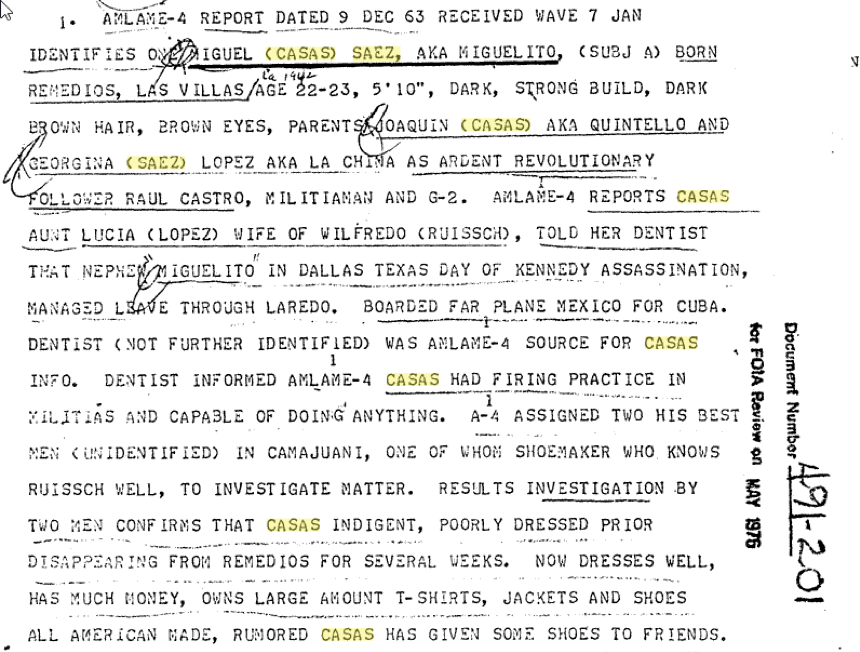
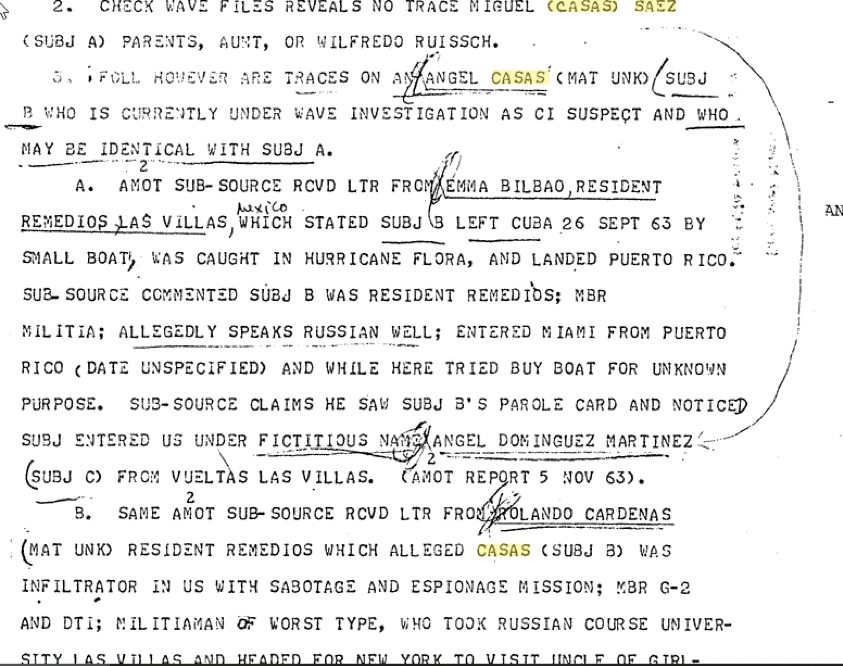
Intel document: 104-10021-1004
No mention of the FPCC, sitting in a cockpit, and very weak sources and sub sources! It does not even come close to the CIA documents on Policarpo Lopez in terms of explosiveness. The two elements that I feel are suspicious, however, are the mention of an agent being present in Chicago on November 1 during the Vallee incident and the entering of Mexico through Laredo as had Lopez and Oswald, which would have been known by very few at the time the report was written, and could suggest that the supposed sources were being given inside information. One could also ask why this document just floated around all these years without closure. Was it kept in the plotters’ back pockets for future consideration and then kept hidden because it became more embarrassing than anything else? So, mark this section of his book down as a mixed bag.
Let’s get back to some of its strengths.
The whole picture of Oswald being part of a network of informants is becoming crystal clear, when you consider his FPCC behavior and the company he kept with the Paines, Guy Banister, Clay Shaw, David Ferrie, the FBI, White Russians, and Cuban exiles. Hill nails this point down and adds a few delicious observations I had not been aware of. Consider this beautiful quote: “Dan Hardaway (sic) may have discovered a slip-up [David] Phillips inadvertently made in a footnote of a self-published book entitled Secret War Diary. Phillips wrote, ‘I was an observer of Cuban and Soviet reaction when Lee Harvey Oswald contacted their embassies.’ According to Hardaway (sic), ‘One of the purposes of an intelligence dangle is to observe the reaction, and from the observation, identify roles, procedures, and processes of the enemy.’”
The author goes on to describe interesting links between the De Gaulle assassination plots and persons of interest in the Kennedy assassination. However, some of his writings in this section are based on the research of Steve Rivele, whose work is far from being unanimously accepted.
“Rivele’s material was used in the 1988 television documentary, The Men Who Killed Kennedy. As well as Lucien Sarti, he also named Sauveur, Pironti, and Roger Bocognani as being involved in the killing. However, Pironti and Bocognani both had alibis and Rivele was forced to withdraw the allegation.”
In his babysitters section, Hill goes over many of the connections that have come out through the years between the people who were close to Oswald (the Paines, de Mohrenschildt, etc.) that completely destroy the Warren Commission’s description of Oswald as a lone nut.
We also get a pretty good snapshot of the Tippit murder and the controversies that surround that investigation.
The author’s exposé culminates with what seems to be a growing consensus among the most serious researchers: that there was, what Hill calls, a three-headed monster made up of the Cuban exiles, the Mafia overseen by Intelligence that was behind the assassination with a cover-up led by LBJ, enabled by the media, the Warren Commission, and Hoover.
Many of the villains he points the finger at are becoming usual suspects. The author, however, ventures even further in an area that does not get enough attention: The role of the 488th Military Detachment. His focus on Pappy Bush buddy, Jack Crichton, is potentially important. His role in the motorcade logistics, security lapses, and the cornering of Marina with his own hand-selected translator should be of interest.
So overall, I would say that this is a solid read with lots of substance and interesting information about Webster and the case overall.
But it is not without pitfalls.
The overall case: The Bad
One of the theories the author puts forth is that both Webster and Oswald were subjects of MKULTRA mind control programs. In the case of Oswald, he points to his ability to face interrogations after capture, his aversion to doctors and dentists, that he was secretive towards Marina, that he had been in Atsugi (one of two CIA bases involved in MKULTRA), that his loner, rebel personality with a dark side made him a great candidate for mind control (sounds a bit Warren Commission apologetic), he was at the right place, at the right time, and had all the qualifications! One witness noticed a change in personalities in Oswald after his stay in Atsugi. Marina stated that he had two personalities. Oswald once made an inquiry about LSD.
This is all interesting but highly speculative… Where is the beef?
This already highly tenuous path opens the door to the author’s next even more tenuous deduction: “If Oswald was part of a behavioral-changing project aimed at creating false defectors, who, in fact, believed themselves to be genuine, and Oswald and Webster’s stories are nearly identical in every other facet including like personalities which fit the desired mold perfectly, was Webster also part of MKULTRA?”
I have many problems with this line of logic:
- It is far from demonstrated that Oswald was part of MKULTRA.
- There is at least one major difference between Oswald and Webster that the author himself pointed out earlier: Webster was a genuine defector and Oswald was not! So why even talk about creating a false defector with Webster? But this particular part of his book gets worse!
While the links the author makes between Webster’s employer and Rand’s Christopher Bird with mind control experimentation and a reference to Webster’s psychiatric help are interesting, he posits that perhaps Oswald and Webster were being programmed during their hospital stays… in Moscow. For me this is where this whole theory is guilty of overreach. It was so difficult to get a spy into Russia in the first place, how in the heck are you going to pull off an LSD/hypnosis treatment of your subjects there, one of whom is a genuine defector… over a two-year period!
Let me play the devil’s advocate on another opinion that is dear to Gary Hill: That Webster would have been the patsy had there been a motorcade in Cleveland. While I agree that Webster’s eccentric personality and odyssey could put him on a long list of candidates, he may have had some disqualifying characteristics:
- Many, if not all, of the other potential patsies including Oswald were either willing informants, intel pawns, or mafia-linked, who were therefore easy to give marching orders to. This is not the case for Webster.
- We do not know that his personal or professional relations could have synergistically nudged him in the right direction the way Oswald’s babysitters and others did.
- The two weeks of senate hearings he attended may have shone too much light on him thus staining him for any strategic manipulation. So, while plausible, Webster’s potential for being an ideal patsy is far from a slam dunk.
Like other authors, Hill expresses the opinion that the assassination strategy was so brilliant that it even placed the CIA in a bind and that it was made purposefully confusing with an overabundance of evidence, so as to have investigators running in circles: A wilderness of mirrors. I had a nice discussion with Larry Hancock about this. My take is that there is so much evidence because of two quasi-catastrophic glitches that occurred:
- The plotters fully expected that the assassination would be blamed on Castro and lead to an invasion of Cuba. They were completely blindsided when they suddenly had to go the lone nut route: Had Plan A gone ahead, there would have been no problem with front shots, Oswald associates, the Zapruder film, witnesses, etc. Instead, they had to bring in Mockingbird, intimidate and remove witnesses, hide the Mexico City charade, put the Warren Commission in place, concoct a slap-happy autopsy, push the single-bullet theory, contain the Cuban and Mafia partners, destroy subsequent investigations, hide files, and everything else that goes with putting the genie back in the bottle!
- The second problem was that Oswald survived 48 hours! He began talking and had to be silenced by a Mafioso. This, of course, opened up a whole other flank… and forced an equally ridiculous cover story. This is why there is so much evidence. This is why the case has been largely solved. This is why there is so much mistrust of the media, politicians, and other cornerstones of the U.S. There was nothing brilliant about it!
Another problem that should be underscored is that a volume this ambitious is also very risky and should get many layers of vetting and editing. While I am convinced that Gary Hill is quite knowledgeable and performed a lot of research, I believe that he could have added a few extra waves of fact checking and quality control. Some of the things he has written will undoubtably present openings for critics to pounce on, while unfairly omitting to point out the quality of much of the book’s contents.
According to the index, there are approximately 750 names of places, people, projects, organizations, etc. in the book. This is certain to cause confusion among readers and create a monster for even the writer when it comes to fact checking.
I cannot tell you how many times people like Jim DiEugenio, Albert Rossi, Chris Lamay (who sadly departed us last year), Larry Hancock, Steve Jaffe, Vince Palamara, Dick Russell, and others pointed me in the right direction, had me remove unsound evidence and corrected my grammar. Despite all this, I find myself cringing sometimes when I read some of my earlier writings whenever I see a spelling error or a false fact.
In this book, there are a number of grammar errors: Poor Dan Hardway sees his name spelled Hardaway no fewer than seven times (this is the second book review I write where this has happened). Dealey Plaza is spelled correctly some twelve times and Dealy three times; Bathesda should be spelled Bethesda, Marsaille should be spelled Marseille… add a number of typos to these errors and good work like this will take a credibility hit. My suggestion is to proofread the document yourself only when alert, use Antidote software, and get two wordsmiths known for their pickiness to go over your work.
My editor would have recommended against bringing up Tosh Plumlee, Steve Rivele, Barr McClellan, Judith Vary Baker, and referring to the whole Joseph Kennedy Mafia-double-cross saga, because of the doubts they evoke in the minds of many. I am certain that his friends Walt Brown and Carol Hewitt would have urged caution.
Though I found most of the sources the author refers to reassuring and clear, at times I felt that he too often went with other authors’ writings rather than examining the original source documents, the Saez files being a good example. At times the author refers to documents with no way for the reader to find them: “Documents unearthed in the 1970s show the FBI had suspected Osborne as a major suspect in its massive JFK assassination investigation”; “According to testimony given by a witness in an assassination attempt on a district judge to assistant attorney Bill Alcorn, on November 22, 1963, Osborne and ten riflemen were living at 3126 Harlandale Street”; “New forensic evidence suggests that two individuals known as Lee Harvey Oswald enlisted in the Marines in 1956.”
Generally speaking, I think Gary Hill would have been better served by focusing more on Webster and false defectors and by staying clear of some of the more debatable stories that have popped up over the years. This, however, is a personal opinion and I do understand the temptation to broaden the scope, as many authors end up doing.
Final thoughts
The JFK assassination was arguably the most important one in the last century. We are still feeling the aftershocks, quite intensely actually. The pillars of U.S. democracy cracked at the seams in 1963. An elected and popular president was taken out, for the benefit of so few. A masquerade of law and order was put in place by the benefactors. The fourth estate shamed itself by choosing the side of the winners. Historians brainwashed decades of young students by parroting the Warren Commission fairytale. In power behind the scenes and emboldened, the perpetrators were pulling the strings on a number of political assassinations that followed, unholy drug and arms deals, political dirty tricks, coups and wars, Wall Street money games, and other major scandals that came in waves and went unpunished. You know something is wrong when the people responsible for millions of deaths in Vietnam alone, trillions of dollars in damages and inequalities in the world’s most powerful country are living the life of Riley, while at the same time four white cops took George Floyd’s life because of a fake 20 dollar bill.
While most people believe there was a conspiracy in the murder of JFK, those who have a pretty good idea of what actually happened probably number under 1000 worldwide. Gary Hill is one of them. While some of the details in his book are debatable, he understands the large picture.
The U.S. and much of the world is disease-ridden right now with punch-drunk leadership that seems clueless. The pandemic is not just one of COVID-19. It is one of intolerance, inequality, distrust, brutality, weaponized citizens, climate threats, stress, and division.
There is mobilization going on right now, all around the world that is seeing people of all ages and all races demanding change from their leaders. It is reminiscent of how Vietnam was finally forced to an abrupt end by young, concerned citizens on a mission. Ordinary people are demanding much more than the end of chokeholds by police. They are asking for meaningful and just progress. If change is to be long-lasting, they need to get at the root of what has caused these problems in the first place, which begins with understanding the real political systems we live under. Why does everyone want sensible gun laws, climate policies, and health care, but cannot get it? Find out who the real power brokers are and you will understand how your country really does govern itself.
Which brings us back to understanding 1963. Within a few months, two major pieces of work will be released that will shed even more light on the JFK assassination, which will bring us very close to a complete picture of what really took place and its impact on the world we live in. One is Oliver Stone’s new documentary JFK: Destiny Betrayed, the other, based on a preview I have received, is a paper written by Larry Hancock which will appear on the Mary Ferrell site.
Gary Hill solved the case to his content after fifty years of reading, researching, and networking. He did not sit on this. He decided to pass on his knowledge and opinions about the overall case to the rest of us and to document what he found about Robert Webster and he shares these findings. He did not do this for money or glory. His book is not perfect, but it is good and he deserves our gratitude for doing his share in fitting in small pieces of the puzzle.
-

Trump and Kennedy? Is Politico for Real?
Politico was started back in 2007 by two veterans of the Washington Post, John F. Harris and Jim VandeHei. It was reported at the time that Post management, including Ben Bradlee, did not wish to fund an online venture. Therefore, the partners went to Albritton Communications, specifically Robert L. Albritton, for startup costs. The Albritton family had consolidated and salvaged what was left of the Washington Star conglomerate. With the millions on hand, Politico began hiring MSM fellows like Mike Allen from Time, and commentators like Mike Kinsley and Joe Scarborough. Due to sites like Politico, what promised to be an online revolution in journalism was stillborn. Considering what Politico turned out to be, it’s hard to see what people like Bradlee could have objected to.
An example would be the book published in 2008 by Harris and ABC correspondent Mark Halperin. It was titled The Way to Win: Taking the White House in 2008. That book focused on the Bush and Clinton families, father and son, husband and wife, and how they had won election sometimes using each other’s techniques. It also spent time on Karl Rove, in appreciative aspects, as being a smart presidential campaign manager. After the election, Harris and Halperin had custard pie all over their faces, because Barack Obama had won both the primary and the election, with a team not at all owed to either the Bush or Clinton camp. And Rove, since he was forcefully retired due to the Valerie Plame scandal, has not run a presidential campaign since. If nothing else, the book showed just how much Harris had invested in the status quo, i.e. in a very conservative GOP and a centrist/right Democratic Party.
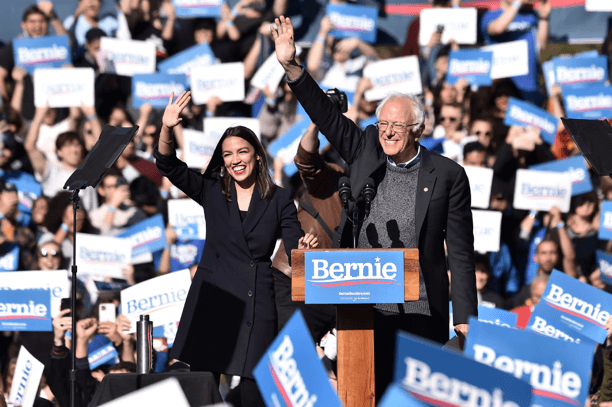
Bernie Sanders campaigning with Alexandria Ocasio-Cortez
From the above example, one could predict that Politico, like much of the MSM it represents, was intent on being critical of the Bernie Sanders candidacy. This was both before and after he dropped out of the race this year. (Click here and here)
In fact, in surveying the way they headline certain events, it is hard not to write that they almost celebrate the losses of progressive candidates. (Click here for an example) They are also eager to cast many topics, issues, and political races as left vs. right, or center vs. right. (Click here for an example) In other words, the idea is to keep America divided, as Harris tried to do in his 2008 book. Consequently, there is almost no vision, insight, and too little in-depth reporting as to what the underlying truth (or truths) of these matters may be. Media Matters, for example, has frequently been critical of Politico. (Click here for details)
Of course, this quite naturally means that Politico cannot be fair, objective, or honest about the Kennedys. Because JFK, RFK, and Ted Kennedy were trying to get at the underlying truths of many of the problems with America (e.g. race, economic inequality, education, and health care). A good example of this targeting occurred in April of 2018, when the film Chappaquiddick was released. Politico could not just review the film. They used the picture’s release to fill a huge top headline on their site, for two days. Peter Cannelos’ long essay was so negatively tilted that, in reference to the concurrent documentary mini-series The Kennedys, he implied that the series was complimentary to the family. (Click here for a more realistic view) In another example, consider their take on Robert Kennedy. On the 50th anniversary of his assassination, they ran an article entitled “The Bobby Kennedy Myth.” (Click here for the article)
They are at it again; this time concerning John Kennedy. On June 13th, they printed an article by someone named Peter Keating. They billed Keating as an “investigative reporter”. In establishing that credential, they did not say what he investigated. It turns out that Keating is a sports writer. He writes mainly for ESPN, and his central beat is something called sabermetrics. (Click here for an example) If one does not know what that term means, please watch the Brad Pitt film Moneyball. How this area of study made Keating an authority on John Kennedy’s political career escapes this author—as it does probably many others. In fact, it shows that Politico does not mind who authors their Kennedy hit piece articles. They will bend over to cloud the author’s lack of established credentials.
The title of Keating’s essay is “How JFK Paved the Way for Donald Trump.” I am not kidding. Just when one thinks American journalism cannot get any worse, you can rely on Politico to give us a further piece of flapdoodle. What is the point of the article? Keating is trying to insinuate that, somehow, Kennedy’s 1960 campaign for the presidency had something to do with the election of Donald Trump in 2016. To say that this is far fetched is not accurate. To anyone familiar with Kennedy’s career it’s a bunch of horse feathers. The idea is to suggest that somehow Kennedy’s campaign in 1960, particularly the primary, exemplified how Trump could win the presidency in 2020.
The primary system had been around since the early 1900’s. It had been a reform of the Progressive Era to give the public more of a say in the nominating process, instead of exclusively being the role of the state party leaders. They were not as widespread as they are today, so they were not as definitive. But to say they had no impact at all is simply wrong. For instance, William McAdoo swept the Democratic primaries in 1924 and almost won the nomination. He had to be stopped at the convention, because he was backed by the Klan. It took 99 ballots to get rid of him.
Amazingly, but predictably, the sportswriter completely passes over the 1952 GOP primary. There were four major candidates that year: Earl Warren, Harold Stassen, Robert Taft, and Dwight Eisenhower. The battle winnowed down to Taft and Eisenhower and it was quite close. But Thomas Dewey, who many thought was going to run, did not. And he ended up supporting Eisenhower through his influence in New York which did not have a primary. To show how far American has come, at that time, many people in the Republican Party thought that Taft was simply too conservative to win. (Richard Bain and Judith Parris, Convention Decisions and Voting Records, pp. 280-86) In 1956, in the Democratic primary race, Governor Adlai Stevenson won out in the primary season over Senator Estes Kefauver. So to somehow say that Senator John F. Kennedy suddenly discovered the primary season as a way to the White House is simply tapering history.
And that’s not all Keating does to fulfill his agenda. In 1956, there ended up being an intrastate battle in Massachusetts for control of the Democratic machinery for the upcoming nominating convention. Kennedy sensed, correctly, that the state pols—Congressman John McCormack and local hack William Burke—were going to try and block the nomination of Stevenson. Kennedy had supported Stevenson, would end up speaking at the 1956 nominating convention, and then placed him in his administration as representative to the United Nations. McCormack had opposed Stevenson in the primary and actually won by a write-in vote. Mr. Burke boasted about this victory and even personally insulted Kennedy for supporting the losing Stevenson. After that, JFK had no choice but to go after the duo, for both Stevenson’s sake and the personal insult. So, Kennedy, through his proxies, fought this move and, as Dave Powers and Ken O’Donnell have written, it ended up being a “Boston Irish political brawl.” Kennedy was outnumbered on the state committee, but there were enough uncommitted for him to lobby them and turn them to his side. He told Powers and O’Donnell he would call them and even ring doorbells if he had to and he did. At the end, Burke was out. (For a complete chronicle of this episode, see Johnny We Hardly Knew Ye, by O’Donnell and Powers, pp. 124-32)
The idea that this episode taught Kennedy how to control his own delegation is undermined by the facts that Kennedy allowed McCormick to run as a favorite son at the convention and, contrary to what Keating/Sabermetrics writes, Kennedy did not appoint his own man to the state chairmanship. Pat Lynch was so unknown to him that he needed a personal audience with him to remember who he was. (ibid, p. 127) And even then, he still did not accept him. It was O’Donnell and Powers who pushed his candidacy on him.
This was all part of Kennedy staying true to Stevenson, who was the national leader of the party. The idea that the state party, without this, would not have supported him in 1960 when he ran is a bit silly—even for sabermetrics. But Kennedy first really made a name for himself on the national level when Stevenson threw open the vice-presidential nomination to the convention that year. (ibid, p. 134) Although he did not win, most attendees were surprised at how strongly JFK ran.
That is because, unlike Trump, the senator had already been around for ten years. In his valuable book, JFK: In the Senate, John T. Shaw chronicles his entire congressional career. (Click here for a review) And the very next year, Kennedy was going to indelibly imprint himself on the national consciousness with his famous, powerful Algeria speech, which he had been headed for ever since his visit to Saigon in 1951. (See Shaw, p. 101) If you did not know who Kennedy was before that speech, you sure as heck knew who he was afterwards. As Richard Mahoney wrote, there were 138 newspaper editorials printed over that highly controversial speech. The vast majority were negative. (Mahoney, JFK: Ordeal in Africa, p. 21) As both Mahoney and Shaw write, this speech made Kennedy the titular leader on foreign policy in his party. (Shaw, p. 110) Partly because he had deliberately singled out and criticized President Eisenhower, Secretary of State John Foster Dulles, and Vice-President Nixon in his speech and said there had to be a different approach to Third World nationalism rather than supporting European colonialism. In fact, Kennedy now made the cover of Time Magazine for December 2, 1957. The story’s title was “Man out Front.” (Mahoney, p. 29)
As the British commentator Alistair Cooke had stated, by his purposeful attack on the White House, Kennedy had positioned himself as the man the Republicans now had to do something about. The presidential hopeful that the GOP now had to scorn: “It is a form of running martyrdom that Senators Humphrey and Johnson may come to envy.” (Mahoney, p. 29) None of this is in Keating’s article. Yet this is the way JFK had now become a national figure.
I don’t see how much more of a contrast with Donald Trump that could be. By the time of the 1960 primary, Kennedy had been in office for 14 years. He was a prominent member of the senate not just through his high profile in foreign affairs, but also because of his service with his brother Robert on the Senate rackets committee and their opposition to Teamsters leader Jimmy Hoffa. And there was no real brilliance, Keating’s word for it, to his 1960 primary campaign. It was pretty fundamental in its planning. Kennedy got in early, had a good manager in his brother Robert, and spent a lot of money in defeating Senator Hubert Humphrey. But even here, Keating gets it wrong. As everyone but Keating knows, the man Kennedy was worried about was Lyndon Johnson. He wasn’t quite sure he could beat the Senate Majority Leader. So, he sent RFK to Texas to sound him out. Johnson told Bobby he was not going to run. This is something that even Chris Matthews knows. (See Bobby Kennedy, pp. 162-63) This assured JFK, since he thought that if either Stu Symington or LBJ won, it was going to be the same old Acheson/Dulles Cold War foreign policy all over again. (Harris Wofford, Of Kennedys and Kings, p. 37) As we have seen, Kennedy had charted out a different course that had put him near the forefront of the leadership in his party. This, as we have seen, was an important motivation for his running that year.
But for whatever reason, Johnson did get in the race. He announced on July 5th, which was a week before the convention opened. To this day, no one knows why Johnson waited so long to announce his candidacy. But the amazing thing about it is this: entering just one week before, he amassed more delegates than every other competing candidate combined. And it was not really close. In fact, Johnson’s late candidacy was so strong that Bobby Kennedy now had to switch tactics. He now had to pull out all the stops in order to make sure his brother won on the first ballot. He placed his agents on the floor to make sure no one was going to switch their votes to LBJ. Since if it went beyond a first ballot, there was a real danger that Johnson would outlast Kennedy. (Arthur Schlesinger, Robert Kennedy and his Times, pp. 213-15) Again, how does this resemble the Trump coronation in Cleveland? Who is to say that if Johnson had gotten in early, with all of his Texas backers, he might not have won?

President Trump’s photo-op in front of the historic St. John’s Church
In comparison to this, Trump never held any political office before his run for the presidency. And, in large part, that is the issue that he ran on. The public in 2016 was so sick of the political establishment on both sides that they voted for Trump and almost voted in Bernie Sanders. It was a different political universe in 2016. But further, as anyone with any knowledge of recent political history understands, the primacy of the political primaries was not forged in steel until after 1968, due to the famous McGovern-Fraser reforms. (Click here for details)
Johnson could not have done what he did after those reforms. They were established partly as a result of what happened to RFK’s constituency after his assassination. Those changes eventually ended up mandating that each state have a primary or a caucus. The man who commandeered this new system, thus setting an example which has been mimicked by many, was Jimmy Carter in 1976. I, for one, am not convinced Trump would have made it without McGovern-Fraser, for the simple reason that almost all of the GOP establishment was opposed to his candidacy.

Military presence in Washington, D.C.
As the reader can see, there is no real efficacy to Keating’s article. It is just a part of the Harris agenda. And it’s not possible to fail to take note of the timing. As everyone knows, the Trump presidency, to put it mildly, has now confronted some tough times. Between COVID-19 and the George Floyd shooting in Minneapolis, things have gotten quite rocky. And between his denial of the first and his rather inept staging of a Bible pledge in Lafayette Park, he has not reacted well to either one. The Trump ally, Senator Tom Cotton, has tweeted that the Floyd protesters should not just face combat troops, but death from the skies: “Let’s see how tough these Antifa terrorists are when they’re facing off with the 101st Airborne Division.” And if that were not enough, Cotton then drew up his own battle order: “And, if necessary, the 10th Mountain, 82nd Airborne, 1st Cav, 3rd Infantry—whatever it takes to restore order. No quarter for insurrectionists, anarchists, rioters, and looters.” We all know what “no quarter” means do we not? (Fintan O’toole, NY Review of Books, 7/23/20)

Deputy Attorney General Nicholas Katzenbach confronting Governor George C. Wallace
As O’toole continued, that was not just bombast, because seven hundred soldiers from the 82nd Airborne did go to Washington. They were in the streets of the capitol, as were the low-flying helicopters and sand-colored Humvees. (ibid) And recall, the demonstrators in Lafayette Park who got tear gassed and clubbed were peaceful protesters. This makes for a vivid and continuing comparison with President Kennedy—which Keating does not mention. During the days of the civil rights demonstrations, Kennedy never wanted to call out troops. If needed, his graduated policy was to go from federal marshals, to the National Guard, with federal troops only called in as a last resort. And this was in aid of the civil rights cause and against the right-wing forces opposing them. For example, when governors Ross Barnett and George Wallace refused to uphold court orders to integrate, respectively, Ole Miss and the University of Alabama, Kennedy relied on federal marshals, only calling in troops—at Ole Miss—when the organized rightwing demonstration to stop James Meredith from registering grew violent. At Alabama, in addition to the National Guard, he had 3000 troops in reserve to oppose the 900 state troopers and police that Wallace had summoned to the scene. Kennedy had the National Guard handle the Alabama conflict.

John F. Kennedy’s historic civil rights speech
As I have demonstrated with facts, President Kennedy did more for civil rights for African Americans than any president since Lincoln. And it was not even close. He did more than Roosevelt, Eisenhower, and Truman combined in about one tenth the time. As O’toole writes, for Trump to say that he has done more in that cause than anyone since Lincoln, completely overlooking Kennedy, that is just self-promotion as well as being ahistorical. (For the evidence, click here and scroll to the chart at the end) It is startling that Trump could somehow miss Kennedy’s 1963 civil rights speech, which JFK made right after his confrontation with Wallace. But alas, Trump is the president who said there were good people on both sides at Charlottesville. In a phone conversation with Dick Gregory during the Birmingham crisis, Kennedy referred to the rightwing racists as “bastards”. In fact, some make the argument that Trump’s policies have exacerbated the impact of COVID-19 on the African American community. (Click here for details)
It’s even more shocking that Trump can say this at a time when, as Alan Mcleod has written in MintPress, “A record 36 million Americans have filed for unemployment insurance, with millions losing their employer based healthcare plans and around a third of the country not paying its rent.” In the midst of this, working class Americans get a $1,200 check, while the Federal Reserve has given about $4.25 billion to big banks and corporate America. As Mcleod further wrote, the fact that the very upper class has risen in riches so rapidly signifies that their wealth “is barely connected to productive forces anymore and has more to do with how much wealth one can take from public coffers.”
In reaction to all this, the man who President Trump is starting to resemble is Richard Nixon. As O’toole notes, on June 2nd, Trump issued one of his sparsely worded tweets: “SILENT MAJORITY!” If the reader recalls, with hundreds of thousands of demonstrators in the streets against the Vietnam War, Nixon used that phrase in a November 1969 speech. It was specifically about the war. Nixon was appealing to “the great silent majority of my fellow Americans” to stand with him against the demonstrators. That brief message echoes Trump’s earlier tweets in which he requested that his followers “LIBERATE MICHIGAN,” “LIBERATE VIRGINIA,” and then save your great 2nd amendment. It is under siege.” (Click here for details) How can anyone not interpret this as a call to the rightwing militias to bear arms, if they have to, in order to stop the COVID-19 lockdowns? That appeal to armed extremists has also provoked confrontations with George Floyd protestors. (Click here and here for details)
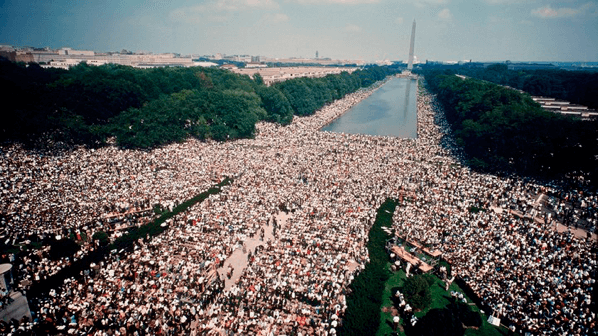
August 28, 1963 – 300,000 people peacefully demonstrating for justice and jobs
Richard Nixon was expert at dividing Americans along political fault lines: Vietnam and his Southern Strategy on race. JFK tried to unite those of different races and classes. One great example being his sponsorship of the March on Washington. (See Irving Bernstein, Promises Kept, pp. 113-17) Kennedy was the first white politician to approve of this rally, on July 17, 1963. He then assigned his brother to make sure it came off perfectly and no extremists would upset it in any way. The Kennedys then got UAW chief Walter Reuther to bus in union workers, so the attendance would be both large and diverse. As many have said, that demonstration was probably the high point of post-World war II liberalism. It followed by two months, what many consider the greatest presidential civil rights speech since Lincoln.
Make no mistake; none at all. Politico wants us to forget all about an example, so long ago, when a president and his brother were actually leading the country on civil rights. For me, it’s pretty transparent: that is what the publication of this piece of malarkey is really about. It’s to throw sand in your eyes in hopes the public doesn’t notice how far we have fallen.
Peter Keating should be ashamed of himself.
Addendum:
Click here or on the image below to see just how far Trump will go to polarize the racial issue:
