Blog

  • All in the Family: Charlotte and Jonathan Alter

    All in the Family: Charlotte and Jonathan Alter


    Charlotte Alter is a correspondent for Time magazine. She is the daughter of longtime MSM scion Jonathan Alter. Jonathan was one of the first to suggest after 9/11 that torture might have to be used since it works. He also worked on the Periscope column for Newsweek which defined what the Conventional Wisdom (CW) was on major issues. Charlotte also appears on Sirius/XM and sometimes writes for the New York Times. Here is a link to her article in Time which got her a spot on MSNBC with Chris Hayes.


    September 15, 2020

    Hi Charlotte:

    I read your recent Time article and caught your segment on the “All In with Chris Hayes” show. Please don’t lump JFK assassination researchers in with Q-Anon.

    Let me ask you some questions:

    Have you done any research into the JFK assassination?  Or are you “impenetrable” and “impervious” when it comes to facts regarding the assassinations of the 60’s?

    That “Conspiracy Theory” label is awfully convenient to throw around when you want to dismiss topics that are uncomfortable, that you know little about, or that may not be as beneficial to your career to address seriously and impartially, so:

    Which “official version” do you believe:

    1. The Warren Report from 1964 that said Oswald acted completely alone, or
    2. the findings of the US House Select Committee on Assassinations (HSCA) from 1979 which determined that there were multiple shooters (and yes, one from the Grassy Knoll)?

    Do you think that multiple shooters could be firing at the president at the same time, and that it could still not be a conspiracy? i.e., Are you a Coincidence Theorist?

    Have you read the Warren Report, or anything from its accompanying 26 volumes of hearings and evidence?

    Have you read the HSCA Report?

    Have you read any of the hundreds of books on the assassinations of the 60’s, either pro- or anti-conspiracy?

    Have you read any of the thousands of documents released by the Assassination Records Review Board (ARRB)?

    Do you know what the ARRB is or how it came into being?

    Are you aware that the ARRB was created by an Act of Congress, signed by the President?

    Can you explain why the Secret Service protection around JFK was uncharacteristically weak in Dallas, despite previous credible threats on his life during trips to Miami, Chicago, and LA?

    Certainly that could not have been an “inside job”, right?

    Do you think that conspiracies can ever exist?

    Are those who believe that Watergate was a conspiracy just “theorists”?

    Do you believe the entire King family are Q-Anon-style conspiracy nuts, because they unanimously believe that James Earl Ray was innocent of killing MLK Jr.?

    Do you believe that RFK Jr. is a Q-Anon-style conspiracy theorist because he believes that Sirhan Sirhan is innocent of killing his father? (I would guess that he’s looked into the facts of this case a bit more than you have.)

    I would expect that like most MSM’ers, you will handle these questions by not responding and tell yourself that you simply have no time for such nonsense. In that case, maybe you could try to answer them for yourself to prove that real journalists “do their research” before they spout off on TV.

    Maybe you might start to see where this “disdain for the mainstream media” comes from? Personally, I have to agree with Bob Dylan when he said If I want to find out anything I’m not going to read Time Magazine, I’m not going to read Newsweek, I’m not going to read any of these magazines, because they just got too much to lose by printing the truth, you know that.

    Regards,

    Wayne

  • Sylvia Meagher and Clay Shaw vs. Jim Garrison

    Sylvia Meagher and Clay Shaw vs. Jim Garrison


    In writing my elegy for Vincent Salandria, I reviewed his career in the JFK field, cataloguing his achievements and his characteristics as a critic—the first critic—of the Warren Report.

    In reviewing that impressive record, I was again struck by his personal relationship and his lifelong fairness to New Orleans DA Jim Garrison. What made this aspect more salient was something I may have underplayed in my article: Salandria spent decades as a practicing attorney in Philadelphia. In my article, I noted that Vince was a high school teacher in 1964 when he encountered Arlen Specter talking about the Warren Report at a Philadelphia bar association event. That was true, but Salandria taught part time. He practiced law in the afternoons, and after he retired as a teacher, he worked for the Philadelphia school system as an attorney.

    Salandria had attended law school at the University of Pennsylvania in Philadelphia. That university is a member of the Ivy League and their law school is habitually rated in the top ten of the US News and World Report rankings in the field. (For 2021, they are rated number 7). Therefore, Salandria was one of the few early critics who was also a lawyer. In fact, in the early critical period of 1964–66, aside from Mark Lane, he may have been the only one. (They would later be joined by attorney Stanley Marks of Los Angeles.) This placed him in a position to not only understand more precisely what the Warren Commission had done with the evidence, but also to understand what Jim Garrison was up against when he began his criminal investigation in New Orleans. As I noted in my requiem, Salandria told me that at his first personal meeting with Garrison he told him he probably would not succeed in his attempt to flush out the conspiracy by beginning at the lower level and leveraging them against the upper level. But he would be able to learn something about the plot by the acts of those who would try and interfere with his inquiry.

    With what the Assassination Records and Review Board declassified about New Orleans in this regard, Salandria—as he usually was—proved to be prescient in that prediction. For as we now know, very soon after Garrison’s investigation was made public, the CIA was recruiting local attorneys in New Orleans to defend certain suspects and defendants (e.g. lawyers like James Quaid, Edward Baldwin, and Steve Plotkin). In September, at the request of Director Richard Helms, the Agency assembled its first meeting of the Garrison Group. At that meeting, Ray Rocca, James Angleton’s first assistant, declared that if things were to proceed as they were, Clay Shaw would be convicted. (James DiEugenio, Destiny Betrayed, second edition, p. 270) The meeting was convened by Helms in order to consider the implications of Garrison’s actions before during and after the trial of Clay Shaw. From the declassified record, the result was that certain counter measures were now taken to obstruct, cripple, and negate Garrison’s inquiry (e.g. blocking service of subpoenas, flipping witnesses, recruiting infiltrators). (Ibid, pp. 271–85)

    I should add here another key action taken by the Agency around this time. In April of 1967, they issued worldwide a memorandum which was titled “Countering Criticism of the Warren Report”. This memo was essentially a call to action to all station chiefs to use their assets in order to attack the critics of the Commission. It even outlined techniques to use in the attacks, for instance:  accuse them of being interested in monetary gain, of having been biased from the start, or of having leftist political orientation. As author Lance deHaven Smith has noted, it was around this time that the New York Times began to use the phrase “conspiracy theorist” in a much more profuse and pernicious manner than before.

    Later—in July of 1968—the CIA distributed an attack article on Jim Garrison which had been written by Edward Epstein and published in The New Yorker. The memo advised all station chiefs to use the article in order to brief any political leaders; or assign it to assets in order to counter any attacks. This important memo, and the article’s author, should be kept in mind as we progress.

    Since Salandria predicted that things like the above would occur, and since he visited Garrison in New Orleans and served as an advisor for the Shaw trial, he appreciated what Garrison was doing in the face of the forces arrayed against him. Some others who did so were Mark Lane, Penn Jones, Maggie Field, Ray Marcus, and, at the time, Harold Weisberg. (Lane and Weisberg were actually working with the DA.)

    But there was a prominent Commission critic who, quite early, did not appreciate the warnings Salandria had issued about what Garrison was doing or the countermeasures taken against him. That critic was Sylvia Meagher of New York. At a rather early date, she staked out a position that separated her from the above writers and researchers. She also fostered a counter-movement in the critical community against Garrison. That movement would eventually include Josiah Thompson, Peter Scott, Paul Hoch, and, later, Anthony Summers.

    I am going to say some adverse things about Meagher in this regard, but I want to make it clear at the outset that none of this should detract from her achievements in the field. Her subject indexes to both the Warren Commission and the House Select Committee volumes were and are valuable assets to the research community. Her critique of the Warren Commission, Accessories After the Fact, is still one of the signal achievements in the literature on the case.

    It is one thing to expose a patently phony murder investigation, especially one that furnished the critic with 26 volumes of testimony and exhibits in order to dismantle itself—since so much of the 26 volumes contradicted, or at least compromised, the conclusions in the report. It’s quite another to try and find out what actually happened in a complex political assassination and what the smoke and mirrors were all about. As Vincent Salandria once said, the Warren Report was just too easy to tear apart. To the point that he came to think that it was designed to collapse.

    II

    Sylvia Meagher was born in New York City in 1921. Her maiden name was Sylvia Orenstein. She grew up in a rigidly orthodox Jewish home in Brooklyn. (Praise from a Future Generation, by John Kelin, p. 148) She dropped out of college and took a job as an analyst at the World Health Organization (WHO), which was directly associated with the United Nations. She briefly married her college instructor, James Meagher. He turned out to be an alcoholic, so she divorced him. (Kelin, p. 147)

    Although Gerald Posner called her a radical leftist, this was not accurate. What angered Meagher about the fifties was McCarthyism. She greatly resented President Truman’s obeisance to the Red Scare by his creation of Loyalty Boards. She was also resentful that the first Secretary General of the UN, Trgve Lie of Norway, allowed American officials to question employees of the UN and WHO in that regard. (Kelin, p. 114) He allowed the FBI to fingerprint his employees and to set up an office inside the Secretariat. As a result, many employees went before Senator Pat McCarran’s Senate Subcommittee on Internal Security and 47 went before a New York grand jury. There was a case where a woman did not take the fifth and admitted to attending a communist meeting some years prior; she was terminated. Several had to file a lawsuit for a monetary settlement, since not even Secretary General Dag Hammarskjold would rehire them. (Kelin, p. 115)

    Meagher insisted that if she was loyal enough to hire in the first place, she should not be called before a board. There was no reason in the record for her to reply to questions about who she was or what party she was loyal to. She was not fired, even though when she did appear before a board she refused to answer any questions. (Kelin, p. 118)

    Within an hour of the assassination—and perhaps because of this experience—Sylvia Meagher predicted that either a leftist or pro-Castro suspect would be arrested for the crime. But even she was surprised when it happened within 90 minutes of the assassination. (Kelin, p. 145) Unaware of how Earl Warren was coerced by President Johnson to serve as chairman of the Warren Commission, she wrote to the Chief Justice. She said, “I have no doubt whatever that you personally will do everything humanly possible to determine the truth.” (ibid)

    As we all know today, such was not even close to what Warren was about to do. Let us grant the lack of knowledge about Johnson intimidating Warren with the threat of atomic annihilation. (See Mark Lane, Plausible Denial, p. 51) One should have been able to figure out something was wrong with Warren from two early matters. First was his famous utterance that some of the material given to the Commission might not be seen in the lifetime of current reporters. (Lane, p. 53) The second giveaway was Warren’s failure to grant representation for Oswald’s interests before the Commission. The excuse for this was, again, secrecy. (See WC Volume 24, Commission Exhibit 2033) While in session, no outside attorney was going to get to see even a small percentage of the documents that the executive intelligence agencies had given the Commission.

    That second reason should have been a very clear “tell,” because of the Gideon vs. Wainwright case which Warren had just presided over in early 1963. In that case, his Supreme Court stated that a guilty verdict against Clarence Gideon had to be overturned, since the defendant had no lawyer. As a result, Gideon was granted a new trial with an attorney and he was acquitted. (James DiEugenio, The JFK Assassination: The Evidence Today, p. 309) But now, with the JFK case, Warren was willing to toss that decision aside. In other words, while in session, the proceedings would be virtually secret and Oswald would have no representation. In other words, Warren was presiding over what was pretty much a star chamber.

    After attending a lecture by Mark Lane in New York, Meagher’s interest in the case grew. Within two months of reading the Warren Report, she composed a 15,000 word critique. (Kelin, p. 146) She complained about the lack of “objective criticism” of the report. That critique was not published. In 1965, she composed her own index to the 26 volumes of testimony and exhibits that were issued about two months after the Warren Report. When this was finished, she then expanded her original critique into a book entitled Accessories After the Fact. It was published late in 1967 by Bobbs Merrill of Indianapolis.

    During this period, there was a debate in the media about the Warren Report. Surprisingly, some luminaries on the left sided with Earl Warren, for example prominent attorney and author A. L. Wirin, maverick journalist I. F. Stone, and The Nation magazine. (Kelin, p. 196; pp. 179–82; p. 195) The fact that the MSM and some of the left was arrayed against the critics made it difficult for them to get their writings out to the public. It was made all the worse by the newspaper of record in Meagher’s hometown.

    III

    Meagher lived at 299 West 12th Street, an apartment building in Greenwich Village. She was well acquainted with the New York Times. On November 25th, the headline of the self-proclaimed paper of record read as follows: “President’s Assassin Shot to Death in Jail Corridor by a Dallas Citizen.” In other words, the day after Oswald was killed, he became the assassin of President Kennedy. Not the accused assassin, or the alleged assassin, just plain the “President’s Assassin.” The man who did not even know he had been charged with Kennedy’s death, who never had an attorney, who talked for hours and always maintained his innocence while in detention. In spite of all that, the Grey Lady maintains its November 25th rubric about Oswald until today.

    But as the late Jerry Policoff proved in his milestone article about the Times coverage, that is really too mild a characterization, because the Times did not just back the Commission. It worked assiduously to promote the Warren Report. While the Commission was in session, it reported leaks denying there was evidence of a conspiracy in the case. (March 30, 1964) When the report was released in late September, the Times composed an accompanying editorial which stated that the report destroyed any basis for a conspiracy theory. (September 27, 1964) That was on the day the 888 page report was made public. In other words, the praise was already composed and in place the night before. But consider this fact: it was still almost two months prior to the 26 volumes of testimony and exhibits being published. Since the report had over 6,000 footnotes—almost all of them to those 26 volumes—how could anyone make any kind of binding analysis and evaluation of the report before they saw the testimony and exhibits It was based upon?

    But in spite of all this, in 1966, criticism of the Commission produced best-selling books by writers like Edward Epstein (Inquest) and Mark Lane (Rush to Judgment). On November 25, 1966, Life magazine ran a cover story based upon frames from the Zapruder film entitled, “Did Oswald Act Alone? A Matter of Reasonable Doubt.” Therefore, in late 1966, Times reporter Tom Wicker wrote a column in which he said that a number of impressive books had opened up questions about the Commission’s “procedures, its objectivity, and its members’ diligence.” (September 25, 1966) In the November 1966 issue of The Progressive, Times editor Harrison Salisbury admitted that some authors had produced “serious, thoughtful examinations” and convinced him that questions of major importance had gone unanswered.

    At about that time, November of 1966, the Times quietly undertook a new inquiry into the Kennedy case. It was under Salisbury’s direction. He told Newsweek, “We will go over all the areas of doubt and hope to eliminate them” (Newsweek, December 12, 1966) About a month into the inquiry, Salisbury was sent to Hanoi at the invitations of the North Vietnamese. Reporter Gene Roberts told Policoff that there really was no relation between Salisbury’s journey and the end of the quiet inquiry.

    But such was likely not the case. In 2017, the JFK Act declassified an informant’s message to them about the Salisbury investigation. The CIA had passed it on to the FBI and this version was released fifty years after the fact. Peter Kihss, who actually knew Meagher, was one of the reporters assigned to the Kennedy investigation. He told an informant that the Times was working on “a full scale expose of the Warren Report, which will find that the Warren Commission’s original findings were not as reliable as first believed.” (CIA to FBI 1/23/67, based on original report of 12/22/66) This tends to undermine both the removal of Salisbury—why not send another editor?—and what Times reporter Roberts said to Policoff.

    With the “full scale expose” squelched, the Times now went back to its “see no evil” posture. On February 28, 1968, the Grey Lady reviewed both Meagher’s Accessories After the Fact and Thompson’s Six Seconds in Dallas. The writer they used for the assignment was the man they usually utilized, Supreme Court correspondent Fred Graham. He found the Meagher book, “a bore” and he thought Thompson’s scientific approach ignored “the larger logic of the Warren Report.”

    It is important to go a bit beyond this early time frame. For on April 20, 1969, The New York Times Magazine published an article entitled, “The Final Chapter in the Assassination Controversy?” It was written by Edward Epstein, the author of the article carried in the aforementioned CIA memo from 1968. Written in the wake of Clay Shaw’s acquittal, it was a harsh attack on the critics as being politically motivated. Epstein had no problem using the word “demonologist” in this regard. In regards to Meagher and Thompson, he wrote that they brought up only two major issues: The Single Bullet Theory and the backward recoil of Kennedy’s head in the Zapruder film. Epstein replied that CBS News in their 1967 special had noted, on the observances of scientist Luis Alvarez, that there were only three “jiggles” in the Zapruder film and this confirmed the Commission’s three shot analysis. In other words, Abraham Zapruder was reacting to the sounds of the three shots and his camera shook slightly.

    There was a serious problem with Epstein’s reasoning. For as had leaked out by this time, and as CBS employee Roger Feinman later revealed, there were more than three jiggles in the film. And Epstein knew this, since he had written Meagher a letter concerning the issue. In that letter, he condemned CBS and told Meagher that she had shown that it was “extremely unlikely, even inconceivable, that a single assassin was responsible.” Meagher wrote a letter to the Times about Epstein’s deception and asked them to print it, “in the interests of fair play and of undoing a disservice to your readers that was surely unintended.” Needless to say, it was not printed.

    But as the reader can see from this analysis, it is clear that by 1968 Edward Epstein had gone from being a critic to being the MSM’s spokesman for the official story. The idea that this conversion happened in the seventies, while he was working on his book Legend, is not accurate. As we will show, there was even more in this regard.

    IV

    Sylvia Meagher worked on the index for Epstein’s book Inquest. (Kelin, p. 283) When it was published in May of 1966, she praised it in M. S. Arnoni’s journal A Minority Of One. On this, she disagreed with both Harold Weisberg and Salandria. Salandria explained what was wrong with Inquest. Epstein had conjured up his concept of “political truth,” in order to explain why the Commission did what it did. That creation now defined a spectrum on the issue. Anyone who still agreed with the Commission could be labeled as followers from “blind faith.” Anyone who specifically attacked, not the politics of what the Commission did, but the underlying forensic fraud it had assembled, these people could now be labeled “demonologists”. (Which, as we saw, Epstein did for the Times in 1969.) This would include those who understood that the Commission had fabricated a case against Oswald. Because of this jerry-built spectrum, Epstein now represented the “respectable” center of the debate. (Kelin, p. 294)

    In fact, the term “demonologist” was actually coined by Epstein. And he used it in the author’s preface to Inquest. (p. xvii) How could one decide at an early date in 1966 as to how fraudulent the Warren Report really was? Or how limited was the cooperation it received from agencies like the FBI, the CIA, the State Department, and the National Security Agency? Especially when one’s main interview subjects were the Commissioners and their working lawyers? (Epstein, p. xviii)

    We know today, and can prove, that the Warren Commission, and the agencies who served it, did do what Epstein says they did not. To use just one example, the FBI lied about the chain of possession concerning Commission Exhibit 399, perhaps the key exhibit in the case. And the Commission accepted that lie. (See The Assassinaons, edited by James DiEugenio and Lisa Pease, pp. 272–86)

    In December of 1966, Epstein was the main author of a special section of Esquire magazine, which was apparently composed for the third anniversary of Kennedy’s murder. It contained rubrics like “Who’s Afraid of the Warren Report” and “A Primer of Assassination Theories.” It was written and designed to reduce the growing public debate to the level of a satirical board game. Apparently, still enamored by Epstein at that time, Meagher contributed a brief journalistic outline called “Notes for a New Investigation”.

    Shortly after, Richard Warren Lewis and FBI informant on the JFK case, Larry Schiller, combined to write the book The Scavengers and Critics of the Warren Report. In its almost manic attempt to smear every consequential critic of the Commission—Field, Lane, Weisberg, etc.—this book might have followed the 1967 CIA memorandum. It was clearly a hatchet job all the way. It was excerpted in The New York World Journal Tribune magazine. But what is interesting is that there was an accompanying LP album to the book called “The Controversy.” (Kelin, p. 355) On that album, one can hear Epstein briefly joining in some digs at the critics. If there was one volume that attempted to “demonize” the critical community, this was it. But even months before that release, Salandria had suspected Epstein was a plant. (Letter from Meagher to Field, June 30, 1966)

    In retrospect, there was always something off balance about Epstein. For instance, he did not want to do any publicity tour for his book. (Kelin, p. 319) But when he did do a radio show in New York, it was a debate with Commission junior counsel Wesley Liebeler, who many suspect supplied much of the material for Inquest. As Meagher noted, Epstein was routed in this debate, which supplies an interesting fugue to our next point about Epstein.

    Between Thanksgiving and Christmas of 1966, there was a debate arranged in Boston about the Warren Report. Epstein was invited to be a participant, but he declined the invitation. Vince Salandria did participate and his main opponent was a young scholar named Jacob Cohen. Cohen had presented an article defending the Commission in the July 11, 1966 issue of The Nation. To say this was an interesting event does not begin to describe its importance. John Kelin does a nice job summarizing its aspects in his fine book. I will only focus on this odd fact: although Epstein declined to participate, he did show up. During a break, he approached the stage and addressed Salandria. (Kelin, p. 334) The following exchange took place:

    Epstein: What are you doing in Boston?

    Salandria: I’m telling the truth to the people. What are you up to Ed?

    E: I’ve changed Vince.

    S: You mean you made a deal? That’s OK Ed. You made a deal, that’s alright. But if you get up before a TV camera again and pretend you’re a critic, I’ll tell all about you, Ed Epstein.

    E: You know what happened.

    After that, Epstein went over to the other side of the stage and talked to Salandria’s opponents. Less than two months later, a young journalist named Joe McGinnis came to a lecture that Salandria gave in Philadelphia. Afterwards, he interviewed him at his home. He then published a smear job on Salandria in The Philadelphia Inquirer. (Kelin, pp. 336-39)

    I leave it up to the reader to decide if the two events were related.

    V

    As the reader can see, what Salandria said would happen to Jim Garrison, was actually happening to the critics already, before the exposure of Garrison’s inquiry in February of 1967. Forces were being arrayed against them, pressure was being applied to make them turn, the MSM was out to do them in. (See my discussion of the “Rita Rollins” affair in my obituary for Vince Salandria for another example.) Because Jim Garrison was a DA of a medium sized city and therefore had certain powers prosecutors have, these pressures were ratcheted upwards. I have already mentioned Helms’ formation of the Garrison Group at CIA; the Countering the Critics Memo; the Cleared Attorneys panel in New Orleans. I also believe that, when Garrison’s inquiry was made public, the decision was made at NBC to attack him through their 1967 special and certain aspects of the CBS four-night special were modified to include the DA. I will not review those two programs here, since I have dealt with them at length previously. (See Destiny Betrayed, Second Edition, by James DiEugenio, pp. 237–58; click here for the CBS essay)

    As Paris Flammonde once noted, the specific attack on Garrison began with an article by James Phelan in the Saturday Evening Post, followed by another smear by Hugh Aynesworth in Newsweek, capped off by the NBC special produced by Walter Sheridan. But I should add one detail about the last, which was sent to me recently by ace researcher Malcolm Blunt. When the Review Board was being formed in 1993, Sheridan requested his personal papers on the Garrison NBC special housed at the JFK Library be returned to him. This was made up of 13 file folders. According to my sources on the ARRB, the Board was not able to secure these papers. After Sheridan passed on in 1995, his family gave them to NBC which refused to surrender them. This would seem to indicate that, as I pointed out in Destiny Betrayed, Sheridan and NBC had a lot to hide about the techniques they used in their special in order to produce what any objective reviewer would have to consider a hatchet job.

    One of the odd things about Meagher’s reaction to Garrison’s probe is she never noted any of this. And when I write “never,” I mean never. Until the day she died, she never acknowledged these attacks as an extension, an expansion, and diversification of the techniques that had been used against the critical community already. For a person noted as being careful in her research and objective in her analysis, this makes for a jarring dissonance in any examination of her record in this regard. Because, as has been demonstrated convincingly, what Sheridan and NBC were doing was interfering with and obstructing a state sanctioned murder inquiry. And they were using a variety of illicit methods to do so, up to and including bribery and physical intimidation. (For a brief description, click here)

    As authors like Ray Marcus noted, in all of her writings and letters on the JFK case, Meagher wrote not a single sentence on any of these disruptive techniques. (Letter from Marcus to Meagher of January 18, 1968) This included physical attacks on Garrison’s witnesses. And these attacks went all the way up to and took place during the trial of Clay Shaw. (DiEugenio, Destiny Betrayed, p. 294)

    As we shall see, what makes Meagher’s reaction even more odd is that she was warned in advance of what was about to happen. Author Philip Labro told her that he thought Garrison would come up with new evidence. But he also predicted there would be an effort made to destroy the DA. (Meagher’s notes to phone call by Labro 2/25/67). Another indication of just how loaded the dice had become was Wesley Liebeler’s announcement about Garrison’s chief suspect David Ferrie. One week after the exposure of Garrison’s probe, in the New York Times of February 23, 1967, Liebeler said, “It was so clear that he was not involved that we didn’t mention it in the report.” (p. 372) Oh really? Liebeler was saying this about David Ferrie, a man who, right after the assassination, was trying to scoop up all evidence that connected him to his friend Oswald. This included a photo of the two in the Civil Air Patrol. (DiEugenio, Destiny Betrayed, p. 81) Also, Ferrie had lied his head off to the FBI during their interview with him in 1963. (ibid, p. 177) The third indication that Salandria was correct in his ominous warnings was a story seen by Ray Marcus in the Boston Herald Traveler of April 19, 1967. Reporter Eleanor Roberts wrote that a television series about the Warren Report was in production at CBS. But her sources revealed it may never be broadcast unless the producers could develop information that weakened the arguments of the Commission’s critics.

    But in the face of these formidable forces out to mutilate the facts of the JFK case, Meagher decided that it was really Jim Garrison who was the problem. In fact, as we shall see, she even compared his efforts to the Commission’s. Even though when Garrison went on Mort Sahl’s radio show in Los Angeles, the DA complained that a serious problem he was having is that witnesses did not want to come forward to speak on the record. (Kelin, p. 384)

    Meagher sent Garrison an advance section of her book entitled “The Proof of the Plot.” (ibid) It was the part of Accessories After the Fact which would focus on the Sylvia Odio incident. (See pp. 376–87). This was all well and good, but as the reader can see, virtually everything there is sourced to the Warren Report or its accompanying volumes. Garrison had ordered three sets of the Commission volumes. He had one at home, one in his office, and one in his car. And as anyone who worked with Garrison, understood—and as investigator Lou Ivon attested to—he knew the volumes quite well.

    VI

    The first thing, that Meagher went after Garrison over, was the alleged postal code found in Shaw’s address book. This contained a name and address as follows: Lee Odom, P. O. Box 19106, Dallas, Tex. Garrison noted that same numeral in Oswald’s notebook. But there the numbers were preceded by certain letters of the Cyrillic alphabet. So Garrison decided there had to be some kind of code that connected the two and that this code led one to Jack Ruby’s telephone number of WHitehall 1-5601. Meagher investigated this issue and concluded that Garrison was wrong about the matter—which he was. On May 16, 1967, she sent him a registered letter stating why this was so.

    In John Kelin’s book, he spends approximately 100 pages chronicling in detail the disputes between the critics over the New Orleans investigation. It’s pretty clear that Meagher never forgave Garrison for this error. Whereas someone like Maggie Field felt it was excusable as a mistake, Meagher went on a crusade about the issue. Instead of just discarding it and never using it again—which he did—Meagher wanted Garrison to call a press conference and explain the whole mistake. By this time, in late May, both the James Phelan and Hugh Aynesworth smear articles had been published. Millions of people had read them in the Saturday Evening Post and Newsweek. And amid all of this, Meagher wanted Garrison to join in on his own scrum.

    In fact, she said this to Harold Weisberg in a letter. And unless Garrison did this, her position was final and non-negotiable about him and his investigation. (Kelin, pp. 403-04) This ended up being the case. Without ever visiting New Orleans, without ever looking at any of Garrison’s files, without ever doing any ground work of her own in the Crescent City, Meagher had closed the book on anything and everything that would ever come out of Garrison’s inquiry. The date of that letter to Weisberg was June 1, 1967. Garrison’s investigation would continue for over a year and a half. His investigatory files would fill several four-drawer filing cabinets. Garrison would discover things that the Warren Commission either lied about, covered up, or never contemplated. But as far as Sylvia Meagher was concerned, as of June 1, 1967, Jim Garrison was now the Anti-Christ.

    And she made good on her word. She now joined the scrum. Following the lead of FBI informant James Phelan, she now wrote that Perry Russo’s testimony was “enhanced at Garrison’s suggestion.” James Phelan and Shaw’s lawyers had fouled this issue to the point that only someone who was willing to look at the original record and talk to corroborating witness Matt Herron could penetrate their camouflage. The idea that the name of Bertrand was suggested to Russo is vitiated by looking at the original transcript. If one looks at that document in the original order it was taken, one will see that Russo came up with the name and description on his own. Shaw’s lawyers reversed the order to make it appear to be something it was not. Secondly, unlike what James Phelan contended, Russo told him that he had talked to Garrison’s assistant Andrew Sciambra about that matter at his home in Baton Rouge, before he ever got to New Orleans. Phelan was accompanied to Baton Rouge by photographer Matt Herron. Phelan never wanted anyone to talk to Herron, so he misrepresented his position. This author did talk to Herron. Not only did he back up Russo, Herron said that his testimony was stronger in 1967 than it was at the trial of Clay Shaw in 1969, which would suggest that Russo had at least partly succumbed to the media battering he had gotten in the interim, much of it due to Phelan. (DiEugenio, Destiny Betrayed, pp. 246–47)

    Meagher also did not accept Vernon Bundy. (Kelin, p. 413) Bundy was the drug addict who said he saw a man who fit Shaw’s description giving a man he identified as Oswald some money at the seawall on Lake Pontchartrain in the summer of 1963. He also added that as the younger man placed the money in his pocket some leaflets fell out. After they both departed, Bundy went out and looked at the leaflets, which concerned Cuba.

    John Volz was the assistant who handled Bundy for Jim Garrison at the start of the legal proceedings against Shaw. Bill Davy and this author interviewed Volz in his law office back in 1994. It was clear that Volz was not enthusiastic about pursing the Kennedy case after the death of David Ferrie. In fact, he left Garrison’s office during the inquiry and went to work elsewhere, before returning later. But with those qualifiers, Volz was struck by two things that Bundy said. When Bundy first saw Shaw at city hall, he said that he knew this was the guy because of his slight limp. One could argue that, since this identification took place in the second week of March, 1967, Bundy could have seen Shaw in a picture after he was charged on March 1. But the picture would not reveal the limp. The experienced criminal prosecutor Volz pressed Bundy further. Since the witness said he saw flyers fall out of Oswald’s pocket and he looked at them afterwards, he asked the witness: What color were they? Bundy replied with an odd answer. He said they were yellow. When Volz checked up on this, he found out that Oswald did distribute flyers of that color that summer. (Memorandum from Volz to Garrison, March 16, 1967) And when this author visited the Historic New Orleans Collection after interviewing Volz, he saw these yellow flyers in a glass case. If one was bluffing, why use that offbeat color? The other alternative would be that Bundy somehow studied the actual exhibits in the case at NARA.

    In spite of all the above information, which Meagher did not know about and never bothered to seek out, she compared these two witnesses with the likes of the Commission’s Helen Markham and Howard Brennan. (Kelin, p. 413). To go into all the reasons as to why this is wildly unfounded would take another essay in and of itself. But to say just one thing about each:

    1. Markham was clearly an hysterical witness who actually said she talked to J. D. Tippit after he was dead for about 20 minutes. (See Mark Lane, Last Word, pp. 146–54)
    2. The best case one can make for Brennan is he was perhaps looking at the wrong building when he said he saw someone on an upper floor, but he certainly did not see Oswald.

    I believe this shows the bias Meagher had developed at a rather early stage. And it worked in two directions. It would be one thing to question certain witnesses, but Meagher—like the MSM—found any case and any accuser against Garrison to be credible. In an argument with Penn Jones, she actually referred to William Gurvich as Garrison’s chief investigator, which, for a few reasons, is utterly ridiculous. (Kelin, p. 414) It’s clear today that Gurvich was a plant inside Garrison’s office and, when Garrison suspected who he was, he “defected” to Shaw’s defense team and worked for them. But only after he stole many sets of files. He then served as a witness for CBS against Garrison during their special. He also asked to appear before the grand jury to testify against Garrison. But they had a problem with him. After making all kinds of charges against the DA, Gurvich could not produce any evidence to back them up. (DiEugenio, Destiny Betrayed, pp. 229–31) Yet somehow, Meagher found this guy credible enough to invoke in an argument?

    VII

    To show just how self-righteously far out Sylvia Meagher got in her jihad, it’s not just that she was out to attack Garrison—which she did at almost every opportunity, including radio appearances. She was also intent on defending Clay Shaw. Weisberg’s book, Oswald in New Orleans, featured an introduction by Jim Garrison. Weisberg wrote that Dean Andrews knew Clay Shaw under the alias of Bertrand. (p. 107) Meagher hammered at Weisberg for having found Shaw guilty of using the alias of Clay (or Clem) Bertrand. She concluded her blast with this: “You assertion has no foundation in fact or in law.” (Kelin, p. 424)

    Perhaps nothing else shows Meagher’s near mania about Garrison. Weisberg replied to her that, in that same book, he related how Attorney General Ramsey Clark had said that Shaw was previously investigated by the FBI at the time of the assassination and later, a Justice Department source admitted to the New York Times that Shaw and Bertrand were the same person. (Weisberg, p. 212; Davy, pp. 191–92)

    But Meagher was even more wrong than that. As Weisberg later admitted in an unpublished manuscript entitled Mailer’s Tales of the JFK Assassination, New Orleans attorney Dean Andrews had admitted to him that Shaw was Bertrand. (See Chapter 5, p. 13) But Andrews swore him to secrecy on this point, since, as he told both Garrison and Mark Lane, he feared for his life. But consider the following in relation to both The Times and Meagher’s position. Three months later, on June 2nd, the Justice Department now backtracked on their original New York Times attribution about Shaw being Bertrand. They now said that Clark had been in error and Shaw was not investigated back at the time of the assassination. (New York Times, June 3, 1967)

    Living in Greenwich Village, and with her interest in the Kennedy case, Meagher had to have been aware of both stories. How could one reconcile the differing information? Anyone with any sense would have to interpret it as Clark, not being a part of the FBI brotherhood, had blurted out something the Bureau thought he should not have said. And now, the FBI was attempting to fix that hole in their story, especially since J. Edgar Hoover did not like what Garrison was turning up on the Kennedy case. That is what a logical, objective person would conclude.

    As I have noted, in relation to Jim Garrison and Clay Shaw, Sylvia Meagher was neither logical nor objective. And she was dead wrong on this point, because the FBI did investigate Shaw back in December of 1963 in their original Kennedy assassination investigation. They did this because “several parties” had furnished them “information concerning Shaw.” (FBI memo from Cartha Deloach to Clyde Tolson of March 2, 1967) And the FBI had several sources who told them that Shaw used the alias of Bertrand. (See FBI memos of February 24, 1967 and March 22, 1967) Besides these sources, Jim Garrison had several other sources he uncovered who said that Shaw was Bertrand. (DiEugenio, Destiny Betrayed, pp. 387–88) For Meagher to tell Weisberg that this claim had no foundation is, and was, ludicrous. Its ultimate benefactor was Clay Shaw. Since he did not have to answer the rather intriguing question: Why did you call Andrews and ask him to go to Dallas and defend Oswald after he had been apprehended?

    But even beyond that, the FBI inquiry verified many of the discoveries that Garrison had made concerning both Shaw and Ferrie and the many lies they told to keep themselves out of jail. (Click this PowerPoint presentation for that evidence) I am not going to go through all the material we now know Garrison had. William Davy, Joan Mellen, and myself have all written entire books based on these newly recovered files. But just to mention a few of these subject areas: Rose Cheramie, Sergio Arcacha Smith, Freeport Sulphur, Richard Case Nagell, the Clinton/Jackson incident, and Kerry Thornley—who author Joe Biles thinks Garrison had a better case against than he did Shaw. And in all these areas, unlike what Meagher wrote to Weisberg, the evidence Garrison developed had strong foundations in both fact and law. As I noted previously, the information about these subjects were either concealed, camouflaged, or not noted by the Commission.

    The late Jerry Policoff was a friend and follower of Sylvia Meagher. He attended her funeral in New York in 1989, but even he had to admit that Meagher was simply “irrational” about Jim Garrison. He told me that she actually donated money to Shaw’s defense. On top of that, she even offered him unsolicited legal advice. In an exchange of letters they had in July of 1968, she advised Shaw that his lawyers should not introduce the Warren Report into evidence. He replied on July 8th defending the report. She promptly replied to this two days later. I think it’s necessary to cite the closing of her letter:

    You, more than any man in this country, know that it is possible for a wholly innocent man to be accused by high officials of conspiracy to murder the President. Perhaps in time and with tranquility, you will come to agree that Oswald too, was falsely accused. In closing, I should like to reiterate my confidence in your complete exoneration and my good wishes.

    Shaw must have had a good chuckle over this. Because as he knew, ten months earlier, his attorneys had arranged a deal in Washington. In meetings with the Justice Department, they had made a loose agreement to support the Commission. In return, they eventually got voluminous aid and support from Justice, the FBI, and the CIA. What makes this even worse is that, as noted above in the PowerPoint presentation, the FBI knew Shaw was lying his head off. (DiEugenio, Destiny Betrayed, p. 269ff)

    Let me close with some new information as to why Shaw was probably grinning while reading Meagher’s letters. Doug Caddy is an attorney in Houston. He has a strong interest in the JFK case. He noted online that he had a friend who lives in Houston who had told him for years about a meeting he had with Shaw. His name is Phil Dyer, and at that time—late 1972—he would regularly visit an acquaintance of his in New Orleans who was an interior designer. It was usually on weekends. The reader must comprehend that, at this time, Garrison’s case had been thrown out of court. Shaw had now gone on the offensive and filed a civil suit against Garrison. Therefore, Shaw was in the clear as far as any legal liability went. Because of the two (phony) tax cases the Justice Department had filed against him, Garrison was not going to be DA much longer. In fact, in several months, he would be voted out of office.

    Phil and his friend had a mutual female companion, who was a gynecologist. On the weekend under discussion, they were staying with her. Phil planned on leaving on Sunday after they had brunch. His friend had arranged for them to meet an acquaintance of his named Clay Shaw for that brunch. Since at this stage of his life Shaw was restoring homes and turning them over for nice profits, that relationship would make sense.

    Shaw was impeccably dressed and had sharp blue eyes. He was accompanied by an older woman. Phil recalled the Shaw trial and he came from a family who practiced hunting. So, during the conversation, and over some drinks, he asked Shaw if he knew Lee Harvey Oswald. Shaw replied that yes he did, he knew him fairly well. Phil asked him what kind of a person he was. Shaw said that he knew him to be pretty active in the French Quarter, but he was always kind of quiet around him. Phil now asked his last question about Oswald. He told Shaw that he did not think that Oswald could have done what the Warren Commission said he did, getting off those precise shots in that time sequence. Shaw said quite coolly that Phil had to understand. Oswald was just a patsy. He was also a double agent. When I told Phil that Shaw had denied knowing Oswald on the witness stand, he replied with words to the effect: if you were in his position would you have admitted knowing him? In other words, everything Shaw’s defense presented in court was false. And Shaw knew it was false. (Interview with the author on August 8, 2020)

    In retrospect, how Sylvia Meagher could equate Oswald with Clay Shaw is both baffling and shocking.

    (The notes for this essay from John Kelin’s book were from the E-book version of Praise from a Future Generation)

    (Sylvia Meagher was much better at breaking down the Warren Report and she should be remembered for that contribution. Please click here for a radio interview with her from April of 1967.)

  • Rand Development and U.S. Intelligence

    Rand Development and U.S. Intelligence


    Foreword by Paul Bleau

    It is well known that some of the best intelligence the CIA collected throughout its existence came from natural allies who were involved abroad in the course of their everyday operations. CIA friends included businesses, media, NGOs, their own embassies, aide organizations etc.

    Data, photos, and information on persons of interest to the CIA were kept in 201 files. These files, and other information related to people related to the JFK assassination, have been the subject of much scrutiny. Lesser known and explored are the 301 files where information on organizations of interest is kept.

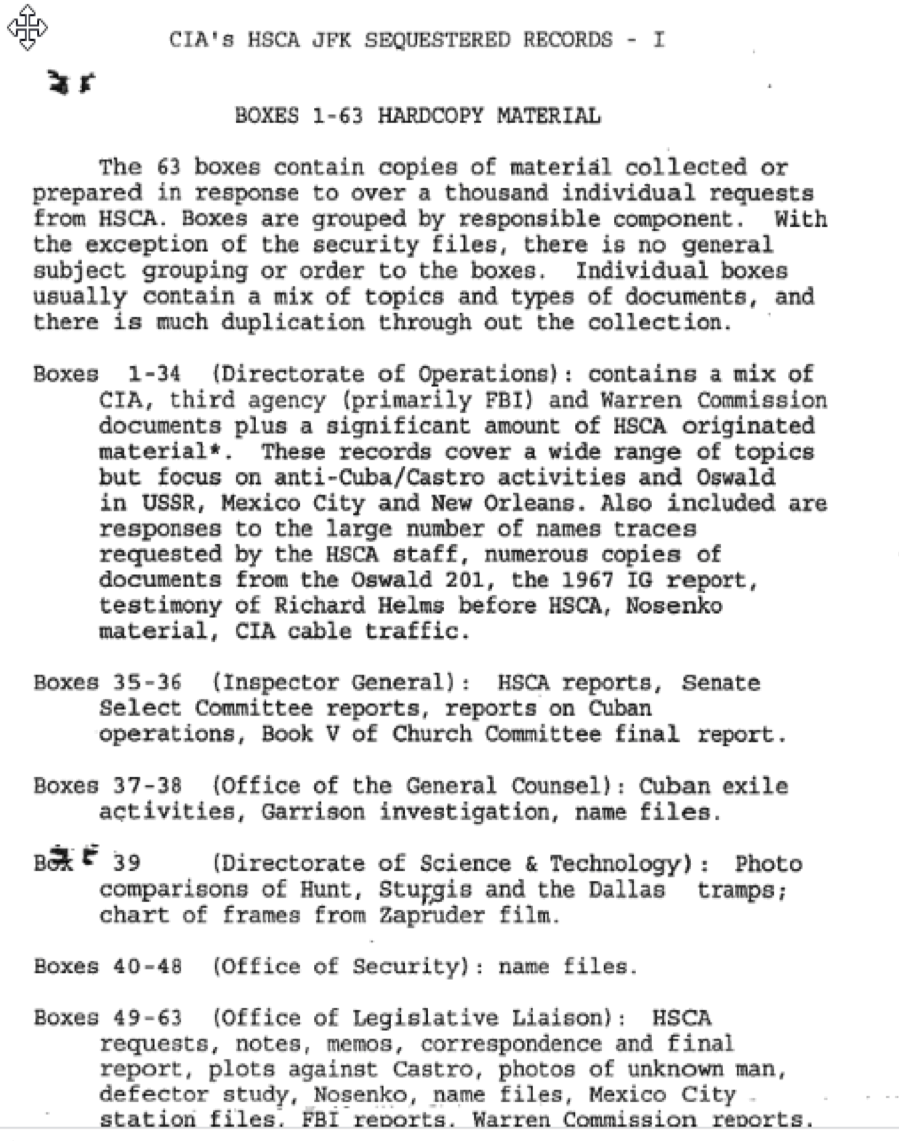
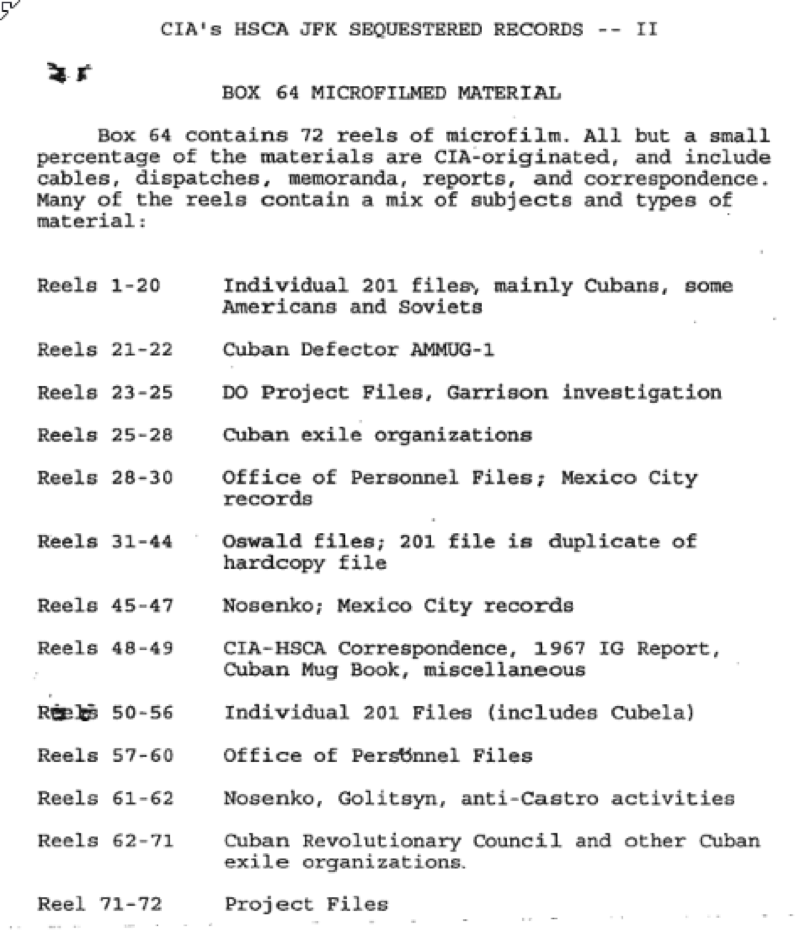
    In 1996, the CIA handed over 64 boxes of material to the AARB that they had provided to the HSCA. A description of their contents can be found in ARRB files, in them you will see some focus on events, 201 files, and individuals of interest to the JFK assassination, but almost nothing on organizations of interest:


    Relatively little has been done to connect the dots on the role organizations may have played wittingly or unwittingly in the coup.

    We know that many organizations in Oswald’s orbit had links to intelligence including the Riley Coffee Company, the FPCC, Banister and Associates, Albert Schweitzer College, Alpha 66, the DRE, INCA, WSDU, and the Texas School Book Depository. Permindex and the International Trade Mart connect to both Clay Shaw and intelligence. Sullivan and Cromwell, United Fruit, Freeport Sulphur, and a number of other movers and shakers, as well as countless media organizations, were known to have hovered around U.S. security endeavors during the Dulles reign. They, of course, prefer that this dark history exclude their names, which was accomplished by the lone nut tale peddled by the Warren Commission. Knowing more about some of these interests would help us understand Oswald’s murky path that allowed puppeteers to “place him” strategically in the right spot at the right time to become a patsy.

    For instance, it is impossible to imagine that the FPCC does not have a very thick file, given the surveillance programs of this outfit by both the FBI and CIA and its heavy infiltration by informants. Imagine if we could know more about who the informants were and their supervisors from the CIA and FBI.

    Gary Hill in his book “the Other Oswald” explores the strange case of Robert Webster, who defected to Russia and returned to the U.S. at nearly the same times as Oswald. He shows how the Rand Development Corporation, Webster’s employer, is closely linked to intelligence, MKULTRA, and Webster’s saga.

    In this article, he expands on his research on Rand and demonstrates just how much we could learn by understanding organizations Oswald and other of the main characters are linked to.

    RAND Corporation

    The RAND Corporation’s the boon of the world,

    They think all day long for a fee,

    They sit and play games about going up in flames,

    For Counters they use you and me.”[1]

    In researching my book on Robert Webster[2], The Other Oswald, A Wilderness of Mirrors, I came to see that Webster’s employer, Rand Development Corporation, and his boss, Dr. Henry J. Rand, played important roles in determining Webster’s destiny. Their shadowy presence, always lurking behind the scenes, permeates his story. I decided to try to find out what this mysterious organization was about and why it was manipulating this easily influenced man.

    Although Anthony Summers[3] labeled Rand Corporation as Rand Development’s parent company, I was unable to find any connection between the two companies.

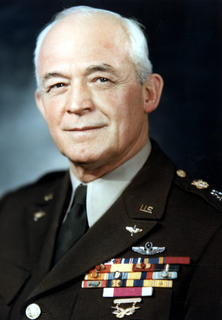
    General H. H. “Hap” Arnold

    Rand Corporation’s website describes its 1948 origins as follows:

    As [WWII] drew to a close, it became clear that complete and permanent peace might not be assured. Forward-looking individuals in the War Department, the Office of Scientific Research and Development, and industry thus began to discuss the need for a private organization to connect military planning with research and development decisions.

    Commanding General of the Army Air Force H. H. “Hap” Arnold articulated this need in a report to the Secretary of War:

    “During this war, the Army, Army Air Forces, and the Navy have made unprecedented use of scientific and industrial resources. The conclusion is inescapable that we have not yet established the balance necessary to insure the continuance of teamwork among the military, other government agencies, industry, and the universities. Scientific planning must be years in advance of the actual research and development work.”

    Other key players involved in the formation of this new organization were Major General Curtis LeMay; General Lauris Norstad, Assistant Chief of Air Staff, Plans; Edward Bowles of the Massachusetts Institute of Technology, consultant to the Secretary of War; Donald Douglas, president of the Douglas Aircraft Company; Arthur Raymond, chief engineer at Douglas; and Franklin Collbohm, Raymond’s assistant.

    The name of the organization? Project RAND.

    Curtis LeMay

    Similar to the Russians’ “doomsday machine” in the satirical movie, Dr. Strangelove, RAND was to be a machine whose purpose was to fuel the fires of the cold war through research and development and inter-agency cooperation. The involvement of General Curtis LeMay[4] in such a project is no surprise. It was LeMay who was responsible for promoting RAND as his own project. It is apparent that the Air Force seems to have played a major role in the birth of RAND and oversaw its operations in the early years.

    Wikipedia lists the birth of RAND Corporation as 1945, not 1948 as RAND’s website declares. However, its actual charter is dated March 1, 1946. Wiki says:

    RAND was created after individuals in the War Department, the Office of Scientific Research and Development, and industry began to discuss the need for a private organization to connect operational research with research and development decisions. On 1 October 1945, Project RAND was set up under special contract to the Douglas Aircraft Company and began operations in December 1945.

    Since the 1950s, RAND research has helped inform United States policy decisions on a wide variety of issues, including the space race, the U.S.-Soviet nuclear arms confrontation, the creation of the Great Society social welfare programs, the digital revolution, and national health care. Its most visible contribution may be the doctrine of nuclear deterrence by mutually assured destruction (MAD), developed under the guidance of then-Defense Secretary Robert McNamara and based upon their work with game theory. Chief strategist Herman Kahn also posited the idea of a “winnable” nuclear exchange in his 1960 book On Thermonuclear War. This led to Kahn being one of the models for the titular character of the film Dr. Strangelove, in which RAND is spoofed as the “BLAND Corporation.”

    Pravda labeled RAND as the American “Academy of Science and Death.”

    By its own definition, it is apparent that RAND’s purpose was to serve the Military Industrial Complex.

    Rand Development Corporation

    Rand Development is a more elusive entity. When I first saw that there was no mention of Rand Development in the history section of the RAND Corporation website, I thought that it was because of its involvement with the MKULTRA project. Or maybe because an employee, Robert Webster, defected while working on a Rand Development project in the Soviet Union. Or it could be because Rand Development went bankrupt in 1972 and no longer exists.

    Whereas RAND Corporation’s name came from the initials of “Research ANd Development,” Rand Development got its name from its founder, James Henry Rand III also called H.J. Rand.

    H. James Rand

    Dr. James Rand III,[5] turns out to be an extremely fascinating entrepreneur.

    James set up the Rand Development Company in 1950 with the primary aim to devise medical devices to benefit patients. He developed the first artificial larynx, which enabled an East Cleveland policeman to be reinstated in his job afterward.

    By 1951, at age 38, Rand had 100 inventions to his credit. These included: the mechanical respirator, a tank respirator that replaced the bulky iron lung, an oxygen regulator for aircraft, a pulsating air mattress to eliminate bedsores, a plastic shoe sole, and a completely mechanized wheelchair that could be operated by mouth.

    Rand also invented the Bendix automatic washer, the first Remington shaver, a non-leaking faucet valve, and a metal-impregnated cloth called Milium, used to line coats. He was also a co-inventor of a defibrillator and a respirator for chest surgery.

    Rand Development prospered under James Rand. The company was even featured in a cover story in Business Week magazine in 1956.

    James worked in the mid-1960s on a controversial cancer vaccine and began marketing it in 1966. In 1967, the federal government took his firm to U.S. District Court and won a ban due to not enough testing on animals first and manufacturing they determined was performed under unsanitary conditions. They banned the vaccine’s manufacture and use in the United States. The cancer vaccine never became available to the public. The trial was fraught with desperate cancer patients pleading for continued use of the vaccine.

    In 1968, a federal grand jury indicted Rand Development on charges of stock manipulation and mail fraud. Those charges were later dropped in 1970, because they were based on the 1967 vaccine ban case that Rand had testified in and violated his right against self-incrimination.

    An improved version of the vaccine was later tested in Mexico and showed some excellent results, as Rand said in a 1977 interview. The results of the tests had been published in Austria, but not accepted in this country.

    Rand Development went bankrupt in 1972, and the assets, contents of labs, and offices were sold at auction.

    According to his obituary,

    James Henry Rand III was born on February 23, 1913, in Pelham, New York, to James Henry Jr. and Miriam Rand. He was a brilliant young boy for whom conventional schooling was inadequate. At age thirteen, Rand ran away from Peekskill Military Academy in New York, where he felt he would not learn anything new in science. He jumped a freight train and emerged from the boxcar in Cleveland, where he spent two weeks living at the Salvation Army before he was caught and returned to his family.

    He returned to the military academy, which he completed in two years instead of the usual four. He spent a year in Europe, first at the University of Vienna and the University of Berlin. He enrolled at the University of Virginia at age 16 using two names: H. J. Rand and James H. Rand, to complete both his freshman year and his first year of Medical School.

    James elected not to work at his father’s business, Remington Rand. While in his early twenties, he put together a chain of fifty-eight radio stations, that was later taken over by a larger company. His first invention was an instrument to mix the cabin atmosphere in the airplane with hydrogen, enabling pilots to get the correct mix of oxygen while flying. He sold this to the Bendix Corporation, who also hired him, where he worked out several inventions, including the automatic washing machine and the Remington electric shaver for Remington Rand, his father’s firm.

    James Rand had a distinguished World War II record. He worked as a spy with the French underground until 1942, when he joined the Army Air Corps and the Office of Strategic Services. He worked in the White House map room until presidential aide Harry Hopkins discovered that he was the son of a prominent Republican and was banished.

    He then became assistant chief of guided missiles, assigned to the guided missiles section in Sicily and Italy; he captured several enemy radar stations. Before the capitulation of Berlin, Rand, as a member of a secret mission, entered the city and brought out several German scientists to America.

    As a lieutenant colonel in the U.S. Army, Rand flew the first plane to carry guided missiles in combat and received many decorations, including the Legion of Merit, the Bronze Star, ten battle stars in the European Theater, and the Merit Ribbon.

    Rand was past president of the Cleveland Museum of Natural History and chairman of the 1949 heart campaign. Bethany College gave him an honorary doctorate and the Cleveland Jaycees named him 1949 Young Man of the Year. He founded the Cleveland Heart Society in 1953, as well as the National Inventors Council.

    His wife Mary filed for separation in 1969, stating that her husband was guilty of gross neglect of duty. Rand had not paid her support money or given her funds to operate the home. He later married Martha Osborne.

    James, who had diabetes since the age of 38 and also was using a heart pacemaker since 1974, died on November 6, 1978, of abdominal cancer, the disease he tried to conquer. He had used his cancer vaccine on himself.[6]

    Rand and the Intelligence Community

    Rand’s wartime connections to the Army Air Corps and the Office of Strategic Services explains his close links to the CIA and Air Force intelligence, ATIC, after the war. His OSS secret mission, rescuing German scientists from Berlin in 1945, links him to Operation Paperclip and Allen Dulles. Later, Rand Development Corporation became a CIA proprietary.

    President, James “Henry” Rand, and top executive, George Bookbinder, had served together in the O.S.S., the forerunner of the CIA. Bookbinder worked under Frank Wisner[7] in Bucharest during the war.[8] He had close ties to the Rockefeller-owned Chase Manhattan.[9] Rand’s Washington representative Christopher Bird was a self-admitted agent of the Central Intelligence Agency.

    The CIA ties to the Rand Development Corporation were exposed in 1968, when the Department of Interior conducted an expense inquiry into an anti-pollution contract between the Rand Development Corporation and that Agency. A Congressional Expense Inquiry showed that Rand Development held several CIA contracts. Doctor H.J. Rand was one of the first to undertake negotiations with the USSR for the purchase of technical devices and information on behalf of the Agency. An FBI Memorandum[10] tells of Sperry-Rand[11] developing an ink that “came out only under certain light.” The same document reveals that H.J. Rand received an $80,000 fee for the part he played in a law suit undertaken by the U.S. Department of Justice against the USSR. At this time, Rand Corporation was also conducting detailed studies of the Soviet economy in order to find out what proportion of the Russian GNP went into national defense.

    It would seem to me that “invisible ink” might be used as a tool for spying. In fact, it’s hard to think of many other applications it would be useful for.

    At the time of the U2 incident involving Francis Gary Powers, H.J. Rand had been trying to get the Russians to take out U.S. patents on several devices, including a sleep-inducing electric pulse generator he said would be very useful in surgery on patients whom anesthetic drugs are dangerous. Once the Russians took out the patents, Rand would buy the patents and market the Soviet products in the United States. However, the negotiations ended when Rand’s Russian offices were shut down in fallout of the U2 incident.

    George H. Bookbinder, New York Times, November 15, 1959

    Powers being shot down also foiled a plan to abduct Robert Webster—who had defected while working for Rand Development in 1959—and get him out of Russia in H.J. Rand’s car. Rand had left his car in the Soviet Union and planned one “last trip” to Moscow to bring the vehicle back. Accompanying Rand on the trip would be his usual sidekick, George Bookbinder, and also Dan Tyler Moore. Moore, whom Rand was reluctant to contact because of his erratic behavior and connections to journalist Drew Pearson, was his brother-in-law. Moore, formerly OSS, lived in Cleveland and was, at one time, affiliated with The Middle East Company. The branch office of the Middle East Company located in Turkey was referred to by the Soviets as a US Intelligence Operation. Rand described Moore as “a flamboyant type who is willing to try anything once or twice.” Rand’s hair-brained abduction scheme was never pulled off, due to the Powers incident that resulted in a tightening of security on all things American. The same document (the Grant-Gleichauf telecon) relating to Moore contains a provocative statement, “…the purpose of this notification is to provide some warning that an accident may be on its way to happen.” What accident? This document was dated May 4, 1960. Could the accident be the Powers downing? Were they anticipating this happening ahead of time? The event happened on May 1. This document is dated May 4, so it had already happened. However, as Bill Simpich believes, the key is the April 26 letter, that makes it clear they were planning to get Webster out of Russia over the weekend. It is credible that these words were spoken before May 1. In State Secret, Bill  writes:

    On April 26, Rand called the CIA Cleveland field office and told them that he and Bookbinder were heading to Moscow in the next ten days to try to get Webster out. On April 28, the CIA Miami chief got the word that Rand, Bookbinder, and their colleague Dan Tyler Moore were heading for Moscow. Like Rand and Bookbinder, Moore was ex-OSS. Moore was also the brother-in-law of Washington Post columnist Drew Pearson and had the savvy to put together a plan to smuggle Robert Webster into Rand’s car and out of the USSR. The Miami chief ended his message by saying that his note was ‘some warning that an accident may be on its way to happen.’ The plan was to smuggle Webster out on May 4.

    Anthony Ulasewicz, a field officer of Nixon’s White House/Special Operations Group, described his first meeting with Nixon counsel and crime boss, Murray Chotiner: “When I first met Chotiner, the first thing he did was hand me a file on Rand Development Corporation and its officers.” Chotiner’s file on the Rand Development Corporation disclosed that, during the 1968 presidential campaign, Rand was named as a defendant in a lawsuit started by some angry Minnesota businessmen. The charge was that the Small Business Administration and the Government Services Administration were guilty of fraud and conspiracy in the way a government contract for some postal vehicles was awarded to a wholly-owned Rand Development Corporation subsidiary, the Universal Fiberglass Corporation. The Universal Fiberglass Corporation, the lawsuit charged, was born for the sole purpose of obtaining this contract. “Despite apparent lack of qualifications, a crony of Senator Hubert Humphrey awarded the contact to the Universal Fiberglass Corporation. The Universal Fiberglass Corporation defaulted and disappeared under Rand Development’s umbrella.” Murray Chotiner was trying to bring this situation to the attention of the media.[12]

    But the CIA was not the only intelligence agency connected to Rand Development. Air Force Intelligence, ATIC, also worked closely with them in projects dealing with the Soviet Union.

    An FBI memo states, “In as much as James H. Rand, President of the Rand Development Corporation, Cleveland, OH, is cooperating with the U.S. Air Force in obtaining information from the Soviets, it is possible that Rand has already furnished information to the Air Force bearing on this matter.”[13]

    H.J. Rand’s father was Vice President (chairman) on the board of Sperry-RAND, which also worked closely with the United States Air Force. Sperry-RAND had initially funded the Rand Development Corporation. James Rand III was a twin son of Remington-Rand founder James Henry Rand Jr. who turned over the operation of Remington Rand in 1958 (which had previously merged with Sperry Corp), to James’s twin brother Marcell. Vice-president of research and development for Remington-Rand in those years (1948–1961) was the former chief of the Manhattan Project, General Leslie R. Groves. Among other sundry defense contracts, Remington-Rand was collaborating with Bell Labs on nuclear missile guidance systems.

    Internal memos from the CIA requested by the HSCA investigation note that Rand and Bookbinder had traveled previously in 1958 to the USSR with “Brigadier General” W. Randolph Lovelace, an eminent physician with Atomic Energy Commission contracts who co-founded the Lovelace Clinic in Albuquerque New Mexico. One memo reads: “For your information, only Rand, Bookbinder, and Lovelace have had frequent contact with Soviet officials both in the United States and the USSR, including Mikhail Ilich Bruk, formerly with the Soviet Ministry of Health, who was identified by AEDONER [Yuri Nosenko] as an agent of the KGB.”

    When Robert Webster defected in 1959, he did so as an employee of Rand Development at a Moscow Trade Exhibition. On October 17, 1959, Webster was living in Moscow. He attended a meeting at the central office, visas and registration (OVIR); with the original Soviet representative he had contact with, an unknown Soviet, H.J. Rand, his assistant George H. Bookbinder, as well as Richard E. Snyder of the U.S. Embassy. Webster stated he was free to speak and told Snyder when he had applied for Soviet citizenship that he had been granted a Soviet passport on September 21, 1959. He filled out a form entitled “Affidavit for Expatriated Person” and wrote his resignation to Rand Development Corp.

    While it is possible that Webster may have been a witting asset in a false defection stratagem, his pre- and post-Russia odyssey behavior and treatment lead me to believe that, unlike Oswald, he was a genuine, albeit confused defector, who went to Russia, not for ideological reasons, but mostly to escape a complicated personal life at home. We may never know for sure.

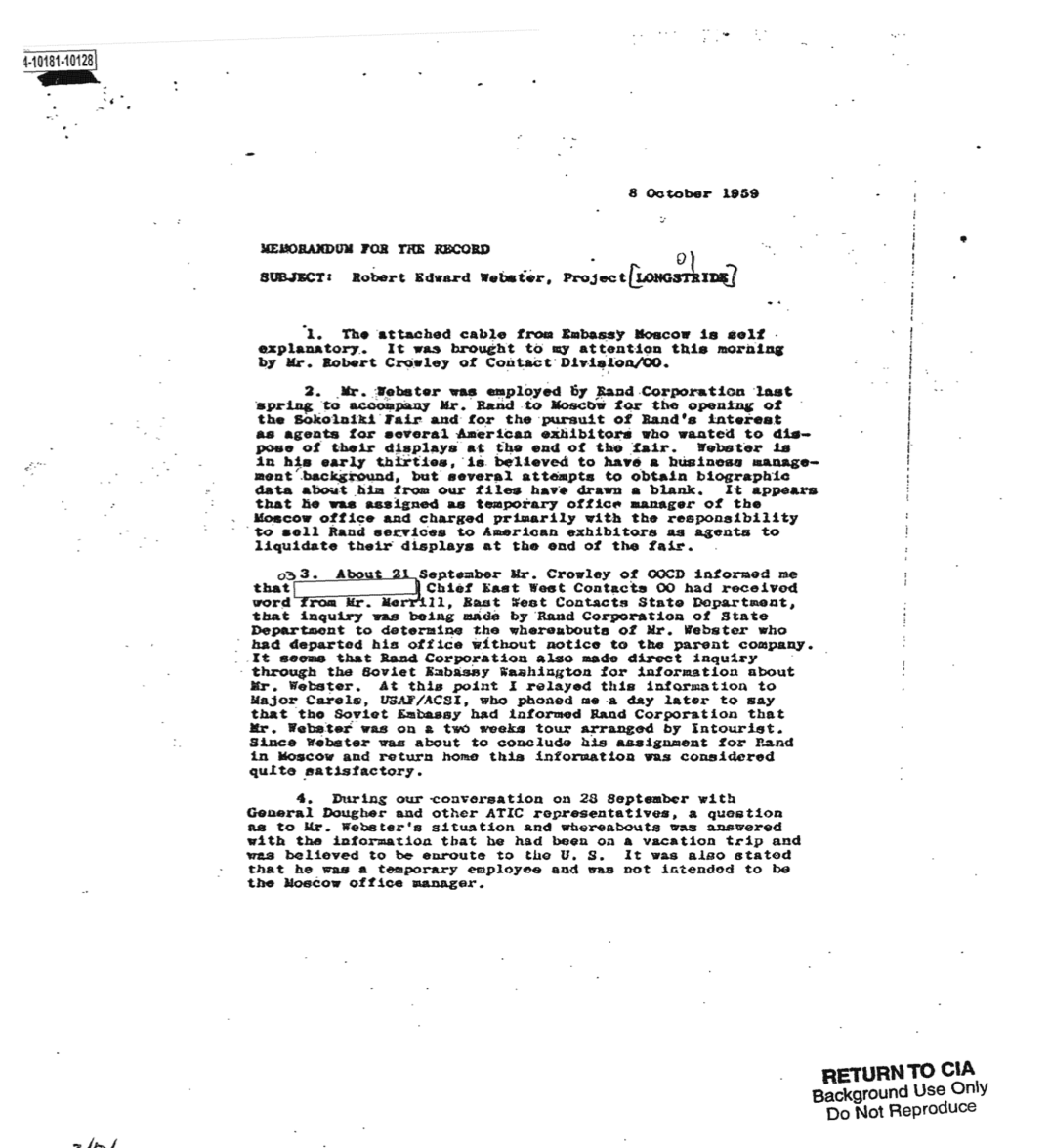
    My research further revealed that Webster was part of an ATIC project called LONGSTRIDE. Internal CIA memos revealed that Webster was known as “Guide 223” and fellow Rand Development employee Ted Korycki was known as “Lincoln Leeds.” The fact that the CIA approached ATIC at the Moscow Fair, rather than Rand Development itself, indicates inter-agency cooperation.

    Rand’s liaison with ATIC was Major Joseph Carels. In light of the recent revelation of Webster’s role in Project LONGSTRIDE, it appears that Carels was lying when he advised that Air Force Intelligence Headquarters had no information regarding Webster. As a result of a teletype inquiry by Carels to Air Technical Intelligence Center (ATIC), Wright-Patterson Air Force Base, Ohio, (this organization handles covert projects of AF), Carels was advised that the subject was an employee of Rand Development who could not be located and thus was reported as missing. The message stated that the subject has taken a 20-day in-tourist tour to Kiev. “Subject (Webster) is a technician and is not witting or involved in ATIC[14] activities.”[15] Rand Development Corporation’s connection to the U.S. Air Force at the Moscow Fair may have been unknown to Webster, however it is likely that Webster’s movements were likely being choreographed by Air Force intelligence, whether he knew it or not.

    Dr. Rand was obviously a source for ATIC as is indicated by an AIRTEL TO BUREAU NY 105-37687 stating: “Inasmuch as James H. Rand, President of Rand Development Corporation, Cleveland, Ohio, is cooperating with the Air Force in obtaining information from the Soviets it is possible that Rand has already furnished information to the Air Force bearing on this matter.”

    Another FBI memorandum states; “Rand cooperates with Air Force Intelligence on technical intelligence projects.”[16]

    An area that needs more research is that involving the connections of Sylvia Hyde Hoke, the sister of Ruth Paine. Sylvia, a psychologist, was employed by the Air Force as a “Personnel Research Technician.”[17] It was the Personnel Research branch of the Air Force that implemented Project LONGSTRIDE, of which Webster was involved. Hoke was also employed by the CIA since at least 1961. Perhaps it is just a coincidence that the two Hyde sisters are somehow linked with the two defectors, Oswald and Webster. The same two that James Angleton was dangling to the Soviets in his mole hunts?

    There also seem to be connections between the elusive triad of espionage entities (CIA, ATIC and Rand Development) and experiments in behavior and mind control.

    The CIA’s MKULTRA projects are well known. But what is known of the role of Rand Development and ATIC’s in this murky misadventure of controlling human minds?

    Rand Development’s Washington representative, Christopher Bird, served as ‘Biocommunications Editor/ Russian Translator’ for Mankind Research Unlimited, Inc., a Washington think-tank specializing in parapsychology and other behavioral sciences.  Dick Russell reports that “MRU’s Company Capabilities list included brain and mind control…acquiring on a daily basis, a large amount of unique bio-cybernetics data from Eastern Europe.”[18]

    According to CIA psychiatrist, Dr. Louis Jolyon (Jolly) West,[19] ATIC and Rand Development worked closely together in behavior modification research. He claimed that Air Force Intelligence, like the CIA, was also involved in mind control research projects. West himself, although he initially denied it, was conducting LSD research under the MKULTRA banner.

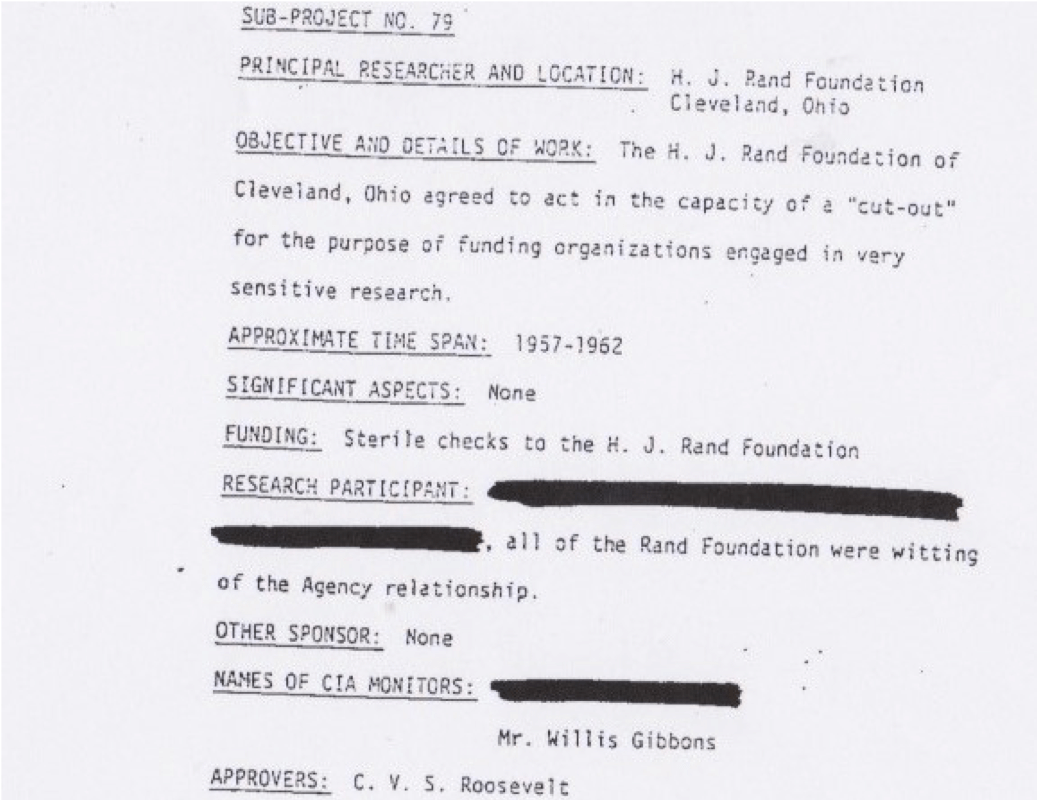
    It is now clear that the H.J. Rand Foundation was a part of MKULTRA SUB-PROJECT NO. 79. The document below lists Rand as a “cut-out” for the purpose of funding organizations engaged in very “sensitive” research. The document is dated 1957–1962, the very time in which Robert Webster was employed by Rand. It encompasses his defection and return from Russia (59–62). Also, this is the same time period of Oswald’s Soviet odyssey. It also states that “all” of the Rand Development’s participants were witting of the agency (CIA) relationship. That would include plastic’s expert Robert E. Webster. Note that this document is approved by C.V.S. Roosevelt.

    Roosevelt, grandson of Theodore, who served as the chairman of the Technical Surveillance Countermeasures Committee, which involved securing American facilities against electronic eavesdropping. Richard Bissell’s testimony during the Church Commission, as well as CIA source documents, connect Roosevelt directly to plans to poison Castro. Roosevelt, as a head of the CIA technical division, was Sidney Gottlieb’s supervisor. According to Roosevelt, his work for the CIA mainly involved creating devices to detect listening devices. He also mentioned that he took part as a subject in the CIA experiments on LSD as part of MKULTRA. Retiring from the CIA in 1973, he served in retirement as a defense consultant and on the board of Aerospace Corporation.

    Further evidence of Rand Development’s involvement in MKULTRA is their 1958 study revealing that, “a defensive use for hypnosis was a more practical use than the previously sought offensive goal of a Manchurian Candidate.”

    NARA Record Number: 157-10014-10093

    TESTIMONY OF RICHARD BISSELL, 10 SEP 1975


    RAND Corporation was the CIA think-tank where Daniel Ellsberg copied the Pentagon Papers. According to the New York City phone directory, Rand Corporation and Rand Development were located on opposite sides of Lexington Avenue in New York City. However, this seems to have been a deception.

    Researchers Alan J. Weberman and Michael Canfield visited the address of Rand Development Corporation listed in the NYC phone directory. The building registry had no listing for Rand Development Corporation. The doorman told them that he had worked there for 33 years and there had never been a Rand Development Corporation in the building. He suggested they go to Rand Corporation across the street at 405 Lexington Ave. From what I could find, RAND’s NYC office was part of a HUD study group for LBJ’s Great Society described as an Urban Institute.

    Another odd coincidence involving the Air Force is that four of Oswald’s fellow employees at Reily Coffee went on to employment with NASA. Oswald himself cryptically hinted that working there might be in his future. He told Adrian Alba, proprietor of the Crescent City Garage next door to the Reily Coffee Co. in New Orleans, that he had “found his pot at the end of the rainbow,” and that he expected to get a job at NASA in New Orleans. As stated, four of Oswald’s coworkers at Reily did get jobs at NASA in New Orleans within weeks of his departure.[20] However, by the time he had returned to Dallas, in the fall of 1963, he was telling his landlady, Mary Bledsoe, that he would soon be working for Collins Radio, a CIA front company deeply involved in the military industrial complex.[21]

    In fact, it is obvious that Oswald had ties or links to an array of CIA/Military Industrial Complex friendly companies; Collins Radio, NASA, Reily Coffee, Guy Banister Associates, Jaggars-Chiles-Stovall, and perhaps the TSBD.[22] In addition, he wrote or belonged to organizations being investigated by the FBI and CIA; the FPCC, the American Civil Liberties Union, C.O.R.E., and the American Communist Party. In addition, Oswald was as an underage worker with the Gerald F. Tujague Inc., a freight broker on the New Orleans water front. Tujague was a friend of Guy Banister.  In addition, Tujague was Vice President of the Friends of a Democratic Cuba. The purpose of the FDC was to raise funds for the CIA-backed Frente Revolucionario Democratica (FRD-Cuban Democratic Revolutionary Front.) Tujague told FBI agents that Oswald was in regular contact with the U.S. Customs Export Office, yet another government agency.

    Summary

    In essence, RAND Corporation rose out of the ashes of WWII. The Manhattan Project had shown that pooling the best minds; scientists, physicists, mathematicians, and technicians had resulted in a huge leap forward in weapons development. The prospect of these great thinkers going back to work in the private sector was anathema to Hap Arnold, the only five-star general in the Air Force. He and Franklin R. Collbohm became the fathers of the RAND PROJECT. But it was General Curtis LeMay who took the project by the horns and became its godfather. Subsidized and more or less subservient to the Air Force, the project arose out of the Air Force’s interest in developing intercontinental ballistic missiles. In addition to General Arnold, key players involved in the formation of Project RAND were: Edward Bowles of M.I.T., a consultant to the Secretary of War; General Lauris Norstad, then Assistant Chief of Air Staff, Plans; Major General Curtis LeMay; Donald Douglas, President of Douglas Aircraft Company; Arthur Raymond, Chief Engineer at Douglas; Franklin Collbohm, Raymond’s assistant.

    The RAND (Research And Development) Corporation of Santa Monica, California, began as a United States Air Force Project in 1945 under contract to the Douglas Aircraft Company. Its broadly defined function was to study American national security and, in particular, the role of airpower in that context. Three years later, the Ford Foundation endowed RAND as a private, nonprofit research corporation “to further and promote scientific, educational and charitable purposes” to the nation’s general benefit. As one of the first American “think tanks,” however, its staff focused primarily on military and strategic issues funded by the U.S. government. For the first two years of its existence, RAND allocated the lion’s share of its Air Force research funds for applied science projects to subcontractors like Bell Telephone, Boeing Aircraft, and Collins Radio Company.[23] Other RANDites who would later play a role in American politics include: Condeleezza Rice, Dr. Luis Alvarez, and Donald H. Rumsfeld, who at one time was Chairman of their Board of Trustees.

    Rand Development was a separate entity used primarily by the CIA, but also working closely with Air Force Intelligence (ATIC). The areas of the corporation’s usefulness included information related to the Soviet economy and military budget; negotiations with the USSR for the purchase of technical devices and information on behalf of the CIA; cooperation with Air-Force Intelligence on technical intelligence projects such as LONGSTRIDE; and acting as a CIA “cut-out” in an MKULTA sub-project defined as funding of organizations involved in very sensitive research. This research included mind and behavior control, a subject of interest to both the CIA and ATIC. In return, Rand received financial rewards through favoritism in the securing of government contracts, as well as a monopoly in being allowed negotiations involving Soviet technology.

    My research on Robert Webster led me to believe that H.J. Rand was not only his boss, but his close friend and mentor. Their relationship was very similar to that of Oswald and George de Mohrenschildt. I doubt if we will ever know whether James Rand played any role in encouraging Webster to defect or connecting him, knowingly or unknowingly, with an ATIC project (LONGSTRIDE). But it seems odd that Webster, a man with no connections to the Air Force (an ex-navy man), was involved in this Air Force Intelligence project while in the Soviet Union. In addition, he became a Soviet citizen. Think about it. A defector who gave up his U.S. citizenship to become a Soviet citizen is now part of a U.S. intelligence project? If he was aware of this he could be defined as an American spy or at the very least some kind of dangle.


    Bibliography

    Conspiracy, Anthony Summers, McGraw-Hill Book Co., 1980.

    Soldiers of Reason, Alex Abella, Mariner Books, 2008.

    The Man Who Knew Too Much, Dick Russell, Carroll & Graf Publishers, 1992.

    The Other Oswald, A Wilderness of Mirrors, Gary Hill, TrineDay, 2020.


    [1] The Rand Hymn, by Malvina Reynolds

    [2] “The Other Oswald, A Wilderness of Mirrors,” Gary Hill, TrineDay 2020. www.theotheroswald.com

    [3] Summers says: “Rand Development Corporation was formed by the Rand Family. The name ‘Rand Corporation’ is a title made from the contraction of the words ‘Research and Development.’” It seems he may have linked the two unintentionally by inference of name. Also, Dick Russell, in his book The Man Who Knew Too Much, said: “Like its parent, Rand Corporation, it (Rand Development) also held several CIA contracts.” The footnote for this statement reads: Rand Development ties; WCE915, WC XVIII, HI 13; Summers Conspiracy pp 177–178. But the WCE915 document says nothing about Rand. It is a letter from Richard Snyder to the State Department about citizenship of defectors.

    [4] It was LeMay that was responsible for the firebombing of Tokyo in WWII that resulted in the deaths of 100,000 civilians. These were mostly women, children and old men. It was also he that proposed a first strike on the Soviet Union during the Kennedy administration. His take was that we would only lose 30 or 40 million Americans. That, he felt, was an acceptable sacrifice. In his book, The Fog of War, he was quoted as saying, “If we had lost the war, we’d all have been prosecuted as war criminals.”

    [5] Also known as H.J. Rand.

    [6] https://bratenahlhistorical.org/index.php/james-rand/

    [7] In the OSS Wisner was transferred to Germany where he served as Liaison to the Gehlen Organization. Later, in the CIA, he ran the Office of Special Projects (OSP), which later became the Office of Policy Coordination (OPC). J. Edgar Hoover called the OPC “Wisner’s Weirdos.”

    [8] NYT 6.15.59; Smith OSS Univ. of Calif. Press London 1977, p. 397.

    [9] State Secret, Chapter One, Bill Simpich.

    [10] See this document in appendix C of “The Other Oswald, A Wilderness of Mirrors, Gary Hill, TrineDay, 2020. www.theotheroswald.com

    [11] Rand III’s father (James Rand Jr.) founded American Kardex, an office equipment and office supplies firm which later merged with his father’s (James Rand Sr.) company, the Rand Ledger Corporation. Rand later bought out and merged with several other companies, notably the Remington Typewriter Company, to form Remington Rand. In 1955, Rand merged his corporation with the Sperry Corporation to form Sperry-Rand, one of the earliest and largest computer manufacturing companies in the United States.

    [12] Ulasewicz, Pres. Priv. Eye, 1990.

    [13] 124-10210-10354

    [14] ATIC later evolved into NASIC.

    [15] Memorandum from P.H. Fields to F. A. Frohbose 105-81285-3.

    [16] 124-10210-10354

    [17] NARA Record Number: 1993.07.24.08:39:37:560310-FB1105-1261128-7,12/12/63; also, CIA memo dated 7/30/71 claims Hoke a CIA employee since 1961.

    [18] Ibid from A.J. Weberman “Mind Control: The Story of Mankind Research Unlimited, Inc.” CovertAction (June 1980), p. 17.

    [19] “Jolly” was appointed by the court in his capacity as a brainwashing expert in the Patty Hearst trial and worked without a fee. Believing that Hearst displayed all the classic signs of coercion and brainwashing, after the trial, he wrote a newspaper article asking President Carter to release Hearst from prison. West also visited Jack Ruby several times in his jail cell along with Dr. Robert Stubblefield, who was also involved in the MKULTRA program. What went on in that cell, no one knows. But Ruby was suddenly found insane.

    [20] In Deadly Secrets, Warren Hinckle and William Turner write, “Oswald told Adrian Alba, the owner of the garage next door to where he was working, that his application was about to be accepted ‘out there where the gold is’—the NASA Saturn missile plant in suburban Gentilly. NASA of course didn’t employ security risks. But tucked into its Gentilly facility was an active CIA station that provided a Kelly Girl service for operatives in between assignments” (p. 239). The endnote reads, “The CIA’s practice of providing interim employment for its agents and assets is well known,” The passage in Turner repeats the familiar statement from Adrian Alba, then adds, ”On the face of it, the idea that [the Marxist] Oswald could get a job at a space agency installation requiring security clearance seems preposterous…But [Jim] Garrison pointed out that it is an open secret that the CIA uses the NASA facility as a cover for clandestine operations.”

    [21] Bledsoe on Oswald’s activities: 6 WCH 404 and Oswald on Collins Radio WCE-1985.

    [22] Another possible link he made was his travel arrangements on the first leg of his trip to Russia through “Travel Consultants,” a New Orleans based travel agency also used by Clay Shaw. On the agency’s questionnaire he gave his occupation as “shipping export agent.”

    [23] See chapter 12—“The Other Oswald, A Wilderness of Mirrors,” Gary Hill, TrineDay 2020, for Collins links to the JFK Assassination.

  • Creating the Oswald Legend – Part 5

    Creating the Oswald Legend – Part 5


    1. TIPPIT AND LBJ PREVENTED A WAR

    In the fall of 1963, President Kennedy had established back channel communications with Castro through journalist Lisa Howard and William Attwood, in order to open a secret dialogue with the Cuban leader. Kennedy used a second back channel, the French journalist Jean Daniel introduced to Kennedy by Attwood. When the CIA learned of these back channels, some officers felt Kennedy had excluded them from his decisions and that he was betraying their efforts and work. The word was passed down in Miami that Kennedy was preparing to begin talks with Castro. One of the first CIA officers who would have learned about it was James Angleton, who would have been alarmed. Angleton likely would have alerted CIA officers like Dave Morales and David Phillips, who would have spread the rumor in the exile community.

    Gaeton Fonzi interviewed Cuban exile Rolando Otero, who told him that there was a rumor circulating in certain areas of the exile community that “Kennedy was a Communist, he’s against us; he’s messing up the whole cause.”[1] Another exile, Felipe Vidal Santiago, had made similar remarks when interrogated by Cuban Intelligence, according to Fabian Escalante, Chief of Cuba’s G-2.[2] Escalante had also revealed that Cuban Intelligence had infiltrated a CIA connected exile group and a CIA officer had said to them in a secret meeting that took place in a safe house that “You must eliminate Kennedy.”[3]

    There is no way that foot soldiers like Santiago and Otero would have known about this sensitive information, originally known only to Kennedy, Castro, their confidants, and, perhaps, Dick Helms. Larry Hancock believes that they learned it from exiles like John Martino and Bernardo De Torres who had links to the CIA officers and their operations.

    John Martino was an exiled Cuban who worked in a Havana Casino owned by Santo Trafficante Jr. back in 1956. He was imprisoned in Cuba between 1959 and 1962. When he returned to the States, he became involved in the anti-Castro cause. He took part in the notorious Operation Tilt, he had both Mob and CIA connections. Later in life, he admitted to his business partner Fred Claasen that the anti-Castro Cubans put Oswald together and tried to frame him as a Castro assassin in a plot to murder President Kennedy. Those Cubans posed as Castro agents and it is more likely that Oswald played along to reveal their agenda as part of his mission to smoke out subversives and pro-Cubans. The plan was to fly him out of the country and kill him en route, possibly on his way to Cuba, in such a way that would prove Castro and Cuba were pulling Oswald’s strings.[4] Are there any evidence or indications that the anti-Castro Cubans were really planning to fly Oswald out of the States?

    Wayne January was a charter air service operator at Red Bird airport. On November 20, 1963, he was visited by a young couple looking to hire a small aircraft to fly to Mexico. January thought that the pair was asking peculiar questions and acting suspiciously, so he decided not to charter the plane to them. He also observed that there was a young man that stayed in the car the whole time. Later, he identified him as Lee Harvey Oswald.[5]

    The late Antonio Veciana described a plot to assassinate Castro in Chile that he thought was very similar to the Kennedy assassination. Veciana revealed that the plan involved planting fake documents and manipulated photographs on the assassin, to make him appear to be a Moscow Castro agent turned traitor. He would then be killed after Castro’s assassination.[6]

    If the plan to incriminate Oswald and Castro was so well planned, then what bungled the effort and prevented a military invasion of Cuba to avenge Kennedy’s death?

    There were two wild factors that the planners had not anticipated that neutralized their scheme. The first wild factor was officer J. D. Tippit’s murder, which made sure that Oswald would not be leaving the country as planned.

    The assassination of officer Tippit will not be explained in detail, since this is not the purpose of this essay. Joseph McBride’s book Into the Nightmare and James DiEugenio’s essay “The Tippit Case in the New Millenium” are two good sources to get a deeper understanding of the complexities surrounding that murder case. However, this essay would concentrate on three police officers who were involved in the Tippit case and had probable CIA connections. These officers were Captain W. R. Westbrook, Sergeant Gerald Hill, and reserve officer Kenneth Croy.

    Croy’s actions that afternoon were bizarre. He was near Main Street and asked a policeman outside the Courthouse if he was needed to assist them with the investigation of the President’s murder. Croy claimed that the policeman replied that he was not needed; so he decided to go home. He heard on the radio that an unidentified officer was shot at 10th and Patton. Croy was likely the first policeman to get to the crime scene, the first to talk to a witness, and he also ”discovered” a wallet allegedly given to him by a civilian. Strangely enough, he never filed a report and never asked the name of the witness he talked to or the name of the person that gave him the wallet.[7]

    Captain Westbrook, the Chief of the Police Personnel Department, was at the TSBD when he heard on the radio that a police officer had been shot in the Oak Cliff area. He decided to go there to investigate a murder; which was odd since he was a personnel officer and not a homicide detective. In 1995, James Hosty revealed in his Assignment: Oswald a piece of very important information that was withheld from the Warren Commission and kept under wraps prior to Hosty revealing it. Hosty said that his colleague, FBI Agent Bob Barrett, who was present at Tippit’s murder scene, told him that Captain Westbrook asked him: “Have you ever heard of a guy named Lee Harvey Oswald?” Barrett said no. Westbrook then asked him, “How about Alek Hidell?”[8] Then Barrett said that he saw Westbrook holding and searching a wallet, which was supposed to be Oswald’s wallet. This wallet would link Oswald to Hidell and to the weapons that killed both Tippit and Kennedy. However, the Warren Commission gave a different version concerning the wallet: that it was found on Oswald after he was arrested at the Texas Theater. Westbrook’s “personnel” work was not over, since he heard on the radio that a suspect was seen entering the Texas Theater looking suspicious, without paying a ticket. So the personnel officer went there and witnessed the arrest of Oswald. He then gave the order to drive the suspect to the police station. So, the Chief of Personnel had managed to be present at the three major crime scenes: Dealey Plaza, 10th and Patton, and the Texas Theater. It was a remarkable work of sleuthing for a Personnel Officer.

    The third Officer who had the privilege to also be present at the three major crime scenes was Sergeant Gerald Hill, a member of the Patrol Division that was temporarily assigned to the Personnel Office, which meant that Hill was working under Captain Westbrook on November 22, 1963.

    Hill was the man who first reported on a radio call at 13:40 that the shells found at the Tippit crime scene were fired from a 38 automatic, not a 38 special. Later when testifying for the Warren Commission, he denied under oath that he made such a call; but twenty years later he admitted to Dale Myers that he made the call after all.[9] Hill had instructed Policeman J. M. Poe to mark the shells at the scene of the Tippit murder. But when the shells that Poe had marked, allegedly corresponding to Oswald’s 38 special, had no markings, Hill was nonplussed. He said the DPD was so clean that he could not imagine who could do something so dishonest.[10]

    When Hill returned from the Texas Theater, he sat down to write a report regarding Oswald’s arrest. Captain Westbrook informed him that Oswald was not just the suspect in Tippit’s murder, but also for President Kennedy’s assassination.[11]

    For a more detailed analysis about Gerald Hill’s actions during November 22, 1963, one should read Hasan Yusuf’s excellent essay “Gerald Hill and the Framing of Lee Harvey Oswald.”

    If patrolman Tippit had not been murdered, the police would probably not have gotten to Oswald so soon and if he had managed to escape in the manner John Martino described on his way to Cuba, then the plot to blame Cuba could have succeeded.

    As Officer Jim Leavelle told Joseph McBride, the murder of Kennedy was, to the police, something that happens every day; but the killing of a cop was very personal and a matter of honor to the Police, so they had to catch the culprit.[12] It was then up to people like Captain Westbrook to connect a cop killer to the President’s killer.

    The second factor was the swift swearing in of LBJ as President inside Air Force One in Dallas before returning back to Washington. As Jim Bishop described in his book “The Day the President Was Shot,” a strange phone call was received by the White House Communications Agency (WHCA)—located in the Dallas Sheraton hotel—after the assassination that:

    Officials at the Pentagon were calling the White House switchboard at the Dallas-Sheraton Hotel asking who was now in command. An Officer grabbed the phone and assured the Pentagon that Secretary of Defense Robert MacNamara and the Joint Chief of Staff were now the President.[13]

    This was not something abnormal but, in case of the President being incapacitated or missing the authority for nuclear strike, the responsibility would have passed first to the Secretary of Defense and then to the Deputy Secretary of Defense. In such a scenario, the Pentagon would have been able to authorize an attack on Cuba, if the evidence after the assassination had pointed that Castro or the Soviets were the driving forces behind Oswald.[14]

    As researcher Bill Kelly explained in his essay “The Swearing in on AF1 Re-evaluated,” the two most important things that LBJ did after the assassination were, first to go to Air Force One because it had a superior communications system, and second to take the oath aboard the plane before leaving Dallas. This gave him the power to stop a military invasion of Cuba. President Kennedy’s decision to give LBJ a special role in the event of nuclear war was crucial. So, LBJ knew exactly how to act to secure the continuity of Government, as LBJ was privy to the secret planning and protocols to be used under a nuclear attack.[15]

    1. CIA POLICE TRAINING and THE CIS

    Coming back to Captain Westbrook, a most astonishing revelation was that after he retired from the Dallas Police Department in 1966, Westbrook became a Police advisor in South Vietnam. As researcher Greg Parker found out, Westbrook was employed as a security advisor in Saigon by the U.S.A.I.D. (United States Agency for International Development).[16]

    The CIA was running a police program. Its purpose was to train friendly overseas police and to allow CIA to “plant men with local police in sensitive places around the world.” Also, to bring to the United States “prime candidates for enrollment as CIA employees.”[17]

    In 1962, Kennedy wanted to separate USAID’s economic programs from the CIA’s police training programs, but staff members of the National Security Council (NSC) had managed to convince him otherwise. Kennedy decided to set up a task force to evaluate CIA’s police program and a result was the creation of the Office of Public Safety (OPS) under USAID’s authority but actually run by the CIA.[18]

    John Gilligan, director of USAID under Jimmy Carter, said that “At one time, many USAID field offices were infiltrated from top to bottom with CIA people. The idea was to plant operatives in every kind of activity we had overseas, government, volunteer, religious, every kind.”[19] John Hannah, Nixon’s director of USAID admitted publicly that the USAID had funded CIA operations in Laos and that both organizations had co-operated in Ecuador, Uruguay, Thailand, and the Philippines.[20]

    In 1974, the CIA released the “Family Jewels” report. There was a folder included on pages 594–609 that had to do with the CIA’s Counter Intelligence Staff, Police Group (CI/PG). This CI/PG would be in constant liaison with the OPS of USAID and its training facility, the International Police Academy (IPA) in Washington. The CI/PG would exchange daily information with USAID on training programs with IPA and tours for foreign police/security representatives sponsored by the CIA’s Area Divisions.[21]

    James Angleton wrote a memo explaining how USAID cooperated with CIA in law enforcement training and operations:

    ■■■■■ [redacted, but likely “The CIA”] does not maintain direct contact or liaison with any law enforcement organization, local or federal at home or abroad. When the need arises, such contact is sometimes made on our behalf by ■■■■■■■■■■■■■■■■■■■■■■■ [likely “USAID”] has such contacts at home and abroad because of the nature of its activities (training of foreign police/security personnel at home and abroad), and its Public Safety programs around the world.

    ■■■■■■■ has such contacts at home —local and federal level —because its personnel are personally acquainted with law enforcement officers throughout the United States. Members of the ■■■■■■■■■■■■■■■■■■ have appeared as guest lecturers at such federal institutions as the U.S. Park Police, IPA, the U.S. Secret Service, and the U.S. Treasury Enforcement Division.[22]

    Recommendations about Police Training were given by the CIA Inspector General in his final Report to a working group on organization and activities, drafted in April 1962:

    We are convinced the United States Government support to the Police in friendly nations can provide great benefits…will assist CIA in its work…We recommend the Police Group in the CIA staff receive such augmentation as is necessary, and that project [24] be transferred from NE Division to CI Staff.[23]

    CI means counterintelligence, Angleton’s domain.

    It is plausible that Captain Westbrook had secured his new job with help of the CIA and we can at least suggest that he had been recruited by the CIA during 1963 or even before that. Westbrook would have been useful to them, since he was the Chief of Personnel and that would place him in a unique position not only to influence police staff but also to hire policemen on CIA’s directions. It is also plausible that Westbrook was in liaison with CI/PG that would have bring him indirectly in contact with Angleton or even the Domestic Operations Division (DOD) which, as we shall see, was also involved in Police training.

    We have shown that CIA had been training police forces around the World. But do we have any evidence or indications that they were training policemen domestically?

    CIA’s 1947 chapter forbade any “Police or Subpoena power” and only the FBI had the right to legitimately train the domestic Police forces. Through the Freedom of Information Act, the late Phillip Melanson acquired documents showing that the CIA provided training to Metropolitan Police. This ranged from seminars, briefings, workshops in bugging, clandestine action, disguise techniques, lock picking, equipment loaning, and explosives detection.[24] One of the documents revealed that CIA agents posed as cops and had received police badges and ID cards as early as 1960 to pursue “foreign intelligence targets”, as the CIA claimed.[25] The CIA would also contact “friendly” police departments to ask for discreet handling of CIA personnel when in trouble and also to check on CIA employees and other people.[26]

    Some of the police departments having received training and equipment were New York, San Francisco, Chicago, Washington D.C., Los Angeles, Philadelphia, Boston, Baltimore, Miami, San Diego, and Minnesota. Dallas was not in those documents, but the name of some police departments was blanked out and Melanson believed that one of them was Dallas. He reasoned that Dallas would have not refused the CIA’s generous offer of training., especially when Mayor Earle Cabell was a CIA asset and his brother was a CIA Deputy Director and the force was full of right wingers and anti-Communists, who were always eager to unmask subversives and spies.[27]

    Another document revealed that there was a CIA-Dallas Police project in 1967 to infiltrate peace groups and Black power organizations and plant false evidence linking their leaders to drug involvement. But Melanson believed that this relationship existed prior to that, probably since 1963.[28]

    The CIA would usually establish contact with the intelligence units of a police department. And there was such a unit in Dallas at the time JFK was assassinated. It was the Criminal Intelligence Section (CIS). This unit was also involved in Presidential protection by helping to identify and neutralize potential dangerous local threats. But the Warren Commission did not report this. The excuse was to protect Secret Service methods. A Dallas Police memo stated, “This section had previously (before beginning work on protection for the President’s visit) been successful in infiltrating a number of these organizations; therefore the activities, personalities, and future plans of these groups were known.”[29] Considering all these, it would have been very unlikely that the CIS would have not been aware of an ex-Marine Russian defector living in Dallas, or the animosity and threats of right wingers and anti-Castro Cubans towards the President.

    The official story holds that Oswald became a suspect when it was reported that Oswald had left the building. The CIS had compiled a list of twelve TSBD employees who were unaccounted for. There was a black employee named Charles Givens who had a criminal record and was also missing. A Dallas Police APB went out for Givens: “he has a police record and he left (the depository).” However, the CIS list had put on top the name of Harvey Lee Oswald.[30] Melanson believed that a common CIA practice was to keep two files on certain individuals, an overt file and a covert file that usually had the first two names transposed.[31] Givens was the same person who changed his testimony and placed Oswald on the sixth floor of the TSBD.

    As we described earlier on, it was L. D. Stringfellow, a CIS officer who provided the 112th MIG the incriminating information that Oswald had defected to Cuba in 1959 and was a card-carrying member of Communist Party. CIS was not only aware of Jack Ruby’s gun running activities, but withheld this information. They also investigated Ruby’s shooting of Oswald and found nothing sinister.

    In 1963, it was one of the three sections of Police’s Special Services Bureau, along with Vice and narcotics, and their offices were not located at the City Hall, but at the Dallas Fair Grounds, where Jack Crichton’s underground Emergency Command and Communications bunker was located.[32] In the force were officers George Lumpkin, Jack Revill, Stringfellow, and W. P. Gunnaway.

    Colonel Jack Crichton, was the head of the 488th Army Reserve Intelligence unit in Dallas. According to Russ Baker, Crichton revealed “in a little-noticed oral history in 2001, there were about hundred men in that unit and about forty or fifty of them were from the Dallas Police Department.”[33]

    Crichton was the man who, through Lumpkin, arranged for his friend Ilya Mamantov to translate Marina’s testimony and, as we have shown earlier, to falsely connect Oswald to a dark and scopeless rifle. Researcher Bill Kelly believes that Crichton’s 488th Army Reserve Intelligence unit was connected to ACSI-Assistant Chief of Staff for Intelligence, U.S. Army Reserves and that Captain Lumpkin and Army Reserve Colonel Whitmeyer were ACSI officers.[34]

    This seems to be a bit contradictory and it might raise the question as to whether the Dallas Police officers were linked to the CIA or to Army Intelligence, but being one does not exclude the other. As Bill Simpich found out, the CIA and Army Intelligence worked together to form the Caribbean Action Center (CAC) for collecting intelligence from Cuban refugees. One of the major participants in this group was Dorothe Matlack, Assistant Chief of Staff of Intelligence (ACSI) for Army Intelligence and Liaison to the CIA.[35] Matlack had joined the Interagency Defector Committee (IDC) in 1953. This involved State, DIA, Army, Navy, Air Force, FBI, and CIA. She also cooperated with Tony Czajkowski of the CIA’s Domestic Contacts Division and CIA Defector Coordinator George Aurell and worked with the CIA in analyzing reports made by notorious defectors such as Anatoly Golitsyn.[36] On May 7, 1963, Matlack and Czajkowski met with George de Mohrenschildt and his wife Jeanne.[37]

    In 1973, CIA’s John Maury said to a congressman that “less than fifty police officers all told, from a total of about a dozen city and country police forces, have received some sort of Agency briefing within the past two years.”[38] The truth is that the CIA did more than a simple briefing. Richard Helms testified in a secret session of the Senate Foreign Relations Committee that the Chicago Police had received training from the Agency. The Chicago Police had taken part in CIA training both at Langley and the “Farm” in Virginia at least since 1967.[39]

    As we shall see, the CIA continued training police forces during the Nixon years. The main force in charge of this task was the Domestic Operations Division.

    1. DOMESTIC OPERATIONS, AIR PROPRIETARIES AND THE DRUG TRADE

    During the Nixon Presidency, the CIA had been involved in a spying scandal against anti-war movements. Angleton and his Counter Intelligence Staff were the main suspects for conducting these illegal domestic operations. Angleton played a major role in the CIA training of foreign law enforcement personnel and, as we saw earlier, his Counter Intelligence Police Group (CI/PG) was cooperating with USAID for that purpose. It was only natural to be singled out as the culprit. Tad Szulc revealed that the main force behind these illegal domestic activities was another component of the CIA, the Domestic Operations Division (DOD). Which was assisted by the Technical Services Division, the Foreign Intelligence Division D, home to Staff D, William Harvey’s ZR/RIFLE; and the Records Integration Division (RID).[40]

    Between 1969 and 1972, Nixon ordered the CIA to train and assist police departments, especially the Washington one, in the methods of intelligence and communications. Division D was responsible for intelligence gathered by communications for the local police forces, the RID helped with computer read outs from files kept by CIA’s Counter Intelligence, the FBI, and Military Intelligence, while the Technical Services Division provided highly sophisticated devices that were unknown to the Police personnel.[41]

    It is worth noting that Division D had shown an interest in Oswald. Chief Counsel Robert Blakey of the HSCA had wondered why Division D had opened a file on Lee Harvey Oswald.[42]

    The CIA did not deny their involvement in training domestic police forces. It claimed it acted in accordance with the 1968 Omnibus Crime Control and Safe Streets Act, whose purpose was to reduce urban riots and lower the crime rate. The act allowed the use of wiretapping and electronic eavesdropping, so the CIA thought that spying on US citizens was within the limits of this act. Although the above revelations of CIA Police training had to do with Nixon years, as we have seen, the CIA were training policemen before 1968.

    The DOD was very similar to an Area Division, but operated inside the US and not in foreign countries. The HQ was not at Langley, but in a Washington office near the White House and had stations or a network of offices in at least fifteen US cities.[43] One of the DOD’s largest offices was the one in Las Vegas, which is strange since that particular city was not a known center of espionage.[44] However, Las Vegas was the home of the Nevada Casino crowd connected to Meyer Lansky and his money laundering network from illicit drug trade.

    The DOD was created in 1962 and Tracy Barnes was in charge of the newly created division. According to Malcolm Blunt, “it was set up by Wally Lampshire and Tracy Barnes and evolved from the Domestic Operations Branch which focused its attention on ‘refugee problems’ pertaining to those individuals arriving from Eastern Europe, in the early 1950’s.”[45]

    In 1962, CIA’s Inspector General proposed its creation and strongly urged that “the new Domestic Division utilize the Contact Division of OO, which is to be transferred from DD/I to the DD/P, as the nucleus of field work inside the United States.”[46] The Division’s “OO” offices had the task to debrief American travelers (business men and ordinary people alike) returning home from overseas, especially from countries like Latin America or the Soviet Union.

    The CIA’s Deputy Director for Plans (DDP) during 1963

    The DOD was a functional division of the DD/P, like Division D, Special Operations, Operational Services, Records Integration, and Technical Services, that would assist the area divisions and Staffs in various aspects and covert operations. (see CIA DD/P chart above)

    Angleton’s Counter Intelligence was obliged to ask the FBI to assist tracking Soviet illegals, moles, and spies entering the US. But with the creation of the new division, he could conduct his operations with the DOD without having to inform Hoover about it. Malcom Blunt believes that “DOD would have been ripe for exploitation purposes. And of keen interest to Angleton for positive counterintelligence usage. In other words DOD was somewhere other agency elements could drop personnel into and thus be a vehicle for disguised operations: such as Howard Hunt’s PCS/DOD in 1962 when he turned up in the Soviet Russia Division.”[47]

    1. ANGLETON AND HOWARD HUNT

    Malcolm Blunt met with Pete Bagley in a little restaurant in Brussels. They had a conversation about his CIA years and were discussing E. Howard Hunt. Bagley dropped a bomb about Hunt being in the Soviet Division in 1962. Blunt asked “Oh, you mean James Hunt who worked for James Angleton?” Bagley replied matter of factly, “No, Howard Hunt, the Watergate guy. Nobody could figure out what he was doing there.”

    Understandably, Blunt almost fell off his chair. If one reads Hunt’s files, there is no sign he ever worked in Soviet Russia Division. So Blunt obtained the HSCA Subject file on Howard Hunt and discovered that as part of the mole hunt, Bruce Solie of the Office of Security/Security Research Staff (OS/SRS) handed over Security and Personnel files to the FBI on various suspected moles. One of these was CIA staffer Peter Karlow. Those files contained the explosive information that Hunt was attending parties with, amongst others, the Karlows.

    Blunt is of the opinion that Hunt was spying on his own colleagues and that this would explain his sudden appearance in the Soviet Division. He also suspects that Hunt could only have been there under the instructions of Angleton, although Angleton always denied any relationship with Hunt.[48] We do know that it was Angleton’s personal favorite, Soviet defector Golitsyn, who had pointed out that a supposed KGB agent inside the CIA had changed his Polish name. Anatoliy Golitsyn finally revealed that the mole’s Polish name was Klibanski. The CIA found out that Klibanski was CIA agent Peter Karlow, the son of German immigrants and a veteran of the Berlin Base. In 1962, CIA’s Office of Security following Golitsyn’s accusations, destroyed Karlow’s professional life and forced him to resign.[49]

    But Angleton’s connections to Hunt did not end there. Years later, Victor Marchetti wrote an article in The Spotlight. He claimed there was a 1966 memo from Angleton to Helms saying there was no cover story to hide Hunt’s presence in Dallas the day of the assassination. Therefore, Hunt did not have an alibi. Marchetti also stated that the CIA was planning a limited hangout to expose Hunt’s involvement. However, this did not happen and Marchetti had not actually seen the memo.[50]

    In 1978, Joseph Trento said that he had seen the memo and the person who gave him the memo was Angleton himself. Trento told Dick Russell that Angleton had revealed to him: “Did you know Howard Hunt was in Dallas on the day of the assassination?” Angleton added that Hunt “had possibly been sent there by a high-level mole inside the CIA.” Trento believed that Angleton was trying to hide his own connections to Hunt and that it was him that had sent Hunt to Dallas.[51]

    Angleton was likely using the DOD and its staff to do his devious work inside the States. Angleton had claimed a Soviet mole had betrayed the U-2 secrets back in 1959. He was certain that the same mole had betrayed a CIA operation in Mexico involving Oswald and post-assassination he was accusing a mole of having sent Hunt to Dallas the day of assassination. It seems that it had become a habit for Angleton to blame all these on a Soviet mole inside the CIA. One that nobody ever found.

    One must understand that, at this time, 1975–79, both the Church Committee and the House Select Committee on Assassinations had deposed Angleton for their JFK investigations. In fact, Senator Richard Schweiker himself had questioned Angleton for the Church Committee. And it was not just Angleton. They were deposing people who worked very close to Angleton, like Ann Egerter who handled the Oswald file at CIA.

    As we saw in the last installment, the HSCA’s Betsy Wolf was figuring out the riddles of Oswald’s 201 file and how it had been diverted around the existing system so no one would have access to it. Far from having little interest in Oswald, she was finding out that there was extraordinary interest in Oswald, even before he had defected, to the point that someone had interfered with the normal file dissemination system.

    Testifying in public, with reporters and cameras on hand, this was something new to Angleton. He had worked in secret for decades. Under this exposure, he blurted out a most unforgettable utterance: “A mansion has many rooms, I’m not privy to who shot John.” That memorable phrase indicated to Lisa Pease that Angleton was concerned that perhaps the investigations were closing in on him. He was trying to show that he had not acted alone, but with the approval of Richard Helms.[52] The late Gordon Novel wrote a letter to this effect to Mary Ferrell in the seventies, one which Jim DiEugenio has seen. The significance of Novel’s knowledge was that Angleton was not going to take the fall alone. Interestingly, the correspondence by Gordon occurred before the controversy over Marchetti broke out.

    1. THE DOD, HUNT AND THE DRUG TRADE

    The DOD would recruit anti-Castro Cuban exiles with the purpose of breaking into foreign embassies and United Nations missions that were suspected of being friendly and sympathetic to Castro’s regime. In one instance, the DOD agents raided the house of a Latin American diplomat in New York in search of finding diplomatic codes, but instead found $300.000 in stock certificates in his safe.[53]

    Another important aspect of the DOD was his affiliation with the CIA proprietary organizations. The CIA’s Inspector General proposed that the DOD take over the functions of the Cover and Commercial Staff that included the commercial managerial aspects of proprietary organizations and contacts with businesses and foundations inside the States.[54] The Air Proprietaries Branch of the Development Projects Division (DPD) was transferred to the DOD and this branch had the responsibility of “managing commercial organizations which have acquired to serve as cover for air crews and aircraft used in clandestine activities; to recruit and supervise the training of these crews; to keep these crews and equipment in a state of readiness to enable quick response to operational needs; and to provide guidance to overall agency air requirements on a world-wide and long range basis.”[55] The Air Proprietary Branch as part of the DOD took over the management of the Civil Air Transport (CAT) from the DD/S.[56]

    One such proprietary was the PR firm of Robert Mullen Company in Washington. This company employed E. Howard Hunt after he retired from the CIA. It was Richard Helms who recommended Hunt get a job in that company.[57]

    It was later discovered that the company was a CIA front organization from its first organization in 1959. When E. Howard Hunt retired from the CIA in 1970, Richard Helms suggested he should go and work for Robert R. Mullen.

    The most infamous and most important CIA proprietary company was the Pacific Corporation Holdings, located in Washington D.C., that was incorporated in Dover, Delaware, a State with a friendly tax law that allowed companies formed in Delaware but not operating there to not pay state corporate tax.

    Pacific Corporation was the parent company of the CIA air proprietaries, Civil Air Transport Co., Ltd., CAT Inc., later renamed Air America Inc.; Air Asia Co., Ltd.; the Pacific Engineering Company; and the Thai Pacific Services Co., Ltd.[58] Air America took over all the operations in South East Asia, while Air Asia operated from Taiwan.[59]

    Another air proprietary linked to Pacific Corporation was Southern Air Transport (SAT), incorporated in Miami and operated in both the Far East and Latin America. SAT had received a loan of $6.7 Million from Actus Technology, another CIA proprietary that was acting as conduit between Air America and SAT. One third of its fleet was leased from Air America and it also depended on Air America for maintenance and ground handling services. SAT had obtained a loan of $6.6 Million from two banks and the loans were guaranteed by the Pacific Corporation.[60] As we showed in part 2, Percival Brundage, the Unitarian who had links to the Schweitzer College that Oswald had applied to attend, was holding SAT stock as nominee for the real owners, the CIA.

    Most importantly, the air proprietaries like CAT/Air America not only provided their services to facilitate the opium trade in the Golden Triangle, which included Laos, Vietnam, and Thailand, but also were involved in the replacement of elected governments in Laos, Cambodia, and Indonesia.[61] Air America did not only operate for the CIA, but they were doing contract work for large oil companies in the Southeast Asia.[62]

    The CIA drug trafficking in Southeast Asia is not within the scope of this essay. Anyone interested in that topic should read Alfred McCoy’s book The Politics of Heroin and Peter Dale Scott’s book The War Conspiracy. What is interesting though, is the involvement of Cuban exiles from Miami, Dallas, and New Orleans in drug trafficking; some of whom were probably in contact with Lee Harvey Oswald. Santo Trafficante’s main areas of influence were Florida and the Caribbean, operating casinos in Cuba. After 1959, large numbers of anti-Castro Cubans moved to Florida and Trafficante used them to take control over Florida’s bolita lottery, a Cuban numbers game. This worked as a cover, since these Cubans became Trafficante’s new group of heroin couriers and distributors, who were unknown to American law enforcement agencies.[63] They used drug smuggling to finance their operations—trafficking cocaine from Latin America and later heroin from Marseille. Manuel Artime, E. Howard Hunt’s protégé and head of the Cuban Revolutionary Council (CRC) in Miami, was involved in drug trafficking to finance his war. The DOD under Barnes and Hunt would protect the Cuban drug network and Angleton was aware of it. Another CRC member of New Orleans, Sergio Arcacha Smith, who was associated with Hunt, Phillips, and Banister, was involved in contraband operations from Florida to Texas, specializing in drugs, guns, and prostitution.[64]

    In 1968, Trafficante visited Hong Kong and Southeast Asia to examine the possibilities of importing heroin from those regions to the US via Mexico and Latin America.[65] Later, according to Henrik Kruger in The Great Heroin Coup, Hunt employed Cubans from the Trafficante drug trafficking network to eliminate French smugglers and the old French Connection by redirecting the heroin trade from Marseille to South East Asia and Mexico to supply the US.

    In part 3, we entertained the possibility of Oswald being handled by the DOD. This would bring Oswald in contact with a nexus of Cuban exiles involved in the drug trade and the DOD operations involving CIA air proprietaries.

    Go to Part 1

    Go to Part 2

    Go to Part 3

    Go to Part 4

    Go to Part 6

    Go to Conclusion

    Go to Appendix

    References


    [1] Hancock Larry, Nexus, JFK Lancer Productions and Publications Inc. 20011, p. 114.

    [2] Hancock Larry, Nexus, JFK Lancer Productions and Publications Inc. 20011, p. 115.

    [3] Hancock Larry, Someone Would Have Talked, JFK Lancer Productions and Publications Inc. 2006, p. 233.

    [4] Hancock Larry, Someone Would Have Talked, JFK Lancer Productions and Publications Inc. 2006, pp. 16–17.

    [5] Hancock Larry, Someone Would Have Talked, JFK Lancer Productions and Publications Inc. 2006, p. 383.

    [6] Hancock Larry, Someone Would Have Talked, JFK Lancer Productions and Publications Inc. 2006, pp. 384–385.

    [7] DiEugenio James, https://kennedysandking.com/john-f-kennedy-articles/the-tippit-case-in-the-new-millennium

    [8] DiEugenio James, https://kennedysandking.com/john-f-kennedy-articles/the-tippit-case-in-the-new-millennium

    [9] Simpich Bill, https://jfkfacts.org/jerry-hills-lies-heart-tippit-shooting/

    [10] DiEugenio James, https://kennedysandking.com/john-f-kennedy-articles/the-tippit-case-in-the-new-millennium

    [11] DiEugenio James, https://kennedysandking.com/john-f-kennedy-articles/the-tippit-case-in-the-new-millennium

    [12] https://ourhiddenhistory.org/entry/james-dieugenio-the-j-d-tippit-murder-case-in-the-new-millennium-an-our-hidden-history-interview

    [13] Kelly bill, http://jfkcountercoup2.blogspot.com/2013/08/the-swearing-in-on-af1-re-evaluated.html

    [14] Kelly bill, http://jfkcountercoup2.blogspot.com/2013/08/the-swearing-in-on-af1-re-evaluated.html

    [15] Kelly bill, http://jfkcountercoup2.blogspot.com/2013/08/the-swearing-in-on-af1-re-evaluated.html

    [16] Yusuf hasan, http://jfkthelonegunmanmyth.blogspot.com/2014/09/a-few-words-on-former-dpd-captain.html

    [17] https://pando.com/2014/04/08/the-murderous-history-of-usaid-the-us-government-agency-behind-cubas-fake-twitter-clone/

    [18] Colby & Dennett, Thy Will Be Done, Harper Perennial, 1995, p. 398.

    [19] Blum William, Killing Hope U.S. Military and CIA Interventions Since World War II, Zed Books, 2004, p. 235.

    [20] Colby & Dennett, Thy Will Be Done, Harper Perennial, 1995, p. 743.

    [21] Price David, Cold War Anthrpology, Duke University Press, 2016, pp. 130–131.

    [22] Price David, Cold War Anthrpology, Duke University Press, 2016, p. 131.

    [23] https://www.archives.gov/files/research/jfk/releases/2018/104-10118-10427.pdf pp.12–13.

    [24] Melanson Philip, Dallas Mosaic: The Cops, The Cubans and the Company, The Third Decade, Vol 1, No 3, March 1985, p. 10.

    [25] Melanson Philip, Dallas Mosaic: The Cops, The Cubans and the Company, The Third Decade, Vol 1, No 3, March 1985, p. 11.

    [26] Melanson Philip, Dallas Mosaic: The Cops, The Cubans and the Company, The Third Decade, Vol 1, No 3, March 1985, p. 11.

    [27] Melanson Philip, Dallas Mosaic: The Cops, The Cubans and the Company, The Third Decade, Vol 1, No 3, March 1985, p. 11.

    [28] Melanson Philip, Dallas Mosaic: The Cops, The Cubans and the Company, The Third Decade, Vol 1, No 3, March 1985, p. 11.

    [29] Melanson Philip, Dallas Mosaic: The Cops, The Cubans and the Company, The Third Decade, Vol 1, No 3, March 1985, p. 12.

    [30] Melanson Philip, Dallas Mosaic: The Cops, The Cubans and the Company, The Third Decade, Vol 1, No 3, March 1985, p. 13.

    [31] Melanson Philip, Dallas Mosaic: The Cops, The Cubans and the Company, The Third Decade, Vol 1, No 3, March 1985, p. 13.

    [32] Kelly Bill, http://jfkcountercoup.blogspot.com/2019/01/following-acsi-colonels-around-board-dp.html

    [33] Baker Russ, Family of Secrets, Bloomsbury Press NY, 2009, p. 122.

    [34] Kelly Bill, https://www.lobster-magazine.co.uk/free/lobster76/lob76-powers.pdf

    [35] Simpich Bill, https://aarclibrary.org/the-jfk-case-the-twelve-who-built-the-oswald-legend-part-8-the-cia-army-intelligence-mambo/

    [36] Simpich Bill, https://aarclibrary.org/the-jfk-case-the-twelve-who-built-the-oswald-legend-part-8-the-cia-army-intelligence-mambo/

    [37] Simpich Bill, https://aarclibrary.org/the-jfk-case-the-twelve-who-built-the-oswald-legend-part-8-the-cia-army-intelligence-mambo/

    [38] Marchetti V. and Marks John, The CIA and the Cult of Intelligence, Coronet edition, 1976, p. 253.

    [39] Marchetti V. and Marks John, The CIA and the Cult of Intelligence, Coronet edition, 1976, p. 253.

    [40] Szulc Tad, How Nixon Used the CIA, New York Magazine, January 20, 1975 p. 32.

    [41] Szulc Tad, How Nixon Used the CIA, New York Magazine, January 20, 1975 p. 32.

    [42] CIA files, 104-10147-10432, from from Dealey Plaza UK/Malcolm Blunt/CIA Documents

    [43] Szulc Tad, How Nixon Used the CIA, New York Magazine, January 20, 1975 p. 31.

    [44] Szulc Tad, How Nixon Used the CIA, New York Magazine, January 20, 1975 p. 32.

    [45] Blunt Malcolm in private correspondence to James DiEugenio.

    [46] https://www.archives.gov/files/research/jfk/releases/2018/104-10118-10427.pdf, p. 9.

    [47] Blunt Malcolm in private correspondence to James DiEugenio.

    [48] Blunt Malcolm in private correspondence to James DiEugenio.

    [49] Trento Joseph, The Secret History of the CIA, Basic Books, 2001, pp. 288–289.

    [50] Di Eugenio James & Pease Lisa, Assassinations, Feral House, LA, 2003, p.195.

    [51] Di Eugenio James & Pease Lisa, Assassinations, Feral House, LA, 2003, pp.195–196.

    [52] Di Eugenio James & Pease Lisa, Assassinations, Feral House, LA, 2003, p. 197.

    [53] Szulc Tad, How Nixon Used the CIA, New York Magazine, January 20, 1975 p. 33.

    [54] https://www.archives.gov/files/research/jfk/releases/2018/104-10118-10427.pdf, p. 9.

    [55] https://www.cia.gov/library/readingroom/docs/CIA-RDP33-02415A000800320002-5.pdf

    [56] https://www.archives.gov/files/research/jfk/releases/2018/104-10118-10427.pdf, p. 10.

    [57] https://spartacus-educational.com/JFKbennettRF.htm

    [58] Szulc Tad, How Nixon Used the CIA, New York Magazine, January 20, 1975 p. 32.

    [59] Marchetti V. and Marks John, The CIA and the Cult of Intelligence, Coronet edition, 1976, p. 167.

    [60] https://www.cia.gov/library/readingroom/document/cia-rdp75b00380r000400050057-5

    [61] Scott, Peter Dale, The war Conspiracy Marry Ferrell Foundation Press, 2008, p. 57.

    [62] Scott, Peter Dale, The war Conspiracy Marry Ferrell Foundation Press, 2008, p. 229.

    [63] McCoy Alfred, The Politics of Heroin, Lawrence Hill Bokks, 2003, p. 75.

    [64] DiEugenio James, Destiny Betrayed, 2nd edition, Skyhorse Publishing, 1992, p. 329.

    [65] McCoy Alfred, The Politics of Heroin, Lawrence Hill Bokks, 2003, pp. 250–253.

  • The Evidence IS the Conspiracy – WCD 298

    The Evidence IS the Conspiracy

    Warren Commission Document (WCD) 298:

    FBI Letter from Director of 20 Jan 1964

    with Visual Aides Brochure

    Part 3: The Evidence Itself

    Positions of presidential car when shots one, two, and three were fired, as viewed from the south side of the parkway looking toward pergola (line of fire indicated by string leading to each car).

    The last “string” or shot, according to the meticulous work of the FBI, hits JFK in the limo as the front of the limo reaches the stairs, while the “2nd string/shot” hits JFK in the limo at the spot we all know as Z313.

    The inescapable truth offered by this model and its corroborating evidence is that at least one other shot was fired at the limousine after the infamous headshot seen in the existing films and photos.”  DJ, Part 1

    The “truth” mentioned above refers only to the model and its math.  The “corroborating evidence” being the statements of Altgens and Hudson who place a shot further down Elm than what z313 shows and the math, which illustrates what and where the levers are as well as how they were manipulated to produce a result.

    Without the work of Chris Davidson and his grasp of the math involved this evidence portion of my paper could not be possible.   In turn, Chris stands upon Tom Purvis who knew Surveyor West and his notes personally. 

    The speed of the limo, the FBI derived frame-rate of Zapruder’s camera, the incline and the angles on Elm have to work in the real world of physics, not simply on the drawings offered as evidence. 

    The FBI ultimately misrepresents WCD298 and scraps most of the work for what becomes the Commission Exhibit.   The FBI delivers yet another needle in a haystack.   

    In the real world, time x speed = distance.  A precise angle has only one terminating point.  A triangle has 3 precise angles.

    Part III – The Evidence itself – WCD298 – and what came after

    Details offered in the Document

    From a variety of angles – yet all using the same measurements and showing the same results – Warren Commission Document 298 clearly puts a shot fired and hitting JFK (“3 shots – 2 hit JFK”) farther down Elm than any film or photo shows. 

    More important to us even than this image are the measurements offered within this amazing document.

    The following is a 2d measurement superimposed on 3d space.  While never a reliable process for measuring distance within a photo, the difference here is that these measurements are provided by the FBI within WCD298.  You will notice these measurements are extremely precise, while at the same time being completely in conflict with the known info and images to this point in the story.

    We are to remember that JFK sat about 15 feet behind the front bumper of the limo and depending on the need, the FBI’s measurements could be based on the front bumper location, JFK’s location or the back bumper of the limo.

    NOTE: In the above graphic I believe we see for Shot #1 the measurement is to the BACK of the limo, Shot #2 appears to depict JFK’s location while Shot #3’s measurements appear to suggest the location of the front bumper of the limo.  This remains important due to the rifle’s firing speed limitations.  The constant speed of 11mph (page 3 WCR) claimed by the Warren Commission equates to 16 feet per second.  The difference between the 2nd and 3rd shots based on the FBI’s data was approximately 36 feet.  The FBI claimed it took 2.2 seconds to fire, reacquire the target and fire again with the bolt-action Carcano.  By changing the measurements from JFK’s position to the front bumper of the limo, the FBI was able to remove those 15 feet.  Instead of traveling 51 feet between those 2 points resulting in the limo’s front bumper being well beyond the stairs, the FBI played games with the measurements making it virtually impossible to recreate the event without these keys.

    Once again, there is no denying that these measurements not only put a shot past Z313 but also allow us to compare this data with any other data offered related to these three shots.

    Leo Gauthier

    The evidence discussed above is compiled at the same time as West’s survey for the Secret Service which was “supposedly” presented to the WC during Gauthier’s testimony.  (Gauthier WC testimony)

    Mr. GAUTHIER:
    Located on this plat map are street lights accurately located, a catch basin, certain trees, location of trees, the delineation of the concrete pergola, which you see here on the photograph, the outer boundaries of the pericycle, and the reflecting pool–locating exactly the window in the Texas School Book Depository Building, in the southeast corner, and also a tabulation of the measurements and angles that the surveyor has compiled from certain positions identified for him on the street by an observation from this window, an observation from the position of Mr. Zapruder—-Mr. GAUTHIER. The survey was made on May 24, 1964, by Robert H. West, county surveyor, a licensed State land surveyor, located at 160 County Courthouse, Dallas, Tex.
    Mr. SPECTER. Have you brought the tracing of that survey with you today?
    Mr. GAUTHIER. I have; yes.
    Mr. SPECTER. And have you brought a cardboard reproduction of that?
    Mr. GAUTHIER. A copy made from the tracing; yes.

    Mr. SPECTER. Would you produce the cardboard copy made from the tracing for the inspection of the Commission at this time, please?
    Mr. GAUTHIER. Yes.
    Mr. SPECTER. Would you produce the tracing at this time, please?
    Mr. GAUTHIER. Yes; the tracing is wrapped, and sealed in this container.

    Mr. SPECTER. Without breaking the seal, I will ask you if the cardboard which has been set up here–may the record show it is a large cardboard. I will ask you for the dimensions in just a minute.
    Does the printing on the cardboard represent an exact duplication of the tracing which you have in your hand?
    Mr. GAUTHIER. Yes
    .

    Let that one digest a minute as well.  The original survey, done in December, is NOT the one that FBI Agent Gauthier has in the container but one done in May.  One has to wonder how the FBI can use a survey from MAY to produce a model in January.

    Mr. SPECTER. I now hand you a schedule which I have marked as Commission Exhibit No. 884 and ask you what figures are contained thereon.
    Mr. GAUTHIER. This is a copy of a tabulation which appears on the plat map. It contains certain positions marked as frame numbers. It indicates elevations and a column dealing with angle of sight from the frame positions to the window and to a horizontal line.
    It also contains angels of sight the degree of sight and distances from these positions to a point on the top of the bridge, handrail height.
    Mr. SPECTER. May it please the Commission, that concludes the description of the general setting.  I would like to move now at this time for the admission into evidence of Exhibit No. 884, which completes all of the exhibits used heretofore.
    Mr. McCLOY. It may be admitted.

    And it was that easy to enter CE884, an uncorroborated May 1964 copy of the detailed measurements gathered in December 1963.  This Evidence IS the Conspiracy.

    The Multiple Robert West Surveys, Notes and Tabulations

    Robert H West was a Dallas County Surveyor at the time of the JFK assassination who was called upon to quantify the information from and for the various entities looking to discover what occurred in Dealey Plaza.   He was called upon repeatedly between Nov 1963 and June 1964 to REWORK his survey.

    NOTE:  In and around 2011 Tom Purvis contacted and became close with Mr. West.  Tom became the recipient of documents and notes created by Mr. West for each of the surveys he performed.  These documents are not presented anywhere in the official documents and were instead entrusted to Tom.  I was able to acquire copies from some of Tom’s online posts as well as directly from him.  The information providing the Evidence IS the Conspiracy in this subject could not be possible without these critical documents. (From info gathered by Tom Purvis in direct discussions with surveyor Robert West as published by the George County Time, Lucedale, MS.)

    Re-enactments, Surveys, Models and Lies

    A quick timeline is in order related to the WEST surveys and reenactments:

    • Nov 26, 1963 Time/Life performed their own survey and reenactment with the help of Robert WEST, Dallas County surveyor
    • Dec 2,3,4 1963 the FBI’s SA Gauthier is in Dealey Plaza gathering the data necessary to produce a model of the assassination.
    • Dec 5, 1963 the Secret Service performs an assassination reenactment and takes photos from both Zapruder’s location and the 6th floor TSBD window.
    • January 20, 1964 the FBI presents the WC with WCD298
    • February 7, 1964 the FBI stages a reenactment, survey notes are made and WEST creates a survey plat (diagram)
    • March 27, 1964 Melvin Eisenberg leads an analysis of the Zapruder film
    • April 27, 1964 WC lawyer Redlich tells WC lead lawyer Rankin that the info related to the Zfilm and shooting offered by the SS & FBI is “totally incorrect”
    • May 24, 1964 the FBI/SS perform yet another reenactment with Robert WEST completing yet another survey plat.
    • May 31, 1964 the WEST survey plat is completed and is claimed as the data used for the Dec 5 SS reenactment
    • June 4, 1964 Leo Gauthier testifies before the WC
    • June 25, 1964 the FBI tells WEST to omit the impact location for shot #3from the new survey and does so

    The “Original” shown is part of CE585, the Dec 5 WEST Secret Service survey results.

    Zapruder film Analyzed

    So, Time/Life had in their possession, prior to Nov 26th the “Camera original” and Zapruder’s “best 1st day copy” of his film.  Zfilm Chronology

    November 23, 1963
    8:00 a.m.
    Stolley arrived at Zapruder’s office an hour early and waited.  (Stolley was the LIFE representative)9:00 a.m.
    Zapruder screened the film for Secret Service agents, then met with Stolley and agreed to sell only print rights of the film to Life. He expressed concern that the film not be exploited. Stolley left with the original film, which was couriered to Life‘s editorial office and printing center in Chicago (Zapruder kept the remaining print). Life personnel examined the film to decide which frames to publish. At some point, they accidentally damaged the original film in two places, and six frames were removed, leaving visible splice marks.November 24, 1963
    A second color home movie, made by Charles Bronson—from one block away and showing the fatal shot to Kennedy—was dropped off at Kodak with a note that the film included the assassination. FBI agents watched the film with Bronson the next afternoon but found nothing of importance to their investigation.November 25, 1963
    Life publisher C.D. Jackson, after viewing a copy of the Zapruder film in New York, instructed Stolley to purchase remaining television and movie rights for a price that eventually reached $150,000 plus royalties; the purchase included Zapruder’s copy of the film made in Dallas the afternoon of the assassination.

    This film as we know it today captured virtually all of the motorcades travels thru Dealey Plaza after the limo turns onto Elm.  More importantly, LIFE, the FBI and the Secret Service have access to these images by Nov 26th and most surely by Dec 5th when the WEST survey is done.

    This is a stitched together panorama of the Zapruder film frames in evidence.  We can see the headshot at Z313 as well as the post which lines up with WCD298’s 3rd shot location.

    The Zfilm itself can and will be the subject of another Evidence IS the Conspiracy article which will trace the films and copies thru the weekend.  Suffice to say the board offered here represents the SECOND set of boards created Sunday evening by Homer McMahon and team as opposed to the set of boards created by Dino Brugioni Saturday evening.  (to read more NPIC – Doug Horne)

    NPIC Analysis and Briefing Panels

    Over the weekend of the assassination the National Photographic Interpretation Center NPIC created briefing boards of this film for presentation to President Johnson.  Please remember that the Secret Service and FBI had this film as early as late Saturday night November 23rd.    The board shows the “last shot” occurring at Z313 (although at this point they had yet to number the frames).

    Years later during the Church Committee CIA investigations in 1975,six sheets of paper were turned over from the NPIC related to work done analyzing the Zapruder film.  The following note explains that these are

    1. Xerox copies
    2. They are the only papers related to the CIA/PNIC handling of the Zfilm that weekend
    3. They are the basis of the above briefing board as well as the three which accompany it

    (All pages will be included in an Appendix to this paper)

    LIFE magazine concluded the shots were fired at Zapruder frames 190 – 264 – 313.

    The NPIC study which produced the briefing boards concluded that prior to 313 there were a number of frames that MAY show shots fired including: z206, Z213 & 242.

    The following is a collage of these frames on which the NPIC suggests shots fired – according to the viewing and analysis of the premier photographic analysis center in the USA. 

    One thing very obvious here is that 242 and 264 are shots to John Connally.  The Silly Bullet Theory refers to frame 224 when JFK is already reacting while JC is sitting unaware.

    Briefing Panel #2 covers these frames.  The tiny triangles were added to designate shots which “appear” to have be fired or hit their mark.

    It certainly appears as if John Connally is hit at least once prior to Z242 yet more importantly, all of these analyses stop at Zframe 313.

    Next is the Dec 5th re-enactment performed just after the FBI

    CE884 is a COPY of a tabulation that appears on a survey plat which was given to the WC in a sealed container.  The WC lawyers then confirm the tabulation is accurate by having the same person testify to it being a copy of the sealed survey’s info.  Trust us, we’re the FBI – he seems to imply.  The Warren Commission lawyers are only too happy to comply.

    Below is the supposed copy of the sealed survey tabulation which tells us the following:

    • The location of Z313 is 4+65 (65 feet past station #4*)
    • The elevation in DP at that spot is 421.75 feet above sea level
    • Between Z161 and Z313 the elevation has dropped from 429.25’ to 421.75’
    • Between Z161 and Z166 the limo moves only 9/10th of a foot while between z185 and z186 it moves 1.5 feet
    • The assumption is that THIS GRAPHIC represents the information on the revised WEST SURVEY of June 25, 1964 with a shot at 210-225 & 313.

    *Station locations were created every 100 feet from a fixed point at the top of Elm Street and photos were taken at different Zframe locations which correspond to the station #’s in the tabulation above.  CE875  informs us that for the Secret Service the REAR BUMPER is at the position described.  We will see how CE875 is the corroboration for the FBI’s third shot.

    This is CE882 – a tracing of the West Survey and the basis for CE883, the cardboard copy Gauthier offered the WC.  As you can see, there is really no way to check the info in this tabulation against what is offered in evidence.

    Also please notice the diagram in the upper left corner above the tabulation.  This time we see only shots #1 & #3 offered.  As the WCR attempts to explain: WCR p.111

    Melvin Eisenberg, in an attempt to explain the shooting process and leading a moving target provided the following elevations for shots # 1 & 3 at 423’ and 418’ on March 27, 1964.

    Shot #1 – fired at Z224 according to the FBI model, equates to an elevation around 426’ based on the “copied tabulation” of the WEST survey.  Eisenberg offers an elevation of 423’ and a distance of 175’ to the TSBD.  According to the yet to be offered as evidence  MAY 1964 tabulation, that elevation occurs between Zapruder film frames 255 and 313.  As for the 175’ to the TSBD, this equates to a 188’ distance to the window which equates back to frame 220 in the Zfilm.

    Shot #2 – by March 1964 the Single Bullet Theory due to the missed shot and being constrained to only 3 total shots must have been discussed since this drawing only has two hitting shots.  According to this evidence, shot #2 hits 273.6 feet from the window at an elevation of 418 feet.

    It’s hard to imagine from where Eisenberg’s information comes.  At this point in time at the end of March the model was done, the surveys were done (before they were changed in June).   It would appear to most of us that the Eisenberg information must have come from the available info at this point created after SS and FBI reenactments and at least two passes by WEST at creating an accurate survey.

    To reiterate one of the biggest clues jumping off the page – the Survey plat offered was completed at the end of May per Gauthier himself.  Sometime between the Dec 5, 1963 SS re-enactment and the June 25, 1964 presentation of the 2-shot FBI survey data all the information contained in this tabulation appears to have changed pushing the shot at elevation 418 and distance of 273.6 back up Elm to the Z313 spot.

    Eisenberg’s March 27 document offers measurements which are not contained in any current survey document yet if we look at the diagram in CE585, the Dec 5 SS survey results, we begin to get an idea of what the SS and FBI’s work revealed.

    According to the official tabulation for the WEST survey from Dec 5, 1963 for the Secret Service Shot #1 is 175 feet from the TSBD at station 3+60 at an elevation of 423.07’.  Shot #3 was 294 feet from the window at station 4+74 at an elevation of 416.83’. 

    It would appear that Eisenberg used this survey data for placement of his first shot and some other data between shots #2 and #3 to place the second shot.  More important to our discussion is CE884, the “official” survey tabulation COPY offered by Gauthier DOES NOT REPRESENT the survey results from the Dec 5th data.

    An elevation of 416.83’ represents a point well past the June 1964 reworked 2-shot tabulation showing an elevation of 421.75’ for frame 313.

    The Evidence Available – After-the-Fact

    What could the FBI have used at the beginning of December 1963 to establish that shot #3 occurs when the front of the limo reaches the foot of the Grassy Knoll steps? 

    The Witnesses

    Mr. Altgens

    Mr. LIEBELER – You also testified that you were standing perhaps no more than 15 feet away when the President was hit in the head and that you are absolutely certain that there were no shots fired after the President was hit in the head?
    Mr. ALTGENS – Yes, sir; that’s correct.

    As the following illustrates, z313 and Altgens at 15 feet from JFK are nowhere close

    Mr. LIEBELER – Now, the thing that is troubling me, though, Mr. Altgens, is that you say the car was 30 feet away at the time you took Commission Exhibit No. 203 [z255 Altgens photo] and that is the time at which the first shot was fired?
    Mr. ALTGENS – Yes, sir.
    Mr. LIEBELER – And that it was 15 feet away at the time the third shot was fired.
    Mr. ALTGENS – Yes, sir.
    Mr. LIEBELER – But during that period of time the car moved much more than 15 feet down Elm Street going down toward the triple underpass?
    Mr. ALTGENS – Yes, sir.
    Mr. LIEBELER – I don’t know how many feet it moved, but it moved quite a ways from the time the first shot was fired until the time the third shot was fired. I’m having trouble on this Exhibit No. 203 understanding how you could have been within 30 feet of the President’s car when you took Commission Exhibit No. 203 and within 15 feet of the car when he was hit with the last shot in the head without having moved yourself.
    Now, you have previously indicated that you were right beside the President’s car when he was hit in the head.Mr. ALTGENS – Well, I was about 15 feet from it.

    Mr. Brehm

    What Altgens is trying to say but doesn’t can best be illustrated by the FBI’s report on what Mr. Brehm says:

    BREHM expressed his opinion that between the first and third shots, the President’s car only seemed to move 10 or 12 feet. It seemed to him that the automobile almost came to a halt after the first shot, but of this he is not certain. After the third shot, the car in which the President was riding increased its speed and went under the freeway overpass and out of his sight. http://jfkassassination.net/russ/testimony/brehm.htm

    Mr. Newman

    Mr. Newman’s affidavit (both Newman and Brehm were not called to testify!)Today at about 12:45 pm I was standing in a group of people on Elm Street near the west end of the concrete standard when the President’s car turned left off Houston Street onto Elm Street. We were standing at the edge of the curb looking at the car as it was coming toward us and all of a sudden there was a noise, apparently gunshot [sic]. The President jumped up in his seat, and it looked like what I thought was a firecracker had went off and I thought he had realized it. It was just like an explosion and he was standing up. By this time he was directly in front of us and I was looking directly at him when he was hit in the side of the head. Then he fell back and Governor Connally was holding his middle section. Then we fell down on the grass as it seemed we were in direct path of fire. It looked like Mrs. Kennedy jumped on top of the President. He kinda [sic] fell back and it looked like she was holding him. Then the car sped away and everybody in that area had run upon [sic] top of that little mound. I thought the shot had come from the garden directly behind me, that it was on an elevation from where I was as I was right on the curb. I do not recall looking toward the Texas School Book Depository. I looked back in the vacinity [sic] of the garden.

    /s/ William E. Newman, Jr. 

    Newman affidavit

    Ms. Muchmore

    Some of the most clear and detailed images come from a film whose owner claimed she did not take any images of the shooting.

    The image below reinforces the location of these two key witnesses and give amazing credibility to their corroborative statements.

    And below here is the moment of impact of the infamous Z313 frame.

    The FBI report on the next page must serve as Muchmore’s statement as she was not called to testify by the Warren Commission despite her film capturing a headshot at the same point as Zapruder places it.

    Where then did her film and the above image come from?

    Even though the limo’s rear end finally reaches the FBI WCD298 location at Z375, Altgens’ testimony and recollection conflicts with that location as well suggesting that a few more than 3 shots were fired and found their mark that day. 

    So what did the FBI use to determine the location of the shots?

    Mr. SPECTER. And what model reproduction, if any, did you make of the scene of the assassination itself?
    Mr. GAUTHIER.
    The data, concerning the scene of the assassination, was developed by the Bureau’s Exhibits Section, including myself, at the site on December 2, 3, and 4 of 1963. From this data we built a three-dimensional exhibit, one-quarter of an inch to the foot. It contained the pertinent details of the site, including street lights, catch basin, concrete structures in the area, including buildings, grades, scale models of the cars that comprised the motorcade, consisting of the police lead car, the Presidential car, the follow-up car, the Lincoln open car that the Vice President was riding in, and the follow-up car behind the Vice-Presidential car.

    Mr. SPECTER. I now hand you a schedule which I have marked as Commission Exhibit No. 884 and ask you what figures are contained thereon. (The document referred to was marked Commission Exhibit No. 884 for identification.)
    Mr. GAUTHIER. This is a
    copy of a tabulation which appears on the plat map.

    And here we have yet another of the FBI agents not telling the truth to the WC.

    CE882 and CE883 are images of the plat which surveyor West did and whose legend is completely unreadable.  CE884 is supposedly a blow-up of that legend.

    CE875 – Secret Service locates the headshot at 5+04 and CE884 – SS Plat legend which locates the final shot at 4+65 indicates a 39 foot discrepancy between locations.

    CE875 is “Property of the Secret Service”.  CE884 is part of the survey commissioned by the FBI.

    4+65 is the location of the “X” on the street for Z313… when in fact the EVIDENCE puts the shot at a variety of locations.  The following shows that not only does the information not match – it conflicts greatly and adds further support that a shot or shots occurred much further down Elm than the FBI or SS wanted to admit.  Yet, in the form of WCD298’s model, that exact conclusion is presented to the Commissioners in mid-January 1964.  Suffice to say, the information from WCD298 does not see the light of day in the manner it was presented.

    The Line of Sight determined by Surveyor WEST at Shot #3 is 294 feet
    Except the line of sight on
    the legends above is 265.3 feet, a 39 foot difference which equates to the 39 foot difference for the location the SS places the headshot in CE875: 5+04 (504 feet past a fixed point versus 465 feet; 504 – 465 = 39 feet).

    Furthermore, the elevation of 416.83’ (below the “#3” intersection) is much further down ELM than the elevation attributed to Z313 at 421.75’.  As Elm winds down towards the Triple Overpass the elevation drops slightly at a 3 degree decline which equates to approximately a 18:1 rise over run meaning that for every 18 feet of forward travel the elevation should drop about 1 foot.    

    Shot #2 is placed at 232 feet and 419.07 elevation in WEST’s work.  The lowest point on the legend is at Z313 at 421.75 feet, almost 2 ¾ feet higher up.  When multiplied by the 18’ rise per 1’ run we get a location 48 further down Elm than the Secret Service and FBI’s reenactment and calculations.

    while the FIRST SHOT elevation of 423.07’ places it PAST z255’s 424.46’ by 25 feet if the 3 degree decline is fairly uniform. Shot #2 at 419.07’ is at a point which is lower in elevation (further down Elm) than z313’s 421.75’ – these charts of data not only contradicts each other but they give credibility to the hug discrepancies we see when comparing WCD298 to the films, photos and evidence actually offered.

    As WC lawyer Norman Redlich wrote to Rankin on April 27, 1964


    “…the facts which we now have in our possession, submitted to us in separate reports from the FBI and Secret Service, are totally incorrect… ”

    The EVIDENCE is the CONSPIRACY.

    Mr. LIEBELER – So, you were standing about where I placed the “X” on photograph No. 18 of Commission Exhibit No. 875.
    <snip>
    Mr. HUDSON – Yes; so right along about even with these steps, pretty close to even with this here, the last shot was fired – somewhere right along in there. (photo #18 of CE875)

    Based on seeing the base of the lamppost in the background of z375 and the best guess estimate of the line of sight thru the car modeled as the LAST shot, I estimated z375 give or take some frames.

    These two exhibits are the only ones from WCD298 that are included with the Exhibits and Hearings.  As you can see, the “shot strings” have been removed as the cars themselves are not in a position that relates to the shots being fired:

    CE 878/879

    If a shot really was fired at that point, 30-40+ odd feet down the road as illustrated by the other photos of the model in WCD298, one begins to see how and why the FBI and WCR stopped their analysis at z334…

    Using the FBI’s WCD298 measurements – the following shows what the shot trajectories looked like and their distances…

    And finally we get an idea of the trickery used from the outset. 

    The following is an overlay of the Altgens photo reenactment supposedly at frame 255 of the Zapruder film.  Not only did they not use the same type of vehicle but it is obvious the photographic location is also wrong given the differences in the street lane lines and the lack of similarity in the location of the branches in the tree behind the limo and in front of the TSBD.

    One still wonders why a reenactment was needed at all given the FBI and Secret Service had in their possession all the ORIGINAL films and photos from which to analyze anything they want.

    That reenactments were even done, and then done as incorrectly as possible suggest to many that the original films and photos may expose some error in coordination.    We find these duplicates created with the Paper Bag, the Rifle, the Tramps, the Pistol, Oswald himself and a whole host of duplicity that exists when one looks deeply enough into the evidence.

    Rather than using a similar car and placing the stand-in at the correct height, the FBI decides to use a different car with a 10” height difference – and then use math, approximation and eye-balling it.  It is within this math and the fraudulent presentation of what would have been accurate information of the location of the 3 shots they chose to illustrate which leads researchers to pull out their hair. 

    Mr. SPECTER. Was there any difference between the position of President Kennedy’s stand-in and the position of President Kennedy on the day of the assassination by virtue of any difference in the automobiles in which each rode?
    Mr. SHANEYFELT. Yes; because of the difference in the automobiles there was a variation of 10 inches, a vertical distance of 10 inches that had to be considered. The stand-in for President Kennedy was sitting 10 inches higher and. the stand-in for Governor Connally was sitting 10 inches higher than the President and Governor Connally were sitting and we took this into account in our calculations.
    Mr. SPECTER. Was any allowance then made in the photographing of the first point or rather last point at which the spot was visible on the back of the coat of President Kennedy’s stand-in before passing under the oak tree?
    Mr. SHANEYFELT. Yes; there was. After establishing this position, represented by frame 161, where the chalk mark was about to disappear under the tree, we established a point 10 inches below that as the actual point where President Kennedy would have had a chalk mark on his back or where the wound would have been if the car was 10 inches lower. And we rolled the car then sufficiently forward to reestablish the position that the chalk mark would be in at its last clear shot before going under the tree, based on this 10 inches, and this gave us frame 166 of the Zapruder film

    The films and the data do not match – The Evidence IS the Conspiracy.

    Adams mentions the SS agent breaking for the limo after the SECOND SHOT – Z313… with another shot to follow:  http://jfk.ci.dallas.tx.us/15/1524-001.gif  box 5 folder 6 item #49

  • Vincent Salandria Memorial

    Vincent Salandria Memorial


    Listen to the episode below using one of the following podcast widgets: