Blog

  • The Stanley Marks Revival: The Prophecies of Murder Most Foul! and Two Days of Infamy

    The Stanley Marks Revival: The Prophecies of Murder Most Foul! and Two Days of Infamy


    Thanks to the help and encouragement of Stanley Marks’ daughter, Roberta, Murder Most Foul! and Two Days of Infamy are now coming back into print for the first time since the late 1960s. That is right: Fifty year later. The timing seems apt. Throughout his oeuvre, Marks warned time and again of the growing threat of fascism in America, pointing repeatedly to figures like Allen Dulles, J. Edgar Hoover, and Ronald Reagan: all handmaidens in the march toward the right wing that continued in the decades after the assassination.[1] And now, in the incarnation of the forty-fifth president of the United States, we have a figure who doesn’t even bother to disguise his naked grab for power, and the phrase “coup d’état” is being spoken openly, even in the mainstream media.

    Stanley Marks circa 1934, Chicago. When he was only four years old, Stanley lost both his parents to the influenza pandemic of 1918, which infected a third of the world’s population. Stanley’s daughter, Roberta, recalls her father saying that “he never had enough food. When you see pictures of him as a youth, he was bone-thin and skinny. That is, until he married my mother, whose cooking he adored.” Stanley’s privations and experience with hunger on Chicago’s hardscrabble streets may have helped to open his eyes to a certain political awareness and helped to mold him into a lifelong FDR New Dealer.

    So much of where we are today is foreshadowed in the writing of Mr. Marks: in particular, the fueling of racism and xenophobia, the attempted erosion of civil rights, and the empowerment of the oligarchy and its principal tool of control, the police state. Speaking directly to the readers of a future generation, in 1969 Marks wrote:

    The balance of this small volume now attempts to enter the “dark world” that is slowly, oh, so slowly, being lit, although full light may take until the year 2038—if the “basic principles of American justice” have the strength to remain as principles guiding this long-suffering nation.

    This still remains a big “if”—as the nation continues to suffer while awaiting a firmer grounding in those “basic principles.”

    II

    Shortly after reading Murder Most Foul!, in his essay “The Kennedy / Dylan Sensation,” Jim DiEugenio wrote that Marks’ early “condemnation” of the Warren Report in 1967 “is a far cry from, say, Josiah Thompson, who at the end of his book [Six Seconds in Dallas; also published in 1967] said he was not really sure that the evidence he adduced justified a conspiracy.”

    It wasn’t until many months later that either of us realized just how astute a remark that really was. For, in Stanley’s second JFK-assassination book, Two Days of Infamy: November 22, 1963; September 28, 1964 (which neither of us had read yet, due to its rarity), Stanley writes:

    As will be shown, the Warren Commission proved the innocence of Lee Harvey Oswald, but his innocence can only be found if the person reading the “Report” will read the testimony in the “Hearings” or the evidence in the National Archives.

    Thus, a defense lawyer on Oswald’s behalf, because of the prestige associated with the seven commissioners, would be reduced to assume the burden that his client, Oswald, was innocent “beyond a reasonable doubt.” The author of Six Seconds In Dallas fell into this trap, for he wrote that although he believed there was more than one assassin, Oswald had to be guilty because he could not prove he was innocent! Hence, the burden of proof, as they say in law, shifted from the prosecution––the Commission––to the shoulders of Oswald. This, of course, is contrary to every principle of Anglo-American jurisprudence upon which this nation is founded.

    Now, more than fifty years after the publication of both Murder Most Foul! (September 1967) and Two Days of Infamy (March 1969), one is left to wonder to what extent Marks was aware of his own gift of prescience. And we should add that, in this March 1969 text, he was already using the term “conspirators” when referring to the assassins of the Kennedys and King. He states unequivocally: “All three were murdered as the end result of three interrelated conspiracies,” adding: “History has shown that an invisible coup d’état occurred when President Kennedy was murdered.” In 1972, after the author Joachim Joesten learned of Stanley’s work, he credited him with being one of the first Americans who dared to use the word “coup” in this context: “To my knowledge, nobody but Jim Garrison and an obscure West Coast writer named Stanley J. Marks has ever endorsed before my unswerving contention that the murder of John F. Kennedy was nothing short of a camouflaged coup d’état.

    Private Stan Marks at the army base library, circa 1945. By his late twenties Marks had accumulated a private collection of over 5,000 books.

    Stanley’s work was accomplished in the early days, well before the release of millions of pages of documents that were pried from government archives as a result of the President John F. Kennedy Assassination Records Collection Act (effective October 26, 1992). That legislative act led to the creation of the Assassination Records Review Board (ARRB). The ARRB made it possible for an author such as Gerald McKnight to create a classic tome on the Warren Commission deception, Breach of Trust (2005), with its in-depth look behind the scenes of the WC drama. But in reading through Stanley’s work, published decades earlier—although it lacks many of the details that would emerge only later—one is struck by how much in parallel his conclusions are with those of contemporary scholars such as McKnight, James Douglass (JFK and the Unspeakable; 2008), Jim DiEugenio (Destiny Betrayed, Second Edition; 2012), and Lisa Pease, whose book A Lie Too Big to Fail (2018) deals with the RFK case.

    Marks followed Two Days of Infamy with Coup d’État! Three Murders That Changed the Course of History. President Kennedy, Reverend King, Senator R. F. Kennedy (February 1970). And then, perhaps inspired by the release of Oliver Stone’s film on JFK, in his seventieth-eight year, Marks released his last assassination-related title, Yes, Americans, A Conspiracy Murdered JFK! This appeared in June 1992: just a few months before the Assassination Records Collection Act became effective. Thus, the year 1992 marks a milestone not only in JFK research, thanks to the ARRB, but in the passing of an intellectual torch from the old guard to the new.[2] One also cannot help but wonder what conclusions Stanley may have drawn if he had access to such voluminous records earlier in his life. He died seven years later, in 1999.

    Dust jacket of the first edition of Two Days of Infamy (March 1969). Marks inscribed the copy: “To my daughter Bobbie, the apple in my orchard and the filament in the bulb of her parent’s life. With Love, Daddy.” An ad for the book appeared in the July 11, 1969 edition of the Los Angeles Free Press (a popular Sixties counterculture newspaper) and included the caption: “Now available at bookstores with courage.”

    While Murder Most Foul! remains his most seminal work, as well as the most avant-garde in terms of stylistic approach, his subsequent texts continue to expand upon many of the points first raised in that book, as well as introducing fresh ideas and perspectives to the case. Therefore, it’s important to view Murder Most Foul! in the context of Marks’ complete oeuvre. For example, picking up on a theme first introduced in MMF—that is, the collective cynicism born as a result of the lies published in the Warren Commission Report, which would eventually accumulate like a growing poison in the national psyche—in Two Days of Infamy he writes:

    Perhaps it was the cynicism, inherent in citizens of all nations, that convinced the American citizenry that the “Report” issued by the Warren Commission was supported by rotten timbers incapable of supporting the truth. The suspicion increased in the same ratio and in the same speed as smog increased with the density of automobiles on a Los Angeles freeway. The American people were becoming deeply convinced that the Commission had perpetrated a gigantic, gruesome hoax the like of which concealed a conspiracy that reached into the very gut of American government and society. Today, that hoax, that whitewash feared by the people has been exposed to the light of day, for the citizenry were, and are, absolutely right in their assessment of the Warren Commission. There now exists overwhelming evidence, provable in a court of law, that the Warren Commission, either willfully or negligently, concealed the conspiracy that murdered President John F. Kennedy. This deed was committed by the Commission in “the interests of national security.”

    Later on, Marks returns to the subject of perfidy committed in the name of “national security.” And he adds that, even if Oswald was “part and parcel of the conspiracy,” he represents no more than a “piece of string [tied] around the conspiracy package.” He concludes:

    The dilemma faced by the Commission resulted in a solution based not on fact or on law, but on a phrase: “in the interests of national security.” The Commission published a series of deliberate lies, not to protect the “national interests” of the American people, but to protect those interests that had interests contrary to the interests of the president of the United States, who had the interests of all the American people whom he represented.

    That being the dilemma, it would have been far better for the Commission to have proclaimed the conspiracy even though it be directly connected to the right-wing fascist elements in the United States than have this nation live a lie.

    Thus, it was “‘in the interests of national security’ that the Commission was under an obligation to destroy any testimony regarding the possibility of shots not coming from the Book Depository.”

    This is just one example of a far-reaching, “bigger picture” perspective that Marks should be remembered for. And now, decades after these remarks first appeared, we have the latest personification of an attempt to overthrow an election in America in the figure of President Trump, whose circus-like legal actions are merely the endpoint of a line first drawn on November 22, 1963.

    It’s also tempting to reinterpret Marks’ phrase “not to protect the ‘national interests’ of the American people, but to protect those interests that had interests contrary to the interests of the president of the United States”. Did Stanley mean that JFK’s interests included the fates of those nations that were struggling to reject the yoke of neocolonialist domination, much to the chagrin of multinational corporate, oligarchic interests that had billions of dollars to lose if Kennedy was allowed to live? As far as this reactionary group was concerned, it would be out of character to make an exception for John Kennedy, when far less threatening figures were being gunned down during the global war on the left that transpired, often in a clandestine manner from 1945 to 1990 and still continues—with far less fanfare—to this day.

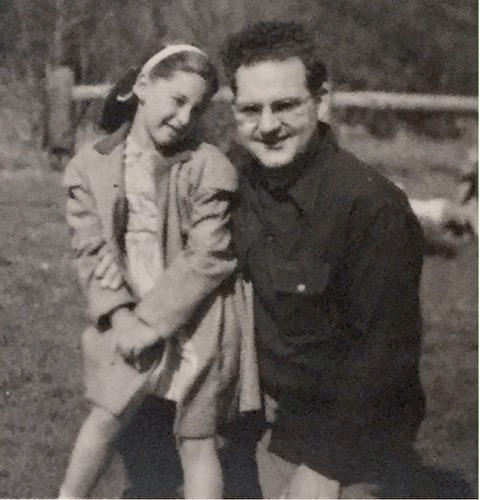
    Stanley with his daughter Roberta at Union Pier, Michigan, circa 1950.

    Marks adds to cynicism another deadly poison: loss of faith in the media, because of its betrayal. Back in 1967, Marks was already noting that there was no way of knowing “how many agents of the CIA now work for various organizations in the mass communication media” (MMF). In Two Days of Infamy, he again picks up this theme, adding: “The investigators of the ‘Report’ have presented the result of their investigations to the public; but the silence of the press lords to further an investigation of the Commission’s allegations has led to a further decline of the general public’s faith in all forms of mass communication.”

    Again, keep in mind that this statement was published in March of 1969. Since then, we have seen a snowballing––and then an avalanche––of mistrust in what we now refer to as the MSN; and this has occurred on both sides of the aisle, left and right. But Marks goes on to blame not only the MSN and the Warren Commission, but the critics themselves for what followed. He refers to the first generation of researchers when he says:

    The critics’ primary failure was their repeated implication that the murder of President Kennedy could not be solved unless, at the same time, they proved a conspiracy. The critics have constantly proclaimed that unless the Zapruder film, the X-Rays, and other photographic evidence was released from the National Archives, no solution could be obtained. Their demands obscure the main issue: “Was Lee Harvey Oswald the ‘sole and exclusive assassin of President Kennedy’ as charged by the Warren Commission?”

    The film, X-rays, and other photographic evidence is not the prime evidence in securing an affirmative or negative answer. That evidence is secondary.

    The prosecution, in this case the Warren Commission, must affirmatively prove three elements: (1) Lee Harvey Oswald was at the 6th floor S.E. corner window at the time the shots were fired; (2) those bullets which caused the death of President Kennedy came from a weapon he used at that time and (3) the rifle allegedly used was a functional operating lethal weapon from which those bullets were discharged.

    As we witness time and again in his assassination-related publications, no matter how far afield Marks goes to explore “bigger picture” implications, as a trained attorney, he always circles round and returns to the case at hand. Thus, two of his principal concerns are to show why Oswald could not have been convicted of being a “sole assassin” in any law court that followed the basic principles of American justice; and to prove this with specific facts, on a nuts-and-bolts legal level:

    In a court of law those three elements must be proved beyond a reasonable doubt by the evidence in the possession of the Warren Commission. Each of the three must be proved; not just one, or two, but all three.

    Thus, if Oswald was not at the S.E. corner window at the exact time those three bullets were fired, he could not be found “guilty” even though the remaining two elements be proved in the affirmative.

    If element (2) be proved in the affirmative but element (1) in the negative, then a trial judge would rule Oswald “not guilty.” If element (3) was proved affirmatively, the trial judge would still rule Oswald “not guilty” if (1) or (2) not be proven by the evidence given in court. Further, if (2) be proven but (3) proves that the rifle could not discharge those bullets because it was defective and incapable of firing bullets through its barrel, then Oswald would be found “not guilty.” A consensus does not operate in a criminal courtroom.

    Peppered throughout the text are examples of straightforward forensic evidence that any lawyer worth his salt would present to demonstrate his case against the WC conclusions. “Any attorney defending Oswald on the charge of being the ‘sole and exclusive assassin’ of President Kennedy would have an easy task to obtain a ‘not guilty’ verdict with the testimony of the physicians and federal agents that proved beyond a reasonable doubt that President Kennedy was struck in the back by a bullet striking him from an angle of fire between 45 and 60 degrees. This proved that such an angle of fire could only come from a window of the Dal-Tex Building or the County Building but not from the 6th floor of the Book Depository. Oswald was innocent.” And it is the presentation of such clear evidence that allows Marks to then expound on the risible nature of the Commission’s groundless theories:

    In spite of the testimony of the physicians and the federal agencies, the Commission decided to confuse the people by outdoing Baron Munchhausen—a paragon among liars. The Commission therefore proceeded to “produce” a “Tale of Bullet No. 399.” This “bullet,” sayeth the Commission Barons, first entered the president’s back, hesitated a moment, reversed itself, flew up his back, made a 90 degree turn, turned downward into the back of his neck, went through his neck, made another angle turn, entered the governor’s body, “tumbled” through the wrist, entered his rib cage, and came to rest when the “tumbling” lacked inertia, in his thigh! The leading Baron aide was a man by the name of Specter.

    Even after decades of rehashing the magic bullet fiasco in the voluminous assassination literature, Marks’s version leaves one with the impression of a fresh and lively spin.

    III

    Just as he does in Murder Most Foul!, by the end of Two Days of Infamy, Marks turns much of his ire on commissioner and former CIA Director Allen Dulles and for good reason. Like a prosecuting attorney delivering a summation through the use of rhetorical device, Marks’ refrain, echoed repeatedly in an imaginary courtroom, is the incredulous: “No conspiracy, Mr. Dulles?” And at one point, with a slight change in modulation, he adds: “The same Dallas police also testified that although Tippit’s clipboard was attached to his dashboard they never looked at it or read it! Do you believe that, Mr. Dulles?” (My italics.) Such passages also exemplify Marks’ lively, provocative, arch yet charming humor: a hallmark of the author’s writing that serves as a counterpoint to the sometimes strident, rage-fueled cadences that mark his discourse with an undertone of righteous indignation.

    Marks’ disdain for Dulles may be traced back to an article that appeared in Look magazine in July 1966, in which Dulles remarks: “If they found another assassin, let them name names and produce their evidence.” Stanley first quotes this in MMF, where he follows it with the remark: “This contemptuous statement directed at the American citizenry revealed the attitude of the Commission.” In Two Days of Infamy, he further qualifies it as “The most contemptuous statement ever issued by a member of any governmental commission investigating the murder of the head of his government.” But Marks cites this quote not merely to inform us of its existence, but to take up Dulles’ challenge. Indeed, the deeper one reads into Marks’ work, the more easily one can imagine that the impetus to produce such tomes grew directly from the outrage spawned by this outrageous declaration. After citing one example after another in which the Commission is caught with its pants down––or, perhaps more fittingly, called out for being an Emperor without any clothing––Marks rests his case by stating:

    The author has produced the evidence; it was the duty of Mr. Dulles and his commissioners to name the names of the assassins and the conspirators.

    That failure is theirs, not the responsibility of the American citizen.

    But Marks finds no solace in reaching this conclusion. Rather, he reminds us of a terrible truth:

    History has proven that once assassination has become the weapon to change the government, that style and form of government preceding the assassination falls beneath the hard-nailed boots of the assassins. Both right and left favor no democratic spirit in the people. The cold of Siberia and the gas ovens of the concentration camps have proved it.

    The tragedy of the Warren Commission is that they helped set those boots on the road to the destruction of American democracy.

    And how could so many have fallen prey to such a deceit? In part, this turning of a blind eye to the possibility of a conspiracy occurred because the citizens of the United States are “living in a dream world concocted by the mass communication systems.”

    One should also note that not all the ire falls upon Dulles. That other intractable head of so-called intelligence, J. Edgar Hoover, is the subject of so much justifiable vitriol that Marks was certain to have had a file opened on him by the FBI as a result. He lambasts Hoover for declaring just five months after the assassination of Bobby Kennedy that “Justice is incidental to law and order,” and adds:

    Mr. Hoover’s belief in “law and order” is on the exact same level as Hitler’s “law and order”; Stalin’s “law and order”; Mussolini’s “law and order”; Tojo’s “law and order”; Batista’s “law and order”; the Greek Colonel’s “law and order, 1968 version”; and so forth. Mr. Hoover’s basic philosophy is identical with the philosophy of any other “police state” objective.

    In 1943 Marks published a dozen essays in the Chicago Defender, one of the most celebrated African American newspapers in America. The illustration above features Marks’ weekly column, “War and Warfare.” The Defender played a key role in encouraging Blacks to leave the South and join “The Great Migration” North, to work in Chicago’s factories. During WWII it promoted the “Double V Campaign”: a proposed “Dual Victory” over both foreign and domestic “enemies” who remained opposed to racial equality and justice for all, thus incurring the wrath of J. Edgar Hoover, who tried to convince President Roosevelt to prosecute its editors for treason. Although Hoover was forced to back down, he opened files on the Defender and kept it under surveillance. Stanley’s publications eventually led to his blacklisting by the House Un-American Activities Committee.

    But Marks also views Hoover as something of a foxy figure. Since the Bureau’s memoranda and reports on the assassination were often as truthful as they were deceitful, and since the official FBI assassination report often contradicts the Warren Commission Report, Marks speculates that Hoover was attempting to have it both ways: protecting himself and the Bureau no matter what the final outcome. Indeed, Hoover’s performance was rather sly and of the type that only an attorney could truly appreciate. For example, speaking of the Mannlicher-Carcano rifle supposedly owned and used by Oswald for the assassination, Marks highlights Hoover’s brilliant use of legalese:

    In the official FBI Reports, Vol. 1 to 5, there is no statement by the Bureau that that rifle given to them was ever “used” by any rifleman. The FBI constantly referred to this rifle as being “owned” by Lee Oswald; never did they state that he “used” it for any purpose. How can a rifle discharge three bullets when the rifle has never been used?

    Note that fine line between truth and deceit: whether or not this rifle was really “owned” by Oswald, the Bureau nonetheless betrays the Commission by refusing to take that extra step of stating that it was “used” by him.

    Marks attempts to summarize this paradox of the Bureau’s seemingly shifting, alternating allegiances in the following manner:

    The federal agency that is the paradox, the Chinese puzzle, in the entire investigation is the Federal Bureau of Investigation. As has been stated in previous chapters, that Bureau overwhelmed the Commission with evidence that proved Oswald innocent in both murders. What is the puzzle is the fact although the Bureau time and time again warned the Commission that its “conclusions” would not stand the scrutiny of the light of day, that agency then turned right around and conducted itself in a manner implying they had something to hide––to conceal their possible involvement in the assassination. The Bureau was involved in suppressing the same evidence they had originally uncovered and exposed to the world! […]

    The Bureau’s conduct can only lead to a conclusion that the Bureau was operating on both sides of the fence, in the slim hope that any investigation of the “Report” would not be undertaken by a serious investigator of that “Report.” “Heads or tails,” the FBI could prove that they had given evidence, or uncovered evidence, disproving the Commission’s accusation that Oswald was the “sole and exclusive killer of President Kennedy.” What is perplexing is Mr. Hoover’s defense of the Commission in the face of that evidence and his various statements, which were obtuse or contradictory, that did nothing to add to the honor of the FBI.

    Appearing beside William Styron’s Confessions of Nat Turner, the #1 bestseller, and Rosemary’s Baby listed at #6, Murder Most Foul! somehow managed to get a brief mention in the mainstream press despite being a self-published text. The reviewer, Donald Stanley, ran a feature column with the San Francisco Examiner, and the review appeared in the December 24, 1967, edition, about three months after the publication of Murder Most Foul! This may have been the last time Marks was mentioned in any major media until recently.

    IV

    Marks’ phrase “two days of infamy” refers to the date of JFK’s murder and, ten months later, to the release of the Warren Commission Report. By grafting FDR’s “infamy” term onto these more recent dates of iniquity, the author is reminding us of the rage and indignation that rise up within many who lived through both the attack on Pearl Harbor and the coup d’état of November 22, 1963. This outrage extends beyond the personal figure of JFK and the experience of his loss. For, as Marks warns in the first chapter of Two Days: “A nation can be destroyed if its leaders can be murdered with impunity.” As a result of the Warren Commission hoax perpetrated by those ignoble seven commissioners, “The truth was never ascertained; the evidence never evaluated; and the truth uncovered was covered. Never was so much done by so many that produced so little.” Later on, with typical Marksian aplomb and incisiveness, he adds:

    The historical verdict of the Warren Commission is that the Commission proclaimed a precedent whereby it is now permissible for the president of the United States to be murdered by men who believe that the vice president, who becomes the president upon the death of the president, would be more amenable to the philosophies of the murderers.

    *   *   *

    As we were putting the final touches onto the new edition of Murder Most Foul!, Roberta Marks went through an old box in her garage that contained some of her father’s papers. Lo and behold, she unearthed a precious––and curious––document. Just a few years after Robert Kennedy’s death, Stanley Marks had received an unexpected request. On March 12, 1973, the JFK Library wrote Marks a letter requesting information on how to purchase a copy of Murder Most Foul! for their collection. And from this we may surmise that RFK’s trusted colleague, Dave Powers, who served as JFK’s personal assistant and whom RFK later placed in charge of assembling materials for the official JFK Library, would probably have been familiar with at least the title of Marks’ book.

    How to explain such an interest in this little-known work?

    The John F. Kennedy Library contacted Marks with a request to purchase a copy of Murder Most Foul! for their collection.

    Thanks to Vincent Palamara’s Survivor’s Guilt: The Secret Service and the Failure to Protect President Kennedy, I recently learned that Powers had long maintained a skeptic’s view of the Warren Commission Report. In discussing the possibility of Secret Service involvement in the conspiracy, in Survivor’s Guilt Vince writes that, in 1996, ARRB Director Tom Samoluk informed him that Dave Powers “agreed with your take on the Secret Service.” If Powers held this belief, it might explain why this unusual purchase of Murder Most Foul! was authorized for the JFK Library.

    A photo of this letter addressed to Marks, composed on U.S. General Services Administration stationery, is reproduced here and in the new edition of MMF.

    Purchase info for Two Days of Infamy here.

    Purchase info for Murder Most Foul! here.


    [1] In Two Days of Infamy, Stanley writes of Governor Ronald Reagan: “If it be morally correct for the Czech students to defy Stalinism, should not it be morally correct to defy Reaganism?”

    [2] One could also argue that since Destiny Betrayed was first published in 1992 and then completely rewritten a decade later, it serves as a symbolic bridge between the Old World of JFK research and the New.

    (Special thanks to Al Rossi.)

  • Steven Gillon: Mark Lane Equals Donald Trump?

    Steven Gillon: Mark Lane Equals Donald Trump?


    On the 57th anniversary of President John Kennedy’s death, historian Steven Gillon was given a platform to write an opinion piece relating to Kennedy’s assassination, except he did not write about John Kennedy’s presidency; nor did he address any new facts about his assassination. The title of his column for the Washington Post was: “The Tie Between the Kennedy Assassination and Trump’s Conspiracy Mongering.” Gillon was going to comment on the refusal of President Trump to concede the election and the failure of his lawyers to turn his loss into a legal victory.

    As a lead in to his real subject, Gillon wrote:

    …conspiracy theories have a long history in right-wing politics. But tempting though it may be to chalk conspiracies up as a conservative phenomenon, the truth is more complicated.

    In itself, that statement is an historical humdinger, because what Gillon is trying to do is not just sweep the right-wing QAnon under the rug; which would be quite a magic trick in and of itself. But when he only alludes to the fact that “conspiracy theories have a long history in right-wing politics”, he is trying to somehow neuter the entire ultra-conservative movement that sprung up against President Dwight Eisenhower, because of his perceived mild reaction to the Cold War. To give that movement the back of one’s hand is both irresponsible and ahistorical, because it morphed and mushroomed into the pernicious and frightening far right force we live with today.

    That began with the pure force of the second Red Scare. In large part, this was caused by Richard Nixon as a member of the House Unamerican Activities Committee (HUAC). That committee was designed to pursue Nazi espionage activities in America, but the HUAC was quickly sidetracked by conservative Republicans. It now explored any kind of suspected domestic communist infiltration. Nixon used that committee to advance the questionable case of journalist Whitaker Chambers against former State Department employee Alger Hiss. Nixon, and FBI Director J. Edgar Hoover, used an array of questionable tactics both in congress and then at two trials. At the second trial, Hiss was convicted of perjury. He could not have been convicted for espionage simply because Chambers had so many liabilities as a witness. Plus, as we have come to learn, the typewriter produced at the trial was the wrong machine. (There has been a flurry of recent books on this case that show just how unethical the Nixon/Hoover case was e.g. Joan Brady’s America’s Dreyfus.)

    It was this case that added great torque to the second Red Scare of the fifties. This resulted in the faux senate investigations of Senator Joe McCarthy and his chief counsel Roy Cohn. Robert Kennedy was an attorney on the committee, but resigned after he saw what Cohn was really up to. He later returned as counsel for the Democrats. And it was through his efforts, plus the exposure of McCarthy on national television by Edward R. Murrow, that brought an end to the McCarthy/Cohn demagoguery.

    But there can be little doubt that a certain part of the Republican Party found the McCarthy/Cohn movement politically useful. The constant refrain of innumerable communists infiltrating 1.) the State Department, 2.) the Pentagon, 3.) the CIA and 4.) even the White House, this created a climate of fear, loathing, and paranoia. When this was turned on the Democratic Party, it could be used for political impact e.g. the slogan that the Democrats lost China.

    It was this emotional, almost pathological, anti-communist appeal that led to the rise of the John Birch Society (JBS) and its affiliated rightwing groups e.g. the Minutemen. The founder of the John Birch Society wrote a controversial book called The Politician. In the original draft of the manuscript, Robert Welch tried to insinuate that somehow President Eisenhower was really a kind of Manchurian Candidate, that is, he was a communist plant. (D. J. Mulloy, The World of the John Birch Society, pp. 15-16)

    Welch’s view of the worldwide communist plot is depicted in The Blue Book of the John Birch Society:

    Communism, in its unmistakable present reality is wholly a conspiracy, a gigantic conspiracy to enslave mankind; an increasingly successful conspiracy controlled by determined, cunning, and utterly ruthless gangsters, willing to use any means to achieve its end. (Mulloy, p. 3)

    But that was just the beginning of Welch’s accusations. Welch thought water fluoridation was a communist plot. The JBS thought the civil rights movement was run out of Moscow. For that reason, they ended up opposing John Kennedy’s civil rights bill. Their legal pretext was the doctrine of states’ rights. (Mulloy, p. 110) In that respect, it should be noted that both Fred Koch and Harry Lynde Bradley were early promoters and members of the JBS. (Mulloy, p. 9) Fred Koch was the father of Charles and David Koch. Bradley was a co-founder of the Lynde and Harry Bradley Foundation. These present clear and powerful ties to the GOP establishment of today, which, for whatever reason, Gillon wants to air brush out of the picture.

    It is significant to note that, through their publishing house, Western Islands, the JBS sponsored writers like Gary Allen. Allen propagated the idea that both the American government and the USSR were actually controlled by international bankers and financiers like David Rockefeller and Armand Hammer. Allen and the JBS saw the United Nations as a kind of front for this group to create a world government. Professor Revilo Oliver, a contributor to the JBS magazine American Opinion, wrote a two part essay about the Kennedy assassination for that journal. It was called Marxmanship in Dallas. (See Warren Commission, Vol. 15, p. 732) It turned out that some of the information Oliver used for that rather wild piece came from Frank Capell. Capell was another far right journalist and professional Red hunter who helped create the pernicious mythology about Robert Kennedy being involved in the “murder” of Marilyn Monroe. (Click here for details) Robert Alan Greenberg, in his book Enemies Within: The Culture of Conspiracy in Modern America, describes some of what Revilo Oliver thought about the murder of President Kennedy:

    The conspirators had become impatient with Kennedy when his efforts to foment domestic chaos through the civil rights movement and “economic collapse” had fallen behind schedule. (Greenberg, p. 110)

    By 1960, the JBS had become a fairly powerful political force that was threatening to enter the mainstream of the Republican Party and the conservative movement. It posed such a threat that, as Welch got further and further out in his conspiracy thinking e.g. Adam Weishaupt and the Illuminati, he sustained a series of attacks from first, the new publisher of the Los Angeles Times, Otis Chandler in 1961, then from William F. Buckley in his magazine The National Review. (February 13, 1962) In November of 1964, on the eve of the election, historian Richard Hofstadter wrote an article for Harper’s, “The Paranoid Style in American Politics”. This much misrepresented essay was really about how the McCarthy movement had influenced Welch and how, in turn, that had impacted the rise of Barry Goldwater.

    Although many observers thought that the defeat of Goldwater would end the JBS, that was not really true. It exists to this day. (Click here for their website) Note that they greet the viewer with the slogan “America Needs Patriots.” This is how its influence has stayed alive: through the birth of the Patriot Movement and the growth of armed militias, for Robert DePugh, who founded the Minutemen, was originally associated with the JBS. This group was militaristic and featured training camps with caches of arms. DePugh later formed something called the Patriotic Party in 1966. President Kennedy criticized both groups in a speech in November of 1961. (Mulloy, p. 43)

    Many commentators have noted that today’s militia groups are powerfully influenced by far-right conspiracy theories. D. J. Mulloy once wrote that, “The embrace of conspiracy theories by militia members is the most well-known and most thoroughly documented aspect of their ideological and rhetorical concerns.” (American Extremism, p. 169) As Mulloy writes, the themes of these theories center around an international cabal which is intent on disarming Americans and creating a formal One World government. A member group, the National Alliance, published what many consider to be the keystone piece of literature of the movement. The Turner Diaries has sold over half a million copies. Reportedly, after the Oklahoma City bombing in 1995, Tim McVeigh had a copy of that book when he was pulled over for speeding in a vehicle with no license tag.(The Medusa File II, by Craig Roberts, p. 130)

    In these anti-government/pro-gun circles, President Trump is depicted as a hero: exposing and expelling a Satan worshipping international pedophilia ring based in Washington. QAnon is also reminiscent of the JBS because of its not so lightly veiled anti-Semitism. (Revilo Oliver was expelled from the JBS when his anti-Semitism got too obvious.)

    Everyone, except maybe Gillon, knows that the QAnon movement is tied to the modern GOP. Marjorie Taylor Greene of Georgia, a former member of the group, is a Republican representative in Congress. So is Lauren Boebert of Colorado. (Click here for details) After Trump lost the election, QAnon followers began to send the bizarre claims of Trump election attorney Sidney Powell across the web. A movement follower was quoted as saying that Powell was “our attorney doing God’s work to preserve our Republic.” QAnon had to do this since the group was expecting Trump to win in a landslide. (CNN Business, 11/24/20, story by Donie O’Sullivan)

    But it’s even worse than that. Lisa Nelson, an employee of the sprawling Charles Koch political network, met with a group of conservative activists back in February of this year. She told them that, although she wanted Trump to win in the fall, they had already been working with three attorneys on how to dispute the election results if he lost. She specifically mentioned how to foul the electoral college. This talk is captured digitally. (Crooks and Liars, 11/23/20, story by Susie Madrak) And we all can understand by now that President Trump’s complaints about Jeff Bezos and his influence over the USPS was a pretext. Trump knew that the Democrats were most likely to use mail in ballots than Republicans. Once Trump installed Louis DeJoy as Postmaster General, he went to work disposing of high-speed automatic sorting machines in states where mail in ballots would be impacted. (Click here for details)

    Furthering this concept is the fact that certain key state legislatures would not allow mail in ballots to be counted on the day of the election. They had to be counted afterwards. This gave the White House an interval in which to create a controversy about election fraud. (USA Today, 11/4/20, story by Katie Wedell and Kyle Bagenstose) Trump cooperated with this by going on TV on November 5th and saying there should be doubts about continued counting of the ballots. He said, “They’re trying to rig an election and we can’t let that happen.” (Raw Story, November 9, 2020, “Has Donald Trump had his Joe McCarthy moment?”)

    But that is not all. On his twitter account, Trump has cross posted the rather weird ravings of actor Randy Quaid. This was part of an attempt by the president to attack Fox News and Tucker Carlson, because, on his show, Carlson kept asking Powell for her evidence of vote fraud. In other words, Trump was even losing Fox News. In one of his videos, Quaid talks about a day of reckoning coming, which is similar to QAnon and their idea about the Storm: the day when Trump will root out the Washington pedophilia ring. (NBC News, 11/24/20, story by Minyvonne Burke)

    In the face of all this discernible evidence about how the dispute over the election was foreseen and planned for by forces on the right, how does Gillon confront it? He doesn’t. He ignores it. Who does he blame for this instead? A man who has been dead since 2016: Mark Lane.

    The way he explains controversy within the Republican party is by saying that it was all really caused by the critics of the Warren Commission, beginning with Mark Lane back in 1966. I‘m not kidding. Gillon writes that, beginning with Lane’s book Rush to Judgment, an entire “conspiracy culture” arose in America “that now permeates every aspect of American society.”

    This is an historian? I have just pointed out how the rise of the so-called giant communist conspiracy preceded Mark Lane’s book by a decade. But Gillon has to discount that in order to create his phony argument. He then, of course, adds in Oliver Stone’s 1991 film JFK as contributing to all this disbelief in our government and institutions.

    I have to inform Gillon about the following: the assassination of Malcolm X, the war in Vietnam, the murders of Martin Luther King and Robert Kennedy, Watergate, the colossal Iran-Contra scandal, the CIA/cocaine scandal, the heist of the 2000 election in Florida, the 9/11 attacks, the debacle of the Iraq War, our prolonged involvement in Afghanistan, the heist of the 2004 election in Ohio, the rise of ISIS, the near collapse of the world economy in 2007–08, the bombing war on Gaddafi, and Operation Timber Sycamore in Syria. Steve, these are not attributable to Mark Lane. If many Americans are frustrated with the way our government works, they have a lot of good reasons to feel that way. And this is what Trump was suggesting with his Make America Great Again slogan.

    It is also logical to think that, since many people are fed up with this sorry trail of folly, they voted for a perceived outsider like Trump in 2016. In fact, if the powers that be in the Democratic Party would have not worked against him, another outsider, socialist Bernie Sanders, likely would have won the Democratic nomination that year.

    What makes Gillon’s argument even more nonsensical is this: Trump does not think the JFK case was a plot. One only has to look in the pages of Michael Cohen’s book Disloyal, to understand that. Trump and his pals at the National Enquirer used a phony relationship between Ted Cruz’ father and Lee Harvey Oswald to defeat the Texas senator in the GOP primaries in 2016. Obviously that could only have an effect if one assumes Oswald was the killer the Warren Commission says he was. Somehow Gillon missed that important point also.

    Gillon is a scholar in residence at History Channel. If you know what he did there at the 50th anniversary of Kennedy’s death, it helps explain his rancidly over the top column. In 2013, Gillon co-produced a documentary—with the liberal use of recreations—called Lee Harvey Oswald: 48 Hours to Live. All one needs to know about this program is that, in addition to Gillon, two of the other talking heads were the late Gary Mack and Dale Myers. Myers was the guy who, in 2003, got on national TV and said that the single bullet theory was not a theory but a fact. In other words, he was telling the public that something that never happened—and could not have happened—actually occurred. Gillon put this guy on his show.

    The result was predictable. This program was made 15 years after the Assassination Records Review Board closed its doors. One would think that a “scholar-in-residence” like Gillon would utilize at least some of the massive amount of new information made available by that body. Wrong. In the face of a veritable flood of new documents and interviews—which altered the calculus of the JFK case—this program was nothing more than a regurgitation of the Warren Report.

    This helps explain why Gillon wrote what he did on November 22nd. People who back a lie as big as the Warren Report are always eager to attack those who know just how utterly false their position is. This helps explain why Gillon ignores the real reason why Trump’s claims of electoral fraud can prosper in the modern GOP, because followers of QAnon and the militia movement are daily stoked and amplified. Due to Ronald Reagan’s striking down of the Fairness Doctrine and Equal Time provisions of the Federal Communications Act, plus the liberalization of ownership laws under Bill Clinton, the Right has been able to create a giant communications network. It exists in television (Fox, OAN, Sinclair Network, Newsmax), in radio (iHeart and Cumulus), and in print, both online and newspapers (Newsmax, New York Post, Washington Times). The reach of this network is nothing less than staggering in scope. It’s hard to believe Gillon is not aware of it, since he worked for Rupert Murdoch and Fox News for two years.

    Now that we know a little more about Gillon, it helps explain his vituperative column for the Washington Post. The professor definitely has a dog in this fight. And that is something a real historian should not have.

  • Edward Curtin’s Seeking Truth in a Country of Lies


    Edward Curtin is a former college instructor in Massachusetts. His insightful and valuable writing has appeared at Global Research and Countercurrents. His anthology includes essays on the JFK and RFK cases, 9/11, Robert Kennedy Jr.’s book American Values and Allen Dulles, among others topics. Joe Green offers more below.

  • The Jakarta Method by Vincent Bevins

    The Jakarta Method by Vincent Bevins


    Vincent Bevins’ book, The Jakarta Method is an ambitious volume. It essentially tries to tell the story of the Cold War, largely from its impact in what we today call the “Third World.” In his introduction, Bevins writes that he has avoided speculation entirely. (p. 7) He then adds that there is much we do not know. As we shall see, he fails to deal with some things we do know and he does not avoid speculation.

    I note upfront, Bevins is not an academic, let alone an historian. He is a journalist who has been employed by the LA Times, Washington Post, and the Financial Times of London. He gives acknowledgements to several academics, including Bradley Simpson of the University of Connecticut. As we shall see—and as I will explain—that is a rather revealing statement by the author.

    I

    The book has no index. But I took extensive notes. Oddly—considering his subject—Bevins gives rather short shrift to the origins of the Cold War. One of the strangest things about the book is this: I could find no mention of George Kennan. Any writer dealing with the subject would have to at least make mention of the crucial importance of Kennan in how it all began. Bevins does not.

    George Kennan enlisted in the American diplomatic corps out of college in 1925. He was stationed in Prague during the Anschluss and in Berlin until the American declaration of war against Germany in December of 1941. Kennan had studied the USSR and sided with the likes of former ambassador William Bullitt and State Department experts like Loy Henderson and Chip Bohlen on the subject, thereby disagreeing with Franklin Roosevelt’s former Russian ambassador Joseph Davies about the possibility of any kind of reliable alliance with Joseph Stalin against the Third Reich. Yet, as anyone who has studied the era understands, this was what Roosevelt was relying on in his pre-war strategy and his actual tactics during the conflict.

    At the end of the war, Kennan was appointed deputy chief of mission in Moscow. What makes what he did there so important is that FDR had passed on in April of 1945. Davies’ influence was now weakened. In February of 1946, Kennan cabled his famous/infamous Long Telegram to Washington. It’s called that since it was well over 5,000 words in length. (Click here for more information)

    Many observers consider the Long Telegram crucial in understanding what came afterwards. It provided an intellectual underpinning for the hardliners in the White House and State Department to sanction the Cold War and depict it as a life and death struggle over the fate of mankind. Whatever one thought of Kennan, he was an intelligent, well-read man who could write. So even if one disagreed with him, one had to admit he knew how to construct an argument. It was the Long Telegram and Kennan’s article in Foreign Affairs magazine the following year that set the stage for the American policy of containment against the—according to Kennan—naturally expansive Soviet Union. President Harry Truman adapted it and it governed American policy towards the USSR for the next forty years. And some would say longer.

    Now, one of his implicit arguments—never formally stated, but clearly implied—is that the Cold War, and all its accompanying savagery, was somehow inevitable. That pall hangs over The Jakarta Method as thickly as it does David Halberstam’s similarly flawed—and today obsolete— book on Vietnam, The Best and the Brightest. But, if FDR and his Secretary of State Cordell Hull had stayed in power, it is highly suspect that Kennan’s Long Telegram would have carried the day. In fact, Kennan spent a large part of his later career denying that he ever meant his cable to be carried to the extremes it was taken to. (Oliver Stone and Peter Kuznick, The Untold History of the United States, pgs. 211, 229–30) The Kennan-induced hysteria led to Paul Nitze’s complete militarization of the Cold War with his 66-page document labeled NSC 68, presented to Truman in 1950. Nitze was not satisfied with containment. He advocated rollback. (Click here to read NSC 68)

    It’s not just important to mention FDR’s cooperation with the USSR before and during the war. We should also note his plans for after the war. In a secret interview with Robert Sherwood in 1946, Anthony Eden, Churchill’s foreign minister, said that he blamed the present state of affairs on the death of Roosevelt. He spoke of Roosevelt’s subtlety and contrasted that with Truman and Winston Churchill. Eden told Sherwood that, had Roosevelt lived and maintained his health, he would have never let the Soviet/American situation deteriorate as it had. He concluded that FDR’s “death therefore was a calamity of immeasurable proportions.” (Roosevelt’s Lost Alliances, by Frank Costigliola, p. 2)

    This relates directly to Bevins’ subject. For instance, FDR did not want Indochina to be returned to France after the war. He said, “The people of Indochina are entitled to something better than that.” Stalin supported Roosevelt on the decolonization issue. FDR also said, one week before his death, that once the Japanese had been cleared from the Philippines, that archipelago would be granted its independence. (Stone and Kuznick, pp. 112–13). Neither of these occurred. Winston Churchill resisted this decolonization movement. It was Truman who befriended Churchill even after he was defeated for reelection for prime minister. He then allowed Churchill to make his wildly Manichaean Iron Curtain speech in the USA in March of 1946. It came less than a year after FDR’s death. Five months later, Eden made his comments to Sherwood about the calamitous loss of Roosevelt.

    When looked at in this manner, the so-called inevitability—or the ineluctable tragedy of the Cold War—is not so inevitable and not so ineluctable. With Roosevelt and Hull in power, it might not have happened. Or at least it would not have been so epochal. I could not detect that alternative in the Bevins book. In my view, any real historian would have noted it.

    II

    When I got to Chapters 2 and 3, I detected another historical lacuna in The Jakarta Method. This is where Bevins begins to focus on Indonesia and also the rise of the CIA as an overseas arm of American foreign policy. I got the impression that somehow Bevins thought that CIA clandestine operations officer Frank Wisner and American ambassador to Indonesia Howard Jones were more important in those two areas than the Dulles brothers and Dwight Eisenhower. This is the impression a novice would get in reading those two chapters (pp. 31–75).

    Blanche Weisen Cook noted in her book, The Declassified Eisenhower, that while he was serving as president of Columbia University in New York, Dwight Eisenhower was attending a tutoring course at the Council on Foreign Relations. He concentrated on economics and how America was influencing the world through the Marshall Plan. In all likelihood it was through this process, plus his disagreement with the dropping of the atomic bombs on Hiroshima and Nagasaki, that Eisenhower became enamored with both covert action and the use of economic forces in order to confront communism and control nationalistic revolution in the Third World. This was much more attractive to him than risking a final and devastating war with Russia. As she wrote, “For Eisenhower, missiles represented deterrence. Yet covert operations, misinformation, nonattributable intervention were part of his active arsenal.” (Letter to the New York Times of August 2, 1981) I should also add that, in her book, the key role of C. D. Jackson as a propaganda expert was first fully revealed. It was through people like Jackson that Eisenhower made propaganda and psychological warfare a constant in countries like Poland, Hungary and Italy. (ibid)

    Eisenhower actually asked at an NSC meeting in 1953 why it was not possible “to get some of the people in these downtrodden countries to like us instead of hating us.” (Stone and Kuznick, p. 258) Eisenhower never really learned how to answer that question in any practical way. As historian Philip Muehlenbeck notes in his study of African colonial liberation, from 1953 to 1960 nineteen independent states emerged on that continent. Not once did the USA ever vote against a European power over a colonial dispute at the UN. (Betting on the Africans, p. 3) Eisenhower rarely, if ever, criticized colonial rule by an ally. He would often find a reason to go golfing when a new African head of state arrived in Washington. (ibid)

    His vice-president had the same lack of empathy and understanding of the Third World. Richard Nixon made his reputation in the Alger Hiss case. That case helped launch the Red Scare of the 1950’s. Therefore, a virulent strain of anti-communism now existed domestically as well as in American foreign policy. Nixon was part of both. In 1954, Nixon was the first high official to advocate for inserting American troops into Vietnam. (John Prados, Operation Vulture, E book version, Chapter 9) To say Nixon was rather condescending to the peoples of the Third World is an understatement. At an NSC meeting the vice-president claimed that “some of the peoples of Africa have been out of the trees for only about fifty years.” (Muelhenbeck, p. 6) These personal traits carried over into action. While Nixon was president, the military wanted to cut back on Operation Phoenix in Vietnam, Nixon had it renewed. (Anthony Summers, The Arrogance of Power, p. 334) Bevins covers Phoenix as part of his theme of brutalization of third world populations. (p. 267) Yet, I barely recall Nixon being mentioned in the book in relation to Indochina.

    For this reviewer, there was another lacuna in the book which I also found strange. In large portion, Bevins draws the Cold War in terms of ideology. Certainly that is the way that operatives like Frank Wisner and Tracy Barnes saw it. But as one goes up the ladder the motivational funnel broadens. Secretary of State John Foster Dulles and his brother, CIA Director Allen Dulles, both worked for decades at the giant international law firm Sullivan and Cromwell. That firm represented sprawling corporate interests in varying fields e.g. banking, petroleum and mining. Many of these were part of either the Rockefeller or Morgan empires. Those business interests had large holdings in the Third World. As international corporate lawyers, the Dulles brothers were beholden to these interests and therefore sensitive to them. This is why Michael Parenti has said that the acronym CIA could also stand for Corporate Interests of America. The book doesn’t have a bibliography, but from scanning his notes, Bevins would have benefited in reading A Law unto Itself, a history of Sullivan and Cromwell. Concerning the CIA’s 1954 overthrow of the democratically elected Arbenz government in Guatemala, he just says the Dulles brothers worked on Wall Street and they did some things for United Fruit. (p. 46) Later, he does supply a bit more information, but this is in his footnotes. (p. 279)

    Bevins follows this pattern with Operation Ajax in 1953 in Iran, the overthrow of Mossadegh. Bevins spends all of six paragraphs on the overthrow. Considering the subject of the book, this was so skimpy as to be jarring. Bevins did not have to devote a full chapter to Iran, but to deal with this very important subject in just six paragraphs was, for me, a non-starter, because it does not do justice to the event, the people involved in it, its importance in history and therefore to the story he is telling. And that story relates to Iran, the Third World, and the United States.

    III

    In 1933, the Anglo-Iranian Oil company—later to become British Petroleum—was formed. It was a combination in ownership of the British government and private business, i.e. British Shell. That entity purchased a 100,000 square mile claim of land in Iran. The company then sold off 20% of it to Exxon and Mobil. The terms were a 20 year sublease expiring in 1953. (John Blair, The Control of Oil, pp. 43–44) The interests of the American ownership in the company were represented by Allen Dulles at Sullivan and Cromwell. And the Shah of Iran was a longtime acquaintance of Mr. Dulles. (Nancy Lisagor and Frank Lipsis, A Law unto Itself, p. 210)

    The Anglo-Iranian Oil Company was the pride and joy of Winston Churchill. He looked at it as a way of supplying the great British navy with an endless supply of cheap fuel. (Robert Dreyfuss, Devil’s Game, p. 109). The company was rather stingy in its arrangement with the Iranian government. The split between the two was 84–16% in favor of the company. There was a lot of money involved since the company was the third largest producer of crude in the world. (Stone and Kuznick, p. 258). From the time he was in the Iranian parliament, Mohammad Mosaddegh detested dealing with the British. Like another secular Arab leader, Gamal Abdel Nasser, he considered them the worst colonizers on the globe. As early as 1944 he advocated nationalizing their holdings. (Dreyfuss, p. 109) This was made worse when Mosaddegh learned that the American owned Arabian American Oil Company had a 50/50 profit sharing deal with Saudi Arabia.

    Shah Reza Pahlavi did not really want to be a monarch. He admired what Kemal Ataturk had done in Turkey. So he also wished to turn Iran into a republic. But the powerful set of mullahs, named the Ulema, resisted this. (Dreyfuss p. 110) They were backed by the radical fundamentalist terrorist group the Muslim Brotherhood. The Brotherhood resorted to assassination of members of the Shah’s government between 1949–51. In a very important point, completely missed by Bevins, this extremist group was backed by the British who supplied them with suitcases full of money to bribe the mullahs and to purchase followers in the Grand Bazaar of Tehran. (Dreyfuss, pp. 111–13) As Robert Dreyfuss points out in his fine book Devil’s Game, the British did not want the Middle East turned into a Pan Arab union of republics, for this would mean that they would not get the favored oil arrangements they had from the royal monarchies.

    Mossadegh led the political group called the National Front. The Shah appointed him prime minister in 1951. He announced a series of progressive and democratic reforms; peasantry was banished, unemployment insurance was begun, land reform was instituted. On May 1, 1951 Mossadegh nationalized Anglo-Iranian. He wished to use the profits for the betterment of Iranians. In another key point slighted by Bevins, when Mossadegh visited Washington in 1951, Truman warned London not to attack Iran. A policy which his Secretary of State Dean Acheson was in agreement with. (Dreyfuss, p. 113; Stone and Kuznick, p. 259) Therefore, Churchill decided to wage economic war on Tehran. Mossadegh cut off diplomatic relations with London.

    The British knew they needed an ally in their goal of overthrowing Mossadegh. He was being granted emergency powers because of the economic warfare. Under Truman and Acheson, the USA would not volunteer. Under the new administration, America did so. In fact, people in the CIA understood something had now changed with Iran policy. Previously, they liked Mossadegh and he was seen as a bulwark against the Tudeh, Iran’s small communist party. (William Blum, The CIA: A Forgotten History, p. 69) They were now going to work with the British MI-6 to displace him, and the issue was oil. (Dreyfuss, p. 115) When the CIA station chief in Tehran resisted, Allen Dulles removed him. (Stone and Kuznick, p. 260)

    With his brother Allen as CIA Director, the blueprint to overthrow Mossadegh was designed in John Foster Dulles’ office in the State Department in June of 1953. (John Ranelagh, The Agency, p. 261) The idea was to get the Shah to dismiss Mossadegh, which he was reluctant to do. In August of 1953, he finally did. Then the Shah fled to Rome. Once Mossadegh was formally dismissed, the idea was to portray him as a tool of Tudeh, which Foster Dulles knew he was not. But both the New York Times and Allen Dulles said he was. (Blum, pp. 70, 75). In fact, during the entire crisis, the Russians did not try and extend aid to ease the economic embargo, even in the face of the actual overthrow. And Mossadegh did not ask for Russian aid. (Blum, p. 75) Step three was the CIA, under their ground supervisor, Kermit Roosevelt, would now enlist the British allied Muslim Brotherhood and the Ulema to raise violent demonstrations against Mossadegh. They even got some of the Brotherhood to masquerade as members of the Tudeh. Under disguise, they threw rocks at mosques and mullahs and wore placards saying they would hang the mullahs from lampposts in all major cities in Iran. (Dreyfuss, p. 117; Stone and Kuznick, p. 260) Step five was, in the face of this CIA created chaos— which weakened Mossadegh—to secretly supply the army and enlist them on their side. (Blum, p. 73) In the midst of this violent and deadly maelstrom, step 6 was now taken: the Shah was to appoint a new leader, handpicked by the CIA and Kermit Roosevelt. After a final tank battle was waged in front of his home, Mossadegh stepped down. He was first imprisoned and then placed under house arrest. His followers were jailed, many were executed. Allen Dulles, who had temporarily stationed himself in Rome, now ordered a plane to transport the Shah from Italy back to Tehran. (David Talbot, The Devil’s Chessboard, pp. 235–38)

    I have outlined what happened in Tehran from 1951–53. I invite anyone to compare the above six paragraphs with what Bevins has written on the subject. (See pgs. 38–40). I guarantee the reader will learn more, in every way, from the above. Recall, this was the first successful overthrow of an elected government through covert action by the CIA.

    The results, for the American oil companies allied with the Anglo-Iranian company, were tangible. They got an increased share of the company. (Blair, p. 46) The Shah was now the recipient of well over 100 million dollars in aid in the first year he was restored. (Stone and Kuznick, p. 260). He gratefully joined the Baghdad Pact. The Dulles brothers were quite pleased with what had occurred in Tehran, as was Eisenhower. Kermit Roosevelt was not. When Foster Dulles asked him to repeat the performance later, he declined. In 1958, he quit the CIA and went to work for Gulf oil. (Ranelagh, p. 264). As anyone can understand, except perhaps Vincent Bevins, the forces that the Dulles brothers helped unleash to bring down Mossadegh in 1953 were, in large part, the same forces that overthrew the Shah in 1979. This included the Ayatalloh Khomeini, who, in 1979—with the help of the BBC and ABC—turned the USA into the Great Satan of the Middle East. (Stone and Kuznick, p. 260) Khomeini also ushered in the explosion of Islamic fundamentalism that—as we shall see, but Bevins does not—Senator John Kennedy warned about in 1957.

    IV

    I have tried to show above how there was a discernible darker gradation from Franklin Roosevelt, to Harry Truman, to Dwight Eisenhower in regards to the Cold War. I did not really detect this in Bevins’ book. It was under Ike that Allen ran the CIA and Foster was Secretary of State. It was then that the CIA tried to perfect the art of the overthrow. Prior to this, the Agency was run by two military men. On and off, Allen Dulles had served in both the State Department and the Office of Strategic Services, as well as at Sullivan and Cromwell, for virtually his entire life.

    With that in mind, and in this reviewer’s opinion, to leave out Truman’s regret at what Allen Dulles had done to the CIA is not being candid with the reader. Those regrets were real and he shared them with others like Admiral Sidney Souers. Appointed by Truman, Souers briefly ran the Central Intelligence Group, the immediate forerunner to the CIA. Years later, Truman had communicated with Souers about what Allen Dulles had done to the CIA. Both men were gravely disappointed in the result. Souers wrote to Truman that Dulles “caused the CIA to wander far from the original goal established by you, and it is certainly a different animal than I tried to set up for you.” (James DiEugenio, Destiny Betrayed, Second Edition, p. 379)

    This was not an isolated opinion. Both Robert Lovett and David Bruce also lamented what the Dulles brothers had done. Both were scions of the Power Elite e.g. Bruce was a longtime ambassador who married into the wildly wealthy Mellon family. Lovett worked for Brown Brothers Harriman as well as serving under Truman as Secretary of Defense. As well established in the upper circles as these men were, they were highly critical of what the Dulles brothers had done with the CIA. They filed a report while serving on the civilian control board for the Agency. Bruce referred to what Allen Dulles was doing as “king-making”. Agreeing with Truman, both men wrote that intelligence collection had been superseded by covert action under Dulles. And this was not what Truman had in mind at the outset. (DiEugenio, p. 49) Their complaints fell on deaf ears since Eisenhower was president at the time.

    This is important because it touches on what is supposed to be the main focus of Bevins’ book: Indonesia. In the Bruce-Lovett report, it specifically points out that Foster Dulles had removed ambassador John Allison in advance of the attempted coup against Sukarno in 1958, for the reason that Allison opposed it. (DiEugenio, p. 49). He was replaced by Howard Jones, who was kept in the dark about what was upcoming.

    Before addressing the attempted 1958 coup against Sukarno, I think it’s important to mention the Bandung conference of 1955, Bevins does deal with this event, but I think its notable to point out a chronology. Many commentators believe that Sukarno of Indonesia and Nehru of India called the Non-Aligned Conference at this time because the CIA had overthrown elected governments in Iran and Guatemala in the two consecutive years prior. These leaders specifically singled out their lack of trust and belief in John Foster Dulles. (Robert Rakove, Kennedy, Johnson and the Nonaligned World, p. 3) But it was not just Dulles’ interest in Third World overthrows that made him suspect. It was also his penchant for ringing the world with anti-communist treaties. Nehru specifically called this out as “a wrong approach, a dangerous approach, and a harmful approach.” (Rakove, p. 5) For instance, Dulles created the Baghdad Pact just two months before Bandung. As noted, the Shah joined. Gamel Abdel Nasser of Egypt did not. (ibid, p. 6) Foster Dulles counted this against Nasser. It was one of the reasons why the USA pulled out of the Aswan Dam deal, which led to the Suez Crisis of 1956, which led to Nasser going to the Russians for co-financing of Aswan. (See this essay for an in depth treatment of this event) This is what Nehru meant when he said Foster Dulles’ penchant to divide up the world was a harmful approach. The Baghdad Pact was especially offensive to the non-aligned leaders since the United Kingdom—the greatest colonizer in the modern world—was part of it.

    Bevins deals with Washington’s reaction to Bandung in five sentences. (p. 59) Yet, Dulles’ State Department called the expansion of the non-aligned movement “one of the most dangerous political trends of the fifties.” Foster Dulles was so predisposed against the movement that he thought of staging a shadow conference featuring conservative, American allied nations. At a speech in Iowa in 1956, the Secretary of State said that the idea of neutrality was simply a false pretense. He added that his alliance system had eliminated that alternative. After his death, Dulles was reviled in the non-aligned world as the man who made their foreign policy immoral. (Rakove, pp. 6–10) There is even evidence that the CIA plotted to blow up Zhou En Lai’s plane as he was traveling to the conference. (NY Times, November 22, 1967, p. 23)

    In 1957, the CIA decided to enlist a group of officers in the outer islands of the Indonesia archipelago to rebel against Sukarno. This ended up being the largest covert action project the Agency had attempted prior to the Bay of Pigs invasion. But to fully understand what Eisenhower and Foster Dulles were doing, one must keep this in mind: Sukarno was not a communist. There were no communists in the high echelons of the military or in his government. That included D. N. Aidit, the leader of the PKI. In fact, the military was opposed to the PKI.

    Then what was this really about? One way to reply is that it was part of the CIA’s war on neutralism. If we recall, there were no real indications that Mossadegh was a communist either. Therefore, one way to interpret the almost mad reaction to both men is simply that Foster Dulles meant what he said about there being no room for neutrality in the Cold War. As a result, and due to a wide examination of the record, Audrey and George McT. Kahin ended up agreeing with Blanche Weisen Cook. In 1995, in. a book length study of the attempted overthrow, they wrote that “Probably at no time since World War II has violence—especially on a militarized level—in the execution of American foreign policy been so widespread as during the Eisenhower administration.” (Subversion as Foreign Policy, p. 8)

    The 1958 overthrow attempt against Sukarno failed. It was climaxed by the shooting down of a CIA pilot, Alan Pope. This exposed the denials of U.S. involvement by the American government and the New York Times. (Bevins, pp. 68–69) Australian Indonesia scholar Greg Poulgrain postulates that Allen Dulles saw the fail coming. He, therefore, shifted allegiance in the conflict for the purposes of giving the army Strategic Reserve Command, Kostrad, more power and stature in the government. (The Incubus of Intervention, pp. 8–10) As we shall see, Allen Dulles knew something about Indonesia that neither Eisenhower nor Sukarno did.

    V

    Up until this point, I was ready to call Bevins’ book fair to middling. If I was a professor, I would have given him a passing grade. When I got to his writing about John Kennedy, I altered that grade downward. It is important to note just what he does.

    Kennedy’s first appearance in The Jakarta Method is as a senator. (Bevins, p. 59) The author spends two paragraphs on JFK and what he labels as a speech he gave in the senate opposing Eisenhower’s backing of France in Algeria. He does make a vague reference to other speeches Kennedy made after Bandung, which occurred in 1955. But Bevins references this as a speech by Kennedy on European colonialism from 1952, before Bandung. (Bevins, p. 281) In that reference, he says this speech took place in the senate. But Kennedy was not in the senate in 1952. He was still in the lower House. It gets worse. Because the rebellion in Algeria did not begin until 1954, two years after the date Bevins puts on this speech. Kennedy’s milestone speech against Eisenhower and Foster Dulles on Algeria did not occur until 1957. And, as I have noted, in that speech Kennedy warned about the possible explosion of Islamic fundamentalism in north Africa.

    Whatever the reason for this sloppiness, it indicates something faulty in Bevins’ depiction of Kennedy. For Kennedy did not begin his crusade against the State Department’s approach in the Third World in 1955 or in 1957. It began in 1951, owing to his meeting with diplomat Edmund Gullion in Saigon amid France’s attempt to retake Indochina after the war. (Richard Mahoney, JFK: Ordeal in Africa, p. 108) There, at a rooftop restaurant, Gullion told the young Kennedy that France would not win their colonial war in Vietnam. (Click here for a full discussion)

    As several authors have described, this meeting had an impact on Kennedy. He immediately began to communicate his doubts about supporting the French effort—and the State Department’s overall performance in the Third World—to his constituents. (Mahoney, pp. 14–15). In other words, from 1951 to the end of his senate term, Kennedy was in opposition to both Truman/Acheson and Eisenhower/Dulles. At times, he specifically said both political parties were wrong in their approach to the problem of nationalism in emerging nations. (Mahoney, p. 18) He was upset that Eisenhower had greatly increased aid to France for its colonial war in Indochina—going way beyond what Truman had been willing to give in that lost cause. (Mahoney, p. 16) Therefore, at the start, Bevins’ portrayal of Kennedy in relation to his main theme is both foreshortened and inaccurate.

    This continues with president elect Kennedy and the Congo. What Bevins does with this episode is startling. He leaves out the fact that Kennedy was the chair of a senate subcommittee on Africa in 1959–60. During the 1960 campaign, the senator mentioned Africa close to 500 times. (Muehlenbeck, p. 37) The problem was, unbeknownst to Kennedy, Eisenhower and the CIA had marked out Patrice Lumumba, the elected leader of Congo, for assassination. Allen Dulles was backing the Belgian plan to split off the mineral rich Katanga province from Congo, thereby depriving Lumumba of Congo’s main source of wealth. When the USA would not help the democratically elected Congo leader expel the uninvited Belgian paratroopers, Lumumba turned to the USSR. That sealed his fate in the eyes of Eisenhower and Allen Dulles. The CIA now put together a series of murder plots to assassinate Lumumba. (John Newman, Countdown to Darkness, pp. 236–68)

    They did not work. But the CIA cooperated with the Belgians to capture Lumumba and have him shipped to Katanga. There, he was executed by firing squad, his corpse soaked in sulphuric acid and then set aflame. (Newman, pp. 295–96). Bevins writes that Lumumba was killed three days before Kennedy was inaugurated. He does not note that the CIA never told Kennedy about his murder. He found out about it through Adlai Stevenson at the UN almost a month later. Bevins also fails to note that some authors think the CIA hurried the plots in order to kill Lumumba before Kennedy took office. (John Morton Blum, Years of Discord, p. 23) And he does not show the reader this picture.

    Kennedy gets the news of Lumumba’s death on 2/13/61 from Adlai Stevenson. This picture was taken by Jacques Lowe who said Kennedy groaned and said “Oh no.”

    But perhaps most importantly, Bevins does not tell the reader that—not knowing he was dead—Kennedy immediately began to alter American policy in Congo. He even removed the ambassador and replaced him with Gullion. (Mahoney, pp. 77–78) He did these things because, unlike Eisenhower who wanted him killed, he favored Lumumba. And unlike Allen Dulles, he did not back the Katanga secession. He admired UN Secretary General Dag Hammarskjold, who moved to stop the secession. (Susan Williams, Who Killed Hammarskjold?, p. 239)

    And, this only tells the reader half the story, for Bevins then makes a Bob Beamon historical leap to Josef Mobutu taking control of Congo. (Bevins, p. 84) Again, this is startling, since it did not formally happen until 1965. But by making that elision, he cuts out the whole two year struggle Kennedy went through with Hammarskjold—and then after Dag’s murder—to keep Congo independent and stop it from reverting back to European imperialism. Kennedy did this mostly on his own. Because after the assassination of Hammarskjold in September of 1961, the UN was not that eager to spend more money on this conflict. Kennedy went to the UN twice to convince them to see the mission through. Partly perhaps because Gullion had cabled Washington that he suspected the Hammarskjold plane crash was not an accident, it was done by sabotage. (Interview by Oliver Stone with Richard Mahoney for the upcoming documentary JFK: Destiny Betrayed. For a concise treatment of this whole tragic episode, click here)

    And here is the capper. By avoiding all of this, Bevins can dodge the fact that President Lyndon Johnson reversed Kennedy’s Congo policy and essentially reverted back to what Eisenhower and Allen Dulles were advocating. (Mahoney, pp. 230–31; Jonathan Kwitny, Endless Enemies, pp.79–85). This is how Mobutu took over and became a 30-year dictator, imperial stooge and, perhaps, the wealthiest man in Africa.

    VI

    Following the lead of the late Alexander Cockburn and author Roger Morris, Bevins tries to implicate Kennedy in the Ramadan Revolution of February, 1963. This was the overthrow of the leader of Iraq, Karim Qasim, by the Baath Party. (Bevins, p. 89) Morris made this implication in an article he did for the New York Times in March of 2003. This was at the height of the MSM’s wild propaganda war against Saddam Hussein and Iraq. We know, through the disgraced work of Times reporter Judith Miller, that the Times was an armature for Dick Cheney to build a huge broadcast and print communications wave. That wave was created to prepare America for President George W. Bush’s (ultimately) disastrous invasion of Iraq. That pointless attack ended up being the worst American foreign policy disaster since Lyndon Johnson landed ground troops in Vietnam. In the face of all this, Bevins uses a Times newspaper column as his source for the Qasim overthrow. Even though there have been much more scholarly sources—books and dissertations—written on the subject since that time. Let us use those to indicate the quality of his scholarship.

    In 1958, Qasim led a violent coup against the Hashemite monarchy, one which killed both the king and the crown prince. Qasim then tried to navigate amid four sources of power in the country: the communist party (CPI), the Baath party, which admired Gamal Abdel Nasser of Egypt, the army, and the Kurds of Northern Iraq. The main outside influence was the Iraq Petroleum Company, owners of the large oil concession which was of major value to both Iraq, and the world’s, supply. To put it mildly, Qasim was not up to this juggling task. In 1959, in a plot which Hussein was a part of, the Baaths tried to assassinate him. (Bryan Gibson, US Foreign Policy : Iraq and the Cold War 1958–75, London School of Economics dissertation, 2013)

    In the beginning, the problem for Qasim was posed by the Pan Arabists and a demonstration they held in Mosul. This caused him to withdraw from the Baghdad Pact, which angered Allen Dulles. (Gibson, p. 47) But according to both Gibson and another dissertation by Brandon Wolfe-Hunnicutt, done at Stanford in 2005, nothing Dulles had planned for was ever approved or put in action. There is no evidence, according to Wolfe-Hunnicutt, that the Baath had any connections to the CIA prior to the 1959 plot. (p. 42, The End of the Concessionary Regime.) Gibson agrees with this, saying the CIA did not even know about it. (pp. 57–58)

    What is striking about the Kennedy administration is that it does not appear that President Kennedy was very interested in Qasim, especially in comparison with Eisenhower, who had set up a special committee on Iraq. (Gibson, p. 49) That committee was, for all practical purposes, rendered null during the Kennedy administration. (Gibson, p. 68) By this time, 1961, Qasim had abandoned the CPI. In fact, he had actually turned on the communists. (Wolfe-Hunnicutt, pp. 52–56). As time went on, he had serious problems with the British, because he had revised the concessionary agreement with the oil consortium, the IPC. This was a largely British owned company centered in London. Qasim now claimed all the land IPC had not used for oil development as Iraq’s. (Wolfe-Hunnicutt, pp. 68–71)

    An even more serious problem was the Kurdish rebellion in the north, which evolved into a civil war. This went on for months on end. The Kurds were good guerilla fighters who inflicted a series of defeats on the Iraqi army at the end of 1962. This caused a drop in morale in the military ranks. (Gibson, p. 92) And that set the stage for the February 8, 1963, coup against Qasim. Because the Baaths, after the Kurdish victories, now infiltrated the army. But in addition, representatives of that party now negotiated with the Kurds. (Ibid) There is no credible evidence that the CIA or State Department commandeered this plot either. (Peter Hahn, Missions Accomplished?, p. 48) Consequently, the underlying tenets of what the author presents in this passage are dubious.

    That includes the idea that the CIA supplied names of hundreds of communists for the Baath Party to eliminate. Bevins says the number ended up being 5000. (p. 267) Neither the CIA station nor the State Department had even 1/20 of that many names in their files. (Wolfe-Hunnicutt, p. 85) Finally, although Bevins says Hussein was part of this overthrow, most biographies of Saddam place him in Egypt studying law at the time. For that reason, the idea that this led to his rise to party leader is both questionable and illogical. But beyond that, the Baaths were removed just eight months later. When Saddam returned to Iraq, he was placed in prison.

    VII

    The author gives the Alliance for Progress the back of his hand. (Bevins p. 88. For an objective view of that socio-economic effort, click here) In my view, he makes a mess of the Bay of Pigs invasion, and Operation Mongoose. (pp. 85–88) Predictably, he leaves out President Kennedy’s attempt at détente with Castro after the Missile Crisis. He also makes the spurious statement that Bobby Kennedy suspected Castro may have been involved in his brother’s assassination. (Bevins, p. 106)

    Next to Indonesia, his second area of concentration is Brazil. He writes that Janio Qadros, who was president from January to August of 1961, angered the Kennedy administration because he admired neutralists like Nehru and Nasser. This is nonsense. Anyone who has read anything about Kennedy—going as far back as 1983 and Richard Mahoney’s book—would know that Kennedy liked and worked with both men.

    Kennedy made a mistake in approving Lincoln Gordon as ambassador to Brazil. In that position, Gordon proved to be a Henry Jackson type Democratic cold warrior. Today, his cables are almost legendary in their rhetoric against Qadros’ successor, Joao Goulart. In one Gordon compared the turn of Brazil to the left as equivalent to the fall of China to Mao Zedong. Unfortunately, Kennedy and his Secretary of State Dean Rusk took these seriously. This began a program to weaken Goulart in 1963. (Anthony Pereira, June 20, 2016, Bulletin of Latin American Research).

    But Kennedy did not approve his overthrow. In fact, he refused to take a meeting with David Rockefeller for that reason. (A. J. Langguth, Hidden Terrors, p. 104). In January of 1964, President Johnson—who was quite friendly with the Rockefellers—did take the meeting. Quickly, the coup planning was on. There is a debate today over whether or not the American arm of the overthrow was necessary. Some, like the late scholar Thomas Skidmore—a Brazil specialist—believed that Goulart had alienated the military to the point that they would have gotten rid of him themselves. But there is no doubt that the USA was involved. Bevins tries to say that few people knew about that at the time. (pp. 110–11) Yet there were demonstrations in Rio de Janeiro against Hanna mining, a Rockefeller company. And pro-Goulart newspapers wrote that John McCloy, the point man for David Rockefeller, was in Rio in late February of 1964 negotiating with Goulart. (Kai Bird, The Chairman, p. 551) In his biography of McCloy, Bird tends to agree with Skidmore: the Brazilian military did not need the outside help. (ibid, p. 553)

    Robert Kennedy was quite upset with what Johnson had done with the Alliance for Progress. He was also outraged that Johnson had sent troops to the Dominican Republic to stop Juan Bosch, who JFK had favored, from returning to power. Bosch said at the time that the aims of the Alliance stopped when JFK was killed in Dallas. (Arthur Schlesinger, Robert Kennedy and his Times, p. 722) When Bobby became senator from New York, he arranged a tour of Latin America. When he got to Brazil he met with the new leader, Castelo Branco. After that meeting, he was being driven back to his hotel when he saw some of the crowd being struck by soldiers trying to keep them away from his car. He jumped out of the car and shouted, “Down with the government! On to the palace!” (John R., Bohrer, The Revolution of Robert Kennedy, p. 245)

    McCloy was doing his mission for Rockefeller while he was serving on the Warren Commission, the official inquiry—some would call it the official cover up—of President Kennedy’s assassination. That subject greatly interested Goulart when McCloy visited him. (Bird, p. 552) In 1968, Lincoln Gordon was on the nominating committee for the Ramsey Clark panel. He helped pick the doctors who reevaluated the medical evidence in the JFK case. By reviewing the autopsy photos and x-rays, the panel radically altered the original autopsy findings. But, even at that, it still decided that Lee Harvey Oswald was the lone assassin. (Lisa Pease, “The Formation of the Clark Panel”, Probe Magazine, Vol. 3 No. 1) Bevins is oblivious to these two rather disturbing ironies.

    VIII

    We conclude with what is supposed to be the heart of The Jakarta Method. That is the author’s discussion of the 1965 coup that resulted in the house arrest of President Sukarno and the rise to power of General Suharto. At the start, Bevins makes the following statement: “Indonesia was one place where Lyndon Johnson took a different approach from his successor [sic].” The idea that Indonesia was the one place where Kennedy and Johnson differed is ludicrous. Several scholars have proven that, as Johnson was freezing out Sukarno in 1964–65, he was also getting ready to reverse Kennedy’s policy in Vietnam. He was going to do what President Kennedy would likely never have done: insert thousands upon thousands of American combat troops to fight the war for Saigon. Johnson also appointed Thomas Mann as his czar over Latin America, and Mann would begin to cut back on the Alliance for Progress. (Walter LaFeber, Inevitable Revolutions, pp. 156–60) LBJ also swung strongly against Nasser and toward Israel in the Middle East. (Robert Rakove, Kennedy, Johnson and the Nonaligned World, pp. 245–47) Further, Kennedy was thinking about returning Mossadegh to power in Iran. (Robert Dreyfuss, Devil’s Game, pp. 224–25)

    Bevins also underplays both the speed and completeness of this alteration. Roger Hilsman, an Asian specialist under Kennedy, noted that everyone was taken aback when Johnson refused to sign continuing aid to Indonesia, since they knew it would have been a matter of routine with Kennedy. Beyond that, Johnson made sure that whatever aid America was sending went to the military. (Hilsman, To Move a Nation, p. 407)

    A problem with Sukarno in 1964 was the confrontation with the British over the creation of Malaysia. Bobby Kennedy was sent by Johnson to try and get a cease fire there, which he did. But RFK was surprised that he only had one meeting with Johnson over this issue. Bobby later felt “he had been used as a decoration to paste the Kennedy name over the politics of another man.” (Hilsman, p. 409)

    When Johnson called off the visit to Jakarta that Kennedy had scheduled for 1964, everyone realized the obvious. As Hilsman wrote:

    The United States, in fact, had made a major shift in its policy. It had abandoned its effort to steer the new nationalism of Indonesia into constructive channels, and moved to a hard line in support of the British effort to isolate Indonesia politically and contain it militarily. (ibid)

    Bevins’ underplaying of the shift toward Indonesia is strange since he greatly appreciates what Bradley Simpson has done in this field. Simpson clearly states in his book, Economists with Guns, that there is no question that Johnson immediately reversed Kennedy’s policy. He repeated this on camera in an interview with Oliver Stone for the director’s upcoming documentary, JFK: Destiny Betrayed.

    Once LBJ signaled the change, the dam broke. Howard Jones, a moderate, was replaced as ambassador by Marshall Green, a hardliner. (Bevins, p. 126) As Simpson is at pains to elucidate in his book, the CIA and the State Department now began to do what they could to undermine Sukarno and search for an alternative. This traffic was especially marked in the late summer and fall of 1964. Then, in December of 1964, there were reports in intelligence circles that Indonesia would fall amid a premature leftist coup. That would provide the opportunity for the army to crush the PKI and make Sukarno a prisoner of their goodwill. (Lisa Pease, “JFK, Indonesia, CIA and Freeport Sulphur”, Probe Magazine, June/July 1996)

    But someone else also seemed to know what was coming. That was the board members and owners of a company called Freeport Sulphur, later Freeport McMoran. As Lisa Pease noted in her milestone article, there were reports that Freeport had made large mining plans as early as April 1965, when Sukarno was threatening to nationalize American industries. Then, just one month after the first outbreaks of the September 30th Movement, Langbourne Williams of Freeport called Forbes Wilson. a chief engineer for the company. He asked him if he had the time to work on Freeport’s project in West Irian. (Click here for more information) As Pease points out, this is quite notable. Since, at that time, no one could possibly determine what the outcome of the huge upheaval taking place was going to be. But as both Pease and author Greg Poulgrain have shown, Freeport had tens of billions of dollars riding on the outcome. And Gus Long, another director of Freeport, was sitting on the Foreign Intelligence Advisory Board under Johnson. It was his reward for supporting LBJ in 1964. That board advised, reviewed and recommended intelligence operations.

    As far as I could detect, Bevins spends all of two sentences on Freeport. (pp. 152–3) By doing so, he underplays the role of the Power Elite in this the Indonesian atrocity. To be specific, and as Pease points out, Freeport was a Rockefeller controlled company. Therefore, this reveals Johnson’s closeness to that clan, but also his overall friendliness with big business, which is what Bobby Kennedy warned the USSR about in his and Jackie Kennedy’s secret letter to the Kremlin in late November of 1963. They said that the détente President Kennedy was working on would be put on hold for this precise reason. (David Talbot, Brothers, pp. 29–34). This pattern is also notable in Vietnam and in Johnson’s weakening of the Alliance for Progress.

    Bevins does not make any clear statement as to what really happened with the abduction and killing of the generals by the September 30th Movement, which triggered the horrible reaction by the army against the PKI. Bevins outlines three theories as to what the plan may have been. (pp. 130–31) In this reviewer’s opinion, Greg Poulgrain’s solution, outlined in his new book, is the best explication we have yet.

    Finally, I must say that the book’s title indulges in a bit of poetic license. The concept of the American government assembling names of people in the Third World for elimination purposes actually began in Guatemala in 1954. (Larry Hancock, Nexus, p. 19) And Bevins is not the first to show that the threat of this kind of extermination was used later in Chile. Don Freed and Fred Landis pointed it out way back in 1980. (Death in Washington, p. 93)

    As I said at the outset, this book had a quite ambitious aim. For the reasons stated throughout, it does not achieve it. America’s Cold War reaction was not a monolithic type movement. It was impacted by the death of Roosevelt, which gave an opening to the messianic fear mongering of Kennan and Nitze. That, in turn, impacted Truman in a way it would not have Roosevelt. Eisenhower and the Dulles brothers made this all the worse since they combined the ideological imbalance with an allegiance to the Eastern Establishment and its monetary agenda. If we view Kennedy objectively—which he does not—he was trying to move back to Roosevelt. Kennedy was not in the grasp of the Power Elite as the previous administration was, e.g. Kennedy never joined the Council on Foreign Relations; the Dulles brothers almost ran that group.

    Bevins was too beholden to his journalistic roots and his MSM background. Like journalist David Halberstam and his useless relic about Vietnam, The Best and the Brightest, he built a narrative first. He then fitted his ordained facts into that narrative. Historians, at least good ones, don’t settle for that.

  • Trump, Biden and the JFK Act:  Something Can and Should be Done

    Trump, Biden and the JFK Act: Something Can and Should be Done


    About a year ago, as an attorney, I wrote about the delayed release of the JFK assassination records. More specifically the government’s blatant disregard for the full disclosure required by the JFK Records Collections Act of 1992 (The JFK Act). (That article can be found here.)

    As explained in my previous article, under the aegis of that 1992 Act, the US government was required to release all records pertaining to the JFK assassination, in full, by October 26, 2017.

    On the eve of the 10/26/17 release date, we saw tweets from President Trump stating that he was looking forward to having ALL the records on the JFK case released. Then, the intelligence agencies must have intervened and convinced him otherwise. The president then announced a six-month delay and in April of 2018 more records were released. That should have been a good sign. The JFK Records Collections Act had essentially been ignored since the mid-nineties, when the Assassination Records Review Board—the ARRB—worked tirelessly to declassify thousands of assassination records. A six-month delay seemed reasonable, given the clear requirement in the JFK Act to explain to the American public why certain records must still be withheld.

    But as I discussed in my last article, the records that were released still have significant redactions. Many have the same redactions that were approved by the ARRB in the mid-nineties. And there are still thousands of documents that have not been released at all. According to journalist Jefferson Morley, a grand total of over 15,000 records are still being withheld in whole or in part.

    Why? What “national security” concerns remain in 2020, in connection with an assassination in 1963 that was reportedly carried out by a lone gunman? Or, if the Chief Counsel of the House Select Committee on Assassinations (HSCA), Robert Blakey, was correct in 1979 in concluding that there was a “probable conspiracy” involving organized crime and anti-Castro Cubans—how does the full release of assassination records harm the United States in 2020? By law, the JFK Act requires an explanation, a detailed explanation for each and every record still withheld.

    Fast forward to 2020, what progress has been made? None that I can see. Our government continues to treat the JFK Act as a mere suggestion. Well, it isn’t. It’s a law and every law can and should be enforced.

    The goal of this article is to explain how the JFK Records Collections Act can be enforced, based on the plain language in the statute itself.

    First, let’s get back to what was supposed to happen by October 26, 2017. The JFK Records Act required that each assassination record be publicly disclosed, in full, no later than 25 years from the date the law was created (again, that would be October 26, 2017). The only mechanism in the statute for postponing a full release of records was a certification from President Trump stating that:

    1. continued postponement is made necessary by an identifiable harm to the military defense, intelligence operations, law enforcement, or conduct of foreign relations; and
    2. the identifiable harm is of such gravity that it outweighs the public interest in disclosure.

    Critically, the certification from the President was supposed to specify, in writing, the specific reason(s) for postponement of each and every record. A certification that postponement was necessary for reasons of “national security” is not enough under the JFK Act. Rather, the President was required to provide the ARRB with an unclassified written certification specifying the reasons for his decision to deny public disclosure of a record. That written certification must state the justification of the President’s decision and state the applicable grounds for postponement under the JFK Act. This record for postponement, as directed by the President, is to be published in the Federal Register, unclassified, and be made available to the public.

    What do we have instead?

    1. A random selection of records newly released, with information redacted;
    2. The same records released that were released in the 1990’s, with the same redactions;
    3. A thousand assassination records still withheld in full;
    4. And no certification from the President regarding the reasons for redactions or for continued postponement, at least, not that we know of.

    In other words, after all the media hoopla that attended that October 2017 date of final release—nightly cable segments, magazine and newspaper stories—no one mentioned that President Trump was in violation of the law in his choice to delay release of so many documents without the required explanation.

    So, what can we do about it? Section 11 of the JFK Act provides for judicial review. Specially, that provision states: “Nothing in this Act shall be construed to preclude judicial review, under chapter 7 of title 5, United States Code, of final actions taken or required to be taken under this Act.”

    5 U.S. Code, Chapter 7 is intended to assist persons suffering a legal wrong because of “agency action.” A claim can be brought stating that an agency of the United States, or an officer or employee thereof, acted or failed to act in an official capacity or under “color” of legal authority. The United States government may be named as a defendant in a legal action and a judgment or decree may be entered against the United States.  The caveat is that the court order or decree shall specify the Federal officer personally responsible for compliance.

    We know what the JFK Act says and we know who was is responsible for full compliance as of October 26, 2017, the executive branch and the President. At this point, more than 3 years after the mandated deadline for full public disclosure, the President should be held accountable under 5 U.S. Code, Chapter 7. Of course, the simplest and least divisive alternative is for the President—whether that is Trump in his last 74 days, or Biden—to work together with Congress on a brief amendment to the JFK Act which operates to reconvene the ARRB. The ARRB did a lot of hard work in the mid-nineties to start the process of public disclosure; but it did not have nearly enough time or resources to complete the job.

    The original JFK Act required the termination and winding up of the ARRB after only three years. Literally thousands, perhaps tens of thousands, of assassination records must still be reviewed for their unexplained and repetitive redactions. And many, many hundreds, if not thousands, of documents are still withheld in full, without any explanation whatsoever. Who is going to do the remaining work required by the JFK Act? Clearly, not the president or congress. It should not require a lawsuit initiated by taxpayers—who already paid for the creation of the JFK Act and the ARRB’s initial work—to finally get compliance and full disclosure of assassination records. But if that is what it takes, there is the outlined mechanism to resort to. Either way, the American public is entitled to a full release of unredacted records, or a certified explanation as to why assassination records are still being withheld.

    The last question in this article for the reader to ponder is: Why, 57 years after the JFK assassination, are there so many records still being withheld IN FULL? We know that the CIA was working with organized crime in the early sixties to eliminate Fidel Castro. That has been public knowledge since the seventies. We know that the FBI and CIA withheld critical information from the Warren Commission and the House Select Committee on Assassinations, the two major federal inquiries into John Kennedy’s murder. We even know that the CIA’s liaison charged with “assisting” the HSCA in 1978, George Joannides, is the same CIA officer who supervised the anti-Castro organization which was connected to Lee Harvey Oswald in New Orleans in 1963. It is quite probable at this point that the remaining records will explain what the CIA knew regarding Oswald and why one of the CIA’s chief supervisors of Cuban exile forces in 1963 was appointed to control the flow of information and records to the HSCA in 1978.

    If that information and those records indicate that Oswald was an intelligence asset set up to take the fall in the assassination—probably in a designed intelligence scheme to lay the blame on Cuba and/or the USSR—then so be it. There are certainly strong signs that indicate that conclusion. Release the records and prove there is a less sinister explanation for the assassination of President Kennedy.

  • I was NOT a Teenage JFK Conspiracy Freak

    I was NOT a Teenage JFK Conspiracy Freak


    This is a (mostly serious) review of Fred Litwin’s book:

    I was a Teenage JFK Conspiracy Freak (2018)[1]

    Fred Litwin: He is a former left-wing activist, who is now a politically conservative, gay Jewish man, who became interested in the JFK case in 1975. At age 20, he was accused of being a CIA agent. He is a marketing and sales professional, who managed the Pentium III launch in Asia. As a founder of a music company, he has released 70 CDs and collected numerous awards. He has never visited the National Archives to examine the JFK artifacts. His Garrison website is here.

    David Mantik, MD, PhD: He is a socially liberal, but fiscally conservative heterosexual male, who has no interest in marketing or sales, nor has he ever collected any awards for CDs. After 80 years, no one has ever accused him of being a CIA agent. His son is an MD, while his daughter is a Hollywood film editor. As an internist, his wife still sees octogenarians and nonagenarians. He has examined the JFK artifacts at the National Archives on nine different days and has performed hundreds of optical density (OD) measurements on the extant X-rays. His JFK website is here.

    He who has no inclination to learn more will be very apt to think that he knows enough.
    —John Powell

    The best evidence that Oswald could fire as fast as he did and hit the target is the fact that he did so.
    —Commission Counsel Wesley Liebeler

    Facts are indifferent to your beliefs, religion, ethnicity, identity group, political party, gender, family, friends, or enemies. And they don’t cease to exist just because you ignore them. Like cockroaches, they are simply there. But it is wise that you not be too indifferent to them.
    —Tyler Durden (paraphrased)

    NOTE: I used the Kindle version of Litwin’s book so page numbers are not cited. This review is mostly free of citations. However, these may be found in countless numbers at my website—scattered throughout multiple articles—or in my Amazon e-book, JFK’s Head Wounds.

    MY DIALOGUE WITH LITWIN’S BOOK

    1. LITWIN (L): “A few seconds later, a bullet hit Kennedy in the head and he moved back and to the left.

    MANTIK (M): This action is seen in the extant Zapruder film. Oddly, however, no one in Dealey Plaza recalled this event. Early viewers of the Z-film (e.g., Erwin Schwartz, Dan Rather, Deke DeLoach (at the FBI), and, possibly, even Pierre Finck) reported an opposite movement—JFK’s head moved forward! None of these early viewers reported a head snap.[2] Instead, most eyewitnesses recalled that JFK had “slouched” forward. For a dose of reality, review the recollections of James “Ike” Altgens,[3] who saw JFK struck while he (JFK) was sitting erect. Most eyewitnesses agree quite closely with Altgens, but not with the Z-film. Litwin tells his readers none of this. His carefully selective approach infests the entire book as he consistently reports items that favor his biases, while persistently ignoring contrary items.

    1. L: “Duranty even denied that there was a famine in Ukraine.” Litwin notes that Walter Duranty even won a Pulitzer Prize for his 13 essays.

    M. We agree on this one issue—the Holodomor (1932–1933) was real; it also likely killed many of my (German Lutheran) relatives in Ukraine.

    1. L: “There are quite a few factoids in the JFK assassination.” Litwin’s examples include that a Mauser was found on the Sixth Floor and that Ruby knew Oswald.

    M: Litwin is surely wrong to implicitly hint that he knows all the answers (I don’t). Well-informed researchers would surely take issue with his brazen—and all-embracing—certainty about this case. As a remarkable counterexample, during the Assassination Records Review Board (ARRB), Noel Twyman discovered a receipt for a 7.65 Mauser shell recovered from Dealey Plaza. (The shell was found between November 22 and December 2, 1963.) Several witnesses report seeing Ruby with Oswald; you can doubt them or call them liars, but it is dishonest to pretend that they don’t exist. Unfortunately, similar examples of this arrogance permeate the entire book. This does not bode well. In fact, because of this, suspicions immediately arise about all of his future claims.

    1. L: “No topic is too crazy for [Lew] Rockwell—the strange deaths of witnesses; Zapruder film alteration; JFK’s phonied-up autopsy; JFK murder was an inside job.

    M: To respond to this litany would require innumerable paragraphs (many occur below), but Litwin has merely divulged his impetuous mindset, i.e., he has lurched across the finish line without even knowing where to begin.

    1. L: Here is an ironical statement by Litwin: “And, of course, the Robert Kennedy assassination was a conspiracy as well.” Then shortly later: “And the left could never face the fact that an Israel-hating Palestinian [Sirhan] killed Robert Kennedy.

    M: Nowhere does Litwin disclose the central forensic fact (not factoid) of this case—RFK was shot at very close range, according to the forensic pathologist of record, Thomas Noguchi (not in Litwin’s book), to whom I have spoken.[4] This fatal bullet struck RFK near his mastoid—an impossible shot for Sirhan given his frontal position. Litwin’s failure to report this most fundamental forensic fact is, prima facie, an immediate and serious indictment of his overall credibility. Furthermore, Litwin does not bother to cite Lisa Pease’s masterpiece on the RFK case: A Lie Too Big to Fail (2018).[5]

    1. L: “The authors of the Warren Report were honorable men who conducted an honest investigation and reached the right answer.

    M: Contrast that statement with Litwin’s subsequent comment: “In late 1966, Jim Garrison was on a flight with Louisiana Senator Russell Long who convinced him that the Warren Commission Report was fiction.

    And here is what Earl Warren proclaimed in his Capitol rotunda eulogy that Sunday: “…an apostle of peace has been snatched from our midst by the bullet of an assassin. What moved some misguided wretch to do this horrible deed may never be known to us….Does this suggest that Warren was open to conspiracy?

    Furthermore, three members of the Warren Commission (WC)—Hale Boggs, Richard Russell, and John Cooper—thought that the single bullet theory (SBT) was improbable.[6] Russell even asked that his opposition be stated in the report, which of course was not done. Consistent with his now-predictable pronouncements, Litwin tells us none of this.

    1. L: “The rifle found on the Sixth Floor was bought by Oswald.[7]

    M: Almost certainly, Oswald did not fire a weapon that day. It is most unlikely that he owned the Mannlicher-Carcano carbine. The truly diverse arguments for this conclusion are dazzling and overpowering. The reader is referred to the exhaustive work (Harvey and Lee) by John Armstrong. An easier way to begin, though, is with Reclaiming Parkland (2013) by James DiEugenio—or with Jim’s The JFK Assassination (on Kindle). Here are only some of the bewildering conflicts in the evidence (none of them cited by Litwin).

    1. The WC was never able to prove that Oswald received the weapon through the post office.
    2. The bank deposit slip reads February 15, 1963, even though Oswald did not order the weapon until March.
    3. In the book depository, the police found a 40.2 inch carbine with a 4-power scope.
    4. Oswald ordered a 36 inch carbine in March 1963; the 40 inch weapon was not advertised for sale until April 1963.
    5. Klein’s employee, Mitchell Westra stated, “Klein’s would not have mounted scopes on 40-inch Mannlicher-Carcanos.
    6. Klein’s microfilm records disappeared.
    7. The FBI did not find Oswald’s fingerprints on the money order.
    8. The clip was still inside the weapon when it was found even though it is nearly impossible for an empty clip to remain there.
    9. The serial number was not unique—John Lattimer owned the same weapon with the same serial number (C 2766).
    10. Marina never saw Oswald with a scoped weapon.
    11. No one, other than his wife, ever saw the weapon in Oswald’s hands.
    12. The source of Oswald’s ammunition was never determined.
    13. From John Armstrong: “If Oswald mailed the letter, and if the postmarks on the mailing envelope are genuine, it means that he left JCS around 9 AM, walked 11 blocks to postal zone 12 where he dropped the letter into a mailbox, and then walked several miles back to JCS without anyone noticing he was gone.” Even more puzzling, he could instead have mailed the letter from the GPO where he supposedly purchased the money order!
    1. L: “Oswald’s right palm print was found on the rifle barrel; and his fingerprints were found on the bag used to carry the rifle to work.

    M: Litwin’s forensic knowledge of fingerprints is gravely delinquent. He has not read my summary here. He has ignored the statements of experts: “When somebody tells you, ‘I think this is a match or not a match,’ they ought to tell you an estimate of the statistical uncertainty about it”—Constantine Gatsonis, Brown University statistician. He has also ignored Carl Day, who took Oswald’s palm print; in 1964, Day refused to sign a written statement confirming his fingerprint findings. (See WC Exhibit 3145, which is the FBI interview of September 9, 1964.) When FBI expert, Sebastian Latona, got the weapon from Day, he found no prints of value, no evidence of fingerprint traces, and no evidence of a lift. Furthermore, Day took no photographs of this palm print—either before or after he supposedly lifted it. By now we are no longer surprised by Litwin’s selective editing of critical facts. (Comments on the bag follow below.)

    1. L: Regarding the Tippit murder, “…two witnesses, Virginia and Barbara Davis, saw Oswald run across their lawn and unload the shells from his gun (which of course matched the revolver found in his possession).

    M: This is a remarkably naive approach to the complexities of the Tippit murder. For a much fuller explication, read the 675-page Into the Nightmare by my fellow Badger, Joe McBride. Sergeant Gerald Hill had told Officer James Poe to mark two shells with his initials, but when Poe examined the shells for the WC, his initials had disappeared! Even Litwin’s bald-faced claim that the shells matched the gun is far from certain,[8] but we no longer expect Litwin to express even a sliver of doubt when evidence favors his biases. For example, nowhere does he mention the conundrums posed by the multiple wallets in the Tippit scenario.

    1. L. “Merriman Smith, the UPI reporter who first reported that JFK had been shot…

    M: Merriman Smith, like many, many others in Dealey Plaza, reported that the limousine had stopped. The Z-film does not show this abrupt halt, which Litwin naturally ignores.

    1. L. “After just 54 minutes of deliberation, the jury found Clay Shaw not guilty.

    M: While I have no horse in this race, it should be noted that many (perhaps all) jurors felt that Garrison had proved conspiracy. In the interest of full disclosure, Litwin should have mentioned this.

    1. L. “The second movement [JFK’s head snap] was probably caused by a neuromuscular spasm…

    M: We may now legitimately suspect deliberate obfuscation, as Litwin fails to confess this: no expert in neuroscience has ever supported this hypothesis. In fact, it has been thoroughly debunked on many prior occasions, none of which is cited by Litwin.[9] The same is true for the jet effect. Milicent Cranor, in particular, has destroyed that argument.

    1. L: “They didn’t mention that the autopsy materials—clearly the best medical evidence available—totally refuted a shot from the front.

    M: It is surely hopeful that Litwin admits that the autopsy materials are the best medical evidence—which is why I visited the Archives on nine occasions. But this does not explain why he has not visited even once—even though some materials are open to non-specialists.

    Of course, his conclusion has been overwhelmingly refuted on many occasions; see my e-book (JFK’s Head Woundsnot cited by Litwin) for a thorough demolition of this overweening claim. More discussion occurs below.

    1. L: “He [Dick Gregory] blamed pollution as the source of criminal violence in the black community.

    M: Litwin here wants to smear Dick Gregory for his supposed fringe theories. However, lead in paint (and its banning in 1978)[10] remains a viable explanation for the decline in crime in the 1990s.

    1. L: “He [Gregory] believed that World Trade Center Towers One and Two were the victims of controlled demolition.

    M: This is just another attempt to smear Gregory. This is not my area of expertise, but long lists of building experts still favor a controlled demolition. It is a bit overwrought for Litwin to trash Gregory for beliefs held by so many professionals. Nonetheless, Litwin’s great Wurlitzer of denigration will not stop.

    1. L: “I tried to counter the conspiracy factoid that he was shot from the front.

    M: This is presumptuous—after all, labeling a fact as a factoid is a step too far. On the contrary, several Parkland doctors saw an entrance wound in the high forehead. Even Thorton Boswell, one of the pathologists, clearly described this forehead site as “…an incised wound.” (Note that scalpels cause incisions, but they do not cause “wounds.”) Of course, Litwin knows none of this.

    1. 17. L: “…it [Livingstone’s book] focused on the medical evidence, which was a favorite topic of mine.

    M: Since my e-book is so intensely focused on the medical evidence (perhaps more than any other book), I would expect Litwin to be quite familiar with it. But he shows no sign of this.

    1. L: “But the autopsy X-rays and photographs only showed a small wound in the back of Kennedy’s head—evidence of an entry wound.

    M: This is a truly stunning denouement. After all, on the X-rays the radiologists could not spot an entry hole (nor could I), and James Humes, the chief pathologist, declared, “I don’t know what that [red spot] is. It could be to me clotted blood. I don’t, I just don’t know what it is, but it certainly was not a wound of entrance” (7HSCA254). So desperate was Pierre Finck that he inquired whether this was in fact a photograph of JFK! Under oath, none of the three autopsy pathologists agreed with Litwin’s conclusion. Litwin has clearly let his unshakeable preconceptions determine his diktats, but this no longer surprises us.

    1. L: “…the Zapruder film shows the back of Kennedy’s head intact after the fatal shot…

    M: The Sixth Floor Museum in Dallas houses the first-generation transparencies created by MPI in 1997 (of each frame of the extant film). While viewing these together in November 2009, Sydney Wilkinson and I promptly identified the geometric patch on the back of JFK’s head; in fact, it was so flagrant that I had to stifle a laugh. It was so childishly done that my visually gifted daughter (a current film editor, who is now at work on a JFK documentary)—at age 10—would have been embarrassed at such a crude effort. That black patch is also obvious on the images that Wilkinson obtained from the National Archives. This was a US government authorized and certified, third generation, 35 mm, dupe negative of the “forensic version” of the Z-film.

    Here is Sydney’s summary after viewing the MPI images:

    We used a loupe and a light box to look at each transparency—I was stunned at how sharp they were. When I viewed the head shot frame (Z–313), and the frames following the head shot, I felt the hair stand up on the back of my neck. In the frames that weren’t blurry—i.e., Z–313, 317, 321, 323, 335, 337 (and more), the solid, black “patch” that is clearly seen on our 6k scans (covering the lower, right back of JFK’s head) was even more obvious/egregious on the MPI transparencies—I felt as if the “patch” jumped out at me. There was no doubt in my mind that the MPI transparencies corroborated what we (including numerous film experts) saw on our scans. Most importantly, they clearly depicted what should be on the “original” Zapruder film housed at NARA.

    Has Litwin seen any of these images? If so, why is he mute? In the interest of fairness and honesty, surely he must have done this before reporting such potent (contrary) conclusions. Invoking second-hand knowledge for this issue is simply absurd.

    Alec Baldwin has reported (at a public meeting that I attended) that the Kennedy family believes that the Z-film has been altered. As a participant, is it possible that Jackie knew what really happened? In my work, I discuss one of her chief recollections—which is totally inconsistent with the extant film—but which agrees with another witness (William Manchester) who had seen the original film 75 times.

    1. L: “And his [Harrison Livingstone’s] witnesses all disagreed with each other.

    M: This is surely false. At least sixteen (16) Parkland physicians[11] viewed the back of the head photographs, and all declared that they were manifestly inconsistent with Dallas. See the images in Groden’s books for the remarkable agreement among nearly all witnesses—physicians and non-physicians.

    1. L: “…hard physical evidence like the autopsy X-rays and photographs.

    M: Since that is precisely the entire focus of my e-book, it is simply stunning that Litwin has ignored it. After all, who else has seen this “hard physical evidence” on nine different visits to the Archives, compiled three long and meticulous notebooks, taken hundreds of OD measurements, and reported on it in scrupulous detail? Surely not Litwin.

    1. L: “But Hoch was not your run-of-the-mill conspiracy freak—he actually wanted to follow the facts, no matter where they led.

    M: Of course, Paul would not now be regarded as a conspiracy freak. I am nonetheless indebted to Paul for his collegial assistance with the acoustic evidence (discussed in over 100 pages on my website). Paul has described me as the only conspiracy believer who regards the Dictabelt as irrelevant. If so, I surely am not your “run-of-the-mill conspiracy freak.” (I became aware only today (October 20, 2020) that Pat Speer has now also discounted the acoustic evidence; see his website for this discussion. Kudos to Pat!)

    1. L: “…the radiologist [John Ebersole] who took the X-rays at the autopsy verified that the X-rays at the National Archives are the same X-rays he took that night. He said that ‘none are missing, none have been added, and none have been altered.’

    M: Did Litwin speak to Ebersole?[12] I did—twice. Litwin does not describe his interview. My conversation was recorded and is now located at the National Archives. Ebersole told me that he took more than three skull X-rays (three is the official number). Independently, Jerrol Custer, the radiology technician, in a personal encounter with me (and in several subsequent telephone conversations) also reported more than three skull X-rays, including at least one oblique view. Did Litwin interview Custer? He is silent about this.

    1. L: “There were several stereo pairs and there was no indication of alteration.

    M: This is transparently false. Groden reported precisely the opposite result, and he also offered (to me) his candid opinion of Robert Blakey’s pitiable skill at this simple task. (Blakey, the Chief Counsel of the HSCA, is absent from Litwin’s book.) To correct the record (based on my multiple visits—which included extensive stereo viewing), there are not merely several stereo pairs, but every view is doubled. This means that the number of control pairs is rather large—and these pairs all show the expected stereo effect (as I observed), with one quintessential exception. Precisely where the witnesses—both at Parkland and at Bethesda—saw a large occipital hole, the stereo effect does not occur!

    1. L: “…neutron activation analysis…‘strongly indicates that a single bullet injured both men.’

    M: Later in his book, Litwin admits that this is now known to be false—so kudos to him for that somewhat delayed confession. Unfortunately, he does not likewise admit that fingerprint evidence has now fallen under a dark cloud—it is now no longer viewed as highly reliable (as the previous JFK investigations had assumed).

    1. L: “The [Forensic Pathology] panel concluded that Kennedy and Connally’s alignment in the limousine was consistent with the SBT.

    M: This is now known to be irrelevant—because the so-called Magic Bullet can no longer be regarded as authentic. This is due to the detailed detective work of Josiah Thompson and Gary Aguilar (the latter is not cited by Litwin). He also ignored the stunning work of John Hunt, who demonstrated (via detailed documents at the Archives) that two different bullets arrived at the FBI laboratory that night! Which was the Magic Bullet? Litwin does not say!

    Even Dallas Police Chief Jesse Curry became a vocal doubter of the single gunman theory: “We don’t have any proof that Oswald fired the rifle and never did. Nobody’s yet been able to put him in that building with a gun in his hand.

    And LBJ was quoted: “I never believed that Oswald acted alone ….” He added that the government “had been operating a damned Murder Inc. in the Caribbean.

    1. L: “It is highly likely that the bullet used in the attempted assassination of General Walker was a Mannlicher-Carcano bullet.

    M: Walker repeatedly claimed that CE–573, the bullet fragment supposedly retrieved from the shooting scene, was not the fragment he had held in his hand. This is just one more explicit demonstration of how Litwin—surely deliberately—restricts critical data.

    1. L: “…every forensic pathologist who had viewed the autopsy evidence had concluded that Kennedy was shot [only] from behind.

    M: None of these subsequent forensic pathologists had examined the body. This is, after all, how real autopsies are done. Pathologists almost never make post-mortem decisions based solely on second-hand evidence (i.e., photographs and X-rays). And none of them had ever taken a course on forgery in forensic evidence—because no such courses exist (to this very day).[13]

    Their conclusion, of course, was based on autopsy photographs that had no legal provenance. Even worse, the panel members did not know this. We now also know that the HSCA lied about what the Bethesda witnesses had seen, i.e., these witnesses had reported a large posterior hole in the skull, similar to the Parkland defect. In addition, these “experts” implicitly believed that X-ray films were as immutable as God himself, but now we know better (from my work). As expected, Litwin never tells his readers about the nonexistent provenance of the autopsy photographs—or about my X-ray work.

    Since Litwin has now confessed his reverence for authority (a cultural bias that supposedly died after the 17th century), he might wish to ponder these words by legendary physicist and Nobel Laureate Richard Feynman:

    Science is the belief in the ignorance of experts.[14]

    Feynman (when discussing one of his own mistakes) is also remembered for his celebrated letter to a William and Mary student (who had mistakenly relied on Feynman’s mistake):

    You should, in science, believe logic and arguments, carefully drawn, and not authorities.[15]

    If Litwin is truly such a devotee of authority, he might consider converting to Catholicism (shall we remind him that the first Pope was a Jew?), which specializes in this approach. That James Humes, the chief JFK autopsy pathologist was a Catholic, and had joined the military (considered by many to be an authoritarian institution) is not at all irrelevant to this case. Litwin might also wish to read Obedience to Authority (1974) by Stanley Milgram, which details the highly pertinent experiments he did at Yale University during 1960–1963—on the in-born propensity of the human race to obey malevolent authority figures.

    1. L: “Oswald qualified as a sharpshooter in the U. S. Marines.

    M: If so, how could Oswald miss an easy shot at Walker, but then be so precise with much more difficult shots on November 22? In fact, between May 8, 1959, and November 22, 1963, despite diligent efforts by the FBI, no evidence was ever unearthed to show that Oswald had fired a weapon during those 1,600+ days (which is even longer than US involvement in WW II). Moreover, Marine Colonel Allison Folsom, testifying before the WC, characterized Oswald (while he was in the Marines and using a Marine-issued M-1) as not a very good shot.

    1. L: “Wounds created after the heart stops pumping blood have a lighter colour and would be easily recognizable by autopsy surgeons.

    M: This statement will soon haunt Litwin. Further discussion follows below.

    1. L: “In Reclaiming History, Vincent Bugliosi’s exhaustively-researched[16] 2007 account of the assassination, Judge John Tunheim, Chairman of the ARRB, said he had examined all of the redacted material and found “nothing in any of the documents that was central to the assassination.

    M: As the ARRB was concluding, I sent Tunheim a two-page questionnaire (of 25 questions) on the medical evidence, with a request that he forward it to all board members. I had hoped thereby to assess the board members interest in—and knowledge of—the medical evidence. Tunheim agreed to do so, but I never got any response, not even from Tunheim. Douglas Horne assured me that the board members had no interest in—or knowledge of—any of the pertinent (and often new) medical evidence. In view of this, Tunheim’s above comment is nearly irrelevant. Furthermore, he has never confessed to his near total ignorance of the medical evidence.

    1. L: “Yup, [Brian] McKenna thinks the Zapruder film was faked and that this has been confirmed by ‘Hollywood special effects experts.’

    M: Attendees at the November 2019 CAPA Conference in Dallas previewed a documentary, in which highly experienced Hollywood special effects experts[17] offered their resolute opinions that the film had been altered. Also review the work of optical physicist John Costella, PhD, at his website or in our book, The Great Zapruder Film Hoax. Furthermore, multiple individuals (initially unknown to one another)[18] have seen a clearly different Z-film. More importantly, they independently agree on many of the features they saw, i.e., action not seen in the extant film. Does Litwin truly believe that these observers were all merely spinning yarns? If so, why?

    1. L: “But there’s been a sea change in the past 20 years—the percentage of people who [believe conspiracy] has been steadily declining. In 2000, only 13% believed [in the lone gunman]; by 2013 that had risen to 30%.

    M: This is an important sociological change. But who is more likely to be correct: someone closer to the event—or someone further removed? Furthermore, who is more likely to be correct: someone who has been relentlessly—November 22 after November 22—subjected to the media onslaught of lone gunman programs (as well as forced classroom teaching that it was Oswald)? I encountered this myself when I visited my daughter’s elementary school classroom. My daughter’s classmate gave a presentation on the lone gunman—with no disagreement from the teacher! On the other hand, in my peripatetic journeys around the USA while treating cancer patients (typically elderly), I routinely find no one who accepts the lone gunman theory. But US demographics have changed fundamentally in the past few decades—and they continue to change. See Appendix 2 for my further meditations on this issue—and how they even relate to the current political scene.

    1. L: “For example, the chain of possession of CE–399 [the Magic Bullet] can be traced from the time it was found to the time it ended up in the FBI laboratory.

    M: This is so riddled with falsehoods that I can only wonder if Litwin has merely feigned his anti-conspiracy arguments. Possibly he merely enjoys sowing discord and smirking at the resulting chaos. (I do not pretend to know.) In any case, the work of Josiah Thompson, Gary Aguilar, and John Hunt is devastating for Litwin’s case. Of course, Litwin seems not even to know the names of the latter two.[19]

    1. L: “His [Roland Zavada’s] 150-page report, published in 1998, was quite clear—the Zapruder film at the National archives is the original film and has not been modified.

    M: I own one of the (very few) originals of this full-color report, and I still have Zavada’s e-mail address, which was recently active. Zavada is a chemical engineer, but he is not an expert on special effects. His report offers specific and serious challenges to film alteration, including in-camera issues as well as Kodak II chemical data (e.g., characteristic curves). I have addressed some of these issues; so has David Lifton. But a lengthy, and very detailed, response has come from Douglas Horne, who worked with Zavada on this project during the ARRB. Moreover, it should be recalled that Zavada was deeply beholden to the relevant power structures—both to the ardently held anti-conspiracy biases of the ARRB (characteristic of both board members and staff), as well as his expected fealty to his former employer—the Kodak Corporation (not to mention his retirement stipend). But this is not the time or place for further discussion of these technical matters. In any case, Litwin has demonstrated no useful knowledge of these issues.

    Douglas Horne reports the following, where he recalls that Zavada was referring to Z-317:

    In a side-venue at the Adolphus hotel [Dallas, Texas] at the JFK Lancer conference in 2013, Rollie Zavada stated: “It certainly looks like a black patch…but I don’t know how it would have been done.” This indicates he had no knowledge of visual special effects, such as aerial imaging, which was certainly the technique used. Present with me [during Zavada’s statement] was Leo Zahn,[20] a Hollywood film guy who has produced countless commercials on film, including a documentary about Frank Sinatra in Palm Springs. It was Leo Zahn who asked, “What about frame 317?” That was what Rollie was forced to respond to when he made his statement, after someone put frame 317 on the screen.

    I wrote [Horne here refers to his set of five JFK books] about aerial imaging extensively in my Z-film chapter, but he [Rollie] didn’t respond to any of that in his long critique.

    Horne adds the following comments:

    The observations of Dino Brugioni during my 2011 interview of him also “outweigh” Rollie’s technical report. Dino saw the original Z film on Saturday, Nov 23, 1963 at NPIC. For two reasons, he believed it was a different film than is in the Archives today:

    (1) There is only one head shot frame in the film now (Z–313), and Dino said there were at least three more of them in the version of the film he saw; he said that there were frames missing from the film (“cut out of the film”) on 3 occasions when viewing it as a motion picture with me, and this is what he was referring to: the head shot sequence.

    (2) The head explosion Dino saw was much BIGGER than the explosion in frame 313, much higher in the air; AND it was WHITE, not red or pink or orange.

    1. L: “…John McAdams who runs the best conspiracy debunking website.

    M: It is curious, and a bit amusing, that (according to Litwin) this website is not described as the “best” overall JFK website! My own review of McAdams’s book (including critical anatomic demonstrations—and the history of optical density) is at my website. As expected, McAdams has never uttered one word in self-defense after my demoralizing (for McAdams) review.

    1. L: “But if you are looking for the ultimate debunking tome, this is it. Bugliosi demolishes every conspiracy theory systematically.

    M: Bugliosi has done no original research, interviewed no new witnesses, and has never visited the National Archives. In other words, his book is jam-packed with second-hand information. The same frailties plague Litwin’s book. Furthermore, Bugliosi seemed not to understand the nature of scientific argument or what constitutes proof; he even admitted that his knowledge of physics was minimal.

    He also admitted (pp. xxx–xxxi) that the WC should have considered conspiracy more than it did. For example, one long, but omitted document (June 1964) was titled: “Oswald’s Foreign Activities: Summary of Evidence Which Might Be Said to Show That There Was Foreign Involvement in the Assassination of President Kennedy.” So, even if one read the Warren Report, this would be missed.

    On a lovely Sunday morning, I visited Bugliosi at his house near the Rose Bowl, where I presented him with my conclusions. As expected, he never really addressed any of them. Although he described our books (edited by James Fetzer) as the only exclusively scientific books on the case, he preferred instead to address his many straw men,[21] even though he promised his readers that he would never duck serious issues.

    In short, Bugliosi’s doorstopper book is a ponderous, tendentious prosecutor’s brief. Where contrary data were fundamentally irrefutable (e.g., my optical density data from the extant JFK skull X-rays or the presence of small metallic debris near JFK’s forehead) he ignored it—or trivialized it. After all, in the face of such hard data, his task was beyond hopeless. In fact, Litwin should have been aware of Bugliosi’s feeble efforts—after all, my Bugliosi review had been published (publicly) long before Litwin’s book.

    1. L: “[Oliver] Stone repeats many other factoids [Litwin’s favorite word] in his book. He believes…that Johnson changed Kennedy’s Vietnam policies…

    M: Harvard historian Fredrik Logevall (not in Litwin’s book) does not agree with Litwin’s conclusion—at all. He is the Laurence D. Belfer Professor of International Affairs at the John F. Kennedy School of Government. Read his book, Embers of the War: The Fall of an Empire and the Making of America’s Vietnam (1999). On the contrary, he believes that Johnson immediately changed course. Has Litwin read this book, or the books by John Newman or David Kaiser or Gordon Goldstein or Jim Blight? These are all absent from his list of references (which are mostly anti-conspiracy books and articles). Perhaps Litwin really prefers to limit what he reads. After all, he seems irresponsibly ignorant in medicine, in science, and now in history.

    1. L: “We will never know exactly why Oswald killed Kennedy.

    M: We will never know why I did it either. (Oswald was born one year before me.) Looking for motives in a man who fired no shots[22] is like the 19th century search for the ether. Did Litwin fail to read Oswald’s speech (July 1963) at the Jesuit House of Studies at Spring Hill College near Mobile, Alabama? In this rather private setting, where he presumably shared his real opinions, Oswald has little good to say about communism or communists, whom he describes as “a pitiful bunch.” Despite Oswald’s absence from the Sixth Floor, it is likely that Henry Wade[23] would have gotten a conviction.[24]

    1. L: “…as well as the forward dispersal of brain matter indicating a shot from behind.

    M: Litwin is clearly out of date: both forward and backward spatter typically occur. See my review of Nick Nalli (at my website) for images of this nearly universal phenomenon. Seeing such a forward dispersal proves nothing. Furthermore, multiple Hollywood special effects experts have now publicly stated their firm views that this display was faked. See endnote 17.

    1. L: “A new wave of books continues the trend of rejecting evidence…

    M: Talk about rejecting evidence—this is the perfect description of Litwin’s own book! Although his CDs are likely quite marvelous, he has yet to demonstrate any real scientific or medical knowledge relevant to this case. Perhaps he should at least attend medical school before he makes any more mistakes.[25]

    1. L: “…two bullet fragments found in the limousine and the cartridge cases found in the sniper’s nest matched his rifle “to the exclusion of all other weapons…

    M: Although he chooses not to inform us, his conclusion is presumably based on the rifling grooves. But here again, Litwin is quite out of date. To illustrate the issue about bullet grooves, in 2000 Richard Green was shot and wounded in his neighborhood south of Boston. About a year later, police found a loaded pistol in the yard of a nearby house. A detective with the Boston Police Department fired the gun multiple times in a lab and compared the minute grooves and scratches with the casings at the crime scene. They matched, he said at a pretrial hearing, “…to the exclusion of every other firearm in the world.” So how could the detective be so certain that the shots hadn’t been fired from another gun?

    The short answer, if you ask any statistician, is that he couldn’t. There was an unknown chance that a different gun could cause a similar pattern. (Furthermore, when the HSCA tested the weapon they found differences in the land and groove impressions as originally fired by the FBI.) But for decades, forensic examiners have claimed in court that close, but not identical, ballistic markings conclusively link evidence to a suspect—and judges and juries have (gullibly) trusted their so-called expertise. Examiners have made similar statements for other pattern-type evidence, e.g., fingerprints, shoeprints, tire tracks, and bite marks.

    In 2009, a committee at the National Academy of Sciences (NAS) concluded that such claims were ill-founded. “No forensic method has been rigorously shown to have the capacity to consistently, and with a high degree of certainty, demonstrate a connection between evidence and a specific individual or source.” In other words, judges and juries have sent many people to prison (and some to their deaths) based on bogus science. This is the kind of evidence that Litwin wants us to accept.

    1. L: “…his fingerprints were found on the bag used to carry the rifle to work.

    M: This assumes that the event occurred; there are, after all, serious questions about this. The FBI had two reports on the paper used for the bag—one stated that the paper was “not identical” with the book depository paper, while the other stated that the paper had the same “observable characteristics.” The astute reader can likely guess which one was prepared last.[26] Of course, we learn none of this from Litwin. Regarding the fingerprints, we now know we should not promptly trust such evidence—even if the prints are authentic. Also see Pat Speer’s comments here.

    1. L: “A radiologist looked for differences in density, discontinuities of bone structure, and any abnormal patterns and found no evidence of alteration.

    M: Dr. Gerald McDonnel (radiologist at Good Samaritan Hospital in Los Angeles—where RFK died)…advised the HSCA that an alteration of the [X-ray] images…should be readily…discernible in a number of ways:

    1. An inexplicable difference in [optical] density (of the same object)
    2. A discontinuity in anatomical structures.
    3. Altered continuity in a pattern that is clearly abnormal.
    4. An image that is not anatomical, or that displays an impossible pathological process.

    In online PowerPoint talks, in articles, and in oral presentations I have demonstrated that most of these criteria have been met by the extant JFK autopsy skull X-rays. The three critical anomalies are the White Patch, the 6.5 mm object (inside JFK’s right orbit), and the T-shaped inscription (on one lateral X-ray). McDonnel apparently did not spot any of these incongruities. He should have included one more item: the absence of emulsion (under the T-shaped inscription) on a copy film, but he did not envision this one, as it was totally novel. But McDonnel—because he was only a physician—may play that card as an excuse. After all, he was not a medical physicist. Nonetheless he never proposed optical density measurements as an analytical technique to probe these issues. Unfortunately, he passed away (only a few miles from my Los Angeles home) just before I entered this case, or we would have had an invigorating discussion.

    THE MEDICAL EVIDENCE: MORE CONCLUSIONS

    The back wound.

    This wound was most likely caused by metallic shrapnel from a bullet that struck Elm Street. Here are at least 3 arguments in favor of this. (1) At least five witnesses (including several in the WC volumes) reported such a bullet (or even bullets) glancing off Elm Street. (2) On the autopsy X-rays, tiny metal fragments are widely scattered on both sides of JFK’s skull (as I have observed at the Archives); the fragment at the back of the head, over which the 6.5 mm fake was superimposed, is likely just one of these. (3) Low energy X-ray scattering showed metal at the holes on the rear of the shirt and coat; spectroscopic data showed that this metal was copper, consistent with a (partially) copper-jacketed fragment. On the other hand, no metal was found on the front of the shirt, so that suggests either (1) a non-metallic projectile or (2) an entry superior to the shirt. Furthermore, the pathologists reported that the back wound was very shallow (as expected for shrapnel).

    Bruising seen at the autopsy.

    It is nearly certain that the damage to JFK’s shirt collar and tie were caused by a nurse’s scalpel, not by a projectile—as the nurses agreed. That is also my impression after viewing these items at the Archives. And, for the throat wound, I have proposed a glass shard—from the windshield. These shards are limited to a very narrow scattering cone (therefore striking no other limousine occupants); and we know that three more tiny wounds (on JFK‘s cheek) had to be closed by the mortician, because they oozed embalming fluid. These were very likely caused by additional (but very tiny) glass shards. But we know more than that.

    1. We know that something struck JFK in the throat while he was on Elm St. This conclusion derives from (an oft-overlooked part of) the autopsy report. At the autopsy, bruises (bruise: injury in which small blood vessels are broken but the overlying skin remains intact) were seen in the strap muscles of the anterior neck (and in the fascia around the trachea)—and a contusion was seen at the right lung apex. (Lung contusion: bruise of the lung as a result of vascular injury.) Such bruising can only occur while the victim is alive. After death, the heart stops pumping, and the circulatory system is under no pressure—so no bruising can then occur. Therefore, both the strap muscles and the lung contusion prove that JFK’s heart was still beating when these injuries occurred—so these wounds must have occurred on Elm St. As further confirmation, notice that the incisions for the chest tubes (on the anterior chest) were specifically described (in the autopsy report) as showing no bruising. So, we have a built-in control—right on JFK’s own body—for this deduction.

    2. We can therefore also reach one more conclusion—one of momentous import: Humes and Boswell understood, while at the autopsy, that something had struck JFK in the throat, while he was on Elm Street. Surely, they recognized that bruising of the lung apex and the neck muscles could only have occurred while JFK was still alive. (At the very least, they recognized that the tracheotomy could not have caused a contusion of the lung apex.) They merely disguised their knowledge (of these pre-mortem wounds) with their bland comments about bruising—and no one was ever shrewd enough to ask them about this. Of course, they also blamed the tracheotomy incision (for obscuring the throat entry wound), but they knew better. In other words, as I have always insisted, the pathologists disclosed as much truth as their predicament could bear. But they did not want history to regard them as buffoons (which they were not), so they left these clues for us. Because they were under strict military orders, with their pensions and promotions at stake, they had to be cagey. So, their detailed descriptions of bruising (versus no bruising) were their secret cryptograms to posterity that they were not fools. We should not say otherwise.

    3. The glass shard probably caused the contusion at the right lung apex, but due to its small size, its momentum quickly dissipated, so that no exit wound should have been expected. Furthermore, a glass shard would not readily be seen on an X-ray, so the pathologists had no credible chance of identifying it.

    4. Bruising (“ecchymosis”: the passage of blood from ruptured blood vessels into subcutaneous tissue, marked by a purple discoloration of the intact skin) was also seen at the back wound. Therefore, we have yet one more argument (besides the three cited just above) for a posterior projectile that struck JFK on Elm St.—most likely shrapnel.

    5. In view of the foregoing, we can now also conclude this: No one produced fake wounds after JFK died—after all, such wounds would not have caused bruising.[27]

    More about the throat wound.

    Gary Aguilar reports: “On February 14, 1992, an emergency room physician in Baltimore, Robert Artwohl, M.D., told an interesting tale in a Prodigy online post. He stated that he had had a private conversation with Dr. Perry in 1986 … speaking with Dr. Perry that night, one physician to another in [sic], Dr. Perry stated he firmly believed the wound to be an entrance wound.”

    At the Mock Trial of Oswald in Houston, Texas, Dr. Michael Chesser reported on his own conversations with a surgical colleague of JFK’s tracheotomy surgeon, Dr. Malcolm Perry. Perry had privately advised this colleague that the throat wound had indeed been an entrance wound.

    There is yet one more witness who proves that Malcolm Perry lied to the WC. In fact, Perry had seen an entrance wound, as recently reported by his colleague, Donald W. Miller, Jr., MD, of the University of Washington. We also know that nurse Audrey Bell, a close colleague of Dr. Perry, reported her conversations with him to the ARRB. Perry had complained to Bell on Saturday morning, November 23, that he had had phone calls all night to persuade him to change his statement about the throat entry wound. Perry even initially recalled that he had spoken to Bethesda on Friday, November 22 (presumably during the autopsy). Threats had actually been made to Perry to persuade him to change his story.

    Here is an excerpt from a transcript taken during an Executive Session of the Warren Commission (27 January 1964), quoting Chief Counsel J. Lee Rankin (also not in Litwin’s book):

    We have an explanation there in the autopsy that probably a fragment came out the front of the neck, but with the elevation the shot must have come from, and the angle, it seems quite apparent now, since we have the picture of where the bullet entered in the back, that the bullet entered below the shoulder blade to the right of the backbone, which is below the place where the picture shows the bullet came out in the neckband of the shirt in front, and the bullet, according to the autopsy didn’t strike any bone at all… (Post-Mortem, Harold Weisberg 1975, p. 307.)

    Since no known version of an autopsy report—not CE–387, nor the Sibert and O’Neill report, nor any subsequent FBI report—describes a bullet emerging from the throat, this is a completely inexplicable mystery, still unresolved to this very day.

    WC loyalists’ persistent claim that ER doctors often misinterpret wounds (e.g., confusing exit for entrance) tries to evade the facts, but…

    A. Such a tiny exit wound could not be duplicated in experiments by the WC;

    B. Milton Helpern, who had done 60,000 autopsies, had never seen an exit wound that small;

    C. Before political leverage was exerted, the first scenario by the National Photographic interpretations Center (NPIC) included a throat shot at Z–190.

    Forgeries in the autopsy X-rays.

    See my PowerPoint presentation here.

    An earlier (and rather detailed) November 2009 lecture is here.

    Alteration of the autopsy photographs: JFK’s back.

    While at the Archives, I spotted what everyone else had missed (after all, nine visits do present certain advantages). On JFK’s back (of the torso) two supposedly partner photographs of JFK’s back are distinctly different; see slide 64 ff. A left-sided dark spot, near the ruler, at the level of the scapular spine is distinctly not a dark spot in its partner photograph. For discussion of these contradictory images, see my 2009 online lecture for JFK Lancer. In the real world, such contradictions can never occur. After all, these paired photographs were taken within seconds of one another—with no time for any nefarious activity. Although the Archives still claims that all autopsy photographs are authentic—and unaltered—that cannot possibly be true. (Of course, they make the same claim for the X-rays.) If one such photographic counterexample exists, then the door is wide open to alteration of any of the other autopsy photographs—most especially the one of the back of the head.

    Extra bullets and fragments.

    In 2017, we learned that a hitherto unknown bullet had been found by Dr. James Young in the JFK limousine, but Litwin’s 2018 book does not report this. What about the Belmont (FBI) memo (also missing from Litwin’s book) of a bullet found behind the ear? What about Tom Robinson’s report (to the ARRB) of about 10 bullet fragments removed from JFK’s head? What about Dennis David’s typed memo about four bullet fragments? What about that transparent plastic bag of bone and bullet fragments that James Jenkins saw lying next to JFK’s head during the autopsy? (I have interviewed both David and Jenkins.) You will not learn any of this from Litwin. And neither Dennis David nor James Jenkins appears in Litwin’s book. Of course, Tom Robinson’s account (of bullet fragments) is also missing.

    CONCLUSIONS

    For those new to my work, an excellent starting point is at my website here.

    During the heated last two months of the 1976 presidential campaign (Carter vs. Ford), 500 voters—all with strong party allegiances (this was not a random poll!)—were monitored.[28] By the end, only 16 of these characters (just 3%) had changed their minds. So, we have learned this: voters do not use reason to decide these issues—instead they use reason to preserve their biases. And when they successfully preserve their biases, they experience a rush of pleasure (as confirmed via fMRI). In other words, self-delusion feels really great! Once you identify with a political party (or, in this case, with a JFK position), you edit the world to fit your preconceptions. You do not fit your beliefs to the facts. Human beings habitually silence inner cognitive dissonance via self-imposed, self-generated ignorance, i.e., their pre-frontal cortex (the reasoning part of the brain) rules the roost. The ego-driven goal of a human brain is to protect its sacred beliefs—its goal is not to uncover truth. Litwin’s book is an awe-inspiring paradigm of just how superbly this works. Psychologists should take note. After writing his book, Litwin must have felt exceptionally delirious—and he probably still does, even should he read this review (if he does). In all probability, though, he will remain calcified—just like the (above) 97% who never changed their minds.

    The lodestone. The 6.5 mm bogus object within JFK’s right orbit (see the figure below) remains the lodestone (i.e., the focus of attraction) for this entire case, but Litwin was evidently too frightened even to introduce it. This object materialized, quite stunningly (like a magician’s rabbit), without any warning in the Clark Panel report (1969).[29] No one at the autopsy, of at least dozens of participants, knew anything about this most central “forensic” object—presumably a major bullet fragment. All three autopsy pathologists, under oath before the ARRB, denied seeing it at the autopsy. And when I asked the radiologist (John Ebersole) about it, he never again commented on the autopsy. Instead he told me that he liked to write detective stories.

    JFK’s AP autopsy skull X-ray. The vertical arrow identifies the 6.5 mm object, which was not seen at the autopsy. The horizontal arrow identifies the 7 x 2 mm metal fragment, which was removed at the autopsy.

    While at the Archives, I took optical density (OD) measurements, at 0.1 mm (sic) intervals over this object (on both the AP and the lateral X-rays). Then after I returned home, I performed similar measurements with an authentic human skull and a genuine 6.5 mm (sawed off) Mannlicher-Carcano bullet. These two data sets were dramatically different and clearly suggested that this bizarre object on JFK’s skull X-ray had been inserted into the extant X-ray via a double exposure in the darkroom—during post-autopsy shenanigans (most likely by my radiation oncology colleague, John Ebersole). I subsequently proved how easy (during that era) it would have been to alter X-rays—by producing amusing X-ray films like this “birdbrain.”[30]

    To be taken seriously today, it is incumbent on any respectable author to enlighten us about the magical 6.5 mm object. If he/she fails to do so, it is immediately obvious that he/she is not sincere about this case. Larry Sturdivan, who is surely sincere and who is one of Litwin’s references, has tried but has failed (as I have previously discussed). Litwin does not even try. This is the (lode)stone about Litwin’s neck—not Oliver Stone. CASE CLOSED.

    APPENDIX 1: Over one hundred persons and/or items missing from Litwin’s book

    1. Gary Aguilar, MD
    2. M. L. Baker
    3. Russ Baker
    4. Guy Bannister
    5. Belmont memo
    6. Jim Blight
    7. Richard Bissell
    8. Robert Blakey
    9. Malcolm Blunt
    10. Hale Boggs
    11. Abraham Bolden
    12. Floyd Boring
    13. Camp Street
    14. Charles Brehm
    15. Chester Breneman
    16. Walt Brown, PhD
    17. Adm (Dr) George Burkley
    18. Michael Chesser, MD
    19. Chicago plot
    20. Kemp Clark, MD
    21. Clinton-Jackson sightings
    22. John Cooper
    23. John Costella, PhD
    24. Roger Craig
    25. Milicent Cranor
    26. Charles Crenshaw, MD
    27. Cortlandt Cunningham
    28. Jesse Curry
    29. Jerrol Custer
    30. Dennis David
    31. Carl Day
    32. Cartha “Deke” DeLoach
    33. dented shell
    34. Howard Donahue
    35. Death Certificate (JFK)
    36. John Ebersole, MD
    37. Enfield rifle
    38. Fabian Escalante
    39. double exposure
    40. James Fetzer, PhD
    41. Pierre Finck, MD
    42. Gaeton Fonzi
    43. Robert Frazier
    44. Wesley Frazier
    45. Will Fritz
    46. Gordon Goldstein
    47. Michael Griffith
    48. Jeremy Gunn
    49. Larry Hancock
    50. Harper fragment
    51. Drs. Harper, Cairns, and Noteboom (Harper fragment)
    52. William King Harvey (i.e., not the medical scientist)
    53. Gerald Hill
    54. Harry Holmes
    55. John Hunt
    56. James Jenkins
    57. M. T. Jenkins, MD
    58. George Joannides
    59. JM/WAVE
    60. David Kaiser
    61. Nicholas Katzenbach
    62. Malcolm Kilduff
    63. Robert Knudsen
    64. Edward Lansdale
    65. Meyer Lansky
    66. William Law
    67. Robert Livingston, MD
    68. Fredrik Logevall
    69. Sylvia Lopez
    70. Joe McBride
    71. Robert McClelland, MD
    72. Richard Mahoney
    73. David W. Mantik, MD, PhD
    74. Joan Mellen
    75. Minox camera
    76. Elmer Moore (Dr. Perry’s badger)
    77. David Sanchez Morales
    78. Errol Morris
    79. Marie Muchmore
    80. Richard Case Nagell
    81. Nicholas Nalli
    82. National Photographic and Interpretation Center
    83. Fred Newcomb
    84. Bill Newman
    85. John Newman
    86. Thomas Noguchi, MD
    87. Yuri Nosenko
    88. Gordon Novel
    89. NPIC
    90. Sylvia Odio
    91. Joe O’Donnell
    92. Kenny O’Donnell
    93. Bardwell Odum
    94. Optical Density (OD)
    95. Michael Paine (Ruth was located)
    96. Vincent Palamara
    97. White Patch
    98. Lisa Pease
    99. Malcolm Perry, MD
    100. David Phillips
    101. James Poe
    102. Dave Powers (Thomas was located)
    103. Gary Powers
    104. J. Lee Rankin
    105. Dan Rather
    106. red spot
    107. Randy Robertson, MD
    108. Tom Robinson
    109. Johnny Roselli
    110. Dick Russell (the author)
    111. Quentin Schwinn
    112. Peter Dale Scott
    113. Theodore Shackley
    114. Bill Simpich
    115. Wayne Smith
    116. Pat Speer
    117. John Stringer
    118. James Tague
    119. Tampa plot
    120. Don Thomas
    121. Elmer Lee Todd
    122. Darrell Tomlinson
    123. Noel Twyman
    124. Thomas Arthur Vallee
    125. Oswald’s wallets
    126. Jack White
    127. George Whittaker
    128. O. P. Wright
    129. David Wrone
    130. James Young, MD
    131. 6.5 mm

    APPENDIX 2: The looming American demographic shift—a dystopic phantasm

    In the next 20 years the groups (born after c. 1975) inside the blue brackets (see the colored graph below) will slowly disappear as they march off the page to the right, thus leaving only those folks to the left of the blue brackets (born before c. 1975). Not only will my pre-WW II generation vanish, but even many of the postwar boomers will disappear.

    Therefore, the demographic composition of the USA will change dramatically. This will become a very different country. In particular, there will be far fewer non-Hispanic whites (like me—and like Litwin). For example, note the number of individuals at age 5—whites are not even double that of Hispanics. By contrast, at age 60 that ratio is now over 6.

    We should also expect national policies and priorities to change radically. In particular, citizens will expect more and more government aid—and voters will increasingly favor politicians who promise ever more handouts. Expect progressivism to flourish, e.g., watch for distinct movements toward national healthcare (to include illegal aliens), free public college, guaranteed jobs, universal childcare, cancellation of student debt, very high minimum wages, and perhaps even universal wearing of masks in case of more epidemics. Social media will censor all online opinions, which will become more and more acceptable. We may even abandon academic testing in schools, so that no racial (or identity) preferences can possibly occur. Likewise, employee evaluations may become obsolete, for the same reason. Productivity and efficiency will no longer be valued, but racial and cultural sensitivity will be prized—and probably rewarded.

    With this loss of productivity, American international trade advantages will be lost and these new programs will become exceedingly costly. They will require enormous tax hikes, and many new taxes, e.g., a wealth tax, steeply graduated income taxes (getting steeper year by year), much higher estate taxes, higher Social Security taxes, and whatever else our legislatures can invent. Along with this we should expect inescapable inflation—the cost of living will rise dramatically, while our standard of living plummets. Special interest groups will clash over the last free government scraps, as politically weaker groups are ignored. We may even see persistent outbreaks of violence, as civil unrest accelerates. Meanwhile, gold and silver and collectables will skyrocket, but very few individuals will be able to own them.

    The JFK assassination will increasingly be forgotten, except for the occasional lone gunman programs in November. In 20 years (by 2040), individuals who were 10 years old in 1963 (i.e., born in 1953) will celebrate their 87th birthdays; in other words, almost no one then alive will recall the actual assassination. Instead American beliefs will have been shaped by the mainstream media and by their (lone gunman) school history books. By then I will be long gone, and my website and e-book will have vanished. Quite probably John McAdams’s website and even Fred Litwin himself will also have disappeared.

    Believers in conspiracies (of any stripe) will increasingly become marginalized and will be seen as too eccentric to notice. They may even become viewed as enemies of the state. Republicans will be seen as dodos, and libertarians will be viewed as deluded dreamers. Only progressives will be welcomed to dinner parties. All others will be outcasts—like the former untouchables of Mother India. Akin to the former Soviet Union, we will have become a one party state, like California already is today. But everyone will have a job—if they want one. The question will be whether they really want it. It might just be easier to apply for (rather generous) disability benefits—or maybe everyone will have a guaranteed income, so that no one will have to work at all. All citizens can then depend on the ever-whirling government printing presses—unless China calls in our government debts. In that case, we can all get jobs in China (to work their assembly lines), although Chinese wives may be hard to find. But perhaps our newly-liberated American women will cheer this mass emigration while male toxicity—especially white masculine toxicity— disappears from the land, and perfect peace arrives at last.

    APPENDIX 3: The Z-film/X-ray Paradox

    After reading my argument (which I first publicly expressed in the 1990s), David Josephs developed the overlay figure below, which luminously illustrates the most fundamental paradox in all of the medical evidence.

    JFK’s lateral skull X-ray superimposed on Z–312, as composed by David Josephs.

    JFK’s head cannot possibly be in the correct orientation) at Z–312 to match the metallic trail across the top of the skull X-rays (the head is tilted way too far forward in the Z-film). The trajectory of this metallic trail matches neither a frontal shot at Z–312 nor a posterior shot (unless it derived from a hot air balloon far above Dealey Plaza). No one has even attempted to explain this paradox, and Litwin does not read my work, so he would know nothing about this impossible conundrum. In any case, the logical conclusion is truly terrifying for Litwin’s case: Z–312 profoundly disagrees with the X-rays. Therefore, at least either the X-ray or the Z-film must be inauthentic. I favor the X-rays (after all, the trail is authentic), which then points a lustrous accusatory finger at Z–312. Of course, this paradox was well nigh inevitable; after all, the felons who altered the Z-film had no access to the X-rays—and vice versa. CASE CLOSED.

    APPENDIX 4: The range of various-sized particles

    Dr. Michael Chesser located this enlightening research in the literature. It is well known that large particles travel farther (in mass media) than smaller particles do, but this experiment provides final confirmation (Figure 139).

    The multiple tiny metallic particles near the forehead (on JFK’s lateral skull X-rays) provide irrefutable proof of a frontal headshot. See the online lectures of Dr. Michael Chesser. I have also observed these particles during my comprehensive mapping of all metallic particles in the skull X-rays (performed while at the National Archives). There is no way that these forehead particles could derive from a posterior headshot. A forehead entry wound was reported by several Parkland physicians—and their identified site was spatially consistent with these X-ray particles. Several Bethesda witnesses also confirmed such a wound—either by direct observation (Tom Robinson at the autopsy) or via (now missing) autopsy photographs, e.g., Quentin Schwinn, Robert Knudsen and Joe O’Donnell. I have personally spoken to Schwinn and have included his simulated autopsy image in my e-book. Even Boswell, somewhat guilelessly, described an “incised wound” at this same site. Scalpels cause incisions, but they most assuredly do not cause “wounds.” CASE CLOSED.

    APPENDIX 5: Believers in a JFK conspiracy

    Does Litwin truly know more about this case than all of these individuals?

    • Lyndon Baines Johnson, President of the United States • Richard M. Nixon, President of the United States • John B. Connally, Governor of Texas • J. Edgar Hoover, Director of the FBI • Clyde Tolson, Associate Director of the FBI • Cartha DeLoach, Assistant Director of the FBI • William Sullivan, FBI Domestic Intelligence Chief • John McCone, Director of the CIA • David Atlee Phillips, CIA disinformation specialist (Chief of Covert Actions, Mexico City, 1963) • Stanley Watson, CIA, Chief of Station • The Kennedy family • Admiral (Dr.) George Burkley, White House physician • James J. Rowley, Chief of the Secret Service • Robert Knudsen, White House photographer (who saw autopsy photos) • Jesse Curry, Chief of Police, Dallas Police Department • Roy Kellerman (heard JFK speak after supposed magic bullet) • William Greer (the driver of the Lincoln limousine) • Abraham Bolden, Secret Service, White House detail & Chicago office • John Norris, Secret Service (worked for LBJ; researched case for decades) • Evelyn Lincoln, JFK’s secretary • Abraham Zapruder, most famous home movie photographer in history. • James Tague, struck by a bullet fragment in Dealey Plaza • Hugh Huggins, CIA operative, conducted private investigation for RFK • Sen. Richard Russell, member of the Warren Commission • John J. McCloy, member of the Warren Commission. • Bertrand Russell, British mathematician and philosopher • Hugh Trevor-Roper, Regius Professor of Modern History at Oxford University • Michael Foot, British MP • Senator Richard Schweiker, assassinations subcommittee (Church Committee) • Tip O’Neill, Speaker of the House (he assumed JFK’s congressional seat) • Rep. Henry Gonzalez (introduced bill to establish HSCA) • Rep. Don Edwards, chaired HSCA hearings (former FBI agent) • Frank Ragano, attorney for Trafficante, Marcello, Hoffa. • Marty Underwood, advance man for Dallas trip • Riders in follow-up car: JFK aides; • Kenny O’Donnell and Dave Powers Sam Kinney. • Secret Service driver of follow-up car Paul Landis, passenger in Secret Service follow-up car. John Marshall, Secret Service • John Norris, Secret Service • H. L. Hunt, right-wing oil baron • John Curington, H.L. Hunt’s top aide • Bill Alexander, Assistant Dallas District Attorney • Robert Blakey, Chief Counsel for the HSCA • Robert Tanenbaum, Chief Counsel for the HSCA • Richard A. Sprague, Chief Counsel for the HSCA • Gary Cornwell, Deputy Chief Counsel for the HSCA • Parkland doctors: McClelland, Crenshaw, Stewart, Seldin, Goldstrich, Zedlitz, Jones, Akin, and others • Bethesda witnesses: virtually all of the paramedical personnel All of the jurors in Garrison’s trial of Clay Shaw • Bobby Hargis, Dealey Plaza motorcycle man • Mary Woodward, Dallas Morning News (and eyewitness in Dealey Plaza) Maurice G. Marineau, Secret Service, Chicago office • Most of the American Public  •  Most of the world’s citizens.

    APPENDIX 6: Jim DiEugenio vs. Fred Litwin

    Jim Garrison vs. Fred Litwin: The Beat Goes On (part 2)

    FINAL NOTE: Perhaps the chief benefit of a review of an impoverished book (such as this) is the inclusion of resources for personal learning. John Powell (see my opening quotation) would surely have endorsed this.


    [1] I was 23 years old when JFK was killed. I was then focused on my career in physics, while later I concentrated on my medical career. During the latter period, I was also busy raising my two children—because my wife had usually absconded to the Eisenhower Hospital ER, where she served as medical director. My first significant encounter with these JFK issues was at the Los Alamos National Laboratory in the fall of 1975—via a lecture by Luis Alvarez, Nobel Laureate in Physics. But my serious JFK research did not begin until I was about 50 years old, after Oliver Stone’s movie appeared. (I did watch it once.) So, unlike Litwin, I made no contributions to this case as a teenager. As I write this (at age 80), my brain has now marinated in these medical issues for three decades.

    [2] Oddly enough, every new viewer of the extant Z-film is, above all else, stunned by the head snap. Yet today no one ever sees JFK moving forward (like Ike Altgens did).

    [3] When CBS television interviewed him in 1967, Altgens said it was obvious to him that the head shot came from behind the limousine “because it caused him to bolt forward [emphasis added], dislodging him from this depression in the seat cushion.” He added that the commotion across the street after the shooting struck him as odd, since he believed the assassin would have needed to move very quickly to get there. [He presumably meant that the (sole) assassin had to move from behind the limousine to the spot across the street—within an impossibly short time interval.]

    [4] Also see the explicit comments about the RFK case by Cyril Wecht, MD, JD, in The Life and Deaths of CYRIL WECHT (2020) by Cyril H. Wecht and Jeff M. Sewald, pp. 110–111. Wecht has just gifted this book to me.

    [5] It is possible that Litwin did not have access to this 2018 book before his own book was published in 2018. I would expect that his website has since corrected this grievous oversight, but I have not confirmed this. Someone should. I have written a complimentary online review of Pease’s book.

    [6] Even the initial FBI investigation did not accept the SBT! It should also be noted that JFK’s personal physician did not accept the SBT—Admiral George Burkley, MD, refused to agree that there had been only one shooter. Of note, Burkley had been the only physician at both Parkland and at Bethesda.

    [7] Litwin does not discuss the dented shell found on the Sixth Floor, but Howard Donahue (a firearms expert, whom I had visited in Maryland) stated that it could not have been fired that day. Josiah Thompson stated that it had three identifying marks, which showed that it had been loaded and extracted at least three previous times. Such marks were not found on the other two shells. When Donahue was queried (by Michael Griffith—also not in Litwin’s book), Donahue replied, “there were no shells dented in that manner by the HSCA…I have never seen a case dented like this.” Did Litwin interview Donahue (as I did)?

    [8] FBI agent Cortlandt Cunningham (not in the book) could not match the bullets (taken from Tippit) to Oswald’s supposed handgun (WC Volume 3, p. 465). Did Litwin actually read this?

    [9] To begin this literature tour, see my Nick Nalli review (at my website).

    [10] Leaded gasoline was banned in the US for road vehicle use in 1995.

    11] During the Mock Trial of Oswald (November 16–17, 2017) at the South Texas College of Law—Houston, Texas, the new documentary, “The Parkland Doctors,” was screened. It was palpably obvious that these seven Parkland doctors, sitting in a semicircle, totally agreed that the autopsy photographs did not agree (at all) with their Parkland recollections. Has Litwin viewed this? He does not say.

    [12] Given Litwin’s self-proclaimed infatuation with the medical evidence, it is truly astonishing that Ebersole’s name does not appear in his book.

    [13] Of the 600+ officially listed Rembrandt paintings, about half may be forgeries. Ironically, X-rays have played a major role in this detective work, but this fact seems unknown to forensic pathologists.

    [14] From his speech “What is science?” given at the 15th annual meeting of the National Science Teachers Association in 1966 (one year before I earned my PhD in physics).

    [15] Preface to the Millennium Edition of Feynman’s famous Lectures on Physics (2010), Volume I, p. vii.

    [16] See my highly negative Bugliosi review at my website. Although he praises our book (Murder in Dealey Plaza) as the most scientific on the market, he never replied to my many devastating critiques—although he did protest to me in a long telephone call. During that call, he admitted that I was the only reviewer he had ever contacted. (Naturally, the others all praised his book!) So, instead of tackling my serious medical and scientific challenges, Bugliosi instead chose to spend 16 pages in a desultory discussion of Oswald’s motive—to no real purpose.

    [17] At the time of their interviews (2013), Paul Rutan had worked for 27 years at Paramount and Garrett Smith had worked in the film industry for 37 years, with almost 25 years at Paramount. They knew visual effects when they saw them. Both said that the blood in the “head explosion” in Z-313 did not look real, but that it looked like “a cartoon” or animation. Their comments can be heard in the documentary. Smith called Z–317 “an overlay” with the blood placed on top of the original image. In 2013, Rutan advised the documentarians (Thom Whitehead and Sydney Wilkinson) on video that Z–317 was produced by “an aerial optical printer.” He added that it would have been “an overnight job.” Most researchers are now aware of the two NPIC events (i.e., the viewing of two different Z-films on two successive days by two totally different teams) but Litwit does not even cite NPIC in his book.

    [18] I have interviewed many of them. Has Litwin bothered to do this? As usual, he is mute.

    [19] On June 16, 1995, I viewed the physical CE 399 (not merely the photographs!) at the National Archives—and noted the critical missing initials (of Elmer Todd). Has Litwin done this? He does not say, even though he could have. Does he even understand why the missing initials are important? He does not say and Todd does not appear in Litwin’s book.

    [20] Leo is a fellow resident of my home town of Rancho Mirage, and he has gifted his Sinatra documentary to me.

    [21] Although some of Bugliosi’s books were outstanding, his Divinity of Doubt, despite being highly acclaimed, was woefully uninformed. Shortly before his death I sent him my review of this book. That review is also here. In turn, Bugliosi mailed me a CD of Italian music! As a purveyor of CDs, did Litwin get one from Bugliosi, too? If so, that remains secret.   

    [22] Read the nonfiction book, The Innocent Man by John Grisham, for which I wrote a lengthy review. Furthermore, the JFK case is hardly the first one with misleading evidence. The French had their own Dreyfuss Affair, where virtually all the “official evidence” pointed toward an innocent man. Litwin seems unaware that such a travesty is possible in the modern world.

    [23] He is the infamous Wade in “Roe vs. Wade.”

    [24] See my review of Wagner’s book for a discussion of Wade’s deplorable record (1951–1986) of false convictions. Many of these have now been overturned, while others still await justice. The award-winning documentary, The Thin Blue Line (1988), by another fellow (and contemporaneous) Badger, Errol Morris, exposes one of these cases. In that film, the hidden motto of Wade’s office was described as, “Any prosecutor can convict a guilty man. It takes a great prosecutor to convict an innocent man.”

    [25] Litwin, who frequently touts his passion for the medical evidence, might ponder this online Amazon review of my e-book from Gregory Henkelmann, MD (a physics major and practicing radiation oncologist for 30 years): “Dr. Mantik’s optical density analysis is the single most important piece of scientific evidence in the JFK assassination. Unlike other evidence, optical density data are as ‘theory free’ as possible, as this data deals only with physical measurements. To reject alteration of the JFK skull X-rays is to reject basic physics and radiology.”

    [26] Bugliosi supposedly solved this conflict—by claiming that the reports were from different days, thus implying that further work had clarified the situation. Unfortunately for Bugliosi (and for Litwin), both reports were created on the same day (November 30, 1963). Pat Speer has even argued (with surprising support) that the bag currently in evidence is not the original one. This issue is further confounded by the fact that the police did not photograph the bag where they say it was found; in fact, it was not photographed at all until November 26, 1963!

    [27] Ebersole told me (on a recorded call, now housed at the Archives) that phone calls occurred with Dallas during the autopsy. Parkland ENT surgeon, Malcolm Perry (who performed the tracheotomy), initially also recalled these autopsy conversations, but he later changed his story, probably under duress. Therefore, during the autopsy, despite their later denials, the pathologists knew about the throat wound.  Kathleen Cunningham (now Evans) long ago compiled a long list of supporting evidence for this conclusion.

    [28] In retrospect, with 2020 vision (a pun), this is quite astonishing, but Republican Ford won three states that are now permanent Democratic fixtures–California, Oregon, and Washington! This transformation, of course, was predictable, based on Appendix 2.

    [29] These four physicians met in Washington, DC, on February 26–27, 1968 and drafted their report on February 27, 1968. However, the Clark Panel report was not made public until January 16, 1969. Besides introducing this most fantastic 6.5 mm object, the Panel is famous for moving the posterior skull entry site superiorly by 10 cm. Although most authors do, Litwin does not mention this major repositioning. Mistakes of 4 inches do not trouble him.

    [30] Today you can merely type “jfk birdbrain image” into a browser and my faked X-ray image instantly appears.

  • Nasser, Kennedy, the Middle East, and Israel

    Nasser, Kennedy, the Middle East, and Israel


    For decades, the critical community overlooked areas of Kennedy’s foreign policy outside of Vietnam and Cuba. KennedysandKing has attempted to correct that oversight in recent years. We have tried to educate our readers on issues like Kennedy’s policies in Congo, Indonesia, Dominican Republic, and Laos. We have also tried to show how, after his murder, those policies—as well as his policy toward Vietnam and his attempts at detente with Moscow and Havana—were also altered.

    But there is still another area of the world about which Kennedy’s reformist foreign policy is overlooked. That area is the Middle East. This is odd since many commentators justifiably perceive that the Middle East is one of the most important areas on the globe. It is a geographic sector which, for decades, has been looked upon as something like a tinder box. A tinder box that has gotten even more potentially explosive, because, after Kennedy’s assassination, both Israel and Pakistan acquired atomic weapons. As we shall see, Kennedy was greatly opposed to any more countries acquiring these devices. This was not the policy of the presidents who followed.

    Perhaps the best way to approach this subject is to define the phrase used above: reformist foreign policy. That phrase can only be rendered into practical form by showing what preceded Kennedy and to then demonstrate how he attempted to alter that which preceded him. Under President Eisenhower, Secretary of State John Foster Dulles was pretty much allowed to steward foreign policy. (A difference with Kennedy, since JFK largely ran his own foreign policy.) Dulles followed Truman’s Secretary of State, Dean Acheson. As strong a cold warrior as Acheson was, John Foster Dulles was probably even worse.

    For example, as discussed in my four-part review of the Ken Burns/Lynn Novick 18-hour mediocrity, The Vietnam War, it was Acheson who made the initial American commitment to the French in their struggle to retake Vietnam after World War II. (Click here for that critique) From 1948–50, the United States had more or less a neutralist policy towards Indochina. If anything, we were trying to persuade France to grant Vietnam independence under a nationalist leader. The State Department also found that there was no compelling evidence of the Soviets influencing Ho Chi Minh, the man who was then leading the struggle for independence in Vietnam. (Pentagon Papers, Vol. 1, p. A-6)

    American policy changed in 1950. It was caused by the fact that France now transferred administrative functions not to a nationalist leader, but to Bao Dai, the veteran French puppet in Indochina. This angered Ho Chi Minh, as he knew what was coming next. And at this point Ho’s Democratic Republic of Vietnam was formally recognized by China and Russia. (Ibid, p. A-7) In reaction to that recognition, Acheson decided to alter America’s neutralist policy. In May of 1950, Acheson agreed to the first French request for American financial aid to Bao Dai. Later that year, America stationed a Military Assistance Advisory Group in Saigon to provide support to the French effort to salvage their colonial empire. (ibid, p. A-8) In other words, knowing what the true facts were, Acheson decided that standing by a European ally during the Cold War was more important than siding with Third World nationalism. Even though, as I noted in my Burns/Novick critique, Franklin Roosevelt wanted former colonies to be able to choose their form of government after World War II. Roosevelt was a Democrat and Acheson was serving a Democratic president, Harry Truman.

    John Foster Dulles’ Cold War attitudes were even more extreme, since they were amplified by an almost mystical religiosity. And unlike Acheson, Foster Dulles would not even seriously consider a doctrine of neutrality towards the Third World. (Robert Rakove, Kennedy, Johnson, and the Nonaligned World, pp. 5–8) Under Foster Dulles and Dwight Eisenhower, the aid to France increased exponentially. It is common knowledge that by the last year of the French civil war, that is 1954, America was supplying nearly 80% of France’s military costs. In fact, as John Prados has noted in his book Operation Vulture, Dulles put together a plan to save the French garrison at Dien Bien Phu by way of a huge air armada and the planned use of atomic weapons. When Eisenhower backed out of the operation due to his failure to get British cooperation, Foster Dulles himself offered the atomic bombs to the French foreign minister, who respectfully declined. (David Talbot, The Devil’s Chessboard, p. 245) As the reader knows, after Dien Bien Phu fell, Eisenhower and Foster Dulles decided to split Vietnam in two. This move necessitated Allen Dulles inserting the CIA into Vietnam, in large part at the employ of General Edward Lansdale.

    America now assumed the role the French had played previously. And the American-educated Catholic, Ngo DInh Diem, became America’s version of Bao Dai: our puppet run by the CIA and Lansdale. To show what a dyed-in-the-wool Cold Warrior Foster Dulles was, around this point, in 1957, he made this startling statement: “We have a clean base there now, without a taint of colonialism. Dien Bien Phu was a blessing in disguise.” (Emmett John Hughes, The Ordeal of Power, p. 208)

    II

    As Acheson and Dulles were paving the way for an epic tragedy through their Cold War maneuvering in Indochina, Senator John Kennedy was doing something different. He was trying to find an alternative way to navigate the troubled Cold War straits, one that resisted the spread of communism, but encouraged the flow of nationalist decolonization movements. In 1951, on a visit to Saigon, he began questioning America’s growing involvement in Indochina as an exemplar of the mushrooming Cold War. At that point, while still a congressman, he began to doubt whether France was going to win the war. Also, if France lost, was the United States going to replace her as the imperial power on the scene. (Click here for an excellent precis of Kennedy’s attitudes on the subject)

    After much thought and analysis, Kennedy concluded that what Acheson and Dulles had designed in Indochina—and what Foster Dulles had extended throughout the globe with his string of foreign treaties such as SEATO, CENTO etc.—was flawed and short-sighted. This is why, when the book The Ugly American became a best seller, Kennedy purchased a hundred copies and sent one to each of his colleagues in the senate. That 1958 novel was a thinly disguised portrayal of America’s growing crisis in Vietnam. It depicted the main cause of the crisis as the incompetence and insensitivity of the State Department to the desires and aspirations of the native population. In fact, the publishing company used the advertising line that the book was an expose of how America was losing the Cold War. (Rakove, p. 23) Kennedy thought the book was aimed at the misguided, overweening anti-communism of Foster Dulles and Eisenhower. As the book’s authors tried to show, there was a way to fight the Cold War without resorting to atomic threats or backing brutal dictators. And if that was all the United States had to offer, she might as well just stay home. (ibid)

    Many of the leaders of these Third World countries were upset and apprehensive at what the Eisenhower administration had done in the name of anti-communism in Iran in 1953 and Guatemala in 1954. To put it mildly, the citizens of those two countries were not better off after Foster Dulles and Eisenhower decided to have CIA Director Allen Dulles covertly overthrow their popularly elected leaders. In fact, in direct response to those two actions, some of the leaders of these independent nations decided to call a conference and start a movement. This took place in April of 1955 at the city of Bandung in Indonesia. The two key organizers were Sukarno of Indonesia and Nehru of India. The general idea for the conference was that human rights should be honored throughout the world and the sovereignty and territorial integrity of all nations should be obeyed. Thirdly, that new nations had the right to trade with and have dealings with any other country they chose. Finally, if international disputes arise they should be dealt with peacefully and in conformity with the charter of the United Nations. This was the beginning of what was called the Nonaligned Movement.

    As author Robert Rakove has noted, neither John Foster Dulles, nor Dean Rusk looked upon the conference with affection or sympathy. In fact, Foster Dulles thought of staging his own conference to counter Bandung. Rusk, then at the Ford Foundation, looked at this idea with favor. Rusk said of the leaders at Bandung, “Some of these fellows were just plain rascals.” (Rakove, p. 52) Kennedy disagreed. He looked at these leaders as the wave of the future. (Philip Muehlenbeck, Betting on the Africans, p. xviii) Once he got to the White House, he wanted to deal with them and he did. One of the leaders at that conference was Gamal Abdel Nasser of Egypt. In fact, Egypt hosted what many historians see as the follow-up to Bandung: the Cairo Conference of 1957.

    Nasser did this after telling John Foster Dulles he would not join the Baghdad Pact (which eventually became CENTO). He told Dulles he could not join any organization that included the United Kingdom as a silent partner, since they were the largest colonial empire in the world. If he did such a thing, he would lose his stature in both Egypt and the Arab world. Philip Muehlenbeck wrote, “Clearly Nasser feared losing domestic popular support and being labeled as a ‘sellout’ or ‘western stooge’ unless he took a strong anti-British line.” (Muehlenbeck, p. 11)

    III

    Kennedy consciously rejected the similar paths taken by Acheson and Foster Dulles. For example, he told Harris Wofford prior to his nomination for the presidency that they had to win in Los Angeles, because if either Stuart Symington or Lyndon Johnson took the nomination it would just be more of Dulles/Acheson. He went on as follows:

    The key thing for the country is a new foreign policy that will break out of the confines of the Cold War. Then we can build a decent relationship with developing nations and begin to respond to their needs. We can stop the vicious circle of the arms race and promote diversity and peaceful change within the Soviet Bloc. (Muehlenbeck, p. 37)

    As the reader can see from above, Kennedy did not limit his approach to the African/Asian countries emerging from colonialism. He also wanted to promote American aid to those nations in the Eastern Bloc. (The Strategy of Peace, by John F. Kennedy, pp. 82–98) As George Ball, a Kennedy advisor in the State Department said, JFK wanted to alter the dynamic of American foreign policy. He thought that what Foster Dulles had done was to cede the decolonization issue to the Soviets. And by doing that, America had given an advantage to Moscow because they were now perceived as being for independence and nationalism. (Muehlenbeck, p. xiv)

    Nasser fit into Kennedy’s new calculus in a basic, but visionary, manner. In 1957, Kennedy gave his milestone speech on Algeria in front of a (virtually) empty senate. It did not matter that almost no one was there. That speech was so compelling, far-sighted, and harshly critical of the White House that it still created a mini-sensation in Washington and throughout the country. It essentially said that the administration was dead wrong in standing by France in its attempt to stop the secession of Algeria from the French commonwealth. We were on the wrong side of history. And what was going to happen in Algeria was the same thing that had just occurred three years prior in Vietnam.

    But there is a small section of that speech that has been overlooked. In fact, I myself had missed it until I read the speech for the third time back in 2013. Kennedy stated that the USA, instead of aiding France in its doomed war, should be starting exchange programs in Algeria in different fields, including education. That would help Algeria build up a civil servant class. And also tradesman and professionals and this could lead to “progress, stability, and good will.” He then followed that passage with this:

    In these days, we can help fulfill a great and promising opportunity to show the world that a new nation, with an Arab heritage, can establish itself in the Western tradition and successfully withstand both the pull towards Arab feudalism and fanaticism and the pull toward Communist authoritarianism. (Kennedy, p. 75, italics added)

    Kennedy had studied for this speech and knew Algeria was a predominantly Muslim country. The work he did is revealed by the follow up article published on the subject in Foreign Affairs magazine. (October, 1957, pp. 44–59) He understood that there was something of a tug of war going on in the Middle East. To Kennedy, John Foster Dulles had miscalculated the dynamics of that struggle.

    Nasser was a secularist leader who led a republic and had developed many socialist policies in Egypt, including land reform. He was also the most popular and charismatic leader in the Middle East and Arab world. This is remarkable since Nasser was not a fundamentalist. (Click here for a video)

    In fact, as he noted in the speech above, Nasser had tried to deal with the extremist Muslim Brotherhood in Egypt, but he found them unreasonable to the point that they had planned several assassination plots against his government. Therefore, in 1954, he decided to go to war with that group. The Egyptian legal authorities arrested several leaders, raided their mosques, and stripped some of them of citizenship. This culminated in an assassination attempt by the Brotherhood against Nasser in October. That caused a fatal reprisal by Nasser. Thousands of members were arrested, many got long prison terms, and several were hanged. (Robert Dreyfuss, Devil’s Game, pp. 103–04)

    But there was a complicating factor behind Nasser’s war with those who advocated Muslim states and Sharia Law in the Arab world. First, the Muslim Brotherhood in Egypt owed its start to the British, through a grant from the Suez Canal Company. And the British would use the Brotherhood as a counter to nationalists and communists in Egypt. (Dreyfuss, p.47) Second, the Brotherhood was later financed by Saudi Arabia. As Robert Dreyfuss has written, what Nasser opposed—a pan Islamic state—was begun by the cleric Jamal Eddine al-Afghani. He proposed it to the British and they helped sponsor his movement, turning him into a 19th century Islamic version of Pat Robertson. (Dreyfuss, p. 20) As Dreyfuss also noted, it was Afghani’s ideas which gave rise to Hasan al-Banna, who formally began the Muslim Brotherhood in Egypt in 1928. This was years after Afghani had offered to go to Egypt as a British intelligence agent. (Dreyfuss, p. 20)

    The reader might ask: why would the British do such a thing in the Middle East? First, because at that time—through its financing of the Suez Canal—Egypt was an imperial appendage of England. And, therefore, England believed that the Islamists would work as a counterweight to nationalistic and revolutionary movements, both in Egypt and throughout the Middle East. (Dreyfuss, pp. 27–28) As Dreyfuss also notes, and it’s a key point, this fundamentalist messaging was new at the time. As he writes in Devil’s Game, “Not in centuries had Muslims heard a challenge to renew their societies according to the methods of the early caliphs.” (p. 30)

    The other reason that developed to favor British support was monetary. They began to realize that there was a wealth of petroleum lying under Middle East sand. (Dreyfuss, pp. 35–36). They then reasoned that it would be easier to deal with the states that had oil if they stayed Islamic monarchies than if they were transformed into secular, nationalist, republics. The United Kingdom was willing to do this even if it meant actually allying itself with the extreme form of Islam practiced in Arabia called Wahhabism. These Muslims were almost demonic zealots pledged to their belief in Islamic fundamentalism. And the Muslim Brotherhood had roots in Ibn Saud’s organization of the most militant wing of his followers. The first formal treaty between England and Saudi Arabia was signed in 1915. (Dreyfuss, pp. 38–39)

    IV

    With this background, the reader can see how someone like Nasser could pose a threat to England. Because he did turn Egypt into a secular, nationalist republic. He then became a hero throughout the Middle East, when he nationalized the Suez Canal. But beyond that, what the British and the USA really feared was that Nasser could create a pan Arab league which would then utilize the massive amounts of oil and cash to turn the Middle East into an area of productivity, education, and republics. That is how insanely appealing Nasser was to the Arab world. To use one example, Prince Talal of Saudi Arabia defected to Egypt and demanded a republic be established in Arabia. (Dreyfuss, pp. 97–99)

    On July 26, 1956, Nasser announced he was nationalizing the Suez Canal. This triggered meetings at the United Nations in order to stave off desperate measures by the co-builders and operators of the canal, England and France. Foster Dulles tried to arrange a deal within the Security Council. Prime Minister Anthony Eden of England was particularly virulent in his hatred of Nasser and discounted any UN conciliation. Eden now joined France and Israel—which looked upon Nasser as a formidable Arab nemesis—to stage an assault on Egypt. This was called the Suez Crisis. It began on October 28, 1956, with Israel crossing the Sinai to take the canal. President Eisenhower was not informed of this attack. (Leonard Mosley, Dulles, pp. 412–15) Eisenhower then got confirmation that the Israeli land invasion had been complemented by a British air strike on Nasser’s air force. Foster Dulles subsequently informed the president that both the British and French had sent battleships and troop carriers across the Mediterranean toward Egypt. (Mosley, pp. 418–19)

    Eisenhower was quite upset about all this being done behind his back. And Eden later said it was a mistake to launch the assault without directly consulting with Ike. (Mosley, p. 412) Foster Dulles now flew to New York to address the General Assembly, bypassing the Security Council where France or England could veto the resolution. He condemned the invasion of Egypt in the harshest terms and demanded a resolution demanding it be halted. This passed overwhelmingly. (Mosley, p. 423)

    During the crisis, Nasser had blocked the canal by sinking the ships in the waterway. (Mosley, p. 424). He emerged from this crisis more wildly popular than ever.

    But Foster Dulles had an erratic posture toward Nasser. The Secretary of State did not like Nasser’s support for Algerian independence or his recognition of China. And just before the Suez Crisis began, Foster Dulles pulled American support for the Aswan Dam to be built on the Nile. Some commentators think this is what caused the crisis, since Nasser now needed another source of income to build the dam. (Rakove, p. 11)

    As many commentators have noted, the end of the Suez Crisis was a golden opportunity to make amends with Nasser. That did not happen. And Nasser now turned to the USSR for aid in building Aswan. Also, in January of 1957, the White House announced the Eisenhower Doctrine. This allowed foreign countries to ask not for aid, but for American direct intervention in the face of a Soviet threat. It was motivated by growing influence in Syria and Egypt by Russia following the Suez Crisis and, also, because Nasser was now the undisputed leader of pan-Arab sentiments in the Middle East. (Muehlenbeck, pp. 13–16) Dulles’ policy was so schizoid toward Nasser in 1956 that some authors have concluded that he had tricked Eden. And this was the real reason America had done what it did during Suez. In a personal visit with the British prime minister, Eden had clearly hinted to Dulles an intervention was coming in Egypt. But Dulles told him he did not want to hear the specifics. By not telling Ike about the unnamed impending action, Dulles was able to take advantage of the president’s anger. And this allowed him to teach England a lesson: America was now in the driver’s seat and England was a passenger. (Mosley, pp. 424–25)

    But then Foster Dulles and Eisenhower did something even more inexplicable. Foster Dulles once told the National Security Council, “Although Nasser is not as dangerous as Hitler was, he relies on the same hero myth and we must try to deflate that myth.”  Vice President Nixon, as he usually did, warned the NSC that Nasser’s influence could facilitate communist influence in Africa.

    Eisenhower later wrote that he feared Nasser becoming “an Arab dictator controlling the Mediterranean”. (Muehlenbeck, p. 14) In order to counteract Nasser’s appeal to secular nationalism, they now turned to King Saud of Saudi Arabia. Eisenhower wrote to Foster Dulles: “If we could build Saud up as the individual to capture the imagination of the Arab world, Nasser would not last long.”  When Saud visited Washington in 1957, Eisenhower got him to agree to the principles of the Eisenhower Doctrine, which Nasser would not go along with. (Muehlenbeck, p. 15)

    In fact, one reason for the formulation of the doctrine was to try and curb Nasser’s influence in places like Jordan and Lebanon. Nasser understood this also. He said it was an attempt to isolate Egypt, thereby, “Accomplishing the aims of the Suez aggression by peaceful means.” (ibid) But if the goal was to distract from Nasser, the choice of Saud was as unwise as backing Ngo Dinh Diem against Ho Chi Minh. A longtime diplomat in the area characterized Saud as “weak, stupid and corrupt” and surrounded by Levantine courtiers. On top of his lack of understanding of the modern world, Saud was also personally dissolute: a drunk and a sex addict. He had countless children from a string of wives and concubines. So not only did he not appeal to those who advocated Arab nationalism and republicanism, he could not really appeal to the religious fundamentalists. (Dreyfuss, p. 122) But yet, that is what Eisenhower and Dulles were trying to do, to the point of conducting talks with close advisors to Saud. One of whom plotted to assassinate Nasser. But we must also note the following: Saudi Arabia was actively using its immense wealth to spread and sanction the Muslim Brotherhood worldwide. In other words, a terrorist fundamentalist group which advocated for Sharia law. (Dreyfuss, pp. 124–25) In a page right out of The Ugly American, America was ready to jump in bed with anyone who opposed nationalism, republicanism, and socialism.

    V

    As he did in most areas, John Kennedy devised much of his policy in opposition to what Eisenhower and Foster Dulles advocated for and acted upon. He was opposed to the landing of Marines in Lebanon in 1958 and the USA essentially allowing a military takeover there. (Click here for details) He and his brother also did not like what had happened in Iran, with the Shah essentially running a royalist dictatorship. The Kennedy administration held an internal debate over whether or not to try and help a nationalist government displace Shah Reza Pahlavi. (Dreyfuss, p. 225)

    But where Kennedy thought Foster Dulles had really screwed up was with Nasser. In his opinion, Foster Dulles had left Nasser with little choice but to go to the Soviets for partial funding of Aswan. During the 1960 campaign, Kennedy explicitly criticized Eisenhower on this issue. He said that Washington had to find a way to “recognize the force of Arab nationalism” and to “channel it along constructive lines.” (Muehlenbeck, p. 124). He also added this:

    But if we can learn from the lessons of the past—if we can refrain from pressing our case so hard that the Arabs feel their neutrality and nationalism are threatened, the Middle East can become an area of strength and hope. (ibid)

    As with other areas of the globe, Kennedy felt he could compete with the USSR in the Middle East. But he could only do so by working with Nasser rather than ostracizing him. Kennedy immediately set out to mend fences with the Pan Arabist. First, he appointed Dr. John Badeau as the American ambassador to Egypt. Badeau spoke Arabic, had been the head of the Near East Foundation, and probably knew more about Egypt than any other American. Kennedy then appointed Robert Komer to the NSC and made him a specialist in Middle East affairs. Komer was an efficient and loquacious bureaucrat who advocated for furthering a relationship with Nasser and was not beholden to Israel in disputes between the two. Finally, Kennedy told National Security Advisor McGeorge Bundy that he should put the question of better relations with Egypt near the top of the foreign policy agenda of the New Frontier. (Muehlenbeck, pp, 124–25).

    As the reader can see, as with another country in Africa, Congo, Kennedy pretty much broke with what had come before him. The president now began to exchange correspondence with Nasser on controversial areas of the world, like Cuba, Congo, and Palestine. As Badeau later wrote, “…the success of President Kennedy’s dealings with Arab leaders was the clarity and frankness with which he spoke and wrote to them…always in a spirit of respect and equality.” (ibid, p. 127)

    In September of 1961, the new relationship underwent its first crisis. The United Arab Republic, Egypt’s union with Syria, was broken up by the military. Nasser suspected this was done at the instigation of the CIA, which had previously plotted against him. Badeau tried to assure him that the USA was not involved. And Kennedy swiftly went to work to make the break up less jarring. He refused to recognize the new government in Syria until Nasser was ready to do so. Secondly, he requested both more aid and a large loan to Egypt to cushion the impact of the split. (Muehlenbeck, pp. 127–28). These two moves were effective in establishing a further rapport with Nasser. In fact, by late 1962, when Kennedy decided to sell surface to air missiles to Israel, he told Nasser about it in advance of any public notice. Nasser did not like the sale, but his respect for Kennedy and his appreciation of the heads up, stopped any formal or public protests against it.

    Kennedy also made it clear that he did not like having to deal with the dissolute Saud and his extremist monarchy. For him, Nasser represented the hopes and aspirations of Arab nationalism. He was the reformer who could lead into a new and different future. Consequently, JFK wanted to disconnect America from the relic of the past, namely the Saud family. This was demonstrated in the fall of 1962, when the monarch was in a Boston hospital.  Kennedy deliberately did not go to Hyannnis Port at this time. After the king was released, he rented a home in Palm Beach, fifteen minutes from the Kennedy compound in Florida. Still, Kennedy did not want to visit the man. Finally, the State Department insisted Kennedy visit the ruler of Saudi Arabia. Even at that, on the way over, he kept on telling his driver, “What am I doing calling on this guy?” (Muehlenbeck, pp. 133–34)

    By late 1962, the State Department had agreed that Kennedy’s effort to heal the rift with Nasser had largely succeeded. This policy had forestalled Soviet gains in Egypt and Syria, he had reoriented trade in both places toward the West, and Nasser had agreed to keep the Palestine issue from gumming up relations. (Muelhenbeck, p. 134)

    But something had now erupted in the area, which was about to disrupt the growing friendship. Similar to today, there was a war in Yemen. Today, the opponents are really Saudi Arabia and Iran and the war is fought through their proxies. In 1962, the war broke out because of the overthrow of the royal monarchy by a republican force. Quite naturally, Saudi Arabia supported the former and Nasser supported the latter. Egypt even sent ground troops. In addition to Saudi Arabia, the royalists were supported by Jordan (a monarchy), England, and significant for this essay, Israel. In defiance of London’s specific request, Kennedy declared he was backing Nasser and his desire to turn Yemen into a republic. (Muehlenbeck, p. 135) This was another example of Kennedy forsaking a European ally in order to forge a bond in the Third World.

    The problem was that Saudi Arabia saw this as an opportunity to drive a wedge between Kennedy and Nasser, who they despised. Therefore, they had no intention of negotiating for a truce, much less a peace settlement. Both British Prime Minister Harold Macmillan and Israel’s foreign minister, Golda Meir, tried to influence Kennedy to withdraw his backing of Nasser in Yemen. Kennedy decided to send Ellsworth Bunker to start negotiations. Bunker had a personal letter from Kennedy with him which he gave to Nasser. He reminded the Egyptian leader of how much he had withstood in order to back him and how much was now on the line. Kennedy was clearly frustrated by the failure to secure a truce either by Bunker or through the UN. (Muehlenbeck, p. 137)

    VI

    The other problem Kennedy had in his pro-Nasser approach was with Israel. Perhaps the only group of people who disliked Nasser more than the Muslim Brotherhood were the leaders of Israel. In 1954, Israel had commissioned a false flag bombing operation against Nasser, which is today called the Lavon Affair, after Israel’s then Minister of Defense Pinhas Lavon. In 1956, prior to the Suez Crisis, then Prime Minister David Ben Gurion was open about what he wanted Israel to get from the defeat of Nasser: the elimination of Jordan as a state, the East Bank would go to Iraq as the home for the Palestinians, the West Bank would be annexed by Israel, expansion of Israeli borders into south Lebanon, and annexation of parts of the Sinai (Patrick Tyler, Fortress Israel, pp. 82–83) But after the failure of the operation, UN Secretary General Dag Hammarskjold brought in a large peacekeeping force, in order to maintain the previous borders. In one of his first disagreements with Ben Gurion, Kennedy wanted this peacekeeping force strengthened,and he wanted no intervention by Israel in Jordan. (NSC memo by Robert Komer to JFK of 12/22/62; Samuel Belk memo to McGeorge Bundy of 8/23/63; Kennedy memo to Tel Aviv of 5/1/63)

    It is very clear from the cable traffic that the Israelis knew about Kennedy’s communications with Nasser. It is also clear that they did not like it and took every opportunity to demonize the Egyptian leader to Kennedy. This went as far as comparing Nasser with Adolf Hitler and saying that if Egypt were to win a war with Israel, Nasser would do to the Jews what the Third Reich did to them in Eastern Europe. (5/12/63 letter from Ben Gurion to Kennedy; memo of meeting between Kennedy and Ben Gurion of 5/5/30/61)

    From the partly declassified record secured by researcher Malcolm Blunt, Kennedy took this in stride and considered it to be boilerplate. In fact, at a press conference on May 8, 1963, Kennedy encouraged progress in the region as a whole,and this included acceptance of the aspirations of the Arab population for unity. (State Department cable of May 9, 1963) Kennedy then wrote a letter to Nasser and acknowledged the problems he was having with Israel. But added that this would not deter him from pursuing his relationship with Egypt. He then wrote that he would not oppose Nasser’s attempt to form a Pan Arab union. He closed by saying that Nasser could be reassured against any Israeli expansionism in the region. (Letter sent to Badeau in May of 1963)

    But not only were the Israeli leaders anti-Nasser per se, they looked askance at the idea of Pan Arabism. In a two for one sale, they tried to smear the movement by labeling it “Nasserism”. (State Department meeting with Israeli Minister of Education Abba Eban of 5/7/63) This is a key point for the future and the reader should keep it in mind as we progress.

    As anyone who followed the career of Prime Minister David Ben Gurion and his foreign minister Golda Meir would know, fundamentally they were opposed to negotiating with the Palestinians or with a third party representing the Palestinians. This was over the Palestinian homeland issue, in general, and the refugee dilemma, in particular. For instance, when asked during the 1948 war what should be done with the Palestinian population, Ben Gurion looked at his military commander Yitzhak Rabin and waved his hand in the air. (New York Times, October 23, 1979, story by David Shipler) In 1937, in a letter to his son, Ben Gurion had written, “We must expel Arabs and take their place.” (Journal of Palestine Studies, Vol. 41 No.2, pp. 245–50) Once he was in power, in 1948 during the Nakba, as quoted in Michael Bar Zohar’s biography, Ben Gurion had written in his diary that the Palestinian refugees should never return to Israel. (p. 148)

    Kennedy had a problem with this. He did want the refugees to return—and he even went beyond that. As a special envoy for the United Nations, Joseph Johnson had devised a plan in this regard. The United Nations would sponsor a program which would give the refugees a three-sided choice:

    1. They could stay where they were
    2. They could move elsewhere outside of Israel
    3. They could return to their homes in Israel prior to the Nakba

    The United Nations would pay the bill if they chose the last two options. Kennedy had backed this option plan even before it was officially stated by the UN. But it had been rejected by Ben Gurion in a cable to Secretary of State Dean Rusk. (January 24, 1963) What is remarkable about Kennedy in this regard is that, through his ambassador to Israel, Kennedy was still fighting for it into May of 1963. And at that May meeting, both Ben Gurion and Meir were in attendance.

    VII

    The other major issue Kennedy had with Israel was, of course, over the atomic reactor at Dimona. Again, when one studies the life and career of Ben Gurion, one can see that he wanted atomic weapons for Israel for decades on end. He once said that, “What Einstein, Oppenheimer, and Teller—the three of them are Jews—made for the United States, could also be done in Israel for their own people.” (Jeffrey Goldberg, The Atlantic, September, 2010) He felt that this was necessary especially in the case of the rise to power of someone like Nasser. As Zachary Keck wrote in The National Interest, this dated back to the founding of Israel in 1948:

    Ben Gurion viewed nuclear weapons as a last resort for ensuring the survival of the Jewish state in case its enemies used their much larger populations and economies to build conventionally superior militaries. (4/4/2018)

    Ben Gurion and the other Israeli leaders were so devoted to this aim that they resorted to two illicit means in order to secure the goal. First—there is no other way to say this—they involved themselves in a government-wide conspiracy to deceive Kennedy about the true nature of the Dimona reactor. Israel already had a small reactor in place at Soreq in the Negev Desert. This was legitimately used for research purposes and for energy in 1956 under the auspices of the Israel Atomic Energy Commission. It could not produce weapons grade plutonium.

    But, in 1958, Israel began building a much larger reactor nearby. At the beginning of construction, they were aided by France. This was seen as a favor by the French in return for Israeli cooperation in the plot to invade Egypt and dethrone Nasser during the Suez Crisis. Eventually the French pulled out when they concluded that the aim of the reactor was to produce weapons grade plutonium. After this, France discovered that Ben Gurion was trying to buy uranium from both Gabon and the Union of South Africa. (Cable from State in Paris to Dean Rusk, 8/14/63)

    Once Kennedy began receiving information like this—and from more than one source—he suspected he was being lied to. He was correct. In the cables and correspondence secured by Malcolm Blunt, this author noted six different instances where Kennedy, or his direct representative, was assured by Ben Gurion, Meir, or Abba Eban that Dimona was not designed to produce atomic weapons.

    I should note something for the record here before proceeding. Kennedy had been harshly opposed to Foster Dulles attempting to use atomic weapons in 1954 at Dien Bien Phu. He had tried to attain a test ban treaty with the Soviets and succeeded in 1963. Roger Mattson, an authority on DImona, has written that no president—before or since—was more opposed to nuclear proliferation than Kennedy. (Mattson, Stealing the Atom Bomb, pp. 38–40, 256) Therefore, Kennedy was not singling out Israel. He was simply and strongly against the spread of atomic weapons. Period. Consequently, he requested inspections of Dimona.

    To say that Israel was slow to respond and rather reluctant to allow full inspections is severely understating the case. Israel allowed two visits under Kennedy, one in 1961 and one in 1962. Each was about forty minutes in length and the inspectors were not given full access to the plant. (Memo from Robert Komer to Kennedy, 12/12/62) What made this worse was the fact that the State Department had told Nasser that Dimona was being built for peaceful purposes. (Cable from State in Cairo to Rusk, 4/25/63)

    In early summer of 1963, National Security Advisor McGeorge Bundy and Under Secretary of State George Ball joined Komer in his disdain for the mendacity and unfairness of what Israel was doing. On May 10, 1963, Kennedy sent a letter to Ben Gurion expressing his frustration at the state of affairs. He said Tel Aviv had not responded to a request for regular inspections. This puzzled him, since no other country in the Middle East was even close to being able to produce highly enriched uranium or weapons grade plutonium. He closed the letter with something no other president, before or since, had done with Israel: he threatened to pull American funding for Israel if no regular inspections were forthcoming.

    Ben Gurion called for a cabinet meeting before preparing a reply. The Ben Gurion letter was the usual boilerplate Kennedy had seen many times before. He again compared Nasser to Hitler and requested a bilateral defense treaty with America. (Letter of 5/12/63 from Ben Gurion to Kennedy) On May 27th, he replied a bit more rationally, but there was still no proposal about regular inspections.

    On June 15, 1963, Kennedy replied to Ben Gurion. And there was a supplementary note sent by Dean Rusk to the American ambassador in Tel Aviv. Kennedy repeated his warning: either there would be full and regular inspections or Ben Gurion would be placing future American aid in limbo. Rusk’s note said that these inspections had to be arranged before the reactor reached criticality.

    One day after Tel Aviv was in receipt of this letter, David Ben Gurion resigned his post as prime minister. He had held that office for a combined 14 years. To this day, there is a controversy about whether or not his retirement was caused by his conflict with Kennedy. Levi Eshkol now assumed office. About two weeks after Ben Gurion’s resignation, Kennedy wrote the following to Eshkol:

    This government’s commitment to and support of Israel could be seriously jeopardized if it should be thought that we were unable to obtain reliable information on a subject as vital to peace as the question of Israel’s effort in the nuclear field. (Letter of July 4, 1963)

    At the time of Kennedy’s assassination, Bundy was negotiating with Eshkol the terms of biannual inspections of Dimona. One sticking point was that Eshkol did not want Nasser to know about the visits. Whereas for Kennedy, this was one of the predicates for the inspections. (Bundy memorandum to Kennedy, 8/23/63)

    VIII

    A familiar pattern took place with American policy in the Middle East after Kennedy’s assassination—a pattern which has lasted until today. As with, for example, Sukarno in Indonesia, Lyndon Johnson did not see the point in keeping up the relationship with Nasser. Slowly but surely, President Johnson slipped back to the Eisenhower/Dulles policy in the Middle East. One problem between the two men was the new president’s escalation of the war in Vietnam. Quite naturally, Nasser was opposed to this new militaristic policy. When this difference came out into the open, Johnson retaliated by cutting aid to Egypt and shipping more arms to Israel. As could have been predicted, and as what happened under Eisenhower, this gravitated Nasser toward the USSR (Rakove, pp. 241–42)

    To make the split with Kennedy even more marked, Johnson now grew closer to Saudi Arabia. In fact, he began to set up what was essentially a military alliance with this fundamentalist monarchy. First, he equipped them with a 400-million-dollar air defense system. Then, he designed plans for military bases and also a 100-million-dollar grant for trucks and other transport vehicles. (Dreyfuss, p. 142) Saudi Arabia later declared Nasser an infidel. To this day, that brutal monarchy spends millions smearing Nasser’s legacy. (Consortium News, 10/15/2020, “In Defense of Nasser”)

    American policy toward Israel also changed under LBJ. As Roger Mattson notes in his book on the subject, when the CIA alerted the new president that it appeared that Israel had now developed the atomic bomb, Johnson barely reacted. (Mattson, p. 97) There was no official investigation launched. In fact, Johnson told the CIA not to alert either State or Defense about the discovery. Through Mattson, and also author Grant Smith, we know today that Israel had stolen hundreds of pounds of highly enriched uranium out of what was essentially their shell plant in Apollo, Pennsylvania, called NUMEC.

    During the Six Day War in 1967, Johnson clearly favored Israel. The ultimate proof of this is the infamous Liberty Incident. Israeli jets attacked an American communications vessel for hours. This resulted in 34 dead and 171 wounded. Johnson did not break relations with Israel. And there were no trials held over this atrocity. As the late Peter Novick noted in his controversial book, The Holocaust in American Life, it was after this war and this incident that the Holocaust seemed to loom ever larger in American culture. (Click here for a Novick lecture)

    Although it was praised at the time, the Carter/Anwar Sadat Camp David Accords were largely bilateral, that is between Egypt and Israel. Unlike with Kennedy, there was no address made to the Palestinian right of return. This is why the agreements were not accepted by the United Nations. In fact, as a result, Egypt was expelled from the Arab League for the next ten years. Most commentators believe that Nasser, who had died in 1970, would not have accepted such an agreement. As historian Jergen Jensehaugen wrote about the Accords in his book Arab-Israeli Diplomacy under Carter, the president was left,

    …in an odd position—he had attempted to break with traditional US policy but ended up fulfilling the goals of that tradition, which had been to break up the Arab alliance, sideline the Palestinians, build an alliance with Egypt, weaken the Soviet Union and secure Israel. (p. 178)

    This policy was accelerated and perhaps epitomized by Secretary of State Hillary Clinton’s disastrous war on Libya under President Obama. Again, Muammar Gaddafi was an Arab nationalist and socialist. He deposed a monarchy in 1969, attempted to turn his country into a republic, and allied himself with Nasser. A problem he had in Western eyes was his support of revolutionary movements elsewhere. And as John Ashton shows in his 2012 book on the case, it is much more likely that the Lockerbie bombing was done by Iran than Libya. Nevertheless, Hillary Clinton convinced Obama to go to war with Libya through NATO. This resulted in a disaster as it turned the country over to fundamentalists who sponsored terrorism. One would have thought that Obama would have learned the lesson of George W. Bush’s invasion of Iraq and the rise of ISIS. (Click here for details)

    Which brings us to Donald Trump and his son-in-law Jared Kushner. Kushner had no foreign policy experience prior to entering the White House. Apparently his qualifications in this area were that he was married to Trump’s daughter Ivanka. Yet Trump placed him in charge of an overall Middle East peace plan. The Palestinians were dead set against Kushner’s role for the simple reason that he had a longstanding, friendly relationship with Israeli’s rightwing Prime Minister Benjamin Netanyahu. Trump also seemed oblivious to the cross purposes Kushner’s actions would have in regards to Secretary of State Rex Tillerson’s ideas. Tillerson thought Kushner’s Middle East plans were short on historical perspective and relied on money grants to function. Tillerson also thought that Kushner’s actions with Netanyahu were “nauseating to watch. It was stomach churning.” (Bob Woodward, Rage, pp. 64–65)

    Like Obama, Trump came into office talking about fairness for the ignored Palestinian interests. It appears that this disappeared under Kushner’s influence. In May of 2017, Trump was in Tel Aviv meeting with Netanyahu. Kushner called Tillerson into the meeting—which tells you something right there. When Tillerson got inside, Trump told him to watch a video that Netanyahu had just showed him. Tillerson deduced that the Israelis had spliced together a falsely edited presentation of Palestinian Authority leader Mahmoud Abbas. Abbas was supposed to be Israel’s partner in Kushner’s plan, yet here he was ordering the murder of children. Netanyahu played the tape again and then said, “And that’s the guy you want to help?” He then left.

    Tillerson tried to inform Trump that what he just saw was a piece of fabricated propaganda. Trump ignored this. He now turned on Abbas and the Palestinians. He closed the office of the Palestinian Liberation Organization in Washington, cancelled nearly all US aid to the West Bank and Gaza, as well as 360 million in annual funds for the UN plan to aid Palestinian refugees. (Woodward, p. 67) This story is important, since it illustrates how easily Trump was deceived by propaganda and how resolute Kennedy was in the face of it.

    Netanyahu was the leader of Likud during the campaign of 1995, which resulted in the assassination of Labor’s Rabin. That race was marked by a definite attempt by Likud to polarize the voting populace into two opposing camps. If one had a conciliatory attitude toward the Palestinian problem, one was smeared as an appeaser. Rabin was campaigning on an anti-violence platform, in support of the Oslo peace process. Netanyahu characterized the land for peace program as not being in the Jewish tradition or maintaining Jewish values. This rhetoric inspired the worst aspects of the Likud to draw posters of Rabin in a Nazi uniform in the crosshairs of a gun. Netanyahu even led a mock funeral procession featuring a coffin and a hangman’s noose at an anti-Rabin rally. (Ben Caspit, The Netanyahu Years, p. 123) Urging his crowds on, they began to shout “Rabin is a traitor” and “Death to Rabin.” Even when he was alerted to a plot against Rabin and was asked to tone down his rhetoric, Netanyahu declined. (Charles Smith, Palestine and the Arab-Israel Conflict, pp. 464, 466) Netanyahu never accepted responsibility for building the polarization that resulted in Rabin’s murder. In the face of this, one has to wonder about Jared Kushner and Trump accepting a falsified video from a character like him. One is also reminded of Trump’s refusal to condemn White Supremacy and his characterization of Charlottesville as featuring fine people on both sides. As in the case of Rabin, these public pronouncements likely contributed to the kidnapping plot against governor Gretchen Whitmer.

    As the reader can see, the breakage in Kennedy’s policy in the Middle East has now led us to just about a reversal of his policy. Kennedy wanted to appeal to the Arab forces he considered moderates, in hope of spreading the elements of moderation—republics, socialism, free education—throughout the Middle East. He then could move on a solution to the Palestine problem. What has happened there today is that American policy now attempts to accent the extremes. This includes Trump saying that he helped save Saudi Crown Prince Mohammed bin Salman’s “ass”, in the murder of author Jamal Khashoggi. ((Woodward, pp. 226–27) Make no mistake, this also extended to Hillary Clinton’s attempt to overthrow Syria’s President Bashar al-Assad via Operation Timber Sycamore. Assad is another secularist Middle East leader who does not wear a hajib. Evidently, President Obama saw the results in Libya and decided one disaster was enough on his watch.

    But after Iraq, Libya, and Syria, who could not see the pattern? As Kennedy warned in 1957, all of this unleashed Muslim fundamentalism. By simultaneously supporting Likud and the Saudis, the policy of polarization stays intact. It preserves Likud, as it retards any modernization and progress for the Arab citizenry. By doing so, it constitutes the posthumous triumph of the neocon philosophy over Kennedy’s attempt to befriend the last great leader of the Arab world.


    Jim extends his personal thanks to Malcolm Blunt for unearthing the research documents used in this article from the JFK library.