Blog
-

Collateral Damage: Mark Shaw’s Public Atrocity, Part 2
Read Part 1
I. Odd Photographic Evidence
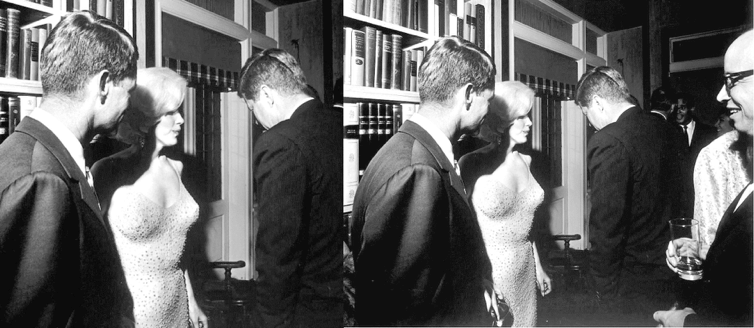
Within the pages of his book, Mark Shaw incorporates several photographs and he offers explanatory comments pertaining to each. However, his analysis is erroneous and, therefore, his comments about the photo depictions is seriously flawed. Of course, he trotted out the now famous photograph of Marilyn flanked by John and Robert Kennedy following the 1962 event at Madison Square Garden. This photo was taken during the after-party at Arthur Krim’s Manhattan penthouse. Shaw publishes the cropped version of the photograph, the usual tactic of cheapjack writers. Invariably, the photograph has also been darkened, suggesting that the famous trio engaged in a secretive and a serious discussion of such import they did not want to be overheard, but Shaw’s commentary about the photograph soars to an unprecedented level of misrepresentation and distortion. After implying that Cecil Stoughton, the White House photographer, actually timed taking the photograph so that the full faces of John and Robert would be hidden from view, Shaw declared: “Within moments, JFK, by all credible accounts, asked Marilyn to step into the shadows where RFK stood, and the three of them spoke for more than ten minutes.” (Shaw, p. 397) Shaw did not divulge exactly who delivered the alleged “credible accounts” or who conscientiously timed the conversation. At any rate, the actual photograph reveals a much less sinister looking encounter between Marilyn and the middle Kennedy brothers. The left-hand photograph in the panel displayed below is the cropped version used by Shaw, but the right-hand photograph is the actual snapshot as taken by Stoughton.
Obviously, the movie star and the politicians did not huddle alone in the shadows for ten minutes: they were, in fact, surrounded by many other guests who attended the Krims’ after-party. Another photograph taken at the after-party clearly indicated the number of people surrounding and touching Marilyn. Steven Smith, married to the Kennedy sister, Jean, and thus a Kennedy brother-in-law, wrapped his arm around Marilyn’s waist, displayed below on the left of the double panel; and many additional photographs indicated the crowded conditions as President Kennedy tried to converse with many of the Krim’s guests, including Jack Benny, displayed below on the right of the double panel. The bespectacled elder man in the background of the left-hand photograph was Marilyn’s escort for the evening, her former father-in-law, Isadore Miller.

Isadore’s presence did not prevent Shaw from reporting yet another falsity about that historic event. He asserted that the Secret Service escorted President Kennedy and Marilyn from the Krims’ penthouse “to the Carlyle Hotel, where JFK maintained a penthouse.” Then Shaw quoted gossip columnist Earl Wilson, who later alleged, following Marilyn’s death: “It was the last prolonged encounter between them.” (p. 397) Neither Wilson nor Shaw recounted what actually happened following the Krim’s after party. They simply ignored it, disregarding the testimony of the persons actually involved in the events.
During the small morning hours, both Marilyn and Isadore Miller climbed aboard Marilyn’s rented limousine and headed to Brooklyn. She dutifully delivered her former father-in-law to his front door steps. According to Gary Vitacco-Robles, Marilyn implored Isadore to return to the west coast with her, when she returned to LA the following day; but he declined and replied: “Maybe in November.” (Kindle V.2:25) After a brief conversation, Isadore exited the limousine. Marilyn blew her former father-in-law a kiss and then she returned to her 57th Street apartment, where she exited the limousine, barefooted, her shoes in hand, and engaged in a brief curbside conversation with one of her ardent fans, James Haspiel. He testified on more than one occasion that Marilyn told him she was exhausted. “I can tell you with authority,” he later wrote in a publication about his association with her, “that I was with Marilyn at her apartment ten minutes to four in the morning. Categorically, Marilyn was not asleep at the Carlyle Hotel, and I didn’t notice the President anywhere nearby us.” (Vitacco-Robles, ibid)
After leaving her fan standing on the sidewalk, she proceeded upstairs to her apartment, where Ralph Roberts met her. Ralph testified repeatedly that he massaged Marilyn during that early morning until she fell asleep. Even so, Shaw asserts that Marilyn and the president had a “brief sexual encounter” after the Madison Square Garden celebration, simply not the case. Even J. Randy Taraborrelli admitted: His years of research and investigation clearly indicated that such an encounter did not occur. But, once again, the facts do not matter in the world of Marilyn apocrypha. And Mark Shaw is just getting started.
The exact location of Robert Kennedy during the 1962 weekend of Marilyn’s death, specifically on Saturday, August 4th, has been debated for decades. Where was the evil attorney general? Was he, along with his wife Ethel and four of his then seven offspring, in Gilroy, California, southeast of San Francisco, visiting John and Nancy Bates, their family and ranch? Or, was he in Brentwood visiting and murdering his rejected and distraught lover? Just where the hell was he? The answer: Robert Kennedy and a portion of his family were in Gilroy, California and according to 1.) John Bates, Sr., 2) his wife, Nancy, 3.) their eldest son, John Bates, Jr., and 4.) the ranch foreman, Roland Snyder, Robert Kennedy did not leave the ranch during Friday or Saturday.
Regarding the Attorney General’s location that weekend in August of 1962, Shaw equivocated. He wrote:
[…] there have been suspicions that the last person to see or hear from Marilyn may have been Robert Kennedy, and whomever may have joined him at her new home. While the accounts differ as to the exact time and duration of the potential visit, if true, RFK could have had a confrontational conversation with Marilyn regarding her going to the media and telling secrets threatening him and his family (p. 477, emphasis mine)
It is apparent that Shaw could not simply out-of-hand dismiss the Bates family’s testimony regarding that weekend and, even though he appeared to accept that Robert Kennedy visited Brentwood that Saturday, despite differing accounts regarding that visit, he also equivocated and employed phrases like “may have been.” But intent on having his cake and eating it, Shaw devises a truly bizarre tactic. Bear with me as it unfolds.
II. Wrong Car in the Wrong place
Early on Sunday morning, August 5th, after the group attended church in Gilroy, John Bates Sr. drove his visitors back to San Francisco and delivered them to the home of Paul Fay. The Kennedy family visited the Fays until the Attorney General delivered his speech to the American Bar Association on Monday, August 6th. Shaw publishes a Bates family photograph, displayed below. It depicts the Kennedy family just as they were starting to pile into the Bates family station wagon, preparing to leave Gilroy and the Bates Ranch.

Mark Shaw holds that he obtained the Bates family photograph from Troy Vaughn, a former deputy sheriff and forensics expert from South Carolina, thus implying that the photograph had been kept hidden and was a deep and dark secret for nearly six decades until Shaw discovered it. This is a false implication. Susan Bernard, the daughter of the famous photographer Bruno Bernard of Hollywood, published not only the above photograph, but nine other photographs snapped by the Bates family during the Kennedy’s visit to their ranch that August weekend. Susan’s famous father not only photographed Marilyn on numerous occasions, he was also the movie star’s close friend. Susan included the Bates photographs in her 2011 photo journal, Marilyn: Intimate Exposures, which featured her father’s work with the movie star. Therefore, the photograph’s existence has been known for at least a decade, but, actually, much longer than that. Still, those facts did not interest Shaw. He called his reader’s attention to “the automobile with the driver’s side door open and the wood paneling beneath the window.” (p. 485) Was the paneling actually wood?’—but then, I digress.
Shaw now begins in earnest: after the photograph of the Bates’ station wagon, he publishes the photograph on the left, displayed below. Shaw failed to publish the photograph on the right, which also occurred on Sunday morning, August 5th.

Shaw’s analysis of this tragic scene is a remarkable example of a literary mischaracterization. He writes that the photo “depicts two men, perhaps from the mortuary, wheeling Marilyn’s covered body not out of, for whatever reason, but into her home on the day she died.” Shaw then calls the reader’s attention to the station wagon pictured in the distance and adds that it “appears to be a duplicate of the car RFK and his family were standing by at the Bates ranch.” Shaw conceded, however, that the presence of the automobile might simply be coincidental. O really?! But he then speculated that “somehow the car was driven from Gilroy to Los Angeles and then appeared at Marilyn’s death scene.” He bemoaned the unfortunate reality that the individual who drove the car that eventful Saturday—which required a time investment of at least ten hours round trip—”will never be known.” For more information on Mark Shaw’s treatment of John Bates, Sr., read the sidebar, Mark Shaw Transformed John Bates, Sr. into Frank Ragano.
Mark Shaw Transforms John Bates into Frank Ragano
During WWII, John Bates, Sr. served in the United States Navy. While serving, the young sailor met and befriended the future President of the United States. Both Johns, Bates and Kennedy, became members of a San Franciscan host committee to assist with the formation of the United Nations. Although the senior Bates was a Republican, his character was such that, after America elected John Kennedy its 35th president, the new Commander in Chief invited his attorney friend to serve as an assistant to the Attorney General. The senior Bates declined: he was deeply committed to the prestigious law firm of Pillsbury Madison and Sutro. Still, Bates, Sr. remained friends with John and Robert Kennedy and the entire Kennedy clan.
The preceding small amount of biography leads to this: the exact location of Robert Kennedy during the 1962 weekend of Marilyn’s death. While there has been some pseudo-debate about the issue, on Saturday, August 4th, it has been well known that Robert Kennedy and a portion of his family were in Gilroy, California, visiting the John Bates family at their ranch. The Kennedy visit began on Friday afternoon, the 3rd of August, and ended on Sunday morning, August 5th. What I just stated is an established fact, but over the passing years, many conspiracist writers have questioned the validity of Robert Kennedy’s alibi along with the validity of the first-hand, eye-witness testimony provided by John Bates, Sr. and his wife, Nancy. My research into the lives of both John and his wife confirmed that they were exemplary individuals with impeccable reputations. I asked Donna Morel, herself a licensed California attorney, if she knew anything about attorney Bates. Only, she replied, that he had an outstanding reputation. Despite that stellar reputation, following the lead of his conspiracist brethren, Mark Shaw doubted the senior Bates’ honesty. The author based his doubt on a false allegation. According to Shaw, during the 1957 McClellan hearings, John Bates, Sr. represented the mobster, Sam Giancana. Thus, Shaw proclaimed:
Muddying the waters regarding RFK’s alibi on the 4th of August is the fact that John Bates served as an attorney for mobster Sam Giancana, RFK’s mortal enemy, during the same McClellan hearings where RFK served as chief counsel. That Bates covered up the truth as to Bobby’s whereabouts on the day Marilyn died would have certainly crossed the mind of Dorothy Kilgallen. (p. 484)
The McClellan Senate hearings included both Robert and his brother, then Senator John Kennedy. Robert was lead counsel, which Shaw correctly notes, but he failed to note the following: the interaction between RFK and various mobsters who testified—including Giancana—can best be described as acutely adversarial. In fact, Robert Kennedy ridiculed Giancana, needled him, referred to the dangerous mobster as a “little girl,” which must have humiliated the Mafioso. That being the case, if John Bates, Sr. was Giancana’s attorney, had allied himself with the Mob against his Kennedy friends, and in so doing, had betrayed them, this leads to an obvious question: Why would John Kennedy then immediately invite that attorney to join and serve in a Kennedy Administration, invite an unprincipled and untrustworthy Mob lawyer to work alongside his brother, the Attorney General? What illogical nonsense to even suggest that this is what transpired.
Again, with assistance from Donna Morel, I contacted John Bates, Jr. on July 26th via email and posed this question: was your father ever associated with Sam Giancana or the Mob in any capacity? He responded as follows:
Thank you for your inquiry. My father was a civil attorney. My father never practiced criminal law. At all times, he was exclusively a civil trial lawyer. His entire career was with the prestigious San Francisco law firm of Pillsbury, Madison, & Sutro, where he ultimately rose to managing partner. Never during his legal career did he appear before any legislative committee for anyone. He never represented a member of the Mob, organized crime, or Sam Giancana. Any assertions to the contrary are incorrect.
Mark Shaw failed to provide a source for his accusation about the senior Bates’ involvement with Sam Giancana. In his source notes for the chapter in which that accusation appeared—Chapter 32—Shaw vaguely referenced a 1985 New York Times interview with John Bates, Sr. During my research into the character of the senior Bates and the issue of Robert Kennedy’s location on August 4th, I located only one New York Times article involving John Bates, Sr. That article did not contain a single word about Sam Giancana or the senior Bates’ involvement with the mobster. Moreover, Mark Shaw did not provide any additional information or evidence to support his transformation of John Bates, Sr. into Frank Ragano, none whatsoever. Very odd, but also revealing. A reasonable person could only conclude that Mark Shaw did not know anything at all about John Bates, Sr. and he did not endeavor to learn anything about the respected attorney, either.
Still, Shaw covered himself and asserted that the Attorney General’s appearance in Brentwood at Marilyn’s hacienda was not the important issue. Oh, no? The important issue, what really mattered, was Bobby’s dumping rejection of Marilyn, just like JFK’s rejection, and if the second rejection by Bobby caused a confrontation and Marilyn’s threat to reveal their affairs publicly. Shaw then noted: “If he [Robert Kennedy] was truly in the San Francisco area, arguably the second most powerful man in America could have orchestrated her death with a telephone call from afar.” (p. 485) Interesting, is it not, even if Robert Kennedy was not in Brentwood, and even if he did not visit Marilyn that Saturday’—and he obviously was not and did not’—he still killed the world’s most famous actress with a lethal telephone call.
But what is really happening in the photograph that Shaw published, the one on the left in the two photo panel above? It depicts Pierce Brothers Cemetery and Mortuary employees wheeling Marilyn into that facility after her body had been delivered by Don and Guy Hockett; not into her house at Fifth Helena Drive. How can one do something like that by accident? Also, the photograph on the right side of the panel depicts coroner employees removing Marilyn’s body from the cemetery mortuary for its transportation to downtown Los Angeles for autopsy. Often, writers have erroneously asserted that the men in the snapshot are policemen.
Please return briefly to the first photograph of the Kennedy family preparing to leave the Bates ranch. You will note that the pictured station wagon had been equipped with a roof-mounted luggage rack. The distant station wagon in the left hand photograph above does not have a luggage rack. Also, since that photograph is black and white, we have no way of comparing the automobile’s colors and, too, please note the amount of open space, open land in the receding distance beyond the duplicate station wagon and also note the slender palm trees. Below is an aerial view of Marilyn’s cramped property with its kidney-shaped swimming pool, left side, combined with a photograph of Pierce Brothers Westwood Village Cemetery, right side.

III. More Wrong Depictions
Clearly, the photograph of the two men wheeling Marilyn’s body into the mortuary was not taken at Marilyn’s hacienda on Fifth Helena. It was taken at the Pierce Brother’s Westwood Village Cemetery and Mortuary, where Joe DiMaggio had Marilyn interred on August 8th. Additionally, Marilyn’s hacienda did not have French doors, a fact confirmed by the floor plan of the hacienda as it actually existed in 1962, displayed below.

Like most dutiful conspiracists, Shaw published the police photograph of Marilyn’s bedside table and, like his conspiracist compatriots, he published a cropped version, included below. Dutifully, he also noted that a drinking glass was not on Marilyn’s bedside table and one could not be found, neither in her bedroom nor her adjoining bathroom.
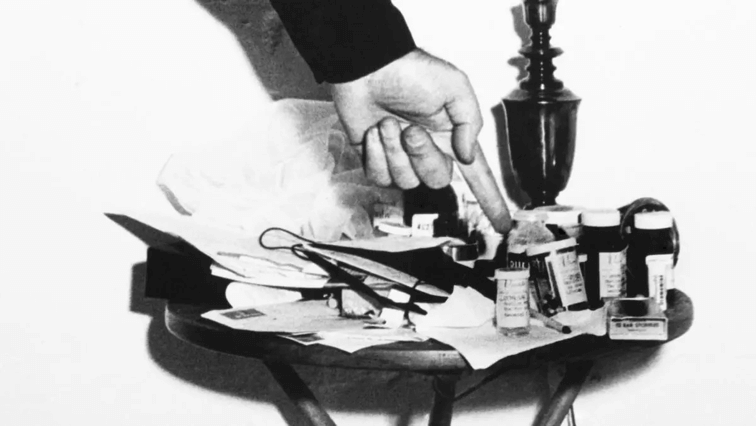
Displayed below is the actual, uncropped photograph taken that Sunday morning by police combined with an enlargement of the trash can area. Please note the drinking glass to the right of the trash can on the floor and to the left of Marilyn’s bed, a clearly visible drinking glass.

Following the photograph of the bedside table, Shaw published another police photograph of Marilyn’s bedroom, looking at her bedroom door, displayed below. While a policeman looked at the cluttered bedroom, beyond him was a woman with her back to the camera. Shaw labeled that woman as unidentified. In fact, a comparison of other photographs taken that morning would have confirmed her identity if Shaw actually did not recognize her: Eunice Murray, Marilyn’s housekeeper.

Regarding a related matter, Shaw included what he asserted was the bedroom wing layout of Marilyn’s hacienda and he paraphrased Eunice Murray’s testimony about that tragic Sunday morning: “while on the way to her bathroom,” Shaw noted, “she [Mrs. Murray] noticed light visible beneath Marilyn’s door, causing her to become suspicious that something could be wrong.” (p. 597) However, Shaw doubted that testimony, calling it inconsistent and apparently a lie. The layout of Marilyn’s home, he asserted, rendered her testimony unlikely or even impossible: Mrs. Murray had to leave her bedroom and walk into the hall in order to notice “a light under Marilyn’s bedroom door.” (p. 597) Displayed below is the drawing that Shaw used to confirm his assertion.

However, there is a major problem with that drawing: it is grossly inaccurate. Where are the clothes closets between the bedrooms, the linen closet, and where is the corner fireplace in Marilyn’s bedroom? Plus, the room denoted as “Murray Bedroom” was actually a bedroom Marilyn had reconfigured into her dressing room. Displayed below is the correct bedroom wing floor plan as it was in 1962.

On the night of August 4th, Eunice Murray slept in the smaller bedroom where Marilyn had positioned a cot, identified on the floor plan as “Guest Sleeping.” Pat Newcomb had slept in the same bedroom on the same cot when she spent Friday night with Marilyn. It is apparent that Mrs. Murray could have noticed light emanating from Marilyn’s bedroom on her way to the Jack and Jill bathroom and considering the arrangement of the bedroom’s doors, she could have stood at her bedroom door and easily observed Marilyn’s bedroom door. In the police photograph of Marilyn’s bedroom, looking across her disheveled bed at the opposing wall, clearly Mrs. Murray was preparing to enter the bedroom where she had slept, clearly visible from Marilyn’s bedroom door.
On page 515, Shaw published a photograph of Marilyn with her arm around the neck of a young fan, taken either preceding or following the premier of How to Marry a Millionaire on November 4th in 1953. Shaw identified that young man as Joe DiMaggio, Jr. Odd. Where is Joe DiMaggio, Sr.?’—an important consideration left unconsidered by Mark Shaw.
Born on October 23rd in 1941, the junior DiMaggio was twelve years old when How to Marry a Millionaire premiered in 1953 and, considering that his mother, Dorothy Arnold, took her ex-husband to court in an attempt to keep the youngster away from Marilyn’—Dorothy cited Marilyn’s unsavory vulgar character and her potential negative influence’—it is more than highly unlikely that Dorothy would have allowed her twelve-year-old son to attend a movie premiere with the disreputable movie star. Besides, the young fellow in the photograph published by Shaw appears to be at least 14 years-old and possibly even older.
The combined photographs below prove as much. To the left is the cropped version of Marilyn and her young fan as published by Shaw. To the right is a photograph of the junior Joe taken with the senior Joe at Ebbets Field on October 9th in 1953, approximately 30 days before the premiere of How to Marry a Millionaire. The lucky young man who received that hug from Marilyn was not Joe DiMaggio, Jr.

Finally, Shaw trotted out the famous thank-you note from Jean Kennedy Smith to Marilyn. During the Lawford’s 1962 February dinner party, Marilyn spoke to the ailing Kennedy clan patriarch via a telephone call instigated by Robert Kennedy. Joe Kennedy had suffered a serious stroke on December 19th in 1961, but he had yet to recover: he could barely speak. Robert must have felt that hearing Marilyn’s incredible voice would bolster the old man’s spirits. Sometime later, Marilyn sent a kind note to the senior Kennedy. In response to Marilyn’s kindness and her note, Jean Kennedy Smith wrote and sent Marilyn the aforementioned thank-you note. Both pages of the actual note follow.

An innocent note, written and sent in response to a note that Marilyn sent to Joe Kennedy, Sr. It has always been of particular interest to conspiracists, including Shaw. But in his book, he published the note’s second page only, which begins with: “understand you and Bobby are the new item!” Clearly, Shaw did not publish the first page of the note for obvious reasons. Like conspiracists before him, Shaw breathlessly pointed to the thank-you note as evidence and proof that Marilyn and Robert Kennedy were involved in an affair and the invitation extended by Jean Smith for Marilyn to join Bobby when he returned to the east has been used by the conspiracists as evidence that Robert Kennedy’s extramarital relationship with Marilyn had been accepted by the Kennedy clan, specifically the Kennedy women. Should we assume, then, that both Ethel Kennedy and Jacqueline Kennedy had also accepted Bobby’s extramarital relationship with Marilyn?
Since Shaw ignored the first page of the thank you note, he was able to write the following ridiculous assertion: “Whatever Kennedy Smith knew’—whether from the mouth of her brother or through perhaps Peter Lawford, married to Pat Kennedy’—had triggered the letter.” (p. 572) As the first sentence of the thank-you note clearly stated, Rose Kennedy asked her daughter to write and thank Marilyn. That request “triggered the letter,” not something nefarious.
During the decades since the note was sent to Marilyn by Jean Smith, its context has been completely disregarded by the conspiracists, including Mark Shaw. Obviously, the comment about Marilyn and Bobby being “the new item” was meant as a tongue-in-cheek reference to Marilyn’s twist teaching efforts during the Lawford’s February dinner party and the uproarious scene caused by Robert Kennedy attempting to dance with Marilyn Monroe. Evidently, Ethel constantly teased the Attorney General over that humorous scene, as frequently noted by John Seigenthaler, Robert Kennedy’s friend and assistant.
That Jean Smith would invite Marilyn to visit Hyannisport seems only natural: who would not want Marilyn Monroe in their home for a visit? In point of fact, the lack of an invitation for Marilyn to visit would have appeared suspicious.
The conspiracist’s efforts to use that innocent note as proof of not only a romantic affair but the affair’s acceptance by the Kennedy clan and the Kennedy women is preposterous. That attempt should be viewed as manufactured since Sgt. Jack Clemmons, Frank Capell, Robert Slatzer, and Jeane Carmen were all complicit in it. For an author—who is also an attorney—to place himself in such a dubious crowd is: well, its mystifying.
IV: A Contrived Murder Scenario
Near the end of Collateral Damage, Mark Shaw revealed his hypothetical Marilyn murder scenario. But before I launch into my analysis of his hypothesis, let me briefly discuss what the Hollywood Godfather has asserted to be factual.
According to Gianni Russo, Robert Kennedy hired a Mob assassin to eliminate his rejected lover. “A guy known as The Doctor murdered Marilyn,” Russo testified to Michael Kaplan for a 3/2/19 New York Post article. The Doctor was a killer for hire and an actual MD who performed “major hits for the mob […].” This unnamed doctor “injected air into the vein near Marilyn’s pubic region,” which rendered the injection site invisible, Russo reported to Kaplan. Although Russo did not specify which vein or which part of Marilyn’s anatomy received the injection. How near is near?
In Russo’s aberrant world, Marilyn “died of an embolism, but it looked like drugs to the coroner,” just a garden variety overdose. I am not being the least bit facetious. While possibly the most inventive of Marilyn’s Murder Orthodoxies, Russo’s embolism tarradiddle is also certainly the most ludicrous. At any rate, I give him an A for Amagination and an F for Foolishness. How could a venous gas embolism create the lethal concentrations of Chloral hydrate and pentobarbital in Marilyn’s blood and liver? How could that air bubble deceive the tests performed by the head toxicologist and, further, trick him into interpreting the tests as indicating the presence of drugs, marking a massive overdose, when, in fact, the drugs did not even exist? That is, according to Gianni Russo. I assume every death from an embolism has been misdiagnosed as a drug overdose. Despite the ludicrous nature of Russo’s fairy tale, it has been reported by many newspapers, magazines, and Internet articles as the absolute truth. Yet, the most remarkable aspect of this curiosity is that Mark Shaw actually asserts that Russo’s incredibly imbecilic fairy tale has some credence. Once again, I am not being the least bit facetious.
An insane number of theories about the death of Marilyn Monroe have been developed and presented as fact during the past fifty-nine years: at least 12. The conspiracist authors who developed and presented those theories invariably contended that theirs was factual: the Last Word regarding the who, when, how, and why of Marilyn’s perceived mysterious death, her murder. Still, all of those theories did not satisfy Mark Shaw. Therefore, he developed one of his own. Let’s call his new theory Number 13. According to Shaw, Number 13 proceeds as follows.
Sometime near midnight, unable to sleep, Marilyn “heard a noise at her front door.” Upon opening the door, two gloved men assaulted her and “stunned” her by placing “a chloroform-sealed cloth over her nose and mouth.” Once stunned, the two men either dragged or carried Marilyn into her bedroom and, during that relocation, the men hit her lower body against a sturdy piece of furniture, or the open door’s edge or the doorknob. That inadvertent whack bruised Marilyn’s left hip. Once in her bedroom, the murderers removed any outer “clothing she was wearing such as a robe or panties” and they then carefully “positioned her nude body on the floor face down.” At this point, one of the men switched on the light and then locked the door, so they would not be disturbed. Water “secured from the bedroom faucet,” mixed with a lethal dose of both the Chloral hydrate and Nembutal became the ammunition for the murder weapon.
The murderers then “dipped a bulb syringe of some sort into” the drug mixture and then “inserted the tip into Marilyn’s rectum, with some spillage possible. Quickly, the lethal dose would have infiltrated her blood system and begun the march to her death.” Her murderers then placed Marilyn’s body face down on her bed and placed the telephone receiver “in her hand for effect.” After cleaning up “as best they could,” the two murderers “quietly left the home through the bedroom door,” which they locked on the way out. (pp. 612–613)
There are numerous problems with the preceding theoretical scenario. I’ll begin with time.
The alleged time that the murderers began the gruesome process of murdering Marilyn, midnight on August 4th, creates a serious issue for Shaw. According to Don and Guy Hockett—who collected Marilyn’s body at Fifth Helena and took her to the Pierce Brothers Mortuary, where she stayed briefly—her body was so rigid, they had trouble placing her on the gurney. They asserted, based on the degree of rigor mortis and the presence of fixed lividity, that Marilyn had passed on at about 10 PM. Natalie Trundy, later said that she and her fiancé Arthur Jacobs attended a concert that night. At approximately 11:00 PM, an usher arrived and informed Jacobs, then Marilyn’s publicist, that she was either nearly dead or already dead.
The temperature of Marilyn’s liver at 10:30 AM on August 5th, the time that Dr. Noguchi began her autopsy, as noted on her autopsy report, was 89°F, 9.6°F below what is considered normal. Virtually all the conspiracist writers have ignored that fact, including Shaw. According to the Glaister Equation, a formula used to calculate a person’s possible time of death, using a temperature differential from normal of 9.6°F, Marilyn could have died between the hours of 9:30 PM on the 4th of August and 2:30 AM on the 5th of August with a mean time of 12:30 AM on the 5th. Regardless of what time Marilyn’s essential bodily functions ceased (i.e. the exact time she actually died), it is evident that she became an unresponsive, comatose body at some point prior to 12:00 midnight: an essential detail. Therefore, Shaw’s murderers would not have encountered a conscious Marilyn near midnight on August 4th.
Consider the “chloroform-sealed cloth” that the murderers pressed against Marilyn’s nose and mouth. Did Shaw mean chloroform-soaked? At any rate, the use of chloroform to render a person unconscious is a myth started and perpetuated by Hollywood moviemakers. Evidently, the time required to knock-out a person using a chloroformed rag varies between five and ten minutes and, since liquid chloroform quickly evaporates into a gas when exposed to air, fresh liquid chloroform must be constantly added to the rag. Also, for the person to remain unconscious for an extended period of time, a freshly chloroformed rag must be held continually against the person’s nose and mouth. But then, Shaw alleged, that the chloroform “stunned” Marilyn. A stunned person would be groggy or dizzy, dazed. If Marilyn was only dazed by the chloroform, according to my research into the longevity of its effects, Marilyn would have regained her senses rather quickly: the effects of chloroform, in its gaseous state, diminish and disappear rapidly.
Shaw’s assertion that the murderers left the home “through the bedroom door” is an odd statement. As indicated by the floor plan of Marilyn’s hacienda, her bedroom did not have a door allowing access to the exterior. That is why Dr. Greenson had to enter Marilyn’s bedroom through one of the casement windows. I have concluded that Shaw’s assertion about the murderers’ getaway route is just another example of his many misstatements.
V. Shaw’s Bulb Syringe Murder Weapon
A major problem with Shaw’s contrived murder scenario resides in his vague description of how the assassins actually killed the movie star. They used a “bulb syringe of some sort,” which they dipped into a drug solution and then they inserted bulb syringe’s tip “into Marilyn’s rectum.” By bulb syringe, did Shaw mean the type of syringe often used to remove ear wax, irrigate sinuses, and remove mucous from the nostrils of infants? Certainly the killers drew a quantity of the drug solution into the bulb syringe, which they then injected into Marilyn’s rectum, but Shaw did not actually say that. Still, Marilyn could not have been killed with a normal size bulb syringe, one that could have dispensed two, maybe three ounces of the drug solution.
The largest bulb syringe I located could have dispensed twenty ounces, or 2½ cups, of the drug solution. But using a bulb syringe that large would have created its own set of problems. Shaw admitted that “some spillage” would have been possible, but certainly trying to infuse Marilyn’s rectum with 2½ cups of liquid using a large bulb syringe would have resulted in more than just some spillage. In fact, I contend, if she was unconscious, the spillage would have been considerable and would have stained Marilyn’s new white wool carpet.
More importantly, there are significant scientific problems with Shaw’s contrived murder scenario.
According to my research, while killing a person with an enema is possible, doing so is not that simple or easy. It requires an infusion of the descending colon with a large quantity of a lethal solution. It would be virtually impossible to murder a person by simply injecting a lethal solution into his or her rectum.
In Murder Orthodoxies, I wrote extensively about a similar situation, using the rectum as the route to murder Marilyn using a drug infused suppository. Chuck Giancana, Sam Giancana’s stepbrother, stated in his novel, Double Cross, that his stepbrother deployed suppository wielding assassins to murder Marilyn. Since killing with a bulb syringe would be similarly problematic, allow me to touch upon the significant points here. Keep in mind Shaw’s contention that the lethal solution “quickly infiltrated” Marilyn’s “blood system,” which led to her death.
The human rectum is primarily a storage chamber, a vertical section of the large intestine approximately 4½ inches long; therefore, it provides only about 50 square inches of an absorptive surface. Since the lining of the rectum is smooth, meaning devoid of the finger-like protrusions known as villi, absorption through it is neither efficient nor speedy. The International Journal of Pharmaceutical Sciences Review and Research noted that both the degree and the speed of drug absorption from the human rectum is both lower and slower than absorption from the gastrointestinal tract. It is highly unlikely, therefore, that the lethal solution proposed by Shaw quickly infiltrated Marilyn’s blood system. Additionally, blood circulation to and from the rectum is unusual. A list of various points follow.
- The inferior mesenteric and the internal iliac arteries supply the rectum with blood.
- The superior rectal vein, the middle rectal vein, and the inferior rectal vein along with anastomoses or venous plexus return blood from the rectum.
- The superior rectal vein connects to the portal system and directly to the liver, where it undergoes a degree of first pass metabolism.
- The inferior and middle rectal veins connect directly to the systemic circulation system, which delivers blood to the heart through the inferior vena cava and then throughout the body before reaching the liver.
- The anastomoses or venous plexus connect to both the portal and the systemic venous systems.
- The anal canal, which measures 1±½ inches in length, is the final part of the human digestive system and the inferior rectal artery delivers blood to the anal canal.
- The inferior rectal vein accepts blood from the anal canal and delivers it to the internal iliac vein and then to the systemic circulation.
Many studies have been performed to determine the bioavailability of drugs administered rectally. The percentages vary considerably with time and drug. A consensus does not exist regarding just how much of a rectally absorbed drug enters the portal venous system, gets delivered to the liver, where it is subjected to first pass metabolism, and just how much bypasses the liver on its initial trip through the body. Certainly, based on the anatomy of the rectum, which varies from person to person, as does each person’s physiology, the only reasonable position to assume, for the purpose of this discussion, is that 50% of an absorbed drug enters the portal venous system and then the liver, where a portion of it will be metabolized and 50% of an absorbed drug does not enter the liver on its initial trip through the body. Additionally, assuming that 50% of the absorbed drug passed through Marilyn’s liver initially and 50% did not, I suggest that more of the absorbed drug would have been found in Marilyn’s blood stream than is indicated. And that scientific fact leads me to this.
Shaw noted that the amount of chloral hydrate in Marilyn’s blood was 8.0 percent and the amount of pentobarbital in her liver was 13.0 percent, suggesting that the volume of blood in Marilyn’s body was 8% Chloral hydrate and 13% pentobarbital which, of course, was not the case at all. What Shaw actually meant was not a raw percentage but milligram percent or mg%, a measure of concentration; the mass of a chemical, given in milligrams, that is present in one-hundred milliliters of a solution, blood for instance. Also, Shaw failed to mention the concentration of pentobarbital in Marilyn’s blood, 4.5 mg%, quite a significant omission and a prime example of cherry picking in order to exclude relevant but unwanted evidence.
Abernathy’s tests indicated a concentration of pentobarbital in Marilyn’s liver three times as high as the concentration in her blood. Explained by a branch of pharmacology called pharmacokinetics, that relationship is consistent with ingesting a large overdose and proves beyond a reasonable doubt and to a scientific certainty that the drugs were ingested. The drugs were not injected into Marilyn’s body, she did not receive a hot shot, and she was not murdered with a bulb syringe, regardless of its size.
Finally, while Shaw’s hypothetical murderers killed the world’s most famous woman on that night, where was Eunice Murray? She does not appear in Shaw’s scenario, but we know she was in the house that night with Marilyn, asleep on a cot in the small bedroom very near Marilyn’s bedroom. Certainly, Mrs. Murray would have heard any noises caused by Marilyn’s struggle with the murderers. Once again, Shaw attempted to diminish his problem with Eunice Murray’s known presence that night. He opined:
Of course, as with any theory like this based on circumstantial evidence after so many years have passed, questions will be raised, with answers unfortunately somewhat speculative in nature. (p. 612)
Amazing. Shaw began to question his own theory, his own explanation of what happened to Marilyn and led to her death. What time did the killers arrive? he questioned. Where was Mrs. Murray when the killers arrived and enacted the gruesome scene in Marilyn’s bedroom? Shaw speculates that the murder possibly occurred between midnight and 3:00 AM, contradicting his proclamation that the murderers arrived “at some point close to midnight.” (p. 612) Then, regarding the bruise on Marilyn’s hip, Shaw admitted that “other explanations exist as to how Marilyn could have bruised her left hip.” (p. 612) However, if that bruise was caused as he speculated, then obviously foul play had been involved in Marilyn’s death. He then wondered if Mrs. Murray had “knowledge of the attempt on Marilyn’s life,” which he admits could not be known. (p. 615) He then speculates that Mrs. Murray became spooked by “hearing noise near Marilyn’s bedroom,” which caused “Murray to wonder if Marilyn was in distress” and prompted her “to call either Greenson or Engelberg.” (p. 615) Eventually, Shaw’s speculations centered on Dr. Greenson, Dr. Engelberg, and Eunice Murray and their possible complicity with Robert Kennedy who “orchestrated Marilyn’s death via operatives sent to her home.” (p. 617) Frankly, it became self-evident as I read Shaw’s speculations and strange contradictions, that he likely did not even believe Number 13, which he himself formulated. So why should I? Besides, I know Shaw’s Number 13 is a fantasy founded on sensationalism. Marilyn was dead before midnight. Evidence, not speculation, confirms that and confirms that Marilyn certainly was not alive at 3:00 AM on August 5th. Unlike Mark Shaw, rigor mortis and fixed lividity do not speculate.
VI: A Brief Summation
Before ending with a brief summary, I would be remiss if I did not note the following. During a recent interview with Heather McDonald, Mark Shaw asserted that he wrote Collateral Damage because he “never bought the idea that Marilyn committed suicide.” The author then added: “When I heard about it I didn’t believe it and I still don’t and I’ve proven in the new book that it didn’t happen.” Shaw proceeded to add: “In this particular book I did not use any sources with books or anything else from 1965 on. They [Shaw’s sources] were all before sixty-five.”
Remarkable. Shaw brazenly admitted that he began writing with an occluded mind based on a foregone conclusion. Most certainly, as he wrote, he was afflicted with an idée fixe and a form of group think, leading him to engage in cherry picking, confirmation bias, belief perseverance, illusory correlation, and fallacious reasoning.
Why would an author in search of the facts, in search of the truth, deny the validity of all the valuable research into Marilyn’s life and her relationships after 1965, not only with the middle Kennedy brothers, but her other relationships as well? Why would he deny all of the valuable research into the circumstances surrounding her death that has transpired during the past 59 years? Why would he limit his source material to only the 3 years following her tragic death? And finally, why would he evoke discredited men like Frank Capell, Sgt. Jack Clemmons, and many others, including both C. David Heymann and the incorrigible fabulist, Gianni Russo, who did not appear with his Marilyn fantasy until 2005 and his book was not published until 2019—both dates decades beyond 1965. Using Russo as a source is a contradictory reversal of Shaw’s source edict and why would Shaw present those men as reliable sources? The answer is obvious: Shaw wanted and needed sources that confirmed his foregone conclusion, not unlike every conspiracist author who has written about Marilyn Monroe’s life and her death.
Shaw calls Senator Joe McCarthy a despicable man whose heart was filled with hate. But the author himself engages in a despicable form of McCarthyism, because of the apparent hatred in his heart for Robert Kennedy. Referencing the Chappaquiddick tragedy, Shaw asserted that Teddy Kennedy’s conduct, how he handled the drowning of Mary Jo Kopechne “was symbolic of the selfish ‘me first’ mentality of the Kennedys, especially RFK.” (p. 558) Robert Kennedy was already killed at that time. Even so, guilt by familial association is Shaw’s assessment. Robert was even more selfish and uncaring than the youngest Kennedy brother.
Within the text of Collateral Damage, Mark Shaw devoted many words and pages to the exceptional investigative prowess of Dorothy Kilgallen, who constantly searched for the facts in every significant story or case, searched for the truth and justice. Based on comments within her published articles, Shaw asserted, Dorothy suspected that her “friend” did not commit suicide, suspected that her friend was romantically involved with Robert Kennedy, and suspected that her friend’s death involved the attorney general. Shaw knew without debate, all the unsolved mysteries surrounding and all the unanswered questions left in the wake of Marilyn’s mysterious death would have been solved and answered after an investigation by the incredible Dorothy Kilgallen. Since Marilyn died in early August of 1962, what prevented Dorothy from focusing her investigative spotlights and powers on her “friend’s” mysterious death? Of course, 16 months after Marilyn’s death, Dorothy became embroiled in the president’s assassination, the murder of Oswald, and then the sensational trial of Jack Ruby, but she had at least 16 months during which she could have investigated Marilyn’s suspected murder. Again, what prevented her?
Shaw must have realized that the absence of any investigation by Dorothy Kilgallen was a problem for him, so he proffered an explanation. During the October missile crisis, with humanity on the precipice of nuclear war, possibly annihilation, “in perhaps his finest hour, RFK stood tall and helped his brother quell the threat.” Dorothy Kilgallen, Shaw presumed, because of her integrity—and the fact that Robert Kennedy had helped save humanity—“could not in good conscience go forward, and this stifled any further probe involving RFK.” (p. 600) According to Shaw, Dorothy Kilgallen’s integrity actually prevented her from exposing the murderer of her “friend,” the most famous actress in the world. Truly amazing conjecture based on absolutely nothing. There was no credible evidence Robert Kennedy and Marilyn were ever romantically involved, less that he was part of her murder.
In fact, Dorothy Kilgallen’s columns following Marilyn’s death had been based on rumor and gossip, innuendo and sensationalism. All advanced by other luminaries in the gossip mongering field: Walter Winchell, Earl Wilson, Louella Parsons, and James Bacon. As of right now in America, rumor, gossip, and innuendo do not qualify as evidence.
Still, Shaw promised his readers that he would reveal new and compelling evidence regarding Marilyn’s death. He didn’t. He merely recited, right on cue, what Sarah Churchwell accurately identified as the same tales and bromides.
For example, he resurrected the CIA-UFO-Memo as evidence that Marilyn was possibly murdered, because she knew about the existence of little green men. Shaw insinuated that the memorandum was new evidence, when it was, in fact, inordinately old news.
Twenty-six years ago in 1995, Milo Speriglio introduced the memorandum to the world during a press conference and, since that time, the document has been evaluated and analyzed innumerable times. Nick Redfern just published a book that yet again evaluated that dubious memorandum. Many UFOlogists and impresarios in the odd world of flying silver discs generally agree on this: that document is a hoax, a crafty forgery.
Shaw, however, interjected a new wrinkle: he asserted that the one of the telephone conversations mentioned in the memorandum occurred between Dorothy Kilgallen and Marilyn who “told Kilgallen that JFK had told her of his visit to a secret air base where he viewed ‘things’ from outer space.” (p. 386) I have read that memorandum at least two dozen times and it does not state that Marilyn revealed to Dorothy Kilgallen anything heard from the lips of or otherwise learned from President Kennedy. Clearly, according to the memorandum, Howard Rothberg imparted hearsay evidence to Dorothy involving some secrets Marilyn allegedly knew, one of which involved the president, a secret air base, and things from outer space. Still, regardless of what the CIA-UFO-Memo alleged, I repeat, that document is now recognized to be a forgery.
In 2006, on the CBS program, 48 Hours, Peter Van Sant and Anthony Summers presented and generally discussed an FBI file that Mark Shaw also resurrected. Sent from Mexico City and dated the 13th of July in 1962, number 105-40698-3, the file referenced a
luncheon at the Peter Lawfords with President Kennedy just a few days previously. She [Marilyn] was very pleased, as she asked the President a lot of socially significant questions concerning the morality of atomic testing and the future of the youth of America.
According to my research and according to the John F. Kennedy Presidential Library and Museum along with the website, History’s Home on the Web, President Kennedy was either in the nation’s capital, Camp David, or Hyannis Port throughout the month of July in 1962, except when he delivered a 4th of July speech at Independence Hall in Philadelphia. Even though, during that CBS program, Summers presented the now 59-year-old FBI document as being factual, 21 years earlier, Summers admitted in his pathography, Goddess, that his investigation regarding that alleged meeting revealed “no day in the relevant time-frame when John Kennedy could have been in Los Angeles’—he made an official visit to Mexico at the end of June.” (Summers, p. 577) Obviously and evidently, President Kennedy did not travel to California in July of 1962, which leads to an obvious conclusion: President Kennedy did not meet Marilyn at the Lawford’s beach house for a luncheon.
But then, throughout Collateral Damage, Mark Shaw followed along the well-worn path created by the footfall of an almost endless parade of conspiracists who have preceded him. He, like they, promised his readers he would prove with new and compelling evidence that Marilyn Monroe did not commit suicide. Yet, he merely engaged in not only rumor, opinion, gossip, and innuendo; he also engaged in the worst form of gross speculation and evidence creation. While presenting testimony lacking any evidentiary value whatsoever, he also presented testimony from two sources whose verity has been questioned repeatedly and from one source whose testimony has obviously been manufactured. Additionally, he otherwise twisted the facts to fit his foregone conclusion: Marilyn Monroe was murdered, not only murdered, but murdered by Robert Kennedy.
Oddly though, Shaw asserted as his text approached its conclusion: “it appears that Marilyn Monroe had been right, as noted, when she wrote in My Story, ‘Yes, there was something special about me, and I knew what it was. I was the kind of girl they found dead in a hall bedroom with an empty bottle of sleeping pills in her hand.’” (p. 600) Did Mark Shaw fail to realize that Marilyn was referring to her death by overdose, her death by suicide?
If Mark Shaw really wanted justice for Marilyn, which, considering his use of Gianni Russo, I doubt, then Shaw would have let her rest in peace. But evidently that would be an empathetic compassion beyond a conspiracist’s comprehension.
Addendum
The other material about Dorothy Kilgallen and JFK in Shaw’s book is largely repetitive of his earlier works. Since it is such, we refer the reader to Jim DiEugenio’s reviews of The Reporter Who Knew Too Much and Denial of Justice.
-

Collateral Damage: Mark Shaw’s Public Atrocity, Part 1
It is a capital mistake to theorize before one has
data. Insensibly one begins to twist facts to suit
theories, instead of theories to suit facts.
Sherlock Holmes
The preceding admonition by Sir Conan Doyle’s famous, fictional crime investigator expresses an important maxim: theories should be crafted to incorporate acquired facts. All too often, however, conspiracist authors in the Marilyn-Was-Murdered-World have violated and continue to violate Holmes’ maxim. In some cases, they have twisted the facts; and, in some cases, too often they have created facts to fit their preconceived conclusion about Marilyn’s death. And all too often, the conspiracist authors have engaged in false logic, which has been, and still is, often expressed by this fallacious proclamation: since Marilyn Monroe would never have committed suicide, she must have been murdered. Those authors ignore the fact that Marilyn attempted suicide four known times during her life; before proceeding to craft an illogical and often convoluted path to their foregone conclusion. In Mark Shaw’s recent publication, Collateral Damage, largely about the deaths of Marilyn Monroe and Dorothy Kilgallen, the author recklessly engaged in what Sherlock Holmes calls a capital mistake. Shaw does exactly what the detective admonished investigators to avoid.
I. A Fabricated Friendship
An important foundational premise posited by Shaw in Collateral Damage is that some type of lengthy and abiding friendship existed between the film star and the gossip columnist. Kilgallen’s friends, Shaw asserts, “included stars from stage and screen like Marilyn.” (p. 51) Yet, the author does not offer any tangible evidence to conclusively establish this putative friendship.
Sixty-eight pages following the preceding assertion, Shaw introduces a woman named Brenda DeJourdan, the daughter of Kilgallen’s deceased butler, James Clement. Evidently Shaw interviewed her; but the author’s source notes did not reveal anything about the interview or his source, a glaring but typical omission.
Brenda informed Shaw that Dorothy Kilgallen often hosted fabulous parties. Presumably following one of those many parties, Brenda’s father assisted Marilyn “to her car because she was intoxicated.” (p. 120) In Shaw’s opinion, that statement “cemented” that the two famous women were friends, certainly a quantum leap considering that Brenda’s testimony was not very specific. Was the referenced car Marilyn’s personal car or a rented limousine? And if not a limousine, why would Dorothy allow her intoxicated friend to drive on the streets of Manhattan? Certainly the gossip columnist would have instructed her butler to call or hail a taxi cab for her good friend. Furthermore, Brenda does not assert that she actually witnessed her father assisting the actress. Did the butler’s daughter simply recall a story that her father had related to her? A significant difference; and since we do not know the calendar date when this party occurred, judging Brenda’s statement becomes even more difficult. Then Shaw makes an interesting comment: Dorothy “would have had to approve” Marilyn’s party invitation. (p. 120) Why? If Dorothy and Marilyn were such great pals, why didn’t Dorothy just give her actress pal a jingle and invite her? At any rate, other than Brenda DeJourdan’s anecdotal testimony, thin at best, possibly even hearsay, Shaw does not offer any additional evidence pertaining to the purported friendship between the two famous women.
Oddly enough, Shaw himself actually undermines his friendship premise. He admitted that Dorothy occasionally fired “potshots” at Marilyn, “but usually in jest.” (p. 94) Shaw also notes: Dorothy once compared Marilyn’s appearance to “an unmade bed.” (p. 95) I’m not exactly sure how Shaw knew, or could even assert, that Dorothy fired her potshots at Marilyn simply for comic effect. He certainly could not have interviewed her. Still, it must be noted that Marilyn did not take insults of any type, particularly those regarding her appearance, lightly or in stride.
Then, remarkably enough, Shaw contradicts his assertion that Dorothy took potshots at Marilyn and declares: “Kilgallen always spoke highly of Marilyn.” (p. 422) Really? Then he quotes a 1955 Playboy interview with the writer, Truman Capote, during which Capote shared an anecdote involving Marilyn, a NYC saloon, and his friend Dorothy Kilgallen. Allegedly as Capote and Marilyn neared the saloon, he suggested that they duck inside and refresh themselves. “It’s full of advertising creeps,” Marilyn responded according to Capote. Then she added: “And that bitch Dorothy Kilgallen, she’s always in there getting bombed.” Even as Capote tried to defend his journalist friend, according to him, Marilyn commented that Dorothy had “written some bitchy stuff about me.” (p. 422) Shaw soft-pedals Marilyn’s comments, called them merely “misgivings” about Dorothy; but Marilyn’s comments do not sound like mere misgivings: they sounded like well-founded hostility. Therefore, in view of the preceding, what exactly are the facts about any relationship shared by Marilyn Monroe and Dorothy Kilgallen?
Of course, since Dorothy was an important member of the press, Marilyn was obligated to associate with the gossip columnist; and she evidently did so, but only to a point. Dorothy often published unsubstantiated and false gossip about Marilyn, which the actress neither understood nor appreciated. Even Shaw notes that many press agents considered Dorothy to be “a ‘sucker’ for an unsubstantiated story about a personality and thus didn’t do her homework to confirm” a story’s validity before it appeared in her gossip column. (p. 127) That troubling fact leads me directly to Robert Slatzer.
Dorothy apparently knew Slatzer; and she mentioned him in one of her columns as a dark horse in the Marilyn Monroe romance derby. Slatzer, Dorothy asserted, was a generous soul who gave Marilyn books, her favorite gift. Unquestionably, Slatzer fed Dorothy that morsel of gossip. Additionally, during Dorothy’s vacation in 1952, Slatzer wrote her gossip column, which he proceeded to use as a forum to begin his literary fraud and construct his fantasy relationship and marriage to the famous actress.
Marilyn researcher and blogger, April VeVea, noted on her blog site, Unraveling the Slander of Marilyn Monroe, that Dorothy often displayed animosity toward Marilyn for no apparent reason. She frequently reported on Marilyn’s romances, alleging that the blonde actress was involved romantically with many men. Even so, the actress and gossip columnist evidently enjoyed a fair relationship until 1953, when Marilyn ceased giving Dorothy exclusives. It must be noted: Marilyn would immediately forsake persons who had spoken indiscreetly about her private life, persons who had criticized her, or persons who she felt had betrayed her. Such must have been the case with Miss Kilgallen and her gossip column. Certainly, then, after 1953, Marilyn considered Dorothy unworthy of her trust.
April VeVea also noted: Dorothy Kilgallen and Walter Winchell were the only two journalists who did not receive an invitation to the 1955 event during which Marilyn announced the formation of Marilyn Monroe Productions. Marilyn biographer, Donald Spoto, also noted: “Every Manhattan columnist and every reporter of any status was present except Dorothy Kilgallen and Walter Winchell, both of whom had been excluded by Milton [Greene] because of their general hostility toward Marilyn” (Kindle Edition: Ch.14); and finally, Dorothy did not receive an invitation to attend Marilyn’s funeral while Walter Winchell did: he was Joe DiMaggio’s friend.
In an email communication with me regarding the Marilyn–Dorothy friendship alleged by Shaw, Marilyn biographer, Gary Vitacco-Robles, noted that he was “only aware of DK attending the event to promote” the romantic comedy, Let’s Make Love, released in September of 1960. Extant photographs depict Marilyn, her costar, Yves Montand, and Arthur Miller with Dorothy Kilgallen. But an unbiased and forthright analysis of those photographs will lead to this conclusion: while Marilyn and Dorothy were together during that publicity event, they were not being friendly. In fact, Marilyn appeared to be completely disinterested in Dorothy’s presence, as the photographs below reveal.

Gary also commented: “I wouldn’t consider them good friends. As a member of the press, MM had no choice but to cooperate with DK. There is no known personal correspondence between them.” Gary offered to search Marilyn’s address books for Dorothy’s name. But even Shaw admitted that the journalist’s name did not appear therein, an important omission that Shaw does not explain. Being absent from Marilyn’s books of important names, addresses, and telephone numbers meant that she did not consider the missing person an important part of her life. Worse still, she did not consider the missing person a friend.
Did Marilyn know Dorothy Kilgallen? Of course. But were they good friends or even friends at all? No evidence exists that would lead a reasonable person to conclude they were even friends, much less good friends. In fact, the actual evidence suggests just the contrary: Marilyn and Dorothy were not friends.
II. Peculiar and Unreliable Sources
When considering any literary effort pertaining to Marilyn Monroe, it is important to consider the author’s sources. More often than not, it is equally as important to consider the sources of the author’s sources, in other words if it is a secondary source, where did the author get the info? This is a near impossibility regarding Collateral Damage due to the author’s paucity of information about his sources. At any rate, Mark Shaw relied on an odd group of peculiar and unreliable sources.
During his opening “Author’s Note,” Shaw declared the following purpose relative to Marilyn Monroe: “most people look at the movie star with a stereotypical perception that she was a sexpot who became a star only because of that appeal instead of her being what she really was: an accomplished actress and a very caring and intelligent human being, as will be presented here;” a laudable purpose. (p. 9) Yet, nineteen pages later, Shaw calls upon a woman named Cara Williams as a source and for insights regarding Marilyn Monroe’s persona.
Evidently Shaw interviewed Cara, then 94 years old, during May of 2020. According to Shaw according to Cara, she worked briefly with Marilyn during the 1940s while both women were employed by Fox. Therefore, Cara’s association with Marilyn must have occurred between late 1946 and late 1947, at the beginning of Marilyn’s movie career. With that fact established, consider the information Cara shared with Shaw.
Cara and Marilyn infrequently shared the mirror in what one assumes was Fox’s community make-up room. Marilyn constantly practiced making various expressions during those beautification sessions, according to Cara. She concluded that Marilyn wanted “to see what particular face would look best in the film she was working on,” certainly an odd conclusion. (p. 29) During her initial tenure with Fox, Marilyn appeared on-screen in only two films: for 4 seconds during Scudda Hoo! Scudda Hay! and for 56 seconds in Dangerous Years. Neither film required her to perform any unusual or abnormal expressions, at least not expressions for which she would need to rehearse. Also, Cara announced, Marilyn simply could not act. Why? The blonde was just too concerned with her self-image, meaning, I assume, her appearance. Should we conclude, then, that Cara was not concerned with her appearance?
Evidently, Cara was acutely aware of Marilyn’s reputation and condemned her promiscuous behavior. Cara knew that Marilyn “slept around with this executive and that,” meaning, of course, that the movie star simply fornicated her way to the top. (p. 29) Just how she actually knew about Marilyn’s bed hopping, neither Cara nor Shaw explains. Cara also informed Shaw that she, like Marilyn, had posed for the photographer Tom Kelley; but she did not pose in just her skin. She would never have done such a thing. And finally, even though Marilyn was always nice to Shaw’s source she was not interested in being Marilyn’s friend. Obviously, Cara Williams did not like Marilyn Monroe.
The opinions offered by Cara Williams clearly undermined Shaw’s expressed purpose: to present Marilyn as more than just a sexpot, but to present her as an accomplished actress who reached the top on her talent; to present her as a woman of intelligence and humanity. Cara’s opinions pertaining to Marilyn did not provide Shaw’s readers with an insight into Marilyn’s life or her death. In fact, Cara’s opinions did not provide evidence of anything.
Jane Russell, Marilyn’s Gentlemen Prefer Blondes co-star, appears as one of Shaw’s sources at approximately the midpoint of his book. Unlike Cara Williams, at least Jane had some feelings for Marilyn and often referred to the blonde movie star as her little sister. According to his source notes, Shaw did not interview Jane. Instead, he relied on quotations from a biography written by Edwin P. Hoyt, Marilyn: The Tragic Venus, published in 1965; quotations which Shaw does not properly source, a common occurrence for him. According to Shaw, Jane informed Hoyt that her co-star “was always sweet and friendly [with] the stagehands and the crew” along with also being “a thoughtful person, a searching person.” (p. 388) Shaw then referenced a 2007 Daily Mail article in which Jane expressed her opinion regarding Marilyn’s death: her friend did not commit suicide, so sayeth Jane. “Someone did it for her,” Jane opined in the article. “There were dirty tricks somewhere.” Wendy Leigh, the interviewer and the article’s author, asked Jane if she believed that the middle Kennedy brothers were involved in Marilyn’s death, meaning, of course, her murder. Jane nodded her head in agreement. Certainly Jane Russell was entitled to her opinion, but that is all it was: her opinion. Then Jane Russell the actress suddenly became Jane Russell the expert mind reader; she informed Wendy Leigh: “Soon after Marilyn died I met Bobby Kennedy, and he looked at me as if to say, ‘I am your enemy.’” Unquestionably, Jane’s assessment of Robert Kennedy’s expression, or what she assumed was a glaring threat, was likely colored by her opinion and belief that he was involved in Marilyn’s death; and since Jane’s anecdote starring Robert Kennedy cannot be confirmed, her assessment of how the attorney general looked at her was merely her biased opinion. Like Cara Williams, Jane Russell’s opinions did not provide evidence of anything, except Jane’s prejudice.
But Shaw is not finished in this suspect vein. He offers a woman named Janet Peters, the daughter of Marlowe C. Hodge, the real estate agent who allegedly sold Marilyn’s hacienda after her death. The name Marlowe Hodge does not appear anywhere in the Marilyn canon. Some quick research uncovered an obituary for Marlowe C. Hodge dated July 14, 1996, published by Desert News, Salt Lake City, Utah, a Mormon newspaper. The obituary noted that Mr. Hodge’s daughter, Janet Peters, survived him. The obit’s biographical information mentioned that Hodge was the president of Hodge Sheet Metal, “a company which was involved with many heating and air conditioning and fascia projects in the greater Los Angeles area.” Evidently, he was also the Sheet Metal and Air-Conditioning Association of America’s president; and he often delivered speeches “in his usual articulate manner in many cities at conventions.” If the late Mr. Hodge was a real-estate agent, his obituary did not so state. I suppose the referenced death notice could have been for another Marlowe Hodge with a daughter named Janet Peters, but that probability seems minuscule.
But according to Janet Peters, her father related a story to her involving Eunice Murray. “My dad came home one day and told me,” Ms. Peters informed Shaw, “I just sold Marilyn Monroe’s house.” Evidently, Mr. Hodge encountered Eunice Murray who told him “Marilyn was murdered, said it was the Kennedys, Bobby Kennedy, not a suicide at all.” (p. 481) Mr. Hodge revealed that Mrs. Murray was adamant about Marilyn’s murder, meaning what exactly? Odd how Shaw, on one page of his publication could accuse Eunice Murray of complicity in concealing the facts about Marilyn’s death, accuse her of being a liar, and then on another page offer testimony pertaining to her opinion about Marilyn’s murder at the hands of the evil Kennedys. Shaw admitted that Janet Peters’ testimony was “secondhand,” a weakness that he simply ignored, and announced that her statements and her recollections appeared to be “genuine.” Surely, as a lawyer, Shaw realized that the statement by Janet Peters was gross double hearsay, possibly even grosser triple hearsay, and despite her genuineness, offered no evidentiary value at all.
Before I leave Mr. Hodge and his daughter behind, I would be remiss if I did not note the following: the sale of Marilyn’s home became embroiled in court due to multiple offers to purchase the house. By that time, Eunice Murray was no longer involved. Designated by the probate court, Inez Melson took over the sale of Marilyn’s hacienda and the liquidation of Marilyn’s possessions. The home would not be sold until September of 1963. Also, Gary Vitacco-Robles informed me that Mrs. Murray only returned to the hacienda on one occasion: with Marilyn’s sister, Berniece, and Inez Melson to select a burial dress for Marilyn. Shaw appears not to have done his homework on this.
III. Mark Shaw Meets Mario Puzo
Gianni Russo portrayed Carlo Rizzi in the 1972 movie, The Godfather. He reprised his portrayal in the movie’s 1974 sequel. Thereafter, Russo appeared in twenty-five movies, most of which were either critical or financial failures. Still, his appearance in the two Godfather movies, considering his lack of any acting experience or formal training, afforded Russo a certain amount of fame; however, three decades plus would arrive and depart before Russo appeared on the Howard Stern Show, during which he imparted an amazing story: one that involved the former thespian, famous mobsters and the world’s most famous actress, Marilyn Monroe. In Collateral Damage, Mark Shaw presented Russo as a reliable source and a man that his readers should believe. As the reader will see, this is amazing.
Tracing the development of Russo’s yarn in the ever accommodating media has been humorous, but also informative. The edges of his MM narrative changed constantly over the years, not unlike the edges of an amoeba.
In 2006, for example, Russo announced on the Howard Stern Show that Marilyn was in her 20s when he first encountered her and their affair began. Shall we engage in some simple arithmetic? When Russo was born, Norma Jeane was 17. On June 1, 1946, Norma turned twenty. At that time, Russo was two-years-old, still in diapers no doubt and pulling on a pacifier. A decade later, Marilyn started her thirties on June 1,1956, and she attended the premiere of The Seven Year Itch in Manhattan with Joe DiMaggio. At that time, Russo was a twelve-year-old boy. So, at the age of 12, he was taking on Joe D? Would Mario Puzo even write that? There’s more. For the entertainment website FactsVerse, Russo declared that his affair with Marilyn actually began when he was 16 and she was 23. Marilyn was 23 in 1949. Russo must have become an extremely advanced six-year-old in December of that year. But this is obvious: neither Norma Jeane nor Marilyn Monroe had an affair with Gianni Russo while they navigated through their twenties and most certainly not when Russo was six years old.
The former pizza clerk and brick mason must have realized his errors or a friend advised him that he appeared and sounded foolish. So, in 2019, he began to alter his story. In March of 2019, he told The Sun that his Marilyn affair really began when he was 15 years old and she was 33. But then, in a 2020 article published by the website IrishCentral, he revised his age upward to 16. But he left Marilyn’s age at 33. At least the arithmetic worked in Russo’s favor.
During an interview, Russo reported to Mark Shaw that he first encountered Marilyn “one day in 1959” when he was working as a shampoo boy for the hairstylist Marc Sinclaire. One of his “lovely customers,” who he had yet to recognize, “began moaning as he messaged her head. She thanked him for ‘being good at this,’” before, as he said, “It hit me. I was shampooing Marilyn Monroe.” (p. 160) Shaw can believe Russo’s ridiculous anecdote; but speaking for myself, I do not believe for one minute that he was allowed to shampoo the hair of the world’s most famous actress without being told her identity beforehand; or that he did not immediately recognized her, particularly since Some Like It Hot had been released with considerable fanfare in mid-March of that year. (For more information about Gianni Russo’s incredible tale, read the sidebar: Did Mark Shaw Reveal Everything About Gianni Russo?)
Sidebar: Did Mark Shaw Reveal Everything About Gianni Russo?
In 1972, following The Godfather’s release, and its resultant acclaim, Gianni Russo began to receive some media attention. Donna Morel, a California attorney and incredible researcher, provided me with two newspaper articles about the unknown and inexperienced actor. What the articles revealed is both curious and puzzling.
According to a Thursday, March 23, 1972, Akron Beacon Journal newspaper article, written by Jerry Parker, Russo reported that he spent most of his adolescence, his teenage years, working long hours, both during the work week and on weekends, behind a Staten Island pizza counter. Parker then added: “At 18, by his own account, he was a $10-an-hour bricklayer.” Since Russo was born December 12, 1943, he must have stacking bricks in late 1961. Please note: Russo never mentioned his relationship with Marilyn Monroe to Jerry Parker. Why?
In another 1972 newspaper article written by Margo Coleman, featured in both the Oil City, PA, Derrick, on Friday, December 22nd, and the St. Cloud Daily Times on Wednesday, December 27th, Russo asserted that his air-conditioning company had won the contracts to install $9M worth of air-conditioning in the new MGM Hotel in Las Vegas. Evidently, the newspaper fact-checked Russo and learned that those contracts “had been let to a Dallas Firm called Continental Mechanical which, alas, has never heard of Russo.” Similarly, Russo mentioned his olive oil company and Russo Pasta Products, both of which, he announced, had been purchased, evidently from a man named Vincenzo La Rosa. However, Miss Coleman humorously noted: “This will no doubt come as a surprise to Mr. V. La Rosa and his sons who are unaware of having sold their pasta company to Russo—or anyone else.” Please note again: Russo never mentioned his relationship with Marilyn to Margo Coleman, either. Why?
To close the loop on Russo’s pasta company, according to my research, V. La Rosa and Sons Macaroni Company began operating in Brooklyn in 1914. Evidently, the American Italian Pasta Company (AIPC) eventually acquired La Rosa’s macaroni operation. Then, in 2010, Ralcorp Holdings acquired AIPC followed by ConAgra Food’s acquisition of Ralcorp in 2013. All of the preceding companies are now a part of the multinational corporation, Tree House Foods.
Continuing with the balderdash, Russo has asserted that his affair with Marilyn actually began while he was working in Manhattan as a shampoo boy for the hairstylist Marc Sinclaire. The year was 1959. Considering what Russo told the Akron Beacon’s Jerry Parker in 1972, the fifteen-year-old must have toiled all those long hours behind the pizzeria’s counter in Staten Island and then headed to Manhattan and his hair washing gig. Marilyn Monroe, he alleged, was a regular customer who appreciated his hair washing skills. At any rate, Russo asserted that Marilyn “summoned” him to the “Waldorf Astoria hotel” for a “private shampooing” during September of 1959, approximately three months before his 16th birthday. That slice of baloney created yet another problem for Russo: his assertion about Marilyn’s residence did not intersect with reality.
After Marilyn left the Greene’s Connecticut farmhouse in early 1955, she moved into Manhattan’s Gladstone Hotel; but she soon relocated into a more elegant one-bedroom suite in the Waldorf-Astoria Hotel. That suite proved to be too expensive for Marilyn Monroe Productions; so, in late 1955, Marilyn relocated her residence again: she moved into a five-room apartment at 2 Sutton Place South. Additionally, after she married Arthur Miller in June of 1956, the newlyweds purchased a luxury apartment located at 444 East 57th Street. She maintained that apartment even after she and Miller separated in 1959 and then divorced. Obviously, then, in 1959 Marilyn did not summon Gianni Russo unto her for a private shampoo at her Waldorf-Astoria residence: she was not living there.
Certainly Mark Shaw’s source, while being imbued with braggadocio, also has a real aversion about facts. Shaw did not tell his readers the full truth about Gianni Russo, because he never fact-checked his own source.
During his February 2005 appearance on Howard Stern’s program, and in various Internet articles, Russo asserted that his sexual cavorting with Marilyn lasted for only a weekend. But evidently, a brief cavort with her was not sensational enough. So, he began to report that the relationship lasted off and on for four years. If Marilyn was 33 years old when the affair began, she must have been 37 when the four-year affair ended. Not possible, of course: Marilyn died at the age of 36.
Additionally, Russo reported to Mark Shaw that Marilyn was “as beautiful as ever at age 33.” (p. 161) Similarly, in various articles and interviews, Russo reported that the movie star was a great lover—the best, he often asserted: she simply wanted to please her partner. But then, during a 2020 Howard Stern interview on October the 6th, Russo told the vulgar shock jock that Marilyn was not really a good lover because “she was like a baby.” He also reported to Stern that Marilyn was in her mid-20s during their affair and did not have a great body: she was slightly fat. He also told Stern during that interview: “I was with her for three days.” Wait a minute: I thought the affair with his slightly fat, rotten lover lasted four years. Like most inveterate fabulists who frequently create anecdotes from the whole cloth of their imaginations, he simply could not keep his fabrications aligned. As I have already demonstrated, Gianni Russo was still a youngster when Marilyn was in her mid-20s. Besides, any man who alleged that Marilyn in her mid-20s was unattractive is—well, pick any pejorative you like.
Like the inveterate fabulist Robert Slatzer, Russo claims a photograph proved his purported relationship with Marilyn. In the photographic panel displayed below, on the left is the aging, former actor seated beside his cropped photograph; and on the right is the actual photograph which includes another unidentified man also looking sideways at Marilyn. Russo has invariably asserted the following about that photograph:
- The shirtless man facing away from the camera, looking sideways at Marilyn, is him.
- Mafia don Sam Giancana snapped the photograph.
- Giancana took the photograph at Cal-Neva Lodge in July of 1962 during Marilyn’s purported Weekend from Hell, the now infamous weekend of July 28th.
In July of 1962, Russo was 18 years old and he would not leave his teenage years until mid-December of 1963. By his own admission, at age 18, Russo was building masonry walls in the Greater New York Area. So, how could he also have been in California cavorting with a ganglord and the world’s most famous actress? Besides, the man in the photograph appears to be older than eighteen, possibly in his mid to late twenties, and his face cannot be seen. Plainly, then, the man in the photograph could be almost any man, and the photographer could have been anybody; but the real problem with that snapshot follows the photograph.

After the publication of Russo’s book by St. Martin’s Press in 2019, lawyer Donna Morel began to investigate Russo, specifically, his sensational revelations about Marilyn Monroe, his alleged relationship with the actress, and his assertions about her death. Donna uncovered two newspaper articles that she provided to me along with a press release pertaining to a series of photographs that had been taken at Cal-Neva Lodge that infamous July weekend; and the press release appeared to contradict several of Russo’s assertions. After diligent hunting and research, Donna located an individual who was a guest at the Cal-Neva Lodge the weekend of July the 28th in 1962 and was also married to one of the entertainers who performed briefly at the lodge that weekend. The source Donna located, now past the age of 85, requested anonymity; therefore, hereafter I will refer to that individual as the Married Guest.
Donna attempted to get in contact with this witness and, eventually, in May of 2019, Donna received a telephone call and a story about Russo’s photograph that completely contradicted the yarn spun by the Hollywood Godfather. Recently, Donna graciously provided me with the Married Guest’s telephone number. On Tuesday, August the 10th, 2021, at 10:00 AM, I engaged Donna’s source in a 90- minute conversation. The story I received confirmed what Donna had already reported to me. The individual to whom Donna and I spoke took the photograph, not Sam Giancana, who, according to the actual photographer, was not even at Cal-Neva that weekend. The Married Guest admitted to knowing the ganglord well and humorously commented: “Sam Giancana never took a photograph of anybody in his entire life!”
As you have probably already assumed, the man in the photograph was most certainly not Gianni Russo; the man was an employee, a roadie who worked for an entertainer who performed that July weekend. Unfortunately, the Married Guest could not recall the roadie’s name, but commented that he was a nice man, not boy. Furthermore, when I asked if Robert Kennedy was at Cal-Neva that weekend, I received laughter and a firm “absolutely not.” To my question about the presence of mobsters other than Sam Giancana, I received a precise answer: “There were no mobsters there.” To my question regarding the alleged yarns about all the bad things that happened to Marilyn Monroe that weekend, the Married Guest replied: “Nothing bad happened to Marilyn. It was a big party and everybody enjoyed themselves, including Marilyn.” According to the Married Guest, the blonde movie star “was a very funny gal, but she did get drunk one night.” Before we ended our dialogue, my conversational partner expressed dismay and amazement with Gianni Russo’s stories. Truly, everyone who listens to Russo talk should be dismayed and amazed, a statement that will become even clearer as we proceed. I also hasten to denote this: two reliable sources who were also guests at the Cal-Neva Lodge that weekend, Betsy Hammes and the actor Alex D’Arcy, told Donald Spoto virtually 30 years ago that Giancana and his gang were not there. Their testimony has been completely ignored, not only by Mark Shaw, but the entire risible Marilyn-Was-Murdered-World.
Oh what a tangled web we weave, when at first we practice to deceive, Sir Walter Scott admonished.
IV. Marilyn’s Weekend from Hell
That infamous July weekend has a singular significance in Russo’s wild yarn. Marilyn was there, according to Russo, because the Mob wanted to capture photographs of her in a wanton threesome with the middle Kennedy brothers. Those photographs could then be used as leverage against the Kennedy Administration, primarily the attorney general, and force the politicians to cease antagonizing organized crime and associated mobsters. The preceding scenario is nothing new. The alleged Weekend from Hell has been written about and debated for decades and the written accounts have been filled with inconsistencies and contradictions. What Russo alleged and reported to Mark Shaw simply adhered to that pattern.
Gianni Russo’s account of that weekend, as reported by Shaw, has a surrealistic flair. After Marilyn learned of plans to film her in a threesome with John and Bobby Kennedy, she became extremely angry. According to Shaw according to Russo, Marilyn “lit into Bobby right in front of me and anyone else within earshot” and Russo also claimed that he “actually heard ‘Marilyn screaming’ from her cabin,” a noteworthy first: not even one of the many conspiracist writers who alleged that Marilyn endured a horrific weekend ever alleged that Marilyn was in her cabin screaming. (p. 163) The commonly accepted scenario describes Marilyn as a woman completely gone, knocked out, so drunk and drugged that she could barely walk. Likewise, not even one of the conspiracist writers alleged that the Attorney General of the Unites States was in Tahoe that weekend or that the President of the United States was scheduled to also be there, but like a coward, failed to show. With that in mind, ponder the following facts:
President Kennedy’s itinerary for that weekend proves beyond a shadow of a doubt, and to a mathematical certainty, that he was never scheduled to make an appearance at the Cal-Neva Lodge.
Friday, July 27th, was a busy day for President Kennedy. He engaged in two policy meetings and four meetings with foreign diplomats, not including the luncheon he hosted honoring the Prime Minister of Laos.
After meeting with James Loeb, the American Ambassador to Peru, he left DC for Hyannisport and a relatively festive weekend. On Saturday the 28th, he celebrated the First Lady’s 33rd birthday while sailing near Hyannisport. Then, on Sunday the 29th, the president and the First Lady attended mass at St. Xavier Church, followed by a cruise to Egg Island accompanied by several friends. On Monday the 30th, the president returned to DC.
Keep in mind that Russo stated unequivocally: Robert Kennedy was at the Cal-Neva Lodge that July weekend. Russo insinuated that the attorney general arrived on Friday, July the 27th. With that in mind, ponder the following facts:
On the evening of July 26th in Los Angeles, the attorney general delivered a speech to the National Insurance Association, during which he spoke primarily about civil rights and equal opportunity for all Americans regardless of race. I have a Department of Justice transcript of his speech. A photographer, Charles Williams, took the photograph, displayed below. Standing to Robert Kennedy’s right, shaking his hand, was a judge named Jefferson, while the president of the NIA, Theodore A. Jones, stood to Robert Kennedy’s left.

During the day following his speech, Friday, July 27th, Robert Kennedy returned to Washington; and then on Saturday, the 28th, he joined the president and Jacqueline for her 33rd birthday celebration. The Boston Globe reported on that festive event in the newspaper’s Sunday edition: “Among those present,” wrote Frank Falacci, “were Attorney General and Mrs. Robert F. Kennedy.”
To end this recitation of Robert Kennedy’s itinerary, he was in Washington on Monday, July 30th, where he spoke to a large group of educators to open the President’s Council on Youth Fitness. “Energetic Atty. Gen. Robert F. Kennedy gave a pep talk on the importance of physical fitness yesterday,” reported a Port Chester New York newspaper, The Daily Item, in its July 31st edition.
From this established record, Robert Kennedy was not with Marilyn Monroe at Cal-Neva Lodge at any time during the weekend of July 28th, as absurdly stated by Gianni Russo. For a man of his ilk to assert as much, along with all the other rubbish he has uttered, borders on felonious behavior. But then, he maintains that is exactly what he was—a criminal, and a murdering criminal at that, along with many other illegal enterprises which Shaw ignores.
Finally, Gianni Russo has tendered an opinion regarding Marilyn’s death. He has stated that he knows how she was murdered and who murdered her; but I will discuss that piece of Russo prattle when I discuss Mark Shaw’s hypothetical scenario regarding Marilyn’s death.
V. The Discredited Cop
Sgt. Jack Clemmons was the first police officer to arrive at Fifth Helena Drive on Sunday, August 5th. Remarkably, Sgt. Clemmons was a friend of Marilyn’s first husband, Jimmie Dougherty. As an aside, it is actually a misnomer to label Dougherty Marilyn’s husband: he married Norma Jeane when she was barely sixteen years old; they divorced when she was twenty. Dougherty often testified that he never met and did not know Marilyn Monroe; but on the morning of August 5th, after Clemmons left Fifth Helena Drive, he telephoned Dougherty and broke the news of Marilyn’s death, which he called, at that time, a suicide.
Mark Shaw evokes Sgt. Clemmons as a source a few times in Collateral Damage. The sergeant initially appears on page 157 as Jimmie Dougherty’s friend. Then, many pages later, Shaw noted Sgt. Clemmons’ concern with the time that elapsed before the police were notified after the discovery of Marilyn’s body, “some four to five hours,” Shaw incorrectly asserts. Then Shaw offers a Clemmons direct quotation, evidently lifted from one of his many interviews now available on YouTube: “Someone can’t swallow that many barbiturates without throwing up,” Clemmons evidently said, “therefore she could have gotten drugs in her body by another method.” According to Shaw, Sgt. Clemmons suspected that Marilyn had, in fact, vomited, but all traces of it “may been cleaned up before he arrived;” the sergeant also concluded that the murder weapon was possibly a suppository or an enema. (p. 329) Shaw also mentions that Sgt. Clemmons observed “additional empty containers” of pills and “scattered capsules and pills of another nature,” meaning obviously that capsules and pills had been dropped either in Marilyn’s bed or on the white carpeted floor, something I had neither read nor heard before. (p. 592)
Eventually, Shaw recites Sgt. Clemmons’ story that he observed Eunice Murray operating a washing machine and clothes dryer close to dawn; obviously destroying evidence of vomit or another bodily discharge which could have proved Marilyn was murdered. In fact, Marilyn did not own a washing machine or a clothes dryer. She used a laundry service; but as with Gianni Russo, Shaw did not allow that fact to encumber him or his speculations about Marilyn’s bodily discharges, the evidence Eunice Murray hypothetically destroyed.
Within the text of Murder Orthodoxies, this author devoted many words to Sgt. Jack Clemmons and his tales to many conspiracist authors from Robert Slatzer to Anthony Summers to Donald Wolfe, who became a close friend of Clemmons. I also traced the testimony the sergeant offered during his interviews during the many television documentaries he appeared in until his death in 1998.
For 36 years, Sgt. Clemmons declared that Marilyn Monroe did not commit suicide: she was murdered by an injection administered directly into her heart by psychiatrist Dr. Ralph Greenson, which is a scientific impossibility, proven by Dr. Noguchi’s autopsy and Dr. Abernathy’s toxicological tests. But evidently—and like many in the MM trade—the once LAPD cop repeated the heart injection fantasy so often that he actually grew to believe it happened, when, in fact, it didn’t.
Clemmons’ testimony was often inconsistent and contradictory; and his recollections of August 5th, what he was told by those present and what he saw, changed over the passing years. He even began to assert that Marilyn’s house and her bedroom, even her bed and her bedside table, were exceptionally tidy, and appeared to have been cleaned with all things neatly arranged. One look at the police photographs taken that August morning clearly indicated otherwise. Remember, according to Mark Shaw, the sergeant also allegedly saw pills and capsules scattered here and there.
Sgt. Clemmons’ career as a policeman came to a dishonorable end in 1965, due to his involvement with Frank Capell and the Thomas Kuchel libel incident. Like Frank Capell, Jack Clemmons evidently did not have a problem twisting the facts. If you want to read more about Sgt. Clemmons, here is a direct link to Murder Orthodoxies, August the 5th in 1962. Follow the links at the bottom of that page to subsections featuring the first officer at the scene of Marilyn’s death.
VI. Another Shaw Witness: Capell
Frank Capell was, quite literally, a professional anti-communist. He hated anybody who promoted or even sympathized with the Communist philosophy. Capell considered the Kennedy clan to be commies. So he hated the entire clan just on general principles, but he specifically hated Robert Kennedy. Once the former attorney general announced that he would seek a New York senate seat, the anti-communist crusader knew that RFK would use that senate seat, if elected, as a catapult to the presidency. This had to be prevented. Enlisting the assistance of LAPD sergeant Jack Clemmons, and New York City media personality Walter Winchell, Capell wrote and published The Strange Death of Marilyn Monroe, a scurrilous political hit piece aimed at stopping the most dangerous American Commie of them all. After using the unbridled fabulist, Gianni Russo, as a significant source, and Clemmons as another, Mark Shaw uses Frank Capell as his most significant.
Within the text of Murder Orthodoxies, I devoted a complete subsection and many words to Frank Capell, his anti-RFK diatribe, and the false imputations therein; so, I am not going to repeat all of those words here. I hope you will follow this direct link and read Some Anti-Kennedy, Anti-Communists. I would be remiss, however, if I did not note a few important considerations.
Frank Capell and his associates, among them Maurice Reis, the originator of the MM/RFK affair yarn, were the first aggregation to link Marilyn Monroe and Robert Kennedy in an affair. They were also the first to insinuate a motive to RFK: he had recanted on a promise to leave his wife Ethel and marry the actress. That broken promise prompted Marilyn to threaten public exposure of her affair with the young Kennedy as a form of retribution. Robert Kennedy could not allow that to happen. Besides, as Capell noted, Communists simply eliminated persons who had become threats by using murders disguised as suicides, heart attacks, and accidental deaths. Is that what happened to Marilyn Monroe? “Was Marilyn about to do some talking,” he wondered rhetorically, while asserting that Communists have no aversion to murder. (Capell, p. 57) Despite his proclamations, Capell’s political diatribe did not present any tangible or verifiable evidence to support that Bobby Kennedy was even romantically involved with Marilyn, much less enmeshed in her death. He offered only opinion and cleverly worded insinuations.
Capell denounced the investigation of Marilyn’s death and her autopsy. He considered it to be hopelessly flawed, incompetent, and incomplete. Marilyn’s autopsy findings, according to Capell, did not reveal barbiturates in her organs, only the tested sample of her blood, which is a false statement. He also asserted that the toxicology reports did not mention chloral hydrate, which, according to the newspapers, had been found in Marilyn’s blood. But the Red hunter failed to mention an August 13th amendment, which indicated chloral hydrate in Marilyn’s blood and pentobarbital in her liver.
Since Marilyn’s stomach was empty at autopsy, Capell asserted that the drugs must have entered her body via an injection. Once again, he failed to note an important detail: the concentration of pentobarbital in Marilyn’s liver was three times higher than the concentration in her blood, completely consistent with a large ingested overdose. With an injection, or a hot shot, that relationship would have been precisely reversed. But then, Capell often engaged in cherry picking, as indicated by his flawed analysis of the toxicology reports.
Surprisingly—or perhaps not—Mark Shaw presents Frank Capell as a diligent investigator, one who searched for facts leading to truth, when no characterization could be further distant from who Capell really was. For instance, Capell noted that the AG often stayed at the Beverly Hills Hotel when he visited Los Angeles; “and one of his visits is an interesting one,” Capell proclaimed. This was referring to Robert Kennedy’s visit to Los Angeles on July 26th and 27th in 1962. Capell presented a copy of an itemized accounting of the hotel’s charges to Kennedy’s room. Capell accusingly revealed that the attorney general had the charges billed to the National Insurance Association, obviously a deep and dark secret, and that his “inquiry” disclosed that the “National Insurance Association […] was originally known as the National Negro Association, made up of some individuals who have connections with small negro insurance companies in the South.” (Capell, p. 57) As I have already noted herein, the attorney general delivered a speech to that business association on the night of July 26th and then returned to Washington on the 27th. Obviously Capell was not as diligent an investigator as Shaw alleged. For, he did not even investigate the purpose for Robert Kennedy’s visit to Los Angeles during those two days. If he did, he did not disclose that information. Capell’s only purpose was to toss vague imputations at the National Insurance Association and Robert Kennedy.
You might be wondering how Mark Shaw presented the accounting of hotel charges. Shaw noted that the accounting proved that Robert Kennedy was in Los Angeles on the 26th and 27th and “would have permitted him two days within which to have spent time with Marilyn,” a completely false statement. (p. 483) According to FBI file 77–51387–284, pertaining to Robert Kennedy’s arrival in Los Angeles on the 26th, his airplane arrived late. At 11:15 PM, his airplane had yet to land. The FBI file did not denote the precise moment of Robert Kennedy’s touchdown, but it is clear he did not deliver his speech until quite late Thursday or quite early on Friday. Then on Friday the 27th, he would have spent at least eight hours, five and one-half of which would have been in the air, returning to Washington, DC, assuming he had booked a non-stop, coast-to-coast flight. Obviously, Shaw’s assertion about the amount of time Robert Kennedy could have spent with Marilyn was a gross exaggeration. As an aside, you might be wondering: why was the FBI concerned about the attorney general’s flight? FBI file 77–51387–287 indicated that his life had been threatened that day via an anonymous telephone call; and earlier on July the 17th, a similar anonymous telephone threat announced that “Kennedy’s going to die.” The FBI had reason to be concerned.
VII. Shaw’s False Mystery

Capell published a copy of an invoice from Arthur P. Jacobs Company, Inc., pictured above, dated July 31, 1962, which noted the cost of three telegrams the company had sent on Marilyn’s behalf, one to Steve Allen and another to Phil Silvers, both sent on June 11th. On June 13th, the Jacobs Company dispatched a telegram to Robert Kennedy and his wife, Ethel. “Stories made the rounds,” Capell noted, “that Bobby Kennedy interceded with 20th Century Fox on Marilyn’s behalf when she was dropped, since she sent a personal telegram to him at McLean, Virginia, as soon as her contract had been canceled by 20th Century Fox.” (Capell, p. 57)
Evidently, Capell did not employ his keen investigative skills to discover why Marilyn sent a personal telegram to the attorney general; and likewise, he did not attempt to discover the text of the telegram. Mark Shaw merely lifted this receipt directly from Frank Capell’s 1964 pamphlet and included a copy of it in Collateral Damage.
Shaw then noted that Capell had secured the document from Marilyn’s accountant, Arthur P. Jacobs. By his own admission, the entire situation mystified Shaw. But more importantly he noted: “The substance of the telegram is unknown and why Marilyn would have sent it to both of them [Bobby and Ethel Kennedy] is unknown but if Ethel became aware of the telegram, it may have caused her to question Bobby about his relationship with the movie star.” (Shaw, p. 483) The innuendo in the preceding statement is exceptional: Shaw implied that Ethel did not know about the telegram even though it must have been delivered to the Kennedy’s home in McLean, Virginia. But, crucially, his assertion that the text of the telegram, and Marilyn’s motivation for sending it, remains a mystery was, and is, utterly false, which means Shaw’s analysis of the mystifying situation is acutely problematic.
-
Marilyn had been struggling with Fox since her odd dismissal for appearing at the president’s birthday celebration and the Democratic Party fund raiser at Madison Square Garden earlier, in May of 1962. After Darryl Zanuck re-assumed management control of Fox, he instructed those involved in Marilyn’s odd dismissal to solve their problems with her immediately. As a result of Zanuck’s directive, Marilyn became heavily involved with the negotiations, in order to obtain concessions from the studio. Ultimately, she won those concessions and Fox reinstated her, but at the time of her death, the revised contracts remained unsigned.
-
Shaw incorrectly identified Arthur P. Jacobs as Marilyn’s accountant. He and his company were Marilyn’s press agency. Patricia Newcomb worked for Jacobs. Jacobs eventually became a movie producer. His production company, APJAC Productions, produced Planet of the Apes and all franchise sequels.
-
The content of the telegram that Marilyn sent to both Robert and Ethel Kennedy has been known for many years. Even Anthony Summers, back in 1985, published the text of that message and included an actual copy of the telegram. What follows is Marilyn’s witty and humorous expression of regret.
Dear Attorney General and Mrs. Kennedy:
I would have been delighted to have accepted your invitation honoring Pat and Peter Lawford. Unfortunately, I am involved in a freedom ride protesting the loss of minority rights belonging to the few remaining earthbound stars. After all, all we demanded was our right to twinkle.
Marilyn Monroe
-
While Donald Spoto reported that Peter and Pat Lawford tendered the invitation to attend the party honoring them, Gary Vitacco-Robles reported that the invitation actually originated with Ethel Kennedy. “Ethel Kennedy’s invitation,” Gary asserted, “disputes the allegations of an affair between her husband and Marilyn.” John Seigenthaler reported that Ethel constantly teased her husband, because he had danced the twist with Marilyn during a Lawford dinner party, an event that will resurface later. But regarding the party that Marilyn could not attend, over 300 attendees joined the Kennedys to honor the Lawfords. According to Gary, the celebration ended in a fun-filled pool party, during which many guests either jumped or were pushed into the pool fully clothed, including Ethel Kennedy. Gary noted: “Time magazine described it as a ‘Big Splash in Hickory Hill,’ and U.S. News and World Report announced, ‘Fun in the New Frontier: Who Fell, Who Was Pushed.’” (Kindle V2 Ch. 27)
-
If Marilyn and Robert Kennedy had been involved in an affair, Marilyn would not have received that invitation, not from anyone. That should have been apparent to Shaw. Certainly, the AG would not have wanted his wife and mistress in the same location at any time; and most certainly, if Ethel knew of or even just suspected an affair, as insinuated by Shaw, she would not have wanted Marilyn anywhere near her or her husband. Also, I must comment: I am sure Robert Kennedy got a chuckle from Marilyn Monroe’s comparison of her struggles with 20th Century Fox to a minority protesting and fighting for his or her rights.
Capell secured a copy of an Affidavit of Creditor from Agnes Flanagan, one of Marilyn’s many hairstylists, and Shaw references that affidavit. Curiously, Shaw reproduced a portion of Ms. Flanagan’s affidavit in his book on page 482. Although Shaw failed to mention Whitey Snyder, Marilyn’s personal makeup artist, he also submitted an Affidavit of Creditor. With an enlargement of the June 26th hairstyling charges form Agnes Flanagan appended at the bottom, those affidavits are pictured below.

Shaw noted: “of special importance is that the charges for Marilyn’s ‘Hairstyling’ for ‘Dinner Party Peter Lawfords Home’ is for Ms. Flanagan’s assistance on July 26 […].” That date, Shaw asserted, coincided with the date of Robert Kennedy’s arrival in Los Angeles and his stay at the Beverly Hills Hotel. As I noted earlier, while Robert Kennedy delivered a speech in Los Angeles on July 26th, his airplane arrived late, sometime after 11:15 PM. Also, as I noted earlier, Shaw published only a portion of the Flanagan affidavit, but Shaw obviously was not being attentive or maybe his heated ardor to convict Robert Kennedy of Marilyn’s murder adversely affected his eyesight. The affidavit from Ms. Flanagan did not reference any hair styling charges for July 26th. Her affidavit included charges for a June 26th Lawford dinner party. An affidavit provided by Whitey Snyder, Marilyn’s personal makeup artist, also included charges for that date and dinner party. Clearly noted at the bottom of each affidavit are the words: BILL FOR HAIRSTYLING FOR JUNE 26 DINNER. That Lawford dinner party in late June was the last time Marilyn and Robert Kennedy actually met. I suppose it is possible that Mark Shaw simply made an honest error and misread the affidavit. But considering the many other errors and misstatements in Shaw’s publication, I have doubts that are more than reasonable.
According to Shaw, Capell was an investigator who constantly searched for the facts and the truth. But Frank Capell and his minions did not have any qualms at all about twisting and creating facts to suit their personal agendas, regardless of who they slandered. And any author who presents Capell as a reliable, primary source about any topic, but particularly Marilyn Monroe and Robert Kennedy, exposes himself to serious doubts and serious questions. (For more information about Capell’s dishonesty, read the Sidebar: Frank Capell’s Dishonesty Mark Shaw Ignored.)
Sidebar: Frank Capell’s Dishonesty Mark Shaw Ignored
Like Sgt Jack Clemmons, Frank Capell’s career came to an ignominious end in 1965. Capell, along with the LAPD sergeant, a former LAPD motorcycle COP, Norman Krause, and an industrialist, John Fergus, engaged in a criminal conspiracy to libel Republican Senator Thomas Kuchel. Briefly, Senator Kuchel supported the Civil Rights Act of 1964 and allied himself with Robert Kennedy to ensure that the legislation, instigated by President John Kennedy, became law. But in Frank Capell’s world, that civil rights act represented Communism on the march, a march that had to be stopped. Capell, Sgt. Clemmons and Fergus convinced former policeman Krause to sign a false affidavit which declared that an intoxicated Senator Kuchel and another man, also intoxicated, had been arrested by Krause in 1949 for driving under the influence of alcohol—and also for committing a homosexual act in said automobile. They hoped the resultant controversy and public’s outrage over Senator Kuchel’s behavior would end in his removal from public office.
As noted in the FBI files regarding the smear campaign against Thomas Kuchel, an unnamed but currently employed officer of the LAPD—more than likely Sgt. Jack Clemmons, then still an LAPD sergeant—provided to several interested parties, a group which undoubtedly included Fergus and Capell, some damning information about Senator Kuchel. The information was obtained from unidentified sources within the Los Angeles Police Department. This damning information prompted those interested parties to investigate the senator’s reported arrest which led to the discovery of former police officer Norman Krause, who had retired from the LAPD in 1950 and joined the construction industry. It is clear from additional information in the FBI files, along with contemporaneous newspaper articles, that Fergus, Clemmons, and Capell, who the conspirators represented to Norman Krause as a congressional investigator and implied that he was a federal agent, a violation of federal statutes, essentially enticed Krause to sign the affidavit, which said that Senator Thomas Kuchel was the man Krause had arrested in 1949, fifteen years hence. After obtaining the signed affidavit from Krause, Fergus distributed at least one-hundred copies of it to government officials on the East Coast and also delivered a copy to Senator Kuchel’s office. On October 21st in 1964, Senator Kuchel contacted the FBI and requested a thorough investigation by that bureau and the Los Angeles Police Department. Those investigations followed soon thereafter.
The conspiracy ended unceremoniously for the conspirators. After three weeks of testimony from 43 witnesses, on February 17, 1965, a Grand Jury indicted the four men involved and charged them with a felonious “conspiracy to commit criminal libel” and a felonious attempt to smear Senator Kuchel in order to “affect his moral reputation.” However, the four men agreed to plead either guilty or no contest to reduced misdemeanor charges and also agreed to publicly apologize to the senator. As part of that plea deal, the Los Angeles District Attorney dropped the charges against Sgt. Clemmons, who had been encouraged to resign from the Los Angeles Police Department prior to the grand jury’s indictment. A Superior Court Judge fined Capell $500 and placed him on probation for three years. Although the Thomas Kuchel incident ended Capell’s unethical and dishonorable career, he managed to publish his anti-RFK diatribe as the summer of 1964 neared its end.
In Collateral Damage, Mark Shaw praised Frank Capell and the latter’s “acumen for pursuing the truth” while also noting that Capell’s “reputation” had been “batted about by those associated with the Kennedy family.” (p. 484) Actually, Capell’s reputation had been batted about for years prior to 1964 and those persons included Thomas Kuchel and the LA Times.
It is remarkable indeed that Shaw could proclaim Capell’s truthfulness when the latter’s history of lies and distortions, his actual reputation and his involvement in the Thomas Kuchel incident, indicated otherwise. Capell and his reputation deserved to be batted about, to be questioned. Even Anthony Summers admitted that Capell, along with his pamphlet, were rendered suspect and worthless by poisoned politics, poison and politics that Mark Shaw simply ignored; and we are left to shake our heads incredulously.
Capell offered a surrealistic confirmation of Shaw’s foregone and erroneous conclusion: that Robert Kennedy caused the murder of Marilyn Monroe in order to silence her. That was Shaw’s only interest in Capell. Shaw followed in Capell’s footsteps. And even though the actual facts were readily available to Shaw, and Capell, neither man was interested in finding or revealing them or revealing the truth. So Shaw engaged in the same type of character assassination and calumny by innuendo as Frank Capell. Sad, in a way, that Mark Shaw would, for all intents and purposes, assume the mantle of a man as dishonest as Frank Capell simply to smear a decent man who was assassinated 53 years ago. Under very suspicious circumstances.
Sources like Brenda DeJourdan, Cara Williams, Jane Russell and Janet Peters only offered opinions and beliefs and speculations. None of those sources offered any evidence whatsoever. Gianni Russo’s stories have been so inconsistent, contradictory, and obviously false, that he cannot be taken seriously as a reliable witness to anything involving Marilyn Monroe and Robert Kennedy. It is clear that Russo’s only purpose has been to garner for himself an additional fifteen minutes of fame, which Shaw obliges the fabulist and braggart. Sgt. Jack Clemmons and Frank Capell were poisoned many decades ago by hatred and malignant politics. Each man has been proven to be untrustworthy. Citing them as sources in the 21st year of the 21st Century has not altered their lack of character, has not rehabilitated those prevaricators and libelists, and, even though Shaw’s use of those sources is difficult to understand, he revealed his remarkable reason for doing so, which will appear later.
Read Part 2
-

Kennedy’s Avenger?
Dan Abrams and his writing partner David Fisher have now written their fourth book. The first three were about trials involving Abraham Lincoln, Teddy Roosevelt, and John Adams. All three books dealt with cases that presidents participated in as either advocates or defendants. Kennedy’s Avenger is about the trial of Jack Ruby for murdering Lee Harvey Oswald. Since Oswald did not shoot President John Kennedy, I don’t quite get the connection to the previous books. But since Abrams is a dyed in the wool, enthusiastic upholder of the MSM, one comprehends why fairly soon.
Kennedy’s Avenger is an all-out defense of the Warren Report. And it takes very little time or analysis to come to that conclusion. By page 22, the book says Oswald killed Kennedy in a Warren Report, three-shot scenario. Oswald then shot patrolman J. D. Tippit. The authors follow that up with the following:
Although no one made the connection at that time, it was later proven that a bullet fired from the same rifle Oswald had used to assassinate Kennedy had ripped into General Walker’s home seven months earlier, barely missing Walker. (p. 23)
Like the two other cases, the authors present this as a fact they do not have to prove to the reader. The problem is simple: it’s not a fact, because the rifle found in the Texas School Book Depository handled different ammunition than the bullet originally described in the Walker shooting. The original bullet at the Walker scene was described in both police and newspaper reports as 30.06 in caliber. (James DiEugenio, The JFK Assassination: The Evidence Today, p. 100) Further, the original police report described the projectile as being steel jacketed. The ammo for the alleged Oswald rifle was copper jacketed. In the nearly eight months that the Dallas Police investigated the Walker shooting, there was never any hint that Oswald was a suspect. In fact, the police thought that two men were involved. (ibid, pp. 102–03) This was largely based on the testimony of witness Kirk Coleman, who ran out of his nearby house the second he heard a shot being fired. He saw two men driving away in separate cars. According to the Commission, Oswald did not drive. Therefore, just from the above evidence, how could Oswald be involved? But if you don’t tell the reader how the FBI and the Commission made their phony case, then you do not have to explain how it contradicted the actual evidence.
Considering what we know today, Abram’s coinciding description of Oswald is quite shallow. It lasts about a paragraph. (Abrams, p. 23) The shooting of Oswald takes up about a page. Recall, this is really the main topic of the book, and it gets all of one page! (Abrams, pp. 24–25) Right after this, the book devotes about another page to a cliched description of Ruby, as “one of those likable characters who always had a smile and a scheme.” (Abrams, p. 25) And then, about as fast as they can get it in, the authors recite the holy creed about Ruby’s shooting of Oswald: Ruby felt compelled to kill the assassin due to sympathy for Mrs. Kennedy; “he did not want her to go through the ordeal of returning to Dallas for the trial of Oswald.” (Abrams, p. 26)
Everyone, except maybe Abrams and Fisher, knows that this was exposed as fraudulent way back in 1967 by Newsweek. (3/27/67 p. 21; HSCA Report, p. 158) The House Select Committee on Assassinations described this pretext as “a fabricated legal ploy.” And we know this from Ruby himself. Ruby passed a note to one of his lawyers, Joe Tonahill, at his murder trial and it exposes the title of this book as unsound. It read:
Joe, you should know this. Tom Howard told me to say that I shot Oswald so that Caroline and Mrs. Kennedy wouldn’t have to come to Dallas to testify.
Tom Howard was Ruby’s first lawyer. The night Ruby shot Oswald, Howard was at a meeting that took place at Ruby’s apartment with Ruby’s roommate George Senator and two reporters. (Michael Benson, Who’s Who in the JFK Assassination, pp. 200–201) But it’s even more interesting than that. Howard entered the basement of the Dallas Police Department a bit after 11:20 AM. After Oswald was brought into the basement, the attorney told a policeman, “That’s all I wanted to see.” Ruby then shot Oswald. (CE 2002, p. 73)
As the reader can see, it’s what Abrams leaves out that is the real story. But before we expose much more of what is not there, let us deal with what the authors actually write.
II
Jack Ruby and his family decided they needed a higher profile attorney than Howard to deal with all the media coverage of the trial. They contacted some of the emerging superstars of the court room from that era (e.g. Percy Foreman and Jake Ehrlich). They finally decided on Melvin Belli. (Abrams, p. 32) Belli was surely one of the most accomplished lawyers of that time. In addition to his achievements in court, he had written 18 books. The silver haired, silver throated, exquisitely dressed Belli cut quite an impressive figure in court. Belli arrived in Dallas on December 10th. His local associates were to be Tonahill and Phil Burleson. The former would try some of the case and advise Belli about Texas law; Burleson was their appeals specialist.
As the book notes, after Belli’s first meeting with his client, he decided that something was imbalanced with Ruby. (Abrams, p. 38) And it was probably this—plus Belli’s vast background in medical law—that caused him to bypass the defense Howard was going to use. That was murder without malice (i.e. Ruby was “overtaken by the passion of the moment”) and, if successful, this could have amounted to spending no more than five years in prison. (Abrams, p. 29)
But at the second bail hearing, Belli introduced something that would eventually be the key to his defense. Ruby he said recalled going down the ramp and seeing Oswald, but he did not recall anything else until the officers subdued him. (Abrams, p. 49) Some doctors labeled this as being in a “fugue state.” Belli was going to show that Ruby “suffered from a rare form of epilepsy and had been legally insane when he killed Oswald.” (ibid) The epilepsy Ruby was afflicted with was a newly discovered form. It was called psychomotor epilepsy.
Going with his high risk, Hail Mary type of defense, Belli understood that he had to get the trial moved out of town. He could never get a neutral enough jury in Dallas to give him a fair shake. And here Abrams and Fisher do a decent job, much better than Mark Shaw, in describing just how unfair Judge Joe Brown was to the defense.
Brown clearly looked at this trial as being an opportunity for him to become at least a local, if not a state, celebrity. He hired Sam Bloom, probably the most famous PR man in Texas to represent him. (Abrams, p. 38) With that kind of conflict of interest, he was not going to let his golden moment get away from him. Therefore, when Belli moved for a change of venue—based on the prior Billy Sol Estes case—Brown looked askance on the perfectly justified motion. According to the authors, Brown ultimately decided the motion when he learned he could not move with the trial. (Abrams, pp. 55, 85) Even Henry Wade, the local DA, thought that the media frenzy made a fair trial unlikely. (Abrams, p. 61)
But in his pursuit of a star turn, Brown ignored the obvious. For instance, the chair of the board of directors of the Dallas Crime Bar Association said the only way to vindicate Dallas was to convict Ruby. (Abrams, p. 71) Ruby’s neighbor told the court she knew Ruby could not get a fair trial, because the newspapers had run stories quoting her saying things she did not say. (Abrams, p. 79) When Judge Brown ordered Ruby to Parkland Hospital for psychiatric tests, the hospital refused to run them. Belli thought this was due to Wade and his assistant Bill Alexander. When he posed that direct question, Wade objected and Brown upheld the objection. (Abrams, p. 73) And this was a real problem with the trial. The prosecution made many, many objections, some of which were made before the defense even finished their questions. No matter what, Brown sustained almost all the objections by the DA. (Abrams, p. 78)
Brown also denied bail for Ruby. (Abrams, p. 66) To try to counteract Brown’s rulings, Ruby’s lawyers and siblings published a two-part article entitled “My Story,” which was released in many newspapers. Ruby specifically denied he was a gangster or racketeer or any kind of underworld character. In reply to any other conspiracy charges, he said that he was not a communist and he did not know Oswald. He also wrote that he had not “been employed by anyone to ‘silence’ Oswald.” (Abrams, p. 67) Of course, if any of these suspicions were true, it would be highly unlikely that Ruby would admit to them. Just as it would not be likely that his lawyers or family would either.
But Abrams agrees with what was in those columns. Ruby was none of those things. He writes that in order to deal with mushrooming rumors, “President Johnson announced the creation of a fact-finding commission, headed by Chief Justice Earl Warren, to investigate the assassination.” (Abrams, p. 68) He then says that Warren took the job because LBJ told him he had to in order to prevent divisions in the country.
In light of the declassified record, neither of these statements is accurate. It was not Johnson’s idea to create the commission. It was pressed on him by outside forces, namely, Eugene Rostow of Yale and journalist Joseph Alsop. LBJ was quite reluctant to create a federal commission and actually thought it should remain a state matter, which, legally, was the correct procedure. But after Ruby shot Oswald, men like Rostow and Alsop thought things had spun out of control and Washington had to stop what appeared to be a modern version of Tombstone. (The Assassinations, edited by James DiEugenio and Lisa Pease, pp. 8–15) According to both Warren and LBJ, the clinching arguments the president used to convince a very reluctant Chief Justice to head the commission was that if he did not there would be an atomic war with the Russians that could kill 40 million people. LBJ based this nuclear scenario on reports he was getting from the CIA about what Oswald had allegedly been doing in Mexico City. (Washington Post, 9/23/93, article by Walter Pincus; HSCA Vol. 11 p. 7) By avoiding this kind of underlying data, Abrams saves himself from posing some intriguing questions like: Was Oswald even in Mexico City? And if he was not what was the point of the reports?
III
For all intents and purposes, with no change of venue, and Brown’s bias, there was no way the defense was going to get a fair shake. Belli’s all or nothing defense made it even more difficult. But as the authors note, Belli had made a strong case for appeal. (Abrams, p. 85)
Abrams touches on another problem for the defense before the trial began. In the first jury call up of 500 people, there was not a single Catholic, Jew, or member of a union. (Abrams, p. 59) Considering there were about 700,000 people living in Dallas at the time, this seems improbable.
This gave the authors a convenient opportunity to review the once hidden record of DA Henry Wade. Yet, in the entire book, there is no mention of Errol Morris’ The Thin Blue Line. It was that film, plus the Lenell Geter case which first revealed the horrible corruption of the Dallas DA’s office under Wade. (Click here for the former and here for the latter) In the Geter case, Wade convicted the defendant for armed robbery, even though nine witnesses placed him at work, fifty miles away, that day.(Washington Post, 2/3/87, story by James McBride) In the Morris film involving defendant Randall Adams, the appeals court overturned Wade’s conviction due to improper jury selection. Wade then asked the governor to commute Adams’ sentence so a new trial would not be granted. But there was a hearing anyway and the judge ruled that the DA withheld key evidence about witnesses and that the real killer had charges dropped against him in another county after he testified against Adams. The daughter of another witness also got this kind of deal: charges dropped against her for the mother’s testimony against Adams. (D Magazine, April of 1998, article by Sally Giddens)
Those were by no means isolated incidents. No other county has had as many felony cases reversed on appeal due to DNA evidence than Dallas. (Click here for details) In fact, Dallas had more cases overturned than some states did. (James DiEugenio, The JFK Assassination: The Evidence Today, p. 196)
But if the authors opened up this door, then the reader would have to question their assumptions about the Kennedy case and the Tippit case, because those two murders were solved by the DA in less than 24 hours. And Wade was pronouncing Oswald’s guilt in the JFK case to the world at that time, which, of course, all went up in smoke when Ruby shot Oswald on NBC TV.
During the voir dire process, that is when the attorneys interviewed potential jurors to be impaneled, Brown allowed people who had seen Ruby’s shooting of Oswald live to be on the jury. Belli objected since Texas law disallowed a witness to a crime to be on a jury. (Abrams, p. 90) Belli, as he would be continuously, was overruled. The authors do note that Texas law allowed only married men and women who owned property to be on juries at this time. The very few African-Americans who qualified were treated as second class citizens by the prosecution: they were called by their first names. (Abrams, p. 94) Needless to say, Belli ran out of peremptory challenges. When he asked Brown to give him 15 more, Brown granted him three. In other words, after denying a change of venue, Brown failed to begin to even the scales against bias. (Abrams, p. 96) When jury selection was all over, the tally was 8 men, 4 women, all white Protestants, four college graduates, and 11 of them saw the shooting. (Abrams, p. 102)
With the defense that Belli had chosen, in 1964, the M’Naghten rule applied. This meant that the defendant was acting under such a defect of reason that he did not know what he was doing and could not tell the difference between right and wrong. Therefore, the prosecution had to show that Ruby had acted with intent. The trial opened on March 4, 1964. Belli made several motions that day before the first witness was called. Every one of them was denied. (Abrams, p. 112) There were no opening statements.
IV
The prosecution attempted to establish Ruby at the offices of the Dallas Morning News at the time of Kennedy’s assassination. They called three witnesses, yet, through Belli’s skillful cross examination, none of them could place Ruby in their sights at the exact moment of the shooting. (pp. 115–118) This had to be done circumstantially. Wade then tried to trace Ruby’s movements the rest of the day. Two things are interesting about this part of the book, one the authors describe, one they leave out. It turns out that very late that night, reporter Bill Duncan got a call from Jack Ruby. Ruby wanted to know if the reporter wished to talk to Wade, he then put the DA on the line. Belli played this up for all if was worth on cross examination. Less than 48 hours before the defendant killed Oswald, he was in the office of the man now prosecuting him. (Abrams, p. 120) Later, in court, Wade actually said he had never seen Ruby before that night. (Abrams, p. 127)
Using reporter Wes Wise, the future mayor, the prosecution then placed Ruby outside the county jail on Saturday afternoon. This was about an hour before the first announced transfer to that destination. (Abrams, p. 123) At this point in the trial, the authors write that Belli was doing a bit too well. Therefore, Wade decided to take over the lead in the trial. The book does not reveal that Wade let Alexander go in 1967. This was after Alexander stated that Warren should not be impeached, he should be executed, preferable by hanging. Alexander also once said about JFK’s murder: “And as far as anybody giving a particular rat’s ass about John Kennedy getting his ass wiped in Dallas, who cares?” (DiEugenio, p. 198)
The prosecution then called parking lot attendant Garnett Claude Hallmark. Ruby had parked his car in his lot on Saturday afternoon. He then made a phone call which Hallmark overheard. He told the person on the other end that Oswald would be transferred soon, but he did not know when; but when he was, he would be there. (Abrams, p. 128) For the Commission, Hallmark clarified this as being Ruby’s phone call with disc jockey at KLIF radio, Ken Dowe. The witness said he was about two feet away from Ruby while he let him use his office phone. Ruby was referring to what he thought would be a transfer on that day, Saturday. (WC Vol. XV, pp. 488–89)
Doyle Lane then placed Jack Ruby at Western Union on Sunday. Belli tried to explain that, since he was there at 11:17 and could not know when the transfer was going to occur, this eliminated premeditation and therefore malice. (Abrams, p. 130) The prosecution then brought Ray Brantley to the stand and he testified he sold the handgun to Ruby which the accused used to shoot Oswald.
At this point, the prosecution wanted to insert the testimony of certain police officers as to what Ruby allegedly said after his shooting of Oswald. Belli and Tonahill vigorously objected on the doctrine of self- incrimination. At that time, in Texas, after the point the defendant was arrested, his words could not be used against him. (Abrams, p. 133) Brown overruled the objection and decided it was part of the Res gestae, or part of the felonious act.
Let me add this point: Wade and Alexander had lined up more than one witness who was willing to state that Ruby made incriminating remarks right after he shot Oswald. And this may have had an influence on the defense that Belli decided to follow. In this instance, Jim Leavelle said that Ruby uttered the words “I hope the sonofabitch dies” after shooting him. But the defense ended up finding ways to either counter or discount this kind of testimony. For instance, Detective L. C. Graves said he never heard Ruby say what Leavelle said he did. And it was Graves who snatched the weapon from Ruby’s hand. (Abrams, pp. 145–46) Officer Don Archer also stated he heard these kinds of incriminating statements from Ruby, yet as Belli examined him, he admitted he did not mention these statements to the FBI. (Abrams, p. 153) Thomas McMillon, Archer’s partner, said that Ruby leaped forward and said, “You rat sonofabitch, you shot the president!” Ruby then shot Oswald. Belli later demonstrated that this was far-fetched, since McMillon was separated from Ruby by three people and was looking the wrong way when Ruby burst forth. (Abrams, p. 159)
V
A man who became a very controversial witness also took the stand to testify against Ruby. This was Sgt. Patrick Dean. The book designates that Dean was in charge of security that day for the basement transfer. (Abrams, p. 173) And if the reader can comprehend it, that is all the book says about this crucial subject—which we will discuss a bit later. Dean testified that Ruby told him, “He…had thought about this two nights prior, when he saw Harvey Oswald on the show up stand.” Belli objected wildly and asked for a mistrial on the grounds that Ruby had been arrested at least ten minutes earlier. (Abrams, p. 174) No surprise, Judge Brown allowed it.
One of the most serious flaws in this book is that it takes place in a time warp. That is, Abrams and Fisher wrote the book as if nothing had happened on this case since. In fact, much had happened. For example, the HSCA concluded that Ruby likely had help getting into the basement and he likely did not come down the Main Street ramp. He came in through an unsecured door off an alley to the rear. (James DiEugenio, The JFK Assassination: The Evidence Today, pp. 227–228) If that door was not secured, it was very likely due to Dean’s negligence, or perhaps his cooperation.
What retroactively sheds light on Dean is this: he failed his department polygraph—even though he wrote his own questions! When the HSCA tried to find Dean’s polygraph test, they could not locate it. For these reasons, the Committee concluded that Dean was very likely a key figure in Oswald’s shooting. In fact, while subduing Ruby, Dean reportedly said, “Man, you got me in one hell of a shape,” to which Ruby apologized at the time. Dean failed to arrange a deposition with the HSCA and would not reply to written questions. (DiEugenio, p. 229)
But one does not even need to go that far forward in time. Commission counsel Burt Griffin, one of two men on the Ruby case, strongly suspected Dean was lying to his question about whether or not Ruby could have gotten into the basement through that door. Dean said he would have needed a key to get in. When the HSCA investigated this issue, they found three witnesses on the custodial staff who denied such was the case. Griffin finally lost all patience with Dean. He wrote a memo saying that:
- Dean was derelict in securing all doors to the basement.
- He had reason to think Ruby did not come down the ramp.
- He suspected Dean was part of a cover up and advised Ruby to say he came down the Main Street ramp even though he knew he did not. (DiEugenio, pp. 229–230)
In fact, the authors must know all this. Since they have Seth Kantor’s biography of Ruby in their bibliography. The HSCA found a new witness, Don Flusche, who said he was leaning up against his car outside the Main Street ramp at the time of Oswald’s transfer. He watched the whole thing and he knew Ruby. He said Ruby was nowhere near the ramp, let alone walking down it, before the shooting. (DiEugenio, pp. 227–228). All this leaves the question: did Dean leave that door unsecured for Ruby to enter the building?
There is one last point which should be made about this key issue. After he got into the basement, Ruby insisted that he was not hiding behind anyone prior to Oswald entering the foyer. This is a lie. (See the film Evidence of Revision, Part 7, nine minute mark) He is seen hiding behind Blackie Harrison and, when this was conveyed to him, Ruby exploded in rage. The day Harrison was scheduled to be polygraphed about Oswald’s murder, he was on tranquilizers to disguise his reactions. His test turned out inconclusive. (DiEugenio, p. 229) To put it mildly, all of this puts a different spin on what Dean said under oath. In fact, it reveals just how bad the DPD was and how dedicated Wade was to cover it all up. But somehow, the authors were not interested in any of it.
VI
Because of Belli’s defense, perhaps the most important part of the trial was the duel between each side’s authorities. Belli used Dr. Roy Schafer, Dr. Martin Towler, Dr. Manfred Guttmacher, and Dr. Fredrick Gibbs. The key witness was Gibbs, who was given credit for discovering the sickness and was an expert in reading EEG’s. Wade brought in his own experts, like Dr. Robert Schwab, Dr. Francis Forester, and Dr. Roland MacKay, but one of the problems with Belli’s case is that his star authority, Gibbs, would not say whether or not Ruby knew right from wrong when he shot Oswald. (Abrams, p. 321)
Brown concluded his poor stewardship of the trial with his charge to the jury. Tonahill called it “a road map to a verdict of guilty of cold-blooded murder.” Burleson wrote up 36 pages of suggested corrections. It took seventeen minutes to read the charge to the jury. Very few of Burleson’s corrections made it. (Abrams, pp. 322–24)
As the reader can understand by now, although Belli and Tonahill put up a valiant fight, it was pretty much doomed by Judge Brown, but the defense never let up. In his summation, Burleson asked: why were none of these incriminating statements by Ruby in the first day police reports? (Abrams, p. 331) Tonahill said the reason the prosecution was so hotly after Ruby is that they let Oswald be shot on national TV. And he hammered home the message that police witnesses were not trustworthy. He even hinted that perhaps the police were in cahoots with Ruby, to which Wade wildly objected. (Abrams, p. 334)
The prosecution rebutted Tonahill by saying his was the oldest defense in the book, “If you can’t defend the defendant, prosecute the prosecutor.” (Abrams, p. 336) Belli stressed the learned knowledge of Gibbs and the instability of Ruby. Wade stressed to the jury that they had to put a price on the laws of the state. Ruby had to pay for shooting an unarmed, handcuffed man in the stomach. He then said Ruby did what he did to be in the limelight. He then asked the jury to show Ruby the same mercy Ruby showed Oswald. (Abrams, pp. 342–43)
Needless to say, after Brown paved the way for them, the jury agreed with the prosecution. They gave Ruby the death penalty. Belli sensed this would occur and counseled Ruby that they had tried the case for an appeal and they would win on appeal. But even at that, Belli exploded when he heard the verdict and his incendiary remarks were squarely aimed at Brown. He told Brown he had blood on his hands.(Abrams, pp. 348–50)
Burleson prepared a good appeal, which Brown denied. Brown then retired from the case. The Texas appellate court overturned the verdict on appeal in October of 1966. One of the issues they dealt with was the wrongful admittance of Dean’s testimony, which they asked to be struck from the record. A new trial was scheduled for Wichita Falls in February of 1967, but Ruby was admitted to Parkland Hospital in December of 1966 with cancer. He died on January 3, 1967.
As per Ruby’s rather fast acting and late detected cancer, although the book says that Ruby’s psychiatrist said he had delusions and was paranoid, there is no mention of who he was. (Abrams, p. 355) His name was Louis Jolyon West. West had worked for and with the CIA in their MK ULTRA program, doing experiments in drug induced hypnoprogramming. (Tom O’Neill, Chaos, pp. 359–65) West even wrote a letter to Earl Warren saying that Ruby had acted in an irrational and unpremeditated manner in order to prove that Jews loved the president and were not cowards. West edited lines from another psychiatrist’s report about Ruby’s running guns into Cuba. (Abrams, p. 386)
I think we all know why a CIA asset like West would do the last. And why the authors would simply ignore the fact. As Henry Hurt noted in his book Reasonable Doubt, Ruby was involved in these kinds of illegal weapons operations with a man named Thomas Eli Davis. (Hurt, pp. 400–05) In fact, Ruby even told his lawyers about this, since he feared it would surface in the papers. On the day of Kennedy’s assassination, Davis was in Algiers and was using the name ‘Oswald.’
Let me conclude with two points that, again, although important, are not dealt with by Abrams. In Chapter 18, the book deals with the polygraph test that Ruby insisted on taking. The book agrees with the official verdict about that test revealing no area of deception. What the book does not say is that the HSCA commissioned a study of the records of that test. That three man expert panel concluded Ruby’s test broke about 10 different accepted protocols of polygraph technique. (DiEugenio, pp. 267–70) They deduced that, contrary to what the Commission wrote, Ruby had lied during the test. The report is blistering. It strongly suggests the test was so worthless it was probably rigged.
If such was the case, the rigging was done through the FBI, which relates to the issue of why Ruby was at the Western Union station, across the street from the Dallas Police Department, right before the Oswald transfer. Belli and Ruby always insisted that Karen Bennett, one of Ruby’s strippers, had asked Ruby for a small advance on the weekend. After examining this issue with the help of Greg Parker, this reviewer came to a different conclusion. Both the FBI and Secret Service worked on Karen and her common law husband Bruce Carlin to massage them into saying that this Sunday morning call was from them to Ruby. This was after Ruby had advanced her five dollars through a third party the night before. The agents were so insistent on making the couple say it was their idea that they literally harassed Bruce at work to the extent he lost a job. The couple would get calls in the middle of the night. Karen had been interviewed seven times before she appeared before the Commission. They were one of the few Commission witnesses who brought a lawyer with them. (DiEugenio, pp. 225–27) The bottom line is this: Karen first stated that it was Ruby’s idea for the Sunday call, and even Leon Hubert, the Commission lawyer on the Ruby case, once agreed with her.
If Ruby arranged for the call, if he came in through an unsecured door, if he was hiding behind Harrison before springing forward to shoot Oswald, this indicates a much different picture than either the defense, the prosecution, or Abrams presents. And this is what makes Kennedy’s Avenger a superfluous book.
-

Exposing the FPCC, Part 2
see Part 1
“Follow the money” is one of the things that the FBI and Warren Commission did not do in trying to understand how such a destitute person like Oswald could run an FPCC chapter, raise a family, and save money for Marina (at least $1600 in today’s money).[1] He was so poor that the White Russians paid for his YMCA fees.
The FPCC added the following to this drifter’s cost of living: FPCC membership fees, renting of a space, hiring leafleteers, paying a fine for disturbing the peace, the purchase of rubber-stamping equipment, personal displacements, printing of up to five different pieces of literature, correspondence with the FPCC, and use of a Post Office Box…with not one single member to help absorb the costs.
The following exchange between Oswald’s lawyer and Wesley Liebeler of the Warren Commission suggests something more plausible than Oswald giving away time and money for a passé organization rather than focusing on his growing family—he was paid $25 a day (Note that Oswald’s job at the Texas Schoolbook Depository paid $1.50 per hour):

Oswald’s slip was showing
Admitting his remuneration to Dean Andrews and stamping 544 Camp Street on his handouts were not Oswald’s only mistakes that would ultimately blow his cover.
Shortly after launching the FPCC Chapter in New Orleans, Lee sent out two honorary membership cards to Gus Hall and Benjamin Davis, two senior members of the American Communist Party, even though after his return from Russia he wrote the following in his diary:
The Communist Party of the United States has betrayed itself! It has turned itself into the traditional lever of a foreign power to overthrow the government of the United States; not in the name of freedom or high ideals, but in servile conformity to the wishes of the Soviet Union and in anticipation of Soviet Russia’s complete domination of the American continent.
In a letter dated August 1, 1963, postmarked August 4, Oswald wrote to Vincent T. Lee, head of the Fair Play for Cuba Committee in New York,
In regards to my efforts to start a branch of the Fair Play for Cuba Committee in New Orleans…I rented an office as planned and was promptly closed 3 days later for some obsure [sic] reasons by the renters, they said something about remodeling, ect. [sic] I’m sure you understand after that I worked out of a post office box and by useing [sic] street demonstrations and some circular work have substained [sic] a great deal of interest but no new members. Through the efforts of some cuban-exial [sic] ‘gusanos’ a street demonstration was attacked and we were oficialy [sic] cautioned by the police.
The problem with this letter was that the incident Oswald seems to be referring to occurred on August 9th, more than a week after he first wrote about it. Was Oswald describing a scenario for the upcoming theatrics on Canal Street over which he would be arrested and arraigned in court?
When Oswald debated anti-Castro Cuban exile Carlos Bringuer, he was asked how he lived in Russia: “Did you have a government subsidy?” Oswald answered; “Well, I worked in Russia and, I was under the protection of the United States, Uh I was under the Uh that is to say, I was not under the protection of the United States Government. But, I was always considered a United States citizen.”
It was not just Oswald who blew his own cover. Antonio Veciana, who was David Phillips’s go-to guy in the Cuban exile community for some thirteen years, told Gaeton Fonzi—and later the whole JFK research community—that he had seen Phillips talk to Oswald in Dallas in September 1963.
Oswald’s participation in the training of anti-Cubans was caught on film according to Robert Tanenbaum, Chief Counsel of the HSCA, during his interview with Jim DiEugenio:
JD: Was it really as you described in the book, with all the people in that film? Bishop was in the film?
BT: Oh, yeah. Absolutely! They’re all in the film. They’re all there. But, the fact of the matter is the Committee began to balk at a series of events. The most significant one was when [David Atlee] Phillips came up before the Committee and then had to be recalled because it was clear that he hadn’t told the truth. That had to do with the phony commentary he made about Oswald going to Mexico City on or about October 1st, 1963. (Probe Magazine, Vol. 3 No. 5)
John Newman shows how Dallas FBI claims that they lost track of Oswald, while he was setting up the FPCC in New Orleans all the way up to August 5, lack credibility, especially given his multiple FBI scrutinized correspondences—all occurring before June 6—with the Post Office, the Communist Party, the Soviet Embassy in Washington, and the FPCC, where his New Orleans address was easy to find.[2]
Another astute observation by Newman is that before August 5th, Oswald’s FPCC recruitment activities were done quietly, almost undercover. They were likely done that way in order to help Banister and the CRC with their background investigations. As of August 5, when he meets Bringuier up until September 25 when he meets Silvia Odio, Oswald repeatedly acts overtly with anti-Castro Cubans while, at the same time, seeking media attention for his FPCC activities.[3]
On September 16, 1963, the CIA informed the FBI that it was considering action to counter the activities of the Fair Play for Cuba Committee in foreign countries. In New Orleans, on September 17, 1963, Oswald applied for, and received, a Mexican travel visa.[4]
Another indicator of Oswald’s informant role is what the FBI did not do: Infiltrate the New Orleans FPCC. The FBI did this with FPCC chapters throughout the country, often with multiple informants. And as we saw with Bill Stuckey, New Orleans was well prepared for an FPCC presence in their city. It would have been very easy to have informants answer Oswald’s leafleting by signing up to spy on him—as they did in Tampa, NY, Detroit, Chicago, L.A., Indiana, and elsewhere. But, for whatever reason, they chose not to.
There seems to be a logical deduction from all this. Oswald was informing on both pro- and anti-Castro operations in New Orleans. But he was also creating a portfolio similar to other FPCC participants in the past to be able to eventually travel to Cuba by way of the Mexico City-Cubana Airlines route.
Are we to believe that Oswald just stumbled into these right-wing fanatics, Cuban exiles, and old acquaintances who shared a hatred for Castro?
The FPCC template of informants and/or potential patsies
In this author’s article, The Three Failed Plots to Kill JFK eight subjects were profiled who shared similar traits to Oswald as represented in the ensuing chart:

As we can see:
- Eight of the nine subjects profiled are connected to cities visited by Kennedy during the six months that preceded his assassination.
- Each of these cities was a territory exploited criminally by Mafiosi of interest in the assassination.
- At least three moved to the cities and got employment in strategically located buildings along the motorcade route shortly before the planned presidential visit.
- Seven were ex-military.
- Eight of them exhibited behavior that can very plausibly be linked to intelligence gathering or Cuban exile interaction.
- Seven were directly linked to the FPCC. Seven of them had visited Mexico City
- Six attempted to visit Cuba, three of them successfully.
- Seven had links to Cuban/Latino exiles.
- Six were described as having psychological problems.
- Seven exhibited anti-Kennedy behavior.
- None were probed seriously by the Warren Commission.
Intelligence services, notably the Secret Service, kept crucial information about these subjects, as well as the prior plots, totally secret from the Warren Commission.
By reading the Failed Plots article, the reader will discover how many of the above characters were being potentially framed through linkage to prior plots attempts and their links to the FPCC and how some used their FPCC allegiance to spy on the organization or as a ruse to enter Cuba.
Another ruse that became clearer with time was that the associations of many of the potential patsies/informants would have had the impact of tearing down the FPCC once and for all, while placing the blame on Castro and providing Psy-Ops propagandists with a storyline tainting the FPCC operations outside the U.S. borders, as well as organizations like the SWP, the U.S. Communist Party, CORE, and others seen as threats to U.S. security.
Framing the FPCC – a coordinated effort by the usual suspects[5]
In the Failed Plots article, we show how the FPCC-tainted Oswald, not only put the final nail in the Fair Play for Cuba Committee, he was used to frame Castro as well. A tactic straight out of the CIA’s ZR/Rifle executive action playbook written up by assassination guru William Harvey. Here were some of the P.R. tactics that were described:
- Cuban exiles: Immediately after the assassination, Carlos Bringuier and John Martino, as well as Frank Sturgis—also a Watergate burglar—pushed the Castro was behind it story.
- Castro frame-up stories were very quickly leaked to Hal Hendrix, a JM/WAVE friend, and other CIA media assets.
- Antonio Veciana, leader of the Cuban exile group Alpha 66, confirmed that David Phillips—whom he had seen talking to Oswald shortly before the assassination—had asked him to bribe a cousin of his in Mexico City to say that Oswald was being paid by Castro agents to assassinate JFK.
- HSCA investigator Dan Hardway confirmed that almost all of the Mexico City stories that incriminated Oswald and framed Castro were created by assets of Phillips.
On the night of JFK’s assassination and Oswald’s arrest, Dallas District Attorney Henry Wade erroneously stated during a press conference that Oswald was a member of the Free Cuba Committee. Out of all the many onlookers present, it was nightclub owner and future patsy killer Jack Ruby who corrected the D.A.
Let us now add a few more frame-up artists and their propaganda contributions:
Ed Butler (INCA) and Bill Stuckey
Butler’s role in the post-assassination tale got quite interesting. For as Time magazine noted in its 11/29/63 issue, “Even before Lee Oswald was formally charged with the murder, CBS put on the air an Oswald interview taped by a New Orleans station last August.” That night, according to New Orleans Magazine, Butler and the INCA staff churned out news releases about Oswald in order to offset the “rightist” and “John Bircher” charges flying about. Then, Senator Thomas Dodd, who ran the Senate Internal Security Subcommittee, was called up by Butler.
The Kennedy-hating Dodd invited his acquaintance Ed Butler to testify before his Senate Subcommittee. Apparently completing Butler’s public relations tour, the tape of the WDSU interview was forwarded by the CIA to Ted Shackley at the Miami station and used in the CIA’s broadcasts into Latin America, furthering the legend about Oswald the communist killing President Kennedy. Declassified files reveal that the label on the box with the tape says, “From DRE to Howard.” Howard signifies either Howard Hunt or George Joannides, whose codename was “Howard.” This means that Bringuier’s group (DRE) probably gave a copy to Howard Hunt who forwarded it to the CIA’s Shackley. The Agency in spite of later denials was still funding the DRE at the time of the assassination.[6]
Ruth Paine (2 deliveries)
Ruth was not only the Warren Commission’s busiest witness in making the case for the lone nut scenario, she was a prolific provider of timely evidence against Oswald coming straight out of her garage. One of her go-to guys was Irving Police Captain Frank Barger (FBI informant T-4). Barger also had informants who revealed to him a phone conversation between Michael and Ruth Paine on November 23, 1963, confirming their perceptions of a conspiracy when one said[7]:

From Ruth Paine’s home came important evidence linking Oswald to the Fair Play for Cuba Committee:

And then you have these strange FBI notes that are at NARA:

Page 1 
Page 2 These have, to my knowledge, never been fully analyzed, so I can only give a personal impression: Ruth seems to have asked Barger to send a Russian cookbook and toys to Marina. In the same breath, there are notes identifying two, if not three, FPCC members in Dallas including two Dalmans who, on Harlandale Street, are a stone’s throw away from an anti-Castro Cuban exile meeting place on that street where Oswald was said to have entered.
We have long suspected that the Paines kept files on Communist sympathizers. Was this some of the fruit of their labor? Did Oswald help supply the names through his short-term Dallas activities?
Al Lewis Los Angeles FPCC
Oswald was not the only FPCC member who was slandered. According to Dick Russell,
Al Lewis, executive director of the Los Angeles FPCC in 1963 and now a retired psychiatrist, remembered: ‘The FBI called me after Kennedy was assassinated, and apparently wanted to involve me in it some way. They tried to pin a relationship with Oswald on me, because apparently, I’d been in Mexico at the same time he was, on my way to Cuba. Well, that was the first I heard about it. And I never heard of Oswald and the New Orleans Fair Play for Cuba Committee in the movement. That whole thing to me was a setup of some kind by the intelligence services.[8]
Johnny Rossen Chicago and National FPCC
Johnny Rossen, who had been the head of the Chicago chapter and later became a National Chairman, was also the victim of wild rumors. An FBI report dated November 28, 1963, summarizes a slander campaign by an informant stating that he was a sex degenerate who slept with a Puerto Rican mistress named Carmen Osiokowski, who knew Oswald, who had sent money to him periodically and who hated Kennedy. His source was the mistress. When she was questioned, she denied everything. Upon re-questioning this informant’s story completely fell apart.
Tony Perez, an informant in Chicago, qualified as a reliable source by the Chicago FBI. He was an anti-Castro Cuban and had provided dirt on Rossen.[9] In a November 30, 1963, TELETYPE from SAC Chicago to Director and SAC Dallas, the FBI is given the following information: That Johnny Rossen had held a number of late-night meetings in his Chicago Theater with FPCC subjects during the days leading up to the assassination. Some two years earlier, Perez a representative of the Chicago Council for a Democratic Cuba, had debated Rossen at Northwestern University in opposition of his FPCC activities.
Like Oswald, Rossen was able to taint major organizations as he had always been an active pro-communist agitator having been the secretary of the U.S. Communist Party in St. Louis, where he ran for mayor for the party. Later, he would show Russian films in his Chicago Theater. He was active in the American Peace Crusade and Civil Rights Congress. He also used a number of aliases.
Robert Beaty Fennell San Francisco FPCC
On December 21, 1963, another Oswald-like character was arrested by the Secret Service in San Francisco for having on him notes containing threats to assassinate LBJ. Not much is known about Robert Beaty Fennell, but this article[10] reveals that he was said to be a member of the San Francisco FPCC, that he had mental problems, was involved in agitations and that he had received an honorable discharge from the Air Force five years earlier.
Richard Taber National FPCC
The framing of Oswald and even the FPCC as a group, were not the only lofty objectives of the anti-Castro forces. They planted the ridiculous story[11] that the inaugural head of the FPCC, while in refuge in Cuba, had actually met a Lieutenant Lee Harvey Oswald in 1961 when he himself had “accompanied Castro during the Bay of Pigs Invasion.”

Given that Oswald was in Minsk at this time, along with Taber’s vehement denials,[12] we can chalk this one up as another red herring designed to stimulate the invasion of Cuba.
Bringuier’s last gasp
Even when it became clear that the U.S. was steering clear of any scenario implying a conspiracy and stratagems to attack Cuba, there was an ultimate Hail Mary thrown by a Cuban Freedom Fighter (most likely Carlos Bringuier) in the form of an open letter to the President in October 1964 which stated:

Vincent T. Lee and Harrold Wilson National and Tampa FPCC
Vincent Theodore Lee, actually Army veteran Vincent Tappin, was elected Head of the Tampa Chapter in June 1961. On the Board was treasurer Harrold Wilson, who eventually replaced Lee when Lee took over from Richard Gibson as the national Chapter Chairman in 1962.
Oswald’s actions in New Orleans parroted Lee’s. Lee was heavily involved in leafleting, media coverage, and direct confrontations with anti-Castro Cubans featuring a near riot in November of 1961 in Marti Park, where Sergio Arcacha Smith led CRC forces against the FPCC. Lee appeared on WBAI radio.
On December 26, 1962, Vincent T. Lee flew from New York City to Mexico City. From there, on December 28, he flew to Havana via Cubana Airlines where he stayed for nearly one month. Oswald corresponded multiple times with Lee, reporting his FPCC agent provocateur coups. V. T. Lee, while providing him with advice, is the one who connected Oswald with Wilson so as to be better coached for his N.O. mission.
Other than this, not that much is known about Lee, because as a witness during the Eastland Senate hearings, other than defending the FPCC and confirming his military record, he mostly took the Fifth Amendment. The Warren Commission did very little to go into his background during their typical probe light questioning.[13] Lee also lied his head off by claiming he did not know Oswald. The HSCA never got him in as a witness despite obvious interest.
The following articles are fascinating because they also associate the FPCC with high-profile murderous activity in the U.S., taint Black Liberation Front activists and suggest that Lee and Wilson are informants.



Here is the lead-in to the article on the Statue of Liberty bombing plot:
On 16 February 1965 three Americans and one Canadian were arrested in connection with a plot to destroy three of the United States’ most treasured monuments: the statue of Liberty, Liberty Bell, and Washington Monument. The Americans—Robert Steele Collier, Walter Augustus Bowe, and Khaleel Sultran Sayyed—were part of a small extremist organization known as the Black Liberation Front (BLF). The Canadian, a white woman named Michelle Duclos, was a member of a Quebec separatist party.
In the article, the reader will discover how some of the perpetrators visited Cuba, met Che Guevara who provided “technical information,” and became involved in yet another major incident that would have favored the blaming of Cuba while tarnishing a “subversive” group.[14] (Click here to read)
Gilberto Policarpo Lopez
Another extremely important detail in the first article is that the Tribune claims to have a source that places V. T. Lee in Tampa on November 17, 1963, with Gilberto Policarpo Lopez. The FBI would easily know this based on the important number of informants at every FPCC meeting.
The HSCA described parts of what it called the Lopez allegation:[15]
Lopez would have obtained a tourist card in Tampa on November 20, 1963, entered Mexico at Nuevo Laredo on November 23 and flew from Mexico City to Havana on November 27. Further, Lopez was alleged to have attended a meeting of the Tampa Chapter of the FPCC on November 17…CIA files on Lopez reflect that in early December 1963 they received a classified message requesting urgent traces on Lopez…Later the CIA headquarters received another classified message stating that a source stated that “Lopes” had been involved in the Kennedy assassination…had entered Mexico by foot from Laredo on November 13…proceeded by bus to Mexico City where he entered the Cuban embassy…and left for Cuba as the only passenger on flight 465 for Cuba. A CIA file on Lopez was classified as a counterintelligence case…
An FBI investigation on Lopez through an interview with his cousin and wife as well as document research revealed that…He was pro-Castro and he had once gotten involved in a fistfight over his Castro sympathies.
The FBI had previously documented that Lopez has actually been in contact with the FPCC and had attended a meeting in Tampa on November 20, 1963. In a March 1964 report, it recounted that at a November 17 meeting…Lopez said he had not been granted permission to return to Cuba, but was awaiting a phone call about his return to his homeland…A Tampa FPCC member was quoted as saying she called a friend in Cuba on December 8, 1963, and was told that he arrived safely. She also said that they (the FPCC) had given Lopez $190 for his return. The FBI confirmed the Mexico trip (Lopez’ wife confirmed that in a letter he sent her from Cuba in November 1963, he had received financial assistance for his trip to Cuba from an organization in Tampa) …information sent to the Warren Commission by the FBI on the Tampa chapter of the FPCC did not contain information on Lopez’ activities…nor apparently on Lopez himself. The Committee concurred with the Senate Select Committee that this omission was egregious, since the circumstances surrounding Lopez’ travel seemed “suspicious.” Moreover, in March 1964 when the WC’s investigation was in its most active stage, there were reports circulating that Lopez had been involved in the assassination…Lopez’ association with the FPCC, however, coupled with the fact that the dates of his travel to Mexico via Texas coincide with the assassination, plus the reports that Lopez’ activities were “suspicious” all amount to troublesome circumstances that the committee was unable to resolve with confidence.
One can add this from DeBenedictis’ well-sourced thesis:[16]
A Cuban national by the name of Gilberto Policarpo Lopez, attended the viewing of “Ted Lee in Cuba,” at Mary Quist’s home on November 17. Lopez was staying at the Quist residence, while waiting for a phone call with the “go ahead order” for him to leave the United States and go to Cuba. The day after the film showing, President Kennedy visited Tampa.
One file showed that there were several teletypes and airtels regarding Lopez and Oswald and the possibility that they may have had contact. The airtel message told of Lopez’s travel to Mexico and later to Cuba. The airtel also told of post-assassination correspondence between FBI offices in Dallas, San Antonio, and Tampa. All intended to identify Lopez. Another part of this file, which was released later than other Tampa FPCC FBI files, told that the San Antonio FBI office was the source of the information in the post-assassination period regarding Lopez crossing the border at Laredo. From the 1964 Warren Commission to the 1976 House Select Committee on Assassinations, the change in time was more of a change in broadening of information rather than in a lessening of secrecy. Neither investigation showed a desire for opening assassination files until well into the Twenty-First Century. Since the FPCC was the subject of dossier compilation since its inception, there was much in the way of information. But in its post-assassination classification period, the secrecy surrounding the FPCC had more to do with the Kennedy assassination, and lack of cooperation from intelligence agencies, than from consideration of sensitive material due to the ongoing Cold War.
Combining the article information and FBI intelligence, what we have is the FPCC National Chapter’s V.T. Lee possibly meeting, at Tampa FPCC’s Mary Quist’s home on November 17, with FPCC tainted assassination suspect Lopez, who, considering his Texas and Mexico travels, likely would also have been linked to Oswald had the pro-Castro conspiracy scenario not been deep-sixed. This also would have torn down the FPCC worldwide, if not the U.S. Communist Party, and could easily have stimulated the invasion of Cuba, given the direct link between Lee and Castro.
There is a difference between a series of ads and an ad campaign. Ad campaigns have a coordinated rhythm, where there is a huge bang at the launch, followed by reminder advertising in a timely manner. They also have a central theme (called a USP) such as Castro was behind all of this. This P.R. push certainly has all the earmarks of being coordinated by propaganda specialists. Which brings us to the next two sections.
George Joannides
Towards the beginning of the HSCA investigation, much headway was being made in investigating CIA files. Things took a turn for the worse when George Bush senior, CIA Director since 1976, decided to clamp down on the scrutiny. A year later, George Joannides was brought in as a liaison between the CIA and HSCA investigators. The HSCA was lied to when they were told that Joannides was not involved in the areas of interest the HSCA was exploring. Quite the contrary.
George had been the person in charge of overseeing anti-Castro operations in New Orleans. He was now obstructing the HSCA. Joannides had joined the Central Intelligence Agency in 1951 and later became chief of the Psychological Warfare branch of the CIA’s JM/WAVE station in Miami. In this role he worked closely with the Directorio Revolucionario Estudiantil (DRE), a militant right-wing, anti-Communist, anti-Castro, anti-Kennedy group. This was the group that Oswald was in direct contact and conflict with in New Orleans in August 1963.[17]
Jefferson Morley is credited for much of what we know about Joannides and the fight for the release of files about him. He adroitly underscored the following about him: “Among his primary responsibilities were guiding, monitoring and financing the Revolutionary Cuban Student Directorate or DRE, one of the largest and most effective anti-Castro groups in the United States. CIA records show, and the group’s former leaders confirm, that Joannides provided them with up $18-25,000 per month, while insisting they submit to CIA discipline. Joannides, in his job evaluation of July 31, 1963, was credited with having established control over the group.” Morley also revealed Joannides travels from JM/WAVE to New Orleans in 1963.
David Phillips
In a previous article,[18] I have penned for Kennedys And King, I wrote a section on how this legendary disinformation artist for the CIA was a person of interest in the scenario plans around Lee Harvey Oswald in 1963. By reading it, you will discover how his background, role with Amsanta, motives, track record, omnipresence around Oswald, lies to the HSCA, his being outed by colleague E. Howard Hunt and asset Antonio Veciana all point to something sinister. Readers are encouraged to follow the above hyperlink to review the case against Phillips.
The remarkable thing about Phillips and this story is that he was associated with both of these groups we have examined. In other words, he was at least partly involved with both sides of this pseudo-conflict and street theater. As we have seen, in Oswald and the CIA, John Newman showed that Phillips had a role in the CIA’s campaign to infiltrate and destabilize the Fair Play for Cuba Committee.[19]
During his questioning by the HSCA, Howard Hunt was asked about his knowledge of the DRE. He replied that, “Dave Phillips ran that for us.” (Deposition of 11/3/78, p. 77) Phillips was in on the beginnings of the DRE. William Kent, a psy war officer out of JM/WAVE, signed-off on Joannides’ reports in 1963. Kent was very familiar with what the DRE was doing at this time. Later on, to private family members, he was asked about Oswald. He said that Lee Oswald was a useful idiot. When asked about the Kennedy assassination itself, he said, “Its better you don’t know.”[20] Any objective person would have to say that, based on this information, New Orleans was quite important to the Kennedy assassination. HSCA investigator Hardway also revealed in 2013 at Cyril Wecht’s Duquesne Conference that he and Ed Lopez had prepared a bill of indictment for perjury against Phillips specifically keyed around what he had said about Oswald’s alleged activities in Mexico City.
James Phillips was the brother of David. He was a writer, a CIA pilot, and a member of the Flying Tigers. A former Marine, he later wrote for Leatherneck magazine. He was the father of Shawn Phillips.
Shawn Phillips
His recounting (email to Gary Buell) of his uncle David’s last conversation with his father represents one of a number of quasi confessions made by the high-level intelligence officer:
The “Confession,” you refer to was not in so many words as such. I cannot remember the time frames involved, but this was what was told to me by my father, James Atlee Phillips, who is deceased. He said that David had called him with reference to his (David’s), invitation to a dinner, by a man who was purportedly writing a book on the CIA. At this dinner, was also present a man who was identified only as the “Driver.” David told Jim that he knew the man was there to identify him as Raul Salcedo, whose name you should be familiar with, if your research is accurate in this matter. David then told Jim that he had written a letter to the various media, as a “Preemptive Strike,” against any and all allegations about his involvement in the JFK assassination. Jim knew that David was the head of the “Retired Intelligence Officers of the CIA,” or some such organization, and that he was extremely critical of JFK, and his policies. Jim knew at that point that David was in some way, seriously involved in this matter and he and David argued rather vehemently, resulting in a silent hiatus between them that lasted almost six years according to Jim. Finally, as David was dying of irreversible lung cancer, he called Jim and there was apparently no reconciliation between them, as Jim asked David pointedly, “Were you in Dallas on that day?” David said, “Yes,” and Jim hung the phone up.
If you add just how intertwined Phillips was with Oswald during the months in and around the assassination, there is simply too much to dismiss all of this as mere happenstance. Where there is still some debate is to what level, if any, Phillips was involved in the planning of the assassination. Where there is very little debate is in his involvement in the messaging and frame-up efforts.
Summary
Given Oswald’s adventure in Russia and the state the FPCC was in when Oswald opened a chapter in New Orleans—perhaps the most hostile city for such an endeavor—and at a time when the FPCC was in a downward spiral, the most plausible premise would be that it was also an intelligence operation. When he joined, the FPCC was infested with informants, the FBI and CIA were countering it through their respective COINTELPRO and Amsanta programs, and New Orleans intelligence was fully prepared for the arrival of the FPCC. In fact, Stuckey was on the prowl for the FPCC two years in advance.
Oswald’s choices in terms of timing, location, networking, recruitment activities, as well as the budget constraints he overcame, along with the lack of infiltration of his chapter, these all point to his being an informant on pro-Castro and anti-Castro goings-on in New Orleans.
The campaign to position Oswald as Castro-linked was clearly coordinated and performed by intelligence assets. Two persons of extreme interest linked to the operatives and the strategies used were Joannides and Phillips. By 1963, the FPCC appears to have been no more than a tool for intelligence gathering, creating a portfolio to enter Cuba and lying in wait to be a perfect platform on which to hoist a patsy, and through him, implicate Castro.
If it is confirmed that both V.T. Lee and Harrold Wilson were Intel related, we have yet two more cut-out operatives who add themselves to the above cast of characters (e.g. Dave Ferrie, Ruth Paine, Frank Bartes, and Clay Shaw) who helped build the Oswald myth.
The plot succeeded in removing JFK, but failed to stimulate an invasion of Cuba. It helped launch a new era of suspicion of government and media that has been exacerbated by other political murders, Vietnam, Watergate, Iran Contra, Weapons of Mass Destruction, and the list goes on! No wonder the U.S. cannot get its people vaccinated! No one can put their trust in faith, it has deserted the country.
Conclusion
Oswald’s adventure in Russia has been analyzed by many. Most serious researchers concur that it was an Intel mission and was part of a false defector program. Oswald’s dance with the FPCC is lesser understood, but perhaps even more important, as it brought him right into the realm of the plot.
There has never been an all-defining write-up of the FPCC within the context of the assassination. This is somewhat normal, because as DeBenedictis noted, FPCC files have been kept under wraps. There should be hidden files on most of the potential patsies, informants, chapter leaders and a lot more… detailed ones. I have tried to make a start with this essay.
If we understand who gave Oswald his orders, as well as those for the other ex-marine informants and potential patsies, we will understand the propaganda side of the assassination.
Gaeton Fonzi opened incredible windows into the world of JM/WAVE, which led to an area of research taken up by authorities in this field including Larry Hancock, Bill Simpich, John Newman, and others who have figured out hierarchies, operational activities, and timelines through which these specialists focused on a number of assassination professionals who are leading suspects in the November 22nd ambush. Having recently read Tipping Point by Larry Hancock, we can see that much progress has been made in nailing down the players, the ambush preparations, and logistics around the hit.
Jim Garrison paved the way for understanding the very important roles those who gravitated around Oswald in 1963 played in setting up the whole Castro did it scenario. The work done by contemporary researchers Joan Mellen, Jim DiEugenio, William Davy, and conclusions by the HSCA have all vindicated the New Orleans DA and shed light on many of the operatives working outside of Miami.
Understanding organizations like the FPCC, the DRE, ALPHA-66, Operation 40, and persons like Joannides, Phillips, the Rodriguez family, and Sergio Arcacha Smith will help us merge the bodies of research Fonzi and Garrison began and gain a better comprehension of organizational structure and interrelations between the murder and propaganda divisions.
While conducting the research for this document, I have seen some compelling arguments that many subversive organizations, including the FPCC, were intelligence vehicles from the outset. While I have not yet reached that conclusion, I am all ears.
Acknowledgements
I would like to thank Malcolm Blunt, Alan Dale, Bart Kamp, and Jim DiEugenio for their support in providing me with many of the files they have uncovered and archived. I also want to underscore the incredible efforts of the researchers, investigators and authors mentioned in this article plus other sources, who have paved the way to where we are now at…A case that, if I may say so, has been largely solved.
see Part 3
[1] Paul Bleau, “Marina’s Sponsor and Oswald’s Fifth Wallet,” Kennedys And King.
[2] John Newman, Oswald and the CIA, Chapter 16.
[3] John Newman, Oswald and the CIA, Chapter 17.
[4] Dan Hardway, “Declaration,” Case 1:03-cv-02545-RJL Document 156-1, Civil Action No. 03-02545 (RJL).
[5] Paul Bleau, “The Three Failed Plots to Kill JFK,” Kennedys And King.
[6] James DiEugenio, “Ed Butler: Expert in Propaganda and Psychological Warfare,” Kennedys And King.
[7] William A. Branigan, “Memorandum for Mr. Sullivan Re: Lee Harvey Oswald,” 105-82555, January 17, 1964.
[8] Dick Russell, The Man who Knew Too Much, pp. 685–686.
[9] Herbert Stallings, FBI report, 29/11/1963, File 62-6115.
[10] Associated Press, “Threat to Kill LBJ is Charged,” December 21, 1963.
[11] INFORMATION FBI HQ RECORD NUMBER 124-10008-10043 FILE NUMBER AGENCY 105-82555-194.
[12] FBI report 2/12/64, File NY 105 38431.
[13] Warren Commission, testimony of Vincent T. Lee.
[14] The Journal of Counterterrorism, “The Monumental Plot,” Volume 16 -No. 04 2010.
[15] House Select Committee on Assassinations Final Report.
[16] Frank S. DeBenedictis, “Cold War comes to Ybor City: Tampa Bay’s chapter of the Fair Play for Cuba Committee,” Florida Atlantic University, December 2002.
[17] James DiEugenio, Destiny Betrayed, 2nd edition, pp. 159–61.
[18] Paul Bleau, “Oswald’s Intelligence Connections: How Richard Schweiker clashes with Fake History,” Kennedys And King.
[19] John Newman, Oswald and the CIA, pp. 240–242.
[20] Dan Hardway, “An Operation Sketch,” 2014.
-
Jim DiEugenio on the Assassinations of the 60’s, Parts 3 & 4
Jim DiEugenio speaks with Michael Welch about the four big domestic assassinations of the 1960s (the second two of four interviews).
-
Exposing the FPCC, Part 1
Introduction
In January 2019, a petition began circulating where, among other startling affirmations, the 2500 signatories, including prominent JFK assassination experts, agreed that, “As the House Select Committee on Assassinations concluded in 1979, President John F. Kennedy was probably killed as the result of a conspiracy. In the four decades since this congressional finding, a massive amount of evidence compiled by journalists, historians and independent researchers confirms this conclusion. This growing body of evidence strongly indicates that the conspiracy to assassinate President Kennedy was organized at high levels of the U.S. power structure, and was implemented by top elements of the U.S. national security apparatus using, among others, figures in the criminal underworld to help carry out the crime and cover-up.”
The destruction of classified documents pertaining to the JFK assassination and the refusal to release others 58 years after the assassination only strengthens the perceptions of the conspiracy researchers.
One of the premises that is key to this scenario is that when ex-marine Oswald entered the Soviet Union in 1959 and spent two and a half years there, he did so as a false defector within a program called REDSKIN.1
Given the above, shouldn’t the most plausible premise for Oswald launching the Fair Play for Cuba Committee chapter in New Orleans, perhaps the most hostile city for such an endeavor at a time when the FPCC was in a downward spiral, be that it was also an intelligence operation?
Oswald’s strange dance with the FPCC in the months leading up to the assassination is not scrutinized enough––as this quest put Oswald right in the realm of those who would later accuse him of being Kennedy’s killer.
What do we really know about the Fair Play for Cuba Committee? It lacks scrutiny even though, like his adventure in Russia, the evidence of intelligence is everywhere. However, context and insight about the FPCC is lacking, even though it should have been turned inside out by the WC and the HSCA. But it was not, thanks largely to Allen Dulles, George Joannides and other spies who knew what to hide and were perfectly placed to obstruct real investigations.
Research into the FPCC will help lay the groundwork for what should have been a leading hypothesis that should have guided the investigations: that is, that Lee Harvey Oswald was again following orders when he penetrated the FPCC, thereby turning him into an ideal patsy for the assassination of the President.
The FPCC: A Brief History
In 1993, author Van Gosse wrote Where the Boys Are: Cuba, Cold War America and the Making of the New Left. It gives one of the more complete accounts of this odd association.
The FPCC was founded in the spring of 1960 by Robert Taber and Richard Gibson––CBS newsmen who covered Castro’s ascent to power––as well as Alan Sagner, a New Jersey contractor. Its original mission was to correct distortions about the Cuba revolution. It was first supported by writers, philosophers, artists and intellectuals such as Norman Mailer, Truman Capote and Jean-Paul Sartre. It also touched a chord with university students. Some estimates place its African American membership at one third of its roster. In April 1960, Taber and Gibson ran a full-page ad in the New York Times.
Around Christmas time 1960, it organized a huge tour to Cuba, which led to a travel ban to the country by early 1961. According to Gosse, its high point was after the failed Bay of Pigs invasion. There was no official membership headcount, but organizers claimed the FPCC had between 5 and 7 thousand members and 27 adult chapters, almost all in the Northeast, a few on the West Coast and only one in the Southeast in Tampa.
When it became clear that the U.S. would not tolerate the revolution, it began dissipating. After a short-lived peace demonstration binge during the missile crisis in 1962, its spiral downwards was accelerated and the FPCC died not long after one of its members allegedly killed JFK.
The FPCC was characterized as “Castro’s Network in the U.S.A.” by the HUAC. Membership within this anti-U.S. organization was described during hearings as an effective door opener to enter Cuba via the Cuban Embassy in Mexico City and Cubana Airlines. Though the HUAC had been seriously rattled by the McCarthy-era witch hunts, Castro was breathing some new life into this outfit for political showcasing of American patriotism. The FBI may even have bribed an FPCC insider to testify that a launch ad placed by the FPCC was financed by Cuba.
The Senate Internal Security Subcommittee (also known as the Eastland Committee) questioned Dr. Charles Santos-Buch, a young Cuban physician, who was a self-described FPCC organizer. On January 6, 1961, Santos-Buch told chief prosecutor Julian Sourwine that he and Taber had received the needed money from “eight different people.” The documents reveal that Santos-Buch changed his story on January 9 at a subsequent executive session, and that he was also given a promise that the CIA would help get a number of family members out of Cuba. He changed his story, at least in part because of his desire to extricate his family from Cuba. On January 10, Santos-Buch publicly testified that he and Robert Taber obtained $3,500 from the Cuban government through the son of Cuba’s Foreign Minister Raul Roa. This money, along with $1,100 in funds from FPCC supporters, paid for the full-page FPCC ad in the April 6, 1960, edition of the New York Times. A week later, Jane Roman from James Angleton’s counterintelligence office in the CIA reported that security concerns made it too dangerous for the CIA to keep its promise to Santos-Buch.
According to one of its national leaders, Barry Sheppard, the Socialist Workers Party (SWP) was very involved with the FPCC: “We came to be part of the leadership of the FPCC partly as the result of a crisis in the organization. The original FPCC leadership was somewhat timid, and shied away from forthright defense of the revolution as it radicalized. In response, Cuban members of the 26th of July Movement living in the U.S. aligned with the SWP and some other militants, and took over the leadership of the Committee.”
Sheppard’s memoir shows that the SWP was much larger than the FPCC. He describes protest mobilization during the Missile Crisis in 19622 this way:
We stood up to it. The PC discussed and approved the thrust of a statement to appear in the next issue of The Militant. It ran under the headline, “Stop the Crime Against Cuba!” We alerted SWP branches and YSA (Young Socialists of America) chapters that night to mobilize to support the broadest possible actions against the threat. In New York, there were two major demonstrations. One was called by Women Strike for Peace and other peace groups. We joined some 20,000 protesters at the United Nations on this demonstration. Then the Fair Play for Cuba Committee held its own action, more specifically pro-Cuba in tone, of over 1,000 people, also near the UN.
The following points concerning the July 1963 SWP convention cast even more suspicion around the timing and motives of the already suspiciously late openings of FPCC chapters in the deep south by Santiago Garriga in Miami and Oswald in New Orleans and the continued involvement with the FPCC by other odd subjects:
At the convention, a meeting of pro-Cuba activists discussed the situation in the Fair Play for Cuba Committee. Cubans living in the United States who supported the 26th of July Movement had helped us build the FPCC. Now most of them had returned to Cuba. In most areas, the FPCC had dwindled down to supporters of the SWP and YSA. Since we did not want the FPCC to become a sectarian front group, the meeting decided to stop trying to build it. The FPCC then existed for a while as a paper organization, until the assassination of President John Kennedy dealt it a mortal blow.3
FBI reports confirm that FPCC National Chapter meetings plummeted from 25 meetings a year to 3 in its last year of existence.
Red Scares, the HUAC and McCarthyism
The first Red Scare in the U.S. took place in 1919-20 because of the Russian Revolution in 1917 and the fear of this movement spreading to the United States as well as the influx of immigrants that did include a small number of anarchists. In one case, a bomber blew himself up by accident in an attempt to assassinate John Rockefeller and J.P. Morgan. Because of this, the General Intelligence Division (the forerunner of the FBI) was formed and J. Edgar Hoover was chosen to lead it.
In 1938, The House Committee on Un-American Activities (HCUA) was formed to investigate individuals, groups and organizations considered subversive or disloyal with a special focus on communist-leaning credos.
The second Red Scare is considered to have begun shortly after World War II in 1947, when President Truman signed an order to screen government employees, and lasted 10 years. Through the propaganda and grandstanding of politicians, working in symbiosis with the press and the FBI, panic and hysteria was omnipresent. The HUAC went into overdrive, with Senator Joe McCarthy as its poster boy and with the Communist-hating Hoover eager to oblige.
By 1956, after overstepping and ruining hundreds of lives, McCarthy was taken down by lawyer Joseph Nye Welchin his heroic “Have you no decency” retort during the Army-McCarthy hearings.
This, however, did not stop the anti-communist fervor of the FBI and CIA. They just became even sneakier with no regard for the rule of law.
COINTELPRO and AMSANTA
The Church report,4 in its section “USING COVERT ACTION TO DISRUPT AND DISCREDIT DOMESTIC GROUPS,” describes the illegal activities of the FBI that were put in motion between 1956 and 1971 under the acronym COINTELPRO [Counter Intelligence Program], which claimed to have as a motive the protection of National Security.
The FBI acted as a vigilante by not just breaking the laws but by taking the law into its own hands against both violent and nonviolent targets. Some of the targets were law-abiding citizens who were advocating change, but were labelled as domestic threats unilaterally by the FBI, e.g., Martin Luther King. Others were violent groups such as the Black Panthers and the Klan, where due process was ignored. Once the FBI started down this dangerous path, they not only targeted the kid with the bomb but also the kid with the bumper sticker!
Organizational targets fell under five umbrella groups: The Communist Party; The SWP; White Hate groups; Black Hate groups; and the New Left. This opened the floodgates to investigate any group that had a potential for violence, including nonviolent groups such as The Southern Christian Leadership Conference, which was labelled as a Black Hate Group, as well as sponsors, civil-right leaders, students, protesters; and the list goes on …
The FBI used five main methods during COINTELPRO: infiltration; psychological warfare; harassment via the legal system; illegal force; undermining of public opinion.5
These actions stepped up in the wake of the Communist takeover in Cuba. Church Committee members exposed the dimensions of the mail opening program, and discovered that the CIA and FBI had placed the names of 1.5 million Americans in the category of “potentially subversive.” Together, both agencies opened about 380,000 letters.6
Larry Hancock, in Someone Would Have Talked, describes the FBI program called AMSANTA:
The program was initiated by the FBI as part of its effort targeting the FPCC as a subversive group and involved the CIA in briefing, debriefing and possibly monitoring travel of assets through Mexico City to and from Cuba. The program began in late 1962, had one major success in 1963 and appears to have been abruptly terminated in fall 63.
According to John Newman (Oswald and the CIA)7, the CIA, led by David Phillips and James McCord (of Watergate fame), began monitoring the FPCC in 1961. In December 1962, the CIA joined with the FBI in the AMSANTA project. A September 1963 memo divulged an FBI/CIA plan to use FPCC fake materials to embarrass Cuba.
There are strong indicators that the CIA efforts to penetrate and use the FPCC were local and illegal––such as spying on U.S. citizen/members of the FPCC. As a David Phillips asset stated, it was “At the request of Mr. David Phillips” that, “I spent the evening of January 6 with Court Wood, a student who has recently returned from a three-week stay in Cuba under the sponsorship of the Fair Play for Cuba Committee.”8
The opening of a Miami FPCC chapter in 1963 by Santiago Garriga is more evidence of illegal domestic espionage on or through the FPCC by the CIA. According to Bill Simpich, author of State Secret, Garriga’s resumé was perfect for patsy recruiter/runners––interaction with Cuban associates in Mexico City; seemingly pro-Castro behavior; and his crowning achievement: like Oswald in 1963, he opened an FPCC chapter in a market deemed very hostile for such an enterprise.
Garriga is the potential fall guy who is the most clearly linked with intelligence. Like Oswald, he could be portrayed as a double agent by those who packaged him. What makes Garriga so unique are, as Simpich writes, his pseudonym and close links with William Harvey’s (CIA Cuban Affairs) team. To cover this intriguing lead, it is best to cite a few excerpts from State Secret:
During October 1963 Garriga worked with other pro-Castro Cubans to set up a new chapter of the Fair Play for Cuba Committee in Miami … Although it appears that Garriga’s ultimate loyalty was with the Castro government, it’s likely that Garriga’s FPCC activity was designed by Anita Potocki (Harvey’s chief aide at the wiretap division known as Staff D) to set up a flytrap for people like Oswald. Maybe even Garriga himself was considered as a possible fall guy.
However, in the days before 11/22/63, the FBI ran an operation that investigated the Cuban espionage net that included Garriga and shared the take with the CIA. The CIA referred to this investigation as ZRKNICK. Bill Harvey had worked with ZRKNICK in the past … The memos that identify Garriga were written by Anita Potocki.
Was there something sinister in this effort to set up FPCC Miami? It certainly looks ominous, given that AMKNOB-1 is the main organizer and that Anita Potocki is one of his handlers. The FPCC leadership recognized that it was dangerous to set up such a chapter in Miami due to the possibility of reprisals by Cuban exiles. For just these reasons, the FPCC leadership had discouraged Oswald from publicly opening an FPCC chapter in the Southern port town of New Orleans.
The fingerprints of AMSANTA and COINTELPRO were also all over Oswald.
Targeting the FPCC
By the time Oswald opened his Crescent City chapter of the FPCC, it was under the intense scrutiny which had started in 1960, the year of the national launch. An FBI report9 in response to NSAM 43 and 45 to the attorney general, dated April 24, 1961, outlines steps taken by then to counter pro-Castro organizations. It was already a full-court blitz.
In this document, the FBI makes it clear that the Castro movement is a serious threat to the U.S. The FPCC is underlined as a key target pursuant to Executive Order 10450. The overall coverage of pro-Castro activities in the U.S. is described as having begun in November 1955 when Castro came to the U.S. looking for financial support for the rebel cause, and the 26th of July Movement started up in the U.S. When Castro took power in January 1959, the FBI had files on this organization as well as lists of members it shared with other intelligence agencies and sharply expanded its surveillance operations. Spying on Cuban diplomatic institutions, questioning defectors and the infiltration of pro- and anti-Castro groups with informants, are listed as key Intel tactics.
By the time the report was written10, the FBI numbers the pending matters at 1000 and information sources at over 300. The FBI had by then identified 140 Castro supporters in the U.S. who constituted a threat to security. “We are maintaining close coverage of the various Cuban establishments as well as pro-Castro groups and their leaders,” which was shared generously with other intelligence groups. The FPCC is described as the most important such group, and received support from Cuba as well as the SWP and CP, according to the report.
The FBI claimed that Cuban agents were receiving assistance from their surveillance targets and that Cubana Airlines was an important tool for their activities. The FBI was keeping close tabs on pro-Cuba propaganda. Covert informants were given a T symbol,11 preceded by a location identifier such as NY for New York, followed by a number. Also identified were the locations they could report on and the subject matter. Some informants were government employees, post-office workers, intelligence assets on assignment (June Cobb was assigned to spy on Richard Gibson and slander Oswald in Mexico City)12 and freelancers (as we will see later Ruth Paine quite possibly was a provider of FPCC intelligence), etc., who could oversee documentary movement around targets. Others infiltrated FPCC chapters and were present during meetings. These would report on who was present, who said what, and the materials shown and exchanged. License plates of parked cars of meeting attendees were recorded. In some cases, chapter officers were key sources: Thomas Vicente (National), Harry Dean (Detroit), Harrold Wilson (Tampa), John Glenn (Indiana) were all definite or likely snitches for the FBI.
In April 1963, aided by Thomas Vicente, the FBI broke into FPCC NY offices for a black bag operation. FBI files indicate that NY alone had over 25 covert informers who were being used along with other sources. Tampa had at least 11 informants carrying the TP-T code.
The CIA also was all over the FPCC. Two days after the FPCC ad in the NY Times, William K. Harvey, head of the CIA’s Cuban affairs, told FBI counterintelligence chief Sam Papich: “For your information, this Agency has derogatory information on all individuals listed in the attached advertisement.” Other files confirm that Jane Roman and James Angleton were also monitoring the FPCC.
Recipients of intel included the Secret Service, the CIA, Customs Bureau, the Immigration and Naturalization Service, the Post Office Department, the Aviation Agency, the Federal Communications Commission, the Department of Health, Education and Welfare, the U.S. Information Agency, the Treasury Department, the U.S. Information Agency, the Bureau of Foreign Commerce. The report also stresses the importance of coordinated efforts with other intel agencies as well as local FBI offices.
After the failed Bay of Pigs and the Missile Crisis, we can assume that when Oswald, already notorious for his Russian adventure, opened an FPCC chapter in, of all places, New Orleans by the middle of 1963, he was a known quantity.
Frank S. DeBenedictis on the Tampa FPCC
In 2002, Frank S. DeBenedictis submitted a thesis13 about the Cold War coming to Ybor City, and the Tampa FPCC, for his Master of Arts at Florida Atlantic University. DeBenedictis adroitly points out that the reason FPCC files have been very difficult to access is that after the assassination of JFK, these files were categorized as classified JFK assassination files instead of Cold War files.
The following represents some of the key information/passages from his thesis. It is based largely on government and intelligence investigations of the FPCC, declassified JFK assassination documents, Van Gosse’s research, newspaper articles as well as FPCC propaganda and correspondence. Almost all of the FPCC chapters were situated in the North of the U.S. or along the West Coast. The reason Tampa was unique in hosting an important FPCC chapter was because it had a large Cuban exile population who were anti-fascist and had fled the brutal Marchado and Batista regimes. In 1955, Castro raised money there for his rebellion and had satellite followers to his 26th of July Movement. Ybor City (part of Tampa) was known for its Latino culture and its cigar industry.
By 1961, Eisenhower cut all ties with Castro, and the 26th of July Movement ceased activity in the U.S. It was being replaced by the FPCC. As Frank writes, “It was somewhat different from the older pro-Castro groups, since it came about after Castro was already in power. When Cuba formed ties with the Soviet bloc, the FPCC and its defense of Castro increasingly became part of the Cold War. By late 1961 the very active Tampa chapter had established its own newsletter, and drew attention from both Castro supporters outside Florida, and anti-Castro Cuban exiles and a variety of government operatives.”
The influx of anti-Castro Cuban exiles (including Batista followers as well as other Cubans who were disappointed by Castro’s political and economic systems as well as his strong-arm tactics) took refuge in large numbers in Florida and were ready to counter the FPCC on all fronts––with the support of intelligence forces. Violence among Cubans ensued: riots, intimidation, vandalism directed at FPCC sympathizers were the order of the day. Hosting chapters in the deep south became perilous, with strong anti-Castro sentiment coming from Latinos, business, government, intelligence and Americans from all walks of life.
“An organization formed in rebellion at this time, against the Castro regime. It called itself the Cuban Front. The group was made up of Cuban exiles and residents, which at this early date of disaffection with Castro, was composed primarily of Batista supporters. Since Cuba and the United States had by early 1961 experienced two years of deteriorating diplomatic relations, the Cuban Front’s strategy was to raise the specter of communism coming to Cuba.” One violent confrontation called the Marti Park Incident featured CRC leader Sergio Arcacha Smith, who entered Oswald’s universe in 1963.
The Bay of Pigs invasion commenced on April 17, 1961, and FPCC chapters organized protests against the U.S. action. Five days before the invasion, Tampa chapter leader V.T. Lee wrote a letter to the Tampa Tribune deriding both the Tampa daily and the Senate Internal Security Subcommittee, which was investigating the organization. His letter lambasted Senators Thomas Dodd and James 0. Eastland, whose strident anti-communism began accusations that the FPCC was run by a foreign government.
On April 22, 1961, when FPCC-led public protests against the Bay of Pigs operation became prevalent on a daily basis, the Kennedy administration’s National Security Council passed National Security Action Memo [NSAM] 45. This memo ordered the Attorney General and the Director of Central Intelligence to “examine the possibility of stepping up coverage of Castro activities in the United States.” On April 27, 1961, J. Edgar Hoover issued a general order for FBI agents to report on pro-Castro agitation. Hoover noted that the Fair Play for Cuba Committee’s actions showed the capacity of a national group organization to mobilize its efforts.
Florida Congressman William C. Cramer testified on April 3, 1963. A primary subject was, in the words of the Senate Committee, “the flow of subversives through the open door of subversion, the Cuban Embassy in Mexico City, by way of Cubana Airlines.’’
For the Tampa FPCC, in large part this meant that the Florida Legislative Investigative Committee [aka––Florida Johns Committee] became involved in investigating the activities of the pro-Castro group. Its investigation of the pro-Castro 26th of July Movement and Fair Play for Cuba Committee began in 1959 and continued into 1964.
Local police intelligence unit “red squads” and state investigative committees filled the anti-Communist void in the post-McCarthy era. Florida’s Johns Committee had a counterpart in Louisiana, which was the Louisiana Un-American Activities Committee [LUAC].
The following passage by DeBenedictis explains the degree of FBI infiltration of an FPCC chapter, and the stunningly high number of informants per FPCC meeting attendee ratio.
A January 30, 1964, FBI report told of meetings the pro-Castro group had at the Tampa residence of Christine and Manuel Amor. Information about this meeting came from October 13, 1963, reports by FBI Special Agents Charles C. Capehart and Fredrick A. Slight. This data was gathered by taking down automobile license plate numbers registered to individuals in attendance. Eight cars were at the Amor residence. An FBI informant inside reported that a meeting cancellation notice had been sent to members, but several still showed up. Slide presentations and a tape recording of V.T. Lee’s Cuba trip were planned on this October date. Background reports provided data on FPCC members past affiliations with the Communist and Proletarian Parties. Jose Alvarez, who in June 1962 was elected the organization’s financial secretary, was identified by TP T-7 as a Communist Party member in Tampa in 1943. Other members, at late 1963 FPCC meetings, were listed as protestors and supporters of radical causes. Among these causes were opposition to the McCarran Act, and support of Cuba’s right to have Soviet missile stations. In addition, these members had links to the Communist Party in northern cities. FPCC informants were given the cryptonyms TP T-1 through TP T-11. Among them was TP T-2, who was identified as M. Miller, Superintendent of Mails at Ybor City’s post office. The FBI’s mail surveillance program complemented the CIA’s HT/LINGUAL mail opening program. FBI agents relied extensively on informants in the Tampa FPCC.
The key with Tampa is that it served as a model for Oswald’s agitation activities as well as FPCC countering strategies for many of the people Oswald would network with in New Orleans.
The FPCC in New Orleans
At least three city police intelligence units kept files and conducted surveillance on the Tampa FPCC. These included Miami, Tampa, and New Orleans. In addition, the police units also cooperated with each other and with the U.S. Senate Committee investigating the organization.14
Perhaps the most interesting of the police intelligence correspondence is the one between the Tampa Police Intelligence Unit and its New Orleans counterpart. The NOPD Intelligence Unit collected data about the FPCC from March to September 1961 from newspaper articles. In 1962 this changed when the NOPIU initiated a chain of correspondence with the TPIU. Sgt. J.S. de Ia Llana, supervisor of the TPIU, replying to a December 1962 information request on the Tampa Fair Play for Cuba Committee chapter, informed P. J. Trosclair (NOPIU): “The Tampa Chapter (of the FPCC) is very active in Tampa, these members hold secret meetings and distribute various types of literature. Also, movies are shown. Enclosed are some of the circulars which are distributed. This unit maintains a current file on the local chapter and its members.” The Tampa PD Intelligence Unit enclosed several circulars for its NOPD counterpart, and promised them its full cooperation.15
Early in 1963, the Tampa PD would write to New Orleans, giving them information about a Dr. James Dombrowski, a left-wing activist in New Orleans, claiming that he was an active FPCC member. The NOPD investigation of the FPCC collected a copy of Tampa Fair Play; a list of 202 travelers to Cuba, which can also be found in FBI files, and Florida Johns Committee files. Also included are the pre-Kennedy assassination arrest records and post-assassination warnings on Lee Harvey Oswald. For the NOPD, their late-1962-initiated correspondence to Tampa was odd since New Orleans had no known FPCC chapter in late 1962 and early 1963. Also unusual was the NOPD inquiry to Tampa about FPCC activity in New Orleans!
Oswald and the FPCC in Dallas
According to an FBI report, there is evidence that Oswald agitated for the FPCC in Dallas before moving to New Orleans. Dallas confidential informant T-2 advised that Lee H. Oswald of Dallas, Texas, was in contact with the Fair Play for Cuba Committee. According to T-2, Oswald had a placard around his neck reading, “Hands off Cuba Viva Fidel.”
The following day (April 19), Oswald wrote to the FPCC in New York and said:
I do not like to ask for something for nothing but I am unemployed. Since I am unemployed, I stood yesterday for the first time in my life. with a placard around my neck. passing out Fair Play for Cuba pamphlets, etc. I only had 15 or so. In 40 minutes they were all gone. I was cursed as well as praised by some. My homemake [sic] placard said: ‘Hands OFF CUBA! V IVA Fidel’ I now ask for 40 or (50) more of the fine, basic pamplets-14. Sincerely, Lee H. Oswald16
The following lead merits investigation. One of the Cuban exiles who was cursing during the so-called skirmish involving Oswald and Carlos Bringuier was Celso Hernandez, who may have met Oswald before. According to Bill Simpich’s research, the CIA examined Celso Hernandez as a Castro penetration agent. There is an intriguing report of FPCC member Oswald being arrested with Celso Hernandez in New Orleans in late 1962. The ID of Hernandez was made years later and is admittedly shaky. The ID of Oswald is more substantive, as he identified himself to the police as an FPCC member––but he was living in the Dallas area. The story is that the two men were picked up at the lakefront in Celso’s work truck, owned by an electronics firm that was Celso’s employer.17
FBI agency file number 97-2229-7 even states that Oswald was the FPCC organizer and chairman in TEXAS!
(Note: also explosive in this document is the statement that Oswald was being polygraphed on November 22––sounds like another offshoot, sigh!)
Oswald’s first attempt at interacting with the FPCC may have been as early as late summer 1962, when the head of the FPCC at the time, Richard Gibson, responded to a request for information from a Lee Bowmont from Fort Worth, Texas. Gibson felt he may have been in a group of three Trotskyites he had met shortly after.18
And then we have the following mind-boggling correspondence(s) courtesy of Malcolm Blunt:
This envelope, with the FPCC return address, as it stands is difficult to analyze because of the unclear postmark and its content has not been revealed as far as I know (which would once again represent obstruction of justice if this were the case). However, we do know Oswald lived at the above address from about July to October of 1962. This confirms that Oswald/FPCC relations began clearly before 1963. The following May 5, 1961 letter is food for thought:
It was not only Oswald who was interested in the FPCC before he went to New Orleans; others from the Big Easy were gathering information. Guy Banister was also a member of the Scotch Rite19 which figures on the letterhead. What on earth is this organization doing corresponding with the FPCC in 1961?
Oswald and FPCC Worst Practices
Location, Location, Location!
As we have seen by chronicling the demise of the FPCC, Oswald’s sense of timing was horrendous when he launched the New Orleans chapter in the summer of 1963. His choice for a location was even worse.
The two most dangerous places to open chapters in the U.S. at the time were probably Miami and New Orleans. Dallas would not have been far behind. New Orleans perhaps stood out as the worst because of its dependence on North-South trade. Its proximity to Cuba caused many sleepless nights during the October 1962 missile crisis. V.T. Lee had urged Oswald to avoid New Orleans.
When the HSCA published its completed Final Report in 1979, it showed two areas related to the FPCC that the Warren Commission failed to investigate adequately. One overlooked area was the identity of occupants at the address Oswald used for his FPCC literature distribution. The address 544 Camp Street appeared on materials that Oswald was handing out. This address was the New Orleans Newman Building. The Warren Report stated that, at an earlier date, the building was occupied by an anti-Castro group, but the name was not revealed in the final report. Later it was found to be the Cuban Revolutionary Council. Another resident of the Newman Building was the private detective agency of Guy Banister. He also was not mentioned in the Warren Report. Banister was the retired FBI Special Agent in Charge of the Chicago FBI field office. After his FBI retirement in the mid-1950s, he moved to New Orleans and helped set up that city’s police intelligence unit. Guy Banister, a staunch anti-communist, continued his anti-subversion work well after his official ties with the FBI were severed. The HSCA determined in their investigation that in 1961 Banister and Sergio Arcacha Smith of the CRC were working together in the anti-Castro cause.20
The 544 Camp Street address, which Oswald foolishly stamped on some of his handouts, was also surrounded by intelligence organizations, including the ONI, CIA, Secret Service and the FBI.
The HSCA did take a closer look at the Camp Street enigma. Here were some of the findings:
(467) During the course of that investigation, however, the Secret Service received information that an office in the Newman Building had been rented to the Cuban Revolutionary Council from October 1961 through February 1962.
(466) The investigation of a possible connection between Oswald and the 544 Camp Street address was closed. The Warren Commission findings concurred with the Secret Service report that no additional evidence had been found to indicate Oswald ever maintained an office at the 544 Camp Street address.
(469) The committee investigated the possibility of a connection between Oswald and 544 Camp Street and developed evidence pointing to a different result.
(482) The overall investigation of the 544 Camp Street issue at the time of the assassination was not thorough. It is not surprising, then, that significant links were never discovered during the original investigation. Banister was involved in anti-Communist activities after his separation from the FBI and testified before various investigating bodies about the dangers of communism. Early in 1961, Banister helped draw up a charter for the Friends of Democratic Cuba, an organization set up as the fundraising arm of Sergio Arcacha Smith’s branch of the Cuban Revolutionary Council.
(489) The long-standing relationship of Ferrie and Banister is significant since Ferrie became a suspect soon after it occurred.
(491) Witnesses interviewed by the committee indicate Banister was aware of Oswald and his Fair Play for Cuba Committee before the assassination. Banister’s brother, Ross Banister, who is employed by the Louisiana State Police, told the committee that his brother had mentioned seeing Oswald hand out Fair Play for Cuba literature on one occasion.
(492) Ivan F. “Bill” Nitschke, a friend and business associate and former FBI agent, corroborates that Banister was cognizant of Oswald’s leaflet distributing.
(494) Delphine Roberts, Banister’s long-time friend and secretary, stated to the committee that Banister had become extremely angry with James Arthus and Sam Newman over Oswald’s use of the 544 Camp Street address on his handbills.
(495) The committee questioned Sam Newman regarding Roberts’ allegation. Newman could not recall ever seeing Oswald or renting space, to him … Newman theorized that if Oswald was using the 544 Camp Street address and had any link to the building, it would have been through a connection to the Cubans.
Roberts claimed Banister had an extensive file on Communists and fellow travelers, including one on Lee Harvey Oswald, which was kept out of the original files because Banister “never got around to assigning a number to it.”
(514) Significant to the argument that Oswald and Ferrie were associated in 1963 is evidence of prior association in 1955 when Ferrie was captain of a Civil Air Patrol squadron and Oswald a young cadet. This pupil-teacher relationship could have greatly facilitated their reacquaintance and Ferrie’s noted ability to influence others could have been used with Oswald.
(515) D. Ferrie’s experience with the underground activities of the Cuban exile movement and as a private investigator for Carlos Marcello and Guy Banister might have made him a good candidate to participate in a conspiracy plot. He may not have known what was to be the outcome of his actions, but once the assassination had been successfully completed and his own name cleared, Ferrie would have had no reason to reveal his knowledge of the plot.
On page 145 of its final report, the HSCA states that “it was inclined to believe that Oswald was in Clinton, August – early September 1963, and that he was in the company of David Ferrie, if not Clay Shaw. The Committee was puzzled by Oswald’s apparent association with David Ferrie, a person whose anti-Castro sentiments were so distant from those of Oswald, the Fair Play for Cuba Committee campaigner.”
Research since this very accusatory report has only re-enforced this conclusion. We now know for certain that Clay Shaw was a well-paid CIA asset, something that he vehemently denied during the Garrison inquiry. He was also using the alias Clay Bertrand and that he was seen in the company of Oswald in Clinton.
Birds of a Feather
If Oswald’s sense of timing and choice of location for opening an FPCC chapter were awful, his networking strategies were catastrophic … if you believe he was serious about promoting Fair Play for Cuba.
Jim Garrison had already pointed out how Oswald’s hobnobbing with White Russians in Dallas was diametrically opposed to his supposed pro-Marxist credo. His universe of contacts in New Orleans was even worse––unless he was involved in something else, like infiltrating pro- and anti-Castro groups to help the FBI in their oversight objectives. Let us highlight a few (for a more in-depth coverage of Oswald’s contacts read this author’s article Oswald’s Intelligence Connections: How Richard Schweiker clashes with Fake History):
David Ferrie
David Ferrie Oswald’s first intel connection is one of the most important for confirming Schweiker’s assertion. David Ferrie plays an important role in Oswald’s fate during two phases of Oswald’s short life. In 1955, both Ferrie and Oswald were members of the Louisiana Civil Air Patrol where Ferrie taught, among other things, aviation. Ferrie later became a contract CIA agent flying bombing missions over Cuba. During the summer of 1963, Ferrie and Oswald linked up once again at 544 Camp Street. During this period, Ferrie was frequently seen in the building and elsewhere, in the company of Banister, CIA agent Clay Shaw, the CIA-connected Sergio Arcacha Smith, Oswald and others of this ilk who became key suspects in the Garrison investigation.
Kerry Thornley
Kerry Thornley When Oswald was stationed back to California in 1959, Thornley wrote a book about him before the assassination called The Idle Warriors, and then another in 1965. In the summer of 1963, Thornley popped backed into the picture in New Orleans where several witnesses saw him with Oswald either in public or at Oswald’s apartment. There is evidence that Thornley picked up Fair Play for Cuba flyers for Oswald. An FBI memo states that Thornley and Oswald went to Mexico together. And despite preliminary denials, he eventually admitted links to David Ferrie, Guy Banister, Carlos Bringuier and Ed Butler.
Victor Thomas Vicente
When Lee Oswald wrote his first letter to the Fair Play for Cuba Committee HQ in New York in April 1963, he asked for “forty to fifty” free copies of a 40-page pamphlet. The author of the pamphlets, Corliss Lamont, turned out to be holding a receipt for 45 of these pamphlets from the CIA Acquisitions Division. These pamphlets were mailed to Oswald by FPCC National Chapter worker Victor Thomas Vicente. Vicente was a key informant for both the CIA and the FBI’s New York office.
John Martino

John Martino Martino showed pre-knowledge of the assassination and also admitted observing Oswald during the summer of 1963. Martino certainly did have CIA connections in 1963, primarily to David Morales and Rip Robertson.
William Monaghan and Dante Marichini
During the summer of 1963 in New Orleans, Oswald gained employment at the Reilly Coffee Company, an organization of interest because of its links to Caribbean anti-communist politics. The Reilly brothers backed Ed Butler’s INCA (the CIA-linked Information Council of the Americas, which factors heavily in Oswald’s later Marxist PR activities) and the CRC (Cuban Revolutionary Council).
Reilly Coffee Co William Monaghan was the V.P. of Finance there who ended up firing Oswald. He was also an ex-FBI agent. He was listed as a charter member of INCA in a 1962 bulletin. Other employees there of interest to researchers included four of Oswald’s co-workers who joined NASA during the summer of 1963. Dante Marichini, who was a friend of David Ferrie’s and the neighbor of Clay Shaw, was one of these.
Guy Banister
Guy Banister What emerges from all we know about 544 Camp Street is that Oswald was assisting Banister, a known communist hunter, in identifying Castro-sympathizers and that Banister was deeply involved in activities supplying weapons to anti-Castro groups like Alpha 66––a key organization of interest in the assassination.
Clay Shaw
Clay Shaw Thanks to Jim Garrison, we were introduced to a key person of interest in Clay Shaw. The HSCA investigation concluded that New Orleans district attorney Jim Garrison and his office ”had established an association of an undetermined nature between Ferrie, a suspect in the assassination of President Kennedy, and Clay Shaw and Lee Harvey Oswald.”
In Destiny Betrayed, Jim DiEugenio underscores other Shaw links with the CRC and with Banister, CIA-cleared doctor Alton Ochsner, and Ed Butler, who are all connected to the Information Council of the Americas, which appears to have played a role in the sheep-dipping of Oswald (see Ed Butler). He also shows that Shaw was cleared for a project called QK/ENCHANT during the Garrison investigation. Howard Hunt also belonged to this project, which was part of the CIA’s Domestic Operations Division, according to CIA insider Victor Marchetti.
William Gaudet
William Gaudet Gaudet had worked for the CIA before he crossed paths with Oswald. He most likely continued freelancing for it. He worked virtually rent-free out of Clay Shaw’s International Trade Mart. It seems plausible that Gaudet played a part in monitoring Oswald, perhaps for the benefit of Shaw.
Dean Andrews
Dean Andrews Lawyer Dean Andrews was called by Shaw, under the pseudonym Clay Bertrand, and given instructions to represent Oswald, as told by Garrison in his famous interview with Playboy.
Sergio Arcacha Smith
Sergio Arcacha Smith The CIA selected him to be a key leader of Cuban exiles as a representative of the Cuban Revolutionary Council. That group was created by Howard Hunt as an umbrella organization of many Cuban exile groups such as Alpha 66 and the DRE. The FDC was allegedly organized for his benefit, and it borrowed Oswald’s name when he was in Russia. It is in this role that he associated closely with Clay Shaw, Guy Banister, David Ferrie and Doctor Alton Ochsner. Gordon Novel claims that David Phillips participated in at least one meeting where Smith and Banister were in attendance.
At the time of the working relationship between Banister and CRC leader Sergio Arcacha Smith, the CRC became involved in Tampa’s Marti Park demonstrations against the FPCC. (Frank S. DeBenedictis thesis).
Carlos Bringuier, Carlos Quiroga, Celso Hernandez and Frank Bartes
Carlos Bringuier Bringuier was part of the DRE, a militant right-wing, anti-Communist, anti-Castro, anti-Kennedy group. Bringuier, based in New Orleans, was placed in charge of DRE publicity and propaganda. According to Bringuier, the following summarizes his strange encounters with Oswald:
On August 9, 1963, Oswald, while leafleting FPCC flyers on Canal Street, drew the ire of Bringuier and his Cuban associates Celso Hernandez and Miguel Cruz. Bringuier did the swinging while Oswald tried to block his blows. Oswald was then interviewed on a Bill Stuckey show along with Bringuier where his Marxist and FPCC credentials were discussed for all to hear.
According to E. Howard Hunt, the DRE was started by David Phillips, who is the CIA career employee with the most links with Oswald. The DRE was eventually overseen in 1963 by George Joannides, who helped sabotage the HSCA investigation.
Arcacha Smith, Manuel Gil,
& Carlos QuirogaA Jim Garrison polygraphed interrogation of Quiroga, plus other research, proved that Quiroga knew Banister and Sergio Arcacha Smith, had met Oswald more than once, and had supplied Oswald with Fair Play for Cuba literature on the orders of Carlos Bringuier. One of the Cuban exiles arrested during the so-called skirmish was Celso Hernandez, who may have met Oswald before. According to Bill Simpich’s research, the CIA examined Celso Hernandez as a Castro penetration agent.
While Oswald and Bringuier were in court after their altercation, a sympathizer and friend of Bringuier’s, Frank Bartes, showed up to offer moral support. This Cuban exile went on to conduct anti-Castro press relations. Bartes followed Smith as the CRC leader in New Orleans based in the Newman building with Banister. In 1993, the ARRB released files confirming that Bartes was an informant for the FBI agent who just happened to be monitoring Oswald: Warren DeBrueys.
Jesse Core
Core was Clay Shaw’s right-hand man who was present during the incident on Canal Street and Oswald’s leafleting in front of the Trade Mart. He contacted Shaw’s friends at WDSU TV. He also is the one who warned his team about Oswald’s blunder of placing Banister’s address on some of the literature he was handing out. Jesse Core’s reports about Oswald made their way to intelligence outfits.
John Quigley and Warren DeBrueys

Warren DeBrueys After the altercation with Bringuier, while under arrest, Oswald made a bizarre request. He asked to see an FBI agent. The FBI sent agent John Quigley, who spent somewhere between 90 minutes and three hours with Oswald. It’s safe to say that they were not discussing Bringuier simply being mean to the alleged communist. Quigley stated that Martello told him that Oswald wanted to pass on information about the FPCC to him. Joan Mellen’s research finds that Oswald actually asked specifically for Warren DeBrueys. DeBrueys, who ran Bartes as an informant, would further nail down the real reason Oswald started an FPCC chapter in a hostile place like New Orleans. William Walter, an employee at the New Orleans FBI office, claimed to have seen an FBI informant file on Oswald with DeBrueys’ name on it.
Arnesto Rodriguez and family
Before his approach to Bringuier, Oswald had contacted the head of a local language school, Arnesto Rodriguez Jr., expressing an interest in learning Spanish. One of Arnesto’s closest associates in New Orleans was Carlos Bringuier, and both men acted as sources for the FBI (Arnesto aka Ernesto was assigned FBI source number 1213 S).
The father of the Rodriguez family, Arnesto Napoleon Rodriguez Gonzales, had his own intelligence connections, having worked for the Office of Naval Intelligence during World War II; he had also served as an on-island source for the CIA before leaving Cuba. In terms of Lee Oswald’s being known to JFK conspirators, the most important point is that Arnesto’s father and Arnesto Jr. were both in routine touch with a relative in Miami, a CIA officer deep within JM/WAVE intelligence operations. That individual (son to Arnesto Sr; brother to Arnesto Jr.) was Emilio Americo Rodriguez Casanova (crypt AMIRE-1). Emilio was a close friend to both David Morales and Tony Sforza as well as a number of other SAS and JM/WAVE officers. He had also worked with, and appears to have been in contact with, David Phillips in 1963.21
Orestes Peña, Joseph Oster, David Smith, and Wendell Roache
Orestes Peña Curiously, the evidence that Oswald collaborated with Customs is stronger than with almost any other agency. Cuban exile Orestes Peña testified that he saw Oswald chatting on a regular basis with FBI Cuban specialist Warren DeBrueys, David Smith at Customs, and Wendell Roache at INS. Peña told the Church Committee that Oswald was employed by Customs. Informant Joseph Oster went farther, saying that Oswald’s handler was David Smith at Customs. Church Committee staff members knew that David Smith “was involved in CIA operations.” Orestes Peña’s handler Warren DeBrueys admitted he knew David Smith.
Ed Butler and Bill Stuckey
Butler & Bringuier The Canal Street incident led to Oswald being part of a debate on WDSU reporter Bill Stuckey’s weekly radio program called Latin Listening Post. Later, Butler and Carlos Bringuier were also invited to debate Oswald about his Marxist views on a show called Conversation Carte Blanche.
To fully comprehend the significance of Oswald’s media exposure during his debate with Carlos Bringuier on WSDU, it is critical to have some insights on Ed Butler and INCA as well as Bill Stuckey and WSDU. These were dissected by Jim DiEugenio22:
INCA was, in essence, a propaganda mill that had as its targets Central and South America, and the Caribbean. It would create broadcasts, called Truth Tapes, which would be recycled through those areas and, domestically, stage rallies and fund raisers to both energize its base and collect funds to redouble its efforts. By this time, as Carpenter and others point out, Butler was now in communication with people like Charles Cabell, Deputy Director of the CIA, and Ed Lansdale, the legendary psy-ops master within the Agency who was shifting his focus from Vietnam to Cuba. These contacts helped him get access to Cuban refugees whom he featured on these tapes. Declassified documents reveal the Agency helped distribute the tapes to about 50 stations in South America by 1963. There is some evidence that the CIA furnished Butler with films of Cuban exile training camps and that he was in contact with E. Howard Hunt––under one of his aliases––who supervised these exiles in New Orleans. Some of the local elite who joined or helped INCA would later figure in the Oswald story e.g. Eustis Reilly of Reilly Coffee Company, where Oswald worked; Edgar Stern who owned the local NBC station WDSU where Oswald was to appear; and Alberto Fowler, a friend of Shaw’s; plus future Warren Commissioner Hale Boggs who helped INCA get tax-exempt status. Butler also began to befriend ground-level operators in the CIA’s anti-Castro effort like David Ferrie, Oswald’s friend in New Orleans; Sergio Arcacha Smith, one of Hunt’s prime agents in New Orleans; and Gordon Novel, who worked with Banister, Smith and apparently, David Phillips, on an aborted telethon for the exiles.
Two other acquaintances of Butler were Bill Stuckey, a broadcast and print reporter, and Carlos Bringuier, a CIA operative in the Cuban exile community and leader of the DRE, one of its most important groups in New Orleans.
Stuckey claimed that his show helped destroy the FPCC in New Orleans. It is during this show that Oswald let slip that he was under the protection of the government while in Russia.
So, as we can see, the arrival of Oswald in New Orleans, his behavior and his network were very closely linked to the demise of the FPCC and his own tragic fall, as well as a ploy to blame Castro.
His short stint in the Big Easy was not only a godsend for right-wing fanatics; it was planned and welcomed. FBI files discovered by Malcolm Blunt, as well as Stuckey’s testimony to the Warren Commission, confirm that the radio host was making inquiries about whether or not the FPCC was present in New Orleans as early as 1961. In other words, Stuckey was not just a free-lance journalist.
INCA WDSU
“Conversation Carte Blanche”Both Butler and Stuckey were briefed in advance about Oswald’s defection to Russia: Stuckey by the FBI, Butler by the House Un-American Activities Committee (HUAC). Therefore, they were able to ambush Oswald and expose him as a Soviet defector, which compromised his debate position as one who desired “fair play” for Cuba. The records of this show were used immediately after the assassination (through Butler and Bringuier) to paint Oswald as the lone-nut Marxist. In fact, Butler was flown up to Washington within 24 hours to talk to the leaders of the HUAC.
According to author Ed Haslam, Butler also became the secret custodian of Banister’s files years after his death.23
see Part 2
Notes
1 AEBALCONY_0005.pdf (cia.gov).
2 Barry Sheppard, The Party, p. 83.
3 Sheppard, The Party, p. 103.
4 Church Report, p. 211, Section: “Using Covert Action to Disrupt and Discredit Domestic Groups.”
5 Brian Glick, War at Home.
6 See n. 13 below.
7 Newman, Oswald and the CIA, location 1329, Kindle.
8 Newman, location 3122.
9 FBI report (CR-109-12 210-2990).
10 FBI report (CR-109-12 210-2990).
11 FBI document James Kennedy Report 11/29/1963.
12 FBI file 124-10324-10098.
13 Frank S. DeBenedictis, Cold War comes to Ybor City: Tampa Bay’s chapter of the Fair Play for Cuba Committee (Ph.D. diss., Florida Atlantic University, 2002).
14 DeBenedictis, Cold War comes to Ybor City.
15 DeBenedictis, Cold War comes to Ybor City.
16 John Armstrong, Harvey & Lee, p. 542.
17 https://www.opednews.com/populum/page.php?f=THE-JFK-CASE–THE-TWELVE-by-Bill-Simpich-120825-173.html.
18 CIA file, NBR 89970 Dec 18, 1963.
19 William Guy Banister (1901-1964) – Find A Grave Memorial.
20 DeBenedictis, Cold War comes to Ybor City.
21 Hancock, Tipping Point, part 4, “Oswald in Play.”
22 James DiEugenio, “Ed Butler: Expert in Propaganda and Psychological Warfare“ (2004).
23 Haslam, Dr. Mary’s Monkey, pp. 161-165.