Blog

  • Cotton Coated Conspiracy, by John Roberts?

    Cotton Coated Conspiracy, by John Roberts?


    What is one to make of authors who accuse men like Mark Lane and William Pepper of being cover up artists yet refuse to reveal their true identities? Which is why the question mark appears above, because that is what the book Cotton Coated Conspiracy does concerning the Martin Luther King case.

    This book may—or may not—have been written by three people. The name on the cover of the book, denoting the author, is John Roberts. Yet, the two characters who actually do the investigating of the King case in the text are named Randall Stephens and Marcus Holmes. But very early, in the Introduction, it is declared that these are all pseudonyms. Beyond that, they are composites, which means they are composed of a “conglomeration of several private researchers.” (p. xiii) And further “neither are those names the genuine titles of anyone who worked on this project.” When pictures appear depicting someone who is part of the research effort, their face is blocked out.

    In other words, we do not know who wrote the book, which is an important point since, as noted above, it is an accusatory and sensationalist volume. So much so that this is why the aliases may have been used: to prevent legal action.

    The ostensible subject of the book is the assassination of King in Memphis in April 1968, but the book is not really about the figure of Martin Luther King. In fact, one will learn very little, if anything, about the man from this book. And I will later attempt to explain why I believe that, whoever wrote the book, did that bit of foreshortening.

    This book is really about John McFerren and the small town he lived in called Somerville, Tennessee. As anyone can discover, McFerren was a noted civil rights leader in Fayette and Haywood counties. He was instrumental in organizing voting drives and in getting schools integrated. He also helped organize Tent City. This was needed because many of the whites in the area began to evict African Americans due to these integration efforts. (Click here and here)

    McFerren owned a business in Somerville. At the time of King’s murder, he had been married to his wife Viola since 1950. The business owner/activist, died in April 2020.

    I

    The book proper begins in 2015. Holmes is handing over research materials on the King case to Stephens. Holmes—or whatever his name is—does this since his parole is being revoked and he is going to prison. (p.6) His research refers to the role of Fayette county Tennessee in the death of King. I did not realize it at the time, but this is a key statement. Because, as we will see, the book really centers on the small town of Somerville, outside of Memphis, and its supposed role in King’s murder.

    Another revealing part of the book occurs just a few pages later, when Stephens says he will rely only on “hard documentation” and will remain objective. Since it did not matter to him if Ray was or was not guilty. (p. 9)

    The reason the above turns out to be puzzling is that, when the book is completed, its pretty clear that the main witness is McFerren. The authors begin with him and they end with him. It is his statements to Stephens and Holmes that rule all they do. The rather loose way they handle the question of whether or not Ray is guilty is but one indication of this. Because in any real inquiry, that particular question would seem to be paramount. Yet, in Cotton Coated Conspiracy, it isn’t.

    McFerren was born in Somerville in 1924. He dropped out of high school and worked as a quail hunter. (pp. 21–22) John served in World War II for the US Army. In 1950, he married his wife Viola Harris and they worked on a farm for eight years. As noted in this book, the immediate geographic area is deemed crucial. Therefore, the Burton Dodson case is dealt with, since it was a key event in McFerren’s life. Dodson was an African-American farmer who was accused of assaulting a white resident. The county sheriff organized the equivalent of a vigilante force to surround Dodson’s home, but the accused man was fired upon as he escaped. He fired back and one of his shots may have fatally wounded a deputy; or it may have been friendly fire. (p. 23)

    Dodson fled to East St. Louis and lived there under an assumed name for 18 years. In 1958, he was uncovered and returned to Fayette. He was defended by African-American lawyer James Estes. That trial was held in the county courthouse in Somerville. Since McFerren was a friend of Estes, he and his brother-in-law Harpman Jameson attended the trial. Since only registered voters could serve on juries, the verdict was predetermined. The all-white panel found Dodson guilty.

    Because of that result, Estes managed to get a verbal agreement and the Fayette County Civic and Welfare League (FCCWL) was formed. This created one of the first voter registration drives in the rural south. With help from Washington—both under the Eisenhower and Kennedy administrations—white resistance to the voter registration drive was overcome. The white power structure now used two other devices: economic embargo and eviction. The former—for example the cancelling of bank loans—led to the latter. McFerren, who had expanded his business into a combination gas station and grocery store, was deprived of his fuel supplies. The Justice Department filed charges against many local businesses.

    But the evictions were effective. Therefore, the FCCWL set up a tent city five miles south of Somerville. Finally, in 1962, the Justice Department—through illustrious civil rights specialist John Doar—got a consent decree that stopped landowners from using economic pressure to discourage African Americans from voting. (pp. 27–39; also click here)

    II

    In no book on the King case that I have read has any author gone into the Dodson case and never at this length. But since the book is so exclusively focused on McFerren, the authors feel justified in doing so. Starting off his business in 1960, McFerren expanded his gas station into a grocery store, café, maintenance garage, and laundromat. (p. 32) Befitting his starring stature, there are a few pictures of the construct in the book.

    McFerren later found out that certain African-Americans in prominent positions in the civil rights movement were working both sides of the street. This included famed civil rights photographer Ernest Withers and local NAACP president Allen Yancey Jr., a McFerren neighbor. Both were FBI informants. (pp. 42–43)

    The authors now turn to April 8, 1968, four days after King’s assassination. The scene is the Peabody Hotel in Memphis. Rev. Sydney Braxton had talked to McFerren about the King murder. Braxton then arranged a meeting with Memphis police officers and an FBI agent. This owed to the fact that McFerren dealt with a man named Frank Liberto for the produce in his store. Liberto was the chief owner of LL&L Produce Company in Memphis. About a week before the King assassination, Liberto had said something like, “They ought to shoot the son-of-a-bitch.” Liberto then asked McFerren what he thought of “King and his mess.” McFerren simply replied that, “I tend to my own business.” (pp. 45–46)

    The following Thursday—his regular day to drive in from outside Somerville to pick up his produce—was April 4th. McFerren said that he walked into the warehouse unnoticed. LIberto was on the phone. He said to the other party, “Kill the sonofabitch on the balcony and get the job done. You will get your $5,000.” The second owner, a thin white man with a scar, noticed he was there and asked him what he wanted. McFerren said he was just picking up his usual produce. A call came in that this second man picked up. He gave the phone to Liberto, and Liberto said, “Don’t come out here. Go to New Orleans and get your money. You know my brother.” (p. 47) McFerren then paid for his items and left.

    On April 6th, his wife showed McFerren a hand-drawn sketch of the suspected killer from The Commercial Appeal, the major newspaper in Memphis. John thought this man was a former employee of Liberto who he recalled from the summer of 1967. John described him as a cross between an Indian, Cuban, Mexican, or Puerto Rican. He had a very yellow complexion and had “jungle rot” on his neck. He was about 5’ 9”, slender, and was about 25 years old. (p. 48)

    The FBI interviewed McFerren again on April 18th. In this report, done by two agents named Fitzpatrick and Sloan, what McFerren said is pretty much the same as in the first interview. The only major difference was that, at the conclusion of this one, the agents showed the witness a set of six pictures and asked him to pick out the man he thought had the “jungle rot” on his neck. The report said that after being prompted by the agents about the name and photo of Eric Starvo Galt being the FBI’s chief suspect, John tentatively picked him out. (p. 53) McFerren disagreed. (p. 58) He said he picked the Galt photo out without being prompted. (Galt was one of the aliases for Ray; it’s the one he used most in the USA)

    From here, the book shifts to the capture of Ray in England, his extradition to Memphis, and the legal proceedings against him. At this point, the reviewer began to have some real trepidations about the path ahead. First, its apparent that the authors—whoever they are—want to go with the orthodoxy that Ray was a racist. Author John Avery Emison shows that such was not the case. There is no credible evidence for this and the evidence that has been produced has been made by rather suspect writers. (The Martin Luther King Congressional Cover Up, pp. 72, 73, 84, 88)

    Cotton Coated Conspiracy actually refers to Ray’s four-minute Q&A before Judge Preston Battle as a “confession.” The book leaves out two pertinent facts. First, during his Q&A with the judge, Ray made it clear to Battle that he did not agree with the theories of Ramsey Clark, J. Edgar Hoover, and the local attorney general, Phil Canale, about the conspiracy. (William Pepper, Orders to Kill, p. 46) Since they advocated no plot and Ray as the sole killer, it’s pretty obvious what Ray was implying. But secondly, a crucial part of the transcript was later forged. When Judge Battle asked the defendant if any pressure had been used to make him plead guilty, Ray actually replied with a question: “Now what did you say?” (Emison, p. 156) This is on the genuine transcript. An altered transcript states that Ray’s reply was “No. No one in any way.” Emison proves this fakery in a number of ways, including the fact that the typescript on the altered version does not match. These are two crucial points that undermine the contention about Ray’s “confession.”

    The authors note that, after his guilty plea and within 72 hours, Ray quickly switched and wished to plead innocent. They write that Ray was “claiming” he had been coerced into pleading guilty by his new lawyer Percy Foreman. (p. 56) The use of the word “claiming” is really inexcusable. These are not “claims.” Emison proves that Foreman used every trick in the book to get Ray to plead guilty. This included threatening to bring in his family as members of the conspiracy and also bribery. (Emison, pp. 151–53)

    III

    The reason I think the book lets Foreman off the hook is in order to somehow support McFerren’s alleged identification of Ray at Liberto’s. But anyone familiar with the KIng case would understand that the description by McFerren does not match Ray. Ray did not look Indian, Cuban, or Puerto Rican, was not yellow-complected, and did not exhibit “jungle rot” on his neck. Also, why on earth would Liberto—who the book sees as a very major figure in the plot—hire someone who had worked for him in public? Further, the Commercial Appeal sketch does not look like Ray. It actually resembles Richard Nixon. (See Appendix) That sketch does not resemble Ray, because it is based upon the memory of a man who, in all probability, never saw Ray on the day of the assassination.

    Charles Stephens’ identification was also used in England to extradite Ray back to the USA. (Harold Weisberg, Martin Luther King: The Assassination, pp. 24–25) Today, using Charles Stephens in the MLK case is the equivalent of using Howard Brennan in the JFK case. When you do this one forfeits credibility. Let me explain why.

    On the day of the assassination, Stephens was in the boarding house Ray stayed at. That night he told the police he could not give a description of the man coming out of the bathroom, since he did not get a good look at him. Further, he added that he could not see the man’s eyes. This statement was actually signed by Stephens the evening of the murder. (Emison, p. 43)

    The testimony of the manager of Bessie’s Boarding House was that Ray, under the name Willard, checked in at about 3:00–3:10 on the day of the assassination. (Mark Lane and Dick Gregory, Code Name Zorro, eBook edition, p. 164) The first stories circulating in the press were that Ray/Willard had left a fingerprint in his room and a palmprint in the communal bathroom; from where the authorities said, he fired a rifle and killed King. Neither of these items of evidence were mentioned in the stipulation of evidence that Foreman agreed to in court. (ibid, p. 163) When Mark Lane interviewed Mr. Stephens about a week after the murder, the witness described the man he saw in the hallway as small, quite short. Ray was not short, he was 5’ 10”.

    As the reader can see, Charles Stephens was an erratic witness. The more he talked in public the more dubious his story got. Therefore, the authorities placed him in detention with a $10,000 bond. The witness did not like being held. Stephens secured a lawyer in order to get released. Afterwards, police were around him most of the time. (Lane and Gregory, pp. 164–65)

    There was another problem with Mr. Stephens. He had a serious alcohol problem. In fact, his wife Grace said he could not have seen anyone go down the hallway, since he was dead drunk on his bed. Her statement was supported by cab driver James McCraw, who was supposed to pick Stephens up that day. But when McCraw got to his client’s room, Stephens was too drunk to walk. But further, the cab driver placed this encounter at about 2–5 minutes before King’s assassination. (Lane and Gregory, p. 166) Grace said the man she saw had an army jacket on and salt and pepper hair. That was not Ray either.

    Because her identification did not match Ray, the authorities placed Grace in a sanitarium. (ibid, p. 167) When you have to place one witness in detention and the other in an asylum due to their descriptions, how good is your case? But it gets worse. In 1974, Mr. Stephens filed an action to collect $185,000 in reward money that had been offered by three sources, since his testimony had been the chief evidence to place King’s killer behind bars. During this later hearing, as author Philip Melanson describes it, Charlie’s story was altered in at least three ways to make him seem more certain about the identification. (Melanson, The Martin Luther King Assassination, pp. 95–96)

    Try and find the above information about Charles Stephens in Cotton Coated Conspiracy.

    IV

    This is a serious problem with McFerren’s story. But the anonymous authors of this book don’t see it that way. In spite of all the above—and much more exculpatory evidence they do not mention—they maintain that McFerren is correct about Ray. For a large part of the book, they use this dispute over Ray between McFerren and authors Bill Pepper and Mark Lane, to create one of the most eyebrow arching conspiracy theories this reviewer has ever encountered.

    Because this is not all that McFerren was claiming. McFerren had a network of informants that he organized due to the civil rights strife in and around Somerville. He would secretly tape some of these informants. He kept the tapes and let certain people hear them, like Pepper. The authors of this book also heard them. The book summarizes some of these tapes. Evidently McFerren sometimes spoke about some of this information in declarative form on the tapes. From these recordings, McFerren stated in an affidavit that his informants gleaned information that the Mayor of Somerville collected money from local businessmen to pay for King’s assassination. That the mayor made two trips to London, one before and one after the murder. And that the mayor harbored Ray two days before the assassination. (pp. 80–81) If you are wondering who the mayor was, his name was Isaac Perkins Yancey. He served in that office from 1940–78. He has a park named after him with a plaque in it.

    The anonymous authors of the book are so intent to back up McFerren that they do not even note that this story clashes with what their witness said about Liberto. If one recalls, Liberto told the man on the phone he would get paid by his brother in New Orleans. Did the guy get paid twice? After all, only one shot killed King.

    Also, in looking up Somerville, it had a population of about 1,800 people in the sixties. So we are to believe that a town a bit bigger than Andy Griffith’s Mayberry pulled off the King assassination? With, as we shall see, the extraordinary military presence in Memphis at the time? Whether or not Yancey went to London, we know how Ray got there after the assassination. In one of the most intriguing chapters of Phil Melanson’s book, he describes the remarkable research he did on Ray after the alleged assassin fled America and ended up in Toronto.

    Ray was using the name of Ramon Sneyd in Toronto. Evading the FBI manhunt, he had fled there and was renting a room in late April and early May. (Melanson, p. 52–53) Early in his stay, he had ordered a passport and round trip ticket for London. He left his landlady’s phone number, and both items were ready for him on April 26th. But Ray, who was being searched for worldwide on the charge of murder, did not pick them up then. Both items stayed at the travel agency for almost a week, until May 2nd.

    On that day, at about noon, a tall, husky man arrived at his landlady’s door. (Melanson, p. 56) The man had an envelope in his hand with a typed name on it. He asked the landlady, “Is Mr. Sneyd in?” Ray, who usually wasn’t, was that day. When the woman went up to his room to tell him someone was there with a letter, Ray nodded and came downstairs. As Melanson notes, this is interesting. Under his circumstances, Ray should have jumped out the window and ran to his car. Instead he came downstairs and started talking to the man. This suggests that Ray knew he was coming. (ibid, p. 58) After this, he went to pick up his ticket and passport. Most would logically infer there was money in the envelope.

    Melanson tracked the man down in 1984. It was not Liberto or Yancey. This man told Phil that he refused to testify for fear of his life. As Melanson notes, it is shocking that the HSCA did not do what he did (i.e. locate the man). They should have done a full-court inquiry into the entire episode. (Melanson, p. 59)

    The point is: this is how Ray got to London. And there are no indications that Mayor Yancey was part of it. But again, as with the drunken Charles Stephens, there is no mention of Melanson’s fine and important work in Toronto in Cotton Coated Conspiracy.

    V

    Let us take two other points from McFerren’s oh so valuable recordings. First there is the idea that Yancey housed Ray two days prior to King’s assassination. (p. 113) Again, on its face, is this not ridiculous? The mayor of a small town would be seen in his house with the guy about to be accused of killing King in 48 hours? The other problem is that Ray was in Mississippi before he arrived in Memphis. And Harold Weisberg confirmed his stay at the DeSoto Motel on the night of April 2nd. (Pepper, Orders to Kill, p. 77) Other McFerren material states that Ray’s auto was seen on a car lot owned by Yancey. There is no information included in the book as to how this was known to be Ray’s white Mustang, of which there must have been thousands of at that time. (p. 145)

    In other words, there are many problems with McFerren’s evidence. And the authors seem to feign blindness about them. This allows them to launch the second part of their rather bizarre conspiracy theory. Which seems to suggest that everyone who heard this McFerren evidence was somehow in league to conceal what the authors think was the true plot to kill King: the one with Somerville and Yancey as the nexus. This wide ranging and, at times, interactive, ongoing, decades-long conspiracy, includes the following persons and agencies:

    1. Mark Lane (pp. 178–79)
    2. William Pepper (throughout)
    3. Donald Rumsfeld (p. 157)
    4. John Mitchell (p. 158)
    5. Journalist Ted Poston (p. 159)
    6. Author Robert Hamburger (pp. 159–62)
    7. The Department of Justice (pp. 162, 172–74)
    8. The HSCA (p. 167)

    What was the basis for this remarkable ongoing synergistic subversion? None of these people or parties wrote about McFerren’s tapes. It never seems to occur to the authors that maybe the individuals involved discerned some of the problems this reviewer noted above. Nosiree. The circumstances are cast in the darkest light. What the anonymous authors do with Lane and Pepper is kind of wild.

    Their idea is that, since Lane was already involved with Ray’s defense, he brought Pepper on board as his assistant in 1977. This is not in agreement with what Pepper writes in his book. The lawyer says that, after King’s funeral, he got away from the American political scene. The way he got back in was not through Lane, but Ralph Abernathy. Abernathy had been King’s second in command at the Southern Christian Leadership Conference. They knew each other from their mutual relationship with King. Abernathy called Pepper in late 1977 and said he had grown suspicious about the verdict in the case and thought they should both listen to Ray’s story in person. (Pepper, pp. 51–52) But before they talked to Ray, Pepper wanted to read up on everything in print up to that time. Unless he was allowed to prepare, he would not go through with the interview. Pepper made that demand clear to first Abernathy, and then Lane, who was Ray’s attorney at the time. In fact, Pepper did study everything he could, because the Ray interview did not take place until mid-October of 1978. (Pepper, p. 67) This was only about two months before the HSCA was disbanded.

    Which pretty much vitiates another premise of the book. This one proffers that Lane and Pepper worked together to prove Ray’s innocence and “infiltrate the federal government’s ‘76 through ‘78 King investigation.” (p. 178) According to Pepper, he had no real opinion about the case until after he interviewed Ray in late 1978, which, as noted, was just about near the end of the HSCA, pretty late to be infiltrating that body. But anyone familiar with what happened to that committee once Chief Counsel Robert Blakey took over would know that such an operation would be just about impossible for outside reserchers to do, because Blakey’s inquiry was done in secret. And every employee had to sign non-disclosure agreements about any information they were in receipt of from the executive intelligence agencies. As most people know, Blakey did not care for people like Lane or Harold Weisberg. In fact, it appears that the HSCA made an attempt to discredit Lane in public with the help of the New York Times. (James Earl Ray, Tennesse Waltz, pp. 193–97; Gallery, July 1979)

    But it’s too mild to say the authors have it out for Pepper. I have rarely seen such a personal attack rendered on someone involved in this kind of alternative research. He is characterized as a publicity seeker, and that is just the beginning. I don’t even want to mention what else they say, since I could find no back up for it in cyberspace, or elsewhere. As an example of his publicity seeking, they note that in 1989 Pepper served as a consultant and talking head on a documentary entitled Inside Story: Who Killed Martin Luther King. What the authors leave out is that Phil Melanson also consulted on this program. (Melanson, p. 161)

    But the book simply glosses over Pepper’s two stellar achievements in the King field. In an extraordinarily detailed and realistic mock trial for Thames and HBO television, Pepper won an acquittal for Ray. In Pepper’s book, Orders to Kill, the author describes all the work he went through to gather the evidence to win that case. (see Chapter 18) This and the 1995 release of Pepper’s book allowed an opportunity to reopen a criminal case for Ray. Pepper came close to doing just that with the help of Judge Joe Brown in Memphis. When they were on the eve of achieving a trial—and proving Ray innocent—the legal and political establishment crashed in on Brown. (see The Assassinations, edited by James DiEugenio and Lisa Pease, pp. 449–78)

    Even though it was aborted, this was an epochal event that received national attention. One of the accused assassins of the sixties was going to get a real trial. He was going to be represented by a skilled and knowledgeable attorney before a judge who would allow fair play and new evidence. But as with the examples of Jim Garrison and the HSCA’s first chief counsel, Richard Sprague, the Establishment was not going to let this occur. In the above reference, Probe Magazine took about 30 pages describing the extraordinary actions taken to snuff out a real trial. These consumed the better part of a year—from the summer of 1997 to the spring of 1998. Cotton Coated Conspiracy deals with all of this, which made national news, in less than two paragraphs. (p. 109)

    But that is not the worst part. The worst part is this, in the miniscule space alloted, the spin is toward the two men who did much to crush any criminal reopening: local Attorney General Bill Gibbons and assistant DA John Campbell. Incredibly, I could find no mention of Judge Joe Brown, which, considering the fact that Brown was featured on ABC NIghtline at that time, is a real magic act.

    Since the attempt at a criminal reopening was crushed, the last alternative left was a civil trial. This unfolded in Memphis in November and December of 1999. There was a conscious effort by the MSM not to deal with this trial at all. It was supposed to be broadcast, but those plans were cancelled. Court TV—today True TV—had sent a team there to prepare for the television coverage, but they were recalled. The only print journalist there for each day of the proceeding was Probe Magazine’s Jim Douglass. The local reporter for The Commercial Appeal, Marc Perrusquia, was not allowed to attend. He waited each day for Jim to emerge to get the details of what happened.

    VI

    There were two things that set off a light in my head about this book. The first was the failure to deal in any real way with the civil tiral. They belittle it as a “highly choreographed courtroom spectacle.” (pp. 120–21). In The Assassinations, Douglass took 17 pages to describe the two week long proceeding that resulted in a verdict in favor of the King family. In this reviewer’s opinion, The Assassinations is worth reading just for that essay.

    The other point that lit a fuse came near the end. Suddenly, when the authors say they are getting close to really solving the case, they give up. (p. 339) Whoever it is writing the book—this time under the alias of Randall Stephens—decides it would be too much dangerous work to do.

    Retroactively, these two parts of the book combined for a moment of recognition. I began to understand why the figure of King is always very distant in the background and only mentioned as a civil rights leader. King’s transformation in 1967–68 into a strong opponent of the Vietnam War—caused by Pepper’s pictorial essay in Ramparts—is barely mentioned. I also could find little about King’s growing criticism over the distribution of wealth. It was these stances that were the likely cause of a military intelligence program against King. In April of 1968, the 111th Military Intelligence Group was in Memphis. Some of them were in plain clothes. (Emison, p. 114)

    This aspect is gone into even more detail by Pepper. (Orders to Kill, pp. 439–41) Carthel Weeden was the captain at Fire Station 2, overlooking the Lorraine Motel. At noon that day, he allowed two officers to access the roof of the station in order to take photo surveillance of King. (ibid, p. 459) At the civil trial, former CIA agent Jack Terrell said that he knew of an Army sniper team that was practicing for an assassination. When they were ready, they were being transported to Memphis on April 4th. That mission was suddenly cancelled in transport. (DiEugenio and Pease, p. 503) One of the jurors at the civil trial said that the testimony of Terrell had a large impact on him.

    It apparently had no impact on the anonymous authors. As with this, and in MSM style, all the other things that Pepper brought out so saliently at both trials is apparently not worth mentioning. For example, the FBI’s propaganda effort to get King’s entourage moved to the Lorraine Motel and the mysterious personage who then changed his room there from an inside courtyard room to an external one facing the street. The fact that King had a special protective detail in Memphis and that unit was called off for this visit. Its chief testified at the trial that he would never have allowed King to stay at the Lorraine. Phil Melanson’s important discovery that four tactical units of police cars were pulled back from the Lorraine area that day is somehow bypassed. Yet, this allowed whoever the assassination team was to more easily escape.

    Although the book mentions the bundle that Ray allegedly dropped in front of a novelty store after the assassination, they leave out a key fact. Ray’s original attorney, Arthur Hanes Jr., interviewed the owner of the novelty story, one Guy Canipe. That package, which included a rifle, unfired bullets, and a radio with Ray’s prison identification number on it, was crucial evidence against Ray. Hanes testified at the civil trial that Canipe was going to testify that the bundle was dropped in the doorway,

    …by a man headed south down Main Street on foot and that his happened at about ten minutes before the shot was fired. (emphasis added)

    How could a book on the King case not have room for that kind of exculpatory evidence? But one could ask the same thing about why a King book would not mention the name of Raul, the mysterious gunrunner who had all the earmarks of being Ray’s CIA handler at the time of King’s murder. Many have questioned whether or not Raul existed. Turns out he did and there was tangible proof of it. Don Wilson was an FBI agent in 1968. He was sent to retrieve the car Ray had abandoned in Atlanta one week after the murder. When he opened the door, an envelope fell from the car. Several pieces of paper slipped out. On two of them, the name “Raul” was written, surrounded by other pieces of information. (DiEugenio and Pease, p. 479)

    Somehow, none of this matters to the authors of this book, whoever they may be. I leave it to the reader to decide which plot is more credible and cohesive and explains all the circumstances that occurred that day: Pepper’s or Somerville’s.

  • Final Deadlines on JFK Records – What is Biden Going to do?

    Final Deadlines on JFK Records – What is Biden Going to do?


    The JFK Assassination Records Collection Act of 1992 (the “JFK Act”) mandated the final release of all assassination records by October 26, 2017. In October of 2017, President Trump publicly committed to authorizing the release of all records, as mandated by the JFK Act. However, on the eve of the October 26, 2017, deadline, President Trump changed course and issued an executive memorandum authorizing an additional delay of six (6) months. We can only assume that agencies protecting these records (namely the CIA and FBI) pressured Trump at the eleventh hour for more time. We will never know exactly what happened. What we do know is that Trump’s executive memorandum was a violation of the JFK Act. At the very least, President Trump was supposed to issue a document that certified the specific reasons for postponement as required by the JFK Act.

    After the six (6) month “extension,” agencies were supposed to provide their final reasons for postponement to the President and the Archivist. Compliance with the JFK Act was to be finally accomplished by April 26, 2018. Inexplicably, President Trump then issued another executive memorandum granting agencies an additional three (3) years to “complete” their review of assassination records. This was on the heels of a twenty-five (25) year mandatory review obligation imposed by the JFK Act and then an additional six (6) month period to complete that review.

    In that same memorandum of April 26, 2018, the President required final action from agencies by April 26, 2021. By that date, the President required that all information on declassification of JFK Records be delivered to the Archivist. That would, according to the executive memorandum, put the Archivist in the position of making final recommendations to President Biden by September 26, 2021. After receiving recommendations from the Archivist, President Biden would then be in an informed position to authorize a final release by October 26, 2021. That was the plan, at least designed by President Trump in 2018 with legal advice from the Office of Legal Counsel.

    What happened instead? We do not know of any action taken by agencies in the three (3) year period between April 2018 and April 2021. We saw no press releases from the Archivist and the President in April 2021 indicating that agencies (protecting these records) did their jobs. We saw no press releases from the Archivist and the President this summer indicating that they were making serious progress, in anticipation of the artificial “deadlines” authorized by President Trump in 2018.

    The Archivist is not to blame here. I sincerely believe that the Archivist wants to see these records released. These records are based on an event that happened in 1963. The problem is that the Archivist is a custodian of records and does not have the authority under the JFK Act to compel the release of assassination records. Only the Assassination Records Review Board (ARRB) had that power under the JFK Act, but unfortunately the ARRB only had authority and funding through 1998.

    Congressional oversight committees had authority to ensure compliance with the JFK Act after the winding-down of the ARRB. Those committees have done nothing that we know of, despite receiving correspondence from lawyers and researchers interested in compliance with the JFK Act. At this stage, President Biden has the authority to ensure compliance. President Biden should no longer entertain continuing and stale requests from agencies to postpone assassination records. In order to do his job under the JFK Act, a federal statute, President Biden needs legitimate and transparent reasons from agencies for continued postponement. If the President receives that information, he can then make an executive decision on continued postponement. If the President authorizes postponement of more records, it must be accompanied by a written and unclassified certification of the reason(s). That is what the JFK Act requires. Vague explanations based on “national security” do not come close to meeting the standards of the JFK Act.

    Congress declared that continued classification of records would be warranted in only “the rarest of circumstances.” That was in 1992, almost 30 years after the assassination. We are now almost 30 years after the passage of the JFK Act, and almost 60 years after the assassination itself.

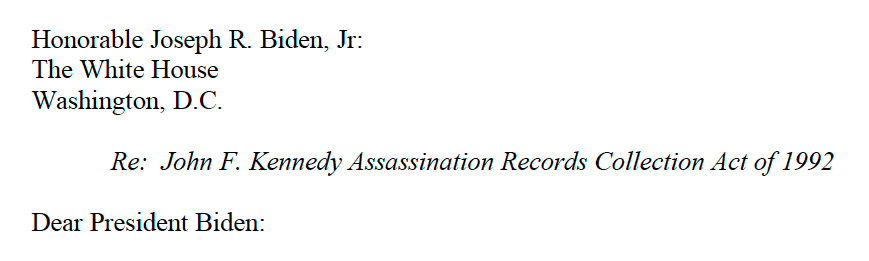
    I recently signed a letter and legal memorandum to President Biden expressing the importance of this issue. That document can be viewed here. I strongly encourage you to contact the White House with a simple request. Follow the law. Stop the delays based on unfounded (and undisclosed) arguments from agencies that wish to continue hiding these records.

    This effort is not about proving a conspiracy or validating the previous findings of the Warren Commission or House Select Committee on Assassinations. It is about following the law, which was passed by Congress in 1992. It is worth noting that Joe Biden was the Chairman of the Senate Judiciary Committee when the JFK Act was passed by Congress in 1992. The executive branch recently authorized the release of 9/11 records and it has the same chance to earn trust from the American public by authorizing the release of the JFK records. It should not be a difficult decision. It is what the law requires.

  • Into the Storm, by John Newman

    Into the Storm, by John Newman


    John Newman has finished his third volume on the JFK case. This entry is called Into the Storm. As readers of this site will know, I have already reviewed the first two volumes in the unprecedented series. (Click here for the first review and click here for the second)

    In foreign policy, the third volume focuses on the year 1962, up until the Missile Crisis. These events include the initiation of Operation Mongoose in Florida, the submission of the Northwoods provocation plans to Kennedy, the removal of Lyman Lemnitzer as Joint Chiefs chairman, and the assumption of that position by General Maxwell Taylor. These are all important developments. And one can argue that they may have had an impact of what happened to Kennedy in Dallas, but surprisingly the major part of the writing about them comes near the end of the book. And the weight of that description and analysis is outdone by the subjects the author deals with previously. For me, it made for an uneven and, in some ways, puzzling result.

    Prior to getting to those rather salient points, the author deals with four major topics at length. These are the activist group CORE and their Freedom Ride demonstrations in the south; the KGB/CIA spy wars over men like Pyotr Popov, Oleg Penkovsky, and Yuri Nosenko; the intelligence career of Cuban exile Antonio Veciana; and, finally, the false accusations of Agency officer Sam Halpern implicating the Kennedys in the CIA/Mafia plots against Fidel Castro.

    I

    Newman includes two chapters on the outburst of the race issue under the Kennedy administration. These amount to about 55 pages of text in a 400 page book. The vast majority of those pages deal with two topics: Martin Luther King’s arrest in Atlanta during the 1960 election and the Freedom Rides and the accompanying violence they incurred in 1961. This material has been dealt with many times in the past by several different authors. Newman maintains that they are integral to any story about Kennedy’s demise, since JFK would not have been president if not for the Kennedy brothers’ role in releasing Martin Luther King from a Georgia prison before the election. (p. 15)

    This may or may not be true. There have been several interpretations about how Kennedy won his narrow popular victory in 1960, which was wider in the Electoral College. This includes Robert Caro’s explanation of Lyndon’s Jonson’s campaigning in the south. But even if one were to grant the author his premise, I don’t see how that necessitates including them in a book that is subtitled “The Assassination of President Kennedy.” If, at the end of his series, Newman convincingly shows us how this racial strife somehow impacted Kennedy’s murder, I will be glad to make amends and thank him for his insight.

    In Chapter 2, the author brings up what I think is a more relevant subject, which he does not deal with at the length he does his four main fields of interest. This is the undeclared war of the Wall Street Journal—and all that powerful publication represented—against the introduction of Kennedy’s policy plans, both foreign and domestic. As Newman notes, that newspaper viciously attacked Kennedy right out of the gate, on both his domestic spending plans and level of foreign aid. (p. 39) One reason for this is because Kennedy’s policies posed a juxtaposition with President Eisenhower’s. But secondly, Kennedy had always been concerned about levels of joblessness and the length of unemployment benefits to those who could not find work. He was worried about the cumulative impact of structural unemployment on the economy.

    The author briefly deals with the rather controversial appointment of Douglas Dillon as Secretary of Treasury. (p. 43) Many liberals wondered about this, since Dillon had been a mainstay of Eisenhower and worked at three different positions in his administration. Newman then comments on Kennedy’s counterbalancing of the conservative Dillon with the liberal Keynesian Walter Heller at the Council of Economic Advisors (CEA). There can be little doubt that Heller’s ideas worked. The performance of the American economy was remarkable under JFK: in three years Kennedy doubled economic growth and increased GNP by 20 per cent. (See for example, John F. Kennedy: The Promise Revisited, by Paul Harper and Joann Krieg, pp. 169–224; Irving Bernstein, Promises Kept, pp. 118–217)

    The author also counteracts the accepted CW that Kennedy was unsuccessful at getting his proposals through congress. By late 1961, Kennedy had gotten 35 of his 55 bills passed. (p. 47) He declares that Kennedy had clearly sided with Heller and the CEA and his goals were to keep interest rates and mortgage rates low. (pp. 50–51). None of this success calmed down the attacks by the Wall Street Journal, especially when, recalling Franklin Roosevelt, Kennedy began to implement economic programs as a way of dealing with social problems. This meant things like placement services to find jobs for those seeking work and extending unemployment benefits from 26 to 39 weeks.

    In summing up Kennedy’s economic achievement, Newman writes that prices remained stable in a way they had not under Eisenhower, while wholesale industrial prices actually declined. Both happened under a rapidly expanding economy. (p. 59) My one complaint about this section of the book is that there was no mention of the rather important figure of James Saxon, Kennedy’s Comptroller of the Currency. It seems clear to me that Kennedy was relying on both Saxon and Heller to effectively counter the innate conservatism of both the Federal Reserve and Dillon. In my online discussions with British researcher Malcolm Blunt, he seemed to agree with me. (Click here for details)

    II

    One of Newman’s preoccupations, both in this book and in his public appearances, has been his disagreement with the late Cuban exile Antonio Veciana. To anyone who knows anything about the JFK case, I should not have to remind them that Veciana was first interviewed by Church Committee investigator Gaeton Fonzi. At that time, Gaeton was working under the Church Committee’s Senator Richard Schweiker. Fonzi was then transferred over to the House Select Committee on Assassinations (HSCA) by attorney Robert Tanenbaum. Senator Schweiker showed Tanenbaum some of what Fonzi had accomplished under his stewardship and the New York prosecutor was favorably impressed. (Fonzi, p. 431) Gaeton decided to stay on the HSCA even after both Tanenbaum and the first Chief Counsel, Richard Sprague, had left.

    There, partnered with another Tanenbaum hire—New York detective Al Gonzalez—the two pursued various leads out of Miami, Dallas, and New Orleans. These are vividly captured in Fonzi’s fine book on the case, The Last Investigation. In that volume, Gaeton described his first meeting with Veciana and then his following relationship with the man all the way through the closing of the HSCA. Fonzi details the difference in his belief in Veciana and the committee’s disagreement with that belief. This includes Veciana being shot at—four times—after the appearance of the HSCA Final Report. (Fonzi, pp. 392–93)

    In that book, Fonzi meets up with Veciana as he is being released from prison on what the Cuban believed was a trumped-up drug charge. (Fonzi, pp. 123–24) Veciana had a degree in accounting from the University of Havana. He was good at what he did and ended up working closely with Julio Lobo. Lobo was a millionaire known as the Cuban Sugar King prior to the Castro revolution. Since Veciana became one of the most militant of the exile leaders and was associated with Alpha 66, Fonzi asked him who he was tied in with as part of the American government. This turned out to be a man named Maurice Bishop. At one of their meetings, he said that he had seen Lee Oswald with Bishop in Dallas around the beginning of September, 1963. (Fonzi, pp. 125–26). This became the famous Southland Building meeting, where Veciana had arrived a bit early and had seen Bishop chatting with Oswald. When Veciana approached, Bishop disposed of Oswald rather quickly. Fonzi had a police artist sketch a picture of Bishop along the lines of the description that Veciana had given. Veciana and Fonzi spent hours working on the sketch with the illustrator. When this was later shown to Schweiker, he said it looked to him like CIA officer David Phillips. (Fonzi, p. 158) Later, when Gaeton showed the sketch to a brother of David Phillips, he exclaimed “Why, that is amazing! That certainly does look like David!” His office secretary said the same. Then his daughter, David Phillips’ niece, said “What that’s Uncle David!”(Fonzi, p. 315)

    Gaeton then decided to search for sources who had been in the Agency who could confirm that Phillips had used the alias of Bishop on occasion. He ended up finding three such sources. (Fonzi, pp. 308, 364) Former CIA Director John McCone told the HSCA that he did recall a Maurice Bishop who worked for the Agency. (Fonzi, p. 434. The CIA later made McCone walk back the statement.)

    It should be noted: throughout The Last Investigation, Veciana never flatly states that Bishop is Phillips. In fact, there are instances where he denied it. (Fonzi, p. 251) This included a face to face meeting between the two. (Which, as Fonzi notes, Phillips lied about. See p. 276) At the end of the book, Veciana admits that, if it was Phillips, he could not admit it without Phillips’ approving it. (Fonzi, p. 396)

    Gaeton’s widow, Marie Fonzi, wrote to Veciana after her husband’s death in 2012. She was preparing a new version of The Last Investigation. Marie asked permission from Antonio to quote him about Gaeton’s honesty and dedication in pursuit of truth. He agreed to do so. At this time, Veciana was working as an accountant for his son’s marine supply store in Miami.

    The next year, 2013, Marie asked Antonio to identify Bishop. She did not mention Phillips in that request. Veciana’s son typed the letter to her finally saying that Phillips was Bishop. His son asked Veciana if he was sure about what he was doing. Antonio said it was time. Marie alerted journalist Jerry Policoff to this fact and he wrote an online piece, which was picked up by other JFK sites; but got little if any MSM exposure. The following year, Veciana showed up at the 2014 AARC seminar and discussed what he wrote in public. (Email exchange with Marie Fonzi, 9/16/2021)

    There is more I could write about Fonzi’s work on Veciana. For instance about the personal profile he assembled about Bishop (pp. 155–56) and Bishop’s ultimate pay off to Veciana as witnessed by his wife. (p. 150) But I would just suggest that if you have not read The Last Investigation, you should.

    III

    Before beginning any discussion of Newman’s disagreement about the Veciana/Bishop relationship, I think it is important to state what is not in his argument. John never talked to Marie Fonzi or visited her home to look through what she still had left of her husband’s files. Even though Veciana died last year, he had time to talk to Antonio through his daughter who is a professional journalist. As most readers know, this reviewer has shown that Clay Shaw repeatedly lied on the witness stand at his trial. He also lied in public about his relationship with the CIA. This reviewer also believes that Shaw was part of the plot to set up Oswald in the murder of President Kennedy and this is why he called attorney Dean Andrews to go to Dallas to defend Oswald. But in spite of that, I interviewed three of Shaw’s four lawyers. I could not talk to Ed Wegmann, since he had passed on prior to starting the research on my first book.

    There are two main areas that Newman finds fault with in Veciana’s statements to Fonzi and others. The first is that, in his initial utterances, Antonio said that he first met up with Bishop in Cuba in 1960. As the author notes, Veciana later changed this to 1959. The first person to find a problem with this was Fabian Escalante. (Newman, p. 67) At the time of Kennedy’s murder, Escalante was part of Castro’s counterintelligence force. He eventually rose to helm Cuban state security forces. Probably no one on the island knew as much about anti-Castro CIA operations and Phillips as Escalante did. According to his information, Phillips had left Cuba in February of 1960. To his knowledge, he did not come back. (Newman, pp. 67–71)

    Newman’s other main point of contention is that, contrary to what Veciana told Fonzi, he was not primarily associated with the CIA. After leaving Cuba in October, 1961 Veciana was associated with the MRP. In late 1961, he was approved for CIA use in other operations, but did not like working for the Agency. The reason being that he wanted little or no restrictions placed on him. (Newman, p. 293)

    In Puerto Rico, Veciana helped create a group called Alpha 66. And he gained sponsorship from Army intelligence in November of 1962. (Newman, p. 299) The author concludes that, from his timeline, Veciana was working for the Army while he was participating in Alpha 66 activities. And he concludes that when Veciana told the Church Committee that the man behind Alpha 66 strategy was Maurice Bishop, he was being deceitful. (Newman, p. 313)

    John has done some good work with this and I think some of it is valuable. And he probably is not done yet. But let me point out what I see as a bit problematic. The author brings out his information about Veciana, Alpha 66, and Army Intel as if it had been buried underground. Yet it was written about as far back as ten years ago.

    In 2011, Larry Hancock penned a brief but valuable book called Nexus. In Chapter 11 of that work, he writes about how the success of Alpha 66 had drawn the interest of the Army in October of 1962. The CIA and G-2 then shared what information they had collected on the group’s projects. Cyrus Vance of the Army drafted a proposal for very select missions, but Vance’s proposal is marked “Not Used.” Everyone knows that after the Missile Crisis, the actions against Cuba were greatly slowed down and decreased. And, at Kennedy’s insistence, the little that was left was mostly moved off shore. (James DiEugenio, Destiny Betrayed, Second Edition, p. 70)

    The Missile Crisis concluded as a great success for Kennedy, but the Cuban exiles looked at it differently. The rumor in Miami was that somehow the Russians were lying and Castro was cheating. There were still missiles in Cuba and two defecting Russian officers were there willing to talk. As Hancock mentions both in Nexus and Someone Would Have Talked, the main source for this appears to have been Eddie Bayo of Alpha 66. (Respectively, p. 86, p. 337) If that group was only a G-2 operation at that time, 1963, then why did the reaction to this Alpha 66 rumor turn into a purely CIA project? I am referring of course to Operation Tilt, sometimes called the Bayo/Pawley mission. William Pawley was a zealous sponsor of the excursion into Cuba and presented it to CIA. Dick Billings of Life magazine was involved in this mission on Pawley’s yacht since Life was giving publicity to both the DRE and Alpha 66.

    Newman admits that there was a female contact who worked for Veciana, who communicated messages to him from Phillips. (Newman, p. 83) Delores Cao had been Veciana’s secretary and she recalled messages from a man who used the name Bishop. According to Hancock, in 1963, there was another woman who was used for messaging later. Veciana recalled her name as Prewett. This has to be be Virginia Prewett, who Phillips worked with in propaganda operations. (Hancock, Someone Would Have Talked, p. 177) John also admits that some CIA agents stayed on the island after the revolution. And Veciana named one of them who appeared to be an associate of Phillips, but he rules out the possibility that Phillips would have ever returned, because he had no diplomatic immunity since he was not under state department cover.

    IV

     One of the major themes that the author spends many pages on is the controversy surrounding the espionage battles between the KGB and CIA in the fifties and early sixties. This includes figures like Pyotr Popov, Oleg Penkovsky, George Blake, Anatoliy Golitsyn, and Yuri Nosenko, among others. In my discussions with John and in one of the talks I have seen him give, his assessment is going to be contra authors Tom Mangold and David Wise. What he appears to be saying is that there really was a high level mole inside the CIA, Golitsyn was somehow a credible source, and that Nosenko was a false defector.

    In 1992, British journalist Tom Mangold published a long biography of James Angleton and his reign over the CIA’s counterintelligence staff for two decades. That reign ended in 1974, when he was forced to resign by CIA Director Bill Colby, who had replaced Richard Helms. Mangold’s book was really the first full scale biography of Angleton. For too many reasons to mention here, it did not present an attractive portrait. In his review of CIA literature, in house historian Cleveland Cram praised the book as being honest and accurate. (October, 1993, Center for the Study of Intelligence, “Of Moles and Molehunters”)

    Much of Mangold’s valuable work focused on how Allen Dulles and Dick Helms had allowed Angleton to establish what was essentially his own fiefdom within the CIA, including his personal filing system which was not integrated with the Agency’s system. It is not much of an exaggeration to say that those two men allowed the very rightwing Angleton to more or less run roughshod, with little or no oversight. Another major theme of the book was Angleton’s firm belief in virtually anything that Golitsyn told him. Complimentary to that belief were the monetary rewards that Angleton bestowed on the man—no matter how wrong his predictions turned out to be. And many of them were.

    Within a year after Mangold’s book was released, much respected journalist David Wise—who had developed a reputation for dealing with intelligence matters—published his own book dealing with Angleton. This was called Molehunt. Wise traced all the organizational and personal damage to careers that Angleton had wrought in his search for what he thought was the mole in the CIA. This unhinged search was largely based on Golitsyn and the fact that he said the mole’s last name began with a K. To make a long story short, this resulted in the wreckage of CIA officer Peter Karlow’s career; along with Paul Garbler’s and Richard Kovich’s. And by agreeing with Golitsyn’s prophecy—that anyone who followed him would be ersatz—later defectors were either discounted or looked on with suspicion. This went on even beyond Angleton, with a man named Adolf Tolkachev, who later turned out to be a very valuable informant on Russian defense technology. His offer was turned down three times. President Carter later signed a bill called the Mole Relief Act in order to recognize and compensate Angleton’s victims. (Click here for more details)

    Nosenko had first tried to defect in 1962, but he wanted to act as an agent in place, so he stayed in the USSR. But after the assassination, he did defect at Geneva in January of 1964. His message was that while he was in Russia, and as part of the KGB, he was responsible for the Oswald file. The KGB had no interest in the Marine defector and little knowledge of his military background. They were still not interested even after Oswald married a Russian girl. (Michael Benson, Who’s Who in the JFK Assassination, pp. 316–17)

    Today, Newman is convinced that Nosenko was a false defector, to the point that he once told me that Bruce Solie, the CIA officer who helped rescue Nosenko from three years of torture and imprisonment, might have been the mole. What seems odd about all this to this reviewer is that the author also writes that the KGB had nothing to do with President Kennedy’s murder. (Newman, p. 339) Which means to me that, at worst, the Russians were trying to convince the USA that they had nothing to do with turning Oswald while he was in the USSR, or ultimately Kennedy’s murder.

    A lot of what the author writes in this section of the book is based on the works of Tennent “Pete” Bagley. An important part of what Newman writes about the longtime CIA officer concerns his relationship with esteemed British researcher Malcolm Blunt. This reviewer has material of value to add to their exchange over Oswald’s file that is not in the book under review.

    The Brit Malcolm became friendly with Bagley while the former agent was living in Brussels. By 2012, Malcolm had done some work on the declassified HSCA files of Betsy Wolf. One of her assignments was to investigate the Oswald file at CIA. Betsy was a thorough and conscientious researcher. One of the oddities about Oswald’s file that puzzled her was the fact that no 201 file had been opened on the man after he had defected in 1959. Betsy began to inquire with other CIA officers and to look up certain division charters. She found out that in not opening that file, the Agency was violating its own internal rules.

    The other problem she pondered was that Oswald’s files did not go where they should have gone, which was the Soviet Russia (SR) division. Instead, they went to the Office of Security (OS). The more people she talked to, the weirder this situation got. She came to suspect that somehow, someone had rigged the system so that no 201 file would be opened on Oswald. As she dug deeper, she realized such was the case. For OS did not open 201 files. This is why certain outside agencies were sending multiple copies of files on Oswald to CIA, but they were not getting distributed. After months of research work on this, Betsy interviewed the man who was the then present Chief of Security, Robert Gambino. He told her that the office of Mail Logistics is alerted in advance of where certain files should be headed in the system. She concluded that this is what had happened: someone had instructed that office in advance to misdirect Oswald’s files. (Click here for details, plus a diagram of how Oswald files were routed)

    Malcolm drew for Bagley the diagram of how Oswald’s incoming files were routed in 1959. That is, not going to where they should have been going, namely the SR division, where Pete had worked, but instead being diverted to OS where no 201 file would be opened. After looking at the diagram, Bagley asked Malcolm if Oswald was a witting or unwitting defector. Malcolm did not want to reply, but Bagley pushed him on the question telling him he had to know the answer. Malcolm said, “Okay, unwitting.” Bagley instantly countered with, “Oh no, he had to be witting!” (Newman, p. 339) What makes this even more interesting is that Bagley thought Oswald had killed Kennedy. So you had, for the first time, a veteran CIA counter intelligence officer—who thought Oswald had killed Kennedy—saying that the man was a witting false defector.

    V

    I would like to close this discussion on a high point, actually two of them.

    Newman’s analysis of how the CIA switched back their plots to kill Castro onto the Kennedy White House is very well done. In fact, it is unmatched in the literature. As the author explicates it, this deception started with Director of Plans Dick Bissell; it was then continued, expanded, and elongated by William Harvey’s assistant Sam Halpern. The author proves that both men knowingly lied about the subject. It is important, because this whole mythology became a way to confuse what had happened in the JFK case. The myth that arose from it was that Kennedy was trying to get Castro, but Castro got him. When, in fact, neither clause was true. And neither was the corollary: JFK dug the hole for his own death.

    Bissell was the first person who created the chimera that somehow “the White House” urged him to create an executive action capability. (Newman, p. 182) In fact, Bissell first told this story to William Harvey in 1961. But under examination by the Church Committee, Bissell said six times that he could not recall who the person at the White House was who first asked him to do this. Someone in the administration calls you about such a subject and you cannot recall who it was?

    But on its face, this was not credible. Because the CIA’s Staff D—which included this function—had already been created by then. Plus the CIA/Mafia plots were already in motion. The former began in October of 1960, the latter in August of 1960. And, in fact, it was Bissell’s idea to reach out to the Mafia. (Newman, p. 187) After doing depositions with Bissell, Harvey, and McGeorge Bundy, the Church Committee concluded that Kennedy had filed no such request with CIA and none had been discussed with him. (Newman, p. 191) In fact, the Church Committee was forced to ask Bissell: If the White House tasked you with that, why didn’t you reply that such actions were already proceeding?

    The reason that Bissell wanted to use this fabrication of White House approval was to egg on the Mafia plots in order to salvage the Bay of Pigs operation. This is most likely because he understood from the two designers of that operation—Jake Esterline and Jack Hawkins—that it would not succeed due to the revisions that had been made in their plans. In fact, they wanted to resign, since they sensed a debacle was upcoming. Bissell understood if that happened, he would be left holding the bag, since he was the main supervising officer. (Newman, pp. 191–92).

    Halpern took this fabrication and made it his own, with two alterations. First, he switched the pushing of the plots from JFK to RFK and he used a CIA man he knew, Charles Ford, as RFK’s “accessory.” What was quite revealing about the Church Committee inquiry was that Dick Helms did not seem to know much at all about Halpern’s RFK/Ford schemes. And what he did know was through Halpern. (Newman, pp. 237–39)

    The giveaway about Halpern was his frequent assertion that RFK deliberately left no paper behind about his dealings with Ford. This turned out to be utterly false. And as the author points out, for Seymour Hersh to have accepted this from Halpern for his 1997 book, The Dark Side of Camelot, tells you all you need to know about Hersh’s piece of rubbish.

    In fact, Charles Ford testified twice before the Church Committee. For whatever reason, we only have his second deposition. But it is clear from the references he makes to the lost first interview that he never did what Halpern said he was doing. That is acting as a liaison for RFK to the Mob for the purpose of killing Castro. Considering Bobby Kennedy’s war on the Mafia, this was preposterous on its face. But as the author points out, we have documents from both sides today—RFK’s and Ford’s—as to what Ford was doing for Bobby. The idea was that he was supposed to check out some American representatives of anti-Castro groups in Cuba and also explore ways to retrieve the prisoners from the failed Bay of Pigs project. (Newman, pp. 260—67). These prove that Halpern was passing gas on two levels.

    But the capper about this is that Halpern knew about it, since he signed off on one of Ford’s memos. In fact, Ford was working with Halpern and Harvey in 1961. And since Ford worked under those two men in 1961, within their domain at CIA, he could not have been working under Bobby Kennedy. The Church Committee examined Ford’s testimony afterwards and found it to be accurate. (Newman, p. 276)

    Perhaps the sickest statement that Halpern made to Hersh was this: “Bobby Kennedy’s primary purpose is dealing with Charles Ford was to do what Bill Harvey was not doing—finding someone to assassinate Fidel Castro.” As Hersh could have found out through declassified documents available at that time, this was an ugly lie. Harvey had found someone he was working with to kill Castro. That was John Roselli. And the CIA had lied to Bobby Kennedy about the existence of this plot. (Newman, p. 279)

    Does it get any worse than that?

    VI

    The book closes with what is a testament to its title. The author notes that Dwight Eisenhower and his National Security Advisor Gordon Gray had thought of using a false flag operation at Guantanamo Bay in the waning days of Ike’s administration. That is, they would employ Cuban exiles to simulate an attack on the base and that would suffice as an excuse to invade Cuba. In fact, Eisenhower had told Joint Chiefs Chairman Lyman Lemnitzer that he had little problem with that scenario, as long as they could manufacture something “that would be generally acceptable.” (p. 372)

    As the author then writes, it is clear that Lemnitzer recalled Eisenhower’s approval of this concept, since both he and Edward Lansdale, who was running Operation Mongoose, were going to try and push it on President Kennedy. As Newman, and many others have written, once Mongoose—the secret war against Cuba—was up and running in February of 1962, the three men supervising it were not well-suited for each other. That would be Lansdale, William Harvey, and Bobby Kennedy. RFK was there at his brother’s request. Since after the Bay of Pigs, the president did not trust the so-called experts anymore. Lansdale did not like this. He actually asked CIA Director John McCone for complete control over Mongoose. A request that was promptly denied. On top of this, Lansdale and Harvey despised each other and Harvey hated RFK. (Newman, pp. 376–77)

    Lansdale was quite imaginative—and deadly—in his plans to shake up things on the island. He thought up outlandish schemes like Task 33. This was a plan to use biological warfare against Cuban sugar workers, but this was only part of an even more wild menu: to create a pretext to attack Cuba. Lansdale now brought back the idea of staging a fake Cuban attack at Guantanamo to provoke an American invasion. There were two other scenarios that Lansdale thought up for this purpose.

    As the reader can see, what Lansdale had in mind actually preceded what the Joint Chiefs were going to propose to President Kennedy, which was the infamous Operation Northwoods. The problem was that President Kennedy not only did not want to provoke American direct intervention, he did not even want to hear about it. (Newman, p. 385) But yet, on March 13, 1962 the Joint Chiefs proposed Northwoods to the White House. This was a series of play acted events designed to manufacture chaos in Cuba in order to provoke an attack by American forces. One was a staging of a “Remember the Maine” scenario: blowing up a ship in Guantanamo Bay and blaming it on Castro. Another was to create a communist Cuban terrorism wave on cities like Miami. Kennedy rejected these proposals.

    Newman closes the book with Kennedy’s searing disagreements with Lemnitzer over both Cuba and Vietnam. About the latter, Lemnitzer said that Kennedy’s policy would lead to “communist domination of all of the Southeast Asian mainland.” In regard to Cuba, Lemnitzer would not let up on the idea of American intervention. This led to his eventual rebuke by Kennedy in mid-March of 1962. (Newman, pp. 391–94) If there was any doubt that Lemnitzer was leaving—and there was not much—this settled it.

    Kennedy did kick him out of the White House, but he sent him to NATO, which, of course, was secretly guiding the Strategy of Tension under Operation Gladio. In other words, the terrorist plan Lemnitzer had been turned down on with Cuba, he was now going to be part of in Europe.

  • The Mysteries Around Ida Dox

    The Mysteries Around Ida Dox


    This is chapter four of a book I’ve written concerning the 52 witnesses that appeared and gave public testimony before the House Select Committee on Assassinations. Ida Dox gave her very brief testimony, only 11 questions, on September 7, 1978, in the Rayburn House Office Building, though the majority of testimony was given in the Cannon House Office Building.

    I tried to do with Ms. Dox, as I did with all of the witnesses, and that was lift out the salient points and update the evidence when necessary.

    The name of my book is Hidden In Plain Sight. It is an attempt to demonstrate that a large amount of evidence was obvious early in the investigation of the case. In other words, it was there all the time, but we didn’t see it, sometimes because we weren’t looking for it.

    Ultimately, it is a guide that will tour you through the labyrinth of testimony and evidence of the case in 1978 and then updated as the years have gone by.

    Chief Counsel Robert Blakey told me in an interview in the late 90’s that these witnesses were a way for the HSCA to present their evidence to the American public.

    Ida Dox, September 7, 1978

    On September 7, 1978, 9:09 a.m. session, EDT—Room 2172, Rayburn House Office Building, Washington, D.C., the House Select Committee on Assassinations took testimony from Ms. Ida Dox.

    Ida Dox was born on July 8, 1927 in Honduras, Central America and came to the United States in 1947. She received her Bachelor of Fine Arts from Newcomb College of Tulane University in New Orleans in 1950. She obtained her Master of Science degree from Johns Hopkins University in 1954 and her Doctorate of Philosophy from the University Maryland in 1990.

    She was a medical illustrator at Georgetown University Medical Center in Washington D.C. from1954–1969. She was chosen to be the medical illustrator for the Select Commission on Assassinations of John F. Kennedy and Martin Luther King, Junior of the United States House of Representatives in Washington D.C. from 1978–1979. She has been a medical illustrator and author, in Bethesda, Maryland, since 1969.

    At the time of the public hearings, she was a medical illustrator for the Department of Medical-Dental Communication at the Georgetown University Schools of Medicine and Dentistry. She was also an author of many textbooks on illustrated medical dictionaries, one of which I purchased off of Amazon.

    She died on October 18, 2013, at the age of 86. Dox was her maiden name, but her married name was Ida Melloni, as she married John Melloni in 1954.

    The HarperCollin’s Illustrated Medical Dictionary

    The House Committee on Assassinations contacted the Georgetown Medical School, which in turn recommended Ida Dox as a medical illustrator. She appeared before the Committee to testify in public session. She had been working with the medical panel for some time and was asked to explain her role, working with the autopsy photographs and x-rays, which would demonstrate the location and severity of the bullet wounds.

    Before her appearance, Robert Blakey read a list of rumors that had circulated regarding the location and nature of those wounds, specifically to JFK. Amazingly, what he stated was a lot closer to reality than the Humes, Boswell, and Finck autopsy findings.

    Blakey then commented on past presidential assassinations, as they related to the specific autopsies. He marginalized the credibility of the Parkland doctors by comparing the comments of Dr. McClelland, “a massive head and brain injury from a gunshot wound of the left temple,” (an obvious misspeak and red herring by Blakey, when he understandably meant right temple) to the wholly different description of neuro-surgeon Kemp Clark, who “observed a large gaping hole in the rear of the President’s head.” Blakey further weakened the import of their testimony by stating that they only worked on the President for a short time and they were trying to save him, which was not a possibility either way.” (I HSCA 142)

    If Ida Dox was to malign the rumor department, it would have been binding upon her to testify that she enhanced the wounds in the drawings that she made, especially Fox-3. More about that in due course.

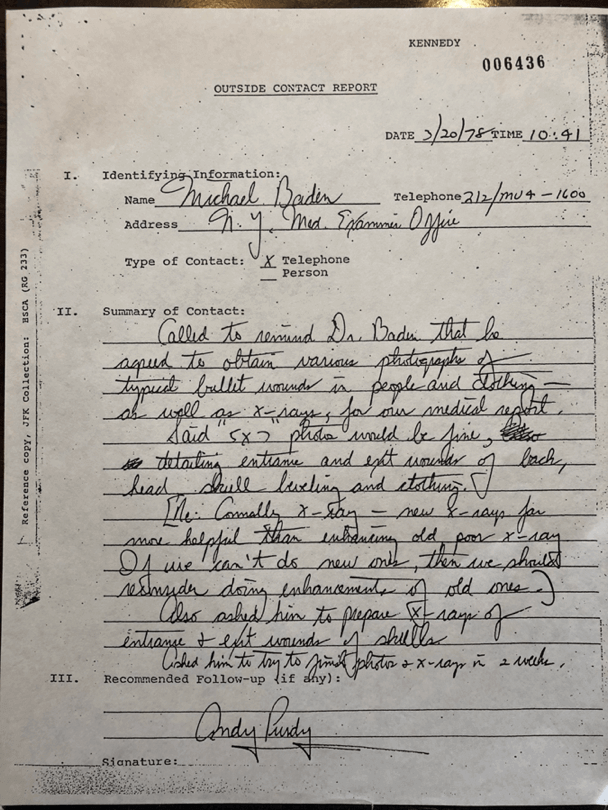
    Andrew Purdy, who handled much of the medical aspect of the questioning, was called upon to question Ms. Dox. He began by asking her to expand on how it was determined what to illustrate for the Select Committee. A seemingly fair question. She said, “the committee, the medical panel, and myself…decided that the photographs taken at autopsy should be copied to illustrate the position of the wounds. The photographs that were selected were the ones that best showed the injuries.” (I HSCA 146) Why would a medical illustrator be involved in that decision-making process? She’s an artist, not a doctor. She sketches and traces; she does not slice and cut.

    “The photographs taken at autopsy should be copied to illustrate the position of the wounds.” (I HSCA 146) Wouldn’t the photographs illustrate that? This seems to be a wasted step. This has the appearance of an imitation of the Warren Commission, where Commander Humes told medical illustrator Harold Rydberg lies, but Rydberg followed orders, which he argued both strenuously and vociferously against years later. Dox would never argue in that same vein, unfortunately.

    The Warren Commission’s excuse was that to introduce the photos into evidence would mean publishing them; did the House Select Committee on Assassinations believe that by using drawings that they could keep the nature of the injuries from becoming public? The Dox drawings are some of the least graphic of the autopsy photos that we know about, but even still, they don’t hide what little graphic nature there is in those prints. The Warren Commission could get away with it, because nobody was going to see the photographs and that was a censuring that remained in place years later, when the HSCA chose drawings, identical to a couple of the autopsy photos, instead of the photos, for their study. Nothing had changed fourteen years after the Warren Commission, as neither the Commission nor the House Committee on Assassinations, and much to their shame, put the autopsy photographs into evidence.

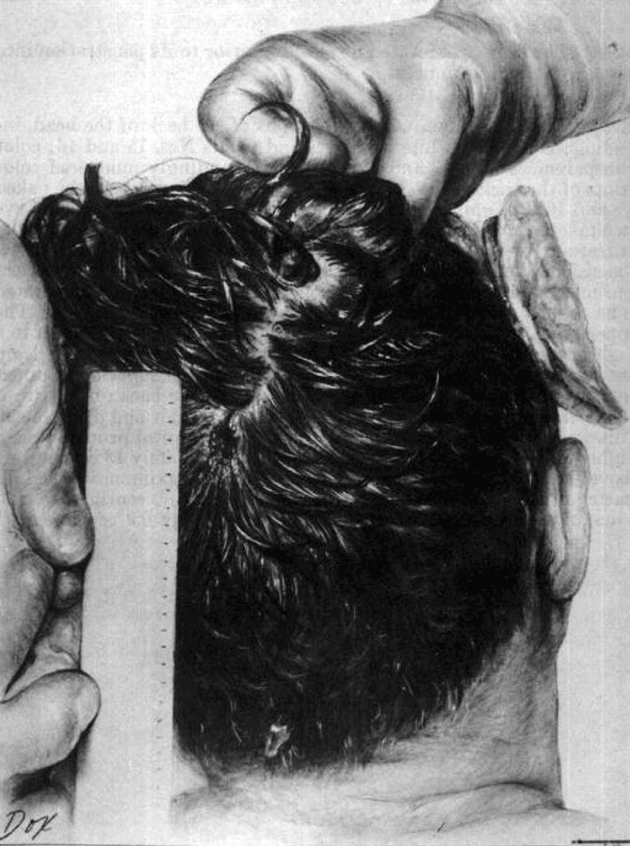
    In her testimony of how she made the illustrations, at no time did she give any indication that the results used by the committee were in any way different from the actual photographs themselves. I am sure at some point, someone told Ida Dox exactly what to do with the red spot on Fox-3, the back of the head autopsy photograph. In fact, some of the records obtained from the National Archives do everything, except come right out and say just that. Does this make Ida culpable? Probably. I am sure she was just doing what she was told and may have been told it would illustrate what the medical panel was trying to explain. She is less culpable than Baden, to be sure.

    They would never publish the photos and the drawings by Ms. Dox in the same volumes, as it would easily demonstrate the differences between the two. The differences would have been recognized immediately, particularly with reference to the wound in the cowlick, not discernable in the photograph, but manifestly obvious in the drawing.

    Mr. Purdy: Ms. Dox, prior to today, did you have the opportunity to review the enlargements of your drawings to ensure that they are accurate?

    Ms. Dox: Yes, I did. I looked at them very, very carefully and they are my drawings except that they are photographically enhanced. [my emphasis] (I HSCA 148)

    The witness was asked if the drawings are accurate? Her answer was that she compared them to make sure that they were, in fact, her drawings and they had not been rehabilitated in any way. She had to know this wasn’t true, as the documents I received from the National Archives indicate in this chapter.

    In two investigations into the murder of the President of the United States, when it comes to medical evidence, the most crucial evidence of all, the deception seems to explode all over the place.

    This is a sleight of hand worthy of the Warren Commission, suggesting that the House Select Committee at least had a tutorial in coverups; they agreed for the sake of the Kennedy family’s privacy not to use the actual photos, but to use identical sketches made by a medical illustrator.

    I am not sure how that would have put anyone at ease in the Kennedy family. The President’s image was displayed, in death, and on television. Whether it was a photograph or a true rendering by a medical illustrator, it is truly much ado about nothing. The American public had already seen the graphicness of the Zapruder film on national television in March of 1975.

    But make no mistake, the autopsy photo that Dox copied of the back of the head and the resulting sketch she made are ages apart. Ida Dox deceptively depicted the rear head entrance wound, exposed as such when the inquiring public was finally allowed to see the actual wounds fifteen years after the event. Who knows what she was thinking, as she did what Dr. Baden told her.

    The decision not to use the original photographs was probably made by the Committee members. An arrangement was reached that they would publish the drawings, but only those deemed essential. The Dox drawing of the head wound was withheld from publication and it was not in the hundreds of pages of her file I received from the National Archives.

    She also responded to Purdy’s question by stating that “the photographs that were selected were the ones that best showed the injuries.” (I HSCA 146) Ms. Dox said she copied four photographs: the back of the head (Fox-3), the upper back (Fox-5), the side of the head (Fox-4) [not shown during public testimony], and the front of the neck (Fox-1 & 2). Key photos were clearly withheld, some say on grounds of taste. They were examined by the forensics panel and other experts, but not displayed or published. The top of the head photo (Fox-6 & 7) was not chosen. As stated, the side of the head photo drawn by Ms. Dox was not shown during public testimony either. She was asked to draw the head wound photo, but when they saw it, they decided not to publish it. I am not sure what they thought they would see before they looked at it, as they had seen the autopsy photograph on which it was based.

    The back of the head photo (Fox-3) was shown during the public testimony of Ms. Dox. The only problem is that the alleged entrance wound in the cowlick area is much more visible in her drawing, than on the original Fox-3 photograph. Conversely, her drawing of the back wound (Fox-5) omits the possibility of an entrance wound that has been alleged by some critics and his back was cleaned up quite a bit. Whether there are other possibilities concerning Fox-5, it should have at least been drawn. It also places the back wound much too high. The autopsy face sheet, as did his suit coat and shirt, as did Dr. Humes, places the back wound in the upper right posterior thorax at about the level of the third thoracic vertebra, which would be approximately five and three-eighths inches below the top of the collar. The Dox wound appears much too high.

    When Mr. Purdy asks how she copied the photographs, Ms. Dox stated that she did it by “placing a piece of tracing paper directly on the photograph, then all the details were very carefully traced…so that no detail could be overlooked or omitted or altered in any way.” (I HSCA 147) As noted, the upper entry head wound was altered. Period. Perjury, most likely, but I really believe it is more of being afraid to disagree with Dr. Baden, when he had told her what he wanted. Hard to tell. Things were omitted, especially on the back wound (Fox-5), where obvious detail is missing, and also on the back of the head wound (Fox-3), where the alleged cowlick area wound is much clearer and pronounced in her drawings than in the autopsy photographs themselves, as I stated earlier. Isn’t this really much ado about nothing? Couldn’t all of this have been avoided knowing that the drawings are no substitute for the photos? The original photos should have been available to researchers at least as soon as the Warren Commission closed up shop, but legally they haven’t been released to this day.

    Purdy goes on to say that Ms. Dox made other drawings to illustrate the conclusions of the forensic pathology panel. We are not exactly sure what these other drawings are, only to assume they are in the Committee’s files. The release of the Assassination Records Review Board medical materials did not tell us any more on this subject. I don’t recall this issue even being addressed. The truth is, in relationship to Ms. Dox, the ARRB made no difference at all. I’m frankly amazed that nobody at the ARRB asked the obvious question: Why are the Dox drawings and the photographs from which they are exactly made, so different? Sadly, Ms. Dox was not questioned by the ARRB and she could have been, since she didn’t pass away until 2013, but this was never addressed.

    In her next to the last question, Ms. Dox says that a frame of “film taken during the motorcade was photographed and the outline of the President’s head was used, so that the…head of the President…in the position that the medical panel decided was necessary.” (I HSCA 147-148) They were probably doing what they thought was adequate, but left themselves open to immense criticism, just as the Warren Commission did.

    Ms. Dox worked for the Committee, under the direction of Professor Blakey. In that capacity, she was assigned to assist the Committee by preparing drawings from the autopsy photos for possible publication. She was working under Blakey’s direction and Dr. Baden, or perhaps Andrew Purdy’s, since he guided most of the medical aspects of the case. Ultimately, Dr. Baden made the call on what Ms. Dox drew and, in some cases, how to draw it. As you listen and read the testimony of Ida Dox, you can only reflect about what should have been asked.

    I contacted Ms. Dox in October of 1999. I had two conversations with her on the telephone. It all started with a question I had regarding HSCA Exhibit F-302, which was a drawing of President Kennedy’s brain, that was put into evidence during the testimony of Dr. Humes. What followed was both puzzling and frustrating. I will go into detail about what Ms. Dox said about that sketching of JFK’s brain, parts of her testimony that she now denies ever saying, enhancement of the wounds that she drew for the Committee (which has to do with some correspondence between her and Dr. Baden that I requested and received from The National Archives and publish in this chapter), and other sundry matters.

    I prepared for my conversations with Ms. Dox by reading documents I received from the National Archives concerning her. There was a sense of discovery, but more so of clarification. I’m not one who looks for a demon under every shingle, nor is it my purpose to attempt to discredit someone who appears on the surface to be a nice lady who was just following orders and instructions. There were some things that did seem a bit odd and other things that I still don’t understand as I write this. The following information is based on those two telephone conversations I had with Ms. Dox.

    In the first conversation I had with here on October 14, 1999, I asked her the following questions:

    Question #1: How many photographs were you shown?

    When I asked Mrs. Dox this question on the phone, she quickly replied, “I can’t remember.” This is intriguing. If she had been shown 75 photos, okay, she can’t recall, but she testified before the HSCA that it was four, at least that is how many she drew. She doesn’t seem to be guessing before the HSCA during her public testimony. I don’t care how many zillion wounds she has illustrated, as one of the first humans on the planet to see those autopsy photos of JFK, you would think she could remember the number. Maybe not perfectly, but certainly not, “I don’t remember.” Even an estimate would have been nice.

    Question #2: Were you ever shown a photograph of the brain?

    She emphatically stated, “No!” This first surfaced for me when I noticed HSCA exhibit F-302 in David Lifton’s book, Best Evidence. During Dr. Humes’ testimony, exhibit F-302 is introduced, with no data whatsoever. It is said, then, to be a drawing of the brain. There are two kinds of representations in Lifton’s book. In the cases of the actual line drawings, they are represented in full, the throat wound, cropped so as not to show the face. The brain drawing, however, is in mid-text, so that may be why it is different from the others. It also has no signature on it. The other Dox drawings are reproduced in full and have a signature in the lower corner. It may have been a simple matter of a tracing of a tracing, or some sort, so it could be reproduced in text, without going to the photo section, which is different paper.

    The only available rendering of the brain, however, absent the photographs, is the drawing/tracing created by Ida Dox and I have already noted my criticisms of her efforts. In her brain illustration, the left cerebral hemisphere is intact, while the right cerebral hemisphere resembles a swirling pattern.

    The two lobes of the cerebellum are intact and unremarkable. That flies in the face of the doctors from Parkland, who testified to seeing cerebellum extruding from the large wound in the back of the head and here we are presented with no cerebellum damage and no large wound in the back of the head.

    Question #3: Were the wounds enhanced for the sake of clarity?

    Her response, “No, of course not.” This is interesting. At Wecht 2003, I asked Dr. Baden about this and was told that Dox was given other gunshot wounds to draw in order to enhance the visibility. You have to look for something even resembling a wound in the Fox-3 photograph. It looks more like a blood droplet, but not a bullet wound.

    He told me that Dox had been given other photos (see later in the text for the documents), of other individuals with wounds, in order that she would be able to highlight JFK’s wound, so people wouldn’t miss where the actual head wound was. Other researchers have talked with Dr. Baden about this and received similar responses.

    What follows after this paragraph is a copy of the Dox drawing of Fox-3 and the actual Fox-3 autopsy photo and then a few pages of documents I received from the National Archives, both of which were sent to Ida Dox by the HSCA, including “you can do much better, Ida,” from Michael Baden. How can you do “much better” than the autopsy photos you are directly looking at and tracing. Or, is “much better” referring to placing a bullet wound where there isn’t one in the cowlick area? Ida Dox lied to me on the phone, when she said she wasn’t given any pictures to use to enhance what wasn’t there. Here are some of the documents I got from the Archives, after I requested every document they had concerning Ida Dox. Unlike the Ida Dox drawing, the actual wound is not visible in Fox-3 and no other photographs show it either.

    Dox drawing of Fox-3
    Fox-3
    Ida—“You can do much better”—Michael Baden
    Bullet wound to the head from the pathology book written by Baden, et. al.

    The Forensic Pathology Panel of the House Select Committee was so thoroughly caught up in their findings, that the upper artifact, the red spot, and what they said was the actual entry wound, that they failed to realize how badly they had been duped.

    This is critical to the ongoing investigation and needs to be considered again. Originally, the HSCA worked from medical illustrations, done by medical illustrator Ida Dox. Unfortunately, Ms. Dox, who was allowed to commit perjury before the House Select Committee, altered the wound that some have identified as simply a red spot or droplet.

    Fox-3 (Color)
    Fox-3 Comparison with Dox Drawing
    Purdy Asking for Photos of Typical Bullet Wounds
    (Keep in mind, this is in the Dox materials sent to me from the National Archives)
    Flanagan to Baden, Asking for Photos of Typical In-Shoot Wounds

    Any assessment of the photographs show nothing even slightly comparable to what Dox drew. I often show the autopsy photos to friends or at talks I give at local libraries and they always produce the same shocked reaction. I show them the Fox photo of the back of the head and ask, “Do you see the entrance wound?”

    Nobody can ever see the entry. Then I show them the Dox drawing of the back of the head and ask if the wound is visible and unanimously and they say it is. Then I put them side-by-side and there is usually some kind of verbal gasp, as if they were watching the Zapruder film for the first time.

    Now they can see up close and personal that something sinister was going on with the medical evidence. The alteration becomes obvious.

    Ida Dox was given the autopsy photographs and requested to make sketches for the HSCA, a procedure that, in itself, calls into question the sanity of the people doing it, as a drawing of gore is almost as unpleasant as a photo of gore.

    The reader is invited, even strongly urged, to view the photographs in question and then view the same cowlick area in the Dox (Fox-3) drawings. You will be surprised, if you have never done this before.

    What is cited as an artifact and is not by any means proof of an entry wound in the photograph, becomes a glaring bullet hole thanks to Ida Dox, who was given additional photos as stated, showing bullet wounds of other people and not of John Kennedy, so that she could highlight and forge the JFK sketches. There is no doubt in my mind that the reason for moving the back of the head wound four inches higher is to explain the massive wound in JFK’s right temporal area of his skull. If you move the wound, then you have a perfect inshoot-outshoot scenario. If not, you have to explain how a bullet traveling downward from sixty feet in the air and behind can emerge on the upper right side of Kennedy’s temporal bone.

    The explanation I can assert is what I have already said in chapter one concerning Governor Connally, that a second head shot at c. Z-327, 7/10ths of a second after Z-313, explains this precisely and, if so, then there was no need to invent a head wound in the cowlick area, as Z-327 explains it perfectly. What is disheartening is that chapter one on Governor Connelly documents that the HSCA was suggesting a shot c. Z-327, but then the Committee wasn’t (as it was a Select, not a Standing committee) renewed and the data became inactive.

    That alone brings into question the honesty of the entire HSCA investigation and the charge against Dox is not a pointless one. The question then becomes two-fold:

    1. Why, (excepting the necessity to maintain the lone-assassin fiction) was the wound altered in order to make it obvious to any John Q citizen viewing the Dox drawing, when trained pathologists could not and did not identify it from the photograph which Dox claimed she copied exactly?
    2. Whose decision was it to alter the wound and whose decision was it not to make the obvious comparison between the actual photo and the altered drawing during the HSCA hearings? Baden seems to be candidate number 1.

    A little background on Baden and the Clark Panel is probably appropriate at this point. In the late 1960’s, the public was screaming for a reinvestigation. David Slawson at the Department of Justice wrote a memo to Ramsey Clark explaining that if they don’t do something the conspiracy fringe will get Congress to reopen the whole thing. It also is happening at the same time as the Garrison investigation, which scared the intelligence community, so they needed to calm the storms in Louisiana. Slawson suggests an investigation limited to the medical evidence and so the Clark panel is born. The Clark Panel relocates all the wounds, four inches higher on the head and four inches lower on the back. Why? If left where they were in the autopsy report, then Oswald didn’t do it. The plan succeeds and the public is quieted. Meanwhile, the prominent pathologists, having been thrown together to make up the Clark Panel, decide together to write a book on pathology. Ramsey Clark writes its forward. A young, inexperienced pathologist named Michael Baden is asked to contribute to the book. It’s not much, but associating his name with theirs launches his career.

    Ten years later, Baden is asked to head the HSCA’s medical panel. He insists he not serve on it alone, so that there is no question of impropriety, so he fills it up with friends, save a lone critic named Dr. Cyril Wecht. Before they would ever meet, Baden went in to examine the autopsy materials. He then sat down and wrote a memo which echoes every point made in the Clark Panel report. He moved the wounds and to the exact same points they had chosen.

    At the first meeting of the medical panel (Baden is the only panelist to have seen the materials at this point, though Wecht had gotten permission to see them in the early seventies), he presents them with his findings and calls for a vote to see if another meeting of the panel is necessary. Wecht says yes. The record does not reflect how the others voted, but plans for the other panelists to see the materials were not initiated for several weeks.

    This brings us back to Dox and Baden. Dox is permitted to see the photos and to make a set of drawings, which she denied to me on the telephone (though this is exactly what she stated in her public testimony in September of 1978). She then leaves them for Baden to approve. Baden sees the drawings and calls Purdy, who writes a memo to himself that says, “get a photo of a typical wound of entry.” (In another memo dated 4/24/78, Purdy states that he needs to remind Baden to get wound comparison photos and X-rays.) The next document in the record is a photocopy of a page out of the pathology book Baden and the Clark Panelists wrote. At the top of the photo of a tiny bullet wound to the head, Baden wrote, “Ida you can do much better.” Again, and as I stated earlier, I am not sure how you outdo the original autopsy photos. So better, in what sense? Location? The wound itself? Quite baffling, if not disturbing.

    On October 28, 1999, I called Ida Dox for the second time. She hung up on me at the end our first conversation. This time the conversation lasted a bit longer and was much more detailed. The following questions were asked Ida Dox at this time:

    Question #1: Did you see color or black and white photographs?

    She quickly said, “Color.” The color photos certainly show the wounds better, but still not as good as the Dox tracing. You would also think that black and white would be better to trace from. The fact that a lay observer can tell in a second that the tracings are accurate, except for the wounds, should raise questions immediately. The aforementioned data, along with the Baden and Purdy memos speak volumes to this point.

    Question #2: I asked her again about how many photographs she saw?

    This time she got defensive. I simply reminded her that my previous notes stated that she could not recall, but that she had stated in her testimony that she had drawn four. I was seeking clarification and thought, perhaps, there was a possibility she had been shown others. I was very polite and was genuinely not trying to trick her or confront her in any way. She was silent and so I proceeded.

    Question #3: I asked her if security was tight while viewing the autopsy photographs in the National Archives?

    She indicated that security was very tight. I was reminded that RFK was in a panic that such stuff would go public. It was difficult enough that the Dox drawings went public, but something had to. Her public testimony suggests she had worked from some kind of originals while being watched at the Archives. This led me to the next obvious question.

    Question #4: Did she have a set of autopsy photographs made, so as not to take up the Archives’ employees’ time?

    At this point she got very defensive, especially when I read her public testimony where she says this is exactly what had transpired. I was lucky the conversation went any further at all, as she was not happy. I was not accusing her of anything, still only seeking clarification. Her testimony, again, indicates she was given knock off copies to use outside the Archives, as she added detail like Humes’ gloves, so as not to keep the Archives busy.

    Question #5: I then asked her again if she had drawn F-302, which is JFK’s brain?

    She simply said, “I can’t remember.” I don’t care if it has been twenty years plus, you can’t tell me that you wouldn’t remember drawing a picture of the brain, which just happens to be of the President of the United States! The absurdity of this is beyond belief. Exhibit F-302 does come up during Dr. Baden’s testimony. He uses the drawing of the brain, which he says that Ida Dox drew, to show the intact nature of the cerebellum, thus attempting to prove that Dr. Humes et. al. could not possibly be correct in locating the entrance wound to the rear of JFK’s head in the area of the external occipital protuberance. It wasn’t until Dr. Humes’ testimony that F-302 was formally entered into evidence.

    During the session at the end of each testimony, when everyone is given five minutes to ask questions if they want to, Mr. Fithian asks about the possibility of metal fragments being in the brain. In Baden’s testimony, he displayed F-302 and says that in the right, front area side of the brain there was an oblong, blue discoloration, but that it was not a metal object. He stated that the Forensic Pathology Panel determined that it was blood vessels that had been sheered away. Baden went on to explain that there were many pictures taken of the brain and that some had toothpicks in the damaged part for identification purposes by the doctors at the autopsy.

    It still, however, doesn’t explain why Ms. Dox told me that she never saw any photographs of JFK’s brain, let alone drew them for the committee. Dr. Baden said there were several pictures of the brain and that Ms. Dox drew from them for the committee to illustrate for the Forensic Pathology Panel, that the cerebellum was not injured because of the rear entrance head shot to President Kennedy (I HSCA 304).

    Question #6: Did the photographs of JFK’s neck wound show the face as well?

    She told me that the pictures did show his face and that there had been some talk of blurring the face. The tracings, however, do not show the face of the President. That was all she addressed with this question.

    Question #7: I again asked her if she was shown other photographs of wounds in order to enhance the ones on her tracings/drawings?

    She got very defensive and refused to talk any further. In fact, she said, “I don’t think I want to talk about this any further.” I again tried to assure her that I was not attempting to confront her, only clarify what I had discovered from other researchers and documents from the National Archives. This didn’t seem to quell her anger, but she suggested I contact Professor Blakey, which I did. The data from the first conversation has already dealt with this question in full, but nonetheless, I thought I would give her another chance to verify what I had documentation for from the National Archives. I still refuse to believe you would forget doing something like this, especially in reference to the President of the United States. I don’t care how much time has passed, certain events in our lives are indelibly engrained in our psyche. This event would have to at least be up for a possible nomination.

    Question #8: I asked if there were any other medical illustrators besides her?

    She told me that she was the only one. In fact, she also worked for the Committee on the tracings/drawings concerning Dr. Martin Luther King, Jr. She received $16,000, not counting $125 per day, plus expenses for services rendered. This also included appearing as an expert during the public hearings. She was not required to write any reports, only that her medical illustrations would appear in the Committee’s final report. She spent 125 and one-half days consulting and providing services. The final tally, financially speaking, would be: $31,625, plus expenses. That’s not bad money for 125 days’ worth of work, especially in 1978.

    Question #9: I asked her how long it took to make the illustrations?

    She was kind enough to explain that it took a long time, months as far as the entire process, and that it is very tedious work.

    There were some things that were missed in her public testimony, that was gone over with her in her practice questions beforehand, which I still have copies from the National Archives. She was supposed to mention that she was to duplicate the autopsy photographs which show the key wound areas, reconstructions of wound areas with internal structures, and illustrate what happens to soft tissue and bones when they are struck by bullets. Most of these can be seen in Volume I of the HSCA Hearings when Dr. Baden is testifying.

    She also stated in her practice questions that blood on the skin and blood on the gloved hands were removed, as well as background details. She stated in her public testimony that she worked very closely with the medical panel, especially Dr. Michael Baden. Based on the previously mentioned discoveries from the Archives, her statement was only the tip of the iceberg.

    All in all, I found Ida Dox to be somewhat reticent to talk about the issues that I brought up to her. She was kind and cordial, but obviously on edge during the two conversations. I was never aggressive or combative, only attempting to clarify what I had discovered. I was told by one researcher, in reference to my questioning her about whether she drew the brain, that it is hard to believe that something called the Dox drawing and entered into evidence (or at least referred to constantly) during the hearings, that were nationally televised, could now be credibly disclaimed as not being her work. He told me to think about what I was suggesting here. I never suggested she didn’t draw F-302 (the brain), only wondered why she didn’t sign off on it, when she did on every other illustration. I also was puzzled as to why she would deny something like this; I wasn’t implying something sinister.

    I was also told that I was probably running into a simple failure of memory, after two decades. I was cautioned not to go down this path and get involved in a hypothesis alleging major forgery of evidence, when all I had was a simple error of memory.

    I really did appreciate the words of caution and took them seriously. I generally respect my colleagues in this field and take their words thoughtfully. I wasn’t implying forgery of evidence or even questioning whether she had drawn the illustration of F-302, again, only seeking clarification of the data I had before me. It made me question the integrity of Dr. Baden more than that of Ida Dox. She was merely following orders and protocol; the others, well, I’ll leave that up to each individual researcher to decide.

    A Final Comment: The fourteen questions they asked Ms. Dox is nothing but procedural, chain of evidence testimony and makes no statement about that which was under scrutiny, except that it is frightfully dishonest, and certainly Ida Dox had to know it when she was testifying.

    The first question that needed to be asked was, Why were so-called exact drawings or tracings necessary to be used in place of the actual photographs?

    There is absolutely no rational answer to this question. It does not seem like it was done out of respect for the President or the President’s family, because the drawings are just as graphic as the original photographs in some areas.

    Certain background material had been removed from the tracings. In the drawing which shows the circular bone extending from the right-front scalp, the inference from the drawing would be that the photo would have been taken with the President’s body posed, sitting up.

    In actuality, the body was laying on its left side. In the photo, one of the pathologists looms up from Kennedy’s side as the pathologist is standing and Kennedy is on his side on the examining table.

    If there can be one reason attributed to the use of drawings, it was to certify that which the House Select Medical Panel wanted. I have written elsewhere that a number of researchers have noted the difference between the photographs, particularly the back of the head photo, with its absence of any visible wound, and the Dox drawing, which clearly showed an obvious entry wound in the cowlick.

    The difference has to be placed in time perspective. As Dox noted in her testimony, she was under observation all the time while she was working at the National Archives with the originals of the photos. Yet she could have access to copies of those photos, to complete the tracings of the doctors’ hands, or rulers, in HSCA rooms.

    In 1978, those photographs had never been seen by the general public and an individual could only get into the National Archives to view them if they were a medical doctor.

    Thus, the first time the wounds were truly seen in some manner other than the Zapruder film or the absurd Rydberg drawings, contrived for the Warren Commission, were the Dox drawings.

    And therein lies the reason for the drawings. With the Fox photographs in my possession, and other researches too for some time and prints available in quantity, it was clear that the back of the head photo and the back of the head drawing were very different.

    From here, it was now a matter of forcing Commander Humes to change his testimony to reflect that the cowlick entry was the correct site and not the original autopsy finding, located four inches lower. Humes refused to change his findings when testifying before the Medical Panel, but he sold out altogether when he was on television in front of the HSCA itself.

    He moved both wounds—the head and the back—approximately four inches. Disgraceful.

  • Sirhan Sirhan Parole Letter

    Sirhan Sirhan Parole Letter


    To our readers:

    Sirhan’s case for parole has been decided in his favor—on the 16th try. If the entire parole board agrees with the original decision, then the case will be passed up to Governor Gavin Newsom. Please write him letters, in any way possible, and accent the following points:

    1. The Parole Board has spoken after a review of Sirhan’s case.
    2. Newsom’s decision should be made on the merits and legal doctrine, not on an angry outcry for vengeance.
    3. Sirhan has been through 16 parole hearings and at the 15th one, Paul Schrade, a victim in the Ambassador Hotel’s pantry that night, asked for his release.
    4. George Gascon, LA’s progressive prosecutor—who Newsom knows from San Francisco—did not send anyone to argue to the board that Sirhan be kept in prison.
    5. Sirhan has served a much longer time in prison, 53 years, than others who have been charged with the same crime. This indicates the reason to keep him behind bars is more political than legal.
    6. Sirhan has been a model prisoner. This should be a part of the governor’s decision, since it indicates he is not a danger to society.
    7. The law has been changed in regards to prisoners who committed a crime at a young age. The Board said this was a factor in their decision. It should also measure into the governor’s.
    8. Finally, at 77, Sirhan qualifies for elderly parole. He has also had his life endangered more than once while in prison, the last time being in 2019. (Click here for details)

    There are four ways to contact the governor: snail mail, fax, phone, and email. Click to this page for how to do all four:

    Contact the Governor

    Try and do this ASAP. There will be a lot of pressure on Newsom to decline the board decision. We need to act fast. This is what KennedysAndKing is all about.

  • Operation Dragon

    Operation Dragon


    Operation Dragon, by former CIA Director James Woolsey and the late Ion Mihai Pacepa, is a revealing book. Not for its ostensible subject, the JFK case. In fact, in that regard, it is qualitatively poor and misleading. It’s revealing, because of what it says about the current state of relations between the USA and Russia; and how badly the CIA wants to fan the embers of the Cold War, in order to set it aflame again.

    Pacepa was an advisor to the deceased President of Romania, Nicolae Ceausescu. At the time of Pacepa’s defection in 1978, he was acting chief of its foreign intelligence service. Once established in the USA, he worked for the CIA in operations against the client states of the former Warsaw Pact. His writings were published on the conservative blog PJ Media and in publications like the Wall Street Journal, National Review Online, The Washington Times, and FrontPage Magazine. He also wrote several books, including Programmed to Kill, which figures heavily in Operation Dragon. I will explain why later.

    I

    On the very first pages of the book, the authors set the overarching theme of what is to come. Consider the following: “America has always stood against tyranny from any ideological source.” (p. 1) One could argue quite cogently that what Dwight Eisenhower and John Foster Dulles constructed in South Vietnam was a tyranny. The Nhu brothers were pretty much a dictatorship and, in our blind obeisance to the strictures of the Cold War, not only did we back other dictators, we actually overthrew democratically elected governments. The most prominent examples being Iran in 1953, Guatemala in 1954, and Chile in 1973. We went further and cooperated in the assassination of a democratically-elected leader, Patrice Lumumba, in Congo in 1961. It’s quite an achievement to somehow wipe those instances from the pages of history; but in no time flat that is what this book does.

    The idea behind the book is to use the same old intel scheme that the CIA has always used. The classic propaganda model is to place white hats on the people the CIA backs and black hats on their perceived enemies, whoever they are. Considering what the authors are going to propose—that somehow Lee Oswald, under orders of the Kremlin killed Kennedy—the idea is to portray the USSR, and today’s Russia, as being the guys with the black hats.

    There is something weird about this whole experiment, because Russia is not a communist state anymore and has not been one for decades. Mikhail Gorbachev began the economic reforms of Perestroika back in the 1980’s. When Boris Yeltsin took power after Gorbachev was kidnapped, he introduced the economic Shock Doctrine to Russia under people like his own advisor Yegor Gaidar and the Americans Jeff Sachs and Larry Summers. It is not an exaggeration to write that, as the late Steve Cohen declared, the result might have been the worst thing to happen to Russia since the Nazi invasion, but Woolsey and Pacepa are only getting warmed up. On page 3, the man who many think was one of the finest prime ministers of England, Clement Attlee, is called an undercover Marxist. Need I add that, somehow, Russia caused the 9/11 attacks? (p. 5)

    The depiction of Russian history in this book might have been written by the late Richard Pipes. (See, for example, p. 15) Pipes was one of the intellectual godfathers of the neocon movement. He criticized any attempt at détente with the USSR, because the neocons ended up being to the right of the CIA. Pipes’ view of Russia fit in with the likes of Paul Nitze, who revived the rightwing, militaristic Committee on the Present Danger (CPD) in 1976.

    That Nitze ended up being wrong on every major point about the threat the USSR posed did not matter. (Article by Fred Kaplan in Slate, 9/7/2004) Accuracy about the military might of the Soviets was not the point, but the revival of the CPD did much to move the Republican Party to the far right—past Nixon and Ford—and set the stage for Ronald Reagan. Therefore, Pipes was on Reagan’s National Security Council in 1981–82. In a very real sense, one can say that the creation of the CPD in 1976, and its almost ludicrous exaggeration of the Soviet threat, marked the complete destruction of whatever was left—and there was not much left—of John Kennedy’s foreign policy.

    Reagan’s depiction of the USSR as the Evil Empire owed its dark coloring to Pipes and Nitze. Thirty-three members of the CPD ended up being part of the Reagan administration. With the rise of Reagan and Pipes, the depiction of the USSR grew more and more extreme—with no end in sight. It was due to this that America failed to recognize who Mikhail Gorbachev really was. He was not a disguised apparatchik; he was a real reformer. But partly because of this intentional demonization, both Reagan and George H. W. Bush missed an historic opportunity. One only has to recall the nuclear deal Reagan turned down at Rejkavik in 1986 and Gorbachev’s later peace plans for Afghanistan and Iraq, both also declined, to realize just how badly the neocons had mischaracterized the man. In this author’s opinion, and Cohen’s, the failure to recognize this moment is what eventually caused the fall of Gorbachev and the rise of the disastrous Boris Yeltsin.

    Cohen and Pipes bitterly argued about their two views of the USSR. Pipes wrote that Russia had somehow always been destined to be the home of a Marxist tyranny under Joseph Stalin and was, therefore, incorrigible. Cohen disagreed with this view. He argued against it cogently and eloquently in his first book, Bukharin and the Bolshevik Revolution. Needless to say, the neocons won. Cohen not only lost, but by the end of his life he had been pretty much vanquished from the public scene. (Click here for more on Cohen)

    Today, even though Russia is not a communist country, has let go of virtually all of its former provinces, and NATO has almost advanced to the Russian border, the neocon version of Russia and Vladimir Putin prevails. In other words, the two threats that men like Nitze and Senator Henry Jackson bandied about—communism and territorial expansion—are non-existent. Yet, with very little exaggeration, the continued demonization has not just continued; it has become an industry.

    II

    The above outline is necessary in order to explain the utter fruitiness of a book like Operation Dragon. James Woolsey was an Undersecretary of the Navy, a negotiator in atomic weapons with the USSR, and he then became President Clinton’s CIA Director in 1993. But, by all accounts, Clinton and the CIA Director were not close. After leaving that position, Woolsey became a member of the infamous Project for the New American Century. He was one of the signatories urging Clinton to overthrow Saddam Hussein in 1998. He also became a patron of the Henry Jackson Society. As I tried to explain in my article on the TFX pseudo-scandal, Senator Jackson represented the contrary foreign policy views of John Kennedy within the Democratic Party. And many of the founders and extreme zealots of the neocon movement came from Jackson’s staff (e.g. Richard Perle and Paul Wolfowitz). (Click here for details) Today, in keeping with that tradition, Woolsey is on many corporate and private interest boards that are focused on national defense and international affairs.

    All of the above helps explain what the book states about Attlee, but there is also the bothersome characterization of Robert Oppenheimer. Oppenheimer was a brilliant physicist who played a strong role in the development of the Manhattan Project. After the destruction of Hiroshima and Nagasaki, Oppenheimer had second thoughts about what he had participated in. He wanted to control nuclear power in order to halt proliferation and he was against the development of the H-bomb. This led to the loss of his security clearance in 1954. In 1963, President Kennedy awarded him with the Enrico Fermi Award.

    The ordeal Oppenheimer went through was not enough for Woolsey. Neither were any of the biographies of the scientist. With the help of Pacepa, the book does with Oppenheimer what it did with Attlee. Oppenheimer now becomes part of a Soviet apparatus to steal the secrets of the atomic bomb. Since the atomic age is his specialty, I consulted with author/historian Peter Kuznick about this. In an email of August 22nd, he wrote to me:

    There’s no evidence to indicate that Oppenheimer was the source. He was CP until he began the Manhattan Project, but he was careful to distance himself after that. Others close to him were still in the party. The Sherwin-Bird biography is the best source, though they are agnostic on whether he was ever in the party.

    As Peter said to me, the two main sources the Soviets had from the West were Klaus Fuchs and Theodore Hall. Much has been written about Fuchs, but little about Hall. Yet, he began informing the USSR in late 1944 about both the design of the bomb and who was working on it. His detailed information about the project flowed to Moscow until August of 1945. He was then re-recruited by the KGB in 1948. The National Security Agency (then known as Army Security Agency and, later, as Armed Forces Security Agency) had figured out who Hall was and what he was doing, but the FBI did not prosecute him since it endangered exposure of signals intelligence capabilities. (Kuznick e-mail)

    Significantly, and tellingly, Ted Hall’s name is not in this book. Why is Hall, who surely was an informant on the bomb not in Operation Dragon, but yet Oppenheimer, who in all probability was not, is.

    This odd selectivity is explained by the presence of Pacepa. He was the first of many intel defectors from the East Bloc and former USSR. This wave of defectors increased substantially with the collapse of the Berlin Wall, the disintegration of the USSR, and the reign of Yeltsin. Looking back, it’s fairly easy to see why. When most all of Gorbachev’s reforms and his entreaties to the West failed to create any real détente, his reign collapsed in 1991. This showed just how powerful the neocon faction had become domestically. It was fairly clear that, by then, the Jackson/Democratic Party wing was infected by the neocon philosophy also.

    This became rather clear when President Clinton decided to back Yeltsin’s shelling of the Russian White House, the home of the Duma in 1993. (Click here for details) There were hundreds of casualties during that ten-hour siege. Afterwards, Yeltsin ordered arrests and he banned certain political parties and their publications. This did not just reveal what Clinton and the Democratic Party was becoming; it also sent a clear signal to what was left of the Russian apparatus in the intelligence ranks. Yeltsin’s path was what the USA wanted and they would back him in almost any method he used to maintain it. For all intents and purposes, no matter what Yeltsin did, no matter what happened to Russia internally, Yeltsin was Clinton’s boy. (Click here for details)

    Seeing that Russia was now crumbling economically, Gorbachev was persona non grata, and Yeltsin was America’s new horse, former intel operatives decided to head west. People like Vasili Mitokhin and Alexander Vassiliev gave up on a crumbling country and were well rewarded for their literary efforts in England and America. As scholars like Amy Wright have noted, the MSM has been all too accommodating to them. (Click here for details)

    These men, and others, knew what the British and American intelligence community wanted from them. They delivered the goods in the form of “notes” they wrote down before they left. (As Wright asked: Somehow there was no copying machine in the KGB offices?) Two themes that these defectors realized would be welcome, were that first, there really was a large Soviet spy apparatus in America during the fifties and sixties. In other words, Joe McCarthy was correct; and this explains Operation Dragon’s spin on Oppenheimer. Secondly, that somehow and some way, the Soviets were involved in John Kennedy’s assassination: both actively and as contributing large amounts of disinformation into the press to confuse their true role.

    III

    To show how eager to please this trade in intelligence was, there have been some claims by these defectors that have been proven to be simply false. For instance, as with Attlee, British Labor Party leader Michael Foot, allegedly accepted funds from KGB agents. Foot sued for libel. Understandably, publisher Rupert Murdoch did not want to appear in court, so he settled in Foot’s favor. (Click here for details)

    Mitrokhin maintained that Mark Lane was also supplied with funds by the KGB. One donation was for $1500 and one for $500. Lane kept notes on the contributions he received for his JFK work. He said the only contribution he got that was even close to those amounts came from Corliss Lamont, an heir to the giant JP Morgan fortune. Probably not high on the list for KGB recruiting. Further, although Mitrokhin said the transfer occurred in New York in 1966, Lane was not living there at the time. He was living in Britain, finishing up Rush to Judgment. Finally, the next largest contribution Lane got was from Woody Allen for fifty bucks. (Lane, Last Word, pp. 92–93) In other words, the charges by Mitrokhin were manufactured, but they were what Western intel wanted to hear: Liberals were communists and Warren Commission critics were KGB funded.

    Another piece of confection from Mitrokhin, much appreciated by the CIA, dealt with Clay Shaw and the mysterious business entity, Permindex-CMC. Shaw was arrested by New Orleans DA Jim Garrison on March 1, 1967. Three days later, the Italian leftist newspaper Paese Sera began publishing a six part series on the activities of Permindex-CMC in Italy. In an article published in the Daily Beast by Max Holland, the Mitrokhin notes say that the USSR started this disinformation program in Paese Sera that was later picked up in New York. (Daily Beast, April 28, 2017)

    Since Shaw’s arrest preceded the publishing of the articles, it is unlikely they had any impact on Garrison’s indictment of Shaw. The late Bill Turner told me that in going over the Italian articles, he told the DA that, since the reportage concentrated on the entity’s business activities in Rome, it would have little relevance to his case against Shaw in the USA. And, in fact, at Shaw’s trial, they were not brought up.

    But the real point of the original series is not indicated by Holland or Daily Beast. I have read the articles in English translation. It was a lengthy six-part series which explored the business activities of the CMC in Italy. An investigative series like this would take a team of reporters weeks to research and then days to write and prepare for printing. But what makes the Mitrokhin story even more strained is this: there was every reason for the newspapers in Italy—and it was not just Paese Sera that printed stories—to be suspicious of Permindex. This business enterprise had previously been kicked out of Switzerland, due to there being a long, drawn out controversy over its sources of funding. In particular, one of the banks was rumored to be involved was Henry Schroder’s, which had been directly associated with CIA Director Allen Dulles. (William Davy, Let Justice be Done, pp. 96–97) Therefore, the Italian newspapers were wholly justified in investigating Permindex-CMC as a suspicious business entity when it moved to Rome and announced its real estate plans. In fact, with the Swiss example behind it, it would have been irresponsible not to.

    But as it turns out, there was nothing for the KGB to create and hand off in the first place, which is what gives the lie to Mitrokhin and shows what a hack Max Holland was and is. Clay Shaw was on the board of Permindex as it moved to Italy in late 1958. He himself noted this in his Who’s Who in the Southwest entry and it was also announced by Permindex and relayed to Washington in a State Department cable. (Ibid, Davy p. 98)

    Years later, looking through the papers of Montreal lawyer Louis Bloomfield, researcher Maurice Phillips discovered that the attorney was an important figure in the Permindex scheme. Bloomfield coordinated meetings and elicited investments in the enterprise for the titular leader of the organization, Ferenc Nagy. These contributions were requested from some of the wealthiest men in the world at the time, such as Edmund deRothschild and David Rockefeller. (Letter from Bloomfield to Dr. E. W. imfeld, 2/10/60) There can be no doubt of a CIA angle to the operation due to Shaw’s presence; plus Phillips discovered Nagy was a CIA asset who offered the Agency the use of Permindex in any capacity. (CIA memo of March 24, 1967)

    The worst suspicions about Permindex-CMC were pretty much certified in Michele Metta’s book, CMC: the Italian Undercover CIA and Mossad Station. The brother of Shimon Peres, one Gershon Peres, was on the board of Permindex from 1967. (Metta, p. 114) But further, Permindex shared the same office space with Propaganda Due. (ibid, p. 120) P2 was one of the very worst and deadliest secret societies to exist—not just in Italy—but in all of Europe. When it was led by the infamous Licio Gelli, it was implicated in numerous crimes and murders (e.g. the death of banker Roberto Calvi). With all of this evidence in the record today, we can see the Mitrokhin scheme as being nothing but a made to order distraction. Permindex was for real, and it was what Garrison suspected it was.

    IV

    All of the above is a necessary introduction to what is supposed to be the heart of the book. In borrowing from Pacepa’s Programmed to Kill, the authors will now state their main thesis about President Kennedy’s assassination, which is this: Oswald was somehow instructed to kill Kennedy by Nikita Khrushchev. (see pp. 62–78) His control agents on the mission in the West were George DeMohrenschildt in Dallas and Valery Kostikov of the Russian Embassy in Mexico City. Somehow the Russian leader changed his mind, but Oswald proceeded anyway with guidance from Cuban agents.

    To say there are more holes in this “plot” than a Swiss Cheese is an insult to Swiss Cheese. In fact, this Rube Goldberg contraption actually does the impossible: it makes the Warren Report look somewhat credible.

    First of all, to proffer today that Oswald shot Kennedy to any informed person that is simply a non-starter. The overwhelming evidence declassified by the Assassination Records Review Board (ARRB) has all but made that thesis untenable, but Woolsey is so intent on running away from that evidence that he does not even mention it. (see, for example, The JFK Assassination: The Evidence Today by James DiEugenio, particularly Chapters 5 and 6) One can only conclude that he understands how it would vitiate his “theory.” In fact, one will not find a reference to the ARRB in his index. It is like these declassifications did not occur.

    The other problem with this Woolsey/Pacepa confection is the very real doubts today about Oswald being in Mexico City. People like John Armstrong and David Josephs have made lengthy and detailed studies about his not being there. (Armstrong, Harvey and Lee, pp. 614-702; click here for David’s series) For example, if somehow Oswald was interacting with Kostikov at the Soviet Embassy in Mexico City, why is there no picture of him entering or leaving that structure, when in fact, there should be four of them. (DiEugenio, p. 291)

    And beyond that, Oswald’s calls to the Soviet Embassy are, to say the least, puzzling. According to analyst John Newman, they are a mixture of fluent Spanish and broken Russian. (Newman, Oswald and the CIA, p. 356) Yet as the authors of the Lopez Report maintain, the evidence is the contrary: Oswald spoke broken Spanish and fluent Russian. (Lopez Report, pp. 117, 121) There is also a call to the Soviet Embassy on Saturday, September 28, 1963; this is supposed to be a call by the Cuban consulate aide, Sylvia Duran to the Soviet Embassy. Yet, Duran insisted that Oswald did not call her back after Friday, so this could not be her on this Saturday call. (Lopez Report, p. 190) When the Commission asked the FBI for a picture of Oswald in Mexico City, they got a photo of what has come to be called The Mystery Man. This appears to be a husky, six foot male with a crew cut outside the Soviet Embassy. (Click here for details) When Dan Hardway and Ed Lopez figured out how this picture was sent up to the FBI, they deduced that not only did Anne Goodpasture of the CIA know it was not Oswald, she very likely knew who it really was, likely KGB agent Yuri Maskolev under diplomatic cover. (Lopez Report, p. 179)

    Finally, there is another question that the authors of this book do not bring up about Oswald in Mexico City. This addresses the question of what was Oswald doing there in the first place. If one buys the Warren Report, Oswald was there to get an “in transit” visa, which meant that he would go to Russia via Havana. Therefore, Oswald had to visit both embassies, but since he was so ill-prepared with the proper paperwork, he could not get either passport while in Mexico. Again, this is questionable. The State Department had approved his passport to Russia that summer, but had stamped it with a warning that anyone going to Cuba could be prosecuted. If Oswald wanted to return to Russia, he could have just gone the same route he had taken in 1959. But going through Cuba posed a legal problem. (Newman, Oswald and the CIA, p. 615) Neither of our authors address this or any of the other above problems. Yet Mexico City is a central tenet of their theory.

    What about their other chief suspect? As DeMohrenschildt told Edward Epstein, he did not approach Oswald and his wife Marina at the behest of the KGB. He did so at the request of J. Walton Moore of the Dallas CIA office. In fact, Moore had to push George into doing this and Moore did so on three separate occasions. As DeMohrenschildt stated to Edward Epstein, “I would never have contacted Oswald in a million years if Moore had not sanctioned it.” (The Assassination Chronicles, by Edward Epstein, pp. 558–59) I don’t see how one can make it more clear than that. And since Epstein’s work is used profusely in Operation Dragon, it’s hard to buy that Woolsey and Pacepa did not know this.

    The authors place a lot of weight on the letter Oswald allegedly wrote to the Soviet Embassy in Washington shortly after the first week in November. (Woolsey, p. 65) I strongly recommend to the reader that they read Peter Newbury’s excellent analysis of this document. (Click here for details) It brings up all the obvious questions about this letter and the fact that there were three versions of it. And the Warren Commission asked questions about, not the typed version, but the hand copied version which was done by Ruth Paine. (For an examination of the possible role of Ruth Paine with this letter, click here)

    V

    Woolsey describes the scene in Havana after Kennedy’s assassination with Jean Daniel speaking with Fidel Castro and Fidel getting a call telling him the president was shot. (pp. 141–43) But yet, his description of what was said does not match the one given by Daniel and written about in a famous New Republic article. (The New Republic December 7, 1963) The authors also leave out the entire background of the meeting between Daniel and Castro. Namely, it was the final step of what had begun in January of 1963 with an approach from Castro’s physician to Kennedy administration lawyer James Donovan. Donovan had been negotiating the return of the Bay of Pigs prisoners. Rene Vallejo broached the subject with him of normalizing relations between the two countries. Castro had not liked being the centerpiece of an arm-wrestling contest during the Missile Crisis. These negotiations continued through different messengers (i.e. Donovan, Lisa Howard, Bill Attwood and finally Daniel in November of 1963). (James Douglass, JFK and the Unspeakable, pp. 56–58)

    Castro was surprised at how eloquent, empathic, and forceful Kennedy’s final message through Daniel was. He replied by saying, “Suddenly a president arrives on the scene who tries to support the interest of another class…” Fidel was so elated he spent the next three days with Daniel, saying, among other things, that Kennedy could now become the greatest president since Lincoln. (ibid, pp. 85–89) On the third day, he got the phone call about Kennedy being shot and then the announcement he was dead. Like everything in the paragraph noted above, the authors cut out what Castro said to Daniel after he hung up the phone. Daniel described Castro as looking stunned. Fidel sat down and then repeated over and over: “This is bad news…this is bad news…this is bad news.” When the announcement about Kennedy’s death came on the radio, Castro stood up and said, “Everything is changed. Everything is going to change.” That line is also cut by the authors.

    So, what do the two ultra Cold Warriors substitute instead? If you can believe it, they say that Castro was really play acting about all this. Who is their source for Castro’s Oscar winning performance? You will not at all be surprised when I write the words Brian Latell. Brian, of course, was a longtime CIA analyst and then professor in the School of Foreign Service at Georgetown, which means he was teaching up and coming State Department and CIA officers. He became the Agency’s front man for their “Castro killed Kennedy” propaganda effort. His work has been pretty much perforated and his sources deflated by our own Arnaldo Fernandez. (Click here for details)

    But in reality, Operation Dragon falls apart when confronted with a stereo view of Oswald’s defection to Russia, that is, from his arrival in Moscow, and also what happened to his CIA file at Langley.

    From the day he arrived, in October of 1959, the KGB did not buy Oswald as a genuine defector. They always suspected he was an intel operative sent from either the CIA or the Navy. They had good reason to suspect this. Quite simply, the number and frequency of American defectors into the USSR had been increasing since about 1958. From single digits per year, it had grown almost exponentially. They were quite suspicious of Oswald, not just for that reason, but because he told his government tour guide he had classified information about airplanes. (James DiEugenio, Destiny Betrayed, second edition, p. 140) He also said he wanted to become a Soviet citizen. When his plea was turned down, he staged a faked suicide attempt and was sent to the psychiatric ward of Botkinskaya Hospital. Upon his release, Oswald was sent to the Hotel Metropole, which was under KGB electronic surveillance. Clearly, they were debating what to do with Oswald, while watching him interact with American reporters on the scene (e.g. CIA asset Priscilla Johnson).

    In early January of 1960, Oswald was called to the passport office. He was handed 5000 rubles and sent to Minsk, about 400 miles from Moscow. He was given a rent free apartment by the mayor and a generous salary of 700 rubles per month for his work in a radio factory. (ibid, p. 144) The Russians had decided Oswald was a false defector. They wanted him out of Moscow, but they did not want him to leave yet. So they made life easy for him, while turning the tables on the American. The KGB gave the Oswald case a handler. They then encased Oswald with a ring of human surveillance, including Pavel Golovachev, who worked at the radio plant.

    I ask the reader: Does this sound like a person the Soviets would recruit to kill Kennedy? A man they suspected from the start was a false defector meant to spy on them, while working for the other side? We know today that, almost beyond a shadow of a doubt, the Russians were correct on this. Through the work of the ARRB analyst and British researcher Malcolm Blunt, we now know that the Oswald file at CIA was rigged in advance of his defection.

    Betsy Wolf was assigned to work on the Oswald file at CIA by the HSCA. One of the things that puzzled her was why Oswald’s 201 file was not opened upon his arrival in Moscow. It took 13 months for that to happen. Wolf could not understand why this was the case. She could also not understand why Oswald’s files went to the Office of Security (OS), instead of where they should have gone: the Soviet Russia Division. According to its own internal rules, Oswald should have had a 201 file opened almost immediately, but Wolf later found out that the OS worked closely with the counter-intelligence division. In other words, knowing that OS would not open a 201 file was likely one of the objectives of counter-intelligence.

    It turned out that Betsy learned the system had been rigged in advance. This was done through a mechanism called CIA Mail Logistics. (Click here for details) Only someone who knew the system, and for whom Oswald was a special project, would have known how to do this and wanted to do so. In Oliver Stone’s upcoming documentary, John Newman points to this rigging of the system as proof that Oswald was a witting false defector. His source is none other than Pete Bagley, a veteran Counter intelligence officer of the CIA for 20 years. In the light of that, this book’s tenet that CIA never had any kind of operative connection with Oswald is ludicrous. (p. 137)

    Operation Dragon is also risible in that the authors say that somehow Oswald proved he could shoot JFK by his attempt upon General Walker. (p. 138) As more than one credible author has shown, and for solid evidentiary reasons, it is highly unlikely that Oswald took a shot at Walker. (Gerald McKnight, Breach of Trust, pp. 48–59)

    The authors follow with this, “On April 13th just before Oswald traveled to Mexico to show the KGB what a good shot he was.” I do not think this is an error. I think they actually are saying that Oswald took this early journey to Mexico, but they source this to Epstein’s book Legend. I could not find it there. Epstein seems to align with the late September, early October 1963 dates for Oswald’s Mexico journey.

    Finally, the authors blame Joachim Joesten and his publisher Carl Marzani as being responsible for the idea that Oswald was some kind of intelligence undercover agent. And presto, they are now Soviet agents. Naturally this comes from, respectively, Pacepa and Mitrokhin. (pp. 75–76) I don’t have to tell the reader how thoroughly investigated these two men were by both the FBI, State Department, and the CIA or the rather interesting and relevant fact that Oswald was suspected of being an FBI informant as early as January of 1964, and this information was printed in The Nation. In other words, the indications were there for anyone to see. (Click here for details)

    Operation Dragon is a complete, fall-on-its-face failure in what is tries to do. It does not in any way achieve its aim of showing that the JFK murder was a Russian/Cuban operation. It is so riddled with errors, constrained by censorship, and marred by unwarranted assumptions that it simply cannot be taken seriously on any level, except as an outdated, slightly humorous propaganda effort.

  • Larry Schnapf’s letter to President Joe Biden

    Larry Schnapf’s letter to President Joe Biden


    To the Reader:

    In the following two posted documents, attorney Larry Schnapf explains what happened to the JFK Act under the Trump administration. As he demonstrates in detail, the law was actually rewritten. We can only assume that somehow the CIA and the FBI put the fear of God into the President back in 2017. He not only went along with further postponement, he got the Justice Department to rewrite certain parts of the 1992 JFK Act. As explained by Larry, what the Gannon Memo did was it relieved the president of writing up individual exceptions as to why he was deferring the release of certain documents. Even though this had been the explicit intent of the law as written and passed back in 1992. It also postponed making a final determination from 2017 until 2021.

    What You Can Do:

    Please contact President Biden at the White House and let him know that enough is enough: Let us get everything out about JFK’s murder, whether it’s important or not. No matter what, the law should be obeyed. John F. Kennedy was killed 58 years ago. We are in a new millennium. Here is how you can get your message across:

    How to contact the White House:

    Phone Comments: (202) 456 – 1111

    Snail Mail: The White House, 1600 Pennsylvania Avenue, Washington DC 20500

    E mail: https://www.whitehouse.gov/contact/

    (Click here if your browser is having trouble loading the above.)