Blog

  • The Post and the 30th Anniversary of JFK

    The Post and the 30th Anniversary of JFK


    On Sunday, May 19, 1991, the Washington Post published a feature story by George Lardner in its Outlook section. It was titled “On the Set: Dallas in Wonderland.” Lardner had visited the set of Oliver Stone’s film JFK while it was shooting in Dallas. His lengthy article pretty much gave a blast off to the long, sustained MSM preemptive strike against a film that the public would not see for seven months. This phenomenon was unprecedented in the history of cinema, before or since. And Lardner’s attack was total. He even wrote the following (shocking) sentence about the film’s major thesis: “There was no abrupt change in Vietnam policy after J.F. K.’s death.” (Click here for details)

    On December 22, 2021, Ann Hornaday published a feature story in the Sunday Arts section of the Washington Post. It was titled, “JFK at 30.” The extended subtitle was “Oliver Stone and the lasting impact of America’s most dangerous movie.” Her article was softer in tone than Lardner’s superheated polemic. But as far as the film went, and the state of the JFK case today, there is not much difference in effect.

    Perhaps the worst aspect is when Hornaday makes an attempt to somehow link the film to what happened at the January 6th insurrection. She says that JFK “did not invent alternative facts, deepfakes, or Deep State paranoia. But its form and content surely anticipated them and helped usher in an era when audiences would increasingly accept them as reality.”

    Only someone wishing to ignore rightwing conspiracy movements could write such a statement. In 1991, when JFK was released, Rush Limbaugh’s radio show had been nationally syndicated for three years. A year later, in 1992, Limbaugh would launch a TV version of his show. Recognizing Limbaugh’s success, approximately four years after that, Roger Ailes convinced Rupert Murdoch to launch Fox News Channel. Limbaugh and Fox were used to attack scientific concepts like global warming, to defend Donald Trump after the Unite the Right rally in Charlottesville, and to spread 2020 election fraud allegations. It is this kind of propaganda—furthered by Fox imitators OAN and Newsmax—that led to the insurrection, which was planned and exacerbated—even while it was happening—by the Mercer family backed Parler online service. (Click here for details)

    This false attribution angle is complemented by her comments about Stone’s portrait of President Kennedy, which she says, “has been called the mother of all counterfactuals.” Why? Because Stone thinks that Kennedy would have stopped the war in Vietnam, aggressively pursued civil rights, and curtailed the Cold War. If Kennedy pulling out of Vietnam is “counterfactual” one has to wonder why the following illustrious scholars also support that thesis: Gordon Goldstein, Howard Jones, David Kaiser, James Blight, and David Welch. And why did a man she uses to denigrate Stone, Tim Weiner, write this headline in the New York Times on December 23, 1997: “Kennedy had a Plan for Early Exit in Vietnam.” The reason Tim wrote that article was because the Assassination Records Review Board had just declassified scores of pages of documents from the May 1963 SecDef meeting in Hawaii. At that meeting, Defense Secretary Robert McNamara was collecting Vietnam withdrawal schedules from the Pentagon, CIA, and State Department. Schedules he had requested months earlier.

    As per Kennedy and civil rights, again, this is not at all counterfactual. President Kennedy did more for civil rights in three years than Franklin Roosevelt, Harry Truman, and Dwight Eisenhower did in three decades. This is simply a matter of historical record. It is also historical record that, after the tearing down of Jim Crow in the south, President Johnson altered Kennedy’s plans for the second stage of his program—with deleterious effect. (Click here for details)

    Finally, Kennedy was trying for a détente with the USSR and a rapprochement with Fidel Castro at the time of his death. For the latter, Hornaday could have made reference to the people involved, like William Attwood and Jean Daniel. (Peter Kornbluh, Cigar Aficionado, September/October 1999) As per the USSR, she could have consulted another negative critic she uses, namely Tim Naftali. In Naftali’s book, One Hell of Gamble, he revealed a secret communication that was sent to the Kremlin through Kennedy family friend William Walton. That letter originated a week after the assassination with Robert Kennedy and Jackie Kennedy. It said that they did not buy the MSM story about Oswald alone killing JFK. They suspected a large rightwing domestic plot, but they knew that the new president, LBJ, was too close to big business to continue the détente that JFK and Nikita Khrushchev had begun. Therefore, Bobby would resign as Attorney General, gain electoral office, and then run for the presidency and that he would then continue it, which is what RFK did—and Jackie did not want him to do. (Naftali and Aleksandr Fursenko, pp. 345, 402; David Talbot, Brothers, pp. 30–34) She ended up being correct in her prognostication. If this happened as previously outlined, how is it counterfactual?

    About the original release of Stones’ film, she says that Warner Brothers launched a “Free the Files” campaign which shrewdly detracted from a negative press. That campaign began the day the film was first shown. For at the end of the picture, a crawl was attached which said that the files of the House Select Committee on Assassinations (HSCA)—the last official inquiry into JFK’s murder—were classified until the year 2029. The public reaction to that information was electric. Capitol Hill was deluged with phone calls, faxes, and telegrams outraged that this secrecy could still be going on. To give just one example: when the chairman of the HSCA, Congressman Louis Stokes, saw the film with his daughter, she asked him: “Why did you do that Daddy?” Stokes ended up being one of the prime backers for the creation of the Assassination Records Review Board (ARRB). The Board’s function was to do just that—attempt to declassify all of those still secret documents. According to ARRB employee Doug Horne, Stokes met privately with the five person panel and urged them to reinvestigate the medical evidence in the case. Since, according to Stokes, no one on his committee was satisfied with what they had done in that regard.

    This leads us to the subject of the ARRB. Using Naftali as a source, Hornaday says that Donald Trump delayed the ultimate release of the still withheld ARRB files for three years. What happened was this. By law, everything was supposed to be released in October of 2017. President Trump had tweeted about how he was looking forward to doing just that. He was the only person who could delay that release. On the day it was supposed to occur, he did just that—he delayed it for a period of 6 months. When that interval was over, he then added another three years to the extension. One would think 3 1/2 years would be enough to sort through the files. Apparently, it was not, because, in October of 2021, President Biden delayed it for two more months. In December, he only released about 10% of what was still being withheld. The rest was postponed until October of next year. In other words, if all is finally released then, we will have waited almost five years beyond the legislated release date to see what was in these files. And what is the guarantee that Biden will not delay it further at that time?

    Concerning what was in some of the previously released files, she says that Clay Shaw—who Jim Garrison prosecuted for conspiracy in the JFK case—had once worked with the CIA. The implication being that at the time of the assassination or afterwards, he had not. One of the ARRB declassified files revealed that Shaw had a covert security clearance—and it was valid in 1967. (William Davy, Let Justice de Done, p. 195). Through its CIA specialist, the ARRB also learned that the Agency had destroyed Shaw’s 201 file. (ARRB memorandum of November 14, 1996 by Manuel Legaspi) Since the Shaw case figures rather expansively in the 1991 film, and the defendant denied he had worked for the CIA, one would think that this would be relevant information for her article.

    Quoting Tim Weiner, the former New York Times reporter says the thesis of the film is a lie, but yet many people believe it. Hornaday then mentions the whole Weiner/Max Holland mythology about Garrison’s case being initiated by a KGB planted story in an Italian newspaper. Since Garrison arrested Shaw before that story was printed, and was investigating Shaw for about three months prior to its publication—and there was no contact between the two entities prior to publication—the reader should find the logic of all this rather puzzling. (For a detailed explanation of how Holland duped The Daily Beast, click here) And as I have previously noted, for anyone to take Holland seriously after he produced one of the worst documentaries ever on the JFK case is simple MSM fruitiness. Holland’s program was so bad that even Warren Commission zealots decried it. (Click here for details)

    Writing about Stone’s dark 1991 portrait of Lyndon Johnson, and consistent with an emerging pattern, Hornaday now goes to Mark Updegrove. Mark was the Director of the Lyndon Johnson Library and Museum for eight years and is president and CEO of the LBJ Foundation in Austin. Predictably, he says that Stone’s film was,

    …seminal insofar as it legitimized wide-eyed conspiracy theory and set a great precedent in how far we could push film to depict history, or purport to depict history. And that was a dangerous and irresponsible precedent.

    Everything in Stone’s JFK about the Vietnam War, and Johnson’s actions involving it, has proven to be accurate. For example, the scene where Johnson tells the Joint Chiefs, “You just get me elected and I’ll give you your damned war” was taken from the 1983 edition of Stanley Karnow’s book Vietnam: A History (p. 326)

    The most recent scholarly work in the field is even more convincing in this regard. In 1962, Johnson was getting the true data on how poorly the war was proceeding, not the false numbers that showed it was going well. (John Newman, JFK and Vietnam, 2017 edition, p. 223) But in 1961, the vice president had visited Saigon and, in conjunction with the Pentagon, had suggested to President Diem that he request American combat troops to help fight the war. (Newman, pp. 73, 77) This is something Kennedy had not authorized and would never authorize. In Virtual JFK, the authors’ quote a 1964 tape in which Johnson literally says that he disagreed with Kennedy’s policies in Vietnam, especially his decision to withdraw in a losing situation. (Blight, pp. 305–10) A month after this, in March, LBJ authorized the drafting of NSAM 288. This planned a great militarization of the war, including a full scale air war against Hanoi. It meant that “the administration has rejected all thought of a graceful withdrawal.” (Fredrik Logevall, Choosing War, p. 129) What was left to enact NSAM 288 was a declaration of war. The Johnson administration was drafting just that—three months before congress passed the Tonkin Gulf resolution in August. (Edwin Moise, Tonkin Gulf and the Escalation of the Vietnam War, pp. 26–27) As noted above by Blight, not only did Johnson know he was breaking with Kennedy’s policy, but he also took pains to conceal it. Again, Stone’s portrait of Johnson in relation to Vietnam was accurate. And has been both proven and bolstered by later document releases and research.

    She also says that somehow the conspiratorial framework of the film, that is a plot between the CIA and Joint Chiefs, has been debunked. She does not say where or by who, but to name some prominent people in the critical community who subscribe to, or had subscribed to, this general concept: attorney Stanley Marks, attorney Vincent Salandria, author Doug Horne, author Jacob Hornberger, Professor John Newman, and myself. In the long version of JFK Revisited: Destiny Betrayed, Stone backs this up with more evidence. She also says that JFK Revisited does not prove that Allen Dulles was a part of the plot. One of the featured speakers in the film, David Talbot, does make that case in his book The Devil’s Chessboard. All she had to do was call him as she did Tim Wiener or Mark Updegrove. Evidently, she didn’t.

    She never called the screenwriter of JFK Revisited either, even though I left her an email and asked her to do just that. If she had done so she could not have written that the documentary includes what Stone “insists” is new evidence. Since I was involved in researching the script, arranging the interviews and posing the questions, I could have told her just what was new, how it was new, and what it meant to the calculus of the case (e.g. in dealing with CE 399, the testimony of Commission witness Victoria Adams, and the ARRB sworn deposition of autopsy photographer John Stringer). Respectively, it means that there is no chain of custody for the magic bullet and the FBI lied about it; that Dorothy Garner, Adams’ supervisor, supported her testimony, which gave Lee Oswald a formidable alibi for the time of the shooting; and that Stringer did not take the photos of Kennedy’s brain in the National Archives. Which begs the questions: Who did and why? There is no ”insisting” about this. It is all new—made possible by the ARRB.

    In 1991, George Lardner gave Oliver Stone a slap across the face with his open hand. In 2021, Ann Hornady gave him a backhand wrapped in a velvet glove. After Max Boot and this, it’s pretty clear that, thirty years after Stone’s film, The Washington Post cannot accept the facts—old or new—about what happened to President Kennedy.
  • Max Boot vs JFK Revisited

    Max Boot vs JFK Revisited


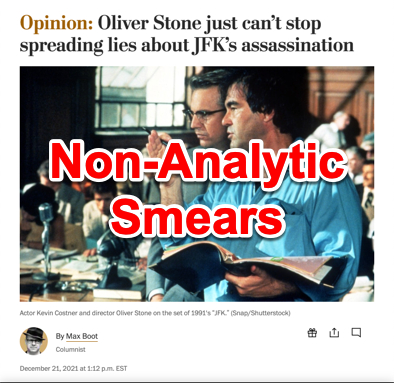
    On December 21st, the Washington Post decided to publish an opinion piece by columnist Max Boot about Oliver Stone and his new documentary JFK Revisited: Through the Looking Glass. Like Alecia Long before him, and Tim Weiner in Rolling Stone, there was little pretense of Boot writing any genuine criticism. (Click here for a reply to Weiner and here for one to Long) After all, the title of the column accused the director of telling lies about JFK’s assassination. Boot then called Stone a demagogue and compared his work to that of Leni Riefenstahl. When a writer stoops to this kind of name calling by the first line of his second paragraph, one knows what lies ahead is going to be a non-analytical smear.

    In the second paragraph, Boot calls Stone’s 1991 film JFK “the most deceitful film ever produced by a major Hollywood studio.” This for a film that won two Oscars and was nominated for eight. And, as far as Max is concerned, that disposes of that.

    Except it doesn’t. When one compares the director’s cut of that film with the declassified record, one will see that compared to other true story films (e.g. The Untouchables), Stone’s film does not use an excess of dramatic license. The hyperbole used in that regard is so exaggerated as to be dismissed as an outburst of collective journalistic hysteria. The truth is that the people making these charges knew next to nothing about the JFK case or what happened in New Orleans with Oswald in the summer of 1963.

    I know this since I am aware of those matters and did a comparative analysis of the first 16 scenes of the film with the new records made available by the Assassination Records Review Board (ARRB). There are some things which appear later in the film that I would have advised Stone not to use, but there are also things that are clearly labeled as speculation or presented as theorizing. (James DiEugenio, The JFK Assassination: The Evidence Today, pp. 190–94) To point out one major strand of JFK which was vehemently attacked at the time: all the material pertaining to the Vietnam angle is accurate. And further work in this field has made Stone’s thesis even stronger. (Click here for details)

    Therefore, at the start, Boot shows what he is writing is bombast, playing to the crowd. In referring to the declassification process, he cannot even spell out the term Assassination Records Review Board. Or inform the reader that the Board declassified 60,000 documents and two million pages of material. Yet today there are still approximately 14,300 pages being withheld from public view: 58 years after Kennedy’s assassination.

    Max then writes this whopper:

    What has come out so far has done nothing to shake the conclusion reached by all credible investigators that Oswald was the lone gunman.

    How does he know? Has he read the two million pages? It’s this kind of arrogance that has made a large part of the public so sick of the MSM that they have turned to alternative forms of media for information.

    The other part of Max’s charade is this: He does not tell the reader anything that is in the film based on this new information. If he did, he’d expose his charade, because the ARRB did not just declassify 2 million pages of either redacted or completely classified documents. They were also able to conduct inquiries into ambiguities in the evidence. Therefore, they did an investigation into the autopsy of President Kennedy. Two of the witnesses they deposed under oath were FBI agents Jim Sibert and Frank O’Neill, who were present at the Bethesda morgue that night. Both men stated that they observed a large defect in the right rear of Kennedy’s skull. In their declassified interviews with the House Select Committee on Assassinations (HSCA), both men said the bullet in Kennedy’s back did not exit his body. (Doug Horne, Inside the ARRB, pp. 681, 685)

    The agents had nothing but scorn for Arlen Specter of the Warren Commission. They were angry because neither testified before that body. They both felt this was due to Specter, since he knew what they would say would contradict his pre-ordained conclusion. They also both learned that Specter had, to put it gently, misrepresented their testimony to the rest of the Commission in order to keep them from testifying. (Horne, pp.702–05)

    When the reader is presented with their evidence, one can see why Specter did not want them deposed. First, there is no autopsy picture of the skull wound they describe; a wound which would indicate a shot from the front. Secondly, their testimony vitiates the Single Bullet Theory that Specter needed to construct. If the bullet in the back did not transit Kennedy then Specter’s theory is simply untenable: another bullet hit Governor John Connally and there was a second assassin. JFK Revisited refers to this testimony. But Max Boot doesn’t reveal it to the reader, probably because it would “shake the conclusion reached by all credible investigators that Oswald was the lone gunman.” Or, in plain English, it would show that Max is a poseur.

    Another episode in the film that would “shake the conclusion reached by all credible investigators” is the fact that there were two plots to kill Kennedy prior to Dallas. They both occurred in November of 1963. One was in Chicago and one was in Tampa. As essayist Paul Bleau demonstrates in the film, both of these failed attempts had remarkable similarities to what finally succeeded in Dallas. For example, in Chicago the profile of the fall guy—Thomas Vallee—resembled Oswald.

    And the FBI informant who helped thwart the Chicago plot was codenamed ‘Lee’. (James Douglass, JFK and the Unspeakable, pp. 204–07)

    In Tampa, the suspected patsy was Gilberto Lopez. As Oswald was the organizer of the Fair Play for Cuba Committee (FPCC) branch in New Orleans, and its only member, Lopez was a pro-Castro Cuban who attended meetings of the Fair Play for Cuba Committee. He had been hospitalized that year for an epileptic condition. He was in Tampa on the day of Kennedy’s long motorcade route which went past the 23 floor Floridian Hotel. According to Secret Service expert Vince Palamara, the authorities had men on every floor of that hotel due to information about a threat on Kennedy’s life. Afterwards, Lopez went to Texas, and on the night of the assassination, he crossed the border at Nuevo Laredo into Mexico. With money loaned him by the FPCC, he was the only passenger on a Cubana airlines flight from Mexico City to Havana on November 27th. The Mexican authorities later wrote he was acting suspiciously and they had an informant who said he was involved in the Kennedy case. (Michael Benson, Who’s Who in the JFK Assassination, pp. 256–58; see also Daily Mail, September 3, 2019, article by Daniel Bates) On December 3rd, the CIA was alerted to run “urgent traces” on Lopez. Both the Church Committee and the House Select Committee on Assassinations found that, while the Warren Commission was in its most active stage, reports were “circulating that Lopez had been involved in the assassination.” (HSCA Final Report, pp. 118–21)

    JFK Revisited: Through the Looking Glass, is the first broadcast documentary to include these prior attempts. For whatever reason, both were covered up at the time. If that had not been the case, it is quite possible that the successful attempt in Dallas would not have occurred. The reason being that the similarities to the prior instances were obvious enough that Oswald would have been removed from the motorcade route. Somehow, Max Boot does not think this information merits public attention.

    The film proves matters that Boot labels “lies.” It proves that CE 399, the Magic Bullet, was not fired in Dealey Plaza that day and would not have been accepted into a court of law. It does the latter through an instructor in criminal justice and also the illustrious criminalist Dr. Henry Lee. The film proves that James Humes, the lead autopsist, destroyed both the first draft of his report and, even worse, his autopsy notes. It also shows that Pierre Finck, another Kennedy pathologist, had his notes pilfered. The film illustrates, with blown up photos, points of evidentiary discrepancies not officially explored in the so-called backyard photographs of Oswald. In the forthcoming 4-hour version, the documentary will present the late CIA officer Tennent Bagley’s analysis of the routing of the CIA file on Oswald and his conclusion that he was a false defector.

    For Max Boot to write that the information in the film was debunked by Gerald Posner in his book Case Closed is the height of MSM clownishness on the JFK case. That was not possible, since Posner’s book was published before the ARRB went to work. For Max to use the late Vincent Bugliosi to pose the question of why there were no extra bullets discovered is about as silly. In the long version of the film, to be released in America in February, we will show that there is evidence that an extra bullet was recovered that evening that made it into the morgue. (Click here for details)

    Boot goes off the edge when he writes that the film uses an absence of evidence “as proof of a monumental coverup.” The film clearly demonstrates parts of the cover up that were concealed, but have been revealed by the ARRB. Another example being the hidden statement of Dorothy Garner, the supervisor to Victoria Adams and Sandra Styles at the Texas School Book Depository. As author Barry Ernest states in the film, she backed up what Adams and Styles officially stated: that they were on the stairs of that building about 15–30 seconds after the shots were fired. Therefore, in all probability, they would have seen or heard Oswald coming down those rickety wooden steps, if he had been on the sixth floor. They didn’t. The presentation of this evidence by Mr. Ernest is a major segment of the film. How Max missed it, or deemed it unimportant, is inexplicable.

    Boot ends his column by saying that the film theorizes that Kennedy was a “peacenik” who was trying to end the Cold War. This is not a theory. The film shows with new evidence that JFK was planning to withdraw from Vietnam; his policy to keep the Congo free from imperialism after independence; and his attempts at rapprochement with both the USSR and Cuba in 1963. The film uses excerpts from Kennedy’s famous Peace Speech at American University in June of 1963, where he clearly called for outreach to Moscow. After his death, the last two policies were abandoned and the first two were dramatically reversed—with disastrous results. The upcoming 4-hour version of the film goes into this issue in more areas and at greater length. Boot tries to neutralize all this by using the speech Kennedy made it Fort Worth the morning of his assassination. I hate to tell Max, but if a president goes to a city that relies on defense spending for jobs, he makes a speech about defense spending, especially if his election is coming up the next year. Max ignores Kennedy’s planned speech in Dallas for that afternoon, where JFK was to speak against the John Birch Society, about leadership and learning, about the importance of foreign aid to developing nations, the pursuit of peace, and how military might is secondary to maintaining a just and righteous society.

    It is predictable that Boot would cherry pick the speeches, since he was and is a neocon. He was a former member of the calamitous Project for the New American Century, which advocated for American intervention in Iraq as far back as the Clinton administration. He was also part of the mythologizing about Saddam Hussein’s weapons of mass destruction as a pretext for that debacle. Boot championed intervention in Afghanistan and opposed withdrawal. He had no problem with Hillary Clinton’s unmitigated disaster in Libya. He also agreed with her advocacy of direct American intervention in Syria. As several have said, there has scarcely been a war that Max Boot did not like—no matter how bad the results were. And they do not get much worse than Iraq or Libya.

    This helps show why Boot cannot be trusted with anything dealing with Kennedy. In 2018, in his hagiography of Ed Lansdale, he wrote that JFK had tried to topple Patrice Lumumba in Congo. (The Road not Taken, p. xxvii). As with Posner debunking the ARRB, this was not possible. How could it be? Lumumba was assassinated before President Kennedy took office. One of the reasons the CIA took part in his murder was because they feared that Kennedy would back Lumumba once he was inaugurated. (John Morton Blum, Years of Discord, p. 23)

    As the reader can see Max Boot is in no position to accuse anyone of telling lies about JFK.

    (Click here for Max Boot’s twitter feed)

  • Why Tim Weiner Never Called Me

    Why Tim Weiner Never Called Me


    On November 22, 2021, Tim Weiner wrote an article about Oliver Stone’s new documentary dealing with the JFK assassination for Rolling Stone. It’s really a hit piece, the literary equivalent of a drive by shooting. And, as we shall see, it’s not about what Weiner says it’s about.

    Weiner begins by saying that JFK Revisited: Through the Looking Glass is “rooted in a big lie.” What is that lie? According to Weiner, the lie is that Kennedy was murdered by the Deep State (i.e. the CIA backed by the military-industrial complex). From here, one would think that Weiner would now confront the evidence in the film and, point by point, counter it and thus reduce Oliver Stone to, in his words, “a tinfoil-hatted fabricator.”

    He does not do that. Not even close. Like a cardsharp, Weiner skips that step and jumps to this accusation: if anyone thinks the CIA killed Kennedy, you are being deluded by a Soviet era disinformation campaign. Unfortunately, I’m not kidding. But before Weiner begins playing his Russian aria, he first does a prelude. He says this about JFK’s assassination:

    Either Lee Harvey Oswald, trained by the United States Marines as a sharpshooter before he defected to the Soviet Union, got off a million-to-one shot in Dallas. He acted alone. Or he was an instrument of a conspiracy so immense that it staggers the mind.

    Right out of the gate Weiner sets up a game of false alternatives, because JFK Revisited shows Oswald’s “million-to-one shot” did not happen. The film takes pains to demonstrate that the Warren Commission’s Magic Bullet, labeled CE 399, was not fired in Dealey Plaza that day. JFK Revisited proves this on more than one basis. The film also proves that the FBI and the Warren Commission lied about the provenance of CE 399. It does this with evidence made possible by the Assassination Records Review Board (ARRB), but Weiner does not want the reader to know this since it knocks out one of his false alternatives. If he admitted this evidence, then one would be left with, well, a conspiracy.

    This phony prelude leads to Weiner’s main theme. It’s not an easy job to soften and make acceptable the life and career of CIA Director Allen Dulles. One would think that, after all we know about Dulles today, no one would try, but Weiner has to, in order to sketch in his other false alternative. Namely that Stone says that Dulles was the “presiding genius of the plot against the president.” (The film doesn’t really say that, but accuracy is not what Weiner is after.)

    So now Tim pulls out his make-up kit for Dulles. He writes that the CIA Director did not back the plots to overthrow Charles de Gaulle of France, which is a startling statement. For many interested observers, one of the best books on the career of Allen Dulles is The Devil’s Chessboard. Author David Talbot uses a variety of sources to show that Weiner is wrong. For example, the newspaper Paris-Jour centered on Dulles as the main culprit in the attempted overthrow of April 1961. Later, bestselling French author Vincent Jauvert traced the sources of these stories in the French press to de Gaulle’s own foreign ministry. (Talbot, p. 414) In fact, De Gaulle had come to this conclusion himself. (London Observer, May 2, 1961) Author Andrew Tully also noted columns in Le Monde and l’Express which he wrote were owed to high French officials. (CIA: The Inside Story, pp. 48–49)

    In the USA, The Nation reported that high level French government employees thought the CIA had encouraged the attempted overthrow. And using l’Express, they wrote that one of the dissident French generals had several meetings with CIA agents who advised him that getting rid of de Gaulle would do the free world a great service. (The Nation, May 20, 1961) These stories also appeared in American mainstream newspapers like The Washington Post. (April 30, 1961) Most fatally for Weiner, his former employer The New York Times also printed the story. Scotty Reston wrote that the CIA was indeed “involved in an embarrassing liaison with the anti-Gaullist officers.” (New York Times, April 29, 1961) But further, Talbot goes into the reasons behind the conflict between Dulles and de Gaulle. It was the desire of the French leader to get rid of NATO’s Operation Gladio elements in France and also his intent to set free the French colony of Algeria in North Africa. (Talbot, pp. 416–17) One would think that all this would be enough to satisfy most objective observers.

    In a neat bit of cherry picking, Weiner never mentions any of these sources. He borrows a trick from Max Holland and says that the idea that the CIA backed the attempts by dissident French officers to overthrow de Gaulle was all part of a Russian disinformation campaign that began in Italy. To most informed observers the idea that Scotty Reston would rely on the Italian newspaper Paese Sera is ridiculous on its face.

    But further, for Weiner to use Holland as a source for the John F. Kennedy assassination is inexcusable. Ten years ago, Holland made one of the worst documentaries ever produced on the Kennedy assassination. In fact, as Pat Speer has noted, there were indications that Holland knew his thesis was faulty before the documentary even aired. How bad was it? Even Commission zealots Dale Myers and Todd Vaughan attacked the show. The Lost Bullet was so indefensible that one would think no one would ever treat Holland with any degree of respect again. (Click here for details)

    But this is the JFK case, so normal rules of credit and reference do not apply. Therefore, Weiner trots out Holland once more. And he then doubles down on the man. He says that New Orleans DA Jim Garrison arrested Clay Shaw because of a story that ran in Paesa Sera three days after. (Hmm) He then adds that Garrison bandied this story about as a basis for his prosecution of Shaw and also that it became a central basis for his whole case against the Central Intelligence Agency.

    Again, this derives from Max Holland. Holland has been selling this line for a very long time. He was pretty much eviscerated on it by Gary Aguilar back in 2004. This was during a debate that was broadcast by CSPAN and is still available on the web; therefore Weiner could have easily located it. (Click here for the debate) Aguilar proved that, unlike what Holland and Weiner imply, Garrison did not make the Paesa Sera story a part of his case against Shaw—either in public or at Shaw’s trial. For example, in his 26 page Playboy interview—the longest ever run by the magazine at that time—the DA never brought it up.

    But then Weiner does something that is probably even worse. And it shows his utter disdain for the work of the Assassination Records Review Board. He says that Shaw was not a longtime operative of the CIA. Because of the work of the Board, we now have documentation that proves that the defendant lied about this at his trial. Shaw had three CIA clearances, one of them being a covert security clearance. (William Davy, Let Justice be Done, p. 196) As Joan Mellen discovered, Shaw was also a valuable and well-compensated contract agent. (Mellen, Our Man in Haiti, p. 54) Adding the documentation up, Shaw’s CIA career extended over a period of 23 years. Unlike Tim, most people would think that qualifies as being longtime. In fact, the Board’s CIA specialist also discovered that the CIA had destroyed Shaw’s 201 file. Why? (Click here for details)

    Virtually everything in the above paragraph is displayed in the film. Somehow Weiner either missed it or chose to ignore it, but in JFK Revisited we also feature authors Jefferson Morley and John Newman. Those two discuss what Garrison based his own investigation on at its inception: Oswald’s activities in New Orleans. Specifically, how he interacted with the CIA run anti-Castro Student Revolutionary Directorate (DRE) and the fact he stamped his pro-Castro flyers with the address of the extremely rightwing Guy Banister. We then detail how:

    1.) The FBI covered up Oswald’s association with Banister, (Newman, Oswald and the CIA, p. 310); and

    2.) The CIA lied about their liaison to the House Select Committee on Assassinations having no association with the Oswald case in 1963. The truth was that George Joannides was the CIA handler of the DRE in 1963. (Miami New Times, April 12, 2001, “Revelation 1963”)

    Most people, as Garrison did, would think that this information about Oswald in New Orleans would tell us something about him, probably that he was not really a Marxist. The latest discoveries on this issue were made possible by the ARRB and are in the film.

    In fact, one of the most shocking things about Weiner’s article is this: He cannot bring himself to mention by name the Assassination Records Review Board. Or the fact that JFK Revisited uses their work to an unprecedented degree. This is quite a bit of alchemy since the film interviews three men who worked for that body, and it mentions the Board throughout. In addition, it displays declassified documents which back up many of the declarations in the film. Weiner does not refer to any of these documents or witness statements.

    Toward the end of his screed, Tim writes that he cannot tell us that there wasn’t a conspiracy. He then says that maybe there is a bombshell in the still classified archives. That utterly inane statement demonstrates why Weiner’s article is not criticism; it’s a hatchet job. As demonstrated, Tim does not want to tell the reader what is in the film. The fact that, under oath, the official JFK autopsy photographer told the Board that he did not shoot the pictures of Kennedy’s brain that are in the archives today. John Stringer gave five reasons for his denial. Two of them being that he did not use the type of film with which the extant photographs were taken, and he did not utilize the photographic process evident in those pictures. JFK Revisited has Doug Horne, an ARRB employee who was in the room with Stringer during his sworn testimony, narrate this passage. (Horne, Inside the ARRB, p. 810)

    Just like he does not want to tell his readers about the above, Tim also won’t reveal that the FBI lied about CE 399, the Magic Bullet. They did so in three ways. The film proves that the Bureau lied about its identification by the first two people who handled it. (The Assassinations, edited by James DiEugenio and Lisa Pease, pp. 282–84) It also proves that the Bureau lied about an FBI agent’s initials being on the exhibit. They are not. Third, by their own records, the FBI lab had the Magic Bullet before it was transferred to the agent who delivered it there. This delivery, of course, was by the agent whose initials are not on the bullet. (James DiEugenio, Destiny Betrayed, second edition, p. 345)

    Like the issue of the autopsy photos, the information about CE 399 is proved out in the film. It would be of great interest to anyone watching, since it goes to the heart of the Warren Commission’s case against Oswald. Like everything else above, Weiner does not mention it. In fact, before writing his piece and attributing sources of information in the script to Paese Sera, he never called this writer, which would seem to be a significant trespass of journalistic ethics since I wrote the script. I could have informed him of the actual sources we used for things like the attempted overthrow of de Gaulle or Clay Shaw and the CIA. Those sources had nothing to do with what Weiner attributes them to. When the annotated scripts are published next year, this will be made plain to anyone who reads them.

    So, the question then becomes: Why didn’t Tim Weiner pick up the phone to call Jim DiEugenio? Or shoot an email to Jim to find out what my actual sources were in writing the script? It would have been simple to do either. All he had to do was call Oliver Stone’s office or find me on the web through the Kennedys and King web site.

    Since Weiner neither poses nor replies to that question in his column, it leaves the answer open for speculation. He closes his hatchet job by saying something about “a moral obligation to call bullshit when we see it.” Tim is so wrapped up in his own agenda that he does not recognize his own paroxysm of hypocrisy. When a writer does not present any of the documented material that he calls “bullshit” then yes, one can declare it as such. But that is not journalism; its classic propaganda that does nothing to inform the public. When a film can document what it says with sworn testimony and documents written at the time, that is not “bullshit.” These are unpleasant facts that were kept hidden from the public for decades. And it was only through Oliver Stone’s making of his film JFK in 1991 that they finally began to emerge.

    One last point about Tim’s concluding issue about disbelief in government. One can see through the graph in Kevin Phillip’s book Arrogant Capitol that, unlike what Weiner wants you to think, that erosion of belief is not a recent phenomenon. That graph extends from 1960 to the mid-nineties. The year of the single biggest drop in trust was 1964, when the Warren Report was published.

    Another factor that led to overall cynicism was ten years of war in Vietnam—the most divisive conflict since the Civil War. As JFK Revisited shows, if Kennedy had lived, this would not have happened. The film also shows that President Johnson consciously reversed Kennedy’s withdrawal plan in order to escalate that war. There is no mention of this by Wiener in his article. By that excision, Wiener’s hypocrisy is in full view.  For on December 23, 1997, there was an article in the New York Times about the ARRB declassifying documents from the May 1963 SecDef meeting in Hawaii where Defense Secretary Robert McNamara was collecting Vietnam withdrawal schedules from the Pentagon. The title of the story was “Kennedy Had a Plan for Early Exit in Vietnam.”

    The reporter was Tim Weiner.  What a convenient lapse of memory. Tim Weiner is an object lesson in why the public has lost faith in the MSM.

    Click here for what appears to be Tim’s current Twitter account.

  • Alecia Long Lays An Egg: Part 2

    Alecia Long Lays An Egg: Part 2


    Since Priscilla Johnson has passed on, for the 58th anniversary of the murder of President Kennedy The Washington Post trotted out Alecia Long. As readers of this site know, Long has been in rehearsal for becoming a public spokesperson defending the mendacity of the Warren Report for quite a while. (Click here for her early practice session) More recently, she published a truly nonsensical book about the JFK case, one which I was at pains to show, had no saving graces to it. (Click here for details) Evidently, these prior run throughs were enough for the Post to give her the podium.

    Why? Apparently, Long was needed to counter the broadcast by the Showtime cable network of Oliver Stone’s new documentary on the JFK case, JFK Revisited. Long says that the two-hour presentation “is entirely predictable” to anyone was saw Stone’s 1991 feature film JFK. Since I wrote the documentary, I can inform Ms. Long that I never even looked at the 1991 film as I worked on the screenplay. What I wrote was focused upon presenting new evidence that had surfaced since 1991. Much of that material was derived from the Assassination Records Review Board, which operated from 1994–98 three years after JFK was released.

    One of the things we deal with in the film is Kennedy’s intent to withdraw from Vietnam. Long states early in her piece that the idea that Kennedy was withdrawing from Vietnam “is counterfactual.” And that no one can know,

    …with certainty whether he would have started an active ground war, as Johnson did. Such thinking fuels conspiracy theories with an entirely unprovable assertion about what might have been.

    One thing our documentary is not is counterfactual. It can only be deemed that by not telling the reader the facts in the film. The documentary presents three new pieces of evidence, never shown in broadcast format before, that makes the Kennedy withdrawal thesis both credible and provable. They are:

    1. The records of the SecDef conference in Hawaii held in May of 1963, with representatives from Saigon. There, Defense Secretary Robert McNamara was reviewing the withdrawal schedules he had previously requested from the Pentagon, CIA, and State Department. Once he looked them over, he told those in attendance the schedules were too slow and had to be speeded up.
    2. The taped conversation in 1964 between Johnson and McNamara, where LBJ clearly admits he knew Kennedy and McNamara were withdrawing from Vietnam and always thought it was a bad idea. But he sat there in silence, since he was not in charge.
    3. Interview subject John Newman listened to McNamara’s Pentagon debriefs after he was removed from office by Johnson. In those sessions, McNamara clearly states that he and Kennedy had decided they could send equipment, trainers, and advisors to Saigon. But that was it. American could not fight the war for South Vietnam. When the training period was over, America was leaving and it did not matter if Saigon was winning or losing.

    None of this new evidence was in the 1991 film, but it would convince most objective people that Kennedy was simply not sending American combat troops into Vietnam. But Johnson was quite willing to do so. LBJ thought McNamara and Kennedy were wrong and he browbeat McNamara into changing policies. The evidence on this topic is overwhelming today and has been presented by several authors in different ways: Howard Jones, Gordon Goldstein, James Blight, David Kaiser, and, most prominently, by Newman in the 2017 version of his book JFK and Vietnam. It speaks very poorly of Long as a history professor that she is not familiar with this work. Or if she is familiar with it, to simply deny it.

    She follows this up with a bizarre statement that is confounding no matter how many times one reads it. She says that assassination related research continues to focus on a narrow set of questions, “including whether Lee Harvey Oswald acted as a lone assassin or if a conspiracy lay behind the president’s murder.” Alecia, that is not a narrow question. Most people would think it’s the ball game. If Oswald acted alone, the Warren Report is correct. If it was a conspiracy, the 900-page Warren Report was wrong and some secret body overthrew our government, with calamitous results.

    She then writes something that, even for her, is astounding. She says that JFK Revisited blurs the lines between fact, fiction, and pure speculation in presenting the work of the ARRB. The film presents three people who worked for that body: Chairman John Tunheim, his deputy, Tom Samoluk, and Military Records analyst Doug Horne. JFK Revisited shows documents that were declassified due to their work. Every statement made in the film is backed up by evidence and we show many documents and exhibits in the film. For example, the testimony by the official autopsy photographer that he did not take the pictures of Kennedy’s brain that are today in the National Archives. Which leads to the questions: then who did take them, and why?

    But, as with Vietnam, Long does not want to reveal that bit of new information, since it would prove the contrary of what she is preaching.

    She then admits that the CIA and FBI delayed the release of many documents. And sometimes they were actually deceptive to the two main federal investigations of Kennedy’s murder: the Warren Commission and the House Select Committee on Assassinations. But she then adds that “no documents have been released that indicate intelligence agency participation in the assassination.”

    Oh really? In the film, John Newman states that the FBI removed the FLASH warning from the Oswald file just a few days after Oswald’s return from his alleged Mexico City visit. This allowed him to escape being placed on the Secret Service security index in advance of Kennedy’s Texas trip. If the FLASH had not been taken off, Oswald would likely have been removed from the motorcade route due to his active and open communist activities in New Orleans and his alleged visits to the Cuban and Russian embassies in Mexico City. As Newman also states, this same type of maneuver inexplicably occurred at the CIA. In other words, something was going on with the Oswald file at both the FBI and CIA in advance of the assassination. When one throws in the fact that the legendary, ARRB-declassified Lopez Report about Mexico City indicates Oswald was not there—but the CIA insisted he was—then excuse me, but does someone have to hit Alecia Long over the head with a 2 x 4? This whole issue of Oswald’s relationship with the CIA, and counter-intelligence chief James Angleton, will be gone into at length in the four-hour version of the film.

    Long closes her column with her usual hatchet job on Jim Garrison. Through Jefferson Morley, the film shows that the alleged pro-Castro communist Oswald was associating with anti-Castro groups like the CIA sponsored DRE. In addition to that, Oswald associated with three known rightwing, CIA associated figures in New Orleans: Guy Banister, David Ferrie, and Clay Shaw. And all three men lied about their association with Oswald after Kennedy was killed. The FBI covered these relationships up, another point Newman talks about in the film. (Click here for proof) This would seem to raise some questions about who Oswald really was and what he was doing in New Orleans in that fateful summer before Kennedy’s assassination.

    But to Long, this is not important. She ends her nonsensical column by saying, and I am not kidding, we should forget about bullets and ballistics. Forget about bullets and ballistics in a homicide case? Instead, we should consult the newly declassified record in order to learn “how events that fertilized citizen cynicism about the government more than a half-century ago can help us document our contentious past…” and also “explain the troubling conspiracy theories of today.”

    The reason cynicism sprung up way back then was precisely because the Warren Report did not follow regular procedures in evaluating bullets and ballistics. And we prove that in our film with new evidence exposing the fallacies the Commission foisted on the public, but somehow that is not important to Long or The Washington Post.

    In other words: Who the heck cares who killed Kennedy? We should worry about how all that stuff caused QAnon. Alecia, the question of who killed Kennedy is quite important, due to the fact that whether you know it or not, or like it or not, something happened to this country—both domestically and in foreign policy—due to his assassination. And if you do not trust me just look at Larry Sabato’s book, The Kennedy Half Century. There he explains, through polling and focus groups, how about 90% of the public feels America lost its way due to JFK’s assassination. (see p. 416)

    As far as QAnon goes, JFK Revisited relies on data, not faith or mysticism—or as some suspect what QAnon really is, a psy-op. The documented screenplays for both versions of the film will be published in April. As Long will then see, and as Stone said at Cannes, JFK Revisited turns conspiracy theory into conspiracy fact. It explains how, just one year after getting elected, Johnson had 170,00 combat troops in Vietnam. On the day he was killed, Kennedy had none. That is a fact. And the film does this throughout with documents and testimony that she either does not know about, or does not want to convey to the public.

    The murder of John F. Kennedy was a homicide case. That is the way it should be treated. What Long writes is a diversion from the new calculus of that case. President Kennedy deserves better than that. Much better.

    Go to Part 1

  • Creating the Oswald Legend: Appendix

    Creating the Oswald Legend: Appendix


    Appendix

    The Grand Chess Board: actors and players


    CIA Officers

    Allen Dulles

    Director of the CIA

    Dulles was held responsible by JFK for the bungled Bay of Pigs invasion and was fired afterwards. Dulles never forgot or forgave JFK for the humiliation suffered. Kennedy decided to return West Irian to Indonesia from Dutch colonial rule. What Kennedy did not know, but Allen Dulles did, was that West Irian was a region extremely rich in minerals, even richer than Katanga. In the 1920s and 1930s, Allen Dulles was a lawyer at the giant corporate law firm Sullivan and Cromwell. He represented the Rockefellers there and he knew that Indonesia had huge mineral and oil potential. One of the oilfields in Sumatra exploited by Caltex was the size of similar oilfields in Saudi Arabia. In 1936, a joint Dutch and American expedition—including explorer/geologist Jean Jacques Dozy—was organized by Allen Dulles through Sullivan and Cromwell. That expedition discovered two enormous mineral deposits in West Irian. The American firms that financed the expedition were two divisions of Standard Oil. One of the two colossal deposits was called the Ertsberg and the other the Grasberg. Both were extravagantly rich in gold, silver, and copper. Just the gold content was much larger than the wealthiest gold mine in the world, then located in South Africa. Allen Dulles was close to the DeMohrenschildt family and transferred George DeMohrenschildt to West Irian to work on Standard Oil’s drilling, since the region had one of the largest oil deposits in Indonesia. Dulles lied to Kennedy on several occasions regarding the Sino-Soviet split. He told him it was not real, but a Cold war ploy to fool America. It was real and Dulles was using Indonesia as a wedge to further the split between China and the Soviet Union. From 1958, his first attempt to overthrow Sukarno, Dulles was planning on regime change. That would have allowed his clients to control the oil, gold, copper, and silver reserves of Indonesia rather than go to the citizenry of Indonesia, as Kennedy and Sukarno had planned. The policy of wedge against China and the Soviet Union would have been disrupted. Dulles had used religious organizations like the Unitarians to create humanitarian front organizations in order to conceal OSS and later CIA covert operations to destabilize Eastern Europe, South America, and Southeast Asia.

    James Jesus Angleton

    (Chief of CIA Counterintelligence)

    Angleton’s obsession and mission was to catch a Soviet mole that allegedly had infiltrated the Agency. His secretive mole hunt unit, the Special Investigations Group (SIG), held a 201 file on Oswald prior to the assassination. John Newman thought that Oswald was an off-the-books agent for Angleton. In 1960, he used Oswald in a mole hunt to find out who had betrayed the U-2 secrets that led to its shoot down. Angleton did not find any mole, but he used the mole hunt as an alibi to cover his role in the U-2 incident, which resulted in the Paris Peace Summit cancellation. Similarly, he used the Oswald legend and an imposter to catch a mole had betrayed the CIA operations against Cuba in Mexico, even contacting the head of KGB assassinations before he himself tried to get to Cuba. Angleton had the excuse to manipulate information and to lower Oswald’s profile in a way that it would not raise suspicion until after November 22. Angleton, who John Neman believes was privy to the conspiracy to assassinate the President, had to design a fool-proof plot. The idea was to make it appear that the Cubans and Soviets manipulated Oswald in Mexico City in such a way to use him in the assassination of Kennedy. Angleton knew that the exposure of this plot would plant a WWIII virus in Oswald’s files that would halt any real investigation, in order to prevent a possible nuclear war. To achieve that, Oswald’s profile had to be lowered for the six weeks before the assassination. Angleton had to come up with a cover story, so no one would ever question his role in the plot. Again, Angleton would fail to catch a mole, but he had used the mole hunt to cover his true role that resulted in the murder of a U.S. President.

    David Atlee Phillips

    (CIA Covert Action/SAS Counterintelligence)

    David Phillips was the Chief of Cuban Operations and Covert Actions in Mexico CIA station and also worked for the SAS/CI. He and James McCord first targeted the FPCC back in 1961. He dangled an American student, Court Wood, into the FPCC by pretending to be pro-Castro interesting in starting a new FPCC chapter, something that Oswald tried to emulate two years later both in New Orleans and Mexico. Prime suspect for handling Oswald and the Mexico City incident involving Oswald’s visits to the Cuban and Soviet Consulates. Lied far too many times about the events that took place to the HSCA investigators. On October 1, 1963, a diplomatic pouch was sent to CIA HQ addressed to a Michael Choaden. This was an alias for Phillips, that way he controlled all the materials in both Mexico and Washington. His assets like Alvarado tried to implicate Oswald in the assassination as a Cuban agent. In New Orleans he met with Banister, Ed Butler, and Sergio Arcacha Smith.

    E. Howard Hunt

    (Propaganda expert and an Officer of CIA’s Domestic Operations Division in 1962 under Tracey Barnes)

    Bagley revealed to Malcolm Blunt that E. Howard Hunt was in the Soviet Division in 1962. There was no sign he ever worked in Soviet Russia Division. Blunt discovered that as part of a mole hunt, Bruce Solie of the Office of Security/Security Research Staff handed over Security and Personnel files to the FBI on various suspected moles. One of these was CIA staffer Peter Karlow. Those files contained information that Hunt was attending parties with the Karlows. Blunt is of the opinion that Hunt was spying on his own colleagues and that this would explain his sudden appearance in the Soviet Division. He also suspects that Hunt could only have been there under the instructions of Angleton, although Angleton always denied any relationship with Hunt. Later, Angleton revealed to author J. Trento that Hunt was in Dallas on the day of the assassination and that Hunt “had possibly been sent there by a high-level mole inside the CIA.” Trento believed that Angleton was trying to hide his own connections to Hunt and that it was him that had sent Hunt to Dallas. Hunt was the founder of the Cuban Revolutionary Council (CRC) that was so prominent in Oswald’s contacts in New Orleans. In 1968, Hunt employed Cubans from the Trafficante drug trafficking network to eliminate French smugglers and the old French Connection by redirecting the heroin trade from Marseille to Southeast Asia and Mexico to supply the US.

    William K. Harvey

    (CIA Chief of Foreign Intelligence Division D)

    Head of the CIA’s executive action ZR/RIFLE assassination program. On his notes wrote that “Corsicans recommended Sicilians lead to Mafia.”

    He also had security clearance for “Project Rock” a codename for the U-2 plane. According to a CIA document, they re-evaluated Harvey’s file in respect for approval to get security clearance to “Project Rock.” Mark Wyatt, Harvey’s Deputy in Rome, revealed that Harvey was in Dallas in November 1963. According to Wyatt, he had bumped into Harvey on a plane to Dallas sometime before the assassination. When he asked Harvey what was doing in Dallas, he replied vaguely, “I am here to see what’s happening. To be fair to Harvey, he was not in Dallas on November 22, 1963. Wyatt said that they were both attending a Gladio meeting in Sardinia, Italy, when they heard about the assassination. Later that afternoon, Wyatt found Harvey collapsed in his bed after drinking martinis. Malcolm Blunt revealed that in August 1963, Harvey wanted to meet with Clare Boothe Luce, some months prior to the assassination.

    Tennet H. Bagley

    (CIA Chief of Soviet Russia/Counter Intelligence)

    Told researcher Malcolm Blunt that Oswald was a witting false defector. Bagley had nothing to say about Kostikov’s role as KGB assassination officer. Yet on November 23, 1963, submitted a memo describing Kostikov as “an identified KGB officer…in an operation which is evidently sponsored by the KGB’s 13th department responsible of assassinations.” It is worth mentioning that Bagley was transferred in 1963 from the Bern station in Switzerland to Langley and promoted as Chief of SR/CI, just in time for the suppression of Kostikov’s KGB role.

    William Larson

    (CIA Chief of the Information Management Staff)

    Revealed to HSCA researcher Betsy Wolf that the Office of Security did not open 201 files and that a 201 file should be opened whenever a subject accumulates at least five documents. Oswald’s file had 12 items and yet a 201 file was not open. Larson also revealed that the Office of Security worked closely with Angleton’s Counter Intelligence staff.

    Richard M. Bissel

    (CIA Deputy Director of Plans)

    Involved in the development of U-2 & A-12 spy planes, CORONA satellites, CIA Liaison with Air Force and Defence industry. Brought Helliwell back from the Far East to organize a similar network of drug trafficking and bank laundering to finance the war against Castro. One of the architects of the Bay of Pigs invasion

    Robert Gambino

    (CIA Office of Security Chief)

    Revealed to HSCA researcher Betsy Wolf that the CIA Mail Logistics responsible for incoming documents bypassed the General Filing System and sent all the Oswald information to the CIA Office of Security instead of the Soviet Russia division

    Raymond Rocca

    (Angleton’s Deputy in CIA Counter Intelligence)

    Cabled Luis Echeverria on November 23rd concerning the relationship between Oswald and Sylvia Duran who took over the Mexico investigation from the FBI and the WC, before Helms had assigned Angleton his liaison duties with the Commission. the day after the assassination, a CIA agent escorted Elena Garro de Paz to the Vermont Hotel. In other words, within 24 hours, Angleton and Rocca are controlling Duran, a prime witness to Oswald not being in Mexico City, and Elena Garro, a witness who would eventually say that Oswald was having an affair with Duran.

    Ann Egerter

    (Counter Intelligence/Special Investigations Group Officer)

    Worked under Birch O’Neil and his Deputy Scotty Miller. She opened a 201 file on Oswald in 1960 after a State Department request about US defectors to the USSR. She wrote Oswald’s middle name Henry, not Harvey, and the slot that is labeled Source Document is filled in with the acronym CI/SIG, which is not a document. Finally, in the notes below Dottie Lynch is still waiting for the file. She works in the SR division where the file should have been placed originally.

    Edward G. Lansdale

    (Air Force Major General and CIA affiliated, member of the American Security Council)

    Malcolm Blunt believes that although Lansdale was a military man, he was working mainly for the CIA.  Blunt mentioned that Lansdale resigned or retired temporarily from the army in October 1963. A short time later he returned to the army and he was promoted. The man who was pushing for his promotion was none other than Allen Dulles himself. Not only that but Lansdale headed the first mission in Saigon in 1954 and this mission was a CIA creation. John Newman found out that after his retirement, Lansdale visited his friend Sam Williams in Denton, Texas, which was near Dallas around the time of the assassination. He was Nelson Rockefeller’s clandestine associate in Southeast Asian propaganda activities. Lansdale was an adviser to the Rockefeller Brothers Fund/Special Studies Project and was appointed head of new counterinsurgency office at the Pentagon after the Bay of Pigs. William K. Harvey disliked Lansdale, thought of him as a security risk and could not work with him. If any of the two was part of the assassination planning certainly did not involve the other.

    Paul Helliwell

    Helliwell was a member of the OSS and later of the CIA in the Far East; he was one of the most prominent members of the China Lobby. He was the originator of the CIA’s off-the-books accounting system and nicknamed Mister Black Bag. His mission was to assist Chang Kai-Shek and his Kuomintang (KMT) army in Burma to invade China. This army managed and controlled the opium traffic in the region. Helliwell created two front companies to help KMT to carry out its war and the drug trade. One was Sea Supply in Bangkok and the other was CAT Inc., later Air America in Taiwan. Helliwell had organized a drug trafficking network supported by banks to launder CIA’s drug profits in the Far East. Helliwell’s main objective was to cement the CIA’s relationship with organized crime. Meyer Lansky and Santo Trafficante were both planning to invest in the Far East by bringing heroin back to the States. Helliwell established banks in Florida and became the owner of the Bank of Perrine in Key West, “a two-time laundromat for the Lansky mob and the CIA”, and its sister Bank of Cutler Ridge. Lansky would deposit money into the Bank of Perrine, reaching the US from the Bank of World Commerce in the Bahamas. Lansky also used the small Miami National Bank, where Helliwell was a legal counsel, to launder money from abroad and from his Las Vegas casinos. Peter Scott claimed that Helliwell worked with E. Howard Hunt, Mitch WerBell and Lucien Conein on developing relationships with drug dealing Cuban veterans of the Bay of Pigs invasion, and became CIA paymaster for JM/WAVE to finance Chief of Station Ted Shackley’s operations against Cuba.

    Anne Goodpasture

    Anne Goodpasture was a CIA officer from Staff D posted to the Mexico CIA station. She tried to disguise her role in retrieving photos each day. But Lopez and Hardway found out the man she named in this function only did the legwork for Goodpasture. They finally discovered that Goodpasture was responsible for photographic and electronic surveillance. The translating team said that they did not review all photographs from the Soviet Embassy, only what Goodpasture would allow them to see, and all such photographs were under her control. They also revealed that, although Goodpasture was an assistant to station chief Win Scott, she was a closer assistant to David Phillips. She provided the photographs of the mystery man in Mexico. When Goodpasture was questioned about it, she replied that it was the only photograph of a non-Latin person taken on October 1, 1963. But Lopez and Hardway discovered that the photo was taken on October 2, 1963. Dan Hardway described her as ‘’a lying, conniving bitch. And if there was any justice in this world, she would be in jail.’’

    David Sanchez Morales

    Morales was also known as ‘’El Indio’’ was the chief of operations at the CIA’s JM/WAVE station in Miami, operations involving training paramilitary teams to infiltrate and invade Cuba. His haunting words to his friend ‘’we took care of that S.O.B.’’ have convinced may researchers that Morales was involved in the assassination. Bill Simpich believes that had used his Cuban intelligence forces, called AMOTs, to impersonate Oswald and Duran. It is unlikely that Morales would have been able to manipulate the Oswald files and foresee all the subsequent events that led to the assassination. . It is more likely that Morales would have also taken orders from Angleton and not the other way around.

    Dorothe Matlack

    Assistant Chief of Staff of Intelligence (ACSI)

    The CIA and Army Intelligence worked together to form the Caribbean Action Center (CAC) for collecting intelligence from Cuban refugees. One of the major participants in this group was Dorothe Matlack, Assistant Chief of Staff of Intelligence (ACSI) for Army Intelligence and Liaison to the CIA. Matlack had joined the Interagency Defector Committee (IDC) in 1953. This involved State, DIA, Army, Navy, Air Force, FBI, and CIA. She also cooperated with Tony Czajkowski of the CIA’s Domestic Contacts Division and CIA Defector Coordinator George Aurell and worked with the CIA in analyzing reports made by notorious defectors such as Anatoly Golitsyn. On May 7, 1963, Matlack and Czajkowski met with George de Mohrenschildt and his wife Jeanne.

    CIA Operations (may include Cuban Exiles and the Mafia)

    CIA DOD and Air Proprietaries

    The DOD would recruit anti-Castro Cuban exiles with the purpose of breaking into foreign embassies and United Nations missions that were suspected of being friendly and sympathetic to Castro’s regime. Another important aspect of the DOD was his affiliation with the CIA proprietary organizations. The most infamous and most important CIA proprietary company was the Pacific Corporation Holdings, located in Washington D.C., that was incorporated in Dover, Delaware, a State with a friendly tax law that allowed companies formed in Delaware but not operating there to not pay state corporate tax.

    Pacific Corporation was the parent company of the CIA air proprietaries, Civil Air Transport Co., Ltd., CAT Inc., later renamed Air America Inc.; Air Asia Co., Ltd.; the Pacific Engineering Company; and the Thai Pacific Services Co., Ltd. Air America took over all the operations in South East Asia, while Air Asia operated from Taiwan.

    Another air proprietary linked to Pacific Corporation was Southern Air Transport (SAT), incorporated in Miami and operated in both the Far East and Latin America. Most importantly, the air proprietaries like CAT/Air America not only provided their services to facilitate the opium trade in the Golden Triangle, which included Laos, Vietnam, and Thailand, but also were involved in the replacement of elected governments in Laos, Cambodia, and Indonesia. Air America did not only operate for the CIA, but they were doing contract work for large oil companies in the Southeast Asia

    Trafficante, Lansky, Anti-Castro Cubans and drug trafficking

    Santo Trafficante’s main areas of influence were Florida and the Caribbean, operating casinos in Cuba. After 1959, large numbers of anti-Castro Cubans moved to Florida and Trafficante used them to take control over Florida’s bolita lottery, a Cuban numbers game. This worked as a cover, since these Cubans became Trafficante’s new group of heroin couriers and distributors, who were unknown to American law enforcement agencies. They used drug smuggling to finance their operations—trafficking cocaine from Latin America and later heroin from Marseille. Manuel Artime, E. Howard Hunt’s protégé and head of the Cuban Revolutionary Council (CRC) in Miami, was involved in drug trafficking to finance his war. The DOD under Barnes and Hunt would protect the Cuban drug network and Angleton was aware of it. Another CRC member of New Orleans, Sergio Arcacha Smith, who was associated with Hunt, Phillips, and Banister, was involved in contraband operations from Florida to Texas, specializing in drugs, guns, and prostitution.

    In 1968, Trafficante visited Hong Kong and Southeast Asia to examine the possibilities of importing heroin from those regions to the US via Mexico and Latin America

    DOD & Angleton’s CI operations

    Orchestrated the Mexico charade and a mole hunt when Oswald defected in the USSR.

    Angleton’s Counter Intelligence was obliged to ask the FBI to assist tracking Soviet illegals, moles, and spies entering the US. But with the creation of the new division, he could conduct his operations with the DOD without having to inform Hoover about it. Malcom Blunt believes that “DOD would have been ripe for exploitation purposes. And of keen interest to Angleton for positive counterintelligence usage. DOD was somewhere other agency elements could drop personnel into and thus be a vehicle for disguised operations: such as Howard Hunt’s PCS/DOD in 1962 when he turned up in the Soviet Russia Division.

    CIA Counter Intelligence & Police Training

    The CIA’s Counter Intelligence Staff was responsible for the Police Group (CI/PG). This CI/PG would be in constant liaison with the OPS of USAID and its training facility, the International Police Academy (IPA) in Washington. The CI/PG would exchange daily information with USAID on training programs with IPA and tours for foreign police/security representatives sponsored by the CIA’s Area Divisions. James Angleton wrote a memo explaining how USAID cooperated with CIA in law enforcement training and operations. CIA’s 1947 chapter forbade any “Police or Subpoena power” and only the FBI had the right to legitimately train the domestic Police forces. Phillip Melanson acquired documents showing that the CIA provided training to Metropolitan Police. This ranged from seminars, briefings, workshops in bugging, clandestine action, disguise techniques, lock picking, equipment loaning, and explosives detection.  One of the documents revealed that CIA agents posed as cops and had received police badges and ID cards as early as 1960 to pursue “foreign intelligence targets”, as the CIA claimed. The CIA would also contact “friendly” police departments to ask for discreet handling of CIA personnel when in trouble and also to check on CIA employees and other people. Some of the police departments having received training and equipment were New York, San Francisco, Chicago, Washington D.C., Los Angeles, Philadelphia, Boston, Baltimore, Miami, San Diego, and Minnesota. Dallas was not in those documents, but the name of some police departments was blanked out and Melanson believed that one of them was Dallas. He reasoned that Dallas would have not refused the CIA’s generous offer of training., especially when Mayor Earle Cabell was a CIA asset and his brother was a CIA Deputy Director and the force was full of right wingers and anti-Communists, who were always eager to unmask subversives and spies.

    New Orleans

    Guy Bannister

    Banister’s office was located in the Balter building in New Orleans. In the same building were located the offices of a Cuban exile organization, the Cuban Revolutionary Council (CRC), and Sergio Arcacha Smith was the New Orleans representative. When Banister moved to 544 Camp Street, Arcacha Smith rented an office for CRC in the same building. It was CIA officer E. Howard Hunt who had helped create this organization. Gordon Novel has said that he met Arcacha Smith in 1961 at Banister’s office upon Ed Butler’s recommendation and, at that meeting, was a person who fit the description of David Phillips. When Oswald moved to New Orleans, it is possible that his job there was related to industrial security in search for subversives. He was employed by the Reily Coffee Company, but he also worked covertly for Guy Banister. William Monaghan, an ex-FBI agent, was the company’s Vice President and specialized in industrial security. Alfred Claude, the man who hired Oswald, left Reily and went to work in Chrysler’s aerospace division, which was based in NASA’s New Orleans facilities. Emmett Barbee, Oswald’s supervisor, and two other Reily employees, Dante Marachini and John Branyon, went on also to work for NASA, more likely in the industrial security division. Oswald was frequenting a New Orleans’s garage and had revealed to its owner, Adrian Alba, that he was going to work for NASA. Bill Nitschke, a Banister associate, confessed that Banister had given an offer to NASA to get a contract for industrial security in NASA’s New Orleans facilities.

    That Banister’s investigating agency was doing industrial security work can be indicated by the testimony of former Banister associate, Joseph Oster. He told L.J. Delsa, an HSCA investigator, that Banister was using two sources to seek out subversives and Communists, FIDELAFAX and the American Security Council.

    David Ferrie

    When Oswald was in New Orleans, he was in contact with Guy Banister, David Ferrie, and Clay Shaw.  When Oswald was fifteen, he met David Ferrie in the Civil Air Patrol (CAP), where Ferrie was a Captain. In 1961, Ferrie and an exiled Cuban, Sergio Arcacha Smith, were part of the CIA’s training and preparation for the Bay of Pigs invasion.  Jim Garrison was the first official to present witnesses that had seen Oswald in the company of David Ferrie and Clay Shaw in the areas of Clinton and Jackson, ninety miles north of New Orleans, Oswald and his two companions went to the neighboring village of Clinton to register. It happened to be the day when a drive to register black voters—organized by the Congress of Racial Equality (CORE)—was on. When the Cadillac appeared, most voters thought it might be the FBI, so they noticed the car and its occupants. Several witnesses, from simple voters, to the Registrar, and the local Sheriff, testified that they identified the three people as Lee Harvey Oswald, David Ferrie, and Clay Shaw. The Sheriff even approached the car and asked the tall grey haired driver for his license. It turned out to be Clay Shaw of the International Trade Mart of New Orleans. Why did Shaw and Ferrie take Oswald to Jackson to seek a job at the hospital and register as a voter?

    Clay Shaw

    Garrison was contacted by a witness who revealed to him that a Mr. “White” of Freeport Sulphur company had contacted him to discuss a possible Castro assassination plan. The same witness had heard Clay Shaw or David Ferrie talking about some nickel mines in Cuba. Another witness, Jules Ricco Kimble, told Garrison’s office that a Mr. “White” along with Shaw and David Ferrie had flown in a plane to Cuba to make a deal regarding some nickel mines. It could be a coincidence, but Johnny Roselli testified that he “represented himself to the Cuban contacts as an agent of some business interests of Wall Street that had nickel interests and properties around in Cuba and I was getting financial assistance from them.” This, of course, was when Roselli was associated with the CIA and trying to arrange the murder of Fidel Castro. It would have been interesting if Roselli had named those nickel interests in Cuba, but it may be more than an assumption that he was talking about the same nickel mines involving Freeport Sulphur. regarding Clay Shaw’s contacts with the Domestic Contact Service (DCS). One of these documents stated Clay Shaw had been granted covert security approval for project QK/ENCHANT. Newly discovered documents revealed that the CIA was examining the prospect of using Banister’s agency as a cover company for project QK/ENCHANT. Based on ARRB investigation, QK/ENCHANT was a cryptonym for “permission to approach” and utilization for cleared contact purposes. These probably indicated the use of individuals and companies as contact cover for CIA proprietary organizations. Author Bill Davy showed the above document to former CIA officer Victor Marchetti and, after examining it, he said to Davy, “That’s interesting…he was doing something there.” He added that Shaw would not need a covert security clearance for DCS.

    Ed Butler

    Ed Butler, the founder of INCA, the Information Council of the Americas. Oswald’s appearance on Bill Stuckey’s New Orleans radio show “Carte Blanche”. There, he talked about his political views and debated with Ed Butler and Carlos Bringuier. The result of this interview was a record production by Dr. Alton Ochsner’s INCA, an album with the title, “Oswald: Self-Portrait in Red.” On the front cover was a drawing of Oswald’s face and on the back of the album was the headline “I am a Marxist” with the date of August 21, 1963, at the bottom were photographs of Congressman Hale Boggs, psy war specialist and Ochsner employee Ed Butler, and Dr. Alton Ochsner himself. Ed Butler did not only have connections to the previously discussed American Security Council, but he was also in contact with General Edward Lansdale and CIA Deputy Director Charles Cabell. After Kennedy’s assassination, Jim Garrison learned about Oswald’s activities in New Orleans and his contacts with Butler and INCA. Butler got so scared that he packed all the INCA files and parts of Banister’s files and moved to Los Angeles, where he found employment with Patrick J. Frawley, a prominent member of the American Security Council

    Alton Ochsner

    (Esteemed Surgeon Doctor in New Orleans)

    Malcolm Blunt revealed that Ochsner was a cleared CIA source since May of 1955 and the CIA had sources inside Ochsner’s large New Orleans clinic. He had the reputation of an extreme right-winger: anti-welfare, anti-Medicare, and racist. He was the President of the International House (IH) and he was also a member of the International Trade Mart (ITM), where he worked with Clay Shaw, who was once a Managing Director of the International House. He was a member of the exclusive New Orleans Boston Club and he had been invited to the secretive west coast Bohemian Club. During his time at Tulane University, he managed to attract financial support from the Rockefeller and Carnegie Foundations. Ochsner’s INCA organization was getting financial support from Standard Oil, the Reily Foundation, Mississippi Shipping Company, the Hibernia bank, and ITM.

    Various Persons of Interest

    Priscilla Johnson

    She interviewed Oswald in his hotel in Moscow while he was waiting to be relocated. Next day she had a dinner with McVickar. He wrote a memo where he stated that Priscilla had told him that Oswald would be trained in electronics but Priscilla later denied that she did. When Josef Stalin died, his daughter Svetlana defected to the States and stayed with Priscilla’s father, Stewart Johnson. Priscilla helped Svetlana write her memoirs. Following JFK’s assassination, Priscilla was privileged enough to spend time with Marina Oswald in the summer and fall of 1964. As an important witness to testify for the Warren Commission, Marina was not allowed to come in contact with anyone, living under Secret Service protection. How Priscilla managed to stay with her when nobody else could approach her is a question that has not been answered. Priscilla had one more privilege: to write Marina’s biography. Senator Richard Russell, a member of the Warren Commission, was not convinced that Oswald was guilty or that he had travelled to Mexico, but an unexpected incident helped change his mind. Marina testified that she found a ticket to Mexico inside a magazine while writing her biography with Priscilla. In other words, after numerous searches, the FBI and the Dallas Police could not find it, but Priscilla and Marina did. In 1977 Priscilla published her book titled Marina and Lee. Marina revealed that she did not contribute much to the book; it was Priscilla who had to discover most of the facts and put them in order. Priscilla never stopped trying to convince the public that Oswald was guilty. She appeared before the HSCA, along with her attorney and a written affidavit. The Committee found this odd, since she was not being accused of anything so the affidavit and the lawyer were not necessary.

    Yekaterina Furtseva

    Yekaterina Furtseva was an interesting character that some believe was the most powerful woman in the Soviet Union and Khrushchev’s lover. She even had authority over KGB’s head, Vladimir Y. Semichastny, threatening to replace him with his deputy whenever he displeased her. She loved everything American and she was primarily concerned about her family’s well being. In 1993, it was revealed that Oswald had a champion in the Politburo, and it was none other than Furtseva. In The Man who Knew too Much Russell reported that “Furtseva urged that the young ex-Marine be allowed to stay on … and sought to keep KGB chief Semichastny from recruiting Oswald.” Later Semichastny concluded that Furtseva was running her own shop.

    Johnny Roselli

    John Martino’s claimed that the “Anti-Castro Cubans put Oswald together.” Larry Hancock in his recent e-book “Tipping Point” presents a case where CIA Cuban exile teams in JM/WAVE were trained to kill Castro, but later shifted their focus to Kennedy after they learned that JFK was secretly negotiating to restore relations with Castro. To them, this constituted the ultimate betrayal. It is likely that such information would have been passed down from William Harvey to Johnny Roselli. Therefore, in this scenario, those most likely involved in the conspiracy to kill Kennedy were Roselli, Harvey, David Morales, Rip Robertson, Felipe Vidal Santiago, Roy Hargraves, John Martino, CIA paramilitary officer Carl Jenkins, and Cubans like Chi Chi Quintero, Felix Rodriquez, Carlos Hernandez, Nestor Izquierdo, and Segundo Borgas.

    Pawley-Bayo mission (CIA crypt Operation TILT). This was a sea voyage into Cuba. It was allegedly designed to exfiltrate Soviet scientists who wanted to defect and testify before Senator James Eastland’s Senate Internal Security Subcommittee. That testimony was to state that the Russians still had missiles present in Cuba.

    Apart from millionaire William Pawley and Cuban exile Eddie Bayo, others that took part in the operation were John Martino, Eugenio Martinez, and CIA agent Rip Robertson. Pawley had asked CIA Deputy Director Pat Carter and Ted Shackley of JM/WAVE to help him with the mission. Pawley would have used his private yacht, while David Morales supervised the mission. Operation TILT failed, since the exile Cubans disappeared on their way to Cuba and were never heard from again.

    Peter Dale Scott has written that the real purpose of the mission was to assassinate Castro. Jack Anderson reported the Johnny Roselli story that the assassination team was captured in Cuba and Castro “turned them” and sent them to Dallas to assassinate Kennedy instead. At one point, Bayo had asked for help from a wealthy Kennedy supporter, Theodore Racoosin, who later reported that someone from within the White House—possibly Robert Kennedy—had authorized him to organize meetings with Cuban exiles and learn details of CIA Cuban operations. Scott believes that this operation was used to blackmail the Attorney General, so he would not investigate his brother’s assassination.

    John Martino

    John Martino was an exiled Cuban who worked in a Havana Casino owned by Santo Trafficante Jr. back in 1956. He was imprisoned in Cuba between 1959 and 1962. When he returned to the States, he became involved in the anti-Castro cause. He took part in the notorious Operation Tilt, he had both Mob and CIA connections. Later in life, he admitted to his business partner Fred Claasen that the anti-Castro Cubans put Oswald together and tried to frame him as a Castro assassin in a plot to murder President Kennedy. Those Cubans posed as Castro agents and it is more likely that Oswald played along to reveal their agenda as part of his mission to smoke out subversives and pro-Cubans. The plan was to fly him out of the country and kill him en route, possibly on his way to Cuba, in such a way that would prove Castro and Cuba were pulling Oswald’s strings. John Martino’s claimed that the “Anti-Castro Cubans put Oswald together.” On November 26, the CIA and Mafia-affiliated Frank Sturgis said to the Sun-Sentinel newspaper that Oswald had connections to the Cuban Government and that he had made a call to the Cuban Intelligence. The same day John Martino, another CIA and Santo Trafficante Jr. ally, stated in an interview that he had contacted Cuban G-2 in Mexico City and had distributed FPCC leaflets in Miami. Martino also revealed that Castro killed Kennedy to retaliate for a plot devised by Kennedy and Nikita Khrushchev to replace Castro with Huber Matos, who was in a Cuban jail.

    Dallas

    Max Clark

    Max Clark was a retired Air Force Colonel and he used to work at General Dynamics as industrial security officer. Clark had also received covert security clearance from the CIA for “Project Rock” while working for General Dynamics. A CIA document had linked “Project Rock” to Project Oarfish, a code for the manufacturing of the U-2 airplane. Max Clark was working closely with I.B. Hale, a former FBI agent and later head of General Dynamics industrial security. It was Virginia, wife of I.B. Hale, that had helped Oswald to get a job at Leslie Whiting on July 1962. George DeMohrenschildt was encouraged by Max Clark and J. Walton Moore of the CIA to befriend Oswald and become his mentor. It was George DeMohrenschildt who helped Oswald get a new job at Jaggars-Chiles-Stovall (JCS) after he quit his job at Leslie Welding. JCS was doing contract work for the U.S. Army Map Service and that work was related to U-2 flights over Cuba. Oswald got the job four days before President Kennedy was shown pictures of missiles in Cuban taken by the U-2.

    Dallas Police officers

    Reserve officer Kenneth Croy was near Main Street and asked a policeman outside the Courthouse if he was needed assistance with the investigation of the President’s murder. Croy claimed that the policeman replied that he was not needed; so he decided to go home. He heard on the radio that an unidentified officer was shot at 10th and Patton. He went there and  ”discovered” a wallet allegedly given to him by a civilian. Strangely enough, he never filed a report and never asked the name of the witness he talked to or the name of the person that gave him the wallet.

    Captain Westbrook, the Chief of the Police Personnel Department, was at the TSBD when he heard on the radio that a police officer had been shot in the Oak Cliff area. He decided to go there to investigate a murder; which was odd since he was a personnel officer and not a homicide detective. FBI agent Hosty said that his colleague, FBI Agent Bob Barrett, who was present at Tippit’s murder scene, told him that Captain Westbrook asked him: “Have you ever heard of a guy named Lee Harvey Oswald?” Barrett said no. Westbrook then asked him, “How about Alek Hidell?” Then Barrett said that he saw Westbrook holding and searching a wallet, which was supposed to be Oswald’s wallet. This wallet would link Oswald to Hidell and to the weapons that killed both Tippit and Kennedy. However, the Warren Commission gave a different version concerning the wallet: that it was found on Oswald after he was arrested at the Texas Theater. Westbrook’s “personnel” work was not over, since he heard on the radio that a suspect was seen entering the Texas Theater looking suspicious, without paying a ticket. So the personnel officer went there and witnessed the arrest of Oswald. He then gave the order to drive the suspect to the police station. So, the Chief of Personnel had managed to be present at the three major crime scenes: Dealey Plaza, 10th and Patton, and the Texas Theater. It was a remarkable work of sleuthing for a Personnel Officer.

    Sergeant Gerald Hill was the man who first reported on a radio call at 13:40 that the shells found at the Tippit crime scene were fired from a 38 automatic, not a 38 special. Later when testifying for the Warren Commission, he denied under oath that he made such a call; but twenty years later he admitted to Dale Myers that he made the call after all. When Hill returned from the Texas Theater, he sat down to write a report regarding Oswald’s arrest. Captain Westbrook informed him that Oswald was not just the suspect in Tippit’s murder, but also for President Kennedy’s assassination.

    Senator Thomas Dodd

    Senator Thomas Dodd was one of the major forces who opposed Kennedy’s Congo policy. He initiated hearings in the senate on the “loss” of Congo to Communism. Senator Thomas Dodd, another member of the powerful American Security Council. Dodd was the Chairman of the Senate Juvenile Delinquency Subcommittee trying to legislate the use of interstate mail orders for weapons. Dodd’s subcommittee started its hearings two days after Hidell ordered the Smith & Wesson gun and the Manlicher–Carcano was also one of the weapons investigated. Senator Dodd was also member of the Senate Internal Security Subcommittee—headed by the racist, right-wing Senator James Eastland of Mississippi—which was investigating the FPCC. Dodd called the FPCC “the chief public relations instrument of the Castro network in the United States” and believed that both the Socialist party and the Communist Party had infiltrated the committee. It might have been possible that Oswald, as a member of a private investigating firm, was contacted by Dodd’s committee to infiltrate these three organizations. The son of one of Senator Dodd’s friends, who had been hired as an investigator to do work for the subcommittee, was involved in a strange incident in Mexico, causing a disturbance in a strip club. He was arrested by Mexican police for having a gun and posing as a police officer. The same man was arrested for carrying three weapons and ammunition in Hyannis Port, Massachusetts, on a weekend that President Kennedy was there. After the assassination Dodd promoted the false information that Oswald had been trained at a KGB assassination school in Minsk.

    Michael and Ruth Paine

    Michael Paine was related to the Forbes and Cabot families. Michael’s mother, Ruth Forbes, was a very good friend of Mary Bancroft, Allen Dulles former lover Michael’s stepfather was Arthur Young, a famous inventor and one of the creators of Bell Helicopter. That connection helped his step-son Michael Paine get a high tech/high security clearance to work at Bell Helicopter in Fort Worth. Ruth Paine’s father, William Avery Hyde, and his wife Carol were prominent members of the Ohio Unitarians. An employee of theTexas Employment Commission wanted to inform Oswald that they had found him a job at Trans Texas Airport. Ruth Paine answered that he was not home and so they called back the next day to hear that Oswald had taken a job elsewhere. Ruth never informed Oswald about this job, even though it paid about $100 more per month than the TSBD one. The backyard photographs of Oswald posing with a rifle were found by the police at the Paines’ home. But a week later, another piece of evidence turned up out of the blue— on November 30. It was a note found inside a book incriminating Oswald in the attempted murder of General Walker, which is bizarre since Oswald, for seven months, had never been considered a suspect in that case. Ruth Paine also provided other evidence: a betting guide and a English-Spanish dictionary that allegedly proved that Oswald had visited Mexico. Ruth was also responsible for discovering the well-known “Kostin letter“ allegedly written by Oswald saying that he met Comrade Kostin (meaning Kostikov) in Mexico City. some of these items were discovered after the Dallas Police searched the Paine home and garage—twice! A good example would be the Imperial Reflex camera which was allegedly used to take the backyard photographs. That camera was not on the original Dallas Police inventory list. It was found by Ruth two weeks after the assassination. 

    Criminal Intelligence Section (CIS)

    This unit was also involved in Presidential protection by helping to identify and neutralize potential dangerous local threats. The CIS had compiled a list of twelve TSBD employees who were unaccounted for but the CIS list had put on top the name of Harvey Lee Oswald. Melanson believed that a common CIA practice was to keep two files on certain individuals, an overt file and a covert file that usually had the first two names transposed. It was L. D. Stringfellow, a CIS officer who provided the 112th MIG the incriminating information that Oswald had defected to Cuba in 1959 and was a card-carrying member of Communist Party. CIS was not only aware of Jack Ruby’s gun running activities, but withheld this information. They also investigated Ruby’s shooting of Oswald and found nothing sinister. In 1963, it was one of the three sections of Police’s Special Services Bureau, along with Vice and narcotics, and their offices were not located at the City Hall, but at the Dallas Fair Grounds, where Jack Crichton’s underground Emergency Command and Communications bunker was located. In the force were officers George Lumpkin, Jack Revill, Stringfellow, and W. P. Gunnaway. Colonel Jack Crichton, was the head of the 488th Army Reserve Intelligence unit in Dallas. According to Russ Baker, Crichton revealed “in a little-noticed oral history in 2001, there were about hundred men in that unit and about forty or fifty of them were from the Dallas Police Department.”  Crichton was the man who, through Lumpkin, arranged for his friend Ilya Mamantov to translate Marina’s testimony and, as we have shown earlier, to falsely connect Oswald to a dark and scopeless rifle. Researcher Bill Kelly believes that Crichton’s 488th Army Reserve Intelligence unit was connected to ACSI-Assistant Chief of Staff for Intelligence, U.S. Army Reserves and that Captain Lumpkin and Army Reserve Colonel Whitmeyer were ACSI officers.

    Eastern Establishment

    Percival Brundage

    Brundage was a major Unitarian Church officer from 1942-1954 when the Unitarian Church was cooperating with, first, the OSS, and later the CIA. He was also president of the International Association for Religious Freedom (IARF) from 1952-1955 and president of the American Friends of Albert Schweitzer College from 1953-1958, the College in Switzerland were Oswald was supposed to visit and study. Most importantly, Brundage became the most prominent member of the Bureau of Budget (BOB) during the Eisenhower presidency. Brundage was responsible as the head of BOB for drafting the congressional legislation for the creation of NASA. Through his BOB activities he was involved with the U-2, the satellite programs, the Pentagon and the CIA. Brundage and one of his associates, E. Perkins McGuire, were asked to hold the majority of a new airline stock “in name only.” They both agreed to act on behalf of the CIA. The airline was none other than Southern Air Transport, which was used in paramilitary missions in the Congo, the Caribbean and Indochina.

    Frederick Osborn Jr.

    Frederick Henry Osborn Sr. was a trustee of Princeton University and a member of the Rockefeller Institute and the Carnegie Corporation. Osborn was a Director of the Population Association of America, the American Eugenics Society, and of the Association for Research in Human Heredity. He was also an associate of Dean Acheson. John D. Rockefeller III appointed Osborn the Population Council’s first Director Osborn, along with Wickliffe Preston Draper, founded the Pioneer Fund; the purpose was to advance pro-eugenic research and propaganda. In 1937, Osborn stated that the Nazi’s racial sterilization program was “the most important social program which has ever been tried.” His son Frederick Osborn Jr. and his wife Nancy who provided character references for Ruth and Michael Paine, when the FBI was investigating them for their close relationship to Marina and Lee Oswald.

    Henry Luce

    Owner of the Time, Life, Fortune empire. Henry Luce was the man who invented the term “American Century,” which involved global American dominance projected by American businesses leading a worldwide economy. Anti-Communist and member of the American Security Council.

    C. D. Jackson

    He was an expert in wartime propaganda, public relations, advertising, publishing, psychological warfare, black ops, and he was an opinion maker. During the Eisenhower Presidency, he was the Special Assistant to the President for International Affairs and he had been an editor-in-Chief of Henry Luce’s TimeLife, and Fortune magazines. He bought the Zapruder film for Time Inc. When Jackson viewed the film he withhold it from public viewing. On 29 November 1963, Life published a special issue on the assassination that included only thirty-one selected frames, which did not allow the readers to understand the sequence and direction of the shots, especially the fatal head shot. Marina Oswald was isolated at the Inn of the Six Flags by the Secret Service. James Herbert Martin was the manager and later became Marina’s agent, also arranged for Marina to pen a book. That was arranged from C. D. Jackson and Life’s Edward K. Thompson, through their Dallas representative Isaac Don Levine. It was Allen Dulles who had urged C. D. Jackson to have Marina’s story written by Levine, but that book never materialized. C. D. Jackson was indirectly connected to the Pawley-Bayo mission (CIA crypt Operation TILT).

    Joe Alsop

    Joseph Alsop of the New York Herald Tribune called LBJ and suggested to him the need for a presidential commission, but the President argued that it would ruin the Texas and FBI investigations. Alsop tried to convince Johnson otherwise and offered the information that Dean Acheson, the former Secretary of State, was also in favor. Alsop was indirectly admitting that he was acting in collusion with Acheson. Alsop inflated a minor incident in Laos involving north Vietnamese invaders. Alsop arrived in Laos in time to report about a “massive new attack in Laos” by “at least three and perhaps five new battalions of enemy troops from North Vietnam.” Later he wrote of “aggression, as naked, as flagrant as a Soviet-East German attack on West Germany.”

    Dean Acheson

    He was an American Statesman and lawyer. On December 4, 1963, Dean Acheson praised LBJ for appointing the Warren Commission and LBJ replied that “we did the best we could and I think we’ve got Hoover pretty well in line.” It was McCloy, Lovett, and Acheson that later advised LBJ on Vietnam and recommended escalation of the war.

    Eugene Rostow

    Dean of the Yale Law School, called Bill Moyers at the White House on November 24, 1963, to suggest the possibility of a Presidential Commission which would include distinguished citizens. It should be noted that Rostow told Moyers there was someone else in the room when he called, but he did not say who it was. Rostow told Moyers that he had already spoken to Katzenbach about three times, but he was speaking directly to Moyers because Katzenbach “sounded too groggy so I thought I’d pass this thought along to you.” Katzenbach wrote his memo as a result of his conversations with Rostow.

    Rockefeller Business Interests World Wide

    The Rockefeller brothers made huge profits from the Vietnam war since they had ownership and shares in big defense contractors like Standard Oil of California, Standard Oil of New Jersey, Boeing, and General Motors. That last company gained more than $1.3 billion in military contracts in 1968. But these were short-term profits for the Rockefellers. The real deal was in reconstructing the infrastructure after the war had ended and financing would be needed to achieve that. Under this mistaken assumption, in 1965, Rockefeller’s Chase Manhattan Bank opened a branch in Saigon—a huge fortress with no windows but thick glass blocks and stone walls that could withstand mortar attacks. A major force behind the Vietnam War was the Rockefeller’s Southeast Asia Development Advisory Group (SEADAG). That membership included Rockefeller Brothers Inc., Chase Manhattan Bank, the Rockefeller Foundation, Standard Oil of California, Standard Oil of New Jersey, and Standard Oil of Indiana. SEADAG’s Samuel P. Huntington believed that cheap labor created by forced relocation would help Saigon win the conflict. Anthropologist Jules Henry explained that the war would create cheap labor that would be able to compete with the lower productive costs of Chinese and Japanese industry and that “the destruction of the Vietnamese countryside is the first, and necessary, step to the industrialization of Vietnam and nationalization of its agriculture. US corporations had a big stake in Belgium’s monopoly of copper and uranium in Katanga province of Kongo through Tanganyika Concessions Limited: a company in which the Rockefellers were shareholders. The Rockefellers and the Guggenheims held stocks in the Belgian diamond mining operation in Kasai province, Northwest of Katanga. Their investment was $20 million, while their Belgians partners had invested only $2 millions. Kennedy’s Treasury Secretary Douglas C. Dillon also had a stake in Congo. He was an investor in Laurence Rockefeller’s textile mill and also in Laurence’s automobile import company in Congo. Two Rockefeller companies were also doing oil business in Indonesia: Stanvac (jointly held by Standard Oil of New Jersey and Socony-Mobil, Socony being Standard Oil of New York); and Caltex, (jointly held by Standard Oil of California and Texaco.) Freeport Sulphur, a Rockefeller controlled company, would be hugely rewarded by the West Irian mineral mines. Freeport Sulphur subcontracted Bechtel to handle the engineering aspects of the mining. Freeport was later renamed Freeport McMoran. It became one of the two largest mining corporations in the world. The eventual wealth mined from the two deposits topped 100 billion dollars. David Rockefeller opposed JFK’s economic and Foreign policies.

    LBJ and friends

    LBJ reversed JFK’s foreign policy in Vietnam/Southeast Asia and around the Globe. LBJ’s friends from Texas were to be hugely compensated from the war that the new president was promoting. The Texas located company manufacturing Bell helicopters—where Michael Paine worked—would profit immensely from their use in Vietnam. General Dynamics plane production—located in Fort Worth—would gain huge contracts during that war. Another of LBJ’s friends who profited from the Vietnam War was David Harold Byrd, owner of the Texas School Book Depository. In early November, 1963, Byrd and his investment partner James Ling bought $2 million worth of stock in Ling-Temco-Vought (LTV), a defense company they owned. It may have been a coincidence, but the fact is that the navy awarded LTV the first major contract in February 1964 to construct the A7 Corsair fighter plane for operations in Vietnam. Peter Dale Scott calculated that this sum of money was worth $26 Million by 1967. LBJ was a close friend to the Brown Brothers, who owned a construction company named Brown and Root. In 1962, a consortium of private American construction corporations made up of Raymond International and Morrison-Knudsen (RMK) were building Vietnam’s infrastructure. But the construction was limited. The original contract was for $15 million. But in the beginning of 1965, the sum had reached $150 million. RMK could not keep up with the demands of construction. They added to their team two large American companies, Brown and Root and J.A. Jones, to form the largest ever consortium, RMK-BRJ. This consortium took the largest share of all Vietnam construction work, around 90 percent of the total. The US Navy granted RMK-BRJ a cost-plus-fixed-fee to quickly prepare Vietnam for a major U.S. military presence.

    Go to Part 1

    Go to Part 2

    Go to Part 3

    Go to Part 4

    Go to Part 5

    Go to Part 6

    Go to Conclusion

  • Creating the Oswald Legend: Conclusion

    Creating the Oswald Legend: Conclusion


    In 1959, the US intelligence services, and notably the CIA, were trying to infiltrate revolutionary movements like Castro’s government and sympathetic organizations for purposes of infiltration and discreditation. Lee Harvey Oswald had all the earmarks of being prepared with that purpose in mind. In all likelihood, Oswald was a creature of American intelligence who was sent to the USSR to help him build what is called in espionage parlance, a ‘Legend’. He was a defector with Marxist ideology who may or may not have betrayed technical information about the U2 spy plane to the Russians.

    The plan was to return to the United States and use this Legend to infiltrate and smoke out subversives: Communists and Castro supporters, not only in public and private life, but also in defense contractor industrial plants. His primary target would have been the newly organized Fair Play for Cuba Committee, which was active in both New York and the Los Angeles area. In the LA area, the first people who established the organization attended Robert Fritchman’s First Unitarian Church. Coincidentally or not, one of his Marine buddies, Kerry Thornley, was also attending that Church. It is most likely then that Thornley, Fritchman, or both provided Oswald with information about the Albert Schweitzer College (ASC), a quite obscure higher learning institute in Switzerland and encouraged him to enroll and study there. For when Oswald made out his passport application to Europe, this was one of the destinations he listed. After being contacted by the Director of the college, his mother thought he might be attending classes there when he left the United States after being discharged from the Marines.

    The ASC was created by the International Association for Religious Freedom (IARF) and was supported by the Unitarian American Friends of Albert Schweitzer College. Percival Brundage, an important figure of the Eastern establishment, was one of the Directors of the Unitarian American Friends of Albert Schweitzer College. Brundage was also the Director of the Bureau of Budget (BOB) during the Eisenhower presidency and along with another Unitarian, James Killian, they were involved in the U-2 and CORONA satellite projects, the latter which was intended to replace the U-2 plane.

    Brundage held major stocks in Southern Air Transport, which Paul Helliwell, a CIA man in the Far East, had established. Helliwell was responsible for arranging and managing the drug trafficking in the Golden Triangle to finance CIA operations.

    As Senator Richard Schweiker stated, Oswald had the fingerprints of intelligence all over him. If there was one person whose fingertips were more dominant than anyone else, that person was James Jesus Angleton. He and his ultra-secretive CI/SIG unit were keeping tabs on the young Marine since his defection to the Soviet Union and maybe earlier. Thanks to Malcolm Blunt, we learned for the first time of the magnificent work of HSCA researcher Betsy Wolf. Her work was nowhere to be found in the HSCA report or in any typed memorandum. Malcolm could only manage to get her handwritten notes when they were declassified in 1998. Her notes helped solve a riddle that had plagued the critical community since 1995 and the release of John Newman’s Oswald and the CIA.

    When Oswald defected to the Soviet Union, he made plain his intent to dangle the U-2 spy plane secrets to the Soviets. Yet his defection and this dangerous offer did not cause the opening of a CIA 201 file. That did not occur until 13 months after. Years later, when Richard Helms was asked about this delay, he found it inexplicable. He replied, ‘’I am amazed.’’

    Betsy Wolf was most probably doubly amazed when she discovered this odd discrepancy. She set out to find a solution to his mystery. In an HSCA interview of a CIA officer named William Larson, he revealed that if there were more than five documents on someone at the CIA, a 201 file should be opened. Betsy was intrigued by this, because after Oswald’s defection, there were more than five documents concerning him. And yet a 201 file was not opened.

    But there was another paradox about Oswald’s files at CIA. Larson revealed that the documents about Oswald should have gone to the Soviet Russia Division (SR), but instead they went to the Office of Security (OS). Malcolm Blunt found out that the OS was cooperating with Angleton’s CI/SIG, or mole hunters unit. Betsy Wolf found out that there a dissemination of files form upon request from CIA offices. In Oswald’s case, someone from OS deliberately directed his files to the Office of Security instead of the General Filing System.

    Betsy Wolf’s notes included a new information about a never-before-seen interview of Robert Gambino, then Chief of the CIA’s Office of Security. Wolf interviewed her in the latter half of 1978, as the HSCA was closing down. Gambino told her that it was CIA Mail Logistics, a component of the Office of Central Reference (OCR), that was responsible for disseminating all incoming documents. Mail Logistics should have sent all Oswald documents to the SR division through the General Filing System. That was bypassed. Instead, they were sent to the OS. This was important information, because it revealed that someone had rigged the system at the time of, or even before, Oswald’s defection.

    It is possible that this was done for the purpose of a mole hunt, after former KGB officer Pyotr Popov was placed under surveillance. Popov was a double agent who had informed the CIA that information about the U-2 project had been compromised. It is possible that Angleton, who monitored Oswald more closely than anyone else, decided to use him in an to start a mole hunt to find out the alleged Soviet spy who had possibly betrayed the U-2 secrets that led to the alleged 1960 shootdown of the Gary Powers flown U-2 over the USSR., although some observers, like the late Fletcher Prouty, did not think this was how Powers was downed.

    Angleton would initiate this mole hunt as a cover to conceal the true purpose of the U-2 incident, which was probably the cancellation of the Paris Peace Summit between Dwight Eisenhower and Nikita Khrushchev. The CIA and the Military Industrial Complex were willing to sacrifice the U-2, since its utility was coming to an end, ready to be replaced by a newer airplane and satellites. A scapegoat was needed, and the Soviet mole—who was never found—was just that. The CIA had the excuse to officially search for him, without success.

    Three years later, Angleton would initiate a similar mole hunt in Mexico City after Oswald’s, or an impersonator’s, visit to the Cuban and Soviet Embassies, in order to reveal a Soviet mole who had helped the Cubans impersonate Oswald and expose an official CIA operation to embarrass the FPCC in countries where it had support. The victim this time was the receptionist at the Cuban embassy, Sylvia Duran.

    The Mexico City operation was used to conceal Kennedy’s assassination by forcing a major cover up that would ensure that the identity of the perpetrators would never be known. John Newman named Angleton as the CIA officer who was most likely the architect of the Mexico City plot and orchestrated the drama that evolved down there.

    What Betsy Wolf revealed was that Ray Rocca, Angleton’s most trusted associate, had cabled Luis Echeverria on November 23, 1963, to inform him about Oswald’s and Sylvia Duran’s relationship. What is striking about this is that it occurred long before Helms assigned Angleton to take over the Mexico City investigation from John Whitten, thus before Angleton became liaison to the Warren Commission. The day after the assassination, the CIA took Elena Garro de Paz under their protection. In other words, the CIA had both the accuser, Elena, and the accused collaborator Duran, under their control within 24 hours of Kennedy’s assassination. It is important to note that Philip Shenon used Elena’s story about Duran being a communist aide to Oswald quite liberally in his Commission supporting book A Cruel and Shocking Act.

    Besides Betsy Wolf’s revelations, the Angleton fingertips could have been laid upon Dallas, if one considers the strange behavior of certain Policemen like Gerald Hill and Captain Westbrook. A declassified CIA file revealed that the CIA Police Group had been transferred from the NE Division to Angleton’s CI staff. It was the Counter Intelligence Police Group (CI/GP) that was running the CIA’s police programs.

    After Angleton was fired by William Colby, he made the following bizarre remark to reporter Seymour Hersh: “A mansion has many rooms and there were many things going on…I am not privy to who struck John.” This comment was cryptic and it is difficult to interpret it with precision. Did Angleton mean that he was out of the loop and someone else within the CIA was responsible for the assassination, someone even higher up than him? Or, in a similar fashion to the mole hunt, was he trying to deflect all responsibility from himself and blame it on the ever-elusive mole? Do we have any indications that Angleton has ever admitted that his famous mole hunt was just an excuse and a cover?

    In part 5, we documented that Angleton revealed to Joseph Trento that E. Howard Hunt was in Dallas on the day of the assassination and possibly sent there by a high-level mole inside the CIA. Trento believed that Angleton was trying to hide his own connections to Hunt and that it was him that had sent Hunt to Dallas. If we consider Trento’s explanation, then we have an indication that Angleton was using the mole hunt as a cover whenever it was suitable to cover his sinister operations.

    Hunt himself vehemently denied that he ever was in Dallas that day, but Mark Lane proved in the Liberty Lobby trial that Hunt was contradicting himself. Hunt had testified to the Rockefeller Commission back in 1974 that on 11/22/1963 he was with his wife and children in Washington D.C. Lane asked him if he recalled his testimony at the first Liberty Lobby trial, where he had admitted that his children were upset when allegations came out that he was in Dallas that day and he had to reassure his children that he was not in Dallas that day and had nothing to do with the assassination.[1] Then Lane asked him a question that Hunt could not adequately answer:

    Mr. Hunt, why did you have to convince your children that you were not in Dallas, Texas, on November 22, 1963, if in fact, as you say, a fourteen-year-old daughter, a thirteen-year-old daughter, and a ten-year-old son were with you in the Washington D.C. area on November 22, 1963 and were with you at least for the next forty eight hours, as you all stayed glued to the TV set?’[2]

    Did Oswald visit Mexico City in the fall of 1963? Angleton may have designed the Mexico City plot, but it was David Phillips and Anne Goodpasture in Mexico who were controlling the information that made it possible to succeed. Years later, Phillips admitted that Oswald likely never visited Mexico City:

    I am not in a position today to talk to you about the inner workings of the CIA station in Mexico City…but I will tell you this, that when the record comes out, we will find that there was never a photograph taken of Lee Harvey Oswald in Mexico City. We will find out that Lee Harvey Oswald never visited, let me put it, that is a categorical statement…there is no evidence to show that Lee Harvey Oswald visited the Soviet Embassy.[3]

    Continuing with Mark Lane’s encounter with Phillips: he said that if the CIA gave deliberately false information about the incident, Mexico City would ask for the abolishment of the Agency and made a very enigmatic statement that “if some CIA guy that I never saw did something that I never heard of, I don’t want to have to come back here.”[4] Was Phillips trying to say that he was innocent and that someone else within the CIA was to blame for the crime? Or as a former actor, was he was trying to confuse his audience and appear innocent?

    Part of Oswald’s mission was to join the Fair Play for Cuba Committee, of which he was the only member in New Orleans. Through people like Guy Banister, Clay Shaw, and David Ferrie, he got into contact with Cuban exiles. In Dallas, the allegedly Marxist Oswald was in contact with peculiar characters like the the White Russians, most prominently George DeMohrenschildt and George Bouhe, and also with Michael and Ruth Paine.

    Oswald was probably employed indirectly by the CIA’s Domestic Operations Division, through some proprietary firm, most likely involved in industrial security. As Paul Bleau has shown, William Stuckey was in contact with the FBI in 1962 trying to find out if there was any member of the FPCC in New Orleans. It was Stuckey who arranged the New Orleans radio interview during which Oswald had a slip of the tongue that almost gave away his secret that in Russia he was under the protection of the US Government.

    When he was captured in Dallas, he again dropped a hint as to what he was. Roger Craig told Captain Fritz that he saw Oswald entering a station wagon after the assassination. Oswald replied “That station wagon belongs to Mrs. Paine. Don’t try to drag her into this.” Then in a very disgusted and disappointed tone, he added “Everybody will know who I am now.” The Warren Commission transposed the ‘now’ and wrote in its report “NOW everybody will know who I am.”[5]

    Oswald was likely not an official CIA agent, but he was made to believe so and he was probably the creation of a joint project by primarily the CIA, along with the FBI and the military, exemplified by a mentality mostly marked by the American Security Council. However, this author does not want to give the wrong impression that the American Security Council killed President Kennedy. Oswald just happened to be a protagonist in a drama, a theatrical play where some actors were known to him, but most of them—along with the director, the script writers, and the producers—were operating in the shadows. Oswald had no knowledge of how the story would end. He would soon realize that this theater was larger than he could imagine, that the stage was the Globe, like Zbigniew Brzezinski’s Grand Chessboard (see Appendix).

    After Oswald’s funeral, his mother Marguerite, stated to a television camera:

    Lee Harvey Oswald, my son, even after his death, has done more for his country than any other living human being.

    To sum up Oswald’s tragic life and fate, one has to remember Jim Garrison’s words during an on camera interview for the TV mini-series “The Men Who Killed Kennedy” (Part 4; “The Patsy”):

    Lee Oswald was totally, unequivocally, completely innocent of the assassination of President Kennedy and the fact that history, or in the re-writing of history, disinformation has made a villain out of this young man who wanted nothing more than to be a fine Marine, is in some ways the greatest injustice of all.

    By all accounts, Oswald was innocent, never fired a shot, and he was not on the sixth floor of the TSBD at the crucial time. The latest research reveals that Oswald might have been outside on the steps watching the Presidential Parade.[6]

    If Oswald was innocent, then who committed this heinous crime? Ideally, when trying to solve a murder case, the first step would be to examine the crime scene, evidence and question the witnesses. Sadly, for the JFK assassination it would be an exercise in futility to even try to contemplate such a feat. It would be a Herculean task, since the crime scene has been tampered with, evidence has been destroyed, witnesses’ testimonies were withheld or altered and a massive cover up of Gargantuan proportions ensured that it would be impossible for future investigators to piece it together. It was not only the Dallas Police that did not do its job properly, but also the FBI, the medical doctors at Bethesda, and all the investigative bodies, from the Warren Commission to the HSCA, never really tried hard to uncover the truth.

    Faced with this improbable mountain to climb, what is left for today’s researchers is to focus on Fletcher Prouty’s phrase “Cui Bono?’’ and the classic triptych of the Means, Motive and Opportunity. In part 6, we examined Oswald’s elite connections and how JFK’s foreign policy was drastically reversed by LBJ when he ascended into power. We also discussed how enormous profits were made from the Vietnam War and this foreign policy reversal in general. However, this author would like to stress that this is circumstantial evidence and one cannot conclude beyond reasonable doubt who were those that instigated the assassination. Their identities will likely forever remain obscured from the eye of history.

    The same could be said for the actual assassins. We’ll probably never find out their names. Lucky for us, a wealth of official documents and tireless research by those who investigated the assassination left us some clues as to who were the facilitators who carried out the instigators wishes.

    Some researchers would blame the Mafia, the Cubans, the CIA, or the Military. This author believes that this is a false argument, that neither the CIA per se or the Military per se murdered the President. Most likely members of both participated outside their agencies, carrying out the wishes of a powerful elite, who believed in the American Century and its Manifest Destiny of financial conquest and economic possession, a refined neo-colonialism. This American Century was built on the solid foundations of the US dollar and the American war machine in order to expand around the Globe. As Henry Luce commented about the American Century in 1941, ‘’Tyrannies may require a large amount of living space, but Freedom requires and will require far greater living space than Tyranny.’’ Allen Dulles, the CIA’s Director, had always been in the service of the Power Elite and championed their interests whenever it was needed.

    John Kennedy was a part of that elite, but after a while he was perceived as a virus, an internal fault that had to be eliminated and his murder was seen as an erasure of a fault line in the system. This could not be exemplified better than by the chilling and arrogant words that Allen Dulles uttered to Willie Morris, young editor of Harper’s magazine, ‘’That little Kennedy…he thought he was a god.’’[7] Those opposing his policies were a ruthless elite partly composed of Malthusian ideology championing Eugenics, the survival of the fittest, and social engineering.

    Regarding Kennedy’s assassination and the critical community, a great deal of time has been spent on finding who the marksmen were: their location, the shot trajectories, etc. This has led to some weird, silly theories: e.g. James Files, John Roselli, Charles Nicoletti.

    The late great astronomer, Carl Sagan warned us about the dangers of not using our critical mind:

    Finding the occasional straw of truth awash in a great ocean of confusion and bamboozle requires vigilance, dedication, and courage. But if we don’t practice these tough habits of thought, we cannot hope to solve the truly serious problems that face us and we risk becoming a nation of suckers, a world of suckers, up for grabs by the next charlatan who saunters along.[8]

    In the case of the JFK assassination, we have been up for grabs for the last 58 years, but it is time to practice these tough habits of thought to stop all those charlatans who have been throwing ashes so shamelessly into our eyes to obscure the truth.

    The weight of history will be against us in our effort to reveal the true circumstances of President Kennedy’s assassination, since there was so much obstruction of justice, destroyed evidence, disinformation, and an ongoing cover up, but we must persist in our quest for the truth.

    In an X-Files episode, a retired Navy Commander tells Agent Scully:

    We bury our dead alive, don’t we?…We hear them every day, they talk to us, they haunt us, they beg us for meaning. Conscience is just the voices of the dead trying to save us from our own damnation.

    Later, Scully tells Mulder about what a man said to her “that the dead speak to us from beyond the grave, that that’s what conscience is…I think the dead are speaking to us Mulder, demanding justice. Maybe that man was right. Maybe we bury the dead alive.”[9]

    Similarly, we have buried not only John Kennedy alive, but also his brother Robert and Martin Luther King. They have become our conscience, demanding justice and trying to save us from our damnation before it is too late. We only have to listen to our conscience.

    Go to Part 1

    Go to Part 2

    Go to Part 3

    Go to Part 4

    Go to Part 5

    Go to Part 6

    Go to Appendix

    References


    [1] Lane Mark, Plausible Denial, Plexus Publishing Ltd, 1992, p. 274.

    [2] Ibid, pp. 282–283.

    [3] Ibid, p. 82.

    [4] Ibid, p. 83.

    [5] “Roger Dean Craig,” Spartacus Educational

    [6] Prayer Man

    [7] Talbot David, The Devil’s Chessboard, HarperCollins 2015, p. 1.

    [8] Sagan Carl, The Demon Haunted World, Headline Book Publishing, 1997, p. 42.

    [9] X-Files, episode 3×15, Apocrypha.