Blog

  • How the MSM Blew the JFK Case, Part Two

    How the MSM Blew the JFK Case, Part Two


    Joseph McBride is an experienced and successful author who has written many, many books. Most of them have been about the cinema. He teaches film at San Francisco State University. He wrote and published a book on the murder of Patrolman J.D. Tippit in 2013, called Into the Nightmare. In this reviewer’s opinion, that book constitutes the best and most expansive inquiry into that much ignored case in the JFK assassination literature. He begins his new book, Political Truth, with a pungent anecdote. While he was writing Into the Nightmare, he had an email exchange with an old friend. She was dismayed at the subject of Joe’s book. She asked, “Are you interested in any contemporary political issues.” He replied with, “This is a contemporary political issue.” (McBride, Political Truth, p. 3)

    The book takes its title from a term used by Edward Epstein in describing what he deduced as the real aim of the Warren Commission. This was Epstein’s conclusion when he published his 1966 analysis entitled Inquest. (McBride, pp. 192–193). As Epstein writes:

    If the Commission had made it clear that very substantial evidence indicated the presence of a second assassin, it would have opened a Pandora’s box of doubts and suspicions. In establishing its version of the truth, the Warren Commission acted to reassure the nation and protect the national interest.

    As McBride notes, it’s fairly clear that—at least in 1966—Epstein knew “full well that the assassination was covered up.” But yet, the young writer was at work trying “to justify the reason for the cover-up.”

    McBride spends some time at the start showing that what Epstein understood in 1966 was at least suspected by some people in the MSM in 1963. For instance, reporter Richard Dudman asked how Kennedy could be shot in the front if Oswald was behind him? Tom Wicker also posed that question, but it did not seem to bother Tom as much as it did Dudman. (Ibid, p. 14) The author then goes on to show some of the machinations the Warren Commission performed in order to make their (unconvincing) conclusions stick, for example, Gerald Ford moving Kennedy’s back wound up to his neck. (Ibid, p. 16)

    As Jim DeBrosse noted, when the Warren Report first appeared, it was accepted by about 56% of the public. Surprisingly, this included that leftist icon of investigative journalism, I. F . Stone. Stone actually termed it “a first-rate job…” (McBride, p. 20) Even though The Nation had printed at least one story raising questions about the official verdict, when the Warren Report was published, they endorsed it.

    Why did this occur, since, in fact, there were several problems with the official story that were expressed as early as 1964? McBride uses a revealing quote by the late TV newsman David Brinkley that gets to the heart of the matter:

    It was our responsibility to calm the public—to explain to them the president had been shot, yes: perfectly horrible, yes: but the country lives. And there’s not going to be any crisis. And I think in doing that, we performed a real service in which we can take some pride…I was very proud of all of us. (Ibid, p. 22)

    Of course, one can then look at it the other way. As Senator Richard Schweiker later said in the seventies, a great cover up took place at the time and the American people were fed a pile of pablum, for reasons yet unknown. By the time Schweiker said that, things like the CIA/Mafia plots to kill Castro and the Dwight Eisenhower/Allen Dulles attempts to murder Patrice Lumumba in Congo had been exposed by the Church Committee, which Schweiker served on. And the 56% belief in the Warren Commission had been reversed to a disbelief factor of 81%. (McBride, p. 25) But yet, in 1975, Dan Rather and CBS were still airing broadcasts supporting the Warren Commission.

    Just how bad was the media on the JFK case? Jim Lehrer wrote a story about how well the Secret Service was doing its job that appeared before the assassination. That article was on the front page of the Dallas Times Herald on November 22nd. It assured the citizenry of the city that “Secret Service Sure all Secure.” (Ibid, p. 40) The reader should hold in mind that, for sheer absurdity, this should be juxtaposed not just to the complete failure that was to occur that day, but also what had already happened that month in Chicago and Tampa. (See Paul Bleau’s commentary in JFK Revisited: Through the Looking Glass.) In addition to Lehrer, the MSM reporters in Dallas that day included Wicker, Dan Rather, Bob Schieffer, Robert MacNeil, Jim Lehrer, Hugh Aynseworth, and Peter Jennings. Excepting perhaps MacNeil, none of them would ever waiver from the official story.

    II

    As both DeBrosse and McBride note, one of the things the Church Committee uncovered was Operation Mockingbird. But even though they knew about it, as did the Pike Committee in the House, both bodies underplayed the extent of the relationship between journalism and the government. It was not until the publication of Carl Bernstein’s watershed article in 1977 that this unseemly cooperative venture was fully exposed to the light of day. (McBride, p. 34) Bernstein noted that there were at least 400 media assets who could be relied upon to print what their tutors in the government wanted them to write. Bernstein added that three of the most cooperative centers in the media were the New York Times, CBS, and Time-Life. Needless to say, these three organizations were quite instrumental in pushing the Warren Report on the public. In fact, on November 24th, James Reston of the Times wrote:

    Policy under the new president…will probably remain very much as it was under Kennedy…and there is no urgent need for the new president to take new policy initiatives in the field of foreign affairs. (Ibid, p. 90)

    To say that Reston’s forecast was wrong is being much too kind to both him and to others who amplified LBJ’s theme of “Let us continue!” Unlike that mantra, Johnson was going to make more than one course correction in Kennedy’s foreign policy. DeBrosse focused on the Middle East. McBride is going to center on what Johnson was doing—on that very day —with Indochina. (For the specifics of what happened on 11/24, see John Newman, JFK and Vietnam, 2017 edition, pp. 458–62) As McBride terms it, on that day Kennedy’s withdrawal plan in Vietnam was reversed: “That crucial change in policy was one of the reasons the coup d’état occurred in the United States.” (McBride, p. 91)

    The media missed this story with a completeness that, in retrospect, is almost astonishing. On November 24th, The New York Times reported that LBJ was going to maintain Kennedy’s policy of withdrawing advisors and “the new administration meant no change in policy.” Tom Wicker wrote, “President Johnson moved swiftly today to reassure the nation and the world that he had taken charge of a government whose policies would continue essentially unchanged.” (Ibid, pp. 99–100) As McBride notes, this claim of continuity was part of what later became a “credibility gap” for LBJ on the war. And this would grow into an ever widening chasm. Kennedy only had advisors in Indochina and he was withdrawing them at the time of his assassination. About three months after the Warren Commission volumes were released, LBJ sent the first combat troops into Vietnam. By the end of that year, there were 170,000 of them in theater. Under Kennedy, there were none.

    But it’s worse than that. President Johnson knew he was going to reverse Kennedy and dramatically escalate the war, at the very least, by March of 1964. This was when he signed NSAM 288, which laid the foundation for doing just that. (Fredrik Logevall, Choosing War, p. 129) McBride writes that the lack of knowledge about this reversal is owed in part to the fact it was done in secret. (McBride, p. 93) This is not entirely true. In April, LBJ invited publisher Kate Graham and the executives of the Washington Post to the White House for dinner. There, he asked for their support in his planned expansion of the war. (Carol Felsenthal, Power, Privilege, and the Post, p. 234) Recall, this is months before the Tonkin Gulf resolution had been passed. In other words, Graham and the upper management of the Washington Post knew that Johnson was lying during the 1964 campaign when he painted Barry Goldwater as a hawk and himself as a dove on the war. (Logevall, p. 242) They went along with the deception and continued their support even in the face of the continuing disastrous results. This information poses an appropriate question: How good a friend, really, was Post executive editor Ben Bradlee to John Kennedy? For in the Gravel Edition of the Pentagon Papers, there is a chapter heading entitled “Phased Withdrawal 1962–64.” (See Volume 2, Chapter 3)

    McBride traces the exposure of the disruption in policy to the early work by Peter Dale Scott, which accompanied the Gravel edition of the Pentagon Papers in 1971. Scott then wrote an essay for Ramparts in 1973 that was reprinted, with appendixes, in the anthology Government by Gunplay in 1976. (pp. 152–87) But I would like to note an earlier work that is not nearly as well known in the critical community, perhaps because it is by a conservative author who writes for the Washington Times and Texas Monthly. In 1969, Joseph Goulden wrote the following:

    By early June 1964, Washington faced political collapse in Saigon, international pressures for a negotiated end to the war, and physical imbalance on the battlefield. From the testimony of his subordinates, it is clear that the President did not wish to escalate the United States role in the war until after the November election, although contingency plans put before him early in 1964 said that massive intervention eventually would be necessary to stem the Viet Cong. (Truth is the First Casualty, p. 20)

    Those two sentences sum up what later authors like John Newman have often stated: Johnson was designing his escalation plan around his election. LBJ also had designated a secret inter-agency group inside the White House to plan for a massive intervention in Vietnam. (Goulden, pp. 87–91) State Department official William Sullivan, who disagreed with Kennedy’s withdrawal plan, was one of the most important officials in this planning group. (Newman, p. 412) Scott elucidated and added the Kennedy withdrawal plan and its reversal, something that perhaps Goulden could not politically address. But Goulden did have the LBJ escalation plan part down. All the while, the new president was saying in public he was continuing Kennedy’s policies and he would not send American boys to fight a war Asian boys should be fighting. (McBride, p. 89; Logevall, p. 377)

    McBride notes that Sen. Richard Russell was advising Johnson not to intervene. (McBride, pp. 105–07) But Johnson owned a lot of stock in Halliburton and McBride writes that this was a debt he had to pay to the powerful group that had placed him in power. (Ibid, p. 107) But there is another angle to note, LBJ was ideologically of a different stripe than Kennedy and this goes back to the 1954 siege of Dien Bien Phu. As John Prados notes in his book on the subject, Johnson was in favor of Operation Vulture at first—the air armada including atomic weapons—to save the doomed French siege there. His biographers have rewritten history to make it seem he was not (Operation Vulture, Chapter 6, eBook edition) Kennedy made it clear he was against it, wondering what the point of using atomic weapons were in a guerilla war. (Richard Mahoney, JFK: Ordeal in Africa, p. 16) In 1961, Vice President Johnson extended an offer of American combat troops to President Ngo Dinh Diem, even though he knew Kennedy was against such a policy. (Newman, p. 77) Through his trusted military aide Howard Burris, Vice President Johnson was getting accurate measures of how poorly the war was going in Vietnam. (Newman, pp. 223–52) It was these reports that Johnson would use to confront Defense Secretary Robert McNamara with and convince him to change policies. When this aim became clear, in February of 1964, McBride accurately states that McNamara should have resigned. (McBride, p. 105) As historian David Welch has stated, that Johnson could equate the loss of South Vietnam with the loss of China as a geo-political event, which he later did, shows he was a dyed in the wool Cold Warrior. (Virtual JFK, p. 211) President Kennedy did not see it that way. South Vietnam was not worth America going to war over.

    This breakage in policy is not just a matter of academic and historical interest. As this reviewer has noted elsewhere, the result eventually took the lives of about six million people—including the Cambodia genocide—in Indochina. The escalations and expansions of Johnson and Nixon also caused a virtual civil war at home. The entire lie was not fully exposed until John Newman wrote JFK and Vietnam in 1992. (Click here for a review) The inability, the near pathological refusal, to accept what has now become a grim historical fact is a massive failure of the journalistic profession and McBride is right in addressing it as such.

    III

    McBride next addresses the distinct possibility that people in the press suspected the Warren Commission might have been wrong. For instance, in 1967 Rather expressed his doubts about who Oswald really was and also about the Magic Bullet, but those doubts were not enough for him to alter his conclusions. (McBride, p. 134) In 1966, Life magazine ran an article entitled “A Matter of Reasonable Doubt,” which focused on the testimony of Governor John Connally and his disagreement that the same bullet which hit Kennedy, hit him. Warren Commissioner John McCloy told Epstein that the function of the Commission was to “show the world that America was not a banana republic, where a government can be changed by a conspiracy.” (Ibid, p. 137)

    In fact, there were some witnesses that the Commission seems to have purposely avoided deposing, like Kennedy’s personal physician George Burkley. McBride, due to his background in the Tippit case, also notes just how skimpy the Commission’s inquiry was into that murder. Yet Captain Fritz told Jim Leavelle of the Dallas police to concentrate on the Tippit case, because their JFK case was even weaker. (Ibid, p. 145)

    One reason this curtailment may have happened is that Allen Dulles brought Dr. Alfred Goldberg on board. (Ibid, p. 155) He was chief historian at the Defense Department. He said that the rest of the staff lacked perspective on the national security dimension. This is likely why the Warren Report has almost no historical perspective in it, for example, how Kennedy had reformed Eisenhower’s policies and how Dulles hid the CIA/Mafia plots to kill Castro for which he had no presidential approval. (CIA Inspector General Report, pp. 132–33) In fact, Warren Report attorney Wesley Liebeler called the Commission, “Snow White and the Seven Dwarfs.” Marina Oswald was Snow White and he singled out Warren specifically as Dopey. (McBride, p. 156)

    As the author points out, the MSM aggressively pushed the Warren Report on the public. (Ibid, pp. 172–73) After Oswald was killed by Jack Ruby, Turner Catledge of the Times said they would not refer to Oswald as the assassin. But they did. (Ibid, p. 167) Jim Hagerty, vice president at ABC at the time, voiced the same concern that Brinkley did: “There was the danger that some people might think this was a subversive conspiracy and part of a plot to…take over the federal government.” (Ibid, p. 168) Ignoring the possibility that, if such was the goal, the MSM was helping the plotters.

    The author notes a huge turning point in the media at this time. The JFK murder marked a switch from newspapers to TV as the leading way for the public to collect news. (Ibid, p. 170) Perhaps the key point in this transfer was the live murder of Oswald by Ruby on November 24th, which electrified the country. But even after that, there were some holdouts like Richard Dudman of the St Louis Post Dispatch, New York gossip columnist Dorothy Kilgallen, and Murry Kempton in The New Republic. Kempton wrote that the Kennedy case badly needed an unimpeachable eyewitness, something which the Commission sorely lacked. (Ibid, p. 180) But as far as the methodical and systematic examination of the Commission’s 26 volumes, that function was left to the critical community that arose during 1964. There were questions raised by high profile attorneys like Percy Foreman as to whether Oswald could have gotten a fair trial due to the lopsided media coverage of the case. (Ibid, p. 186) The one publication at that time that actually allowed a platform for wide criticism of the Commission was M. S. Arnoni’s The Minority of One. But as time went on, the critics became objects of derision, even for I. F. Stone, who referred to Joachim Joesten’s books with, “People who believe such things belong in the booby hatch.” (Ibid, p. 201) Thus characterized, it now became easier to avoid the evidence the critics advanced. Polarization set in, as well as a loss of faith in government.

    McBride says that this polarization and loss of faith eventually ended up being summarized by the infamous GOP advisor quote to journalist Ron Suskind, “We’re an empire now, and when we act, we create our own reality.”

    IV

    The reader should note that what McBride is writing about here is contrary to what MSM historians like Steve Gillon have maintained. (Click here for details) It was the refusal of the MSM to respond to the true facts of the JFK case that eventually led to a state that McBride describes in these terms:

    Facts, data, and science have become so dubious or malleable in many minds that merely subjective personal belief has been enshrined as the standard for public behavior, and the concept of trust in the ideas of others had been discredited. In the process, the very question of whether “reality” exists had been blurred and rejected by many people, while being replaced by irrationally based feelings. (McBride, p. 215)

    Or as Norman Mailer said to Tom Wicker, “I get the feeling you think a lot of things would be lost if you crossed the line to conspiracy.” (Ibid, p. 292) Mailer was correct, Wicker would have lost his credibility and reputation. This ignoring of facts and data allows men like Donald Trump to label any story he does not like as “fake news,” going as far as to stage an attack on the Capitol when he did not like the results of the 2020 election. And the proliferation of cable has allowed what McBride calls a “silo effect,” by which he means certain networks cater to certain political persuasions. Or quoting novelist Don DeLillo from a 1983 article: “The sense of coherent reality most of us shared” has “become unraveled since that afternoon in Dallas.” The result being that, today, “the simplest facts elude authentication.” (Ibid, p. 221) The author traces this back to Commission lawyer Norman Redlich, as quoted by Epstein: “To say that they [Kennedy and Connally] were hit by separate bullets is synonymous with saying that there were two assassins.” It is that insistence on denying what happened in Dealey Plaza that ultimately led the major networks to sponsor things like Dale Myers and his fruity computer simulation, which they then used to pronounce Arlen Specter’s Rube Goldberg contraption as the “Single Bullet Fact.” It is Myers’ contraption which is Fake News. (Click here for details)

    As the author notes, both Wicker and Rather got promotions after Dallas. Rather became CBS White House reporter. Wicker became the Washington bureau chief for the Times. (Ibid, pp. 291, 301) At a period when the Commission was coming under attack by many critics, Rather co-hosted the four-night 1967 CBS special. Clearly, the purpose behind this program was to bolster the faltering Warren Commission. Commissioner John McCloy had an inordinate amount of influence on this production, an influence which CBS President Richard Salant tried to keep secret. (Ibid, pp. 304–05)

    Rather did the same in 1975 during the hearings of the Church Committee. (Click here for that special) For example, on that special, he used the inveterate Commission zealot Dr. John Lattimer as his medical specialist.

    This almost reflexive reaction was in full bloom when Oliver Stone’s 1991 film, JFK debuted. Jack Valenti of the Motion Picture Association of America compared the film to the Nazi propaganda classic Triumph of the Will. The assaults came from all angles. In fact, the New York Times published 30 articles during the first month the film was shown. (Ibid, p. 334) This act of denial was then repeated at the 50th anniversary, where Dealey Plaza was roped off at all exits, 200 policemen were there to keep order, many on horseback, and one had to submit one’s name through Homeland Security to gain entry. The official speaker was David McCullough, who had never written anything of substance on John Kennedy. This sickening exercise harked back to David Brinkley’s pronouncement on national TV that Kennedy was killed by a “punk with a mail order rifle.” (Ibid, p. 351)

    It is this almost schizoid, pseudo certainty by the MSM that has provided many Americans with a window into what the reality of their government really is. Any true analysis of the Warren Report would render it a useless farce, especially today with the releases of the Assassination Records Review Board. As the late Vince Salandria noted:

    The assassination revealed, as a giant sun would, shining into the depths of the US power structure, the deep and dark corruption of our entire society. (Ibid, p. 342)

    As Joe McBride proves, that corruption was never more malodorous than inside the media, as is proven by Rather’s confession to attorney Bob Tanenbaum one day in Dallas in 1992. CBS was filming another special on the case, in reply to Stone’s hit movie. Rather had brought Commission lawyer Belin and HSCSA Deputy Chief Counsel Tanenbaum to Dealey Plaza. After listening to both speak, Rather was clearly more impressed with the latter, who said that, according to his long prosecutorial experience, Belin and the Commission were simply wrong. After the camera stopped, Rather dropped his microphone and said, “You know, we really blew it on the JFK case.”

    As both these books prove, “Yes, you did Dan.”

  • How the MSM Blew the JFK Case, Part One

    How the MSM Blew the JFK Case, Part One


    The way the mainstream media (MSM) reacted to the assassination of President Kennedy is one of the largest issues in the field of JFK assassination studies. One of the earliest books on the subject was Mark Lane’s A Citizen’s Dissent published in 1968. The late journalist Jerry Policoff was one of the leading writers on the topic. (Click here for an example of his early work) In 1992, scholar Barbie Zelizer wrote a valuable but rather unfocused book on the issue titled Covering the Body. That same year, Robert Hennelly and Policoff co-authored a long article for the The Village Voice addressing the troublesome topic. (Click here for details) In 2019, Mal Hyman wrote Burying the Lead, a creditable effort in the field, containing much new material. (Click here for our review)

    There are two other volumes of recent vintage about this immense subject that should be noted. One was published in 2018 by Dr. Jim DeBrosse, a lifelong journalist from Ohio. His book is called See No Evil. The more recent tome, published this year, is entitled Political Truth: The Media and the Assassination of President Kennedy by Joseph McBride. McBride is the author of over twenty books, mainly on films, but he followed the JFK case for decades and, in 2013, wrote Into the Nightmare, which broke new ground in the murder of policeman J. D. Tippit. Since See No Evil came first, we will deal with the DeBrosse tome before McBride’s.

    When Jim DeBrosse was eleven years old, he watched Jack Ruby murder Lee Oswald live on network television. This shocking event prompted his father to say that Oswald’s murder was a sign of someone silencing him in order to cover up the Kennedy assassination. The author never forgot that warning about the case.

    Jim assumed a professional life as a newspaper reporter. He ended up spending over thirty years in the field. In 1991, he watched Oliver Stone’s film JFK. The film struck him as being both courageous and thought provoking. (DeBrosse, p. 1, all references to e book version of the book.) In retrospect, he noted something odd: in nearly 30 years, virtually no other working American reporter had yet done what Stone did. That is expose all the problems with the Warren Commission Report. The only exceptions would be Jim Marrs and Earl Golz. (Jerry Policoff did not make his living as a journalist, but as an advertising salesman.) But yet, Stone would cause at least two journalists, David Talbot and Jeff Morley, to make full scale inquiries into the JFK case. And even in the face of all the new evidence declassified by the Assassination Records Review Board, which Stone’s film helped create, the MSM has still not adjusted its paradigm on the case. (DeBrosse, p. 49) For example, Doug Horne’s milestone essay on two Kennedy brain examinations got only a couple of stories in the media. (Ibid, p. 39)

    About two decades after Stone debuted his film, DeBrosse retired from the Dayton Daily News in order to attain a doctoral degree in journalism. Taking the advice of a friend, he eventually decided to write his thesis on this topic: how the media reacted, and continues to react, to the JFK case. The result ended up being the book under discussion, See No Evil.

    In this critic’s view, there are three main parts to the work. The first is termed by the author a content analysis of things like book reviews, news stories, and broadcasts dealing with the JFK assassination. The second deals with the rather extreme measures that establishment journalists—of both left, middle and right—have gone to shove the JFK case off the table. The third subject the author deals with is Kennedy’s Middle East policy and how it was irrevocably altered by Lyndon Johnson—and others who came after him.

    I have never seen the first subject, content analysis, done with the rigor and precision as DeBrosse does it. The author sectioned off the years 1988–2013 and then searched Lexis/Nexis in order to find rubrics like book reviews of the JFK case. One of the things he discovered was that pro-Warren Commission books are five times more likely to be reviewed than anti-Commission books. (DeBrosse, pp. 50–51) And of those reviews, about 65% of the former were positive, while over 90% of the latter were negative. That does not sound like a random pattern, does it? To give one example of why it doesn’t: Jeff Morley was an MSM journalist for over 20 years, writing for publications like The New Republic, The Nation, and The Washington Post. Yet the author could not find an MSM review of his Our Man in Mexico, the only biography about Winston Scott, the CIA station chief in Mexico City in 1963. (Ibid, p. 52)

    Under every rubric the author searched for, published news stories, TV broadcasts, TV stories on JFK theories etc., this statistic held strongly. For example, the ratio in news stories was 3–1 in favor of pro Commission stories. (Ibid, p. 53) In TV news broadcasts, it was 2–1. DeBrosse also notes that the major networks were worse than the cable channels.

    Addressing the two-week period in 2017, when President Donald Trump tweeted about releasing the last of the classified JFK documents, the author notes who the main televised interview subjects were. Philip Shenon made 23 appearances, Larry Sabato did 17, and Gerald Posner did 16. There was simply no balance, as Jeff Morley did 4 and John Newman did 1. (Ibid, p. 66)

    With this kind of media bias, why does most of the public still think Kennedy was killed in a conspiracy? One of the most common techniques used to explain that divergence is the mantra that the reason the public does not buy the Warren Report is because Americans cannot accept the notion that someone as inconsequential as Oswald could end the life of someone as glamourous and powerful as President Kennedy. DeBrosse found this idea cited over 20 times in his studied time frame. (Ibid, p. 69)

    The other main concept used to dismiss the critics was proffered by the late Peter Jennings in his 2003 ABC special: “In all these years there hasn’t been a single piece of credible evidence to prove a conspiracy.” (Ibid) Bob Schieffer of CBS did the same, when he declared unilaterally that the evidence is overwhelming that Oswald acted alone. Schieffer was one of the first to introduce Philip Shenon to a large broadcast audience. (Ibid, pp. 64–65). How extreme is this bias? Larry Sabato’s book, The Kennedy Half Century—which upholds the orthodoxy on the case—was attacked by The Washington Post for simply acknowledging the fact that many people do believe there was a conspiracy and explaining some of the reasons for that belief. (Ibid, p. 59) That is how strict the gatekeeping is on the subject. Perhaps the best quote in the book on this innate bias is from the late Tom Wicker of The New York Times. He once said that he declined to accept evidence of a second gunman, but he admitted he had not studied the exhibits and testimony in the Commission volumes. Why had he not done so? “It would have taken too long and I had a deadline.” (Ibid, p. 75) Dan Rather actually changed his location in Dallas in order to double endorse the Warren Report. First, he said he heard no shots even though he was 30 yards from the grassy Knoll. On the 50th anniversary, he now said he actually ran up the Grassy Knoll and did not see anyone there. How he could forget doing something like the first time around is sort of inexplicable. (Ibid, p. 55)

    DeBrosse also notes that the books backing the Commission usually have much more established publishers than those attacking it. But even when a medium sized house like Bloomsbury Press published Russ Baker’s Family of Secrets, they found the large market interviews they had lined up disappeared once hosts learned that the book was not just about the Bush family, but about George H. W. Bush’s possible role in the JFK assassination. (Ibid, pp. 58–59)

    The author uses an astute observation from the late Jerry Policoff in order to sum up why the cards in the JFK deck are rigged:

    When you talk about the Kennedy assassination, you’re talking about America’s basic institutions. And the fact is, the U.S. corporate media sees its role as protecting American institutions, and that’s what this case is all about. (Ibid, p. 76)

    The last part of the book deals with a subject that this reviewer has been exploring for several years, that is, Kennedy’s foreign policy in places outside of Vietnam and Cuba. In this instance, DeBrosse brings up the Middle East. It is notable in this regard that the author relates a communication made to him by Noam Chomsky.

    There is a significant question about the JFK assassination: was it a high level plot with policy implications? That’s quite important, and very much worth investigating. I’ve written about it extensively, reviewing all of the relevant documentation. The conclusion is clear, unusually clear for a historical event: No. (Ibid, p. 15)

    The year of this communication was 2014. Note the implication: Chomsky read all of the 2 million declassified pages of documents declassified by the ARRB. Besides that obvious shortcoming, he ignored the books by other scholars on this very subject. For example, the work by Robert Rakove in Kennedy, Johnson and the Nonaligned World (2013), by Philip Muehlenbeck in Betting on the Africans (2014), Bradley Simpson in Economists with Guns (2010), not to mention the previous work of Richard Mahoney in JFK: Ordeal in Africa (1989). They all strongly disagreed with him and they proved that such policy changes did occur.

    Concerning the Middle East, what happened there under Kennedy, versus what occurred both before and after, is easily discernible to real historians like Rakove and Muehlenbeck and they address it at length. I have used their work to write about this important topic. (Click here for details) Plain and simple: Kennedy was trying to forge a relationship with Gamal Abdel Nasser of Egypt. Nasser was the single most important Arab leader, a man who believed in pan-Arabism and also that the oil in the Middle East belonged to all the Arabs. Nasser had been cut off by John Foster Dulles after the Suez Crisis. In fact, Foster Dulles tried to court Saudi Arabia in order to counter Nasser, who he feared as becoming too powerful, as did the Israelis.

    But Kennedy saw Nasser as a bridge to modernize and Westernize the Arab countries and pull them away from Islamic fundamentalism and the Muslim Brotherhood. (Click here to understand this point) The Israelis feared the possibility that Nasser could actually forge a Middle East confederation which would literally surround their country. Saudi Arabia feared that Nasser could overthrow their monarchy and nationalize their oil wells.

    There were two other complicating factors: the Israeli covert project to build an atomic reactor at Dimona and Kennedy’s insistence on bringing back the United Nations plan to give Palestinians the right of return and repatriation after the Nakba. The Israelis lied to Kennedy about Dimona, saying it was designed for peaceful purposes. It was not. And when Kennedy discovered this, he became the first and only president to threaten to pull funding for Israel unless he got biannual inspections of the reactor. (DeBrosse, p. 141) This standoff likely led to the resignation of Prime Minister David Ben Gurion in late June of 1963.

    The two issues were unresolved at the time of JFK’s death, but as DeBrosse notes, Kennedy’s policy was clearly reversed by Lyndon Johnson, who obviously favored Israel and did not at all care for Nasser. Thus, the balance in the area that Kennedy had sought was lost. To give one example, from 1949–64, America gave Israel 27.4 million in military aid. From 1964–68 that number quintupled to 134.9 million and it changed to include offensive weaponry. (Ibid, p. 146) I don’t go as far as the author does in his appraisal of this issue. For example, I give little credence to the work of Michael Collins Piper, but DeBrosse at least brings up the important topic of Kennedy’s Middle East policy, which has been all but ignored in the critical community. It should be brought up since Kennedy’s policy there had nothing to do with anti-Semitism. It had everything to do with nuclear non-proliferation, the search for rights for the Palestinians, and the attempt to mitigate the movement toward Islamic fundamentalism. In this author’s view—and the view of many others—what has happened in the Middle East since has been pretty much a debacle.

    In sum, this is an interesting and, in some ways, a unique book. It’s a coruscating look at an unsightly problem, namely the refusal of the MSM to address the assassination of President Kennedy in any honest way. And to acknowledge what occurred as a result of his murder.

  • James Kirchick and his JFK Assassination Gurus

    James Kirchick and his JFK Assassination Gurus


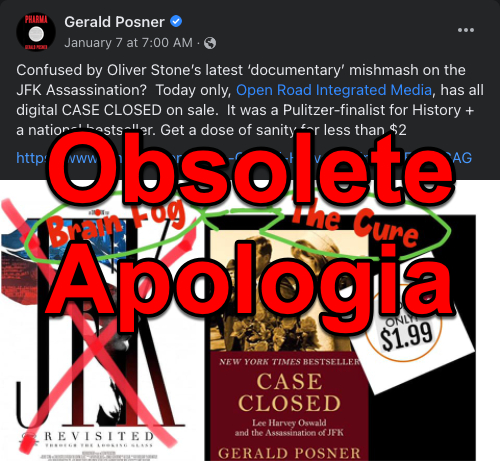
    In a previous essay, I tried to summarize the worldwide reaction to Oliver Stone’s documentary JFK Revisited: Through the Looking Glass. (Click here) By far, it is the widest and strongest reaction to any documentary ever made on the JFK case. The fact that it created such a hubbub clearly disturbed certain past critics of Stone, for example, Noam Chomsky and Gerald Posner. It also disturbed certain mainstays of the MSM, like Tim Weiner and Max Boot. I ended that discussion with what may be the worst outburst about the documentary yet, the one by James Kirchick at the digital zine Air Mail.

    As I noted in that overall review, it’s clear that none of these writers wish to deal with the specific points of new evidence made possible by the Assassination Records Review Board in the film. This evidence had never been presented to a worldwide audience in broadcast form. Weiner, Boot, Chomsky, Posner, and Kirchick never even mentioned that body. Yet this was the reason for the making of the documentary! Which is why it features interviews with three employees of the Board: Chairman John Tunheim, Deputy Chair Tom Samoluk, and Military Records analyst Doug Horne.

    Weiner and Kirchick dodged the problem of confronting the declassified evidence in the film by using two escape routes. First, they ignored the matters addressed, like official photographer John Stringer denying he took the photos of Kennedy’s brain at the National Archives. The second means of escape was to use discredited writers to smear the documentary and not reveal why they had earned derision in the critical community.

    As I noted at length, both Weiner and Kirchick utilized the discredited work of Max Holland to somehow impute that JFK Revisited: Through the Looking Glass was based on some sort of KGB disinformation campaign. This is so stupid it is actually ludicrous and I showed why. (For a lengthier reply, click here)

    The real reasons that New Orleans DA Jim Garrison formed his ideas about Oswald as an intelligence agent were his Russian language test in the service—suggesting he was being groomed as a false defector—and the address stamped on his New Orleans pro-Castro flyers, which was 544 Camp Street. (See Garrison’s On the Trail of the Assassins, pp. 22, 24) This had been the home of both the CIA’s Cuban Revolutionary Council and the FBI/CIA connected Guy Banister, who had been involved in both the Bay of Pigs project and Operation Mongoose. (William Davy, Let Justice be Done, pp. 25–28) In his book, the DA clearly depicts both these events occurring way before the arrest of Clay Shaw who, as Bill Davy notes in his volume, Garrison had first called in for questioning in December of 1966. All of these events—the discovery of the Russian test, Garrison visiting 544 Camp Street, the suspicions about Shaw—occurred months before the Paese Sera article about Permindex, and Shaw’s service on the board, was published in Italy. Garrison was correct on his ideas about Bansiter, 544 Camp Street, and Oswald. In JFK Revisited, we have Jeff Morley and John Newman discuss the attempts by the CIA and FBI to disguise the provocative activities going on in New Orleans that summer. Holland’s redbaiting dodge of this evidence shows another reason why he is not credible inside the JFK critical community. But that does not disqualify him from being used in moments of desperation by the MSM.

    Another discredited source, used especially by James Kirchick, was Fred Litwin. Litwin has been taken over the coals so many times it’s kind of embarrassing, but somehow, with a straight face, Kirchick trotted him out. Kirchick then criticized JFK Revisited for something that is not in the film , namely the homosexuality of Clay Shaw and David Ferrie. What we did was show the connections of these men to the CIA and how Shaw lied about that connection. This Kirchick diversion is inherited from Litwin (and his partner Alecia Long). And, like Weiner with Holland, Kirchick ignored past demolitions of Litwin that clearly show he is not credible on the facts of the case. (Click here for one and here for another)

    This practice of using sources with serious journalistic and academic liabilities would not be allowed in any advanced historical studies or journalism class. But ever since the MSM decided to side with the Warren Commission back in 1964 and when CBS violated all of its Standards and Practices for its 1967 four part special, it’s par for the course in the JFK case. (Click here for that CBS story)

    For Kirchick to use Litwin as a source is simply inexcusable for any journalist or historian. In addition to the exposures noted above, this author has shown in detail why the Canadian alt/right media maestro should never enter into any debate on the subject. (Click here and here and here and here and here)

    Litwin’s self-admitted role model is the rather lamentable David Horowitz. Litwin tries to run away from this fact today, but it is there to see in his first book, Conservative Confidential. Does Kirchick know this? Would it matter?

    In the essays I noted above, we can see the factual havoc that Litwin’s admiration for Horowitz leads to. Some examples among a universe of them:

    1. Quoting Sylvia Meagher, Litwin writes that Kennedy’s motorcade route was not altered.

    This has been disproven by Vince Palamara in his book Survivor’s Guilt. (pp. 104–05)

    1. Litwin writes that the motorcade had to turn on Elm Street to take an exit on to the Stemmons Freeway which would take it to the Trade Mart.

    This was disproven by both Palamara and the House Select Committee on Assassinations. (HSCA, Volume 11, p. 522; Palamara, p. 109)

    1. In his first book on the JFK case, Litwin wrote that Jim DiEugenio had no testimony or paperwork to prove fraud with CE 399, and its chain of custody can be proven.

    This is not just false but it’s a case of Litwin practicing libel, since he had my book right in front of him which showed, with testimony and paperwork, the opposite. (The JFK Assassination: The Evidence Today pp.89–92, 247–49)

    1. Litwin writes that Clay Shaw’s lawyers got no help from the CIA or FBI.

    This was completely disproven by the ARRB declassifications. Shaw’s lawyers lied about this until the end of their lives. (See James DiEugenio, Destiny Betrayed, second edition, pp. 264–65, 269–83, 293, 294)

    1. In his book on Jim Garrison, Litwin features a picture of Harry Connick Sr., the DA who succeeded Jim Garrison and he says he used him as a source.

    What Litwin leaves out is shocking. According to investigator Gary Raymond, Connick failed to indict Father Dino Cinel for child abuse when Gary had the evidence to do so. Gary had to go to the media to force Connick to act. (Probe Magazine Vol. 2 No. 5)

    1. Litwin praised Hugh Aynseworth in the most fulsome terms for his work on the JFK case in his book on Jim Garrison.

    Aynseworth is a proven FBI informant. According to Joan Mellen Aynesworth tried to bribe Shaw trial witness John Manchester with a CIA job. Sheriff Manchester replied, “I advise you leave the area, otherwise, I’ll cut you a new asshole.” (Destiny Betrayed, pp. 249–55)

    1. In his chapter on the Clay Shaw trial in his Garrison book, Litwin never mentioned the testimony of Kennedy autopsy physician Pierre Finck.

    This is astonishing, because, for the first time, Finck’s testimony showed that Kennedy’s autopsy was not controlled by the pathologists, but by the military men there in the gallery, who guided them in doing what some have called the worst autopsy in history. (Ibid, pp. 300–04)

    1. Litwin implies that Garrison was allowed to pick his own grand juries.

    More nonsense. As anyone can find out by reading a law journal, in Louisiana grand juries are chosen from voter rolls. (Louisiana Law Review Vol. 17, No. 4, p. 682)

    1. In his book Conservative Confidential, Litwin attempts to hold up as praiseworthy the reactions of Mayor Rudy Giuliani, and President George W. Bush, after the 9–11 attacks.

    That book was published in 2015. By this time, everyone knew that Giuliani had placed the city’s emergency response headquarters in WTC Building 7, and that W’s reason for the Iraq invasion, WMD, was false. Yet 650,000 innocent Iraqis had died because of that lie.

    1. Perhaps the worst thing that Litwin ever penned was in his first JFK book. There he wrote that the authors of the Warren Report were honorable men who conducted an honest investigation.

    In this day and age to write or imply that the likes of John McCloy, Allen Dulles, Jerry Ford, and J. Edgar Hoover were honorable men is just this side of science fiction. For one example, just read Kai Bird’s book on McCloy. Anyone who could help the Nazi criminal Klaus Barbie escape to South America and then deny it or never feel any remorse for his pushing through the Japanese internment in World War II, that person is anything but honorable. And therefore would have little difficulty in covering up the death of President Kennedy.

    This could go to an endless length. That is how bad a writer and scholar Litwin is, but evidently Kirchick did not give a damn about Litwin’s credibility. In fact, Kirchick even threw Joe Rogan under the bus for having Oliver Stone on his show. Stone did not say one thing about CV 19 while he was on the program.

    When one understands all that, plus the fact that JFK Revisited: Through the Looking Glass does not deal with anyone’s sexuality, one begins to understand what Kirchick is up to and why he borrows from Litwin. By creating a smoke and mirrors distraction, Kirchick can sidestep what does exist in the film. That is the revelations of the Assassination Records Review Board (ARRB) which completely overturn the verdict of the Warren Commission. The film leaves no doubt that the Commission was wrong in its rogue prosecution of Oswald. A prosecution which did not even grant the defendant a lawyer. What the film deals with are the forensic facts of the JFK case, for example, Kennedy’s autopsy and the ballistics evidence, which is how one determines guilt in a homicide. As former prosecutor Bob Tanenbaum says in the film, because of all the problems with the evidence, one could not convict Oswald in any court in America.

    The murder of President Kennedy had a tremendous impact on the course of history, both in the USA and abroad. As we show in this film—and will show even more completely in the four-hour version, Destiny Betrayed—Kennedy was withdrawing from Vietnam at the time of his murder. We present evidence that Lyndon Johnson knew this and he consciously reversed Kennedy’s policy. LBJ then lied about what he had done. In the four-hour version, we make it clear through Professor Bradley Simpson and author Lisa Pease that Johnson also reversed Kennedy’s policy of friendship and aid to President Sukarno of Indonesia.

    Those two Johnson reversals had horrendous effects. The latest tallies of total dead in Vietnam under American influence are at around 3.8 million. (See British Medical Journal 2008 study by Ziad Obermeyer) If one throws in the genocide that took place in Cambodia due to Richard Nixon’s invasion of the country, which one must, you can add in about 2 million. (Click here for details) The minimum who perished during the massacre of the PKI in Indonesia under Suharto is pegged at 500,000. (William Blum, The CIA: A Forgotten History, p. 217). JFK Revisited: Destiny Betrayed shows with authority that none of this would have happened under Kennedy.

    Most people would find this information rather interesting. James Kirchick did not. He chose to write about an issue not in the film. It is then fair to characterize his article as a distraction from these important, some would say, epochal matters.

    But this is what one expects from the MSM on the Kennedy case. About three months after the 26 volumes of the Warren Commission were published, in March of 1965, the first combat troops landed in Vietnam. By the end of the year, there were 170,000 of them in theater.

    Under President Kennedy, there were none.

    That is a pretty hefty issue to sidestep, but Kirchick does so with a completeness that is astonishing.

    Post Script: I now extend to Kirchick the same offer I did to another unfounded critic of the documentary, namely Gerald Posner. I will offer to debate Mr. Kirchick at any venue in Los Angeles or San Francisco on the merits of the JFK case, the Warren Report, or either version of Oliver Stone’s documentary. We can arrange for the sponsors, the format, and recording apparatus. He can even bring Tim Wiener. I await his reply.

  • Neurology and Jiggle Analysis

    Neurology and Jiggle Analysis


    How long does it take the muscles of the average person to contract in reflexive response to an unexpected loud noise?

    Reasonably precise information on this reaction, known as the “auditory startle reflex,” is presented below. It is vital to “jiggle analyses,” studies of blurred images on the Zapruder film of the Kennedy assassination, based on the assumption that the blurs are caused by the sounds of shots making the photographer jerk.

    Under ideal conditions, jiggle analysis could suggest answers to some questions: When were audible shots fired? Did Zapruder react to all of them equally? If not, which shot elicited the greatest reaction and why? Is the time interval between the apparent impact on the victim and the blur on the film too long—or too short—to work with the official story?

    There are no answers in this report, but I present it in response to the number of researchers who have asked me to find at least some serviceable neurological information.

    I also present the findings of a very original researcher—Gene Case—whose inspired work led to an insight into the nervous system of the camera that is at least as interesting as the nervous system of Zapruder. These findings, published years ago in The Fourth Decade, deserve more attention.[1]

    But first, a few basics. The speed of Zapruder’s camera was 18.3 frames per second—or 54.6 milliseconds from one frame to another. The speed of sound is 1100 feet per second (fps). The muzzle velocity of a Mannlicher-Carcano is close to 2200 fps.  A Carcano bullet from the alleged sniper’s nest would strike Kennedy before the sound of the muzzle blast reached Zapruder. What happens next?

    Auditory Stimulus Response Times in Milliseconds (m/s)

    The following figures come from a study by Brown et al, published in the British journal, Brain.[2] The authors tested the latency period (time it takes to respond) of the auditory startle reflex in 12 healthy volunteers ranging in age from 18 to 80 years. While relaxing in a chair, the subjects were randomly treated about every 20 minutes to a tone burst of 124 decibels, the equivalent BANG! of a car backfire 20 feet away. The average latency period of the relevant muscle groups in milliseconds:

    Neck: 58 m/s (range 40–136 m/s)

    Paraspinal muscles: 60 m/s (range: 48–120 m/s)

    Forearm Flexors: 82 m/s (range: 60–200 m/s)

    Forearm Extensors: 73 m/s (range 62–173 m/s)

    Thumb: 99 m/s (range 75–179 m/s)

    Back of Hand: 99 m/s (range 72–176 m/s)

    The authors concluded:

    The most generalized startle response to the standard sound stimulus employed consisted of eye closure, grimacing, neck flexion, trunk flexion, slight abduction of the arms, flexion of the elbows, and pronation of the forearms.

    There was considerable variation in the degree to which this response was expressed, and in some subjects only eye closure and flexion of the neck were apparent.

    Accelerated Reaction Time

    Aniss et al found that the startle response “is more easily elicited in a state of muscular contraction.”[3] (In rare instances, the opposite occurs, i.e., muscle contraction can inhibit the startle response.) The muscles of Zapruder’s neck, trunk, arms, and hands would all have been in a state of contraction, so one might suppose he was well-primed to jump at the sound of shots—if they were loud enough compared with the ambient noise in Dealey Plaza.

    Jacqueline Kennedy’s Important Observation

    Habituation—the process of becoming so accustomed to a stimulus that it loses its effect—can take place rapidly.[4] The reflex in neck muscle is the last to habituate, according to a 1951 study still being cited.[5] The subjects of the Brown study were hit with tone bursts while relaxing in an otherwise quiet environment—and even they habituated to some extent, within two to six trials.

    Dealey Plaza was already filled with the noise of motorcycles before the shooting began, which could lead to habituation on the part of some witnesses at least. Jacqueline Kennedy makes this clear:

    You know, there is always noise in a motorcade and there are always motorcycles besides us, a lot of them backfiring. I guess there was a noise, but it didn’t seem like any different noise really because there is so much noise, motorcycles and things. But then suddenly Governor Connally was yelling…[6]

    She GUESSED there was a noise? At the time of this shot, the first, she was closer to the alleged source of the noise than Zapruder had been. On the other hand, she was also closer to the motorcycles.

    Two for the Price of One

    While ambient noise can habituate a witness to the sound of shots that are not much louder, there is something that could even prevent one from hearing a shot altogether: the sound of a shot fired immediately before. Muscles supporting the eardrum contract defensively, making one temporarily deaf.

    Thus, two shots can sound like one, creating only one startle reflex, if any, depending on the location of the sniper in relation to the photographer.  

    (Elsewhere, see description of how one shot can sound like two.)

    Impact of Bullet, Impact of Sound

    Luis Alvarez, the Nobel Laureate known mostly for “jet effect” also performed a jiggle analysis.[7] One big concern of his involved the amount of time between the impact of the bullet, and the impact of the sound.

    The expected neuromuscular reaction occurs about one-quarter to one-third of a second later, as shown by the large accelerations near 318. (I’ll adopt five frames as Mr. Zapruder’s experimentally determined reaction time.)[8]

    Alvarez did not quote any authoritative source for this claim about the latency of the “expected” neuromuscular reaction, and his explanation for its length is inappropriate:

    For those readers who are surprised that the neuromuscular response time is so long, let me recall a common ‘parlor trick’: A bets B that if A drops a vertically held dollar bill without any warning, B cannot stop its fall by pinching his fingers together, if his fingers are poised, ready to clamp together, at the bottom edge of the bill. The fact that the bill can almost never be stopped (unless A gives a precursor signal with his fingers) indicates that a nervous system ‘or hair trigger’ takes more than one-sixth of a second (3.1 frames) to respond to an optical stimulus.[9]

    Alvarez was apparently correct about the speed of this particular kind of reaction. Tests performed on baseball hero Babe Ruth showed he took 140 milliseconds to twitch at the sight of a ball on its way—as opposed to the average person’s best, 150 milliseconds.[10]

    But why compare (a) an involuntary response to an auditory stimulus with (b) a voluntary response to an optical stimulus?

    Zapruder’s “reaction time”—assuming he was normal and assuming the sound was loud enough compared with the ambient noise—would be much quicker than Alvarez has claimed, according to neurologists. There is another problem with Alvarez’ analysis, as shown by this statement:

    The human nervous system cannot transmit signals fast enough for the angular acceleration between frames 312 and 313 to have been caused by Mr. Zapruder’s muscles reacting to impulses from a brain that had been startled by the shot that killed the President.[11]

    Gene Case, mentioned earlier, noted that Zapruder’s nervous system, no matter how fast, could hardly be expected to react to a sound that had not yet arrived!

    But why the blur at Z–313? Since it was too soon to have been due to a startle reflex (unless frames are missing between 312 and 313), Alvarez found another explanation, inspired by the observation of another physicist, Enrico Fermi, in a very different context:

    Fermi has almost instantly measured the explosive yield of the first atomic bomb by observing how small pieces of paper which he ‘dribbled’ from his hand were suddenly moved away from ‘ground zero’ by the shock wave.[12]

    Alvarez concluded the blur was “caused directly by shock wave pressure on the camera body.” But, as Case noted, the speed of sound is again relevant since it takes time (1.1 Zapruder frames) for the shock wave to reach Zapruder.

    Case also doubted a shock wave from a bullet could move a three-pound camera at any distance. He bought a Carcano, drove to a quarry with a friend and fired bullets past materials of different weights hanging freely on a stick. His results were conclusive:

    The cardboard, the tinfoil and the strings were unimpressed. The shock wave from a Mannlicher Carcano bullet passing three feet away does not flutter cardboard, tinfoil or string, much less the body of a movie camera (three pounds) 75 feet away.

    “Dr. Luis Alvarez, Nobel laureate, winner of the National Medal of Science, the Medal of Merit and the Einstein Medal, was blowing it out his ass.”[13]

    Bullets Fired Behind Zapruder?

    Case then tried something that lead to a rather exciting discovery. When he fired bullets past a CAMERA—and from NEARBY—he created a blur:

    Alvarez could have been right about the cause—a shock wave—but wrong about the nature of the ‘interaction.’ The ‘interaction’ could be a vibration in the shutter mechanism or elsewhere in the workings of the camera. Firing a rifle past a VHS camcorder, I was able to record the image of the shock wave of a passing bullet. It is an extreme undulation of the picture which lasts three video frames—3/30ths of a second. Of course, an 8mm film movie camera is a very different mechanism. But vibration of the shutter in Zapruder’s camera, or of the film itself, is a plausible explanation for this triple imaging.[14]

    A shock wave [manifest on film] at 313 could only have come from behind Zapruder.[15]

    Another Startle or Shock Wave at Z–318?

    Complicating jiggle analysis is the fact that Zapruder said he heard only two shots: the head shot, and one immediately before it which appeared to cause Kennedy to “lean over.” Zapruder either did not hear, or consciously register, the first shot. As I have previously documented in the newsletter Probe,[16] several witnesses heard only one—or even no shot—before the fatal one, then they heard a flurry.

    Edited excerpt from my Probe article:

    Charles Brehm. Saw head wounded on the “second” shot, heard a third. (22H837)

    Mr. and Mrs. John Connally. Both heard last shot only after lying down in the   seat, with Mrs. Connally’s head next to his. (4H133,147)

    Chief Curry. Heard a shot after Motorcycle Officer Chaney rode up to tell him   what was happening. (4H161) The Nix film shows that Chaney was still behind   the limousine several frames after the headshot.

    Sheriff Decker. Heard first shot when a “spray of water” come Kennedy; heard one more. (9H458)

    James Foster. Saw head wounded on “second” shot; heard a third. (CD897)

    Clint Hill. Heard shot, saw head wounded, while briefly “mounted” on the limousine the first time. Apparently unknown to Hill, the head was already  wounded about 1.5 seconds earlier. (2H144)

    Jean Hill. Said she wrapped up Moorman’s first Polaroid photo and put it in her pocket before she heard any shots. (6H206) At the time, she is still in view, about four seconds after the second shot, the photo is still in her hand.

    Emmett Hudson. Saw head wounded on “second” shot; heard a third while on the ground. (7H560)  (Nix film shows him on the ground after head wounded.)

    Mary Moorman. Heard a shot for the first time as she took a Polaroid photo of Kennedy being hit in the head. She heard two or three more. (19H487)

    Royce Skelton. Heard a shot after seeing Kennedy react to headshot. (19H496)

    Mrs. Philip Willis. She said the head was wounded on the “second” shot; then heard a third. (CD 1245)

    Conclusion

    As Mrs. Kennedy put it, “I guess there was a noise.”


    [1] Case G. Scientific Slumming with Luis Alvarez. The Fourth Decade, 1996; 3(2):32–42.

    [2] Brown P, Rothwell JC, Thompson PD, Britton TC, Day BL, and Marsden CD. New observations on the normal auditory startle reflex in man. Brain 1991; 114:1891–1902.

    [3] Aniss AM, Sachdev PS, and Chee K. Effect of voluntary muscle contraction on the startle response to auditory response. Electromyography and Clinical Neurophysiology, 1998; 38:285–293.

    [4] Valls-Sole J, Valldeoriola, Tolosa E, Nobbe F. Habituation of the auditory startle reaction is reduced during preparation for execution of a motor task in normal human subjects. Brain Research 1997; 751:155–159.

    [5] Jones FP, Kennedy JL. An electromyographic technique for recording the startle pattern. Journal of Psychology, 1951; 32:63–68.

    [6] Kennedy, J. 5 WCH 180.

    [7] Alvarez L. A physicist examines the Kennedy assassination film. American Journal of Physics, 1976; 44(9):813–827.

    [8] Ibid.

    [9] Ibid.

    [10] Fuchs AH. Psychology and the Babe. Journal of the History of the Behavioral Sciences, 1998; 34(2):153–165.

    [11] Alvarez.

    [12] Ibid.

    [13] Case.

    [14] Ibid.

    [15] Ibid.

    [16] Cranor M.  Probe 1999 6(6):6–13.

  • The Unprecedented Debate over JFK Revisited

    The Unprecedented Debate over JFK Revisited


    It is almost three months since Oliver Stone’s documentary JFK Revisited: Through the Looking Glass was released on the Showtime cable network. The international impact of the film is unprecedented for a documentary on the subject. After its July debut at the Cannes Film Festival, the film made the cover of Paris Match. In Australia, the documentary was featured in three national newspapers as a feature story. The program Today Extra! carried by Channel 9—one of the largest TV networks on that continent—picked up the writer of the documentary, namely me, and drove him to a studio on Sunset Boulevard in Hollywood for an interview. It screened at the Rome Film Festival in both versions, 2 hours and 4 hours—playing within a mile of each other, which again made national news. This screenwriter was also interviewed by Izvestia, one of the largest media groups in Russia. After the Cannes debut, the distribution company Altitude collected the European reviews of the film and the reaction was strongly favorable. Needless to say, Oliver Stone did many media interviews while in Cannes and these got large circulation. One he later did with the RT network’s Michael McCaffrey was widely watched on YouTube, as were the three YouTube trailers made in advance of the film’s American debut. The film is on the long list for the BAFTA award for Best Documentary and will be submitted for the Emmy awards in the same category.

    The amazing thing about this debate and discussion is this: it’s still going on. And this is even before the four-hour version, Destiny Betrayed, has been made available in the USA. Stone enacted a strategy that understood the problem he faced. The MSM in this country has always been predisposed to favor the official story in the JFK case—and the film deals with this topic. So, the celebrated director did an end-run around the MSM. And, with the help of journalist Jeff Morley, it worked. Between Morley and Counterpunch, Glenn Greenwald, Joe Rogan, The People’s Weekly, Russ Baker, Dick Russell and Who What Why, Ed Curtin at Lew Rockwell, Countercurrents, and The Unz Review, Branko Marcetic at Jacobin, and Stone’s personal appearances on shows like Useful Idiots and Breaking Points, the message of the film has reached a potential domestic audience of over twelve million. This is in addition to the foreign exhibition—which is ongoing.

    In fact, two continuing series were caused by the film. Aaron Good’s Destiny Betrayed interview series at Patreon cohosted by Abby Martin (click here) and Russ Baker’s journalistic series at WhoWhatWhy (click here). This successful end-run created enough buzz that it drew author Gerald Posner and leftwing polemicist Noam Chomsky back into the arena. Hardly anyone missed them, but the fact they returned shows that JFK Revisited has had an impact. The MSM attempt to halt that effect has proven unsuccessful. Yet, almost three months later, the attempt is still being made.

    The way the MSM has tried to parry this impact is notable. It’s obvious that writers like Tim Wiener at Rolling Stone do not want to deal with the intellectual architecture of the film. That architecture was formed by the discoveries made possible by the Assassination Records Review Board (ARRB). A fact which Wiener did not even note in his slam at the film. (For my reply, click here)

    Tim never mentions the ARRB, which is quite a feat, because without the Board, JFK Revisited could not have been made. He never mentions points in the evidentiary record that the film delineates as never before in a broadcast format, for example the specious provenance of CE 399 which the FBI lied about; official autopsy photographer John Stringer and his admission that he did not take the pictures of Kennedy’s brain at the National Archives; the long concealed testimony of Dorothy Garner of the Texas School Book Depository where she corroborates Sandy Styles and Victoria Adams in that she never saw Oswald descending from the sixth floor after the assassination. Garner makes this point even more forceful, since she stayed on the fourth floor until supervisor Roy Truly and motorcycle policeman Marron Baker ascended the stairs. All of this is elucidated in the film at length and with precision. How could Tim miss it? Maybe because he had to, since it proves a conspiracy.

    And here lies a curious phenomenon. Tim clearly did not want to do his homework on the subject. Instead, he trotted out, of all people, Max Holland. By now, Holland has been discredited so often that one would think he would be off the table. Gary Aguilar took Holland apart on the very point that Tim borrowed from him to deploy against the film, namely CIA disinformation tales about foreign news stories attacking the Agency (e.g. their role in encouraging the coup plots against President Charles de Gaulle). In fact, in the Holland/Aguilar debate, it became clear Holland was proffering the very dubious testimony of, if you can believe it, Agency official Richard Helms. Helms was actually convicted of perjury on this very topic: that is lying about Agency covert actions. (If the reader thinks I am exaggerating, please click here to see that debate for yourself) Did Weiner not know about this? It was easy enough to locate the debate.

    But in addition to being routed by Aguilar, there was Holland’s pathetic attempt at a documentary on the JFK case. This was 2011’s The Lost Bullet. Here, Holland said that the bullet that struck James Tague on Commerce Street had previously struck a streetlight—and this happened before Abraham Zapruder started filming! In other words, it took place before Kennedy had proceeded down Elm Street into the kill zone, but it’s worse than that. As Pat Speer later revealed, in all probability, the producers of the program knew their nutty thesis about the streetlight was false, since they had had a laboratory do an experiment before the documentary was shown. As Speer noted, “Holland’s theory had thus been shot to pieces, both figuratively and literally, even before the program pushing his theory had aired.” (click here for details)

    In his desperate attempt to critique JFK Revisited, this is the kind of author Tim Wiener utilizes, without telling his readers about it, which brings us to James Kirchik.

    Air Mail is a recently introduced digital magazine. Its chief founder was Graydon Carter. Carter was the longtime editor of Vanity Fair. His 2019 co-founder was Allesandra Stanley, a longtime veteran of Time and The New York Times. They allowed Kirchik to write a review of Stone’s documentary which almost makes one wonder if he saw the film. Kirchik spends most of his time talking about Jim Garrison’s 1969 prosecution of Clay Shaw and Stone’s JFK, the 1991 feature film of Garrison’s book On the Trail of the Assassins. Kirchik does this with all the mildewed and phonily sinister strophes of the likes of James Kirkwood in American Grotesque, a museum piece in the literature on the JFK case.

    When Kirchik does get to what is in the new documentary, who does he use to try and attack it? The Canadian version of Max Holland, namely Fred Litwin. JFK Revisited accurately notes that, with help from the ARRB, 12 witnesses are now revealed to have known that Shaw used the alias of Clay Bertrand. Some of these were turned up by Joan Mellen in her book, A Farewell to Justice. Barbara Bennett was a chanteuse at Pat O’Brien’s. She “had turned on the television and seen Shaw being arrested: ‘There’s Clay Bertrand!’ she shouted out.” Shaw had frequented that nightclub and Bennett was “his sometime party guest.” (p. 121) French Quarter businesswoman Rickey Planche just knew the man as Bertrand. Only when she saw him on TV did she learn his name was Shaw. (ibid) Her testimony would suggest that the knowledge of Shaw as Bertrand was not uncommon.

    It was not. As Garrison notes in his book, a bartender at Cosimo’s said that “Bertrand comes here a lot.” And the man knew that his real name was Clay Shaw. He added, “I think most people know that.” (Garrison, p. 85) Garrison’s investigators then found two more bartenders in the French Quarter who said the same. (ibid) An FBI memorandum of March 2, 1967, states that the Bureau had two sources in February who knew Shaw was Bertrand. Jessie Parker a hostess at the VIP room for Eastern Air Lines, testified that Shaw signed her guest book as Clay Bertrand. Alfred Moran corroborated this instance, but declassified documents show the CIA got to him and talked him out of his story. (William Davy, Let Justice be Done, pp. 178–79) In March of 1967, reporter Larry Schiller told the FBI that he had five sources in New Orleans and San Francisco who indicated Shaw used other names including Bertrand. (Davy, p. 193) Ed Guthman, a former Justice Department official, also knew about Shaw’s alias. (ibid) In fact, the Justice Department had told the New York Times that such was the case. (Davy, p. 191) Reporter Richard Billings, who was interviewing Garrison in 1967, noted in his journal that evidence that Shaw was Bertrand was popping up everywhere. (Davy, p. 302) Dr. Jacob Hety knew a gay man named Greg Donnelly. Donnelly had known Shaw for many years and he had referred to him as Clay Bertrand. (Probe, Vol. 7, No. 2, p. 21) When essayist Ed Tatro was in New Orleans for the Shaw trial, he was told words to the effect that, everyone down here knows Shaw is Bertrand. (James DiEugenio, Destiny Betrayed, Second Edition, p. 387) As the film notes, the icing on the cake as far as this matter goes is that Dean Andrews, who Shaw employed as an attorney, admitted to Harold Weisberg that Shaw was Bertrand. (DiEugenio, p. 388) There are still others I could list, but this makes the point beyond any real question. Clear and simple: Shaw was Bertrand and he lied about it in public and on the witness stand.

    Why did he lie? For the simple matter that he did not want to reply to this question: Why did you call Andrews and ask him to go to Dallas to defend Oswald? By denying the evidence above, Kirchik avoids that point.

    He then recites the discredited line first issued by Dick Helms: Shaw was only a domestic contact source for the CIA, one of thousands of businessmen they interviewed for information from abroad. Then comes this howler: “This was the extent of his involvement with the agency.” JFK Revisited proves this is false and Helms was providing a cover story. Shaw was a highly paid and valued contract agent/source and we produced the document which proves this in the film. It was first unearthed by Mellen in her book Our Man In Haiti. (p. 54) Shaw had a third Agency clearance also. This one was a covert security approval for Project QKENCHANT. (Davy, p. 195). Again, we show this in the film. How could Kirchik have missed it? But the worst one of all is the fact that the ARRB discovered that the CIA had destroyed Shaw’s 201 file. (Click here for the memo)

    And then there is this issue.

    Shaw denied in public and on the stand that he had any association with the Agency. We show a film clip of him saying this in the documentary. Therefore this is more perjury that Kirchik does not wish to admit. From declassified files, we also understand today that Shaw lied about not knowing David Ferrie. (Davy, p. 195). We also know Shaw lied about not knowing Oswald. (See Davy, Chapter 11 and click here) As the late attorney Allard Lowenstein once remarked in relation to the RFK case: In his experience as a lawyer, people with nothing to hide don’t hide things.

    From here, Kirchik pulls a Tim Weiner. He says that the whole idea Garrison had about Shaw and the CIA in the JFK case was part of a Paese Sera story that was printed on March 4, 1967, in that Italian leftist newspaper.

    This is utterly stupid. Garrison was investigating Shaw months before that, in December of 1966. On February 24th, an FBI informant had called Garrison’s office and told them that Shaw was Bertrand. (Davy, p. 120) Shaw was then arrested before the story came out. But beyond that, the FBI itself had been investigating Shaw in December of 1963, since his name had come up in their inquiry into the JFK case due to several parties furnishing them information about him. (Davy, p. 192) Does Kirchik know any of this? What does any of it have to do with Paesa Sera? Zilch.

    The McCarthyite attempt by the CIA to link Kennedy assassination writers and investigators to Communist causes and thereby labeling them dupes of Russian disinformation, that propaganda tactic preceded Max Holland for decades. It first started with Joachim Joesten over his book Oswald: Assassin or Fall Guy back in 1964. Using Gestapo files, they labeled Joesten a member of the German Communist Party. (Click here) This about a man who worked for Newsweek in the forties. As was reported in Time, the Warren Commission—with help from Dick Helms—was out to spike Joesten’s book and one way of doing that was smearing him. (John Kelin, Praise from a Future Generation, pp. 168–71) It is very disappointing to see Kirchik use similar smear tactics today, especially when they are even more groundless now than they were then.

    The article concludes with more meritless attributions Kirchik borrows from Litwin. Jim Garrison never wrote a memo, or said anything in public, about Shaw’s homosexuality. There is not one memo I have ever seen to this effect by him. So what does Kirchik do? He says an August 1968 Confidential magazine article portraying the Kennedy murder as part of a gay plot was written by a Garrison investigator. Kirchik—who does not seem to give a damn about fact checking—has slipped on another banana peel. The author was not a Garrison investigator. He was a friend of Bill Boxley, later exposed as a CIA plant inside the DA’s office. (Davy, pp. 146–47)

    The article ends with another jeremiad against Stone’s 1991 film. In other words, Kirchik has not addressed one evidentiary point in JFK Revisited. His column is a perfect example of what film criticism should not be—bringing one’s own personal prejudices and obsessions to the film; rather than elucidating the film’s structure, themes, and style for the viewer. If one does not know anything or give one iota about the murder of President Kennedy, then one should just admit that and slide by, rather than ensnaring the reader inside the writer’s own pernicious ignorance.

  • Gavin Newsom and Sirhan’s Parole

    Gavin Newsom and Sirhan’s Parole


    Today, California is one of only three states in which the governor has the ability to overrule a parole board decision.  Which means he has a political veto over a deliberative process. The other two states are Oklahoma and Maryland.  In Maryland, a bill is advancing through the legislature which would eliminate the gubernatorial veto.  And the citizens of the state support the change overwhelmingly.  I sincerely hope the same thing now happens in California.

    Since taking office in March of 2019, Governor Gavin Newsom has used this discretionary power rather often. To be exact, 46 times. On January 13th he again overruled the parole board, this time in the case of Sirhan Sirhan. In fact, on that day, Newsom wrote an editorial for the LA Times about his decision. He began that column by saying, “… Sirhan assassinated Sen. Robert F. Kennedy just moments after Kennedy won the California presidential primary.” He then added that, “Decades later, Sirhan refuses to accept responsibility for the crimes.”

    He then stated what is likely the real reason for reversing the parole board. He mentioned that his murder left RFK’s “eleven children without a father and his wife without a husband.  Kennedy’s family bears his loss every day.” The Kennedy family made an extraordinary effort to keep Sirhan behind bars––in spite of the parole board’s verdict. They seem to have arranged a multi-platformed media crusade to both counter the parole board decision and also to neutralize the efforts of Robert Kennedy Jr. For he is the only member of that family who has spoken out against the official verdicts in both the John Kennedy and Robert Kennedy cases.

    For instance, Rory Kennedy wrote a piece in The New York Times on September 1st of last year titled, “The Man Who Murdered my Father Doesn’t Deserve Parole.” She  wrote that, “As my father was taken forever, so too should Mr. Sirhan be.”

    The majority of Robert Kennedy’s children––six of them––feel this way, and this helped give political cover to Newsom’s decision to veto the parole board.  The problem with this is dual.  First, the board has rules and guidelines it follows in order to make a decision.  Political advantage and familial vengeance should not be part of that process.  Secondly, as many have noted, Sirhan has served much longer for the charge he was convicted of than the normal term. What is the purpose of keeping him there so much longer when the board has deemed him no danger to society?

    Part of this crusade seems to simply stem from a reaction to RFK Jr’s outspokenness on the issue.  For decades, the policy of the Kennedy family had been not to speak out on the assassinations of either President Kennedy or Senator Kennedy. Bobby Kennedy Jr. changed that pattern. He began speaking out about it back in 2013 during a public appearance with Rory hosted by Charlie Rose in Dallas. (New Haven Register, Associated Press report January 12, 2013) He furthered his ideas on the subject matter with his book American Values in 2018.

    What is so ironic about this is that, as David Talbot’s book Brothers shows, Attorney General Robert Kennedy never bought the cover story about his brother’s death. In fact, within a week of JFK’s murder both Bobby and JFK’s widow, Jackie Kennedy, wrote a letter to the rulers in Moscow saying that they understood that Lee Oswald was simply a front man, and that President Kennedy’s assassination was the work of a large domestic plot. (Talbot, pp. 32-34)

    Somehow, the majority of Robert Kennedy’s children cannot seem to understand this even though their father did. And if this is what Senator Kennedy thought, and he was on the verge of gaining the Democratic nomination, would those who killed President Kennedy hesitate to get rid of him? When, in fact, they murdered his brother while in a motorcade, in broad daylight in front of hundreds of witnesses?

    Many of us have sympathized with the Kennedy family for decades.  After all, Jackie did not even want Bobby to run for the presidency. She feared that what happened to her husband would then happen to him. She was correct.

    But this is now 2022.  Why do we still have a Kennedy family deed of gift for the autopsy materials on John Kennedy? Which means their representative can rule on who sees those exhibits. Why are the notes by William Manchester on his book The Death of a President still ruled off limits to the public? That book was issued in 1967. And now the Kennedy family gets to influence whether or not Sirhan has served enough time in prison? I won’t even argue the idea that Sirhan not only did not but could not have committed the crime, since that should not be argued before the parole board.  Suffice it to say, Sirhan was railroaded by both the LAPD and the DA’s office. Due to his incompetent lawyers, the merits of his case were not argued in court.  In other words, the same thing that happened in the John Kennedy case occurred in the Robert Kennedy case. When Martin Luther King was being legally railroaded in Georgia during the 1960 presidential campaign, the Kennedy brothers intervened. And this showed the difference between them and Richard Nixon. (Mr. Kennedy and the Negroes, by Harry Golden, pp. 20-22)

    California is a big, powerful, liberal state. Gavin Newsom just won a smashing victory against a recall effort. He must also be quite aware that former state Attorney General Kamala Harris is now the country’s vice-president. While state AG she had a perfect opportunity to reopen the RFK case.  She decided to fight the petition by Sirhan’s then attorneys Laurie Dusek and Bill Pepper. (see Lisa Pease, A Lie too Big to Fail, pp. 501-02) She understood that any effort to do the right thing in that case would be a detriment to career advancement. She put her finger in the wind and she went to the Senate and then the White House. Newsom clearly recalls the paradigm.

    Angela Berry is a specialist in these types of parole hearings and cases.  She is Sirhan’s present attorney.  She replied that Newsom “had bowed to political considerations in denying her client parole.” She then added that “the legal decision for his release is clear and straightforward.  We are confident that the judicial review of the governor’s decision will show that the governor got it wrong.”  She further asserted that state law holds that inmates are supposed to be paroled unless they pose a current unreasonable public safety risk. Yet “not an iota of evidence exists to suggest Mr. Sirhan is still a danger to society.”  And she noted that prison psychologists and psychiatrists had assessed his case in such a manner. To cinch the case that he poses no threat to society, Sirhan has waived his right to fight deportation. But prison does pose a threat to him, since Berry said he had his throat slashed by another inmate in 2019. (read the story here

    Let us end with this point of comparison: it should be noted that both Arthur Bremer and John Hinckley are both out of custody today. They both live in the United States. And Hinckley has his own YouTube channel to showcase his music.

  • The Kirknewton Incident

    The Kirknewton Incident


    Did a US Air Force Security Service Member Intercept a Communication

    Predicting the JFK Assassination?


    The time is October 1963. The place is an Air Force Base in Kirknewton (Scotland), located approximately 11 miles west of the capital city, Edinburgh. A US Air Force (USAF) Security Service member is carrying out his regular duties at the base. Although it is in the United Kingdom, the base is currently under the control of the USAF Security Service. His duties include monitoring and reporting intelligence communication traffic to his supervisors. They then relay this information on to the National Security Agency (NSA) Headquarters in Fort Meade, Maryland. The individual’s name is David Christensen.

    Christensen is listening to communications coming out of Lisbon, the capital of Portugal. Suddenly, he eavesdrops on a link between Lisbon and Tangier (Morocco) that mentions a high-ranking figure in organized crime and the assassination of President John F. Kennedy. Recognizing the importance and gravitas of such an intercept, he immediately informs his supervisors, confident in the knowledge that they will pass the information up the chain of command.

    Christensen had done his duty. He was relieved. He may even have felt that because of the important content of the intercept, it would have been given Critical Intelligence Communications status, otherwise known as CRITIC. Such messages should be alerted to the President and other senior government officials within minutes, if possible.

    A few weeks later, when Christensen heard the news of President Kennedy’s assassination in Dallas on 22 November 1963, his heart sank. His life then followed a similarly low trajectory. As he said himself, in a letter he wrote in May 1978, to a fellow officer who served with him at the RAF Kirknewton base, “it really broke me up after Nov. 22, 63 especially when I had it all beforehand.” We will return to this letter shortly.

    Was David Christensen destined to become another accidental witness to history, having had prior knowledge of the JFK assassination, alerting the appropriate authorities who then did nothing and failed to protect the President?

    This is his story and how it was eventually brought to the attention of the House Select Committee on Assassinations (HSCA) in 1978.


    David Christensen and RAF Kirknewton

    David Frederick Christensen was born on 26 January 1942 in the midwestern town of Dickinson, North Dakota. He grew up on a ranch near the town of Halliday, which was about 40 miles north east from the town of his birth. Christensen graduated from High School in Halliday in 1960 and married that same year. The young Christensen quickly joined the USAF and in 1961 was sent overseas to the RAF Kirknewton base in Scotland.

    The small town of Kirknewton has a population of just over 2,000. During World War II, a military airfield was built about a mile south of the town by the British Royal Air Force (RAF). Unsurprisingly, it was named RAF Kirknewton.

    The base began life as a grass airfield in late 1940. Its initial purpose was to provide a home for the 289 Squadron in November 1941. The 289 Squadron was an anti-aircraft operation unit who eventually relocated to another base around six months later. RAF Kirknewton was then used for a variety of purposes, including a short stint as a Refresher Flying Training School, which helped to prepare inactive pilots for postings to operational training units.

    In 1943, there was some hope that the RAF Kirknewton base would replace the RAF Findo Gask station, when that base became unserviceable. Findo Gask was situated 50 miles north of Kirknewton. That hope quickly evaporated however when RAF Kirknewton did not obtain the necessary clearance to build runway extensions, probably because of dangerous crosswinds in the area.

    From the 1950s onwards, RAF Kirknewton was no longer used for aviation and in early 1952, the base was handed over to the USAF Security Service––the intelligence branch of the USAF. RAF Kirknewton then began a new life as a strategic US intelligence listening station that was used by the Central Intelligence Agency (CIA) and NSA to eavesdrop on military and commercial naval traffic, with priority given to Soviet radar. The Cold War was really heating up at this point. Personnel at the base included radio operators, linguists, and analysts––many with Top Secret and higher security clearance.

    The planning for this phase in the life of RAF Kirknewton actually began in August 1951 at the Brooks Air Force Base in San Antonio, Texas when the 37th Radio Squadron Mobile (RSM) was activated. This unit was then selected to move to the UK and into the RAF Kirknewton base.

    Ironically, President Kennedy’s last official act as President was at the Brooks Air Force Base on 21 November 1963, when he opened and dedicated the new Aerospace Health Medical Centre there.

    Around May/June 1952, the first personnel arrived in Scotland (via a three month stay in Bremerhaven, Germany for background investigations and security clearances). These first arrivals referred to Scotland as the “land of the heather, the moors, Scotch whiskey and the kilt.”

    The 37th RSM began formal operations at Kirknewton in August 1952 and by the following month the base had grown in size, with around 17 officers and 155 airmen in post. During its first year, RAF Kirknewton was used to evaluate antenna configurations, with the aim of determining the most effective configuration for intercepting Soviet communications and radar signals.

    The formal transfer of RAF Kirknewton from the British air ministry to the USAF had already taken place by 27 March 1953. Two years later, the 37th RSM was re-designated as the 6952nd RSM, but there was no change to the original mission.

    At the peak of its activity, RAF Kirknewton housed 17 officers and 463 airmen. Over 2,000 personnel served during the lifespan of the base. Towards the end of its life as a listening station, the base was even responsible for maintaining security over part of the hotline established in 1963 between Washington and Moscow, as the cable route passed through the area. The base was handed back to Britain in 1967.

    In James Bamford’s book, The Puzzle Palace (Penguin Books, 1983, page 270), we get an insight into the type of work Christensen would have been performing at Kirknewton. An unnamed former employee explained his routine at the base:

    Intercepted telegrams came through on telex machines. I was provided with a list of about 100 words to look out for. All diplomatic traffic from European embassies was in code and was passed at once to a senior officer. A lot of telegrams––birthday congratulations for instance––were put into the burn bag. I had to keep a special watch for commercial traffic, details of commodities, what big companies were selling, like iron and steel and gas. Changes were frequent. One week I was asked to scan all traffic between Berlin and London and another week between Rome and Belgrade. Some weeks the list of words to watch for contained dozens of names of big companies. Some weeks I just had to look for commodities. All traffic was sent back to Fort Meade in Washington.

    As “all traffic was sent back to Fort Meade in Washington” you would have thought that an intercept referring to the assassination of the President would have been given priority treatment and not “put into the burn bag” with birthday messages!


    Christensen’s Letter and Subsequent Investigation

    Earlier, I referred to a letter David Christensen wrote to an ex-colleague in May 1978. The recipient of his letter was Sergeant Nicholas Stevenson, who served two tours of duty at RAF Kirknewton. The second tour was between June 1962 and June 1965, so he was based there at the same time Christensen said he picked up the Lisbon/Tangier intercept. We can see here a typed copy of the letter provided to the HSCA by the NSA in 1978 (click here to see the original handwritten version of Christensen’s letter).

    Unlike his alert to senior officers in October 1963, Christensen’s letter to Stevenson did not fly under the radar. It was quickly brought to the attention of US government agencies and eventually the HSCA, led by Chief Counsel G. Robert Blakey.

    When Christensen wrote the letter, he was in a Veterans Hospital in Sheridan, Wyoming. Stevenson was based at Corry Field, Florida.

    An earlier public release of the letter contained many redactions. This is what two of the pages looked like––clearly there were concerns about the content:

    Once Stevenson had read the letter, he alerted the USAF Security Service, who in turn notified the Office of Special Investigations (OSI). An OSI agent, based at the Lowry Air Force Base in Colorado, was assigned to contact Christensen, and interview him about the letter. This interview took place on or around 1 June 1978.

    A letter dated 2 June 1978 from Paul Fisher (Chief, USAF Security Service) provides an insight into what was discussed between the OSI agent and Christensen. Fisher’s letter was addressed to James Lear, Director of the NSA (click here to see Fisher’s letter). He wrote that the purpose of the interview with Christensen was to determine the names of any other individuals he may have contacted. He went on to state that “Mr. Christensen has a long history of alcoholism, family problems and now wants to see a cleared psychiatrist as he attributes all of his problems from Oct 1963, per the OSI agent. In addition, he has indicated to the OSI that he now fears for his life.”  

    The government agencies at this point clearly seemed to be more concerned about who else Christensen may have talked to about the letter, rather than the actual claim made about the JFK assassination and organized crime. Christensen’s health and personal problems were also highlighted, a common tactic when trying to undermine someone’s credibility.

    This illustrates that if Christensen did intercept a message in October 1963 predicting the JFK assassination, and tried to raise the alarm or alert authorities, then it had a very profound and damaging effect on his life. Something similar happened to Eugene Dinkin, Ralph Leon Yates, and Abraham Bolden to name just a few (click here for more on Eugene Dinkin).

    On 7 September 1978, Daniel Silver (General Counsel, NSA) wrote to the FBI about the letter and provided them with a typed copy. Silver indicated that the FBI may wish to bring the matter to the attention of any Committee of the Congress. The HSCA had already been investigating the JFK assassination for two years by then (click here to see Silver’s letter).

    Interestingly, Silver also corroborated a central claim made in Christensen’s letter about what was going on at the RAF Kirknewton base in October 1963.

    Silver wrote that “the information contained in Mr. Christensen’s letter that the Air Force Security Service was intercepting international commercial communications at Kirknewton, Scotland in 1963 is correct, as is the assertion that the station monitored communications links between Lisbon and other parts of the world.” As we will discuss later, other facts raised by Christensen in his letter can also be corroborated.

    The HSCA were indeed made aware of Christensen’s claim and on 8 November 1978, Chief Counsel Blakey met with a representative of the NSA to discuss further. The memorandum written up from this meeting confirmed that Christensen had been committed to “a mental institution” because of the October 1963 intercept. Blakey posed several questions to the NSA including what their capability was to retrieve communications from Kirknewton from the time period in question, and whether Christensen really was working for the USAF at the time and doing the kind of work consistent with “intercepting commercial communications.”

    Blakey followed this up on 15 November 1978 by writing to Harold Brown who was then Secretary of Defense under President Jimmy Carter. Brown had also worked in the Defense Department under Robert McNamara during JFK’s time in the White House.

    On the same date, a memorandum of understanding was also drawn up and signed by both Blakey and John Kester, who was the Special Assistant to the Secretary and Deputy Secretary of Defense. The purpose of the memorandum was in relation to the Defense Department’s agreement to release Sergeant Stevenson to be interviewed by the HSCA. It included the restrictions placed on them in this regard, such as that it be limited in scope to the allegations made by Christensen, no classified information would be disclosed by the HSCA without the written consent of the Defense Department, and that Stevenson would be accompanied at the interview.

    What is also interesting about the memorandum of understanding was an error in the original typed copy. As we can see, it referred to “the allegations of David F Christensen of involvement by the Government of Cuba in the assassination of President John F. Kennedy.” This was then scored out, initialed and corrected to readof certain individuals.”

    Click here to see the full memorandum of understanding.>

    There is no record that Christensen made any allegation that the Government of Cuba was involved in the JFK assassination. I’m sure this mistake was just an honest clerical error!


    The Interview with Sergeant Stevenson

    The interview with Sergeant Nicholas Stevenson took place on 17 November 1978 in the Senate Intelligence Committee room. Two HSCA staff members conducted the session. They were Gary Cornwell and Kenneth Klein. Stevenson was accompanied by a legislative liaison officer from the USAF. Others in attendance included Eugene Yeates, Chief of Legislative Affairs at the NSA.

    I have been unable to find a verbatim account of what was discussed but a summary of the interview was subsequently written up by Klein that day (click here to see Klein’s report) and by Yeates in a memorandum dated 21 November 1978 (click here to see Yeates’ memorandum).

    At the meeting, Stevenson confirmed that he had known Christensen for a number of years and recognized other names in the letter. He added that he could not rule out that such a message was picked up at RAF Kirknewton but felt it would have been more widely known at the base and be the probable subject of a CRITIC. We have seen previously that this relates to a piece of Critical Intelligence Communications which should be treated with the utmost urgency and importance. Stevenson denied any specific knowledge of the allegation made concerning organized crime and the assassination of the President.

    HSCA investigator Cornwell suggested to Stevenson that he call Christensen to find out the name of the figure in organized crime. Stevenson replied that he was unwilling to do so. In Klein’s report, it is stated that the lawyer representing Stevenson, stated that “such a phone call could only be arranged through the Department of Defense.”

    It has always puzzled me why the HSCA did not pursue more vigorously the name of the organized crime figure mentioned in Christensen’s letter. The memorandum by Eugene Yeates stated that “the staffers remain particularly interested in determining the name of the individual who Mr. Christensen believes relates to the assassination” and ended with the words “If the Committee is able to determine a specific name, the staffers indicated that they would probably initiate a specific inquiry to NSA to again search our materials.”

    There is no available information that I have yet been able to find that the HSCA made any serious further efforts to determine the identity of the individual. Despite what Stevenson’s lawyer said, I would have thought the HSCA would have moved heaven and earth to find out the name of the organized crime figure, particularly as Chief Counsel Blakey was pointing the figure of suspicion for the assassination at organized crime. I also realize at the time (November 1978) that the HSCA and their Congressional investigatory mandate was due to run out at the end of the year. I accept that they may have had higher priorities to pursue at the time, such as the acoustical evidence from the Police Officer’s dicta-belt, that recorded the shots in Dealey Plaza.

    Author, Larry Hancock, did speak to Sergeant Nicholas Stevenson for his excellent book Someone Would Have Talked (JFK Lancer Productions & Publications, 2010 edition, page 367). Stevenson told Hancock that “he was unable to discuss the subject because of two brain operations which had totally eliminated all of his past memories.”

    On 21 November 1978, Eugene Yeates wrote a further letter to confirm that the NSA had “made a thorough search of all records” pertinent to the allegation made by Christensen and that “no communications or information relating to the Committee’s request” had been located. This letter was only released in full in November 2017 under the JFK Records Collections Act 1992 (click here to see the letter).

    Another document only released in full at this time was from Harold Parish of the NSA. His memorandum was dated 2 January 1979. In it, Parish outlines the scope of the search conducted by the NSA to find materials relevant to the Kirknewton incident. He concluded that the NSA had “done all reasonable things to locate the reported intercept with negative results.” Just before concluding this, he also admitted that the search only really consisted of a look through three boxes from 1963 containing unidentified materials. There were nearly 10,000 products on file from January through November 1963 that would take a minimum of four weeks to go through (click here to see the memorandum).

    The reality of the search is underlined by another memorandum dated 13 December 1978, this time by C. Baldwin of the NSA (click here to see the memorandum). Baldwin’s memo confirmed “that a review of the documents in these three unidentified boxes would constitute a reasonable effort to find the alleged record” and that the “latest date in the box was 1962.” We know Christensen’s intercept was made in October 1963.

    Baldwin’s memo goes on to state that Mr. Sapp of the NSA “requested that an additional search be made of materials dated later than 1963” but that after reviewing the listing of such boxes, “nothing on the list merits such a search.”  

    It is clear to me that the NSA’s response, that they had made a “thorough search” to locate information relating to Christensen’s allegation, was disingenuous at best and a complete fabrication at worst. It also makes me wonder why these documents were hidden from public view for nearly 40 years if there was nothing to see. I appreciate that time is precious for government agencies but maybe in the near future, I’ll get the opportunity to make a more “thorough search” of these materials. I look forward to that day.


    The Lisbon and Tangier Link

    The intelligence agencies and HSCA seemed to have closed the book insofar as David Christensen’s allegation was concerned.

    You will recall that he mentioned that the link picked up was between Lisbon and Tangier. We have seen that the NSA confirmed that they were indeed listening to communications between Lisbon and other parts of the world at the time Christensen was based at RAF Kirknewton.

    Lisbon and Tangier are only about 275 miles apart. They are both interesting places to research. Both are port cities with easy access to North Africa, Southern Europe and a gateway to the Atlantic.

    Lisbon was known as the Capital of Espionage during World War II, largely because Portugal was officially neutral during that bloody conflict. Like its neighbour Spain, Portugal was ruled by a fascist dictator for decades. Antonio de Oliveira Salazar held power from 1932 until 1968. But because of the country’s neutrality during the war, Lisbon became a haven for spies. Intelligence agents from the allies and axis countries all converged on Lisbon.

    After the war, many organizations continued to take advantage of Salazar’s anti-communist dictatorship. These included CIA-NATO sponsored “Gladio” stay behind units, set up allegedly to defend Western Europe from a possible Soviet invasion, but who ended up inflicting murder and terrorist attacks on their own populations to instill fear, and frame political opponents. James Earl Ray also spent around ten days in Lisbon just before his arrest in London in June 1968 for the alleged murder of Martin Luther King Jr.

    Tangier was an important trade centre and international zone from 1924 until it was integrated into Morocco in 1956. It was also a place where spies met and even the setting for part of a James Bond film in the 1980’s! Bond author, Ian Fleming, was a friend of JFK’s. Smuggling was a popular pastime, if we can describe it as that. There were also several alleged sightings of Lee Harvey Oswald in Tangier, but I am sceptical of their authenticity. I could write a separate article about this subject alone! 

    An interesting character who we do know was in Tangier was Thomas Eli Davis III. He was an associate of Jack Ruby and in the gun running business, which included Cuba. In fact, it is reported that Ruby’s first lawyer, Tom Howard, asked his client whilst he was awaiting trial for Oswald’s murder if there was anybody who could harm his defence if it came out at the trial. Ruby mentioned Thomas Eli Davis.

    Davis was arrested in Tangier on 8 December 1963 for trying to sell two pistols to raise money. What concerned the Moroccan police more though was that Davis also had in his possession a cryptic, unsigned letter in his handwriting that mentioned Oswald and the Kennedy assassination. It is likely though that the reference to Oswald was a Victor Oswald, an arms dealer that Davis met in Madrid around November 1963.

    Another, and possibly more interesting bit of information about Davis, is that he was in custody in Algiers, Algeria on the day of the JFK assassination for running guns to the violent Organisation Armée Secrète, commonly known as the OAS. The OAS were opposed to Algerian independence from France (which was won in March 1962) and had tried to assassinate President De Gaulle on numerous occasions because of his stance on Algeria. They also had a station in Madrid.

    According to author Seth Kantor, Davis’s release from custody in Algiers was facilitated by a CIA asset with the cryptonym QJ/WIN (The Ruby Cover-Up, Zebra Books, 1978, page 45). This mysterious individual was part of the ZR/RIFLE Executive Action assassination programme led by William Harvey, who hated Kennedy and Castro. Could Harvey’s programme have diverted its attention towards JFK?

    Anti-Castro Cuban refugees were also known to have left their country of birth and made their way to Tangier because of the Castro revolution.

    The connection between Lisbon and Tangier may not therefore have been as benign as one may originally think. It does not seem unreasonable that communications and intelligence chatter could have been picked up around October 1963 that included talk of the imminent assassination of JFK.


    The Figure in Organized Crime           

    Earlier in the article, we saw the letter that Christensen wrote in 1978. He wrote that “the man’s name most mentioned was number 4 in a certain branch of organized crime at the time. Was number 2 last year.”

    You don’t need to have the detective powers of Sherlock Holmes or Jessica Fletcher to work out that the person mentioned in the intercept therefore had to still be alive in 1977, the year before the letter was written––and was the number 2 man in that branch of organized crime.

    When we talk about organized crime and the JFK assassination, there are three names that generally come top of most people’s lists. They are Carlos Marcello from Louisiana, Sam Giancana from Chicago and Florida kingpin, Santo Trafficante Jr. All are on record as wishing harm on President Kennedy, and his brother Bobby, and all had the means, motive and opportunity to do so.

    Giancana though was brutally murdered himself in June 1975, so this would appear to rule him out as the person in the letter. Other high-profile Mafia figures who have been linked with the JFK assassination over the years include Joseph Civello (Dallas), Jimmy Hoffa (Teamsters Union), Johnny Roselli (CIA/Mafia Castro hits) and Antoine Guerini (Marseille Mafia).

    They were also all dead by 1977 (or in Hoffa’s case had disappeared). Antoine Guerini’s equally notorious brother, Barthélemy, was sentenced to twenty years in prison in 1969 and died in 1982. Suspected grassy knoll shooter, Lucien Sarti, was also dead, killed in a Mexico City shoot out in 1972. So, it is most unlikely that the man’s name mentioned in the letter, and who was number 2 in a certain branch of organized crime in 1977, could have been any of these men.

    It seems credible that the branch of organized crime mentioned in the letter could have been the lucrative heroin drug smuggling trade––going through Marseille and into North America. The so-called French Connection. It was thriving in the early 1960s and therefore under intense scrutiny by some government agencies. Montreal was a key city in this drugs corridor, as they made their way from Europe to the USA. This makes Paul Mondolini a potential suspect. He was alive in 1977.

    This is, of course, all speculation and it is easy to throw names around without any specific corroboration. As well as drug trafficking, there are many other “branches” of organized crime including murder and assassination. The list of potential candidates could therefore be very long. But I do not think it takes us much further forward to throw other names into the mix without evidence.

    What we do know for sure is that there was an opportunity for the HSCA to find out the name of the person in Christensen’s letter, but they either didn’t have time or did not believe it worthy of further investigation. The NSA didn’t help with their poor excuse of a search for relevant records and information. Could they have been worried about where it might lead them?


    An Officer and a Gentleman

    It’s easy to forget that within all this talk of the JFK assassination, organized crime figures, and Cold War paranoia, that the whole Kirknewton incident really revolves around one man––David Frederick Christensen.

    Only he really knows the whole story and may have taken his secrets to the grave. Christensen died on 22 December 2008. He was 66 years old and rests forever at the Halliday Cemetery in North Dakota.

    Some may say that he made the whole story up, perhaps to engineer some medical and financial assistance he may have been looking for from government. What happened between October 1963 and May 1978 (when he wrote the letter to Stevenson) is also a mystery. Who else did he tell about it? Was pressure brought to bear on him to keep quiet? These questions remain unanswered for now and require further investigation.

    What we do know is that it rarely ended well for people who bravely put their heads above the parapet and tried to sound a warning about the possible assassination of JFK.

    For those who doubt Christensen’s story, it’s worth reflecting on some of the other points mentioned in his 1978 letter.

    He included the names of other officers who served at RAF Kirknewton, such as Prater, Harley, and Hendrickson. A review of the alumni at the USAF RAF Kirknewton website confirms the existence of such named individuals who served there. The Berkely Bar in Edinburgh was an established drinking establishment for serving military personnel at the time. He had indeed married a girl call Marlene Burr in 1960 and they were later divorced. He refers to some people as 202s and 203s. A 202 was a Radio Traffic Analyst and a 203 a Language Specialist––work consistent with the RAF Kirknewton base at the time. Could the outfit in Texas have been a reference to the Brooks Air Force Base in San Antonio?

    Amongst all these facts, I find it extremely unlikely that Christensen would then have thrown in a wild accusation about an intercept that mentioned the assassination of President Kennedy, unless it really did happen.

    As we all continue to research different aspects of the JFK assassination, maybe more about the Christensen story will be revealed. It’s a pity more of the documents and details about the HSCA investigation were not released until after his death. We may have been able to find found out a lot more if they were released earlier.

    What we should never lose sight of though is that David Christensen was a human being who served his country with distinction and received an honorable discharge. He was trusted with high security clearance and is not just a name to be read in documents.

    He had two sons and six grandchildren––a family man. He enjoyed playing card games and worked in the oil business when he left the Air Force. And his life was profoundly affected following Kirknewton. As he said himself––“it really broke me up after November 22, 1963” and “it cost him a divorce and everything from his wife.”

    Until evidence is presented to the contrary, perhaps we should also start referring to David F Christensen as another forgotten hero as far as the JFK assassination is concerned.

    We must keep searching for the truth.

    As JFK said himself once, “Things do not happen. Things are made to happen.

  • Gerald Posner vs Oliver Stone’s JFK Revisited

    Gerald Posner vs Oliver Stone’s JFK Revisited


    As could have been predicted, JFK Revisited is knocking the deniers sideways, to the point that people like Max Boot, and now Gerald Posner, cannot tell time. On January 8th, Posner tried to counter the smashing success of Oliver Stone’s appearance on Joe Rogan and the ringing endorsement given to him by Glenn Greenwald. Together, Rogan and Greenwald reached an audience of well over 3 million people. This is what Posner posted on his Facebook page:

    Confused by Oliver Stone’s latest ‘documentary’ mishmash on the JFK Assassination? Today only, Open Road Integrated Media, has all digital CASE CLOSED on sale. It was a Pulitzer-finalist for History + a national bestseller. Get a dose of sanity for less than $2.

    Underneath that post, he pictured the poster of JFK Revisited and placed a label on it as “brain fog.” Next to that was a photo of the cover of Case Closed with the label “the cure.”

    On his page, there are posts you can comment on. There was no way to comment on this particular post. He had closed them down., for good reason. It’s an inane, carnival barker type of post. Sort of like Max Boot, Posner has lost his space/time moorings. Recall, Boot had John Kennedy trying to topple Patrice Lumumba in Congo, when, in fact, Lumumba had been killed before JFK took office. Well, Posner published his book in 1993. The Assassinations Records Review Board was appointed and began work in 1994. They stayed at work until 1998. They declassified 60,000 documents, making up a repository of 2 million pages. JFK Revisited is largely based on their work product. So how the heck could Posner’s book be used to counter the discoveries in the film based on the work of the ARRB? If anyone has “brain fog”, it’s Posner.

    Let us use some examples of Posner’s brain fog:

    • In perusing the index to his book, Posner does not mention Dorothy Garner. How could he? Her interview with Justice Department lawyer Martha Stroud was discovered in 1999 by author Barry Ernest. It corroborates the alibi evidence supplied by Vicki Adams and Sandy Styles, who worked at the Texas School Book Depository. That document destroyed the Warren Report’s false presentation of the Adams and Styles time frame for being on the stairs after the assassination, one which Posner dutifully recites on page 263 of his book. Barry clearly demonstrates this in the film. (See also The Girl on the Stairs, pp. 214–18). What makes it worse is that Barry proves that the Chief Counsel of the Warren Commission knew of the Garner interview in the summer of 1964.

    • Posner mentions the name of John Stringer in his book. Quoting chief pathologist Jim Humes, he says that Stringer’s autopsy photos were never touched and, therefore, Posner writes, “they provide proof positive of the President’s wounds…” (Posner pp. 300–01) He then says that Stringer verified the autopsy photo inventory in 1966. What he cannot write is that Stringer denied that the 1966 photographic inventory was intact before the ARRB, as Humes did before both the HSCA and the ARRB. Stringer said that he knew the 1966 inventory was not intact, but he was told to sign it. So, he did. (Stringer ARRB Interview, 7/16/96 pp. 136–37; Humes’ ARRB interview of 2/13/96 pp. 96–97)

      Because of the ARRB, this record now gets worse. Doug Horne was in the room when the ARRB’s Chief Counsel Jeremy Gunn conducted his landmark deposition with Stringer. As Doug describes in JFK Revisited, under Gunn’s questioning, official photographer Stringer ended up denying that he photographed the extant pictures of President Kennedy’s brain and he did this on no less than five evidentiary grounds. Two of them were that he did not use the film utilized in the present National Archives pictures and he also did not use the photographic technique used to take these extant photos. (Horne, Inside the ARRB, pp. 803–10) Therefore, once this is established, the film asks the logical questions: Who did take them, and why? How could one ask those questions before the Gunn/Stringer deposition?

    • In discussing the so-called Magic Bullet, that is Commission Exhibit 399, Posner used Vincent Guinn’s Comparative Bullet Lead Analysis test to argue for both its authenticity and its trajectory through both Kennedy and Governor John Connally—who was in front of the president. In Case Closed, Posner rhapsodized about Guinn’s work. He called it “indisputable evidence” that CE 399 had not been planted and “it had traveled through Connally’s body…” (pp. 340–42) This has turned out to be pure bunk. The entire scientific underpinning of that test has been shown to be utterly false, so much so that the FBI will not use it in court again for fear of its agents being indicted for perjury. This was done by the team of metallurgist Ric Randich and statistician Pat Grant. (Federal Lawyer, Nov/Dec, 2007, pp. 66–68)

      But beyond that, in Posner’s discussion of CE 399, I could not locate the names of Bardwell Odum or Elmer Lee Todd. These two men are crucial in exposing the fraud of CE 399 and the fact that the FBI misrepresented the provenance of this bullet. As JFK Revisited demonstrates with new evidence, the FBI lied when it said that agent Bardwell Odum had shown CE 399 to the two men who first encountered it at Parkland Hospital: Darrell Tomlinson and O. P. Wright. Odum told Gary Aguilar and Josiah Thompson that he did no such thing. And, in fact, Wright previously denied to author Thompson that CE 399 was the bullet he turned over to the Secret Service. (The Assassinations, edited by James DiEugenio and Lisa Pease, pp. 282–84) JFK Revisited also proves, through the work of the late John Hunt, that unlike what the FBI states in the Commission volumes, agent Elmer Lee Todd’s initials are not on the bullet. And since he was the agent who delivered it to the FBI lab on the night of the assassination this is inexplicable. What is even more inexplicable is the fact that the lab already had the “stretcher Bullet” an hour and twenty minutes before it was allegedly delivered by the Secret Service to Todd. As Dave Mantik asks in the film: How is that possible? (James DiEugenio, The JFK Assassination: The Evidence Today, pp. 248–50) If all these discoveries by Hunt, Aguilar, and Thompson came after 1993, then how does Posner’s book counter this new evidence? With people like Odum, Todd, and O. P. Wright not even in the index of his book?

      JFK Revisited demonstrates all the above about CE 399 through Gary Aguilar, who interviewed Odum, and with documents that people like Aguilar, Thompson and Hunt produced. In other words, it is all done with primary sources. So, the questions then become: Why did the FBI lie about the identification of the bullet? Why did the FBI lie about Todd’s initials being on CE 399? How could CE 399 be delivered to the FBI lab after they already had it? And the ultimate question: who planted the bullet? And likely on the wrong stretcher. (Don Thomas, Hear No Evil, pp. 392–99) And make no mistake, CE 399 is utterly crucial to the Warren Report.

    What makes all of the above even worse is the fact that Posner is a lawyer! Therefore, he has to know what the rules of evidence are. He was educated at a California law school, so he knows what a 402 hearing is. This is a pre-trial procedure where the defense has the opportunity to challenge the evidence the prosecution is going to present. There is simply no chain of custody for CE 399. And if in fact it would be presented at trial, it would be destroyed upon cross-examination.

    Posner also has to know that if a photo or illustration is to be presented at trial, the person who took it would have to testify that this is the picture he took. Well, Stringer’s testimony would show that the pictures of the brain in evidence were not taken by him, which would open the door to a line of questioning that would likely get the prosecution’s case thrown out of court. For if someone else took the pictures, then that would lead to the questions of who did so and why? To use one example, which is described in JFK Revisited, ARRB witness Sandy Spencer did see other autopsy pictures which were different than the ones in evidence today. (William Matson Law, In the Eye of History, pp. 429–33) As Jeremy Gunn told Doug Horne, he thought Spencer was the best witness the ARRB had. Again, Spencer’s name is not in the index to Posner’s book. How could she be?

    Finally, as any lawyer will tell you, when one has an independent alibi witness like Garner, it makes it hard to disprove time and place. The Commission knew this, which is why their Chief Counsel, J. Lee Rankin, buried the evidence of Garner’s interview with Stroud. Does it get much worse than that? See if that bit of information is in Posner’s book.

    For Posner to either ignore or completely discount the above is simply preposterous and it reduces his book to rubble. But it’s even worse than that. As an attorney, he has to know its value in court. In all probability, this much fraud would have gotten the case against Oswald thrown out. On that basis, let me extend a challenge to Gerald. I will agree to debate him at a public venue in either Los Angeles or San Francisco and he can bring former Commission attorneys Howard Willens, Burt Griffin, and David Slawson with him. I would only ask that I be allowed to choose one other person. In other words, it would be 4–2 in their favor.

    Gerald can contact me through Oliver Stone’s office or the Kennedysandking.com website. I eagerly await his communication. In my view, the interest is this would be so high it would be broadcast on radio and TV.

    I predict that call will never come, because if they did show up they would be shown to be, at best, clowns, at worst, charlatans. And their books, Case Closed and the Warren Report should be in the fiction section of any library.


    Appendix (from Jim Lesar):

    (Click here if your browser is having trouble loading the above.)