Blog

  • CNN’s Apologia for LBJ, Part One

    CNN’s Apologia for LBJ, Part One


    Joseph Califano graduated from Harvard Law School in 1955. After serving in the Navy, he worked in private practice as an attorney in New York City until 1961. He then went to the Pentagon and rose to General Counsel of the Army. In 1964, he represented the USA during international hearings involving riots in Panama. After that, he became a liaison between the Defense Secretary and President Johnson. From that position, he monitored the Selma protest. In July of 1965, he became Johnson’s chief domestic advisor. He stayed in that job until LBJ left office.

    While in private practice, he was appointed by Jimmy Carter as Secretary of Health, Education, and Welfare. In 1980, he returned to private practice, rising to senior partner at Dewey Ballantine in Washington DC. He has penned many newspaper columns and magazine articles and served on corporate boards. He has also written 14 books. In 1991, he wrote one about his service with LBJ. It was titled The Triumph and Tragedy of Lyndon Johnson: The White House Years.

    CNN has now made a four-part series that adapts the title of Califano’s book, LBJ: Triumph and Tragedy. As we shall see, it is very much in keeping with the thematic structure of Califano’s book. It debuted over President’s Day and I was informed by a frequenter of KennedysAndKing about it. I watched all four segments, which was difficult. Like other members of Johnson’s administration, for example the late Jack Valenti and news executive Tom Johnson—who is interviewed here—Califano expended some effort trying to salvage what was, by any honest accounting, a disastrous presidency. The problem was all the more difficult because Johnson ascended to the White House after John Kennedy’s presidency, one which was marked with much hope and optimism. But the net effect of Johnson’s policies was so polarizing that he split asunder the Democratic coalition. This led to the election of Richard Nixon in 1968. Many historians consider that year to be one of the most crucial, most tumultuous years in post war history. It marked a transformation in the power politics of America. We were now completing a transition from a country led by the Kennedys, King, and Malcolm X to one led by Nixon, Henry Kissinger, John Mitchell, and Gerald Ford. Those pernicious reverberations are being felt to this day.

    What is surprising about this program is that, in its Califano style, tone, and assembly, it does what it can to camouflage just how that milestone happened. What it leaves out—and what it uses sleight of hand to transfigure—are things that cannot be ignored or dodged in any responsible critique.

    II

    Anyone can read the updated introduction to Califano’s book at Amazon. Just from that, one can see that the author is intent on rehabilitating President Johnson in the public square. He writes that “Perhaps Johnson’s path will one day serve as a road map for current and future leaders.” (p. 6, all references to the eBook version) Califano specifically says that Vietnam has clouded the things Johnson did domestically. (p. 7) He adds that Johnson should be ranked with the finest progressive presidents, like the Roosevelts. (ibid) He then starts listing some of the things Johnson achieved.

    The problem I have with his list is that Califano implies sole credit should go to Johnson for everything on it, but that is not the whole story. President Kennedy began the program for federal aid to education. (Irving Bernstein, Promises Kept, Chapter 7) It was Kennedy who first tried to pass a Medicare program and he was bringing it back at the time of his death. (ibid, p. 258) The Civil Rights Act was originated by President Kennedy and, as Clay Risen shows, the three main personages involved in passing it were Bobby Kennedy, Hubert Humphrey, and Thomas Kuchel. (The New Republic, “The Shrinking of Lyndon Johnson,” 2/9/2014) For Califano to insinuate that it was Lyndon Johnson who originated affirmative action is, again, not accurate. John Kennedy signed the first affirmative action order on March 6, 1961. It’s true that Johnson’s staff worked on it, but that is because Kennedy appointed Johnson to supervise much of this program. And Robert Kennedy was critical of Johnson’s supervision. (Bernstein, p. 60)

    Contrary to conventional—and Califano’s—wisdom, the War on Poverty was the brainchild of Kennedy and his chief economic advisor Walter Heller. (Thurston Clarke, JFK’s Last Hundred Days, pp. 242–43) Heller suggested an “attack on poverty” and Kennedy told him he was going to make this an election issue. At his final meeting with his cabinet, JFK mentioned the word “poverty” six times. After his assassination, his widow took the notes of that meeting to Robert Kennedy. RFK framed them and put them up on his wall, but even that only reveals part of the story. (Edward Schmitt, President of the Other America, pp. 92, 96) Bobby Kennedy had appointed a lifelong friend, David Hackett, to come up with ideas and plans to ameliorate the problems of poverty and juvenile delinquency in blighted areas. President Kennedy had given Hackett millions of dollars to run experiments with his ideas. (Allen Matusow, The Unraveling of America, pp. 111–12)

    One last point in this regard. It was Bobby Kennedy who first suggested Head Start and Upward Bound, perhaps the two most successful programs of the War on Poverty. (Schmitt, p. 114) This is just a sample of the problems I have with Califano’s book, but the issue of accreditation is integral to this review, since it is clear that the mini-series pretty much takes the same approach to Johnson as Califano did. (When I tried to find out who wrote the script, I could not get a clear answer. The closest I got was that the team at the production company—Bat Bridge Entertainment—did it. March 24th email from Anne Wheeler of the LBJ Foundation.)

    The fact that JFK started affirmative action and began to move an omnibus civil rights bill and also was working on poverty contradicts another tenet of the show, made by Professor Kevin Gaines, namely that Kennedy was reluctant to support civil rights and that it was LBJ who took up that cause. As I have demonstrated at length, this is balderdash. (Click here for details)

    Let me add a key point not addressed by the film or by Califano. As noted above, no one did more work on the ways to cure poverty and delinquency than David Hackett did. He had been toiling on the problem and perfecting ideas to ameliorate it for over two years. (Schmitt, p. 92) Yet when Johnson took over the program, Hackett was retired. In all my reading on the subject, which includes many books, I have never been able to find a good answer as to why.

    But that is not the worst part of the transfer of the program. The worst part was that Johnson chose Sargent Shriver, JFK’s brother-in-law, as the new manager. The problem with this choice was simple: Shriver already had a job. He was managing the Peace Corps. It was a job he liked and was good at. Bobby Kennedy protested, but Johnson ignored him. (Matusow, p. 123) The third mistake LBJ made was that he turned the Hackett/Kennedy outline into a sort of New Deal program. He announced it during his State of the Union address in early 1964. In other words, what JFK was going to campaign on that fall and give Hackett time to perfect, LBJ was announcing before he even ran for election. In fact, before he had even been nominated! This may have been one reason Walter Heller resigned. He saw the writing on the wall.

    Once it was passed, Johnson did not speak much or spend any amount of time on the program’s oversight or administration. (Bruce Schulman, Lyndon B. Johnson and American Liberalism, p. 95) Therefore, since there was no quality control, Hackett’s program fell victim to those on the left and the right. As to the latter, people like Richard Daley wanted to take the money for themselves and give it to the city or school boards. (Matusow, p. 125, Schmitt, pp. 115–16) People on the left, like Livingston Wingate of Harlem, decided to use the money to put on plays. And much of that—mounting into the millions—disappeared without a trace. (Matusow p. 260)

    As many have pointed out, The Great Society programs benefited middle class people, for example the PBS network and arts programs. Many of them benefited everyone: like environmental laws. The problem was that much more money and effort went into those kinds of programs than did the War on Poverty.

    There is another important factor about The Great Society and the ultimate failure of the War on Poverty that the film does not address. That would be the 1966 mid-term elections. In 1964, running on his slogans of “let us continue” what Kennedy had done, “we seek no wider war” in Asia and “I will not send American boys to do what Asian boys should be doing,” LBJ won a smashing victory both for himself and in Congress. It was the biggest such win since Franklin Roosevelt’s 1936 re-election. Johnson actually had a veto proof majority in the Senate and a more than 2–1 advantage in the House.

    But the fact that Johnson reneged on all of those promises made a large difference in 1966. The GOP won 47 seats in the House and 3 in the Senate. As a result, Johnson lost his veto proof advantage in the upper house and a filibuster along party lines was possible. Make no mistake about this. The Republican Party was literally on the ropes after 1964. Some Republicans feared extinction; that they would go the way of the Whigs and disappear from the scene. Not only did Johnson let them off the ropes—as we shall see—what he did in 1967–68 let them fully revivify themselves.

    III

    This four-part TV series discusses Johnson’s reaction to the Watts riots in 1965. RFK predicted that riots would break out in the North unless something was done. (Schmitt, p. 86) Kennedy actually said this to a Senate committee in February of 1963, and in the strongest terms. In his view, America was:

    …racing the clock against disaster…We must give the members of this new lost generation some real hope in order to prevent a shattering explosion of social problems in the years to come. (ibid)

    Bobby Kennedy understood that the problems in the North were different than those in the South. He and Hackett were trying to find solutions to problems that could not be cured with an accommodations bill or a voting rights act. Sure enough, two years later, when Martin Luther King visited Watts after the riots, that was the message he gave to Johnson. (See the film King in the Wilderness) Through the work of Hackett, the AG understood the problems were different in the North and they could be even more incendiary. After the nighttime riot at the University of Mississippi in 1962, he warned Arthur Schlesinger about this possibility. He said, if you think this is bad, wait until you see what awaits us in the North. (Ellen B. Meacham, Delta Epiphany, Chapter 3)

    As Hackett told Bobby Kennedy, the problem of poverty in the North could not be cured by constructing a New Deal program and throwing money at it. Therefore, President Kennedy had given Hackett more time and funding to conduct his experiments in the field to see what would work. But Lyndon Johnson came of political age in the New Deal, his idol was Franklin Roosevelt. He ran the National Youth Administration in Texas. Therefore, that was the kind of program and politics he felt comfortable with. In fact, he told Heller that John Kennedy was a bit too conservative for his taste. (Schmitt, p. 96) When Heller informed the new president about Hackett’s demonstration projects, Johnson almost eliminated the entire program. That was simply not the way Johnson was going to proceed. In his eyes, you had to have a big, bold program in order to pass it through congress. (Schulman, p. 71; Matusow, p. 123) And so Johnson announced the project on national television just six weeks after his first meeting with Heller:

    This administration, today, here and now, declares unconditional war on poverty in America…It will not be a short or easy struggle, no single weapon or strategy will suffice, but we shall not rest until that war is won. The richest nation on earth can afford to win it. We cannot afford to lose it.

    To say that this was a bit over the top on a rather untested program is being mild, but it was pure Lyndon Johnson from his New Deal days back in Texas.

    IV

    As Harris Wofford has pointed out, within months of declaring “unconditional war on poverty,” the presidential backing for it was weakening. (Harris Wofford, Of Kennedys and Kings, p. 319) By 1965, LBJ barely mentioned the War on Poverty. And now he did not call it “my war”; it went by the name “poverty program”. Johnson himself was silent during the congressional debates on the program. And in its second year, it was Shriver who was sent up to the Hill to argue for the funding package—with virtually no White House back up. By fiscal year 1966–67, the budget for Johnson’s War on Poverty had been almost cut in half, both by him and the congress.

    As many have noted, the outburst in Watts happened a week after Johnson had signed the Voting Rights Act of 1965. The President was shocked. He would not even take calls from commanders in the National Guard to fly troops in to restore order. (Wofford, p. 321) As he later told author Doris Kearns:

    It simply wasn’t fair for a few irresponsible agitators to spoil it for me and for all the rest of the Negroes, who are basically peace-loving and nice…spoiling all the progress I’ve made in these last few years. (Wofford, p. 321)

    What is wrong with this documentary is that it takes Watts—like Johnson did—as an isolated incident. In fact, Watts was just the beginning. Although it was a huge riot with 977 buildings damaged, it would later be surpassed by Newark and Detroit. In fact, unnoted in the film, for three straight summers—1966, ’67, ‘68—America went up in flames. There was a grand total of over 300 riots. In 1967 alone, there were eight American cities occupied by the National Guard. (Matusow, p. 362) In Detroit, at the request of the governor, Johnson had to send in the army to quell the insurrection. Detroit ended up with 43 dead, 7000 arrested, 1,300 buildings burned, and 2,700 businesses looted. (Matusow, p. 363)

    Johnson had been warned about this probability by labor leader Walter Reuther. He made fun of both the warning and the man. (Califano, p. 88) By ignoring or discounting all of this, the documentary can bypass a serious result that ensued: the creation of white backlash. In 1964, only 34% of the citizenry thought African Americans were trying to move too fast; two years later, 85% had that view. (Wofford, p. 322) The coalition that Bobby Kennedy and Martin Luther King wanted to mold, one made up of people of color, poor whites, students, college educated suburban liberals, and the labor movement was being torn up. By 1966, King had split from Johnson, a fact that, again, this film underplays. (Randall Woods, LBJ: Architect of American Ambition, p. 699) Students despised LBJ for his escalation of the Vietnam War and this latter phenomenon coupled the rightwing backlash with a leftwing militancy, for example Stokely Carmichael, H. Rap Brown, and the Weathermen group of the SDS.

    V

    This leftwing militant movement provoked Johnson to do something that the film does not even mention. The president first asked the CIA to set up Operation MH/CHAOS; then for the FBI to reactivate COINTELPRO operations. (Schulman, p. 146) Not only did this constitute a set of extralegal spying operations, it was also used for subversive projects utilizing agent provocateurs for purposes of destabilization of certain groups, for example the Black Panthers. By 1967, Johnson decided discretion was the better part of valor. That fall, he made an appearance in Kansas City for the International Association of Chiefs of Police. (Matusow, p. 215)

    That strophe by Johnson indicated what was ahead for America. So did another odd move. After Newark and Detroit, LBJ had appointed what he termed the National Advisory Commission on Civil Disorders. It was chaired by Illinois governor Otto Kerner and was labeled the Kerner Commission. On February 29, 1968, they handed in their report, which today is regarded as one of the most honest and insightful government reports written in that era. Johnson did not show up for the photo op to receive it. (Joseph Palermo, In His Own Right, p. 161)

    As stated, the Democratic coalition was splitting apart. This allowed men like Richard Nixon and Ronald Reagan to borrow from Alabama Governor George Wallace and grab his “Law and Order” slogan. The year 1968 was the maelstrom from which the Democratic party never fully recovered. Realizing he had little or no chance of winning the nomination, Johnson withdrew from the race on the last day of March. First King and then RFK were assassinated. This meant having no anti-war candidate at the presidential nominating convention in Chicago. Weirdly, Johnson wanted the convention to symbolically offer him the nomination in order to justify his presidency. Mayor Richard Daley actually told Johnson he could have the nomination if he wanted it. (Califano, p. 372) This is at the convention where LBJ had a peace plank for Vietnam defeated. (Califano, p. 376)

    More of Johnson and more of the war was not what the SDS and other protest groups wanted to hear. They had come to Chicago by the busload to try and find a peace candidate and they planned on protesting if none emerged. This led to Daley staging a vicious police blood bath for the cameras and the convention. Chicago turned into an ugly debacle, sometimes spilling over into the convention hall. No other convention before or since has ever come close to duplicating its ferocity. (The linked short film gives the reader a precis of what that brutal and chaotic scene was like.)

    The fact that this took place on TV, plus what LBJ had done to defeat a peace plank, this severely crippled nominee Hubert Humphrey’s campaign. Only when later in the campaign he decided to move toward a dovish position did he start to make up ground, but it was too big of a gap. Chicago gave the presidency to Richard Nixon. It’s hard to vote for a party who cannot even peacefully organize their own convention and where one of the main speakers, Senator Abe Ribicoff, equates the mayor of the host city to the gestapo. As the reader can see, in 1966 and ’68, Johnson had not just let the GOP off the mat, he had placed them on a path to power. None of this is depicted in CNN’s film.

    But the film does show LBJ in retirement and being honored for the Great Society and Voting Rights Act. In accepting the honor, he says something like: I just regret I did not do more. My question to the film-makers is this: How the heck could he have done more? Between the demonstrations by students against the war and the annual incinerations of scores of cities, just where was the political capital for Johnson to do more? He had lost King. He had lost RFK. He almost lost to Gene McCarthy in the New Hampshire primary in 1968. According to Jules Witcover in his book 85 Days, Johnson was being told that in Wisconsin, the next state to hold a primary that year, he was about to be trounced. In fact, his campaign was actually folding there.

    But as unsatisfactory as the film is on the domestic front, in this reviewer’s opinion, it is even worse on Johnson’s foreign policy. We will address this issue in Part 2.

    see Part 2
  • Walker, Oswald, and the Dog That Didn’t Bark

    Walker, Oswald, and the Dog That Didn’t Bark


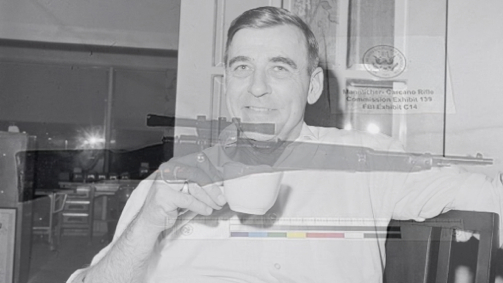
    Part of the official JFK assassination lore is that, on the night of April 10, 1963, accused assassin Lee Harvey Oswald took a bus close to the Dallas Turtle Creek neighborhood of General Edwin A. Walker, then a nationally prominent right-wing political activist and armed himself with his Mannlicher-Carano rifle. Oswald then walked to behind the Walker residence, on a service road, a type of back-alley. Walker was seated motionless behind a desk inside his home and facing a large first-floor window. Resting his rifle on a latticed fence about 30 yards away, Oswald took a potshot at his target at 9 pm.

    And missed. Entirely. The shot went over and wide of Walker’s head and into a wall. Walker, on surveying the latticed fence afterwards that evening with a lieutenant from the Dallas Police Department (DPD), remarked that the unknown would-be assassin was a “lousy shot.”

    A police officer reviewing the layout and shooting that night replied, “He couldn’t have missed you.”

    Official Version

    The above official version then posits that Oswald, after shooting and missing Walker, then “buried” his rifle somewhere and rode a bus back home, where he nervously related to his wife Marina details of his expedition.

    Importantly, also entered into the lore was that Oswald would have struck Walker, save for a windowpane that deflected his shot.

    This legend reached something of a zenith in the federally-funded Smithsonian magazine article on 2013. That article not only casually assumed Oswald’s guilt in the assassination of President Kennedy, but then described the shot that missed Walker thusly:

    Drawing a tight bead on Walker’s head, he (Oswald) pulls the trigger. An explosion hurtles through the night, a thunder that echoes to the alley, to the creek, to the church and the surrounding houses. Walker flinches instinctively at the loud blast and the sound of a wicked crack over his scalp—right inside his hair.[1]

    Thus, in the recounted mythology, the shot that missed Walker actually passed through the hair on the general’s head.

    The Dallas Morning News chimed-in in 2013 with a similar story—it was the 50th anniversary year of the JFK murder—that also blithely assumes Oswald’s guilt in both the Kennedy and Walker shootings and adds, “The bullet (fired at Walker) first hit the screen and then the wood frame between the upper and lower windowpanes. Its original path deflected, it passed just above Walker’s scalp.”[2]

    In other words, only a windowpane deflected the Oswald bullet and saved Walker’s life.

    In most regards, the popular-media version of the Walker shooting is actually the opposite of what really happened that night and is, perhaps unsurprisingly, another mythology regarding the JFK murder.

    The Real Story

    There are many reasons not to convict Oswald of either the Kennedy or Walker shootings in 1963. But first, let’s dispose of the dramatic media treatment of that night at General Walker’s and his close brush with death.

    First, Walker, a military veteran who had commanded special forces in combat in World War II, far from feeling a bullet through his scalp, actually initially told investigating officers from the Dallas Police Department that he thought neighborhood kids had tossed a firecracker into to his den through an open window.

    If that! For in a supplementary report filed on April 10, it was written that Walker “stated that when he heard the noise, he thought it was some sort of fireworks.” [3] Fireworks? Hearing fireworks is a far cry from the sensation of a bullet passing through one’s scalp. In truth, only after discovering and examining a bullet hole in the wall behind him, did Walker conclude he actually had been shot at—and so he related to the DPD.

    Secondly, a review of Dallas Police Department documents from the night of April 10 reveals whoever shot at Walker that night would have missed even more widely, save for the deflection downwards of the windowpane.


    Here is a photo of the Walker windowpane and the damage caused by the passing bullet. Obviously, the damage is on the lower edge of the crossbar of the wind plane and likely would have deflected the bullet lower.

    And that is how the Dallas Police Department (DPD) saw it.

    “Officers observed a bullet of unknown caliber, steel jacket, had been shot through the window, piercing the frame of the window and going into the wall above comp’s (Walker’s) head,” according to DPD report filed on April 10 (italics added).

    The report continues, “The bullet struck the window frame near center locking device. From the point where the bullet hit the window frame to the point where it struck the wall is a downward trajectory.”

    It is hard to escape the conclusion that whoever shot at Walker would have missed by even more, except for the deflection. The shooter missed Walker from a distance of about 30 yards, likely armed with a rifle resting on a fence for support.

    In addition, careful readers will also note that that the DPD found a “steel jacket” slug at the scene of the Walker shooting. Assassination researchers know, of course, that Oswald’s Mannlicher-Carcano used copper-jacketed ammo, from the Western Cartridge Company.

    One thing about police officers is that they tend to know guns and ammo and one might assume that the DPD assigned some of its better detectives to the Walker shooting, given his national prominence in 1963.

    But after the Kennedy murder, the DPD sent the steel-jacketed bullet—stated in police reports to be a 30.06 calibre—to the FBI. The federal agents said the mangled Walker slug was actually a 6.5 projectile from the Western Cartridge Company and copper-jacketed. In other words, a Mannlicher-Carcano bullet.

    In a more-innocent era, one might assume the DPD made a mistake—after all, mistakes happen. And the Walker bullet, in fact, was badly distorted after striking the windowpane and passing through a wall in the Walker residence.

    But since the 1960s, the profoundly dismaying history of CE 399, the “Magic Bullet,” has been revealed: the famed nearly pristine dome-headed slug was almost certainly introduced into the evidentiary record within the FBI facilities in Washington. The curious “pointy head” slug found on the Parkland hospital hallway floor Nov. 22 has disappeared and almost certainly had nothing to do with the JFK murder anyway.[4]

    So, with the true story of the Magic Bullet revealed, one reasonable concern is that the FBI also fabricated evidence in the Walker shooting, replacing a steel-jacketed projectile from Dallas with a copper-jacketed Winchester Cartridge 6.5 slug.

    Unfortunately, the records do not reveal why the DPD detective had concluded the Walker slug was steel-jacketed. If the detective had placed the slug on his desk next to a magnet, perhaps he would have noticed the Walker bullet wiggle. (Worth noting, steel-jacketed bullets can be copper coated, the softer metal copper applied to decrease wear-and-tear on gun barrels). In any event, the Walker projectile was originally logged as a steel-jacketed 30.06 slug.

    There is much more to that evening in April 1963; for example, outside Walker’s home at least two vehicles sped from the scene in the wake of the gunfire, as seen by multiple witnesses.

    Two Cars Leave the Scene

    Though hardly dispositive, an additional curiosity is that two automobiles were seen swiftly leaving the scene of the Walker shooting on April 10, in the immediate aftermath of gunfire.

    Hearing the Walker gunshot, a youth named Kirk Coleman immediately thereafter peered over a fence and “saw a man getting into a 1949 or 1950 Ford, light green or light blue and take off,” according to DPD report filed on April 11.

    “This was in the parking lot of the Church next to General Walker’s home. Also, on further down the parking lot was another car, unknown make or model and a man was in it. He had the dome light on and Kirk could see him bend over the front seat as if he was putting something in the back floorboard,” continued the report.

    General Walker also told the Warren Commission he saw a car suddenly leave the area, in the immediate aftermath of the shooting.

    Of course, Oswald is thought not to have had driving skills and certainly did not own a car. To be sure, the two cars could have left the Walker shooting scene suddenly as the sound of gunfire is disconcerting. But one might expect ordinary citizens hearing gunfire to report as much to police, yet the men in the vehicles have simply disappeared into that night, and evidently forever. No one has ever come forward and said they were innocent bystanders who drove away quickly on the night of the Walker shooting.

    So, perhaps the departing vehicles held Oswald and compatriots.

    The Dog That Did Not Bark

    A Walker neighbor’s dog, known as an active barker, was conveniently ill and silenced that evening.

    “The neighbor’s dog to the east of the Walker property is a fanatical barker, but on this incidence did not make a sound,” according to an April 12 DPD report.

    Concerning the dog, a neighbor told the DPD that, “Dr. Ruth Jackson, who lives next door to the General, has a dog that barks at everybody and everything. The night that this offense occurred Dr. Jackson’s dog did not bark at suspects. Investigating officers received further information…that Dr. Jackson’s dog was very sick yesterday [the date of shooting] and is also sick today. Reason for this illness is unknown at this time.” (emphasis added)

    Again, the report of conveniently sick dog is hardly dispositive. But if the dog was intentionally poisoned, it suggests an operation involving more than a lone nut who did not own a car.[5]

    The Walker Backyard Photo and Other Evidence

    And of course, one of the curiosities of the JFKA is the backyard black-and-white photo of Walker’s house, purportedly found in Oswald’s possessions after the JFK murder, featuring the infamous two-tone 1957 Chevrolet with its license plate mysteriously cut out.

    If the photo was truly in Oswald’s possession, it is certainly suggestive.

    In addition, Oswald’s wife, Marina, recounted discussions with her husband regarding the Walker shooting, although her testimony in the wake of the JFK assassination was regarded as unreliable, even by Warren Commission staff. In fact, Marina’s statements and testimony on nearly every topic, made under great duress, vacillated wildly on a daily basis.

    Finally, there is also the “Walker letter,” an unsigned page written in pencil and in the Russian language. The undated letter gives instructions to Marina concerning paying bills, a post office box, disposition of Oswald’s personal belongings, and where Oswald could be located in the event of his arrest. The letter is said to have been written shortly before the Walker shooting, though its origins are disputed.

    None of the above evidence is enough to convict Oswald, even if it is “real” and not fabricated. But assuming the evidence in Oswald’s possession is not planted, there is a strong suggestion that Oswald participated in the Walker shooting.

    An Explanation of the Walker Shooting

    The Warren Commission presented the Walker shooting as another version of Oswald as the leftie-loser-loner nut acting out a demented fantasy. Even the House Select Committee on Assassinations did little with the topic.[6]

    But for the purpose of this article, the Warren Commission treatment of Walker shooting is the interesting part.

    In truth, whoever shot at Walker either—

    1. Was a lousy shot, to put it mildly
    2. Intended to miss
    3. Had faulty firearms
    4. Possibly had compatriots

    None of above surfaces in the Warren Commission treatment of the Walker shooting.

    Indeed, the version that the “windowpane deflection likely saved Walker” is allowed to survive unchallenged in the Warren Commission version of events and grew in mass media literature over the years, as seen in the above quotes from the Smithsonian and Dallas Morning News.

    A Better Explanation

    My own interpretation is that Oswald was possibly the gunman who fired in the direction of Walker in April 1963, but that he had accomplices (hence the cars racing from the scene), he did not use a Mannlicher-Carcano rifle (hence the steel-jacketed bullet), and missed intentionally.

    But why such an exercise?

    Based on the research of scholar John Newman and HSCA investigator Dan Hardway, Oswald was an asset of sorts for US intelligence agencies, not exactly rare in the early 1960s, when the CIA literally had thousands of such individuals in the US or nearby as part of expansive anti-Fidel Castro efforts.

    Oswald, contend Hardway and Newman, was being primed for something, possibly for the JFK assassination or another event that could be blamed on Castro or pro-Castro types.

    It is my speculation that the Walker escapade was part of an Oswald biography-building exercise and to practice and test Oswald’s nerve for an intentionally unsuccessful assassination attempt of a prominent figure—such as President Kennedy—an attempt that could then be blamed on Castro.

    If Oswald could be made the patsy in such an event, such as the JFKA, the fallout could justify a major operation against the Cuban leader.

    If the Walker shooting was a test of Oswald, then evidently he passed.


    [1] Shultz, Colin “Before JFK, Lee Harvey Oswald Tried to Kill an Army Major General,” Smithsonian Magazine, October 4, 2013.

    [2] Peppard, Alan, “Before gunning for JFK, Oswald targeted ex-Gen. Edwin A. Walker — and missed,” The Dallas Morning News, November 19, 2018.

    [3]CE 2001 – Dallas Police Department file on the attempted killing of Gen. Edwin A. Walker,” Warren Commission, Volume XIV, (CD 81.1b).

    [4] Aguilar, Gary and Thompson, Josiah, “The Magic Bullet: Even More Magical Than We Knew?,” History Matters.

    [5] All police reports are found in Warren Commission Exhibit 2001.

    [6]The Attempt on the Life of Maj. Gen. Edwin A. Walker,” Warren Report, p. 284.

  • Doug Horne Replies: On Oswald’s Earnings

    Doug Horne Replies: On Oswald’s Earnings


    Here is what I can tell you. Please read most carefully and do not misquote me or even unintentionally misrepresent any of this information. Be most precise, I implore you.

    On September 18, 1997, I reviewed the payment records from both the TSBD and the USMC to Oswald, within the earnings records of the Social Security Administration. Roy Truly was not on the SSA name list of persons paid by the TSBD during the fourth quarter of 1963 (Oct-Dec 63). (I have no idea who was paying Truly; but clearly, on the day of the assassination, he was still acting as LHO’s supervisor, per his encounter of LHO with cop Marion Baker on the TSBD second floor.)

    The Marine Corps did NOT pay Oswald during the third quarter of 1959 (July 1–Sept 11, 1959). The specialist at the SSA told me that while Lee Harvey Oswald was IN the Marine Corps during the third quarter of 1959 (until September 11th, his discharge date), they definitely did not PAY HIM during the third quarter. I reviewed the printed records of the earnings he received from the USMC for that year—which had been stored on microfilm—and it was ZERO for the third quarter, whereas they did pay him for the first and second quarters of 1959. The ARRB’s contact at SSA said there was “no possibility of a mistake” in their records. I printed all of the microfilm records I reviewed on paper and took them back to the ARRB as assassination records.

    Now, as you know, Blakey wrote the draft JFK Act legislation. In it, he exempted both the autopsy materials (“All Deed of Gift” materials donated to the Archives) and “tax information” from the disclosure requirements of the Act. The IRS actually wanted all tax information on Oswald to be subject to the Act and to be released; Congress, erring on the side of privacy (like Blakey), refused to allow this in the Act. That is most unfortunate, because at this juncture, these detailed records that I reviewed can only be released if Section 6103 of the IRS Code is amended to permit their release.

    The Oswald earnings records I reviewed are covered by RIFs 137-10005-10060 through10089, inclusive. They are redacted unless or until Section 6103 of the IRS code is amended by Congress to permit all “tax information” (which definition includes not only tax returns, but also earnings records) to be released.

    I published a memo about all this on September 23, 1998, and all tax information and earnings records issues I was aware of are discussed therein. Its title was: “Questions Raised by John Armstrong and Carol Hewitt About Lee Harvey Oswald’s Tax and Earnings Records.” In that memo, all specifics about the microfilm records of LHO’s earnings that I reviewed on September 18, 1997, are REDACTED. The redactions cannot be unredacted unless or until Section 6103 of the IRS Code is amended by Congress to allow release of all “tax information” on LHO, Jack Ruby, and others identified by ARRB RIFs. (We looked at “tax information” for others besides LHO and they are all identified by RIFs, and all the details are redacted).

    Now, listen to this: in a Feb 3, 1964, letter to J. Lee Rankin from HEW, the Warren Commission was told that there were NO EARNINGS REPORTED for Oswald for the third quarter of 1959. This was initially withheld from the public for the standard privacy reasons surrounding “tax information,” but in 1965, the confidentiality classification for this information was removed by the USG. (See enclosure 13 to my long memo) That information passed to the Warren Commission in Feb 1964 is in CD 353 (the cover letter) and 353a (the specifics about when he earned money and from whom).

    Thus, when reviewing Oswald’s earnings records from the Marine Corps in September of 1997, I was simply confirming (by viewing the dollars and cents details) what the Warren Commission had been told by HEW in the Feb 3, 1964, letter, and for which the confidentiality had been removed in 1965. This means that in my oral statements in the documentary, I am simply confirming information that the WC learned about in Feb 1964, and which became open information in 1965 when the USG lifted its confidentiality.

    To obtain the unredacted version of my long research memo, and to get the RIFs about Oswald’s earnings opened up, Section 6103 of the IRS Code would have to be amended. I do not today have the paper copies of the earnings records. Only the Archives has those, as identified above by RIF numbers.

    Now, some of Oswald’s “tax information” is already open information, including his 1959 tax return, which shows his total earnings for 1959 to be $996.31 for that year. This would seem to indicate that SOMEONE paid him during the third quarter (because his earnings for quarters 1 and 2 are not that much money), but whichever entity paid him did not pay him very much, at all. SPECULATION: Perhaps it was what would have been his normal USMC salary, IN CASH???

    The Review Board recommended in its Final Report “…that Congress enact legislation exempting Lee Harvey Oswald’s tax return information, Oswald’s employment information obtained by the Social Security Administration, and other tax or IRS related information in the files of the Warren Commission and HSCA from the protection afforded by the Section 6103 of the Internal Revenue Code, and that such legislation direct that these records be released to the public in the JFK Collection.”

    That is all I am willing, or able, to say about this.

    In summary, I simply confirmed in my interview for your documentary that what the Warren Commission was told in Feb 1964—that Oswald had no reported earnings in the third quarter of 1959—was confirmed by me through careful examination of the microfilmed paper earnings records at SSA. For someone to actually view and review those records identified by RIF number above, the IRS Code would have to be amended.

    That is all I can say.

    Doug Horne

  • Bob Buzzanco: Chomsky’s “Useful Idiot”

    Bob Buzzanco: Chomsky’s “Useful Idiot”


    Robert Buzzanco is a history professor at the University of Houston. He is also a co-host—along with Scott Parkin—of a podcast called Green and Red. On January 12, 2022, Buzzanco had the 94-year-old Noam Chomsky—looking every year of his age—on his show to reply to the treatment of Vietnam in Oliver Stone’s documentary JFK Revisited: Through the Looking Glass. Chomsky could not help but make some general comments about Kennedy. In this regard, the linguist was his usual pompous and somewhat ludicrous self. At one point, he compared President Kennedy to Ronald Reagan and Donald Trump. If Chomsky can show us where either of the latter supported Medicare, universal healthcare, and equal rights for African Americans in the sixties, I would be curious to read about it, because Kennedy did all three. The program then slipped into Rocky Horror Picture Show low camp: Chomsky tried to parallel Kennedy’s success to the conditions existing in Germany in the twenties. I wish I was kidding, but I’m not. The only way there is any resemblance is that the assassinations of that decade—JFK, Malcolm X, King and Robert Kennedy—led to the election of Richard Nixon, the premature end of an era of hope and aspiration, and a continuance of the war in Vietnam. I wish I could add that Buzzanco pointed out these absurd exaggerations. He didn’t. (For more on Chomsky, click here and here)

    As the program went on, it became clear that Chomsky and Buzzanco had done zero research on the new evidence about the subject of Vietnam adduced by the Assassination Records Review Board (ARRB) and presented in JFK Revisited. The pair was largely relying on what Chomsky had written, if you can believe it, back in the nineties in response to Stone’s film JFK. The pair actually ended up being worse than the MSM on the subject.

    How? Because back in December of 1997, the Board declassified the records of the May 1963, SecDef meeting in Hawaii. This was a regular meeting that Secretary of Defense Robert McNamara had with representatives of each branch of the American government in Saigon: State, CIA, Pentagon, etc. Those declassified documents were so direct and compelling they convinced the New York Times and Philadelphia Inquirer that, at the time of his death, Kennedy was getting out of Vietnam. (Probe Magazine, Vol. 5 No. 3, p. 19) It should be noted that the NY Times story was written by MSM stalwart Tim Wiener. But yet, Chomsky was still using his old excuse that Kennedy was only getting out if Saigon was winning. This was ridiculously illogical back in the nineties, because, as John Newman pointed out in his book JFK and Vietnam, Kennedy understood that the Pentagon was rigging their numbers in order to make it appear Saigon was winning. Newman demonstrates this awareness in the book. He even named the two men who cooked the books: General Paul Harkins and Air Force Colonel Joseph Winterbottom. (pp. 185–245, 2017 edition)

    The thesis of Newman’s book is that Kennedy was going to use this optimistic information to hoist the Pentagon on their own petard. Revealing on this point is that Kennedy told McGeorge Bundy’s assistant Michael Forrestal that America had about a hundred to one chance of winning in Vietnam. He then said that when he returned from Dallas:

    I want to start a complete and very profound review of how we got into this country, what we thought we were doing, and what we now think we can do. I even want to think about whether or not we should be there. (James Douglass, JFK and the Unspeakable, p. 183)

    The other point that is important in this regard is that, after it became clear what JFK was doing—and also what the new president wanted—the intelligence reports began to change. They now became pessimistic and also backdated to early November, and even before. (Click here; see also The Third Decade Vol. 9 No. 6 pp. 8–10; Newman, 2017 edition, p. 438)

    Is not the point made with those two pieces of data? In fact, as historian Aaron Good has stated, when one combines the evidence, this “profound review” suggests the genesis of the Pentagon Papers. By 1967, it was fairly clear that President Johnson’s escalation and direct intervention was not going to work. Robert McNamara was still Secretary of Defense. Realizing that Johnson’s strategy of air and infantry escalation had failed, he had become quite emotionally disturbed. In 1966, fearing he was going to be attacked at Harvard, he escaped a hostile crowd through a tunnel. His son had draped a Viet Cong flag across his bedroom. He would rage against the war’s futility and then turn to the window and literally cry into the curtains. As his secretary said, that happened frequently. (Steve Sheinkin, Most Dangerous, p. 98, p. 121, p. 126) It’s a logical deduction that McNamara realized what had happened between Kennedy and Johnson and he was now expiating his guilt by exposing the secret history of the war through the Pentagon Papers, which is likely why he kept this 18-month effort a secret from Johnson. And he had no objection to Daniel Ellsberg giving the papers to, first, the New York Times and, then, the Washington Post.

    In fact, in JFK Revisited: Through the Looking Glass, Stone plays a tape from February of 1964 in which Johnson admits that Secretary of Defense Robert McNamara was implementing Kennedy’s withdrawal policy. Johnson states that he knew this and he stewed in silence, because as Vice President he could not do anything about it, at least at that time. Somehow both Chomsky and Buzzanco missed this.

    But that is not what I really wish to address here. On that podcast, near the end, Buzzanco implies that somehow, there was no information in the documentary about Lee Harvey Oswald that was not in the House Select Committee on Assassinations (HSCA) volumes. I could barely believe what I was hearing, but I really think he meant it. If that is so, then Buzzanco:

    1. Could not have read the HSCA volumes
    2. Did not pay any attention at all to the documentary.

    This from a man who pontificates to the listener that he knows what he is talking about and can be trusted to set the record straight.

    One will search in vain through the 12 volumes of the HSCA for any annex on Oswald’s relationship with the CIA and/or FBI at any time in his career. In the film, we have John Newman and Jeff Morley talking about this issue. To mention just four things they brought up that are not in those volumes:

    1. That the liaison for the HSCA with the CIA also secretly handled the Cuban exile who tried to frame Oswald after the assassination for killing Kennedy for Cuba.
    2. That the FBI scraped off the address of 544 Camp Street from the Oswald flyers before they were sent to HQ. That address housed the offices of Guy Banister and also the CIA-backed Cuban Revolutionary Council.
    3. The FBI took Oswald’s flash warning off his file in the first week of October 1963. This meant the Secret Service was unlikely to remove him from the motorcade route. That warning had been on the file for 4 years prior.
    4.  A similar thing occurred at CIA, in order to lower Oswald’s profile in advance of the assassination.

    In fact, one will only see the last point in the so called Lopez Report. This was the HSCA’s classified report on Oswald and Mexico City, which was only released by the ARRB, a body which Buzzanco refers to only in passing, discounting it as he does. The middle two points were also only discovered as a result of that Board’s work. So just what is Buzzanco talking about in regards to the HSCA? He clearly has not done his homework on the subject.

    In fact, the only systematic, direct work done on Oswald and the CIA by the HSCA was not declassified until after the Board went out of existence. This was in 2005. I am referring to the scintillating work of HSCA researcher Betsy Wolf and it was discovered by British researcher Malcolm Blunt. (I would like Buzzanco to prove to me he knew of either person before he opened up his mouth on the subject.) Back in 1977–78, Wolf was the main HSCA researcher on the Oswald file at CIA. She discovered that there were two odd things about this file. First, there was no 201 file opened on Oswald for 13 months after his defection, even though the CIA knew about the defection within days, and had accumulated many papers on the man in just one month.

    The second thing she discovered was that the documents on Oswald did not go to the place where they should have gone, namely the Soviet Russia Division. Instead, they went to the Office of Security, which, as Malcolm found out, almost guaranteed there would be no 201 file opened on him.

    These anomalies disturbed Wolf. She decided to interview officers in the CIA who would know about such matters. She discovered that there was an unofficial Agency rule which said, once there were five documents on a subject, a 201 file should be opened. This was clearly and blatantly disregarded in the Oswald case. But it was not until late in 1978, when the HSCA was about to close down, that she found her Holy Grail about the Oswald file and its weird path. At that time, she interviewed Robert Gambino, who was the present Chief of Security at CIA. He told her that it did not matter how many documents came in on a subject or if they were stamped to a certain division. If someone had already arranged with the Office of Mail Logistics, those papers would go to the agreed upon destination. (Click here for that information) I would like for Buzzanco to show me where Gambino’s information is located in the HSCA volumes. I think I will have a very long wait, since, from what I can see, Wolf’s memos were not typed into memoranda form.

    When one combines the above information with what JFK: Destiny Betrayed reveals about another ARRB discovery, then we learn much, much more about who Oswald was. The four-hour version of the film, released this month, has an interview with ARRB Military Records Analyst Doug Horne. He revealed to Stone that in Oswald’s last quarter in the Marines, he was not being paid by that organization, but likely by someone else. The combination of these two new important pieces of information—the bizarre file routing, and the source of funds—would all but clinch the fact that Oswald was an intelligence project before he left for Russia. Buzzanco will not find that information in the HSCA volumes.

    I won’t go into all the incredibly important data that Oliver Stone unveiled to millions of people around the world in his film and which directly impacts on the facts of Kennedy’s death. How else does one explain that CE 399, the Magic Bullet, got to FBI HQ before it was delivered there. But on top of that, the FBI declared that the agent who dropped it off placed his initials on that bullet. The film proves they are not there.

    The film all but proves that CE 399 was never fired in Dealey Plaza that day and would never be admitted into a court of law since, as Stone said on the Joe Rogan Show—in front of 2.5 million people—it has no chain of custody. Buzzanco and Chomsky ignored this key evidentiary issue, because, as David Mantik states in the film, in all previous inquiries CE 399 was foundational to the case against Oswald.

    As Doug Horne says in the two-hour version of the film, the official autopsy photographer John Stringer denied under oath that he took the pictures of Kennedy’s brain at the Archives. He did this on at least five grounds. The first two being that he never used the type of film utilized in the photos. Second, he never used the optical processing method to produce the photos, which was a press pack. (For more details see Horne’s Inside the ARRB Vol. 3, p. 810) With Stringer’s denial, these official autopsy photographs would not be admitted into court. And they also indicate, as we show in the film, that the brain in evidence today cannot be Kennedy’s. The fact this subterfuge took place at a military controlled medical center, with many generals and admirals in control, betrays a high-level conspiracy—without even dealing with the mysterious flight plan of General Curtis Le May that day, which is also described in the recently released long version of the film.

    How can men who attest to be leading intellectuals of the left do such incredibly sloppy and irresponsible work? This critique could have easily been twice as long as it is. And it would have been just as pungent and pointed. Buzzanco and Chomsky remind me of what psychologists term a folie a’ deux. It spiraled into a collapsing domino effect, since neither man made any attempt to check the other. There was never one ounce of effort placed on fact checking on matters they knew nothing about, which was a lot.

    This has always been my problem with what I call the doctrinaire/structuralist left. In an odd way, their aims meet the MSM; and the underpinnings of both are exposed as being built on quicksand, because they both value expedience over facts, but for different aims.

    Addendum: In another program one week later, Buzzanco apparently could not get anyone to interview him, so he had Parkin act as his line reader for what amounted to an Orwellian “60 Minutes Hate” against President Kennedy. Like Buzzanco with Chomsky, Parkin did not cross check his colleague once. Buzzanco did issue a debate challenge, which I accept, but not on his program, since that would help aid his viewership. He can contact me and we can arrange an agreed upon venue with an agreed upon agenda that follows the subject lines of JFK Revisited.

    I await his response.

  • JFK: Case Not Closed

    JFK: Case Not Closed


    Dave O’Brien wrote a book in 2017 entitled Through the Oswald Window. Unfortunately, for whatever reason, I missed that book and have not read it, but O’Brien brings up some of the points that he likely made in that book in his new effort entitled JFK: Case Not Closed. Four chapters of his new book were written by Johnny Cairns, who I consider one of the best of the new generation of JFK researchers.

    Early in this book, O’Brien brings up one of the points he likely made in his earlier book—and it’s a cogent one. Dave was once allowed access to the infamous “sniper’s window” at the Texas School Book Depository. Reflecting back on that visit, he asks two questions. If Oswald had really been at that window, why did he not shoot Kennedy as the president came down Houston Street? (p. 21) That was an unobstructed shot with the target right below him.

    He then goes onto a second issue. That particular window is at the southeast corner of the sixth floor. If we are to believe that Oswald was the lone assassin, was on that floor, and committed a premeditated murder, then there is another question that should be asked by anyone was has been on that floor. Why didn’t Oswald use the southwest window, at the opposite end. This would have solved more than one problem for the alleged killer:

    1. The oak tree would be removed as an obstruction.
    2. Kennedy would have been right below him.
    3. He would have had clear access to the target the whole time.
    4. He had a more direct and quicker escape from that floor.

    If one buys into the Warren Report, the alleged murderer had days to plan his crime. But he never figured on any of these circumstances? In spite of all these mitigating factors, as O’Brien writes:

    Yet, he chose the southeast corner window and allowed the left-hand turn onto Elm Street knowing that the fully-blossomed Oak Tree protected his target for valuable seconds, and that once clear of the foliage, his target was mere seconds from safety under the bridge just yards away. Why? (p. 21)

    As O’Brien writes, it is inexplicable that the Warren Commission never even considered this as part of their inquiry into Kennedy’s assassination. But any new formal inquiry should do so. Because it strongly indicates that Oswald was not what the Warren Report said he was. The idea of a reopening of the Kennedy case is a strong theme featured in the book. (p. 22)

    II

    From here, O’Brien notes another oddity. At Zapruder frame 312, right before the fatal headshot, JFK’s head is right next to Jackie’s. In fact, in the photo he shows on page 42, she is leaning so far over to his side of the seat that their heads are almost touching. But as the author notes, in the next split second, three things will happen that seriously undermine the official story which says Oswald shot Kennedy from behind. First, Kennedy’s head and body go backward, crashing off the back seat. Second, Jackie Kennedy reaches onto the trunk of the car attempting to retrieve a part of her husband’s skull, which is visible there. Third, motorcycle officer Billy Hargis, riding to the left and behind Kennedy’s limousine, is splattered with blood and tissue—and with such force that he momentarily thought he was hit. (pp. 42–45; 187–93). How could all three of these events occur in that short of an interval if the official story was correct? Do they not all betray a shot from the front? (And in arguing for a front shot, O’Brien mounts one more telling argument against the so-called neuromuscular reaction, see p. 46)

    Chapters 4–7 of the book were composed by Johnny Cairns. As anyone who has been exposed to his writing will automatically understand, they are first-class. They strike the Warren Report at the points where it is supposed to be strongest: the physical evidence against Oswald.

    In taking up the case of Oswald ordering the rifle, Johnny asks: if the FBI was monitoring the publications Oswald was getting through the post office—and they were—how could they not know he was also in receipt of a rifle and handgun? (pp. 60–66) Also, how could Oswald have sent a money order to Chicago on March 12th by 10:30am when his timecards from his place of employment say he was at work? And he did not have a lunch break until almost two hours later. (p. 67) He also brings up this point: if Oswald knew he was going to order a murder weapon delivered to a post office box, why utilize a box which he had signed for? Why not take out a box in the name of the alias he used to order the rifle, namely Hidell? (pp. 72–73)

    Johnny then goes through all the mechanical problems that the authorities had with the particular rifle found on the sixth floor of the Texas School Book Depository. They had to fit the weapon with two shims, since the sighting was off both in elevation and azimuth. Then there was a difficulty in opening the bolt, plus the trigger was a two stage operation: at first it was easy, then it required more an exertion of pressure to pull. (p. 76) Any of these, of course, would have pretty much eliminated that rifle as the murder weapon. What makes it worse is that the men who worked with the rifle once the Warren Commission got it were far more skilled with weapons than Oswald. These were FBI agents and master marksmen from the military. Johnny bases this evidence on the testimony of FBI expert Robert Frazier and weapons evaluation expert Ronald Simmons of the army. In addition, Frazier admitted that the actual scope mechanism was off. As they fired consecutive shots, the impact point got further and further away from the target. (p. 77; see also Michael Benson, Who’s Who in the JFK Assassination, p. 420; Mark Lane, Rush to Judgment, p. 127)

    From here, Cairns goes on to the question of assembling the rifle. As most of us know, even if we grant the Commission’s thesis that Oswald carried the rifle to work that day in a bag, that particular bag was too short to accommodate a fully assembled Mannlicher Carcano 6.5 mm rifle. There was no screwdriver found on the sixth floor of the depository. The FBI said that they could assemble the rifle with a coin in six minutes. The late British police inspector Ian Griggs said this was poppycock. He said, in a hopeless endeavor, he ended up with blood blisters and a cut on his right thumb before he gave up. In his opinion, one had to use a screwdriver and with that it would take about two minutes. A screwdriver was needed for the simple reason that there are 16 parts to the rifle and the Warren Commission tried to conceal this with their pictorial Commission Exhibit 1304. (Click here for how)

    All this leaves this important question: When and where did Oswald assemble the rifle?

    Cairns asks the logical questions about the ammunition: Why could the FBI find no evidence that Oswald purchased it? (p. 87) Also, using as his authority Henry Hurt, Cairns shows that Oswald’s Marine buddies thought he was a joke as a marksman. And Hurt talked to fifty servicemen who knew Oswald. (pp. 93–94) Further, using sniper Craig Roberts as his correspondent, the great Carlos Hathcock said that his SWAT team—replicating the true conditions in Dealey Plaza—could not duplicate what Oswald did, and they tried more than once. To this reviewer that, in and of itself, would eliminate Oswald as a suspect, because Hathcock was the greatest American sniper of the Vietnam War. (p. 96) And contrary to what some Commission zealots say, to this day, Roberts stands by what he wrote about Hathcock.

    In this same rigorous and systematic manner, Cairns then proceeds through the fingerprint evidence, the case that the alleged bag Oswald carried was fabricated after the assassination, the dubious police line ups Oswald was picked out of, the horrendous chain of custody for the shells found on the sixth floor—including the evidence that one of them could not have been fired that day—and probably the biggest liability in the entire Warren Report, namely the sorry, sorry case of Commission Exhibit 399, the infamous Magic Bullet. Cairns does a convincing and praiseworthy job on all of these topics and more, for example the PSE examination done on Oswald by author George O’Toole in his valuable book The Assassination Tapes.

    III

    Like Josiah Thompson in Last Second in Dallas, O’Brien writes that the pathologists did not know about Kennedy’s anterior neck wound the night of the autopsy. (p. 202) As the film JFK Revisited shows through nurse Audrey Bell, this is not accurate. But due to some nice detective work by Rob Couteau, we know this is false from Dr. Malcolm Perry himself. (Click here for details)

    O’Brien is on more solid ground when he writes that Dr. Jim Humes burned his notes (he could have added the first draft of his autopsy report also). And this perhaps allowed him to move up the posterior back wound, which at autopsy was determined to come in about six inches below the collar and not exited. Now, through some manufactured evidence, the Warren Report made it negotiable with what was depicted as an exit wound through the throat. (p. 203) But that was not all. As forensic pathologist Cyril Wecht notes in JFK Revisited, by the spring of 1964, attorney Arlen Specter had now enlivened that wound track to include five wounds in Governor John Connally also.

    O’Brien notes that medical illustrator Harold Rydberg was the artist who illustrated Commission Exhibit 385. Rydberg was essentially snookered by Humes and Dr. Boswell into drawing a trajectory through Kennedy’s body that would fit this alteration. (p. 208) And here, the book brings in a telling piece of testimony. Secret Service agent Clint Hill did not just see the rear skull wound in Kennedy. He also testified to Commissioner Hale Boggs, “I saw an opening in the back about six inches below the neckline to the right hand side of the spinal column.” (p. 209) Hill’s testimony corresponded with the holes in Kennedy’s shirt and jacket. As Vince Palamara shows with pictures from the front of Kennedy’s suit jacket, the jacket was likely not bunched up, since the bullet exit inside the back of the jacket matches up with the bullet entrance on the outside. (Palamara, Honest Answers, p. 21) This evidence corresponds to what was the likely first conclusion by the pathologists: the back wound did not transit Kennedy’s body.

    O’Brien makes another controversial statement in Chapter 11. He says that if the Altgens photo is located at Zapruder film 225–230, then Kennedy could not have been hit by that time. He did an experiment which showed that the projectile would have had to have been fired through the branches of the oak tree. (O’Brien, p. 220) This may or may not be true. But it would seem to disagree with the pictures in the Warren Report which show the line of sight through the tree and how it is completely clear of the branches by frame 225. (WR, p. 103) This issue is also touched upon by Josiah Thompson in his first book on the Kennedy case, Six Seconds in Dallas. (p. 35) I wish O’Brien had made reference to these seemingly contradictory views and attempted to reconcile them.

    In Chapters 12–14, O’Brien returns to the subject of Kennedy’s autopsy. He again notes that Humes did not call Parkland during the night. (p. 234) And he also notes how the Sibert/O’Neill report differs from the official autopsy report. For instance, the FBI report does not have the back wound transiting the body. (p. 239)

    He next deals with the House Select Committee on Assassinations (HSCA) medical report which covered up the evidence for a baseball sized hole in the back of Kennedy’s head. He further notes that this evidence—largely from the witnesses at Bethesda, but matching many of the witnesses from Parkland—appears to have been concealed from the experts on the HSCA medical panel, for example Cyril Wecht and Michael Baden. Those two men both denied looking at such reports when confronted with this declassified evidence by Dr. Gary Aguilar. (p. 258) This evidence matches what the earliest witnesses, like Clint Hill, said he saw about the hole in the rear of Kennedy’s skull. (p. 263)

    IV

    O’Brien makes a telling observation about Harold Rydberg and Ida Dox. Dox was the professional illustrator for the HSCA. She was largely guided by Dr. Michael Baden in what she was drawing, which roughly parallels what Humes and Boswell did with Rydberg. (p. 271) Consequently, the Dox drawings fail to show the blow out to the back of the skull that over 40 witnesses saw in Dallas and at Bethesda. But not only that, Dox was told by Baden to exaggerate the cratering effect at the cowlick area of Kennedy’s skull in order to make it look more like a wound of entry. This partly allowed the HSCA to raise the fatal head wound form low to high in the rear skull. Baden actually left declassified notes about this which were discovered by Dr. Randy Robertson. (pp. 274–75). There will be much more about this illicit relationship between Dox and Baden in Tim Smith’s upcoming book about the HSCA.

    O’Brien closes out the book by pointing out some of the familiar problems with the Commission’s chief witness to Oswald being on the sixth floor, namely Howard Brennan. And he opposes that sighting with witnesses like Carolyn Arnold who said she saw Oswald on the first floor mere minutes before the assassination. (p. 281) Twenty-one police officers heard shots from in front of the limousine. Several saw smoke arising from the knoll area. He then notes how the FBI and the Commission cajoled witnesses they considered helpful to their case and argued with those they considered problematic to their verdict. Carolyn Walther and Ruby Henderson were two witnesses who said they saw two men on one of the upper floors of the Depository, and one of them was armed. (p. 285) Neither of these witnesses testified before the Commission. In fact, Walther said:

    The FBI tried to make me think that what I saw were boxes. They were going to set out to prove me a liar and I had no intention of arguing with them and being harassed. (p. 285)

    The book ends with the hope for how new technology can open up areas of the Kennedy case that have been closed before. O’Brien discusses the optical densitometry readings of Dr. David Mantik and their use in showing the problems with Kennedy’s x-rays. He also suggests full body CT scans. (p. 315) He concludes with the long awaited 3D imaging attempts of John Orr and Larry Schnapf, which I understand are finally getting close to fruition. (pp. 318–19)

    The last part of the book includes an appendix in which well respected writers on the case suggest ways that it could be reinvestigated, for example Robert Kennedy Jr., Pat Speer, and Cyril Wecht. Some methods brought forth are by using a special prosecutor or a large panel of forensic experts or an ARRB type panel except with investigative powers.

    I could point out other areas of disagreement—as with Geraldine Reid—but all in all, Doug and Johnny have written a creditable book that is worth reading.

  • The Overthrow Attempt of 1934

    The Overthrow Attempt of 1934


    Was there really a businessman’s plot to overthrow Franklin Roosevelt’s government in 1934? Jonathan M. Katz in his new book Gangsters of Capitalism: Smedley Butler, the Marines, and the Making and Breaking of America’s Empire isn’t sure.

    He begins his book with a meeting, allegedly between retired US Marine General Smedley Butler and a prominent Wall Street Stock power broker. It actually starts in 1933. Gerald C. MacGuire, a representative of a prominent Wall Street brokerage house, starts trying to recruit Smedley Butler. He wants Butler to speak against Franklin D. Roosevelt and his policy of taking the dollar off the gold standard at an American Legion conference in Chicago, but it broadens from there. And by 1934, MacGuire is sending Butler postcards from the French Riviera, where he’s just arrived from fascist Italy, and also Berlin. Then he comes to Butler’s hometown of Philadelphia and asks him to lead a column of half a million World War I veterans up Pennsylvania Avenue for the purpose of intimidating FDR into either resigning outright or handing off all his executive powers to an all-powerful, unelected cabinet secretary who the plotters backing MacGuire were going to name.

    Butler was a celebrated US Marine general having had experience on multiple battlefields from 1898 to the 1920s. In the summer of 1932, while the depression was deepening, he led a group of thousands of World War I veterans in a march on Washington to demand they be given access to their promised World War I pensions. It is for these reasons that the plotters chose Butler to lead the revolt.

    The coup plotters included the head of General Motors Alfred P. Sloan, as well as J.P. Morgan Jr. and the former president of DuPont, Irénée du Pont, and probably Gerald MacGuire’s boss, Wall Street luminary Grayson Murphy. The group asked the celebrated Marine Corps officer Smedley Butler to lead a military coup. But Butler refused and revealed what he knew to members of Congress.

    This is a portion of General Smedley Butler speaking before the committee in 1934:

    I appeared before the congressional committee, the highest representation of the American people, under subpoena to tell what I knew of activities which I believed might lead to an attempt to set up a fascist dictatorship.

    The plan, as outlined to me, was to form an organization of veterans to use as a bluff, or as a club at least, to intimidate the government and break down democratic institutions. The upshot of the whole thing was that I was supposed to lead an organization of 500,000 men which would be able to take over the functions of government.

    I talked with an investigator for this committee who came to me with a subpoena on Sunday, November 18. He told me they had unearthed evidence linking my name with several such veteran organizations. As it then seemed to me to be getting serious, I felt it was my duty to tell all I knew of such activities to this committee.

    My main interest in all this is to preserve our democratic institutions. I want to retain the right to vote, the right to speak freely, and the right to write. If we maintain these basic principles, our democracy is safe. No dictatorship can exist with suffrage, freedom of speech and press.

    From that point on, Katz takes us on an extended tour of all the places where Smedly Butler helped to build the American Empire. From his first action as a raw volunteer in the Spanish American War through his two tours of duty in China, to his aid in the Panamanian revolution that resulted in the establishment of an independent nation of Panama which was submissive to the US desire to build a canal, to his aid in crushing rebellions in the Philippines, Haiti, The Dominican Republic and Mexico, Katz extensively catalogues the rise and exploitation of the American Empire.

    Katz actually visited many of the places Butler served. And he combines interviews with historians of the various countries along with personal papers of Butler and many prominent businessmen to paint a rather ugly picture of the conquest, establishment, and development of the American Empire.

    For Kennedys and King website visitors, two groups that keep popping up during the extensive cataloguing of the events described in the book are Sullivan Cromwell and Brown Brothers Harriman. These two business entities were involved in many of the enterprises in Latin America described in the book. As Kennedys and King visitors recognize, these two entities are often linked as possible high-level orchestrators of the JFK assassination.

    Sullivan and Cromwell was associated with the Dulles Brothers: John Foster, Secretary of State Under President Dwight Eisenhower, and his brother Allen, the notorious CIADirector from 1953–1962, who was fired by JFK after the abortive Bay of Pigs invasion.

    Brown Brothers Harriman was associated with the Bush family—namely Prescott Bush. Prescott was heavily involved with investments in Nazi Germany prior to World War II. He was so involved with the Nazis that there was a separate investigation by the same committee that investigated the Butler accusations in the late 1930’s, which was a precursor to the House Un-American Activities Committee. Some documentaries confuse the two investigations. (Apparently the documents associated with these two separate investigations both reside in the same area of the National Archives.) But Katz insists that Butler never mentions Prescott Bush as a conspirator in the 1934 plot.

    As for the specifics of the plot, MacGuire told Butler at one of their early meetings in 1934 that very soon, a group identified as ‘The Liberty League’, involving some of the people earlier mentioned (Murphy, duPont, Sloan, etc.) were going to go public with an organization that would stand openly in opposition to FDR’s New Deal programs and agenda. A few weeks later, The New York Times published a front-page article declaring the emergence of The Liberty League which not only featured some of the businessmen, but also used two anti-New Deal Democrats and former Presidential candidates, John W. Davis and Al Smith, as front-men.

    The reason why we don’t know more about this plot is because the congressional committee that Butler testified in front of, which was headed by John W. McCormack—who went on to become the longtime speaker of the House—and Samuel Dickstein, who was a Democrat of New York, cut their investigation short. The only people who testified were Butler, a newspaper reporter who Butler had enlisted in sort of an independent investigation, Gerry MacGuire, and the lawyer for one of the minor players in the industrialists’ plot, the heir to the Singer sewing machine fortune. Absent that more detailed investigation, Katz isn’t willing to state definitely the extent to which the du Ponts, Sloan, Murphy, and the others were actually involved in the planning of the business plot. They may have been deeply involved and just stopped planning once Butler ratted them out. It’s possible that Grayson Murphy—MacGuire’s boss—hadn’t got them involved yet. Katz isn’t willing to say.

    Interestingly enough, the media reaction was quite similar to the more recent response to the 1960s assassination conspiracy research. The business community Butler accused tried to laugh Butler off and used The New York Times, Time Magazine, Henry Ford II’s Dearborn Examiner and other prominent media outlets of the time to debunk Butler’s testimony.

    Time Magazine owned by billionaire Henry Luce ran a satirical piece mocking Butler. The New York Times ran a mocking unsigned editorial strongly condemning Butler. While this limited investigation was able to verify all major statements made by Butler, and the few witnesses who testified, again, the mainstream media gave it little publicity—soft peddling it and spending little time on the summary and final analysis of the final congressional sub-committee report. (Sound familiar readers? How about that Assassination Records Review Board report? Who extensively reported on it in the 1990s?) But for all the discounting and snideness, the McCormack/Dickstein report included the following:

    In the last few weeks of the committee’s official life, it received evidence showing that certain persons had made an attempt to establish a fascist organization in this country…There is no question that these attempts were discussed, were planned, and might have been placed in execution when and if the financial backers deemed it expedient.

    Katz sees definite parallels to the January 6, 2021, insurrection in Washington. He points out how MacGuire—the contact person for Butler—had been influenced by a fascist insurrection in Paris a few weeks before his association with Butler. A group called ‘The Fiery Cross’ lead an insurrection to prevent a center left, social democratic party from taking power in France. Using conspiracy theories about fixed elections and the suicide of a rightist leader who they claim was murdered combined with an unhealthy dose of antisemitism, this motley coalition of far right groups stormed the parliament and were almost successful before being suppressed by the authorities. It is that kind of Putsch that MacGuire and his associates hoped could be successful in the United States.

    I found this book a very interesting and enlightening read and believe it may have been an earlier precursor to the assassinations of the 1960s as well as a parallel to the January 6th insurgency of 2021.

  • Jim DiEugenio Live March 22nd


    Renowned author, researcher, and publisher Jim DiEugenio, one of the leading experts on the assassination of President John Kennedy is coming to the University of Antelope Valley. Jim will be appearing in the Grand Ballroom on Tuesday, March 22nd at 10am. He will present his case and explain what happened on November 22, 1963, the day that changed America forever.

    Students, faculty, and community members are invited to attend. The event is free.

    Jim is the author of several ground-breaking books including Destiny Betrayed, and The JFK Assassination. He was also the publisher of Probe Magazine. Jim has been a special consultant to Oliver Stone having written the script for the famed movie producer’s new documentary—JFK Revisited.

    Please come and hear Jim’s compelling presentation about what truly was “The crime of the century.”