Blog

  • A Review of Oliver Stone’s JFK: Destiny Betrayed

    A Review of Oliver Stone’s JFK: Destiny Betrayed


    For A Review of Oliver Stone’s JFK: Destiny Betrayed (Chapter 1) click here.

    For A Review of Oliver Stone’s JFK: Destiny Betrayed (Chapter 2) click here.

    For A Review of Oliver Stone’s JFK: Destiny Betrayed (Chapter 3) click here.

    For A Review of Oliver Stone’s JFK: Destiny Betrayed (Chapter 4) click here.

  • Carol Hewett, Steve Jones, and Barbara La Monica Dissect the Paines

    Carol Hewett, Steve Jones, and Barbara La Monica Dissect the Paines


    From the May-June 1996 issue (Vol. 3 No. 4) of Probe


    (Click here if your browser is having trouble loading the above.)


    From the July-August 1996 issue (Vol. 3 No. 5) of Probe


    (Click here if your browser is having trouble loading the above.)


    From the November-December 1996 issue (Vol. 4 No. 1) of Probe


    (Click here if your browser is having trouble loading the above.)


    From the March-April 1997 issue (Vol. 4 No. 3) of Probe


    (Click here if your browser is having trouble loading the above.)


    From the November-December 1997 issue (Vol. 5 No. 1) of Probe


    (Click here if your browser is having trouble loading the above.)


    From the March-April 1998 issue (Vol. 5 No. 3) of Probe


    (Click here if your browser is having trouble loading the above.)


    From the July-August 1998 issue (Vol. 5 No. 5) of Probe


    (Click here if your browser is having trouble loading the above.)


    From the March-April 2000 issue (Vol. 7 No. 3) of Probe


    (Click here if your browser is having trouble loading the above.)


  • The Assassination and Mrs. Paine (Part 1)

    The Assassination and Mrs. Paine (Part 1)


    Film-maker Max Good has spent several years working on a film about Ruth and Michael Paine and what their precise relationship was to the assassination of President John Kennedy. Although I have some reservations about it, it is worth watching and I encourage our readers to do so.

    One of the most puzzling aspects about it is this: Why did it take almost 60 years for anyone to make a film on such a rich, relevant, and interesting topic? Perhaps because there are no references to either Paine in the indexes of Harold Weisberg’s book Whitewash, Edward Epstein’s Inquest, or Josiah Thompson’s Six Seconds in Dallas.

    Of the first generation of critics, Sylvia Meagher’s book devotes by far the most pages to the Paines. Perhaps, we should quote her overall impression of Ruth Paine in order to place Max’s film in perspective:

    Ruth Paine…is a complex personality, despite her rather passive façade…Some examples from her testimony show a predisposition against Oswald and a real or pretended friendliness toward the FBI and other Establishment institutions, which should not be overlooked in evaluating her role in the case…Mrs. Paine is sometimes a devious person, and her testimony must be evaluated in that light. (Meagher, Accessories After the Fact, p. 217)

    But it was really Jim Garrison who first tried to place the Paines under the microscope. For example, he was interested in the family ties of Ruth, specifically who her sister Sylvia worked for. In fact, he questioned Ruth about this point during Ruth’s appearance before the New Orleans grand jury. To put it mildly, Ruth replied in a rather non-responsive manner, a point we shall examine later.

    Ruth and Michael Paine spent, by far, the most time on the witness stand for the Warren Commission. According to Walt Brown, the combined total questions they answered was over six thousand. In fact, Ruth was so eager to answer questions, she even volunteered areas of examination that she thought the Commission had bypassed. For instance, as Albert Jenner was about to close his questioning of her on March 21, 1964, Ruth interjected with:

    Ruth: You have not asked me yet if I had seen anything of a note purported to be written by Lee at the time of the attempt on Walker. And I might just recount for you that, if it is of any importance…

    Jenner: Yes, I wish you would…Tell me all you know about it. (WC Vol. 9, pp. 393­–94)

    As we shall see, a major problem with the Paines is this: they surfaced evidence of things Oswald did which were in fact, dubious acts. One would be the supposed Walker shooting, another would be Oswald’s alleged journey to Mexico City. Looked at with the perspective, we have today—after the work of the Assassination Records Review Board (ARRB)—the implicative nature of these events is rendered suspect. Therefore, the fact that the Paines were part of finding evidence that incriminated Oswald—in events that perhaps did not occur—this should merit some notice. In fact, 5 days after she delivered the Walker Note to the Secret Service—in Marina Oswald’s book—Ruth was visited by two Secret Service agents. They were actually returning her the note, since they thought it was from her. (James DiEugenio, Destiny Betrayed, second edition, p. 203)

    It is surprising to juxtapose the star billing the Commission gave the Paines with the fact that neither the House Select Committee on Assassinations (HSCA) nor the ARRB called them in for questioning. It is, perhaps, a bit disturbing. For during and after the days of the ARRB, a whole wave of information created a new data plateau on the Paines. The parties who were largely responsible for this new information were author George Michael Evica and researchers Carol Hewett, Barbara La Monica, and Steve Jones. Evica wrote a book, A Certain Arrogance, which dealt with the Paines and their religious background. Before that, Hewett, LaMonica, and Jones wrote a series of essays on the couple for Probe magazine. We will be referring to both in this review.

    II

    The way this reviewer got involved with the matter was that I was the publisher of Probe magazine when Hewett, LaMonica, and Jones wrote their essays. I thought their work was new and interesting. Author Thomas Mallon was so dismayed by their work that he wrote a book contesting it. (Mrs. Paine’s Garage, 2002) The writing trio began their series with a truism: “Ruth and Michael Paine…are among the most significant, yet least studied, of the figures surrounding the Kennedy assassination.” (Probe, Vol. 3 No. 4 p. 14) After reading their work, this was an understatement. The three were responsible for a set of eight essays which one can reference on this site.

    A provocative point Carol conveyed dealt with Ruth’s so-called discovery of Lee Oswald’s letter to the Russian embassy, which he wrote at her home over Memorial Day weekend, 1963. In her testimony before the Commission, Ruth tried to explain why she took the rather remarkable step of picking the letter up, hand copying it, and eventually giving it to the FBI. She said that as she glanced at the letter, the first sentence contained a lie and she was insulted by Oswald using her typewriter to do such a thing. But if one buys the official story, which Ruth does, the first line of the letter, about Oswald visiting a Russian diplomat in Mexico City, was not a lie. Commission lawyer Albert Jenner understood that this made for a serious problem. He (wisely) decided to go off the record. Jenner knew they had to patch over Ruth’s story. (Probe, Vol. 4 No. 3, p. 17)

    Throughout that series, the authors exposed things like this to the light of day. One more example will suffice. There had always been a question as to why the relationship between Ruth and Marina Oswald ended after the assassination. When Marina testified before the New Orleans Grand Jury, she addressed this. As we know, Marina was detained by the Secret Service for weeks afterwards. She told the jury, “I was advised by the Secret Service not to be connected with her (Ruth Paine)…She was sympathizing with the CIA.” When assistant Andrew Sciambra pursued that line, he asked her, “In other words, you were left with the distinct impression that she was in some way connected to the CIA?” The one word reply was, “Yes.” (Probe Vol. 7 No. 3, p. 3) Was this the reason the Secret Service returned the so-called Walker Note to Ruth? (James DiEugenio, Destiny Betrayed, second edition, p. 203)

    The separation of Ruth from Marina after Kennedy’s murder is a good way to introduce one of the most intriguing and compelling aspects of Max Good’s film. Because as we know, prior to Ruth Paine becoming so inseparable from Marina, the person who escorted the Oswalds around Dallas/Fort Worth was George DeMohrenschildt. As Max asks Ruth in the film: Why would a White Russian be so interested in a Communist? Ruth replies that this is a good question.

    We actually know why. Near the end of his life, DeMohrenschildt stated that, on his own, he would have never come near the Oswalds. J. Walton Moore, chief of the CIA station in Dallas, asked him to do so. (DiEugenio, p. 194) George, sometimes called the Baron, arranged a gathering of the White Russian community with the Oswalds in late February of 1963. From that gathering, Ruth arranged a one-on-one meeting with Marina. Approximately three weeks after that meeting, April 7th, Ruth composed a letter asking Marina to move in with her. Kind of fast? (Probe, Vol. 5 No. 1, p. 14)

    As described in the film by myself and Peter Scott, around this time, George left for Haiti, had a briefing in the DC area with the CIA and military intelligence, and then had about $300,000 deposited into his account. (James Douglass, JFK and the Unspeakable, p. 168) As I ask in the film: Was this for services rendered? We will never know, since after he was subpoenaed by the HSCA, the Baron was either killed or took his own life by shotgun blast.

    One of the strongest parts of the film is the segue from DeMohrenschildt to Priscilla Johnson. Because after the (likely) forced cut off between Ruth and Marina, Johnson entered the picture—and she stayed there for a long time, like 13 years. Priscilla always denied she was with the CIA. She even threatened to sue Jerry Policoff over this. It’s a good thing she did not, because as Max shows in the film, the ARRB pretty much sealed the deal on her. He shows the documents which categorize her as a “witting collaborator,” meaning that she did not need to be employed by them; they could rely on her to write sympathetic stories anyway. (See also, John Armstrong, Harvey and Lee, pp. 279–82)

    As the film shows, you have one CIA asset—the Baron—escorting the Oswalds around Dallas/Fort Worth upon their return from the USSR. You had another—Johnson—picking up Marina after the assassination and becoming her personal escort. And when Priscilla finally wrote her book about the Oswalds, Marina and Lee, it completely backed the Warren Report.

    In the interim, you had Ruth and Michael Paine. Further, both Ruth and Priscilla were producing evidence Oswald was in Mexico City, when, in fact, Marina initially insisted to the Secret Service he was not. (DiEugenio, p. 203; Armstrong, p. 696, Secret Service report of Charles Kunkel, 12/3/63) And many researchers today—including the authors of the HSCA’s Mexico City Report—agree he wasn’t.

    The film makes this point about parallels rather subtly; I have made it more bluntly.

    III

    Although it is not part of his ostensible subject, Good does a nice job in penciling in the background to his story: namely the presidency of John Kennedy. As many have, he notes that some of JFK’s policies fostered opposition from people in high places, for example the Bay of Pigs and the Missile Crisis. But people like the Paines and Priscilla Johnson have always used the old standby that, for those examining the case, it is hard to accept that a little man like Oswald could single handedly erase a great figure like Kennedy. The subtext being that this is what fulfilled Oswald as a large figure in history, for example Michael voices this mantra early in the narrative. But if that was so, then why did Oswald never claim credit for the assassination? On the contrary, as the film shows, he loudly stated he was a patsy.

    At this point, Ruth says that the Warren Report always made sense to her. Priscilla tops this with an astonishing comment: she says that conspiracy theories have done more damage to the country than the death of JFK did. In the film, it is made clear that when the police arrived at the Paine household, looked for a weapon, and did not find one in the rolled up blanket Marina thought it was in, this shocked Mrs. Paine. It started her down the road to incriminating Oswald in the press.

    But it was Ruth who picked up Marina from New Orleans, packed the car, and drove her to Irving to stay with her, thus now accomplishing what she was trying to do since April. If there was a rifle amid the belongings, why did neither she nor her husband notice it while packing and then unpacking the station wagon? They missed it twice?

    One of the valuable contributions the film makes is the outlining of the curious family ties that the Paines had. (For a good summary see Evica, pp. 364–65) As noted, Ruth’s father, William Avery Hyde, and her brother-in-law, John Hoke, worked for US AID, which was closely tied to the CIA. As Greg Parker discovered, her sister, Sylvia Hyde Hoke, worked on a joint CIA/Air Force project. (Lee Harvey Oswald’s Cold War, pp. 266–68) One of the most pungent moments in the film is when Max calls Sylvia and asks for an interview. She instantly hangs up on him. Michael Paine’s mother, Ruth Forbes Young, was best of friends with Mary Bancroft. Bancroft was both an agent and girlfriend of CIA Director Allen Dulles. As author Bill Simpich notes in the film: could Mary have noted to Allen the utility of the Quaker/ Unitarian couple in performing surveillance duties on the left?

    In fact, this is the theme of Evica’s book: how Allen Dulles used these religious groups—Quakers and Unitarians—for espionage work, for example Noel Field. And Bancroft knew about this. (Evica, p. 116) Evica ended his book by suggesting that Allen Dulles may have helped secure for the Paines a sterling character recommendation from a wealthy couple at the beginning of the FBI’s inquiry into the JFK murder. This was from Frederick Osborne Jr. and his wife Nancy. (A Certain Arrogance, pp. 250–58) Allen had worked with Frederick’s father in the National Committee for a Free Europe and also in the CIA’s Crusade for Freedom. And there are examples of surveillance activities by the couple.

    Sue Wheaton appears in the film. She met Ruth in Nicaragua in 1990, after the election of Violetta Chamorro. Ruth was with Pro-Nica, a project out of St. Petersburg. This was a more conservative strain of the Quaker movement. Wheaton said that Ruth told her that their Quaker group was funded primarily by “6 wealthy, conservative individuals from the Southeast.”(Probe, Vol. 3 No. 5, p. 9) Wheaton also noted that Ruth’s group ran a sawmill project on the east coast of Nicaragua, a Contra holdout and nexus of CIA based activities. Ruth showed up at Wheaton’s council meetings of the anti-Contra group, of which Pro-Nica was not a member. Wheaton got the distinct impression Ruth was taking down information about individuals and groups in attendance. Ruth “studied the bulletin board there, copying everything on it…Also she made reference to people she knew in the U. S . Embassy.” (ibid) Wheaton later added that Ruth would show up with two cohorts and these two men would make tape recordings and take pictures. Ruth’s plea was they were authorized by the Nicaragua Network to take photos, but when this was checked, the claim turned out to be ersatz.

    In the spring of 1963, Michael Paine was engaging students from Southern Methodist University in debate and discussion “about communism in general and Cuba in particular.” During these debates, it was Michael who took the role of a Castro advocate. He even bragged about being familiar with an actual communist, “an ex-Marine who had recently returned to the States with a Russian wife,” an obvious reference to Lee Harvey Oswald. Michael also encouraged these students to go to local commie cell gatherings. (Probe, Vol. 5 No. 1, p. 14)

    This last point leads us to one of the most provocative pieces of evidence concerning the Paines. Did Detective Buddy Walthers find the notes Michael kept of these meetings? These would be the file folders found at their home with information on communist, Castro sympathizers. They were picked up by Walthers on the weekend of the assassination and he made a contemporaneous report about them. (Armstrong, pp. 879–80) Over time, they were made to disappear, until they ended up in the Warren Commission “Speculations and Rumors” section. One of the most interesting parts of the film is that it appears that Ruth has employed, or is good friends with, a veteran of the Defense Investigative Service. Max talked to this gentleman and he tracked down one of the (now) empty file folder boxes. He informs Max that Ruth does a lot of studying on the Kennedy case.

    There is one other example of this possible activity that could have been used. Cliff Shasteen was a barber who cut Oswald’s hair a few times in the fall of 1963. Cliff said that Oswald was accompanied twice by a 14 year old boy who did not get his hair cut or say anything. But strangely, this boy appeared by himself a few days before the assassination. Once there, he began to rant about the benefits of one world government and the plight of “have nots” in society. Shasteen was taken aback, because he knew he was not a local kid. The youth never returned. (Click here for details)

    Greg Parker did a fine job of inquiring into this odd, but notable occurrence. Greg deduced that the description fit future actor Bill Hootkins perfectly. Who had access to both Hootkins and Oswald? Ruth Paine tutored Hootkins in Russian that fall. Bill’s mother told the Bureau that Ruth would pick her son up and take him to St. Mark’s—an upper class, private school where Ruth worked at—for lessons. Hootkins’ contact information was in Ruth’s address book. Did Ruth take young Bill to Irving instead?

    see Part 2


    Purchase here on iTunes.

    Purchase here on Amazon.

  • American Exception Episode 34: JFK Assassination Debate

    American Exception Episode 34: JFK Assassination Debate


    Click here to listen to the debate on the podcast site.


  • Fletcher Prouty vs. the ARRB

    Fletcher Prouty vs. the ARRB


    As we know, prior to the opening of Oliver Stone’s film JFK, there was a deliberate attempt to sandbag the picture. This included efforts both inside and outside the critical community. On May 14, 1991—a full seven months before the premiere—Jon Margolis wrote a hatchet job on a film he had not seen for the Dallas Morning News. On May 19th, George Lardner in the Washington Post—supplied with a bootleg copy of a script by the late Harold Weisberg—did the same. Lardner included a blast at the film’s Vietnam withdrawal thesis. He wrote, “That there was no abrupt change in Vietnam policy after JFK’s death.” When Stone was allowed to reply to this, he and Lardner continued to argue over that withdrawal thesis. (Washington Post, June 2, 1991) The man who brought the Vietnam withdrawal concept to Stone was retired Air Force Colonel Fletcher Prouty. Prior to the film’s mid-December 1991 opening, the November issue of Esquire magazine published a long cover story on the film. It was written by the late journalist Robert Sam Anson.

    In 1975, Anson had written a book on the assassination entitled, “They’ve Killed the President!” If any editor at Esquire had read it, they should have thought twice about giving Anson the assignment, because Anson’s book contains one of the worst smears in the literature on New Orleans DA Jim Garrison. And since Stone based his film on Garrison’s book, he was the protagonist of the picture.

    Clearly, Anson had a dog in this fight. His article, “The Shooting of JFK,” accused Garrison of being “closely associated with organized crime” and also of leaving out of his book, On the Trail of the Assassins, his trial for bribery and income tax evasion. As Bill Davy pointed out, Garrison had no such mob association. (Let Justice Be Done, pp. 149–67) And Garrison had written about that trial, which resulted in his acquittal. (Garrison, pp. 254–72) But Anson had an agenda: Kennedy was likely killed by a conspiracy, but Stone and Garrison were not the people to tell us what really happened.

    Anson described Prouty as a writer for “one of the raunchier porno magazines.” He then wrote that Prouty’s by-line and association with the Joint Chiefs of Staff changed often over time. Neither of these were accurate. And Prouty’s singular achievements—his penning of the classic book The Secret Team, the fact that his many essays contained a remarkable amount of new and valuable information—this was all cast aside by Esquire. Fulfilling his agenda, Anson dutifully played off historian John Newman against Prouty, with Newman as the white hatter in Stone’s consulting crew and Prouty as the black hat.

    Anson’s article had some notoriety in the MSM. So when the film opened, Prouty had a bleeding 3 inch gash over his right eye. And since he was responsible for originating the film’s overarching thesis—namely that President Kennedy was leaving Vietnam when he was killed—he became a target. The fact that the MSM had completely missed the idea that the Vietnam War would not have happened if Kennedy had lived—that was something they did not want to face up to.

    II

    To fully understand the second stage of the issue at hand, one has to look back at Douglas Horne’s 5 volume series, Inside the Assassination Records Review Board. Horne included an important 15-page section in the first volume entitled “The Culture of the ARRB.” (Horne, pp. 9–24) This was an eye-opening, sometimes startling, section of that series.

    Horne is at pains to describe a kind of ‘future shock’ upon his arriving in Washington to work for the ARRB. With the exception of Jack Tunheim, none of the five Board members were really familiar with the case. (Horne, p. 10) When Doug suggested a series of briefings to bring them up to speed, Chief Counsel Jeremy Gunn advised against it:

    He said they had little interest in the evidentiary conflicts that characterized the JFK assassination and had demonstrated great impatience with him on more than one occasion when he had attempted to discuss the ambiguity in the medical evidence arena. Furthermore, Jeremy told me that none of the Board members believed there had been a conspiracy to kill President John F. Kennedy. (Horne, p. 10, italics in original)

    And this is where Horne’s disclosures become even more interesting and they dovetail with the subject of this essay. Horne estimates that as much as 2/3 of the staff believed the Warren Commission was correct. This is remarkable, especially since the Board was operating in the wake of the national uproar created by Stone’s film. Most polls from that time period would have shown that upwards of 75% of the public believed Kennedy had been killed as a result of a conspiracy. In sum, concerning this question, the Board was not a representative cross section of the populace.

    Horne writes there was strong prejudice, a kind of arrogance, toward any colleagues or independent researchers who questioned the Warren Commission’s verdict. (Horne, p. 11) He then extended this attitude to David Marwell, the staff director, which suggests that one reason the Board appointed Marwell may have been because he agreed with them. (Horne, p. 12) And the decisions on hiring—which Marwell had some control over—were also an echo of this thinking. (Horne, p. 13)

    There can be little doubt about Marwell’s mindset. In a newspaper interview he did in 1994, he said he found Gerald Posner’s Case Closed a valuable book on Kennedy’s murder. But beyond that, Marwell was on cordial terms with Posner and with Commission advocates Max Holland and Gus Russo. (ibid) Horne writes that the majority of the staff felt the problem with the JFK case was Cold War secrecy, “not the evidence itself.” He characterizes this split between him and most of his colleagues like this:

    The ongoing battle in our society over how to understand the Kennedy assassination, between the critical research community on the one hand, and the establishment’s historians and media organs on the other, was being played out in microcosm within the ARRB—and the deck was stacked in favor of the conservative views of the Board members and the Executive Director. (Horne, p. 14)

    If the reader needed more evidence on this score, consider what Board member William Joyce told the LA Times on August 20, 1997: he said he thought the Commission did a “very good job.” Recall, this is after the Board secured the evidence that Gerald Ford, with a stroke of a pen, altered the Warren Report and moved up JFK’s back wound into his neck. The late Kermit Hall made similar statements around this time: namely that Oswald fired all the shots, there was no conspiracy. (Maryland Law Review, Vol. 56 No. 1) Board member Henry Graff told Penthouse Magazine, “I have found nothing to suggest there was anything but a single gunman. What put him up to it…I don’t think we’ll ever know.” (January, 1997)

    To summarize this general attitude, on page one of the ARRB’s Final Report, these words appear in reference to Stone’s feature film: “While the movie was largely fictional…” No one who was objective, or in command of the facts of the JFK case, could write such a phrase. This is quite close to the type of boilerplate that the likes of Hugh Aynseworth or the late Vincent Bugliosi would bandy about. In my book The JFK Assassination: The Evidence Today, I do a scene-by-scene analysis of the first third of the film. In light of the documents the Review Board opened, in many instances Stone looks rather conservative in his composition of the picture. (DiEugenio, pp. 189–94) Therefore, whoever wrote that part of the report was either uninformed or rather biased. We can consider that comment a kind of parting shot by the Board at the screenwriters, Stone, and Zach Sklar.

    III

    As mentioned above, Horne observes that Marwell and the Board chose a staff that was largely neutral or sided with the Krazy Kid Oswald crowd. Upon going to work, Horne’s first direct supervisor was Tim Wray. Wray was the chief of the Military Records Team. He was a recently retired Army infantry colonel and was a veteran of the Pentagon. Horne said about Wray, “Tim was an open Warren Commission supporter.” (Horne E-mail, 4/23/22) Wray bragged to Horne about knowing “Goldberg over in the Pentagon,” the guy who actually wrote the Warren Report. (Arthur Goldberg is named on page v of the Warren Report as a staff member.)

    According to Horne, “Tim used to needle me a lot about the psychology of JFK researchers and what he called their slipshod methodology, etc. I simply endured it (had to!) and ended up taking his job.” This last refers to Wray’s departure in 1997, which was not explained. Horne also includes the following revelation about Wray, “I tried to get him to read JFK and Vietnam, but he said he ‘couldn’t finish it’ and returned it to me with coffee stains all over the pages.”

    The last disclosure is relevant to the main point of this essay. For this reason: it was initially Fletcher Prouty who had informed Oliver Stone about President Kennedy’s intent to withdraw from Vietnam. Prouty worked with and under General Victor Krulak. Krulak had been to Vietnam in September of 1963 and, as opposed to his trip partner, diplomat Joseph Mendenhall, he had given Kennedy a rather benign report about the progress of the war.

    The next month, Kennedy was ready to enact his withdrawal plan. It had been prepared by Secretary of Defense Robert McNamara as far back as 1962. McNamara had given instructions to the overall commander in Vietnam, General Paul Harkins, to tell each department in Saigon to prepare withdrawal schedules. These schedules had been given to the Secretary at the May Sec/Def conference of 1963 in Hawaii. Krulak was supposed to be on the journey to Saigon with McNamara and Joint Chiefs Chairman Max Taylor that fall, but he was not. The McNamara/Taylor Report was prepared with electronic exchanges between Saigon and Washington. In Washington, Krulak prepared the final report under Bobby Kennedy’s supervision. (John Newman, JFK and Vietnam, 2017 edition, p. 408) That report was designed to serve as President Kennedy’s exit plan from Saigon. The pretext was that since the war was going alright, Americans could now depart.

    Working under Krulak gave Colonel Prouty an unusual window into Kennedy’s plan to leave Vietnam and the Colonel wrote and spoke about this more than once after he left his position in the Pentagon. His writings and utterances on Indochina are both comprehensive and incisive to anyone who has read them. And thanks to Len Osanic, who runs the best Prouty web site there is, we have access to them. (See Len’s site at prouty.org) In fact, years before Newman published JFK and Vietnam, Prouty was aware of most of the salient points that John would address in that milestone book, for example: falsification of intelligence reports by the CIA, the importance of the McNamara/Taylor report, its relation to NSAM 263, etc.

    IV

    As we have seen, Tim Wray had no time or use for any of this rather bracing information about Kennedy’s intent to leave Indochina. Somehow, the fact that Vietnam would not have happened if Kennedy had lived apparently did not interest him. What he really wanted to hone in on was the Prouty information about the 112th Unit at San Antonio being unable to provide further security for President Kennedy’s upcoming trip to Dallas. Looking at the ARRB documents collected on this subject by Malcolm Blunt, it appears that Wray recruited his colleague Chris Barger and chief counsel Jeremy Gunn to accompany him on this mission. (Horne assured this writer that Barger was not the instigator on this.)

    In an ARRB memo secured by Blunt of February 28, 1997, the reader can see that the Board entitled this mission “The 112th Military Intelligence Project.” What is odd about this whole effort is that, although it was apparently designed to discredit Prouty, that was not actually the end result of the Board’s efforts. For example, investigator Dave Montague got in contact with former Lt. Stephen Weiss, who was with that detachment in 1963 but was now retired. He told Montague that Colonel Robert Jones had requested they get in contact with the Secret Service and offer them supplementary protection for President Kennedy in Dallas. Weiss was surprised that the Secret Service declined. He said the word was that a man, who’s name phonetically sounded like [Forrest] Sorrels, declined the offer. (ARRB memo, p. 1) Another person with that detachment, Ed Coyle, had been in on regular interagency group conferences, for example with the FBI and local police groups. He also thought that the 112th would be asked to supplement the Secret Service for Dallas. He was also surprised when the offer was declined. (ARRB memo, p. 2, this was written in handwritten notes of 7-19-96)

    In other words, there were two independent sources who confirmed that the information conveyed by Prouty was accurate in its outlines, in other words, the 112th offered help in protecting the president and it was declined. The Board then tried to discredit Jones. Wray insisted he was not an Operations Officer but an Intelligence Officer and, therefore, somehow that put him out of the loop. He compared that position to someone who just figured out the Japanese attack on Pearl Harbor—in 1945, after their surrender.

    I don’t think most people would agree with that characterization, because, for example, the HSCA termed Jones as an Operations Officer. In certain FBI documents, he was described as an Operations Officer on 11/22/63. (E-mail, Blunt to the late Ed Sherry, 1/19/07) The Secret Service also labeled him as such on 11/30/63. (Blunt to Sherry, 1/18/07) In an article that Larry Hancock and Anna Marie Kuhns Walko wrote for the Dealey Plaza Echo, they referred to him as that. (Vol. 5 No. 2, July 2001) Further, according to a handwritten note on the ARRB memo, Jones said he could prove this himself.

    Another way in which Wray and the ARRB tried to impeach Prouty’s information was by writing that, except in very rare situations, military intelligence did not supplement the Secret Service. In the memo noted above, Wray gives credit to Dennis Quinn for that information, which brings us to another notable choice by the Board.

    Quinn, a former lawyer for the Navy, also was of Wray’s persuasion. He opposed any Board inquiry into the medical evidence, saying it would muddy the record, not clarify it. Quinn supported the Warren Commission’s conclusions very strongly. Like Wray, he was dismissive and belittling of the critical community. He went as far as trying to get David Marwell to stop the ARRB investigation of the medical evidence. After Quinn attended the James Humes deposition, he left the medical review team, thereby leaving just Gunn and Horne on that inquiry. Quinn then left the ARRB in about a year. (E-mail from Horne of May 4, 2022)

    The Hancock/Walko article tended to contradict the Wray/Quinn information about the Secret Service using the supplementary aid of military protection. Hancock and Walko wrote that prior to Dallas, there were such supplements in Miami, Tampa, and San Antonio. This writer cross checked that information with Secret Service expert Vince Palamara. He affirmed it was accurate. (E-mail communication with Vince, May 3, 2022) He sent me photos and other evidence from his site, which back up his case. But, in addition, Vince went further. He also sent evidence that there were military supplements to Secret Service protection for Kennedy in Pueblo, Colorado and San Diego, California that year. (Palamara e-mail of May 4, 2022.) Therefore, in its haste to nab Prouty, it appears that the ARRB was wrong in one of its initial assumptions. They simply did not do the proper study of the past motorcades and they did not consult the proper sources of information.

    V

    Fletcher Prouty was accustomed to alleged inquiries into the JFK case that were, let us say, not as rigorous or straightforward as they seemed. He had been through this with the Rockefeller Commission. That body had been appointed by President Gerald Ford. As revealed in Oliver Stone’s documentary JFK: Destiny Betrayed, when asked why he appointed such conservative mainstays to the commission— such as Lyman Lemnitzer and Ronald Reagan—Ford said it was to conceal some sensitive operations. When asked “Like what?”, he said “Like assassinations!” In keeping with that dictum, Ford appointed Commission lawyer David Belin as executive director for that inquiry. Prouty was called in as a witness by them. He was asked to go off the record at an interesting point in his interview by Commission lawyer Marvin Gray. They were discussing the issues of deniability and compartmentalization. (Interview of 5/15/75, p. 4) Toward the end, Prouty got into some utterly fascinating material about the Nhu brothers, Trujillo, and the U2,bits of which are still redacted to this day. But, to put it mildly, there was very little follow up. As he later revealed to Len Osanic, when Prouty then went into his pre-interview for the House Select Committee on Assassinations (HSCA), he felt the same disappointment. He was probably the only man in the building who would recognize who former CIA officer George Joannides was and why he was really there. He only did the pre-interview and that was it for him. He recognized what was going on under the surface.

    Therefore, when he was called in for an ARRB interview, from the first couple of questions asked, he understood what they were up to. When he got home, he called Len Osanic, who was running a forerunner of his web site. He told Len about the experience. Fletcher said he could not believe the spin, so he decided to play along and participate in their game. (Osanic interview, May 5, 2022) For example, when asked if he had any notes of his information about the 112th, Prouty said no.

    The fact is he did make notes and he kept them. Len Osanic has them on his site today. They are from one Bill McKinney who served with the 112th right after the JFK assassination. Bill said the controversy about the non-reinforcement in Dallas was still going on at that time and, again, this witness contravenes another ARRB assumption. (ARRB memo, p. 6) McKinney said that he did get training in protective services. He said this was attained at Fort Holabird in Maryland. McKinney said that the 112th’s offer of protection was refused point blank, even though people there knew that Dallas was dangerous.

    Mr. McKinney now makes three witnesses that buttress Prouty’s statement about the denial of supplementary services, but there was actually a fourth. After Oliver Stone’s film was in circulation, a young woman called up Len Osanic. She said she was the daughter of one of the commanding officers of the 112th. She said that on the night of the assassination, she was at home. In the kitchen of their house, a heated discussion was going on. She recalled the term “stand down,” because it seemed odd to her. She had only heard the term “stand up.” Watching the film JFK and the mention of that term made her retroactively realize what the heated discussion was all about. (E-mail communication with Osanic of May 5, 2022. This woman was in a high position in the government, so she will remain anonymous.)

    To put it mildly, the weight of the evidence contravenes what the ARRB Special Project about the 112th was about. In fact, with this new evidence, it is difficult to find anything that the ARRB Special Project was right about in this particular dispute over JFK and Fletcher Prouty. Their research seems to have been less than thorough. And those who have tossed about the Prouty/ARRB interview as a way of smearing both the Colonel and Stone’s film have been shown to have fallen for some rather incomplete and unfounded information. Let me add: this includes Jeremy Gunn who, the last time I talked to him in 2019, seemed to still be taking that whole misguided exercise seriously.

    Fletcher Prouty was one of the few people inside the rings of power in Washington who dared to speak out about what he knew. He wrote a quite valuable book, The Secret Team. He and Dave Ratcliffe cooperated on a book of interviews, Understanding Special Operations, which is also quite valuable. (Click here for details) Finally, his series of essays that were published in the seventies and eighties are a formidable achievement in understanding how the shadow government operates. (Click here for details)

    Such a figure did not deserve to have his reputation sullied by those who were allegedly pursuing the factual record about the murder of President Kennedy.

    (The author would like to extend his thanks to Len Osanic, Malcolm Blunt, Doug Horne, and Vince Palamara for their help in the composition of this article. It would not exist in this form without them.)

  • Antelope Valley College JFK Revisited: Destiny Betrayed Presentation

    Antelope Valley College JFK Revisited: Destiny Betrayed Presentation


    (Click here if your browser is having trouble loading the above.)


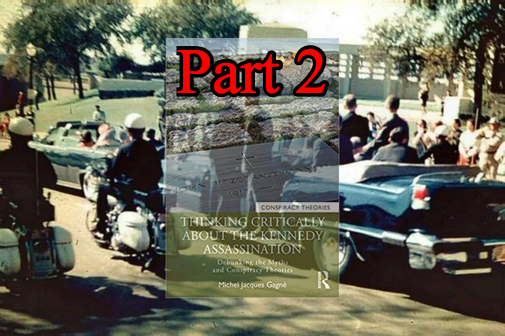
  • Gagné Desperately Dispenses CPR for the Lone Gunman (Part 2)

    Gagné Desperately Dispenses CPR for the Lone Gunman (Part 2)


    see Part 1

    G: “No one riding behind the president’s car, including JFK’s special assistants and close friends Kenneth O’Donnell and David Powers, reported a blowout to the back of his head, nor did motorcycle patrolmen B. J. Martin and Bobby Hargis…In fact, there exist no contemporaneous Dealey Plaza eyewitness reports of a blowout to the back of Kennedy’s head.” (313)

    DM: In that case then, try this report from Clint Hill: “…the President’s head on the right rear was missing…” This interview occurred on November 30, 1963.[1] Does G not consider this contemporaneous?

    Or try this one, which is based on an interview with Roy Kellerman on November 27, 1963: He noticed a wound in the back of his [JFK’s] head.[2] When later questioned by Arlen Specter, he described this wound as 5 inches [sic] in diameter and located at the right rear of the head. Does G not regard this as a contemporaneous report? (Roy later acknowledged in private that there had been a conspiracy.)

    Or consider this one from Tim McIntyre: “…horrified to witness…the back of the president’s head exploding.” This conversation originally occurred in December 1963.[3]

    Palamara’s extensive list (in Honest Answers) mostly focuses on the direction of the shots (with many reporting a shot from the right front), but the following individuals later all reported a large hole at the right rear: Sam Kinney, Linda Willis, Phillip Willis, Harry Holmes, Beverly Oliver, Ed Hoffman, Winston Lawson, Aubrey Rike, George Burkley, Bill Greer, Jesse Curry, and Dave Powers.[4] A fair number of witnesses also saw tissue flying to the left rear from JFK’s head and many saw a wound near the right ear, which they interpreted as an entrance wound. Of course, the Parkland physicians almost universally recalled a hole in the right rear, quite consistent with the similar report of eight Bethesda physicians.[5] And John Ebersole, the autopsy radiologist, described the head wound in the same way to me.

    G’s statement (about no contemporaneous Dealey Plaza witnesses) is either deliberately deceptive—or else it is unforgivably careless research. Either one is damning—and such an uncritical approach instantly discredits him as a serious scholar or thinker, especially after his duplicity about the throat wound. A thick smog has now settled over his entire disinformation campaign—and his confirmation bias has plainly been exposed. I now only wish that I were reviewing a more candid researcher, but the benefit of the doubt has totally vaporized. G’s effort is just the opposite of critical thinking. Furthermore, for me, reviewing such drivel from one so agenda driven gives me rather little pleasure—and it provides only pea-sized intellectual challenge.

    G: “But nothing suggests the car came to a stop for any length of time.” (336)

    DM: G has obviously not read Chapter 10 in Honest Answers (2021), where Vince Palamara lists 74 [sic] witnesses who recalled a limousine stop, or at least a near stop. So, how many does G think we need? And since when does “nothing” = 74?

    G: “According to Cyril Wecht, another JFK buff…” (346)

    DM: According to G, “Kennedy buffs” are amateur JFK conspiracy researchers (2). Then I would only ask G this question: How can someone who has done over 20,000 autopsies (and served on official government panels on the JFK assassination) possibly be called an “amateur?” Only G can answer that question.

    G: “…new disclosures should have led Mantik, Aguilar, and like-minded others to reconsider their assumptions. Sadly, this has not been the case.” (353)

    DM: Unless G has had access to my brain for the past 30+ years, there is no way he could know this. On the contrary, I have been re-evaluating evidence all my life. In fact, that is my trademark. Now nearing age 82, I no longer believe many ostensibly important lessons I learned during the first 50 years of my life. More to the point, I refused to see the movie, JFK, until I had spent several months reviewing the medical evidence. And, during much of this time (while mostly stuck in neutral), I sat on the fence, especially while I focused on the work of Luis Alvarez. (After all, Luis had won a Nobel Prize in physics—and was therefore automatically one of my heroes.) I also had listened to Luis’s lecture about the JFK case in 1975 at the Los Alamos National Laboratory and I had saved his preprint from that lecture. Even after I had unavoidably decided on conspiracy, every subsequent government disclosure led me to re-evaluate the evidence. (The foremost example of a changed conclusion is the Grassy Knoll shot, which I did not at first accept—but I do now.) I also do this routinely for patient treatment plans, often awakening at night to re-consider a critical aspect of a complex medical case. That is precisely why G should reference only my current opinions—not just those of 20+ years ago.

    The clarity of my vision has improved with time—because increasingly more evidence has emerged. I even discuss this evolution of JFK assassination evidence in my forthcoming hardcover book. So, in the end, this charge by G is only demeaning to him—but not at all to me. For me, life has always been about learning and renovating one’s knowledge. I only wish that G would agree to do this—but much of what we now know about this case is oddly absent from his book. Perhaps he should study this case for another 10 years, become up to date, and draft another book? In addition, an advanced scientific or medical degree would surely help. After all, truth can afford to wait—but can G wait that long?

    G: “When the ARRB showed the pictures from the National Archives to autopsy photographer John Stringer…he confirmed that these were his original work.”

    DM: This is just one more deception. After Stringer reviewed the brain photographs, he declared to the ARRB that he had not taken them. He knew this because they were the wrong film type and also because he had photographed serial sections of the brain—which no longer exist.[6] I have also demonstrated the radical inconsistency between the brain in the photographs versus the brain in the X-rays. At least one of these images must have been faked.[7]

    G: “Identical images do not create such an [stereo] effect…” (356)

    DM: G is here discussing stereo viewing of the autopsy photographs, which I have performed on virtually all of the photographic pairs at the National Archives. G does not say whether he has done any of this—which is a serious omission for a “critical thinker.” After all, it is not necessary to visit the National Archives to do this—as I have discussed in my online lectures. The images are available in Robert Groden’s Absolute Proof. G does not explain why he has not performed such an elementary exercise. But he is certainly correct about this: When identical images are viewed via a stereo viewer, no 3D effect is achieved. That bizarre result is precisely what is seen at the critical site at the back of JFK’s head—exactly where the Parkland physicians (and virtually everyone else) saw a large hole. Stereo viewing at that site shows only a 2D effect. And quite to the point, this absence of a 3D effect is not seen elsewhere in the autopsy collection, as I ascertained via a painstaking review of these many pairs of images. Who else has done this? So, what are the odds that—only at JFK’s occiput—a 3D effect is absent? (Robert Groden has confirmed the same observation to me.) G does not comment on this—but he has no excuse for omitting this simple exercise, which he could still do today or tomorrow, but I shall not hold my breath.

    G: “Although Mantik and others have continued to claim that Kennedy’s throat wound was a wound of entry, this theory has by now been discounted by numerous trained forensic pathologists.” (358)

    DM: If this is true, I have never seen those reports—and as usual, G does not cite even one of them. Did he simply invent this scenario out of whole cloth? This papal-like edict can scarcely represent in-depth research. Not a single Parkland physician (before encountering political pressure) described the throat wound as anything but an entry. Only a WC lawyer (Arlen Specter) was deemed qualified enough to identify it as an exit wound. On the contrary, all of the evidence goes the other way:

    1. Such a tiny exit wound could not be duplicated in experiments by the WC;

    2. Milton Helpern, who had done 60,000 autopsies, had never seen an exit wound that small;

    3. Before political leverage was exerted, the first scenario by NPIC included a throat shot at Z–190;

    4. During a WC Executive Session (December 18, 1963), John McCloy, Hale Boggs, and Gerald Ford discussed a possible frontal shot from the overpass.

    Furthermore, how many of these supposed “forensic pathologists” were told that the autopsy photographs had no chain of possession? Although the correct camera (and lens) had been located by the HSCA, it did not match the technical features of the autopsy photographs![8] Why would G hide this from his readers?

    G: “…an irregular-shaped white spot near the subject’s hairline…has led these authors to suspect this was the real entrance point…Aguilar and Mantik therefore conclude that the head in the photograph is not Kennedy’s…According to Mantik, this is as close as it gets to finding a ‘smoking gun.’” (358–359)

    DM: This is false—triply false. I have never believed that the white spot represented an entry wound; it is far too inferior to fit with the missing Harper fragment, which is discussed, and illustrated, in painstaking detail in my e-book, JFK’s Head Wounds. Furthermore, I have never stated that the head was not JFK’s. On the contrary, it is his head—but with the hole covered by a photographic matte insertion so as to disguise the hole. G seems unable to make such fine distinctions, which only confuses things for him, as he admits, “Confused? It seems everyone is.”

    Regarding smoking guns, I would now regard my subsequent discovery of the T-shaped inscription (see the end of this review for images) as a more blatant example of a smoking gun. But G seems not to know about this, even though the T discovery was made in 2001, and I have reported it on innumerable occasions.[9]

    G: “The X-rays and pictures both located the wound of entry high on the back of the head (at the cowlick), consistent with the trail of bullet fragments inside Kennedy’s skull, and of the exit wound.” (359)

    DM: This is (again) triply false:

    1. The radiologists could not locate a wound of entry (or of exit) on the X-rays. I agree. That was explicitly stated in their reports. Did G fail to read them?

    2. All three pathologists disavowed the “red spot” as a bullet entry. Humes said, “I don’t know what that [red spot] is…. I don’t, I just don’t know what it is, but it certainly was not a wound of entrance.” (7HSCA 254) In fact, no one at Parkland had reported such a red spot.

    3. The trail of bullet fragments does not even transect G’s selected cowlick entry site!

    4. And G’s statement totally ignores the many tiny metallic fragments at JFK’s forehead. This is thoroughly discussed in Chesser’s online lecture, which is not cited by G.

    G: “Mantik argues that the back wound, which he wrongly locates at the third thoracic vertebra, was too low to jibe with the single bullet theory. But the pathologists’ report never made any mention of the third thoracic vertebra.” (362)

    DM: G does not explain why my T3 location was wrong—this was merely another papal-like edict. But Dr. Burkley did sign the autopsy descriptive sheet, and he did cite the back wound at T3. He also signed JFK’s death certificate.

    In my conversation with Dr. John Ebersole, he cited T4. Moreover, Ebersole (like me) practiced the only specialty in which knowledge of external anatomic landmarks must correlate with internal anatomy. If this is not done accurately, cancers will be missed by the radiation beam and, because Humes was under severe political pressure, he could never identify the vertebra as T3. After all, that admission would instantly have impugned the SBT, so he deliberately omitted it (just as he deliberately misplaced the metal fragment trail by an impossible 4 inches on the X-rays). So, by what authority does G challenge the recollections of the on-site radiologist—or those of Dr. Burkley? Of course, G will never answer those questions.

    G: “Mantik also fails to tell his readers that most Parkland physicians would later endorse the autopsy’s findings.” (363)

    DM: In Murder in Dealey Plaza (p. 240), I cite 16 Parkland physicians who clearly did not recognize the photographs of the back of JFK’s head.

    Should that not be enough, G should view the documentary, The Parkland Doctors,[10] which was screened in Houston during the 2017 mock trial of Oswald.[11] Has G viewed this powerful display of agreement among these physicians? If so, he remains silent.

    G: “…Aguilar [and] Mantik…are reading the evidence incorrectly because they are bent on confirming existing beliefs…[They] fail to take note of the angle at which certain X-rays were taken.” (364)

    DM: This is an outlandish claim—I had no “existing beliefs.” And the comment about the angle is prima facie preposterous; how could I possibly target cancers without understanding perspective? Furthermore, I have carefully (on multiple occasions) documented the angle at which JFK’s AP skull X-ray was taken.[12] Has G read my 2019 critique of Randy Robertson (at my website—and repeated in my hardcover book), in which I describe—and illustrate—not only the angle, but also the divergence, of these X-rays? No one else has done this. This is one of the daftest claims in the entire book.

    G: “…no evidence has been produced to suggest that these men were coerced.” (363)

    DM: This is preposterous on its face. In fact, this is so egregious that we might easily conclude that G is uninterested in facts. On the contrary, Elmer Moore severely badgered Dr. Perry.[13] And from Rob Couteau, we now know that Humes also badgered Perry.

    Furthermore, during the trial of Clay Shaw, Pierre Finck made the following points:

    1. Senior military officers took an active part in proceedings and he implied that they were in charge of the autopsy.
    2. He admitted, after trying hard to avoid the question, that the pathologists were forbidden to dissect the president’s back and throat wounds and the connecting tissue.[14]

    G: “…F8 is certainly not depicting the lower back of the President’s head.” (365)

    DM: In my e-book, I offered 15 clues that F8 showed the back of JFK’s head. How many of these does G address: the answer is zero. He does not even cite my e-book! How can we have an adult conversation with such an approach?

    G: “While we could surmise that Mantik, Aguilar, and Fetzer have simply been short-sighted, a final example suggests that they were purposefully duplicitous.” (367)

    DM: I was indeed short-sighted. My myopia in one eye reached -9 diopters, which is what allowed me to identify the double exposure inside the 6.5 mm fragment while viewing the extant AP skull X-ray at the National Archives. This was only further proof that the 6.5 mm object had been (illegally) forged via a double exposure in the dark room.[15]

    G: “Misinterpretations are all the more likely when amateurs with little experience reading X-rays… (368)

    DM: So, after 40+ years of reading X-rays, I am still an amateur? In that case, how many years would qualify me as a professional?

    G: “…an expert radiologist, Dr. Gerald McDonnel…examined the autopsy X-rays for evidence of alteration and found none.” (370)

    DM: I have discussed McDonnel[16] and his proposed clues to X-ray alteration at length in my e-book, which G has obviously not read. Quite oddly, McDonnel did not even raise the possibility of using optical density as a tool! Furthermore, I have cited—quite specifically—how my observations do in fact meet McDonnel’s requirements. I even discovered one possibility that he had overlooked. Unfortunately, Mac passed away (not far from me on December 13, 1992) just as I was entering this case, or we would have had some fascinating conversations. I did, however, have enlightening (face-to-face and via telephone calls) conversations with Kodak’s top scientist, Arthur G. Haus, PhD, about my article on the X-ray alterations—which he read and about which he made no criticisms.[17] Also see my detailed technical references to the inspired work of Haus, which are cited in my online review of McAdams (at my website).

    G: “The…6.5 mm object…seemed to have troubled none of the autopsy doctors. In fact, it was not mentioned in their report.” (371)

    DM: Douglas Horne, who witnessed their ARRB testimony, observed quite the opposite effect. He reported that Humes was so frustrated that Horne expected him to walk out of his testimony at any minute. All three pathologists denied seeing this 6.5 mm object on the X-rays. Even worse, none of the dozens of participants at the autopsy (who observed these films on the view box that night) mentioned this object—which was precisely the point of taking any X-rays at all. This bogus object only surfaced with the Clark Panel Report some years later.

    Of course, when I asked John Ebersole about this object, he instantly terminated any further discussion of the JFK autopsy—and never spoke of it again to anyone. What G cannot dare to address, of course, is the unanimous opinion—of all the experts—that there is no image that correlates with this unphysical object on the lateral X-ray. Such a situation transports us directly out of our known physical world.

    Furthermore, on the AP skull X-ray, the front to back length of this bogus 6.5 mm object is many centimeters long (as shown by the optical density data), which is longer than all of JFK’s mercury-silver amalgams (which overlap one another on this view). Of course, G cannot afford to comment on such central conundrums, so he does not.

    Moreover, how does G explain this nearly circular 6.5 mm object—one that could not be explained by John Fitzpatrick (the ARRB forensic radiologist), or by the Clark Panel, or by Larry Sturdivan (the HSCA expert)?[18] Quite astonishingly, G (per his account) is able to succeed where everyone else has failed: “…it is little more than a distraction caused by circular logic.” (371)

    So, according to G, we now know that a circular object—visible on an X-ray film—was caused by circular logic! With this approach, one can easily escape into any conceivable fantasy. But this is not grounded in physical reality, and despite some exposure to critical thinking during my radiation oncology residency, I never learned any of this.

    G: Regarding the Z-film, he states: “Unless multiple witnesses can independently corroborate the same information, which they rarely do, the hunt for all of this hidden evidence can easily turn into a wild goose chase.” (372)

    DM: G has thereby belittled the recollections of many independent observers: Greg Burnham, Milicent Cranor, Scott Myers, Dan Rather, Cartha DeLoach, William Reymond, William Manchester, Homer McMahon, Dino Brugioni, Erwin Schwartz, Rich Dellarosa,[19] and others. Each one of these, without conferring with anyone else, has seen a version of the Zapruder film that contradicts the extant film—but the individual recollections surprisingly agree with one another! Surely, we should not hear this riposte again: “They all just made the same mistake.”[20] It is far too late for that reply.

    G also states: “…several eyewitnesses can produce clear and consistent memories of the alleged evidence” (372). To which I reply: Since this constraint is met by these many Z-film witnesses, by what right does G abandon his self-proclaimed decree for accepting evidence?

    And the comment, “and they rarely do” is not only false, but it is unsubstantiated. This is really becoming too much.

    Early viewers of the Z-film (e.g., Erwin Schwartz, Dan Rather, Deke DeLoach (at the FBI), and possibly even Pierre Finck, reported that JFK’s head moved forward—quite contrary to the Z-film! Furthermore, none of these early viewers reported a head snap.[21]

    On the other hand, G reports this:

    “We should take note that the head snap—real or faked—is barely perceptible when projected at the film’s normal speed of 18.3 frames per second.” (404)

    So, here is my reply to that: Then how did this so-called almost invisible head snap (per G) trigger the formation of the HSCA?

    G: “His [Mantik’s] main witness [to Z-film tampering] is Homer McMahon.” (406)

    DM: I have never said this—or even implied this. If I had to choose one primary witness, it would be Dino Brugioni. However, the existence of two totally compartmentalized viewing events (on two successive nights by two totally distinct groups) during November 23–24, 1963, provides overwhelming evidence of a cover-up. See Douglas Horne’s summary of this cacophony: Assassination of JFK – The Two NPIC Zapruder Film Events: Signposts Pointing to the Film’s Alteration. Especially watch the Z-film interview with Dino Brugioni, who was the Duty Officer at NPIC that weekend.

    In 1962, Dino helped to trigger the Cuban missile crisis by assisting in the discovery of Russian missiles in Cuba, and he is the author of one of my favorite photographic books: Photo Fakery: The History and Techniques of Photographic Deception and Manipulation (1999). The first chapter is titled “Photo Fakery is Everywhere.” In Chapter 3, he amusingly recalls (and illustrates) the work of Oscar Gustav Rejlander via his allegorical composite (and partly topless) photograph, The Two Ways of Life (1857), which was assembled from thirty negatives.

    G: Conspiracy theories are fed by “…an obsessive scrutiny of small inconsistencies and irrelevant details.” (430)

    DM: So, G would have us grieve that Max Planck obsessed over unexplained deviations in black body radiation—or perhaps he could have warned Einstein not to fret over the anomalous precession of the perihelion of Mercury (by 43.1 arc seconds—over 100 years).[22] Unfortunately for G, he has arrived too late for either of those observations.

    G: “…the suffering Christ remains, at best, one of thousands of peace-loving gurus tragically killed in their prime.” (434)

    DM: As expected, G does not cite even one of these slain thousands; in any case, Jesus of Nazareth is rarely regarded as a “guru,” especially not by billions of Christians.[23] Furthermore, from my days as an amateur (but devoted) New Testament scholar, I still recall Jesus’ statement, “Do not suppose that I have come to bring peace to the earth. I did not come to bring peace, but a sword.”—Matthew 10:24, the New International Version.

    G: “Conspiracy theories are an affront to responsible historical research and rational discourse.” (435)

    DM: Were they still alive, we would expect G to so inform each one of those 50–60 luminaries I listed in Addendum 5, “Believers in a JFK Assassination Conspiracy.”[24] G obviously thinks he knows more about this case than the combined expertise of LBJ, Nixon, Hoover, Tolson, Phillips, the Kennedy family, Burkley, Rowley, Curry, Kellerman, Greer, Kinney, Blakey, Tanenbaum, Sprague, Cornwell, and the Parkland doctors.

    Even worse though, G has impugned virtually every historical conspiracy. Does he honestly believe that all of these events are mere Conspiracy Theories?

    1. The murder of Julius Caesar (44 BC)

    2. The assassination of Abraham Lincoln (1865)

    3. 694 pogroms in 660 Russian towns (1905)[25]

    4. The Japanese sneak attack on Port Arthur (1905)

    5. The assassination of Archduke Ferdinand (1914)

    6. The Black Sox World Series Scandal (1919)

    7. The Tuskegee Experiment (1932–72)

    8. The Cambridge Five (1934–50s)

    9. The murder of Ernst Röhm (1934)

    10. Operation Himmler (1939)

    11. The murder of Leon Trotsky (1940)

    12. Spying on the Manhattan project (1941–45)[26]

    13. The Holocaust (1941–45)

    14. The Valkyrie Plot against Hitler (1944)

    15. The assassination of Mahatma Gandhi (1948)

    16. Operation Mockingbird (1950s)

    17. The Secret War in Laos (1953)

    18. Project MK-Ultra (1953–73)

    19. CIA-Mafia plots to kill Castro (1960–63)

    20. Assassination attempts (33) on de Gaulle (1961ff)

    21. Watergate (1972)

    22. Joannides’ role for the HSCA (1978–79)

    23. The Rajneeshee Bioterror Attack (1984)

    24. The Iran-Contra Affair (1985)

    25. 9/11 (2001)

    26. The Houston Astros World Series Title (2017)

    CONCLUSION

    But it is now past time to conclude this review. We have seen more than enough of G’s “critical thinking.” I prefer reality—for the past, in the present, and for the future. There are already enough zebras lurking out there.

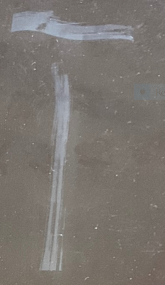
    One final observation may be useful. Here are two images of an emulsion-based X-ray film that I own; I created the T-shaped inscription on this film. The film is similar to those used for the 1963 autopsy X-rays and the T-shape is similar to what I saw on one lateral JFK skull film. The T-shape was obviously produced by scraping emulsion off the JFK X-ray film. (The image of this lateral JFK X-ray is not in the public domain.) Recall that, at the National Archives, no emulsion is missing—on either side—of that lateral JFK skull X-ray film.


    The left image above shows the missing emulsion side, while the right image displays the intact emulsion side (my film has emulsion on both sides, just as the JFK autopsy films do). The 3D visual impact (on my film) of physically missing emulsion (actually gouged into the film) can only be fully appreciated via binocular vision. This is especially dramatic when viewed at a glancing angle to the light source. I repeatedly did this while at the National Archives (for both sides of the JFK film), but no emulsion was missing anywhere.[27]

    Therefore, we now know that the Archives houses only a copy of this lateral X-ray. After all, only a copy film could preserve both the T image and the emulsion. But if this a copy film, then the door stands wide open to X-ray alteration—because a double exposure could easily have intervened. Of course, we already knew that this same lateral JFK X-ray was a copy—due to the presence of the White Patch, so the T-shaped inscription is merely a second confirmation that this is not the original lateral skull X-ray of JFK.


    [1] 18H740–745.

    [2] FBI Report (Sibert and O’Neill).

    [3] Honest Answers: About the Murder of President John F. Kennedy (2021), pp. 302ff, by Vince Palamara, who gifted this book to me. The quote is from an interview with Tim McIntyre. Vince has compiled a wonderful—and indispensable—collection of witnesses here. Of course, G does not cite this amazing reference.

    [4] JFK: Absolute Proof (2013), by Robert Groden includes a magnificent set of images in which the witnesses place their hands on the back of their heads to locate JFK’s right rear head wound. As now expected, G does not cite this book either. We can only begin to wonder: What exactly has G been reading?

    [5] JFK’s Head Wounds (2015), by David W. Mantik. Of course, G does not cite my book.

    [6] “Two Different Brain Specimens in President Kennedy’s Autopsy,” by Douglas Horne in Murder in Dealey Plaza (2000), edited by James Fetzer, p. 299.

    [7] https://www.fff.org/freedom-in-motion/video/jfks-head-wounds/

    [8] How Five Investigations into JFK’s Medical/Autopsy Evidence Got it Wrong – Introduction (history-matters.com)

    [9] Pittsburgh Text2.PDF (assassinationresearch.com)

    [10] The Parkland Doctors (2018) – IMDb

    [11] The 2017 Houston Mock Trial of Oswald (kennedysandking.com)

    [12] The Assassinations: Probe Magazine on JFK, RFK, and Malcolm X (2003), edited by James DiEugenio and Lisa Pease, p. 265.

    [13] dr perry jfk badgered – Search (bing.com)

    [14] Dr Pierre Finck: Dissecting JFK’s Back and Throat Wounds : The JFK Assassination (22november1963.org.uk)

    [15] The JFK Skull X-rays: Evidence for Forgery David W. Mantik DALLAS, TEXAS November 21, 2009 – [PPT Powerpoint] (vdocuments.net)

    [16] Dr Gerald Matthew “Mac” McDonnel (1919-1992) – Find a Grave Memorial

    [17] Assassination Science (1998), p. 134, edited by James Fetzer.

    [18] JFK Myths (2005), p. 193, by Larry Sturdivan. This expert, who testified for the HSCA, claimed that this 6.5 mm object could not possibly represent a real piece of metal. There is no physical correlate on the lateral X-ray—which is physically impossible. I agree with Sturdivan: this is not the world that he and I know. On the other hand, it is difficult to know what world G inhabits.

    [19] Dellarosa offers his personal descriptions of the action here: https://www.youtube.com/watch?v=XrRbkY9gEnQ.

    [20] David Lifton supposedly will suggest (in his forthcoming book—if it ever arrives) that Robert S. McNamara approved the Z-film alteration: https://www.youtube.com/watch?v=wMblToYoWzA. Also see Lifton’s recent comment: https://educationforum.ipbhost.com/topic/15099-inside-the-arrb-vol-4/page/4/.

    [21] Oddly enough, every new viewer of the extant Z-film, above all else, is stunned by the backward head snap. And today no one ever sees JFK moving forward (like Ike Altgens and Dan Rather and Deke DeLoach did). Why is G not aware of this ridiculous discrepancy?

    [22] Einstein Relatively Easy – Advance of the perihelion of Mercury

    [23] On the contrary, most Christians would be insulted with that description of him.

    [24] Fetzer 2000, p. 404.

    [25] Sleeper Agent: The Atomic Spy in America Who Got Away (2021), by Ann Hagedorn, Kindle, p. 13. This is the story of George Koval, born on Christmas Day, 1913, in Sioux City, Iowa, who delivered the secrets of Oak Ridge, Tennessee’s 75,000 workers to the Soviets. This included the polonium details, used to ignite the atomic bomb, i.e., polonium generated the neutrons that triggered the bomb. (On 1 November 2006, Alexander Litvinenko was poisoned and later died on 23 November, becoming the first confirmed victim of polonium-induced acute radiation syndrome.) After George’s death, Vladimir Putin (in 2007) named George a “Hero of the Russian Federation.” As George began his work, he appeared to be the average clean-cut American, only two years out of the US Army. He could recite the history and stats of every big-league pitcher in 1948—and he had skills as a shortstop. Of course, the Soviet spying had begun much earlier (in August 1941), with the work of Klaus Fuchs (who, ironically, loaned his car to Richard Feynman). Already in spring 1942, Lavrentiy Beria had sent a memo to Stalin about using uranium for bombs, even describing two hemispheres whose sum would exceed the critical mass. In other words, Stalin was not surprised at the allusion to the atomic bomb at Yalta.

    [26] Ibid., p. 78.

    [27] The right image is slightly colored, because we are looking through the film base, which has a blue tinge.

  • Gagné Desperately Dispenses CPR for the Lone Gunman (Part 1)

    Gagné Desperately Dispenses CPR for the Lone Gunman (Part 1)


    Hi David, I just looked at the survey questions. These are WAY [sic] beyond my competency…Feel free to use the above and my earlier comments.

    —Michael Shermer[1]

    Another falsehood of this title [Gagné’s title] is thinking critically. As a criminology graduate with a first-class degree who applied critical criminological thinking to all his work, I can safely say no critical thinking has been applied to this one-sided rubbish.

    —Anonymous Amazon Review (this constituted one-half of G’s reviews)

    His volume is a cogent and incisive treatment of the whole assassination landscape, with a particular attention to recent conspiracy arguments…

    —John McAdams, Ph.D.[2]

    I concede that I am not an expert in any of these disciplines… [military history, ballistics, health sciences, photography and film and the like]

    —Michel Jacques Gagné

    It would take more than one book to respond to all of Aguilar’s and Mantik’s theories. Doing so would also force us to discuss complex medical procedures that might confuse the nonexpert and which this author does not have the medical training to debate in depth and detail. But this does not prevent us from identifying the many errors in logic and research that make Aguilar and Mantik’s theories refutable…

    —Michel Jacques Gagné [3]

    A reliable way to make people believe in falsehoods is frequent repetition, because familiarity is not easily distinguished from truth.

    —Daniel Kahneman[4]

    Facts do not cease to exist because they are ignored. That men do not learn very much from the lessons of history is the most important of all the lessons that history has to teach.

    —Aldous Huxley (who, like C.S. Lewis, also died on November 22, 1963)

    —————————————————

    Michel Jacques Gagné. He teaches courses in critical thinking, political philosophy, philosophy of religion, and ethics at a junior college near Montreal, Canada. He has an M.A. in history with a thesis on civil rights. He enjoys discussing conspiracy theories, but has no specific training in science or medicine or forensics. He does not even cite any personal interviews with witnesses. By his own admission, his research has consisted solely of reviewing official sources and “thinking critically.” He has not been banned from the National Archives, nor has he ever visited there.

    David Wayne Mantik. He completed his physics Ph.D. thesis on X-ray scattering from proteins while at the University of Wisconsin-Madison and then concluded his training with an NIH post-doctoral fellowship in biophysics at Stanford University (Grant FO2 GM37600). After several years on the tenure-track physics faculty at Michigan, he changed professions and graduated from the University of Michigan Medical School. He became Board Certified in Radiology after a residency at USC, where he was also awarded an American Cancer Society Junior Faculty Clinical Fellowship (#568). He next directed the residency training program at Loma Linda University, where he treated cancers with the proton beam. After 40 years now, he still treats cancer patients in radiation oncology—the only specialty in which knowledge of external anatomy is critical for precise targeting of cancers via modern imaging techniques. In this specialty, he is often required to read many X-rays every day. However, he is not board certified in the detection of forged X-rays—because no such specialty exists. He has visited the National Archives (specifically to view the JFK artifacts) on nine separate days. Like Michael Chesser, MD, he has now been banned from the National Archives (although not for misbehavior).

    —————————————————

    NOTE: G identifies Gagné in the following discussion. My replies are identified by DM. The page numbers (in parentheses) refer to the Kindle edition (but these numbers may not be stable over time and usage).

    G: “The logical principle of Ockhams’ razor” will serve as G’s guide. (xvii)

    DM: On the contrary, it is not always possible to know which one of several conflicting theories is correct—or even which one is the simplest. For example, at the turn of the twentieth century, the ether was the simplest explanation. Does G therefore now believe in the ether?

    Furthermore, there is no empirical evidence that the world is simple. For example, who would describe quantum theory as simpler than classical mechanics? So, does G truly not accept quantum mechanics (which I have studied over many semesters)?

    The fundamental mistake that G makes is to assume that we can transpose a philosophico-scientific principle to the complex JFK case. In fact, he uses this pretext to gloss over (a la Michael Shermer) multifaceted, but crucial medical and scientific data, thus falling prey to confirmation bias. Also, recall that G has forthrightly admitted that he has no special expertise in the required areas for this case. Inevitably then, he alights on an improbable knife edge, where, like Humpty Dumpty, he often falls off and crashes. Moreover, he has not even read my peer-reviewed articles; even worse though, he—quite paradoxically—touts peer-reviewed articles as reliable treasure troves, but he never explains why he has excluded mine from his reading list.

    Occam’s (or Ockhams’) razor can be useful in specific settings. For example, doctors use a version of it—“when you hear hoofbeats, think horses, not zebras”—to ensure they go for the simplest diagnosis to explain their patient’s symptoms.[5]

    G: “…my acceptance of certain conspiracy theories had less to do with the strength of the evidence and more to do with my emotional and existential needs for an inspiring story that gave my life meaning.” (xvii)

    DM: My career, my family, and my hobbies provided complete fulfillment before I encountered the JFK case. I did not need this case for any self-realization. Besides, I was then already over 50 years of age.

    G: We should “be ready to follow sound logic and clear evidence wherever these lead…and engage in meaningful and respectful exchanges.” (xviii)

    DM: Contrary to his claim, G never cites the most powerful scientific evidence in this case—the optical density data[6] taken directly from the extant autopsy X-rays at the National Archives. And he has never tried to exchange any ideas with me—even though my e-mail address appears in my online (peer-reviewed) articles.

    G: “We must be ready to tolerate uncertainty…” (xviii)

    DM: On the other hand, G is never uncertain about the lone gunman! He implies that every single piece of evidence supports it.

    G: “I have made every effort to avoid resorting to personal attacks.” (xxii)

    DM: Here are quotes from G—do these seem like personal attacks?

    “While we could surmise that Mantik, Aguilar, and Fetzer have simply been short-sighted, a final example suggests that they were purposefully duplicitous.” (367)

    And then try this one:

    “…Mantik is seeing monsters in his bedroom closet.” (372)

    Or this one:

    “…Mantik indulges in a five-page flight of fancy of photographic ‘what-ifs’…” (383)

    G: “…conspiracists rarely submit their convictions to the scrutiny of formal logical analysis…careful critical thinking threatens to undermine the fragility of their untested theories, which can, in turn, trigger a personal crisis of faith…” (6)

    DM: Just so, but G has not submitted his own convictions to the three alarming signs of X-ray alteration.[7] In fact, he totally avoids all three, even though the meaning of the T-shaped inscription (see the images at the end of this review) is purely a matter of common sense—the argument was instantly anticipated by my 15-year-old son (a non-radiologist) when I began to describe the evidence. And insofar as the lone gunman is concerned, if that baseless theory were proven to be true, my world view would be radically improved—and I would certainly not have a crisis of faith.

    G: He cites “Richard Hofstadter’s influential 1964 essay, ‘The Paranoid Style in American Politics’…In Hofstadter’s view, conspiracism [that is G’s word—Richard did not use it] is essentially the fruit of economic and political angst, a fear of being dispossessed by suspicious minority groups…” (8)

    DM: Richard Hofstadter’s article[8] was first published in Harper’s Magazine on the first anniversary of the JFK assassination—in November 1964.[9] What are the odds of that?

    Furthermore, and quite contrary to G, no pertinent economic or political angst led me into this JFK case.

    G: “JFK conspiracists are largely left-leaning liberals in their political views.” (8)

    DM: That is not me—at all. I am more accurately described as a classical liberal (a la Adam Smith and John Locke).[10]

    G: “Americans are most likely to believe in CTs when they feel themselves locked out of power…” (10)

    DM: Although I believe in CT scanners, G’s description does not remotely apply to me. I have no interest in power, particularly not in political power. My career bears clear witness to that, although I know colleagues who fit that description quite well.

    G: “British psychologist Patrick Leman similarly argues that conspiracism arises out of a condition called anomie: feelings of general disaffection, rejection, or disempowerment from society” (11).

             DM: I do not recognize myself here—at all.

    G: “Kay identifies seven personality types that are easily seduced…those muddling through a mid-life crisis [I am 81 years old]; failed historians [not me]; mothers with autistic children [probably not me]; cosmic voyagers; cranks; evangelical doomsayers; and radical firebrands.” (12)

    DM: None of my friends would recognize any of my new personas here. Furthermore, I wonder which members of the 9/11 Commission would fit G’s descriptors—after all, they proposed a conspiracy that included 15 Saudis!

    G: “CTs are an example of what happens when people base their convictions on fears, unjustified suppositions, and wishful thinking instead of sound reason and investigation.” (15)

    DM: So, that is what happened to me because I took hundreds of data points (from the extant autopsy X-rays and photographs) during my nine visits to the National Archives?

    G: “Most conspiracists are notorious for insufficiently referencing their sources…I have selected expert academic or journalistic sources whose authors are subject to a rigid editorial process.” (16)

    DM: My forthcoming hardcover book will include over 900 footnotes. Several of my articles have been published in peer-reviewed journals, but G cites none of them. In that case, how did he know that they were not subjected to a “rigid editorial process?”

    G: “Kennedy crumpled sideways onto his wife.” (26)

    DM: On the contrary, the Z-film shows that JFK was initially thrown violently backward. Did G miss the head snap? (As we shall see below— he barely noticed it!)

    G: “[Oswald]…was a former US Marine trained to shoot rifles at long-range targets.” (27)

    DM: Between May 8, 1959, and November 22, 1963, despite diligent efforts by the FBI, no evidence was ever unearthed to show that Oswald fired a weapon during those 1,600+ days (which is even longer than US involvement in WW II).[11] Moreover, Marine Colonel Allison Folsom,[12] testifying before the Warren Commission (WC), characterized Oswald (while he was in the Marines and using a Marine-issued M-1) as “a rather poor shot.”

    Charles de Gaulle survived over 30 assassination attempts,[13] but (according to G) JFK could not survive even one attempt by Lee Harvey Oswald. If you genuinely believe this, you have a lot to explain, especially since JFK was hit by multiple bullets (as everyone agrees) from more difficult shots. Moreover, if G is correct, why did the OAS not hire Oswald to kill de Gaulle instead of squandering its resources over so many failed attempts?[14]

    G: “Some witnesses described a man similar to Oswald standing in the sixth-floor window.” (27)

    DM: Only one witness made such a claim, which he later retracted. Besides, the window was partially closed and only a small portion of the body would have been visible. But G’s approach here is oxymoronic—after all, he claims not to trust eyewitness testimony, so why does he cite a witness at all? The same bizarre paradox soon occurs when he cites witnesses who claimed to see Oswald at the Tippit murder scene. (28) Since when, given his penchant for “critical thinking,” is being inconsistent (about the reliability of witnesses) truly required for critical thinking?

    G: “A 6.5 mm Mannlicher-Carcano rifle was also found stashed between stacks of boxes.” (28) “No evidence of 7.65-millimeter bullets, casings, or fragments [sic] was ever found anywhere in the TSBD or Dealey Plaza.” (283)

    DM: G cites the several policemen who initially described a different weapon. Weitzman described the weapon that he and Boone discovered as “a 7.65 Mauser bolt action, equipped with a 4/18 scope, a thick leather brownish-black sling on it.” (Click here for details) But, of course, G fails to cite the report of my friend, Noel Twyman, who during the Assassination Records Review Board (ARRB), discovered a receipt for a 7.65 mm Mauser shell recovered from Dealey Plaza. The shell was found between November 22 and December 2, 1963.[15]

    G: “A handmade paper bag [was] recovered on the sixth floor of the TSBD…” (29)

    DM: Two different paper bags may have existed; furthermore, no photograph was taken at the time of discovery. To salvage his story, G omits most of the relevant evidence. (Click here for details) The FBI had two reports on the paper used for the bag—one stated that the paper was “not identical” with the book depository paper, while the other stated that the paper had the same “observable characteristics.” The astute reader can likely guess which one was prepared last.[16] Of course, we learn none of this from G.

    G: “[The Carcano]…had been purchased the previous spring from a Chicago sports store…” (29)

    DM:

    1. The WC was never able to prove that Oswald received the weapon through the post office.

    2. The bank deposit slip read February 15, 1963, even though Oswald did not order the weapon until March 1963!

    3. In the book depository, the police found a 40.2-inch carbine with a 4-power scope.

    4. Oswald ordered a 36-inch carbine in March 1963; the 40-inch weapon was not advertised for sale until April 1963.

    5. Klein’s employee, Mitchell Westra stated, “Klein’s would not have mounted scopes on 40-inch Mannlicher-Carcanos.”

    6. Klein’s microfilm records disappeared.

    7. The FBI did not find Oswald’s fingerprints on the money order.

    8. The clip was still inside the weapon when it was found even though it is nearly impossible for an empty clip to remain there.

    9. The serial number was not unique—John Lattimer owned the same weapon with the same serial number. (C 2766)[17]

    G: “The same weapon was used linked to the ammunition used to kill Tippit.” (29)

    DM: This is a remarkably childlike approach to the complexities of the Tippit murder. For a much fuller explication read the 675-page Into the Nightmare (2013) by my fellow Badger, Joe McBride. Sergeant Gerald Hill had told Officer James Poe to mark two shells with his initials, but when Poe examined the shells for the WC, his initials had disappeared! Even G’s bald-faced claim that the shells matched the gun is far from certain,[18] but we can no longer expect G to express even a sliver of doubt when evidence favors his biases. For example, nowhere does he mention the conundrums posed by the multiple wallets in the Tippit scenario. This is critical thinking?

    G: “The evidence against Oswald was strong.” (29)

    DM: The evidence against Oswald was contaminated. Even Dallas Police Chief Jesse Curry became a vocal doubter of the lone gunman theory: “We don’t have any proof that Oswald fired the rifle, and never did. Nobody’s yet been able to put him in that building with a gun in his hand.”

    G: “The entrance wound in the president’s back, for instance, could finally be linked to the wound in his throat (as an exit wound).” (30)

    DM: Three members of the WC—Hale Boggs, Richard Russell, and John Cooper—thought that the single bullet theory (SBT) was improbable.[19] Russell even insisted that his opposition be printed in the report; of course, this was not done. In any case, the SBT is anatomically impossible—see my many discussions of this issue as well as my demonstration of this faux pas on a CT scan.[20]

    In late 1966, Jim Garrison was on a flight with Louisiana Senator Russell Long, who convinced him that the Warren Commission Report was fiction.

    More importantly, the Magic Bullet (of SBT fame) is irrelevant—its provenance has long since been trashed by Tink Thompson and by Dr. Gary Aguilar.[21] Even worse though, two bullets arrived at the FBI lab that night (see my online FFF lecture[22]). Which one of these bullets does G accept? He does not say—so we do not know. Perhaps G does not know either?

    If Oswald had acted alone, why then are his tax returns still being withheld for “national security reasons?” And why did Gerald R. Ford, my fellow Michigan alumnus and near neighbor in Rancho Mirage, tell the former French president (Valery Giscard D’Estaing) in 1976 that “It wasn’t a lone assassin.[23] It was a plot. We knew for sure that it was a plot. But we didn’t find who was behind it.”[24]

    G: “The Dallas DA reached the conclusion that Oswald did murder Kennedy, that he probably did so alone [sic].”

    DM: Dallas District Attorney Henry Wade (6 PM, November 22, 1963): “Preliminary reports indicated more than one person was involved in the shooting.” The legendary Dallas DA ran a conviction machine that was results-oriented (i.e., not truth oriented).[25] Wade obtained 19 convictions that were later overturned. Oswald might well have been #20. So, should we accept Wade as a “critical thinker?”

    G: “The suspect, it turned out, had expressed hatred for the United States on several occasions…” (30)

    DM: Did G fail to read Oswald’s speech (in July 1963) at the Jesuit House of Studies at Spring Hill College near Mobile, Alabama? He does not cite it. In this rather private setting, where he presumably shared his real opinions, Oswald has little good to say about communism or communists, whom he describes as “a pitiful bunch.”[26]> This is more critical thinking by G?

    G: “[The Warren Commission] would paint him as a disgruntled and unstable loner.” (30)

    DM: If so, why then was Paul Bleau able to show that Oswald had either plausible, probable, or definite intelligence links to at least 64 individuals?[27] Does that seem like more than average? And Senator Richard Schweiker (The Village Voice, 1975) stated: “We do know Oswald had intelligence connections. Everywhere you look with him, there are fingerprints of intelligence.”

    G: “…the rifle’s ammunition closely resembled pieces of lead recovered from Connally’s body and bullet fragments found inside the limousine.”

    DM: This is disgraceful. Even I have no idea what G means by “resembled.” If he means that it was visibly similar, then that is meaningless. If he means that it was matched by neutron activation analysis, then he is hopelessly out of date. And he surely cannot mean that lands and grooves matched—because lead fragments would be useless for this. Is this truly the best we can expect from “critical thinking?”

    G: “The Commission also discovered that the ammunition fired at Kennedy…shared a resemblance with a slug found at the site of an unsolved cold case…photographs of Walker’s house were found among Oswald’s possessions…” (36)

    DM: This is the logical fallacy of the a priori argument, which our critical thinker should immediately recognize. Furthermore, “resemblance” is meaningless—unless G ties it to some specific scientific evidence, which he forgets to do. This is merely more of G’s “critical thinking.” In fact, the Walker ballistics evidence is very much in doubt. Walker himself claimed repeatedly that CE-573, the bullet fragment supposedly retrieved from the scene of the shooting, was not the fragment he had held in his hand and examined.[28] Furthermore, how could Oswald miss such an easy stationary target, but then be so precise with much more difficult (and multiple) shots on November 22?[29] (G also does not inform us that the rear license plate on the vehicle in that photograph had been suspiciously cut out!)

    G: The JFK autopsy “was performed by a team of pathologists with insufficient experience with forensic investigations.” (38)

    DM: In a book already jam-packed with myths, this is merely one more. Humes conducted the weekly brain cutting sessions at Bethesda, so he surely knew how to examine a brain. To appreciate the respect in which Humes was held by his pathology colleagues during the HSCA investigation, just read Real Answers (1998) by Gary Cornwell.

    But that point is merely the tip of the iceberg. Humes was not a victim of inexperience. On the contrary, he was an active participant in the cover-up. We recently learned this from Rob Couteau: Perry claimed that one or more of the autopsy doctors warned him (during a telephone call that night) that he would appear before a medical board if he continued to insist on his story (about a throat entry wound). Perry said they threatened to take away his medical license.[30]

    G: “Precedence should be given to physical evidence…” (41)

    DM: If so, why does G totally ignore the optical density data—which may be the most important physical evidence of all? Moreover, this data was confirmed some years ago at the National Archives by Michael Chesser, M.D.[31] But G does not even cite Chesser!

    G: “…the single bullet theory was not accepted unanimously by its [the WC] staffers…” (41)

    DM: (Final Report of the ARRB, 1998, p. 11): “Doubts about the Warren Commission’s findings were not restricted to ordinary Americans. Well before 1978, President Johnson, Robert Kennedy, and four of the seven members of the Warren Commission all articulated, if sometimes off the record, some level of skepticism about the Commission’s findings.”

    G: “As we shall see, the WC’s findings have been scrutinized, verified, and largely accepted by a wide range of historians, forensics, and ballistics experts…” (42)

    DM: I wonder how many of these purported experts have made nine visits to the National Archives to examine the JFK artifacts. And how many of these experts actually examined JFK’s body and brain? After all, this is the only traditional means of ascertaining the cause of death. In particular, photographs are never a satisfactory substitute for the body or for the brain. Finally, how many were trained to detect (illegitimate) photographic or X-ray alterations? I can assure you that there is no such specialty. Even forensic pathologists are typically unaware that, of Rembrandt’s supposed original 600 paintings, only 300 are now considered authentic. Ironically, X-rays have been used to decide this issue. Does G know anything about any of this? If so, he does not say.

    G: “…the CIA later explained that its Mexico City station had simply photographed the wrong man.” (Chapter 2, footnote 43)

    DM: G disingenuously regards this merely as proof of their disorganization, but not as proof of their role as accessories in a coverup

    Even J. Edgar Hoover knew that an imposter had played a role: “We have up here the tape and the photograph of the man who was at the Soviet Embassy using Oswald’s name. That picture and the tape [sent by the CIA] do not correspond to this man’s voice, nor to his appearance.”

    Even Robert G. Blakey concluded that the CIA had lied. (Click here for details) Does G not know this?

    G: “…the name Hidell was that of a former acquaintance in the US Marines.” (Chapter 2, footnote 44)

    DM: Richard Case Nagell had been a US counterintelligence officer from 1955 to 1959. Oswald’s path converged with Nagell’s in Tokyo, where both worked in an operation code namedHidell.” In 1963, Nagell worked with Soviet intelligence in Mexico City. (See chapter 4 in the book by Jim Douglass.) On October 31, 1995, the ARRB mailed Nagell a letter from Washington, DC, seeking access to documents about the JFK conspiracy. The very next day (November 1, 1995) Nagell was found dead in the bathroom of his Los Angeles house. For more about Nagell (and his remarkable parallels with Oswald), see The Man Who Knew Too Much (1992), by Dick Russell (i.e., not Richard Russell, Jr., the WC member). Of course, you will look in vain for a reference to Dick’s book in G’s book.

    G: “However, it remains possible that Tague’s injury had another unexplained cause.” (Chapter 2, footnote 65)

    DM: After G warns us against the speculations of conspiracists, this is an example of critical thinking? Why else would Tague’s cheek have been struck in Dealey Plaza? Just what is our “critical thinker” pondering here to explain a cheek injury?[32]

    G: “A myth is a story made up…that serves to unfold part of the world view of a people.” (50)

    DM: This is a perfect description of the lone gunman potion that has been served up to the public by the power elite, which now includes the media. G has finally hit the nail on the head. The lone gunman has perfect explanatory power for them. And it truly is all about power, just as G has claimed all along.

    G: “Chomsky’s volume responds to claims that Kennedy, had he survived, would have pulled American troops out of Vietnam…” And then G claims, “Kennedy thus completely misunderstood…the plight of the people of South Vietnam…” (59)

    DM: G seems too timid to clarify his own views on this subject so he hides behind Chomsky. However, Harvard historian Fredrik Logevall (of course, he is not cited in G’s book) does not agree with Chomsky’s conclusion—at all. He is the Laurence D. Belfer Professor of International Affairs at the John F. Kennedy School of Government. Read his book, Embers of War: The Fall of an Empire and the Making of America’s Vietnam (1999). On the contrary he believes that Johnson immediately changed course. Has G read this book, or the books by John Newman or David Kaiser or Gordon Goldstein or Jim Blight or Richard Mahoney? Perhaps G really prefers to limit what he reads. After all, he seems irresponsibly ignorant in medicine, in science, and now in history.

    G: “President Johnson and his entourage quietly wondered whether the Russians or Cubans had something to do with all this.” (60)

    DM: LBJ apparently stated: “I never believed that Oswald acted alone…” LBJ added that the government “…had been operating a damned Murder Inc. in the Caribbean.” (Click here for details)

    G: “Two days later, during a memorial service held at Capitol Hill, the Supreme Court judge [oddly not named, but clearly Earl Warren] would again intone that Kennedy had been a ‘believer in the dignity and equality of all human beings…’” (63)

    DM: Since Oswald had not yet been killed, Warren had unethically prejudged the accused assassin.[33] In the American justice system, the accused must be presumed innocent when the trial starts. Judges especially must not proclaim the guilt of the accused in the court of public opinion. So, how did Warren forget this—and then get away with this serious breach of ethics? Did he merely toss his ethical standards into the trash bin? Instead, he publicly seized upon the lone assassin myth while he asserted, “…an apostle of peace has been snatched from our midst by the bullet of an assassin. What moved some misguided wretch to do this horrible deed may never be known to us…”[34] Does this suggest that Warren was open-minded to conspiracy?

    G: “…the vast majority of conspiracist works have undiscriminatingly accepted the ‘saintly’ view of President Kennedy as a great humanist.” (72)

    DM: I did not even vote for him.

    G: “…there is a strong left-liberal or libertarian bias running through much of this literature…” (72)

    DM: None of my friends or family would recognize me as a left liberal.

    G: “Garrison was right to say that Clay Shaw worked for the CIA.” (98)

    DM: Kudos to G for acknowledging that Shaw was a paid CIA informant. In fact, Shaw had worked for the CIA since 1949, first starting as a contract agent—and he had filed 30 reports for the CIA during 1949–1956.[35] In order to facilitate his private life as a gay person, he had used the name Clay Bertrand. However, G does not inform us that, by the end of Shaw’s trial, the jury (perhaps all of them) had come to believe in a JFK conspiracy.[36]

    G: “…Dan Rather produced an ambitious four-part investigation…that vindicated the Warren Report.” (84)

    DM: This was on CBS during June 25–28, 1967. Nonetheless, Rather had also reported that, in the original Z-film (as he viewed it that initial weekend) JFK had gone forward—just the opposite of what we now see in the extant film. Robert Tanenbaum (Deputy Chief Counsel for the HSCA) directly confirmed to me a remarkable 1993 confession by Dan Rather (Jim DiEugenio, Probe, January-February 1999, p.3): “We really blew it on the Kennedy assassination.” Does G know this?

    G: “However, it is rarely acknowledged by most conspiracists that the HSCA’s acoustic evidence …was impeached almost immediately…” (94, 113)

    DM: Then I am indeed a rare bird, since I have never accepted the acoustics case of the HSCA. In fact, over ten years ago, I wrote a 100+ page, extremely critical review of Don Thomas’s book (an update is now at my website). And my new hardcover book will include further devastation of this issue, along with lethal comments from the reigning acoustics expert, Michael O’Dell. My update should bring closure to this hopelessly conjured case. So, in view of this, will G then stop calling me a conspiracist? I shall not hold my breath for his great awakening.

    G: The ARRB “…found no cover-up.” (100)

    DM: However, the ARRB final summary did emphasize that the Secret Service had quite deliberately destroyed pertinent records of JFK’s trips—even after the ARRB had warned them not to do so.

    More importantly though, the board members had no clue about the medical evidence. I wrote a letter to the chairman, John Tunheim, and included about 20 questions to be distributed to each board member. The purpose was to ascertain their level of knowledge about (and interest in) the medical evidence. Although John promised to forward this questionnaire to his colleagues, I never received a reply from anyone. That told me all I needed to know. Douglas Horne (a nonmedical person), who served on the ARRB staff for several years, was also appalled at the medical ignorance (both of the board and its staff—except for lawyer Jeremy Gunn), so we should not be surprised at their misleading summary.

    As Horne tellingly wrote, “I know from personal observation that not one Board member attended one medical witness deposition and I was reliably informed by Jeremy Gunn that not one Board Member read the transcript of any medical deposition during the active lifespan of the ARRB.”[37]

    G: He cites John Costella once. (101)

    DM: Yet John, with his physics PhD and his vast technical knowledge of optics, is the world’s expert on the Z-film. He has clearly demonstrated, via clever mathematical transformations, exactly where (inside the film) and how this film was altered. G is technically unable to address these issues, so he wisely chose to bypass Costella’s stunning work.[38]

    G: He cites “Interview with Former NIPC [sic] Employees: The Zapruder Film in November 1963” in Fetzer (2000). Horne is also the focus of several low-budget online interviews and lectures such as ‘Altered History: Exposing Deceit and Deception in the JFK Assassination Medical Evidence…’” (115)

    DM: G’s typo escaped him—the reference should be to NPIC, the National Photographic and Interpretation Center. And G needlessly tries to impugn Horne’s effort by calling it a “low-budget” offering. This is a strike below the waist. In fact, Horne produced an excellent documentary—which still remains unrefuted. Of course, G says little about it.

    G: “All those who knew him agree that Oswald was a tight-lipped and enigmatic figure who rarely shared his own thoughts, even with those close to him.” (210)

    DM: Prof. Ernst Titovets, MD, PhD, is the author and the only English-speaking friend of Oswald in Minsk. So his book (Oswald: Russian Episode) offers a unique insight into the authentic Oswald. Exceptional in assassination-related literature, Oswald emerges here as a fully human character without the burdens of post-assassination history and conjecture, which often either distort his character or his motivations.[39] I have read this book, but Titovets is not cited in G’s book. Surely G should read this entire book before concluding anything about Oswald, but here again we are assailed by G’s ever-present “critical thinking,” in which in-depth research is quite unnecessary.

    G: “One of the most succinct and comprehensive conspiracist descriptions of what happened…is found in Oliver Stone’s 1991 JFK.” (243)

    DM: I disagree. It would be wiser to consult a real expert—an actual sniper. For example, read Fry The Brain: The Art of Urban Sniping and its Role in Modern Guerrilla Warfare (2008) by John West. Has G read this book? I doubt it—as he does not cite it.

    G: “Shortly after the assassination Lt. J.C. Day…did lift…a palm print belonging to Oswald from the rifle barrel…” (278–279)

    DM: In my acerbic, online critique of John McAdams, I have summarized the (dishonest) use of fingerprints in the courtroom, with special emphasis on its abuse in the Oswald matter.[40] Very recently we have learned even more about junk science in the courtroom: forensic scientists have often overstated the strength of evidence from tire tracks, fingerprints, bullet marks, and bite marks.[41] And John McAdams committed the same fallacy in his book.

    G’s forensic knowledge of fingerprints is gravely delinquent. He has not read my summary here. And he has ignored the statements of experts: “When somebody tells you, ‘I think this is a match or not a match,’ they ought to tell you an estimate of the statistical uncertainty about it”—Constantine Gatsonis, Brown University statistician.

    He has also misinterpreted Carl Day, who took Oswald’s palm print. In 1964, Day refused to sign a written statement confirming his fingerprint findings. (See WC Exhibit 3145, which is the FBI interview of September 9, 1964) When FBI expert, Sebastian Latona, got the weapon from Day, he found no prints of value, no evidence of fingerprint traces, and no evidence of a lift. Furthermore, Day took no photographs of this palm print—either before or after he supposedly lifted it. (Click here for details)

    In 2009, a committee at the National Academy of Sciences (NAS) concluded: “No forensic method has been rigorously shown to have the capacity to consistently, and with a high degree of certainty, demonstrate a connection between evidence and a specific individual or source.” In other words, judges and juries have sent (many) people to prison (and some to their deaths) based on bogus science.[42]

    Also see Pat Speer’s comments here.

    G: “…Kennedy’s throat wound was not visible to the pathologists at Bethesda…” (306)

    DM: This is utterly false, as discussed in detail in my forthcoming book.

    First, Boswell has repeatedly claimed (from early on) that they did know about it.

    Second, we do not even require Boswell’s recollection. The bruising at the right lung apex immediately told Humes that the apex had been struck by a projectile on Elm St—and the only possible cause was a throat shot. He already knew that the back wound was superficial and that it was far too inferior to explain the throat wound (just look closely at the face sheet—it is obvious there). Furthermore, while at the National Archives, I had a model wear JFK’s jacket—the bullet hole was preposterously low. (And yes, I have seen the photograph of the bunched-up collar on Elm St.) Besides, the jacket tells us nothing about the bullet hole in the shirt, which is also ridiculously low (as I observed at the National Archives). Many eyewitnesses have also confirmed this.

    Third—and even worse—we have just learned that Malcolm Perry (who performed the tracheostomy) had immediately (and in private), confirmed his initial conclusion: the throat wound was an entry.[43]

    Fourth, Malcom Perry originally recalled (for the WC) phone calls on November 22. Parkland nurse, Audrey Bell,[44] reported that Perry had told her that he had been kept awake by such calls during the night.

    Fifth, Dr. John Ebersole, the autopsy radiologist, told me (now on a recorded interview at the National Archives) that the first phone call had occurred at 10:30 PM and that a second one followed, still during the autopsy.[45]

    Sixth, Pathologist Dr. Robert Karnei (who would have performed the autopsy on anyone but JFK—and who retired in July 1991 as director of the Armed Forces Institute of Pathology) recalled hearing of such calls before the body left the morgue.

    Seventh, William Manchester, in his 1967 book wrote this: “Commander James J. Humes, Bethesda’s chief of pathology, telephoned Perry in Dallas shortly after midnight…”[46]

    Eighth, the commanding officer of the Bethesda Naval Hospital (Capt. Robert Canada, MD) told Michael Kurtz that “…we were aware from telephone calls to Dallas and from news reports that the president had an entrance wound in the throat…”[47]

    see Part 2


    [1] Shermer is one of Gagné’s (positive) reviewers. The quotation is excerpted from his e-mails to me. The pertinent JFK assassination survey (with Shermer’s quote) is at my website: The Mantik View – Articles and Research on the JFK Assassination by David W. Mantik M.D.,Ph. D.. My website also includes a review of Shermer’s naïve view of the JFK assassination.

    [2] Gagné’s book was published in 2022, but McAdams died on April 15, 2021. John was an associate professor of political science at Marquette University, where he taught courses on American politics, public policy, and voter behavior, but he had no training in science or medicine or in forensics. “How to Think Like John McAdams” is my critique of his book; this critique is at my website. Like McAdams, Gagné offers not a single reference to standard works on logical fallacies. During the ten years after I wrote this devastating critique of his book, McAdams mumbled not a single word in self-defense. And McAdams is surely wrong about Gagné being up to date. For, example, Gagné never cites my e-book, JFK’s Head Wounds (2015), which is far more current than my earlier work (which was mostly based in the 20th century). My current hardcover book (of 600+ pages), Paradoxes of the JFK Assassination (2022), will soon be released on Amazon. It should also be emphasized that none of Gagné’s reviewers are (or were) forensic science experts—nor does he quote any forensic pathologists, although he enjoys alluding to them. On the other hand, Cyril Wecht, MD, JD, who cheers my work (and who accompanied me on my first visit the National Archives), is the past president of both the American Academy of Forensic Sciences and the American College of Legal Medicine.

    [3] My research is most notable for its experimental data, taken directly from the extant JFK autopsy X-rays at the National Archives—it is not especially notable for any theories. In fact, if I were asked what my theories were, I would be momentarily mystified. G seems haplessly disoriented and incapable of distinguishing between experiment and theory—and so he never cites my optical density data. For him it is sufficient merely to pronounce a conclusion, as in a papal-like edict, i.e., if he makes a claim then that is adequate—no proof need be forthcoming. We are plainly off to an unfortunate start, especially for a supposed “critical thinker.”

    [4] Kahneman was the recipient of the Nobel Prize in Economic Sciences for his seminal work in psychology. The quotation appears in Thinking Fast and Slow (2011).

    [5] Exactly so. When my son had anomalous symptoms, his primary care doctor recited the zebra rule. Instead, after my diagnosis of an exceedingly rare, growth hormone secreting pituitary adenoma proved to be correct, I told this excellent physician, “Don’t let a zebra bit you in the rear.” If I had taken Gagné’s advice, my son might have become incurable—instead of being cured by surgery. But now he will soon complete his medical residency and take his board certification examinations.

    [6] Greg Henkelmann, M.D. (physics major and radiation oncologist): “Dr. Mantik’s optical density analysis is the single most important piece of scientific evidence in the JFK assassination. To reject alteration of the JFK skull X-rays is to reject basic physics and radiology.” Unbelievably, the phrase “optical density” appears nowhere in G’s book. Exactly how does a “critical thinker” justify ignoring such hard scientific data? Meanwhile, G accuses me of being selective in citing evidence! (My original optical density article appeared in Assassination Science (1998), edited by James Fetzer, pp. 120ff.)

    [7] https://www.fff.org/freedom-in-motion/video/jfks-head-wounds/

    [8] See A Conspiracy So Dense: Richard Hofstadter’s “Paranoid Style” – Brewminate: A Bold Blend of News and Ideas and also Richard Hofstadter’s Brilliant Essay Misled Us About the Paranoid Style of American Politics | History News Network. Unfortunately, Richard had overlooked the chronic conspiracy theories found in the mainstream, e.g., the recent Russia Collusion Hoax, the Iraqi Weapons of Mass Destruction, as well as those persistently devised by the CIA (such as the so-called Missile Gap during the Kennedy era).

    [9] According to Wikipedia, on November 21, 1964 (sic) Hofstadter delivered the Herbert Spencer Lecture at Oxford University (on this same subject).

    [10] What Is Classical Liberalism? Definition and Examples (thoughtco.com). I am also sympathetic with “the constrained vision,” as described in A Conflict of Visions (2002), by Thomas Sowell; but I also empathize with Miguel de Unamuno y Jugo’s Tragic Sense of Life (1921). But none of this should matter in assessing the JFK assassination evidence.

    [11] As a more current example, Tiger Woods had recently gone 1700+ days without a major tournament win.

    [12] Frazier RA: Testimony of Robert A. Frazier before the Warren Commission: http://mcadams.posc.mu.edu/russ/testimony/frazr1.htm).

    [13] How Charles de Gaulle Survived Over Thirty Assassination Attempts (theculturetrip.com)

    [14] By late 1963, there was an international pool of 2,000 to 3,000 highly trained and motivated assassins, ready and willing to make a buck: JFK: The French Connection (2012) by Peter Kross, Kindle, 4820. If G is correct, however, none of them could match the success rate of Lee Harvey Oswald, who worked for free.

    [15] Max Holland Says Enough! (kennedysandking.com)

    [16] Bugliosi supposedly solved this conflict—by claiming that the reports were from different days, thus implying that further work had clarified the situation. Unfortunately for Bugliosi, both reports were created on the same day (November 30, 1963). Pat Speer has even argued (with surprising support) that the bag currently in evidence is not the original one. This issue is further confounded by the fact that the police did not photograph the bag where they say it was found; in fact, it was not photographed at all until November 26, 1963!

    [17] Kennedy and Lincoln (1980), John Lattimer, p. 250: “In 1974 and 1975, my sons and I had conducted a series of experiments with a 6.5 mm Mannlicher-Carcano carbine, model 91-38, serial number C2766…exactly like Oswald’s.”

    [18] FBI agent Cortland Cunningham (not in G’s book) could not match the bullets (taken from Tippit) to Oswald’s supposed handgun (WC Volume 3, p. 465). Did G actually read Cortland’s report here: Cortlandt Cunningham (whokilledjfk.net)?

    [19] Even the initial FBI investigation did not accept the SBT! And JFK’s personal physician did not accept the SBT either: Admiral George Burkley, MD, refused to agree that there had been only one shooter: JFK Revisited Misleads on Dr. Burkley’s Suspicions of a Conspiracy (onthetrailofdelusion.com). Of note, Burkley had been the only physician at both Parkland and at Bethesda, so if he did not inform the pathologists about the throat wound, then he promptly became a culprit in the cover-up. On the other hand, my good friend Dr. Robert Livingston had telephoned Dr. Humes before the autopsy and told him about the throat wound. Surely Dr. Humes was not so senile as to forget this within the next few minutes: Robert B. Livingston (spartacus-educational.com). Dr. Livingston repeated this claim under oath in the lawsuit against JAMA, in which JAMA had defamed Dr. Charles Crenshaw. My professional society (the AMA) rightfully lost that suit: Item 33.pdf (hood.edu).

    [20] Murder in Dealey Plaza (2000), pp. 252ff, edited by James Fetzer. The dispositive CT scan is illustrated in Document 45 of Cover-Up (1998) by Stewart Galanor.

    [21] The Magic Bullet: Even More Magical than We Knew (history-matters.com)

    [22] https://www.fff.org/freedom-in-motion/video/jfks-head-wounds/

    [23] http://jfkfacts.org/president-ford-spoke-jfk-plot-says-former-french-president/.

    I asked Ford to autograph his Oswald book for me, which he promptly did, reminding me (while he signed with his left hand) that he was the last surviving member of the WC. Perhaps I got lucky—he did not seem to recognize me.

    [24] https://www.facebook.com/killjfk/posts/586489194733140

    [25] Wade had obviously forgotten (or more likely had never learned) the Canons of Professional Ethics, Canon 5 (1908): “The primary duty of the lawyer engaged in public prosecution is not to convict, but to see that justice is done.”

    [26] http://22november1963.org.uk/lee-oswald-speech-in-alabama

    [27] https://kennedysandking.com/john-f-kennedy-articles/oswald-s-intelligence-connections-how-richard-schweiker-clashes-with-fake-history.

    [28] For his correspondence, see Justice Department Criminal Division File 62–117290–1473.

    [29] http://22november1963.org.uk/lee-oswald-speech-in-alabama

    [30] Kennedys And King – The Ordeal of Malcolm Perry

    [31] Assassination of JFK – A Review of the JFK Cranial x-Rays and Photographs. Chesser discovered the presence of many tiny metallic particles near JFK’s forehead on the two lateral X-rays—as well as a small hole in the skull at that site, consistent with the passage of a bullet through the forehead. These observations can only lead to one conclusion: JFK was hit in the forehead by a bullet. (Actually, there is much more evidence for this, as I have outlined.) Although Chesser’s online lecture occurred in 2015, G is blissfully unaware of it. Of course, he cannot be allowed to know this, or else his entire case would collapse—and his book would be totally useless, except for lighting a fireplace.

    [32] JFK’s cheek had several (highly suggestive) puncture wounds, which I have discussed, but G seems unaware of these.

    [33] Oswald had been killed only a few hours before Warren’s eulogy, but Earl had likely prepared his address while Lee was still alive.

    [34] Eulogies for President Kennedy | JFK Library

    [35] The French Connection (2012), Kindle p. 239, by Peter Kross.

    [36] Max Holland Says Enough! (kennedysandking.com)

    [37] Inside the Assassination Records Review Board (2009), by Douglas P. Horne, Volume 1, p. 17.

    [38] A Scientist’s Verdict: The Film is a Fabrication – John P. Costella, Ph.D. (assassinationscience.com)

    [39] I have adapted this comment from the Amazon website.

    [40] https://kennedysandking.com/john-f-kennedy-reviews/mcadams-john-jfk-assassination-logic-how-to-think-about-claims-of-conspiracy-1. Regarding fingerprints, for Frontline in 1993, Vincent Scalese (the HSCA fingerprint expert) offered the perfect example of misleading testimony, when he used the word, “definitely”: “…we’re able for the first time to actually say that these are definitely [sic] the fingerprints of Lee Harvey Oswald and that they are on the rifle. There is no doubt about it.” To make matters even worse, John McAdams’s oxymoronically titled book endorses this view even though, given the state of the literature in 2011, he should have known better: JFK Assassination Logic: How to Think about Claims of Conspiracy, p. 161, note 27.

    [41] “Reversing the legacy of junk science in the courtroom,” by Kelly Servick, March 7, 2016:

    http://www.sciencemag.org/news/2016/03/reversing-legacy-junk-science-courtroom.

    Michael Chesser, MD, has just notified me of another human tragedy—due to reliance on junk science: https://www.theguardian.com/us-news/2022/apr/28/forensics-bite-mark-junk-science-charles-mccrory-chris-fabricant?CMP=Share_iOSApp_Other.

    [42] We have seen this scenario before; for the HSCA, Robert Blakey once declared that neutron activation analysis was the “linchpin” of the ballistic evidence against Oswald. Unfortunately for Blakey, that linchpin is totally fractured, and such evidence is no longer even permitted in the courtroom.

    [43] According to Jim DiEugenio, the pathologists’ knowledge of the throat entry wound (from contemporaneous records) while at the autopsy has just been confirmed by author Rob Couteau: Kennedys And King – The Ordeal of Malcolm Perry

    [44] https://history-matters.com/archive/jfk/arrb/medical_interviews/audio/ARRB_Bell.htm

    [45] My transcript of our conversation is in Murder in Dealey Plaza (2000), edited by James Fetzer, p. 433.

    [46] The Death of a President, Penguin Books (1977), pp. 432 – 433, by William Manchester.

    [47] The Assassination Debates (2006), p. 87, by Michael Kurtz.

  • JFK VS LBJ: The MSM in Overdrive

    JFK VS LBJ: The MSM in Overdrive


    As our readers know, I just did a two-part review of the very poor CNN four-part special about Lyndon Johnson, largely modeled on the work of Joe Califano. As an honest appraisal of Johnson’s presidency, that program was simply unforgiveable, both in regard to Johnson’s domestic and foreign policy. (Click here for details) Concerning the latter, it actually tried to say that Johnson did not decide to go to war in Indochina until after the Tonkin Gulf Resolution had passed. Since LBJ used that resolution as an act of war, most of us would fail to see the logic in that, but that is how desperate CNN and the production company, Bat Bridge Entertainment, were in trying to salvage Johnson’s reversal of Kennedy’s withdrawal plan and decision to enter a disastrous war in Vietnam. That war plunged America into a ten-year-long struggle that resulted in epic tragedy for both Indochina and the USA.

    Mark Updegrove was one of the talking heads on that program, as well as one of its executive producers. Updegrove was the director of the LBJ Library for eight years. He is now the president and CEO of the LBJ Foundation in Austin. He began his career in magazine publishing. He was the publisher of Newsweek and president of Time/Canada. He was that latter magazine’s Los Angeles manager, but he was also VP in sales and operations for Yahoo and VP/ publisher for MTV Magazine. In other words, Updegrove has long been a part of the MSM.

    I could not find any evidence that Mark is a credentialed historian. All I could discover is that he had a Bachelor’s Degree in Economics from the University of Maryland. I don’t think it is improper to question whether or not a man should be running a presidential library if he is neither an historian nor an archivist. The writing of history is a much different discipline than being a publisher or running business operations. At its fundamental base, it means the willingness to spend hours upon hours going through declassified documents, supplementing that with field investigation, and also tracing hard to find witnesses. Then, when that travail is over, measuring the value of what one has found.

    It is not an easy task to write valuable history, especially of the revisionist type that bucks the MSM, for the simple reason that revisionist history that challenges hallowed paradigms is not a good path to career advancement. The much safer path is what the late Stephen Ambrose did. When a friend of his did discover powerful evidence which demanded a revisionist reconstruction about World War II, Ambrose first befriended him and then—measuring the costs to his career—turned on him. That is the kind of behavior that gets you business lunches with people like Tom Hanks. (James DIEugenio, The JFK Assassination: The Evidence Today, pp. 45–48)

    As I reviewed at length and proved with many examples, the aim of the above CNN series was to somehow elevate Johnson’s rather poor performance as president over the space of five years. It was a presidency that was so violent, corrosive, and polarizing that the late Philip Roth wrote a memorable book about its enduring and pernicious impact on the United States. There were many instances that I did not even deal with in my two-part review of that series, for example the overthrow in Brazil and the forcing out of George Papandreou in Greece in 1965. Who can forget Johnson’s rather direct reply to the protestations of the Greek ambassador in the latter case:

    Then listen to me Mr. Ambassador: fuck your Parliament and your Constitution. America is the elephant. They may just get whacked by the elephant’s trunk, whacked good…We pay a lot of good American dollars to the Greeks, Mr. Ambassador. If your Prime Minister gives me talk about Democracy, Parliament, and Constitutions, he, his Parliament, and his Constitution may not last very long. (William Blum, The CIA: A Forgotten History, p. 244)

    As William Blum shows in his book, Johnson was true to his word.

    Because of the above, it is not an easy job to somehow whitewash and then rehabilitate Johnson the man and Johnson the president, especially because LBJ followed President John Kennedy and almost systematically reversed much of his foreign policy, with so many debilitating results. In his film JFK: Destiny Betrayed, Oliver Stone showed those actions in relation to Indochina, Congo, the Middle East, and Indonesia. That film also tried to show how Kennedy was also working on modes of détente with both Cuba and the USSR. These were both abandoned by the new president.

    Apparently Updegrove is well aware of how poorly Johnson does in a comparison with Kennedy. He has now written a book about Kennedy. Because of his longtime relations with Time magazine, he got them to do what is essentially a preview/promo for that book. (See Time online April 26, 2022, story by Olivia Waxman.)

    To see where Updegrove’s book Incomparable Grace: JFK in the Presidency is coming from, one can simply read the italicized intro to his own summary. Waxman writes that since 1963, there have been “myths and misunderstandings” about JFK and the early “gunning down” of the handsome leader caused some of this “continued fascination.” Waxman then lets Updegrove, who is not an historian, take charge with these words:

    History in its most cursory form is a beauty contest and, as we look at John F. Kennedy, he’s a perfect President for the television age, because he shows up so well and speaks so elegantly.

    Who needs to read the book? We have seen this infomercial so many times by the MSM that reading the book is superfluous. Kennedy was the glamour president. He was handsome, exquisitely tailored, a good speaker, and witty. This was what made him an icon in history, but he really did not have any notable achievements behind him. It was all glitz. And then Updegrove begins that part of the MSM formula: the belittlement of JFK, the so called myths and misunderstandings that caused the continued fascination with Kennedy the president. Mark chooses three areas to hone in on for his attack.

    The Missile Crisis

    He begins by saying that the first myth is that “JFK won the Cuban Missile Crisis by staring down the Soviets.” Updegrove then writes that the true cause of the crisis was that the Russians knew they were at a large atomic disadvantage and also that the USA had offensive missiles in Turkey. Therefore, this was not just “recklessness on the part of Nikita Khrushchev,” it “was really more of a calculated risk.” The risk being to get the missiles removed from Turkey. He says the world did not know about the Turkish agreement at the time. I would beg to disagree and you can find my basis for disagreement in the following story from the New York Times in late November of 1962. The agreement about Turkey was out and known in the public at that time. Unlike what Updegrove wants to maintain, most understood what the main terms of the agreement were. But further, to say that was the basis of the agreement is to ignore that the Russians had about ten times as many missiles in Cuba as the USA did in Turkey. (Philip Zelikow and Ernest May, The Kennedy Tapes, p. 60)

    I would, however, also disagree with him on two other more important points. First, JFK’s achievement in the Missile Crisis was not a “stare down”. It was avoiding a nuclear conflagration. Anyone who reads the book The Kennedy Tapes will understand that JFK took the least provocative and least risky alternative that was offered him: the blockade. Many others in the meetings recommended bombing the missile silos or an outright invasion of Cuba. Both Kennedys were asking about the former: Would that not create a lot of casualties? (May and Zelikow, p. 66) Kennedy became rather disenchanted with that option.

    What Kennedy did was opt for the blockade, which also gave the Kremlin time to think about what they were doing. This neutralized the hawks in both camps. And I should not have to tell Updegrove how angry and upset the Joint Chiefs were with that choice. General Curtis LeMay accused Kennedy of appeasement and compared what he was doing to what Neville Chamberlain did at Munich with the Nazis. (James DiEugenio, Destiny Betrayed, Second Edition, p. 57)

    But what is important here in regard to Updegrove is that in reading the transcripts, Johnson was siding with the hawks. At a meeting on October 27, 1962—towards the end of the crisis when Kennedy was trying to corral the confidence of his advisors for an agreement—Johnson was not on board. He said, “My impression is that we’re having to retreat. We’re backing down.” He then said we made Turkey insecure, and also Berlin:

    People feel it. They don’t know why they feel it and how. But they feel it. We got a blockade and we’re doing this and that and the Soviet ships are coming through. (May and Zelikow p. 587)

    He then said something even more provocative in referring to a U2 plane shot down by Cuba, “The Soviets shot down one plane and the Americans gave up Turkey. Then they shoot down another and the Americans give up Berlin.” (Ibid, p. 592) He then got more belligerent. He said that, in light of this, what Khrushchev was doing was dismantling the foreign policy of the United States for the last 15 years, in order to get the missiles out of Cuba. He topped off that comment by characterizing Kennedy’s attitude toward that dismantlement like this: “We’re glad and we appreciate it and we want to discuss it with you.” (ibid, p. 597) It’s reading things like that which makes us all grateful Kennedy was president at that time.

    This is what Kennedy’s achievement really was, not taking this crackpot hawkish advice and instead working toward a peaceful solution that would satisfy everyone. And with this on the table, we can now fully understand Updegrove’s next point.

    The Vietnam War

    Updegrove says it was a myth that Kennedy would have pulled out of Vietnam. In his article, he ignores the fact that Kennedy had already given the order to begin that withdrawal with NSAM 263. He then pens a real howler: Kennedy did not tell any of his military advisors about his intent to withdraw. I could barely contain myself when I read that, but this is how desperate one gets when trying to argue this point, which has been proven through the Assassination Records Review Board (ARRB) beyond any reasonable doubt.

    Most people would consider Robert McNamara a military advisor; after all he was the Secretary of Defense running the Pentagon. Roswell GIlpatric was McNamara’s deputy. In an oral history, he said McNamara told him that Kennedy had given him instructions to start winding down American involvement in Vietnam. (James Blight, Virtual JFK, p. 371) McNamara then conveyed this instruction to General Harkins, another military man, at a conference in Saigon in 1962. McNamara told Harkins to begin to form a plan to turn full responsibility for the conflict over to South Vietnam. (James Douglass, JFK and the Unspeakable, p. 120) In May of 1963, Harkins and all departments in Vietnam—military, CIA, State—submitted those withdrawal plans to McNamara. I showed the documents of this conference on a Fox special last year. I said, as anyone can see, everyone there knew Kennedy was withdrawing and there was no serious dissent, since they knew it was the path the president had chosen. (See the program JFK: The Conspiracy Continues) These documents were declassified by the ARRB in late 1997, so they have been out there for well over 20 years.

    But further, the Board also declassified the discussions Kennedy had with his advisors in October of 1963, when the withdrawal plan was being implemented. At that time, Kennedy and McNamara overruled all objections to the withdrawal by people like National Security Advisor McGeorge Bundy and Joint Chiefs Chairman Max Taylor. Again, Taylor was another military man. (John Newman, JFK and Vietnam, 2017 edition, pp. 410–11). Finally, when McNamara was leaving the Pentagon, he did a debrief interview. There, he said that he and Kennedy had agreed that America could help, supply, and advise Saigon in the war effort, but America could not fight the war for them. Therefore, once that advisement was completed, America was leaving; and it did not matter if Saigon was winning or losing: we were getting out. (Vietnam: The Early Decisions, edited by Lloyd C. Gardner and Ted Gittinger, p. 166)

    Johnson is a liability for Updegrove here also. He knew all of this. And he objected to it. In a February 1964 discussion with McNamara, he bares his objection to Kennedy’s plan for withdrawal. He says he sat there silent thinking, what the heck is McNamara doing withdrawing from a war he is losing. (Blight, p. 310)

    I really do not see how it gets any clearer than that.

    JFK and Civil Rights

    I just did a long review of this issue on Aaron Good’s series American Exception. Updegrove uses the hoary cliché that Kennedy came late to the issue and “he refused to do anything on a proactive basis relating to civil rights.” Both of these are utterly false and, again, LBJ ends up being a liability for Updegrove.

    In 1957, President Eisenhower and Vice-President Nixon sent a mild, nebulous bill to Capitol Hill to create a pretty much toothless Civil Rights Commission. Neither man gave a damn about civil rights. In fact, Eisenhower had advised Earl Warren to vote again the Brown vs Board case. (Click here for details) The reason they did this was because Governor Orville Faubus had just humiliated the president over the crisis at Little Rock, so this was a way of salvaging the president’s image. The other reason was that the GOP wanted to split the Democratic Party between the northern liberals and the southern conservatives, and this was a way to do it.

    In order to minimize that split, Majority Leader Lyndon Johnson watered the bill down even more, to the point that Senator Kennedy did not want to vote for it. Johnson had to lobby him to do so. Finally, JFK relented after his advisors told him it would be better than nothing. Prior to this, for 20 years, LBJ had voted against every civil rights bill ever introduced on the Hill. And he did so on the doctrine of States Rights, echoing John Calhoun. The reason he relented this time was that he knew he could not run for president as a veteran segregationist. This was what had crippled his mentor Richard Russell’s presidential ambitions. Contrary to what Updegrove writes, this is why Kennedy was so eager to get to work on this issue in 1961.

    Kennedy had hired Harris Wofford, attorney for the Civil Rights Commission, as a campaign advisor. After his election, he asked Wofford to prepare a summary of what to do with civil rights once he was inaugurated. Wofford told him that he would not be able to get an omnibus civil rights bill through congress his first year and probably not in his second year either. This was primarily due to the power of the southern filibuster in the Senate, but what he could do was act through executive orders, the courts, and the Justice Department, in order to move the issue. And then that could build momentum for a bill in his third year. (Irving Bernstein, Promises Kept, pp. 44–50)

    Kennedy followed that advice just about to the letter. To say that Kennedy did nothing proactive on civil rights until 1963 is bad even for Updegrove. On his first day in office, Kennedy began to move towards the first law on affirmative action. (Bernstein, pp. 52–53). He signed such an executive order in March of 1961, saying that every department of the government must now enact affirmative action rules. He later extended this to any contracting with the government. In other words, if a company did business with say the State Department, that company also had to follow affirmative action guidelines. This was a huge breakthrough. Since now, for example, textile factories in the south had to hire African Americans to make uniforms for the Navy.

    Bobby Kennedy made a speech at the University of Georgia Law Day in 1961. He said that, unlike Eisenhower, this administration would enforce the Brown vs. Board decision. Therefore, the White House went to work trying to force all higher education facilities in the South to integrate their classes. They did this through restrictions on grants in aid and money for federal research projects. Universities like Clemson and Duke now had to integrate classes.

    Through the court system, Kennedy forced the last two reluctant universities in the South to accept African American applicants. This was James Meredith at Ole Miss in 1962 and Vivian Malone and James Hood at Alabama in 1963. When the Secretary of Education in Louisiana resisted the Brown decision, Bobby Kennedy indicted him. When Virginia tried to circumvent Brown by depriving funds to school districts, the Kennedys decided to build a school district from scratch with private funds. (Click here for details)

    Kennedy strongly believed that voting rights was very important in this struggle. He therefore raised funds to finance voting drives and moved to strike down poll taxes in the south. (Bernstein, pp. 68–69). All of this, and more, was before his landmark speech on civil rights in June of 1963. You can ignore all of this if you just say well Kennedy was not proactive on the issue, but that is not being honest with the reader.

    In my opinion, it is no coincidence that the CNN series was broadcast about a month before Updegrove’s book came out. And the book was accompanied by articles in Time and People and various appearances on cable TV.

    If you did not know by now, that coupling shows we are up against a coordinated campaign, but the other side will not admit that.