Blog

  • A Mother In History: The Stafford Archive

    A Mother In History: The Stafford Archive


    Jean Stafford (1915-1979) is best remembered for writing novels and short stories; she won a Pulitzer Prize for fiction in 1970. But in 1966 she ventured into nonfiction with a profile of Lee Harvey Oswald’s mother, Marguerite. This made her a person of interest to me as I researched my book, Praise from a Future Generation (Wings Press, 2007).

    Stafford grew up in Boulder, CO, not too far from where I live, and where she later attended the University of Colorado. Today her papers are housed in CU’s Norlin Library. She was only peripheral to my project, and there was already plenty of available data about her. So even though it’s in my back yard, and even though I made regular use of Norlin resources, I never went to the Stafford archive during my own book’s research phase.

    Her profile of Marguerite Oswald appeared first as an article in McCall’s magazine, and later as a book, both called A Mother In History. I devoted a few pages to it in Praise From, but a vexing question remained. “[Lee] never did tell me why he went to Russia,” Stafford quoted Marguerite as saying. “I have my own opinion. He spoke Russian, he wrote Russian, and he read Russian. Why? Because my boy was being trained as an agent, that’s why.”

    This is a compelling statement. Does it not demand a follow-up question? It seems inconceivable that Stafford would not ask something: if nothing else, “Oh? Tell me more.” Yet her next question, in the published text, is about what Lee might have done with his life had he lived.

    A friend recently told me that CU’s archive includes audio recordings of Stafford’s interviews with Mrs. Oswald. They might clarify the matter; they might reveal a follow-up question that, for some reason, had been deleted. So I contacted the archive and scheduled a visit.

    Before going to the archive I set myself the onerous task of re-reading A Mother In History. The book is short, and mercifully so: short, unpleasant, and mean-spirited. Even one of Stafford’s biographers (there are several) faulted its tone, calling it “profoundly unsympathetic” and “a cruel portrait, executed pitilessly.”

    The book is divided into three sections: one for each of the days Stafford spent talking to Marguerite. The opening thirty-odd pages describe the first day, and it is here that Marguerite made the comment about her son being trained as an agent. Also in these early pages, Stafford indicates that the first day was not tape recorded. She wrote that as she got up to leave, “I asked [Marguerite] if she would object to my bringing a tape recorder the following day; she said that on the contrary, she would be glad if I did…”

    Throughout A Mother In History, Stafford’s support for the lone nut scenario is never in doubt. Later she characterized her role as a “stenographer” – by implication, an impartial participant. But her point of view is clear, as is her lack of sympathy for Marguerite. Mrs. Oswald spent most of her time “researching the case,” she reported on page five, “studying theories of conspiracy (right-wing, left-wing, wingless, Catholic, Baptist, Jewish, Black Muslim, anarchist, fascist, federalist, masterminded by the cops, masterminded by the robbers.)”

    This is, of course, an absurd exaggeration. Stafford never seemed to consider that, in the aftermath of the assassination and Lee Harvey’s sensational murder, Marguerite Oswald must have been under enormous emotional strain, especially since the evidence against her son was so flimsy.

    At the Stafford archive, materials relating to A Mother In History are stored in a single modest container. In it are several typed manuscript drafts, galleys, some of Stafford’s handwritten notes, and the article version from McCall’s. Not included are the audio recordings I’d been told about, though they’re listed on the Finding Aid I consulted. The original tapes have been digitized, the archivist informed me. To hear the audio I must fill out a form, then wait for CU’s Digital Reproductions people to contact me.

    Yet I got lucky. I came across a fifty-seven-page interview transcript not listed on the Finding Aid. It appeared to be the original, with the look and feel of a 1960s-era typescript: faded onionskin paper, double spaced with wide margins, and page numbers typed in each upper left corner. The numeral 2 was handwritten at the top right of each page, possibly indicating it’s a second copy. The whole thing was fastened with a plastic-coated, archivally correct paperclip.

    What I could not determine was its origin. There was no indication who made the transcript. It was undated; and though the words “A Mother in History” were handwritten in pencil at the top, it was otherwise untitled.

    As I waited impatiently to hear the audio, I obtained a PDF of the transcript and relied on it as I drafted this article. After I got it I noticed a missing page. The archivist told me it was missing from the original, too. I did not hear the audio until September, two months after I went to the archive. I compared the two; the transcript is a faithful rendering. (For convenience I’m using the word “transcript” more often than “audio,” but the two align perfectly.)

    It has all proven to be quite illuminating. The bottom line? Marguerite Oswald never made the provocative statement Stafford attributed to her: “He never did tell me why he went to Russia. I have my own opinion. He spoke Russian, he wrote Russian, and he read Russian. Why? Because my boy was being trained as an agent, that’s why.”

    She didn’t say it! But I must clarify: Marguerite sort of said it. Although the troublesome quote is in A Mother In History’s first section, the day Jean Stafford indicated she did not record, most of the words are, in fact, in the transcript and audio. But they are scattered over four transcript pages, and nearly four minutes in the recording. So Stafford recorded this after all – but seems to have cherry-picked choice selections and stitched them together, without alerting the reader.

    Still with me? In the middle of transcript page 25 is this phrase: “He ever did tell me why he went to Russia. I have my own opinion.” (This is not a typo: the transcript says ever, not never.)

    Three pages later (and after several more questions from Stafford), at the top of transcript page 28, is another portion of the published quote: “He spoke Russian, he wrote Russian and he read Russian.”

    At the top of page 29: “…because my boy was being trained as a agent that’s why.”

    These are the elements, with a few missing words, that constitute the quote on page 32 of A Mother In History. In the book it is presented without ellipses or any other editorial device to indicate omitted content. Such editorial devices are, of course, accepted conventions; they imply that what you are reading is edited but trustworthy. Not using them, especially on a subject like this, is unethical and misleading.

    How do we interpret this? The quote is compelling by any measure, but Marguerite Oswald didn’t quite say it. Yet it runs contrary to the lone nut myth, which Jean Stafford supports. Why would she cobble it together?

    In an early draft of this article I offered up a possible explanation, one that let Stafford off the hook. It was a misguided effort, so I deleted it. I can’t explain the inexplicable. Certainly, the idea of a connection between Lee Harvey Oswald and the U.S. government was not new. Marguerite even told a dismissive Warren Commission her son was an agent when she testified in February 1964. But in 1966, when Staffords book was published, it had none of the credibility it has now. I think she introduced it, but failed to explore it, in order to make Marguerite look mentally unstable.

    In contrast to Jean Stafford’s covert hostility, Marguerite was gracious and friendly. A greeting card in the archive illustrates this. “Please make a schedule to suit your needs,” she wrote Stafford, shortly before their three days together. “I am happy to oblige.”

    In addition to the quote that first drew my attention, other sections of A Mother In History are, when compared to the source transcript and audio, demonstrably false. While Jean Stafford’s motives are unknown, it had to have been deliberate. Even allowing for the occasional honest error, the book contains manufactured quotes, and the false implication that the first day of interviews, where a manufactured quote appears, was not recorded. As we have seen, it was recorded. By implying there was no documentation for this part of her interviews, did Stafford mean to deter anyone from checking that quotes accuracy?

    You know how it is with liars: once you know they’ve lied to you, everything else they say is suspect.

    The pitiless tone of A Mother In History might best be understood (if not excused) when viewed in the context of the times: reassuring anxious readers that there was not a conspiracy, and that the alleged assassin’s mother is a kook you can safely ignore. Still, why did Stafford even bother? A big paycheck might be enough to explain it. But interviewing and writing about Marguerite Oswald should have excited her. The assassination was the biggest story of the era.

    Jean Stafford was a bestselling author, widely acclaimed during her lifetime. As far as the Kennedy assassination goes, she is a fringe dweller. A Mother In History is an unimportant book that is best forgotten. It felt dishonest when I first read it years ago, and my recent visit to the CU archive reinforces that view. The book may represent Stafford’s professional nadir, but to be fair it is only a tiny portion of her overall output – as indeed, materials relating to it are but a fraction of the University of Colorado’s Jean Stafford archive.

    I regret that, in Praise From a Future Generation, I took so much of A Mother In History at face value. I assumed Jean Stafford’s dishonesty was a matter of spin control. How very naïve of me to not even consider the possibility of calculated distortion.

    A far more balanced and sympathetic portrait of Marguerite Oswald may be found in “The Unsinkable Marguerite Oswald,” by Harold Feldman. It appeared in Paul Krassner’s The Realist in September 1964. Circulation of The Realist, of course, was vastly eclipsed by McCall’s, to say nothing of Stafford’s book publisher Farrar, Strauss, and Giroux. But “The Unsinkable Marguerite Oswald” is highly recommended. A Mother In History is not.

  • The Garrison Files and Exposing the FPCC, Part 3

    The Garrison Files and Exposing the FPCC, Part 3


    see Part 2

    Jim Garrison was not able to prove to a jury that Clay Shaw was part of a plot in the assassination of JFK. But according to Mark Lane, who polled the jury after the trial, he did convince that jury that there was a conspiracy to kill Kennedy.

    Garrison was up against too many forces from the government, intelligence community and the media. He was overmatched. Two of his top targets died within a day as he was closing in on some of the key perpetrators. David Ferrie, who was thick as thieves with both Oswald and Shaw, mysteriously died, leaving behind two unsigned suicide notes. His Cuban exile, mafia-linked colleague, Eladio Del Valle, was both shot and macheted to death. Garrison saw his offices bugged, his witnesses harassed and intimidated, his subpoenas turned down, and some of his inner circle turned on him. The press and the U.S. justice system gave him a difficult time; he was labelled as crooked, homophobic, ambitious and was harassed to no end before, during and after the trial.

    Garrison was so maliciously slandered by the press, no one would even take the time to look at what was in his files. This included two generations of the critical community. Thanks to Len Osanic, we now have those files in zip drive format. Today there can be little question that Garrison did have something. In fact, he had a lot of things

    The goal of this article is not to rehash this whole line of argumentation. Diligent researchers like Bill Davy, Joan Mellen and Jim DiEugenio have sealed the deal on this aspect through excellent work and eloquent writing. The goal is to show that there is still more to excavate in these files.

    I began reading these files 5 months ago. I am currently creating a lead file for myself. It has over 300 pages in it. I am quite certain that I have missed important clues that would double the size of this file so I hope others will comb through them.

    Sort of as a trial balloon, I have sent some interesting pieces to some of the best in the business. The reactions have been very positive from a savvy group.

    While I am not yet prepared to put a degree of certainty on the following affirmations, let me suggest the following:

    1. Oswald was assigned at least one Cuban escort

    2. David Ferrie admitted his part in the plot to a room-mate

    3. Clay Shaw was not only a well-paid CIA asset, he was likely known by, if not connected to, Allen Dulles

    4. There is an interesting continuum of Oswald babysitters who link Dallas to New Orleans

    5. The 1963 ITM is an organization of interest

    6. David Ferrie may have been a provider of young males for Shaw

    7. We can add another potential patsy to a fairly large list of candidates I discuss in my Prior Plots articles.

    8. The list of people who frequented 544 Camp Street is much better documented and incriminating

    9. We know more about INCA than ever before

    10. There is stronger evidence of Ruby`s links to New Orleans

    In this first article we will discuss Clay Shaw, the 544 Camp Street Network, and the FPCC front for Oswald.

    Case 1) Further evidence that Clem Bertrand is Clay Shaw

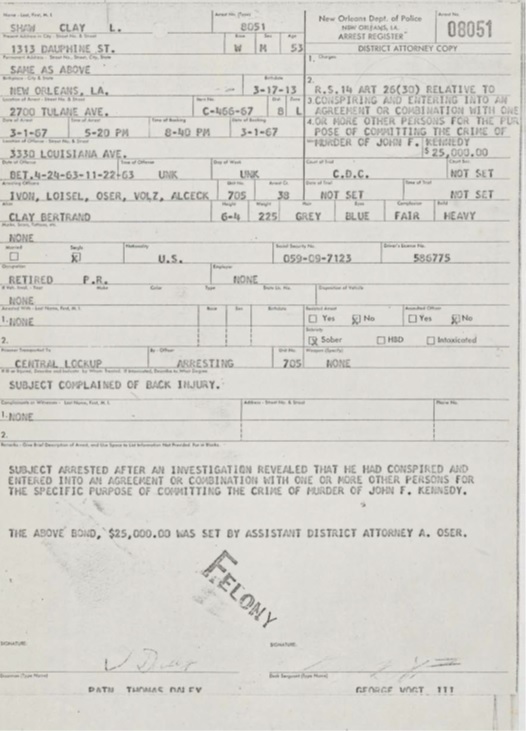
    Many witnesses have confirmed that Clem and Clay Bertrand were Clay Shaw aliases. He used this name in an airport lounge (Materials Clay Shaw 2 Page 20) and in a moment of absent-mindedness gave it away to policeman Aloysius A. Habighorst after he was arrested. (See line ten to the left in Alias box)

    Just for good measure, let us add the following signed statement, which speaks for itself:

    And how about this signed statement by a witness (key passages):

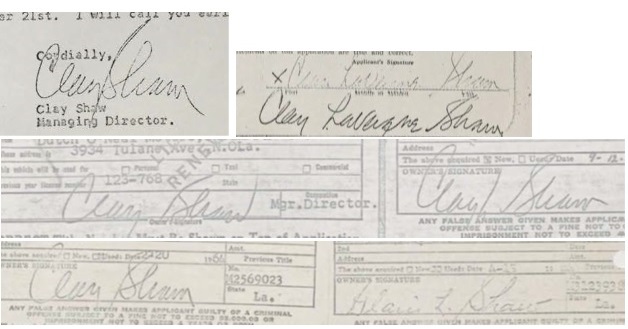
    Add to this Oswald’s lawyer Dean Andrews being backed by Clay Shaw under the alias Clay Bertrand, plus compelling declassified FBI witness testimony. But let’s have fun anyway. Hardly a slam-dunk on its own, the comparison of the Clay Shaw and Clem Bertrand signatures provides more primary data.

    Clay Shaw was involved in real estate and was the director of the International Trade Mart. His signatures can be found in the Garrison files. Here are a few taken from copies of documents he signed:

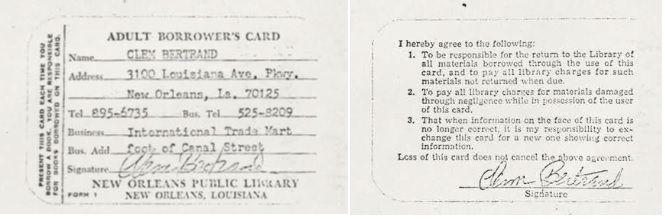
    We can also find this Library card made out to, and signed twice by, Clem Bertrand of the ITM:

    At first this card was dismissed by the Garrison team because the phone numbers did not match the destinations. However, they decided to reconsider this piece of evidence:

    I wondered what a hand-writing expert might say about these signatures, one who had solid credentials, with no dog in the race, one who might like to weigh in simply to help out with no agenda, nor any fees. Luckily, I was able to find such a person. The following is just a small part of her pedigree:

    Here are the signatures I asked her to compare:

    Here is what she responded:

    “Hello Mr. Bleau, 

    I have reviewed the signatures you sent me. I must first tell you that these signatures are not of good quality. They are copies of copies of copies…. Ideally, I should examine originals or first-generation copies, i.e. made from the original. 

    Despite everything, I can tell you that there are several similarities between these signatures on several levels: 

    • Movement 

    • Tilt 

    • Proportions 

    • Spacing 

    • Continuity 

    • Graphic level 

    This makes it possible to retain the hypothesis (subject to) that they were executed by the same hand. 

    I am surprised to see the use of French names (Lavergne and Bertrand) in the signatures. 

    Sincerely,”                                                                                                

    This opinion concurs with that of the illustrious handwriting expert Elizabeth McCarthy who testified at the Clay Shaw trial: and she did have originals and first generation copies to work from. McCarthy stated that, in over three decades, she had been certified to testify in 28 states and three foreign countries. She worked on as many as two cases per day with about a quarter of them going to court. So the dissenting opinion about this subject is by a dyed in the wool FBI man and J. Edgar Hoover loyalist: Charles Appel. This article is not meant for those who would support the FBI in the Kennedy case.

    Today, it is well-nigh indisputable that Clay Shaw and Clay or Clem Bertrand are the same person and that this high-level intelligence asset was trying to get Dean Andrews to represent Oswald, someone he clearly knew. Why do I say this about Shaw’s intel status? Because Malcolm Blunt has just discovered that in CIA documents, contrary to what many had tried to say about Shaw, his expenses were being paid by the Agency while doing those many overseas reports. This is even more evidence that Shaw lied to the public and under oath at his trial about his association with the CIA.

    In a future article, this author will argue that Shaw, because of his links to the ITM and Permindex, must have been known to Allen Dulles. Thus adding a third Oswald babysitter to Ruth Paine and George DeMorenschildt as Dulles-linked persons of interest. The Old Man had his fingers in many pies.

    The 544 Camp Street network

    After writing a seventy-page, two-part article on Exposing the FPCC, I did not think that I could add very much to expose a charade of Oswald provocateur activity in New Orleans. I was wrong. The Garrison file sources, provided me with even more heavy artillery to fully dismantle this cover, and to shine light on Oswald’s network partners.

    The revelation of the 544 Camp Street address stamped on Oswald’s FPCC flyers caused lone-nutters fits. Because anti-Castro Cuban exiles, rabid right wingers, Guy Banister, David Ferrie and other people who revolved around Oswald during the Summer of 1963 were frequently seen in the same building. These flyers were a major problem which was admitted to by the HSCA. We also know that this address had housed another one of Banister’s anti-Castro partners in the name of the Cuban Revolutionary Council led by Sergio Arcacha Smith; who in late 1961 was part of a quasi-anti-FPCC riot in Tampa which came to be known as the Marti-Park incident.

    From Jim DiEugenio’s article there is not much more that we need to add to show that Oswald was a member of a network playing the role of a provocateur. As Jim DiEugenio points out in this reply to Alecia Long, at least seven witnesses either saw Oswald at 544 Camp Street, or with Guy Banister on the streets in New Orleans. This included three people who worked for Banister, and two INS agents. When one adds in the layer of intrigue placed over this by the ARRB, the logic becomes pretty ineluctable. For the declassified record has shown that the Board proved both the CIA and FBI had ongoing counter-intelligence campaigns against the Fair Play for Cuba Committee (FPCC). Oswald was the only member of the New Orleans contingent. And he stamped Banister’s address on one, or more, of his leaflets that summer. A fact which Banister was quite upset about. (HSCA interview with Delphine Roberts of 7/6/78). And then there was the ITM connection to Oswald’s leafleting activities. Let us quote from Jim DiEugenio’s reply to Alecia Long’s column in the Washington Post.

    Another important aspect of Oswald in New Orleans that Long discounts is Oswald’s leafleting in front of Shaw’s International Trade Mart in mid-August. This also had some interesting telltale points to it. First, [Carlos] Bringuier and his right-hand man Carlos Quiroga said that they went to see Oswald in an attempt to infiltrate his FPCC “group” after the ITM incident. The visit occurred before it happened. And Quiroga arrived with a stack of flyers about a half foot thick. In other words, the DRE appears to have been supplying Oswald with his leaflets in preparation for the incident. Secondly, the reason we have films of the event is that Shaw’s first assistant at the ITM, Jesse Core, had summoned the cameras. (Davy, Let Justice be Done, p. 38) Beyond that, it was this leafleting episode that caused George Higginbotham to alert Banister, and his reply was “One of them is one of mine.” (Oswald had hired two helpers from the unemployment office to aid him.) But there was something else to note. In addition to calling the cameras for the ITM incident, Jesse Core picked up a pamphlet from the prior Canal Street episode, the one which got Oswald arrested. He noted that it had Banister’s address on it. He mailed it from the Trade Mart to the FBI with a message attached: “note the inside back cover.” (John Armstrong, Harvey and Lee, p. 568) This would suggest that both Shaw and Core knew about Oswald’s mistake. How would they know unless they were aware of Banister’s operation? Which recalls the work done for Banister by Bill Wegmann and Guy Johnson. But further, the FBI then knew about Oswald at 544 Camp Street before the assassination.

    Wegmann and Johnson were part of Clay Shaw’s defense team.

    On August 27, 1978, Banister’s secretary Roberts was re-interviewed by HSCA Investigator Robert Buras. She said she

    believes that LEE OSWALD came into the office to be interviewed for a job, but doesn’t remember anything specific, because so many people came in for interviews. At a later date Banister introduced Marina and OSWALD to her in his office, but they walked right out and she did not talk to them. She could not recall hearing Marina speak, or how they were dressed. On several occasions LEE OSWALD would come in and go into Banister’s office and she could not hear any conversation from that room. She believed that OSWALD was either working, or attempting to work, for Banister. She does remember hearing Guy Banister holler at Jim Arthus and Sam Newman about letting OSWALD the second-floor room and about keeping the Fair Play for Cuba Committee literature from his office. Arthus used to come into the office and put leaflets on Banister’s leaflet table as a joke because all the other literature was anti-communist.

    Scott Malone reported: “Delphine is definitely a kook, but I found someone else to corroborate her story. She told Mary Brengel about having seen OSWALD in Banister’s office two weeks after the assassination. She did not mention Marina’s presence.”

    Even more telling, if we are to believe a 1979 Dallas Morning News article from the Garrison files, it is Banister who, according to his secretary and girlfriend Delphine Roberts, helped Oswald settle into his Camp Street locale:

    The list

    Lone-nut backers have used the tired tactic of trying to distance 544 Camp Street from Guy Banister and David Ferrie offices by shielding it with a wall and a floor or two. The other deflection is to insist on the separation in time between Oswald and the previous occupiers: The Cuban Revolutionary Council. As the above section demonstrated, there can be no doubt about Oswald’s links to Banister and Ferrie, and no architectural imagining can elide it. When analyzing the following lists made available in the Garrison files, we will see that the time argument to try and create separation between Oswald and the nest of anti-Castro militants holds no water… Something that both the HSCA and Richard Schweiker of the Church Committee fully understood.

    Their mission touched a hot button in New Orleans:

    This author is still analyzing the list of names that we can closely connect to this address. What he has found so far is quite incriminating.

    Consider the following profiles of some of the crusaders:

    William T. Walshe:

    One of Mr. Walshe’s important credentials was that he was secretary of the New Orleans based Mississippi Valley World Trade Center (MPWTC) which links him closely to its Secretary: None other than Clay Shaw according to the following listing.

    Mississippi Valley World Trade Conference Annual Award 1955

    Name: MISSISSIPPI VALLEY WORLD TRADE COUNCIL

    Type Entity: Non-Profit Corporation

    Status: Not Active (Action by Secretary of State)

    2006 Annual Report/Reinstatement form is required in order to reinstate Print Annual Report/Reinstatement Form for Filing

    Mailing Address: 124 CAMP ST., NEW ORLEANS, LA 70130

    Domicile Address: 124 CAMP ST., NEW ORLEANS, LA 70130

    File Date: 09/05/1956

    Registered Agent (Appointed 9/05/1956): C. C. WALTHER, 3524 GENTILLY BLVD., NEW ORLEANS, LA 70119

    Registered Agent (Appointed 9/05/1956): CLAY SHAW, 505 DAUPHINE ST., NEW ORLEANS, LA 70116

    President: C. C. WALTHER, 3524 GENTILLY BLVD., NEW ORLEANS, LA

    Vice President: WILLIAM T. WALSHE, 1208 WEBSTER ST., NEW ORLEANS, LA

    Secretary: CLAY SHAW, 505 DAUPHINE ST., NEW ORLEANS, LA

    To understand the status of this organization, one simply needs to note the following:

    From January 4th to January 20th, First Deputy Premier Anastas Mikoyan of the Soviet Union visited the U.S. During his stay, Mikoyan met Under Secretary of State Douglas Dillon, Secretary of State John Foster Dulles, and President Eisenhower and was profiled by Allen Dulles head of the CIA. One of the organizations that was debriefed by Dillon was this MPWTCA highlighting further the proximity between Dulles and Shaw. In 1961, President Kennedy, appointed Republican Dillon Treasury Secretary which put him in charge of the Secret Service.

    Walther himself was rather connected, with links to General Cabell: (New Orleans Times-Picayune May 10, 1961 S1-P3)

    CIA Must Keep Quiet — Cabell
    General Cites Strides of Reds in Science

    The Central Intelligence Agency, because of the sensitive nature of its activities, must maintain a policy of silence at all times in regard to its knowledge of the participation in United States affairs, the deputy director of the CIA said in New Orleans Tuesday [9th] night.

    Air Force Gen. C. P. Cabell said that he therefore could not “rise to the defense of the CIA” in regard to its reported connection with the recent Cuban invasion, a connection which has come under repeated fire from many quarters.

    Gen. Cabell arrived in New Orleans late Tuesday to address the International Relations Association of New Orleans, previously called the Foreign Policy Association of New Orleans. At a meeting held at the Sheraton-Charles Hotel, he discussed “Communism and Science.” He left shortly after the meeting to return to Washington.

    Interviewed at International House shortly before his talk, Gen. Cabell refused to comment on the Cuban invasion and the CIA’s role in the affair.

    “This is a sensitive subject, certainly, and one which should be discussed only by President Kennedy and Secretary of State Rusk,” he said. “The Central Intelligence Agency is not a policy making agency; we merely serve the policy makers.”

    Therefore, it would make matters only worse, he continued, if officials of the CIA and other like agencies continued to make comments concerning the Cuban situation.

    “It could very possibly occur that these comments would differ in meaning and suggestion from those made by the only two people who should be commenting on it – the President and the Secretary of State,” he said.

    Discussing the scientific accomplishments of the Communists in his talk before the International Relations Association, Gen. Cabell said that “there is no reason at all to belittle or magnify the accomplishments of scientists living under Communistic regimes, and there is no reason to draw invidious comparisons between our efforts and their efforts.

    “What we must realize is that the accomplishments are real,” he continued, “and that their successes so far have led them to place even more emphasis on scientific research and development in what Khruschev calls ‘the splendid years under Communism.”

    Cabell said that science is the servant of Communism and that, stripped of all its usual verbiage, “Communism is a future social order being constructed out of present-day socialism through the application of science.

    “We must recognize the vast scientific resources of the Soviet Union and the growing strength of China are being integrated with their political ambitions to reconstruct society in the Communist countries and eventually in the entire world.”

    He concluded that “we should stand forewarned that every resource available to being used by the Communists to advance their political ends.”

    The International Relations Association changed its name from the Foreign Policy Association Tuesday night because, according to its president, C. C. Walther, the group is no longer affiliated with its originator, the Foreign Policy Association of New York.

    It has been reported by eminent author Donald Gibson that Clay Shaw was present during Cabell’s speech. (Davy, p. 293)

    Harold K. Marshal and wife Mrs. Naomi Marshal has her own links to Clay Shaw according to excerpts from this 2013 notice written by her son. article in NoLaVie

    My mother, known to our neighbors to the south as “La Mujer del Norte” (the woman from the north), traveled extensively in Latin America on business during those heady days in the 1940s and ’50s, when New Orleans was dubbed “Gateway to the Americas” — long before Miami, Atlanta and Houston opened economic sluices to the south, effectively shutting New Orleans’ wrought-iron-laced gates for years to come.

    On her way to prominence in foreign trade, Mother shattered several glass ceilings, becoming the first woman officer of the New Orleans Board of Trade and a member of the city’s Export Managers Club. She was an avid supporter of the original International Trade Mart, a five-story modernist block of offices and displays of foreign government trade offices, spearheaded by Clay Shaw, its first director, which was demolished to make way for the New Orleans Sheraton hotel.

    Her life was full, including her idea to locate the ITM tower at the foot of Canal Street, rather than in the new Duncan Plaza (City Hall) complex.

    Clay Shaw moderated a panel that featured Gilbert Mellin

    On October 23, 1959 Clay Shaw moderated a panel discussion that included local business leader and CRC backer Gilbert Mellin; a gathering where anti-communist attitudes were in full view.

    Manuel Gil

    Was employed as Production Manager by INCA. Authorized to sign checks for “Cuban Revolutionary Council”, and a charter member of INCA.
    (WC Vol 26, p. 769; CE 3119; CD 87 SS 517 p. 3 DTR 00-381; CD 407, p. 15; Oswald in New Orleans, Weisberg, pp. 343, 345, 356, 362-363)

    INCA was run by Ed Butler who was friendly with Lloyd Cobb and Clay Shaw of the ITM, who in turn cooperated with him in his anti-communist endeavors. Ed Butler also contributed in the sheep-dipping of Oswald into his Warren Commission, pro-Castro persona. Of course, Gil was in close contact with Sergio Arcacha Smith.

    William Monteleone

    Monteleone’s hotel is where Shaw was the moderator for Anti-Communist panel discussion featuring Mellin.

    According to this CIA file, an informant of unknown reliability claimed that Shaw was linked to one of the Monteleone girls in situations of gross immorality with overtones of sexual deviancy. While this admittedly is of little worth in terms of evidence, it is interesting that this even exists in a CIA file. Is this CIA profiling of U.S. citizens even legal? Unless perhaps they were keeping an eye on one of their own.

    According to the manager of the Newman building, a “young Monteleone” ran the CRC (Garrison Files):

    Provosty Dayries

    The second name on the list should cast no doubt about Banister’s strong ties to the CRC (https://www.lib.lsu.edu/sites/default/files/sc/findaid/3320.pdf)

    In 1951 Provosty Arthur Dayries, who was working for the VA at the time, became assistant superintendent of police—a political appointment by New Orleans Mayor deLesseps “Chep” Morrison. This was after the retirement of Milton Durel, and aimed to bring internal crime within the police department to a stop. At the time, many police captains were part of an underground lottery, gambling, prostitution, and drinking network within the city, which was designated as a “vice” or “graft” investigation (the terms are used interchangeably throughout the materials). He was promoted to superintendent in 1954, following an investigation into the former superintendent of police, Joseph Scheuring, and his lack of leadership in working to end the police network.

    Prior to the hiring of Dayries as assistant superintendent, Mayor Morrison hired a former FBI agent from Chicago–though originally from Louisiana–named Guy Banister to handle the internal affairs investigation from within the mayor’s office. When Dayries was promoted to superintendent, he hired Banister to serve as his assistant. The two repeatedly came into conflict. Banister would often speak to the media before statements had been cleared by Dayries or Mayor Morrison. Additionally, Banister would routinely overstep his bounds within the police department regarding his leadership. At one point he attempted to take over Dayries’s job while he was in Florida speaking at a conference, before being reprimanded by the mayor.

    While Banister at one time did claim Dayries was corrupt, they certainly frequented the same personages.

    The Rodriguez clan

    According to this information in the Mary Ferrell files Arnesto Napoleon Rodriguez y Gonzalez worked with ONI in the 1930s. Father of Arnesto, Jr., an FBI informant who was in communication with Lee Oswald in New Orleans during the summer of 1963. AMJUTE-1 is named as Arnesto Napoleon Rodriguez y Gonzalez on a list of cryptonyms. Arnesto’s other son, Emilio Rodriguez was also a CIA asset based in Mexico City, after being a stay behind agent in Cuba.

    Arnesto Napoleon Rodriguez told an investigator for New Orleans District Attorney Jim Garrison that Oswald “came to the Berlitz School of Languages on one occasion and attempted to talk to him about the possibility of taking a language course, and about Cuba in general. He said he told OSWALD he was busy at the time; if he would return at a later date, they could discuss the situation. OSWALD, however, never returned.” He denied having any tapes of Oswald. [CIA 79, 166-78, 113-48, 72; Sciambra to Garrison 2.14.67 interview with ER Sr.] According to Larry Hancock Arnesto, father and son, were both in the court-room when Oswald got arrested for his fight during his leafletting activities, and Emilio was well connected to the JM. Wave crowd.

    Carlos Crimadier (or Grimader on the list)

    He was the auditor for the Crusade. Here is how the HSCA describes him:

    Richard D. Reily

    If the name Richard D. Reily rings a bell, it is because he is a family member of the same family who owned the Reily Coffee Company where Oswald worked for a few weeks during the summer of 1963 in the Crescent City.

    Ronnie Caire

    According to Ronnie Caire’s testimony to the HSCA, the Ronnie Caire advertising agency provided marketing services for the CRC. Caire also interviewed Oswald during the summer of 63 when he applied for work. (https://www.jfk-assassination.net/weberman/nodule11.htm) Caire says he had been approached by Sergio Arcacha Smith and that he knew both Banister and E. Howard Hunt. He stated that the CIA approached him through the CRC because he was politically connected. (https://www.jfk-online.com/jpsasfrd.html) (For more information, click here.) According to Arnesto Rodriguez Senior, Caire was the principal organizer of the Crusade and was very close to Smith. In fact, he said that Caire’s offices served as the HQs for the Crusade. If this is the case, then this places Oswald in offices occupied by the CRC and the Crusade. Hmmm.

    It is interesting to note that Oswald also applied for work at United Fruit (Garrison: Oswald Miscel. Files, Bercham Exhibit 1), and Michoud Assembly Facility (NASA) where Shaw tenant William Kloepfer worked. He also applied in photography for Jules Weiss who was close to Shaw and also Warren Bernados who also knew him. The funny thing is that Bernados and Weiss had been partners but split, yet Oswald put the partnership company on his unemployment job search report, and both claimed he had passed by to apply for work after they split up. (Garrison Files Shaw Leads 2) Was Oswald really looking for work? … or was he simply being fed names he could use for his unemployment insurance claims? He told Dean Andrews that he was being paid $20 a day to hand out FPCC leaflets. In the Garrison files, we can see all the names of the employers where Oswald supposedly applied. It would be interesting to see how many of these tie into the network we are describing.

    Arcacha Smith

    Smith was head of the CRC at this time and figures on this list in a major way. Sergio Arcacha Smith His links to David Ferrie, Guy Banister, Layton Martens, Carlos Quiroga, Carlos Marcello, Carlos Bringuier, Arnesto Rodriguez, Ronnie Caire, Warren DeBrueys of the FBI who monitored the FPCC in New Orleans, and a host of well-connected anti-Castro operatives (many of whom relate directly to Oswald and Clay Shaw) is well documented… So is his theft of fund-raising revenue, and his determination not to cooperate with Jim Garrison.

    Others known to have come into contact with Oswald and Newman Building occupants, include Cuban exiles of interest like Carlos Bringuier of the DRE who, according to his book, had met Bill Stuckey for the first time in August 1962 (Crime Without Punishment, page 101); and Celso Hernandez and Frank Bartes (who replaced Sergio Arcacha Smith in the CRC). These Cuban exiles all had touch points with Oswald. The FPCC and DRE were monitored by David Phillips (CIA) as well as Warren DeBrueys (FBI) and George Joannides (CIA). The CRC was under Howard Hunt’s watchful eye. Bringuier associate Miguel Cruz also came into contact with Oswald and is identified as informant T-2 as mentioned in DeBrueys’ FPCC file. (Blakey letter to Attorney General of U.S., October 16 1978)

    Joan Mellen’s research indicates that after his brawl on Canal Street with Bringuier, Hernandez and Cruz, Oswald, while under arrest, asked to meet DeBrueys. Warren was out of the office and his associate met Oswald for hours. Which sounds like overkill for a small disturbance. The following file (see bottom right) shows that a Ramon Hernandez complaint about Oswald hand-outs also reached the FBI’s top FPCC dog in New Orleans:

    If the picture one gets from this is that Shaw, Ferrie, Banister and Oswald’s multiple connections to this network of anti-Castro Cuban exiles, right-wing extremists and intelligence actors was not coincidental, then you are beginning to see quite clearly. If you are not quite there yet perhaps the story of one of the last well-connected Cubans to appear on this list will seal the deal. His name is Carlos Quiroga, co-chair of the youth wing of the Crusade to Free Cuba, second in command at the CRC, well-connected to Smith, Bringuier, Bartes, Ferrie, Banister… and Oswald.

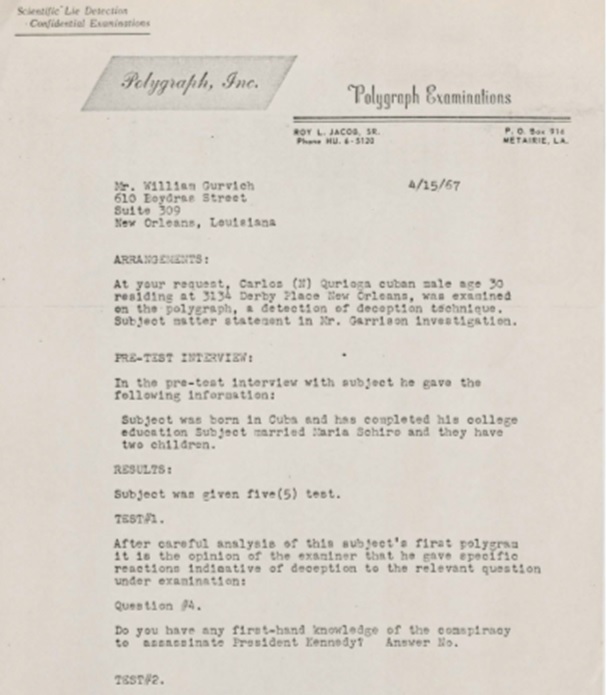
    His testimony to Garrison was polygraphed… His lies were plentiful, blistering and confirmed by another polygraphed witness. Quiroga deserves a section of his own.

    Carlos Quiroga

    Oswald`s landlady Jesse Garner saw Quiroga meet Oswald at his apartment. Quiroga claimed that he was trying to infiltrate the FPCC. This could have been done by filling out one of the flyers that Oswald was distributing. According to Jesse Garner in her Warren Commission testimony, Quiroga seems to have brought way more than one application: Note how both lawyer Wesley Liebeler and Jim Garrison underscore the quantity of flyers Quiroga brought with him:

    Another false claim made by Quiroga was that this had been the only time that he had met Oswald.

    The following lie detector test results reveal that: Quiroga met Oswald a number of times. He also knew that Oswald`s association with the FPCC was but a front and that Oswald was part of an anti-Castro operation. That he knew that David Ferrie knew Guy Banister and he had seen Oswald with at least one other Latino subject.

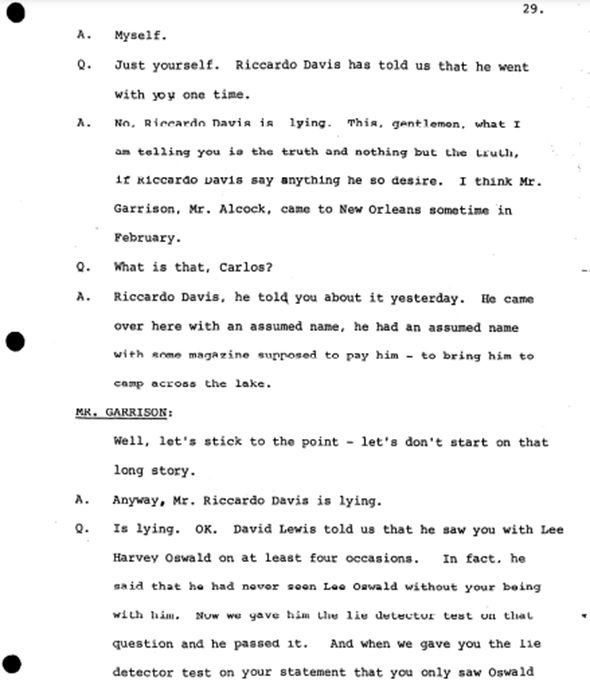
    The exchange below between Quiroga and Jim Garrison, provides corroboration to the damning test results, in that two witnesses–one who had also been polygraphed–contradicted Quiroga`s statements.

    David Lewis, a roommate of Banister employee Jack Martin, witnessed Quiroga with Oswald a number of times. While his testimony and character have been the subject of numerous attacks, there was no denying that his own polygraph results bolster the proof of deception brought forward by Quiroga’s polygraph. We can also add Ricardo Davis as one other witness who accompanied Quiroga when he was with Oswald on an occasion.

    (http://www.aarclibrary.org/publib/jfk/garr/grandjury/pdf/Quiroga.pdf page 29)

    More list member analysis

    The motive of Latinos to be involved in the Crusade is self-explanatory. The Anglo-Saxon members most likely had business motivations. New Orleans was the gateway for North South trade. The last thing they wanted was a Castro stimulated revolution of Central and South American states that would disrupt markets and supply chains. After discussing with a member of the research community from New Orleans, who briefly perused the list, he concluded that a number of multi-millionaires were represented and wanted Castro out.

    One example is Mrs. R. G. Robinson, who was likely the wife of Robert Gibson Robinson, son of the founder of Robinson Lumber Company (1893). Robert Gibson, was instrumental in the internationalization of this stellar family-run company. (See this link its website,

    Robert Gibson Robinson, his son, upon recognizing the declining supply of export quality Heart Pine, began the company’s first foreign manufacturing facility in Nicaragua in 1942 to supply Pitch Pine to Robinson’s customers around the world.

    After World War II, Jack, Charlie, and Sam, the third generation of Robinsons entered the business, expanded into hardwoods and began operations in Honduras and Brazil.

    Mexico was also an important supplier of product. Just like with United Fruit, a communist take-over in these areas would have been disastrous.

    Consider this about a Stockton B. Jefferson:

    If this is the CPA husband of Mrs. Stockton B. Jefferson from the list, we can link another member of the Crusade who saw Castro as an existential risk. Note the association with Avondale Shipyards. One of the founders of Avondale Shipyards was a newspaper owner and father of Fred Koch, founder of Koch Industries. Harry Koch

    Oswald letter to FPCC

    In one of my articles for Kennedysandking, Oswald’s Last Letter, I presented strong evidence that a letter to the Russian Embassy was a fake designed to paint Oswald in cahoots with Russia for the assassination. A very early researcher has convinced me that at least one of Oswald’s letters to the FPCC was done with close assistance. For this important clue, we need to go back to 1964 and quote directly from Harold Feldman, OSWALD and the FBI.

    After presenting arguments that Oswald was an FBI informant, Harold astutely makes the following points: “If the FBI did not employ Oswald or work with him, then who wrote the letters he addressed to the Fair Play for Cuba Committee in New York? Oswald alone certainly didn’t. Whoever wrote the letters to New York was coherent, commanded a good vocabulary, rarely misspelled a word, and punctuated decently. Oswald himself wrote English that a sixth-grader would blush to acknowledge. Here is a letter he wrote to his mother from Russia on June 28, 1963. I preserve the original spelling and punctuation:

    Dear Mother.

    Received your letter today in which you say you wish to pay me back the money you used last year, that, of course, is not nessicary however you can send me somethings from there every now and than.

    If you decide to send a package please send the following:

    One can Rise shaving cream (one razor (Gillet)

    Pocket novels westerns and scienace fiction — Time or Newsweek magazine

    Chewing Gum and chocolate bars.

    That’s about all. Ha-ha

    I very much miss sometime to read you should try and get me the pocket novel “1984” by Wells.

    I am working at the local Radio plant as a mettal worker. We live only five minutes from there so it is very conveinant.

    Well thats about all for now. I repeat you do not have to send me checks or money!

    Love XX

    Lee
    P.S. Marina sends a big Hello to you also

    Now compare this semi-literate effusion with the following addressed to the Fair Play for Cuba Committee about two years later. (A New York Times report on the letters to FPCC indicates that they were handwritten, so presumably no public stenographer improved their style.)

    Dear Mr. Lee:

    I was glad to receive your advice concerning my try at starting a New Orleans F.P.C.C. chapter.

    I hope you won’t be too disapproving at my innovations but I do think they are necessary for this area.

    As per your advice I have taken a P.O. Box (N.O. 30061).

    Against your advice I have decided to take an office from the very beginning.

    I u c [apparently meaning, as you see] from the circular I had jumped the gun on the charter business but I don’t think it’s too important. You may think the circular is too provocative, but I want it to attract attention even if it’s the attention of the lunatic fringe. I had 2,000 of them run off.

    The major change in tactics you can see from the small membership blanks, in that I will charge $1 a month dues for the new Orleans chapter only and I intend to issue N.O. F.P.C.C. membership cards also.

    This is without recourse to the $5 annual F.P.C.C. membership fee.

    However, you will lose nothing in the long run because I will forward $5 to the national F.P.C.C. for every New Orleans chapter member who remains a dues paying member for 5 months in any year. . . .

    And so on for several more well-integrated paragraphs. He now spells “receive” and “necessary” correctly. He has mastered the apostrophe. His ideas cohere. He tackles words like “innovations,” “provocative,” “recourse,” “disapproving,” “approaching,” and “application” with success, something that would have been clearly beyond the powers of the voluntary exile in Minsk.

    Until the authorship of the letters to the FPCC is settled, I think it reasonable to suppose that Oswald did not compose them, at least not without help. Who, and where, is the invisible scribe? No associate of his New Orleans period has been found, or even hinted at. If Oswald was employed by the FBI to operate in “Castro groups,” as the news report suggests, it is also reasonable to suppose that in the letters to FPCC his pen was guided by the FBI.”

    In the following you will see that the actual hand-written version indicates a few differences with the above typed version (example its vs it`s). In my view the analysis by Mr. Feldman remains valid and astute given what he had to work with. He is correct in saying that this letter is so much better in grammar, word selection and style than other Oswald correspondence.

    The FPCC in 1963

    In my first prior plots article, I based my research on author Van Gosse’s work to estimate maximum FPCC membership to be between 5 and 7 thousand in 1961 and argued that such a low number made it impossible for persons of interest like Richard Case Nagell, Oswald, Policarpo Lopez, Vaughn Marlowe, Harry Dean, John Glenn, Santiago Garriga–who were potential patsies to varying degrees–to all be coincidently linked to the FPCC; especially for those in the Deep South where the FPCC had much less activity. Based on recent data that I have obtained, the odds are astronomically worse than what I first thought.

    According to Malcolm Blunt, Vincent T. Lee, who was the last head of the organization, stated that the number of members had plummeted to about 1500 by mid-1963, finances were very poor and that the other FPCC officers were no longer even answering to him. Even the Treasury Department noted that the FPCC was almost inactive. Furthermore, members in the Deep South tended to be disproportionately African American, and the FPCC was riddled with informants.

    In other words, the statistical probability of seeing a white person in the Deep South genuinely involved with such a vegetative outfit was rather small… seeing seven of the subjects profiled… well, no comment.

    Framing Oswald

    Two persons both Garrison and Blunt included in their files are the Buchanan brothers, Jerry and Jim Buchanan. They appear to be part of the large number of frame-up artists (FBI Report of Joseph Boston). Jerry claimed he had a fight with Oswald in early 1963 while he was distributing FPCC flyers in Miami.

    Here is the capper: Both Jerry and Jim were officers of the International Anti Communist Brigade, where one of the Blame it on Castro Kings, Frank Sturgis, left his alpha male scent.

    Birds of a feather

    In article 2 of its formation documents, the International Trade Mart specifies one of its roles as “the development, promotion and maintenance of trade and commerce between the people of the United States of America and the people of the world, particularly the other American republics.”

    It goes without saying that a communist country like Cuba, that was nationalizing many of its industries, was not in tune with the ITM mission.

    In 1968, its president, the CIA connected Lloyd Cobb, went even further by stating: “the aims of the new International Trade Mart would be: to act as a catalyst to develop trade and not be just a display area for foreign goods; to encourage and stimulate U.S. investors into joint enterprises with Latin Americans; to counter Communist propaganda…” (The Story of the International Trade Mart, page 15).

    Since the assassination, the ITM has gone through a merger and a multitude of changes, moves and expansion– making it an entirely different post-Cold War entity today. It is safe to say that during the Red Scare and Missile Crisis, New Orleans and its captains of industry where a tight-knit bunch who worked in synch with one another to target communist threats. The omni-present intelligence network was a partner in this economic and national security danger. This is why Oswald set up an office in the heart of one of the major anti-communist blocs in North America at the time and played a provocateur role using the brain-dead FPCC as a front: to work with a network in rooting out communists. A network which included Guy Banister, Cuban exiles, David Ferrie, INCA, WSDU, the CRC, The Friends of Democratic Cuba, The DRE, the Anti-Communist League of the Caribbean, intelligence actors and Clay Shaw who was a well-paid CIA contract agent. This is why we have seen so much interaction between persons on the list with Oswald and Shaw. Given the role of the ITM, how could Shaw not be well connected and work in symbiosis with the apparatus countering communism as well as with the New Orleans power elite.

    Just how invested the ITM, or at least some of its governance members were, in controlling the environments capitalists dealt in is not known. The Garrison files do offer some clues which the research community should pour into. Let us look at some of the people who were involved in with the ITM some sixty years ago.

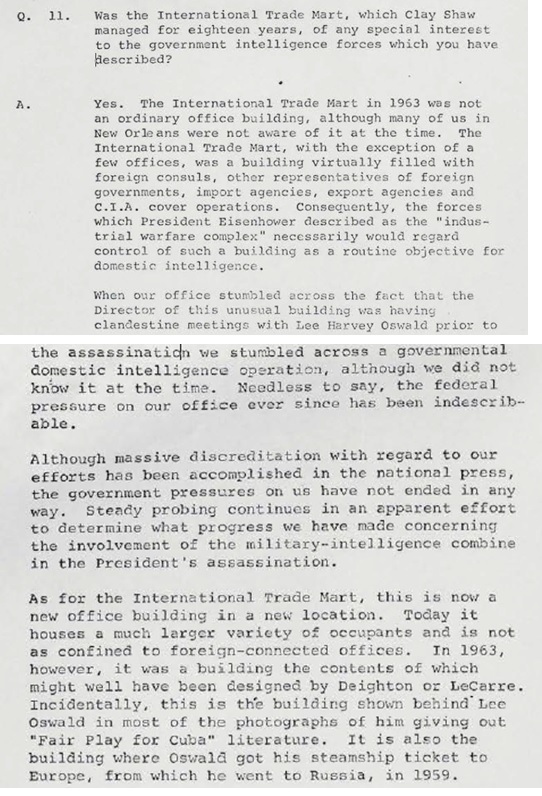
    We can begin with what Garrison himself observed when questioned on May 27, 1969 (Garrison Files: Crusade to Free Cuba, file 2, page 38)

    Article 4 of the ITM foundation papers lists the original board directors in 1945. While a 1963 list would be worth analyzing, this one is already very revealing, especially when comparing with INCA members and operatives:

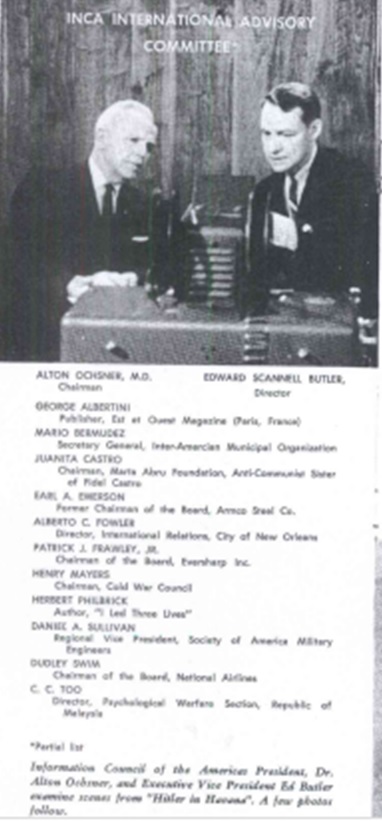
    And this list of INCA operatives from an INCA pamphlet:

    We know Shaw was close to Butler and Ocshner of INCA and that Philbrick was Oswald’s idol. Garrison was obviously intrigued by certain names such as Eustis Reily on the INCA list. This author finds the Stern names (WDSU) interesting. Since William Stuckey had a weekly radio program at the station and they allowed Walter Sheridan to work out of their offices while doing his NBC hatchet job on Garrison in 1967.

    Declassified files prove that Lloyd Cobb, Theodore Brent (top dogs at the ITM) and Clay Shaw, who joined later, were intel connected . For instance, Cobb was on a panel of CIA cleared lawyers in New Orleans. (William Davy, Let Justice be Done, p. 182) According to Joan Mellen, Brent’s Mississippi Shipping Company ended up being a CIA proprietary. (Mellen, A Farewell to Justice, p. 131) Oliver Stone’s film, JFK: Destiny Betrayed, proves that Shaw was a highly valued contract agent and had a covert security clearance for the Agency. The last name on the ITM list William G. Zetzmann also figures on a partial list of INCA members almost 20 years later.

    A New Orleans based researcher sent me the following information: “I spoke with Paul Fabry, head of Radio Free Europe and other CIA organizations and later with his secretary, who told me that it was always their understanding that the ITM  was “an agency operation”. The bronze plaque in the lobby of the ITM listed Alton Ochsner, James Coleman and a guy named Wm. Norman (atty and spook).” 

    Now let us see what we can peace together in terms of ITM occupants, employees and visitors.

    According to the Story of the ITM: A list of first tenants included David Kattan, Otis McAllister Co., Hemisphere Trading Co. (of which Alonzo G. Ensenat was Manager), United China & Glass Co., W. R. Grace & Co , S. Jackson & Son, Inc., Dictaphone Corp., Lily-Tulip Co., and Lucky Tiger Co.

    It would be helpful if researchers could profile these occupants of the ITM and others who were there in and around the time of the assassination. For instance, J. Peter Grace presided over W.R. Grace & Company as of 1945 for many decades. He is profiled this way by Source-watch: The name J. Peter Grace (1913-1995) “is found in the Council for National Policy (CNP) Membership Directory for 1984-85 and 1988. Grace holds a Bachelor of Arts degree from Yale University (1936). Grace “started in 1936 as Assistant Secretary at W. R. Grace, in 1945 became President and CEO. Grace is a member of the Newcomen Society, Council on Foreign Relations (CFR), Knights of Malta: American Chapter of the Board of Founders, Knights of Malta President, 114 Avenue of the Americas [Who’s Who in America (1976-77, 1992-93)]. Grace was involved in Project Paperclip — a post-World War II CIA arrangement to remove classified information from dossiers so that former SS members and 900+ Nazi scientists could emigrate to the U. S. Hundreds of war criminals would find employment within government agencies and companies such as W.R. Grace chemical company whose president was J. Peter Grace.”

    Alonzo Ensenat certainly has strong ties to Clay Shaw. He was president of Hemisphere Trading Co. in New Orleans until founding Ensenat & Co., an import-export firm, in 1947. He was president of the company until retiring in 1980.

    Mr. Ensenat was a member of the committee that organized International House in New Orleans in 1943 and was on its first board of directors. This is where Shaw went to work on his return from World War II. The chain of International Houses was started by the Rockefellers and spread worldwide as part of their globalist, one world vision. The chairman of the Board of Trustees was John McCloy, a frequent Rockefeller lawyer. (James DiEugenio, Destiny Betrayed, second edition, p. 383) In 1945, Ensenat was an organizer of the International Trade Mart and was one of its first tenants when the building opened at 2 Canal St. in 1963. International House and the International Trade Mart later merged to form the World Trade Center of New Orleans. In 1946, Mr. Ensenat was an organizer of the Foreign Trade Zone, a duty-free zone that helped increase traffic through the Port of New Orleans after World War II.

    Ensenat was on the executive committee of the Mississippi Valley World Trade Council (Secretary, Clay Shaw), which sponsored annual conferences in New Orleans to promote American exports in the 1950s and ’60s. He was president and general chairman of the conference in 1960 when it received the U.S. Department of Commerce’s “E” Award for excellence in promoting exports. He also was a charter member and past president of the World Trade Club of New Orleans. As opposed to this globalist goal, as Professor Donald Gibson has shown, Kennedy was a nationalist, both for the United States and largely in the Third World. This was a distinct break in policy between him and Dwight Eisenhower. (See DiEugenio, Chapter 2)

    But beyond the uplinks to the Eastern Establishment, the ITM and Shaw had downlinks into the Crescent City. Aura Lee was a former secretary to Shaw at the ITM. After watching a press conference by Shaw where he denied knowing David Ferrie, she stated to Dr. Charles Moore, that she had seen Ferrie enter Shaw’s office at the Trade Mart several times. It happened so often the she thought Ferrie had privileged entry into his office. (DiEugenio, p. 209)

    Bill Gaudet had an office in the ITM. According to Harold Weisberg, it was adjacent to two vacant offices. He published the Latin American Reports. Weisberg described him as C.I.A affiliated. (Andrew Sciambra Assistant D.A., interview with Weisberg on 4/14/1969). According to Sciambra, Cuban exiles often reported that Gaudet was CIA or FBI. Gaudet witnessed Oswald talking to Banister. (DiEugenio, p. 112)

    On March 31, 1967, Betty Parrot told Garrison’s assistant DA Andy Sciambra, that Bill Dalzell lived in her home and that he was involved in a group called the Friends of Cuba with Sergio Arcacha Smith, BILL CRAIG, GRADY DURHAM, an individual named LOGAN who was also a member of the C.I.A., BILL KLINE, an attorney, REGIS KENNEDY, a member of the FBI, an individual named HOFFMAN and an individual named EASTERLING.

    She also stated that “this group later moved from their office in the Balter Building and moved into an office in the International Trade Mart and then operated under the name of The Voice of Cuba or The Friends of Democratic Cuba.”

    Layton Martens, listed as second in charge of the CFC after Arcacha Smith, knew David Ferrie through the Civil Air Patrol very well and also knew Clay Shaw but claimed Ferrie did not know Shaw. Here is what he told Garrison’s Assistant D.A. Alvin Oser when questioned on March 12, 1967, when asked: Have you ever been at the International Trade Mart?

    LM: Yes.

    AO: When was that?

    LM: Well, a couple of vacations, a girlfriend’s mother worked there and I used to stop in and see her. I used to tell her hello. I did some soliciting there for funds for the F.R.D. and I went once with CLAY to see the plans for the new building.

    Another ex-Civil Air Patrol cadet under Ferrie, Lawrence Fox, told assistant DA Jim Alcock (April 14, 1967) that he also solicited funds for the Crusade to Free Cuba at the ITM with David Ferrie. He said he was involved with Layton Martens and Arcacha Smith. (Garrison Files Miscellaneous reports 2 page 20)

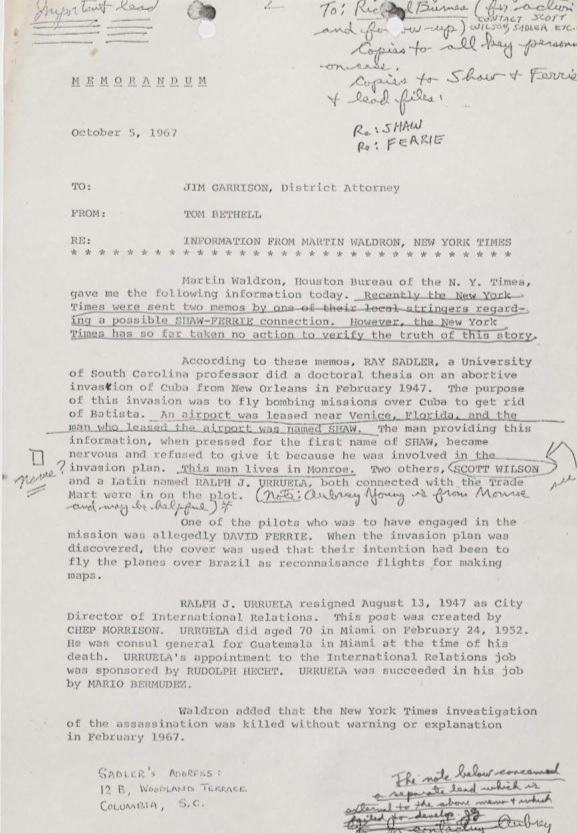
    In a report (described as relatively accurate but unconfirmed) about CIA leads in New Orleans dated May 24, 1967 to Jim Garrison by Assistant D.A. William Martin, he describes a Dave Baldwin who was hired by Shaw:

    “(DAVE) BALDWIN) formerly of this City and a former newspaper reporter for the New Orleans States Item, was a covert member of the Central

    Intelligence Agency and operated in India during the years of 1950, 1951 and_l952. Subsequent to his service in India Mr. BALDWIN returned to this city and was employed by CLAY SHAW as Public Relations Director for the International Trade Mart from 1952 through 1955…

    …It was told to me that, during his employment at) the Trade Mart, DAVID BALDWIN succeeded in recruiting CLAY SHAW for C.I.A. operations, or, conversely, that CLAY SHAW had already been recruited by the C.I.A. by the time of BALDWIN’s employment, and that his employment of BALDWIN was suggested or sponsored by the C.I.A. During his operations in India. Mr. BALDWIN used as a cover his employment as a correspondent for North American Newspaper Alliance, the Louisville courier Journal, and the New Orleans Item.”

    And there was Jesse Core, who replaced Baldwin. Core became Clay Shaw’s aide-de-camp at ITM. Core happened to pick up a flyer while Oswald was leafleting on Canal Street. He brought it back to the ITM. From there, he mailed it to the FBI office. He noted the part of the flyer which had Guy Banister’s office listed on it. This would suggest that he and Shaw knew this was a problem for Oswald, Banister and the FBI. Further, it was Core who notified WDSU TV about Oswald’s leafleting event outside the ITM. (DiEugenio, p. 161)

    And we have this report that is so information-packed that I will share it intact:

    In other words, at about the time Garrison’s inquiry was being exposed against his will by local reporter Rosemary James, The Times pulled the plug on their own inquiry.. When, in fact, they had leads in their files that backed up the DA. This parallels what Time-Life did through editor Holland McCombs, due to his friendship with Clay Shaw. (Click here for details https://www.kennedysandking.com/john-f-kennedy-reviews/last-second-in-dallas-part-1)

    Respected researcher David Boylan sent me this provocative piece of information about another interesting occupant: “I’m not sure if you guys have seen this. EAR’s (Emilo A. Rodriguez) statement just before he became a full-time employee. Page 6 is pretty interesting. He worked for the Berlitz School located at the ITM. His brother Arnesto would later run the Berlitz school and attempt to teach Oswald Spanish.”

    https://www.maryferrell.org/showDoc.html?docId=181877#relPageId=1.

    “The signature is still redacted but I’m sure it was signed by David Morales. Morales had been working with EAR and Sforza in Cuba and exfiltrated them both in June 1961.Szorza would get an office but Morales wanted to keep EAR away so that EAR could continue his deep cover work.”

    Summary

    In parts 1 and 2 of this series, it was demonstrated that when Oswald started an FPCC chapter in New Orleans, he did so to infiltrate it as an informant.  

    In part 3 of this series of articles we have not only sealed the deal on proving that Oswald’s FPCC activities were simply a role he was playing as part of city-wide anti-Castro offensive that had national backing. We also show how Oswald and Clay Shaw’s work environments overlap in terms of contacts, mission and activities.

    It was in the ITM’s DNA of that day to support anti-Castro efforts through propaganda, funding, organizing and networking as covertly as possible. Clay Shaw and Oswald’s intelligence fingerprints go back years before their appearances in New Orleans. Richard Schweiker of the Church Committee famously stated that everywhere you look with Oswald you find the fingerprints of intelligence. Shaw let his spook-slip show a number of times through his reckless socializing and hobnobbing with David Ferrie as well as through his anti-Communist support activities, network links and association with Permindex. Which in those day were not just a patriotic duty: in the New Orleans business community, it was part of people like Clay Shaw’s understood job description.

    There has been a lot of discussion about the close physical proximity of 544 Camp Street to Banister and right-wing activists. Thanks to the Garrison files, we can work on proximities within the networks Oswald and Shaw shared. It is within these associations–which in the mind of their members were noble and deemed essential–that a few key people on a need to know basis exchanged money, orders and words that contributed to the murder of a President who was not in tune with a national mission, and thus considered a national threat. There was also a need to cover up and create distance between network members and Oswald.

    One member of this network that has not been discussed yet was a muscular Latino who was often seen accompanying Oswald, or perhaps an Oswald double. He was considered so suspicious that the whole Garrison team was on the look-out for him. He was never identified. He was seen so often and described in corroborative terms that can leave no doubt that Oswald, the supposed lone-nut drifter, had at least one escort.

    Stay tuned!

  • Revealing the Minute Details of the MLK Assassination

    Revealing the Minute Details of the MLK Assassination

    This year marks the 54 years since Martin Luther King Jr. traveled to Tennessee to support 1,300 sanitation workers in their quest for equal rights. It wasn’t his first stop, but that fateful evening on April 4, 1968, at exactly 6:05 p.m., it would prove to be his last.

    Today, Kennedys and King take you further into the events of the day of this brave leader’s assassination.

    A Death Prompted by Death

    MLK’s death wasn’t directly prompted by death; it was more of a butterfly effect—a melting pot that had gone unwatched for quite a while. Let us explain.

    • February 1, 1968: A garbage truck malfunctions, killing two sanitation workers.
    • February 12, 1968: After several attempts at negotiating better working conditions for Black sanitation workers, a strike is announced, picket lines are erected, and signs are held to protest poor working conditions for Tennessee’s sanitation workers.
    • April 3, 1968: King and his aides arrive in Memphis to support the protest.
    • April 4, 1968: King falls after someone fires a single shot from a high-powered rifle.

    MLK quote

    The Reason Behind Staying at the Lorraine Motel

    When MLK checked into Room 306 at the Lorraine Motel on April 3, 1968, he had no idea it would become a crime scene the next day. His reasons for staying at the motel were simple: it was one of those rare places that hosted African American guests.

    A few hours after checking into the motel, King gave his last public speech at Mason Temple Church. Famously titled “I’ve Been to the Mountaintop,” a slightly under-the-weather MLK would end up talking about his mortality, entirely unaware of his impending demise.

    The Details of the Martin Luther King Jr. Assassination

    We all know that MLK was standing on the balcony of his room when he was shot. But why was he there? There are more what-ifs in his assassination than any other political assassinations of the 1960s:

    • What if MLK hadn’t been invited to have dinner with Reverend Samuel Billy Kyles at his home?
    • What if he hadn’t emerged on the balcony of his room?
    • What if Andrew Young hadn’t asked him to get his coat?
    • What if the fatal shot had landed on his shoulder instead of his face?

    The activist and leader died an hour after a single rifle shot shattered his jaw and spinal column and severed his spinal cord.

    Discover the Aftermath on Kennedys and King

    Do you want to know what happened after the assassination of Martin Luther King Jr.? Explore the manhunt that followed his demise and the documents revealed since the events of that fateful day in April 1968 on Kennedys and King.

    Read our articles, blogs, and archives to learn the truth behind the political murders of the 1960s, particularly those of Malcolm X, Robert F. Kennedy, John F. Kennedy, and Martin Luther King Jr.

    Reach out to know how you can contribute to our cause.


  • The Unheard Tapes: Part 2

    The Unheard Tapes: Part 2


    see Part 1

    Cassettes 37 & 45: Robin Thorne, George Cukor’s Nurse

    I must confess to a certain confusion regarding Robin Thorne’s testimony, both its content and its purpose. What does the testimony actually reveal? Additionally, the testimony is not exactly accurate.

    If George Cukor, who directed Let’s Make Love along with Marilyn’s final, but incomplete, movie, actually thought very highly of Marilyn, he chose an odd manner of exhibition. According to biographer Gary Vitacco-Robles, Cukor engaged in an act of sabotage while filming Something’s Got to Give. The director told Fox executives, after watching prints of Marilyn’s scenes, he considered her acting inferior. She absentmindedly floated through her performance, Cukor asserted, on a drug or an alcohol induced cloud, possibly both. Cukor’s sabotage, combined with Marilyn’s frequent absence from the set due to illness, and her appearance at President Kennedy’s May 1962 birthday gala, prompted Fox to terminate her employment. Citing breach of contract, the studio sued both Marilyn and Marilyn Monroe Productions for financial redress in the amount of $750K.

    What followed was a scorched earth attack by 20th Century-Fox Film Corporation against the movie star that had earned the movie makers many piles of money. And based on evi­dence that was hidden by Fox in a vault for practically four decades—nine hours of exposed film and production documents—the studio’s campaign to ruin Marilyn’s career, using any and all means available, including false accusations and labeling her completely insane, was unnecessary and unsupported by all the evidence available at that time. But following two weeks of defending their decision to fire Marilyn, Fox withdrew their lawsuit and quietly reinstated her, partly due to intervention by former studio head Darryl Zanuck, but primarily because Dean Martin, the male lead and Marilyn’s friend, refused to proceed without her. Martin would not make the movie with any other actress. Marilyn finally agreed to return to the movie set starting in October, for which the studio agreed to more than double her salary. She wanted George Cukor replaced with Jean Negulesco, who had directed How to Marry a Millionaire. The studio agreed; but unfortunately, due to Marilyn’s untimely death, she never returned to the set of Something’s Got to Give.

    Cassette 18B: Angie Novello

    According to the accepted mythology involving Marilyn and her telephones, the Attorney General, once he succumbed to romance, provided the actress with an exclusive telephone number: a private line directly into his office at the DOJ. They talked constantly, walking around with sixties vintage telephone receivers hooked to their mouths and their ears. As usual, not one tiny fragment of evidence ever existed that confirmed such silliness, but that fact did not matter to the many authors that promoted the private telephone line mythology. The well-known fact that Marilyn and Robert Kennedy conversed via the national telephone wires became proof that the celebrities were lovers and gave the conspiracist writers another way for a heartless Robert Kennedy to reject and humiliate his movie star paramour—he extinguished her private line—giving an angry Marilyn another reason to retaliate and, also to dramatically get back at the AG, to threaten his exposure in the press. Angie Novello’s twenty seconds worth of testimony established for Summers that the actress and attorney general communicated by telephone, but it should be noted that Angie intercepted the telephone calls routed to the attorney general through the DOJ’s switchboard, RE7-8200. If Marilyn knew Robert Kennedy’s private number, why didn’t she use it? That is an obvious question never posed by Summers or any other conspiracist.

    With the release of Marilyn’s 1962 telephone records for the months of April through July—the ones allegedly confiscated and then destroyed by the LAPD, the FBI, and the Secret Service—Marilyn placed a grand total of six telephone calls to Washington, DC, to the above noted Justice Department number. She called RE7-8200 initially on June the 25th, twice on July the 2nd, once on July the 16th and twice on July the 17th. Three of her conversations lasted one minute, two lasted two minutes, and one of her July the 2nd conversations lasted five minutes. According to Donald Spoto, Marilyn used the call of June the 25th to confirm that Robert Kennedy would be “at the Lawfords’ on Wednesday evening [June 27th] and to invite him and the Lawfords to visit her home for a drink before dinner.” During that call, Marilyn spoke with Angie Novello. Not one person alive today knows the identity of the person to whom Marilyn spoke during the other calls to the Justice Department.

    Many of Robert Kennedy’s friends and advisers over the years confirmed that the AG and Marilyn were telephone buddies. Edwin Guthman confirmed that Marilyn called the DOJ several times over the summer of 1962 and spoke with Robert Kennedy, who was interested in Marilyn’s life and her many problems. According to Guthman, the attorney general was not a man inclined to chit chat or idle talk with anybody; and so his tele­phone conversations with Marilyn were invariably short and concise. Arthur Schlesinger, Jr. also confirmed that Marilyn called the attorney general, noting that Marilyn usually called Robert Kennedy when she was troubled and also noting that Angie Novello, who, I repeat, intercepted Marilyn’s telephone calls, talked to the actress more than the attorney general.

    During a 1984 interview, Angie stated that the AG, when he was unoccupied, always accepted Marilyn’s telephone calls. If he was occupied, he returned her calls as soon as he could, if time allowed. Marilyn was, after all, Marilyn! Angie also remarked dur­ing the interview that Robert Kennedy was a sympathetic person, aware of Marilyn’s many problems. He was also an excellent listener. In Angie’s opinion, that is exactly what Marilyn needed the most: a sympathetic ear. The content of those conversations between Marilyn and the attorney general remain unknown; but they are often characterized, by those with a vested interest, as impassioned conversations between impassioned lovers, as if those offering such a characterization actually know or knew. As if they, too, were involved in the dialogue flying with the speed of light from coast to coast.

    Finally, Angie also remarked that actress and singer Judy Garland was a close friend with whom RFK spoke frequently; but not one person has ever suggested that they were involved in a love affair. Why is that so? The answer is obvious.

    Cassette Unnumbered: Natalie Trundy

    The evening of August the 4th in 1962 was slightly cooler than normal. So, Arthur Jacobs, Marilyn’s publicist, along with his fiancé, the actress Natalie Trundy, attended a Ferrante and Teicher concert in the Hollywood Bowl. According to Natalie, just before the concert was scheduled to end at 11:00 PM, an usher arrived and informed Jacobs that Marilyn was either dead or close to death. Therefore, according to Natalie’s account, Marilyn died sometime prior to or slightly after 11:00 PM on August 4th.

    According to Natalie, Jacobs left almost immediately, drove to Fifth Helena Drive where he conferred with some persons who were already at the hacienda. Jacobs left the hacienda only after a few minutes of conversation. A few days later, Arthur told Natalie that the situation at Fifth Helena Drive was horrendous. Natalie admitted to Donald Spoto that Jacobs never provided any details, commenting only that it was too dreadful to discuss; and Natalie never asked for details: her knowledge of what transpired that morning was, therefore, limited, an inarguable fact.

    I would be remiss if I failed to note that Natalie Trundy’s testimony qualified as hearsay and it could not be corroborated by interviewing Arthur Jacobs. He died from a sudden heart attack in 1973.

    Cassette Unnumbered and 126A: Ken Hunter and Walt Schaefer (respectively)

    The tape recording of Ken Hunter was not the product of an interview conducted by Anthony Summers. The district attorney’s lead investigator, Al Tomich, conducted the Hunter interview; but Summers did not make that perfectly clear before he played the tape. The Hunter interview, and then Walt Schaefer’s interview generally began an unfolding of what has come to be designated “The Ambulance Theory.” During the years following Marilyn’s death, this theory has been continually retold—and has been reshaped with each retelling. It has appeared in many complex iterations, involving many persons: Peter Lawford, Pat Newcomb, Dr. Ralph Greenson, and, in one super imaginative scenario, the attorney general, who, along with Peter Law­ford, rode in the ambulance with the dying movie star, only to be returned, along with the movie star’s corpse, to Fifth Helena Drive.

    However, Summers’ presentation of The Ambulance Theory implied that Ken Hunter, the former ambulance man, contacted the Los Angeles County District Attorney. Ken Hunter, along with Walt Schaefer, became parts of the theory’s evolution, but Hunter was not the first former ambulance man to contact the district attorney—and, in fact, Ken Hunter himself did not contact the DA’s office. Though Summers did not provide any context relative to calendar dates, the initial contact with the LADA’s office arrived in 1982. This was at the start of the LADA’s threshold re-investigation into Marilyn’s death. The former ambulance man asserted that his name was Rick Stone. Even­tually, Stone revealed that his actual name was James Hall, a desperate man on a pecuniary mission. Hall needed to rescue his family from financial troubles by selling a Marilyn Monroe story that involved him and an ambulance. The former ambulance man asserted that he would share his astonishing ambulance story with the district attorney’s investigators only if appro­priately compensated for any incurred expenses. More about Ken Hunter and James Hall will appear later.

    Cassette HH: John Sherlock

    Evidently, John Sherlock was a reporter. In Goddess, Anthony Summers identified his source as such, “Significant corroboration that an ambulance was called came following the publication of this book’s first edition from reporter named John Sherlock.” Sherlock also appeared in the book that allegedly closed Marilyn’s case, written by Jay Margolis and Richard Buskin. They identified Sherlock as an American writer and noted that:

    a documentary featuring Anthony Summers surprisingly endorsed Walt Schaefer’s and Murray Leib’s original testimony via a key player the night [Marilyn] died. American writer John Sherlock relayed what his friend Dr. Greenson had told him.

    The television tabloid program, Hard Copy, known for its use of dubious material, produced the referenced “documentary” in 1992.

    Amazon lists four books written by a John Sherlock, published during a seven-year interval between 1981 and 1988. However, Amazon does not have any information about the writer. I have not been able to learn anything at all about John Sherlock, which means I have not been able to confirm, as alleged by Margolis and Buskin, that Sherlock was, in fact, Dr. Green­son’s friend. Despite the concussive quality of Sherlock’s testimony, it is gross hearsay. And Sherlock is not mentioned in any of the books about Marilyn in my possession other than the two mentioned above, not even Donald Wolfe, who often repeated hearsay testimony, mentioned Sherlock. Perhaps Sherlock’s hearsay was even out there for Wolfe.

    I admit that I am a skeptical person; and regarding stories about Marilyn Monroe’s death, I am a complete, almost a querulous cynic. Primarily because I have uncovered more fabrications, prevarications, con­tradictions, and downright lies about that sad event than Carter’s got little liver pills. So, I am more than incredulous when I read or hear secondhand, uncorroborated statements, particularly one purporting that Dr. Ralph Green­son, while seated at table during a luncheon in 1964, or thereabouts, simply volun­teered, admitted that he was in an ambulance transporting Marilyn to a hospital when she died. And that the ambulance merely reversed course and returned Marilyn’s corpse to her bed at 12305 Fifth Helena Drive, which is unquestionably a story that should have generated several hundred questions never asked by either Sherlock or Summers. I’ll pose but one: Did Dr. Greenson whisper his story to Sherlock so any person seated nearby would not hear it?

    Cassette 18A: Bill Woodfield

    Photojournalist Bill Woodfield was an acquaintance of Marilyn’s. She invited him to photograph the swimming pool scene on the set of Something’s Got to Give, Marilyn’s final but unfinished movie. Woodfield and another photojournalist, Joe Hyams, also an acquaintance of Marilyn’s, doubted that she had committed suicide, or Woodfield so alleged. As a result of their doubt, the photojournalists claimed that they investigated the circumstances surrounding the movie star’s death, an investigation that included a retired police officer. A rumor that a helicopter had been dispatched to and landed on Santa Monica beach early Sunday morning, August 5th, prompted the investigation, certainly an abbreviated one: the investigation endured for slightly more than three days.

    Woodfield claimed that he saw a helicopter log when, on August 8th, the day of Marilyn’s funeral, he visited Hal Conners’ Helicopter Service: a ser­vice frequently employed by Peter Lawford and other celebrities. The random act of journalism, for which Summers expressed his respect during Woodfield’s interview, was the purported discovery of that log. There is only one prob­lem: Woodfield did not obtain a copy of the mysterious log. It has never been published. It has never been seen by anyone other than Bill Woodfield. There is no tangible evidence or verifiable proof of any kind that this helicopter log ever existed.

    Additionally, in Goddess, Summers noted that the rented helicopter landed to collect a passenger and then to deliver that passenger to the main Los Angeles airport. According to Woodfield, the log confirmed Robert Kennedy’s presence in Los Angeles on August 4th and his departure from Santa Monica Beach by helicopter during the early morning hours of August 5th. Clearly confirmed? Precisely how? Not at any time did Summers or Woodfield, or anybody else for that matter, assert unequivocally that Robert Kennedy’s name was written on that helicopter log. It appears as if Woodfield or Summers made a quantum leap from “passenger” to Robert Kennedy. It appears that Woodfield, or someone conveying the story, simply assumed Robert Kennedy to be the passenger.

    Additionally, the testimony attributed to Woodfield in the 1985 version of Goddess is apprecia­bly different than the testimony attributed to Woodfield in the 2012 version. Also, none of Woodfield’s taped testimony, as presented in the Netflix movie, appeared in the 1985 version of Goddess. Yet, according to Summers’ source notes, he interviewed Woodfield in 1983 and 1984. Furthermore, based on Summers’ 2012 source notes, the investigative jour­nalist did not re-interview his photojournalist source following the original interviews. And Wood­field died twenty-one years ago.

    In the 1985 version of Goddess, Summers quoted Woodfield as follows:

    The time in the log was sometime after midnight—I think between midnight and two in the morning. The booking is a blur in my memory now, but it was definitely in the name of either Lawford or Kennedy. (emphasis mine)

    This is an odd use of the word definitely, at least in my opinion, considering that Woodfield’s recollection was definitely not definite. But then, according to Goddess 2012, Woodfield reported this: “The time in the log was sometime after midnight—I think between midnight and two in the morning. It showed clearly that a helicopter had picked up Robert Kennedy at the Santa Monica Beach.” Odd. Why the difference? No attempt to explain or account for the contradictory statements Summers attributed to Bill Woodfield. And I repeat: Woodfield died twenty-one years ago, before the revision. Furthermore, why did Summers exclude the testimony of Woodfield’s partner, Joe Hyams? The author’s source notes indicated that he interviewed Hyams in 1983, 1984, and 1985. Did Summers fail to tape record Woodfield’s partner? Likewise, Summers asserted in Goddess that he interviewed the retired policeman who assisted Woodfield and Hyams with their investigation. But Summers did not reveal anything about the policeman’s testimony, neither in Goddess nor the Netflix movie. We are left to speculate regarding why Summers excluded the policeman’s testimony.

    The story appertaining to Conners’ helicopter log is complex, convoluted, and lengthy. It involves two other chopper pilots who flew for Connors in 1962, James Zonlick and Ed Connelly. Zonlick was Conners’ chief pilot. During Summers’ interviews with both pilots, they repeated for Summers what they recalled Conners had told them in 1962. According to Zonlick, Conners stated that he had picked-up Robert Kennedy at Santa Monica Beach and delivered him to the Los Angeles International Airport. Ed Connelly testified only that Conners talked about landing on the beach without the aid of landing lights. Summers then reported that Zonlick could not remember the exact date of the Robert Kennedy flight Conners had mentioned. And likewise, Connelly could not pinpoint the date of the flight that Conners had mentioned to him. So, the exact dates of those flights have never been confirmed. And by the time Summers interviewed Zonlick and Connelly, Hal Conners was already dead. Zonlick believed, however, that the trip to collect and deliver Robert Kennedy occurred during the right time frame, probably during the latter half of 1962, meaning what, exactly? That Conners might have flown Robert Kennedy during the months of June, July, August, September, October, November, or December of the year? Not exactly compelling evidence or proof that the Conners’ flight with Robert Kennedy actually occurred on August 5th, 1962.

    At any rate, the pull quote from Woodfield’s taped testimony is this: “Find out where Bobby Kennedy was that weekend.” Well, in fact, Summers did find out where the attorney general was that weekend; but those niggling facts do not appear in the Netflix movie. Those facts will appear in this commentary later. But now, suffer a brief biography of Bill Woodfield.

    Woodfield’s first true love was magic, along with hypnosis. In 1946, at the age of eighteen, the fledgling magician and hypnotist founded a newsletter that he described as a trade paper for magicians, Woodfield’s Magicana. He only published two issues. In September of 1947, The Conjuror’s Magazine featured a condensed version of Woodfield’s first two issues. Then, from January of 1948 until April of 1949, Genii Magazine featured a total of sixteen articles written by Woodfield. It became painfully clear that he could not support himself with magic or hypnosis. He turned to photography as the mid-fifties approached, a profession he left in the mid-sixties when he began to write for several television series, the most important of which was Mission: Impossible. Along with his writing partner, Allan Balter, Woodfield has been credited with changing the story lines of Mission: Impossible, while also incorporating scams and complex cons into the methods used by agents of the Impossible Missions Force to defeat their adversaries. The Big Con, written by David Maurer, became a guide for Woodfield and Balter as they prepared plot lines and scripts. A con devotee, Woodfield often referred to him­self as an apprentice cheat, meaning a con artist in training. It is entirely possible, I would suggest, that Bill Woodfield’s helicopter log story was a scam, his version of the big con. Keeping in mind, once again, that the helicopter log has never been published, posted or—for the record—seen.

    Cassette 77: Harry Hall

    Summers identified Harry Hall as a Law Enforcement Informant, as if that title suggested a category of professional endeavor that a fellow might declare on a job application. Former Employer: Law Enforcement. Position: Informant. While at the Beverly Hilton Hotel on January 24th in 1984, Summers interviewed law enforcement’s informant. Summers wanted to learn if Hall had learned anything about Bobby Kennedy’s movements the weekend Marilyn died. Hall replied that he:

    had heard, on good authority, that the Saturday that this happened—the day Marilyn died—Bobby had come into town. Bobby was in town and supposedly left. And when I say I heard it, I heard it from a federal agent, an FBI agent that nei­ther Hall nor Summers deigned to identify. (emphasis mine)

    Summers questioned Hall regarding a possible FBI investigation into Marilyn’s death. Did the FBI investigate what actually happened? What the FBI performed, according to Hall, was not an investigation as much as it was a “hush-hush,” a cover-up orchestrated by Robert Kennedy: “He was the Attorney General of the United States,” Hall reported, “so he could have the FBI do anything.” Besides, the attorney general had to protect the president, and as a result, “they had done everything to hush this up.” One question: if Robert Kennedy could have FBI agents jump at his beck and call, do anything for him, why, then, did he and Pete Lawford need to rely on Fred Otash, as is often reported, to sweep clean, to sanitize Marilyn’s hacienda?

    Summers did this throughout Goddess; repeating hearsay testimony from Los Angeles Police Department informants while also relying on persons of authority: former mayors, for instance, police chiefs, or others identified as agents of various authorities, to re­peat hearsay testimony, such as Mayor Sam Yorty. And like the testimony offered by Harry Hall, none of Summers’ other testifiers could offer a firsthand sighting of Robert Kennedy in Los Angeles on August 4th, 1962. There is an invariably ignored, but nonetheless overwhelming, reason why this is so, which I will discuss later. Also, not only was the testimony offered by Harry Hall hearsay, but it also represents illogic, one that appeared in the testimony of both Reed Wilson and Jim Doyle, whose testimony will appear in sections following hereafter.

    Cassette 28: Reed Wilson

    The taped testimony of Reed Wilson was presented by Summers, and his Netflix producers, primarily to confirm two aspects pertaining to Marilyn’s purportedly mysterious case:

    1) Fred Otash procured dozens of salacious tape recordings on which Marilyn and the middle Kennedy brothers could be heard engaging in sexual activity; and

    2) Robert Kennedy traveled to Los Angeles on August 4th, 1962.

    According to Summers’ exposition, he was advised on more than one occasion that he needed to have to talk with Reed Wilson, “renowned in government and business circles as one” terrific snoop. And yet, Reed Wilson’s name does not appear anywhere in the Marilyn canon, not in her legitimate biographies and not in the many publications that promoted a murder orthodoxy—at least, perhaps I should clarify and qualify, not that I have been able to discover. For an example, Matthew Smith, wrote two books about Marilyn, and her secret tapes, and did not mention Reed Wilson. Additionally, and notably, in the 2012 Kindle edition of Goddess, Reed Wilson does not even receive a mention by Summers. We are left to ponder: why? To maintain secrecy? Reed Wilson was still among the living in 2012, living in Solvang, California, at the age of eighty-three years. By that time, Marilyn had been dead for fifty years, John Kennedy for forty-nine and Robert Kennedy for forty-four. Reed Wilson lived until 2015.

    Of course, the main problem with Wilson’s testimony is his assertion regarding Robert Kennedy’s location on that Saturday in 1962. While Wilson did not assert that the AG visited Marilyn, he asserted that Robert Kennedy telephoned Marilyn from Peter Lawford’s beach house. But then, the following question seems more than pertinent: why would Marilyn’s former lover travel to Los Angeles only to telephone her from Lawford’s beach house? He could have telephoned her from Washington or Hyannisport or Fairbanks, Alaska. At any rate, Robert Kennedy’s location on that Saturday is more than just a niggling issue for Anthony Summers and one he chose to ignore. That ignored issue will appear again later.

    Cassette 93B: Eunice Murray

    The taped testimony offered by Eunice Murray, at least the testimony included by Summers, appeared to confirm that Robert Kennedy visited Marilyn on August 4th. But, on the show, Summers did not ask Eunice if Robert Kennedy visited on August 4th: the term the author used was “that day,” along with “that afternoon.” We know that Robert Kennedy visited Marilyn, accompanied by Pat and Peter Lawford, on the 27th of June in 1962. Eunice Murray recounted the attorney general’s brief visit on that Wednesday for biographer Donald Spoto. The Lawfords arrived at Fifth Helena that afternoon to collect Marilyn, and Robert Kennedy was with them: Marilyn wanted them to see her new home. After a brief tour of Marilyn’s humble hacienda, the group proceeded to the Lawford’s beachside mansion for a dinner party. That June visit, residential tour and dinner party was the fourth and final meeting of Bobby and Marilyn. The rumor of a fifth meeting at Fifth Helena Drive, based on an unsubstantiated story by photographer Lawrence Schiller, has never been confirmed.

    Even though Mrs. Murray asserted that “the Kennedys were a very important part of Marilyn’s life,” an assessment that can be interpreted many ways, Mrs. Murray also admitted that she “wasn’t included in this information.” To what “information” was she referring? If she lacked information, how could she know just how important the middle Kennedy brothers were to Marilyn, despite being a witness to “what was happening.” And what exactly was happening? Evidently, Anthony Summers did not ask Mrs. Murray for any specifics and she did not volunteer any. Likewise, her comment pertaining to the activation of Robert Kennedy’s protectors was equally vague and lacked specificity. But it seems like vagueness was what Summers wanted. Additionally, the taped testimony offered by Summers did not represent the totality of Mrs. Murray’s statements about Marilyn and Robert Kennedy. Those specific declarations will appear later in this commentary.

    Cassette 106: Jim Doyle

    James Edward Doyle began his career with the FBI following WWII. He received special training at Quantico, Virginia, which prepared him to function as an Organized Crime Specialist. According to his obituary in the Capital Journal, Pierre, South Dakota, where Doyle was born and raised, he spent most of his FBI career in Indiana and Illinois, and then later, in Nevada and New Mexico. In 1979, while serving in the FBI’s Albuquerque Office, he retired from the FBI and founded his own investigative company, James Edward Doyle Investigation (JEDI). After operating JEDI for twenty-nine years, Doyle retired and relocated to Henderson, Nevada. He died in 2019 at the age of ninety-four. His obituary noted: “Jim’s FBI stories with the likes of Frank Sinatra, JFK, William Randolph Hearst, and Marilyn Monroe, to name a few, could be made into movies!” His friends considered Jim to be “the best storyteller ever.” Sadly, the forty seconds of Doyle’s taped testimony that Summers selectively included in his Marilyn movie did not include any of Doyle’s movie-worthy stories, the ones involving JFK and Marilyn. We are left to wonder about those stories: with what could the best storyteller ever have regaled us?

    Summers posed the following question to Doyle: “As far as the actual records being removed, you were aware of that from your colleagues (emphasis mine)?” Doyle answered: “O yeah. Yes. This happened.” Doyle did not offer any exposition and Summers did not ask about the nature of the removed records. Also, based on Summers’ question and Doyle’s response, it is clear that the FBI agent learned about the alleged record removal from his colleagues. Summers, therefore, passively accepted hearsay testimony, possibly even second or third hand hearsay; but Doyle’s closing statements raise many pertinent questions: “I was there at the time when she died,” an assertion that can only be interpreted one way. Jim Doyle was inside Marilyn’s hacienda at the moment of the movie star’s death, certainly an incredibly explosive assertion that Summers evidently did not even pursue. Why? But then Doyle reported an equally explosive occurrence: “There were some people there that normally wouldn’t have been there.” Agents, bureau people. Doyle did not mention any names and Summers did not pose any probing questions. Was J. Edgar Hoover there? Clyde Tolson? Who was there? Doyle then informed Summers that these Bureau people, who normally would not have been there, due to their elevated position in Hoover’s fiefdom, one assumes, arrived immediately, “before anybody even realized what had happened,” one of the more remarkable assertions I’ve ever heard about the night of Marilyn’s death; and I’ve heard some real doozies. Summers’ lack of curiosity re­garding what Doyle actually asserted was and is remarkable, to say the least.

    Summers included Doyle’s testimony as confirmation that agents, FBI people, materialized at Fifth Helena Drive in order to confiscate information that compromised the middle Kennedy brothers and proved that they were romantically and sexually involved with the World’s Sex Symbol. But a major illogic is lurking in the testimony of both James Doyle and Harry Hall.

    A Well-Known Fact and the FBI Protection Illogic

    Certainly, during the last nine months of her life, Marilyn associated with the middle Kennedy brothers and they with her. She initially met Robert Kennedy at a well-attended Lawford dinner party. As was well-known, Marilyn and the attorney general talked on the telephone several times during the summer of 1962. The actress initially met the president at a thousand dollar a plate fund raiser in Manhattan. Then, observed by Bing Crosby’s other guests and the Secret Service, for one night in late March of 1962, Marilyn and John Kennedy shared a bungalow on the crooner’s desert estate. Marilyn and the president met one last time in May at Madison Square Garden where Marilyn delivered her sultry rendition of “Happy Birthday to You.” Several members of the Kennedy clan attended the president’s birthday gala, including Robert and Ethel Kennedy, accompanied by a large live audience of fifteen thousand. Other celebrities also performed that Saturday night; members of the press were there; and more than a few television stations reported on the Manhattan event in real time. In short, Marilyn’s association with John Kennedy and his younger brother was a well-known fact. No amount of documentation could have been removed from Marilyn’s home after she died to alter that fact. Since rumors of romantic entanglements had already begun to circulate even before Marilyn’s death.

    As far as I know, the middle Kennedy brothers never commented publicly on Marilyn’s tragic end. Their silence has been used as evidence that each brother was guilty of having an affair with the world’s symbol of easy sex. But then, in 1962, the president’s job did not include acting as a bureaucratic ointment available to soothe the anxieties caused by every tragedy that occurred. Certainly, the president and the AG knew that anything they said about Marilyn’s death would have been promptly misconstrued, would only have served as a potent fertilizer fomenting more suspicion, speculation, and rumor. Besides, they and their advisors also must have known this old idiom: you cannot unring a bell.

    The fact that Tony Summers included the statements of Harry Hall and James Doyle about the FBI allegedly covering up Robert Kennedy’s part in the death of Marilyn Monroe showed a lack of balance; plus an eagerness to accept the most illogical and ahistorical kind of testimony. For instance, that somehow there were FBI agents on the scene of her home in the early morning hours of August 5th, which no credible author has ever noted. But the idea that J. Edgar Hoover would go to such lengths in order to protect the middle Kennedy brothers over something like a conspiracy to conceal a ruinous affair runs contra to just about all we know about Hoover. FBI Counter-intelligence chief William Sullivan, for one, said his boss, J. Edgar Hoover, tried to inflame rumors about an affair between Bobby Kennedy and Marilyn Monroe. The problem was, neither the boss nor his minions could find any evidence of an affair.

    Why did Hoover want to do this? Because Bobby Kennedy was the only attorney general who actually acted like he was Hoover’s boss. He could do so since his brother was the president and Hoover knew they did not want him there anyway. For instance, Hoover wanted to do next to nothing on civil rights, but Bobby Kennedy pushed that agenda. And even at that, Hoover would not reveal undercover information that could have prevented bloody violence during the Freedom Rides. (See Irving Bernstein, Promises Kept, p. 64) When Hoover tried to circulate a very negative memo about Martin Luther King, Bobby Kennedy ordered him to withdraw it.

    When President Kennedy went up against steel executives in 1962, FBI agents served the subpoenas in the wee hours of the morning, not because Bobby wanted them to, but because that was when he called Hoover. Finally, to say the least, Hoover was reluctant to pursue the Mob, whereas Bobby was obsessed with that cause. (David Talbot, Brothers, p. 141) Hoover would have performed none of these actions on his own. He was a racist, was unperturbed about Mob influence, and was beholden to wealthy patrons. Hoover got back at the Kennedys by doing things like spreading rumors about the president and Ellen Rometsch, a reputed East German spy working out of Washington. When ace researcher Peter Vea discovered the raw FBI reports on Rometsch, there was nothing in them about an affair between her and the president. Bobby Kennedy once said that he thought Hoover was something of a psycho. (Talbot, p. 143) The enmity was mutual. FBI official William Sullivan said the two people Hoover hated most were RFK and King, in that order. As Hoover biographer Curt Gentry has noted, if such information about Monroe was available, Hoover would have used it against Bobby. And what is the denouement to this tale? As everyone knows, once John Kennedy was assassinated, Hoover pulled the private telephone line out of Bobby’s office. The testimony of Hall and Doyle is rather at odds with this record.

    Rick Stone, Walt Schaefer, Ken Hunter and the Ambulance Yarn

    On an unlucky Friday in 1982, August the 13th, just as the LADA started its threshold re-investigation into Marilyn’s death, Deputy District Attorney, Ronald H. Carroll, received a telephone call from a man who called himself Rick Stone. “Rick” identified himself and inquired if the LADA might be interested in purchasing some information about the death of Marilyn Monroe. The re-investigation’s summary report, published in December of 1982, clarified that Stone initially contacted the district attorney’s office on Wednesday, August 11th; and thereafter, using the Rick Stone code name,

    he telephonically contacted this office several times. Ultimately, he attempted to sell information to the District Attorney’s Office relating to his observations at the death scene on the morning of August 5, 1962, at Marilyn Monroe’s home.

    Eventually, Rick Stone disclosed his actual name, James Hall, a former ambulance attendant who had driven for the Schaefer Am­bulance Service in 1962.

    According to Hall’s narrative, he and his partner, Murray Liebowitz had been dispatched to Marilyn’s during the early morning on August  5th, 20 years earlier, sometime between the hours of 4:00 and 6:00 AM. When he and Liebowitz arrived, Hall informed Ronald Carroll, Marilyn was still alive, but very near eternity. Hall/Stone then said that as the two attendants began their resus­citation efforts, she started to respond. A doctor then appeared and ordered Hall and his partner to stop. From his black bag, the doctor produced a long hypodermic and injected Marilyn directly into her heart with an unknown liquid, which immediately killed her. Such was the mind-boggling story James Hall relayed to the deputy district attorney. But as explosive as it was, Carroll declined to pay Hall for his testimony. So, Hall sold his story to The Globe, a super­market tabloid, for $40K. In fact, obtaining payment for his ambulance yarn was Hall’s primary goal, a fact confirmed by recorded telephone conversations between Hall, Ronald Carroll, and Alan Tomich, Carroll’s lead investigator. As an aside, $40K is approximately equal to $123K in today’s currency.

    Walt Schaefer initially contradicted Hall’s story and denied that the attendant even worked for Schaefer Ambulance Service, but Walt eventually recanted his refusal and acknowledged Hall’s employment. He told the fib, he explained, because he feared the all-powerful Kennedy clan would retaliate and ruin his thriving ambulance business. The ambulance service owner also initially testified that the attendants dispatched that night in August were, in fact, Ken Hunter and Murray Liebowitz. Obviously hoping to unravel what was becoming a complicated tale, the LADA located Ken Hunter and obtained his testimony. According to the Summary Report:

    Since Mr. Hall’s statements have surfaced, another person, a Mr. Ken Hunter, has been located who claims to have been an ambulance driver who responded to the Monroe residence in the early morning hours of August 5, 1962.

    In the Netflix movie, Summers asserted that he had learned about Ken Hunter, “former ambulance man,” who had “contacted” the district attorney’s office, and “he said that he’d been aboard an ambulance that had gone to Marilyn Monroe’s house that night.” Hunter’s story appeared to corroborate Walt Schaefer’s story: one of Schaefer’s ambulances had transported a comatose Marilyn Monroe to Santa Monica Hospital during the early morning hours of August 5th. But, as I stated earlier, Ken Hunter was not the first “former ambulance man” to contact the district attorney; and in fact, Ken Hunter did not actually contact the district attorney’s office, as denoted by Summers—not ever. As I stated above, James Hall contacted Ronald Carroll. The film presented only a small fraction of the Hunter/LADA interview /conversation. What follows is a transcription of the interview as presented in the Netflix movie:

    LADA:  What happened?

    Hunter: What do you mean?

    LADA: Did you go into the house?

    Hunter: Yeah.

    LADA: Did you see Monroe’s body?

    Hunter: Yeah. She was on the bed.

    LADA: Do you recall if she was on her back or her stomach?

    Hunter: Side.

    LADA: She was on her side.

    Hunter: Yeah.

    What follows is a transcription of the actual Hunter/Tomich interview:

    Tomich: What happened?

    Hunter: What do you mean?

    Tomich: I mean what occurred?

    Hunter: Well, I don’t know. Nothing really occurred. She was dead and they wouldn’t let us take her. The morgue came and took her.

    Tomich: Did you go into the house?

    Hunter: Yeah. I believe so.

    Tomich: Did you see Monroe’s body?

    Hunter: Yeah.

    Tomich: Where was it at the time?

    Hunter: Umm. She was on the bed. Hanging off the bed…something…I don’t recall.

    Tomich: Do you recall if she was on her back or her stomach?

    Hunter: Side.

    Tomich: She was on her side.

    Hunter: Yeah. I believe she was on her side. Umm. Yeah, it seems to me she was on her side.

    Tomich: Did either one of you touch her body?

    Hunter: No, I didn’t.

    Tomich: Do you know if your partner did?

    Hunter: Seems to me he did.

    Tomich: Do you know what he did?

    Hunter: He checked her just to see if she was dead or what and I think she was…I think she was pretty cold at that time…Well, she was blue and then…the throat you know like she…like I said that she’d been laying there a while, you know what I mean?

    Tomich: She was blue. Any particular portion of her body?

    Hunter: Umm I think…I don’t…I don’t really remember if it was her neck or her side, you know. that she was laying on or what it…but it seemed to me like—well, let’s put it this way: I could stand across the room and tell that she was dead.

    Tomich: OK. Umm. Let me relate a story to you that we’ve received information from a person that…an ambulance attendant was summoned to the residence…when the ambulance attendant and his partner arrived the only person there was a female standing outside screaming and that the attendant went in and found Marilyn Monroe on the bed, removed her from the bed and began CPR or closed chest message and that in the process of doing this that she started to come around and, you know, regain consciousness and a doctor came in and plunged a needle into the area of her heart and thereafter pronounced her dead. Does that sound familiar at all?

    Hunter: Well, that’s bullshit.

    Tomich: OK.

    Obviously, the tape as presented was an edited version. Also, according to Hunter, the story related by James Hall and, by extension, also Walt Schaefer, was false. During his interview with Vernon Scott, published by the AP on October 5th, 1985, Milt Ebbins as­sert­ed that the story of an ambulance arriving which transported Marilyn to the hospital was a complete fiction. Even though Ken Hunter could not remember the exact time that he and Liebowitz arrived at Fifth Helena, when they did, the cops had already arrived and Marilyn had already expired. The police would not let them take Marilyn’s body. It is important to note here that California statute prohibits an am­bulance from transporting a corpse. And Hunter clearly stated that “the morgue came and took her.” Hunter’s reference to the morgue’s arrival suggests, that while he and his partner were there, morticians Don and Guy Hockett arrived to collect Marilyn’s body. Therefore, Hunter and his partner arrived at Fifth Helena either slightly before or slightly after 5:45 AM. Eventually, however, Ken Hunter and his partner departed in an empty ambulance.

    In the Netflix movie, Summers asserted: “And what’s more I found no less than seven members of Schaefer Ambulance who corroborated the notion that she had been carried that night.” (emphasis mine) Once again, the word notion suggests an imprecise recollection. And yet, Summers did not present the testimony of even one of the seven and did not reveal who those “seven members of Schaefer Ambulance” might have been. Meaning, of course, their al­leged corroborative statements about a “notion” could not be investigated.

    Finally, the “ambulance yarn” was the product of James Hall’s imagination, not the imagination of Ken Hunter, but, since Summers did not delve into Hall’s fabrication, neither will I. One significant fact should be clear, though, The Ambulance Theory as presented by Summers and Netflix was neither complete nor exactly accurate. In fact, the use of Hunter’s testimony to confirm Walt Schaefer’s assertion—that Marilyn’s body was removed from her house and transported to a local hospital by an ambulance that night—put an elliptical twist on the fact that Ken Hunter’s testimony directly contradicted James Hall’s testimony. But, if I might be allowed to employ a form of paralipsis, I will not mention that Hunter’s testimony directly contradicted Walt Schaefer’s testimony as well.

    The Kennedy Family at the Bates Ranch

    On Friday afternoon in Chicago, August 3rd, Robert Kennedy boarded an American Airlines flight connecting from Washington, DC. The attorney general joined his wife, Ethel, and his four eldest children, Kathleen, eleven years old, Joseph II, ten years old, Robert Jr., eight years old, and David, seven years old. The American flight proceeded to San Francisco where the Bates family awaited their weekend guests. John Bates, Sr. then drove the group southeast from San Francisco to Gilroy, a pleasant two hour and fifteen minute drive into the picturesque Santa Cruz Mountains. From Gilroy, they drove an additional twenty minutes west to the Bates Ranch located just north of Mount Madonna. The Ken­nedy family spent the entire weekend with the Bates family on their bucolic ranch. The preceding account is an irrefutable fact.

    Also on the flight was the FBI’s liaison to the attorney general, Courtney A. Evans. An FBI file no. 77-51387-300, written by Evans, memorialized the Kennedy’s weekend excursion:

    The Attorney General and his family spent the weekend at the Bates ranch located about sixty miles south of San Francisco. This was strictly a personal affair.

    Evans noted as well, that he continued into San Francisco once the attorney general and his family were on their way to Gilroy. How the Bates family and the Kennedy family occupied themselves during the remainder of Friday has never been revealed. Also, there are no indications that other FBI agents were on the American flight from Chicago to San Francisco.

    In the 1985 print version of Goddess, Summers mentioned the Kennedy family’s visit to the Gilroy ranch. But exactly how the families occupied themselves on Saturday, August 4th, would not be revealed for eight years, appearing finally in Donald Spoto’s 1993 Monroe biography. Individuals at the Bates ranch on Saturday testified that the families rose early; and after a hearty breakfast, a group that included Robert Kennedy occupied them­selves by riding horses to Mt. Madonna. That equine jaunt, according to John Bates, Sr., consumed most of the morning. They returned to the ranch, where the afternoon included a BBQ, swimming, and a game of touch football. Due to the ranch’s rolling, hilly terrain, the participants had to locate a spot with a relatively level topography. That search required a group hike up to the top of the ranch, which consumed two hours round trip. After the football contest, the group enjoyed more swimming; and then, after the children had been cleaned and dressed for dinner, as they appeared outside, the attorney general tossed each of them into the swimming pool, which, of course, required a drying and re-dressing. Once the children had been fed and put to bed, the adults enjoyed a peaceful dinner. The conversation during dinner focused predominantly on a speech the attorney general would deliver to the American Bar Association in San Francisco on Monday, August 6th. According to John and Nancy Bates, dinner ended at approximately 10:30 PM, after which the fatigued adults retired.

    John Bates, Sr. and Nancy along with John Bates, Jr. and Roland Snyder, the ranch foreman, testified on more than one occasion that Robert Kennedy never left the ranch during that fun-filled Saturday. More importantly, though, a group of ten photographs taken that day clearly depicted each activity as described by the Bates family and clearly confirmed that Rob­ert Kennedy was at the ranch all day. He was an active participant in all the day’s activities; therefore, how could Eunice Murray—how could anybody for that matter—contend that Robert Kennedy was in Brentwood on August 4th and visited Marilyn not once, but twice: In the afternoon and then later that night. It is mystifying indeed, since any absence by Robert Kennedy during that day would have been immediately noticed by any and all present, particularly Robert Kennedy’s children.

    During the years following Marilyn’s tragic death, Eunice Murray sat for several interviews pertaining to Marilyn’s life, her relationships, and the events of August 4th. Her interview with Anthony Summers was only one of several; and she often contradicted what she told Summers. She also published a memoir.

    In 1973, to the Ladies Home Journal and The Chicago Tribune, Eunice reported that Robert Kennedy did not appear at Fifth Helena on August 4th, a position that she also maintained in her 1975 memoir. During an interview with Maurice Zolotow, published by the Chicago Tribune on September 11th, 1973, Mrs. Murray asserted that the stories about Marilyn and Robert Kennedy were “the most evil gossip of all before declaring: It is not true that Marilyn had a secret love affair with Mr. Kennedy…and I would tell you if it were so.” She recalled the Wednesday visit in June of 1962, when the attorney general, accompanied by the Lawfords, “came to see the house,” finally adding that Marilyn “certainly didn’t go sneaking around with Mr. Kennedy and have a love affair with him.” When asked directly by Zolotow if Bobby Kennedy was “in the house that Saturday night,” Eunice answered: “No.” After Zolotow posed the same question about Peter Lawford and Pat Newcomb, Eunice answered:

    No. Absolutely not. There was nobody in the house that night except me and Marilyn. The doors were locked. The gate was shut. The windows locked. The French window in her room locked.

    Ten years later, however, with the arrival of Anthony Summers, and after several denials, somehow Mrs. Murray changed her story: the attorney general, she said, had been there that Saturday afternoon. Then, in 1986, Marilyn’s former housekeeper made a similar declaration to a Marilyn researcher by the name of Roy Turner.

    And yet, in the previously referenced 1985 article written by Vernon Scott, Lawford’s manager and friend, Milt Ebbins, shared the following:

    I talked to Peter on the telephone several times that night. He never left his beach house in Santa Monica…Bobby definitely was not in Southern California that night and neither man went to Marilyn’s house…How could Bobby be in town that night? He was in Northern California with his wife and children.

    And, yet again, on October 6th, 1985, The South Florida Sun-Sentinel published a UPI article that generally discussed Eunice Murray’s testimony to Anthony Summers during the original 1985 documentary based on Goddess. According to the article, however, during an interview with the magazine Picture Week, then a new weekly publication by TIME, Mrs. Murray, eighty-two years old at the time,

    refused to repeat her ac­count of Kennedy’s alleged presence in the house…According to the Sun-Sentinel article, Mrs. Murray admitted: Once in a while, everything becomes confused. I am confused.

    Is it not entirely possible that a confused Eunice Murray erroneously translated Rob­ert Kennedy’s 1962 June visit into August?

    However, the contingent at the Bates ranch that August weekend never expressed any type of confusion or changed their testimony. In fact, Roland Snyder stated emphatically:

    They were here all weekend, that’s certain. By God, he wasn’t anywhere near LA—he was here with us; and John Bates, Jr. recalled: I was fourteen at the time and was about to go off to boarding school. I remember Bob [Kennedy] teasing me about it, saying, “Oh, John, you’ll hate it!” The senior Bates told Spoto: I remember Bobby sitting with the children as they ate and telling them stories. He truly loved his children.

    Since Summers did not include the firsthand, consistent testimony of the Bates family and Roland Snyder in his Netflix movie, should we therefore assume that the investigative journalist never interviewed them? It is clear, however, that he did. In Goddess, Summers announced: “Questioning of the Bateses aside, further checks on Kennedy’s time at the ranch are difficult. The weekend arrangements were private.” Summers’ rather curious out-of-hand dismis­sal of the testimony from persons who were actually with Robert Kennedy that August week­end, simply because he could not, he insinuated, otherwise confirm Robert Kennedy’s real-time locations, is difficult to comprehend, even considering the author’s self-evident agenda. And without any hesitation, in an effort to prove Robert Kennedy traveled to Los Angeles on August 4th, Summers repeated more than a boatload of uncorroborated, hearsay testi­mony from more than a boatload of witnesses.

    Additionally, in Goddess, the author dampened the testimony offered by the senior John Bates—scant testimony that Summers only offered in paraphrase.

    Bates thought everyone went horseback riding together sometime on Saturday, Marilyn’s last day alive, Summers wrote and then offered some additional rephrasing: He [Bates] believed he would have known if Kennedy had left for long enough to reach Los Angeles and returned by the early hours of Sunday (emphasis mine)

    Of course, John Bates, Sr. would have known if Robert Kennedy left the ranch for several hours, just like everyone there would have known; and having Robert Kennedy return to the Bates Ranch by early Sunday morning, August 5th, was a significant requirement: the group attended an early morning Mass in Gilroy, an event on which the Gilroy Dispatch reported. On August 6th, the local newspaper printed a brief article entitled “Robert Kennedys Visit Local Ranch.” After commenting on the attorney general’s Monday speech, the article noted:

    Kennedy, his wife, and four oldest children have been the guests of Mr. and Mrs. Jack Bates of Piedmont at their Gilroy ranch on Sanders Rd. They are expected to leave tonight when they fly on to the Seattle World’s Fair. Sunday morning, the Kennedys attended 9 o’clock mass at St. Mary’s Church in Gilroy.

    In a letter that John Bates, Sr. wrote to Bruno Bernard in 1985 regarding the ten family photographs taken that Saturday, mentioned previously, and published by Susan Bernard in 2011, the senior Bates was very emphatic about what happened during that entire day. What about regarding the horseback jaunt that Summers insinuated the senior Bates was unsure had even happened? Well, a photograph of the group mounted on horses and his statement about the event clearly suggests that Summers was being—well, let us say, a bit obfuscatory? And it’s an obfuscation that is difficult to comprehend. For, the pictures on horseback are right there in Susan Bernard’s Marilyn: Intimate Exposures on page 186.

    The more significant issue is this: why did Anthony Summers exclude the firsthand testimony of John Bates, Sr., Nancy Bates, John Bates, Jr., and Roland Snyder? The parents that August weekend were still alive when the 1980s began. Since they did not appear in the Netflix movie, we can only assume that Summers did not bother to interview them. Or what about the Kennedy children? In late 1982, Kathleen would have been 31 years old, Joseph II would have been 30, the junior Robert 28, and David 27. The importance of what the Kennedy children could have clarified, before the passing of many more years like a cudgel blunted their memories, cannot be overstated. However, giving Summers the benefit of a doubt, should we conclude that the investigative journalist requested an interview, but all four of Robert Kennedy’s children refused? But then, Summers has never even mentioned the Kennedy children.

    To put an end to the discussion of where Robert Kennedy was on August 4th, 1962, if not to a moral certainty, then certainly beyond a reasonable doubt, Robert Kennedy did not visit Marilyn on August 4th, 1962. Not once, much less twice. The Bernard book proved that beyond question.

    But for a moment, let’s accept, as has been suggested by various conspiracist authors, that Robert Kennedy left Gilroy sometime after 10:30 PM, after he and his wife, Ethel, retired for the night. If Natalie Trundy’s account of that Saturday evening is factual, then Marilyn was either dying or already dead at 11:00 PM, most certainly by 12:00 AM. Ignoring all the various problems associated with Robert Kennedy’s departure from Gilroy, his travel time to 12305 Fifth Helena Drive would have required at least 3.5 hours by helicopter—considerably longer by car. He could not have appeared in Marilyn’s home before 2:00 AM on August 5th. That is, if he left immediately after dinner, which must be considered doubtful since his wife would have known about his departure. At any rate, Natalie Trundy’s testimony notwithstanding, forensic factors, like Marilyn’s liver temperature at autop­sy, indicated that Marilyn died before Robert Kennedy could have arrived at Fifth Helena. And if she was not dead, then she was certainly comatose, a nonresponsive body. Therefore, the assertions by many individuals regarding Robert Kennedy’s appearance at 12305 Fifth Helena Drive on the night of Marilyn’s death, regardless of the time asserted that the attorney general appeared, must be summarily dismissed. Robert Kennedy could not have telephoned Marilyn from Peter Law­ford’s beachside mansion; he could not have visited her and engaged her in some type of argument leading to a physical scuffle. The preceding facts are as clear as the water in an Irish mountain brook. Nothing could be more clear.

    On March 21st of this year, Megyn Kelly interviewed Robert Kennedy, Jr., a mere six decades after the events of 1962 and, to her credit, she broached the topic of Marilyn Monroe. Robert Jr. admitted: “There’s not much I can tell you about Marilyn Monroe.” But Megyn Kelly pressed the issue: “The rumors are that she had an affair with your dad, that she had an affair with your uncle, and even possibly that your dad was somehow there the night that she died out in California.”

    Robert Jr. responded as follows:

    Those are rumors that have been time and again proven completely untrue. There’s two days…my father’s schedule, every minute of his day is known. So people know where he was every moment of the day and it happens that the day that they say that my father, you know, that these people who are selling books and these things…the day that they say my father was with her he was with us at a camping trip up in Oregon and northern California and it would have been impossible for him to be there, though that was the day she died. O, and all the days that people, that these authors, who are just bogus authors, who have suggested, who are making money by, you know, saying these things, all the days that they claim my father could have been with Marilyn Monroe are days when we know exactly where he was, and he was on opposite sides of the country from Marilyn Monroe.

    Unfortunately, Megyn Kelly then lapsed into the same fallacious argument employed by many persons who suffer from faulty reasoning and engage in hasty generalizations based on weak analogies: since allegedly John Kennedy was an inveterate philanderer, then his brother must have been as well. But then, many of Robert Kennedy’s friends and associates have asserted over the years that he was disinclined to engage in extramarital activities, a fact about his character that I have already noted and will expand in the section following hereafter.

    The Devout Middle Kennedy Brother

    In 1973, Norman Mailer published his biographical novel starring Marilyn Monroe. Concealed within Mailer’s lavender prose and his frequent flights of whirligig rhetoric, he of­fered the following proclamation:

    If the thousand days of Jack Kennedy might yet be equally famous for its nights, the same cannot be said of Bobby. He was devout, well married, and pru­dent.

    An interesting but baffling defense of Robert Kennedy, considering that Mailer would then proceed to accuse the attorney general of spending time between Marilyn’s smooth satin sheets, imbibing in a heady, clandestine romance that would end in her death. Mailer insinuated that Robert Kennedy either sanctioned Marilyn’s murder or was involved in it. Still, and despite Mailer’s failure to explore it, an adjective in the quoted defense cannot be ignored: devout.

    Whatever one wishes to say about John Kennedy’s promiscuity today, his younger brother might be diagnosed a religion addict. Evidently, he and his wife, Ethel, displayed religious figurines throughout their McLean Virginia home: the Virgin Mary, for instance, and St. Francis, the saint from which Robert’s parents took his middle name. Also, Robert and Ethel not only prominently displayed the Catholic Bible at Hickory Hill, they actually read it, frequently aloud to their children, in whose bedrooms Ethel displayed crucifixes and holy water. The family prayed in the morning, before and after each meal and before bedtime, sometimes as a group and sometimes individually. Catholic custom and religious ritual was a significant part of family life within the home of Robert and Ethel Kennedy, even more significant than religious fealty and piety had been in the home of Rose and Joe Senior. But then, sixty years ago, religion, particularly Catholicism, was not the pariah it has become.

    Robert Kennedy’s faith and his religious beliefs often found its way into his speeches; and according to Paul Kengor, Robert Kennedy “was the most devout among the Kennedy boys. Those closest to him considered him a prayerful Catholic…” Biographer Ronald Steel speculated that if Robert Kennedy had been “born into a poor family without a power-hungry patriarch driving the boys into politics, he might have been a priest.” Steel described Robert Kennedy’s religious ideology as a “fierce brand of Irish Catholicism” and that the attorney general was in his heart—and always was—”a Catholic conservative deeply suspicious of the moral license of the radical left.” Robert Kennedy did not “embrace the drug culture and sexual permissiveness of the ‘60s.” Even Jacqueline Kennedy once commented that “Bobby never misses Mass and prays all the time.”

    Arthur Schlesinger, Jr. offered the following:

    [Robert Kennedy] lived through a time of unusual turbulence in American history; and he responded to that turbulence more directly and sensitively than any other political leader of that era. He was equipped with the certitudes of family and faith—certitudes that sustained him till his death. But they were the premises, not the conclusions, of his life.

    Finally, regarding the attorney general’s deportment, Ken O’Donnell and David Powers noted the following hallmark: “Always he was the kindest man we ever knew.”

    Certainly, I am not naïve enough to believe that being devoutly religious would preclude an occasional misstep, would preclude succumbing to a flirtation leading to a romantic temptation leading to a violation of a man’s marital vows. But certainly, also, devotion to one’s religion, devotion to one’s faith would engender a serious and effective internal argument against committing such transgressions, would diminish the inclination, perhaps even the desire, to engage in forbidden liaisons. According to several of Robert Kennedy’s friends, and Richard Goodwin, advisor to both John and Robert Kennedy, the attorney general, unlike the president, was temperamentally disinclined to engage in extramarital activities, even with the beautiful and sexy Marilyn Monroe. A fellow could advance the argument, then, that having an affair with a man disinclined to do so would have been virtually impossible, even for the one and only Miss Monroe. Robert Kennedy’s devotion to his religion, to his faith, is an inherent quality of his life-style, his personality, and character that cannot be ignored, even though the Marilyn Monroe conspiracists have, as they transmogrify the kindest man we ever knew into a philandering heartless man capable of suborning murderer.

    Final Comments

    The boast often proclaimed by Anthony Summers to extol his Marilyn pathography is this: his research for Goddess included one-thousand interviews, six-hundred and fifty of which Summers tape recorded. However, in his Netflix movie, Summers included a mere twenty-seven of the recorded interviews. Of the interviews Summers tape recorded, six-hundred and twenty-three, the vast majority, remain unheard. An inquiring mind would immediately ask several questions. What, for instance, is the testimony on the vast majority of the still unheard tapes? According to Marilyn biog­rapher Gary Vitacco-Robles:

    In Netflix, Summers omits interviews which contradict the interviews he chose to include…He uses interviews to support Kennedy was at Peter Lawford’s house on August 4th; however, he interviewed all of Lawford’s guests that night and all reported Kennedy was not there.

    A case in point is the tape recording of Summers’ interview with Milt Ebbins. That tape exists. Several persons have heard it. Along with all of Summers’ tapes, the Ebbins tape is housed at the Margaret Herrick Library in Beverly Hills, California. Why was that interview excluded from the Netflix flicker show? Also, it is painfully clear that at least one tape presented by Summers had been edited, and that tape was not the product of a Summers conducted interview. It was the product of an interview conducted by the Los Angeles County District Attorney’s office. So, this imperative question follows: had any of the other tapes been edited especially for inclusion in the Netflix movie?

    Moreover, it should be obvious, and also troubling, that Summers withheld, excluded testimony from witnesses who actually knew Marilyn and, unlike Arthur James, could prove they knew her. Pat Newcomb would be a case in point. Others would be Ralph Roberts, Norman Rosten, and Whitey Snyder, Marilyn’s personal make-up artist. According to Summers’ source notes, he interviewed all of the preceding persons. Did he fail to tape record those interviews?

    But even more egregious than excluding the testimony of the preceding persons, and more than a few others, is the exclusion of the incredibly relevant, first-hand, eye-witness testimony of the Bates family and Roland Snyder, all of whom spent that early August weekend with the Kennedys. And dare I even mention the exclusion of the Bates family photographs, ten of them, that memorialized and created a historical record of what happened at the Bates Ranch on Saturday, August 4th. Thus creating a documentary record that Summers did not even deign to mention, much less pursue. Those photographs have been available since 1962; and Susan Bernard published them in 2011. Anthony Summers, investigative journalist, has had at least eleven years to locate those photographs and then disclose their existence to the public. Actually, he’s had a full four decades. If the purpose of the movie was to present the facts, then why was essential and pertinent information withheld?

    A fellow could accuse Summers of engaging in tactics that resemble a suppression of evidence fallacy regarding Robert Kennedy’s appearance at Fifth Helena Drive that tragic Saturday. Regarding that guileful legerdemain, he has been more than successful: every journalist and movie critic who reviewed the movie reported categorically that Robert Kennedy visited Marilyn on the day she died—when categorically he did not. But then, the media in general appears to have been completely confused by the Netflix movie: one journalist even asserted that the Los Angeles County District Attorney asked Summers to perform the threshold re-investigation into Marilyn’s death, a completely incorrect assertion.

    During the past few weeks, I have read a considerable amount of opinion about what a documentary should be, should encompass, and for what it should strive. Needless to say, I encountered several differing opinions. One commentator even rejected the precept that a documentary had to necessarily present the truth; but another noted:

    Within the context of wondering about the responsibility of filmmakers in delineating fact from fiction, the topic of documentary filmmaking itself ends up under fire. Documentaries, by definition, must be non-fiction. Commentary and opinions are allowed, but misrepresentation is not.

    Despite what some persons might think, the preceding definition is a self-evident requirement of a documentary film; but then the commentator added: “…some documentary film­makers now aim for commercial success when they create a film and their films are in fact fictionalized to some extent through misrep­resentation and omission.” In that case, any film or movie featuring “misrepresentation and omis­sion” cannot be labeled a documentary; and the preceding assessment leads to this assessment: The Mystery of Marilyn Monroe: The Unheard Tapes is not a true documentary. It is a sensationalized melodrama featuring dramatized pantomime by unidentified actors, a cheesy and distracting tactic one reviewer noted; and viewers are treated to maudlin music and grimy film-noir-like cinematography. The sensationalized melodrama is the result of Summers’ repeated suggestions that perhaps Marilyn’s death was the result of activi­ties much more diabolical than suicide—Question marks. Dig, dig, dig. Over two years. Hollywood, Los Angeles, the bugging, the eavesdropping. Had she been murdered? John F. Kennedy, Robert Kennedy, Jimmy Hoffa. Rumor. White House files, FBI files. Honesty. Minute after minute, Summers appeared to be building a prima facie case in preparation for the dramatic reveal: the dastardly and nefarious middle Kennedy brothers, but primarily Robert Kennedy, who visited Marilyn on the day she died, had her murdered to silence her: she simply knew too much.

    Then at the seventy-eight-minute mark, Summers announced: “So, I’m not at all of the mind of the loony people who write books saying she was murdered.” I must confess, when I heard Sum­mers’ reference to “loony people who write books,” my chin promptly thudded against my hardwood floor. And then Summers announced:

    There have been several conspiracy stories. There are people, on very thin evidence, I think largely made-up evidence, who suggest that people wanted to hide the precise circumstances of her death because Marilyn was murdered…I did not find out anything that convinced me that she had been deliberately killed.

    Summers certainly rivals Norman Mailer’s use of paralipsis on a narrative scale, in which the novelist indulged himself with insinuation and innuendo, theories of conspiracy to the point of tedium before finally admitting that Marilyn more than likely took her own life. And Mailer’s Kennedy narrative, like Summers’ Kennedy narrative, ends up fundamentally incidental, most certainly speculative with a foundation of paper mache—but created by whom? Anthony Summers has contributed a large volume of literary smog to the mythological legend of Marilyn Monroe, particularly to the mythology of her purported affairs with the middle Kennedy brothers, the mysterious tapes, helicopter logs and ambulances; and the dreary, dismal Netflix movie was yet another eruption of that smog.

    Even though one reviewer noted that the Netflix movie was just “too touch-and-go, too speculative about Marilyn Monroe’s life and mysterious death, to be of any genuine purpose,” I suggest the production had multiple purposes. Providing Anthony Summers’ with a stage to present his most recent version of the truth was a purpose; keeping the legend and the purported mystery of Marilyn Monroe extant, readily available, was also a purpose. But another purpose was allowing Summers to transform the narrative from one of murder into one of a hush-hush cover-up orchestrated by a reprehensible and morally bankrupt political royalty, the Kennedys. “The key to the events surrounding her end,” Summers wrote in Goddess, “lies in the word ‘scandal’”—and scandal is a gaping excavation from which the sparkly twinkly jewels of insinuation and speculation can be mined almost without end, the actual truth notwithstanding. But then, ironically, as Marilyn said at the beginning of the movie: “true things rarely get into circulation. It’s usually the false things.”


    Sources

    Barris, George. Marilyn: Her Life In Her Own Words. Citadel Press: Kensington Publishing Corporation. Kindle Edition, 2012.

    Chaplin, Jr., Charlie. My Father Charlie Chaplin. New York: Random House, 1960.

    Churchwell, Sarah. The Many Lives of Marilyn Monroe. New York: Metropolitan Books. Kindle Edition, 2004.

    Guilaroff, Sydney, as told to Cathy Griffin. Crowning Glory: Reflections of Hollywood’s Favorite Confidant. Sydney Guilaroff Enterprises, 1996.

    Mailer, Norman. Marilyn: A Biography. New York: Grosset & Dunlap, 1973. Kindle Edition 2011.

    Marshall, David. The DD Group: An Online Investigation Into the Death of Marilyn Monroe. Lincoln: iUniverse. Kindle Edition, 2005.

    Monroe, Marilyn, with Ben Hecht. My Story. New York: Taylor Trade. Kindle Edition, 2007.

    Robinson, Jr., Edward G. My Father, My Son. New York: Frederick Fell, Inc. 1958.

    Rosten, Norman, Marilyn: An Untold Story. New York: Signet, 1973.

    Schlesinger, Jr., Arthur M. Robert Kennedy and His Times. New York: Mifflin Harcourt Publishing Company. Fortieth Anniversary Kindle Edition, 2018.

    Spindel, Bernard. The Ominous Ear. New York: Award Books. 1968.

    Spoto, Donald. Marilyn Monroe: The Biography. New York: Harper Collins. Kindle Edition, 1993.

    Strasberg, Susan. Marilyn and Me: Sisters, Rivals, Friends. New York: Warner Books, 1992.

    Sullivan, William C. The Bureau: My Thirty Years in Hoover’s FBI. Toronto: George McLeod Limited, 1979.

    Summers, Anthony. Goddess: The Secret Lives of Marilyn Monroe. New York: Macmillan, 1985.

    —. Goddess: The Secret Lives of Marilyn Monroe. New York: Open Road Integrated Media. Kindle Edition, 2012.

    Taraborrelli, J. Randy. The Secret Life of Marilyn Monroe. New York: Grand Central Publishing. Kindle Edition, 2009.

    Vitacco-Robles, Gary. Icon: The Life, Times and Films of Marilyn Monroe, Volume 1, 1926 to 1956. Albany: BearManor Media. Kindle Edition, 2013.

    —. Icon: The Life, Times and Films of Marilyn Monroe, Volume 2, 1956 to 1962 & Beyond. Albany: BearManor Media, 2014.

    Wolfe, Donald H. The Assassination of Marilyn Monroe. London: Warner, 1998.

    —. The Last Days of Marilyn Monroe. New York: William Morrow & Company, Inc., 1998. Kindle Edition 2012.

    Wright, Peter. Coroner’s Cold Case #81128 : Marilyn Monroe. Kindle Edition, 2012.

    Zolotow, Maurice. Marilyn Monroe. New York: Harcourt, Brace & Company, 1960.

    Link to the taped interview with Ken Hunter:
    https://www.cbsnews.com/news/monroe-investigation-interviews/

    Donald Spoto quoted the Tribune story in his Marilyn biography. From his source notes: P491: They all came over: Eunice Murray, quoted in the Chicago Tribune, Sept. 11, 1973, sec 2, p. 1. “They all came to see the house. She certainly didn’t go sneaking around with Mr. Kennedy and have a love affair with him.”

    RogerEbert.com article written by Nick Allen, 27 April 2022.

    “The 6 most heartbreaking Marilyn Monroe moments from Netflix’s ‘The Unheard Tapes’ documentary” by Joy Saha, 27 April 2022.

    “The Woman Mailer Forgot to Interview,” by Maurice Zolotow. Chicago Tribune. September 11, 1973.

    “Rumors of Plot in Marilyn Monroe Death Abound, But Proof Lacking,” by Vernon Scott. UPI Archives, October 5, 1985.

    “RFK Ended Affair with Marilyn Day She Died, Ex-Maid Says,” UPI. South Florida Sun-Sentinel, October 6, 1985.

    “What’s the difference between a documentary and a docudrama? Does either one have to be true?” by Julia Layton. https://entertainment.howstuffworks.com/documentary.htm

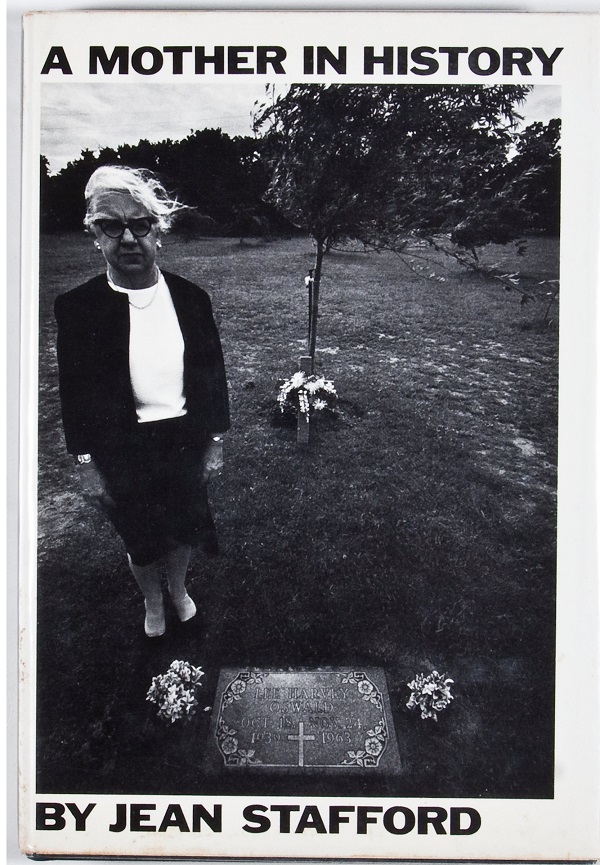
  • The Events that Shook America After Martin Luther King Jr.’s Death

    The Events that Shook America After Martin Luther King Jr.’s Death

    Dr. Martin Luther King Jr. succumbed to his injuries on April 4, 1968, an hour after James Earl Ray, a con artist who was supposed to be serving a 20-year sentence, shot him in the face.

    In today’s blog, Kennedys and King brings you some notable events that made up the aftermath of the martin luther king assassination.

    Major Riots Follow Regardless

    When CBS Evening News reported King’s death, the host added Walter Cronkite added a message a request by America’s president at the time, Lyndon B. Johnson. It was a message to heed King’s message of non-violence, peace, and harmony legacy.

    However, these words appeared to fall on deaf ears because the news report was followed by riots in at least 100 cities across the US, particularly in Black neighborhoods. They were so intense in Baltimore and Chicago that the National Guard and Marines had to intervene.

    riots

    Coretta Scott King Leads a Silent March

    Only four days after the assassination of Martin Luther King Jr., his wife Coretta Scott King flew to Memphis on a plane arranged by Robert F. Kennedy. Her motive for going to Memphis wasn’t to start a protest or say something to incite violence but to continue her husband’s legacy and mission.

    She organized a march for the country’s African American sanitation workers, which a crowd of 40,000 people moving through the streets eerily silent in their vigil attended.

    Lester Maddox Refuses to Mourn

    The news of MLK’s death brought mixed reactions. Had people been unified in their outrage and anger at such a senseless murder, the riots would’ve encompassed more than 100 cities.

    On the one hand, the African American community was almost united in its confusion, grief, and anger at what may have been a hate crime. The white majority was mixed in its reaction; some grieved the loss of the Civil Rights leader, some remained silent, and a small number in the South were critical and outright rebellious.

    Lester Maddox belonged to the latter category. The Governor of Georgia refused to participate in the National Day of Mourning and threatened to raise the flag outside the statehouse to full mast.

    James Earl Ray Flees to No Avail

    James Earl Ray was a prison escapee, a fugitive of the law when he killed MLK. His crime led to a two-month-long chase across five countries and cost more money than the conman was worth.

    The authorities caught up with the assassin in London and brought him back to the US, where his fate was sealed with a 99-year sentence.

    MLK’s death was one of the cogs in a wheel that forced the United States to change history. Learn more about this assassination and the other political assassinations of the 1960s at Kennedys and King. Contribute facts about James Earl Ray, Lee Harvey Oswald, causes of the Civil Rights Movement, and other people and events related to the political murders in the ’60s.

    Get in touch for further assistance.

  • The Tumultuous Life of An Alleged Killer: James Earl Ray

    The Tumultuous Life of An Alleged Killer: James Earl Ray

    At a glance, James Earl Ray ticks all the boxes of someone who killed a leader of the Civil Rights Movement. He frequently committed petty crimes, supported George Wallace, and wanted to move to Rhodesia (present-day Zimbabwe) to join its strong white community.

    While doubts surrounding his ultimate crime persist, Kennedys and King will look at Ray’s life before and after he was locked away for good.

    The Fugitive, Twice Over

    You may know about Ray’s 1977 escape attempt, but were you aware that he’d tried the same thing a little more than a decade ago? At the time of Martin Luther King’s assassination, Ray had been an escaped convict for almost a year.

    On April 23, 1967, Ray hopped aboard a bread truck, escaped Missouri State Penitentiary, and fled to Canada. He would’ve probably stayed that way had he not been arrested for killing Martin Luther King on April 4, 1968.

    His Criminal Record

    Shortly before his arrest, James Earl Ray made it on the FBI’s Most Wanted list. The wanted poster included his latest picture, the relevant crime, and a two-liner with his criminal record, which included:

    • Burglary
    • Armed robbery
    • Counterfeit money orders.
    • Driving an automobile without the owner’s permission.

    Whether or not you believed he killed a person, his mile-long rap sheet remains an undisputed fact.

    MLK memorial

    A Marriage (and Divorce) in Prison

    On October 13, 1978, long after his arrest, James Earl Ray tied the knot with an artist Anna Sailing Sandhu. They shared an age gap of almost 20 years, but sparks must’ve flown after they met for a TV interview where Sandhu was invited to draw Ray.

    After spending 12 anniversaries exchanging letters, Ray officiated a marriage that started with separation by filing for divorce due to irreconcilable differences.

    Gaining the King Family’s Support

    Where the MLK assassination is concerning, there are three groups of people: the first believe Ray did it, the second thinks he didn’t act alone, and the third is convinced he’s innocent.

    The second group had enough support to prompt the Senate Congressional Hearing Committee to open an investigation into possible government collusion. They found the FBI’s campaign against MLK to be an indirect contributor, didn’t find any evidence of direct involvement, and concluded that Ray was the killer.

    The third group doesn’t have many supporters, but it includes King’s family, particularly his son, Dexter Scott King, who even went to Ray’s death bed to tell him that his family believed he was innocent.

    Learn more facts about James Earl Ray on our platform, which is dedicated to unearthing the truth behind the unresolved political assassinations of the 1960s. Please support our campaign for full transparency and accountability for the assassination of Martin Luther King Jr., among other activists and political figures murdered during this tumultuous decade.

    Visit our website to express your support today.

  • How the JFK Assassination Changed Secret Service

    How the JFK Assassination Changed Secret Service

    Shortly after the assassination of John F. Kennedy, the Secret Service, the agency responsible for the President’s security detail, among other things, went through a complete overhaul.

    As you’ll see in today’s Kennedys and King blog, prohibiting open-top limos was only the beginning of the changes we’ll see in the years following the assassination and the ensuing investigation.

    More Agents and a Higher Budget

    As indicated in a Washington Post article, the Secret Service only had 300 agents and a $5 million budget at the time of the assassination. Their duties were mostly relegated to criminal investigations; the protective missions were added later and were not as clearly defined.

    In any case, the Secret Service inducted a slew of agents after the assassination. Today, more than 3,000 agents are working for the organization, primarily protecting the President and other entities in the Senate and House of Representatives, under a minimum budget of $30 billion.

    Creation of a Security Network

    After the assassination, the Secret Service came under fire for its poor communication skills. The Warren Commission, a deeply flawed albeit partially credible investigation into the assassination, found that the agency hardly collaborated with local law enforcement, not seeing fit to disseminate intelligence before an event.

    Today, you’ll see these secret agents not only set up layers of security through electronic and physical barricades but also partner with local law enforcement to remain attuned to any security threats in the area.

    Biden motorcade

    The Powers Granted by the Congress

    After President McKinley was assassinated in 1901, Congress assigned presidential security to the Secret Service. After President Kennedy was assassinated in late 1963, they were the ones that enacted a slew of statutes, the first of which was granting security to the deceased President’s wife and children. 

    As of the ’90s, Congress was still enacting new statutes, bringing the total to 23, all granting more power to the Secret Service and helping them counter newer threats of the digital age.

    The Counter Sniper Team

    In 1971, the Special Operations Division introduced the Counter Sniper Team, which included precision sharpshooters specializing in identifying and neutralizing long-range threats, the sort that killed President Kennedy.

    Before this, the unit only had the Counter Assault Team, which dealt with physical attacks in the vicinity. They weren’t trained or knew to scan windows and other nearby structures for potential suspects.

    Revisit the JFK Assassination at Kennedys and King

    Now that you know about the changes the Secret Service underwent after the JFK assassination visit our archives to know the gravity of the event that sparked such an upheaval. Explore the four major facts behind political murders in sixtees on our platform, including John F. Kennedy, Robert F. Kennedy, Martin Luther King Jr., and Malcolm X.

    Let us know if you have something to contribute regarding the facts behind political murders in sixtees.

  • The Most Famous Myths About the Civil Rights Movement—Debunked!

    The Most Famous Myths About the Civil Rights Movement—Debunked!

    They might say the past stays in the past because its gray areas take a backseat to a simpler perspective that history books endorse. The Civil Rights Movement was anything but a simple attempt at ending racial discrimination and earning equal rights. 

    Kennedys and King is devoting today’s blog to debunking some of the mistruths of these oversimplifications.

    Myth #1: Malcolm X was the Radical to Martin Luther King Jr.’s Pacifist

    No matter how far we might’ve come since the ’60s, we’ll continue to see activists as either radicals or pacifists. With all his harsh rhetoric, Malcolm X was seen as the former, whereas Martin Luther King Jr. was perceived as the latter. 

    It’s not quite this black-and-white. Malcolm X might have had his faults, but he never advocated for initiating violence. He supported defense, not violence, and that too when one’s wellbeing was at risk.

    On the other hand, MLK might be known for his peaceful rhetoric, but he too was in favor of taking arms to defend himself. He might’ve grown up among his people, but the things he was fighting for would’ve hardly won him any points with the white community, and he would’ve had to protect himself from their wrath.

    Overall, it would be better not to assign boxes labeled ‘pacifist’ and ‘radical’ to these two activists, who were more similar than you might think.

    march

    Myth #2: MLK Died a Hero

    MLK didn’t so much die a hero as he was made one in the months following his assassination. He might be a national hero with a holiday dedicated to his birthday today, but his public image was quite controversial during the three years leading up to his assassination.

    From advocating for the poor to assailing the US government’s involvement in Vietnam, it seemed as if he had finally started going against the American grain, against some of the issues uniting all Americans.

    Myth #3: The Black Panthers Were No Better than Armed Militia

    The Black Panther Party for Self Defense was founded in the ’60s primarily to fight police brutality. Their members are usually perceived as gun-wielding men with a penchant for paramilitary attire, which is true but only to a certain extent.

    They might be known as “cop killers” in white neighborhoods. However, in black neighborhoods, they were known for setting up health clinics, feeding over 10,000 children daily, and asking people to contribute and volunteer. By all accounts, they were doing the government’s work.

    Just as we don’t deny the shortcomings of Malcolm X and Martin Luther King Jr., we don’t deny the violent streak of certain Black Panther factions. However, that doesn’t change the fact that most of these leaders were assassinated during the Civil Rights Movement, which is no coincidence.

    Follow us as we make strides in our cause to bring these political assassinations of the 1960s to justice and advocate for more records to be undisclosed.

    Contact us if you know more facts behind political murders in sixtees.

  • 4 FAQs About the Press Coverage of the Kennedy Assassination

    4 FAQs About the Press Coverage of the Kennedy Assassination

    When President John F. Kennedy was assassinated, TV reportage wasn’t seen with the same respect as print media. They were akin to today’s paparazzi reporters but were the need of the hour as print would’ve taken a while.

    In today’s blog, Kennedys and King answers some of the most frequently asked questions about the press coverage of the Kennedy assassination.

    1. Were the Initial Reports Accurate?

    The initial reports of the incident came 10–15 minutes after the assassination. They were about as accurate as word of mouth. While TV cameras were allowed to roll round-the-clock, the reporters weren’t as lucky.

    Their eyes could only go so far, which in this case wasn’t far at all, as they were constantly bussed off to different locations and could hardly see or hear what had happened.

    If this happened in 2022 with the 1960s brand of press coverage, someone watching a live stream of the Kennedy cavalcade would know more about the assassination.

    2. Did a Narrative Form After the Fact?

    After the 24/7 coverage of the assassination, most television press was almost comical in how it formed a singular narrative and stuck to it for decades. In this case, most reporters ran with Dan Rather’s narrative. 

    Dan Rather’s only claim to the authenticity was that he was in Dallas when the assassination happened and was the first to report it live. Nevertheless, the American journalist’s account became primetime fodder on every anniversary. There were slight deviations, but the overall story was always the same across all channels.

    resting place

    3. Does that Mean the Press Didn’t Come Through?

    The answer to that is entirely subjective. We believe the general sentiment at the time wasn’t to make the reportage as sensationalistic as possible to garner views but to inform people who suddenly found themselves without a leader.

    That said, the press could’ve been more investigative from the get-go. Since they weren’t as thorough at the job as they should’ve been, we still have many gaps to fill until we can solve this mystery.

    4. How Does the Press Coverage of Lee Harvey Oswald Compare to that of President John F. Kennedy?

    Unlike the half-baked coverage of the John F. Kennedy assassination, the press was dogged in its coverage of Lee Harvey Oswald the day after his arrest, which was also the day Jack Ruby killed him at point-blank range.

    It remains unclear why the press had more access to the president’s killer and his subsequent assassination than the president himself, which is one of the many reasons this high-profile murder remains unsolved.

    While the Truth behind JFK assassination remains murky at best, we’ve compiled what we do know about the tragic event in one place. Help us advocate for more records to be undisclosed about the political assassinations of the 1960s, which included the assassinations of John F. Kennedy, Robert Kennedy, Martin Luther King Jr., and Malcolm X.

  • 4 Little-Known Facts About the Life of Malcolm X

    4 Little-Known Facts About the Life of Malcolm X

    You probably know Malcolm X as one of the leaders of the Civil Rights Movement— a much-discussed subject at Kennedys and King — and that he was assassinated in front of his wife and daughters on February 21, 1965. 

    But there’s so much the world has forgotten about the African American activist. Keep reading to find out.

    1. Malcolm X was Born Malcolm Little

    Malcolm X changed his last name ‘Little’ because it belonged to a slave ancestor. Since he didn’t know his original African name, he replaced it with an ‘X’. However, this isn’t where he stopped.

    After performing the Hajj in 1964, Malcolm changed his name again to El-Hajj Malik El-Shabazz.

    2. Malcolm X Had a Turbulent Childhood

    Growing up, we all have growing pains and rebellious phases. So did Malcolm, but in the context of an America led by white supremacists. Malcolm’s parents supported a black nationalist organization, the Universal Negro Improvement Association (UNIA).

    They supported equality and celebrated black pride and had to move from Nebraska to Wisconsin to evade the Ku Klux Klan threat. However, an offshoot of the organization, Black Legion, followed them to Milwaukee.

    The white supremacists set fire to the family’s house and made life as difficult for them as possible. When Malcolm’s father died two years later, there were murmurs that the Black Legion had killed him, although that’s circumstantial at best.

    After his mother was institutionalized, Malcolm and his siblings were separated and scattered across various homes, which is how they grew up.

    Civil Rights protest


    3.  Malcolm X Taught Racial Separatism (At First)

    Malcolm’s parents may not have had the chance to do much towards black pride, but Malcolm did. He traveled across city and state lines spreading his message through in-person sermons and radio broadcasts.

    On the surface, his message was the same as Martin Luther King’s. However, on closer inspection, you’ll find that he was skeptical of racial equality and advocated for racial separatism, which is the exact opposite of MLK’s message of love, peace, and harmony.

    4. Malcolm X Changed Tack After Traveling to Mecca

    The pilgrimage to Mecca apparently did Malcolm X a lot of good. It broadened his worldview and made him realize that the problem wasn’t with the white race but the culture and traditional backdrop of the enslavers and the enslaved.

    When he saw people performing Hajj regardless of skin color, he realized his role in the Civil Rights Movement wasn’t to separate black and white people or see the latter as the problem. It was to fight racism and its enablers and advocate for all black people, regardless of their religious affiliations.

    Help us uncover and document the mysterious political assassinations of the 1960s by contributing to our cause. Join Kennedys and King to reveal the redacted truth of the Kennedy, MLK, and malcolm x assassination, one disclosed document, tape, or newspaper clipping at a time.

    Get in touch for more information about how you can play a part in unveiling the facts behind political murders in the ’60s.