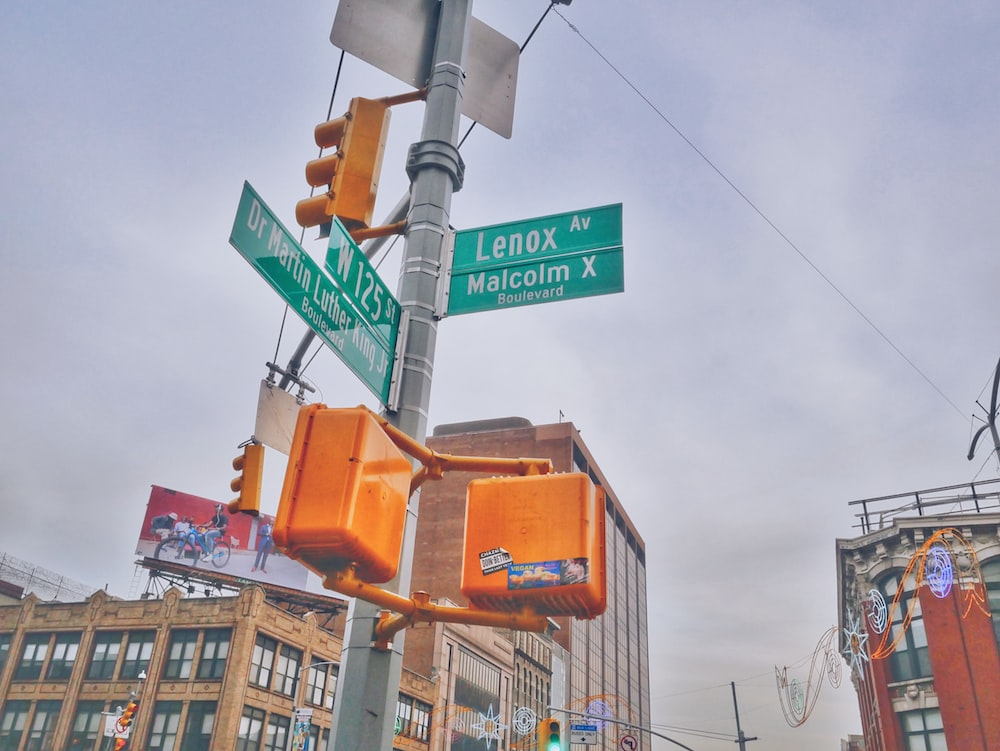
Malcolm X was assassinated on February 21, 1965, while speaking at Harlem’s Audubon Ballroom. His death was quickly chalked up to bad blood between Malcolm and the Nation of Islam (NOI). The truth is anyone’s guess.
Since the investigation into this assassination left more questions than answers, we’ve taken it upon ourselves to answer some of those questions.
1. How Bad Was the Blood Between Malcolm X and NOI?
Malcolm X cut ties with NOI in 1964, shortly before his death. His decision to leave didn’t come out of the blue. He was deeply uncomfortable with Elijah Muhammad’s infidelity and disheartened by NOI’s inaction against the LA police department’s violent behavior towards Muslims.
The last straw was Malcolm breaking an important NOI policy about not reacting to John F. Kennedy’s assassination. Malcolm did, calling it “the chickens coming home to roost.” He left soon after being silenced from saying anything else about the incident. At the time of his assassination, he was widely seen by many NOI members as a traitor.
2. How Did the Government Treat Malcolm X?
It was rare for civil rights organization members not tobe under 24/7 surveillance by the FBI and law enforcement, and even rarer for these organizations to not have at least one FBI informant within their ranks.
Malcolm was no exception. The FBI started surveilling him in March 1953. Their special infiltration unit, the Bureau of Special Services (BOSS), possibly infiltrated the organizations that Malcolm set up after leaving NOI.
He was widely seen as a threat by law enforcement agencies, as evidenced by the communique by the then FBI Director J. Edgar Hoover that read, “do something about Malcolm X.”
3. Were There Any Threats Made to Malcolm X?
A week before his assassination, Malcolm X was asleep with his wife and children at his New York City residence when it was firebombed. No charges were made—it’s not like such antics against activists were rare in those days.
It’s not clear whether the ones who made the threat ultimately killed him. However, the incident was nothing if not serious and was sure to have driven home the threat to his life and that of the people near and dear to him. Be that as it may, it didn’t prevent Malcolm from speaking out about the incident.
Uncover the Mystery Surrounding the Malcolm X Assassination
As the convictions of those accused of killing Malcolm X are overturned, join Kennedys and King to uncover the truth behind the incident once and for all. Go through our multimedia to know more than you ever have about the political assassinations of the 1960s, including the unsolved political murders of the Kennedy brothers, Martin Luther King, and Malcolm X.
Get in touch to share your thoughts about our cause.
A little over 55 years ago, Martin Luther King gave a speech titled “Beyond Vietnam: A Time to Break Silence” at New York City’s Riverside Church. It divided the nation and drew heavy criticism from major newspapers, political organizations, and fellow activists. Exactly a year later, he was assassinated. Click here for details.
The Point of “Beyond Vietnam”
“Beyond Vietnam” was the first time MLK went on record to state his opinion on the Vietnam War. He was addressing a gathering of 3,000, so it was guaranteed to elicit a reaction.
King categorically condemned the Vietnam War, calling it an economic and human burden on the country’s poor working class. He called for the resources being spent on the war to be redirected to equal rights for America’s minorities.
His opinions drew the furor of many and the support of some. The former either termed it unpatriotic or claimed it threw a wrench in the civil rights movement Malcolm X by making it an extension of the more radical peace movement.
Following are the highlights from his memorable, opinion-shaping speech.
“An Enemy of the Poor”
By terming war “an enemy of the poor,” MLK meant that the Poor People’s Campaign, which was flourishing before the war, was in shambles as soon as those very poor people were sent off to a senseless war.
The civil rights leader sounded resigned when he said he knew better than to think the US government would ever divert funds towards rehabilitating the country’s poor white and black people.
“In Brutal Solidarity”
King used the word “in brutal solidarity” to describe white and black people who were united in the cruelest way possible. They were being sent 8,000 miles away from home to guarantee freedom and restore the rights of an entirely different population when they hardly had any civil rights at home.
Instead of seating white and black students together, we’re uniting them in a matter of life and death. He called it a “manipulation” of America’s poverty-stricken community.
“This Self-Defeating Path”
King termed hate a “self-defeating path,” saying he wanted his country to stop worshipping concepts of hate and revenge. Although uttered 55 years ago, his words are just as relevant today because the US has not learned from history. Its foreign policies continue to override the issues back home that have worsened due to neglect and lack of effective action.
By uttering those words, King wanted his country to take the high road, let bygones be bygones, and focus on its development.
Coming Back to the Martin Luther King Assassination
Martin Luther King gave his famous speech on April 4, 1967. Ironically, he was assassinated on April 4, 1968. The dates might be a coincidence, but the coverups that followed his assassination are no coincidence.
The complete title of this new book is America’ Last President: Whatthe World Lost When It Lost John F. Kennedy. Monika Wiesak begins her book by saying about John F. Kennedy that, after some study, “I realized that the public image of him as a careless, thoughtless, self -involved playboy obscured the depth of what he was trying to achieve and intensity of opposition he faced.” (p. iii) She then quotes Bob Dylan’s lyrics on the subject: “They killed him once, and they killed him twice.” She adds that it was not enough that Kennedy be murdered, his ideas had to perish with him.
In an unprecedented manner, she then traces Kennedy’s anti-imperialist concepts all the way back to 1939, in an unlikely place: Palestine. Even at this early date, young Kennedy writes that the press was not giving the public the whole story. He wrote that it seemed to him that, even at this time, the Zionists wanted to take over Jerusalem, make it the capital of their new country, and to also colonize Trans-Jordan. Kennedy even described what would today be termed as false flag operations: where bombs were being set off in the Jewish quarter, by the Jews, and the British would be called in to fix the damage. (p. 6)
In 1951, Kennedy visited Asia and the Middle East. He wrote that he felt it was wrong for America to support England’s oil interests in Iran, and her military interest in Suez. He also commented on the plight of the 700,000 Palestinians who were now refugees after the Nakba, and how this would not align itself with the promises of the Voice of America. (p. 8). About Indochina, he wrote that we must not sacrifice nationalism for anti-communism, since he thought the latter cause would fail.
From here, Wiesak goes to Kennedy’s famous Algeria speech of 1957. She correctly comments on it as: “…to this day, it remains one of the most potent speeches opposing imperialism ever given by a U.S. senator.” (p. 11). She then acutely adds, not only was Kennedy an anti-colonialist, he was keenly aware of the substitute for colonialism, which was imperialism:
Suspicion is aroused that when colonialism is ousted anywhere and the inevitable vacuum results, dollar control is prepared to move in, so that freedom would amount to little more than a change of masters. (p. 14)
Some of the other ideas that Senator Kennedy advocated were: no nuclear proliferation, anti-censorship and loyalty oaths, and the government should intervene in the economy actively for the public good. This opening is astutely done since she adds that these concepts would carry over into his presidency. Therefore, “The following chapters detail what happened to a world leader whose priority was the people.” (p. 21)
II
The book proper opens with chapters on the CIA and then the Congo. Wiesak focuses on the Bay of Pigs and the deceptions hoisted by the Agency to get Kennedy to go along with that fey excursion. She also points out his deep regrets afterward about allowing himself to be gulled: “How could I have been so stupid, to let them go ahead.” (p. 28) Kennedy literally cried alone with his wife. In fact, she uses the book posthumously published by Caroline Kennedy, Jacqueline Kennedy: Historic Conversations on Life with John F. Kennedy, as a major and revealing source. Which is something that this reviewer thinks is rather original. I have never seen that book used as extensively, or as pointedly, as Wiesak does here. Kennedy’s widow provided some insightful perceptions into her husband’s thinking. Wiesak deserves credit for mining these hidden and concealed jewels.
In a separate chapter, she writes that presidential candidate Kennedy had sent Averill Harriman to Congo. He reported back to the senator that Patrice Lumumba, newly elected president of Congo, was a nationalist and not a communist and JFK should favor him. (p. 35). In return, Lumumba sent Kennedy a telegram on the day he was elected requesting that he oppose the secession of the state of Katanga and hoping he would cooperate with the United Nations.
As we know, Lumumba did not live to see his request fulfilled. CIA station chief Larry Devlin recommended drastic steps to eliminate Lumumba before Kennedy took office. After all, Ted Kennedy had visited Africa and urged Lumumba be released from house arrest. (p. 37)
After the Secretary General of the United Nations, Dag Hammarskjold, was done away with in September of 1961, Kennedy essentially took control of UN policy in Congo. JFK ended up approving the UN military mission, code named Operation Grand Slam, which stopped the secession of Katanga in late 1962. In short order, after JFK’s assassination, Kennedy’s non-imperialist policy there was reversed by President Johnson. Instead of a democratically elected, constitutional republic, Josef Mobutu and Moise Tshombe ended up being despotic co-rulers. Mobutu lasted for about three decades. After he left, about 5.4 million Congolese perished between 1998-2007, partly as a result of two civil wars in the nineties.. (p. 42) Congo should have been a wealthy and independent republic, an example for the rest of sub -Sahara Africa. It ended up as a poverty racked failed state.
Her chapter on Congo leads up to an overview of Kennedy’s entire Africa policy in Chapter 4. In 34 months, Kennedy greeted 28 heads of state from that continent. This contrasts with President Eisenhower, who met with less than a third as many in eight years. Kennedy’s point man on Africa, G. Mennen Williams, visited every country there except the Union of South Africa; because they would not grant him a visa. (p. 47) Kennedy’s aid package was also different: he sent a larger sum, and less of it was for the military. It is interesting to note, as she does, that Kennedy was criticized for spending too much time and effort on this Third World continent, both by fellow Democrats Dean Acheson and Henry Jackson, as well as the National Review and New York Times.(p. 54). But as Jackie Kennedy said, after she wrote a note to Kwame Nkrumah of Africa, “Jack made you feel how important it was to be polite…how awfully everyone had always treated the Africans, how Eisenhower had kept an African leader waiting for 45 minutes.” (p. 47)
This policy was seriously altered by Lyndon Johnson. By 1969, Africa was getting 29% of the aid it received in 1962. (p. 56) When Kennedy was assassinated, Tommy Mboya of Kenya said the emotional impact was like a death in the family. The leaders of Africa repaid Kennedy by refusing to grant refueling rights to the Soviets during the Missile Crisis.
In Latin America Kennedy created the Alliance for Progress, which broke with tradition. Since it was going to lend money at very low, or sometimes, zero interest rates. So there would not be a constant debt expansion problem. Which could only be cured by purchasing American products. Big business did not like the program. They deemed it one step away from socialism. (p. 61) But Kennedy liked the approach, and he visited Latin America three times, and had another visit scheduled in 1964. His wife had gone with him on two of these journeys south. A Wiesak quote from the First Lady crystallizes the Alliance for Progress, and what JFK was about:
In Venezuela I went to an orphanage, and there was a picture in the paper, all the children were kissing me goodbye, and the headline was…we love Mrs. Kennedy, look, she permits herself to be kissed by these children. And that just hurt Jack so much….And he said you just don’t know the inferiority complex they have that the United States has given them. Jack believed all those things he was saying about our revolution is like yours; at last they had someone they could trust who felt about them. (pp. 63-64)
Another example of how Kennedy felt about the Alliance for Progress, from Teodoro Moscoso:
When he went around and saw the farmers, poor undernourished people who never in their life had ever had anything to their name except the clothing on their back, and assisted in handing them over the title to a piece of property, to a piece of land with a fence around it and with a house on it, he got a fantastic lift out of this. (p. 64)
Jackie Kennedy also wrote that her husband would never have recognized the military juntas in Dominican Republic in 1963 and Brazil in 1964. (p. 64). Juan Bosch, the displaced democratic leader in the Dominican Republic later said of Kennedy’s murder: “The fatal bullet did much harm to you, but greater harm to us.” (p. 66)
III
One of the finest aspects of America’s Last President, is Wiesak’s discussion of Kennedy’s economic program. She starts off by noting that celebrated financial journalist/author Seymour Harris wrote that, Kennedy knew more about economics than any president he covered. Since he wrote columns on the subject from 1943, and published over 30 books dating from 1930, that takes in a lot of territory.
Wiesak notes that, when Kennedy took office, the unemployment rate was 7.7 %. By 1964, it was under 5%. Under Kennedy, the Gross National Product increased by 20%, Industrial Production went up by 22 % and Personal Income increased by 15%. (p. 68) Kennedy greatly wished to stimulate growth and increase productivity. He thought this would contribute to a greater share of wealth for all, but would allow for more to be given to those suffering who were the neediest.
JFK tried to stimulate economic production by granting a tax credit for new plant and equipment; and also providing for a general tax cut. Kennedy’s tax cut would give the largest percentage of relief to the poorest third of the population and to small business. (p. 71) Kennedy also wanted to keep interest rates low and to increase defense contracts for small business. Things like the Area Redevelopment Act, the Appalachian Regional Commission, and Manpower Development and Training Act, these all poured money into distressed areas that needed it the most. In this regard, Kennedy made much more surplus food available to the poor. In fact, in just two months, he doubled the number of recipients. (p. 75). What else did he do to ease the problems of the poor and not well off?
Extended span of unemployment benefits
Increased the minimum wage
Increased by almost 30% the amount of Social Security benefits
Pushed for a Medicare bill
Sanctioned the VISTA program in poverty stricken areas
At his last Cabinet meeting, Kennedy uttered the word poverty seven times. The amazing thing about Kennedy’s robust economic program is this: during his administration inflation averaged just 1.7 %.
Who would be against such a successful program? Well, the denizens of Wall Street of course. Fortune magazine described Kennedy’s policies as a “master government plan.” (p. 80). One of the reasons why people like the owner of that magazine, Henry Luce, bitterly attacked Kennedy was this: he wanted to close off foreign tax havens and loopholes, “which permit and encourage industry to invest overseas.” He even advocated for a withholding tax on dividend payments, since he thought this would be more fair to wage earners and small business. (p. 82-83). Unlike what we had under the likes of Reagan, Bush and Bill Clinton, Kennedy knew where the money was located and wanted to entertain ways to make tax collection more graduated i.e. by eliminating provisions that would allow special tax preferences for wealthy individuals transferring property as gifts. . (p. 83)
In her examination of Kennedy’s economic program she does not ignore the goals of Kennedy against the Federal Reserve. Which he tried to neutralize through the appointment of James Saxon as Comptroller of Currency. (Click here for more detail.)
She also examines the now legendary Steel Crisis, where the magnates of Big Business decided to launch a frontal assault on Kennedy’s policies. One of the strategies Kennedy used to defeat his opponents was to begin giving large defense contracts to smaller steel companies, who were not part of the cartel. (p. 90) Kennedy did not think that rigging prices was the way the free market worked. Even after the price fixing case was broken, Bobby Kennedy launched a law suit which made the culprit companies pay maximum fines in 1965 for price fixing from 1955-61. (p. 91). Kennedy made more than one pithy comment on the crisis after it was over. Consider how he characterized the conflict:
…a small group of men turning against the government and the economy because the government would not surrender to them. That is the real issue. (pp. 94-95)
Later he added the following:
If to stop them saying we are anti-business, we are supposed to cease enforcing the antitrust laws, then I suppose the cause is lost. (p. 96)
Wiesak closes off this section with what is probably the best precis of Kennedy’s environmental program I have seen. Kennedy’s Secretary of the Interior, Stewart Udall, requested that the White House help publicize Rachel Carson’s upcoming book, Silent Spring. The book had been excerpted in The New Yorker in June of 1962. Kennedy then announced he would be investigating pesticides. Kennedy did not back down when the chemical companies started attacking the book. (pp. 98-99)
As the writer specifies, this is related to Kennedy’s prior address on what he called Consumer Rights. He made this speech on March 15, 1962. Kennedy advocated for more truth in packaging laws, among other consumer rights. Today March 15th is celebrated as World Consumer Rights Day. This was all in keeping with what Kennedy saw as his primary duty, which was protecting the interests of the public. (p. 113)
IV
Wiesak, of course, addresses Kennedy’s epochal confrontations with the Pentagon and CIA over Laos, Vietnam and Indonesia.
About the first, before taking action, Kennedy asked to speak to the American ambassador to Laos, Winthrop Brown. After this talk, where Kennedy said he wanted to hear his observations, not the State Department’s, Brown later said, “I mean, I just thought I’d been in the presence of a great man.” (p. 129)
The Pentagon wanted to send in troops to stop the Pathet Lao. Specifically, about 140,000 of them. As Max Taylor later wrote, it was President Kennedy who resisted sending in troops. (p. 131) Kennedy insisted on a neutralist solution in 1962.
In Vietnam, Kennedy sent John Kenneth Galbraith to give him a dissenting opinion from his advisors, who again, wanted to insert combat troops. Kennedy knew Galbraith would give him a radically different opinion, which he did. Kennedy then passed on that opinion to Defense Secretary Robert McNamara, and this was the beginning of the president’s withdrawal of all advisors, which would be begun in late 1963 and be completed in 1965. (p. 133)
Kennedy was determined to enact this plan without Pentagon interference. So he forbade any higher ups in the military to visit Saigon without being cleared by the State Department. That paved the way for NSAM 263 which began the withdrawal program with one thousand advisors to be taken out by the end of 1963. Again, LBJ did a reversal and it was not long before the OPLAN 34A program was underway. These patrols, really provocations—featuring attack speedboats accompanied by communications destroyers–paved the way for the Gulf of Tonkin incident. Which was then used as a casus belli for the USA to declare war on Hanoi. With Americans fighting the brunt of the war.
Sukarno of Indonesia liked some of the speeches Kennedy had made in the 1960 election against Richard Nixon. Sukarno had convened the first non-aligned meeting of Third World countries in Indonesia about five years previous. For this and other reasons, covert operations chief Dick Bissell and the CIA did not care for Sukarno. Bissell once said that “Lumumba and Sukarno were two of the worst people in public life I’ve ever heard of…I believed they were dangerous to the United States.” (p. 141). This is how he justified planning to eliminate such “mad dogs”.
Contrary to the CIA and Secretary of State John Foster Dulles, Kennedy approved of the non-aligned movement. (p. 140) And when Sukarno met with JFK in Washington in 1961, he told the president that 90% of the communist party in Indonesia, the PKI, were really nationalists. The two leaders discussed this issue of non-alignment and neutrality in the Cold War. This is something that both JFK and Dag Hammarskjold agreed upon, specifically in relation to both Congo and Indonesia. (p. 142) Wiesak now reviews the important natural resource information about West New Guinea, today called Papua. How, unknown to either Sukarno or Kennedy, that region was even richer than Katanga in precious metals and oil. In a dispute with the Dutch, who likely did know, Kennedy worked to transfer that land over to Sukarno in 1962. This is something the CIA actually had declared off limits, since they felt it would aggrandize Sukarno’s stature. (p. 144). As Wiesak notes, through the work of Greg Poulgrain, we also know that CIA Director Allen Dulles very likely did know about the enormous amount of resources in Papua.
Kennedy had planned on visiting Jakarta in 1964. He also planned on a large foreign aid package to be sent to Sukarno at the end of 1963. Both of these were eliminated by LBJ. The relations between the two countries now became much more strained and difficult. And it culminated in eventual overthrow of Sukarno, which began in late 1965. No one knows for sure how many were slaughtered in 1965 and continued into 1966; estimates range from a half million to a million killed. As Wiesak observes, there is plentiful evidence to indicate the CIA was involved in this bloody affair. (p. 148) As scholar Bradley Simpson told Oliver Stone in his interview for JFK: Destiny Betrayed, in all probability, this would not have happened if Kennedy had lived.
V
From here, the writer discusses two instances where Kennedy worked with Khrushchev in order to stop what could have ended up in serious conflicts, perhaps escalating into atomic warfare. The two episodes are, of course, Berlin in 1961 and the Cuban Missile Crisis in October of 1962. In the former, she notes how both Berlin commander Lucius Clay and General Bruce Clarke of US Army Europe, were trying to provoke a showdown over the Berlin Wall. (p. 150) The Kennedy brothers negotiated a way out of the stand off which included removing tanks at the Brandenburg gate. Kennedy told William Walton: “I am almost a peace-at-any-price president.”
This was further illustrated in October of 1962 during the Missile Crisis. Wiesak notes that Kennedy felt the Russians had installed the medium and long range missiles behind his back over the issue of Berlin. (pp. 153-54) That is, they would demand the giving up of West Berlin over negotiations for removal of the missiles from Cuba. Which is something that Kennedy would not deal over since he thought this would be the beginning of the rolling up of the Atlantic alliance. She also notes that Kennedy was taken aback when Russian foreign minister Andrei Gromyko lied to him about offensive weapons in Cuba.
At the beginning of the crisis, there were two alternatives presented to Kennedy: 1.) A surgical strike against the missile silos, and 2.) An even larger air strike followed by an invasion. But against the majority, Kennedy decided on a blockade. Kennedy stole a quip form Lincoln, saying that his one vote outnumbered all those in opposition. (p. 161) To JFK it was the alternative that had the least amount of casualties attached, and it also minimized the prospect of war, since it allowed for negotiation.
Wiesak dutifully comments on Kennedy’s discussion of the issue with the Joint Chiefs. He first said to advisor Ted Sorenson, “They all want war.” He then commented “…if we listen to them, and do what they want us to do, none of us will be alive later to tell them they were wrong.” (p. 159). His brother Bobby Kennedy, of course sided with the president and managed to convince Doug Dillon of Treasury to accept the blockade.
From here, the boundary lines for a negotiated solution were constructed. UN representative Adlai Stevenson suggested using the American missiles in Turkey as a bargaining chip. To which Bobby Kennedy said, this must only come at the end of negotiations. (pp. 162-63). At first, the Russians wanted a pledge that the USA would not invade Cuba. They later added they would also like the Turkish missiles removed. (Which Kennedy thought were already gone.) Under these parameters, Bobby Kennedy met with Russian ambassador Anatoly Dobrynin. RFK told him that the Turkish missiles would be removed six months later. He also added this: the Joint Chiefs are spoiling for a fight. According to Dobrynin Bobby said, “If the situation continues much longer, the president is not sure that the military will not overthrow him and seize power.” (p. 165). Make no mistake, Kennedy was losing support among his advisors, especially when Lyndon Johnson chimed in and said the USA was giving up way too much in the negotiations. (The Kennedy Tapes, by Ernest May and Philip Zelikow, p. 587). The visit to Dobrynin, with RFK’s warning, probably turned things. The next day, Nikita Khrushchev announced he was going to begin removal of the missiles. But as Wiesak writes, Kennedy was so determined to get a deal that, if Khrushchev had not sent the telex, the president was going to negotiate through U Thant at the United Nations–and this would have included the Jupiter missiles in Turkey. When it was all over, JFK told John Kenneth Galbraith that, in relation to bombing the missile silos, “I never had the slightest intention of doing so.” (p. 161)
Which was fortunate for us all. Because at a much later seminar on the subject, held in Havana in 1992, some important information was revealed. First that, contrary to conventional wisdom, the medium and long range missiles were already installed at the time of the blockade. Therefore, the maneuver had little if any strategic impact. Secondly, that there were short range tactical nuclear missiles on the island and the Soviet commanders had permission to use them if the Americans invaded. Kennedy’s Secretary of Defense Robert McNamara was on hand for this event. When he learned of this information he was so stunned he tore off his headphones and then waved his arms in disbelief. ( p. 167; see also The Armageddon Letters, by James Blight and Janet Lang, p. 279)
This directly relates to Wiesak’s section on nuclear disarmament. As author Roger Mattson wrote in his book Stealing the Bomb, no president since has been so single-minded and determined about cutting the number of atomic weapons and limiting proliferation than JFK was. Kennedy actually started a new agency for that purpose, the U. S. Arms Control and Disarmament Agency. In 1961, he said before the UN: “Mankind must put an end to war or war will put an end to mankind.” (Wiesak, p. 173)
Kennedy then outlined a six step process to begin a world-wide disarmament program. Marcus Raskin, who worked on nuclear studies for Kennedy, recommended a 30% cut in arms and JFK liked that idea. (p. 178) Kennedy envisioned a general and complete disarmament that would take place in stages, with no atmospheric testing. This was the background to the famous Peace Speech at American University in June of 1963. That speech was more admired in Russia and Cuba than in the USA. But it did kick start the Partial Test Ban Treaty of September, 1963. Castro liked this move so much that he said he was willing to declare Barry Goldwater his friend if it would help elect Kennedy. And JFK started planning for a visit to Moscow in his second term. (pp. 185-86)
VI
As rich as the book is, I think its crowning jewel is Wiesak’s discussion of Kennedy’s approach to Arab-Israeli relations. In synoptic form, it is the best I have seen anywhere. Since no president since has come close to duplicating Kennedy’s policy in vision and fairness, it is important to describe it. And to also show how it was dismantled by his successors. To a point where it became unrecognizable.
One of the mainstays of Kennedy’s policy was UN Resolution 194, sometimes called the Johnson Plan. Middle East specialist Joseph Johnson had devised a plan which would settle the refugees of the Nakba. They would have the option of returning to where they lived, staying where they were at, or going elsewhere– and the UN, meaning largely the USA, would cover the costs.
To put it mildly, Israel’s President David Ben Gurion did not like the plan. To be blunt about it, he said, “Israel will fight against this implementation down to the last man.” (Wiesak, p.189) In order to keep the Johnson Plan alive, when the Russians sent equipment to Egypt in 1962, Kennedy had to agree to sell defensive missiles to Israel. Something he was uncomfortable doing. (p. 191). In fact Johnson quit his position in the fall of 1962.
In the face of much resistance, Kennedy continued to push the plan in bilateral talks. In fact, as Wiesak notes, Kennedy supported the plan through November of 1963. Something the Arabs appreciated, but which Israeli leaders, like Golda Meir and Levi Eshkol, were disturbed by. (p. 193)
The second mainstay of Kennedy’s Middle East policy was his insistence on keeping up a relationship with the man he saw as the potential leader of a Pan Arab movement, Gamal Abdel Nasser of Egypt. This was done through a series of letters, of which no one knows the exact number exchanged. Kennedy thoroughly understood Nasser’s impressive stature in the Arab world through episodes like the Lavon Affair and the Suez Crisis. In fact, JFK spent much time and effort in the writing of his correspondence, at times redrafting it 5-6 times. Another hallmark of Kennedy’s was he really studied the history of the Middle East. Diplomats would visit with him and emerge saying, “He knows more about our problems than I do.” (p. 197) In fact, by 1963, some senators were criticizing Kennedy for being pro-Nasser. (p. 201) Coupled with this was the Kennedy brothers opposition to the American Zionist Council, RFK wanted them to register as a foreign lobby. (p. 205) As Wiesak notes, this was the beginning of the formation of AIPAC.
The third rail of Kennedy’s policy in the Middle East was his opposition to the acquisition of atomic weapons by any nation. In March of 1963, Kennedy even drafted a National Security Action Memorandum on the subject. (pp. 210-11) Kennedy was so determined to halt any such program that in April of 1963, when he happened to run into Shimon Peres, Israel’s deputy of defense at the White House, he conducted an impromptu interrogation of him on the subject. After which Kennedy commented to Charles Bartlett, “Sons of bitches lie to me constantly about their nuclear capability.”
This led to a showdown between Kennedy and David Ben Gurion. Kennedy insisted on biannual inspections of what he suspected was a nuclear weapons reactor at Dimona. Ben Gurion denied this and instead insisted on a bilateral security agreement. To Kennedy, this would have put his relationship with Nasser on the line. It was simply a non-starter. In June of 1963, after Kennedy sent him two letters saying aid to Israel would be placed in limbo if there were no inspections, Ben Gurion stepped down. After which CIA counter-intelligence chief James Angleton visited him at least once in Israel. (p. 217)
Needless to say, LBJ completely reversed Kennedy’s very careful policy. He ended up cutting aid to Egypt and boosting aid to Israel—supplying them with tanks and aircraft. In other words, offensive weapons. In fact, the sum of military aid Johnson gave to Israel in 1966 surpassed the cumulative sum given to the state since its establishment in 1948! (p. 204) Needless to say, this caused a breakage in US/Egypt relations. The imbalance was epitomized with the attack on the USS Liberty in 1967. George Ball of the State Department cogently commented on this episode. He said that by allowing Israel to cover up what really happened there, LBJ was telling the Israelis that nothing they did would cause America to refuse their bidding. (p. 204)
Monika Wiesak has written a remarkable and valuable book. It is the kind of volume you can send to friends and relatives for the holidays. It is the best book in its category in fourteen years, since Jim Douglass’ JFK and the Unspeakable.
Kennedys and King has received the following request from Angela Berry, the attorney representing Sirhan Sirhan.
For Sirhan’s upcoming March 1 parole hearing, we need new, updated letters from people.
As before, the support can be supplemented with the idea that
He’s an old man and no longer dangerous, even [California Department of Corrections] experts have been saying that for many years
It’s a waste of tax payer funds to house an aging man who poses no risk
He shouldn’t be treated differently because of his victim
The Board must find him again suitable for release and refrain from inappropriate persuasion from the Governor
The governor got it wrong and he has no proper place in the decision
Also as before, the letters should be addressed to:
State of California, Dept. of Corrections and Rehabilitation
Board of Parole Hearings
P.O. Box 4036
Sacramento, CA 95812-4036
It would be extremely helpful if the letter authors also sent me a copy of their letter. That way, I can send them also to CDCR to ensure they make it to the “packet” that will be considered by the Board.
Angela Berry
Letters in support of Sirhan Sirhan may be sent to:
The attorney representing Sirhan Sirhan has announced an appeal of California Goveror Gavin Newsom’s decision to deny a parole to the convicted killer of Robert F. Kennedy.
Sirhan was granted the parole in August 2021, having served fifty-four years in prison.
At a virtual press conference on September 28 2022, attorney Angela Berry stated that in granting the parole last year, the parole board had followed the law, but in denying it, Newsom had not. Considering Sirhan’s age – 78 – and his model prisoner record, his release should have been the normal decision. According to those in contact with him, he poses no danger to society.
This was one of the most impressive parts of the Sept. 28 conference. Both Berry and Jen Abreu, the director of an agency called Redemption California, presented statements that they secured from those who had contact with Sirhan at Richard J. Donovan Correction Facility in San Diego. Each one of the witnesses stated that Sirhan had both an exemplary record, and was quite cooperative and easy to work with.
In some instances, they said, he had gone beyond what was required of him. He had attended self-help classes that were offered at Donovan on his own initiative. Abreu was very familiar with this evidence since her group had worked with Sirhan for upwards of 13 months to prepare him for his last parole board hearing. She said that in 54 years of incarceration, the record showed one rule violation. And that over fifty years ago. She said, that in her experience, this was an utterly exceptional record. Consequently, according to the prison rating system for release, Sirhan was in the lowest category as per offering a danger to society.
Berry said that at the actual hearing, two of the highest ranking commissioners were in attendance. They voted for release. They then passed on their recommendation to the entire board, which agreed with it. Sirhan joined the conference with a video taped talk. There he stated that what makes his case unusual is that even victims of the crime, like Paul Schrade, have advocated for his release. Its rare that something like that occurs.
There were questions from reporters after the press conference. One was if Berry thought this was going to be a futile effort, due to the notoriety of her client. She replied that she did not think so, since Newsom had previously lost a case like this. In fact, she could have added that the ACLU has filed a lawsuit trying to overturn the governor’s power to do such a thing. (https://www.aclu.org/news/criminal-law-reform/politicians-have-no-place-making-parole-decisions-for-young-people)
Berry said she will be filing her case in Los Angeles Superior Court Department 66, adding that the process could take several months. She does not think the local DA will oppose her, but the state Attorney General, due to Newsom’s position, probably will. When asked, she said she would appeal if she lost the initial hearing.
Berry closed with two interesting points. Sirhan’s next parole hearing is scheduled for March 1st of next year. She said she plans on going through with the process at that time. Finally, in a rather forgotten episode, she added that Sirhan had actually been granted parole back in the seventies. But what happened is that the legislature passed a law giving the governor the power to intercede. The parole board then reversed itself and denied Sirhan the parole they had just handed him.
Sirhan’s family chose Angela Berry to represent him because this kind of law – parole and prisoner release – is her specialty.
•
UPDATE: Kennedys and King has received the following request from Angela Berry, the attorney representing Sirhan Sirhan.
For Sirhan’s upcoming March 1 parole hearing, we need new, updated letters from people.
As before, the support can be supplemented with the idea that
He’s an old man and no longer dangerous, even [California Department of Corrections] experts have been saying that for many years
It’s a waste of tax payer funds to house an aging man who poses no risk
He shouldn’t be treated differently because of his victim
The Board must find him again suitable for release and refrain from inappropriate persuasion from the Governor
The governor got it wrong and he has no proper place in the decision
Also as before, the letters should be addressed to:
State of California, Dept. of Corrections and Rehabilitation
Board of Parole Hearings
P.O. Box 4036
Sacramento, CA 95812-4036
It would be extremely helpful if the letter authors also sent me a copy of their letter. That way, I can send them also to CDCR to ensure they make it to the “packet” that will be considered by the Board.
Angela Berry
Letters in support of Sirhan Sirhan may be sent to:
“After a nearly yearlong investigation, the commission, led by Chief Justice Earl Warren (1891-1974), concluded that alleged gunman Lee Harvey Oswald (1939-1963) had acted alone in assassinating America’s 35th president, and that there was no conspiracy, either domestic or international, involved.” As we all know, this was the Warren Commission’s conclusion about the accused assassin of President John F. Kennedy. One of the premises that this conclusion is based upon was that Oswald was a lone, unstable drifter. “He does not appear to have been able to establish meaningful relationships with other people.”
Senator Richard Schweiker of the Church Committee, however, underscored the striking dichotomy of Oswald’s interactions with rabid right-wingers as well as pro-Castro subjects, speculating that he was a double agent. The HSCA completed its investigation in 1978 and issued its final report the following year, which concluded that Kennedy was probably assassinated as a result of a conspiracy.
In this author’s three-part series on Exposing the FPCC, it is made clear that lone-nut theorists present Oswald’s seemingly bizarre behavior in New Orleans during the Summer of 1963 at face value rather, than accepting the obvious: That Oswald was simply following orders in stratagems to counter communism. That is, he was playing the role of a provocateur.
The number of touch-points he has that put this twenty-three-year-old in proximity with intelligence, anti-communists and rabid right-wingers are so numerous that his drifter tag is simply not credible.
When one reads the Jim Garrison files, there is one of his sidekicks who stands out. Simply because of his unique appearance, by the important number of witnesses who saw Oswald with him, and by the fact that he has never been publicly identified.
Jim Garrison tried but was unable. The Warren Commission and FBI knew about him but did not want to probe very thoroughly. Identifying him and other probably Cuban exiles seemingly connected to Oswald, that would have opened up a whole can of worms. This would have proven that Oswald was not a loner and did not drift anywhere. On the contrary, it would have opened the doors to Lee Oswald`s network, his provocation duties, and it would have validated so many testimonies of troubling witnesses who were unified in aspects of these sightings – which stood out like sore thumbs.
The implications of what you are about to read are many:
Oswald was assigned at least one escort
This escort was most likely known by Guy Banister, David Ferrie, Clay Shaw, Sergio Arcacha Smith and others, and quite possibly handed his assignments by Banister
He may even have been identified by the FBI, which was kept hidden
Some very dramatic and important testimony by witnesses such as Roger Craig, Richard Case Nagell, Perry Russo, Sylvia Odio and many others become even more credible because of the corroborative value of the escorts they described
Garrison’s work and astuteness are once again bolstered after his forced demise
There are signs that the Warren Commission stepped on the brakes and turned a blind eye to these important leads
Jim Garrison’s files need to be gone through with a fine-tooth comb by researchers and cross-analyzed with the ARRB releases, and other sources. And that will help refute, complete, and corroborate evidence and opinions he put forth on a whole host of issues
This Essay
The main goal of this article is to lay out over 30 testimonies/reports that provide evidence of Oswald having escorts. These sightings begin in 1957 when Oswald was 16 or 17 and go on to November 22nd 1963. They include incidents that occurred when Oswald was in Russia and his identity in the U.S. was borrowed. Almost all of the escort observations include Oswald (or a double). However, a few are described where they are seen with persons of interest while Oswald was elsewhere. There are sightings in both New Orleans and Dallas, including a few in the Carousel Club. The primary sources for each of these come not only from Garrison’s work, but also the Warren Commission, HSCA, FBI and other intelligence documents. The witnesses vary in age, gender, nationality, profession, city of residence etc. On a number of occasions, there is more than one witness to the same event. Some, such as law enforcement officials, are trained observers. There is one polygraph-based testimony and another one took place while the witness was under hypnosis. Many of the testimonials were given shortly after the assassination, eliminating any form of convoluted plot of coaching witnesses. Some of the leads are perhaps a bit tenuous and refutable or explainable, but in this author’s opinion, an overwhelming number are not. Each should be taken seriously as the tables are now turned: It is clear that Oswald was not a lone nut nor a drifter and that there was according to the U.S. government a probable conspiracy.
A second goal is to provoke thought and analysis on the increased value of unfairly discredited testimonies and take seriously contentions that go way beyond Oswald being escorted. For example, if Roger Craig’s description of an Oswald being driven away after the assassination by a very muscular, dark complexed Latino cannot be dismissed- consider the implications of this. Do not ask me today to draw definite conclusions. I am unable to.
To be able to read each record in their entirety, you are encouraged to acquire the Jim Garrison files (available through Len Osanic at BlackOp Radio). Then read the longer primary document through hyperlinking or by using the references to navigate through the files. This will provide the setting, and sometimes, very important collateral affirmations that become more credible if one accepts the escort traces that cannot be explained away by some sort of imagining of so many different individuals. In quoting from the documents, I have underlined what Garrison did and higlighted what he emphasized further.
On the Trail of the Escort
The Garrison Files include thousands of pages of information… a lot of it is pretty raw. When I began reading them, some of the content was stunning from the get-go, other parts only began taking form after reading hundreds of pages. The more I read, the more I noticed testimonies, that were separated by days and sometimes weeks of reading, that referred to physical traits of a Latino that almost seemed freakish in nature. At least this seemed to be the case in the eyes of many of the witnesses. Numerous accounts described looks, nationality and oral skills that were unique enough that they could only belong to one person.
Out of some 35 witnesses, each one said the escorts, (there were often two or more), looked Latin. For many, it was one of the escorts who stood out: This one was often described as short, stocky, in his early to mid-twenties, dark complected and he spoke little English or English with an accent. One person who did take note was Garrison, who would often make special annotations in his documents when this description came up. It is obvious that Latinos following Oswald around this flew in the face of the lone nut-drifter persona the Warren Commission peddled in its report. Garrison wanted to find him
Because Garrison became toxic due to a smear campaign, there seems to have been reluctance to follow-up on any of his leads, including two in the above article: First, that the escort had been photographed in the vicinity of Oswald while he was handing out Fair Play for Cuba flyers; and that he and a group of Cubans were possibly hidden behind a billboard during the murderous motorcade. This last might jibe with the reported presence of the notorious Bernardo DeTorres in Dealey Plaza, as reported by Gaeton Fonzi in his book The Last Investigation.
Garrison may not have been the first to realize the importance of this lead. During his Warren Commission exchange with Wesley Liebeler, New Orleans DRE leader Carlos Bringuier confirms the following: That Oswald was in full provocateur mode in the Habana Bar in New Orleans while accompanied by a short stocky Latino seen by two witnesses. (Reasonable Doubt, by Henry Hurt, p. 360) That the FBI, the Secret Service and the Warren Commission were aware of two Latino escorts and seemed to have identified at least one and even had his picture and were trying to locate them. This was corroborated by Evaristo Rodriguez who met both Oswald and David Ferrie.
Also note how when discussions turn to the photos, Wesley Liebeler goes off the record. This author noticed that Liebeler did not seem to want to dig into this further when questioning other witnesses.
Mr. BRINGUIER. You see, that is a hard question, because here in the city you have a lot of persons. There are some who are pro-Castro, there are many who are anti-Castro. Even among the Cubans you could have some Castro agents here in the city and you could not have control of everybody.
But there is something else: The owner of the Habana Bar – the Habana Bar is located in 117 Decatur Street, just two doors or three doors from my store – the owner of the Habana Bar is a Cuban, and he and one of the employees over there, gave the information to me after Kennedy’s assassination – not before, that Oswald went to the Habana Bar one time. He asked for some lemonade. He was with one Mexican at that moment, and when Oswald was drinking the lemonade, he starts to say that, sure, the owner of that place had to be a Cuban capitalistic, and that he arguse about the price of the lemonade. He was telling that that was too much for a lemonade, and he feel bad at that moment, Oswald feel bad at that moment – he had some vomits and he went out to the sidewalk to vomit outside on the sidewalk. These persons here from the Habana Bar told me that the guy, the Mexican, who was with Oswald, was the same one that one time the FBI told them that if they will see him, call them immediately because that was a pro-Communist. I remember that was between August 15 and August 30, was that period of time. I could not locate that because I start to find out all these things after the Kennedy assassination, not before, because before I did not found any connection. They did not told nothing of this before to me. Between the 15th and the 30th the brother of the owner of the Habana Bar came to my store asking me to call the FBI, because he already saw one automobile passing by the street with two Mexicans, one of them the one who had been with Oswald in the bar, and he told me that the FBI, one agent from the FBI, had been in the bar and told them that if they will see those two guys to call them. This person, the brother of the owner of the bar, he gave to me at that moment the number of the plate of the automobile, but he didn’t get from what state. I called the FBI, because this person don’t know to speak English. That was the reason why he came to me. I talked to the person in the FBI. I explained what was going on, but looked like this person on the telephone didn’t know nothing about that matter and he took the – I believe that he took the notes of what I was telling to him, and that was all.
Mr. LIEBELER. When did this happen, before the assassination or after?
Mr. BRINGUIER. I called before the assassination, but I didn’t know that that was any connection with Oswald, because they didn’t told me at the Havana Bar that one of them was the one that was with Oswald in the Habana Bar, and learn that Oswald was one day over there with one Mexican, the brother of the owner told me, “Yes. You remember those two Mexicans? One of them was the one who was with Oswald in the bar.”
Mr. LIEBELER. Now, tell me approximately when you called the FBI about this.
Mr. BRINGUIER. Well, that was between the 15th of August and the 30th of August, because that was when the owner of the Habana Bar was on vacation. The brother was the one who was at the front of the business at that moment, and we figure that the owner of the Habana Bar went on vacation from August 15 to August 30 and that had to happen in that period of time.
Mr. LIEBELER. As I understand it, sometime between August 15 and August 30 the brother of the owner of the Habana Bar told you that he had seen a man that had been formerly identified to him by the FBI, and the FBI had asked this man, the brother of the owner of the bar, to notify them if he saw this man?
Mr. BRINGUIER. Yes.
Mr. LIEBELER. And he had seen this man together with another man driving in an automobile somewhere here in New Orleans? Is that correct?
Mr. BRINGUIER. But the question is this: The FBI was, according to the information that the brother of the owner of the Habana Bar told me, the FBI was looking for both men, not for one.
Mr. LIEBELER. For both of them?
Mr. BRINGUIER. For both of them, but just one of them was in the Habana Bar with Oswald, not both.
Mr. LIEBELER. What is the name of the brother of the owner of the Havana Bar?
Mr. BRINGUIER. Ruperto Pena, and the one who saw Oswald in the bar – that was the one who served the lemonade to him – Evaristo Rodriguez.
Mr. LIEBELER. Did you report this to the FBI when you talked to them after the assassination?
Mr. BRINGUIER. After the assassination?
Mr. LIEBELER. Yes.
Mr. BRINGUIER. I report this to the Secret Service. I believe so. [Producing document.] I have here a copy of the letter that I send to the headquarters on November 27, 1963, informing here to the headquarters the information that I gave to the Secret Service about the man who was working in the Pap’s Supermarket, that he was going to Delgado Trades School, I believe with the name of Charles, and I have here that I gave to the Secret Service this information during that day.
Mr. LIEBELER. May I see that? [Document exhibited to counsel.]
Mr. LIEBELER. It is in Spanish?
Mr. BRINGUIER. Yes.
Mr. LIEBELER. Off the record.
(Discussion off the record.)
Mr. LIEBELER. You have given me a draft of a document entitled “Open Letter to People of New Orleans,” which I have marked “Exhibit No. 4” to your deposition taken here in New Orleans on April 7, 1964, and I have initialed it in the lower right-hand corner. Would you initial it, please? Mr. BRINGUIER. [Complying.] And you agree to send me back the original?
Mr. LIEBELER. Going back briefly to this story of Mr. Pena telling you that he had seen Oswald in the Habana Bar with this other Mexican, did the FBI ever talk to Mr. Pena about this? Do you know?
Mr. BRINGUIER. I don’t know. I know that the owner of the Habana Bar, in my opinion, is a good person; but he says that always, when he talks to the FBI in the bar or something like that, that he loses customers. Because, you see, to those bars sometime there are people, customers, who don’t like to see FBI around there, and he says that always he losses customers when the FBI starts to go over there, and sometimes he becomes angry and sometimes he don’t want to talk about. I am sure that the brother, Ruperto – I am sure that he will tell everything that he knows.
Mr. LIEBELER. Did you form any opinion as to whether the report that Ruperto made about Oswald being in the bar was an accurate report?
Mr. BRINGUIER. Well, the question is this: Was not only Ruperto told me that Oswald went to Habana Bar. The one who told me that was Evaristo Rodriguez, and I never saw Evaristo Rodriguez telling lies or never—Evaristo is quiet person, he is young, married, but he is quiet. He is not an extrovert, that is, n— a –
Mr. LIEBELER. He wouldn’t be likely to make this story up?
Mr. BRINGUIER. No; I don’t believe so.
(At this point, Mr. Jenner entered the room to obtain photographs, and there ensued an off the record discussion about the photographs.)
Mr. BRINGUIER. I remember that when somebody—I believe that was the Secret Service showed to me the other picture that I tell you, that they were—they had already identified one and they were trying to identify the other one. I am sure that there were two, and no doubt about that.
Mr. LIEBELER. In any event, you didn’t recognize any of the –
Mr. BRINGUIER. No.
Mr. LIEBELER. Individuals in the pictures that we showed you previously, Pizzo Exhibits 453-A and 453-B, and Exhibit No. 1 to your own deposition?
Who was the Latino who was identified? For Garrison, finding this Cuban would have helped him resolve the whole Fair Play for Cuba Committee leafletting charade and expose damning links between these escorts and their handlers. For the Warren Commission, it would have opened up a Pandora’s box full of intrigue, informants and a special ops stratagem that would have been diametrically opposed to the WC fairy tale, still referred to today in many history books. This story needed to be buried.
Oswald’s Escorts
1.
George Clark – (Garrison Files, confidential memorandum, Sciambra to Garrison April -23 1969, Shaw leads 2)
This first event is the only one that does not relate to a Latin escort. But, if true, would perhaps shed light on the strange relationship between down and outers like David Ferrie and Oswald with the upper crust Clay Shaw. George Clark, a plumber, was doing some work in Clay Shaw’s apartment in the Winter of 1959 when he saw a 16-year-old Lee Harvey Oswald in his CAP uniform – David Ferrie had trained Oswald in the Civil Air Patrol – along with another young fellow who looked to be about 17 years old. During his second day of work he saw Clay Shaw arrive after a day’s work at the ITM.
Does this explain the travel bookings that were made out of the ITM by Oswald when he went to Russia? In the Garrison files there are a number of episodes described where former CAP students seem to be dragged into irresponsible situations by Ferrie and a number of sightings of him with Clay Shaw and young companions. It crossed my mind that Ferrie may have helped set up Shaw with young male dates. I discussed this with Jim DiEugenio and he sent me this jolting information in December 2021:
“I interviewed Larry Delsa in New Orleans. We had lunch and talked for about 4 hours. He was the HSCA investigator, along with Bob Buras, for New Orleans. He told me that Ferrie would take his cadets on bivouacking excursions to Keesler air base in Mississippi. Somehow Ferrie was allowed to do this which told him that Ferrie was really in tight with the military.
He said that from the interviews he did, he got the impression that while working with the CAP that he was securing young men for Shaw. I don’t recall how he attained this information. If it was through interviews he did or files he secured. But that was the definite impression he conveyed to me. Unfortunately, he just passed away so I cannot call him. But he was really reliable.”
2.
Fred Hendrick Leemans – (Garrison Files, Statement of Fred Hendrick Leemans Jr. in the Office of the District Attorney, Parish of Orleans May, 5, 1967)
Around Late 1959 or early 1960, Leemans, became an owner of a gym with a steam bath. On occasion, he saw a man using the name Clay Bertrand accompanied by a friend he would call Lee (later described as Oswald). Sometimes, infrequently, there were two Latinos with them who he described as dark and who spoke Spanish with English.
While we do know that Oswald was in Russia at this time, this would not have been the only occasion that someone allegedly used his identity or that an Oswald double was thought to be identified.
3.
I. E. Nitschke – (Garrison Files, under Banister, pages 3-4)
What I. E. Nitschke saw in December 1961 was so bewildering that the reader should read this document in full. He describes Banister offices as a real beehive of Cuban exile meetings for gun smuggling. He recalls seeing four or five Latinos, three of whom he goes on to describe, and seems to connect them to photographs that are shown to him. Among them, we have a first sighting of the short muscular one who may have been an Oswald and/or an Oswald double escort. The early sightings of the escort provide powerful arguments that he was taking his orders from Banister and, as we will see, Ferrie. He helps reveal an Oswald- Banister- Ferrie- Shaw foursome. Take good note as this description will echo its way through many of the witness accounts. Also, of interest in his revelations is the reference of Klein’s in Chicago for weapon supplies for Banister activities (where Oswald is said to have ordered his Mannlicher-Carcano.)
“The taller of the men that were in Banister’s office had a full head of black hair. He appeared to be between 6’ and possibly 6’2” tall. His lips were full or thick. He appeared to be the leader of the conversation.There was a short, stocky man that I estimated to weigh from 210 to possible 230 pounds with obviously large arms and neck. The others were lighter in complexion and all definitely appeared to be Latins.”
4.
For many researchers, the Bolton Ford incident is so very incriminating, because a fake Oswald, accompanied by a Latino, supposedly named Joseph Moore, attempted to buy a truck for the Friends of Democratic Cuba in 1961, which featured no other than Guy Banister and ex-Oswald employer Gerald Tujague as two of its officers. Observe closely Fred Sewell’s description, whose account is bolstered by two colleagues and documentary evidence: (Garrison Files: Kent Simms memorandum Feb. 14 1968, to Louis Ivon, interview with Fred Sewel Fleet and Truck Manager)
“MR. SEWELL, went on to relate that the man who came in with OSWALD had a scar over his left eye, that he didn’t have a Spanish name but that he was a Cuban type. Further, that his man was either an engineer or a mechanic as he was familiar with the working parts of a truck. Also, that he was between 5’6” and 5’8” and well over 200 pounds. He was the athletic type and in his mid-twenties.”
5.
Eric Michael Crouchet – (Garrison File, Smith Case L, page 26)
In this testimony, storekeeper Crouchet relates a damning sighting of Ferrie and the stocky Cuban in 1961 who is used for intimidation purposes after Crouchet had made a complaint against Ferrie in 1961. If this is the same Cuban as the Oswald escort, we have a definite Oswald link to the Ferrie-New Orleans network of anti-Castro right-wingers who were handling Oswald and the bodyguard.
“According to Crouchet, Ferrie was with another person whom he introduced as a Cuban who had jumped in the recent invasion of Cuba. Ferrie urged him to sign some sort of statement about dropping the charges against him. Crouchet stated that it has been quite a long time ago, and he couldn’t exactly remember what this Cuban looked like. As far as he could remember, he was between 5’8” and 5’10” and weighed between 175 and 180 pounds. He had black wavy, yet sort of “flat” hair stocky build, olive complexion and spoke with an accent. Krouchet stated that this subject appeared to be a weight lifter judging from the way he was built – strong shoulders and a real thick neck.”
6.
Charles Noto and other officers at the Levee Board Police Headquarters – (Garrison Files, Memorandum, March 1, 1967, to: Jim Garrison, From John Volz)
While there is some disagreement on the year that this event took place, the fact that some 7 colleagues of Noto’s were present at the station or during the arrest when Noto brought in “Oswald” who was accompanied by a Latino identified as Celso Hernandez. Hernandez strongly denied this during the Garrison investigation. So far, this author has found two corroborating testimonies you can find in the files.
“…He made the arrest after noticing OSWALD and another white male whom he identified as CELSO HERNANDEZ from our photographs, together in a white panel truck at a late hour. He recalls the truck belonged to an electronics firmbut cannot recall the name. At the time of the arrest OSWALD became very belligerent and went into a spiel about GESTAPO tactics and identified himself as being with Fair Play for Cuba. He demanded to see the officer in charge. Both OSWALD and HERNANDEZ were brought to Levee Board Police Headquarters on the Lakefront, where after a “closed door” session with MARCEL CHAMPON, the officer in charge, he, CHAMPON, told NOTO to release both men.”
Based on Lousteau’s observation, there is an implication that there is an Oswald impostor who has already begun FPCC manifestations while the real Oswald is in Russia.
“Mr. LOUSTEAU also said that he can recall the particular incident that NOTO was talking about, but he cannot place any faces or any names. He did take a look at the photograph and said that man is always around the Lakefront area fishing; that he has talked to him on several occasions; that he has seen him around a panel truck with a television repair sign on it which apparently was done by an individual and not by a professional sign painter. However, LOUSTEAU said that this could not have happened in 1962 because, as he remembers it, it was in 1961. He said that he can remember CHAMPON staying there late that night in 1961,but that he knows this incident could not have happened in October or November of 1962 because JOE CRONIN was not working for the Levee Board at that time.”
7.
Captain Wilfred Grusich and Sergeant De Dual – (FBI Doc (89-69), 11/30/63, FD 302, (Rev. 1-23-80), by John Quigley)
New Orleans officer Grusich reported to the FBI that someone fitting the facial characteristics of Oswald and two Cubans came to see him in March 1962 (while Oswald is still in Russia) in order to obtain a permit for an anti-Castro, fundraising parade (probably for the Crusade to Free Cuba).
“Two of these persons were, as he can remember, Cubans who spoke very little English; the third individual was an American who acted as the spokesman. As best as he can remember, these people represented the Cubans in exile in the United States, and it was their desire to stage a parade for the purpose of raising funds to aid Cubans in Cuba to resist FIDEL CASTRO and his regime.”
This sighting was partially corroborated by Sergeant George De Dual:
“Captain GRUSICH said that he discussed this incident with Sergeant GEORGE DE DUAL who is assigned to the Traffic Division, and DE DUAL felt that he had also seen either OSWALD or someone who closely resembled him in the Traffic Division, attempting to secure a parade permit.”
8.
James R. Lewallen – (The Garrison Files, J.G. Pages 29-30)
Lewallen had met David Ferrie in 1948 in Cleveland. He moved to New Orleans in 1953 where he lived with Ferrie for a short while. He met Clay Shaw in 1958. Ferrie introduced him to Guy Banister and Layton Martens. He also met Dante Marichini whom he introduced to Ferrie. Marichini worked with Oswald at the Reilly Coffee Company. Lewallen stated that Ferrie had him over to his apartment a few days after the assassination to try and help find photos and other items that could link him to Oswald. While all of this is suspicious in itself, we can throw in his description of a Latino who was with Ferrie at an airport during the spring of 1962 as an added oddity:
“As he recalls it, DF and the Latin had just landed. He was introduced to the Latin but did not engage in any conversation with him. He recalls the Latin spoke a few words of English but not having engaged in a lengthy conversation with him unable to say how well he spoke English. The Latin was of olive complexion about 5 feet 7 inches tall with a stocky build appearing to be about 25 years of age. He had black hair… and was wearing casual attire.”
9.
Edward Joseph Girnus – (Garrison Files: Dean Andrews Page 10)
Sometime around May or June 1963, Girnus described this scene with Shaw, Oswald and another unidentified party. While not short per say, he is definitely stocky:
“SHAW was in the office and they started talking about guns. SHAW allegedly knew people who wanted to buy some guns. SHAW made a telephone call, and sometime thereafter two men came to the office. One of the men was LEE HARVEY OSWALD. OSWALD was introduced by SHAW to GIRNUS as LEE. GIRNUS cannot remember the name of the man who came in with OSWALD. He was well dressed in a business suit, 5’11” tall, 210 pounds, and he had dark black hair. OSWALD was wearing khaki pants and a white shirt.”
One young employee in a restaurant who saw Oswald hobnobbing with Latinos on multiple occasions was Garland Babin. Guess which one stood out most?
“GARLAND BABIN, a busboy at Arnaud’s Restaurant, said that during the summer of 1963 on no less then 5 occasions he saw LEE HARVEY OSWALD playing pool at the pool hall on Exchange Place. He said OSWALD never talked much and was accompanied by several people who always referred to him as “LEE”. BABIN described one of the persons as being a short, stocky, heavy set, and either black or very dark. (Possibly the escort.) BABIN also remembers (Kerry) THORNLEY coming into Arnaud’s to see some of his friends. BABIN suggests that we talk to some of the regulars around the pool hall for information about OSWALD.”
11.
Dean Andrews – (Garrison Files: Dean Andrews page 27, page 43 and Miscel. reports 2 and Shaw Cuba, page 67 and Smith Case L pages 41, 42)
Oswald’s lawyer, Andrews, has provided researchers with one of a multitude of clear links between Oswald and one of his handlers, Clay Shaw, as well as powerful arguments that Clay Bertrand was a Shaw alias. (See Exposing the FPCC, Pt. 3.) Probably fear, more than anything, made him perjure himself during the Garrison investigation.
While his descriptions of Oswald’s companions vary, the one of Oswald’s powerful escort are simply too similar to everything else the reader is currently absorbing for it to be dismissed… an escort he saw between three and six times depending on which nervously-evasive testimonial we focus on.
“ANDREWS said OSWALD came to his office in May or June 1963 for legal assistance. From memory, ANDREWS said he probably saw OSWALD three or four times. ANDREWS’ office was in 627 Maison Blanche Building, New Orleans, when OSWALD came with three young men who were obvious homosexuals.
The last time ANDREWS saw OSWALD was in front of the Maison Blanche Building when OSWALD was distributing pro-Castro leaflets. ANDREWS approached OSWALD to attempt to collect a delinquent fee but OSWALD had no money to pay him. ANDREWS recalls a Mexican being with OSWALD at this time. This Mexican was about 5’10”, had a short, flattop haircut that tapered in back, and had an athletic-type build. ANDREWS said a Mexican was always with OSWALD. Although the Mexican was not identified or introduced and never spoke, ANDREWS said he could recognize him.”
Other descriptions by Andrews of the escort:
“During the summer of 1963, OSWALD came into the office of attorney Dean Andrews from three to five times (XI, 325 et seq). On each occasion he was accompanied by a Latin who was stocky, fairly short and who had an “athletic build” and a “thick neck”.Andrews describes him as having “flat” hair. In Andrews’ parlance, this man “could go to ‘Fist City’ pretty good if he had to”. This man spoke little and then only in Spanish.”
“But anyway, to give you more of the picture, the description given by Dean Andrews of the Cuban who was always with Oswald. He was about 5 feet 4 inches which is very short, very muscular and strong and unusually dark like an Indian.”
12.
R. M. Davis – (Garrison Files, Russo Pages 28, 29)
Andrews’ on-call investigator, Davis was a very fearful man whenquestioned by team Garrison. The takeaway from his evasive answers, should be that Oswald was accompanied the way Andrews described and that the Andrews/Bertrand link was real:
“DAVIS stated the he saw LEE HARVEY OSWALD in DEAN ANDREWS’ office in the Maison Blanche Building. He stated that OSWALD was in company with four or five other individuals and that two of three of these individuals were of Cuban or Mexican extraction. He stated the OSWALD was merely one of the group of characters that came in together.” …
“When questioned if he knew CLAY BERTRAND, DAVIS stated no. He stated that he had heard the name CLAY BERTRAND. When asked specifically if he knew CLAY BERTRAND as CLAY SHAW, he became nervous and stated that he did not. When asked if he had seen CLAY BERTRAND, he stated that he did not remember if he did or did not see him.”
13.
Leander D’Avy and Eugene Davis – (Garrison Files, Memo Sciambra to Garrison, August 14 1967, Interview with Leander D’Avy and Eugene C. Davis (Gene Davis), Grand Jury testimony June 28, 1967)
Leander D’Avy was a doorman at the Court of the Two Sisters, a well-known gay establishment at the time. In May or June 1963, he was approached by someone looking for a Clay Bertrand, whom he did not know. He saw the manager Eugene Davis talk to this person. Interestingly, even though he estimated the weight of this person to be 185 lbs, he believed he looked like Oswald. D’Avy goes on to say that he saw Eugene Davis talk to Clay Shaw, who began frequenting his place of work at about this time. D’Avy also makes this connection which caught Garrison’s attention:
Mr. D’AVY also said that GENE DAVIS was very close friends with a Cuban waiter who worked there and whose name was PEPE or JOSE. He said PEPE or JOSE was around 29 to 30 years old with black hair and palled around with a fellow named HAROLD SANDOZ, who was stocky, muscular and had some previous military training and appeared to be rugged.
Lisa Pease and Jim DiEugenio investigated this further and added the following:
“Davis spoke to Oswald at the bar and later told D’Avy that the man had been behind the Iron Curtain… In early November 1963… He found Davis in an upstairs storeroom that was being used as a makeshift apartment. With Davis were Oswald, Ferrie, a Cuban, and three unidentified men… Davis was an active informant for the FBI, designated symbol informant 1189-C, as of October, 1961.”
Davis did admit to Garrison that he knew Clay Shaw very well.
14.
Clifford Joseph Wormser – (Garrison Files, New KT File page 19)
Owner of a junkyard, Wormser, during the summer of 1963, saw Oswald accompanied by likely Marina and their young daughter, as well as two other persons (Latinos). They were there to supposedly sell “Oswald’s” car, which was dealt for 15 bucks, minus 2 tires. Here is how he describes our short hulk:
About 5’6” tall –Dark Complexion (Latin type) -Black curly hair -Approximately 165 pounds –Stocky frame -Approximately 23 to 25 years of age -Wearing dirty clothes, somewhat similar in appearance to a mechanic who had been working on automobiles -This man spoke English without an accent -No noticeable scars
This is a second reference to the appearance of a mechanic. Since Oswald did not have a car, this might be a double.
15.
Perry Russo -Revelations under Hypnosis (Garrison Files, Russo, page 10)
Perry Russo was an important witness for Garrison because he was able to place Oswald, Shaw and Ferrie together with Cuban exiles in Ferrie’s apartment when he overheard Ferrie rant about assassinating JFK. Under hypnosis, here is how he made vivid one of the Cubans who attended the gathering at Ferrie’s.
“Dr. F. Could you count the Cubans that are in the room for me, Perry?
PR. Four
Dr. F. I wonder—are they pro-Castro?
PR. I don’t know, I didn’t talk to them
Dr. F. Anti-Castro?
PR. I didn’t talk to them. – They are in green fatigues, one in khaki pants and he is short and strong and hefty and has on a T-shirt—one maybe 22 or 25 and he is dressed in dungarees and checked yellow and red and blue, lots of colors in his shirt…”
16.
Roland Brouillette – (Garrison Files: Miscel. Materials 2, page 87)
IRS employee Brouillette claimed to have seen Oswald with two foreigners entering a drug store (“it could have been Cubans”), during the Summer of 63. Here is part of what he had to say:
“Three men came up to me and the middle one I later identified as Oswald, the other two looked like foreigners. They were taller than Oswald, they looked like they were fresh from Cuba. They were tall and dark. They were between slight and heavy build… I was looking toward Canal Street and immediately then a heavy-set fellow backed out of the side entrance of Waterbury ‘s and asked the fellow coming out with him in a matter of fact tone, he said “How are you going to kill the President?”
17.
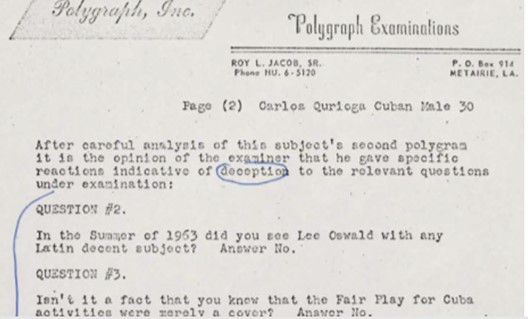
Carlos Quiroga – (Garrison Files, Quiroga, Polygraph, pages 43)
Polygraph results show that Carlos Quiroga knew that Oswald’s role with the FPCC in New Orleans was all a front (also see Exposing the FPCC part 3 for more information about this key subject.)
He also lied, according to this same test, when he said that he had never seen Oswald with any Latin decent subject:
18.
Joseph Oster – (Garrison Files, Misc. Material 1, page 189)
In 1956 Oster and Banister became business partners until he left to start his own firm in 1958. They remained friendly, and between the middle of 62 and the end of 63 he was introduced to David Ferrie and two Cuban exiles who he portrays this way:
“…I was also introduced to David Ferrie and two Cuban exiles… (one) was tall, thin, dark hair (Jorge Ramirez – engineer for Warren Moses – 524 – 1277), and I vaguely remember he was a draftsman or some kind of engineer. He was approximately 30 to 32 years-old. At the time I met them, they were definitely driving an old Ford. The other Cuban was short, stocky, moustache and appeared to be highly educated. He was about 45-years old. When Banister introduced me to them, he told me they were Cuban exiles.”
While the age estimate here seems much older than most of the estimates for the squat tank, he goes on to relate the following that many others claim to have seen:
“This particular unknown Cuban was watching Oswald pass out pamphlets in front of Maison Blanche, Kress, Aubudon Building.”
He clearly places a likely Oswald escort in Banister’s office. The other interesting revelation is about the running of weapons and equipment to Cuba revolving around Banister.
This Cuban exile participated in the skirmish along with Carlos Bringuier and Celso Hernandez. He told Andrew Sciambra that he had worked for Alpha 66 (which was set up by a CIA officer of extreme interest named David Phillips).
He also described a Latino escort actually taking pictures of the scene:
“Cruz said that he had never seen Oswald with any strong-looking Latin-American type individuals, but he could remember a strong looking Latin type person around 25 or 30 years-old who was a little taller than OSWALD and who weighed close to 200 pounds, standing in front of the Maison Blanche Building with a camera and taking pictures of OSWALD and other people when OSWALD was distributing leaflets there… He was dressed in a suit and tie and wore dark glasses.”
20.
Ricardo Davis (Garrison Files, Miscel. Materials, Page 170)
Davis, an encyclopedia salesman, in front of his lawyer had a lot say to William Gurvich. He knew Ferrie, Arcacha Smith, Banister, Manual Gil, Sylvia Odio, Wray Gill, Ronnie Caire; knew about the training camps; he had been introduced to Oswald by Carlos Quiroga; he knew all about Alpha 66. He also corroborates this escort sighting during the Canal Street scuffle:
“DAVIS stated he was standing on a corner near where OSWALD was distributing pamphlets and witnessed the scuffle between OSWALD and CARLOS BRINGUIER. Another man, a Latin-American with olive complexion, disappeared from the scene. DAVIS was of the opinion this man was with OSWALD and found his name as TORRES or GOMEZ CORTEZ.”
21.
Evaristo Rodriguez – (Garrison Files, Shaw Cuba, Page 67, and Rodriguez Testimony to Warren Commission)
Orest Pena owned the Habana Bar that Carlos Bringuier describes earlier in this essay, which was just a few doors down from his store. Pena was very involved with the CRC and was an informant for many intelligence actors in New Orleans, including Warren DeBrueys of the FBI and Dave Smith of INS.
His bartender, Rodriguez, witnessed Oswald, wearing a bowtie, in his full “look atme, shit disturbermode” during the early hours of the morning when he made a stink about a lemonade he had ordered and acted sick while accompanied by mini-herc, whom the bartender described to Wesley Liebeler of the Warren Commission after stating that he spoke Spanish:
Mr. RODRIGUEZ. I am not able to state what his exact nationality was, but he appeared to be a Latin, and that’s about as far as I can go. He could have been a Mexican; he could have been a Cuban, but at this point, I don’t recall.
Mr. LIEBELER. What did this man look like?
Mr. LOGAN. You want a description of him?
Mr. LIEBELER. Yes; how old?
Mr. RODRIQUEZ. He was a man about 28 years old, very hairy arms, dark hair on his arms.
Mr. LIEBELER. About how tall was he?
Mr. LOGAN. He says he was about my height. That’s about 5 feet 8. He is about the same build of man as I am, short and rather stocky, wide. He was a stocky man with broad shoulders, about 5 feet 8 inches.
Mr. LIEBELER. Do you know how much he weighed approximately?
Mr. LOGAN. He probably hit around 155. He doesn’t remember the exact weight, but he would guess around the same weight as I appear to be.
Mr. LIERELER. So he weighed about 155 pounds or so?
Mr. RODRIQUEZ. Yes.
Mr. LIEBELER. Was he taller or shorter than Oswald?
Mr. RODRIGUEZ. Just a little taller than Oswald.
Mr. LIEBELER. Was he heavier than Oswald or lighter?
Mr. RODRIGUEZ. He was huskier and appeared to weigh more than Oswald.
Also, in during his testimony Liebeler alludes to the FBI search of the escort.
22.
Patrolman Manual Ortiz – (Memorandum, February 2, 1967, To: Jim Garrison, From: Andrew Sciambra, Re: Conversation with Manual Ortiz)
In 1967, Andrew Sciambra questioned a cop who seemed to know the Latino beat and reported the following:
“…he had heard that we were investigating Cubans who could be possibly involved in this matter, and he said that he had heard that a Spanish or Cuban lady had overheard two Cubans and Lee Harvey Oswald planning the assassination of President Kennedy.”
23.
Wendall Roache, Ron Smith and David Smith -Stooling for the INS and Customs
The following two testimonials/documents archived by the Church Committee are really worth reading in full. As in their combined form, we can conclude that Orest Pena was clearly an informant for multiple intelligence players which adds strong corroborative value to Bringuier’s story and clearly places Oswald within the group of “nuts” headed by David Ferrie according to Roache.
Pena testified that he saw Oswald in conversation with David Smith (Customs), FBI investigator of FPCC/Cuban exile affairs Warren DeBrueys, and Wendell Roache (INS). Pena told the Church Committee that Oswald was employed by Customs. Informant Joseph Oster went further, saying that Oswald’s handler was David Smith at Customs. Church Committee staff members knew that David Smith “was involved in CIA operations”. Orest Pena’s handler DeBrueys admitted he knew Smith. Oswald was also often seen with Juan Valdes, who described himself as a “customs house broker”. (Bill Simpich… The Twelve Who Built the Oswald Legend part 9)
From Ron Smith (fluent in Spanish) who interviewed Oswald after his scuffle arrest, because he pretended to only speak Spanish after being called in by the NOPD:
“Ron admitted frequent contact with Orest Pena. Pena’s brother told him that Orest was working for (or was going to work for) the FBI. He also recalls Custom’s David Smith.”
Roache, when called, by Church Committee investigators, replied that he had been expecting a call for twelve years. What he said about Oswald is so damning that it likely contributed to Richard Schweiker’s suspicions that Oswald was a double-agent spying on both anti and pro-Castro groups:
“Included in this surveillance was the group of “nuts” headed by David Ferrie. Roache knew the details on Ferrie i.e., dismissal from Eastern Airlines, homosexual with perverse tendencies (“nuttier than a fruitcake”), etc. He stated that Ferries’ office – on a side street between St. Charles and Camp – (we’ll have a street map for him) was under surveillance (although he never surveilled it, another inspector drove him past it and identified it); that Lee Harvey Oswald – who was identified by IN&S as an American when he first appeared on the New Orleans street scene (he does not recall the circumstances surrounding the identification) – was seen going into the offices of Ferrie’s group, and “Oswald was known to be one of the men in the group.”
24.
(FBI Document, SA Milton Kaack, Nov. 25, 1963 and CE 1154 WC)
Some of the sightings came from ordinary citizens such as Oswald’s neighbors, the Rogers. The husband, Eric, claimed the following during his Warren Commission testimony:
“Mr. Rogers stated that Oswald had several visitors at various intervals, one of whom appeared to be an American; that the others appeared to be foreigners and were the Latin type.”
“Mr. Rogers stated that he was at home on the occasion when Mrs. Oswald and her child left in a light brown Ford or Chevrolet station wagon with a man and woman. He said the man was about in his 40’s and was short and stocky.”
Mrs. Gladys Rogers placed the following Oswald companion near his place at around mid-September 1963:
“…a white male, approximately 5’7”, 175 pounds, dark complexion, and had a foreign appearance, possibly Spanish.”
A Mrs. Rico corroborates this sighting (Garrison files, Shaw leads 2)
“Mrs. RICO told the FBI that she was familiar with the couple (OSWALDS) but never knew their names. She describes two of OSWALD’s visitors, one of which was a short, stocky, dark complexed individual who was wearing a dark business suit and looked to be either Mexican or Cuban. (possibly the escort) This visit was approximately 3 weeks before OSWALDS vacated the apartment.”
25.
Sylvia and Annie Laurie Odio – (Warren Commission Testimony and HSCA report…)
From Spartacus: “On 25th September, 1963, Odio had a visit from three men who claimed they were from New Orleans. Two of the men, Leopoldo and Angelo, said they were members of the Junta Revolucionaria. The third man, Leon, was introduced as an American sympathizer who was willing to take part in the assassination of Fidel Castro. After she told them that she was unwilling to get involved in any criminal activity, the three men left.
The following day Leopoldo phoned Odio and told her that Leon was a former Marine and that he was an expert marksman. He added that Leon had said “we Cubans, we did not have the guts because we should have assassinated Kennedy after the Bay of Pigs”.
The HSCA found Odio’s account to be very credible, knowing that she spoke about it to others before the assassination. Her description of Oswald’s companions (concurred with by her sister) make it irrefutable, given the corroboration she has from sightings that occurred before and after hers. The implications are seismic.
“Mr. LIEBELER. Which one of the Cubans?
Mrs. ODIO. The American was in the middle. They were leaning against the staircase. There was a tall one. Let me tell you, they both looked very greasy like the kind of low Cubans, not educated at all. And one was on the heavier side and had black hair. I recall one of them had glasses, if I remember. We have been trying to establish, my sister and I, the identity of this man. And one of them, the tall one, was the one called Leopoldo.”
“Mrs. ODIO. One was very tall and slim kind of. He has glasses, because he took them off and put them back on before he left, and they were not sunglasses. And the other one was short very Mexican looking. Have you ever seen a short Mexican with lots of thick hair and lots of hair on his chest?”
“Mrs. ODIO. It was different. In the middle of his head it was thick, and it looked like he didn’t have any hair, and the other side, I didn’t notice that.
Mr. LIEBELER. This was the taller man; is that right? The one known as Leopoldo?
Mrs. ODIO. Yes.
Mr. LIERELER. About how much did the taller man weigh, could you guess?
Mrs. ODIO. He was thin-about 165 pounds.
Mr. LIEBELER. How tall was he, about?
Mrs. ODIO. He was about 3.5 inches, almost 4 inches taller than I was. Excuse me, he couldn’t have. Maybe it was just in the position he was standing. I know that made him look taller, and I had no heels on at the time, so he must have been 6 feet; yes.
Mr. LIEBELER. And the shorter man was about how tall, would you say? Was he taller or shorter than Oswald?
Mrs. ODIO. Shorter than Oswald.
Mr. LIEBELER. About how much, could you guess?
Mrs. ODIO. Five feet seven, something like that.
Mr. LIEBELER. So he could have been 2 or 3 inches shorter than Oswald?
Mrs. 0DIO. That’s right.
Mr. LIEBELER. He weighed about how much, would you say?
Mrs. ODIO. 170 pounds, something like that, because he was short, but he was stocky, and he was the one that had the strange complexion.
Mr. LIEBELER. Was it pock marked, would you say?
Mrs. ODIO. So; it was like-it wasn’t, because he was, oh, it was like he had been in the sun for a long time.”
Her sister agreed according to the HSCA report:
“… but believed it might have been “Angelo” or “Angel.” She described him, as her sister did, with black hair and looking “more Mexican than anything else”.
26.
Robert McKeown and Sam Neal.
McKeown had done some gun smuggling for Fidel Castro. According to him, sometime in 1959, Jack Ruby asked him for help in gaining contacts for his dealings with Cuba. He also told the HSCA that late in September or early October 1963, Oswald and a Cuban named Victor Hernandez showed up at his place to try and buy four Savage rifles for $10,000. He was suspicious and refused. His wife and a friend, Sam Neil, were present during this visit. His testimony at the time, wasn’t deemed credible by the HSCA.
If true, the coincidence of his contacts with both Ruby and Oswald is troubling. Some researchers have pointed out that, had he supplied weapons to Oswald and the lone-nut route had not been put into effect, a Castro-linked weapons supplier would have been an effective blame-it-on-Cuba ploy.
According to Larry Hancock, here is how the Cuban was described: “while the other was Latin, dark skin but not black, just less than six feet, older, late 30’s and dressed in a suit and tie. The younger man opened the conversation, “I’m Lee Oswald; I finally found you. You are McKeown are you not?” He introduced the man with him as “Hernandez.” Hernandez had been driving the car.
In his HSCA testimony, he said he was well-dressed, in his forties and spoke very little. He also claimed the following: “…about two weeks ago, maybe between 8:00, 9:00 o’clock at night, the phone rang and I answered the phone and somebody on the phone said this is McKeown? I said yes. He says when you go to testify at that committee, just remember there was no Latin involved, period, and hung up.”
27.
Harvey Lawill Wade -Carousel Club Clients (Garrison Files, Misc. 2, WC CE 2370)
On November 10, Wade attended the Carousel Club and saw Oswald in the company of two male companions, one of whom he describes as follows: “The number two man is described as a white male, 30-32 years old, 200 lbs, 5 feet 10 inches, a stocky build, long black hair, dark complexion, oval face, and Mexican or Spanish in appearance. He had numerous bumps on his face and was believed to have a one-inch scar in the eyebrow of his left eye.”
28.
Floyd and Virginia Davis, Malcolm Howard Price, Mr. and Mrs. Garland Glenwill Slack, Dr. Homer Wood, Sterling Wood -The Sports “Drome” Rifle Range, and the Castro Bearded, Huge-Footed Oswald Target Practice Escort
The testimonies of these seven, seem to have been bothersome to Wesley Liebeler of the Warren Commission, because it suggests a model. A model designed to support a story of an anti-Kennedy Oswald, sometime in November 1963, practicing and being pre-confirmed as a great shot using a Mannlichher Carcano at a shooting range with a high precision scope, while accompanied by a Latino sporting a Castro-like beard.
Both Oswald, or the ersatz Oswald and his escort, do everything to make their appearance noticeable and memorable. Oswald shooting on another client`s target, the Latino pounding his neighbors` shooting booths with his large feet. If true, this would have been effective for countering an objection that Oswald was an out-of-practice poor shot and that he teamed up with Castro-backed plotters. Note that this particular escort is different physically, more like a Castro figure.
Of course when you want to push a lone-nut scenario, such a sighting is very counter-narrative.
Here are some of their WC testimonies:
Mr. Floyd Davis Floyd Davis intervened after a complaint from a client about Oswald shooting at his target:
“Mr. DAVIS. There was a fellow with a black beard in that booth No. 7, at the same time. I remember him because he was outstanding, you know, and I went to these fellows in booth No. 8. and was giving them heck about shooting at the wrong target. And this other fellow, I remember him because he wouldn’t say anything to me. I tried to speak to him two or three different occasions, because he had a lot of guns, and I thought he would be a good customer.
Mr. LIEBELER. The fellow with the beard?
Mr. DAVIS. Yes.
Mr. LIEBELER. He was how tall, approximately?
Mr. DAVIS. He was over 6 feet and he weighed a good 250 pounds. A big bruiser.
Mr. LIEBELER. I think we can assume that was not Lee Harvey Oswald.
Mr. DAVIS. They were trying to find him. Charlie Brown was trying to find this person, and 2 weeks ago on a Sunday morning I saw him in an automobile out on Davis, I believe it was.
Mr. LIEBELER. The big fellow with the beard?
Mr. DAVIS. The big fellow there with the beard. And I got the license number on the car and the type of car it was and called it into the office. I haven’t heard anything from Mr. Brown since then, whether he got the information, but I am sure he did when I turned it into the office…”
Davis even gave the plate-number of the car they drove off in to law enforcement!
Virginia Davis who helped manage the shooting range describes the following peculiar character causing a ruckus:
“Mr. LIEBELER. Was this man with the beard there at that time, do you know?
Mrs. DAVIS. No; that was on a Sunday afternoon or a Saturday. It was a Saturday or a Sunday, and the reason I remember him, it was the same day they said Oswald was out there, and I tried to talk to him, which I talked to everyone that comes in, and he was noticeable because he looked like the Castro type. He had this big beard and he was heavy set and big broad shoulders, and well, he was just outstanding in his appearance. He had big red earmuffs on and I couldn’t help but notice him.”
Garland Slack, Mr. Slack, who made the complaint, and his wife corroborate:
“Mr. Slack furnished information to the effect that he had seen a man believed to be identical with Oswald at the Sports Drome Rifle Range on November 10, 1963, and believed that he was accompanied by another man described as tall, having a lot of dark hair, dark complexion, and a full beard.”
“Mrs. SLACK advised she recalled seeing a great big man with a beard, who was wearing ear muffs, a red plaid shirt, and green pants. She stated he was shooting “big guns” and was shooting from stall No. 4 or 5. She stated she did not see anyone with this person and believed that he was alone at the rifle range .”
Malcolm Howard Price Mr. Price saw this particular duo twice at the range at the same time and was present when “Oswald” got himself noticed by firing on Slack’s target:
“Mr. LIEBELER: So, what about the fellow that was in the booth on the other side of Mr. Slack, do you remember anything about him?
Mr. PRICE: All I remember about him was that he was a big fellow with a long black- it was either black or dark red beard.”
Mr. LIEBELER: Did you talk to him at all?
Mr. PRICE: Other than just to comment on his scope-I didn’t have any conversation at all with him.
Mr. LIEBELER: You are talking about Oswald now?
Mr. PRICE: No; I’m talking about the fellow with the beard.
Mr. LIEBELER: Did you look through his scope too?
Mr. PRICE: Yes; I did.
Mr. LIEBELER: Did Oswald talk to the fellow with the beard?
Mr. PRICE: Well, I suppose-he spoke to all of them-to Oswald and Slack both, about the clarity of the telescope.
Mr. LIEBELER: Were you there when they were talking about the clarity of Oswald’s telescope?
Mr. PRICE: Yes.”
Doctor Wood Dr. Wood and his son Sterling both say they saw Oswald at the shooting range:
“Dr. WOOD. I saw him flashed on the television screen at home several times. They would interrogate him and bring him down the hall and bring him back to his cell. This particular time I mentioned to my wife, I said to her, “Honey, that looks exactly like the fellow that was sitting next to Sterling at the rifle range. But I am not going to say anything to Sterling because I want to see if he recognizes him and if he thinks it was.” Well, I would say within 30 minutes or an hour he was flashed back on the screen and he said to me, “Daddy, that is the fellow that was sitting next to me out on the rifle range.”
His son Sterling saw Oswald leave with a companion:
“Mr. LIEBELER. Did you see him go?
Mr. WOOD. Yes.
Mr. LIEBELER. How did he go?
Mr. WOOD. He left with a man in a newer model car.
Mr. LIEBELER. Did you see the model?
Mr. WOOD. No, I didn’t. They went into the parking lot. They went around and I heard the car door slam and they took off, but it was a newer model…”
“Mr. LIEBELER. About this other fellow that this guy was with, was he a big man or just-
Mr. WOOD. About the same size this man was.
Mr. LIEBELER. How tall would you say this man was?
Mr. WOOD. Oh, about 5’9”.
Mr. LIERELER. About 5’9”?
Mr. WOOD. Yes.”
I would suggest two other key points in the testimony of this very observant young fellow: He confirms differences between the scope on the rifle used by “Oswald” at the range and the one shown in photos of the “murder weapon”, and Liebeler skates away from getting a description of Oswald’s companion as he does a number of times with other hindering witnesses.
According to Arnesto Rodriguez who met Oswald and knew David Ferrie, the FBI affirmed that Oswald`s escort at the firing range fit the description of a person taking pictures of Oswald during his FPCC leafletting activities in New Orleans:
(Feb 14, 1967 Memorandum, Assistant D.A, Sciambra to Garrison)
29.
Roger Craig – (Garrison Files, Lead Files 5, November 3, 1967, Garrison, Craig interview report)
From Spartacus: “In 1951 Craig joined the United States Army and served in Japan before moving to Texas in 1955. According to his daughter, Deanna Rae Craig: “was released from duty because he kept injuring himself.”
Craig worked for the Purex Corporation before joining the Dallas Police Department in 1959. He was named Man of the Year by the sheriff’s office in 1960 for his work in aid in helping to capture an international jewel thief. He had a successful career in the DPD and was promoted four times.
Roger Craig was on duty in Dallas on 22nd November, 1963. After hearing the firing at President John F. Kennedy, he ran towards the Grassy Knoll where he interviewed witnesses. About 15 minutes later he saw a man running from the back door of the Texas School Book Depository down the slope to Elm Street. He then got into a Nash station wagon.
Craig said he saw the man again in the office of Captain Will Fritz. It was the recently arrested Lee Harvey Oswald. When Craig told his story about the man being picked up by the station wagon, Oswald replied: “That station wagon belongs to Mrs. Paine… Don’t try to tie her into this. She had nothing to do with it.”
Craig was also with Seymour Weitzman, Will Fritz, Eugene Boone and Luke Mooney when the rifle was found on the sixth floor of the Texas School Book Depository. Craig insisted that the rifle found was a 7.65 Mauser and not a Mannlicher-Carcano.
Craig became unpopular with senior police officers in Dallas when he testified before the Warren Commission. He insisted he had seen Lee Harvey Oswald get into the station wagon 15 minutes after the shooting. This was ignored by Earl Warren and his team because it showed that at least two people were involved in the assassination. Craig, unlike Seymour Weitzman, refused to change his mind about finding a 7.65 Mauser rather than a Mannlicher-Carcano in the Texas School Book Depository. Craig was fired from the police department in 1967 after he was found to have discussed his evidence with a journalist.
In 1967 Craig went to New Orleans and was later a prosecution witness at the trial of Clay Shaw. Later that year he was shot at while walking to a car park. The bullet only grazed his head. In 1971 Craig wrote “When They Kill A President”. In 1973 a car forced Craig’s car off a mountain road. He was badly injured but he survived the accident. In 1974 he survived another shooting in Waxahachie, Texas. The following year he was seriously wounded when his car engine exploded. Craig told friends that the Mafia had decided to kill him. Roger Craig was found dead on 15th May, 1975. It was later decided he had died as a result of self-inflicted gunshot wounds.”
Craig, like Abraham Bolden, was another tragic character who paid a heavy price for telling the truth. Perhaps his description of the driver of an Oswald (or more likely an Oswald double) escort in a getaway car, can help bolster his credibility:
“Craig’s attention was initially engaged by a whistle, evidently a signal between the operator of the vehicle and OSWALD and then he noticed that OSWALD was leaving the scene while others were arriving. Craig placed the time at about 12:45. He said that the man driving the vehicle was a Negro but that he was dark-skinned—possibly Latin. His skin he said appeared to be very smooth. The driver had a powerful face, neck and shoulders. Craig repeatedly used the words “powerful” and “muscular” to describe his neck and shoulders. The driver wore a light tan zipper jacket found near the scene of the TIPPIT murder, Commission Exhibit 162. Craig said it was identical with the jacket worn by the driver.”
30.
Richard Carr’s Birds Eye View
Witness of the assassination Richard Carr Carr was a World War 2 vet, who had a vista from the Dallas County Courthouse on the seventh floor, and he corroborates Craig: “He reported to me that he saw 2 white men run from behind the wooden fence, that location being the one which we claim some of the shots came from which killed President Kennedy. Carr stated that the two men ran in a northeasterly direction behind the School Book Depository Building, and while they were out of sight they were joined by a colored man (he called him a negro). The colored man got in the driver’s seat of a gray Rambler station wagon. One white man got in the rear seat on the left-hand side and the car drove North on Houston, turning to the right on Pacific. The other man, a dark-complexioned white mail, about 5’8”, heavyset, wearing dark rimmed glasses, brown hat and brown coat, walked South on Houston Street…”
“After the shooting Carr saw the man emerge from the building. Carr followed the man and later told the FBI: “This man, walking very fast, proceeded on Houston Street south to Commerce Street to Record Street. The man got into a 1961 or 1962 gray Rambler station wagon which was parked just north of Commerce Street on Record Street.” This evidence corroborated those claims made by Roger Craig. Both Carr and Craig described the driver of the car as being dark-skinned.” (Spartacus)
“A: North is the top, and it was headed in this direction towards the railroad tracks, and immediately after the shooting there was three men that emerged from behind the School Book Depository, there was a Latin, I can’t say whether he was Spanish, Cuban, but he was real dark-complected, stepped out and opened the door, there was two men entered that station wagon, and the Latin drove it north on Houston. The car was in motion before the rear door was closed, and this one man got in the front, and then he slid in from the – from the driver’s side over, and the Latin got back and they proceeded north…” Q: Now, Mr. Carr, did you have occasion to give this information to any law enforcement agencies? A: Yes, I did.” (EXCERPT OF THE TESTIMONY TAKEN IN OPEN COURT February 19, 1969 Before: THE HONORABLE EDWARD A. HAGGERTY, JR., JUDGE, SECTION “C”)
Highlights:
The witnesses: There are at least 35 witnesses who saw Oswald (or a double), accompanied with at least one Latino escort. Another six corroborate the occurrence of an event described by another witness without giving a physical description of the escort. Nine were connected to intelligence or law enforcement; one was a lawyer and another, his assistant. Eight were Cuban exiles; four owned businesses; six worked in clubs/restaurants/bars; three were Oswald neighbors; Seven saw Oswald at a shooting range. Almost all were in close proximity with Oswald and friends; Many exchanged words with Oswald and/or his escort(s).
The sightings: Out of all the sightings of the Latinos, sixteen were of two or more; in the case where physical descriptions were given of at least one Latino, twenty-five describe a stocky one (the words, hefty, athletic, muscular, powerful, strong looking come back); four point out his powerful neck or arms; three mention how hairy he was; Most describe a short person; Seventeen point out how dark/olive complexed he was; In general, age estimates range between 20 and 25; about ten did not offer a physical description beyond Latin looking; some eleven events had multiple witnesses. There are five people who claim to have seen Oswald with the escorts while Oswald was in Russia (Reminding us of Jim Garrison’s discovery about the Friends of Democratic Cuba phenomenon). Seventeen of the sightings were in the Dallas area, one in Mexico City, the rest were in New Orleans.
Wesley Liebeler often uses Pizzo exhibits for identification purposes where a number of witnesses express strong opinions confirming Oswald as one of the persons they had observed:
Summary
Warren Commission apologists have often painted witnesses like Richard Case Nagell, Sylvia Odio, Roger Craig, Perry Russo and others as unreliable, possibly demented, mixed-up or brainwashed, all in a desperate attempt to dismiss their stories. Yet a number were given shortly after the assassination. How could all the corroborating testimonies align that much? The sources are too varied to accuse the DA of a form of bias or manipulation.
And many were up close and had no reason to make anything up. At least three were informants. When one reads WC questioning of witnesses, one gets a feeling that they, at least Liebeler, understood the significance of this blatant, pit-bull lead and avoided shedding light on this potentially explosive piece of evidence by rarely asking for precise descriptions. This character deserved the production of a composite drawing and a full-fledged man-hunt with investigating starting with Dean Andrews’ clients and the goings-on in the Ferrie and Banister network. There are vague references to photos, cars used by the Latin suspects, police investigations that may help confirm identities of Oswald’s escorts. Carlos Bringuier, Orest Pena and Arnesto Rodriguez all stated that the FBI was on the lookout for Oswald Latin companions. There is testimony that he was in fact identified, but never talked about.
Given the corroborative value of these testimonies, should we not be taking each and every one of these sightings very seriously? The implications are monumental. The myth of Oswald the lone nut should be torn down once and for all. Some of these accounts, including Craig’s, and a few while Oswald was in Russia, would imply that there was in fact an Oswald double. The sightings of Oswald in the Carousel Club need to be reevaluated. As with the Friends of Democratic Cuba, this strongly implies that the escorts were given their assignments by Banister and or Ferrie.
All this dovetails with a stunning revelation concerning training footage of Cuban exiles (as told to Jim DiEugenio) by Robert Tanenbaum, Chief Council of the HSCA, who was there when it got started:
JD: Was it really as you described in the book, with all the people in that film? Bishop was in the film?
BT: Oh, yeah. Absolutely! They’re all in the film. They’re all there. But, the fact of the matter is the Committee began to balk at a series of events. The most significant one was when [David Atlee] Phillips came up before the Committee and then had to be recalled because it was clear that he hadn’t told the truth. That had to do with the phony commentary he made about Oswald going to Mexico City on or about October 1st, 1963. (Probe Magazine, Vol. 3 No. 5)
The people in the film they are discussing include Banister, Oswald and David Phillips.
There are a number of witnesses that I did not include in this analysis. And they would bring the sum total to over forty. Some of these were part of decades worth of research by John Armstrong, who developed a highly detailed chronology around two separate paths of two Oswalds, one he calls Harvey and the other Lee. There is a malaise among researchers when it comes to concurring fully with John’s conclusions. This author does not consider himself to be in a position to pronounce himself on all of Armstrong’s work. However, his raw information, just like Jim Garrison’s, cannot be ignored. And it includes many sightings that are revealing if we accept that there may have been an imposter as we know there was in in Mexico City, and while Oswald was in Russia and even on November 22nd. Sightings that included Latin escorts, often the stocky individual.
Oswald’s escorts give a whole new meaning to Senator Schweiker’s observation that Oswald was mixing with both anti and pro-Castro elements and proves that Garrison was on the right track. This simply cannot be dismissed by anyone who has even a minute sense of logic. The reader is encouraged to read the sources in full. Do not take my word for it, consider this small part of INS officer Wendell Roache’s landmark statement:
“Roache stressed that the NOPD (specifically the intelligence division) and the East Metairie’s Sheriff’s Office had reports on Ferries’ group. He added that “Garrison had something; I read his reports in the newspaper and they were correct, he received good intelligence information, whether he was using it for politics or not.” Roache also noted that (1) Garrison was all eyes and ears in the French Quarter and (2) that he had heard Ferrie was running when he was killed.”
Although Malcolm X and Martin Luther King Jr. wanted equality and justice for their community, their visions were like two sides of the same coin. Unlike King, Malcolm X didn’t believe in racial integration or support the civil rights movement facts.
In today’s Kennedys and King update, let’s explore these two political figures and where their paths met and diverged.
Parallels Near the End
Malcolm X flipped the script completely after returning from his pilgrimage to Mecca. After endorsing separation and promoting self-defense rhetoric his entire life, the activist started promoting brotherhood regardless of one’s race. This change was inspired by the integration, peace, and harmony between pilgrims in Mecca.
He publicly recognized wanting the same thing as Dr. King: freedom. However, that was hardly the case for most of the minister’s life.
Martin’s Interpretation of Freedom
While King and Malcolm X wanted to free their community from the shackles of their brutal past, their approach was as different as day and night. King supported non-violence.
He advocated for equal rights for all of humanity but never used unprovoked violence as the means to achieve them. The bills signed into law thanks to King’s contributions supported integration, not further segregation and isolation of the African American community.
King only hired armed security detail when his Montgomery house was firebombed. In other words, he took up arms to safeguard the Civil Rights Movement, not to add an element of violence to it.
Malcolm’s Interpretation of Freedom
On the flip side, you have Malcolm X, who, unlike King, preferred street corners over churches. Embittered by the cruel way his elders were abducted from their homes, he denied being an American for most of his life. He even changed his last name to “X”, effectively removing the last name given to his forefathers by their masters.
Unlike King, Malcolm’s allegiance to the Nation of Islam made him seek a separate, not united, society for his people. While he recommended self-defense over unprovoked police violence, his motto was “by any means necessary,” which one could interpret as a defense to any threat, even if that wasn’t his intention.
The Road from Scorn to Admiration
Malcolm X wasn’t all praise for Dr. Martin Luther King Jr. from the onset. He openly mocked and criticized the Civil Rights Movement, even going as far as to call the historic March on Washington a “farce” and “circus.”
However, that all changed after the pilgrimage to Mecca and the ensuing estrangement with the Nation of Islam. Learn how Malcolm X perceived the Civil Rights Movement and Dr. King’s role before he joined the political assassinations of the 1960s on Kennedys and King. Delve deeper into the events before and after the malcolm x assassination and see how you can help us uncover the truth behind the political murders of that decade.
Reader Rich Negrete has made this remarkable film based on the information given the Warren Commission by Victoria Adams, Sandy Styles and Dorothy Garner. These three witnesses provided powerful testimony that Oswald was not on the sixth floor at the time of President Kennedy’s assassination. Rich goes into detail as to how the Warren Commission decided to dodge the clear implications of these witnesses. Because they knew it would counter their pre-conceived conclusions, this evidence was altered, ignored, and even destroyed. He does all this with delicacy, accuracy, and forceful effect.
Although a major source is Barry Ernest’s milestone book The Girl onthe Stairs, in some ways Rich Negrete goes beyond that book. For instance in the information about Dorothy Garner and the professional opinion of Dr. Joseph Dolce, who worked for the Warren Commission. The amount of primary source information placed on the screen is copious and potent. It helps show why and how the Commission did what they did with this episode. For a first time film-making effort The Killing Floor is impressive. I personally hope there are more of these to come. And I thank Rich for letting us place it on our web site.
Join us for the most important annual conference on the JFK assassination!
CAPA is looking forward to seeing everyone at our in-person conference this year. The conference will be held in Dallas at the Crowne Plaza Hotel near Dealey Plaza. The dates for the conference are November 19 and 20. There will be a banquet on Saturday night.
Here are the exciting events on our program: (New information in red.)
Be among the first to see the new four-hour Oliver Stone documentary “JFK – Destiny Betrayed.”
Jim DiEugenio will be speaking about new and additional information that did not make it into the “JFK – Destiny Betrayed” film.
Jeff Meek, who writes a monthly JFK assassination column for the Arkansas Hot Springs Village Voice newspaper, will speak about new evidence he found which Jim Di’Eugenio is including in his upcoming book.
The title of the talk by Josiah Thompson and Gary Aguilar will be: “A Granular Account of the Last Second of the Assassination”
We will be showing the 45-minute trailer from the film by Libby Handros “Four Who Died Trying” about JFK, RFK, MLK and Malcom X.
David Montague, member of the Assassination Records Review Board, will speak about how he followed up on leads, and the difference in technology between then and now.
Russell Kent, who spoke last year about the HSCA Forensic Pathology Panel, will be speaking about the Clark Panel.
Paul Bleau will be speaking about how the JFK assassination is covered in the history books at schools in North America and will also chair a panel on this subject with David Denton, Andrew Kiel, and David Montague.
Steve Jaffe, the last living staff investigator of New Orleans District Attorney Jim Garrison, who worked with Mark Lane to produce the revised film, “A Rush to Judgment,” and was a producer of the 1973 film “Executive Action,” will be speaking. The title will be “DA Investigator’s Notebook” and will include a few stories from his experiences working with Garrison that are not commonly known. He will also talk about meeting the head of the French Secret Service and President/General De Gaulle regarding the Zapruder film.
David Mantik will be speaking about what happened to JFK’s limousine after the assassination.
John Newman will be speaking by Zoom on Volume IV of his series on the Kennedy Presidency: Uncovering Popov’s Mole. This volume examines, to an unprecedented extent, the internal and external dynamics of the decades-long search, within CIA, for a Soviet mole who was never exposed or identified. It presents an entirely new perspective on the authority and objectives of the mole (within the CIA’s Office of Security), and a dramatic new context in relation to understanding Lee Harvey Oswald’s 1959 defection to the USSR.
Max Good will be showing his documentary “The Assassination and Mrs. Paine.”
Monika Weissak will be speaking about her book “America’s Last President – What the World Lost When it Lost John F. Kennedy.” Her book is highly recommended by Jim DiEugenio.
We will be presenting a short clip of former CAPA Board Advisor and speaker at our conferences, James Wagenvoord, who passed away on July 26th. Steve Jaffe will be giving personal remarks on collaborating with Wagenvoord on a book. He spoke several times at our conferences and was a valued friend and advisor to CAPA whom we will miss very much.
Dr. Wecht, Chairman of CAPA and author of numerous books including his latest – “The JFK Assassination Dissected” co-authored with Dawna Kaufmann – will be the keynote speaker at the banquet. CAPA has a surprise for fans of Dr. Wecht, a look back in time that will delight and inspire you – and maybe even bring down the house!
FOR CAPA MEMBERS ONLY We are having a mixer with a cash bar (6-7 pm) just before the banquet on Saturday night which begins at 7 pm. The mixer will be for CAPA members only and will provide an opportunity to meet and talk to the conference speakers, including Dr. Wecht.
We are again planning a special day for high school, college, and law school students. This will be held online, as it was the last two years, on Friday, November 18. We are planning a program that will give them the opportunity to see what President Kennedy was like as a person and a president and educate them about the truth of the assassination. David Denton will introduce the program and answer questions from the students.
To register for the conference and banquet, please follow this link.
The room rates at the Crowne Plaza Hotel, discounted for our group, are as follows: deluxe renovated guest rooms with one king or two queen beds, luxury bedding, mini fridge, one cup coffee maker, multiple USB ports, and hairdryer for $139.00 per night plus tax. Room rate including cooked to order breakfast for two in the restaurant is $159 per night plus tax. Use the link below to make your reservation. Note that the hotel is offering a discounted rate before and after the conference for people who want to come early and/or stay late. There is discounted self-parking in the attached garage – normally $18 discounted to $10 per night for our group. Booking Website: https://book.passkey.com/e/50309916 click on Attendee CAPA video ad for our conference: https://youtu.be/x1r874uYayU
We are thinking about what type of event we might have for next year’s 60th anniversary of the assassination. A suggestion has been made that we have a film festival showing the important movies, films and documentaries about JFK at the Kennedy Center for the Performing Arts in D.C. We would appreciate your feedback. Would you travel to an event like this or would you prefer a conference with various speakers? Please send your comments to Glenda (CAPA Program Chair) at visionsoffrance@cox.net.
Thank you all for your support of CAPA and its worthy cause – Pursue the release of withheld records – Find the Truth – Seek Justice.