Blog

  • News: California Panel Rejects Parole Again for Robert Kennedy Assassin

    News: California Panel Rejects Parole Again for Robert Kennedy Assassin


    A panel in the United States has denied parole for Robert Kennedy’s assassin, Sirhan Sirhan, saying the 78-year-old prisoner still lacks insight into what caused him to shoot the senator and presidential candidate in 1968. Sirhan’s lawyer Angela Berry disputed that assertion, saying Sirhan has shown that awareness and that his psychiatrists have said for decades that he is unlikely to re-offend or be a danger to society.

    Two years ago, a different California parole board had agreed with Berry, voting to release Sirhan, but Governor Gavin Newson rejected the decision in 2022. Berry said she believes the new board members on Wednesday were influenced by the California governor as well as by the lawyers representing Kennedy’s widow and some of his children. Several relatives of the slain politician, though not all, are opposed to Sirhan’s release.

    Read the rest of the article here.

  • James DiEugenio’s Three Most Highly Recommended MLK TV Documentaries

    James DiEugenio’s Three Most Highly Recommended MLK TV Documentaries

    The year 2018 marked 50 years since Martin Luther King was assassinated. This landmark year saw an influx of multimedia, most debatable and some commendable, related to the MLK assassination.

    James DiEugenio reviewed and recommended three MLK TV documentaries, describing them as the best documentaries in recent years.

    Hope and Fury

    NBC’s Hope and Furycelebrates the legacy of Martin Luther King, showing how the civil rights leader was way ahead of his time, using print and television media to highlight racial discrimination.

    The TV documentary shares never-before-seen videos and photographs revisiting the civil rights movement from fresh perspectives and interviews by civil rights leaders, reporters, and their contemporaries.

    This documentary is a comparative analysis of sorts. It draws parallels between the civil rights movement facts then and today’s Black Lives Matter movement, the racially-motivated murders of those times to the world we live in today, and likens traditional media to social media as a mass communication tool.

    I am MLK Jr.

    I am MLK Jr. is different from all the other MLK TV documentaries because it is less a biographical documentary and more an eye-opener for our modern generation. It tells them that the problems that plagued their country 50—now 55—years ago haven’t gone anywhere. The documentary also reveals never-before-heard recordings and interviews by civil rights activists, politicians, writers, and King’s comrades.

    The message of this documentary, as described in this review, is that celebrating King’s life is easy, but addressing the problems he faced requires a lot of work more than half a century after the fact.

    Detroit march

    King in the Wilderness

    DiEugenio declares HBO’s King in the Wilderness his favorite of the three MLK TV documentaries. It documents the last four years of King’s life, from the Voting Rights Act in 1965 to his untimely demise in 1968; that is one of the aspects that DiEugenio believes makes this documentary different from all the rest.

    Instead of condensing the 39 years of King’s life, the documentary starts near the end of King’s life and ends with his funeral. Unlike the other two TV documentaries, it doesn’t feature interviews and opinions of so-called experts on the life and death of Martin Luther King.

    On the contrary, the documentary features interviews by those who King considered nearest and dearest: his friends, colleagues, and comrades, including attorney Clarence Jones, Andrew Young, a colleague, Harry Belafonte, an actor and singer who King considered a friend, and many other public and not-so-public figures who knew King better than any other “expert” who never even came within two feet of the civil rights leader.

    Keep reading the review to know the finer points of King in the Wilderness, but don’t stop there. Browse Kennedys and King’s articles, to tell the truth from the mistruths and lies concerning the political assassinations of the 1960s. Know which MLK TV documentaries to avoid and which ones to watch by following this tag.

    Please support our cause to bring those responsible for the Martin Luther King assassination to justice.

  • How Not to Make Wrong Assumptions à la “The Assassin Next Door”

    How Not to Make Wrong Assumptions à la “The Assassin Next Door”

    The format of Hector Tobar’s essay “The Assassin Next Door” is like One Night in Miami. It explores personal identity set within the wider context of major events. While an interesting concept, Kennedys and King’s Jeff Carter has reviewed Tobar’s essay and found it replete with assumptions.

    Here are the assumptions that make this essay anything but a good resource when studying the assassination of Martin Luther King.

    James Earl Ray Killed MLK

    “The Assassin Next Door” loses any credibility from the title alone. Tobar assumes that James Earl Ray killed MLK when he calls him an assassin and compares his life trajectory with Ray’s.

    Tobar discovered from reading Gerald Posner’s Killing the Dream (more on that later) that Ray lived in the same East Hollywood neighborhood as him and compared his upbringing to Ray’s, not even stopping to consider the evidence belying his innocence.

    MLK’s Death was a Hate Crime

    The short essay transitions into Ray’s motives, which Tobar also gets from Posner’s book. In this case, it was the “hatred of black people.” We, as many others, disagree with this motive because Ray was not racist, or at least not racist, to the point of wanting King dead.

    Ray has categorically denied holding a racist perspective, as has his family and anyone else who visited him in prison. Unfortunately, Tobar uses the opposite as his basis, referencing uncorroborated statements and focusing on the wrong target to validate this highly invalid assumption.

    hate poster

    Interval: The Person Behind Killing the Dream

    Let’s now take a break from assumptions to explore Gerald Posner’s background. After all, it is what his essay “The Assassin Next Door” is based on.

    Killing the Dream received rave reviews in The New York TimesTime, and other book critics. It was a raging success, but, as discussed in this essay, the person behind it is guilty of many misdemeanors.

    Since this book’s publication, Posner has been accused of plagiarism, uncorroborated citations, bias, misinterpretation of available resources, and a lack of sourcing. This is the person Tobar uses as his primary resource in the essay.

    Assumption (Lack Thereof)

    Tobar isn’t fair in his assumptions. He assumes that Ray killed King because he was prejudiced but conveniently ignores the glaring reality of those times. Almost every echelon of the system, from the Memphis police to the intelligence, was racist.

    They had as much motive to kill King as Ray allegedly did, so why does Tobar not consider them suspects in the Assassination of Martin Luther King?

    Read Carter’s essay for further analysis and dissection of Tobar’s “The Assassin Next Door.” Once you’re done reading, click the MLK assassination tab to know what to read and what to avoid where this political murder is concerned.

    Get in touch or contribute to help us unearth the truth behind the political assassinations of the 1960s.

  • The JFK Assassination Decoded: Two Reviews

    The JFK Assassination Decoded: Two Reviews


    Review by Jerome Corsi

    On January 4, 2023, Dr. David Mantik, M.D., Ph.D., published The JFK Assassination Decoded: Criminal Forgery in the Autopsy Photographs and X-rays, a beautifully printed more than 500-page magnum opus complete with color illustrations compiling his decades-long investigation into the case. The JFK Assassination Decoded is not just another Kennedy assassination book.

    Mantik deserves an honored place in the pantheon of JFK researchers for his definitive forensic proof that JFK was shot from the front, hit by two shots from the right front, and one shot from the rear. Mantik’s book is a “must-read” JFK book that belongs in the library of every serious study of the assassination for its definitive treatment of the JFK headshots. Perhaps even more critical, Mantik allows us to see disinformation campaign parallels, suggesting both the JFK assassination and the removal of Donald Trump from the presidency were both Deep State planned and executed coup d’états.

    Mantik’s forensic analysis of the JFK autopsy X-rays proves Lee Harvey Oswald could not have been the assassin. Equally important, Mantik’s new book allows us to see the Deep State parallel between the JFK assassination and the DOJ/CIA conspiracy to remove President Trump from office. The Justice Department and the CIA conspired to infiltrate and control social media to conceal the Deep State’s role in fabricating the Russian collusion hoax to destroy Donald Trump’s presidency. So too, Allen Dulles penetrated the Warren Commission to cover the Justice Department and CIA’s complicity in the crossfire in Dealey Plaza that removed JFK from the White House.

    In nine separate trips to the National Archives over multiple years, armed with scientific apparatus including a Tobias optical densitometer, Mantik spent a record time examining the original JFK autopsy X-ray films. His brilliantly conducted optical density measurements proved that the autopsy X-rays had been altered to mask the frontal shots. Mantik traced and measured bullet fragments that transited Kennedy’s brain from the front to the back, establishing indisputable “case closed” proof that the official government narrative pinning Lee Harvey Oswald as the assassin was false. Mantik is eminently qualified to conduct this forensic analysis. He received a doctorate in physics from the University of Wisconsin and his M.D. from the University of Michigan. Mantik has spent some 40 years practicing as a board-certified radiation oncologist.

    Mantik bolsters his argument with his anatomical analysis of the Harper fragment, demonstrating that the bone fragment found on Elm Street was from the mid-occipital region, squarely in the back of JFK’s head, blown out of the back of JFK’s skull by an oblique shot from the right front. Mantik also demonstrated that at the extreme right edge of the Harper fragment is a metallic smear that evidenced a shot from the rear entering the back of JFK’s head from a low-angle shot to the rear of the limousine. The low angle of the rear-entry shot suggests a shooter may have been in the Dal-Tex building, not on the sixth floor of the Texas School Book Depository, where the Warren Commission positioned Oswald as the sole assassin.

    Mantik teamed with Douglas Horne, author of the five-volume Inside the Assassination Records Review Board, to conduct an equally rigorous examination of the front windshield of the presidential limousine. Through Doug Weldon, Mantik obtained first-hand testimony from George Whitaker, Sr., a Ford Motor Company supervisor, that he saw the JFK limousine in Dearborn, Michigan, on Monday, November 25, 1963, the day of JFK’s funeral. Whitaker and a second Dearborn witness (the father of Mantik’s Michigan Medical School roommate) saw a hole in the windshield from a frontal shot. Within minutes of the assassination, the Secret Service began cleaning the blood from the limousine, obviously destroying crime scene evidence. The Secret Service secreted the limousine, not allowing an inspection of the front window while it was yet in the limousine. In an August 1993 interview, Whitaker claimed to have replaced the windshield on Monday, November 25, at the River Rouge Assembly Plant, Building B, in Dearborn, Michigan. Whitaker recalled a hole in the windshield, 4-6 inches to the driver’s side of the rear-view mirror. He claimed the shot came from the front and the significant damage was on the inside of the windshield, as would be expected for standard contemporaneous safety glass. Mantik published in the book a photograph showing the JFK limousine stripped down to its frame at the Hess and Eisenhardt factory in Cincinnati in December 1963.

    Mantik established through photographic evidence several images where a bullet appears to hit the limousine’s front window at Z-255 [Zapruder Film, Frame 255, coincident with Altgen’s Photo #6], well ahead of the headshots that occurred after Z-300. Mantik documented that during the JFK autopsy, the pathologists recognized that the 5-centimeter contusion at the right lung apex was not caused by Dr. Malcolm Perry’s tracheotomy performed on JFK at Parkland Hospital in a desperate attempt to save his life. Mantik noted a bullet entered near the midline of JFK’s throat at about the third tracheal ring and traveled obliquely to the right lung apex, where it stopped. As further confirmation that the projectile causing the throat wound had a limited (non-exiting) trajectory, Mantik noted the pathologists conducting the autopsy found no deep penetration from JFK’s back wound. “They ignored this,” Mantik wrote, “and instead invented the single-bullet theory.”

    In a review of Mantik’s book, Douglas Horne notes that Mantik’s analysis of the JFK X-rays confirms Horne’s analysis in Chapter 13 of Inside the Assassinations Review Board. Both Horne and Mantik agree three headshots hit JFK:

    1. A shot low in the posterior skull, from the rear (probably fired from the second-floor window of the Dal-Tex building), blowing out the “head flap” on JFK that the Zapruder film shows prominently;
    2. An almost simultaneous shot from the right front (probably fired from well down the grassy knoll, near where the triple overpass meets the knoll); and
    3. A third almost simultaneous shot from the right front (fired from near the corner of the grassy knoll stockade fence), hitting JFK above and slightly behind the right ear.

    In his review of Mantik’s volume, Horne comments that Mantik’s book, “backstopped by extraordinary detail and footnoting, and by brilliant clarifying illustrations, is the “final word” on the JFK headshots. “Dr. Mantik brings his expertise as an M.D.—a radiation oncologist quite familiar with and qualified to read skull X-rays—and as a physicist to this extensive, illustrated monograph.” Horne added that equally important is that “Mantik’s conclusions about the three headshots, and the alteration of the extant skull X-rays, prove there was a massive U.S. government cover-up regarding how JFK was killed.”

    Editor’s Note: Via the late Robert Parry, we always thought the whole Russiagate caper was a mirage. And that is what it has turned out to be. Jerome was entangled in that ersatz imbroglio so we have allowed him to refer to it.

    Review by James DiEugenio

    David Mantik’s new book is really two books. First, it contains his ebook, JFK’s Head Wounds which includes what is probably the most extensive study of the Harper fragment in print. The rest of the 400 or so pages are a collection of what Mantik feels is his best prior writing on the case combined with some new work not seen before. Two of these latter essays were, for me, high points of the book. Namely a lengthy analytical critique of Josiah Thompson’s Last Second in Dallas; the other is an investigative essay on the possibility that the Kennedy limousine was struck by a bullet through the front windshield.

    Before we get started, let me make some descriptive comments about the book. First, it is in hard cover, which is kind of unusual in and of itself these days. Second, the book is an oversized volume. Which means that when I write that it is about 500 pages long, that is only numerical. In reality its more like 650 pages in length. Third, the reader will search far and wide to find a more extravagantly produced volume on the JFK case. What I mean by that is that the book is profusely illustrated with both pictures and graphics; there must be literally hundreds of these kinds of illustrations in the volume. And many of them are in color, which is another unusual trait in the modern publishing business. In that aspect, I cannot recall seeing a book like this in, quite literally, decades.

    Let me make one other preliminary observation. Dave Mantik is one of the most well-read Kennedy assassination critics there is. So when one reads the footnotes to his essays, one will find references to sources that one never heard of before. I know this will happen with the reader because it happened with me. And most people consider me one of the most well read and informed critics that there is. Well, Mantik sprung more than a few surprises on me.

    I

    The author begins his book by listing what he considers to be some of the major paradoxes in the JFK case. For instance, the mystery of Kennedy’s brain which is pretty much intact on the pictures. But which he and Cyril Wecht showed had to be missing a major amount of mass according to the x-rays. (pp. 4-6). This pungent observation is a summary of the essay those two men wrote for the book The Assassinations. (Edited by James DiEugenio and Lisa Pease, pp. 250-71) I am glad Mantik included this since that essay has been pretty much overlooked, and it should not be. Another paradox being the undetected presence of a 6.5 mm fragment on the Kennedy x-rays that was first noted by the Clark Panel in 1968. (pp. 6-8). A third being the plentiful dust like particles in the forehead area of JFK on the x-rays, which strongly indicate a shot from the front. (p. 10)

    There are seven others, but I think this gives the reader the drift of what the author is going after here. These are distinctly abnormal aspects in the medical record, ones that simply do not match up with the official conclusion of the Warren Report. That conclusion was that two full metal jacketed bullets, both from behind, went through Kennedy. One in the back and one in the head, the head shot being the kill shot. In other words, that verdict does not stand up under scrutiny from qualified experts like Mantik and Wecht. And these are aspects that are obvious in the official records themselves. Therefore, if one produced these records in court, the prosecution would be quickly placed on defense explaining these anomalies. Which would not be easy to explain. Because things like this do not happen in the normal course of a homicide inquiry. And if they did, the court would quickly suspect some kind of subterfuge or fraud.

    This lays the backdrop for what the book is about. For instance, the first chapter after this focuses on the saga of the 6.5 mm fragment near the back of the skull. To say the least, it is not easy to explain. Because it was not seen by any of the pathologists the night of the autopsy. As the author notes, you will not read about it in the Warren Report or the 26 volumes of evidence.(p. 20)

    What makes this even more odd is the fact that it happens to be the same size and caliber of the ammunition that Lee Oswald was allegedly using the day of the assassination. When the HSCA matched the Anterior posterior x-ray with lateral on this object it was revealed that the object had almost no thickness to it, it appears to be a slice of a fragment. (p. 21).

    The other peculiar characteristic is that when Mantik took optical densitometry readings on the object, it turned out to have a density to it that was off the charts. Far surpassing, for example, the 7 x 2 mm fragment. Warren Commission ballistics expert Larry Sturdivan believes this is an artifact. The question is what kind of artifact is it? Is it accidental or manmade. What argues for it being the latter is not just the caliber, but the position. The early critics, especially Josiah Thompson, did not think that a bullet coming in at a low part of the skull matched up with the position of Kennedy’s head at Zapruder frame 313. (Six Seconds in Dallas, p. 111) By raising the bullet strike four inches upward, it did something to solve that trajectory problem.

    II

    The next point of evidence the author will argue is a pet concern of the radiologist, namely the Zapruder film. This reviewer is an agnostic on the subject. But to be fair to him and Sydney Wilkinson–a film editor in the movie business–she and Mantik went to the Sixth Floor Museum and they saw transparencies produced by the MPI company, which produced a video and DVD version of the film. In 2009, they claim to have seen what is a black patch over the back of JFK’s head, with straight edges. Yet there is nothing like that on John Connally. Mantik says it is most obvious at Z-317. (p. 36).

    But when Sydney returned in 2010 the transparencies were larger but not as sharp and clear. The dark patch was gone, and looks more like a shadow. Mantik returned in 2012, and had the same reaction. But the Sixth Floor Museum insists there was no change from the material in 2009. The way to test this would be to find the original Time/Life transparencies from 1963-64. But the Sixth Floor says they do not have them and the searches done by Sydney and Mantik have been unable to turn them up. I have seen the third generation dupe that Wilkinson has and on that copy I did see that black spot. It is really an evidentiary shame that there is no locating the first generation transparencies.

    The next two chapters deal with Vincent Bugliosi. When I was reviewing Bugliosi’s mammoth Reclaiming HIstory, I called up Gary Aguilar and asked him if he was critiquing the book. He said yes he was. I asked: “Did you read the whole book?” Gary replied with, “Are you crazy!.”

    Well I did read the whole book, and so did Mantik. In addition to specifics, the doctor and former physics professor goes after Bugliosi on a general thematic charge. Namely that what suffices for truth for an attorney is not the same as what a scientist considers as truth. (pp. 48-49)

    From here, the doctor and scientist now lists 12 main points of factual evidence that the lawyer either denies in part, or simply ignores completely. The author writes about each of them over four pages. (pp. 53-57) Each point is not a matter of eyewitness observation or a circumstantial trial of evidence. Each deals with what most lawyers call “hard evidence”. Some of these I had not really heard of before or examined. For example, Commission Exhibit 843. This is a picture of lead fragments which came from Kennedy’s skull. As Mantik states it, the problem is they do not resemble their shapes or sizes on the x-rays. He then adds, “No interval testing should so have morphed its appearance.” (p. 54). Another example: stereoscopic viewing of the back of the head photos reveals “a flat, two dimensional image…” And this appears on the part of the image with “the shiny part of the hair that looks so freshly washed….” The author tried everything on this issue, “switching photos left to right, rotating them, and even looking at pairs of color prints and then pairs of color transparencies and then pairs in black and white.” In each instance the image was the same, two dimensional. (p. 55)

    It is a pretty impressive list which illustrates the author’s thematic point. As part of his summary, Mantik pens an insightful point. He writes that the aim of the book was to

    ….destroy every last scintilla of anti-WC evidence….That makes him all the less credible. And it certainly does not give him the air of a scientist. But he does not seem to care. He would prefer to appear omniscient. (p. 59)

    The author then reviews a later book by Bugliosi, Divinity of Doubt. Mantik, who has clearly studied the subjects of atheism, agnosticism and deism, gives the book a thorough thrashing. Concluding that Bugliosi should have never written about an area in which he had such poor mastery of the subject matter. (p. 66-67)

    III

    The next section of the book is composed of Mantik’s critiques of authors like the late Sherry Fiester, Randy Robertson and Fred Litwin. Although disagreeing with some of her points, he treats Fiester with respect. And, as we shall see, he seems to adapt one of her theorems—a shot from the south knoll.

    He has little or no respect for Fred Litwin. And, in my view, his critique of I Was a Teenage JFK Conspiracy Freak is a masterful polemic. It stands as a model of what negative criticism can and should be. Because not only does it destruct the subject, it educates the reader as to what the true facts are.

    He and Robertson have a fundamental disagreement about the evidence as a whole. Robertson thinks everything is genuine and on the up and up. Mantik does not. For instance, Robertson thinks the 6.5 mm fragment is genuine. He also believes that the ammunition was all uniform full metal jacketed (FMJ). Mantik asks how could a FMJ bullet produce the snowstorm effect of the dustlike particles in the forehead. (pp. 150, 155)

    Right after this comes another model of negative criticism. This time it is Mantik’s review of the late John McAdams’ book JFK Assassination Logic: How to Think about Claims of Conspiracy. The opening of this review shows the kinds of harpoons Mantik landed on the late Marquette professor. McAdams was attempting to show the reader how to think about the JFK case in a logical manner. Here is how Mantik leads off:

    Despite his pompous claim to teach all of us how to think critically, McAdams offers not a single reference to standard works on logical fallacies. Nor does he ever present his unique credentials for this task….In order to persuade the reader to vote for his dubious conclusions, he uses the standard tools of manipulation and commits a variety of crimes against logic-the straw man, the invalid analogy, begging the question, special pleading, the false dichotomy, and the moving goalpost. (p. 159)

    He spends most of the rest of this review exhibiting examples of this propagandistic type of writing.

    Mantik’s review of Josiah Thompson’s Last Second in Dallas is quite illuminating and thorough. Like Robertson, he questions the shot sequencing proposed by Thompson. He does this on what seems to me to be sound grounds. And it relates to his grand exposition of the Harper fragment which will come later in the book, but is introduced here. Mantik believes that the shot from the rear must have come before the frontal shot. (p. 263) If Thompson is proposing that the frontal shot dislodged Harper, then how did the outside smear get on the Harper fragment? This is a telling observation. Especially since Thompson is very familiar with the Harper fragment. (pp. 263-64)

    Mantik reminds us that Thompson wrote that Oswald shot TIppit and that the anterior neck wound was an ejection for a bone or a metal fragment. Mantik pretty much takes the book over the coals on the latter supposition. (pp. 268-69). Mantik’s disagreement with Thompson and James Barger and Rich Mullen—all of whom back the HSCA acoustics findings—is one of the most fascinating discussions one will read on that subject. This one review has ten appendixes to it. They include three comments by Michael O’Dell, who, in my opinion, is the single most knowledgeable person on the subject. If the reader ever wants to learn about the many sides to this argument, they are presented in this review.

    IV

    I wish to close my review of this valuable book by addressing the final essay and also the second book in the volume. You are not reading wrong: there is a second book with its own pagination. It’s a reprint of Mantik’s E book, JFK’s Head Wounds. But before we get to that let us discuss the subject of Mantik’s CAPA speech this past November. The doctor gave a compelling Powerpoint presentation on the mystery of the JFK windshield. I had never seen the issue reviewed this clearly and pointedly. And yes, I have seen the late Doug Weldon’s lectures on Youtube. The combination of Mantik’s lecture, and his essay in this book, caused me to go back and read two previous treatments of the topic. They would be Weldon’s long essay in Murder in Dealey Plaza, and Doug Horne’s much shorter review in Volume 5 of Inside the ARRB.

    But to place the problem in historical perspective, and to give proper credit, the late David Lifton actually wrote a rather fair precis of the imbroglio in Best Evidence. (pp. 370-71) There, in two pages, he gives the outlines of the apparent paradox. As he writes, there was credible eyewitness testimony that there was a hole in the front windshield when the limousine arrived at Parkland Hospital. For instance, two Dallas policemen, H. R. Freeman and Sgt. Stavis Ellis, both saw a hole. Ellis was certain about this, “It was a hole. You could put a pencil through it….” (Lifton, p. 370)

    Mantik’s list, quite naturally, is longer than Lifton’s. He lists nine witnesses. In addition to the policemen: medical student Evalea Glanges, Secret Service agents Joe Paolella, and Charles Taylor, reporters Richard Dudman and Frank Cormier, Ford Motor supervisor George Whitaker, and Secret Service agent Bill Greer, as told to Nick Prencipe of the US Park Police. (Mantik, p.321) The author finds this testimony credible. Further, he says the hole is most visible in the Altgens 6 photograph. (p. 323) He showed this in Dallas, and I had to say, it looked like a hole to me.

    Vaughn Ferguson was the go between for Ford Motor and the White House. He wrote a memo on December 18, 1963 that the author depicts as odd. Mantik spends the better part of two pages going through this memo and pointing out some problems. One of the massive ones is this: James Rowley, Chief of the Secret Service, wrote a letter to J. Lee Rankin of the Warren Commission on January 6, 1964. In that communication, Rowley declared the limousine was in the White House garage until December 20th. At that time Vaughn Ferguson drove the limo to Dearborn. Four days later it was driven to Hess and Eisenhardt in Cincinnati, a longstanding custom car company, for the installation of the bullet resistant bubble-top. (Mantik, pp.343-46)

    Even the rather somnolent House Select Committee on Assassinations (HSCA) had problems with the Rowley and Ferguson summary. As Weldon noted, the HSCA had four conflicts with the dates in the letter. A clear and obvious one is this: the limo was provably in Cincinnati on December 13th—a full ten days before Rowley said it was. (Weldon, Murder in Dealey Plaza, p. 133) In fact Willard Hess told Weldon that this December 20th journey would not and could not have happened. Hess was very disappointed that the Warren Commission only contacted him once, and then very briefly.

    As both Mantik and Weldon point out, there is another serious problem with Ferguson’s account. He wrote that the cracks in the windshield radiated from very close to the center and at a point right below the mirror. (Ibid, p. 134). This is simply false; so much so that one wonders if Ferguson really wrote the memo with the car in front of him.

    In 1993 Doug Weldon found a contradictory witness from Ford Motor Company. At that time he wished to remain anonymous, so Weldon used his information without naming him. Later it was revealed that his name was George Whitaker. Whitaker wrote that he worked at Ford and he got a call from the Vice President of the Division on November 25th. He was wanted in the glass plant immediately. (Horne, Inside the ARRB, p. 1446) The Lincoln was in the Rouge Plant of Ford Motor on the morning of that day. Called to report to the glass lab, he was let in a locked door. There were two engineers there and they had a car windshield that had a bullet hole in it. It was about 4—6 inches to the right of the mirror. From his forty years of experience with glass works, he knew the impact had come from the front. (Mantik, p. 370)

    As the author continues, Whitaker said they were to use the blasted windshield as a template, which had been taken out. When they were finished they were to take it to the B building. When they finished they placed it in the limousine, which had everything stripped out. It is worth quoting Whitaker as to his description of the hole: “…it was a good clean hole right straight through from the front.” (Horne, p. 1446)

    Mantik makes a circumstantial case that Rowley ordered the limo flown to Dearborn in either the late hours of the 24th or the early hours of the 25th. As no one could risk doing something like this in Washington at that time. (Mantik, pp. 328-29). The good doctor makes an extraordinary contribution to all this. He had an acquaintance from his days at the University of Michigan Medical School and this man’s father worked at Ford and had seen the limousine in Dearborn after the assassination. It turns out that this man, Robert D. Harrison, had seen the perforated windshield—and had been very upset by this. (Mantik, p. 347)

    I should add that Mantik, Horne and Weldon all make a rather trenchant observation about the original windshield. Roy Kellerman and Morgan Geis of the Secret Service both said they saw the damaged windshield and the outside was smooth, the damage was on the inside. But safety glass only shows damage on the other side from which its hit. Which means, what these observations show is that the impact was from the front. (Horne, p. 1449). Mantik takes this further and shows how someone realized this was a mistake and they tried to paper it over later. His demonstration continues with examples of how safety glass is supposed to shatter, and also in discrepancies as to comparisons between the supposed same windshield. (Mantik, pp. 332-34)

    Let me add that, Mantik concludes that if he is correct on this the shot likely came from the south knoll. And as he does throughout, he finds and recommends a good paper that argues for just such a shot, this one is from a gentleman named Anthony DeFiore.

    V

    I cannot hope to do justice to what Mantik has done with his analysis of what he thinks were the shots to President Kennedy’s head. But I should add that this 100 page mini-book does not just do that. In fact, the main reason Mantik wrote it was to advance his concept of the proper location of the so called Harper Fragment.

    As the author explained in Oliver Stone’s recent documentary, the Harper fragment was a piece of bone that was expelled from Kennedy’s skull in Dealey Plaza. No one really knows where it was originally located for the simple reason it was not found until more than a day later. (Mantik, p. 36). In fact, Mantik includes reports about this happening i.e. law enforcement officers picking up a piece of bone and moving it slightly before leaving it behind.

    After Billy Harper picked up the piece of bone he gave it to his father who was a pathologist. Jack Harper and two other pathologists at Methodist Hospital—Gerard Noteboom and A. B. Cairns– photographed it and examined it. (p. 1) They concluded it was from the occipital part of the skull. In talking to Noteboom, Mantik garnered that there was a metal smudge on the edge of the bone. (p. 2).

    From this point, Mantik argues against other placements of the Harper Fragment. He essentially takes on everybody. That means other critics and also the HSCA. His review of what the HSCA tried to do with the Harper Fragment—greatly aided by the late John Hunt—makes for quite insightful reading. (pgs. 5-8; 15-18) The HSCA’s Michael Baden said the Harper Fragment was from the parietal region. A judgment with which Mantik strongly disagrees.

    From here, the author proceeds to take on the arguments and placements of Dr. Joseph Riley (pgs. 23-30), Dr. Randy Robertson (pgs. 18-21), and Richard Tobias (pgs. 21-22). The remarkable thing about all of these debates is how Mantik’s investment in the book’s production values serves him quite well. One will search far and wide to find a book with as many technical and medical pictures and illustrations as this one. And this greatly aids the average reader in following the technical arguments Mantik lays out in front of him.

    That argument is going to end with two main concluding statements.

    The first is that Kennedy was hit with three shots in the head. One came from behind, two from in front. There was one in the high right forehead; the other was an oblique shot that hit adjacent to the right ear and exited the occiput while ejecting the Harper Fragment. (p. 58) He also argues that there was at least one shot fired after Z frame 313. For those who are enamored with this kind of discussion, the author includes a lengthy appendix—among several others—which explains in detail what he calls his Three Headshot Scenario. ( pp. 76-85) He even produces a new witness to a picture of the forehead shot. (pp. 86-88)

    The other concluding argument is this: the Harper Fragment was not part of the parietal bone, but part of the upper occipital bone. That description would denote the rear of the skull, in or about the center area. (p. 11). According to his orientation, the metal smudge connects with the bullet hole located by the pathologists at Bethesda that night around the External Occipital Protuberance.

    In the end I would have to agree with his 15 step argument.

    After the debut of Oliver Stone’s 1991 film JFK, a whole new wave of writer/researchers entered the debate over the true circumstances of President Kennedy’s death. Some of these were physicians who concentrated on the medical aspects of the assassination. It is difficult to name one who has achieved more than David Mantik. This book stands as a statement to that significant accomplishment.

  • Richard Belzer, author of Hit List, passes away


    Richard Belzer, author of Hit List, passes away. Check this HuffPost article for more details.

  • Fred’s Flim-Flam

    Fred’s Flim-Flam


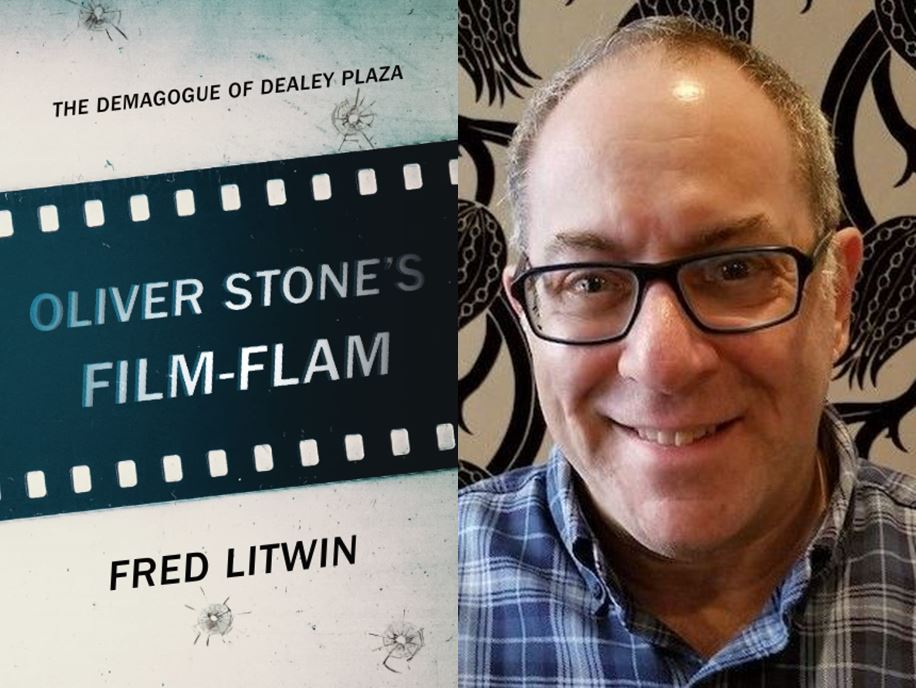
    Fred Litwin’s latest book is not really a book. This “book” is mainly just a copy and paste of his blog posts. So he actually didn’t write a book. But nonetheless, fundamentally, Fred Litwin still can’t debunk JFK Revisited and JFK: Destiny Betrayed. So he made up lone nut excuses…he transferred them from his blog to the pages of what he calls a book.

    JOHN STRINGER—“Which is more likely? A different brain, or a lack of memory for minor details after 32 years?” (11/24/21 blog; Chapter 17)

    BRAIN WEIGHT—“Here is an excerpt from Vincent Bugliosi’s book, Reclaiming History…” (11/30/21 blog; Chapter 15)

    BRAIN PHOTOS—“Which is more likely? That the powers that be switched out another brain to fool the pathologists, or that they just used a higher concentration of formaldehyde?” (12/1/21 blog; Chapter 16)

    JAMES GOCHENAUR—“How much he [Elmer Moore] pressured Perry is not exactly known.” (12/5/21 blog; Chapter 8)

    THROAT WOUND—“Dr. Perry…wasn’t performing an autopsy, he was frantically trying to save the life of President Kennedy…No forensic pathologist who has examined the autopsy X-rays and photographs believes the throat wound to be one of entrance.” (12/10/21 blog; Chapter 7)

    BACK WOUND—“Gerald Ford made a reasonable and purely editorial change.” (12/12/21 blog; Chapter 21)

    VALERY GISCARD D’ESTAING—“This all could have [just] been misinterpreted.” (12/15/21 blog; Chapter 34)

    AUTOPSY PHOTOGRAPHS—“JFK Revisited ignores the issue of memory.” (1/14/22 blog; Chapter 18) “One possibility, raised by Vincent Bugliosi…” (1/18/22 blog; Chapter 19)

    HEAD WOUND—“The doctors at Parkland Hospital were frantically trying to save the life of President Kennedy. They were extremely busy and no one had the time to examine his wounds in detail. Dr. Michael Baden explained this to Gerald Posner…” (3/22/22 blog; Chapter 14) “We are dealing with human beings and their imperfect memories.” (3/27/22 blog; Chapter 10)

    MISSING AUTOPSY PHOTOGRAPHS—“Memory is a tricky thing…Here is what Vincent Bugliosi wrote about this issue…” (4/8/22 blog; Chapter 20)

    JFK’S AUTOPSY—“Every single forensic pathologist who has examined JFK’s autopsy x-rays and photographs has come to the same conclusion: that JFK was hit from behind.” (5/12/22 blog; Chapter 22)

    The problem with doing such a thing is simple: a blog is not a book. And the above are just a series of excuses for the powerful evidence presented in Oliver Stone’s films, JFK Revisited and JFK: Destiny Betrayed.

    To show just how weak they are—and also how fundamentally flawed this cut and paste job is as a book—consider the first three. These all concern the forensic case of President Kennedy’s brain. Since the fatal shot was through JFK’s skull, this is quite important forensically. One of the strongest parts of Stone’s film is the case made for the pictures and illustrations of Kennedy’s brain not being genuine. In fact, the evidence dictates that they simply cannot represent Kennedy’s brain. In the film, this case is made on three different planes of evidence.

    1. The sworn testimony of the official autopsy photographer John Stringer made before the Assassination Records Review Board (ARRB).
    2. The Dutch medical study testing average weights for the human brain.
    3. The pictures and films of Kennedy’s skull exploding and the tissue, brain matter and blood deposited all over the car, into the air, and even on the cyclists riding behind and to his left.

    A fourth plane would be the eyewitness testimony of those who saw Kennedy’s brain after he was pronounced dead. Stringer denied the pictures at the Archives were his due to—among others—two major issues. He did not use the type of film these pictures were taken with, and the technical process that produced the film, a press pack, was not used by him.

    Now look back at what Litwin says about Stringer. Is he really saying what I think he is? That Stringer would have forgotten how he worked as a photographer over a period of decades, and on this the most important case of his life? One of the most compelling interviews the Assassination Records Review Board (ARRB) did was with Stringer, and it is described in Doug Horne’s book, Inside the ARRB. According to Horne, Stringer was both surprised and excited when he saw the pictures. So much so that he walked over to the holders to examine them closely, he actually held them in his hands. (Horne, p. 807). He then said this was not Ektachrome film and it was from a press pack, neither of which he used in this case. So as far as he knew he did not take the pictures. (ibid, p. 809)

    The second plane of evidence is the famous Dutch study that measured average brain weight—which came out to be about 1350 grams (The Assassinations, edited by James DiEugenio and Lisa Pease, p.253) Oddly, Kennedy’s brain was not weighed the night of the autopsy. About a week later, when it was weighed, it came in at 1500 grams. How could that be considering the massive head explosion depicted in the Zapruder film with a jet stream of blood and tissue exiting the top of the skull, with all the blood and tissue all over the back of the car, on Jackie Kennedy’s clothes, brain matter hurled with such force backwards that the cyclists thought they had been hit by a projectile. It was not a projectile; it turned out to be Kennedy’s brain and skull bone. (Josiah Thompson, Last Second in Dallas, pp. 56,57) We will never know how much of Kennedy’s brain was in the back seat of the car because it appears the Secret Service was sponging out the car while Kennedy was in the emergency room; there is a photo to denote this.

    The above matches up with the plentiful witness testimony, all attesting to see a brain that was severely damaged to the point that a large part of it was missing. After all, witness Marilyn Sitzman said, “I saw his head open up and brains coming out.” (David Mantik, JFK Assassination Paradoxes p. 265) In his book, The JFK Assassination: The Evidence Today, Jim DiEugenio collects 12 witnesses from both Parkland and Bethesda who recalled a large part of the brain being lacerated and missing. (p. 161) Which is not at all what one sees in the pictures, or the HSCA illustration drawn by artist Ida Dox.

    Litwin’s argument about using too much formaldehyde shows a shocking ignorance of what happened that night during the autopsy at Bethesda Medical Center. He might ask himself why Kennedy’s brain was not weighed that night at Bethesda. James Curtis Jenkins, a morgue assistant, said the brain was so vitiated it was difficult to induce needles into the blood vessels in order to perfuse the specimen with formalin solution. (DiEugenio and Pease, p. 251) Pathologist Thornton Boswell said the brain was so torn up it might not have even shown a bullet track. (ARRB Deposition, p. 193).

    Which leads to the final question: Why was the brain not dissected? As neurologist Mike Chesser said on camera during the filming of Oliver Stone’s documentary, this is necessary in order to determine the bullet path (paths) through the skull. (James DiEugenio, JFK Revisited, p. 298) As Cyril Wecht says in the film, the excuse given in the supplementary autopsy report for not doing it was “in the interest of preserving the specimen”. (Warren Report, p. 544) As Wecht declared: preserving the specimen for who and for what? Of course, Boswell’s description might explain why there was no dissection. It also explains why the photos and illustrations cannot be Kennedy’s.

    Taking all of this evidence into consideration, as Doug Horne says in the film, these pictures would not be admitted into court. But further, if a defense lawyer can prove fraud or bad faith—which one could—the attorney can move for a mistrial and also to have the charges dismissed. That is undoubtedly what would have happened here.

    This is Fred Litwin at work. Having demonstrated the (non-existent) quality of his labors in depth and at length, one can guess the value of the rest of those blog posts. And one would be correct; they are something less than zero.

    II

    Slip sliding along, Litwin actually claims that John Connally’s account of the shooting “is all consistent with the single bullet theory.” (11/21/21 blog) Oh really Fred? Connally stated, in the clearest terms, that the first bullet which hit Kennedy did not strike him. (Warren Commission Hearings, Vol. 4, pp. 135-36) His wife, sitting right next to him in front of JFK, completely agreed. She said that she turned at the sound of that shot and Kennedy “had both hands at his neck….very soon there was the second shot that hit John.” (ibid, p. 147) If one only allows for three shots, as Litwin has to do, then Connally does not agree with the centerpiece of the Commission, the single bullet theory. Because the other two shots consisted of one that missed the car completely, and the bullet that struck Kennedy in the skull. So if Connally is saying that he and JFK were hit by separate shots he contradicts the whole Magic Bullet concept: its four bullets. Moreover, he testified: “There were either two or three people involved or more in this or someone was shooting with an automatic rifle.” (Ibid, p. 133) He later went beyond that in private and said he never believed the findings of the Warren Commission for one second. (Joseph McBride, Into the Nightmare, p. 418). This is being consistent with the single bullet theory?

    Litwin got offended and hurt about the straight-talk in the film—“I must question whether there was any need for Dr. Cyril Wecht to add that comment in about Gerald Ford. It’s nasty.” (12/12/21 blog; Chapter 21) Wecht says in the film, “As I recall, they said about Gerald Ford that he could not chew gum and walk at the same time.”

    Why does Wecht say this? Because in the next sentence he decries the fact that it was Ford who moved the bullet wound in Kennedy’s back (its true location) up into his neck for the final draft of the Warren Report. So the forensic pathologist asked: on what professional grounds did Ford have the standing to do this? Was he a forensic pathologist? Was he an expert photographer? Was he a criminalist? If he had none of those skills then how did he know how and why to do such a thing?

    What makes Fred look all the worse is this. The man who originally made the unflattering remark about Ford was Lyndon Johnson. He actually said Ford could not fart and chew gum at the same time. And you can find the remark at Brainy Quote. So the real question Litwin will not ask is this: If LBJ thought so little about Ford’s mental acuity, why did he ask him to serve on the Warren Commission?

    Litwin exhibited the same faux outrage when the film “dissed” the Sixth Floor Museum. (3/13/22 blog). No objective person can deny that this institution is dedicated to preserving the myths in the Warren Report. In fact, while offering a prominent position there to a researcher, the management told him he would have to support the Warren Report in public. (See JFK: Inside the Target Car Pt. 3 by James DiEugenio)

    Litwin claimed Nurse Audrey Bell “did not see the wound in Kennedy’s throat despite being there for the tracheotomy.” (3/21/22 blog) This is incorrect! She made clear on NOVA in 1988 that she DID see it: “It looked small and round like an entry wound.”

    I don’t get angry easily, but I did when Litwin actually said Clint Hill “was rather busy trying to help Jackie Kennedy back to her seat, it seems clear that Hill didn’t have time to do a forensic examination.” (3/27/22 blog; Chapter 10) Which is another nonsensical argument. JFK was face down in the car and Hill could see the hole in the back of the head for several minutes until they reached the hospital. It has nothing to do with a “forensic examination”, it’s what the man saw. (See David Mantik, JFK Assassination Paradoxes, p. 281; Warren Commission Hearings, Vol. 2 p. 138)

    Litwin cherry-picked certain witness statements to try to put the skull defect solely on the right side of the head. (3/27/22 blog; Chapter 10) He uses John Stringer’s later 1996 words to the ARRB saying the wound was “in the right side of his head above his ear”—but ignored Stringer’s original 1972 account: “In the occipital part, in the back there, up above the neck.” (ARRB MD 84, p. 5) He uses Ed Reed’s later 1997 ARRB testimony saying he saw no wound on the back of the head—but ignored Reed’s original 1978 account: “Very large and located in the right hemisphere in the occipital region.” (ARRB MD 194, p. 2)

    Litwin uses an FBI report to say that Darrel Tomlinson and O. P. Wright seemed to identify the bullet, CE 399, to agent Bardwell Odum. (4/9/22 blog; Chapter 29) But as the film series plainly addressed—and which Litwin ignored—Odum was shown this report by Gary Aguilar, and he adamantly said that he never had or showed any bullet to anyone. In fact, he told Gary Aguilar that, “I didn’t show it to anybody at Parkland. I didn’t have any bullet. I don’t think I ever saw it, ever.” (Mantik, p. 192)

    Litwin next, and rather incredibly, states that Wright “never said or implied that CE 399 was not the bullet [he] found.” Yet again, the film series addressed that very point. Wright adamantly told Josiah Thompson way back in 1966 that the bullet he handled had a pointed tip. And Thompson has a dramatic photo comparison of the two bullets in his Six Seconds in Dallas on page 175. In fact, if one talks to Thompson, or reads Last Second in Dallas, Wright actually followed him out of his office and incredulously asked him this direct question: Was that exhibit the bullet they said I turned over? How could Litwin have missed all this?

    III

    Clearly, Litwin was unnerved by the two speeches that Dr. Henry Lee and Brian Edwards gave in Stone’s documentary about inadmissibility of evidence in court. This is why he brings up these above points about CE 399. No documentary had ever made this issue as strongly as those two men did, with as much backing as this documentary did. So, striking out with Odum and Wright, Litwin tries to extend this issue by saying that the so-called mystery of the 7:30 bullet in Robert Frazier’s notes is actually not that mysterious.

    Let us be clear, Litwin is obfuscatory.. Writer researcher John Hunt notes that there seems to be documents missing from ballistics technician Robert Frazier’s files from that day.

    But still, in two places in his work product, Frazier noted that he was in receipt of the stretcher bullet at 7:30 PM on the day of the assassination. (“The Mystery of the 7:30 Bullet” by John Hunt, at JFK Lancer.com) Which makes for a serious problem in chain of possession. Why? Because the stretcher bullet had not arrived at FBI HQ at 7:30 PM. In fact, the best estimate would be that it would not arrive until probably after 9:20 PM. And the FBI was waiting for this bullet from the Secret Service. (See Figures 6 and 7 in Hunt’s essay.) The FBI memo from Alan Belmont clearly denotes two bullets will be arriving, as he writes “and we are arranging to get both of these.” That memo was signed off on by seven men in the FBI hierarchy, including the number two man, Clyde Tolson.

    What does Litwin now manufacture to get around this information indicating two bullets? He actually writes that Frazier wrote down 7:30 because that was the time that O. P. Wright at Parkland Hospital gave the bullet to Secret Service agent Richard Johnsen! I am not kidding. Can you imagine the spectacle in court on this one? An FBI agent is making chain of possession notes for a private security officer (Wright) and a Secret Service agent (Johnsen)—while they were in Dallas! Which is over 1,300 miles away from where he is. Two men he had no direct contact with and likely did not even know!

    All of this nonsense to disguise the question: How could Frazier be getting the stretcher bullet from Todd when he already had the stretcher bullet?

    IV

    Litwin nonchalantly said the autopsy doctors “identified the entry and the exit wounds in JFK’s head and they saw the beveling that told them which wound was entry and which wound was exit. The evidence was pretty clear.” (5/12/22 blog; Chapter 22) No. As Dr. Boswell explained, a semicircle of one of the late arriving bone fragments kind of looked like an entry wound. And a notch in one of the other bone fragments might have been an exit. Nothing was for sure.

    Litiwn incredibly states about the back wound: “…the autopsy photographs that shows its exact location, which is totally consistent with the single-bullet theory.” (Chapter 21) Simply not true! The HSCA said that in order for it to work, JFK would have to be leaning WAY forward (HSCA Vol. 7, p.100)—which he was not. (Warren Commission Hearings Vol.18, p.26) The bullet also would’ve smashed the first rib had it traversed where the measurements place it.

    In relation to the testimony of the secretaries on the fourth floor i.e. Sandra Styles and Victoria Adams, the author says “Oswald just simply beat Adams and Styles down the stairs.” (Chapter 23) I simply respond to this presupposing statement with, “How do you know there was anyone running down the stairs from the 6th floor in that time frame?” Litwin might say, “The rifle seen in the window and the rifle being found!” To which I will say, “That just means there was a shooter up there. But again, how do you know there was anyone running down the stairs from the 6th floor in that time frame?” Crickets.

    Litwin parrots the lone nut talking point that “of course there was no evidence of the [palm] print being lifted, because the dusting powder on the print is totally lifted off.” (Chapter 27) But that’s impossible, because there was powder found “all over the gun.” (Warren Commission Hearings, Vol. 4 , p.81) Litwin says “Oliver Stone would have you believe that there is no evidence the print was even lifted.” (Chapter 27) Hmm…has Litwin not read this sentence from the Warren Report itself? “Nor was there any indication that the lift had been performed.” (WR, p. 123) Litwin also never gets to the real crux of the issue. That is this: the palm print didn’t appear for a week. (Warren Commission Hearings Vol. 4, pp. 24-25). And also, that the only person to see this alleged print said it was an old print. (Gary Savage, First Day Evidence, p. 108)

    Let us mention the Chicago Plot. Litwin says: “Now, of course memories fade over time…Might Bolden have been conflating the Vallee story with [a 1963] rumor?” (7/20/22 blog; Chapter 39) As Edwin Black (Chicago Independent, 11/75) and Jim Douglass (JFK and the Unspeakable, Chapter 5) have proven, at length and in depth, the Chicago plot was no rumor. But I will say this…when basically all you have left is the old shibboleth, “memories are unreliable” excuse—which is Litwin’s and many lone nutters’ constant M.O.—then you have no case.

    V

    As bad as Litwin is on the forensic side, he is just as bad on the historical angle. Which is a major part of JFK: Destiny Betrayed. He refuses to confront the fact that Kennedy was looking for a way to get out of Vietnam in 1961. In the 14 pages he devotes to the Indochina episode the reader will not detect the name of John Kenneth Galbraith. Which, for today, is astonishing. Because right after the White House debates over Vietnam in the fall of 1961, Kennedy sent Galbraith to Saigon.

    Why did he do so? Because, as his son told Oliver Stone, Kennedy did not like the advice he was getting from his rather hawkish advisors in Washington. In fact, as Jamie Galbraith told Stone about his father:

    He admitted many times in the years following, he said Kennedy sent me to Vietnam, because he knew I did not have an open mind. Kennedy knew what he wanted and he knew my father would deliver what he did. (James DiEugenio, JFK Revisited, p. 316)

    The second reason this is an inexcusable lacunae is this: Galbraith’s report was the beginning of Kennedy’s withdrawal program. This is another aspect which Litwin actually turns upside down and backwards. If one can comprehend it: Litwin tries to say the withdrawal plan was Secretary of Defense Robert McNamara’s idea! (p. 365) Which is pretty much impossible. For the simple reason that McNamara was a steady and strong proponent of inserting combat troops throughout 1961. He actually wanted to send anywhere from 6-8 divisions in late 1961. If you do the arithmetic that is about 120,000 men. (Gordon Goldstein, Lessons in Disaster, pp. 56-59)

    So how did McNamara get turned around on the issue? Through Kennedy and Galbraith, and in two steps. At the end of the debates of November 1961, Kennedy was extremely frustrated that he had to fight so hard to get his ‘no combat troops’ decree through his advisors. He called a meeting for November 27, 1961. He said words to the effect: Look, when policy is decided, those on the spot carry it out or they get out. He then asked: Now who is going to implement my Vietnam policy? McNamara said he would. (John Newman, JFK and Vietnam, Second edition, p. 146) That was step one.

    With that established, in April, Galbraith was in town. He and Kennedy discussed a neutralist solution—something Litwin says Kennedy would not do— through the India ambassador’s relations with Nehru. (Newman, pp. 234-36; Litwin p. 367) At this meeting, Kennedy said “he wished us to be prepared to seize upon any favorable moment to reduce our commitment.” Kennedy then sent the ambassador to see McNamara, and according to Galbraith, the defense secretary got the message. This point is double sourced since McNamara’s deputy, Roswell Gilpatric, said that his boss told him ”the withdrawal plan was part of a plan the president asked him to develop in order to unwind this whole thing.” (Virtual JFK, by James Blight, p. 129: p. 371).

    There is a third source for McNamara getting Kennedy’s drift. At the May, 1962 SecDef meeting in Saigon, McNamara asked the overall commander, General Harkins, to stay after. McNamara then asked him when he thought the army of South Vietnam would be able to take over the war effort completely. As someone who was there noted, “Harkin’s chin nearly hit the table.” (JFK and the Unspeakable, by James Douglass, p. 120) McNamara said the American effort would be dismantled and Harkins had responsibility to prepare a plan to do so.

    In the light of the above facts, for Litwin to say that the withdrawal plan was McNamara’s idea is utter malarkey.

    Stone’s film then supplies the two major pieces of evidence which show that Kennedy was getting out, without any questions about it. First, the declassified minutes of the May 1963 SecDef meeting in Hawaii where Harkins handed in all the withdrawal schedules for each department. McNamara leafed through them and said the overall plan was too slow, we were getting out faster.(Newman, p. 324-25) The second piece of clinching evidence was McNamara’s exit briefing which John Newman listened to. There, the Secretary said he and Kennedy had decided that America was getting out once the training mission was over. And this was unequivocal; it did not matter if they were winning or losing. (Vietnam: The Early Decisions, edited by Lloyd C. Gardner and Ted Gittinger,p. 166). It does not get any more clear than that. Which is probably why Litwin ignores not just those two instances, but everything else in the above.

    Fred Litwin is not an author. He is an agitprop artist.

    Afterword

    by James DiEugenio

    This will be the last article Kennedysandking will ever publish on Fred Litwin. As the reader can see from the above, Litwin has nothing to contribute to the subject that has any value or insight. On top of that, he has a penchant for the smear. For instance, he heads his chapter on Vietnam by labeling it as “politics”.

    JFK: Destiny Betrayed had the finest array of historians ever assembled in a documentary on the subject: Robert Rakove of Stanford, Philip Muehlenbeck of George Washington, Richard Mahoney of North Carolina State, John Newman of James Madison, Bradley Simpson of Connecticut. There was no better roster to review Kennedy’s policies in the Middle East, Africa, Indonesia, and Indochina. This rivaled the luminaries the film had on the forensic side. (For a demonstration of just how unique Kennedy’s foreign policy was, click here)

    Broadly speaking, history is the collection of the best sources with the most relevant information from the most reliable scholars. Politics should have nothing to do with it. And the viewer can read the works of these authors and they will see that they are not at all political in nature; they are factually based.

    Litwin quotes David Talbot from the film saying that there is a thread between 1963 and the horror show of American politics today. (Litwin, p. 363) That is not Talbot saying that about himself. This is what the American public feels. And one can check author Larry Sabato’s book, The Kennedy Half-Century to certify it. In the focus groups he conducted, adults of all ages agreed that the assassination “changed America.” An astonishing 61% said Kennedy’s murder “changed the nation “a great deal’. Sabato observed that those alive at the time, testified to the “deep depression that set in across the country. Because the optimism that prevailed since WW2 seemed to evaporate”. (Sabato, p. 416) Kevin Phillips revealed the same in his book Arrogant Capital. In his introductory chapter he depicted a chart which showed the collapse of the public’s belief in the government. The percentage went from over 70% in 1960 to the teens by the nineties. And the collapse began in 1964, the issuance of the Warren Report.

    So this is not, in any way, politics. This is simply social science. If Litwin wishes to deny it then he should speak to Sabato or Phillips. If he does not, then that proves it is Litwin who is being political. It seems to indicate that either psychologically or politically he cannot accept these facts. To be kind, maybe it is because he is Canadian and does not live here?

    The second reason we will now ignore Litwin is the fact that there is a real question of who is the Confidence Man here. Oliver Stone’s life has been laid out by biographers, and by himself in the first volume of an autobiography called Chasing the Light. He makes no bones about who he is.

    But this is not the case with Litwin or his soul brother Steve Roe. In his first book, I Was a Teenage JFK Conspiracy Freak, Litwin states that 1.) He used to be a strong believer in a conspiracy in the JFK case, and 2.) He had been a left winger who turned into a conservative. He has never been able to convincingly prove either one of these claims. Therefore it seems he may have adopted them to mimic his role model David Horowitz. As per Roe, no one has been able to certify a business entity known as “roeconsulting”, which is the rubric he used to post his criticisms of Stone’s film.

    If a writer cannot remove these kinds of fundamental doubts about who they are, why should anyone pay any attention to his work product?

  • Black History Month: Remembering the Contributions of 4 Civil Rights Activists

    Black History Month: Remembering the Contributions of 4 Civil Rights Activists

    The US and, in turn, Kennedys and King has dedicated the month of February to celebrating and reminding people about the causes of the civil rights movement and the contributions of several African Americans who fought, often at the cost of their lives, for desegregation and equal rights.

    This Black History Month, Kennedys and King would like to draw your attention to the following civil rights activists.

    1. Rosa Parks

    At 92, Rosa Parks was one of the longest-surviving civil rights activists in history, especially considering the notoriously short lifespans of civil rights leaders during the movement. Her activism began at 42 after being arrested for sitting on the front end of a segregated city bus and refusing to give up her seat.

    Her little rebellion led to the 381-day Montgomery Bus Boycott organized by a young Martin Luther King Jr. The mass protest ended with a Supreme Court ruling declaring segregation in public buses unconstitutional.

    2. Charles Hamilton Houston

    To the non-discerning eye, Charles Hamilton Houston might appear to be a highly educated scholar and lawyer who trained civil rights advocates, thereby completely overlooking his key contribution. Kennedys and King’s James DiEugenio knows this forgotten civil rights activist well enough to claim that he, not Martin Luther King Jr. started the modern civil rights movement.

    He decided his path during the First World War when he observed discrimination in the military. After graduating from Harvard Law School, he created his version of the institute at Howard School of Law, where he trained a generation of civil rights attorneys who spread across various major cities to reverse the damage created by a longstanding racist system.

    Charles Houston

    3. Martin Luther King Jr.

    Martin Luther King Jr. is synonymous with the Causes of Civil Rights Movement. He came from a long line of pastors in Atlanta, attended a segregated school during his formative years, graduated from the esteemed Morehouse College, and received a doctorate from Boston University in 1955.

    King was one of the most dedicated civil rights activists and the youngest Nobel Peace Prize recipient. He dedicated the prize money to the movement and made the following contributions:

    • Organized the Montgomery Bus Boycott in 1955.
    • Supported the March on Washington for Jobs and Freedom in 1963.
    • Participated in the Selma-to-Montgomery marches in 1965.

    He also gave several notable speeches. His 1963 “I Have a Dream” speech marked a pivotal moment in the civil rights movement facts and is widely quoted today.

    Black History and the Mainstream Media

    You shouldn’t believe everything you read on the internet about black history because, nine times out of ten, it will be distorted to fit a particular narrative. Kennedys and King is well aware of this fact and has continued to fight for the truth behind the political assassinations of the 1960s.

    If there was ever a place to sort fact from fiction about the MLK and Malcolm X assassinations, it was Kennedys and King.

    Contribute to the platform’s struggle for the truth and contact the moderators for feedback and updates.

  • A Personal Encounter with the Warren Commission

    A Personal Encounter with the Warren Commission


    The first time I saw the Zapruder Film in its entirety was late 2010. Surfing the net in my flat in Istanbul, site of the 8-mile “Kennedy Avenue” running out to Atatürk Airport, I came across the video on YouTube. Immediately I felt I must have seen excerpts or stills before but never the whole thing, not even the 1975 Geraldo Rivera broadcast. There I was in a foreign land, watching a momentous event as a “newbie” in my mid-forties, gripped with shock-horror at the vision of a dashing US head of state publicly executed on a downtown American street. I stayed up long into the night hunting for assassination material, arriving weary at the law office in the morning.

    Yet the primary emotion I felt on watching the Zapruder Film back then, much greater than shock or horror, was sadness. The vision of the President slammed backward and to his left like flotsam as his distraught wife attempts to retrieve debris from his shattered head is still among the saddest things I’ve ever seen. Of all the dehumanizing visions from history captured on film, somehow the moment of this man’s fatal wounding stands out even among tragedies encompassing many more victims at once. It resonates like a warning to all humanity never to get our hopes up too much.

    *********

    It was in the summer of 1999 that I made the acquaintance of Howard P. Willens, long before I knew who he was. Having recently received the news that I’d passed the bar exam, I needed a job for a couple of months, and as many have long done in Washington, I turned to a legal staffing agency, the name of which I now forget. One of the principals in this small, boutique firm said it would require me to work at the home of a senior, distinguished attorney and his wife, also a lawyer, helping them to finish research on a book they were jointly authoring.

    The interviewer cautioned me diplomatically that, while this client was highly accomplished and respected, he could be “difficult at times,” or words to that effect. The substance of it was that Mr. Willens tended to be overly exacting in his demands, exhibiting impatience that might disconcert some. No problem, I said. I was confident any of this gentleman’s idiosyncrasies would roll off my cocky shoulders with ease. Besides, I reasoned, it was only for a few weeks.

    That the next two months were among the most unpleasant of my professional life was not something I would normally have linked at the time to anything more than over-the-top fussiness on the part of the person I was trying – haplessly – to please. It was not a dull assignment overall, but Mr. Willens’ peculiar habit of becoming red-faced instantaneously, adopting a contemptuous tone of voice without ever raising it, was so effective in sending me into spirals of depression and disconsolation that eventually I couldn’t help but take it personally. No one, I thought, could be this disagreeable unless he had taken a serious, specific dislike to the person he was addressing.

    Since I almost never sensed any satisfaction on his part, I became desperate for days spent alone at the Library of Congress, locating precise content for footnotes and citations. Howard Willens struck me as unambiguously unhappy, and once I discovered who he was, fourteen years later, I would link his unhappiness inextricably to the sadness wrought in my mind by the Zapruder Film.

    I

    The two books that Howard Willens and Deanne Siemer (his wife) produced, and on which I worked in their final stages, are serious-looking academic histories. National Security and Self-Determination: United States Policy in Micronesia (1961-72) (Westport, CT: Praeger Publishers, 2000) and An Honorable Accord: The Covenant Between the Northern Mariana Islands and the United States (Honolulu: University of Hawai’i Press, 2002) tell an intricate story of law and diplomacy, how Washington handled Pacific territories that wound up under American control after World War Two.

    Even within the confines of “authorized history,” the authors are not unsuccessful in recounting a tale of twentieth-century American manifest destiny with a “happy ending.” Years of negotiations and interim agreements are related in impressive detail, and, it could be argued, as authoritatively as anyone could. Willens and Siemer were personally instrumental in many of the processes they describe. Mindful that some observers might perceive the formal attachment of the islands to the US as just another form of imperialism – or annexation – their main purpose, as perhaps expected with any authorized history, is to demonstrate that this was never the case.

    The authors cite National Security Action Memorandum 145, issued by President Kennedy in 1962, as encapsulating the guiding American principles for the political future of the Micronesian islands that ended up as a “Trust Territory” of the United Nations, with the US as “trustee.” JFK, sensitive to any colonialism on the part of the United States (or any other country for that matter), reflected that sensitivity in NSAM 145. As the authors note:

    [President Kennedy] identified education as the first priority and directed his cabinet secretaries to create a task force chaired by [the Department of the] Interior, that would develop and implement programs to improve education in the Trust Territory and to address the serious shortcomings in public services and economic development. [An Honorable Accord, p. 10]

    With NSAM 145, JFK transferred responsibility for the Northern Marianas to the Department of the Interior. Prior to 1962, all of the Trust Territory except Rota had been administered by the Department of the Navy, which wanted to maintain strict security controls, limiting outside access to the islands in a typically furtive military atmosphere. Kennedy opened the islands up to outside travel and trade, in his words, to “foster responsible political development, stimulate new economic activity, and enable the people of the Islands to participate fully in the world of today.” [Ibid.]

    Disillusioned with the task force’s slow pace in implementing NSAM 145, JFK appointed an outside expert, Anthony Solomon, to lead a mission investigating prospects for accelerated economic and social development. The mission predictably advised greater US investment but also reported on a lack of political consciousness among the native inhabitants. In the Northern Marianas, they “found no serious opposition to permanent affiliation with the United States” and recommended a plebiscite for 1967 or 1968, offering voters two choices: independence or US sovereignty. [Ibid, p. 11] JFK knew that the islanders had already experienced three colonial regimes – Spanish, German, and Japanese – and he wanted US administration to represent genuine emancipation.

    Balancing the goals of self-determination and non-fragmentation became a serious initial challenge for Washington in determining Micronesia’s destiny. The governments of Guam and the Caroline Islands, for example, initially rejected any arrangement that would make their people US citizens, while the Northern Marianas favored association with the US. The US government thus negotiated separately with the de facto indigenous authorities of the Northern Marianas to achieve a separate status for them. Guam would eventually become a US territory as well, and Guamanians US citizens.

    The authors touch on how, in the aftermath of JFK’s assassination, the culture of official secrecy and the national-security state took over the process of establishing the island chain’s political status:

    [T]here no longer was the level of presidential interest that demanded the attention of the National Security Council staff and the secretaries of interior, defense, and state. In December 1963 the National Security Council, at the request of State (without any consultation with Solomon), classified as Secret the first volume of the report dealing with its political findings and recommendations; it remained undisclosed officially for many years. [Ibid. p. 12-13]

    II

    In 1972, the Marianas Political Status Commission (MPSC) retained Willens as counsel, by which point the Pentagon had become more assertive about how much of the islands would be retained for basing and other military purposes. The Nixon administration began planning a vast increase in defense sector involvement, including acquisition of 27,000 acres and the entire island of Tinian. Washington became alarmed when a popular referendum was organized in the Northern Marianas on the issue of relocating a whole village to accommodate a new US military base. The US government informed the Northern Marianas authorities that it would not be bound by the results of such a poll, and it was reassured that the referendum’s results would not be dispositive.

    It took until the mid-1970s, with former Warren Commission member Gerald Ford as US president, for the Northern Marianas to finally formalize the status its representatives said they wanted. This was the “Covenant.” One can argue over how rosy and bucolic the US-administered Northern Marianas became as a result of a process involving the national-security state, but I never had too much trouble believing association with the United States was a more genuinely popular alternative at the time than independence, a scenario that may well have seemed highly daunting. Protection from “Big Brother” America may have been too enticing for a tiny island population to pass up.

    The history of the political status of Micronesia is a unique tale, intriguing for anyone interested in international law. While subject to sanitization in the volumes of Willens and Siemer, there are occasional human touches (in one anecdote, an American lawyer and economist for the MPSC drunkenly assaults a US Air Force colonel who has insulted him in a hotel bar). That said, An Honorable Accord and National Security and Self-Determination are conservative histories.

    A “progressive” analysis of the legacy of covenants between the US and Micronesia might focus on factors such as economic exploitation, corruption, clan-based patrimonialism, and a poor defense of workers’ rights, in addition to the adverse role and influence of the US national-security state in engineering political outcomes desired by Washington (the publisher of the first volume, Praeger, has a long history of CIA-commissioned works). Also, while the Northern Marianas and Guam are part of the United States, their residents have no voting representation in the US Congress, a dubious status shared with compatriots in American Samoa, Puerto Rico, the US Virgin Islands, and the District of Columbia. No official US history is likely to highlight such concerns at great length.

    As recently as 2019, Ms. Magazine published an update to Rebecca Clarren’s 2006 article entitled “Paradise Lost,” highlighting social degradation in the Commonwealth of the Northern Mariana Islands (CNMI) since the accord with the United States. The purpose of republication was, apparently, to double down on her central points in the face of a Saipan Tribune piece, “Article ignores the great strides we’ve made,” attacking Clarren’s analysis. As Clarren noted:

    [In 1975] the islands’ indigenous population of subsistence farmers and fishermen voted to become a commonwealth of the United States – a legal designation that made them U.S. citizens and subject to most U.S. laws. There were two critical exceptions, however: The U.S. agreed to exempt the islands from the minimum-wage requirements of the Fair Labor Standards Act (allowing the islands to set their own lower minimum wage, currently $3.05, compared to $5.15 in the U.S.) and from most provisions of the Immigration and Nationality Act. This has allowed garment manufacturers to import thousands of foreign contract guest workers who, ironically, stitch onto the garments they make the labels “Made in Saipan (USA),” “Made in Northern Marianas (USA)” or simply “Made in USA.”

    Former heavyweight DC lobbyist Jack Abramoff, prior to his conviction and imprisonment for fraud, bribery, and tax evasion, served as a lobbyist for the CNMI and blocked bipartisan reforms advanced by Congress to improve labor conditions and immigration abuses. As Clarren pointed out:

    In January 2005, the GATT treaty, which had regulated all global trade in textiles and apparel since 1974, expired, eliminating quotas on textile exports to the U.S. The Northern Marianas had been attractive to garment makers because of its exemption from such quotas and from tariffs on goods shipped to the U.S. marketplace. Without those advantages, manufacturers are increasingly moving to such places as China, Vietnam and Cambodia, where they can pay even lower wages. Since the treaty’s expiration, seven factories have closed in Saipan, reducing the value of garment exports to half its 1999 peak and putting thousands of guest workers out of jobs. Some observers expect almost all factories to close by 2008, when a temporary restriction on Chinese apparel exports to the U.S. ends.

    Given their alternatives, the people of the Northern Marianas could very well have legitimately voted decades ago to become a part of the US, a choice President Kennedy’s NSAM 145 extended to them and – as the authors tell it – the option favored by JFK. One might argue that such grim social developments are ever-present in any process of this kind, that the plunge into social tragedy was inevitable. It’s just that one can’t help but suspect that the Kennedy administration, had it lived, might have put the vulnerable people of Micronesia on a superior social and economic footing.

    III

    Though I never had any contact with Howard Willens or Deanne Siemer again, I hoped they felt I had made a reputable contribution to their authoritative history, that their acknowledgment was more than just politeness. On my last day, I remember sitting next to Willens outside – near the pool behind his attractive, fully detached home in a leafy neighborhood off the Rock Creek Parkway. I seem to recall his small grandchildren were visiting, playing in the background, and it was the first time I felt any sense of relaxation around him. Maybe he was looking forward to me leaving, or maybe he was simply “exhaling” after the laborious, nerve-wracking process of dotting all the i’s and crossing all the t’s in his upcoming tomes. But he was a significantly (if slightly) changed man, and at that point, finally, I no longer took his unfriendliness personally. (As I am duly mentioned in the acknowledgments among seven other research assistants, it occurred to me that others may have quit). He was around family, congenial, talking to me about what I wanted to do.

    As it happened, I was due to travel to the Caucasus region of the ex-USSR in a matter of days. Earlier in the year, my British colleagues and I had monitored an election in Armenia in which the US-sponsored political party – “Unity” – won big. We had found the “Unity” victory deeply flawed, and when the leaders of this new ruling faction were massacred in the parliament chamber in late October by nationalist gunmen claiming they only wanted the “people” to “live well,” US Deputy Secretary of State Strobe Talbott squirmed in public while expressing outrage at the slaughter of the Armenian politicians whom he and his Washington superiors had so enthusiastically backed. “Unity” had been amenable to compromise on the disputed, Armenian-controlled territory of Nagorno-Karabakh, something Washington desperately wanted settled to allow oil to flow more smoothly to the west from Azerbaijan, which claimed Nagorno-Karabakh as its own.

    In neighboring Georgia, President Eduard Shevardnadze – long a favorite of the US foreign policy establishment and winner of the “Enron Prize” in 1999 – was facing a stiff challenge from a regional leader in parliamentary elections at the end of October. In the pre-election period, Shevardnadze would bring out US-supplied helicopters to fly low over the capital, Tbilisi, in a deafening alert to his subjects that a “coup attempt” was under way. The putsch, declared Shevardnadze, was being orchestrated by the Russia-friendly head of the Autonomous Republic of Adjara, Aslan Abashidze, whom Western media consistently labeled a “warlord.” The US staunchly backed Shevardnadze in his electoral showdown with Abashidze, whose bloc was polling high.

    Within three years, Washington would turn against Shevardnadze after a poor evaluation of local elections in 2002, and by November 2003 the US would call for his ouster in the “Rose Revolution.” Abashidze would flee to Moscow within six months of the “revolution,” and top US officials like Dick Cheney and Donald Rumsfeld would celebrate a new generation of Georgian leaders as the US-led war in Iraq ramped up. By 2008, around the time of the five-day war with Russia over the separatist enclave of South Ossetia, Sen. John McCain would dance a “Georgian jig” on camera with US-backed strongman President Mikheil Saakashvili, a Shevardnadze protégé now transformed into the great hope for change in place of the stagnant old ways of the ex-Soviet Politburo member.

    All of this seemed far more exciting to me at the time than the history of Micronesia. Anticipating my impending mission on behalf of democracy and human rights, as I understood them then, I might have been distracted from my assignment. If so, I apologize herewith to the authors. I did try to be precise in my source-checking. In any case, in September 1999, Howard Willens and Deanne Siemer bid me semi-cheerful farewell and good luck as I drove out of their company forever.

    IV

    It was not until the year of the fiftieth anniversary of the assassination that I became aware I had once worked for a former member of the Warren Commission’s legal staff. Howard Willens had just published a book, History Will Prove Us Right (New York: The Overlook Press, 2013), to uphold and defend the Warren Report’s conclusions, and he and other surviving legal counsel appeared in panels to promote and celebrate the Warren Commission’s achievement in securing truth and justice for the people of the United States. By then convinced that the Commission had done nothing of the sort, I found it a dreadful spectacle to watch.

    What I felt most when watching Willens in 2013 was the old, familiar sense of his discontent. In a speech at Southern Methodist University in Dallas, he was animated, occasionally agitated in his broad-shouldered suit, clutching the lectern like a commissar laying down the law. But the stuttering “uhs” and “ahs” sounded symptomatic of over-rehearsal. Explaining the Single Bullet Theory as if it were fact, he looked to me not only despondent but also somewhat worried or under duress.

    At the 27:43 mark in the C-SPAN video, Willens can be seen and heard reciting the following:

    “So Single Bullet Theory of course has gone through the ages as a much, uh, uh, maligned, uh… uh, uh, uh, uh, lil’ shorthand for, uh, the Commission’s, uh, conclusion, which of course, it became a conclusion of fact, uh, uh, not… a theory, uh, because after a, a reenactment in-in Dallas in May of 1964, it seemed very evident that the bodies of the President and the Governor were, uh, positioned in the car in such a way… uh, that, that the bullet after it exited from the President… would, would hit the [sic] Connally and cause… the nature of the wounds… in-in his back, his-his-his wrist, and his thigh… that was uh, uh, uh, what he suffered. So it was… and furthermore, what people tend to forget is that the… uh… the… uh, uh, pathologists… and the Commission were not the only people that reached, uh, this view, that this particular conclusion was reviewed in 1968, experts in 1975, experts in 1976, and again in 1978. And out of twenty expertstwenty… let’s be precise… twenty-one… pathologistsexperts… in such matters examined the autopsy, uh… photographs and x-rays… they all, they all, all concluded, uh, the course of the bullet… and, uh, twenty out of twenty-one… concluded as did the Commission… that a single bullet… created the back, throat wounds of the President and the wounds suffered by Governor Connally. The dissenting pathologist, who will be in town two weeks from now featured at a conference, when asked what happened to the bullet, when it exited the President’s… throat, he said: ‘I don’t know.’ [Pause, feint audience titters] ‘I didn’t conduct the investigation.’ And unless one has a rational explanation… that, that can rival in terms consistent with the law of physics, and with the physical evidence available… I think there’s not a rational discussion that can be had… on the question of the Single Bullet uck-uck-uck conclusion.”

    The “dissenting pathologist” was, of course, Dr. Cyril H. Wecht, M.D., a member of the House Select Committee on Assassinations forensic panel and a distinguished university professor, who also had a law degree. Having listened to both men speak, I had little doubt which of the two I would prefer to represent me in a jury trial or testify as a witness. Of course, since there was never any genuine trial of Lee Harvey Oswald, the point was moot, but how dispiriting to see a fellow attorney such as Howard Willens – even as he referred to overwhelming majorities of “experts” in the 1960s and 1970s – nonchalantly cast aside the fact that the only “majority” that mattered when determining truth under US criminal law was a majority of jurors.

    In History Will Prove Us Right, Willens fleshes out Dr. Wecht’s “I don’t know” quotation by noting its setting: the mock trial of Lee Harvey Oswald in London in 1984, with Vincent Bugliosi as mock prosecutor. (Unsurprisingly, Bugliosi’s is the top review on the back of the book’s dustjacket.) But what makes the entire issue of the fate of the “Magic Bullet” so remarkable as a subject of Willens’ ridicule of Wecht is that both Willens and Bugliosi ignored the broken evidentiary chain. The same was true for President Kennedy’s body and limousine. Both were removed from Texas illegally, since the crime scene investigation and autopsy should have taken place in Dallas in accordance with prevailing law, and in a bit of forensic negligence best described as outrageous, Kennedy’s wounds were never even dissected. The presidential car was taken from Andrews Air Force Base to the White House garage, where even FBI investigators were denied access to it until after midnight.

    In short, whisking both corpse and vehicle out of sight of the duly constituted law enforcement authorities destroyed due process. Yet it is Dr. Wecht who is mocked? It is Willens and Bugliosi who should be derided as attorneys. Not only was Wecht speaking the truth, but it was precisely that truth – the “I don’t know” – that made bunk out of all Willens’ and Bugliosi’s so-called “evidence.” It is inconceivable that an attorney of Willens’ stature could accept this state of affairs as evidentiarily sound. It is insulting that he could expect the rest of us to do so.

    Again, Willens’ swagger in 2013 could not negate the deep-seated sense of dissatisfaction I had perceived in him in 1999, and it wasn’t just the stutter. Something still wasn’t right with the world, and as I watched I became aware of a strange “camaraderie” among the ex-Warren Commission lawyers, a “brotherhood” – not so much of joy as “circumstance.” It was as if someone (or something) had dragged these octogenarians out of retirement to go on a tiresome “national tour.” It was like a tedious exercise in going through the motions, but, hey, at least they had each other.

    At the 29:42 mark, Willens can be seen and heard reciting the following:

    Uh, we, we did have the problem, as you know, of dealing with, uh, conspiracy, uh… and the problem that sure you’ll hear about more from my colleagues, but the over… uh… whelming problem from the outset was that it is always impossible, analytically, to prove a negative. And here the task was to prove there was no conspiracy.

    The “task” was to prove there was no conspiracy? Since when did that become the duty of a diligent lawyer or investigator serious about his job? What happened to the truth?

    He continues:

    Now, the Commission was aware then… of all the possible, uh, interests, here in Texas, and nationally and internationally, who might have an interest in assassinating the President. But in order to prove a conspiracy, you have to prove there’s some rel… some relationship between the alleged conspirators and the people who actually… did the deed, whether it’s Lee Harvey Oswald or Jack Ruby. And the Commission staff and the members of the Commission conducted… a widespread investigation looking at the associations of both these individuals, intensely and comprehensively, and could not find any evidence that either of them had been aided in any way by one of the alleged, uh, suspects… [unintelligible]. And so, ah, ah, that, of course is a conclusion that one can never be… absolutely certain about, and what the Commission did in its findings was say, was to say, ‘We have found no credible evidence… of a conspiracy.’ They did not say there was no conspiracy. And they fully understood that with the decades to come, there might be additional evidence that would, uh, uh, persuade, uh, uh, impartial, knowledgeable people that there was a conspiracy. It’s been forty-nine years, and that evidence still has not materialized. And if I had had the courage of my convictions, the book would be entitled, ‘History Has Proved Us Right’ rather than ‘History Will… uh, uh, uh… Prove Us Right.’”

    Howard Willens has seen the inside of a courtroom many more times than I, and he no doubt received a much higher grade in evidence to boot. But to point out to your audience that, on the one hand, the Commission used the term “no credible evidence” as a way of qualifying the veracity of its findings, and then, on the other, say that no evidence had materialized in the previous half-century to undermine the Commission’s conclusion beggars belief. It’s akin to arguing with non-lawyer Warrenites online and being bombarded with: “You have no evidence!” You’re left with the option of either cutting the discussion off abruptly or trying to calmly reason with them that, indeed, there is a ton of “evidence.” It’s just a matter of whether one interprets it as “credible” or not.

    At the risk of digression, for example, Helen Markham stated in a sworn affidavit that she arrived at the intersection of East 10th Street and North Patton Avenue in Dallas at 1:06 PM on November 22, 1963, and immediately caught sight of Officer J. D. Tippit’s killer. A sworn affidavit is evidence, as any lawyer worth his or her salt will tell you. In a court of law, you can be certain any diligent defense attorney would not only have entered it into evidence but also held onto it like a pit bull with a fresh bone. Markham’s route to the bus stop was part of her daily routine, making her affidavit more credible than anything else she said. It rendered the accused killer’s arrival at the scene of Tippit’s slaying impossible, and a court of law would have taken due note of that. But the Warren Commission was not a court of law, so it ignored the evidentiary weight of the affidavit. It never proved anything because it didn’t have to. In 2013, Willens blurred the definition of “evidence” as a way of bolstering the hackneyed Warrenite stance.

    The phrase “courage of my convictions” also stands out as curious. If Willens had been brave enough to do the right thing, he would have called his book something else? One has to wonder whether such a statement betrays a sinister truth. Suppose, for instance, that Willens believed the Commission was “right,” as in the book’s title, but not “true.” What if leading Commissioners knew they were perpetrating a massive falsehood for the “right” reasons, because the American public didn’t need to know the truth, or worse (to paraphrase Jack Nicholson’s caricatured Marine colonel in A Few Good Men), couldn’t “handle the truth”? Personally, I suspect certain Commission insiders beyond Allen Dulles (including a few legal staffers) knew some terrible – even unspeakable – secret but set about constructing a fairy-tale narrative to “tranquilize the people.” This is how Senator Richard Schweiker of the Church Committee referred to the Commission. Could Willens have been one of them? Surely not, I hoped as I watched him in 2013.

    History Will Prove Us Right has been ably reviewed on this website, and I don’t feel a need to elaborate on that analysis. But I do think Willens’ Micronesia works qualify as “serious” (if formalistic) academic history, whatever one’s personal perspective on the fate of the Trust Territories. History Will Prove Us Right does not, and no serious scholar would say otherwise. One might speculate Willens was happier writing the Micronesian volumes than he was writing History Will Prove Us Right, but with the benefit of hindsight, I sadly cannot shake the impression that Willens, as he wrote his Micronesia works, was still carrying something abominable around with him decades after serving as a Warren Commission attorney. That is, the unhappiness endured then, as it may still.

    The manner of Howard P. Willens, Esq., struck me as severely unnatural not only in 1999, but forever thereafter in my mind’s eye. Something, I believe now, was desperately bothering him thirty-five years after the publication of the Warren Report, and the unpleasantness of that late summer in Washington was, I still feel, a consequence of that something. The enduring sadness of the assassination was described by John Newman in his seminal work, Oswald and the CIA, as an “unhealed wound.” That was the first place I saw it thus described, and that is still the most eloquent phrase I’ve heard as metaphor for that horrific event. But if the wound remains unhealed for a nation, how must it feel for any single individual still harboring some terrible truth about it?

    Again, as the title of his book indicates, Howard Willens may have convinced himself that posterity would honor the men of the Warren Commission and its staff. He may have rationalized somehow that, in the event this truth became public in their lifetime, the public would understand that he and his colleagues were only trying to be upstanding, to prevent a widespread loss of faith in our institutions of government, with potential resultant chaos and collapse. While this makes some sense, it is at the same time unthinkable to me that anyone could carry something as profoundly awful as that around with them to the end of his life. Yet countless others surely already have.

    The single sentence in History Will Prove Us Right about a phone call that Willens’ former Warren Commission colleague David Slawson received from James Jesus Angleton, ex-chief of the CIA’s Counterintelligence Staff, in 1975 (Angleton was no longer even a CIA employee) reads as follows:

    When CIA Counterintelligence chief James Angleton called David Slawson to check his reactions to the Church Committee’s disclosures, Slawson frankly told Angleton how disappointed he was with his agency’s failure to disclose this vital information, but assured him that Slawson would honor his commitment to preserve the confidentiality of other CIA secrets. [p. 317]

    This is a level of sanitization unequaled even in the Micronesian works. One wonders what Slawson himself thought of it. As the incident is recounted by David Talbot in The Devil’s Chessboard,

    In a frank interview with The New York Times in February 1975, Slawson suggested that the CIA had withheld important information from the Warren Commission, and he endorsed the growing campaign to reopen the Kennedy investigation. Slawson was the first Warren Commission attorney to publicly question whether the panel had been misled by the CIA and FBI (he would later be joined by Rankin himself) – and the new story caused a stir in Washington. Several days after the article ran, Slawson – who by then was teaching law at the University of Southern California – got a disturbing phone call from James Angleton. After some initial pleasantries, the spook got around to business. He wanted Slawson to know that he was friendly with the president of USC, and he wanted to make sure that Slawson was going to “remain a friend” of the CIA. [Talbot, 580-81]

    In the 1990s, Slawson infamously refused to answer an Assassination Records Review Board member who asked him whether he had listened to a tape recording supposedly made of Lee Harvey Oswald in Mexico City (Willens incidentally accompanied him on the trip to Mexico in 1964), remarking defiantly that he was “not at liberty to discuss that.” A federal statute passed unanimously by Congress in 1992 was supposed to afford Slawson just such a “liberty,” of course, but maybe the Ghost of Jim Angleton was still staring at him from somewhere in the room as he spoke.

    President Trump reportedly told Judge Andrew Napolitano over the phone that he had seen something in the remaining JFK files that Napolitano, had he also viewed them, would have understood required continued concealment. If Trump was speaking the truth (not a given), then perhaps there is a small community of Americans prepared to walk around harboring some unspeakably atrocious fact about our government and history, and they are fine with just continuing to carry on that way until the end of their days. I don’t get it, but then I’m not one of them.

    Recent breakthroughs in JFK research, including the watershed work of Jefferson Morley and the Mary Ferrell Foundation in pursuing still-concealed government files related to the assassination, offer hope that an era of great sadness and anguish in American history and life might finally come to an end. Looking back at the period of the Warren Commission and the ensuing several decades, one gains an unmistakable impression of widespread blackmail and intimidation holding sway over public officials, including those staffing official investigative panels. We know for instance, through Hale Boggs’ son Tommy, that J. Edgar Hoover maintained files on the Warren Commissioners. Well-meaning investigators operating in that milieu nearly sixty years ago no doubt experienced acute discomfort.

    The political culture of Angleton and J. Edgar Hoover endured long after their deaths, so that honorable men such as Cyril Wecht found themselves alone in opposing something as grotesquely insulting to human intelligence as the Single Bullet Theory. Unseen pressure and intimidation on those seeking the truth must have been very real, and a recent two-volume set, One Nation Under Blackmail: The sordid union between Intelligence and Organized Crime that gave rise to Jeffrey Epstein by Whitney Webb (Walterville, OR: Trine Day, 2022), while lamentably neglecting to touch on the potential for blackmail in steering the course of investigations into JFK’s murder, has made waves for publicizing what many have long felt but were no doubt afraid to say. The truth is slowly coming into view, whatever those protecting an old secret may still hope to hide. The nation is progressing into light.

    I cannot assume Howard Willens is among those hiding ghastly secrets about the nature of the assassination. It is of course possible that he genuinely believes in the Warren Report’s conclusions. After all, the notion that something was “possible” – however implausible – remains the primary debating stance of Warrenites in defending their bible today. But in the event Willens or any other living American encountered the sort of gangster-like tactics employed by Angleton against Slawson (or by Hoover against innumerable others), they would honor history and nation by unburdening themselves of that cloud of sorrow now. They should let America know of any torment experienced or learned of at the hands of the long dead “wise men” of America’s Cold War intelligence and security agencies. Real US “national security” demands freedom from that miserable past.

  • 4 Places that Shaped Martin Luther King’s Legacy

    4 Places that Shaped Martin Luther King’s Legacy

    Martin Luther King Day might’ve come and gone, but we still have February, aka Black History Month, to remember all the places that shaped the civil rights leader’s legacy. Click here to learn how to highlight the civil rights movement during this month.

    Keep reading to explore the places most important to MLK.

    1. Atlanta

    Atlanta was the block of the intensely racist South where MLK was born and buried. The state capital is home to the Ebenezer Baptist Church, famous for being the place where MLK was baptized and pastored with his father in 1960.

    The King Center is where MLK and Coretta Scott King, who inaugurated this center, were laid to rest. It’s a great way to learn about Civil Rights Movement from the MLK lens and pay your respects at the King’s tombs, as did a million people every year before the pandemic.

    2. Birmingham

    Birmingham was important to MLK and the overall Causes of Civil Rights Movement because it was the city that saw the most segregation and integration resistance. It was from a jail in Birmingham that MLK penned “Letter from a Birmingham Jail” in 1963 for all the white ministers speaking against nonviolent civil disobedience.

    The physical door of his jail cell is still intact and on display at the Birmingham Civil Rights Institute, along with several documents related to the movement.


    Lorraine motel

    3. Memphis

    The Lorraine Motel in Memphis was one of the few places where black travelers felt safe and welcome. Unfortunately, it attracted negative attention after becoming the site of the martin luther king assassination during the civil rights leader’s visit to support sanitation workers in March 1968. Today, this motel is home to the National Civil Rights Museum, MLK’s final motel room forever visible to the public eye. 

    Apart from the motel-turned-museum, Memphis is also home to The Four Way, a restaurant frequented by King and serving many southern delicacies, including the activist’s favorite, the lemon meringue pie.

    4. Montgomery

    Montgomery is important to MLK for many reasons, chief among them being the Montgomery Bus Boycott. This 13-month mass action that began when Rosa Parks was arrested for refusing to yield her seat to a white passenger ended with a Supreme Court ruling banning all segregation on public buses.

    King played an important role in organizing the long movement in Montgomery, as it occurred in 1956, and King was pastoring at a church between 1954 and 1960. He resided at the Dexter Parsonage Museum, frequently bombed by opponents of the movement.

    Learn more about the civil rights movement facts to explore possible motives behind the MLK assassination on Kennedys and King. Go through our resources, blogs, and multimedia, and contribute some of your own if it has anything to do with the political assassinations of the 1960s

    Reach out to share your contributions and support for our movement.