Blog

  • 4 Fun Facts About Martin Luther King

    4 Fun Facts About Martin Luther King

    It was a little over 65 years ago to the day that an unknown assailant callously shot down Dr. Martin Luther King when the latter stood on the second-floor balcony of the Lorraine Motel. Amid speculations about who might have killed him, let’s take a moment to celebrate the legacy of a great leader gone too soon.

    Click here to delve back into the MLK assassination once you’ve had enough of the following facts.

    1. MLK was Awarded His Doctorate at the Age of 25

    Dr. Martin Luther King became a Ph.D. holder at 25, or according to some records, 26. He began his higher education when he was only 15, entering Morehouse College after skipping two grades. Four years later, he graduated with a Bachelor’s degree in sociology. He was 19 at the time.

    King then enrolled at Pennsylvania’s Crozer Theological Seminary for further studies. Three years later, he graduated as a valedictorian. At last, King enrolled in a doctoral program at Boston University, where he was awarded his Ph.D. at the age of 25.

    2. He Wasn’t Born “Martin Luther King”

    One of the most interesting facts about Martin Luther King is that, like his father, he was named “Michael King” at birth.

    He would have that name for five years, adding “Luther” after his father visited Germany for a Baptist World Alliance conference. It was there he heard about a protestant reformation leader called Martin Luther. A monk and a theologian, Martin Luther’s 95 Theses challenged Catholicism and revolutionized his country.

    The story inspired Michael King Sr. so much that he changed both their names to “Martin Luther King” upon returning home.

     MLK and Coretta Scott King

    3. MLK’s Mother Met the Same Fate

    Six years after the assassination of Martin Luther King, his mother Alberta met the same fate. A 23-year-old assailant fatally shot her at the Ebenezer Baptist Church during a service.

    The shooter’s eventual death sentence was commuted to life in prison because the King family opposed the death penalty.

    4. The King Family Helped Julia Roberts

    In a recent interview, Julia Robert revealed that the King family paid her “hospital bills.” Robert shared that her family was close with the King family before she was born because her parents had enrolled King’s children in their acting school.

    When Roberts was born, her family couldn’t afford the hospital bills, but King’s wife, Coretta, was happy to foot the expense.

    Get Back to the Assassination of Martin Luther King with Kennedys and King

    No fun fact about Martin Luther King can trump the events surrounding his assassination. At times morbidly fascinating and frustratingly complex, they create enough reasonable doubt to suggest that someone other than James Earl Ray was behind his death. Explore existing evidence and avoid poorly-researched literature regarding the MLK assassination with the help of our platform.

    Contribute your time and resources to our platform

  • Critiquing Arun Starkey’s Critique of Oliver Stone’s Documentaries

    Critiquing Arun Starkey’s Critique of Oliver Stone’s Documentaries

    Arun Starkey’s claim that Oliver Stone’s JFK Revisited and JFK: Destiny Betrayed, are based on Jim Garrison’s findings is absurd. As the person who wrote the script for the 2021 film, DiEugenio knows that’s not true. Click here for a more comprehensive analysis of Starkey’s Far Out film review.

    Before that, check out a preview of our rebuttal below.

    Did Starkey Ever Read the Companion Book?

    Does Starkey know a companion book to the 2021 documentary called JFK Revisited: Through the Looking Glass exists? He would’ve been less tempted to publish his hit piece if he did.

    Starkey most likely watched JFK: Destiny Betrayed and disregarded the evidence in the film, prioritizing Tim Weiner’s arguments over the voice of reason. The companion book contains 500 footnotes related to the statements in the movie.

    The Answer to Oliver Stone’s Divisive Power

    Starkey uses many words to convey a simple message: Oliver Stone’s work is divisive and controversial. He accuses the JFK expert of touting conspiracy theories while doing the same throughout his article.

    Starkey refers to Stone’s 1991 feature film JFK Revisited to drive this point home. He’s a little late to the party because everyone who has studied the JFK assassination long enough knows why Oliver Stone’s documentaries are divisive.

    It’s not because they rely on conspiracy theories but because they call out the media jumping on the findings of the Warren Commission before they came out.

     JFK presentation

    Where is the Assassination Records Review Board?

    We must stop and ask Starkey, “Where are the Assassination Records Review Board (ARRB) findings in all this?” The entire point of the 2021 film was to discuss the origins and discoveries of the ARRB and hear about them through three of its most influential members.

    Not only did Starkey completely sidestep this significant point, but he also ignored the new developments that are as far from conspiracy theories as can be. You can’t theorize Kennedy’s autopsy or the ballistics evidence, but Starkey doesn’t want any part of that. He only cares about what Tim Weiner wrote in his Rolling Stone hit piece. Click here for our choice words for that malarkey.

    Rise Above JFK Assassination Conspiracy Theories with Kennedys and King

    With President Kennedy’s 60th death anniversary fast approaching, it’s more important than ever to steer clear of the propaganda and conspiracy theories regarding the John F. Kennedy assassination and the political murders that occurred in the same decade.

    The only way to learn the truth behind the JFK assassination is to debunk the lies as soon as they take center stage online.

    Contact us to draw our attention to similarly baseless articles.

  • A Quick Analysis of Edward Epstein’s “Findings”

    A Quick Analysis of Edward Epstein’s “Findings”

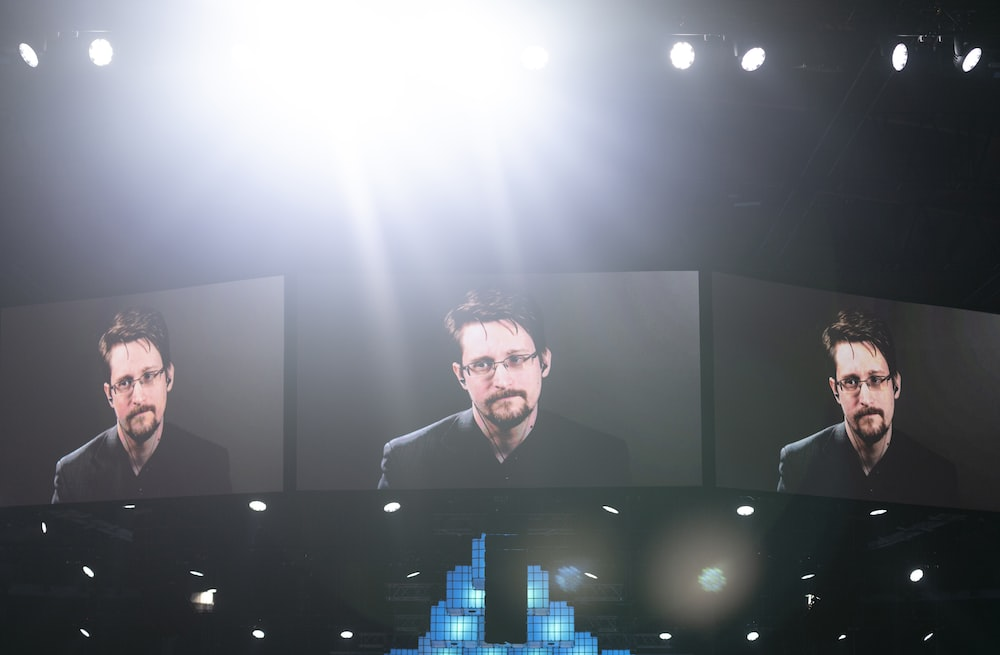
    In 2013, Edward Snowden revealed the National Security Agency’s covert spying programs and showed how it watched its citizens through tech companies like Google, Apple, and Microsoft.

    He stole corroborating documentation from the NSA only to make it public knowledge. His well-intentioned actions split the public into two schools of thought: One saw him as a patriot and the other as a traitor.

    Some three-odd years later, Edward Jay Epstein, a proponent of the second school, wrote a book called How America Lost Its Secrets, accusing Snowden of being a spy for China, Russia, or both.

    Click here if you’re interested in our take on Epstein’s findings. Alternatively, keep reading our critique of the op-ed disguised as a work of non-fiction.

    The Accomplice Theory

    Epstein believed that Snowden didn’t have enough sway in the NSA to gain access to top-secret files. He proposed several theories related to someone inside the NSA who might have helped him with the following:

    • Get hired at the agency’s data center.
    • Discover global spy programs.
    • Discover security traps at the data center.

    Epstein’s accomplice theory goes as far as positing there might have been a spy in the NSA before Snowden started working there as a contractor.

    Unfortunately for Epstein, the FBI explored this theory right after Snowden’s bombshell revelations and came up empty. There was no such accomplice within the agency; it was all Snowden.

     hacker on a computer

    The Speculation

    We urge you to read How America Lost Its Secretsif only to see the number of times Epstein betrays the weakness of his arguments with speculative phrases like “could have,” “should have,” and “might have.”

    Even when Epstein hasn’t used these phrases, he has portrayed assertions as facts and quoted people who are either senile or lying. If the fictional “level 3 sensitive compartmented information” is any indication, most of the book flows in this worrying direction.

    Snowden in Hong Kong

    The problem with Edward Epstein’s findings is that they are seldom corroborated with evidence. This is evident in his claim that Snowden arrived in Hong Kong on May 20 and checked into the Mira on June 1. Epstein doesn’t know what he did during the 11 undocumented days, but he is aware—who knows how—that he sent Glenn Greenwald 20 top-secret NSA documents on May 25.

    He also “believes”Snowden may have been staying with his Chinese handlers during this time. As you might have guessed, there is no evidence of these claims. It’s Epstein’s word, which he cunningly wants the reader to believe is based on what the hotel staff told him. It’s not. The staff only said that Snowden checked in on June 1 with his real name and credit card.

    Epstein’s Findings About the JFK Assassination

    Epstein’s 2017 book is the latest in a series of books and articles riddled with conjecture, speculation, and misinformation. Kennedys and Kingcares because much of what he writes is related to the assassination of John F. Kennedy. Help us debunk such literature as soon as it’s published and pave the way for the truth behind the JFK assassination. You can do this through donations or multimedia contributions.

    Get in touch for inquiries and updates.

  • Exposing Seymour Hersh’s Latest Misinformation Campaign

    Exposing Seymour Hersh’s Latest Misinformation Campaign

    On September 26, 2022, the Nord Stream and Nord Stream 2 natural gas pipelines experienced a series of underwater explosions and leaks. These pipelines mainly belonged to Russia and transported natural gas to Germany through the Baltic Sea.

    These pipelines weren’t functioning due to the European Union’s boycott of Russia following the latter’s invasion of Ukraine. However, they still contained natural gas that started leaking once the explosions occurred.

    While there are theories, no one knows who did it—that is, no one except apparently Seymour Hersh. This article criticizes his latest misinformation attempt and its negative impact. 

    With a title like “How America Took Out The Nord Stream Pipeline,” Hersh starts with who he believes bombed the pipelines. His reasons for thinking, while porous and easily refuted, aren’t without a ripple effect.

    The Smoking Gun (Or Lack Thereof)

    We won’t link to the Substack article because it doesn’t bear reading. Hersh’s words may appear valid and make sense to the untrained eye. However, as one article said, they lack “a smoking gun.” 

    Hersh claims that the US and Norway conspired to bomb the pipelines. He quotes “a source” when stating his reasons for doing so, and that’s where it takes a turn for the bizarre.

     Jens Stoltenberg

    Jens Stoltenberg’s Alleged Support

    Hersh claims that Jens Stoltenberg, Norway’s former prime minister and the 13th Secretary General of NATO, was in favor of the attack for two reasons:

    • He was a hardliner and an anti-communist.
    • He had worked with the US intelligence since the Vietnam War.

    The first claim might be accurate, but the second is problematic because it wouldn’t make sense for Stoltenberg to support US intelligence during the war in Saigon. Here’s a concurrent timeline of the NATO general and the war:

    • President Johnson sent the first batch of troops to Indochina in 1965.
    • Stoltenberg was six at this time, having been born in March 1959.
    • The last American troops left in March 1973.
    • Stoltenberg would have been 14 at the time.

    Stoltenberg couldn’t have supported US intelligence during the Vietnam War even if he wanted to. He was too young to be of any help to the powers that be at the time.

    The Multiplying Effect of Misinformation

    While the US and Norway denied Seymour Hersh’s claims, every other news outlet reported it like breaking news. From Russian propagandists to Sky News, the story created ripples everywhere.

    Some outlets saw the self-published piece for what it was and avoided reporting on it. While they reserved their two cents, they felt it necessary to report how Russia saw the piece.

    All said, what should have died with a simple denial was reported enough to be seen as the truth. It was misinformation 101, but it was what the other side wanted to hear, even if it resulted in a bigger war.

    Not the First or Last from Seymour Hersh

    Seymour Hersh is a Pulitzer Prize winner, so his word holds some sway in international forums. However, Kennedys and King is aware of his ongoing misinformation campaigns regarding Osama bin Laden and President Kennedy.

    Proceed to our complete article for the specifics and help us beat the misinformation surrounding the political assassinations of the 1960s through fact-checking, lobbying, and the odd email.

    Contribute to our platform to help us continue our fight for the truth behind JFK assassination.

  • Walker Bullet CE 573: Is it Real?

    Walker Bullet CE 573: Is it Real?


    As most JFK researchers know, the “Walker Bullet,” or CE 573, was purportedly extracted from the home of General Edwin Walker on April 10, 1963, and was contemporaneously described in official Dallas Police Department (DPD) reports as “steel jacketed.” Someone had taken a potshot at Walker that night, through the window on the rear side of his house, in front of which the General was seated. Or so Walker had related to the DPD that night.

    Not one, but rather two, DPD detectives, by the names of Ira Van Cleave and Don E. McElroy, put their signatures on a General Offense Report, and authored and signed a Supplementary Offense Report on April 10.

    In the Supplementary Offense Report, both detectives observed “a bullet of unknown caliber, steel jacket, had been shot through the window” at Walker’s home, as the General sat his desk.[1]

    Two DPD patrolmen, B.G. Norvell and J.P. Tucker authored the General Offense Report, which also identified the Walker Bullet as a “steel jacketed bullet.” All four DPD officers had held the Walker Bullet that night in their hands that night, and inscribed initials into it, according to official reports.

    The Walker Bullet that night famously missed the right-wing General—a national political figure—and had then passed through an interior wall, became badly deformed, but, reportedly, subsequently and curiously came to rest in between bundled papers stacked up against the wall.

    Months later, the Warren Commission would conclude it was Lee Harvey Oswald (LHO) who shot at and attempted to murder Walker that night. In part after the FBI said the Walker Bullet, or CE 573, was in fact the same type of Western-brand ammo that LHO used in his Mannlicher-Carcano rifle. Of course, the problem is the Walker Bullet in the possession of the Warren Commission, CE 573, is copper jacketed, and obviously so.

    CE 573, whatever its true origins, is a severely mangled bullet; so much so that its copper-jacketing has been torn asunder. Thus any observer, even a layman, can easily see the copper jacket is in fact copper through-and-through, and not a relatively uncommon steel-jacketed bullet with copper-gilding. It would not be surprising if a photo of CE 573 is used in police-cadet training courses somewhere as a classic example of a copper-jacketed bullet.

    Moreover, there are initials carved into CE 573, though of mysterious origin. Anyone carving initials into a copper-jacketed bullet would immediately know it was copper-jacketed, and not steel-jacketed, as copper is softer than steel.

    In addition, anyone carving initials into a copper-gilded steel jacketed bullet would notice the steel color and hardness emerging from under the microscopically thin copper gilding. It is inexplicable that even one big-city police detective would describe CE 573 as “steel-jacketed.” But two DPD detectives and two DPD patrolman authored and signed brief one-page reports prominently describing the Walker Bullet as exactly that, “steel jacketed”—after having handled the slug and marking it with their initials.

    Steel-Jacketed Bullets are a Rarity

    There are yet more puzzling aspects of the DPD detectives concurring and specifically noting that the Walker Bullet was “steel jacketed.”

    The vast majority of bullets in the 1960s, and even today, are copper-jacketed, and have been for more than a century.

    Bullets with metal jackets largely replaced plain lead bullets at about the same time that smokeless propellants replaced black powder in the majority of rifle ammunition. The higher pressures and temperatures produced by smokeless propellants were more than plain lead could support. This was overcome by adding an outer skin of harder metal to lead bullets. Since pure copper is difficult to cold-work, copper alloys became the standard jacket material.” — Global Forensic & Justice Center.[2]

    So, copper-jacketed (technically, copper-alloy jacketed) bullets largely replaced unjacketed lead bullets in first half of the 1900s, and had become standard by the 1960s.

    Steel-jacketed bullets, in contrast, are generally specialty items, designed for extraordinary penetrating power, often in military applications. But importantly, there have been inexpensive, steel-jacketed bullets on US civilian markets in the decades after WWII, often military surplus. More on that key topic later.

    In any event, any competent police detective working an attempted murder scene, when picking up the bullet in evidence, would, of course, try to detect its nature—the bore, jacketing, brand, and so on. A relatively rare, steel-jacketed bullet would be very notable—a valuable clue. The would-be murderer would have been armed with unusual ammo, very much worth noting. Especially in the case of an attempted murder of a very high-profile public figure, as in General Walker.

    Why would DPD detectives call an obviously copper-jacketed slug, a “steel jacketed” bullet?

    It defies explanation, especially as copper-jacketed bullets were and are the norm.

    Warren Commission

    That there is a dubious history of CE 573 is of no doubt. But the Walker Bullet becomes even more iffy when the Warren Commission’s wan efforts to examine the authenticity of the CE 573 are reviewed.

    So, imagine: You had two detectives with a big-city police department who attested, in writing, in a brief same-day April 10 report that the Walker Bullet, now known as CE 573, was steel-jacketed. As did two patrolman. Worth noting is that April 10 was months before the JFKmurder, and before any subsequent pressure to make evidence fit the case.

    Though not considered official evidence, the April 12, 1963 edition of The New York Times reported that Walker had been targeted with a 30.06 rifle, citing information provided by DPD detective Ira Van Cleave. Van Cleave would tell not only the Times, but the national wire service the Associated Press and at least two Texas newspapers that he had, in effect, handled and marked a steel-jacketed 30.06 slug the night of April 10 1963, in the Walker home.[3]

    From Copper to Steel

    But then, on Dec. 3 the purported Walker Bullet was sent from Dallas to the FBI’s DC lab, where it became CE 573, and wherein the slug was examined and found to be obviously copper-jacketed. Without hesitation, Robert Frazier of the FBI identified the CE 573 as a “copper-jacketed lead bullet” in a hand-written report dated Dec. 4.[4]

    This presented the Warren Commission with a conundrum.

    The WC needed to dispense with this troublesome point of steel having been transmogrified into visible and obvious copper. But the Dallas Police Department records could not be retroactively corrected.

    So the Warren Commission fleetingly asked Frazier, special agent from the FBI lab, about “why someone might have called this (CE 573) a steel-jacketed bullet?

    Melvin Eisenberg, assistant counsel, asked the question.

    Eisenberg: Is this a jacketed bullet?
    Frazier: Yes, it is a copper-alloy jacketed bullet having a lead core.
    Eisenberg: Can you think of any reason why someone might have called this a steel-jacketed bullet?
    Frazier: No sir; except that some individuals commonly refer to rifle bullets as steel-jacketed bullets, when they actually in fact just have a copper-alloy jacket.[5]

    And that was that.

    Frazier said “some individuals” commonly refer to rifle bullets as “steel jacketed,” and the questioning was closed off.

    “Some individuals,” of course, is an unlimited category that might include anyone on the planet, or park winos, or hunter’s housewives—or FBI special agents whistling in the dark. Sure, “some individuals” unfamiliar with firearms might breezily mix up steel- and copper-jacketed bullets—but police department detectives gathering evidence at the scene of an attempted murder, of a very high profile political figure?

    At the time he was allegedly shot at, Walker was nationally famous, featured on national magazine covers.

    The Warren Commission notably did not ask Frazier if the FBI lab ever conflated steel- and copper-jacketed bullets, or if police reports at the time readily interchanged the terms. Of course, they did not.

    Moreover, a review of ammo ads and literature from the 1960s, albeit limited to what is available online in the present, shows a great deal of specificity regarding bullet jackets. Ammo makers did not blithely mix up “steel” vs. “copper.”

    There is no reason why DPD detectives would refer to a common copper-jacketed bullet as a relatively rare, steel-jacketed bullet. There is not the slightest hint in industry literature that rifle bullets were ever commonly described as “steel jacketed”—nor would that make sense, since rifle bullets became commonly copper-jacketed in the early 1900s.

    The Chain of Evidence

    Anybody (except the Warren Commission) might be reasonably curious if CE 573 was really the bullet extracted from the Walker home on April 10, 1963.

    So, how did the FBI check the chain of evidence on the CE 573?

    Did they show CE 573 to the two DPD detectives, McElroy and Van Cleave?

    No.

    The DPD crime lab?

    No.

    The FBI, checking the authenticity of CE 573, showed a slug to DPD Patrolman B.G. Norvell.

    Who? Who was Norvell?

    In a June 10, 1964 report, the FBI wrote that on the night of April 10 at the Walker residence, “Patrolman B.G. Norvell handled a bullet, which Norvell stated he had found among some papers and literature in the room next to the room where General Walker had been sitting at the time of the shooting” to the DPD Crime Scene Search Section officer, named B.G. Brown.

    Okay, as far as it goes. But (italics added):

    But then reading in that very same report, the FBI also recorded that DPD Detective “McElroy, a police officer for thirteen years, advised it appeared the bullet had entered through a window in the back of the house and gone through a wall next to which General Walker had been sitting at the time, in the room next to where General Walker had been sitting. McElroy stated he found a spent bullet among some papers and literature. There was a hole in the wall through which the bullet had apparently entered. McElroy stated he picked up the bullet and later gave it to Officer B.G. Brown, of the Crime Scene Search Section.”[6]

    You can’t make this stuff up.

    According to the FBI report, the DPD detective McElroy said he found the original Walker Bullet and gave the mangled slug to the crime scene officer…but the patrolman Norvell told the FBI that he, Norvell, found the Walker Bullet and handed it to the crime scene officer.

    It should be noted that Norvell was, at best, a novice. Norvell had joined the DPD in December of 1962, and had been with the department for five months on the night of Walker shooting. Norvell then left the DPD less than one month later. Yes, Norvell’s entire police career spanned six months.

    The FBI report pointedly noted that Detective McElroy had been on the force for 13 years at the time of the Walker shooting.

    But it was to Norvell that the FBI, 14 months after the Walker shooting, showed a slug. Norvell said he recognized the CE 573 bullet from the “BN” or “N” he had scratched into the bullet.

    There is other evidence and complications.

    The other DPD patrolman with Norvell that night, named Tucker, told the FBI that Norvell had initially found the bullet, perhaps buttressing the story. But then Tucker also told the FBI he never saw Norvell initial or inscribe the bullet.

    Of course, it is always uncomfortable to make accusations.

    But at best the novice Norvell handled the original Walker bullet briefly, before being asked to identify a bullet shown to him by the FBI 14 months later. Suppose an “N” was on a mangled bullet? Or…who is to know if the FBI, in fact, showed the true original steel jacketed Walker Bullet to Norvell, while CE 573 stayed back in the FBI lab?

    Photographs? Lab Reports?

    The Dallas Police Department did send original reports and seven photographs of the Walker crime scene to the FBI in early December, 1963—but no photographs of the Walker bullet.

    If the Walker bullet was photographed on April 10, 1963, or shortly thereafter in the DPD lab, there is no record of it.[7]

    Indeed, there are few surviving paper records from the DPD lab regarding the Walker Bullet at all.

    If anyone in the DPD lab ever described the Walker Bullet in writing, either as steel-jacketed or copper-jacketed, the records have disappeared. The Warren Commission did produce a small, dark, black-and-white photo of CE 573 in their 26-volume set, in which determining the color of the bullet is impossible.

    The Rankin Order Regarding Chains of Evidence

    J. Lee Rankin was the general counsel to the Warren Commission, and thus one of the staffers who “did the real work” of the body.

    On May 4, 1964, Rankin sent to FBI Chief J. Edgar Hoover a memo, regarding physical evidence and the chain of evidence in the JFK case. That memo in part reads:

    “We would like you to determine, and set forth in one document, where and by whom these items were found following the assassination. In each case the item should be shown to the person who found it so that he can identify through inspection….However it is unnecessary to trace the chain of possession forward past the first person who can identify the item by inspection.”[8]

    The memo specifically mentions the Walker Bullet, CE 573.

    Thus, FBI agents followed Rankin’s directive, and showed the Walker bullet CE 573 only to patrolman Novell, even though there was a conflict in the written official FBI record regarding if Novell actually found and handled the bullet. One obvious interpretation is that Rankin wanted to sidestep showing the bullet and getting testimony from DPD detectives McElroy and Van Cleave.

    Asst. Director W. C. Sullivan

    On Dec. 4, 1963, mere hours after the FBI had recorded receipt of the Walker Bullet, FBI Asst. Director W.C. Sullivan was evidently in a frenzy regarding the slug.
    jfk bullet type secretAccording to an FBI memo sent to the FBI office in Dallas, on Dec. 4, “Asst. Director W. C. Sullivan called at 3:10 am and instructed he receive a return phone call and be filled in on the details regarding to the alleged bullet shot into the home of General Edwin A. Walker.”[9]

    Yes, 3:10 am.

    The FBI memo, on which the sender’s identity has curiously been redacted, continued, “Mr. Sullivan then instructed that agents review Dallas newspaper morgues first thing Wednesday morning, 12/4/63, and details be obtained and furnished to him by teletype.”

    Sullivan may have been a night owl. Perhaps overwrought by JFK case duties. But even so, it is evident that Sullivan had urgent concerns about the authenticity of the Walker Bullet, and called the purported Walker Bullet the “alleged” slug—unusual for evidence submitted to the FBI by a police department. Well before sunrise on Dec. 4, Sullivan was issuing urgent orders demanding immediate action from the Dallas FBI and information on the Walker Bullet.

    But not only did Sullivan think the true Walker Bullet might actually be steel jacketed.

    DPD Chief Curry Opines JFK Shot with “Steel Jacketed” Bullet

    More curiosities abound.

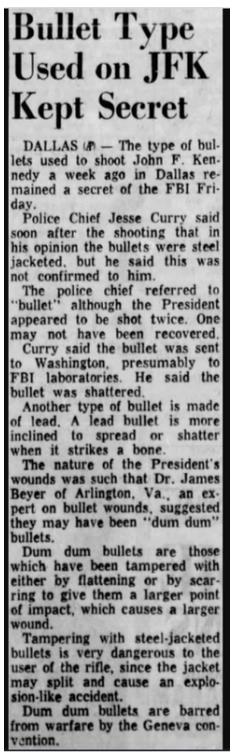
    On Nov. 29, 1963 Dallas Police Chief Jesse Curry told the Associated Press that “in his opinion the bullets [that struck President Kennedy] were steel jacketed, but he said this was not confirmed to him [by the FBI].”

    Huh? “Steel jacketed”?

    This bit of recovered history is jarring, to say the least.

    Why on earth would Chief Curry, one week after the murder, opine to a national news media organization that the bullets that struck JFK—which Curry had never seen, or examined, and which were still an FBI “secret”—were relatively rare steel-jacketed bullets, rather than the industry norm, standard and very common copper-jacketed bullets?

    There is nothing in the JFK case itself to suggest steel-jacketed bullets were used. In fact, the horrible head shot at Z-313 was evidently accomplished with a copper-jacketed bullet—or at least so says the WC. So why late in November 1963 was the Dallas Police Chief Curry seeking to have confirmed, by the FBI, that the bullets that struck JFK were steel-jacketed? This becomes more interesting when one again ponders the nature of bullets.

    Interestingly, as early as Nov. 23, 1963, Chief Curry was asked by an unidentified news reporter whether LHO was the failed assassin of General Walker, as captured on film in a hallway interview.[10]

    Curry replied, “I don’t know.”

    According to Dec. 4, 1963 FBI memo sent to FBI Director Hoover, the DPD had considered turning the Walker Bullet over to the FBI even before being asked, as “they felt there was some possibility that Oswald might have shot at Walker.”[11]

    Steel-Jacketed Bullets Are Relatively Rare

    As stated, in the early 1960s almost all rifle bullets and most other bullets were copper-jacketed (technically, copper-zinc alloys). The jacketing helps prevent lead-fouling of rifle barrels (lead being a very soft metal). Also, the increasing explosive power of bullets had necessitated jackets to prevent a pure lead slug from mushrooming or deforming as it went down the barrel.

    The idea that the Dallas Police Chief Curry would be seeking confirmation, from the FBI, that the bullets that struck JFK were steel-jacketed is remarkable.

    Why would Curry suspect steel-jacketed bullets?

    The answer almost certainly goes back to the ever-controversial April 10, 1963 rifle shot taken at General Walker. As stated, inside the Walker home a slug was recovered by police and identified as steel jacketed by two DPD detectives, and two patrolmen, in the same-day official police report they authored and signed.

    DPD Detective Van Cleave then told reporters from at least four different news organizations, including the AP, that the bullet recovered was a “30.06.”

    Which is interesting—especially the part about the “30.06.”

    The US military, under dire duress of WWII wartime copper shortages, did in fact manufacture a steel-jacketed 30.06 during the war and shortly thereafter, bullets which were sold into surplus when the US adopted NATO-compatible ammo in 1955. The steel-jacketed 30.06’s were phased out of military use.[12]
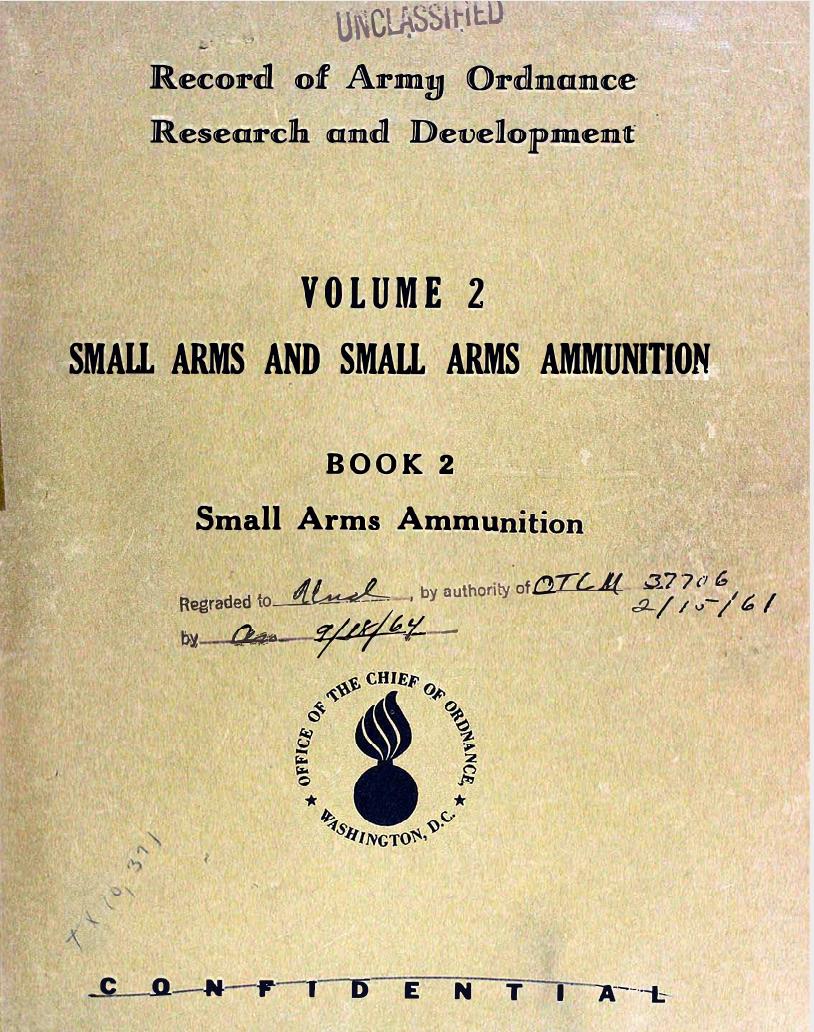
    small arms ammunitionSo civilians could buy the steel-jacketed 30.06 bullets.

    Moreover, by Nov. 29, DPD detectives had been through the belongings of Lee Harvey Oswald, and had found the ever-gloomy backyard photograph of General Walker’s house (the one with an auto license plate cut out), along with four other photographs of roads and railroad tracks leading to the Walker residence.

    Also on Nov. 29, the German newspaper Deutsche National und Soldaten-Zeitung published an article that accused LHO of having shot at General Walker.[13]

    The reasonable deduction, indeed inevitable conclusion, is Chief Curry on Nov. 29 or earlier had reviewed the official DPD files on the Walker shooting, and read that a steel-jacketed slug had been found in the Walker residence.

    So, it looked like this to Chief Curry: LHO, accused of shooting at JFK and now himself dead, had had in his possession backyard photos of the Walker house—the very house in which Walker, another high-profile public figure, had also been shot at. A house in which a steel-jacketed slug had been recovered on the night of the shooting.

    So, naturally, Curry opined LHO used the same type of steel-jacketed bullets in shooting JFK, and asked the FBI to confirm as much. That info would help close the books on the Walker attempted murder.

    It stretches credulity that Chief Curry would blunderbuss or conflate the terms “steel jacketed” and “copper jacketed’ when asking the FBI to confirm the type of bullets used in the assassination of a sitting US president.

    CE 573: No “DAY” and no “+”

    There are other incongruities regarding the true Walker Bullet. On two separate occasions Lt. J.C. “Carl” Day of the DPD testified he had marked the true Walker Bullet with the word “DAY” and a “cross.”

    On or about Dec. 5 1963, Lt. Day told the FBI he had placed upon the Walker slug the word “Day” and a “cross.” The slug itself, not an envelope, box or tag.

    Then, here is Lt. Day testifying before the WC in 1964:

    Mr. BELIN. I will ask you this. Have you ever seen Commission Exhibit 573 before, if you know?
    Mr. DAY. Yes, sir; I have.
    Mr. BELIN. Could you tell us what 573 is?
    Mr. DAY. This slug was gotten from the home of former General Edwin Walker, 4011 Turtle Creek, April 10, 1963, by Detective B. G. Brown, one of the officers under my supervision. He brought this in and released it to me.
    Mr. BELIN. You are reading now from a report that is in your possession, is that correct?
    Mr. DAY. Yes, sir. Those are the official records of my office.
    Mr. BELIN. Was that prepared under your supervision?
    Mr. DAY. Yes, sir.
    Mr. BELIN. In the regular course of your duties at the Dallas Police Department?
    Mr. DAY. Yes, sir. The slug has my name “DAY” scratched in it.[14]

    After that last comment, Belin quickly changed topics. It is not clear why Day was reading from his official DPD records, or if Day even handled the bullet during the hearing.

    Another problem is this: in 1979 the National Archives and Records Service, on behalf of the House Select Committee on Assassinations, took CE 573 to the FBI lab in Washington, where it was “microscopically” examined. The examiners found the markings “Q188,” “N,” “B,” “J,” “D,” “A,” “O,” and “D”.[15]

    The examiners did not see the word “DAY” or a “cross.” Even under a microscope. Extant photos of CE 573 do not reveal the word “DAY” either.

    The Walker Bullet Was Found—Resting between Bundles of Literature?

    Among the many oddities of the true Walker Bullet is where it was found.

    If DPD patrolman Norvell is correctly quoted, he found the steel-jacketed slug resting atop one bundle of paper in a stack of bundles, after another bundle had been removed from atop of it.

    That is, the Walker Bullet missed Walker, then passed through an interior wall behind Walker. The Walker Bullet then purportedly came to rest in-between bundles of paper.[16]
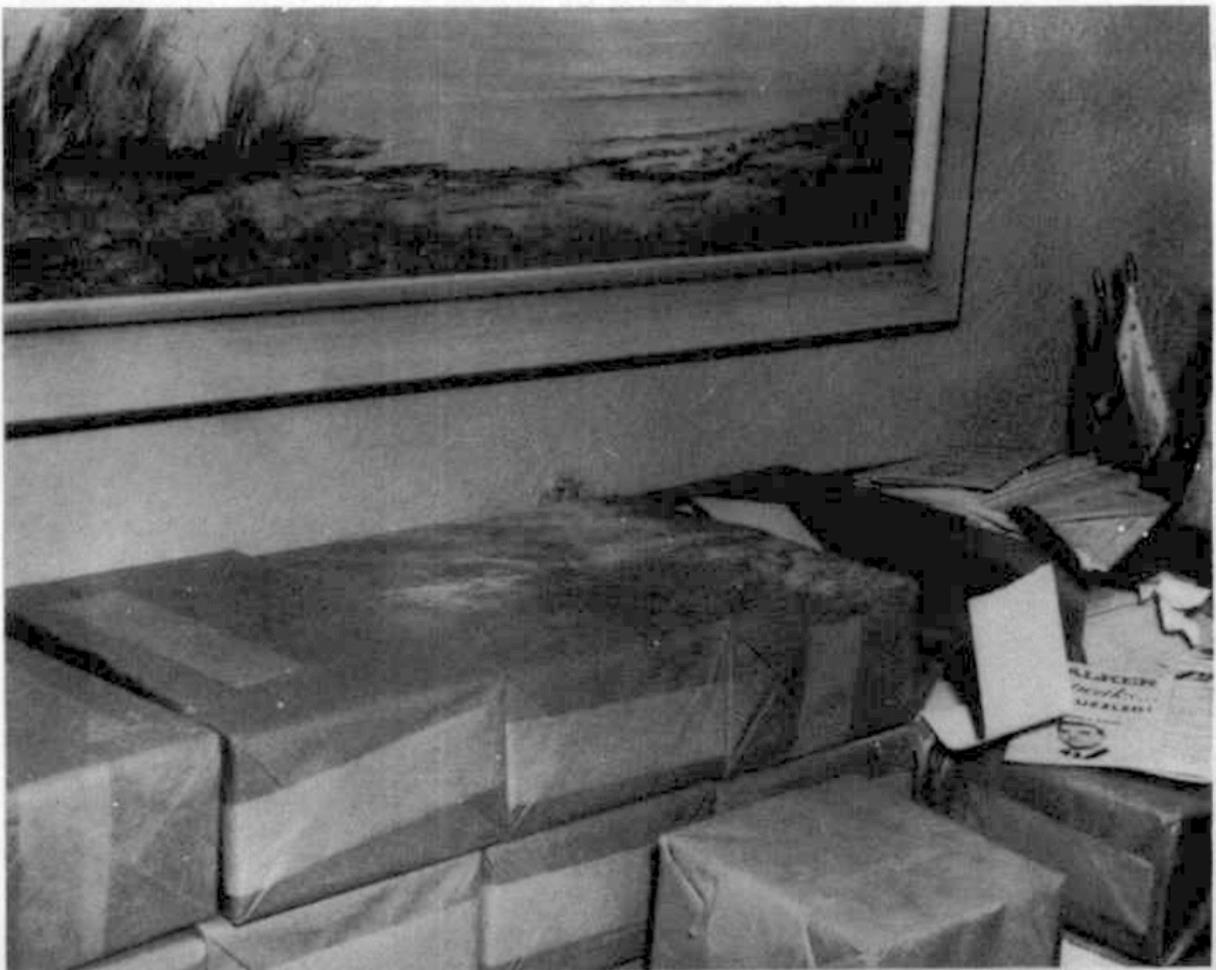
    bundles of paperCommission Exhibit 1009: The Walker Bullet was found “in between” bundles of paper such as this?

    Per an FBI report dated June 4, 1964 (italics added):

    “In his adjoining [Walker’s] room, the [Dallas Police Department] officers [Tucker and Norvell] found numerous bundles and literature and papers stacked against this common wall. Upon removing some, they found a mushroom-shaped bullet lying on one of the stacks of literature near the hole in the wall.”

    There has always been speculation that General Walker, a national public figure, had staged the Walker shooting as a publicity stunt, with or without LHO’s participation.

    If the true Walker Bullet was found resting in-between bundles of paper, lying on one of the stacks, then one might have suspicions the bullet had been planted there.

    CE 399
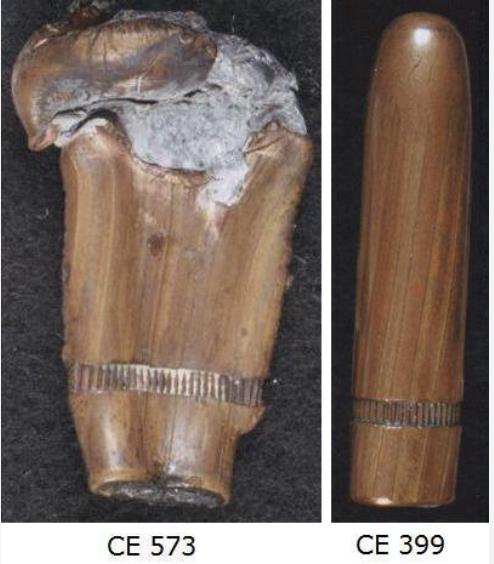
    ce573 ce399CE 399 is, of course, the controversial “magic bullet” or the relatively pristine slug purported to have been recovered at Parkland Hospital on Nov. 22, 1963.

    CE 399 is a Western ammo 6.5 millimeter copper-jacketed slug—a brother bullet to CE 573. Same make and bore, type. The 6.5 Western ammo is used in the Mannlicher-Carcano rifle said to have been owned or used by LHO.

    But a key fact is this: No one in any local or federal police agency ever called CE 399 a “steel jacketed” bullet. Nowhere in the voluminous FBI files is there a single reference to CE 399 as a “rifle bullet,” ergo one that is “steel jacketed.”

    That is to say, CE 399 was immediately and correctly ID’ed as a copper-jacketed bullet, which it obviously is. But CE 573 is a brother bullet to CE 399, and even more obviously copper-jacketed, as it has been mangled, revealing a solid copper jacketing. It stretches credulity that there are police agency errors, misnomers and problems of nomenclature regarding CE 573—but not CE 399.

    Conclusion

    One could be forgiven for having reasonable doubt that CE 573 is the true Walker Bullet, the slug extracted from the General’s residence on April 10, 1963. Indeed, one could ask how anyone could be “reasonably certain” that CE 573 is bona fide evidence from the Walker shooting.

    To recap and ponder—

    • The original and official DPD reports described a relatively rare “steel jacketed” slug found in the Walker home, on April 10, 1963, the night of the shooting. The bullet was handled and initialed through inscribing by four DPD officers. But CE 573—the WC’s purported Walker Bullet—is obviously copper-jacketed.
    • The extremely thin Warren Commission questioning of FBI agent Frazier, as to how and why the Walker Bullet could ever be described as “steel jacketed” by DPD detectives. Frazier answered that “some individuals refer to all rifle bullets as steel jacketed,” a novel and unique observation. There is nothing in police or FBI literature to suggest police detectives or FBI special agents anywhere ever described “all rifle bullets” as steel jacketed—especially when copper-jacketed rifle bullets were and are the norm.
    • Lt. Day of the Dallas Police Department, stating unequivocally to the FBI and then to the WC that he had carved the true Walker slug with his name “DAY” and a cross. No such markings can be seen on CE 573, even under a microscope.
    • The lack of same-day April 10, 1963, or indeed any Dallas Police Department photographs of the true Walker Bullet. The true Walker Bullet was never photographed or, if it was, the photographs have disappeared. Moreover, there are no surviving written DPD lab reports on the Walker Bullet that describe the slug as steel- or copper-jacketed.
    • The weak chain of evidence confirmation by the FBI-WC on the provenance of CE 573. The FBI in 1964 showed a slug purported to be the Walker Bullet only to Norvell, the DPD patrolman, who at best handled the slug briefly 14 months earlier. The FBI did not show the purported Walker Bullet to detectives McElroy or Van Cleave.
    • Neither FBI nor the Commission ever asked Van Cleave why they thought the Walker Bullet was a steel-jacketed 30.06. A simple question, such as “OK, Van Cleave. You handled and inscribed the Walker Bullet, held it in your hand on April 10. Why did you call the Walker Bullet ‘steel jacketed’ in official police reports and 30.06 when talking to reporters?” That simple question was never asked of the best witness.
    • Chief Curry opining on Nov. 29 that JFK had been assassinated with “steel jacketed” bullets, and that he was trying to confirm that fact with the FBI. Curry was almost certainly referring to the Walker shooting, and the “steel jacketed” 30.06 slug found on the scene—a shooting being laid at the feet of LHO, due to the photographs of the Walker home and approaches found in LHO’s possession post JFKA.

    In sum, it is difficult to have confidence the true Walker Bullet, described as steel-jacketed, is also the WC’s CE 573, the torn-asunder copper-jacketed.

    What could be corroborating evidence—the correct marks on the CE 573, or correct same-day detective reports, or a true contemporary April 1983 Walker Bullet photograph, or a true contemporary written report from the DPD lab—are all lacking regarding CE 573. Anyone driving to confirm the authenticity of CE 573 meets roadblock after roadblock after roadblock.

    It is hardly a secret that the job of the Commission was not to investigate the JFK case, but rather to prosecute LHO as a “leftie, loner, loser.” And their narrative on the Walker shooting was that Oswald took a potshot at the General, thus indicating LHO’s predisposition to assassination of public figures.

    However, prosecutorial zeal can lead to excesses and shortcomings.


    NOTES:

    [1]Texas History

    [2]Jacketed Bullets

    [3]Walker Escapes Assassin’s Bullet

    [4] Document from HSCA Administrative folder (page 13)

    [5] Testimony of Robert A. Frazier

    [6] CE 1953

    [7]Texas History

    [8] FBI 62-109090 Warren Commission HQ File, Section 17 (page 119)

    [9]FBI Files on Edwin Walker, 82-2130 File (page 27)

    [10] November 23, 1963 – Dallas Police Chief Jesse Curry speaks with reporters in the corridor

    [11]FBI Files on Edwin Walker, 82-2130 File (page 30)

    [12] 100 Year History of the .30-06; see also US WWII produced steel case 30-06 (read the posted volume, “Record of Army Ordnance, Research and Development,” from the Office of the Chief of Ordnance)

    [13] FBI file number 124-10369-10024 (see page 5)

    [14] Testimony of J. C. Day

    [15] Document from HSCA Administrative folder (page 10)

    [16] CE 1953
  • Justice for Kennedy Act of 2023


    The Justice for Kennedy Act (H.R. 637) was introduced in the House on January 30 by Rep. David Schweikert (R-AZ1). It would not only require six government departments to publicly release any remaining unreleased JFK assassination records in unredacted form within 30 days of its enactment but also eliminate the prohibitions on releasing Lee Oswald’s tax records and records subject to deeds of gift.

    The bill has been referred to the following House Committees: Armed Services, Foreign Affairs, Oversight and Accountability, Judiciary, Ways and Means and the Permanent Select Intelligence. However, it has yet to attract any co-sponsors. Without additional sponsors, it will not move forward to the hearing phase.

    We ask you to contact your representative before the House takes its summer recess and ask them to consider becoming a co-sponsor.

    The bill summary and details may be accessed here.

    This bill is not about who killed the president but simply but about complying with the law and government transparency. The purpose of the bill is to simply finish the job that Congress demanded 30 years ago when it said the prior 30 years had been enough time!

  • Does Tim Weiner Believe his own BS?

    Does Tim Weiner Believe his own BS?


    Robert Kennedy Jr. probably never expected the assassination of his uncle to take a prominent position in his campaign for the presidency. But it was almost predestined that he would be asked about the matter by some people in the media. He was, and to his credit, he did not dodge the question. On more than one occasion, including WABC Radio in New York, the query popped up. He answered honestly and courageously: He thought the CIA was complicit in the John F. Kennedy murder.

    That is all that Tim Weiner needed to hear. He replied with the following tweet:

    I cannot emphasize enough that this is a lie first promulgated by the KGB in 1967, and that RFK Jr is acting as a useful idiot for the Kremlin.

    Hmm. Does this mean that both Ron Paul, a former candidate for the presidency , and Tucker Carlson, the former highest rated cable TV host, are also both “useful idiots” for the Kremlin? Why does Tim not say that if he thinks it’s the gospel truth?

    One reason is simple: It is not true. This is a phony story put out by Warren Commission apologist Max Holland. When the ersatz Russia Gate winds were blowing, Max Holland decided to transfer the focus from Hillary Clinton and her accusations to the JFK case. And the horrid online ‘zine Daily Beast actually ran with it. I blasted Holland’s article to bits back in 2017. (Click here) I actually showed that this story itself, part of the Mitrohkin archives, was manufactured for the defecting Russian agent to curry favor with the British and American intelligence agencies he was seeking monetary rewards and solace from. Because the Mitrokhin ‘archives”, as Russian scholar Amy Knight noted, was a mildly ludicrous creation. In fact, in more than one instance, it was proven to be utterly false. But for someone like Holland, that did not matter one iota.

    Tim Weiner used to write for the New York Times. He now writes for Rolling Stone. How that once proud and honest journal has fallen with his arrival. Rolling Stone was the place where Carl Bernstein published his epochal exposure of the CIA’s Operation Mockingbird. (Click here) During the early days of the House Select Committee on Assassinations (HSCA), Rolling Stone printed intelligent and penetrating stories about the JFK case. With the arrival of the NY Times vet, all that appears to be gone.

    For this is the second time in less than 17 months that Weiner has trotted out this mildewed and utterly false story to detract attention from any real examination of the true circumstances surrounding the JFK case. Tim, why not answer these questions for us?

    1. Would the Magic Bullet, CE 399, ever be admitted into any court in America after a pre-trial evidentiary hearing?
    2. What happened to the baseball sized hole that disappeared from the back of JFK’s head, the one that 41 people saw and some drew pictures of for the HSCA?
    3. If Oswald killed Kennedy, as you seem to imply, why did none of the four secretaries on the 4th floor of the Texas School Book Depository see or hear him on the only stairs leading down from the 6th floor to the first after the shooting?
    4. If the evidence in the case is solid against Oswald why did autopsy photographer John Stringer, under oath, deny he took the extant pictures of Kennedy’s brain in the National Archives?
    5. If the Warren Commission was correct, why did Admiral George Burkley tell the interviewer at the Kennedy Library in 1964 that he did not wish to comment on their verdict? Geez Tim, maybe because Burkley signed a document which placed the back wound at the level of T -3 which would make it all but impossible to exit through the throat?

    So Tim, why not ask your guru Mr. Holland about these? The man who made one of the worst documentaries ever on the JFK case, The Lost Bullet. See what excuses he tosses you and how he hems and haws as he tosses them. I could go on with about 40 statements just like this one and would love to have you reply to them in open debate. But I know you would never show up. The point is this: the Warren Commission was dead wrong. And you were dead wrong when you said that well, Lee Oswald probably got off a lucky shot. How can that be Tim if the ballistics and x-ray evidence portrays Kennedy’s head shot going from front to back? Geez did Oswald run around Dealey Plaza and shoot Kennedy from front and back? Love to hear you say that with a straight face.

    For the record, there were at least four people who thought the CIA was involved in the JFK murder before Tim says the KGB put out a story about it. The first one was Bobby Kennedy. Within momnets of hearing his brother had been killed, he called John McCone, the CIA Director, and asked him if his agency was involved in this horror. One can read all about that in David Talbot’s book, Brothers. It is shocking to me that Weiner shows no knowledge of this at all.

    After RFK, there was Los Angeles attorney Stanley Marks, German expatriate writer Joachim Joesten, and New Orleans DA Jim Garrison. But beyond that, Garrison arrested CIA contract agent Clay Shaw before the alleged KGB story ever ran in the Italian leftist newspaper Paesa Sera. And let us not forget what President Johnson told his chief of staff Marvin Watson after reading the Inspector General Report on the CIA/Mafia plots to kill Castro, a report he commissioned from Director Richard Helms. He said that the CIA was in on the JFK murder. That deduction was based on the CIA’s own report in the spring of 1967, not an Italian newspaper. (City Watch, article by Jefferson Morley, January 3, 2022)

    Let me repeat that again so Tim can maybe understand it: Garrison arrested CIA contract agent Clay Shaw before the alleged KGB story ever ran in the Italian leftist newspaper Paesa Sera.

    So how can Holland’s accusation be true? But beyond that, Garrison called the CIA covert security cleared Shaw in for questioning in December of 1966! (William Davy, Let Justice be Done, p. 63). This was almost three months before the alleged KGB story ran.

    In other words, there is no evidence at all that Garrison was ever influenced by the Italian article: to either suspect Shaw or to arrest the CIA agent. And if I use the terms CIA agent or covert security cleared, its because the declassified records of the Assassination Records Review Board (ARRB) prove that Shaw was just that. (Davy, p. 95; Joan Mellen, Our Man in Haiti, p. 54). It would be nice if Rolling Stone would allow someone like myself, Oliver Stone, Jefferson Morley or John Newman to write about some of these new discoveries made by the ARRB relevant to the JFK case. But as I said, those glory days appear to be long gone for Rolling Stone.

    Robert Kennedy Jr. is not the first person on the presidential campaign trail to say the Warren Commission was a pile of sludge. Al Gore did it when he was running for vice-president way back in 1992. And its an interesting story how that came about. When Gore first came to Washington as a congressman from Tennessee, he was asked a favor by a fellow Tennessean, Bud Fensterwald. Fensterwald was an attorney and founder of the Assassination Archives and Research Center in Washington. He asked Gore for just a stretch of time—about 45 minutes every Friday—before he flew back to Tennessee. Bud asked Gore to drop by his office at that time and he would have some documents arrayed on a desk for him to read. He would not consult with him about them, he just wanted him to read them.

    Congressman Gore agreed to the arrangement. After about a year Gore told Fensterwald: “You are correct. It was a conspiracy.’ And Gore never went back on this. In fact he said as much during that 1992 campaign. So by that accounting—Gore, Paul, and RFK Jr.—that makes three candidates for office who agreed the Warren Report is and was bunk.

    One last point about RFK Jr. If Tim Weiner was a real reporter—which he is not on this case—he would have done something elementary to any journalism 101 class. He would have called Bobby up and asked him how he came to such a conclusion. Bobby would have told him what he told me. He was giving a speech in the New York area and was waiting in the green room to be called on stage. He noticed that Jim Douglass’s book, JFK and the Unspeakable was in the bookshelf. He read a few pages and later on he ordered the book. Like many people who have read that book he was duly impressed. So much so that he ended up calling Jim Douglass. Bobby was struck by Jim’s emphasis on Kennedy’s Peace Speech at American University in the summer of 1963. So much so that the two ended up working on a very interesting article. It was called “John F. Kennedy’s Vision of Peace”.

    I saved the punchline for last. It was published in Rolling Stone on November 20. 2013. Would that happen today? I doubt it.

  • Malcolm X Day: Celebrating the Power of Speech

    Malcolm X Day: Celebrating the Power of Speech

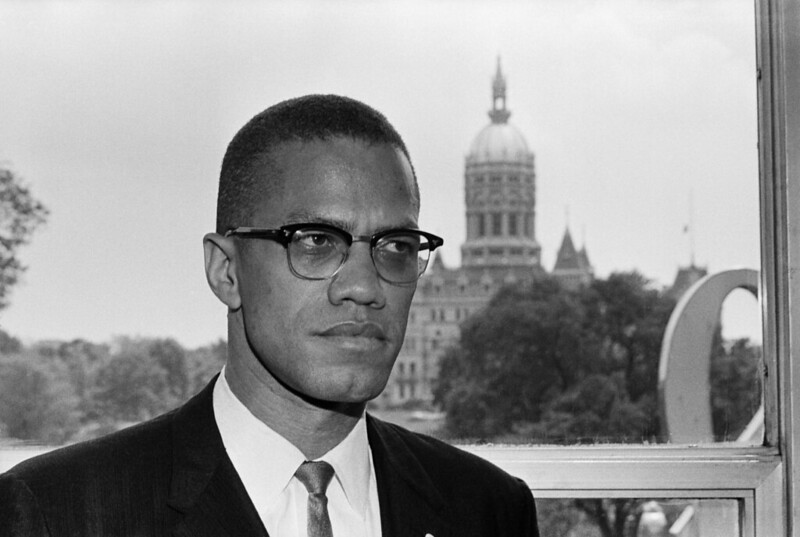
    Malcolm X divided a nation for the better part of his civil rights campaign. This blog isn’t to pass judgment on his activism. It’s to drive home the point that his words held power at a time when African Americans hardly held any sway with the white elite.

    Kennedys and King marks this Malcolm X Day with the following words.

    “We are nonviolent with people who are nonviolent with us.”

    Malcolm X didn’t believe in unprovoked violence but wasn’t entirely against the v-word either. The activist made this statement during “The Ballot or the Bullet” speech at the King Solomon Baptist Church on April 12, 1964. 

    He was alluding to the Black people’s right to defend themselves should harm befall them in their struggle for equal rights. Although Malcolm occasionally lost patience, he was for displaying and using arms to protect himself and those around him and taught his support to follow by example.

    “Dr. King wants the same thing I want. Freedom.”

    Martin Luther King is often portrayed as the nonviolent figurehead of the civil rights movement to Malcolm’s violent and radical activist. Here’s the thing: Humans are complex creatures, whereas history is about perspective.

    There’s no saying how much of what we know about these people’s personas is accurate and how much is adjusted to fit a narrative. Some say Malcolm’s faith led to him getting painted in a negative light.

    If we, too, adjust our perspective to the setting of the words above, we may see Malcolm’s nonviolent tendencies, especially those he showed more toward the end of his life.

    MLK Malcolm X

    “I believe that there will ultimately be a clash between the oppressed and those that do the oppressing.”

    These words are essential because of their relevance in our nation today. Systemic racism is a reality. Everything from education to healthcare to law and order is rigged against African Americans more than other racial groups.

    Malcolm’s prediction of a clash came true during the nationwide marches after the death of George Floyd. To be fair, Malcolm followed this statement with, “I believe that there will be that kind of clash, but I don’t think it will be based on the color of the skin.”

    This Malcolm X Day: Walk Through the Formative and Final Years of Malcolm X Online

    The volunteers at Kennedys and King are nothing if not fair in their assessment of Malcolm X, who remains one of the most misunderstood activists of the civil rights movement. See the movement and its leaders from a different angle.

    Question everything you know about the Malcolm X assassination now that his family has decided to sue law enforcement and intelligence for the roles they played.

    Reach out for feedback and inquiries.

  • Case Closed 30 Years On: Even Worse – Part 5/5: Jet Effect, Neuromuscular Spasm and CE 399

    Case Closed 30 Years On: Even Worse – Part 5/5: Jet Effect, Neuromuscular Spasm and CE 399


    It is worth noting that in the decades that followed the release of the HSCA report, other medical experts such as neuropathologist Dr. Joseph Riley and forensic pathologist Dr. Peter Cummings have viewed the autopsy materials and agreed with the original entry location proposed by the autopsy surgeons. On the other hand, the three forensic specialists who viewed the photographs and X-rays on behalf of the ARRB could find no entry hole anywhere in the rear of the head. (Doug Horne, Inside the ARRB, pgs. 584-586) Additionally, in his fine book, Hear No Evil: Social Constructivism & the Forensic Evidence in the Kennedy Assassination, Dr. Donald Thomas makes the argument that Humes and Boswell had not found a through-and-through entry hole in the skull but had, in fact, found a semi-circular, bevelled notch on the margins of the large defect that they had mistakenly interpreted as a portion of a wound of entrance. Whichever of these arguments about the rear entry wound is correct, the fact remains that the trail of bullet fragments in the top of the head could most likely not have been the result of a bullet entering the rear since the pattern of their dispersal indicates the reverse.

    skull fragments

    Front to Back

    When a bullet disintegrates on striking a skull, the smaller and more dust-like fragments are found closer to the point of entrance whereas the larger particles are found closer to the exit. This is because the larger fragments, having greater mass, have greater momentum and are carried further away from the point of entry. It can be clearly seen in JFK’s post-mortem X-rays that the smallest metallic fragments are located in the right temple area and the largest are found in the top rear of the skull. Therefore, the bullet appears to have been travelling from front to back.

    This evidence of a frontal shot not only further validates the acoustics evidence and the witnesses who heard a shot from the grassy knoll, but it also fits well with the President’s reaction as shown on the Zapruder film. Few observers can fail to be struck by the way Kennedy’s head is slammed backwards by the fatal shot. Celebrated American novelist Don DeLillo once commented on the “confusion and horror” that result from viewing this portion of the film, asking, “Are you the willing victim of some enormous lie of the state―a lie, a wish, a dream? Or did the shot simply come from the front, as every cell in your body tells you it did?” (Thompson, Last Second in Dallas, p. 353) Indeed, the film is so persuasive in this regard that its first showing on national television in 1975 led directly to the formation of the House Select Committee on Assassinations.

    Alvarez and Sturdivan Hijinks

    Warren Commission defenders like Posner, of course, maintain that JFK’s backward motion means nothing. He quotes HSCA forensic pathology panel chairman Dr. Michael Baden as stating that “People have no conception of how real life works with bullet wounds. It’s not like Hollywood, where someone gets shot and falls over backwards. Reactions are different on each shot and on each person.” (p. 315) Posner then offers two theories to explain away the backward motion: the “jet effect” and the “neuromuscular spasm.” Neither of these theories is viable in 2023.

    The “jet effect” was the brainchild of Nobel Prize-winning physicist Luis Alverez who had previously undertaken a “jiggle analysis” of the Zapruder film and suggested that there were three episodes of blurring on the film, demonstrating that the Warren Commission was correct in saying only three shots had been fired. Like Ramsey Clark, Alvarez had been disturbed enough by what he saw in Six Seconds in Dallas that he set out to find a “real explanation” for the backward movement of Kennedy’s head. In the end, what Alvarez offered was the hypothesis that the explosive exiting of blood and brain matter from the right side of JFK’s skull had thrust it in the opposite direction. As Posner tells it, Alvarez established [the jet effect] both through physical experiments that recreated the head shot and extensive laboratory calculations.” (p. 316) The problem, as Josiah Thompson discovered decades later, was that Alvarez had rigged his tests and hidden important aspects of his results.

    Seven years after first seeing Thompson’s book, Alvarez reported on an experiment he had conducted by firing rifle bullets into melons, stating that six out of seven of them had moved back towards the shooter as a result of the “jet effect,” thus validating his theory. Yet, as Thompson discovered when he got his hands on the raw data from Alvarez’s shooting tests, Alvarez had failed to disclose the fact that there had been two earlier rounds of shooting which had achieved very different results. During those earlier firings, Alvarez had used larger, heavier melons which apparently did not behave the way he wanted them to. So, in later tests, he reduced their size by half and jacked up the velocity of his bullets to 3000 feet per second. Alvarez had also fired at a variety of other objects besides melons. There were coconuts filled with jello which were blown 39 feet forward; a plastic jug of water which went 6 feet downrange; and 5 rubber balls filled with gelatin; all of which were blown away from the rifle. It was not until he settled on melons that weighed half as much as a human head and increased the velocity of the rifle by more than 1,000 feet per second above that of the Mannlicher Carcano rifle that Alvarez finally achieved the desired effect (see Thompson’s presentation at the Passing the Torch symposium in 2013 on YouTube.) Whilst Alvarez may have succeeded in demonstrating the already established existence of the “jet effect,” he had in no way shown it to be relevant to the motion of President Kennedy’s head.

    Larry Sturdivan, who writes that “The jet effect, though real, is not enough to throw the president’s body into the back of the car,” (Sturdivan, p. 164). He advanced instead the other hypothesis that Posner cites: the neuromuscular reaction theory. In a nutshell, Sturdivan postulates that the disruption to Kennedy’s brain “caused a massive amount of nerve stimulation to go down his spine. Every nerve in his body was stimulated…since the back muscles are stronger than the abdominal muscles, that meant that Kennedy arched dramatically backwards.” (NOVA Cold Case: JFK, PBS broadcast in 2013) Yet Sturdivan’s postulate, which he based on what he observed from shooting experiments conducted on anesthetised goats, suffers from an anomalous understanding of human anatomy.

    As Dr. Thomas writes, “In any normal person the antagonistic muscles of the limbs are balanced, and regardless of the relative size of the muscles, the musculature is arranged to move the limbs upward, outward, and forward. Backward extension of the limbs is unnatural and awkward; certainly not reflexive. Likewise, the largest muscle in the back, the ‘erector spinae’, functions exactly as its name implies, keeping the spinal column straight and upright. Neither the erector spinae, or any other muscles in the back are capable of causing a backward lunge of the body by their contraction.” (Thomas, p. 341) Additionally, the type of reaction Sturdivan posits is simply not in keeping with what we see on the Zapruder film. President Kennedy’s movement did not begin with the arching of his back. Rather, as the ITEK corporation noted following extensive slow motion study of the Zapruder film, his head snapped backwards first, “then his whole body followed the backward movement.” (ITEK report, p. 64)

    In summary, Posner cites two theories dreamed up by two different scientists who do not even agree with one another. One of those was a Nobel Prize-winning physicist who rigged his experiments and cherrypicked his results. The other was a ballistics specialist who confused the reactions of goats with those of human beings and, in so doing, offered a theory that was anatomically impossible―on top of being contradicted by JFK’s actual reaction as seen on the Zapruder film. It can be confidently stated, then, that neither hypothesis truly explains why Kennedy was sent hurtling backwards and leftwards by the bullet that struck his skull. There is one straight forward explanation, however, that does not rely on rigged shooting experiments or misunderstanding of human physiology. Namely, a shot from the grassy knoll.

    Posner and the Magic Bullet

    The number and direction of bullets striking President Kennedy’s head will likely be debated ad nauseum unless and until some new or definitive evidence emerges. But there is one debate related to the shooting that should have ended decades ago because there really is no serious discussion to be had. Namely, the debate over The Single Bullet Theory―or “Magic Bullet Theory” as it was aptly dubbed by the first-generation critics of the Warren Report. The SBT is a scientific absurdity that was fabricated solely to prop up the Warren Commission’s faulty lone gunman conclusion and was almost entirely debunked within two years of publication of the Commission’s report. The only reason it continues to be defended to this day is because it is, as Cyril Wecht has repeatedly stated, the “sine qua non” of the official story. It is the keystone of the government’s central conclusion that Lee Harvey Oswald acted alone. Commission lawyer Norman Redlich once candidly admitted to author Edward Epstein that “To say that they [President Kennedy and Governor Connally] were hit by separate bullets, is synonymous with saying that there were two assassins.” (Epstein, Inquest, p. 38) Indeed, as critics and researchers have maintained ever since the publication of the Warren Report, without the SBT there could not have been a single gunman whether it was Oswald or anybody else. It is not surprising, therefore, that Posner spends virtually an entire chapter trying to lend the SBT a legitimacy it does not deserve.

    The premise of the SBT is that a bullet, dubbed Commission Exhibit (CE) 399, entered the back of JFK’s neck heading downwards and leftwards and exited his throat just below the Adam’s apple, hitting no boney structures along the way. It then went on to strike Governor Connally in the back of his right armpit, sailed along his fifth rib, smashing four inches of it, before exiting his chest below the right nipple. It pulverized the radius of Connally’s right wrist then entered his left thigh just above the knee, depositing a fragment on the femur, before miraculously popping back out to be found in near-pristine condition on an unattended stretcher in Parkland Hospital. The problems with this outlandish hypothesis are myriad and begin at the very start of its imaginary journey.

    As noted earlier in this review, neither CE399 nor any other bullet could have entered the back of Kennedy’s neck and ranged downward out of his throatbecause there was no bullet wound anywhere in the posterior neck. The rear entrance wound was in the President’s upper back, at a point that was anatomically lower than the wound in his throat. The HSCA forensic pathology panel made clear that, given the true location of the back wound, the only way a downward trajectory to the throat would have been possible was if JFK had been leaning drastically forward at the instant he was hit, which is something that is not seen in the Zapruder film. The absolute necessity of the forward lean was confirmed in 1998 during experiments conducted in Dealey Plaza using precision test lasers.

    laser test

    Furthermore, when the Discovery Channel attempted to simulate the SBT by shooting at replica human torsos from a crane set at the height of the sixth-floor window, it wound up demonstrating that a bullet striking the upper back of an upright-seated individual and continuing on a downward trajectory of 20 degrees, would―as common-sense dictates―exit not through the throat but through the chest.

    laser test 2

    And as if this was not enough by itself to invalidate the SBT, the lateral trajectory through the torso is equally destructive. Dr. John Nichols, a pathology professor to whom Posner makes only a single passing reference, conducted extensive tests with Carcano ammunition and human cadavers and concluded in 1973 that a straight-line from the back wound to the alleged exit in the throat had to pass directly through the hard bone of the spine. (The Practitioner, p. 631-632, November, 1973) Dr. Nichols’s work was fully validated in 1998 by radiation oncologist Dr. David Mantik via a cross-sectional CAT scan of a patient with the same upper body dimensions as President Kennedy.

    cat scan

    What the above clearly demonstrates is that a straight-line, downward trajectory through President Kennedy’s torso is a virtual impossibility and, therefore, the SBT is rendered null and void before CE399 is even able to complete the first leg of its fictional journey. Nonetheless, for the sake of thoroughness, let us continue to analyse some of the salient points in Posner’s attempted validation of the Warren Commission’s most infamous fabrication.

    Posner pinpoints Zapruder frame 224 as the moment “the bullet, with an initial muzzle velocity of more than 2,000 feet per second, passed through [JFK and Connally] almost simultaneously…” (p. 330) As previously noted, he bases this on the apparent flipping up of Connally’s jacket lapel. But what Posner fails to disclose is that the bullet hole in Connally’s jacket was not in the lapel, it was several inches below it.

    cat scan

    Therefore, it is very much debatable whether the lapel movement is in any way related to the passage of a bullet. An even bigger problem for Posner, however, is that at frame 224 Kennedy’s hands are already pulling in towards his chest in reaction to being shot. If Kennedy is already reacting to a gunshot at the very moment CE399 is supposed to be exiting Connally’s chest, then frame 224 provides further evidence that they were struck by separate bullets.

    For many critics, the most indigestible facet of the SBT is the remarkable condition of CE399 itself. To the naked eye, the bullet appears in near-pristine condition with almost no deformity besides a very slight flattening of the base. It looks remarkably like bullets the FBI test-fired into tubes of cotton waste and to ones that author Henry Hurt fired into water. In fact, the test bullet pictured in Hurt’s book looks almost exactly like CE399, slightly flattened base-end and all. This raises an obvious question: How is it possible that CE399 could have pierced seven layers of skin and flesh and broken two bones and emerged almost indistinguishable from bullets fired into nothing more than cotton or water?

    ce399 and test specimens

    For the better part of six decades, critics have challenged Commission defenders to produce a single documented example of a bullet that was able to do what they say CE399 did, yet no such bullet has been produced. In a spirited dissent from the HSCA findings, Dr. Cyril Wecht made sure that this fact was entered into the historical record.

    For the past 12 or 13 years,” he testified, “I have repeatedly, limited to the context of the forensic pathologist, numerous times implored, beseeched, urged, in writing, orally, privately, collectively, my colleagues; to come up with one bullet, that has done this. I am not talking about 50 percent of the time plus one, 5 percent or 1 percent―just one bullet that has done this…at no time did any of my colleagues ever bring in a bullet from a documented case…and say here is a bullet…there is the crime lab report, it broke two bones in some human being, and look at it, its condition, it is pristine. (1HSCA337)

    Dr. Milton Helpern, who was Chief Medical Examiner of New York City for twenty years and conducted more than 10,000 autopsies on gunshot victims, joined Dr Wecht in his skepticism.

    I cannot accept the premise that this bullet thrashed around in all that bony tissue and lost only 1.4 to 2.4 grains of its original weight. I cannot believe either that this bullet is going to emerge miraculously unscathed, without any deformity, and with its lands and grooves intact…You must remember that next to bone, the skin offers greater resistance to a bullet in its course through the body than any other kind of tissue…The single bullet theory asks us to believe that this bullet went through seven layers of skin, tough, elastic, resistant skin…this bullet passed through other layers of soft tissue; and then shattered bones! I just can’t believe that this bullet had the force to do what [the Commission] has demanded of it; and I don’t think they have really stopped to think out carefully what they have asked of this bullet. (Robert Groden & Harrison Livingstone, High Treason, p. 66)

    CE 399 and John Lattimer’s Trail Of Deception

    Posner’s response to this problem is to exaggerate the very slight amount of damage to CE399 by quoting Howard Donahue―creator of the bizarre and ridiculous theory that JFK’s fatal head shot was the result of an accidental discharge by a Secret Service agent―describing the bullet as “somewhat bent and severely flattened.” (p. 335) He goes on to quote John Lattimer as explaining that the reason CE399 appears relatively undamaged is because it tumbled, lost velocity, and struck Connally’s bones side-on. “When it exited the President,” Lattimer says, “it begun tumbling [rotating] and that is evident by the elongated entry wound on the Governor’s back.” (p. 336) In his own book, Kennedy and Lincoln: Medical & Ballistic Comparisons of Their Assassinations, Lattimer writes that “The wound of entry into Connally’s back was 3 cm long (one and one-fourth inches long, the exact length of bullet 399) …” (Lattimer, p. 268) This claim, that the bullet was already tumbling when it struck Connally, is doubly useful for Commission apologists, not only because it can it be used to slow CE399 down but it also suggests that the bullet had been destabilized by striking something else before it hit Connally. Unfortunately for Posner and his lone nut cohorts, the claim is based on Lattimer’s own lie.

    The wound in Governor Connally’s back was not 3 cm in length. Rather, as Connally’s thoracic surgeon Dr Robert Shaw explained to the Warren Commission, 3 cm was the length of the wound after it was surgically enlarged. Its original size was only 1.5 cm, half the length Lattimer claimed it was. (WC Vol. 6 p.85)Shaw’s testimony is proven to be accurate by the holes in Governor Connally’s jacket and shirt which measured 1.7 cm and 1.3 cm respectively. (HSCA Vol. 7, pp. 138-41) Of course, at 1.5 cm the wound would still be considered somewhat elongated, but this does not, by itself, constitute evidence that the bullet was tumbling. As Milicent Cranor has pointed out, the wound in the back of Kennedy’s scalp also measured 1.5 cm in length and no one is suggesting that the bulletwhich caused it was tumbling. Rather, as Dr. Shaw explained, the type of elongated or “elliptical” wound seen in the Governor’s back often occurs when the “the bullet enters at a right angle or a tangent. If it enters at a tangent there will be some length to the wound of entrance.” (WC Vol. 6, p.95) One of the Commission’s wound ballistics experts, Dr. Frederick Light, agreed that the bullet “could have produced that wound even though it hadn’t hit the President or any other person or object first.” (WC Vol. 5 p. 95) He explained that the “obliquity” was the result of “the nature of the way the shoulder is built.” (Ibid 97)

    Dr. Shaw did not believe the bullet was tumbling as it passed through the Governor’s chest and made special note of “the neat way in which it stripped the rib out without doing much damage to the muscles that lay on either side of it.” (WC. Vol. 4 p.116) Further support for Shaw’s contention comes from the aforementioned experiment the Discovery Channel conducted for its 2004 television special JFK: Beyond the Magic Bullet. The Discovery Channel’s bullet tumbled its way through the “Connally” torso and in so doing it struck two ribs, not one. Furthermore, their test provided additional support for the case against the SBT when their bullet emerged severely bent, looking drastically different to CE399.

    discovery channel bullet

    When the Warren Commission showed CE399 to its medical experts, none of them believed it could have passed through the radius bone of Connally’s right wrist. The Governor’s wrist surgeon, Dr. Charles F. Gregory, explained in his testimony that the amount of cloth and debris carried into the wrist indicated it had been struck by “an irregular missile.” In his second appearance before the Commission, Dr. Gregory expanded on this point, noting “that dorsal branch of the radial nerve, a sensory nerve in the immediate vicinity was partially transected together with one tendon leading to the thumb, which was totally transected.” This, he said, “is more in keeping with an irregular surface which would tend to catch and tear a structure rather than push it aside.” (WC Vol. 4 p.124) Posner claims that Dr Gregory “agreed that based on examination of the wrist’s entry wound, the bullet had been tumbling and entered backward.” (p. 336) This is a blatant distortion of Gregory’s testimony. When shown the remarkably undeformed CE399 and asked whether it could have produced the wrist wound he had seen and remained so intact, Dr Gregory replied, “The only way that this missile could have produced this wound in my view, was to have entered the wrist backward…That is the only possible explanation I could offer to correlate this missile with this particular wound.” (WC Vol. 4, p.121) However, Dr Gregory clearly did not consider the idea very likely. In fact, later in his testimony he noted that the two mangled bullet fragments found on the floor of the limousine were much more likely the type of missile “that could conceivably have produced the injury which the Governor incurred in the wrist.” (Ibid, p. 128)

    At Edgewood Arsenal, the Commission’s experts fired bullets through the wrists of human cadavers and Dr Alfred Olivier later testified to having closely replicated the entrance and exit wounds to Connally’s wrist. When shown an X-ray from one such test Dr Olivier stated that it was “for all purposes identical” to the X-rays of the Governor’s wrist. (WC Vol. 5 p.81) Yet when asked to compare the condition of the test bullet which created the wound to that of CE399 he noted, “It is not like it at all. I mean, Commission Exhibit 399 is not flattened on the end. This one is very severely flattened on the end.” (Ibid 82)

    Fackler and Guinn

    Posner’s means of getting around all of this is to reference an experiment conducted by wound ballistics specialist Dr. Martin Fackler, who managed to fire a Carcano round through a cadaver’s wrist and have it emerge virtually unscathed by slowing its velocity to 1,100 feet per second. (p. 339) But the relevance of this experiment to the assassination is questionable to say the very least. Firstly, Fackler’s bullet had not already pierced four layers of skin and flesh and smashed a rib as CE399 is alleged to have done. Therefore, the accumulative effect of all this was eliminated from his experiment. And secondly, the average muzzle velocity of the sixth floor Carcano was 2,165 feet per second and its average striking velocity at 60 yards was 1,904 feet per second. (WC Vol. 5 p.77) According to the results of the Commission’s tests, the bullet would have lost a little over 100 feet per second passing through JFK’s back/neck and around 400 feet per second in Connally’s torso. (Ibid 86) All of which means it would have struck the wrist at approximately 1,400 feet per second, a much greater velocity than was utilized in Fackler’s experiment and one at which the bullet would undoubtedly have suffered distortion.

    The inexplicable condition of CE399, and the convenience of its alleged discovery on an unattended stretcher at Parkland Hospital, led many early critics to believe it had been planted to complete the frame up of Lee Harvey Oswald. Posner claims, however, that such speculation was ended in 1979 by Dr. Vincent Guinn, a chemist who had performed a sophisticated process known as Neutron Activation Analysis (NAA) on all available bullet fragments and provided “indisputable evidence that [CE399] had travelled through Connally’s body, leaving behind fragments [in the wrist].” (p. 342) Unfortunately for Posner, while the type of comparative bullet lead analysis (CBLA) Guinn conducted was still very much in use when Case Closed was first published in 1993, it has since been abandoned by investigating authorities. In fact, it is widely considered to be “junk science” today.

    Guinn’s conclusions rested on his claim, as explained by Posner, that the Western Cartridge Co. bullets made for the Carcano were different from any of the other bullets he had tested during twenty years…the most striking feature, and most useful for identification purposes, was that ‘there seems to be uniformity within a production lot.’” (p. 341) Guinn told the HSCA that the Carcano bullets were virtuallyunique amongst unhardened lead bullets in that they contained varying amounts of antimony. He further suggested that the antimony levels in an individual bullet remained constant but different to the levels found in other bullets from the same box. This, he claimed, meant it was possible to trace a fragment to the individual bullet of origin and distinguish it from all others even if they came from the same box. Thus, he was able to prove that the fragments recovered from Kennedy’s skull and those found on the floor of the limousine all came from one bullet, while the fragments removed from Connally’s wrist came from CE399. Or so he said.

    In July 2006, two scientists from the Lawrence Livermore Laboratory, metallurgist Erik Randich, Ph.D, and chemist Pat Grant, Ph.D, thoroughly debunked Guinn’s claims in an article published in the Journal of Forensic Science. Randich, and several colleagues who had begun to have grave doubts about CBLA, had already published a serious critique of the process four years earlier, which had led to a review by the National Academy of Sciences and ultimately compelled the FBI to shut down its CBLA lab and order its agents not to testify on the issue in future. Specifically addressing Guinn’s NAA, Randich and Grant showed that Dr Guinn was wrong to suggest that the varying levels of antimony present in Carcano bullets made them unique. They noted that for his comparison tests Guinn had used non-jacketed ammunition which has strictly controlled levels of antimony because the hardness of the round is determined by the amount of antimony mixed into the lead. This, however, is not true of jacketed rifle bullets. As a result, Randich and Grant reported that the assassination bullets and fragments “need not necessarily have originated from MC ammunition. Indeed, the antimony compositions of the evidentiary specimens are consistent with any number of jacketed ammunitions containing unhardened lead.”

    Dr. Guinn’s other crucial assertion, that the antimony content of individual Carcano rounds remained constant, was also shown to be erroneous. By presenting highly detailed photomicrographs of Carcano bullets cut in cross-section, Randich and Grant showed how the antimony tends to “microsegregate” around crystals of lead during cooling. This means that a sample taken from one portion of a bullet can have a level of antimony that is entirely different from another sample taken from the same bullet. “The end result of these metallurgical considerations”, Randich and Grant explained, “is that from the antimony concentrations measured by [Guinn] from the specimens in the JFK assassination, there is no justification for concluding that two, and only two, bullets were represented by the evidence…the recovered bullet fragments could be reflective of anywhere between two and five different rounds fired in Dealey Plaza that day.”

    It was thanks to Randich and Grant that, as Josiah Thompson puts it, “CBLA was formally thrown into the dust bin of junked theories and bogus methodologies.” (Last Second in Dallas, p. 191) In 2023, then, Vincent Guinn’s NAA can no longer be reasonably used as evidence that CE399 passed through Governor Connally’s wrist or to prove that the first-generation Warren Commission critics were wrong to speculate that the bullet had been planted at Parkland Hospital. That said, fewer critics make the latter argument today because an alternative scenario has since emerged.

    CE 399 and the FBI

    Although Posner claims that CE399 was found by Parkland Hospital’s senior engineer Darrell Tomlinson when he bumped into Connally’s stretcher, causing the bullet to roll onto the floor, Tomlinson himself was less certain that the stretcher in question was indeed the one that had been used to transport the governor. In his 1967 classic Six Seconds in Dallas, Josiah Thompson made a persuasive case for the bullet Tomlinson found having come from a stretcher that was last occupied by young boy named Ronald Fuller. (Six Seconds in Dallas, pgs. 154-165) But more intriguingly, Thompson noted that when Tomlinson and Parkland Personnel Director O.P. Wright―the man to whom Tomlinson had handed the bullet―were later shown CE399 by the FBI, “both declined to identify it as the bullet they each handled on November 22.” (Ibid, p. 156) Furthermore, the FBI reported that bothSecret Service Agent Richard Johnsen and Secret Service Chief James Rowley, the next two individuals in CE399’s supposed chain of possession, “could not identify this bullet as the one” (WC Vol. 24, p.412)

    When Thompson interviewed Tomlinson and Wright, Tomlinson was seemingly unsure of what the bullet he handled had really looked like. Wright was adamant that it had had a pointed tip. Thompson showed him pictures of CE399 and the FBI’s comparison Carcano rounds. But Wright, a law enforcement officer with considerable firearms experience, “rejected all of these as resembling the bullet Tomlinson found on the stretcher.” (Six Seconds in Dallas, p. 175) Thompson did not know what to do with Wright’s recollection at the time and mentioned it only in a footnote where he labelled it “an appalling piece of information” because, if accurate, it suggested that “CE399 must have been switched for the real bullet sometime later in the transmission chain.” (Ibid, p. 176) But three decades later, Gary Aguilar―with Thompson’s help―wound up lending considerable weight to Thompson’s incredulous speculation.

    The FBI’s July 7, 1964, report had named Bardwell Odum as the Special Agent who had shown CE399 to Tomlinson and Wright. And so, knowing thatit was standard practice for an FBI Agent to submit a FD-302 reporting his field investigation, Aguilar requested the National Archives search for any reports written by FBI Agent Odum concerning his contacts with Tomlinson and Wright. After a vigorous search, however, he was informed that no such report could be found and that the serial numbers on the FBI documents ran concurrently with no gaps, indicating that no material was missing from the files. Dr Aguilar then decided to seek out Odum himself and in 2002 he tape-recorded the following exchange:

    AGUILAR: …From what I could gather from the records after the assassination, you went into Parkland and showed (CE399 to) a couple of employees there.
    ODUM: Oh, I never went into Parkland Hospital at all. I don’t know where you got that. … I didn’t show it to anybody at Parkland. I didn’t have any bullet. I don’t know where you got that but it is wrong.
    AGUILAR: Oh, so you never took a bullet. You were never given a bullet…
    ODUM: You are talking about the bullet they found at Parkland?
    AGUILAR: Right.
    ODUM: I don’t think I ever saw it even.

    Recognizing the significance of Odum’s remarks, Aguilar suggested that perhaps the retired agent had simply forgotten the whole episode. “Answering somewhat stiffly,” Aguilar writes, “he said that he doubted he would have ever forgotten investigating so important a piece of evidence in the Kennedy case. But even if he had forgotten, he said he would certainly have turned in the customary 302 field report covering something that important and he dared us to find it. The files support Odum; as noted above, there are no 302s in what the National Archives states is the complete file on #399.” (Aguilar & Thompson, The Magic Bullet: Even More Magical Than We Knew?)

    To summarise the above: Darrell Tomlinson, the person alleged to have discovered CE399 after it rolled off of a stretcher at Parkland Hospital was unable to positively identify it as the one he found. The man to whom he handed the bullet, O.P. Wright, not only denied CE399 was the bullet Tomlinson gave him but insisted that the one he personally handled had had a pointed tip. The next two links in the chain of possession, Secret Service Agent Johnsen and Chief Rowley, could not identify CE399 as the bullet they handled. And another crucial link in the chain, FBI Agent Odum, denied that he had ever even seen the Parkland bullet let alone performed the actions described in the July 7 FBI report and what’s more, the record supports his recollection. If you can believe it, things get even worse for old CE399.

    FBI technician RobertFrazier had marked the time he received CE399 on his November 22 laboratory worksheet as “7:30 PM,” and he put the same time on a handwritten note he titled “History of Evidence” which was presumably used as a memory aid during his Commission testimony. And yet, Todd had also made a note of the time he received the stretcher bullet, writing it on the outside of the envelope in which it was held. The time he wrote was “8:50 PM.” This raises a crucial question: how could Frazier receive a bullet from Todd at FBI HQ one hour and 20 minutes before Todd was handed the same bullet at the White House by Chief Rowley? The obvious answer is that he could not. And when we consider this alongside the everything else noted, it leads to the almost inescapable conclusion: that Josiah Thompson’s 1967 speculation was right on the mark.It may well be that the real Parkland bullet was made to disappear and was substituted for one that could be used to pin the blame squarely on the shoulders of Lee Harvey Oswald.

    Requiem Mass for Posner

    It would be impossible to respond to every false claim, every example of cherry picking, or every instance of deceptive reporting in Posner’s account of the assassination of President Kennedy without writing a book of epic length. What the above hopefully does, however, is get to the core of his case for Oswald as lone gunman and show how and why, despite the accolades he received for his attempt, Posner cannot make an argument in its favor without resorting to the type of trickery of which he accuses the Warren Commission critics.

    Putting Oswald in the sniper’s nest requires Posner to ignore his own advice regarding witness testimony and select the latter accounts of witnesses who originally did not recall seeing Oswald on the sixth floor or who claimed to have seen Oswald fire the shots but failed to pick him out of a line-up. It also requires that he ignore the type of mishandling of evidence by the Dallas police that would almost undoubtedly have seen key items excluded from trial had Oswald lived to face his day in court. Most egregious of all, making a case against Oswald compels Posner to invent his own solipsistic record, such as saying that Linnie Mae Randle saw Oswald with a package tucked under his arm that did not quite reach the ground, or that Troy West had been in the depository lunchroom at the time of the assassination and not seen Oswald there as he allegedly claimed to have been. None of this would be necessary if the evidence against the accused assassin was as “overwhelming” as Posner laughably says it is.

    But whether one believes Oswald acted as part of the conspiracy or was merely its innocent pawn, there is and always has been overwhelming evidence that the assassination was the work of more than one gunman. And whilst Posner was able to effectively rubbish or hide some of that evidence in 1993, such is simply not possible in 2023. A key tenant of his position, the Neutron Activation Analysis of Vincent Guinn, has been thoroughly discredited, and the very process he used has been abandoned by investigating authorities. Conversely, the acoustical evidence of a gunshot from the grassy knoll that Posner so confidently dismissed has gotten more persuasive over the last two decades, with the major objections to it having been neutered. There is also a much better understanding of what remains of the medical evidence today, with more independent experts having cast their gaze across the materials and made special note of the trail of bullet fragments in JFK’s skull that simply could not have been left behind by a bullet entering the rear of the skull in either of the locations proposed by the Warren Commission and its defenders.

    The lynchpin of Posner’s lone gunman scenario, the Single Bullet Theory, was considered absurd by many when first proposed in 1964 and yet somehow still manages to look worse today. Posner makes much of a 3-D computer animation created by Failure Analysis Associates that, he says, not only demonstrated that one bullet could have passed through both President Kennedy and Governor Connally but also, using “reverse projection,” supposedly showed that the shot came from the sixth-floor window of the Texas School Book Depository. (p. 334-335) But real-life experiments that have been performed utilising lasers in the actual environment of Dealey Plaza or involved firing real Carcano bullets through mock torsos have demonstrated otherwise. In fact, together with the CAT scan provided by Dr David Mantik, they have ended the debate once and for all in the minds of all reasonable people.

    Gary Aguilar, Josiah Thompson, and John Hunt have hammered the final nail into the coffin for the SBT by demonstrating that CE399―the bullet that was absurdly claimed to have caused all seven non-fatal wounds and then conveniently shown up on a stretcher at Parkland Hospital looking magically unaffected by the bones it broke―has not even a semblance of a chain of evidence. Not only did the first four people who supposedly handled the round fail to recognise it as the one; not only did one of those individuals deny it resembled the bullet he actually handled; but contemporaneous documents place the stretcher bullet in the hands of the Chief of the Secret Service one hour and twenty minutes after the FBI’s Robert Frazier, to whom Chief Rowley handed the missile, had already received CE399! The conclusion that there were two bullets in Washington that day and one of them, the pointed-tip round found by Darrell Tomlinson, was deep-sixed in favour of one that was fired from the sixth-floor rifle is almost impossible to resist or refute. And recall, Posner is a lawyer so he knows all about chain of custody and inadmissible evidence.

    Case Closed failed to live up to its title in 1993 because of its author’s blatant and overwhelming bias. Whilst the uninformed academics and journalists who had spent decades looking in the other direction and avoiding criticism of the government’s conclusions may have been taken in by Posner’s artfully constructed prosecution brief, those who had taken the time to study and understand the evidence recognized the book for what it was and recognized Posner for what he is. And Posner did a wonderful job of affirming his incredible bias shortly after the book’s publication when he made apparently ersatz claims before a congressional committee and then stonewalled when asked to provide the proof of his assertions.

    Furthermore, thanks to the work of the Assassination Records Review Board―which shed light on numerous issues related to the life and background of Lee Harvey Oswald, the official investigations of the assassination, and the circumstances surrounding the President’s autopsy―and to the diligence and dedication of private researchers such as Gary Aguilar, Josiah Thompson, John Hunt, Russell Kent, Barry Ernest, Donald Thomas, David Mantik, Jim DiEugenio and many others, Case Closed looks even worse today. Oswald has been revealed as a far more complex and interesting individual than Posner gave him credit for being, and the impossibility of the assassination having been the work of a lone individual has been so thoroughly demonstrated that no amount of denialism, no matter how cleverly presented, can prop up the central conclusions of Case Closed in 2023.


    Go to Part 1 of 5

    Go to Part 2 of 5

    Go to Part 3 of 5

    Go to Part 4 of 5