Blog

  • Reflections on the 60th Anniversary of the Murder of President John F. Kennedy

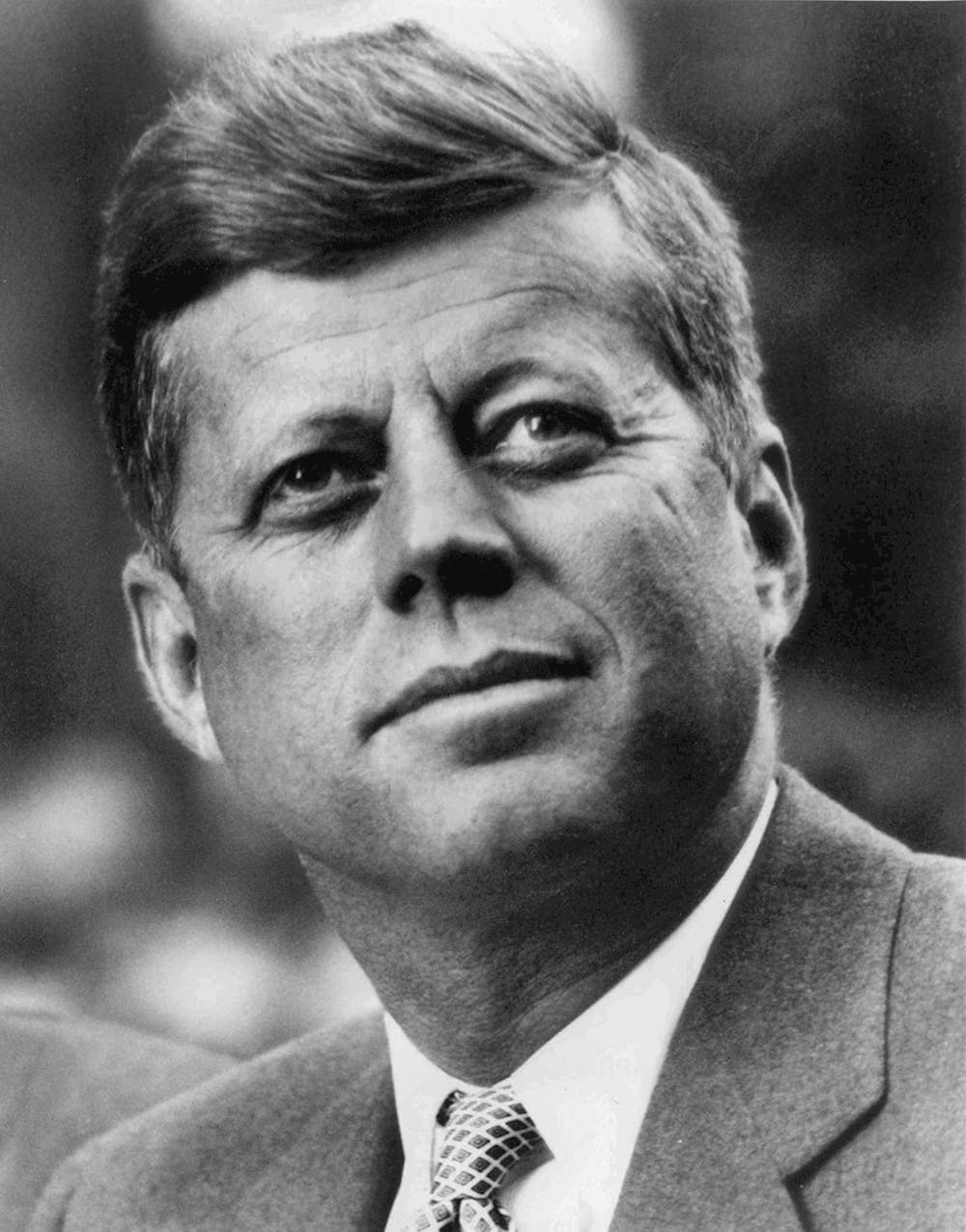
    Reflections on the 60th Anniversary of the Murder of President John F. Kennedy


    The “Sixty Years’ War” is a term typically used by some historians to designate a period extending roughly from the French and Indian War, beginning in the mid-1750s, up to a climax in the War of 1812. There is some disagreement among this; notably, Canadian historians are more apt to give more emphasis to the French and Indian War, although all of these sequential conflicts are essentially colonial disputes over lands that already had Native inhabitants. No surprises there.

    November 22, 2023 is a marker in what has been a different kind of Sixty Years’ War, a war of propaganda and interpretation in which the stakes are not merely historical truth but the shape of future instruction. Oliver Stone memorably referred to his 1991 film JFK as a “counter-myth,” and while one might quibble about that verbiage, to my mind it evokes the counterculture and what that was supposed to represent – the dissent away from frozen attitudes about 1950s America. It is not “my country, right or wrong,” but rather right and wrong dependent on our own intellectual and moral responsibilities.

    The failure of the United States government to produce a coherent investigation in the JFK assassination forced certain individuals to fill the void. The earliest critics – people like Vincent Salandria, Sylvia Meagher, Ray Marcus, Harold Weisberg and many others – started out as amateurs but over time became experts in this new field of study, unpacking state-sponsored domestic murder. The CIA, for its part, labeled this “conspiracy theory” and its adherents “conspiracy theorists.” The major media organizations got the (literal) memo and followed suit. In doing this they became, as in the title of Meagher’s excellent book, Accessories After the Fact. And they have maintained this position, with remarkable consistency, ever since.

    In the teeth of overwhelming opposition, this field of study grew. Researchers emerged in each new generation, dedicated to pursuing truth both in this case and expanding the curriculum as new assassinations emerged: Malcolm, Dr. King, Bobby, and so many others.

    Looming behind all of this activity was “the files,” the last remaining documents that the intelligence agencies have had decades to destroy and/or alter. Some hope remained that one could glean items of interest. One of the supposed selling points for some researchers regarding a potential Trump presidency was that, as an outsider, he might “release the files.” However, most sensible researchers understood that there was a miniscule possibility Trump would follow through, despite his assertions to the contrary. Surely, then, with the election of Joe Biden, an Irish Democrat would finally release these near-60-year-old documents. Of course, he not only didn’t do that, he sealed the matter completely, in an effort to remove the whole debate from consideration.[1] And so it goes, as Kurt Vonnegut used to say.

    The latest salvo in this Sixty Years’ War is the expected barrage of nonsense emerging from establishment sources – would it be a ten-year anniversary without another National Geographic special? Or the History Channel? Of course not. And then the usual “new revelations,” in which the major media will glom onto any conspiracy theory – so long as it isn’t the right one. The most recent is Paul Landis, who has made a variety of conflicting assertions over the decades, now reveals that he found a bullet – strongly resembling CE 399 – in the back seat of Kennedy’s limousine and transferred it to the stretcher himself. As researcher Richard Bartholomew points out in his discussion of the story, the only real question is whether this constitutes an admission of guilt on the part of Landis.[2] And as the author rightly points out, Landis’s new testimony is not needed to kill the Single-Bullet Theory, as Arlen Specter’s elaborate ad hoc bit of nonsense was dead before it ever made it into print. Gibberish is not best contested with additional gibberish. Or, to paraphrase my mentor John Judge, jumping into a fight between two skunks is both generally inadvisable and stinky.

    Speaking of John Judge, for me personally that was the great takeaway from the 50th anniversary, as this marked the last Coalition on Political Assassinations conference. Standing outside in the sleet and cacophony, with Alex Jones leading a gang of idiots on the streets of Dallas, John struggled to lift his booming voice above the din. We lost him early the next year. More recently, earlier this year, the distinguished Kenn Thomas, creator of Steamshovel Magazine, left the ranks. A remarkable and fascinating researcher, he was always very kind and went out of his way to help the Hidden History Center and lent his support to John’s work. We also lost Daniel Hopsicker, author of Barry and the Boys and Welcome to Terrorland, who also did some fine work although I didn’t always agree with his conclusions. And JFK researchers felt the loss of David Lifton, an individual whose work is highly valued in some circles. And there were others, of course, as the inevitable years toll on, as more witnesses, researchers, and other figures pass from the scene. Anniversaries by their nature are natural times for reflection, and we all have much to reflect upon.

    BOOKS AND FILMS

    There have been several highly researched books written in the run up to the 60th anniversary, including titles by veterans Vince Palamara (Honest Answers About the Murder of John F. Kennedy) and Dr. Cyril Wecht (The JFK Assassination Dissected). There were also a couple of books by relative newcomers to investigation literature that made a great impact: one by Monica Wiesak, called America’s Last President, and another by Greg Poulgrain, called JFK V. Dulles: Battleground Indonesia. Both of these latter books share a reflective character, as reassessments of historical analysis that sift through old evidence while deriving new conclusions. In particular, there is much in the way of overturning the assumptions that so many academic historians have previously brought to this material.

    Those assumptions go beyond the JFK assassination and to the attitude regarding conspiracy in general. A good example of this can be found in the beginning of FBI Director J. Edgar Hoover’s origin story. In the years 1919-1920, the U.S. Attorney General Mitchell Palmer oversaw an attempt to deport radical leftists from the country. It was known as the “Red Scare” and the A.G.’s actions would become known as the Palmer raids. The Palmer Raids made a great impression on the young Hoover, who would later dedicate much of his life to fighting supposed Communists. Interestingly, Hoover would deny the existence of the Mafia, an actual criminal conspiracy, while chasing a largely invisible Communist conspiracy.

    In October 1962, both The Nation magazine and Time reported former FBI agent Jack Levin’s observation that out of the 8500 members of the Communist Party, 1500 were FBI agents, which meant that “the FBI [was] the largest single financial supporter of the Communist Party.”

    While Hoover’s FBI was busy funding Communists, the Mob built Las Vegas.

    The focus on how the government affects the media and its attitudes about the Kennedy assassination, and conspiracies in general, is taken up by two other recent books: Political Truth, by Joseph McBride, and Burying the Lead, by Mal Hyman. Professorial and clear-headed analysis can be found in both of these works as the authors perform a deep dive into how information has been disseminated and controlled in alphabet networks and their attendant newspaper organizations. There are gems littered throughout both these books. Hyman shows how there were occasionally individuals who wanted to report on the Kennedy assassination and developed solid leads in many cases, but were unable to get them through their editors. He cites the attempts, for example, of Anthony Summers to get both the New York Times and the Washington Post to notice his work. For his trouble, Summers received total silence from Tom Wicker and a flurry of expletives from Ben Bradlee.[3] (Summers seemed to have gotten the message, for in intervening years he changed the title of his book Conspiracy to Not in Your Lifetime, with a similar bowdlerization of the content.) Meanwhile, McBride tells a similar story as Hyman, but from the perspective of an insider, having been a journalist himself working for such entities as The Nation magazine. McBride also draws a connection from the initial coup d’etat in November 1963 to the more recent January 6th attempted coup, stating that one could argue that every presidency since the Kennedy assassination has been “illegitimate.”[4] That is, until that murder is solved, our hands will never wash out that damned spot.

    Even now, the media continues on its merry way, desperately trying to hide a stack of bodies under a tattered blanket. The QAnon phenomenon is blamed, but more importantly blended, with serious researchers to smear all with the same epithets. It is a moronic enterprise, only successful with the least curious among us. Just to take one example, the idea that, say, Peter Scott and the assorted QAnon idiots have anything in common in cognition is a leap into pure fantasy. Trying to group them together is both desperate and despicable.

    Most recently, a pair of sensational documentaries appeared in the last couple of years. Oliver Stone and Jim DiEugenio’s JFK Revisited: Through the Looking Glass, appeared in both two-hour and four-hour versions, as well as a beautiful book featuring transcripts of the interviews. There were two excellent decisions made in the presentation. One was to get as many mainstream academic historians as possible to remark on the truth about Kennedy’s motives and presidency, foreign policy and attitudes about self-determination, to maximize the credibility of the presentation. The other was to focus on revolutionizing the understanding of the whole history of the United States after World War II, which to my mind is absolutely key. The other documentary to come onto the scene was Max Good’s The Assassination & Mrs. Paine, which is not only brilliant in its own right but serves as a perfect partner for the Stone/DiEugenio work. Good obtained unprecedented access to Ruth Paine and her answers to his ever-polite questions is utterly fascinating. Good also got the late Vincent Salandria to agree to go on camera and participate in extensive interviews, so that the film also serves as a document for any researcher to get a glimpse into Salandria’s reasoning and the reason why he was so admired as a person by so many, including myself.

    FINAL THOUGHTS

    Aeschylus wrote that “God is not averse to deceit in pursuit of a just cause.” Plato, in the Republic, discussed the necessity of the “noble lie” to unite societies together. Both men were correct. However – and here we see the results of our discontinuity all around us – when you cannot get the people to agree on the preferred lies, or accept that the cause is just, the entire system is threatened. It becomes harder and harder for the citizenry to just accept a Manichean understanding of the world in which we are the Good Guys and anyone we don’t like are the Bad Guys, whether they be working-class Russians, Vietnamese peasant farmers, or whichever Latin Americans we have decided are our enemy this week. The lies, and the absence of a just cause, is unsustainable as rot sets in.

    It seems to me that we are in the middle of a sea change in the culture, in which a great many people are starting to wake up to these facts and to the central lie at the heart of all of these investigations: the government isn’t opposed to conspiracy. It just wants control of which conspiracies everyone takes seriously.

    Another decade brings another spike in interest and flurry of activity in the ongoing saga of the John F. Kennedy assassination. Sixty years have now gone by, but one thing remains the same: lies and obfuscation from the usual sources, attempting to bury the serious gains in research with endless red herrings. However, at the heart of this is what both Vincent Salandria and E. Martin Schotz called the “false mystery,” the drowning in irrelevant details of what is a frankly obvious state crime. I do not believe it to be an exaggeration to say that the failure to resolve that crime has resulted in the collapse of the republic, as the United States continues shakily moving forward like a train that is on fire. We may be able to ramble along for a little while longer, but it seems increasingly clear that if the flames are not put out, destruction is certain.

    NOTES

    1.
    https://www.dallasobserver.com/news/biden-washes-his-hands-of-jfk-assassination-records-16962174

    2.
    Bartholomew, Richard, “Many Theories & Single Bullets: False Beliefs of JFK’s Assassination,” https://bartholoviews.substack.com/p/many-theories-and-single-bullets

    3.
    Hyman, Mal, Burying the Lead: The Media and the JFK Assassination (TrineDay: Waterville OR, 2018/2019), 290.

    4.
    McBride, Joseph, Political Truth: The Media and the Assassination of President Kennedy (Hightower Press: Berkeley CA 2022), 214.

  • The Execution of JFK: Extremism in Defense of Liberty

    The Execution of JFK: Extremism in Defense of Liberty


    “There is only one party in the United States, the Property Party…and it has two right wings: Republican and Democrat.” – Gore Vidal

    “Give me liberty or give me death.” – Patrick Henry, Founder.

    Ideological managers have had a field day responding to Trump shenanigans. “Democracy is foundational” to our way of life we have been told ad nauseam. But it isn’t and never has been. What is foundational is just the reverse. It’s liberty.

    This sounds like an innocent assumption, but it has a fundamental consequence. The concept of liberty, when used by elite Americans, is not a garden variety, context-free, concept of freedom. It is a concept that has embodied within it a system of private enterprise. It signifies the right of individuals to own and dispose of productive property.

    So, when Patrick Henry announces that he would prefer death than to have his liberty denied, he is saying that the King has no right to tax him, an owner of private property.[1] Only property owners themselves have the right to decide such things, only owners have the right to dispose of their property (that they stole). What Henry can’t live without is free enterprise.

    Recall that the revolutions of Europe, of which the American revolution is an extension, emerged along the routes of commerce, throughout the medieval market towns or burgs, and within the larger centers of trade where the demand for credit and capital resonated with the vision of some type of government where owners could call the shots. After all, “No one can deny,” asserted the foreign merchants of Antwerp angered by the restrictions placed on trade, “that the cause of the prosperity of this city is the freedom granted to those who trade here.”[2] Justice Story would distill the fundamental notion further: “the equation of personal liberty with private property should be held sacred.” Henry’s siren call, then, could just as easily have been turned around: restrict my right to own and dispose of property you risk your life.

    The post-war political murders and coups through the 1960s fit this frame. It is structural.

    New Realities of Liberty Post-WW II

    “It’s tyranny,” Benjamin Rush shouted in reference to some of the democratic features of the Articles of Confederation before they were cast aside by the men of property. “The moment we submit to them we become slaves.”

    Similarly, in 1948, with the US owning 50% of the world’s wealth and having but 6.3% of the population, George Kennan urged that the US maintain this relationship of “disparity” and, in so doing, “dispense with all sentimentality…[concentrating] our attention everywhere.”

    With the newly minted CIA sanctioned to carry out “massive covert” operations, Allen Dulles, then head of the CIA under Eisenhower, had the cover he needed to use violence for simple annoyances. “Dag is becoming troublesome…and should be removed,” Dulles said of Dag Hammarskjöld, apparently murdered in 1961.[3]

    Complicating the postwar defense of liberty was the “greatest threat,” as perceived by the CIA: the rise of anti-colonial, national liberation movements. The approach to this problem, urged by the CIA, was to return former colonial populations to “traditional subordination” or re-colonization.

    Coups and Murders

    Since its inception, the CIA’s attention had been “concentrated everywhere” but three major foreign events prior to Kennedy’s inauguration belie the structural constraint of having to defend liberty. For example, in 1953 in Iran, the government of Mohammed Mosaddegh stripped foreign investors of their property rights in oil and perhaps unaware, crossed a sacred red line and invited a coup.

    Similarly, the ouster of Jacobo Árbenz in Guatemala was triggered because corporate investors and those who owned huge swaths of land, such as the United Fruit Company, sounded the alarm when Árbenz gave property to landless peasants and softened exploitative labor practices – a “communist reign of terror”- that diminished private control by United Fruit.

    In 1961, Patrice Lumumba, as the first prime minister of the resource rich Democratic Republic of the Congo, was uninterested in re-colonization. He was an African nationalist who sought independence and neutrality, not subordination. The Belgian government tagged Lumumba a communist. President Eisenhower authorized his “elimination.” And so the CIA helped remove him.

    The 1960s murders of Malcom X, MLK, Jr., and Fred Hampton follow similar patterns. X, as with Lumumba, supported national liberation movements, working with leaders of former colonies across Africa. In addition, X brought the issue not of property rights but of human rights to the UN. MLK, Jr. and Hampton both were overtly committed to transforming “the very structure of American society.” Hampton was explicitly anti-capitalist and had innovatively organized across racial lines developing a host of successful social programs.

    But you may ask, so what? Aren’t these good things? No one is getting hurt. Many people are being helped. My response is this: think structure and recall Kennan’s plea: drop the sentimentality. And think of what the architects of our system admonished. Madison: “Democracies have ever been found incompatible with personal security and the rights of property” (my emphasis). And here is where the Kennedys, not socialists at all, get snared. All the programs to mitigate the harshness of the market or to dampen competition over wealth are “wicked projects” because they also mitigate and dampen private rights to property. Moreover, the CIA was concerned with charismatic young leaders, movement builders, who could influence a majority which could then shift power. “The majority, having such coexistent passion or interest, must be rendered, … unable to…carry into effect schemes of oppression.” Rendered unable!. It’s structural.

    The Unfamiliar[4] JFK

    Noam Chomsky has noted that slight deviations from the orthodoxy of power can be met with removal. “The liberal intellectuals…are typically the guardians at the gates: we’ll go this far, but not one millimeter farther; and it’s terrifying to think that somebody might go a millimeter farther.” 

    Below are examples when JFK went one millimeter farther and more. I’ll also include context and the reactions of power when appropriate.

    – JFK, as a Senator in 1957, on the floor of the Senate, criticized French and American colonial imperialism and supported African national liberation efforts. As we have seen this was a direct confrontation with the CIA agenda.

    – Also as a Senator, JFK bought copies of The Ugly American for every senator. Dulles refused to hang the standard presidential photo at Langley.

    – A poisonous atmosphere greets JFK when he arrives at the White House in 1961. The Church Committee suggests that Allen Dulles rushed the murder of Lumumba so that it would take place before JFK was sworn in.

    – The CIA and the JCS approve the CIA invasion force for an assault on Cuba. The CIA knows that the Soviets have learned the date of the invasion more than a week in advance and have informed Castro. The CIA never tells JFK and instead tells the president that the invaders will be greeted as liberators. JFK approves the plan but stipulates no US military support will be given. The CIA and the JCS believe JFK will be forced to send in US military forces once the plan fails. He doesn’t. Gen. Lemnitzer, Chairman of the JCS urges JFK to send in troops. JFK still refuses and accepts defeat. Afterwards, Lemnitzer will say, “Here was a president who had no military experience at all, sort of a patrol-boat skipper in World War II. Kennedy’s attitude was absolutely reprehensible, almost criminal.” JFK told Arthur Schlesinger that Lemnitzer “was a dope.” JFK fires Dulles and the next two top men at the CIA. JFK also tells Schlesinger draw up a plan to radically restructure the CIA and cut its budget. That document is not released in full by the CIA even today.

    – Castro nationalizes Standard Oil and other industries held by the Rockefellers.

    – June 1961, in a White House meeting with Khrushchev’s spokesperson who asked why he wasn’t moving faster to improve relations between the USSR and the US, JFK said “You don’t understand this country. If I move too fast on U.S.-Soviet relations, I’ll either be thrown into an insane asylum, or be killed.”[5]

    – July 1961, at a National Security Council meeting, Lemnitzer presented Kennedy with an official plan for a surprise nuclear attack on the Soviet Union. Kennedy was disgusted and walked out of the meeting and later remarked to Secretary of State Dean Rusk “and we call ourselves the human race.”

    – Early 1962 CIA plans to murder Castro. JFK is kept unaware; no approval is given.[6]

    – CIA, with French Generals, plan to murder De Gaulle for allowing national liberation movements to unfold in Algeria. French Ambassador calls JFK to inquire. JFK responds, “I’m not in control of my own government.”

    – March, 1962, General Lemnitzer presents a plan, Operation Northwoods, that would arrange a terror campaign in Miami and Washington in order to blame Castro and foment revulsion against the Castro government. JFK rejects the idea and three months later he transfers Lemnitzer to Europe.

    – In 1962 JFK sends over 30,000 troops to Mississippi to block segregationists and permit African American James Meredith to attend college.

    – 1961: Despite the Joint Chiefs’ demand to put combat troops into Laos, advising 140,000 by the end of April, JFK bluntly insisted otherwise. Speaking to Averell Harriman, ““Did you understand? I want a negotiated settlement in Laos. I don’t want to put troops in.” Cambodian neutrality and a coalition government is achieved in Laos. CIA fails to honor.

    – Roger Hillsman, advisor: on multiple occasions JFK was only the person in his administration to oppose the introduction of US ground troops [Vietnam], “he was a barrier in that sense.”

    – For several months, the JCS withheld from JFK what they knew about the coming Russian deployment of nuclear missiles in Cuba to insure that JFK would have no time to stop the deployment until they were in place nearly ready to fire. They wanted Kennedy to be backed up against the wall with no option other than to attack Cuba while carrying out a massive surprise nuclear strike to destroy the USSR and China.[7]

    – Cuban Missile Crisis: JFK holds out against his advisors, for a negotiated settlement, refuses to use force, even after a US pilot is shot down. JFK, by means of private messages, aligns with Khrushchev against his own hardliners. Khrushchev does the same to avert hostilities and a likely nuclear war. LeMay, who believes this is the last chance to attack USSR, calls JFK’s actions “dismaying weakness,” sacrificing the defense of Europe.

    – As a result, JFK gives Khrushchev assurances that there will be no US invasion of Cuba. Operation Mongoose is dead. The CIA is angry and concludes that JFK is “dropping even the pretense of overthrowing Castro.[8]

    – Daniel Ellsberg noted that when the missile crisis was over there was a “fury” within the Air Force. “There was virtually a coup atmosphere in Pentagon circles. Not that I had the fear there was about to be a coup -I just thought it was a mood of hatred and rage. The atmosphere was poisonous, poisonous.”

    – Ellsberg notes that civilian distrust of leadership, becomes more intense under JFK. JFK believed that his generals, especially LeMay, were “essentially insane, mad, reckless, or out of touch with reality.”

    – LeMay argues that in nuclear war, the president should not be part of the decision making process at all. “After all, who is more qualified to make that decision…to go nuclear….some politician who may have been in office for only a couple of months or a man who has been preparing all his adult life to make it? Some politician who held back air support from the invasion force at the Bay of Pigs, who had refrained from knocking down the new Berlin Wall, who had refused to send combat troops to Vietnam, having earlier rejected sending them to Laos?[9]

    – JFK forces US Steel to rescind its price increase, by means of a public humiliation. “My father always told me,” JFK shares, “that all businessmen were sons of bitches, but I never believed it until now.”

    – Against the CIA, Kennedy supports Sukarno, Nasser, Nehru and the Non-Aligned movement.

    – By 1963, the CIA is heavily invested in continuing the Vietnam conflict under its own control, was “virtually running the show.”[10]

    – In June 1963, JFK delivers his “peace speech” in which he advocates the abolishment of nuclear weapons, rejects the Pax Americana (the military and economic architecture, which gave US worldwide military and economic supremacy ) in favor of closer relationships and joint projects with the US’s official enemy, the Soviet Union.

    – In June 1963, JFK makes a national televised address saying that civil rights are a moral issue.

    – October 1963, JFK fights for, gets ratified, and then signs the Limited Nuclear Test Ban Treaty with the Soviet Union.

    – In June 1963, JFK makes a national televised address saying that civil rights are a moral issue.

    – On the last day of his life, a Kennedy emissary was in Cuba meeting with Castro in the hope of organizing future direct meetings between the two leaders. This is the message that JFK sent to Castro:

    I believe that there is no country in the world including any and all the countries under colonial domination, where economic colonization, humiliation and exploitation were worse than in Cuba, in part owing to my country’s policies during the Batista regime. I approved the proclamation which Fidel Castro made in the Sierra Maestra, when he justifiably called for justice and especially yearned to rid Cuba of corruption. I will even go further: to some extent it is as though Batista was the incarnation of a number of sins on the part of the United States. Now we shall have to pay for those sins. In the matter of the Batista regime, I am in agreement with the first Cuban revolutionaries. That is perfectly clear.

    Conclusion

    Let me clarify what I mean by a structural analysis. We may refer to Chomsky’s famous summary of post-war US presidents whom he argues could have been tried at Nuremberg for war crimes as were certain Nazis. What does this tell us? That Americans have a terribly faulty way of choosing presidents? Well, we do, but that’s not it. Chomsky is telling us that late capitalism – as a system – is necessarily imperialist. It doesn’t matter who is president, if he or she wishes to stay in that job, he or she will pull the levers of imperialism, as directed by corporations. And so it was with JFK.

    However, we find JFK sporadically, early on, moving in directions that were somewhat troublesome for imperialists. By 1963 he simply was not doing his job. I believe elements within the national security state, rang the alarm, as had been the case with others outlined above, and planned his removal. Supporting liberation movements in Africa undercut the wish of foreign investors to see an abundance of new investment opportunities that recolonization would bring. His support of non-aligned movement leaders threatened investments of men and women of property over vast swaths of the globe as did his efforts at peace making which so annoyed General Le May and others. His willingness to confide in his official enemy against his own generals throughout 1963 was placing the interests of the majority over the opulent few. He was standing liberty on its head and had to be removed.

    Using the language of the Framers, I believe JFK was simply “incompatible” and was “rendered unable” to beautify the world as were the other “bothersome” people who were splendid leaders of non-propertied people. Given that all these leaders were young, popular, and charismatic must have simply freaked out those who ran the national security state. Simply put, a substantial shift in power was in the offing.

    One final point: NARA has not released 8 pages of the Church Committee report on “assassinations.” Disappearing bothersome people is not uncommon. But let us be clear: the murders of the 60s were done at the behest of a corporate directed government or state power. They were not assassinations. An assassination occurs when a lone nut murders a powerful figure. With assassinations, there is no culpability by the state. To call these murders assassinations suggests that the national security state did not direct the murder. It’s time we pull back the curtain, understand what liberty means, and call a spade a spade. JFK, Malcom X, MLK, Jr, RFK, and Fred Hampton were executed by the state for not serving corporate interests and the interests of the opulent few. These people were murdered in the defense of liberty.


    NOTES:

    [1]Henry was a slaver and stealer of lands belonging to indigenous people.

    [2]Hannah Josephson, The Golden Threads (New York: Duell, Sloan and Pearce, 1949). 231.

    [3]South African National Intelligence Agency, 1993. Hammarskjöld was killed when his plane was sabotaged in the air.

    [4]The word used by Daniel Ellsberg to characterize the JFK found in James Douglas, JFK and the Unspeakable.

    [5]Edward Curtin. Click for more.

    [6]Church Committee and the CIA’s own Inspector General Report

    [7]John M. Newman, Official Website

    [8]David Talbot, Brothers, 173.

    [9]Daniel Ellsberg, Doomsday Machine, 113.

    [10]Douglas, 185-186.

  • Part 6 of 6: Sixth Floor Evidence


    51. The Credibility Of Shells?
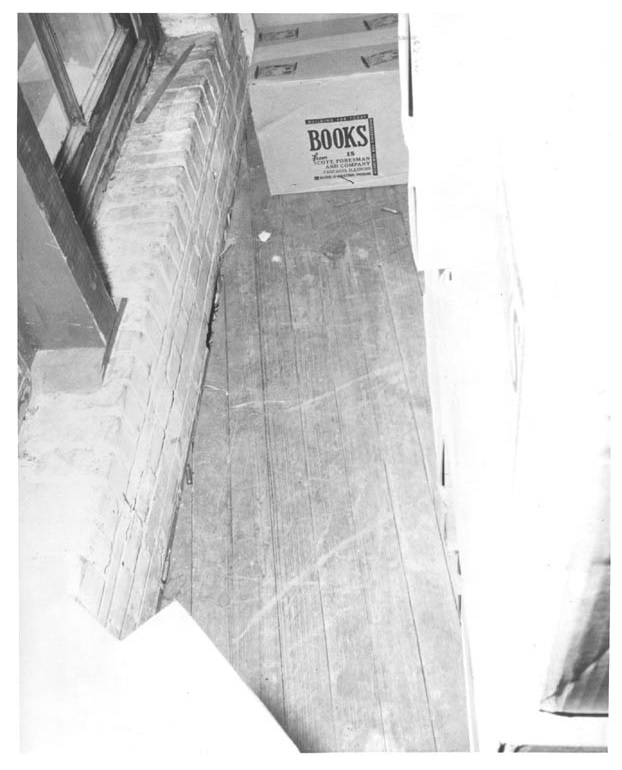
    Commission Conclusion – “The three used cartridge cases found near the window on the sixth floor at the southeast corner of the building were fired from the same rifle which fired the above-described bullet and fragments, to the exclusion of all other weapons.”

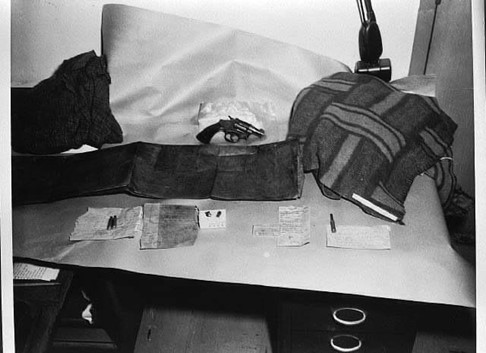
    The case assembled against Oswald, stands primarily on the shaky pillars of circumstantial evidence. Paramount among this evidence are three shell casings, designated as CE543, 544, and 545. These were purportedly found on the sixth floor in the aftermath of the assassination. However, the procurement of this evidence revels a labyrinth of inconsistencies concerning the management and preservation of this so-called evidence.

    Scrutinising the chain of custody for these exhibits reveals a disconcerting pattern of discrepancies, starting from their alleged discovery. A glaring contradiction is discernible between the timing of the shell casings discovery as per the Warren Commission’s Report, and the account provided by Deputy Sheriff Luke Mooney. The Commission’s suggests a twelve-minute lapse between the discovery of the supposed “Sniper’s Nest” and the spent cartridges, a fact that starkly contrasts with Mooney’s first-hand testimony.

    Deepening the sense of impropriety are the baffling irregularities in the treatment of the shell casings. As per Lt. J. C. Day’s testimony, the shell casings were not duly marked at the crime scene, a blatant violation of the standard protocol essential for preserving the sanctity of evidence. Furthermore, the casings were housed in an unsealed envelope, opening Pandora’s box of potential contamination threats and casting a dark cloud over the integrity of the evidence. The uncertainty is further amplified when a cornerstone piece of evidence, Commission Exhibit 543, falls prey to misidentification, consequently pushing the case’s credibility into further tumult.

    David Belin. “All right. Let me first hand you what has been marked as ‘Commission Exhibit,’ part of ‘Commission Exhibit 543, 544,’ and ask you to state if you know what that is.”

    Lt Carl Day. “This is the envelope the shells were placed in.”

    David Belin. “How many shells were placed in that envelope?”

    Lt Carl Day. “Three.”

    David Belin. “It says here that, it is written on here, “Two of the three spent hulls under window on sixth floor.”

    Lt Carl Day. “Yes, sir.”

    David Belin. “Did you put all three there?”

    Lt Carl Day. “Three were in there when they were turned over to Detective Sims at that time. The only writing on it was “Lieut. J. C. Day.” Down here at the bottom.”

    David Belin. “I see.”

    Lt Carl Day. “Dallas Police Department and the date.”

    David Belin. “In other words, you didn’t put the writing in that says Two of the three spent hulls.”

    Lt Carl Day. “Not then. About 10 o’clock in the evening this envelope came back to me with two hulls in it. I say it came to me, it was in a group of stuff, a group of evidence, we were getting ready to release to the FBI. I don’t know who brought them back. Vince Drain, FBI, was present with the stuff, the first I noticed it. At that time there were two hulls inside. I was advised the homicide division was retaining the third for their use. At that time, I marked the two hulls inside of this, still inside this envelope.”

    David Belin. “That envelope, which is a part of Commission Exhibits 543 and 544?”

    Lt Carl Day. “Yes, sir; I put the additional marking on at that time.”

    David Belin. “I see.”

    Lt Carl Day. “You will notice there is a little difference in the ink writing.”

    David Belin. “But all of the writing there is yours?”

    Lt Carl Day. “Yes, sir.”

    David Belin. “Now, at what time did you put any initials, if you did put any such initials, on the hull itself?”

    Lt Carl Day. “At about 10 o’clock when I noticed it back in the identification bureau in this envelope.”

    David Belin. “Had the envelope been opened yet or not?”

    Lt Carl Day. “Yes, sir; it had been opened.”

    David Belin. “Had the shells been out of your possession then?”

    Lt Carl Day. “Mr. Sims had the shells from the time they were moved from the building, or he took them from me at that time, and the shells I did not see again until around 10 o’clock.”

    David Belin. “Who gave them to you at 10 o’clock?”

    Lt Carl Day. “They were in this group of evidence being collected to turn over to the FBI. I don’t know who brought them back.”

    David Belin. “Was the envelope sealed?”

    Lt Carl Day. “No, sir.”

    David Belin. “Had it been sealed when you gave it to Mr. Sims?”

    Lt Carl Day. “No, sir; no.”

    David Belin. “Your testimony now is that you did not mark any of the hulls at the scene?”

    Lt Carl Day. “Those three; no, sir.” (Volume IV, p. 253-255)


    The following affidavit was executed by J. W. Fritz on June 9, 1964.

    The Spent Rifle Hulls

    Three spent rifle hulls were found under the window in the southeast corner of the 6th floor of the Texas School Book Depository Building, Dallas, Texas, on the afternoon of November 22, 1963. When the officers called me to this window, I asked them not to move the shells nor touch them until Lt. Day of the Dallas Police Department could make pictures of the hulls showing where they fell after being ejected from the rifle. After the pictures were made, Detective R. M. Sims of the Homicide Bureau, who was assisting in the search of building, brought the three empty hulls to my office.” (Volume VII; p. 403)

    However, the narrative provided by Fritz sharply diverges from the recollection of Tom Alyea, a cameraman for WFFA TV. Alyea provides a contrasting perspective on the actions taken by the Dallas Police on the sixth floor following the assassination.

    Tom Alyea. “After filming the casings with my wide-angle lens, from a height of 4 and half ft., I asked Captain Fritz, who was standing at my side, if I could go behind the barricade and get a close-up shot of the casings.

    He told me that it would be better if I got my shots from outside the barricade. He then rounded the pile of boxes and entered the enclosure. This was the first time anybody walked between the barricade and the windows. Fritz then walked to the casings, picked them up and held them in his hand over the top of the barricade for me to get a close-up shot of the evidence. I filmed between 3–4 seconds of a close-up shot of the shell casings in Captain Fritz’s hand. Fritz did not return them to the floor, and he did not have them in his hand when he was examining the shooting support boxes. I stopped filming and thanked him. I have been asked many times if I thought it was peculiar that the Captain of Homicide picked up evidence with his hands. Actually, that was the first thought that came to me when he did it, but I rationalized that he was the homicide expert, and no prints could be taken from spent shell casings. Over thirty minutes later, after the rifle was discovered and the crime lab arrived, Capt. Fritz reached into his pocket and handed the casings to Det. Studebaker to include in the photographs he would take of the sniper’s nest crime scene. We stayed at the rifle site to watch Lt. Day dust the rifle. You have seen my footage of this. Studebaker never saw the original placement of the casings, so he tossed them on the floor and photographed them. Therefore, any photograph of shell casings taken after this is staged and not correct.”  Follow this link.

    Tom Alyea further claimed, in correspondence with Tom Samoluk of the ARRB, that Day and Studebaker committed perjury in testifying to the Warren Commission.

    “Regarding the perjured testimony given to the Warren Commission Investigators by members of the Dallas Police Department. I understand there were several cases, but the one I checked for myself by reading the printed testimony in the Warren Report, involves Lt. Day and Det. Studebaker. These are the two crime lab men who dusted the evidence on the 6th floor. Their testimony is false from beginning to end. I suggest their reason was to protect their boss, Captain Fritz, and perhaps their own pensions.”  Follow this link.

    Appraisal Of The Known Facts. The handling, preservation, and chain of custody of Commission Exhibits 543, 544, and 545, are encrusted within a myriad of inconsistencies and procedural aberrations. Such discrepancies not only lay bare the potential for contamination, misidentification, and improper handling of evidence but it also invites profound scepticism about the evidence’s trustworthiness, and by extension, the solidity of the case against Oswald. Remember in all criminal proceedings the onus is on the prosecution to present undeniable proof of guilt and like in all the evidentrary aspects of the case against Oswald, this burden is seriously flawed.

    52. No Package In Oswald’s Hands.

    Commission Conclusion: “Oswald carried his rifle into the Depository Building on the morning of November 22, 1963.” (WCR; p. 19)

    Oswald was seen entering the Texas School Book Depository on the morning of 11/22/63 by “one employee, Jack Dougherty, [who] believed that he saw Oswald coming to work but does not remember “that Oswald had anything in his hands as he entered the door” (WCR; p. 133).

    Dougherty’s testimony in the record.

    Joseph Ball. “Now, is that a very definite impression that you saw him that morning when he came to work?”

    Jack Dougherty. “Well, oh–it’s like this–I’ll try to explain it to you this way— you see, I was sitting on the wrapping table and when he came in the door, I just caught him out of the corner of my eye—that’s the reason why I said it that way.”

    Joseph Ball. “Did he come in with anybody?”

    Jack Dougherty. “No.” Joseph Ball. “He was alone?”

    Jack Dougherty. “Yes; he was alone.”

    Joseph Ball. “Do you recall him having anything in his hand?”

    Jack Dougherty. “Well, I didn’t see anything, if he did.”

    Joseph Ball. “Did you pay enough attention to him, you think, that you would remember whether he did or didn’t?”

    Jack Dougherty. “Well, I believe I can—yes, sir—I’ll put it this way; I didn’t see anything in his hands at the time.”

    Joseph Ball. “In other words, your memory is definite on that is it?”

    Jack Dougherty. “Yes, sir.” (Volume VI; p. 376/377)

    This discrepancy alone would have garnered significant consequences for Wade’s case against Oswald. If Oswald did not carry a rifle into the building on 11/22/63 as Dougherty’s testimony suggests, then a critical piece of the prosecution’s case is seriously undermined. This alone might be enough to introduce reasonable doubt into the case against Oswald.


    53. The Phantom Paper Sack.

    “If there is no gun-sack, there is no gun”. Jim DiEugenio.

    Commission Conclusion. “The improvised paper bag [CE142] in which Oswald brought the rifle to the Depository was found close by the window from which the shots were fired.” (WCR; p.19) (Reclaiming Parkland; p. 187)

    Evidence In The Record Which Refutes The Commission Conclusion.

    1. Primarily, there exists no photographic evidence validating the presence of CE142 on the sixth-floor post-assassination. This lack of visual evidence casts significant doubt upon the very existence of CE142. According to the Warren Report, Captain Fritz had expressly commanded that no object should be disturbed or relocated until law enforcement forensics could meticulously record the crime scene using photographic and fingerprint methods. If these directives were adhered to as stated, it raises a compelling question: Why is there an absence of photographic evidence concerning CE142. (WCR; p. 79)

    2. Commission Conclusion. “[Oswald] left the bag alongside the window from which the shots were fired”. (WCR; p.137)

    CE1302 “Approximate Location Of Wrapping Paper Bag. (WCR; p. 139)

    The absence of a photograph which confirms the presence of CE142 around the crime scene is conspicuously evident. Instead, the Commission resorted to publishing a simulated image within their volumes, labelled as CE1302. This image features a dotted line representing the purported location of the paper sack. Detective Robert Studebaker testified that the FBI requested him to superimpose this line onto a crime scene photograph to indicate an approximate location where the bag was allegedly discovered. The veracity of this image is thus open to severe doubt.

    Given that it’s a reconstructed portrayal rather than an original photograph of the crime scene featuring CE142, its evidentiary weight is non-existent.

    This dialogue between counsel Joseph Ball and Detective Studebaker illuminates this questionable practice:

    Joseph Ball. “Do you recognize the diagram?”

    Robert Studebaker. “Yes, sir.”

    Joseph Ball. “Did you draw the diagram?”

    Robert Studebaker. “I drew a diagram in there for the FBI. Someone from the FBI — I can’t recall his name at the moment — called me down. He wanted an approximate location of where the paper was found.” (Volume VII; p. 144)

    This admission uncovers the lack of tangible evidence and reliance on fabricated illustrations, further undermining faith in the Commission’s conclusions. It provokes questions regarding the investigation process’s transparency and authenticity, casting serious doubt on the Commissions case against Oswald. The lack of an authentic photograph, surreptitiously replaced by a manipulated image, signals serious flaws in the handling of this pivotal evidence no doubt further eroding the confidence of the prosecution’s case against Lee Oswald.


    Commission Conclusion.” [Oswald] Took paper and tape from the wrapping bench of the Depository and fashioned a bag large enough to carry the dissembled rifle. (WCR; p.137)

    3. There is no eyewitness testimony in the record which can collaborate the commissions conclusions regarding the origin of CE142. Troy West’s testimony is pivotal in this context. As an employee who dispensed the packing materials—paper, tape, and string—he maintained that he remained at his first-floor workstation throughout the days leading up to the Presidents assassination and even during the motorcade. West, who recognized Oswald, firmly stated he had never seen Oswald attempting to construct a bag, prior to or on the day of the assassination.

    When questioned by staff lawyer David Belin about whether Oswald had ever been seen around the wrapping materials or machinery, West responded, “No, sir; I never noticed him being around.” This testimony was underscored by the late Ian Griggs, a British police investigator. Griggs pointed out two intriguing aspects: firstly, West expounded on the impossibility of removing tape from the dispenser, which was incorporated into a machine that moistened the tape as it was dispensed. Secondly, the FBI later claimed that the tape on the sack bore the specific markings of this machinery. (No Case to Answer, p. 204)

    During West’s testimony, Belin asked several pointed questions: “Did Lee Harvey Oswald ever help you wrap mail?” To which West responded, “No, sir; he never did.” Belin pressed further, “Do you know whether or not he ever borrowed or used any wrapping paper for himself?” West replied simply, “No, sir. I don’t.” (Volume VI; p. 356–363)

    As Belin’s questions continued to draw a blank, this only reinforced the contention that Oswald had no interaction with the wrapping materials or machinery. This contradicts the Commission’s assertion that Oswald had manufactured the bag using the Depository’s materials. Furthermore, the Commission’s conclusion doesn’t address this illogical inconsistency: why would Oswald create a paper bag that could only accommodate a disassembled rifle? If Oswald indeed crafted this bag from scratch, any comprehensive investigation would question why he didn’t make it sizeable enough to transport the rifle in its fully assembled state?

    4. Commission Conclusion. “The presence of the bag in this corner is cogent evidence that it was used as the container for the rifle. (WCR; p. 135.)
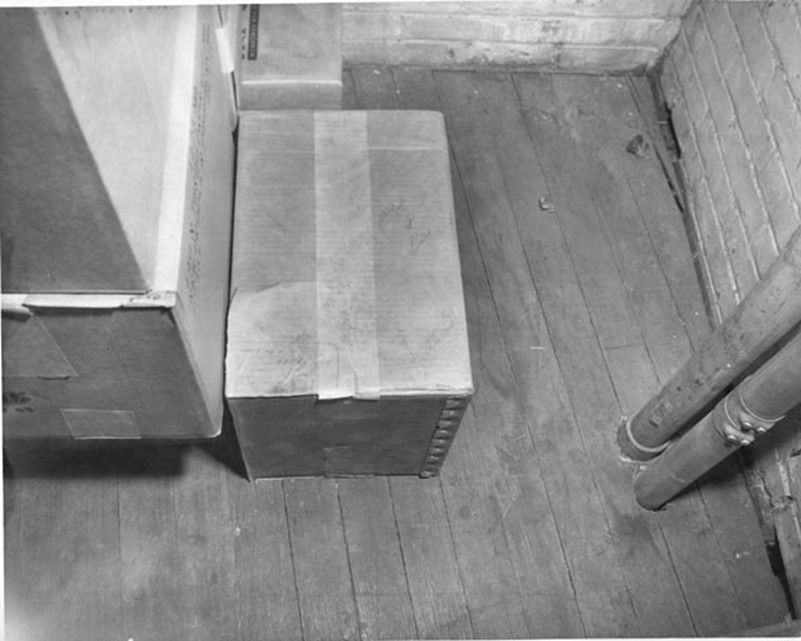
    The Commission’s conclusion that the bag was used as a container for the rifle forms a crucial part of their case against Lee Oswald. However, this assumption is called into question by expert testimony that is present in the record.

    Special Agent James Cadigan, who conducted an examination of the bag for the FBI, presented starkly contrasting findings. According to Cadigan’s testimony,

    Melvin Eisenberg – “Mr. Cadigan, did you notice when you looked at the bag whether there were—that is the bag found on the sixth floor, Exhibit 142–whether it had any bulges or unusual creases?”

    James Cadigan – “I was also requested at that time to examine the bag to determine if there were any significant markings or scratches or abrasions or anything by which it could be associated with the rifle, Commission Exhibit 139 [Mannlicher-Carcano], that is, could I find any markings that I could tie to that rifle?”

    Melvin Eisenberg – “Yes.”

    James Cadigan – “And I couldn’t find any such markings.” (Volume IV; p. 97)

    This testimony from a qualified expert undermines the Commission’s claim that the bag can be linked definitively to the rifle.

    Considering these testimonial inconsistencies, it becomes evident that the Commission’s assertion relies heavily on the mere presence of the bag, without substantiating physical evidence to support its intended use. 5. In a correspondence this researcher had with Buell Wesley Frazier in April of 2021, I asked Mr. Frazier:

    Johnny Cairns. ”On 11/21/63 prior to, during or after you gave Lee Oswald a ride back to Irving, did you observe at any time Lee with a brown paper bag? Or materials to construct a brown paper bag?”

    Buell Wesley Frazier. “No I did not.” (Personal Correspondence)


    6. Inconsistencies in the witness testimony regarding the bag add another layer of uncertainty. When witness accounts vary or contradict one another, it becomes challenging to establish a clear and coherent narrative supporting the bag’s significance as evidence. (No Case To Answer, p.173-214)


    7. Oswald’s partial prints.

    Commission Conclusion. “Oswald’s fingerprint and palmprint found on bag “(WCR; p. 135)

    The inception of CE142 and Oswald’s ‘handling ‘of it raise further troubling questions. It is important to note that the partial prints on the bag, even if genuine, do not provide conclusive evidence that Oswald constructed the bag or carried it on the day of the assassination. These prints alone are insufficient to establish Oswald’s guilt beyond a reasonable doubt.

    Furthermore, the evidence presented in my previous points cast serious aspersions on the CE142 and raises serious doubts about its relevance to the assassination of President Kennedy. This further undermines the significance of the partial prints found on the bag.

    In light of these considerations, it is essential to exercise caution when drawing conclusions solely based on the presence of partial prints on CE142. The partial prints alone do not provide definitive evidence of Oswald’s involvement in the construction or use of the bag on the day of the assassination.


    8. The Greasy-less Prints? “The firing pin and spring of this weapon are well oiled. No oil has been applied to this weapon by the FBI. Numerous shots have been fired with the weapon in its present well-oiled condition as shown by the presence of residues on the interior surfaces of the bolt and on the firing pin.” (Volume XXVI; p. 455.)

    The Warren Commission’s assertion of Oswald’s guilt necessitates the assumption that he engaged in the assembly of the well-oiled Carcano. However, that assumption raises serious doubts with regards to the evidence in this case. For example, the complete lack of any oil or grease residue on Oswald’s hands, the lack of visible oil transfer, from the Carcano, onto the surrounding objects within the ‘snipers nest’, the condition of the wooden floor, devoid of any oil stains and the inexplicable absence of Oswald’s greasy, oily fingerprints make the Commissions assertions highly improbable. What is the likelihood that Oswald in handling the lubricated components of the Carcano, neglected to leave behind any greasy, oily fingerprints at the crime scene?

    The extensive manipulation and shifting through of the rifles various components, within a confined space further intensity’s the scepticism surrounding the absence of any oil transfer from the Carcano to Oswald. Assembling the Carcano in such close quarters would have undoubtedly made it extremely difficult for Oswald to handle it without unintentionally coming into contact with its well-oiled parts.

    Also, the absence of any oil on the wooden floor in the vicinity of Oswald’s alleged assembly and handling of the Carcano is a significant conundrum. With the rifle, well-oiled, it is reasonable to assume that some oil would have dripped or splattered onto the wooden floor during the assembly. Especially, when it is assumed, Oswald emptied the contents of the ‘paper sack’ onto the floor to assemble the Carcano. The absence of visible oil stains or residue on the wooden floor adds another layer of doubt regarding the purported sequence of events. Wooden floors have a porous nature that would likely absorb or retain oil, making it difficult for oil stains to go unnoticed.

    Had Oswald been given the opportunity to stand trial, it would have been a formidable task for Henry Wade, to prove beyond a reasonable doubt that he had assembled the Carcano on November 22, 1963. The rational deductions outlined above cast reasonable doubt on the case against Oswald.


    54. Accessories After The Fact. The Palm Print Evidence.

    “Few people would be ready to convict a man of murder on the basis of such incomplete investigation or such a dishonest presentation of ‘evidence’. Those who would not send a living man to his death on such a basis must ask themselves whether Oswald should be assigned to history stigmatized as an assassin on grounds that would be inadequate if he were still alive.” Sylvia Meagher.

    Commission Conclusion. “Oswald’s palmprint was on the rifle in a position which shows he handled it while it was disassembled.” (WCR; p. 129.) (Accessories After The Fact; p. 120.)

    1. There are no existing photographs taken at the time of the investigation that clearly show the presence of the palm print on the Mannlicher-Carcano rifle, which is a crucial piece of alleged evidence tying Oswald to the weapon.”

    The absence of contemporaneous photographs cannot be understated. These photos would have served as a critical piece of forensic evidence, capturing the initial state of the palm print on the weapon. Their absence raises questions about the authenticity and handling of this key evidence.

    2. “The print on the gun still remained on there… there were traces of ridges still on the gun barrel.” (J.C. Day, Dallas Police)

    Contrary to Day’s account, FBI Fingerprint Expert Sebastian Latona testified that he couldn’t develop any prints on the weapon. “I was not successful in developing any prints at all on the weapon.” (Sebastian Letona, FBI, Volume. IV, p. 23)

    Paul Stombaugh of the FBI observed that the gun had been dusted for latent fingerprints prior to his receiving it, with powder visible all over the gun.

    “I noticed immediately upon receiving the gun that this gun had been dusted for latent fingerprints prior to my receiving it. Latent fingerprints powder was all over the gun.” (Accessories After The Fact; p.121)

    Sylvia Meagher, in her book, questioned the discrepancy between the survival of the dusting powder during the gun’s transit from Dallas to Washington, and the complete disappearance of traces of powder and dry ridges claimed to be present around the palm print on the gun barrel.

    “How could powder survive on the gun from Dallas to Washington, but every single trace of powder and the dry ridges which were present around the palm print on the gun barrel under the stock vanish?” (Accessories After The Fact; p.122)


    3. “Lt. DAY stated he had no assistance when working with the prints on the rifle, and he and he alone did the examination and the lifting of the palm print from the underside of the barrel of the rifle which had been found on the sixth floor of the Texas School Book Depository on November 22, 1963.” (Volume XXV; p. 832.)


    4. Even the Commission harboured significant doubts about the belated discovery of the palm print on the rifle. A memorandum from the FBI, dated August 26, 1964, addressing this uncertainty, states:

    “There was a serious question in the minds of the Commission as to whether or not the palm impression which had been obtained by the Dallas Police Department is a legitimate latent palm impression removed from the rifle barrel or whether it was obtained from some other source and for this reason this matter needs to be resolved.”   Follow this link.


    “Go No Further With The Processing”

    Partial prints discovered on the exterior of the rifle were photographed by Lt Day. However, the FBI determined that these prints held no evidentiary value. According to Day, he captured these photographs at approximately 8 p.m. on November 22, 1963.

    Day testified that he neglected to photograph ‘Oswalds’ latent palm print due to explicit instructions he received from Dallas Police Chief Jesse Curry, who ordered him to cease further processing the Carcano. However, during an interview with the FBI, Day stated that he received these orders from Curry shortly before midnight. Therefore, based on his own admission, Day had nearly four hours between taking the photographs of the external prints and receiving the orders from Curry.

    Given the potential significance of the latent print as critical evidence in Oswald’s trial, it raises the question of why Day chose not to photograph it. It seems likely that he was aware of its importance, making his decision all the more perplexing.

    (Accessories After The Fact; p.122) Follow this link.


    5. On November 22, 1963, Day reportedly informed Chief Curry and Captain Fritz about the discovery of a palm print on the rifle believed to have been used in the assassination of President Kennedy. Day tentatively identified the palm print as belonging to the primary suspect, Lee Oswald. (Meagher, p. 124)

    On November 23rd, when Fritz was asked about the presence of Oswald’s prints on the rifle, he responded with a denial, “No sir”. Similarly, Curry also did not reveal publicly this significant discovery. It was not until November 24th, after Oswald was slain that DA Henry Wade, nonchalantly announced the existence of a palm print found on the rifle.

    Reporter. “What other evidence chief?”

    Henry Wade. “Let’s see, uh. his fingerprints were found on the gun. I said that on the.”

    Reporter. “Which gun?”

    Henry Wade. “The rifle.”

    Reporter. “The rifle fingerprints were his? Oswald’s?”

    Henry Wade. “Yes. A palm print rather than a fingerprint.”

    Reporter. “Wait the palm print… sir the palm print was on the gun?” (the reporter exhibits a completely surprised tone)

    Henry Wade. “Yes”

    Reporter. “Where on the gun? Where on the gun?”

    Henry Wade. “Under the uh… on part of the metal… under the gun.” (Henry Wade, 11/24/63 Press Conference) Follow this link.


    This ‘evidence’ was only disclosed after the Carcano had been returned to Dallas and after Oswald’s death. Considering the gravity of this information, which implicated the main suspect in the assassination, it is perplexing that Fritz, Curry, nor Wade failed to disclose the presence of Oswald’s palm print to the gathered media and television reporters whilst Oswald was alive.


    The State Of The Evidence.

    The palm print evidence cited against Lee Oswald is fraught with significant discrepancies, which seriously undermine its credibility and calls into question the legitimacy of the case against him. Crucially, there are major concerns surrounding the lack of proper chain of custody for this key piece of evidence, thereby casting a shadow over its admissibility and validity in the proceedings.

    A litany of issues plagues this particular evidence. These include the conspicuous absence of crucial photographs, contradictory testimonies that present more questions than answers, and a disturbing lack of corroborative details. Further compounding these problems is the issue of delayed disclosure, which only fuels suspicions and raises more doubts about the way this evidence was handled. In my opinion this evidence reeks of a frame up.


    55. Day’s Admission Of Perjury?

    When requested by the FBI, LT Day specifically declined to sign a sworn affidavit that he had in fact lifted Oswald’s palm print from the barrel of the rifle on the day of the assassination. On that basis alone the print would be inadmissible as evidence in a court of law. (Hear No Evil ; p. 77-78.)


    56. Lt Day Vs FBI Agent Drain.

    Vincent Drain. “I just don’t believe there was ever a print.” Drain noted that there was increasing pressure on the Dallas police to build evidence in the case. Asked to explain what might have happened, Agent Drain said, “All I can figure is that it (Oswald’s print) was some sort of cushion because they were getting a lot of heat by Sunday night. You could take the print off Oswald’s card and put it on the rifle. Something like this happened.” (Reasonable Doubt; p. 109)


    57. Agents Descend On Millers Funeral Home.

    Mortician Paul Groody, who was in charge at Millers Funeral Home, was busy preparing Oswald’s remains for burial when agents arrived in the early hours of 11/25/63 to fingerprint the deceased Oswald.

    Groody stated:” I had gotten to the funeral home with his body something in the neighbourhood of 11 o’clock at night and it is a several hour procedure to prepare the remains and after this time some-place in the early early morning agents came. Now I say agents because I am not familiar at this moment with whether they were Secret Service or FBI or what they were, but agents did come and when they did come, they fingerprinted and the only reason we knew that they did, they were carrying a satchel and the equipment and ask us if they might have the preparation room to themselves. And after it was all over, we found ink on Lee Harvey’s hands showing that they had fingerprinted him, and palm printed him. We had to take that ink back off in order to prepare him for burial and to eliminate that ink” Skip to 3:00:40 Follow this link.


    58. Commission Exhibit 399.

    “The truth has no defense against a fool determined to believe a lie.” Mark Twain.

    Commission Conclusion. “A nearly whole bullet was found on Governor Connolly’s stretcher” (WCR; p. 557.)

    What Is Chain Of Custody? Chain of custody is a crucial concept in legal proceedings that refers to the process of maintaining and documenting the handling of evidence. This starts at the moment the evidence is collected at the crime scene and continues through to its presentation in court. The purpose of this process is to protect the evidence from tampering, contamination, or mishandling, and to provide a documented history of its management and control.

    With this in mind, how would Henry Wade have legitimised CE399 in a court of law? It would have been imperative for Wade to establish a robust chain of custody for CE 399 proving its legitimacy. This would involve providing documented evidence of every individual who handled the bullet, from its alleged discovery at Parkland Hospital to its transportation and subsequent analysis at the FBI crime lab in Washington, and ultimately to its presentation in court.

    In essence, Wade would need to convincingly demonstrate to a jury that CE 399 was the same bullet discovered at Parkland, that it was handled and stored properly at all times, and that it is indeed the bullet that caused the non-fatal wounds to President Kennedy and Governor Connally, as per the single-bullet theory. Establishing a solid chain of custody would be paramount to achieving this. Follow this link.


    Darrell C. Tomlinson. First Link In The Custody Chain.

    Darrell C. Tomlinson, senior engineer, Parkland Hospital: Discovered bullet on a stretcher in a corridor of the hospital emergency area between 1:00 and 1:50 p.m, November 22, 1963. Called O. P. Wright and pointed out bullet. Tomlinson testifies but is asked very little about his finding of the bullet; and nothing about its appearance or his handling and disposition of it. Unlike most other hospital personnel, no written report covering his activities appears in evidence.

    According to CE2011, a document from the FBI located within the Warren Commission Volumes, “Darrell C. Tomlinson was shown Exhibit C1 (CE 399), a rifle slug, by Special Agent Bardwell D. Odum, Federal Bureau of Investigation. Tomlinson stated it appears to be the same one he found on a hospital carriage at Parkland Hospital on November 22, 1963, but he cannot positively identify the bullet as the one he found and showed to O.P. Wright.” (Volume XXIV; p. 412)

    During his Commission testimony Tomlinson is not presented with CE399 and asked to identify it as the bullet he discovered on 11/22/63.


    O.P. Wright. Second Link In The Custody Chain.

    O.P. Wright, Personnel Officer, Parkland Hospital: Received bullet from Tomlinson; or removed it from stretcher after it was pointed out by Tomlinson 1:00-1:50p.m., November 22. Gave it to Richard E. Johnsen shortly thereafter. (Wright not called to testify. No direct statement from him in evidence referring to bullet. He failed to mention it in lengthy report, to hospital administrator, concerning his activities November 22- November 25 (1963), although detailing his handling of President Kennedy’s wristwatch.

    According to CE2011, “O.P. Wright, advised Special Agent Bardwell D. Odum that Exhibit C1 (CE 399), a rifle slug, shown to him at the time of the interview, looks like the slug found at Parkland Hospital on November 22, 1963. He advised he could not positively identify (CE 399) as being the same bullet which was found on November 22, 1963.”

    However, in November of 1966, Josiah Thompson, author of “Six Seconds in Dallas”, undertook a pivotal investigation at Parkland, where he met with Darrell C. Tomlinson and O.P. Wright. These two figures were integral to his objective: to meticulously reconstruct the circumstances surrounding Tomlinson’s discovery of the so-called “stretcher bullet”.

    Guided by Tomlinson and Wright, Thompson endeavoured to re-enact the precise sequence of events that led to the discovery of ‘CE399 at Parkland’. To facilitate this re-enactment, Wright provided Thompson with a prop .30 calibre projectile as a stand-in for ‘399’. During their interaction, Thompson asked Wright to describe the bullet he had obtained from Tomlinson on November 22, 1963. Wright described the projectile as having a “pointed tip” and suggested that it looked similar to “the one you got there in your hand”.

    This characterisation from Wright starkly contrasts the appearance of CE 399. When presented with a photograph of CE 399, along with CE 572 (bullets similar to those from Oswald’s alleged rifle) and CE 606 (bullets similar to those from Oswald’s alleged revolver), Wright rejected them all. None of them resembled the bullet Tomlinson had discovered on a stretcher that day.

    Upon conclusion of their meeting, Thompson recounted a moment that further cast doubt on 399. As he prepared to leave Parkland, Wright approached him with the statement “Say, that single bullet photo you kept showing me… was that the one that was supposed to have been found here?” To which Thompson affirmed, “Yes.” Wright’s response, a simple “Uh…huh,” was delivered with an expressionless face before he turned and returned to his office.

    Thompson interpreted this interaction as a tacit rejection of CE 399 as the bullet Tomlinson handed over to Wright that day.

    Adding to this ambiguity, a declassified document “dated June 20, 1964, from Gordon Shankland, SAC Dallas, to FBI Director J. Edgar Hoover, confirms: “Neither Parkland’s DARRELL C. TOMLINSON nor O. P. WRIGHT can identify this bullet.” which of course contradicts the information in CE2011. (The Bastard Bullet; p.38. Volume XXIV; p 412.Last Seconds In Dallas, Page 24/26).  Follow this link.

    The inability of both Wright and Tomlinson to definitively identify CE 399 as the bullet they handled that day casts serious doubt over its credibility as evidence.


    Richard E Johnsen. Special Agent, U.S Secret Service. Third Link In The Custody Chain.

    The ambiguity surrounding CE 399 continued within the Secret Service’s custody chain. Agent Johnsen received bullet from O.P. Wright at Parkland shortly before 2:00p.m., November 22,1963. Transmitted to James Rowley same day. “On June 24, 1964, Special Agent Richard E. Johnsen, United States Secret Service, Washington, D.C., was shown Exhibit C1 (CE 399), a rifle bullet, by Special Agent Elmer Lee Todd, Federal Bureau of Investigation. Johnson advised he could not identify this bullet as the one he obtained from O. P. Wright, Parkland Hospital, Dallas Texas, and gave to James Rowley, Chief, United States Secret Service, Washington D.C., on November 22, 1963.” Agent Johnsen was not called to testify. (Commission Exhibit 2011, Volume XXIV, p. 412, The Bastard Bullet; p.38)


    James. J. Rowley. Chief, U.S. Secret Service. Fourth Link In The Custody Chain.

    “Received bullet from Johnsen on November 22, 1963. Gave it to FBI Special Agent Todd same day. Rowley testifies July 7th,1964, but is not asked anything about the bullet. No written statement from him concerning his possession of it. On June 24, 1964, James Rowley, Chief, United States Secret Service, Washington, D.C., was shown exhibit C1(CE 399), a rifle bullet, by Special Agent Elmer Lee Todd. Rowley advised he could not identify this bullet as the one he had received from Special Agent Richard E. Johnson and gave to Special Agent Todd on November 22, 1963”. (The Bastard Bullet; p 38. Commission Exhibit 2011, Volume XXIV, p. 412)

    Elmer Lee Todd. Special Agent. FBI. Fifth Link In The Custody Chain.

    Received bullet from Rowley in Washington, D.C., November 221963. Upon receipt, Todd marked bullet with initials at FBI Investigation Laboratory. Gave it to Robert A. Frazier same day. In 1964, Special Agent Elmer Lee Todd, identified C1 (CE 399), a rifle bullet, as the same one he had received from James Rowley, Chief of the United States Secret Service, on November 22, 1963. This identification was based on his own marked initials on the bullet upon its receipt at the FBI Laboratory.”


    Robert Frazier. Firearms Identification Expert, FBI. Sixth Link In Custody Chain.

    “Received bullet from Todd in FBI laboratory, Washington, D.C., November 22, 1963. Frazier put his initials on it.” However according to Robert Frazier’s detailed notes, 399 was transferred into his custody by Special Agent Elmer Lee Todd at 7:30 p.m. on November 22, 1963. However, an examination of the envelope filled out by Agent Todd, documenting the transfer from Rowley, reveals that he did not receive the bullet from Rowley until 8:50 p.m. on 11/22/63. This clear discrepancy of 1:20:00 calls into question the authenticity and validity of the bullet’s chain of custody. The chronology here is of paramount importance.

    If Frazier’s notes are accurate, how could Todd have passed the bullet onto him at 7:30 p.m. when he documented that he only received it from Chief Rowley at 8:50 p.m.? (The Bastard Bullet; p. 38. JFK Lancer)


    John F. Gallagher, spectrographer, Special Agent, FBI.

    “Made spectrographic examination of bullet, (date not given, but apparently prior to March 31, 1966) No written statement from Gallagher appears in evidence. He was not called to testify until September 15, 1964, less than two weeks prior to publication of the Warren Commission Report. His entire seven-page testimony is taken up with a discussion of neutron activation analysis, as it pertains to determination of whether or not an individual has fired a weapon. (Practice has been exposed as junk science) Counsel Norman Redlich failed to ask Gallagher a single question regarding his spectrographic examination of bullet 399.” (The Bastard Bullet;p. 39/39) Follow this linkand  and this link.

    Melvin A. Eisenberg, assistant counsel, Warren Commission: “Received bullet from FBI in Washington, D.C., March 24, 1964. Transmitted to Joseph D. Nichol same day”. (The Bastard Bullet; p. 39)

    Joseph D. Nichol, Superintendent, Bureau Of Criminal Identification, State Of Illinois. Received bullet 399 from Eisenberg in latter’s office, together with other bullets and fragments, Washington, D.C., March 24th, 1964. Made ballistics comparisons with other bullets and fragments. Date not given for return of 399 to FBI custody. Nicol testifies April 1, 1964. Counsel Eisenberg failed to ask his opinion as to whether or not 399 could have caused Governor Connally’s wounds. (The Bastard Bullet; p. 40)

    Bardwell D. Odum, Special Agent, FBI. On June 24, 1964, he is alleged to have shown bullet 399 to Tomlinson and Wright. Odum not called to testify. No direct written statement from him appears in evidence covering his June 12 interviews with Tomlinson and Wright. His written report on unrelated matter, date July 10, 1964, is presented in evidence.

    In 2002 Gary Aguilar and Josiah Thompson approached retired FBI Special Agent Bardwell Odum to review some crucial documents, including CE 2011. Odum expressed surprise and denial over his involvement with CE 399. “I didn’t show it to anybody at Parkland. I didn’t even have any bullet. I don’t know where you got that from, but it is wrong. Mr. Odum remarked that he doubted he would have ever forgotten investigating so important a piece of evidence. But even if he had done the work, and later forgotten about it, he said he would certainly have turned in a “302” report covering something that important. There is no 302 report from Odum in the record. (The Bastard Bullet; p. 40)  Follow this link.

    Elmer Lee Todd. Special Agent, FBI. On June 24, 1964, he showed bullet 399 to Johnsen and Rowley. Todd not called to testify. No direct written statement from him appears in evidence concerning his June 24 interviews with Johnsen and Rowley. (The Bastard Bullet; p. 41)


    Which Stretcher? Connelly or Fuller.

    Commission Conclusion. “Although Tomlinson was not certain whether the bullet came from Connally’s stretcher or the adjacent one, the Commission has concluded that the bullet came from the Governor’s stretcher.” (WCR; p. 81)


    Evidence In The Record Which Refutes Commission Conclusion.

    During his testimony to the Warren Commission, Tomlinson gave a description of the stretcher that he took off the elevator at Parkland.
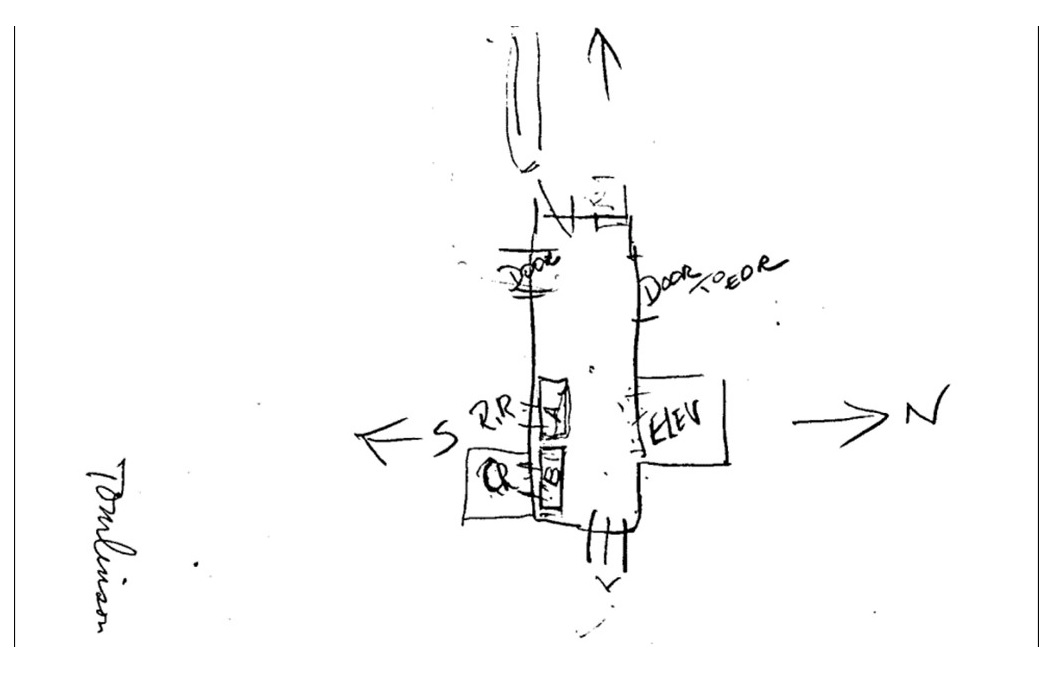
    Arlen Specter. “Was there anything on the elevator at that time?”

    Darrell Tomlinson. “There was one stretcher.” Arlen Specter. “And describe the appearance of that stretcher, if you will, please.” Darrell Tomlinson. “I believe that stretcher had sheets on it and had a white covering on the pad.” (Volume VI; p. 129)


    Tomlinson’s description of the stretcher is collaborated by R. J. Jimison, an orderly at Parkland. Who testified to the Warren Commission that:

    R. J. Jimison. “I came along and pushed it [ Connally’s stretcher] onto the elevator myself and loaded it on and pushed the door closed.

    Arlen Specter. “What was on the stretcher at that time?”

    R. J. Jimison. “I noticed nothing more than a little flat mattress and two sheets as usual.” (Volume VI; p. 126)


    Tomlinson then testifies to his initial discovery of the bullet and which stretcher he believed the bullet was found on.

    Darrell Tomlinson. I pushed it back up against the wall.

    Arlen Specter. What, if anything, happened then?

    Darrell Tomlinson. I bumped the wall and a spent cartridge or bullet rolled out that apparently had been lodged under the edge of the mat.

    Arlen Specter. And that was from which stretcher?

    Darrell Tomlinson. I believe that it was “B”.

    Arlen Specter. And what was on “B”, if you recall; if anything?

    Darrell Tomlinson. Well, at one end they had one or two sheets rolled up; I didn’t examine them. They were bloody. They were rolled up on the east end of it and there were a few surgical instruments on the opposite end and a sterile pack or so. (Volume VI; p. 130/131)

    In the following testimony, Specter appears to engage in a strategy aimed at creating confusion or obfuscating the clarity around which stretcher the bullet was found on. He seemingly contradicts Tomlinson’s assertion that the bullet was discovered on stretcher B, attempting to steer the testimony towards an affirmation that the bullet was instead found on stretcher A.

    This attempt could be interpreted as a deliberate strategy to realign Tomlinson’s account with a predetermined narrative that supports the Commission’s conclusion. Essentially, Specter might be trying to manipulate Tomlinson’s testimony to fit a particular storyline rather than objectively following the evidence presented.

    Arlen Specter. “And at that time, we started our discussion, it was your recollection at that point that the bullet came off of stretcher A, was it not?”

    Darrell Tomlinson. “B.”

    Arlen Specter. “Pardon me, stretcher B, but it was stretcher A that you took off of the elevator.” (Volume VI; p.131)

    Experiencing clear frustration with Specter’s line of questioning, Tomlinson reiterated the sequence of events leading to his discovery of the bullet. What is noteworthy about this portion of his testimony is Tomlinson’s confirmation that both stretchers A and B were left unattended and unprotected at the elevator at the Emergency Department. This lack of security presented a substantial window of opportunity for anyone with access to manipulate the evidence on the stretchers, either by removing or adding items. Consequently, this throws into sharp relief the credibility and integrity of any evidence collected from the stretchers at Parkland Hospital on November 22, 1963.

    Darrell Tomlinson. Here’s the deal– I rolled that thing off, we got a call, and went to second floor, picked the man up and brought him down. He went on over across, to clear out of the emergency area, but across from it, and picked up two pints of, I believe it was, blood. He told me to hold for him, he had to get right back to the operating room, so I held, and the minute he hit there, we took off for the second floor and I came, back to the ground. Now, I don’t know how many people went through that-I don’t know how many people hit them- I don’t know anything about what could have happened to them in between the time I was gone, and I made several trips before I discovered the bullet on the end of it there. (Volume VI; p.132/133)

    Secret Service Agent Johnsen communicates Wright’s account of the characteristics of the stretcher where the bullet was found:

    Richard E. Johnsen, Commission Exhibit 1024. November 22, 1963, 7:30 pm.

    “The attached expended bullet was received by me about 5 min., prior to Mrs. Kennedy’s departure from the hospital. It was found on one of the stretchers located in the emergency ward of the hospital. Also on this stretcher was rubber gloves, a stethoscope and other doctors’ paraphernalia. It could not be determined who used this stretcher or if President Kennedy had occupied it. No further information obtained. Name of person from who I received this bullet: Mr O.P. Wright. Personnel Director of Security. Dallas County Hospital District. By Richard E Johnsen. Special Agent. 7:30pm. Nov 22, 1963.”


    Richard E. Johnsen to Chief James Rowley. “The only information I was able to get from Wright prior to departure of Mrs. Kennedy and the casket was that the bullet had been found on a stretcher which President Kennedy may have been placed on. He also stated that he found rubber gloves, a stethoscope, and other doctors’ paraphernalia on this same stretcher. CE1024. (Volume XVIII; p. 798-800)

    In November 1966, Wright reaffirmed this description of stretcher B to Tink Thompson. Wright also verified “that the stretcher on which the bullet rested was the one in the corner—the one blocking the men’s room door.” (Six Seconds In Dallas; p. 156)

    Ronald Fuller. Ronnie Fuller was received at Parkland Hospital’s Emergency Department around 12:54pm on November 22, 1963. The toddler, aged two and a half years, had sustained an injury to his chin, “which was bleeding profusely. Fuller was placed on a stretcher in the hallway near the nurse’s station before being carried to Major Medicine. Fullers’ stretcher was described as having sheets which were soiled in blood. Rosa Majors told Tink Thompson that she and Era Lumpkin had used gauze pads to clean the child, that either she or Era had been wearing rubber gloves, and that Era had a stethoscope. She cannot remember what happened to this equipment… but it was possible that it was left behind on the stretcher when the two aides carried Ronald Fuller into Major Medicine.” (Six Seconds In Dallas; p. 161/164.)

    Rosa Majors, Nurse Aid Parkland Hospital. Told Tink Thompson that while in trauma room 2 “she removed the Governor’s trousers, shoes, and socks. After removing his trousers, she held them up and went through the pockets for valuables. Had a bullet fallen out of the Governor’s thigh, it would have been trapped in his trousers. When Rosa held them up, any such bullet should have fallen out and been discovered at that time. Rosa told Thompson she never saw any bullet while she was caring for Governor Connally. Much later she heard that a bullet was supposed to have been found on his stretcher. Rosa can’t conceive where such a bullet could have come from.” (Six Seconds In Dallas; p.159)


    The Condition Of CE399.

    Commission Conclusion: “The stretcher bullet weighed 158.6 grains, or several grains less than the average Western Cartridge Co. 6.5mm Mannlicher Carcano bullet. It was slightly flattened, but otherwise unmutilated.” (WCR; p. 557)

    399 is purported to be responsible for inflicting seven non-fatal wounds on both President Kennedy and Governor Connally. According to the Commission

    1. The bullet penetrated President Kennedy’s upper back, traversing through his body. 2. It then emerged from President Kennedy’s throat, just below the Adam’s apple, creating an exit wound. 3. Continuing its trajectory, the bullet entered Governor Connally’s back, near his right armpit, passing through his body. 4. In the process, it shattered several inches of his fifth rib on the right side before exiting his chest. 5. The same bullet is then believed to have passed through Connally’s right wrist, fracturing the distal radius bone. 6. Finally, it lodged itself into Connally’s left thigh, ending its alleged trajectory.

    The following witness testimony is a direct challenge to CE399.

    Dr Robert Shaw. Parkland Hospital. Operated on Gov Connally. “The bullet struck lateral to the shoulder blade. Stripped out approximately 10 cm of the fifth rib, driving fragments of the rib into his chest. Went on and struck his radius bone of his lower arm at this point [pointing to wrist] and a small fragment of bullet, entered the inner aspect of the lower left thigh. I have never seen a bullet that caused as much boney damage as you found in the case of Governor Connally remain as a pristine bullet.  Follow this link.

    <strong” target=”_blank”>Dr Robert Shaw.

    Arlen Specter. What is your opinion as to whether bullet 399 could have inflicted all of the wounds on the Governor, then, without respect at this point to the wound of the President’s neck?

    Dr Robert Shaw. I feel that there would be some difficulty in explaining all of the wounds as being inflicted by bullet Exhibit 399 without causing more in the way of loss of substance to the bullet or deformation of the bullet. (Discussion off the record.)

    Dr Charles Gregory. Parkland Hospital. Operated on Gov Connally.

    Arlen Specter. “I call your attention to Commission Exhibit No. 399, which is a bullet and ask you first if you have had an opportunity to examine that earlier today?”

    Dr Charles Gregory. “I have.”

    Arlen Specter. “What opinion, if any, do you have as to whether that bullet could have produced the wound on the Governor’s right wrist and remained as intact as it is at the present time?”

    Dr Charles Gregory. “In examining this bullet, I find a small flake has been either knocked off or removed from the rounded end of the missile. I was told that this was removed for the purpose of analysis. The only other deformity which I find is at the base of the missile at the point where it Joined the cartridge carrying the powder, I presume, and this is somewhat flattened and deflected, distorted. There is some irregularity of the darker metal within which I presume to represent lead. The only way that this missile could have produced this wound in my view, was to have entered the wrist backward.” (Volume IV; P. 121)


    Commander James Humes, Autopsy Pathologist.

    Arlen Specter. “Now looking at that bullet, Exhibit 399, Doctor Humes…could that missile have made the wound on Governor Connally’s right wrist?”

    Commander James Humes. “I think that that is most unlikely…Also going to Exhibit 392, the report from Parkland Hospital, the following sentence referring to the examination of the wound of the wrist is found: Small bits of metal were encountered at various levels throughout the wound, and these were, wherever they were identified and could be picked up, picked up and submitted to the pathology department for identification and examination. The reason I believe it most unlikely that this missile could have inflicted either of these wounds is that this missile is basically intact; its jacket appears to me to be intact, and I do not understand how it could possibly have left fragments in either of these locations.”

    Arlen Specter. “Dr. Humes, under your opinion which you have just given us, what effect, if any, would that have on whether this bullet, 399, could have been the one to lodge in Governor Connally’s thigh?”

    Commander James Humes. “I think that extremely unlikely. The reports, again Exhibit 392 from Parkland, tell of an entrance wound on the lower midthigh of the Governor, and X-rays taken there are described as showing metallic fragments in the bone, which apparently by this report were not removed and are still present in Governor Connally’s thigh. I can’t conceive of where they came from this missile.” (Volume II; p 375-376)


    Pierre Finck, Autopsy Patholigist.

    Arlen Specter “And could it [CE399] have been the bullet which inflicted the wound on Governor Connally’s right wrist?”

    Pierre Finck. “No; for the reason that there are too many fragments described in that wrist.” (Volume II; p. 382)

    Despite the extensive damage described in the above testimonies, the bullet itself remained remarkably clean, as confirmed by Special Agent Robert Frazier:

    Melvin Eisenberg. “Did you prepare the bullet in any way for examination? that is, did you clean it or in any way alter it?”

    Robert Frazier. “No, sir; it was not necessary. The bullet was clean and it was not necessary to change it in any way.”

    Melvin Eisenberg. “There was no blood or similar material on the bullet when you received it?”

    Robert Frazier. “Not any which would interfere with the examination, no, sir. Now there may have been slight traces which could have been removed just in ordinary handling, but it wasn’t necessary to actually clean blood or tissue off the bullet.” (Volume III; p. 128-129)

    However, blood was retained on two fragments alleged to have been found within the Presidential limousine, CE 567&569.

    Melvin Eisenberg. “Getting back to the two bullet fragments mentioned, Mr. Frazier, did you alter them in any way after they had been received in the laboratory, by way of cleaning or otherwise?”

    Robert Frazier. “No, sir; there was a very slight residue of blood or some other material adhering, but it did not interfere with the examination. It was wiped off to clean up the bullet for examination, but it actually would not have been necessary.” (Volume III; p.437)


    How would Henry Wade have gotten CE399 into evidence? Taking into account all the evidence presented, let’s examine the potential issues Henry Wade might have encountered in attempting to admit CE399 into evidence. Each point will highlight significant inconsistencies and flaws that would seriously challenge the prosecution’s narrative.


    1. Which Stretcher? There is considerable ambiguity regarding which stretcher the bullet was found on. Tomlinson, the person who discovered the bullet, stated that he thought he had found it on stretcher B, whereas the Warren Commission concluded it came from Governor Connally’s stretcher (stretcher A). Wade would need to prove beyond a reasonable doubt that the bullet was indeed discovered on Connally’s stretcher, despite the contradictory testimony.

    2. Unsecured and Unattended Stretcher. Tomlinson’s testimony highlights that both stretchers A and B were left unattended and unsecured at the hospital elevator. This creates an opportunity for tampering, casting serious doubt on the integrity and reliability of any evidence found on these stretchers.

    3. Bullet Identification. Wade would face significant difficulties in establishing a clear chain of custody for the bullet (CE399). Key figures including Tomlinson, Wright, Agent Johnsen, and Chief Rowley, could not definitively identify CE399 as the bullet they handled. In fact, Wright, retired Dallas Police Officer, flat out rejected it as the bullet he had obtained from Tomlinson. The only person who could identify it, prior to its arrival at the FBI Lab was Special Agent Todd, who had conflicting documentation about the timing of the bullet’s retrieval.

    4. Timing Discrepancy. This inconsistency between the times documented by Todd and Frazier further undermines the credibility of CE399 as a key piece of evidence. Todd noted the retrieval time as 8:50pm on 11/22/63, whereas Frazier claimed he received the bullet at 7:30pm the same day.

    5. Lack of Physical Evidence. There’s a lack of physical evidence linking the bullet to Governor Connally. Nurse Aid Rosa Majors, who removed the Governor’s clothing, did not find any bullet when she went through the Governor’s pockets. Had a bullet fallen out of the Governor’s thigh, it would have been trapped in his trousers This brings into question the very presence of the bullet on Connally’s stretcher.

    6. Unnoticed Bullet. It seems implausible that the bullet, if indeed it was on the stretcher from the start, would have gone unnoticed throughout Connally’s medical treatment. Governor Connally was moved from the limousine to the stretcher, brought to Trauma Room 2, had his clothing removed, was transported to the second-floor operating theatre, and then transferred to an operating table. It’s highly unlikely that through all these movements and transitions, a bullet would not only remain undetected but also not fall off the stretcher. Additionally, the noise of a bullet rattling on a metal stretcher as it was moved across different floors of the hospital is something that should have drawn attention.

    7. No Witnesses to Falling Bullet. It’s also worth questioning why there were no eyewitness accounts of the bullet falling from Connally during his movement and treatment. If the bullet had been lodged in his body, the multiple movements and handling would have provided ample opportunity for it to dislodge and fall out in clear view of the medical personnel present. The absence of any such observations raises further doubts about the presence of the bullet on Connally’s stretcher.

    8. The Condition of CE399. Despite causing seven non-fatal wounds on both President Kennedy and Governor Connally, including significant bone damage, 399 was found in relatively pristine condition. As noted in the Commission Conclusion, the “stretcher bullet” weighed only several grains less than a standard 6.5mm Mannlicher Carcano bullet and was slightly flattened, but otherwise unmutilated. This discrepancy was noted by several expert witnesses, including Dr. Robert Shaw, Dr. Charles Gregory, Commander James Humes, and Pierre Finck. Each cast doubt on the ability of CE399 to cause the observed injuries without suffering more substantial deformation or loss of mass. For Henry Wade, the pristine condition of CE399 relative to the extensive physical trauma it allegedly caused would be a significant hurdle in convincing a jury of its role in the sequence of wounds.

    9. Cleanliness of CE399. Another point of contention would be the cleanliness of CE399. Special Agent Robert Frazier confirmed that CE399 was clean upon examination, with no need for removal of blood or tissue. This would be extremely unusual for a bullet that had supposedly passed through two bodies, breaking bone and embedding fragments along its path. This lack of expected biological contamination casts further doubt on the bullet’s history and raises questions about the official narrative.

    Additionally, Commission Exhibits (CE) 567 and 569, which are bullet fragments alleged to have been found within the Presidential limousine, were reported to have a residue of blood or some other material adhering to them. This was confirmed by Robert Frazier’s testimony, stating that there was a slight residue of blood or some other material on 567 and 569. Despite this residue not interfering with the examination, it was wiped off to clean the bullet for examination. The presence of blood on these fragments, yet its notable absence on CE399, which supposedly passed through two bodies, is an additional challenge to the case’s narrative. If the bullet that caused the wounds to President Kennedy and Governor Connally had been as clean as reported, why would fragments found within the limousine retain blood residues? This discrepancy significantly undermines the credibility of CE399 as the bullet that inflicted the seven wounds. For the prosecution, these questions would significantly complicate efforts to validate the evidentiary value of CE399. The bullet’s unexplained cleanliness would stand as a glaring inconsistency in the narrative of its path through two bodies, thereby undermining the case against Oswald.


    59. CE399, A Hard Act To Fellow.

    Dr Joseph Dolce, Chief Consultant of Wound Ballistics for the US Army, supervised the ballistic test conducted by the Warren Commission. Even though he oversaw the Commission’s own ballistics tests, he was not called to give testimony before the Warren Commission. This is what Dr Dolce had to say regarding Commission Exhibit 399: “No it could not have caused all the wounds, because our experiments have showed beyond any doubt that merely shooting the wrist deformed the bullet drastically and yet this bullet [399] came out as almost a perfectly normal pristine bullet… And so, they gave us the original rifle, the Mannlicher Carcano plus 100 bullets, 6.5mm, and we went, and we shot the cadaver wrist as I have just mentioned and in every instance the front or the tip of the bullet was smashed. It’s impossible for bullet to strike a bone, even at low velocity and still come with the perfectly normal tip. The tip of this bullet was absolutely not deformed in no instance whatsoever, in no amount. Under no circumstances do I feel that this bullet [399] could hit the wrist and still not be deformed. We proved that by experiments.”  Skip to 42:17 Skipto 42:17 in video.
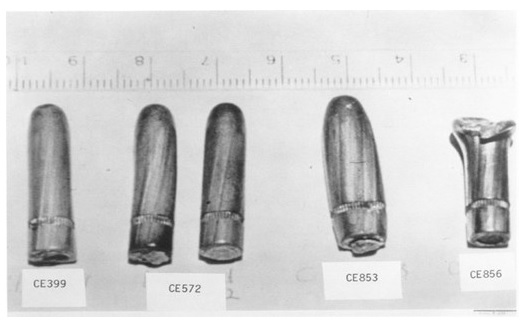
    CE399=Magic Bullet. CE572=Cotton Wadding CE853=Goat CE856=Cadaver Wrist.

    60. CE543, The Dented Lip.

    “There were no shells dented in that manner by the HSCA…I have never seen a case dented like this.” Howard Donahue.  Follow this link.

    The discovery of three spent shells on the sixth-floor post-assassination raised significant questions, and notably, CE 543 stands out as a considerable anomaly in the Commission’s claim that a lone gunman fired three shots at President Kennedy.

    In his compelling and meticulously researched article, “The Dented Bullet Shell: Hard Evidence Of Conspiracy In The JFK Assassination,” Michael T. Griffith sheds light on the dubious authenticity of CE 543 as a piece of evidence from the day of the assassination.

    He cites the insights of fellow researcher Dr. Michael Kurtz, who asserts unequivocally, “CE 543 could not have fired a bullet on the day of the assassination. Moreover, it could not have been discharged from the rifle that Oswald allegedly utilized.”

    In the book I coauthored, ”Case Not Closed”, I sought comment upon CE543 from fellow DPUK member Peter Antill. Peter is a weapons enthusiast who shared with me, his opinion regarding the complexities and irregularities presented by CE543. Antill’s analysis revealed that “One of the more striking characteristics of CE 543 is a significant inward-facing dent in the case lip. This raises the question of how and when this damage could have occurred.

    “Researchers have experimented in throwing an empty Carcano case against a wall or standing on it but failed to do any damage. However, one researcher inflicted exactly the same damage seen on CE 543 on an empty cartridge case while he was loading it into his own rifle.

    “Firing a round results in both the case and its lip expanding slightly and hence there is an increased chance of the case catching on a lip below where the barrel meets the breach if someone tries to subsequently chamber it.

    “If CE 543 had been a live round, such damage would not have been possible as the bullet would have helped to guide the round smoothly into the chamber. This means that either the damage was done before the assassination (and therefore the case could not have been used that day) or if it occurred during it, it raises the question as to why the shooter would waste time trying to manually chamber an empty case.


    Signs of Being Dry Fired

    “According to CE 2968 (a letter from FBI Director J. Edgar Hoover to Commission Counsel J. Lee Rankin, dated 2 June 1964) CE 543 was found with three sets of marks on the base which were not found on the other cases fired through the Carcano, as well as other marks which indicated it had been loaded into, and extracted from a weapon, at least three times. In addition, CE 543 had a deeper, more concave dent in its primer (where it had been struck by the firing pin), a characteristic found with dry fired cartridge cases. The FBI actually reproduced this effect on CE 557, an empty case dry fired in the Carcano for comparison purposes.


    Marks from the Magazine Follower

    “The only marks that link CE 543 to the Carcano were produced by the magazine follower. These marks are caused by the pressure of the magazine follower on the last round in the clip, which pushes the remaining rounds in the clip upwards as their predecessors are chambered and then ejected from the rifle.

    “When the final round is chambered, the clip falls past the magazine follower and drops out of the bottom of the magazine well. While other cases had similar marks, the point is that these marks could not have been caused by the Carcano’s magazine follower on the day of the assassination as the last round in the clip (CE 141) was unfired and still chambered in the rifle when it was found.


    The Chamber Impression

    “CE 543 lacks a characteristic displayed by all the other cartridge cases (CE 544, CE 545 and CE 577) that have been chambered in the Carcano – a distinct impression along one side. Even CE 141 (the live round), showed a similar, if less pronounced, impression.

    “This was probably because it wasn’t fired – firing (where the case expands slightly) would accentuate any marks or impressions caused by the chamber. If CE 543 is supposed to have been fired in the Carcano, how could it be missing this distinct impression?” (Case Not Closed; p. 141-145)


    Final Summation.

    I wish to conclude my article with a poignant reflection on the hope and loss that defined 1960s America. A profound representation of these conflicting emotions can be found in Robert Kennedy’s speech, ‘The Mindless Menace of Violence.’ This speech not only encapsulates the tragic dichotomy of the era but also continues to resonate today, as it stands as a timeless admonition against violence and a plea for compassion and understanding. It inculpates the fear and brutality that marred that period and yet carries a message of hope, encapsulating the complex spirit of a time that will forever leave its mark on the nation’s history.

    The Mindless Menace of Violence

    “Mr. Chairman, ladies and gentlemen, I speak to you under different circumstances than I had intended to just twenty-four hours ago. For this is a time of shame and a time of sorrow. It is not a day for politics.

    I have saved this one opportunity–my only event of today–to speak briefly to you about the mindless menace of violence in America which again stains our land and every one of our lives. It’s not the concern of any one race. The victims of the violence are black and white, rich and poor, young and old, famous and unknown. They are, most important of all, human beings whom other human beings loved and needed. No one–no matter where he lives or what he does–can be certain whom next will suffer from some senseless act of bloodshed.

    And yet it goes on and on and on in this country of ours. Why? What has violence ever accomplished? What has it ever created? No martyr’s cause has ever been stilled by an assassin’s bullet. No wrongs have ever been righted by riots and civil disorders. A sniper is only a coward, not a hero; and an uncontrolled or uncontrollable mob is only the voice of madness, not the voice of the people. Whenever any American’s life is taken by another American unnecessarily–whether it is done in the name of the law or in defiance of the law, by one man or by a gang, in cold blood or in passion, in an attack of violence or in response to violence–whenever we tear at the fabric of our lives which another man has painfully and clumsily woven for himself and his children–whenever we do this, then the whole nation is degraded.

    “Among free men,” said Abraham Lincoln, “there can be no successful appeal from the ballot to the bullet; and those who take such appeal are sure to lose their case and pay the cost.” Yet we seemingly tolerate a rising level of violence that ignores our common humanity and our claims to civilization alike. We calmly accept newspaper reports of civilian slaughter in far off lands. We glorify killing on movie and television screens and we call it entertainment. We make it easier for men of all shades of sanity to acquire weapons and ammunition that they desire. Too often we honor swagger and bluster and the wielders of force. Too often we excuse those who are willing to build their own lives on the shattered dreams of other human beings. Some Americans who preach nonviolence abroad fail to practice it here at home.

    Some who accuse others of rioting, and inciting riots, have by their own conduct invited them. Some look for scapegoats; others look for conspiracies. But this much is clear: violence breeds violence; repression breeds retaliation; and only a cleansing of our whole society can remove this sickness from our souls. For there is another kind of violence, slower but just as deadly, destructive as the shot or the bomb in the night. This is the violence of institutions–indifference, inaction, and decay.

    This is the violence that afflicts the poor, that poisons relations between men because their skin has different colors. This is a slow destruction of a child by hunger, and schools without books, and homes without heat in the winter. This is the breaking of a man’s spirit by denying him the chance to stand as a father and as a man amongst other men. And this too afflicts us all. For when you teach a man to hate and to fear his brother, when you teach that he is a lesser man because of his color or his beliefs or the policies that he pursues, when you teach that those who differ from you threaten your freedom or your job or your home or your family, then you also learn to confront others not as fellow citizens but as enemies–to be met not with cooperation but with conquest, to be subjugated and to be mastered.

    We learn, at the last, to look at our brothers as alien, alien men with whom we share a city, but not a community, men bound to us in common dwelling, but not in a common effort. We learn to share only a common fear–only a common desire to retreat from each other–only a common impulse to meet disagreement with force. For all this there are no final answers for those of us who are American citizens. Yet we know what we must do, and that is to achieve true justice among all of our fellow citizens.

    The question is not what programs we should seek to enact. The question is whether we can find in our own midst and in our own hearts that leadership of humane purpose that will recognize the terrible truths of our existence. We must admit the vanity of our false distinctions, the false distinctions among men, and learn to find our own advancement in search for the advancement of all. We must admit to ourselves that our children’s future cannot be built on the misfortune of another’s. We must recognize that this short life can neither be ennobled or enriched by hatred or by revenge.

    Our lives on this planet are too short, the work to be done is too great to let this spirit flourish any longer in this land of ours.

    Of course we cannot banish it with a program, nor with a resolution. But we can perhaps remember–if only for a time–that those who live with us are our brothers, that they share with us the same short moment of life, that they seek–as do we–nothing but the chance to live out their lives in purpose and in happiness, winning what satisfaction and fulfillment that they can.

    Surely this bond of common fate, surely this bond of common goals can begin to teach us something. Surely we can learn, at the least, to look around at those of us, of our fellow man, and surely we can begin to work a little harder to bind up the wounds among us and to become in our hearts brothers and countrymen once again. Tennyson wrote in Ulysses: that which we are, we are; one equal temper of heroic hearts, made weak by time and fate, but strong in will; to strive, to seek, to find, and not to yield. Thank you very much.” – Robert Francis Kennedy.  Follow this link.


    Go to Part 1 of 6

    Go to Part 2 of 6

    Go to Part 3 of 6

    Go to Part 4 of 6

    Go to Part 5 of 6

  • Part 3 of 6: The Contamination of Evidence, the Inadmissible Lineups and the Autopsy

    Part 3 of 6: The Contamination of Evidence, the Inadmissible Lineups and the Autopsy


    21. Marina’s Credibility.

    The issue of Marina Oswald’s credibility and the evidence suggesting inconsistencies in her testimony is a matter of significant interest. The available evidence, which includes a declassified letter from Freda Scobey and a report from the House Select Committee on Assassinations (HSCA), presents concerns regarding the reliability of Marina’s statements.

    In a declassified letter from attorney Freda Scobey, who worked for Warren Commissioner Richard Russell, there are allegations that Marina, “directly lied on at least two occasions” to the Warren Commission and that Marina’s Testimony “is so full of confusion and contradiction that without the catalystic element of cross-examination it reads like a nightmare. By her own admission Marina is a liar, and it is her voice that tells us how intensely she disliked the FBI and how she lied to that agency almost uniformly. When asked, for example, about the Walker note, she denied knowledge of it, but later admitted her husband wrote it. And when asked on December 3, if she had ever witnessed her husband leaving the house with the rifle, she replied No, but afterwards reversed this by saying she had frequently seen Lee go in and out carrying the rifle, once to “Lopfield” (Love Airfield) for target practice, and, on other occasion, to the park to shoot leaves. How, one asks, can a man go to the park with a rifle either by day or night and shoot leaves off the trees without being reported to the police?” (see this)

    Furthermore, the HSCA report titled: “Marina Oswald-Porter, Statements of a Contradictory Nature,” raises additional doubts about Marina’s credibility. This report, spanning 29 pages, documents inconsistencies in Marina’s statements related to various aspects of the case.

    These reports cast doubt on Marina’s reliability as a source of information in the investigation. The allegations of deception, contradictions, and the questioning of her credibility in these documents are significant factors to consider when evaluating her testimonies before the Warren Commission and their impact on the overall assessment of the case against Oswald.

    Scobey notes that: “Marina is making quite the fortune out of this assassination. It does seem to me that if her testimony lacks credibility there is no reason for sheltering her. The above spots where her veracity was not tested are perfectly obvious to any person reading the report in connection with the transcript, and it might become a policy matter whether this decision to brush her feathers tenderly is well advised.” (see here)

    22. The Contamination Of Evidence.

    Commission Conclusion: “Fibres in paper bag matched fibres in blanket. When Paul M. Stombaugh of the FBI Laboratory examined the paper bag, he found, on the inside, a single brown delustered viscose fibre and several light green cotton fibres. The blanket in which the rifle was stored was composed of brown and green cotton, viscose and woollen fibres.” (WCR; p. 136)

    Evidence In the Record Which Refutes Commission Conclusion:

    The mingling of crucial evidence by the Dallas Police, from the homicide investigations pertaining to President Kennedy and Officer Tippit, in the photographs presented below, raise serious concerns about its scientific credibility. The clear touching of the paper sack (CE142) and the blanket from the Paine garage, poses a considerable risk of cross-contamination. Such contamination not only undermines the integrity of the evidence but also brings into question the ability to reliably connect Oswald to the crimes.

    A thorough and precise approach to handling evidence is crucial to maintaining the investigation’s integrity and building a solid case against an accused individual. Thus, the questionable composition and potential contamination of evidence in these photographs escalate concerns about the overall authenticity of the case against Oswald.

    According to an FBI document dated November 23rd, 1963, from J. Edgar Hoover, the following evidence, was received by Special Agent Orin Bartlett on November 22nd, 1963.

    • Two 6.5 millimeter Mannlicher-Carcano cartridge cases found in the Book Depository Building.
    • Oswald’s right palm print found on a book carton which was part of the ‘snipers perch’ in the Book Depository.
    • A metal fragment from Governor Connally’s arm.
    • A .38 Special bullet taken from Officer Tippit’s body.
    • Textile fibres ‘found’ on the Carcano.
    • The unfired 6.5mm Carcano cartridge alleged to have been found in the rifle.
    • Paper bag- This is probably the same bag which was ‘found’ on the sixth floor by investigators. (CE142, see point 53)
    • Oswald’s shirt, which he was wearing when arrested.
    • ‘Oswald’s’ Revolver.
    • ‘Oswald’s’ green and brown blanket from the Paine garage. (Jesse Curry, JFK Assassination File; pp.88-90)Picture1

    Picture2Lt. Carl Day asserts that he was the photographer of CE738, However, various aspects of Day’s claim cast a shadow of doubt over his involvement and the veracity of his assertion.
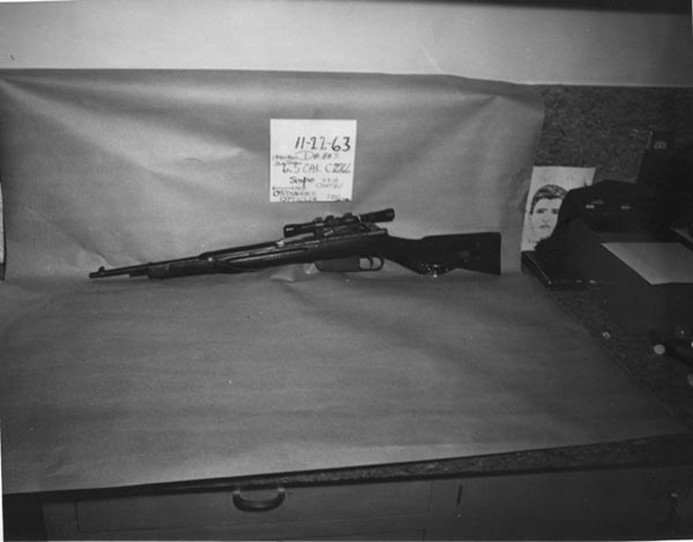
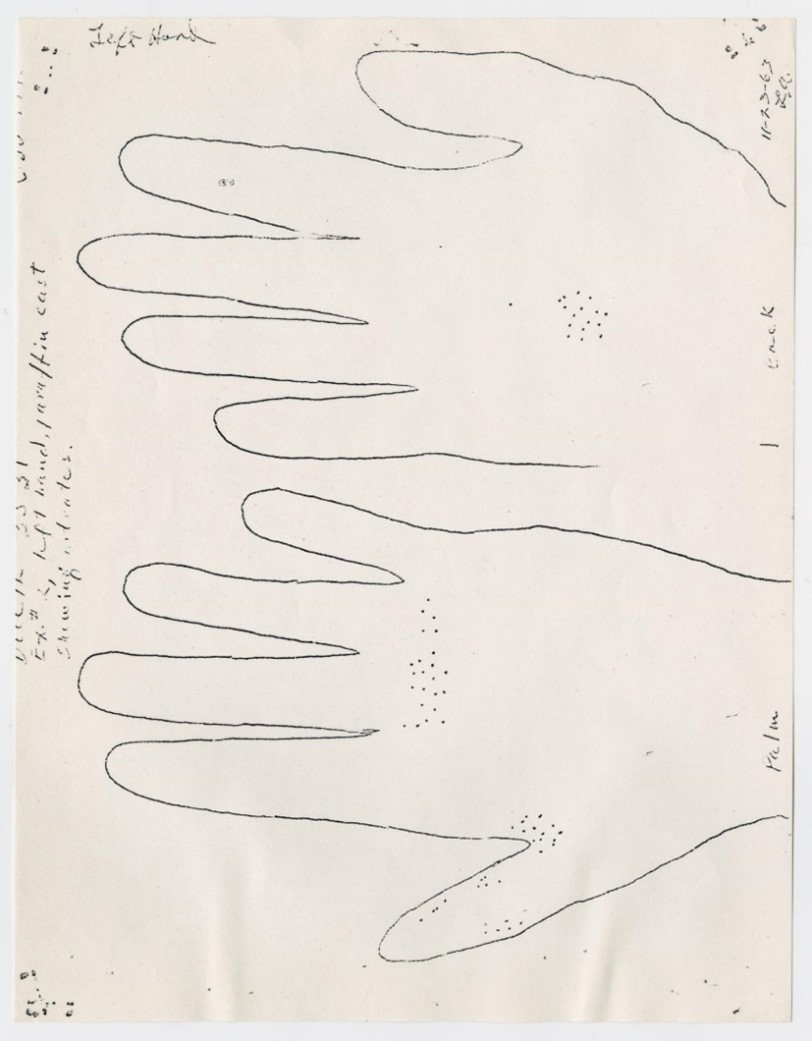
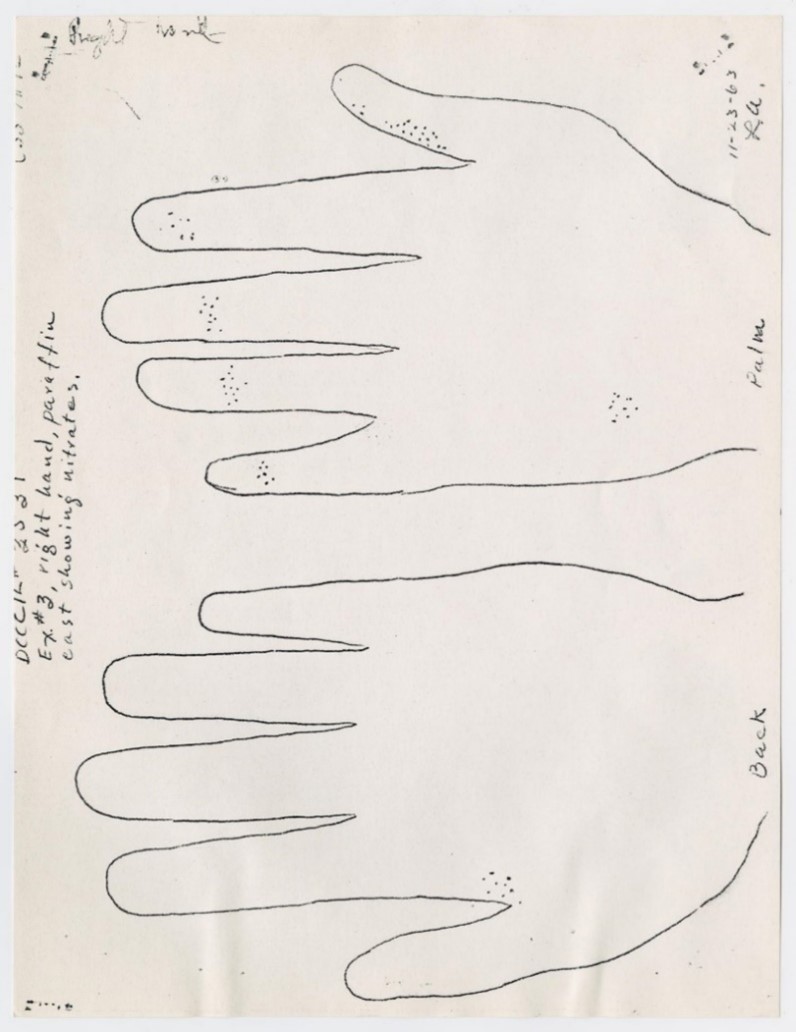
    Remarkably, Day does not include a date in CE738, an omission that stands out since he has included dates in previous evidentiary photographs, e.g., CE737. This inconsistency leads us to question why this particular image would be an exception?

    Day’s assertion that he was the exclusive photographer of CE738 lacks corroboration from any third party, which weakens the credibility of his claim. This ambiguity is amplified by Day’s decision to photograph this evidence upon its second release to the FBI on November 26, instead of at its initial handover to the FBI on November 22. This leads us to wonder whether the Dallas police would not have preferred to maintain a visual record of the evidence being flown to Washington on the 22nd?

    Day’s integrity has been called into question by several sources including Tom Alyea, who accused Day of perjury, [see point 51]. This accusation, along with inconsistencies in his handling of crucial evidence, cast a pall over Day’s credibility. Notably, Day admitted to handling the revolver for the purpose of photographing it but denied marking it.

    David Belin “Did you put any initials on the revolver or not?”
    Lt. Carl Day. “No, sir; I don’t think I did.”

    Belin then continues to question Day regarding CE737 & 738.Picture3

    David Belin. “I am now going to hand you No. 737 and ask you to state if you know what this is.”
    Lt. Carl Day. “Yes, sir. This is the rifle found on the sixth floor of the Texas School Book Depository on November 22, 1963.”
    David Belin. “Who took that picture?”
    Lt. Carl Day. “I took it myself.”
    David Belin. “When?”
    Lt. Carl Day. “About 9 or 9:30 p.m., November 22, on the fourth floor of the City Hall in my office.”
    David Belin. “I am going to now hand you what has been marked as 738 and ask you to state if you know what this is.”
    Lt. Carl Day. “Yes, sir. This is a photograph of most of the evidence that was returned to the FBI the second time on November 26, 1963. It was released to Agent Vince Drain at 2 p.m., November 26.”
    David Belin. “Who took that picture, if you know?”
    Lt. Carl Day. “I took this picture.” (Volume IV; p. 273/274)

    What is striking here is Belin’s detailed questioning about CE737, contrasted with the absence of similar scrutiny for CE738.

    Day’s unconventional decision to combine evidence from two distinct murder investigations into a single image invites additional scrutiny. This method jeopardizes the integrity of both cases, casting a spotlight on Day’s actions and honesty.

    Even if 738 was taken on November 26, after Oswald’s death, the visible cross-contamination within the image questions the reliability of the evidence. Such contamination could render the evidence in this photograph completely useless for future testing. Given the visible cross-contamination, we cannot confidently assert that the evidence was properly handled outside this photograph.

    These factors, including Day’s contested integrity, have substantial implications for the case against Oswald. While Henry Wade might have sought to convince the jury of the state’s evidence’s authenticity, the introduction of this photographic record could cast severe doubt on his case.

    If Oswald had competent legal counsel, this photograph could be pivotal in challenging the state’s case. By emphasizing the potential mishandling and cross-contamination of the evidence, the defense could argue that the evidence’s integrity has been compromised. This photograph serves as a compelling visual aid to underscore these arguments and introduce reasonable doubt about Oswald’s alleged connection to the crimes. Furthermore, the defense could question the rationale behind the Dallas Police’s decision to consolidate evidence from two separate homicide investigations into one photograph – a practice that strays from standard procedure and threatens the reliability of the evidence. Such reasoning could critically undermine the jury’s confidence in the prosecution’s case.”

    23. The Paraffin Test.

    Commission Conclusion.“One would therefore not expect nitrates to be deposited upon a person’s hands or cheeks as a result of his firing a rifle.” (WCR; p. 561)

    “I know that if the case, which has been presented against him, is full of falsehoods and contradictions and I know that right now in the office of the Dallas District Attorney, is a paraffin test which shows that Lee Harvey Oswald did not fire a rifle on November 22 1963. I know that because I have a photostatic copy of that document.” Mark Lane. (see here)

    Just a few hours after the assassination of President Kennedy, Lee Oswald was subjected to a standard forensic procedure applied to individuals suspected of having recently discharged a firearm. This involved a method known as the paraffin test, where a layer of liquid paraffin wax was meticulously applied over the surfaces of Oswald’s hands and onto his right cheek. The principle behind this test was that once the paraffin hardened, it would act as a non-invasive extraction tool, capable of pulling out the most minute residues trapped deep within the pores of his skin, residues that could potentially originate from the firing of a weapon.

    Dr. M. S. Mason, Director of the Dallas City County Criminal Investigative Laboratory, conducted these tests on behalf of the Dallas Police. The items he examined included:

    Exhibit 1. “One manila envelope containing a paraffin cast of the right side of the face of Lee Oswald”.

    Exhibit 2. “One manila envelope containing a paraffin cast of the left hand of Lee Oswald.”

    Exhibit 3. “One manila envelope containing a paraffin cast of the right hand of Lee Oswald.” (see this and this)

    Dr. Mason employed spectrographic analysis, a method regularly used by law enforcement, for the initial test. His findings, reported to the Dallas Police on November 23, 1963, revealed that “No Nitrates were found on exhibit 1. Nitrate patterns consistent with the subject having discharged a firearm were present on exhibits 2 and 3.” The analysis showed evidence of barium and antimony on Oswald’s hands but not on his cheek.

    It is worth noting that these residues, which contain distinct elements like barium and antimony, can also be found in various everyday substances such as “Printing Ink, Paper, Rubber, Plastics, Urine, Tobacco, Cosmetics, and Pharmaceuticals,” etc. Considering Oswald’s job at the Texas School Book Depository, where he frequently handled books, as an order filler, cautious interpretation of these test results is necessary. (WCR; p. 561/562)

    Though spectrographic analysis was deemed reliable enough for most criminal investigations, the lack of positive results on Oswald’s cheek prompted the need for a more incisive examination. This led to the paraffin cast’s being subjected to the process of Neutron Activation Analysis (NAA). This method is capable of detecting the presence of substances in quantities much too small to be identified by spectrographic analysis.Picture4

    Picture5The proposal to subject Oswald’s paraffin casts to Neutron Activation Analysis (NAA) evidently provoked a tangible sense of apprehension within the FBI ranks. This unease seemingly sprang from the potential revelation of exculpatory evidence through the test results. If such evidence was uncovered in Oswald’s favor, it would support the claim that Oswald had not operated a rifle on November 22, 1963, thereby significantly advancing the case for his exoneration.
    On November 27, 1963, in an FBI memorandum, Mr. Jevons (FBI) suggests to his superior, Mr Conrad (FBI), that NAA should be used on Oswald’s casts, “To protect the Bureau against any possible future allegations that if Neutron Activation Analysis type of analysis had been conducted [on the paraffin casts], one might have contained extremely significant data.” Jevons also noted that “allegations might originate from relatively highly placed individuals in the Atomic Energy Commission, charged with developing NAA, who will recognise the publicity potential of such allegations.” Aware of the Bureau’s apprehensions, Mr. Jevons gives such reassurances as, “Oswald is now dead and there will be no trial… Any such examinations will, of course, be with the strict understanding that the information and dissemination of the results will be under complete FBI control.” (see this)

    The results of neutron activation analysis corroborated the findings of the spectrographic examination. No gunpowder residue was present on Lee Oswald’s face, indicating innocence. (see this)

    Despite having knowledge of the genuine results of the Spectrographic Analysis on November 23, 1963, the Dallas Police brazenly announced that Oswald’s paraffin test had returned positive results. This false assertion, deliberately disseminated by members of the Dallas Police and prosecutorial officials, stemmed from their distorted interpretation of the paraffin test findings pertaining to Lee Oswald. The dissemination of such groundlessly accusatory information to the media not only undeservedly cast Oswald in a shroud of suspicion, but it also egregiously violated his constitutional rights. Their contentious remarks, thoroughly marred by deception, are reproduced below for closer scrutiny.

    11/23/63. City detective Charles Brown said he believed the hand tests were positive but was not certain about results of a paraffin test on Oswald’s face.

    11/23/63. Brown said he has great faith in paraffin tests. (AP, 9:42 a.m. CST, Raymond Holbrook and Peggy Simpson.)

    11/23/63. Dallas. Oswald, charged last night with murdering the President, insisted he is not the assassin. But an officer said today, I think we got some good results from the paraffin test on both Oswald’s hands.

    11/23/63. Dallas. Curry said … paraffin tests, made to determine from powder residue whether Oswald had fired a gun, were positive. This meant Oswald had fired a weapon within a short time before he was arrested. Apparently, it could have been either a rifle or a pistol – or both. They wouldn’t say. (AP, 1:50 pm CST Peggy Simpson.)

    11/24/63 Dallas. But a Dallas detective, Charles Brown, said a paraffin test of Oswald’s face and hands for gunpowder particles got good results. The paraffin tests, he said, indicated Oswald recently had fired a rifle – the type of weapon used to kill the President. The gunpowder on the face would come from cradling a rifle against the right cheek while the marksman took aim. It was pointed out that Oswald was also accused of killing Dallas patrolman J. D. Tippitt with a pistol while allegedly trying to flee the assassination scene.

    “Wouldn’t this also leave gunpowder traces on the suspect’s hands?” was one question. But Dallas police indicated that their tests were able to distinguish between gunpowder from a pistol and rifle. (San Francisco Examiner, p. 1 col. 8, Bob Considine, Hearst Headline Service)

    11/24/63. Henry Wade.

    Reporter. “What about the Paraffin tests?”
    Henry Wade. “Yes, I haven’t gone into that. The paraffin tests show he recently fired a gun, it was on both hands.”
    Reporter. “Recently fired a rifle?”
    Henry Wade. “A gun.”

    The Director of the F.B.I. in the Dallas-Fort Worth area in charge of the investigation stated: “I have seen the paraffin test. The paraffin test proves that Oswald had nitrates and gunpowder on his hands and face. It proves he fired a rifle on November 22.” (The Minority of One, 9/64, p.11, “16 Questions on the Assassination”, Bertrand Russell)

    Despite being fully aware of the results of the spectrographic analysis, the Dallas Police persisted in asserting publicly that the findings supported Oswald’s guilt. In certain instances, they went so far as to claim that the test had conclusively detected nitrates on his cheeks, which is an entirely false and fraudulent assertion. (see this)

    (Henry Wade, 11/24/63 Press Conference)

    Nestled within the speculative discourse and conjecture section of the Report, one can find the following declaration:

    Speculation: “Gordon Shanklin, who was the Special Agent in charge of the Dallas office of the FBI, posited that the paraffin test conducted on Oswald’s face and hands produced positive results, indicating that Oswald had indeed fired a rifle.”

    Commission Finding: “However, it’s essential to note that the paraffin tests were undertaken by members of the Dallas Police Department, and the subsequent technical examinations were carried out by the Dallas City-County Criminal Investigation Laboratory. The Commission was notified by the FBI that neither Shanklin nor any other FBI representative had ever made such a claim. The Commission found no substantiating evidence that Special Agent Shanklin had publicly voiced this statement.”

    These statements were underpinned by a letter from J. Edgar Hoover to J. Lee Rankin, dated September 14, 1964. In this communication, Hoover addressed the claim that “Special Agent in Charge, J. Gordon Shanklin of our Dallas Office made a public statement about a paraffin test performed on Lee Harvey Oswald.” Shanklin advised Hoover that he had made no such statement, dubbing the allegation as “completely unfounded.”

    Nonetheless, a conflicting report surfaced from The New York Times on November 25, 1963, claiming Shanklin as the source of the information about Oswald’s positive paraffin tests. The report detailed, “Already the authorities have collected evidence of all sorts, Gordon Shanklin, the FBI agent in charge of Dallas, said today…The FBI noted these other pieces of evidence, which have been assembled by the Dallas Police, FBI, and Secret Service… A paraffin test, used to determine if a person has recently fired a weapon, was administered to Oswald shortly after he was apprehended Friday. It showed particles of gunpowder from a weapon, probably a rifle, remained on Oswald’s cheek and hands” (NY Times; Fred Powledge; November 25th, 1963).

    During the Warren Commission hearings, FBI Special Agent Cortland Cunningham testified about the results of paraffin tests conducted on Lee Oswald. The specific tests in question were aimed at determining whether Oswald had recently fired a weapon, specifically the Mannlicher Carcano, C2766.

    Melvin Eisenberg, one of the Commission’s counsels, inquired whether Cunningham’s tests, or his experience with revolvers and rifles, could shed any light on the significance of a negative result being obtained on the right cheek, stating,

    Melvin Eisenberg.”A paraffin test was also run of Oswald’s cheek, and it produced a negative result.”
    Cortland Cunningham
    . “Yes.”
    Melvin Eisenberg. “Do your tests, or do the tests which you ran, or your experience with revolvers and rifles, cast any light on the significance of a negative result being obtained on the right cheek?”
    Cortland Cunningham. “No, sir; I personally wouldn’t expect to find any residues on a person’s right cheek after firing a rifle due to the fact that by the very principles and the manufacture and the action, the cartridge itself is sealed into the chamber by the bolt being closed behind it, and upon firing the case, the cartridge case expands into the chamber filling it up and sealing it off from the gases, so none will come back in your face, and so by its very nature, I would not expect to find residue on the right cheek of a shooter.”

    Cunningham then testified that he, alongside fellow FBI Agent Charles Killion, executed a rapid-fire test with the rifle, yielding negative results for residues on both the cheek and hands.

    Melvin Eisenberg. Also, before firing the rifle?
    Cortland Cunningham. Yes. We fired the rifle. Mr. Killion fired it three times rapidly, using similar ammunition to that used in the assassination. We reran the tests both on the cheek and both hands. This time we got a negative reaction on all casts.
    Melvin Eisenberg. So, to recapitulate, after firing the rifle rapid-fire no residues of any nitrate were picked off Mr. Killion’s cheek?
    Cortland Cunningham. That is correct, and there were none on the hands. (Volume III; p. 492-494)

    However, Cunningham’s statements were refuted by two different pieces of evidence. The first comes from Vincent P. Guinn, head of the Neutron Activation Analysis (NAA) Section of the General Atomic Division, of the General Dynamics Corporation, in February 1964. Guinn and his colleagues had been using NAA to test the powder residues from discharged firearms. When they ran tests using a rifle similar to the one reportedly owned by Lee Harvey Oswald. Guinn found that “the triple firing of the rifle leaves unambiguous positive tests every time on the paraffin casts. Because of the inferior construction of the Carcano the blowback from one or three shots deposited powder residue on both cheeks of the shooter.(Gerald McKnight, Breach Of Trust; p. 211)

    The second piece of evidence comes from Harold Weisberg, a first-generation researcher who successfully sued for the actual test results from the FBI. Within the records he received, it was stated “These paraffin tests were subjected to NAA…there is no similar evidence [Nitrate] on [Oswald’s] cheek. The tests given me show that in seven “control” cases where others fired a rifle this evidence [Nitrate] was left on the cheeks.” This evidence stands as a direct challenge to Cunningham’s claim that residue wouldn’t be found on a shooter’s cheek. (Weisberg, Post Mortem; p. 437)

    Regrettably, the all-encompassing data yielded from Cunningham’s test – including unprocessed results, spectrographic or neutron activation analyses, photographic proof, and procedural documentation – remains unrevealed. Which makes his testimony problematic to present at trial, especially with the countering evidence described above. That evidence appears to be exculpatory.

    Also why weren’t the clothes worn by Oswald at the Texas School Book Depository and subsequently at his arrest at the Texas Theatre subjected to a gunshot residue analysis? Implementing these tests could have furnished critical evidence that either substantiated or refuted his involvement in the President’s assassination.

    The problems with this evidence shine a spotlight on a fascinating facet of the case. It compelled the Commission to cast a skeptical eye on the veracity of these findings, and the test itself; thereby shrouding these potentially vindicating results in a fog of uncertainty.

    Even Commission counsel Norman Redlich, in a memorandum to Commissioner Alan Dulles, noted, “At best, the analysis shows that Oswald may have fired a pistol, although this is by no means certain. … There is no basis for concluding that he also fired a rifle.” (McKnight, p. 207)

    24. The Dallas Police Line-Ups.

    Commission Conclusion. “The Commission is satisfied that the line ups were conducted fairly.” (WCR; p.169)

    The Department Of Justice.“Testimony concerning a line up or showup identification is inadmissible if, considering the totality of the circumstances, the identification procedure was so impermissibly suggestive as to give rise to a very substantial likelihood of misidentification.” (see here)

    Between November 22 and 23, 1963, a series of line-ups were convened involving Lee Oswald, various Dallas Police personnel, and city prisoners held for unrelated offences. In every instance the participants were required to state their name and occupation to the identifying witness. It is important to note that while some participants provided false information during these line-ups, Oswald consistently provided accurate details about himself, more specifically his infamous name and place of employment, the Texas School Book Depository. Highly concerning is the fact that this information was widely publicised through the media, and many witnesses reported to having observed Oswald’s photograph on television prior to attending the actual line-ups.(Volume VII; p. 239.)

    Joesph Ball. “Now, back to the first showup, did the detective ask you any questions? Ask your name and address and occupation?”
    R. L. Clark. “Yes, sir.”
    Joesph Ball.
    “What did he ask you?”
    R. L. Clark.
    “He asked me my name.”
    Joesph Ball. “Did you give him your real name?”
    R. L. Clark.
    “No, sir.”
    Joesph Ball.
    “Fictitious name?”
    R. L. Clark. “Yes, sir.”
    Joesph Ball.
    “Ask you your occupation?”
    R. L. Clark.
    “Asked my occupation.”
    Joesph Ball.
    “What did you tell him?”
    R. L. Clark
    . “I don’t recall. All of them are fictitious.”
    Joesph Ball.
    “Fictitious?”
    R. L. Clark.
    “Yes, sir.” (Volume XII; p.237/238.)
    Joesph Ball.Policeman ask you any questions? Detective ask you any questions?”
    William Perry.
    “Yes, sir; my name and what have you.”
    Joesph Ball.“Well, what do you mean, “what have you.”?
    William Perry.
    Well, occupation.”
    Joesph Ball.“And what answer did you give him?”
    William Perry.
    “I gave him all fictitious answers.” (Volume XII; p. 234.)
    Joesph Ball.“Did the detective ask you name?”
    Daniel Lujan. “Yes, sir.”
    Joesph Ball.“And did you tell him your name?”
    Daniel Lujan. “Yes, sir.”
    Joesph Ball.“Did he ask your occupation?”
    Daniel Lujan. “Yes, sir.”
    Joesph Ball.“What did you tell him?”
    Daniel Lujan. “Working for S. & F. Meat Co.” (Volume XII; p 245/246)

    The judicial system has established rules by which police departments must adhere to in the assembly of line ups for witness identification. These rules, crucial for maintaining fairness and objectivity, are as follows:

    Participant Similarity: ‘Fillers’ should generally resemble the suspect’s description. This includes aspects like height, weight, age, race, and other distinctive features.

    Inadmissible Lineups.When the others are grossly dissimilar in appearance from the suspect.” (see here)

    Cecil McWatters.“No, sir; they were different ages, different sizes and different heights.” (Volume II; p. 270)

    Lineup Size: A lineup should, by standard, include at least five ‘fillers’ in addition to the suspect. This discourages the suspect from being conspicuously distinctive.

    Suspect’s Position: Suspects should have the liberty to choose their position in the lineup, rather than being consistently stationed at a specific number.

    Oswald, Number 2 man: 3 times. Number 3 man:1 time.

    Witness Instructions: The Police Department should make it clear to the witness that the perpetrator may not be part of the line up, relieving them from the pressure to identify someone.

    David Belin. “Did they tell you one of the men was the man you saw or not, or did they tell you “See if you can”–just what did they say? Did they say, “Here is a lineup, see if you-can identify anyone,” or did they say, “One of the men in the lineup”
    William Scoggins. “Yes, I believe those are the words they used.” (Volume III; p.334)

    Clothing Change: In instances where multiple line ups are conducted, suspects should have their clothing changed. This prevents identification based on clothing instead of physical traits. On November 22, 1963, during all three line-ups, Oswald consistently wore the same clothes, except for the Saturday line-up conducted on November 23. During that particular line-up, Oswald’s brown long-sleeved shirt was missing, as it had been sent to Washington.

    Non-Suggestive Environment: The lineup setting must be unbiased and devoid of suggestive elements. Police officers, for instance, should refrain from hinting at the identity of the suspect.

    Inadmissible Lineups. “When the suspect is pointed out before or during the procedure.” (see here)

    Captain Will Fritz or Jim Leavelle, intimated to an audience which included Ted Calloway, Sam Guinyard and Cecil McWatters that: “We want to be sure. We want to try and wrap him up real tight on killing this officer. We think he is the same one that shot the President, and if we can wrap him up tight on killing this officer, we have got him.” (Volume III; p. 355) (watch this) (see here)

    Line up Protocol and its Importance:

    Inadmissible Lineups. “When an identification is made in the presence of other identifying witnesses.” (see here)

    Adhering to a rigorous and standardized protocol for police line ups is crucial in maintaining the reliability and integrity of witness testimony. This includes taking careful measures to ensure witnesses are kept separate from each other to mitigate any potential influence that may arise from shared discussions or collective reactions. Encouraging each witness to independently identify the suspect underscores the importance of their testimony being solely rooted in their own recollections.

    The primary objective of this protocol is to minimize the risk of corrupting the identification process. Allowing witnesses to converse about the event or discuss the suspect’s attributes could lead to the contamination of the process. Such discourse could inadvertently foster groupthink, induce false positives, or in the worst-case scenario, yield tainted identifications.

    The consequences of such errors are severe and far-reaching. They could trigger misidentifications and, subsequently, wrongful convictions.

    What follows is a compilation of witness testimonies presented to the Commission. These statements confirm that the Dallas Police Department failed to adhere to the established protocol, jeopardizing the integrity of the investigation.

    Sam Guinyard.

    Joseph Ball. “Were you with Ted [Calloway] at the time?”
    Sam Guinyard. “Yes, sir.”
    Joseph Ball. “How close was Ted to you?”
    Sam Guinyard. “Oh, sitting about like that.”
    Joseph Ball. “You mean 3 or 4 feet away from you?”
    Sam Guinyard. “Yes, something like that.” (Volume VII; p. 400)

    Ted Calloway.“We first went into the room. There was Jim Leavelle, the detective, Sam Guinyard, and then this bus driver and myself. We waited down there for probably 20 or 30 minutes.” (Volume III; p. 355)
    William Whaley.“Then they took me down in their room where they have their showups, and all, and me and this other taxi driver [William Scoggins] who was with me, sir, we sat in the room awhile and directly they brought in six men, young teenagers, and they all were handcuffed together.” (Volume II p. 260/261)

    William Scoggins.

    David Belin. “Mr. Scoggins, when you identified the man in the line up at the police station on November 23, was there any other person who at the same time was asked to identify a man in that lineup?”
    William Scoggins. “Yes, one other.”
    David Belin. “Do you know-one other person?”
    William Scoggins. “Yes.” (Volume III; p. 337)

    Virginia Davis

    David Belin. “Where was your sister when you identified him?”
    Virginia Davis. “She was sitting right next to me.”
    David Belin. “How did you identify him? Did you yell that this is the man I saw?” Where was the detective? Was he to your right or to your left?”
    Virginia Davis. “Let’s see to my right.”
    David Belin. “Where was your sister, to your right or to your left?”
    Virginia Davis. “Right.”
    David Belin. “As she was to your right, so you leaned over to the detective and told the detective it was No. 2?”
    Virginia Davis. “Yes, sir.” (Volume VI; p. 462)

    The following is a chronological record of the line ups conducted by the Dallas Police Department on 11/22-11/23-1963.

    11/22/63 16:05
    Showup 1.Picture6
    Picture71. William E Perry, Dallas Police Officer. Aged 34. 5’10”1/2”. 170 Pounds. Brown Hair. Blue Eyes. Dark Complexion. Brown Sports Coat. Gave fictitious name and occupation to witness.
    2. Lee H. Oswald, Texas School Book Depository, Warehouse Employee. Tattered Brown Long Sleeved Shirt. Tattered White T-Shirt. Dark Pants. Aged 24. 5’ 9”.131 Pounds. Medium Build. Brown, Receding Hair. Blue Eyes. Bruise Over His Right Eye. Cut On His Forehead.
    3. R. L. Clark, Dallas Police Officer. Aged 31. 5’9,3/4”. 170 Pounds. Blond Hair. Blue Eyes. Ruddy Complexion. Red Vest, Short Sleeve White Shirt, Brown Pants With Belt. Gave fictitious name and occupation to witness.
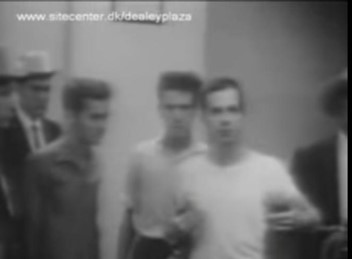
    4. Don Ables, Dallas Police Jail Clerk. Aged 26. 5’9”. 165 Pounds. Brown Hair. Eyes Brown. Ruddy Complexion. White Shirt, Gray-Knit Sweater. Dark Trousers. Gave fictitious name and occupation to witness.
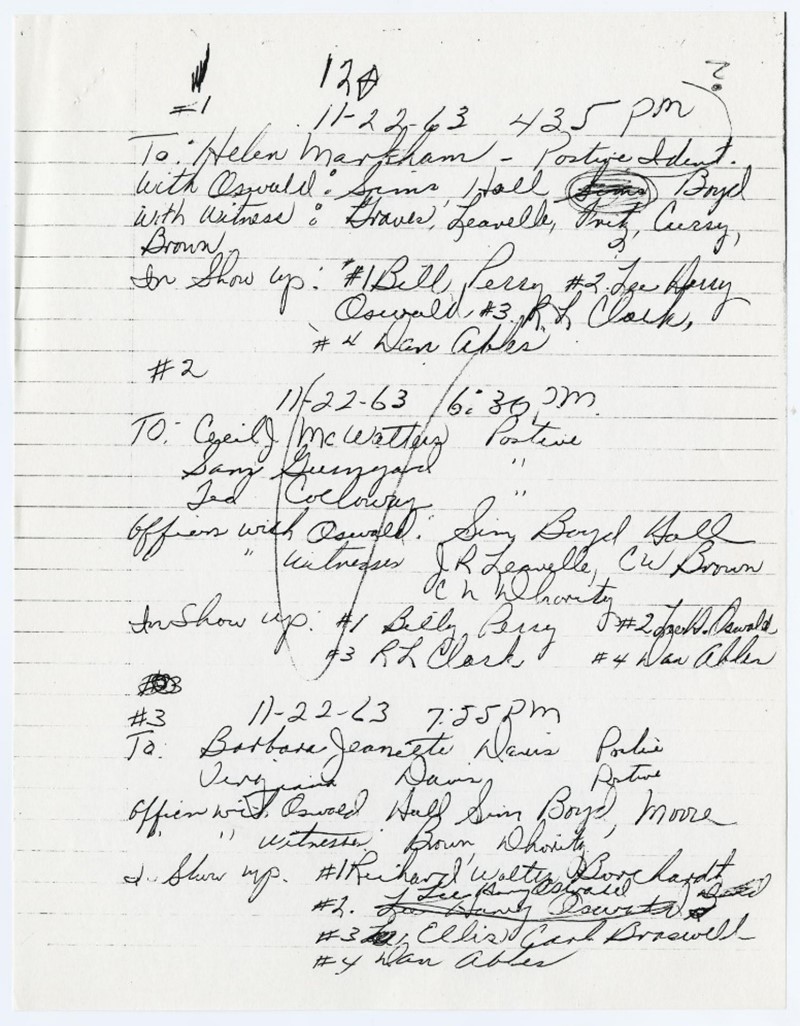
    (Volume VII; p. 125/168,170,233,236, 241/242)
    Joseph Ball. “It’s unusual to use officers to show up prisoners?”
    Elmer Boyd. “Well, I would say so.”
    Joseph Ball.“Is that usual to use Don Ables, the clerk, in a show up?”
    Elmer Boyd.“No, sir.”
    Joseph Ball.“It is unusual?”
    Elmer Boyd.“Yes.” (Volume VII; p. 125)

    11/22/63 18:20.
    Showup 2.
    1. William E Perry, Dallas Police Officer. Aged 34. 5’10”1/2”. 170 Pounds. Brown Hair. Blue Eyes. Dark Complexion. Brown Sports Coat. Gave fictitious name and occupation to witnesses.
    2. Lee H. Oswald, Texas School Book Depository, Warehouse Employee. Tattered Brown Long Sleeved Shirt. Tattered White T-Shirt. Dark Pants. Aged 24. 5’ 9”.131 Pounds. Medium Build. Brown, Receding Hair. Blue Eyes. Bruise Over His Right Eye. Cut On His Forehead.
    3. R. L. Clark, Dallas Police Officer. Aged 31. 5’9,3/4”. 170 Pounds. Blond Hair. Blue Eyes. Ruddy Complexion. Red Vest, Short Sleeve White Shirt, Brown Pants With Belt. Gave fictitious name and occupation to witnesses.
    4. Don Ables, Dallas Police Jail Clerk. Aged 26. 5’9”. 165 Pounds. Brown Hair. Eyes Brown. Ruddy Complexion. White Shirt, Gray-Knit Sweater. Dark Trousers. Gave fictitious name and occupation to witnesses.
    (Volume VII; p. 125,168,169,170,233,236, 241/242)Picture8
    Joseph Ball.“Were they dressed differently than Oswald?”
    Richard Sims. “Yes; I know they didn’t have the color of clothes on or things like that.”
    Joseph Ball.“His clothes were rougher looking than the other men?”
    Richard Sims.“Well, I don’t imagine that he would be dressed as nice as the officers were, as far as their clothes.” (Volume VII; p. 170)
    Joseph Ball.“The other three were better dressed than Oswald, would you say?”
    Elmer Boyd.“Well, yes, sir; I would say they probably were.”(Volume VII; p. 127)

    11/22/63 19:40
    Showup 3.Picture9
    1. Richard Walter Borchgardt. City Prisoner. Aged 23. 161 Pounds. 5’9”. Brown Hair. Blue Eyes. Fair Complexion.
    2. Lee H. Oswald, Texas School Book Depository, Warehouse Employee. Tattered Brown Long Sleeved Shirt. Tattered White T-Shirt. Dark Pants. Aged 24. 5’ 9”.131 Pounds. Medium Build. Brown, Receding Hair. Blue Eyes. Bruise Over His Right Eye. Cut On His Forehead.
    3. Ellis C. Brazel. City Prisoner.. Aged 22. 5’10”. 169 Pounds. Green Eyes. Blond Hair. Ruddy Complexion
    4.Don Ables, Dallas Police Jail Clerk. Aged 26. 5’9”. 165 Pounds. Brown Hair. Eyes Brown. Ruddy Complexion. White Shirt, Gray-Knit Sweater. Dark Trousers. Gave fictitious name and occupation to witnesses.
    (Volume VII; p. 131/132,170, 41/242

    11/23/63.
    Showup 4.Picture10
    David Belin. “Had you seen any pictures of Lee Harvey Oswald in the newspapers prior to the time you went to the police station lineup?”
    William Scoggins. “I think I saw one in the morning paper.”(Volume III; p.334)
    1. John T. Horne. City Prisoner. Aged 17. Dark Shirt. Dark Pants. Dark Thick Hair.
    2. David Knapp. City Prisoner. Aged 18. White Shirt. Dark Pants. Dark Thick Hair.
    3. Lee H. Oswald. Texas School Book Depository, Warehouse Employee. Tattered White T-Shirt. Dark Pants. Aged 24. 5’ 9”.131 Pounds. Medium Build. Brown, Receding Hair. Blue Eyes. Bruise Over His Right Eye. Cut On His Forehead.
    4. Daniel Lujan. City Prisoner. Aged 26. 170 Pounds. 5’8”. Black Hair. Brown Eyes. Complexion Olive. Mexican. Blue Shirt. Brown Jacket.
    (Volume VII; p. 170, 245/246) (watch this

    The Curious Case Of Howard Brennan.

    Determining which line up Howard Brennan attended should, in theory, be straightforward. However, the available records yield no clear answer to this surprisingly complex question. This intriguing issue was first highlighted by Ian Griggs, who found no explicit evidence of Brennan attending any specific line up. As outlined in Commission Exhibit 2003, the list of ‘witnesses’ for the line ups is as follows: Helen Markham, Cecil McWatters, Sam Guinyard, Ted Calloway, Barbara Davis, and Virginia Davis on 11/22/63; and William Scoggins and William Whaley on 11/23/63. It is perplexing that the Dallas Police would allow ‘witnesses’ from two distinct homicide cases to participate in the same line up. Furthermore, the actions McWatters and Whaley supposedly witnessed are ambiguous at best. After all, when did taking a bus home or hailing a taxi qualify as a crime?”(Volume XXIV; p. 347)

    For some perspective on this issue, let us first look at the testimony of Brennan himself on this point.

    David Belin.“Now, taking you down to the Dallas Police Station, I believe you said you talked to Captain Fritz. And then what happened?”
    Howard Brennan. “Well, I was just more or less introduced to him in Mr. Sorrels’ room, and they told me they were going to conduct a line up and wanted me to view it, which I did.”
    David Belin. “Do you remember how many people were in the line up?”
    Howard Brennan. “No, I don’t. A possibility seven more or less one.”
    David Belin. “All right. Did you see anyone in the line up you recognized?”
    Howard Brennan. “Yes.”
    David Belin. “And what did you say?”
    Howard Brennan. “I told Mr. Sorrels and Captain Fritz at that time that Oswald–or the man in the lineup that I identified looking more like a closest resemblance to the man in the window than anyone in the lineup.”
    David Belin. “Were the other people in the lineup, do you remember–were they all white, or were there some Negroes in there, or what?”
    Howard Brennan. “I do not remember.” (Volume III; p. 147)

    Here are some notable observations drawn from this excerpt of Brennan’s testimony:

    1. The line-up consisted of four individuals, three fillers and the suspect. If Brennan did indeed view a line-up, how could he possibly forget such a critical detail?
    2. Brennan identified both SS Agent Sorrels and Captain Fritz as present at this line-up.
    3. Curiously, Brennan could not recall the ethnic backgrounds of those in the line-ups. This strikes me as odd. Could Brennan, in his lifetime, have participated in an event more dramatic and pivotal? And in Texas? During segregation?

    The idea that he could forget such fundamental elements of the procedure, assuming he genuinely attended, is quite puzzling to me.

    Now let us take a look at the testimony of Forrest Sorrells.

    Forrest Sorrells. “I got a hold of Captain Fritz and told him that the witness was there, Mr. Brennan. He said, I wish he would have been here a little sooner, we just got through with a line up. But we will get another fixed up. So I took Mr. Brennan, and we went to the assembly room, which is also where they have the line up, and Mr. Brennan, upon arrival at the police station, said, I don’t know if I can do you any good or not, because I have seen the man that they have under arrest on television, and he said. I just don’t know whether I can identify him positively or not because he said that the man on television was a bit dishevelled and his shirt was open or something like that, and he said the man I saw was not in that condition.

    So when we got to the assembly room, Mr. Brennan said he would like to get quite a ways back, because he would like to get as close to the distance away from where he saw this man at the time that the shooting took place as he could.
    And I said, “Well, we will get you clear on to the back and then we can move up forward.
    They did bring Oswald in in a line up. He looked very carefully, and then we rooted him up closer and so forth, and he said, I cannot positively say.
    Sam Stern. “How many other people were in the line up?”
    Forrest Sorrells. “As I recall it, there were five. In other words, all told there was five or six-I don’t remember. I believe there were five.”
    Sam Stern. “Were the others reasonably similar to Oswald in height and physical appearance, and color?”
    Forrest Sorrells. “I noted that to me I thought it was a very fair line up, because they didn’t have anyone that was a lot taller than he was, or anyone a lot shorter. They didn’t have any big fat ones or anything like that. In other words, to me it was a good lineup.” (Volume XII; p. 354/355)

    1. In an affidavit dated November 22, 1963, Mr. Brennan asserted that “he could identify the man if he ever saw him again”, as noted in point 7.
    2. Sorrells failed to specify which line-up Brennan attended or identify any other attendees of the line-up.
    3. Sorrells estimates that there were either “five or six” individuals present at the line-up. It raises questions about Sorrells’ accuracy, given that only four individuals were supposed to be viewed.
    4. Sorrells described it as a “very fair line-up.” This mysterious line-up, which Mr. Brennan allegedly attended, appears to be more of an anomaly than the norm. Given what we know, it’s impossible for an unbiased observer to conclude that the line-ups conducted by the Dallas Police Department were anything but fundamentally flawed, exhibiting a shocking disregard for established protocols.

    Lastly, let’s examine the testimony of Will Fritz regarding this matter.

    John McCloy.“Were you present at the show up at which Brennan was the witness?”
    Will Fritz. “Brennan?”
    John McCloy. “Brennan was the alleged…”
    Will Fritz. “Is that the man that the Secret Service brought over there, Mr. Sorrels brought over?”
    John McCloy. “I don’t know whether Mr. Sorrels…”
    Will Fritz. “I don’t think I was present but I will tell you what, I helped Mr. Sorrels find the time that that man–we didn’t show that he was shown at all on our records, but Mr. Sorrels called me and said he did show him and he wanted me to give him the time of the showup. I asked him to find out from his officers who were with Mr. Brennan the names of the people that we had there, and he gave me those two Davis sisters, and he said, when he told me that, of course, I could tell what showup it was and then I gave him the time.”
    John McCloy. “But you were not present to the best of your recollection when Brennan was in the showup?”
    Will Fritz. “I don’t believe I was there, I doubt it.” (Volume IV; p. 237)

    Here are some notable observations drawn from this excerpt of Fritz’s testimony:

    1. Strangely, Fritz appears not to recognize the name Brennan, even though Brennan was a pivotal witness in his case.
    2. Fritz seems to distance himself from the assertion that he was present at Brennan’s line-up.
    3. According to Fritz, it was Sorrells who informed him that Brennan had been taken to a line-up. Oddly, however, Sorrells wanted Fritz to specify the time of the line-up.
    4. It raises the question, who are the officers that Fritz is referencing?
    5. As Ian Griggs highlights, Brennan did not attend the Davis sisters’ line-up. Griggs posed this query to Dale Myers, who in turn asked Barbara Davis if Brennan or someone fitting his description had been present at her line-up. Barbara’s response was: “Just me and my sister-in-law and some guys from law enforcement” (No Case To Answer; pp. 92/93).
    6. Lastly, if Brennan did indeed attend a line-up, it’s perplexing as to why his name was not listed in any of the Dallas Police Department records concerning these line-ups.

    As highlighted by Ian Griggs, the undeniable facts remain that:

    1. “Brennan or his description, does not appear in the testimony of any of the other eyewitnesses who attended the line-ups. Markham, Calloway, Guinyard, McWatters, Barbra and Virginia Davis, Scoggins, Whaley, fail to mention Brennan.”
    2. “The name Brennan does not appear in the testimony or affidavits of any of the DPD officers who supervised the line-ups on record. Chief Curry, Sims, Boyd, Graves, Leavelle, Dhority, Moore, Potts, Brown, Hall, Senkel.” (Griggs, pp. 77-100)

    Brennan’s name is not only absent from the DPD’s records relating to line-ups, but also from the testimonies and affidavits of the officers present at the other line-ups. Why is this the case? Despite its seemingly straightforward nature, why is there a sense of obfuscation around this event?Picture11

    Picture12Dr Buckout Evaluates.

    In 1979, the late Larry Harris approached Dr. Robert Buckout to assess the Dallas Police line-ups in which Lee Oswald was subjected to. Dr. Buckout, a renowned expert in eyewitness testimony and identification procedures, reached a clear conclusion. He stated,

    “By any stretch of the imagination, virtually every rule in the book was violated in the conduct of these line-ups. The results of any of the line-ups conducted as poorly and under hysterical circumstances, as they were, should be regarded as utterly worthless.” (watch this)

    Line-up participate Daniel Lujan on Oswald’s objections to the lineup:

    Joesph Ball.“You were handcuffed to Oswald?”
    Daniel Lujan. “Yes, sir.”
    Joesph Ball. “He was complaining, was he?”
    Daniel Lujan. “About having a T-shirt and wanted a jacket or something.”
    Joesph Ball.“Oswald was doing some talking?”
    Daniel Lujan.“Yes.”
    Joesph Ball. “Was he shouting loud?”
    Daniel Lujan. “He was shouting. He, he was shouting, said all of us had a shirt on and he had a T-shirt on. He wanted a shirt or something.” (Volume XII; p. 245/246)

    Dr. Buckout’s assessment illuminates the serious flaws and deficiencies in the line-ups conducted by the Dallas Police Department. As an expert in the field of eyewitness testimony and identification procedures, his conclusion carries substantial weight, suggesting that the line-ups were conducted in a manner that not only violated established protocols but implies that they were conducted in such a manner which would reach a desired conclusion. Additionally, the actions of Fritz/Leavelle exposes a specific agenda and a desire to not only link Oswald to the murder of Officer Tippit, but also to the assassination of President Kennedy. It suggests a deliberate effort to construct a strong case against Oswald by solidifying his involvement in both crimes. This highlights the Dallas Police’s predisposition to connect Oswald to both murders, thereby influencing the direction of the investigation and subsequent legal proceedings. This again raises serious questions regarding Oswald’s treatment at the hands of the Dallas Police.

    “When a line up or showup is conducted in violation of the defendant’s right to due process, an in-court identification of the defendant will not be permitted unless the government can establish an independent source. The factors used to establish an independent source where a line up or showup has been conducted in violation of the defendant’s right to counsel are also applicable here.” (see here)

    25. Oswald Gets No Defense.

    Marguerite Oswald:“My son, Lee Harvey Oswald, was tried and convicted within a few hours time, without benefit of counsel. And so, I am appealing to the Board that my son, Lee Harvey Oswald, be represented by counsel… I implore you, I implore you, in the name of justice, to let my son, Lee Harvey Oswald, who is accused of assassinating the President, and I, the mother of this man, who is the accused’s mother, be represented by counsel. Marguerite Oswald. (Volume I; p. 127/128)

    Mark Lane, a seasoned attorney and vocal critic of the case against Oswald, was enlisted by Marguerite, Oswald’s mother. He put forth a petition to the Warren Commission, articulating his intent to advocate for Oswald’s legal rights during the forthcoming hearings. Prior to this, Lane had addressed a letter to Chief Justice Earl Warren, stating, “It would be appropriate that Mr. Oswald, from whom every legal right was stripped, be accorded counsel who may participate with the single purpose of representing the rights of the accused.” Nonetheless, Lane’s request to represent Oswald was rejected. As substantiation, Lane cited a letter dated January 23, 1964, from J. Lee Rankin, the Commission’s counsel. The correspondence stated, “The Commission does not believe that it would be useful or desirable to permit an attorney representing Lee Harvey Oswald to have access to the investigatory materials within the possession of the commission or to participate in any hearings to be conducted by the commission.” Earl Warren also informed Lane “that Oswald was not on trial, and that counsel would not be permitted to represent him”(NY Times, 26 Feb 1964; p. 17)

    26. President Kennedy’s Clothing.

    Picture13Commission Conclusion. “President Kennedy was first struck by a bullet which entered at the back of his neck and exited through the lower portion of his neck.” (WCR, P19.)Picture14
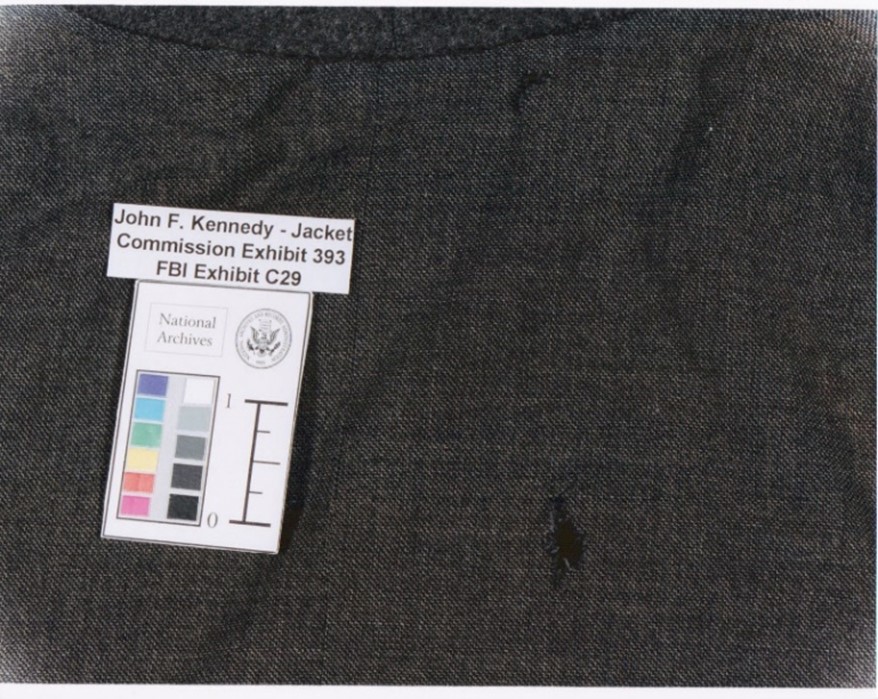
    The clothing worn by President Kennedy serves as compelling evidence in this case. An examination of the garments reveals that President Kennedy sustained a gunshot wound in the upper portion of his back, specifically near the third thoracic vertebra. This fact finds support in numerous eyewitness testimonies and the documented evidence on the record. Had Oswald gone to trial, it would have been imperative for Henry Wade to demonstrate to the jury that despite the President’s shirt and jacket displaying a clear and concise bullet hole in the back, the actual entry point of the sustained injury was at the base of President Kennedys neck.

    Sibert & O’Neill

    FBI agents James Sibert & Francis O’Neill took meticulous notes during the Presidents autopsy. Included in these notes is a detailed description of the wounds sustained by the President.

    “During the latter stages of this autopsy, Dr Humes located an opening which appeared to be a bullet hole which was below the shoulders and two inches to the right of the middle line of the spinal column. This opening was probed by Dr Humes with the finger, at which time it was determined that the trajectory of the missile entering at this point had entered at a downward position of 45 to 60 degrees. Further probing determined that the distance travelled by this missile was a short distance as much as the end of the opening could be felt with the finger.” (Sibert and O’Neil Report on the Autopsy 11/26/63) (see this)

    Admiral George Burkley, Official Whitehouse Death Certificate, 11/23/63. “A second wound occurred in the posterior back at about the level of the third thoracic vertebra.” (see this)Picture15

    Picture16Admiral George Burkley.Signed “verified” to the Autopsy Face sheet which depicts the wound in President Kennedy’s back way below the neckline, around the third thoracic vertebra.
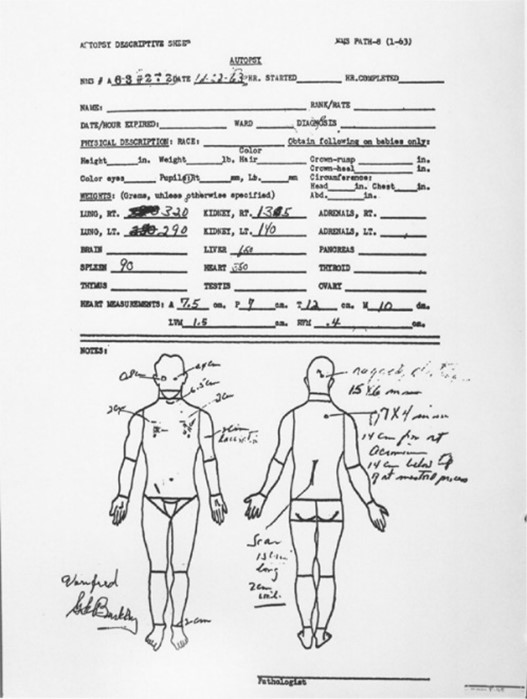
    Clint Hill.“I saw an opening in the back, about six inches below the neckline to the right-hand side of the spinal column.”(Volume II; p.143)

    Roy Kellerman.“While the President is in the morgue, he is lying flat. And with part of the skull removed, and the hole in the throat, nobody was aware until they lifted him up that there was a hole in the shoulder. That was the first concrete evidence that they knew that the man was hit in the back first.” (Volume II; p.103)

    Roy Kellerman.“The other wound I noticed was in his shoulder”.

    Arlen Specter.“Which Shoulder”
    Roy Kellerman. “Right shoulder…the upper neckline, sir, in that large muscle between the shoulder and the neck, just below it.” (Volume II; p. 81)

    Glen Bennett.“At this exact time, I saw a shot that hit the Boss about 4 inches down from the right shoulder; a second shot followed immediately and hit the right rear high of the Boss’s head.” (Volume XXIV, pp. 541/542)

    Willam Greer. “It was, to the best of my recollection it was, back here, just in the soft part of the shoulder.” (Volume II; p.127)

    Paul O’Connor.“Finally, we turned the body over, and there was a bullet wound-an entrance wound-in his back, on the right side of his spinal column. To emphasize where it was in proximity to the rest of his body: if you bend your neck down and feel back, you feel a lump and that’s the seventh cervical vertebra. This bullet wound was about three inches down and an inch or two to the right of the seventh cervical vertebra.” (William Law, In The Eye Of History; p.199)

    Jim Jenkins.“There was a bullet wound around the scapula in the back.”
    William Law. “How far do you say that was. Give me an estimate: T1, T2-?”
    Jim Jenkins. “He thinks, reaching around touching his back…I would say say about T4” [the fourth thoracic vertebra. (Law, p.226)

    Pierre Finck, one of three autopsy pathologists who conducted the President’s autopsy has revealed that: “I was denied the opportunity to examine the clothing of Kennedy. One officer who outranked me told me that my request was only of academic interest. The same officer did not agree to state within the autopsy report that the autopsy was not complete, as I had suggested to indicate. I saw the clothing of Kennedy, for the first time on March 16, 1964, at the Warren Commission, before my testimony, more than 3 months after the autopsy.” see this

    Pathologist Gerald Ford.

    A declassified document released by the ARRB (Assassination Records Review Board), proves that Commissioner Gerald Ford made a critical change to the wording of the Warren Report, which describes the location of the wound on the President’s back. The original version explicitly described that “A bullet had entered at the back at a point slightly above the shoulder to the right of the spine.” This description was consistent with the verified autopsy face sheet, the death certificate, and numerous witness testimonies. However, Ford revised the report to state that the bullet entered at the back of the neck, thereby bolstering the credibility of the Single Bullet Theory (SBT). And, more importantly, keeping the blame for the assassination solely on Lee Oswald. Fords revision stated that “President Kennedy was first struck by a bullet which entered at the back of his neck.” This alteration not only calls into question the integrity of the report, but it appears to be a deliberate manipulation of the facts by an elected official. This was done purely to save the circumstantial case against Oswald. Alongside other fraudulent exhibits such as CE1302, these revisions underscore the practices employed by the Commission (See the film, JFK:Destiny Betrayed, Episode 3; WCR; p.19)

    To summarize, the jacket and shirt of President Kennedy effectively serve as evidence that exonerates Oswald in the case, especially the shirt since these were tailored. Examination of the clothing reveals a gunshot wound in the upper portion of the President’s back, near the third thoracic vertebra. This finding is supported by eyewitness testimonies and documented evidence. However, in the aftermath of the autopsy, Dr. Finck has revealed that he was denied access to the President’s clothing, thus limiting the ability of the pathologists to thoroughly examine the evidence during the procedure. Gerald Ford made a critical change to the wording of the report, regarding the placement of the back wound. The original version accurately described the entry point above the shoulder to the right of the spine, but Ford revised it to support the Single Bullet Theory (SBT). This alteration raises serious concerns about the modus operandi of the Commission. It suggests a deliberate manipulation of facts to maintain a predetermined theory that Oswald was the lone assassin.

    27. Admiral Burkley vs. The Warren Report.

    Picture17“Dulce et decorum est, pro patria mori.” Wilfred Owen.
    Admiral George Burkley, President Kennedy’s personal physician who was present at both Parkland and Bethesda, had firsthand experience witnessing the fatal wounds sustained by the President. Given the significance of his testimony in establishing the facts surrounding the nature and locations of President Kennedy’s injuries, it was crucial for Dr. Burkley’s account to be heard on the record.However, astonishing it may seem, Dr Burkley was not called to testify before the Warren Commission.

    In a 1967 interview with the John F. Kennedy Presidential Library, Burkley declined to comment on the findings of the Commission.

    Interviewer– “Do you agree with the Warren Report on the number of bullets which entered the Presidents body?”Burkley – “I would not care to be quoted on that.” (see this)

    28. Uncovering the Whitewash: Jim Humes and The ARRB.

    James Humes: “In [the] privacy of my own home, early in the morning of Sunday, November 24, I made a draft of this report which I later revised, and of which this [handwritten draft of autopsy report] represents the revision. That draft I personally burned in the fireplace of my recreation room.” Commander J. J. Humes. (Volume II; p. 373)

    Michael Baden: “Where bungled autopsies are concerned, President Kennedy’s is the exemplar.” (James DiEugenio, Reclaiming Parkland; p.37)

    Chief autopsy surgeon Commander J.J. Humes destroyed crucial medical evidence on November 24, 1963, which had significant implications for the case against Oswald. This evidence consisted of the initial draft of President Kennedy’s autopsy report and the accompanying notes it was based upon. It is noteworthy that Humes alleged destruction occurred only after Lee Oswald had been shot to death by Jack Ruby. Humes testified: “The final changes in the notes prior to the typing of the report were made, and I will have to give you the time because whatever time Mr. Oswald was shot, that is about when I finished. I was working in an office, and someone had a television on and came in and told me that Mr. Oswald had been shot, and that was around noon on Sunday, November 24th.” If Oswald had lived to stand trial, these destroyed notes would have played a crucial role as evidence. On February 13, 1996, Jeremy Gunn and Doug Horne from the ARRB conducted a deposition of Commander Humes, during which they addressed the issue of his disposal of the original autopsy material. Gunn ultimately exposed Humes’ explanation for his actions.

    Jim Humes “Also in Greenfield Village, there is an old Illinois courthouse where Lincoln used to preside when he was circuit-riding judge. And in that courthouse was a chair that was alleged to be the chair in which Lincoln sat when he was assassinated in Ford’s Theater. And the docent, in describing this chair, proudly spoke that here on the back of the chair is the stain of the President’s blood. The bullet went through his head. I thought this was the most macabre thing I ever saw in my life. It just made a terrible impression on me. And when I noticed that these bloodstains were on this document that I had prepared, I said nobody’s going to ever get these documents. I’m not going to keep them, and nobody else is ever going to get them. So, I copied them–and you probably have a copy in my longhand of what I wrote. It’s made from the original. And I then burned the original notes in the fireplace of my family room to prevent them from ever falling into the hands of what I consider inappropriate people”

    Gunn then questions Hume’s about a glaring inconsistency in his story regarding the draft and notes:

    Jeremy Gunn. “Did you ever make a copy that–a copy of the notes that contained the same information as was on the original handwritten notes that was in any form other than the form that appears in Exhibit 2?”
    Jim Humes. “No.”
    Jeremy Gunn. “Have you ever observed that the document now marked Exhibit 1 in the original appears to have bloodstains on it as well?”
    Jim Humes. “Yes, I do notice it now. These were J’s. I’m sure I gave these back to J. I presume I did. I don’t know where they came from.” [J refers to Jay Thornton Boswell, who was a partner to Humes on the autopsy.]
    Jeremy Gunn. “Did you ever have any concern about the President’s blood being on the document that’s now marked Exhibit 1?”
    Jim Humes. “I can’t recall, to tell you the truth.”
    Jeremy Gunn. “Do you see any inconsistency at all between destroying some handwritten notes that contained blood on them but preserving other handwritten notes that also had blood on them?”
    Jim Humes. “Well, only that the others were of my own making. I didn’t–wouldn’t have the habit of destroying something someone else prepared. That’s the only difference that I can conceive of. I don’t know where these went. I don’t know if they went back to J or where they went. I have no idea. I certainly didn’t keep them. I kept nothing, as a matter of fact.
    Jeremy Gunn: I’d like to show you the testimony that you offered before the Warren Commission. This is in Exhibit 11 to this deposition. I’d like you to take a look at pages 372 to the top of 373, and then I’ll ask you a question.”
    Jim Humes. “All right.”
    Jeremy Gunn. “I’ll read that into that record while you’re reading it yourself. Mr. Specter asked the question: And what do those consist of? The question is referring to some notes. “Answer: In privacy of my own home, early in the morning of Sunday, November 24, I made a draft of this report, which I later revised and of which this represents the revision. That draft I personally burned in the fireplace of my recreation room. Do you see Mr. Specter’s question and your answer?”
    Jim Humes. “Yes.”
    Jeremy Gunn. “Does that help refresh your recollection of what was burned in your home?”
    Jim Humes. “Whatever I had, as far as I know, that was burned was everything exclusive of the finished draft that you have as Exhibit–whatever it is.”
    Jeremy Gunn. “My question will go to the issue of whether it was a draft of the report that was burned or whether it was—”
    Jim Humes. “I think it was—”
    Jeremy Gunn. “—handwritten notes—”
    Jim Humes. “It was handwritten notes and the first draft that was burned.
    Jeremy Gunn. “Do you mean to use the expression handwritten notes as being the equivalent of draft of the report?”
    Jim Humes. “I don’t know. Again, it’s a hair- splitting affair that I can’t understand. Everything that I personally prepared until I got to the status of the handwritten document that later was transcribed was destroyed. You can call it anything you want, whether it was the notes or what, I don’t know. But whatever I had, I didn’t want anything else to remain, period. This business, I don’t know when J got that back or what.”

    Further in the testimony Gunn asks Humes again about his destruction of the autopsy report and notes:

    Jeremy Gunn. “When I first asked the question, you explained that the reason that you had destroyed it was that it had the blood of the President on it.”
    Jim Humes. “Right”.
    Jeremy Gunn. “The draft report, of course, would not have had the blood of…”
    Jim Humes. “Well, it may have had errors in spelling, or I don’t know what was the matter with it, or whether I even ever did that. I don’t know. I can’t recall. I absolutely can’t recall, and I apologise for that. But that’s the way the cookie crumbles. I didn’t want anything to remain that some squirrel would grab on and make whatever use that they might. Now, whether you felt that was reasonable or not, I don’t know. But it doesn’t make any difference because that was my decision and mine alone. Nobody else’s.” (see this)

    29. Pierre Finck Spills The Beans.

    Harold Weisberg.The President got an autopsy that wouldn’t have been acceptable for a bowery bum. But Oswald got an autopsy fitting of a President.

    The subsequent testimony from the 1969 trial, The People Vs Clay Shaw, strengthens the claim that President John F. Kennedy’s autopsy was significantly faulty, emphasizing the military’s substantial influence over the process. Within this scenario, Alvin Oser, the state prosecutor, cross-examines Pierre Finck, a defense witness who was also one of the pathologists involved in the autopsy that evening. What Oser elicits from Finck is crucial in understanding the autopsy.

    Alvin Oser. “Well, at that particular time, Doctor, why didn’t you call the doctors at Parkland or attempt to ascertain what the doctors at Parkland may have done or may have seen while the President’s body was still exposed to view on the autopsy table?”
    Pierre Finck. “I will remind you that I was not in charge of this autopsy, that I was called –”
    Alvin Oser. “You were a co-author of the report though, weren’t you, Doctor?”
    Pierre Finck. “Wait. I was called as a consultant to look at these wounds; that doesn’t mean I am running the show.”
    Alvin Oser. “Was Dr. Humes running the show?”
    Pierre Finck. “Well, I heard Dr. Humes stating that — he said, “Who is in charge here?” and I heard an Army General, I don’t remember his name, stating, I am.” You must understand that in those circumstances, there were law enforcement officers, military people with various ranks, and you have to co-ordinate the operation according to directions.”
    Alvin Oser. “But you were one of the three qualified pathologists standing at that autopsy table, were you not, Doctor?”
    Pierre Finck. “Yes, I am.”
    Alvin Oser. “Was this Army General a qualified pathologist?”
    Pierre Finck. “No.”
    Alvin Oser. “Was he a doctor?”
    Pierre Finck. “No, not to my knowledge”.
    Alvin Oser. “Can you give me his name, Colonel?”
    Pierre Finck. “No, I can’t. I don’t remember.”

    Testimony continued.

    Alvin Oser. “Colonel, did you feel that you had to take orders from this Army General that was there directing the autopsy?”
    Pierre Finck. “No, because there were others, there were Admirals.”
    Alvin Oser. “There were Admirals?”
    Pierre Finck. “Oh, yes, there were Admirals, and when you are a Lieutenant Colonel in the Army you just follow orders, and at the end of the autopsy we were specifically told — as I recall it, it was by Admiral Kinney, the Surgeon General of the Navy — this is subject to verification — we were specifically told not to discuss the case.”

    Finck’s sworn admission that military personnel were supervising the pathologists during President Kennedy’s autopsy brings to light serious concerns regarding the case against Oswald. In response to Oser’s questions about why Finck had refrained from dissecting the trajectory in President Kennedy’s neck, Finck testified that.

    Alvin Oser. “Did you have an occasion to dissect the track of that particular bullet in the victim as it lay on the autopsy table?”
    Pierre Finck. “I did not dissect the track in the neck.”
    Alvin Oser. “Why?”
    Pierre Finck. “This leads us into the disclosure of medical records.”
    Alvin Oser. “Your Honor, I would like an answer from the Colonel, and I would as the Court so to direct.”
    Judge: “That is correct, you should answer, Doctor.”
    Pierre Finck. “We didn’t remove the organs of the neck.”
    Alvin Oser. “Why not, Doctor?”
    Pierre Finck. “For the reason that we were told to examine the head wounds and that the –”
    Alvin Oser. “Are you saying someone told you not to dissect the track?”
    Judge: “Let him finish his answer”.
    Pierre Finck. “I was told that the family wanted an examination of the head, as I recall, the head and chest, but the prosectors in this autopsy didn’t remove the organs of the neck, to my recollection.”
    Alvin Oser. “You have said they did not, I want to know why didn’t you as an autopsy pathologist attempt to ascertain the track through the body which you had on the autopsy table in trying to ascertain the cause or causes of death? Why?”
    Pierre Finck. “I had the cause of death.”
    Alvin Oser. “Why did you not trace the track of the wound?”
    Pierre Finck. “As I recall I didn’t remove these organs from the neck.”
    Alvin Oser.” I didn’t hear you.”
    Pierre Finck. “I examined the wounds, but I didn’t remove the organs of the neck.”
    Alvin Oser. “You said you didn’t do this; I am asking you why didn’t do this as a pathologist?”
    Pierre Finck. “From what I recall I looked at the trachea, there was a tracheotomy wound the best I can remember, but I didn’t dissect or remove these organs.”
    Alvin Oser. “Your Honor, I would ask Your Honor to direct the witness to answer my question.”
    Alvin Oser. “I will ask you the question one more time: Why did you not dissect the track of the bullet wound that you have described today, and you saw at the time of the autopsy at the time you examined the body? Why? I ask you to answer that question.”
    Pierre Finck. “As I recall I was told not to, but I don’t remember by whom.”
    Alvin Oser. “You were told not to, but you don’t remember by whom?”
    Pierre Finck. “Right.”
    Alvin Oser. “Could it have been one of the Admirals or one of the Generals in the room?”
    Pierre Finck. “I don’t recall.”
    Alvin Oser. “Do you have any particular reason why you cannot recall at this time?”
    Pierre Finck. “Because we were told to examine the head and the chest cavity, and that doesn’t include the removal of the organs of the neck.”
    Alvin Oser. “You are one of the three autopsy specialist and pathologists at the time, and you saw what you described as an entrance wound in the neck area of the President of the United States who had just been assassinated, and you were only interested in the other wound but not interested in the track through his neck, is that what you are telling me?”
    Pierre Finck. “I was interested in the track, and I had observed the conditions of bruising between the point of entry in the back of the neck and the point of exit at the front of the neck, which is entirely compatible with the bullet path.”
    Alvin Oser. “But you were told not to go into the area of the neck, is that your testimony?”
    Pierre Finck. “From what I recall, yes, but I don’t remember by whom.”

    Finck’s testimony introduces serious doubts about the thoroughness of President Kennedy’s autopsy. Finck’s disclosure that military personnel directed the autopsy, including the decision not to dissect the wound in the neck, implies manipulation and restrictions imposed upon the pathologists. These revelations challenge the autopsy’s comprehensiveness and scrutiny of key evidence. This testimony confirms that intentional limitations were imposed upon the autopsy, concealing the fact that President Kennedy was shot from the front. (read this and this.

    30. The Condition Of President Kennedy’s Brain.

    “I’ve a rendezvous with Death. At midnight in some flaming town,
    When Spring trips north again this year, And I to my pledged word am true,
    I shall not fail that rendezvous.”
    Alan Seeger.

    The official record of President Kennedy’s brain post-mortem raises significant questions that further complicate the investigation. The “Supplementary Report of Autopsy Number A63-272 of President John F. Kennedy,” reported the brain weight as 1500 grams after formalin fixation. This is puzzling when compared to the expected average weight of an adult male brain. Typically, brain weight decreases with age, with the average male brain weighing around 1400 grams at the age of 20 and decreasing further to approximately 1300 grams by the age of 65. The recorded weight of President Kennedy’s brain, at 1500 grams presents a perplexing contrast to the evident and disturbing images of a shattered skull and mass eruption of brain matter, which is clearly visible in the Zapruder film. The stark incongruity between the autopsy report and the observable evidence raises significant doubts about the accuracy and trustworthiness of the post-mortem findings. To assess the correlation between witness testimonies and the findings in the supplementary autopsy report, it is crucial to consider the following testimonies from various witnesses who were present during the events surrounding President Kennedy’s death. These witnesses observed the immediate aftermath of the assassination and may have important information regarding the condition of President Kennedy’s brain.Picture18

    Dr Robert McClelland.“The cause of death, I would say, would be massive head injuries with loss of large amounts of cerebral and cerebellar [brain] tissues and massive blood loss.” (Volume VI; p. 34.)

    Dr Malcolm Perry.
    “I noted there was a large wound in the right posterior parietal area in the head exposing lacerated brain. There was blood and brain tissue on the cart.” (Volume VI; p. 9.)

    Dr Marion Jenkins. “Regarding the head wound, Dr Jenkins said that only one segment of bone was blown out—it was a segment of occipital or temporal bone. He noted that a portion of the cerebellum (lower rear brain) was hanging out from a hole in the right—rear of the head. During the emergency medical procedures, Mrs Kennedy came in the room and gave Dr Jenkins a piece of the President’s brain.” (Dr Jenkins HSCA Interview with Andy Purdy; p. 15.) (see this)

    Dr Jim Carrico. “The skull wound had avulsed the calvarium and shredded brain tissue present with profuse oozing. Attempts to control slow oozing from cerebral and cerebellar tissue via packs instituted.” (Volume XVII; p. 4/5.)

    Dr Kemp Clark.There was a large wound in the right occipito-parietal region, from which profuse bleeding was occurring. 1500 cc. Of blood were estimated on the drapes and floor of the Emergency Operating Room. There was considerable loss of scalp and bone tissue. Both cerebral and cerebellar tissue were extruding from the wound.” (Volume XVII; p. 3.)

    Dr Paul Peters.“I could see that he [Kennedy] had a large, about 7cm opening in the right occipital parietal area. A considerable portion of the brain was missing there and uh the occipital cortex the back portion of the brain was lying down near the opening of the wound and blood was trickling out”. (see this)

    Dr Charles Baxter.“Portions of the right temporal and occipital bones were missing and some of the brain was lying on the table. The rest of the brain was extensively macerated and contused” (Volume XVII; p. 8.)

    Dr Adolph Giesecke Jr. “I noticed that he [JFK] had a very large cranial wound, with loss of brain substance and it seemed that most of the bleeding was coming from the cranial wound.” (Volume VI; p. 74.)

    Dr Ronald Jones.
    “There was a large defect in the back side of the head as the President lay on the cart with what appeared to be some brain hanging out of this wound with multiple pieces of skull noted next with the brain and with a tremendous amount of clot and blood”. (Volume VI; pp 53-54)

    Dr Don Curtis. After I completed the cut-down, I went around to the right side of the patient [JFK] and saw the head wound.”
    Arlen Specter. “And what did you observe there”?
    Dr Don Curtis. “Oh –fragments of bone and a gross injury to the cranial contents, with copious amounts of haemorrhage.” (Volume VI; p. 60.)

    Clint Hill. “As I lay over the top of the back seat, I noticed a portion of the President’s head on the right rear side was missing and he was bleeding profusely. Part of the brain was gone. I saw a piece of his skull with hair on it lying in the seat. (11/30/63 Report by Clint Hill on Activities on 11/22/63.)

    Clint Hill.
    “His brain was exposed. There was blood and bits of brain all over the entire rear portion of the car.” (Volume II; p. 141.)
    Dr Robert Karnei JR.Dr. Karnei said that normally a neuropathologist is present for the examination of abnormal brains. He said this brain would be “…considered such because of the extensive damage.” (p. 6/7 of summary HSCA interview with Karnei.)
    Governor Connally. “Immediately I could see on my clothes, my clothing, I could see on the interior of the car which, as I recall, was a pale blue, brain tissue, which I immediately recognized, and I recall very well, on my trousers there was one chunk of brain tissue as big as almost my thumb, thumbnail.
    Arlen Specter. “Did Mrs Kennedy state anything at that time”?
    Governor Connally. “Yes; I have to—i would say it was after the third shot when she said, They have killed my husband.
    Arlen Specter. “Did she say anything more”?
    Governor Connally. “Yes; she said, I heard her say one time I have got his brains in my hand”. (Volume IV; p. 133/134.)

    Mrs Nellie Connally. “Then after the third shot she said [Mrs Kennedy] They have killed my husband. I have his brains in my hand.” (Volume IV; p. 148).

    Bobby Hargis

    Mr Stern.“Did something happen to you, personally in connection with the shot you have just described”?
    Bobby Hargis. “You mean the blood hitting me”?
    Mr Stern. “Yes”
    Bobby Hargis. “Yes; when President Kennedy straightened back up in the car the bullet hit him in the head, the one that killed him and it seemed like his head exploded, and I was splattered with blood and brain and a kind of bloody water. (Volume VI; p. 294.)

    J Thornton Boswell. “Well, probably half of one hemisphere was absent…the upper surface of that side of the brain was missing.” (ARRB Interview pp. 42/43)

    Abraham Zapruder.
    Forrest Sorrels testified that Zapruder had told him “My God, I saw the whole thing. I saw the man’s brains come out of his head.” (Volume VII; p. 352).


    Go to Part 1 of 6

    Go to Part 2 of 6

    Go to Part 4 of 6

    Go to Part 5 of 6

    Go to Part 6 of 6

  • Part 4 of 6: Medical Witnesses and a Questionable Rifle

    Part 4 of 6: Medical Witnesses and a Questionable Rifle


    31. Entry or Exit? Autopsy ‘Picture’ V. Witness Testimony.

    In a court of law, the admission of photographs follows a specific standard. Generally, photographs are admitted as evidence if they are relevant, authenticated, and have probative value. The standard, McCormick on Evidence, states that “The principle upon which photographs are most commonly admitted into evidence is the same as that underlying the admission of illustrative drawings, maps and diagrams. A photograph is viewed merely as graphic portrayal of oral testimony and becomes admissible only when a witness has testified that it is a correct and accurate representation of the relevant facts personally observed by the witness.”

    With the standard clear, how would Henry Wade have admitted these exhibits into evidence? And is there testimony in the record which would refute the geniality of the autopsy photographs? (Reclaiming Parkland, p.135.)

    Commission Conclusion. “The President was struck a second time by a bullet which entered the right rear portion of his head, causing a massive and fatal wound.” (WCR; p. 19.)

    Eye Witness Testimony That Refutes ‘Autopsy’ Photograph & The Commission Conclusion.

    Dr Paul Peters. “I could see that he [Kennedy] had a large, about 7cm opening in the right occipital parietal area. A considerable portion of the brain was missing there and uh the occipital cortex the back portion of the brain was lying down near the opening of the wound and blood was trickling out”. See supporting video at 25:40.

    Dr Robert McClelland. As I took position at the head of the table that I have already described, to help out with the tracheotomy, I was in such a position that I could very closely examine the head wound, and I noted that the right posterior portion of the skull had been extremely blasted. It had been shattered, apparently, by the force of the shot so that the parietal bone was protruded up through the scalp and it seemed to be fractured almost along its right posterior half, as well as some of the occipital bone being fractured in its lateral half, and this sprung open the bones that I had mentioned in such a way that you could actually look down into the skull cavity itself and see possibly a third or so, at least, of the brain tissue, posterior cerebral tissue and some of the cerebellar tissue had been blasted out. There was a large amount of bleeding which was occurring mainly from the large venous channels in the skull which had been blasted open.” (Volume VI; p. 33.)

    Dr Charles Crenshaw. “I walked to the President’s head to get a closer look. His entire right cerebral hemisphere appeared to be gone. It looked like a crater-an empty cavity. All I could see there was mangled, bloody tissue. From the damage I saw, there was no doubt in my mind that the bullet had entered his head through the front, and as it surgically passed through his cranium, the missile obliterated part of the temporal and all the parietal and occipital lobes before it lacerated the cerebellum. The wound resembled a deep furrow in a freshly ploughed field.” (Crenshaw, Conspiracy of Silence; p. 86.)

    Dr Kemp Clark. “I then examined the wound in the back of the President’s head. This was a large gaping wound in the right posterior part, with cerebral and cerebellar tissue being damaged and exposed. There was considerable blood loss evident on the carriage, the floor, and the clothing of some of the people present.” (Volume IV; p. 20.)

    Dr Malcolm Perry. “…It informed us that the President had been shot and was being brought to the emergency room. We went there immediately, and he had just been brought in. It was obvious initially that he had a severe lethal wound. Arriving at the emergency room Dr Carrico had placed a tube in the President’s trachea to assist his breathing. There was a neck wound internally and a large wound of his head in the right posterior area.” See video

    Dr Ronald Jones. “There was a large defect in the back side of the head as the President lay on the cart with what appeared to be some brain hanging out of this wound with multiple pieces of skull noted next with the brain and with a tremendous amount of clot and blood. * (Volume VI; p. 53/54.)

    Dr Marion Jenkins. “There was a great laceration on the right side of the head (temporal and occipital), causing a great defect in the skull plate so that there was herniation and laceration of great areas of the brain, even to the extent that the cerebellum had protruded from the wound. There were also fragmented sections of brain on the drapes of the emergency room cart. With the institution of adequate cardiac compression, there was a great flow of blood from the cranial cavity, indicating that there was much vascular damage as well as brain tissue damage.” Report of DR. M. T Jenkins, 11/22/63 16:30. (Volume XVII; p. 14/15.)

    Dr Gene Coleman Akin. “The back of the right occipital parietal portion of his head was shattered, with brain substance extruding.” (Volume VI; p. 65.)

    Dr Charles Baxter. “We had an opportunity to look at his head wound then and saw that the damage was beyond hope, that is, in a word-literally the right side of his head had been blown off. With this and the observation that the cerebellum was present-a large quantity of brain was present on the cart.” (Volume VI; p. 41.)

    Dr Adolph Giesecke Jr. “It seemed that from the vortex to the left ear, and from the browline to the occiput on the left-hand side of the head the cranium was entirely missing.”

    Arlen Specter. Was that the left-hand side of the head, or the right-hand side of the head?

    Dr Adolph Giesecke Jr. “I would say the left, but this is just my memory of it.” (Volume VI; p. 74.)

    Nurse Doris May Nelson.

    Ben Bradlee Jr. “On page 104 of the House Assassination Committee Report, this rear view of the head. This is a photograph taken of the President’s head, during the autopsy. I should say it’s not a photograph, it’s a tracing, a drawing, which claims to be an exact replica of the rear-“

    Nurse Nelson. “After he was shot?”

    Bradlee. “After he was shot.”

    Nurse Nelson. “It’s not true”

    Bradlee. “It’s not true?”

    Nelson. ….” Not unless they pulled all that skin back down, but some of his head was blown away, and his brains were fallin’ out on a stretcher.”

    Bradlee. “Oh, can you be more specific? Are you saying that this photo- this photograph does not show the wounds that you saw?”

    Nelson. “No.”

    Bradlee. “And how doesn’t it exactly?”

    Nelson. “Cause there was no hair, there wasn’t even hair back there, it was blown away”. See supporting video at 6:00.

    Nurse Audrey Bell. “I recall the injury being right along in this area (pointing to occipital parietal area in autopsy photograph). I know they lifted it up for me to see the injury at the back of the head.

    Robert Groden. “Ok but you remember there being a large hole there that is not apparent in this photograph?”

    Bell. “Oh yes there was a big hole there. There was a large hole back in this area (pointing to occipital parietal area in autopsy photograph)” See video at 1.03.25

    Nurse Pat Hutton. “Mr Kennedy was bleeding profusely from a wound on the back of his head. A doctor asked me to place a pressure dressing on the head wound, this was of no use, however, because of the massive opening on the back of his head.” (Volume XXI; p. 216.)

    Nurse Diana Bowron. “He was moribund-he was lying across Mrs. Kennedy’s knee and there seemed to be blood everywhere. When I went around to the other side of the car, I saw the condition of his head.”

    Mr Spector. “You saw the condition of his what?”

    Nurse Diana Bowron. “The back of his head”

    Mr Spector. “And what was that condition?”

    Nurse Diana Bowron. “Well, it was very bad-you know.”

    Mr Spector. “How many holes did you see?”

    Nurse Diana Bowron. “I just saw one large hole.” (Volume VI; p. 136.)

    Aubrey Rike. “The first time we began to pick up the President, I put my right hand underneath his head; I could feel the back of the skull had been blown out-it was literally blasted away. I felt the serrated edge of the hole in the skull on my hand. It was not painful, but I could feel the jagged edges of the bones through the sheet on the palm of my hand. I could also feel the President’s brain shifting in my hand within the hole located just to the right of the centre of the head.” (At The Door Of Memory; p. 58.)

    ARRB Testimony

    Jeremy Gunn. “Okay. If we could now look at the sixth view, which is described as the ‘wound of entrance ln right posterior occipital region”. Photograph No.42. Mr. Slbert, does that photograph correspond to your recollection of the back of President Kennedy’s head?”

    James Sibert. “Well, I don’t have a recollection of it being that intact, as compared with these other pictures. I don’t remember seeing anything that was like this photo.”

    Gunn. “But do you see anything that corresponds in Photograph No. 42 to what you observed during the night of the autopsy?”

    Sibert. “No. I don’t recall anything like this at all during the autopsy. There was much- the wound was more pronounced. And it looks like it could have been reconstructed or something, as compared with what my recollection was and those other photographs.” (Sibert, ARRB Testimony; p. 126.)

    Jeremy Gunn. “Okay. Can we take a look at view number six, which is described as wound of entrance in right posterior occipital region, Colour Photograph No. 42…I’d like to ask you whether that photograph resembles what you saw from the back of the head at the time of the autopsy”?

    Francis X. O’Neill. “This looks like it’s been doctored in some way. Let me rephrase that, when I say “doctored” Like the stuff has been pushed back in, and it looks like more towards the end than at the beginning. All you have to do was put the flap back over here, and the rest of the stuff is all covered on up”. (O’Neill, ARRB Testimony; p. 158.)

    Mrs Jackie Kennedy. Declassified excerpt from her testimony to the Warren Commission which was suppressed “I was trying to hold his hair on. But from the front there was nothing. I suppose there must have been. But from the back you could see, you know, you were trying to hold his hair on, and his skull on.” (Weisberg, Post Mortem; pp. 380/381.)

    Secret Service Agent Clint Hill. “The right rear portion of his head was missing. It was lying in the rear seat of the car. His brain was exposed. There was blood and bits of brain all over the entire rear portion of the car. Mrs. Kennedy was completely covered with blood. There was so much blood you could not tell if there had been any other wound or not, except for the one large gaping wound in the right rear portion of the head.” (Volume II; p. 141.)

    Secret Service Agent Roy Kellerman.

    Arlen Specter. “I would like to develop your understanding and your observations of the four wounds on President Kennedy.”

    Roy Kellerman. “OK. This all transpired in the morgue of the Naval Hospital in Bethesda, sir. He had a large wound this size”

    Arlen Specter. “Indicating a circle with your finger of the diameter of 5 inches; would that be approximately correct”?

    Roy Kellerman. “Yes, circular; yes, on this part of the head.”

    Arlen Specter. Indicating the rear portion of the head.

    Roy Kellerman. Yes.

    Arlen Specter. “More to the right side of the head”?

    Roy Kellerman. “Right. This was removed.” (Volume II; p. 80/81.)

    Secret Service Agent William Greer.

    Arlen Specter. “What did you observe about the President with respect to his wounds”?

    William Greer “His head was all shot; this whole part was all a matter of blood like he had been hit”

    Arlen Specter. “Indicating the top and right rear side of the head”?

    William Greer “Yes sir; it looked like that was all blown off.” (Volume II; p. 124.)

    Thomas Robinson, mortician

    Reporter. “What do you remember about the wounds you witnessed”?

    Tom Robinson. “Well, the one at the back of the head course is the major one, that’s the one that took him. The one that killed him… it’s like that [Pointing to diagram on sheet] but its right here [pointing to right back of his head] right at the medulla.

    Reporter. “Yeah… what happened to the brains of the President?

    Tom Robinson. It was removed… course the back [points to back of head] portion of the brain was badly torn up. Then put into a jar and taken away. See supporting video.

    Edward Reed, Bethesda assistant: “The head wound was very large and located in the right hemisphere in the occipital region.” (Stewart Galanor, Cover-Up; p. 33.)

    Dr John Ebersole. “The back of the head was missing.” (Cover-Up; p. 33.)

    Phil Willis. “I am very dead certain that at least one shot including the one that took the President’s skull off had to come from the right front…and I will stand to that to my death. Over my mother’s grave.” See all three Willis statements at 24:00.

    Marilyn Wills. “The head shot seemed to come from the right front. It seemed to strike him here [pointing to right temple] and his head went back, and all of the brain matter went out the back of the head it was like a red halo, a red circle with bright matter in the middle of it it just went like that. It was a terrible time you cannot imagine seeing this. You knew it happened, but you didn’t want to believe it.”

    Linda Kay Wills. “The particular headshot must have come from another direction besides behind him because the back of his head blew off and it doesn’t make sense to be hit from the rear and still have your face intact. So, he must have been hit from another position you know possibly in the front or over to the side I really don’t know where, but the back of his head blew off”.

    Dr John Ebersole. “The back of the head was missing and the regular messy wound.” p. 3 of PDF

    Jan Rudnicki. ” The back right quadrant of the head was missing” p. 2 of PDF.

    James Metzler Bethesda witness “Right side of the head behind the right ear extending down to the centre back of the skull.” (Cover-Up; p. 33.)

    Floyd Riebe

    ARRB. “I would like you to describe as best you recall what or provide a description of the injuries to President Kennedy’s head so we will say from above the throat. Not to the throat but above the throat. What did you observe on the body?”

    Riebe. “The right side in the back was gone (indicating). Just a big gaping hole with fragments of scalp and bone hanging in it.”

    ARRB. “When you said that, you put your hand on the back of your head.”

    Riebe. “The occipital.”

    ARRB. “The occipital area? “

    Riebe. “Yes.” See Riebe deposition

    32. A Violation of Texas Law.

    “Gentlemen, Texas law requires an autopsy, performed by the medical examiner in the jurisdiction where the homicide occurred, in order to have a homicide complaint issued or subsequent indictment occur.” (Walt Brown, The People V Lee Harvey Oswald; pp. 45-46)

    According to Texas law, an autopsy must be conducted by the medical examiner in the jurisdiction where the homicide occurred. In the case of President Kennedy, Doctor Earl Rose, the medical examiner of Dallas County, should have been responsible for performing his autopsy. However, the Secret Service, without legal authority, took possession of the President’s body from Parkland Hospital, disregarding Dr. Rose’s jurisdiction and his rightful role in the investigation.

    Dr. Rose, aware of the legal requirements, informed the Secret Service that he was the appropriate authority to conduct the autopsy. He reminded them that Texas law mandated the autopsy to be performed in the county where the homicide occurred. Dr. Rose’s objection was met with an alarming response from the Secret Service, as they callously threatened him, stating that “he should move out of the way or risk being run over by the casket.” This blatant disregard for the law and the medical examiner’s jurisdiction is a troubling violation of proper legal procedures. The Secret Service’s illegal removal of President Kennedy’s body has significant implications for the case against Oswald. By taking the body out of Dallas and transporting it to Washington, the chain of custody was compromised, potentially allowing for tampering of crucial evidence. This irregularity added to the serious doubts about the integrity of the subsequent autopsy conducted by military pathologists in Bethesda, Maryland. See supporting video at 10:00.

    33. A Package For Hidell?

    Commission Conclusion. “The Mannlicher-Carcano 6.5-millimeter Italian rifle from which the shots were fired was owned by and in the possession of Oswald.” (WCR, p.19.)

    Where Was Oswald On March 12th, 1963?

    Richard Stovall. “The fellow had a good record of being on the job, I mean, he didn’t have any absenteeism.” Albert Jenner. “He was prompt and worked every day and had little in the way of absenteeism?”

    Richard Stovall. “Yes.” (Volume X; p. 173)

    Commission Exhibit 773 provides a crucial piece of evidence in the form of a time-stamped money order envelope for the Hidell rifle. The stamp indicates the purchase location, time and date as “Dallas Tex. 12.1963. Mar12.10:30am.” This raises an important question: Where was Lee Oswald on March 12th, 1963, when the money order for the Hidell rifle was purchased? Is there any evidence in the record which would constitute as proof of Oswald’s whereabouts?

    For this I present, Commission Exhibit 1855. This exhibit is a picture of Oswald’s timecard for Jaggers-Chiles-Stovall. The document shows that Oswald was accounted for at work between 8:00am and 17:15pm, with a lunch break from 12:15pm to 12:45pm. Considering the time stamp on the money order at 10:30am, Oswald’s presence at work during that period establishes a solid alibi. These exhibits collectively indicate that Oswald was accounted for at the relevant time the money order was purchased. This evidence challenges the concept that Oswald initiated the purchase of the Mannlicher, casting doubt on his direct involvement in this aspect of the case. (Volume XVII, p. 635 & Volume XXIII, p 605.)

    34. Postal Regulations.

    Commission Conclusion. “In accordance with postal regulations, the portion of the application which lists names of persons, other than the applicant, entitled to receive mail was thrown away after the box was closed on May 1963. Postal Regulations which were in effect in March 1963.” (WCR; p. 121).

    Actual Postal Regulations In Effect In 1963 Which Refute The Commission Conclusion.

    Contrary to the Commission’s conclusion, the actual postal regulations in effect in March 1963 provide evidence that contradicts the disposal of the portion of the application identifying authorised recipients of mail. These regulations include:

    • “Section 846.53h of the postal manual provides that the third portion of box rental applications, identifying persons other than the applicant authorised to receive mail, must be retained for two years after the box is closed.

    And…

    • Section 355.111b(4) prescribes that the mail addressed to a person at a post office box, who is not authorised to receive mail, shall be endorsed “addressee unknown” and returned to sender where possible.” (Document 37; Cover Up) 35. No Hidell At PO-Box, 2915.

    Commission Conclusion. “It is not known whether the application for post office box 2915 listed “A Hidell” as a person entitled to receive mail at this box” (WCR; p.121)

    Commission Exhibit 2585, is a document from the FBI, dated June 3, 1963. Bullet point 12 states:

    Claim. “The post office box in Dallas to which Oswald had the rifle mailed was kept under both his name and that of “A.Hidell”

    Investigation. “Our investigation has revealed that Oswald did not indicate on his application that others, including an “A.Hidell” would receive mail through the box in question, which was Post Office Box 2915 in Dallas. This box was obtained by Oswald on October 9, 1962, and relinquished by him on May 14, 1963.” (Volume XXV; p. 857-862)

    The evidence from the FBI investigation directly refutes the Commission’s conclusion, demonstrating that Oswald did not list “A. Hidell” as an authorised recipient of mail on his application for post box 2915. The discrepancy between the Commission’s conclusion and the FBI’s documented findings raises questions about the accuracy and completeness of the Commission’s investigation into the matter.

    36. Monitored Mail?

    There is compelling evidence within the report of FBI SA James P. Hosty (CE 829), dated 9/10/63, indicating that the FBI were indeed monitoring Oswald’s post office box.The report reveals connections between Oswald and communist organizations, suggesting surveillance of his activities: “On September 28th, 1962, Dallas confidential informant T-1 advised that LEE H. OSWALD, who at the time resided at 2703 Mercedes Street, Fort Worth, Texas, was a subscriber to The Worker, an East Coast communist newspaper.”

    Furthermore, “On April 21, 1963, Dallas confidential informant T-2 advised that Lee H. Oswald of Dallas, Texas was in contact with the Fair Play For Cuba Committee in New York City at which he advised that he had passed out pamphlets for the Fair Play For Cuba Committee. According to T-2, Oswald had a placard around his neck reading “Hands off Cuba, Viva Fidel.” (Volume XVII; p. 722-775. Volume IV; p 443-444.)

    The FBI also reported “Information from our informant, furnished to us on April 21, 1963, was based upon Oswald’s own statement contained in an undated letter to the Fair Play for Cuba Committee (FPCC) headquarters in New York City. A copy of this letter is included as Exhibit 61 in our Supplemental Report dated January 13, 1964. Our informant did not know Oswald personally and could furnish no further information. Our Investigation had not disclosed such activity on Oswald’s part prior to this type of activity in New Orleans.” (Volume XXVI; p. 92-99)

    The FBI had established links between Oswald and various communist organizations, as evidenced by the Hosty report. It is also evident that the FBI maintained a significant degree of awareness and oversight on PO BOX 2915. Given their professed intensive scrutiny of his activities, it strikes me as highly unlikely that the arrival of the ‘Hidell Carcano’ at the Dallas post office would go unnoticed by the Bureau. This seemingly contradictory situation casts serious doubt upon the FBI’s claim of ignorance about the rifle’s delivery.

    37. An FBI Informant.

    Harry D. Holmes, a Postal Inspector whose testimony significantly contributed to the Commission’s conclusion that Oswald could have received the ‘Hidell Carcano’, has been discovered to be an informant for the FBI. This revelation surfaced when “members of Holmes family, who have stated that their father should be understood within the context of the times when being an FBI informant was considered commendable. They believe he fulfilled his duties responsibly in all aspects related to the investigation of President John F. Kennedy’s murder.” See Holmes document

    38. The ‘Oswald’ Note.

    On November 12, 1963, ten days prior to the assassination of President John F. Kennedy, FBI Special Agent James P. Hosty received an unsigned note, reportedly from ‘Lee Oswald’. Intriguingly, this note, which could have been a key piece of incriminating evidence against Oswald, was destroyed by the FBI in the hours following Oswald’s tragic death on November 24, 1963.

    Jerry Spence. “You received a note, in November 1963 from Mr Oswald, didn’t you?”

    James Hosty. “Indirectly yes”

    Jerry Spence. “After the Presidents assassination but before the Warren Commission met, you were told by the FBI to destroy that note, weren’t you?

    James Hosty. “After Oswald was killed and 10 days to 2 weeks before the Warren Commission was even announced, I was ordered to destroy it yes.”

    Jerry Spence. “And who told you to destroy that note?” James Hosty. I was told by the agent in charge, Gordon Shanklin. He handed it to me: here I don’t ever want to see this again.

    Jerry Spence. And as a result of that what did you do?

    James Hosty. “I got rid of it, I destroyed it.” See video

    The controversy surrounding the note itself revolves around its contents. Nannie Lee Fenner, a receptionist from the FBI’s Dallas office, claimed that Oswald’s note contained a threatening ultimatum to Hosty that Oswald was to “blow up the FBI and the Dallas Police Department if you don’t stop bothering my wife.” Yet, Hosty’s recollection of the note’s contents diverges significantly from Fenner’s. Hosty recalls the note as saying “If you want to talk to me, you should talk to me to my face. Stop harassing my wife and stop trying to ask her about me. You have no right to harass her.” This significantly differing narrative raises a pertinent question? If Oswald had indeed made a severe threat against the Dallas FBI and Police Departments, wouldn’t it have warranted his immediate arrest? (Hosty, Assigment: Oswald; p. 21, p. 195)

    If, as Fenner testified, the note did contain such a serious threat, it would have provided crucial evidence in support of the government’s emerging narrative about Oswald and his purported violent tendencies toward authoritative figures. The government likely would have relied heavily on this note, presenting it as proof of Oswald’s capability to assassinate President Kennedy.

    Despite the potential significance of this evidence, the FBI made the puzzling decision to eliminate the so-called ‘Oswald’ note. The rationale behind the FBI’s decision to eradicate this potentially incriminating document remains, at the very least, puzzling. A genuinely threatening note would have undoubtedly strengthened the case against Oswald, rendering any government justification for its hasty elimination unnecessary.

    39. The Humanitarian Rifle.

    The Mannlicher Carcano (C2766) was a product of surplus weaponry from World War II, and it’s quite possible that it was cannibalized from the parts of several malfunctioning rifles. As William Sucher, who had purchased hundreds of thousands of these rifles from the surplus of the Italian government, testified to the Commission,: “Many of these rifles were collected from battlefields or places of improper storage and were in very poor condition. These rifles were bought by the pound rather than units. Upon arrival in Canada, defective parts were removed, and saleable rifles were sometimes composed of parts of three or more weapons.” To underscore this point even further, it’s worth noting that at the time of the assassination, the lot of rifles that included C2766 was embroiled in a legal dispute. As stated in CE1977: “Concerning the shipment of those rifles to Adam Consolidated Industries, Inc., there is presently a legal proceeding by the Carlo Riva Machine Shop to collect payment for the shipment of the rifles which Adam Consolidated Industries Inc., claims were defective.”

    (Volume XXV; p. 808, CE 2562. Volume XXIV; p. 2)

    40. The Disintegrating Carcano.

    The Mannlicher (C2766) was found to be in a very poor mechanical condition. This weapon had a rusted and disintegrating firing pin as per an FBI report dated August 20, 1964, from J. Edgar Hoover to chief counsel J. Lee Rankin of the Warren Commission stated that: “In connection it should be noted that the firing pin of this rifle has been used extensively as shown by wear on the nose or striking portion of the firing pin, and further, the presence of rust on the firing pin and its spring may be an indication that the firing pin had not been recently changed prior to November 22,1963.” (CE 2974, Volume. XXIV; p. 455)

    “The experts who test fired the rifle deemed that this rifle in evidence was so unreliable that they did not practice with it for fear that pulling the trigger would break the firing pin”. (Reclaiming Parkland; p. 27)


    Go to Part 1 of 6

    Go to Part 2 of 6

    Go to Part 3 of 6

    Go to Part 5 of 6

    Go to Part 6 of 6

  • JFK Secret Service Agent Paul Landis Makes a Big Splash In 2023 Ahead of the 60th Anniversary of the Kennedy Assassination, But How Credible Is He?

    JFK Secret Service Agent Paul Landis Makes a Big Splash In 2023 Ahead of the 60th Anniversary of the Kennedy Assassination, But How Credible Is He?


    Author of Survivor’s Guilt: The Secret Service & The Failure to Protect President Kennedy, JFK: From Parkland to Bethesda, The Not-So-Secret Service, Whos’ Who in the Secret Service and Honest Answers About the Murder of President Kennedy: A New Look at the JFK Assassination

    PART ONE: THE ADVANCE HYPE FOR THE BOOK

    I personally find 88-year-old former JFK[1] Secret Service Agent Paul Landis a bit of an enigma: very credible in some respects, not so credible in others. Landis, who’s upcoming October 2023 book The Final Witness[2] made big headlines in early September 2023 on CNN[3], NBC[4], The BBC[5], TMZ[6], Vanity Fair[7], The New York Times[8], People Magazine[9], and other media outlets, was largely an unknown commodity to the public at large other than to JFK assassination researchers, as he is one of the eight Secret Service follow-up car agents who rode mere feet away from President Kennedy’s limousine when the assassination occurred on 11/22/63 (Sadly, Landis was also one of the 9 agents who drank the morning of the assassination[10]). The specific book excerpt that has caused such an uproar is the claim that Landis found a whole intact bullet on the top of the back seat of the presidential limousine-specifically, above the president’s seat where the bubble top would normally attach.

    This was an explosive claim. If true, the whole Warren Commission single bullet theory would fall down like a house of cards and, thus, a conspiracy of (at least) two shooters would be readily apparent to all, as the so-called “magic bullet” (also known as Commission Exhibit CE399) could not have been the one to go on to allegedly strike Texas Governor John Connally in the back and cause all of his wounds. The bullet Landis claims to have found apparently did not even travel through JFK’s back but came back out of the wound as some sort of “short charge.” As everyone knows, accused assassin Lee Harvey Oswald only had enough time to fire three bullets during the assassination with the ill-equipped bolt action Mannlicher Carcano rifle: one shot missed, one shot was the “magic bullet” that allegedly went thru Kennedy and on to Connally, and then there was the fatal head shot. Any more bullets and the Warren Commission was wrong- simple as that. Even President Kennedy’s nephew, the son of Robert Kennedy, commented as much:Picture1

    So why is Landis an enigma? Because he appears to straddle the fence on the key issues of the case:

    On the one hand, he says he now “has his doubts,” yet, on the other hand, he also states that he believes Oswald was the lone shooter. In addition, Landis wrote not one but two Secret Service reports shortly after the assassination that both indicate that a shot came from the front[11]:Picture2

    Picture3If that wasn’t enough, Landis even verified their contents almost 16 years later when the House Select Committee on Assassinations (or HSCA) did an outside contact report involving Landis[12]:Picture4

    That said, when Paul Landis was interviewed for Secret Service Agent Gerald Blaine’s 2010 book The Kennedy Detail, he changed his tune[13]:Picture5

    The initial Landis book hype via Amazon.Com gives one the impression that the former agent will debunk conspiracy claims. From the Amazon.Com book page:Picture6

    Picture6 1And yet, the September 2023 media blitz left the opposite impression: this was a book that would scream that there was something rotten in Denmark and there indeed was a conspiracy (the aforementioned bullet business).

    Landis book states that he is “the final witness,” yet this is not true: fellow author[14] and Secret Service agent Clint Hill (on the opposite running board of the follow-up car), as well as Mary Moorman, the Newman Family, Tina Towner (also an author[15]), Milton Wright, Rosemary and Linda Willis, and others who witnessed the assassination are still with us. In addition, Landis book claims he is finally “breaking his silence,” yet nothing could be further from the truth: in addition to his two Secret Service reports in the Warren Commission volumes (the second a lengthy seven pages of details), Landis had the aforementioned 1979 HSCA contact, an interview for a 1983 newspaper article[16], an interview for a 1988 newspaper article[17], a 2003 interview for the A&E program All The President’s Kids (also a DVD), interviews for both the 2010 book The Kennedy Detail and the television documentary of the same name (also a DVD), a 2014 Vanity Fair article[18], a 2016 Sixth Floor Museum videotaped oral history, a 2016 Cleveland.Com interview, as well as several You Tube videos depicting local Ohio programs that Landis participated in.

    In the 2016 Cleveland.Com interview, Landis came out against the Warren Commission’s single bullet theory that is absolutely essential in having Oswald as the lone assassin:Picture7

    In fact, 2016 was something of a banner year for Secret Service revelations, as Clint Hill came out in his book Five Presidents also denouncing the single bullet theory[19]:Picture8

    As with the Connallys before them, it is as if former agents Landis and Hill cannot comprehend the ramifications of not believing the single bullet theory.

    Staying on Clint Hill for a moment, the former agent has been on the record for decades stating that the fatal wound to JFK involved the right rear of his head, indicating (although he would never admit on the record) a shot from the front, as entrance wounds make small wounds and exit wounds make larger wounds:

    Excerpts from Hill’s 11/30/63 report[20]:Picture9

    Picture10

    Picture11An excerpt from Hill’s 3/9/64 Warren Commission testimony[21]:Picture12

    One of several examples from The Kennedy Detail[22]:Picture13

    An excerpt from Hill’s first book Mrs. Kennedy & Me[23]:Picture14

    An excerpt from Hill’s second book Five Days in November[24]:Picture15

    An excerpt from Hill’s third book Five Presidents[25]:Picture16

    And, perhaps most dramatically, Hill actually demonstrating the JFK head wound on the television documentary JFK: The Final Hours in 2013 (also a DVD):Picture17

    In a September 2023 discovery by this author, it turns out that Paul Landis mirrored Hill’s location for the JFK head wound during his 2016 Sixth Floor Museum oral history[26]:Picture18

    Hill and Landis were colleagues and friends for many years. Here is a 2010 photo of them (with Hill’s future wife and four-time co-author Lisa McCubbin) during the filming of The Kennedy Detail documentary in Dealey Plaza:Picture19

    However, Hill came out against Landis book after he made the following announcement on his Twitter account:Picture20

    Sure enough, Hill denounced Landis book on NBC Nightly News on 9/10/23. His thoughts were outlined in the Vanity Fair article referenced above:Picture21

    The crux of the matter seems to be, for both Clint Hill and certain members of the JFK assassination research community (this current author included), the fact that Landis is previously on record a whopping three different times[27] in stating that what he now in 2023 calls a whole bullet, which he placed on JFK’s stretcher in the emergency room, was then merely a bullet “fragment” which he “gave to somebody.” Here is what he said in 1983[28]:Picture22

    Here is what Landis said in 1988[29]:Picture23

    And here is what Landis conveyed in The Kennedy Detail from 2010[30]:Picture24

    Landis claimed in the Blaine book that he put the fragment on the seat, rather than giving it to somebody as he previously stated in both 1983 and 1988. If all this weren’t enough, Landis makes no mention of finding a bullet or bullet fragments in his 2016 Sixth Floor Museum oral history[31].

    In Landis own 9/12/23 NBC interview, separate from the one Hill did,he reports three gunshots (which in 2016 he said were fired in “5 to 6 seconds,” with the second and third fired rapidly one after the other[32]) and didn’t address the discrepancy with his initial 2-shot reports from decades ago. He also never mentioned stating (again in two different reports) that one of the shots came from the front. Incongruously, he still seemed to favor an Oswald-did-it scenario and that there was no grassy knoll shot, despite his initial two reports stating that a shot came from the front.

    My questions for Paul Landis today[33]:

    • Please distinguish the bullet you are now referring to compared to the bullet fragment that since 1983 you’ve claimed that you found in the limo. Are these “bullets” the same? Is the new bullet in addition to the bullet fragments? Does the whole bullet you now recall finding in the limo physically resemble CE399?
    • Please explain your thinking in November 1963 for not reporting this found bullet in your written reports. Was there explicit or implicit pressure to express or not express certain viewpoints? What form did that pressure come in? Are there additional unspoken revelations that you’re aware of from your Secret Service peers?
    • When did you first tell another person about the whole bullet you now report having found in the limo? What is the oldest written document or letter (or documented conversation) that references this 2023 found bullet?
    • Please share your thoughts on the propriety of a Secret Service agent not including a found bullet in your post-assassination report. Was evidence chain of custody part of your Secret Service training? Do you have a sense of the historic importance of what you are now revealing?
    • “I did not want this piece of evidence to disappear.” So, what does Landis do? He drops this crucial piece of evidence on a gurney without telling anyone. I guess he must have missed all those Preservation of Evidence classes at the Secret Service academy.
    • If Secret Service agents weren’t trained in the fundamentals of crime scene preservation, evidence gathering and reporting, weren’t they at least vetted for common sense?
    • Why then would Landis remove evidence from a crime scene (the presidential limousine) and relocate it to a stretcher instead of handing it off to his superior or at the very least local authorities?
    • Why didn’t he mark the bullet?
    • Why didn’t he record his findings in a report?
    • Did PTSD impede him from fulfilling his oath to support and defend democracy for decades?
    • How could he avoid the Warren Commission Report and Arlen Specter’s “magic bullet” theory for decades?
    • Did he state as late as 2010-2013 that he believed a lone gunman was responsible for Kennedy’s assassination?
    • Did the trauma overwhelm him for six decades?
    • The reason for why his total silence is not believable (or “understandable”) is because at the time Landis did what he said he did with that bullet, he had absolutely no knowledge or information about any of the details concerning the assassination. He had no idea who Oswald was at that time, and he had no idea if a conspiracy might be involved. He knew nothing at that point. And yet he tells NOBODY about finding and moving an important piece of evidence like a bullet?! Such dead silence by a member of the U.S. Secret Service (or anyone in law enforcement) in such a situation is completely beyond belief, not to mention totally irresponsible on Landis’ part. And, in my opinion, even if it had been days or weeks or months later that he had somehow come across a piece of new evidence connected with JFK’s death, it still would not be at all “perfectly understandable” that he would just keep completely silent about encountering such a piece of potentially vital evidence in the case of a murdered President.

    What’s more, according to fellow follow-up car Secret Service agent Sam Kinney’s neighbor Gary Loucks[34] (reported publicly for the first time in 2013), Kinney admitted to Loucks in 1986 to finding an extra bullet and putting it on a stretcher, a story eerily like Landis claims a decade later. One wonders if Landis read the articles about Loucks and Kinney or saw the video[35]? Likewise, Parkland Hospital Nurse Phyllis Hall[36] came out in the same year, 2013, to state that she saw a mystery bullet at Parkland[37]. One also wonders if Landis saw the articles or the videos about her story. Interestingly, Hall’s 2013 story surfaced yet again in September 2023 to corroborate Landis tale[38].

    Possible corroboration for Landis 2023 story (or something he may have viewed previously[39]) comes fromHSCA attorney Belford V. Lawson, in charge of the Secret Service area of the “investigation,” the author of a memo regarding an interview with Nathan Pool conducted on 1/10/77 and headlined “POOL’s CO-DISCOVERY OF THE ‘TOMLINSON’ BULLET.” In the memo, Pool mentions the fact that two Secret Service agents were by the elevator, one of which ” remained there throughout most or all of Pool’s stay”. Before we can catch our breath, a third Secret Service agent enters the picture; although all these men were in the immediate vicinity of the discovery of the bullet, one agent “was within 10 feet when Pool recognized the bullet”. According to Pool, the bullet was pointed, and he added that it “didn’t look like it had hit anything and didn’t look like it had been in anything”.

    Lawson felt that further development of Pool’s testimony may reveal the following:

    QUOTE: “A SECRET SERVICE AGENT WAS FOR A SIGNIFICANT PERIOD OF TIME CLOSE ENOUGH TO THE ELEVATOR TO PLANT A BULLET; MAY LEAD TO AN IDENTIFICATION OF THAT AGENT…”[40]

    In addition, author Jim DiEugenio wrote the author:”During the last days of the public hearings of the House Select Committee, Congressman, now Senator Dodd, gave the most important revelation. He stood up or sat up and asked Professor Blakey to answer one question. And he said, Mr. Blakey, will you please explain to me about the bullet that was found in the President’s limousine that cannot be ballistically matched to the Oswald weapon? Congressman Dodd never received an answer to this day.”

    Finally, in yet another story prevalent online that predates Landis 2023 bullet story, Captain James Young[41][42]story of a bullet — a spent, misshapen, but otherwise intact, bullet — that Young, a Navy doctor, said was found late at night, on the floor, in the back of Kennedy’s limousine. He inspected it himself. The bullet was found by two chief petty officers who, during the autopsy, were sent to retrieve any skull fragments they could find in the limousine. They came back with three pieces of bone, and the bullet. The skull fragments were reported — but not the bullet.

    Writer Ed Curtin thoughtfully wonders if Paul Landis book is merely a “limited hangout.”[43] The man seen with Landis during several televised interviews and the author of the new Vanity Fair article, Cleveland-based attorney James Robenalt, helped Landis to “process his memories,” a strange choice of words, indeed.[44]

    The more I investigate this whole thing, the more skeptical I become of Landis 2023 statements. Just as Jean Hill embellished her account in her book The Lady in Red, perhaps to sell books and make her account more dramatic, I believe such is the case here. And, just like Jean Hill, the “good news” is that the core of their story is true- Jean Hill was there and indicated a shot came from the knoll. Landis wrote in two reports that a shot came from the front, he verified their contents when the HSCA contacted him in early 1979 as they were writing the final report, and I want to believe his denouncement of the single bullet theory in 2016 (echoing Clint Hills own denouncement in the same year in his book Five Presidents) and his stating/demonstrating that the back of JFK’s head was missing (also in 2016, again echoing Clint Hill) are both true.

    As for these 2023-vintage statements about the bullet- I don’t believe it. I wanted to at first, but it falls apart upon deeper scrutiny.

    This whole thing almost reminds me of the Roscoe White story that broke out in August 1990: everyone was so excited as Ricky White made the media rounds. Oh, my Lord- there is a photo of his wife with Ruby! Wow- he was a Dallas police officer trainee. What?! He had the third backyard photo…

    But then, upon further scrutiny, the main part of his story fell to pieces- his father was the grassy knoll shooter as “proven” by a diary that no longer existed. Beverly Oliver said she saw Roscoe White on the knoll (yeah, right); Gerry Patrick Hemming said he knew Roscoe (suuuure he did)…

    Then Ricky disappeared and that was that.

    Will Paul Landis likewise disappear and avoid the tough questions? We shall see.

    PART TWO: THE BOOK ITSELF

    Well, the book was due out October 10, 2023, yet my pre-ordered hardcover was delayed until the end of the month. Being impatient, I decided to get the readily available Kindle edition.[45] Having devoured the entire book in one day, I must say that I was disappointed, both for what Landis says and for what he does not say. Quite frankly, if it wasn’t for the massive advance hype, I think his book would have sunk without a trace with meager sales, to boot (when I originally posted about his upcoming book, very few people seemed to care until the huge media hype came along). In fact, judging by the early mixed reviews on Amazon, Landis should be lucky that he has garnered a lot of advance sales because word of mouth from this point on will not be favorable.

    Comically, right from the start, the Acknowledgments section of the book mentions Clint Hill: “I appreciate your support for my book.” Yet, as we know, Hill came out against his book on NBC and, if that wasn’t enough, Landis was not invited to a get-together of all surviving Kennedy Detail Secret Service agents at the residence of Hill and his wife (and co-author) Lisa McCubbin Hill.[46]Ron Pontius, Jerry Blaine, Ken Giannoules, Tom Wells, and Rad Jones came to the Hill’s residence, as well as another mutual friend, former Secret Service Director Joseph Clancy, yet Landis (who was Hill’s friend for decades and participated in both The Kennedy Detail book and documentary) was not invited and not present.

    From the Introduction, we learn that Landis was given the Josiah Thompson book Six Seconds in Dallas in 2014 and that he “actively avoided reading any books about the events of November 22, 1963,” although he does acknowledge reading the The Kennedy Detail to which, as already noted, he participated in both the book and documentary.

    The bulk of the book will have little interest to all but the most ardent Kennedy fanatics and Secret Service buffs, but I will note some items along the way of getting to the more “meat and potato” points about the bullet and so forth.

    From Chapter One we learn that fellow Kennedy agents Richard Johnsen (the future keeper of CE399) and David Grant (future co-advance agent with Win Lawson in Dallas and Clint Hill’s brother-in-law) were roommates of Landis during his Secret Service career.

    From Chapter Two Landis notes the influence that fellow Ohio native Robert Foster had on his Secret Service career-Landis began his time in the agency in 1959, ending in 1964[47] (Foster would go on to be a member of the Kiddie Detail during the JFK years: the agents who looked after Caroline and John Jr.).

    Chapter 3 mentions Landis’ study of the 700-page Secret Service manual (this is only of interest for those who like to criticize Colonel Fletcher Prouty’s claim that there was indeed a Secret Service manual. Landis mentions having to study it during his training).

    Chapter 4 duly notes Landis time on the President Eisenhower grandchildren detail at Gettysburg, PA in 1960. Future JFK agents (and then-Ike White House Detail agents) Gerald Behn, Floyd Boring, Tom Wells, Stu Stout, Harry Gibbs, Sam Kinney, Bill Greer, Ernie Olsson, Ken Wiesman and John Campion are mentioned. Interestingly, Landis states that he is “proud” to have “planted the seed” for the Secret Service going on to use the AR-15 rifle, which became an official weapon of the agency. For his part, Landis became an official member of President Kennedy’s White House Detail within days of the inauguration: 1/23/61, to be exact.

    In Chapter 5, after mentioning the Secret Service manual once again, Landis fondly notes his positive interaction with JFK and how the President knew his name and the names of the other agents on the detail.

    Chapter 6 chronicles Landis’ time at Hyannis port as part of his 14-month time on the Kennedy Kiddie Detail along with fellow agents Tom Wells and Lynn Meredith. Landis, code name Debut, was the second youngest agent on the Kennedy Detail at 26, with fellow agent Ken Giannoules, also 26, beating him by a mere few months as the youngest one. The 12/19/61 Joseph P. Kennedy Sr. stroke is noted, as is a cute story about how Landis brought Caroline and her pony Macaroni into the actual Oval Office itself, much to JFK’s bemusement.

    Chapters 7-9 reminds one heavily of Clint Hill’s first book Mrs. Kennedy & Me, as Landis chronicles his time as a member of the First Lady Detail assisting Clint Hill in Ravello, Italy (along with fellow agents Toby Chandler and Paul Rundle), during the Cuban Missile Crisis of October 1962 (Landis formally joined the First Lady Detail during this time), the loss of Patrick Kennedy in August 1963, and Jackie Kennedy’s trip to Greece and Morocco in October 1963. Upon their return to Washington, D.C., Landis playfully wore a fez- while still sitting on the plane, President Kennedy (after greeting Jackie) shook his head from side to side and told Landis “Off with the fez, Mr. Landis.”

    Chapter Ten, titled “Texas,” mentions the October weekend trip Jackie made to Camp David, along with Clint Hill, the Kiddie Detail, Caroline, John Junior and the children’s nanny Maude Shaw. Interestingly, as with Hill’s four books and Blaine’s book The Kennedy Detail, Landis makes no mention whatsoever of the death of Secret Service agent Tom Shipman at Camp David on 10/14/63.[48] Landis mentions that the agents received a briefing about the upcoming Texas trip on 11/20/63 and that Dallas was known as the “City of Hate,” as Dallas was known for the attack on UN Ambassador Adlai Stevenson, the foul JFK as traitor notion, and the idiotic idea that the UN was a communist front. As Landis notes, there was “reason to be on alert.”

    After mentioning the trips to San Antonio and Houston (mentioning fellow agents Emory Roberts, Jack Ready, Don Lawton, William McIntire, Glen Bennett, Jim Goodenough, Andy Berger and “Muggsy” O’Leary), the Fort Worth trip of 11/21-11/22/63 is briefly chronicled. The infamous drinking incident involving nine agents, four of which rode on the follow-up car (Hill, Ready, Bennett and Landis himself), which occurred at both the Fort Worth Press Club and The Cellar is conveniently glossed over, as Landis denies that anyone was either drunk or misbehaving, although he does concede that he stayed until the early morning hours and got no sleep whatsoever. The bubble top decision is mentioned, yet no one is specifically mentioned as being the culprit for leaving the top off in Dallas (as I have noted in my books, Secret Service agent Sam Kinney was adamant to me on three occasions that he-Sam-was solely responsible for the top’s removal and that JFK had nothing to do with it).[49]

    Secret Service agent Bill Duncan is noted as the advance agent for Fort Worth, while Winston Lawson is noted as being the lead advance agent for Dallas. Fellow agent Larry Newman told me that he was concerned that Kennedy aides Dave Powers and Ken O’Donnell rode in the follow-up car, as he did not think they belonged there[50], and Paul Landis voices the same concern, even noting that they were unexpected and uninvited guests.

    Interestingly, Landis remembered agent Don Lawton throwing up his arms “as if in frustration” at Love Field as the motorcade started to move out (something this reviewer noted over thirty years ago and popularized in his books, online blogs, conference presentations and television appearances[51]). Landis thought it was because of uninvited guests Powers and O’Donnell, yet he notes that “I have since read that he was left behind to help secure the area for our departure later that afternoon.” However, Landis states that “I personally find this difficult to believe, because Love Field was already secured for our arrival. We were already short of agents and needed all of the on-site coverage we could get.” As with the omission of any word about agent Thomas Shipman’s death, Landis makes no mention of agent Henry Rybka, the other agent (along with Don Lawton) recalled and left behind and Love Field.[52]

    Landis, after duly noting fellow follow-up car agents Sam Kinney (the driver), Emory Roberts, George Hickey (manning the AR-15), Clint Hill, Tim McIntire, Jack Ready, Glen Bennett and himself, also mentions that agent Glen Bennett was “our protective research agent,” yet, officially, he was merely an extra agent added to the somewhat depleted detail of agents. That said, Landis’ comment corroborates both Clint Hill’s statement in his book and my own research that agent Bennett was there as an unofficial covert monitor of threats to Kennedy’s life and the true nature of his reason for riding in the follow-up car was hidden for decades after the assassination.[53]

    Landis notes that the Dallas motorcade was ten miles long (in contrast, the Tampa, Florida motorcade of 11/18/63, which entailed agents on the rear of the limo and infinitely better overall security, was a whopping 28 miles long[54]). Landis rightly notes that Clint Hill got on the rear of the presidential limousine several times and that the motorcade, travelling at “30-35 mph” before they got to Main Street, had driver Sam Kinney hugging the rear bumper of JFK’s limo, maintaining a 3-5 foot distance between the cars the whole time (although there would be a markedly wider distance between the two cars on Elm Street when the assassination began). Landis notes that they were barely moving at a snail’s pace around the sharp, almost hairpin turn from Houston Street onto Elm Street.

    When the assassination started, Landis states that “everything happened so fast” and that the shooting occurred within “5-6 seconds.” Landis does state that the second shot “sounded louder than the first one” and that it “had a different feeling, a different reverberation.” From Landis’ description of the 3 shots, he says he heard, it sounds like there were actually more than three shots, for he states that the second one occurred as “Hill was starting to pull himself up onto the limo” and that the third shot was the head shot! Landis states that the head wound was “massive”, yet does not state exactly where it was, unlike his 2016 Sixth Floor Museum oral history, in which he demonstrates that it was located at the “right rear” of the head.[55]

    Disappointingly, perhaps influenced by his participation in The Kennedy Detail, Landis, with no first-hand knowledge (he admits that this was his first motorcade), states that the agents were not on the rear of the limo because JFK did not want them there, a notion the author has adamantly debunked.[56] Landis does admit that Shift Leader Emory Roberts instructed the agents to cover Vice President LBJ as soon as the follow-up car stopped at Parkland Hospital, quite a switch in allegiance from Kennedy to Johnson.

    Chapter 11, titled “Parkland”, begins with Landis noticing “a crack in the windshield” of the presidential limousine and further adding that Texas Governor John Connally was “probably (hit) by the second bullet”; that he “saw two brass bullet fragments sitting in a pool of bright red blood” on the rear limousine seat; and that he also “saw a bullet on top of the tufted black leather cushioning” and that it was “a completely intact bullet,” yet he does not state the obvious contradictions these observations would have to the official government Warren Commission single bullet theory, an absolutely essential component to having Lee Harvey Oswald acting as the sole shooter. In fact, the official photo of CE399, the magic bullet, is shown with the caption that this was “the bullet that Special Agent Paul Landis found in the limousine”!

    Landis wonders where the agents were when he discovered the intact bullet, yet Sam Kinney (one of the ones he mentions as missing) was indeed still there, as many photos and films prove.[57] Landis claims he actually held the bullet in his hand, placed it in his suit pocket, and (not long afterward) placed it on the examination table next to JFK’s left shoe, none of which he ever stated before when (as noted in part one) he was interviewed in 1983, 1988 or 2010.

    Landis goes on to mention that Texas law forbids the president’s body from leaving Texas, yet, as we know, the agents forcibly removed JFK’s body at gunpoint on their way to Love Field and Air Force One. Landis also notes fellow agent Glen Bennett taking notes aboard Air Force One. Interestingly, Landis also states that agent Roy Kellerman, nominally in charge of the Texas trip, persisted and insisted that Landis watch the swearing in ceremony, fodder for those who believe something happened to Kennedy’s body while the ceremony was taking place.

    Chapter 12 has a few items of interest. After noting that roommate and fellow agent David Grant (Hill’s brother-in-law and advance agent for the Trade Mart) stayed in Dallas to assist the police in their investigation, he notes that some of the agents thought that LBJ had something to do with the assassination! Also of interest: Landis states that, not only were all the agents in Dallas told to write reports, but they were all told to watch the Zapruder film: “all agents were required to view the film and sign off that they had seen it. It was mandatory.” Landis refused to do so and heard nothing more about it.

    Remarkably, Landis claims to have purchased a Mannlicher-Carcano like Oswald’s from American Rifleman magazine back in March 1958 and that he brought his rifle to the White House to show his fellow agents on the morning of 11/25/63, Kennedy’s funeral. Of note, Landis does not mention Gerald Blaine’s alleged “meeting” from this same morning wherein the agents supposedly talked of suppressing the “fact” that Kennedy told them to stay off the limo so as not to blame the president.[58]

    Chapter 13 takes note of Landis’ PTSD and how he would play the assassination over and over in his mind which led to his eventually leaving the Secret Service on 8/15/64, three days after his 29th birthday.

    The Epilogue has Landis finally admitting that he read the Warren Report, albeit in 2018. Surprisingly, Landis admits that he was indeed contacted by the HSCA in 1979, yet he omits what he conveyed: that he stands behind his two reports! In fact, perhaps the most glaring omission of all: Landis does not mention that he stated in BOTH of his reports that a shot came from the front! I find these omissions very troubling, to put it mildly. Landis ‘forgets’ to mention the fact that he wrote something in TWO reports that goes against official history AND he doesn’t bother to mention the bullet he allegedly found: bizarre and suspicious.

    Quite frankly, I find the entire book a real “bait and switch” scenario: hype the book about the bullet Landis found while it racks up best-selling sales in pre-order, only to deliver a pamphlet’s worth of interesting and new information. And, as noted above, there are glaring omissions and the whole bullet business leaves one wondering if this was added to sell books (as he wrote nothing about it in 1963 or said nothing about it in 1983, 1988 or 2010 when given the chance) and, perplexingly, Landis does not go into any detail about the significance of this alleged find and how it debunks official history (if true). Seasoned researchers know about the significance of a whole bullet found where it was in Landis’ scenario, but I can imagine the public being quite confused (and totally in the dark about Landis’ two reports that stated a shot came from the front, as well as his demonstration of a right rear head wound in 2016).

    But, hey- Landis has a runaway best-seller (in advance sales) for his children and grandchildren to enjoy…


    Journalist Jeff Morley and attorney Larry Schnapf interview Landis about this new controversy and his book. Watch/download the interview here.


    [1] Perhaps JFK era agent is more appropriate, as Landis, like fellow Secret Service Agent Clint Hill, was actually a First Lady Agent, protecting the life of Jacqueline Kennedy.

    [2] The Final Witness: A Kennedy Secret Service Agent Breaks His Silence After Sixty Years: Landis, Paul: 9781641609449: Amazon.com: Books

    [3] Jackie Kennedy’s ex-Secret Service agent makes new claim about the JFK assassination – YouTube

    [4] Former Secret Service agent describes JFK assassination in new detail – YouTube

    [5] Ex-Secret Service agent reveals new JFK assassination detail – BBC News

    [6] JFK Secret Service Agent Refutes Magic Bullet Assassination Theory (tmz.com)

    [7] A New JFK Assassination Revelation Could Upend the Long-Held “Lone Gunman” Theory | Vanity Fair

    [8] J.F.K. Assassination Witness Breaks His Silence and Raises New Questions – The New York Times (nytimes.com)

    [9] Agent Paul Landis Makes Startling Claim About JFK Assassination in New Book (people.com)

    [10] 18 H 687. See also Could the Secret Service Have Saved J.F.K.? | Vanity Fair

    [11] 18 H 758-759; 18 H 751-757

    [12] HSCA REPORT, pages 89 and 606

    [13] The Kennedy Detail by Gerald Blaine (2010), page 353

    [14] Author of the books Mrs. Kennedy & Me (2012), Five Days in November (2013), Five Presidents (2016), and My Travels with Mrs. Kennedy (2022). In addition, Hill wrote the Foreword and contributed significantly to the Gerald Blaine book The Kennedy Detail (2010)

    [15] Tina Towner: My Story as the Youngest Photographer at the Kennedy Assassination (2012)

    [16] The Coshocton (Ohio) Tribune, 11/20/83; Greenfield (Ohio) Daily Times, 11/22/83

    [17] The Columbus (Ohio) Dispatch, 11/20/88

    [18] Could the Secret Service Have Saved J.F.K.? | Vanity Fair

    [19] Five Presidents by Clint Hill (2016), page 178

    [20] 18 H 740-745

    [21] 2 H 141

    [22] The Kennedy Detail, page 217

    [23] Mrs. Kennedy & Me, page 291

    [24] Five Days in November, page 139

    [25] Five Presidents, page 155

    [26] Paul Landis on location of JFK head wound: blockbuster – YouTube

    [27] Although, importantly, not in either of his 1963 reports

    [28] The Coshocton (Ohio) Tribune, 11/20/83; Greenfield (Ohio) Daily Times, 11/22/83

    [29] The Columbus (Ohio) Dispatch, 11/20/88

    [30] The Kennedy Detail, page 225

    [31] Paul Landis – no mention of bullets or fragments in 2016 interview plus bad memory – YouTube

    [32] Paul Landis – fast shots that sounded different but fails to mention frontal shots from HIS reports – YouTube

    [33] Special thanks to researcher K.K. Lane for his help with this specific list of questions.

    [34] Loucks died on 2/23/23: Gary Lee Loucks (1946-2023) – Find a Grave Memorial

    [35] JFK Secret Service Agent Sam Kinney’s neighbor’s (Gary Loucks) revelations – YouTube

    [36] Hall died on 4/18/23: Obituary | Phyllis J. Hall of Irving, Texas | Donnelly’s Colonial Funeral Home (donnellyscolonial.com)

    [37] Nurse claims JFK had another bullet lodged in body after assassination – New York Daily News (nydailynews.com)

    [38] JFK assassination nurse says she SAW the ‘pristine bullet’ Secret Service agent Paul Landis now claims he retrieved from limo and placed on stretcher – upending the ‘magic bullet’ theory | Daily Mail Online

    [39] As referenced in my books and fairly prevalent online.

    [40] Pool Nathan 01.pdf (archive.org)

    [41] White House Physician, Autopsy Eyewitness, questions President Ford about Missing Bullet – ASSASSINATION ARCHIVES (aarclibrary.org)

    [42] Navy Doctor: Bullet Found in JFK’s Limousine, and Never Reported – WhoWhatWhy

    [43] Another Magical JFK Assassination Pseudo-Debate and Limited Hangout | Dissident Voice

    [44] James Robenalt – Wikipedia

    [45] With this in mind, all references are to the Kindle edition.

    [46] Clint Hill Facebook 9/24/23. Hill noted: “There were messages from former USSS director Lew Merletti and Secretary of State Tony Blinken and his wife Evan Ryan, the granddaughter of James J. Rowley, my first boss at the White House.”

    [47] The same time span as agent Gerald Blaine.

    [48] See the reviewer’s books Survivor’s Guilt: The Secret Service & The Failure to Protect President Kennedy, The Not-So-Secret Service, Who’s Who in the Secret Service and Honest Answers About the Murder of President John F. Kennedy. See also: THE REAL DEATH OF A SECRET SERVICE AGENT THE MONTH BEFORE THE KENNEDY ASSASSINATION 10/14/1963 – YouTube

    [49] The JFK bubble top: Sam Kinney’s decision + all the times it was used (1/3 of all motorcades) – YouTube

    [50] Interview with Larry Newman.

    [51] JFK assassination Secret Service documentary: the Kennedy agents 2016 – YouTube

    [52] The Secret Service stand down on the day of the JFK assassination EXPLAINED: one hour version – YouTube

    [53] Gerald Blaine, The Kennedy Detail (kennedysandking.com)

    [54] Excellent security for President Kennedy 11/18/63 Tampa and Miami, Florida – YouTube See also EXCELLENT security for JFK in Tampa, FL on 11/18/63 | Vince Palamara

    [55] Paul Landis on location of JFK head wound: blockbuster – YouTube

    [56] JFK’s agents deny that President Kennedy ordered them off the limo – YouTube

    [57] For example, see the 16-minute mark of: The Last Two Days – Highest Quality Version (JFK Assassination) – YouTube

    [58] Gerald Blaine, The Kennedy Detail (kennedysandking.com)

  • Has the Defense Intelligence Agency Destroyed More JFK Evidence Than We Think?

    Has the Defense Intelligence Agency Destroyed More JFK Evidence Than We Think?

    Decades of investigations, theories, and revelations have shaped our understanding of the John F. Kennedy assassination. However, much like our articles, recent claims suggest that the Defense Intelligence Agency (DIA) might have been hiding a dark secret regarding the destruction of crucial JFK assassination evidence.

    Today, we will explore the disturbing possibility that more evidence related to the Kennedy assassination may have been lost than previously believed.

    The Vanishing Documents

    The unauthorized possession, loss, or destruction of government files is not a new phenomenon. In recent times, we have seen headlines about missing government documents and the withholding of information from the public.

    The JFK assassination has garnered substantial attention over the years. The National Archivist boasts thousands of pages of relevant JFK documents, shedding light on that fateful day.

    However, it is crucial to consider that thousands of documents, either intentionally or due to negligence, have been lost or destroyed. This leaves us with two unsettling possibilities: Foul play or sheer ignorance.

     President John F. Kennedy Standing with a Foreign Ally a Year Before His Assassination

    The DIA’s Disappearing Act

    The DIA was established in the early 1960s. It was tasked with unifying various military intelligence functions. Over time, it became a significant entity within the US intelligence and military structure.

    However, recent revelations suggest that the DIA might have hidden a more significant secret than previously acknowledged. DIA official Roger Denk informed congressional officials that the agency had destroyed all its files related to the JFK assassination. This startling admission shatters the historical record and might as well be an admission of destroying crucial JFK evidence.

    Getting Into the Nitty-Gritty of It

    The precise timeline of this document purge, the number of files destroyed, and the motivations behind this action remain elusive. The DIA’s decision to obliterate such a vital part of the historical record without higher approval and without providing any justifiable explanation is deeply concerning.

    While other intelligence agencies like the CIA and FBI have faced criticism for concealing potential connections and important JFK evidence, the DIA’s actions appear even more audacious. They are enough to render anyone who’s dedicated their entire life to this unsolved case equally speechless and outraged.

    Spread the Word to Prevent More Elimination of JFK Evidence

    The only way to stop the DIA and other intelligence agencies in their tracks is to keep doing what Kennedys and Kinghave done since the turn of the century: Advocate for the truth behind JFK assassination.

    See how we’ve come in our efforts by sifting through our archives. Raise your voice by using your platform or directing more people to our platform.

    Reach out for support and feedback.

  • The JFK Assassination and the Lawsuit Filed by the Nix Family

    The JFK Assassination and the Lawsuit Filed by the Nix Family

    A 60-year-old home movie has emerged as a potential key to unraveling the mysteries of the JFK assassination, and the Nix family, who own the rights to this film, is at the forefront of this quest.

    In today’s blog, we will discuss the Nix family lawsuit regarding the home movie shot by Orville Nix and its potential to shed new light on the political assassination.

    The Vanishing Home Movie

    Orville Nix’s home movie was shot from the heart of Dealey Plaza as President Kennedy’s motorcade entered Elm Street. It reportedly offers a unique perspective on the tragic events of November 22, 1963.

    Unlike the more well-known Zapruder film, Nix’s footage provides a clear view of the infamous “grassy knoll” when President Kennedy was ambushed. This vantage point has long intrigued researchers, with some suggesting the presence of additional snipers.

    Nix’s original film was analyzed by photo experts working for the House Select Committee on Assassinations findings (HSCA) in 1978. Their analysis concluded that Kennedy’s assassination likely involved a conspiracy and that there may have been two gunmen.

    However, the limitations of technology at the time left uncertainties about the film’s capacity to capture the alleged conspirators, and the original film mysteriously vanished without a trace.

    A New Era of Investigation

    With recent advancements in digital image processing, the original frames from Nix’s film hold the potential to reveal the truth that has remained elusive for decades.

    The Nix family has initiated a lawsuit, marking their second attempt after a 2015 case was dismissed on jurisdictional grounds. The new legal effort seeks both the recovery of the original film and $29.7 million in compensatory damages.

     JFK memorial

    A Troubling History Unveiled

    In 1963, Orville Nix sold the rights to his film to United Press International for $5,000, with the promise of its return in 1988. After Nix’s passing in 1972, the film’s fate became increasingly convoluted.

    Shockingly, the Nix family was never informed when the HSCA subpoenaed the original film from UPI in 1978. The lawsuit meticulously outlines the government’s questionable handling of the film, including poor documentation and lax security.

    Furthermore, it alleges that officials at the National Archives and Records Administration (NARA) have repeatedly denied having the original film in their possession despite newly uncovered evidence suggesting otherwise.

    In addition to the potential revelations about the grassy knoll, the original film could offer valuable insights into other aspects of the John F. Kennedy assassination, making it a critical piece of the puzzle. The sooner it’s recovered, the sooner we may recreate the event and find the truth behind this political assassination. Follow our news section for more developments in this case.

    Get in touch for feedback and suggestions.

  • Will Paul Landis Finally Put the Single Bullet Theory to Rest?

    Will Paul Landis Finally Put the Single Bullet Theory to Rest?

    For decades, the Single Bullet Theory has remained a key component of the official JFK assassination narrative. It has been a subject of fierce debate and skepticism. Now, with the release of Paul Landis’s long-anticipated book, The Final Witness, there’s hope that this enduring falsehood will finally be put to rest.

    Today, we will explore the significance of Landis’s revelations and how they might challenge the Single Bullet Theory.

    Who is Paul Landis?

    Former Secret Service agent Paul Landis has largely remained silent for six decades about the events that unfolded on the day of the JFK assassination.

    Landis was one of two agents assigned to protect First Lady Jacqueline Kennedy during the ill-fated motorcade. His book sheds new light on the Kennedy assassination and possibly will rewrite history.

    The fact that Landis, who was so close to the President and the First Lady, is finally sharing his hidden insights is both remarkable and intriguing.

    Moments Leading to History

    Although privy to the intimate moments of the Kennedy family, Landis maintains a simple and factual retelling. He refrains from indulging in reflection or embellishment, which leaves readers curious about the man behind the badge. Yet, it is these unadorned details that bring us to that fateful day in Dallas.

    Landis’s account of the events surrounding November 22, 1963, is chilling in its starkness. Positioned on the right rear running board of the presidential limousine, he witnesses the horrifying assassination of President Kennedy. His recollections lack dramatic flourishes, echoing the chaos and trauma of the day. However, his revelation is far from ordinary.

    President John F. Kennedy’s Motorcade Passing by the Texas School Book Depository 

    A Significant Discovery

    In a narrative that speaks volumes through its silences, Landis’s account subtly introduces a crucial piece of evidence into the historical record. An intact copper-jacketed bullet discovered on the limousine seatcarries profound implications.

    If indeed the bullet came from President Kennedy and not Texas Governor John Connally, who was also wounded, it challenges the conclusions of the official Warren Commission that seem to support the Single Bullet Theory.

    An Unspoken Challenge

    Paul Landis doesn’t thrust this evidence into the limelight or make sensational accusations. He refrains from speculating about a second gunman’s identity or the intricate details of a conspiracy. Instead, he leaves this revelation to simmer in the background, awaiting those who care enough to piece together the puzzle.

    Stay tuned for a full-length review of Landis’s The Final Witness. In the meantime, check out our Book Reviews to know what to read and what not to touch with a ten-foot pole regarding the political assassinations of the 1960s, especially the JFK assassination.

    Get in touch to share what you thought about the new release.

  • The Most Outrageous Claims About Robert F. Kennedy

    The Most Outrageous Claims About Robert F. Kennedy

    It’s no secret that Mark Shaw, a lawyer and controversial author known for his ‘work’ on the Kennedy assassinations, has added to the lore surrounding the Kennedy brothers with his book, Collateral Damage.

    In this blog post, we’ll explore some of the most outrageous claims about Robert F. Kennedy, as discussed in our article.

    The Enigmatic Security Log: A Dubious Clue

    One of the most striking claims in Shaw’s presentation centers on a supposed clue that he discovered. He contends that this clue, a security log or ledger from 20th CenturyFox, provides evidence that Bobby Kennedy was in Los Angeles on the day Marilyn Monroe died, suggesting his potential involvement in her death.

    However, Shaw’s presentation deviates from the details presented in his book, Collateral Damage. In his book, Shaw acknowledges Bobby Kennedy’s seemingly airtight alibi, which placed him in the San Francisco Bay Area on the day of Monroe’s death. Shaw even references an Associated Press story that supports this alibi. Despite the substantial evidence supporting his alibi, Shaw casts doubt on it and puts his faith in the enigmatic security log.

     Marilyn Monroe Holding a Cigarette Between Her Fingers

    The Mystery of Frank Neill

    One of the most puzzling aspects of Shaw’s narrative is the character of Frank Neill, who supposedly witnessed Robert F. Kennedy’s helicopter arrival. Shaw does not provide a clear background or establish Frank Neill’s credibility as a source. Who was Frank Neill? Was he a former journalist, a Fox employee, or a police reporter?

    Accounts regarding Frank Neill’s observations vary across different authors and publications, leading to inconsistencies. The contradictory details regarding the helicopter landing site, arrival time, and Neill’s reaction to Kennedy’s presence further question the accuracy of these accounts.

    Inconsistencies in Shaw’s Claims

    Shaw’s assertion that Collateral Damage does not contain opinions or speculations is contradicted by the content of the book itself. The text is filled with Shaw’s speculative scenarios, particularly his theory regarding how Marilyn Monroe may have been murdered.

    He presents a graphic and unsubstantiated narrative that contradicts the well-established facts of Monroe’s autopsy, which unequivocally points to a potential drug overdose as the cause of her death.

    Read More in Mark Shaw Insults Allen, Texas: Part 1

    Mark Shaw’s book contains a series of provocative claims and theories concerning the Kennedy brothers, particularly Robert Kennedy’s alleged involvement in Marilyn Monroe’s death. It is, as you may have guessed, questionable at best.

    Read the first part of our review to discover his factoids about the JFK assassination. Check out our articles through which we aim to share the proven facts about the incident.

    Contact us for further assistance.