Blog

  • Nicholas Nalli and the JFK Case, Part 2

    Nicholas Nalli and the JFK Case, Part 2


    When Cyril Wecht, MD, JD and I put out a critique of Nicholas Nalli Ph.D.’s “peer reviewed” attempt to resuscitate Luis Alvarez’s moribund “jet effect” theory[1] – that Lee Oswald’s shot from behind “jetted” JFK’s head backward – we expected he’d respond. He did. Yet, he didn’t refute our scientific claims. Instead, he bristled that our commentary was, as the title of his rejoinder put it, “The Anti-Science Attack on Scientific Peer-Review.” Our major “sin” was impugning the questionable “peer review” processes that his journal, Heliyon, used to green-light his paper.

    We stated that Heliyon was not a proper, peer-reviewed scientific journal, for it required authors to pay to publish, and it asked them to suggest whom they’d like reviewing their submission and, worse, who’d they like not to “referee” it. Given the obvious flaws in his work, we argued what seemed sensible: that Heliyon was an unrigorous, pay-to-publish, more or less “vanity journal,” and that his “peer reviewers” were likely neither true experts nor anonymous, but probably folks he chose, including long time Warren loyalist, Mr. Larry Sturdivan. Dr. Nalli responded angrily, demanding a retraction and an apology for our blasphemies that were “an anti-science slander against scientists and contemporary peer-reviewed science publishing.”[2]

    Dr. Nalli is partly right: we are against “contemporary peer-review science publishing.” But not all of it. Dr. Nalli is apparently correct that nowadays some journals like Heliyon want authors to pay and to recommend reviewers. It didn’t used to be that way. Does anyone really believe science is better when a writer can select whom he or she does and does not want reviewing her submission?

    Dr. Nalli admitted that he’d paid Heliyon. But that he neither picked, nor knew, his “referees.” He said Heliyon found them and assured him that they had the requisite expertise – in forensic science, ballistics, projectiles, trauma research, gunshot injury, head injury, and impact, etc. Finally, Dr. Nalli fumed that Mr. “Larry Sturdivan was not one of the anonymous reviewers,” although he did say that Sturdivan had “consulted with him during the writing period.”

    If the above is true, in view of the errors in the work itself, one can have faith in the fact that Heliyon dropped the ball. Dr. Nalli’s reviewers plainly did not have the desired expertise. Nor did his consultant, Sturdivan.

    For example, Heliyon’s “experts” in ‘forensic science and gunshot and head injuries’ didn’t know that Dr. Nalli was wildly proposing that JFK’s premortem brain weighed 2,100 grams, ~700+ grams more than an unblasted, adult male brain.[3] Obviously, neither Dr. Nalli, nor Sturdivan, nor Heliyon’s “peer reviewers” took the 20 seconds it’d take to fact check human brain weights. It’s something an expert in forensic science and/or head injury should have known without googling, and would certainly have spent the 20 seconds if he didn’t.

    After his howler was brought to Dr. Nalli’s attention,[4] he published a correction, claiming his 2,100-gram figure wasn’t an error, but merely an “oversight.” It was indisputably an error; the oversight was his, Sturdivan’s, and his peer reviewers not bothering to check brain weights. Backpedaling to salvage his threadbare theory, he then proposed, with Heliyon’s “peer” approval, that Kennedy’s brain may have weighed “only” 1800 grams or 1650 grams,[5] both weights still well above the normal range of a compete brain – 1,250 to 1,400 grams.

    Worse, Dr. Nalli also offered a third possibility: that JFK’s premortem brain might have weighed 1500 grams, precisely what it weighed when measured at autopsy![6]

    If by pre mortem, Nalli means before he was shot, then Kennedy’s brain was quite above average. If Nalli means after he was shot but before the autopsy, then that would of course have been after bits of it had been blown all over Dealey Plaza, the limo, its occupants, the motor cops riding to the left rear of the limo (though not the right rear), etc. And after Jackie Kennedy had handed a “big chunk of the President’s brain” to Parkland Hospital’s chief of anesthesia, professor Marion “Pepper” Jenkins, MD, during the failed resuscitation effort.[7] Moreover, as per his “jet effect” theory, that would also have been after substantial brain ejecta had shot forward, providing the propulsion that Dr. Nalli argues jerked Kennedy’s skull rearward. Not very likely.

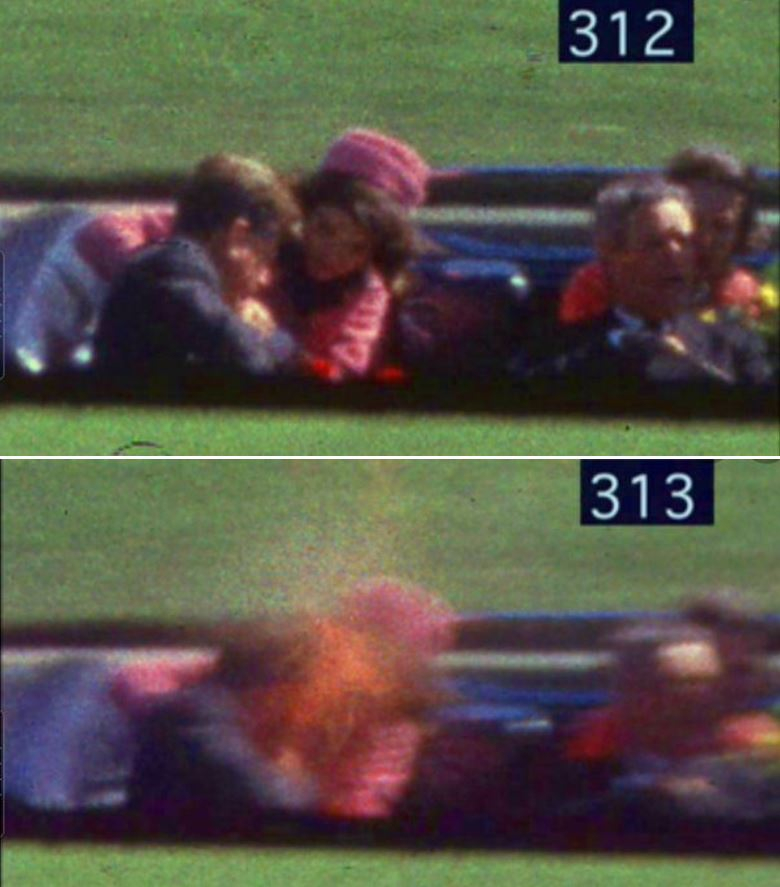
    Zapruder frame 313 shows a mist of debris just in front of JFK’s face, but no real “plume” of brain and bone matter flying forward of him. The exiting bone fragments are flying more upward, not forward. Not discernable in the two-dimensional frame is that those bits were also traveling leftward, and were found to JFK’s left. Similarly, the “debris field” from the frame 313 head shot was principally to the President’s left-rear. (See Figure 1.)

    Picture1Figure 1. Zapruder frame 313 and sketch of documented debris field from head shot at Z-313.

    Zapruder Frame 313 (left image) shows, in two dimensions, that there is a cloudy mist in front of JFK’s face. (See Fig. 2 for comparison with a similar mist seen in a skull-shooting test.) Exiting bone fragments are going mostly upward and, as discussed, to the left. They were not actually going forward which they would have been if, as claimed, Oswald’s shot had entered through the rear of Kennedy’s skull and exited the right front. The debris field (image right) shows that most of the ejecta moved “back and to the left,” as the President’s head also did. This is evidence the shot was fired from Kennedy’s right front, the “grassy knoll,” not his right rear.

    It was thus not accurate for Dr. Nalli to accuse Dr. Wecht and I of “anti-science slander against scientists.” Our brief wasn’t remotely against science or scientists. Quite the contrary. In our two articles we defended good science as against science that was not soundly based but was put out to primarily defend the government’s case for Oswald’s sole guilt.[8] Among these examples are several individuals Dr. Nalli heralds: Nobel Laureate Luis Alvarez, John Lattimer, MD, Messrs. Larry Sturdivan and Lucien Haag, Ken Rahn, Ph.D., Vincent Guinn, Ph.D.,[9] the so-called Ramsey Panel,[10] and, last but not least, the members of the House Select Committee’s forensics panel.[11] It would appear that, Dr. Nalli’s loyalty to these luminaries seems based less on their evidence than on their eminence and loyalty to the government. Let us exemplify our disagreement.

    Luis Alvarez

    Duplication Tests

    Dr. Nalli dilates on Alvarez’s “duplication” shooting tests that he contends confirmed the “jet effect.” He reports that the Nobelist felt stung by a critique he’d received from then-philosophy professor, Josiah Thompson, Ph.D. So, he worked with Paul Hoch, one of his Berkeley graduate students, to find experimental evidence to support his creative theory. Hoch recommended that “Alvarez perform some sort of experimental test that ‘could demonstrate the retrograde recoil on a rifle range, using a reasonable facsimile of a human head.’ They experimented firing upon different targets, ultimately deciding a taped melon as the best facsimile.” Hoch noted that the melons consistently exhibited a ‘retrograde motion’ toward the shooter. Alvarez thus demonstrated that a recoil effect is indeed possible.[12] Dr. Nalli’s account is both selective and incomplete–in a word, unscientific.

    Why did Dr. Nalli never address Josiah Thompson’s discovery that, in his “peer reviewed” Am. J. Physics “jet effect” paper, Alvarez never disclosed that he fired on multiple objects, and all but the melons flew away from the rifle, not towards it? (We had to wait for Thompson to learn of it.) While Dr. Nalli admits that Alvarez got different results from shooting at different objects, he doesn’t tell readers what they were. Is selective reporting that tells the test results that support one’s theory while omitting those that contradict it scientific? Apparently yes, according to Nalli. No, according to Thompson, me, and Wecht. And then there are questions about the specifics of Alvarez’s tests.

    Neither Dr. Nalli nor Alvarez acknowledged that the light-weight target melons only recoiled after being struck with super-charged, deforming, soft-nosed bullets, not after being pierced by the slower, nondeforming jacketed bullets Oswald supposedly used. Furthermore, is a soft-skinned, light-weight melon a “reasonable facsimile” of a much heavier, bony human head, scientifically? Yes, it is, according to Drs. Nalli, Hoch, and Alvarez. No, it isn’t, according to Thompson, Wecht and me. We’ll leave that for readers as a thought experiment. It shouldn’t take too much thinking.

    We challenged Dr. Nalli that this was shoddy scientific reportage. He gave no reply.

    The “Jiggle Effect”

    Alvarez had noted that some Zapruder frames are blurred, and concluded that the blurred images resulted from Zapruder’s delayed startle reaction to the sound of gunshots. “Delayed” because the sound of gunshots traveled more slowly than light, thus more slowly than the visible action in his film. In our review of Dr. Nalli’s tribute to Alvarez, we pointed out that the Nobel winner gave a preposterous, progovernment explanation for the most dramatic of the blurred frames: Zapruder frame 313.[13]

    He wrote: “[I]n the light of this background material we see that the obvious shot in frame 313 is accompanied immediately by an angular acceleration of the camera, in the proper sense of rotation to have been caused directly by shock-wave pressure on the camera body.”[14] Although he mentioned “shock waves,” Dr. Nalli (wisely) kept a deafening silence on Alvarez’s ridiculous claim about frame 313.

    As is well known, and which we pointed out, “shock waves” from bullet blasts travel at the speed of sound, about 1,100 ft/sec. They expand as a cone behind the nose of the bullet as it slices through air.[15][16] Oswald’s supposed bullet flew almost twice as fast as the shock wave, about 2,100 ft/sec. Thus, the expanding shock wave from that missile would not have reached Zapruder in time to blur 313 if Oswald had fired it, from 270 feet away. (Only a shock wave from a “grassy knoll” shot—~60 feet from Zapruder—would have been close enough to nudge the camera and blur frame 313. This fact provides additional corroboration that the frame 313 shot came from the “grassy knoll.” If Oswald had fired that shot, frames 315, 316, and/or 317 would be blurred, and they are not.)

    It’s difficult to understand how Alvarez either didn’t know that, or didn’t check to see if he was right about it. It’s less difficult to imagine why Mr. Science Dr. Nalli never addressed this in either his peevish reply to Wecht and I, or even in his review of Thompson’s book.[17] Similarly, Dr. Nalli refused to glance through another window Thompson opened that offers a useful insight into Alvarez’s loyalties.

    The Vela Incident and Alvarez’s Politics

    Thompson reported that Alvarez had produced a government-friendly, but flat-out wrong, report denying Israel and South Africa had exploded a nuclear device in the so-called “Vela Incident.” Alvarez was promptly debunked by both expert government investigators and on-sight witnesses that Seymour Hersh personally interviewed.[18] Nalli says nothing about this incident, whether in his response to our criticizing him for ignoring it, or in his review of Thompson’s book where it is explored in extenso. It’s an episode that speaks to Alvarez’s trustworthiness when he is called upon to weigh in on issues dear to the government’s heart. This history should not be ignored when judging Nobelist’s credibility on the government’s controversial version of Dallas’s darkest day. Dr. Nalli ignored it, as he did the problems with other Warren defenders he plugs.[19][20]

    John Lattimer, MD

    John Lattimer, MD, a confidant of J. Edgar Hoover[21] and a “jet effect” aficionado, is another of Dr. Nalli’s models.

    Conducting more analogous trials than Alvarez had, Dr. Lattimer fired at human skulls using a Mannlicher Carcano. But he fired downward at them from close range, striking the rear of filled human skulls that were perched atop ladders.[22] The target skulls recoiled, but apparently not due to any “jet effect.” As we pointed out, in his book, Hear No Evil, Donald Thomas, Ph.D. explained the obvious:

    “Lattimer’s diagrams reveal that the incoming angle of the bullet trajectory sloped downwards relative to the top of the ladder, with the justification that the assassin was shooting from an elevated position…But the downward angle would have had the effect of driving the skulls against the top of the ladder with a predictable result—a rebound.”[23] (A video clip of Dr. Lattimer’s shooting tests shows the bullet’s momentum rocking the ladder forward as the skull is driven against the top of the ladder and bounces backward.[24])

    Lattimer’s downward-shooting technique was precisely what longtime Warren defender, and another of Dr. Nalli’s consultants, Paul Hoch, Ph.D. (physics) had sensibly warned against. The target should be fired upon along a horizontal trajectory, Hoch said, not at a downward angle. And the target should either be dangling from a wire or laying on a flat surface.

    Lattimer’s botched technique gave predictably botched results, yet were published by a “peer reviewed” journal. Unlike Dr. Lattimer’s skulls, the base of JFK’s skull and jaw bone were not resting on a hard, flat surface. (It is also worth mentioning that the “wounds” sustained by the blasted skulls were not, as Dr. Lattimer reported, “very similar to those of the President.”[25]) While Dr. Nalli cites our paper debunking Lattimer’s tests, and while he also cites Don Thomas’s book, Hear No Evil, he champions science by maintaining a protective silence about Lattimer’s flawed technique.

    Lattimer’s tendentious skull shooting results were of a piece with his other “peer reviewed” results: He also shot melons. “No melon or skull or combination,” he reported, “ever fell away from the shooter in these multiple experiments,”[26] a finding that deserves an honorable place in the Journal of Irreproducible Results.[27] By contrast, Warren loyalist Mr. Lucien Haag reported what happened when he fired Carcano bullets at melons: “the melons (which were free to move) remained in place, and the entry and exits holes were small.”[28]

    Douglas Desalles, MD and Stanford Linear Accelerator physicist, Arthur Snyder, Ph.D. shot melons with MCC ammo and found the same thing: the targets barely budged, though some did roll slowly away. (Lucien Haag, however, did finally get melons to recoil. But only when he fired after clipping the tips off Carcano rounds to expose the soft lead cores, justifying doing so by arguing that the tip of Oswald’s jacketed bullet would have been breached when it struck JFK’s skull.[29])

    Unscientific Practice Among Pro-Government Authors

    A glaring omission mars all the scientific “peer reviewed” JFK papers by Haag, Alvarez, Lattimer and, given our mention of it in our critique, Dr. Nalli. It is requisite, standard practice in medical/scientific journalism to acknowledge and integrate prior published research findings that bear on an author’s thesis. Writers elaborating on newly discovered aspects of the Theory of Gravity, for example, might well tip their hats to Issac Newton and Albert Einstein. Earlier, published findings that are in conflict with a submitter’s research would typically be discussed and footnoted in referenced work. This is just standard, time-honored practice in peer-reviewed scientific, as well as nonscientific journalism.

    Judging by his copious footnotes, Dr. Nalli appears to grasp this. But when it comes to the “jet effect” and duplicating shooting experiments, Dr. Nalli and jet effect promoters Alvarez, Lattimer, and Lucien Haag, observe this fundamental practice in the breach. They all avert their gaze from what is perhaps the most truly analogous, and credible, test for jet effect ever performed.

    Undertaken by the government for the Warren Commission in 1964, the Biophysics Lab at Aberdeen Proving Grounds ran duplication tests that are virtually never acknowledged by government defenders.

    Using the kind of rifle and ammunition Oswald owned, dried human skulls filled with gelatin were fired upon from the rear. Mr. Larry Sturdivan, a government employee and lifelong Warren defender, participated in those experiments. Using a film shot at 2200 frames/second, he described what happened while testifying to the House Select Committee on Assassinations.

    “As you can see,” Sturdivan swore, “each of the two skulls that we have observed so far have moved in the direction of the bullet. In other words, both of them have been given some momentum in the direction that the bullet was going … In fact, all 10 of the skulls that we shot did essentially the same thing.”[30] (Figure 2)
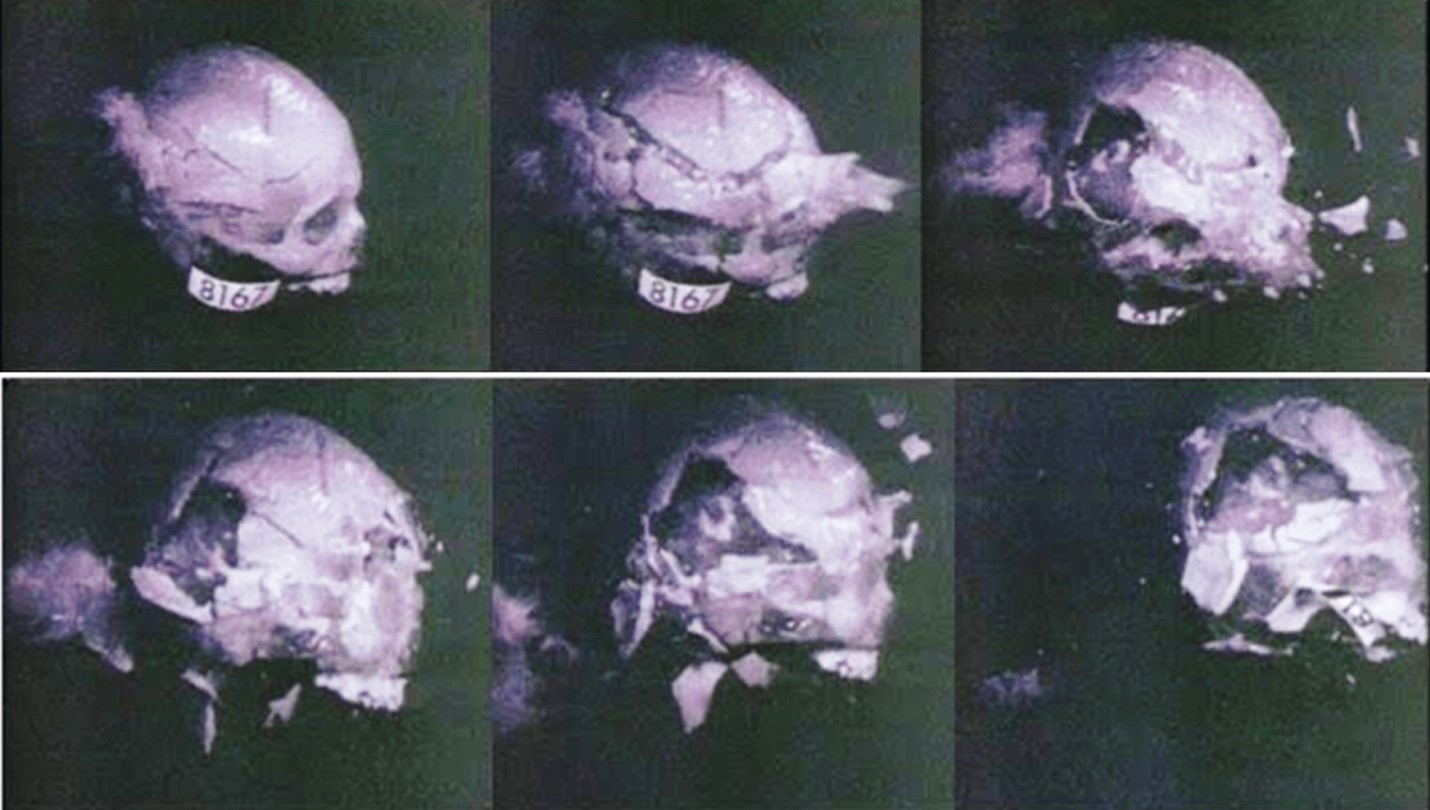
    Picture3Figure 2. High speed film images from Biophysics Lab skull shooting tests conducted for the Warren Commission in 1964. Note that while the bullet entered the back of the skull, the initial egress of misty material is thrown rearward from the point of entrance in the occiput, and that as much material appears to fly backward from the entry point as from the area of exit in the front. As the skull ruptures, the skull moves swiftly away from the shooter.

    Like the rearward egress of debris in first frame of this series, a mist appears overlying the right anterolateral aspect of JFK’s head in Zapruder frame 313 (Fig. 1), which offers experimental corroboration of a bullet entrance in this location. Bony fragments in the third frame of this series are blowing forward. By contrast, those from Kennedy’s skull flew upward and to the left.

    In our review, Dr. Wecht and I challenged Dr. Nalli on these government experiments. Like his heroes, Alvarez, Lattimer, Haag, et al, Dr. Nalli says not a word. This is science?

    Dr. Nalli and Neuromuscular Reaction

    In his original paper, Dr. Nalli argued that a “neuromuscular reaction” followed the initial “jet effect” at Zapruder 313-14, and it propelled Kennedy’s head and upper torso further rearward after Zapruder frame 315. Citing progovernment, nonexperts such as Gerald Posner, John Lattimer, and especially Larry Sturdivan, Dr. Nalli said that “a neuromuscular spasm is the only physically plausible mechanism known to this author.”[31]

    In our review we assaulted Dr. Nalli on this point. “If ‘neuromuscular spasm’ is the only physically plausible mechanism that Nalli knows of,” we wrote, “it’s likely because he’s ‘cherry picked’ the “expertise” of untrained, inexpert. anti-conspiracy crusaders … Were Nalli the least bit serious, or curious, he’d have scoured and cited the work of proper authorities (e.g. neurophysiologists, neurologists, perhaps even trauma surgeons). But he doesn’t; he sources nonexperts.” Among them are the pathologists of the HSCA’s forensic pathology panel, who are authorities on the victims of “unnatural deaths.” (With apologies to coauthor Wecht, pathologists are no more expert on neurophysiological phenomena of living humans than orthopedists are on pediatric asthma.)

    As we previously documented, JFK’s rearward lunge bears no resemblance to the two scientifically recognized types of “neuromuscular spasms” that have been repeatedly specified by Dr. Nalli’s consultant, Mr. Larry Sturdivan: “decorticate” and “decerebrate” neuromuscular reactions. In a filmed interview, Sturdivan demonstrated JFK’s “neuromuscular reaction.” (Figure 3.)

    Picture4Figure 3. Mr. Larry Sturdivan demonstrating JFK’s “neuromuscular reaction” to the fatal head shot.

    Mr. Sturdivan’s posture mimics neither JFK’s reaction to his fatal head injury nor an actual neuromuscular reaction.

    Picture5Figure 4.

    And here is how JFK actually reacted following the head shot at Zapruder 312-13, (Figure 5)
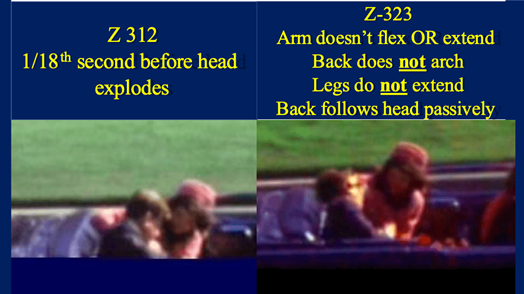
    Picture6Figure 5. Image left, 1/18th second before his head explodes: JFK’s head is chin-downward, tilted forward and slightly to the left. Image right, ½ second after he’s hit, it is JFK’s head that has moved backward. His back does not arch. His right arm neither flexes inward in “decorticate” posture, nor extends in “decerebrate” posture, as it would were it a “neuromuscular reaction.” Instead, it falls limply to Kennedy’s side.

    Note that JFK’s back does not arch; his legs do not extend, which would be detectable by an upward jerking of his body. His forearms do not adduct or extend as they would if his reaction was either decorticate or decerebrate; they simply drop. Unlike in “neuromuscular reactions,” Kennedy’s back passively follows his head, with no visible backward arching, or jerking.

    All this medically/scientifically-based evidence, and more, was laid out in our critique. Dr Nalli offered no counterevidence to it.

    He was similarly silent on our evisceration of his take on “neutron activation analysis” (NAA), another thoroughly debunked bit of junk science that supposedly buttressed Oswald’s sole guilt.

    Dr. Nalli and Neutron Activation Analysis

    NAA was first proffered as evidence in the Kennedy case by UC Irvine professor Vincent P. Guinn during his House Select Committee testimony. NAA is a sophisticated technique that supposedly allowed scientists to match bullet fragments from a crime scene to the bullet they came from. Guinn testified that NAA proved that all bullets and fragments from the assassination traced to but two bullets, which had been firearms-matched by the FBI to Oswald’s rifle. NAA was debunked years before Dr. Nalli ever put pen to paper on JFK. But because NAA is still touted by some anti-conspiracy evangelists, Dr. Nalli inexplicably tries to maintain it.

    For example, in his review of Last Second in Dallas, Dr. Nalli touts Guinn. He writes:

    …that it was ‘highly probable’ that the fragments in Gov. Connally’s wrist were from the ‘stretcher bullet’ (CE399) found at Parkland Hospital and that the fragments from President Kennedy’s head were from the same bullet as the fragments found in the limousine, thereby providing strong evidence that only two bullets caused all the wounds.[32] Dr. Nalli added a qualifier: “There has apparently been some degree of legitimate dispute about the NAA findings of Guinn. However, counterarguments have since been advanced from forensic experts such as Larry Sturdivan (cf. The JFK Myths) (sic) and Luke Haag. Lacking personal expertise, I shall remain, for the time being, agnostic on Guinn’s findings. Sturdivan and Haag are not to be easily dismissed…”[33]

    Dr. Nalli neither mentions nor alludes to what the “legitimate dispute” is all about, nor even who has disputed Guinn, Sturdivan, and Haag. He has a good, though not a scientific, reason not to. It would be difficult to justify why untrained, uncredentialed, crusading anti-conspiracy “forensic experts,” Sturdivan and Haag, would also happen to have expertise on NAA that’s on par with their detractors who have, contra Dr. Nalli, quite “easily dismissed” Sturdivan and Haag (as well as Guinn, and Kenneth Rahn, Ph.D., Sturdivan’s NAA coauthor).

    The ‘legitimate disputants’ Nalli didn’t think worth naming include the FBI’s National Laboratory, which abandoned the use of NAA to match bullets and fragments in 2005 because of its serious deficiencies;[34] two “conspiracy agnostic,” nationally recognized NAA authorities from Lawrence Livermore National Lab, Eric Randich, Ph.D. and Pat Grant, Ph.D., who specifically debunked Guinn’s JFK claims in the prestigious Journal of Forensic Sciences[35] (Guinn was one of Pat Grant’s professors at UC Irvine, and bore him no malice. See Grant’s “Commentary on Dr. Ken Rahn’s Work on the JFK Assassination Investigation.”[36]); a distinguished professor of statistics at Texas A&M University, Clifford Spiegelman, Ph.D., and his coauthor, FBI chief lab examiner William Tobin, who, among other things, eviscerated the flawed statistical analysis that Sturdivan, had published supporting NAA;[37] as well as others.[38]

    Furthermore, Nalli had every good reason to know of these inconvenient “alternative” facts, and not only from the “literature review” he should have done as a science writer during manuscript preparation. They’ve attracted considerable interest among assassination students. They are easily found by doing a simple google search.[39] Moreover, they were explored in extenso in a piece I wrote with coauthor Wecht that Nalli cites himself. That article included a detailed discussion of the collapse of NAA in bullet matching studies, both in the Kennedy case and elsewhere. It also provided the citations found here, with hotlinks to the peer reviewed papers and the source documents themselves.[40] Dr. Nalli averted his gaze from all this.

    Tellingly, Nalli also fails to mention that neither Sturdivan nor Haag have any primary expertise in NAA. They have no applicable training or background, and no credible NAA research, apart from Sturdivan’s debunked statistical analysis that was demolished, without refutation, by the statistics professor at Texas A&M; by the NAA authorities at Lawrence Livermore Lab,[41] and by Stanford Linear Accelerator physicist, Arthur Snyder, Ph.D.[42]

    Dr. Nalli thus puts lightweights Sturdivan and Haag on one side of the NAA scale, and these heavy-weight ‘legitimate disputants’ on the other, and says he must remain agnostic because they look balanced to him. This is exactly the kind of pro-government, anti-science, cherry-picking that skeptics have learned to expect from pro-Warren “scientific experts.” But the irony doesn’t end there.

    Referring to Thompson’s showcasing the work of the internationally recognized acoustics authority, James Barger, Nalli sniffed that “Thompson has no problem ‘appealing to authority’ when it suits him.’” Without delving into the complexities of the acoustics evidence, James Barger, is, actually, an internationally renowned authority to whom one may perfectly appropriately “appeal.” For Barger’s acoustics credentials, and those of the other acousticians who reported to the House Select Committee, easily surpass those of the so-called Ramsey Panel, the Alvaraz-selected physicists who were not acoustics trained, but who Warrenistas like to believe have debunked credentialed acoustics authorities.

    As he did with the government’s skull shooting tests at Aberdeen Proving Grounds, as well as with “neuromuscular reaction” and NAA, Dr. Nalli eschews credentialed, legitimate, published authorities, but has had ‘no problem appealing to the authority,’ and arguing from the authority, of inexpert, anti-conspiracy activists. For example, Eric Randich and Pat Grant versus Larry Sturdivan.

    Should Dr. Nalli ever want to publicly address our science-based challenges to Alvarez’s selectively reported shooting tests that “proved” his “jet effect theory;” or his “jiggle effect” explanation for why Zapruder frame 313 is blurred; or how Alvarez handled the “Vela Incident;” or John Lattimer’s “duplication” shooting tests; or the U.S. Government’s skull shooting experiments; or Kennedy’s supposed “neuromuscular reaction;” or Neutron Activation Analysis, we would be only too happy to engage and respond in the true spirit of scientific inquiry.

    We won’t be holding our breath. Interested readers shouldn’t either. For Dr. Nalli was invited to an on-line “frank exchange of views” with author Aguilar, a debate. He refused. He was then offered to debate physicist Paul Chambers, Ph.D., author of Head Shot: The Science Behind the JFK Assassination.[43] The host of the debate reassured Dr. Nalli that they would review the nature of the questions beforehand with both Dr Nalli and Dr. Chambers so Dr. Nalli would know it was not going to be an ambush.

    He refused that, too.


    Go to Part 1.


    [1] Nalli, Nicholas. Gunshot-wound dynamics model for John F. Kennedy assassination

    [2] http://jfkfiles.blogspot.com/search?q=nicholas+nalli

    [3] Nalli, Nicholas. Gunshot-wound dynamics model for John F. Kennedy assassination

    [4] Milicent Cranor. Scientist’s Trick ‘Explains’ JFK Backward Movement When Shot

    [5] Nalli, Nicholas. [Heliyon 4 (2018) e00603] Corrigendum to “Gunshot-wound dynamics model for John F. Kennedy assassination”

    [6] https://www.history-matters.com/archive/jfk/wc/wcvols/wh16/pdf/WH16_CE_391.pdf

    [7]JFK in Trauma Room One: The Missing Piece: Last Moments Before Death.” A YouTube video of Parkland Professor Marion T. Jenkins, MD discussing the assassination. This quote can be heard at and after the 5 minute, 25 second mark. Available here.

    [8] Gary Aguilar, Cyril Wecht. “Peer Reviewed” Medical/Scientific Journalism Has Been Corrupted by Warren Commission Apologists – Part 2

    [9] V P Guinn. JFK (John F Kennedy) Assassination – Bullet Analyses

    . Analytical Chemistry Volume: 51 Issue: 4 Dated: (April 1979) Pages: 484A-486A,488A,492A-493A

    [10] Josiah Thompson. Last Second in Dallas. University Press of Kansas, 2021.

    [11] HOW FIVE INVESTIGATIONS INTO JFK’S MEDICAL/AUTOPSY EVIDENCE GOT IT WRONG. Gary L. Aguilar, MD and Kathy Cunningham

    [12]https://www.academia.edu/50355206/The_Ghost_of_the_Grassy_Knoll_Gunman_and_the_Futile_Search_for_Signal_in_Noise. P. 7.

    [13] https://www.kennedysandking.com/john-f-kennedy-articles/1279#_edn78

    [14] Alvarez L, “A Physicist Examines the Kennedy Assassination Film”, American Journal of Physics Vol. 44, No. 9, p. 817. September, 1976. Available here.

    [15] “The speed of sound, known as Mach 1, varies depending on the medium through which a sound wave propagates. In dry, sea level air that is around 25 degrees Celsius, Mach 1 is equal to 340.29 meters per second, or 1,122.96 feet per second.” Available here.

    [16] Robert C. Maher. “Summary of Gun Shot Acoustics,” Montana State University 4 April 2006. “A supersonic bullet causes a characteristic shock wave pattern as it moves through the air. The shock wave expands as a cone behind the bullet, with the wave front propagating outward at the speed of sound.” Available here.

    [17] Nalli, Nicholas. The Ghost of the Grassy Knoll Gunman and the Futile Search for Signal in Noise

    [18] A brief discussion with source notes is available on-line in ref. #18, here.

    [19] See comment #3 following Nalli’s article, The Anti-Science Attack on Scientific Peer-Review. Comment posted here.

    [20] See also ref. #18, here.

    [21] See ARRB Testimony of Charles Baxter, Ronald Coy Jones, Robert M. Mclelland, Malcom Perry, Paul C. Peters, 27 Aug 1998, p. 39-42, here.

    [22] Lattimer JK, Lattimer J, Lattimer G. “An Experimental Study of the Backward Movement of President Kennedy’s Head,” Surgery, Gynecology & Obstetrics. February, 1976, Vol. 142, pp. 246–254.

    [23] Thomas, Don. Hear No Evil. Ipswich, MA. Mary Ferrell Foundation Press, 2010, pp. 362–363.

    [24] Clip from a Walter Cronkite CBS special on the assassination, with voice over by Cronkite. Note that the test skull sits flat, atop the ladder. When it is struck from above, the ladder swings forward as momentum imparted to the skull is transferred to the ladder: watch here.

    [25] Image available at: Milicent Cranor. Scientist’s Trick ‘Explains’ JFK Backward Movement When Shot.

    [26] Lattimer JK, Lattimer J, Lattimer G. “An Experimental Study of the Backward Movement of President Kennedy’s Head,” Surgery, Gynecology & Obstetrics. February, 1976, Vol. 142, pp. 246–254. Available here.

    [27] The Journal of Irreproducible Results 1980-2003. Available here.

    [28] Haag, L. “President Kennedy’s Fatal Head Wound and his Rearward Head ‘Snap,’” AFTE Journal, Vol. 46, No. 4, Fall 2014, p. 283; see Figure 8. (Copy available by request.)

    [29] Haag, L. President Kennedy’s Fatal Gunshot Wound and the Seemingly Anomalous Behavior of the Fatal Bullet. AFTE Journal, Vol. 46, No. 3, Summer 2014, p. 218ff.

    [30] Sturdivan LM. HSCA testimony, Vol.1:404. Available here.

    [31] Nalli N R. Gunshot-wound dynamics model for John F. Kennedy assassination.

    [32] Nalli, N R. “The Ghost of the Grassy Knoll Gunman,” a review of J. Thompson’s book “Last Second in Dallas” published on-line, 6/3/21.

    [33] Nalli, N. The Ghost of the Grassy Knoll Gunman and the Futile Search for Signal in Noise

    [34]FBI Laboratory Announces Discontinuation of Bullet Lead Examinations,” September 1, 2005. FBI National Press Office.

    [35] Erik Randich Ph.D., Patrick M. Grant Ph.D., Proper Assessment of the JFK Assassination Bullet Lead Evidence from Metallurgical and Statistical Perspectives. Journal of Forensic Sciences, V.51(4)717 ff. July 2006.

    [36] Pat Grant, Ph.D. “Commentary on Dr. Ken Rahn’s Work on the JFK Assassination Investigation.” Available on the Mary Ferrell website, here.

    [37] Cliff Spiegelman, William A. Tobin, William D. James, Simon J. Sheather, Stuart Wexler and D. Max Roundhill. CHEMICAL AND FORENSIC ANALYSIS OF JFK ASSASSINATION BULLET LOTS: IS A SECOND SHOOTER POSSIBLE?, The Annals of Applied Statistics 2007, Vol. 1, No. 2, pp. 287–301. Check here.

    [38] * Giannelli, Paul, “Comparative Bullet Lead Analysis: A Retrospective,” Case Western Reserve, Sept., 2001.
         * William Tobin. “Comparative Bullet Lead Analysis: A Case Study in Flawed Forensics”, www.nacdl.org The Champion.
         * Charles Pillar. “Report Finds Flaws in FBI Bullet AnalysisLos Angeles Times, 2/4/2004. Charles Pillar.

    [39] *Cliff Spiegelman, Ph.D. “What new forensic science reveals about JFK assassinationSalon.com, 12/12/2017.
          * See also: Pat Grant, Ph.D. (Lawrence Livermore Laboratory). Commentary on Dr. Ken Rahn’s (NAA) Work on the JFK Assassination Investigation.

    [40] https://www.kennedysandking.com/https://host626.com/wp-content/uploads/2016/07/AguilarWechtAFTA2015-f07.pdf

    [41] See Pat Grant’s evisceration of NAA defender, Ken Rahn. “Commentary on Dr. Ken Rahn’s Work on the JFK Assassination Investigation

    [42] Arthur Snyder, Ph.D. Comments on the Statistical Analysis in Ken Rahn’s Essay: “Neutron-Activation Analysis and the John F. Kennedy Assassination”

    [43] Head Shot: The Science Behind the JFK Assassination

  • Revisiting Dag Hammarskjold’s Mysterious Death


    One man is known to have survived the infamous crash. Why was his testimony hidden?

    Read the article here. (The Yale Review)

  • Lemann and The Atlantic Monthly vs JFK on Civil Rights

    Lemann and The Atlantic Monthly vs JFK on Civil Rights


    Coming into the 60th anniversary of the JFK murder I suspected familiar faces would try to distort the circumstances of Kennedy’s death—which they did, e.g., Max Holland on PBS. But I also thought there would be certain individuals involved with what I have called elsewhere, The Posthumous Assassination of Kennedy. That title owes to an article I wrote many years ago, back in the nineties, for Probe Magazine. It referred to the attempts to smear Kennedy’s image and legacy in a variety of ways. (Click here for that long essay)

    That happened also. One was through a familiar figure in this field, namely Jeff Greenfield. His article appeared at the online ‘zine Politico. And, I must say, for Greenfield it was not as bad as I thought it would be. The former Robert Kennedy speech writer seems to have finally admitted, both comprehensively and completely, that the Vietnam War would not have happened if JFK had lived. Which is something that both Chris Matthews and Joe Scarborough will not admit. (Click here)

    Greenfield’s article appeared on precisely the 60th anniversary. It had a pretty silly title, “Would JFK Have Lost Had He Lived?”. Well Jeff, I kind of doubt it. I think he would have crushed Goldwater pretty much the way Johnson did. I think the media would have portrayed Barry as a war monger and JFK as a man of peace. It’s true that Kennedy’s civil rights program—a matter we will get to later—would have cost him in the south, but Lyndon Johnson would have helped there. (Unlike others I do not think that JFK would have dumped Johnson, no matter what Bobby Kennedy tried to do.)

    Greenfield is trying to disguise the fact that Goldwater only took six states in 1964, five in the Deep South, plus his home state of Arizona. And he lost to Johnson by over 20 percentage points. There were two reasons for this. First, unlike Ronald Reagan in 1980, America was simply not ready for someone as extreme as Goldwater in 1964. There was no year-long Iran hostage crisis to pave the way for the senator, as it did for Governor Reagan. Secondly, the people running Goldwater’s campaign could not hold down his tendency to make wild statements, especially concerning national defense and the conflict in Vietnam. For instance, he seemed to suggest America should use tactical atomic weapons in Indochina. This led to the infamous “Daisy Girl” ad which really hurt Goldwater.

    I think Greenfield knows he is on thin ice here so at the end he escapes into the sordid. Somehow Kennedy’s philandering would have posed a danger to his candidacy. Back then? In 1964? Watergate was ten years away. The Gary Hart/Donna Rice episode was over 20 years later. So Greenfield ended up meandering about in the muck of maybe, could be, what ifness. Did he read my earlier column where I lambasted him for this kind of thing?

    The other attempt at a smear was in the December 2023 Atlantic Monthly. On the stands and mailed out the last week of November, it was clearly timed for the 60th. The subject matter was decades old; but the author, Jordan Virtue, only made one reference to where it originated. This was in a 2006 book called Redemption by Nicholas Lemann. I had read the book years earlier and I was struck by the way it ended. About the first 80% of the slim volume is a valid contribution to how the brutal methods of the Redeemer Movement in the south succeeded in fighting Reconstruction and then taking over, thus negating Reconstruction, after the final Union troops were removed.

    At the end of the book, Lemann did a brief summing up of how the terrible tactics of the Redeemer Movement had been both reversed, and then disguised—in both popular culture and the halls of academia. The most obvious and sensationally successful example of the former was the film Birth of a Nation. That 1915 D. W Griffith picture was based on Thomas Dixon’s novel and play The Klansman. The success of that movie became legendary in the film world. The old Hollywood adage about it was: it made so much money the distributor stopped counting it. Dixon was a white supremacist and his book and play were suffused with that philosophy. Dixon knew President Woodrow Wilson from their college days. Wilson showed the film in the White House, a first. And Griffith and Dixon used quotes from a book Wilson wrote as subtitles. The film was so melodramatically racist, and wildly successful, that it led to the rebirth of the Klan.

    The other strain of apologia for the failure of Reconstruction was expressed in the next box office champion, Gone With the Wind. This view of Reconstruction was softer in tone. Unlike Griffith, It did not picture young white women killing themselves over pursuit by an African American, or the Klan triumphantly riding into a town to stop former slaves from voting. William Archibald Dunning was a professor at Columbia. He wrote a book on the subject, but more importantly, he schooled several of his students, who then wrote more books. These books dominated the historical literature and greatly influenced the writers of textbooks for decades on end. The general message was that African Americans were fairly content prior to the Civil War and after. And that Reconstruction caused the upsetting of the rather noble southern way of life: by Union soldiers, scalawags and carpetbaggers. It was a wildly romantic, false and pernicious image. But it had immense influence.

    The Dunning school was not effectively attacked until the late fifties and early sixties. The two principal revisionists were Kenneth Stampp (The Peculiar Institution, 1956) and John Hope Franklin (Reconstruction: After the Civil War, 1961). Stampp, who consciously opposed the Dunning School, produced two more books directly confronting its tenets: The Era of Reconstruction (1965) and Reconstruction: An Anthology of Revisionist Writings (co-editor, 1969). But it was not until the arrival and later popular success of Eric Foner in the late seventies and early eighties that the Dunning School was, for all intents and purposes, overturned. The failure of Reconstruction was now perceived as not in intervening, but in not going nearly far enough in that intervention. It was not easy to overcome Dunning, Margaret Mitchell (who wrote the novel Gone With the Wind), Clark Gable and Vivien Leigh.

    In looking at this brief summary, most people would think that the most grievous offense was giving the imprimatur of the White House to something as rancidly racist as Birth of A Nation. Lemann did not think so. He devoted all of two sentences to that incident. (p. 190) He devoted over four pages to a book written by President John F. Kennedy in 1956, Profiles in Courage. And those are the closing pages of Lemann’s book. (pp. 205-09) There he said that in a chapter of that book, Kennedy had mischaracterized two personages: Union General, and later appointed Governor of Mississippi, Adelbert Ames, and Lucius Lamar, a confederate soldier who later became a senator from Mississippi and a Supreme Court Justice. Kennedy wrote exactly one paragraph on Ames. (p. 147) Concerning Lamar, Kennedy is straightforward about his advocacy of secession. (pp. 145-46) But the Atlantic Monthly article leaves out the two main reasons Kennedy included him in the book: (i) His long and powerful eulogy for Radical Republican Charles Sumner (ii) His opposition to what Kennedy called, the Bland Allison Act, knowing that it was going to pass and congress would override a presidential veto—which it did. Since it was popular in Mississippi, Lamar had risked his political career voting against it; especially since the state legislature had demanded he support it. The entire last part of the chapter is about this issue. (pp. 152-62). To ignore it is selective and unfair.

    As I indicated above, Profiles in Courage was written when the Dunning School still held tremendous influence. And Kennedy unwisely chose a book by a Dunning follower, Claude Bowers, as one of his sources. This was an understandable mistake from someone who was not a professional historian. And I agree that the brief Ames characterization in the book was wrong. But what Lemann did with this was completely unwarranted. In portraying the era that the book was published in as one of change, Lemann praises President Eisenhower for sending troops to Little Rock during the crisis at Central High and he prefaces that with the 1954 Supreme Court’s Brown vs Board decision. (pp. 205-06)

    What he leaves out is that Eisenhower let the students trying to integrate Central High be terrorized by the redneck governor of the state, Orval Faubus, for 21 days. He was being publicly humiliated so he more or less had to act. Why? Because he had let Faubus trick him at their face-to-face meeting. Lemann also leaves out the fact, noted by historian Michael Beschloss, that Eisenhower advised Earl Warren not to vote for the Brown vs Board decision. And Eisenhower did not support that decision, for example, in the Autherine Lucy case at the University of Alabama in 1956. He literally let her be run off campus amid riots and rocks being thrown—even though she was there under a court order. (Jack Bass, Unlikely Heroes, p. 64)

    Lemann then adds that it must not have been clear to Kennedy “that a systematic change was on the way.” Can the man be serious? In two terms Eisenhower filed ten civil rights lawsuits, two on his last day in office. In just one year, Attorney General Robert Kennedy doubled that amount. And by 1963, the number of lawyers in the Civil Rights Division had quintupled. (Harry Golden, Mr. Kennedy and the Negroes, pp. 100, 104, 105) As the great southern jurist Frank Johnson said, no one in Washington was doing anything of substance on civil rights in the fifties. But when JFK came in:

    …there was almost an immediate and dramatic change. He was like electricity compared to Eisenhower….He put the nation on notice that there were changes that were long overdue. (Frank Sikora, The Judge, Chapter 6)

    What Lemann does with the Civil Rights Act of 1957 is startling, even for him. He says that Senator Kennedy voted for a watered down bill. (p. 206) What he does not say is this: Kennedy did not want to vote for the bill, precisely because it had been watered down. Senate Majority Leader Lyndon Johnson had never voted for a civil rights bill in nearly 20 years. But he commandeered this one by pleasing his fellow southerners, segregationists Strom Thurmond and Richard Russell. Kennedy was so reluctant to vote for it that Johnson had to send two emissaries to his office to persuade him to do so. When that did not work, LBJ had to lobby Kennedy in person. Senator Kennedy reluctantly voted for it since it did provide for a (toothless) Civil Rights Commission. (Rowland Evans and Robert Novak, Lyndon B. Johnson: The Exercise of Power, pp. 136-37)

    As the reader can see, what Lemann appears to be doing is a kind of reverse history. He is trying to somehow color Kennedy’s actual civil rights record with the 1956 error he made in his book. Atlantic Monthly goes a bit further and says that he may have been misled by the Dunning School, “but he also aspired to higher office and needed to appeal to white southern voters.”

    Again, this is hogwash. In 1956, the same year Profiles in Courage was published, Kennedy made a speech in New York endorsing Brown vs Board. He specifically said, “We might alienate Southern support but the Supreme Court decision is the law of the land.” This speech was covered in the New York Times on February 8, 1956, on page 1. Therefore much of the country, including the south, knew about it. But to show just how bad the Atlantic Monthly article is, the next year Kennedy went to Jackson Mississippi. He said the same thing: the Brown decision must be upheld. (Golden, p. 95) As author Harry Golden noted, it was at this point that Kennedy began to lose support in the south and to get angry letters about his support for the Brown decision. Golden’s book was published in 1964. Could both authors have missed it, or not consulted it? It seems almost superfluous to add that near the end, the Atlantic Monthly article says that on November 22, 1963 Oswald “shot and killed Kennedy in Dallas.” So, in one article on the 60th anniversary of Kennedy’s death, The Atlantic Monthly scores a twofer: a smear of Kennedy, coupled with an endorsement of the cover up around his assassination.

    What is even more surprising is that Jeff Morley, a writer I like and admire, actually referenced the Atlantic Monthly article on twitter on November 27th. He added the following comment: “A JFK story I did not know…JFK’s racist streak…it does not surprise me…he was an aristocrat to whom supremacy came easy.” If anyone can show me any kind of incident that showed Kennedy was a racist, please do. Authors Nick Bryant and Steven Levingston spent about 800 pages in two books trying to show this. They came up empty.

    But further, why would a racist pick Abraham Bolden to guard him on his Secret Service White House detail? Why would a racist sign the first affirmative action order in American history? Which JFK did in March of 1961, just 45 days after his inauguration. He then assigned a civil rights officer to manage hiring and complaints in each department of government. (Carl Brauer, John F. Kennedy and the Second Reconstruction, p. 72, p. 84) In fact, Kennedy got his friend and Ambassador to India John K. Galbraith to sponsor him a membership at the Metropolitan Club. The president refused to join, because they declined service to a visiting African diplomat. (Richard Parker, John Kenneth Galbraith, p. 387) Kennedy then announced that neither he nor any member of his administration would attend functions at segregated facilities. (Irving Bernstein, Promises Kept, p. 53)

    I am not going to go through the record of achievement Kennedy had on civil rights. I already spent about 3-4 months researching it and writing about it. Kennedy did more for civil rights in three years than FDR, Truman and Eisenhower did in three decades, and it is provable. (Read this)

    I will conclude by saying that I agree with historian Carl Brauer. What Kennedy began was the real Reconstruction, which is why Brauer titled his book, John F. Kennedy and the Second Reconstruction. As most historians would agree, it was Eisenhower’s Vice-President, Richard Nixon, who stopped this movement cold by employing the Southern Strategy. That is the real story of what happened to the civil rights movement in America. Which you will not find in the Atlantic Monthly. But that is a much more important and accurate rendition of the struggle and Kennedy’s role in it.

    Addendum

    For a real description and analysis of what Kennedy was confronted with on the civil rights front and what he achieved, please read this 4-part series by James DiEugenio which took almost four months to write and research. It is the best pamphlet length exposition of Kennedy’s remarkable achievement in that field, against almost monumental odds. The best book on the subject is still Carl Brauer’s John F. Kennedy and the Second Reconstruction.

  • Jack Tunheim Does It Again on the 60th, Saying “There is No Evidence for a Grassy Knoll Shooter”


    Back on the 50th anniversary of the JFK assassination, the former Chair of the ARRB, Judge Jack Tunheim, made an outrageous statement to NBC news, which reported: “ ‘I look back to the hard evidence of the case, the real evidence, the evidence admissible in court, and all of that points to Oswald acting alone,’ Tunheim, who is now a federal judge, said this week from his chambers in Minnesota.”

    Read the rest of the article here.

  • The JFK Files: A Mostly Admirable Compilation with a Few Duds

    The JFK Files: A Mostly Admirable Compilation with a Few Duds


    The mysterious circumstances surrounding John F. Kennedy’s assassination have remained for six decades. While most have lost interest, Jeff Meek remains the sole reporter in the nation with a monthly column dedicated to the JFK assassination.

    His latest work, The JFK Files: Pieces of the Assassination Puzzle, includes a collection of interviews, insights, and historical events surrounding Kennedy’s presidency and untimely death.

    Read More: The JFK Files: Pieces of the Assassination Puzzle

    Let’s see how his book fares in the vast scheme of JFK assassination literature.

    Exploring the Roots

    Meek first took interest in the JFK assassination in 1975 with the iconic Geraldo Rivera program Goodnight America. Featuring Robert Groden and Dick Gregory, it aired the Zapruder film on a national platform, sparking Meek’s enduring fascination with the narratives surrounding the assassination.

    Interviews with HSCA Figures

    Dan Hardway was a former member of the House Select Committee on Assassinations (HSCA). He emerges as a central figure in Meek’s compilation.

    Hardway’s claims about the CIA’s operational interest in Oswald and the challenges faced by the HSCA shed light on the campaign disinformation that continues to muddy the truth behind JFK assassination to this day.

    Meek also includes an interview by Leslie Wizelman, another HSCA staffer, who provides a candid perspective on the limitations of conducting a homicide inquiry within a congressional framework.

    Her doubts about the Warren Commission’s official story and insights into the committee’s constraints add depth to the challenges faced during this investigation.

    Buddy Walthers and the Alpha 66 Connection

    A chapter dedicated to Dallas County Detective Buddy Walthers reveals Oswald’s connections to an anti-Castro organization called Alpha 66.

    Details emerging from Walthers’ mother-in-law challenge conventional narratives, exposing the links between Oswald and Alpha 66 officials and making him even less of a culprit behind the John F. Kennedy assassination.

    Oswald in custody

    Insights and Perspectives

    Meek’s compilation extends beyond interviews, encompassing the following:

    • Insights from White House staff members.
    • Key incidents during Kennedy’s presidency.
    • Dialogues with figures featured in Oliver Stone’s film JFK Revisited.

    Room for Debate

    While Meek’s compilation is largely commendable, James DiEugenio expresses some reservations regarding interviews with figures like Ruth Paine and Secret Service agent Mike Howard.

    A broader spectrum of perspectives could have added another layer to The JFK Files and invited readers to critically engage with varying viewpoints like Kennedys and King does all the time through its insightful blogs and articles regarding the political assassinations of the 1960s.

    Think you can make them better? Contact us now

  • A Closer Look at Bart Kamp’s Prayer Man

    A Closer Look at Bart Kamp’s Prayer Man


    Bart Kamp’s Prayer Man challenges the established narratives surrounding the events at the Texas School Book Depository on the day of the John F. Kennedy assassination.

    As we navigate through Kamp’s exploration, encountering historical figures, overlooked sketches, and clandestine meetings, we are prompted to view the “Prayer Man” not as a static element in a photograph but as a key to unlocking the best-kept secrets regarding the Kennedy assassination. 

    Let’s explore the key talking points explored by Kamp in his examination of the elusive Prayer Man.

    The Emergence of Prayer Man

    Kamp emphasizes that the suspicion surrounding the Prayer Man was not solely the result of Sean Murphy’s discovery. He credits a circle of Kennedy researchers, including Richard E. Sprague, Harold Weisberg, and Howard Roffman, for their early exploration of the Altgens 6 photograph.

    However, it was Richard Bernabei, a relatively unknown but pivotal figure, who first discerned the Prayer Man figure from films by Dave Wiegman. Bernabei’s sketches, though overlooked for decades, become central to Kamp’s analysis.

    The Prayer Man as Lee Harvey Oswald

    Kamp’s analysis employs a process of elimination to build the case that the elusive figure is likely Lee Harvey Oswald.

    By scrutinizing the Darnell and Wiegman films, Kamp narrows down the possibilities, considering the figure’s characteristics. The author asserts that, based on the available evidence and the exclusion of individuals, Prayer Man is a white Caucasian—fitting the description of Oswald.

    Questioning the Second-Floor Encounter

    A significant portion of Kamp’s exploration questions the authenticity of the second-floor encounter between Officer Marrion Baker, Roy Truly, and Lee Harvey Oswald.

     Texas Book Depository

    Kamp scrutinizes Baker’s movements and contends that Baker did not take the front stairs as commonly believed. This questioning extends to the credibility of the second-floor lunchroom episode, challenging the narrative of Oswald holding a Coke and being confronted by Baker and Truly.

    Ironies and Unanswered Questions

    Perhaps one of the most intriguing aspects of Kamp’s work is the layering of ironies and unanswered questions. He explores the creation of the Alek J. Hidell alias on the Selective Service card, raising the possibility that the Dallas Police did not possess the card with the Hidell alias on the first day.

    The book suggests that the discovery of the Klein’s order, credited by J. Edgar Hoover, turned the case around but also questioned the authenticity of the Hidell card.

    Read the blog for more on Kamp’s discoveries and contribute to the ongoing dialogue on the truth behind the JFK assassination. Join the platform for historical inquiry, share your insights, and be a part of the collective pursuit of truth. Read the blog, share your thoughts, and let’s navigate the political assassinations of the 1960s together.

    Get in touch for comments and follow-up questions.

  • Former People: A Book Worth Its Weight in the JFK Assassination Literature

    Former People: A Book Worth Its Weight in the JFK Assassination Literature

    James Norwood is a former professor with a deep understanding of the John F. Kennedy era. Through Former People, he offers readers a distinctive lens through which to view the lives of key figures post-assassination.

    While focusing on portrayals of JFK, Nikita Khrushchev, and Lee Harvey Oswald, Norwood builds a narrative that challenges conventional wisdom and sheds light on the deliberate shaping of legends over facts. Read more in James DiEugenio’s book review.

    The Concept of Former People

    Norwood introduces the term “Former People,” historically associated with displaced Russian aristocracy post-Bolshevik Revolution, to describe what happened to Khrushchev, Kennedy, and Oswald after their deaths.

    This unique conceptual framework adds depth to the exploration of these three figures, offering readers a fresh perspective on their posthumous images.

    Nikita Khrushchev’s Complex Legacy

    Norwood explores Khrushchev’s post-Stalin era, portraying a leader who, despite his role in Stalin’s earlier atrocities, sought a departure from the oppressive past.

    He explores Khrushchev’s triumphs and missteps, from the secret speech of 1956 to the crushing of the Hungarian Spring. Former People suggests that Khrushchev’s removal after Kennedy’s death marked the end of a period of reform and the beginning of economic stagnation under the Brezhnev Doctrine.

    Kennedy and Khrushchev

    JFK’s Legacy and Diplomacy

    Norwood provides a nuanced view of John F. Kennedy, highlighting his early life, political career, and literary contributions. The book commends Kennedy’s cautious handling of the Cuban Missile Crisis, preventing a nuclear war and drawing on his readings of historical events.

    He emphasizes Kennedy’s hope of easing tensions and reconciliation with the Soviet Union, tragically interrupted by his assassination and the subsequent cover-up of his achievements.

    Lee Harvey Oswald: A Man of Mystery

    The book tackles the enigma of Lee Harvey Oswald, focusing on his linguistic abilities and the mysterious circumstances surrounding his time in the Soviet Union. Norwood questions how and where Oswald acquired his proficiency in Russian and explores the possibility of a double-agent scenario.

    He aligns with the notion of two Oswalds, as advocated by the John Armstrong theorem, shedding light on a long-incubating experiment in doubles and covert operations.

    Challenge Official Narratives with Kennedys and King

    Former People challenges the official narratives surrounding the JFK assassination, highlighting the role of J. Edgar Hoover and the FBI in shaping the three-bullet scenario. It is part of why we believe this volume makes a valuable contribution to the literature surrounding the political assassinations of the 1960s.

    Get more details in our complete review, and keep reading more articles on the assassinations of the Kennedy brothers, civil rights leaders, and the current political events relevant to these past conspiracies.

    Reach out for comments and concerns.

  • Do We Recommend Former Secret Service Agent Paul Landis’s New Book on the JFK Assassination?

    Do We Recommend Former Secret Service Agent Paul Landis’s New Book on the JFK Assassination?

    The release of Paul Landis’s new book, The Final Witness, has sparked considerable anticipation and debate, fueled by advanced publicity in Vanity Fair and the New York Times.

    Today, we will be providing a preview of Vince Palamara’s book review, dissecting the key points of Landis’s narrative, and weighing the promises of groundbreaking revelations against the ultimate disappointment this book turned out to be.

    Who is Paul Landis?

    For those who don’t know, Paul Landis was a Secret Service agent during the early 1960s, so he naturally served President John F. Kennedy. He has been a figure of interest and scrutiny, especially for his claims and perspectives related to the assassination of President Kennedy.

    Learn More: Will Paul Landis Finally Put the Single Bullet Theory to Rest?

    However, Palamara expresses disappointment in Landis’s long-awaited perspective right from the beginning. Despite the extensive media hype preceding its release, Palamara suggests that, without this publicity, Landis’s work might have gone unnoticed, as hinted by early mixed reviews on Amazon.

    Clint Hill and the Uninvited Guest

    Landis’s acknowledgments section ironically includes Clint Hill, who publicly denounced the same book on NBC. Furthermore, he was excluded from a gathering of surviving Kennedy Detail Secret Service agents at Clint Hill’s residence. This raises questions about the authenticity of the support Landis claims to have received from Hill.

    Selective Reading and Participation

    Landis admits to actively avoiding books about the events of November 22, 1963, despite his involvement in The Kennedy Detail, the book and its documentary. This selective reading raises eyebrows, especially considering the gravity of the subject matter. It suggests Landis’s reluctance to engage with alternative perspectives on the JFK assassination.

    The Journey Through Landis’s Secret Service Years

    The bulk of Landis’s book is about his Secret Service career, offering insights into his relationships with fellow agents and his experiences on various details, such as the Kennedy Kiddie Detail and the First Lady Detail. While interesting for Kennedy enthusiasts and Secret Service buffs, Palamara suggests that these portions may lack broader appeal.

     JFK motorcade

    The Texas Trip and Glaring Omissions

    Landis’s account of the Texas trip is marked by the omission of critical events. The infamous drinking incident involving agents at the Fort Worth Press Club and The Cellar is conveniently downplayed.

    Landis also fails to mention the death of Secret Service agent Tom Shipman at Camp David, raising questions about the thoroughness of his narrative.

    Contradictions and Curious Observations

    Landis’s observations during the assassination of John F. Kennedy, particularly regarding the number of shots fired and the location of the head wound, are contradictory, to say the least.

    His failure to explicitly detail the significance of an alleged intact bullet found in the limousine adds to the confusion, leaving readers wondering about the authenticity of this claim.

    Should You Read Paul Landis’s New Book?

    Palamara accuses Landis’s book of being a “bait and switch” scenario, with the focus on the bullet Landis claims to have found overshadowing the actual content. The lack of in-depth exploration of the alleged find, and its implications for debunking official history raises suspicions about the book’s intentions and Landis’s motivations.

    You are better off reading similar reviews on the book than the book itself, which adds little to the ongoing conversation surrounding the John F. Kennedy assassination. Check out our blogs and articles for a more in-depth analysis of one of American history’s most controversial and misunderstood subjects, and add your voice to the mix.

    Contact us for inquiries and feedback.

  • Part 5 of 6: The Rifle and the Ammunition

    Part 5 of 6: The Rifle and the Ammunition


    41. The Ammunition Clip.

    “No link between the [Ammunition] clip and Oswald has been established. By either purchase, possession, fingerprints or other methods.” (Accessories After The Fact; p. 120)

    42. The Same Prefix?

    Commission Conclusion. “Information received from the Italian Armed Forces Intelligence Service has established that this particular rifle was the only one of its type bearing serial number C2766”  WCR P119.

    Documentation In The Record Refutes Commission Conclusion.

    In a memorandum from FBI director J Edgar Hoover to General Council of the Warren Commission, J Lee Rankin, Hoover discloses the following information: “The Mannlicher-Carcano rifle was manufactured in Italy from 1891 until 1941; however, in the 1930’s Mussolini ordered all arms factories to manufacture the Mannlicher-Carcano rifle. Since many concerns were manufacturing the same weapon, the same serial number appears on weapons manufactured by more than one concern.” In her fantastic study of the origins of the rifle, Martha Moyer reported that Dr John K. Lattimer had in his possession a Mannlicher Carcano which bore the serial number C2766. (Volume XXV; p. 808. p 30) (see this)

    43. The Refurbished Carcano.

    The credibility of the Mannlicher-Carcano as evidence has been significantly undermined due to its refurbishment at the hands of the US Army. This refurbishment seriously compromises the integrity of the weapon in evidence. The addition of shims to correct the telescopic sight indicates that the rifle required modifications to function properly during the Warren Commission tests. While an azimuth correction could have been made without the shims, using the available adjustment range, the shim provided a more permanent means of correction. This suggests that the alleged murder weapon of President Kennedy was not suitable for accurate use on 11/22/63 and required alterations to be operable.

    Given these circumstances, the credibility of C2766 as evidence is severely compromised. In a court of law, evidence that has undergone substantial modifications or alterations to render it functional would be deemed inadmissible due to concerns of tampering and lack of reliability.

    Eisenberg – “Was it reported to you by the persons who ran the machine-rest tests whether they had any difficulties with sighting the weapon?”

    Simmons – “Well, they could not sight the weapon in using the telescope and no attempt was made to sight it in using the iron sight. We did adjust the telescopic sight by the addition of two shims, one which tended to adjust the azimuth and one which adjusted an elevation…the azimuth correction could have been made without the addition of the shim, but it would have meant that we would have used all of the adjustment possible and the shim was a more convenient means – not more convenient, but a more permanent means of correction.” (Volume III; p. 443.)

    The testimony provided by Simmons further supports the conclusion that refurbished Carcano cannot be considered credible evidence. Their acknowledgment of the difficulties encountered in sighting the weapon and the subsequent adjustments made reinforce the notion that the rifle’s original condition was compromised, casting doubt on its value as reliable evidence in legal proceedings.

    44. The Hardships Of C2766.

    “Indeed, common sense suggests that if he [Oswald] had practiced with that rifle, he would have lost no time in dumping it for a bow and arrow.” Sylvia Meagher.

    The testimonies of US Army Officer Ronald Simmons and Special Agent Robert Frazier, provides us with an insight into the operational deficiencies of the Mannlicher-Carcano [C2766]. The weapon, test fired by three master riflemen, who the Commission neglected to call, gives us a detailed account of the problems connected with the rifle.

    Testimony of US Army Officer Ronald Simmons. “Yes, there were several comments made particularly with respect to the amount of effort required to open the bolt. As a matter of fact, Mr. Staley [Master rifleman] had difficulty in opening the bolt in his first firing exercise. He thought it was completely up and it was not, and he had to retrace his steps as he attempted to open the bolt after the first round. There was also comment made about the trigger pull which is different as far as these firers are concerned. It is in effect a two-stage operation where the first – in the first stage the trigger is relatively free, and it suddenly required a greater pull to actually fire the weapon…. In our experiments, the pressure to open the bolt was so great that we tended to move the rifle off the target, whereas with greater proficiency this might not have occurred.” None of the Master Riflemen were called to testify to the Commission.” (Volume III; p. 441/451)

    Testimony of Special Agent Robert Frazier.When we attempted to sight in this rifle at Quantico, we found that the elevation adjustment in the telescopic sight was not sufficient to bring the point of impact to the aiming point.”

    In attempting to adjust and sight-in the rifle, every time we changed the adjusting screws to move the crosshairs in the telescopic sight in one direction, it also affected the movement of the impact or the point of impact in the other direction.”

    That is, if we moved the crosshairs in the telescope to the left, it would also affect the elevation setting of the telescope. And when we had sighted-in the rifle approximately, we fired several shots and found that the shots were not all landing in the same place but were gradually moving away from the point of impact.”

    This was apparently due to the construction of the telescope, which apparently did not stabilize itself -that is, the spring mounting in the crosshair ring did not stabilize until we had fired five or six shots.” (Volume III; p. 405) (Accessories After The Fact; p. 133)

    45. Marksman Vs Masters.

    “Let me tell you what we did at Quantico. We reconstructed the whole thing, the angle, the range, the moving target, the time limit, the obstacles, everything. I don’t know how many times we tried, but we couldn’t duplicate what the Warren Commission said Oswald did.” Carlos Hathcock.

    Commission Conclusion: “Based on testimony of the experts and their analysis of films of the assassination, the Commission has concluded that a rifleman of Lee Harvey Oswald’s capabilities could have fired the shots from the rifle used in the assassination within the elapsed time of the shooting. The Commission has concluded further that Oswald possessed the capability with a rifle which enabled him to commit the assassination”. (WR; p. 19.)

    The Warren Commission choose enlisted the services of three riflemen rated as Master by the National Rifle Association to carry out the firing tests with the Mannlicher-Carcano [C2766]. This was to ascertain if the deficient weapon in the hands of marksman Oswald, could have been utilized to carry out the assassination of President Kennedy. It is obvious to any object observer what the Commission’s motives were here. On one hand they wanted to give themselves the optimal chance of re-creating the assassination shooting performance in the time span of six seconds while on the other, knowingly committed fraud by embellishing the record and suppressing the fact that Oswald’s skill was in no way comparable to that of these Master Riflemen.

    Oswald’s shooting record in the Marine Corps provides insights into his marksmanship abilities. In 1956, he achieved a score of 212, just two points above the minimum requirement for the sharpshooter classification. It’s important to note that even this medium-level classification was barely attained after an intensive training period, primarily involving shooting at still targets. However, on his last recorded score with a rifle, Oswald’s score dropped to 191, placing him in the “marksman” category, which signifies a poor shooting ability.

    Lieutenant-Colonel Allison G. Folsom, US Marine Corp, testified to the Commission regarding his interpretation of Oswald’s shooting record:

    Ely – “I don’t see any point in doing this page by page. I just wonder, after having looked through the whole scorebook, if we could fairly say that all that it proves is that at this stage of his career, he was not a particularly outstanding shot.”

    Col. Folsom – “No, no, he was not.”


    Folsom’s interpretation of Oswald’s shooting record is of a Marine who was a “rather poor shot. (Volume VIII; p. 303/311.)

    This disparity between Oswald and the Master Riflemen’s shooting proficiency further underscores the need to critically evaluate the conclusions drawn from the firing tests conducted by the Commission and in particularly Oswald’s alleged role in the assassination.

    46. I’d Pick Oswald.

    In 1977, author Henry Hurt located and interviewed more than fifty of Oswald’s Marine Corps colleagues. These men had never been questioned by officials or journalists before. One of the Marines, Sherman Cooley told the following to Hurt. “If I had to pick one man in the whole United States to shoot me, I’d pick Oswald. I saw the man shoot. There’s no way he could have ever learned to shoot well enough to do what they accused him of. Take me, I’m one of the best shots around, and I couldn’t have done it.”

    James R. Persons, another Marine Corp colleague, stated to Hurt that “Oswald possessed a lack of coordination that contributed to his being very poor in rifle marksmanship.”

    As Hurt points out: “Many of the Marines mentioned that Oswald had a certain lack of coordination that, they felt, was responsible for the fact he had difficulty learning to shoot.” (Reasonable Doubt; p. P99/100. Picture Section)

    47. Maggie’s Drawers.

    Nelson Delgado who once served in the Marine Corp’s with Lee Oswald, feared reprisal from the FBI for the testimony he gave to the Warren Commission. Mr Delgado testified to the Warren Commission regarding Oswald’s rifling abilities:

    Nelson Delgado – “It’s broken down into three categories: Sharpshooters–no; pardon me, take that back; Marksman is the lowest, Sharpshooters, and Experts. And then Oswald had a Marksman’s badge, which was just a plain, little thing here which stated ‘Marksman’ on it.”
    Wesley Liebeler – “And that was the lowest one?”
    Nelson Delgado – “That was the lowest. Well, that was qualifying; then there was nothing, which meant you didn’t qualify.”
    Wesley Liebeler – “Did you fire with Oswald?”
    Nelson Delgado – “Right. I was in the same line. By that I mean we were on line together, the same time, but not firing at the same position, but at the same time, and I remember seeing his. It was a pretty big joke, because he got a lot of “Maggie’s drawers,” you know, a lot of misses, but he didn’t give a darn.”
    Wesley Liebeler – “Missed the target completely?”
    Nelson Delgado – “He just qualified, that’s it. He wasn’t as enthusiastic as the rest of us. We all loved–liked, you know, going to the range.” Vol VIII, P235.

    Mr. Delgado’s experience with the FBI left him feeling that they were pressuring him to alter his account concerning Oswald’s rifling abilities. Delgado had valid reasons to be concerned, for after testifying to the Warren Commission, he was shot in the shoulder. Fearing for his life, Delgado and his family fled to England. (watch this)
    Assistant council for the Commission Wesley J. Leibler understood what the Commission was doing by their embellishment of Oswald’s rifling capabilities. In his famous “Leibler memorandum” the lawyer warns what such an approach will do to the Reports credibility:

    The conclusion indicates that Oswald had the capability to fire three shots with two hits in from 4.8 to 5.6 seconds. The conclusion at its most extreme states that Oswald could fire faster that the Commission experts fired in 12 of their 15 tries. [With] The fact that most of the experts were much more proficient with a rifle than Oswald could ever be expected to be, and the record indicates that fact… To put it bluntly, that sort of selection from the record could seriously affect the integrity and credibility of the entire report.” (Reclaiming Parkland; p. 91). (read this)

    48.The Ammo-Less Assassin?

    “The alternative is that this singular assassin squandered more than $20 of his meager earnings for a rifle but—unable or unwilling to spend a small additional sum for ammunition—stole, borrowed, or found on the street five cartridges that just happened to fit the weapon; and that those five cartridges sufficed, from March through November 1963, for dry runs, attempted murder, and successful assassination.” Syliva Meagher, Accessories After The Fact; p. 115.

    What is the evidence in the record which would substantiate the supposition that Lee Oswald possessed ammunition for the Mannlicher-Carcano? And how does this evidence impact the case against Oswald? “The Dallas Police and FBI’s investigation regarding the source of Oswald’s alleged ammunition ownership included a canvass of all places of business that sold guns and ammunition in the Dallas and Irving area including hardware stores, pawn shops, department stores, sporting goods stores and Army/Navy surplus stores” (Volume XVI; p. 62/63).

    Only two stores were known to have handled the 6.5 mm Western Cartridge Company Mannlicher-Carcano and ammunition. These stores were:

    John Thomas Masen, owner of Masen’s Gun Shop, 7402 Harry Hines Boulevard in Dallas and John H. Brinegarn, owner of The Gun Shop, 11448 Harry Hines Boulevard in Dallas. By examining the testimonies of store owners Masen & Brinegarn, we can better understand what this means for the prosecution’s case.

    John Masen advised the FBI that he was “unable to identify this individual as being a person to whom he had previously sold 6.5 ammunition.”

    Masen also stated he bought some ten boxes of the 6.5 mm Mannlicher-Carcano ammunition from the Western Cartridge Company. He advised that if he had “sold more than a box or two to any one person he would have remembered the sale.”

    Upon further reading of CE 2694, we come across the following in regard to Masen:

    Masen claimed, “he had never seen Lee Harvey Oswald, had no recollection of him ever having come to his place of business, and he had never sold any of this ammunition to Oswald.”

    Picture1John Brinegarn, was also shown a photograph of Lee Harvey Oswald, the report states that “A photograph of Lee Harvey Oswald was exhibited to Mr. Brinegarn and he advised he was unable to identify this individual as being a person to whom he had previously sold 6.5 ammunition…Mr. Brinegarn stated he did not know Lee Harvey Oswald, had no recollection of ever seeing him and did not believe he had sold him any of this type of ammunition.” (Volume XXVI; p. 62.)

    In light of the above, what definitive evidence would Henry Wade have presented, at trial, which links Oswald to the purchase of the ammunition for the Carcano? The existing gaps in evidence connecting Oswald to the specific stores and the unestablished ownership of ammunition introduce a substantial degree of reasonable doubt. This casts serious reservations on Oswald’s involvement in the assassination of the President. It also brings into focus the question of whether the prosecution has adequately met its burden of proof.

    It’s important to remember that in criminal proceedings, the onus of providing proof beyond a reasonable doubt lies squarely with the prosecution.

    Adding to these uncertainties is the testimony of Ronald Simmons. He testified that the master riflemen found that the pressure required to open the bolt [on C2766] was so immense that it invariably caused them to shift the rifle off target. Simmons speculated that a higher level of proficiency might have prevented this, but proficiency requires practice and practice requires a consistent consumption of ammunition. (Volume III; p.441-451)

    49. World War II Ammunition.

    Speculation – Ammunition for the rifle found on the sixth floor of the Texas School Book Depository had not been manufactured since the end of World War II. The ammunition used by Oswald must, therefore, have been at least 20 years old, making it extremely unreliable.

    Commission’s Finding – The ammunition used in the rifle was American ammunition recently made by Western Cartridge Co., which manufactures such ammunition recently. In tests with the same kind of ammunition, experts fired Oswald’s Mannlicher-Carcano rifle more than 100 times without any misfires. (WCR; p. 646.)

    In reply to Stewart Galanor [Cover-Up] regarding the ammunition, Dated July 14, 1965, the Assistant Sales Manager for the Winchester-Western Division of Olin Mathieson wrote:

    Concerning your inquiry on the 6.5mm Mannlicher Carcano cartridge, this is not being produced commercially by our company at this time. Any previous production on this cartridge was made against Government contracts which were completed back in 1944.” (Rush To Judgement; p. 107.)

    In April of 1965, researcher Sylvia Meagher wrote to Western Cartridge Company about the ammunition for the 6.5 mm Mannlicher-Carcano. A corporate official replied: “The ammunition had once been produced under a government contract but was no longer available.”

    A reply to a second correspondence to Western dated April 20th, 1965, prompted this note in Meagher’s book Accessories After the Fact – “The manufacturer stated quite frankly that the reliability of the ammunition still in circulation today is questionable.” (Accessories After The Fact; p. 113.)

    Despite compelling contrary evidence, the Commission posits that Lee Oswald, wielding a compromised, cannibalized Carcano, whilst discharging unstable, twenty-year-old ammunition, single-handedly executed the assassination of Jack Kennedy with success.

    50. The Police Conduct Searches

    Despite extensive searches conducted by the Dallas and Irving Police Department on properties associated with Lee Oswald, no evidence linking him to ammunition purchase or ownership was found. Additionally, no oil, oil-stained rags, or cleaning solutions for weapons, which would be expected for routine maintenance, were discovered.

    Lawyer Freda Scobey questions the legalities of the search of Oswald’s possessions at the Paine residence. Scobey writes that “The rifle/blanket and much other incriminating evidence was obtained from the Paine residence on the afternoon of November 22. At this time no search warrant was obtained. Mrs Paine had no right without a warrant to consent to a search of Oswald’s personal effects segregated in her garage, and it does not appear that Marina gave any knowing consent…. [because] it is fairly obvious that Marina Oswald, considering her scanty knowledge of English and Ruth Paine’s difficulties with Russian in a crisis, gave no intelligent consent to a search of the garage. Although Marina pointed out the blanket in the belief, as she said, that it still contained the rifle. Because of these factors there would seem to be a strong basis for excluding this evidence.” (see this and this)


    Go to Part 1 of 6

    Go to Part 2 of 6

    Go to Part 3 of 6

    Go to Part 4 of 6

    Go to Part 6 of 6