Blog
-

Edward Epstein: The Critic who Flipped
The 88-year-old Edward Epstein was found dead in his apartment on Tuesday January 9th. His nephew, Richard Nessel , said the cause of death was complications from CV 19. (NY Times obituary by Sam Harris of January 11, 2024)
The obituary notes the first of Epstein’s many books was entitled Inquest, published in 1966. As Epstein wrote in his memoir, Assume Nothing, he wrote this book after he flunked out of Cornell and was trying to get back into the college. The man trying to help him, Professor Andrew Hacker, was with him on campus when the news came in that President Kennedy had been killed. Hacker said that finding the truth about the assassination would be a test for American democracy. This gave Epstein the idea of writing a Master’s thesis on the subject. Hacker wrote letters for him in order to talk to the Commissioners, and all agreed except for Earl Warren.
Inquest was published in 1966, and it helped form something of a wave effect, since it just preceded Mark Lane’s Rush to Judgment, Sylvia Meagher’s Accessories After the Fact and Josiah Thompson’s Six Seconds in Dallas. But, as Joseph McBride notes in his book on the media Political Truth, there was a difference between Epstein’s book and the others. McBride quotes from the ending of Inquest:
If the Commission had made it clear that very substantial evidence indicated the presence of a second assassin, it would have opened a Pandora’s box of doubts and suspicions. In establishing its version of the truth, the Warren Commission acted to reassure the nation and protect the national interest. (McBride, pp. 192-93)
In fact, the first part of the book is titled “Political Truth”. McBride comments on this by saying its pretty obvious that the author knew “full well that the assassination was covered up.” But it would seem that he was at least partly trying “to justify the reason for the cover-up.” Further, Warren Commissioner John McCloy told Epstein that the function of that body was to “show the world that America was not a banana republic, where a government can be changed by a conspiracy.” (McBride, p. 137)
Epstein went even further in this regard in first his E-book, The JFK Assassination Diary, and then again in his printed memoir Assume Nothing. In those two places, both published in the 21st century, he revealed that when he asked Arlen Specter how he convinced the Commission about the Single Bullet Theory, he said he told them that it was either that or start looking for a second assassin. (Epstein E book, p. 24) Norman Redlich, one of the most powerful members of the Commission staff agreed with Specter. (Epstein, The Assassination Chronicles, p. 155). As anyone should know, even without being a lawyer, that path is not 1.) Following the evidence, or 2.) A viable standard of proof.
There was also something else that Epstein knew, namely that the Commission was basing their case on unreliable witnesses. For instance, he knew that attorney Burt Griffin had told Dallas police officer Patrick Dean that he was a liar. Dean was in charge of security the day Jack Ruby entered city hall and gunned down Oswald on national TV. (The Assassination Chronicles, p. 110) The Commission also thought that Marina had fabricated a story about Oswald attempting to kill Richard Nixon. And Redlich had written this about her: “Marina Oswald has lied to the Secret Service, the FBI and this Commission on matters of vital concern.” Commission lawyer Joe Ball did not trust Helen Markham or Howard Brennan either. (ibid, pp. 142-44) In an interview Epstein did with Commission lawyer Wesley Liebeler, he referred to the Commission as Snow White and the Seven Dwarfs with Marina as Snow White and Earl Warren as Dopey. (E book, p. 17)
In reviewing Epstein’s work on the Commission in his book and diary –the latter may have been created after the fact—what is puzzling is how many important things escaped him. To point out just two: he did not find out about Commissioner Jerry Ford changing the entering location of the Magic Bullet from the back to the neck in the final draft of the Warren Report. Even though he interviewed Chief Counsel J. Lee Rankin. Rankin had this evidence in his files, and his son turned it over to the Assassination Records Review Board in the nineties. Epstein interviewed J. Lee Rankin.
Another important fact that escaped him is that there was no transcript made of the final executive session meeting of the Commission. Although he describes the debate that took place on this issue at that meeting, he relies on interviews he did for his information. (The Assassination Chronicles, pp. 154-56; p. 604) He could have gone to the National Archives and found out that no transcript of this meeting was made. That is what Harold Weisberg did. (Gerald McKnight, Breach of Trust, pp. 295-97)
If Epstein would have done that, he could have informed people like Senator Richard Russell and Senator John Cooper that they had been hoodwinked about their objections being recorded. And that could have opened up just how deeply they were opposed to not just the Magic Bullet, but the way in which the Commission was being conducted. Author Gerald McKnight later revealed Russell’s disharmony in his book on the Commission, and Cooper assistant Morris Wolff did the same about Cooper. (Wolff, Lucky Conversations, pp.103-15)
Something appears to have happened to Epstein shortly after he wrote Inquest. For instance, he appeared on the record album for the book Scavengers and Critics of the Warren Report. That book was published in January of 1967 and was clearly a cheap smear of the Commission critics, co-written by FBI informant Larry Schiller. There is further evidence for Epstein’s sudden switch in John Kelin’s fine book Praise from a Future Generation.
On November 30, 1966 there was a debate on the Warren Report in Boston. Epstein had been invited to participate, but he declined. Vince Salandria was a participant. After the debate, Salandria was surprised to see Epstein in the audience walking toward him. They had a brief discussion during which Epstein said, “I’ve changed Vince.” Salandria replied with, “You mean you made a deal.” Epstein smiled and said, “You know what happened” and walked away. (Kelin, p. 335, E book version). In fact, years later, when he made an appearance on the Larry King Show he actually said he thought “the men who served on the Warren Commission served in good faith.” (Probe Vol. 7 No. 1, p. 14). Today we have two sources telling us that Jerry Ford knew the Commission was a sham: Morris Wolff and Valery d’Estaing. (See Interview with Wolff, Black Op Radio, 1/11/2024; the film JFK Revisited)
To say that Epstein changed is an understatement. In his next two books, he now became an unrepentant defender of the official story. Because he wrote a book on the Warren Commission, he was invited by The New Yorker to go to New Orleans and write a long article on the JFK investigation being done by DA Jim Garrison. It’s pretty clear from the beginning of his “diary” entries that Epstein had a bias against any new inquiry into the Kennedy case that would lead elsewhere than where the Commission had. For instance, he distorts Garrison’s dispute with the local judges and also on how David Ferrie was initially released by the FBI in 1963. (Epstein, pp. 39-41). In fact, Epstein was accepting advice from the likes of Tom Bethell and Jones Harris on Garrison. Some people who encountered Harris, like the late Jerry Policoff, thought he was rather erratic in his beliefs on the JFK case. Tom Bethell had all the earmarks of being a plant in Garrison’s office. (Click here for that)
But that was just the beginning of Epstein’s lack of fairness. Epstein also had many contacts with Shaw’s lawyers. Beyond that he was also in contact with a lawyer who represented both Gordon Novel and Jack Ruby, Elmer Gertz. Within one week of The New Yorker publishing Epstein’s article, the CIA was circulating it as an example of how they could counter critics of the Warren Report. (Op. cit. Probe, p. 15)
To give just one example of Epstein’s objectivity: he believed Dean Andrews when Andrews said Clay Shaw was not Clay Bertrand. (Epstein’s diary, p. 46). Even though Epstein’s JFK diary was published in the new millennium, he avoids the fact that Dean Andrews was indicted and convicted for perjury on this point. But beyond that, Andrews secretly admitted to Harold Weisberg that Shaw was Bertrand. Weisberg kept that promise until after Andrews passed. And today, there are about a dozen witnesses to this fact. (See the book JFK Revisited, p. 65)
Then there was Legend. With the Church Committee exposing the crimes of the CIA, and issuing a report showing how poorly the FBI had investigated the case, there was movement to reopen the Kennedy case. Clearly an establishment lion like the Reader’s Digest would want to get a jump on such a reopening. Knowing what they wanted, they called in Epstein to do a full scale biography of Lee Oswald. Ken Gilmore, a managing editor there, contacted the FBI and told them the book would put to rest recurring myths surrounding the Kennedy assassination. Gilmore requested that the Bureau allow Epstein to access their files on the case. Epstein did visit the FBI offices at their invitation. (Op. cit. Probe, pp. 15-16)
John Barron, a senior editor, was also friendly with the CIA. Therefore, the Agency did something remarkable, they gave Epstein access to Soviet defector Yuri Nosenko. They also told him he would have access to the tapes made at the Mexico City station of Oswald at the Soviet and Cuban embassies. (ibid) The only other writer I know who had CIA assisted access to Nosenko was Gerald Posner. Before the ARRB I know of no writer who had access to those tapes. Finally, Epstein was in contact with James Angleton both by phone and in person. Epstein freely admits to this in his diary. And here is the capper in that regard. Jim Marrs interviewed a Legend researcher. He asked her why the book did not explore Oswald’s ties to the CIA, which were at least as obvious as those to the KGB, which the book accented. She replied that they were advised to avoid that area. (ibid, p. 24)
According to Don Freed, the book was budgeted by Reader’s Digest for 2 million. Epstein got a $500,000 advance, over 2.5 million today. As noted above, they also furnished him with a fleet of researchers, including Pam Butler and Henry Hurt of Reader’s Digest. All this for a book that tries to convey the almost indefensible tenet that Oswald was first recruited by the Russians, and then upon his return was now pledged allegiance to Castro and this was why Oswald shot Kennedy. The Russians then sent Nosenko over to discourage any thought the KGB was involved, since he said Oswald was never recruited by Moscow.
With all we know today, for Epstein to maintain these types of theses well into the 20th century is simply inexcusable. Because for example, today it appears that Oswald’s file at CIA was being rigged before he went to Russia. And we know that from the declassified work of HSCA researcher Betsy Wolf. And it appears that it was only Angleton who had access to all the files on Oswald at the Agency. (See this) Secondly, Clay Shaw had two CIA clearances and was employed by them as a highly paid contract agent. (JFK Revisited, p. 65). Finally, in a declassified file attained by Malcolm Blunt, it appears that Angleton was in charge of commandeering operations against Garrison. For that file, we only have the cover sheet, with several folders missing.
Let me conclude with two interesting anecdotes about Epstein. Epstein was the last person to see George DeMohrenschildt alive. He was paying him about a thousand dollars a day for interviews down in Florida. On the second day, after the Baron left, he went to a friend’s house where he was staying and allegedly took his own life by shotgun blast. Dennis Bludworth was the DA investigating the case. He wanted to see the notes of the interviews. Epstein said he had no notes or tape recordings. Bludworth did not believe that, not with Epstein paying him that kind of money. Under further questioning Epstein told Bludworth that he was also paying for the Baron’s rented car and he added that:
…he showed DeMohrenschildt a document which indicated he might be taken back to Parkland Hospital in Dallas and given more electroshock treatment. You know, DeMohrenschildt was deathly afraid of those treatments. They can wreck your mind… (Mark Lane, November 1977, Gallery)
Finally, let us make one other note as to how plugged in Epstein was to the power elite on Legend. Billy Joe Lord was on the same ship that Oswald took to Europe in 1959 on his voyage to Russia. In fact, Lord was Oswald’s cabin mate. The pair spent about two weeks together crossing the Atlantic. For this reason Epstein wanted to interview him for the book. Lord did not want to talk to Epstein since he knew he was a critic of anyone who contested the Warren Report. Lord then related that he did meet with two of Epstein’s researchers. (FBI Report of March 15, 1977) One of them said that they may have to apply pressure to Lord. And they knew two people who could do so. One was James Allison, a local newspaper chain owner and a friend of the Bush family. The other was no less than future governor and president, George W. Bush.
These are the perks you get with the equivalent of a $2.5 million advance—on a JFK assassination book.
For more on the career of Epstein on the JFK case, please click here.
-
Prouty on Vietnam: NSAM 263 and 273 60 years on
“This was the most important fallout of working on this movie JFK for me personally. As soon as we put into the movie the fact of history that John F. Kennedy had signed a White House paper, (a) National Security Action the highest most formal paper the executive branch could publish, number 263, it was dated 11 October 1963, in the month before he died. And that paper clearly said he was not going to put Americans into Vietnam. It went even further, in so many words it said that all American personnel were going to be out of Vietnam by the end of 1965. And the minute we put that into the script of the movie, even before the movie was made and put in the theaters, the newspapers and other pseudo-historians began to say ‘there’s no such thing. Prouty and Oliver Stone are wrong’.” (Col. Fletcher Prouty, May 5, 1994)

Prior to the release of Oliver Stone’s blockbuster film JFK, few people were aware of the implications contained within two policy directives generated about seven weeks apart in the autumn of 1963. These directives concerned American involvement in Vietnam, specifically crucial decisions regarding whether to expand or decrease the U.S. military’s role in the country’s future. The eventual decision to expand – massively – became one of the most polarizing events in American history–with consequential effect continuing to reverberate at the time of the release of Stone’s film in late 1991. The George H.W. Bush administration, for example, had been celebrating the supposed vanquishing of the “Vietnam Syndrome”, which had been lamented as a brake on the use of the military as a means of enforcing US foreign policies. With a presidential election looming in 1992, and the generation most directly affected by the Vietnam war fully coming into positions of influence, the dominant Cold War establishment, focused on global hegemony, was not interested in critical reassessments which might reveal cold calculation rather than tragic “mistakes”.
Retired Air Force Colonel L. Fletcher Prouty served as an advisor for Oliver Stone as the script for JFK was developed. Prouty was the key initial source influencing the insertion of information regarding the policy directive known as NSAM 263 into the film. While active in the Pentagon in 1963, Prouty had directly witnessed the development of the policy while serving under his boss, General Victor Krulak. Prouty’s later descriptive work on this subject, as it appeared across numerous essays and interviews, remains insightful, through its combination of personal experience with close readings of the documentary record.
Sixty years after the fact, the texts for NSAM 263 and 273 remain a controversial point of contention. Sharp differences regarding their actual meaning continue to influence the understanding of the historical record of the Vietnam war and both the Kennedy and Johnson administrations’ conduct of the war. On the occasion of Prouty’s birthday, and the 60th anniversary of JFK’s murder, it is useful to re-examine these policy initiatives through the work of Fletcher Prouty.
NSAM 263
Expressed interest in reducing U.S. military involvement in Vietnam, on behalf of the Kennedy administration, dates back at least as early as the spring of 1963. In a memorandum of discussions between Secretary of Defense McNamara and the Joint Chiefs held on April 29, 1963, McNamara is said to be “particularly interested in the projected phasing of US personnel strength” in Vietnam and the “feasibility of bringing back 1000 troops by the end of this year.”[1] McNamara specifically noted two aspects for consideration: “a) phased withdrawal of US forces, and b) a phased plan for South Vietnamese forces to take over functions now carried out by US forces.” Shortly thereafter, a high-level military meeting in Honolulu featured discussion along the same lines, and indicated that South Vietnam President Diem had already been advised of withdrawal plans.[2] McNamara at this time emphasized a withdrawal plan was necessary for purposes domestic and foreign “to give evidence that conditions are in fact improving”.[3] Both the withdrawal of 1000 troops by year’s end and a lengthier phased withdrawal based on training South Vietnamese to replace US personnel, were key elements of National Security Action Memorandum 263, which was certified as official policy little more than five months later.

For the Kennedy administration, Vietnam was an inherited problem. The partition of the country, the installation of Diem, the Viet Cong insurgency, and a growing U.S. “advisor” population was attributable to the influence of the Dwight Eisenhower era’s Dulles brothers combination at CIA (Allen) and the State Department (John Foster). In 1961 and 1962, crises in Berlin, Laos and Cuba were more immediately acute. However, in the summer of 1963, internal divisions and protests, exacerbated by South Vietnam President Diem’s harsh treatment of political dissenters and the huge Buddhist crisis, these called into question the near-term stability of his government. An American backed coup was contemplated in August, and then walked back, leaving unresolved divisions of power to percolate in an atmosphere intensified by the imposition of Diem’s approval of martial law.
At noon on August 26, 1963, with President Kennedy in attendance, a meeting was held at the White House to discuss pressing issues regarding Vietnam. At least fourteen such meetings were held from this date through October 11, when NSAM 263 was made official policy.[4] As head of the Pentagon’s Office for Counterinsurgency and Special Activities, General Krulak was assigned to attend most of those meetings. From his position in Krulak’s office, Prouty observed: “…such a full schedule in the White House, and with the President among other high officials in such a concentrated period is most unusual. It shows clearly Kennedy made an analysis of the Vietnam situation his problem, and it relates precisely the ideas he brought to the attention of his key staff on the subject.”[5]
The initial meetings dealt with the immediate political crisis in South Vietnam, and were concerned with the implications of a potential coup against Diem. It was hoped that a well-chosen approach or negotiation with Diem could isolate Ngo Dinh Nhu – the headstrong Diem brother deemed responsible for the current troubles, whose removal became the minimum requirement derived from these meetings. By September 6, the topics under discussion expanded to hard talk on the political realities in South Vietnam, whether the counter-insurgency programs could be successful with Diem remaining in power, and what should otherwise be done.[6] It was generally agreed a “reassessment” of Vietnam was necessary, and it was recommended that Krulak be sent to Vietnam to gather informed opinions at ground level.
Krulak left immediately and returned from Vietnam in time to appear at a White House meeting convened September 10.[7] Krulak reported the counter-insurgency effort was not too badly effected by the political crisis, and that the war against the Viet Cong “will be won if the current U.S. military and sociological programs are pursued.” Others disagreed, claiming success would not be possible short of a change in government. Kennedy called for another meeting the following day, and asked that “meeting papers should be prepared describing the specific steps that we might take in a gradual and selective cut of aid.” At that meeting, frank views across a spectrum of options were expressed. A following gathering, on September 12, continued to hone in on a precise description of “objectives and actions”, and the “pressures to be used to achieve these objectives.”[8]
Other than the unanimous resolve that Diem brother Nhu should be separated from the South Vietnamese government, the expression of opinions during this process could vary in emphasis and focus dependent on who the receiving party was. For example, in a draft letter to Diem at this time, Kennedy emphasized the need for frank discussion, while acknowledging “it remains the central purpose of the United States in its friendly relation with South Vietnam to defeat the aggressive designs of the Communists.”[9]Five days later, Kennedy would express in a memorandum to Robert McNamara: “The events in South Vietnam since May 1963 have now raised serious questions both about the present prospects for success against the Viet Cong and still more about the future effectiveness of this effort unless there can be important political improvement in the country.”[10] McNamara, and Chairman of the Joint Chiefs General Maxwell Taylor, were about to be dispatched to Vietnam for an “on the spot appraisal of the military and paramilitary effort”.
McNamara and Taylor met with the President on the morning of September 23, just ahead of their departure. This was an unusual meeting on the Vietnam topic due to the small number of participants: four plus the President (previous meetings over the past month had featured at least a dozen, and upwards to twenty, partakers).[11] After Kennedy expressed his opinions on the most appropriate means of convincing Diem to heed to advice from American officials, Taylor referred to a “time schedule” for direct U.S. support of South Vietnam, similar to the theme expressed in late April / May by McNamara:
General Taylor thought it would be useful to work out a time schedule within which we expect to get this job done and to say plainly to Diem that we were which we expect to get this job done and to say plainly to Diem that we were not going to be able to stay beyond such and such a time with such and such forces, and the war must be won in this time period. The President did not say yes or no to this proposal.
The McNamara-Taylor trip to Vietnam occurred September 23rd to October 2nd, 1963. During this time, information pertaining to Vietnam generated by the White House meetings of the past month were being collated in Krulak’s office. According to Prouty, this was the work which appeared in a thick bound volume known as the McNamara-Taylor Trip Report, presented to Kennedy in the Oval Office on the officials’ return. Prouty maintained the contents reflected “precisely what President Kennedy and his top aides and officials were actually planning, and doing, by the end of 1963. This was precisely how Kennedy planned to ‘wind down’ the war.“[12] These “plans” appeared in the McNamara-Taylor Trip Report Memorandum, generated from the October 2 meeting with Kennedy, as specific recommendations to withdraw 1000 troops by year’s end, and to wind up direct U.S. involvement by end of 1965. Previously, in a missive to Diem dated October 1, Taylor had written: “… the primary purpose of these visits was to determine the rate of progress being made by our common effort toward victory over the insurgency. I would define victory in this context as being the reduction of the insurgency to proportions manageable by the National Security Forces normally available to your Government.”[13]
At a meeting of the National Security Council followed at 6PM on October 2, President Kennedy opened the meeting by summarizing what he considered the points of agreement on Vietnam policy going forward, as derived from the past weeks of concentration. “We are agreed to try to find effective means of changing the political atmosphere in Saigon. We are agreed that we should not cut off all U.S. aid to Vietnam, but are agreed on the necessity of trying to improve the situation in Vietnam by bringing about changes there.”[14]McNamara emphasized the “value” of the language on withdrawal of U.S. personnel as it answered domestic political criticism of being “bogged down” in Vietnam by revealing there was in fact a “withdrawal plan.” As well, “it commits us to emphasize the training of Vietnamese, which is something we must do in order to replace U.S. personnel with Vietnamese.” A Record of Action resulting from this NSC meeting noted, echoing Taylor’s words to Diem, “major U.S. assistance” was needed only until the insurgency had been either suppressed or until the national security forces of South Vietnam are capable of suppressing it.”[15]
The official statement of U.S. national policy, National Security Action Memorandum No. 263, is dated October 11, l963.[16] It was typed on White House stationary and signed by Special Assistant to the President McGeorge Bundy. It records that President Kennedy approved “the military recommendations contained in Section 1 B (1-3) of the (Taylor McNamara) Report.”[17] The specified recommendations are:
- General Harkins review with Diem the military changes necessary to complete the military campaign in the Northern and Central areas by the end of 1964, and in the Delta by the end of 1965…
- A program be established to train Vietnamese so that essential functions now performed by U.S. military personnel can be carried out by Vietnamese by the end of 1965. It should be possible to withdraw the bulk of U.S. personnel by that time.
- In accordance with the program to train progressively Vietnamese to take over military functions, the Defense Department should announce in the very near future presently prepared plans to withdraw 1000 U.S. military personnel by the end of 1963. This action should be explained in low key as an initial step in a long-term program to replace U.S. personnel with trained Vietnamese without impairment of the war effort.
Antecedent and Context
In several of his essays, Prouty emphasized two important antecedents to the Kennedy administration’s Vietnam policies which culminated in October 1963 with NSAM 263. Both antecedents were related to operational programs run by the CIA, and both featured an expansion of scale during the period between Kennedy’s election and his inauguration.
The first involved the introduction of helicopter squadrons in response to “the worsening of internal security conditions in Viet Nam.” Described as an “emergency measure”, an initial total of eleven H-34 Sikorsky helicopters were requested December 1,1963.[18] As Prouty described:
“In December 1960 just after Kennedy’s election, Eisenhower’s National Security Council did direct the Defense Dept. to send a fleet of helicopters to Saigon under the operational control of the CIA …This was the situation Kennedy inherited by the time of his inaugural. It all happened between the election in Nov 1960 and the inaugural of Jan 1961.”[19]
The provision of the helicopters would require additional resources, as acknowledged by the JCS as they recommended the plan, including personnel attached to “ground support equipment” and “helicopter maintenance capability.”[20] In this way, the U.S. effort was bound to expand. Prouty:
“On Oct 30, 1963, there were 16,730 U.S. military personnel in Vietnam. A study performed at that time at the request of the senior military commander, General Harkins, revealed that barely 1,000 of them were in what might be called combatant roles.The rest were in such logistics tasks as helicopter maintenance, supply and training functions for the newly formed and unskilled Vietnamese armed forces.”[21](Ed. Note, by “might be called combatant roles” Prouty means Special Forces and combat advisors, since elsewhere he stated there was not one more combat troop in Vietnam when Kennedy died than when he took office.)
A few months after Kennedy’s inauguration, the Bay of Pigs invasion/uprising directed at Fidel Castro’s Cuba failed ignominiously. This CIA project had also notably expanded in scope during the lame duck period after Kennedy’s election. The fallout from this failure was magnified by the scale the project had accumulated, leaving a large number of persons directly affected and embittered. During the event, Kennedy had faced enormous pressure to escalate using US military assets directly, and a source of this pressure came from the clandestine milieu assembled by CIA’s regime-change program. Kennedy responded by creating a Cuban Study Group,[22] which was given two formal tasks:
a) to study our governmental practices and programs in the area of military and paramilitary, guerrilla and anti-guerrilla activity which fell short of outright war with a view to strengthening our work in this area.
b) and to direct special attention to lessons which can be learned from the recent events in Cuba.The first task – to study clandestine “practices and programs” with the aim of “strengthening our work in this area” – resulted in two National Security Action Memoranda which foreshadowed some of the policy directives later applied to Vietnam. These policies would represent a direct challenge to the CIA’s control over covert activity, as established by Allen Dulles during the Eisenhower administration. Prouty identified a moment during the Study Group’s May 10, 1961 interview with Gen. Walter Bedell Smith, Dulles’ immediate predecessor as Director of Central Intelligence, as articulating the need for a new direction. Prouty:
“This meeting with General Smith emphasized the direction that President Kennedy and his closest advisors were taking on the two related subjects: the future of the CIA and of the warfare in Vietnam. Both were going to be put under control, and ended…at least as they had been administered up to that time.”[23]
Question: Should we have intelligence gathering in the same place that you have operations?
General Smith: I think so much publicity has been given to CIA that the covert work might have to be put under another roof.
Question: Do you think you should take the covert operations from CIA?
General Smith: It’s time we take the bucket of slop and put another cover over it.Taylor submitted an 81-page report on the Bay of Pigs to Kennedy on June 13, 1961. Two weeks later, on June 28, NSAM 55 was signed and disseminated. Its subject was “Relations of the Joint Chiefs of Staff to the President in Cold War Operations” ( Prouty identified the phrase “Cold War Operations” as a reference to Clandestine Operations).[24]As delivered directly to the Chairman of the JCS Lyman Lemnitzer, the document began:
a) I regard the Joint Chiefs of Staff as my principal military advisor responsible both for initiating advice to me and for responding to requests for advice. I expect their advice to come to me direct and unfiltered.
b) The Joint Chiefs of Staff have a responsibility for the defense of the nation in the Cold War similar to that which they have in conventional hostilities…”.Kennedy clearly felt that the Pentagon had let him down in their advice on the Bay of Pigs operation and that the CIA had lied to him. Because this was a distinct change in direction from the Eisenhower administration’s National Security Council directive 5412 (1954), which designated responsibility for clandestine or covert operations (Cold War Operations) to the CIA. Kennedy was redirecting this responsibility to the Department of Defense.[25]A subsequent memorandum, NSAM 57, was drafted with the subject heading: “Responsibility for Paramilitary Operations”. This document outlined a more detailed breakdown of responsibilities:
Where such an operation (clandestine) is to be wholly covert or disavowable, it may be assigned to CIA, provided that it is within the normal capability of the agency.
Any large paramilitary operation wholly or partly covert which requires significant numbers of militarily trained personnel, amounts of military equipment which exceed normal CIA-controlled stocks and/or military experience of a kind and level peculiar to the Armed Services is properly the primary responsibility of the Department of Defense with the CIA in a supporting role.Examples of “large paramilitary” operations run by the CIA would, from the vantage of the summer of 1961, include the inconclusive Indonesia campaign from 1958 and the disastrous Bay of Pigs a few months before. However, this description would also apply to the CIA’s ongoing operations in Vietnam, which were then expanding, beginning with the infusion of the helicopters. In his discussions of this policy statement, Prouty made note of specific differentiating language appearing in NSAM 263, identifying separately “U.S. military personnel” followed by “U.S. personnel”. Prouty averred this distinction was deliberate, that the term “U.S. personnel” referenced in particular the ongoing CIA programs operational in Vietnam. In this way, NSAM 263 had continuity with the earlier policy developed after the Bay of Pigs, intended to shift responsibilities for covert paramilitary operations from the CIA to the Defense Department, and to reduce their scope.
NSAM 273
On November 6, 1963 Kennedy sent an Eyes Only telegram to Ambassador Lodge, referring to “a new Government which we are about to recognize.” South Vietnam’s President Diem had suffered a coup, resulting in his, and his brother’s, death, a few days before. While the coup had been tacitly accepted in advance (although not anticipating loss of life), there were attendant loose ends and adjustments requiring attention as Kennedy referred: “I am sure that much good will come from the comprehensive review of the situation which is now planned for Honolulu, and I look forward to your own visit to Washington so that you and I can review the whole situation together and face to face.”[26]
On November 13, the upcoming meeting in Honolulu was discussed at the daily White House staff meeting.[27] Kennedy’s Special Assistant for National Security McGeorge Bundy, who would attend the meeting, was briefed on what to expect by his assistant Michael Forrestal: “From what I can gather, the Honolulu meeting is shaping up into a replica of its predecessors, i.e. an eight-hour briefing conducted in the usual military manner. In the past this has meant about 100 people in the CINCPAC Conference Room, who are treated to a dazzling display of maps and charts, punctuated with some impressive intellectual fireworks from Bob McNamara.”[28] The Record of Discussion also notes: “When someone asks Bundy why he was going, he replied that he had been instructed.”[29]
The autumn Honolulu Conference was held on November 19-20. The summary of discussion which begins the official Memorandum expresses optimism: “Ambassador Lodge described the outlook for the immediate future of Vietnam as hopeful. The Generals appear to be united and determined to step up the war effort. They profess to be keenly aware that the struggle with the Viet Cong is not only a military program, but also political and psychological. They attach great importance to a social and economic program as an aid to winning the war.”[30]
This optimism carries over to the summary’s concluding views, which reflect the policy articulated in NSAM 263:
“Finally, as regards all U.S. programs – military, economic, psychological – we should continue to keep before us the goal of setting dates for phasing out U.S. activities and turning them over to the Vietnamese; and these dates, too, should be looked at again in the light of the new political situation. The date mentioned in the McNamara-Taylor statement on October 2 on U.S. military withdrawal had and is still having – a tonic effect. We should set dates for USOM and USUS programs, too. We can always grant last-minute extensions if we think it wise to do so.”[31]
The New York Times published a briefing on the Honolulu Conference on November 21, 1963 (datelined November 20). Titled “U.S. Aides Report Gain, 1,000 Troops to Return”, and said to be reflecting “assessments” from the “first full-scale review of the Vietnamese situation since the military coup”, the brief report “reaffirmed the United States plan to bring home about 1,000 of its 16,500 troops from South Vietnam by Jan 1.”
The decision to remove these troops was made in October after a mission to South Vietnam by Secretary McNamara and Gen. Maxwell D. Taylor, chairman of the Joint Chiefs of Staff, who also attended today’s conference. Officials indicated that although there were no basic changes in United States policies and commitments to South Vietnam, the conference would probably recommend some modifications in American aid programs in an effort to intensify the campaign against the Vietcong guerrillas.” [32]
McGeorge Bundy attended sessions of the Honolulu Conference on November 19 and 20, and then boarded a plane headed back to Washington either very late on the evening of November 20 or very early on November 21. Defense Secretary McNamara was on the same flight, which landed in D.C. after Kennedy’s Presidential party had already left for Texas. Briefings scheduled for President Kennedy regarding discussions in Honolulu were to be held after his return from Texas. Bundy authored the first draft of National Security Action Memorandum 273 on November 21, perhaps on the plane. Kennedy, of course, was killed the following day. There is no indication that Kennedy received any direct reports on the discussions in Honolulu, although he may have seen the New York Times article. Regardless, the draft penned by Bundy on November 21 anticipates a result:
The President has reviewed the discussions of South Vietnam which occurred in Honolulu, and has discussed the matter further with Ambassador Lodge. He directs that the following guidance be issued to all concerned:
1. It remains the central object of the United States in South Vietnam to assist the people and Government of that country to win their contest against the externally directed and supported Communist conspiracy. The test of all decisions and U.S. actions in this area should be the effectiveness of their contribution to this purpose.
2. The objectives of the United States with respect to the withdrawal of U.S. military personnel remain as stated in the White House statement of October 2, 1963…”[33]The difference within this draft, as compared to the language of NSAM 263, is alluded in these first two sections. The second section, for example, affirms the “withdrawal of U.S. military personnel” (1,000 by the end of the year) will remain policy (emphasis added), while the absence of reference to the corresponding withdrawal of the “bulk of U.S. personnel” by 1965 infers, by its omission, that this facet of the withdrawal plan does not, as a policy, remain. This omission is also relevant to the first section, which differs from NSAM 263 by situating US Vietnam policy as primarily concerned with assisting South Vietnam “win their contest” versus the North (and therefore primarily focused on the “effectiveness” of the U.S. effort to do so), whereas NSAM 263’s primary concern was transferring the “essential functions” of the war effort to South Vietnam in the interests of removing U.S. personnel altogether. This revision is also misrepresented as the continuation of previous policy, as the opening words assert “it remains the central object…” (emphasis added)
This crucial difference, moreover, does not find articulation in the official Memorandum on the Honolulu Conference, which instead notes that deadlines for turning U.S. activities over to the Vietnamese were exhibiting a “tonic effect”. It is neither mentioned in the New York Times article dated November 20, based on an official briefing, which flatly states there were “no basic changes in United States policies and commitments to South Vietnam.”
Prouty, having worked under Krulak throughout September 1963 assembling the information apprising the Taylor-McNamara Trip Report, working from direction they understood as Kennedy’s himself, was skeptical of NSAM 273’s provenance:
Strangely, this NSAM #273, which began the change in Kennedy’s policy toward Vietnam, was drafted on Nov 21, 1963…the day before Kennedy died. It was not Kennedy’s policy. He would not have requested it, and would not have signed it. Why would it have been drafted for his signature on the day before he died; and why would it have been given to Johnson so quickly after Kennedy died? Johnson had not asked for it. On Nov 21, 1963 Johnson had no expectation whatsoever of being President…”[34]
“We have the full record of the development of Kennedy’s Vietnam policy in the Foreign Relations of the United States series, 1961-1963 Volume IV, Vietnam, August-December 1963. There can no question of that policy as formally approved on Oct 11, 1963, and that the draft of NSAM #273 was the beginning of a change of that policy, and of the enormous military escalation in Vietnam much to the satisfaction of the military industry complex…Who could have known, before Kennedy died, that he intended to begin an escalation of the warfare in Vietnam contrary to his decision of Oct. 11th? Someone wanted to make it appear that he did. Thus this National Security Action Memorandum with its origin before his death. Or should the question be, ‘Did those connected with the creation of this document know – ahead of time – that Kennedy was scheduled to die?’ This is a measure of the pressures of that time.”[35]
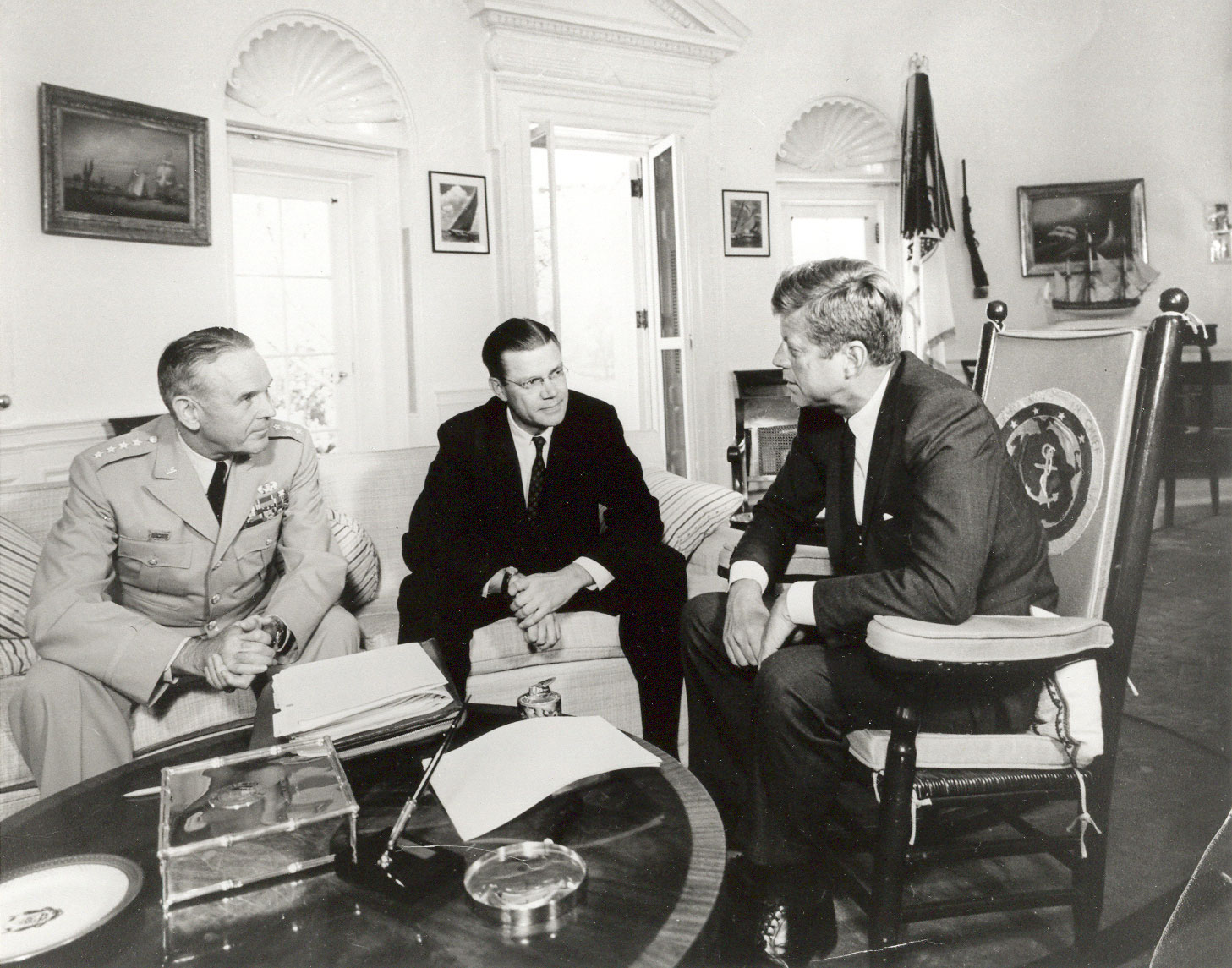 Prouty believed, based on having seen numerous copies of the November 21 draft, that it was relatively widely distributed across the senior layers of the national security apparatus. A cover note attached to a copy distributed to Bundy’s brother William, a deputy within the Defense Department, asks him to review and also consult on the draft with McNamara.[36] The draft also appears to have been distributed on November 23 to newly appointed President Johnson, ahead of a meeting with Ambassador Lodge scheduled for the following day which, in an instance of macabre irony, had already been anticipated in the draft’s opening sentence: “the President…has discussed the matter further with Ambassador Lodge”.[37] A State Department Briefing Paper put together for Johnson ahead of the same meeting refers to a “draft National Security Action Memorandum emerging from the Honolulu meeting, which Mr. Bundy has initiated.” (Emphasis added).[38]
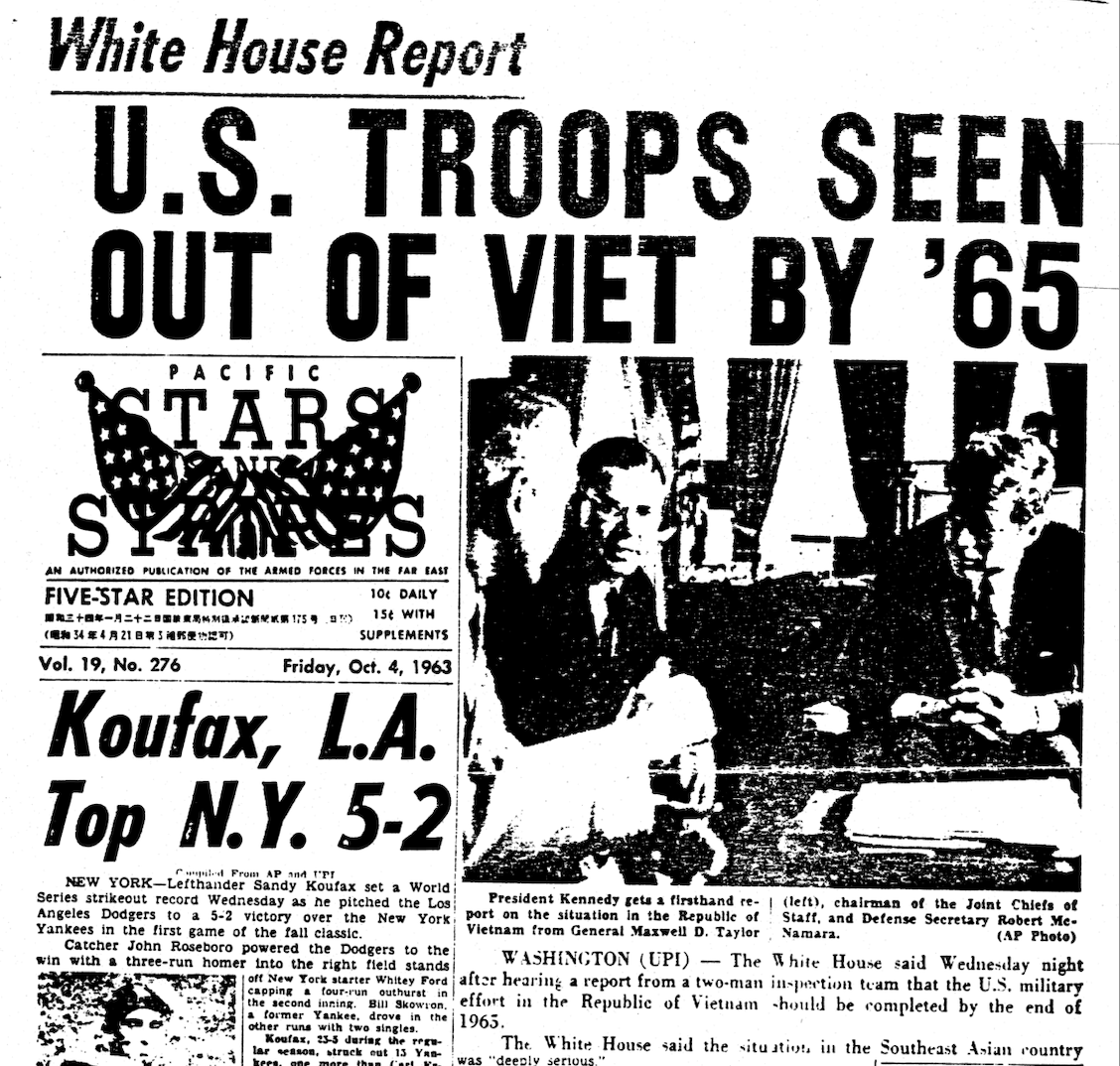 A second draft of the proposed NSAM 273 was composed on November 24. Changes in the draft were notable in paragraph 7, which originally discussed “the development of additional Government of Vietnam resources” to be used for “action against North Vietnam.” The revision appeared to address kinetic activity generated directly by U.S. forces, in accord with established covert protocols (i.e. the “plausibility of denial”).[39]
That same day, the anticipated meeting to discuss the South Vietnam situation was held, with LBJ, Rusk, McNamara, Ball, Lodge, McCone and Bundy in attendance.[40] This briefing for the President, focused on recommendations and updates, it represents – other than the one thousand man withdrawal slated for year-end – the internment of Kennedy’s Vietnam policies as developed in NSAM 263. Ambassador Lodge, for example, suggested that talk of a 1965 withdrawal – or “indication” thereof – was merely a negotiating ploy: “Lodge stated that we were not involved in the coup, though we put pressures on the South Vietnamese government to change its course and those pressures, most particularly on indications of withdrawal by 1965, encouraged the coup.” If ever there was a piece of high level CYA, this was it for, as James Douglass shows, Lodge was actually guiding the Diem brothers to their deaths.
CIA Director John McCone, contradicting the conclusions delivered in Honolulu to the press, said the situation was “serious” and the paucity of optimism regarding the future of South Vietnam was evidenced by large increases in Viet Cong attacks and their advanced preparations for more. For his part, LBJ expressed misgivings with poor handling of controversial situations in the country, exacerbated by internal bickering. He rejected the idea that “we had to reform every Asian in our own image” in reference to political and economic strategies discussed in Honolulu. “(Johnson) was anxious to get along, win the war – he didn’t want as much effort placed on so-called social reforms…”
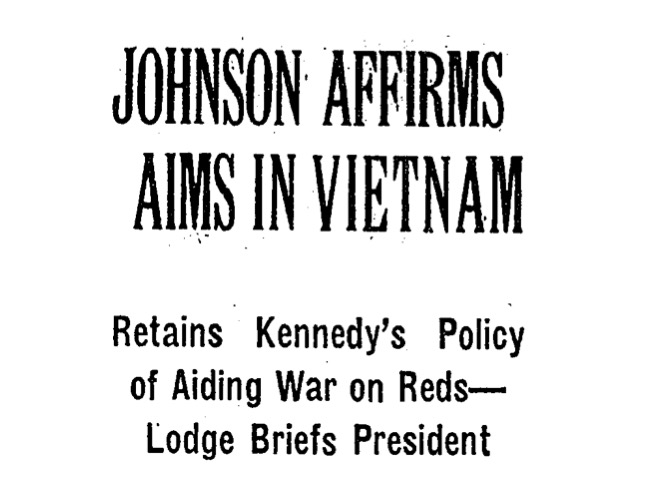
“The meeting was followed by a statement to the press which was given out by Bundy to the effect we would pursue the policies agreed to in Honolulu adopted by the late President Kennedy.” This statement was given prominence in a New York Times report published November 25, 1963 (datelined Nov 24) entitled “Johnson Affirms Aims in Vietnam, Retains Kennedy’s Policy of Aiding War on Reds”. The opening sentence, presumably echoing Bundy: “President Johnson reaffirmed today the policy objectives of his predecessor regarding South Vietnam.” This reporting features the first three paragraphs of what would be published as NSAM 273 two days later, including the iteration that the “central point of U.S. policy on South Vietnam remains; namely, to assist the new government there in winning the war against the Communist Vietcong insurgents.” There is also a discussion of the political and economic measures advocated at Honolulu, but downplayed by Johnson shortly before (which is not mentioned), as well as the need for unity within the U.S. bureaucracy assigned in support South Vietnam.[41]
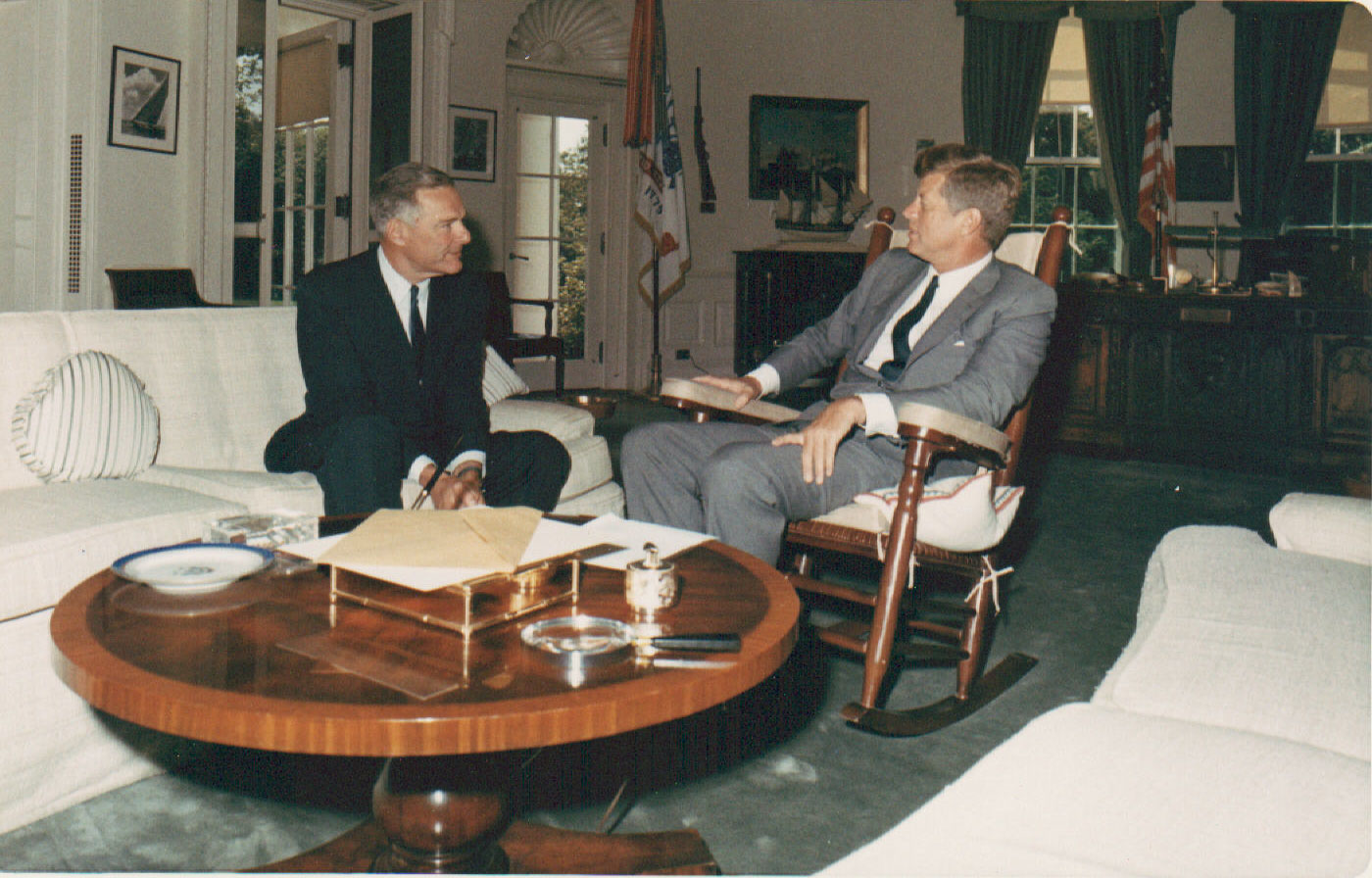 On November 26, 1963, National Security Action Memorandum No. 273 was signed by McGeorge Bundy and updated NSAM 263 in United States official policy for South Vietnam.[42] Kennedy’s policy of effecting the removal of all “U.S. personnel” (i.e. military and CIA) from South Vietnam by the end of 1965, clearly referenced during conversations held at the Honolulu Conference, had been essentially erased from memory, even as NSAM 273 and its components were being described as a continuation of, or consistent with, Kennedy’s policies. The intent is now to win the war. Prouty:
“Two months later, January 22,1964, one of the same authors of NSAM #263, General Maxwell Taylor, wrote to the Secretary of Defense, McNamara: ‘The Joint Chiefs of Staff consider that the United States must: (i) commit additional U.S. forces, as in support of the combat action within South Vietnam, and (j) commit U.S. forces as necessary in direct actions against North Vietnam.’
These were the same two top level officials who under JFK had gone along with the Kennedy plan for the withdrawal of U.S. men. Then, less than 3 months later, under LBJ, they made totally different recommendations. The only difference was that President Kennedy was against escalation and wanted the men home, and Kennedy had never approved at any time the introduction of combat soldiers under U.S. military commanders for combat purposes in Vietnam. President Johnson, with George Ball in a top position, was doing just the opposite.”[43]
That was how fast Johnson’s militant position infected Kennedy’s advisors.
What many consider the true milestone on the road to an American war, NSAM 288, was approved in March, based on recommendations generated from yet another review of South Vietnam’s national security situation, presented by McNamara (working from an initial draft written by Bundy). Among the recommendations: a pledge to “furnish assistance and support to South Vietnam for as long as it takes to bring the insurgency under control”; to put South Vietnam on a “war footing”; to increase and upgrade Air Force, Army, and Naval heavy equipment; to prepare “hot pursuit”, “Border Control”, “Retaliatory Actions”, and “Graduated Overt Military Pressure” against North Vietnam.[44] By August, the increased tempo of activities supported by U.S. military assistance had created the Tonkin Gulf incident, and the inevitable slide to a shooting war. Prouty:
“By March 1964 the U.S. approach to the situation in Vietnam had changed 180 degrees from the Kennedy policy of NSAM #263 and on March 17, 1964, President Johnson signed NSAM #288 which broadly expanded U.S. policy. About one year later, March 8, 1965, the first U.S. Marines operating under Marine commanders invaded South Vietnam at Da Nang. This was the true beginning of military action in Vietnam.”[45]
What Kennedy had not done in three years, Johnson had done in three months.
Obfuscation of NSAM 263
On January 6, 1992, the New York Times published an opinion piece by Leslie Gelb titled “Kennedy and Vietnam”. Gelb could be described as the consummate Washington insider, with a c.v. laden with high-profile appointments across government, think tanks, and the media, specializing in foreign affairs. In the late 1960s, Gelb served as the director of the so-called Pentagon Papers project, leading the team of analysts in setting down an extensive history of the Vietnam War. Gelb’s authority to criticize premises expressed in Oliver Stone’s then current blockbuster film JFK ensured his opinions would hold some influence in the culture at large.
In the piece, Gelb angrily accuses Stone (and by extension Prouty) of distorting the record of NSAM 263 and making “swaggering assertions about mighty unknowns.” Gelb claims of NSAM 263 that “some officials took the directive at face value”, but “most” saw it as a “bureaucratic scheme” to fudge the numbers of in-country personnel. He argues that “whatever JFK’s precise intentions” or “underlying thinking”, it was best to understand them as malleable and subject to changing circumstances and complications. Gelb ends his piece with an appeal to recognize the burden of the Presidency, particularly as involved Vietnam: the “private soul-searching” of Eisenhower, the “documented dilemmas ” and “torments” of Johnson and Nixon, matched by the “murky” musings represented by Kennedy’s occasional contradictory public statements. Stone (and Prouty) are therefore attacked for their “foolish” confidence over “decisions J.F.K. would have made in circumstances he never had to face.”[46] Prouty responded:
“It is almost beyond belief that (Gelb)… in 1992, finds it easier to say that this was a decision ‘he never had to face’ instead of telling it as it is – the reason ‘he never had to face’ that decision was because he had been assassinated.”[47]
 The one specific reference Gelb uses to respond to the supposed misrepresentations which had him so vexed, is itself distorted with some lawyerly spin: “Most officials also viewed the withdrawal memo as part of a White House ploy to scare President Diem of South Vietnam into making political reforms…That is precisely how the State Department instructed the U.S. Embassy in Saigon to understand NSAM 263.” What Gelb is referring to (and this became a talking point for other critics as well), is a State Department telegram to Lodge’s Vietnam embassy dated October 5, 1963.[48] While this communication is cited within the body of NSAM 263, it appears as an item of business separate from the primary matters, namely the planned withdrawal of “1000 U.S. military personnel” and the intention of withdrawing “the bulk of U.S. personnel” by the end of 1965.[49]
 Prouty’s issues with Gelb extended beyond the latter’s simplistic denial that Kennedy was just “going to abandon South Vietnam to a communist takeover.” Gelb’s previous role as director of the “Pentagon Papers” project could not be overlooked. Prouty:
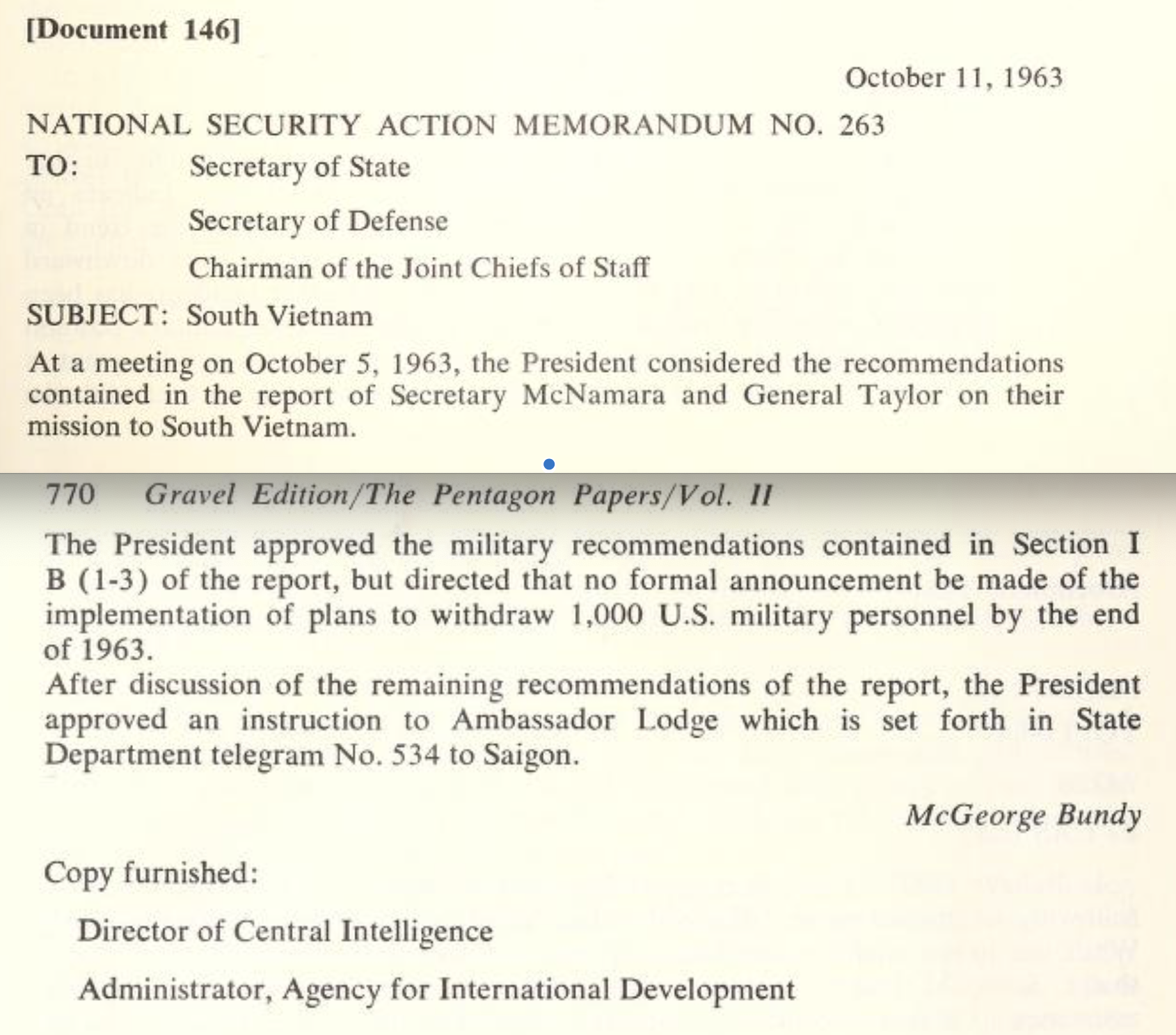
“However it was in the ‘Pentagon Papers’ that the intrigue to distort and misrepresent major episodes of the Kennedy era began. Pre-eminent among these distortions is the Pentagon Papers presentation of the NSAM #263 record. What was done was quite simple, and effective. The title, ‘National Security Action Memorandum No. 263’ appears as Document #146 on page 769 in Volume II of the Gravel Edition, i.e. Congressional Record. But, this is published as only three, single-sentence paragraphs of non-substantive material with no cross referencing. This is like publishing the envelope; but not the letter.”[50]
This is a good point. While NSAM No. 263, as it appears on pp 769-770 of the Gravel Edition (Vol.II), is accurately transcribed from the original, the presentation, lacking cross reference, is opaque.[51] Since McGeorge Bundy’s original wording is not precise, in that it dates the discussion of the crucial McNamara-Taylor report (October 5, 1963) but doesn’t attribute identifiers to the report itself (dated October 2, 1963), the reader is either left to their own devices to put the pieces together, or must remember to consult a lengthy Chronology which appears some 550 pages previous. Prouty:
Those few who already know what a true-copy of NSAM #263 looked like will find that the ‘Memorandum For The President’ that is the McNamara-Taylor Trip Report of Oct. 2, 1963 appears as Document 142 on page 751 through 766 with no reference to NSAM #263 whatsoever. This may be why so many ‘historians’ and other writers remain unaware of this most important policy statement.[52]
 The Chronology in Vol. II of the Pentagon Papers begins May 8, 1963 and concludes on November 23, 1963.[53] The Report of the McNamara-Taylor mission appears as a listing for October 2, 1963 (p216). In the brief description, the withdrawal of “1,000 American troops by year’s end” is noted, but there is no mention of the recommendation to withdraw “the bulk of U.S. personnel” by the end of 1965. The publication of NSAM 263 as an official document, October 11, 1963, is not listed.
The Chronology’s concluding three items feature a description of the Honolulu Conference (20 November 1963), which observes a press release “gives few details but does reiterate the U.S. intention to withdraw 1,000 troops by the end of the year.” That the press release also indicated “no basic changes to U.S. policies” is not mentioned. Then, incongruously, the Chronology concludes:
22 Nov 1963: Lodge confers with the President Having flown to Washington the day after the Conference, Lodge meets with the President and presumably continues the kind of report given in Honolulu.
23 Nov 1963: NSAM 273
Drawing together the results of the Honolulu Conference and Lodge’s meeting with the President, NSAM 273 reaffirms the U.S. commitment to defeat the VC in Vietnam Neither of these final two items actually occurred as described. Lodge did not meet with either President Kennedy or newly sworn-in President Johnson on November 22, the day on which President Kennedy was assassinated. NSAM 273 was not made official on November 23, and the specific meeting pertaining to the document was not held until the following day. Prouty:
“NSAM 273 was signed by President Johnson on Nov. 26, 1963. It must be noted, that until an NSAM is approved and signed it does not have a formal number; therefore the subject matter that Lodge and Johnson conferred about could not have been designated NSAM #273 on the 23rd of Nov. 1963.”[54]
Conclusion
A separate attack on Oliver Stone’s JFK movie, published by the New York Times during the film’s initial release, was written by Tom Wicker.[55] Prouty’s response to this piece provides a good summary of his position:
(Tom Wicker) also attacked Stone’s use of Kennedy’s Vietnam policy statement, NSAM #263, with the comment, ‘I know of no reputable historian who has documented Kennedy’s intentions.’ NSAM #263 is the official and complete documentation of Kennedy’s intentions. It was derived from a series of White House conferences and from the McNamara-Taylor Vietnam Trip Report, and it stated the views of the President and of his closest advisers as is made clear in the U.S. government publication Foreign Relations of the United States, 1961-1963, Vol. IV, ‘Vietnam: August-December 1963’. That source is reliable history. Wicker’s December 15, 1991, Times article was a lengthy and unnecessarily demeaning diatribe against Stone and his movie…
The inclusion of this little-known NSAM #263 in the film became the principal point of attack of the big guns that were leveled at Stone, Garrison, and myself. It really is amazing that the most vitriolic attacks were those that attempted to inform the public that there was no such directive. The furor over that one item, NSAM #263, was evidence that Stone had hit his target. This alone uncovered the ‘Why?’ of the assassination.[56]
Prouty’s insights pertaining to National Security Action Memorandums numbers 263 and 273 remain vitally important to understanding the development of Kennedy’s Vietnam policy. It is clear that the recommendations described in NSAM 263 were the result of a period of concentrated attention directed by the President. It is much less clear what motivated McGeorge Bundy to draft what became NSAM 273, and how it was that the changes to the earlier document initiated by 273 were long described as representing continuity with Kennedy’s policies. Clearing the web of obfuscation over these directives, as begun in Stone’s JFK, provides clarity to the historical record.
The Vietnam War, with its intensive U.S. military commitments, proved a massive disaster for the people of Southeast Asia and the American public, although it remains often officially portrayed as a “tragic” event borne of circumstance and not design. As well, the missed opportunity to rein in the CIA’s operational capabilities opened the door to ever larger corrupt cynical undertakings such as Iran-Contra and Timber Sycamore, with the clandestine services’ lack of accountability ever more entrenched. The documented record strongly infers that Kennedy’s potential re-election in 1964, as a “what-if?”, would have been consequential.
Bibliography:
L. Fletcher Prouty, Collected Works. CD-ROM
www.prouty.org
Notes
[1] JCS – Sec Def Discussions April 29, 1963 https://www.maryferrell.org/showDoc.html?docId=144
[2] JCS Official File. May 6, 1963. https://www.maryferrell.org/showDoc.html?docId=122#relPageId=47
[3] ibid https://www.maryferrell.org/showDoc.html?docId=122#relPageId=115
[4] The concentrated interest in Vietnam policy during these months is recorded in Foreign Relations of the United States, 1963, vol 3 Vietnam: January-August 1963 & vol. 4 Vietnam: August-December 1963, assembled by the Department of State and published by the U.S. Government Printing Office, 1991 https://www.maryferrell.org/php/showlist.php?docset=1036
[5] Prouty, JFK: New Preface, 1996. Collected Works
[6] FRUS Vol. 4, p117. 66. Memorandum of a Conference with the President, White House, September 6, 1963 https://www.maryferrell.org/showDoc.html?docId=945#relPageId=143
[7] FRUS Vol. 4, p 161. 83. Memorandum of a Conversation, White House, September 10, 1963 https://www.maryferrell.org/showDoc.html?docId=945#relPageId=187
[8] FRUS Vol. 4, p199, Memorandum for the Record of a Meeting, White House, September 12, 1963 https://www.maryferrell.org/showDoc.html?docId=945#relPageId=225
[9] FRUS Vol. 4, p231, Draft Letter from President Kennedy to President Diem, September 16, 1963. https://www.maryferrell.org/showDoc.html?docId=945#relPageId=257
[10] This document would also be described as “draft instructions” from the President for McNamara to guide his upcoming trip to Vietnam with General Taylor. FRUS Vol. 4, p 278. 142. Memorandum from the President to the Secretary of Defence (McNamara) September 21,1963. https://www.maryferrell.org/showDoc.html?docId=945#relPageId=304)
[11] FRUS Vol. 4, p 280. Memorandum for the Record of a Meeting, White House, September 23, 1963. https://www.maryferrell.org/showDoc.html?docId=945#relPageId=306
[12] Prouty, The Highly Significant Role Played By Two Major Presidential Policy Directives, 1997. Collected Works. Prouty does make the point that neither McNamara or Taylor would have had the time or resources to compose let alone print the volume seen in photographs from October 2.
[13] Taylor also wrote: “I am convinced that the Viet Congress insurgency in the north and center can be reduced to little more than sporadic incidents by the end of 1964. The Delta will take longer but should be completed by the end of 1965.” FRUS Vol. 4, p 328. Letter From the Chairman of the Joint Chiefs of Staff (Taylor) To President Diem, October 1, 1963. https://www.maryferrell.org/showDoc.html?docId=945#relPageId=354
[14] FRUS Vol. 4, p 350. 169. Summary Record of the 519th Meeting of the National Security Council, White House, October 2, 1963. https://www.maryferrell.org/showDoc.html?docId=945#relPageId=376
[15] FRUS Vol. 4, p 353. 170. Record of Action No 2472, Taken at the 519th Meeting of the National Security Council, October 2, 1963. https://www.maryferrell.org/showDoc.html?docId=945#relPageId=379
[16] Item 194 Foreign Relations of the United States 1961-1963 Vol. IV p395 https://www.maryferrell.org/showDoc.html?docId=945#relPageId=421)
[17] Item 167 Memorandum from the Chairman of the Joint Chiefs of Staff (Taylor) and the Secretary of Defense (McNamara) to the President, October 2, 1963 https://www.maryferrell.org/showDoc.html?docId=945#relPageId=362)
[18] Foreign Relations of the United States 1958-1960, Vietnam Vol 1. p705 Item 255. Special Staff Note Prepared by Department of Defense.
[19] Prouty, The Hidden Role of Conspiracy, 1993. Collected Works “(Kennedy) inherited it and revisionist historians have saddled him with the ‘Vietnam build-up’ and the ‘creation of the Special Forces’ ever since.”
[20] Foreign Relations of the United States 1958-1960, Vietnam Vol 1. P703 Item 254. Memorandum From the Joint Chiefs of Staff to the Secretary of Defense (Gates)
[21] Prouty, 30th Anniversary of Coup, 1994. Collected Works
[22] The members of this Group were General Maxwell Taylor, Admiral Arleigh Burke, CIA director Allen Dulles, and Robert Kennedy representing the Executive
[23] Prouty, 30th Anniversary of the Coup, 1994, Collected Works
[24] copies of NSAM 55-57 as saved in Prouty’s own files can be found at https://ratical.org/ratville/JFK/USO/appE.html
[25] “When I read to (Chiefs of Staff) President Kennedy’s statement from NSAM #55…you could have heard a pin drop in the ‘Gold Room’. They had never been included in the special policy channel which Allen Dulles had perfected over the past decade, that ran from the National Security Council (NSC) to the CIA for all clandestine operations.” Prouty The Highly Significant Role Played By Two Major Presidential Policy Directives 1997. Collected Works
[26] Item 304 Telegram from the Department of State to the Embassy in Vietnam November 6, 1963. https://www.maryferrell.org/showDoc.html?docId=945#relPageId=605
[27] Item 312 Memorandum for the Record of Discussion at the Daily White House Staff Meeting, Washington, November 13, 1963 8 a.m. https://www.maryferrell.org/showDoc.html?docId=945#relPageId=619
[28] Memorandum to Mr Bundy https://www.maryferrell.org/showDoc.html?docId=146534#relPageId=6
[29] That might infer he was instructed specifically by President Kennedy, but his reply as recorded does not actually clarify who had so instructed. Since Bundy was the author of NSAM 273, such instruction might explain the how’s and why’s of the original draft, dated November 21, which Bundy later described as drafted “for the President”. The record, however, nowhere indicates any instruction or dialogue involving Kennedy seeking revision to NSAM 263, which had been drafted only weeks previously.
[30] FRUS Vol. 4, p 608 Item 321 Memorandum of Discussion at the Special Meeting on Vietnam, Honolulu November 20, 1963 https://www.maryferrell.org/showDoc.html?docId=945#relPageId=634
[31] FRUS Vol. 4, p 610 Item 321 Memorandum of Discussion at the Special Meeting on Vietnam, Honolulu November 20, 1963 https://www.maryferrell.org/showDoc.html?docId=945#relPageId=636
[32] U.S. Aides Report Gain,1,000 Troops to Return New York Times November 21, 1963, p8
[33] a copy of the draft, along with John Newman’s discussion of it can be found here: https://jfkjmn.com/new-page-77/
[34] Prouty, Hidden Role of Conspiracy,1993, Collected Works
[35] Prouty The Highly Significant Role Played by Two Major Presidential Policy Directives 1997. Collected Works
[36] “I have other copies of this draft document that were done on various typewriters and they certainly indicate that this draft document had to have been quickly circulated through all of the highest governmental levels…on the 21st. On these draft copies there are some notes, and line outs.” Also: “in this original draft that he circulated among many of the top echelons of the Government, with personal “Cover Letters” to the Director of Central Intelligence, John McCone and to his brother William in McNamara’s office…” Prouty The Highly Significant Role Played By Two Major Presidential Policy Directives 1997. Collected Works
[37] Item 324. Memorandum From the Secretary of Defense (McNamara) to the President https://www.maryferrell.org/showDoc.html?docId=945#relPageId=653
[38] Item 326 Briefing Paper Prepared in the Department of State for the President, November 23, 1963 https://www.maryferrell.org/showDoc.html?docId=945#relPageId=657
[39] The first draft of NSAM 273, and a brief discussion of it, can be accessed on scholar John Newman’s site https://jfkjmn.com/new-page-77/. In an interview, McGeorge Bundy explained to Newman his first draft approach to paragraph 7: “he tried to bring these recommendations ‘in line with the words Kennedy might want to say.’” Which, considering the change in responsibility for activity from Government of Vietnam to U.S. forces from first to second draft, is a back-handed way of admitting the difference in policy, not just of words.
[40] Item 330 Memorandum for the Record of a Meeting, Executive Office Building, Washington, November 24, 1963, 3 p.m. Subject. South Vietnam Situation https://www.maryferrell.org/showDoc.html?docId=945#relPageId=661
[41] The concept of “unity” informs one of the paragraphs from the first draft of NSAM 273, which Prouty discussed at some length in a few of his essays. In Bundy’s draft, Paragraph Four reads: “It is of the highest importance that the United States Government avoid either the appearance or the reality of public recrimination from one part of it against another, and the President expects that all senior officers of the Government will take energetic steps to insure that they and their subordinates go out of their way to maintain and to defend the unity of the United States Government both here and in the field.” As published, reference to unity is clarified as “support for established U.S. policy in South Vietnam” – which produces a different reading than the potentially ominous warning written on the eve of the presidential assassination. It could be fairly argued, however, even lacking the precise term “South Vietnam”, that the paragraph in the first draft was referring to policies thereof, as there had been a lot of concern in the period between the Diem coup and the Honolulu Conference with perceived divisions, stoked in part by an article written by David Halberstram. These concerns are reflected in the documents published in Foreign Relations of the United States Aug-Dec 1963 from those weeks in November. That said, Prouty’s alert reading has a context, and it should not be overlooked that McGeorge Bundy was responsible for, among other things: a) called off the flight meant to destroy Castro’s last T33, ensuring failure of the Bay of Pigs b) wrote first draft of NSAM 273 c) believed to have contacted Air Force One from White House Situation Room Nov 22/63 to report lone gunman responsible for JFK assassination d) wrote first draft of NSAM 288.
[42] Item 331 National Security Action Memorandum No. 273 November 26, 1963 https://www.maryferrell.org/showDoc.html?docId=945#relPageId=663
[43] Prouty, Kennedy and the Vietnam Commitment, Collected Works
[44] Memorandum From the Secretary of Defense (McNamara) to the President, March 16, 1964. https://history.state.gov/historicaldocuments/frus1964-68v01/d84
[45] Prouty, Hidden Role of Conspiracy, 1993, Collected Works
[46] Leslie Gelb, Foreign Affairs; Kennedy and Vietnam, Section A Page 17, New York Times, January 6, 1992
[47] Prouty, Vietnam Daze With McNamara, Collected Works
[48] Item 181 Telegram from the Department of State to the Embassy in Vietnam October 5, 1963. https://www.maryferrell.org/showDoc.html?docId=945#relPageId=397
[49] The Memorandum states: “After discussion of the remaining recommendations of the report” – that is, recommendations other than those involving the planned withdrawals – “the President approved an instruction to Ambassador Lodge which is set forth in State Department telegram No. 534 to Saigon.” This telegram’s featured “instruction” refers specifically to a series of proposed Actions to guide approaches to Diem, none of which refer to troop withdrawals. The attempt to tie the matters together is strained, but notably had also found expression by Lodge during the meeting with LBJ on November 24, 1963 (i.e. talk of withdrawal simply a negotiating ploy)
[50] Prouty, Vietnam Daze with McNamara, Collected Works
[51] In contrast, the presentation of NSAM No. 263 in Foreign Relations of the United States, 1963, vol. 4 Vietnam: August-December 1963, published in 1991, is properly cross-referenced.
[52] Prouty, Vietnam Daze with McNamara, Collected Works
[53] Chronology, Pentagon Papers Gravel Edition Vol II, Beacon Press pp 207-223
[54] Prouty, Vietnam Daze with McNamara, Collected Works
[55] Tom Wicker, Does JFK Conspire Against Reason?, New York Times, December 15, 1991
[56] Prouty, Stone’s JFK and the Conspiracy, 1996, Collected Works
-

Hugh Aynesworth is Dead: The Grinch is Gone
Hugh Aynesworth died on December 23rd at age 92 after being in both the hospital and hospice care.
Aynesworth was born in West Virginia and started his newspaper career at the Clarksburg Exponent-Telegram. In the fifties he was employed in Fort Smith, Arkansas as a sports editor and then a managing editor. He then moved to Dallas as a business writer for the Times Herald, and later worked for UPI in Denver. He returned to Dallas in 1960 to write for the Morning News and it was while there that the JFK murder took place. In 1967 he shifted over to Newsweek, from where he began to cover the Jim Garrison inquiry into the JFK case.
To anyone who was really interested in the assassination of President John Kennedy, his death will be unlamented. Because perhaps no other reporter in America—excepting maybe Dan Rather– did more to cover up the facts in that case, over a longer period of time, than did Hugh Aynesworth.
He maintained that he was at three crucial venues on the day of Kennedy’s murder. First, he was a witness to the actual assassination in Dealey Plaza. Yet, does any photograph reveal this to be the case? He was also allegedly on the scene when Patrolman J. D. Tippit was killed, though it is hard to pin down a time when he was there. (More on this later.) He then pulled off a trifecta. He also said he was at the Texas Theater when the police apprehended Lee Oswald–and he added that he saw Oswald try and shoot Officer Nick McDonald. (“The Man Who Saw Too Much”, by William Broyles, Texas Monthly, March 1976). Since the evidence indicates that Oswald did not do any such thing, this is also tough to buy into. (Sylvia Meagher, Accessories After the Fact, p. 259)
But, for Hugh, that was not enough. Aynesworth also said that he was in the Dallas Police Department basement when Jack Ruby lunged forward to shoot Oswald. Again, if anyone can pinpoint a film or photo of the man being there, please do. After all, this event was captured live on television. The thesis that he was on the scene for all of these events allowed him to maintain the concept that he had “broken almost every major assassination story.” (Broyles, op. cit.) He now became the Morning News’ lead reporter on the Kennedy case.
As William Broyles wrote, Aynesworth liked to throw bouquets at himself. For instance, that he became the first reporter to break the story of Oswald’s escape route. Since Oswald was not trying to escape, this is also a dubious story. After all, how does one “escape” by using public transportation, like a bus and taxi. And in the latter case, Oswald offered the cab to an elderly lady first. (Meagher, pp. 75-83)
As anyone can see, it was not enough for Aynesworth to cover the story. He had a definite viewpoint about the JFK assassination. And he had it before the Warren Report was even published. On July 21, 1964, through his columnist colleague Holmes Alexander, it became clear that the omnipresent reporter did not trust Chief Justice Earl Warren on the JFK case. So the pair fired a shot across the bow of the Commission. The Commission had to show that Oswald was a homicidal maniac. If not, then Aynesworth would reveal that the FBI knew Oswald was a potential assassin and that the Bureau blew their assignment.
But even that was not enough for Hugh. He was now going to show that Oswald was “a hard driven political radical Leftist”. How so? The column revealed that Aynesworth had interviewed Marina Oswald. Marina had told him that Oswald had threatened to kill Richard Nixon. This one shows just how nutty Aynesworth had become on the Kennedy case. Because not even the Warren Commission bought into it. (Warren Report, pp. 187-89) This rubbish has been exposed by more than one writer. For instance: Nixon was not near Dallas at the time Marina said the incident happened. (Meagher, p. 241) But further, as Peter Scott has observed, to buy into this, Marina had to have locked Oswald in the bathroom to stop him from this heinous act–yet the bathroom locked from the inside. Finally, there was no local newspaper announcement that Nixon was going to be in Dallas at this time, April of 1963. Yet Marina clearly implied that this is what caused Oswald to plan on shooting him. (See also WC Vol., 5, p. 389, and Scott, Deep Politics and the Death of JFK, pp. 286-91) According to Michael Granberry’s obituary for Aynesworth, the Nixon nuttiness originated with a conversation between Marina and Aynesworth.
Was there more to the Marina/Hugh relationship? In May of 1967, researcher Shirley Martin wrote a letter to Jim Garrison about her 1964 meeting with the man. Hugh started off with some “disgusting anti-Kennedy stories.” He then began to praise the city of Dallas, especially his newspaper the Morning News. Hugh then personally smeared some of the Commission critics like Thomas Buchanan and Mark Lane; the former was a “fairy” and the latter was a communist. He added that the JFK case was really a communist plot that Earl Warren would cover up. He also said that he had an affair with Marina. He then commented that Marina and Ruth Paine were involved in a lesbian relationship prior to the assassination. Martin also wrote that Aynesworth was bitter about Merriman Smith winning the Pulitzer for his JFK coverage.
But then there was this. The reporter told Shirley that he was at the scene of the Tippit shooting at 1:05, no later than 1:10. In other words, before the Commission said the murder occurred. (Warren Report, pp. 165-66). In fact, it would be impossible for Oswald to have walked from his rooming house to the scene of the crime—10th and Patton—during that time interim. (Meagher, p. 255)
According to researcher Rachel Rendish, Aynesworth once offered to show her some sex photos of Marina. Rendish slammed the door shut like this:
Oh yes, I know all about that film and how you boys set her up. She said that was the item you always used for blackmail. I have absolutely no interest in seeing it… He was stunned. (Email to Robert Morrow, 12/27/23)
Then there was the Oswald diary heist. When the FBI did an investigation of how the alleged “Oswald diary” got into Aynesworth’s newspaper they concluded that it was likely stolen from the Dallas Police archives by assistant DA Bill Alexander and then given to Aynesworth. After running it locally, he then put it on the market to other publications. The sale garnered well into the five figures, a ducal sum in those days. The proceeds were split between Aynesworth, his then wife, and Alexander. Marina, who had a legal claim, was originally cut out of the deal.
In late 1966, Aynesworth became an FBI informant on the JFK case. There was a December 12th report from Hugh on the progress of the Life magazine re-inquiry into the murder of Kennedy. Its odd that this would occur at all since Aynesworth was not a part of that investigative team, which included Josiah Thompson, Ed Kern and Patsy Swank. It likely happened due to the titular Life leader Holland McCombs, a friend of Clay Shaw’s, wanting to cover all the bases, and knowing he could rely on Hugh to do so. Aynesworth told the Bureau that Life had found a witness who connected Oswald with Ruby. In his report he also added that Mark Lane was a homosexual and had to drop his political career because of the allegations. If one recalls, earlier it was Buchanan who was homosexual and Lane was a communist. So now Lane was a gay commie? Like the CYA coward he was, Aynesworth specifically requested his identity not be disclosed by the FBI.
But it was during the Jim Garrison inquiry that Aynesworth really came into his own as an agent/informant for the FBI and CIA. The reporter learned about Garrison’s inquiry through Life magazine stringer David Chandler. The DA granted Hugh an interview at his home after which Aynesworth wrote to McCombs that they should not let Garrison knew they were playing “both sides”. This was after the first meeting! But recall the man’s credo: “I’m not saying there wasn’t a conspiracy….I know most people in this country believe there was a conspiracy. I just refuse to accept it and that’s my life’s work.” (July of 1979 on Dallas PBS affiliate KERA). How could he do so if he was so invested in the Krazy Kid Oswald story from the start? But there is a corollary to this: the Machiavellian rule that the one’s own ends justify the means. And, as with Marina and Nixon fabrication, he was about to prove it once more.
In May of 1967, Aynesworth wrote an article for Newsweek on the Clay Shaw case. The article was simply a cheap smear. It said that whatever plot there was out of New Orleans, it was made up by Garrison; that the DA’s staff had threatened to murder a witness; and the DA was running the equivalent of a reign of terror over the city which had the citizenry in fear. But, before the libelous story ran, the reporter sent a copy to both the White House and the FBI. In an accompanying telegram, he wrote that Garrison’s plan was to make it seem that the FBI and CIA are involved in the JFK “plot”. He again requested his name be withheld. This secrecy is what he relied upon to make it seem he was independent and not in bed with the feds. In fact, when Aynesworth helped organize a Kennedy conference in Dallas to compete with the ASK seminars in the early nineties, someone asked him that question: Have you ever cleared a story in advance with the White House or the FBI. Like any common fink, he denied it. The questioner then confronted him with this telegram.
But it was not just the FBI and the White House from whom he sought protection. British researcher Malcolm Blunt has discovered a CIA document in which the Agency revealed that Aynesworth was interested in Agency employment from back in the early sixties. (Memo of January 25, 1968). And in fact, he appears to have gone to Cuba, not once, but twice, in 1962 and 1963. Robert Morrow confronted him with this and the reporter’s answer was a clever piece of evasion. (Click here for the exchange)
James Feldman commented on this meeting, saying that Hugh never directly replied to the question of was he a CIA media asset. He only said that he did not take money from a government agency. But as Feldman added, agencies often distribute funds through business intermediaries or other types of fronts. Feldman concluded that “his failure to answer the question in a forthright, honest manner merely supports those who assert that Aynesworth has been a CIA media asset.”
About the last there can be little, if any, doubt. For in his attempt to directly obstruct Garrison’s legal proceedings against Clay Shaw, the reporter actually did what he (falsely) accused Garrison of doing: he attempted to bribe a witness. As many know, Shaw, Oswald and David Ferrie had gone to the Clinton/Jackson area–about 120 miles northeast of New Orleans– in the early autumn of 1963. Many witnesses saw the trio, with Oswald in a voter registration line and Shaw and Ferrie sitting in a Cadillac (Garrison actually had a picture of the car, see Joan Mellen, A Farewell to Justice, p. 223).
Sheriff John Manchester was one of the most important witnesses to this strange but fascinating episode. And Aynesworth understood how important he was. Hugh had essentially moved to New Orleans by 1967 and was working with Shaw’s lawyers. He had plants inside of Garrison’s office, e.g. William Gurvich. And they had supplied him with memoranda on which Garrison was working. (See Destiny Betrayed, by James DiEugenio, Second Edition, pp.252-54) One of these concerned Manchester’s testimony, in which he identified Shaw as the driver of the car. Aynesworth drove to the Clinton area with it and told Manchester something quite interesting and revelatory about himself and who he was working with in tandem. Hugh told the sheriff that if he failed to show up at Shaw’s trial he could get him a job as a CIA handler in Mexico for 38,000 dollars per year, over $300,000 today. Obviously, if he was not working with the Agency, how could Aynesworth extend such an offer?
I rather liked Manchester’s incorruptible reply: “I advise you to leave the area. Otherwise I’ll cut you a new asshole.” (ibid, p. 255)
From threatening the Warren Commission and FBI, to helping create a phony Nixon murder attempt, to allegedly sleeping with Marina Oswald and taking photos of it, to smearing Commission critics as being both gay and commies, to informing for J. Edgar Hoover and lying about it, to interfering with a DA’s investigation and bribing prospective witnesses, Hugh Aynesworth was a piece of human flotsam masquerading as a reporter on the JFK case. That Dallas holds him up as an exemplary journalist shows how deeply in denial that city is about President Kennedy’s assassination and the cover up that followed…
-

Doug Horne Reviews Sean Fetter’s new book “Under Cover of Night”
This review is primarily a “medical critique” of three major aspects of Sean Fetter’s UNDER COVER OF NIGHT, as well as commentary about his historiography.
(1) Fetter has fully adopted and thoroughly advanced David Lifton’s hypothesis from BEST EVIDENCE that the post mortem surgery to JFK’s head wounds (evidenced in both Dr. Boswell’s autopsy sketch of the severe damage to the top of JFK’s skull, and in the graphic autopsy photos showing the top of JFK’s cranium removed—damage that no one saw at Parkland Hospital) occurred well before the President’s body arrived at Bethesda Naval Hospital the night of the assassination. In my many telephone conversations with Lifton from 1996-2000, before we largely parted ways with each other, Lifton indicated to me many times that he still believed this to be the case, in spite of the strong evidence to the contrary that I presented to him on numerous occasions. Fetter explicitly states his support for this old Lifton hypothesis when he states the same conclusions, on pages 46 and 52; in summary, in Volume I of UNDER COVER OF NIGHT, Sean Fetter concludes that JFK’s corpse was violently mutilated (namely, that the top of the head was hacked open with a “crash axe,” and his throat wound was torn open); his spinal cord was severed; and his brain was removed from the cranium, all long before 6:35 PM when Kennedy’s body arrived at Bethesda Naval Hospital. So, as much as Fetter decries Lifton’s analytical abilities, and disparages him personally, he has endorsed THE major hypothesis in Lifton’s BEST EVIDENCE.
And yet, strong dispositive evidence exists that post mortem tampering with JFK’s wounds did NOT occur prior to the arrival of his body at Bethesda Naval Hospital—and that JFK arrived at Bethesda with his head in the same condition that was observed when his body left Parkland Hospital, in Dallas: namely, with a localized, avulsed exit wound in the right rear quadrant of his head, about the size of a baseball or small orange; with the top of the head apparently intact; and with the brain still in the cranium.
Read the rest of the article here.
Doug Horne replies to Gary Aguilar’s comments on his appearance in What the Doctors Saw.
Read here.
-

House of Omission
For every milestone anniversary of the Kennedy assassination comes a major documentary from mainstream media. In 1993 we saw the FRONTLINE special “Who Was Lee Harvey Oswald?”. In 2003 it was the ABC special “Beyond Conspiracy”. In 2013 came NOVA’s “Cold Case: JFK”. This time around it was National Geographic’s 3-part series “JFK: One Day In America”. However, unlike the ones that came before, rather than discussing actual evidence, the new kid on the block took a vastly different approach to the case—the simple art of omission.
Secret Service agent Clint Hill started the program off by saying “There are a few of us left. But very few.” This is hardly the case, as there are dozens of witnesses still alive from that day.
Right off the bat, the tone of the series was clear—they were going for emotion and tugging at heart strings, sad music and all. All throughout the series this tone was nonstop. Also right away, something felt off. This is because they colorized nearly every single black-and-white film from that day. This makes it offbeat to anyone familiar with the films. They did, however, sometimes use a variety of hardly seen films throughout.
EPISODE 1
The first witness we are introduced to is Buell Frazier, who drove Lee Harvey Oswald to work. Here come the omissions. They have Frazier tell the basic fact that Oswald carried a package into work that day—but omitted that Frazier has always insisted it was entirely too small to contain a rifle (2 H 240), and also his strong conviction that his friend didn’t kill Kennedy.
Up next are assassination eyewitnesses Bill and Gayle Newman. The program has them essentially tell their basic story—but omitted the basic fact that they’ve always said shots came from behind them up on the grassy knoll. (WC 19 H 490)
Agent Clint Hill tells his story—but they omitted him describing the massive blowout in the right rear of Kennedy’s head. (WC 2 H 141) Of course, all indicative of a shot from the front. He details this in every interview he does. Why did they omit it here?
Fellow agent Paul Landis was also interviewed—but left out was his recent revelation that he had found a bullet in the backseat of the limousine. And he too described the wound in the back of JFK’s head, and reported “that the shot came from somewhere towards the front.” (WC 18 H 759) Omitted too were these.
The famous Zapruder film is shown—but the headshot sequence is skipped over. One has to wonder: did they omit it simply because it’s graphic, or did they omit it because it shows JFK’s head going back-and-to-the-left (implying a shot from the front)? The first seems implausible, for it has been shown in dozens and dozens of mainstream documentaries for decades.
Strangely, when we get to Parkland Hospital, zero of the treating staff are interviewed for the program. Did they not interview these people because they have been insistent since day one that the President was shot from the front? They could’ve interviewed Dr. Ronald Jones, who’s still very much alive. Dr. Jones said in 1983: “If you brought him in here today, I’d still say he was shot from the front.” (Best Evidence, p. 705) They also could’ve interviewed Dr. Don Curtis, Dr. Joe Goldstrich, Dr. Philip Williams, Dr. Richard Dulany, Nurse Pat Hutton, etc.
EPISODE 2
Continuing at Parkland, we are given the impression JFK’s body was simply placed in the coffin and taken to the airport. Anyone with even a cursory knowledge about this case would know this is abominably incorrect. Completely omitted was the most basic fact that JFK’s body was illegally stolen from the coroner before an autopsy could be done. It wasn’t just stolen, there was a literal battle over the body. One of the doctors gave this shocking account: “[Agent] Kellerman took an erect stance and brought his firearm into a ready position. The other men in suits followed course…Had Dr. Rose not stepped aside, I’m sure that those thugs would have shot him.” (JFK: Conspiracy of Silence, p. 119)
We are taken back to Dealey Plaza, and Dallas police officer Rusty Robbins tells the audience “We were in the middle of the biggest manhunt the country had ever seen.” Well, I’m no professional historian, but wasn’t John Wilkes Booth the biggest manhunt ever? That lasted 12 days. This lasted just over an hour. Mentioning briefly the Tippit murder, Robbins tells us the reason Officer Tippit pulled over the man who killed him was because he “matched the description of the guy they thought killed the President.” Only the Warren Report believed this. If that were the case, Tippit would be pulling over every white guy in town that matched the very general description. The truth is, we have no idea why the man was stopped. Completely omitted from the program were any details or evidence about Tippit’s murder.
News anchor Bill Mercer tells the audience that “Oswald was unaccounted for” in a “roll call” at the Texas School Book Depository after the shooting. This is a common mainstream talking point. The truth of the matter is that 17 employees were never in the building after 12:30! (WC 22 H 632–686) There also wasn’t a roll call. (James DiEugenio, The JFK Assassination: The Evidence Today, pp. 123-24)
Ruth Paine then tells her story, which is nothing new.
EPISODE 3
What was completely skipped over and not even mentioned was the President’s autopsy! They could have interviewed James Curtis Jenkins, who assisted the pathologists that night. He was just 19 years old and it greatly affected him. You’d think the producers would’ve jumped for an interview with him. They could’ve interviewed pathologist Dr. Robert Karnei. They could have interviewed Ed Reed, who X-rayed the President’s body. What about Richard Lipsey, Nick Rudnicki, Dr. Gregory Cross? Etc. I’ve interviewed all these men. Why didn’t National Geographic?
Also conveniently omitted from the series is the clip shown in every documentary of Oswald shouting to reporters “I’m just a patsy!”
The “One Day in America” program then jumped to 2 days later on 11/24 to cover Jack Ruby’s shooting of Oswald. This is told from the perspective of reporter Peggy Simpson and not the usual Hugh Aynesworth or Bob Jackson. It was very striking though seeing the film of Oswald being shot colorized.
The program of course covered President Kennedy’s funeral. But for an attempted sentimental and human interest documentary, why on earth did they not interview any of the surviving honor guards who buried JFK? 5 of the 6 are still living! I interviewed 3 of them.
After a lot of more sad imagery and music, the series ended with the quick caption: “On 24th September 1964, the Warren Commission concluded that President Kennedy was assassinated by Lee Harvey Oswald alone and Jack Ruby also acted alone.” And roll credits and that’s all.
All this series did was tell the basic story of what happened that day without any details whatsoever. All it told was: JFK went to Texas, was killed in Dallas, a suspect was arrested, was killed 2 days later, and JFK was buried. That’s literally it. Nothing at all about evidence, what happened, why he died, and why it matters. It makes it seem like there’s no question at all about anything. They also made it sound like these handful of witnesses are the only ones left. Nothing could be further from the truth. This series is the biggest dud I’ve seen. As one reviewer on Rotten Tomatoes rightfully said:
“It’s just a painfully slow version of how the news was broadcast, nothing more. Asks zero questions about the greatest cold case of all time. Avoid if you are looking for answers.”
Another reviewer said: “Snooze fest I got 5 mins into episode 2 and turned it off.”
One has to wonder what we will see in the next ten years.
-

JFK: What the Doctors Saw – An Important Addition, and a Missed Opportunity
Paramount Plus’ new documentary, JFK: What the Doctors Saw, is a valuable contribution to the story of the assassination. It features interviews conducted during the past six years with the trauma surgeons who tried to save President John F. Kennedy’s life after he was shot in Dallas on 11/22/63. It will inevitably expand and enliven the never-ending controversy about whether Lee Harvey Oswald, alone, could have inflicted the wounds these doctors saw. On film, they make a compelling case that the answer is no.
Whether one agrees with them or not, one can simply not watch them without concluding that these are sincere, highly experienced surgeons with no axe to grind, speaking truthfully about what they witnessed on perhaps the most dramatic day in their long and distinguished careers. Importantly, what they emphasize on film is something they’ve always said, right from the day Kennedy was assassinated: JFK arrived in Parkland Hospital’s Trauma Room One with a large, rearward skull wound.
The House Select Committee on Assassinations in the late ‘70s, and Warren Commission defenders ever since, maintain that the Dallas doctors were mistaken. JFK’s actual head wound they say was where it appears in the autopsy photographs, on the right side of his skull toward the front, not the rear. It’s a question that is at the very heart of the question of conspiracy.
Unfortunately, the film’s great value is somewhat diminished by the theory that JFK underwent a secret surgical procedure before the official autopsy began at Bethesda Naval Hospital. Douglas Horne, an Assassinations Records Review Board (ARRB) investigator, said on film that he believed that Commander James Humes, MD, JFK’s chief pathologist, had surreptitiously removed JFK’s brain to extract bullet evidence of a shot from the front. He then, says Horne, put Kennedy’s picked-over brain back into his shattered brain case, only to remove it again later during the official autopsy which Horne described as a “charade.” His extraordinary claim is made without extraordinary evidence, and so will persuade few and be dismissed by this author.
That aside, there is much to recommend this work, especially the fact that the seven featured Parkland doctors have been consistent in their descriptions of JFK’s wounds for nearly 60 years. They still think Kennedy’s throat wound was probably an entrance wound, but never opined as to where that bullet might have gone. However, they seemed willing to consider the more likely possibility: that it was an exit wound for a shot that struck from behind. For while bullet fragments were found in front of JFK from a likely back-to-front trajectory, there is no evidence a bullet or fragments popped out behind Kennedy, nor any signs – X-ray or otherwise – that a bullet was retained anywhere in JFK’s chest or abdomen from a shot in front. The Parkland crew were less equivocal about JFK’s fatal head wound.
As documented by the trauma surgeons in hospital notes written on the day of the murder and published by the Warren Commission, the Dallas crew still says there was major damage to right rear portion of JFK’s head. Kennedy’s autopsy photographs show no such wound. On film Doug Horne offered a possible explanation. “Everything changed as soon as JFK’s body left Parkland Hospital,” he said, reprising the claim first made by author David Lifton in his book, Best Evidence. As regards Kennedy’s head injury at least, new information shows that things don’t appear to have changed all that much between Dallas and the autopsy room at Bethesda Naval Hospital.
In the 1990s, The Assassinations Records Review Board released suppressed interviews with witnesses at JFK’s autopsy that the House Select Committee had conducted in the late 1970s.Their descriptions of Kennedy’s skull injuries are strikingly similar to what the Parkland doctors said on the day of the assassination, as well as in interviews over the past 60 years and again in the documentary.
By way of background, the following sampling of quotes are taken from notes written by the trauma surgeons who attended Kennedy on 11.22.63 and published in the Warren Report[1]:
- Kemp Clark, MD, professor of neurosurgery: “There was a large wound in the right occipito-parietal region…There was considerable loss of scalp and bone tissue. Both cerebral and cerebellar tissue was extruding from the wound.” (WR, p. 518) And, “a large 3 x3 cm remnant of cerebral tissue present…there was a smaller amount of cerebellar tissue present also…There was a large wound beginning in the right occiput extending into the parietal region…Much of the skull appeared gone at the brief examination…” (WR p. 524-525)
- Malcolm Perry, MD: p. 521: “A large wound of the right posterior cranium was noted…” (WR p. 521)
- Charles Baxter, MD: “…the temporal and occipital bones were missing and the brain was lying on the table.” (WR p. 523)
- Marion Thomas Jenkins, MD, the professor of anesthesiology who held JFK’s head in his hands during the resuscitation effort: “There was a great laceration on the right side of the head (temporal and occipital), causing a great defect in the skull plate so that there was herniation and laceration of great areas of the brain, even to the extent that the cerebellum had protruded from the wound.” (WR p. 529-530)
Paramount Plus had the Dallas doctors reaffirming those observations, but it said nothing about what the autopsy witnesses had reported. Given Doug Horne’s remark, viewers were thus left to assume everything had changed. But it hadn’t.
In formerly suppressed witness interviews that were not available to David Lifton when he wrote Best Evidence, but were to Doug Horne, the HSCA reported the following:
- Bethesda lab technologist James Jenkins told the HSCA that, “he saw a head wound in the ‘…middle temporal region back to the occipital.’”[2]
- In an affidavit prepared for the HSCA, FBI agent James Sibert wrote that, “The head wound was in the upper back of the head … a large head wound in the upper back of the head…”[3]
- The HSCA’s Andy Purdy interviewed Tom Robinson, the mortician who prepared John Kennedy’s remains for burial.: “Approximately where was (the skull) wound located?” Purdy asked. “Directly behind the back of his head,” Robinson answered. Purdy: “Approximately between the ears or higher up?” Robinson, “No, I would say pretty much between them.”
- Jan Gail Rudnicki, Dr. Boswell’s lab assistant on the night of the autopsy, told the HSCA’s Mark Flanagan, the “back-right quadrant of the head was missing.”[4]
- When first asked, John Ebersole, MD, the attending radiologist who took JFK’s autopsy X-rays, told the HSCA, “The back of the head was missing,” Hethen waffled after being shown the autopsy photographs.[5]
- Regarding the Commanding officer of the military District of Washington, D. C., Philip C. Wehle, the HSCA reported that, “(Wehle) noted that the wound was in the back of the head so he would not see it because the President was lying face up.”[6] (emphasis added throughout)
Besides these clear statements, several autopsy witnesses drew diagrams of President Kennedy’s wounds for the HSCA. (Figures 1 and 2)
 Fig. 1. Left — Diagrams of JFK’s wounds prepared for the HSCA by autopsy technician, James Curtis Jenkins.[7] Right — Diagrams of JFK’s wounds prepared for the HSCA by autopsy witness, FBI agent James Sibert.[8]
 Fig. 2. Left — Diagrams of JFK’s wounds prepared for the HSCA by Tom Robinson, the mortician who prepared Kennedy’s body for burial.[9] Right — Diagrams of JFK’s wounds prepared for the HSCA by autopsy witness, FBI agent Francis O’Neill, Jr.[10]
[These and other, similar accounts are further elaborated upon in the 2003 on-line essay: “HOW FIVE INVESTIGATIONS INTO JFK’S MEDICAL/AUTOPSY EVIDENCE GOT IT WRONG.[11]]In neglecting the autopsy witnesses, the program missed a great opportunity – a long known, underreported HSCA scandal that the producer, Jacque Lueth, knew all about from repeated, personal conversations with me over the past several years. (Ms. Lueth told me she wanted to present this material on film but was blocked by others involved in the documentary.) Only when the ARRB released the accounts of the autopsy witnesses in the late 90s did we discover that the Select Committee had misled the public about what they had said in the 1970s. It had everything to do with the heart of Paramount’s documentary: JFK: What the Doctors Saw.
Confronting the conflict between autopsy photos that show no damage to the rear of JFK’s skull and the Parkland doctors who said damage was in the rear, theHSCA reported it had resolved the problem. “Critics of the Warren Commission’s medical evidence findings have found (sic) on the observations recorded by the Parkland Hospital doctors,” they wrote. “They believe it is unlikely that trained medical personnel could be so consistently in error regarding the nature of the wound, even though their recollections were not based on careful examinations of the wounds…In disagreement with the observations of the Parkland doctors are the 26 people present at the autopsy.All of those interviewed who attended the autopsy corroborated the general location of the wounds as depicted in the photographs;none had differing accounts … Further, if the Parkland doctors are correct, then the autopsy personnel are either lying or mistaken. It did not seem plausible to theCommittee that 26 persons would by lying or, if they were, that they could provide such a consistent account of the wounds almost 15 years later. Second, it is less likely that the autopsy personnel would be mistaken in their general observations, given their detailed and thorough examination of the body…it appears more probable that the observations of the Parkland doctors are incorrect.” (7HSCA37-9. Emphasis added.[12])

This was clearly false. The autopsy witnesses had described a rearward skull defect to the HSCA verbally, in writing, and by sketch diagram. The HSCA, however, reported that the autopsy witnesses had refuted the Dallas witnesses whom, in fact, they had actually corroborated. There is an additional aspect of this that might have also been worth a few moments of film.
At the one hour, 18-minute mark, the program showed a clip of the HSCA’s Andy Purdy declaring that the ‘Dallas doctors are wrong; these recollections afterward are faulty.’ As noted above, it was Purdy who was wrong, as the doctors’ ‘recollections afterward’ closely aligned with what Parkland’s experts documented on the day of the murder as per the Warren Report. They also snugly fit with the suppressed claims of the autopsy witnesses whom Purdy had himself interviewed, and whose diagrams he had signed (See Figs. 1 & 2). Though arguing that the public has been misled, Paramount Plus missed a perfect opportunity to both expose the government’s false claim, while debunking one of the government officials whom they had on film pushing that claim, Andy Purdy.
There is another, evidence-based problem for those who argue that Parkland got it all wrong. Research has shown that experienced, credible witnesses working in their usual environment, simply do not make mistakes of this nature. Furthermore, how could a different group of credible witnesses at a multi-hour autopsy at a different location have made the same error as the Texans? Though witness claims are often disparaged as unreliable, the reigning authority on eyewitness testimony, Elizabeth Loftus, has reported that there are circumstances in which their reliability tends to be high.[13] She based her conclusions on evidence from a 1971 study. In a Harvard Law Review paper[14] Marshall, Marquis and Oskamp reported that, when test subjects were asked about “salient” details of a complex and novel film clip scene they were shown, their accuracy rate was high: 78% to 98%. Even when a detail was not considered salient, as judged by the witnesses themselves, they were still accurate 60% of the time.
Loftus has identified the factors that tend to degrade witness accuracy, most of which are relevant to the Kennedy case. Principal among them are poor lighting, short duration of an event, or a long duration between the event and when a witness is asked questions about it, the unimportance of the event to the witness, the perceived threat of violence during the event, witness stress or drug/alcohol influence, and the absence of specialized training on the witness’s part. Absent these factors, Loftus’s work shows that witnesses are very reliable.[15]
JFK’s skull damage would certainly have been considered a “salient detail” to the senior trauma surgeons in Trauma Room I, as well as the witnesses in the morgue. Negligible adverse circumstances were present in either location that would explain how both groups of witnesses might have erred. They were working as highly trained experts in their usual capacity, in their usual circumstances, and in their usual setting. Moreover, both groups had no reason to dissemble, and more than ample time and opportunity to make accurate observations, many of which were recorded immediately. Though the overwhelming odds are that they were right, Warren Commission loyalists are constrained to insist they were nearly 100% wrong, and somehow wrong in the same way. Their case hinges on the official autopsy photographs, which are regarded as unimpeachable proof the Parkland doctors were wrong. Presumably, they also prove that the autopsy witnesses were unimpeachably wrong, too: they show no damage to the right rear portion of JFK’s head.
For Warren Commission skeptics, however,this documentary, combined with evidence declassified by the ARRB, offer reasons to believe the Dallas doctors and the autopsy witnesses were probably right.
First, the extant autopsy photos may not tell the whole story. We learned from ARRB releases and other evidence that all three of JFK’s pathologists, both autopsy photographers, and the two government employees who developed Kennedy’s autopsy photographs have claimed, sometimes under oath, that photos they either took, or later saw after development, are missing.[16] Assuming they had no reason to lie, it’s likely the photographic record is incomplete. Among the pictures that may well be missing is an image (or images) of the full extent of Kennedy’s skull wound taken from his injured, right side. (Interestingly, in the official collection there is one of uninjured, left side of JFK’s head.)
Autopsist J. Thornton Boswell’s face sheet diagram, prepared on the night of the post mortem, specifies that 17-cm of JFK’s skull was missing. No autopsy photograph captures such a huge defect. It strains credulity to think that the surgical team tasked with documenting JFK’s cause of death would have neglected to take such an image. In fact, as documented elsewhere, autopsy witnesses say such an image, or images, were taken.[17]
Second, in the documentary Dr. McClelland said that the image of the back of Kennedy’s head does not show the wound he saw. He pointed out that a hand is holding JFK’s torn scalp over the rearward wound that he saw. (Figure 3)
 Fig, 3: Bootleg copy of an autopsy photo from JFK’s autopsy in the correct orientation, with JFK lying on his left side. A hand appears to be holding the scalp forward over the back of the President’s head, over what Dr. McClelland said was a large rearward skull defect.
In a similar vein, Kenneth Salyer, MD said he thought that the autopsy photos appeared to have been tampered with, and that they had replaced the scalp over an area that was wide open (1 hr., 20 min. mark).
Near the end of the film Dr. Salyer made a suggestion that some of us skeptics have long believed plausibly explains why the Parkland doctors and autopsy witnesses said JFK’s wound was right-rearward. A flap of JFK’s scalp had fallen backward, Salyer said, and it “bunched up” at the base of Kennedy’s occiput.
Since the autopsy report documented that there were large scalp tears, and since JFK was lying face-up on the Parkland gurney, as well as on the autopsy table, it only makes sense that gravity would have drawn a torn flap downward to reveal what was present, a rearward skull defect described by both Parkland and Bethesda witnesses. It would jibe with Dr. Boswell’s 11/22/63 “face sheet” diagram specifying that 17-cm of President Kennedy’s skull was missing. (Figure 4) It would also fit with the anatomical ARRB sketch of Dr. Boswell’s depiction showing a massive skull defect. (Figure 5)
 Figure 4. J. Thornton Boswell, MD’s “face sheet” diagram prepared during the autopsy on the night of JFK’s assassination at Bethesda Naval Hospital. Note the number “17” with arrows pointing fore and aft. Under oath, Dr. Boswell later explained that when examined, the President’s skull defect measured 17-cm.
 Fig, 5. These diagrams are two-dimensional drawings prepared by the ARRB to depict JFK’s skull damage. They are based on markings made on a three-dimensional human skull model by J. Thornton Boswell, MD. Note that these diagrams reasonably match the face sheet diagram prepared on the night of the autopsy that documented 17-cm of Kennedy’s skull was missing . The images show what most skeptics believe: that Kennedy’s skull damage extended from the so-called “frontal bone” anteriorly well into the occipital bone posteriorly. A truly massive, fatal wound.
Despite its imperfections, including the omission of evidence such as the above that would have reinforced its case against the Warren Commission’s trustworthiness, JFK: What the Doctors Saw is a valuable, first-hand account by credible witnesses, a real contribution to the medical evidence in the Kennedy case.
At a minimum it confirms the widely held view that the government has not told the public the whole truth about the Kennedy case. It also adds to existing evidence from JFK’s X-rays, from the Zapruder film, from Dealey Plaza witnesses, etc. that have chipped away at the official version of Kennedy’s murder. It’s inescapable that the President’s mortal head wound was far larger than the 13-cm defect specified in the official autopsy report,[18] and much different than what can be gleaned from the extant file of autopsy photographs. Simply, by the most credible accounts imaginable, it’s too large and too different to be explained by a single shot fired from Lee Harvey Oswald’s alleged perch, “above and behind.”
[1] Warren Report. >https://history-matters.com/archive/jfk/wc/wr/contents.htm
[2] HSCA interview with Curtis Jenkins, Jim Kelly and Andy Purdy, 8-29-77. JFK Collection, RG 233, Document #002193, p.4. Also reproduced inARRB Medical Document #65, see p.4 and diagram on p. 16.
[3] HSCA rec # 002191. Also reproduced in ARRB Medical Document #85, see p. 3 anddiagram on p. 9.
[4] HSCA rec. # 180-10105-10397, agency file number # 014461, p. 2.)
[5] https://history-matters.com/archive/jfk/arrb/master_med_set/md60/html/Image04.htm
[6] HSCA record # 10010042, agency file # 002086, p. 2.
[7] https://www.history-matters.com/archive/jfk/arrb/master_med_set/md65/html/md65_0016a.htm
[8] https://www.history-matters.com/archive/jfk/arrb/master_med_set/md85/html/md85_0009a.htm
[9] https://www.history-matters.com/archive/jfk/arrb/master_med_set/md63/html/Image13.htm
[10] https://www.history-matters.com/archive/jfk/arrb/master_med_set/md86/html/md86_0011a.htm
[11] https://history-matters.com/essays/jfkmed/How5Investigations/How5InvestigationsGotItWrong_5.htm#_edn287
[12] 7HSCA37-39 https://www.history-matters.com/archive/jfk/hsca/reportvols/vol7/html/HSCA_Vol7_0024a.htm
[13] Loftus, Elizabeth F.Eyewitness Testimony. Cambridge, Harvard University Press, 1996, p. 25 – 26.
[14] Marshall, Marquis and Oskamp, Vol.84:1620 – 1643, 1971.
[15] E Loftus, JM Doyle.Eyewitness Testimony: Civil and Criminal, Second Edition. Charlottesville:The Michie Company, 1992
[16] See HOW FIVE INVESTIGATIONS INTO JFK’S MEDICAL/AUTOPSY EVIDENCE GOT IT WRONG, Part V. https://history-matters.com/essays/jfkmed/How5Investigations/How5InvestigationsGotItWrong_5.htm#_edn287
[17] See “Questions Arise about JFK’s Autopsy Photographs.” https://www.history-matters.com/essays/jfkmed/How5Investigations/How5InvestigationsGotItWrong_5.htm
[18] https://www.archives.gov/files/research/jfk/warren-commission-report/appendix-09.pdf
-

Counterpunch is at it Again
Every once in a long while, Counterpunch will run a decent enough story on the JFK case by someone like Jeff Morley. More often the material they run is pretty much useless, and at times, worse than that. This is probably due to the legacy of the late Alexander Cockburn who teamed with Jeffrey St. Clair to edit the ‘zine. Back in 1991, Cockburn took up arms to attack Oliver Stone’s feature film JFK.
For the 60th anniversary, Counterpunch was at it again. On two consecutive days, they ran very questionable articles that can only be called smears of President Kennedy. The first was by Howard Lisnoff on December 6th and the second was by Binoy Kampmark on December 7th.
The first article began with a brief discussion of the Paramount Plus channel documentary entitled, JFK: What the Doctors Saw. Lisnoff acknowledges that the film produces evidence that Kennedy’s neck wound was one of entrance, and the rear head wound was an exit. He even admits that “there is no reason to doubt their clinical assessments.” But then he writes that there are few chances of “someone speaking out, or documents giving some clarity to these events…” Well Howard if you do not keep up with the declassifications of the Assassination Records Review Board or read sites like Kennedys and King, then you can say that. But if you did, you would know something about say Betsy Wolf and her inquiry into the Lee Oswald file at CIA for the House Select Committee on Assassinations. Which showed that someone was rigging that file when Oswald was on his way to defect to Russia in 1959. Does that not provide some clarity?
From here Lisnoff jumps to the famous Walter Cronkite interview with President Kennedy on September 2, 1963. Lisnoff starts in with the Alabama school case that had just begun at Tuskegee High School. Lisnoff does this without any mention of Kennedy facing down Governor George Wallace less than three months earlier at the University of Alabama on national television. Or saying a word about Kennedy’s civil rights speech of that evening, also broadcast on TV, which is probably the greatest speech on that topic by a president since Abraham Lincoln. That is quite a neat piece of censorship is it not?
Wallace was clearly stung by these acts and chose to retaliate by preventing the court ordered integration of Tuskegee High in Macon County. During the Cronkite interview, Kennedy refers to federal court orders—which Lisnoff also ignores. The reason Kennedy does this is because he is relying upon the relationship between his brother, Attorney General Robert Kennedy, and the great southern judge Frank Johnson from Alabama, to handle both Wallace and the case. Bobby Kennedy filed a lawsuit to prevent Wallace from interfering in the local issue. Johnson then issued an order to that effect. Wallace called up the Alabama National Guard to block entry into the school. The next morning JFK asserted federal authority over the National Guard. (Click here for the whole story)
Lisnoff also says that Kennedy made strikingly few appointments of minorities. In March of 1961, Kennedy signed the first affirmative action law in American history. He later extended that order to deal with, not just hiring practices by the federal government, but to all federal contracting to private companies. So, for the first time, companies and businesses in the south had to follow affirmative action guidelines in their hiring practices. For example, textile plants in North Carolina had to hire African American employees or they would lose federal contracts. (Promises Kept by Irving Bernstein, pp. 55-56). Lisnoff might not think this was important. But the conservative enemies of JFK sure did, since they began a 60-year campaign to neutralize it. Which finally succeeded this year.
LIsnoff then turns to the Vietnam conflict to address what Cronkite brings up about it and how Kennedy replied. He mentions NSAM 263, the order that Kennedy approved of on October 11, 1963 that would begin the withdrawal of American forces at the end of 1963, to be completed in 1965. Lisnoff replies that this was based on rosy predictions about the war made by Secretary of Defense Robert McNamara and JCS Chair Max Taylor. He then tries to throw this all out by saying that Kennedy was a Cold Warrior in light of the Bay of Pigs debacle and the Cuban Missile Crisis.
In the first instance, Kennedy refused the requests of the military to save the Cuban exile invasion with American forces, even though it was obvious it was about to fail. In other words, he did not escalate even though he was in a losing situation. During the Missile Crisis, Kennedy was in a defensive position. It was the USSR that had provoked that situation by secretly importing a huge atomic armada 90 miles from Florida, and then lying about it. That Russian arsenal included all three branches of the triad: missiles, bombers and submarines. Kennedy rejected an invasion, and he also rejected bombing the missile sites. He settled on the most peaceful alternative which allowed for a negotiated settlement to the crisis, namely the blockade. Far from branding JFK a Cold Warrior, this showed Kennedy at odds with the hawks in his administration.
This parallels what Kennedy was doing in Vietnam. The USA could help Saigon, with advisors and equipment, but no combat troops. Kennedy had drawn that line in 1961. He never crossed it. And he was planning on getting out at the time of his death. This is proven by other ARRB declassified documents that Lisnoff seems unaware of: the records of the May 1963 SecDef meeting in Hawaii. (Probe Magazine Vol. 5 No. 3, pp. 18-21) These documents showed that McNamara was collecting withdrawal schedules from all American departments in Vietnam. When he saw them he said the plans were too slow. These papers were so convincing that even the New York Times ran a story saying that Kennedy had a plan to exit Vietnam in 1963.
Lisnoff gets utterly embarrassing in his desperation on the Vietnam topic. He actually uses David Halberstam’s obsolete book The Best and the Brightest to somehow show what Kennedy’s intent was in Indochina. That book was published over a half century ago. It was put out to pasture long ago by scholarship based on new documents that Halberstam either did not see, did not use, or discounted. If that was not enough, Lisnoff then trots out another journalist who initially promoted the Vietnam conflict, Neil Sheehan. I mean please Howard. (Click here for Sheehan)
Authors like John Newman, Gordon Goldstein and David Kaiser, among others, have shown why Halberstam and Sheehan’s works are museum pieces. Kennedy was withdrawing and Lyndon Johnson purposefully reversed that policy within 48 hours of JFK’s death. It was Johnson who first sent in combat troops at Da Nang on March 8 1965, after carefully and secretly planning for war in 1964. (See Truth is the First Casualty by Joseph Goulden and Frederick Logevall’s Choosing War for long treatments of this planning.)
Kennedy had no such plans. He did not even want American generals visiting Vietnam. (Monika Wiesak, America’s Last President, p. 133) And, in fact, McNamara declared in his Pentagon debriefs that he and the president had decided that America had only an advisory role in Vietnam. Once that was done we were leaving and it did not matter if Saigon was losing or winning at the time. (Vietnam: The Early Decisions, edited by Lloyd C. Gardner and Ted GIitinger, p. 166)
Lisnoff closes with comments on what Cronkite asks JFK about the economy and the unemployment rate. At the time, the unemployment rate was about 5%. Kennedy talks about this and faces it head on, specifying where the pockets of unemployment are and what he is doing to counter it. But what Lisnoff leaves out is what Kennedy did with the economy in a short three years. The entering unemployment rate for Kennedy was about 8% inherited from Eisenhower. (John F. Kennedy: The Promise Revisited, edited by Paul Harper and Joann Krieg, p. 184) Once Kennedy’s economic program was enacted in 1964, that rate went down to 3.8 %. (ibid, p. 188). When one adds in that Kennedy increased GNP by 20%, and inflation was quite low, at about 1 % throughout, and with relatively small deficits, Kennedy’s performance on the economy is pretty impressive.
The following article by Kampmark is probably even worse. It essentially dismisses all the hoopla over the 60th as sentimental hagiography, at times terming it as hysteria. Kampmark dismsses books by Arthur Schlesinger and Ted Sorenson with the usual charge of being done by “court historians”. My reply to this is: then what does one term the works of later writers like Richard Mahoney, James Blight, David Kaiser, Philip Muehlenbeck, Robert Rakove, Monica Wiesak and Irving Bernstein? These books were all done after careful research by men and women who were not working for or associated with the Kennedy administration. (The one exception being that Richard Mahoney’s father worked in the Kennedy state department.)
The books by these latter-day authors, exploring both foreign and domestic policy, more or less agree with the verdicts of Sorenson and Schlesinger. Should we then add in the debacles that followed? For example, the disastrous escalation of the Vietnam War by Lyndon Johnson which led to the largest air war operation since World War II, Rolling Thunder, over a backwards economy? How about the invasions of Cambodia and Laos by Richard Nixon—the former of which led to the genocide in Cambodia by the Khmer Rouge? Or the Gerald Ford approval of the Indonesia invasion of East Timor, which led to another genocide there.
Sorry if Kennedy looks pretty good in comparison. But facts sometimes get in the way of propaganda.