Read more here.
Blog
-
UK and US accused of obstructing inquiry into 1961 death of UN chief
The US and UK have been accused by university researchers of obstructing a United Nations inquiry into the 1961 plane crash that killed the UN secretary general Dag Hammarskjold. A conference in London heard an update from the UN assistant secretary general for legal affairs, Stephen Mathias, on progress in the inquiry, which is seeking archive documentation from member states. The participants said the US and UK had been dragging their feet in handing over potentially vital information.
Read more here. (The Guardian)
-

New book on the HSCA by Tim Smith
Tim Smith begins his book on the House Select Committee on Assassinations (HSCA)—titled Hidden in Plain Sight—with two pertinent facts about the John Kennedy murder. First, the FBI found that the alleged rifle used in the case fired high and to the right of the target. Yet, the trajectory from the window which the Warren Commission said the alleged assassin fired from was a slight right to left angle. (Smith, p. 6). He then points out that President Kennedy is reacting to being hit before he disappears behind the Stemmons Freeway sign. And the projectile is rising 11 degrees out of his throat. (Smith p. 13) He follows this by saying, this indicates there was no delayed reaction by Governor Connally, but the Commission said there was. (Smith, pp. 15-16)
Also, the governor is holding his hat at Zapruder frame 230, when the Warren Commission says that his wrist has been shattered. Agreeing with Josiah Thompson, the author says that Connally was likely hit at Zapruder frame 237. And further decimating the Single Bullet Theory, Connally always insisted that he heard the first shot. (Smith, pp. 16-17) He concludes his opening chapter by saying that the HSCA hinted at a later shot at Zapruder 327, after the alleged final shot at 313—which further blows up the official story. Today this last concept has become almost an accepted idea on the part of the critical community. (Smith, pp. 30-31)
What Smith’s book does is chronicle and analyze the testimony of all the witnesses who testified in public before the HSCA. In that respect it is unusual, since I know of no other book that has dedicated itself to such a task. That chronicle begins with John Connally and ends with acoustics expert Dr. James Barger.
I
As Smith goes through the testimony in order, he tries to show that, even with their own witnesses, the HSCA was suggesting the contrary of what would be their conclusions. Although the HSCA ended up maintaining the Magic Bullet and three shot scenario, the testimony of people like Nellie Connally and Robert Groden undermined the ersatz concepts. Smith goes into related areas to show that the cover up about the Zapruder film was a desperate one at Life magazine. He points out the infamous breaking of the plates for the press run of the October 2, 1964 issue in order to cloud the head explosion and Kennedy’s fast rearward movement at Zapruder frame 313. (p. 51)
He returns to the FBI test showing that the alleged rifle fired high and to the right; therefore, at a distance of 60 yards, the shot would have missed by several feet—at least. (p. 65) He also brings in problems with chain of custody, for example the important Warren Commission testimony of Troy West: the man who dispensed paper at the Texas School Book Depository and said Oswald never asked him for any. Undermining the Commission myth that Oswald wrapped the rifle in the Depository paper. (p. 65)
One of the highlights of the book is Smith’s review of the testimony of Ida Dox, the professional medical illustrator who rendered drawings of the medical photos for the HSCA. One of the most startling revelations in the book is that Dox—real name Ida Meloni—said she never saw a picture of JFK’s brain. (p. 80) Smith then deduces that what we may have in the HSCA volumes is a tracing of a tracing. If that; since when Tim asked her if she drew the brain she said she could not recall. (p. 90) But Dr. Michael Baden, chief of the HSCA pathology panel, said she did so.
Smith also delves into the problem that Dr. Randy Robertson first discovered: Baden had her alter the illustration of the back of Kennedy’s skull in order to transform what appears to be a drop of blood in the original, into a bullet wound in the drawing. The book also makes clear, with memoranda, that medical researchers Andy Purdy and Mark Flanagan were aware of this alteration. But when Tim asked her about seeing other illustrations from other books, which the evidence indicates she was supplied with, she did not want to answer the question. (Smith, p. 91) But it is clear that Purdy was the chief researcher on the medical side, and Flanagan was his assistant. (pp. 82-86) And they were securing materials for her. Make no mistake, this was an important strophe by the HSCA. Because it was part of their crucial decision to raise the posterior skull wound from the base of the head to the cowlick area.
Smith writes that Baden’s elevation of the rear skull wound may have been presaged by his association with the Clark Panel doctors. While he was Attorney General, Ramsey Clark had appointed a medical panel to review the JFK autopsy and they had filed a report in which they raised the posterior head wound. Baden made a contribution to an anthology they wrote, and for which Clark wrote the foreword. (Smith, p. 88) As most know, the Clark Panel report first raising the posterior skull wound upward by four inches, was released on the eve of jury selection in the Clay Shaw trial. This made the trajectory of the fatal head shot more credible from back to front, since it now aligned with the nearly straight on positioning of JFK’s head in the Zapruder film, and not the false anteflexed position in the Warren Commission illustrations by Harold Rydberg. (Click here for background on this)
The point being that the HSCA medical panel was gearing up for a Galileo moment for the original Bethesda pathologist, Jim Humes the Kennedy pathologist who had originally written that the wound was at the lower spot. According to Smith, Humes complied by moving both wounds—the head and the back—by about ten centimeters or four inches. Never addressing the question of how wounds move in dead people over time. (p.94)
II
The next group of witnesses also tended to concentrate on the medical evidence in the case. These were Dr. Lowell Levine, Calvin McCamy and Dr. Michael Baden. Levine was a DDS from NYU and was summoned to recognize if the teeth and fillings in the x-rays were President Kennedy’s, which he did. (p. 99) But as the author notes, this does not guarantee that the rest of the x-ray areas could not have been tampered with.
McCamy had degrees in chemical engineering and physics and was a fellow of the Society of Photographic Scientists and Engineers. One of his missions was to verify the legitimacy of the backyard photographs. As the author notes, when McCamy was testifying about the line across the chin observed by many in the photos, and how the chin appears different in the BYP than in other pictures, things got a bit silly. The alleged expert actually said the following:
This photograph is quite remarkable. This was taken by the Dallas police. It shows that it isn’t the picture that has a line across the chin. It is the man that has a line across the chin. He actually has an indentation right here, and that does show up in these photographs, right in the center and right here. (Smith, p. 108)
As the author notes, McCamy was also allowed to make assumptions based on his reading of the Zapruder film. Smith scores him for being allowed to do this and calls some of his observations “beyond silly” for someone who is supposed to be interpreting the autopsy photographs. (Smith, p. 107)
Next up was Michael Baden. Smith notes that according to the HSCA, the rear back wound was rising at about 11 degrees. (p. 113) He also observes that the HSCA did marginally consider a shot beyond Z 313 at about Z 328—which we will deal with later. (p. 116) Smith also scores the Baden idea that the holes in both Kennedy’s jacket and shirt line up with a bullet wound at the first thoracic vertebrae. (p. 119) Tim Smith disagrees and sides with Admiral George Burkley who signed the death certificate with the damage being lower, more aligned with the third thoracic vertebrae.
Smith goes on to say that Baden bought into the magic bullet idea in defiance of Dr. Robert Shaw’s evidence that there was no fabric deposited in Governor Connally’s back, or any found on the magic bullet, CE 399. He asks: how could this be if the bullet theoretically went through 15 layers of clothing? (Smith, p. 121) Smith also contests a posterior headshot at Z 312. He believes, that this ever so slight bob forward is a smear on the film. Josiah Thompson, Gary Aguilar and Paul Chambers think it is also a result of the braking of the car, as Kennedy, who was already hit, drifts forward. (Smith, p. 115, p. 137)
Baden depicted the wound in the cowlick area as a “typical gunshot wound of entrance”. Which on the original pictures, before the Ida Dox artistry, is simply not true. (Smith, p. 122) Smith also contests Baden on the issue of whether or not the pictures and illustrations of Kennedy’s brain are genuine.
In sum, about Baden, who he spends 31 pages on, the author simply says, “He lied and knew he was lying.” (p. 126)
III
Continuing with the autopsy, Smith now takes up the evidence of Kennedy pathologist James Humes, and HSCA forensic pathology consultants Cyril Wecht and Charles Petty.
The author reminds us about Warren Commission attorney Arlen Specter and his questioning of James Humes:
Specter then asked if it would have helped to have the photos and x-rays, to which Humes responded that it might be helpful. Specter follows this up with a rather memorable observation: “Is taking photos and x-rays routine or something out of the ordinary?” (Smith, p. 147)
Only in the JFK case could such questions be raised with a straight face. The author reminds us that Humes did not see the pictures until November of 1966. Which is why Specter asked the question. The big point of Humes’ HSCA testimony is his persuasion by the pathology panel to move the posterior head shot into the cowlick area. (Smith, p. 153). For the Warren Commission, he and his two partners—Thornton Boswell and Pierre Finck—had the entering head shot coming in near the bottom of the skull, four inches lower. Which is a lot of area on the rear of the skull. And, as Smith notes, in their private consultations with the HSCA panel, Humes and Boswell disagreed with that higher placement. (Smith, p.154) But in public, Humes did his Galileo turn.
Under questioning, Humes admitted he did not know who some of the personnel working that night at Bethesda were e.g. photographer John Stringer. Smith adds, this is because he did not do autopsies. (Smith, p. 157) When asked why he did not weigh the brain that evening, he said, “I don’t know.” Humes also said that he did not understand why Admiral Burkley signed the autopsy report, since he did not remember him doing so. (ibid) Smith also comments that Humes only had one HSCA questioner, Gary Cornwell. (Smith, p. 155) Which seems odd considering his importance to the case.
Cyril Wecht is noted for his quite vigorous and effective public dissent from the conclusions of the HSCA pathology panel. He disagreed with them, particularly about the Single Bullet Theory. Wecht wanted certain experiments done, and he did not think that Governor Connally could still he holding his Stetson hat in his hand after his wrist had been shattered. (pp. 167-69). Wecht also objected to the upward and then downward trajectory of the Magic Bullet. (Smith, p. 170). The forensic pathologist also brought up the mysterious problems with locating John Kennedy’s brain, which was missing from the National Archives. Chief Counsel Robert Blakey then indicated that the HSCA had done a study of this and tried to center on the role of Robert Kennedy. Yet the Assassination Records Review Board found out some rather jarring and opposing information about this quite troubling matter. Their information, from two sources, is the brain ended up at the Armed Forces Institute of Pathology. (Click here)
Charles Petty is an interesting witness. He replaced Dr. Earl Rose as the coroner in Dallas in 1969. He told CNN in 2003 that he thought Kennedy’s autopsy was done well. A remarkable statement which even the HSCA’s Michael Baden did not agree with; in fact, Baden said it was the exemplar of bungled autopsies. (The JFK Assassination: The Evidence Today, p. 61) When once asked if it would be important to examine the brain if the victim died from a head shot, Petty said “It would be nice if the brain were available.” But he then added that it would not be essential since in the JFK case we had the photos and x rays. (Ibid, p. 62). We have now found out of course, that the official photographer in the JFK case admitted to the ARRB that he did not take the pictures in evidence. Which begs the question: who then did and why? (See Doug Horne’s testimony in the film JFK Revisited.)
In his HSCA testimony, Petty brought up Wecht ten times. He said that there was no evidence that CE 399 shattered the rib. (HSCA Vol. 1, p. 377) But then how did John Connally’s rib get smashed? Petty then When asked if it was accurate to say that the bullet went through wrist bone, he replied it was a tangential shot. (Ibid, p. 378) You can read this for yourself, try not to arch your eyebrows. Charles Petty made Baden look a bit decent.
IV
From here, the HSCA public hearings went onward and downward. About the testimony of an HSCA witness who worked for the Warren Commission, Larry Sturdivan, Smith writes, “It was sad to read, sadder to watch on video and pathetic to read in their Final Report.” ( p. 181). Strudivan’s educational background is a B. S. in physics from Oklahoma State, and an M. S. in statistics from the University of Delaware. But yet the HSCA relied on him for some of its most controversial scientific conclusions, like the infamous neuromuscular reaction to explain the fast and powerful backwards motion to JFK getting hit from a shot from behind. (Smith, p. 189) That ersatz doctrine and its application to the Kennedy case had been thoroughly discredited by the work of Gary Aguilar and Wecht. (Click here)
As Smith notes, there is also another thoroughly discredited piece of evidence that the HSCA accepted as fact. That is the key testimony Blakey used to bolster the Magic Bullet, namely the testimony of chemist Vincent Guinn and his so- called Neutron Activation Analysis testing which linked CE 399 to bullet fragments in Connally. After describing the discrediting work of James Tobin, the late Cliff Spiegelman, Eric Randich and Pat Grant, Smith in the field that is now called Comparative Bullet Lead Analysis, Smith writes:
There is now no reason to believe that the bullet fragments retrieved from Governor Connally’s wrist have any connection with CE 399, the magic bullet. (Smith, p. 209)
There were other facts about the HSCA which tended to work against the Warren Commission. For example their expert could not link the projectile fired at General Walker to the rifle in evidence. (p. 197). They also could not link CE 399 to the rifle. The excuse for the latter was that, due to the repeated firing of that rifle, there was a build-up of particles in the barrel of the weapon. (Smith, p. 198) Also, one of their experts, astronomer William Hartman, said he detected a blur in the Z film at around frame 331 which could have indicated a shot after the alleged final hit at frame 313. (Smith p. 220) They were also hearing testimony from a photographic expert that the boxes in the so-called sniper’s nest had been moved between the Dillard photo taken just seconds after the last shot, and the Powell photo taken several seconds later. (p. 426) Marina Oswald told the committee that Lee Oswald liked John Kennedy and spoke well about him. (p. 249). She also said she did not think Oswald was a true communist. (p. 270) James Rowley, Secret Service chief in 1963, did all he could to conceal the fact that there were prior plots against JFK in 1963. (p. 361)
Some of the testimony from people like J. Lee Rankin is hard to take. About the FBI, Rankin said that, “Well, as to their cooperation with us, I thought it was good.” Rankin said that later, after the investigations of the Church Committee, especially concerning the fact that J. Edgar Hoover knew about the CIA plots to murder Castro and did not tell the Commission about it, his opinion about their character changed. I guess we should be thankful for that. (Smith, p. 394). Rankin also said there was no pressure against finding a foreign conspiracy. Odd, considering the fact that they never even interviewed Sylvia Duran of the Cuban embassy in Mexico City. In fact, Luis Echeverria, the Secretary of the Interior at the time, more or less stopped any Commission inquiry into Mexico City. It is hard to comprehend how Rankin, Chief Counsel to the Commission, could not have known about this. By the way, Echeverria went on to serve as president of Mexico from 1970-76.
Rivaling Rankin was the testimony of Deputy Attorney General Nicholas Katzenbach. Katzenbach was pressed as to why it was so important for him to write a memo 72 hours after the assassination saying the public should be satisfied that Oswald was the assassin. His reply was, “I don’t think that is artistically phrased. Perhaps you have never written anything you would like to write better….” It was also later revealed that Katzenbach did not believe the CIA was involved in any assassination plots. He says be based this on assurances that CIA Director Dick Helms gave to President Johnson in his presence in 1965. (Smith, p. 405)
No comment.
V
Some of the questioning by the HSCA, to be kind, did not seem complete, well-prepared or vigorous. To point out some examples, there was Louis Witt, the Umbrella Man. He claimed he did not know the Latin looking man standing next to him on Elm Street as they stood, and then sat on the curb as the limousine drove by them. (p. 432) He claimed he did not even realize the president had been fatally shot. And he did not know this for sure until after he returned to work that day. (p. 437) He said he was not aware of the path of the motorcade route on November 22nd. (Smith, p. 429)
As most know the HSCA tried to insinuate that if there was a conspiracy to kill JFK it was likely done by the Mob. Therefore they called people like Lewis McWillie, Jose Aleman and Santos Trafficante. McWillie disagreed with the committee as to when he was in Cuba and when he returned to Texas, and also that Jack Ruby was only in Cuba for six days and not a month as the Cuban records show. (pp. 444-45) Aleman claimed he heard Trafficante say that Kennedy would not be re-elected, he was going to be hit. (p. 459)
Trafficante was in a denial mode. He said he never carried poison pills in order to kill Fidel Castro. In fact, he said that all he did was act as an interpreter in the plots because the U. S. government asked him to. He denied the Aleman claim. And he said he never knew Jack Ruby and Ruby never visited him while he was in detention in Cuba. (pp. 463-68)
I will not deal with all the witness that Smith describes and analyzes. But I will say that he goes through every witness involved with the controversial acoustics tape, with which the committee decided that there was a shooter from in front of the limousine. (pp. 487-518) And which, in 2021, Josiah Thompson used as the cornerstone of his book Last Second in Dallas.
So, this is clearly the most complete and in-depth compendium with which to measure the quality and comprehensiveness of the HSCA public hearings. On top of that the author includes four appendices, one on Howard Brennan, one on Sylvia Odio—neither of whom testified in public for the HSCA—one on the photographic puzzle called Black Dog Man and the last is on Life’s three versions—during which they broke the presses at great expense—of its photo essay for their October 2, 1964 issue. The last two pieces were written by Martin Shackleford and John Kelin.
As per Brennan, he simply refused to testify before the committee. Under any circumstances. (Honest Answers by Vince Palamara, pp. 186-89) And Tim is at pains to show why he would not, even under subpoena. Why the HSCA would even want him to appear is kind of puzzling.
According to Gaeton Fonzi, Odio was willing to testify about the visit to her Dallas apartment by Oswald, or his double, just a few weeks before the assassination. But she was eliminated from the agenda at the last minute for nebulous reasons. (Fonzi, The Last Investigation, pp. 258-59) Gaeton ends his fine book by saying she was now willing to testify in public and on TV—after being reluctant for many years—because she was frustrated. She was angry because the truth had been bottled up by forces she could not understand, yet she felt powerless to counteract. When Fonzi told her the HSCA would not call her for televised public testimony, she replied with, “We lost. We all lost.”
Smith has written a worthy and unique book that continues the excavation of why the House Select Committee—which Fonzi called the last investigation—ended up as disappointing as it was.
-

Brad Pitt, Joyce Carol Oates and the Road to Blonde: Part 2/2
As noted in Part 1, although Robert Slatzer was an utter and provable fraud, he clearly had an influence in the Marilyn Monroe field. People like Anthony Summers and Donald Wolfe used him quite often in their tomes. He influenced Fred Guiles also. In the revised version of his first book on Monroe—entitled Legend and published in 1984—he now seems to abide by the Slatzerian myth that Bobby Kennedy was having an affair with Monroe which President Kennedy encouraged. (pp. 24-25, reference on p. 479) This angle is absent from his first Monroe biography, Norma Jean, published in 1969. But it’s Guiles’ second book that Oates references in her notation section for Blonde. Summers also accents this RFK angle. And he uses a woman that Slatzer also used in his second book, The Marilyn FIles (1992). That woman was the late arriving Jeanne Carmen —who was nowhere to be seen prior to the eighties.
I
As Don McGovern astutely points out, it is quite revealing that Slatzer does not mention Carmen in his first book, published back in 1974. What makes this odd is that Slatzer claimed a years-on-end relationship with Monroe as her best male friend. Carmen claimed the same as her best female friend. Yet they never crossed paths? (McGovern, p. 131). This is a key point because as both Sarah Churchwell and McGovern comment, Carmen created most, if not all, the wild stories about Monroe’s alleged affair with the Attorney General. (McGovern, p. 132; Churchwell, The Many Lives of Marilyn Monroe, p. 293) Carmen also was influential in bringing the Mob into the Monroe field i.e. Johnny Roselli and Sam Giancana.
But from the very beginning of her story, Carmen presents a plethora of problems that recall Slatzer. But, like Slatzer, she got a lot of exposure—31 TV appearances —for a very problematic witness. For instance, she says in her posthumously published book that she met Monroe at a bar near the Actor’s Studio in New York in the early fifties. But yet, as April VeVea points out, the first time Monroe met anyone connected to the Actor’s Studio was in late August of 1954 on the set of There’s No Business Like Show Business. Monroe then met stage producer Cheryl Crawford who introduced her to Actor’s Studio impresario Lee Strasberg. But this was in 1955 and that is when she enrolled in the famous school. Up until that point, Monroe relied on acting coach Natasha Lytess. (VeVea, “Classic Blondes”, 4/9/18)
In the tabloid, Globe Carmen said she and Marilyn attended a pool party at Peter Lawford’s during the Democratic Convention of 1960 in LA. (1/17/95) Again, quite dubious, since Monroe was in New York at the time. (McGovern, p. 148)
But the wildest, nuttiest stories that Carmen was responsible for were the associations between Monroe and the Mob. As VeVea noted in her posting, Carmen actually said that Sam Giancana was murdered by Roselli—over Marilyn! According to Carmen, right before he shot him Johnny said, “Sam, this is for Marilyn.” Which is preposterous. No responsible author on the Giancana case has ever intimated any such thing e.g. William Brashler or Bill Roemer. (Click here for an overview of Giancana) As VeVea notes there is no photographic evidence of any such Mafia association by Marilyn, no evidence of this in her address or phone logs, and no credible biography has ever had Monroe associated with any mobsters. But not only did Carmen know that Marilyn and Giancana were intimate, she even knew how Giancana fornicated with her. (For the prurient reader it was “doggie style”.)
But if you can comprehend it, Carmen then got even wilder. She later told David Heymann that she herself had an affair with President Kennedy. (Icon, Part 1, p. 64) She also said that her apartment was ransacked the evening of Monroe’s death. Fred Otash then walked in and threw her to the floor. He pointed a gun at her and pulled the trigger, but it did not go off. He told her Giancana had Marilyn murdered by a team of assassins. They wanted to kill Carmen also, but he persuaded them not to do so. And, by the way, one of Sam’s four man hit team anally raped Eunice Murray. (McGovern, pp. 498-99).
It is difficult to even write these things without suppressing a combination of laughter and disbelief at the circus the field had become. Yet these are the kinds of people who occupy the pages of Goddess (p. 238), and Slatzer’s The Marilyn FIles (pp. 30-33). For the record, Gary Vitacco Robles, Randy Taraborrelli and Don McGovern all agree that there was no romantic or sexual relationship between Monroe and RFK.
II
Before getting to the novelization of Monroe by Joyce Carol Oates, I would like to deal with two more stories about her death which many people also find dubious. First from a man named Jack Clemmons who was the first responding officer to arrive at Monroe’s home the night she passed. As April VeVea shows on her site, Clemmons was, to be frank, a dirty cop. (See Marilyn: A Day in the Life, “Jack Clemmons”.) Clemmons was another rightwing fanatic who let his ideology color his duties, or as his supervisor said, “His outside political interests distracted from his job interest.” (Icon, Vol. 2, p. 189) Predictably, he was close to the other rightwing extremist Frank Capell. As VeVea notes, Clemmons told Summers that Eunice Murray was using the washer/dryer on the sheets when he arrived. This was his first whopper. Because as Gary Vitacco Robles and Don McGovern show, and VeVea notes, Monroe did not have this unit, she sent everything out. He also said that he thought Monroe’s dead body was posed since drug overdose deaths usually end in convulsive spasms. (Slatzer, The Marilyn Files, p. 5) This is also not true, as pathologist Dr. Boyd Stephens told assistant DA Ron Carroll’s threshold inquiry in 1982. (Icon, Vol. 2, p.320) Clemmons told Slatzer that there was no drinking glass in Monroe’s bedroom. This was another whopper, as police photos from the scene showed there was one at the base of the nightstand. (McGovern, p. 547). Anyone can figure what Clemmons was doing by painting this false scenario. As McGovern notes, Clemmons had little problem corrupting the truth, and as Don points out, he did it in more than once instance.
Finally, there is a former wife of Lawford. She said that Lawford went to Monroe’s house after her death to remove evidence of her association with the Kennedy family. (Icon, Part 1, p. 401; Summers pp. 361-62)
The reason many people find this wanting is that the story did not surface until decades after Monroe’s death, from a wife who was not married to Lawford until 1976. And, according to Vitacco-Robles, they separated after 2-3 months of marriage. (Ibid) Yet all the witness testimony and evidence from the time—that is in 1962—conflicts with this visit happening. In fact, when one follows that testimony a quite different picture emerges.
On the day she died, Lawford had invited Monroe to a dinner party at his home in Santa Monica. The guests there were talent manager George Durgom, and TV producer Joe Naar and his wife Dolores. (Icon, Pt. 1, p. 394). Lawford invited Monroe to this gathering but she ended up declining since she said she was tired. Lawford was worried because of the tone of her voice: she sounded despondent, her voice was slurred and he knew she had a drug problem. He tried to call back but could not get through. He then called his agent Milton Ebbins and told him to call Monroe’s attorney Milton Rudin. This resulted in a call to Eunice Murray who—not knowing about Monroe’s slurred tone to Lawford — said Monroe was alright. (Icon, Part 1, p. 398, p. 403) Even after he was notified of this, Lawford still wanted to check on Monroe himself; but Ebbins said Murray would tell him the same thing. Reluctantly, and arguing with Ebbins in still a later call, Lawford did not go. According to Ebbins, Lawford felt horrible about not trusting his instincts. It turns out that Ebbins had a hidden agenda. He knew that Monroe was a pill addict and therefore how bad it would look if his client, the president’s brother-in-law, was at her home when paramedics had to be called.
There are about six corroborating witnesses to this, and Vitacco-Robles uses them all. Ebbins said that later, since he felt guilty, Lawford talked to Dr. Greenson about it. Greenson told the actor that this was just the most recent of five attempts by Monroe. No one could help the woman. (ibid, p. 408). Ebbins told Tony Summers that Lawford never mentioned the Attorney General during that evening, or after he told him she was dead. He concluded with: “If anyone thinks Marilyn killed herself over either one of the Kennedys, they’re crazy, they are absolutely insane.” In a long and comprehensive analysis which he ends by quoting this dialogue, Vitacco-Robles points out that Summers did not include this interview in his 2022 Netflix special about Monroe’s death. (ibid, p. 413)
III
With a menagerie like the above, the Summers/Slatzer/Wolfe axis resorted to cries of an official cover up in the Monroe case. For instance, Summers once wrote that the Ronald Carroll inquiry of 1982 did not even interview the first detective at the scene. According to Vitacco-Robles, they did interview Det. Byron who was the detective in charge. One of the things he told them was that there was no credible evidence that RFK was in LA that day. (Icon, Pt. 1, p. 393) If Summers means Clemmons, they talked to him also. (Icon Part 2, p. 184). In fact, they also talked to the con artist Slatzer, who Summers found so bracing. (ibid, p. 108) The difference being that questioners like attorney Carroll, and professional investigators Clayton Anderson and Al Tomich knew what standards meant in these types of investigations. And they understood how worthless witnesses like Slatzer and Clemmons would be before a grand jury. With people like Lionel Grandson one would be edging into the area of comedy. Grandison was a clerk in the coroner’s office who was fired for forgery and stealing credit cards from corpses. (Ibid, p. 211) This ended up being part of a ring to buy auto parts and he was later found guilty in court. It turned out that his eventual story about discovering Monroe’s diary was influenced by a meeting with Robert Slatzer. (ibid, p. 208) When asked to take a polygraph exam by Tomich he initially agreed but then backed out. He needed a lawyer’s advice.(ibid) As I have noted, Monroe did not have a diary. It was a notebook, which was not discovered until much later.
Another aspect of the “cover-up” was the story that Police Chief William Parker seized the Monroe phone records and hid them since Bobby Kennedy had promised to make him head of the FBI. It turns out that the LAPD did have her phone records and they investigated them, and so did the Carroll inquiry. The calls made to the Justice Department went through the main switchboard. (Icon, Part 2, p. 592) The reason for these calls was very likely Monroe wanting Bobby Kennedy to help her in her dispute with Fox studios which had fired her over her absence from the set of Something’s Got to Give. There are both documents and credible testimony—from publicist Rupert Allan—on this point. (Ibid, p. 535)
But Robert Slatzer never stopped crying cover up. Not happy with the results of the Carroll probe—which could find no reason for a new inquiry —he now tried to manipulate a grand jury into reopening the Monroe case. To put it mildly, the other jurors did not agree. They requested that Sam Cordova—the juror who Slatzer was working through—be removed. Superior Court Judge Robert Devich agreed to the request. (UPI story of October 29, 1985, by Michael Harris.). Then there was Roone Arledge at ABC News. He vetoed a 20/20 story that Geraldo Rivera and Sylvia Chase were promoting based on Summers’ book with Slatzer as a consultant. Arledge said it was “gossip column” stuff. (ibid) He was correct but maybe too kind. April VeVea has been more frank and calls Goddess an atrocious book. (VeVea, op. cit.). In his acknowledgements, Summers praised attorney Jim Lesar for attaining valuable FBI documents. But Randy Taraborrelli, who wrote a later biography, said the contrary. He said that the FBI files on Monroe were fascinating because they are just so untrue; they do not hold up to modern journalistic analysis. He concluded that J. Edgar Hoover had such animus against the Kennedys “that I think that he allowed a lot of information to be put into those files that just was not true.” (McGovern, p. 351)
The above was what Joyce Carol Oates was working with when she arrived on the scene. She was going to do a roman a clef novel based on five books about Monroe. Three of them were Guiles’ Legend, Summers’ Goddess, and Marilyn, by Norman Mailer. But after reading Blonde, she seems to have gone to even further extremes than these men.
IV
Blonde has been filmed twice. The first version was aired by CBS in 2001, just a year after the book’s publication. That two-parter was directed by Joyce Chopra, and starred Poppy Montgomery as Marilyn. It landed a cover story for TV Guide. Chopra once made a good film, Smooth Talk in 1985. The picture was produced by Robert Greenwald, who is supposed to be an intelligent and discerning man and who I once talked to. The combination of the two make the dull and disappointing result a bit surprising.
But considering the source material, perhaps that was inescapable. As Sarah Churchwell noted in her study of the field:
As we shall see, biographies about Marilyn Monroe have a very problematic relationship to fiction. Although biography depends upon an implicit contract with the reader that documented fact is being accurately represented, in Monroe’s case this obligation is rarely, if ever met. (Churchwell, p. 69)
Well, what happens if one takes it a step further and one makes a novelization of some of these books? As Churchwell notes about Oates: there are no entirely fictional major characters in the book. For example, The Playwright is obviously Arthur Miller, her third husband; Bucky Glazer is James Dougherty, her first husband. As she also observes, the portrait of Monroe drawn by Oates is so one dimensional that its artificial. Instead of an archetype we get a stereotype. She specifically writes about Oates, “Someone who skims across the surface of a life should not be surprised to find superficiality.” (Churchwell, pp. 120-21). Or as reviewer Michiko Kakutani wrote about the book:
Now comes along Joyce Carol Oates to turn Marilyn’s life into the book equivalent of a tacky television mini-series…Playing the reader’s voyeuristic interest into a real-life story while using the liberties of a novel to tart up the facts. (ibid)
In fact, one cannot fully blame the excesses of the more recent version of Blonde
on Dominik and Pitt. Because, as Churchwell notes: 1.) the book depicts Daryl Zanuck sodomizing Monroe in his office 2.) a year’s long menage a trois affair between Monroe and the sons of Charlie Chaplin and Edward G Robinson and 3.) her sexual tryst with President Kennedy at the Carlyle Hotel in New York via Secret Service agents. (Churchwell, pp. 120-23; Oates, pp. 699-708)
And she continues:
Oates’ Blonde is one of the most gratuitously conspiratorial of all the Monroe texts, positing as it does a voyeuristic sniper/spy/spook who is at once an aberrant acting alone and the puppet of a governmental plot: the more fictional the take, the more it can toy with the pleasure of a conspiratorial ‘solution” to the mystery. (Churchwell, pp. 317-18)
What Oates does here is to call this assassin a sharpshooter but he actually kills Monroe via hypodermic. (Oates, p. 737) As Churchwell points out, titling him a sharpshooter is clearly meant to recall the murder of John Kennedy.
But even before that, Oates actually suggests that Monroe had a secret tryst with Achmed Sukarno of Indonesia for the Agency. (p. 735). With this kind of junk as part of the source material, what chance did these two films have? Not much, but they really did not try very hard to counter the excesses of Oates.
The first version is not quite as offensive. Since it was a network broadcast it could not be as explicit as the Pitt/Dominik version. But still, overall, it’s a quite mediocre effort, both as written and as directed. The one exceptional aspect of the film is Ann Margaret’s performance as Marilyn’s grandmother. Everything else is pretty prosaic, and this includes the acting of Montgomery as Monroe and Griffin Dunne as Arthur Miller.
Because of the lowbrow nature of the book, both films deal with the three-sided relationship that allegedly went on for years between Monroe, Chaplin III and Robinson Jr. Monroe authority Don McGovern read both of their books. Chaplin said he only went out with Norma Jean Baker (Monroe’s real name) early in her career. The relationship did not last once she ascended into the film world. (My Father, Charlie, Chaplin, p. 250) In Robinson’s book he never notes that he was romantically involved with Monroe. (My Father, My Son, Chapter 29) McGovern asks just how did this all materialize then? Because, according to Summers, Chaplin actually impregnated Monroe back in 1947 and she got an abortion. (Email of 2/11/23) The problem with this is that, according to her gynecologist, Leon Krohn, Marilyn never had an abortion. Yet both films, borrowing from Oates, play this threesome up to the hilt—and beyond. And both films show Monroe getting an abortion. In the Dominik version the CGI fetus actually talks to Monroe and blames her for getting past abortions! Talk about a cartoon.
Both films begin with Monroe’s childhood relationship with her mentally unbalanced mother. How Gladys was so unstable that she had to be institutionalized and young Norma Jean was taken to an orphanage. (I should note here, the one exceptional aspect of the Dominik film is Lily Fisher’s convincing performance as the child Baker.). One major difference between the two is that Dominik’s film cuts almost everything that happened afterwards out — until Monroe started her Blue Book modeling career under Emmeline Snively. It then jumps to producer Daryl Zanuck and agent Johnny Hyde and we are rather quickly in the movie business.
Both films use the Chaplin/Robinson nexus, and the Dominik film is pretty explicit about it. In both films her “abortion” causes her great psychic pain which the directors use as fantasy scenes to recall painful memories from her childhood, like sleeping in a dresser drawer. In both films the marriage to Joe DiMaggio is dealt with briefly and both include the passing of nude pictures of Marilyn to the athlete, and this precipitates serious problems—physical violence — in the ten-month marriage.
Both films shift to Marilyn in New York trying to get away from Hollywood. Which leads to her meeting with Arthur Miller and taking classes at the Actor’s Studio. The Dominik film is much more explicit about her drug, pill and alcohol excesses. And her erratic behavior on film sets, the latter actually has her driving into a tree.
The first film has her mentioning her “talks” with President Kennedy, if you can believe it, about Fidel Castro. The second film follows Oates in that it has her taking a plane ride back east, and she is escorted into a hotel room with JFK laying down in bed talking to J. Edgar Hoover, who is relaying him information about rumors of his affairs. There, after walking by a dozen people, she performs fellaltio on Kennedy while he is on the phone. To say this scene did not occur is putting it too mildly—it’s out of an Arthur Clarke novel.
The first film ends with her singing performance of Happy Birthday to Kennedy at Madison Square Garden, leaving out the fact that there were 17 other performers there that night. The second film ends quite differently. It has Monroe being transported back to California after saying words to the effect, it was not just sexual. Alone in her home, Eddie Robinson calls to tell her Chaplin is dead. She gets a package that tells her that it was Chaplin writing letters from her father, who many think she never met. She starts taking pills, and the last scenes we see are the phone off the hook and her having a fantasy about her father. The camera pulls back from the bed and her dead body; fade to black.
I should add, the Dominik film transitions from color to black and white quite often. And, for this viewer, I could not really figure any kind of logical or aesthetic scheme for it. Perhaps Mr. Dominik will call me and explain it.
V
The reaction to the Pitt/Dominik version was rather strongly negative. In fact, some called the film “unwatchable”. They could not view it for even 20 minutes. Critic Jessie Thompson called it degrading, exploitative and boring, while adding it had no idea as to what it was trying to say. Some commentators called it a “hate letter” to Monroe. Another begged: please leave Marilyn alone. (9/30/22, story by Louis Chilton, The Independent.)
This is all quite justifiable about both films, but especially the second one. One has to wonder, did Pitt even read the script? I actually hope he did not. Since I think he is a brighter guy than to agree to such a ridiculously reductive film that is simply a caricature of both Monroe’s life and the woman herself. As Sarah Churchwell wrote, Dominik promoted his picture by saying that Monroe’s films are not worth watching. (The Atlantic, 10/21/22). Which is very odd since most critics consider Some Like It Hot to be one of the best American comedies of the sound era. About her modeling career, Emmeline Snively said:
She started out with less than any girl I ever knew. But she worked the hardest. She wanted to learn, wanted to be somebody, more than anybody I ever saw before in my life. (ibid)
As Churchwell adds, Monroe studied literature at UCLA at night, she really wanted to be a good actress, she supported racial and sexual equality, she despised McCarthyism and protested the House Un-American Activities Committee. Further, she disliked Richard Nixon who she called cowardly, and did not like Mailer because he was too impressed by power; she added you could not fool her about him. She admired the Kennedys because of their progressive agenda. She once even asked Robert Kennedy about his civil rights program vs Hoover. (Icon, Pt. 2, p. 565). But it is this Monroe who is now forgotten due to the likes of Oates and Dominik.
The first film of Oates does not really deal with the circumstances of her death, while the second tries to say her house was being monitored for sound at that time. This is another urban legend which VItacco Robles has cast severe doubt upon. (Ibid, Chapter 24). With the work of Don McGovern and Gary VItacco Robles we can now see her tragic demise a lot more clearly. All of the sound and fury created by Slatzer and his followers served to disguise the fact that her death was really a harbinger. One that looked forward to the Elvis Presley and Michael Jackson cases.
Slatzer did not give one iota about the true facts of her death. To him she was a meal ticket. The amount of drugs that were available to her in the last two months of her life are simply staggering. (ibid, pp. 452-457). And it’s clear that she had additional suppliers besides her own doctors e.g. Lee Siegel for one. The total amount is well over 800 pills. Which comes to over 13 pills per day. The combination of Nembutal (47) and Chloral hydrate (17) is what killed her, and these were ingested not injected, as pathologist Dr. Boyd Stephens described to Ronald Carroll. (McGovern, pp. 494-95, see also Icon Part 2, p. 620) As mentioned, she had tried to end her life 4-5 times previously. The most recent attempt being about ten months prior to August of 1962. (Icon, pt. 2, p. 443)
As seems clear from the evidence, Dr. Engelberg lied about his prescriptions to Monroe, perhaps to cover up his own culpability. And Siegel’s prescriptions were not covered by the coroner’s office. (ibid, p. 458) Another illustrious pathologist, Cyril Wecht, agreed with all this. He dispelled certain disinformation about the autopsy spewed by Slatzer; saying for example that no, Nembutal does not leave a dye color, and that drugs dissolve much faster than food in the stomach, so the lack of dye and the stomach being empty was not at all odd. (Icon, Part 2, p. 351)
But he further added that the amount of drugs Engelberg supplied were simply “out of the ballpark”. He also ridiculed the statement by Engelberg that he was weaning her off drugs. He then delivered the capper:
I believe that he well could have been charged. It would be manslaughter. It could rise to third degree murder. But certainly manslaughter. Think about Conrad Murray in the Michael Jackson case….That is feeding an addiction…If it occurred today, a district attorney would make a move due to a celebrity involved and quantity of drugs involved. (ibid, p. 361)
Wecht also disagreed with the combination of Nembutal and chloral hydrate. He did not think she should have been given both. When asked why her doctors were not charged, Wecht replied it was a different world back then and the media was much more quiet. He concluded by saying that he agrees with Thomas Noguchi’s finding, and the 1982 Ronald Carroll review: “I see no credible evidence to support a murder theory.” (Ibid, p. 367) When one has three pathologists the stature of Noguchi, Stephens and Wecht, with that much experience, I will take them any day over the likes of Slatzer, Mark Shaw and their ilk.
Let me end with two quotes that sum up the Marilyn Monroe case and its aftermath. The first is by the estimable Don McGovern:
While the initial motivation to engage in The Kennedys-Murdered-Marilyn farrago was a political one, it quickly transmogrified into a financial one, most certainly influenced, arguably even fomented by the financial success of Norman Mailer and Lawrence Schiller. There is little doubt that money motivated Robert Slatzer and Jeanne Carmen along with the obvious fact that both were camera and fame whores. (Icon, Vol. 2, p. 32)
I don’t think one can get more accurate than that about what has become a continuous cesspool of character assassination. Therefore, let us give Marilyn, the victim of this constant calumny, the last word; since the public seems to prefer the voices of Oates and Slatzer to the real person.
What I really want to say: that what the world really needs is a new feeling of kinship. Everybody: stars, laborers, Negroes, Jews, Arabs. We are all brothers…Please don’t make me a joke. End the interview with what I believe. (Marilyn Monroe, Graham McCann, p. 219)
Maybe that quote is how we should remember her.
Go to Part 1 of 2
-
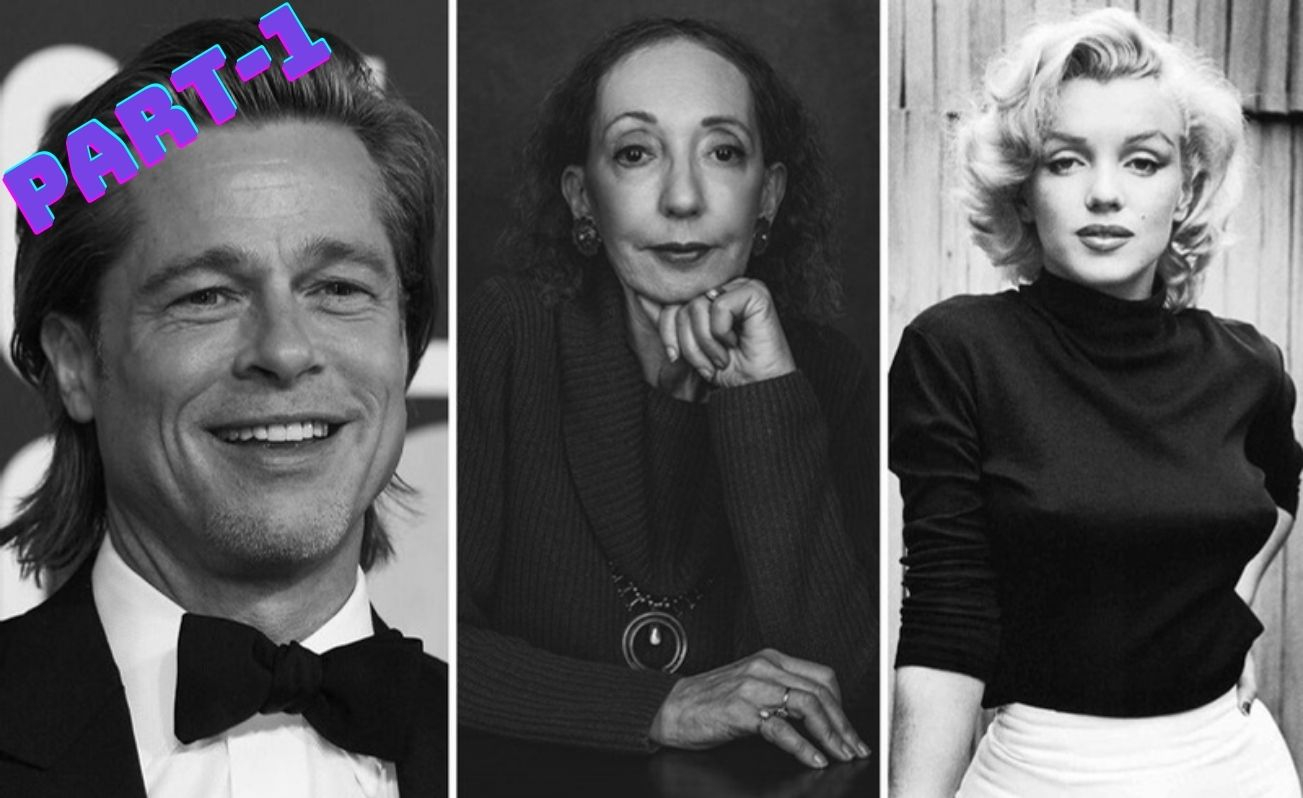
Brad Pitt, Joyce Carol Oates and the Road to Blonde: Part 1/2
How did the recent movie version of the Joyce Carol Oates novel Blonde ever materialize? A big part of the answer is Brad Pitt. The actor/producer had worked with film director Andrew Dominik on the 2007 western The Assassination of Jesse James by the Coward Robert Ford and again on the 2012 neo noir crime film, Killing Them Softly. It was around the time of the latter production that actor/producer Pitt decided to back Dominik in his attempt to make a film about Marilyn Monroe, based upon the best-selling Blonde, published in 2000. (LA Times, 6/3/2012). Pitt also showed up at the film’s premiere at the Venice Film Festival in September of 2022 to support the picture.
Blonde is the first film with an NC-17 rating to be streamed by Netflix. No film submitted to the Motion Picture Association of America had received such a rating since 2013. (Time, September 9, 2022, story by Moises Mendez) After watching the film I can understand why, and its surprising that Netflix even financed the picture. Some commentators believe it was through the powerful status of Pitt that the film ultimately got distributed. But before we get to just how poor the picture is, I think it necessary to understand how the American cultural scene gave birth to a production that is not just an unmitigated piece of rubbish but is, in many ways, a warning signal as to what that culture has become.
I
By the time Oates came to write her novel, the field of Marilyn Monroe books and biographies was quite heavily populated. After Monroe’s death in 1962, the first substantial biography of Monroe was by Fred Lawrence Guiles entitled Norma Jean, published in 1969. Norman Mailer borrowed profusely from Guiles for his picture book, Marilyn, released in 1973. Originally, Mailer was supposed to write an introductory essay for a book of photos packaged by Lawrence Schiller. But the intro turned into a 90,000 word essay. Mailer included an additional chapter, a piece of cheap sensationalism which he later admitted he had appended for money. In that section he posited a diaphanous plot to murder Monroe by agents of the FBI and CIA due to her alleged affair with Attorney General Bobby Kennedy. (Sixty Minutes, July 13, 1973). Because the book became a huge best-seller, as John Gilmore pungently noted, it was Mailer who “originated the let’s trash Marilyn for a fast buck profit scenario.” (Don McGovern, Murder Orthodoxies, p. 36)
Mailer inherited his flatulent RFK idea from a man named Frank Capell. Capell was a rightwing fruitcake who could have easily played General Ripper in Dr. Strangelove. In August of 1964, Capell published a pamphlet entitled The Strange Death of Marilyn Monroe. It was pure McCarthyite nonsense written solely with a propaganda purpose: to hurt Bobby Kennedy’s chances in his race for the senate in New York. Capell was later drawn up on charges for conspiracy to commit libel against California Senator Thomas Kuchel. (Chicago Tribune, February 25, 1965) This was not his first offense, as he had been indicted twice during World War 2 for accepting bribes while on the War Production Board. (NY Times, September 22, 1943). Capell did not like Kuchel since he was a moderate Republican who was backing Bobby Kennedy’s attempt to get his late brother’s civil rights bill through congress. Which tells the reader a lot about Capell and his poisonous pamphlet.
The next step downward involves Mailer, overtly, and Capell, secretly. I am referring to the materialization of a figure who resembled the Antichrist in the Monroe field, the infamous Robert Slatzer. Slatzer originally had an idea to do an article about Monroe’s death from a conspiratorial angle before Mailer’s 1973 success. He approached a writer named Will Fowler who was unimpressed by the effort. He told Slatzer: Now had he been married to Monroe that would make a real story. Shortly after, Slatzer got in contact with Fowler again. He said he forgot to tell him, but he had been married to Monroe. (The Assassinations, edited by James DiEugenio and Lisa Pease, p. 362)
The quite conservative Fowler then cooperated with Slatzer through Pinnacle Publishing Company out of New York. Capell was also brought in, but due to his past legal convictions, his cooperation was to be secret. (Notarized agreement of February 16, 1973). The best that can be deciphered through the discovery of the Fowler Papers at Cal State Northridge is this: Capell would contribute material on the RFK angle through his files; Slatzer would gather and deliver his Monroe personal letters, mementoes, and marriage license; and Fowler would write the first draft, with corrections and revisions by the other two. (McGovern, pp. 90-91)
But in addition to Capell’s past offenses, another problem surfaced: Fowler soon concluded that Slatzer was a fraud, so he withdrew from the project. (LA Times, 9/20/91, article by Howard Rosenberg). The main reason Fowler withdrew is that Slatzer could not come up with anything tangible to prove any of his claims about his 15-year-long relationship, or his three day marriage, to Monroe. Several times in the Fowler Papers it is noted that Slatzer’s tales changed over time “as they also veered into implausibility”. As a result, Fowler started to question his writing partner’s honesty. (McGovern, p. 79) Consequently, other writers were called in to replace Fowler, like George Carpozi.
II
The subsequent book released in 1974 was entitled The Life and Curious Death of Marilyn Monroe. To my knowledge, it was the first book published by an alleged acquaintance of Monroe to question the coroner’s official verdict that Monroe’s death was a “probable suicide”.
Whatever unjustified liberties Capell and Mailer took with the factual record, Slatzer left them in the dust. In addition to his –as we shall see– fictional wedding to Monroe, Slatzer also fabricated tales about forged autopsy reports, 700 pages of top-secret LAPD files, hidden Monroe diaries, inside informants, and perhaps the wildest whopper of all: a secret deposition by Attorney General Robert Kennedy. If ever there was a book that violated all the standards of both biography and nonfiction literature it was The Life and Curious Death of Marilyn Monroe. It was a no holds barred slander fest of both Monroe and Robert Kennedy.
Slatzer claimed that he and Marilyn went to Tijuana, Mexico on October 3, 1952 and were married there on October 4th. After returning to LA, they had second thoughts about it, and they went back and got the proceeding annulled; actually the attorney who did the service just burned his certification document on October 6th. This tall tale has been demolished by two salient facts. First, there is documented proof produced by author April VeVea that Monroe was at a party for Photoplay Magazine on October 3rd. (See VeVea’s blog for April 10, 2018, “Classic Blondes”.) Secondly, Monroe wrote and signed a check while on a Beverly Hills shopping spree on October 4th. The address on the check is 2393 Castilian Dr., the location in Hollywood where she was living with Joe DiMaggio at the time. Monroe authority Don McGovern has literally torn to pieces every single aspect of Slatzer’s entire Mexican wedding confection. (McGovern, pp. 49-67, see also p. 100)
Just how far would Slatzer go to string others along on his literary frauds? How about paying witnesses to lie for him? Noble “Kid” Chissell was a boxer and actor. According to Slatzer, he happened to be in Tijuana and acted as a witness to his Monroe wedding. Years later, when asked about it, Chissell recanted the whole affair to Marilyn photographer Joseph Jasgur. He said that there was no wedding between Slatzer and Marilyn. He went further and said he did not even think Slatzer knew Monroe. But Slatzer wanted Chissell as a back-up to his phony playlet and promised to pay him to go along. Which, by the way, he never did. Which makes him both a liar and a welsher. (McGovern, pp. 98-99). It also appears likely that Slatzer forged a letter saying that Fowler had actually seen the Slatzer/Monroe marriage license and Fowler met Monroe while with him. Fowler denied ever seeing such a document or having met Monroe. (McGovern, p. 81)
III
One would think that The Life and Curious Death of Marilyn Monroe could hardly get any worse. But it does. To add a layer of official intrigue inside the LAPD, Slatzer created a figure named “Jack Quinn”. Quinn had been an employee of LA County and he got in contact with Slatzer and informed him of a malignant cover up about the Monroe case inside City Hall, particularly the LAPD. (Slatzer, pp. 249-53) The enigmatic Mr. Quinn described a secret 723 page study of the Monroe case. That study stated that the original autopsy report had been deep sixed. Further, that Bobby Kennedy had been in LA at an official opening of a soccer field on August 4, 1962 and he had given a deposition in the case. In that deposition he said that he and his brother-in-law, Peter Lawford, had been at Marilyn’s house and they had a violent argument, to the point he had to bring in a doctor to inject her to calm her down.
The above is why I and others consider Slatzer’s work a milestone in trashy tabloidism: the forerunner to the manufactures of David Heymann. The only thing worse than writing that RFK would submit to such a legal proceeding is postulating that the LAPD would have any reason to question him. In their official reporting, the first three people at Monroe’s home all said that Monroe was alone in her bedroom when she passed. This included her housekeeper Eunice Murray, her psychiatrist Robert Greenson, and her physician Hyman Engelberg. Engelberg made the call to the LAPD saying that she had taken her own life. (LA Times, 12/21/2005, story by Myrna Oliver) Later in this essay, I will explain why, if anyone should have known the cause of death, it was Engelberg.
But complementary to this, Robert Kennedy was nowhere near Brentwood–where Monroe lived–at this time. Sue Bernard’s book, Marilyn: Intimate Exposures proves this beyond doubt, with hour by hour photographs and witness testimony. (pp. 184-87; see also, Gary Vitacco-Robles’ Icon, Pt. 2, p. 82) In fact, in his book Icon, VItacco Robles documents Bobby Kennedy’s four days in the Gilroy/San Francisco area from August 3-6th. (See Icon Part 2, pp. 82-83). Therefore, at both geographic ends, Slatzer’s “secret RFK deposition” is pure hogwash, an invention out of Capell.
In 1982 Slatzer opined in public at the Greater Los Angeles Press Club that the Monroe case should be reopened. The DA’s office began a threshold type inquiry to see if there was just cause to do a full reopening. That inquiry was run by assistant DA Ron Carroll with investigators Clayton Anderson and Al Tomich (Icon Pt. 2, p. 108) They interviewed Slatzer about his “Quinn” angle. Very soon, problems emerged with his story. Allegedly, Quinn called Slatzer in 1972, saying he worked in the Hall of Records building and he had the entire 723 page original record of the case. He said he was leaving his position to move to San Mateo for a new job. Slatzer said he met Quinn, who had a badge on with his name, at Houston’s Barbeque Restaurant. Slatzer gave him 30 dollars to copy the file. Quinn said he would meet him at the Smokehouse Restaurant in Studio City for delivery. Quinn added that he lived in the Fair Oaks area of Glendale.
Quinn did not show up. Slatzer went to the Hall of Records and found no employee by the name of Quinn, which should have been predictable to Carroll because The Smoke House is not in Studio City, it’s in Burbank. And Fair Oaks is a popular boulevard going from Altadena through Pasadena to South Pasadena, but not Glendale. Slatzer now added something just as sensational. Ed Davis, LA Chief of Police, flew to Washington a month later to ask questions about RFK’s relationship with Monroe. (Was this the secret deposition?) Davis replied that no such thing happened. (Icon, Pt. 2, p. 110) When Carroll began to go through databases of City Hall employees from 1914-82, he could find no Jack Quinn. He also found out that the files of the LAPD would, in all likelihood, not be stored at the Hall of Records. Like his Tijuana wedding, Slatzer’s “Jack Quinn” was another fictional creation from a con artist.
With Carroll, Slatzer also tried to insert two other phony “clues”. First, that there was a three hour gap between when Monroe’s doctors were summoned and when the call to the police was made. Carroll discovered that the original LAPD inquiry by Sgt. Byron revealed that it was really more like a 45 minute delay. Eunice Murray did not call the doctors until about 3:30 AM. (Icon, Pt. 2, p. 110)
Slatzer also tried to question the basis of Murray’s initial suspicions of something being wrong with Marilyn. In the original investigation, Murray told Byron that what puzzled her was the light being on in Monroe’s room through the night. She noticed this at about midnight but was not able to awaken Monroe. She then noticed it again at about 3:30 AM and this is when she made a call to Dr. Greenson. (Icon. Vol. 1, p. 278) Slatzer said this was wrong since the high pile carpeting prevented light being seen under the door. It turned out—no surprise– that this was another of Slatzer’s whoppers. With photos and witness testimony, Vitacco-Robles proves that one could see light under the door, and further there were locking mechanisms on the doors. (Icon, Pt. 1, p. 255, p. 380) Slatzer wanted to disguise this fact because it indicates that Monroe ingested the pills, 47 Nembutals and 17 chloral hydrates, and then slowly lost consciousness and slipped into a coma, in spite of the light being on—which normally she was quite sensitive to.
I could go on and on about Slatzer’s malarkey. For instance, both Vitacco-Robles and Slatzer’s former wife clearly think that the whole years long Monroe relationship Slatzer writes about in his book is balderdash. Gary advances evidence that from 1947-57, Slatzer was not cavorting around LA with Monroe but lived in Ohio. (Icon, Vol. 2, p. 119) Slatzer’s Ohio wife, Kay Eicher, said Slatzer met Monroe exactly once, on a film set in Niagara Falls where Monroe—always kind to her fans- posed with him for impromptu pictures. She added about her former husband, “He’s been fooling people too long.” (ibid, p. 123) Which Slatzer also did with Allan Snyder, Monroe’s makeup artist. This again was supposed to show he knew Monroe. But Snyder later said he never heard of the man while Marilyn was alive. Slatzer just approached him to write up an intro and paid him for it. (ibid, p. 126)
The reason I have spent a bit of time and space on slime like Slatzer is simple. If a figure like Slatzer had surfaced in the JFK critical community, his reputation would have been blasted to pieces in a week. But back in 1974, there was no such quality control in the Monroe field. Therefore, not only was his book a commercial success, he then went on to write another book, and marketed two TV films on the subject. But beyond that—and I wish I was kidding about this–Slatzer had a wide influence on the later literature. It was not until much later, with the arrival of people like Don McGovern, Gary Vitacco-Robles, April VeVea and Nina Boski that any kind of respectable quality control developed in the field.
IV
In the October, 1975 issue of Oui magazine, Tony Sciacca, real name Anthony Scaduto, wrote an essay called “Who Killed Marilyn Monroe.” That article was expanded into a book the next year, Who Killed Marilyn? This book owes much to Slatzer. Including lines and scenes seemingly pulled right out of his book. For example Monroe says that Bobby Kennedy had promised to marry her. ( p. 13). Another steal is Monroe’s red book diary. Where she wrote that RFK was running the Bay of Pigs invasion for his brother. (pp. 65-69). The idea that Bobby Kennedy was going to divorce his longtime wife Ethel, leave his eight children, resign his Attorney General’s position, and forego his future chance at the presidency—all for a woman he met socially four times—is, quite frankly, preposterous. Further, as the declassified record shows, Bobby Kennedy had nothing to do with managing the Bay of Pigs operation. That was being run by CIA Director of Plans Dick Bissell, along with Deputy Director Charles Cabell. (See, for example, Peter Kornbluh’s Bay of Pigs Declassified.) And it turns out that Monroe had no red book diary. What she kept were more properly called journals or notebooks which were found among her belongings decades after she died. These were then published under the title Fragments. And they contain nothing like what people like Slatzer, Scaduto, and later Lionel Grandison, said was in them. (McGovern, pp. 268-71)
But incredibly, Slatzer lived on in the writings of Donald Wolfe, Milo Speriglio and Anthony Summers. Summers’ 1985 book Goddess became a best-seller. In the introductory notes to the Oates’ novel, she names Goddess as one of the references for her roman a clef. As Don McGovern observes, Summers references Slatzer early, by page 26—and then refers to him scores of times in Goddess, even using Chissell. But yet, Slatzer’s name, address and phone number never appeared in Monroe’s phone or address books. Would not someone so close to Monroe be in there? (McGovern, p. 102)
But the belief in Slatzer is not unusual for Goddess. In fact, after reading the book a second time and taking plentiful notes, I would say it is more like par for the course. Let us take the case of Gary Wean. Because its largely with Wean that the book begins its character assault on both John Kennedy and Peter Lawford. (For example, see pgs. 221-224). The idea is that Lawford arranged wild parties with call girls, John Kennedy was there and Monroe was at one of them. Summers characterizes Lawford like this: “It was this sad Sybarite who played host to the Kennedy brothers when they sought relaxation in California…”. Geez, I thought JFK and RFK knew Lawford because he was married to their sister.
These rather bizarre accusations made me curious. Who was Gary Wean and how credible was he? So I sent away for his book There’s a Fish in the Courthouse. Wean was a law enforcement officer in both Los Angeles and Ventura counties; he later became a small businessman. His book has two frames of focus. The first is on local corruption in Ventura County, California. Apparently realizing that this would have little broad appeal, Wean expands the frame to a national level with not just Monroe and Lawford, but also, get this, the JFK assassination! According to Wean, Sheriff Bill Decker and Senator John Tower explained the whole plot to his friend actor Audie Murphy. I don’t even want to go any further. But I will say that Wean’s tale says it was Jack Ruby who was going to kill Oswald, but when J. D. Tippit’s car pulled up, Ruby killed the policeman instead. (Wean, p. 588) Mobster Mickey Cohen got Ruby to now also kill Oswald, and somehow reporter Seth Kantor was tied in to the conspiracy since he could place Ruby at Parkland Hospital and he knew Cohen.
The primacy of Cohen in this theory can be explained by the fact that Cohen was Jewish and Wean’s book is extremely anti-Semitic. In fact, he later called the JFK murder a Jewish plot. (Wean, p. 593) As we shall see, this directly relates to the accusations about Lawford and John Kennedy. Wean says that these wild parties were at Lawford’s Malibu beach house. (Wean, p. 567) This puzzled me since, from what I could find, Lawford owned homes in Santa Monica and Palm Springs, and no Southern Californian could confuse those places with Malibu. Wean also says that Monroe met JFK at such a party during the Democratic Convention in 1960. But Monroe was not in Los Angeles for the convention. She was in New York City with her then husband Arthur Miller and her friend and masseuse Ralph Roberts. She was working on preparations for the upcoming film The Misfits. (McGovern, pp. 147-48)
But this is just the beginning of the problems with using Wean as a witness. Because in his book Wean says that it was really Joey Bishop who set up the wild call girl gatherings through Lawford. Why? Because Bishop, who was Jewish, was working with Cohen to get info on how Kennedy felt about Israel–through Monroe. (Wean, p. 567, p. 617). If that isn’t enough for you, how about this: Cohen was meeting with Menachem Begin at the Beverly Hills Hotel and there was plentiful talk about Cuba, military operations and the Kennedys. (Wean, p. 575). Further, Cohen had one of his mob associates at Marilyn’s home the night she died, at some time between 10-11 PM. (Wean p. 617) Wean calls this all part of the Jewish Mishpucka Plot. I could go even further with Wean, but I don’t think the reader would believe it.
The capper to this is that Wean writes that Summers called Bishop and the comedian admitted the arrangements he made. (Wean, ibid). At this point I thought two things: 1.) Wean was so rightwing he was a bit off his rocker. 2.) Was there anyone Summers would not believe in his Ahab type pursuit of a Monroe/Kennedy plot? Because according to Wean, Summers wanted him to go on TV.
But there is another Summers’ witness who was pushing the whole Lawford/Kennedy fable about call girl parties at the beach. This was Fred Otash. Otash was a former policeman turned detective who also worked for Confidential magazine, which was little more than a scandal sheet. He was once convicted for rigging horse races. After interviewing him for Sixty Minutes in 1973, Mike Wallace said he was the most amoral man he ever met. He once had his detective license indefinitely suspended.
In 1960 the FBI found out something rather revealing about Otash. In July of 1960, while JFK was running for president, a high-priced LA call girl was contacted by Otash. He requested information on her participation in sex parties involving JFK and Lawford, plus Frank Sinatra and Sammy Davis. The woman said she could not comply since she had no such knowledge. Otash then asked if she knew any girls who perhaps were there. She said she knew of no one. Otash then asked if she could be introduced to Kennedy, and if so, he could equip her with a tape recorder to take down any “indiscreet statements’ the senator might make. She refused to do so. (FBI Report of 7/26/60)
The hooker had a higher moral code than the pimp. By those standards who could rely on Otash for anything?
Go to Part 2 of 2
-

Our Lady of the Warren Commission: Part 2/2
The Inconvenient Witness
Thomas Mallon. “And he (Oswald) had gotten away with it. The bullet had almost grazed the top of Walkers head, the hair, and he got away on foot, he didn’t drive a car… (And) he hid the rifle by the railroad tracks…”
To rebut Mr. Mallon’s claims, it is crucial to highlight that there is a substantial and irrefutable body of evidence indicating that Lee Harvey Oswald was never seen at or near General Walker’s home at4011 Turtle Creek Boulevard before, during, or after the attempted Walker assassination on April 10th, 1963. This point is not merely speculative but grounded in well-documented and verified accounts.
Furthermore, the weight of the evidence supports the conclusion that the assassination attempt involved not just one, but two individuals. Particularly compelling testimony comes from Walter Kirk Coleman, a 15-year-old residing near the General’s residence. On the night of April 10th, 1963, Coleman reported hearing a gunshot, an ominous sound aimed at ending General Walker’s life. In a swift reaction, Coleman dashed outside and peered over his fence. His vantage point provided a clear view of the church parking lot adjacent to General Walker’s residence. What he witnessed there is crucial to understanding the events of that fateful night.
Coleman observed:
A man getting into a 1949 or 1950 Ford, which was parked headed towards Turtle Creek Boulevard, with the motor running and the headlights on. (Before the man got into the car, he) glanced back in the direction of Coleman and (took) off. Also, further down the parking lot was another car, a two door, black over white, two-door Chevrolet sedan and a man was in it. He had the dome light on, and Kirk could see him bend over the front seat as if he was putting something in the back floorboard. Kirk described the car as; “black with a white stripe.” The man who took off in the Ford was described as; “a white male, about 19 or 20 years of age, about 5”10 tall, and weighing about 130 pounds. He was attired in “Kakhi pants and a sports shirt with figures in it. Kirk stated, “that this man had dark bushy hair, a thin face with a large nose, and was real skinny”. The second man was described by Coleman as, “a white male, about 6”1, about 200 pounds, wearing a dark long sleeve shirt and dark pants. Kirk could furnish no information on this man’s facial features nor his age.
Was one of the men Kirk Coleman saw, Lee Harvey Oswald?
“Coleman stated that he had seen numerous pictures of Lee Harvey Oswald, and he was shown a photograph of Oswald among several other photographs. He stated that neither man resembled Oswald and that he had never seen anyone in or around the Walker residence or the church before or after April 10, 1963, who resembled Lee Harvey Oswald”.
This testimony is a significant piece of evidence, as it directly challenges any claims that Oswald was present at the scene of the attempted assassination. (see this and this)
Coleman’s account is corroborated by Walker himself who testified to the Warren Commission that; “As I crossed a window coming downstairs in front, I saw a car at the bottom of the church alley just making a turn onto Turtle Creek. The car was unidentifiable. I could see the two back lights, and you have to look through trees there, and I could see it moving out. This car would have been about at the right time for anybody that was making a getaway. (Volume XI; p. 405)

April 8th, 1963.
Between 9:00-9:30pm on April 8th, 1963, Robert Surrey, a disciple of General Walker’s, was proceeding up Avondale Avenueto the house at 4011, Turtle Creek Boulevard. It was Surrey’s intention to enter the General’s property via the alleyway entrance. However, just prior to turning off Avondale, Mr. Surrey, “Observed a 1963 dark brown or maroon, four door Ford, parked on Avondale with two men sitting in it.” Surrey decided to avoid taking the alley, instead continuing around to block the car-park near the Mormon Church. Surrey observed the two men, “Get out of the car, walk up the alley and onto the Walker property and look into the windows of the Walker house.” At this point Surrey went to their automobile, where he checked the rear of the car, and observed there was no license plate. He then opened the door and looked into the car and opened the glove compartment. He observed nothing in the car or glove compartment which would help identify the occupants. He then went back to his car and drove to a position where he could observe the 1963 Ford leave.
Surrey testified to the Commission regarding the strange behavior of these two individuals…
Robert Surrey.“Well, the gist of the matter is that two nights before the assassination attempt, I saw two men around the house peeking in windows and so forth, and reported this to the general the following morning, and he, in turn, reported it to the police on Tuesday, and it was Wednesday night that he was shot at. So that is really the gist of the whole thing.”

Surrey told the FBI that, “He had never seen either of these two men before or since this incident, and (believed) neither of these two men was identical with Lee Harvey Oswald. (Surrey) “Described one of the men as a white male, in his 30s, about 5’10” to 6’ tall and weighing about 190 pounds. (Surrey) described the second individual as a white male, in his 30’s, 5’10” to 6’ tall, and weighing about 160 pounds. Both men were well dressed in suites, dress shirts and ties.FBI 105-82555 Oswald HQ File, Section 186 (maryferrell.org)
The Ballistics Evidence
From April 10, 1963, the bullet which was fired at General Walker, “Appeared to be from a high-powered, 30.06 rifle, and was a Steel jacketed bullet”. (see this)
This information was highly disseminated throughout the press and was reported in a New York Times article of April 12, 1963.

A Mystifying Metamorphosis: The “Magic Bullet” Phenomenon
From the ashes of President Kennedy, Officer Tippit and Lee Oswald’s tragic murders, a bewildering transformation occurred within the confines of the Dallas Police Evidence Room. Here, the “Walker bullet” performed a baffling act of alchemy, transforming from its official initial classification as a 30.06 steel-jacketed projectile into a 6.5 Mannlicher Carcano bullet—its steel guise mysteriously supplanted by copper. This near-miraculous change provided the Warren Commission with a serendipitous twist in their narrative, allowing them to lay the blame for the attempted assassination of Maj. Gen. Edwin A. Walker squarely on the now-silenced Oswald. This switch, a masterpiece of evidentiary sleight of hand, was instrumental in allowing the Commission to fortify their case of circumstantial evidence, confidently proclaiming in their report: “Oswald had attempted to kill Maj. Gen. Edwin A. Walker (Retired, U.S. Army) on April 10, 1963, thereby demonstrating his disposition to take human life.” (WCR; p. 20). Through this narrative legerdemain, the Commission could weave a more compelling, albeit convenient, story of guilt. (WCR;p..20)
A Dichotomy of Possibilities: Incompetence or Subterfuge?
The ballistic evidence bifurcates into two realms of possibility. One path leads to a conclusion of stark incompetence on the part of General Walker and the Dallas Police Department investigators, a lapse in judgment and identification that stood unchallenged for over seven months. The alternate path veers towards a more sinister landscape, positing that the bullet now residing in the National Archives (CE573) and officially linked to the Walker case was, in fact, a posthumous plant designed to frame Oswald. While this theory may initially seem steeped in the realms of far-fetched conjecture, it gains a semblance of plausibility when juxtaposed against the backdrop of questionable evidence marshalled against Oswald in both the JFK and Tippit cases.
The FBI’s Spectrographic Analysis: A Tale of Suppressed Evidence
Adding to the enigma, the FBI’s spectrographic analysis of Q-188 (CE573) painted a divergent picture. Special Agent Henry H. Heilberger, in his analytical report (PC-78378), discerned that the lead alloy comprising the Walker bullet bore no resemblance to the lead alloy from the two large bullet fragments allegedly retrieved from beneath the presidential limousine’s jump seat. This revelation, chronicled in Breach of Trust (pp. 49-50), never saw the light of public scrutiny, as both the FBI and Warren Commission elected to sequester Heilberger’s findings from the official record, and notably, his testimony was conspicuously absent from their proceedings. One ponders the alacrity with which the Commission might have embraced Heilberger’s testimony had it tilted the scales of evidence towards Oswald’s guilt in the Walker affair.
In the police report filed by Officers Van Cleave and McElroy, the authors noted that the projectile was steel jacketed. Both local Dallas newspapers, and an Associated Press story depicted the projectile as being 30.06 in caliber. (James DiEugenio, The JFK Assassination: The Evidence Today, p. 100) But three weeks after the assassination, the FBI now had transformed the bullet to a 6.5 caliber, copper jacketed projectile. In fact, the bullet today in the National Archives, allegedly shot at Walker, is copper coated. But none of the Dallas policemen who handled that bullet were called to testify under oath before the Commission. (ibid) In other words, unlike what Mallon and Ruth Paine told their spectators, the eyewitness testimony and the ballistics evidence is exculpatory of Oswald.
I now wish to posit some questions to Mrs. Paine & Mr. Mallon regarding some substantial inconsistencies in their narrative surrounding Oswald’s guilt in this case.
Marina testified that Lee allegedly extracted the rifle from their Neely Street residence three days before the attempt, concealing it in bushes near Walker’s home. However, this raises significant questions about the practicality and rationality of such a decision. Why would a logical individual choose to stow this surplus WWII, Mannlicher Carcano, in a bush for an extended period, subjecting it to various environmental elements, only to later retrieve it for an assassination attempt? This scenario, frankly, challenges the bounds of credibility. (Breach of Trust; p.53)
Storing a rifle in a bush for three days before committing a crime poses several significant issues:
- Weather Damage:The rifle’s exposure to rain, humidity, or extreme temperatures could impair its functionality, leading to potential malfunctions.
- Rust and Corrosion: Continuous exposure to moisture and air might result in rust, which could negatively affect the rifle’s accuracy and reliability.
- Dirt and Debris: Accumulation of dirt and debris could obstruct the barrel or jam the firing mechanism, hindering the rifle’s operational efficiency.
- Visibility and Discovery Risk: Concealing a rifle in a public or semi-public area substantially increases the likelihood of it being discovered by others, potentially leading to premature arrest or the foiling of the planned crime.
- Damage to Ammunition: If ammunition is also stored under similar conditions, its efficacy and reliability could be compromised.
- Mechanical Failures:The rifle’s prolonged exposure to outdoor elements could lead to mechanical failures in its moving parts, affecting its performance.
- Inconsistent Performance: Environmental conditions may alter the rifle’s condition, resulting in inconsistent performance and reduced accuracy.
- Legal Risks: Discovery of the rifle by authorities could lead to early detection and intervention, preventing the crime.
- Compromised Concealment: The need to retrieve the rifle from a public location heightens the risk of being seen and identified before committing the crime.
Marina Oswald testified: That she accosted Lee over the Carcano’s whereabouts in the immediate aftermath of the Walker attempt; “Where is the rifle? What did you do with it? ‘Lee’ said that he had left it somewhere, that he had buried it, it seems to me, somewhere far from that place, because he said dogs could find it by smell. I don’t know—I am not a criminologist”. (Volume I; p.16) - How did Oswald bury a rifle in the ground without using a spade and shovel or any implement other than his bare hands?
- How did he protect the rifle from corrosion and other damage to be expected if the rifle was buried in soil for some four days or more?
- If he used no protective wrappings, why did the microscopic examination of the rifle by FBI Expert Paul Stombaugh on November 23, 1963 reveal no traces of soil?
- Since Oswald ostensibly buried the rifle in the dark of night, how did he locate the place of burial some four days later? And how did he dig it up without a shovel or any other implement?
- How is it that many searches of Oswald’s property and possessions by local officers and federal agents uncovered no rifle cleaning equipment.(Sylvia Meagher, Accessories After The Fact; p.129)
- During his testimony before the Warren Commission, General Edwin Walker was not presented with Commission Exhibit 573 for authentication, despite his role in the custody chain. Why?
- Why was the DPD officers, who were present that night at the Walker residence, Van Cleave, McElroy, Tucker and Norvell not called to give testimony before the Warren Commission?
- Why was Walter Kirk Coleman not called to testify before the Warren Commission?
- Why are there no contemporaneous photographs of the Walker bullet, taken on April 10, 1963, in the record?
- Who were the two men observed by Robert Surrey scoping out General Edwin Walker’s residence two nights before the attempt on his life, and what were their motives for such reconnaissance?
- What is the chain of custody for the Walker bullet?
- How do you interpret the fact that Lee Oswald was not considered a suspect in the Walker case until after his death, which means the charge is post-mortem.
If Lee Harvey Oswald had been brought to trial for the alleged attempt on General Edwin Walker’s life, the task facing Dallas District Attorney Henry Wade would have been daunting, to say the least. The prosecution’s case would have been fraught with a series of significant hurdles, each casting a shadow of doubt over Oswald’s culpability. Key among these were the logistical improbabilities – the complex chain of events leading up to the incident that seemed almost too convoluted to be feasible. Coupled with this were glaring inconsistencies in the evidence presented, gaps large enough in the witness testimonies to drive a truck through, and serious procedural questions that begged to be answered.
To surmount these formidable challenges, the prosecution would have needed more than just the usual evidentiary fare; it would have required exceptionally strong and unimpeachable alternative evidence, alongside coherent and convincing explanations to iron out the existing inconsistencies. The absence of direct testimonies and conclusive photographic evidence only compounded the issue, necessitating an even more persuasive argument to bridge these gaps.
It’s noteworthy that, to this day, no one, whether officially or unofficially, has truly grappled with these glaring deficiencies in the case against Oswald for the attempted assassination of General Walker. The shortcomings in the case are not merely minor quibbles or legal technicalities; they represent fundamental flaws that go to the very heart of the judicial process and the principles of fair trial and justice. For any defense attorney, these issues would not just be talking points; they would be central pillars of a defense strategy rooted in the bedrock of reasonable doubt.
“I had no way of knowing that Oswald attacked me. I still don’t. And I am not very prone to say in fact he did.” Edwin Walker. (Volume X1; p.426)
Thomas Mallon Praises the Warren Commission
“Before publication of the Warren Report, there was the irresistible reaction against the audacity of those who loudly proclaimed the dead man’s guilt but asked those who had doubts to keep silent. After the Report, there was something even more irresistible: the feeling that, in this case, silence would give consent to injustice.” Leo Sauvage. (see this)
Thomas Mallon. All these years later, how do you feel The Commission, that Report, it still essentially holds up?
Ruth Paine. Oh yea, oh yea. They were very thorough…
Advocating for the Warren Report’s conclusions, 60 years after the fact, is not just a matter of differing historical interpretation; it’s a position that, quite frankly, borders on the delusional or suggests a profound misapprehension of the facts. In my detailed analysis in ‘Assassination 60’, particularly in point 13, I underline the profound skepticism held by key figures regarding the Report. Notably, Bobby Kennedy dismissed it as ‘a shoddy piece of craftsmanship,’ a stark indictment from a figure intimately connected to the events.
Sylvia Meagher.”It was appalling to find how many of the Commission’s statements were unsupportable or even completely contradicted by the testimony and/or exhibits. I began to list what is now a long series of deliberate misrepresentations, omissions, distortions, and other defects demonstrating not only extreme bias, incompetence, and carelessness but irrefutable instances of dishonesty.” (Praise from a Future Generation; pp. 149-150)
Penn Jones Jr. “I really believe that the only way you can believe the Warren Report is not to read it.” (Praise from a Future Generation; p. 130)
The Commission’s credibility is further eroded by the dissent within its own ranks. Commissioners Richard Russell, Hale Boggs, and John Cooper explicitly expressed their disbelief in the Single Bullet Theory (SBT), a cornerstone of the Commission’s findings. John Sherman Cooper was unequivocal: “I could not convince myself that the same bullet struck both of them. No, I wasn’t convinced by [the SBT]. Neither was Senator Russell.” (James DiEugenio, JFK Revisited, pp. 30-31)
Hale Boggs voiced similar concerns, “I had strong doubts about it [the single bullet theory], the question was never resolved.” (Edward Epstein, Inquest; pp.149-150)
Commissioner Gerald Ford told French President d’Estaing that the President’s murder “was something set up. We were sure it was a set up, but we were not able to discover by whom.” (JFK Revisited; p. 57)
Even more damning is the disbelief expressed by Richard Russell, a sentiment shared by President Lyndon Johnson himself: “…they said that they believed…that the Commission believed that the same bullet which hit Kennedy hit Conaolly… well I don’t believe it.” To which Johnson replied, “I don’t either.” (Phone call of 9/18/64).
In the fantastic new collaborative book The JFK Assassination Chokeholds by Jim DiEugenio. Paul Bleau, Matt Crumpton, Andrew Iler and Mark Adamczyk, Professor Bleau presents a modern, critical examination of the Warren Report, demonstrating conclusively that the official record challenges, rather than supports, the Commission’s findings. This contemporary analysis further undermines the Report’s standing.
Perhaps the most scathing indictment comes from the late United States Senator Richard Schweiker, who declared, “The Warren Commission has in fact collapsed like a house of cards and I believe it was a set up at the time to feed pablum to the American people for reasons yet known, and one of the biggest cover-ups in the history of our country occurred at the time.” (JFK Revisited, p. 108)
A Tumultuous Marriage?
Thomas Mallon. “Not everybody knows (this) about Oswald, he was not a good husband… he beat Marina, this is very well documented in Pricilla McMillian’s book…”
Lee and Marina Oswald’s marriage remains a subject of intrigue and speculation. While Lee’s character has often been scrutinised, Marina’s role in their relationship is less frequently examined.
In a memorandum written in 1964, Norman Redlich reports that, “James H. Martin stated that (after the assassination) he had consciously attempted to create a public image of Marina Oswald as a simple, devoted housewife who had suffered at the hands of her husband and who was now filled with remorse for her husband’s actions and deeply grateful for the generosity and understanding of the American people… As Martin’s testimony indicates, there is a strong possibility that Marina Oswald is in fact a very different person— cold, calculating, avaricious, scornful of generosity, and capable of an extreme lack of sympathy in personal relationships. A wife who married him for selfish motives, degraded him in public (and) taunted him about his inadequacies…” (see this)
The George and Jeanne De Mohrenschildt testimonies also revel the mutual abuse the young couple would engage it.
George DeMohrenschildt.“I don’t like a woman who bitches at her husband all the time, and she did, you know. She annoyed him. She bickered. She brought the worst out in him. And she told us after they would get a fight, you know, that she was fighting also. She would scratch him also. ‘He has been beating me’, but she said, ‘I fight him back also…She was annoying him all the time ‘Why don’t you make some money?’, why don’t they have a car, why don’t they have more dresses, look at everybody else living so well, and they are just miserable flunkeys. She was annoying him all the time. Poor guy was going out of his mind. She openly said he didn’t see her physically–right in front of him. She said, ‘He sleeps with me just once a month, and I never get any satisfaction out of it.’ A rather crude and completely straightforward thing to say in front of relative strangers, as we were.” (Volume IX; p. 166-284)
Jeanne De Morenschildt.…His greatest objection was that people helped them too much, they were showering things on Marina. Marina had a hundred dresses given to her…He objected to that lavish help, because Marina was throwing it into his face. He could never give her what the people were showering on her. So that was very difficult for him, no matter how hard he worked–and he worked very hard. (Volume IX; p. 309)
The Assassination & Mrs Paine
Mrs. Paine, in a response to a question from Mr. Mallon, then highlights her displeasure at the recent documentary by researcher Max Good, The Assassination and Mrs. Paine. She states;
Ruth Paine. “What troubles me is, for instance there is this new DVD out… Mrs Paine and the murder of John F. Kennedy… I asked him, you know, what do you think, what is your opinion about the attempt on Walker and he (Max) says well I don’t think that happened. So that’s how some of the plot people, follow their stories, they just take what they want and leave the rest alone, and that is not good research.”
Thomas Mallon.“Yea, which is the way they pick and choose from the Warren Report, the different ‘facts’”.
I was interested if Max had seen this segment, so I reached out to him and asked what his thoughts were on it;
Max Good.“I think Ruth was referring in this talk to my meeting with her several months ago, which was set up and filmed by the producers of “Four Died Trying.” She did ask me my thoughts on the Walker shooting. I believe I said that I had doubts that it happened the way the official story describes. The way Ruth states it in this talk with Mallon, it sounds like I am denying that anything happened. In reality, I believe the Walker shooting was probably a staged event and that if Oswald was involved, it was as a pawn. The evidence throws all kinds of doubt on the official story, including the type of bullet not matching Oswald’s rifle and a witness seeing two suspects each leaving in separate cars. I’ve never heard Ruth discuss any of these details of the investigation. She seems to depend solely on the dubious “Walker note” and testimony of Marina, and the conclusions of the Warren Commission. It seems that she’s just as guilty of “taking what she wants and leaving the rest alone.” (Personal Correspondence) (buy the documentary here)
With the session now moving into its question-and-answer phase, Mr. Mallon assumed the role of a careful gatekeeper, sifting through and discarding the numerous inquiries presented to him. He selectively allowed only a subset of questions, primarily the less challenging ones, to be presented to Mrs. Paine. More demanding questions put forward by Dealey Plaza UK members in the audience were amongst those discarded. In this sea of generally unremarkable questions, however, there was one that emerged as notably intriguing. This question is detailed below.
Thomas Mallon. “Ruth someone asks, do you think Dallas being The City of Hate, as it was sometimes called, because there was such fierce opposition to Kennedy, do you think any of that motivated Oswald”
Ruth Paine.“No… no… no, he (Oswald) saw an opportunity on Wednesday morning, and he fired the gun on Friday.
Thomas Mallon. …And the really awful part of the journey home (from New Orleans to Dallas) was you didn’t know that one of the items, that was in the car, that he had packed, that was with everything… and one of the things in the car was the rifle.
Ruth Paine.“It has to have been.”
Thomas Mallon.“Yes.”
Ruth Paine.“There were two large Marine duffel bags, standing this high, he could have easily put a full-fledged rifle, it wouldn’t even have to have been broken down to fit in there, so yea, looking back it has to have been in there.”
In a notable deviation from recent disclosures, Mrs. Paine had testified to the Warren Commission about Oswald’s luggage and the alleged concealment of the Mannlicher-Carcano rifle within. When probed specifically about the possibility of these bags containing a long, slim object like a rifle, Mrs. Paine firmly denied noticing anything that would suggest the presence of such an item, asserting that the bags appeared to be filled with clothes and showed no signs of concealing a weapon. (Volume II; p. 462-463)
Let He Who is Without Sin, Cast the First Stone
Thomas Mallon.“He (Oswald) was not shy about asking for favours sometimes, one of the extraordinary things he did on the Saturday (November 23rd) after the assassination, when he was in the Dallas City Jail, he called and what did he want?
Ruth Paine.“… he called and wanted me to contact a man named John Abt, who had acted as a lawyer for the American Communist Party, he gave me a phone number, this is Saturday, the day after the assassination. So, I did as he asked, rang up the phone and nobody answered, which is not really a surprise.
Thomas Mallon.“But he was still willing to be helped by you, a day after he had upended, you’re own life.”
Ruth Paine.“Oh yes”
Michael Paine was a Christian Unitarian, and Ruth came from a Quaker background. Quakerism is sometimes called the Society of Friends. Quakerism arose in England as a religion without creeds, or clergy. A religion coming from an Inner Light. Quakerism is usually attributed in America to the founding of Pennsylvania by William Penn. In addition, that state is usually considered one of the hotbeds of the American Revolution and the Bill of Rights, the latter of which is perhaps what the revolution was about. Oswald had a right to counsel, he was also supposedly granted the presumption of innocence. Therefore according to both religion and the American Creed what was so jarring about Oswald requesting Ruth to make a call for an attorney?
What makes this even worse is that neither Mallon nor Paine ever refer to how Greg Olds of the local American Civil Liberties Union (ACLU) was apparently bamboozled in his attempt to represent Oswald by the Dallas Police. (WC Vol. 7, pp. 322-25) But here is the capper that Mallon never asked: “Ruth were not you and your husband members of the ACLU? And did not your husband take Oswald to an ACLU meeting? And did not Oswald later join that group?” (Philip Melanson, Spy Saga, pp. 56-57) The icing on the cake would be this: the ACLU came to prominence due to the deprivation of legal rights during the Palmer Raids.
The Final Curtain
Facts do not cease to exist because they are ignored. Aldous Huxley.
Thomas Mallon. “Fundamentally as we look back… do you think the assassination fundamentally was more of a psychological crime rather than a political crime? Meaning it grew form Oswald’s psychology more than from any ideology he picked up?”
Ruth Paine.“His life wasn’t going well at all, and he wanted to be a big shot and he was not.”
From the moment of Lee Oswald’s arrest on November 22, a narrative of presumption has shrouded him in guilt. This presumption was swiftly embraced by Dallas Police and Prosecution officials and eagerly disseminated by the media. As the soul of the nation was entrenched in grief, the martyred President’s remains were solemnly returned to Washington, and Oswald’s guilt was prematurely declared aboard Air Force One.
The Dallas officials quickly branded Oswald—a man without an attorney– as the sole assassin, casting an unjust shadow over his reputation and grossly violating that bedrock of American jurisprudence: the presumption of innocence. Yet, a crucial inquiry persists: What definitive evidence did they possess to warrant such a precipitous rush to judgment?
A critical examination of the evidence reveals a narrative fraught with inconsistencies, credibility issues with key evidence, and outright fabrications, suggesting a narrative far more complex and disturbing than Oswald’s solitary guilt. The tampering with evidence, the distortion of facts, and the neglect of judicial fairness hint at a conspiracy that does not include Lee Oswald.
The failure to conduct a comprehensive and impartial investigation into the full scope of President Kennedy’s assassination has not only failed Oswald but has veiled the truth from both the American people and the world at large.
Faced with such profound doubts, it becomes our imperative duty to challenge the oversimplified and unfounded assertions advanced by Mrs. Paine & Mr. Mallon. In the face of such overwhelming doubts, it is our fundamental duty to reject the simplified and unsupported claims of Oswald’s guilt.
“The worst form of injustice is pretended justice.” – Plato.
The full talk is on YouTube.
Go to Part 1 of 2
-

Our Lady of the Warren Commission: Part 1/2
“I frankly don’t like to talk to the people who think it was a conspiracy….” Ruth Paine (November 20th, 2023).
“The committee believes, on the basis of the evidence available to it, that President John F. Kennedy was probably assassinated as a result of a conspiracy.” House Select Committee on Assassinations (HSCA)
On November 15th, 2023, I set course for a place once dubbed the ‘city of hate’ Dallas, Texas, a city forever haunted by the specter of November 22nd, 1963. This journey was not just a traversal across the Atlantic; it was a pilgrimage borne of a reverence for President Jack Kennedy
My itinerary in the United States was bursting with pivotal events, among these seminal moments was a night imbued with historical significance at Irving’s Dupree Theater on November 20th. Attending ‘An Evening of Conversation: (with) Ruth Paine & Thomas Mallon,‘ I wanted to take an opportunity to see Mrs. Paine and delve into her narrative, all be it one entrenched in the lore of the Warren Commission Report.
The Dupree Theatre, usually pulsating with the dynamism of the arts, had metamorphosed into a solemn sanctuary of contemplation that evening –its seats filled with an eclectic mix of individuals— Warren Commission stalwarts and those who advocate for the innocence of Lee Oswald, sat side by side united by a shared reverence for history.
We had all gathered to witness Mrs. Ruth Paine, a figure whose role in the Kennedy case oscillates between acclaim and controversy. As the most frequent witness before the Warren Commission, her accounts played a significant role in condemning Oswald as the lone assassin of President Kennedy— a portrayal I find quite contestable. Her testimonies, often cited as crucial in cementing Oswald’s culpability, added layers of complexity to an already convoluted historical puzzle. As she spoke, the air brimmed with a mix of reverence and skepticism.
Right on cue and wielding a tone steeped in certainty, Mrs. Paine delivered her highly questionable condemnation of the late Lee Oswald;“It was Lee who murdered President Kennedy, and he acted alone,”she declared, her voice imbued with a conviction that brooked no opposition.
Voltaire’s words echoed in my mind, “It is better to risk saving a guilty person than to condemn an innocent one.” Yet, in the Dupree Theater, Ruth Paine’s stance was unyielding, projecting Oswald’s guilt as an indisputable fact to the captivated audience.
When Mrs. Paine declared Lee Oswald guilty of assassinating President Kennedy, she entered a realm where ethics and legal principles intersect. Such public declarations, especially from those closely linked to a high-profile event, carry an inherent moral duty to provide evidence, even though not legally required. Her statements, lacking substantial corroboration, significantly influence public opinion, placing on her an implicit obligation for fairness and evidence-based assertions. Moreover, her avowed disdain for Oswald, highlighted by a remark about regretting her association with him, raises questions about her objectivity in this historical discourse.
Mr. Mallon, assuming a notably sanctimonious demeanor, then steered the discussion towards the attempted assassination of General Edwin Walker on April 10, 1963. His shift in focus, however, was not underpinned by the presentation of empirical evidence, eyewitness accounts, or ballistic analysis against Oswald. Instead, he chose to spotlight the highly contentious backyard photographs, just then projected onto the overhead screen.

Thomas Mallon. Something which helps to explain the Assassination of The President and that was Oswald’s attempt in April of 63, to shoot General Edwin Walker… This is Oswald in the backyard of the house on Neely Street in Dallas, holding a rifle and a copy of the Daily Worker and he has got his pistol at his waist. Marina took these photographs in the backyard in Neely Street, I think on March 31st 1963. About 10 days later, he used that rifle, which was the same rifle he would kill the President with, to shoot at General Walker”.
Mr. Mallon, I must press upon a critical point: How do you reconcile the significant leap in logic required to use photographs, taken weeks before the attempt on General Walker’s life and months prior to President Kennedy’s assassination, as conclusive or even suggestive evidence of Oswald’s involvement in both crimes? These photographs, temporally distant from the events in question, seem to offer scant connection to the actual incidents. Could you elucidate how such a substantial leap in deductive reasoning is justified in this case, especially in the absence of more direct, contemporaneous evidence?
Marina Oswald, A Credible or Compromised Witness?
The issue of Marina Oswald’s credibility is not only discussed in depth in my series, ‘Assassination 60’’, but is also a well-acknowledged concern among experts on the case. Freda Scobey, a lawyer on the staff of Warren Commission dissenter Richard Russell, was one of the first to highlight the inconsistencies and contradictions in Marina’s testimonies, casting serious doubt on her reliability as a witness. Scobey’s observations underscore the problematic nature of using Marina’s testimony as a reliable source. (see this)
Moreover, as highlighted by my compatriot, Scott Reid, an expert on the Walker shooting, in his critical article ‘Oswald and the Shot at Walker:Redressing the Balance,’ zealous prosecutor, Norman Redlich, voiced similar reservations regarding Marina in a 1964 memorandum. He specifically addressed Marina’s pattern of deception: ‘Marina Oswald has repeatedly lied to the (Secret) Service, the FBI, and this Commission on matters which are of vital concern to the people of this country and the world… (Marina) may not have told the truth in connection with the attempt on General Walker.’ (see this)
Fellow commission counsel, J. Lee Rankin also voiced similar concerns to FBI director J. Edgar Hoover, stating; “Marina’s testimony on the Walker shooting to the FBI and Secret Service was giving the Commission lawyers fits because it was riddled with contradictions.” Marina’s statements, Rankin complained, “Just don’t jibe.” (Gerald McKnight, Breach of Trust; p. 57)
And for those still harboring any skepticism, I earnestly encourage delving into the House Select Committee on Assassinations (HSCA) 29-page report, “Marina Oswald-Porter, Statements of a Contradictory Nature.” This segment offers a thorough exploration of the discrepancies within her testimonies. It diligently documents the divergences in her narratives across different aspects of the case, presenting a compelling study of inconsistency. (see this)
Taken together, these factors paint a picture of a witness whose credibility has been seriously compromised. As such, the reliance on Marina’s testimony by Mr. Mallon to link Oswald to the Walker case becomes a weak foundation for his argument, raising profound questions about its overall validity.
Oswald Denies the Backyard Photographs
According to the report by Captain Will Fritz, chief of the Homicide & Robbery Division, regarding the interrogation of Lee Harvey Oswald, Oswald himself contested the authenticity of the Neely Street photographs. Fritz’s account reveals that Oswald denounced the backyard photographs as sophisticated forgeries. He reported that Oswald claimed: “I again asked him about his property and where his things might be kept, and he told me about the things at Mrs. Paine’s residence and a few things on Beckley…I showed Oswald an enlarged picture of him holding a rifle and wearing a pistol. This picture had been enlarged by our Crime Lab from a picture found in the garage at Mrs. Paine’s home. He said the picture was not his, that the face was his face, but that this picture had been made by someone superimposing his face, the other part of the picture was not him at all and that he had never seen the picture before. When I told him that the picture was recovered from Mrs. Paine’s garage, he said that the picture had never been in his possession… He denied ever seeing that picture and said that he knew all about photography, that he had done a lot of work on photography himself… and (that it) had been made by some person unknown to him. He told me that he understood photography real well, and that in time, he would be able to show that it was not his picture, and that it had been made by someone else”. (WCR; p. 607-609)
The Legal Considerations of the Backyard Photographs
“As far as I know, according to the local laws here, a wife cannot be a witness against her husband”, Marina Oswald. (Volume I; p.18)
As I also highlighted in ‘Assassination 60’, the question of whether Marina Oswald could have legally testified against Lee raises interesting forensic considerations for the case. Under Texas law, spouses are generally permitted to serve as witnesses for each other in criminal cases. However, a crucial exception exists they cannot testify against each other unless one spouse is being prosecuted for an offense committed against the other. In the context of Oswald’s hypothetical trial, Marina’s testimony would have been excluded based on this spousal privilege. This means that the controversial backyard photographs, which were allegedly linked to Lee, could not have been admitted into evidence to be used against him. This is because Marina’s testimony, which was the sole source of corroboration for the photographs, would have been inadmissible due to the spousal privilege.
A Tribute to Priscilla
“…Priscilla Johnston [sic] … also had contact with Oswald in Russia. [Priscilla was] formerly [a] State Department employee at the American Embassy and [her] contact with Oswald was official business.” (FBI Memo, November 23rd 1963.)
Thomas Mallon. “Ruth, could you speak, to why you think this (Walker shooting) is so key to understanding the assassination?”
Ruth Paine. “It certainly is.”
At this, Mrs. Paine paid tribute to Priscilla Johnson McMillan, symbolized by a folder in her possession. Addressing the audience, Mrs. Paine conveyed, “That she (Priscilla) described it (the attempt on Edwin Walker) as the Rosetta Stone to understand the attempt on the President (Kennedy), (Oswald’s) trying to kill the President. That knowing what was going on in his mind and how he plotted and did all the preparation for trying to shoot General Walker. Said so much about his personality, his sense of being, not recognized and that he wanted to have notoriety.”

During the tribute, an image of Mrs. Johnson-McMillan suddenly appeared on the screen. Just then, my phone vibrated with a message. Neale Safety, the secretary of Dealey Plaza UK, had sent a message to the DPUK WhatsApp group. It read “Michael, Priscilla & Ruth at a CIA BBQ…” This one liner had undoubtedly become the highlight of the evening.

For those interested in learning more about Mrs. Johnson, I strongly recommend the insightful series ‘Priscilla and Lee; Before and After the Assassination,’ authored by Peter R. Whitmey. (see this)
The Oswald Paradox: Seeking Fame or Framed by Fate?
Mrs. Paine & Mr. Mallon’s narrative is a rehash of the weary, well-worn trope that the Warren Commission clung to in their attempts to explain Oswald’s hypothetical motives in the assassination of President Kennedy. As I dissected in ‘Assassination 60’, this theory buckles under the weight of its own contradictions. If Oswald was indeed driven by a deep-seated craving for notoriety, a thirst to bask in the infamy of such a heinous act, then why did he vehemently and persistently proclaim his innocence during his harrowing detention at the hands of the Dallas Police? His resolute denials, voiced with an unwavering firmness even in the face of grave accusations, starkly undercut the narrative that he was a man hungry for the dark spotlight of historical infamy. This incongruity casts a long shadow of doubt over the simplistic explanation offered by the Warren Commission and echoed by Mrs.Paine & Mr. Mallon, challenging us to look beyond the surface in our quest for truth.
Pleading Innocence: The Forgotten Voice of Lee Oswald
Reporter. “Did you shoot the President?”
Lee Oswald. “I didn’t shoot anybody, no sir.”Reporter. “Oswald did you shoot the President?”
Lee Oswald. “I didn’t shoot anybody sir I haven’t been told what I am here for.”Reporter. “Kill the President?”
Lee Oswald. “No sir I didn’t. People keep asking me that.”Reporter. “Did you kill the President?”
Lee Oswald. “No, I have not been charged with that in fact no one has said that to me yet. The first thing I heard about it was when the newspaper reporters in the hall asked me that question.”Lee Oswald. “I don’t know what dispatches you people have been given but I emphatically deny these charges… I have not committed any acts of violence.” (see this)
Oswald’s Last Defense: Proclaiming Innocence Against History
On November 24, 1963, in the dim, oppressive confines of the City Hall basement, a critically wounded Lee Harvey Oswald lay in a dire state. Surrounded by the urgency and chaos of the moment, his life precariously hanging by a thread, a profound silence enveloped him. Officer B.H. Combest of the Dallas Police Department, amidst the turmoil, sought to extract a final confession or declaration from Oswald, particularly about the assassination of President Kennedy. This was Oswald’s moment, if ever there was one, to claim the notoriety that some believed motivated him. Yet, in this charged atmosphere, where each second could have been his last, Oswald chose silence. He uttered no words of confession, no statements of guilt or pride; he merely shook his head in response to direct prompts. This silence, in such a critical juncture, resonated with a powerful implication of innocence. It stood in stark contrast to the allegations that he sought fame through infamy. Oswald’s refusal to embrace a narrative of notoriety in these final, fleeting moments, where a single word could have immortalized him in infamy, spoke more emphatically than any verbal declaration could. His silence in the face of death, under the weight of such grave accusations, became his most resounding and final testament to his claim of innocence. (Volume XII; p. 176-186)
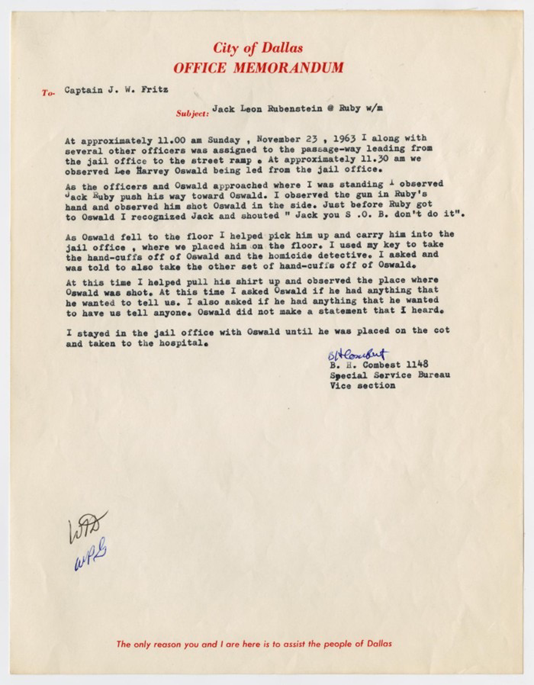
Mrs Paine: On what firm bedrock of evidence do you anchor your assertion that Oswald was propelled by a voracious yearning for infamy and fame? This supposition appears to starkly contrast with the profound narrative woven by his actions, most notably his resolute silence in the face of imminent mortality.
This pivotal silence speaks volumes, challenging the notion of his supposed thirst for recognition.
As Mrs. Paine’s trenchant condemnations of Oswald continued, they resonated powerfully with the audience, evident in the synchronized nods of her supporters, symbolizing a shared conviction. She complained; “I seem to think that the shooting of Walker is absolutely crucial to understand what was going on with Oswald and what happened… not enough has been said about it!”This crescendo of influence reached its zenith when she directed a leading question to the assembled crowd, skillfully crafted to further cast Oswald in the role of the guilty. Her inquiry, loaded with implication and designed to sway opinion, hung heavily in the air, compelling the audience to view the situation through her lens of accusation; “How many of you know that Oswald, and most of you should because you are here, but how many of you ‘know’ that Oswald tried to kill Edwin Walker in April” (1963).

In a choreographed motion, her hand ascended first, soon echoed by a sea of hands in the crowd. Recognizing this solidarity, Mrs. Paine responded with a mix of satisfaction and camaraderie, remarking, “There you go, good crowd, “laughing as her supporters returned the favor. I would call it kind of a dull crowd. It was hard to comprehend that no one asked the obvious question:
Why would Oswald try to kill a right-wing fascist like Walker and then shoot the most liberal president since FDR? I mean, you must know Ruth that Kennedy sent in troops to put down a riot over integration at Ole Miss staged by Walker in 1962? You do know that don’t you? And you also must know that Kennedy retired Walker from the service for distributing John Birch Society material to his troops?

Absent one sentient person, the dog and pony show continued.
Thomas Mallon.“How did it finally come to light that he had shot Walker?”
Ruth Paine.“ When he went out to try and shoot Walker, he wrote a note for Marina… it started out here is the key to the post office box, if I am arrested here is where the police station is and of course she was frightened, terrified as she didn’t know what to do, who to tell… so she (Marina) tried to threaten him, I am going to hide this and if you ever do anything crazy like this I will go to the police with it, but it didn’t work. The amount of preparation that he did, for trying to shoot Walker, is in no way mimicked in the preparation he did before shooting Kennedy, because that was an impulse. He was working on a place that turned out to be on the parade route, with the car going by. He learned that when he was at work on Wednesday (November 20th) called and came and got right out to my house, he had never come out on a weekday, he had never come out before asking permission, this was very different… He came out to get his rifle which was hidden in my garage, which I did not know. Got it and went in and shot the President as we ‘know’. It was a little bit later that the note came to light.
Thomas Mallon.“How did the note reach her?”
Ruth Paine.“…I sent the book to Marina (which contained the note). Of course, what is the first thing a Secret Service man going to do when he sees a book? See what falls out, and out came this note. She was confronted with this note and had to explain that it was the note he wrote when he went out to try and shoot Walker. If that note had not been found then I don’t think that we would ever have found out, because she was not going to tell”.
The Walker Note
“Did it seem strange to you at the time, Marina, that Lee did make these careful plans, take pictures, and write it up in a notebook, and then when he went out to shoot at General Walker, he left all that incriminating evidence right in the house so that if he had ever been stopped and questioned and if that notebook had been found, it would have clearly indicated that he was the one that shot at General Walker?” Wesley Liebeler.
If Exhibit A in the case against Lee Oswald—anchored by Mrs. Paine and Mr. Mallon’s account of the attempt on General Walker—draws heavily from Marina Oswald’s testimony, then Exhibit B is undoubtedly the infamous ‘Note,’ which surfaced, via Mrs. Paine, only after Oswald’s death. This ‘Note,’ has become a cornerstone of controversy. Its posthumous discovery raises pressing questions: What does the ‘Note’ truly prove? At the heart of this debate, several critical concerns undermine the ‘Note’s’ validity and its connection to Oswald:

- Absence of Mention of General Edwin Walker: The note’s content does not reference General Edwin Walker, which is a significant omission if it was intended to be related to the assassination attempt on him. This raises questions about the note’s intended purpose and relevance to that specific incident.
- Lack of Signature and Date: The note’s anonymity and lack of a temporal marker further cloud its authenticity. An unsigned and undated note lacks the definitive characteristics necessary to firmly tie it to a specific individual or time frame, undermining its credibility as a piece of evidence.
- Fingerprint Analysis Results: The FBI’s analysis revealed that none of the seven latent prints found on the note matched Lee Harvey Oswald or Marina Oswald. This forensic evidence is crucial as it directly challenges the assumption that Oswald had physical contact with the note, casting serious doubts on its connection to him.View Source
- Secret Service Inquiry into Mrs. Paine’s Possible Involvement: Mr. Gopadze of the Secret Service accosted Mrs. Paine over the “Walker note” suspecting her potential role in its creation. “
- Expert Consensus on the ‘Walker’ Note’s Authenticity: The House Select Committee on Assassinations (HSCA) consulted three experts to assess the authenticity of the ‘Walker’ note. Notably, there was no majority consensus that the note was written by Lee Harvey Oswald. This raises serious doubts about the note’s legitimacy and its alleged connection to Oswald.View Source
- Oversight in Dallas Police Search: Despite an extensive search of the Paine residence on November 22-23, 1963, specifically aimed at uncovering evidence that could incriminate Lee Oswald, the Dallas Police failed to uncover the ‘Walker’ note. This oversight is particularly striking given Ruth Paine’s testimony indicating the thoroughness of the search. The fact that such a potentially incriminating item eluded the police during their detailed search adds a layer of mystery to the case and raises questions about the note’s whereabouts during this critical period.
Ruth Paine:“I was just preparing to go to the grocery store when several officers arrived again from the Dallas Police Office and asked if they could search…and held up their warrant and I said, yes, they could search. They said they were looking for something specific… Before I left, they were leafing through books to see if anything fell out but that is all I saw… “(WC Volume III; p. 86-87)
th, 2023, and Mrs. Paine stated that the note was contained within “a little book we had, a small book of advice to Russian mothers. It happened to be in the kitchen where we were reading, which made it different from the things in the garage… but they didn’t get that note because it was in my kitchen.”

Considering your statement, Mrs. Paine, that the note was hidden “inside a little book of advice to Russian mothers’”in your kitchen – a location and item distinct from those in the garage – several deeply perplexing and troubling questions arise.
Firstly, if this book was indeed in regular use by Marina in the days or weeks prior to the President’s assassination, it seems utterly baffling that neither of you noticed a note concealed within its pages? This oversight becomes even more confounding when considering the ease with which the Secret Service later discovered it. How is it possible that this note remained undetected in a book that was actively being used?
Secondly this is 1960’s Texas, this period was marked by intense suspicion towards anything remotely associated with communism or the Soviet Union, it stretches credibility to suggest that a book intended for Russian mothers would go undetected by Texas police officers during a property search. My own visit to the property at 2515 W Fifth Street, in November 2023, offered insightful perspectives on this matter. As I toured the house, I found that the garage could be accessed directly from the kitchen/dining area, a detail clearly illustrated in the floor plan I have referenced above. This observation becomes critical when considering Mrs. Paine’s own admission of having given the police unfettered access to search her home in her absence, thus leaving them unsupervised. Given this level of access, and the fact that the garage is directly connected to a central living area of the house, the suggestion that their search would exclude the kitchen, and by extension, overlook a culturally and politically charged item like the book, seems strained. (see this)
- Marina Oswald’s Initial Disavowal of Knowledge: In a striking turn of initial testimony, Marina Oswald professed complete ignorance regarding the existence of the ‘Walker’ note. This initial declaration of ignorance is pivotal, casting a veil of doubt over her subsequent revelations and the evolution of her narrative. View Source
- Evidence Destroyed? The scenario as detailed in Marina Oswald’s testimony regarding the Walker shooting incident indeed unravels into a web of paradoxes and inconsistencies. Her claim that she urged Oswald to destroy a notebook, rich with intricate details of the attack on General Walker, stands in stark contrast to their apparent preservation of the ‘Walker’ note. This dichotomy is not just perplexing but contradictory. If Oswald, as suggested by Marina, felt compelled to incinerate the notebook due to its incriminating nature, it is logical to assume that similar caution would extend to all related materials, including the ‘Walker’ note, pictures of Walkers home found in the Paine garage and the notorious Neely Street photographs. The decision to eradicate one potential piece of evidence while seemingly safeguarding others defies logical reasoning and casts a shadow over their approach to handling such sensitive materials.
Marina Oswald. “I was so afraid after this attempt on Walker’s life that the police might come to the house. I was afraid that there would be evidence in the house such as this book… I told him that it is best not to have this kind of stuff in the house…I suggested to him that it would be awfully bad to keep a thing like that in the house.” (Volume XI; p.293-294)
The scenario presented by Marina Oswald’s testimony regarding the Walker shooting incident is fraught with paradoxes and inconsistencies. It is indeed paradoxical that while she claimed to have urged Oswald to destroy a notebook detailing plans for the attack on General Walker – an act acknowledging the danger of retaining incriminating evidence – she seemingly allowed the ‘Walker’ note to remain in their possession. This contradiction is puzzling. If Oswald took the drastic step to burn a notebook for fear of its incriminating nature, logic would dictate that all related materials, such as the ‘Walker’ note, the infamous backyard photographs, and the photographs of Walkers property would also be destroyed to eliminate any trace of involvement.
This inconsistency in the handling of evidence is succinctly highlighted by Wesley Liebeler’s poignant question:’If Oswald was guilty in the Walker shooting, why would Oswald keep the photos and the note around for almost eight months?’
Go to Part 2 of 2
-

Pipe the Bimbo in Red
Some time in 2022, I gave an online talk for UK Dealey Plaza about the Garrison Files, which I had just completed reading…all nine thousand pages. During the question period, one audience member asked me…Paul, do you have any idea why someone like Dean Andrews would represent someone like Clay Shaw? like Dean Andrews was chosen to represent Clay Shaw (1:08:33)? I have to admit my answer was quite vague. As the moderator of this talk, Neale Safaty, pointed out: Dean Andrews is very enigmatic.
In their book, the authors ask, for anyone has a minimum of critical thinking abilities: Why would Andrews get a call from Clay Shaw, AKA Clem or Clay Bertrand on the day of JFK’s assassination to represent an already doomed Oswald?
At 44:32 of this same video, the questions of sexual orientation of Oswald and Ruby come up, where you can witness my own confusion about sightings of a scruffy-looking Oswald vs. the neat, clean Oswald.
When Donald Jeffries asked me if I would do a book review of this book, I was at first hesitant—as I had just gone through a year of writing and promoting The JFK Assassination Chokeholds with four colleagues and frankly, I needed a break from JFK. But a book about Dean Andrews, played so enticingly by fellow-Canadian John Candy in JFK, I decided to give it a go. I am happy I did. I now have a better grasp of whom Andrews was, the mystery of the unkempt Oswald, and the scene in New Orleans during the summer of 1963.
Their interview with Andrews’ son represents an important find. Not that we can take what Dean junior says as gold. Like the children of many of the cast of characters associated with the JFK saga, Dean Andrews III and other members of the Andrews family paid a heavy burden that reminds one of the Saint John Hunt story. Dean will be seriously challenged for what he reveals because of whom he became, and not necessarily what he says. You will see that I have reservations with some of his statements. His dad clearly had his safety in mind when he answered Dean’s questions when he was a youngster by being evasive, cryptic, and mysterious. His father’s non-denials in certain instances speak volumes. So, on the weight alone of the Dean Andrews III interviews, well conducted by Law, assassination researchers will have plenty to consider, debate and research further and is reason enough to read this book. Other than the ad-hominems Dean is certain to face, there will be some who may want to unfairly shoot the messengers: Don Jeffries and William Law.
While I do recommend Pipe the Bimbo in Red, I would urge the authors to consider writing a revised version, or maybe even a second edition to clear up loose ends, and synthesize by adding information and plucking out irritants. Some of the weaknesses in this book are self-inflicted through overreach and sloppiness which will distract from the key themes before they are even presented and provide a juicy target for lone nut theorists.
First Impressions
I have to say that I do not know Donald Jeffries, so I felt his request came a little out of the blue. I had a negative impression of the title but must admit that it unmistakably projects the image we all have come to associate with Dean Andrews.
Next, I found out that it was co-authored by William Matson Law, whom I had the pleasure of listening to at last November’s Lancer Conference. Law’s interviews of FBI agents Jim Sibert and Frank O’Neill are landmarks and help obliterate the Warren Commission by underscoring what they witnessed during JFK’s autopsy and reveal bias of the Warren Commission. The authors’ work received an endorsement by Garrison authority William Davy, who wrote a foreword that also goes a long way in proving that Clem Bertrand and Clay Shaw were one and the same.
The preface by Edward Haslam does a fine job in presenting how important the setting of NOLA was for the goings-on in 1963, and just how tightly knit the characters were in this small, big city.
Their bibliography includes the following:
- William Davy, Let Justice be Done: New Light on the Jim Garrison Investigation
- James DiEugenio, Destiny Betrayed: JFK, Cuba, and the Garrison Case
- Paris Flammonde, The Kennedy Conspiracy: An Uncommisioned Report on the Jim Garrison Investigation
- Jim Garrison, A Heritage of Stone
- Jim Garrison, On the Trail of the Assassins: My Investigation and Prosecution of the Murder of President Kennedy
- Edward T. Haslam, Dr. Mary’s Monkey
- Marrs, Jim, Crossfire: The Plot That Killed Kennedy
- Joan Mellen, A Farewell to Justice: Jim Garrison, JFK’s Assassination, and the Case That Should Have Changed History
- Jack Roth, Killing Kennedy: Exposing the Plot, the Cover-Up, and the Consequences
- Richard E. Sprague, The Taking of America 1-2-3
One element not included is the raw data available from the 9000 pages of the Garrison files. This, in my view, reduced their sources of information, though the best of these may have surfaced in the many books they referenced…but certainly not all. Thanks to Paul Abbott from Australia, there is now a master index to help navigate dozens of files. Dean Andrews name is associated numerous times in over twenty different files. I would argue that this is a much richer source than what we can find in any other government investigation.
Overall, the book was certain to rest on a solid foundation if the information was well absorbed.
The Preface, Foreword and Introduction
The preface by Haslam is really useful for describing the NOLA setting and the network that Dean Andrews, Oswald, Clay Shaw and Garrison roamed around in. It is a network that hated the Castro threat because of their business ties to Latin America, that saw Kennedy as Castro’s enabler, one that was well connected to intelligence, the mob and Cuban exiles all working in sync to reclaim their kingdom. New Orleans was the last place for a Fair Play for Cuba Committee chapter to set up shop, unless it was a front. Haslam remembered that on the day of the assassination, very threatening skies were forming west of the city…skies no normal person would drive into for an ice-skating outing, as David Ferrie said he was doing that day.
Davy continues the strong start with more than just a normal plug of what I was about to read. For this author, Shaw and Bertrand being the same person is a fact. Shaw told Officer Aloysius Habighorst that Bertrand was an alias he used, which was transcribed on an arrest form that is now part of the official record. Attempts to explain this away border on the loony, as in another person in the crowded, noisy room when Shaw revealed his secret identity did not hear him say this (in other words he simply did not hear). Davy reinforces this with another salvo:
By the time of my interview with Weisberg (ca. 1997) he had long since turned bitter towards Garrison and his investigation—which made one of his comments to me inexplicable. When I asked him about the shadowy figure of “Clay Bertrand” he confidently stated that “Bertrand was Clay Shaw. No doubt. Monk Zelden confirmed it to me.”
Of course, Shaw was the defendant in Garrison’s case and Zelden was a New Orleans attorney who worked with one of the more colorful characters in Lee Harvey Oswald’s orbit, Dean Andrews. Davy then, in a few surgical paragraphs, sets the stage for the book by explaining how Andrews’ links with both Shaw and Oswald were a catalyst for the Garrison investigation—which led to the municipal court attorney’s demise.
He also adroitly points out the extremely revealing INS information about Oswald that Law and Jeffries rely on and that so few in the research community have utilized. Somewhere around 2017 when this information was pointed out, I remember Davy telling Len Osanic on Black Op Radio words to the effect: The fact that we have a governmental agency affirmation that Oswald could be seen entering the building where Banister had his offices with Ferrie and his gang of nuts represents an official intelligence confirmation about Oswald’s connections and exclaimed that this is game, set and match!
That introduction does a good job setting up the highlight of the book, that is the Dean Andrews III interviews. In the view of the authors, the considerable time spent with Dean was enough to convince them that his unique vista of the case and the access he had to his father’s perspective (which was not without limitations) were grounds for relating his story and shedding light around the enigma that is his dad.
Through their relationship with Dean Junior, the authors even heard briefly from Dean Andrews’ wife, who described her deceased husband as a very unstable individual which caused so much hardship.
Beyond bringing fresh, untapped information, the authors argue that Garrison uncovered the ground-level conspirators alluded to in the movie JFK. While this statement may please some of the Garrison disciples, it is clearly too all-encompassing. The plot was too complex for Garrison to grasp the whole ground-level operation. Gaeton Fonzi and some of his followers would argue that there was plenty of intrigue related to Miami that also qualifies as ground level. Who the ground players were for what happened in Dealey Plaza depends on roles that likely did not emanate entirely from Ferrie and friends…at least this book does not prove this. This does not diminish in any way the importance of what took place in New Orleans in 1963.
CHAPTER ONE: Harold Weisberg in New Orleans
Readers in this chapter will understand just how much of a threat Garrison became to the conspirators and they will see an early example of how pro-conspiracy forces can turn bitterly against one another through the Weisberg/Garrison break-up…Something we have witnessed time and time again over the years up to today where the infighting around the legal procedures concerning the breaches of the JFK Act is in full swing, to the delectation of lone nut propagandists.
The authors do not pull any punches when it comes to covering Weisberg whether it is describing his research or his underhanded jabs at Garrison and the movie JFK. They also in this chapter meander into a number of subjects including the organized smear campaign against Garrison by media assets and the infiltration of his office.
There are a lot of nice nuggets here. But one problem began to emerge that permeated throughout the first three chapters: while we are getting a summary of a lot of what has been written about Garrison and New Orleans and even more, the authors are inconsistent with their sources. For example, on page 18 they write: A rough draft of Aynesworth’s May 15, 1967, Newsweek article, “The JFK Conspiracy,” is in the Lyndon B. Johnson Library. There is also a cover letter addressed to LBJ’s press secretary George Christian. Aynesworth wrote, “I am not offering this for comment of any kind, nor a check of the validity of any part…My interest in informing government officials of each step along the way is because of my intimate knowledge of what Jim Garrison is planning…I intend to make a complete report of my knowledge available to the FBI, as I have done in the past.” Interesting weaseling about for certain, but no direct source to prove the existence of this highly incriminating behavior, either by a link or a book source.
Consider this reference: Regis Kennedy (no relation to the president) is among several witnesses connected to the events in Dallas in 1963 who died “before they could be fully questioned,” according to online sources. No careful researcher will take such a statement seriously. There is also this one on page 79: In an interview aired two years after his death in 1990, (Judge) Haggerty would say, “I believe he [Shaw] was lying to the jury. Of course, the jury probably believed him. But I think Shaw put a good con job on the jury.” I found this so important that I had to ask Jim DiEugenio if it really happened, and he confirmed that it did, but an author needs to be more precise than this. In one case the source is the controversial Torbitt document, and the authors seem unaware of the true name of its author: (Lawyer David Copeland). Sometimes the source is Quoting from the Spartacus Educational Forum. There is also a preference by the authors to refer to a book as a source rather than the primary data the book info is based on. I paid a price for this when I used Ultimate Sacrifice as a source about potential patsy Policarpo Lopez. I got panned by some whereas I could have avoided all the flack by quoting directly from the HSCA files on Lopez.
This to me is an irritant because I often cannot refer directly to a source to learn more, and I cannot repeat it as fact until I know that the source is solid. Where this sloppiness came to bite the authors hard can be seen on page 58 where they hover around a Carlos who was seen in the company of Oswald and Sergio Arcacha Smith, a little later they say Garrison attorney Lou Ivon asked witness Dave Lewis if he recognized the name Carlos Corega…In so doing they completely messed up the Carlos Quiroga incident which is well covered in two sources they had referred to elsewhere: Destiny Betrayed and this author’s KennedysandKing articles about the FPCC. Quiroga is known to have met Oswald at his place, bringing a stack of FPCC flyers, being with Oswald at Mancuso’s restaurant in the presence of Arcacha Smith and other usual suspects and revealing that Oswald used the FPCC as a front through a failed polygraph test. Lewis strengthened some of these revelations in his own polygraph test.
Do not get me wrong, dismissing the authors and this book because of improper sourcing would be in my view an error. There is too much good information and new insights to throw away the baby with the bath water. The work put into talking to Dean Andrews III and his mother as well as Ed Voebel’s sisters, niece and son, John Barbour, Garrison investigator Stephen Jaffe, etc. represent important developments.
Chapter 1 showcased another problem with Bimbo that can also be seen in chapters 2 and 3: it lacks structure. The first chapter is supposed to be about Weisberg, but many tangents are taken that bring the reader into whole other subject matters that are interesting yes, but certain to create confusion with information overload. I also think that they should have broken down the chapters into subsections. They have only one subsection in the whole book as far as I can remember which sticks out like a lonely outlier: Kennedy. In a second edition, and I really hope they write one, they will need to break down the information into more chapters with multiple subsections.
CHAPTER TWO: A Ground Level Plot
If one wants to get a snapshot of what has been said and written about the central characters operating out of New Orleans, this part of the book throws everything at the reader, plus the kitchen sink. Since my book readings about Garrison go back for a while, it was good to be reminded of the many anomalies that took place in the Crescent City. There is plenty here that I did not know or recall.
This chapter is also inconsistent with sources and tends to wander. I believe it should be retitled. While many interesting links are made around shady people, I would have trouble describing this the ground-level plot based on the information we are given. Objectives, strategies, timelines, roles…there is a lack of clarity around the “said” plot. The chapter is really more about hanky-panky in New Orleans.
CHAPTER THREE: Dean Andrews and His Fluid Recollections
After the strong start to the book, I found the first two chapters to be interesting, but a mixed bag in terms of reliability. The authors make it difficult for the readers to digest the sheer quantity of information thrown at them and to come away with a high level of confidence in what is written. You sometimes feel as if you are on a carousel ride in a figure eight trajectory while in gallop mode.
While some of the sloppiness and meandering continues, Chapter 3, for this reader, was a turning point and was appropriately titled. Dean Andrews is one of the keys to understanding the New Orleans network of shady characters that link Oswald to Clay Shaw. New Orleans was so toxic to the Warren Commission that Andrews was coerced into confabulating (because he was supposedly under sedation) that a call from Shaw AKA Bertrand that he got asking him to represent Oswald while he was sick in the hospital was a figment of his imagination. The FBI also decided not to delve into Oswald’s 544 Camp Street office and the cast of right-wingers and intelligence actors that the office was a fulcrum for…a mistake according to the HSCA.
From Andrews’ own mouth, an open-minded reader should be left with a clear impression that:
- Andrews represented Oswald a number of times.
- Clay Shaw backed this relationship as well as Andrews’ representation of members of the gay community.
- Andrews was a small-time fixer. Better Call Saul comes to mind.
- The call did occur and was corroborated.
- Andrews was intimidated and scared out of his wits.
- He professed Oswald’s innocence.
- He admitted that the FBI turned the heat on him.
- Oswald’s representation of the Fair Play for Cuba Committee was a front, and he was paid.
- He was part of a network that includes Shaw, Oswald, Wray Gill, Ferrie, Marcello and the anti-Castro movement.
- The contradictory comments he made were for self-preservation.
The authors deserve credit for making this clear to the world.
CHAPTER FOUR: The Dean Andrews III Interviews
This chapter represents the apex of the book. Dean Andrews was 12 when JFK was assassinated. During the Garrison Investigation, he witnessed and lived through a downturn of his father’s fortunes and career and the quasi break-up of his family. The impact on Dean Junior’s health and ambitions were immense. It is a tragic story that seems to be a recurring theme for so many of the family members of those connected the assassination. Perhaps the real perpetrators of JFK’s assassination never went to jail for the crimes, but many paid a personal price with a lot of collateral damage to their close ones.
Those who did seek the truth also risked a lot. The traces they left likely caused trauma for the ones they cared for, but hopefully left them with a sense of pride for fighting the good fight. The cover-up artists live in denial. The more that comes out throughout the years, the less their positions are tenable. Yet they plod on even though they are at the opposite end of the official records. With a great majority of the population and more and more traditional and new media open to the conspiracy scenarios, lone nut advocates are swimming in a much smaller pond and are the ones who come across as Q-ananonish.
What Jeffries and Law do in these interviews is shed light on what a son, who is knowledgeable about the case and who decoded his father the way only a family member can, said, thought, knew, guessed, heard about his father and the case. Dean’s father was very abstract when talking about the saga but revealed so much anyway. Sometimes through non-denials you can figure things out. A son picks up patterns, signals from non-verbal communications and knows when his father is hiding something.
- The authors deserve kudos for recognizing Dean’s importance, gaining his trust and making a record of what he can relate no matter how troubled he became.
- I will not tell you what he has to say because you need to read it for yourself and ponder:
- Dean talks about his dad’s sexuality;
- What he thinks about Jim Garrison;
- The Bertrand-Shaw identities;
- Attempts to harm, intimidate and even kill his dad;
- The divide in his family;
- His dad’s links to Shaw, Marcello, Garrison, Oswald, Mork Zelden, David Ferrie;
- Oliver Stone and the film JFK;
- Oswald and the FPCC;
- His dad’s links to intelligence;
- His father’s personality and biography.
You will ponder, debate and hopefully research on your own to build around this new low-hanging fruit in figuring out the enigma of Dean Andrews. These revelations will likely be polarizing due to the fact that they focus on Jim Garrison and New Orleans. But they are very much worth reading.
I would encourage the authors to try and get corroboration. Dean claims the Figaro ran an article about Garrison being arrested for sexual misconduct…where is it? The only sources that I have seen around such allegations come from discredited smear tacticians. Challenge Dean on whom he confided to, who he thinks could corroborate what he has to say. Not much was said about David Ferrie in the interview…Query William Davy and others about what other questions should be asked. We are actually reaching a point where even the offspring will not be available for much longer.
CHAPTER FIVE William Law 1993 Interview with Perry Raymond Russo
I am not certain why this part gets to be labeled a chapter, while the two that follow the aftermath are labeled appendices. They are essentially decades old interviews that they decided to highlight as blasts from the past. I am happy they did, as I believe that what is in them is pertinent and not necessarily well known.
This section underscores many themes we can find elsewhere in the book but recounts them as seen and felt through the important witness—Perry Russo.
One detail that came screaming out at me that would help explain the differences in appearance in Oswald: The unkempt, messy, unshaven Oswald vs. the neat, clean Oswald. Despite the use of impostors, there had to be something more to these seemingly conflicting sightings. Here is what Russo says: “I’m saying that the guy stayed over at this other guy’s house. Well, the wife should know. How the fuck would this dude, Perry Russo, how would he know? Well, he didn’t. And then she admitted that he used to beat the fuck out of her, and then run out on her. And he’d be gone for three or four days. And she’s glad to see him go. And she said in 1969, telling her when we were in court, she said that he always was immaculately clean. Well, he wasn’t when he was away from her. He was dirty and unshaven. Well and understandable, because he didn’t bring his shaving stuff. He didn’t bring his deodorant. He didn’t give a fuck. He was mad at the world. I didn’t get along with him. But I maintain that. I look like the Lone Ranger. No one could believe me. His wife said he slept every night with her. He took care of the kids. He was never dirty. He was always clean and meticulous about his appearance. I’m saying he’s unshaven three days in. Now, that comes out in 1979. He used to beat the fuck out of her, leave for a week. And all of a sudden, it becomes reasonable that Lee Oswald went over to his friend’s house, Dave Ferrie. Not that far from 4905 Magazine Street, where he lived, with her…in Louisiana.”
When you connect the dots between what Russo, Andrews Sr. and Andrews Jr. have to say, we get a better idea of how the whole Andrews, Ferrie, Oswald, Shaw, Marcello, Cuban Exile network is linked as well as the many double lives led by so many of these characters.
CHAPTER SIX Conclusion: The Conspiracy Is Clear
In chapter 6 the authors pick the brain of author and former TV personality John Barbour. Here I discovered what Garrison confided to his good friend off the record. We get to know what Garrison speculated as to the nature of the conspiracy…From what happened in Dealey Plaza to the catalyst behind the decision to remove JFK to how the murder was sanctioned. Garrison also had a contact who described the very weird goings-on during the Oswald interrogation after the murder. The source was there and wished to remain anonymous. This is also very interesting.
Then they come back and touch on a Dean Andrews’ claim that his father’s hospitalization just before the assassination was due to an attempted murder because of what he knew. What is not asked here, is that if this were the case, did this attempt likely involve the very person who called him to represent Oswald? How Clay Shaw even knew where to reach Andrews is a point that is raised.
Here again the title is misleading. While it is clear that there was a conspiracy, and this book adds food for thought around some of the characters, it does not come close to clarifying what the conspiracy was…not even what they call the ground-level conspiracy. New Orleans on its own, if completely decoded, cannot explain even one quarter of the ground-level conspiracy. As Hancock and Boylan show in Tipping Point, so much else was revolving around players in Miami who were the real architects of regime change operations and were way more determining of what happened in Dealey Plaza than Ferrie et al. There is a big difference between getting Oswald to goosestep in a charade vs. participating in an ambush of a president.
The Afterword by Jack Roth, and the Three Appendices
I have visited Dealey Plaza and Oswald’s “said” flight trajectory, guided by Dallas resident and researcher Matt Douthit and found it to be fascinating. Jack Roth has convinced me to tour New Orleans. His brilliant description in just a few pages culminates with the following statement from a tour guide he met: “…there’s no way anybody could’ve walked these streets, been engaged in this kind of activity, and been involved with people of this caliber in this city and have it not been something more than what it seemed.”
When he goes into the Judy Baker stuff however, I cringe and worry for the authors. I don’t know how many serious writers contaminate their work and tarnish their own reputations on frivolous yarns. Some stories require qualifiers like the not yet substantiated story by…(the Paul Landis revelation comes to mind). Others are sure to polarize those who believe there was a conspiracy and provide a big juicy target for lone-nut advocates: Madeleine Brown, Judith Exner Campbell and Baker clearly fall in this category.
The three appendices are excellently chosen: Dean Andrews’ fascinating Warren Commission testimony; a letter from Fletcher Prouty to Oliver Stone (September 2, 1990) which sheds light on how a coup emanates from the highest levels of power in the U.S. and excerpts from a little exposed speech before a November 18, 2006, JFK Lancer Conference by Anne Dischler who worked with State Trooper Francis Fruge for Jim Garrison.
Conclusion
Just last fall, we had completed our book, The JFK Assassination Chokeholds, after going through through a very strict regime of trying to only include fact-based, primary evidence and carefully backing up each statement we made. All in all, there are close to 800 footnotes, exhibits and direct quotes with sources within the text. Among my other co-authors, there are three attorneys grounded in how to write on a legal basis and one of the world’s premier researchers. Reading Bimbo, I needed to completely change my base of references on how to write a book: questionable sources, lack of focus and fallacious thinking pop up too often to avoid the poison pen of critics. It would have been easy to pan it. But in a sense the authors are really telling a story.
Bimbo offers too much to be ignored and opens the doors to further exploration around the subject of New Orleans which was clearly toxic and threatening to the early, biased investigators with an agenda. They talked to Andrews III, Davy, Barbour, Jaffe and Voebel’s close ones. They revealed important, little-known records that are decades old yet still so very important. Not reading Bimbo is tantamount to not accessing fresh, controversial information from none other than the son of one of the most enigmatic personages in this whole affair. Even if we discount everything else in Bimbo (which one should not do) and even if we do not believe everything Dean Andrews III says, a serious researcher should hear and consider it closely, just like we listened to William Kent’s daughter, E. H. Hunt’s son and David Atlee Phillips’ relatives.
Interviewing Dean junior was a coup!
As for the rest of the book here are my suggestions for a second edition.
- Get yourselves an editor, someone like William Davy, who acts as a real devil’s advocate to rethink the chapters, improve the focus, break down the information better, get rid of the frivolous, add crucial data, correct grammar, etc.
- Really improve choice of sources and how these are disclosed for every affirmation made.
- Add a master chronology of events in New Orleans, a full Dean Andrews bio, a glossary of names and a map with key locations.
- Consider showing exhibits from the Dean III scrapbook.
- Re-interview Andrews with questions, people like Davy, DiEugenio, Mellen would like to ask and try and get some corroboration from people Dean himself may be able to identify.
- Order the Garrison Files from Len Osanic as well as Paul Abbott’s master index and see what you can find there. There are many files on Andrews.
- Try and increase the Dean Andrews research and write more about him and cool it on the ground-level plot.
Dean Andrews is to this book what the Big Mac is to McDonald’s…Your cash cow! Milk it!!!
-

Oswald in Japan: How the CIA Deceived Congress
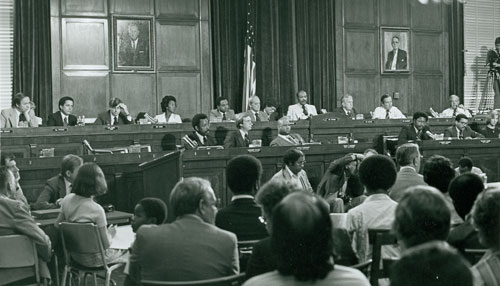 [Fig. 1]
The House Select Committee on Assassinations (HSCA) reinvestigated the murders of President John F. Kennedy and Dr. Martin Luther King (Credit: U.S. Congress)The excellent Solving JFK podcast, hosted by Matt Crumpton, reminds us of a thought-provoking anomaly. The 1964 final report of the President’s Commission on the Assassination of President Kennedy (the “Warren Commission”) says that during his service as a Marine in the Far East, Lee Harvey Oswald, accused assassin of President John F. Kennedy, was in Taiwan from Sept. 30, 1958, but returned to Atsugi, Japan, by Oct. 5. The Warren Report does not say what Oswald was doing in Taiwan, but the House Select Committee on Assassinations (HSCA), which reinvestigated the JFK and Martin Luther King murders in 1976-79, concluded that Oswald never visited Taiwan at all.
The Solving JFK episode can be heard here.
This astonishing discrepancy in the official record is another arrow in the quiver of those entertaining the irrepressible theory of the “Two Oswalds.” That thesis essentially holds that there were two men who not only bore an uncanny resemblance to each other but also went by the same identity as a matter of official record in furtherance of an intelligence operation that desperately needed to be suppressed after the assassination.
The incongruity also, incidentally, strengthens the widespread and more general conviction that agencies controlling information on Oswald, whether the CIA, FBI, military intelligence services or others, repeatedly deceived official investigators. Although the HSCA at least concluded that JFK was “probably” murdered “as a result of a conspiracy,” its inquiry proved to be a “damp squib” overall. It is no longer controversial to assert that the CIA deliberately diverted and stonewalled the HSCA. One area in which CIA deception appears especially vigorous is Oswald’s time in Japan, a chapter that remains an information “black hole,” to paraphrase John Newman, author of JFK and Vietnam (2017) and Oswald and the CIA (2008). The Taiwan episode is just one example.
This “black hole” has exacerbated suspicions of Oswald’s ties to U.S. intelligence in Japan, as alleged by a former CIA employee based in the Tokyo Station at the time of the assassination. Such connections have never been proven, but in light of the CIA’s obvious deception of the HSCA about Oswald in other areas, especially New Orleans and Mexico City, Agency trickery on Oswald in Japan is also worth studying. JFK researchers of integrity are convinced that the CIA is still concealing the extent of its ties to Oswald, and these links may very well go back to his time in Japan — or even earlier.
The House of Representatives Inquiry
On June 12, 1978, a document handwritten by HSCA investigator Harold Leap was forwarded within the CIA. Fully declassified on Aug. 24, 2023, it summarizes Leap’s interviews of 12 employees of the CIA’s Tokyo Station pursuant to “critic publications and specific allegations by former CIA employee James Wilcott that LHO was a CIA agent.” Wilcott had stated in a closed-door HSCA session that “a CIA case officer stationed in Tokyo, Japan, told him that LHO was a CIA agent and also mentioned LHO’s cryptonym.”
The 71-page document that includes Wilcott’s HSCA testimony and related material refers to an unspecified “Oswald project” requiring disbursements of funds, and to Atsugi as “a plush super-secret cover base for Tokyo Station [i.e., CIA] special operations.” Wilcott, a CIA finance officer, testified that the conversation occurred “in the Tokyo Station shortly after the word of the JFK assassination was received on 23 Nov 1963.” Although Wilcott “could not recall the name of the case officer or the cryptonym,” he said that “considerable conversation took place among CIA employees at the time concerning the Oswald-CIA agent issue.” All 12 interviewees were asked whether they had come across any indication that Oswald was an intelligence agent. All said no.
The interview notes appear in summarized form for all officers but one, William Crawford, the CIA’s deputy chief of station in Tokyo from March 1959 to October 1960. In fact, all interview subjects are identified as having worked in the station in the period from 1959 through 1964, presumably to account for any CIA employees who were working in the Tokyo Station when Wilcott was, and whom Wilcott might thus have overhead. Yet Oswald was based in Japan from September 1957 to November 1958, and it is striking that no one but Crawford is identified as having served there during that period too.
Crawford is listed in another CIA document as “acting executive officer” of “Detachment C” when Oswald was serving at the Atsugi Naval Air Station. Detachment C was the CIA unit deployed to Atsugi to operate the U-2 spy plane program, which conducted surveillance missions over Communist China and the Soviet Union. But Crawford was not among the 18 CIA personnel that Wilcott recommended for interview by the HSCA. Even Detachment C’s actual executive officer for the relevant period, Werner Weiss, was not interviewed, despite the fact that he was alive and well in 1978.
 [Fig. 2]
In all, Leap only interviewed four out of Wilcott’s 18 recommendations. Wilcott obviously provided the names of these 18 people because he knew they were working in the Tokyo Station when he (Wilcott) was, but, again, of the four employees that the CIA made available to the HSCA for interviews, nothing indicates that any of them were even in Japan when Oswald was. No explanation is given for this, even though, of the 14 people on Wilcott’s list who were never interviewed by Leap, most were actually serving in Japan during the time Oswald was at Atsugi. Why were they left out of the interviews?
Leap’s notes from his interview of Crawford say that the subject “didn’t know [Lee Harvey Oswald] and never heard the name until after the assassination.” The only reason Oswald was connected to the U-2 program (and thus the CIA) at all, Crawford said, was that “the CIA at Atsugi did not have their own radio-radar facilities,” so the U-2 planes “utilized the naval base communications only for take-off and landing clearance.”
Crawford did note that the “CIA recruited personnel for the program from the military service,” however, and “[a]ll program employees were paid by CIA.” He also outlined the system for U-2 personnel resigning from and returning to regular military service. [Note: As Oswald’s tax returns are still withheld in full from the public, we can’t know whether an intelligence agency paid JFK’s accused assassin during his time at Atsugi.]
 [Fig. 3]
Aerial view of Atsugi Naval Air Station as it appeared in 1988 (Credit: Ministry of Land, Infrastructure, Transport and Tourism of Japan/Public Domain)CIA Sleight of Hand
The CIA apparently composed an undated document entitled, simply, “LIST OF AGENCY EMPLOYEES,” in preparation for the HSCA’s 1978 investigation. A table featuring several operatives includes operations officers, and four names — Jerome Fox, William V. Broe, Frederick C. Randall, Robert P. Wheeler — are recognizable from the Leap write-up.
However, others — notably Japanese-American CIA officers — are included in the still-redacted file and were in the Tokyo Station in the years 1957 and 1958. The most recent declassified version (June 27, 2023) retains redactions in the “Security Posture” column for Chester H. Ito, a CIA operations officer in the Tokyo Station for more than 20 years. Since Ito died in 1999, the Agency is concealing the profile of an employee who died a quarter-century ago but likely worked at Atsugi when Oswald was based there.
A conspicuous redaction in the CIA’s “LIST OF AGENCY EMPLOYEES” is the name of Number 6, whose security posture suggests a possible Soviet connection:
Former Department of Army employee in Japan picked up as contract employee. Poly revealed unresolved issues regarding Communist contacts and/or associations.
 [Fig. 4]
Although the name is redacted, it is in the same position in the table as “Robert S. Hashima” in Wilcott’s list of 18 recommendations, and Hashima appears in other documents composed in preparation for the HSCA’s investigation. In his “executive session” testimony to the HSCA, Wilcott describes Hashima as a “deep commercial cover agent,” and elsewhere as a representative of “Fuji Shoji Co. Ltd.” Under or alongside Hashima’s name in CIA documents, regarding whether he should be made available to HSCA investigators, there is simply an unexplained (yet familiar) notation: “Disregard.”
Yet the most remarkable aspect of the case is this: the HSCA understood the importance of investigating the years 1957-1958 in connection with Oswald. HSCA Chief Counsel G. Robert Blakey, in a letter dated April 26, 1978, requested that the CIA make available for interview the “chief officers and deputy chief officers of the CIA base at Atsugi, Japan from 1956 to 1960.” These years encompassed Oswald’s time in Japan.
 [Fig. 5]
This line of inquiry mysteriously fizzled. On the next day’s routing and records sheet, a handwritten note by Norbert Shepanek of the CIA’s Directorate of Operations says:
I do not know if there were any DDO officers at Atsugi 56-60. [Deputy Directorate of Science & Technology] is answering separately. Negative reply requested. Shep
Following this, in a handwritten note on an official routing slip dated (apparently) May 2, 1978, S&T officer Carroll Hauver (later CIA Inspector General) disseminates the falsehood that Atsugi was just a “support base staffed by support personnel” during 1956-60. That seems to have shut the inquiry down, yet as anyone who has looked into this subject in any depth knows very well, Atsugi was far more than just a “support base.”
The Biggest CIA Base in the Far East
While Oswald was based at Atsugi, the CIA’s “Joint Technical Advisory Group” (JTAG), whose activities remain obscure to this day, was located at the naval air station. Oswald was a radar operator and performed sentry duty at the U-2 hangar, but he also lived and worked in close proximity to JTAG, which encompassed more than the U-2 facility. As early as 1964, the CIA’s deputy director of plans, Richard Helms, had described the CIA’s Atsugi facilities — in particular JTAG — to the Warren Commission more extensively as
consisting of 20 to 25 individual residences, two dormitories, an office area, a power plant, several Butler-type warehouses, and a club building used for recreation and a bachelor officers’ mess.
The Warren Report avoided mention of either JTAG or Detachment C, never interviewing anyone about either. Helms, the No. 3 man at CIA, admitted 60 years ago that a specific CIA program (the U-2) operated from Atsugi while Oswald was there, but that was all.
Still, even this was more than the CIA told the HSCA.
In his book, The Missing Chapter: Lee Harvey Oswald in the Far East, Jack Swike — a former Marine Corps security officer at Atsugi — explains that JTAG was set up in 1950, employed “[a]bout 1,000 people” and occupied “50 acres of the Atsugi base.” Originally devoted to training clandestine agents infiltrating enemy areas during the Korean War, it served — according to Swike’s Marine Corps intelligence source — as a base where “weapons were flown in from hostile areas and were tested.”
Researcher Dick Russell, in The Man Who Knew Too Much, refers to JTAG as “the CIA’s main operational base in the Far East” and quotes L. Fletcher Prouty, former chief of special operations for the Joint Chiefs of Staff in the Kennedy administration:
“I went into Atsugi just as World War II ended, taking some of MacArthur’s bodyguard in there. A monstrous stairway went down into caverns, you could drive a truck into it. A huge underground base. The agency used it for a lot of things.”
 [Fig. 6]
Left: Tunnel under the Atsugi base (1950s), reproduced by Jack Swike in The Missing Chapter: Lee Harvey Oswald in the Far East (Credit: USMC); Right: Photo of Oswald (doctored around head and shoulders), possibly in Atsugi, 1958 (Credit: Unknown)In 1983, Jack Swike sued the CIA for information about JTAG but lost the case.
“I believe that the U.S. Department of Defense did not want any investigations conducted into military matters in Atsugi in the late 1950s because the Marine Corps Nuclear Weapons Assembly team was located in MAG-11. Thus, the U-2 Spy Plane was not the top-secret program on the base.” ~ Maj. Jack R. Swike, USMC
In other words, according to Swike, in 1957-58 Oswald’s unit (MAG-11) had a more sensitive purpose than the U-2, a program the Soviets already knew about anyway. Moreover, the CIA itself consistently downplayed the significance of the U-2 in Japan. An internal report titled “EIDER CHESS” (codename for the U-2 program), “Subject: DDS&T Interim Reply to HSCA Request, 8 May 78,” gives “General Background” on Detachment C, noting that Atsugi was not the usual departure point for U-2 missions over Russia:
The first overflight of the USSR from Atsugi occurred on 1 March 1958 and this flight was the only and last flight. This flight, as other previous flights by other Detachments, was tracked by Russian radar…
This seems to have ended the U-2 matter for the HSCA, though it shouldn’t have. Even if the U-2 made only one surveillance flight over the USSR directly from Atsugi, Oswald was serving there at that time. If Oswald’s defection to the USSR was part of a U.S. espionage operation to deceive the Soviet enemy, this detail would have served the scheme.
As early as Apr. 13, 1978, a routing and record sheet from the CIA’s Office of Legislative Counsel (OLC), released in full on Dec. 15, 2022, reflects that the HSCA had inquired about at least one CIA resident of the Tokyo station during Oswald’s time in Japan. The request from the OLC’s Rodger Gabrielson to the Directorate of Operations (DO) reads:
Harold Leap, HSCA staff, wants the name of COS [Chief of Station] Tokyo Station for the years 1957 and 1958 to close the loop on his inquiry as to whether Tokyo Station had any relationship with Oswald when he was in Japan.
Shepanek of the DO gives a handwritten answer: “The COS Tokyo for the years 1957-58 was: Mr. John Baker. Mr. Baker died in 1964.”
Leap’s handwritten document also contains anonymous entries in different handwriting. At the end of Leap’s notes from the Crawford interview, someone has written:
“Harold: Can you add the following statement?”
Crawford said that had LHO been associated with the Atsugi CIA Station, he, as exec officer, would’ve known about it.” (A crossed-out note after this is still legible: “However he would not been aware of his exsistence.”)
Doubts as to how forthright the CIA was about Oswald’s exposure to U.S. intelligence operations in Japan are compounded by these facts:
- None of Leap’s interviewees began working at the CIA’s Tokyo Station until after Oswald had returned to the U.S., even according to the CIA’s own records; and
- None of them discuss or are asked about the substantial JTAG complex.
The episode looks like another instance of CIA diversion of investigators, similar to the CIA’s assignment of former clandestine operations officer George Joannides as its liaison to the HSCA, in violation of the Agency’s agreement with Congress.
Soviet Connections
 [Fig. 7]
U.S. Army Counterintelligence Corps chart for Soviet recruitment of Japanese prisoners of war as agents in the early 1950s (Credit: 441st CIC Detachment). The 441st CIC Detachment was the unit of Richard Case Nagell, discussed below.Some of Leap’s interviewees said they thought Soviet intelligence might have recruited Oswald because “the CIA station in Tokyo had identified a KGB program specifically designed to recruit U.S. military personnel in Tokyo.” Japan was a venue for active recruitment of U.S. servicemen by Soviet intelligence, and Soviet engagement of American base personnel likely had in mind operations far more sensitive than the U-2 when Oswald was at Atsugi. The still-mysterious JTAG closed in December 1960 (more than six months after the U-2 program folded in Japan), but a highly secret, heavily guarded nuclear weapons assembly center known as “METO” was also on the base.
Swike writes that, “Lee Harvey Oswald saw some activities in the METO area,” and when Oswald told U.S. consul Richard Snyder in Moscow on Oct. 31, 1959, that he knew “something of special interest,” he was “probably referring to the METO Site.”
[T]he belief was that he had information about the U-2 Spy Plane, which was not the most important item in Atsugi at the time. The Russians were well aware of the U-2s in Atsugi, and were seeking other information. Oswald probably gave them some clues about U.S. nuclear intelligence.
Knowing that Soviet intelligence in Japan was interested in cultivating agents among U.S. military and intelligence personnel, the CIA would, it is reasonable to conclude, have employed double agents to trick its Soviet counterpart there. In the CIA’s LIST OF AGENCY EMPLOYEES document, the notation in the “Security Posture” column for the CIA employee with the redacted name (presumably Robert S. Hashima) of “unresolved issues regarding Communist contacts and/or associations” is reminiscent of the story of a better known, self-described U.S.-Soviet double agent in Japan, Richard Case Nagell.
As is now well known, ex-U.S. Army Counterintelligence Corps (CIC) officer Richard Nagell was arrested in El Paso, Texas, on Sept. 20, 1963, and later claimed to have orchestrated his own arrest to ensure he was in U.S. custody when JFK was assassinated. In fact, while it is not known whether Nagell ever submitted to a polygraph, and the years for the redacted employee (1953-1954) do not coincide with Nagell’s time in Japan, the rest of the description coincides almost exactly with Nagell’s account of himself.
In the above-mentioned The Man Who Knew Too Much by Dick Russell, whose research forms the backbone of the recent Who Killed JFK? podcast series, Nagell described himself as a former Department of the Army employee when explaining the nature of the Foreign Operations Intelligence (FOI) agency for which he worked:
“On paper, FOI was subordinate and operationally responsible to the Office of the Assistant Chief of Staff for Intelligence, Department of the Army. In function, however, FOI was merely an augmentation to CIA special (military) operations, in effect a covert extension of CIA policy and activity designed to conceal the true nature of CIA objectives.” (p. 50)
This would have qualified Nagell, like Hashima, as a “contract employee” of the CIA, and the “unresolved issues regarding Communist contacts and/or associations” square with Nagell’s description of himself as a U.S.-Soviet double agent working for the CIA. “Robert S. Hashima,” or whoever is redacted in the CIA document, was very likely one of the double agents the CIA used to interact with and infiltrate Soviet intelligence in Japan in the 1950s and 1960s. He may very well have interacted with Oswald in that capacity as well, and may thus have talked about Oswald in front of Wilcott in the Tokyo Station.
Nagell was never called before the HSCA in spite of his claim to have alerted the FBI from jail about Oswald and an assassination plot against JFK. Nagell claimed to have known Oswald in Japan and to have attempted to persuade the Soviet military attaché in Tokyo to defect in place. Nagell said he had met Oswald in New Orleans and Mexico City, and that he had warned the ex-defector about associating with Cuban exiles.
Suspicion of Oswald’s double-agent status endures. His “double agent” activity in New Orleans consisted of first posing as a sympathizer with anti-Castro Cubans of the CIA-funded Student Revolutionary Directorate (DRE), offering to train them for attacks against their Communist homeland, then posing as a Castro sympathizer and Fair Play for Cuba Committee (FPCC) supporter, getting in the faces of the DRE members on camera as he passed out FPCC leaflets to passers-by on the street.
Nagell, when he was arrested, had a mimeographed FPCC newsletter addressed to him in his possession and FPCC contact data in his notebook. He refused to explain to Russell the extent of his own FPCC ties, but parallels with Oswald are unmistakable. One of three versions Nagell gave for orchestrating his own arrest in El Paso was to avoid becoming a patsy for the JFK assassination. In 1995, Nagell was found dead in his home at age 65, a day after the Assassination Records Review Board (ARRB) had summoned him to testify.
 [Fig. 8]
Left: Richard Case Nagell, Bronze Star and 3-time Purple Heart recipient (Credit: U.S. Army); Center: Nagell under arrest in El Paso (Credit: El Paso Herald-Post); Right: Oswald under arrest in Dallas (Credit: The Sixth Floor Museum at Dealey Plaza)Special Treatment for a Lowly Private
According to the Harold Leap interview document,
All the subjects worked within the SR [Soviet Russia] Branch of the Tokyo Station and theoretically one of them would have handled or had knowledge of the recruitment. All thought if Oswald [had] been recruited without their knowledge it would have been a rare exception to the working policy and guidelines of the station.
Unfortunately, all of these “subjects” appear irrelevant as far as Oswald’s time in Japan is concerned. The CIA was no doubt very happy to keep it that way. But one thing is unquestionably correct about the above statement. From the circumstances of his defection to the USSR, to the inexplicably late opening of his 201 file under an erroneous name in the CIA’s Office of Security, to the lack of any proper debriefing of him after his arrival back in the US in June 1962 (unlike contemporary US defector Robert Webster, debriefed for over two weeks on his return), and the CIA’s close surveillance of him right up until the assassination itself, Lee Harvey Oswald remains a “rare exception” indeed.
Omission from the HSCA’s investigation of CIA personnel active in Japan during Oswald’s time there — as the CIA’s own files show — is inexplicable for a serious investigation. The witnesses that the CIA made available to the HSCA were mostly irrelevant to James Wilcott’s allegations, yet the HSCA mysteriously never followed up. The author of the LIST OF AGENCY EMPLOYEES document is unknown, but the style resembles that used by George Joannides, the CIA officer assigned to stonewall HSCA investigators, as evidenced by another tabular document known to have been his work.
 [Fig. 9]
Excerpt from a 248-page document prepared by George Joannides in preparation for the HSCA investigation, dated July 24, 1978Whether the HSCA was complicit in its own hoodwinking, the CIA successfully protected its information “black hole” around Oswald in Japan before congressional truth-seekers in 1978. Today, with its “Transparency Plan” for JFK files approved by President Biden in December 2022, the CIA is making sure the void in the historical record is never filled.
[This article first appeared on January 25that the substack site: The Larger Evils.]