Blog

  • ARRB Meets First Hurdles


    From the July-August, 1995 issue (Vol. 2 No. 5) of Probe


    On July 21st the National Archives released the first set of ARRB approved documents. These were 16 CIA documents that the agency did not choose to contest. As Peter Dale Scott has written, “One of the documents . . . strengthens the impression that David Phillips . . . was directly involved before the assassination in the handling and reporting of Oswald’s visit to Mexico City.” Scott found that the temporary duty officer who picked up a special pouch related to the Mexico City episode was “Michael C. Choaden”, a name the Review Board understands, from the CIA, to be a pseudonym for Phillips.

    FBI and CIA Balk

    After the rather smooth going on the first release, both the FBI and CIA began to balk at what came next. From CTKA sources in Washington, the ARRB itself, and the AP newswire, PROBE will now outline the struggle going on in the capitol.

    When the ARRB moves to release a batch of documents from an agency’s files, that agency has the privilege to request a private conference with the Board to try to convince them of other options other than full disclosure e.g. postponement or non-release. A worst case postponement can last well into the next century. Our sources tell us that the original release pattern planned by the ARRB has been altered. The pattern originally held that another batch of solely CIA documents from Oswald’s CIA HQ file were to be released next. Then a combination of 15 FBI and 2 CIA documents concerning Oswald’s trip to Mexico City were to be third. The Board had originally agreed on this sequence. The CIA then requested another audience with the Board to request postponement on the CIA HQ release. This audience was granted. During this delay, the third release went ahead and will be uncontested on the CIA’s part. After their conference with the CIA, our information is that the Board is now reconsidering their original intent to release the documents in full. The FBI has been more overt about the scheduled release of 15 documents. They have appealed the release of 9 of these to President Clinton. According to the ARRB, the FBI contested files relate to Oswald’s stay in the Soviet Union, the Communist Party USA, and Ruby’s shooting of Oswald.

    Sources and Methods, yeah yeah yeah…

    The objections seem to be on the usual grounds of the sensitivity of “methods and sources” and damage to our intelligence relationships with foreign countries, i.e. intelligence sources and agents inside foreign countries. Since the Board has seen the documents and are well aware of the standard line on “national security” one can’t help but wonder how that antique warning could be sounded three decades later and with the Cold War finished.

    The Board’s Recommendation

    We quote from Mr. Marwell’s letter to President Clinton dated August 11th:

    Dear Mr. President:
    I have the honor of submitting to you the enclosed Reply of the Assassination Records Review Board to the Federal Bureau of Investigation’s August 8, 1995 Appeal of Formal Determinations under The President John F. Kennedy Assassination Records Collection Act of 1992.
    There are two principal points made in our Reply. First, the Federal Bureau of Investigation has failed to provide the “clear and convincing evidence” required by the JFK Act; and second, much of the information that the Bureau now wishes to redact has already been officially released by the Bureau. We respectfully request that you carefully consider the merits of the arguments raised in our Reply.
    In making its formal determinations, the Board carefully considered the assassination records in question and determined that the public interest in the release of all of the information contained in them outweighted the insufficient evidence that the FBI had offered in support of continued secrecy. The Review Board has, and will, postpone the release of information in cases where the statutorily mandated “clear and convincing evidence” is supplied and that evidence outweighs the public interest in disclosure.
    A copy of the enclosed Reply, classified SECRET, is being sumitted under separate cover to Marvin Krislov, Associate Counsel at The White House.”

    The contents page of the 26 page reply to the FBI’s appeal shows that the ARRB has come down on the research community’s side on this issue:

    Part I: The JFK Act Presumes Disclosure of Assassination Records
    Part II: The FBI’s Informant Postponements
    A. The FBI Failed To Meet Its Statutory Obligation to Provide Clear and Convincing Evidence
    B. The FBI’s “Broad-Brush” Arguments Against Release of Information About Informants Should be Rejected
    C. In the Absence of Clear and Convincing Evidence to the Contrary, the JFK Act Requires Full and Immediate Release of the Appealed Documents
    Part III: The FBI’s “Foreign Relations” Postponements

    We back the belief in total candor. In fact we think its the only tenable view today. We trust the Review Board’s judgment since it is certainly not composed of fringe, or irresponsible professionals. In fact, in Graff and Hall, it contains two former intelligence employees. Does anyone believe they would vote to endanger “national security”? It is a critical time and we are glad it came early. Here and elsewhere, we urge everyone to call or fax the White House, and FBI Director Mr. Freeh to make their voices heard on this momentous issue. Mr. Clinton must back the ARRB in this first appeal by the FBI to the White House. These appeals for secrecy and non-review have led the Bureau into suspicion on the King case, and culpability in Ruby Ridge and Waco. Let this appeal fall where the previous ones should have: on deaf ears.

    ~ Jim DiiEugenio

  • GOP Effort to Defund the ARRB


    From the July-August, 1995 issue (Vol. 2 No. 5) of Probe


    The story broke suddenly in The Wall Street Journal of June 23, 1995. The Republicans in the House were looking for funds to cut from the federal government’s operating budget. The first move was to pass a bill cutting $155,000,000 and eliminating 2,700 jobs from operations of the House and legislative agencies such as the General Accounting Office. Then Speaker Newt Gingrich and Majority Leader Dick Armey apparently had their legislative aides go through the White House budget and target agencies they felt were unnecessary and expendable. In the sixteenth and next to last paragraph of the Wall Street Journal story noted above, the reference to eliminating the Review Board appeared. Ironically a quote from Armey in the story read that, “I hope that we can set straight a perception of wrongdoing.” How Congress could do this by saving a whopping two million (approximate ARRB budget) from a one and a half trillion dollar budget escapes us. Precisely the opposite effect would occur. But this statement and this effort shows us even more how out of touch our Washington representatives are.

    When this story got out and circulated to the members of the ARRB and the research community, a coordinated effort took place to lobby the House Appropriations Subcommittee on Treasury, Postal Service and General Government. This effort was led by representatives and friends of COPA like John Judge, Dan Alcorn, John Newman, and Washington columnist Sarah McClendon. As a result of this effort, Rep. Steny Hoyer (D) of Maryland sponsored an amendment that restored funding in the House to 2.15 million for the ARRB. The bill was passed and then sent on to the equivalent committee in the Senate led by Sen. Shelby (R) of Alabama and Sen. Kerrey (D) of Nebraska. It was passed there also. The villain in this drama was Rep. Jim Lightfoot (R) of Iowa who originally moved the bill to cancel the ARRB in the House Committee on Appropriations. We understand that the line being sold in the House was that the National Archives could do the equivalent job that the ARRB was doing. We won’t comment on the inanity of that obvious deception.

    There was a downside in all this though. President Clinton had originally asked for an operating budget of 2.4 million. In the view of many, that was not enough. But the amount voted in both the Senate and House versions of the bill was 2.15 million. It seems the DeConcini effort of the previous year to whittle down the budget has taken a mental hold on the funding figure in Congress. Next year Probe will prepare its readership in advance to lobby the appropriate committees for the higher figure.

    ~ Jim DiEugenio

  • Canning’s Letter to Blakey


    From the July-August, 1995 issue (Vol. 2 No. 5) of Probe


    This “not altogether complimentary letter” may prove to outline the reasons that the HSCA failed so miserably in their investigation of the John F. Kennedy assassination. Following his shocking revelation that the photo evidence and the conclusions of the Warren Commission are not mutually supportive, Thomas Canning, author of the HSCA’s trajectory analysis, offers us a brilliant outline of why the HSCA’s investigation was doomed to fail. His allegations of evidence left compartmentalized, accusations of staff infighting, along with his assertion that the medical panel gave him conflicting data, confirm what many in our research community have suspected all along. For these reasons many have proposed that a special prosecutor someday be appointed to explore the assassination.


    January 5, 1978

    Professor Robert Blakely [sic]

    Chief Counsel,

    House Select Committee on Assassinations

    U.S. House of Representatives

    House Office Bldg.

    Annex No. 2

    Washington D.C. 20515


    Dear Professor Blakely: [sic]

    When I was asked to participate in analysis of the physical evidence regarding the assassination of John Kennedy, I welcomed the opportunity to help set the record straight. I did not anticipate that study of the photographic record of itself would reveal major discrepancies in the Warren Commission findings. Such has turned out to be the case.

    I have not set out to write this note to comment on results; my report does that. What I do wish to convey is my judgement [sic] of how the parts of the overall investigation which I could observe were conducted. The compartmentalization which you either fostered or permitted to develop in the technical investigations made it nearly impossible to do good work in reasonable time and at reasonable cost.

    The staff lawyers clearly were working in the tradition of adversaries; this would be acceptable if the adversary were ignorance or deception. The adversaries I perceive were the staff lawyers themselves. Each seemed to “protect” his own assigned group at the expense of getting to the heart of the matter by encouraging — or even demanding cooperation with the other participants. The most frustrating problem for me was to get quantitative data — and even consistent descriptions — from the forensic pathologists.

    Of somewhat less importance in gaining overall acceptance of what I consider to be a quite impressive improvement in understanding, was the manner in which the results of the investigation were conveyed in hearings. I don’t propose to alter the trial-like atmosphere, but when long-winded engineers and Congressmen are allowed to waste literally hours on utter trivia, I do object.

    I needn’t remind you of the importance of managing time when many expensive people are participating and particularly when millions are watching. To allow staff and witnesses to overrun their planned allotments to the detriment of the whole planned presentation indicates that either the plan or its execution has been weak.

    Clearly the participation of the Congressmen in subsequent questioning, though necessary, uses time somewhat inefficiently; even here enough experience must have accumulated to anticipate the problem and lead you and Chairman Stokes to deal with it.

    Much of this rather negative reaction to the hearings themselves stems from my being strongly persuaded to rush through a difficult analysis at the last minute, abandon my regular pursuits for two days, try to boil down forty-five minutes of testimony to thirty, and then listen and watch while two hours’ excellent testimony is allowed to dribble out over most of a day.

    Permit me to end my not altogether complimentary letter by saying that it was for the most part an interesting and enjoyable experience. On balance, the entire effort would be justified solely by the strong indication of conspiracy at the Plaza. I particularly enjoyed working with Jane Downey and Mickey Goldsmith. Their help in piercing some of the partitions and their remarkably quick, intelligent response to my needs was exemplary. They also proved to be good critics in helping me make my results clear.


    Sincerely,


    Thomas N. Canning

  • Ted Charach’s Press Conference: Thane Eugene Cesar’s Gun Found

    Ted Charach’s Press Conference: Thane Eugene Cesar’s Gun Found


    From the July-August, 1995 issue (Vol. 2 No. 5) of Probe


    In truth, heretics are more despised than infidels. In practice, it is never more true than in the attitude of the political elite and the wags who sing their praises, toward the assassination research community. The most recent case in point was the non-coverage of the press conference held by RFK assassination researcher, Ted Charach. Charach used the occasion of the 27th anniversary of RFK’s death to reveal the latest findings in the case. Surprisingly or not so surprisingly, not one reporter from any news organization showed up!

    It is no small coincidence that author Dan Moldea also called a press conference at exactly 11:00 a.m. on Monday, June 5th, ostensibly to hype his latest book The Killing of Robert F. Kennedy. Since the book concludes that Sirhan acting alone shot and killed Robert Kennedy, we wonder if any news organization covered Moldea’s press conference. We certainly did not see, hear or read anything about the press conference, so we’re left to conclude one of two things; either Moldea had nothing very compelling to say or the press coverage in this town is a lot worse than anyone realized.

    In the course of recapping that which is known from the release of his book, articles, video and film presentations, Charach revealed several new pieces of evidence which substantiate the charges of obstruction of justice, subornation of perjury and a cover-up in this case. He also revealed a new wrinkle in his second gun theory. He now believes that not only did Thane Eugene Cesar fatally shoot RFK in the head, but like Sirhan, as discussed in the book The Assassination of Robert F. Kennedy, by Jon Christian and William Turner, Cesar was a programmed assassin and has no memory of the acts he committed that night.

    charach

    Photo by Thomas Smith, showing Ted Charach holding a picture of Coroner Thomas Noguchi indicating the point of entry to the bullet that struck Robert Kennedy at point blank range in the back of the head. Sirhan was shooting from, according to eyewitnesses, no closer than one and a half feet in front of Kennedy.

    Charach displayed copies of documents recovered from state archives which bolstered the 1970 testimony of criminalist William Harper. Harper testified that LAPD criminalist DeWayne Wolfer had falsified the results of the test-firing of the gun used by Sirhan. The documents clearly show the serial number of the gun test-fired by Wolfer as H-18602. Yet, the serial number of Sirhan’s gun is actually H-53725. Wolfer has always stated (even under oath) this discrepancy was merely a “clerical error.”

    Charach also revealed that last year he made a trip to the Middle East. During that trip he met with members of the Israeli Mossad who, Charach implied, had been aware of the CIA’s use of Sirhan Bishara Sirhan as a mind-control subject and a programmed assassin. He offered up a film he had made of these discussions with the Mossad agents to any legitimate news service organization for airing and analysis on American television.

    Another film he offered to any news service organization was that of an interview of shooting eyewitness Donald Schulman who that night told Jerry Dunphy of KNXT news (now KCBS) that a security guard had fired his gun back at Sirhan and had accidentally shot RFK. Jerry Dunphy and KCBS have denied that this interview ever took place. Of course, since no news organization was represented at the press conference, nobody took Charach up on his offer to air either of these films.

    Finally, Ted Charach, who refers to himself as the “Father of the Second Gun Theory” in the assassination of Robert F. Kennedy, has teamed up with feature film producers, Beaux Carson and Tim Gibbons to tell the story of the search for the second gun and the lives who have been affected by the search.

    The project is titled, “Operation Tinker Toy” – Phase I and Phase II. It’s the story of how the gun turned up in the possession of certain residents of a little town in Arkansas, and how their lives took rather dramatic turns for the worse under possession of this gun. Their story is told within the backdrop of Charach’s 25 year search for it.

    At one point during the press conference, Beaux Carson brought in a man toting a metal briefcase and a handcuff attached to his wrist. Inside the briefcase was the nine-shot, .22 caliber revolver, serial number Y-13332, salvaged from a muddy pond in Arkansas after 25 years. This is the gun which was owned by Thane Eugene Cesar and which Charach believes is the second gun used in the assassination. Sirhan’s gun was an eight-shot, Iver-Johnson Cadet, .22 caliber revolver, serial number H-53725.

    This was the first public display of the gun since its recovery in 1993. Carson announced that tests on the gun and test-firings will be made sometime this year by independent forensic labs. He stated he had also been approached by law enforcement agencies who expressed interest in test-firing the gun using their own forensic experts. He hesitated to identify which law enforcement agencies were interested.

    We came away from the press conference believing ourselves more blessed for the cursed heretic and despising evermore the beloved infidel.

  • Raymond vs. Connick: Round One


    From the July-August, 1995 issue (Vol. 2 No. 5) of Probe

    This is not the first time that Gary Raymond has crossed swords with his former boss, Harry Connick. When Connick came into office in 1974, Raymond was an investigator on his staff. By the time he left the department in the mid 1980’s, he was his chief investigator. He then became a private investigator. Since one of Raymond’s specialties was pedophile cases, Connick asked him to check out a case he had of a local priest who was sodomizing children and young adults. Gary checked out the materials, tapes and affidavits and recommended to the DA that he prosecute the case. Gary waited and waited. Nothing happened.

    Meanwhile, Gary encountered one of the kids he had seen on the pornographic tapes, which the priest had been peddling. Raymond asked the boy if he wanted to talk for the record. He said that the priest had threatened his life if he did. Raymond then drew up a three page memo outlining the case and he forwarded it to Connick. Connick’s assistant then told Gary that the DA was very angry about the memo. When Raymond asked why, the reply was that it left a paper trail. Connick had cut a deal with the archbishop in September of 1989. Later, Raymond saw Connick at a St. Patrick’s Day parade. He asked the DA when the priest was going to be prosecuted. Connick put his finger in his chest and said, “He won’t. Not as long as I am the DA. And you can’t do a thing about it.” Gary then went to Richard Angelico and he did a continuing five day series on what became the famous Father Dino Cinel child abuse case, in which the priest was making child pornography films in the rectory of St. Rita’s Church. One of the series highlights was Angelico’s interview with Connick. He asked the DA if he had made a deal with the diocese not to prosecute. He said he had because it would have been too difficult to track down and I.D. all the kids. Angelico had to remind Connick that the DA had gone before the legislature in 1985 and had the law changed so that mere possession of the material was a contraband charge. Connick had smugly stuck his foot in his mouth.

  • CTKA Pays Tribute to Women in the Research Community

    CTKA Pays Tribute to Women in the Research Community


    From the July-August, 1995 issue (Vol. 2 No. 5) of Probe


    We have decided to devote a special section of Probe to honor some of the current and prominent female contributors in the research community. For a long time when women in the field were mentioned, the only two names listed were Sylvia Meagher and Mary Ferrell; the former for her wonderful book “Accessories After the Fact”, the latter for her personal archives. “JFK” changed that equation. But even at the symposiums held immediately afterward-except for Stone’s assistant Jane Rusconi-new female faces were rarely seen on the dais. Last year’s COPA conference was a slight improvement. Carol and Kathleen were on panels. But Milicent’s presentation on the alteration of John Connally’s hospital testimony was rushed and Anne-Marie was inexcusably shunted into a sideroom. We hope that doesn’t happen again and we do what we can here to both recognize their work and reverse a neglect that cannot be called benign.


    amkw

    Anna Marie Kuhns Walko: What One Can Do

    by Steve Jones

    “Ask not what your country can do for you….” For most Americans today these words are but a distant memory or at best a part of some arcane history lesson. But for Anna Marie Kuhns-Walko the challenge that President John Kennedy gave to us 34 years ago is as real and important today as it was when it was first issued.

    For the past year and a half, Anna has devoted her life to doing her best to live up to that challenge. She is helping to bring about a more open and honest government so that past crimes held secret may never be repeated again. Between August 1993 and January 1995, Anna spent almost every day, sometimes as much as 50-60 hours per week, at either the National Archives building in downtown Washington or at the newly opened Archives II in College Park, Maryland, digging through millions of documents released under the JFK Assassination Materials Disclosure Act of 1992. No professional historian, journalist, researcher or government bureaucrat is as familiar with the Kennedy assassination materials as this wife and mother of two grown children. In fact, one security guard at the National Archives became so used to seeing her there that he assumed she was an archives employee.

    Anna has been an invaluable asset to countless authors and fellow researchers who have made the journey to the new College Park archives. Many have relied upon her for advice and information. An almost equal number have been warmly invited into her home. She gladly shares her research work with others out of a firm conviction that all Americans have a right to know their own history.

    The only thing that upsets her is “When the media, or the government, rely upon researchers for information and then publicly refer to them as ‘conspiracy buffs.’ I hate that term. I don’t buff anyone’s shoes. I prefer to be referred to simply as a citizen who is deeply concerned that so much of our real history has been kept hidden from us. In going through the files, it’s become clear to me that the government isn’t going to take the initiative in telling the truth about who killed President Kennedy. We citizens have to make them accountable; to do what is right for the people.”

    Anna’s passion for politics began as a child growing up in Pittsburgh, PA. As a little girl she attended Democratic party and steel-workers union meetings with her mother. As a seven year old, she saw John Kennedy while he was on a campaign swing through her town on October 10, 1960. Anna went on to college and earned three Associate degrees, a bachelors degree, and accumulated fifteen credits towards her Masters degree in political science. She accomplished this while enduring the many moves required of her due to her husband’s career in the military.

    Anna states that she has uncovered enough information in the newly released files to convince her that the assassination was the result of “a covert operation from within the United States.” Among the documents she’s uncovered so far:

    Documents exposing “Operation TILT”: an ill-fated attempt to smuggle four Soviet Military officers out of Cuba who allegedly maintained that missiles were still in place after Kruschev’s promise to remove them during the Cuban missile crisis of October, 1962. One of the key players in this drama, John Martino, has been independently identified as being involved in JFK’s murder.

    She found an envelope with the inscription “7.65 shell found in Dealey Plaza on 12/02/63,” only to find that the shell had been removed from the envelope with a note left in its place that stated, “determined of no value and destroyed.” Oswald was alleged to have used 6.5 ammunition.

    Another document she uncovered states, “photo of bullet allegedly removed from President Kennedy’s body.” This was found with accompanying photos of a nearly whole bullet. According to the Warren Commission version of events no bullet was ever removed from President Kennedy’s body. The only bullet mentioned in their report are “traces” that were found as minute particles which showed up on a skull x-ray.

    A document dated February, 1960, claims that then Vice President Richard Nixon was arranging for two million dollars to be turned over to a Cuban revolutionary group and used for the purpose of overthrowing Fidel Castro’s government.

    It was the public furor caused by the release of Oliver Stone’s movie “JFK” that brought about the creation of a five person review board of eminent historians who are responsible for the release of many documents in the government’s possession. This review board was given a working staff, a budget of $2 million dollars and a three year life span to carry out this task. Though the board was to have begun their work in 1993, it was not ready to begin work until well into 1994. In the meantime, researchers like Anna didn’t waste precious time waiting for the government to act. She was already on the trail long before the ARRB became functional.

    But the Review Board still has an important function. Just how efficiently and honestly they operate will show how serious the government is about getting to the truth of the assassination.

    What concerns Anna most is that the recent lurch to the right in Congress may spell trouble for the board and the fate of even more documents that are due for release under this legislation. Right wing politicians generally favor authoritarianism and secrecy. “We have to be vigilant and make sure they don’t chop it, cut it or stop it. We have to watch and see that Congress doesn’t close down the Review Board.”

    Despite her concerns, Anna is optimistic that, “in time, truth and justice will prevail. People have more to say than they believe they do; more power in what can be done than they realize. We have to keep trying or we’re never going to succeed.”


    Coming Full Circle

    by Carol Hewett

    I became mildly interested in the assassination as a result of the Oliver Stone movie and casually pursued this interest by reading general books about the assassination by Garrison, Lane, Summers, etc. I was far from being a serious researcher and simply viewed the case as a yet unsolved murder mystery – a much better read than Dash Hammett novels. However, I became hooked by Michael Beschloss’s book, Mayday, on the Gary Powers U-2 spy affair wherein Lee Harvey Oswald’s name suddenly appears on page 236. Beschloss suggests that Oswald, as a former U-2 radar operator, may have been infiltrated into Russia and utilized to sabotage Powers’s flight and the upcoming summit between the superpowers. The timing of these events and the fact that Oswald was released shortly after the Powers exchange for Rudolf Abel put Oswald into an entirely different perspective for me and I embarked upon research into cold war politics and Oswald’s military background – still without much interest in the events of Dallas.

    I mentally traveled the Far East, Russia and Cuba from post WWII to the Bay of Pigs. Eventually I found myself physically present in Texas in September of 1992 looking for an obscure book in the Dallas library entitled Oswald, by Kerry Thornley, only because there were no copies available in Florida’s libraries and I had an airline ticket that needed to be used up by the year’s end. It was in Dallas that I discovered that there were others like me who researched and who actually came together at conferences to study the assassination! From my first attendance at ASK 1992 until the present, I have worked vigorously on JFK research and find myself pursuing a wide variety of topics which thus far have covered the Dallas “sleaze scene” including night club operators and gunrunners; Kerry Thornley and E. Howard Hunt as possible propaganda assets; the history of Mannlicher-Carcanos; and an overview of the circumstantial evidence that might have been admitted into a trial had there been one. And so I arrived full circle – from deep politics to the nitpicking details of a Dallas police investigation.

    I regard the most significant research development of the 1990’s (aside from the historical release of previously classified documents) to be the shift in attitude in a growing number of pro-conspiracy researchers that Oswald may have been involved in the assassination after all. Oswald’s innocence up until now has been a sacred cow, which if challenged in the slightest, causes Oswald’s defenders to accuse other researchers of being traitors to the cause. I feel this thwarts progress by preventing evidence from being tested against a variety of hypotheses which in turn I feel is essential to unraveling what happened on November 22, 1963. I confess to being part of the small minority of researchers who seriously doubt Oswald’s innocence yet who fervently believe in a conspiracy. While I may be in a minority amongst conspiracy theorists, I nevertheless keep company with the majority of Americans – who have maintained that Oswald did not act alone.

    My particular approach to research comes from my own tendency as a trial lawyer to analyze facts in such a way so as to reconcile apparent discrepancies. Only in this way can a lawyer make his or her version of the case acceptable to judges and jurors who are receiving conflicting data. In other words, what case scenario would allow both sets of seemingly conflicting facts to exist? This “reconciliation” process can be applied to JFK research as well. For example: if there is both reliable evidence of only 3 shots and reliable evidence of more than 3 shots, then what additional unknown factor might explain both phenomena? One possible answer could be the use of silencers. Thus I began researching both Mannlicher-Carcanos as well as sniper weapons. The results are rather interesting because in 1963 there existed CIA sniper weapons equipped with silencers (that did not muffle the sound as well as they should depending upon where the listener is standing) which happened to have rifling patterns very similar to the Mannlicher-Caracanos. I will elaborate more on my findings in the next issue of Probe.

    What has also intrigued me about the JFK assassination was the manner in which the evidence simultaneously implicated and exonerated Oswald – it undisputedly rose to the level of “probable cause” yet neatly fell short of proof “beyond a reasonable doubt. Even if Oswald had not been arrested in the Texas Theater that afternoon, the evidence which came to light during that day was abundantly sufficient to require the issuance of an arrest warrant and the filing of charges against him. Yet this very same evidence falls apart upon closer scrutiny and would not have held up at trial. Examples abound but I will mention just a few: 1) Oswald’s fingerprints on the rifle which supported ownership, yet none on the clip or handloaded cartridges which would have shown possession by him that day; 2) the mail order purchase of a Mannlicher from Klein’s in the name of an alias of Oswald’s and in the handwriting of Oswald, yet a 42″ rifle arrives instead of the 36” which he ordered; 3) a paper bag on the sixth floor containing Oswald’s blanket fibers yet a similar bag addressed to Oswald languishes in the “dead mail” bin of an Irving post office; 4) backyard photos hidden amongst his personal possessions showing him to be a left-wing militant armed to his teeth yet bearing the markings of being faked; 5) ownership of a handgun of the same 38 caliber that killed Tippet yet the Tippet bullets come from an automatic and Oswald’s hand gun is a revolver. Oswald cannot only proclaim that he is a patsy, he can prove it! He even says as much during his interrogations.

    Would a bonafide sophoisticated frame-up of an innocent person be so flawed naturally? Or, as researcher William Weston argues, was Oswald actually a “sham” patsy who allowed himself to be implicated provided he could be assured of escape and/or acquittal at trial? If Oswald was truly innocent, how does on explain his departure from the book depository, only to arm himself with a weapon and hide out in a dark theater. No other “innocent” book depository employee felt the need to spend Friday afternoon in the manner selected by Oswald. Oswald was apparently “in the know” about something – but what?

    Was Oswald “in the know” of the pending plans to invade Cuba at the end of November 1963, a covert operation which is slowly coming to light for the first time in 30 years? Did this operation have official sanction by the White House or were the Kennedy brothers oblivious to these covert activities? Was the assassination to be a fake one (to justify the invasion) which a few fanatics within the CIA and military transformed into a real one – one covert operation hidden inside of another? How do all of these notions square with the circumstantial and physical evidence that is at hand? The deep politics once again becomes as fascinating as the minute details – how could anyone not be sucked up into what some perceive to be the black hole of assassination research? We at least begin to understand our body politic and thus our own roles as citizens of a democracy, do we not? No matter the individual theories, no matter the outcome, we are all as citizens obligated to probe for the truth and to support one another’s efforts – without rancor and back-biting criticism of one another’s work, I might add.

    I feel that we are arriving closer to the truth with each passing day and with each new document – otherwise I could not continue with my own research if I sensed it was a bottomless pit. Even without a definitive answer, I now understand my government better than I did before. I have also made many wonderful friends from within a group of the most dedicated and intellectually stimulating folks that I have encountered since my college days. What a welcome respite from the grind of the work-a-day world. History has never been so alive!

    Carol Hewett is a practicing attorney in Pinellas County, Florida, the same county where Ruth Paine now lives. Following her graduation from the University of Texas School of Law in 1975, she worked for various federally funded legal services programs which engaged in advocacy on behalf of institution- alized persons, including mental patients, prisoners, foster children and juvenile delinquents. Her efforts were directed at safeguarding their constitutional rights with regard to their conditions of confinement. She later served as litigation director of the National Juvenile Law Center, a now defunct program under the U.S. Department of Justice. While there she had occasion to represent Cuban youths in a landmark case which successfully challenged their indefinite detention in adult jails following their arrival into the U.S. in the 1980 Mariel boatlift. In 1982 she formed her own law firm where she focused primarily on criminal defense and family law. Since 1992 she has limited her practice to federal administrative appeals on behalf of social security disability claimants which is far less demanding than her previous trial work and which allows her to pursue assassination research on almost a full-time basis.
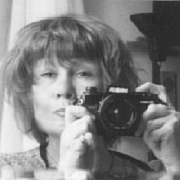

    cranor

    Excavating History

    by Milicent Cranor

    All kinds of expertise and semi-expertise can be applied to the study of the Kennedy assassination. In my case, an amateur’s passion for archeology and what it reveals about ancient crimes carried over to the crime of this centruy.

    In archeology, you get the conqueror’s version of the truth filtered through layers of dead languages, and a lot is left in the filter. Sometimes the truth can be found, not on a great stone monument, but beneath it, in layers of debris, trampled on for centuries. You find fragements of ancient texts, and fragments of individual letters, which may or may not belong together. You combine certain pieces, and take special care to keep others separate.

    The testimonies of witnesses to the Kennedy assassination all seems to be jagged fragments of the same picture. Some of the stories don’t seem to fit at all, until you ask the right questions; then you find that someone has shifted the context, and you have to reframe the answers.

    The best archeologists try to fill in a lot of blanks with imagination and logic, and keep track of every speck of dust that suggests a diffferent picture.

    In contrast, spokesmen for the official version of the Kennedy assassination identify no important blanks, and sweep mounds of contradiction beneath a grey rug. I try to identify the blanks – as well as the shape of the lumps under the rug. Less difficult is identifying the lumps standing on the rug, doing business as usual.

    Milicent Cranor is the co-author of over a dozen articles for peer-reviewed medical journals, amateur paleographer, former staff writer for Applause Magazine, and former editor at E. P. Dutton.


    ~ In Memoriam ~
    Cindy McNeill
    1952-1995

    Cindy McNeill of Houston, Texas passed away on March 21, 1995 after a long battle with breast cancer. Cindy, who was a wife, mother, lawyer and regent with a local university, was a relative newcomer to the assassination research community. Yet she had spent years studying Richard Nixon and E. Howard Hunt and their possible roles in the Kennedy assassination. At the time of her death, Cindy left behind a lengthy unfinished manuscript about these two men. Those who had the opportunity to collaborate with Cindy will remember her impressive command of the subject, her no-nonsense approach to research politics and her generosity and willingness to share her research with others.

  • CTKA Press Release


    Nearly a month and a half later, the public has yet to see the files. Yet Connick has allowed one select person privileged access. He is Gerald Posner, author of the 1993 book “Case Closed” which argued that the Warren Commission was correct in its 1964 finding that Lee Harvey Oswald was the lone, deranged assassin of President Kennedy. In a 1994 interview with researcher James DiEugenio, Connick said that no one could have these files except an “official body”. The article does not explain Connick’s apparent reversal on this point. Posner also never explains why Connick is delaying the National Archives receipt of these materials.

    Mr. Posner’s article is relatively brief: 11/2 pages, or 3 magazine columns. In this short piece, Posner spends 7 paragraphs dealing with the contents of these new files. Of these, 3 deal with information not already published in books. Yet, the last people able to peruse these files, the House Select Committee on Assassinations (a true official body) made a recently declassified index to these records. The index itself is 16 pages long! From this skeleton guide much of the material ignored by Posner is new and seems to support some of Garrison’s charges, specifically about the association of Shaw with Oswald and the attempts some people made to intimidate and bribe his witnesses, which is why he wished them surveilled. This is left out by Mr. Posner.

    Finally, Posner leaves out the most important story of all. The ARRB is about to request the release of CIA HQ files on Oswald to the Archives. The CIA is resisting. If, as Posner states, the case is closed and Oswald was the sole, deranged assassin, why would the CIA a.) have voluminous files on him, and b.) not want the public to see them fully disclosed 32 years later. Posner and the Times should save their space for an article on this issue and its outcome done by an unbiased writer whose interpretations can be checked against the record. Openness, not elitist bias, is what the JFK Act was all about.

  • Wecht Responds to Boswell: 1995 to 1969


    From the July-August, 1995 issue (Vol. 2 No. 5) of Probe


    The following document recently surfaced:


    MEMORANDUM FOR ADMIRAL DAVIS 3 Feb 1969

    Subj: Call received from Dr. Boswell (Suburban Hospital, tele: 530-6066) re problem concerning trial going on in New Orleans by Mr. Garrison re Mr. Shaw


    A member of the Justice Department has been in contact with Doctor Boswell and has questions re custody of patient records. Specifically, Doctor Boswell needs to talk with you sometime today (ASAP) re rules and regulations within the Navy Department relative to who has responsibility of custody of President Kennedy’s records – autopsy report, x-rays and photographs. There is a question of some material which no one seems to know where it is or where it can be obtained (Doctor Boswell suspects it may be held by Kennedy Family but is not certain). Doctor Boswell said Justice is not trying to retrieve the material but they need to know what the rules and regulations re custody are. A member of that Department will question Dr. Boswell later today. A forensic pathologist, Dr. Weckt, who is not considered too reputable will testify at the trial. Dr. Boswell needs to discuss this and the custody matter with you.

    Very respectfully,


    BETTY


    Wecht responds:

    July 31, 1995

    J. Thornton Boswell, M.D.
    11134 Stephalee Lane
    Rockville, Maryland 20852

    Dear Dr. Boswell:

    Enclosed is a copy of a memorandum typed by your secretary on February 3, 1969. It was recently obtained from the JFK files by one of the researchers.

    Inasmuch as your secretary, Betty, and I have never met, and presumably, she was not a physician, attorney, forensic scientist, or active politician, I must infer that her statement that “A forensic pathologist, Dr. Weckt (sic), who is not considered too reputable will testify at the trial” emanated from you. Certainly, I have always assumed ultimate and full responsibility for actions and statements made by my personal secretary. One need not be a lawyer to appreciate the universal logic of respondeat superior and vicarious responsibility. I would be interested in learning how you had ascertained as of February, 1969, that I was not reputable. Inasmuch as the memorandum related to the JFK autopsy materials, I assume that this characterization referred to me in my capacity as a physician and forensic pathologist.

    From whom had you received such information, and from whom had you elicited opinions regarding my competence, integrity, and honesty?

    Had you submitted an inquiry to the American Academy of Forensic Sciences, which organization was to elect me as President-Elect later that same month at their Annual Meeting at the Drake Hotel in Chicago?

    Had you made an inquiry of government and political officials in Allegheny Country, where I was endorsed by the Democratic Party later that month for the position of Allegheny County Coroner, and then nominated in the Primary and elected to that job in November, 1969?

    Had you made an inquiry of Dr. Thomas Noguchi, Chief Medical Examiner-Coroner of Los Angeles County, who had officially consulted me in the Robert F. Kennedy and Sharon Tate-LaBianca murders?

    Had you submitted inquiries to the University of Pittsburgh and Duquesne University, where I had been appointed to the faculties of the University of Pittsburgh School of Medicine and Duquesne University Schools of Law and Pharmacy?

    Had you read the transcript of my testimony before Federal Judge Charles Halleck, Jr., in Washington, D.C., in August, 1968, regarding the need to examine all the JFK autopsy materials as a consultant to District Attorney Jim Garrison in the Clay Shaw trial? (Judge Halleck was apparently sufficiently impressed and granted the DA’s motion immediately from the bench. Of course, as expected, the government attorneys protested vehemently and appealed his decision. I had to wait another four years before I had the opportunity to review these materials at the National Archives and see the results of your skilled handiwork.)

    By what God-given right did you have to malign and defame me in this fashion when you obviously knew nothing whatsoever about me? (Of course, it is certainly possible that somebody had made negative comments about me. If so, you should have had the decency to have named those individuals and discussed with some specificity in your memorandum what the basis was for such negative comments.)

    It is a matter of record that the FBI and other governmental agencies embarked upon a special campaign to undermine, ridicule, embarrass, defame, and vilify anybody who had the audacity to challenge the conclusions of the Warren Commission Report. Their actions were utterly despicable and morally reprehensible. Evidently, as a career military person, you felt that you had the same right to follow a similar tack, and you believed that you also enjoyed legal immunity in making defamatory comments.

    Without getting into a discussion or review of the JFK assassination and whether the WCR’s conclusions vis-a-vis Oswald are correct, one fact is unequivocally clear and universally acceptable among all forensic pathologists, including the other eight members of the House Select Committee on Assassinations Forensic Pathology Panel who disagreed with me on a few key points, namely, that you and Dr. Humes had no business whatsoever in performing the autopsy on President Kennedy. Neither of you had ever done one official medical-legal autopsy, nor had you ever spent one day in a forensic pathology training program or seminar. Your incompetence and inexperience set into motion a horrible chain of events that has continued for 32 years, and which has cost this country and thousands of people immeasurable amounts of time, effort, money, and emotional anguish.

    Tell me, Dr. Boswell, do you think you were a “reputable” person in undertaking this post-mortem examination? In what way did you make a contribution to law and justice? Or were you, like Adolf Eichman and other militarists in the past, simply “following orders”?

    Although more than three decades have passed since your abysmal performance, and despite the fact that your defamatory statement about me is no longer legally actionable, I would very much welcome the opportunity to debate the JFK assassination with you anywhere at any time. I feel confident that we could charge a substantial amount for audience tickets, and all the money could be donated to a charity of your choice. Why don’t you come out of your self-imposed obscurity and quasi-seclusion and contend with the real world? You and your colleagues created this incredible mess with one of the most tragically botched medical-legal autopsies I have ever encountered. Do you not feel that you owe enough to yourself, your family, your profession, and your country to mandate participation in a public forum pertaining to the JFK assassination?

    Or do you believe that you fulfilled all your moral and ethical obligations by simply meeting privately with your old military pathologist comrade-in-arms, Dr. George Lundberg, and enjoying the intellectual luxury of telling the same old story from your perspective without being challenged or criticized by anyone? You have been whitewashed in JAMA, and you have managed to escape grueling interrogation by a skilled adversarial attorney in an open court of law. Such immunity and protection are usually available only to absolute monarchs and governmental dictators. However, there are other assessments in life that are meaningful. I would be absolutely mortified and horribly humiliated if 85 to 90% of my countrymen consistently and repeatedly rejected my professional conclusion in the most significant endeavor I had ever engaged in during my lifetime. That is some legacy to leave your children and grandchildren.

    Very truly yours,

    Cyril H. Wecht, M.D., J.D.

    cc: James J. Humes
         Pierre Finck, M.D.
         George D. Lundberg, M.D.

  • Thomas Canning’s Letter to Robert Blakey (1978)


    From Probe, Vol. 2, No. 5 (July 22, 1995)


    (Click here if your browser is having trouble loading the above.)

  • The Transcript from Harry’s Hell


    From the July-August, 1995 issue (Vol. 2 No. 5) of Probe


    WDSU Local Evening News, 7/11/95

    Lead In:

    There have been many mysteries surrounding the murder of President John F. Kennedy including a mystery right here in New Orleans: What happened to the files of former prosecutor Jim Garrison?

    Connick:

    I think everything connected with that case should have been retained and preserved in some way.

    Cut to:

    live in-studio anchors Norman Robinson and Susan Roesgen sitting with reporter Richard Angelico.

    Norman:

    You’ll recall that the District Attorney testified that the files had been stolen.

    Susan:

    But for the first time we know what happened to at least some of the JFK files because Richard Angelico found them. Richard.

    Richard:

    Well Susan and Norman, the story of the missing original grand jury testimony is bizarre to say the least. Harry Connick says it was stolen. But a former staffer of Connick’s says the District Attorney knows better about the missing Kennedy files.

    Cut to:

    A montage segment of the Zapruder film, HSCA Report cover, photos of Oswald in handcuffs, films of Garrison and Shaw, booking photos of Ferrie and Shaw.

    Richard’s Voice-Over:

    The assassination of John Kennedy spawned dozens of conspiracy theories. But the Warren Commission named Lee Harvey Oswald as the lone assassin. Many found that hard to believe. Among them New Orleans District Attorney Jim Garrison. After a highly publicized investigation, he arrested New Orleans businessman Clay Shaw, charging that Shaw, Oswald and a local pilot named David Ferrie plotted Kennedy’s death here in New Orleans. Shaw was acquitted, Garrison’s investigation discredited.

    Cut to:

    Angelico in front of Court House.

    Richard:

    For years the records of that investigation lay in storage at the DA’s office gathering dust. Now a federal commission, the Assassination Records and Review Board wants those records and two weeks ago called on current district attorney Harry Connick to produce them.

    Cut to:

    Film of the Review Board hearing.

    Richard’s Voice-Over:

    Connick told the committee only a small portion of the records remain. Most of them, he said, had been stolen.

    Connick:

    There are a lot of folks who were connected with that investigation and prosecution and were in that office you know, from that time of the trial until we took office in ’74. And I think a lot of that material is probably in their custody. I think those files were rifled and I think they took from those files things that would be of great interest to the American public, and to the world as a matter of fact.

    Richard’s Voice-Over:

    Connick clearly pointed the finger of blame for the missing records at Garrison’s office. Had a crime been committed asked the committee chairman? To which Connick replied:

    Connick:

    Our criminal code calls that theft.

    Cut to:

    Angelico walking down the street in front of the Court House.

    Richard:

    Those were strong words from the DA But now a former member of Connick’s staff has come forward with equally strong words. He says Connick did not tell the committee the entire truth.

    Cut to:

    Montage segment of the two page affidavit being shown on the screen.

    Richard’s Voice-Over:

    In this sworn affidavit the former staff member says, “Recent news articles indicate DA Harry Connick has testified before the Assassination Records and Review Board that records of Garrison’s were “pilfered” from the files of the DA’s office. Nothing could be further from the truth. Harry Connick, elected District Attorney, Chief Law Enforcement Officer of Orleans Parish, personally ordered those records destroyed. I know, and do hereby swear this to be the truth because I was one of two or three individuals ordered by Harry Connick to destroy them.”

    Cut to:

    Angelico in an office with a table in front of him. Copies of the grand jury testimony are on top.

    Richard:

    These are the records the former staffer says that Connick ordered him to destroy: the original testimony of more than 40 witnesses who appeared before Garrison’s grand jury. Many of them major players in the investigation The documents include the testimony of Perry Raymond Russo, the man who placed Shaw with Oswald and Ferrie. Mark Lane, the original conspiracy theorist. Dean Andrews, a New Orleans lawyer, who claimed to have gotten a call asking him to represent Oswald. And even the testimony of Marina Oswald, Lee Harvey Oswald’s widow. According to the affidavit, Connick’s reasons for destroying the records were simple: he needed more storage space.

    Cut to:

    The affidavit.

    Richard’s Voice-Over:

    The former staffer says when he suggested the records were of historical significance, Connick told him: “This investigation was a figment of Jim Garrison’s overactive imagination. Burn this son-of-a bitch and burn it today.”

    Cut to:

    Close-up shots of the bound grand jury testimony.

    Richard’s Voice-Over:

    But the staffer disobeyed Connick and kept the records for over 21 years until turning them over to me. Last week we asked Connick about his testimony before the Assassination Records and Review Board and his contention that many of the records had been stolen by Garrison’s staff.

    Cut to:

    Inside of Connick’s office. Angelico is sitting opposite of Connick at his desk.

    Richard:

    The grand jury testimony in the Shaw case should have been kept do you think?

    Connick:

    I think everything connected with that case should have been retained and preserved in some way.

    Richard:

    We have a, I found an affidavit from a former staff member of yours who says that you ordered him to burn the grand jury transcripts.

    Connick:

    No, no. (Smiles, giggles nervously.)

    Richard:

    I’ll let you look at it and see what it says.

    Connick:

    I don’t, I don’t, it. . .so what’s the point.

    Richard:

    Well, he saw you tell the committee that and he says you ordered him to burn the grand jury transcripts of the Shaw-Garrison investigation because you simply needed storage space when you moved into office.

    Connick:

    That, that, that may well be so. . . we, we dispose of a lot of records, have disposed of a lot of records, um-huh.

    Richard:

    Hmm. He maintains in the affidavit that, that he suggested to you-

    Connick:

    I will, I will accept that as, as valid. . .

    Richard:

    Huh?

    Connick:

    I will. He’s saying that we should have kept it, is this what he’s saying?

    Richard:

    He’s saying that he came to you and said maybe we should keep this because this is not John Smith killing John Doe, this is Garrison’s investigation of Shaw. It may have some historical significance. And you said the case has been disposed of, the man not guilty, burn the records.

    Connick:

    Right.

    Richard:

    Because you needed storage space. . .

    Connick:

    Uh-huh.

    Richard:

    Do you dispute that? Do you recall that?

    Connick:

    I, I don’t recall that, I don’t recall that. But if I did do it, so what, its done.

    Richard:

    Yeah.

    Connick:

    We’ve destroyed a lot of records.

    Cut to:

    Inside of Sal Panzeca’ office. Angelico and Panzeca sitting at a table with the grand jury testimony between them.

    Richard’s Voice-Over:

    As a final footnote to this story, we showed the transcripts to Sal Panzeca, a former member of Shaw’s defense team. His reaction:

    Panzeca:

    We were not able to see the documents at the time I was working on this case, uh, today we would be and I think that the Garrison case would never have gone to trial.

    Cut to:

    In studio, Angelico sitting at a desk with the two anchors.

    Richard:

    These records were provided to us on the condition that we forward them to the Assassination Records and Review Board. We will do that. We have also provided a copy to an assassination expert for his review to determine if these files will shed some light on the assassination investigation. We’ll let you know what they find.

    Norman:

    Richie, does an original copy of the grand jury testimony exist anywhere else.

    Richard:

    Well, Connick told me that he had some copies of grand jury testimony. I don’t know if what he has is some of the other originals or if they’re copies. He says he can’t make that public because its grand jury testimony. He’ll probably burn those.

    Susan:

    Now since you’ve gotten actually your hands on these, conspiracy buffs who are still out there would want to know, did you see anything surprising in it?

    Richard:

    Not from what I know of the Kennedy assassination. I mean one of the things I read first was Perry Raymond Russo’s grand jury testimony because he’s the one who placed Oswald, Shaw, and Ferrie together. But if you step back a little bit and you know what happened to Perry Raymond Russo, he was given sodium pentothal, he was hypnotized at one point because he had no independent recollection of this. And under hypnosis it was suggested to him that there was a gray-haired man at a party he went to. So when you put this all in context nothing’s really new. And that’s why we’re giving them to the expert so that he can go through them and give us a synopsis of everything.

    Susan:

    Good, maybe we’ll get more. Great story Richard.

    Norman:

    And the mystery continues.


    It’s too bad that Angelico’s report didn’t stop after the Connick interview. Two fallacies were appended to it at that point. First, the implication by Panzeca is confusing. Defense lawyers are not allowed to contest the prosecution’s case to a grand jury today just as they were not back then; so its hard to decipher what he means when he says the case would not have gone to trial if he would have known what was in the grand jury testimony. Secondly, Angelico repeats the ancient James Phelan canard about Russo. As the recent revelations in the actual interviews, trial testimony, and Bill Turner’s unpublished manuscript show, Russo mentioned the name Bertrand before he was hypnotized and without being prompted.-Eds.