From the March-April, 1997 issue (Vol. 4 No. 3) of Probe
(Click here if your browser is having trouble loading the above.)
see also Paul Bleau’s Oswald’s Last Letter: The Scorching Hot Potato

(Click here if your browser is having trouble loading the above.)
see also Paul Bleau’s Oswald’s Last Letter: The Scorching Hot Potato
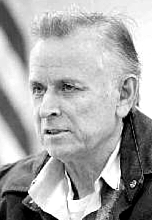
The weekend before Christmas, James Earl Ray, the convicted, yet disputed, assassin of Martin Luther King, was transferred from the Riverbend State Prison in Nashville, Tenn. to the Columbia Nashville Memorial Hospital. By Christmas Eve, Ray had slipped into a coma.
Ray, 68, has been suffering from cirrhosis of the liver and kidney failure, which led to internal bleeding. Cirrhosis is most commonly associated with an abuse of alcohol (Click on this link for an explanation).
Ray wasn’t a drinker or a smoker.
“I think he’ll be gone in 24 hours. I really do,” said his brother Jerry. Ray’s brother, on Christmas Eve, signed a request that Ray not be given life-support if his condition should become critical. But on Christmas Day, Jerry changed his mind, attributing the change to calls from both Reverend James Lawson and William Pepper, Esq.
Reverend Lawson, now a Los Angeles pastor, was a supporter of Martin Luther King’s who was in Memphis during 1968. Lawson has been vocal in his defense of Ray over the years, claiming Ray could not have been a lone assassin, if an assassin at all.
William Pepper has become Ray’s lawyer. Pepper recently wrote a book detailing his own long study of the King assassination case, called Orders To Kill. The book details Pepper’s own search for the truth about King’s death, and concludes that Ray could not have been the one responsible. The finger of guilt is pointed instead toward an alliance between forces in the government and elements of organized crime. Both Lawson and Pepper convinced Jerry that he should make every effort to keep his brother alive, especially in light of an upcoming hearing.
For years, since the time of his confession, which he retracted a few days later, Ray has professed his innocence and filed barrages of appeals to get a new trial. Finally, in 1994, it seemed he might have a chance.
During the course of preparing a mock trial for an HBO telecast, much new evidence surfaced in the MLK case. The evidence was enough to frighten one person into coming forward to confess what he claimed was a small role he had played. Lloyd Jowers, who worked in the grill below the rooming house from which King was allegedly shot, confessed on TV in December of 1993 that he had been hired to find an assassin for King, and that he had not hired James Earl Ray. Jowers wanted immunity before telling more of what he knew. But Shelby County District Attorney General John Pierotti called Jowers’ story a hoax. According to Pepper, “Pierotti has had five witnesses under his nose…and he’s never even tried to talk to them to get their story.” Both Lawson and Pepper complained publicly that Pierotti had done little to investigate the case.
In January of 1994, New York City attorney Jack E. Robinson, having done his own five-year investigation into the Martin Luther King assassination, went public with his findings. He had reviewed the House Select Committee records and found their investigation “very disturbing. The House investigation was sloppy and incomplete, and its findings misleading. James Earl Ray, in my view, is innocent.”
Former HSCA Chairman Walter E. Fauntroy agreed. Referring to the HSCA’s conclusions that although there was likely a conspiracy in the MLK case, Ray was still a shooter, Fauntroy said, “both research by very competent people on the one hand and my review of my own basic data for that investigation have convinced me that we were in error on the second matter, namely that James Earl Ray, in fact, shot Dr. Martin Luther King. That, in my view, is not true.”
Although denied parole in May of 1994 at his first hearing in 25 years, by June Ray had cause to hope. Pepper had managed to convince Shelby County Criminal Court Judge Joseph Brown, Jr. to allow a test firing of the alleged assassination rifle to see if the rifle could have fired the bullet that struck MLK. Brown had ruled in April that under state law, there was no way that a defendant could benefit from new evidence long after having been convicted of a crime. Nonetheless, the Judge recognized the historical importance and unanswered questions surrounding the case, and said he would allow Ray’s attorneys to “get it all out on the record” so that an appeals court might be able to later consider the new evidence.
However, Pierotti got the Judge to delay the tests, saying he wanted experts of his own choosing present at the test-firing, which had been set for June 16, 1994. Pepper also wanted to conduct neutron activation tests on the rifle, but Pierotti claimed that FBI experts had said such tests were only useful with recently fired bullets. The day before the test firing was to take place, a state appeals court halted the proceedings, granting Pierotti’s request for a delay of the firing. It seemed the last chance to get at the truth was slipping away.
In 1995, Ray filed a FOIA for classified papers that he claimed would clear him of participation in the assassination. Officials denied his request priority treatment, claiming his case had not generated “widespread and exceptional” media interest. “The politicians have a vested interest in keeping me in prison,” Ray said at the time. “For instance, if I were out, I could personally appear in Federal Court petitioning for the release of the classified Martin Luther King records.” In response to questions of his own involvement in the shooting, Ray responded,
What I say is not worth two cents…What I’m trying to do is get these classified records released and let them make a judgment based on the records. I’ve testified to everything I know about the case. The prosecution presented certain versions of the case but they’ve kept the rest under seal.
Undaunted, Pepper and the rest of Ray’s defense team have stuck by him. In fact, there is a hearing scheduled for February 20th of this year, in which Judge Brown will again be petitioned for permission to test the murder weapon. This time, according to Jerry, “they’re going to have Court TV down there. There is going to be too much pressure on [Pierotti] not to give him a trial, because when it comes out, that the gun wasn’t the one that was used to kill King, then they’ll know James was a setup as the fall guy.”
Ray has come near death, just two months before this was to take place. Andrew Hall, one of Ray’s lawyers, told the press he had sued the state claiming prison officials refused to treat Ray for stomach troubles last summer. “He’s been asking for treatment for a year,” Hall lamented. “They’ve been refusing to give treatment or a diagnosis to see what is wrong.”
Ray did come out of the coma the day after Christmas, but his health is still tenuous. For those looking for a deathbed confession, Jerry offered this:
Let me tell you, anybody out there believes James did do it and going to give a death-bed confession, I hope they don’t hold their breath because if he wanted to confess to something he didn’t do, they offered to turn him loose in 1968 [presumably 1978]. House Assassinations Committee, Congress, and I was present when…Representative Sawyer and Stokes made the offer right in front of me and Mark Lane that they would turn him loose if he would confess to murder. He said he wouldn’t confess to anything he didn’t do….Same thing at the parole board….He told them he didn’t even want to go in front of the parole board. Because, he said, I’m not guilty. He said a parole would mean I am guilty. He don’t want no pardon, no parole, the only thing he wants is a trial to prove he didn’t kill King.”
As we start this New Year, we hope that Ray lives long enough for this hearing to happen. “If he dies before February 20th, then the hearing is off,” Jerry told the press. We all deserve to learn the truth about this case—and no one more than Ray himself.
Although Probe has attempted to keep its readers informed of the actions of the Review Board, it has been awhile – Vols. 1 & 2 to be exact – since we chronicled some of the comments made for public consumption by the Board members. In 1995 and 1996, enough has seeped into the record for us to issue another report on this important aspect of the Board’s public function.
At the recent Review Board hearing held in Los Angeles, there was an interesting colloquy between Eric Hamburg and Board member Anna Kasten Nelson. Before commenting on this interesting aside, let us review how both people came to be involved in this hearing. As no less than Kermit Hall has stated, the ARRB is a direct result of Oliver Stone’s 1992 film JFK. At the time of the film, Hamburg was working as a Democratic staff member on Capitol Hill. One of the last things he did was to work on the completion of the 1992 JFK Act, which George Bush originally agreed to and then had second thoughts about. Bush sandbagged the process by not appointing a Review Board. When Clinton took over, the Board apparently was not a top priority with him. He waited until September of 1993 to appoint a Board which was not sworn in until April of 1994. The law stated that Clinton’s choices had to be considered from lists recommended by the Organization of American Historians, the American Historical Association, the Society of American Archivists, and the American Bar Association. It is important to note that although Clinton was supposed to consider appointments form these lists, he was not bound by them completely. For instance, Henry Graff (about whom we will comment shortly) was not on any of the lists. Stone submitted a list to the Chief Executive that was totally ignored in the selection process. Nelson was chosen from a list compiled by the ABA, as was Chairman John Tunheim. Since the creation of the Review Board, Hamburg has left Washington to become, first an attorney for Stone and then the co-producer of Nixon and editor of the book that accompanied the film. Nelson is an occasional contributor to the periodical Chronicle of Higher Education. In the uproar that ensued over the release of Stone’s film, Nelson wrote an article for that publication entitled “Open the Nixon Papers”. Much of the piece is fine and well-intentioned. She basically chronicles the disputes over the collection of Nixon’s papers that have not been made available to the public and pleads the case for full disclosure.
But in her opening two paragraphs, Ms. Nelson seemed to join in the reflexive, and as we shall see, uncalled for mugging of Stone and his film. Let us consider some of her comments. She first states that “Stone’s version” of Nixon is a “paranoid, foul-mouthed alcoholic”. By labeling this portrait as “Stone’s version”, she implies that Stone took liberties with the record to create this portrayal. This is not so. To call Nixon “paranoid” is fully justified in almost any sense of that word. Nixon called himself a “basket case” over leaks in the White House. This is, of course, what led to the creation of the so-called “plumbers”. In recently declassified tapes, the Los Angeles Times (12/8/96) has shown that Nixon pushed for tax audits of wealthy Jewish contributors to his Democratic rivals in preparation for the 1972 election. Another reveals his participation in the planned but not executed plot to firebomb the Brookings Institute in order to get files on the authors of the Pentagon Papers. As for Nixon’s drinking, this was revealed in Ehrlichman’s Witness to Power back in 1982. What Stone implies is that the drinking was intensified under the pressure of the Watergate scandal. This is backed up completely by the release of the tape of Nixon’s call to Bob Haldeman after his April 30, 1973 speech in which Nixon announced both his and Ehrlichman’s resignations. The first line of the story in the L.A. Times (11/30/96) analyzing this tape reads: “The president seemed to be sloshed”. Later the story states, “It was plain from his slurred syllables that he’d been drinking.”
In the same paragraph, Nelson writes that “Stone wears the mantle of the historian in this movie”. This is not so. The first frame of the film reads as follows, “This film is a dramatic interpretation of events and characters based on public sources and an incomplete historical record. Some scenes and events are presented as composites or have been hypothesized or condensed.” At the end of the film, Stone’s voice-over makes the same complaint that Nelson does in the body of her piece, namely that the historical record is incomplete since very few of the Watergate tapes have been declassified. We should add here, that the debate over this film, as with JFK, helped in that process.
Nelson also repeats a charge that many in the media unleashed at the time, when she talks about “Mr. Stone’s obsession with the idea that a government conspiracy linked Nixon to the Kennedy assassination.” Let us examine this charge as it relates to the completed film that Nelson saw. The viewer will note that at about 47 minutes into the film, Nixon is in Dallas the day before the assassination. This is a matter of historical record. At the gathering that follows, with Nixon’s political plans being discussed, there is a hint that the wealthy people there know what will happen the next day. There is no hint that Nixon knows. About two hours and twenty minutes into the film, there is a quick scene in which Haldeman and Ehrlichman discuss this “Bay of Pigs” thing that Nixon has brought up. Haldeman offers to explain it by saying that it is an encoded reference to the fact that “We went after Castro and in some crazy way it got turned back on Kennedy.” Note that this is Haldeman speaking and not Nixon. Haldeman’s words in the film are completely backed up by his passage in The Ends of Power (pp.37-40) where he discusses this idea in depth. About 18 minutes after this, Nixon is listening to a tape in which the CIA’s Castro assassination plots are being discussed. On tape, he says “Those guys went after Castro 7-10 times.” Then, in replaying the tape, he hears the words “Whoever killed Kennedy came from this thing…” This is the only clear reference to what Nelson is inferring. But the whole point of this scene is to show that Nixon, about to resign under threat of sure impeachment, is mentally deteriorating, almost delusional. This is indicated by his seeing the ghost of his mother twice in the room, and his shouting, “Go away!” Then he talks back to the tape and says, “I never said this stuff.” Stone also inserts subliminal shots, of his brother dying for example, that are run in reverse to indicate Nixon’s instability at this moment. To say that Nixon was not a divided man at this time, that his basic insecurity – which even Haldeman notes in his book – was not magnified under pressure is, I think, illogical. But for those who need proof, on another recently released tape from May 1, 1973 (Newsday 11/19/96) Nixon is heard to be seriously contemplating resigning but is talked back into staying by Alexander Haig. This is one year before he actually quit. Again, Stone was on solid ground with both the portrayal of Nixon and Haig.
To be fair to Nelson, in the last 20 years of his life Nixon relentlessly attempted to rehabilitate his public image. After initially resisting, the media, and a large part of the public acquiesced in that campaign. This included a series of gassy and fatuous books like The Real War, The Real Peace, and Leaders, which no matter how unenlightening, sold well with the public. By the time of his death in 1994, it had succeeded to such an extent that even Bill Clinton, who worked for McGovern in 1972, spoke rather glowingly at his funeral. But in our view, there was enough in Nixon’s career before 1960 to mark him as a complete opportunist, a firm believer in polarization, and a man without enough principle to rein in his large dark side. So the 20 years of rehab didn’t take with us.
The year before Nelson’s remarks appeared, Kermit Hall spoke for the record in Ohio State Alumni Magazine, of March 1995. Apparently, Hall’s view of the assassination had modified very little since his March 1994 remarks to Randy Krehbiel in the Tulsa World. Hall does give Stone credit for the JFK Act by saying that the law might as well have been called the Oliver Stone Law. He also adds that the Board’s mission is to make the record as full as possible, thereby giving it credibility. But he also adds comments like “Americans have a penchant for conspiracy.” He goes after the Kennedys by saying they were “playing fast and loose” with foreign governments, and that “They were engaged in doing things out of hubris.” This, of course, paves the way for him to postulate that because of the CIA’s efforts to get rid of Castro, Oswald may have seen himself as helping Fidel by killing JFK. (Interestingly, this is along the lines of what Haldeman outlines in his book in the aforementioned passage.) He furthers this argument by adding that if the government had been more open about Operation MONGOOSE, people would have had a better understanding of the assassination long ago.
Hall goes on to give a false presentation of what the polls have said about the public’s belief in the lone gunman theory. He implies that it was Stone’s film that turned the tide in favor of a conspiracy. The tide had turned long before Stone’s film. But he adds, “I think we’re at the end of the age of secrets.” He says that the Freedom of Information Act and the ARRB will allow greater disclosure and therefore better government. He also states that the lone gunman theory is “satisfactory”.
In the current edition of Penthouse (January 1997), Nelson, William Joyce, and Henry Graff all get on the record. In a long article by John Wallach these three plus numerous unnamed sources inside the ARRB give comments for the record about the progress of the ARRB. Much of the gist, or spin of the piece can be summed up in a quote by Nelson:
The sense you get in reading all of these documents is that the CIA and FBI were primarily concerned with covering up other kinds of operations. Hoover helped damage the credibility of the Warren Commission to protect these operations and their [the FBI’s] general modus vivendi when the CIA and FBI operated together. It was part of the Cold War culture.
Wallach himself says early on:
The major reason for the cover-up was to protect the FBI’s own clandestine connections to potential suspects in the Kennedy assassination who were involved in plots to assassinate Cuban leader Fidel Castro.
Again, these comments remind the reader of Bob Haldeman. They also remind us of the articles written by Walter Pincus and George Lardner in the Washington Post, and Newsweek, at the time of the 30th anniversary in 1993 that basically tried to say that Oswald’s links to Cuba and Russia may have set off a holocaust in the context of the Cold War climate. This theme is underscored by a penultimate comment by Graff:
I have found nothing to suggest there was anything but a single gunman. What put him up to it and whether this was just one of those random acts of history, I don’t think we’ll ever know.
Wallach didn’t ask Nelson or Graff why, if the FBI tried to cover up something, does the FBI autopsy report show that the bullet that hit Kennedy in the back – not the neck – didn’t penetrate? This fact so puzzled FBI agent James Sibert that at the time of the autopsy, he called FBI HQ to ask if these bullets were “fragmenting” type bullets (Harold Weisberg, Never Again p. 485) Why did the Warren Commission, which relied on those reports, change that finding in order to create the single-bullet theory? One may also ask, as Lisa Pease shows elsewhere (p. 27), if Oswald was a KGB or Cuban agent, why did he have a CIA file in James Angleton’s mole-hunting unit at the time of his defection to Russia? Why was the file classified “restricted” and why are there indications that the date it was opened was misleading? (See John Newman Oswald and the CIA pp. 48-51, 57-59). These hard questions go to the heart of the patent assumptions made in this article.
We still back the ARRB. We also understand from our sources there that Kermit Hall is one of the most vociferous voices for full disclosure on the Board. We should also note that Anna Kasten Nelson wrote a good article for Chronicle of Higher Education in March of 1995, asking for further openness on the part of the CIA and more participation in that process by people other than intelligence community alumni. But as Eric Hamburg appropriately noted to Judge Tunheim, there are strictures that one should follow when one is sitting in judgment of a proceeding case so as not to indicate one’s bias. But there is also something else the members should consider. If, after disclosing all these documents and in their official garb, they make these pronouncements to the public, the underlying message is that they have read all these secret documents and it doesn’t matter. Oswald still did it. As we have noted above, that judgment does not fit the facts, or their own experience. As one familiar with the process knows, thousands of pages of documents have been declassified without Board review, i.e. voluntarily. We doubt very much that the Board has read all of these pages. Finally, Probe knows that at least some of the ARRB staff, as opposed to the Board itself, do not share their views. The ones who have voiced opinions, always off the record, are unanimous in thinking that the official versions are fiction.
We hope the Board, like its much less lucratively paid staff, will exercise more professional discretion in the future. That can only help their standing in the research community’s mind after the Board’s mission is completed. It is that community which will be writing in judgment about the Board’s performance – and public utterances – long after the Board is gone.
~ Jim DiEugenio
(Click here if your browser is having trouble loading the above.)
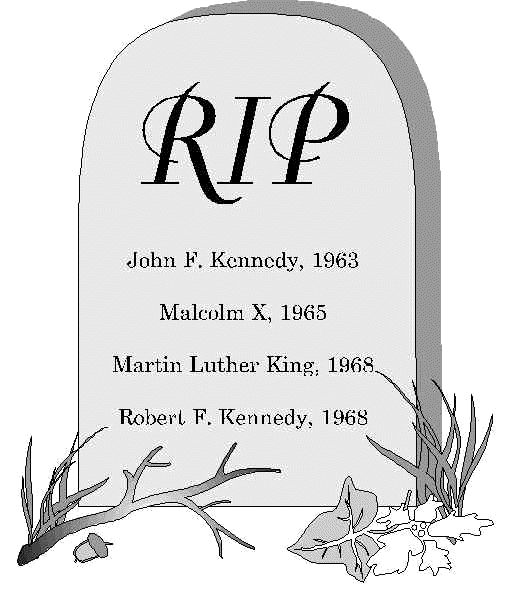
In this issue we are glad to be able to excerpt parts of a new book by Dr. Martin Schotz. This new work, History Will Not Absolve Us, is an anthology of essays on varying aspects of the Kennedy case. In that regard it resembles previous anthologies like Government by Gunplay, and The Assassinations. This new collection compares favorably with those two. One of the glories of the book is that it includes Vincent Salandria’s early, epochal essays published in 1964 and 1965 on the medical and ballistics evidence. These essays were written in direct response to comments given by another Philadelphia lawyer, Arlen Specter, at the conclusion of the Warren Commission’s work. Working only from evidence available to the Commission and in the public record, Salandria shatters the case against Oswald almost as soon as it was issued. It is a shame that we have had to wait so long to see Salandria’s wonderful work collected in book form.
There is more. Schotz has included a speech made by Fidel Castro, in which, from just reading the press reports off the wire services, he 1) exposes the murder as a conspiracy, 2) shows Oswald for what he was, 3) points towards the elements in American society from where the plot emanated, and 4) indicates the reasons for the murder. All this within twenty hours of the assassination. Shotz’s opening essay furthers his ideas used in Gaeton Fonzi’s book, The Last Investigation, dealing with concepts of belief versus knowledge and what that means for the mass psychology of American society. This fascinating, intuitive essay gives the book both its tone and its title – a play on a phrase used more than once by Castro.
There is much more to recommend the book. We choose to excerpt here two particular selections: one in whole, the other in part. They both deal with the response of the left, or as Ray Marcus terms it the “liberal establishment”, to the Kennedy assassination. The first excerpt is an analysis by Schotz of the early editorial policy of The Nation to the assassination. The second section is from Ray Marcus’ monograph Addendum B, originally published in 1995. We chose to excerpt these for three reasons. It shows both Schotz and Marcus at their best. Both the people and institutions they discuss are still around. And finally, what they deal with here is an emblematic problem that is so large and painful – the response of liberals to high-level assassination as a political tool – that no one left of center wishes to confront it.
Concerning the second point,The Nation repeated its pitiful performance when the film JFK was released by giving much space to writers like Alexander Cockburn and Max Holland. Neither of these men could find any evidence of conspiracy in the Kennedy case, any value to Kennedy’s presidency, or any validity to the scholarship within the critical community. In other words, a leading “liberal” magazine was acting like Ben Bradlee and the Washington Post. As far as The Nation is concerned, their editorial policy has been quite consistent throughout a 33 year period. Their article policy, with very few exceptions, has also been uniform.
Ray Marcus extends this analysis. Marcus is one of the original, “first generation” group of researchers. In 1995 he privately published his Addendum B, which is a personal and moving chronicle of his attempts to get people in high places interested in advocating the Kennedy assassination as a cause. Ray has allowed Schotz to include sections of that important work in the book. Probe has excerpted the parts of Ray’s work which touch on the reaction of the left, both old and new, to the assassination. We feel that the section entitled “Five Professors” is especially relevant. For in this section, Ray reveals his personal encounters with some of the leading intellectuals of that ’60’s and ’70’s movement called the “New Left”, namely Howard Zinn, Gar Alperovitz, Martin Peretz, and Noam Chomsky. He shows how each of them rejected his plea. The instances of Peretz and Chomsky are both important and enlightening. For Peretz, in 1974, purchased The New Republic, another supposedly liberal publication. He owned it during the period of the House Select Committee on Assassinations. Except for excerpting declassified executive session transcripts of the Warren Commission in the mid-seventies, I can remember no important article in that publication dealing with the JFK case during his tenure. In fact, at the end of that investigation, The New Republic let none other than Tom Bethell have the last word on that investigation. Ray shows why Peretz allowed this bizarre, irresponsible choice. Bethell’s 1979 article tried to bury Kennedy’s death. Five years later, his periodical tried to bury his life. It actually made a feature article out of a review of the tawdry Horowitz-Collier family biography The Kennedys. Who did that publication find suitable to review this National Enquirer version of the Kennedy clan? None other than Midge Decter, wife of neo-conservative godfather Norman Podhoretz, mother-in-law of Elliot Abrams. Decter, presumably with the Peretz blessing, canonized this Kitty Kelley antecedent.
Ray’s encounter with Chomsky is especially revealing and will be disturbing to adherents of the MIT professor. In his book, Looking For the Enemy, Michael Morrisey includes parts of a 1992 letter from Chomsky. In discussing a government conspiracy to murder and cover-up the assassination, the esteemed professor writes:
That would be an interesting question if there were any reason to believe that it happened. Since I see no credible evidence for that belief, I can’t accept that the issue is as you pose it. (p.6)
Apparently, Chomsky never thought that Marcus would include their three hour session over just three pieces of evidence. This exposes the above statement, and Chomsky’s public stance since Stone’s film, as a deception.
Chomsky and his good friend and soulmate on the JFK case, Alexander Cockburn went on an (orchestrated?) campaign at the time of Stone’s JFK to convince whatever passes for the left in this country that the murder of Kennedy was 1) not the result of a conspiracy, and 2) didn’t matter even if it was. They were given unlimited space in magazines like The Nation and Z Magazine. But, as Howard Zinn implied in a recent letter to Schotz defending Chomsky, these stances are not based on facts or evidence, but on a political choice. They choose not to fight this battle. They would rather spend their time and effort on other matters. When cornered themselves, Chomsky and Cockburn resort to rhetorical devices like exaggeration, sarcasm, and ridicule. In other words, they resort to propaganda and evasion.
CTKA believes that this is perhaps the most obvious and destructive example of Schotz’s “denial.” For if we take Chomsky and Cockburn as being genuine in their crusades – no matter how unattractive their tactics – their myopia about politics is breathtaking. For if the assassinations of the ’60’s did not matter – and Morrisey notes that these are Chomsky’s sentiments – then why has the crowd the left plays to shrunk and why has the field of play tilted so far to the right? Anyone today who was around in the ’60’s will tell you that the Kennedys, King, and Malcolm X electrified the political debate, not so much because of their (considerable) oratorical powers, but because they were winning. On the issues of economic justice, withdrawal from Southeast Asia, civil rights, a more reasonable approach to the Third World, and a tougher approach to the power elite within the U.S., they and the left were making considerable headway. The very grounds of the debate had shifted to the center and leftward on these and other issues. As one commentator has written, today the bright young Harvard lawyers go to work on Wall Street, in the sixties they went to work for Ralph Nader.
The promise of the Kennedys or King speaking on these issues could galvanize huge crowds in the streets. But even more importantly, these men had convinced a large part of both the white middle class, and the younger generation that their shared interests were not with the wealthy and powerful elites, but with the oppressed and minorities. Today, that tendency has been pretty much reversed. Most of the general public and the media have retreated into a reactionary pose. And some of the most reactionary people are now esteemed public figures e.g. Rush Limbaugh, Newt Gingrich, Howard Stern, people who would have been mocked or ridiculed in the ’60’s. And the Washington Post and Los Angeles Times, under no pressure to disguise their real sympathies, can call Limbaugh a mainstream conservative (12/2/96).
What remains of the left in this country today can be roughly epitomized by the nexus of The Nation, the Pacifica Radio network (in six major cities), and the media group FAIR (Fairness and Accuracy in Reporting). We won’t include The New Republic in this equation since Peretz has now moved so far to the right he can’t be called a liberal anymore. The Nation has a circulation of about 98,000. Except for its New York outlet, WBAI, Pacifica is nowhere near the force it was in the sixties and seventies. The FAIR publication EXTRA has a circulation of about 17,000. To use just one comparison, the rightwing American Spectator reaches over 500,000. To use another point of comparison, the truly liberal Ramparts, which had no compunctions taking on the assassinations, reached over 300,000. As recently declassified CIA documents reveal, Ramparts became so dangerous that it was targeted by James Angleton.
One of this besieged enclave’s main support groups is the New York/Hollywood theater and film crowd, which was recently instrumental in bailing out The Nation. As more than one humorous commentator has pointed out, for them a big cause is something like animal rights. Speaking less satirically, they did recently pull in $680,000 in one night for the Dalai Lama and Tibet. Whatever the merits of that cause, and it has some, we don’t think it will galvanize youth or the middle class or provoke much of a revolution in political consciousness. On the other hand, knowing, that our last progressive president was killed in a blatant conspiracy; that a presidentially appointed inquest then consciously covered it up; that the mainstream media like the Post and the Times acquiesced in that effort; that this assassination led to the death of 58,000 Americans and two million Vietnamese; to us that’s quite a consciousness raiser. Chomsky, Cockburn and most of their acolytes don’t seem to think so.
In the ’80’s, Bill Moyers questioned Chomsky on this point, that the political activism of the ’60’s had receded and that Martin Luther King had been an integral part of that scene. Chomsky refused to acknowledge this obvious fact. He said it really wasn’t so. His evidence: he gets more speaking invitations today (A World of Ideas, p. 48). The man who disingenuously avoids a conspiracy in the JFK case now tells us to ignore Reagan, Bush, Gingrich, Limbaugh, Stern and the rest. It doesn’t matter. He just spoke to 300 people at NYU. Schotz and Marcus have given us a textbook case of denial.
With the help of Marty and Ray, what Probe is trying to do here is not so much explain the reaction, or non-reaction, of the Left to the death of John Kennedy. What we are really saying is that, in the face of that non-reaction, the murder of Kennedy was the first step that led to the death of the Left. That’s the terrible truth that most of these men and organizations can’t bring themselves to state. If they did, they would have to admit their complicity in that result.
(Click here if your browser is having trouble loading the above.)
(Click here if your browser is having trouble loading the above.)
(Click here if your browser is having trouble loading the above.)
Almost every JFK assassination researcher is aware that the Dallas police found and inventoried a tiny hi-tech Minox camera amongst Oswald’s personal effects during the search of Ruth and Michael Paine’s home after the assassination.This camera was later omitted from an inventory list once the FBI took over the investigation. What is not generally known is the Paines’ role in the “appearance-disappearance”charade.
There were 3 separate inventory lists itemizing the evidence from the Paine household. This is typical of the routine procedures used by law enforcement in establishing chain of custody of physical evidence. First, there was the Dallas police list identifying a “small German camera and black case on chain and film”. A pedometer and camera timer were also itemized; there was no mention of a light meter but there was mention of a “brown case (camera) with long chain”.1 Then there was the joint DPD and FBI list which was prepared in response to the FBI’s assertion of jurisdiction over the crime. The camera is described in aggregate Item #375 as a “Minox camera” together with a pedometer and a camera timer; there is no mention of a light meter. Rolls of undeveloped Minox film and two rolls of exposed Minox film were also inventoried as Item #377. An unidentified electronic device in a brown case was listed as an unsubmitted and unnumbered item as having come from the Beckley Street rooming house.2 When the evidence was taken to Washington, D.C., the FBI Lab prepared its very own inventory by way of a third list; any reference to the Minox camera would disappear from this third list.3
There were four separate sets of photographs of the items removed from the Paine household and Beckley Street residence. First, there were the photos made by the Dallas Police Crime Lab before the evidence was turned over to the FBI which shows the evidence grouped together on the floor of the police station and which depicts the Minox camera.4 At the joint police and FBI inventory of November 26th, a second set of photographs were taken depicting each individual item or selectively grouped items with the numbered photos corresponding to the numbered items. The items ranged from #1 through #455 and required 5 rolls of film. It was understood that the FBI Lab would develop these 5 rolls of film and furnish a set to Police Chief Curry. This intact set of photos from the original 5 rolls have disappeared from the National Archives – assuming that the FBI even turned them over to the Warren Commission or the Archives in the first place.5
The third set of photos consist of 2 rolls of microfilmed photos which the FBI Lab made after developing the photos jointly taken in Dallas; this microfilmed series was furnished to the Dallas Police which in turn furnished copies to other agencies, including the Secret Service.6 In a letter dated December 3, 1963, Police Chief Curry advises the FBI that items #164 through #360 were missing and apparently did not record; he requests the FBI to re-photograph the items.7 The fourth set of photos consist of the FBI’s “re-photographed” items which were sent to the Dallas police to supplement the missing photos.8
Not only were there missing frames but some of those that existed had been altered. The Minox camera itemized in #375 of the joint inventory list ceased to exist in the set of microfilmed photos first returned to the Dallas Police by the FBI. Photo #375 which was supposed to be a group photo of the Minox – along with several other camera items – is now just a Minox light meter.9
It is generally unknown in the research community that much, if not all, of the evidence seized from the Paine household and Beckley Street residence was “loaned” to the FBI on the weekend of the assassination even before the FBI took charge of the crime. The FBI assigned number #Q-5 to the Minox camera and/or Minox film at that time. The evidence was returned to the Dallas police after the FBI’s inspection. It was then turned over once again to the FBI on November 26th when the FBI assumed jurisdiction.10 We know that the Minox film recovered from the Paine household was in possession of the FBI as of November 25th because on that date the FBI requested a comparison of the Minox film as recovered from the possessions of Oswald with Minox film designated as Specimen Q5. The laboratory results were that Minox film Q5 was not taken with the same camera as the other Minox film.11 Was the FBI comparing the Minox film later designated as Item #377 with the cassette still remaining in the Minox camera recovered by the Dallas police?
The FBI’s early efforts to conceal the existence of the Minox camera did not stay secret for long. According to author Gary Savage, a controversy ensued within the first two months following the assassination when news reporters received information that the FBI had altered the inventory list. Furthermore, the FBI had pressured Dallas police detective Gus Rose to change his recollection of what he had found from a Minox camera to a Minox light meter. Detective Rose steadfastly refused to alter his findings and insisted that he found the camera in Oswald’s seabag the weekend after the assassination.12
The FBI was now squarely in the middle of an evidence tampering dilemma before the Warren Commission investigation was barely underway. One solution would be to produce the original camera, or any Minox camera for that matter, in order to resolve the discrepancy. This is precisely what the FBI did.
We now know that the controversy over the Minox camera reached the highest levels of the FBI because on January 27, 1964, Mr. William A. Branigan, Chief of the FBI’s espionage section, telephoned SAC Gordon Shanklin in Dallas to point out the inconsistency in the inventory lists. Branigan also advised Shanklin that the FBI Lab in Washington did not have the Minox camera in its possession.13 On January 28, 1964 Shanklin responded by advising FBI Inspector Moore of the FBI Lab that no such Minox camera had been found – only a Minox light meter.14 This, of course was an outright lie on Shanklin’s part. FBI Director J. Edgar Hoover apparently found this reply unacceptable because on January 30, 1964, Hoover sent a teletype to Shanklin advising once again that the FBI Lab had all Minox related items except for the Minox camera. Hoover then instructed SAC Shanklin to immediately investigate this matter and to contact the Dallas Police, Mrs. Oswald and Mrs. Paine, if necessary.15
In an effort to “locate” the camera, Dallas FBI Agent Bardwell Odum on January 30, 1964, contacted Ruth Paine to inquire into whether the Paines owned a Minox camera.16 Ruth recollected that her husband had a Minox which he had dropped into salt water several years ago; she was sure that he had thrown it away but she would ask him about it and get back to him. She also stated that the police took a Minox camera case along with a light meter belonging to Michael which may or may not have been a Minox light meter.17 The next day on January 31, 1964, Ruth Paine called Odum to tell him that her husband still had the camera and that it was in a coffee can in the garage.18 If this was true, one would have to conclude that the local police not only did a poor job of searching the garage the weekend of the assassination but also fabricated the Minox camera on both its original inventory list and joint DPD/FBI list. Since this was not the case, the collusion of the Paines is readily apparent.
…
1 The first DPD inventory list, undated, was obtained from the Dallas Police Archives. It is attached to an undated joint statement of the officers which in turn is followed by a supplementary report dated 11/23. The inventory list does not seem to distinguished between those items recovered on the 22nd, and those items recovered on the 23rd pursuant to a search warrant. With respect to felonies, police officers have the power to search and seize what is in plain view. Closed containers, such as Lee Oswald’s boxes, envelopes, suitcases, and seabags, etc. would require a search warrant. While the weekend reports are somewhat sloppy in this regard, the undisputable fact remains that the Minox camera was recovered at that time regardless of whether it was the 22nd or the 23rd. This author has entertained the possibility that the police officers’ search on the 22nd went beyond proper legal limits and this was “rectified” by obtaining a search warrant the next morning.
2 See Commission Exhibit #2003 at Vol. 24, p. 340. The evidence was delivered to the Dallas FBI office on 11/26. On forms supplied by the Dallas police, a detailed inventory list was prepared by police property clerk H.W. Hill and witnessed by FBI Agent Warren De Brueys and police captain J. M. English. The Minox camera is identified on Receipt No. 11192-G as one of the items voluntarily given to the police by Ruth Paine and Marina Oswald on the 22nd suggesting that the first police search went beyond its permissible scope as is often the case in criminal proceedings. The listing of the electronic device in the brown case from the Beckley Street address (set forth in the joint list at Receipt No. 11199-G) further clouds the issue of what items came from where and when – at least insofar as the weekend police search is concerned. The police department version in the Dallas Police Archives differs from the FBI’s list of the 26th in only one respect: the Dallas list contains the signatures of the FBI agents receiving the property. The accompanying affidavit of Dallas officer H. H. Hill describes the process by which a joint inventory was made wherein FBI Agent De Brueys called out the items, one by one.
3 See evidence list set out in CD 735. Item 375 has been altered to omit the Minox camera and turn it into a Minox light meter. For some reason this list contains the Dallas field office file number instead of the Headquarters file number suggesting that the FBI’s own property list was prepared in Dallas before departure to Washington, D.C. We do know from an FBI document that Agent DeBrueys delivered the evidence to the FBI Lab on November 27th. Another document suggests that a 4th list was prepared by the FBI Lab which superseded all prior lists.
4 JFK First Day Evidence by Gary Savage, pp.208, 210.
5 See 11/26/63 report of FBI Agent Ronald E. Brinkley describing how the photos were made with the DPD photo-record camera. 5 rolls of photos were taken using 35mm Kodak High Contrast Copy microfilm. FBI agent James P. Hosty states in his recent book, Assignment: Oswald, p.77 that the photos were taken with a Minox camera. This is a mistake or falsehood on his part as Minox cameras use only Minox film. The documents setting forth the joint photo session with the Kodak film were supplied by Researcher John Armstrong and were obtained from the Dallas Police files. At Mr. Armstrong’s request, the National Archives searched for these 5 rolls of photos and could not locate them.
6 See FBI agent Robert Barrett’s report of statement from Assistant Chief of Police, Charles Batchelor, dated 7/6/64, and available from the microfilmed collection of Dallas Police Archives. See also FBI memo dated 11/29/63 from Branigan to Sullivan.
7 Curry’s 12/3/63 letter from the Dallas Police Archives furnished by Mr. Armstrong.
8 Author’s conversation with John Armstrong whose opinion is based in part upon an undated FBI document bearing Agent Wallace Heitman’s name, referencing dates of 1/23/64 and 2/4/64 and referring to 85 photographs of Oswald’s belongings.
9 Indeed there are two separate photos of #375, one still in the possession of the Dallas Police Archives showing the surrounding items covered up by scraps of paper and the one in the National Archives showing a blow up of the Minox light meter all by itself; copies furnished to author by John Armstrong. The National Archives also has a copy of the same DPD group photos that Gary Savage depicts in his book. However, these photos were enlarged, then cropped to omit the Minox camera featured in the top 1/3 of the original photograph. A copy of the NARA cropped photo was furnished to the author by Anna Marie Kuhns-Walko.
10 See deposition of FBI Lab expert, James C. Cadigan, NARA: HSCA Record No. 124-10086-10013.
11 The author’s copy of this document was furnished to her by John Armstrong without the benefit of a RIF cover sheet from the NARA. It appears to be part of report prepared by Dallas FBI agent, Robert Gemberling. Note that the Minox film analysis was filed away in a New York City FBI field office file #65-22483 of the Espionage-Russia division. According to John Armstrong, a FOIA request failed to turn up this file.
12 See Savage pp. 212-215,and transcript of Gus Rose’s statement to the HSCA made on 4/13/78.
13 FBI #105-82555-1643, memo dated 1/28/64.
14 Ibid.
15 FBI #105-82555-1580, teletype dated 1/30/64, RIF citation omitted. This teletype also clarifies the fact that there were two Minox cassettes, one of which contained film.
16 Dallas FBI field office file, #100-10461, Odum report of 1/30/64 interview with Ruth dictated on 1/31/64 and typed on 2/3/64
17 Ibid.
18 FBI #105-82555/#100-10461, report of 1/31/64 interview with Ruth Paine, dictated on 1/31/64 and typed on 2/1/64
19 FBI #105-82555/#100-10461, report of 1/31/64 interview with Michael Paine, dictated on 1/31/64 and typed on 2/3/64
20 Ibid.
21 Ibid.
22 Ibid.
23 Ibid.
24 FBI #105-82555/#100-10461, Bulky Exhibit Inventory Receipts, two versions, dated 1/31/64 and 2/8/64
25 2/2/64 cover letter with Airmail from Dallas to FBI Lab
26 FBI #105-82555/#100-10461, report of 1/31/64 interview with Michael, dictated on 1/31/64 and typed on 2/3/64
27 See Warren Commission Exhibit #2003 at Vol. 24, p. 333.
28 FBI #105-82555/#100-10461, teletype dated 1/31/64
29 Assignment: Oswald, p.86, by James P. Hosty
30 See Warren Commission Vol. 9, p.444
31 See Warren Commission Vol. 10, p.313 and p.325. It is not clear if Shasteen’s relationship with Odum originated with the FBI investigation into the assassination or if it was pre-existing.
32 See HSCA, Vol. 12, p. 373
33 See HSCA, Vol. 12, p. 390
34 See p. 211 of Gary Savage’s book, JFK: First Day Evidence and Dallas Morning News reports by Earl Golz dated 6/15/78 and 8/7/78.
Original Probe article
(Click here if your browser is having trouble loading the above.)

One of the aims of CTKA is to educate our readership to recognize patterns of history as they happen so that “revisionist” – or real – history does not have to wait in the wings indefinitely before entering mainstream thought. If we don’t attempt this, then the repeated cycles of scandals and assassinations, which constitute current American history, will continue to self-perpetuate. The defense promulgated in the civil trial of Scott Enyart v. City of Los Angeles was a good example. Superficially based on errors and incompetence within the Los Angeles Police Department, in actuality, it bore as little relation to accident and error as Robert Kennedy’s murder was owed to the act of an “angry and disoriented Palestinian.”
The defense case that unraveled before the jury was specifically designed to maintain the cover-up of the facts of RFK’s murder and the continued suppression of evidence which points away from Sirhan as a “lone gunman.” LAPD and its allies keep that fiction alive since the actual evidence – as was hinted at here – leads inexorably to a conclusion of multiple assassins. This suppression is absolute because, contrary to the defense’s case, Probe has learned from both trial testimony and other sources, that Enyart’s film and pictures have been destroyed.
Perhaps a more ominous and dangerous revelation came out of this trial: the continuing and nearly total blackout of news coverage by both the mainstream and alternative media, in the RFK case. What little coverage that existed was spun into the only reality most of the public will ever know.
The worst examples of this selective journalism turned out to be the only examples of any other coverage of this trial by a newspaper or magazine, other than Probe. In a feature story for the “alternative” L.A. Weekly, Jim Crogan referred to the trial as a “must-follow for ‘Camelot’ lookie-loos, conspiracy theorists, journalist aficionados and even historians” (emphasis added). The dominant daily newspaper in the city, The Los Angeles Times, ran two generic pieces on the case, one at the start of trial and one on the verdict. There was also a brief feature article after the end of the second week, concerned only with the amount of money being spent by the city to defend itself. Yet, nowhere in any of the six or seven thick sections of that daily could the reader find one word devoted to either the allegations which brought the lawsuit or the implications therein.
The cover story of a lone murderer in the pantry, distributed by the Times back in 1968, achieved two major goals. It created a degree of acceptance of the “official” solution which has become almost impossible to dislodge; and by perpetuating this fiction with subsequent news stories, the belief has been encouraged that however tragic the incident, it was essentially meaningless. The Times is not about to give credence to anything other than the official conclusions of the LAPD in the RFK murder. Therefore, giving honest and objective coverage to Scott Enyart’s lawsuit was out of the question. With the official news blackout as the backdrop, Probe will now note how this historic event unfolded.
Opening arguments began precisely at 10:00 AM on Tuesday July 2, 1996. Enyart attorney Christine Harwell explained to the jury some of the elements of the plaintiff’s case. One of these was the improper seizure of Scott Enyart’s camera and film in the early morning hours of June 5th, 1968. Somewhere along the way however, that changed, because during the jury instructions given on August 6th, 1996, the judge informed the jury they must consider that the LAPD officers who detained 15 year-old Scott Enyart had probable cause to do so and that it was not an unlawful detention. This fact made the confiscation of his camera and film proper in the eyes of the law. The defense won this argument, but it was a dubious ruling at best, because the specific probable cause was never offered or explained.
Other elements stressed by Harwell included the improper handling of Enyart’s property; failure of the LAPD to properly perform a thorough investigation; deliberate misuse of his film; willful and deliberate misidentification and mislabeling of his property; willful and deliberate failure to provide Enyart with a receipt for his property, even when one was requested; failure to properly and safely preserve evidence (Enyart’s film); the transfer of title to his property without Enyart’s express permission or authority and without even his knowledge; a false assertion by the City of Los Angeles that Enyart’s property, in its entirety, has been returned to him. Ms. Harwell emphasized that the LAPD’s own documents relating to this matter would prove the plaintiff’s case.
Harwell’s opening statement was interrupted numerous times by defense attorney Skip Miller. His objections mostly relied on the plea that Harwell’s assertions of willful, deliberate and even malicious disregard of this important evidence, were “beyond the scope” of the lawsuit. He literally sprang out of his chair when Harwell suggested that pictures developed from Enyart’s missing film probably showed someone other than Sirhan firing a gun in the kitchen pantry. The judge, Commissioner Elias, sustained the objection. Miller objected again to Harwell’s assertion that many eyewitnesses to the shooting were not even questioned by LAPD and that there was evidence to indicate eyewitness testimony had been altered. Again, the objection was sustained. Miller wanted to keep the focus of the case as narrow as possible. There would be no discussion of a conspiracy in the RFK murder here. That would make for a clear motive for the “mishandling” of Enyart’s film, which might have been the Zapruder film of the RFK case. The judge gave Miller a clear victory by agreeing with him on this narrow grounding of the case.
By 11:30 AM, Miller had already demonstrated most of the courtroom tactics he would employ during the plaintiff’s portion of the trial, which included frequent objections, apparently meant in part to break up the opposing attorneys’ rhythm and the continuity of their presentation. In his opening argument however, he laid out what would be the brunt of his defense against the charges pending. He told the jury that the defense would prove Scott Enyart to be a liar regarding all the allegations specified in his lawsuit, including the key issues of whether or not Enyart was in the pantry at the time of the shooting; whether he shot three rolls of film or just one; whether LAPD officers who confiscated his camera and film at gunpoint had probable cause and, whether the mishandling of Scott’s film evidence was knowing and willful, or just simple clerical errors.
Miller’s outline of the defense case fell short of actually stating a solid defense against the charges alleged. Instead, he immediately offered a series of vague, often flippant, explanations and excuses for the specific actions and behavior of certain LAPD officers.  He told the jurors that because of a series of “honest mistakes,” the film and photos from Enyart’s film were mislabeled and the error was not uncovered until all these years later – coincidentally with the filing of this lawsuit. He also probably overplayed the cynic’s view by directly challenging the jurors to call him on the issue of whether or not Enyart shot one roll of film (Miller’s contention) or three rolls (Enyart’s testimony). Skip Miller’s entire opening argument took less than 90 minutes.
The rest of that week and into the second, Scott Enyart was on the stand on direct testimony. Under oath, he never wavered as he related his story to the jury.
Around 3:30 PM, near the end of court on Monday July 8th, Miller began his cross-examination. As far as the jury was concerned, this must have been one of the most telling moments of the trial. For Enyart was even more convincing on cross-examination, while enduring the pit bull style of the city’s attorney – even when apparently surprised by an unanticipated photo meant to malign his credibility.
Miller’s opening gambit was an attempt to get Enyart to identify any one of a series of photos from a proof sheet, generated by the LAPD photo lab, as being one of the pictures he took at the Ambassador Hotel in 1968. Enyart, of course, was unable to positively identify any of the photos. He testified that it was impossible to do so since he could not be absolutely sure he had ever seen even one developed picture from any of the three rolls he shot that night.
From that point on, Miller’s cross-examination never rose above the level of implying rather strongly that Enyart was a liar and/or a “Hollywood wannabe” and insisting to the jury that Enyart was attempting to defraud the city with his lawsuit. An exchange between Miller and Enyart helps illustrate this point.
Miller attempted to demonstrate to the jury that Enyart was never in the pantry when he said he was. He did this not with any hard evidence, but rather by attempting to get the jurors to go along with his suggestion that Enyart had made up the whole story and, over the years, embellished his role in history.
The one trial exhibit that Miller entered into evidence during his cross examination served to corroborate Enyart’s claim that he was the lone photographer in the pantry.
Enyart replied, “What I described seeing [on direct testimony] is what I have vivid memories about seeing in the pantry that night.” Miller responded by shouting, “Isn’t it true Mr. Enyart, that you didn’t actually see what happened [at the moment of the shooting] but just read about it?” It was clear that Miller believed this approach would break down Enyart’s story and convince the jury that Enyart was really a fraud. But Enyart’s testimony under cross-examination convinced the jury that he was genuine.
The one trial exhibit that Miller entered into evidence during his cross examination served to corroborate Enyart’s claim that he was the lone photographer in the pantry. And further, that he was behind RFK and atop a steam table at the time of the shooting before being shoved off. This photo was taken from in front of RFK by a young, amateur photographer named Richard E. Harrison. In the foreground of the photo, the struggle with Sirhan ensues. In the background, alone atop a steam table, taking pictures, is 15-year old Scott Enyart, just as he has described himself. The Harrison photo is taken from Sirhan’s perspective right after the shots have been fired.
A seeming contradiction in Enyart’s testimony arose when, during direct examination, he identified himself as the person on a steam table taking pictures in a photograph taken by Time-Life photographer, Bill Epperidge. Enyart stated he first made the identification when he saw the picture in a book Epperidge had published in 1988. The exhibit used during this trial was a two foot square blow-up of the same Epperidge photo. Enyart had never seen this picture blown up before he saw it in court. The person in the picture looked similar, but it was clear that it was not 15-year old Scott Enyart. He had felt for a number of years, that the Epperidge picture helped to corroborate his story. Yet, bravely, he recanted his earlier assertion that he felt it was him in the picture.
In trying to make hay from the inconsistency of Enyart’s testimony and prove that Enyart was never in the pantry, Miller put photographer Epperidge on the stand, as well as another person in the photograph, photographer Harry Benson.
But the testimony of both Epperidge and Benson proved negligible and later backfired. For on the issue of whether they remembered seeing a 15-year old boy in the pantry, up on a steam table taking pictures, both admitted to: (1) Not coming into the pantry until well after the shooting and (2) Once inside, focusing all their attention on the area where Robert Kennedy lay mortally wounded and taking picture after picture. Both also stated that their only other concern was positioning themselves to get good shots and this was accomplished by elbowing and shoving their way into position. This rang true because Enyart recalled being shoved off the table by a number of photographers who, after rushing into the pantry, jumped up onto the table to get better shots. Enyart was actually out of the pantry completely when Epperidge took the picture which showed Benson in the background. What this exchange proved was that it was Enyart in the Richard Harrison photo taken right after the shots rang out and it was someone else in the Epperidge blow-up. Enyart had always insisted that he was shoved off the steam table right after the shooting by other photographers. The two photographs seemed to illustrate his point quite vividly.
On July 10th, Professor Phil Melanson testified on behalf of Scott Enyart. Although he was able to provide the jury with a more historical backdrop to Enyart’s lawsuit, the same testimony was competently given by Paul Schrade, who lives in Los Angeles. This made Melanson’s all-expense paid trip out from Massachusetts seem unnecessary. What is apparent is that Melanson convinced Enyart’s father-in-law and lead attorney, Alvin Greenwald of his value as a witness, so he was added to the plaintiff’s witness list.
Monday, July 15th, in the afternoon until the end of the day, Miller questioned, out of order, defense witness and retired LAPD captain Frank Patchett. In 1968, Patchett was a police sergeant assigned to Special Unit Senator, in charge of the case preparation team. His cross examination was most interesting.
Patchett was the first of the retired LAPD witnesses who would testify in this case. His performance on the stand set the standard for the former officers and detectives who were to follow. He went from giving rehearsed, staged “answers” on direct examination, to almost babbling, extemporaneous dubious explanations of those “answers” on cross-examination. He became unable to utter clear and precise statements. His memory became faulty and he was unaware of many facts about key issues. Apparently, to this day, he has never read a book, a magazine, a newspaper or in any way concerned himself with the murder of Robert Kennedy. Not since the dissolution of Special Unit Senator.
Still, there were some nuggets chiseled out of the mother-lode of information in Frank Patchett’s mind. He even unwittingly confirmed some aspects of an ongoing LAPD cover-up in the RFK assassination and also corroborated Enyart’s version of the events in the pantry.
For example, Patchett’s version of the struggle with Sirhan for the gun had Rosey Grier and Rafer Johnson not even in the pantry until well after all the shooting ceased! He insisted that the LAPD investigation revealed that, as RFK left the podium, the Senator instructed both Grier and Johnson to “stay with Ethel” (Mrs. Kennedy). According to Patchett, Grier and Johnson only entered the pantry upon hearing shots. They then fought through the panicked crowd attempting to flee the pantry to help Karl Uecker, who had been holding down Sirhan’s arm for some time. Patchett stuck by this version even after being shown the Richard E. Harrison photo wherein Rafer Johnson can be identified as one of those involved in the struggle, either while shots are still being fired or immediately thereafter.
At another point during cross, Patchett demonstrated the defense method of having it both ways. He stated that everyone who was in the pantry at the time of the shooting was not identified by SUS. Consequently, everyone was not interviewed. Although Patchett did have a record of Enyart’s tape recorded interview of June 5th, 1968 (made at the police station) he had no recollection of ever receiving the interview reports on Scott Enyart. That lack became the basis for his assertion that Enyart’s name was not included on the list of pantry witnesses because, according to LAPD – and argued by Skip Miller – Enyart was never in the pantry. This, in spite of the convincing evidence in the Harrison photo and Enyart’s own assertions. There was never any follow-up investigation about Enyart’s presence in the pantry and no reason given as to why there was none. In spite of his own testimony, Patchett still insisted that his Case Prep Team was not remiss in not following up on discrepancies of this kind. This kind of obstinacy suggests a hidden agenda.
In light of the above, it appears that the real reason the defense called Frank Patchett may have been to testify about a notation he made to the head of the LAPD photo lab in 1968, a man named Eppling. On the property report which allegedly referred to Enyart’s film, the notation appears: “film privately loaded.” This referred to the fact that the film had been “bulk loaded.” That is, the film was bought in bulk size and not in individual spools. Then, by using a film loading device, it is loaded onto a spool which can be loaded into the camera. Even with the property report in front of him, Patchett could not remember either the significance of the notation or to whose film the notation referred. Yet the notation was there for all to see and could not be easily explained away. It had to be verified and then incorporated into the defense scenario. As we shall see in the second part of this piece, this is where Scott’s former “friend,” Brent Gold, was worked into the defense stratagem.
During Patchett’s cross-examination, Skip Miller objected to virtually every question asked about documents in the RFK files. Christine Harwell attempted to lay a foundation with Patchett that would allow her to ask pertinent questions of two of the officers named in this lawsuit. Not only did Miller vigorously object, but Commissioner Elias sustained the objection and would not allow documents from LAPD files to be authenticated by the witness. This, despite Miller’s painstaking effort to show Patchett’s bona fides with regard to his knowledge in that area. Every effort to have Patchett identify or acknowledge SUS reports or interview documents, on cross-examination, was blocked with a sustained objection.
The rest of the third week was devoted to the retired LAPD cadre who had been subpoenaed by each side, including officers Michael Sheills and T.J. Miller, who, along with Dudley Varney, were named as defendants in Scott Enyart’s lawsuit.
The chief investigator for the defense team, current LAPD detective Stan Salas, stated that they had sent a postcard to Varney’s address and had received no response. Incredibly, Salas could not or would not detail any other method of investigation employed to locate Varney, even though Varney, like the rest of this group, is still on a police pension.
Although both Sheills and Miller showed up to give their sides of the story, it was pointed out to the jury that Varney could not be located. The chief investigator for the defense team, current LAPD detective Stan Salas, stated that they had sent a postcard to Varney’s address and had received no response. Incredibly, Salas could not or would not detail any other method of investigation employed to locate Varney, even though Varney, like the rest of this group, is still on a police pension. So, former officers Alan Bolinger, Calvin Craig, Sheills, and Miller in turn recited their stories as to how Enyart was first detained and then escorted to the police station, where his film was confiscated. It is interesting that Varney’s key role in this – as the one who questioned Scott at the station and then informed him of his film’s shipment to the State Archives – was the one which could not be examined. It is also interesting that the person who had the other key role, i.e. actually checking in and noting all evidence, did not do well. T. J. Miller was hesitant in response to plaintiff’s questioning, halting in his delivery, seemingly unsure. Even the witness himself noted that he had been advised by consul during a recess on how to strengthen his delivery.
Throughout the entire trial, the testimony was observed and monitored daily by two LAPD detectives in suits and ties. One may only surmise the reasons they were there every day. But a reasoned guess began to materialize after T. J. Miller’s disappointing appearance.
Following his testimony, Miller dutifully went over to where the two detectives were and sat down. One sat behind Miller and one sat next to him. It appeared to be a debriefing and critical analysis session, right there in the courtroom, both men loudly whispering in each of his ears. At one point, when each detective stopped speaking, Miller stood up to go. Evidently, Miller was premature. The detective behind him put his hand on Miller’s shoulder and forced him back down into his seat. The session wasn’t over.
The morning testimony of Wednesday, July 17th, proved to be one of the most memorable of the trial, almost reminiscent of a TV drama. Enyart’s attorneys interrupted their scheduled witness, to call someone who was not on their original list. Someone who had new and vital evidence in the case. An agreement for this witness to appear for a 402 hearing, without the jury present, had been made at the end of the court the previous day.
Heimanson turned to McCrary and said in effect, “You’re going to win.” McCrary asked him why he thought that. Heimanson replied, “I know what happened to the kid’s film and I know who destroyed it.”
The witness was a man named William Heimanson. Heimanson is a photographer for the City of Los Angeles, assigned to the Scientific Division of the LAPD, which includes the photo lab. Heimanson has held that position since being hired in February 1990. On or about June 16, 1996 – about two weeks before this trial began – Heimanson had a casual conversation with another photographer, Jim McCrary. McCrary had been subpoenaed by Scott Enyart to testify as a photographic expert witness.
In the course of their conversation, Heimanson brought up the Enyart trial. He told McCrary that he knew Jim was going to testify for Enyart. Then, Heimanson turned to McCrary and said in effect, “You’re going to win.” McCrary asked him why he thought that. Heimanson replied, “I know what happened to the kid’s film and I know who destroyed it.” McCrary immediately notified Enyart’s attorneys and related the incident. Jim later called Heimanson at home and invited him to have lunch and further discuss the case. Predictably, Heimanson refused and stated he could not speak to McCrary anymore.
As William Heimanson took the stand at the 402 hearing, he was visibly nervous, almost scared. As he spoke, his voice cracked and quavered and he required several gulps of water. Today, there were not just two detectives in suits observing the trial. Now there were six or seven of them. And they were looking right through Heimanson as he sat rather shakily in the witness chair.
Under oath, Heimanson denied ever making any such statements to Jim McCrary or any other person. He also seemed to experience severe lack of recall of specific dates, times, persons and critical events. He admitted that he might have discussed the whereabouts of Enyart’s film, at some long-forgotten, point in time with fellow workers. But he considered that type of conversation idle speculation and gossip.
Both Skip Miller and Commissioner Elias jumped at that opening. As soon as Miller vehemently objected to the line of questioning by plaintiff counsel – on the rather nebulous grounds that it was “outrageous” – Elias sustained the objection. She then ruled that she would not allow the jury to hear testimony she believes is gossip. She then hastily excused Heimanson, subject to recall and still under oath and still under subpoena. So the jury was not allowed to hear a word of this tantalizing, and potentially crucial, piece of testimony regarding the incident.
At this point, the effects of defense attorney Miller’s courtroom antics – his constant objections, his stream of ridicule and insinuation, his baiting of plaintiff’s consul (Harwell’s partner, Steve Spotaro actually challenged Miller to a fight twice), mostly tolerated and/or upheld by Elias – managed to impute an air of confusion and amorphousness to Enyart’s case. And although many people (including Scott Enyart) believed this case would never go to trial, they believed that if it did, it would clearly be a winnable case. Up to this point, it did not look like justice would be served.
In Part 2, Dave Manning details the last two weeks of testimony, including the three witnesses who had the most profound impact on the jurors: the plaintiff’s witnesses who virtually won the case for Scott Enyart – Ted Charach and Rose Lynn Magdan – and the behind-the-scenes story of how they almost did not testify. And the defense’s star witness – Enyart “friend” Brent Gold, who accompanied Enyart to the Ambassador Hotel that night. Also, more insight into the jury deliberations and the possible effect of jury foreman Robert Pinger. Included will be updates on current post-trial motions and rulings.
(Click here if your browser is having trouble loading the above.)
The cartoons were given to us by the extremely talented Martin Cannon. Please do not repost or copy.
(Click here if your browser is having trouble loading the above.)