Blog

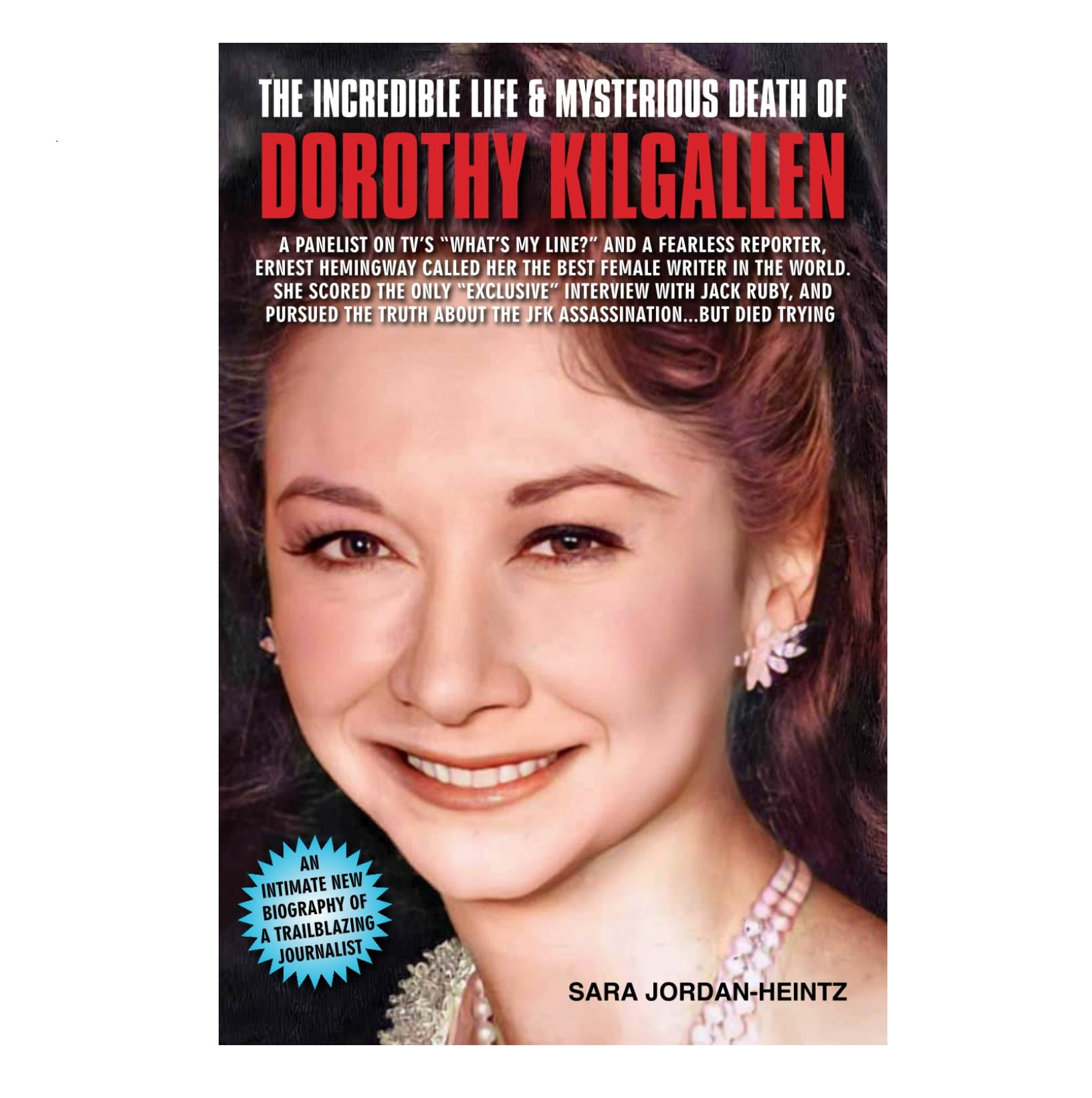
  • The Incredible Life and Mysterious Death of Dorothy Kilgallen

    The Incredible Life and Mysterious Death of Dorothy Kilgallen


    The Incredible Life and Mysterious Death of Dorothy Kilgallen

    by Sara Jordan-Heintz

    Let us first give the author her past due.  In 2007, Sara Jordan wrote a fine article about the demise of journalist and TV personality Dorothy Killgallen for Midwest Today. This was then reprinted in a color online version in 2015, at the 50th anniversary of Kilgallen’s death. (Click here for that version.) That original article was a milestone in the literature on this subject. In this new book, Jordan reveals that she was all of 17 years old when the article appeared (Jordan-Heintz, p. 384) Which makes it the most precocious piece of writing on the Kennedy case since Howard Roffman published his book Presumed Guilty at the age of 22.

    The author has now expanded her distinguished essay into a book.  At the start, she tries to explain why she did so, strongly indicating the works of author Mark Shaw which followed. She says that although she was glad about the article’s popularity she was:

    …dismayed to see Dorothy’s story turn into a cottage industry for one author in particular, whose book, in my opinion, contains reams of repetition, wild theories  and self-aggrandizement.  Much of his original information came from my article, after he contacted me several years ago requesting an interview.  Not all of this is appropriately credited. (p. 1)

    If anything this is mild. As I noted in one of my reviews of Shaw’s “cottage industry” books, not only has Shaw tended to discount Jordan-Heintz’ work, but also the woman who Sara got in contact with for her essay, namely Kathryn Fauble.  But her (understandable) frustration with Shaw is one of the reasons she decided to write this book.

    II

    On the night of November 7, 1965 journalist Kilgallen performed as a panelist in her last What’s My Line program. In a belated revelation, her butler and maid, said she came home that night with a man, and they heard the back door closing. This is a bit hard to comprehend since in addition to the Clements couple, James and Evelyn, there were three other men at the townhouse: her husband Richard Kollmar, her son Kerry, and his tutor Ibne Hassan. (Ibid, pp. 4-5) The following morning she was found dead in her home, the cause was a drug and alcohol overdose. Complicating matters was this: her papers for a later book proposal on the JFK case were gone.  She had made at least one trip to New Orleans,  a second more secretive one, and one to Miami. Charles Simpson, one of her hairdressers—the other being Marc Sinclaire—quoted her as saying the following:

    I used to share things with you guys—but after I have found out now what I know, if the wrong people knew what I know, it would cost me my life.  And she was dead about nine months later. (Ibid, p. 5)

    In addition to a file, and her journeys, she had two interviews with Jack Ruby in person during his trial. She also was in receipt of Ruby’s Warren Commission testimony and she printed this in her newspaper, the Journal American. It was printed over three days and Kilgallen provided a critical commentary (pp. 223-25)

    Since this book is a biography, it details Kilgallen’s life from her birth in Chicago in 1913, and the influence of her journalist father in starting her in a career in the newspaper business.  A big career boost was the 1936 “race around the world” against fellow reporters Leo Kieran and H. R. Ekins. She lost to Ekins but—at age 23– it was a great publicity machine for her. She became the second woman, after Nellie Bly,  to circle the globe. (Ibid, p. 11) It gave her a brief visit to Hollywood, where she acted in a film and sold a concept picture based on the contest, it was entitled Fly Away Baby.

    In 1938 she started her famous column, “The Voice of Broadway”. Three years later, based on its success, CBS gave her a radio show of the same name.  She did another later radio show with her husband, Richard Kollmar, who was a Broadway producer and actor. After marrying Richard, Dorothy quickly had two children, Richard Jr in 1941 and Jill, in 1943. (ibid, pp. 16-19, she had a third child in 1964 named Kerry.) In 1950 she became a regular on the popular TV show What’s My Line? That game show was broadcast live on Sunday nights. Because she was a triple threat—radio, TV, newspapers– she made a lot of money each year.  In 1953 the couple purchased a 13,000 square foot townhouse at 46 E. 68th Street, a block away from Central Park. To demonstrate the kind of money she was making, that  townhouse sold for 17 million in 2021. (Ibid, p. 30)

    The story that really gave Kilgallen’s career a rocket boost was her coverage of the Sam Sheppard murder case (ibid, pp. 34-35). Sheppard was a doctor in Cleveland who was accused of killing his wife in the summer of 1954. Sheppard insisted he had fallen asleep downstairs and she was killed upstairs by an intruder who knocked him unconscious when he tried to rescue her. Due, in part, to a highly prejudiced press, he was convicted. Lee Bailey eventually took over the appeal process. In a first rate performance Bailey had the conviction overturned, partly because the judge had told Kilgallen, “Well, he’s guilty as hell.  There’s no question about it.” And also because the jury was not sequestered as it clearly should have been. The retrial took place in 1966, after Kilgallen’s death. Bailey represented Sheppard at trial and had him acquitted.

    Another famous murder she covered was the Tregoff/Finch case of 1959.  Dr. Raymond Finch was having an affair with a woman named Carole Tregoff.  He wanted to divorce his wife Barbara and marry Carole, but the California community property laws discouraged him from doing so—his wife would have taken too much money and property. Therefore, the couple plotted to kill Barbara. They first tried to hire someone to do it, but he backed out. So they then did the deed themselves at Finch’s West Covina home. Even though the evidence against them was very convincing, there was a mistrial. They were tried again, and inexplicably, there was another mistrial. On the third go round, they were finally convicted. (ibid, pp. 56-57)

    Both of these sensational cases are covered in Kilgallen’s posthumously published book, Murder One.

    III

    A serious difference between the Jordan-Heintz book and Mark Shaw’s first volume The Reporter Who Knew Too Much, is that this new book spends a lot more time and space on the actual assassination of President Kennedy than Shaw did. And that might be understating things. I would estimate that there is almost as much material on the death of JFK as there is on the mystery of Kilgallen’s demise. But further the author uses much material that is not from the Warren Commission volumes or the Warren Report.  It’s an open question as to how much of the 26 volumes that Kilgallen read.  But, of course, it would have been impossible for her to have read what did not surface until after her death in 1965.  And we can only speculate what she had filed away, since that disappeared after her demise.  And no one really knows about her two short interviews with Jack Ruby, since she never revealed to anyone what Oswald’s killer told her. 

    But, for whatever reason, Sara Jordan-Heintz has decided to place in her book a lot of JFK murder information that did not come out until many years, actually, decades later.  To me, it’s fine for her to detail things the doctors saw at Parkland Hospital about the baseball sized hole in the rear of Kennedy’s skull. (p. 90). It’s also fine to quote local reporters Mary Woodward and Connie Kritzberg as to how their work was altered or parts were pulled. (pp. 94-95)  Because these were things that happened right then and there, and Kilgallen could have at least theoretically found out about them.  But then when the writer states that photos were faked and “it also became shockingly clear there had been alterations to JFK’s corpse by the time the formal autopsy began at Bethesda Naval Hospital that night” we are now getting into areas that it is unlikely that Kilgallen could have even speculated about back in 1965.  And I beg to disagree but it is not “shockingly clear” that Kennedy’s body had been altered before the autopsy began. (p. 92). She even goes further than this—shades of Sean Fetter– suggesting that the body was transferred to another casket before Air Force One left Dallas. (p. 98)

    This ignores the interview that the late Harrison Livingstone did with Nurse Diana Bowron who actually helped place the corpse into the casket at Dallas. (See the end of the first part of my review of Fetter’s book https://www.kennedysandking.com/john-f-kennedy-articles/under-cover-of-night-by-sean-fetter) For her rather wild concept–and like Fetter–she also relies on the Boyajian Report, although she does not name it, for an early arrival of Kennedy’s casket at 6:35 PM at Bethesda Medical Center.

    I don’t know how many times I have to repeat this, but I will keep on doing so as long as I have to. Roger Boyajian and his so called report are not reliable evidence in this case. I have demonstrated this twice before and I now have to do it again. That report does not state that the casket picked up by Roger Boyajian’s detail was Kennedy’s casket.  It only refers to it as “the casket”.  The obvious question is this: if Boyajian knew it was Kennedy’s casket, would he not have acknowledged that?

    Secondly, the report was not signed by Boyajian, and there is no hint as to why he did not sign it. To make matters worse, there is a second page to the report that lists the 10 others in the detail—and none of them signed it either. But even that is not the end of it. For when the Assassination Records Review Board (ARRB) interviewed Boyajian about the matter, that is picking up Kennedy’s casket, he could not recall doing so. In fact, he could not recall much about that day–period. Finally, the document the Board had does not appear to be the original.  This makes one wonder if it was ever filed with the military. (Harrison Livingtsone,  Kaleidoscope pp. 140-46)

    To make it even worse she writes that:

    There is general agreement among most JFK assassination researchers that the two casket scenario took place and that Kennedy’s body was probed for bullets (which were presumably removed) and surgical procedures done to conceal that he was fired upon by more than one shooter.(ibid, p. 99)

    There was and is no such general agreement.  In fact, the late Cyril Wecht—a forensic pathologist—never thought such was the case.  Neither does Dr. Randy Robertson, neither does Pat Speer, or Dr. Gary Aguilar.  At no JFK seminar I have ever attended—from 1991 to 2023—have I ever seen any panel devoted to this subject. The writer who formulated this scenario and wrote a popular book about it —David Lifton—could never make any real headway with it inside the critical community, and he himself admitted that.  Its not that he didn’t try, he did. But these attempts failed with rancorous feelings between those involved.

    This angle is made worse when she brings in the tall tales about embalmer John Liggett that were first broadcast by the discredited  Nigel Turner. (p. 106) Liggett’s brother filed a legal action against The History Channel over these ersatz claims and forced a settlement. (South Florida Sun Sentinel, 3/19/2005) It appears that this  bizarre Liggett angle might have been turned up by Billy Sol Estes, a man who sold more baloney on the JFK case than the Hormel company. (See the 2004 book Billie Sol Estes, pp. 155-57)

    As I have said many times about the JFK case, we must follow the Sagan rule: Extraordinary claims demand extraordinary evidence. The above does not, in any way, constitute extraordinary evidence. Kilgallen could not have known about them and I doubt if she would have bought into any of them.

    IV

    I don’t wish to leave the impression that all the many pages Jordan-Heintz devotes to the JFK case itself should be dismissed.  That would not be fair or accurate. She does bring in credible evidence of extra bullets being discovered e.g. Randy Robertson’s evidence about Dr. James Young. (See the film  JFK: Destiny Betrayed.) She also notes that there are photographic images missing from the autopsy collection, which there are. And her use of FBI agents, Jim Sibert and Frank O’Neill is appropriate. (Jordan-Heintz, p. 119) As is the memo written by Deputy Attorney General Nick Katzenbach. (ibid, p. 121)  Her description of the murder of Oswald by Ruby with Captain Fritz breaking formation to allow it is apropos and she mentions the editing out of the horn sounds. (pp. 137-38)

    She adroitly shifts to a column written by Kilgallen after the shooting of Oswald. In that piece the reporter said that Kennedy’s assassination was bad enough but now, after the murder of Oswald, people who have never been there feel like they have just witnessed a Texas lynching. (p. 143) She assailed the fact that Ruby was allowed to walk in and out of the Dallas police headquarters, which was supposed to be keeping a security guard around Oswald. She poignantly wrote that the murder of the suspect prevented due process: “When that right is taken away  from any man by the incredible combination of Jack Ruby and insufficient security, we feel chilled.” She added, “That is why so many people are saying there is ‘something queer’ about the killing of Oswald, something strange about the way his case was handled, and a great deal ‘missing’ in the official account of his crime” (p. 144) In a mid-December 1963 article she said Ruby may have been allowed access since members of the police force “partied at Ruby’s strip club.” She added that “there were jam sessions at which Dallas cops joined in the fun, some playing musical instruments others doing turns as singers and comedians….” (pp. 164-65)

    About a week later, on December 23, she wrote about the upcoming film Seven Days in May.

    The producers of the forthcoming film Seven Days in May have every right to think that life imitates art in the most tragic way. Long before President Kennedy was assassinated in Dallas, they finished their picture about a military group hatching plans to overthrow the President of the United States.  In the movie, the ‘secret base” where the plot against the Chief Executive reaches its climax is a place in Texas.(p. 166)

    She gives coverage to the Parkland Hospital press conference on the day of the assassination with Malcolm Perry and Kemp Clark.  She adds that this conference, added to PR man Malcolm Kilduff’s gesture that the fatal bullet struck Kennedy in the right temple, these undermined the future cover up. She notes that Perry said the anterior neck wound appeared to be one of entrance. Which would eliminate Oswald. (p. 145). Then, apparently based on Barbara Shearer’s documentary, What the Doctors Saw, she writes “that after the news conference, the doctor was accosted by a man in a suit and tie who grabbed his arm and warned him menacingly, “Don’t you ever way that again!” She then adds that this agent was Elmer Moore of the Dallas Secret Service. (ibid)

    This appears to be incorrect.  From the information that several writers have accumulated—Gary Aguilar, and Pat Speer among them—Moore was on the West Coast on the day of the assassination. On the same day, he was then shifted to Washington for what appears to be a briefing.  He was then detailed to Dallas on November 29th. (James DiEugenio, The JFK Assassination: The Evidence Today, pp. 166-67) She is correct about Moore’s assignment being to get the Parkland doctors to change their accounts, and about Moore being a rabid Kennedy hater. She then reinforces this point with the belated revelation by journalist Martin Steadman, namely that Perry revealed to him that he was getting calls during the evening of the assassination to change his statement about a front shot to the neck.

    She notes that JFK was trying to forge a rapprochement with Fidel Castro in 1963. But she then adds that Bobby Kennedy had approved a partnership with the Mob to furnish assassins to murder Castro. (p. 151). The CIA Inspector General report on the plots to kill Castro was finally declassified by the Assassination Records Review Board in the mid -nineties. It remains the most definitive and complete accounting of those plots. Right in that report the authors declare that no administration had any knowledge of the plots from their inception to their ending.  Which means from 1959-65. (See CIA-IG Report, pp. 132-33) This is why Director Richard Helms kept exactly one copy, the ribbon copy, in his safe. And when President Johnson read it, he concluded that the CIA had a role in Kennedy’s assassination. (Washington Post, December 12, 1977)

    V

    After many, many pages on the JFK murder, Dorothy Kilgallen finally arrives in Dallas in February of 1964 to cover the trial of Jack Ruby. She wrote a column on February 22.It began like this:

    One of the best kept secrets of the Jack Ruby trial is the extent  to which  the federal government is cooperating with the defense.  The unprecedented alliance between Ruby’s lawyers and the Department of Justice in Washington may provide the case with the one dramatic element it has lacked: MYSTERY. (p. 189)

    She then adds a rhetorical question:  why has the government decided to supply Ruby’s defense with all sorts of information as long as they do not request anything on Oswald?  She continues in this vein:

    Why is Oswald being kept in the shadows, as dim a figure as they can make him, while the defense tries to rescue his killer with the help of information from the FBI?  Who was Oswald, anyway? (p. 191)  

    The book then goes into several pages of an Oswald biography. We then refer back to Kilgallen’s comments on his absence at the trial, which the reporter thought was unusual in her experience of criminal trials:

    It appears that Washington knows or suspects something about Oswald that it does not want Dallas and the rest of the world to know or suspect….That Lee Harvey Oswald has passed on not only to his  shuddery reward, but to the mysterious realm of classified persons whose whole story is known only to a few government agents. (p. 200)

    In returning to the trial itself, one of  Ruby’s lawyers, Joe Tonahill, told the reporter that Ruby wanted to speak to her. (p. 203) Therefore a brief exchange took place at the defense table.  About a month later, Kilgallen asked to speak to Ruby again without the court appointed bodyguards around.  The judge granted the request.  So Tonahill, Ruby and Kilgallen walked into a small office during the noon recess.  Although Tonahill was interviewed about this many years later, he did not offer any specifics, besides saying it was an agreeable conversation. (p. 205) Kilgallen never told anyone about this conversation either.

    At the end of the trial, with Ruby convicted, Kilgallen wrote that the whole truth was not told.  And that neither the state nor the defense placed all the evidence before the jury.  (p. 207). That verdict was later vacated and Jordan-Heintz describes how Ruby passed on before his retrial in Wichita Falls and she does a nice job describing the character and career of Louis J. West, a CIA affiliated doctor who was, inexplicably, allowed to visit Ruby before he passed away in January of 1967. (p. 208)

    In July of 1964 Kilgallen published Ruby’s testimony, four months before it would appear in the Commission volumes. Readers were struck by Ruby’s ignored pleas to go to Washington for the interview. She also asked in her commentary: how could Tippit not know Ruby? In another column published in August, she got hold of an internal Dallas Police report and used it to strongly criticize the performance of the police both in the immediate aftermath of the JFK murder and in the transfer of Oswald.(p. 228)

    VI

    The book closes with the death of Kilgallen.  Jordan-Heintz, like Mark Shaw, focuses on the strongest possible suspect, namely the late Ron Pataky, who died in 2022. Lee Israel, the reporter’s first biographer, revealed the affair Kilgallen was having with the much younger journalist from Ohio. Israel did not name him but referred to him as the “Out of Towner”. (p. 242) Jordan -Heintz was the first writer to name him in her Midwest Today article back in 2007.

    What follows in the book  is a concise biography of Pataky as a Naval ROTC officer at Stanford who was, either kicked out or dropped out, of the university in April of 1955. (p. 243) He was using fake ID cards and was arrested. He then transferred to Ohio State and graduated in 1958. He eventually got a job as an entertainment writer for the Scripps Howard chain, at the Columbus Citizen Journal until it folded in December of 1985. Pataky was also a poet and songwriter.

    By the time Pataky met Dorothy he was married and divorced. He appears to have been quite the ladies man.  The book features pictures of him with actresses Sandy Dennis and Alexis Smith.  He also had an affair with singer Anna Maria Alberghetti. He and Kilgallen met while on a film press junket to Europe. (pp. 247-48) Although Pataky maintained that their relationship was Platonic and not sexual, there is evidence that such was not the case. (p. 251) The author juxtaposes his budding relationship with Kilgallen and her doing more work on the JFK case. For instance, in late September of 1964, she revealed that witnesses who did not identify Oswald at the scene of the murder of Patrolman J. D. Tippit were told to be quiet.

    The author notes that Kilgallen did report on the kindly Quaker couple, Ruth and Michael Paine and their incriminating comments about Oswald.  She also notes a fascinating piece of information I had never encountered before. In commenting on the Roger Craig testimony about Oswald jumping into a Rambler station wagon after the assassination, she says that Ruth Paine’s station wagon was a Chevy. But that someone who did own a four door Rambler station wagon was New Orleans businessman/CIA agent Clay Shaw.

    He insured the Dallas-based vehicle (buying only the required liability policy) through an out-of-town agency for his “son” (though he didn’t have one), then canceled the policy after the assassination and presumably disposed of the vehicle.  Correspondence from the insurance agent confirms all this. (p. 261)

    Quite intriguing if its accurate.

    During the last year of her life, the reporter made few if any newspaper references to the JFK assassination. But according to more than one source, she was still at work on the Kennedy case. And she was arranging a second visit to New Orleans. She was going to meet with a source that she did not know, but would recognize. Ron Pataky said that the man she met with was Jim Garrison. (pp. 317-18) But further, Pataky said that he had met with Garrison, two weeks after he had previously met with Mark Lane. And, according to Pataky, he met with Lane before the reporter did. The author suggests that this shows that Pataky was likely on assignment during his days with Kilgallen.

    On the evening of her death, Kilgallen was seen at the Regency, her favorite hotel bar, after midnight with a male companion. Pataky says it was not him and that he only talked to her by phone in that 24 hour period. (p. 329) One of the weirdest dichotomies about her death is that the butler, James Clement, maintains that he found her body in the bathroom. (p. 333) But hairdresser Mark Sinclaire said he first found her body in the third floor bedroom, where she never slept. Jordan-Heintz tries to address this paradox in the evidence. She asks, just what happened between the hours when Clement says he saw the body and when Sinclaire discovered it in the bedroom. Clement also said that men in suits carted off her files. (p. 338)

    Lee Israel noted that the police did next to nothing about this case. They should have interviewed everyone she talked to the night before, but there is no evidence they did so. But Pataky said he actually was interviewed. (p. 339)

    The book closes with the very odd circumstances of Kilgallen’s autopsy. The official version was she died of “acute barbiturate and alcohol intoxication, circumstances undetermined.” (p. 350) But the man who did the autopsy, did not sign the death certificate.  And the person who signed was not even stationed in Manhattan, where she died, but in Brooklyn. It also turned out that there was evidence  of Nembutal on her drinking glass, a drug which she had not been prescribed (she had only been prescribed Seconal). There was also evidence of a third drug in her system: Tuinal. The chemist who did the drug testing said he was told by his superior to keep the case under his hat because it was big.(pp. 351-52)

    The book tries to place Pataky in New York on the night Kilgallen died. The author bases this on the fact that his paper ran his review of the film The Pawnbroker two days later.  But according to IMDB, that films was released in April, six months prior.  So although this is suggestive, it is not probative of Pataky being in New York at that time.

    The mystery of Kilgallen’s death continues. The incompetence, or indifference, of the authorities was simply astounding.

  • JFK at Sixty


    Download the video (mp4) here.

  • The Dallas Police Convicted Oswald without a Trial – Part 2/2

    The Dallas Police Convicted Oswald without a Trial – Part 2/2


    Let us continue with the pervasive and relentless attempt by the local authorities to convict Lee Harvey Oswald, a man without a lawyer.

    KRLD-TV Interview of Jesse Curry.

    In an interview with KRLD-TV on November 23rd , Jesse Curry revealed that Lee Harvey Oswald was charged with the attempted murder of Governor John B. Connally.

    Curry. We have one more thing. We have filed on him for assault to murder—
    Q. Assault to what?
    Curry. Assault to murder against Governor John B. Connally. That charge had been filled. (CE2150, Volume XXIV; p. 782.)

    This decision introduces a significant aspect to the case, particularly when contrasted with the Dallas Police’s emphasis on Oswald’s alleged attempt to ‘kill’ Officer Nick McDonald during his arrest—although Oswald was never formally charged with McDonald’s attempted murder.

    Testimonies highlight the incident involving McDonald: Gerald Hill reported that “the gun was fired one time by the suspect but luckily it misfired, the pin hit the shell but did not fire” (Volume XXIV; CE2160; p.804)

    Henry Wade noted that Oswald “struck at the officer, put his gun against his head, and snapped it, but the bullet did not go off.” (Volume XXIV; CE2168; p.820)

    Additionally, Jesse Curry confirmed that “Oswald was attempting to shoot one of the officers in the theater and did snap the pistol.” (See this)

    WFAA-TV Press interview of Jesse Curry.

    Q. Has he named an attorney?
    Curry. I understand now that he is trying to contact attorney Abt, I believe, A-B-T, I believe out of New York… it’s my understanding that this attorney, Abt, had been involved in some of the defense of some communists. (Volume XXIV, CE2152. p. 786.)

    Interview of Louis Nichols, WFFA TVPicture1

    Nichols Testimony to the Warren Commission.

    H. Louis. Nichols, President of the Dallas Bar Association was permitted a short audience with Oswald in his cell on the fifth floor of the Dallas City Jail. Nichols, who publicly stated he did not practice criminal law, was permitted this time with Oswald, rather than the ACLU, whom Oswald was a member and who was a preference for representation. Many people have charged, that this proves that Oswald did not want legal representation, as Oswald declined the services of Nichols, but ask yourself this question: If you were in Oswald’s position, accused and vilified as a communist, presidential assassin, would you not want the absolute best defense available to you? Also, there is another important caveat to this narrative, Oswald would have no way of knowing that this would be his final chance at legal assistance, because in less than 24 hours, he too would be dead.

    For clarity this section has been written in narrative form.

    Nichols. (Do you have) a lawyer,
    Oswald. Well, I really didn’t know what it was all about, (I have) been incarcerated, and kept incommunicado.
    Nichols. (I am here to) see whether or not (you) had a lawyer, or wanted a lawyer.
    Oswald. (Do you) know a lawyer in New York named John Abt.
    Nichols. I don’t know him.
    Oswald. Well, either Mr. Abt or someone who is a member of the American Civil Liberties Union…I am a member of that organization, and I would like to have somebody who is a member of that organization represent me and If I can find a lawyer here who believes in anything I believe in, and believes as I believe, and believes in my innocence as much as he can, I might let him represent me.”
    Nichols. I’m sorry, I don’t know anybody who is a member of that organization…what I am interested in knowing is right now, do you want me or the Dallas Bar Association to try to get you a lawyer?
    Oswald. No, not now. You might come back next week, and if I don’t get some of these other people to represent me, I might ask you to get somebody to represent me.

    Nichols then testified; “My inquiry was intentionally very limited. I merely wanted to know whether he had a lawyer, if he had a lawyer then I had no problems.”

    November 24, 1963.

    Kevin Costner as Jim Garrison. “Who grieves for Lee Harvey Oswald? Buried in a cheap grave, under the name Oswald? Nobody.” (Oliver Stone; JFK)

    WFAA-TV Press interview of Captain Will Fritz. 11/23

    Q. Captain, is there any doubt in your mind that Oswald was the man who killed President Kennedy?
    Fritz. No, sir, there is no doubt in my mind about Oswald being the man. Of course, we’ll continue to investigate and gather more and more evidence, but there is no question about it.
    Q. Is the case closed or not, then, Captain?
    Fritz. The case is cleared… (Volume XXIV, CE2154. P. 788)

    WFAA-TV. NBC. KHLD. WBAP. Press Conference of Henry Wade.

    Sylvia Meagher. District Attorney Henry Wade held a press conference on Sunday night after Oswald was murdered, of which it has been said that he was not guilty of a single accuracy. (Accessories After the Fact; p. 75)

    Before Oswald’s body had even grown cold, District Attorney Henry Wade stood before the assembled television cameras at the Dallas City Jail to ostensibly ‘detail some of the evidence against Oswald for the assassination of the President.’ In this briefing, Wade delivered several dramatic assertions that further skewed the already precarious case against the accused. This press conference, fraught with such distortions, has been meticulously dissected by Mark Lane in ‘A Lawyer’s Brief.’ Lane’s critical examination reveals how Wade’s statements not only tainted public opinion but also demonstrated a stark disregard for the principles of judicial integrity. (See this)

    Wade asserted that a palm print identified as Oswald’s was found on a box situated near the sixth-floor southeast corner window of the Texas School Book Depository.

    Wade. On the box that the defendant was sitting on (around the sixth floor, southeast corner window), his palmprint was found and was identified as his.

    However, this evidence was later significantly qualified. Commission lawyer Wesley Liebeler, in a radio interview on December 30, 1966, pointed out a crucial flaw: “The fact that Oswald’s fingerprints were on cartons has no probative value whatsoever on the issue of whether he was in the window or not, because he worked at the Depository, he could have put his prints there at any time.” (Accessories After The Fact; p. 13)

    Q. Would you be willing to say in view of all this ‘evidence’ that it is now beyond a reasonable doubt at all that Oswald was the killer of President Kennedy?
    Wade. I would say that without any doubt he’s the killer—the law says beyond a reasonable doubt and to a moral certainty which I—there’s no question that he is the killer of President Kennedy.
    Q. The case is closed in your mind?
    Wade. As far as Oswald is concerned, yes.
    Q. How would you evaluate the work of the Dallas Police in investigating the death of the President?
    Wade. I think the Dallas Police done an excellent job on this and before midnight on when (JFK) was killed had (Oswald) in custody and had sufficient evidence what I think to convict him.
    Q. Is there any doubt in your mind that if Oswald was tried that you would have, have him convicted by a jury? With the evidence you have?
    Wade. I don’t think there is any doubt in my mind that we would have convicted him…
    Q. As far as you are concerned, the evidence you gave us, you could have convicted him?
    Wade. I’ve sent people to the electric chair on less. (CE2168, Volume XXVI, p. 819- 823-826.)Picture2

    KRLD-TV Press interview with Jesse Curry.

    Q. Could you tell us sir, (of) the possibility that somebody else might be involved? We’ve had statements in the last couple of days saying; “This is the man, and nobody else”.
    Curry. This is the man, we are sure, that murdered the patrolman and murdered—and assassinated the President. (CE2147. Volume XXIV, p-772.)

    KRLD-TV, Press interview with Jesse Curry.

    Henry Wade. I told them that the man’s wife said the man had a gun or something to that effect… that isn’t admissible in Texas. You see a wife can’t testify. It is not evidence, but it is evidence, but it is inadmissible evidence. (Volume V; p. 223)
    Curry. (We) felt yesterday morning that we were capable of presenting our case to the court and had ample evidence for a conviction…
    Q. What do you consider the high points?
    Curry. We have been able to do this. We have been able to place this man in the building, on the floor at the time the assassination occurred. We have been able to establish the fact that he was at the window that the shots were fired from. We have been able to establish the fact that he did order a weapon… and we feel (this) is the weapon that was used. We have been able to establish the fact that we do have the murder weapon… this is the gun that fired bullets that killed President Kennedy and wounded the Governor.
    Q. How much importance do you attach to this picture?
    Curry . Well, it’s important to us. Whether or not we will be able to introduce it as evidence will be left up to the attorney and judge, of course, but it establishes beyond a reasonable doubt in our mind that he is our man with our guns. (CE397; Volume XVII; p.780-781)

    In point 20 of ‘Assassination 60,’ this issue is addressed; “The question of whether Marina Oswald could have legally testified against her husband, Lee Oswald, raises interesting forensic considerations for the case. Under Texas law, spouses are generally permitted to serve as witnesses for each other in criminal cases. However, a crucial exception exists they cannot testify against each other unless one spouse is being prosecuted for an offence committed against the other. In the context of Oswald’s hypothetical trial, Marina’s testimony would have been excluded based on this spousal privilege. This means that the controversial backyard photographs, which were allegedly linked to Lee, could not have been admitted into evidence to be used against him. This is because Marina’s testimony, which was the sole source of corroboration for the photographs, would have been inadmissible due to the spousal privilege.”

    The Federal Bureau of Investigation.

    In a declassified document from Alan Belmont to Clyde Tolson, Belmont lays out the plan to convince the public of Oswald’s guilt.

    “We will set forth the items of evidence which make it clear that Oswald is the man who killed the President. We will show that Oswald was an avowed Marxist, a former defector to the Soviet Union and an active member of the FPCC, which has been financed by Castro.

    Despite the fact that Oswald is dead, this evidence will be necessary to back up any statement that Oswald was the man who killed the President. At 4:15pm Mr. DeLoach advised that Katzenbach wanted to put out a statement, we are now persuaded that Oswald killed the President…” (See this)

    For a detailed examination of the circumstances surrounding Oswald’s murder, please refer to part 2 of ‘Assassination 60.

    Widespread Condemnation of the Dallas Police.

    The concessions to the media resulted in Oswald being deprived not only of his day in court, but of his life as well. American Civil Liberties Union.

    Theodore Voorhees, chancellor-elect of the Philadelphia Bar Association Stated that Lee H. Oswald had been “lynched” by the Dallas Police & Prosecutorial officials. Although some concern was expressed that Oswald be provided counsel, he said, no member of the legal profession protested the publication of the evidence, the 24-hour interrogation and the violations of the prisoners’ rights. (New York Times, Dec. 5th, 1963, p. 32)

    Ben. K. Lerer, President of the Bar Association of San Francisco. We believe that television, radio and the press must bear a portion of the responsibility which falls primarily on the Dallas law-enforcement officials. Both press media and law enforcement officials must seek to protect the rights of accused persons against the damage to them, and consequently to our system of justice, which can come from revealing information concerning the accused at times when the revelation might inflame the public. (New York Times, Dec. 28th, 1963, p. 23)

    Percy Foreman, Texas Attorney. Federal decisions for at least five years have held that a defendant has a right to legal counsel at every level including arraignment before a justice of the peace. It’s not being done in Texas, but it’s the law, and (Oswald) is entitled to counsel whether he requests it or not.

    Another legal doctrine requires that an appellant show that an alleged abridgement of his rights caused him substantial harm. Foreman stated this could be shown if Oswald is persuaded to sign a confession before he has had the benefit of legal counsel. Foreman said a lawyer should be advising Oswald to insist on an examining trial, as a preliminary hearing is called in Texas. An examining trial requires the state to produce its witnesses and lay out its line of evidence against the accused.

    Foreman said Oswald might be able to show that his trial was prejudiced by inflamed public opinion if he is brought to trial before a lapse of, say, two years. Television and press are far more persuasive than the bill of rights or the code of criminal procedure. Try (Oswald) a month from now, and you might just as well march him out on the courthouse lawn and lynch him.” (St LouisPost Dispatch, 11/24/1963, p.10)

    John De J. Lamberton Jr. Executive Director of the American Civil Liberties Union.

    The American Civil Liberties union charged yesterday that the police and prosecuting officials of Dallas committed gross violations of civil liberties in their handling of Lee H. Oswald, the accused assassin of President Kennedy. The ACLU said that it would have been simply impossible for Oswald, had he lived, to have obtained a fair trial because he had already been tried and convicted by the public statements of Dallas law enforcement officials.

    The ACLU indicted television, radio and the press for the pressure they exerted on Dallas officials. They described the transfer of Oswald from the city jail as a theatrical production for the benefit of the television cameras. The ACLU hold the Dallas police responsible for the shooting of Oswald, saying that minimum security considerations were flouted by their capitulation to publicity.

    If Oswald had lived, he would have been deprived of all opportunity to receive a fair trial by the conduct of the police and prosecuting officials in Dallas. From the moment of his arrest until his murder, two days later, Oswald was tried and convicted many times over in the newspapers, on the radio and over television by the public statements of Dallas law enforcement officials. Time and again high-ranking police and prosecution officials stated their complete satisfaction that Oswald was the assassin.

    As their investigation uncovered one piece of evidence after another, the results were broadcast to the public. All this evidence was described by the Dallas officials as authentic and incontestable proof that Oswald was the president’s assassin. The cumulative effect of these public pronouncements was to impress indelibly on the public’s mind that Oswald was indeed the slayer. With such publicity, it would have been impossible for Oswald to get a fair trial in Dallas or anywhere else in the country, the trial would have been nothing but a hollow formality. (New York Times, December 6th 1963, p.18)

    Harvard Law School. Released a statement in the New York Times, commenting on the deplorable incidents in the Dallas Police station ending in the death of Lee Oswald. From Fri, Nov. 22, through Sunday (24th) the shocking manner in which are processes of criminal justice are often administered was exhibited to ourselves and to the world. The process of investigation and accusation can only be described as a public spectacle, carried on in the Dallas Police station with its halls and corridors jammed with a noisy, milling throng of reporters and cameramen.

    Precisely because the president’s assassination was the ultimate in defiance of law, it called for the ultimate vindication of law. The law enforcement agencies, in permitting virtually unlimited access to the news media, made this impossible. 

    Not only would, it have been virtually impossible to impanel a jury which had not formed its own views on those facts which might come before it, but much of the information released such as statements by Mrs Oswald might have been legally inadmissible at trial. 

    It is ironic that the very publicity which had already made it virtually impossible for Oswald to be tried and convicted by a jury meeting existing constitutional standards of impartiality should, in the end, have made such trial unnecessary. 

    For the fact is that justice is incompatible with the notion that police, prosecutors, attorneys, reporters and cameraman should have an unlimited right to conduct ex-parte public trials in the press and on television.

    (New York Times, December 1st, 1963, p. 10E.)

    New York Times Editorial, The Spiral of Hate.

    The shame all America must bear for the spirit of madness and hate that struck down President John F. Kennedy is multiplied by the monstrous murder of his accused assassin while being transferred from one jail in Dallas to another.

    The primary guilt for this ugly new stain on the integrity of our system of order and respect for individual rights is that of the Dallas police force and the rest of its law-enforcement machinery.

    The Dallas authorities, abetted and encouraged by the newspaper, TV and radio, press, trampled on every principle of justice in their handling of Lee H. Oswald. It is their sworn duty to protect every prisoner, as well as the community, and to afford each accused person full opportunity for his defense before a properly constituted court. 

    The heinousness of the crime Oswald was alleged to have committed made it doubly important that there be no cloud over the establishment of his guilt.

    Yet—before any indictment had been returned or any evidence presented and in the face of continued denials by the prisoner, the chief of police and the district attorney pronounced Oswald guilty. “Basically, the case is closed,” the chief declared. The prosecutor informed reporters that he would demand the death penalty and was confident “I’ll get it.”

    After two days. of such pre-findings of guilt, in the electrically emotional atmosphere of a city angered by the President’s assassination and not too many decades removed from the vigilante tradition of the old frontier, the jail transfer was made at high noon and with the widest possible advance announcement. Television and newsreel cameras were set in place and many onlookers assembled to witness every step of the transfer-and its tragic miscarriage.

    It was an outrageous breach of police responsibility—no matter what the demands of reporters and cameramen may have been—-to move Oswald in public under circumstances in which he could so easily have been the victim of attack. The police had even warned hospital officials to stand by against the possibility of an attempt on Oswald’s life.

    Now there can never be a trial that will determine Oswald’s guilt or innocence by the standards of impartial justice that are one of the proudest adornments of our democracy. (New York Times, Nov. 25th, 1963, p. 18)

    J Edgar Hoover, Director of the FBI. I dispatched to Dallas one of my top assistants in the hope that he might stop the Chief of Police and his staff from doing so damned much talking on television. Curry, I understand, cannot control Capt. Fritz of the Homicide Squad, who is giving much information to the press.… we want them to shut up. All the talking down there might have required a change of venue on the basis that Oswald could not have gotten a fair trial in Dallas. There are bound to be some elements of our society who will holler their heads off that his civil rights were violated—which they were. (see this)

    Warren Commission.

    The Commission agrees that Lee Harvey Oswald’s opportunity for a trial by 12 jurors free of preconception as to his guilt or innocence would have been seriously jeopardized by the premature disclosure and weighing of the evidence against him.

    The news policy pursued by the Dallas police, endangered Oswald’s constitutional right to a trial by an impartial jury. Neither the press nor the public had a right to be contemporaneously informed by the police or prosecuting authorities of the details of the evidence being accumulated against Oswald….It would have been a most difficult task to select an unprejudiced jury, either in Dallas or elsewhere. The disclosure of evidence encouraged the public, from which a jury would ultimately be impaneled, to prejudge the very questions that would be raised at trial. (WCR, pp. 238-240)

    The American Bar Association.

    The widespread publicizing of Oswald’s alleged guilt, involving statements by officials and public disclosers of the details of ‘evidence’ would have made it extremely difficult to impanel an unprejudiced jury and afford the accused a fair trial. It conceivably could have prevented any lawful trial of Oswald due to the difficulty of finding jurors who had not been prejudiced by these public statements.

    Official laxity resulting in excessive, and prejudicial publicity reached its climax in the pre-announced removal of Oswald from the City jail, and the spectacle of his murder– literally in the arms of police officers, and before the eyes of the television audience. (CE2183, Volume XXVI; pp. 856-857)

    Nicholas Katzenbach.

    The Dallas police have put out statements on the Communist conspiracy theory, and it was they who were in charge when (Oswald) was shot and thus silenced. The matter has been handled thus far with neither dignity nor conviction. Facts have been mixed with rumour and speculation. We can scarcely let the world see us totally in the image of the Dallas police when our President is murdered. (see this)

    Henry Wade.

    Wade testified that on November 23, various lawyers reached out to him, expressing their concern and outrage over the handling of Lee Oswald.

    Henry Wade. “Saturday November 23. we had calls from various people and most of them was from people here in the East calling lawyers there in Dallas rather than me, and them calling me.”
    Lee Rankin. “ What were they saying to you about that?”
    Henry Wade. “Well, they were very upset, one, in looking at American justice where the man didn’t have an attorney, as apparently, and two, that too much information was being given to the press too, by the police and by me.” (Volume V; p. 239)

    Ruby, The Hero?

    The depth of the animosity towards Oswald, cultivated by the Dallas police, is starkly illustrated by the flood of congratulatory telegrams sent to Jack Ruby following his murder of Oswald. These messages prompt a disconcerting reflection on the state of justice in America: Have we really descended to a point where such an act is celebrated? Is this what we consider justice? (see this)Picture3

    Picture4DA of Dallas County, Craig Watkins.

    Prosecutors in Dallas have said for years, any prosecutor can convict a guilty man, it takes a great prosecutor to convict an innocent man. Melvyn Carson Bruder. (See this)

    Craig Watkins, who was the first African American in history to be elected as Dallas District Attorney in 2006, stated in a 2008 interview that the DA’s office under Henry Wade’s tenure was rife with; “Negligence, prosecutorial misconduct and faulty witness identification. It’s just been a mindset of conviction at all costs around here.

    Q. You talk about the mindset of winning convictions at all costs. The legendary Dallas prosecutor Henry Wade, who held the job you now hold for many, many years, embodied that philosophy. He’s known to have actually boasted about convicting innocent people—that convincing a jury to put an innocent man in jail proved his prowess as a prosecutor.

    Watkins. Oh yeah, it was a badge of honor at the time—to knowingly convict someone that wasn’t guilty. It’s widely known among defense attorneys and prosecutors from that era. (See this)

    Win At All Costs.

    Attorney Kenneth Holbert. “(Wade) was a brilliant attorney. He got the maximum that was available. The maximum is what he always got.

    Dallas Assistant District Attorney Edward Gray “Even in cases where evidence was weak, Wade would go all out, go for broke, be super-competitive.”

    Innocence Project of Texas. “ When someone was arrested, it was assumed they were guilty. I think prosecutors and investigators basically ignored all evidence to the contrary and decided they were going to convict these guys.” (See this)

    Below I have highlighted the legacy of injustice which occurred under the tenure of DA of Dallas County, Henry Wade.

    Randall Dale Adams (1976): Wrongfully convicted of the murder of Dallas police officer Robert Wood. His conviction was overturned in 1989 after new evidence emerged from the documentary The Thin Blue Line.

    Adams describes an all too familiar story regarding his interrogation at the hands of the Dallas Police;

    “The day they picked me up, December 21st, they took me upstairs—they put me in a little room. Gus Rose walked in; he had a confession there he wanted me to sign. He said that I would sign it, he didn’t give a damn what I said, I would sign this piece of paper he’s got. I told him I couldn’t. I don’t know what the hell you people expect of me but there’s no way I could sign that. He left, he came back in 10 minutes and threw a pistol on the table. Asked me to look at it. Which I did, I looked. He asked me to pick it up. I told him no; I wouldn’t do that. He threatened me, again I told him no. He pulled his service revolver on me, we looked at each other, to me seemed like hours, I do not like looking down the barrel of a pistol. I do not like being threatened… I kept telling them the same thing, they did not want to believe me. Never once was I allowed a phone-call. Never once was an attorney there. I don’t know how long this had been, I know I had smoked two packs of cigarettes, I had been out for a long time. (See this)

    Lenell Geter (1982): Convicted of armed robbery and sentenced to life imprisonment. His conviction was overturned in 1983 after investigative journalism by CBS News and others demonstrated his innocence. (See this) Guilty of Innocence|The Lenell Geter Story 1987

    James Woodard (1981): Convicted of murder and spent 27 years in prison. Exonerated in 2008 through DNA testing. (See this)

    Thomas McGowan (1985): Wrongfully convicted of rape and burglary based on misidentification. Exonerated in 2008 after DNA evidence proved his innocence. (See this)

    David Shawn Pope (1986): Sentenced to life in prison for a rape he did not commit. Exonerated in 2001 through DNA evidence. (See this)

    Joyce Ann Brown (1980): Brown was wrongfully convicted of a fur store robbery and the murder of the store employee. She was exonerated in 1990 after proof emerged that Wade had withheld critical evidence from the defense. (See this)

    Richard Miles (1994): Though slightly after Wade’s tenure, this case reflects ongoing issues from practices during Wade’s era. Miles was wrongfully convicted of murder and attempted murder based on weak evidence and prosecutorial oversights. He was released in 2009 and officially exonerated in 2012. (See this)

    Johnnie Earl Lindsey (1983) was wrongfully convicted for a rape he did not commit, a verdict which was significantly influenced by flawed eyewitness identification procedures, particularly the use of a photographic line up. In this lineup, Lindsey and one other individual were the only two shirtless men depicted, a factor that had unduly influenced the victim’s identification. This line up process, which lacked procedural safeguards, was a pivotal factor leading to Lindsey serving over 26 years in a Texas prison. His innocence was finally proven through DNA testing facilitated by the Innocence Project, leading to his exoneration in 2009. (See this and this)

    Tommy Lee Walker (1955):Tommy Lee Walker was undeniably innocent, yet his life was tragically taken due to the deeply flawed and corrupt practices under Henry Wade’s tenure as Dallas County DA. The aggressive pursuit of convictions over fairness, a hallmark of Wade’s leadership, led to a gross miscarriage of justice in Walker’s case. This wrongful execution was carried out despite the complete absence of physical evidence and relied heavily on a confession that was coerced without legal representation. L.A. Bedford, Dallas County’s first black judge and a respected attorney, expressed profound outrage over the case, describing it as the “greatest injustice I have ever seen in my life.”

    During Tommy Lee’s interrogation, the Dallas Police used tactics similar to those later employed against Buell Frazier. Captain Fritz, who led the questioning, spent hours grilling Lee who said that; “Fritz told him he had received a phone call implicating him in the murder of Venice Parker. Fritz had received no such call. Fritz said that there were witnesses and that police knew what he had done. Fritz had a reputation for being unusually effective at wringing admissions of guilt out of suspects, and his techniques worked in this case as well. Years later, we know much more about how often false confessions occur and what can trigger them—fear, cultural differences, sleep deprivation, and feelings of hopelessness, all of which played a role in this case.”

    “Tommy Lee said later that he was intimidated when Fritz shouted at him again and again that he was lying about the murder. He said Fritz asked repeatedly if he had to bring in the men from upstairs when Tommy Lee balked at signing a confession. He believed that was a reference to the two officers he’d earlier seen beating a man. (see this and this)

    Since 2001, there have been a total of 44 exonerations in Dallas, according to the District Attorney’s office, while 100s of cases are still waiting to be reviewed. (See this)

    Summation.

    “No one has ever been able to put Oswald in the Texas School Book Depository with a rifle in his hand.” Jesse Curry. (Dallas Morning News-11/6/1969)

    While in the grasp of the Dallas Police, Oswald’s life was significantly diminished, it was reduced to being a central figure in a highly charged and publicized criminal case, without the benefit of the usual legal protections afforded to a suspect. Under intense scrutiny, both by law enforcement and the media, Oswald was paraded before cameras, leading to widespread speculation and judgment by the public. This spectacle overshadowed his rights and dignity, casting him as a villain in a predetermined narrative rather than a suspect with the right to a fair trial.

    Moreover, Oswald’s ability to defend himself or to present his side of the story was virtually non-existent, as he was quickly labelled the assassin of President Kennedy before any trial could take place. The immediate and overwhelming presumption of his guilt, coupled with the hostile and chaotic environment of the Dallas Police headquarters, meant that Oswald was deprived of the presumption of innocence. His life, in those final days, became a mere footnote in a broader national tragedy, overshadowed by the grief and anger of the entire world.

    Mark Lane once posed this question;If Oswald is innocent—and that is a possibility that cannot now be denied—then the assassin(s) of President Kennedy remain(s) at large.” (See this)

    More by Johnny Cairns.

    Assassination 60

    Our Lady of the Warren Commission

    A Presumption of Innocence: Lee Harvey Oswald

    Deanne Stillman’s American Confidential Exposed


    Go to Part 1 of 2

  • The Dallas Police Convicted Oswald without a Trial – Part 1/2

    The Dallas Police Convicted Oswald without a Trial – Part 1/2


    “The dead cannot cry out for justice. It is a duty of the living to do so for them.” – Lois McMaster Bujold

    History is replete with injustice, which often blooms from the seed of tragedy. In the tumultuous aftermath of the Dealey Plaza catastrophe, the roots of such an injustice would weave itself tightly around Lee Harvey Oswald, accused assassin of President John F. Kennedy.

    In little under the 48 hours from his arrest to his violent execution, within the bowels of the Dallas City Jail, Oswald found himself ensnared in a caricature of justice at the hands of the Dallas Police. Faced with concocted accusations and deprived of his right to counsel, Oswald’s final hours were characterized not by the proclamations of a political assassin, but by the desperate protestations of his innocence.

    “I don’t know what dispatches you people have been given but I emphatically deny these charges. I have nothing against anybody, I have not committed any acts of violence.” (See this)

    Yet, amidst these protests, the authoritative voices in Dallas relentlessly pronounced his guilt. They nourished the fears of the American public with a narrative designed for convenience rather than for justice.

    However, the case of the lone assassin is not founded on a bedrock of empirical evidence, but rather it is entrenched in a brew of circumstantial conjecture and outright fabrication. The case stands as a carefully crafted facade tailored to meet the demands of expediency. Under scrutiny, it falls, as Senator Richard Schweiker said, like a house of cards.

    As you navigate the vast array of guilt-laden assertions, consider these critical questions: During his all-too-brief detention, did the Dallas Police ever uphold Oswald’s constitutional right to be presumed innocent? Could Oswald have received a fair trial in Dallas? Or anywhere in the United States for that matter? Or had the actions of the Dallas officials made Oswald’s hypothetical trial a perfunctory charade devoid of justice? You decide.

    November 22, 1963

    Picture1A Perpetual Rush to Judgement.

    Sylvia Meagher. The Dallas Police are not so bad. Look how quickly they caught Jack Ruby.(Accessories After the Fact; p. xxvi)

    Within just 76 minutes of his arrest, Lee Oswald was publicly identified as a suspect in the assassination of President John F. Kennedy.Brandishing a photograph of Oswald for the television cameras, a newsman declared, “This is what the man charged with the assassination of the President looks like.” This rapid transition—from a man “sneaking” into a movie theater to being universally acclaimed as a communist Presidential assassin—was nothing short of remarkable. (WCR; p. 241; WCR, p. 206)

    The media worked fast, broadcasting to an anxious nation the erroneous events surrounding Oswald’s arrest.

    “Here in Dallas the man that all America is looking at this time is 24-year-old Lee H. Oswald, being interrogated at the Dallas City Police building. At the time of his arrest in a theater of the Oak Cliff section of Dallas he was subdued after ‘killing’ a Dallas Police Officer with a snub-nosed revolver. Struggling with another officer and striking him with that pistol and during that struggle he was heard to shout It’s all over now. I’ve got me a President and a cop, and I’ll try for two more. A fanatic in every sense of the word.” (See this)

    Air Force One was informed of Oswald’s sole guilt in the murder as it transported the body of the martyred President back to Washington. The narrative carried was unequivocally dismissive of any well-orchestrated conspiracy behind Kennedy’s murder, preferring to lay the heinous crime squarely on the shoulders of a ‘lone-nut assassin’.

    Simultaneously, the plane carrying President Kennedy’s cabinet members from Honolulu back to DC, was fed the same story. As Pierre Salinger details in With Kennedy. Salinger was provided with extensive information about Oswald’s background, his ‘defection’ to the Soviet Union and his affiliations with the Fair Play for Cuba Committee.(Praise From A Future Generation; by John Kelin p.5, With Kennedy p; 28)

    The Line-Ups.

    As I documented in point 24 of “Assassination 60”, the line-ups Lee Oswald was subjected to by the Dallas Police should be regarded as “utterly worthless.”Yet, the most outrageous incident occurred during the parade attended by witnesses Ted Calloway, Sam Guinyard, and Cecil McWatters. Calloway testified that before their viewing of the suspects, he was told by the Dallas Police that:”We want to be sure. We want to try and wrap him up real tight on killing this officer. We think he is the same one that shot the President, and if we can wrap him up tight on killing this officer, we have got him.( WC Volume III; p. 355)

    As Gerry Spence quipped to Calloway during the London mock trial of Lee Oswald,“Do you think that’s a fair and impartial way to make a line-up on somebody? I mean if you were standing in the line-up, innocent, charged with a crime and somebody said, we want to wrap him up real tight— because if we can show he killed the Officer, we got the man who killed the President, do you think you would have got a fair shake?” (For more on the line-ups, please see point 24 of Assassination 60. And this)

    NBC Press Interview with Sergeant Gerald Hill.

    In this interview, Sergeant Gerald Hill discusses Oswald’s insistence on his rights and firmly asserts his absolute conviction of Oswald’s guilt in both the Kennedy and Tippit murders.

    Hill. Oswald started demanding that he be allowed to see a lawyer…and demanding his rights.
    Q. Do you believe that he is the same man who killed the police officer?
    Hill. Having been in it from the very beginning, as far as the officer’s death is concerned, I am convinced that he is the man that killed the officer. I am convinced that the man we have is the man who shot the officer.

    Yet, Hill knew fine well that hours before this interview, he had declared to the police dispatch that:the shell at the scene indicates that the suspect is armed with an automatic .38 rather than a pistol. (WC Volume XXIII; CE1974-78; p. 870)

    Why is this significant? Because the weapon alleged to have been taken from Oswald at the Texas Theatre was a revolver, not an automatic.

    The interview then pivots to the capabilities of the cannibalized and defective WWII, Mannlicher Carcano, the alleged rifle used in the murder of President Kennedy. Hill assures the newsmen that it required ease, rather than extraordinary skill, to obtain from the Carcano the performance required to accomplish the assassination single-handedly.

    Hill. (From the Texas School Book Depository, Oswald) would have had a clear shot, and with a scope it would have probably been real easy.
    Q. (President Kennedy) was struck from behind, wasn’t he?
    Hill. I understand that he was, yes, sir. That the shots were fired from behind. ( WC CE2160, p. 804-805)Picture2

    Picture3Despite these critical revelations by Hill, the true shock emerges from the admissions of Assistant District Attorney William ‘Bill’ Alexander. Known as a staunch right-winger infamous for his provocative rhetoric, Alexander shocked many in 1968 when he advocated publicly for the hanging of Chief Justice Earl Warren. Notably, he likely would have served as the prosecutor in Oswald’s trial for the Tippit murder.
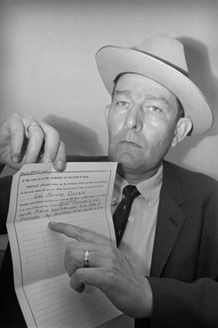
    Alexander admitted to author Henry Hurt that; “Once Oswald was charged as the assassin of President Kennedy, the District Attorney’s office ceased collecting evidence in the Tippit case.”

    This abrupt abandonment of due process is startling, yet Alexander continued: “The Tippit case just went by the boards. When Oswald was killed two days later, official interest in developing evidence in the Tippit case ceased altogether. There was never an indictment in the case or further investigation.”

    Alexander then told Hurt this whopper; “We all knew the same man who killed the President had killed Tippit. We had made up our minds by the time we got to (10th and Patton, scene of the Tippit murder). The two acts were so similarly drastic and unusual that it was virtually impossible that they were committed by separate killers.” (Henry Hurt, Reasonable Doubt, p.157)

    This premature judgment underlines a miscarriage of justice, where subjective assumptions supplanted a rigorous investigation. How could such critical legal determinations be made with such disregard for factual accuracy and fairness?

    Further compounding the investigative failures, the public assertions Hill made about the bullet trajectories in Dealey Plaza predated the autopsy of President Kennedy. So how could Hill know that all the wounds suffered by the president would jibe with the results of the autopsy?

    The autopsy was so poorly conducted that it prompted Dr. Milton Helpern, the highly respected and decorated Chief Medical Examiner of New York City—once described as’Sherlock Holmes with a microscope’—to comment on the utter incompetence of the career Navy forensic pathologists, Dr. James Humes and Dr. Thornton Boswell, who performed President Kennedy’s autopsy. Dr. Helpern likened their skills to:“It’s like sending a seven-year-old boy who has taken three lessons on the violin over to the New York Philharmonic and expecting him to perform a Tchaikovsky symphony. He knows how to hold the violin and bow, but he has a long way to go before he can make music.” (NY Times, 4/23/1977; p. 22)

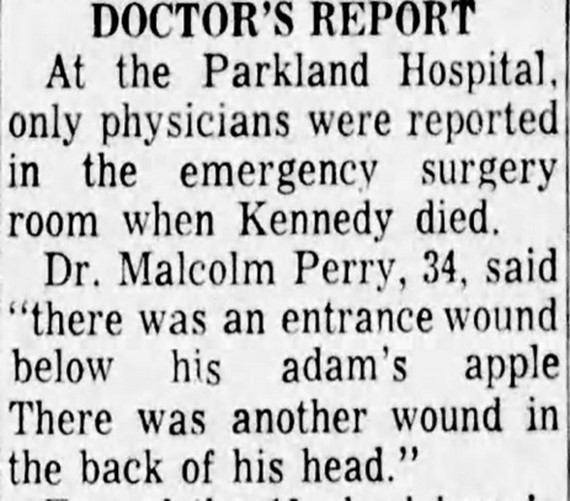
    Moreover, in a recently uncovered video by Secret Service expert Vince Palamara, Dr. Malcolm Perry describes the neck wound of President Kennedy on November 22 as;“a small penetrating wound, which appeared to be the entrance wound of one of the missiles.” (See this)

    (For a deeper look into the President’s autopsy, please refer to part 3 of Assassination 60.)

    The Procession of the Rifle.

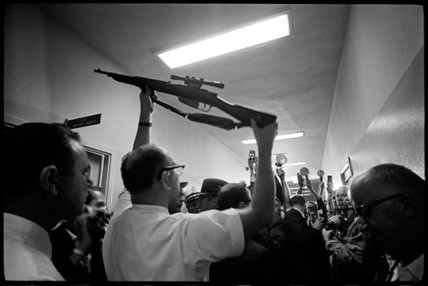
    Picture4Newsman. “This is room 317 of the homicide bureau, here at the Dallas Police station. As you see, they are bringing the weapon that was allegedly used in the assassination of President John F. Kennedy, this afternoon at 12:30pm here in Dallas. This is the weapon that was used. A rather well-worn military rifle, with a scope.” (See this)
    In the claustrophobic corridors of the Dallas City Jail, the 6.5 Mannlicher Carcano, incontrovertibly labelled as the death weapon of President Kennedy, was ostentatiously displayed before a throng of avid television and newspaper reporters. Cameras snapped relentlessly as journalists jostled to capture images of the notorious rifle, which Lieutenant Day brandished.

    The intentional public display of the Carcano was not merely a lapse in protocol—it was a deliberate strategy to influence public opinion and prematurely brand Oswald as the assassin of President Kennedy. This act effectively sidestepped the judicial process by contaminating the jury pool. Which depends on a neutral panel to carefully examine the evidence.

    Mayor Earle Cabell.

    Dallas Mayor Earle Cabell, whose brother Charles Cabell was the Deputy Director of the Central Intelligence Agency and was dismissed by President Kennedy following the Bay of Pigs debacle, appeared on national television to assert Lee Oswald’s sole responsibility for the assassination of President Kennedy.

    Mayor Cabell described the assassination as “the irrational act of a single man” and went on to depict Oswald as someone with “a deranged mind,” further embedding this narrative into the public consciousness. (See this and this)

    Buell Wesley Frazier.

    Detectives Gus Rose and Richard Stovall from the Dallas Police Department had arrested and had under interrogation at the Dallas City jail, 19-year-old Buell Wesley Frazier, a co-worker of Oswald’s at the Texas School Book Depository.

    The young and vulnerable Frazier was not informed of any rights he had nor was he offered the opportunity to have an attorney present. During the interrogation, officers Rose and Stovall ruthlessly bombarded him with repetitive questions, aiming to catch him in a contradiction. Frazier vividly recalled the ordeal, noting, “They asked the same questions, over and over…they were trying to see if they could trip me up”,After they had exhausted their tactics, another team of detectives took over, prolonging the gruelling interrogation for several more hours.

    The pressure intensified when Dallas Police Captain Will Fritz presented Frazier with a pre-typed confession as to his involvement in the assassination.: “In his hand was a sheet of white paper. He sat it down in front of me with a pen and said, sign this. I quickly realized this was a confession.”Stunned and appalled, Frazier stood his ground, asserting to Fritz, “I’m not signing this, this is ridiculous.” Enraged by Frazier’s refusal, Fritz menacingly raised his hand as if to strike him. Frazier bravely retorted,“There’s some policemen outside that door but before they get in here, we’re gonna have one hell of a fight.” Fritz then snatched the confession, wadded it up and stormed out of the room.” (Frazier, Steering Truth; p. 48-49)

    This episode starkly exemplifies the Dallas Police Department’s propensity to deploy deeply unethical tactics in their investigative processes. The fact that 19-year-old Frazier was not informed of any rights he had and was subjected to hours of repetitive questioning without legal counsel is a glaring indicator of the coercive strategies employed by the police. As assistant DA Bill Alexander confirmed to Larry Sneed in No More Silence, “What most people don’t realize is that we had Miranda in Texas before the Miranda decision.” (p. 553)

    This method of interrogation—relying on intimidation and psychological pressure—aims to wear down an individual to the point of vulnerability, increasing the likelihood of extracting a confession, regardless of its veracity. As Greg Parker pointed out, it is popularly termed the Reid technique, after its originator John Reid, a polygraph expert and former Chicago police officer.

    The incident with Frazier is not an isolated one but rather a snapshot of a systemic issue within the Dallas Police Department. As further detailed through multiple cases, these underhanded tactics appear to be a standard operating procedure rather than exceptions. The repetition of such methods across different cases demonstrates a disturbing pattern of behavior, pointing to a deeply ingrained culture of disregard for legal norms and civil rights.

    This pervasive abuse prompts a deeply unsettling question: when Buell Frazier was subjected to such harsh treatment, what kinds of threats and tactics were employed against Lee Oswald to coerce a confession or an admission of guilt from him?

    Assistant DA William ‘Bill’ Alexander.

    Around 10 p.m., in the office of Capt. Fritz, Bill Alexander, received a phone call from Joe Goulden, a seasoned reporter formerly associated with the Dallas Morning News.

    Joe Goulden. What’s going on down there?
    Bill Alexander. This Communist son of a bitch killed the President!
    Joe Goulden. Well, I can’t run with that.
    Bill Alexander. Well, I’m getting ready to write the complaint, how about if I wrote up did then and there, voluntarily, and with malice aforethought, take the life of John F. Kennedy in furtherance of a Communist conspiracy? Could you run with that?
    Joe Goulden. You got it.

    Picture5Alexander’s motivations for leaking this information to Goulden were later revealed to Larry Sneed, where Alexander expressed his desire; “to expose Oswald for what he was, a Communist.” Regarding the public’s reaction to John Kennedy’s murder, Alexander was disdainfully dismissive: “And as far as anybody giving a particular rat’s ass about John Kennedy getting his ass wiped in Dallas, who cares? A goddamn Yankee comes off down here and gets killed, for whatever reason, big deal!” (No More Silence; pp. 550/554)
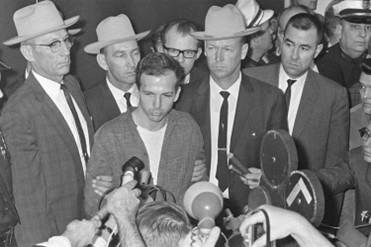
    Tragically, this remarkable perspective was pretty widespread within Dallas law enforcement. Detective Jim Leavelle, who was handcuffed to Oswald during his murder, expressed a similarly indifferent attitude towards the President’s murder in a 1992 conversation with author Joe McBride. “(The Assassination of President Kennedy) wasn’t no different than a South Dallas nigger killin’…It was just another murder to me, and I’ve handled hundreds of ‘em, so it wasn’t no big deal. (Into The Nightmare; p.240)

    The American Civil Liberties Union.

    Commission Conclusion. On Friday evening, representatives of the American Civil Liberties Union visited the police department to determine whether Oswald was being deprived of counsel. They were assured by police officials and Justice of the Peace (David) Johnston that Oswald had been informed of his rights and was being allowed to seek a lawyer.” (WCR, p.201)

    At approximately 10:30pm, Gregory Lee Olds, the President of the Dallas chapter of the American Civil Liberties Union (ACLU), initiated contact with Captain Fritz to discuss Oswald’s rights and his entitlement to legal counsel. Fritz’s response, which suggested Oswald had declined legal representation, was the first in a series of unsettling assurances that painted a picture of a suspect uninterested in his fundamental rights. And as documented in point 17 of Assassination 60, “Oswald consistently expressed his desire for legal representation during his detention.” (see this)

    Sam Stern: Did Captain Fritz say that Oswald did not want counsel at that time, or that he was trying to obtain his own counsel?
    Greg Olds : What I was told, that he had been given the opportunity and had not made any requests.

    Mr. Olds, not satisfied with this explanation, sought direct confirmation from Oswald and, along with three other attorneys, arrived at the Dallas City Jail around 11:35pm, aiming to engage with Oswald directly. Yet, their pursuit of justice was stonewalled under the pretext that Oswald, now charged with the assassination of President Kennedy, had knowingly waived his right to an attorney.

    Greg Olds: Captain King (assistant to Chief Curry) assured us that Oswald had not made any requests for counsel. Justice of the Peace David Johnston…assured us that Oswald’s rights had been explained, and he had declined counsel. Chief Curry was quoted to us as having said that Oswald had been advised of his rights to counsel…We felt fairly well satisfied that Oswald probably had not been deprived of his rights, so, we then broke up.

    These assurances from police officials, painted a misleading and complacent picture of Oswald’s understanding and waiver of his rights. These reassurances were enough to momentarily placate the ACLU representatives, leading them to disband— a decision that would soon be cast in a regrettable light.

    In a twist of fate, Olds was present when Oswald made a public declaration of his desperate need for legal assistance—a plea he issued not once, not twice, but three times during the famous midnight press conference. For a few moments, Oswald addressed the American public, where he would declare his innocence.

    Lee Oswald: I positively know nothing about this situation here. I would like to have legal representation. Well, I was questioned by a judge however I protested at that time that I was not allowed legal representation during that very short and sweet hearing. I really don’t know what this situation is about, no one has told me anything except I am accused of murdering a policeman. I know nothing more than that and I do request someone to come forward to give me a legal assistance. (See this)

    Picture6Oswald’s public plea contradicted the police narrative and highlighted a chilling disregard for his rights. Yet, despite Oswald’s membership in the ACLU and his clear request for help, no immediate action was taken to ensure his access to legal representation.
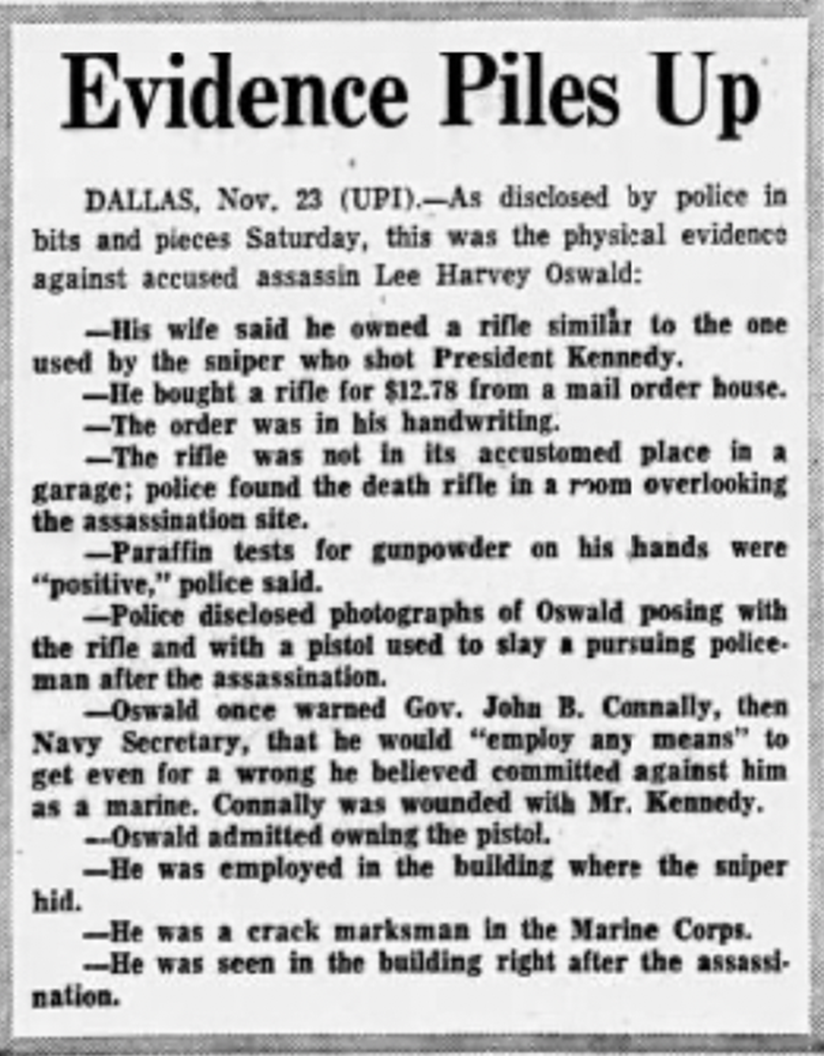
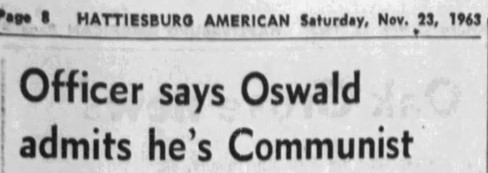
    This oversight—a missed opportunity for advocacy at a critical juncture—later emerged as a profound regret for Olds, who acknowledged the failure to engage with Oswald directly as a significant misstep. “I have always been sorry that we didn’t talk with Oswald…which I think was a mistake on my part.” (Volume VII; p. 322-325)

    Press interview with Chief Jesse Curry, Capt. J. Will Fritz and DA Henry Wade.

    Commission Conclusion. Wade told the press on Saturday that he would not reveal any evidence because it might prejudice the selection of a jury. On other occasions, however, he mentioned some items of evidence and expressed his opinions regarding Oswald’s guilt.” (WCR; p. 235)

    Q. Do you think you have got a good case?
    Wade. I figure we have sufficient evidence to convict (Oswald).
    Q. Was there any indication that this was an organized plot or was there just one man?
    Wade. There’s no one else but him…(Oswald) has been charged in the State court with murder with malice. The charge carried the death penalty which my office will ask in both cases.
    Q. Sir, can you confirm the report that his wife said he had in his possession as recently as last night, or some recent time, the gun such as the one that was found in the building?
    Wade. Yes, she did…she said that he had a gun of this kind in his possession.
    Q. A rifle? Last night?
    Wade. Last night. The reason I answer that question—the wife in Texas can’t testify against her husband…
    Q. Do you think you’ve got a good case against him?
    Wade. I think we have sufficient evidence.
    Q. Sufficient evidence to convict him of the assassination of the President?
    Wade. Definitely. Definitely. (Volume XXIV, CE2142, CE2169 p. 750-751, 829-830-837-838-840.)

    November 23rd, 1963.

    J. Edgar Hoover. “This man in Dallas. We, of course, charged him with the murder of the President. The evidence that they have at the present time is not very, very strong…The case as it stands now isn’t strong enough to be able to get a conviction.” (See this)

    NBC Press interview of Jesse Curry.

    Q. Chief Curry, how would you describe (Oswald) is he a prime suspect?
    Curry. Yes.
    Q. Is he the only suspect?
    Curry . Yes.
    Q. (Oswald) was yelling and complaining about no attorney. Does he have an attorney here now?
    Curry. Not that I know of.
    Q. Chief, are you convinced this is the man?
    Curry. Well, we don’t have positive proof. We feel he is a prime suspect.
    Q. What do you think personally?
    Curry. Personally, I think we have the right man.( Volume XXIV, CE2143, p. 753-754.)

    WFAA-TV. Press interview of Jesse Curry.

    Commission Conclusion. “ Curry stated that Oswald had refused to take a lie detector test, although such a statement would have been inadmissible in a trial. The exclusion of such evidence, however, would have been meaningless if jurors were already familiar with the same facts from previous television or newspaper reports.” (WCR; p.238)

    Q. Chief, was the subject of a polygraph, a lie detector test, broached with Oswald, and if so, what was the outcome?
    Curry. I understood that it was offered to him, and he refused it.
    Q. Did he give any reason for refusing to take the lie detector test?
    Curry. I understand he said he didn’t have to take it and he didn’t want to.(Volume XXIV; CE2144. p.755-756)

    WFAA-TV. Press interview of Captain Will Fritz.

    Q. Captain, can you give us a resume of what you know concerning the assassination of the President and Mr Oswald’s role in it?
    Fritz . I can tell you that this case is cinched— that this man killed the President. There’s no question in my mind about it.
    Q. Well, what is the basis for that statement?
    Fritz. I don’t want to get into the basis. In fact, I don’t want to get into the evidence. I just want to tell you that we are convinced beyond any doubt that he did the killing. (CE2153. Volume XXIV, p. 787.)

    KRLD-WFAA-TV- Press interview with DA Henry Wade.

    Commission Conclusion. “The disclosure of evidence was seriously aggravated by the statements of numerous responsible officials that they were certain of Oswald’s guilt…Wade told the public that he would ask for the death penalty.” (WCR; p. 239)

    Q. What sort of man is he? How would you describe Oswald?
    Wade. I, I couldn’t say. I can’t describe him any other than—the murderer of the President…since I have been District Attorney I’ve tried 24 death-penalty cases, in which we asked for the death penalty.
    Q. And how many verdicts did you get?
    Wade. Twenty-three.
    Q. Are you going to try this personally?
    Wade. Yes sir, yes sir…this is a proper case for the death penalty.
    Q. Well, from what you have seen, how do you sum (Oswald) up as a man? Based on your experience with criminal types?
    Wade. Well, I think he’s the man that planned this murder weeks or months ago and has laid his plans carefully and carried them out and has planned at that time what he’s going to tell the police that are questioning him at present. (CE2170, Volume XXIV, p. 842-843-844.)

    Press Interview in the Office of Jesse Curry.

    Q. (Is Oswald) Communist or Marxist?
    Curry. They say he said he was a communist.

    Regarding surveillance on Oswald prior to the President’s visit to Dallas, Curry stated that The FBI “usually let us know when these communist sympathisers or subversives come into the city and why they hadn’t got round to informing us of this man, I don’t know.”

    When asked about Oswald’s movements before and after the assassination, Curry stated, ” a man (Buell Frazier) brought (Oswald) to work yesterday morning and (Oswald) had a large package with him which we believe to be the rifle.” Regarding Oswald’s movements after the assassination, Curry asserts that: “(Oswald)shot our officer over in Oak Cliff.”

    Curry then qualifies Oswald as an“Expert Marksman”, when in reality Oswald was considered “a rather poor shot”,whilst serving in the U.S. Marine Corps. (See this)

    Q. What did you find in his apartment Chief? Did you find some communist literature…
    Curry. Yes we did. (See this)

    The Paraffin Test.

    Commission Conclusion.Wade might have influenced prospective jurors by his mistaken statement that the paraffin test showed that Oswald had fired a gun. The tests merely showed that he had nitrate traces on his hands, which did not necessarily mean that he had fired either a rifle or a pistol.” (WCR; p. 238-239)

    Henry Wade.

    Q. What about the paraffin tests?
    Wade. Yes, I’ve gone into that. The paraffin tests showed (Oswald) had recently fired a gun. It was on both hands. (CE2168; 821)

    Jesse Curry.

    Q. Chief, we understand you’ve had the results of the paraffin tests which were made to determine whether Oswald had fired a weapon. Can you tell us what those tests showed?
    Curry. I understand that it was positive…it only means he fired a gun.
    Q. That he fired a gun, Chief, not the rifle or the pistol.
    Curry. That’s right…

    Jesse Curry.

    Q. What does the paraffin test prove then Chief?
    Curry . It just proves that the man fired a weapon.
    Q. But you believe he is the man who fired the rifle that killed the President?
    Curry. Yes, I do. (See this)

    For more on the paraffin tests, which strongly indicates Oswald’s innocence, please refer to Point 23 in Assassination 60.

    WFFA-TV Press Interview with Jessie E. Curry.

    Federal Bureau of Investigation. “Our investigation has revealed that Oswald did not indicate on his application that others, including an “A.Hidell” would receive mail through the box in question, which was Post Office Box 2915 in Dallas. This box was obtained by Oswald on October 9, 1962, and relinquished by him on May 14, 1963.” (Volume XXV; p. 857-862)

    Newsman. This is a statement from Dallas Police Chief Curry.

    Q. Chief Curry, I understand you have some new information in this case. Could you relate what that is?
    Curry. Yes, we’ve just been informed by the Federal Bureau of Investigation, that they, the FBI has just informed us that they have the order letter for the rifle…they received from a mail order house in Chicago. The order letter (has been) compared with known handwriting of our suspect, Oswald and the handwriting is the same on the order letter as Oswald’s handwriting. The return address on this order letter was to the post-office box in Dallas, Texas, of our suspect, Oswald and it was returned under another name. But it had definitely been established by the FBI that the handwriting is the handwriting of Oswald.
    Q. Was it a recent purchase?
    Curry. This purchase was made on March 20th of this year.(Ed. Note: The Hidell rifle was ordered on 3/12/63)
    Regarding the backyard photographs, who’s existence was publicly disclosed by the Dallas Police, Chief Curry states the following
    Curry. There is a photograph of him with a revolver on his hip and holding a rifle in his hand.
    Q. Does this rifle look like the one that you have, that you think is the murder weapon, sir?
    Curry. it does.
    Q. Does it have a telescopic sight?
    Curry.It does.
    Q. Chief, has the order for this gun been connected definitely to the order for the rifle which you found?
    Curry. It has.
    Q. Chief, was the post office box rented by Oswald?
    Curry. The name- the return-the name on the return address was A.Hidell. A.Hidell.
    Q. How do you spell Hidell?
    Curry. H-I-D-E-double L.
    Q. Chief, do you feel pretty certain that this is the rifle which killed the President?
    Curry. Yes. (Volume XXIV, CE2145. p. 759-760 WCR, p. 233) (See this)

    (For further details on the mail-ordered rifle and Oswald’s alibi for ordering it, please refer to Part 4 of ‘Assassination 60’.)Picture7

    Press Interview of Captain Will Fritz.

    Q. Captain where does your investigation stand now? Does it look good?
    Fritz. Yes it looks real good, I think we are in good shape. I think we are in good shape on both cases, both the killing of the President and the killing of the police officer later.
    Q. You said a little while ago sir that you thought you had it cinched, do you feel that strongly about it sir?
    Fritz. Yes sir I do. I feel that its alright.
    Fritz then declares that Oswald, enroute to the Texas Theatre; encountered Officer Tippit, who he killed.
    Q. That’s pretty well nailed down.
    Fritz. That’s it, yes sir. (See this)

    WFAA TV Press interview with Jesse Curry.

    Picture8Commission Conclusion. If the evidence in the possession of the authorities had not been disclosed, it is true that the public would not have been in a position to assess the adequacy of the investigation or to apply pressure for further official undertakings.” (WCR; p. 240)
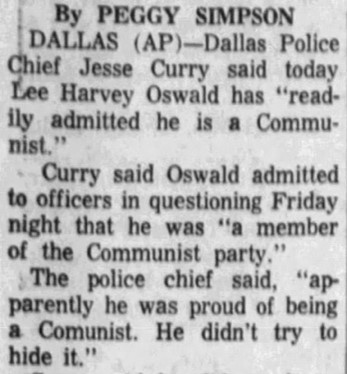
    Q. How would you describe his mood during the questioning?
    Curry. Very arrogant. Has been all along.
    Q. Is there any doubt in your mind, Chief, that Oswald is the man who killed the President?
    Curry. I think this is the man who killed the President.
    Q. Chief, could you tell us what you might have found in his rooming house in the way of literature or any papers connecting him-?
    Curry. We found a great, great amount of Communist literature, Communist books…(Hattiesburg American, Nov. 23, 1963. P. 8)
    Q. Chief, can you tell us in summary what directly links Oswald to the killing of the President?
    Curry. Well, the fact that he was on the floor where the shots were fired from immediately before the shots were fired; the fact the he was seen carrying a package to the building…
    Q. Do you figure that was a disassembled rifle?
    Curry . I don’t think it was disassembled; the package was large enough for a rifle to be intact.
    Q. Was it in a box or was it wrapped?
    Curry. Wrapped. Wrapped in a bo—, in a paper.
    Q. Has Oswald made any request for a lawyer?
    Curry.He has, but he didn’t say who he wanted or anything, so we couldn’t just go out and start calling lawyers for him. That’s not our responsibility. (CE2146. Volume XXVI, p. 763-764-769-770.)Picture9

    (For a more in depth look into the origins and scientific tests ran on the paper sack, designated as Commission Exhibit 142, please refer to Part 6 of Assassination 60)


    Go to Part 2 of 2

  • The Tippit Tapes: A Re-examination

    The Tippit Tapes: A Re-examination


    Set out here is new evidence drawn from an exercise comparing the Dallas Police Department radio transmissions on tapes extracted from Dictabelt recordings – held by the University of Virginia – to what was transcribed in three versions for the Warren Commission.

    Background

    Officer JD Tippit was out of his assigned District 78 in the far south of Dallas at the time he was shot with four bullets, one to the head. The time of the shooting is disputed but it appears to be shortly after 1:00pm in Oak Cliff, Dallas outside 410E 10th Street.

    His murder was attributed to Lee Harvey Oswald, allegedly on the run from shooting Kennedy on Elm Street, Dealey Plaza, Dallas, at 12:30 pm from the 6th Floor of the Texas School Book Depository (TSBD). But there was no credible explanation as to why Tippit was at 10th and Patton, nor what he was doing. There was also no credible explanation as to how Oswald left his lodgings at 1026 N Beckley at 1:03 pm-1:04 pm and then allegedly walked 0.9 miles to shoot Tippit.

    Temple Bowley chanced on the post-event murder scene at 1:10pm and announced the crime on Tippit’s own car radio. (James DiEugenio, The JFK Assassination: The Evidence Today, p. 127) An ambulance from two blocks away that had already been called by a neighbor arrived as Bowley was finishing that call. The ambulance then delivered Tippit’s body to Beckley Methodist Hospital, he was declared dead on arrival by a doctor at 1:15pm.

    The assailant was seen walking from the east, whilst the route Oswald would have needed to have taken was from the north and west. There are plenty of other discrepancies of witness descriptions of the Tippit assailant that cast doubt on him being Oswald.

    I

    More than one person was reported to have been on the scene, and a neighbor in an apartment at 113 ½ S Patton, with a view across the rear of 410 E 10th, Doris Holan, said she saw two police officers present when Tippit was murdered. She said a police car pulled up in the alley behind 404 and 410 East 10th that could only be accessed from the alley behind the houses that ran from Denver to Patton.

    More on that later. Just to say, her story has been misinformed by some on the basis she lived opposite of the murder scene and couldn’t see the back of 410 E 10th. However, she had moved from 409 E 10th to 113 S Patton in September 1963 and was living there on 22 November 1963. 113 ½ S Patton had a clear elevated view only 140 feet distance to the back of 410 E 10th and rear driveway and rear alley that the driveway was accessed from.

    There were also discrepancies regarding the discarded shells found at the scene, and an alert on police radio was that Tippit had been shot with an automatic. (Henry Hurt,Reasonable Doubt, p. 155) The handgun on Oswald purportedly had on his arrest at the Texas Theater cinema was a revolver and had a bent firing pin.

    The Warren Commission account – to give Oswald time to walk from 1026 N Beckley – had to deal with the problem of Tippit arriving at the hospital before, on its timeline, he’d been shot. For the death certificate by Dr. Richard Liquori states the time of death at 1:15 PM. The Warren Report says that TIppit was shot at about 1:16. (WR p. 155)

    Housekeeper Earlene Roberts saw the man she thought was Oswald standing opposite the rooming house address 1026 N Beckley at 1:03pm-1:04pm after police car 207 pulled up and honked.(Mark Lane,Rush to Judgment, p. 170) Car 207 had left Dallas Police HQ at (old) City Hall at 12:46 pm having taken Sergeant Gerald Hill to the Texas School Book Depository.

    Unpublished WC papers in a dossier now in the Kennedy files show that Warren Commission staff had a suspicion that Laverne “Larry Crafard” was 1 of 4 persons who they suspected might be impersonating Oswald. (Memo from Burt Griffin to staff, March 13, 1964) Crafard was a casual employee of Jack Ruby – who shot and killed Oswald at the City Hall Police HQ basement on 24 November – for just over a month in October and November 1963. He reportedly lived in a back room at the Carousel Club. He left Dallas after the assassination and hitchhiked to Michigan with seven dollars in his pocket. (Michael Benson,Who’s Who in the JFK Assassination, pp. 89-90)

    Ruby was a nightclub owning minor mobster. He’d been a regular visitor to DPD HQ for years before the Kennedy assassination. He was also in and out of the Dallas Police offices in the two days prior to his arrest for shooting Oswald. The Dallas Police Department was known for being corrupt and very right-wing with members of Ku Klux Klan serving in it, together with Klan linked Masonic lodges.

    But things were already going on before then, involving other police officers, that cannot be explained as being a reaction to Kennedy being shot.

    Oak Cliff – a likely getaway zone (per radio Dispatcher Murray Jackson). So why was it full of cops before the assassination?

    Shortly after the assassination of Kennedy, Officer Tippit was seen by several witnesses at a Gloco service station, Oak Cliff, the other side of the Trinity River basin from Dealey Plaza at the southern end of the Houston Viaduct. But that only emerged after the Warren Commission’s conclusions were made public. The evidence of the employees at Gloco gas service station, from Tippit researcher GregLowrey – is that they were absolutely certain Tippit arrived shortly after the “shots were fired” in Dealey Plaza.

    “Greg recalled his interviews with Gloco Station employees Emmett Hollingshead and J.B. “Shorty” Lewis. They were both certain that Tippit arrived at the Gloco Station “a few minutes” after the shots were fired in Dealey Plaza. Greg said “There was simply no doubt whatever about this in their minds, they were absolutely certain””.

    They then said he stayed for about 10 minutes and headed off at speed in the direction of Lancaster Avenue.

    Nothing in what the witnesses said indicate this was third-hand information, and look at where they were. Gloco was across the Trinity River basin from Dealey Plaza, 1.2 miles in a straight line (approximately where Greenbriar Streetcar station is now).

    We know that Tippit’s colleague, Officer R. C. Nelson, could hear the shots across the river basin. Nelson told CBS in 2013 he was on the western end of the Commerce Viaduct, 0.85 miles in straight line from Dealey Plaza. He heard the shots and drove over to Dealey Plaza in time to see people still cowering on the ground.

    Given Nelson – who was also not where he should have been at 12:30pm – could hear “shots fired”, then outdoor gas pump attendants at Gloco, should have been able to hear the shots too. That would explain their certainty by hearing the event, not being told it. They said Tippit stayed approximately 10 minutes then raced off at speed in the direction of Lancaster Avenue (by a road now covered over).

    Tippit was also seen at Gloco by professional photographer Al Volkland . Volkland took a famous photo from the margin of the freeway (at what is now Highway 366) of the distressed JFK limousine heading to Parkland Hospital. That would have been 12:31pm. He and his wife drove from the freeway to Gloco, saw Tippit and waved, as they knew him. It’s a 5-minute ride from where the photograph was taken to Gloco by the current road system. The Volklands said it was 15-20 minutes after the assassination.

    Those timings put Tippit at Gloco for approximately 10 minutes between shortly after 12:30 pm and perhaps until 12:45 or a bit after.Nelson placed himself in Dealey Plaza at 12:32 pm talking to witnesses. But by the DPD radio Nelson can then be heard calling “clear” at 12:40 pm (not transcribed for the Warren Commission).

    The Warren Commission transcript, CE-705, also has a call at 12:47 pm as “101’s on south end of the Houston Street viaduct.” However, the words on the tape are “87 [Nelson)] “ON, south end Houston Street viaduct”.

    There is then a faint and untranscribed call to Nelson seconds later. “87 call station 7”. That is an order to make a landline call. The south end of Houston Street viaduct is of course the position of Gloco Gas Service Station which presumably would have a payphone. The word “ON” is heavily emphasised, was he at Gloco having expected to see Tippit there but who had left? After all, Nelson told author Henry Hurt he did not want to talk unless there was a monetary reward. (Hurt, p. 162)

    At 12:52pm Nelson makes a radio call “87, out down here”, being the parlance for Dealey Plaza from 12:49 pm, when a call placed Deputy DPD Chief Lumpkin in charge in Dealey Plaza in which he calls “out down here”. Therefore, Nelson before 12:30 pm (the time of the assassination) was out of his assigned district 16 miles to the south, yet went to the assassination scene on hearing the shots, but then left Dealey Plaza for at least 12 minutes and then came back and on the way back is asked to make a landline call. Was Nelson saying “clear” to signal he’d left Dealey Plaza to go somewhere and 7-8 minutes later he’s heading back from whatever he went to do? More on where he may have gone is covered later

    But as well as – and contrary to all of that – thereis a dispatch call at 12:45pm “87 [Nelson], 78 [Tippit], move into central Oak Cliff area.” (Hurt, p. 161) With the replies.”I’m at Kiest and er Bonnie” (5 miles south of Gloco and “87’s going north on Marsalis at R.L. Thornton” (3 miles south of Dealey Plaza).

    But Nelson can’t have been heading north on Marsalis at RL Thornton from his home district, as he’d been 15 miles north at Commerce Viaduct and Dealey Plaza since at least 12:30 pm. And if Nelson had been told to go to central Oak Cliff at 12:45 pm, why did he go to back to Dealey Plaza at 12:52 pm instead? If the 12:45 pm Nelson call was genuine then his CBS account was false and the other untranscribed and mistranscribed calls are fakes. But why go to the effort to fake calls but not transcribe? (As Jim Marrs notes in Crossfire, J. C. Bowles told Gary Mack that the original tapes were taken by federal agents a few days after the assassination; Joe McBride,Into the Nightmare, p. 425)

    II

    One would also expect the dispatcher working in real time would have wondered why, if he’d made the 12:45 pm call to go to Oak Cliff, Nelson disobeyed it and went to Dealey Plaza instead.

    The provenance of the 12:45 pm call fits with it being added afterwards and being ersatz. Warren Commission staff had questioned why Tippit was so far out of his home district when shot, because the 12:45 pm call out and the responses from Nelson and Tippit didn’t exist in the first DPD transcript.

    There were three official transcripts of the DPD tapes:

    • Secret Service Copy CD-290. Logged by Warren Commission 8 January 1964, dated December 3 1963 (11 days after the assassination). Supplied by Deputy Chief Lumpkin of DPD.
    • FBI Copy CE-705. Went through Inspector Herbert Sawyer DPD dated 6th March 1964,
    • DoJ Copy CE-1974. – from the FBI for the DoJ dated August 11, 1964,

    The reason given in the Warren Commission testimony of DPD Chief Curry for the appearance of a 12:45pm call was that not all transmissions were audible:

    Mr. Rankin. Chief Curry, we were furnished a Commission Document No. 290, dated December 5, 1963, that purported. to be a radio log for your department, and it did not have any item in it in regard to instruction to Officer Tippit to go to the Central Oak Cliff area. Do you know why that would be true?

    Mr. Curry. I don’t know why it wasn’t in that log except that these logs, after they are recorded, they are pretty difficult to try to take everything off.

    However, the 12:45pm call on the tape is as clear as a bell.  One of the clearest things on the whole tape.

    The likely explanation is that the 12:45 pm call was added afterwards as an attempt to explain Tippit’s movements and jibe with the Warren Commission’s published account. However, in faking Tippit’s position they also brought in a position for Nelson to embellish the story of “depletion of officers in Oak Cliff”, but those alterations missed that Nelson’s real movements were left on the tape.

    Further, the voice of “Nelson” on the tape in the 12:45 pm call is different than his other calls on the same tape, in which he sounds like a pleasant, earnest young Texan. The voice at 12:45 pm is older and sounds almost drunk/slurred, a different accent. Also, the grammar, “87’s headed North on Marsalis at TL Thornton” is out. It’s in the third person. It should be “87. Headed North….etc”.

    The voice of “Tippit” is also different than the other Tippit calls – he normally has a very laid-back rockabilly type twang. This one was not.

    So, who controlled Tippit and Nelson (both of the SW District) that day? And as referenced above, what were the two doing that required DPD and/or the FBI which took the tapes to Oklahoma to process and then likely alter parts of them? (The intentions of FBI Director J Edgar Hoover are covered later.)

    Per the Warren Commission testimony of Sergeant Calvin Owens, Owens was the acting SW District commander for that day as Lieutenant Fulgham was doing a traffic school. Owens stated that officers Tippit and Angell were under his command, but another Sergeant took over at lunchtime.An FBI memo of 20 May 1964, supplied to the Warren Commission on 5 June 1964 never published by the Commission states:

    “According to Sergeant OWENS, Officer TIPPIT had gone home to eat lunch, which was a normal and approved procedure, at about noontime.”
    “Sergeant OWENS advised he could not furnish any information as to when or how TIPPIT’s assignment from District 78 had been changed as he, OWENS, had gone to lunch and had not returned during the time that TIPPIT’s assignment had been changed.”

    Then, what appears on the record of the Warren Commission is this testimony (Vol. 7, p. 78ff)

    Mr. Ely. Were you on duty on November 22, 1983?
    Mr. Owens. I was.
    Mr. Ely. And what was the nature of your assignment on that date?
    Mr. Owens. Acting lieutenant, Oak Cliff substation.
    Mr. Ely. Because you were acting lieutenant in the Oak Cliff substation, would that mean that Officer Tippit would be under your supervision?
    Mr. Owens. That’s true.”

    Ely clearly cannot understand why Tippit was wandering around the area in three different districts, i.e. 78, 109 and 91. (See p. 81) Towards the end, this happens:

    “Mr. Ely. Off the record. (Discussion off the record between Counsel Ely and the witness Owens.)
    Mr. Owens. I don’t know what district Officer J. L. Angel [spelling should be Angell] was working, but it was my understanding that he also went to Elm and Houston.
    Mr. Ely. Well, he was working somewhere in the Oak Cliff area, was he?
    Mr. Owens. Yes; he was working in the Oak Cliff area under the same sergeant that Officer Tippit was working under.”

    Owens is not asked who that Sergeant was nor why the command changed. He brought up Angell as answer without an on the record question that would require it. It appears as a non-sequitur after an off-record exchange with Warren Counsel Ely immediately prior to that answer.  His being “unable to furnish” is an indication that people superior to him would need to be asked that. By that, Angell wasn’t supposed to be in Oak Cliff either. Owens’ testimony vitiates the notion that Tippit was where the 12:45 pm call placed him. He was already working in Oak Cliff under the command of a Sergeant.

    III

    Per the tape at12:42 pm, and missing from the WC transcript, is Officer Angell (car 81) – saying “81. We’re still at Lansing and 8th”. That is Oak Cliff. At 12:45 pm Angell then says in a sing-song type voice “we’re going north on Industrial from Corinth” the WC Exhibit 705 did transcribe this, but wrongly, as “I’m going north on Industrial at Corinth”. That is the north end of the Corinth Viaduct over the Trinity River, consistent with having left Oak Cliff.

    At 12:54 pm there is an exchange with the dispatcher and Tippit. ”78, “78” “you are in the Oak Cliff area are you not”. Tippit says “Lansin’ 8th” in his rockabilly type relaxed twang.

    But all three WC transcripts had “Lancaster and 8th”. So, Tippit had by 12:54 pm left Gloco and is where Angell was 12 minutes earlier, Lansing Street at 8th. That is two streets to the west of Lancaster Avenue crossing where 8th Street has a bend. Angell and Tippit are in the same place under the same command , two blocks down, one across, from where Tippit is later shot.

    The dispatcher – having likely never made the 12:45 pm call – doesn’t ask why Tippit is out of his area. Just as he didn’t ask Nelson or Angell why they were doing the things they were. Instead, he wishes to know where Tippit is, and expected it to be Oak Cliff. Was Tippit expected to confirm something prior to that call, but hadn’t?

    By deduction,the dispatcher probably was in on the alteration, to assist in making it; and to tell the story after the event that the call had occurred when it hadn’t. Nelson seems not to have co-operated or else his own voice could have been used to create his 12:45pm call. Presumably too, Nelson would have told them it was a bad idea given the obvious inconsistencies elsewhere on the tape.

    Lansing at 8th is not a normal suburban road but a due north-south alley and it doglegs once it crosses over 10th to the southwest and runs as the alley behind the crime scene on E 10th by passing through what is now waste ground over Denver then on to Patton and Beckley towards the Texas Theater. The continuous telegraph poles on Google maps show the alley and Lansing are the same original thoroughfare.  The Google street car drove the whole route even over the waste ground. The rear alley of what was 410 E 10th, now renumbered 408, can still be seen with a gate in front of new 410 at the rear.

    DPD Dispatcher Murray Jackson said he sent Nelson and Tippit to Oak Cliff at 12:45 pm, as it was depleted of officers, and Oak Cliff was where an assassin on the the run might go. Looking at the Dallas map and what routes spill from Dealey Plaza, then Oak Cliff – over the viaducts – does makes sense as a getaway zone; if downtown is to be avoided as well as the route north to Parkland Hospital where Kennedy was taken to.

    Washburn Map2

    But as set out above, Jackson did not need to send any officers to Oak Cliff in reacting to the assassination. Instead, as set out below, the number of officers already there was half a dozen. Any dispatcher with ears could hear that.

    Off-duty Officer Harry Olsen was in Oak Cliff on 22 November 1963 supposedly guarding a house on 8th, the estate of a lady who had died. Olsen’s girlfriend, later wife, Kay Coleman’s Warren Commission testimony–by counting blocks by reference to her apartment on N Ewing and the 7/11 store (still there at Lancaster and 8th, it was the first 7/11 in the whole of the USA) –places Olsen on 22 November 1963 at 8th at the Lansing block. She gave him an alibi for 12:30 pm. When asked how Olsen knew Kennedy had been shot, the answer was that a friend of the dead woman had called to tell her. That block on 8th is also where researcher Prof. Greg Pulte put Olsen, by property description and counting the blocks.

    Warren Commission staff papers now on the web have an Olsen dossier. In July of 1964, J. Lee Rankin asked Hoover, “The Commission is interested in exploring the possibility that Harry Olsen…and Kay Coleman, a strip tease dancer for Jack Ruby, assisted Ruby in the killing of Lee Harvey Oswald.” Rankin then asked for phone calls of the pair for 11/23 and 11/24.

    Olsen was reportedly asked later in life whether he was involved in the shooting of Tippit. According to Michael Brownlow he said, “a lot of people followed orders that day”. (See Jack Myers, “How Oswald was framed for the Murder of Tippit”, Pt. 3) That would indicate a rogue command structure from the top rather than junior officers like Tippit and Nelson, who may merely have operated as commanded.

    Olsen lied to the FBI and Warren Commission. He said that the night after the assassination Kay and he chanced across Jack Ruby around midnight at a parking garage near the Carousel Club; they had a chat, and that they had gone there to meet a person called Johnny. However, it transpired that “Johnny” was the garage attendant Johnny Simpson and he said there was no meeting with him, but he did see the others there. By Kay Olsen’s testimony the meeting with Ruby lasted 2 ½ hours. Despite that testimony raising even more questions about a conspiracy to kill Oswald, Hoover closed the inquiry in a letter of 4 September 1964.

    Some of the Olsen Warren Commission deposition was done off the record and is not known to this author. The counsel who gave Olsen an easy ride despite the problems with his testimony was Arlen Specter, who was also the creator of the Single Bullet Theory.

    Coleman was British and divorced from her US husband. She and Olsen drove 125 miles to see Olsen’s father in Wichita Falls. They left Dallas at 2 pm Sunday 24 November 1963, arriving in Wichita at 6:30pm. They left there at 10:30 pm, to tell him they were getting married. The reason Olsen gave for being off work on 22 November 1963 was his having a bad leg. But his testimony about his movements that weekend indicates someone very much mobile.

    IV

    From the tape and transcripts and Warren Commission testimonies, there were other officers in Oak Cliff from 12:30 pm. Officer William Mentzel was at Luby’s Cafeteria on E. Jefferson Boulevard one block and 500 yards from opposite the Texas Theater on E Jefferson Boulevard. He claimed to the FBI in 1963/64 not to have known of the assassination until his lunch break ended at 1:00 pm, as he didn’t have radio contact and couldn’t get through to DPD HQ by the payphone at Luby’s as the line was always engaged.

    But he did have radio contact. The tape has him calling “91 clear” at 12:33pm immediately after the 5-minute radio jam (that jamming is suspicious) across the assassination event ended. There are sirens going in the adjacent call. Mentzel’s story also changed for the HSCA when he said a waitress at Luby’s told him at about 12:45pm that Kennedy had been shot. (McBride, p. 428)He also claimed that after 1:00 pm, that he went to the scene of a motor accident. This is also dubious. From the tape he can be heard taking the call, and he interjects several times; but he hands the assignment to another officer, Patrolman Nolan. From the tape, Mentzel was anxious – and he labors the whole incident – to establish that the western part of West Davis was the venue of the accident, rather than the eastern part.

    The potential relevance of that is that the low block numbers of West Davis form the junction with N Patton; 300 yards from where Tippit was shot five minutes after Mentzel’s interjections. Anyone responding to and going to the wrong end of West Davis could have been very close to where the Tippit murder was about to take place.

    Officer Walker at 12:30 pm was at the old Oak Cliff fire station at 706 E 10th (still there as Engine Co No 7), where 10th meets Lancaster, where he said he popped in to watch assassination coverage on their TV. That’s two blocks and 500 yards from where Tippit is shot at 10th and Patton.

    Patrolman Lewis call sign 35 per the tape (not transcribed) says at 12:47pm “105 Corinth”. That’s the south end of Corinth Viaduct, Oak Cliff. He is 7 miles out of his district in northwest Dallas next to Love Field Airport.

    Officer Parker, call sign 56, states at 12:42pm “56. E Jefferson”. East Jefferson becomes the Corinth Viaduct. He was 20 miles out of his northeast patrol district of Garland.

    All of this again scotches the line that Tippit and Nelson were called to Oak Cliff as it was depleted of Officers. It was not, not at all. Tippit, Angell, Mentzel, Walker, Lewis, Parker; and the viaducts are a common position: Tippit, Nelson, Parker, Lewis and then Angell. Then there was Olsen.

    The SW District Commander was William Fulgham, who was purportedly on other duties for the day. He was later promoted to Deputy Chief of Police, but then investigated for misconduct in October1972. Six of his 22 Second Platoon patrolmen had unexplained movements that day: Tippit, Nelson, Mentzel, Walker, Angell and Anglin.

    It would take a remarkable lack of curiosity by Fulgham not to realize that something had been going on with his officers that day. He was never called to the Warren Commission, so Owens was left trying to explain things as best he could.

    The presence of so many out of district officers in the getaway zone prior to the JFK murder and without any overt radio orders to go there because of the assassination speaks volumes. As does the failure to transcribe certain calls, misrepresenting others and faking at least one.

    Recently released CIA papers state that its interception of USSR intelligence concluded that Kennedy was shot by right wing elements assisted by a rogue element of the DPD.

    Presidential papers also show advice to President Lyndon Johnson in the immediate days after the assassination that a commission needed to be set up to conclude Oswald was the sole assassin to avoid nuclear war with the USSR. A reason for that being Oswald’s Russia connections. J. Edgar Hoover also worried about international complications. (NBC News report, 10/26/17, by Alex Johnson) Declassified tapes also set out that Oswald was being impersonated in Mexico City at the Cuban Consulate, Hoover told Johnson that the picture the CIA sent up to the FBI was not Oswald, and the tape of his voice sent to Dallas was not his. (James Douglass,JFK and the Unspeakable, p. 80) Johnson asked whether he himself was a target on 22 November.

    Added to all that, papers in the Kennedy files and now on the web–not published at the time– contain a dossier setting out how Warren Commission staff suspected Oswald was being impersonated in Dallas. In a memo dated 3/13/64 they mapped out four persons they thought might he imposters. And they asked the FBI to investigate them. One of those suspected was Larry (Laverne) Crafard, Jack Ruby’s recently hired assistant.

    Jack Ruby had picked up Crafard – a visiting fairground worker – at the Texas State Fair in October 1963. He stayed on a sofa at Ruby’s Carousel Club and the Warren Commission staff got the FBI to trace him to the wilds of Michigan, he’d gone there the weekend of 23-24 November, after the assassination. This was his exchange with Hubert, in Volume XIV of the Commission. Hubert was one of the more tenacious Warren Commission Counsels. He wants Crafard to describe the haste with which he left Dallas:

    Mr. HUBERT. What about the salary that was owed to you? Weren’t you interested in that?
    Mr. CRAFARD. I didn’t even think about it.
    Mr. HUBERT. You didn’t say goodbye to anybody when you left Dallas?
    Mr. CRAFARD. No.
    Mr. HUBERT. You didn’t advise anyone that you were leaving Dallas?
    Mr. CRAFARD. No; other than the fact that I give the key to the boy at the parking lot and told him to tell Jack goodbye for me.
    Mr. HUBERT. You did send a message of goodbye to Jack through this man?
    Mr. CRAFARD. Yes.
    Mr. HUBERT. Did you leave word where you would be?
    Mr. CRAFARD. No.

    More on Crafard’s departure is covered later. It’s difficult to comprehend how a person relying on casual work wasn’t concerned about his final salary from Jack Ruby, begging the question whether he’d been paid off by other means.

    The bus and the theater

    Aligning with the suspicion that Crafard had a role in impersonating Oswald in Dallas, are the points of detail in the observations of the witnesses on the Marsalis bus Oswald was supposed to have boarded at 12:39 pm to then disembark at 12:43 pm. Both Warren Commission timings are relevant.

    Mary Bledsoe had been Oswald’s landlady for a week in October 1963. She said Oswald’s face was horribly distorted when she saw him on the bus. But elsewhere in her testimony she’d described the Oswald who’d lodged with as a “good looking boy” who she wanted to help find a job.

    Roy Milton Jones, also on the bus, said the man he saw on the bus who sat behind him had dark hair.  Photographs show Crafard has darker hair than Oswald and was less pleasant looking.

    Domingo Benavides, a witness at the Tippit murder scene, was asked to identify Oswald in a police line-up. He said that Oswald had a tapered cut neckline, whilst the assailant he saw had a square cut neckline. Crafard had a square cut neckline in photographs. Benavides knew hair. As well as being a mechanic he worked as a barber at the Dudley Hughes Funeral Home that had supplied the ambulance to take Tippit to the hospital. Two blocks from where Benavides worked at, Tippit was shot. Benavides refused to identify Oswald as the assailant.

    Benavides put the shooting of his similar looking brother down to his failure to cooperate. Witnesses to the assailant on the run e.g. Warren Reynolds, couldn’t identify the assailant as Oswald. Reynolds did then change his mind and testify after being shot in the head on 23rd January 1964 but surviving. (Benson, pp.378-79) The person arrested for that shooting was given an alibi by a dancer, Nancy Mooney, who had purportedly worked for Jack Ruby. (Benson, pp. 296-97)

    V

    Back to maps, and downtown. Of note is that the bus stop at Field and Elm where Oswald was supposed to have boarded the westbound Marsalis bus, 7 blocks (0.4 miles eastwards) from the Texas School Book Depository, was the closest bus stop to the Carousel Club, 140 yards away at 1312 ½ Commerce Street, a 2-minute walk, and the place Crafard spent the night of 21/22 November.

    Further evidence consistent with someone impersonating Oswald are statements by Texas Theater manager Butch Burroughs who said Oswald entered the theater at approximately 1:00 pm and bought popcorn from him at about 1:15 pm.  Another person said Oswald was acting strangely, moving seats as if to find someone. (Joe McBride, Into the Nightmare, p. 520)

    Oswald was arrested on the ground floor of the Texas Theater at approximately 1:50 pm and photographed being taken out of the front – there is little to dispute about that. But witnesses at the theater said the suspect who entered the theater at around 1:40 pm had run up the separate stairs onto the balcony – the ground floor had separate doors after those stairs – and Officer Stringfellow’s arrest report put Oswald’s arrest as in the balcony. (McBride, p. 521) Bernard Haire, a neighbouring business owner, said he was shocked when years later he saw the photographs of Oswald coming out of the front of the Theatre as he’d seen the arrested person taken out the back.  (ibid)

    Deputy Sheriff Roger Craig insisted until his early death that, minutes after the assassination of Kennedy, he had seen a person he identified as Oswald – having seen Oswald in person after his arrest at police HQ, City Hall – running down the grassy bank from the road by the School Book Depository getting into a Rambler station wagon. (McBride, pp. 443-44)

    If Oswald was in the theater just after 1:00pm, then what is the probability he was on the Beckley bus, or the taxi he was supposed to have then gotten into to get to Beckley Avenue? How could he have entered 1026 N Beckley at 1:00pm to don a jacket and pick up a revolver and be standing waiting for a bus at 1:04 pm, and could he have shot Tippit shortly before Temple Bowley arrived on the scene at 1:10pm? Those are mutually exclusive events. Either Burroughs is wrong, or there was an Oswald double in place as Roger Craig’s, Bernard Haire’s, and the police report testimony seem to indicate.

    Tape tampering

    There are other anomalies with the tape and transcripts.

    Prior to 12:30pm the dispatcher called time every minute for the record bar one. After all, police records need to be accurate for legal purposes. Occasionally, single minutes might be missing. But from 12:56pm to 1:04pm, 8 consecutive time calls are missing. There are then another six calls missing prior to 1:15 pm, seven from 1:15 pm to 1:30 pm and then 10 from 1:30 pm to 1:45 pm. They then approach normal regularity after Oswald is arrested at 1:51pm, a time that is independently verifiable by the sheer number of witnesses, including the press, hence sticking with tampered time wouldn’t work. There is therefore an hour where time goes awry.

    The times that are on the tape put Bowley’s call after 1:15 pm, but the tape itself can be verified by taking calls prior to 12:50 pm, and then timing the elapse. It is quite clear that Bowley’s call by time elapsed is closer to 1:10 pm. We know that the tape was, in all probability, tampered with to add the 12:45 pm call. The tape also appears to be tampered with in order to change the time of death for Tippit.

    A reason for the 8 missing time calls being removed would be to then selectively add some new times adjacent to Bowley’s call to make it appear later than it was. Similarly, the time that was stretched fast would need to be slowed again, to catch up with reality at 1:51 pm; hence the need for 10 time stamps to be missing from 1:30pm to 1:45pm.

    Table: Time Stamps on DPD Recording

    Legend: The times with a black background indicates the time stamp is missing. A grey background indicates the radio signal was jammed.

    Note: there are two sequences, 12:56pm to 1:03pm and 1:35pm to 1:42pm, where eight consecutive time stamps are missing.

    There are other clues to the tampering which are quite crude. A verbal time stamp for 1:16 pm appears twice after a long time has elapsed. The time of 1:11 pm also appears twice. There is also a long-crackled pause and then the tape sounds like a stuck needle on a vinyl record player for a minute until ‘normality’ is restored (that also stretches the time out). With tampering on that scale, it’s reasonable to conclude that, as well as changing times and adding a fake call at 12:45 pm, that some things might be missing; and they are.

    A conversation listed in the first transcript – CD-290 – disappears in the next two versions CE-705 and CE-1974.

    531” “205 was dispatched to notify Mrs Tippit”

    CD-290 puts this sometime before 1:40pm. It’s missing from CE-705 and the earliest mention in CE-705 to that matter is a call between 1:40 pm and 1:43 pm and that transmission used the word ‘wife’ not ‘Mrs Tippit’.

    Stacking up more. There was also this conversation in the CD-290 transcript. The time of the call was between 1:25 pm and 1:32 pm (tampered time) by reference to the 2 calls on either side.

    “531”“Received information from Methodist the Officer involved in the shooting Officer JD Tippit was DOA”.

    That call is missing in the next two transcripts.

    But the tamperers didn’t address that there were two channels. Channel 2 for that day was allocated to logistics of the Presidential visit. But once Tippit was shot Channel 2 was also used for that event.

    There was a call on Channel 2 asking Channel 1 to put a call out thus: –

    “Disp” “Stand by. Notify 1 [i.e. notify Channel 1)] that Officer involved in this shooting, Officer J. D. TIPPIT, we believe, was pronounced DOA at Methodist (1:28 p.m).

    In short, the tape-tamperers took out the call that was on Channel 1 for the CE-260 transcript, but they left on Channel 2 the call asking Channel 1 to put out that call which was erased between the first and second transcripts.

    The official line was that Tippit had a lunch break at home with his wife from 11:30-11:50 am at 238 Glencairn, Dallas, 8 miles to the south from where he was shot.But the House Select Committee on Assassinations had this from Tippit’s colleague Bill Anglin and reported it.

    The committee also contacted William Anglin. Anglin indicated that he socialized with J. D. Tippit. He said in the interview that “he and J. D. had coffee or tea at “The Old Drive-In’” about 11:30-11:45 on the morning of November 22. (McBride, p. 503)

    Further doubts on Tippit having lunch at home with his wife need to reflect this entry on page 83 of the WC705 call transcript for police radio Channel 2 just before 2:00pm, which by now was being used for Tippit as well as Presidential activity.

    Car 210: Has anyone made arrangements or picked up Tippit’s wife yet?
    Dispatcher: I’m not sure 210.
    210: If you give me his address, I will go there and pick her up. I do not have anybody to send right now.
    210: I’ll call 505 for the address.
    Dispatcher: 10:4, 1:51 pm.
    …some other calls then….
    210: I’m downtown. J.D. Tippit LIVES at 7500 South Beckley. I’m running Code 2 to his wife’s house.
    Dispatcher: Yes, go ahead. 1:56 pm.

    That South Beckley address for Tippit is 4 miles to the south of where he was shot and doesn’t appear as any present or former address of Tippit per his FBI file. But there were other issues around where he lived. There was another Tippit on the force so it could have been his in error.

    VI

    But the evidence from Virginia Davis trumps it all. She was an earwitness to the shooting of Tippit and an eyewitness to the assailant running from the scene. She was one house over from where Tippit was parked and shot. This is an extract from her interview for the Warren Commission (Vol. VI, p. 458)

    Mr. BELIN. In other words, to your—to the best of your recollection, you heard the shots, you ran outside, you saw Mrs. Markham-did you see anything else when you saw Mrs. Markham?
    Mrs. Davis. No, sir: we just saw a police car sitting on the side of the road.
    Mr. BELIN. Where was the police car parked?
    Mrs. Davis. It was parked between the hedge that marks the apartment house where he lives in and the house next door.
    Mr. BELIN. Was it on your side of East 10th or the other side of the street?
    Mrs. Davis. It was on our side, the same side that we lived on.
    Mr. BELIN. Was it headed as you looked to the police car, towards your right or towards your left?
    Mrs. Davis. Right.

    That is another example of questions from some Warren Commission Counsel displaying a lack of curiosity when there are remarkable answers, then jumping to something else.

    Something had currently been causing Tippit to go to 410 East 10th enough times for it to at least appear that was where he lived. (McBride, p. 290) That is also the house with the drive at the back described by Doris Holan.

    That is not the kind of place for a chance encounter with the fugitive Oswald but a place for a rendezvous. Furthermore, the angle of Tippit’s squad car wasn’t consistent with someone driving parallel to the curb and then stopping nor pulling over with the front pointed to the curb. It was angled with the rear closest to the curb consistent with his being stopped mid-maneveur with the intent to reverse into the driveway between 404 and 410. That is not a position for anyone driving then stopping on a chance encounter.

    It’s also consistent with Tippit either living there or going their regularly.

    VII

    After Ruby’s arrest for the murder of Oswald he was asked to supply the names and addresses of his staff at the Carousel Club. The list appears as the Hall (C. Ray) Exhibit. One is: –

    “JOYCE LEE MCDONALD, a dancer whose stage name is JOY DALE, 410 ½ – 10th Street, Dallas, Texas;”

    If that was the “apartment house” of 410 1/2 E10th, it is consistent with more links to Jack Ruby, perhaps even levers to blackmail Tippit. If Tippit was leaned on by any form of blackmail to do what he was asked to do then it’s fair to assume he would be susceptible to turning if he was also misled.

    As to Anglin, he was assigned to District 79 even further south than Tippit and adjacent to Nelson’s home district next to the City of Lancaster. But at 12:45 pm he is at 1400 Corinth. That is near but past where Angell put himself. It is over the Corinth Viaduct. Had Anglin also been shot it would have been necessary to explain why he was 16 miles out of his district.

    So, from putting all this together, we can construct a scenario consistent with a professional operation to assassinate Kennedy; to move Oswald to the Texas Theater by car; and to have Crafard, who resembled Oswald get a bus, and perhaps to go to 1026 N Beckley to be seen by housekeeper Earlene Roberts.

    The purpose of an impersonation in the form of Crafard would be a decoy operation to establish the narrative that the person to be blamed for the assassination of Kennedy, namely Oswald, was a lone gunman who’d escaped without assistance. A duped Oswald would need to be shot, and blamed. Case closed.

    Crafard’s movements would need to be protected as the last thing that should happen would be for him to be arrested by good faith police activity. That scenario would fit with, as USSR intelligence concluded, a sophisticated operation from right wing interests with assistance from rogue elements of the DPD. Creating a link to the USSR of an assassination plot, by virtue of Oswald having lived in Minsk would have created a safety net, a scenario too dangerous to contemplate publicly and to incentivise a systemic cover-up from non-conspirators. That is precisely what J Edgar Hoover did with Johnson’s cooperation in transcripts and papers now available of conversations where President Johnson was persuaded not to dig further. (Douglass, p. 335)

    It is said that there were plans to assassinate Kennedy in Chicago and in Miami. If that meant there was a centrally planned intent with interchangeable cities using professional gunmen, then local factors would include the co-operation of corrupt elements of the local police, and other local elements for a decoy operation.

    It therefore would follow that Jack Ruby’s role would not be as an assassin nor necessarily needing to be aware there would be a real assassination, but to provide and fix the key elements of merely the decoy operation. Ruby told Justice Warren himself in roundabout terms that the far-right John Birch Society was involved.

    Those elements under Ruby could be accommodating Crafard. The sister of Earlene Roberts, the housekeeper at 1026 N Beckley, Bertha Cheek was an associate of Ruby, and finally Tommy Rowe in the shoe shop opposite the Texas Theater another associate of Jack Ruby (see later) who could have possibly seen Crafard run into the theatre later.

    Running with that scenario then leaves some questions:

    • why did Tippit go to Gloco and then leave at speed?
    • why was Tippit shot?
    • why was Oswald not shot at the Texas Theater?
    • why did Jack Rubenstein “Ruby” need to shoot Oswald?
    • why are accounts of timings of events confused?
    • why are accounts of bullets and revolvers confused?
  • Four Died Trying, Chapter One

    Four Died Trying, Chapter One


    Four Died Trying is a mini-series streaming on Amazon and Apple TV, on the four major political assassination of the sixties: John Kennedy, Malcolm X, Martin Luther King and Robert Kennedy. Jim DiEugenio wrote a review of the Prologue to this series at his Substack site. Please read that before your read this.

    Chapter One of Four Died deals with the era of the fifties. In other words this installment was meant to lay in the backdrop of what was changed and how those attempts at change were then themselves stopped and rolled back. The main talking heads in this chapter are Bobby Kennedy Jr., Oliver Stone, author Mark Crispin Miller and screenwriter Zachary Sklar.

    The view taken by the narrative is that of, let us call it, “The Haunted Fifties”, the title of an I. F Stone book on the subject. The chapter concentrates on the fear of communism, of being accused of being a communist, and the rise and fall of Senator Joe McCarthy. In accordance with the last, Kennedy talks about his grandfather’s relationship with the senator and how this led to his father’s initial service on McCarthy’s committee. After a few months, RFK switched over to the Democratic side and – although the film does not show it – he was instrumental in causing the senator’s downfall.

    Professor Miller goes into how, in 1947, President Truman was maneuvered into making government employees sign loyalty oaths. This was Executive Order 9835, which mandated there be a loyalty investigation of persons entering as employees of any department of the executive branch of the national government. The film then comments on how this policy was proven to be unwarranted since the FBI had infiltrated the communist party in America to the point that any meeting had as many informants as it did communists. Yet many people were unjustly harassed: the film makes the talented actor and singer Paul Robeson a prime example.

    II

    From here, the film goes into the Hollywood sideshow set up by the House on Unamerican Activities, featuring people like Richard Nixon. Zachary Sklar’s father was a victim of all this and Sklar vividly describes how fearful the writer was of a visit by the FBI and being called as a witness before the committee – as one of his writing partners, Albert Maltz, was. Some of the clips, particularly of actors Adolphe Menjou and Robert Taylor, are rather nauseating in their obsequiousness. The film gives the Hollywood Ten case its proper due, especially the plight of writer Dalton Trumbo, who, with the help of producer Kirk Douglas and ultimately President John F. Kennedy – who went to a theater to see the Trumbo/Douglas film Spartacus – finally broke the Hollywood backlist. The film shows a rather rare clip of baseball player Jackie Robinson, who unlike Menjou and Taylor, managed to keep some of his dignity in the face of this charade.

    The film also includes some of the artistic reactions to McCarthyism, e.g. director Don Siegel’s classic allegory disguised as a sci-fi thriller film, Invasion of the Body Snatchers. Professor Miller aptly comments on how the pressure got to the point that it was almost like the Bill of Rights was on trial. Perhaps this point should have been made more explicitly: that it was not and is not illegal to be a communist. At least not according to the First Amendment. And if this point had been delineated more strongly then perhaps the film could have dovetailed into a larger theme, that is how The Fifties was really a kind of “make believe” era, one for which the perfect figurehead was President Dwight Eisenhower. One in which a rising economic tide masked the serious problems ignored at home, and a marked tendency to use the CIA to intervene in the Third World abroad.

    The title of the series is so evocative and Chapter One, which is not long – just under 40 minutes—is rich on foreshadowing. So yes, the chapter is worth watching, especially if one is unfamiliar with the anti-communist sturm und drang of the 50s.

    III

    The chapter begins dramatically and suggestively. Each of the four murdered political leaders are seen speaking, one by one, on TV screens. Suddenly, unexpectedly, a gunshot can be heard, the screen goes to complete static and the image of the speaker disappears. JFK is first. He can be heard saying “Not a Pax Americana enforced by American weapons of war.” Then Bam! He’s gone. Then Malcolm appears: “People in power have misused it and now there has to be a change, a better world has to be built.” Bam! Malcom is gone. We see bombs being dropped over Vietnam. MLK, Jr. is speaking, “The bombs in Vietnam explode home. They destroyed the dream and the possibility for a decent America.” Bam! Martin is gone. Finally, RFK appears and says, “Cannot continue to deny and postpone the demands of our own people.” Bam! TV goes to static. RFK is gone too.

    These are the four who died trying. But we aren’t told in this chapter what each of them did to warrant being murdered and what the shared trying consists of specifically. The chapter works better as an unfolding, ominous, wait-and-see decade.

    The characterization of postwar America presented to the viewer is an America hell bent on developing a massive military arsenal to combat an evil empire. Director John Kirby’s use of old propaganda film, which scared the daylights out of Americans back then, is effective in making the propagandists sound and look ridiculous today. But the reality of the impact of the propaganda, hysterical though it may seem today, is not lost on the viewer. The fear ginned up that the Russians were about to end civil liberties in America had a near totalitarian quality about it. The set up seductively invites the viewer to yearn for that knight in shining armor to save us all from this American styled, glitzy – America is nothing if not beautiful things to buy – star-spangled neo-fascism.

    The centerpiece in this tableau are several clips of Eisenhower’s well known Farewell Address where he warned citizens of the rising power and presence in American life of the “military industrial complex” (MIC). Kennedy, Jr. is brought in to concur: The MIC “would hollow out the middle class” and “direct” [America] toward constant wars.”

    Eisenhower’s warning becomes more ominous: the MIC represents “misplaced power” that “endangers our liberty and democratic processes.” In fact, Eisenhower concludes that the MIC has penetrated so thoroughly into the American way of life that it has become the very “structure of our society.” Against this tale of America on the ropes, RFK, Jr. provides a bit of foreshadowing that is more specific: the “whole administration” of his uncle, JFK, “was a battle with his own military brass and the intelligence apparatus.”

    Amid this intensity of American ideological managing during the 50s, NYU Professor Miller (who is used throughout as a commentator), explains that because the USSR was “shattered” following WWII, the Soviet Union, actually posed no real military threat to the US. However, Miller wishes to make clear that, “There is no doubt the US was now up against a totalitarian enemy, whose history of bloodshed and oppression is beyond question.” But hold on: There is a real threat to our civil liberties, but not from the Russians themselves but from the anti-communists behind McCarthyism. As Miller explains, “There was no chance that …[the totalitarian enemy] could extend to this country and in any way threaten American democracy. It was the anti-communists who did that.”

    Indeed, Kirby and producer Libby Handros are onto something. We need to be aware of the machinations of the far right, especially when they have the guns and/or the power.

    Context

    One of the many fifties propaganda film voices lets us know that “the main target of the American communists has been labor.” Now there’s something that could provide a clue as to what is going on beneath the surface. The far right aren’t just a collection of madmen and women. As owners of the country they have material interests. So I took a quick look to see what animated the first Red Scare.

    Something that may have been added to the context was what many feel was a prime motivation for the first Red Scare, that is the rise of unions in America. With FDR as president, hundreds of socialists and communists coopted the labor movement and were among the militants pushing for the organization of labor in the industrial sectors of the economy. Consequently, the 30’s saw the greatest growth of unions in American history. Along with numerous social programs, a middle class was being created. And with marginal income tax rates above 90 percent and corporate tax rates above 50%, capitalist were not just on the defensive, they were apoplectic.[1]

    Further, the accomplishments of socialists and communists in the 30s helped build the very middle class that RFK Jr is worried about being “hollowed out.” And to cite one other example of concrete success, because of the pressure organized by A. Philip Randolph, an early supporter of the Bolshevik Revolution, President Roosevelt signed an executive order that opened the defense industry to black workers.[2]

    IV

    Can the situation following WWII be explained by ideology alone? The US did become the world-wide hegemonic power. It inherited, in a certain respect, the colonies of the western world lost during the war. And it was the very rise of the left and the democratic forces and their collision with the burgeoning American empire that explains why the ruling class in 1947 was extremely fearful and why, subsequently, they felt compelled to instill fear among ordinary citizens over the fraudulent Russian presence within the US., which is what Miller is trying to elucidate.

    In the period of 1945-1946, the fired-up union members, many socialists and communists, in a massive outpouring of militancy, struck industries across the nation. More than five million workers were involved and these strikes lasted four times longer than those strikes during the war. “They were the largest strikes in American labor history.”[3]

    The government lost no time in retaliating. The Taft-Hartley Act followed quickly, as did Truman’s loyalty program, both in 1946. The Taft-Hartley Act established new restrictions on labor organizing and was quickly passed. Truman’s Loyalty Program forced employees of the Federal Government to sign oaths declaring that they did not have “sympathetic association” with Communists.[4] This is not to suggest that these acts were due to labor struggles alone. There were many important international acts as well that helped the government in intensifying the fear of the Soviet Union, not the least of which was Winston’s Churchill declaring, also in 1946, that an “Iron Curtain” had descended around Europe.

    As I have mentioned, Chapter One begins with Eisenhower warning Americans of the implications of the rise of the MIC. But if you listen closely and if you look for his explanation as to why this rise took place, he merely states that the US was “compelled”, with no explanation.

    When asked to explain US foreign policy, Michael Parenti, taking into account the imperatives of a capitalist economy noted:

    “The goal is to support all those countries, leaders, and movements that welcome in multinational corporate investors, that open up their land, their labor, their markets and their natural resources to the expropriation and exploitation by these rich people. A side of the same goal is to obliterate or wipe out or undermine any leader, political movement, or nation that tries to develop its own land, labor, and resources for itself.”[5]

    In 1947, the CIA was established. In this postwar year of turmoil, the CIA identified former colonial uprisings or national liberation movements as the most important challenge facing the US. We know JFK was both in support of anti-colonial movements and in favor of peace, but “not a Pax Americana enforced by American weapons of war.” Notice how the analysis changes when we link Kennedy’s peace ambition to the specifics of US foreign policy identified by Parenti. The quest for peace suddenly becomes quite edgy, terrifying, enormously subversive, complex, and risky. Is this sort of quest that may not be possible given the structure of the general foreign policy outlined above. Is Kennedy impossible?

    Chapter One, is good as far as it goes, particularly as a foreshadowing instrument. I appreciate the trajectory or arc of the series plan. There are many moving parts which need to be brought together and I look forward to seeing how the producers and writers manage that task. Clearly a new perspective is in the offing. I only hope that it is edgy, that it does not ignore the sacred cows, and that it locates the threat they posed in the context of the American political economy. We owe that much to those who died trying.


    [1]https://www.google.com/search?q=rick+wolff%2C+socialists+and+communists%2C+great+depression&rlz=1C5CHFA_enIT1028IT1029&oq=rick+wolff%2C+socialists+and+communists%2C+great+depression&gs_lcrp=EgZjaHJvbWUyBggAEEUYOdIBCTE1NTU3ajBqNKgCALACAQ&sourceid=chrome&ie=UTF-8#fpstate=ive&vld=cid:0b2672f5,vid:jfUj5x_PwKA,st:0

    [2] https://inthesetimes.com/article/a-philip-randolph-march-on-washington

    [3] https://en.wikipedia.org/wiki/United_States_strike_wave_of_1945%E2%80%931946

    [4] I would assume that a “small c” communist would be anyone who identified with communist philosophy. Suspect but probably not a target. Whereas, “capital c” Communist indicates that the person in question is a member of a Communist Party.

    [5] https://www.youtube.com/watch?v=KUkwpVXaytc&ab_channel=TS%2FALCOLLECTIVE

  • Under Cover of Night, by Sean Fetter, Part 2

    Under Cover of Night, by Sean Fetter, Part 2


    In the first part of this review of Sean Fetter’s very long book, Under Cover of Night, I concentrated on his rather radical ideas about how the medical cover up about the JFK murder was executed. By self-acknowledgement, his book is in the line of the 1974 volume Murder from Within. I also indicated that although the book is full of scorn and bile against the late David Lifton, it is also reminiscent of Best Evidence. For reasons stated there I did not find his case convincing in that aspect. As I noted there, the second person Fetter had extreme scorn for is Lyndon Johnson.

    Considering the length of the two volume set, it does not take long for Fetter to get to his point about Johnson. Relatively early he calls Johnson the “plotter-in-chief”. (Fetter, p. 134) What is rather startling about that rubric is the man who Fetter names as Johnson’s accomplice in the plan to kill Kennedy. It’s a name that I had never previously heard of in that regard. Fetter says that the man who was Johnson’s cohort was House speaker Sam Rayburn. (See Chapter 27 throughout, e.g. pp. 596-97). One reason the reader may never have heard of Rayburn as a co-plotter to kill Kennedy is rather simple: He died on November 16, 1961. That is two years before Kennedy was killed. So the logical question would be: How could a man be part of a plot to kill JFK if he died two years before it happened? After all, most critics think that the plan to kill Kennedy was intricately plotted in advance and very cleverly designed. Further, many think today that there were also precursors to what happened in Dallas, namely attempts on Kennedy’s life in Chicago and in Tampa in the weeks before Dallas. So how could someone like Sam Rayburn, dead in November of 1961, have been part of something like that?

    This is where the author now gets into another dispute with other critics. And Fetter is very clear about this:

    The JFK assassination plot did not occur because of fierce intragovernmental disputes over Vietnam, or Communism in general, or nuclear war, or Cuba, or Berlin, or civil rights, or the Federal Reserve, or the CIA—nor because of President Kennedy’s words, policies, actions or inaction on any subject. Period. (Fetter, p. 593)

    Therefore, in the space of one paragraph, Fetter disposes of the work of authors like John Newman on Vietnam, Larry Hancock on Cuba, Donald Gibson on the economy, Mark Lane and Jim Garrison on the CIA, and Peter Kuznick on Russia and atomic weapons. The work that these men did is plentifully documented. These policy disputes did occur, and they are proven.

    But as mentioned above, with Fetter, that is rather irrelevant to the cause at hand.   I mean, did Sam Rayburn fight any battles with Kennedy over Vietnam? How could he if Rayburn was dead within months of Kennedy’s inauguration? What Rayburn was known for was his incorruptibility. For instance, while being in the state legislature he was also part of a law firm. Yet he would not take fees from railroad companies that his firm represented. As many, including Robert Caro have noted, Rayburn was immune to lobbyists, turned down honorariums for speeches, and even refused to take travel expenses that he was legally entitled to. When hosts would try and extend him funds, he would reply “I’m not for sale” and then walk away. Rayburn died with cash assets of $35,000 while being $18, 000 in debt. (The Salt Lake Tribune, 2/25/2006, story by Mark Eddington)

    From the above, one could say that Rayburn had a common touch about him. As his friend Cecil Dickson once said:

    Rayburn is always watching out for what he calls ‘the real people’—those who come into life without many advantages and try to make a living and raise their families. The other people, well-born and with advantages, can get just about everything they want without government help, but ‘the real people’ need the protection of the government. (Patrick Cox at Constituting America web site)

    Rayburn was born in Tennessee and moved to Texas at age 5. He spent about a half century representing people in the Lone Star state. But he did not sign the Southern Manifesto in 1956, as about 100 Washington southern politicians did, thus declaring their resistance to civil rights. He supported the creation of a civil rights commission and the Civil Rights Act of 1957. (ibid). In 1961 Rayburn was clearly and seriously ill. That summer he lost consciousness twice while in the Speaker’s chair. He was told he had cancer. He decided to return home to pass on and was quoted as saying, “I am one man in public life who is satisfied, who has achieved every ambition of his youth.” (Ray Hill in The Knoxville Focus, 4/8/2024) When Rayburn died, about 30,000 people showed up in his hometown of Bonham for his funeral. Among them were three presidents: Eisenhower, Truman and Kennedy. JFK was an honorary pallbearer.

    So, if Rayburn had gained every ambition of his youth, how does Fetter make him into a post-humous co-planner of Kennedy’s murder? Well, according to our trusted historian and investigative journalist, Rayburn and Johnson were planning Kennedy’s death as far back as 1956. (Fetter, p. 594, pp. 611-13). How and why would they do that? Fetter’s reasoning is as follows: it was the only way to get someone from the south onto a national ticket. (He does not count the fact that Eisenhower was born in Texas, since he only lived there for two years, plus he was a Republican. Go figure.)

    Does anyone really think this could be the reason to overthrow a government and murder the president in broad daylight while doing so? I have a hard time swallowing such a discussion taking place. Especially since John Nance Garner, a Texan, would have been president had he not resigned as Franklin Roosevelt’s VP in 1941. Further, Rayburn was a serious contender for that same office in 1944 as the movement to oust Henry Wallace gained steam. Finally, most people thought that since Johnson had proven to be such an effective leader in the senate he would naturally run in 1960, and he would be among the favorites.

    So what evidence does Fetter advance for this nefarious plot taking place in 1956? As far as I can see he advances no direct evidence to such a plan being hatched. Neither did I denote any direct quote by Rayburn saying that having a southerner or Texan in the White House was a burning lifelong ambition for him. When Fetter does say that, the statement is not in quotes, and when one reads the footnote it is one of his usual “Author’s exclusive original discovery”. (See p. 622). When he tries to map out the thought process that Rayburn took in coming to that macabre conclusion, the footnotes are all attributed to the author, not the subject (See pgs.625-26).

    I also have to add that President Woodrow Wilson was from Virginia, the home of the Confederacy. So when Fetter writes that no white southerner could win his party’s nomination for president, how did he miss that one? (p. 622)


    II

    But, in spite of the above, Fetter is wedded to this White Southerner Pledge by Rayburn and Johnson. How wedded to it is he? He actually writes that it did not matter who was the presidential nominee in 1960, Kennedy or anyone else. Because Rayburn and Johnson were so hell-bent they would have targeted, blackmailed and liquidated whoever it was. (Fetter, p. 626) He is quite explicit about this when he writes that if anyone else had beaten Kennedy in 1960, that person—whether it be Hubert Humphrey or Adlai Stevenson—would also have been killed.

    At this point, probably earlier, one has to inject a bit of documented history into this rather closed end equation. Did not Lyndon Johnson run for the presidency in 1960? And was he not Kennedy’s closest and most feared rival that year? The answer to both of those questions is yes. In fact, Kennedy was so worried about Johnson running against him that he sent his brother to Texas to ask LBJ about his intentions. This was in 1959. (Jeff Shesol, Mutual Contempt, p. 10)

    But here is the capper: Rayburn encouraged Johnson to hurry up and formally get in the race! (Shesol, p. 28). So in light of those public facts, what are we to make of Fetter’s 1956 stealth plan by Rayburn and Johnson?

    What happened in 1960 was that Bobby Kennedy, representing a new style politician, outmaneuvered Johnson—an old style one. In examining that race, Jeff Shesol believes that Johnson thought Humphrey would stop Kennedy’s ascent in West Virginia, and LBJ would then enter the race at that time, once JFK’s momentum was broken. In fact, Johnson encouraged Humphrey to run in that state. (Shesol, p. 33). But backed by his father’s money, Bobby Kennedy ran a masterful campaign, closing with a statewide TV infomercial on the eve of the election. Therefore it was Humphrey who was broken. Seeing his strategy upset, LBJ started a Stop Kennedy crusade, using all kinds of attacks–his Catholicism, his youth, the “rich kid” smear. He even exposed Kennedy’s Addison’s disease. (Shesol, p. 35). Finally, about ten days before nomination night, he formally declared his candidacy, what Rayburn wanted him to do months previous. In fact, what is surprising is how well Johnson did in spite of his hesitancy and miscalculations. He finished second, far ahead of Humphrey, Stu Symington and Adlai Stevenson. Kennedy did not clinch his first ballot victory until the last state of Wyoming was called. (NY Times, 7/14/1960, story by W. H Lawrence) And Bobby Kennedy was worried about going to a second ballot.

    The next step in Fetter’s Rayburn/Johnson stratagem is right out of Seymour Hersh. The Dark Side of Camelot is a book that I would think no serious JFK researcher would ever use. It has been exposed so many times in so many different areas, and Hersh has fallen into such disrepute, that the man is something of a joke today. (Click here as to why.) His book has been so strongly criticized on so many levels by not just me, but the MSM, that today it is almost a parody. (Click here.)

    But yet, Fetter uses one of the worst parts of Hersh’s hatchet job in order to advance his Rayburn/Johnson precept. In The Dark Side of Camelot, Hersh said that the way Kennedy nominated Lyndon Johnson as Vice President was through a confrontation with LBJ and Rayburn. (Hersh, pp. 123-25). But yet, there is no witness to this in Hersh’s version. Hersh used a man named Hyman Raskin, and combined him with Kennedy’s secretary Evelyn Lincoln to arrive at an unwarranted conclusion. Raskin worked in the Kennedy campaign in 1960, primarily as an organizer for the western states. In the mid-nineties he told Hersh that he firmly expected that Senator Stu Symington was going to be the nominee for Vice President at the LA convention. And that both he and Bobby Kennedy were startled when it turned out to be Johnson. Hersh then pasted this together with an interview that Tony Summers did with Evelyn Lincoln for his book on J. Edgar Hoover, Official and Confidential, published in 1993. What Lincoln says is that Johnson had been using information that had been supplied to him by Hoover during the campaign. Its actually Hersh who then surmises a conclusion:

    …the world may never know what threats Lyndon Johnson made to gain the vice presidency. Kennedy knew how much Hoover knew, and he knew that the information was more than enough to give Johnson whatever he needed as leverage. Kennedy’s womanizing came at a great cost.(Hersh, p. 129)

    This is an example of paralipsis: the implication of something happening when much of significance is being omitted.

    To say what Fetter does with this is ‘over the top’ is much too mild.   Fetter uses a newspaper story by columnist John Knight about how LBJ was nominated, a story that was denounced as false by everyone involved. (Shesol, p. 57) He then adds one of his “Author’s exclusive original discoveries” to make it sound as if Johnson and Rayburn had mutual confrontations with, respectively, Bobby Kennedy and John Kennedy. He then tops this with Rayburn and Johnson facing off with JFK in private and presenting him with photographic evidence of his philandering provided by Hoover. As the reader can see, Fetter has taken Hersh’s paralipsis and launched it into Saturn 5 orbit; apparently in order to fit his theory.

    What really happened was this: Ted Sorenson put together a VP list for Kennedy. That list was assembled about two weeks before the LA convention, on June 29th. After being winnowed down, it had six men. This included Senator Hubert Humphrey, Governor Orville Freeman, Senator Symington, and Senator Henry Jackson. At the top of Sorenson’s list was Lyndon Johnson. Kennedy was aware of this list prior to LA. (Shesol, p. 42, Sorenson, Kennedy, p. 184). Kennedy liked Humphrey and Symington, since they were both liberals and had run clean races against him. But Clark Clifford, Symington’s manager, told JFK that Symington was going to gamble on a deadlocked convention. The problem with Humphrey was that he was still backing Adlai Stevenson, and if that failed, he would go to his home state’s governor, Freeman.(Arthur Schlesinger, A Thousand Days, p. 40)

    There were many politicos in LA who felt that Kennedy needed to balance the ticket geographically. Because quite early, in 1956 and ‘57, he had made two speeches, one in NYC and one in Jackson, Mississippi, both saying that his party had to back civil rights. Since then, he had been hemorrhaging support in the south. (NY Times, 2/8/56; Harry Golden, Mr. Kennedy and the Negroes, p. 95) Two who understood this problem were Mayor Richard Daley of Chicago and the powerful Washington lobbyist Tommy Corcoran. While in an elevator with JFK, Corcoran told Kennedy he had to pick Johnson in order to win. (Shesol, p. 44). Tip O’Neill said the same to Kennedy on the same day, July 12th. He further added that LBJ would accept if asked. Kennedy replied “If I can ever get him on the ticket, no way can we lose.” (Shesol, p. 45).

    But two who were also very influential were newspaper men Phil Graham of the Washington Post and columnist Joseph Alsop. And they made their case for Johnson directly to JFK in his suite. (Sorenson, p. 186; Schlesinger, p. 42) After they did so, Kennedy accepted the idea rather easily, commenting on Johnson’s strength in the south. From there, Kennedy made a phone call to Johnson at 8:45 am on Thursday July 14th. Rayburn did not want Johnson to take the offer and told him so. (Schlesinger, p. 46) But rather reluctantly, and after talking to many people, Johnson accepted. (ibid, p. 49).

    To try to counter all of this with the 30 year old memory of a man who was not even in on the negotiations, and a secretary who was reduced to tears after being fired by Johnson within 24 hours after he became president, to me that is simply balderdash. Which is what Hersh’s book was. But alas, Fetter also accepts a Hershian view of the Kennedys and Marilyn Monroe. He says that Bobby Kennedy was secretly meeting with Marilyn Monroe, and was at her home on the day and evening of what he terms ”her murder”. (Fetter, p. 213) Bobby Kennedy was nowhere near Monroe’s home in Brentwood on that day. He was 350 miles north in Gilroy and this is provable beyond any doubt through pictures and eyewitness testimony. (Susan Bernard, Marilyn: Intimate Exposures, pp. 184-88) Secondly, Monroe was not murdered. Forensic pathologist Dr. Boyd Stephens stated categorically for the record that she died due to an ingested drug overdose, either taken purposefully or by accident. (Donald McGovern, Murder Orthodoxies, p. 494)


    III

    But in the face of all these problems, Fetter plunges on. The next step in his plot takes place on Air Force One as the shocked presidential entourage is readying to leave Dallas after the assassination. What the author does with this scene is, to my knowledge, unprecedented in the literature. There is no official record of the calls Johnson made to Washington to talk to Bobby Kennedy about taking the oath in Dallas. The recording device only worked while the plane was in flight. (William Manchester, The Death of a President, p. 268) I have read some of the accounts of the calls back and forth in several books: William Manchester’s The Death of a President, Jim Bishop’s The Day Kennedy was Shot, Jeff Shesol’s Mutual Contempt, and Johnson’s own account in his memoir The Vantage Point, among others.

    The issue of whether or not Johnson should take the oath of office immediately came up at the Parkland press conference after Kennedy was pronounced dead. It was addressed to Malcolm Kilduff, the acting PR man for the White House. (Manchester p. 221) Others brought it up. So Johnson called the Attorney General about who should administer the oath. RFK deferred the question to Deputy AG Nicholas Katzenbach and he called the Office of Legal Counsel. The message was relayed back to LBJ that any federal judge could do it and Katzenbach suggested a Johnson appointee, who ended up being Sarah Hughes. (Shesol, pp.114-115)

    As with his Hershian moment at the 1960 Democratic convention, Fetter says all the above is really a cover story. The real point was that the focus of their conversation was a “problem of special urgency” which would result in “security measures”. He then adds on to this alleged RFK/LBJ conversation, specifically with LBJ mentioning things like security measures being needed to keep everything together. He further adds that Johnson said Castro could be mixed up in all this; that we have to contain an uncertain situation; we have early word of a possible Cuban involvement; and we need to prevent unhealthy speculation and wild rumors. (Fetter, pp. 212-13). The closest that Fetter comes to a footnote in all this is when he quotes p. 269 of Manchester’s book. That reference leads us to Johnson’s statement to the Warren commission in July of 1964. (WC Vol. 5, pp. 561-64). The only even remote reference that Johnson makes to any of these remarks that Fetter attributes to him is when he says that they discussed “problems of special urgency because we did not at that time have any information as to the motivation of the assassination or its possible implications.” Johnson then says that RFK then looked into the matter of the oath of office being administered to him and would call back. Which he did.

    I have no idea where Fetter got the rest of this material. Or who he imputes it to, Kennedy or Johnson. And I have no idea as to how it relates so portentously to what actually happened due to the calls. Johnson had been told that he should go back to Washington by, among others, McGeorge Bundy. (Manchester, p. 271). The question of the oath was something that no one knew anything about. And it was also Bundy’s idea to get advice from the Justice Department on that. Which made perfect sense. (ibid)

    But Fetter is not done with Air Force One and Love Field on November 22, 1963. He also writes that LBJ told Secret Service agent Jerry Kivett ”not to file a flight plan—that is, not to give the Air Force One crew a destination, and not to tell them where the presidential plane was actually headed.” (Fetter, p.184) I listened to this interview, which one can find at the Sixth Floor Museum web site. What Kivett says is he was told by LBJ to tell the flight crew not to file a flight plan, but to do so just ahead of the take off. Right before this, Kivett says that he was actually worried about Johnson being shot at the hospital. That is how high the fear and tension was at that time. He was also told by his superior Rufus Youngblood not to let anyone on Air Force One unless he knew them. With his blinkers on, Fetter cannot put these two pieces of information together to understand why Johnson told Kivett what he did: until they got back to Washington, there was a continuous threat.

    But my other question about this was: The crew really had to be informed of that? I mean with politicians, Kennedy’s staff, and Mrs. Kennedy on board? Where else were they headed?

    Fetter’s answer to that question is this: Mexico. (Fetter, p. 185) Fetter again has “exclusive original discoveries” on hand that no one ever realized. Or imagined. (Perhaps for good reason?) According to him, Johnson somehow knew that his plot to kill Kennedy was failing and was “in danger of total implosion.” Oh really? With the Dallas Police apprehending Oswald, and finding the rifle with three shells on the 6th floor? With supervisor Roy Truly supplying Oswald’s name to Will Fritz? And with the Texas School Book Depository now being sealed off as the setting for the crime? With cops like Ken Croy, W. R. Westbrook and Jerry Hill at work? I mean who could ask for much more?

    Fetter defers from this. He wants us to think that Johnson so feared the skill, precision and dedication of the Dallas Police that the Vice-President was going to hijack the plane and fly to Mexico to escape justice. Yep, its right there in black and white on page 185. And he was going to stay there, perhaps for the rest of his life. Fetter does not say anything about how the rest of the people on board would have reacted to that, especially Jackie. (‘Are we going to bury Jack in Yucatan?”) Or anything about the willingness of the crew to go along with it. Or about any countervailing messages that would come in from Washington. Nope he doesn’t have to since, this is another of his “Author’s exclusive original discoveries”.


    IV

    To go through this entire book, as I have in the instances above, and point out all of its leaps of evidence and logic in regard to historical fact and evidentiary analysis would take an essay bordering on a pamphlet in length. So let me deal with some other points more briefly:

    1. The author calls the Warren Commission the Johnson Commission, and he actually tries to insinuate that somehow LBJ created and controlled that body. (See p. 502, 801) Anyone who has read Donald Gibson’s excellent essay on the subject knows that Johnson did not even want any blue ribbon Commission. Two men were instrumental in forcing it on the White House: Eugene Rostow and Joe Alsop. Johnson resisted these initial overtures but eventually gave in. (The Assassinations, edited by James DiEugenio and Lisa Pease, pp. 3-16) Once established, it was controlled by Allen Dulles, John McCloy, Jerry Ford and J. Edgar Hoover. (See Walt Brown’s The Warren Omission.)
    2. In addition to John Kennedy, our trusted historian and investigative journalist says that Johnson also killed Bobby Kennedy. (Fetter, p. 855). No serious author of that case even insinuates such a thing. No one who studies it, as I have, can find any evidence for such a conclusion. See, for example, Lisa Pease’s fine work, A Lie Too Big to Fail.
    3. In his obsession to make Johnson into a mass murderer the equal of Hitler and Stalin, Fetter says that LBJ killed 9 million people. (Fetter, p. 750) He then lists several countries but without any references to death lists for them. For example, the deaths in Vietnam after Kennedy’s death should not be all attributed to LBJ. Because Nixon thwarted Johnson’s peace proposals, and then continued that war throughout his first administration: dropping more bomb tonnage on Indochina than Johnson.
    4. Fetter says that Johnson confessed to the murder of JFK through notes left behind after a meeting with Clark Clifford and Dean Rusk. He sources this to a book by Lloyd Gardner called Pay Any Price. He says that during a meeting in March 1968, Johnson jotted down the word “murderer”, Fetter says this was a confession. That section of the book deals with Johnson’s ideas about Vietnam after the Tet offensive. Clifford was advising him to get a truce and start negotiating a peace. Johnson left a note behind after on which there were three lines: “Murderer-Hitler”, “Stop the War” “Escalate the Peace”. Its very clear from this and Gardner’s context that LBJ was persuaded by Clifford’s argument, and that is the reason he made those notes. How do we know? Because, after this meeting , Johnson then made his famous abdication speech, saying he was not going to run and he would push for peace. How could anyone leave all that out? (Gardner, pp. 455-57)
    5. Fetter also says that LBJ confessed in his memoir called The Vantage Point. I first wondered how the tens of thousands of readers, perhaps hundreds of thousands, could have missed it. I then looked up the pages he referred to (pgs. 12, 18, 27) Its pretty obvious from reading the first two passages that Johnson was referring to reassuring the public that there was not going to be any paralysis in the transfer of government from Kennedy to him. This is one reason why he was advised to get back to Washington, the other being to escape any kind of wide ranging murder plot. The final reference, p. 27, which Fetter does not distinguish, referred to convincing Earl Warren to head the Warren Commission. Yet, Fetter does not note this in his text or describe how Johnson convinced him to do so!
    6. Fetter writes that Robert Kennedy actually knew that Lyndon Johnson had murdered his brother, and this is why he went into a period of depression afterwards.(Fetter, p. 793) The best volume on RFK’s investigation of John Kennedy’s death is clearly David Talbot’s book Brothers, which features scholarship Fetter cannot touch. In the interviews Talbot did for the book, the three suspects RFK had were the CIA, organized crime and the Cuban exiles. Johnson was not mentioned.


    V

    Let me close with Fetter’s section on Robert Kennedy, Mongoose and the CIA/Mafia plots to kill Castro. Fetter makes it sound as if Bobby Kennedy was ignoring his Attorney General job to oversee Mongoose, the secret war against Castro in 1962. (Fetter, p. 783) According to Arthur Schlesinger’s definitive biography, this is not the case. RFK would devote one afternoon per week to serve as ombudsman over proposed operations. In other words he wanted them in written, detailed plan before he would approve them. (Arthur Schlesinger, Robert Kennedy and His Times, p. 497). How on earth could it be otherwise? AG Kennedy was supervising a massive war against organized crime and the most forward looking civil rights program in history at the DOJ.

    Beyond that Fetter implies that somehow Bobby Kennedy was aware of at least the last phase of the CIA plots to kill Fidel Castro. The Inspector General report makes it clear that the CIA deliberately ran these operations on their own and never had any kind of presidential approval for them. (See IG Report pgs. 132-33). But Fetter wants the reader to think something different, and we will soon see why.

    Fetter begins his paradigm on November 23rd with the CIA requesting information about Valery Kostikov from Mexico City. (Fetter, p. 785) He skips over how Kostikov’s name came up in the first place. As John Newman points out in Oswald and the CIA, James Angleton released his name on the day of the assassination as having allegedly met with Oswald in Mexico City seven weeks prior. This was incredibly interesting since Oswald was a former defector to the USSR and Kostikov was reportedly involved with Department 13 of the KGB–and one of their assignments was liquidation. Therefore, was the communist Oswald acting as an agent of Kostikov when he supposedly shot Kennedy?

    But Fetter downplays this “virus effect” by Angleton, which Newman has talked about at various public appearances. Fetter wants to go to two days later when the Mexico City station brought up the name of Rolando Cubela. (Fetter, p. 786) Now we see why Fetter moves RFK to almost sitting supervisor of Mongoose, and wants to implicate him with the CIA plots to kill Castro. His idea is that this info somehow “froze” RFK in place about his brother’s death. (Fetter, p. 788). He then goes further and says that this effect was the actual reason for Oswald’s journey to Mexico City. Again, I have never seen this view anywhere.

    The problems with it are obvious. As stated above, it was made clear in the IG Report that no president ever knew about the plots. Secondly, there was an effort by the CIA to lie to Bobby Kennedy about them. (IG Report pp. 62-64) Finally, the report spends over 30 pages on the Cubela phase of the plots to kill Castro. Its obvious that again, this was hidden from the White House. For example, Cubela wanted assurances from Bobby Kennedy about the plots. He never got them and Richard Helms forbade any acknowledgement of the CIA meetings with Cubela to RFK. (ibid, p. 89). So how would RFK be frozen by the name of Cubela if that name was being kept from him? What is the evidence that he saw that CIA cable anyway? As Newman has stated, the name of Kostikov and the visits to the Soviet and Cuban embassies threatened an atomic war, which is what Johnson used to intimidate Earl Warren into heading the Warren Commission. The question then becomes did Johnson really believe these visits, which Hoover had doubts about. Again, this issue is ignored by the author.

    Despite all the lacunae I have shown in this book–and they are large and many–that does not give the author pause. In fact, one of the most disturbing aspects of Fetter’s narrative voice is its conceit. He writes for example that, “I have proven for the first time anywhere the true origins, the true chronology, and the true reasons for the JFK assassination plot.” (p. 881)

    No he has not. Not even close. In fact, for this reader, the book is both so agenda driven, so solipsistic and at the same time so diaphanous in every aspect, that it shows, after almost 61 years, what little case there is against Lyndon Johnson in the conspiracy to kill Kennedy. And let us leave Rayburn out of this from now on.

  • Under Cover of Night, by Sean Fetter, Part 1

    Under Cover of Night, by Sean Fetter, Part 1


    Sean Fetter’s two volume set on the JFK case, Under Cover of Night, runs over 1000 pages. And in this reviewer’s experienced opinion, there was no reason for that length, none at all. There is so much repetition, so many unnecessary and redundant sentences—Fetter thinks that if he says something often enough the reader will believe it—and so much carrying out personal vendettas by the author, that the book cries out—screams– for a wise and strong editorial hand.

    When I use the phrase “personal vendettas”, I refer to four targets that Mr. Fetter has. They are, in order of intensity of antipathy:

    1. David Lifton
    2. Lyndon Johnson
    3. The MSM

    The fourth target, which Fetter treats more lightly, is the critical community. I would not term his feelings about this last group as antipathy, let us just call it disdain. The reason I point this out at the start is that these extreme feelings color, to a serious degree, what Fetter writes in his book. It is not just a matter of personal invective and insults. It’s literally scores of them peppered throughout both books. To the point that this reviewer came to question the judgment and temperament of a writer who needs to consume so much time and ink in striking out at his perceived enemies.

    In the case of Lifton, what complicates this was, to me, a seeming paradox. Because Fetter’s theory of the crime, at least in the immediate aftermath of the shooting, does not differ that much in overall plan from Lifton. Like Lifton, Fetter says that Kennedy’s corpse was hijacked, bullets extracted, and then the body was altered to disguise shots from the front. Like Lifton, he also states that the Zapruder film was altered in a very serious way. Where he differs from the author of Best Evidence is in how and where all this high level subterfuge occurred.

    I

    As Lifton himself once noted, Best Evidence did not have a lot of support within the critical community. But at least at one time, Fetter, and the man who wrote his Foreword, the late Peter David Rupay, worked for and with Lifton. This was revealed in an online review by Mr. Rupay of the book Bloody Treason. So, most probably, this is why the overall models are similar. But make no mistake, there was clearly a falling out among the three parties. And Rupay ended up disliking Lifton almost as much as Fetter does. In fact, Rupay put Lifton’s name in quotes in the Foreword. Why? Both men say that his real first name was Sam, not David. (I would have thought that sending away for his birth certificate would have settled the matter, which both men seem to think was of paramount importance.)

    Very soon after this, we get a strong hint of what Fetter’s style and format is going to be. Fetter does not place his footnotes at the end of the chapter or at the end of the book. They are all on-page references. Many of them are not really footnotes at all in the academic sense. Because the majority of them refer to either “personal insights” or ‘personal discovery by the author.” There are not scores of these, not hundreds of them, but over a thousand. Some pages contain as many as five of them.(For example, see pages 268 and 270)

    And this is where he places a majority of his personal attacks on Lifton. For instance, in the references on page 28, he says that 1.) His name was actually an alias, and 2.) He had a co -author on Best Evidence, and that was the late Patricia Lambert. He attributes both of these statements to Lifton himself which, perhaps inadvertently, attests to the fact of how close they were at one time.

    Fetter now says that the proper model for his work was not Best Evidence but its precursor Murder from Within. (pp. 26-27) The author calls this the best book on the case in 50 years. (Fetter, p. 57) I have to add here: how many members of the critical community would agree with that declaration? Are we to forget people like Sylvia Meagher, Jim Douglass, and Gerald McKnight, among others? I would venture to say, not many would rate Murder from Within with the works of those others. If anyone would. (But, in one sentence, Fetter does give McKnight the back of his hand.)

    Murder from Within began as a manuscript written in 1974 by Fred Newcomb and Perry Adams. It was later published as a book, which the reader can purchase online. Lifton and Newcomb had been friends and working partners. As Roger Feinman noted in his classic critique of Lifton’s book, Between the Signal and the Noise, the Newcomb/Adams volume resembles Best Evidence to a significant degree. For instance, it advocates a strong criminal role for the Secret Service, and also advocates for both wound alteration and Zapruder film alteration.

    In Part One of Under Cover of Night it is revealed that in his architectural design, Fetter relies on the so called Boyajian Report for an alleged early arrival of Kennedy’s body at Bethesda Medical Center. This took place in the rear. (Fetter, p. 41). This was at 6:35 PM about 20-25 minutes prior to the official arrival. In my review of Harry Livingstone’s book Kaleidoscope, I discussed the use of this document as evidence. First, the actual report does not state the casket picked up by Roger Boyajian’s detail was President Kennedy’s casket, it only refers to it as “the casket”. If Boyajian knew it was Kennedy’s casket, would he not acknowledge that?

    Secondly, the report was not signed by Boyajian and there is no hint as to why he did not sign it. There is a second page to the report that lists the 10 others in the detail, and none of them signed it either. Making it all a bit worse is that when the Assassination Records Review Board questioned Boyajian about whether he recalled picking up Kennedy’s casket, he could not recall doing so. In fact, he could not recall much about that day. Finally, the document the Board had does not appear to be the original. Which makes one wonder if it was ever filed with the military. Needless to say, this is not a good way to begin a radical interpretation of the Kennedy murder. As Carl Sagan noted, remarkable claims require remarkable evidence.

    Fetter then says that something like 25 people observed or directly participated in that covert early arrival at Bethesda. If he includes the people in the Boyajian Report–for reasons noted above–they are dubious. He then lists some other witnesses. The problem with these other listings is going to be one that recurs in Fetter’s sourcing. Namely his aversion to proper footnote style. There is no way from the footnote to locate where and when these witnesses said they saw an early entry since he provides no proper sourcing for their testimony. And I don’t just mean page numbers. I mean the agency they testified to is also absent. (Fetter, p. 42)

    But he also writes that when the corpse arrived people gasped, since what remained of Kennedy’s head was simply a vast, open crater and the skull had already been hacked open and the brain had been deliberately and violently removed from the skull cavity prior to the body’s initial arrival at 6:35 at the morgue. (p. 43) As many observers and commentators have written, there was a brain there; it was not a complete brain but there was a part of the brain present. Witnesses at Bethesda who have testified to this are people like FBI agents Jim Sibert and Frank O’Neill, mortician Tom Robinson, Dr. Thornton Boswell, Dr. James Humes, photographic technician Floyd Riebe and assistant Jim Jenkins. (The JFK Assassination: The Evidence Today, by James DiEugenio, p. 161) In fact Jenkins suffused the brain in solution after it was removed.

    II

    But in the face of this Fetter insists that there was pre autopsy surgery done to the body and that the bodies were switched—an issue I will get to later– and Bobby Kennedy and Jackie Kennedy did not know how Kennedy’s body had actually been transferred to Bethesda from Texas. (Fetter, p. 44). In other words, the altered body was delivered at 6:35 in the rear. Kennedy’s body was not in the bronze coffin coming in from the front. And upwards of 25 people knew about it.

    Again, as per Lifton, Fetter says this was necessary because all the shots in Dealey Plaza came from the front. (Fetter, p. 55) Disagreeing with the majority of critics, Fetter states there was no triangulation of gunfire. (Ibid, p. 56) As many commentators on Best Evidence have stated: If all the shots came from the front, how does this explain Kennedy’s back wound, or the wounds in Governor John Connally– who was sitting in front of JFK? If one cannot make a good case for the fusillade being solely from the front, then does that not make the need for body alteration rather superfluous? For instance, due to the discoveries of the ARRB we now know that there was a hole in the rear of Kennedy’s skull at both Parkland Hospital and Bethesda. So why would there be a need to alter that wound? As Milicent Cranor has written, the doctors at Parkland did do horizontal tracheotomies. But let us give Fetter the benefit of the doubt on this one. What would it have taken to widen the wound in Kennedy’s neck? Would it have taken a bloody, macabre covert operation as the author notes and I will hence describe?

    Let me be clear about it. Fetter is postulating not one, but two instances of body alteration. He is saying that Roy Kellerman took a first hack at the body while it was returning to Washington from Dallas. Kellerman was about 6’ 3” tall but he took a crash axe to Kennedy’s body in a 44 inch high cargo slot. (Fetter, pp. 355-60). As Doug Horne noted in his review of Fetter, the author did not provide an eyewitness to this dastardly deed, nor did he produce anyone who said that Kellerman even asked someone for a crash axe. Fetter makes much of the blood on Kellerman as evidence for this. Yet Kellerman helped take Kennedy’s body out of the limousine and onto a gurney at Parkland. (Harry Livingstone, Kaleidoscope, p. 185, 404)

    But Fetter is stuck with his crash axe in Kellerman’s hands. So he has to state that the use of this produced hundreds of fragments in the skull. (p. 366) He estimates the number at between 500-1000. He largely relies on Humes’s testimony for this. But Humes was describing the condition of the skull from outside, how it broke apart easily. Humes, Boswell, Dr. Pierre Finck and the FBI agents all looked at the skull x rays that night. None of them described this 500-1000 dispersal of fragments in the skull. Not even close.

    But now, Fetter—stuck with his crash axe– leaps to a remarkable conclusion: These x rays do not depict Kennedy’s actual skull. In his words, they are falsified images. He then criticizes other JFK researchers for trying to examine the x rays. They are wasting their time by trying to find the truth through criminally falsified imagery. (Fetter, p. 366)

    So Fetter now gives another back of his hand to a radiologist like Dr. David Mantik who has been to the Archives 9 times to examine these exhibits and is a professionally trained radiologist who makes his living by examining such evidence. I would like to ask Fetter, 1.) How many times have you been to NARA? and 2.) What is your special training in radiology? And if you have no training and have never been there, how could you have detected something that Mantik could not? Fetter does not even attempt to counter the tests done by the HSCA that matched the sinuses and teeth in the post mortem x rays to Kennedy.

    III

    But Kellerman is only stage one of Fetter’s body alteration plot. Stage 2 is something called EORDO. This is an acronym for the End of the Runway Dropoff. (p. 410) What is remarkable about this idea is that Fetter admits he has no specific evidence for the event happening. He just adds that it must have occurred since there are no other options. (Fetter, p. 410) Well, Sean, if someone does not buy body alteration, there certainly are.

    Let us get to the point: Fetter says Stage 2 took place at a place called Malcolm Grow Medical Clinic. This was an Air Force Hospital that opened in 1958 adjacent to Andrews Airfield. This is where Fetter says Kennedy’s corpse was offloaded and additional mutilation, searching for bullets, and photography took place. (Fetter p. 430). The author says this took about 20 minutes—I’m not kidding—and then helicopters arrived to pick up the body and deliver it behind Bethesda. (p. 436)

    In the entire chapter during which Fetter deals with this wild concept–Chapter 21–he produces not one witness to either EORDO or Kennedy’s body being at Malcolm Grow. And that chapter is almost 40 pages long. What was precisely done there as far as the body alteration plot went is not specifically dealt with. It should have been since the author says Secret Service agents already removed bullets from Kennedy’s chest and skull on the plane. (Fetter, p. 310) Without explaining how they knew the projectiles were there.

    I forgot to add, Fetter has a reply to those who do not buy body alteration. Blunt and simple: It happened and he says so. And he then adds as a rejoinder to those who disagree: “The only people who deny this fact today are fundamentally ignorant, fundamentally dishonest, fundamentally cowardly, or fundamentally damaged intellectually. Quite frankly some exhibit all four of those characteristics.” (p. 326). These kinds of insults for those who disagree with his tenets are not at all uncommon in the book. In fact, they occur with rather alarming frequency. Charming fellow.

    But I have gotten a bit ahead of myself and left out some of the even wilder parts of Under Cover of Night. Let us address some of these in chronological order as to when they happened. Let us first deal with the actual shooting of President Kennedy and wounding of Governor Connally in Dealey Plaza. Fetter says that, for instance, Josiah Thompson was completely wrong when he titled his 1967 classic Six Seconds in Dallas. He was also wrong when he titled his next book on the case Last Second in Dallas. (p. 202). Why? Because there was a wholesale alteration of the Zapruder film that someone like Thompson could not somehow detect. After all, “Some people just never learn.” What Thompson did not realize—but what Fetter knows for sure– is that the Zapruder film at NARA does not even depict the actual shooting of President Kennedy. (Fetter, p. 393) Fetter then adds something that I found rather startling, even for him. He writes that somewhere between 20-30 seconds were eliminated from the original film” and this is where the action is.” In a recurring motif, he now adds a plug for an upcoming book: He will reveal what he knows about this “in stunning detail in my second major book…which is well under way.”

    Oh, and because Fetter is making the Air Force a perpetrator in the crime, he knows where the alteration of the film took place. Please brace yourself: It took place in California. At a USAF facility called Lookout Mountain in Los Angeles. (Fetter, p. 578). In the 14 pages of the book that deal with this location, this reader could not find any evidence that places the Zapruder film there. And I can recall no other author who writes about this subject saying anything like this. For example, Doug Horne spends many, many pages on this issue in Volume 4 of his book Inside the ARRB, but I don’t recall a mention of the film going to California.

    IV

    In some respects, this book goes even beyond Best Evidence and Murder from Within. For instance, Fetter says that the body of John F. Kennedy was switched, not on the flight back to Washington, but right there at Parkland Hospital. (Fetter, p. 275). But he actually goes even beyond that. He writes that Jackie Kennedy knew the body had been switched! (p. 267, p.272) There is no explanation that I could find as to why Jackie Kennedy would accept something like this happening to her now deceased husband. But since Fetter has committed himself to this diversion, he has to postulate that Jackie would have to know.

    Why? Because of Jim Bishop. According to Fetter, Bishop described a moment when Jackie left Trauma Room One at Parkland to get a smoke. (Fetter, p. 264) He says that somehow this information is owed to Mr. Bishop, but Bishop did not know what he had discovered. Well, I looked up the sources that Fetter used on this page in Bishop’s book The Day Kennedy Was Shot. Fetter refers to p. 180 and page 208 in Bishop’s book. On neither of those pages in the hardcover edition does Bishop write about Jackie leaving the side of the corpse of her husband at Parkland. If Fetter was referencing a different edition of the book, he should have noted that in his notes. But I should add that Fetter says that he deduced this from information supplied by Bishop. (See Footnote 585 on page 264)

    A problem with Fetter’s dramatic scenario is Nurse Diana Bowron. She was one of the last medical persons to handle Kennedy’s corpse at Parkland. In the Commission volumes, in Bowron Exhibit 4, she describes Jackie’s last actions with the body and that she helped lift the corpse into a bronze casket. (See WC Vol. 19, p. 170) It later turned out that these quotes were relayed to the press not by her but through her mother. But, much later, she repeated them in an interview she did with Harry Livingstone. Bowron actually helped shear off Kennedy’s clothes and then washed Kennedy’s hair after he died to prepare him for the casket. She did this with nurse Margaret Hinchliffe. (Michael Benson, Who’s Who in the JFK Assassination, pp. 190-91) She told Livingstone that she loaded the body into the same bronze coffin she saw it offloaded from Air Force One at Andrews AFB. (Click here.)

    But none of the above reservations and qualifications stop the rather immodest Sean Fetter from writing that he is the first and only person to determine what actually happened to JFK that day. (Fetter, p. 275) In light of the above, I would have to reply, “Oh really?”

    (Go to Part 2 of my review for the political aspects of Fetter’s work.)

    Go to Part 2

  • Deanne Stillman’s ‘American Confidential’ Exposed

    Deanne Stillman’s ‘American Confidential’ Exposed


    “I think the Evidence clearly demonstrates that Oswald was entirely innocent of this crime and indeed of the two other crimes charged to him, the murder of Tippit and the alleged attack on General Walker.” – Sylvia Meagher

    When asked by Jim DiEugenio to review Deanne Stillman’s American Confidential, I was not propelled by a surge of eager anticipation, but rather moved by a sense of duty. My pursuits have yielded works such as JFK Case Not Closed, “A Presumption of Innocence–Lee Harvey Oswald”, “Assassination 60”, and “Our Lady of The Warren Commission”. Through these endeavours, I have meandered across the vast expanses of cinematic narratives, pored over literary tomes, scrutinized declassified documents, and engaged in discourse with the dwindling cadre of witnesses who observed the cataclysm at Dealey Plaza.

    As I ventured deeper into the quagmire of Ms. Stillman’s narrative—marred by historical creations and egregious inaccuracies concerning the assassination—my initial sense of obligation dissolved, supplanted by a tidal wave of frustration and disenchantment. Sadly, this piece emerges as the most regrettable encounter for me within the extensive Kennedy assassination literature. This outcome hardly surprises, given that the author cites the following works as her foundation: Oswald’s Tale, Libra, Marina and Lee, A Mother in History, Mrs. Paine’s Garage, Reclaiming History, and Case Closed. (Stillman, pp. 220-224)

    Lee Oswald, Schizophrenic Assassin?

    “If there’s any conspiracy in the case of the murder of John Fitzgerald Kennedy, it was of mother and son in a silent pact…”(Ibid, p.208)

    The problem I had with American Confidential is the serious lack of any concrete evidence supporting the authors speculative assertions on Lee Oswald. While Stillman boldly asserts that “Lee Harvey Oswald had killed the President,” she offers no tangible evidence to back up this serious charge. Mrs Stillman laments that the intricacies of the Kennedy murder “have been reduced to mind-numbing debate about forensics and ballistics that really misses the whole point.” Well Mrs Stillman, evidence is the currency of truth in the courtroom; without it, justice is bankrupt. Without tangible evidence, you’re just another person with a theory. On the question of Oswald’s motive, she borrows one of the pitiful explanations offered by the Warren Commission in that Oswald had an “urge to try and find a place in history.” she writes:

    “…in a general sense, he (Oswald) always had it in mind (the assassination of JFK). He wanted to be famous, had an urge to kill a famous person, a figure of gravitas, in order to attain fame… it’s of little consequence if (Oswald) was a patsy, a spy, a double agent… that whether or not he had accomplices or was used, whether he acted alone, as a solitary figure, a nobody, the act of destroying America’s most powerful and adored figure, a somebody, was his only route to immortality…In the end, for all the questioning and riddling over his motives in the assassination of President John Fitzgerald Kennedy, Lee Harvey Oswald was simply fulfilling his mother’s lifelong dream—to matter. In the end, they were a conspiracy of one.”. (Stillman p. xiii; xvi, p. 14) (see this)

    In my work “Assassination 60,” I dissect the flawed reasoning surrounding Lee Oswald’s purported motive—a motive both the Commission and Mrs. Stillman speculate upon with certainty. Oswald himself, with fervent denial, rebutted the allegations thrust upon him. Among his numerous declarations of innocence, he assertively stated, “I don’t know what dispatches you people have been given, but I emphatically deny these charges. I have not committed any acts of violence.” If Oswald truly yearned for the notoriety and the dark allure of being branded as Kennedy’s assassin, as Stillman confidently suggests, then why would he eschew his purportedly sought-after moment in the limelight by professing his innocence? This stark discrepancy between Oswald’s vehement denials and the motivations ascribed to him by Stillman strikes a critical blow to the speculative foundation of Oswald’s alleged intent to murder.

    Moreover, Stillman’s analysis ventures further into speculative territory with claims that verge on the fantastical. She posits that; Lee himself—was a distant relative to Robert E. Lee,” the illustrious Confederate general of the American Civil War. This leads to the insinuation that on November 22nd, “Lee Harvey Oswald, an ordinary young man out of the South by way of the (Wild) West would commit the ultimate act of defiance, (by) blowing the head off the President of the United States, in this case, an American king.” Her insinuation that Oswald was enacting a role as a Confederate revenger, emerging as a nebulous entity from “deep in the heart of Dixie,” propelled by a delusional mantra that “The South shall rise again…took out the head of an iconic family from the North.” This conjecture not only demands a significant leap of the imagination but also places Oswald in the peculiar position of being the first, and likely only, Marxist Confederate in documented history. (Stillman, p.26 p. 44)

    Stillman then comments on Oswald’s mental state. She reports; “When (Oswald) began getting into trouble in New York, aged 13, he was diagnosed as having various behavioural disorders, including early signs of schizophrenia.” (Ibid, p.58) This assertion raises further questions about the veracity of Mrs. Stillman’s claims when scrutinized against the evidentiary record.

    To assess the accuracy of these claims, we turn to the deposition of Dr. Renatus Hartogs, conducted by Commission Counsel Wesley J. Liebeler on April 16th, 1964, this testimony is crucial for understanding the context and accuracy of the psychiatric evaluation mentioned by the author.

    Wesley Liebeler. In your capacity as chief psychiatrist for the Youth House did you have occasion at any time to interview Lee Harvey Oswald?
    Renatus Hartogs. Yes.
    Wesley Liebeler.Would you tell us when that was and all that you can remember about that interview in your own words.
    Renatus Hartogs. I reconstructed this from what I remembered from the seminar. We gave a seminar on this boy in which we discussed him, because he came to us on a charge of truancy from school, and yet when I examined him, I found him to have definite traits of dangerousness…this child had a potential for explosive, aggressive, assaultive acting out which was rather unusual to find in a child who was sent to Youth House on such a mild charge as truancy from school.

    Wesley Liebeler. Can you recall what kind of institution you recommended that Oswald be committed to?

    Renatus Hartogs. I never make a recommendation as to the name, the specific institution.

    Wesley Liebeler. Do you make a recommendation as to the type of institution to which you recommend a child?
    Renatus Hartogs. Yes; I do that, either a mental hospital or training school or residential treatment center…

    Wesley Liebeler. But you do recall quite clearly that you did recommend…

    Renatus Hartogs. He should not be placed in the community.
    Wesley Liebeler. Or placed on probation?
    Renatus Hartogs. Yes; that is right.

    Wesley Liebeler. Do you recall being interviewed on this question by the FBI? … Do you remember that you told them the same thing, that is, that you recommended institutionalizing Oswald as a result of his psychiatric examination which indicated that he was potentially dangerous?
    Renatus Hartogs. Yes.

    Wesley Liebeler. Dr. Hartogs, do you have in your possession a copy of the report which you made at the time you examined Oswald?
    Renatus Hartogs. No.
    Wesley Liebeler. Have you had any opportunity to examine a copy of that report since the assassination?
    Renatus Hartogs. No.
    Wesley Liebeler. So, the recollection that you have given us as regards your diagnosis and your recommendations is strictly based on your own independent recollection, plus the reconstruction of your interview with Oswald from the seminar that you recall having given?
    Renatus Hartogs. Right.

    Wesley Liebeler. I want to mark “Exhibit 1” on the examination of Dr. Renatus Hartogs, April 16, 1964, in New York, a photostatic copy of a document entitled “Youth House Psychiatrist’s Report,” indicating a report on case No. 26996; date of admission, April 16, 1953, exactly 11 years ago; date of examination, May 1, 1953, with regard to a boy by the name of Lee Harvey Oswald… on the last page of the report there is a section entitled “Summary for Probation Officer’s Report,” is there not?
    Renatus Hartogs. Yes.
    Wesley Liebeler. And you wrote there, about two or three sentences down, did you not, “We arrive therefore at the recommendation that he should be placed on probation under the condition that he seek help and guidance through contact with a child guidance clinic, where he should be treated preferably by a male psychiatrist who could substitute, to a certain degree at least, for the lack of father figure.

    Renatus Hartogs. Yes. It contradicts my recollection.

    Wesley Liebeler. It would not appear from this report that you found any indication in the character of Lee Oswald at that time that would indicate this possible violent outburst, is there?
    Renatus Hartogs.
    I didn’t mention it in the report, and I wouldn’t recall it now.
    Wesley Liebeler. If you would have found it, you would have mentioned it in the report?
    Renatus Hartogs. I would have mentioned it; yes…

    Wesley Liebeler. And in fact, as we read through the report, there is no mention of the words “incipient schizophrenic” or “potentially dangerous” in the report.
    Renatus Hartogs.
    No; I don’t know where she has it from… (Volume VIII; p. 214-224)

    Adding to this, the esteemed Sylvia Meagher meticulously documents in her seminal work, Accessories After the Fact, “The Marine Corps medical records on Oswald for 1956-1959 consistently show no sign of emotional problems, mental abnormality, or psychosis… Oswald was the subject of psychiatric evaluation in the Soviet Union after his effort to avoid deportation by feigning an attempt at suicide. Soviet Records (CE985) show that (Oswald) was found to be not dangerous to other people…clear mind…no sign of psychotic phenomena…no psychotic symptoms. (Meagher, p.244)

    In “Assassination 60,” I delved into the narratives of various individuals who had personal connections with Lee Oswald and were, to put it mildly, completely astonished upon learning of his arrest for the Kennedy assassination. Within this collection of insights, Robert Oswald, a figure often referenced by Stillman in her work, offered a poignant declaration to the Commission. He firmly stated, “The Lee Harvey Oswald I knew would not have killed anybody.” (Volume I; p. 314). Part 1 of 6: No Motive, plus the Silenced Witnesses

    Skill with a Rifle

    “In turn they (John Pic and Robert Oswald) taught Lee how to hold a rifle… Robert’s recollection is at odds with the countless assertions from many quarters over the years that Lee didn’t know his way around guns except what he learned in the Marines (itself not inconsiderable) and even that wasn’t sufficient to have enabled his apparent facility with firearms in Dallas…”(Stillman, p. 45)

    In this section, I couldn’t help but chuckle and shake my head at the suggestion of Lee Oswald’s rifle proficiency. One has to wonder why Stillman overlooks the documented evidence. Instead, she relies heavily on the memories of Robert Oswald and an unnamed section chief at Camp Pendleton, who claimed Oswald “was good with a rifle.” (Stillman, p. 119)

    Well, I hate to break it to Mrs Stillman but there is a significant body of evidence which directly challenges this portrayal, calling into question Oswald’s capabilities with a rifle. An examination of the evidentiary record concerning Oswald’s marksmanship reveals a more nuanced picture. In 1956, Oswald scored 212 on a rifle test, marginally exceeding the threshold for a sharpshooter classification—a level that signifies moderate proficiency, achieved after rigorous training focused on stationary targets. Yet, Oswald’s subsequent performance deteriorated, with his last recorded rifle score falling to 191. This placed him in the “marksman” category, barely scraping by and indicative of subpar shooting skills.

    Lieutenant-Colonel Allison G. Folsom’s testimony to the Commission starkly highlights Oswald’s unimpressive performance:

    John Hart Ely – “He was not a particularly outstanding shot.”

    Col. Folsom – “No, no, he was not.”

    Such assessments position Oswald as a markedly mediocre shot, a perspective carried even further by author Henry Hurt’s 1977 investigation. Hurt, who interviewed over fifty of Oswald’s Marine colleagues, as a researcher for Edward Epstein’s book, Legend, collectively depicted Oswald as significantly lacking in marksmanship skills. These direct observations were then noted in Hurt’s book Reasonable Doubt. Sherman Cooley’s commentary to Hurt vividly illustrates this consensus: “If I had to pick one man in the whole United States to shoot me, I’d pick Oswald. I saw the man shoot. There’s no way he could have ever learned to shoot well enough to do what they accused him of.”

    James R. Persons and Nelson Delgado similarly attributed Oswald’s deficient performance to a pronounced lack of coordination. Delgado’s accounts to both the Commission and Mark Lane further illuminated Oswald’s notoriety for inaccuracy, highlighted by numerous misses—an aspect of his skill set that Oswald himself seemingly disregarded with nonchalance. (Reasonable Doubt; pp. 99/100. picture section)

    Oswald was such a good shot that they shipped him off to radar school… (Watch this and read this)Picture0

    Oswald & The Soviets

    Predictable as it is, the narrative here is that Lee Oswald was a genuine defector to the Soviet Union in 1959. Stillman relies heavily on The Warren Commission and Oswald’s ‘Historic Diary’ in this regard. She writes after Oswald’s ‘suicide’ attempt, that “Oswald visited the American Embassy…(and stated) I affirm that my allegiance is to the Union of Soviet Socialist Republics…(but) Recognizing that while Lee may have been unstable…temporarily denied his request.” (Stillman, p. 126)

    Stillman relates that “at some point amid his stay, Lee began to tire of Russia… it was while he made plans for departure that he met Marina.” (Oswald) and Marina applied for exit papers… (and) On June 1st, they (along with June Lee, the couples new born) left for America.” (Stillman pp.135, 136)

    Yet, this portrayal conspicuously omits several critical aspects of Oswald’s time in the Soviet Union, rendering the narrative incomplete. The exclusion of these details is not merely an oversight; it is bewildering, given their significance to understanding Oswald’s motives, and the complexity of his eventual return to the United States.

    1. Whilst serving in the United States Marine Corps, Oswald had been given a Russian language test on February 25, 1959. As Jim Garrison remarked, “A solider genuinely involved in anti-aircraft duty would have about as much use for Russian as a cat would have for pajamas. (Volume VIII; pp. 303-311; On The Trail Of The Assassins; p.23)
    2. Whilst stating his desire to renounce his US citizenship, Oswald declared to consul Richard Snyder, “I was warned you would try to talk me out of defecting…Oswald (also) offered the information that he had been a radar operator in the Marine Corps and that he had voluntarily stated to unnamed Soviet officials that as a Soviet citizen he would make known to them such information concerning the Marine Corps and his specialty as he possessed. He intimated that he might know something of special interest.” Snyder hypothesised that Oswald was speaking for Russian ears in my office.” (John Newman, Oswald and the CIA; pp. 5 -6)
    3. Oswald wrote after the embassy episode that “I’m sure Russians will except me after this sign of my faith in them.” (WR p. 393)
    4. The State Department played a crucial role in Oswald’s return from Russia to the United States, extending him a loan of $435.71 to cover travel expenses. (Meagher, p. 328)
    5. In a 1963 radio interview, when asked by Bill Stuckey how he managed during his stay in the Soviet Union, Oswald hesitantly responded, “I worked in Russia. I was under the uh the protection of thee uh, that is to say I was not under the protection of the American Government but at all times uh considered an American citizen.” (Watch this)
    6. Tennent Bagley, celebrated as one of the most skilled counterintelligence officers in CIA history, emphatically told researcher Malcolm Blunt regarding the paper pattern tracing Oswald’s defection, “He had to be witting! He had to be witting!” This statement confirms that Lee Harvey Oswald’s defection to Moscow was a deliberate act of false defection. (James DiEugenio, JFK Revisited; pp.193-194)

    One must pose a critical question to Ms.Stillman regarding the credibility of her narrative: If Lee Oswald was indeed a genuine defector to the Soviet Union in 1959, then how does she account for the lack of legal repercussions or intelligence debriefing upon his return to the United States in 1962? The absence of his arrest upon disembarking in New Jersey, or at the very minimum, a thorough debriefing by the FBI or CIA concerning his public defection and proclaimed disclosure of sensitive information to Soviet officials, casts a shadow of implausibility over her claims. This glaring omission challenges the logic of Stillman’s portrayal and invites skepticism about the veracity of Oswald’s defection narrative, rendering it perplexingly incongruent with standard protocols for handling defectors who return home.

    The Backyard Photographs

    Regarding the controversial backyard photographs depicting ‘Lee Harvey Oswald,’ Mrs. Stillman’s narrative is laden with exaggerated interpretations concerning Oswald’s thoughts and demeanor in these images. She initiates her analysis by dubiously labelling the photo as “The first selfie of a killer in the modern era,” a claim that stretches the bounds of credibility. (Recall, the pictures were supposedly taken by Marina Oswald.) Furthermore, she draws an ambitious comparison between Oswald and “Davy Crockett, King of the Wild Frontier,” suggesting that the iconic image of Crockett serves as a precursor to the Neely Street photograph. Oswald is then depicted with “the rifle at his side, pistol in his pocket, brandishing a copy of the militant,” and according to Mrs. Stillman, he even autographed the still with; “Killer of fascists, Lee Harvey Oswald” for a friend.

    The author’s interpretation ventures into the realm of the fantastical when she insinuates that Oswald, through his pose, seems to challenge the viewer with a defiant “You looking at me?… You looking at ME? Who’re you looking at—me?”—echoing a bravado reminiscent of fictional characters like the Joker and Robert De Niro’s portrayal in Taxi Driver yet predating them. She further suggests that by posing with ‘his’ rifle, Oswald aligns himself with the archetype of American gunslingers, en route to their own metaphorical ‘high noon.’ Taking her analysis to a contentious climax, Stillman posits that Oswald has become an “influencer” to modern mass shooters, a statement that not only imbues the photograph with an unwarranted level of influence but also ventures into speculative territory far removed from substantiated facts.

    Firstly, in my article, In “Our Lady of the Warren Commission”, I countered the contention that Oswald had in fact posed with these weapons at the backyard in Neely Street. Oswald told Capt. Fritz when accosted with the photograph that “the picture was not his, that the face was his face, but that this picture had been made by someone superimposing his face, the other part of the picture was not him at all and that he had never seen the picture before… He told (Fritz) that he understood photography real well, and that in time, he would be able to show that it was not his picture, and that it had been made by someone else”.

    Secondly the text at the back of the photograph Stillman is describing is the wrong version!! The George DeMohrenschildt version of the photo was not discovered until 1967, in the DeMohrenschildt storage unit. This read “To my friend George from Lee, 5/V/63”. But written in a different hand is the words, “Hunter of Fascists, Ha! Ha! Ha!” It is this photo, with its different resolution and perspective that has puzzled many writers as to its origin. As he said in his manuscript, “I am a Patsy” George was puzzled to find it in his belongings, amid record albums, upon his return from Haiti. Reportedly, the Ruth and Michael Paine had access to the storage unit. (James DiEugenio, The JFK Assassination: The Evidence Today, p. 106)

    Stillman then delivers this stunning smear. She writes; “What Lee Harvey Oswald tapped into and made his own has taken the country into years of years of violence.” This statement left me appalled and deeply troubled by the insinuation. She essentially accuses Lee Oswald of being the precursor to all mass shootings in the United States today. Further, she argues, “the bullets fired by Lee Harvey Oswald are still ricocheting across the land…the plague of gun violence and mass shootings…all over America, in malls, schools and places of work.” She describes people such as John Hinckley Jr, Robert Crimo III and Kyle Rittenhouse as “Oswald fans” and compares Oswald to Billy the Kid saying; They were not so different to mass shooters of today. I think it’s safe to say that Billy the Kid ran through Oswald’s blood— as he does through the veins of all Americans, taken over when roused by the fates.” This characterization of a man who was murdered whilst vehemently protesting his innocence, it’s nothing short of out-right slander and by doing so sets a highly dangerous precedent to future tragedies yet to unfold.

    When I related this portrayal to my good friend Walt Brown, Walt quipped; “If modern mass shooters all had Mannlichers, the population would be a lot safer.” One might also add that the first modern mass shooter preceded Oswald by five years, namely Charles Starkweather. One might also add that Principal Leonard Redden opened fire into a classroom of students at William Reed Elementary in 1960, killing two teachers.

    Due to the Marital Privilege Law, the backyard photos would not have been admissible in a court of law, had Oswald been allowed to stand trial. (Stillman, pp. xvi, 36, 158, 159, 190, 191, 193; for the problems with the custody chain of the so-called Oswald rifle see DiEugenio, p.82; WCR, pp. 607-609)

    Stillman Reels in Walker

    To further cement her claims about Oswald’s culpability, Mrs. Stillman unequivocally states, “That on April 10th, 1963, Lee had attempted to assassinate General Edwin Walker in Dallas.” Presumably aiming to paint a comprehensive picture of Oswald’s predisposition towards violent acts. (see p. 157)

    The discourse surrounding the Walker case is one I have delved into thoroughly in my article, “Our Lady of The Warren Commission.” This piece serves as a pointed critique against the assertions made by Ruth Paine and Thomas Mallon, which I had the opportunity to witness in person during a talk I attended at Irving’s Dupree Theatre on November 20th, 2023. With this context in mind, let’s critically examine the more dubious claims presented by the author concerning the Walker case.

    Claim. Mrs. Stillman makes a compelling assertion when she claims that after hastily departing from the Walker residence, Lee Oswald concealed the Mannlicher Carcano rifle within the confines of the Neely Street house.

    Testimony. Marina Oswald testified: That she accosted Lee over the Carcano’s whereabouts in the immediate aftermath of the Walker attempt; “Where is the rifle? What did you do with it? ‘Lee’ said that he had left it somewhere, that he had buried it…(by railroad tracks) (Stillman ; p.158; WC Volume I; p.16)

    Claim. Stillman provides a narrative suggesting that merely three days following the birth of his daughter Rachel, Oswald found himself amidst an assembly spearheaded by General Walker. Here, she ventures into the realm of conjecture regarding Oswald’s inner musings as he observed Walker speaking. She hypothesizes, “Perhaps he considered the fame that was almost his, if only he hadn’t missed. Maybe he thought, ‘You lucky son of a bitch… one of these days, I might try again.’

    Fact. This raises a significant question: How could Stillman possibly know what was going through Oswald’s mind? Such assertions enter the realm of fiction writing. (Stillman, p. 165)

    Claim. Stillman recounts that a mere three days post-event, upon Oswald’s acceptance of Michael Paine’s invitation to a meeting of the ACLU, a secretive exchange occurred. Oswald, in a whispered confidence to Marina, insinuated, “If only Michael knew what I wanted to do to Walker! Wouldn’t he be scared.” Like many such provocative quotes, the author does not footnote this exchange.

    Source? Given the extensive documentation questioning Marina Oswald’s credibility, and her outright denial of any knowledge when confronted with the Walker note, skepticism toward any of her accounts in these matters is duly warranted. Notably, Sylvia Meagher had explicitly stated that “Marina Oswald fabricated the whole story of the attack on General Walker—which is exactly what much other evidence suggest.” (Stillman, p. 165, Meagher, p. 130)

    Claim. Stillman notes that Oswald had taken lodging at his rooming house (1026 North Beckley) under a “assumed name—the one that, it later turned out, he had ordered the rifle used to shoot at Walker…”

    Fact. Oswald is alleged to have rented the room on Beckley under the name O. H. Lee. The Rifle and Revolver were alleged to have been purchased by an A.Hidell. (Stillman p.166, WR, pp.181-182)

    Claim. Stillman illuminates an oversight “when the FBI confiscated all of the Oswald’s possessions in the Paine house, including the garage, for some reason they left behind Marina’s childcare books, the ones that were in Russian”. She recounts “Ruth’s attempt to ensure these books reached Marina, sending them through the ‘Dallas’ police station, though she remains uncertain of their eventual delivery to her friend.”

    Facts. Firstly, it was Ruth Paine who transported the books to the Irving Police station, distinctly not Dallas, thereby ensuring the geographic accuracy of events. Secondly, the task of searching the Paine residence on November 23, 1963, fell to the Dallas & Irving Police, not the FBI. Thirdly, the question of Ruth Paine’s awareness regarding the delivery of the books to Marina Oswald comes into sharp focus, especially when considering that one of these books contained the infamous ‘Walker note.’ This note was later unearthed by the Secret Service, who subsequently confronted Ruth about it since they suspected she wrote it. Such details question the plausibility of Ruth’s claimed uncertainty about the books’ contents and their significance. This correction is further explored in “Our Lady,” (Stillman; p.205) (see this)

    Claim. (It was only after) JFK was killed that Marina came forward with a note and an incriminating picture.

    Fact. The emergence of the note occurred not merely after President Kennedy’s death but also following Lee Oswald’s, revealing its discovery to be entirely postmortem. The note surfaced when the Secret Service found it concealed “inside a little book of advice to Russian mothers.” This item had been passed to them by the Irving Police, courtesy of Ruth Paine. Upon uncovering the note, a Secret Service agent confronted Marina Oswald via phone, during which she expressly “disclaimed any knowledge of such note.” Additionally, the referencedincriminating picture’ wasn’t voluntarily provided by Marina Oswald. Instead, it was unearthed in the garage of the Paine residence on November 23, 1963, by Dallas detective Gus Rose, as part of a broader search. (Stillman; p.158, Volume VII; p.231) (see this)

    In response to Stillman’s assertion about Oswald’s involvement in the attempt on General Edwin Walker’s life, I must reiterate with absolute clarity: the body of evidence firmly aligns with the conclusion that Lee Oswald did not attempt to assassinate General Walker on April 10th, 1963. For a more detailed exploration of the Walker case and the evidence supporting this position, I recommend consulting “Our Lady of the Warren Commission.” This statement underscores a critical examination of the facts, advocating for a comprehensive understanding of the case against Oswald. (see this)

    Oswald’s Rights

    “Marguerite too often raised the subject of rights—and their violation—whenever she was talking about what happened to Lee. It was a family tradition and mother and son lived under the umbrella of defiance.”(Stillman; p. 181)

    Marguerite would often speak…when it came to how Lee was treated following the assassination…It was all about a violation of rights, and it proved once again that someone or something was out to get the Oswald family.(Ibid, p. 74)

    In my November 2023 presentation at JFK Lancer, I explored the critical issue of Lee Harvey Oswald’s rights during his detention, an issue meticulously addressed in “Assassination 60,” particularly in point 17. The Dallas Police’s handling of Oswald starkly illustrates a grave infringement of his human and constitutional rights, as evidenced by instances of unjustifiable police line-ups, extensive interrogation without legal counsel, and the propagation of unfounded ‘facts’ by law enforcement. This series of violations reached a tragic climax with Oswald’s assassination by an individual with connections to the Mob, Dallas Police and FBI. The notion that such a blatant disregard for Oswald’s rights might be dismissed as figments of Lee and Marguerite Oswald’s imaginations is not only perplexing but deeply troubling.Picture1

    Even J. Edgar Hoover, acknowledged the severity of the situation. He admitted, “There are bound to be some elements of our society who will holler their heads off that his civil rights were violated—which they were.” (see this)

    From the outset of his detention, Oswald faced a litany of rights abuses that should concern any advocate for justice and due process.

    Furthermore, Stillman’s portrayal, which attempts to trivialize the egregious violations against Lee Oswald by attributing them to a familial tradition of defiance, significantly downplays the gravity of his situation. The case against Oswald should remind us of the importance of the presumption of innocence, not as a mere formality, but as a cornerstone of justice and democracy. In this context, the words of John F. Kennedy resonate with profound relevance: The rights of every man are diminished when the rights of one man are threatened.” We should never forget that Oswald requested a lawyer come forward but the attorney he wanted, from the ACLU, Greg Olds, was bamboozled by the police. (Vol. 7, p. 323)

    Lee & Robert Oswald, November 23, 1963

    On Saturday, November 23, 1963, Robert Oswald had a conversation with his brother Lee, who was detained in the Dallas City Jail. This moment is detailed in American Confidential as;

    Robert Oswald. “Lee, what in the Sam Hill’s going on.”

    Lee Oswald. “I don’t know what you’re talking about.”

    Robert Oswald. “Now wait a minute. They’ve got you charged with the death of a police officer and the death of the President. They’ve got you’re pistol. They’ve got your rifle, and you tell me you don’t know what’s going on?”

    And then he searched Lee’s eyes, looking for a sign pf something, some emotion, and finding nothing. Finally Lee responded.

    Lee Oswald. “Brother, you won’t find anything there.”

    Does the dialogue depicted in American Confidential align with the established evidentiary record, specifically Robert Oswald’s testimony before the Warren Commission and the photostatic copies of his diary, as documented in the Commission’s volumes under CE323?

    The following details, notably absent from Stillman’s narrative, significantly alter the context and substance of the conversation.

    Robert Oswald. “…I did try to point out to him that the evidence was overwhelming that he did kill Police Officer Tippit and possibly the President. To this (Lee) replied do not form any opinion on the so-called evidence. All the time we were talking I searched his eyes for any sign of guilt or whatever you call it. There was nothing there—no guilt, no shame, no nothing. Lee finally aware of my looking into his eyes, he stated you will not find anything there.” (Volume XVI; CE323; p.13)

    The portrayal of the conversation between Lee Oswald and his brother Robert in American Confidential contrasts starkly with the version documented in the Warren Commission’s records. Stillman’s rendition omits critical details that suggest Oswald contested the evidence against him, instead presenting a dialogue that portrays him as evasive and detached. This selective omission appears to serve the purpose of reinforcing her argument that Oswald was mentally unstable and guilty of the murders attributed to him, simplifying a complex interaction to fit this narrative. By excluding Oswald’s expression of innocence and critique of the evidence, Mrs. Stillman not only alters the reader’s perception of Oswald’s demeanour but also manipulates the narrative to align with her thesis of his guilt and mental state, significantly impacting the interpretation of Oswald’s innocence or guilt.

    The Author Backs Pricilla

    One of the books the author heavily relies on is Marina and Lee by Priscilla Johnson. This is the women whom Ruth Paine and Thomas Mallon paid tribute to at the dog and pony show last November at the Dupree Theatre. Buried in the authors endnote section of the book, Stillman acknowledges “that there is some controversy surrounding Marina and Lee…(The charge is) that you shouldn’t trust anything McMillan says or writes; she probably had an affair with Kennedy and/or is/ was working for the state department…much of her testimony for the House Select Committee on Assassinations in 1976 has been redacted, which has further fuelled speculation about her possible involvement with the US intelligence community. After Marina and Lee was published, McMillan (also) translated Stalin’s daughter’s memoir into English, which added yet more heat to the fire.” However, Mrs Stillman assures us that “(McMillan’s) book is so good and so palpably authentic that (Mrs Stillman) is giving her a pass. And that “any connection with the intelligence community, while worth noting, in and of itself, is probably not relevant.” (American Confidential; p. 221-222)

    For more on Mrs McMillan, please see this.

    Basic Error in the Book Surrounding the Case

    There are numerous errors in American Confidential regarding both the JFK and Tippit cases. Below I have listed some with the factual corrections underneath each claim.

    Claim.Mrs Stillman charges that on November 22, 1963 Oswald had killed, “J. D. Tippit of the city’s police department as the officer tried to nab the fugitive on his beat in the Oak Cliff neighbourhood. (Stillman, p. 45)

    Fact. Based on the tangible evidence and eyewitness testimony, it is this reviewer’s opinion that Lee Oswald did not kill Officer Tippit. Also,Tippit was not in his assigned district at the time he was killed. In fact, he was more than three miles from where he was supposed to be.” (Reasonable Doubt; p.159)

    Claim. When describing the arrest of Lee Oswald at the Texas Theater, Stillman claims that Nick McDonald, Dallas Police Officer and Oswald fought inside the Texas Theatre. She then asserts that “The fight spilled out into the street, with the burly McDonald finally overpowering the amped-up though smaller Oswald… (American Confidential; p. 47)

    Fact. Oswald was apprehended inside the Texas Theatre, contrary to narratives of a one-on-one altercation with Officer McDonald that supposedly spilled onto the street. This is clearly evidenced by the photograph in question.Picture2

    Picture3Claim. With regards to the shocking murders of Jack Kennedy & Lee Oswald, Stillman writes, That shocking incident (Oswald’s murder) was televised, just like the JFK assassination— with the fleeing limousine and Jacqueline Kennedy trying to clamber her way out of it until she was shoved back in by a Secret Service agent… Oswald’s murder became the second homicide within a period of two days that millions of Americans watched in real time.” (American Confidential; p. 176)

    Facts. Boy there’s a lot to unpack here. Firstly, the assassination of President Kennedy was not broadcast live, meaning it wasn’t witnessed in real-time by millions of Americans on television. It wasn’t until March 6, 1975, during an episode of ABC’s late-night show “Good Night America,” hosted by Geraldo Rivera, that the Zapruder film was shown on television for the first time. This presentation, facilitated by assassination researchers Robert Groden and Dick Gregory, sparked significant public response and outrage. The reaction to the broadcast was a catalyst for the establishment of the Hart-Schweiker investigation into the assassination.

    Secondly Mrs. Kennedy climbed on the back of the limousine to retrieve a piece of her husband’s skull which had been blasted out. Clint Hill testified; “Mrs. Kennedy – the second noise that I heard had removed a portion of the President’s head, and he had slumped noticeably to his left. Mrs. Kennedy had jumped up from the seat and was, it appeared to me, reaching for something coming off the right rear bumper of the car, the right rear tail. Whilst at Parkland Hospital Mrs Kennedy approached one of the doctors in the ER, “her hands cupped one over the other. She was holding her husband’s brain matter in her hands.”(Volume II; p. 138-139, Not In Your Lifetime; p. 18)

    Claim. In her comprehensive listing of entities, groups, and individuals implicated by various sources in the assassination, Stillman identifies notable figures such as Guy Bannister, David Ferrie, Clay Shaw, Carlos Marcello, and even LBJ. Yet, the inclusion of Mark Lane is especially astonishing. Celebrated for his pioneering investigation into the assassination, Lane’s mention in this context is not merely surprising but profoundly unsettling. It prompts a crucial and stirring inquiry: Is Stillman implying that Mark Lane, contrary to all anticipations based on his investigative contributions, might have played a part in the assassination itself? (American Confidential; p. 178)

    Claim. “The rifle was hidden in that garage… November 22, (Oswald) smuggled it out, still in the blankets and he got into the car of his friend who had been driving him to work every day since he had started at the book depository, and he headed up to the sixth floor, package in hand. (American Confidential; p. 173)

    Fact. Firstly, the Commission’s claim is that Oswald transported and hid the disassembled Carcano in a homemade paper bag (CE142), allegedly using materials from the Texas School Book Depository on November 21, 1963. Secondly, the narrative suggests that Buell Wesley Frazier, described as Oswald’s ‘friend’, consistently drove Oswald to work. This claim is flawed, considering Oswald’s visits to Irving, where Frazier lived, were limited to weekends. This discrepancy prompts a critical question: Is it being suggested that Frazier made a significant detour to collect Oswald from 1026 North Beckley for their journey to the TSBD, a scenario that diverges from well-documented facts?

    Claim. Stillman’s portrayal of the moments leading up to the assassination on the sixth floor is highly imaginative and ventures into more speculative fiction. By suggesting that; “the moment was nearly at hand, and (Oswald) may have heard more voices, had some second thoughts. The ghosts of Presidential assassins past began to appear; there was John Wilkes Booth, and Charles Guiteau and then Leon Czolgosz and they all urged him not to waiver, to join them and Oswald cocked his rifle and was ready to fire. (American Confidential; p173) When, in fact, as the film JFK Revisited shows with four witnesses it is almost impossible to believe Oswald was on the sixth floor at the time. For the simple reason that none of them saw or heard him on the stairs descending down, and they were on the 4th floor.

    The book is replete with fictional narratives akin to this, punctuating its pages with imaginative yet historically unsubstantiated accounts. It is with these observations in mind that my critique of the book concludes. (American Confidential; p. 173)

    “The evil that men do lives after them; the good is oft interred with their bones.” Mark Anthony.

    Sources:

    Feldman article on Margurite Oswald

    Martin Hay on Case Closed

    Reclaiming Parkland