Blog

  • ABC Lies

    ABC Lies


    aaf 9


    lho

     Why did David Westin and Peter Jennings hook up with Gus Russo for November 22, 2003? In order to keep the myth alive about this man:


    Introduction

    The following articles are meant to examine and explore the relationship between the three men above and the 40th anniversary of the Kennedy assassination. How did it come to pass that ABC President David Westin, the late Peter Jennings, and writer and researcher Gus Russo met, approved and then decided to concoct a huge deception that is meant to recycle and resuscitate a forty year old lie that very few people believe? We try to do that here in order for the reader to fully understand what and why ABC did on November 20, 2003.

    We trace and describe some previous network specials on the subject and how they were influenced and controlled by high officials inside and outside the government. Former Warren Commissoner John McCloy exerted enormous influence over a four-part 1967 CBS special on the assassination itself, and the CIA and Sarnoff family (owners of NBC at the time) had direct ties to a 1967 NBC special on Jim Garrison. We also trace the recent history of ABC, especially the momentous event that Andy Boehm and Jim DiEugenio describe in the 2003 Introduction and original 1987 article entitled “The Seizing of the American Broadcasting Company.” This piece describes in detail an example of how the government can influence what is shown — and not shown — on the broadcast airwaves that are theoretically controlled by the citizens of this country. We suggest the reader examine this bloc of articles first.

    We then move on and show as directly as we can how ABC came to the lamentable decision to produce a documentary that is simply insupportable by the facts, circumstances, and evidence. This bloc of articles includes a profile of ABC News President David Westin — how he came to power and how his regime has differed markedly from his legendary predecessor Roone Arledge. We then describe the career of a reporter who sets a paradigm and precedent for ABC’s actions on this case, reporter John Stossel who, although billed originally as a consumer advocate, is something short of that. We then examine aspects of the career of the chief consultant on this special, Gus Russo: his career in the Kennedy research field, his differing beliefs at times, and his dubious claim of a Pulitzer nomination. We then connect Russo to the main players behind the November 20th special, Jennings and Mark Obenhaus. We do this through the previous production of theirs based upon the controversial and specious book by Seymour Hersh, The Dark Side of Camelot.

    Finally, we begin to dissect some of the work of Russo and his friend Dale Myers, upon whom ABC has relied. We especially try to examine the work of Myers on the computer simulation he has had for sale for many years, and Russo’s work on the most important aspect of any murder case, the medical and autopsy evidence. These are the most important aspects of any serious inquiry into a murder case. If those conclusions are faulty, everything that follows from it must be wrong.

    The questions we ask here are two quite serious ones. Did ABC, through Westin, Jennings, and Obenhaus rig the deck to arrive at a preconceived conclusion? And if they did, why did they?

    But also, through this detailed inquiry we hope to posit some wider, broader, more universal queries about the media itself. Is it possible for any huge network which works so closely with the government to be expected to tell the truth about any highly controversial and influential event in which it plays a controlling role? Who do people at the top of the network ladder serve today? And if they do not serve the public, what alternative does the public have in pursuing factual truth about these events? And does this pursuit of facts not available through the mainstream media, automatically place them in opposition to the media and the government? The exploration of those questions based on accurate information are meant to encourage a democratic debate about the state of our media today.

    Articles

    The Networks and the Politics of the JFK Case This link leads to several articles demonstrating the media’s shoddy history in covering the JFK case:

    JFK: How the Media Assassinated the Real Story exposes the media’s shameful performance in the decades since President Kennedy’s assassination.

    Shoot Him Down: NBC, the CIA and Jim Garrison examines NBC’s hatchet job on then-Orleans Parish District Attorney Garrison when the DA’s assassination investigation was in full swing.

    Why ABC? A group of articles examinating ABC and some of those associated with the ABC News special.

    Gus Russo Articles examining ABC’s chief consultant, and a surprising turn by Arlen Specter.

    These Are Your Witnesses? An analysis of Peter Jennings and his witnessess, and what ABC did not disclose about them and why.

    The “irrefutable” Mr. Myers Critiques of Dale Myers’ “irrefutable” computer simulation.

  • The Confessions of Talmadge Hayer

    The Confessions of Talmadge Hayer


    (Both statements are taken as they appear in Michael Friedly’s Malcolm X: The Assassination.)


    State of New York
    County of Ulster

    I, Thomas Hagan, being duly sworn, dispose and says:

    1)    I am one of the persons indicted for the murder of Malcolm X at the Audubon Ballroom, New York, N.Y., Feb. 21, 1965.

    2)    That I have been sentenced to life in prison for my part in the crime.

    3)    That I am now incarcerated at Eastern Correctional Facility.

    4)    That I am writing this affidavit in the hope that it will clear my co defendants of the charges against them in this case. My co defendants are Thomas 15X Johnson and Norman 3X Butler.

    That sometime in 1964 Malcolm X was said to have gone against the Leader of the Nation of Islam, the Hon. Elijah Muhammad.

    By the following year Malcolm X was declared a hypocrite by the Nation of Islam.

    That in the summer of 1965 I was contacted by a Brother named Lee and another Bro. named Ben.

    These brothers asked me what I thought about the situation with Mal. X? I said I thought it was very bad for anyone to go against the teachings of the Hon. Elijah, then known as the Last Messenger of God. I was told that Muslims should more or less be willing to fight against hypocrites and I agreed w/ that. There was no money payed to me for my part in this. I thought I was fighting for truth & right. There was a few meetings held concerning this. Sometimes these were held in a car driving around. Bro. Lee, Bro. Ben, a Brother named Willie X, the other Brother’s name was Willbour or a name like it. From these meetings it was decided that the only place that Mal X was sure to be was the Audubon Ballroom on Feb. 21, 1965. Therefore the plan was to kill this person there. On Feb. 21, 1965 we met at Bens house Sunday morning. On Feb. 20 1965 we had gone to the Ballroom to check it out.

    One Sunday morning we, the above named, got in this Bro. Wilbour’s car and drove to N.Y.C. We parked the car a few blocks away and two at a time drifted into the Ballroom early. Me and Bro. Lee took sets down front in the first row.

    Bro. Willie and Ben sat right behind us, and Bro. Willbour took a set far in the back. It was his to throw the firebomb & pretend that someone was picking his pocket. I used a 45 weapon. Bro. Lee had a lugar and Willie X had the shot gun. The plan was that when the shooting, started people would be running all over the place & with this we could get out of the Ballroom.

    So when the shotgun went off Bro. Lee & me fired our guns at Mal. X. & ran for the door. I was shot in the right leg but was able to keep moving on just one leg. I was able to get down stairs by sliding down railing to the floor. I was captured right outside Ballroom by a police officer.

    This affidavit is factual, to the best of my knowledge. Thomas 15 Johnson and Norman 3X Butler had no thing to do with this crime whatsoever.

    Thomas Hagan

    Sworn to before me
    this 30th day of November, 1977
    William M. Kunstler


    Malcolm X and Alex Haley Malcolm X and Alex Haley
    Norman 3X Butler Thomas 15X Johnson

    Hagan proffered a second affidavit the following year that went into a bit more detail. It appears that both these statements were made in order to instigate a movement by the Congressional Black Caucus to include an investigation into the murder of Malcolm X by the House Select Committee on Assassinations. If so, the effort failed.


    State of New York
    County of Ulster

    I, Thomas Hagan, being duly sworn, disposes and says:

    That this affidavit is an addition to my first affidavit. And that the statements made herein are more in detail and hopefully will clear up any doubt as to what took place in the killing of Malcolm X and the innocents of Norman Butler and Thomas Johnson.

    It was some time in the summer of 1964 that I was approached concerning the killing of Malcolm X. The time must of been a month or so before the Hon. Elijah Muhammad spoke in New York City in 1964.

    I was walking in down town Paterson when two brothers, both Muslims, was driving by in their car. I knew these men well. They asked me to get in the car. They wanted to talk to me. Both of these men knew that I had a great love, respect and admiration for the Hon. Elijah Muhammad.

    They started talking about what was going on with Malcolm X and how this man was defaming the Hon. Elijah Muhammad. This was the feelings of most men in the N.O.I. at that time…

    I know that it was Ben who spoke to Leon first and then they spoke to me. I learned from them that word was out that Malcolm X should be killed. I can’t say for I don’t know who passed that word on. But I thought that Ben knew.

    We soon got together with two more men. Both lived in Newark, N.J. Ones name was William X … I never knew his last name.

    The other man was a Bro. named Wilbur or Kinly. I don’t know his full name. But we used his car on Feb. 21, 1965.

    We met a few times to discuss how to carry out this killing. Some times we talked while driving around. Or at Bens or Lees house. Some times we drove around for hours.

    We tryed to get, as must information on the movements of Mal. X as we could.

    We, the people above stated, drove out to Mal. X. house one night to see what security was there. We found it heavyly guarded. We soon decided that the only place that Mal X would be was at the Ball Room where he was making speeches to the people there. In fact we attened one of these meetings to see what security was there. We learned that no one was searching at the door for weapons. This was in the winter of 1964-65.

    We talked about this on the way back to Jersey. We drove back in Ben’s car. We knew that the only place that Mal X was sure to be was at that Ball Room. And we decided that with a crowd there we had a good chance of getting in there and out after the move was made, the shoting that is.

    We decided to visit the Ballroom the night before the killing to set this up. It was a dance that night and we came there like everyone alse, got a ticket went in and looked the place over. This was Feb. 20, 1965.

    This night we used Bens car and on the way home we discussed what everyone thought. Everyone agreed that we would do this the next day. Feb. 21, 1965. The next morning we would meet at Leons house and Bens, to go over our plane. We decided after looking at the place that we would get there early. Drift in and take sets. Leon and me up front and left side facing stage. Ben and William right behind us. I had the 45 auto. Leon the Luger. William had the shotgun.

    Wilbur or Kinly had the set in the back of the place. His job was to accuse someone of picking his pocket and throw the smoke bomb. This was timed to happen when Mal X started to greet the people. Almost at the same time William would fire the shotgun and Leon and I would fire our guns at Mal X. and run for the door.

    On Feb. 21, 1965, we drove to NYC in Wilbur or Kinly’s car, a blue Cat., about 1962 or so. We parked a few blocks from the Ball Room on a street heading for the George Was. bridge. We figure that with all the people there we would make it out in the crowd.

    As for the weapons I got them from a man who had them for sale. I bought them from him. This person had nothing to do with the crime. I made the smoke bom that was used. I, Thomas Hagan have written this affidavit in the hope that the information would exonerate Thomas Johnson and Norman Butler of the crime that they did not commit. This affidavit is factual to the best of my knowledge. And I am willing to state what took place in the matter before any court of law.

    Thomas Hagan

    Witnessed by
    Nurriden Faiz
    Sworn to before me
    This, 25th day of February, 1978


    In his book CONSPIRACYS, author Baba Zak A. Kondo went into even more detail about the identities of the assassination team. He listed the following names and information in his appendix on pages 203-205.


    Albert “Benjamin” Thomas Assistant secretary of Newark Mosque. Born on July 22, 1938 and died on October 28, 1986. He was 5’8″ or 5’9″ tall, 170 pounds; wore glasses with black frames, thin with brown complexion; married with four or more children. He lived in a second floor 4-5 bedroom apartment in a wooden building on Hamilton Avenue in Paterson, New Jersey. He worked in an envelope manufacturing company in Hackensack, N.J. as a cutter. He played basketball and was a member of the Fruit of Islam.


    Leon Davis At the time of the murder he was 20-21 years old, 5’9,” 175 pounds. Formerly resided on lower Market Street, in Paterson, New Jersey. He was married and lived on Hamilton Avenue in Paterson. He worked in an electronics plant in Paterson and was also a member of the Fruit of Islam. When Kondo visited Paterson in June of 1989, he learned that Davis still visits the city and lived in the neighboring area.


    talmadge hayerTalmadge Hayer Hayer was 22 at the time of the assassination. He was 5’11” and 180 pounds. He resided on Marshall Street in Paterson, New Jersey. He was married at the time and lived with his mother and two sisters. He was arrested in 1961 for disorderly conduct and in 1963 for possession of stolen guns. He was also a member of the Fruit of Islam.


    bradley shabazzWilliam Bradley was 27 years old at the time of the killing. He was 5’10” or 5’11” tall. He lived in Newark, New Jersey and was a member of the Newark Mosque and a member of the Fruit of Islam. In 1979, he was serving a 7-15 year sentence in the Caldwell State Prison, Bergen County New Jersey. He refused to talk to Kondo. According to Kondo, Bradley was the man who fired the shotgun during the assassination. To quote Kondo directly: “I interviewed one retired Newark policeman who knows Bradley. He contends that a surprising number of people in Newark knew that Bradley was a killer. The former policeman recalls once sitting in a bar talking to Bradley. Shortly after the assassin left, another brother looked at him and said, “You know, that’s a killer.” Years later, the policeman learned that Malcolm had been one of Bradley’s victims.”


    Wilbur McKinley who Kondo thinks has passed away. Was over 30 years old at the time of the shooting. Was 5’9″ tall and on the thin side. He was married and owned his own construction business and did work around the Newark Mosque. He was a member of the Fruit of Islam and lived in Newark. Was the most difficult of the five for Kondo to find information on. He may have been an accomplice of Hayer in his 1963 gun store robbery.


    Originally published in The Assassinations, ed. DiEugenio & Pease (Los Angeles: Feral House, 2003), pp. 425-429.


    Note that since the publication of this article, there has been a startling development concerning the participants in the assassination.  In 2010, documentary footage filmed outside of the Audubon Ballroom moments afterwards was posted on line; the film revealed the presence of both William Bradley and Norman Butler at the scene.  Questions as to whether Hayer actually perjured himself as to the latter’s innocence have thus arisen. [eds.]

    See A Watershed Moment in History.

  • The Confessions of Talmadge Hayer

    The Confessions of Talmadge Hayer


    (Both statements are taken as they appear in Michael Friedly’s Malcolm X: The Assassination.)


    State of New York
    County of Ulster

    I, Thomas Hagan, being duly sworn, dispose and says:

    1)    I am one of the persons indicted for the murder of Malcolm X at the Audubon Ballroom, New York, N.Y., Feb. 21, 1965.

    2)    That I have been sentenced to life in prison for my part in the crime.

    3)    That I am now incarcerated at Eastern Correctional Facility.

    4)    That I am writing this affidavit in the hope that it will clear my co defendants of the charges against them in this case. My co defendants are Thomas 15X Johnson and Norman 3X Butler.

    That sometime in 1964 Malcolm X was said to have gone against the Leader of the Nation of Islam, the Hon. Elijah Muhammad.

    By the following year Malcolm X was declared a hypocrite by the Nation of Islam.

    That in the summer of 1965 I was contacted by a Brother named Lee and another Bro. named Ben.

    These brothers asked me what I thought about the situation with Mal. X? I said I thought it was very bad for anyone to go against the teachings of the Hon. Elijah, then known as the Last Messenger of God. I was told that Muslims should more or less be willing to fight against hypocrites and I agreed w/ that. There was no money payed to me for my part in this. I thought I was fighting for truth & right. There was a few meetings held concerning this. Sometimes these were held in a car driving around. Bro. Lee, Bro. Ben, a Brother named Willie X, the other Brother’s name was Willbour or a name like it. From these meetings it was decided that the only place that Mal X was sure to be was the Audubon Ballroom on Feb. 21, 1965. Therefore the plan was to kill this person there. On Feb. 21, 1965 we met at Bens house Sunday morning. On Feb. 20 1965 we had gone to the Ballroom to check it out.

    One Sunday morning we, the above named, got in this Bro. Wilbour’s car and drove to N.Y.C. We parked the car a few blocks away and two at a time drifted into the Ballroom early. Me and Bro. Lee took sets down front in the first row.

    Bro. Willie and Ben sat right behind us, and Bro. Willbour took a set far in the back. It was his to throw the firebomb & pretend that someone was picking his pocket. I used a 45 weapon. Bro. Lee had a lugar and Willie X had the shot gun. The plan was that when the shooting, started people would be running all over the place & with this we could get out of the Ballroom.

    So when the shotgun went off Bro. Lee & me fired our guns at Mal. X. & ran for the door. I was shot in the right leg but was able to keep moving on just one leg. I was able to get down stairs by sliding down railing to the floor. I was captured right outside Ballroom by a police officer.

    This affidavit is factual, to the best of my knowledge. Thomas 15 Johnson and Norman 3X Butler had no thing to do with this crime whatsoever.

    Thomas Hagan

    Sworn to before me
    this 30th day of November, 1977
    William M. Kunstler


    Malcolm X and Alex Haley Malcolm X and Alex Haley
    Norman 3X Butler Thomas 15X Johnson

    Hagan proffered a second affidavit the following year that went into a bit more detail. It appears that both these statements were made in order to instigate a movement by the Congressional Black Caucus to include an investigation into the murder of Malcolm X by the House Select Committee on Assassinations. If so, the effort failed.


    State of New York
    County of Ulster

    I, Thomas Hagan, being duly sworn, disposes and says:

    That this affidavit is an addition to my first affidavit. And that the statements made herein are more in detail and hopefully will clear up any doubt as to what took place in the killing of Malcolm X and the innocents of Norman Butler and Thomas Johnson.

    It was some time in the summer of 1964 that I was approached concerning the killing of Malcolm X. The time must of been a month or so before the Hon. Elijah Muhammad spoke in New York City in 1964.

    I was walking in down town Paterson when two brothers, both Muslims, was driving by in their car. I knew these men well. They asked me to get in the car. They wanted to talk to me. Both of these men knew that I had a great love, respect and admiration for the Hon. Elijah Muhammad.

    They started talking about what was going on with Malcolm X and how this man was defaming the Hon. Elijah Muhammad. This was the feelings of most men in the N.O.I. at that time…

    I know that it was Ben who spoke to Leon first and then they spoke to me. I learned from them that word was out that Malcolm X should be killed. I can’t say for I don’t know who passed that word on. But I thought that Ben knew.

    We soon got together with two more men. Both lived in Newark, N.J. Ones name was William X … I never knew his last name.

    The other man was a Bro. named Wilbur or Kinly. I don’t know his full name. But we used his car on Feb. 21, 1965.

    We met a few times to discuss how to carry out this killing. Some times we talked while driving around. Or at Bens or Lees house. Some times we drove around for hours.

    We tryed to get, as must information on the movements of Mal. X as we could.

    We, the people above stated, drove out to Mal. X. house one night to see what security was there. We found it heavyly guarded. We soon decided that the only place that Mal X would be was at the Ball Room where he was making speeches to the people there. In fact we attened one of these meetings to see what security was there. We learned that no one was searching at the door for weapons. This was in the winter of 1964-65.

    We talked about this on the way back to Jersey. We drove back in Ben’s car. We knew that the only place that Mal X was sure to be was at that Ball Room. And we decided that with a crowd there we had a good chance of getting in there and out after the move was made, the shoting that is.

    We decided to visit the Ballroom the night before the killing to set this up. It was a dance that night and we came there like everyone alse, got a ticket went in and looked the place over. This was Feb. 20, 1965.

    This night we used Bens car and on the way home we discussed what everyone thought. Everyone agreed that we would do this the next day. Feb. 21, 1965. The next morning we would meet at Leons house and Bens, to go over our plane. We decided after looking at the place that we would get there early. Drift in and take sets. Leon and me up front and left side facing stage. Ben and William right behind us. I had the 45 auto. Leon the Luger. William had the shotgun.

    Wilbur or Kinly had the set in the back of the place. His job was to accuse someone of picking his pocket and throw the smoke bomb. This was timed to happen when Mal X started to greet the people. Almost at the same time William would fire the shotgun and Leon and I would fire our guns at Mal X. and run for the door.

    On Feb. 21, 1965, we drove to NYC in Wilbur or Kinly’s car, a blue Cat., about 1962 or so. We parked a few blocks from the Ball Room on a street heading for the George Was. bridge. We figure that with all the people there we would make it out in the crowd.

    As for the weapons I got them from a man who had them for sale. I bought them from him. This person had nothing to do with the crime. I made the smoke bom that was used. I, Thomas Hagan have written this affidavit in the hope that the information would exonerate Thomas Johnson and Norman Butler of the crime that they did not commit. This affidavit is factual to the best of my knowledge. And I am willing to state what took place in the matter before any court of law.

    Thomas Hagan

    Witnessed by
    Nurriden Faiz
    Sworn to before me
    This, 25th day of February, 1978


    In his book CONSPIRACYS, author Baba Zak A. Kondo went into even more detail about the identities of the assassination team. He listed the following names and information in his appendix on pages 203-205.


    Albert “Benjamin” Thomas Assistant secretary of Newark Mosque. Born on July 22, 1938 and died on October 28, 1986. He was 5’8″ or 5’9″ tall, 170 pounds; wore glasses with black frames, thin with brown complexion; married with four or more children. He lived in a second floor 4-5 bedroom apartment in a wooden building on Hamilton Avenue in Paterson, New Jersey. He worked in an envelope manufacturing company in Hackensack, N.J. as a cutter. He played basketball and was a member of the Fruit of Islam.


    Leon Davis At the time of the murder he was 20-21 years old, 5’9,” 175 pounds. Formerly resided on lower Market Street, in Paterson, New Jersey. He was married and lived on Hamilton Avenue in Paterson. He worked in an electronics plant in Paterson and was also a member of the Fruit of Islam. When Kondo visited Paterson in June of 1989, he learned that Davis still visits the city and lived in the neighboring area.


    talmadge hayerTalmadge Hayer Hayer was 22 at the time of the assassination. He was 5’11” and 180 pounds. He resided on Marshall Street in Paterson, New Jersey. He was married at the time and lived with his mother and two sisters. He was arrested in 1961 for disorderly conduct and in 1963 for possession of stolen guns. He was also a member of the Fruit of Islam.


    bradley shabazzWilliam Bradley was 27 years old at the time of the killing. He was 5’10” or 5’11” tall. He lived in Newark, New Jersey and was a member of the Newark Mosque and a member of the Fruit of Islam. In 1979, he was serving a 7-15 year sentence in the Caldwell State Prison, Bergen County New Jersey. He refused to talk to Kondo. According to Kondo, Bradley was the man who fired the shotgun during the assassination. To quote Kondo directly: “I interviewed one retired Newark policeman who knows Bradley. He contends that a surprising number of people in Newark knew that Bradley was a killer. The former policeman recalls once sitting in a bar talking to Bradley. Shortly after the assassin left, another brother looked at him and said, “You know, that’s a killer.” Years later, the policeman learned that Malcolm had been one of Bradley’s victims.”


    Wilbur McKinley who Kondo thinks has passed away. Was over 30 years old at the time of the shooting. Was 5’9″ tall and on the thin side. He was married and owned his own construction business and did work around the Newark Mosque. He was a member of the Fruit of Islam and lived in Newark. Was the most difficult of the five for Kondo to find information on. He may have been an accomplice of Hayer in his 1963 gun store robbery.


    Originally published in The Assassinations, ed. DiEugenio & Pease (Los Angeles: Feral House, 2003), pp. 425-429.


    Note that since the publication of this article, there has been a startling development concerning the participants in the assassination.  In 2010, documentary footage filmed outside of the Audubon Ballroom moments afterwards was posted on line; the film revealed the presence of both William Bradley and Norman Butler at the scene.  Questions as to whether Hayer actually perjured himself as to the latter’s innocence have thus arisen. [eds.]

    See A Watershed Moment in History.

  • The Confessions of Talmadge Hayer

    The Confessions of Talmadge Hayer


    (Both statements are taken as they appear in Michael Friedly’s Malcolm X: The Assassination.)


    State of New York
    County of Ulster

    I, Thomas Hagan, being duly sworn, dispose and says:

    1)    I am one of the persons indicted for the murder of Malcolm X at the Audubon Ballroom, New York, N.Y., Feb. 21, 1965.

    2)    That I have been sentenced to life in prison for my part in the crime.

    3)    That I am now incarcerated at Eastern Correctional Facility.

    4)    That I am writing this affidavit in the hope that it will clear my co defendants of the charges against them in this case. My co defendants are Thomas 15X Johnson and Norman 3X Butler.

    That sometime in 1964 Malcolm X was said to have gone against the Leader of the Nation of Islam, the Hon. Elijah Muhammad.

    By the following year Malcolm X was declared a hypocrite by the Nation of Islam.

    That in the summer of 1965 I was contacted by a Brother named Lee and another Bro. named Ben.

    These brothers asked me what I thought about the situation with Mal. X? I said I thought it was very bad for anyone to go against the teachings of the Hon. Elijah, then known as the Last Messenger of God. I was told that Muslims should more or less be willing to fight against hypocrites and I agreed w/ that. There was no money payed to me for my part in this. I thought I was fighting for truth & right. There was a few meetings held concerning this. Sometimes these were held in a car driving around. Bro. Lee, Bro. Ben, a Brother named Willie X, the other Brother’s name was Willbour or a name like it. From these meetings it was decided that the only place that Mal X was sure to be was the Audubon Ballroom on Feb. 21, 1965. Therefore the plan was to kill this person there. On Feb. 21, 1965 we met at Bens house Sunday morning. On Feb. 20 1965 we had gone to the Ballroom to check it out.

    One Sunday morning we, the above named, got in this Bro. Wilbour’s car and drove to N.Y.C. We parked the car a few blocks away and two at a time drifted into the Ballroom early. Me and Bro. Lee took sets down front in the first row.

    Bro. Willie and Ben sat right behind us, and Bro. Willbour took a set far in the back. It was his to throw the firebomb & pretend that someone was picking his pocket. I used a 45 weapon. Bro. Lee had a lugar and Willie X had the shot gun. The plan was that when the shooting, started people would be running all over the place & with this we could get out of the Ballroom.

    So when the shotgun went off Bro. Lee & me fired our guns at Mal. X. & ran for the door. I was shot in the right leg but was able to keep moving on just one leg. I was able to get down stairs by sliding down railing to the floor. I was captured right outside Ballroom by a police officer.

    This affidavit is factual, to the best of my knowledge. Thomas 15 Johnson and Norman 3X Butler had no thing to do with this crime whatsoever.

    Thomas Hagan

    Sworn to before me
    this 30th day of November, 1977
    William M. Kunstler


    Malcolm X and Alex Haley Malcolm X and Alex Haley
    Norman 3X Butler Thomas 15X Johnson

    Hagan proffered a second affidavit the following year that went into a bit more detail. It appears that both these statements were made in order to instigate a movement by the Congressional Black Caucus to include an investigation into the murder of Malcolm X by the House Select Committee on Assassinations. If so, the effort failed.


    State of New York
    County of Ulster

    I, Thomas Hagan, being duly sworn, disposes and says:

    That this affidavit is an addition to my first affidavit. And that the statements made herein are more in detail and hopefully will clear up any doubt as to what took place in the killing of Malcolm X and the innocents of Norman Butler and Thomas Johnson.

    It was some time in the summer of 1964 that I was approached concerning the killing of Malcolm X. The time must of been a month or so before the Hon. Elijah Muhammad spoke in New York City in 1964.

    I was walking in down town Paterson when two brothers, both Muslims, was driving by in their car. I knew these men well. They asked me to get in the car. They wanted to talk to me. Both of these men knew that I had a great love, respect and admiration for the Hon. Elijah Muhammad.

    They started talking about what was going on with Malcolm X and how this man was defaming the Hon. Elijah Muhammad. This was the feelings of most men in the N.O.I. at that time…

    I know that it was Ben who spoke to Leon first and then they spoke to me. I learned from them that word was out that Malcolm X should be killed. I can’t say for I don’t know who passed that word on. But I thought that Ben knew.

    We soon got together with two more men. Both lived in Newark, N.J. Ones name was William X … I never knew his last name.

    The other man was a Bro. named Wilbur or Kinly. I don’t know his full name. But we used his car on Feb. 21, 1965.

    We met a few times to discuss how to carry out this killing. Some times we talked while driving around. Or at Bens or Lees house. Some times we drove around for hours.

    We tryed to get, as must information on the movements of Mal. X as we could.

    We, the people above stated, drove out to Mal. X. house one night to see what security was there. We found it heavyly guarded. We soon decided that the only place that Mal X would be was at the Ball Room where he was making speeches to the people there. In fact we attened one of these meetings to see what security was there. We learned that no one was searching at the door for weapons. This was in the winter of 1964-65.

    We talked about this on the way back to Jersey. We drove back in Ben’s car. We knew that the only place that Mal X was sure to be was at that Ball Room. And we decided that with a crowd there we had a good chance of getting in there and out after the move was made, the shoting that is.

    We decided to visit the Ballroom the night before the killing to set this up. It was a dance that night and we came there like everyone alse, got a ticket went in and looked the place over. This was Feb. 20, 1965.

    This night we used Bens car and on the way home we discussed what everyone thought. Everyone agreed that we would do this the next day. Feb. 21, 1965. The next morning we would meet at Leons house and Bens, to go over our plane. We decided after looking at the place that we would get there early. Drift in and take sets. Leon and me up front and left side facing stage. Ben and William right behind us. I had the 45 auto. Leon the Luger. William had the shotgun.

    Wilbur or Kinly had the set in the back of the place. His job was to accuse someone of picking his pocket and throw the smoke bomb. This was timed to happen when Mal X started to greet the people. Almost at the same time William would fire the shotgun and Leon and I would fire our guns at Mal X. and run for the door.

    On Feb. 21, 1965, we drove to NYC in Wilbur or Kinly’s car, a blue Cat., about 1962 or so. We parked a few blocks from the Ball Room on a street heading for the George Was. bridge. We figure that with all the people there we would make it out in the crowd.

    As for the weapons I got them from a man who had them for sale. I bought them from him. This person had nothing to do with the crime. I made the smoke bom that was used. I, Thomas Hagan have written this affidavit in the hope that the information would exonerate Thomas Johnson and Norman Butler of the crime that they did not commit. This affidavit is factual to the best of my knowledge. And I am willing to state what took place in the matter before any court of law.

    Thomas Hagan

    Witnessed by
    Nurriden Faiz
    Sworn to before me
    This, 25th day of February, 1978


    In his book CONSPIRACYS, author Baba Zak A. Kondo went into even more detail about the identities of the assassination team. He listed the following names and information in his appendix on pages 203-205.


    Albert “Benjamin” Thomas Assistant secretary of Newark Mosque. Born on July 22, 1938 and died on October 28, 1986. He was 5’8″ or 5’9″ tall, 170 pounds; wore glasses with black frames, thin with brown complexion; married with four or more children. He lived in a second floor 4-5 bedroom apartment in a wooden building on Hamilton Avenue in Paterson, New Jersey. He worked in an envelope manufacturing company in Hackensack, N.J. as a cutter. He played basketball and was a member of the Fruit of Islam.


    Leon Davis At the time of the murder he was 20-21 years old, 5’9,” 175 pounds. Formerly resided on lower Market Street, in Paterson, New Jersey. He was married and lived on Hamilton Avenue in Paterson. He worked in an electronics plant in Paterson and was also a member of the Fruit of Islam. When Kondo visited Paterson in June of 1989, he learned that Davis still visits the city and lived in the neighboring area.


    talmadge hayerTalmadge Hayer Hayer was 22 at the time of the assassination. He was 5’11” and 180 pounds. He resided on Marshall Street in Paterson, New Jersey. He was married at the time and lived with his mother and two sisters. He was arrested in 1961 for disorderly conduct and in 1963 for possession of stolen guns. He was also a member of the Fruit of Islam.


    bradley shabazzWilliam Bradley was 27 years old at the time of the killing. He was 5’10” or 5’11” tall. He lived in Newark, New Jersey and was a member of the Newark Mosque and a member of the Fruit of Islam. In 1979, he was serving a 7-15 year sentence in the Caldwell State Prison, Bergen County New Jersey. He refused to talk to Kondo. According to Kondo, Bradley was the man who fired the shotgun during the assassination. To quote Kondo directly: “I interviewed one retired Newark policeman who knows Bradley. He contends that a surprising number of people in Newark knew that Bradley was a killer. The former policeman recalls once sitting in a bar talking to Bradley. Shortly after the assassin left, another brother looked at him and said, “You know, that’s a killer.” Years later, the policeman learned that Malcolm had been one of Bradley’s victims.”


    Wilbur McKinley who Kondo thinks has passed away. Was over 30 years old at the time of the shooting. Was 5’9″ tall and on the thin side. He was married and owned his own construction business and did work around the Newark Mosque. He was a member of the Fruit of Islam and lived in Newark. Was the most difficult of the five for Kondo to find information on. He may have been an accomplice of Hayer in his 1963 gun store robbery.


    Originally published in The Assassinations, ed. DiEugenio & Pease (Los Angeles: Feral House, 2003), pp. 425-429.


    Note that since the publication of this article, there has been a startling development concerning the participants in the assassination.  In 2010, documentary footage filmed outside of the Audubon Ballroom moments afterwards was posted on line; the film revealed the presence of both William Bradley and Norman Butler at the scene.  Questions as to whether Hayer actually perjured himself as to the latter’s innocence have thus arisen. [eds.]

    See A Watershed Moment in History.

  • The Murder and Martyrdom of Malcolm X

    The Murder and Martyrdom of Malcolm X


    Has anyone ever been more conscious, from birth to death, of his coming murder? Malcolm X saw his own violent death in advance just as clearly as his mother Louise Little saw the imminence of his father’s death, on that afternoon in 1931 when her husband Earl left their house and began walking up the road toward East Lansing, Michigan.

    “If I take the kind of things in which I believe, then add to that the kind of temperament that I have, plus the one hundred percent dedication I have to whatever I believe in … These ingredients would make it just about impossible for me to die of old age.”

    “It was then,” Malcolm says in his autobiography, “that my mother had this vision. She had always been a strange woman in this sense, and had always had a strong intuition of things about to happen. And most of her children are the same way, I think. When something is about to happen, I can feel something, sense something.”1

    His mother rushed out on the porch screaming. She ran across the yard into the road shouting, “Early! Early!” Earl turned around. He saw her, waved, and kept on going.

    That night Malcolm awakened to the sound of his mother’s screaming again. The police were in the living room. They took his mother to the hospital, where his father had already bled to death. His body had been almost cut in two by a streetcar. Earl Little had been an organizer for Marcus Garvey’s United Negro Improvement Association, the largest black nationalist movement in American history. Malcolm was told by blacks in Lansing that his father had been attacked by the white racist Black Legion. They put his body on the tracks for a streetcar to run over.

    Malcolm believed that four of his father’s six brothers were also killed by white men. Thus the pattern of his own life seemed clear. “It has always been my belief,” he told his co-author Alex Haley, “that I, too, will die by violence. I have done all that I can to be prepared.”2 Malcolm prepared for death by living the truth so deeply that it hastened death. This is the theme of Malcolm X’s autobiography. “To come right down to it,” Malcolm said to Alex Haley, “if I take the kind of things in which I believe, then add to that the kind of temperament that I have, plus the one hundred percent dedication I have to whatever I believe in … These ingredients would make it just about impossible for me to die of old age.”3

    As the story neared its end, with Malcolm more and more totally surrounded by forces that wanted him dead, he no longer saw himself as among the living. “Each day I live as if I am already dead … I do not expect to live long enough to read this book in its finished form.”4 And he was right: he died in Harlem on the same day he had originally intended to visit Alex Haley in upstate New York to read the final manuscript.


    The assassination of Malcolm X on February 21, 1965, at the Audubon Ballroom in New York City was carried out through the collaboration of three circles of power: the Nation of Islam (NOI), the New York Police Department (NYPD), and U.S. intelligence agencies. Malcolm was, as he knew, surrounded at the end by all three of these circles. In terms of their visibility to him and their relationship to one another, the circles were concentric. The Nation of Islam was the nearest ring around Malcolm, the less visible NYPD was next, and the FBI and CIA were in the outermost shadows. The involvement of these three power circles in Malcolm’s murder becomes apparent if we trace his pilgrimage of truth through his interactions with all three of them.

    Malcolm X and Alex Haley
    Malcolm X and Alex Haley

    In writing this essay, I have been guided especially by the works of five authors. The first three are Karl Evanzz, Zak Kondo, and Louis Lomax. Washington Post online editor Karl Evanzz is the author of The Judas Factor: The Plot to Kill Malcolm X5 and The Messenger: The Rise and Fall of Elijah Muhammad.6 Evanzz’s two books complement each other brilliantly in presenting a full picture of Malcolm’s assassination, the first emphasizing the U.S. government’s responsibility and the second, that of Elijah Muhammad and the Nation of Islam. Zak A. Kondo, a professor at Bowie State College, does it all in one book, Conspiracys: Unravelling the Assassination of Malcolm X,7 which follows an unusual (though strangely accurate) title with a complex analysis of the three murderous circles: NOI, NYPD, and U.S. spy agencies. His self-published, out-of-print book that is almost impossible to find has 1266 endnotes, all of which deserve to be read. Then there is Louis Lomax’s To Kill a Black Man,8 first published in 1968, two years before Lomax’s own death in a car accident. As both a faithful friend to Malcolm and a writer wired to what was happening, Lomax already pointed to a solution of Malcolm’s assassination.9 I said I have five guides. The last two are Malcolm X and the man who lived to tell his tale, Alex Haley.

    The Autobiography of Malcolm X is the transforming work of both. Haley in his epilogue hints at what Malcolm in his last days realized and was on the verge of shouting—that it was the government, not Elijah Muhammad, and Malcolm’s African connection, not his NOI rejection, that were the primary agent and motivation behind the plot. Malcolm is the ultimate guide to understanding his own murder.

    In a memorandum, written four years after Malcolm’s death, the Special Agent in Charge of the FBI’s Chicago office stated that:

    Over the years, considerable thought has been given and action taken with Bureau’s approval, relating to methods through which the NOI, could be discredited in the eyes of the general black populace. … Or through which factionalism among the leadership could be created … Factional disputes have been developed—the most notable being MALCOLM X LITTLE.10

    Malcolm X and Elijah Muhammad
    Malcolm X and Elijah Muhammad

    The FBI developed the factional dispute that led to Malcolm’s death by first placing at least one of its people high within the Chicago headquarters of the Nation of Islam. Its infiltrator then worked to widen a division between Elijah Muhammad and Malcolm X. To the FBI’s alarm, this process was inadvertently described, and the FBI man identified, in the 1964 book When The Word Is Given, written by Louis Lomax.

    In the paragraph that gave away the FBI’s game, Lomax began by observing that Elijah Muhammad had moved from Chicago to Phoenix, Arizona, for the sake of his health. Lomax then described a significant shift of power. Elijah he said had delegated to his Chicago office not only the NOI’s finances and administration, but also “the responsibility for turning out the movement’s publications and over-all statements,” thus taking away from Malcolm X his critical control over the NOI’s flow of information.

    “at one time carried some of these responsibilities, particularly the publishing of the Muslim newspaper..,. And many observers thought they saw an intra-organizational fight when these responsibilities were taken from him and given to Chicago.11

    The thing that dismayed the FBI most was the paragraph’s final sentence, which disclosed a hidden factor in this abrupt transfer of power away from Malcolm. The sentence stated that “this decision by Muhammad was made possible because John X, a former FBI agent and perhaps the best administrative brain in the movement, was shifted from New York to Chicago.12

    Lomax’s sentence about “John X, a former FBI agent” set off alarm bells in FBI counterintelligence, especially in the office of William C. Sullivan. Assistant FBI Director Sullivan was in charge of the illegal Counterintelligence Program (COINTELPRO) designed to develop a “factional dispute” between Elijah and Malcolm. Sullivan was a high-level commander of covert action. Among his projects was an all-out FBI campaign “aimed at neutralizing [Dr. Martin Luther] King as an effective Negro leader,” as Sullivan put it in a December 1963 memorandum.13

    Malcolm X and Elijah Muhammad
    COINTELPRO chief
    William C. Sullivan

    On March 20, 1964, COINTELPRO chief Sullivan was alerted by an “airtel” from the FBI’s Seattle field office to the objectionable passage in When The Word Is Given.14 The hardcover edition of the book had been published in late 1963, only a few months before what Sullivan must have regarded as a COINTELPRO success story, Malcolm’s March 8, 1964 announcement of his split with Elijah Muhammad. The problem was that to a discerning reader of both the Lomax paragraph and the news of the split, the FBI could be recognized as a key disruptive factor.

    John X Ali Simmons
    John X Ali Simmons announcing
    Malcolm X suspension from
    the Nation of Islam

    An FBI official recommended in a memorandum to Sullivan that “the New York Office should be instructed to contact Lomax to advise him concerning the inaccurate statement contained in this book regarding [John X Ali] Simmons. … And that he be instructed to have this statement removed from any future printings of the book.”15 FBI Director J. Edgar Hoover added his personal “OK” to this recornmendation.16 Lomax, however, ignored the FBI’s pressure as well as John Ali’s anger at his having made the statement. He never retracted it. In his later book, To Kill a Black Man, he repeated it, and said that John Ali knew it was true.17 In the six years leading to his death, Lomax never clarified what he meant by the term “former FBI agent.” He may have been giving Ali the benefit of a doubt as to his having severed his FBI connection by the time Lomax mentioned it in 1964. In any case, the FBI had other informants in the Nation of Islam to take his place.

    Wallace Muhammad, Elijah Muhammad’s independent-minded son, also believed that FBI informants were manipulating NOI headquarters at the time Malcolm and Elijah became antagonists:

    The FBI had key persons in the national staff, at least one or two maybe. They were preparing for the death of the Honorable Elijah Muhammad [in terms of determining his successor]. I believe that the members of the Nation of Islam were influenced to do the things that they were doing not just by the national staff and my father but also by the intelligence department.18

    Wallace Muhammad was in a position to know at first hand the FBI’s process of working with NOI informants. The FBI considered him one of them. Karl Evanzz, in researching his biography of Elijah Muhammad entitled The Messenger, discovered from FBI documents that in addition to John Ali, at least three other people were regarded by FBI agents as “reliable sources” close to Muhammad. The first man was Abdul Basit Naeem, a Pakistani journalist who served as an NOI publicist. Then there is Hassan Sharrieff, Elijah Muhammad’s grandson and Wallace Muhammad. Evanzz concludes that the FBI thought “Wallace and Hassan fit the bill because they had provided the Bureau with information it considered crucial to inciting violence between Muhammad’s camp and Malcolm X.”19 Wallace’s and Hassan’s reasons for talking with the FBI seem to have been simply to seek protection from members of their own family, who threatened to kill them for going against Elijah. The FBI then recycled their information for its own use in plotting against Malcolm and Elijah.

    “I believe that the members of the Nation of Islam were influenced to do the things that they were doing not just by the national staff and my father but also by the intelligence department.” ~Wallace Muhammad

    It was Louis Lomax’s revelation of the FBI’s covert process within the NOI that so concerned the Bureau. Lomax’s statement had given his readers a glimpse into a critical part of the FBI’s COINTELPRO strategy to divide and destroy the Nation of Islam, thereby silencing as well its most powerful voice, Malcolm X.

    FBI documents show that the Bureau had been monitoring Malcolm X as far back as 1950, when he was still in prison.20 The Bureau began to focus special attention on Malcolm in the late ’50s, when it realized he had become Elijah Muhammad’s intermediary to foreign revolutionaries. From Malcolm’s Harlem base of operations as the minister of the NOI’s Temple Number Seven, he was meeting regularly at the United Nations with Third World diplomats. In 1957 Malcolm met in Harlem with visiting Indonesian President Achmed Sukarno, whom the CIA had targeted for removal from power. Sukarno was extremely impressed by Malcolm.21 As early as eight years before Malcolm’s death, the FBI and CIA were watching the subversive international connections Malcolm was making.


    Abdul Basit Naeem
    Abdul Basit Naeem

    In 1957 when Malcolm X was becoming the NOI’s diplomat to Third World leaders, Abdul Basit Naeem was developing into Elijah Muhammad’s public relations man in the same direction.22 Naeem was a Pakistani journalist living at the time in Brooklyn. His first project with Elijah was a 1957 booklet that combined international Islamic affairs with coverage of the Nation of Islam.23 Evanzz discovered that Abdul Basit Naeem became extremely cooperative. Not only was he cooperative with the FBI but also with the New York Police Department’s intelligence unit, “BOSSI” (the acronym for Bureau of Special Service and Investigation).24 BOSSI would later succeed in planting one of its cover operatives in Malcolm’s own security team. The FBI and BOSSI would prove to be linking agencies in the chain of events leading up to Malcolm’s assassination.

    At this time Malcolm had also become the apparent successor to Elijah Muhammad, who then loved and respected his greatest disciple more than he did his own sons. Accordingly, the FBI’s Chicago field office, which was monitoring all of Elijah’s communications, told J. Edgar Hoover in January 1958 that Malcolm had become Elijah’s heir apparent.25 Evanzz has described the impact of this revelation on the FBI’s COINTELPRO section:

    The secret to disabling the [NOI] movement, therefore, lay in neutralizing Malcolm X.26

    Evanzz suggests the FBI began its neutralizing of Malcolm in 1957 by utilizing a police force with which it worked closely on counterintelligence, the New York Police Department.


    Hinton incident
    Malcolm in NYC (1957)
    “No man should have that much power”

    The NYPD was already in conflict with Malcolm. In April 1957 in Harlem, white policemen brutally beat a Black Muslim, Johnson X Hinton, who had dared question their beating another man. The police arrested the badly injured Hinton and took him to the 28th Precinct Station on 123rd Street. When the station was confronted by a menacing but disciplined crowd, Malcolm X demanded on their behalf that Hinton be hospitalized. The police finally agreed, and were shocked by Malcolm’s dispersal of the 2,600 people with a simple wave of his hand. They concluded with alarm that he had the power to start as well as stop a riot. The city and police also had to pay Hinton $70,000 as a result of an NOI lawsuit.27 A police inspector who witnessed Malcolm’s dispersal of the crowd said, “No man should have that much power.”28


    On May 24, 1958, four months after Hoover was told that Malcolm was Elijah’s successor, two NYPD detectives and a federal postal inspector invaded the Queens apartment house in which Malcolm and his wife, Betty Shabazz, lived in one of the three apartments. They shared the house with two other NOI couples, including John X Ali and his wife, Minnie Ali. In 1958, John Ali was not only the secretary of Malcolm’s Mosque Number Seven but also his top advisor, his close friend, and his housemate.29

    Brandishing a warrant for a postal fraud suspect who did not live there, the detectives barged into the house and ran directly to Malcolm’s office on the second floor. They fired several shots into it. Fortunately Malcolm was away from the house, but the bullets narrowly missed the terrified women and children in the next room. One detective arrested Betty Shabazz, who was pregnant, and Minnie Ali. He threatened to throw the women down the stairs if they didn’t move faster. The detectives, on the first floor, were confronted and beaten by a crowd of angry neighbors. Police reinforcements arrested six people, including Betty Shabazz and Minnie Ali, who were charged with assaulting the two detectives.30

    In response to the attack, an enraged Malcolm X employed a brilliant media strategy against the NYPD that he would develop later against the U.S. government. To expose this case of New York police brutality against blacks, he drew on the support of his new friends at the United Nations. Malcolm wrote an open letter to New York City Mayor Robert Wagner in which he promised to shame the city unless it redressed the grievance:

    Outraged Muslims of the African Asian World join us in calling for an immediate investigation by your office into the insane conduct of irresponsible white police officers … Representatives of Afro-Asian nations and their press attachés have been besieging the Muslims for more details of the case.31

    Betty Shabazz
    Betty Shabazz

    In their March 1959 trial that lasted two weeks, the longest assault trial in the city’s history, Betty Shabazz, Minnie Ali, and the other defendants were all found not guilty by a Queens jury. They filed a $24 million suit that was settled out of court.32

    In a first effort to kill or intimidate Malcolm X, the New York Police Department (and perhaps the FBI as instigator) had failed. As in the beating of Hinton, the NYPD was once again discredited by Malcolm. Both the FBI and the city police had come to regard Malcolm increasingly as their enemy. It may also have been through the pressures of this ordeal that the FBI succeeded in establishing its covert relationship with John Ali. At the time Malcolm was unaware of any such development. To Elijah Muhammad he recommended his friend John Ali for the next position he would hold as national secretary in Chicago of the Nation of Islam.


    By 1963 conflicts between Elijah Muhammad and Malcolm X were becoming obvious. When Louis Lomax had the courage to ask Malcolm about a news report of a minor difference between himself and Elijah Muhammad, Malcolm denied it:

    It’s a lie. Any article that says there is a ‘minor’ difference between Mr. Muhammad and me is a lie. How could there be any difference between The Messenger and me? I am his slave, his servant and his son. He is the leader, the only spokesman for the Black Muslims.33

    As Malcolm knew, the news report was understated. There were more differences than one between “leader” and “servant,” and they were becoming major. A root conflict was the question of activism. During the creative turmoil of the Civil Rights Movement, more and more black people were heard questioning the Nation of Islam’s inactivity. They would say, “Those Muslims talk tough, but they never do anything, unless somebody bothers Muslims.”34 Malcolm cited this common complaint to Alex Haley, because he agreed with it. He was pushing for the NOI to become more involved. Elijah Muhammad was committed, however, to a non-engagement policy.

    While continuing his response to Lomax’s vexing question, Malcolm resorted to NOI theology to admit that there was in fact a difference:

    But I will tell you this, the Messenger has seen God. He was with Allah and was given divine patience with the devil. He is willing to wait for Allah to deal with this devil. Well, sir, the rest of us Black Muslims have not seen God, we don’t have this gift of divine patience with the devil. The younger Black Muslims want to see some action.35

    A second difference between Malcolm and Elijah arose from Malcolm’s increasing celebrity status. Although Malcolm always prefaced his public statements with “The Honorable Elijah Muhammad says,” it was Malcolm who more often proclaimed the word and gained the greater public attention. Elijah Muhammad coined a tricky formula to reassure Malcolm that this was what he wanted: “Because if you are well known, it will make me better known.”36 But in the same breath, the Messenger warned Malcolm that he would then become hated, “because usually people get jealous of public figures.”37 Malcolm later observed dryly that nothing Mr. Muhammad had ever said to him was more prophetic.38

    Malcolm’s rise in prominence as NOI spokesperson, while Elijah Muhammad retreated to Arizona for his health, caused a backlash in Chicago headquarters. When John Ali was appointed to National Secretary, the office was managed by members of Elijah’s family. It was already becoming notorious for its wealth and corruption at the expense of NOI members. In the name of Elijah, John Ali and the Muhammad family hierarchy moved to consolidate their power over Malcolm’s. Herbert Muhammad, Elijah’s son, had become the publisher of the Nation’s newspaper, Muhammad Speaks. He ordered that as little as possible be printed about Malcolm and finally nothing at all.39 With Elijah’s consent from Arizona, Malcolm was being edged out of the picture.

    The most serious conflict between the two men occurred when Malcolm became more conscious of rumors concerning his mentor’s affairs with young women. Malcolm conferred with a trusted friend, Wallace Muhammad. Wallace said the rumors were true. Malcolm spoke with three of Elijah Muhammad’s former secretaries. They said Elijah had fathered their children. They also said, as Malcolm related in the autobiography,

    Elijah Muhammad had told them I was the best, the greatest minister he ever had, but that someday I would leave him, turn against him—so I was ‘dangerous.’ I learned from these former secretaries of Mr. Muhammad that while he was praising me to my face, he was tearing me apart behind my back.40

    W D Muhammad
    Wallace W.D. Muhammad with Malcolm X

    All these developments were being monitored closely by the FBI through its electronic surveillance and undercover informants. The Bureau’s COINTELPRO was also using covert action to destroy Elijah Muhammad in a way it would develop even further against Martin Luther King Jr. On May 22, 1960, Assistant FBI Director Cartha DeLoach approved the sending of a fake letter on Elijah’s infidelities to his wife, Clara Muhammad, and to NOI ministers.41 The rumors Malcolm heard were being spread by the FBI.

    On July 31, 1962, COINTELPRO director William C. Sullivan approved another scheme whereby phony letters on Elijah’s philandering would be mailed to Clara Muhammad and “selected individuals.” He cautioned the Chicago Special Agent in Charge: “These letters should be mailed at staggered intervals using care to prevent any possibility of tracing the mailing back to the FBI.”42 While Malcolm X was investigating the secretaries’ charges against Elijah Muhammad, the FBI was trying to deepen his and the Messenger’s differences so as to finalize their split, assuming at the time that their divorce would weaken the power of both men.

    “It doesn’t take hate to make a man firm in his convictions. There are many areas to which you wouldn’t give information and it wouldn’t be because of hate. It would be your intelligence and ideals.”

    Malcolm struggled to remain loyal to the spiritual leader who had redeemed him from his own depths in prison, but it was only a matter of time before the two men would split over all these issues. The occasion for their break was John F. Kennedy’s assassination. Elijah Muhammad ordered his ministers to refrain from commenting on it. On December 1, 1963, after a speech Malcolm gave in New York City, he was asked his opinion on the President’s murder. He later described his response:

    Without a second thought, I said what I honestly felt—that it was, as I saw it, a case of ‘the chickens coming home to roost.’ I said that the hate in white men had not stopped with the killing of defenseless black people, but that hate, allowed to spread unchecked, finally had struck down this country’s Chief of State. I said it was the same thing as had happened with Medgar Evers, with Patrice Lumumba, with Madame Nhu’s husband.43

    On the day he saw the headlines on Malcolm’s remark, Elijah Muhammad told his chief minister he would have to silence him for the next 90 days to disassociate the Nation from his blunder. Malcolm said he would submit completely to the discipline. The FBI saw this period as its golden opportunity.

    Two FBI agents visited Malcolm on February 4, 1964.44 Malcolm knew they were coming. He had a tape recorder hidden under the sofa in his living room, and recorded the conversation.

    The agents admitted that the FBI had chosen that particular time to contact Malcolm because of his suspension by Elijah Muhammad. They hoped that bitterness on Malcolm’s part might move him to become an informant. Such bitterness was understandable, they said sympathetically. The agents even handed Malcolm a facile rationalization for cooperating in their undercover crime of undermining Elijah, while compromising him:

    It would not be illogical for someone to have spent so many years doing something, then being suspended.45

    Malcolm: No, it should make one stronger. It should make him realize that law applies to the law enforcer as well as those who are under the enforcement of the enforcer.46

    After failing to get anywhere with Malcolm, one of the agents said, “You have the privilege [of not giving the FBI information]. That is very good. You are not alone. We talk to people every day who hate the Government or hate the FBI.” Then he added, with a stab at bribing Malcolm, “That is why they pay money, you know.”47

    Malcolm ignored the bribe and went to the heart of the question: “That is not hate, it is incorrect to clarify that as hate. It doesn’t take hate to make a man firm in his convictions. There are many areas to which you wouldn’t give information and it wouldn’t be because of hate. It would be your intelligence and ideals.”48

    Malcolm had learned that he was forbidden by Elijah Muhammad even to teach in his own Mosque Number Seven, and that the Nation had announced further that he would be reinstated “if he submits.” The impression was being given that he had rebelled.

    Looking back at the announcement, he said to Haley, “I hadn’t hustled in the streets for nothing. I knew when I was being set up.”49 Malcolm realized the ground was being laid by NOI headquarters to keep him suspended indefinitely. A deeper realization came when one of his Mosque Seven officials began telling the men in the mosque that if they knew what Malcolm had done, they’d kill him themselves. “As any official in the Nation of Islam would instantly have known, any death-talk for me could have been approved of, if not actually initiated, by only one man.”50 Malcolm knew that Elijah Muhammad, the spiritual father whom he had revered and served for 12 years, had now sanctioned his murder.
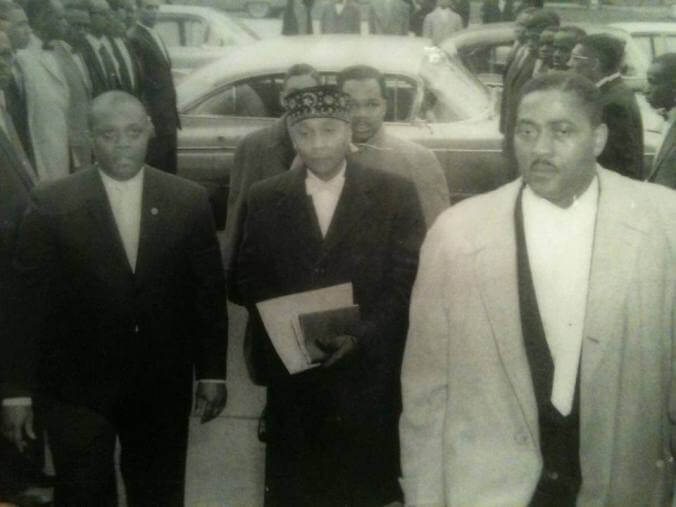
    Joseph Gravitts
    Captain Joseph X Gravitts
    (to the left of Elijah Muhammad)

    Then came a first death plot. One of Malcolm’s own Mosque Seven officials, Captain Joseph X Gravitts, following higher orders, told an assistant to Malcolm to wire his car to explode when he started the engine. The man refused the assignment, told Malcolm of the plot, and saved his life.51 He also freed Malcolm from his attachment to the Nation of Islam. Malcolm was forced to recognize that the NOI’s hierarchy and structure, extending right down into his own mosque, was committed to killing him. He could already see a first ring of death encircling him, comprised of the organization he had developed to serve Elijah Muhammad. From that point on, Malcolm said, he “went few places without constant awareness that any number of my former brothers felt they would make heroes of themselves in the Nation of Islam if they killed me.”52


    On March 8, 1964, with less than a year to live, Malcolm X announced his departure from the Nation of Islam. He said he was organizing a new movement because the NOI had “gone as far as it can.” He was “prepared to cooperate in local civil-rights actions in the South and elsewhere. “53 Malcolm also passed out copies of a telegram he had sent to Elijah Muhammad, in which he stated:

    Despite what has been said by the press, I have never spoken one word of criticism to them about your family … 54

    In spite of everything, Malcolm was trying not to split the NOI, and therefore muffled his criticisms of Elijah Muhammad.

    Two days later, the Nation of Islam sent Malcolm a certified letter telling him and his family to move out of their seven-room house in East Elmhurst, Queens. The Elmhurst house had been home for Malcolm, Betty Shabazz, and their growing family (now with four daughters) since the early days of their marriage when Malcolm and Betty were in the house with John and Minnie Ali. One month after the certified letter, the secretary of Malcolm’s old Mosque Number Seven filed suit in a Queens civil court to have Malcolm and his family evicted. Malcolm would fight for the legal right to stay in the only home he had to pass on to his wife and children, especially since he might soon be killed by the same forces trying to take their house away.55

    On March 12, Malcolm held a press conference in New York and said internal differences within the Nation had forced him out of it. He was now founding a new mosque in New York City, Muslim Mosque, Inc. With a conscious effort to avoid repeating the mistakes of Elijah Muhammad, he said in his “Declaration of Independence” that he was a firm believer in Islam but had no special credentials:

    I do not pretend to be a divine man, but I do believe in divine guidance, divine power, and in the fulfillment of divine prophecy. I am not educated, nor am I an expert in any particular field—but I am sincere, and my sincerity is my credentials.56

    He opened (wide) the door to working with other black leaders, with whom he had traded criticisms, most notably with Martin Luther King Jr. “As of this minute, I’ve forgotten everything bad that the other leaders have said about me, and I pray they can also forget the many bad things I’ve said about them.”57 He then immediately chased King away by saying black people should begin to form rifle clubs to defend their lives and property.

    He concluded:

    We should be peaceful, law-abiding—but the time has come for the American Negro to fight back in self-defense whenever and wherever he is being unjustly and unlawfully attacked. If the government thinks I am wrong for saying this, then let the government start doing its job.58

    Malcolm was aware that the government might think it was its job to silence him.


    Much more threatening to the government than Malcolm’s rifle clubs, which never got off the ground, was the visionary campaign he then initiated to bring U.S. violations of African-Americans’ rights before the court of world opinion in the United Nations. In his April 3, 1964, speech in Cleveland, “The Ballot or the Bullet,” Malcolm began to articulate his international vision:

    We need to expand the civil-rights struggle to a higher level—to the level of human rights. Whenever you are in a civil-rights struggle, whether you know it or not, you are confining yourself to the jurisdiction of Uncle Sam … Civil rights comes within the domestic affairs of this country. All of our African brothers and our Asian brothers and our Latin-American brothers cannot open their mouths and interfere in the domestic affairs of the United States. … But the United Nations has what’s known as the charter of human rights, it has a committee that deals in human rights … When you expand the civil-rights struggle to the level of human rights, you can then take the case of the black man in this country before the nations in the UN. You can take it before the General Assembly. You can take Uncle Sam before a world court. But the only level you can do it on is the level of human rights.59

    In the spring of 1964, Malcolm X had come up with a strategy to internationalize the Civil Rights Movement by re-defining it as a Human Rights Movement, then enlisting the support of African states. Malcolm would proclaim to the day of his death the nation-transcending word of human rights, not civil rights, for all African-Americans. He would also organize a series of African leaders to work together and make that word flesh in the General Assembly of the United Nations. In breaking his bonds to Elijah Muhammad, Malcolm had freed himself to unite African and African-American perspectives in an international coalition for change. For the rest of his life, he was on fire with energy to create that working partnership spanning two continents.

    In breaking his bonds to Elijah Muhammad, Malcolm had freed himself to unite African and African-American perspectives in an international coalition for change.

    The FBI began to realize it had made a major miscalculation. Its COINTELPRO that helped precipitate the divorce between Malcolm X and Elijah Muhammad had, it turned out, liberated Malcolm for a much larger mission than anything he could conceivably have accomplished under Elijah Muhammad. He was suddenly stepping onto an international stage in what could become an unwelcome scenario to the U.S. government. Nevertheless, the Chicago NOI connections that the Bureau had made so carefully in John Ali and other informants could still salvage the COINTELPRO goal of neutralizing Malcolm. Since Malcolm had “rebelled” against Elijah and Chicago, he could now, with Chicago’s help, be forced into silence forever.

    The FBI had a second, growing concern. Despite Malcolm’s offputting talk of rifle clubs, his evolving strategy for an international ballot, not the bullet, was catching the attention of a potential ally whose power went far beyond that of Elijah Muhammad: Martin Luther King Jr.


    Malcolm and Martin met for the first and only time in the nation’s capital on March 26, 1964. They had both been listening to the Senate’s debate on civil rights legislation. Afterwards they shook hands warmly, spoke together, and were interviewed. He grinned and said he was there to remind the white man of the alternative to Dr. King. King offered a militant alternative of his own, saying that if the Senate kept on talking and doing nothing, a “creative direct action program” would start. If the Civil Rights Act were not passed, he warned, “our nation is in for a dark night of social disruption.”60

    Malcolm and MLK
    Malcolm and Martin (March 26, 1964)

    Although Malcolm and Martin would continue to differ sharply on nonviolence and would never even see each other again in the 11 months Malcolm had left, there was clearly an engaging harmony between the two leaders standing side by side on the Capitol steps. Given Malcolm’s escalation of civil rights to human rights and King’s emphasis upon ever more disruptive, massive civil disobedience, their prophetic visions were becoming more compatible, even complementary. The FBI and CIA, studying the words and pictures of that D.C. encounter in their midst, could hardly have failed to recognize a threat to the status quo. If Malcolm X and Martin Luther King Jr. were to join efforts, they could ignite an explosive force for change in the American system. The FBI and CIA had to face a question paralleling that of the New York police who had witnessed Malcolm’s crowd dispersal. Should any two men have that kind of power against the system?

    On the same day Malcolm and Martin shook hands in Washington, the FBI’s NOI connections were proving to be an effective part of an action in Chicago to further isolate Malcolm, setting him up for his murder.

    Philbert X Little, Malcolm’s brother, was Elijah Muhammad’s minister in Lansing, Michigan. The Messenger and his NOI managers ordered Philbert to report to Chicago, where they arranged a press conference for him on March 26 of 1964. John Ali then handed Philbert a prepared statement. Ali told Philbert to read it to the media. Philbert had never seen the text before. As he read it for the first time (aloud and in a monotone) he heard himself denouncing Malcolm in terms that threatened Malcolm’s converts from the Nation of Islam.

    I see where the reckless efforts of my brother Malcolm will cause many of our unsuspecting people, who listen and follow him, unnecessary loss of blood and life.61 … the great mental illness which beset my mother whom I love and one of my brothers … may now have taken another victim … my brother Malcolm.62

    Malcolm responded to the news of his brother’s apparent attack on him by saying,

    We’ve been good friends all our lives. He has a job he needs; that’s why he said what he did … I know for a fact that they flew him in from Lansing, put a script in his hand and told him to read it.63

    Philbert himself confirmed years later that “the purpose of making that statement was to fortify the Muslims. That’s why I was brought to Chicago. When I got ready to make my statement, John Ali put a paper in front of me and told me I should read that. So I read the statement that was very negative for my mother. And it was negative against Malcolm. I wouldn’t have read it over the air, you see, if I had looked at it. I asked John Ali about it and he says, ‘That’s just a statement that was prepared for you to read.’ He said, ‘I know the Messenger will be very pleased with the way you read it,’ and that was it.”64

    The vision to which Malcolm X was converted by his experience at Mecca determined the way in which he would meet his death. He called that vision ‘brotherhood’.

    Elijah Muhammad’s vengeance toward Malcolm was still being fueled by the FBI’s COINTELPRO. At the time of “Philbert’s statement,” the FBI sent Elijah one of its fake letters complaining about his relationships with his secretaries. The letter succeeded in making Elijah suspect Malcolm had written it. On April 4, 1964 an FBI electronic bug recorded Elijah telling one of his ministers, who had also received a copy of the letter, that the presumed writer Malcolm “is like Judas at the Last Supper.”65

    In recognition that his 12 years proclaiming the word of Elijah Muhammad had left him poorly prepared for his new mosque’s ministry, Malcolm decided to re-discover Islam by making his pilgrimage to Mecca.

    Malcolm at Mecca
    Malcolm at Mecca (1964)

    In a life of changes, Malcolm’s most fundamental change began at Mecca. At the conclusion of his pilgrimage, he was asked by other Muslims what it was about the Hajj that had most impressed him. He surprised them by saying nothing of the holy sites or the rituals but extolling instead the multi-racial community he had experienced.

    “The brotherhood!” he said, “The people of all races, colors, from all over the world coming together as one! It has proved to me the power of the One God.”66

    The vision to which Malcolm X was converted by his experience at Mecca determined the way in which he would meet his death. He called that vision “brotherhood.” Had he lived a while longer, he would have added “and sisterhood.” In his final months, Malcolm also began to change noticeably in his recognition of women’s rights and leadership roles. His conversion at Mecca was to a vision of human unity under one God. From that point on, his consciousness of one human family, in the sight of one God, sharpened his perceptions, deepened his courage, and opened his soul to whatever further changes Allah had in store for him. Consistent with all those changes, Malcolm’s experience of the truth of brotherhood radicalized still more his resistance to racism. His conversion to human unity was not to a phony blindness to the reality of prejudice, but on the contrary, to a greater understanding of its evil in God’s presence. He was even more determined to confront it truthfully. Concluding his answer to his fellow pilgrims on his Hajj, Malcolm returned to his lifelong focus on racism, set now in the context of the experience he had at Mecca of his total acceptance by pilgrims of all colors.

    “To me,” he said, “the earth’s most explosive and pernicious evil is racism, the inability of God’s creatures to live as One, especially in the Western world.” 67

    Malcolm, Nkrumah, Faisal
    Malcolm & Kwame Nkrumah; with Prince Faisal

    Following his pilgrimage to Mecca, Malcolm met with two influential heads of state, Prince Faisal of Arabia and President Kwame Nkrumah of Ghana. They acknowledged Malcolm as a respected leader of black Americans, who now represented also a true Islam. Prince Faisal of oil-rich Arabia made Malcolm a guest of the state. Ghana’s anti-colonialist Kwame Nkrumah, a leader of newly independent African states, told his African-American visitor something Malcolm said he would never forget:

    Brother, it is now or never the hour of the knife, the break with the past, the major operation.68

    Nkrumah’s sense of the hour of the knife was right, but his hope that it would be a knife of freedom cutting through a history of oppression would go unfulfilled. Only nine months later, Malcolm would be murdered.

    A year after that, Nkrumah, upon publishing his book Neo-Colonialism: The Last Stage of Imperialism, dedicated to “the Freedom Fighters of Africa, living and dead,” would be overthrown by a CIA-backed coup.69


    “The case to be presented to the world organization … would compel the United States Government to face the same charges as South Africa and Rhodesia.”

    Malcolm also visited Egypt, Lebanon, Nigeria, Liberia, Senegal, Morocco, and Algeria. Upon his return to the U.S. on May 21, 1964, the New York Times published an article on his trip that further alerted intelligence agencies to Malcolm’s quest for a UN case against the U.S. Malcolm told reporters he had “received pledges of support from some new African nations for charges of discrimination against the United States in the United Nations.”

    The case to be presented to the world organization,” he asserted, “would compel the United States Government to face the same charges as South Africa and Rhodesia.”70

    While Malcolm was working abroad to put the U.S. on trial at the UN, the New York Police Department was infiltrating his new Muslim Mosque with its elite intelligence unit, the Bureau of Special Service and Investigation (BOSSI). To the cold warriors in the ’60s who knew enough beneath the surface to know at all about BOSSI, the NYPD’s undercover force was regarded as “the little FBI and the little CIA.” The accolade reflected the fact that the information gathered by BOSSI’s spies was passed on regularly to federal intelligence agencies.71

    Tony Ulasewicz
    BOSSI operative
    Tony Ulasewicz

    The BOSSI men who ran the deep cover operation in Muslim Mosque were detectives Tony Ulasewicz and Teddy Theologes. Four years after Tony Ulasewicz’s undercover work on Malcolm X, “Tony U,” as he was known, would retire from the NYPD to go to work as President Richard Nixon’s private detective. He would then take part in a series of covert activities that would be brought to light in the Senate Watergate Hearings and memorialized in his own book, The President’s Private Eye,72 which is also a valuable resource on BOSSI. Both in his book and his life, Tony U moves with ease between the overlapping undercover worlds of the New York Police Department, federal intelligence agencies, and the White House. In the BOSSI chain of command, Tony U was a field commander. He had to keep his operators’ identities totally secret as he ran their surveillance and probes of various sixties organizations ranging from the Revolutionary Action Movement (RAM) to the American Nazi Party. Equally important, he had to keep his own behind-the-scenes identity completely separate from theirs, with his name never linked to the report of any agent of his. Otherwise he might be called to testify in court, opening up an operation, an event to be avoided at all costs.73 Tony U’s deep cover men were therefore, in the last analysis, on their own.

    Teddy Theologes acted in the BOSSI command, in Tony U’s words, “as a cross between a drill sergeant and a priest.”74 Reflecting on his career decades later in an interview, Theologes said some of the BOSSI deep cover recruits “needed constant attention. I would have to sit down with them, and almost be a father, brother, psychiatrist, and doctor.75 From the standpoint of agents risking their lives who knew their superiors would never admit to knowing them, the need for such a relationship can be understood.

    Gene Roberts
    Gene Roberts

    On April 17, 1964, four days after Malcolm left New York on his pilgrimage to Mecca, Ulasewicz and Theologes sent their newly sworn-in, 25-year-old, black detective Gene Roberts on his undercover journey into the Muslim Mosque, Inc. Gene Roberts had just completed four years in the Navy. Roberts was interviewed by Tony Ulasewicz and Teddy Theologes when he passed the police exam. He was asked to become a deep cover agent in a militant organization under Malcolm X. Roberts had heard of Malcolm X but knew little about him. As a military man, he accepted the order to infiltrate Malcolm’s group without questioning it. On April 17, he was sworn in as a police officer and given his badge. A few hours later, Teddy Theologes took the badge away from him. He was on his own. Then his BOSSI superiors sent Roberts out on his mission in Harlem.76

    Gene Roberts has described how he proceeded step by step into becoming one of Malcolm’s bodyguards:

    Basically they said, go up to 125th Street—where Malcolm had his headquarters—and get involved. And that’s what I did. I ended up getting involved in a couple of riots. The main thing was I was there. I met members of his organization. They accepted me. My cover was I worked for a bank. I told them about my martial arts experience, so I became one of Malcolm’s security people. When he came back from Mecca and Africa, I went wherever he went, as long as it was in the city.77

    Since he was supposedly a bank worker, Roberts followed a schedule of typing up his BOSSI reports, at his Bronx home during the day. He typed reports on what he had learned by being “Brother Gene” with Malcolm and his community during the night.78 As Roberts suspected and would later confirm, he was not the only BOSSI agent in the group, although he had gained the greatest access to Malcolm. When Ulasewicz and Theologes received his and other deep cover dispatches, they passed them up the line to BOSSI Supervisor Barney Mulligan. It was Lieutenant Mulligan’s responsibility to file all the undercover information (without ever identifying the informants) at BOSSI headquarters. While there, BOSSI’s secret fruit was shared generously with the FBI.

    On May 23, 1964, Louis Lomax and Malcolm X took part in a friendly debate at the Chicago Civic Opera House. As Lomax began his opening speech and looked down from the stage, he was struck with fear. For there in the audience staring back up at him was John Ali, accompanied by a group of NOI men who were being deployed at strategic locations in the hall.79 Ali had become the nemesis of Lomax as well as Malcolm because of Lomax’s having written about Ali’s FBI connection. Malcolm’s, Ali’s, and Lomax’s lives were intertwined. When John Ali was Malcolm’s top advisor and housemate, he had arranged the first meeting between Malcolm and Lomax. The three men had then worked together on the first issues of the NOI newspaper. When Malcolm’s and Ali’s home was invaded by the New York police, Louis Lomax had written the most thorough story on it.80

    In his Chicago speech, given only two days after his return from Mecca and Africa, Malcolm sounded open to white people as well as blacks, as impassioned as ever, and in the terms he used, even radically patriotic:

    My pilgrimage to Mecca … served to convince me that perhaps American whites can be cured of the rampant racism which is consuming them and about to destroy this country. In the future, I intend to be careful not to sentence anyone who has not been proven guilty.

    I am not a racist and do not subscribe to any of the tenets of racism. In all honesty and sincerity it can be stated that I wish nothing but freedom, justice and equality: life, liberty and the pursuit of happiness—for all people. My first concern is with the group of people to which I belong, the Afro-Americans, for we, more than any other people, are deprived of these inalienable rights.81

    However, in his post-Mecca life, this radically open Malcolm X was once again a target, as he and Lomax could see when they looked down into the eyes of John Ali and his companions. At the debate’s conclusion, Malcolm and Lomax departed from the rear of the hall under a heavy Chicago police escort.82 It was one in a series of occasions when Malcolm would gladly accept the protection of a local police department that was genuinely concerned about his safety.

    Also near the end of May 1964, the five men who would kill Malcolm X in the Audubon Ballroom nine months later came together for the first time. We know the story, thanks to the confession of the only one of the five who would ever go to jail for the crime, Talmadge Hayer. According to Hayer’s affidavit, sworn to in prison in 1978 to exonerate two wrongly convicted co-defendants,83 it all began when he was walking down the street one day in Paterson, New Jersey. A car pulled up beside him. Inside it were two men who, like Hayer, belonged to the Nation of Islam’s Mosque Number 25 in Newark—Benjamin Thomas and Leon Davis, known to Hayer as Brothers Ben and Lee. They asked Hayer to get in the car so they could talk. “Both of these men,” he said, “knew that I had a great love, respect, and admiration for the Honorable Elijah Muhammad.”84

    While the three men drove around Paterson, Hayer learned from Thomas and Davis that “word was out that Malcolm X should be killed.” Hayer said in his confession he didn’t know who had passed that word on, but he thought Ben knew. He in fact had good grounds for thinking Ben knew, inasmuch as Benjamin Thomas was the assistant secretary of the Newark Mosque and knew well the NOI chain of command. Hayer also said it was Ben who had spoken first to Leon, before the two of them spoke with him. After hearing from them how Malcolm X was spewing blasphemies against Mr. Muhammad, he said what they wanted to hear, “It’s just bad, man, something’s got to be done,”85 and agreed to take part in the plot.

    As Hayer told Malcolm biographer Peter Goldman in a prison interview,

    I didn’t ask a whole lot of questions as to who’s giving us instructions and who’s telling us what, because it just wasn’t a thing like that, man. I thought that somebody was giving instructions: ‘Brothers, you got to move on this situation.’ But I felt we was in accord. We just knew what had to be done.86

    Thomas, Davis, and Hayer soon got together with two more members of the Newark Mosque who also knew what had to be done, William X and Wilbur X. As male members of the Nation of Islam, all five men belonged to the Fruit of Islam (FOI), a paramilitary training unit.87 FOI training was meant ideally for self-defense. However, with its combination of discipline, obedience, and unquestioning loyalty to the Messenger, it had degenerated into an enforcement agency for the will of Elijah Muhammad and the NOI hierarchy. Malcolm X, with his certain knowledge that FOI teams like the five men in Newark were being organized to kill him, said sharply in a June 26, 1964, telegram to Elijah Muhammad:

    Students of the Black Muslim Movement, know that no member of the Fruit of Islam will ever initiate an act of violence unless the order is first given by you. … No matter how much you stay in the background and stir others up to do your murderous dirty work, any bloodshed committed by Muslim against Muslim will compel the writers of history to declare you guilty not only of adultery and deceit, but also of Murder.88

    In his affidavit, Talmadge Hayer said the five men from the Newark Mosque began meeting to decide how to carry out the killing. Sometimes, he said, they would just drive around in a car for hours talking about it.89 Since Malcolm was on the verge of making another even longer trip to Africa, they would have to bide their time. In the meantime, there were other killing teams who were united in the same purpose. Several would almost succeed. But in the end, it would be the five Newark plotters who would finally do what had to be done at the Audubon Ballroom.


    It is a temptation to sentimentalize Malcolm, but Malcolm did not sentimentalize himself. He knew what he was capable of doing, what he had done, and what he had trained the Fruit of Islam to do. They were now prepared to do it, as he knew, to him.

    On June 13, 1964, the NOI’s suit to force Malcolm and his family out of the East Elmhurst house began to be heard in Queens Civil Court. The courtroom was divided into two hostile camps, Malcolm’s supporters and the NOI contingent. At this point the police department clearly acknowledged in action the immediate danger to Malcolm’s life. It had 32 uniformed and plainclothes officers present, “surrounding him so impermeably,” as reporter Peter Goldman put it, “that he could barely be seen from the gallery.”90 Some of the press remained skeptical of the threat to Malcolm. He insisted to reporters that he knew the NOI men were capable of murder “because I taught them.”91

    This statement that Malcolm repeated about his NOI past was apparently no exaggeration. Dr. Alauddin Shabazz, who was ordained by Malcolm as an NOI minister, told me in an interview: “Malcolm had had people killed. When Malcolm found a guy in the nation who was an agent, Malcolm didn’t hesitate to do something to him. I have seen Malcolm take a hammer and knock out the bottom bridges of a guy’s teeth.

    [An undercover police agent] was once caught setting up an [electronic] bug in the wall of the office. Malcolm was questioning him. And Malcolm had a funny way of questioning people. He would stand with his back to you, like he didn’t want to look at your disgusting face—if he thought you were doing something to aid BOSSI or the agencies. And this guy had been caught. Malcolm turned around. He had a hammer on the desk. He turned around with the hammer and hit him in the face. I was there. It was in the early ’60s.92

    It is a temptation to sentimentalize Malcolm, but Malcolm did not sentimentalize himself. He knew what he was capable of doing, what he had done, and what he had trained the Fruit of Islam to do. They were now prepared to do it, as he knew, to him.


    The Queens eviction hearing was especially significant for what Malcolm chose to reveal during his June 16 testimony: “[T]hat the Honorable Elijah Muhammad had taken on nine wives.”93 At about the same time as Malcolm made the issue public, one of Elijah Muhammad’s sons made a statement that was in effect a warrant for Malcolm’s death. It was prompted by a phone call from someone claiming to be “Malcolm.” This person told the NOI that Elijah Muhammad would be killed while giving his speech the following day.94 In response to this provocation (in conflict with the real Malcolm’s pleas to his followers to avoid a confrontation), Elijah Muhammad Jr. told a meeting of the Fruit of Islam at a New York armory:

    That house is ours, and the nigger don’t want to give it up. Well, all you have to do is go out there and clap on the walls until the walls come tumbling down, and then cut the nigger’s tongue out and put it in an envelope and send it to me, and I’ll stamp it approved and give it to the Messenger.95

    The judge would rule three months later that the house belonged to the Nation of Islam, and that Malcolm and his family had to leave. Malcolm appealed, which delayed the eviction until the final week of his life.

    On June 27, 1964, the FBI wiretapped a phone call in which Malcolm X asked an unidentified woman (an office worker … Betty Shabazz?) if Martin Luther King’s attorney Clarence Jones had called him.96 The woman said, yes, she had a message from Jones asking Malcolm to call him back. The reason Jones wanted to speak with Malcolm, she said, was “that Rev. King would like to meet as soon as possible on the idea of getting a human rights declaration.” She then emphasized to Malcolm, “He is quite interested.”97

    However, in the 12 short days left before Malcolm departed again for Africa, he and King were not able to arrange a meeting to explore their mutual interest in a human rights declaration. Nor would they ever manage to see each other again in the three months remaining in Malcolm’s life once he returned to the U.S., though they would just miss doing so in Selma, Alabama. Nevertheless, through its electronic surveillance of both men, the FBI knew that Malcolm X and Martin Luther King Jr. were hoping to connect on the human rights issue that could put the U.S. on trial in the United Nations.

    On June 28, 1964, Malcolm announced his formation of the Organization of Afro-American Unity (OAAU), with its headquarters at the Theresa Hotel in Harlem. Whereas the Muslim Mosque, Inc. was faith-oriented, the OAAU would be politically oriented.98 The OAAU would be patterned after the letter and spirit of the Organization of African Unity established by African heads of state the year before at their meeting in Ethiopia. The OAAU’s founding statement emphasized that “the Charter of the United Nations, the Universal Declaration of Human Rights, the Constitution of the U.S.A. and the Bill of Rights are the principles in which we believe.”99 The intended outreach of Malcolm’s organization was transcontinental, including “all people of African descent in the Western Hemisphere, as well as our brothers and sisters on the African continent.”100 Yet the organizing would also be local and civic:

    The Organization of Afro-American Unity will organize the Afro-American community block by block to make the community aware of its power and potential; we will start immediately a voter registration drive to make every unregistered voter in the Afro-American community an independent voter.101

    Thanks to Mecca, Malcolm had broken free from his old allegiance to Elijah Muhammad’s idea of a separate black state. He was now organizing an international campaign for Afro-American liberation based on the principles of the U.S. Constitution and the UN Charter. He had become a faith-based organizer on an international scale. His OAAU founding statement, while consistent with the Civil Rights Movement, took the struggle into a new arena, the United Nations. Malcolm would now seek further support for his UN human rights campaign by a July-November barnstorming trip through Africa.

    In addition to NYPD and FBI surveillance, the Central Intelligence Agency was also following Malcolm. The Agency knew Malcolm planned to appeal to African leaders at the second conference of the Organization of African Unity (OAU).

    At 11:37 p.m., on July 3, 1964, Malcolm phoned the New York Police Department to report that “two Black Muslims were waiting at his home to harm him. … But he sped off when they approached his car.”102 Malcolm knew the name of one of the two men, and gave it to the police.103

    The NYPD refused to believe Malcolm. They passed on their official skepticism in a July 4 teletype to the FBI: “Police believed complaint on an attempt on Malcolm’s life was a publicity stunt by Malcolm.”104 By its phone tap, the FBI had heard Malcolm make his report at the same time the NYPD did. The Bureau summarized the event with its own judgment on Malcolm: “Information [on 7/4/64] that MALCOLM and his followers were attempting to make a big issue out of the reported attempt on Macolrn’s life in order to get the Negro people to support him.105


    Thus began the official NYPD and FBI line that Malcolm was fabricating attempts on his life for the sake of publicity. This disclaimer would be made publicly by the NYPD in the week before Malcolm’s murder, in an effort to justify the withdrawal of police protection at the time of escalating threats on his life.

    On July 9, Malcolm departed from New York on the African trip that would consume four and a half of the remaining seven and a half months of his life. It was to be the final, most ambitious project of his short life. As his plane lifted off from JFK Airport on its way to Cairo, Malcolm was happily unaware of what John Ali was saying that same night on a Chicago call-in radio program:

    Malcolm X probably fears for his safety because he is the one who opposes the Honorable Elijah Muhammad. The Holy Koran, the book of the Muslims, says “seek out the hypocrites and wherever you find them, weed them out.” … There were people who hated Kennedy so much that they assassinated him—white people. And there were white people who loved him so much they would have killed for him. You will find the same thing true of the Honorable Elijah Muhammad … I predict that anyone who opposes the Honorable Elijah Muhammad puts their life in jeopardy … 106

    “… after every one of my trips abroad, America’s rulers see me as being more and more dangerous. That’s why I feel in my bones the plots to kill me have already been hatched in high places. The triggermen will only be doing what they were paid to do.”

    In addition to NYPD and FBI surveillance, the Central Intelligence Agency was also following Malcolm. The Agency knew Malcolm planned to appeal to African leaders at the second conference of the Organization of African Unity (OAU), which he was attending in Cairo in July as an honored observer. No other American was allowed in the door. In a July 10 CIA memorandum, an informant stated that Malcolm X was “transporting material dealing with the ill treatment of the Negro in the United States. He intends to make such material available to the OAU in an effort to embarrass the United States.”107


    In Cairo, Malcolm was constantly aware of agents following him. They made their presence obvious in an effort to intimidate him. Then on July 23, as Malcolm prepared to present his UN appeal to Africa’s leaders, he was poisoned. He described the experience later to a friend:

    I was having dinner at the Nile Hilton with a friend named Milton Henry and a group of others, when two things happened simultaneously. I felt a pain in my stomach and, in a flash, I realized that I’d seen the waiter who served me before. He looked South American, and I’d seen him in New York. The poison bit into me like teeth. It was strong stuff. They rushed me to the hospital just in time to pump the stuff out of my stomach. The doctor told Milton that there was a toxic substance in my food. When the Egyptians who were with me looked for the waiter who had served me, he had vanished. I know that our Muslims don’t have the resources to finance a worldwide spy network.108

    The friend who witnessed this event, Detroit civil rights attorney Milton Henry, warned Malcolm that his UN campaign could mean his death. Henry later felt in retrospect that it did: “In formulating this policy, in hitting the nerve center of America, he also signed his own death warrant.”109 Malcolm, being Malcolm, recognized the truth of Henry’s warning, and went right on ahead with his campaign.

    At the OAU conference, Malcolm submitted an impassioned, eight-page memorandum urging the leaders of Africa to recognize African-Americans’ problems as their problems and to indict the U.S. at the UN:

    Your problems will never be fully solved until and unless ours are solved. You will never be fully respected until and unless we are also respected. You will never be recognized as free human beings until and unless we are also recognized and treated as human beings. Our problem is your problem. It is not a Negro problem, nor an American problem. This is a world problem, a problem for humanity. It is not a problem of civil rights but a problem of human rights. In the interests of world peace and security, we beseech the heads of the independent African states to recommend an immediate investigation into our problem by the United Nations Commission on Human Rights.110

    Malcolm at OAU
    Malcolm at OAU

    Malcolm was encouraged by the response he received from the OAU. Although the resolution the conference passed in support of the African-American struggle used only moderate language, Malcolm told Henry that several delegates had promised him their official support in bringing up the issue legally at the United Nations.111

    OAU founders
    OAU Founders

    Malcolm then built on the foundations he had laid at the African summit. For four months he criss-crossed Africa, holding follow-up meetings with the leaders who encouraged him most in Cairo. He held long discussions with President Gamal Abdel Nasser of Egypt, President Julius Nyerere of Tanzania, President Jomo Kenyatta of Kenya, Prime Minister Milton Obote of Uganda, President Azikiwe of Nigeria, President Kwame Nkrumah of Ghana, Prime Minister Ahmed Ben Bella of Algeria, and President Sekou Toure of Guinea.112 There were other African heads of state Malcolm talked with, he said, “whose names I can’t mention.”113 At the height of the Cold War, Malcolm X had gained access to Africa’s most revolutionary leaders on a politically explosive issue.

    Neutralist leaders
    The neutralist leaders
    (Nehru, Nkrumah, Nasser, Sukarno, Tito)

    Reflecting on these meetings, Malcolm told a friend in London shortly before his death,

    Those talks broadened my outlook and made it crystal clear to me that I had to look at the struggle in America’s ghettos against the background of a worldwide struggle of oppressed peoples. That’s why, after every one of my trips abroad, America’s rulers see me as being more and more dangerous. That’s why I feel in my bones the plots to kill me have already been hatched in high places. The triggermen will only be doing what they were paid to do.114

    U.S. intelligence agencies were in fact monitoring Malcolm’s campaign in Africa with increasing concern. The officials to whom they reported these developments began to express their alarm publicly. As a New York Times article, written in Washington revealed on August 13, 1964, “The State Department and the Justice Department have begun to take an interest in Malcolm X’s campaign to convince African states to raise the question of persecution of American Negroes at the United Nations.”

    After recapitulating Malcolm’s appeal to the 33 OAU heads of state, the Times article stated:

    [Washington] officials said that if Malcolm succeeded in convincing just one African Government to bring up the charge at the United Nations, the United States Government would be faced with a touchy problem. The United States, officials here believe, would find itself in the same category as South Africa, Hungary, and other countries whose domestic politics have become debating issues at the United Nations. The issue, officials say, would be of service to critics of the United States, Communist and non-Communist, and contribute to the undermining of the position the United States has asserted for itself as the leader of the West in the advocacy of human rights.115

    The Times reported that Malcolm had written a friend from Cairo that he did indeed have several promises of support from African states in bringing the issue before the United Nations. According to another diplomatic source, Malcolm had not been successful, “but the report was not documented and officials here today conceded the possibility that Malcolm might have succeeded.”116

    The article also said somewhat ominously;

    Although the State Department’s interest in Malcolm’s activities in Africa is obvious, that of the Justice Department is shrouded in discretion. Malcolm is regarded as an implacable leader with deep roots in the Negro submerged classes.

    “[He] has, for all practical purposes, renounced his U.S. citizenship.” ~ Benjamin H. Read, assistant to Dean Rusk, insisting the CIA investigate Malcolm X

    These two sentences, which were removed from the article in the national edition of the Times,117 where an oblique reference to concerns about Malcolm then being expressed not only by the State and Justice Departments but also by the CIA, FBI, and the Johnson White House. These concerns are revealed by a memorandum, written two days before the Times article, addressed to the CIA’s Deputy Director of Plans (covert action) Richard Helms. As researchers know, the desk of Richard Helms—a key player in CIA assassination plots—was perhaps the most dangerous place possible for a report on a perceived security risk to end up. According to the August 11, 1964, CIA memorandum to Helms, the Agency claimed it had learned from an informant that Malcolm X and “extremist groups” were being funded by African states in fomenting recent riots in the U.S. The State Department, the CIA memo continued, “considered the matter one of sufficient importance to discuss with President Johnson who, in turn, asked Mr. J. Edgar Hoover to secure any further information which he might be able to develop.”118

    As Malcolm analyst Karl Evanzz has noted,

    In fact, the CIA knew the allegations were groundless. In an FBI memorandum dated July 25, a copy of which was sent to [the CIA’s] Clandestine Services, an agent specifically stated that the informant’ said he didn’t mean to imply that Africans were financing Malcolm X.119

    The CIA’s August 11 memo also stated that Benjamin H. Read, an assistant to Secretary of State Dean Rusk, wanted the CIA to probe both Malcolm X’s domestic activities and “travels in Africa” to determine “what political or financial support he may be picking up along the way.” The CIA memo’s author had told Read, coyly, in response that “there were certain inhibitions concerning our activities with respect to citizens of the United States.” Read had overridden the objection, insisting the CIA act because, “after all, Malcolm X has, for all practical purposes, renounced his U.S. citizenship.”120

    As of no later than August 11, 1964 (and perhaps before), the CIA’s Deputy Director of Plans had been authorized to act on Malcolm X. Malcolm was perceived, for all practical purposes, to have renounced his U.S. citizenship and to have become a touchy problem to the U.S. government if he gained so much as one African state’s support for his UN petition. Malcolm had not read any such CIA documents on himself, but he had seen the August 13 Times article. He could read his future between its lines, just as Milton Henry had already done in terms of the sensitivity of Malcolm’s UN campaign.


    John Lewis
    John Lewis

    John Lewis, a leader in the Student Nonviolent Coordinating Committee (SNCC) who would go on to become a member of Congress, was then touring Africa to connect with the freedom movement there. Lewis and the SNCC friends who were with him knew all too well that Malcolm was also in Africa. As soon as they met anyone in Africa, the first question they would inevitably be asked was: “What’s your organization’s relationship with Malcolm’s?”121 The men discovered that no one would listen to them if they were seen as being any less revolutionary than Malcolm, who seemed to have taken all of Africa by storm. On his return to the U.S. Lewis wrote in a SNCC report: “Malcolm’s impact on Africa was just fantastic. In every country he was known and served as the main criteria for categorizing other Afro-Americans and their political views.”122

    Lewis was startled to run into Malcolm in a café in Nairobi, Kenya, as he had thought Malcolm was traveling in a different part of Africa at the time. Malcolm, recognizing Lewis, smiled and asked what he was doing there. Reflecting on their encounter in his memoir, Walking With the Wind, Lewis thought Malcolm was very hopeful from the overwhelming reception he had received in Africa “by blacks, whites, Asians and Arabs alike.” It “had pushed him toward believing that people could come together.”123

    However, something else Malcolm shared with the SNCC group “was a certainty that he was being watched, that he was being followed … In a calm, measured way he was convinced that somebody wanted him killed.”124 John Lewis’ meeting with Malcolm in Kenya would be the last time he would see him alive.

    Louis Farrakhan
    Louis Farrakhan (1965)

    Malcolm kept extending his stay in Africa. He had planned to be away six weeks. After 18 weeks abroad, he finally flew back to New York on November 24, 1964. He was confronted, soon after his return, with a December 4 issue of Muhammad Speaks. The issue featured an attack upon him by Minister Louis X, of the NOI’s Boston mosque. Louis X had not long before been a friend and devoted disciple to Malcolm. Now calling Malcolm “an international hobo,” Louis X made a statement against Malcolm that would haunt the speaker for the rest of his life, under his better-known name, Minister Louis Farrakhan:

    The die is set, and Malcolm shall not escape, especially after such evil, foolish talk about his benefactor, Elijah Muhammad, in trying to rob him of the divine glory which Allah had bestowed upon him. Such a man as Malcolm is worthy of death, and would have met with death if it had not been for Muhammad’s confidence in Allah for victory over his enemies.125

    Louis Farrakhan has never admitted to having participated in the plot to kill Malcolm. He has acknowledged from 1985 on that his above words “were like fuel on a fire” and “helped create the atmosphere” that moved others to kill Malcolm. Farrakhan made essentially the same carefully worded statement to four interviewers: Tony Brown in 1985, Spike Lee in 1992, Barbara Walters on 20/20 in 1993, and Mike Wallace on 6o Minutes in 2000. His words to Spike Lee were: “I helped contribute to the atmosphere that led to the assassination of Malcolm X.”126

    His clearest statement on Malcolm’s murder may be at question. In a 1993 speech to his NOI congregation, Minister Farrakhan, referring to Malcolm, asked bluntly, “And if we dealt with him like a nation deals with a traitor, what the hell business is it of yours?”127

    Alex Quaison-Sackey
    Alex Quaison-Sackey

    The timing of Malcolm’s late November return to the U.S. seemed providential in terms of his work at the United Nations. On December 1, his close friend, Alex Quaison-Sackey of Ghana, was elected President of the UN General Assembly. Following Malcolm’s lead, Quaison-Sackey was becoming increasingly outspoken against U.S. policies. Quaison-Sackey gave Malcolm’s human rights campaign a further boost by arranging for him to open an office at the UN in the area that was used by provisional governments.128

    The FBI’s New York field office pointed out to J. Edgar Hoover in a December 3 memo the alarming facts that Malcolm X and newly elected UN leader Quaison-Sackey had been friends for four years, and that they had also met several times recently. The New York office, which worked closely with the NYPD’s undercover BOSSI unit, suggested to Hoover “that additional coverage of [Malcolm X’s] activities is desirable particularly since he intends to have the Negro question brought before the United Nations (UN).”129

    During December’s UN debate on the Congo, Malcolm’s influence began to be heard in the speeches of African leaders. For example, Louis Lansana Beavogui, Guinea’s foreign minister, asked why “so-called civilized governments” had not spoken out against “the thousands of Congolese citizens murdered by the South Africans, the Belgians, and the [anti-Castro] Cuban refugee adventurers. Is this because the Congolese citizens had dark skins just like the colored United States citizens murdered in Mississippi?”130


    In a January 2, 1965, article, the New York Times described the Malcolm X impetus behind this challenging turn in African attitudes. It noted that the policy proposed by Malcolm that “linked the fate of the new African states with that of American Negroes” was being adopted by African governments. The article said, “the African move profoundly disturbed the American authorities, who gave the impression that they had been caught off-guard.”131

    Those working behind the scenes were not caught off guard, however, as the knowledgeable author of the article, M.S. Handler, was quick to suggest. Handler had also written the August 13 Times piece from Washington. He went on to repeat what he had reported then, that “early last August the State Department and Justice Department began to take an interest in Malcolm’s activities in North Africa”—accompanied, as we know, by a parallel interest and stepped-up actions by the CIA and FBI. Handler traced the heightened government interest to Malcolm’s opening “his campaign to internationalize the American Negro problem at the second meeting of the 33 heads of independent African states in Cairo, which convened July 17.”132

    When the January 2 Times article appeared, Malcolm had seven weeks left to live. Much of the remaining time was devoted to his constant speaking trips throughout the U.S., up to Canada, and over to Europe. Malcolm lived each day, hour, and minute as if it were his last, for he knew how committed the forces tracking him were to killing him. Within the U.S., Fruit of Islam killing squads were waiting for him at every stop. Malcolm knew it was only a matter of time.

    On January 28, 1965, Malcolm flew to Los Angeles to meet with attorney Gladys Towles Root and two former NOI secretaries who were filing paternity suits against Elijah Muhammad.133 Malcolm felt personally responsible for having put the two women in a position of vulnerability to Elijah Muhammad. He told a friend, “My teachings converted these women to Elijah Muhammad. I opened their mind for him to reach in and take advantage of them.”134 He had come to Los Angeles, in preparation for testimony in support of the women, “to undo what I did to them by exposing them to this man.”135

    From the time Malcolm arrived at the Los Angeles Airport in mid-afternoon until his departure the next morning, he was trailed by the Nation of Islam. The two friends who met him, Hakim A. Jamal and Edmund Bradley, had alerted airport security to a possible NOI attack. As Jamal and Bradley waited at the gate, they noticed a black man seated behind them inconspicuously reading a newspaper. The man was John Ali. Although Malcolm’s Los Angeles trip had been a closely held secret, someone monitoring his conversations was feeding the information to Ali. Malcolm’s arrival gate was switched at the last moment, and security police rushed him and his companions safely through the airport to a car.136

    At his Statler Hilton Hotel, Malcolm repeatedly had to run a gauntlet of menacing NOI men stationed in the lobby. Bradley saw John Ali and the leaders of an NOI mosque in Los Angeles get out of a car in front of the hotel. Malcolm, Jamal, and Bradley left quickly in their own car to meet with the two secretaries and attorney Root. When Bradley drove Malcolm back to the airport in the morning, two carloads of NOI teams started to pull alongside their car. Malcolm picked up Bradley’s cane and stuck it out a window like a rifle. The two cars fell back. Police waiting at the airport escorted Malcolm safely to his plane.137

    During his next three days in Chicago, Malcolm was under the steady guard of the Chicago police. He was also under the watchful eyes of 15 NOI men who lingered at the entrance to his hotel. In their presence, Malcolm whispered to a Chicago police detective, “Those are all Black Muslims. At least two of them I recognize as being from New York. Elijah seems to know every move I make.”138 Malcolm would realize later that it had to be someone more powerful than Elijah who was making it possible for his troops to always be one step ahead of Malcolm.

    Malcolm testified before the Illinois Attorney General, who was investigating the Nation of Islam. The next day in a television interview, Malcolm described efforts to kill him. He said he had a letter on his desk identifying the persons assigned to kill him.139 He was accompanied everywhere by the Chicago police, who finally took him back safely to O’Hare Airport for his flight to New York.

    Later that week, Malcolm X once again almost connected with Martin Luther King Jr. The place was Selma, Alabama. The date was February 4, 1965, 17 days before Malcolm’s death, and three years and two months before Martin’s.

    The night before, Malcolm had spoken to 3000 students at Tuskegee Institute, 75 miles from Selma. Many of the students invited Malcolm to join them in the next day’s demonstration at Selma, where more than 3,400 arrests had already been made in the course of voter registration marches.

    Malcolm at Selma
    Malcolm at Selma AL with Coretta Scott King

    Malcolm’s sudden arrival in Selma on the morning of February 4 panicked the leaders of Martin Luther King’s Southern Christian Leadership Conference (SCLC). The younger SNCC radicals were urging that Malcolm be allowed to speak to the crowd gathering in the Brown Chapel AME Church for the demonstration. However, the SCLC ministers didn’t even have the voice of Martin Luther King, who was in a Selma jail, to balance the fiery oratory of Malcolm, who they feared would spark a riot. As Malcolm listened in bemusement to what he might be permitted to say, he commented, “Nobody puts words in my mouth.”140 They finally decided to let Malcolm speak, but called in Coretta King to talk after him and put out the fire. Mrs. King was instead inspired by Malcolm to see a transforming hope of convergence between him and her husband.

    In his talk, Malcolm widened the scene of struggle from Selma to the world. He told the crowd that civil rights were human rights, and that the U.S. government by failing to uphold their rights was thereby in violation of the United Nations Charter. Standing in the pulpit, pointing his right index finger at the demonstrators, he said they should “wire Secretary General U. Thant of the United Nations and charge the federal government of this country, behind Lyndon B. Johnson, with being derelict in its duty to protect the human rights of 22 million Black people.”141 He prayed that God would bless them in everything that they did, and “that all the fear that has ever been in your heart will be taken out.”142

    Coretta King followed Malcolm with a short, inspirational talk on nonviolence. He sat behind her, listening intently. When Coretta and Malcolm spoke together afterwards, he gave her a message for Martin. She was impressed by the gentle way in which he said,

    Mrs. King, will you tell Dr. King that I had planned to visit with him in jail? I won’t get a chance now because I’ve got to leave to get to New York in time to catch a plane for London, where I’m to address the African Students’ Conference. I want Dr. King to know that I didn’t come to Selma to make his job difficult. I really did come thinking that I could make it easier. If the white people realize what the alternative is, perhaps they will be more willing to hear Dr. King.143

    She thanked Malcolm, and said she would convey his words to Martin. She did so at the Selma jail that day. She said later that by the time Malcolm was killed, two and a half weeks later, she and Martin had reassessed their feelings toward him:

    We realized that since he had been to Mecca and had broken with Elijah Muhammad, he was moving away from hatred toward internationalism and against exploitation.144

    As the FBI and CIA knew by their close monitoring of both Malcolm X and Martin Luther King, the two catalysts of supposedly opposite revolutions were pondering cooperation.

    A highly placed North African diplomat … told Norden that his country’s intelligence apparatus “had been quietly informed by the French Department of Alien Documentation and Counter-Espionage that the CIA planned Malcolm’s murder, and France feared he might be liquidated on its soil.”

    After Malcolm’s trip to London, on February 9 he flew to Paris for another speaking engagement. At Orly Airport, French police surrounded him and said he was barred from entering the country. Malcolm’s speech, authorities felt, threatened to provoke “demonstrations that would trouble the public order.”145 He turned around and flew back to London.

    Malcolm was shocked. He had thought France one of Europe’s most liberal countries. He had also visited and spoken there three months before without a problem. At first he felt the U.S. State Department must have been responsible for the French decision. However, his exclusion had come from a government whose president, De Gaulle, did not ordinarily cave in to U.S. pressures. Malcolm continued to puzzle over his refusal by France. The day before his death, he would tell Alex Haley that he’d begun to realize that what happened to him in France was a clue to his impending murder.

    Malcolm’s intuition was right. A journalist who investigated Malcolm’s death, Eric Norden, was given an answer to the French puzzle in April 1965. A highly placed North African diplomat, who insisted on anonymity, told Norden that his country’s intelligence apparatus “had been quietly informed by the French Department of Alien Documentation and Counter-Espionage that the CIA planned Malcolm’s murder, and France feared he might be liquidated on its soil.”146

    France had passed on its knowledge of the CIA plot against Malcolm to the diplomat’s country because Malcolm had also visited it. He might have chosen to fly there after being barred from France. The French were warning them that the CIA might kill him within their borders, scapegoating them. The North African diplomat who gave Norden this chilling information then said, “Your CIA is beginning to murder its own citizens now.”147

    It is probably safe to say that, even under the Freedom of Information Act, no one will ever be handed a government document that states U.S. intelligence agencies assassinated Malcolm X. However, we do have a document that states U.S. intelligence agencies (which have assassinated other leaders) were given detailed information of Malcolm’s itinerary for his February 1965 trip to England and France. On February 4, 1965, FBI Director J. Edgar Hoover sent a confidential memorandum detailing Malcolm’s travel plans to the CIA Director, the Deputy Director of Plans (the CIA office under which Cold War assassinations were carried out), the Army’s Assistant Chief of Staff for Intelligence, the Director of Naval Intelligence, the Chief of the Air Force Counterintelligence Division, an office in London whose name was so sensitive that it was deleted from the document and another such office in Paris.148 At the same time, the CIA was reportedly planning to murder Malcolm and his travels to England and France were being tracked by practically the entire U.S. intelligence network.

    While Malcolm was being barred from France for reasons unknown to him, back in the U.S. the NOI newspaper, Muhammad Speaks, was announcing Elijah Muhammad’s final judgment on Malcolm. The paper’s propaganda barrage seemed like a preamble to Malcolm’s assassination. Abdul Basit Naeem, the FBI’s second reliable informant in the NOI’s inner circle, wrote anti-Malcolm articles in the February 5, 12, and 19 issues, culminating in his “Hypocrites Cannot Alter Muhammad’s Divine Destiny.”149 FBI asset Naeem seemed to be laying a foundation for a divine judgment on Malcolm. Elijah himself wrote in the February 12 issue that “Malcolm—the Chief Hypocrite—was beyond the point of no return.” He added what would soon prove to be true, that he “would no longer have to suffer Malcolm’s attacks.”150 Naeem’s and Muhammad’s articles proclaiming the end of Malcolm were like divine prophecies in the hands of their readers during the final week of Malcolm’s life.


    On Saturday afternoon, February 13, 1965, Malcolm flew back from London to New York to face an eviction from his home. The Queens Civil Court had already ordered him and his family to vacate their house in East Elmhurst. Malcolm had filed an appeal that was due to be heard on Monday the 15th.151 At 2:45 a.m. on Sunday the 14th, as Malcolm and his family were sleeping, the house was firebombed. Bottles of gasoline with fuses had been thrown through the front windows, setting the house ablaze. Malcolm staggered into consciousness. He rushed Betty, who was six months pregnant with twins, and their four daughters through the kitchen door. They all escaped into the 20-degree February night. Had it not been for the failure of one poorly aimed firebomb, the entire family could have burned to death. The apparent pattern of the thrown Molotov cocktails was to block every exit. One, however, glanced off the window of three of Malcolm’s daughters’ bedroom. It burned out harmlessly in the grass.152

    Elmhurst house Firebombing
    After firebombing of Malcolm’s house in Queens

    After the fire department extinguished the blaze, a deputy police inspector and a deputy fire inspector opened an investigation by questioning Malcolm in a police squad car. Malcolm’s friend and co-worker Earl Grant was present also. Grant said the officers “asked Malcolm how could anyone else but him have burned his house.”153 This began the charges, soon to be made public, that Malcolm had started the fire to get publicity. It is significant to say that the first move in this game was made by a police and fire inspector. The allegation that Malcolm had tried to burn down his house to gain sympathetic headlines would be used in the press to discredit him and disparage threats to his life in the days leading up to his assassination.

    On Monday the NOI’s Captain of Mosque Seven, Joseph X, began the public attack by telling reporters he believed Malcolm had set off the firebombs himself “to get publicity” and sympathy.154 Joseph X was the same Mosque Seven official who, the year before, in the first NOI plot on Malcolm’s life, had ordered an assistant to wire Malcolm’s car to explode.155 He was also later identified to Karl Evanzz by former members of his mosque as being part of the team of assassins who had actually firebombed Malcolm’s home.156 When Spike Lee was so bold as to ask Joseph X (then Yusuf Shah) in a 1992 interview who bombed Malcolm’s house, he replied, “What do you want me to say? … that was the parsonage. Malcolm didn’t think so, but John Ali and I had the deeds … [The house got bombed] by some mysterious people.”157 However, before he died in 1993, Captain Joseph finally admitted he participated in the firebombing of the Malcolm X home.158

    Two days after the firebombing, police detectives who were investigating it told the media that a whisky bottle containing gasoline had been found “intact and upright on top of a baby dresser” in the house.159 The obvious implication was that Malcolm was the source of the bottle of gasoline. The detectives did not mention that it was Betty Shabazz who, on returning to the gutted house to salvage belongings, had found the bottle on her baby’s dresser. She had pointed it out to firemen. How had it gotten there?

    Malcolm had been saying, “My house was bombed by the Black Muslim movement upon the orders of Elijah Muhammad.”160 When Betty discovered the bottle of gasoline on the dresser and the police raised it publicly, she and Malcolm knew the plot went beyond the NOI to include the police. A coordinated effort was being made by the police and the NOI to scapegoat them. They were being set up for something worse. In such a scheme, it was the police, not the NOI, who ran the show. And who was it who ran the police’s show? Betty said, “Only someone in the uniform of a fireman or a policeman could have planted the bottle of gasoline on my baby’s dresser. It was to make it appear as if we had bombed our own home.”161

    “That was a bad scene, brother. The sickness and madness of those days—I’m glad to be free of them. It’s a time for martyrs now. And if I’m to be one, it will be in the cause of brotherhood. That’s the only thing that can save this country.”

    On Wednesday, Malcolm received a confirmation of this scenario. After a speaking engagement in Rochester, he met an African-American fire marshal, Vincent Canty, at the Rochester Airport. Canty told Malcolm that a fireman had set the bottle of gasoline on the dresser. Malcolm made Canty’s revelation public at a press conference the following afternoon. He demanded an investigation by the FBI into a conspiracy “entered into at the local level between some police, some firemen, and some press to cover up for Elijah and his followers to give the public the impression that we set the house on fire ourselves.”162 At the same press conference Malcolm said he had sent a telegram to the Secretary of State insisting on an investigation to determine why the American embassy did not intervene when he, while in possession of an American passport, was denied entry into France.163


    It sounds as if Malcolm X was seeing conspiracies everywhere. In fact even Malcolm, who was moving quickly toward enlightenment, was being naïve to see them on such a small scale. He was naïve, first of all, to think the planting of the bottle of gasoline was only a conspiracy entered into at the local level, or to think the FBI, of all people, would be of any help in investigating it. And little did he know that his American passport belonged to a man whom the State Department had turned over the previous summer to the CIA because “Malcolm X has, for all practical purposes, renounced his U.S. citizenship.”164 As a U.S. citizen insisting on his rights, Malcolm X was in reality a man without a country, about to be gunned down in a conspiracy that went beyond anyone’s imagination except those who were controlling it.

    Malcolm concluded his Thursday afternoon press conference by stating, “The police in this country know what is going on—this conspiracy leads to my death.”165 Malcolm did know what was going on. He had simply not yet connected all the dots.

    Audubon Ballroom
    Audubon Ballroom

    In the meantime, a dry run of Malcolm’s assassination had already occurred at the Audubon Ballroom. This was witnessed by the WPM BOSSI infiltrator, Gene Roberts, who was Malcolm’s security guard. By this time, Roberts had also become Malcolm’s friend and admirer. He was taking his role as Malcolm’s bodyguard more seriously than his BOSSI superiors had wanted.

    On the night of the dry run, Monday, February 15, Malcolm spoke to 700 people at the Audubon Ballroom. Many years later, Gene Roberts described what was for him the most significant part of the evening:

    I was part of what we call “the front rostrum guard.” We stood in front of the stage. If anybody tried to get to Malcolm, we’d take them out or whatever. I’m on Malcolm’s right. … There’s a noise in the middle of the audience. There’s a young individual walking down the aisle. I moved toward him, and he sat down. Then everything was back to normal. But I’m saying, “I don’t like this.” I just had a bad gut feeling.166

    Roberts had seen a preview of what would happen the following Sunday: a fake disruption in the audience designed to draw everyone’s attention, then a movement elsewhere toward Malcolm which on Sunday would include three shooters firing simultaneously.


    Malcolm’s own reaction to the dry run can be found in a published transcript of his Monday night talk:

    What’s up? [Commotion in audience.] Okay. Y’all sit down and be cool. [Laughter] Just sit down and be cool.167

    Roberts said he called his supervisors when the Monday meeting was over:

    I says, “Listen. I just saw the dry run on Malcolm’s life.” I told them I felt like it was going to happen at the meeting [scheduled for the Audubon Ballroom] the following Sunday. I told them if it’s going to happen, it’s going to go down Sunday. And they said, okay, we’ll pass it on.168

    What they did with it I don’t know … I don’t think they really cared.169

    Roberts also said Malcolm’s own security people got together with him in the middle of the week to prepare for the Sunday meeting at the Audubon:

    A lot of his other people said, “Can we carry guns?” He said, “No!” He was emphatic about that. He said, “No!” Then there was [the question], “Can we search?” He said, “No way.” Again he was emphatic—no searching. So that was the way it went.170

    On Friday February 19, Malcolm dropped in unexpectedly at the home of his friend, Life photographer Gordon Parks. Malcolm was in a reflective mood. The two men talked of Malcolm’s years with the Nation of Islam, which Parks had helped photograph. Malcolm began to recall the vicious violence he had taken part in (that Alauddin Shabazz described to me). Malcolm said,

    That was a bad scene, brother. The sickness and madness of those days—I’m glad to be free of them. It’s a time for martyrs now. And if I’m to be one, it will be in the cause of brotherhood. That’s the only thing that can save this country. I’ve learned it the hard way—but I’ve learned it. And that’s the significant thing.171

    Describing this last meeting with Malcolm, Parks said he was struck by the change in the Malcolm he had known: “He was caught, it seemed, in a new idealism. And, as time bore out, he had given me the essence of what was to have been his brotherhood speech—the one his killers silenced. It was this intentness on brotherhood that cost him his life. For Malcolm, over the objections of his bodyguards, was to rule against anyone being searched before entering the hall that fateful day: ‘We don’t want people feeling uneasy,’ he said. ‘We must create an image that makes people feel at home.’”172

    “You don’t offer somebody like that protection.” ~NYPD headquarters officer

    Malcolm’s final edicts against guns on his bodyguards (not obeyed by all of them), and against searching at the Audubon’s door because it made people uneasy, have been lumped together with the NYPD’s claim that Malcolm refused police protection. It is important to examine this claim, as well as any evidence to the contrary.

    The NYPD process had begun, the police told author Peter Goldman, with BOSSI intelligence analysts recognizing the truth of what their sources were telling them: a serious attempt was about to be made on Malcolm’s life. Accordingly, the BOSSI analysts drew up a scenario—essentially for their own protection, not Malcolm’s. What they knew, first of all, was that they didn’t want to protect Malcolm. “The guy had a bad sheet,” as one headquarters officer put it to Goldman, “You don’t offer somebody like that protection.”173 Nevertheless, following a prudent game plan, they formally offered Malcolm protection, assuming he would almost certainly have to refuse it for political reasons. As a BOSSI man told Goldman, “Representatives of the New York police department made three approaches during the final two weeks to Malcolm or to men presumed to speak for him and offered to put him under round-the-clock guard. These offers were made formally and before witnesses. In each case, also following the BOSS[I] scenario, Malcolm or his people refused. The refusals were duly noted in the Malcolm File. “As far as I was concerned,” the man from BOSSI told Goldman, “that took us off the hook.”174

    These carefully witnessed offers of protection protected the NYPD. Thus Deputy Police Commissioner Walter Arm could say in the wake of the assassination, with “proof” if anyone wanted it, that Malcolm had refused the department’s offer to protect him.175 Alex Haley wrote, however, that he knew from many of Malcolm’s associates that during the week before his death, “Malcolm X complained repeatedly that the police would not take his requests for protection seriously.”176 As we have seen, Malcolm had in fact welcomed the protection of the Los Angeles and Chicago police, who only a few days before spirited him through airports and shielded him from assaults. He evidently thought the New York Police Department had a similar responsibility. So did BOSSI undercover agent Gene Roberts, who warned his superiors of precisely what to expect, and when and where to expect it—and expected them to prevent a killing. It didn’t happen.

    Assuming the police did speak “to Malcolm or to men presumed to speak for him,” their offer may have been made to individuals who they could count on to say no in Malcolm’s name. They could also have made the offer to Malcolm in such a way as to guarantee his refusal. The police’s self-confessed purpose in any case, was not to protect “a guy with a bad sheet” but simply to take them “off the hook.”

    The most serious argument against the police’s claim that they were even minimally serious in wanting to protect Malcolm is their behavior in response to the firebombing. The police were complicit in the planting of the bottle of gasoline on the dresser. They then used that planted evidence to scapegoat Malcolm for the firebombing of his own home. Far from wanting to protect Malcolm, those in command of the NYPD were evidently in league with the other forces seeking his death.


    The assassination of Malcolm X on Sunday afternoon, February 21, 1965, at the Audubon Ballroom in Harlem proceeded like an execution, for that is what it was. As we have already seen from the Hoover memorandum, of February 4, 1965, Malcolm, on his trip to England and France, was being followed by an intelligence network. A network that included the FBI, the CIA Director, the CIA’s Deputy Director of Plans (read covert action and assassinations), the Army’s Assistant Chief of Staff for Intelligence, the Director of Naval Intelligence, the Chief of the Air Force Counterintelligence Division and two foreign offices too sensitive to be identified. These were the chickens Malcolm was talking about in his JFK comment that launched him into independence from Elijah Muhammad. Now after Malcolm’s pilgrimage to Mecca and revolutionary Africa, the same chickens were coming home to roost for him.

    Malcolm realized, as he said to Alex Haley, that the NOI was now serving as a proxy, much like how the CIA used the Mafia as their go-between in the attempted killing of Castro and furnished plausible deniability and a showy scapegoat. In what appears to have been a COINTELPRO or perhaps joint FBI-CIA operation, the Nation of Islam was being used as a religious Mafia.

    BOSSI’s young black infiltrator, Gene Roberts, was caught in the middle of this covertly managed execution. Roberts had been won over by Malcolm. “I learned to love the man; respect him,” Roberts said to a reporter in the ’80s long after it was all over. “I think he was a good person.”177

    For the rest of his life, Roberts would recall that Sunday again and again. It began with a conflict he had with his wife over Malcolm. While Roberts was at home putting on his new gray suit for his Audubon guard duty, Joan Roberts told him she was going to the meeting too. He argued no, the department wouldn’t like it. Joan wouldn’t give ground. She had never seen Malcolm X speak. She was curious. Gene finally gave in. But he told her to at least keep a low profile, and to take a seat in the back. She chose a seat in the front of the ballroom, next to some reporters.178

    Malcolm had stayed over Saturday night at the New York Hilton Hotel in Manhattan. Soon after he checked in, three black men asked for his room number. Hotel security was alerted, and focused its attention on Malcolm’s 12th floor. On Sunday morning, he was awakened by the phone, which rang at exactly eight o’clock. What he identified as a white man’s voice said, “Wake up, brother,” and hung up. Malcolm felt it was a veiled message from a system larger than the NOI, telling him that today would be the day. He had been feeling that already.179

    He spoke on the phone with his sister, Ella, in Boston. His last words to her were:

    “You pray for me, Ella, because I firmly believe now I need it more than I’ve ever needed it before. So you ask Allah to guide me, because I feel they may have me doomed for this day.”

    “Not this day,” Ella protested.

    “Yes, this day,” Malcolm said.180

    He also phoned Betty and asked if she could come to the meeting that afternoon with all four children. She said she would.

    As we know from Talmadge Hayer’s confession, the five men from Newark’s Mosque Number 25 had checked out the floor plan of the Audubon Ballroom at a dance held there on Saturday night. We also know that John Ali was in town. As he had been at the LA airport three weeks previous, as he had been shortly after at the LA hotel, now John Ali was in New York on the weekend of Malcolm’s murder. At this time, Hayer states the final assassination plans were being laid.

    According to information that briefly surfaced at the 1966 trial of Hayer and his two co-defendants, John Ali “had come in from Chicago on February 19th, checked into the Americana Hotel in midtown Manhattan and checked out on the evening of February 21st.” (Goldman, p. 314, NY Times 3/3/66, p. 24) According to this testimony, Ali arrived just in time for the final rehearsal in advance of the murder.

    A confidential March 3, 1966 FBI report bolsters the testimony. An FBI memo from the Special Agent in Charge (SAC), New York, to the Director, cites a witness whose name has been deleted as saying, “John Ali met with Hayer the night before Malcolm X was killed.” (Hayer denied this to Peter Goldman, per Goldman p. 432) The FBI reports say that the state never called this witness because the witness was later arrested for theft. Yet a criminal background presented no barrier to the state’s calling of other witnesses. More probable is the fact that for people in the know, an Ali-Hayer meeting on the eve of the murder would have been explosive. It could very possibly mean that Hayer and his cohorts were being controlled by an agent of the Bureau. It is not surprising that an FBI document would back the state’s judgment in passing over a witness who would open up that door to the FBI. After that all-too-brief opening at the trial, the state shut all further federal government connections to the murder.

    Malcolm realized the overall dynamics of a police operation without being aware of the details. He said repeatedly during his final week that he knew the Nation of Islam was full of police. So even when he was emphasizing initially that the Black Muslims were to blame for bombing his house, he was not excluding the NYPD or federal agencies that were complicit with them. Because he knew the NOI was riddled with agents, Malcolm understood that it was their controllers who really held the keys to his life. It was not the NOI that was directing a plot, which included planting a bottle of gasoline in his fire-gutted house. He referred to this directly in a speech of February 15th:

    Don’t you think that anything is going down that [the police] don’t know about. The only thing that goes down is what they want to go down, and what they don’t want to go down they don’t let go down.

    Malcolm realized, as he said to Alex Haley, that the NOI was now serving as a proxy, much like how the CIA used the Mafia as their go-between in the attempted killing of Castro and furnished plausible deniability and a showy scapegoat. In what appears to have been a COINTELPRO or perhaps joint FBI-CIA operation, the Nation of Islam was being used as a religious Mafia.


    On Sunday afternoon, they carried out the strategy they had drawn up. If there was searching at the door, they would turn around and leave. Because there was no search, the men went in with their guns under their coats. Talmadge Hayer and Leon Davis sat down in the front row on the left side. Hayer had a .45 automatic, Leon a Luger. William X and Benjamin Thomas sat a few rows behind them. William X was carrying a sawed-off, double-barrel shotgun under his coat. Ben Thomas, sitting beside him, did not have a shooting role. Thomas was the group’s organizer. As the assistant secretary to the Newark mosque, he was also their sanctioning authority. Seated near the rear of the ballroom was Wilbur X, who would create the diversion to start the action. Wilbur would pretend someone was picking his pocket, then would throw a smoke bomb. The three shooters would fire, and everyone would run for the street. Their car was parked a few blocks away, on a street headed for the George Washington Bridge. Thanks to the absence of police, four of the five men would escape safely. They would never spend a day in jail for killing Malcolm.181

    “[T]he more I keep thinking about this thing, the things that have been happening lately, I’m not all that sure it’s the Muslims. I know what they can do, and what they can’t, and they can’t do some of the stuff recently going on. … the more I keep thinking about what happened to me in France, I think I’m going to quit saying it’s the Muslims.”

    Malcolm had said on the previous Tuesday to his friend and aide James Shabazz, “I have been marked for death in the next five days. I have the names of five Black Muslims who have been asked to kill me. I will announce them at the [Sunday] meeting.”182 As he waited to be introduced on Sunday afternoon, Malcolm had the names of his five assassins written on a piece of paper in his pocket.

    Before walking out on the stage, Malcolm told his assistants that he was going to stop saying it was the Muslims. Things had been happening that went beyond what they could do.183 He also said he was going to tell the black man to stop fighting himself. That was a part of the white man’s strategy, to keep the black man fighting each other. “I’m not fighting anyone, that’s not what we’re here for.”184

    Gene Roberts had been a part of the afternoon’s first rostrum security, during a preliminary speech by Malcolm’s assistant, Benjamin Goodman. When Roberts was relieved of his duty, he sat down in the back of the ballroom. Benjamin Goodman introduced Malcolm to the audience of 400 people as “a man who would give his life for you.”

    After receiving a long standing ovation, Malcolm greeted everyone—including the five assassins he assumed were present—with “As-salaam alaikum.” (“Peace be with you.”) The response came back, “Wa-laikum salaam.” (“And with you peace.”)

    Wilbur began his ploy by yelling at the man seated next to him, “Get your hand out of my pocket, man!”

    Malcolm responded to the sounds of a beginning fight by stepping out from behind the podium and walking to the front of the stage, thus making himself a perfect target. An audio cassette was found with him saying, just before the shots, “Now, now, brothers, break it up. Hold it, hold it, hold it … “185

    Gene Roberts, recognizing the same diversion he’d seen the Tuesday before, stood up and started down the aisle. Ahead of him, William X began moving toward Malcolm. Wilbur ignited the smoke bomb in the rear, creating a panic in the crowd. At a distance of 15 feet from Malcolm, William X fired the shotgun in a roar, hitting Malcolm with a dozen buckshot pellets that made a circle on his chest. The shotgun roared again. Hayer and Davis were standing and firing their pistols again and again at Malcolm’s body lying on the stage.186 Then they were all running for the street.

    Gene Roberts picked up a chair. Hayer looked at him, aimed, and fired his .45. The bullet pierced Roberts’ suit coat, missing his body. He threw the chair at Hayer, knocking him down. Hayer got up limping. Another security guard shot Hayer in his left thigh. Hayer kept on limping, hopping, and made it out the front door. A crowd encircled him, and began beating him.
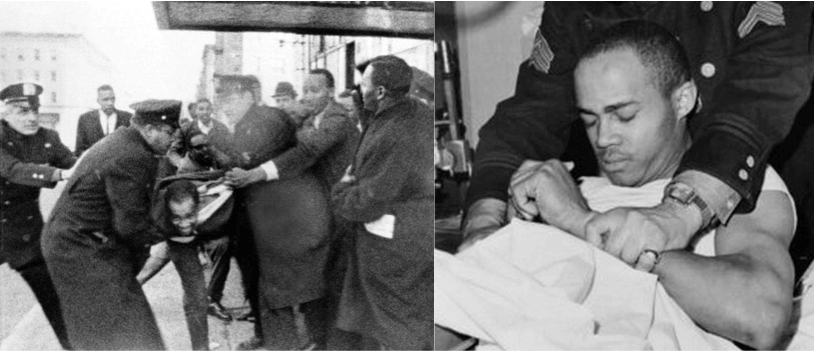
    Hagan/Hayer apprehended
    Thomas Hagan AKA Talmadge Hayer apprehended

    Thomas Hoy was the only police officer stationed outside the ballroom. He managed to pull Hayer away from the crowd. A police car cruising by stopped. Sergeant Alvin Aronoff and patrolman Louis Angelos helped Hoy save Hayer’s life by pushing him into the car. They took him to the Wadsworth Avenue Police Station.187 Roberts had gone up on the stage. He found Malcolm still had a pulse. Roberts began giving Malcolm mouth-to-mouth resuscitation, trying to revive him. Malcolm died on the stage.188


    Over the next 24 hours, Gene Roberts went through a series of BOSSI debriefings on the assassination. His superiors were incredulous at his attempt to save Malcolm’s life on the stage. “What did you do that for?” he was asked.

    And I told them, Roberts said, “Well, I’m a cop. And this is what cops are supposed to do—save people.”189

    Roberts at assassination
    Gene Roberts: “This is what cops
    are supposed to do—save people.”

    When Malcolm was shot, Joan Roberts had gone to Betty Shabazz, who had thrown her body over her children. Joan tried to hold her. Betty struggled to get free, throwing Joan against the wall, and ran to Malcolm’s side. Gene eventually helped Joan, who was shaken, to a taxicab.190

    Gene Roberts was the precursor to Marrell McCullough in the assassination of Martin Luther King. In a famous photo, McCullough can be seen with a stricken look kneeling over King’s body on the balcony of the Lorraine Motel in Memphis, April 4, 1968. McCullough belonged to a Memphis black power youth group working with King. He was the first person to reach him after he was shot. Unknown to King’s associates for another decade, Marrell McCullough was also a deep cover operative for the Memphis Police Department.191

    LIFE magazine feature Malcolm X assassination
    The LIFE issue on the assassination of Malcolm X

    Talmadge Hayer, Norman Butler, and Thomas Johnson were tried for Malcolm’s murder from January 21 to March 11, 1966. Butler and Johnson were two well-known New York “enforcers” for the Nation of Islam whom the police had picked up in the week following the assassination. A series of shaky witnesses, several contradicting their own grand jury testimony, testified to having seen Butler and Johnson take part in the murder. Butler and Johnson claimed they hadn’t even been in the Audubon Ballroom that afternoon. Butler had three supporting witnesses and Johnson two, to their each having been at home during the shooting. In the years to come, many of Malcolm’s people would emphasize that Butler and Johnson as well-known local NOI enforcers would have been quickly identified and watched closely had they entered the ballroom that day. They simply weren’t there. Talmadge Hayer agreed. In the trial’s most dramatic moments, Hayer took the stand, confessed his own participation in the assassination, and said Butler and Johnson had nothing to do with it. However, because Hayer refused to identify his real co-conspirators, his testimony was discredited. All three men were convicted and sentenced to life imprisonment. Hayer’s more detailed 1978 confession, naming the other four men in his group, was too late to help Butler and Johnson. They each served more than 20 years. The only man who has ever confessed to the murder of Malcolm X, Talmadge Hayer (who has become Mujahid Abdul Halim), has also made another confession:

    I remember some of the ministers used to say that time reveals all things. Malcolm used to say it himself—time will tell. And for the longest time, I always thought that time would tell what that man was saying was wrong. Well, time has told. Time has told that a lot of things he said was true.192

    Benjamin Goodman Karim
    Benjamin Goodman Karim

    Benjamin Goodman, in a 1978 affidavit supporting Butler and Johnson’s innocence, provided an insight into the coercion of trial witnesses. Goodman said that in 1965, he was summoned to a New York police station where detectives questioned him about Butler and Johnson. When he told the detectives repeatedly that Butler and Johnson had not been in the Audubon Ballroom that afternoon, the detectives became angry. Later in 1965, Goodman was summoned to another interview, this time from assistant District Attorney Stern. Goodman told them that:

    I knew Butler and Johnson, they had not been present at the ballroom that day, and that I had not seen the actual shooting. When I said this, Mr. Stern became angry and said that he knew I had previously said that I had seen the shooting through an open dressing room door. This was not true and I had never said this to anyone. In his anger, Mr. Stern threatened me and asked me, have you ever been to jail? How would you like to go to jail?

    Goodman was not called to testify at the trial.193


    Besides Hayer, the most significant trial witness was black police officer Gilbert Henry. Before the prosecution could get him off the stand, Henry revealed the strange way the NYPD had deployed its forces on February 21st. Henry said he had been stationed in the Ballroom’s Rose Room that afternoon, at a distance from Malcolm’s location in the main auditorium. He and his partner, Patrolman John Carroll, had been given specific instructions by their superior officer, Sergeant Devaney, “to remain where [they] would not be seen.” If anything happened, Patrolman Henry was to call for help on a walkie-talkie the two men had with them. It was connected with another walkie-talkie held by an officer at the Presbyterian Medical Center on the other side of the street. When Henry heard shots, he tried calling on the walkie-talkie but got no response. He then ran into the main auditorium, but was too late to see anyone with a gun. He said he saw no other uniformed officers in the auditorium.194

    Malcolm’s unofficial photographer, Robert Haggins, was one of the witnesses never called in the trial who could have testified farther to the odd behavior of the police that afternoon. Haggins told Spike Lee he had seen the anteroom of the ballroom filled with police: “If I took a guess, I’d say 25. It was filled with cops. Cops who must’ve waited until after he was shot to file into the ballroom.”195

    Earl Grant saw the police come in. He said that about 15 minutes after Malcolm was shot, “a most incredible scene took place. Into the hall sauntered about a dozen policemen. They were strolling at about the pace one would expect of them if they were patrolling a quiet park. They did not seem to be at all excited or concerned about the circumstances.

    I could hardly believe my eyes. Here were New York City policemen, entering a room from which at least a dozen shots had been heard, and yet not one of them had his gun out! As a matter of absolute fact, some of them even had their hands in their pockets.”196

    The best witness we have to the assassination of Malcolm X remains Malcolm X, as recorded by Alex Haley.


    On Saturday afternoon, February 20, 24 hours before he would walk to the podium of the Audubon Ballroom, Malcolm phoned Alex Haley at his home in upstate New York. It was to be their last conversation. Malcolm ended it with what Haley, in his epilogue to the autobiography, calls a “digression.” Malcolm was speaking of his impending murder:

    I’m going to tell you something, brother—the more I keep thinking about this thing, the things that have been happening lately, I’m not all that sure it’s the Muslims. I know what they can do, and what they can’t, and they can’t do some of the stuff recently going on. Now, I’m going to tell you, the more I keep thinking about what happened to me in France, I think I’m going to quit saying it’s the Muslims.197

    Malcolm had one final thought. In the last sentence he would ever say to Alex Haley—which Haley describes as “an odd, abrupt change of subject”—Malcolm said why he thought he was about to be killed:

    You know, I’m glad I’ve been the first to establish official ties between Afro-Americans and our blood brothers in Africa.198

    He then said good-bye and hung up.


    Nasser and Nkrumah
    Nasser and Nkrumah

    In the midst of his African campaign the previous August, Malcolm had sent a letter from Cairo to friends in Harlem that foreshadowed his last words to Alex Haley. One month after he was poisoned at the Nile Hilton, Malcolm wrote:

    You must realize that what I am trying to do is very dangerous because it is a direct threat to the entire international system of racist exploitation…. Therefore, if I die or am killed before making it back to the States, you can rest assured that what I’ve already set in motion will never be stopped … Our problem has been internationalized.199

    At the time Malcolm wrote this letter, his friend and ally Egyptian President Gamal Abdel Nasser was taking with extreme seriousness the ongoing threat to Malcolm’s life from U.S. intelligence agencies. He had two Egyptian security men posted outside Malcolm’s hotel room door at all times.200


    Alex Haley, a great author who gave Malcolm a prose platform from which he could address the world, buried in his epilogue what may have been the most significant words Malcolm ever said to him. Malcolm’s “digression” was a revelation, which he would share also with his assistants on Sunday afternoon, and his “change of subject” a coherent climax to his life. Malcolm was willing to give his life for the sake of a unity between Africans and African-Americans that he hoped would change the course of history. In his final year, Malcolm had become a witness to the truth he had experienced in his pilgrimage to Mecca—that all of humankind was one family of brothers and sisters under Allah. But he radically focused that truth on Africa and America. Africa was where our one family had begun, and America where much of it had been sent into slavery. He envisioned and was organizing a mutually supportive African-American movement for human rights on both continents. “But,” as Malcolm said 12 days before his death to a friend in London, “the chances are that they will get me the way they got [Congo’s revolutionary leader Patrice] Lumumba before he reached the running stage.”201 Malcolm was right. And in his final words to Alex Haley, he had already solved the crime of his murder a day before it happened.

    “Muslims don’t carry guns.” (Malcolm X to Charles Kenyatta, shortly before his death)

    Near the end of his life, Malcolm began to think about guns as a question of faith. In his last week, he see-sawed between wanting to apply for a permit to carry a pistol and wanting to confront his killers with no guns on either himself or his followers. He ended by choosing no guns. It seemed a strange final decision for Black America’s most articulate advocate of armed self-defense. Why did Malcolm take such a stand at the hour of his death?

    Malcolm’s co-worker, Charles 37X Kenyatta, has told a revealing story about the man whose life was one continuous turn toward the truth as he saw it. Charles said he and Malcolm were riding in a taxicab to the Chicago airport. They suddenly realized they were being taken instead into the stockyards. The driver had a sinister purpose of his own. Charles, however, had a pistol. He used it to make the driver stop the cab and get out. Charles and Malcolm drove quickly to the airport, and got on their plane.

    Malcolm then told Charles he had lost his religion. Three decades after Malcolm’s death, Charles Kenyatta continued to puzzle over his teacher’s strange words. Malcolm said to him: “Muslims don’t carry guns.”202

    As a deep believer in Islam, Malcolm chose to die as a martyr. After the attacks of September 11, 2001, and a wave of suicide bombers in Israel, Americans have tended to think of the Islamic concept of martyrdom as counter-violent. That was not, however the kind of martyr that Malcolm told Gordon Parks he wanted to be. Nor was it what he learned from the Islamic tradition he embraced on his pilgrimage to Mecca. In response to his assassins, whose identity he said he knew in advance, Malcolm gave his life to Allah “in the cause of brotherhood,” without trying to snatch away the lives of those taking his own.

    He also chose not to go into exile to avoid martyrdom. 12 days before his death, Malcolm listened patiently in a London hotel room, while a friend, Guyan writer Jan Carew, summoned every word at his command to persuade Malcolm not to return to the United States and almost certain death. Carew even invoked the authority of their ancestral spirit world, “the ghosts in our blood,” against the folly of martyrdom.

    Those ancestral spirits whisper warnings, whenever we’re about to do something reckless or foolhardy. Right now they should be whispering to you that, perhaps, surviving for our cause is more important then dying for it.203

    Malcolm answered:

    The spirit world’s fine but I want our folk to be free in the world of the living.204

    And the unspoken thought: So for the sake of the living, I’ll live the truth freely and openly all the way, regardless of the consequences.

    In Malcolm’s eyes, that was freedom. By living and speaking freely, Malcolm denied to the system that assassinated him the victory of taking away his life. He instead gave it freely in the cause of brotherhood and sisterhood. “It’s a time for martyrs now,” as he told Gordon Parks, “And if I’m to be one, it will be in the cause of brotherhood. That’s the only thing that can save this country.”

    In his final days, Malcolm transformed the death by violence that had haunted him all his life. Recognizing its imminence, he embraced it in terms of his faith. He did so in a way that was in tension with some of his own public rhetoric. Although Malcolm continued to insist vehemently right up to his death on armed self-defense as a fundamental right for black people and for all other people as well, he died without wanting his followers to resort to that right for himself. In a life of profound changes, Malcolm’s ultimate choice of how he wanted to die, nonviolently in the cause of brotherhood, was perhaps the most remarkable change of all.

    A “martyr” is literally a witness. Malcolm’s final action, in stepping forward to reconcile two brothers in a fight, made him not only a target for murder but also a witness to brotherhood.

    As he said to us all, “As-salaam alaikum.”


    Notes

    1. The Autobiography of Malcolm X, as told to Alex Haley (New York: Ballantine Books, 1973), p. 9.

    2. Ibid., p. 2.

    3. Ibid., p. 378.

    4. Ibid., p. 381.

    5. Karl Evanzz, The Judas Factor: The Plot to Kill Malcolm X (New York: Thunder’s Mouth Press, 1992).

    6. Karl Evanzz, The Messenger: The Rise and Fall of Elijah Muhammad (New York: Pantheon, 1999).

    7. Zak A. Kondo, Conspiracys: Unravelling the Assassination of Malcolm X (Washington: Nubia Press, 1993).

    8. Louis Lomax, To Kill a Black Man (Los Angeles: Holloway House, 1987). Although we have reached different conclusions on the conspiracy to kill Malcolm X, I want to acknowledge the help of a sixth author. In both his book, The Death and Life of Malcolm X (Urbana, Illinois: University of Illinois Press, second edition, 1979) and the kind interview he gave me, Peter Goldman has been a great resource and source of encouragement. His book provides dimensions of both the death and life that remain indispensable for a pilgrim into either.

    9. Evanzz underlines Lomax’s importance in The Judas Factor p. xxiv. Lomax also had early insights into the murder of the second subject of his book, Martin Luther King Jr.

    10. Memorandum from SAC [Special Agent in Charge], Chicago, to Director, FBI, 1/22169, page 1; in Petition to the Black Caucus, U.S. House of Representatives, of Muhammad Abdul Aziz (Norman 3X Butler) and Khalil Islam (Thomas 15X Johnson), April, 30, 1979; in the Walter E. Fauntroy Papers, Gelman Library, George Washington University.

    11. Louis E. Lomax, When the Word Is Given (New York: Signet Books, 1964), p. 82.

    12. Ibid.

    13. Memorandum from William Sullivan to Alan Belmont, December 24, 1963. Church Committee Final Report, Book III, p. 134.

    14. FBI HQ file on Lomax. Evanzz, Judas, p. 198.

    15. Ibid.

    16. Ibid.

    17. Lomax, To Kill, p. 199.

    18. Author’s interview with Wallace Muhammad, now W. D. Mohammed, August 2, 1999.

    19. Evanzz, Messenger, p. 317.

    20. Malcolm X scholar Zak Kondo obtained a March 16, 1954, Detroit FBI Report, captioned MALCOLM K. LITTLE, which cites from a 1950 prison letter written by Malcolm. Fonda, pp. 42, 292 endnote 847.

    21. Messenger, p. 183.

    22. Ibid.

    23. Ibid.

    24. Ibid., p. 557 endnote 39. Evanzz speculates that Abdul Basin Naeem may have been pressured to cooperate with the FBI and BOSSI due to his immigrant status. Ibid.

    25. FBI HQ file on Elijah Muhammad; FBI NY file on Malcolm X; cited by Evanzz, Messenger, p. 186.

    26. Ibid., p. 187.

    27. Goldman, pp. 55-59. Judas, pp. 70-71.

    28. Autobiography, p. 309.

    29. To Kill, p. 103,

    30. Messenger, pp. 187-88.

    31. Cited by Evanzz, Ibid., p. 188.

    32.Messenger, p. 192. Judas, p. 73.

    33. Lomax, When the Word, p. 179.

    34. Autobiography, p. 289.

    35. When the Word, Ibid.

    36. Autobiography, p. 265.

    37. Ibid.

    38. Ibid.

    39. Ibid., p. 292.

    40. Ibid., p. 297.

    41. FBI HQ file on Elijah Muhammad, section 5, memo dated May 20, 1960; approved by Cartha DeLoach, May 22, 1960. Cited by Evann, Messenger, p. 218.

    42. FBI HQ file on Elijah Muhammad. Ibid., pp. 249-50.

    43. Autobiography, p. 301.

    44. John Henrik Clarke, who published a transcript of the conversation, “A Visit from the FBI,” in Malcolm X: The Man and His Times (New York: Macmillan, 1975), pages 182-204, wrote in a footnote on page 182 that it happened on May 29, 1964. That date is too late, given the references in the conversation to the Clay-Liston fight in Florida as a future event. Clayborne Carson in Malcolm X: The FBI File (New York: Carroll & Graf, 1993), pages 252-53, presents an FBI document that indicates the visit took place on February 4, 1964.

    45. Clarke, p. 195.

    46. Ibid.

    47. Ibid., p. 202.

    48. Ibid., pp. 202-3.

    49. Autobiography, p. 302.

    50. Ibid., p. 303.

    51. Ibid., pp. 308-9. Kondo, p. 73.

    52. Autobiography, p. 316.

    53. Malcolm X Speaks, edited by George Breitman (New York: Pathfinder, 1990), p. 18.

    54. Kondo, pp. 63, 259 endnote 375.

    55. Goldman, pp. 159-60, 191.

    56. Malcolm X, “A Declaration of Conscience,” March 12, 1964; Malcolm X Speaks, p. 20.

    57. Ibid.

    58. Ibid., p. 22.

    59. Malcolm X, “The Ballot or the Bullet,” April 3, 1964; Malcolm X Speaks, pp. 34-35.

    60. Judas, pp. 226-27.

    61. Cited by Evanzz, Judas, p. 225.

    62. Ibid.

    63. Messenger, p. 292.

    64. Abdul Aziz Omar, formerly Philbert X Little; in William Strickland, Malcolm X: Make It Plain (New York: Viking, 1994), p. 174.

    65. FBI HQ file on Elijah Muhammad, memo dated April 12, 1964; cited by Evanzz, Messenger, pp. 292-93.

    66. Autobiography, p. 338.

    67. Ibid.

    68. Malcolm told Julian Mayfield and Leslie Lacy what Nkrumah had said. Leslie Alexander Lacy, “African Responses to Malcolm X,” in Black Fire, edited by Leroi Jones and Larry Neal (New York: William Morrow, 1968), p. 32.

    69. 12 years after Kwame Nkrumah’s overthrow, Seymour Hersh reported the CIA’s involvement in the coup in a New York Times article based on a brief description in a book by ex-CIA agent John Stockwell and confirming interviews by “first-hand intelligence sources.” Seymour M. Hersh, “C.I.A. Said to Have Aided Plotters Who Overthrew Nkrumah in Ghana,” New York Times (May 9, 1978), p. 6. John Stockwell, In Search of Enemies (New York: W W Norton, 1978), p. 160 footnote.

    70. “Malcolm Says He is Backed Abroad,” New York Times (May 22, 1964), p. 22.

    71. Frank Donner, Protectors of Privilege (Berkeley: University of California Press, 1990), p. 155.

    72. Tony Ulasewicz with Stuart A. McKeever, The President’s Private Eye (Westport, Connecticut: MACSAM Publishing, 1990), p. 145.

    73. Ibid., p. 151.

    74. Ibid.

    75. Author’s interview with Teddy Theologes, June 29, 2000.

    76. Elaine Rivera, “Out of the Shadows: The Man Who Spied on Malcolm X,” Newsday (July 23, 1989).

    77. Author’s interview with Gene Roberts, July 7, 2000.

    78. Rivera, Ibid.

    79. To Kill, pp. 198-99.

    80. Ibid., p. 199.

    81. Malcolm X Speaks, pp. 58-59.

    82. To Kill, p. 200,

    83. Talmadge Hayer filed two affidavits on Malcolm’s murder, the first in November 1977, and the second in February 1978. It is the second, which goes into greater detail, that is cited here. Both affidavits are in Petition to the Black Caucus. Michael Friedly includes them as an appendix in his book, Malcolm X: The Assassination (New York: Carroll & Graf, 1992), pp. 215-18.

    84. Ibid.

    85. Peter Goldman, The Death and Life of Malcolm X (Urbana, Illinois: University of Illinois Press, second edition, 1979), p. 416.

    86. Ibid.

    87. Evanzz, Messenger, p. 96.

    88. Malcolm’s telegram to Elijah Muhammad was published as an open letter in the June 26, 1964, edition of the New York Post. Cited by Kondo, pp. 74 and 269 endnote 467.

    89. Hayer affidavit, Ibid.

    90. Goldman, p. 195.

    91. Ibid.

    92. Author’s interview with Dr. Alauddin Shabazz, January 8, 1999.

    93. Goldman, p. 19S.

    94. Kondo, p. 147. Kondo hypothesizes that this provocative June 1964 phone call to the NOI was from an FBI or BOSSI provocateur, which would be consistent with the FBI’s COINTELPRO to keep Elijah and Malcolm at each other’s throats.

    95. Goldman, p. 414; Kondo, p. 147.

    96. The FBI transcript of the June 27, 1964 phone conversation is on page 480 of Malcolm X: The FBI File.

    97. Ibid.

    98. Judas, p. 241.

    99. “Statement of Basic Aims and Objectives of the Organization of Afro-American Unity,” appendix in George Breitman, The Last Year of Malcolm X (New York: Pathfinder, 1989), p. 106.

    100. Ibid.

    101. Ibid., p. 109.

    102. Kondo, pp. 43 and 239 endnote 249; citing FBI document.

    103. Ibid., endnote 250; citing FBI document.

    104. Malcolm X: The FBI File, p. 482.

    105. Ibid.

    106. John Ali was interviewed by Wesley South on the Chicago radio program Hotline on July 9, 1964. Ali’s analogies to JFK’s assassination, cited by Evanzz in The Judas Factor (pp. 247-48), were in response to a caller who “asked Ali whether it was true that the Black Muslims were trying to assassinate Malcolm X.” Ibid., p. 247. Ali also used espionage analogies, comparing Malcolm to Benedict Arnold and to Julius and Ethel Rosenberg, who were executed on the grounds that they handed over U.S. nuclear secrets to the Soviet Union. Ibid.

    107. Cited by Evanzz, Judas, pp. 249-50.

    108. Jan Carew, Ghosts in Our Blood (Chicago: Lawrence Hill Books, 1994), p. 39.

    109. Eric Norden, “The Assassination of Malcolm X,” Hustler (December 1978), p. 98.

    110. “Appeal to African Heads of State,” Malcolm X Speaks, pp. 75-77.

    111. Ibid., p. 84.

    112. “There’s A Worldwide Revolution Going On,” Malcolm X: The Last Speeches, edited by Bruce Perry (New York: Pathfinder, 1989), p. 116. Carew, Ghosts, p. 83.

    113. Carew, Ibid.

    114. Ibid., p. 115.

    115. M. S. Handler, “Malcolm X Seeks U.N. Negro Debate,” New York Times (August 13, 1964), p. 22.

    116. Ibid.

    117. The missing sentences are included in the citation of the original Times article on page 86 of Malcolm X Speaks.

    118. August 11, 1964, CIA memorandum for Deputy Director of Plans, titled “ACTIVITIES OF MALCOLM POSSIBLE INVOLVEMENT OF AFRICAN NATIONS IN U.S. CIVIL DISTURBANCES,” cited by both Kondo, pp. 49 and 242 endnote 280, and Evanzz, Judas, p. 254.

    119. Evanzz’s citation of FBI HQ file on Malcolm X, Ibid.

    120. Judas, p. 254.

    121. John Lewis, Walking With the Wind (New York: Simon 8c Schuster, 1998), p. 286.

    122. Malcolm X Speaks, p. 85.

    123. Lewis, p. 287.

    124. Ibid., p. 288.

    125. Louis X, “Boston Minister Tells of Messenger Muhammad’s Biggest Hypocrite,” Muhammad Speaks (December 4, 1964), p. 11. Kondo, p. 159. Goldman, pp. 247-48. Cited also on Tony Brown’s Journal, “What Did Farrakhan Say and When Did He Say It?” (Spring 2000).

    126. Spike Lee, By Any Means Necessary: The Trials and Tribulations of the Making of Malcolm X (New York: Hyperion, 1992), p. 56. Farrakhan’s statements to Tony Brown, Barbara Walters, and Mike Wallace are included in “What Did Farrakhan Say …?”

    127. “What Did Farrakhan Say …?”

    128. Messenger, p. 293,

    129. Judas, pp. 263-64.

    130. Judas, p. 267.

    131. M. S. Handler, “Malcolm X Cites Role in U.N. Fight,” New York Times (January 2, 1965), p. 6.

    132. Ibid.

    133. Malcolm X: The FBI File, p, 81.

    134. Hakim A. Jarnal, From the Dead Level (London: Andre Deutsch, 1971), p. 223.

    135. Ibid.

    136. Ibid., pp. 212-15, 228-29.

    137. Haley, p. 425.

    138. Ibid.

    139. Ibid.

    140. Taylor Branch, Pillar of Fire (New York: Simon & Schuster, 1998), p. 578.

    141. Malcolm X, The Final Speeches: February 1965 (New York: Pathfinder, 1992), p. 26.

    142. Ibid., p. 28.

    143. Coretta Scott King, My Life With Martin Luther King, Jr.; revised edition (New York: Henry Holt, 1993), p. 238.

    144. Ibid., p. 240,

    145. Goldman, p. 254.

    146. Eric Norden, “The Murder of Malcolm X,” The Realist (February 1967), p. 12.

    147. Ibid.

    148. J. Edgar Hoover’s February 4, 1965, memorandum read: “… Information has been received that Malcolm Little plans to travel to England and France during the early part of February. He will reportedly depart this country on February 5, 1965, and will return about February 11, 1965. In this connection, there is enclosed one copy of a memorandum dated February 1, 1965, at New York, which contains available information of the subject’s contemplated travel.” Kondo, pp. 271-72 endnote 491. In addition to the intelligence agencies I have noted, Hoover’s memorandum was also sent to the Assistant Attorney General, the Acting Attorney General, and the Foreign Liaison Unit. Ibid.

    149. Kondo, p. 162.

    150. Ibid.

    151. Kondo, p. 76. Goldman, p. 263.

    152. Goldman, p. 262. Judas, pp. 289-90. Kondo, p. 76. M.X. Handler, “Malcolm X Flees Firebomb Attack,” New York Times (February 15, 1965), p. 1. Malcolm X, Final Speeches, pp. 133-34.

    153. Earl Grant, “The Last Days of Malcolm X,” Malcolm X: The Man and His Times, edited by John Henrik Clarke (NewYork: Macmillan, 1975), p. 86.

    154. “Malcolm Accuses Muslims of Blaze; They Point to Him,” New York Times (February 16, 1965), p. 18.

    155. Autobiography, pp. 308-9. Kondo, p, 73,

    156. Messenger, pp. 318-19.

    157. Lee, p. 63.

    158. On Brother Minister: The Assassination of Malcolm X, a 1997 film directed by Jack Baxter and Jefri Aallmuhammed.

    159. “Bottle of Gasoline Found on a Dresser in Malcolm X Home,” New York Times (February 17, 1965), p. 34.

    160. He said this, for example, on Monday night, February 15, 1965, in his talk at the Audubon Ballroom, “There’s a Worldwide Revolution Going On.” Final Speeches, p. 124.

    161. Norden, “Murder,” p. 12,

    162. In his statement to the press, February 18, 1965, “We Are Demanding an Investigation,” Final Speeches, p. 179.

    163. Ibid.

    164. See endnote 118.

    165. Norden, “Murder,” p. 12.

    166. Author’s interview with Gene Roberts, July 7, 2000.

    167. “There’s a Worldwide Revolution Going On,” Final Speeches, p. 123.

    168. Author’s interview.

    169. Gene Roberts to Elaine Rivera on his efforts to tell his BOSSI supervisors about the dry run. Rivera, “Out of the Shadows.”

    170. Author’s interview.

    171. Gordon Parks, “I was a Zombie Then—Like All [Black] Muslims, I Was Hypnotized,” Life (March 5, 1965), p. 28.

    172. Ibid.

    173. Goldman, p. 261,

    174. Ibid., p. 262.

    175. Haley, p. 438.

    176. Ibid.

    177. Rivera, “Out of the Shadows.”

    178. Ibid.

    179. Haley, p. 431. Grant, “The Last Days,” p. 92.

    180. Norden, “The Murder,” p, 13.

    181. Talmadge Hayer amplified his written confession, with further details that are included here, in an interview on Tony Brown’s Journal, “Malcolm and Elijah,” February 21, 1982. Cited by Kondo, pp, 169-70.

    182. Haley, p. 428. Judas, pp. xiii, 293.

    183. Haley, p. 433.

    184. Ibid.

    185. Kondo, p. xviii.

    186. Goldman, p. 274.

    187. Several witnesses claim two suspects were arrested by the police. Omar Ahmed, who was on Malcolm’s guard detail at the time, thought there were two men arrested outside of the ballroom. Interview by Kondo, p. 84. Earl Grant makes the same claim in “The Last Days of Malcolm X,” p, 99.

    The New York Herald Tribune‘s early edition of February 22, 1965, reported two arrests. Its article said that one suspect, Hayer, was “taken to Bellevue Prison Ward and was sealed off by a dozen policemen. The other suspect was taken to the Wadsworth Avenue precinct, where the city’s top policemen immediately converged and began one of the heaviest homicide investigations this city has ever seen.” New York Herald Tribune (February 22, 1965; city edition) article by Jimmy Breslin, “Police Rescue Two Suspects”; cited by Kondo, p. 83. The Tribune‘s late city editions make no mention of the second suspect. Ibid. The New York Times in its early and late city editions follows the same pattern. Kondo, Ibid.

    Peter Goldman explains the inconsistencies in terms of separate debriefings of Thomas Hoy and Alvin Aronoff: “Hoy and Aronoff were debriefed separately at the time, Hoy at the scene and Aronoff at the stationhouse, and the early editions of the next day’s papers reported that there had been two arrests. The two policemen, as it developed, were talking about the same man …” Goldman, p. 276.

    When Alex Haley wrote his 1965 ‘Epilogue” to the Autobiography, he was still raising the possibility of two arrested suspects and the hope of identifying the second. Haley, p. 438.

    188. Author’s interview.

    189. From Gene Roberts interview in Brother Minister.

    190. Rivera, “Out of the Shadows.”

    191. William F. Pepper, Orders to Kill (New York; Carroll & Graf, 1995), pp. 129-30. Pepper identifies McCullough as being at the same time a member of Army intelligence. Ibid., p. 443.

    192. Kondo, p. 202.

    193. Benjamin Goodman Affidavit, May 19, 1978; in Petition to Black Caucus.

    194. Herman Porter, “The Trial,” in The Assassination of Malcolm X, edited by Malik Miah (New York: Pathfinder Press, 1988), p. 93. Norden, “The Murder,” p. 14. William M. Kunstler’s December 19, 1977, deposition in Petition to the Black Caucus, pp. 25-26.

    195. Lee, p. 42,

    196. Grant, p. 96.

    197. Haley, pp. 430-31.

    198. Ibid., p. 431.

    199. Malcolm X, “A Letter from Cairo,” By Any Means Necessary (New York: Pathfinder, 1991), p. 110.

    200. David DuBois to Spike Lee; in Lee, p. 38.

    201. Carew, p. 36.

    202. Charles 37X Kenyatta in Brother Minister.

    203. Carew, p. 57.

    204. Ibid.


    Copyright 2002 by James W. Douglass

    Originally published in The Assassinations, ed. DiEugenio & Pease (Los Angeles: Feral House, 2003), pp. 376-424.
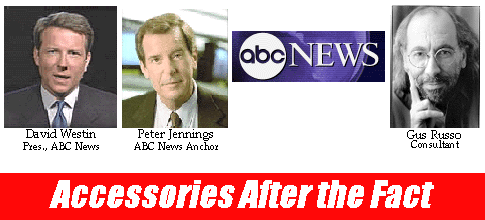
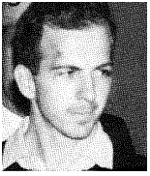
  • The Murder and Martyrdom of Malcolm X

    The Murder and Martyrdom of Malcolm X


    Has anyone ever been more conscious, from birth to death, of his coming murder? Malcolm X saw his own violent death in advance just as clearly as his mother Louise Little saw the imminence of his father’s death, on that afternoon in 1931 when her husband Earl left their house and began walking up the road toward East Lansing, Michigan.

    “If I take the kind of things in which I believe, then add to that the kind of temperament that I have, plus the one hundred percent dedication I have to whatever I believe in … These ingredients would make it just about impossible for me to die of old age.”

    “It was then,” Malcolm says in his autobiography, “that my mother had this vision. She had always been a strange woman in this sense, and had always had a strong intuition of things about to happen. And most of her children are the same way, I think. When something is about to happen, I can feel something, sense something.”1

    His mother rushed out on the porch screaming. She ran across the yard into the road shouting, “Early! Early!” Earl turned around. He saw her, waved, and kept on going.

    That night Malcolm awakened to the sound of his mother’s screaming again. The police were in the living room. They took his mother to the hospital, where his father had already bled to death. His body had been almost cut in two by a streetcar. Earl Little had been an organizer for Marcus Garvey’s United Negro Improvement Association, the largest black nationalist movement in American history. Malcolm was told by blacks in Lansing that his father had been attacked by the white racist Black Legion. They put his body on the tracks for a streetcar to run over.

    Malcolm believed that four of his father’s six brothers were also killed by white men. Thus the pattern of his own life seemed clear. “It has always been my belief,” he told his co-author Alex Haley, “that I, too, will die by violence. I have done all that I can to be prepared.”2 Malcolm prepared for death by living the truth so deeply that it hastened death. This is the theme of Malcolm X’s autobiography. “To come right down to it,” Malcolm said to Alex Haley, “if I take the kind of things in which I believe, then add to that the kind of temperament that I have, plus the one hundred percent dedication I have to whatever I believe in … These ingredients would make it just about impossible for me to die of old age.”3

    As the story neared its end, with Malcolm more and more totally surrounded by forces that wanted him dead, he no longer saw himself as among the living. “Each day I live as if I am already dead … I do not expect to live long enough to read this book in its finished form.”4 And he was right: he died in Harlem on the same day he had originally intended to visit Alex Haley in upstate New York to read the final manuscript.


    The assassination of Malcolm X on February 21, 1965, at the Audubon Ballroom in New York City was carried out through the collaboration of three circles of power: the Nation of Islam (NOI), the New York Police Department (NYPD), and U.S. intelligence agencies. Malcolm was, as he knew, surrounded at the end by all three of these circles. In terms of their visibility to him and their relationship to one another, the circles were concentric. The Nation of Islam was the nearest ring around Malcolm, the less visible NYPD was next, and the FBI and CIA were in the outermost shadows. The involvement of these three power circles in Malcolm’s murder becomes apparent if we trace his pilgrimage of truth through his interactions with all three of them.

    Malcolm X and Alex Haley
    Malcolm X and Alex Haley

    In writing this essay, I have been guided especially by the works of five authors. The first three are Karl Evanzz, Zak Kondo, and Louis Lomax. Washington Post online editor Karl Evanzz is the author of The Judas Factor: The Plot to Kill Malcolm X5 and The Messenger: The Rise and Fall of Elijah Muhammad.6 Evanzz’s two books complement each other brilliantly in presenting a full picture of Malcolm’s assassination, the first emphasizing the U.S. government’s responsibility and the second, that of Elijah Muhammad and the Nation of Islam. Zak A. Kondo, a professor at Bowie State College, does it all in one book, Conspiracys: Unravelling the Assassination of Malcolm X,7 which follows an unusual (though strangely accurate) title with a complex analysis of the three murderous circles: NOI, NYPD, and U.S. spy agencies. His self-published, out-of-print book that is almost impossible to find has 1266 endnotes, all of which deserve to be read. Then there is Louis Lomax’s To Kill a Black Man,8 first published in 1968, two years before Lomax’s own death in a car accident. As both a faithful friend to Malcolm and a writer wired to what was happening, Lomax already pointed to a solution of Malcolm’s assassination.9 I said I have five guides. The last two are Malcolm X and the man who lived to tell his tale, Alex Haley.

    The Autobiography of Malcolm X is the transforming work of both. Haley in his epilogue hints at what Malcolm in his last days realized and was on the verge of shouting—that it was the government, not Elijah Muhammad, and Malcolm’s African connection, not his NOI rejection, that were the primary agent and motivation behind the plot. Malcolm is the ultimate guide to understanding his own murder.

    In a memorandum, written four years after Malcolm’s death, the Special Agent in Charge of the FBI’s Chicago office stated that:

    Over the years, considerable thought has been given and action taken with Bureau’s approval, relating to methods through which the NOI, could be discredited in the eyes of the general black populace. … Or through which factionalism among the leadership could be created … Factional disputes have been developed—the most notable being MALCOLM X LITTLE.10

    Malcolm X and Elijah Muhammad
    Malcolm X and Elijah Muhammad

    The FBI developed the factional dispute that led to Malcolm’s death by first placing at least one of its people high within the Chicago headquarters of the Nation of Islam. Its infiltrator then worked to widen a division between Elijah Muhammad and Malcolm X. To the FBI’s alarm, this process was inadvertently described, and the FBI man identified, in the 1964 book When The Word Is Given, written by Louis Lomax.

    In the paragraph that gave away the FBI’s game, Lomax began by observing that Elijah Muhammad had moved from Chicago to Phoenix, Arizona, for the sake of his health. Lomax then described a significant shift of power. Elijah he said had delegated to his Chicago office not only the NOI’s finances and administration, but also “the responsibility for turning out the movement’s publications and over-all statements,” thus taking away from Malcolm X his critical control over the NOI’s flow of information.

    “at one time carried some of these responsibilities, particularly the publishing of the Muslim newspaper..,. And many observers thought they saw an intra-organizational fight when these responsibilities were taken from him and given to Chicago.11

    The thing that dismayed the FBI most was the paragraph’s final sentence, which disclosed a hidden factor in this abrupt transfer of power away from Malcolm. The sentence stated that “this decision by Muhammad was made possible because John X, a former FBI agent and perhaps the best administrative brain in the movement, was shifted from New York to Chicago.12

    Lomax’s sentence about “John X, a former FBI agent” set off alarm bells in FBI counterintelligence, especially in the office of William C. Sullivan. Assistant FBI Director Sullivan was in charge of the illegal Counterintelligence Program (COINTELPRO) designed to develop a “factional dispute” between Elijah and Malcolm. Sullivan was a high-level commander of covert action. Among his projects was an all-out FBI campaign “aimed at neutralizing [Dr. Martin Luther] King as an effective Negro leader,” as Sullivan put it in a December 1963 memorandum.13

    Malcolm X and Elijah Muhammad
    COINTELPRO chief
    William C. Sullivan

    On March 20, 1964, COINTELPRO chief Sullivan was alerted by an “airtel” from the FBI’s Seattle field office to the objectionable passage in When The Word Is Given.14 The hardcover edition of the book had been published in late 1963, only a few months before what Sullivan must have regarded as a COINTELPRO success story, Malcolm’s March 8, 1964 announcement of his split with Elijah Muhammad. The problem was that to a discerning reader of both the Lomax paragraph and the news of the split, the FBI could be recognized as a key disruptive factor.

    John X Ali Simmons
    John X Ali Simmons announcing
    Malcolm X suspension from
    the Nation of Islam

    An FBI official recommended in a memorandum to Sullivan that “the New York Office should be instructed to contact Lomax to advise him concerning the inaccurate statement contained in this book regarding [John X Ali] Simmons. … And that he be instructed to have this statement removed from any future printings of the book.”15 FBI Director J. Edgar Hoover added his personal “OK” to this recornmendation.16 Lomax, however, ignored the FBI’s pressure as well as John Ali’s anger at his having made the statement. He never retracted it. In his later book, To Kill a Black Man, he repeated it, and said that John Ali knew it was true.17 In the six years leading to his death, Lomax never clarified what he meant by the term “former FBI agent.” He may have been giving Ali the benefit of a doubt as to his having severed his FBI connection by the time Lomax mentioned it in 1964. In any case, the FBI had other informants in the Nation of Islam to take his place.

    Wallace Muhammad, Elijah Muhammad’s independent-minded son, also believed that FBI informants were manipulating NOI headquarters at the time Malcolm and Elijah became antagonists:

    The FBI had key persons in the national staff, at least one or two maybe. They were preparing for the death of the Honorable Elijah Muhammad [in terms of determining his successor]. I believe that the members of the Nation of Islam were influenced to do the things that they were doing not just by the national staff and my father but also by the intelligence department.18

    Wallace Muhammad was in a position to know at first hand the FBI’s process of working with NOI informants. The FBI considered him one of them. Karl Evanzz, in researching his biography of Elijah Muhammad entitled The Messenger, discovered from FBI documents that in addition to John Ali, at least three other people were regarded by FBI agents as “reliable sources” close to Muhammad. The first man was Abdul Basit Naeem, a Pakistani journalist who served as an NOI publicist. Then there is Hassan Sharrieff, Elijah Muhammad’s grandson and Wallace Muhammad. Evanzz concludes that the FBI thought “Wallace and Hassan fit the bill because they had provided the Bureau with information it considered crucial to inciting violence between Muhammad’s camp and Malcolm X.”19 Wallace’s and Hassan’s reasons for talking with the FBI seem to have been simply to seek protection from members of their own family, who threatened to kill them for going against Elijah. The FBI then recycled their information for its own use in plotting against Malcolm and Elijah.

    “I believe that the members of the Nation of Islam were influenced to do the things that they were doing not just by the national staff and my father but also by the intelligence department.” ~Wallace Muhammad

    It was Louis Lomax’s revelation of the FBI’s covert process within the NOI that so concerned the Bureau. Lomax’s statement had given his readers a glimpse into a critical part of the FBI’s COINTELPRO strategy to divide and destroy the Nation of Islam, thereby silencing as well its most powerful voice, Malcolm X.

    FBI documents show that the Bureau had been monitoring Malcolm X as far back as 1950, when he was still in prison.20 The Bureau began to focus special attention on Malcolm in the late ’50s, when it realized he had become Elijah Muhammad’s intermediary to foreign revolutionaries. From Malcolm’s Harlem base of operations as the minister of the NOI’s Temple Number Seven, he was meeting regularly at the United Nations with Third World diplomats. In 1957 Malcolm met in Harlem with visiting Indonesian President Achmed Sukarno, whom the CIA had targeted for removal from power. Sukarno was extremely impressed by Malcolm.21 As early as eight years before Malcolm’s death, the FBI and CIA were watching the subversive international connections Malcolm was making.


    Abdul Basit Naeem
    Abdul Basit Naeem

    In 1957 when Malcolm X was becoming the NOI’s diplomat to Third World leaders, Abdul Basit Naeem was developing into Elijah Muhammad’s public relations man in the same direction.22 Naeem was a Pakistani journalist living at the time in Brooklyn. His first project with Elijah was a 1957 booklet that combined international Islamic affairs with coverage of the Nation of Islam.23 Evanzz discovered that Abdul Basit Naeem became extremely cooperative. Not only was he cooperative with the FBI but also with the New York Police Department’s intelligence unit, “BOSSI” (the acronym for Bureau of Special Service and Investigation).24 BOSSI would later succeed in planting one of its cover operatives in Malcolm’s own security team. The FBI and BOSSI would prove to be linking agencies in the chain of events leading up to Malcolm’s assassination.

    At this time Malcolm had also become the apparent successor to Elijah Muhammad, who then loved and respected his greatest disciple more than he did his own sons. Accordingly, the FBI’s Chicago field office, which was monitoring all of Elijah’s communications, told J. Edgar Hoover in January 1958 that Malcolm had become Elijah’s heir apparent.25 Evanzz has described the impact of this revelation on the FBI’s COINTELPRO section:

    The secret to disabling the [NOI] movement, therefore, lay in neutralizing Malcolm X.26

    Evanzz suggests the FBI began its neutralizing of Malcolm in 1957 by utilizing a police force with which it worked closely on counterintelligence, the New York Police Department.


    Hinton incident
    Malcolm in NYC (1957)
    “No man should have that much power”

    The NYPD was already in conflict with Malcolm. In April 1957 in Harlem, white policemen brutally beat a Black Muslim, Johnson X Hinton, who had dared question their beating another man. The police arrested the badly injured Hinton and took him to the 28th Precinct Station on 123rd Street. When the station was confronted by a menacing but disciplined crowd, Malcolm X demanded on their behalf that Hinton be hospitalized. The police finally agreed, and were shocked by Malcolm’s dispersal of the 2,600 people with a simple wave of his hand. They concluded with alarm that he had the power to start as well as stop a riot. The city and police also had to pay Hinton $70,000 as a result of an NOI lawsuit.27 A police inspector who witnessed Malcolm’s dispersal of the crowd said, “No man should have that much power.”28


    On May 24, 1958, four months after Hoover was told that Malcolm was Elijah’s successor, two NYPD detectives and a federal postal inspector invaded the Queens apartment house in which Malcolm and his wife, Betty Shabazz, lived in one of the three apartments. They shared the house with two other NOI couples, including John X Ali and his wife, Minnie Ali. In 1958, John Ali was not only the secretary of Malcolm’s Mosque Number Seven but also his top advisor, his close friend, and his housemate.29

    Brandishing a warrant for a postal fraud suspect who did not live there, the detectives barged into the house and ran directly to Malcolm’s office on the second floor. They fired several shots into it. Fortunately Malcolm was away from the house, but the bullets narrowly missed the terrified women and children in the next room. One detective arrested Betty Shabazz, who was pregnant, and Minnie Ali. He threatened to throw the women down the stairs if they didn’t move faster. The detectives, on the first floor, were confronted and beaten by a crowd of angry neighbors. Police reinforcements arrested six people, including Betty Shabazz and Minnie Ali, who were charged with assaulting the two detectives.30

    In response to the attack, an enraged Malcolm X employed a brilliant media strategy against the NYPD that he would develop later against the U.S. government. To expose this case of New York police brutality against blacks, he drew on the support of his new friends at the United Nations. Malcolm wrote an open letter to New York City Mayor Robert Wagner in which he promised to shame the city unless it redressed the grievance:

    Outraged Muslims of the African Asian World join us in calling for an immediate investigation by your office into the insane conduct of irresponsible white police officers … Representatives of Afro-Asian nations and their press attachés have been besieging the Muslims for more details of the case.31

    Betty Shabazz
    Betty Shabazz

    In their March 1959 trial that lasted two weeks, the longest assault trial in the city’s history, Betty Shabazz, Minnie Ali, and the other defendants were all found not guilty by a Queens jury. They filed a $24 million suit that was settled out of court.32

    In a first effort to kill or intimidate Malcolm X, the New York Police Department (and perhaps the FBI as instigator) had failed. As in the beating of Hinton, the NYPD was once again discredited by Malcolm. Both the FBI and the city police had come to regard Malcolm increasingly as their enemy. It may also have been through the pressures of this ordeal that the FBI succeeded in establishing its covert relationship with John Ali. At the time Malcolm was unaware of any such development. To Elijah Muhammad he recommended his friend John Ali for the next position he would hold as national secretary in Chicago of the Nation of Islam.


    By 1963 conflicts between Elijah Muhammad and Malcolm X were becoming obvious. When Louis Lomax had the courage to ask Malcolm about a news report of a minor difference between himself and Elijah Muhammad, Malcolm denied it:

    It’s a lie. Any article that says there is a ‘minor’ difference between Mr. Muhammad and me is a lie. How could there be any difference between The Messenger and me? I am his slave, his servant and his son. He is the leader, the only spokesman for the Black Muslims.33

    As Malcolm knew, the news report was understated. There were more differences than one between “leader” and “servant,” and they were becoming major. A root conflict was the question of activism. During the creative turmoil of the Civil Rights Movement, more and more black people were heard questioning the Nation of Islam’s inactivity. They would say, “Those Muslims talk tough, but they never do anything, unless somebody bothers Muslims.”34 Malcolm cited this common complaint to Alex Haley, because he agreed with it. He was pushing for the NOI to become more involved. Elijah Muhammad was committed, however, to a non-engagement policy.

    While continuing his response to Lomax’s vexing question, Malcolm resorted to NOI theology to admit that there was in fact a difference:

    But I will tell you this, the Messenger has seen God. He was with Allah and was given divine patience with the devil. He is willing to wait for Allah to deal with this devil. Well, sir, the rest of us Black Muslims have not seen God, we don’t have this gift of divine patience with the devil. The younger Black Muslims want to see some action.35

    A second difference between Malcolm and Elijah arose from Malcolm’s increasing celebrity status. Although Malcolm always prefaced his public statements with “The Honorable Elijah Muhammad says,” it was Malcolm who more often proclaimed the word and gained the greater public attention. Elijah Muhammad coined a tricky formula to reassure Malcolm that this was what he wanted: “Because if you are well known, it will make me better known.”36 But in the same breath, the Messenger warned Malcolm that he would then become hated, “because usually people get jealous of public figures.”37 Malcolm later observed dryly that nothing Mr. Muhammad had ever said to him was more prophetic.38

    Malcolm’s rise in prominence as NOI spokesperson, while Elijah Muhammad retreated to Arizona for his health, caused a backlash in Chicago headquarters. When John Ali was appointed to National Secretary, the office was managed by members of Elijah’s family. It was already becoming notorious for its wealth and corruption at the expense of NOI members. In the name of Elijah, John Ali and the Muhammad family hierarchy moved to consolidate their power over Malcolm’s. Herbert Muhammad, Elijah’s son, had become the publisher of the Nation’s newspaper, Muhammad Speaks. He ordered that as little as possible be printed about Malcolm and finally nothing at all.39 With Elijah’s consent from Arizona, Malcolm was being edged out of the picture.

    The most serious conflict between the two men occurred when Malcolm became more conscious of rumors concerning his mentor’s affairs with young women. Malcolm conferred with a trusted friend, Wallace Muhammad. Wallace said the rumors were true. Malcolm spoke with three of Elijah Muhammad’s former secretaries. They said Elijah had fathered their children. They also said, as Malcolm related in the autobiography,

    Elijah Muhammad had told them I was the best, the greatest minister he ever had, but that someday I would leave him, turn against him—so I was ‘dangerous.’ I learned from these former secretaries of Mr. Muhammad that while he was praising me to my face, he was tearing me apart behind my back.40

    W D Muhammad
    Wallace W.D. Muhammad with Malcolm X

    All these developments were being monitored closely by the FBI through its electronic surveillance and undercover informants. The Bureau’s COINTELPRO was also using covert action to destroy Elijah Muhammad in a way it would develop even further against Martin Luther King Jr. On May 22, 1960, Assistant FBI Director Cartha DeLoach approved the sending of a fake letter on Elijah’s infidelities to his wife, Clara Muhammad, and to NOI ministers.41 The rumors Malcolm heard were being spread by the FBI.

    On July 31, 1962, COINTELPRO director William C. Sullivan approved another scheme whereby phony letters on Elijah’s philandering would be mailed to Clara Muhammad and “selected individuals.” He cautioned the Chicago Special Agent in Charge: “These letters should be mailed at staggered intervals using care to prevent any possibility of tracing the mailing back to the FBI.”42 While Malcolm X was investigating the secretaries’ charges against Elijah Muhammad, the FBI was trying to deepen his and the Messenger’s differences so as to finalize their split, assuming at the time that their divorce would weaken the power of both men.

    “It doesn’t take hate to make a man firm in his convictions. There are many areas to which you wouldn’t give information and it wouldn’t be because of hate. It would be your intelligence and ideals.”

    Malcolm struggled to remain loyal to the spiritual leader who had redeemed him from his own depths in prison, but it was only a matter of time before the two men would split over all these issues. The occasion for their break was John F. Kennedy’s assassination. Elijah Muhammad ordered his ministers to refrain from commenting on it. On December 1, 1963, after a speech Malcolm gave in New York City, he was asked his opinion on the President’s murder. He later described his response:

    Without a second thought, I said what I honestly felt—that it was, as I saw it, a case of ‘the chickens coming home to roost.’ I said that the hate in white men had not stopped with the killing of defenseless black people, but that hate, allowed to spread unchecked, finally had struck down this country’s Chief of State. I said it was the same thing as had happened with Medgar Evers, with Patrice Lumumba, with Madame Nhu’s husband.43

    On the day he saw the headlines on Malcolm’s remark, Elijah Muhammad told his chief minister he would have to silence him for the next 90 days to disassociate the Nation from his blunder. Malcolm said he would submit completely to the discipline. The FBI saw this period as its golden opportunity.

    Two FBI agents visited Malcolm on February 4, 1964.44 Malcolm knew they were coming. He had a tape recorder hidden under the sofa in his living room, and recorded the conversation.

    The agents admitted that the FBI had chosen that particular time to contact Malcolm because of his suspension by Elijah Muhammad. They hoped that bitterness on Malcolm’s part might move him to become an informant. Such bitterness was understandable, they said sympathetically. The agents even handed Malcolm a facile rationalization for cooperating in their undercover crime of undermining Elijah, while compromising him:

    It would not be illogical for someone to have spent so many years doing something, then being suspended.45

    Malcolm: No, it should make one stronger. It should make him realize that law applies to the law enforcer as well as those who are under the enforcement of the enforcer.46

    After failing to get anywhere with Malcolm, one of the agents said, “You have the privilege [of not giving the FBI information]. That is very good. You are not alone. We talk to people every day who hate the Government or hate the FBI.” Then he added, with a stab at bribing Malcolm, “That is why they pay money, you know.”47

    Malcolm ignored the bribe and went to the heart of the question: “That is not hate, it is incorrect to clarify that as hate. It doesn’t take hate to make a man firm in his convictions. There are many areas to which you wouldn’t give information and it wouldn’t be because of hate. It would be your intelligence and ideals.”48

    Malcolm had learned that he was forbidden by Elijah Muhammad even to teach in his own Mosque Number Seven, and that the Nation had announced further that he would be reinstated “if he submits.” The impression was being given that he had rebelled.

    Looking back at the announcement, he said to Haley, “I hadn’t hustled in the streets for nothing. I knew when I was being set up.”49 Malcolm realized the ground was being laid by NOI headquarters to keep him suspended indefinitely. A deeper realization came when one of his Mosque Seven officials began telling the men in the mosque that if they knew what Malcolm had done, they’d kill him themselves. “As any official in the Nation of Islam would instantly have known, any death-talk for me could have been approved of, if not actually initiated, by only one man.”50 Malcolm knew that Elijah Muhammad, the spiritual father whom he had revered and served for 12 years, had now sanctioned his murder.

    Joseph Gravitts
    Captain Joseph X Gravitts
    (to the left of Elijah Muhammad)

    Then came a first death plot. One of Malcolm’s own Mosque Seven officials, Captain Joseph X Gravitts, following higher orders, told an assistant to Malcolm to wire his car to explode when he started the engine. The man refused the assignment, told Malcolm of the plot, and saved his life.51 He also freed Malcolm from his attachment to the Nation of Islam. Malcolm was forced to recognize that the NOI’s hierarchy and structure, extending right down into his own mosque, was committed to killing him. He could already see a first ring of death encircling him, comprised of the organization he had developed to serve Elijah Muhammad. From that point on, Malcolm said, he “went few places without constant awareness that any number of my former brothers felt they would make heroes of themselves in the Nation of Islam if they killed me.”52


    On March 8, 1964, with less than a year to live, Malcolm X announced his departure from the Nation of Islam. He said he was organizing a new movement because the NOI had “gone as far as it can.” He was “prepared to cooperate in local civil-rights actions in the South and elsewhere. “53 Malcolm also passed out copies of a telegram he had sent to Elijah Muhammad, in which he stated:

    Despite what has been said by the press, I have never spoken one word of criticism to them about your family … 54

    In spite of everything, Malcolm was trying not to split the NOI, and therefore muffled his criticisms of Elijah Muhammad.

    Two days later, the Nation of Islam sent Malcolm a certified letter telling him and his family to move out of their seven-room house in East Elmhurst, Queens. The Elmhurst house had been home for Malcolm, Betty Shabazz, and their growing family (now with four daughters) since the early days of their marriage when Malcolm and Betty were in the house with John and Minnie Ali. One month after the certified letter, the secretary of Malcolm’s old Mosque Number Seven filed suit in a Queens civil court to have Malcolm and his family evicted. Malcolm would fight for the legal right to stay in the only home he had to pass on to his wife and children, especially since he might soon be killed by the same forces trying to take their house away.55

    On March 12, Malcolm held a press conference in New York and said internal differences within the Nation had forced him out of it. He was now founding a new mosque in New York City, Muslim Mosque, Inc. With a conscious effort to avoid repeating the mistakes of Elijah Muhammad, he said in his “Declaration of Independence” that he was a firm believer in Islam but had no special credentials:

    I do not pretend to be a divine man, but I do believe in divine guidance, divine power, and in the fulfillment of divine prophecy. I am not educated, nor am I an expert in any particular field—but I am sincere, and my sincerity is my credentials.56

    He opened (wide) the door to working with other black leaders, with whom he had traded criticisms, most notably with Martin Luther King Jr. “As of this minute, I’ve forgotten everything bad that the other leaders have said about me, and I pray they can also forget the many bad things I’ve said about them.”57 He then immediately chased King away by saying black people should begin to form rifle clubs to defend their lives and property.

    He concluded:

    We should be peaceful, law-abiding—but the time has come for the American Negro to fight back in self-defense whenever and wherever he is being unjustly and unlawfully attacked. If the government thinks I am wrong for saying this, then let the government start doing its job.58

    Malcolm was aware that the government might think it was its job to silence him.


    Much more threatening to the government than Malcolm’s rifle clubs, which never got off the ground, was the visionary campaign he then initiated to bring U.S. violations of African-Americans’ rights before the court of world opinion in the United Nations. In his April 3, 1964, speech in Cleveland, “The Ballot or the Bullet,” Malcolm began to articulate his international vision:

    We need to expand the civil-rights struggle to a higher level—to the level of human rights. Whenever you are in a civil-rights struggle, whether you know it or not, you are confining yourself to the jurisdiction of Uncle Sam … Civil rights comes within the domestic affairs of this country. All of our African brothers and our Asian brothers and our Latin-American brothers cannot open their mouths and interfere in the domestic affairs of the United States. … But the United Nations has what’s known as the charter of human rights, it has a committee that deals in human rights … When you expand the civil-rights struggle to the level of human rights, you can then take the case of the black man in this country before the nations in the UN. You can take it before the General Assembly. You can take Uncle Sam before a world court. But the only level you can do it on is the level of human rights.59

    In the spring of 1964, Malcolm X had come up with a strategy to internationalize the Civil Rights Movement by re-defining it as a Human Rights Movement, then enlisting the support of African states. Malcolm would proclaim to the day of his death the nation-transcending word of human rights, not civil rights, for all African-Americans. He would also organize a series of African leaders to work together and make that word flesh in the General Assembly of the United Nations. In breaking his bonds to Elijah Muhammad, Malcolm had freed himself to unite African and African-American perspectives in an international coalition for change. For the rest of his life, he was on fire with energy to create that working partnership spanning two continents.

    In breaking his bonds to Elijah Muhammad, Malcolm had freed himself to unite African and African-American perspectives in an international coalition for change.

    The FBI began to realize it had made a major miscalculation. Its COINTELPRO that helped precipitate the divorce between Malcolm X and Elijah Muhammad had, it turned out, liberated Malcolm for a much larger mission than anything he could conceivably have accomplished under Elijah Muhammad. He was suddenly stepping onto an international stage in what could become an unwelcome scenario to the U.S. government. Nevertheless, the Chicago NOI connections that the Bureau had made so carefully in John Ali and other informants could still salvage the COINTELPRO goal of neutralizing Malcolm. Since Malcolm had “rebelled” against Elijah and Chicago, he could now, with Chicago’s help, be forced into silence forever.

    The FBI had a second, growing concern. Despite Malcolm’s offputting talk of rifle clubs, his evolving strategy for an international ballot, not the bullet, was catching the attention of a potential ally whose power went far beyond that of Elijah Muhammad: Martin Luther King Jr.


    Malcolm and Martin met for the first and only time in the nation’s capital on March 26, 1964. They had both been listening to the Senate’s debate on civil rights legislation. Afterwards they shook hands warmly, spoke together, and were interviewed. He grinned and said he was there to remind the white man of the alternative to Dr. King. King offered a militant alternative of his own, saying that if the Senate kept on talking and doing nothing, a “creative direct action program” would start. If the Civil Rights Act were not passed, he warned, “our nation is in for a dark night of social disruption.”60

    Malcolm and MLK
    Malcolm and Martin (March 26, 1964)

    Although Malcolm and Martin would continue to differ sharply on nonviolence and would never even see each other again in the 11 months Malcolm had left, there was clearly an engaging harmony between the two leaders standing side by side on the Capitol steps. Given Malcolm’s escalation of civil rights to human rights and King’s emphasis upon ever more disruptive, massive civil disobedience, their prophetic visions were becoming more compatible, even complementary. The FBI and CIA, studying the words and pictures of that D.C. encounter in their midst, could hardly have failed to recognize a threat to the status quo. If Malcolm X and Martin Luther King Jr. were to join efforts, they could ignite an explosive force for change in the American system. The FBI and CIA had to face a question paralleling that of the New York police who had witnessed Malcolm’s crowd dispersal. Should any two men have that kind of power against the system?

    On the same day Malcolm and Martin shook hands in Washington, the FBI’s NOI connections were proving to be an effective part of an action in Chicago to further isolate Malcolm, setting him up for his murder.

    Philbert X Little, Malcolm’s brother, was Elijah Muhammad’s minister in Lansing, Michigan. The Messenger and his NOI managers ordered Philbert to report to Chicago, where they arranged a press conference for him on March 26 of 1964. John Ali then handed Philbert a prepared statement. Ali told Philbert to read it to the media. Philbert had never seen the text before. As he read it for the first time (aloud and in a monotone) he heard himself denouncing Malcolm in terms that threatened Malcolm’s converts from the Nation of Islam.

    I see where the reckless efforts of my brother Malcolm will cause many of our unsuspecting people, who listen and follow him, unnecessary loss of blood and life.61 … the great mental illness which beset my mother whom I love and one of my brothers … may now have taken another victim … my brother Malcolm.62

    Malcolm responded to the news of his brother’s apparent attack on him by saying,

    We’ve been good friends all our lives. He has a job he needs; that’s why he said what he did … I know for a fact that they flew him in from Lansing, put a script in his hand and told him to read it.63

    Philbert himself confirmed years later that “the purpose of making that statement was to fortify the Muslims. That’s why I was brought to Chicago. When I got ready to make my statement, John Ali put a paper in front of me and told me I should read that. So I read the statement that was very negative for my mother. And it was negative against Malcolm. I wouldn’t have read it over the air, you see, if I had looked at it. I asked John Ali about it and he says, ‘That’s just a statement that was prepared for you to read.’ He said, ‘I know the Messenger will be very pleased with the way you read it,’ and that was it.”64

    The vision to which Malcolm X was converted by his experience at Mecca determined the way in which he would meet his death. He called that vision ‘brotherhood’.

    Elijah Muhammad’s vengeance toward Malcolm was still being fueled by the FBI’s COINTELPRO. At the time of “Philbert’s statement,” the FBI sent Elijah one of its fake letters complaining about his relationships with his secretaries. The letter succeeded in making Elijah suspect Malcolm had written it. On April 4, 1964 an FBI electronic bug recorded Elijah telling one of his ministers, who had also received a copy of the letter, that the presumed writer Malcolm “is like Judas at the Last Supper.”65

    In recognition that his 12 years proclaiming the word of Elijah Muhammad had left him poorly prepared for his new mosque’s ministry, Malcolm decided to re-discover Islam by making his pilgrimage to Mecca.

    Malcolm at Mecca
    Malcolm at Mecca (1964)

    In a life of changes, Malcolm’s most fundamental change began at Mecca. At the conclusion of his pilgrimage, he was asked by other Muslims what it was about the Hajj that had most impressed him. He surprised them by saying nothing of the holy sites or the rituals but extolling instead the multi-racial community he had experienced.

    “The brotherhood!” he said, “The people of all races, colors, from all over the world coming together as one! It has proved to me the power of the One God.”66

    The vision to which Malcolm X was converted by his experience at Mecca determined the way in which he would meet his death. He called that vision “brotherhood.” Had he lived a while longer, he would have added “and sisterhood.” In his final months, Malcolm also began to change noticeably in his recognition of women’s rights and leadership roles. His conversion at Mecca was to a vision of human unity under one God. From that point on, his consciousness of one human family, in the sight of one God, sharpened his perceptions, deepened his courage, and opened his soul to whatever further changes Allah had in store for him. Consistent with all those changes, Malcolm’s experience of the truth of brotherhood radicalized still more his resistance to racism. His conversion to human unity was not to a phony blindness to the reality of prejudice, but on the contrary, to a greater understanding of its evil in God’s presence. He was even more determined to confront it truthfully. Concluding his answer to his fellow pilgrims on his Hajj, Malcolm returned to his lifelong focus on racism, set now in the context of the experience he had at Mecca of his total acceptance by pilgrims of all colors.

    “To me,” he said, “the earth’s most explosive and pernicious evil is racism, the inability of God’s creatures to live as One, especially in the Western world.” 67

    Malcolm, Nkrumah, Faisal
    Malcolm & Kwame Nkrumah; with Prince Faisal

    Following his pilgrimage to Mecca, Malcolm met with two influential heads of state, Prince Faisal of Arabia and President Kwame Nkrumah of Ghana. They acknowledged Malcolm as a respected leader of black Americans, who now represented also a true Islam. Prince Faisal of oil-rich Arabia made Malcolm a guest of the state. Ghana’s anti-colonialist Kwame Nkrumah, a leader of newly independent African states, told his African-American visitor something Malcolm said he would never forget:

    Brother, it is now or never the hour of the knife, the break with the past, the major operation.68

    Nkrumah’s sense of the hour of the knife was right, but his hope that it would be a knife of freedom cutting through a history of oppression would go unfulfilled. Only nine months later, Malcolm would be murdered.

    A year after that, Nkrumah, upon publishing his book Neo-Colonialism: The Last Stage of Imperialism, dedicated to “the Freedom Fighters of Africa, living and dead,” would be overthrown by a CIA-backed coup.69


    “The case to be presented to the world organization … would compel the United States Government to face the same charges as South Africa and Rhodesia.”

    Malcolm also visited Egypt, Lebanon, Nigeria, Liberia, Senegal, Morocco, and Algeria. Upon his return to the U.S. on May 21, 1964, the New York Times published an article on his trip that further alerted intelligence agencies to Malcolm’s quest for a UN case against the U.S. Malcolm told reporters he had “received pledges of support from some new African nations for charges of discrimination against the United States in the United Nations.”

    The case to be presented to the world organization,” he asserted, “would compel the United States Government to face the same charges as South Africa and Rhodesia.”70

    While Malcolm was working abroad to put the U.S. on trial at the UN, the New York Police Department was infiltrating his new Muslim Mosque with its elite intelligence unit, the Bureau of Special Service and Investigation (BOSSI). To the cold warriors in the ’60s who knew enough beneath the surface to know at all about BOSSI, the NYPD’s undercover force was regarded as “the little FBI and the little CIA.” The accolade reflected the fact that the information gathered by BOSSI’s spies was passed on regularly to federal intelligence agencies.71

    Tony Ulasewicz
    BOSSI operative
    Tony Ulasewicz

    The BOSSI men who ran the deep cover operation in Muslim Mosque were detectives Tony Ulasewicz and Teddy Theologes. Four years after Tony Ulasewicz’s undercover work on Malcolm X, “Tony U,” as he was known, would retire from the NYPD to go to work as President Richard Nixon’s private detective. He would then take part in a series of covert activities that would be brought to light in the Senate Watergate Hearings and memorialized in his own book, The President’s Private Eye,72 which is also a valuable resource on BOSSI. Both in his book and his life, Tony U moves with ease between the overlapping undercover worlds of the New York Police Department, federal intelligence agencies, and the White House. In the BOSSI chain of command, Tony U was a field commander. He had to keep his operators’ identities totally secret as he ran their surveillance and probes of various sixties organizations ranging from the Revolutionary Action Movement (RAM) to the American Nazi Party. Equally important, he had to keep his own behind-the-scenes identity completely separate from theirs, with his name never linked to the report of any agent of his. Otherwise he might be called to testify in court, opening up an operation, an event to be avoided at all costs.73 Tony U’s deep cover men were therefore, in the last analysis, on their own.

    Teddy Theologes acted in the BOSSI command, in Tony U’s words, “as a cross between a drill sergeant and a priest.”74 Reflecting on his career decades later in an interview, Theologes said some of the BOSSI deep cover recruits “needed constant attention. I would have to sit down with them, and almost be a father, brother, psychiatrist, and doctor.75 From the standpoint of agents risking their lives who knew their superiors would never admit to knowing them, the need for such a relationship can be understood.

    Gene Roberts
    Gene Roberts

    On April 17, 1964, four days after Malcolm left New York on his pilgrimage to Mecca, Ulasewicz and Theologes sent their newly sworn-in, 25-year-old, black detective Gene Roberts on his undercover journey into the Muslim Mosque, Inc. Gene Roberts had just completed four years in the Navy. Roberts was interviewed by Tony Ulasewicz and Teddy Theologes when he passed the police exam. He was asked to become a deep cover agent in a militant organization under Malcolm X. Roberts had heard of Malcolm X but knew little about him. As a military man, he accepted the order to infiltrate Malcolm’s group without questioning it. On April 17, he was sworn in as a police officer and given his badge. A few hours later, Teddy Theologes took the badge away from him. He was on his own. Then his BOSSI superiors sent Roberts out on his mission in Harlem.76

    Gene Roberts has described how he proceeded step by step into becoming one of Malcolm’s bodyguards:

    Basically they said, go up to 125th Street—where Malcolm had his headquarters—and get involved. And that’s what I did. I ended up getting involved in a couple of riots. The main thing was I was there. I met members of his organization. They accepted me. My cover was I worked for a bank. I told them about my martial arts experience, so I became one of Malcolm’s security people. When he came back from Mecca and Africa, I went wherever he went, as long as it was in the city.77

    Since he was supposedly a bank worker, Roberts followed a schedule of typing up his BOSSI reports, at his Bronx home during the day. He typed reports on what he had learned by being “Brother Gene” with Malcolm and his community during the night.78 As Roberts suspected and would later confirm, he was not the only BOSSI agent in the group, although he had gained the greatest access to Malcolm. When Ulasewicz and Theologes received his and other deep cover dispatches, they passed them up the line to BOSSI Supervisor Barney Mulligan. It was Lieutenant Mulligan’s responsibility to file all the undercover information (without ever identifying the informants) at BOSSI headquarters. While there, BOSSI’s secret fruit was shared generously with the FBI.

    On May 23, 1964, Louis Lomax and Malcolm X took part in a friendly debate at the Chicago Civic Opera House. As Lomax began his opening speech and looked down from the stage, he was struck with fear. For there in the audience staring back up at him was John Ali, accompanied by a group of NOI men who were being deployed at strategic locations in the hall.79 Ali had become the nemesis of Lomax as well as Malcolm because of Lomax’s having written about Ali’s FBI connection. Malcolm’s, Ali’s, and Lomax’s lives were intertwined. When John Ali was Malcolm’s top advisor and housemate, he had arranged the first meeting between Malcolm and Lomax. The three men had then worked together on the first issues of the NOI newspaper. When Malcolm’s and Ali’s home was invaded by the New York police, Louis Lomax had written the most thorough story on it.80

    In his Chicago speech, given only two days after his return from Mecca and Africa, Malcolm sounded open to white people as well as blacks, as impassioned as ever, and in the terms he used, even radically patriotic:

    My pilgrimage to Mecca … served to convince me that perhaps American whites can be cured of the rampant racism which is consuming them and about to destroy this country. In the future, I intend to be careful not to sentence anyone who has not been proven guilty.

    I am not a racist and do not subscribe to any of the tenets of racism. In all honesty and sincerity it can be stated that I wish nothing but freedom, justice and equality: life, liberty and the pursuit of happiness—for all people. My first concern is with the group of people to which I belong, the Afro-Americans, for we, more than any other people, are deprived of these inalienable rights.81

    However, in his post-Mecca life, this radically open Malcolm X was once again a target, as he and Lomax could see when they looked down into the eyes of John Ali and his companions. At the debate’s conclusion, Malcolm and Lomax departed from the rear of the hall under a heavy Chicago police escort.82 It was one in a series of occasions when Malcolm would gladly accept the protection of a local police department that was genuinely concerned about his safety.

    Also near the end of May 1964, the five men who would kill Malcolm X in the Audubon Ballroom nine months later came together for the first time. We know the story, thanks to the confession of the only one of the five who would ever go to jail for the crime, Talmadge Hayer. According to Hayer’s affidavit, sworn to in prison in 1978 to exonerate two wrongly convicted co-defendants,83 it all began when he was walking down the street one day in Paterson, New Jersey. A car pulled up beside him. Inside it were two men who, like Hayer, belonged to the Nation of Islam’s Mosque Number 25 in Newark—Benjamin Thomas and Leon Davis, known to Hayer as Brothers Ben and Lee. They asked Hayer to get in the car so they could talk. “Both of these men,” he said, “knew that I had a great love, respect, and admiration for the Honorable Elijah Muhammad.”84

    While the three men drove around Paterson, Hayer learned from Thomas and Davis that “word was out that Malcolm X should be killed.” Hayer said in his confession he didn’t know who had passed that word on, but he thought Ben knew. He in fact had good grounds for thinking Ben knew, inasmuch as Benjamin Thomas was the assistant secretary of the Newark Mosque and knew well the NOI chain of command. Hayer also said it was Ben who had spoken first to Leon, before the two of them spoke with him. After hearing from them how Malcolm X was spewing blasphemies against Mr. Muhammad, he said what they wanted to hear, “It’s just bad, man, something’s got to be done,”85 and agreed to take part in the plot.

    As Hayer told Malcolm biographer Peter Goldman in a prison interview,

    I didn’t ask a whole lot of questions as to who’s giving us instructions and who’s telling us what, because it just wasn’t a thing like that, man. I thought that somebody was giving instructions: ‘Brothers, you got to move on this situation.’ But I felt we was in accord. We just knew what had to be done.86

    Thomas, Davis, and Hayer soon got together with two more members of the Newark Mosque who also knew what had to be done, William X and Wilbur X. As male members of the Nation of Islam, all five men belonged to the Fruit of Islam (FOI), a paramilitary training unit.87 FOI training was meant ideally for self-defense. However, with its combination of discipline, obedience, and unquestioning loyalty to the Messenger, it had degenerated into an enforcement agency for the will of Elijah Muhammad and the NOI hierarchy. Malcolm X, with his certain knowledge that FOI teams like the five men in Newark were being organized to kill him, said sharply in a June 26, 1964, telegram to Elijah Muhammad:

    Students of the Black Muslim Movement, know that no member of the Fruit of Islam will ever initiate an act of violence unless the order is first given by you. … No matter how much you stay in the background and stir others up to do your murderous dirty work, any bloodshed committed by Muslim against Muslim will compel the writers of history to declare you guilty not only of adultery and deceit, but also of Murder.88

    In his affidavit, Talmadge Hayer said the five men from the Newark Mosque began meeting to decide how to carry out the killing. Sometimes, he said, they would just drive around in a car for hours talking about it.89 Since Malcolm was on the verge of making another even longer trip to Africa, they would have to bide their time. In the meantime, there were other killing teams who were united in the same purpose. Several would almost succeed. But in the end, it would be the five Newark plotters who would finally do what had to be done at the Audubon Ballroom.


    It is a temptation to sentimentalize Malcolm, but Malcolm did not sentimentalize himself. He knew what he was capable of doing, what he had done, and what he had trained the Fruit of Islam to do. They were now prepared to do it, as he knew, to him.

    On June 13, 1964, the NOI’s suit to force Malcolm and his family out of the East Elmhurst house began to be heard in Queens Civil Court. The courtroom was divided into two hostile camps, Malcolm’s supporters and the NOI contingent. At this point the police department clearly acknowledged in action the immediate danger to Malcolm’s life. It had 32 uniformed and plainclothes officers present, “surrounding him so impermeably,” as reporter Peter Goldman put it, “that he could barely be seen from the gallery.”90 Some of the press remained skeptical of the threat to Malcolm. He insisted to reporters that he knew the NOI men were capable of murder “because I taught them.”91

    This statement that Malcolm repeated about his NOI past was apparently no exaggeration. Dr. Alauddin Shabazz, who was ordained by Malcolm as an NOI minister, told me in an interview: “Malcolm had had people killed. When Malcolm found a guy in the nation who was an agent, Malcolm didn’t hesitate to do something to him. I have seen Malcolm take a hammer and knock out the bottom bridges of a guy’s teeth.

    [An undercover police agent] was once caught setting up an [electronic] bug in the wall of the office. Malcolm was questioning him. And Malcolm had a funny way of questioning people. He would stand with his back to you, like he didn’t want to look at your disgusting face—if he thought you were doing something to aid BOSSI or the agencies. And this guy had been caught. Malcolm turned around. He had a hammer on the desk. He turned around with the hammer and hit him in the face. I was there. It was in the early ’60s.92

    It is a temptation to sentimentalize Malcolm, but Malcolm did not sentimentalize himself. He knew what he was capable of doing, what he had done, and what he had trained the Fruit of Islam to do. They were now prepared to do it, as he knew, to him.


    The Queens eviction hearing was especially significant for what Malcolm chose to reveal during his June 16 testimony: “[T]hat the Honorable Elijah Muhammad had taken on nine wives.”93 At about the same time as Malcolm made the issue public, one of Elijah Muhammad’s sons made a statement that was in effect a warrant for Malcolm’s death. It was prompted by a phone call from someone claiming to be “Malcolm.” This person told the NOI that Elijah Muhammad would be killed while giving his speech the following day.94 In response to this provocation (in conflict with the real Malcolm’s pleas to his followers to avoid a confrontation), Elijah Muhammad Jr. told a meeting of the Fruit of Islam at a New York armory:

    That house is ours, and the nigger don’t want to give it up. Well, all you have to do is go out there and clap on the walls until the walls come tumbling down, and then cut the nigger’s tongue out and put it in an envelope and send it to me, and I’ll stamp it approved and give it to the Messenger.95

    The judge would rule three months later that the house belonged to the Nation of Islam, and that Malcolm and his family had to leave. Malcolm appealed, which delayed the eviction until the final week of his life.

    On June 27, 1964, the FBI wiretapped a phone call in which Malcolm X asked an unidentified woman (an office worker … Betty Shabazz?) if Martin Luther King’s attorney Clarence Jones had called him.96 The woman said, yes, she had a message from Jones asking Malcolm to call him back. The reason Jones wanted to speak with Malcolm, she said, was “that Rev. King would like to meet as soon as possible on the idea of getting a human rights declaration.” She then emphasized to Malcolm, “He is quite interested.”97

    However, in the 12 short days left before Malcolm departed again for Africa, he and King were not able to arrange a meeting to explore their mutual interest in a human rights declaration. Nor would they ever manage to see each other again in the three months remaining in Malcolm’s life once he returned to the U.S., though they would just miss doing so in Selma, Alabama. Nevertheless, through its electronic surveillance of both men, the FBI knew that Malcolm X and Martin Luther King Jr. were hoping to connect on the human rights issue that could put the U.S. on trial in the United Nations.

    On June 28, 1964, Malcolm announced his formation of the Organization of Afro-American Unity (OAAU), with its headquarters at the Theresa Hotel in Harlem. Whereas the Muslim Mosque, Inc. was faith-oriented, the OAAU would be politically oriented.98 The OAAU would be patterned after the letter and spirit of the Organization of African Unity established by African heads of state the year before at their meeting in Ethiopia. The OAAU’s founding statement emphasized that “the Charter of the United Nations, the Universal Declaration of Human Rights, the Constitution of the U.S.A. and the Bill of Rights are the principles in which we believe.”99 The intended outreach of Malcolm’s organization was transcontinental, including “all people of African descent in the Western Hemisphere, as well as our brothers and sisters on the African continent.”100 Yet the organizing would also be local and civic:

    The Organization of Afro-American Unity will organize the Afro-American community block by block to make the community aware of its power and potential; we will start immediately a voter registration drive to make every unregistered voter in the Afro-American community an independent voter.101

    Thanks to Mecca, Malcolm had broken free from his old allegiance to Elijah Muhammad’s idea of a separate black state. He was now organizing an international campaign for Afro-American liberation based on the principles of the U.S. Constitution and the UN Charter. He had become a faith-based organizer on an international scale. His OAAU founding statement, while consistent with the Civil Rights Movement, took the struggle into a new arena, the United Nations. Malcolm would now seek further support for his UN human rights campaign by a July-November barnstorming trip through Africa.

    In addition to NYPD and FBI surveillance, the Central Intelligence Agency was also following Malcolm. The Agency knew Malcolm planned to appeal to African leaders at the second conference of the Organization of African Unity (OAU).

    At 11:37 p.m., on July 3, 1964, Malcolm phoned the New York Police Department to report that “two Black Muslims were waiting at his home to harm him. … But he sped off when they approached his car.”102 Malcolm knew the name of one of the two men, and gave it to the police.103

    The NYPD refused to believe Malcolm. They passed on their official skepticism in a July 4 teletype to the FBI: “Police believed complaint on an attempt on Malcolm’s life was a publicity stunt by Malcolm.”104 By its phone tap, the FBI had heard Malcolm make his report at the same time the NYPD did. The Bureau summarized the event with its own judgment on Malcolm: “Information [on 7/4/64] that MALCOLM and his followers were attempting to make a big issue out of the reported attempt on Macolrn’s life in order to get the Negro people to support him.105


    Thus began the official NYPD and FBI line that Malcolm was fabricating attempts on his life for the sake of publicity. This disclaimer would be made publicly by the NYPD in the week before Malcolm’s murder, in an effort to justify the withdrawal of police protection at the time of escalating threats on his life.

    On July 9, Malcolm departed from New York on the African trip that would consume four and a half of the remaining seven and a half months of his life. It was to be the final, most ambitious project of his short life. As his plane lifted off from JFK Airport on its way to Cairo, Malcolm was happily unaware of what John Ali was saying that same night on a Chicago call-in radio program:

    Malcolm X probably fears for his safety because he is the one who opposes the Honorable Elijah Muhammad. The Holy Koran, the book of the Muslims, says “seek out the hypocrites and wherever you find them, weed them out.” … There were people who hated Kennedy so much that they assassinated him—white people. And there were white people who loved him so much they would have killed for him. You will find the same thing true of the Honorable Elijah Muhammad … I predict that anyone who opposes the Honorable Elijah Muhammad puts their life in jeopardy … 106

    “… after every one of my trips abroad, America’s rulers see me as being more and more dangerous. That’s why I feel in my bones the plots to kill me have already been hatched in high places. The triggermen will only be doing what they were paid to do.”

    In addition to NYPD and FBI surveillance, the Central Intelligence Agency was also following Malcolm. The Agency knew Malcolm planned to appeal to African leaders at the second conference of the Organization of African Unity (OAU), which he was attending in Cairo in July as an honored observer. No other American was allowed in the door. In a July 10 CIA memorandum, an informant stated that Malcolm X was “transporting material dealing with the ill treatment of the Negro in the United States. He intends to make such material available to the OAU in an effort to embarrass the United States.”107


    In Cairo, Malcolm was constantly aware of agents following him. They made their presence obvious in an effort to intimidate him. Then on July 23, as Malcolm prepared to present his UN appeal to Africa’s leaders, he was poisoned. He described the experience later to a friend:

    I was having dinner at the Nile Hilton with a friend named Milton Henry and a group of others, when two things happened simultaneously. I felt a pain in my stomach and, in a flash, I realized that I’d seen the waiter who served me before. He looked South American, and I’d seen him in New York. The poison bit into me like teeth. It was strong stuff. They rushed me to the hospital just in time to pump the stuff out of my stomach. The doctor told Milton that there was a toxic substance in my food. When the Egyptians who were with me looked for the waiter who had served me, he had vanished. I know that our Muslims don’t have the resources to finance a worldwide spy network.108

    The friend who witnessed this event, Detroit civil rights attorney Milton Henry, warned Malcolm that his UN campaign could mean his death. Henry later felt in retrospect that it did: “In formulating this policy, in hitting the nerve center of America, he also signed his own death warrant.”109 Malcolm, being Malcolm, recognized the truth of Henry’s warning, and went right on ahead with his campaign.

    At the OAU conference, Malcolm submitted an impassioned, eight-page memorandum urging the leaders of Africa to recognize African-Americans’ problems as their problems and to indict the U.S. at the UN:

    Your problems will never be fully solved until and unless ours are solved. You will never be fully respected until and unless we are also respected. You will never be recognized as free human beings until and unless we are also recognized and treated as human beings. Our problem is your problem. It is not a Negro problem, nor an American problem. This is a world problem, a problem for humanity. It is not a problem of civil rights but a problem of human rights. In the interests of world peace and security, we beseech the heads of the independent African states to recommend an immediate investigation into our problem by the United Nations Commission on Human Rights.110

    Malcolm at OAU
    Malcolm at OAU

    Malcolm was encouraged by the response he received from the OAU. Although the resolution the conference passed in support of the African-American struggle used only moderate language, Malcolm told Henry that several delegates had promised him their official support in bringing up the issue legally at the United Nations.111

    OAU founders
    OAU Founders

    Malcolm then built on the foundations he had laid at the African summit. For four months he criss-crossed Africa, holding follow-up meetings with the leaders who encouraged him most in Cairo. He held long discussions with President Gamal Abdel Nasser of Egypt, President Julius Nyerere of Tanzania, President Jomo Kenyatta of Kenya, Prime Minister Milton Obote of Uganda, President Azikiwe of Nigeria, President Kwame Nkrumah of Ghana, Prime Minister Ahmed Ben Bella of Algeria, and President Sekou Toure of Guinea.112 There were other African heads of state Malcolm talked with, he said, “whose names I can’t mention.”113 At the height of the Cold War, Malcolm X had gained access to Africa’s most revolutionary leaders on a politically explosive issue.

    Neutralist leaders
    The neutralist leaders
    (Nehru, Nkrumah, Nasser, Sukarno, Tito)

    Reflecting on these meetings, Malcolm told a friend in London shortly before his death,

    Those talks broadened my outlook and made it crystal clear to me that I had to look at the struggle in America’s ghettos against the background of a worldwide struggle of oppressed peoples. That’s why, after every one of my trips abroad, America’s rulers see me as being more and more dangerous. That’s why I feel in my bones the plots to kill me have already been hatched in high places. The triggermen will only be doing what they were paid to do.114

    U.S. intelligence agencies were in fact monitoring Malcolm’s campaign in Africa with increasing concern. The officials to whom they reported these developments began to express their alarm publicly. As a New York Times article, written in Washington revealed on August 13, 1964, “The State Department and the Justice Department have begun to take an interest in Malcolm X’s campaign to convince African states to raise the question of persecution of American Negroes at the United Nations.”

    After recapitulating Malcolm’s appeal to the 33 OAU heads of state, the Times article stated:

    [Washington] officials said that if Malcolm succeeded in convincing just one African Government to bring up the charge at the United Nations, the United States Government would be faced with a touchy problem. The United States, officials here believe, would find itself in the same category as South Africa, Hungary, and other countries whose domestic politics have become debating issues at the United Nations. The issue, officials say, would be of service to critics of the United States, Communist and non-Communist, and contribute to the undermining of the position the United States has asserted for itself as the leader of the West in the advocacy of human rights.115

    The Times reported that Malcolm had written a friend from Cairo that he did indeed have several promises of support from African states in bringing the issue before the United Nations. According to another diplomatic source, Malcolm had not been successful, “but the report was not documented and officials here today conceded the possibility that Malcolm might have succeeded.”116

    The article also said somewhat ominously;

    Although the State Department’s interest in Malcolm’s activities in Africa is obvious, that of the Justice Department is shrouded in discretion. Malcolm is regarded as an implacable leader with deep roots in the Negro submerged classes.

    “[He] has, for all practical purposes, renounced his U.S. citizenship.” ~ Benjamin H. Read, assistant to Dean Rusk, insisting the CIA investigate Malcolm X

    These two sentences, which were removed from the article in the national edition of the Times,117 where an oblique reference to concerns about Malcolm then being expressed not only by the State and Justice Departments but also by the CIA, FBI, and the Johnson White House. These concerns are revealed by a memorandum, written two days before the Times article, addressed to the CIA’s Deputy Director of Plans (covert action) Richard Helms. As researchers know, the desk of Richard Helms—a key player in CIA assassination plots—was perhaps the most dangerous place possible for a report on a perceived security risk to end up. According to the August 11, 1964, CIA memorandum to Helms, the Agency claimed it had learned from an informant that Malcolm X and “extremist groups” were being funded by African states in fomenting recent riots in the U.S. The State Department, the CIA memo continued, “considered the matter one of sufficient importance to discuss with President Johnson who, in turn, asked Mr. J. Edgar Hoover to secure any further information which he might be able to develop.”118

    As Malcolm analyst Karl Evanzz has noted,

    In fact, the CIA knew the allegations were groundless. In an FBI memorandum dated July 25, a copy of which was sent to [the CIA’s] Clandestine Services, an agent specifically stated that the informant’ said he didn’t mean to imply that Africans were financing Malcolm X.119

    The CIA’s August 11 memo also stated that Benjamin H. Read, an assistant to Secretary of State Dean Rusk, wanted the CIA to probe both Malcolm X’s domestic activities and “travels in Africa” to determine “what political or financial support he may be picking up along the way.” The CIA memo’s author had told Read, coyly, in response that “there were certain inhibitions concerning our activities with respect to citizens of the United States.” Read had overridden the objection, insisting the CIA act because, “after all, Malcolm X has, for all practical purposes, renounced his U.S. citizenship.”120

    As of no later than August 11, 1964 (and perhaps before), the CIA’s Deputy Director of Plans had been authorized to act on Malcolm X. Malcolm was perceived, for all practical purposes, to have renounced his U.S. citizenship and to have become a touchy problem to the U.S. government if he gained so much as one African state’s support for his UN petition. Malcolm had not read any such CIA documents on himself, but he had seen the August 13 Times article. He could read his future between its lines, just as Milton Henry had already done in terms of the sensitivity of Malcolm’s UN campaign.


    John Lewis
    John Lewis

    John Lewis, a leader in the Student Nonviolent Coordinating Committee (SNCC) who would go on to become a member of Congress, was then touring Africa to connect with the freedom movement there. Lewis and the SNCC friends who were with him knew all too well that Malcolm was also in Africa. As soon as they met anyone in Africa, the first question they would inevitably be asked was: “What’s your organization’s relationship with Malcolm’s?”121 The men discovered that no one would listen to them if they were seen as being any less revolutionary than Malcolm, who seemed to have taken all of Africa by storm. On his return to the U.S. Lewis wrote in a SNCC report: “Malcolm’s impact on Africa was just fantastic. In every country he was known and served as the main criteria for categorizing other Afro-Americans and their political views.”122

    Lewis was startled to run into Malcolm in a café in Nairobi, Kenya, as he had thought Malcolm was traveling in a different part of Africa at the time. Malcolm, recognizing Lewis, smiled and asked what he was doing there. Reflecting on their encounter in his memoir, Walking With the Wind, Lewis thought Malcolm was very hopeful from the overwhelming reception he had received in Africa “by blacks, whites, Asians and Arabs alike.” It “had pushed him toward believing that people could come together.”123

    However, something else Malcolm shared with the SNCC group “was a certainty that he was being watched, that he was being followed … In a calm, measured way he was convinced that somebody wanted him killed.”124 John Lewis’ meeting with Malcolm in Kenya would be the last time he would see him alive.

    Louis Farrakhan
    Louis Farrakhan (1965)

    Malcolm kept extending his stay in Africa. He had planned to be away six weeks. After 18 weeks abroad, he finally flew back to New York on November 24, 1964. He was confronted, soon after his return, with a December 4 issue of Muhammad Speaks. The issue featured an attack upon him by Minister Louis X, of the NOI’s Boston mosque. Louis X had not long before been a friend and devoted disciple to Malcolm. Now calling Malcolm “an international hobo,” Louis X made a statement against Malcolm that would haunt the speaker for the rest of his life, under his better-known name, Minister Louis Farrakhan:

    The die is set, and Malcolm shall not escape, especially after such evil, foolish talk about his benefactor, Elijah Muhammad, in trying to rob him of the divine glory which Allah had bestowed upon him. Such a man as Malcolm is worthy of death, and would have met with death if it had not been for Muhammad’s confidence in Allah for victory over his enemies.125

    Louis Farrakhan has never admitted to having participated in the plot to kill Malcolm. He has acknowledged from 1985 on that his above words “were like fuel on a fire” and “helped create the atmosphere” that moved others to kill Malcolm. Farrakhan made essentially the same carefully worded statement to four interviewers: Tony Brown in 1985, Spike Lee in 1992, Barbara Walters on 20/20 in 1993, and Mike Wallace on 6o Minutes in 2000. His words to Spike Lee were: “I helped contribute to the atmosphere that led to the assassination of Malcolm X.”126

    His clearest statement on Malcolm’s murder may be at question. In a 1993 speech to his NOI congregation, Minister Farrakhan, referring to Malcolm, asked bluntly, “And if we dealt with him like a nation deals with a traitor, what the hell business is it of yours?”127

    Alex Quaison-Sackey
    Alex Quaison-Sackey

    The timing of Malcolm’s late November return to the U.S. seemed providential in terms of his work at the United Nations. On December 1, his close friend, Alex Quaison-Sackey of Ghana, was elected President of the UN General Assembly. Following Malcolm’s lead, Quaison-Sackey was becoming increasingly outspoken against U.S. policies. Quaison-Sackey gave Malcolm’s human rights campaign a further boost by arranging for him to open an office at the UN in the area that was used by provisional governments.128

    The FBI’s New York field office pointed out to J. Edgar Hoover in a December 3 memo the alarming facts that Malcolm X and newly elected UN leader Quaison-Sackey had been friends for four years, and that they had also met several times recently. The New York office, which worked closely with the NYPD’s undercover BOSSI unit, suggested to Hoover “that additional coverage of [Malcolm X’s] activities is desirable particularly since he intends to have the Negro question brought before the United Nations (UN).”129

    During December’s UN debate on the Congo, Malcolm’s influence began to be heard in the speeches of African leaders. For example, Louis Lansana Beavogui, Guinea’s foreign minister, asked why “so-called civilized governments” had not spoken out against “the thousands of Congolese citizens murdered by the South Africans, the Belgians, and the [anti-Castro] Cuban refugee adventurers. Is this because the Congolese citizens had dark skins just like the colored United States citizens murdered in Mississippi?”130


    In a January 2, 1965, article, the New York Times described the Malcolm X impetus behind this challenging turn in African attitudes. It noted that the policy proposed by Malcolm that “linked the fate of the new African states with that of American Negroes” was being adopted by African governments. The article said, “the African move profoundly disturbed the American authorities, who gave the impression that they had been caught off-guard.”131

    Those working behind the scenes were not caught off guard, however, as the knowledgeable author of the article, M.S. Handler, was quick to suggest. Handler had also written the August 13 Times piece from Washington. He went on to repeat what he had reported then, that “early last August the State Department and Justice Department began to take an interest in Malcolm’s activities in North Africa”—accompanied, as we know, by a parallel interest and stepped-up actions by the CIA and FBI. Handler traced the heightened government interest to Malcolm’s opening “his campaign to internationalize the American Negro problem at the second meeting of the 33 heads of independent African states in Cairo, which convened July 17.”132

    When the January 2 Times article appeared, Malcolm had seven weeks left to live. Much of the remaining time was devoted to his constant speaking trips throughout the U.S., up to Canada, and over to Europe. Malcolm lived each day, hour, and minute as if it were his last, for he knew how committed the forces tracking him were to killing him. Within the U.S., Fruit of Islam killing squads were waiting for him at every stop. Malcolm knew it was only a matter of time.

    On January 28, 1965, Malcolm flew to Los Angeles to meet with attorney Gladys Towles Root and two former NOI secretaries who were filing paternity suits against Elijah Muhammad.133 Malcolm felt personally responsible for having put the two women in a position of vulnerability to Elijah Muhammad. He told a friend, “My teachings converted these women to Elijah Muhammad. I opened their mind for him to reach in and take advantage of them.”134 He had come to Los Angeles, in preparation for testimony in support of the women, “to undo what I did to them by exposing them to this man.”135

    From the time Malcolm arrived at the Los Angeles Airport in mid-afternoon until his departure the next morning, he was trailed by the Nation of Islam. The two friends who met him, Hakim A. Jamal and Edmund Bradley, had alerted airport security to a possible NOI attack. As Jamal and Bradley waited at the gate, they noticed a black man seated behind them inconspicuously reading a newspaper. The man was John Ali. Although Malcolm’s Los Angeles trip had been a closely held secret, someone monitoring his conversations was feeding the information to Ali. Malcolm’s arrival gate was switched at the last moment, and security police rushed him and his companions safely through the airport to a car.136

    At his Statler Hilton Hotel, Malcolm repeatedly had to run a gauntlet of menacing NOI men stationed in the lobby. Bradley saw John Ali and the leaders of an NOI mosque in Los Angeles get out of a car in front of the hotel. Malcolm, Jamal, and Bradley left quickly in their own car to meet with the two secretaries and attorney Root. When Bradley drove Malcolm back to the airport in the morning, two carloads of NOI teams started to pull alongside their car. Malcolm picked up Bradley’s cane and stuck it out a window like a rifle. The two cars fell back. Police waiting at the airport escorted Malcolm safely to his plane.137

    During his next three days in Chicago, Malcolm was under the steady guard of the Chicago police. He was also under the watchful eyes of 15 NOI men who lingered at the entrance to his hotel. In their presence, Malcolm whispered to a Chicago police detective, “Those are all Black Muslims. At least two of them I recognize as being from New York. Elijah seems to know every move I make.”138 Malcolm would realize later that it had to be someone more powerful than Elijah who was making it possible for his troops to always be one step ahead of Malcolm.

    Malcolm testified before the Illinois Attorney General, who was investigating the Nation of Islam. The next day in a television interview, Malcolm described efforts to kill him. He said he had a letter on his desk identifying the persons assigned to kill him.139 He was accompanied everywhere by the Chicago police, who finally took him back safely to O’Hare Airport for his flight to New York.

    Later that week, Malcolm X once again almost connected with Martin Luther King Jr. The place was Selma, Alabama. The date was February 4, 1965, 17 days before Malcolm’s death, and three years and two months before Martin’s.

    The night before, Malcolm had spoken to 3000 students at Tuskegee Institute, 75 miles from Selma. Many of the students invited Malcolm to join them in the next day’s demonstration at Selma, where more than 3,400 arrests had already been made in the course of voter registration marches.

    Malcolm at Selma
    Malcolm at Selma AL with Coretta Scott King

    Malcolm’s sudden arrival in Selma on the morning of February 4 panicked the leaders of Martin Luther King’s Southern Christian Leadership Conference (SCLC). The younger SNCC radicals were urging that Malcolm be allowed to speak to the crowd gathering in the Brown Chapel AME Church for the demonstration. However, the SCLC ministers didn’t even have the voice of Martin Luther King, who was in a Selma jail, to balance the fiery oratory of Malcolm, who they feared would spark a riot. As Malcolm listened in bemusement to what he might be permitted to say, he commented, “Nobody puts words in my mouth.”140 They finally decided to let Malcolm speak, but called in Coretta King to talk after him and put out the fire. Mrs. King was instead inspired by Malcolm to see a transforming hope of convergence between him and her husband.

    In his talk, Malcolm widened the scene of struggle from Selma to the world. He told the crowd that civil rights were human rights, and that the U.S. government by failing to uphold their rights was thereby in violation of the United Nations Charter. Standing in the pulpit, pointing his right index finger at the demonstrators, he said they should “wire Secretary General U. Thant of the United Nations and charge the federal government of this country, behind Lyndon B. Johnson, with being derelict in its duty to protect the human rights of 22 million Black people.”141 He prayed that God would bless them in everything that they did, and “that all the fear that has ever been in your heart will be taken out.”142

    Coretta King followed Malcolm with a short, inspirational talk on nonviolence. He sat behind her, listening intently. When Coretta and Malcolm spoke together afterwards, he gave her a message for Martin. She was impressed by the gentle way in which he said,

    Mrs. King, will you tell Dr. King that I had planned to visit with him in jail? I won’t get a chance now because I’ve got to leave to get to New York in time to catch a plane for London, where I’m to address the African Students’ Conference. I want Dr. King to know that I didn’t come to Selma to make his job difficult. I really did come thinking that I could make it easier. If the white people realize what the alternative is, perhaps they will be more willing to hear Dr. King.143

    She thanked Malcolm, and said she would convey his words to Martin. She did so at the Selma jail that day. She said later that by the time Malcolm was killed, two and a half weeks later, she and Martin had reassessed their feelings toward him:

    We realized that since he had been to Mecca and had broken with Elijah Muhammad, he was moving away from hatred toward internationalism and against exploitation.144

    As the FBI and CIA knew by their close monitoring of both Malcolm X and Martin Luther King, the two catalysts of supposedly opposite revolutions were pondering cooperation.

    A highly placed North African diplomat … told Norden that his country’s intelligence apparatus “had been quietly informed by the French Department of Alien Documentation and Counter-Espionage that the CIA planned Malcolm’s murder, and France feared he might be liquidated on its soil.”

    After Malcolm’s trip to London, on February 9 he flew to Paris for another speaking engagement. At Orly Airport, French police surrounded him and said he was barred from entering the country. Malcolm’s speech, authorities felt, threatened to provoke “demonstrations that would trouble the public order.”145 He turned around and flew back to London.

    Malcolm was shocked. He had thought France one of Europe’s most liberal countries. He had also visited and spoken there three months before without a problem. At first he felt the U.S. State Department must have been responsible for the French decision. However, his exclusion had come from a government whose president, De Gaulle, did not ordinarily cave in to U.S. pressures. Malcolm continued to puzzle over his refusal by France. The day before his death, he would tell Alex Haley that he’d begun to realize that what happened to him in France was a clue to his impending murder.

    Malcolm’s intuition was right. A journalist who investigated Malcolm’s death, Eric Norden, was given an answer to the French puzzle in April 1965. A highly placed North African diplomat, who insisted on anonymity, told Norden that his country’s intelligence apparatus “had been quietly informed by the French Department of Alien Documentation and Counter-Espionage that the CIA planned Malcolm’s murder, and France feared he might be liquidated on its soil.”146

    France had passed on its knowledge of the CIA plot against Malcolm to the diplomat’s country because Malcolm had also visited it. He might have chosen to fly there after being barred from France. The French were warning them that the CIA might kill him within their borders, scapegoating them. The North African diplomat who gave Norden this chilling information then said, “Your CIA is beginning to murder its own citizens now.”147

    It is probably safe to say that, even under the Freedom of Information Act, no one will ever be handed a government document that states U.S. intelligence agencies assassinated Malcolm X. However, we do have a document that states U.S. intelligence agencies (which have assassinated other leaders) were given detailed information of Malcolm’s itinerary for his February 1965 trip to England and France. On February 4, 1965, FBI Director J. Edgar Hoover sent a confidential memorandum detailing Malcolm’s travel plans to the CIA Director, the Deputy Director of Plans (the CIA office under which Cold War assassinations were carried out), the Army’s Assistant Chief of Staff for Intelligence, the Director of Naval Intelligence, the Chief of the Air Force Counterintelligence Division, an office in London whose name was so sensitive that it was deleted from the document and another such office in Paris.148 At the same time, the CIA was reportedly planning to murder Malcolm and his travels to England and France were being tracked by practically the entire U.S. intelligence network.

    While Malcolm was being barred from France for reasons unknown to him, back in the U.S. the NOI newspaper, Muhammad Speaks, was announcing Elijah Muhammad’s final judgment on Malcolm. The paper’s propaganda barrage seemed like a preamble to Malcolm’s assassination. Abdul Basit Naeem, the FBI’s second reliable informant in the NOI’s inner circle, wrote anti-Malcolm articles in the February 5, 12, and 19 issues, culminating in his “Hypocrites Cannot Alter Muhammad’s Divine Destiny.”149 FBI asset Naeem seemed to be laying a foundation for a divine judgment on Malcolm. Elijah himself wrote in the February 12 issue that “Malcolm—the Chief Hypocrite—was beyond the point of no return.” He added what would soon prove to be true, that he “would no longer have to suffer Malcolm’s attacks.”150 Naeem’s and Muhammad’s articles proclaiming the end of Malcolm were like divine prophecies in the hands of their readers during the final week of Malcolm’s life.


    On Saturday afternoon, February 13, 1965, Malcolm flew back from London to New York to face an eviction from his home. The Queens Civil Court had already ordered him and his family to vacate their house in East Elmhurst. Malcolm had filed an appeal that was due to be heard on Monday the 15th.151 At 2:45 a.m. on Sunday the 14th, as Malcolm and his family were sleeping, the house was firebombed. Bottles of gasoline with fuses had been thrown through the front windows, setting the house ablaze. Malcolm staggered into consciousness. He rushed Betty, who was six months pregnant with twins, and their four daughters through the kitchen door. They all escaped into the 20-degree February night. Had it not been for the failure of one poorly aimed firebomb, the entire family could have burned to death. The apparent pattern of the thrown Molotov cocktails was to block every exit. One, however, glanced off the window of three of Malcolm’s daughters’ bedroom. It burned out harmlessly in the grass.152

    Elmhurst house Firebombing
    After firebombing of Malcolm’s house in Queens

    After the fire department extinguished the blaze, a deputy police inspector and a deputy fire inspector opened an investigation by questioning Malcolm in a police squad car. Malcolm’s friend and co-worker Earl Grant was present also. Grant said the officers “asked Malcolm how could anyone else but him have burned his house.”153 This began the charges, soon to be made public, that Malcolm had started the fire to get publicity. It is significant to say that the first move in this game was made by a police and fire inspector. The allegation that Malcolm had tried to burn down his house to gain sympathetic headlines would be used in the press to discredit him and disparage threats to his life in the days leading up to his assassination.

    On Monday the NOI’s Captain of Mosque Seven, Joseph X, began the public attack by telling reporters he believed Malcolm had set off the firebombs himself “to get publicity” and sympathy.154 Joseph X was the same Mosque Seven official who, the year before, in the first NOI plot on Malcolm’s life, had ordered an assistant to wire Malcolm’s car to explode.155 He was also later identified to Karl Evanzz by former members of his mosque as being part of the team of assassins who had actually firebombed Malcolm’s home.156 When Spike Lee was so bold as to ask Joseph X (then Yusuf Shah) in a 1992 interview who bombed Malcolm’s house, he replied, “What do you want me to say? … that was the parsonage. Malcolm didn’t think so, but John Ali and I had the deeds … [The house got bombed] by some mysterious people.”157 However, before he died in 1993, Captain Joseph finally admitted he participated in the firebombing of the Malcolm X home.158

    Two days after the firebombing, police detectives who were investigating it told the media that a whisky bottle containing gasoline had been found “intact and upright on top of a baby dresser” in the house.159 The obvious implication was that Malcolm was the source of the bottle of gasoline. The detectives did not mention that it was Betty Shabazz who, on returning to the gutted house to salvage belongings, had found the bottle on her baby’s dresser. She had pointed it out to firemen. How had it gotten there?

    Malcolm had been saying, “My house was bombed by the Black Muslim movement upon the orders of Elijah Muhammad.”160 When Betty discovered the bottle of gasoline on the dresser and the police raised it publicly, she and Malcolm knew the plot went beyond the NOI to include the police. A coordinated effort was being made by the police and the NOI to scapegoat them. They were being set up for something worse. In such a scheme, it was the police, not the NOI, who ran the show. And who was it who ran the police’s show? Betty said, “Only someone in the uniform of a fireman or a policeman could have planted the bottle of gasoline on my baby’s dresser. It was to make it appear as if we had bombed our own home.”161

    “That was a bad scene, brother. The sickness and madness of those days—I’m glad to be free of them. It’s a time for martyrs now. And if I’m to be one, it will be in the cause of brotherhood. That’s the only thing that can save this country.”

    On Wednesday, Malcolm received a confirmation of this scenario. After a speaking engagement in Rochester, he met an African-American fire marshal, Vincent Canty, at the Rochester Airport. Canty told Malcolm that a fireman had set the bottle of gasoline on the dresser. Malcolm made Canty’s revelation public at a press conference the following afternoon. He demanded an investigation by the FBI into a conspiracy “entered into at the local level between some police, some firemen, and some press to cover up for Elijah and his followers to give the public the impression that we set the house on fire ourselves.”162 At the same press conference Malcolm said he had sent a telegram to the Secretary of State insisting on an investigation to determine why the American embassy did not intervene when he, while in possession of an American passport, was denied entry into France.163


    It sounds as if Malcolm X was seeing conspiracies everywhere. In fact even Malcolm, who was moving quickly toward enlightenment, was being naïve to see them on such a small scale. He was naïve, first of all, to think the planting of the bottle of gasoline was only a conspiracy entered into at the local level, or to think the FBI, of all people, would be of any help in investigating it. And little did he know that his American passport belonged to a man whom the State Department had turned over the previous summer to the CIA because “Malcolm X has, for all practical purposes, renounced his U.S. citizenship.”164 As a U.S. citizen insisting on his rights, Malcolm X was in reality a man without a country, about to be gunned down in a conspiracy that went beyond anyone’s imagination except those who were controlling it.

    Malcolm concluded his Thursday afternoon press conference by stating, “The police in this country know what is going on—this conspiracy leads to my death.”165 Malcolm did know what was going on. He had simply not yet connected all the dots.

    Audubon Ballroom
    Audubon Ballroom

    In the meantime, a dry run of Malcolm’s assassination had already occurred at the Audubon Ballroom. This was witnessed by the WPM BOSSI infiltrator, Gene Roberts, who was Malcolm’s security guard. By this time, Roberts had also become Malcolm’s friend and admirer. He was taking his role as Malcolm’s bodyguard more seriously than his BOSSI superiors had wanted.

    On the night of the dry run, Monday, February 15, Malcolm spoke to 700 people at the Audubon Ballroom. Many years later, Gene Roberts described what was for him the most significant part of the evening:

    I was part of what we call “the front rostrum guard.” We stood in front of the stage. If anybody tried to get to Malcolm, we’d take them out or whatever. I’m on Malcolm’s right. … There’s a noise in the middle of the audience. There’s a young individual walking down the aisle. I moved toward him, and he sat down. Then everything was back to normal. But I’m saying, “I don’t like this.” I just had a bad gut feeling.166

    Roberts had seen a preview of what would happen the following Sunday: a fake disruption in the audience designed to draw everyone’s attention, then a movement elsewhere toward Malcolm which on Sunday would include three shooters firing simultaneously.


    Malcolm’s own reaction to the dry run can be found in a published transcript of his Monday night talk:

    What’s up? [Commotion in audience.] Okay. Y’all sit down and be cool. [Laughter] Just sit down and be cool.167

    Roberts said he called his supervisors when the Monday meeting was over:

    I says, “Listen. I just saw the dry run on Malcolm’s life.” I told them I felt like it was going to happen at the meeting [scheduled for the Audubon Ballroom] the following Sunday. I told them if it’s going to happen, it’s going to go down Sunday. And they said, okay, we’ll pass it on.168

    What they did with it I don’t know … I don’t think they really cared.169

    Roberts also said Malcolm’s own security people got together with him in the middle of the week to prepare for the Sunday meeting at the Audubon:

    A lot of his other people said, “Can we carry guns?” He said, “No!” He was emphatic about that. He said, “No!” Then there was [the question], “Can we search?” He said, “No way.” Again he was emphatic—no searching. So that was the way it went.170

    On Friday February 19, Malcolm dropped in unexpectedly at the home of his friend, Life photographer Gordon Parks. Malcolm was in a reflective mood. The two men talked of Malcolm’s years with the Nation of Islam, which Parks had helped photograph. Malcolm began to recall the vicious violence he had taken part in (that Alauddin Shabazz described to me). Malcolm said,

    That was a bad scene, brother. The sickness and madness of those days—I’m glad to be free of them. It’s a time for martyrs now. And if I’m to be one, it will be in the cause of brotherhood. That’s the only thing that can save this country. I’ve learned it the hard way—but I’ve learned it. And that’s the significant thing.171

    Describing this last meeting with Malcolm, Parks said he was struck by the change in the Malcolm he had known: “He was caught, it seemed, in a new idealism. And, as time bore out, he had given me the essence of what was to have been his brotherhood speech—the one his killers silenced. It was this intentness on brotherhood that cost him his life. For Malcolm, over the objections of his bodyguards, was to rule against anyone being searched before entering the hall that fateful day: ‘We don’t want people feeling uneasy,’ he said. ‘We must create an image that makes people feel at home.’”172

    “You don’t offer somebody like that protection.” ~NYPD headquarters officer

    Malcolm’s final edicts against guns on his bodyguards (not obeyed by all of them), and against searching at the Audubon’s door because it made people uneasy, have been lumped together with the NYPD’s claim that Malcolm refused police protection. It is important to examine this claim, as well as any evidence to the contrary.

    The NYPD process had begun, the police told author Peter Goldman, with BOSSI intelligence analysts recognizing the truth of what their sources were telling them: a serious attempt was about to be made on Malcolm’s life. Accordingly, the BOSSI analysts drew up a scenario—essentially for their own protection, not Malcolm’s. What they knew, first of all, was that they didn’t want to protect Malcolm. “The guy had a bad sheet,” as one headquarters officer put it to Goldman, “You don’t offer somebody like that protection.”173 Nevertheless, following a prudent game plan, they formally offered Malcolm protection, assuming he would almost certainly have to refuse it for political reasons. As a BOSSI man told Goldman, “Representatives of the New York police department made three approaches during the final two weeks to Malcolm or to men presumed to speak for him and offered to put him under round-the-clock guard. These offers were made formally and before witnesses. In each case, also following the BOSS[I] scenario, Malcolm or his people refused. The refusals were duly noted in the Malcolm File. “As far as I was concerned,” the man from BOSSI told Goldman, “that took us off the hook.”174

    These carefully witnessed offers of protection protected the NYPD. Thus Deputy Police Commissioner Walter Arm could say in the wake of the assassination, with “proof” if anyone wanted it, that Malcolm had refused the department’s offer to protect him.175 Alex Haley wrote, however, that he knew from many of Malcolm’s associates that during the week before his death, “Malcolm X complained repeatedly that the police would not take his requests for protection seriously.”176 As we have seen, Malcolm had in fact welcomed the protection of the Los Angeles and Chicago police, who only a few days before spirited him through airports and shielded him from assaults. He evidently thought the New York Police Department had a similar responsibility. So did BOSSI undercover agent Gene Roberts, who warned his superiors of precisely what to expect, and when and where to expect it—and expected them to prevent a killing. It didn’t happen.

    Assuming the police did speak “to Malcolm or to men presumed to speak for him,” their offer may have been made to individuals who they could count on to say no in Malcolm’s name. They could also have made the offer to Malcolm in such a way as to guarantee his refusal. The police’s self-confessed purpose in any case, was not to protect “a guy with a bad sheet” but simply to take them “off the hook.”

    The most serious argument against the police’s claim that they were even minimally serious in wanting to protect Malcolm is their behavior in response to the firebombing. The police were complicit in the planting of the bottle of gasoline on the dresser. They then used that planted evidence to scapegoat Malcolm for the firebombing of his own home. Far from wanting to protect Malcolm, those in command of the NYPD were evidently in league with the other forces seeking his death.


    The assassination of Malcolm X on Sunday afternoon, February 21, 1965, at the Audubon Ballroom in Harlem proceeded like an execution, for that is what it was. As we have already seen from the Hoover memorandum, of February 4, 1965, Malcolm, on his trip to England and France, was being followed by an intelligence network. A network that included the FBI, the CIA Director, the CIA’s Deputy Director of Plans (read covert action and assassinations), the Army’s Assistant Chief of Staff for Intelligence, the Director of Naval Intelligence, the Chief of the Air Force Counterintelligence Division and two foreign offices too sensitive to be identified. These were the chickens Malcolm was talking about in his JFK comment that launched him into independence from Elijah Muhammad. Now after Malcolm’s pilgrimage to Mecca and revolutionary Africa, the same chickens were coming home to roost for him.

    Malcolm realized, as he said to Alex Haley, that the NOI was now serving as a proxy, much like how the CIA used the Mafia as their go-between in the attempted killing of Castro and furnished plausible deniability and a showy scapegoat. In what appears to have been a COINTELPRO or perhaps joint FBI-CIA operation, the Nation of Islam was being used as a religious Mafia.

    BOSSI’s young black infiltrator, Gene Roberts, was caught in the middle of this covertly managed execution. Roberts had been won over by Malcolm. “I learned to love the man; respect him,” Roberts said to a reporter in the ’80s long after it was all over. “I think he was a good person.”177

    For the rest of his life, Roberts would recall that Sunday again and again. It began with a conflict he had with his wife over Malcolm. While Roberts was at home putting on his new gray suit for his Audubon guard duty, Joan Roberts told him she was going to the meeting too. He argued no, the department wouldn’t like it. Joan wouldn’t give ground. She had never seen Malcolm X speak. She was curious. Gene finally gave in. But he told her to at least keep a low profile, and to take a seat in the back. She chose a seat in the front of the ballroom, next to some reporters.178

    Malcolm had stayed over Saturday night at the New York Hilton Hotel in Manhattan. Soon after he checked in, three black men asked for his room number. Hotel security was alerted, and focused its attention on Malcolm’s 12th floor. On Sunday morning, he was awakened by the phone, which rang at exactly eight o’clock. What he identified as a white man’s voice said, “Wake up, brother,” and hung up. Malcolm felt it was a veiled message from a system larger than the NOI, telling him that today would be the day. He had been feeling that already.179

    He spoke on the phone with his sister, Ella, in Boston. His last words to her were:

    “You pray for me, Ella, because I firmly believe now I need it more than I’ve ever needed it before. So you ask Allah to guide me, because I feel they may have me doomed for this day.”

    “Not this day,” Ella protested.

    “Yes, this day,” Malcolm said.180

    He also phoned Betty and asked if she could come to the meeting that afternoon with all four children. She said she would.

    As we know from Talmadge Hayer’s confession, the five men from Newark’s Mosque Number 25 had checked out the floor plan of the Audubon Ballroom at a dance held there on Saturday night. We also know that John Ali was in town. As he had been at the LA airport three weeks previous, as he had been shortly after at the LA hotel, now John Ali was in New York on the weekend of Malcolm’s murder. At this time, Hayer states the final assassination plans were being laid.

    According to information that briefly surfaced at the 1966 trial of Hayer and his two co-defendants, John Ali “had come in from Chicago on February 19th, checked into the Americana Hotel in midtown Manhattan and checked out on the evening of February 21st.” (Goldman, p. 314, NY Times 3/3/66, p. 24) According to this testimony, Ali arrived just in time for the final rehearsal in advance of the murder.

    A confidential March 3, 1966 FBI report bolsters the testimony. An FBI memo from the Special Agent in Charge (SAC), New York, to the Director, cites a witness whose name has been deleted as saying, “John Ali met with Hayer the night before Malcolm X was killed.” (Hayer denied this to Peter Goldman, per Goldman p. 432) The FBI reports say that the state never called this witness because the witness was later arrested for theft. Yet a criminal background presented no barrier to the state’s calling of other witnesses. More probable is the fact that for people in the know, an Ali-Hayer meeting on the eve of the murder would have been explosive. It could very possibly mean that Hayer and his cohorts were being controlled by an agent of the Bureau. It is not surprising that an FBI document would back the state’s judgment in passing over a witness who would open up that door to the FBI. After that all-too-brief opening at the trial, the state shut all further federal government connections to the murder.

    Malcolm realized the overall dynamics of a police operation without being aware of the details. He said repeatedly during his final week that he knew the Nation of Islam was full of police. So even when he was emphasizing initially that the Black Muslims were to blame for bombing his house, he was not excluding the NYPD or federal agencies that were complicit with them. Because he knew the NOI was riddled with agents, Malcolm understood that it was their controllers who really held the keys to his life. It was not the NOI that was directing a plot, which included planting a bottle of gasoline in his fire-gutted house. He referred to this directly in a speech of February 15th:

    Don’t you think that anything is going down that [the police] don’t know about. The only thing that goes down is what they want to go down, and what they don’t want to go down they don’t let go down.

    Malcolm realized, as he said to Alex Haley, that the NOI was now serving as a proxy, much like how the CIA used the Mafia as their go-between in the attempted killing of Castro and furnished plausible deniability and a showy scapegoat. In what appears to have been a COINTELPRO or perhaps joint FBI-CIA operation, the Nation of Islam was being used as a religious Mafia.


    On Sunday afternoon, they carried out the strategy they had drawn up. If there was searching at the door, they would turn around and leave. Because there was no search, the men went in with their guns under their coats. Talmadge Hayer and Leon Davis sat down in the front row on the left side. Hayer had a .45 automatic, Leon a Luger. William X and Benjamin Thomas sat a few rows behind them. William X was carrying a sawed-off, double-barrel shotgun under his coat. Ben Thomas, sitting beside him, did not have a shooting role. Thomas was the group’s organizer. As the assistant secretary to the Newark mosque, he was also their sanctioning authority. Seated near the rear of the ballroom was Wilbur X, who would create the diversion to start the action. Wilbur would pretend someone was picking his pocket, then would throw a smoke bomb. The three shooters would fire, and everyone would run for the street. Their car was parked a few blocks away, on a street headed for the George Washington Bridge. Thanks to the absence of police, four of the five men would escape safely. They would never spend a day in jail for killing Malcolm.181

    “[T]he more I keep thinking about this thing, the things that have been happening lately, I’m not all that sure it’s the Muslims. I know what they can do, and what they can’t, and they can’t do some of the stuff recently going on. … the more I keep thinking about what happened to me in France, I think I’m going to quit saying it’s the Muslims.”

    Malcolm had said on the previous Tuesday to his friend and aide James Shabazz, “I have been marked for death in the next five days. I have the names of five Black Muslims who have been asked to kill me. I will announce them at the [Sunday] meeting.”182 As he waited to be introduced on Sunday afternoon, Malcolm had the names of his five assassins written on a piece of paper in his pocket.

    Before walking out on the stage, Malcolm told his assistants that he was going to stop saying it was the Muslims. Things had been happening that went beyond what they could do.183 He also said he was going to tell the black man to stop fighting himself. That was a part of the white man’s strategy, to keep the black man fighting each other. “I’m not fighting anyone, that’s not what we’re here for.”184

    Gene Roberts had been a part of the afternoon’s first rostrum security, during a preliminary speech by Malcolm’s assistant, Benjamin Goodman. When Roberts was relieved of his duty, he sat down in the back of the ballroom. Benjamin Goodman introduced Malcolm to the audience of 400 people as “a man who would give his life for you.”

    After receiving a long standing ovation, Malcolm greeted everyone—including the five assassins he assumed were present—with “As-salaam alaikum.” (“Peace be with you.”) The response came back, “Wa-laikum salaam.” (“And with you peace.”)

    Wilbur began his ploy by yelling at the man seated next to him, “Get your hand out of my pocket, man!”

    Malcolm responded to the sounds of a beginning fight by stepping out from behind the podium and walking to the front of the stage, thus making himself a perfect target. An audio cassette was found with him saying, just before the shots, “Now, now, brothers, break it up. Hold it, hold it, hold it … “185

    Gene Roberts, recognizing the same diversion he’d seen the Tuesday before, stood up and started down the aisle. Ahead of him, William X began moving toward Malcolm. Wilbur ignited the smoke bomb in the rear, creating a panic in the crowd. At a distance of 15 feet from Malcolm, William X fired the shotgun in a roar, hitting Malcolm with a dozen buckshot pellets that made a circle on his chest. The shotgun roared again. Hayer and Davis were standing and firing their pistols again and again at Malcolm’s body lying on the stage.186 Then they were all running for the street.

    Gene Roberts picked up a chair. Hayer looked at him, aimed, and fired his .45. The bullet pierced Roberts’ suit coat, missing his body. He threw the chair at Hayer, knocking him down. Hayer got up limping. Another security guard shot Hayer in his left thigh. Hayer kept on limping, hopping, and made it out the front door. A crowd encircled him, and began beating him.

    Hagan/Hayer apprehended
    Thomas Hagan AKA Talmadge Hayer apprehended

    Thomas Hoy was the only police officer stationed outside the ballroom. He managed to pull Hayer away from the crowd. A police car cruising by stopped. Sergeant Alvin Aronoff and patrolman Louis Angelos helped Hoy save Hayer’s life by pushing him into the car. They took him to the Wadsworth Avenue Police Station.187 Roberts had gone up on the stage. He found Malcolm still had a pulse. Roberts began giving Malcolm mouth-to-mouth resuscitation, trying to revive him. Malcolm died on the stage.188


    Over the next 24 hours, Gene Roberts went through a series of BOSSI debriefings on the assassination. His superiors were incredulous at his attempt to save Malcolm’s life on the stage. “What did you do that for?” he was asked.

    And I told them, Roberts said, “Well, I’m a cop. And this is what cops are supposed to do—save people.”189

    Roberts at assassination
    Gene Roberts: “This is what cops
    are supposed to do—save people.”

    When Malcolm was shot, Joan Roberts had gone to Betty Shabazz, who had thrown her body over her children. Joan tried to hold her. Betty struggled to get free, throwing Joan against the wall, and ran to Malcolm’s side. Gene eventually helped Joan, who was shaken, to a taxicab.190

    Gene Roberts was the precursor to Marrell McCullough in the assassination of Martin Luther King. In a famous photo, McCullough can be seen with a stricken look kneeling over King’s body on the balcony of the Lorraine Motel in Memphis, April 4, 1968. McCullough belonged to a Memphis black power youth group working with King. He was the first person to reach him after he was shot. Unknown to King’s associates for another decade, Marrell McCullough was also a deep cover operative for the Memphis Police Department.191

    LIFE magazine feature Malcolm X assassination
    The LIFE issue on the assassination of Malcolm X

    Talmadge Hayer, Norman Butler, and Thomas Johnson were tried for Malcolm’s murder from January 21 to March 11, 1966. Butler and Johnson were two well-known New York “enforcers” for the Nation of Islam whom the police had picked up in the week following the assassination. A series of shaky witnesses, several contradicting their own grand jury testimony, testified to having seen Butler and Johnson take part in the murder. Butler and Johnson claimed they hadn’t even been in the Audubon Ballroom that afternoon. Butler had three supporting witnesses and Johnson two, to their each having been at home during the shooting. In the years to come, many of Malcolm’s people would emphasize that Butler and Johnson as well-known local NOI enforcers would have been quickly identified and watched closely had they entered the ballroom that day. They simply weren’t there. Talmadge Hayer agreed. In the trial’s most dramatic moments, Hayer took the stand, confessed his own participation in the assassination, and said Butler and Johnson had nothing to do with it. However, because Hayer refused to identify his real co-conspirators, his testimony was discredited. All three men were convicted and sentenced to life imprisonment. Hayer’s more detailed 1978 confession, naming the other four men in his group, was too late to help Butler and Johnson. They each served more than 20 years. The only man who has ever confessed to the murder of Malcolm X, Talmadge Hayer (who has become Mujahid Abdul Halim), has also made another confession:

    I remember some of the ministers used to say that time reveals all things. Malcolm used to say it himself—time will tell. And for the longest time, I always thought that time would tell what that man was saying was wrong. Well, time has told. Time has told that a lot of things he said was true.192

    Benjamin Goodman Karim
    Benjamin Goodman Karim

    Benjamin Goodman, in a 1978 affidavit supporting Butler and Johnson’s innocence, provided an insight into the coercion of trial witnesses. Goodman said that in 1965, he was summoned to a New York police station where detectives questioned him about Butler and Johnson. When he told the detectives repeatedly that Butler and Johnson had not been in the Audubon Ballroom that afternoon, the detectives became angry. Later in 1965, Goodman was summoned to another interview, this time from assistant District Attorney Stern. Goodman told them that:

    I knew Butler and Johnson, they had not been present at the ballroom that day, and that I had not seen the actual shooting. When I said this, Mr. Stern became angry and said that he knew I had previously said that I had seen the shooting through an open dressing room door. This was not true and I had never said this to anyone. In his anger, Mr. Stern threatened me and asked me, have you ever been to jail? How would you like to go to jail?

    Goodman was not called to testify at the trial.193


    Besides Hayer, the most significant trial witness was black police officer Gilbert Henry. Before the prosecution could get him off the stand, Henry revealed the strange way the NYPD had deployed its forces on February 21st. Henry said he had been stationed in the Ballroom’s Rose Room that afternoon, at a distance from Malcolm’s location in the main auditorium. He and his partner, Patrolman John Carroll, had been given specific instructions by their superior officer, Sergeant Devaney, “to remain where [they] would not be seen.” If anything happened, Patrolman Henry was to call for help on a walkie-talkie the two men had with them. It was connected with another walkie-talkie held by an officer at the Presbyterian Medical Center on the other side of the street. When Henry heard shots, he tried calling on the walkie-talkie but got no response. He then ran into the main auditorium, but was too late to see anyone with a gun. He said he saw no other uniformed officers in the auditorium.194

    Malcolm’s unofficial photographer, Robert Haggins, was one of the witnesses never called in the trial who could have testified farther to the odd behavior of the police that afternoon. Haggins told Spike Lee he had seen the anteroom of the ballroom filled with police: “If I took a guess, I’d say 25. It was filled with cops. Cops who must’ve waited until after he was shot to file into the ballroom.”195

    Earl Grant saw the police come in. He said that about 15 minutes after Malcolm was shot, “a most incredible scene took place. Into the hall sauntered about a dozen policemen. They were strolling at about the pace one would expect of them if they were patrolling a quiet park. They did not seem to be at all excited or concerned about the circumstances.

    I could hardly believe my eyes. Here were New York City policemen, entering a room from which at least a dozen shots had been heard, and yet not one of them had his gun out! As a matter of absolute fact, some of them even had their hands in their pockets.”196

    The best witness we have to the assassination of Malcolm X remains Malcolm X, as recorded by Alex Haley.


    On Saturday afternoon, February 20, 24 hours before he would walk to the podium of the Audubon Ballroom, Malcolm phoned Alex Haley at his home in upstate New York. It was to be their last conversation. Malcolm ended it with what Haley, in his epilogue to the autobiography, calls a “digression.” Malcolm was speaking of his impending murder:

    I’m going to tell you something, brother—the more I keep thinking about this thing, the things that have been happening lately, I’m not all that sure it’s the Muslims. I know what they can do, and what they can’t, and they can’t do some of the stuff recently going on. Now, I’m going to tell you, the more I keep thinking about what happened to me in France, I think I’m going to quit saying it’s the Muslims.197

    Malcolm had one final thought. In the last sentence he would ever say to Alex Haley—which Haley describes as “an odd, abrupt change of subject”—Malcolm said why he thought he was about to be killed:

    You know, I’m glad I’ve been the first to establish official ties between Afro-Americans and our blood brothers in Africa.198

    He then said good-bye and hung up.


    Nasser and Nkrumah
    Nasser and Nkrumah

    In the midst of his African campaign the previous August, Malcolm had sent a letter from Cairo to friends in Harlem that foreshadowed his last words to Alex Haley. One month after he was poisoned at the Nile Hilton, Malcolm wrote:

    You must realize that what I am trying to do is very dangerous because it is a direct threat to the entire international system of racist exploitation…. Therefore, if I die or am killed before making it back to the States, you can rest assured that what I’ve already set in motion will never be stopped … Our problem has been internationalized.199

    At the time Malcolm wrote this letter, his friend and ally Egyptian President Gamal Abdel Nasser was taking with extreme seriousness the ongoing threat to Malcolm’s life from U.S. intelligence agencies. He had two Egyptian security men posted outside Malcolm’s hotel room door at all times.200


    Alex Haley, a great author who gave Malcolm a prose platform from which he could address the world, buried in his epilogue what may have been the most significant words Malcolm ever said to him. Malcolm’s “digression” was a revelation, which he would share also with his assistants on Sunday afternoon, and his “change of subject” a coherent climax to his life. Malcolm was willing to give his life for the sake of a unity between Africans and African-Americans that he hoped would change the course of history. In his final year, Malcolm had become a witness to the truth he had experienced in his pilgrimage to Mecca—that all of humankind was one family of brothers and sisters under Allah. But he radically focused that truth on Africa and America. Africa was where our one family had begun, and America where much of it had been sent into slavery. He envisioned and was organizing a mutually supportive African-American movement for human rights on both continents. “But,” as Malcolm said 12 days before his death to a friend in London, “the chances are that they will get me the way they got [Congo’s revolutionary leader Patrice] Lumumba before he reached the running stage.”201 Malcolm was right. And in his final words to Alex Haley, he had already solved the crime of his murder a day before it happened.

    “Muslims don’t carry guns.” (Malcolm X to Charles Kenyatta, shortly before his death)

    Near the end of his life, Malcolm began to think about guns as a question of faith. In his last week, he see-sawed between wanting to apply for a permit to carry a pistol and wanting to confront his killers with no guns on either himself or his followers. He ended by choosing no guns. It seemed a strange final decision for Black America’s most articulate advocate of armed self-defense. Why did Malcolm take such a stand at the hour of his death?

    Malcolm’s co-worker, Charles 37X Kenyatta, has told a revealing story about the man whose life was one continuous turn toward the truth as he saw it. Charles said he and Malcolm were riding in a taxicab to the Chicago airport. They suddenly realized they were being taken instead into the stockyards. The driver had a sinister purpose of his own. Charles, however, had a pistol. He used it to make the driver stop the cab and get out. Charles and Malcolm drove quickly to the airport, and got on their plane.

    Malcolm then told Charles he had lost his religion. Three decades after Malcolm’s death, Charles Kenyatta continued to puzzle over his teacher’s strange words. Malcolm said to him: “Muslims don’t carry guns.”202

    As a deep believer in Islam, Malcolm chose to die as a martyr. After the attacks of September 11, 2001, and a wave of suicide bombers in Israel, Americans have tended to think of the Islamic concept of martyrdom as counter-violent. That was not, however the kind of martyr that Malcolm told Gordon Parks he wanted to be. Nor was it what he learned from the Islamic tradition he embraced on his pilgrimage to Mecca. In response to his assassins, whose identity he said he knew in advance, Malcolm gave his life to Allah “in the cause of brotherhood,” without trying to snatch away the lives of those taking his own.

    He also chose not to go into exile to avoid martyrdom. 12 days before his death, Malcolm listened patiently in a London hotel room, while a friend, Guyan writer Jan Carew, summoned every word at his command to persuade Malcolm not to return to the United States and almost certain death. Carew even invoked the authority of their ancestral spirit world, “the ghosts in our blood,” against the folly of martyrdom.

    Those ancestral spirits whisper warnings, whenever we’re about to do something reckless or foolhardy. Right now they should be whispering to you that, perhaps, surviving for our cause is more important then dying for it.203

    Malcolm answered:

    The spirit world’s fine but I want our folk to be free in the world of the living.204

    And the unspoken thought: So for the sake of the living, I’ll live the truth freely and openly all the way, regardless of the consequences.

    In Malcolm’s eyes, that was freedom. By living and speaking freely, Malcolm denied to the system that assassinated him the victory of taking away his life. He instead gave it freely in the cause of brotherhood and sisterhood. “It’s a time for martyrs now,” as he told Gordon Parks, “And if I’m to be one, it will be in the cause of brotherhood. That’s the only thing that can save this country.”

    In his final days, Malcolm transformed the death by violence that had haunted him all his life. Recognizing its imminence, he embraced it in terms of his faith. He did so in a way that was in tension with some of his own public rhetoric. Although Malcolm continued to insist vehemently right up to his death on armed self-defense as a fundamental right for black people and for all other people as well, he died without wanting his followers to resort to that right for himself. In a life of profound changes, Malcolm’s ultimate choice of how he wanted to die, nonviolently in the cause of brotherhood, was perhaps the most remarkable change of all.

    A “martyr” is literally a witness. Malcolm’s final action, in stepping forward to reconcile two brothers in a fight, made him not only a target for murder but also a witness to brotherhood.

    As he said to us all, “As-salaam alaikum.”


    Notes

    1. The Autobiography of Malcolm X, as told to Alex Haley (New York: Ballantine Books, 1973), p. 9.

    2. Ibid., p. 2.

    3. Ibid., p. 378.

    4. Ibid., p. 381.

    5. Karl Evanzz, The Judas Factor: The Plot to Kill Malcolm X (New York: Thunder’s Mouth Press, 1992).

    6. Karl Evanzz, The Messenger: The Rise and Fall of Elijah Muhammad (New York: Pantheon, 1999).

    7. Zak A. Kondo, Conspiracys: Unravelling the Assassination of Malcolm X (Washington: Nubia Press, 1993).

    8. Louis Lomax, To Kill a Black Man (Los Angeles: Holloway House, 1987). Although we have reached different conclusions on the conspiracy to kill Malcolm X, I want to acknowledge the help of a sixth author. In both his book, The Death and Life of Malcolm X (Urbana, Illinois: University of Illinois Press, second edition, 1979) and the kind interview he gave me, Peter Goldman has been a great resource and source of encouragement. His book provides dimensions of both the death and life that remain indispensable for a pilgrim into either.

    9. Evanzz underlines Lomax’s importance in The Judas Factor p. xxiv. Lomax also had early insights into the murder of the second subject of his book, Martin Luther King Jr.

    10. Memorandum from SAC [Special Agent in Charge], Chicago, to Director, FBI, 1/22169, page 1; in Petition to the Black Caucus, U.S. House of Representatives, of Muhammad Abdul Aziz (Norman 3X Butler) and Khalil Islam (Thomas 15X Johnson), April, 30, 1979; in the Walter E. Fauntroy Papers, Gelman Library, George Washington University.

    11. Louis E. Lomax, When the Word Is Given (New York: Signet Books, 1964), p. 82.

    12. Ibid.

    13. Memorandum from William Sullivan to Alan Belmont, December 24, 1963. Church Committee Final Report, Book III, p. 134.

    14. FBI HQ file on Lomax. Evanzz, Judas, p. 198.

    15. Ibid.

    16. Ibid.

    17. Lomax, To Kill, p. 199.

    18. Author’s interview with Wallace Muhammad, now W. D. Mohammed, August 2, 1999.

    19. Evanzz, Messenger, p. 317.

    20. Malcolm X scholar Zak Kondo obtained a March 16, 1954, Detroit FBI Report, captioned MALCOLM K. LITTLE, which cites from a 1950 prison letter written by Malcolm. Fonda, pp. 42, 292 endnote 847.

    21. Messenger, p. 183.

    22. Ibid.

    23. Ibid.

    24. Ibid., p. 557 endnote 39. Evanzz speculates that Abdul Basin Naeem may have been pressured to cooperate with the FBI and BOSSI due to his immigrant status. Ibid.

    25. FBI HQ file on Elijah Muhammad; FBI NY file on Malcolm X; cited by Evanzz, Messenger, p. 186.

    26. Ibid., p. 187.

    27. Goldman, pp. 55-59. Judas, pp. 70-71.

    28. Autobiography, p. 309.

    29. To Kill, p. 103,

    30. Messenger, pp. 187-88.

    31. Cited by Evanzz, Ibid., p. 188.

    32.Messenger, p. 192. Judas, p. 73.

    33. Lomax, When the Word, p. 179.

    34. Autobiography, p. 289.

    35. When the Word, Ibid.

    36. Autobiography, p. 265.

    37. Ibid.

    38. Ibid.

    39. Ibid., p. 292.

    40. Ibid., p. 297.

    41. FBI HQ file on Elijah Muhammad, section 5, memo dated May 20, 1960; approved by Cartha DeLoach, May 22, 1960. Cited by Evann, Messenger, p. 218.

    42. FBI HQ file on Elijah Muhammad. Ibid., pp. 249-50.

    43. Autobiography, p. 301.

    44. John Henrik Clarke, who published a transcript of the conversation, “A Visit from the FBI,” in Malcolm X: The Man and His Times (New York: Macmillan, 1975), pages 182-204, wrote in a footnote on page 182 that it happened on May 29, 1964. That date is too late, given the references in the conversation to the Clay-Liston fight in Florida as a future event. Clayborne Carson in Malcolm X: The FBI File (New York: Carroll & Graf, 1993), pages 252-53, presents an FBI document that indicates the visit took place on February 4, 1964.

    45. Clarke, p. 195.

    46. Ibid.

    47. Ibid., p. 202.

    48. Ibid., pp. 202-3.

    49. Autobiography, p. 302.

    50. Ibid., p. 303.

    51. Ibid., pp. 308-9. Kondo, p. 73.

    52. Autobiography, p. 316.

    53. Malcolm X Speaks, edited by George Breitman (New York: Pathfinder, 1990), p. 18.

    54. Kondo, pp. 63, 259 endnote 375.

    55. Goldman, pp. 159-60, 191.

    56. Malcolm X, “A Declaration of Conscience,” March 12, 1964; Malcolm X Speaks, p. 20.

    57. Ibid.

    58. Ibid., p. 22.

    59. Malcolm X, “The Ballot or the Bullet,” April 3, 1964; Malcolm X Speaks, pp. 34-35.

    60. Judas, pp. 226-27.

    61. Cited by Evanzz, Judas, p. 225.

    62. Ibid.

    63. Messenger, p. 292.

    64. Abdul Aziz Omar, formerly Philbert X Little; in William Strickland, Malcolm X: Make It Plain (New York: Viking, 1994), p. 174.

    65. FBI HQ file on Elijah Muhammad, memo dated April 12, 1964; cited by Evanzz, Messenger, pp. 292-93.

    66. Autobiography, p. 338.

    67. Ibid.

    68. Malcolm told Julian Mayfield and Leslie Lacy what Nkrumah had said. Leslie Alexander Lacy, “African Responses to Malcolm X,” in Black Fire, edited by Leroi Jones and Larry Neal (New York: William Morrow, 1968), p. 32.

    69. 12 years after Kwame Nkrumah’s overthrow, Seymour Hersh reported the CIA’s involvement in the coup in a New York Times article based on a brief description in a book by ex-CIA agent John Stockwell and confirming interviews by “first-hand intelligence sources.” Seymour M. Hersh, “C.I.A. Said to Have Aided Plotters Who Overthrew Nkrumah in Ghana,” New York Times (May 9, 1978), p. 6. John Stockwell, In Search of Enemies (New York: W W Norton, 1978), p. 160 footnote.

    70. “Malcolm Says He is Backed Abroad,” New York Times (May 22, 1964), p. 22.

    71. Frank Donner, Protectors of Privilege (Berkeley: University of California Press, 1990), p. 155.

    72. Tony Ulasewicz with Stuart A. McKeever, The President’s Private Eye (Westport, Connecticut: MACSAM Publishing, 1990), p. 145.

    73. Ibid., p. 151.

    74. Ibid.

    75. Author’s interview with Teddy Theologes, June 29, 2000.

    76. Elaine Rivera, “Out of the Shadows: The Man Who Spied on Malcolm X,” Newsday (July 23, 1989).

    77. Author’s interview with Gene Roberts, July 7, 2000.

    78. Rivera, Ibid.

    79. To Kill, pp. 198-99.

    80. Ibid., p. 199.

    81. Malcolm X Speaks, pp. 58-59.

    82. To Kill, p. 200,

    83. Talmadge Hayer filed two affidavits on Malcolm’s murder, the first in November 1977, and the second in February 1978. It is the second, which goes into greater detail, that is cited here. Both affidavits are in Petition to the Black Caucus. Michael Friedly includes them as an appendix in his book, Malcolm X: The Assassination (New York: Carroll & Graf, 1992), pp. 215-18.

    84. Ibid.

    85. Peter Goldman, The Death and Life of Malcolm X (Urbana, Illinois: University of Illinois Press, second edition, 1979), p. 416.

    86. Ibid.

    87. Evanzz, Messenger, p. 96.

    88. Malcolm’s telegram to Elijah Muhammad was published as an open letter in the June 26, 1964, edition of the New York Post. Cited by Kondo, pp. 74 and 269 endnote 467.

    89. Hayer affidavit, Ibid.

    90. Goldman, p. 195.

    91. Ibid.

    92. Author’s interview with Dr. Alauddin Shabazz, January 8, 1999.

    93. Goldman, p. 19S.

    94. Kondo, p. 147. Kondo hypothesizes that this provocative June 1964 phone call to the NOI was from an FBI or BOSSI provocateur, which would be consistent with the FBI’s COINTELPRO to keep Elijah and Malcolm at each other’s throats.

    95. Goldman, p. 414; Kondo, p. 147.

    96. The FBI transcript of the June 27, 1964 phone conversation is on page 480 of Malcolm X: The FBI File.

    97. Ibid.

    98. Judas, p. 241.

    99. “Statement of Basic Aims and Objectives of the Organization of Afro-American Unity,” appendix in George Breitman, The Last Year of Malcolm X (New York: Pathfinder, 1989), p. 106.

    100. Ibid.

    101. Ibid., p. 109.

    102. Kondo, pp. 43 and 239 endnote 249; citing FBI document.

    103. Ibid., endnote 250; citing FBI document.

    104. Malcolm X: The FBI File, p. 482.

    105. Ibid.

    106. John Ali was interviewed by Wesley South on the Chicago radio program Hotline on July 9, 1964. Ali’s analogies to JFK’s assassination, cited by Evanzz in The Judas Factor (pp. 247-48), were in response to a caller who “asked Ali whether it was true that the Black Muslims were trying to assassinate Malcolm X.” Ibid., p. 247. Ali also used espionage analogies, comparing Malcolm to Benedict Arnold and to Julius and Ethel Rosenberg, who were executed on the grounds that they handed over U.S. nuclear secrets to the Soviet Union. Ibid.

    107. Cited by Evanzz, Judas, pp. 249-50.

    108. Jan Carew, Ghosts in Our Blood (Chicago: Lawrence Hill Books, 1994), p. 39.

    109. Eric Norden, “The Assassination of Malcolm X,” Hustler (December 1978), p. 98.

    110. “Appeal to African Heads of State,” Malcolm X Speaks, pp. 75-77.

    111. Ibid., p. 84.

    112. “There’s A Worldwide Revolution Going On,” Malcolm X: The Last Speeches, edited by Bruce Perry (New York: Pathfinder, 1989), p. 116. Carew, Ghosts, p. 83.

    113. Carew, Ibid.

    114. Ibid., p. 115.

    115. M. S. Handler, “Malcolm X Seeks U.N. Negro Debate,” New York Times (August 13, 1964), p. 22.

    116. Ibid.

    117. The missing sentences are included in the citation of the original Times article on page 86 of Malcolm X Speaks.

    118. August 11, 1964, CIA memorandum for Deputy Director of Plans, titled “ACTIVITIES OF MALCOLM POSSIBLE INVOLVEMENT OF AFRICAN NATIONS IN U.S. CIVIL DISTURBANCES,” cited by both Kondo, pp. 49 and 242 endnote 280, and Evanzz, Judas, p. 254.

    119. Evanzz’s citation of FBI HQ file on Malcolm X, Ibid.

    120. Judas, p. 254.

    121. John Lewis, Walking With the Wind (New York: Simon 8c Schuster, 1998), p. 286.

    122. Malcolm X Speaks, p. 85.

    123. Lewis, p. 287.

    124. Ibid., p. 288.

    125. Louis X, “Boston Minister Tells of Messenger Muhammad’s Biggest Hypocrite,” Muhammad Speaks (December 4, 1964), p. 11. Kondo, p. 159. Goldman, pp. 247-48. Cited also on Tony Brown’s Journal, “What Did Farrakhan Say and When Did He Say It?” (Spring 2000).

    126. Spike Lee, By Any Means Necessary: The Trials and Tribulations of the Making of Malcolm X (New York: Hyperion, 1992), p. 56. Farrakhan’s statements to Tony Brown, Barbara Walters, and Mike Wallace are included in “What Did Farrakhan Say …?”

    127. “What Did Farrakhan Say …?”

    128. Messenger, p. 293,

    129. Judas, pp. 263-64.

    130. Judas, p. 267.

    131. M. S. Handler, “Malcolm X Cites Role in U.N. Fight,” New York Times (January 2, 1965), p. 6.

    132. Ibid.

    133. Malcolm X: The FBI File, p, 81.

    134. Hakim A. Jarnal, From the Dead Level (London: Andre Deutsch, 1971), p. 223.

    135. Ibid.

    136. Ibid., pp. 212-15, 228-29.

    137. Haley, p. 425.

    138. Ibid.

    139. Ibid.

    140. Taylor Branch, Pillar of Fire (New York: Simon & Schuster, 1998), p. 578.

    141. Malcolm X, The Final Speeches: February 1965 (New York: Pathfinder, 1992), p. 26.

    142. Ibid., p. 28.

    143. Coretta Scott King, My Life With Martin Luther King, Jr.; revised edition (New York: Henry Holt, 1993), p. 238.

    144. Ibid., p. 240,

    145. Goldman, p. 254.

    146. Eric Norden, “The Murder of Malcolm X,” The Realist (February 1967), p. 12.

    147. Ibid.

    148. J. Edgar Hoover’s February 4, 1965, memorandum read: “… Information has been received that Malcolm Little plans to travel to England and France during the early part of February. He will reportedly depart this country on February 5, 1965, and will return about February 11, 1965. In this connection, there is enclosed one copy of a memorandum dated February 1, 1965, at New York, which contains available information of the subject’s contemplated travel.” Kondo, pp. 271-72 endnote 491. In addition to the intelligence agencies I have noted, Hoover’s memorandum was also sent to the Assistant Attorney General, the Acting Attorney General, and the Foreign Liaison Unit. Ibid.

    149. Kondo, p. 162.

    150. Ibid.

    151. Kondo, p. 76. Goldman, p. 263.

    152. Goldman, p. 262. Judas, pp. 289-90. Kondo, p. 76. M.X. Handler, “Malcolm X Flees Firebomb Attack,” New York Times (February 15, 1965), p. 1. Malcolm X, Final Speeches, pp. 133-34.

    153. Earl Grant, “The Last Days of Malcolm X,” Malcolm X: The Man and His Times, edited by John Henrik Clarke (NewYork: Macmillan, 1975), p. 86.

    154. “Malcolm Accuses Muslims of Blaze; They Point to Him,” New York Times (February 16, 1965), p. 18.

    155. Autobiography, pp. 308-9. Kondo, p, 73,

    156. Messenger, pp. 318-19.

    157. Lee, p. 63.

    158. On Brother Minister: The Assassination of Malcolm X, a 1997 film directed by Jack Baxter and Jefri Aallmuhammed.

    159. “Bottle of Gasoline Found on a Dresser in Malcolm X Home,” New York Times (February 17, 1965), p. 34.

    160. He said this, for example, on Monday night, February 15, 1965, in his talk at the Audubon Ballroom, “There’s a Worldwide Revolution Going On.” Final Speeches, p. 124.

    161. Norden, “Murder,” p. 12,

    162. In his statement to the press, February 18, 1965, “We Are Demanding an Investigation,” Final Speeches, p. 179.

    163. Ibid.

    164. See endnote 118.

    165. Norden, “Murder,” p. 12.

    166. Author’s interview with Gene Roberts, July 7, 2000.

    167. “There’s a Worldwide Revolution Going On,” Final Speeches, p. 123.

    168. Author’s interview.

    169. Gene Roberts to Elaine Rivera on his efforts to tell his BOSSI supervisors about the dry run. Rivera, “Out of the Shadows.”

    170. Author’s interview.

    171. Gordon Parks, “I was a Zombie Then—Like All [Black] Muslims, I Was Hypnotized,” Life (March 5, 1965), p. 28.

    172. Ibid.

    173. Goldman, p. 261,

    174. Ibid., p. 262.

    175. Haley, p. 438.

    176. Ibid.

    177. Rivera, “Out of the Shadows.”

    178. Ibid.

    179. Haley, p. 431. Grant, “The Last Days,” p. 92.

    180. Norden, “The Murder,” p, 13.

    181. Talmadge Hayer amplified his written confession, with further details that are included here, in an interview on Tony Brown’s Journal, “Malcolm and Elijah,” February 21, 1982. Cited by Kondo, pp, 169-70.

    182. Haley, p. 428. Judas, pp. xiii, 293.

    183. Haley, p. 433.

    184. Ibid.

    185. Kondo, p. xviii.

    186. Goldman, p. 274.

    187. Several witnesses claim two suspects were arrested by the police. Omar Ahmed, who was on Malcolm’s guard detail at the time, thought there were two men arrested outside of the ballroom. Interview by Kondo, p. 84. Earl Grant makes the same claim in “The Last Days of Malcolm X,” p, 99.

    The New York Herald Tribune‘s early edition of February 22, 1965, reported two arrests. Its article said that one suspect, Hayer, was “taken to Bellevue Prison Ward and was sealed off by a dozen policemen. The other suspect was taken to the Wadsworth Avenue precinct, where the city’s top policemen immediately converged and began one of the heaviest homicide investigations this city has ever seen.” New York Herald Tribune (February 22, 1965; city edition) article by Jimmy Breslin, “Police Rescue Two Suspects”; cited by Kondo, p. 83. The Tribune‘s late city editions make no mention of the second suspect. Ibid. The New York Times in its early and late city editions follows the same pattern. Kondo, Ibid.

    Peter Goldman explains the inconsistencies in terms of separate debriefings of Thomas Hoy and Alvin Aronoff: “Hoy and Aronoff were debriefed separately at the time, Hoy at the scene and Aronoff at the stationhouse, and the early editions of the next day’s papers reported that there had been two arrests. The two policemen, as it developed, were talking about the same man …” Goldman, p. 276.

    When Alex Haley wrote his 1965 ‘Epilogue” to the Autobiography, he was still raising the possibility of two arrested suspects and the hope of identifying the second. Haley, p. 438.

    188. Author’s interview.

    189. From Gene Roberts interview in Brother Minister.

    190. Rivera, “Out of the Shadows.”

    191. William F. Pepper, Orders to Kill (New York; Carroll & Graf, 1995), pp. 129-30. Pepper identifies McCullough as being at the same time a member of Army intelligence. Ibid., p. 443.

    192. Kondo, p. 202.

    193. Benjamin Goodman Affidavit, May 19, 1978; in Petition to Black Caucus.

    194. Herman Porter, “The Trial,” in The Assassination of Malcolm X, edited by Malik Miah (New York: Pathfinder Press, 1988), p. 93. Norden, “The Murder,” p. 14. William M. Kunstler’s December 19, 1977, deposition in Petition to the Black Caucus, pp. 25-26.

    195. Lee, p. 42,

    196. Grant, p. 96.

    197. Haley, pp. 430-31.

    198. Ibid., p. 431.

    199. Malcolm X, “A Letter from Cairo,” By Any Means Necessary (New York: Pathfinder, 1991), p. 110.

    200. David DuBois to Spike Lee; in Lee, p. 38.

    201. Carew, p. 36.

    202. Charles 37X Kenyatta in Brother Minister.

    203. Carew, p. 57.

    204. Ibid.


    Copyright 2002 by James W. Douglass

    Originally published in The Assassinations, ed. DiEugenio & Pease (Los Angeles: Feral House, 2003), pp. 376-424.

  • Max Holland Rescues the Warren Commission and the Nation


    From the September-October 2000 issue (Vol. 7 No. 6) of Probe


    Note: This version has been updated and revised beyond what was originally published in this issue.


    The Nation Magazine has long been one of the most perceptive and eloquent voices for skepticism in publishing. Its revelations over the years have established it as one of the few national media outlets that truly functions as a watchdog in the public interest. It has always been an early voice, often the first, to question official pronouncements – on Vietnam, on Watergate, on Iran-Contra, on Guatemala, on Haiti, and Chile. When, for example, CIA man Richard Helms told the U.S. Senate that the CIA played no role in demolishing Chile’s democracy in 1973, The Nation called his testimony exactly what it was: perjury.1

    But on JFK’s murder, The Nation has inexplicably kept shut the skeptical eye it normally keeps cocked at outfits like FBI, the CIA and the military – the very groups it has so often caught lying, and the very groups that produced virtually all the evidence the Warren Commission said disproved conspiracy.

    The Nation raised nary an eyebrow at the apparent ease with which the FBI was able to prove right FBI boss J. Edgar Hoover’s astounding clairvoyance – announced on the very night JFK died and before any investigation – that Lee Harvey Oswald had done it all by himself. It never wondered whether the Warren Commission’s bias toward the FBI’s solution – plainly evident already during the Commission’s very first meeting – might have been abetted by Hoover’s having employed one of his favorite dirty tricks: ‘file-checking’ the Commissioners for dirt.

    Given that the public hasn’t believed the Warren Commission since the late 60s, and since its no-conspiracy verdict was officially reversed in 1978 by the House Select Committee (HSCA), it is hard to fathom why The Nation, of all magazines, continues to toe the old line. In recent years, its in-house experts have been Alexander Cockburn and Max Holland. Skeptics like Peter Dale Scott and John Newman, whose credentials far surpass those of Cockburn and Holland in this case, have been restricted to limited responses on the letters-to-the-editor page.

    Cockburn claimed that Kennedy ‘always acted within the terms of [establishment] institutions and that, against [Oliver Stone’s film JFK‘s] assertions, there is no evidence to the contrary … The public record shows JFK was always hawkish.’2 Thus, ‘whether JFK was killed by a lone assassin or by a conspiracy has as much to do with the subsequent contours of American politics as if he had tripped over one of Caroline’s dolls and broken his neck in the White House nursery.’3

    Echoing Cockburn, Holland holds that, behind a pacific facade, Kennedy was really a clanking Cold Warrior spoiling for a fight – exactly the opposite of the fantasy held by the kooky conspiracy crowd. It was but a ‘fantasy that Kennedy was on the verge of pulling out from Vietnam.’4 A fantasy to suppose, therefore, that radical change – on the USSR, on Cuba, on Vietnam – was ever possible in the early 60s. (More on this later.)

    The situation is about to get a lot more interesting. Sometime in 2003, Holland will finally unleash his long-promised, 650-page paean to Earl Warren. Early signs are that Holland intends to use the Kennedy case to deliver a sweeping, extraordinary history and civics lesson to the public. After what the Boston Globe described five years ago as ‘one of the most exhaustive examinations ever conducted into the Warren Commission’s investigation,’5 Holland announced that, ‘It’s become part of our popular culture that the Warren Commission was a joke, and that’s not the case.’6 Holland intends to stop the laughter.

    Holland has written that ignorance, ‘cunningly manufactured falsehoods,’ and paranoia – but not a suspiciously inadequate investigation – have conspired to unjustly darken the reputation of the Warren Commission’s ‘no-stone-unturned’ murder investigation. It’s a remarkable theory. If his book bears any resemblance to what Holland has already written, and it would be surprising if it didn’t, it appears Holland represents the new wave in Warren apologia: In taking down the Warren Commission, malicious and stupid skeptics have spawned a corrosive public cynicism not only about the government’s honest answer to the Crime of the Century in 1964, but also about government in general.

    Holland Face to Face

    Here I must own up to some personal history with Max Holland. On September 13, 1999, I made a formal presentation at The Nation on some of the new JFK medical/autopsy evidence. Also speaking that day were historian John Newman, and researchers John Armstrong and Milicent Cranor. Max Holland, whose words have appeared in The Nation, in mainstream publications, as well as in U.S. government-sponsored publications, such as the CIA’s own website7 and Voice of America, sat in.

    The goal of that meeting was to update The Nation on some of the JFK disclosures that had already gotten coverage in outlets like the Washington Post and AP, and to bring some then-unpublished material to the attention of the editors. Max Holland did not appear pleased at what he heard.

    Newman projected documents showing that Oswald had been impersonated in taped conversations recorded by the CIA in Mexico City six weeks before JFK’s death. Newman showed declassified FBI and CIA documents proving that at least one phone recording to the Russian embassy survived after 11/22/63, despite both the CIA and the FBI later claiming that no such tapes had ever survived routine erasure and recycling. Two Commission lawyers listened to the tapes in 1964. One of them told Peter Dale Scott and the JFK Review Board about it. Peculiarly, the Warren Commission was unable to find space anywhere in its 26 published volumes to devote even a footnote to recordings that seemed to link the supposed Communist assassin to the USSR and to the KGB. Nor did they ever pipe up to refute the CIA’s claim no tapes survived the assassination.

    The new information Newman had found in the files was that the Oswald recording had been fabricated, almost certainly by the CIA, who found a stand-in to impersonate Oswald on the recordings. Holland scoffed that any tapes had survived; apparently unaware the story had already been publicly confirmed. During the nationally-broadcast Frontline documentary – ‘Who was Lee Harvey Oswald?’ – Commission lawyer W. David Slawson admitted that he had been permitted to hear at least part of one tape during his tenure with the Commission.

    John Armstrong gave his usual dramatic presentation of documents showing that on numerous occasions there were two different ‘Oswalds’ appearing simultaneously in different locations. Milicent Cranor provided strong evidence of what was behind autopsy pathologist James Humes’ false testimony concerning Kennedy’s throat incision.  

    The Rehabilitation of the Warren Commission

    In a series of articles that have appeared over the past 8+ years, Holland has outlined the skeleton to which one imagines he intends to affix toned muscles and strong sinews in his upcoming opus, A Need to Know: Inside the Warren Commission.8 ‘It would be one thing,’ he sighed in the respected Reviews in American History, ‘if conspiracy theories were still only believed by a decided minority of Americans. It’s quite another matter when more than 80% of Americans disbelieve or cannot accept their own history, and when the questions they ask about the past are based on palpable, cunningly manufactured falsehoods.’9

    Conspiracists have been so successful, Holland has lamented, that, ‘Now the burden of proof [has] shifted decisively and unfairly from critics to defenders of the official story … Almost any claim or theory, regardless of how bizarre or insupportable, [can] now be presented in the same sentence as the Warren Report’s conclusions and gain credence.’10 (Holland’s emphasis. Holland appears to be suggesting that it is unfair to expect advocates of the official, only-Oswald-did-it, story to bear the burden of proving their theory; that it would be fair to require skeptics to prove a negative, that Oswald did not do it.) Holland, however, isn’t troubled that the virus of mistrust has infected a few crackpots. He’s vexed at the reception of Oliver Stone’s pro-conspiracy film JFK, and the favor accorded pro-conspiracy books by authors such as Peter Dale Scott and former House Select Committee counsel Gary Cornwell.

    ‘Even the highest level of education is not a barrier,’ he complained, ‘to judge from the disregard for the Warren Report that exists in the upper reaches of the academy.’ In fact, ‘the professional historians’ most prestigious publication, the American Historical Review, published two articles (out of three) [sic] in praise of Oliver Stone’s movie JFK. The lead piece actually asserted that ‘on the complex question of the Kennedy assassination itself, the film holds its own against the Warren Report.’ In a similar vein, in 1993, Deep Politics and the Death of JFK, by an English professor named Peter Dale Scott, a book conjuring up fantastic paranoid explanations, was published by no less respected an institution than the University of California Press.’11

    Rather than explaining why one should embrace the conclusions that bear Earl Warren’s name, Holland instead attacks skeptics by offering only two simple explanations for the skepticism: ignorance and paranoia. Virtually no one (but Holland, apparently) truly grasps the unique Cold War circumstances in which both the President’s murder and its investigation transpired. And without it, one is totally lost. The deranged act of a lonely, pro-Cuban zealot, he maintains, was the unintended consequence of Kennedy’s rabid anti-Castroism. In essence, Kennedy got from Oswald what he’d intended to give Castro through the agency of the CIA and Mafia. The Kennedy murder was a case of simple reprisal. But not from the target of Kennedy’s malice, Castro, but instead from a delusional, self-appointed pro-Castro avenger.

    The government’s well-intended decision to protect the public from the seamier aspects of this scenario explains why the public has never understood the whole picture. The Warren Commission, for good reason Holland says, withheld this simple and indisputably true explanation: ‘[B]y effectively robbing Oswald of [his pro-Communist], ideological motive, Warren left a critical question unresolved and provided fodder for conspiracy theorists.’12 In essence, Cold War jitters during the 60s encouraged the Commission to de-emphasize the ferocity of Oswald’s political ardor, lest an anticommunist backlash overwhelm events, propelling us toward a hot reprisal against innocent Communist countries that had nothing to do with the Lone Nut.

    So, sure, the government hid facts about Oswald and about the CIA’s plots to murder Fidel Castro. So what? The secrets were kept, Holland argues, not to deny the basic truth of JFK’s death, but instead to calm an electrified public and protect secret, vital, and ongoing, Cold War operations. ‘[T]he 2 percent [of Warren Commission documents still withheld] doesn’t contradict the Warren Report; like the information omitted by the CIA and Robert Kennedy in 1964, it only helps to affirm Oswald’s sole guilt.’13 Rather than explaining how he knows what is in still-secret documents, Holland instead presumes to explain their meaning: secrets were kept because they had nothing whatsoever to do with Who struck John. Moreover, there is a key aspect of the secrecy that Holland believes hasn’t gotten the attention it deserves: the destructive self-serving Kennedy family secrecy about JFK’s death.

    Holland believes that RFK, to protect the Kennedy name, and his own political future, repeatedly blocked the very avenues of investigation whose sloppy coverage in 1964 is taken as proof today that the Warren Commission got it wrong. So, in Holland’s eyes, if the Warren Commission was not entirely successful, the Kennedys deserve no small portion of blame. As examples, Holland maintains that RFK prevented JFK’s autopsy doctors from dissecting the President’s back wound, and so the proof of an Oswald-implicating trajectory was lost. Also lost was the public’s confidence in the post mortem’s conclusions that only two shots, both fired from the rear, hit their mark. Besides that, RFK never told the Commission about murderous CIA plots undertaken under his command to have the Mob whack Castro, while he preserved his option to plausible deny his own role. Thus, Holland says, it was that the ferociously anti-Castro president inadvertently inspired a communist loser’s vengeful act. RFK then orchestrated a protective cover-up of his brother’s death, leaving a legacy of public skepticism that continues to undermine faith in honorable public institutions to this day. (See below.)

    The Seductions Of Paranoia

    Ignorance of the bigger picture, whether because of Kennedy subterfuge or for other reasons, is not the only explanation Holland offers for the widely held skepticism. ‘To understand the JFK phenomenon,’ he observes, ‘it helps to revisit [Richard Hofstadter’s] classic lecture ‘The Paranoid Style in American Politics.” Holland says that, ‘the most prominent qualities of the paranoid style, according to Hofstadter, are ‘heated exaggeration, suspiciousness, and conspiratorial fantasy.’ Propagators don’t see conspiracies or plots here and there in history; they regard ‘a vast or gigantic conspiracy as the motive force in historical events.”14 (Holland’s emphasis)

    Holland singles out historian Arthur Schleshinger, filmmaker Oliver Stone, Professor Peter Dale Scott, and, most importantly, Jim Garrison as especially responsible for the persistence of paranoia. Schleshinger, Holland tells us, ‘manipulates history as if he were a lifetime employee of the Kennedy White House,’ enthusiastically feeding the Kennedy Camelot myth, ‘his eloquence in the writing of history rivaled only by his skill in dissembling it.’15 It is not mere national myths that so trouble Holland, for ‘every nation is sustained by its own myths, which occasionally collide with reality. But when myths are as divorced from reality as these are, they become dangerous. Americans are encouraged to feel nostalgia for a past that never was, wax dreamily about what might have been, or indulge in elaborate paranoid fantasies about their own government.’16

    Oliver Stone, having punctuated Schleshinger’s Camelot fairytale of JFK with a free-handed, black finale, is ‘one of the worst purveyors of the kind of paranoid nonsense eschewed by [Jack Kennedy himself].’ ‘Although Stone strikes a vaguely leftish pose,’ Holland notes, ‘he in fact uses the familiar rightist logic of those who muttered darkly about black helicopters, fluoridation of the water, one-world government.’17 As an example, Holland decries Stone’s wild claim that ‘President Kennedy was ‘calling for radical change on several fronts – the USSR, Cuba, Vietnam … [and so] if nothing else, a motive for [JFK’s] murder is evident.” This is nothing, as Holland sees it, but pure fantasy, pure paranoia. Professor Scott fares little better. Holland concludes that the ‘outstanding characteristics’ of Scott’s book Deep Politics, ‘put it squarely in the [paranoid] tradition of most books about the assassination … an unreadable compendium of ‘may haves’ and ‘might haves,’ non sequiturs, and McCarthy-style innuendo, with enough documentation to satisfy any paranoid.’18

    Holland reserves his greatest contempt for the famous New Orleans district attorney, Jim Garrison, who unsuccessfully prosecuted Clay Shaw for conspiracy to murder JFK. In the introduction to an article about Garrison that appeared in the spring 2001 issue of the Wilson Quarterly, Holland hangs virtually all responsibility for America’s loss of faith in public institutions on the district attorney. He maintains that the Shaw trial’s ‘terrible miscarriage of justice was to have immense, if largely unappreciated, consequences for the political culture of the United States … Of all the legacies of the 1960s, none has been more unambiguously negative than the American public’s corrosive cynicism toward the federal government. Although that attitude is commonly traced to the disillusioning experiences of Vietnam and Watergate, its genesis lies in the aftermath of JFK’s assassination … Well before antiwar protests were common, lingering dissatisfaction with the official verdict that Lee Harvey Oswald acted alone broadened into a widespread conviction that the federal government was incompetent or suppressing the truth or, in the worst case, covering up its own complicity in the assassination.’19 20

    And who was responsible for germinating all that dissatisfaction in the 60s? None other than the fiendishly clever chaps in the Russian KGB, whose clever conspiracy only succeeded in seducing the public because of the gullibility of a vainglorious dupe, Jim Garrison. Holland’s theory is pretty straightforward. Holland says that in 1967 the KGB slipped a bogus story into a ‘crypto-Communist’ Italian newspaper, Paese Sera, that tied Clay Shaw to an a CIA front organization in Italy,  ‘Centro Mondiale Comerciale.’ (More on this below.)

    Lacking even a valid scintilla with which to move forward against Shaw, the bogus story was all the loose cannon in New Orleans needed. Garrison grabbed it ruthlessly. From there, events followed an inexorable, downward spiral as Garrison painted an incredible courtroom sketch of Shaw and Oswald clutched in the CIA’s malefic embrace as they danced toward destiny in Dallas. Had Garrison not gone wobbly on the KGB’s concoction, Holland believes that the Shaw-CIA-Oswald fairy tale would have vanished like a dream, taking the nightmarish prosecution of Shaw with it. But the communist Mickey Finn worked. The final upshot was a senseless catastrophe for Shaw, and a loss of faith in America.

    Holland, it should be emphasized, does not deny that some cynicism about government is justified. ‘Commentators usually ascribe the public’s [legitimate] paranoia to the disturbing events that followed Kennedy’s murder: Vietnam, other assassinations, Watergate, exposure of FBI and CIA abuses in the 1970s, and finally the Iran-contra scandal, all of which undermined Americans’ trust in their elected government.’21 The distrust, however, should not be taken too far. For not only on the Kennedy case is it true that, ‘a more sophisticated or mature understanding is necessary among the public to realize that the government does keep secrets, but it doesn’t mean that what they say isn’t the truth.’22 Of course no one argues it’s always untruthful. But the government’s problem is that, as with any proven liar, the government has already been caught telling myriad, big lies, and it takes only a few small lies to foster an atmosphere of mistrust.

    An illustrative example is one Holland cites himself: the edifying parallels between the JFK case and the government’s white lies about the Cold War-related events at Roswell, New Mexico over 50 years ago. The suppression of information about our use of high-tech spy balloons, he says, allowed flying-saucer and conspiracy buffs to ‘adorn the Roswell incident with mythic significance.’ In the Kennedy case, similarly, ‘the suppression of a few embarrassing but not central truths encouraged the spread of myriad farfetched theories.’23 In both cases, the government’s white lie-encased good intentions backfired, creating more skepticism than confidence. And in the Kennedy case, ‘[t]he assassination and its aftermath have never been firmly integrated into their place and time, largely because of Cold War exigencies.’ And so ‘Americans have neither fully understood nor come to grips with the past.’24

    This amusing nonsense is assailable on so many levels one scarcely knows where to begin. First, the public didn’t ‘adorn’ the Roswell incident with paranoid mythic significance because the government told the truth but not the whole truth; it did so because the government invited farfetched theorizing by offering three different ‘factual’ explanations for what really happened there, at least two of which were lies.

    A more ‘sophisticated understanding’ doesn’t lead one to trust the government more, as Holland would have it, but less. Confining his gaze to the myriad government conspiracies betokened by the words Vietnam, Watergate, Iran-Contra, and CIA and FBI abuses, doesn’t give the government its due. And it doesn’t reflect the changing nature of what properly constitutes ‘paranoia’ today.

    Since Hofstadter delivered his famous lecture in 1963, ‘paranoia’ has been beating a steady retreat. Had Hofstadter read in 1963 that in 1962 the U.S. Joint Chiefs of Staff had unanimously approved a plan to commit acts of terrorism against U. S. citizens on American soil, he might have withheld his sermon on the foolhardiness of paranoia. ABC recently publicized the story that was first disclosed in investigative reporter, James Bamford’s book, Body of Secrets. In a once-secret operation codenamed Operation Northwoods, ABC.com reported that, ‘America’s top military leaders reportedly drafted plans to kill innocent people and commit acts of terrorism in U.S. cities to create public support for a war … to oust Cuba’s then new leader, communist Fidel Castro.’25 Luckily, the plans (which can be read in the original on the web at George Washington University’s National Security Archive26) ‘apparently were rejected by the civilian leadership’ of the Kennedy administration, and never carried out.27

    In the year Hofstadter spoke, it would have been considered pure paranoia to believe – especially after the Nuremberg convictions of Nazis for grotesque human experiments – that our government was then conducting and covering-up ongoing dangerous and secret drug, LSD, radiation and syphilis experiments on unwitting, law-abiding, American citizens.28

    Had the documents themselves not been declassified, Hofstadter would likely have called crackpot a recent AP report that cited secret FBI memos linking the FBI’s J. Edgar Hoover to breathtaking lawlessness. On July 28, 2002, AP reported, ‘For more than 20 years, FBI headquarters in Washington knew that its Boston agents were using hit men and mob leaders as informants and shielding them from prosecution for serious crimes including murder.’ It also reported that a known murderer was allowed by the FBI to go free, ‘as four innocent men were sent to prison in his place.’29

    Whereas in 1963, Hofstadter would have howled, today no one calls The Nation paranoid when it reports, ‘[Once secret] ‘archives of terror’ (sic) … demonstrate that a US military official helped to draw up the apparatus of the Paraguayan police state while he was ostensibly merely training its officers. They also conclusively prove an official US connection to crimes of state committed in Brazil, Argentina, Chile, Paraguay, Uruguay and Bolivia, under Operation Condor … The moral callousness exhibited in the US response to these disclosures is shocking.’30 Given that these appalling acts occurred during the very era in which he delivered his reassuring admonitions, Hofstadter’s advice today seems foolishly naïve and misguided. He was encouraging Americans to feel nostalgic for a past that never was, to wax dreamily about what might have been. And he discouraged ‘paranoid fantasies’ about government that were often vastly less ‘paranoid’ than the suppressed reality.

    Hofstadler, alas, is obsolete because it has long since ceased being ‘paranoid’ to believe that the government has lied to the public about its secret wars abroad; that it has lied about its illegal support of murderers at home and murderous totalitarian dictatorships abroad in Central America and elsewhere; that it has lied about the immoral and illegal assaults on citizens who took lawful exception to its misguided policy in Vietnam,31 and even on citizens whose only crime was to be accidentally in the wrong place at the wrong time and so fodder for clandestine human experimentation.

    If Holland is right that there is a ‘widespread conviction’ that the federal government has suppressed the truth or covered up its own complicity in myriad, lawless acts, that conviction exists entirely independently of the efforts of Schleshinger, Stone, Scott and Garrison. In fact, so many deplorable government conspiracies have been proven that Hofstadter would never have dreamed of, most detailed eloquently in The Nation, one can’t help but wonder if conspiracy-exorcist Holland ever reads even the magazine he writes for.

     The True History of a Remarkable Investigation

    By putting the ‘extraordinary investigation’ into its historical context, it appears Holland expects to redeem the checkered reputation of Earl Warren’s most famous accomplishment. ‘The Warren Commission’s inquiry occurred at what we now know was the height of the Cold War, and it must be judged in that context. Perhaps with its history understood, the Warren Commission, instead of being an object of derision, can emerge in a different light, battered somewhat but with the essential integrity of its criminal investigation unscathed32 … In time the Warren Commission will be seen for what it truly was … a monumental criminal investigation carried to its utmost limits and designed to burn away a fog of speculation. It did not achieve perfection, and in the rush to print (there was no rush to judgment) (sic) the language on pivotal issues, such as the single bullet, was poorly crafted … the accuracy of the report’s essential findings, holding up after three decades, is testimony to the commission’s basic integrity.’33 (emphasis added)

    Commission Appointments: The Wisdom of LBJ’s Tricky Balancing Act

    Holland attributes much of the Commission’s success to the wily LBJ, whose conscription of two reluctant appointees was especially inspired. Chief Justice Earl Warren and Senator Richard Russell, staunch political enemies, were essentially coerced. Holland sees enormous wisdom in Johnson’s move. If Warren, a liberal Republican, could cobble together a consensus conclusion about the tragedy with a well-respected political enemy, the conservative Democrat Russell, there would be no doubting the fundamental integrity of the investigation and the nonpartisan nature of the conclusions. ‘If Richard Russell could possibly have disagreed with Earl Warren he would have,’ observed Holland. ‘Yet they did agree – it’s a unanimous report.’34

    Holland hastens to remind readers that the unanimity was the end product of an honest process that was established at the outset. On the day the Commission met for the first time – January 20th 1964 – Warren set the tone when he admonished the assembled staff: ‘Truth is our only client here.’ That phrase became, as Holland put it, ‘the commission’s unofficial motto.’35

    Earl Warren’s No-Stone-Left-Unturned Investigation

    With that mandate, the Commission began ‘a probe that truly spanned the globe.’36 Holland described as especially clever the Commission’s use of intelligence agencies. These groups were of incalculable value to perhaps the most sensitive aspect of the investigation: the possibility that Oswald had been a tool of Cuba or the USSR. ‘New intelligence reports from Mexico City suggested a link between Oswald and the Cuban government. The supersecret National Security Agency and allied eavesdropping agencies went into overdrive to decipher intercepted conversations, cable traffic, radio, and telephone communications at the highest levels of the Soviet and Cuban governments … In about forty-eight hours the intercepts showed beyond a reasonable doubt that both the Soviet and Cuban governments had been as shocked as anyone by the news from Dallas.’37 This fabulous intelligence coup, Holland argues, allowed cooler American heads to prevail. And yet the Commission has been criticized for having been too reliant on the intelligence apparatus, rather than on its own independent investigators. Holland has little patience for such nonsense.

    ‘The lawyers on the staff were investigators of a sort. I mean they went out in the field, they interviewed witnesses, they deposed witnesses, they conducted a first hand evaluation of evidence … [While] you can say [the Commission staff] weren’t trained homicide investigators – that’s true – but the FBI didn’t also [sic] investigate a lot of murders either. Murder was a state problem … so, number one, the staff of the Warren Commission were investigators. Number two … the Commission realized that the FBI had a lot of sensitivities about the assassination because they had the largest file on Lee Harvey Oswald and once they realized this they tried to double check and sometimes triple check the reliability of the FBI’s information by also getting it thorough the Secret Service and/or the CIA.’38

    To prove his point, he says that the Commission, for example, ‘did an extremely thorough check of the indices [they were shown] at FBI headquarters. There was no Lee Harvey Oswald listed as an informant.’ And if that wasn’t adequate disproof of rumors Oswald had ties to the Bureau, Holland adds that, ‘All the FBI agents who ever came into contact with Oswald signed affidavits saying they had never attempted to recruit Oswald. Hoover signed an affidavit saying the Bureau had never recruited or attempted to recruit Oswald.’ And so, after reviewing files the FBI supplied, files Holland can’t imagine Hoover would have sanitized, and after getting affidavits from agents, affidavits Holland can’t imagine might not be true, ‘insofar as possible, I believe the Commission put that rumor to rest.’39

    Thus, Holland maintains it is wrong-headed to believe that the Commission was too dependent on intelligence agencies that were biased toward the single-assassin theory from the beginning. Instead, Holland holds that not only did the investigation greatly benefit from the remarkable data federal snoops gathered, the Commission was also satisfactorily able to cross check any important information from them it doubted.

    The Crux and Crucible

    In a crucial sense, this may be the crux of Holland’s pro-Warren case: The Commission was a splendid, if imperfect, national effort to solve the JFK’s murder, but it doesn’t get the respect it deserves because of the misunderstandings, lies and paranoia of critics. In many ways, Holland’s defense marks a new tact in defending the Warren Commission: characterizing the Commission as a monumental criminal investigation carried to its utmost limits, while dismissing skeptics on the grounds they are either too stupid to grasp the Cold War circumstances of both the murder and its investigation, or on grounds they are liars or paranoid, or both. It isn’t surprising that such a novel defense has never been tried before by anyone – except, perhaps, by ex-Commissioners Gerald Ford and David Belin.

    Instead, skepticism about the Warren Commission has been the rule. And perhaps the most scathing critiques to come along have not come from ‘paranoid’ skeptics, but from two groups of skilled government investigators: Frank Church’s Senate Select Committee in 1976, and the House Select Committee in 1978 (HSCA). Those critiques, it should be noted, bear an eerie similarity to the critiques of skeptics such as historian Michael Kurtz, journalist Henry Hurt, Sylvia Meagher, Notre Dame law professor and former HSCA chief counsel, Robert Blakey, Peter Dale Scott, as well as many others.

    There is no denying that the Commission learned little about Oswald’s associates. Though the FBI had Jack Ruby’s phone records, it failed to spot Ruby’s suspicious, and atypical, pattern of calls to known Mafiosi in the weeks leading up to the assassination. The Commission’s ‘investigators’ didn’t know enough to triple-check the FBI, or to check themselves, and so the Commission learned next to nothing about Ruby, or his calls. Basing its conclusions on FBI-supplied ‘character references’ from, among others, two known mob associates (Lenny Patrick and Dave Yaras),40 the Commission ultimately concluded Ruby was not connected to the mob.

    Then in 1977, the HSCA performed the rudimentary task of actually analyzing Ruby’s calls and exposing Lenny Patrick’s and Dave Yaras’ mob ties. It made the obvious connection – one that fit other compelling, and previously ignored, evidence that tied Ruby to the Mafia, and the Mafia to the crime. The importance of this reversal was entirely lost on Holland, who wrote, ‘[The HSCA] corroborated every salient fact developed by the Warren Commission.’41 Perhaps the connection had been missed in 1964 because the FBI’s senior mafia expert, Courtney Evans, was excluded from the probe. (Evans told the HSCA: ‘They sure didn’t come to me. … We had no part in that that I can recall.’42) Instead, the Bureau turned to FBI supervisor Regis Kennedy, who then professed to believe Carlos Marcello, the New Orleans capo to whom Ruby had ties, was a ‘tomato salesman and real estate investor.’43 And perhaps the Commissioners also willingly averted their gaze, lest they agitate the sensitive FBI director.

    ‘The evidence indicates that Hoover viewed the Warren Commission more as an adversary than a partner in a search for the facts of the assassination,’ the HSCA concluded in 1978.44 Speaking for all the Commissioners in 1977, chief counsel J. Lee Rankin admitted that in 1964, the Commissioners were naïve about Hoover’s honesty and yet were afraid to confront him when he wouldn’t properly fetch for them. ‘Who,’ Rankin sheepishly asked, ‘could protest against what Mr. Hoover did back in those days?’45 Apparently not the President’s commissioners. And so, ‘The Commission did not investigate Hoover or the FBI, and managed to avoid the appearance of doing so.’ This had repercussions on possibly the most explosive rumor the Warren Commission ever dealt with – that Oswald had been an FBI informant. The HSCA found that, ‘The Warren Commission] ended up doing what the members had agreed they could not do: Rely mainly on FBI’s denial of the allegations [that Oswald had been an FBI informant].’46

    The FBI never informed the Commission of Oswald’s threatening note to Hosty, which it destroyed. The Commission never heard about the mafia threats against JFK and RFK that had been picked up in FBI wiretaps. Nor did they ever learn that even before the Commission started, Hoover already had a secret informant in place: Representative Gerald Ford.47 The record also suggests the CIA had been little better than the FBI.

    Two years before the HSCA issued its report, the Senate Select Committee reported on its own examination of the process employed by both agencies. It reported, ‘The Committee has developed evidence which impeaches the process by which the intelligence agencies arrived at their own conclusions about the assassination, and by which they provided information to the Warren Commission. This evidence indicates that the investigation of the assassination was deficient and that facts which might have substantially affected the course of the investigation were not provided the Warren Commission or those individuals within the FBI and the CIA, as well as other agencies of Government, who were charged with investigating the assassination.’48  

    Thus, Holland’s most threatening enemies aren’t the informed skeptics, or even the university-published skeptics who mistrust the government, but the government itself. That is, two government bodies that – armed in abundance with the one key capacity the Commission needed but lacked, a staff of experienced and proven criminal investigators – uncovered good reasons to incline any reasonable person toward skepticism. 

    The HSCA vs. The Warren Report

    The list of Commission shortcomings the HSCA assembled is not short. A brief summary of them runs some 47 pages in the Bantam Books version of the report (p. 289 – 336), which outlines what required all 500+ pages of volume XI to cover.

    To cite a particularly important one, the HSCA found that, ‘Even though [the Commission’s] staff was composed primarily of lawyers, the Commission did not take advantage of all the legal tools available to it. An assistant [Commission] counsel told the committee: ‘The Commission itself failed to utilize the instruments of immunity from prosecution and prosecution for perjury with respect to witnesses whose veracity it doubted.”49 And despite Earl Warren’s bold declaration, ‘Truth is our only client here,’ it was no less than the Chief Justice himself who recommended relying on the FBI’s investigation instead of conducting an independent investigation. Warren inexplicably refused to seek one of the most essential tools necessary for any serious criminal investigation: the authority to issue subpoenas and to grant balky witnesses immunity from prosecution. His opposition had to be overcome by the other Commissioners.50 But in practice, they proved no more  courageous than Warren. For although they admitted doubting, and with good reason, the truthfulness of some of the witnesses, the Commissioners freely admitted they never once found even a single occasion to offer a grant of immunity to pursue their only client.51

    The HSCA’s chief counsel, Robert Blakey, an experienced criminal investigator and prosecutor himself, was impressed with neither the Commission’s vigor nor its independence. ‘What was significant,’ Blakey wrote, ‘was the ability of the FBI to intimidate the Commission, in light of the bureau’s predisposition on the questions of Oswald’s guilt and whether there had been a conspiracy. At a January 27 [1964] Commission meeting, there was another dialogue [among Warren Commissioners]:

    John McCloy: … the time is almost overdue for us to have a better perspective of the FBI investigation than we now have … We are so dependent on them for our facts … .

    Commission counsel J. Lee Rankin: Part of our difficulty in regard to it is that they have no problem. They have decided that no one else is involved … .

    Senator Richard Russell: They have tried the case and reached a verdict on every aspect.

    Senator Hale Boggs: You have put your finger on it. (Closed Warren Commission meeting.)’52

    The HSCA gave a compelling explanation for how the case was so swiftly solved: ‘It must be said that the FBI generally exhausted its resources in confirming its case against Oswald as the lone assassin, a case that Director J. Edgar Hoover, at least, seemed determined to make within 24 hours of the of the assassination.’53 (The Bureau’s ability to prove is legendary. It proved that Nixon was innocent of Watergate after what then-Attorney General Richard Kleindienst, with unintended irony, described as the greatest (FBI) effort since the assassination of President Kennedy.54)

    In essence, the HSCA concluded that Hoover had divined the solution to the crime before the investigation, and then Hoover’s agents proved his epiphany. The intimidated Commission didn’t put up much of a fight. (Who could protest against what Mr. Hoover did back in those days?) Despite the Commission’s admission that it would probably need an independent investigative staff to properly investigate certain intelligence ‘tender spots,’ it chose not to get one. As the HSCA succinctly put it, ‘[T]he Commission did not go much beyond the agencies in investigating the anticipated [intelligence] ‘tender spots.”55 J. Lee Rankin explained the Commission’s spinelessness: An independent investigative staff would have required an inordinate amount of time, and ‘the whole intelligence community in the government would feel that the Commission was indicating a lack of confidence in them … .’56 Echoing Rankin, Allen Dulles pressed his fellow commissioners to accept the FBI’s investigation so as to, as Dulles’ biographer Peter Gross put it, ‘avoid frictions within the intelligence community.’57

    The HSCA’s criticism is particularly damning given the fact it was delivered by an official body. Holland, however, is unlikely to be impressed. Complaining in The Nation that HSCA deputy chief counsel Gary Cornwell ‘recycles some of the hoariest clichés regarding the Warren Commission (in his book Real Answers),’58 Holland seems disinclined to accept any of the HSCA’s critique of the Commission. For Cornwell had made an admission that one imagines would have immediately disqualified him as far as Holland is concerned: ‘Before joining the Select Committee, I had been a federal prosecutor with the Organized Crime and Racketeering Section of the Justice Department, and Chief of the Organized Crime Strike Force in Kansas City. I had investigated numerous conspiracies, and indicted and tried the organized crime members who participated in those conspiracies, including the head of the Mafia in Kansas City, and the head of the Mafia in Denver. I believe criminal conspiracies do exist. Unlike [pro-Warren columnist] Tom Wicker, my bias ran toward a belief that conspiracies are a very integral part of ‘how the world works.”59 Certainly anyone with Cornwell’s sterling credentials as a murder investigator, someone who had so often proved conspiracies actually exist, could not possibly have been relied upon to investigate JFK’s murder, or the Warren Commission’s investigation of it.

    The Senate Select Committee vs. The Warren Commission

    Very well, ignore Cornwell and the HSCA. But how about the conclusions of Frank Church’s Senate Select Committee, rendered two years before the HSCA? It is still celebrated even today for having revealed prior, gross intelligence failures, lies and abuses committed by the same agencies that Holland hails for having cracked the Kennedy case. The Church committee, moreover, did not ‘disqualify’ itself by having disagreed with the Warren Commission’s conclusions about Oswald. For it did not address that question. It only addressed the manner in which JFK’s murder was investigated.

    ‘Almost immediately after the assassination, Director Hoover, the Justice Department and the White House ‘exerted pressure’ on senior Bureau officials to … issue a factual report supporting the conclusion that Oswald was the lone assassin. Thus, it is not surprising that, from its inception, the assassination investigation focused almost exclusively on Lee Harvey Oswald … The pressure to issue a report that would establish Oswald as the lone assassin is reflected in internal Bureau memoranda. On 11/24/63, Assistant FBI Director Alan Belmont informed Associate FBI Director Clyde Tolson that he was sending to Headquarters supervisors to Dallas to review ‘ … [interviews and findings]  so that we can prepare a memorandum to the Attorney General … [setting] (sic) out the evidence showing that Oswald is responsible for the shooting that killed the President.’60 So while Hoover immediately sought to narrow the scope to Oswald, a powerful brigade swiftly joined him in lockstep.

    The Senate Select Committee also addressed one of Holland’s central concerns: to rebut the notion the Commission was overly dependent on intelligence agencies. Apparently Commissioner McCloy’s word – ‘We are so dependent on [the FBI] for our facts’ – accounts for nothing with Max Holland. His retort is that the FBI did work satisfactorily with the Commission, which was not overly dependent on the Bureau. The Commission, you see, independently double-, or triple-checked any important FBI evidence it doubted.

    Unfortunately for Holland, the Senate committee saw things pretty much the way McCloy had described them: ‘[T]he Commission was dependent upon the intelligence agencies for the facts and preliminary analysis … The Commission and its staff did analyze the material and frequently requested follow-up agency investigations; but if evidence on a particular point was not supplied to the Commission, this second step would obviously not be reached, and the Commission’s findings would be formulated without the benefit of any information on the omitted point.’61 Furthermore, ‘although the Commission had to rely on the FBI to conduct the primary investigation of the President’s death …   the Commission was perceived as an adversary by both Hoover and senior FBI officials … such a relationship,’ as the Committee dryly put it, ‘was not conductive to the cooperation necessary for a thorough and exhaustive investigation.’62

    The Senate discovered that Hoover had deployed one of his favorite dirty tricks to deal with the Warren Commission. ‘[D]erogatory information pertaining to both Commission members and staff was brought to Mr. Hoover’s attention.’63 Given the FBI’s history of destroying Oswald’s note to FBI agent James Hosty, Hosty’s recent admission that his own personnel file, and other FBI files, had been falsified,64 and given the report by author Curt Gentry that assistant FBI director William Sullivan learned of other JFK documents in the Bureau that had been destroyed,65 skeptics find cold comfort in the Committee’s follow-up comment that, ‘the Bureau has informed the Committee staff that there is no documentary evidence which indicates that such information was disseminated while the Warren Commission was in session.’66 (emphasis added)

    Although Holland touts Earl Warren’s bold declaration, ‘Truth is our only client,’ he omits a more telling Warren directive, one that has been borne out by the Commission’s own internal record: ‘[O]ur job here is essentially one for the evaluation of evidence as distinguished from the gathering of evidence, and I believe that at the outset at least we can start with the premise that we can rely upon the reports of the various federal agencies.’67 Peter Gross noted that Warren’s inclination toward the FBI’s solution was shared by another powerful Commissioner, Allen Dulles, who ‘urged that the panel confine its work to a review of the investigation already being made by the FBI.’68

    The Unbiased Warren Commission

    But is Holland right that the Commission really resisted pressure from Hoover, the Justice Department and the White House to pursue only the truth? Internal records suggest that rather than truth being its only bias, the Warren Commission’s bias was to believe what the FBI said was true. From the record, author Howard Roffman has pointed to a clear inclination on the Commission’s part that existed before it had begun its investigation.

    He has written:

    Now, Rankin and Warren drew up the plans for the organization of the work that the staff was to undertake for the Commission. In a “Progress Report” dated January 11, from the Chairman to the other members, Warren referred to a “tentative outline prepared by Mr. Rankin which I think will assist in organizing the evaluation of the investigative materials received by the Commission.” Two subject headings in this outline are of concern here: “(2) Lee Harvey Oswald as the Assassin of President Kennedy; (3) Lee Harvey Oswald: Background and Possible Motives.” Thus, it is painfully apparent that the Commission did, from the very beginning, plan its work with a distinct bias. It would evaluate the evidence from the perspective of “Oswald as the assassin,” and it would search for his “possible motives.”

    Attached to Warren’s “Progress Report” was a copy of the “Tentative Outline of the Work of the President’s Commission.” This outline reveals in detail the extent to which the conclusion of Oswald’s guilt was pre-determined. Section II, “Lee Harvey Oswald as the Assassin of President Kennedy,” begins by outlining Oswald’s movements on the day of the assassination. Under the heading “Murder of Tippit,” there is the subheading “Evidence demonstrating Oswald’s guilt.” Even the FBI had refrained from drawing a conclusion as to whether or not Oswald had murdered Officer Tippit. Yet, at this very early point in its investigation, the Commission was convinced it could muster “evidence demonstrating Oswald’s guilt.”

    Another heading under Section II of the outline is “Evidence Identifying Oswald as the Assassin of President Kennedy,” again a presumptive designation made by a commission that had not yet analyzed a single bit to evidence.69

    With Earl Warren confident in the FBI’s solution so early in the game, Warren critic Dwight McDonald made an insightful comment in 1965 on how the rest of the chips so easily fell into place. He described the young and inexperienced staff counsels who actually did the Warren Commission’s legwork, as, ‘ambitious young chaps who were not going to step out of the lines drawn by their chiefs.’70

    So it is not surprising that in recent years some of the Commissioners have had second thoughts. Alan Dershowitz reported that one-time Commission attorney, Stanford law professor John Hart Ely, ‘has acknowledged that the (C)ommission lacked independent investigative resources and thus was compelled to rely on the government’s investigative agencies, namely the FBI, CIA and military intelligence.’71  In other words, Holland’s notion that the Commission double- and triple-checked the investigative agencies’ evidence is not exactly how the Commission lawyer remembered it. HSCA counsel Robert Blakey reported, ‘When (the HSCA) asked (Judge Burt Griffin) if he was satisfied with the (Commission’s) investigation that led to the (no conspiracy) conclusion, he said he was not.’72 And author Gus Russo reported that Griffin also admitted, ‘We spent virtually no time investigating the possibility of conspiracy. I wish we had.’73

    Finally, in crowing about how Richard Russell and the Commissioners, ‘did agree – it’s a unanimous report,’74 Holland is mum about the fact that Russell was one of three Warren Commissioner who rejected the sine qua non of the Commission’s case against Oswald, the Single Bullet Theory. So also did LBJ. As the The Athens Observer, put it in a story published on 12/8/94, ‘A recording released earlier this year by the Lyndon Johnson Presidential Library has brought to light some important new facts concerning the Warren Commission’s investigation of the assassination of President John F. Kennedy.  As a result of disclosure of the recording it is now evident, more than three decades after the assassination, that President Lyndon B. Johnson and three members of the Warren Commission (Sen. Richard B. Russell, Sen. John Sherman Cooper, and Rep. Hale Boggs) rejected the so-called single bullet theory, an essential part of the Commission’s single-assassin thesis.’ [That is not to say, of course, that LBJ ever let his skepticism be known publicly.]

    Moreover, The Athens Observer also noted that Russell has never hidden his dissent. ‘Sen. Russell’s objections to important findings of the Warren Report received further publicity when the senator’s views were mentioned in various JFK assassination books, including notably Edward Epstein’s Inquest (1966), Harold Weisberg’s Whitewash IV (1974), Bernard Fensterwald’s Coincidence or Conspiracy? (1977), and Henry Hurt’s Reasonable Doubt (1985).’

    Holland Redeems Nicholas Katzenbach

    In a telling paragraph, Holland sought to salvage the sullied reputation of the Deputy Attorney General in 1963. ‘A memo by Deputy Attorney General Nicholas Katzenbach, written after Oswald’s slaying, advocated a process that would put rumor and speculation to rest, because a purgative trial had been rendered impossible. In (former HSCA investigator Gary) Cornwell’s tendentious account (in his book, Real Answers), this memo becomes documentary proof of an effort to ‘put the machinery of government into gear to make the lone, deranged assassin story a convincing one.”75

    In his famous memo, written but three days after the assassination, Katzenbach makes it clear that he already knows the truth and that he wants it disseminated. Writing presidential assistant Bill Moyers, Katzenbach urges that, ‘the public must be satisfied that Oswald was the assassin; that he did not have confederates who are still at large; and that the evidence was such that he would have been convicted at trial.’76 Holland never lets on that the ‘process’ Katzenbach advocated to ‘put rumor and speculation to rest’ consisted of ‘making public as soon as possible a complete and thorough FBI report on Oswald and the assassination,’ since ‘the reputation of the Bureau is such that it may do the whole job’ of quelling public doubts. If, however, the FBI’s report doesn’t succeed, Katzenbach suggested a backup plan: ‘[T]he only other step would be the appointment of a Presidential Commission of unimpeachable personnel to review and examine the evidence and announce its conclusions.’

    Holland grossly mistreats Cornwell’s analysis of this memo. Cornwell’s case that the ‘machinery of government’ was prematurely set in motion against Oswald does not, as Holland intimates, rest solely on Katzenbach’s memo. It rests instead on multiple lines of evidence Cornwell elucidates, but which Holland ignores, including some sworn statements from Katzenbach.

    Holland, for example, ignores that Katzenbach nowhere recommended that the backstop Presidential Commission actually investigate the murder, only that it ‘review and examine the [FBI’s] evidence and announce its conclusions.’ Katzenbach made his logic crystal clear during his HSCA testimony, though Holland doesn’t reveal it: ‘ … there is no investigative agency in the world that I believe compares with the FBI then [in 1963] and I suppose it is probably true today.’77 And, ‘very simply, if that was the conclusion that the FBI was going to come to, then the public had to be satisfied that was the correct conclusion.’78 Had Katzenbach already forgotten that in the late 50s J. Edgar Hoover denied the existence of organized crime in the U. S.? Had he also forgotten that by the time he testified to the HSCA, the Church Committee’s expose of widespread Bureau corruptions publicly had demolished the myth of the investigative supremacy of the Bureau? By then, the FBI had disgraced itself in another investigation: after what was called the most exhaustive investigation since the Kennedy assassination, it announced it had proved Nixon innocent of Watergate.

    Cornwell’s discussion of the early, official bias against Oswald draws from multiple sources, and is perfectly reflected by Katzenbach himself in his own memo. It is for that reason that Cornwell’s interpretation of the memo is the standard account of it. It is no coincidence that this same ‘tendentious’ interpretation was also reached by the Senate Select Committee in 1976,79 by the HSCA in 1978, and others. Defending the deputy A. G., Holland argued that, ‘Katzenbach has acknowledged that his memo may have been worded inartfully. But in no sense was he arguing for a pre-cooked verdict, and to believe, in any case, that J. Edgar Hoover’s FBI obeyed diktats (sic) from lowly deputy attorneys general is absurd.’80

    Of course Holland is on solid footing arguing that the imperious Hoover would never have prostrated himself before a mere lawful superior, like the Deputy A.G. But the record Holland ignores is that, rather than Hoover obeying his boss, it was his boss who was obeying ‘diktats’ from the subordinate. Was it not, after all, Hoover who announced Oswald’s sole guilt within 24 hours of the assassination, not Katzenbach?

    And as Michael Kurtz has observed, the day before Katzenbach wrote his memo, Hoover called presidential adviser Walter Jenkins and said, as if anticipating Katzenbach’s memo, ‘The thing I am concerned about, and so is Mr. Katzenbach, is having something issued so we can convince the public that Oswald is the real assassin.’81 [82 Moreover, that Katzenbach got Hoover’s message about Oswald can be gleaned in yet another Walter Jenkins memo Holland leaves out of the discussion. On 11/24/63, Jenkins relayed to LBJ the story that one Homer Thornberry of the Justice Department had ‘talked with Nick Katzenbach and he is very concerned that everyone know that Oswald was guilty of the President’s assassination.’83 Thus, if Holland is right that his memo of 11/25 inartfully conveys Katzenbach’s early openness on the identity of the culprit, it is a remarkable coincidence that Katzenbach was just as inartful in conveying that openness to a subordinate the day before.

    Holland, however, shouldn’t be faulted for scurrying to Katzenbach’s side – he wasn’t wearing the executive chef’s hat during the pre-cooking of the Kennedy case. The Senate Select Committee had him pegged as no more than a sous-chef. ‘Almost immediately after the assassination, Director Hoover, the Justice Department and the White House ‘exerted pressure’ on senior Bureau officials to complete their investigation and issue a factual report supporting the conclusions that Oswald was the lone assassin … .’84  So the view Holland so detests – that  the machinery of government was put into gear to make the lone, deranged assassin story a convincing one – is not merely Cornwell’s paranoid fancy; it is the only conclusion the record supports, the conclusion that was reached not only by informed skeptics, but also by two independent groups of government investigators. (Perhaps therein lies a legitimate conspiracy worth Holland’s attention after all!)

    Holland Denies The CIA Would Lie To Presidents

    One of Holland’s more careless assertions is that the CIA would never lie to the President. Arguing in the Boston Globe that Richard Helms was truthful when he told President Ford’s emissary, Henry Kissinger, that Robert Kennedy had personally managed the CIA’s assassination plots against Castro, Holland wrote, ‘It is inconceivable that Richard Helms told Henry Kissinger anything less than the full, hard truths as Helms knew them and as Kissinger needed to know them. As Allen Dulles once explained the need-to-know principle, ‘I would tell the president of the United States anything … I am under his control. He is my boss.”85 That the CIA would neither mislead nor disobey a president is pure myth, an ironically self-serving one coming from Dulles, an agent who had himself told at least one president a lie.

    ‘The CIA’s history reveals,’ Kate Doyle has written, ‘that when President Eisenhower summoned CIA director Allen W. Dulles and his top covert planners to give a formal briefing (about the 1954 Guatemalan coup), the CIA team lied to the president. A CIA briefer told Eisenhower that only one of the CIA-backed rebels had died. ‘Incredible,’ responded the president. And it was. In fact, at least four dozen were dead, the CIA records show.’86 Similar examples abound.

    Relevant to Holland’s example of Helms and Kissinger, the recently declassified CIA’s Inspector General’s report of 1967 offers a useful parallel. It reveals that in May 1962 Robert Kennedy was briefed on Phase One of the CIA’s anti-Castro plots, which were begun during the Eisenhower administration. The Agency’s own I.G. admitted that the CIA could not ‘state or imply that (in its assassination plotting against Castro) it was merely an instrument of (administration) policy,’ and so approved by the White House. ‘When Robert Kennedy was briefed on Phase One in May 1962, he strongly admonished (CIA agents) Houston and Edwards to check with the Attorney General in advance of any future intended use of U.S. criminal elements. This was not done with respect to Phase Two (the murder plots), which was already well under way at the time Kennedy was briefed.’87 (emphasis added) So while Holland insists it is inconceivable that Helms would have lied to Ford’s emissary, Kissinger, the CIA’s own Inspector General had determined that RFK, a much closer emissary to JFK than Kissinger had been to Ford, had been lied to by the Agency, if only by omission.

    There is, moreover, a particular beauty in Holland’s choice of Helms, who was called a perjurer by The Nation after he told the Senate that the CIA had played no role in demolishing Chile’s democracy. For it is possible that Helms had also lied to the ‘President’s Commission,’ too. On June 26, 1964, in response to a question by J. Lee Rankin asking him about the capabilities of Soviet mind control initiatives, Richard Helms responded that, ‘Soviet research in the pharmacological agents producing behavioral effects has consistently lagged five years behind Western research.’ Yet when moral qualms had led to a suspension of clandestine LSD-testing of unwitting Americans, Helms lobbied to continue them under the CIA’s ‘MKULTRA’ program. Helms then made the argument that such tests were necessary to ‘keep up with Soviet advances in this field.’88 Helms’ moral blindness and dishonesty were again exposed when he told the American Society of Newspapers Editors in 1971, ‘We do not target American citizens [with LSD testing] … The nation must to a degree take it on faith that we who lead the CIA are honorable men, devoted to the nation’s service.’89 (If Helms appears as a credible source in Holland’s new book, it will provide a useful indicia of his standards.)

    Even The Agency’s unswerving loyalty to presidents is not beyond dispute. In his book Bay of Pigs – The Untold Story,90 Peter Wyden reminds us that JFK repeatedly made it clear he wanted no American men landing on the beaches during the Cuban invasion. The CIA disobeyed, sending in some of its own agents. Anthony Summers has described how the CIA refused to honor several requests from Richard Nixon to see the internal investigation of the Bay of Pigs discussed above, the scathing post mortem critique of the invasion conducted by the CIA’s own Inspector General Lyman Kirkpatrick.91 This is not the only example of Agency deception undertaken to prevent exposure of its own lapses.

    In a 1995 National Public Radio story entitled, ‘CIA Passed Tainted Info to the President in the 80’s.’92 The story, which was also reported by the Los Angeles Times, [93] recounted that under three different CIA directors – James Woolsley, Robert Gates, and William Webster – the Agency knowingly passed dubious information regarding the Soviets along to Presidents Reagan, Bush and Clinton. ‘Instead of acknowledging they had lost their most important spies in the USSR in 1985 and 1986, and were recruiting only double agents,’ the CIA ‘knowingly provided tainted information to the White House.’94 The dubious information was taken at face value, prompting costly military acquisitions. The episode provoked Senator Arlan Specter to charge that the CIA disinformation had cost the U. S. ‘billions of dollars’ in needless military purchases.

    Holland thus exaggerates a bit when he endorses Dulles, asserting that the CIA was ‘the President’s personal instrument, for good or ill, during the cold war.’95 It is far from inconceivable that the CIA would do nothing but tell the President the full, hard truths as the CIA knew them and as the President needed to know them. Instead, what may really be inconceivable is that anyone could look at the record and still believe that the CIA was the President’s personal instrument, for good or ill, during the Cold War.

    Holland Examines The Evidence

    Since neither Cockburn nor Holland is expert on the Kennedy assassination, they’ve relied upon others. The expert Alex Cockburn featured in The Nation was a faithful Warren Commission counsel, Weslie Liebeler, who both Warren critics and loyalists alike can be forgiven for regarding as less than the most objective, or even close to the best, source. To savvy Nation readers, if to no one else, how compelling is a Warren Commissioner who tells us to trust the Warren Commission? And what kind of a source is Holland, who apparently doesn’t know the case well enough to realize that one of his most prized authorities, Posner, did not debunk the work of numerous, respected skeptics, but was instead himself debunked?

    One of Holland’s trusted experts is Gerald Posner, the controversial author of the anti-conspiracy book Case Closed.

    According to Holland, Posner has ‘exhaustively and patiently debunked every canard posited to date about the assassination.’ Perhaps unbeknownst to Holland is the fact that his favorite conspiracy exorcist has himself been debunked, not only by the skeptics,96979899100101 but also by no less than the legitimate authorities Posner reverently cites in his own book. Writing in the peer-reviewed Journal of Southern History, Historian David Wrone, a widely respected authority102 Posner deferentially cites, said Posner’s book ‘stands as one of the stellar instances of irresponsible publishing on this subject.’103 Robert Blakey, the chief counsel of the House Select Committee that reversed the Commission’s no conspiracy finding, and Roger McCarthy, the man behind the work Posner claimed had proved one of the Warren Commission’s most controversial theories – the Single Bullet Theory – are both favorite Posner sources. Both have slammed Posner for dishonesty and unfairness.104 Even the recently disbanded panel of civilian historians hired by the government to declassify millions of once secret records – the JFK Review Board – took a whack at Posner in their final report, after Posner stonewalled two personal requests from the Board for information.105

    In the few instances in which he actually discusses specific evidence, Holland places too great a reliance on dubious sources and incautious speculation. One of his favorite authorities is Gerald Posner, author of the book Case Closed. Holland says Posner makes it ‘exhaustively clear … that Oswald had no accomplices and there was no conspiracy,’106 and Posner, ‘exhaustively and patiently debunks every canard posited to date about the assassination.’107

    The First Shot

    Apparently borrowing from Posner, Holland attempts to prove an early shot at Zapruder frame 160. Such a shot allows Oswald enough time to reload and shoot again by Zapruder 224, an interpretation that favors Oswald’s guilt. He writes, ‘But what of the first shot, since the consensus was that three rifle retorts (sic) were heard in Dealey Plaza? The Zapruder film of the Kennedy assassination shows a little girl in a red dress and white coat running alongside the motorcade while the president and Mrs. Kennedy drive by. Shortly before the president is obviously wounded, this little girl stops abruptly in her tracks. When asked why, she said she stopped because she heard a loud noise. I believe, as many other students of the subject do, that this loud noise was in fact the first shot, and that it missed the occupants of the limousine entirely.’108

    This analysis, virtually perfect Posner,109 has it wrong. As Stanford physicist Arthur Snyder noted in Skeptic Magazine, the little girl, Rosemary Willis, does not slow and turn at Z-160, which might have allowed enough time for a second Oswald shot by Z-224.110 Rather, she continued running and glancing at JFK’s limousine until about Z-180, which is too late for Oswald to have fired another shot (by the required frame 224).’ Thus if Holland and Posner are right that the little girl turned in reaction to a missed, first shot, the timing of her turn excuses Oswald.

    Thus Holland offers as evidence of Oswald’s guilt the misinterpreted motions of this single person, while ignoring far more credible accounts of numerous other witnesses who place the first shot at circa Z-180-195. Ironically, one of these accounts happens to include the testimony of his star witness’s father, Phil Willis. The elder Willis specifically refuted his the Posner/Holland interpretation. He also told the Warren Commission that the first shot ’caused me to squeeze the camera shutter.’ The HSCA determined this image had been taken at Z-202. (A delay is expected due to the time required for the sound to travel and for Willis’s neuromuscular response. So an event at, say, Z-190 -195, might not be captured on film until Z-202.) But Holland remains mute about the senior Willis, if he even knows about him at all. It doesn’t ‘fit.’ He is also silent about the fact the HSCA concluded the first shot was fired circa 190. And he is mute about the fact that not a single person visible in the Zapruder film reacts as early as would be required to allow Oswald to fire again by Z-224. Borrowing from Holland’s astute observation about author Gus Russo, it is clear that, whether a witness like Rosemary, or a writer Gerald Posner, Holland, like Russo, is also ‘not much inclined to take a hard look at sources he likes.’111

    ‘Prior to That Friday, No One Called him Lee Harvey Oswald’

    Writing in the Reviews in American History, Holland took pains to point out that in order to make sense of the grandeur of his act, after the murder the media had sought to inflate the puny identity of the assassin. Quoting Jackie Kennedy, Holland writes, ”It’s – it had to be some silly little Communist.’ Significantly, the search for meaning extended outside the immediate Kennedy family circle too. It can be seen in such minor details as the media’s use of Oswald’s middle name, as if employing it gave him more stature. Prior to that Friday (November 22, 1963), no one called him Lee Harvey Oswald.’ (Holland’s emphasis.)112 In a follow-up letter published in Reviews, Peter Dale Scott pointed out that, ‘In fact he had been called Lee Harvey Oswald in newspaper accounts of his 1959 defection to the USSR (and 1962 return) in the New York Times, Washington Post, New York Herald Tribune, Washington Star, Fort Worth Press, etc. to name only some of those press accounts filed under ‘Lee Harvey Oswald’ by the FBI, the ONI, Texas Department of Public Safety, etc.’113 One needn’t have had Scott’s access to these government files to discover that Holland had got it wrong. Any decent public library would have sufficed.

    For example, the San Francisco Chronicle published a UPI report on 11/1/59 about Oswald’s defection. The first sentence reads, ‘Lee Harvey Oswald, 20, a recently discharged U. S. Marine … .’114 On the same day, the New York Times and the Los Angeles Times both published an AP dispatch that quoted and named the defector in the second sentence: ”I have made up my mind, I’m through,’ said Lee Harvey Oswald.’115 Even more telling of Holland’s scholarship, however, is that there are at least two pre-assassination references to ‘Harvey’ by journalists that are mentioned in the very Warren Commission volumes about which Holland affects such expertise: In the Commission’s ‘(Priscilla) Johnson exhibit No. 2,’ she refers to ‘Lee Harvey Oswald’ in a 1959 dispatch to the North American Newspaper Alliance. New Orleans radio journalist Bill Slater introduced ‘Lee Harvey Oswald’ as one of his three guests, as reflected in a transcript of the summer, 1963 interview published by the Warren Commission in its so-called ‘Stuckey Exhibit No. 3.’

    While this error is a rather minor one, it deserves attention given how Holland had placed himself above academics such as Scott, who he had castigated for unreliability. Having thus set his standards so high, one might have expected that Holland (or the fact-checker at Reviews) would have undertaken the few minutes of library work that would have been required to eliminate from Holland’s text so obvious an error as this.

    Kennedy Family Interference Explains Many of the Failings of JFK’s Autopsy?

    Although Holland has nowhere in print yet explored it, after my presentation at The Nation on the mysteries of the JFK medical/autopsy evidence, Holland said he believed it was likely that JFK’s pathologists didn’t dissect the back wound because of pressure from the Kennedys. In a personal letter I responded that, although ‘William Manchester,116 Gus Russo117 and John Lattimer, MD have advanced this notion,118 the weight of the evidence is against it. (Not even the discredited Gerald Posner buys it.119)’

    I followed with, ‘I won’t argue that the Kennedys probably wanted JFK’s Addison’s disease, which was irrelevant to his cause of death, left unexplored. So although there’s no solid evidence for it, perhaps they did request that JFK’s abdominal cavity, which houses the adrenals, be left alone, especially since JFK suffered no abdominal injuries. But even if the Kennedys had made that seemingly reasonable request, it was ignored. (autopsy pathologist Pierre Finck, MD and author Gus) Russo recount that one of JFK’s pathologists, Pierre Finck, MD, said that, ‘The Kennedy family did not want us to examine the abdominal cavity, but the abdominal cavity was examined.’120 And indeed it was – Kennedy was completely disemboweled.121 If Finck was right, so much for the military’s kowtowing to the Kennedys. Perhaps the only ‘victory’ the family may have won was that the doctors kept quiet about JFK’s adrenal problems, at least until 1992.

    ‘Perhaps,’ I continued, ‘they also won the choice of venues for the post mortem: Bethesda Naval Hospital. But they didn’t win much else, and they didn’t interfere with the autopsy. They didn’t, for example, select the sub par autopsists; military authorities did. Realizing how over their heads they were, the nominees requested that nonmilitary forensic consultants be called in. Permission was denied,122 restricting access to second-rate military pathologists exclusively … Moreover, Humes apparently confided in a personal friend – CBS‘s Jim Snyder – that, as Bob Richter put it in 1967 in a once-secret, internal, CBS memorandum, ‘Humes also [told a personal friend, who happened to be a CBS employee, that] he had orders from someone he refused to disclose – other than stating it was not Robert Kennedy – to not do a complete autopsy.’123 The House Select Committee (HSCA) explored the question of family interference in considerable detail finding that, other than (reasonably) requesting the exam be done as expeditiously as possible, the Kennedys did not interfere.124 And, finally, as an important, though not dispositive, legal matter, RFK left blank the space marked ‘restrictions’ in the permit he signed authorizing his brother’s autopsy.’125

    Holland vs. Garrison

    As mentioned, Holland’s latest and perhaps most ambitious theory involves a successful Communist conspiracy.126 Eschewing his usual publication outlets and using instead the Central Intelligence Agency’s website, Holland detailed his remarkable new discovery of KGB chicanery. Namely, that via a false story planted in the Italian paper Paese Sera, the KGB had hoodwinked Jim Garrison into believing Clay Shaw had CIA ties, ties that in Garrison’s febrile imagination also bound Shaw to Oswald, and both to Dallas. ‘The wellspring for his ultimate theory of the assassination was the DA’s belief in a fantasy published by a Communist-owned newspaper.’127  ‘Paese Sera‘s successful deception,’ Holland says, ‘turns out to be a major reason why many Americans believe, to this day, that the CIA was involved in the assassination of President Kennedy.’128 But that wasn’t all. The commie concoction left collateral damage extending far beyond doubts about Dallas. ‘Of all the legacies of the 1960s, none had been more unambiguously negative than the American public’s corrosive cynicism toward the federal government.’129 As we will see, Holland’s CIA-abetted conspiracy theory is not only difficult to sustain, it may also not even be his own notion.

    As evidence of the KGB’s chicanery Holland cites testimony from Richard Helms that proves ‘Paese Sera‘s well-documented involvement in dezinformatsiya.’130 On 2 June 1961, Richard Helms was the sole witness in a Senate hearing on ‘Communist Forgeries.’131 Helms recounted an episode in which Paese Sera was involved in what Holland argues had been a previous, near identical ruse: planting KGB ‘lies’ that the CIA had supported rebellious French generals in a failed coup against President De Gaulle. Holland writes that, ‘Altogether, Helms observed, the episode was an ‘excellent example of how the Communists use the false news story’ to stunning effect. And it had all started with an Italian paper that belonged ‘to a small group of journals published in the free world but used as outlets for disguised Soviet propaganda … instead of having this originate in Moscow, where everybody would pinpoint it, they planted the story first in Italy and picked it up from Italy … Six years later, a grander and more pernicious concoction originating in the same newspaper, Paese Sera, would go unexamined, unexposed, and unchallenged.’ [132] The upshot? A wild-eyed New Orleans district attorney off on a snipe hunt.

    But nowhere in the 1967 Paese Sera series was there any mention of the Kennedy case. Only that Shaw had been on the board of directors of an international trade organization headquartered in Rome, Centro Mondiale Comerciale [CMC], and that it had been a CIA front. The fact that the first of Paese Sera‘s six articles appeared a scant three days after Shaw’s arrest was taken as more damning evidence against the news outlet. ‘Paese Sera‘s 1967 scoop about Clay Shaw,’ Holland reasoned, ‘matched the earlier story in the speed and pattern of its dissemination.’133

    Holland’s new, CIA-abetted theory about Garrison would probably have drawn little public attention had it not won praise from an unexpected source, Foreign Affairs Magazine. In an unusual departure from his custom of writing only book reviews, Foreign Affairs contributor Philip Zelikow wrote a favorable commentary on Holland’s web-only piece. Two well-known Garrison sympathizers took special notice: Oliver Stone and Zach Sklar, the authors of the screenplay of the film JFK. They wrote a letter to Foreign Affairs‘ editor, which the magazine refused to run. Ironically, Stone and Sklar then published their snubbed letter as an advertisement in, of all places, The Nation,134 where Holland has served as a contributing editor. It was a fascinating rebuttal to Holland’s KGB conspiracy theory, which, they said, was based virtually entirely on a single handwritten note of a Russian defector that makes no mention of Clay Shaw, of CMC, or of Jim Garrison.

    Moreover, they charged that Holland had published his story without having done as elemental a background check as contacting the editors of Paese Sera. Stone and Sklar cited a respected scholar who had, Joan Mellen. Had Holland bothered to do his homework, they said, Paesa Sera‘s editors, ‘would have told him that the six-part series had nothing to do with the KGB or the JFK assassination, that they had never heard of Jim Garrison when they assigned the story six months before [which was also six months before Garrison had charged Shaw], and that they were astonished to see that Shaw might have any connection to the assassination.’

    The filmmakers also answered Holland’s assertion that ‘everything in the Paese Sara story was a lie.’ ‘Two important facts from the Paese Sera story remain true: 1. CMC was forced to leave Italy (for Johannesburg, South Africa) in 1962 under a cloud of suspicion about its CIA connections. 2. Clay Shaw was a member of CMC’s board … .’ They also pointed out that an important part of Holland’s case depended on a ‘released CIA document saying that the Agency itself looked into Paese Sera‘s allegations and found that the CIA had no connection to CMC or its parent Permindex.’ ‘Holland,’ they continued, ‘may be willing to accept this as the whole truth, but it is unconvincing to the rest of us who have noticed the Agency’s tendency to distance itself from its fronts, to release to the public only documents that serve its interests, to fabricate evidence, and to lie outright even under oath to congressional committees … .’

    They also dismissed as nonsense Holland’s claim that, ‘the Paese Sera articles were what led Garrison to believe the CIA was involved in the assassination,’ noting that, ‘Garrison’s book On the Trail of the Assassins describes in detail how his uncovering of various pieces of evidence actually led him to the conclusion that the CIA was involved. This gradual process began two days after the assassination when he questioned David Ferrie, a pilot who flew secret missions to Cuba for the CIA and trained Lee Harvey Oswald in his Civil Air Patrol Unit … .’

    But Holland fired right back with gusto, answering Stone and Sklar in the letters pages of the The Nation.135 He apparently correctly pointed out that Garrison had wrongly claimed in his book (Or, as Holland would have it, he ‘lied.’) that he hadn’t heard of the Paese Sera articles before he tried Clay Shaw in 1969. Holland found notes from Life correspondent Richard Billings dated in March and April 1967 that suggested Garrison had gotten wind of Paese Sera‘s charges. Though Holland was probably right that Garrison had heard of the charges from Italy in 1967, it is far from clear that he thought that much about them, that they were the ‘wellspring for his ultimate theory’ of Agency involvement.

    Former FBI agent turned FBI critic, William W. Turner, a close confidant of Garrison in that era, told the author that Paese Sera in no way influenced Garrison’s actions. ‘First of all,’ Turner said,  ‘Shaw was arrested before the first article in the series was published in Italy. Second, you can’t name a single action Garrison undertook that can be explained by those articles. Garrison and I spoke all the time in those days, and I can assure you the articles were of peripheral interest at most … Since Garrison couldn’t cite the stories in court, and since he couldn’t afford to send investigators to Italy to prove the charges, they weren’t useful legally.’136

    Turner proposed a perfectly sensible alternative explanation for Garrison’s ‘lying’ that he didn’t know of the news from Italy until after the trial: he had totally forgotten about them by the time he got around to writing his book. On the Trail of the Assassins was first published in 1988, 21 years after Shaw’s arrest.137

    Whether Garrison secretly burned with the rumors from Rome may never be known. But it is clear that, other than perhaps to Billings, Garrison thereafter made scant mention of them and probably did forget about them by the time of the trial, two years later. As Edward Epstein has pointed out, during his twenty-six-page interview in Playboy Magazine‘s October 1967 issue, Garrison’s most comprehensive review of his position that year, the D.A. ticked off eight reasons to suspect the CIA. None of them included the CMC or Paese Sera. Nor did he mention Clay Shaw, although perhaps because of the pending legal wrangle.138 Moreover, in 1967 Garrison wrote the foreword to Harold Weisberg’s 1967-published book, entitled ‘Oswald in New Orleans – Case of Conspiracy with the CIA.’139 Despite the perfect opportunity, as with Playboy, Garrison again uttered not a word about Paese Sera, the CIA, or Shaw.

    Finally, it is unhelpful for the central role Holland has Paesa Sera playing that Garrison never once cited or referred to those reports during the Shaw trial. Nor did he even use them as a basis for questioning Shaw. He never asked Shaw, for example, whether he had worked for CMC or for the CIA. Shaw’s own attorney did that.

    ‘Have you ever worked for the Central Intelligence Agency?’ lead defense attorney F. Irvin Dymond asked. ‘No, I have not,’ replied Shaw.’140

    But as even Holland admits, Richard Helms later disclosed that Shaw’s denial was perjurious. In fact, Shaw had had an eight-year relationship with the CIA, sending the Agency information on 33 separate occasions that the CIA invariably graded as ‘of value’ and ‘reliable.’141 Holland hastens to reassure readers that Shaw’s perjury was unimportant, that Shaw’s CIA links ‘innocuous,’ even patriotic. Holland never thought to question whether Helms’s innocent version of its arrangement with Shaw was fully truthful, or whether the Agency files he has seen had been sanitized.

    Responding to Holland’s imaginative theory, William Turner published a letter in the May issue of New Orleans Magazine[142] that offered additional insights on whether Garrison was duped.143

    With Turner’s permission, his letter is reproduced below:

    The answer to Max Holland’s ‘Was Jim Garrison Duped by the KGB?’ (February) is no. I am a former FBI agent and author who assisted Garrison in his JFK assassination probe. What Holland omits is that last April he contacted me about my calling Garrison’s attention to Italian press reports on Shaw’s link to CIA-influenced trade organizations. I told him that the DA’s office would not use press clippings as evidence, and that it should have been up to the FBI, which had the resources and the reach to investigate the alleged links. What Holland overlooked is that on March 30, 1967, Betty Parrott, who was in the same social set as FBI agent Regis Kennedy, informed the DA’s office that ‘Kennedy confirmed to her the fact that Clay Shaw is a former CIA agent who did some work for the CIA in Italy over a five-year span.’ Subpoenaed by Garrison, Kennedy refused to testify on grounds of executive privilege.

    Holland portrays the Shaw trial as a farce. In fact, Shaw was indicted by a grand jury, and a judge at a preliminary hearing ruled that there was probable cause to bring him to trial. The jury found that Garrison proved a conspiracy but did not produce sufficient evidence to plug Shaw into it. In 1978 the House Select Committee on Assassinations thought Garrison had the right man. ‘While the trial of Shaw took two years to bring about and did eventually end in acquittal, the basis for the charges seems sound and the prosecution thorough, given the extraordinary nature of the charges and the time,’ wrote counsel Jonathan Blackmer. ‘We have reason to believe that Shaw was heavily involved in the anti-Castro efforts in New Orleans in the 1960s and was possibly one of the high-level planners of the assassination.’

    I recount all of the above in my current book Rearview Mirror: Looking Back at the FBI, the CIA and Other Tails.144

    Besides Betty Parrott’s pre-trial revelation, and Weisberg’s book naming the CIA in 1967, Garrison had other reasons to link the CIA to the crime. The Agency was then well known to have been responsible for the botched Bay of Pigs affair, and Garrison then knew that numerous Oswald associates had ties to that episode. As Philip Melanson has noted, ‘The shadowy figures who surrounded [Oswald] – de Mohrenschildt, Ferrie, Banister, and some of the anti-Castro Cubans – were CIA-connected.’ Melanson added that, ‘This does not mean the Agency as an institution conspired to assassinate the president … One of the things we learned from the Iran-Contra affair is that in the clandestine world it is difficult to determine who is really working for the government, as opposed to those who pretend they are or who think they are. Elements of the CIA’s anti-Castro network (including the Cubans and their CIA case officers) (sic) could easily have conspired to assassinate the president, using Oswald as the centerpiece of the operation.’145

    Finally, a key element of Holland’s case for conspiracy is, as Holland put it, ‘Paese Sera‘s well-documented involvement in dezinformatsiya.’146 That, in other words, Paese Sera really was a ‘disguised Soviet propaganda’ outlet that had disseminated KGB disinformation. Holland’s evidence for the paper’s KGB pedigree is less than perfect. For, as we have seen, it consists primarily of CIA man Richard Helms’s 1961 Senate testimony about an April 23, 1961 Paese Sera‘s story. It was the one Helms said had first connected the CIA to the ‘generals’ coup against De Gaulle, a smear that grew as it was retold by other media outlets. Though on the web Holland doesn’t give it, the Paese Sera passage Helms told the Senate was nothing but KGB dezinformatsiya is worth considering here:

    ‘It is not by chance that some people in Paris are accusing the American secret service headed by Allen Dulles of having participated in the plot of the four ‘ultra’ generals … .’147

    Helms was wrong about the date the story premiered, and about Paese Sera, too. In his authoritative, pro-Agency book (CIA – The Inside Story), Andrew Tully reviewed the case against Paese Sera and cited an American report that the rumors about the CIA had actually started circulating in France on April 22, the day before the story ran in Rome. [148] Thus, ‘rumors’ weren’t planted in Italy first; they were accurately reported in Italy first, by Paese Sera. Tully added that, ‘the evidence indicates there were CIA operatives who let their own politics show and by doing so led the rebels to believe that the United States looked with favor on their adventure.’149 Despite printing Agency denials, even The New York Times acknowledged that, ‘CIA agents have recently been in touch with the anti-Gaullist generals.’150 Thus, even if the Agency hadn’t conspired, the French had every reason to start rumors that it had.

    But ironically, perhaps the most detailed account on the CIA’s role in the failed coup ran in The Nation on May 20, 1961: ‘Here in Paris,’ European correspondent Alexander Werth wrote, ‘responsible persons are still convinced that the rumors had a solid basis in fact.’ Quoting an l’Express report, Werth added that, ‘[Rebel general Challe] had several meetings with CIA agents, who had told him that ‘to get rid of de Gaulle would render the Free World a great service.” Presumably, Holland credits Paese Sera with deceiving not only Garrison, but also l’Express, the New York Times, and The Nation. Thus, Holland’s working premise of ‘Paese Sera‘s well-documented involvement in dezinformatsiya’ during the failed French coup is not exactly well-documented.

    It is fair to wonder at Holland’s embrace of Helms, a man of no small accomplishment in the art of spreading dezinformatsiya.151 During the very 1961 Senate appearance discussing ‘Communist Forgeries’ Holland cites, Helms displayed what he characterized as fabricated reports alleging an ‘American Plot to Overthrow [Indonesia’s President] Sukarno.’152 Although the specific documents Helms displayed may indeed have been false, Helms withheld the vastly greater truth from the Senators: the ‘fabrications’ had gotten the history right – the U.S. had covertly conspired to topple Sukarno.153 Thus, at least in this instance, foreign dezinformatsiya was closer to the truth than the Senate testimony of a high CIA official.

    In relying on Helms, Holland may be forgiven for not knowing the misleading nature of some of Helms testimony in 1961, but he surely could not have forgotten that Helms had lied to the U.S. Senate. Helms told the Senate the CIA had played no role in demolishing Chile’s democracy in 1973. This time he was caught. As the New York Times headlined Helms’s conviction on page 1 of its 5 November 1977 issue, ‘Helms Is Fined $2,000 and Given Two-Year Suspended Prison Term – U.S. Judge Rebukes Ex-C.I.A. Head for Misleading Panel.’

    Holland Hoodwinked?

    A search of the web turned up a fascinating postscript to Holland’s treatment of the Garrison/Paese Sera story: the whole idea probably didn’t originate with him. The first time Holland presented his KGB-duped-Garrison theory was apparently in an article entitled, ‘The Demon in Jim Garrison,’ published in the spring 2001 issue of the Wilson Quarterly. Holland’s account bears an eerie resemblance to a web newsgroup post by a teacher at Marquette University, John McAdams, whose version was published on the web at least one year before.

    On 15 October 1999, McAdams started a thread in the ‘alt.assassination.jfk’ on-line newsgroup entitled, ‘IL PAESE SERA and Communist disinformation.’ 154

    In its entirety, McAdams’ message reads:

         From “Communist Forgeries,” a Senate Internal Security Sub-Committee hearing on 2 June 61, testimony of Richard Helms, pp. 2-4:

    In recent days we have seen an excellent example of how the Communists use the false news story. In late April rumors began to circulate in Europe, rumors charging that the Algerian-based generals who had plotted the overthrow of President De Gaulle had enjoyed support from NATO, the Pentagon, or CIA. Although this fable could have been started by supporters of General Challe, it bears all the earmarks of having been invented within the bloc.

    In Western Europe this lie was first printed on the 23rd of April by a Rome daily called Il Paese.

    Senator KEATING: Is Il Paese a Communist paper?

    Mr. HELMS: It is not a Communist paper, as such. We believe it to be a crypto-Communist paper but it is not like Unità, the large Communist daily in Rome. It purports to be an independent newspaper, but obviously it serves Communist ends.

    The story charged:

    “It is not by chance that some people in Paris are accusing the American secret service headed by Allen Dulles of having participated in the plot of the four ‘ultra’ generals * * * Franco, Salazar, Allen Dulles are the figures who hide themselves behind the pronunciamentos of the ‘ultras’; they are the pillars of an international conspiracy that, basing itself on the Iberian dictatorships, on the residue of the most fierce and blind colonialism, on the intrigues of the C.I.A. * * * reacts furiously to the advance of progress and democracy * * *.”

    We found it interesting that Il Paese was the starting point for a lie that the Soviets spread around the world. This paper and its evening edition, Paese Sera, belong to a small group of journals published in the free world but used as outlets for disguised Soviet propaganda. These newspapers consistently release and replay anti-American, anti-Western, pro-Soviet bloc stories, distorted or wholly false. Mario Malloni, director of both Il Paese and Paese Sera, has been a member of the World Peace Council since 1958. The World Peace Council is a bloc-directed Communist front.

    On the next day Pravda published in Moscow a long article about the generals’ revolt.

    Senator KEATING: May I interrupt there? Did Pravda pick it up as purportedly from Il Paese? Did they quote the other paper, the Italian paper, as the source of that information?

    Mr. HELMS: Pravda did not cite Il Paese. But instead of having this originate in Moscow, where everybody would pinpoint it, they planted the story first in Italy and picked it up from Italy and this is the way it actually went out in point of time [sic].

    This is important context for understanding the PAESE SERA articles that linked Clay Shaw (correctly) to CMC/Permindex, and connected CMC/Permindex (falsely) to support for the OAS attempts against DeGaulle, various fascist and Nazi forces, etc.  The PAESE SERA stories were quickly picked up and repeated by leftist journals in France, Moscow, and Canada.

    This by no means proves that the CMC/PERMINDEX stuff was a KGB disinformation operation.  The left-wing journalists at the paper would have been happy to smear what they considered to be the “forces of capitalist imperialism” without any direct orders from Moscow. Indeed, Helms is only *inferring* that the earlier story about anti-De Gaulle generals was a KGB operation.

    But this episode does put the 1967 articles on Shaw/Permindex into context.  The articles were, in one way or another, motivated by a communist ideological agenda.

    Holland nowhere credits McAdams with his KGB/Pease Sera-duped-Garrison ‘find.’ In light of the record Holland ignores in advancing the theory, one can’t help but wonder if it is not Holland, rather than Garrison, who has been duped.

    Summary

    In his articles in The Nation, American Heritage Magazine155 and elsewhere, Holland follows a path Alex Cockburn blazed in The Nation in the early 1990s: As a ‘functional representative’156 of American elites, the deceitful and arrogant, and ‘always hawkish,’ Kennedy was an enthusiastic manifestation of America’s powerful militaristic inclinations. He in no way represented a change in America’s direction – whether on Vietnam, on Cuba, or on the Cold War. In Holland’s world, the Kennedys themselves bear the greatest responsibility for not only the President’s death but also the weaknesses of the controversial investigation of it in 1964: Kennedy’s rabid anti-Castroism provoked an unstable Castroite to take his revenge. After that, the family hobbled the government’s no-holds-barred investigation to protect the daft myth of Camelot.

    Furthermore, the Warren Commission’s shortcomings, which Holland does not totally deny, were not the product of errors made in bad faith. They were instead missteps that resulted from the honorable, if imperfect, efforts of government to protect vital state secrets during a particularly nasty stretch of the Cold War, all the while struggling against Kennedy family impediments in conducting as thorough an investigation as was humanly possible.

    While this analysis may please the minority who still cling to the Warren Commission, it is fated to be washed away under a tsunami of recent scholarship. A strikingly different, more favorable, view of Kennedy is emerging. Rooted in documents declassified in the wake of the public’s reaction to Oliver Stone’s film JFK, academics and researchers have discovered that the real JFK, despite his considerable flaws, was worlds away from the hawkish clown of Holland’s (and Cockburn’s) imagination. What is perhaps most surprising is how broad, divers and mainstream the new consensus is.

    This new image has been drawn by, among others, Naval War College historian David Kaiser, [157] Harvard historians Ernest May and Philip Zelikow,158 University of Alabama historian Howard Jones,159 and Boston University historian Robert Dallek. It turns out the public record now shows that JFK was clearly not ‘always hawkish.’ And that Kennedy did represent a threat, even a ‘radical threat’ to powerful institutions.

    Once-secret records demonstrate a pattern in Kennedy we are unaccustomed to seeing in presidents: rather than JFK following advice on critical issues – the way presidents usually do, the way LBJ did – Kennedy often ignored it. He withstood pressure from the CIA and the military to follow-up the foundering Bay of Pigs invasion with a military assault on Cuba.160 He rejected advice to use force in Laos, pushing against the defense establishment to achieve an ultimately successful negotiated settlement.161 He shouldered aside the defense and intelligence establishments to advance a nuclear test ban treaty with the Soviets.162 And as May and Zelikov note, during the Cuban Missile Crisis, taped conversations prove that JFK was often ‘the only one in the room [full of advisors] who is determined not to go to war.’163

    And, finally, on the contentious issue of what JFK would have done in Vietnam, a rising current now runs strongly against Holland (and Cockburn). For example, in Harper’s Magazine, Naval War College historian David Kaiser wrote that in his new book, American Tragedy, he had extensively documented that there were ‘ numerous occasions during 1961, 1962, and 1963 on which Kennedy did exactly that [‘stopped the United States from going to war in Southeast Asia’], rejecting the near unanimous proposals of his advisers to put large numbers of American combat troops in Laos, South Vietnam, or both.’164

    Among informed observers, Kaiser’s view of JFK’s contrary nature now reigns. University of Alabama historian Howard Jones said that when he began his study he ‘was dubious’ about the assertions of ‘Kennedy apologists [that] he would not have sent combat troops to Vietnam and America’s longest war would never have occurred.’ A look at declassified files changed his thinking. ‘What strikes anyone reading the veritable mountain of documents relating to Vietnam,’ Jones admitted, to his own surprise, ‘is that the only high official in the Kennedy administration who consistently opposed the commitment of U.S. combat forces was the president.’165 ‘The materials undergirding [his, Jones’] study demonstrate that President Kennedy intended to reverse the nation’s special military commitment to the South Vietnamese made in early 1961.’166

    Historian Robert Dallek came to much the same conclusion. ‘Toward the end of his life John F. Kennedy increasingly distrusted his military advisers and was changing his views on foreign policy. A fresh look at the final months of his presidency suggests that a second Kennedy term might have produced not only an American withdrawal from Vietnam, but also rapprochement with Fidel Castro’s Cuba.’167 Dallek produced a Kennedy quote that gets to the heart of the matter: ‘The first advice I’m going to give my successor is to watch the generals and to avoid feeling that just because they were military men their opinions on military matters were worth a damn.’168 This is scarcely the Kennedy we get from Max Holland. But it is close to the one we get from Oliver Stone.

    So it may well be that the greatest irony of all is that in the mountain of documents released in response to the public uproar over the pro-Kennedy and pro-conspiracy film that Max Holland so abhors, the Bronze Star-winning, Vietnam veteran movie maker, Oliver Stone, has won again.

    To The Establishment, JFK was a threat. He did represent change – right up until the moment the shots rang out in Dealey Plaza.

    Notes

    1 The Nation. 11/19/77.
    2 Alexander Cockburn, letter in reply. The Nation, March 9, 1992, p. 318.
    3 Alexander Cockburn. J.F.K. and JFK. The Nation, January 6/13/1992, p. 6.
    4 Max Holland. After Thirty Years: Making Sense of the Assassination. Reviews in American History 22(1994):208-209.
    5 Adam Pertman. Researcher says Cold War shaped Warren Commission conclusions. The Boston Globe, 12/8/98.
    6 Quoted by Adam Pertman, in: Researcher says Cold War shaped Warren Commission conclusions. The Boston Globe, 12/8/98.

    7 Max Holland, The Lie That Linked CIA to the Kennedy Assassination. Available at: http://www.cia.gov/csi/studies/fall_winter_2001/article02.html

    8 Adam Pertman, in: Researcher says Cold War shaped Warren Commission conclusions. The Boston Globe, 12/8/98.
    9 Max Holland. After Thirty Years: Making Sense of the Assassination. Reviews in American History 22(1994):209.
    10 Max Holland. After Thirty Years: Making Sense of the Assassination. Reviews in American History 22(1994).
    11 Max Holland. The Key to the Warren Report. American Heritage Magazine. November, 1995, p. 50 – 52.
    12 Adam Pertman. Researcher says Cold War shaped Warren Commission conclusions. The Boston Globe, 12/8/98.
    13 Max Holland. After Thirty Years: Making Sense of the Assassination. Reviews in American History 22 (1994).
    14 Max Holland. Paranoia Unbound. Wilson Quarterly, Winter, 1994, p. 88. (See also Max Holland. The Key to the Warren Report. American Heritage Magazine. November, 1995, p. 50.)
    15 Max Holland. Stokers of JFK Fantasies. Op-Ed. The Boston Globe, 12/6/98, p. D-7.
    16 Max Holland. Paranoia Unbound. Wilson Quarterly, Winter, 1994, p. 90.
    17 Max Holland. Stokers of JFK Fantasies. Op-Ed. The Boston Globe, 12/6/98, p. D-7.
    18 Max Holland. Paranoia Unbound. Wilson Quarterly, Winter, 1994, p. 87.
    19 Max Holland. The Demon in Jim Garrison. Wilson Quarterly, Spring, 2001, p. 10.
    20 Max Holland has published an article detailing his case that the KGB duped Garrison into linking Shaw to the CIA that is titled, The Lie That Linked CIA to the Kennedy Assassination . It appears at: http://www.cia.gov/csi/studies/fall_winter_2001/article02.html Holland makes much the same argument in an article, Was Jim Garrison Duped by the KGB?, that appeared in the February, 2002 edition of New Orleans Magazine.
    21 Max Holland. Paranoia Unbound. Wilson Quarterly, Winter, 1994, p. 88.
    22 Max Holland interview with Chip Selby in Washington, D.C., July 26, 1997, p. 9.
    23 Max Holland. The Key to the Warren Report. American Heritage Magazine. November, 1995, p. 50.
    24 Max Holland. Paranoia Unbound. Wilson Quarterly, Winter, 1994, p. 88.

    [25 David Ruppe. Friendly Fire – Book: U.S. Military Drafted Plans to Terrorize U.S. Cities to Provoke War With Cuba, November 7, 2001. Available at: http://abcnews.go.com/sections/us/DailyNews/jointchiefs_010501.html

    26 George Washington University’s National Security Archive, April 30, 2001: Pentagon Proposed Pretexts for Cuba Invasion in 1962. Documents can be viewed at:  http://www.gwu.edu/~nsarchiv/news/20010430/
    27 The Northwoods plan is discussed in detail by James Bamford in his book, Body of Secrets, [New York: Anchor Books, a division of Random House, 2002] on pages 82 – 91.
    28 ‘[A]fter a half-century of official denial and derision, the government is just now beginning to admit its responsibility for poisoning its own citizens’ with wildly immoral and illegal Plutonium injections. (The Nation, 2/28/00) ‘After decades of denials, the government is conceding that since the dawn of the atomic age, workers making nuclear weapons have been exposed to radiation and chemicals that have produced cancer and early death.’ (New York Times, 1/29/00) ‘The Treasury Department shredded 1262 boxes of potential evidence in a multibillion-dollar lawsuit over Native American trust funds, then covered it up for more than three months.’ (AP, 12/7/99)
    29 Jeff Donn, ‘Top FBI officials knew of mob deals – Director’s office commended agents for shielding Mafia hit men.’ AP, July  28, 2002. In: Marin Independent Journal, 7/28/02, p. A-3.
    30 The Nation, 9/6-13/99.
    31 Frank Donner. Protectors of Privilege. Berkeley: University of California Press , 1991.
    32 Max Holland. The Key to the Warren Report. American Heritage Magazine. November, 1995, p. 52.
    33 Max Holland. The Key to the Warren Report. American Heritage Magazine. November, 1995, p. 64.
    34 News from Brown. The Brown University News Bureau, distributed 11/11/98.
    35 Max Holland. The Key to the Warren Report. American Heritage Magazine. November, 1995, p. 57.

    36 Max Holland. The Docudrama that is JFK. The Nation Magazine. 12/7/98, p.26.

    37 Max Holland. The Key to the Warren Report. American Heritage Magazine. November, 1995, p. 54.
    38 Max Holland interview with Chip Selby in Washington, D.C., July 26, 1997, p. 4.
    39 Max Holland interview with Chip Selby in Washington, D.C., July 26, 1997, p. 4.
    40 Curt Gentry. J. Edgar Hoover – The Man and His Secrets. New York: W. W. Norton & Co., 1991, p. 552.
    41 Max Holland. After Thirty Years: Making Sense of the Assassination. Reviews in American History 22 (1994)
    42 HSCA, Final Report, p. 242.
    43 ‘[FBI agent Regis Kennedy told the HSCA that] he believed Marcello was not engaged in any organized crime activities or other illegal actions during the period from 1959 until at least 1963. He also stated that he did not believe Marcello was a significant organized crime figure and did not believe that he was currently involved in criminal enterprises. Kennedy further informed the committee that he believed Marcello would ‘stay away’ from any improper activity and in reality did earn his living as a tomato salesman and real estate investor.’ In: HSCA, vol. 9:70-71. See also Curt Gentry. J. Edgar Hoover – The Man and His Secrets. New York: W. W. Norton & Co., 1991, p. 530.
    44 HSCA, vol. 11, p. 53.
    45 HSCA, vol. 11, p. 49.
    46 HSCA, vol. XI, p. 41.
    47 12/12/63 memorandum from C. D. DeLoach to Mr. Mohr. (‘Ford advised that he would keep me thoroughly  advised as to the activities of the Commission. He stated this would have to be on a confidential basis.’ See also: Curt Gentry. J. Edgar Hoover: The Man and His Secrets. New York: W W Norton & Co., 1991, p. 557.
    48 The Investigation of the Assassination of President John F. Kennedy: Performance of the Intelligence Agencies, Book V, Final Report of the Select Committee to Study Governmental Operations with Respect to Intelligence Activities, United States Senate, p. 6.
    49 In: The Final Assassinations Report – Report of the Select Committee on Assassinations, U.S. House of Representatives. New York: Bantam Books edition, 1979, p. 334.

    50 Full quote: ‘At the very first meeting of the Commission, on December 5, 1963, Warren announced his belief that the Commission needed neither its own investigators nor the authority to issue subpoenas and grant immunity from prosecution to witnesses if they were compelled to testify, after first having chosen to take the Fifth Amendment on grounds of self-incrimination. The Chief Justice was overruled by the Commission on the subpoena and immunity authority, thorough immunity was never used; but he held sway on his insistence that evidence  that had been developed by the FBI would form a foundation for the Commission investigation.’ (In: R. Blakey and R. Billings. Fatal Hour – The Assassination of President Kennedy by Organized Crime. New York, Berkley Books, 1992, p. 82)

    51 ‘Immunity under these provisions (testifying under compulsion) was not granted to any witness during the Commission’s investigation.’ (In: Report of the President’s Commission on the Assassination of President John F. Kennedy. Washington, D.C.: U.S. Government Printing Office, 1964, p. xi.)
    52  In: R. Blakey and R. Billings. Fatal Hour – The Assassination of President Kennedy by Organized Crime. New York, Berkley Books, 1992, p. 29. This testimony was also published in: Mark North. Act of Treason. New York, 1991, Carroll and Graf, p. 515 – 516.
    53 The Final Assassinations Report – Report of the Select Committee on Assassinations, U.S. House of Representatives. New York: Bantam Books edition, 1979, p. 150.
    54 Fred Emery. Watergate – The Corruption of American Politics and the Fall of Richard Nixon. New York: A Touchstone Book for Simon & Shuster, 1995, p. 217.
    55 HSCA, vol. XI, p. 33.
    56 R. Blakey and R. Billings. Fatal Hour – The Assassination of President Kennedy by Organized Crime. New York, Berkley Books, 1992, p. 82 – 83.)

    57 ‘Supported by the commission’s cautious counsel and staff director, J. Lee Rankin, [Allen Dulles] urged that the panel confine its work to a review of the investigation already being made by the FBI. In taking this stand he implicitly turned his back on the sentiments of his old friend, Hamilton Fish Armstrong, who wrote Allen that the truth must come out, ‘no matter who it affects, FBI included.’ Allen argued, to the contrary, that a new set of investigations would only cause frictions within the intelligence community and complicate the ongoing functions of government on unspecified matters of national security.’ In: Peter Grose. Gentleman Spy – the Life of Allen Dulles. Amherst: The University of Massachusetts Press, 1994, p. 544 – 555.

    58 Max Holland. The Docudrama That is JFK. The Nation, 12/7/98, p. 28.
    59 Gary Cornwell. Real Answers. Spicewood, Texas: Paleface Press, 1998, p. 166.
    60 Final Report of the Select Committee to Study Governmental Operations, Book V, p 32 – 33.
    61 Final Report of the Select Committee to Study Governmental Operations, Book V, p 46.
    62 Final Report of the Select Committee to Study Governmental Operations, Book V, p 47.
    63 ‘[D]erogatory information pertaining to both Commission members and staff was brought to Mr. Hoover’s attention.’ In: Final Report of the Select Committee to Study Governmental Operations, Book V, p. 47. Also cited by: Curt Gentry. J. Edgar Hoover – The Man and His Secrets. New York: W. W. Norton & Co., 1991, p. 549.
    64 James P. Hosty, Jr. Assignment: Oswald. New York: Arcade Publishing, 1996, pp. 178 – 180, 184 – 185, 243 – 244.
    65 Curt Gentry. J. Edgar Hoover – The Man and His Secrets. New York: W. W. Norton & Co., 1991, p. 546, footnote.
    66 Final Report of the Select Committee to Study Governmental Operations, Book V, p. 47.
    67 Testimony of Burt. W. Griffin in Appendix to HSCA Hearings, vol. 11:32.
    68  Peter Grose. Gentleman Spy – the Life of Allen Dulles. Amherst: The University of Massachusetts Press, 1994, p. 544 – 555

    69 Howard Roffman, Presumed Guilty., Chapter 2. ©1976 by A.S. Barnes and Co., Inc. ©1975 by Associated University Presses, Inc. Available at: http://www.ratical.org/ratville/JFK/PG/PGchp2.html

    70 Dwight Macdonald. A Critique of The Warren Report. Esquire Magazine, March, 1965.
    71 Alan M. Dershowitz. Los Angeles Times, 12/25/91.
    72 R. Blakey and R. Billings. Fatal Hour – The Assassination of President Kennedy by Organized Crime. New York, Berkley Books, 1992, p. 94.
    73  Gus Russo. Live by the Sword. Baltimore: Bancroft Press, 1998,  p. 374.
    74 News from Brown. The Brown University News Bureau, distributed 11/11/98.
    75 Max Holland. The Docudrama That Is JFK. The Nation Magazine, December 7, 1998, p. 29.
    76 Memorandum, Nicholal B. Katzenbach to William B. Moyers, 25 November, 1963. Cited in: HSCA, vol. XI, p.4.
    77 Gary Cornwell. Real Answers. Spicewood, Texas: Spicewood Press, 1998, p. 150.
    78 Gary Cornwell. Real Answers. Spicewood, Texas: Spicewood Press, 1998, p. 151.
    79 Final Report of the Select Committee to Study Governmental Operations, 1976, Book V, p 23 to 32.
    80 Max Holland. The Docudrama That Is JFK. The Nation Magazine, December 7, 1998, p. 29.
    81 Michael Kurtz. The Assassination of John F. Kennedy: A Historical Perspective. The Historian (1982), vol. 45, p. 1 – 19. See also, HSCA, vol. XI, p. 3.

    82 See HSCA vol. XI, p. 5, for good discussion.

    83 Memorandum to the President, 24 November 1963, from Walter Jenkins, concerning subject, ‘Oswald.’ Reproduced at the National Archives, from ‘COPY Lyndon Baines Johnson Library’ (sic). Released at NARA, 8-5-00.
    84 Final Report of the Select Committee to Study Governmental Operations, 1976, Book V, p. 32.
    85 Boston Globe. Op-Ed, 9/18/98, p. A-27.
    86 Kate Doyle. Guatemala – 1954: Behind the CIA’s Coup. In: Robert Parry’s The Consortium, 7/14/97. Available at: <http://www.consortiumnews.com/archive/story38.html>
    87 Available in a National Archives-released version of the I.G. Report, and also published under the title, ‘CIA Targets Fidel,’ and published by Ocean Press in 1996. This quote appears on page 119 of the latter.
    88 Martin A. Lee and Bruce Shlain. Acid Dreams – The Complete Social History of LSD: The CIA, the Sixties, and Beyond. New York: Grove Weidenfeld, 1992, p. 285.
    89 Martin A. Lee and Bruce Shlain. Acid Dreams – The Complete Social History of LSD: The CIA, the Sixties, and Beyond. New York: Grove Weidenfeld, 1992, p. 285.
    90 New York: Simon & Schuster, 1979.
    91Anthony Summers, The Arrogance of Power: The Secret World of Richard Nixon: New York: Viking Penguin, pp. 176-177.
    92 From: CIA Passed Tainted Info to the President in the 80’s. NPR, Morning Edition, 11/1/95. Available at: http://www.elibrary.com/getdoc.cgi?id=9 … docid=567840@library_d&dtype=0~0&dinst=  (In the article, Senator Arlan Spector is quoted saying, ‘The customers [of these dubious Agency reports – U.S. policymakers] were making purchases of military equipment with vast sums of monies involved and were making judgments vital to the national security and this information went to the rank of the president of the United states and other key members of the defense establishment.’)
    93 CIA Bureau Seen as Conduit for KGB Information. James Risen and Ronald J. Ostrow. Los Angeles Times, 11/3/95, Home Edition, Part A, page 1.
    94 Melvin A. Goodman, ‘Espionage and Covert Action,’ an essay in: National Insecurity – U.S. Intelligence After the Cold War, edited by Craig Eisendrath. Philadelphia: Temple University Press, 2000, p. 26.
    95 Max Holland. The Docudrama That Is JFK. The Nation Magazine, December 7, 1998, p. 26.

    96 Scott, Peter Dale. Case Closed? Or Oswald Framed?. The San Francisco Review of Books, Nov./Dec., 1993, p.6. (This review is perhaps the most eloquent, concise, authoritative and damning of all the reviews of Case Closed.)

    97Kwitny, Jonathan. Bad News: Your Mother Killed JFK. Los Angeles Times Book Review, 11/7/93.

    98 Nichols, Mary Perot. R.I.P., conspiracy theories? Book review in: Philadelphia Inquirer, 8/29/93, p. K1 and K4.

    99 Costello, George. The Kennedy Assassination: Case Still Open. Federal Bar News & Journal. V.41(3):233, March/April, 1994.

    100Frank, Jeffrey A. Who Shot JFK? The 30-Year Mystery. Washington PostBook World, 10/31/93.

    101 Weisberg, Harold. Case Open – The Omissions, Distortions and Falsifications of Case Closed. New York: A Richard Gallen Book, Carroll & Graf, 1994.

    102 Kurtz is author of the 1992, University of Tennessee-published book, Crime of the Century.
    103 Journal of Southern History, vol. 6, #1, (2/95), p. 186.
    104 Affidavit of Roger McCarthy, 12/6/93, sworn before Notary Karen Gates, Comm. # 965772, San Mateo County, California. Available at: http://www.assassinationscience.com/mccarthy.html. Robert Blakey, The Mafia and JFK’s Murder – Thirty years later, the question remains: Did Oswald act alone? In: Washington Post National Weekly Edition, November 15-21, p. 23.
    105 Final Report of the Assassination Records Review Board, p. 134. (‘The Review Board’s initial contact with Posner produced no results. The Review Board never received a response to a second letter of request for the notes [Posner had claimed to have of conversations he claimed to have conducted with James H. Humes, MD and J. Thornton Boswell].’)
    106 Max Holland. After Thirty Years: Making Sense of the Assassination. Reviews in American History 22(1994).
    107 Max Holland. After Thirty Years: Making Sense of the Assassination. Reviews in American History 22(1994).
    108 Max Holland. Richard Russell and Earl Warren’s Commission: The Politics of an Extraordinary Investigation. An article by Max Holland published in the Spring of 1999 by the Miller Center of Public Affairs.
    109 Gerald Posner. Case Closed. New York: Anchor Books, 1993, p. 320 – 322.
    110 Arthur and Margaret Snyder. Case Still Open. Skeptic Magazine, vol. 6, #4, p.51, 1998.
    111 Max Holland. The Docudrama That Is JFK. The Nation. 12/7/98, p. 30.
    112 Max Holland. After Thirty Years: Making Sense of the Assassination. Reviews in American History 22(1994): 193. The Johns Hopkins University Press.
    113 Letter by Peter Dale Scott in: Reviews in American History 23(1995): 564.
    114 San Francisco Chronicle, 11/1/59, p. 11.
    115 New York Times. 11/1/59, p. 3. Los Angeles Times, 11/1/59, Part one, p. 4.
    116 William Manchester. The Death of a President. New York: Harper & Row, 1967, p. 419. (Note: Manchester makes the flat statement (quoted by Russo’s in his book on page 324): ‘The Kennedy who was really in charge in the tower suite was the Attorney General.’ But the decisions Manchester attributes to RFK had nothing whatsoever to do with autopsy limitations.
    117 Gus Russo. Live by the Sword. Baltimore. Bancroft Press, 1998, p. 324 – 328. (Russo cites Livingstone’s assertion, in High Treason, [1992, p. 182] that Robert Karnie, MD – a Bethesda pathologist who was in the morgue but not part of the surgical team – claimed the Kennedys were limiting the autopsy. However, the ARRB released an 8/29/77 memo from the HSCA’s Andy Purdy, JD [ARRB MD # 61], in which, on page 3, Purdy writes: ‘Dr. Karnei doesn’t ‘ … know if any limitations were placed on how the autopsy was to be done.’ He said he didn’t know who was running things.’)
    118 John Lattimer. Kennedy and Lincoln. New York: Harcourt Brace Jovanovich, 1980, p. 156.
    119  Summarizing what appears to be his own view, Posner writes, ‘The House Select Committee concluded that Humes had the authority for a full autopsy but only performed a partial one.’ (In: footnote at bottom of p. 303, paperback version of Case Closed.)
    120 Dennis Breo. JFK’s death, part III – Dr. Finck speaks out: ‘two bullets, from the rear.JAMA Vol. 268(13):1752, October 7, 1992. [Without citation, this episode was also cited by Gus Russo in: Live by the Sword. Baltimore. Bancroft Press, 1998, p. 325.]
    121 See JAMA, May 27, 1992.
    122 John  Lattimer, MD has suggested that Drs. Humes and Boswell requested, and were discouraged from, seeking local, non-military experts. Lattimer does not identify who discouraged them. In Kennedy and Lincoln, Lattimer writes, ‘Commanders Humes and Boswell inquired as to whether or not any of their consultants from the medical examiner’s office in Washington or Baltimore should be summoned, but this action was discouraged.’  In: John Lattimer. Kennedy and Lincoln. New York: Harcourt Brace Jovanovich, 1980, p. 155.
    123 Memo reproduced in: Hearing before the Legislation and National Security Subcommittee of the Committee on Government Operations House of Representatives, One Hundred Third Congress, First Session, November 17, 1993. Washington, D. C.: U.S. Government Printing Office, 1994, p.233 – 234.

    124 HSCA volume 7, p. 14:

    ‘(79) The Committee also investigated the possibility that the Kennedy family may have unduly influenced the pathologists once the autopsy began, possibly by transmitting messages by telephone into the autopsy room. Brig. Gen. Godfrey McHugh, then an Air Force military aide to the President, informed the committee that Attorney General Robert F. Kennedy and Kenneth O’Donnell, a presidential aide, frequently telephoned him during the autopsy from the 17th floor suite. McHugh said that on all occasions, Kennedy and O’Donnell asked only to speak with him. They inquired about the results, why the autopsy was consuming so much time, and the need for speed and efficiency, while still performing the required examinations. McHugh said he forwarded this information to the pathologists, never stating or implying that the doctors should limit the autopsy in any manner, but merely reminding them to work as efficiently and quickly as possible.’ (emphasis added)

    125 The question of family interference in JFK’s autopsy is explored at length in the essay, ‘The Medical Case for Conspiracy,’ by Gary L. Aguilar, MD and Cyril Wecht, MD, JD. It was published in: Charles Crenshaw. Trauma Room One – The JFK Medical Coverup Exposed. New York: Paraview Press, 2001, pp. 170 – 286.
    126 Max Holland. The Lie that Linked the CIA to the Kennedy Assassination. Available at: www.odci.gov/csi/studies/fall_winter_2001/article02.html.
    127 Max Holland. The Lie that Linked the CIA to the Kennedy Assassination. Available at: www.odci.gov/csi/studies/fall_winter_2001/article02.html
    128 Max Holland. The Lie that Linked the CIA to the Kennedy Assassination. Available at: www.odci.gov/csi/studies/fall_winter_2001/article02.html
    129 Max Holland. The Demon in Jim Garrison. The Wilson Quarterly, Spring, 2001.
    130 Max Holland. The Lie that Linked the CIA to the Kennedy Assassination. Available at: www.odci.gov/csi/studies/fall_winter_2001/article02.html
    131 See: Hearing Before the Subcommittee to Investigate the Administration of the Internal Security Act and Other Internal Security Laws of the Committee on the Judiciary United States Senate – Testimony of Richard Helms, Assistant Director, Central Intelligence Agency, June 2, 1961.
    132 Max Holland. The Lie that Linked the CIA to the Kennedy Assassination. Available at: www.odci.gov/csi/studies/fall_winter_2001/article02.html
    133 Max Holland. The Demon in Jim Garrison. The Wilson Quarterly, Spring, 2001.
    134 The Nation, August 5-12, 2002.
    135 Max Holland, letter to the editor, The Nation, 9/2-9/02.
    136 Interview with William Turner, 8/31/02.
    137 Jim Garrison. On the Trail of the Assassins – My Investigation and Prosecution of the Murder of President Kennedy. New York: Sheridan Square Press, 1988. (Paese Sera is discussed on pp. 88 – 89.)
    138 In: The Assassination Chronicles – Inquest, Counterplot, and Legend by Edward J. Epstein. New York: Carroll & Graf, 1992, p. 250 – 263.
    139 Harold Weisberg. Oswald in New Orleans – Case of Conspiracy with the C.I.A. New York: Canyon Books, 1967, p. 7 – 14.
    140 Testimony reproduced in: Max Holland. The Lie that Linked the CIA to the Kennedy Assassination. Available at: www.odci.gov/csi/studies/fall_winter_2001/article02.html.
    141 Max Holland. The Lie that Linked the CIA to the Kennedy Assassination. Available at: www.odci.gov/csi/studies/fall_winter_2001/article02.html. Reference here is made to ‘Memo to Director, DCS [Domestic Contact Service], from Chief, New Orleans Office, re Clay Shaw, 3 March 1967, JFK-M-04 (F3), Box 1, CIA Series; Memorandum re Garrison Investigation: Queries from Justice Department, 28 September 1967, Box 6 Russell Holmes Papers; various Information Reports, JFK-M-04 (F2), Box 1, CIA Series – all JFK NARA.’
    142 Available on line at: http://publications.neworleans.com/no_magazine/36.8.12-Letters.html
    143 Max Holland, Was Jim Garrison Duped by the KGB? New Orleans Magazine, February, 2002.
    144 Letter by William Turner to New  Orleans Magazine, available on-line at: http://publications.neworleans.com/no_magazine/36.8.12-Letters.html
    145 Philip Melanson. Spy Saga – Lee Harvey Oswald and U.S. Intelligence. Preager, 1990, p. 145.
    146 Max Holland. The Lie that Linked the CIA to the Kennedy Assassination. Available at: www.odci.gov/csi/studies/fall_winter_2001/article02.html

    147 Hearing Before the Subcommittee to Investigate the Administration of the Internal Security Act and Other Internal Security Laws of the Committee on the Judiciary United States Senate – Testimony of Richard Helms, Assistant Director, Central Intelligence Agency, June 2, 1961, p. 2.

    In context, the full quote reads as follows: P. 2: ‘In late April rumors began to circulate in Europe, rumors charging that the Algerian-based generals who had plotted the overthrow of President De Gaulle had enjoyed support from NATO, the Pentagon, or CIA. Although this fable could have been started by supporters of General Challe, it bears all the earmarks of having been invented within the bloc. In Western Europe this lie was first printed on the 23d of April by a Rome daily called ‘Il Paese.’ Senator Keating: ‘Is Il Paese a Communist paper?’ Mr. Helms: ‘It is not a Communist paper, as such. We believe it to be a crypto-Communist paper but it is not like Unita, the large Communist daily in Rome. It purports to be an independent newspaper, but obviously it servers Communist ends.’  The story charged:

    It is not be chance that some people in Paris are accusing the American secret service headed b y Allen Dulles of having participated in the plot of the four ‘ultra’ generals *** (sic) Franco, Salazar, Allen Dulles are the figures who hide themselves behind the pronunciamentos of the ‘ultras’; they are the pillars of an international conspiracy that, basing itself on the Iberian dictatorships, on the residue of the most fierce and blind colonialism, on the intrigues of the C.I.A.*** reacts furiously to the advance of progress and democracy ***. (sic)

    We found it interesting that Il Paese  was the starting point for a lie that the Soviets spread around the world. This paper and its evening edition, Paese Sera, belong to a small group of journals published in the free world but used as outlets for disguised Soviet propaganda. These newspapers consistently release and replay anti-American, anti-Western, pro-Soviet bloc stories, distorted or wholly false. Mario Malloni, director of both Il Paese and Paese sera, has been a member of the World Peace Council since 1958. The World Peace Council is a bloc-directed Communist front. On the next day Pravda published in Moscow a long article about the generals’ revolt. Senator Keating: May I interrupt there? Did Pravda pick it up as purportedly from Il Paese? Did they quote the other paper, the Italian paper as a source of that information? Mr. Helms: Pravda did not cite Il Paese. But instead of having this originate in Moscow, where everybody would pinpoint it, they (p. 3) planted the story first in Italy and picked it up from Italy and this is the way it actually went out in point of time. Senator Keating: Yes.

    148 Andrew Tully. CIA – The Inside Story. New York: William Morrow and Co., 1962, p. 48.
    149 Andrew Tully. CIA – The Inside Story. New York: William Morrow and Co., 1962, p. 53.
    150 James Reston. Pentagon to Get Some C.I.A. Duties. New York Times, 4/29/61, p. 3, column 6.
    151 *The Nation, 11/19/77, editorial entitled, ‘They Never Laid a Hand on Him (Helms).’ (‘Helms [walked out] of that court with only the faintest tap on the wrist for his lies to the Senate about the CIA’s sinister $8 million involvement in the corruption of Chile’s politics … .’) *Helms Cops a Plea. Newsweek Magazine, 11/14/77, p. 31. (‘For nineteen months, the government had been trying to determine whether to prosecute Helms for misleading the Senate Foreign Relations Committee about CiA attempts to oust Chile’s Marxist President Salvador Allende.’) *Helms Makes a Deal – Ex-CIA chief’s conviction shows shift in attitudes about spying. Time Magazine, 11/14/77, p. 18. * Anthony Marro. Helms Is Fined $2,000 and Given Two-Year Suspended Prison Term – U.S. Judge Rebukes Ex-C.I.A. Head for Misleading Panel. New York Times, 11/5/77, p. 1.
    152 Hearing Before the Subcommittee to Investigate the Administration of the Internal Security Act and Other Internal Security Laws of the Committee on the Judiciary United States Senate – Testimony of Richard Helms, Assistant Director, Central Intelligence Agency, June 2, 1961. See pages 44, 45, 59 and 81.
    153 See: Interim Report: Alleged Assassination Plots Involving Foreign Leaders, the Select Committee to Study Governmental Operations with Respect to Intelligence Activities (U.S. Senate), 20 November 1975, p 4.  See also: David Wise and Thomas B. Ross. The Invisible Government. New York: Random House, 1964, pp. 136 – 146. A good overview of the CIA’s role in Indonesia during the period prior to Helms’s testimony (1957 – 1958) is also available in: William Blum. Killing Hope – U.S. Military and CIA Interventions Since World War II. Monroe, Maine: Common Courage Press, 1995, p. 99 – 103.
    154 Available on the web at: http://mcadams.posc.mu.edu/siss.txt.
    155 American Heritage, November, 1995.
    156 Alexander Cockburn. J.F.K. and JFK. The Nation, January 6/13, 1992, p. 7.
    157 David Kaiser. American Tragedy. Cambridge: The Belknap Press of the Harvard University Press, 2000.
    158 Ernest R. May & Philip D. Zelikow. The Kennedy Tapes – Inside the White House During the Cuban Missile Crisis. Cambridge: Harvard University Press, 1997.
    159 Howard Jones. Death of a Generation – How the Assassinations of Diem and JFK Prolonged the Vietnam War. Oxford: Oxford University Press, 2003.
    160 ‘During the Bay of Pigs crisis in April 1961, against intense pressure from the CIA and the military chiefs, [JFK] kept to his conviction – as he had made explicitly clear to the Cuban exiles beforehand – that under no conditions would the United States intervene with military force to support the invasion. He held to this position even when it became evident that without that support the invasion would fail. I saw the same wisdom during the tense days of the Cuban Missile Crisis … .’ Robert McNamara. In Retrospect – The Tragedy and Lessons of Vietnam. New York: Times Books for Random House, 1995, p. 96 – 97.
    161 Kennedy’s decision against sending troops to Laos is covered particularly well in the second chapter of David Kaiser’s book, American Tragedy, entitled, ‘No War in Laos.’ David Kaiser. American Tragedy. Cambridge: The Belknap Press of the Harvard University Press, 2000. See also: Howard Jones. Death of a Generation – How the Assassinations of Diem and JFK Prolonged the Vietnam War. Oxford: Oxford University Press, 2003, p. 41 – 46 and 185 – 187.
    162 ‘McNamara privately told the Joint Chiefs, ‘If you insist in opposing [the Nuclear Test Ban] treaty, well and good, but I am not going to let anyone oppose it out of emotion or ignorance.’ … [JFK] was told that congressional mail was running 15 to 1 against the treaty. His aides were astonished when [JFK] told them that, if necessary, he would ‘gladly’ forfeit his reelection for the sake of the treaty.’ In: Michael Bescholss. The Crisis Years – Kennedy and Khrushchev 1960 – 1963. New York: Edward Burlingame Books, an imprint of HarperCollins, 1991 p. 632. And see Beschloss at pp. 620 – 632 for a good discussion of JFK’s spirited campaign to win approval of the Test Ban Treaty.
    163 Ernest R. May & Philip D. Zelikow. The Kennedy Tapes – Inside the White House During the Cuban Missile Crisis. Cambridge: Harvard University Press, 1997, p. 692.
    164 David Kaiser, letter to the editor, Harper’s Magazine, June, 2000, p. 15. That Kennedy would not have ‘Americanized’ the Vietnam War has gained wide support since Oliver Stone advanced that notion in his film JFK. That idea was first proposed in 1972 by Peter Dale Scott in an essay entitled ‘Vietnamization and the Drama of the Pentagon Papers,’ which appeared in volume V of the Senator Gravel edition of the Pentagon Papers. Historian John Newman was the first to popularize it in his book, JFK and Vietnam (Warner Books, 1992), Newman being the source Oliver Stone relied upon for his film But that JFK would not have sent in troops is an idea that has long been defended by people in the know. In chronological order, a partial listing of sources that have supported the Scott/Newman interpretation, follows: Roger Hilsman. To Move A Nation – The Politics of Foreign Policy in the Administration of John F. Kennedy. New York: Doubleday & Co., 1967, p. 537. [‘No one, of course, can know for sure what President Kennedy would have done in the future – had he lived. But his policy had been to keep the fighting as limited as possible … President Kennedy made it abundantly clear to me on more than one occasion that what he most wanted to avoid was turning Vietnam into an American war … .’] Kenneth P. O’Donnell. ‘Johnny, We Hardly Knew Ye.’ New York: Little Brown, 1972, p. 13 – 16. Arthur Schleshinger. Robert Kennedy and His Times. New York: Houghton Mifflin Company, 1978, chapter 31. George W. Ball. The Past Has Another Pattern. New York: WW Norton & Co., 1982, p. 366.[‘To commit American forces to South Vietnam would, in my (George Ball’s) view, be a tragic error. Once that process started, I said, there  would be no end to it.’ Within five years (Ball told JFK) we’ll have three hundred thousand men in the paddies and jungles and never find them again. That was the French experience. Vietnam is the worst possible terrain both from a physical and political point of view.’ To my surprise, the President seemed quite unwilling to discuss the matter, responding with an overtone of asperity: ‘George, you’re just crazier than hell. That just isn’t going to happen.’ (JFK responded)] William J. Rust. Kennedy in Vietnam – American Vietnam Policy 1960 – 1963. New York: A Da Capo Paperback for Charles Scribner’s Sons, Inc. Copyright by U.S. News and World Report, 1985, p. 180 – 182. Roger Hilsman, letter to the editor, New York Times, 20 January 1992. [‘On numerous occasions President Kennedy told me that he was determined not to let Vietnam become an American war … Gen. Douglas MacArthur told (JFK) it would be foolish to fight again in Asia and that the problem should be solved at the diplomatic table … MacArthur’s views made ‘a hell of an impression on the President … so that whenever he’d get this military advice from the Joint Chiefs or from me or anyone else, he’d say, ‘Well, now, you gentlemen, you go back and convinced General MacArthur, then I’ll be convinced.”] John Newman. JFK and Vietnam. New York: Warner Books, 1992. Roger Hilsman, letter to the editor, Foreign Affairs, vol. 74(4):164-165, July/August 1995. [‘(Robert) McNamara does conclude (in his book, In Retrospect) that Kennedy would not have made Vietnam an American war. But Kennedy’s view was much stronger than McNamara suggests. Kennedy told me, as his action officer on Vietnam, over and over again that my job was to keep American involvement to a minimum so that we could withdraw as soon as the opportunity presented itself.’] Robert McNamara. In Retrospect – The Tragedy and Lessons of Vietnam. Times Books for Random House, 1995, p. 97. Mike Feinsilber. Did JFK Plan to Quit Viet War? Associated Press, 12/23/97, in: San Francisco Examiner, 12/23/97., p. A-9.[‘Newly declassified government documents support the theory that weeks before his assassination John F. Kennedy wanted his military leaders to draw up contingency plans for a U.S. withdrawal from Vietnam following the 1964 presidential election.’] Tim Weiner. New Documents Hint that JFK wanted U.S. Out of Vietnam. New York Times, 12/23/97, in: San Francisco Chronicle, 12/23/97.[‘The documents also show that the Joint Chiefs were unhappy with the idea (of withdrawal) … Members of the Joint Chiefs believed that the United States should go to war against North Vietnam. But as one newly declassified memorandum shows, the chiefs knew that ‘proposals for overt (military) action invited a negative presidential decision.”] Oliver Stone. Was Vietnam JFK’s War? Newsweek, 21 October 1996, p. 14. [‘(T)he evidence is clear that he had made up his mind to pull out of a losing effort in Vietnam.’] John Newman. The Kennedy-Johnson Transition: The Case for Policy Reversal. In: Lloyd C. Gardner, ed. Vietnam – The Early Decisions. Austin: University of Texas Press, 1997, p. 158 – 176. Larry Berman offers an opposing view in the same volume. [‘The public record shows that Kennedy expended and never reduced military operations. Never was there an explicit decision made to give up on the South Vietnamese. Indeed, Fredrik Logevall documents how Kennedy and his advisers opted to reject, at each opportunity, negotiated resolutions to conflict and chose instead to increase American military presence … Never did Kennedy ever publicly state that he was willing to leave Vietnam if the result was defeat for the South Vietnamese. The public outcry would certainly have been loud.’ Larry Berman. NSAM 263 and NSAM 273: Manipulating History. In: Lloyd C. Gardner, ed. Vietnam – The Early Decisions. Austin: University of Texas Press, 1997, p 184. Richard Mahoney. Sons & Brothers – The Days of Jack and Bobby Kennedy. New York: Arcade Publishing, 1999, p. 278 – 281. David Kaiser. American Tragedy – Kennedy, Johnson, and the Origins of the Vietnam War. Cambridge: Belknap Press of The Harvard University Press, 2000, p. 70 – 132. James William Gibson. Revising Vietnam, Again, a review of David Kaiser’s American Tragedy. In: Harper’s Magazine, April 2000. [P. 83:’As we know, neither Kennedy, Johnson nor Nixon stopped the United states from going to war in Southeast Asia. To the contrary, Kennedy and Johnson escalated the war, and Nixon continued it at a high pitch for years.’] David Kaiser responded to Gibson in a letter to Harper’s editor (Harper’s Magazine, June, 2000, p. 15), writing: ‘American Tragedy extensively documents numerous occasions during 1961, 1962, and 1963 on which Kennedy did exactly that [‘stopped the United States from going to war in Southeast Asia’], rejecting the near unanimous proposals of his advisers to put large numbers of American combat troops in Laos, South Vietnam, or both. He also showed – and not at all ‘reluctantly’ – that he preferred a neutral government in Laos to American military involvement on behalf of pro-Western forces … it is now clear beyond any doubt that he had refused, on a number of earlier occasions, to do what Johnson did during those years. He also had a wide-ranging diplomatic agenda, explored at length in American Tragedy, which could not be reconciled with war in Southeast Asia – an agenda abandoned by his successor.’ Robert Dallek. An Unfinished Life – John F. Kennedy 1917 – 1963. New York: Little Brown Co., 2003, p. 670 – 693. Howard Jones. Death of a Generation – How the Assassinations of Diem and JFK Prolonged the Vietnam War. Oxford: Oxford University Press, 2003, p. 1 – 13, p. 452 – 453.
    165 Howard Jones. Death of a Generation – How the Assassinations of Diem and JFK Prolonged the Vietnam War. Oxford: Oxford University Press, 2003, p. 1.
    166 Howard Jones. Death of a Generation – How the Assassinations of Diem and JFK Prolonged the Vietnam War. Oxford: Oxford University Press, 2003, p. 11. Fred Kaplan. The War Room – What Robert Dallek’s new biographs doesn’t tell you about JFK and Vietnam. Posted on line at Slate/MSN on May 19, 2003; available at: http://slate.msn.com/id/2083136/   [‘The historian Robert Dallek doesn’t state the matter this dramatically, but his new book, An Unfinished Life: John F. Kennedy, 1917-1963, argues that JFK would not have waged war in Vietnam. I agree. But if I didn’t, this book would not have persuaded me. There’s a compelling case to be made, but Dallek doesn’t nail it … What, then, is the compelling case for why JFK wouldn’t have gone to war? Those who argue that JFK would have gone into Vietnam just as LBJ did make the point that Kennedy was every bit as much a Cold Warrior as Johnson. They also note that the advisers who lured Johnson into war – Bundy, Defense Secretary Robert McNamara, Secretary of State Dean Rusk, and the rest – had been appointed by Kennedy; they were very much Kennedy’s men. ‘But this is where there is a crucial difference between JFK and LBJ – a difference that Dallek misses. Over the course of his 1,000 days as president, Kennedy grew increasingly leery of these advisers. He found himself embroiled in too many crises where their judgment proved wrong and his own proved right. Dallek does note – and very colorfully so – Kennedy’s many conflicts with his military advisers in the Joint Chiefs of Staff. But he neglects the instances – which grew in number and intensity as his term progressed – in which he displayed equal disenchantment with his civilian advisers. Yet Kennedy never told Johnson about this disenchantment. It didn’t help that Johnson was a bit cowed by these advisers’ intellectual sheen and Harvard degrees; Kennedy, who had his Harvard degree, was not …

    ‘Indeed, the secret tapes are rife with examples of JFK’s challenging the wisdom of Bundy, McNamara, and the other architects-to-be of Vietnam. These disputes show up nowhere in Dallek’s biography. Yet the argument that Kennedy would have withdrawn from Vietnam becomes truly compelling only when you place his skepticism about the war in the context of his growing disenchantment with his advisers – and, by contrast, his failure to share this view with Johnson.

    ‘Long before “the best and the brightest” became a term of irony, Kennedy realized that they could be as wrong as anybody. Kennedy knew he could trust his instincts; Johnson was insecure about trusting his. That is why LBJ plunged into Vietnam – and why JFK would not have.’]

    167 Robert Dallek. JFK’s Second Term. Atlantic Monthly, June 2003, p. 58.
    168 Robert Dallek. JFK’s Second Term. Atlantic Monthly, June 2003, p. 61.
  • James Jesus Angleton and the Kennedy Assassination, Part 2


    From the September-October 2000 issue (Vol. 7 No. 6) of Probe


    Bobby knows so little about us. One night he began to talk of muffled suspicions and stifled half-certainties, and said to me, “I had my doubts about a few fellows in your agency, but I don’t anymore. I can trust John McCone and I asked him if they had killed my brother, and I asked him in a way that he couldn’t lie to me, and he said he had looked into it and they hadn’t. 

    I told that story to Hugh. You know how rarely he laughs aloud. He actually struck his thigh. “Yes,” he said, “McCone was just the man to ask.” 

    “What,” I asked him, “would you have answered?” 

    “I would have told Bobby that if the job was done properly, I would not be able to give a correct answer.” 

    – From Norman Mailer’s novel Harlot’s Ghost. (The character of Hugh Montague (Harlot) is based on James Angleton)


    The most consistently prominent players in the assassination saga continue to be James Jesus Angleton and his counterintelligence staff. They held a file on Oswald predating the assassination by at least three years. After the assassination, Angleton and his closest associate, Ray Rocca, served as the gateway between the Warren Commission and the CIA. If anyone was in a position to move Oswald around prior to the assassination and control the cover-up afterwards, it was Angleton.

    The key associates of Angleton who show up frequently in the Oswald/JFK assassination story are Raymond G. “The Rock” Rocca, Ann Egerter, Scotty Miler, and Birch O’Neal. Rocca had been with Angleton since his OSS days in Italy, and would control the Warren Commission’s relationship with the CIA. The latter three were members of the tiny CI/SIG unit. Egerter opened Oswald’s 201 file under the name “Lee Henry Oswald.” Scotty Miler controlled the watch list during the period when Oswald was placed on and taken off that list. Birch O’Neal controlled CI/SIG during the period of the building of Oswald’s strange 201 file.

    In Part I, we examined the likelihood that Oswald was directly involved with Angleton’s counterintelligence unit in the CIA. When queried about this, Anne Goodpasture, who played a role in the Mexico City aspects of Oswald’s story, did not deny a relationship between the two:

    Q: Have you had any reason to believe that…CI staff had any role in respect to Oswald prior to the assassination?

    A: I don’t know.1

    She was not asked if she had any knowledge, but if she had any “reason to believe.” If she truly had no reason to believe this, her only possible response would have been “no.” Her response indicates clearly that she does have some doubt about the matter, that she may indeed have had reason to believe this.

    Another group that shows up in a few places in the assassination story is Army intelligence. It is worth noting that, during the interim between the ending of the OSS and the formation of the CIA, Angleton served as a major in the Army and helped organize Army Intelligence’s efforts to track down German agents who were using false identity cards.2 Angleton was not one to lose a contact. Once made, he would continue to use contacts for life.

    Other CIA people who show up often in this story include David Atlee Phillips of the Western Hemisphere division, who worked with Bill Harvey and later Des Fitzgerald on Cuban operations; Win Scott and his “right-hand man” Anne Goodpasture from the Mexico City station; John Whitten (“Scelso”) of the Western Hemisphere, Division 3; Charlotte Bustos of the Mexico City desk at Headquarters; and Richard Helms and his deputy Thomas Karamessines, who play large roles in the pre- and post-assassination paper trail. We should also note that the entire Western Hemisphere was run by J. C. King, a man closely linked to Nelson Rockefeller. King himself had been involved in the CIA’s assassination plots involving Castro and Trujillo.3

    Interweaving Mexican Threads

    There are strange connections that link these various players. Shortly before the assassination, Oswald’s CI/SIG-held 201 file was transferred to the Mexico City Headquarters desk, responsible to John Whitten and supported by desk officer Charlotte Bustos. (Bustos is identified as Elsie Scaleti in the Lopez Report.4)

    Bustos, Ann Egerter of Angleton’s CI/SIG unit (the woman who opened the 201 file on “Lee Henry [sic] Oswald”), and Stephan Roll, Angleton’s CI liaison to the SR (Soviet Russia) division, drafted the two now infamous communications that cause much suspicion of the CIA’s involvement in the Kennedy assassination.5 Although the two communications were drafted at the same time, the cable to CIA in Mexico City describes Oswald as 5’10”, 165 pounds, with light brown hair; whereas the teletype to the State Department, Navy and the FBI describes Oswald as being approximately 35 years old, 6′ tall, with an athletic build and a receding hairline. Why would Angleton’s people be collaborating with the Mexico City desk officer to mislead other agencies within the government unless they were in some measure trying to hide or protect Oswald’s identity?

    Immediately following the assassination, Bustos allegedly found a photo of Oswald from the CIA’s Mexico City surveillance operations. Phil Agee, Joseph Burkholder Smith, Daniel Watson, and Joseph Piccolo, all CIA employees at some point, recalled hearing aboutóand in the latter two cases, actually viewingósuch a photo. According to Agee, Bustos found the photo within an hour or two of the President’s assassination. John Whitten said of Bustos that she had a “fantastic memory” and yet, like E. Howard Hunt, Bustos cannot recall what she was doing the day of the assassination.6 But Anne Goodpasture is the person who supplied the photo the CIA showed to the FBI as a possible picture of “Oswald”. (Curiously, Goodpasture said in an unsworn ARRB interview that headquarters refused to send a photo of Oswald to Mexico City, and she was never sure why.7 Of course we know from Oswald’s CIA file that indeed news clippings from his defection with his photo were present, so the CIA did have a photo of Oswald to share, and could also have easily obtained more had they asked the Navy or FBI.)

    If Bustos had found a photo, another question is raised. Was Bustos’ picture a true picture of Oswald? Or was it a picture of just another person who was not Oswald? If Bustos’ picture was of Oswald, for the CIA to have supplied Goodpasture’s “Mystery Man” photo in place of the real photo suggests a deliberate effort to deceive. In that case, Bustos’ picture would have to have been “disappeared” by the agency, lest the evidence of their deception come to light. And if Bustos’ picture was not Oswald but another man who looked like him, that also suggests a deliberate effort to deceive, as the picture was shown to at least two others within the CIA as evidence that Oswald had been in Mexico City, a point which has never been fully proven. To date, the CIA has taken the only safe road available, claiming (despite multiple accounts to the contrary) that no such picture was ever found.

    Anne Goodpasture told Jeremy Gunn of the ARRB that she had worked at one point during her CIA career for James Angleton as a counterintelligence officer, and that it was the CI group that sent her to Mexico City in 1957.8 Asked to explain the difference between CE (counterespionage) and CI (counterintelligence), Goodpasture replied, “Counterespionage was the activity and Counterintelligence was the product.”9

    From Mexico, Goodpasture had worked on the case of Rudolph Abel,10 a Soviet agent working in New York City and curiously, living one apartment below famed author, FPCC activist and latter-day CIA apologist Norman Mailer.11 Angleton said of Goodpasture, “I personally have had very little dealings with her but my men had had a lot of dealings with her. She was always in on very sensitive cases.”12 Goodpasture was also involved with Staff D, which was seriously involved with several coup attempts and assassination plots. To the ARRB, Goodpasture downplayed her involvement in Staff D, claiming that she was simply involved in duplicating and distributing materials.13 However, according to Angleton, Goodpasture was “very close” to Bill Harvey.14

    Goodpasture maintained that in 1963 her sole duty was to the Mexico City station and Win Scott.15 Goodpasture tells us that Win Scott was “very, very conservative. He was from Alabama and I think he was a supporter of George Wallace.”16

    Goodpasture was later to receive a career achievement award on the recommendation of David Atlee Phillips, who cited her for having discovered Oswald at the Cuban embassy. Goodpasture was responsible for delivering the “deep snow”17 photo of the Mexico “Mystery Man”. Significantly for our purposes, Goodpasture was also the liaison and in most cases, the sole point of contact, outside of Win Scott, David Phillips, and Scott’s deputy, Alan White, to the other agencies of the U.S. government regarding the Mexico City station’s CIA operations.18 And like too many others in this small cadre of CIA employees, Goodpasture has trouble remembering the moment of Kennedy’s assassination:

    I think I heard about it from a phone call from our outside person on the phone tap operation, and I believe it was around lunchtime when there weren’t too many people there and as they all filtered back in, there was office gossip, but I have tried to remember. I’ve heard so many people say I can remember, I was standing at the telephone or I was in the drugstore, or I was in church and I really don’t remember who all were there at the time. Dave Phillips said that someone from the military attaché’s office came up and told him about it and I don’t remember that….I don’t even remember him being in the station at that time.19

    According to Eddie Lopez, Goodpasture, in addition to her duties for Scott, ran all of David Phillips’ operations. When asked about Phillips’ politics, Goodpasture tells a story that remains redacted, a fact especially disturbing when one considers the whole purpose of the ARRB was to release previously classified materials, not to add to the secrets. But from the nature of the testimony around the redacted portion, we can gather that she is giving us some indication that Phillips was not the liberal he painted himself to be. The redaction ends with Goodpasture saying,

    …but there again, I hate for things like this to be published because there are 2,000 – over 2,000 books already been [sic] written. The thing that they are looking for is something of this type that they can put in the other book to come that will be just short of slander, and I feel that I shouldn’t really comment on the personalities for that reason. I don’t want my former co-workers or in Phillips’ case, his family, to think that I’m trying to project him as a personality that was a show-off or something other than the very sincere wonderful man that they feel that he is….20

    Phillips is the CIA man who most closely ties Angleton in the frequency of his appearance in the assassination story. Phillips appears to have been seen in the presence of Oswald by Antonio Veciana.21 And a “Mr. Phillips” who was running CIA operations against Cuba at a time when that was David Phillips’ job was seen by Gordon Novel in the presence of Guy Banister and Sergio Arcacha Smith, who were themselves in turn seen with Oswald. Oswald even rented an office in Banister’s building that had previously been rented by Sergio Arcacha Smith.22 When the HSCA investigators tracked down the many false “Castro did it” leads, they kept tracing back to assets run by Phillips.23 Dan Hardway, who had much documentation to support that allegation, told Gaeton Fonzi,

    I’m firmly convinced now that he ran the red herring, disinformation aspects of the plot. The thing that got him so nervous was when I started mentioning all the anti-Castro Cubans who were in reports filed with the FBI for the Warren Commission and every one of them had a tie I could trace back to him. That’s what got him very upset. He knew the whole thing could unravel.24

    Angleton was close friends with Win Scott and ran operations with him. Scott, in turn, was so close to Phillips that he recommended Phillips be his deputy in the Mexico City station while waiting for the next Deputy, Alan White, to arrive.25 Phillips, in turn, connects to JM/WAVE.26 JM/WAVE is another key component in the assassination story, because JM/WAVE trained assassins and participated in some of the plots against Castro. The line between Des FitzGerald’s Special Affairs Staff (the replacement for Harvey’s Task Force W) and the actions of JM/Wave is blurred. The weekend of the Kennedy assassination, John McCone’s executive assistant Walt Elder saw Fitzgerald, and FitzGerald told Elder he had met with Rolando Cubela. He did not tell him that he had given him a poison pen to be used against Castro, nor that he had pretended to be an emissary of Bobby Kennedy’s (Helms had told him not to worry, that he would approve that lie). No mention of assassination was made. But Elder had the distinct impression that FitzGerald was particularly upset that weekend. Evan Thomas, in his book The Very Best Men, painted the following scene:

    Elder was struck by FitzGerald’s clear discomfort. “Des was normally imperturbable, but he was very disturbed about his involvement.” The normally smooth operator was “shaking his head and wringing his hands. It was very uncharacteristic. That’s why I remember it so clearly,” Elder said in 1993. He thought FitzGerald was “distraught and overreacting.”

    Des Fitzgerald’s wife told author Evan Thomas that the first and last time she ever saw her husband break down in tears was when Oswald was shot by Jack Ruby. Her husband had been upset from the moment of the assassination, and sat silently, watching the news along with millions of others around the globe. When Jack Ruby performed his deed, Fitzgerald began to cry, and said, somewhat cryptically, “Now we’ll never know.”27 Thomas evidently thinks this has something to do with Cubela. But does it? Cubela later turned out to be a double agent. But when was that known? Was the CIA trying to provoke Castro, knowing Cubela was his agent and planning a plot with him? Was the CIA engaging in a true assassination plot, or a deception they could later refer to in Castro-did-it scenarios?

    Angleton’s Back Channel?

    If one was planning an assassination within CIA, wouldn’t it make sense to take some precautions as to what was communicated, and through what channels? We saw in Part I of this article how Bill Harvey stressed, “never use the word ‘assassination’” and that nothing should be put on paper. But some communications need to transpire nonetheless to pull an operation of that scale off. According to Anne Goodpasture, Angleton had a back channel to Mexico City, and possibly other stations as well:

    Q: Could you describe the different kinds of channels of communication that Mexico City had with CIA headquarters, and by that I mean cables, dispatches and that sort of thing, if you needóif Mexico City station needed to communicate with headquarters, what would be the different methods that could be done?

    A: Well, there would be cables, there would be dispatches, there would be intelligence reports, there would be attachments, I can’t think of anything else.

    Q: For cable communications, was there more than one channel of cables used by CIA to go to headquarters?

    A: I can’t really answer that but I think there was what they call back channel [sic], but I don’t know the details of it. There again Mr. [Alan] White [, Scott’s deputy in the Mexico City station] would be the more knowledgeable on that than I am or someone from communications.

    Q: Have you heard, for example, that CI may have had a back channel, not just in Mexico City but in other stations as well?

    A: Well, there’s gossip that I think I have seen or have heard or I don’t think I dreamed it, that they discussed things through the back channel, but I’m not sure what that was. You might checkóMr. Helms would be the person who would know.28

    So Angleton appeared to have a private channel he could use with Scott and presumably other areas around the world to communicate traffic too sensitive to be seen even by other sworn CIA operatives. And Helms knew about these.

    The rest of this article can be found in The Assassinations, edited by Jim DiEugenio and Lisa Pease.

    Notes

    1. Anne Goodpasture ARRB Deposition, December 15, 1995, p. 90.

    2. Tom Mangold, Cold Warrior (New York: Simon & Schuster, 1991), p. 41.

    3. Gerard Colby and Charlotte Dennett, Thy Will Be Done (New York: HarperCollins, 1995), pp. 325, 348, 354, 738-740.

    4. Compare the Mexico City Report by Eddie Lopez and Dan Hardway (hereafter called the Lopez Report), p. 109, with the quote from the deposition of “Scelso”, now known to be John Whitten (hereafter known as the Whitten deposition), p. 31. In both she is described as “sort of the Major Domo of the Branch.”

    5. Bustos’ involvement is related in the Lopez Report, and Roll’s involvement is revealed in John Newman, Oswald and the CIA (New York: Carroll & Graf, 1995). Egerter’s involvement is noted in both.

    6. See “Who’s Running the Country” by Lisa Pease in the Vol. 4 No. 2 (Jan-February, 1997) issue of Probe for sourcing. The allegation and investigation of Bustos’ photo is investigated in the Lopez Report.

    7. Anne Goodpasture ARRB Interview (unsworn, not her deposition), April 23, 1998, p. 9.

    8. Goodpasture ARRB Deposition, pp. 9, 10.

    9. Goodpasture ARRB deposition, p. 12.

    10. Goodpasture ARRB deposition, p. 37.

    11. Mark Riebling, Wedge (New York: Alfred A. Knopf, 1994), p. 145-146.

    12. James Angleton HSCA deposition, October 5, 1978, p. 157.

    13. Goodpasture ARRB deposition, pp. 13, 15.

    14. Angleton HSCA deposition, p. 157.

    15. Goodpasture ARRB deposition, p. 22.

    16. Goodpasture ARRB deposition, p. 57.

    17. “Deep snow” was the term given to this photo by David Phillip’s friend, the FBI Legal AttachÈ in Mexico City, Clark Anderson. See the FBI memo from SA W. R. Heitman to SAIC, Dallas, dated 11/22/63 (released in 1994).

    18. Goodpasture ARRB Deposition, pp. 19-20.

    19. Goodpasture ARRB Deposition, p. 28.

    20. Goodpasture ARRB deposition, p. 59.

    21. See Gaeton Fonzi, The Last Investigation (New York: Thunder’s Mouth Press, 1993) (much of the book is devoted to this topic), and Anthony Summers, Not In Your Lifetime (New York: Marlowe & Company, 1998), pp. 370-371.

    22. Gordon Novel’s Playboy deposition.

    23. Fonzi, pp. 292-293.

    24. Fonzi, p. 293.

    25. Goodpasture ARRB deposition, p. 54.

    26. Goodpasture ARRB deposition, p. 54. Goodpasture confirmed that Phillips had liaison between Mexico City and JMWAVE.

    27. Evan Thomas, The Very Best Men (New York: Simon & Schuster, 1995), p. 308.

    28. Goodpasture ARRB deposition, pp. 39-40.

  • Deconstructing Kowalski

    Deconstructing Kowalski


     Copyright August 2000 (Probe, Vol 7 No 6, September-October 2000) (original .pdf)


    “Scary” is the word attorney Dr. William Pepper uses to describe the Justice Department’s official report about the assassination of Dr. Martin Luther King, Jr.

    MLK march

    Issued in June 2000 by US Attorney Barry Kowalski, the King Report [1], which was initiated in 1998 at the request of the King family and Dr. Pepper, completely absolves the federal government of any involvement in a conspiracy to kill the Noble Prize-winning Civil Rights leader and anti-war activist. According to the King Report, James Earl Ray was the lone assassin – and anyone who says otherwise is crazy, a liar, or just out for the money.

    This is a scary message, especially if you are an outspoken witness with a different point of view, a member of the King family, or a skeptic conducting research into the King assassination.

    “I mean “scary” in a very serious way,” Pepper emphasizes. “The extent to which they papered-over and denied the facts is seriously scary.”

    Pepper – who is compiling a list of fifty relevant facts that Kowalski deliberately overlooked in his attempt to rewrite history – should know. For years he has represented the King family in its flawed quest to discover the federal government’s actual role in Dr. King’s assassination. Pepper also is the object of much of the King Report’s artless innuendo, for while Kowalski’s stated purpose is to determine the truth, his true intention is to frighten anyone and everyone, but especially Pepper and the King family, from ever again disputing the official story.

    Read the King Report from cover to cover and the message it sends is perfectly clear: no matter what the truth is, if you even suggests that the government was part of a conspiracy to kill Dr. King, the government has the power to twist what you say and destroy your reputation – and there’s not a damn thing you can do about it.

    What’s It All About, Kowalski?

    In making its intimidating point, the King Report focuses on four general subjects:

    1. the allegations of Loyd Jowers, a Memphis businessman who claimed to be one of the people who planned King’s assassination;
    2. the allegations of Donald Wilson, a former FBI agent who claims that in 1968 he discovered papers that contained references to Raoul in James Earl Ray’s car. (Sometimes referred to as Raul, Raoul was the mystery man whom Ray, over a period of thirty years, steadfastly maintained had managed his movements and ultimately framed him in the assassination);
    3. Raoul and his role in the assassination, if any; and
    4. the evidence and witnesses that prompted a Memphis jury to conclude, in December 1999, that the federal government was somehow involved in the assassination.

    Kowalski tackles the first two subjects first, and in two separate sections of the King Report he systematically destroys the allegations, and reputations, of Jowers (whose numerous contradictory statements are recounted in dissembled detail) and Wilson (who is portrayed as unstable and unreliable). The primary, unscrupulous tactic Kowalski uses in achieving this result is the sweeping distortion and selective presentation of evidence and facts.

    For example, on Page 3 of Part 2 of the King Report, Kowalski makes two assertions. The first is the straightforward statement that Jowers “refused to cooperate with our investigation.” This is a charge that will be repeated over and over again when Kowalski seeks to defame a particular individual. In this case, Kowalski is asserting that Jowers refused to accept an offer of immunity.

    The second assertion is a vague generalization that relies heavily on innuendo. Kowalski states that, “In 1993, Jowers and a small circle of friends, [2] all represented by the same attorney, sought to gain legitimacy for the conspiracy allegations by presenting them first to the state prosecutor, then to the media. Other of Jowers’ friends and acquaintances, some of whom had close contact with each other and sought financial compensation, joined the promotional effort over the next several years. For example, one cab driver contacted Jowers’ attorney in 1998 and offered to be of assistance. Thereafter, he heard Jowers’ conspiracy allegations, then repeated them for television and during King v Jowers. Telephone records demonstrate that, over a period of several months, the cab driver made over 75 telephone calls to Jowers’ attorney and another 75 calls to another cab driver friend of Jowers who has sought compensation for information supporting Jowers’ claims.”

    The transparent implication of this second assertion is that Jowers’ unnamed attorney concocted a scam to package and sell the contrived conspiracy theory of a small group of hustlers. As proof of this “conspiracy,” Kowalski cites 75 phone calls from an unnamed cab driver to the attorney. We are supposed to believe that all of this is true, because Kowalski is a decent chap who does not name the conniving attorney.

    But was Kowalski really trying to protect the reputation of the attorney, while issuing this backhanded slap in the face? The attorney, Lewis Garrison, does not think so. Garrison believes that Kowalski is playing with words and toying with the truth, and he adamantly disputes both of Kowalski’s assertions.

    Regarding the first assertion, that Jowers refused to cooperate with Kowalski’s investigation:

    “Please be assured,” Garrison stresses, “that Kowalski never, repeat never offered immunity to Mr. Jowers. When Kowalski first contacted me, he indicated that he could obtain immunity from the United States Government, but was advised that the US Government could not provide immunity because the Statute of Limitations prevented it. Kowalski then indicated that he could obtain an agreement for immunity from the local District Attorney. But that was never done. Kowalski may have gotten an agreement for immunity from the State of Tennessee, as he asserts in his Report, but he never communicated that fact to me.”

    Barely three pages into Part Two of the King Report, and already Kowalski stands accused of lying about Jowers’ refusal to cooperate, and of dissembling information about the immunity agreement Jowers was allegedly offered by the State of Tennessee.

    Garrison notes that within two days of Kowalski’s promise to obtain immunity from the State of Tennessee, the local District Attorney, John Pierrotti (who was later forced to resign his post for misappropriating funds), made an announcement through the local newspaper that he did not believe Jowers, and would never grant immunity to him.

    Once the DA had made public his intentions not to grant immunity to Jowers, why would Garrison believe that Kowalski could obtain it? And knowing that Kowalski was dangling a false promise, why on earth would Garrison want to cooperate with him?

    Kowalski also distorted the facts when he stated that Jowers would have been immune from prosecution if, in lieu of a proffer, he had submitted a videotape of his October 1997 meeting with Dexter King, son of the slain Dr. King. Kowalski cites Jowers’ refusal to submit the videotape as proof that he was being untruthful. But, as Bill Pepper is careful to point out, Kowalski was only offering “use” immunity in regard to statements Jowers made on the videotape; Kowalski could not promise that the State of Tennessee would not prosecute Jowers in regard to anything else he said.

    According to Garrison, “Kowalski was advised that if he could obtain a grant of immunity from Tennessee, Mr. Jowers would meet with him and answer every question he wanted to ask. We offered videotapes and transcripts of interviews with Jowers and Ray in exchange for immunity. But Kowalski never wanted to interview Jowers. His intention was to attack his credibility along with that of former FBI agent, Wilson.”

    Kowalski’s second assertion – that Garrison was the mastermind of a conspiracy of petty crooks – is proof that his unstated intention was to falsely destroy the credibility of everyone associated with Jowers and Garrison. Kowalski himself raises the best example of this dubious tactic when he refers to James Milner, the cab driver who ostensibly made 75 phone calls to Garrison. Kowalski’s implication is that Milner made those 75 calls directly to Garrison, but that implication is not a fact.

    “Milner, who knew nothing at all about the assassination, may have called my office 75 times,” Garrison sighs in dismay, “but we never talked 75 times. Five times maybe, but not 75.”

    When asked why a US Attorney would stoop so low as to misrepresent the actions of a non-entity, and then elevate those distorted actions to monumental proportions, Garrison suggests that Kowalski had professional help. “There is very little difference between the Report Kowalski submitted and the book written by Gerald Posner,” he says. Garrison adds that Posner, whom he describes as “deceptive,” misquoted him in his FDA-approved, conspiracy-debunking book, Killing The Dream.

    Curiously, Kowalski credits Posner as a major contributor to the King Report. But apart from informing every aspect of the King Report with his methodology, which is to ignore any evidence that contradicts his premise, Posner’s qualifications and motives are suspect. Posner’s only interest in the King assassination is pecuniary. He never spoke to James Earl Ray, Loyd Jowers, or any members of the King family, and he never attended the King versus Jowers trial.

    But for that matter, Kowalski was never at the trial either.

    “Kowalski is deceptive too,” Garrison concludes. “He was fully aware that the judgment from the Circuit Court in Shelby County was against Jowers, the City of Memphis, the State of Tennessee, and the United States Government. He knew this before the King versus Jowers trial. He knew the US Government had been named as a defendant, but he never took any action to defend it.
    “On the other hand, although we were advised that his Report was completed several months ago, it is interesting that Kowalski waited until the death of Mr. Jowers (on 20 May 2000) before releasing it.”

    The Motive In His Madness

    Nowhere is Kowalski’s adopted methodology of distortion and selective presentation of facts and evidence more evident than in his cursory investigation of Raoul. To the exclusion of all other evidence, Kowalski focuses solely on the theory that Raoul is a Portuguese man living in New York City. Granted, he makes an airtight case that this particular Raoul was not involved in the assassination. But he never searched for any other Raouls, and he disingenuously assumed that because the New York City Raoul had an alibi, Raoul was a figment of James Earl Ray’s criminal imagination.

    Some of us are not convinced. However, time and space do not permit an in-depth examination of this aspect of the King Report, or of the section dealing with Donald Wilson, who is composing his own rebuttal. Instead, this article will focus on the weakest part of the King Report: Kowalski’s assertions that there is no evidence of the federal government’s involvement in the King assassination, and that a jury in Memphis was wrong in concluding that there was.

    It is important to understand that Kowalski makes his case more through style than substance, by disparaging, discrediting, or simply ignoring anyone or any evidence that in any way casts doubt on the official story that James Earl Ray was the lone assassin of Dr. King. The rampaging US Attorney takes no prisoners in effecting this scorched-earth policy. But while he succeeds, superficially, in discrediting Jowers, Wilson, and notions of Raoul, his argument fails when it attempts to dismiss the evidence and witnesses that convinced the Memphis jury that the federal government was involved in a complex conspiracy to kill Dr. King.

    The basic flaw in Kowalski’s argument is his failure to address the overwhelming question: Was institutionalized, government-sanctioned racism one of the reasons Dr. King was assassinated?

    You bet it was; and institutionalized, government-sanctioned racism, as represented by the King Report, is one of the main reasons why the federal government will never acknowledge its role in the conspiracy to kill Dr. King.

    In order to understand the subtext of the insidious King Report, which is so laden with racial bias that one feels contaminated simply by touching it, one must understand the racial situation as its existed and exists in Memphis, Tennessee, where, according to Lewis Garrison, 80% the people prosecuted by the current DA are black, while 80% of the DA’s staff are white.

    Unfortunately for Garrison, the people he often represented, and the people who often were the most convincing witnesses at the King versus Jowers trial, are poor and black. And unfortunately for the King family and the American public, the fact that Garrison was surrounded by poor blacks provided Kowalski with the pretext for a strategy of character assassination, as the basis of a continuing cover-up.

    Betty Spates, for example, was a young black woman working as a waitress for Loyd Jowers at his tavern, Jim’s Grill, on 4 April 1968. Jim’s Grill was located on the ground floor of the rooming house from which James Earl Ray allegedly shot Dr. King. Spates in April 1968 was having an affair with Jowers, and in a March 1994 affidavit (taken by William Pepper) she claimed to have seen Jowers pass through the grill with the murder weapon in his hands, moments after King was killed. She is the only person to corroborate this aspect of Jowers’ story, but she is summarily dismissed by Kowalski as “not credible.”

    Referred to as “the alleged corroborating witness,” Spates is “not credible” because, Kowalski argues, she stayed in touch with Jowers, was represented by Garrison, and “refused to cooperate” with his investigation. She also is named by Kowalski as one of the money-hungry hustlers in Garrison’s conspiracy of petty crooks. But Spates’ biggest sin is having contradicted herself in a January 1994 statement to the local District Attorney. In that statement she said she was not at the grill at the time King was killed, and that she did not see Jowers with a rifle. Since then she has become “confused” and cannot reconcile her contradictory statements.

    Kowalski offers no reason why Betty Spates contradicted herself, or why she became confused, but he does grudgingly acknowledge that on 3 February 1969, she told two bail bondsmen that her “boss man” (Jowers) had killed Dr. King. This February 1969 statement came within a year of the King assassination and should have represented a major breakthrough in the case. It was made long before her association with Garrison as well, and no one offered her money to make it. But, as Kowalski is careful to note, when confronted by police about her allegation, Spates retracted her statement nine days later.

    Kowalski says, “Spates’ conduct in 1994 duplicates what she appears to have done in 1969. At both times she made a critical allegation about the assassination but, when confronted by law enforcement officials, denied ever making the allegation and refuted it truth.”[3]

    Kowalski chooses to interpret this recurring phenomenon as proof of Spates’ unreliability. But people who actually know her have another interpretation, one that offers a more comprehensive explanation as to why, ever since 4 April 1968, certain witnesses have been hesitant to come forward, why these witnesses have contradicted themselves when confronted by local, state, and federal law enforcement officials, and why crucial evidence has mysteriously vanished or been overlooked.

    Racism and Plausibility

    Coby Smith was a black revolutionary in Memphis at the time of the assassination of Dr. King. A founder and leader of the Memphis-based Invaders (patterned on the more famous Black Panthers and Blackstone Rangers), Smith says that Betty Spates was “compromised because she was having fun.” In other words, Spates used drugs and engaged in prostitution, and thus the Memphis police held a very heavy hammer over her head. An unwed mother with a bad reputation, she is a typical victim of a racially biased judicial system that sometimes seems to have been established by our Founding Fathers specifically to provide the ruling white class with the on-going pretext it needs to avoid prosecution for its crimes against poor blacks.

    The King Report exemplifies this exercise in cognitive dissonance. Kowalski’s main consultant, Gerald Posner, has made a tens of thousands of dollars by exploiting the King assassination story, but his lily-white motives are never questioned. Spates and her cabal of poor black co-conspirators, on the other hand, are considered unreliable because, according to Kowalski, they sought compensation for their telling their stories.

    Kowalski applies this same double standard to Olivia Catling, and for the same reasons. At the King versus Jowers trial, Catling testified that on the evening of 4 April 1968, she heard a gunshot that came from the vicinity of the Lorraine Motel. Located at 450 Mulberry Street, the Lorraine is less than one hundred yards from Catling’s house on the corner of Mulberry and Huling Streets. Upon hearing the shot, Catling ran outside with her two children and saw “a man in a checkered shirt come running out of the alley beside a building across from the Lorraine. The man jumped into a green l965 Chevrolet just as a police car drove up behind him.” The man sped around the corner up Mulberry past her house, but the police ignored the man and blocked off the street, leaving his car free to go the opposite way.[4]

    Eyewitness Catling testified that the man she saw was not James Earl Ray. She also testified that she could see a fireman standing across from the motel when the police drove up. She heard the fireman say to the police, “The shot came from that clump of bushes,” indicating a brushy area behind Jim’s Grill, opposite the Lorraine and near the neighborhood fire station.[5]

    “The police,” Catling told reporter Jim Douglas, “asked not one neighbor [around the Lorraine], ‘What did you see?’ Thirty-one years went by. Nobody came and asked one question. I often thought about that. I even had nightmares over that, because they never said anything. How did they let him get away?”[6]

    If one is poor and black and living in Memphis, it takes courage to accuse the local authorities of complicity in the King assassination. But this reality never factors into Kowalski’s equation. It doesn’t matter that no one is offering Olivia Catling movie deals or money for her story; it is solely because she is black and poor that he dismisses her as “inconsistent, and contradicted by several key witnesses.”

    Would it surprise you to learn that the “key witnesses” who contradicted Catling are Memphis policemen? Kowalski asked the cops if Catling’s allegations were true, and they said “No.” They would have remembered if someone had run their blockade, or if the firemen had called to them.[7]

    Kowalski also cites the fact that Catling waited twenty-five years before stepping forward with her story, and he uses that to imply that she is just another hustler out to make a fast buck.

    Former Invader Coby Smith has a more plausible explanation. Smith says that Catling, like so many of her ilk, was unwilling to come forward until 1993 because she was afraid of the police.

    One begins to see a pattern developing here, a pattern that indicates either a conspiracy by poor black hustlers under the guidance of a greedy lawyer, as Kowalski contends, or a pattern of obstruction of justice by law enforcement officials, as this writer contends. One makes ones choice depending on ones prejudices. But in making your choice, consider this: just as Olivia Catling did not step forward for twenty-five years, it is equally true that no one from law enforcement sought her testimony on 4 April 1968, when it would have had real significance. Indeed, many leads in the King assassination could have been developed through a house-to-house search and interviews of the many eyewitnesses in the predominantly black neighborhood. But none of that was done. The responsibility for doing those things belonged to law enforcement officials, but according to Kowalski’s skewed way of thinking, people like Betty Spates and Olivia Catling are to blame for not coming forward.

    While understanding of white policemen, and willing to give them the benefit of the doubt in every instance, Kowalski invariably derides and stigmatizes lower class blacks, thus personifying the sort of insidious racism that replaced legal segregation and now permeates American society, and which defines and undermines the King Report.

    Fear and Loathing in Memphis

    One of the biggest threats to the government (in its local, state, and federal manifestations) in its efforts to cover-up its involvement in the King assassination, was and is the possibility that black revolutionaries with insights into the King assassination might step forward.[8] In particular, members of the Invaders had to be intimidated, and so the authorities designed a different method of silencing them.

    Enter the FBI and its infamous COINTELPRO Program, which was created to neutralize black power groups through extra-legal methods, including infiltrators, agent provocateurs, planting of false evidence and rumors, and by any other means necessary. Dr. King himself was a primary target of the COINTELPRO Program and at one point, on orders of J. Edna Hoover, FBI agents wrote a letter to King suggesting that he kill himself. “There is only one way out for you,” the message read. “You better take it before your filthy, abnormal, fraudulent self is bared to the nation.”

    The historical record is clear that the FBI and the military aggressively investigated King as an enemy of the state. His movements were monitored; his phones were tapped; his rooms were bugged; derogatory information about his personal life was leaked to discredit him; and he was blackmailed about his extramarital affairs. Thus it is hard to believe that the FBI was not involved in his assassination.

    But Kowalski does not discuss the malice aforethought represented by Hoover’s COINTELPRO Program, nor does he mention that the COINTELPRO Program was directed against the Invaders, whom Hoover called “one of the most violent black nationalist extremist groups”.[9]

    Nowhere in the King Report does one learn that in July 1967, at the direction of the FBI (and with the assistance of the CIA), the Memphis Police Department (MPD) formed a four-man Domestic Intelligence Unit (DIU) specifically to infiltrate and undermine the Invaders. Nor does Kowalski explain, in this regard, the significance of the January 1968 appointment of Frank Holloman, a 25-year veterans of the FBI, as Chief of Public Safety in Memphis. As Chief of Public Safety, Holloman managed the city’s police and fire departments. Holloman served much of his FBI career in the South, including a tour in Memphis and seven years as inspector in charge of J. Edna Hoover’s Washington office. It also is important to know that the DIU, under Lieutenant Eli Arkin, was Holloman’s top priority.

    Assisting the FBI and the MPD DIU was a special detachment of the 111th Military Intelligence Group (MIG), headquartered in Atlanta, Georgia. Commanded by Major Jimmie Locke, this twenty-member special detachment was assigned to Memphis on 28 March 1968 as part of a Civil Disorder Operation code-named Lantern Strike (under USAINTC OPLAN 100-68). LanternStrike was a training exercise designed to facilitate the working relationship between the 111th MIG, the MPD, the Tennessee National Guard, and the FBI, in their common effort to monitor and, if possible, disrupt any civil disorder that might arise in Memphis as a result of a Sanitation Workers strike..

    And civil disorder there was. Dr. King arrived in Memphis on 28 March to lead a march organized by the predominantly black Sanitation Workers, who had been on strike for several weeks. The march began at eleven o’clock and within minutes rioting broke out. Governor Buford Ellington called out the Tennessee National Guard at 12:30 pm. and at 2:00 pm, sixteen year old Larry Payne, a black high school student, was shot and killed by Memphis cops. The policemen claimed that Payne was attempting to loot a service station on South 3rd Street, and that he attacked them with a butcher knife.

    The situation degenerated further and by the time the smoke had cleared, Dr. King’s reputation as a proponent of non-violent protest was severely damaged. Wide rifts in Memphis were opened between blacks and whites, and between various segments of the black community itself. There were rumors that an FBI informant, who was also an undercover police spy in the Invaders, had incited the 28 March riot that ended in Payne’s death, and for all these reasons Dr. King was forced to return to Memphis to reclaim his status as an advocate of peaceful civil disobedience.

    Kowalski ignores the importance of these events in the assassination of Dr. King. It is irrelevant to him that King and the Invaders formed an alliance in support of the Sanitation Workers, or that ninety percent of the garbage collectors were black. He never mentions the fact that the MPD was composed of 850 officers, of whom a mere 100 were recently appointed blacks; that tension between the white and black policemen was visceral; or that Arkin’s DIU was given the job of infiltrating and monitoring the Sanitation Workers union, King’s entourage, and the Invaders. The few black officers in the DIU who received this unenviable assignment were well known to other members of the black community, and came under intense criticism. For example, DIU undercover officer Edward Redditt, who met Dr. King’s party when it arrived in Memphis on 3 April 1968, was allegedly threatened with his life if he did not decease and desist. The situation was that explosive.

    Prelude To An Assassination

    Although Kowalski in the King Report seems unaware of the danger in Memphis, the various federal agencies that were monitoring Dr. King and the Invaders were not. Information on the most intimate details of the Sanitation Workers strike, and of the supporting role of Dr. King and the Invaders, was shared freely among them. But the most crucial information was invariably withheld from the subjects of their surveillance. For example, on 1 April 1968, the American Airlines office in Atlanta received a threat from anonymous white caller saying: “Your airline brought Martin Luther King to Memphis and when he comes again a bomb will go off and he will be assassinated.”[10]

    The FBI, in what amounted to criminal negligence, notified every law enforcement agency, plus the 111th MIG, but not Dr. King. According to author Gerald McKnight, the orders to keep King in the dark emanated directly from Hoover. Members of the MPD DIU were aware of the threat as well, but they too declined to tell Dr. King.[11]

    These issues bring us to one of the most provocative subjects of the Kowalski Report: the role of MPD DIU undercover agent Marrell McCullough in the assassination of Dr. King. For according to Loyd Jowers, McCullough was one of four people, along with MPD Homicide Chief N. E. Zachary, MPD Lieutenant Earl Clark, and Clark’s unnamed deceased partner, who plotted King’s assassination at Jim’s Grill. As fate would have it, McCullough also was the first person to reach Dr. King’s side after he was shot on the balcony of the Lorraine Motel. Thus he deserves special attention.

    Marrell McCullough

    Described as “short, stocky, and dark,” Marrell McCollough was born in Tunica, Mississippi in 1944, and after earning a general equivalency high school degree, he enlisted in the US Army, serving “mostly” as a Military Policeman. According to what may or may not be accurate military records, McCullough was discharged in February 1967 and then fell off the radar screen for six months, until he entered the MPD police academy in September 1967. In February 1968 he became a full-fledged policeman and was assigned as an undercover officer in Eli Arkin’s DIU. His code name was “Max” and his job was to infiltrate the Invaders, which he did. Because he owned a VW hatchback, and because he claimed to be a Vietnam veteran, McCullough was made Minister of Transportation by Coby Smith.

    McCullough’s FBI reports are still available in FBI archives, but most of his police reports were destroyed by the MPD in 1976, after the American Civil Liberties Union filed suit against City of Memphis. The files that survive indicate that McCullough liked to smoke pot with the Invaders, with whom he consorted for over a year, until he set up a drug bust in which many top Invaders leaders were entrapped. After that McCullough stayed in the MPD in other roles until he joined the CIA in 1974.[12]

    Along with the missing reports, there are several reasons to consider McCullough as a suspect in the King assassination. To begin with, he misrepresented himself to the House Select Committee on Assassinations (HSCA). McCullough was called to testify before the HSCA because he had attended a meeting with the Invaders and King on the night before the assassination, and because he was still on the premises of the Lorraine Motel when King was shot on 4 April 1968 – even though the Invaders has been ordered to leave by Reverend Jesse Jackson and Memphis-based Reverend Billy Kyles. In fact, McCullough was the first person to reach King. As he explained to the HSCA, “I ran to (King) to offer assistance, to try to save his life.” McCullough said he pulled a towel from a nearby laundry basket and tried to stop the bleeding.[13]

    Also testifying before the HSCA was FBI agent William Lawrence. Now deceased, Lawrence was serving in Memphis in April 1968, but testified that he did not know McCollough. However, another FBI agent who was serving in Memphis in April 1968, Howell S. Lowe, told reporter Marc Perrusquia that, “Lawrence recruited McCollough well before King’s murder,” and that the FBI “used McCollough to report on campus radicals at Memphis State University, now the University of Memphis.”[14]

    Supporting Lowe’s claim was DIU chief Eli Arkin, who told Perrusquia that he had selected McCullough “at Lawrence’s recommendation.” According to Perrusquia, “the FBI arranged McCullough’s placement in MPD Intelligence Squad.”[15]

    Not only did FBI agent Lawrence lie to the HSCA, so did McCullough. He identified himself to the Committee as a “Police Officer” from Memphis, Tennessee, not as a CIA officer. When the HSCA asked McCollough if he had any relationship with CIA in April 1968, he said “no”. He also said “no” when asked, “Did you have any relationship with any other intelligence agency?”[16]

    McCullough lied to Congress about his affiliation with the CIA and the FBI for one reason and one reason alone: the HSCA had reason to believe that McCullough was the FBI informant and MPD undercover agent who provoked the 28 March 1968 riot that resulted in the death of Larry Payne, and forced King to return to Memphis for his rendezvous with death.

    In the absence of evidence to the contrary, however, McCullough was exonerated by the HSCA. But in view of his perjury, the question looms larger than ever. As Perrusquia notes, “The thoroughness of HSCA’s investigation now is open to question. Has McCollough told all he knows, or is he hiding something?”[17]

    McCullough & The Plot At Jim’s Grill

    Barry Kowalski ignores McCullough’s history of perjury in the King Report, but he is forced to confront the serious allegation Loyd Jowers made against McCullough. Kowalski deals with these allegations in characteristic style. According to Kowalski, Jowers was “suspiciously vague” when he said that he (Jowers) had met at Jim’s Grill with McCullough, Homicide Chief Zacharay, police Lieutenant Clark, and Clark’s deceased partner, to plot the assassination of Dr. King.

    Of course Kowalski found no evidence to support the allegation. He talked to Zacharay, who “fully cooperated” and denied the allegation. Zachary said he “may have been” at Jim’s Grill later on the evening of 4 April, but his confusion was understandable and Zachary was believed. Clark’s wife said her husband was at home when King was killed, and she was believed too.[18] Clark’s deceased partner was unavailable for comment, leaving only Marrell McCullough.

    At the time of his interview with Kowalski, McCullough was employed by the Central Intelligence Agency. Considering that fact, and the fact that the CIA has been implicated in the King assassination by members of the Jowers-Garrison-Spates cabal, Kowalski asked McCullough to take a polygraph exam. McCullough “cooperated” and agreed to take the test, which was administered by the Secret Service. In Kowalski’s own words, McCullough was found to be “not deceptive” when he denied plotting to harm Dr. King. “However, the polygraph was “inconclusive” as to his denial that he ever met with other police officers at Jim’s Gill.” [19]

    “Not deceptive” implies something less than truthfulness, and to someone other than Kowalski, “inconclusive” polygraph results would certainly raise some doubts. But McCullough, like Zachary and the other Memphis cops, “cooperated” and therefore was believed, despite his inconsistencies. But only by using this double standard is Kowalski able to dismiss the provocative claim made by Jowers that McCullough played the crucial role of ”liaison” between the various elements of the assassination cabal.

    The Continuing Cover-Up

    Just as Kowalski is careful not to mention that FBI agent Lawrence and CIA agent Marrell McCullough lied to the HSCA, so too is the devious US Attorney willing to avoid other incriminating evidence that links the MPD, FBI, and 111th MIG to the assassination of Dr. King.

    For example, Kowalski notes that, “Years prior to Jowers’ vague allegation, speculation focused on: (1) the withdrawal of the security detail assigned to Dr. King on April 3; (2) the supposed withdrawal of tactical units from the immediate area of the Lorraine; (3) the removal of two African American detectives from the surveillance post of Fire Station No. 2 on April 4; and (4) the removal of to African American firemen from the same firehouse on April 3.[20]

    Without explaining that the HSCA was given a heavy dose of disinformation, as he is well aware, Kowalski says the Committee extensively examined the charges and found nothing untoward.

    According to Kowalski, the police security detail, headed by MPD officer Don Smith, was withdrawn at Smith’s request because the King party was (here’s that word again) “uncooperative.” King’s party refused to provide King’s itinerary to Smith because they didn’t trust the cops, whom they felt had over-reacted the week before during the rioting. But Kowalski, using innuendos Posner probably contrived, characterizes this as an example of irrational black paranoia.

    Then he proceeds, without any resolution or explanation, to contradict his own assertion. “The HSCA,” Kowalski notes, “never conclusively resolved whether it was the chief of police or another top official who actually approved Smith’s request.”

    Does it matter if former FBI agent Holloman (who was close to Hoover and was in liaison with FBI agent Lawrence, who lied to Congress about knowing McCullough), removed the security detail? Of course it does! Especially if Holloman was relaying orders from Hoover. The HSCA ruled the security detail was improperly withdrawn, as Kowalski admits, but he doesn’t spend a moment trying to find out why. Kowalski’s indifference is absolutely amazing, but it is also an essential ingredient in his attempt to shift blame the assassination on Dr. King himself. [21]

    Kowalski says, “In an affidavit to HSCA, TACT Unit Commander William O. Crumby stated that on 3 April he received a request from the King party to withdraw police patrols from within sight of the Lorraine.” The request, claims Kowalski, was “honored,” as if to imply it was honorable, but he then admits that the man who allegedly asked Crumby to withdraw the TACT units, Inspector Sam Evans, denied making the request. Again Kowalski sees no purpose in resolving this contradiction among cops, nor does he use that contradiction to impugn their reliability or consider the possibility that the security details were withdrawn, perhaps at the request of the FBI or CIA, in order to facilitate the assassination. Perish that thought.[22]

    Likewise, when considering the removal of police officer Redditt from his surveillance post at Fire Station No. 2, a mere two hours prior to assassination, Kowalski again sees nothing sinister – despite the fact that Redditt was removed at the insistence of Philip R. Manuel, a staff member of the US Senate Subcommittee on Investigations, who “informed the Memphis Police Department of a threat to kill “a Negro lieutenant” in Memphis.” [23] Kowalski offers no explanation as to what Manuel was doing in Memphis, or by what authority he was able to direct the MPD, nor does he acknowledge that before joining the Senate staff as an investigator, Manuel spent his entire military career with the 902nd MIG, which William Pepper implicates in the assassination of Dr. King. Pepper also implicates Senator James O. Eastland (D-MS), who in 1968 was one of Manuel’s bosses. When asked by this writer why he failed to properly identify Manuel, Kowalski said that he could not discuss the subject, because Manuel’s testimony was “sealed.”

    The Military & Martin Luther King

    Using Gerald Posner’s strategy of disregarding anything that contradicts the case he wants to make, US Attorney Barry Kowalski refuses to address any issues that might suggest that King was killed by a cabal of lynch-mob mentality segregationists in the halls of Congress, the clean-cut FBI, the patriotic CIA, and the equal opportunity army. James Earl Ray is the only racist, according to Kowalski, who acted on his desire to kill Dr. King.

    But what if these powerful Establishment forces did join together, under cover of Operation Lantern Strike, to create a situation in which someone like Ray could kill King and get away with it? Ironically, the best clues that such a conspiracy existed are to found within the context of institutionalized racism and government arrogance as represented by the King Report.

    The first hints of this conspiracy were made public in The Phoenix Program, a book that detailed a secret CIA “assassination” operation in South Vietnam. Published in October 1990, the book reported a rumor that members of the 111th MIG had taken photographs of King and his murderer.

    In an article published in November 1993 by The Memphis Commercial Appeal, reporter Stephen G. Tompkins expanded on this rumor. Citing unnamed sources, Tompkins said the 111th MIG “shadowed” King in Memphis, using “a sedan crammed with electronic equipment.”

    Tompkins then went on to become an investigator for William Pepper, who further expanded upon this rumor in his 1995 book, Orders To Kill. Based on Tompkins’ sources, Pepper claimed that two unnamed members of the 902nd MIG were on the roof of Fire Station No. 2, and that they photographed King’s assassination and assassin. Based on information provided by Tompkins, Pepper also claimed that two members of the 20th Special Forces (code-named Warren and Murphy), attached to the Alabama National Guard, were on the roof of the Illinois Central Railroad Building overlooking the Lorraine Motel as part of an eight-man sniper squad that was in Memphis. Their assignment was to shoot the leaders, including King, if rioting broke out.

    Foppish celebrity Gerald Posner in turn debunked Pepper’s theory in his book, Killing The Dream, in part by falsely claiming that the author of The Phoenix Program had fed Pepper the names Warren and Murphy.

    Eventually, rumors about the presence of the 111th MIG in Memphis were finally substantiated by reporter Marc Perrisquia in a series of articles that appeared in The Memphis Commercial Appeal in late 1997. Perrisquia interviewed several members of the 111th MIG, including retired Col. Edward McBride, who oversaw the 111th’s Memphis mission from Fort McPherson in Atlanta. Perrusquia quotes McBridge as saying “We were never given any mission to keep King under surveillance. Never.”[24]

    Perrusquia also interviewed retired Lieutenant Colonel Jimmie Locke, who in March and April 1968 commanded the 111th MIG’s special detachment in Memphis. In an apparent oversight, Perrusquia, however, neglected to ask Locke if he had sent anyone onto the roof of Fire Station No. 2. But Locke had – and in trying to dismiss that action as insignificant, the King Report descends into pulp fiction.

    In signed affidavits prepared by William Pepper and dated September and November 1995, Stephen Tompkins states that he met with two members of an Army Special Forces team that was deployed to Memphis on the day of King’s assassination. These men, whom Pepper refers to as Warren and Murphy, claimed they were positioned on the roof of the Illinois Central Railroad Building overlooking the Lorraine Motel on 4 April 1968. According to Tompkins, Warren provided information linking the 902nd MIG to the Mafia crime family of Carlos Marcello, mystery man Raoul, and the assassination of Dr. King.

    In his September affidavit,Tompkins states, “I have closely read the section of Dr. Pepper’s book concerning the military and I find it to be true and accurate to the best of my knowledge and belief.”[25] In the next paragraph Tompkins adds, “I can unequivocally state that everything he has written in the book about what I had done at his request and what I have said and reported to him and the process we followed is true and accurate. So far as I am concerned, his credibility and integrity in the pursuit of truth and justice in this case are unimpeachable.”

    Likewise, Perrusquia, in a 4 May 1997 article for The Memphis Commercial Appeal, quotes Tompkins (then press secretary to Georgia Governor Zell Miller) as saying that Pepper had accurately characterized his investigation. Tompkins told Perrusquia, “I really respect the work that he (Pepper) does.”

    However, when confronted by Kowalski, Tompkins disavowed Warren and Murphy. Tompkins allegedly told Kowalski, “that he never found anything to corroborate the Alabama National Guardsman and his observer and no longer believes them.”

    Likewise, when confronted by Kowalski, Tompkins allegedly asserted that he did not believe his source from the 902nd MIG. Tompkins had reported to Pepper that this source, identified as Jacob Brenner in the King Report, was positioned on the roof of Fire Station No. 2 on the day of the assassination. As described in Orders To Kill, based on information provided by Tompkins, Brenner’s partner took photos of the assassination and of King’s assassin, who had fired the fatal shot from behind Jim’s Grill.

    But Tompkins told Kowalski that Brenner was “a slimeball” whose story was no different that numerous false stories he had heard from conspiracy buffs asking for money, and that he would have said so if called as a witness at the King versus Jowers trial. [26]

    Tompkins told Kowalski that he “found no evidence to substantiate that the 902nd MIG ever conducted a surveillance of Dr. King or was in Memphis. Rather, he determined that the 902nd MIG’s mission did not include domestic intelligence work..”

    Kowalski claims The Department of Defense “confirmed Tompkins’ understanding that the 902nd MIG did not conduct domestic intelligence work.”

    But that is totally untrue. A lie. This writer interviewed retired Colonel Alfred W. Bagot, who commanded the 902nd MIG from June 1968 until November 1968. When asked if the 902nd MIG conducted domestic intelligence operations, Bagot said, “Yes! Of course it did. The 902nd MIG was the principle source (of domestic intelligence) for the US Army Assistant Chief of Staff for Intelligence.”[27]

    Why did Tompkins change his tune? What hammer did Kowalski hold over his head? Was it the allegation, raised by Perrusquia, that Tompkins was fired from a reporting job in Tulsa, Oklahoma, for forging a document? Did Tompkins forge documents in order to defraud Pepper? Was Tompkins working for military intelligence all along, as a disinformation specialist whose mission was to mislead Dr. Pepper?

    Up On The Roof

    “Notwithstanding Tompkins’ assessment of Brenner’s credibility and story,” Kowalski said, “we investigated whether military personnel from the 902nd MIG or from some other unit were on the roof of Fire Station No. 2, observed the assassination, or photographed a man with a rifle after the shooting.”[28]

    A search of military documents uncovered no such evidence, and Kowalski was advised by Jimmie Locke that neither Locke nor anyone else from the 111th MIG “had firsthand knowledge that any military personnel were in the vicinity of the Lorraine on the day of the assassination or that military personnel conducted surveillance of Dr. King.” However, former 111th MIG sergeant Steve McCall did remember “somehow hearing that agents from his unit were being dispatched to the Lorraine on the day of the assassination,” but he could not recall the source of this information or any other details, so he was dismissed as being mistaken.[29]

    One witness from the 111th MIG also admitted to being on the roof of Fire Station 2. James Green, then a Sergeant and investigator with the 111th MIG, recalled “going to the fire station on the day that King’s advance party arrived in Memphis, perhaps March 31st. He claims he went with another agent from his unit, whom he could not now recall (italic added), to scout for locations to take photographs of persons visiting the King party at the Lorraine Motel at a later time, if necessary. According to Green, someone from the fire station may have shown them to the roof, where he and the other agent remained for 30 to 45 minutes before determining it was too exposed a location from which to take photographs.”[30]

    Although Kowalski ignores them, there are problems with Green’s inability to recall the name of his partner, as well as his description of the fire station roof. Jimmie Locke told this writer that,

    “The 112th MIG (headquartered in San Antonio, Texas) sent a photographer to Memphis to get a picture of one of King’s lieutenants. I’ve forgotten the reason for wanting this, but one of the men assigned to me, James Green, took him up to the fire station roof to see if that would be an adequate spot from which to photograph. It wasn’t. They were on the roof less than five minutes and only that one time.” [31]

    Locke doesn’t remember what day this was, but it certainly contradicts Green’s statement that he was on the roof with another member of the 111th MIG. This discrepancy raises the $64,000 question, never addressed by Kowalski, as to the identity of the second man on the roof. Was he perhaps a CIA agent with a rifle? If he didn’t find the fire station roof suitable, did he go elsewhere?

    As to the roof being unsuitable for clandestine photography, Christopher Pyle, an expert on military surveillance, describes it as “perfect.” Pyle explains that the agents would have erected a tripod in the middle of the roof, so that only the camera lens would be visible over the parapet. The men would not have been seen looking over the rampart, nor would they have been visible to onlookers, as Kowalski contends.

    The third problem is the testimony of Carthel Weeden, a former captain with the Memphis Fire Departmentwho was in charge of Fire Station No. 2 on the day King was killed. At the King versus Jowers trial, Weeden testified that on the afternoon of April 4, 1968, two men appeared at Fire Station No. 2 across from the Loraine Motel. They were carrying briefcases (which may have contained cameras and a tripod, and perhaps even weapons) and presented credentials identifying themselves as Army officers. They asked for permission to go to the roof. Weeden escorted them to the roof and watched while they positioned themselves behind a parapet approximately 18 inches high.

    Their position gave them a clear view of the Lorraine Motel, the rooming house window from which Ray allegedly fired the shot that killed King, and the area behind Jim’s Grill. If the reader will recall, Jowers claimed the fatal shot was fired from behind his grill and that the assassin escaped down an alley, while Jowers brought the murder weapon into his diner.

    Kowalski does not dig deeply into the military’s actions.[32] He doesn’t search for documents, and when it comes to contradictions, he does he apply the same standard to soldiers as he does to poor blacks. And when faced with the disturbing testimony of credible witnesses like Weeden, he relies on Posner’s strategy of dissembling.

    According to Kowalski, Weeden was not sure they were military men, and he “acknowledged that his memory of an event 30 years ago might be inexact, and thus, it was possible that he took the military personnel to the roof sometime before – not the day of – the assassination. (Weeden) added that he had never spoken with anyone about his recollection until Dr. Pepper interviewed him…in 1995. Accordingly, Green’s recollection that military personnel went to the roof on a different day than the assassination appears accurate.”[33]

    Weeden, who was never questioned by local or federal authorities about the presence of federal agents on the fire station’s roof, insists that he wasn’t even on duty the day before the assassination. A simple check of the fire stations would resolve this question, but Kowalski prefers to leave the innuendo dangling. Because innuendo is the best weapon he’s got.

    Contradictions

    Among the evidence that Kowalski ignores is a report, in the possession of Marc Perrusquia, which was passed to Memphis police, indicating that the 112th MIG warned the 111th MIG that four men, including one from Memphis, had purchased ammunition in Oklahoma on April 3rd and two rifles on April 4th.

    Is this the message from the 112th MIG that prompted Jimmie Locke to send James Green to the roof of Fire Station No.2. If so, Green had to have been on the fire station roof with someone from the 112th MIG on the afternoon of April 4th, as Weeden says.

    Kowalski also has no interest in the identity of a white man in a suit looking out a window of a room in the Lorraine Motel at the crowd of people standing around the body of Dr. King. Reporter Perrusquia believes this individual was with the 111th MIG or the FBI. Perhaps he was with the CIA? Perrusquia, who supports Posner’s theories and cooperated with Kowalski, believes there was closer FBI surveillance than previously acknowledged.

    Perrusquia also believes there was a greater military involvement. He reported that “Senate hearings in 1971 explored abuses in an Army surveillance program established under President Lyndon B. Johnson after riots in Los Angeles in 1965 and Newark, N.J., and Detroit in 1967. At times, Senate investigators charged, the Army exceeded its authority, crossing into improper political surveillance that included filming demonstrators in Chicago and keeping dossiers on civilians. When caught in such direct surveillance, the Army often denied it (italic added), saying it got information from sources such as the FBI, which had jurisdiction for most domestic intelligence and kept intense watch on King.”[34]

    If Perrusquia can admit that the military covered-up its illegal activities in other cities, why can’t Kowalski strive to resolve the contradictions of government officials, and uncover what was really going on in Memphis? Why does the King Report ignore the FBI and military’s belief that the black movement was led by Communists, and that King, whom they hated, was dangerous to the well being of the nation?

    More than James Earl Ray, the FBI, CIA, and military had the motive, means, and opportunity to kill Dr. King. And that’s a fact.

    Kowalski says the HSCA dismissed the idea that Marrell McCullough was the agent provocateur who incited the riot that prompted King to return to Memphis and a rendezvous with death. In fact, Kowalski only cites conclusions reached by the HSCA that support his own. [35]

    Consistent with his methodology, nowhere in the King Report does he cite the testimony of former US Representative Walter Fauntroy at the King versus Jowers trial. Fauntroy, who chaired the HSCA sub-committee that investigated the King assassination, complained that his committee might have proven there was more than just a low-level conspiracy, if the FBI and military been forthcoming in 1977.

    But the FBI and military lied, and according to Fauntroy, “it was apparent that we were dealing with very sophisticated forces.” Fauntroy’s phone and television set were bugged, and when his investigator, Richard Sprague, requested files from the intelligence agencies he was forced to resign. The records were not sought by Sprague’s replacement, and the investigation failed to uncover any hint of government involvement in the King assassination.[36]

    However, Fauntroy has since come to believe that James Earl Ray did not fire the shot that killed King, and was part of a larger conspiracy that possibly involved federal law enforcement agencies. Upon leaving Congress in 1991, Fauntroy “read through his files on the King assassination, including raw materials that he’d never seen before. Among them was information from J. Edgar Hoover’s logs. There he learned that in the three weeks before King’s murder the FBI chief held a series of meetings with “persons involved with the CIA and military intelligence in the Phoenix operation in Southeast Asia.

    Fauntroy also discovered there had been Green Berets and military intelligence agents in Memphis when King was killed. “What were they doing there?” he asked researcher James W. Douglas.[37]

    If he did nothing else to arrive at the truth, Kowalski should have demanded that the HSCA records, which are sealed until 2029, should be opened. But Kowalski’s only concern is perpetuating the cover-up, which is why he sweeps over the testimony of Maynard Stiles, a senior official in the Memphis Sanitation Department who claimed at the King versus Jowers trial that he and his crew cut down the bushes behind Jim’s Grill on the day after Dr. King was assassinated. Stiles received his instructions from MPD Inspector Sam. In other words, ‘within hours of King’s assassination, the crime scene that witnesses were identifying to the Memphis police as a cover for the shooter had been sanitized by orders of the police.”[38]

    Kowalski also ignores the Mafia’s role in the assassination, for one simple reason. The Invaders knew the Mafia was peddling drugs to blacks, with police protection. And to investigate the Mafia would necessarily result in uncovering its modus vivendi with law enforcement.

    Cody Smith reminds us of what happened to the Blackstone Rasgers in Chicago. “When the Rangers went after the Italian drug wholesalers, the FBI wiped them out,” he observes.”

    Not wanting to suffer the same fate, the Invaders scattered after the assassination and many, till this day, live in fear of being killed. Which is why one of them will not testify about his having seen Marrell McCollough at Jim’s Grill.

    Kowalski in the King Report conveys no understanding of the racial situation in Memphis, or why Betty Spates would be confused by events beyond her comprehension. Instead, he cynically plays her eye-witness word against the theoretical word of Gerald Posner, the fancy celebrity who has dinner and drinks with Dan Rather, and helped Kowalski write his report.

    Regarding the rift in the black community, Kowalski is definitely on the side of those blacks, like Marrell McCullough, Jesse Jackson, and the Reverend Billy Kyles, who religiously cooperated with law enforcement. As Reverend Fauntroy is happy to point out, Reverend Jackson since the assassination has regularly cooperated with the CIA.

    Thus Kowalski dismisses the allegations that Jesse Jackson ordered the Invaders to leave the Lorraine Motel, and that Reverend Kyles lured Dr. King onto the balcony, as part of the conspiracy.

    As outlandish as those allegations may be, Kowalski’s sins of omission indicate consciousness of guilt, and thus it is still impossible to determine the truth.

    The Smear Campaign

    In the absence of any “truth”, Kowalski and the federal government have initiated a smear campaign, of which the King Report is part and parcel, in order to silence the King family and prevent any further investigations into the King Assassination.

    The smear campaign began with Gerald Posner‘s book, Killing The Dream, and was advanced immediately after the King versus Jowers trail, when leading newspapers across the country immediately denounced the verdict as a one-sided presentation of a mad conspiracy theory. The Washington Post even lumped the conspiracy proponents in with those who insist that Hitler was unfairly accused of genocide.

    Since the trial, Kowalski and Posner have gathered support among those members of the black community who resent the position adopted by Corretta King and her sons. For example, on 27 March 2000, Time Magazine columnist Jack E. White, in an article titled “They Have A Scheme”, described the King family’s conspiracy theory as “lurid fantasies” that “sprang from the fertile imagination of Ray’s former lawyer, William Pepper.”

    According to columnist White (to whom Kowalski leaked an early version of the King Report) , Pepper cast a “bambozzling spell” over the King family, and “(t)he real mystery is why King’s heirs, who more than anyone else should want the truth, prefer to believe a lie.”

    But perhaps, as indicated by the information provided in this article, the Kings know something that Mr. White, the Establishment press, and the Justice Department aren’t telling the American public? Indeed, if government agencies were involved in the conspiracy from the beginning, why would the Justice Department now want to reveal the truth?

    To date, James Earl Ray stands as the lone assassin, possibly as part of a low-level conspiracy of a few white racists who despised King for his role in ending segregation. But for three decades, Ray declared his innocence. And researchers now, as in the case of President John Fitzgerald Kennedy, must nibble away at the myths, and dig deep for new material evidence.

    The Next Step

    The next step in uncovering new evidence in the King assassination case is being taken by attorney Daniel Alcorn, who obtained, through the Freedom of Information Act, the After Action Report of the Civil Disorder Operation: LANTERN SPIKE, 28 March – 12 April 1968. Written by members of the 111th MIG, the Report casts light on the activities of the military on the day Dr. King was killed.

    However, when Alcorn asked the Pentagon for copies of the daily reports of the 111th MIG and the 902nd MIG, the military claimed to have lost the records somewhere between the National Archives and the Center For Military History. In March 2000 a federal judge supported the military’s claim that it was not responsible for locating the documents, and Alcorn filed an appeal.

    Let it be known that the military is lying when it says it cannot find the records. The records exist and some of them were provided in 1997 to Marc Perrisquia by the chief of Public Affairs at the Pentagon, Colonel John Smith. Perrisquia provided copies of these documents to Barry Kowalski, who is aware of Alcorn’s lawsuit and appeal, but has failed to notify him or the judge of their existence.

    Thus the venal cover-up continues at all levels, casting further shame on the federal government. Just as the MPD destroyed its files on Marrell McCullough, the 111th MIG and other Army intelligence units are in the process of destroying any records that might implicate the military, the CIA, or the FBI in Dr. King’s assassination.

    This only confirms the sad truth that the government knew the plotters were out there. The intelligence agencies feared the up-coming Poor People’s march in Washington, and they feared Dr. King’s anti-War rhetoric, and if they didn’t actually do the job themsleves, they let it go down.

    As evident in the King Report, Barry Kowaklski’s job was to maintain the cover-up. Kowalski selected and interpreted, and ruth to Americans is what supports their prejudices and biases


    NOTES

    [1] The King Report’s full title is United States Department of Justice Investigation of Recent Allegations Regarding the Assassination of Dr. Martin Luther King, Jr.

    [2]According to Kowalski the motley crew of disreputable hustlers included James McCraw, Willie Akins, Betty Spates, Nathan Whitlock, Louis Ward, William Hamblin, James Isabel, and James Milner, several of whom connected the Mafia to the assassination through the CIA. Kowalski found no Mafia of CIA involvement.

    [3] King Report, Part 3, Page 15.

    [4] Douglas, James W., Probe Magazine, May-June 2000.

    [5]Fire Station No. 2 occupies the space on Butler Street between Mulberry Street and South Main. The rear of Fire Station No. 2 overlooks the Lorraine Motel on Mulberry, and the entrance to the Fire Station, on South Main (an area now gentrified and filled with art galleries) is just down the street from Jim’s Grill and the flop house above it, from which Ray allegedly shot King.

    [6] Douglas, James W., Probe Magazine, May-June 2000.

    [7] King Report, Part 3, Page

    [8]Invader Charlie Cabbage had information that James Earl Ray was at the Lorraine Motel the night before King was shot. Invader Coby Smith is certain that someone other than Ray or Clark fired the fatal shot from behind Jim’s Grill.

    [9]McKnight, Gerald, The Last Crusade: Martin Luther King, Jr., the FBI, and the Poor People’s campaign. Westview Press, 1998, Boulder, Colorado. P 142,

    [10] McKnight, P 69

    [11] McKnight, P 69.

    [12]Perrusquia, Marc, The Memphis Commercial Appeal, 2 August 1998.

    [13]Perusquia, Marc, Memphis Commercial Appeal, 2 August 1998.

    [14] ibid.

    [15] ibid.

    [16] ibid.

    [17] ibid.

    [18]DIU agent Redditt is on record as having said that Clark might have been involved in the assassination because he was an expert shot and a racist, but Redditt’s opinion was dismissed. Clark’s widow said he was friends with a mobster named Liberto, but Kowalski decided it was another Liberto, not Frank Liberto, whom Jowers claimed was the man who organized the assassination.

    [19] King Report, Part 3, Page .

    [20] ibid, Part 3, Page 33.

    [21] King Report, Part 3, Page 34.

    [22] Ibid, page 35.

    [23] Military surveillance expert Christopher Pyle contends that Manuel would never have had the authority to make such a request.

    [24] Perrusquia, Marc, 30 November 1997, The Memphis Commercial Appeal.

    [25](Which is not surprising, as Pepper based those passages on Tompkins’ research.).

    [26] King Report, Part 6, Page 7.

    [27]Bagot succeeded Colonel John W. Downie, who commanded the 902nd MIG from February 1967 until June 1968, and was its commander when King was killed. Locke describes the 902d MIG as “an odd-ball unit, stationed at the Pentagon, not assigned to an Army area. We called them the “Black Shirts” as they often got tasks beyond the normal level of sensitivity.”

    [28] King Report, Part 6, Page 7.

    [29] King Report, Part 6, Page 8.

    [30] Ibid.

    [31] Reporter Perrusquia has a copy of a telex from the 112th MIG in San Antonio, to the 111th MIG, reporting that people at Oklahoma State had purchased 306 rifles and were on their way to Memphis. Notably, the weapon that killed Dr, King was a 306 rifle. (Perrusquia, 2 August 1998, The Memphis Commercial Appeal.)

    [32] In 111th Reports leading up to 4 April, there is no mention of Green at all. Who is Green?

    [33] King Report, Part 6, Page

    [34] Perrusquia, Marc, date, The Memphis Commercial Appeal

    [35] It is rumored that McCollough was an undercover agent with the 111th MIG.

    [36] Douglas, James W. Probe Magazine, May-June 2000.

    [37] Ibid.