Blog

  • Capital Cities Before it Bought ABC

    Capital Cities Before it Bought ABC


    dewey
    Thomas E. Dewey

    The communications company Capital Cities was born in 1954 with the purchase by CEO Frank Smith of a UHF TV channel and a small radio station in Albany, New York. And until it purchased ABC in 1985, Cap Cities repeated that paradigm over and over: it bought stations that were performing below par due to management ineptitude and managed to change the management style by keeping operating and labor costs low and turn the station into a profitable asset.

    Another important factor in Cap Cities growth chart — as Andy Boehm points out — was its ties to government insiders and the information they could provide. For instance, when Smith bought WROW in Albany, he realized that the FCC was about to approve a VHF station in the area, the frequency to which he later switched WROW to, thus making it much more profitable and attractive to investors. Smith’s most famous partner at the time was Lowell Thomas, the famous journalistic figure who the Arthur Kennedy character in Lawrence of Arabia is modeled upon. Thomas was a member, with William Casey, in the Bohemian Grove, a kind of Trilateral Commission of the West Coast. He was also a member of the Creel Committee, the infamous propaganda camp set up by President Wilson to psychologically motivate the U.S. to take part in World War I. Meanwhile, Frank Smith, while in graduate school, had been a friend and classmate of Allen Dulles. Dulles first became the father of the Central Intelligence Agency, and then it’s Director until he was fired by President Kennedy over the Bay of Pigs fiasco. As Boehm also points out, Dulles was very friendly with another investor in Cap Cities, Thomas Dewey, to the point of serving as a manager of his presidential campaign in 1948 (both Earl Warren and McGeorge Bundy worked with Dulles on that campaign.)

    There was another important intelligence-related partner with Capital Cities in 1954, namely William Casey. Casey’s legal advice on how to reply minimally to tax, investment and FCC laws allowed the company to proceed quickly with its acquisitions strategy. One of the milestones in Capital Cities growth was securing the rights to broadcast the Adolf Eichmann trial, a gem of an acquisition that must have been aided by Casey or Dulles, or both. Even though Cap Cities owned only a small number of stations it was chosen over many larger and more appropriate networks to become the world producer and broadcaster of this event by the government of Israel. The incredible publicity given to the trial of the former Nazi gave the young company credibility and recognition.

    Two future leaders of Capital Cities, Thomas Murphy and Dan Burke, furthered the original paradigm of Frank Smith: a decentralized management plan and connections in high places. In the former regard, this means a bottom to top organizational plan which stresses cost-cutting and decision making at a lower level and rewards employees for achieving those ends. Murphy once said that his company, “doesn’t like to have more personnel than it needs. Too many people with too little to do lead to office politicking and other behavior that’s destructive for an organization.” Consequently, Cap Cities developed a ‘lean and mean’ corporate image. This meant that performance was tied to rewards in stocks and bonuses. The performance of the company was very good to its executives. In 1983, Murphy made six million dollars and Burke 4.3 million. An easy way to achieve low-cost programming — and increased profits — is to concentrate on local cop stories and shoot-em-ups. Cap Cities pioneered the genre.

    To ensure that Capital Cities would acquire more stations, the company almost never paid a dividend to stockholders. Instead it plowed all profits into more purchases. By 1970, Cap Cities had become a mini-major, owning VHF stations in Philadelphia, New Haven and Fresno. When it reached the then limit on the number of stations it held, it began to sell its stations in smaller markets. It also began to expand its holdings into print media through the purchase of Fairchild Publications. By 1977, Cap Cities also had bought a few important newspaper holdings e.g. The Fort Worth Star Telegram and The Kansas City Star. It also bought into cable companies in the seventies. And through these latter two acquisitions, it began another popular modern practice: cross-platforming of the news. That is, having its print companies provide copy for its cable news outlets. This of course rapidly accelerated to the point that today many stories, across many media platforms — cable news, newspapers, Internet — differ very little in content and phrasing.

    One of the most revealing acquisitions of Capital Cities was its purchase of The Wilkes Barre Times Leader in 1978. This episode in the company’s history is described in detail in the book by Thomas J. Keil entitled On Strike! Capital Cities and the Wilkes Barre Newspaper Unions. Like many major media companies, although Cap Cities had little difficulty paying executives like Burke and Murphy millions, it repeatedly denied union requests for higher wages, benefits, and better working conditions. Yet, it managed to keep negative publicity of these denials to a minimum. Except in the Wilkes Barre case.

    As Keil writes, the newspaper had to “control costs, increase productivity, improve the quality of the paper, and expand its market” in order to justify the Cap Cities expenditure. But the union in this small Pennsylvania town saw a secret agenda at work. They felt that by moving the paper’s editorial policy and news agenda in a more conservative direction, Cap Cities was attempting to lower wages and working conditions in the entire area, which was heavily unionized. (One of the company’s demands was for more “objective” journalistic practices.) Since the area had been historically involved in serious industrial strikes in coal and steel, it recognized a past corporate parallel in this case. From the conflict that followed, they seem to have been correct.

    During the contract struggle, Cap Cities hired security guards, used surveillance cameras, tried to get local authorities involved on their side, and built a 12 foot high fence around the newspaper building. Predictably, it hired the infamous Wackenhut Corporation as its security and investigative arm. (Wackenhut is so tied into the national security state that it is sometimes called The CIA’s CIA.) Casey played a large role in this conflict by serving as the Cap Cities counsel and the former counsel for Wackenhut. Therefore Casey was probably key in implementing one of the more controversial practices Wackenhut used leading up to the strike: the employment of virtually all African-American guards over the nearly all-white union ranks. This, of course, tended to foment racial tensions and exacerbate labor-management problems. In addition, Cap Cities wanted to hire part-time workers and install a merit system, thereby weakening the hold the union had in the workplace and increasing their own.

    When the strike escalated, and the inevitable violence broke out, Cap Cities grew angry that the local authorities did not help it end the strike by interceding on their side. So they used the newspaper to print a story that there was an FBI investigation pending of the local police for its failure to protect the replacement workers the company had hired. (Wackenhut employed many former employees of the Bureau.) The FBI looked into the matter yet ultimately took no action on the printed charge.

    When Keil interviewed some executives on the scene they admitted that the company had badly mishandled the strike. They learned a valuable lesson though. Namely to use more clandestine surveillance in order to remove popular union leaders before the strike reached a crisis stage. This, of course, is what the CIA does for major American corporations abroad.

  • Gus Russo’s Phantom Pulitzer Nomination

    Gus Russo’s Phantom Pulitzer Nomination


    pulitzer

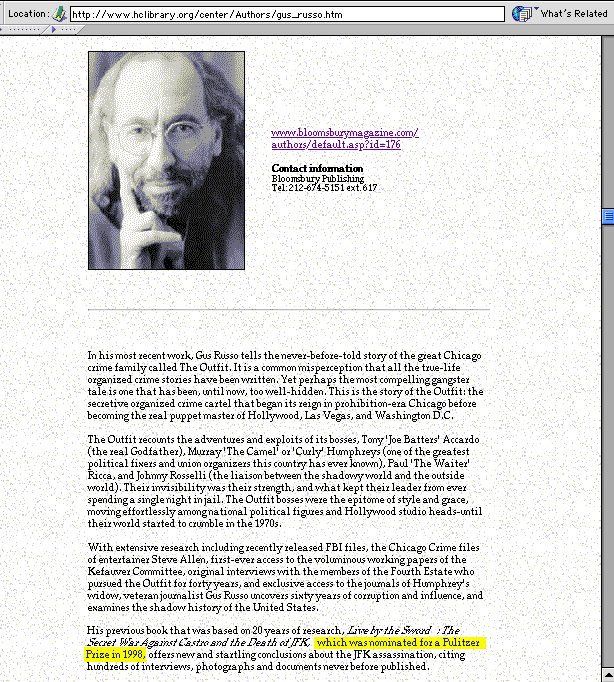
    In three places on the Internet plus the jacket of his second book, it is proclaimed that Live by the Sword was nominated for a Pulitzer Prize. There is a problem with this alleged fact. The people who hand out the Pulitzer nominations aren’t aware of it.

    If you go to their site, you will see that no book by Gus Russo has ever been officially nominated for a Pulitzer. If you call up the people at Columbia University School of Journalism, who administer and maintain the Pulitzer Prize nominations, they aren’t aware of it.

    If you ask them about the process, they will tell you they have a board that hands out nominations in certain categories. That is an official nomination. They will also tell you that many authors and publishers will submit a book for a nomination. This is not a nomination to them. It is a submission. By the same logic, if a film is submitted for an Oscar nomination and is turned down, one cannot say then that it was nominated, no matter how ardently the nomination was pursued.

    Many, many people brought this misrepresentation to the attention of David Westin and Peter Jennings at ABC. They had to have known about it. They have yet to acknowledge it.

    Everyone else can see the irony of hiring a man to investigate the crime of the century who is mendacious about his own book and credentials. Would it have been hard to predict the result of his investigation?

    russo pulitz 2

  • ABC and the Rise of Rush Limbaugh

    ABC and the Rise of Rush Limbaugh


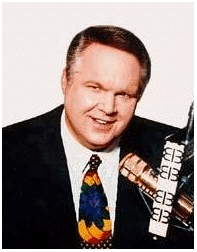
    limbaugh
    Rush Limbaugh

    With little doubt, the two most revolutionary developments in radio in the last 40 years — since the ascension of rock music — have been the talk radio format, and then the conversion of that format to a politically conservative tone. No single personality is more responsible or representative of that explosive movement than Rush Limbaugh. If you ask the average informed person: “Who sponsored Limbaugh?” the answer you would probably hear would either be Clear Channel or Fox. The real and correct answer though would be ABC.

    Once the Cap Cities takeover of ABC was complete, the move by ABC television to a more politically friendly stance was not abrupt or dramatic. For instance, it took until 1993 for Peter Jennings to announce in an interview with TV Guide that his nightly news show would now be paying more attention to conservatives because in his view their ideas were “more provocative and less predictable on some issues.” But there was one front on which CC/ABC could move suddenly and potently and that was radio.

    Why? Because CC/ABC had a huge advantage in ownership outlets that it could capitalize on. Of the 11,000 radio stations in America, CC/ABC either owned or rented space to about half of them — an extraordinary advantage that the FCC did not challenge at the time of the purchase. Since the Fairness Doctrine had been disposed of in 1987, CC/ABC could now begin to broadcast a more conservative brand of radio without fear of being petitioned for equal time.

    Edward McLaughlin, President of ABC Radio began searching for a talk show host to lead ABC’s new direction. He found him in Sacramento. Limbaugh was doing an AM talk show there at the time and he was defending the actions of people like Oliver North and William Casey during the Iran-Contra scandal. McLaughlin noticed him and brought him to New York City for a one-month broadcast trial at CC/ABC’s flagship station WABC. McLaughlin liked what he heard and ABC promoted him by placing him on their fast track, handling all his marketing, advertising and promotion. To provide a fig leaf for ABC, Limbaugh formed his own media company, Excellence in Broadcasting. But Limbaugh broadcast out of ABC stations for decades. And for a long time, the man who followed Limbaugh on WABC was Bob Grant who continued the tirade against “bleeding heart” liberals and once called New York’s black mayor David Dinkins a “washroom attendant”.

    McLaughlin promoted Limbaugh initially by arranging appearances for him on other talk shows like Ted Koppel’s Nightline, Donahue, MacNeil/Lehrer and a primetime, and rather fawning, interview with ABC’s Barbara Walters. These appearances were all meant to give Limbaugh more mainstream exposure and publicize his show.

    When Limbaugh tried to branch out into television in September of 1992, his producer was Roger Ailes, the longtime Republican strategist who specialized in attack ads, most notably in the 1988 Bush-Dukakis race. Of course, the timing of the show was on the eve of the 1992 election so many people complained that Limbaugh’s show was clearly fronting for the Bush campaign and demanded equal time. Limbaugh replied “I am equal time.” Of course, he is not. Limbaugh featured guests who were from his point of view, blocked out all opposing views, screened callers and their questions in advance, labeled feminists, “femiNazis” and blamed all of America’s problems on “big-spending Democrats, the lazy poor and trouble-making minority rabble-rousers.” He was so offensive that the show was pulled because major advertisers did not want to be a part of it. Signifcantly, the ill-fated television show was distributed by one of CC/ABC’s partners, Multimedia. Recently, when Limbaugh made his comments about Donovan McNabb of the Philadelphia Eagles being overrated and a beneficiary of racial sympathy, it was on another subsidiary of ABC, ESPN.

    Clearly CC/ABC meant to chart a sea change in the concept of talk radio with Limbaugh’s launch. This in turn made it possible for Jennings to make his 1993 comments. If one recalls the days of talk radio before the Limbaugh Revolution, it was actually a rather interesting, exploratory and sedate domain with people like Ira Fistell and Michael Jackson in Los Angeles. Limbaugh and CC/ABC made them obsolete and paved the way for the likes of Michael Savage, another talk show host so offensive that he had to be yanked from television.

    We would like to add here that because a radio show is conservative in its orientation, this does not mean it is to be equated with Limbaugh or his clones. There are many conservative shows that do not have his agenda or practices. One example would be the Joyce Riley show out of St. Louis. This is a conservative show that is truly conservative — that is, it upholds traditional American values like the Constitution, open debate, and international law. So on her show — syndicated through 187 stations — you will hear open debate on such issues as why the CIA and FBI could not prevent 9/11, the questions surrounding Jeb Bush and Katherine Harris and the Florida election, the use of depleted uranium by Clinton in Kosovo and Bush in Iraq, and, of course, the assassinations of both Kennedys, King and Malcolm X. We admire and salute her conservative tradition and aims. We should add that there is some of this non-debate problem with stalwarts of the left also i.e. David Barsamian, Noam Chomsky, and Alexander Cockburn. Their friends and followers have tried to eliminate or minimize this kind of open debate on the Pacifica network.

    And some of their friends — like Marc Cooper — cross over into that other no-conspiracy zone in that other liberal outpost The Nation where Max Holland assures us that Oswald acted alone, and David Corn gives us limited hangouts on horrific scandals like the CIA and drugs. This “see no evil, hear no evil, say no evil” attitude about huge conspiratorial and covered up crimes leaves the public confused and angry about the media and the government at the same time that our doctrinaire “right and left” media tell us that conspiracy theories are eroding the public’s belief in the government. The obvious truth that neither wishes to establish or state is this: there is no “left or right” when it comes to the truth about these crimes. Therefore both sides choose not to tell the truth about, for example, what happened to President Kennedy, in order to please their masters and to stay part of the so-called “mainstream debate.” Which, of course, is why more and more people a) don’t believe our government, and b) don’t believe the media, and choose to listen to people like Riley on the right and Cynthia McKinney on the left. They know they are being lied to and want to find someone who is at least searching for the truth.

    Pity the nation that has to choose, thanks to ABC, between such a polarized atmosphere.


    Mr. DiEugenio would like to credit Dennis Mazzocco and his book Networks of Power for most of the material that appears in this article.

  • “Peter, Meet my friend and assistant Gus Russo”

    “Peter, Meet my friend and assistant Gus Russo”


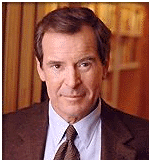
    jennings
    Peter Jennings

    Why did ABC, Peter Jennings, and executive producer Tom Yellin use Gus Russo as their chief consultant on this program and how did Russo originally come to their attention? Why did they then allow Russo to bring in his pal Dale Myers and his already discredited computer simulation?

    The answer to that question appears to be: Seymour Hersh.

    As many recall, about seven years ago ABC bought the TV broadcast rights to Hersh’s book on John Kennedy entitled, The Dark Side of Camelot. From most reports, the main reason they purchased the book was because of a supposed sensational document which showed a secret deal involving Marilyn Monroe, mobster Sam Giancana, and members of the Kennedy clan including JFK.

    Upon release, the book was nearly universally panned, most notably by Gary Wills in The New York Review of Books. Only two reviews were in any way positive. After panning the book in an initial review, The New York Times brought in longtime CIA flack Thomas Powers to do a more sympathetic review which concluded that Kennedy deserved to get his head blown off in Dealey Plaza. The New Yorker, which also has a history of obfuscating the facts about the assassination, brought in Gore Vidal. Vidal has been a Kennedy basher since Bobby Kennedy banned him from the White House for reportedly drunken behavior and lewd language. That was about it for the reviewing accolades.

    There was a good reason for the mostly negative reception. Hersh used an array of questionable tactics in his research and reporting to perform what any objective reviewer would have to call a hatchet job. These were exposed prior to the book’s publication by Robert Sam Anson in the November 1997 issue of Vanity Fair. Others were discovered by various reviewers like Dr. David Wrone. To use some new examples (Hersh’s shoddy work provides endless opportunities for this sort of thing) in his book (pgs 426-428) Hersh writes that Kennedy asked Air Force General Ed Lansdale to go to Saigon to arrange the assassination of Premier Ngo Dinh Diem. There is no evidence of this in the Church Committee Report on this subject or in any serious examination of the last few months of Diem’s regime by any noted scholar of the subject. Hersh got this info secondhand with almost no corroboration so he knew he was fishing. He called up David Kaiser who was working on a monumental history of American involvement in Vietnam from 1960-65 eventually called American Tragedy. In the footnotes of this fine book, Kaiser notes Hersh’s call to him about this piece of gossip. Kaiser wrote that he informed Hersh that he had seen nothing to support it in his research. In fact the White House calendar demonstrated that Lansdale never met with Kennedy in 1963. (Kaiser p. 531)

    Hersh trotted out Judith Exner for another appearance before she died. Hersh never informs the reader of any of the problems that Exner presented as a witness. As was his style in the book, he simply listed in his notes that he interviewed her and refers the reader to other articles on her. Exner’s credibility problems are there for anyone to see and they were listed in Probe Magazine (Vol. 4 No. 6), and in the books Questions of Controversy by Mel Ayton, and The Assassinations edited by James DiEugenio and Lisa Pease. Hersh ignored all of her contradictions and deceptions. He actually added more to the long and winding list. He used a man named Martin Underwood to backstop a story about her delivering payoffs between Giancana and Kennedy. In the ABC special based on the book, Jennings told the audience Underwood would not appear on the show. He did not tell why. The Assassinations Records Review Board did tell us why in their Final Report. Chief Counsel Jeremy Gunn heard of this story and called Underwood in to testify. He said he knew nothing about these Exner trips as to Chicago and Giancana. Another part of Exner’s story had serous problems. She told Hersh that Bobby Kennedy was “very much a part of all of this.” She is referring to the money transfers from JFK to Giancana. She adds, “Bobby would come in and bring the information in a manila envelope to Jack. And they would discuss a little bit about it. And Bobby often would put his hand on my shoulder and ask, `Are you still comfortable doing this? We want you to let us know if you don’t want to.’ Hersh then further quotes Exner as saying the Kennedys “were very smart in the way they handled this …. I was this little bauble.” She goes on to add that they seemed at ease as they discussed the contents of the papers and the envelope in front of her. (Pgs. 307-308)

    Hersh should have been more careful with Exner. Or her handlers should have coached her more. Evidently she could not recall all the different stories she told over the last 25 years of her life on this subject. She couldn’t keep them all straight. It is hard to believe that Hersh was not aware of Exner’s appearance on Larry King on February 4, 1992. When King asked her about any relationship she had with RFK, she replied very succinctly with the word, “None.” King was surprised at this response, so he asked her to clarify it. She stated that she probably met him once or twice at a political fundraiser or a party in Los Angeles. That was it. Hersh’s book came out five years later and he says he researched it with various assistants for five years. Yet he was not was not aware of this blatant contradiction noted by Mr. Ayton (p. 158). Or if he was he chose not to reveal it.

    But the biggest pratfall made by Hersh was with the above mentioned Monroe/Kennedy documents which he obtained from a man named Lex Cusack whose father supposedly had the documents. When ABC bought the rights for the book they did something that Hersh, incredibly, did not do. They brought them to forensic experts who tested both the typing and the writing. They found they could not have been made when Cusack said they were or with the instruments available at that time. So why did Hersh not hire his own experts? He has replied at various times that a) It was expensive to hire these experts, and b) the tests take a long time to perform (See Eric Alterman in Salon in October of 1997). Concerning the first, Hersh got a huge advance for the book, well into the six figures by a major publisher, Little Brown and Company. He hired several assistants to help him. He could not afford the rather small amount of money the testing would have entailed? Little, Brown could not afford it either? As for the time factor, it is even weaker. As noted, Hersh said he took five years to complete the book. CBS tested the documents after ABC did and it took them a matter of just a few weeks. Researcher John Armstrong got in contact with one of the ABC experts and asked him to do a test for him on another matter. He said he could do it in about a month.

    But there is more to it. In a story in The New York Times (9/27/97), reporter Bill Carter revealed that Hersh had previously tried to peddle the documentary rights to his book to NBC. And this sale was based on the sensational, ersatz Monroe documents. NBC sent some experts to look at the documents also and Warren Littlefield, an NBC executive, told Hersh that in their opinion, the documents were questionable. This was in the summer of 1996. Littlefield added that NBC’s lawyers were more specific about the questions in talks with Hersh’s attorneys. So Hersh could hire attorneys for the sale of the documents, yet he could not hire experts to test the documents.

    When ABC did a 20/20 segment (9/25/97) exposing the documents Hersh appeared on camera for very, very little time. The segment focused on the forensic debunking of the documents and Cusack’s role in it. The previous testing of the documents by NBC was not mentioned at all. David Westin had approved a million dollar budget for Hersh’s longtime friend Mark Obenhaus to produce a special based on the book. It was left to Anson and Charles Samuels in an article in The New Yorker (11/3/97) to detail that Hersh had planned to cut in Cusack after the sale of the book for the use of the documents, upon which the sale apparently relied. So the possibility was that Hersh did not want the documents exposed and did not tell ABC about the previous testing. And since Obenhaus and Hersh have been friends awhile, it may be that Obenhaus and Jennings were protecting Hersh on this score to, in turn, protect Westin’s unwise investment.

    The seeds of the Russo-Jennings meeting come from this rather inauspicious origin. For when Debra Conway called ABC they said that two of the producers on the assassination special are Obenhaus and Edward Gray who were the producers of the Hersh special. Russo helped Hersh on his book as he is mentioned on page 476 of the Acknowledgements. According to Anson, Obenahus had wanted to make a special on the JFK assassination in 1993 but it fell through. So now ABC did do the actual assassination special and they went back to some of their original team that produced this less than stellar-to say the least -previous one.

    Some people do not learn from past errors. The whole thing reminds me of the press angle as represented by the Danny DeVito character in the film LA Confidential. This time, the corpse in the hotel room is Kennedy’s.

  • David Westin: It’s Tough Following an Icon

    David Westin: It’s Tough Following an Icon


    westin

    David Westin came to ABC from the field of law. He was a law professor at both Harvard and Georgetown teaching international civil law and litigation. In 1979 he joined the firm Wilmer, Cutler and Pickering. He worked his way up to partner by 1985. He joined Cap Cities/ABC (now ABC Inc.) as general counsel in 1991; among his duties were labor relations and government relations. He became president, production in 1993. From 1994 until 1997 he served as president of the ABC Television Network. In that position he oversaw all divisions and program units at ABC including news and sports. He was named president of ABC News in 1997 succeeding the legendary Roone Arledge.

    Arledge was the man who, first, took ABC Sports and made the then last place network a force to be reckoned with by making Wide World of Sports and Monday Night Football into regular parts of American life. He then moved over to the news division and performed the same magic there by building both a newsmagazine and nightly news slot that could more than hold its own with the more established and familiar NBC and CBS. Arledge was dynamic, original, daring, imaginative, intuitive, and he was all of that with a touch of class. No one can say that he was a major force in driving news and sports programming down to the remarkable level of tawdriness, slickness, vacuosness, and sensationalism that are the earmarks of the networks, and their cable outlets, today.

    One cannot say the same about Westin. In public, Westin likes to make salutary and flattering remarks about his position and the duty of the news reporter. For instance, in March of 2003 he told a group of journalism students at Knox College that reporters should focus on “providing the most truthful information available to allow the viewing public to make up their own minds about major events” (The Knox Student, 4/9/03). He went on to say that newsmen should first provide the historical and political connections to develop an overall context around what is occurring. (Ibid) In October of 2001 at Columbia School of Journalism — the equivalent in stature of Harvard Law School — he made similar remarks, like “Our job is to determine what is, not what ought to be and when we get into the job of what ought to be I think we’re not doing a service to the American people.” (Media Research Center, Cyber Alert 10/31/01). He went on in this vein by referring specifically to the 9/11 attack, “I can say that the Pentagon got hit. I can say this is what their position is, this is what our position is, but for me to take a position this was right or wrong … I feel strongly that’s something that I should not be taking a position on.” He did add that it was OK for journalists to do so in their private lives.

    Westin’s laudatory ideals lasted about 48 hours. Or as long as it took the likes of Matt Drudge and Rush Limbaugh to start whacking him around on the web and on rightwing attack radio. After the Drudge-Limbaugh wedge tactic, Westin beat a hasty retreat. He backtracked and said he was wrong to make those remarks and said he was only illustrating a broad, academic principle and he apologized “for any harm that my misstatement may have caused.”

    Why did Westin genuflect to the likes of Drudge and Limbaugh? Two reasons surface when one takes a look at his tenure as news division chief. Unlike Arledge, and contrary to his public pronouncements, Westin does not like to take risks, and secondly his public posing is really posturing. There is a lot of evidence to indicate he doesn’t mean what he says.

    Significantly, according to television insider Danny Schechter, Westin represented Capital Cities when CC/ABC merged with Disney (Toward Freedom Magazine 1/99). Michael Eisner of Disney apparently liked Westin’s negotiating skills and made him ABC’s general counsel. It is under Westin that the antics of John Stossel have been given almost free rein. Under Westin, ABC reporter Jackie Judd reported many of the leads given to her by then Independent Counsel Ken Starr. As Steven Brill pointed out, Starr’s leaking was in violation of the legal code. Yet lawyer Westin was apparently not bothered by this. According to the LA Weekly (11/22/02) Westin once killed a story reporter Brian Ross worked on showing how Disney’s practice of not running criminal background checks at its theme parks allowed for the hiring of convicted pedophiles. When Ross defended his four month investigation and insisted it run, Westin replied with, “Are you crazy?” It was Westin who allowed the ABC News Division to leak all kinds of stories to the press in order to kill Kristina Borjesson’s thoroughly researched story about TWA Flight 800, thereby sinking Oliver Stone’s daring new concept for newsmagazines called “Declassified” (See Borjesson’s Into the Buzzsaw, pgs. 133-36)

    Then there was the Leonardo DiCaprio Earth Day interview in April of 2000. Teen idol DiCaprio is an environmentalist who had a friend at ABC’s 20/20. They put together an idea about a walk through the White House with then President Clinton where Clinton could show how he put in several environmental improvements like new insulation etc. What happened was quite different: the young actor did a sit-down interview with Clinton. This of course, is the kind of stuff that Entertainment Channel or Access Hollywood would propose and hope for: a celebrity pushing his agenda by doing a softball interview on a serious subject with the most important politician in America. When word got out on what had happened, Westin went into a denial mode saying that it was the White House who proposed the interview format. But once Westin’s denial hit the fan, the White House replied that they were not the ones who sent DiCaprio over to interview the President. It was ABC’s idea from the start.

    On the strength of Schechter’s inside information, it would be wise to believe the White House and not Westin. In the above mentioned Schechter article, he describes a meeting of ABC producers which a friend of his attended. At this meeting, which was called and chaired by Westin not long after he took over for Arledge, Westin gave his soldiers their new marching orders. He stated that from then on their stories should integrate the “3 C’s” as much as possible. What were Westin’s three C’s? According to Westin they were Celebrity, Calamity, and Censation [Sic]. Schechter protested that the last word begins with an “S”. His friend replied with, “That’s what he said.”

    With this kind of banal simplification and Westin’s seeming enjoyment of skewering the alphabet to his troops it becomes pretty clear why he has overseen the double assassination of John F. Kennedy. He first chose to produce a documentary based upon Seymour Hersh’s trashy and factually indefensible book The Dark Side of Camelot, and now he has allowed Peter Jennings to employ Hersh’s assistant Gus Russo to assassinate not just Kennedy but Lee Harvey Oswald. This recycling of the Warren Report deception when the new evidence is now insurmountable that Oswald was an innocent man. As another attorney, Chief Counsel of the Assassination Records Review Board said, “I would rather be defending Oswald than prosecuting him.” If Westin were to look at the evidence, his lawyerly background would probably make him come to the same conclusion.

    But sadly, he is not an attorney anymore. And sadly, Arledge, who vetoed a similar report to Hersh’s back in the eighties, isn’t around anymore to supply ABC with both a vison and a conscience.

  • ABC’s Russo/Myers Paradigm: John Stossel

    ABC’s Russo/Myers Paradigm: John Stossel


    stossel

    Remember when it used to be a sacrilege to get a news story wrong? At ABC, it’s more like a venial sin these days. The man who is most important in breaking down that standard — in fact at destroying the whole concept of a Standards and Practices doctrine, forget an office — is John Stossel.

    Stossel is supposed to be ABC’s consumer reporter. But to really understand who he is and how far ABC has fallen, one has to understand that, in the traditional sense, Stossel is not actually a consumer advocate at all. That is if one imagines that term to mean a serious reporter who is interested in protecting the public from corporate abuses in production and sale of goods and services. Quite the contrary. Stossel is a cheerleader for corporations in their pursuit of mass markets. That is, he tries to convince the public that, really, those ideas about corporate abuses and the need for protection for the public against them is all wrong. Its scaremongering actually. At one time he actually tried to argue that dioxins were harmful to animals but not necessarily to people. At the same time, producers of dioxins were in court trying to convince a judge of the same thing (Natural Food Merchandiser, 11/2000).

    Stossel is actually an evangelist for 80’s style greed. In fact in a program called just that, Greed, Stossel spent a full hour trying to reverse the verdict of the great muckrakers of the past like Ida Tarbell. He tried to say that the Robber Barons of the Gilded Age were actually doing us all a favor in their pursuit of monopolies and their thefts from the public and government. Stossel removed the horns from figures like John Rockefeller and Jay Gould and tried to plant haloes on their heads. Like Ivan Boesky’s famous commencement speech (mimicked by Oliver Stone in his film Wall Street), Stossel concluded that “Greed is good.”

    In his own words, “I started out by viewing the marketplace as a cruel place, where you need intervention by government and lawyers to protect people. But after watching the regulators work, I have come to believe that markets are magical and the best protectors of the consumer. It is my job to explain the beauties of the free market.” (Stossel in The Oregonian, 10/26/94). As one commentator has stated, he could start by explaining that doctrine to the shareholders in Enron, or better yet the employees who had 401K’s in the company. But, of course, he ignores and deflects such criticism by characterizing it as aleftist plot to destroy him (David Podvin, Podvin on the Media, 1/22/02).

    But actually the “plot” is really inside ABC. And it was exposed by a rather mainstream periodical, The Los Angeles Times. But first, let us explain how the LA Times expose by Liz Jensen was possible.

    After Stossel was caught in a blatant deception on the show 20/20 in the year 2000, his profile went up in a negative way. There, in a segment entitled “The Food you Eat”, Stossel tried to argue that organic foods were not really better than conventional ones, since pesticide levels were not higher on conventional produce than they were on organic produce. But there was a big problem: the experiments Stossel relied on were non-existent. (New York Times, 7/31/2000) This fits a pattern because prior to this, in 1994, two producers hired by ABC to work on another Stossel report, “Are We Scaring Ourselves to Death”, resigned when their research was dismissed because it did not conform to the slant that Stossel desired. (Extra! Update 6/94)

    So by 2001, Stossel was being recognized as a bad egg by people who really cared about things like consumer protection, healthy foods, and the environment. In 2001, ABC was preparing a report for Earth Day. They went to Santa Monica’s Canyon Charter School and they sought permission to use some of the kids in a televised spot questioning them on their ideas about the environment. Brad Neal was one of the parents who gave ABC permission to question his child for the spot. Neal realized something was up when Stossel turned out to be the anchor of the show. This is something that ABC did not reveal to him. And when the questioning began, the questions were not open-ended but they clearly were aimed at manipulating the students into reciting the mantra that public schools were drumming into them an anti-corporate, leftist, environmental message. Neal said that at one point Stossel tried to lead the children in a chant to the effect that “All scientists agree that there is a greenhouse effect.” Neal said that what bothered him the most about the show’s agenda was ABC’s effort to hide Stossel’s participation since he would have not granted the permission if he would have known about it.

    But there is more about Stossel, who once tried to equate the rise in CEO pay in the 90’s with labor’s, that ABC is not forthcoming with. Stossel’s message is clearly in tune with those corporations and advocacy groups whose virtues he extols. In a quite unusual move, ABC allows him to speak for fees before ideologically in tune organizations like the Young America’s Foundation, a famous conservative group. In a report in Brill’s Content (March of 2000), it was revealed that Stossel had made 27 such speeches in two years which generated income for him well into the six digits. Most TV and newsprint journalists are not allowed such engagements because making as much money outside one’s reporting position as in it could compromise one’s viewpoint. But there is more to this lucrative side business. ABC itself also benefits because Stossel’s rightwing hucksterism sells videos of his reports to educators through a conservative foundation called the Palmer R. Chitester Fund. This earns ABC a licensing fee.

    After a thorough and coruscating analysis, David Podvin has concluded, “John Stossel is the gauge of integrity at ABC News. His presence on the network, after he has been caught lying repeatedly, is a devastating indictment of the entire organization’s credibility. As long as a man who treats facts as though they have leprosy is allowed to appear in the guise of a journalist, Disney’s news operation will continue to be nothing more than the disinformation arm of a major conglomerate that has replaced journalism with corporate propaganda.”

    As one can logically deduce, after years of Stossel, David Westin and Peter Jennings would feel comfortable with “researchers” like Gus Russo and Dale Myers. Especially since they could be relied on to deliver the spin the producers clearly planned on in advance.

  • Shame On You, Sy, for the Awful Book on JFK


    Seymour Hersh, The Dark Side of Camelot
    Little, Brown and Co.; 1997; 498 pages, $26.96

    In an interview given on publication of his alleged expose of John F. Kennedy’s private life and public policies, the famed investigative reporter Sy Hersh said he wanted to make “a big score” and retire.

    To this end the Pulitzer prize winner has prostituted his nation’s history and, at the same time, sustained the intelligence and military forces that bitterly opposed JFK — those who among other infamies sunk us in Vietnam and who tried and failed to initiate nulcear war over Cuba. Hersh does it with a corruption of scholarship perhaps unequalled in recent times.

    He uses not a single source note, but employs caption notes that refer to many books and no pages, so a reader cannot easily check his truthfulness. Hersh has corrupted the facts. On major issues he is coy, strongly using suggestive language with a statement of fact where none exists. Sources are often made up to fit his perceived beliefs. In addition he relies on interviews with people bitterly opposed to JFK’s policies and usually not identified as such.

    Hersh reviews JFK’s rise to power and then largely concentrates on the foreign policies of his presidency, alleging that the crude principles of his reckless and corrupt personal life — astutely masked during his lifetime by his power and friends — led the United States into one disaster after the other.

    Hersh suffuses the book with putative accounts of JFK’s sex scampers but these are a honey trap to snare a reader into accepting Hersh’s false presentation of his foreign policy — which is the true intent of the book. How bad is Hersh’s scholarship? Consider the Section of THE DARK SIDE OF CAMELOT in which Hersh states that JFK “endorsed” the CIA assassination of Lumumba of the Congo. Nothing could be further from the truth. Since CIA thugs beat Lumumba to death on January 17 and JFK was sworn in on January 20, Hersh must overcome a serious chronologial problem. He does this by baldly asserting Kennedy vigorously supported and emphatically agreed to Eisenhower’s policy to kill the African leader.

    Hersh carries this subterfuge off by only quoting former CIA men who were ideologically opposed to JFK’s policies, by refusing to cite the copious well-known record affirming an opposite interpretation, and by not interviewing the numerous individuals who would have provided a true picture.

    Early in January 1961, Kenedy’s staff and special Congo study group had alerted the CIA that American reactionary policies in the Congo would change and that a JFK emissary had warned Belgium intelligence services not to “liquidate” Lumumba. By February 2, Kennedy had devised a plan for a new Congo policy that would ultimately include Lumumba. He did not learn of the murder of Lumumba until February 13; a famous photograph depicts him receiving the news, his head bowed in anguish.

    Hersh also devotes much attention to “proving” JFK tried to assassination Castro using the CIA and Mafia. In the course of this effort, he asserts that President Kennedy used Judy Exner, a sex partner, to carry cash to the mob bosses to pay for making the hit.

    A key document of the Castro murder attempts is a 1962 Department of Justice memorandum by the CIA’s inspector general Sheffield Edwards. Hersh uses parts of the document in other contexts, but when he comes to the attempts on Castro’s life he carefully omits what it says about them, since the document’s contents would destroy his framing of JFK.

    The CIA-Mafia attempts on Castro began in August 1960 and ended in November 1960, before JFK took office in 1961. Only six people knew of it, all CIA men, and they only orally. No one else knew — not Ike, not JFK — until many months after the fact when the FBI stumbled onto a bungled CIA phone tap for a mobster and it exposed the affair. A shocked Robert Kennedy ordered a complete explanation.

    As it turns out, the CIA had set aside $150,000 for the job, but the Mafia said no and refused to accept any money. EXner could not have carried money, as she told Hersh; there was none to carry and the affair had occurred and was over before he entered office. There were, in fact, no JFK directed or encouraged attempts on Castro’s life.

    Hersh frequently castigates JFK for using private back channels to negotiate a secret deal with Khruschev to end the Cuba missile crisis — a deal Hersh suggests Kennedy pursued in order to improve his standing with the American people. The fact is back channels worked and, after the crisis, the executive branch institutionalized it with direct phone lines and other systems, which later presidents have found to be quite useful. The real reason JFK kept the pact secret was spelled out in Khrushchev’s memoirs, KHRUSHSCHEV REMEMBERS, and in Robert Kennedy’s writings on the subject. It had nothing to do with self-promotion. The Kennedys were intensely afraid of an American military coup d’etat and overthrow of the U.S. govenment accompanied by a launching of a massive nuclear strike against the whole of the communist world. Only through this private method could and did JFK hold the irate military in check.

    It can be argued today that nuclear war was avoided by President Kennedy’s unparalleled action.

    Even in the minor themes of The Dark Side of Cemelot, Hersh perverts our history. He states a high-ranking Navy officer told him that, “at the request of Robert Kennedy”, the notes containing vital information about JFK’s postmortem were not published. By exclusively relying on that prejudiced source, Hersh sustains the generation-old effort of many federal officials to blame the failed inquiry into JFK’s death upon his brother’s refusal to give them access to key medical records.

    But in well-known sources, which were spurned by Hersh, we know RFK by letter gave explicit permission to use all autopsy materials. The same definitive sources also show it was the FBI that, after realizing the materials might hold data incompatible with its invented lone assassin theory, manufactured the libel that Robert Kennedy had denied access.

    Significantly, prosecutors did take the critical notes. They were not destroyed and were, in fact, placed in Navy hands. They were released by the Navy for Arlen Specter, Warren Commission counsel, who used them to examine the autopsy doctors. They were supposed to be part of Exhibit 397 of the Warren Commission, but it does not contain them. They are not in any archive or known agency files. On this serious issue — which genuinely is worthy of discussion — Hersh is embarrassingly silent.

    (reprinted from Capital Times of Madison, WI, 16 January 1998)
  • Gus, Will You Please Make Up Your Mind?


    Gus Russo has been at work on the JFK case for the past 15 years. To those around him, he has jumped around in his conclusions quite frequently and violently. So much so, that it is hard to measure what he really believes about this case and why or why not. This is particularly puzzling because since 1998 there have been approximately 2 million pages of new files that have been released by the Assassination Records Review Board. Many of these new documents have been very important in resolving disputes that have existed for a long time. For example, Chief Counsel Jeremy Gunn’s investigation of the medical evidence — that is, the interviews he conducted with some very important people at President Kennedy’s autopsy in Bethesda, Maryland — are extraordinarily illuminating to anyone seriously investigating a homicide. Yet, if one examines Russo’s book there is not a mention of them in the entire text. This is important for what it tells us about the book and Russo, but also because it tells us why Russo arrived at where he did on his long and digressive and interesting journey.

    In the late 1980’s Russo was friendly with Boston area researcher Edgar Tatro. (This relationship would be sustained up until the issuance of JFK: The Book of the Film. Russo worked on this book with Oliver Stone’s chief researcher, Jane Rusconi. He promised Tatro he would be credited prominently in the book since he called him many times for information. Tatro was not mentioned as often as he should have been and this began their split.) As anyone who knows him will attest, Tatro is a prime proponent of the school that Lyndon Johnson was behind the John Kennedy assassination. At this time, Russo befriended Tatro and asked if he would be willing to take a sabbatical from his educator’s position to serve as the consultant to a documentary film he was proposing to several financial backers. According to Tatro, Russo actually got as far as presenting the idea to these backers, but for some reason the proposal fell through. So, one could assume that since Russo was pushing this idea he probably believed it. But wait.

    In the early 1990’s the word got out that Oliver Stone was producing a big-budget film based on Jim Garrison’s book, On the Trail of the Assassins. Now anyone who knew Garrison, or his publisher, Sheridan Square Press, would know that the book had to propose that the Central Intelligence Agency —especially the so-called Old Boys Network within it — was the main perpetrator behind the Kennedy assassination. At this time, Russo was investigating the shadowy European trade company PERMINDEX, of which Clay Shaw was a member. He was also extolling the fact that he had outfoxed a clerk at the National Archives and had listened to a previously classified tape of the so-called Fenton Report. This referred to a suspect in the Garrison investigation who had been tracked down by House Select Committee investigators Cliff Fenton, Bob Buras, and L. J. Delsa and had discussed his role in an apparent meeting, and other actions, at which the murder of JFK had been discussed. As mentioned above, Stone later hired Russo to help Rusconi produce the book which contained much of the backup material for the screenplay. So many deduced from all this that Russo believed the CIA was the prime force behind the killing of Kennedy. But wait.

    At a conference in Dallas in 1992, Russo discussed the story of Delk Simpson, a military officer who had been mentioned by writer Robert Morrow and had been pursued reportedly by attorney Bernard Fensterwald. He actually made a presentation with former military intelligence analyst John Newman. Newman’s book JFK and Vietnam mainly blamed the military for the intelligence deception that Kennedy had seen through when he decided that the U.S. would have to withdraw from Vietnam. So now people assumed that Russo had shifted gears and thought the assassination was led by the military with perhaps a hand from the CIA. But wait.

    A year later, at a conference in Chicago, Russo now ridiculed the idea that Oswald could have been an intelligence operative. This basically knocked out the idea of a military-intelligence type of conspiracy. He now said that the research community should be following leads that pertained to the Mafia and the Cuban exile community. Sort of what people like Robert Blakey — Chief Counsel of the House Select Committee on Assassinations — may have proposed today. Yet, at the same time, someone read him his blurb for Robert Morrow’s final book on the case, First Hand Knowledge. Russo essentially said that he stood by the positive blurb. The problem here was that Morrow’s book included a conspiracy of the Mafia, the Cubans and the CIA, which was led on the ground by Clay Shaw. So perhaps now Russo was advocating a kind of “grand conspiracy” theory crossing through two or three different structures. But wait.

    In the same year, Russo was one of the two reporters on the PBS Frontline special, “Who Was Lee Harvey Oswald?” This show was erratic and unfocused yet by the end it clearly went along with the verdict of the Warren Commission, i.e. that Oswald did it alone. Was Russo now throwing all his years of hunting for an antidote to the Warren Commission away? Was he now embracing the thoroughly discredited Warren Commission? It appeared that way. But wait.

    In 1998 Russo penned his book which was supposedly based on the declassified files of the ARRB. Now he twisted the Warren Commission thesis a bit. He now seemed to be saying that Oswald was not really a demented sociopath, which is what the Warren Commission leans on. He now seemed to be saying that he was manipulated by agents of Fidel Castro into believing that Kennedy felt that Castro’s regime had to be removed. The pro-Castro Oswald could not stomach that thought and he did what he did in Dealey Plaza.

    If you have been counting, depending on what you make of Russo’s performance at the Chicago Conference, that is either six or seven camps that Russo has been in. Yet he discounts each step of his Pilgrim’s Progress. He forgets his previous beliefs as quickly as a good cornerback forgets the 70 yard touchdown completed over his head. This is OK for football, but it is not OK for investigative journalism which tries to build an edifice that recognizes and tries to reconcile into an understandable paradigm all the evidence about a complex and important event. There is no sign of this in Russo’s work. Or else he would not have ignored the vital medical evidence mentioned above. What makes it even worse is that Russo does not even mention his previous beliefs today. For instance, it is difficult to find anywhere where he mentions that he worked on the Stone book with Rusconi. The only way one can find out about the LBJ phase is through Tatro. No one can recall him mentioning it at any talk he gave at a national researcher’s conference in the nineties.

    The natural question is: Did he believe any of these himself? Or when he found he could not find a foolproof theory did he then decide that it was easier and more lucrative to side with the Establishment and the Warren Commission, knowing that people like Peter Jennings and David Westin would never divulge his past conspiracy delvings, or maybe not even ask about them?

    Unfortunately for Jennings and Westin, some people knew Russo way back when he was a musician, before Jennings and Westin started flying him around the country first class for their “exhaustive” and “irrefutable” investigation.

  • The Seizing of the American Broadcasting Company


    This article originally appeared in the February 20-27, 1987 issue of The LA Weekly.

    There is an untold story about the ABC television network. It is about how a company in which CIA Director William Casey is a major player took over the network. The least of the questions this raises is whether Casey used his CIA position to help drive down the price of ABC stock, thereby facilitating the takeover. The most important question it raises is, who really controls ABC, and what can be expected of these people?

    * * *

    This week network TV hit a new low with ABC’s airing of its 14 and one-half hour, $40-million dollar “epic,” Amerika. The xenophobic red-baiting engaged in by Amerika is hardly new to TV, but never before has a network spent so much time and money in such a blatant attempt to inspire in its audience jingoistic paranoia toward the Soviet Union and the United Nations. Small wonder that Mikhail Gorbachev complained to visiting American bigwigs earlier this month that “forces to which hostility is profitable … use high-powered information media to sow hatred toward the Soviet Union.”

    The commotion about Amerika has obscured a much more serious problem about network TV, one that could serve to validate Gorbachev’s complaint for years to come. Despite its length and its crass appeal to the dark side of the American character, Amerika is just a TV show. As such, it’s not likely to have much lasting effect. However, that cannot be said of the changes in network ownership and control that have taken place over the last two years. These have transformed at least NBC and ABC from tasteless schlock-meisters merely striving to sell more ads into powerful information gatekeepers with strong ties to established power blocs that have their own aggressive foreign and domestic political agendas.

    At issue in the ABC situation in particular is an extraordinary story overlooked by most of the press and never taken up by congressional investigators: Who actually took over ABC when Capital Cities Communications bought it in March 1985? For “Cap Cities” is no ordinary company, and the takeover was no ordinary case of corporate wheeling and dealing. Specifically, an L.A. Weekly investigation has found that:

    • Cap Cities’ primary executive Thomas Murphy, his family and some of Cap Cities’ founders had or have a relationship with another firm known to have excellent connections in the intelligence community through one of its subsidiaries. The same firm has also been accused of Mafia ties.
    • William Casey, the just-resigned head of the CIA and a lifelong maneuverer for that agency in the corporate and Wall Street communities, was and is a major player in Cap Cities. A founder and former director of the company, Casey placed all his stock holdings into a blind trust, except — in violation of his agreement with Congress — for his holdings in Cap Cities.
    • The CIA challenged ABC’s right to retain its broadcasting licenses just before Cap Cities bought out the company and during the period it was negotiating for the purchase. This attack had the result of driving down the price of ABC stock on the public market.

    In the Iran-Contragate aftermath, with some of the manipulations this administration and William Casey are wont to engage in becoming known, the Cap Cities-ABC deal and Casey’s possible role in it have to be considered high on the curiosity list of unexplored events of the last couple of years. For with the Cap Cities takeover, one of the three primary influences on America’s public consciousness was delivered into the hands of a company that may well have its own agenda.

    GE Whiz!

    NBC is the most obvious case of just such a potentially political takeover. Until last year, NBC was owned by RCA, whose other interests included consumer electronics, a record label, broadcast equipment and a fair amount of military electronics. Then RCA was acquired by General Electric (GE), an even larger defense contractor. The new GE, containing RCA, is one of the largest, if not the largest, military suppliers in the world. This led Ted Turner to deplore the acquisition because he felt NBC News would have a vested interest in perpetuating the arms race.

    Turner’s Cable News Network, of course, competes with NBC News. However, Turner donates much of his time, his money and his cable “superstation’s” prime time to agitating against nuclear escalation. His concern, therefore, can’t be completely written off as business jealousy. In fact, his concerns were echoed by Ralph Nader and Ohio Sen. Howard Metzenbaum, who wanted the Senate Judiciary Committee to look into the GE-RCA merger. But the committee, then controlled by ever-sensitive-to-big-business GOP, approved the RCA acquisition despite its clear potential for journalistic conflict of interest, as did Reagan’s FCC. Similarly, the so-called Antitrust Division of the Meese Justice Department continued its love affair with monopoly commerce by raising no objection to what in another era would have been considered an outstanding instance of restriction of trade. (GE and RCA will stop competing with each other in the home-electronics and TV-set market.)

    NBC’s outraged declarations of journalistic integrity after the takeover indicate it’s not likely to promote Russophobia actively a la ABC’s Amerika. More likely is a corporate zeitgeist that encourages the killing of or ignoring of stories unfavorable to the parent company and the promotion of a mindset favorable to the company’s interests. GE is also a major contractor for nuclear power plants. One should not, therefore, expect in-depth documentation from NBC on the arms race, nor on defense-contractor cheating, nor on nuclear reactors. One should expect plenty of “hot spot” coverage that makes the world seem an unsafe place for America. One can easily imagine a GE executive saying to an NBC News Executive, “Hey, how come we’re not giving more attention to the threat from Ethiopia?” As Ralph Nader has said, “Self-censorship is alive and well in American media.”

    (The influence of the military and nuclear establishments on NBC News is, of course, mitigated by the fact that inherent conflicts of interest are quite obvious to even casual observers. Thus, when the new NBC administration formed a political-action committee that would collect obligatory contributions from all NBC staffers, including those in the news division, a firestorm of indignation erupted. Once other media and the public saw that GE might pressure its journalists to support political causes, the PAC idea was quickly dropped. The incident indicated from the outset how far the parent company was willing to go in pressing its interests.

    ABCIA?

    If NBC is now tied into the defense establishment, ABC control has passed to men who, in the case of Casey, have open or, in the case of other founders and executives, questionable other links to what’s euphemistically known as the “intelligence community.” The potential for abuse at this network exceeds that at NBC because the possibility of spook-driven news manipulation at ABC has never been publicly aired or examined. (Although some may say the decision to air Amerika is one of the first signs of such manipulation, in fact the show was commissioned before the Cap Cities takeover.) On the other hand, despite much public pressure about the series, ABC executives under Cap Cities have remained steadfast in their commitment to the miniseries. While day-to-day politically motivated intrusion by management into entertainment and news decisions is not unusual — see the Mother Jones issue of November 1985 for historical precedents at ABC before the Cap Cities deal — the major impact of Cap Cities on ABC is more likely going to be in its choice of senior news and entertainment executives both at ABC and at stations owned and operated by it. The tone and parameters are set from the top down; control the top levels, and you needn’t concern yourself about day-to-day affairs.

    A closer look at Cap Cities shows three areas that beg for deeper inquiry. One is the founders themselves — who they are and what their ties may have been to the U.S. intelligence establishment. Another is the relationship of Cap Cities’ founders and execs to a company called Resorts International, some of whose divisions have been said to be intimate with intelligence agencies. And finally, there is the stock deal and William Casey’s role in it, as well as any ongoing Casey role in Cap Cities.

    Cap Cities was founded in 1954 by several men who were or would become prominent. Chief among them, and the principal players in the company, were famed explorer-newscaster Thomas; Tom Dewey, the former New York governor and twice GOP candidate for president (both, like most other Cap Cities founders, now deceased); and William J. Casey, who was Cap Cities’ chief counsel and a member of its board of directors until 1981, when he joined the Reagan administration. He still owns $7.5 million in stock in the now-merged entity called CC/ABC, his largest holding.

    Casey should require no introduction. Appointed by Reagan in 1981 as director of the Central Intelligence Agency, he brought to the job an early training in intelligence in the wartime Office of Strategic Services (which later became the CIA) and a lifelong network of friends and allies in the intelligence community. Crafty, secretive, an ardent supporter of covert action and a big-time player in corporate politics, Casey is part of an “old boy” network of intelligence hands who have frequently used American companies to help in intelligence or covert-action matters or, as in the case of ITT and the CIA in Chile, persuaded the CIA to help out in corporate affairs. (Using corporations to help out in a variety of ways — from washing money, to providing fake business to CIA “front companies,” to furnishing cover for intelligence agents — was a specialty of the man who did the most to give the CIA its power and covert network: its former director, Allen Dulles, a friend, wartime colleague and, rumor has it, business partner of Casey.)

    Lowell Thomas was a larger-than-life figure — an explorer, a broadcast personality, a film documentarist and a best-selling author. The Soviets long accused Thomas of also being an American intelligence agent because he often appeared with photographers and film crews at highly sensitive points of “communist versus the Free World” conflict. Thomas, though he had at minimum good journalistic connections in the U.S. intelligence community, always denied being a spook in the face of published articles questioning his activities. But he made no bones about his staunch anti-communist leanings. (He even appeared with John Wayne, Martha Raye and several U.S. generals in No Substitute for Victory, a denunciation of commie-coddling sponsored by the far-right John Birch Society.)

    Thomas lived in a New York state enclave for the rich where one of his neighbors was Thomas E. Dewey. (Another was Lawrence E. Walsh, later to become special prosecutor in the Iran-Contra affair.) Dewey and Thomas later were involved in another company, Mary Carter Paint, which later became Resorts International (more on this below).

    Before becoming governor of New York and a presidential candidate, Dewey had been a U.S. attorney and district attorney in New York City, where his biggest success was putting behind bars Mafia chieftain Lucky Luciano, who was Meyer Lansky’s mentor. As governor during World War II, Dewey agreed to a deal to parole Luciano in exchange for Mafia assistance to the OSS and Naval Intelligence. The assistance involved helping with the invasion of Sicily and using Mafia-controlled dock workers to guard against Nazi saboteurs.

    This led to a long association between the OSS’ successor agency — the CIA — and the Mafia. According to Rolling Stone investigative reporter Howard Kohn, much of the association passed through Dewey. Kohn has reported that both the CIA (via Dulles) and the Mafia (via Lansky) funneled money and valuable information to Dewey’s political campaigns as well as to Dewey’s protege, Richard Nixon, and to Nixon’s pal Florida Sen. George Smathers, like Nixon a close friend of the shadowy Bebe Rebozo. Kohn alleged that Rebozo and Lansky went on to further profitable associations with Resorts International.

    Even before becoming governor, Dewey had close ties to the intelligence community. He was known as “the man” in the U.S. attorney’s office who could be relied on to threaten New York publishers with prosecution if they were to publish books revelatory of intelligence matters. Dewey helped suppress several such books.

    Joining Dewey and the Murphy family in Cap Cities ownership were powerful New York GOP leader Alger Chapman and, for balance, John McGrath, who managed Democrat Averill Harriman’s New York gubernatorial races in the 1950s. Also purchasing Cap Cities stock were the following members of the U.S. House of Representatives: Leo O’Brien, Eugene Keogh and James Delaney, all New York Democrats; and Peter Rodino, New Jersey Democrat and presently head of the House Judiciary Committee.

    The final important founding player in Capital Cities is its president, Tom Murphy, who Wall Street and media executives widely consider to be among the most talented and successful businessmen alive. (He is also a director of Texaco and IBM.) A very private man, Murphy associates mainly with his relatives and business cronies, while avoiding the public attention cultivated by media moguls like Ted Turner.

    Murphy’s Gang

    In terms of knowing who the players are behind ABC, these relatives and business associates loom large. Chief among them are people prominent in Resorts International, which, as mentioned above, began as Mary Carter Paint Company and was purchased in 1959 by an investment group that included Lowell Thomas and Thomas Dewey.

    Rolling Stone in 1977, after being legally challenged by Resorts, retracted a story that CIA Director Allen Dulles was majorly involved in the buyout. Quoting CIA sources, Kohn wrote that in 1958 Dulles gave Dewey and Thomas $2 million in CIA money to set up a front company. With it they supposedly bought Crosby-Miller Corp, which merged with Mary Carter a year later. In its retraction, Rolling Stone noted that while it respected Kohn as a researcher, Resorts International had shown the magazine persuasive evidence that Kohn had been wrong or been misled by his sources.

    Tom Murphy was, according to at least one published report, another member of the purchasing group. So was a man named John Crosby, whose sone James would become chief executive of Mary Carter/Resorts International and whose daughter would become Tom Murphy’s wife.

    James Crosby, who died last April, was a close friend of Nixon (to whose campaign he donated $100,000 in 1968) and Rebozo, and he played host to the recently deposed Shah of Iran at Resorts International’s hotel on Paradise Island in the Bahamas. (The shah, of course, was put on the Persian throne in a coup engineered by the CIA, and maintained close lifelong ties to the agency; it is axiomatic that the agency would have tried to see to his welfare after he fled the country.) John Crosby, according to Kohn, had been, like Casey, a “member of the secret circle that lobbied for establishment of the CIA after World War II.”

    During the early 70s, Resort International/Mary Carter’s activities were occasionally cited in the left-wing press as evidence that it had been carrying out CIA business. When similar allegations appeared in a Las Vegas newspaper, Resorts — as in the case of Rolling Stone — threatened suit and won a full retraction.

    In 1968, the company changed names, sold the paint business and concentrated on hotels and casinos in Atlantic City and the Bahamas. Later, it acquired its Intertel subsidiary, which specializes in private “security” and in intelligence gathering for corporate and other clients. Among these clients were several with intimate CIA relationships, including ITT, Anastasio Somoza, the Shah of Iran and Howard Hughes’ vast empire of casinos and military manufacturers. Some published reports have alleged that Resorts may have engaged in money laundering, mentioning the mob, Nixon, and Rebozo as possible beneficiaries. Resorts has also been accused of having ties to Robert Vesco and the Meyer Lansky faction of the Mafia that was involved in CIA attempts to kill Fidel Castro. New Jersey state law enforcement officers who unsuccessfully opposed Resorts’ application for a license to run a casino in Atlantic City also claimed that Resorts had suspicious ties to the mob. (Resorts strongly denied this.)

    At their New Jersey casino license hearing, Resorts officials also admitted paying $431,000 that went to Lyndon Pindling when he was the Bahamas’ prime minister to obtain gambling rights in that country.

    Time magazine has characterized Resorts International as “largely a family affair run by [James] Crosby and some of his relatives.” These include the two Crosby sisters, one of whom, as mentioned, married Tom Murphy, while the other married Murphy’s brother, Henry. A cousin, Charles Murphy, is the corporate counsel. After Jim Crosby died, the Crosby-Murphy extended family inherited some of his stock and voting control of Resorts and Intertel. (The only member of this cozy clan not included in Resorts operations is brother Peter Crosby, an irrepressible swindler with Mafia ties whose Wall Street shenanigans have earned him several prison sentences.)

    With Murphy and the other key players now involved in ABC, Cap Cities and Resorts International, it’s useful to explore the significance of their other holding, Resorts’ Intertel subsidiary — the largest private security and spy organization in the U.S.

    Spies for Hire

    The vast yet secret world of private intelligence was first described at length by Jim Hougan, in magazine articles and the book Spooks (Morrow, 1978), as an unregulated “invisible industry, a security-industrial perplex whose influence is more insidious for the fact that its activities are mostly unseen.” Started largely by CIA and FBI alumni, the private espionage agencies often work for multinational corporations by “guarding ‘proprietary information’ at home, encoding communications, infiltrating governments in the Middle East, or funding counter-revolution in Latin America.”

    If this sounds like CIA work, Hougan says it’s because “agents who leave federal service for private employment often take with them not just their special expertise, but their ‘connections’ as well. Frequently, former agents retain informal access to privileged information, and it’s obvious that some even retain an ability to influence the actions of their old agencies.”

    According to Hougan, Intertel is “nothing less than the legal incorporation of an old-boy network whose ganglia reach into virtually every nerve cell of the federal investigative/intelligence community.”

    When Resorts decided to enter the private-spook biz, it picked two very well-trained and well-connected men to run Intertel. The agency’s first and only president is Robert Peloquin, a former Naval Intelligence agent and veteran of former Attorney General Robert Kennedy’s “Get Hoffa” squad. Later Peloquin headed up the Justice Department’s Organized Crime Strike Force. Peloquin’s first Intertel deputy was James Golden, formerly Vice President Nixon’s Secret Service bodyguard and later security chief of the 1968 Nixon campaign. Golden and Peloquin recruited for Intertel many CIA and FBI veterans, as well as former heads of Scotland Yard and the Royal Canadian Mounted Police. After a few years at Intertel, Golden rejoined Nixon to head the organized-crime section of the Law Enforcement Assistance Administration. Peloquin remains in charge of Intertel.

    (One other prominent Cap Cities connection is M. Cabell Woodward Jr., who was elected to the corporation’s board of directors in 1982. Woodward was also vice president and chief financial officer of ITT, a multinational corporation notorious for having meddled in the internal affairs of Chile and other nations, sometimes in concert with the CIA. (A well-documented study of ITT and the CIA was made by the Senate Intelligence Committee in the mid-70s.) ITT has long been a client of Intertel. In 1966, ITT tried to buy a TV network, but encountered enormous opposition in Congress and the FCC because of the implications of such a highly visible politicized company controlling a major news organ. The network ITT almost purchased was — you guessed it — ABC.)

    The Republican Connection

    As crucially important as it is that ABC was taken over by a firm with such a historical and ongoing relationship with the intelligence community, it shouldn’t be overlooked that Cap Cities is also a longstanding active player in the Republican establishment. Although volumes could be written about Murphy’s and Casey’s interlocking corporate/political/government scheming and manipulating — and Crosby’s ties to the Nixon crowd are sufficiently well known to have led to speculation that Resorts International’s casinos may have funneled money to the Watergate burglars — two anecdotes give a taste of the manner in which these people operate.

    In 1959, Cap Cities’ political connections led to charges of “political payola at its worst” from Wisconsin Sen. William Proxmire, who has also been Casey’s most vehement congressional critic. Proxmire believed that President Eisenhower’s press secretary, James Hagerty, had influenced the FCC to grant channel assignments and licenses that were very profitable to Cap Cities. Hagerty, who not surprisingly had earlier been Dewey’s press aide, denied it all, and the Republican-controlled Justice Department ignored the matter. After Ike left office, the scandal fizzled out. Hagerty was then hired by a close friend of Tom Murphy’s, Leonard Goldenson, to run the news department at ABC television.

    James Quello, now an FCC commissioner, was for years the general manager of Cap Cities’ radio station in Detroit, WJR. According to Morrie Gelman of Electronic Media magazine, when Quello’s performance at WJR lagged, Murphy decided to kick him upstairs to the FCC. This effort was successful in 1974, perhaps because (according to The New York Times) “Quello’s fellow executives at Capital Cities donated $120,000 to President Nixon’s re-election effort at a time when they were actively campaigning to put a broadcaster on the FCC and to make Mr. Quello that broadcaster.” By law, the empty FCC seat was reserved for a Democrat. Quello got it, even though ex-commissioner Nicholas Johnson noted that Quello had himself given $1,100 to the Nixon campaign.

    Casey’s Motives

    And then there’s the ABC takeover itself.

    On November21, 1984, the CIA asked the Federal Communications Commission to strip ABC of its five TV and 14 radio station licenses. (ABC has hundreds of affiliate radio and TV stations, but it’s legally limited to owning just a few stations, all of which are located in the biggest, most lucrative markets.) The CIA was ostensibly upset because on Sept. 19-20, 1984, ABC News had aired allegations that the agency had contracted for the murder of Ron Rewald, a Honolulu swindler who claimed that his scams were directed by the CIA, of which he claimed to be a secret agent. The story supposedly so enraged then-CIA director William Casey that he asked the FCC to strike the ultimate economic death blow to ABC by revoking its station licenses. In February 1985, the CIA reduced its demands to asking for FCC penalties under the “Fairness Doctrine,” which requires the broadcasters to air at least two sides of “controversial issues of public importance.” In both FCC complaints, Bill Casey’s CIA became the first government agency ever to seek such redress from the news media.

    On March 18, 1985, while the FCC considered Casey’s complaints, ABC agreed to be acquired by Capital Cities, a media conglomerate with the lowest profile and highest profit margins in the broadcasting business. It was a “friendly” takeover; ABC chief Leonard Goldenson and Cap Cities president Tom Murphy had been close friends for years. Cap Cities also owns daily papers in Fort Worth and Kansas City, trade journals (including Women’s Wear Daily) and, at that time, 55 cable TV systems.

    What might explain the chain of events that began with Casey attacking ABC and ended with Cap Cities buying the network? Of course, Casey may simply have been outraged at ABC for airing a false story about a CIA murder plot. (Even some CIA critics have concluded the story was untrue. Unfortunately, we’ll probably never know; the judge at the Rewald trial sealed all evidence relating to the CIA.)

    It helps to remember that we’re talking here about Bill Casey, a man whose scruples were never a match for his zest for daring and outrageous adventure. He’s a man who has illegally mined Nicaraguan harbors, and is reported to be up to his neck in Ollie North’s dirty tricks. Proxmire called him a perjurer. The Nation said he “made conflict of interest a way of life.” He’s been accused of shielding ITT and Robert Vesco from federal probes and of arranging to steal debate papers and classified documents from Jimmy Carter when Carter was president, and he was Reagan’s campaign manager. Casey has on several occasions been sued for sleazy stock swindles and once for plagiarizing an author’s work for his own book. Each time, Casey settled out of court in favor of the plaintiffs. As CIA director, he suspiciously unloaded $600,000 in oil stocks just before the bottom fell out of the market. The CIA, of course, prepares the best — if classified — ongoing report in the world on upcoming changes in the oil market.

    With that knowledge of the main actor and his associations, here are three speculative explanations of the events of November 1984 through March 1985. They are not mutually exclusive.

    1. Intimidation of Journalists: Casey’s action against ABC may have been intended to make that network’s news division less eager to run stories uncomplimentary to the CIA. Such a chilling effect could extend to the other networks, which also fear for their licenses. 
    • Infiltration of ABC News: Cap Cities’ purchase of ABC could have two non-business purposes. One is to create credible “covers” for spies — CIA and Intertel — posing as TV newsmen. Another is to ensure that one of America’s three largest sources of news refrains from investigating secret espionage activities and doesn’t go overboard in its coverage of certain critical areas. Such infiltration happened in Great Britain, where the BBC admitted in 1985 that employee security checks and promotions were in the hands of MI5, England’s equivalent to the CIA. Studies of its history have shown that the CIA has frequently planted agents as journalists and owned some newspapers and magazines outright while financing others, such as Nicaragua’s La Prensa.
    • Personal and corporate gain: The CIA’s threat to ABC’s economic lifeblood may have kept down the price of ABC stock so it would sell at “a bargain rate,” which is what the media trade press called the $3.5 billion Cap Cities agreed to pay for the network. Aside from being a major player in Cap Cities since its inception and being its former counsel of record, Casey owns $7.5 million in Cap Cities stock. His challenge to ABC came exactly during the period that Cap Cities was negotiating the buyout. (See accompanying sidebar.)

    Most observers originally dismissed charges of personal gain, since Casey had placed all his stocks in a blind trust in 1983. This meant that he wouldn’t even know if he still owned Cap Cities stock in 1985 (although he certainly knew his friends did), as the trustee could have sold the stock without telling him. However, in May 1985 Casey revealed that one of his stocks, his largest single holding, was never placed in the blind trust — due to a “misunderstanding” with the Office of Government Ethics. That stock was in Capital City Communications.

    Apparently, the CIA is unwilling even to give journalists public domain material about Casey’s interest in Cap Cities. In October 1985, the Weekly wrote the CIa for information on Casey’s stock holdings, as well as for a copy of a statement Casey issued to the press in March 1985 about his stock in Cap Cities. Many weeks later, the CIA sent us a letter saying that they had enclosed the statement to the press, but that we must make a Freedom of Information Act request for the other information. However, the statement was not enclosed. When we wrote them again, we received an official CIA card on which was printed “With the compliments of the Office of Public Affairs.” Hand-written beneath it was the message “Sorry for the inconvenience,” signed by a public affairs officer named Ann Crispell. However, nothing else was in the envelope.

    This is part for Casey’s course. He was forced into the blind trust by Congress originally because he’d invested in firms with which the CIA did business, and in oil companies.

    Why the Silence?

    There’s no absolute proof that Casey’s attack on ABC and his company’s subsequent purchase of it have any sinister implications or results. Still, the odd coincidences and peculiar connections look a little fishy, don’t they? Even if a Republican Congress and a Republican FCC ignored the matter, one would have expected considerable scrutiny from the “liberal” media Casey and his conservative pals always complain about. But it never happened, and it’s worth considering why.

    One might have expected that investigative scourge of the Nixon administration, the Washington Post, would have looked into Casey’s ties to Cap Cities and their relationship to his attacks on ABC. But a closer look reveals conflicts of interest for the Post. It seems that Cap Cities didn’t have all the cash needed to buy ABC. So Murphy invited Warren Buffett to buy 18 percent of the combined entity CC/ABC. Buffett, an Omaha resident with a well-earned reputation as a “Wall Street wizard,” single-handedly controls Berkshire Hathaway, a $2-billion holding company that owns 13 percent of the Washington Post Co., on whose board of directors Buffett sat until the ABC takeover was complete. He was then replaced by Tom Murphy’s friend, financier William Ruane. Berkshire Hathaway also owns a sizable chunk of Time, and the Post owns Newsweek. Once Cap Cities became a network, it could no longer legally continue owning its 55 cable TV systems, so it sold 53 of them to the Washington Post Co.

    More generally, there seems to be a gentlemen’s agreement tat big media companies don’t snitch on, or even discuss in public, the affairs of other media combines. That’s why you can read, hear and view the sins of every industry in America except those of the broadcast and publishing industries. As CC/ABC, the Post, Time and other major news organs also own other news media, silence is always likely to greet a takeover of one media company by another.

    We now know that two of the three national networks have potentially dirty laundry they’d prefer not be aired in public. Surely CBS, their competitor, would jump at the chance to do a little muckraking over the changes at ABC and NBC, right? Don’t bet on it. The new chief of CBS is Lawrence Tisch, who also heads Loews, Inc., whose 25 percent makes it the biggest shareholder in CBS. (Tisch’s brother, Preston, is U.S. Postmaster General.) Tisch has been involved in non-media co-ownerships (Chemical Bank of New York) with Warren Buffett, who also controls large ad agencies that Tisch would like to have buy time slots on CBS. Also, Loew’s, Inc. manages hotels. For years it managed — you guessed it — Resorts International’s hotel on Paradise Island in the Bahamas.

    Crashing the Gates

    In the Information Age, enormous power lies in the hands of a few information gatekeepers who control the flow of the news and entertainment that shapes the social attitudes and political beliefs of the public at large. The most powerful of these gatekeepers are the three major TV-radio networks, ABC, CBS and NBC, along with the almost exclusively white male corporate elite who control them. It’s bad enough that for years these media giants have exploited government-granted broadcast licenses to serve their private commercial interests. It’s nothing less than intolerable for any of the three to use their powers to fulfill secret political agendas that might run contrary to the “public interests, convenience and necessity” they are licensed to serve. Yet this is at minimum a question about ABC and NBC.

    It is high time for the federal government to determine just who owns the networks and what they are using them for. Both houses of Congress have committees that are responsible for seeing that broadcasting serves the public. The Justice Department has the responsibility of investigating the concentration of media control. The Securities and Exchange Commission (SEC) is empowered to investigate stock manipulation. It is, of course, unlikely that we will see any action from this FCC, SEC or Justice Department until January 1989 at the earliest.

    Congress, however, is ostensibly out of the control of the Reagan administration. Senate and House investigations may not change network ownership, but the information uncovered in such investigations could serve to curb the power of the network owners. Information is a powerful tool, both for the gatekeepers and — when available — for the people and their elected representatives.

    Andy Boehm
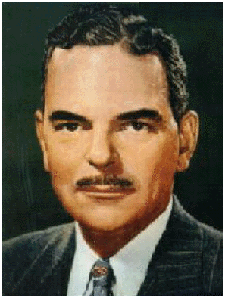
  • Barnes vs. Casey and ABC


    CIA Murder?

    Although most of the matters in the accompanying article have not been investigated by the “news” media or by government bodies, they have been noted elsewhere. A lawsuit, Scott Barnes vs. William Casey, alleges financial misdeeds by William Casey and by Capital Cities Communications.

    Scott Barnes is the man who claimed the CIA asked him to murder Ronald Ray Rewald in the Oahu Community Correctional Center in Honolulu. ABC investigated Barnes’ allegations and aired them on September 19 and 20, 1984, and said that the network believed them. This caused the CIA to ask the FCC to strip ABC of the licenses to its “owned and operated” stations (TV and radio). After much formal and informal heat from the CIA, on November21, 1984, ABC retracted the story in a manner Barnes felt w3as libelous and otherwise injurious. Barnes filed suit on July 29, 1985, with pro bono assistance from the Southern California Americans for Democratic Action (ADA) Foundation and its member-attorney, Ralph D. Fertig of West L.A. Unless otherwise noted, what follows comes out of the actual lawsuit documents or from an interview I had with Fertig on February 11, 1987.

    The Participants

    Scott Barnes, age 33 — Barnes claims to have been a free-lance professional intelligence specialist — or “contract agent” — for the CIA and others, as well as a former police officer and corrections official and counselor. In a December 13, 1984 L.A. Times article by David Crook, CIA officials were cited as denying ever dealing with Barnes and, on another occasion, having admitted to working with him. A Freedom of Information Act file convinced Fertig that Barnes had in fact worked for the CIA.

    According to both Fertig and Crook, Barnes was a source for ABC even before the Rewald affair. Barnes claimed to have been on a secret 1982 mission in Laos led by retired Green Beret Lt. Col. James (Bo) Gritz to locate American MIAs. The movie Rambo was based on this mission, but inaccuracies and exaggerations in the movie angered Barnes. He told ABC News about this. To check out his story, ABC had him tested by a polygraph expert, Christopher Gugas, who had formerly plied the lie-detection trade for the CIA. Gugas pronounced that Barnes was telling the truth about the Gritz mission and about two CIA-ordered murders in Laos. ABC felt that a genuine psychopath could fool a lie detector, so it had Barnes examined by Beverly Hills psychoanalyst Frederick Hacker, who, Fertig says, was formerly Patty Hearst’s therapist. Fertig says Hacker told him he was convinced Barnes was not a psychopath.

    The Defendants — besides Casey, Barnes also included as defendants Caspar Weinberger, Secretary of the Navy John Lehman, Capital Cities Communications, ABC Chairman Leonard Goldenson, Peter Jennings and five other ABC News employees, and four alleged CIA agents. Casey, Weinberger and Lehman were sued as government agents and private citizens.

    The Judge — Federal Judge Richard Gadbois, a Reagan appointee. Fertig calls him “very Republican but fair-minded.”

    The Suit

    Barnes vs. Casey is a complicated spinoff from the equally complicated Rewald affair. The labyrinthine financial and CIA-affiliated affairs of Ronald Ray Rewald would require an article of their own for adequate explanation. All the CIA-related material brought up and then sealed by the judge in Rewald’s fraud trial would make for a book. Suffice it to say that while awaiting trial in an Oahu slammer, Rewald was uttering stories that showed the CIA in a very bad light.

    Barnes’ story is as follows: In September 1983 in Torrance, Barnes claims to have been approached by CIA operatives who hired him to snoop on Rewald. When barnes arrived in Honolulu, he was given false IDs by the spooks and was promptly hired as a chaplain at the prison. This gave him only limited exposure to Rewald, so his CIA contacts told him to apply for a guard job. It was granted immediately. For four weeks, Barnes left reports on Rewald at a CIA “drop” in Honolulu. In mid-November 1983, Barnes met with his CIA contact and two men claiming to be from U.S. Naval Intelligence. They told him to kill Rewald. According to Fertig, Barnes, despite his other assassination work, refused because he would not “kill an American on American soil.”

    The next day, Barnes says, he was told to visit the Oahu County DA to answer unspecified charges. He decided instead to leave for the mainland. While driving to the airport, he heard a radio news report that the CIA had claimed that Barnes had broken the law in getting his jobs in Hawaii.

    A year later, when ABC issued its retraction of Barnes’ story, it questioned his credibility and reported that he had refused to take a polygraph test. Barnes insists he had frequently offered to take the test. Along with libel, his suit charged ABC with infringement of free speech, defamation of character, mental anguish (from fear of being killed himself) and other causes of action. The suit attributed all this to pressure brought on ABC by Casey in his dual role as CIA director and Capital Cities stockholder. He asked for more than $75 million in damages.

    He didn’t get it. What he got was harassment in the form of CIA-linked badmouthing to prospective employers. He also got his phone tapped, he says. Fertig alleges that his own phone was also tapped, as was that of an MGM lawyer, Harris Tolchin, who helped Fertig on the case.

    The substance of the complaint and its factuality were never ruled on. The defendants never replied to the substance of the charges. Judge Gadbois threw out the suit on several procedural grounds. As private citizens, he ruled, the government officials could only be sued in Washington. As agents of the Reagan administration, they had “governmental immunity.” Gadbois said it was conceivable that they acted in the security interests of the nation.

    As for the other defendants, Gadbois ruled that all complaints against them centered around the libel charge. Under a California law, which the judge applied in his federal court, plaintiffs suing for libel must seek a retraction within 20 days of learning about the slander. Barnes didn’t meet the 20-day deadline. Thus the judge said, it was a moot charge.

    For his efforts, Fertig was sued by the Meese Justice Department, and the government threatened to ask the state bar to disbar him. These vengeful steps, reminiscent of Casey’s action at the FCC against ABC, centered around the Justice Department’s assertion that Fertig had filed a frivolous suit devoid of merit. Gadbois threw out the countersuit, and apparently this discouraged the government from complaining to the state bar.