Blog

  • CIA Helped Bush Senior In Oil Venture


    By Russ Baker and Jonathan Z. Larsen | The Real News Project

    A Real News Exclusive


    NEW YORK–Newly released internal CIA documents assert that former president George Herbert Walker Bush’s oil company emerged from a 1950’s collaboration with a covert CIA officer.

    Bush has long denied allegations that he had connections to the intelligence community prior to 1976, when he became Central Intelligence Agency director under President Gerald Ford. At the time, he described his appointment as a ‘real shocker.’

    But the freshly uncovered memos contend that Bush maintained a close personal and business relationship for decades with a CIA staff employee who, according to those CIA documents, was instrumental in the establishment of Bush’s oil venture, Zapata, in the early 1950s, and who would later accompany Bush to Vietnam as a “cleared and witting commercial asset” of the agency.

    According to a CIA internal memo dated November 29, 1975, Bush’s original oil company, Zapata Petroleum, began in 1953 through joint efforts with Thomas J. Devine, a CIA staffer who had resigned his agency position that same year to go into private business. The ’75 memo describes Devine as an “oil wild-catting associate of Mr. Bush.” The memo is attached to an earlier memo written in 1968, which lays out how Devine resumed work for the secret agency under commercial cover beginning in 1963.

    “Their joint activities culminated in the establishment of Zapata Oil,” the memo reads. In fact, early Zapata corporate filings do not seem to reflect Devine’s role in the company, suggesting that it may have been covert. Yet other documents do show Thomas Devine on the board of an affiliated Bush company, Zapata Offshore, in January, 1965, more than a year after he had resumed work for the spy agency.

    It was while Devine was in his new CIA capacity as a commercial cover officer that he accompanied Bush to Vietnam the day after Christmas in 1967, remaining in the country with the newly elected congressman from Texas until January 11, 1968. Whatever information the duo was seeking, they left just in the nick of time. Only three weeks after the two men departed Saigon, the North Vietnamese and their Communist allies launched the Tet offensive with seventy thousand troops pre-positioned in more than 100 cities and towns.

    While the elder Bush was in Vietnam with Devine, George W. Bush was making contact with representatives of the Texas Air National Guard, using his father’s connections to join up with an elite, Houston-based Guard unit – thus avoiding overseas combat service in a war that the Bushes strongly supported.

    The new revelation about George H.W. Bush’s CIA friend and fellow Zapata Offshore board member will surely fuel further speculation that Bush himself had his own associations with the agency.

    Indeed, Zapata’s annual reports portray a bewildering range of global activities, in the Mideast, Asia and the Caribbean (including off Cuba) that seem outsized for the company’s modest bottom line. In his autobiography, Bush declares that “I’d come to the CIA with some general knowledge of how it operated’ and that his ‘overseas contacts as a businessman’ justified President Nixon’s appointing him as UN ambassador, a decision that at the time was highly controversial.

    Previously disclosed FBI files include a memo from bureau director J. Edgar Hoover, noting that his organization had given a briefing to two men in the intelligence community on November 23, 1963, the day after the assassination of John F. Kennedy. The memo refers to one as “Mr. George Bush of the Central Intelligence Agency” and the other as “Captain William Edwards of the Defense Intelligence Agency.”

    When Nation magazine contributor Joseph McBride first uncovered this document in 1988, George Herbert Walker Bush, then vice president and seeking the presidency, insisted through a spokesman that he was not the man mentioned in the memo: “I was in Houston, Texas, at the time and involved in the independent oil drilling business. And I was running for the Senate in late ’63. I don’t have any idea of what he’s talking about.” The spokesman added, “Must be another George Bush.”

    When McBride approached the CIA at that time, it initially invoked a policy of neither confirming nor denying anyone’s involvement with the agency. But it soon took the unusual step of asserting that the correct individual was a George William Bush, a one-time Virginia staffer whom the agency claimed it could no longer locate. But that George Bush, discovered in his office in the Social Security Administration by McBride, noted that he was a low-ranked coast and landing-beach analyst and that he most certainly never received such an FBI briefing.

    It was perhaps to help lay to rest the larger matter of the elder Bush’s past associations that the former president went out of his way during his recent eulogy for President Ford to sing the praises of the Warren Commission Report as the final authority on those days.

    “After a deluded gunman assassinated President Kennedy, our nation turned to Gerald Ford and a select handful of others to make sense of that madness. And a conspiracy theorist can say what they will, but the Warren Commission report will always have the final definitive say on this tragic matter. Why? Because Gerry Ford put his name on it and Gerry Ford’s word was always good.”

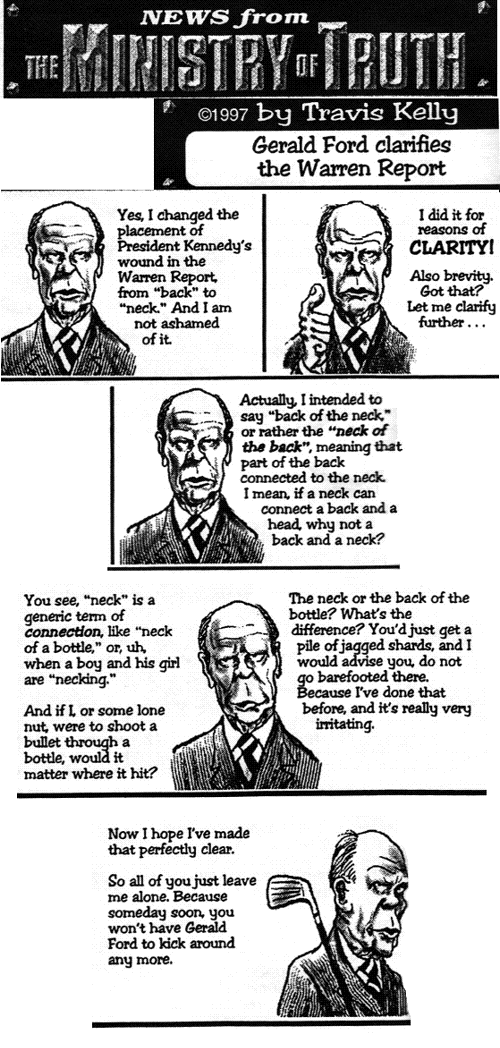
    In fact, Ford’s role on the Warren Commission is seen by many experts as a decisive factor in his rise to the top. As a Commission member, Ford altered its report in a significant way. As the Associated Press reported in 1997, “Thirty-three years ago, Gerald R. Ford took pen in hand and changed – ever so slightly – the Warren Commission’s key sentence on the place where a bullet entered John F. Kennedy’s body when he was killed in Dallas. The effect of Ford’s change was to strengthen the commission’s conclusion that a single bullet passed through Kennedy and severely wounded Texas Gov. John Connally – a crucial element in its finding that Lee Harvey Oswald was the sole gunman.”

    This modification played a seminal role in ending talk of a larger conspiracy to kill the president. Knowledge of Ford’s alteration has encouraged theorists to scrutinize the constellation of other figures who might have had a motivation to cover up the affair.

    Meanwhile, there is much more to learn about George H. W. Bush’s friend, Thomas Devine. The newly surfaced memos explain that Devine, from 1963 on, had authority from the agency to operate under commercial cover as part of an agency project code-named WUBRINY.

    Devine at that time was employed with the Wall Street boutique Train, Cabot and Associates, described in the memos as an “investment banking firm which houses and manages the [CIA] proprietary corporation WUSALINE.” These nautical names – ‘Saline’ and ‘Briny’ – or, for the Bay of Pigs invasion ‘Wave’ – are CIA cryptonyms for the programs and companies involved.

    George H.W. Bush’s own ties are amplified in the 1975 CIA memo, dated November 29, which makes it clear that he had knowledge of CIA operations prior to being named the new director of the CIA in the fall of that year.

    The 1975 memo notes that, through his relationship with Devine, “Mr George Bush [the CIA director-designate] has prior knowledge of the now terminated project WUBRINY/LPDICTUM which was involved in proprietary commercial operations in Europe.”

    The Bush documents, part of a batch of 300,000 records the CIA provided to the House Select Committee on Assassinations, were publicly released in 1998 as the result of a lawsuit, donated to a foundation, scanned into a database – and only just noticed by an independent researcher.

    Click the following to view original supporting documents [1] [2] [3]

  • Gerald Ford Dies

    Gerald Ford Dies


    Gerald R. Ford, the thirty-eighth President of the United States and last surviving member of the Warren Commission, died the day after Christmas. He was 93 years old.

    In announcing Ford’s death, his widow Betty Ford said, “His life was filled with love of God, his family, and his country.”

    No cause of death was immediately given, but Ford had suffered a number of medical problems over the preceding year.

    ford sworn in

    Gerald Ford ascended to the Presidency in 1974 following the resignation of Richard M. Nixon. He ran for re-election in 1976 but was defeated by Jimmy Carter.

    Ford was an undistinguished congressman from Michigan when Lyndon Johnson appointed him to the Presidential commission investigating the assassination of President Kennedy in 1963. That commission, of course, concluded that Kennedy was killed by Lee Harvey Oswald, and that there was no conspiracy in the assassination.

    Publicly, at least, Mr. Ford stood by that conclusion for the rest of his life, in spite of overwhelming evidence of conspiracy. In 1991 he said, “I reaffirm the two basic decisions of the Warren Commission are as valid today as they were then. Those were that Lee Harvey Oswald committed the assassination, and secondly, our commission found no evidence of a conspiracy, foreign or domestic…I don’t think we have found any evidence to date that there was a conspiracy.”

    In 1997 the Assassination Records Review Board released materials showing that Ford personally altered the wording of some sections of the Warren Report, and in so doing strengthened its lone-assassin case. Probe magazine reported (October 1997, Vol. 4 No. 6) that then-Commissioner Ford edited a draft of the Report, changing the location of one of JFK’s wounds. “By moving the point of entry from the back to the neck,” Probe said, “Ford alters the trajectory of the bullet through Kennedy’s body making the Commission’s [lone assassin] thesis more tenable.”

    In 1966 Ford published a book called Portrait of the Assassin, ghostwritten by his assistant John R. Stiles. The book opened with an account of a top-secret Warren Commission meeting in January 1964, in which the Commission heard allegations that Lee Oswald was an FBI informant. “Ford quoted extensively but selectively from what he called ‘discussions among members of the Commission on Monday, January 27,’ 1964,” Harold Weisberg wrote in Whitewash IV: JFK Assassination Transcript. “In other words, he published for personal profit excerpts from this TOP SECRET executive session of January 27, edited to his own liking and advantage and for his own dishonest political purposes.”

    Weisberg further asserted that Ford lied about this during his Senate confirmation hearings in 1973.

    The early days of Ford’s 895-day administration were touched by controversy when Ford pardoned Richard M. Nixon for all crimes he committed as President. According to conventional wisdom, this may have contributed to his failed re-election bid in 1976. In between the pardon and his defeat, two attempts were made on his life.

    On December 27, 2006, CBS Evening News broadcast a videotaped interview with Ford dating back to 1984. CBS informed its viewers that Ford granted the interview with the stipulation it not be broadcast until after his death. In the excerpt CBS showed, Ford recalled reading a draft of his first speech as president, following Richard Nixon’s resignation. “I read it and that phrase, ‘the long national nightmare,’ sort of jarred me. I said, ‘Bob, we really ought not to use that. Let’s not be too harsh.’” Speechwriter Bob Hartmann prevailed. Any other juicy tidbits from that interview? Not yet, and I’m not holding my breath.

    It is worth remembering that Gerald Ford’s legacy also includes vetoing a bill to amend the Freedom of Information Act, reportedly at the urging of Chief of Staff Donald Rumsfeld, and Dick Cheney and Antonin Scalia.

    Most initial news reports of Gerald Ford’s death stressed that Ford was the nation’s only unelected President, but those accounts failed to consider current president George W. Bush.


    Click here to see a cartoon recalling Gerald Ford’s editing skills.

  • Paris Flammonde, Assassination of America: The Kennedy Coups d’Etat


    The used book scalpers must be a little distraught with the release of Paris Flammonde’s The Kennedy Coups d’ Etat, a mammoth revision of Flammonde’s earlier classic, The Kennedy Conspiracy (Meredith Press: New York, 1969). For years, used copies of that long out-of-print volume were being hawked by book resellers for hundreds of dollars. Now with the release of a revised and massively expanded Kennedy Conspiracy the prices for the earlier work could begin to descend from those stratospheric heights.

    That earlier tome was subtitled “An Uncommissioned Report on the Jim Garrison Investigation,” and indeed was the only contemporary study to portray New Orleans District Attorney Jim Garrison and his assassination inquiry in any kind of positive, objective light. However, calling Flammonde’s newest work a revision of that previous report is hardly doing it justice. Rather, it is an epic three-volume expansion (a fourth volume consisting entirely of an index is on the horizon) modifying his earlier book while collecting new material on the JFK and RFK assassinations to add context. Indeed, in what has to be the longest subtitle in this field, Flammonde’s full title reads: Assassination of America. The Kennedy’s Coup d’Etat. The End of an Era, and Examination of the Jim Garrison Investigations, and the Effects on the Growing Totalitarianism in the Expanding Hegemonic American Empire. Adding further to its already hefty girth, Flammonde has included 30 appendices, covering everything from biographies of the numerous Warren Commission critics to a virtual encyclopedia of major (and some minor) figures in the case. Add in the hundreds of illustrations, documents and photographs and the three books total over 1,400 pages.

    Volume 1 is titled “The Deaths in Dallas” and includes introductions by Cyril Wecht, William Turner and Jim Marrs, numerous chapters on Oswald, Ruby, Tippit and other familiar personae, as well as chapters devoted to the ballistic, medical and graphical evidence. Although there appears to be little in the way of new, primary research directly attributable to Flammonde, he nonetheless makes good use of much of the latest developments and evidence in the case.

    The second volume “The Masques of New Orleans,” is essentially the revision and expansion of The Kennedy Conspiracy, focusing on the Garrison investigation and the subsequent trial of Clay Shaw. As with Volume 1, Flammonde uses much of the latest research in the field (including this author’s) to enhance his previous groundbreaking investigation. Flammonde spent months (years?) in New Orleans interviewing numerous witnesses and principals associated with the Shaw case and doing much “on the ground” (and groundbreaking) research. Indeed, that “older” information still stands on its own and seems remarkably fresh despite the passage of 40 years. For example, Flammonde’s treatment of the shady Swiss/Italian “trade organization”, PERMINDEX/Centro Mondiale Commerciale, was state of the art in 1967. It still stands the test of time today and begs for further research into that firm’s connections to numerous political murders.

    Marshalling all of this new (and old) information, Book 3, “Barren Harvest,” has Flammonde theorizing as to who had the means, motive and opportunity to commit this regicide. As previously noted, this volume closes out with the numerous appendices that cover 30 different subjects — some of the best being a history of the Old Catholic Church (which Ferrie and others had connections to), as well as numerous invaluable reference tools.

    Paris Flammonde, who spent years in radio and television production (he was the longtime producer of the popular, long-running Long John Nebel Show), is part of a vanishing breed — a cultured intellectual whose wit and intellect is reflected in his prose.

    The work is not without its fair share of errors, omissions and typos and could have used a good proofreader. (For instance, researcher and author Jim Marrs is frequently referred to as “Bill Marrs,” and the cover calls the work a “Projected Encyclopedic Narrative.” Since the work is now published, it doesn’t make much sense to call it “projected.”) Also, the aforementioned writing style may put off some of the more academically inclined readers, but these are nitpicks that in no way detract from the overall significance of this fine work.

    All of this notable discourse comes at a cost, though. The hefty price tag of $125 could put off the more budget-minded, but in terms of value received for your money, it’s a bargain.

  • The new Dallas DA Files: Craig Watkins vs. Henry Wade


    In November of 2006 the citizens of Dallas elected Craig Watkins their first African-American DA. The 40-year-old Democrat defeated his Republican rival Toby Shook in a close election even though he was outspent by a factor of 18-1. Clearly, Watkins benefited by the wave generated against the Bush administration. But he also ran a reform-minded campaign that clearly appealed to a segment of the population.

    Watkins vowed to place as much focus on crime prevention and redemption of criminals as possible. Many in the district attorney’s office resisted this. Many of them worked for Shook. Shook was perceived as the heir apparent to retiring DA Bill Hill. Hill, in turn, represented the legacy of longtime DA Henry Wade. Wade, of course, was the DA at the time of the Kennedy assassination who — within 36 hours — broadcast to the world that he had no doubt Oswald was the killer of President Kennedy. Wade’s office once issued a memo instructing assistant DA’s not to take Jews, Negroes, Dagoes, Mexicans or members of other races on a jury, no matter how rich or well educated.

    Unlike many other candidates who promise reform, Watkins has, so far, followed through, to the point where many of the lawyers in the office who backed Shook have left. For instance, Watkins set up a task force to partner with the Innocence Project of Texas to do DNA testing for convicts on death row. Several of them have had their verdicts overturned. He also issued new guidelines on how Dallas DA’s would perform interrogations and how line-ups would be conducted, two procedures with which Kennedy researchers were quite familiar with. He even fired those who were not content with his accent on protecting the rights of the accused.

    Now, as the accompanying story details, Watkins has focused his reform attitude on the assassination of President Kennedy. He has made public the existence of a secret stash of both exhibits and 15, 000 pages of documents that his office has been holding for over forty years. The trivial media has made much of a supposed transcript between Ruby and Oswald discussing the murder of President Kennedy on 10/4/63 at the Carousel Club. This document is clearly some kind of play on the dubious testimony of attorney Carroll Jarnagin. Some problems with this testimony are 1.) Jarnagin admitted he was drunk that night 2.) His companion did not recall any such conversation 3.) He failed a polygraph test. (See Seth Kantor, The Ruby Cover-Up, pp. 391-392).

    This has distracted from the real question that should be asked about this disclosure. Namely, why did neither Wade nor Hill turn over this evidence in the decades preceding? They could have done it on at least four separate occasions: in 1964 to the Warren Commission, in 1977 to the House Select Committee on Assassinations, and in the nineties, to local and federal agencies.

    In January of 1992, the Dallas City Council passed a resolution directing the City Manager to collect all documents related to the Kennedy assassination in the Dallas Police Department, Sheriff’s Department and the Dallas DA’s Office. They were to be turned over to the Secretary of the Records Management Division at city hall. There they were archived and indexed by the city archivist Cindy Smolovik. There was much publicity generated by this event since it was the first such collection done in the wake of Oliver Stone’s film JFK. The DA’s office was disobeying the City Council and hiding artifacts from the City Manager. But then later, in 1993, the Assassination Records Review Board was constructed. They actually visited Dallas, held a public hearing, and asked for cooperation from anyone who had any more hidden documents or evidence. Obviously, the DA was not listening or forthcoming. Even though this hidden collection is actually larger than the one archived by Smolovik.

    It’s a sorry tale. Over forty years after the fact and the public is still learning that trusted officials are keeping private potentially important records dealing with the unsolved murder of President Kennedy. And pundits and politicians wonder about why the citizenry has grown cynical about the process. At his press conference, Watkins said that he never believed Oswald acted alone. He added, “I believe in conspiracies. I think that’s just too simple of an explanation.”

    Finally, after 44 years, the people of Dallas get a DA who thinks like the majority of them do.

  • Bobby: A Review


    It is neatly ironic that Emilio Estevez should release his Robert Kennedy film within several days of the death of storied film director Robert Altman. For in its structure, intent, and effect Bobby is more similar to Altman’s Nashville than any other political film he could have made on the subject. And it bears no relation at all to Oliver Stone’s JFK. And the film is not about Robert Kennedy in the way that Stone’s film was about John Kennedy.

    Although there are many news clips of Kennedy in the film, the main action all takes place at the Ambassador Hotel on the last day of the California primary, June 4, 1968. This was the primary Robert Kennedy had to win in order to win the nomination at the Democratic convention. As in Nashville, there is no main character in the film. The picture episodically depicts a number of people’s lives in that one day as they sometimes interact at that famous, and now perished, hotel. The people who Estevez tracks in the film (he was both the writer and director) are all fictional. And in fact, as we shall see, this fictionalization extends as far as the actual RFK assassination. The characters include: black and Hispanic workers in the kitchen, a fading nightclub singer and her manager/lover, a middle-aged couple having a mid-life crisis, two young Kennedy workers who flirt with a waitress and then go on their first acid trip, a news reporter from Czechoslovakia, a former doorman and his friend, a kitchen manager, his boss and the boss’s wife who has a hair salon in the hotel, two phone operators — one who is having an affair with the aforementioned married boss — and a couple of young RFK managers who hope to get plum assignments when Bobby becomes President Kennedy.

    As the reader can see, Estevez was not interested in the actual events surrounding the RFK murder. In fact, in interviews he has explicitly stated he was not out to make any kind of “Oliver Stone conspiracy picture.” That was his option of course. But what has he given us instead? And what does his film intrinsically achieve on its merits?

    Aesthetically, Estevez does all right. As a director he keeps his camera in the right place most of the time and he understands that given the confines of the story, he needs a camera in motion much of the time to avoid a feeling of stasis. He does this dexterously enough, very seldom did it call attention to itself.

    Primarily known as an actor, Estevez has assembled a large, ensemble, all-star cast including Anthony Hopkins, Helen Hunt, Demi Moore, and his father, Martin Sheen. Considering the brevity and sketchiness of the parts, most of them do OK (although I could have done without Ashton Kutcher as an acid dealer). One performer in the cast who is really extraordinary is Sharon Stone as the hair dresser wife. From her make-up (I wasn’t sure it was her until about halfway through the film), to her voice, demeanor, and her ability to register sharp emotion effortlessly, she reminds us of the special and rare abilities that make the mystery of re-creation possible.

    One of the achievements of Nashville is that it communicated the feeling that the country, in its go-go and hustling egocentricism had itself created — actually demanded into existence — the urban microcosm that Altman was presenting. And one of the ways he did this was the deliberate intersection of the political strands of the story with the entertainment/music/Movieland strands. Altman dramatized this with the culminating assassination, which is not of the politician running for office, but a C&W superstar singer who has been urged to stage a campaign rally for him. (And we see retroactively that this had been planned by political operatives for political purposes.) The underlying message being how shallow and callous — and ultimately demeaning — both the political and artistic culture of America is.

    Although it tries, Bobby never attains that kind of overarching cultural or sociological relevance. Part of this is because the individual stories never really accrue to anything larger than themselves. In fact, some of the situations are simply banal: the philandering husband-manager, the faded, alcoholic Judy Garland-type singer and her entourage, the foreign reporter who wants to get her career-altering interview with the future president. Also, when Estevez tries to strain for some real poetry in the scripting e.g. a situation between a black kitchen worker and a Chicano, or a tender moment between the middle-aged couple, the writing becomes strained. Both in itself, and in the context of the characters.

    Almost as if he realizes his story strands are weak, he tries to give the whole scenario both timely characteristics and a parallel to the present. There are mentions of the two iconic films of the day i.e. Bonnie and Clyde and The Graduate. (Estevez actually uses “The Sounds of Silence” from the latter’s soundtrack toward the end.) One of the parallels is with a new voting system instituted at the time which has, of course, “chads.” But he mentions these matters, and that is about as far as they go. They never build into an intricate, multi-layered mosaic as the Altman film did.

    And that is surprising, since Estevez took such artistic license with the actual facts he does depict. For instance he has Sirhan entering the Ambassador Hotel as if he was a man on a mission, which is not accurate. He got there that night by serendipity, thinking there was going to be some kind of Jewish rally in the area. Estevez then has him go almost directly to the kitchen pantry. So there is no drinking the four mixed drinks at the bar, and no coffee with the crucial and infamous Girl in the Polka Dot Dress (who is nowhere to be seen here). Then in the assassination scene, Sirhan appears to be wearing an outfit like a kitchen or maintenance worker instead of the actual casual street clothes he had on that night. Which, when added to the other revisions, suggests that Sirhan committed first-degree murder. Further, the other shooting victims besides Kennedy are not the actual people who were shot, but the Estevez-scripted fictional characters. So in addition to the fictional characters the film tracks through the main body of the action, the culminating event also becomes something of a fable.

    Which would be acceptable if it all built to something. For me, it didn’t. After the assassination climax, the film ends with the surviving characters mourning Kennedy and the other victims as they are carried out and then driven out of the hotel by ambulances. As we watch them in various states of emotional disarray, first we hear the Simon and Garfunkel standard. Then Kennedy’s voice comes on the soundtrack and he gives one of his usual idealistic and emotional calls for America to realize its ambitions and promise. The speech goes on for quite awhile, interspersed with black and white documentary footage, and then the film ends. I was puzzled by this rather attenuated, operatic, and didactic closing. (It reminded me of Spike Lee’s similarly simplistic and undramatic ending to another dream project, Malcolm X.) If a film is meant to epitomize an era, if it is going to try and mark a milestone — which Estevez has clearly stated was his intent — then the close of the film has to somehow suggest or delineate the milestone in some clear and potent way. With his wacky assassination gone awry, Altman tried to sum up just how screwed up American had become after Vietnam and Watergate. In Good Night and Good Luck, George Clooney tried to parallel the specter of McCarthyism with today’s similar specter of terrorism. His concluding message, Edward R. Murrow’s prophetic speech, was that television was crippled at its outset from telling the truth about either. In American Graffiti, George Lucas achieved this marking effect beautifully and unforgettably with his final scene of the friends at the little Modesto airport wishing one of the main characters goodbye. After the plane disappears into the sky, we learn through a photo montage what happened to the four friends afterwards, and with that knowledge, what happened to America. And the brevity and understatement of that final denouement made the impact even more emotionally jarring. We realized that what we had really seen was the end of the early innocent sixties, the Camelot Years of President John F. Kennedy. For those of us who had lived through that dreamy era, Lucas’s ending had the impact of a gut punch.

    What Estevez is working with here is the era that followed JFK’s murder: the angry sixties of 1964-68. And clearly, 1968 was the end of that era. Politically, Kennedy’s murder would lead to the destruction of the Democratic party as we knew it, the ascension of Richard Nixon, and the coming apart of America over Vietnam. Socially and culturally, RFK’s assassination would lead to the “psychedelic sixties” of hard rock, grass, and legions of “drop-outs” who sub-consciously realized the last hopes of a great decade had ended at the Ambassador Hotel. This final vestige of the sixties would dramatically assemble itself the following year at the gigantic Woodstock demonstration: the final dying spasm of a generation registering its protest over its loss of control over it own destiny. So clearly, Estevez had a huge and magnificent historical subject. For all the liberties he has taken, and for reasons stated above, he didn’t do it justice.

    * * *

    The Ambassador Hotel, scene of RFK’s assassination, was torn down in early 2006. For a lively discussion of the hotel and its fate, check this Ambassador Hotel Blog.

  • Hugh Aynesworth Never Quits


    If you do a search of this web site on the name “Hugh Aynesworth,” you will come up with several matches. None of them are complimentary. Probe magazine did a lot of work on Mr. Aynesworth. We discovered that in regards to the JFK case, to call him a “journalist” was, to be kind, rather stretching the term. As Bill Davy notes in his book Let Justice be Done, even journalists in New Orleans covering the Jim Garrison inquiry questioned his practices (and also those of his friend and partner, the late James Phelan).

    Well, it appears that Hugh Aynesworth is still carrying a torch for Clay Shaw. At a time of life when he could be enjoying retirement, the 75-year-old Aynesworth is believed to be the principal source for a screenplay centering on Jim Garrison’s investigation. The screenplay is now being shopped around Hollywood. But unlike Oliver Stone’s 1991 blockbuster JFK, this version of events portrays Clay Shaw in a favorable light.

    The screenplay was written by one Jim Piddock, a writer and actor who is apparently a babe in the woods on the JFK case. He actually takes Aynesworth seriously. Well, worse than seriously. He trots out this golden oldie: that Aynesworth and a few other intrepid reporters protected the world from the deluded Garrison and helped save the saintly Clay Shaw. (Yawn.)

    Just how under the spell of Aynesworth is Jim Piddock? Piddock calls Oliver Stone’s film “entirely fictional” and a piece of “nonsense.” He actually quotes Aynesworth as saying: “Well, at least Stone got two things right about Kennedy’s death: the time and the date.” There’s an objective source.

    Piddock states that the Garrison case against Shaw has parallels with today. These parallels are “in terms of the abuse of power after a national tragedy and the manipulation of the public by powerful but unscrupulous and corrupt men…” Yeah Jim, just look at the guy you’re talking to.

    When Oliver Stone’s JFK came out, Aynesworth went on one of his patented mini-rampages. He was on one of the news networks claiming that he saw Garrison bribing someone. (The reporter didn’t bother to ask: Who was it and for what purpose?) And he wrote a series of articles that appeared in some Texas newspapers basically recycling a lot of the anti-Garrison propaganda that he had originated years before. Clearly, the Stone film disturbed him since Garrison was allowed to make a lot of his case to the public directly, without Aynesworth and Phelan et al biting him in the back.

    None of Aynesworth’s antics in the early 1990s were much different from his assassination work in the 1960s. In 1964 he wrote a hatchet job review of Joachim Joesten’s Oswald: Assassin or Fall Guy?, one of the very first books on the Kennedy assassination. “If you would listen to [Joesten],” Aynesworth sneered, “he would have you thinking that Lee Harvey Oswald was a polite little misunderstood youth who just got mixed up in the wrong company … It’s the same old tripe with some new flavoring.” And in a notorious May 1967 Newsweek article, Aynesworth called Jim Garrison’s investigation “a plot of Garrison’s own making.” He alleged the New Orleans DA offered a witness $3,000 “if only he would ‘fill in the facts’ of the alleged meeting to plot the death of the President.”

    Jim Garrison himself said Aynesworth “seemed a gentle and fair enough man” when Aynesworth interviewed him. But the DA found out different. “As for the $3,000 bribe, by the time I came across Aynesworth’s revelation, the witness our office had supposedly offered it to, Alvin Beaubeouff, had admitted to us it never happened.” If the Newsweek article was typical of Aynesworth’s work, Garrison observed, then it was hard to undertand how he kept getting his stuff published.

    With the work of the Assassination Records Review Board, many more pages of documents have been released showing how tightly bound Aynesworth was with the intelligence community. It has been demonstrated that Aynesworth was — at the minimum — working with the Dallas Police, Shaw’s defense team, and the FBI. He was also an informant to the White House, and had once applied for work with the CIA. As I have noted elsewhere, in the annals of this case, I can think of no “reporter” who had such extensive contacts with those trying to cover up the facts in the JFK case. And only two come close: Edward Epstein and Gerald Posner.

    Whatever Hugh Aynesworth and Jim Piddock might say, it is important to remember the simple fact that Clay Shaw committed perjury. He lied to his own defense counsel in open court about his supposed non-relationship to the CIA. And he lied twice in a 1967 interview with the CBC’s Gordon Donaldson. Donaldson asked Shaw if he ever worked for the CIA and whether he had an affiliation with that agency. To the first question Shaw answered: “No.” To the second question Shaw replied: “None whatsoever.” We know better today.

    Jim Piddock has been involved in some of the worst movies put out by Hollywood of late — which is saying a lot. But take a look, if you can, at things like The Man and An Alan Smithee Film. Piddock says that he knows that films like his Garrison/Shaw opus are not easy to get made. Let’s hope that with his track record — and his sources — it doesn’t. What the world needs now is anything but more Hugh Ayesworth.


    Read some more about Piddock’s project.

    Read some more about Hugh Aynesworth.

  • These Are Your Witnesses?


    Priscilla Johnson McMillan has been against Oswald from the start. But who is she? And why wasn’t the public allowed to know until 1993?

    Hugh Aynesworth The former Dallas newspaper reporter says rejecting a conspiracy in the JFK assassination is his life’s work.

    Gerald Posner As Harold Weisberg once said, “All hail Gerald Posner!” Find more evidence of faulty research on the part of ABC, in a collection of articles examining the author of Case Closed.

    Ed Butler Among the suspect talking heads from the ABC special was an anti-Communist activist with links to Lee Harvey Oswald.

  • Hugh Aynesworth:  Refusing a Conspiracy is his Life’s Work

    Hugh Aynesworth: Refusing a Conspiracy is his Life’s Work


    hugh
    Hugh Aynesworth

    At the time of the assassination, Hugh Aynesworth was a reporter for the Dallas Morning News. He has maintained that on November 22, 1963 he was in Dealey Plaza and a witness to the assassination — although there is no photograph that reveals such. At times, he has also maintained he was at the scene where Tippit was shot — although it is difficult to locate a time for his being there. He has also stated that he was at the Texas Theater where Oswald was arrested — although, again, no film or photo attests to this. Further, he has written that he was in the basement of the Dallas Police Department when Oswald was killed by Jack Ruby. Like Priscilla Johnson, Aynesworth soon decided to make his career out of this event. As we shall see, it is quite clear that he made up his mind immediately about Oswald’s guilt. Long before the Warren Report was issued. In fact, he tried to influence their verdict.

    On July 21, 1964 Aynesworth’s name surfaced in the newspapers in Dallas in a column by his friend Holmes Alexander. Alexander implied that Aynesworth did not trust Earl Warren and therefore was conducting his own investigation of the Kennedy murder. He was ready to reveal that the FBI knew Oswald was a potential assassin and blew their assignment. He also had talked to Marina Oswald and she had told him that Oswald had also threatened to kill Richard Nixon. Alexander goes on to say that these kinds of incidents show the mind of a killer at work. That “of a hard-driven, politically radical Leftist which is emerging from the small amount of news put out by the Warren Commission. If the full report follows the expected line, Oswald will be shown as a homicidal maniac.” Holmes concludes his piece with a warning: If the Commission’s verdict “jibes with that of Aynesworth’s independent research, credibility will be added to its findings. If [it] does not there will be some explaining to do.” Clearly, Aynesworth contributed mightily to the article, had decided Oswald had done it even before the Commission had revealed its evidence, and was bent on destroying its credibility if it differed from his opinion.

    The story about Marina and Nixon was so farfetched that not even the Warren Commission bought into it (Warren Report pp. 187-188). It has been demolished by many authors; most notably Peter Scott who notes that to believe it, Marina had to have locked Oswald in the bathroom to keep him from committing this murderous act; yet the bathroom locked from the inside. Also, as the Commission noted in the pages above, Nixon was not in Dallas until several months after the alleged incident. Further, there was no announcement in any local newspaper that Nixon was going to be in Dallas at this time period — April of 1963. Since Aynesworth was quite close to Marina at this time (he actually bragged to some friends that he was sleeping with her) it may be that he foisted the quite incredible story on her in his attempt to portray Oswald as the Leftist, homicidal maniac he related to Holmes Alexander.

    Aynesworth was also out to profit personally from the tragedy. In late June of 1964, Oswald’s alleged diary from his Russian days appeared in Aynesworth’s newspaper with a commentary by the reporter. Two weeks later it also appeared in U. S. News and World Report. An FBI investigation followed to see how this material leaked into the press. In declassified documents, it appears that the diary was pilfered from the Dallas Police archives by the notorious assistant DA Bill Alexander and then given to his friend Aynesworth. Aynesworth then put it on the market to other magazines including Newsweek. It eventually ended up in Life magazine also. Alexander, Aynesworth and the reporter’s wife Paula split thousands of dollars. Oswald’s widow was paid later by Life since, originally, Aynesworth had illegally cut her out of the deal. In another FBI report of July 7th, it also appears that Aynesworth was using the so-called diary for career advancement purposes. A source told the Bureau that part of the deal with Newsweek was that Aynesworth was to become their Dallas correspondent. As the Bureau noted, Aynesworth did become their Dallas stringer afterward. (It is interesting to note here that the “diary” has been shown to have been not a real diary at all. That is, it was not recorded on a daily basis but rather in two or three sittings.)

    Right after this, in August of 1964, another trademark of Aynseworth’s Kennedy career appeared: his penchant to attack and ridicule anyone who disagreed with him. Aynesworth published a review of Joachim Joesten’s early book on the case entitled Oswald: Assassin or Fall Guy. The review is not really a review at all, it is just a string of invective directed at the author for believing such silly notions that Oswald could have been innocent and that he could have been an agent of the FBI and/or CIA. When rumors circulated that Oswald had been an FBI informant, which he apparently was, Aynesworth went to work discrediting them saying that it was all a joke he had made up — even though he was not the source of the quite specific information.

    In December of 1966, Aynesworth surfaced again on the Kennedy case. At this time Life was doing its ill-fated reinvestigation of the murder led by Holland McCombs and Richard Billings. Somehow, probably through McCombs who was a good friend of Clay Shaw, Aynesworth was a part of this investigation. Aynesworth began informing on the intricacies of the probe to the FBI. For instance on December 12th, Aynesworth informed the Bureau that they had discovered a man who connected Oswald with Ruby. Aynesworth turned over a copy of this report to the FBI. He also then told the Bureau that Mark Lane was a homosexual and had to drop his political career because of these allegations. At the end of the interview Aynesworth “specifically requested” his identity and his sources not be disclosed outside the Bureau.

    Billings’ investigation eventually and perhaps inevitably ran into the initial stages of the secret probe being conducted by District Attorney Jim Garrison. And because a mutual acquaintance of Billings and Garrison, David Chandler, was involved, Aynesworth was one of the first people to discover what Garrison was doing. The unsuspecting Garrison actually granted the duplicitous reporter an interview in his home. After the interview, Aynesworth wrote a note to McCombs that they should not let the DA know they were playing “both sides.” Recall, this was the first time they had met face to face! So much for a modicum of objectivity.

    Almost immediately Aynesworth set out to smear Garrison in the national press, to obstruct him by cooperating with law enforcement agencies who were opposed to the DA, and to defeat him in court by extending his services to Shaw’s lawyers. All of the above is readily provable today as it had not been before the releases of the ARRB. It would not be hyperbole to write that no other reporter in recorded history had as much to do in opposing a DA both covertly and overtly as Aynesworth did in New Orleans from 1967-71. Especially when one extends Aynesworth’s actions to connect with his two allies in this effort, namely James Phelan and the late Walter Sheridan. (Significantly, when the ARRB requested the files of Sheridan on the 1967 NBC special he produced, Sheridan’s family sent them to NBC. And the network refused to turn them over.) Aynesworth’s actions are too lengthy to be discussed here but they are recorded in detail in Probe Magazine (Vol. 4 No. 4) and also in the book The Assassinations: Probe Magazine on JFK, MLK, RFK, and Malcolm X (pp. 24-29). Aynesworth published an attack on Garrison in Newsweek on May 15, 1967 (about a week after Phelan’s broadside had appeared in The Saturday Evening Post.) The “report” was clearly a venomous hatchet job that had one aim: to stigmatize Garrison and, by doing that, to neutralize his investigation by turning the public’s attention away from his discoveries and toward the controversy being manufactured by Aynesworth, Phelan, and NBC’s special which was to follow the next month. The article depicted Garrison as a modern day Robespierre whose investigation had bribed witnesses into making false claims, whose staff had threatened to murder a witness, and finally that Garrison was so possessed he held the entire city in thrall by terrorist tactics.

    We have seen how Aynesworth informed on the Billings investigation with the FBI. On the Garrison case, he extended his reach. Before his article was printed, he forwarded a copy to George Christian who was press secretary for the White House. But not before he had called him and discussed his inflammatory and deceitful article. The actual telegram he sent is interesting in revealing his psychology. He tells Christian that he is informing because he is aware of what Garrison is up to. What, in Aynesworth’s view, is he up to? He is trying “to make it seem that the FBI and CIA are involved in the JFK plot.” But further, “he can —and probably will — do untold damage to this nation’s image throughout the world.” Finally, he tells Christian that although Garrison wants the government to defy him or to pressure a halt to his probe, that is not what they should do, “for that is exactly what Garrison wants.” Of course, he again asked that his role be kept a secret. These last two assertions imply that Aynesworth would serve as the intermediary to obstruct Garrison clandestinely while claiming to be a reporter so that the government could keep its hands clean as he did their dirty work for them.

    Further insight into Aynesworth’s peculiar psychology came in an interview in 1979 on KERA, the Dallas PBS affiliate. He said there, “I’m not saying there wasn’t a conspiracy. I know most people in this country believe there was a conspiracy. I just refuse to accept it and that’s my life’s work.” In other words, what the facts are do not really matter to him. It’s keeping the lid on a conspiracy to commit homicide that matters. (Wouldn’t it have been interesting if Jennings would have confronted Aynesworth with that statement and asked him to explain his view of journalism in light of it?)

    By the 1990’s Aynesworth’s role had been so exposed to those in the know that he couldn’t appear at research conferences. So he did not show up at them himself — as he may have, for surveillance purposes, earlier. Instead he arranged other conferences to eclipse them, as he did in 1993 for the 30th anniversary of the assassination. At this one in Dallas, someone asked him this: Had he ever cooperated with the government on a story prior to its publication? He denied it of course. Then the questioner read him the Christian memo quoted above.

    Why couldn’t Jennings do the same?

  • Interview with H.B. McLain

    Interview with H.B. McLain


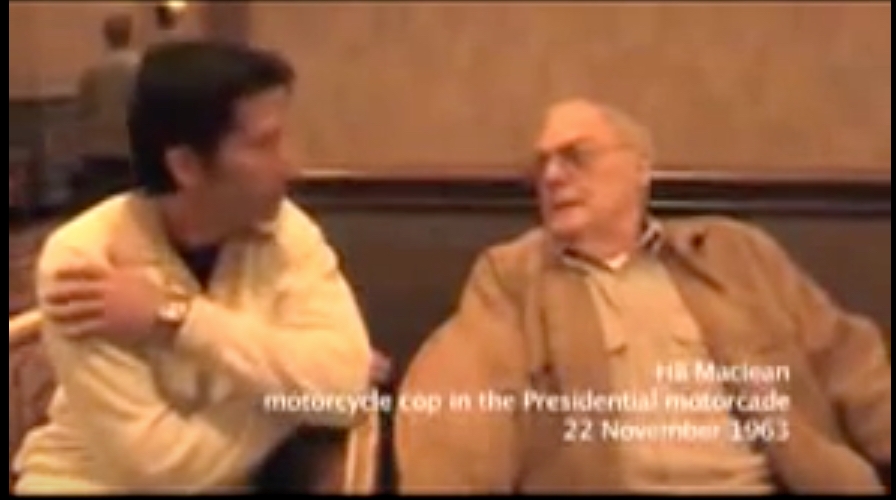
    In 1963, H.B. McLain was a veteran motorcycle cop on the Dallas police force, who on November 22 found himself assigned to President Kennedy’s motorcade.

    Officer McLain did not appear before the Warren Commission. But when the House Select Committee on Assassinations re-investigated the case in the 1970s, McLain’s activities in 1963 got renewed attention. The Committee identified McLain as the officer whose police radio was stuck in the “on” position during the assassination, resulting in an audio recording of police transmissions that acoustics experts said included four gunshots. This evidence was central to the Committee’s conclusion that there had been a conspiracy.

    Those acoustics findings have since been disputed, although a 2000 study tends to support them.

    It is not the purpose of this article to re-examine the issues related to the acoustics evidence. Rather, we present an excerpt from a videotaped interview with McLain, in which the by-then retired officer addresses, for the first time, certain issues related to the assassination.

    The interview was conducted at the JFK November in Dallas conference in 2006.

    Officer McLain told the HSCA he only heard one shot.


    Transcript

    H.B. McLain: My thought was, when I heard the shot, and all them pigeons flew out from behind that building, I just said to myself, “Wow, somebody’s shooting at the pigeons today.” It didn’t even dawn on me that they were shooting at him.

    We took him to Parkland. We got her out of the car, and they carried him in. I walked her inside Parkland. I turned around and come back outside.

    Seamus: Do you believe in the Warren Commission’s official version, or do you think something else may have happened?

    H.B. McLain: I don’t think they knew what they were even talking about.

    Seamus: So I don’t need to ask any more questions?

    (I said this because I was fearful of pushing a little too hard. I really felt for the guy, but what I got next was kinda like an explosion).

    H.B. McLain: They did not investigate any thing. They told you what happened and that’s the way they wrote it down

    Seamus: And it doesn’t concur with what you believe happened?

    H.B. McLain: (looking down at his feet) Nope…and it didn’t concur with what did happen!

    Seamus: And it may lead people to say that you believe in a conspiracy … a possible conspiracy.

    H.B. McLain: (Looks away to his left.) …Well, I think there was.

    Seamus: Is that the first time you’ve ever been asked that question?

    H.B. McLain: (Begins smiling.) Nope. It’s just the first time I’ve ever answered it.

    Seamus: Shit, that’s pretty heavy.

    (H.B. McLain starts to laugh at my shock as if a weight has just come off of his shoulders. The transformation was amazing from the man we first saw that evening. I think from how he spoke that he was scared to talk for an extremely long time. I think he saw what happened to Jesse Curry and Roger Craig for speaking their minds..)