Blog

  • Vincent Bugliosi, Reclaiming History: Besmirching History

    Vincent Bugliosi, Reclaiming History: Besmirching History


    Besmirching History: Vincent Bugliosi Assassinates Kennedy Again

    The purpose of Bugliosi’s Reclaiming History is to defend the integrity of the USG National Security State by grossly distorting its nature and function, by disguising that it is the servant of factions of the ruling classes within the United States, and by pretending that it did not and could not contemplate the assassination of a democratically elected President whose recalcitrant politics fell outside its parameters. According to Bugliosi, only the lunatic can seriously entertain that Kennedy was murdered because he pursued dÈtente with the USSR, championed nuclear disarmament, decided not to back the invasion of the Bay of Pigs with US military, made a peaceful resolution of the Cuban Missile Crisis when the military wanted invasion and war, and decided to withdraw US troops from Vietnam rather than pursue by brute force an imperial venture in Southeast Asia. According to Bugliosi, Oswald is not just the murderer of Kennedy, he is the only one involved, and he is nothing but “a first class ‘nut.’” (945) Thus, Kennedy’s murder is deprived of any political significance whatsoever.

    Bugliosi considers himself at liberty to mock those who appreciate the opposing world view, inter alia, “conspiracy icon Vincent Salandria [for claiming that] ‘the killing of Kennedy represented a coup d’Ètat.’ … I suppose that since a coup d’Ètat is defined as a sudden, unconstitutional change of state policy and leadership ‘by a group of persons in authority,’ … you couldn’t even have a coup without the involvement, cooperation, and complicity of groups like the FBI, CIA, and military-industrial complex.” Individuals who entertain such notions are so wrapped up in “their fertile delusions” that they substitute finding a motive for finding evidence, make no connections between, e.g., the CIA and Oswald, and thus sadly show nothing but “this crazy, incredibly childlike reasoning and mentality that has driven and informed virtually all of the pro-conspiracy sentiment in the Kennedy assassination from the beginning.” (985-987) We shall answer Bugliosi by showing direct involvement of all these organs of state power in the cover-up and the assassination, though in this brief excerpt, only the FBI.

    Three Mannlicher-Carcano shell casings were found in the SE corner of the 6th floor of the Texas School Book Depository. The home movie film of the assassination taken by Abraham Zapruder, the obstruction of the line of sight to the motorcade by a large oak tree, and the fact that bystander James Tague nearly several hundred feet away was struck by cement fragments from a missed bullet that nicked the curb, imposed constraints on the official cover-up. The final shot that blew open Kennedy’s head, and the missed shot, left just one other bullet to do all the rest of the damage to the president and Governor Connally. The “single-bullet” theory is essential to the Warren Commission’s indictment of Lee Harvey Oswald as the lone gunman, and Bugliosi is committed to it in full. ” … in this case, the physical evidence isn’t just persuasive or even overwhelming, it’s absolutely conclusive that only three shot were fired, and that one of the two shots that hit Kennedy [CE 399] also went on to hit Connally. Hence, Connally was not hit by a separate bullet, which would have established a second gunman and a conspiracy.” (451)

    The official story has that bullet, CE 399, enter President Kennedy from behind through the base of his neck to the right of his spine at a steep downward angle, pass through him without hitting bone, exit at the very base of his anterior neck, and then strike, as Bugliosi tells us, “the upper right area of Connally’s back, exit the right side of the chest (just below the right nipple), reenter the back of his right wrist, exit the opposite side, and finally come to rest after causing a superficial entrance wound in the left thigh.” [1] This gentle description omits that 399 shattered Connally’s fifth rib in many places, then broke the radius bone in his wrist, the densest and hardest-to-fracture bone in the human body, yet came out unscathed except for a slight flattening at its end.


    Real bullets don’t behave this way: when they break bone they are smashed, dented or mangled, whereas this slightly flattened bullet looks much like the sample Mannlicher-Carcano bullets fired by the FBI in its tests into cotton wadding or by Henry Hurt (Reasonable Doubt, 1985, photo section) into a bucket of water.


    The frame-up of Lee Harvey Oswald was extensive, and pre-meditated long before the assassination itself. Here, however, I want to give you one example of the frame-up that is clean and simple, easy to understand and easy to remember. Bugliosi writes of Friday night, 11:30 p.m., the day of the assassination. Dallas Chief of Police Curry is being pressured to turn over his evidence to the FBI, when Curry has the only legal jurisdiction, and if something goes wrong with the evidence that undermines Oswald’s prosecution, Curry will be blamed for it. Finally, Curry strikes a compromise to loan the evidence to the FBI for 24 hours only, provided there are “photographs of everything sent to Washington, and an accountable FBI agent, Vince Drain, to sign for and accompany all of the evidence to and from the nation’s capital.” (183) In an endnote on p.158, Bugliosi smears Curry by repeating sworn testimony from a subsequent DPD custodian of the evidence that “Jesse E. Curry, had pilfered the files to get material for his 1969 book, Retired Dallas Chief Jesse Curry Reveals His Personal JFK Assassination File,” making Curry seem a cheap opportunist. It will become immediately clear why Curry may have had to pilfer the evidence. A portion the DPD picture of the evidence before it was taken to FBIHQ follows from p.88 of the 1969 edition of Curry’s book.


    Exhibit “9” is the gun taken from Oswald when he was arrested in the Texas Theater. #4 is “a .38 Special bullet taken from Officer Tippit’s body.” And, the fact to take home with you, #3 is “a metal fragment from the arm of Governor Connally.” The smashed bullet fragment, Exhibit #3, is wider than the .38 Special and about as wide as CE 399 itself. Stop and think! Here, in Exhibit #3, is the full assassination cover-up in a single example: The bullet fragment #3 smashed after breaking so much bone is at least the size of your pinky nail. It did not come from CE 399, so the FBI is not framing Oswald because they sincerely believe he is the guilty lone assassin, but because that is the assassination cover story, full stop. CE 399 was, of course, planted in order to have a bullet whose ballistic markings could be matched to the Mannlicher-Carcano rifle that Oswald allegedly used to shoot Kennedy. There were many other bullets fired that day, but this bullet fragment gives the others collective legitimacy.[2]

    The crucial point is that the FBI could not undertake this frame-up without full confidence that the National Security State, of which it is a member, had both the will and the means to accomplish all aspects of the cover-up. There were multiple shooters from multiple locations. Thus, masses of evidence would have to be ignored or destroyed. Scores of witnesses would need to be overlooked, dismissed, intimidated, or eliminated, most especially Lee Harvey Oswald. August committees would have to be formed whose witting members would pressure, seduce, or trick the others into sufficient compliance to fool the people. High-ranking well-respected trusted members of society who control the media would have to be complicit in fronting the salesmanship. Minions of the intelligence community, only relatively few of whom were in on the planning stages of the assassination, had to be counted upon to do their part to conceal the plotters of the assassination from the American public. The media would have to be ready and able, and known in advance to the FBI and others to be ready and able to bewilder and confuse the people. In fact, none of the plotters involved in the cover-up would have dared to undertake such a cover-up without the full faith and understanding that the media was under the control of the ruling class and would be used to facilitate, rather than expose, the cover-up. Think! How the hell could any such plotters ever dream of getting away with such a crime but for their control of the fictionally named “free press”? We shall in any case prove such control and use of the media. This “national security state” is not jargon, but the ugly reality behind the façade of democracy in American life.

    We shall, in due course, reveal the essentials of the National Security State by making the “invisible government” visible. It is not a pretty sight. The only silver lining from Curry’s Exhibit #3 is that it liberates us to look upon and interpret the evidence for what it is because we know that the National Security State, tool of the ruling class, is lying to us. Bugliosi, needless to say, repeatedly tells us that the evidence for the single-bullet (i.e., that did all the damage to Kennedy and Connally) is compelling and overwhelming.

    Chief Curry provides a copy of the 11/23/63 five-page FBI analysis of the evidence completed within the 24-hour window given by the DPD. Guess what?† The fragment from Connally’s arm is returned not weighed, to the Dallas Police Department.† (The only other bullet fragments that the FBI does not weigh are two fragments removed at autopsy from Kennedy’s head.) In the process, it will be doctored or replaced to produce a drastic reduction in size and shape that will conform to the official story, and that will give rise to endless debate about whether the paltry fragments remaining as official evidence might have come from CE 399. [3] To answer Bugliosi, we have just shown the part of the coup d’Ètat directly engaging the FBI in the cover-up.


    Citations


    1. Reclaiming History, p. 447, with grammatical tense changed to fit this essay’s text.

    2. Robert J. Groden, The Killing of a President, 1993, under “Gunshots” in the index for possibly six shots, esp. pp. 41, 68-70 for photos of where missed shots struck.

    3. In Post Mortem, JFK Cover-up Smashed!, ©1969, 1971, 1975, Harold Weisberg, the doyen of micro-analytic detail, discusses Curry’s book and the 11/23/63 FBI report analyzing the bullets sent by Chief Curry, with particular attention to Q9, the fragment taken from Connolly’s arm. (See especially pp. 603-604) Weisberg complains loud and long and justifiably at the paucity and poverty of the analysis, and about the omission of the requested spectrographic analysis, all of which permits endless debate about what the evidence means rather than “smashing” the cover-up. But the keen-eyed, detail-oriented Weisberg apparently never notes that the FBI did not weigh Q9 (DPD Exhibit #3), that it returned it to DPD, and most crucially – what would have smashed the cover-up by itself — that Q9 is the size of a pinky nail. The Killing of a President, 1993, p.100, has a cropped picture of the evidence that DPD sent the FBI on 11/23/63 that is almost identical to the one in this article, but he offers it without any caption or explanation so that DPD Exhibit #3, which is FBI Q9, is meaningless, like so many of the otherwise excellent pictures in Groden’s book. Although a picture may be worth a thousand words, this is the

  • Warrior for Peace

    Warrior for Peace


    From Time Magazine


     jfk intro 0702

    John F. Kennedy’s loyal White House aides, Kenneth O’Donnell and Dave Powers, titled their 1972 J.F.K. memoir Johnny, We Hardly Knew Ye — despite the fact that they had served him since his days as a scrawny young congressional candidate in Boston. So it’s no surprise that Americans are still trying to figure out nearly half a century after his abbreviated presidency who Jack Kennedy really was. Was he a cold war hawk, as much of the history establishment, Washington pundit class and presidential hopefuls of both parties — eager to lay claim to his mantle of muscular leadership — have insisted over the years? Or was he a man ahead of his time, a peace-minded visionary trying to untie the nuclear knot that held hostage the U.S. and the Soviet Union — and the rest of the world?

    As the U.S. once again finds itself in an endless war — this time against terror, or perhaps against fear itself — the question of Kennedy’s true legacy seems particularly loaded. What is the best way for America to navigate through a world where its enemies seem everywhere and nowhere at the same time? What can we learn from the way Kennedy was trying to redefine the U.S. role in the world and to invite Americans to be part of that change? Who was the real John Fitzgerald Kennedy?

    The conundrum begins with Kennedy himself, a politically complex man whose speeches often brandished arrows as well as olive branches. This seemingly contradictory message was vividly communicated in J.F.K.’s famous Inaugural Address. While Kennedy vowed the nation “would pay any price, bear any burden, meet any hardship, support any friend, oppose any foe to assure the survival and success of liberty” — aggressive rhetoric that would fit right in with George W. Bush’s presidency — the young leader also dispensed with the usual Soviet bashing of his time and invited our enemy to join us in a new “quest for peace, before the dark powers of destruction unleashed by science engulf all of humanity.” It would be hard to imagine the current occupant of the White House extending the same offer to Islamic jihadists or Iran’s leaders.

    Young Jack Kennedy developed a deep, visceral disgust for war because of his — and his family’s — experiences in it. “All war is stupid,” he wrote home from his PT boat in the Pacific battleground of World War II. That war destroyed the family’s sense of godlike invincibility. His older brother Joe — a Navy pilot — died in a fiery explosion over the English Channel after volunteering for a high-risk mission, and the young husband of “Kick” Kennedy, J.F.K.’s beloved sister, was also killed. As Jack wrote to Claiborne Pell in 1947, the war had simply “savaged” his family. “It turned my father and brothers and sisters and I upside down and sucked all the oxygen out of our smug and comfortable assumptions… Now, after all that we experienced and lost in the war, we finally understand that there is nothing inevitable about us.”

    But Kennedy and his brothers were also bred to be winners by their father — to never accept defeat. And when he entered the 1960 presidential campaign against Richard Nixon, one of the dirtiest fighters in the American political arena, he was prepared to do whatever it took to prevail. At the height of the cold war, that meant positioning himself as even more of a hawk than his Republican opponent. Kennedy had no interest in becoming another Adlai Stevenson — the high-minded liberal who was easily defeated in back-to-back elections by war hero Dwight Eisenhower. J.F.K. was determined not to be turned into a weakling on defense, a punching bag for two-fisted GOP rhetoric. So he outflanked Nixon, warning that the country was falling behind Russia in the nuclear arms race and turning “the missile gap” into a major campaign theme. Kennedy also championed the cause of Cuban “freedom fighters” in their crusade to take back the island from Fidel Castro’s newly victorious regime. Liberal Kennedy supporters, such as Harvard economist John Kenneth Galbraith, were worried that J.F.K. would later pay a price for this bellicose campaign rhetoric. But Kennedy’s tough posture helped secure him a wafer-thin victory on Election Day.

    Working with the newly elected President at the Kennedy family’s Palm Beach villa in early January 1961, speechwriter Theodore Sorensen struggled to interweave the two sides of J.F.K. as the two men crafted the President-elect’s Inaugural speech. Looking back, says Sorensen today, the most important line of that ringing address wasn’t, “Ask not what your country can do for you — ask what you can do for your country.” It was, “For only when our arms are sufficient beyond doubt can we be certain beyond doubt that they will never be employed.” This peace-through-strength message “was the Kennedy policy in a nutshell,” Sorensen observes.

    But the Pentagon and CIA hard-liners who thrilled to the more robust strains of Kennedy’s soaring Inaugural message wanted not only the massive arms buildup that the new President promised. They wanted also to employ this fearsome arsenal to push back communist advances around the world. And no enemy bastion was more nettlesome to these national-security officials than Castro’s Cuba, less than 100 miles off U.S. shores.

    Washington’s national-security apparatus had decided there was no living with Castro. During the final months of the Eisenhower Administration, the CIA started planning an invasion of the island, recruiting Cuban exiles who had fled the new regime. Agency officials assured the young President who inherited the invasion plan that it was a “slam dunk,” in the words of a future CIA director contemplating another ill-fated U.S. invasion. J.F.K. had deep misgivings, but unwilling to overrule his senior intelligence officials so early in his Administration, he went fatefully ahead with the plan. The doomed Bay of Pigs invasion in April 1961 became the Kennedy Administration’s first great trauma.

    We now know — from the CIA’s internal history of the Bay of Pigs, which was declassified in 2005 — that agency officials realized their motley crew of invaders had no chance of victory unless they were reinforced by the U.S. military. But Allen Dulles and Richard Bissell, the top CIA officials, never disclosed this to J.F.K. They clearly thought the young President would cave in the heat of battle, that he would be forced to send in the Marines and Air Force to rescue the beleaguered exiles brigade after it was pinned down on the beaches by Castro’s forces. But Kennedy — who was concerned about aggravating the U.S. image in Latin America as a Yanqui bully and also feared a Soviet countermove against West Berlin — had warned agency officials that he would not fully intervene. As the invasion quickly bogged down at the swampy landing site, J.F.K. stunned Dulles and Bissell by standing his ground and refusing to escalate the assault.

    From that point on, the Kennedy presidency became a government at war with itself.

    A bitter Dulles thought Kennedy had suffered a failure of nerve and observed that he was “surrounded by doubting Thomases and admirers of Castro.” The Joint Chiefs also muttered darkly about the new President. General Lyman Lemnitzer, Chairman of the Joint Chiefs, said “pulling out the rug [on the invaders ]was… absolutely reprehensible, almost criminal.” Admiral Arleigh Burke, the Navy chief, later fumed, “Mr. Kennedy was a very bad President… He permitted himself to jeopardize the nation.”

    Kennedy was equally outraged at his national-security advisers. While he famously took responsibility for the Bay of Pigs debacle in public, privately he lashed out at the Joint Chiefs and especially at the CIA, threatening to “shatter [the agency] into a thousand pieces and scatter it to the winds.” J.F.K. never followed through on this threat, but he did eventually fire Dulles, despite his stature as a legendary spymaster, as well as Bissell.

    Weeks after the Cuba fiasco, J.F.K. was still steaming, recalled his friend Assistant Navy Secretary Paul (Red) Fay years later in his memoir, The Pleasure of His Company. “Nobody is going to force me to do anything I don’t think is in the best interest of the country,” the President told his friend, over a game of checkers at the Kennedy-family compound in Hyannis Port, Mass. “We’re not going to plunge into an irresponsible action just because a fanatical fringe in this country puts so-called national pride above national reason. Do you think I’m going to carry on my conscience the responsibility for the wanton maiming and killing of children like our children we saw [playing] here this evening? Do you think I’m going to cause a nuclear exchange — for what? Because I was forced into doing something that I didn’t think was proper and right? Well, if you or anybody else thinks I am, he’s crazy.”

    This would become the major theme of the Kennedy presidency — J.F.K.’s strenuous efforts to keep the country at peace in the face of equally ardent pressures from Washington’s warrior caste to go to war. Caught between the communist challenges in Laos, Berlin, Vietnam and Latin America and the bellicosity of his national-security élite, Kennedy again and again found a way to sidestep war. In each crisis, he improvised a strategy — combining rhetoric that was alternately tough and conciliatory with aggressive backdoor diplomacy — that found the way to a peaceful resolution.

    Kennedy never again trusted his generals and espionage chiefs after the 1961 fiasco in Cuba, and he became a master at artfully deflecting their militant counsel. “After the Bay of Pigs, Kennedy had contempt for the Joint Chiefs,” historian Arthur Schlesinger Jr. recalled over drinks in the hushed, stately rooms of New York City’s Century Club not long before his death. “I remember going into his office in the spring of 1961, where he waved some cables at me from General Lemnitzer, who was then in Laos on an inspection tour. And Kennedy said, ‘If it hadn’t been for the Bay of Pigs, I might have been impressed by this.’ I think J.F.K.’s war-hero status allowed him to defy the Joint Chiefs. He dismissed them as a bunch of old men. He thought Lemnitzer was a dope.”

    President Kennedy never thought much of the CIA either, in part because he and his indispensable brother, Attorney General Robert Kennedy, became convinced that the agency was not just incompetent but also a rogue operation. After the Bay of Pigs — and particularly the Cuban missile crisis — the Kennedys seemed more concerned with defusing Cuba as a political issue at home, where it was a rallying cry on the right, than with actually enforcing a regime change. The darker efforts against Castro — the sinister CIA plots to assassinate him in partnership with the Mafia — began before the Kennedy Administration and continued after it ended. Robert Kennedy — a legendary crusader against organized crime — thought he had shut down the murder plots after two CIA officials sheepishly informed him of the agency’s pact with the Mob in May 1962. But there was much that the Kennedys did not know about the agency’s more shadowy operations.

    “I thought and I still feel that the CIA did wet work on its own,” says John Seigenthaler, Robert Kennedy’s administrative aide at the Justice Department and later publisher of the Tennessean. “They were way too in thrall to 007… We were caught in the reality of the cold war, and the agency obviously had a role to play. But I don’t think the Kennedys believed you could trust much of what they said. We were trying to find our way out of the cold war, but the CIA certainly didn’t want to.”

    Nor did President Kennedy have a firm hand on the Pentagon. “Certainly we did not control the Joint Chiefs of Staff,” said Schlesinger, looking back at the Kennedy White House. It was a chilling observation, considering the throbbing nuclear tensions of the period. The former White House aide revealed that J.F.K. was less afraid of Soviet leader Nikita Khrushchev’s ordering a surprise attack than he was “that something would go wrong in a Dr. Strangelove kind of way” — with a politically unstable U.S. general snapping and launching World War III.

    Kennedy was particularly alarmed by his trigger-happy Air Force chief, cigar-chomping General Curtis LeMay, who firmly believed the U.S. should unleash a pre-emptive nuclear broadside against Russia while America still enjoyed massive arms superiority. Throughout the 13-day Cuban missile crisis, Kennedy was under relentless pressure from LeMay and nearly his entire national-security circle to “fry” Cuba, in the Air Force chief’s memorable language. But J.F.K., whose only key support in the increasingly tense Cabinet Room meetings came from his brother Bobby and Defense Secretary Robert McNamara, kept searching for a nonmilitary solution. When Kennedy, assiduously working the back channels to the Kremlin, finally succeeded in cutting a deal with Khrushchev, the world survived “the most dangerous moment in human history,” in Schlesinger’s words. But no one at the time knew just how dangerous. Years later, attending the 40th anniversary of the crisis at a conference in Havana, Schlesinger, Sorensen and McNamara were stunned to learn that if U.S. forces had attacked Cuba, Russian commanders on the island were authorized to respond with tactical and strategic nuclear missiles. The Joint Chiefs had assured Kennedy during the crisis that “no nuclear warheads were in Cuba at the time,” Sorensen grimly noted. “They were wrong.” If Kennedy had bowed to his military advisers’ pressure, a vast swath of the urban U.S. within missile range of the Soviet installations in Cuba could have been reduced to radioactive rubble.

    Vietnam was another growing source of tension within the Kennedy Administration. Once again, Washington hard-liners pushed for an escalation of the war, seeking the full-scale military confrontation with the communist enemy that J.F.K. had denied them in Cuba and other cold war battlegrounds. But Kennedy’s troop commitment topped out at only 16,000 servicemen. And, as he confided to trusted advisers like McNamara and White House aide O’Donnell, he intended to withdraw completely from Vietnam after he was safely re-elected in 1964. “So we had better make damned sure that I am re-elected,” he told O’Donnell.

    Fearing a backlash from his generals and the right — under the feisty leadership of Barry Goldwater, his likely opponent in the upcoming presidential race — Kennedy never made his Vietnam plans public. And, in true Kennedy fashion, his statements on the Southeast Asian conflict were a blur of ambiguity. Surrounded by national-security advisers bent on escalation and trying to prevent a public split within his Administration, Kennedy operated on “multiple levels of deception” in his Vietnam decision making, in the words of historian Gareth Porter.

    Kennedy never made it to the 1964 election, and since he left behind such a vaporous paper trail, the man who succeeded him, Lyndon Johnson, was able to portray his own deeper Vietnam intervention as a logical progression of J.F.K.’s policies. But McNamara knows the truth. The man who helped L.B.J. widen the war into a colossal tragedy knows Kennedy would have done no such thing. And McNamara acknowledges this, though it highlights his own blame. In the end, McNamara says today, Kennedy would have withdrawn, realizing “that it was South Vietnam’s war and the people there had to win it… We couldn’t win the war for them.”

    Today’s hawks like to claim J.F.K. as one of their heroes by pointing to his steep increase in defense spending and to defiant speeches like his June 1963 denunciation of communist tyranny in the shadow of the Berlin Wall. It is certainly true that Kennedy brought a new vigor to the global duel with the Soviet Union and its client governments. But it is also clear that Kennedy preferred to compete ideologically and economically with the communist system than engage with the enemy militarily. He was supremely confident that the advantages of the capitalist system would ultimately prevail, as long as a nuclear catastrophe could be avoided. In the final months of his Administration, J.F.K. even opened a secret peace channel to Castro, led by U.N. diplomat William Attwood. “He would have recognized Cuba,” Milt Ebbins, a Hollywood crony of J.F.K.’s, says today. “He told me that if we recognize Cuba, they’ll buy our refrigerators and toasters, and they’ll end up kicking Castro out.”

    Kennedy often said he wanted his epitaph to be “He kept the peace.” Even Khrushchev and Castro, Kennedy’s toughest foreign adversaries, came to appreciate J.F.K.’s commitment to that goal. The roly-poly Soviet leader, clowning and growling, had thrown the young President off his game when they met at the Vienna summit in 1961. But after weathering storms like the Cuban missile crisis, the two leaders had settled into a mutually respectful quest for détente. When Khrushchev got the news from Dallas in November 1963, he broke down and sobbed in the Kremlin, unable to perform his duties for days. Despite his youth, Kennedy was a “real statesman,” Khrushchev later wrote in his memoir, after he was pushed from power less than a year following J.F.K.’s death. If Kennedy had lived, he wrote, the two men could have brought peace to the world.

    Castro too had come to see J.F.K. as an agent of change, despite their long and bitter jousting, declaring that Kennedy had the potential to become “the greatest President” in U.S. history. Tellingly, the Cuban leader never blamed the Kennedys for the numerous assassination attempts on him. Years later, when Bobby Kennedy’s widow Ethel made a trip to Havana, she assured Castro that “Jack and Bobby had nothing to do with the plots to kill you.” The tall, graying leader — who had survived so long in part because of his network of informers in the U.S. — looked down at her and said, “I know.”

    J.F.K. was slow to define his global vision, but under withering attacks from an increasingly energized right, he finally began to do so toward the end of his first year in office. Taking to the road in the fall of 1961, he told the American people why his efforts to extricate the world from the cold war’s death grip made more sense than the right’s militaristic solutions. On Nov. 16, Kennedy delivered a landmark speech at the University of Washington campus in Seattle. There was nothing “soft,” he declared that day, about averting nuclear war — America showed its true strength by refraining from military force until all other avenues were exhausted. And then Kennedy made a remarkable acknowledgment about the limits of U.S. power — one that seemed to reject his Inaugural commitment to “oppose any foe” in the world. “We must face the fact that the United States is neither omnipotent nor omniscient, that we are only 6% of the world’s population, that we cannot impose our will upon the other 94% of mankind, that we cannot right every wrong or reverse each adversity, and that therefore there cannot be an American solution to every world problem.”

    Sorensen — the young progressive raised in a pacifist, Unitarian household who helped write the speech — calls it today “one of Kennedy’s great speeches on foreign policy.” If J.F.K. had lived, he adds, “there is no doubt in my mind [that] we would have laid the groundwork for détente. The cold war would have ended much sooner than it did.”

    Kennedy reached another visionary pinnacle on June 10, 1963, when — eager to break the diplomatic deadlock with the Soviet Union — he gave wing to the most poetic foreign policy speech of his life, a speech that would go down in history as the “Peace Speech.” In this stirring address, J.F.K. would do something that no other President during the cold war — and no American leader today — would dare. He attempted to humanize our enemy. No matter how “profoundly repugnant” we might find our foes’ ideology or system of government, he told the American public, they are still — like us — human beings. And then Kennedy launched into a passage of such sweeping eloquence and empathy for the Russian people — the enemy that a generation of Americans had been taught to fear and despise — that it still has the power to inspire. “We all inhabit this small planet. We all breathe the same air. We all cherish our children’s future. And we are all mortal.” The following month, the U.S. and the Soviet Union reached agreement on the Limited Test Ban Treaty, the first significant restraint put on the superpowers’ doomsday arms race.

    The speech that Kennedy was scheduled to deliver in Dallas on Nov. 22, 1963, was to strike a similar peace chord. It was a courageous address to give in the Texas city, a seething hotbed of anti-Kennedy passions. Dallas had voted for Nixon in 1960 by the widest margin of any major city. It was the base of far-right agitators like General Edwin Walker, who after being forced into retirement by the Kennedy Administration, had launched a national crusade against J.F.K.’s “defeatist” foreign policy and “socialistic” domestic agenda. The day of the President’s Dallas motorcade, angry street posters and an ad in the Dallas Morning News accused J.F.K. of treason. But Kennedy was undeterred. This is what he planned to tell his audience at the Dallas Trade Mart that afternoon: The most effective way to demonstrate America’s strength was not to threaten its enemies. It was to live up to the country’s democratic ideals and “practice what it preaches about equal rights and social justice.”

    Immediately after John F. Kennedy’s death, he was wrapped in gauzy myths of Arthurian gallantry. In more recent years, he has suffered from a revisionist backlash, portrayed in books and the media as a decadent prince who put the nation at risk with his reckless personal behavior. Journalist Christopher Hitchens has gone so far as to dismiss him as a “vulgar hoodlum.” While Kennedy’s private life would certainly not pass today’s public scrutiny, this pathological interpretation misses the essential story of his presidency. There was a heroic grandeur to John F. Kennedy’s Administration that had nothing to do with the mists of Camelot. It was a presidency that clashed with its times and found some measure of greatness. At the height of the cold war, Kennedy found a way to inch back from the nuclear precipice. Under relentless pressures to go to war, he kept the peace. He talked to his enemies; he recognized the limits of American power; he understood that our true power came from our democratic ideals, not our military prowess.

    He is still a man ahead of his time.

  • Time Magazine on the JFK Conspiracy and Presidency


    David Talbot’s book Brothers is clearly the inspiration for the July 2, 2007 issue of Time featuring President Kennedy on the cover. In a long center section from pages 44-67, the magazine features seven essays on Kennedy, including one by Caroline Kennedy. The first one is by Talbot and is a general overview of Kennedy’s foreign policy. This is a kind of magazine type summary of his book, which treats Kennedy fairly, judiciously, and insightfully. The last essay is a point/counterpoint conspiracy/no conspiracy argument on the assassination itself between Talbot and Vincent Bugliosi. In between there are essays on Kennedy’s civil rights policies (by Robert Dallek), how he confronted the Roman Catholic faith issue in the 1960 election, and two essays on Kennedy’s style as president.

    This issue is remarkable for two reasons. First, as Talbot notes in his book, the Luce press (i.e. Time and Life) were strong critics of Kennedy while in office. They then did much to cover up the true facts of his death after the assassination. In fact, the last cover Time devoted to Kennedy was when Seymour Hersh published his absolutely horrendous hatchet job of a book on him, The Dark Side of Camelot back in 1997. This, of course was in keeping with the magazine’s tradition. So this issue offers a clean break with that tradition. Second, Talbot’s book, and his essay in the magazine focus on Robert Kennedy as the first to suspect a conspiracy in the JFK case. For instance, Talbot writes in Time: “…Bobby immediately suspected the CIA’s secret war on Fidel Castro as the source of the plot.” (p. 66) He then traces RFK ‘s secret search for the truth about his brother’s death through to 1968. He concludes with, “Kennedy told confidants that he himself would reopen the investigation into the assassination if he won the presidency, believing it would take the full powers of the office to do so … Bobby never got a chance to prove his case.” (ibid)

    This is extraordinary. I can’t recall a previous time when Time actually printed a genuine pro-conspiracy essay on the Kennedy case in its pages. Let alone describing Robert Kennedy as a conspiracy investigator who was going to “Let the Heavens Fall” when he became president. The even more remarkable thing about this is that if the reader was unawares of RFK’s inquiry before, he could come to the subliminal conclusion that, “Hey, RFK was killed before he got to so this. Maybe that was the reason.” In other words, Time may have opened the door for some on the RFK case also.

    David Talbot’s book, which rose as high as number thirteen on the New York Times non-fiction bestseller list, is having a salutary effect.

  • The Kennedy Assassination: Was There a Conspiracy?


    from Time magazine


    David Talbot

    YES
    On Friday, Nov. 22, 1963, Robert F. Kennedy — J.F.K.’s younger brother, Attorney General and devoted watchman — was eating lunch at Hickory Hill, his Virginia home, when he got the news from Dallas. It was his archenemy, FBI chief J. Edgar Hoover, of all people, who phoned to tell him. “The President’s been shot,” Hoover curtly said. Bobby later recalled, “I think he told me with pleasure.”

    For the rest of the day and night, Bobby Kennedy would wrestle with his howling grief while using whatever power was still left him to figure out what really happened in Dallas — before the new Administration settled firmly into place under the command of another political enemy, Lyndon Johnson. While the Attorney General’s aides summoned federal Marshals to surround R.F.K.’s estate (they no longer trusted the Secret Service or the FBI) — uncertain of whether the President’s brother would be the next target — Bobby feverishly gathered information. He worked the phones at Hickory Hill, talking to people who had been in the presidential motorcade; he conferred with a succession of government officials and aides while waiting for Air Force One to return with the body of his brother; he accompanied his brother’s remains to the autopsy at Bethesda Naval Hospital, where he took steps to take control of medical evidence, including the President’s brain; and he stayed coiled and awake in the White House until early the next morning. Lit up with the clarity of shock, the electricity of adrenaline, he constructed the outlines of the crime. Bobby Kennedy would become America’s first J.F.K. assassination-conspiracy theorist.

    The President’s brother quickly concluded that Lee Harvey Oswald, the accused assassin, had not acted alone. And Bobby immediately suspected the CIA’s secret war on Fidel Castro as the source of the plot. At his home that Friday afternoon, Bobby confronted CIA Director John McCone, asking him point-blank whether the agency had killed J.F.K. (McCone denied it.) Later, R.F.K. ordered aides to explore a possible Mafia connection to the crime. And in a revealing phone conversation with Harry Ruiz-Williams, a trusted friend in the anti-Castro movement, Kennedy said bluntly, “One of your guys did it.” Though the CIA and the FBI were already working strenuously to portray Oswald as a communist agent, Bobby Kennedy rejected this view. Instead, he concluded Oswald was a member of the shadowy operation that was seeking to overthrow Castro.

    Bobby knew that a dark alliance — the CIA, the Mafia and militant Cuban exiles — had formed to assassinate Castro and force a regime change in Havana. That’s because President Kennedy had given his brother the Cuban portfolio after the CIA’s Bay of Pigs fiasco. But Bobby, who would begin some days by dropping by the CIA’s headquarters in Langley, Va., on his way to the Justice Department, never managed to get fully in control of the agency’s sprawling, covert war on Castro. Now, he suspected, this underground world — where J.F.K. was despised for betraying the anti-Castro cause — had spawned his brother’s assassination.

    As Kennedy slowly emerged from his torment over Dallas and resumed an active role in public life — running for U.S. Senator from New York in 1964 and then President in 1968 — he secretly investigated his brother’s assassination. He traveled to Mexico City, where he gathered information about Oswald’s mysterious trip there before Dallas. He met with conspiracy researcher Penn Jones Jr., a crusading Texas newspaperman, in his Senate office. He returned to the Justice Department with his ace investigator Walter Sheridan to paw through old files. He dispatched trusted associates to New Orleans to report to him on prosecutor Jim Garrison’s controversial reopening of the case. Kennedy told confidants that he himself would reopen the investigation into the assassination if he won the presidency, believing it would take the full powers of the office to do so. As Kennedy adviser Arthur Schlesinger Jr. once observed, no one of his era knew more than Bobby about “the underground streams through which so much of the actuality of American power darkly coursed: the FBI, CIA, the racketeering unions and the Mob.” But when it came to his brother’s murder, Bobby never got a chance to prove his case.


    Vincent Bugliosi

    NO
    I have found there are 32 separate reasons for concluding there was no conspiracy. Here are just a few of them:

    After 44 years of investigation by thousands of researchers, not one speck of credible evidence has ever surfaced that groups such as the CIA, organized crime or the military-industrial complex were behind the assassination, only that they each had a motive. And when there is no evidence of guilt, that fact, by itself, is very strong evidence of innocence. Moreover, the very thought of members of the military-industrial complex (Joint Chiefs of Staff, captains of industry) or the CIA or organized crime actually plotting to murder the President of the U.S. is surreal, the type of thing that only belongs, if at all, in a Robert Ludlum novel.

    I have found 53 pieces of evidence that point irresistibly to Lee Harvey Oswald’s guilt. For example, the murder weapon was Oswald’s; he was the only employee who fled the Texas School Book Depository after the shooting in Dealey Plaza; 45 min. later, he killed Dallas police officer J.D. Tippit; 30 min. after that, he resisted arrest and pulled his gun on the arresting officer.

    What’s more, during his interrogation, Oswald’s efforts to construct a defense — which included denying that he owned the rifle in question (or any rifle at all) — turned out to be a string of provable lies, all of which show an unmistakable consciousness of guilt. Only in a fantasy world can you have 53 pieces of evidence against you and still be innocent. Conspiracy theorists are stuck with this reality.

    Even assuming that the CIA or Mob or military-industrial complex decided “Let’s murder President Kennedy,” Oswald would be among the last people in the world those organizations would choose for the job. Oswald was not an expert shot and owned only a $12 mail-order rifle — both of which automatically disqualify him as a hit man. He was also a notoriously unreliable and emotionally unstable misfit who tried to commit suicide by slashing his wrists when the Soviets denied him the citizenship he sought. If the Mafia leaders, for instance, decided to kill the President of the U.S. — an act that would result in a retaliation against them of unprecedented proportions if they were discovered to be behind it — wouldn’t they use a very professional, tight-lipped assassin who had a successful track record with them, someone in whom they had the highest confidence? Would they rely on someone like Oswald to commit the biggest murder in American history?

    But let’s assume, just for the sake of argument, that the CIA or Mob decided to kill Kennedy and also decided that Oswald should do the job. It still doesn’t make any sense. After Oswald shot Kennedy and left the book depository, one of two things would have happened, the less likely of which is that a car would have been waiting for him to help him escape down to Mexico or wherever.

    The conspirators certainly wouldn’t want their killer to be apprehended and interrogated by the authorities. But the more likely thing by far is that the car would have driven Oswald to his death. Instead, we know that Oswald was out on the street with $13 in his pockets, attempting to flag down buses and cabs. What does that fact, alone, tell you?

    Three people can keep a secret but only if two are dead. Yet we are asked to believe that in 44 years, not one word of the vast alleged conspiracy, not one syllable, has ever leaked out. Additionally, the motorcade route in Dallas, which took the President right beneath Oswald’s window, wasn’t even selected until Nov. 18, just four days before the assassination. Surely no rational person can believe a group like the CIA or the Mob would hatch its conspiracy with Oswald to kill Kennedy within only four days of the President’s trip to Dallas.

    To this day, the overwhelming majority of the American people (75%) have bought into the conspiracy idea. Their reasons vary widely: general mistrust of government; the desire to imbue Kennedy’s death with deeper meaning than a random act of violence or a simple relish for intrigue. Despite the total lack of evidence, the story of a J.F.K. assassination conspiracy has captivated the nation for the past half-century and is likely to do so for many years to come.

  • Oswald “had no time to fire all Kennedy bullets”


    By Tim Shipman in Washington, Sunday Telegraph


    Lee Harvey Oswald could not have acted alone in assassinating President John F Kennedy, according to a new study by Italian weapons experts of the type of rifle Oswald is alleged to have used in the shootings.

    In fresh tests of the Mannlicher-Carcano bolt-action weapon, supervised by the Italian army, it was found to be impossible for even an accomplished marksman to fire the shots quickly enough.

    The findings will fuel continuing theories that Oswald was part of a larger conspiracy to murder the 35th American president on 22 November 1963.

    The official Warren Commission inquiry into the shooting concluded the following year that Oswald was a lone gunman who fired three shots with a Carcano M91/38 bolt-action rifle in 8.3 seconds.

    But when the Italian team test-fired the identical model of gun, they were unable to load and fire three shots in less than 19 seconds – suggesting that a second gunman must have been present in Dealey Plaza, central Dallas, that day.

    Two of the bullets hit Kennedy, with the first – the so called “magic bullet”, ridiculed by conspiracy theorists – also wounding the governor of Texas, John B Connally, after it had struck the president.

    In a further challenge to the official conclusions, the Italian team conducted two other tests at the former Carcano factory in Terni, north of Rome, where the murder weapon was made in 1940.

    They fired bullets through two large pieces of meat, in an attempt to simulate the assumed path of the magic bullet. In their test, the bullet was deformed, unlike the first bullet in the Kennedy assassination, which remained largely intact.

    The second bullet is thought to have missed its target. According to the commission, the third disintegrated when it hit Kennedy’s head. The new research suggests, however, that this is incompatible with the fact that Oswald was only 80 yards away, in a book depository, when he fired. The Italian tests suggest that a bullet fired from that distance would have emerged intact from Kennedy’s head, implying that the third shot must instead have come from a more distant location.

    The findings will encourage conspiracy theorists who hold that Oswald could not have fired three shots in time. For each shot, he would have had to push up the gun’s bolt handle, pull the bolt backwards to eject the spent cartridge case and then forward to slide the next round into the chamber, before turning down the bolt handle to lock it in place.

    Nearly seven out of 10 Americans believe that Kennedy was murdered as a result of a plot. Depending on which theory they back, the participants supposedly included any or all of the CIA, the Mafia, the Cubans, the FBI chief J Edgar Hoover, the military-industrial complex and Vice-President Lyndon B Johnson.

    It is the second challenge in two months to the view of the Warren Commission that Oswald acted alone. In May, researchers at Texas A&M University argued that the ballistics evidence used to rule out a second gunman had been misinterpreted.

    The findings will be a frustration to Vincent Bugliosi, the author of a 1,600-page book, also published in May, which claimed to put to rest all the conspiracy theories of the past 44 years.

    The Italian findings will be hotly contested by those who believe that Oswald was a lone gunman – not least because they contradict firing tests previously conducted, using Oswald’s actual rifle, by the FBI and the US Marines, and another study by Washington police marksmen using an identical gun.

    Oswald would only have needed to reload the weapon twice in the eight seconds to get off all three shots, since the time was measured only from the moment he fired the first shot. The FBI concluded that a marksman could have fired a shot at least every 2.3 seconds.

    In his book, Mr Bugliosi details how after just two or three minutes’ practice with the gun in 1979, three police marksmen aiming at three targets representing Kennedy at the same distance from Oswald, got away three shots in less than eight seconds.

    One marksman hit the targets twice and missed the third shot by an inch. A second shooter scored a “kill” with his second shot.

    Mr Bugliosi recounts three separate ballistics tests that found that the magic bullet could have wounded Kennedy and Connally and emerged in similar condition to the real bullet. But that is unlikely to stop the Italian research fuelling another generation of conspiracy writers.

  • The Good Shepherd


    Watching Robert DeNiro, Angelina Jolie, and Matt Damon discuss The Good Shepherd with Charlie Rose was an interesting experience. They were saying things like:

    “So many good people involved. ”

    “It’s why you want to be in the film business. ”

    “Everybody loved the script. ”

    “Such an interesting story. ”

    The banality of these answers was equaled by the banality of the questions. Rose even tried to relate the film to The Departed, something I still don’t understand. But there was one important point that surfaced. DeNiro had tried to get the film made for eight years. So clearly it was close to him personally. Second, DeNiro apparently liked the script by Eric Roth a lot. I will return to this later since I think Roth and his script are a real problem. In fact, the root of the problem.

    The Good Shepherd was subtitled in its trailer, “The Untold Story of the Birth of the CIA.” This is a real misnomer, since most of the “untold” actual events are immediately recognizable to anyone who has a cursory knowledge of the history of the CIA. In another sense the subtitle is true since the story it tells is very liberally fictionalized. In that sense, it is untold. The main character in the film, Edward Wilson is based upon legendary counter-intelligence chief James Angleton. And there are other characters that are clearly based on CIA luminaries. DeNiro plays a man named William Sullivan who is based on OSS chief William Donovan. William Hurt plays someone named William Arlen, which suggests Allen Dulles. There are two Russian defectors in the film also. One, who Wilson befriends, suggests Anatoly Golitsin. A second one, who Wilson disbelieves, is modeled on Yuri Nosenko. And as in the Nosenko story, we see the CIA handlers torture the second defector on Angleton/Wilson’s orders. This sequence ends with screenwriter Roth borrowing the denouement of another CIA episode. The handlers inject the defector with LSD (why they do is very weakly explained) and he suddenly turns and jumps out the hotel window to his death. This actually happened during the MK/Ultra program with unwitting subject Frank Olson.

    The story follows Wilson from his college days at Yale to his recruitment into the CIA by Sullivan. We then watch him on some of his and his cohorts’ assignments in places like West Germany and South America. These are done in flashbacks, and the recurring present “frame” of the story is the 1961 Bay of Pigs debacle. Wilson is charged with investigating “leaks” about that operation. The trail ends up fingering a family member who the KGB has bugged. This leads to a personal tragedy for Wilson and his family: his marriage falls apart; his son’s fiancée is killed. But he gets a higher position at the CIA’s new building, which went up near the end of the Kennedy presidency. The film ends with him walking through the new wing to his new office.

    What Roth has done with this story is not just a mutation of the facts. Its one thing to make up a fiction, like say John Le Carre does, based on experiences, which are intrinsically interesting and also dramatic in personal terms. It is something else to seriously alter real events and actually make them less interesting than they are. And to rely on cheap devices to create drama. For instance, the climactic personal drama in the piece comes from Wilson’s son overhearing a conversation while in the shower through an open door. Roth uses the whole open door motif throughout the film. We are to believe that when someone like Donovan/Sullivan comes to see him Wilson would leave the door to his den open so anyone could overhear. In other words, if the doors would have been shut, as they should have, the film would have no climax. Another Rothian touch: he uses a deaf girl that Wilson liked in college to humanize the rather inscrutable character. They go to bed as youths, but she can’t go through with it. Many years later, they see each other at the theater, a production of Chekov’s The Cherry Orchard. Moments later they are in a bar together. Moments after that, they leave the bar together, presumably never to see each other again. But wait: Roth summons Movieland. She steps out of the taxi she was in, they stare at each other, and Presto! They are in a hotel bed together, except this time, they go all the way. Later, Wilson’s wife Clover (Angelina Jolie) gets photos of this rendezvous. She confronts Wilson with them in public and creates a huge scene at a Christmas party. (Who took the photos, how and why, are never made clear. )

    What Roth does with the Bay of Pigs episode is also done for the purposes of making personal drama. He postulates that the Cubans knew the landing site in advance. In no book or report that I have read is this stated. In fact, the best report I know, the one by CIA Inspector General Lyman Kirkpatrick, states that Castro knew an invasion was imminent because of the CIA leafleting and supply drops made by air in the weeks prior to the landing. So he put his huge militia of over 200,000 men on alert. When the invasion came it was quite noisy and it alerted a regular army detail near the scene. They in turn called out the nearby militia and enough troops and armor got to the front to prevent a beachhead from being established.

    This in turn relates to another point of CIA mythology that Roth uses. He states that Kennedy’s canceling of the so-called “second” air strike doomed the operation. This canard, repeated by such military pedant types as Alexander Haig, has been refuted by Kennedy’s Defense Secretary Robert McNamara. He told author Noel Twyman that the second strike was not in the original plans, which Allen Dulles would not leave for JFK to study. That the CIA came back to them, after the invasion was in operation, and requested the second strike. Further, as Kirkpatrick notes, what difference would it have made if the second strike had taken place?The bottom line was that you had a weakly supplied invasion force of 1,500 men against a strongly supplied army and militia of over 225, 000 men. When looked at in this way, one sees why Dulles would not leave the plans with JFK. Under scrutiny it would have become clear that the mission could not succeed as planned. In actuality, the Agency had banked on Kennedy caving as the invasion faltered. That he would then order an American invasion of the island to save face. Which he didn’t. He couldn’t, because as the film shows, about seven days prior he had told a press conference American troops would not invade Cuba. Further, near the end of the film, when the Dulles character is fired, it’s because of embezzling funds. In reality, he was terminated because JFK realized he had been duped about the operation.

    All of the above seems to me to be more interesting than what Roth has reduced it to. And in his direction DeNiro does not mitigate much of the heavy handedness. We see Wilson trying to decipher a photo of the man suspected of leaking the invasion. We suspect early that the reason we cannot see the man is because it must be someone close to the protagonist. When Wilson finally realizes the actual location where the leak took place, he personally flies to the location alone. So now we know it must be someone close to him since men in that position in the CIA usually don’t go to far off exotic places themselves. Early on, after Wilson contacts an old college professor in England, he is asked to get the undercover operative to leave the spy service. He must do this by asking the old man to tie his shoe in view of other spies. Which he does. But that’s not enough for Roth. Even after we see this, the Kim Philby type running the operation has the old man killed by drowning him in a river down the street. First we hear the screams, which rise in volume. Then Wilson walks down the street to see the splashing of the old man who is already underwater. Then we watch as his cane slowly disappears beneath the surface and the water subsides. The Philby type says to Wilson, “He knew too much. ” Roth doesn’t have Wilson ask the obvious: “Then why did you have him go through the whole charade of tying my shoe?”This whole scene was done with all the subtlety of DeNiro’s pal Martin Scorsese.

    And that’s a problem with this enterprise. A friend offers his hand to Wilson before going on a CIA operation at a coffee plantation in South America, Wilson tells him he should not be wearing his school ring down there. DeNiro makes sure we see the ring. We then watch the operation go awry. Cut to Wilson in his office and a coffee can arrives on his desk. His assistant then laboriously goes through the process of peeling it open. I’d say half the audience understood what would be inside. But DeNiro shows us a close-up of the severed finger. I won’t even go into the ending. I will only say that I think everyone understood what would happen to the son’s fiancée at least three minutes before it occurred. Eric Roth telegraphs better than the old Western Union. And DeNiro does nothing to lessen his telegraphic powers.

    The really surprising thing about the film is not Roth’s dull script. Since this is the guy who helped bring us things like Ali and Munich, I knew what to expect. The surprise is that DeNiro has directed a cast that is, to be kind, unexceptional. Angelina Jolie brings nothing new or original to a part that has her light and cheery at the beginning, and frustrated and sad at the end. The usually pallid William Hurt is palled again as the Dulles figure. DeNiro himself play the Donovan character as a kind of avuncular long lost relative. He has none of the force, drive, or scalpel mind Donovan had. But the real failure in the cast is Matt Damon as Wilson/Angleton. When Damon has to go out and get a role, as in Good Will Hunting, he does alright. But here, the role is one that is almost completely interior. Most of it takes place as they say, “between the ears”. It’s the kind of acting that is difficult, unappreciated, and rarely attempted by a star since it is completely devoid of glamour and personal appeal. Damon is not up to it. He doesn’t have the kind of subtle imagination and immense concentration a role like this requires. His facial pattern of inquiry and response are neither clear nor interesting. Instead of negating oneself in order to create another, what Damon has done is just the negation part. (If you want to see how an actor can do this kind of role, see Russell Crowe in The Insider, or a much younger DeNiro in The Last Tycoon. )

    The worst part of this disappointment is that there is more to come. DeNiro has said that he made a deal with Roth. He would act and direct in Roth’s script while Roth wrote another one about a similar espionage scene, except more modern. After this, I’m not looking forward to it. If you need to jazz up the Bay of Pigs and still turn it to dross, I’d hate to see what happens with, say, Aldrich Ames. Meanwhile, to see how this kind of story is really done, and done exceptionally well, rent the DVD of Richard Burton’s classic, The Spy Who Came in from the Cold. Its something Eric Roth could never come close to.

  • Forbidden

    Forbidden


    From The New York Times, Dec. 6, 1963, p. 18, “Kennedy Slaying is Reconstructed.”


    forbidden


    Commission Exhibit 397


    humes note


  • Gerald McKnight, Breach of Trust


    I was rather predisposed against reading Gerald McKnight’s Breach of Trust. Most of the recent books on the JFK case had been disappointing. Not just the horrible and ridiculous Ultimate Sacrifice, but others like the efforts of Jaime Escalante and Michael Kurtz. In addition, McKnight’s book was on the Warren Commission. So I thought, quite naturally: Who needs another book on that subject in this day and age? But then I saw that writers like David Talbot and Jim Douglass recommended it. So I reconsidered and decided to pick it up. I am glad I did.

    This is an extraordinarily worthwhile effort. What the author has done is not repetitive. He has collated the most up to date information, much of it released by the Assassination Records Review Board, and taken us deeper into the inner workings of the Commission than any other writer I know. Previously, writers like Mark Lane and Sylvia Meagher showed us some of the rather odd conclusions the Warren Commission came to in light of the evidence before it. What Breach of Trust does is not just show us how wrong the Commission was, but why and how they did what they did. In this regard, I cannot imagine a future author going much further.

    I

    One of the things Breach of Trust does that is singular in the field is to demonstrate just how J. Lee Rankin was put in place as Chief Counsel, and how influential he really was. Previous authors have noted how Earl Warren had tried to insert his friend and colleague Warren Olney III as Chief Counsel, how certain commissioners thwarted this, and how Rankin was then substituted. But no author has explained at this length and depth just why Olney was so objectionable, how and why he was shot down, and why Rankin was the replacement choice. This part of the book begins on page 41 with a description of the Warren Commission’s first executive session of December 5, 1963. McKnight briefly describes Warren’s professional relationship with Olney from his days in California, showing just how effective and collegial they were in pursuing some of Warren’s progressive goals. In the next paragraph, McKnight provides the transition to the opposition with three pungent sentences:

    As head of Justice’s Criminal Division Olney also had a shared history with FBI Director Hoover that was altogether different. Hoover despised Olney. As one FBI agent remarked, “Olney was the only guy who had balls enough to stand up to Hoover.” (p. 41)

    Among Olney’s sins on Hoover’s scorecard were his public pronouncements about the presence and influence of the Mafia. Second was the fact that he was a liberal on the civil rights issue. It turns out that both Hoover and Nicholas Katzenbach from Justice were determined to strike preemptively so Olney would not take office. Their source for Warren’s plans for chief counsel was the FBI informant on the Warren Commission: Congressman Gerald Ford. (Another achievement of the book is the demonstration of just how big an informant Ford was for Hoover. It is more than what was hinted at before which, in turn, shows how brazenly Ford lied about this in televised interviews.)

    Katzenbach wanted Olney out because he perceived him as a maverick who he would not be able to control. And since he already had written his famous memorandum about convincing the public as to Oswald’s role as lone gunman, he did not want Olney straying off the range on this issue. In fact, as the author notes, Katzenbach was so worried about this possibility that he installed his man from the Justice Department, Howard Willens, on the Commission to keep an eye out if Olney did become counsel. (p. 42)

    It was overkill. Hoover and Katzenbach unleashed a lobbying campaign on the Commission to head off Olney. The point man for Hoover on this was Cartha DeLoach. DeLoach’s prime inside asset for the “Dump Olney” program was Ford. (McKnight does a nice job penciling in the long “give and take” relationship between Hoover and Ford that made them such amiable chums.) Considering what was at stake, there is little doubt as to why this troika went into overdrive to accomplish their mission. For as McKnight states, “Had Olney served as Chief Counsel it is very likely that the Warren Commission Report would have been an entirely different historical document.” (p. 44)

    When Warren tried to push Olney through at the second executive session, it was Ford and John McCloy who joined forces to obstruct him. And McCloy just happened to have a short list of alternative choices on hand, one of which was J. Lee Rankin. An impromptu sub-committee was formed consisting of Ford, McCloy, Allen Dulles, and Warren. In a matter of hours, Rankin became the consensus choice. Warren really had no option in the matter since, as Ford told DeLoach, both he and Dulles threatened to resign if Olney was chosen. (p. 45)

    II

    Why was Rankin an easy choice? In addition to being a friend and colleague of McCloy, he was the opposite of the anti-Christ Olney in one central regard: he was almost as cozy with Hoover as Ford was. As McKnight describes it: “The choice of J. Lee Rankin, a conservative Republican, was greeted at FBI headquarters with elation.” (Ibid) As Solicitor General, Rankin had defended the FBI in court. He was on a first name basis with Hoover. To quote the author again, “Rankin was a supremely cautious bureaucrat, a consummate insider, not a boat-rocker like Olney.” (Ibid) The choice of Rankin was crucial for the FBI and Katzenbach since it greatly improved their chances of having both the initial FBI report on the assassination and Katzenbach’s premature memo validated with little friction or confrontation.

    As general counsel his management style was rigidly centralized. One former assistant counsel complained that staff contact with the Commission members “was all done through Rankin.” All staff contact and communication with the FBI had to be approved or was channeled directly through Rankin’s office… Rankin proved resourceful at every turn…successfully guiding the whole enterprise toward the predetermined destination laid down in the November 25 Katzenbach memo. The heading that Rankin followed for nine months…was lifted right off Hoover’s chart, and it pointed to Oswald…as the assassin. (Ibid)

    As McKnight states, as an evidentiary brief, the FBI report is an embarrassment in and of itself. He writes, “The report was largely a vilification of Oswald.” (p. 27) Since it was done so quickly (submitted to the White House on December 5th), and so haphazardly it can only be called a Rush to Judgment, in the worst sense of that term. For instance, even though it ended up being five volumes long with almost nine hundred pages, it did not describe all of Kennedy’s wounds, list the cause of death, did not mention Governor John Connally’s wounds, and did not account for all the known shots. Incredibly, it devoted all of 10 words to the JFK shooting and only 42 words to his wounds. This was done because the FBI did not have the official autopsy report. The Bureau rejected an offer by the Secret Service to lend it the autopsy protocol, the X rays, and the photos.

    In spite of all these failures, Katzenbach called the FBI report “spectacular”. (p. 27) He then distributed it to high officials of agencies of government. Why? Because it vilified Oswald’s character, named him as the assassin, and stated that he had no cohorts. This had been preordained of course. Orders had been given not to investigate a conspiracy, and evidence of Oswald’s innocence — like the Bronson film — was discarded. (Pgs. 16-18) By November 26th, just two days after Ruby shot Oswald, the FBI had reached its main conclusions. Yet, this was the event that provoked many people to consider thoughts of a conspiracy. McKnight writes that one of the reasons for the headlong hurry was to stamp out “conspiracy allegations” from Mexico City. (p. 25) Hoover sent an agent there to get Ambassador Mann and CIA Station Chief Win Scott “on message, to alert them to the ‘facts’ of the case: that the White House and the FBI were convinced of Oswald’s guilt and that there had been no conspiracy.” (Ibid)

    In a revealing November 29th conversation with President Johnson, Hoover showed that he knew little of what actually happened even a week after the fact. He told LBJ that one bullet rolled out of Kennedy’s head. That CE 399 was found on Kennedy’s stretcher after heart massage. That the alleged weapon could fire three shots in three seconds. (p. 28) These statements were all grossly mistaken. But that did not matter to Hoover or the fate of the Bureau’s report. The FBI began to leak its conclusions to the media anyway. And by doing this before the Warren Commission held its first executive session meeting, the Bureau began to entrap the Commission in its own faulty conclusions.

    But the FBI report differs in some crucial regards from the Warren Report. For example, although the Bureau was aware of the hit on James Tague, it ignored this and said that all three shots struck either Kennedy or Connally. The Bureau also had the shot entering Kennedy’s back at a much steeper angle. At this angle, it would be impossible for the bullet to exit at the throat level. For these and other reasons, the Commission ended up not publishing the FBI report (CD 1) in the 26 volumes. As the author notes, “That the Commission, given its own deplorable record…felt compelled to suppress the FBI report…was a resounding rebuke indeed.” (p. 144) Yet the Commission had to do this or they would be admitting that the government came to two different versions of the same crime within ten months. And the two versions were incompatible with each other. But because the FBI report was not published or released yet, this fact was not evident.

    Actually, it’s even worse than that. Why? Because the Secret Service also agreed with the Bureau’s shooting sequence. (p. 3) Further, in 1966, when the discrepancy between the FBI and the Commission became public, Hoover insisted that his version was correct. (p. 4) But, there was still a third government version of the crime that was not known. Within days of the assassination, the CIA had the Secret Service copy of the Zapruder film. The Agency’s analysis of the film concluded that the first shot did not come from the sixth floor. Second, more than one gunman was involved. (p. 6) In reality, there were three official versions of the crime within ten months. But the public was unaware of any except the Commission’s.

    III

    This was the precarious position that the Commission found itself in essentially from the start. With no independent investigative staff, they were largely at the mercy of the FBI, Secret Service, and CIA for their information. But mostly the Bureau, and the Bureau had already come to their verdict. For instance, to further incriminate Oswald and to show he had a sociopathic predisposition toward violence, the FBI report asserted that Oswald had tried to shoot General Edwin Walker on the evening of April 10, 1963. (When I talked to FBI agent Warren DeBrueys in New Orleans, he told me this was based on the testimony of Marina Oswald and the fact the assailant in both cases aimed at the victims’ head.) But there were serious problems with this second case against Oswald:

    1. The Dallas Police never considered him as a suspect in over seven months.
    2. The evidence indicated more than one man was involved.
    3. The ammunition was steel-jacketed, not copper-jacketed as in the Kennedy case.
    4. Walker was a rightwing extremist who Kennedy had removed from his command for distribution of Birchite propaganda. So the political calculus behind the shootings was confused.
    5. The conspirators had access to a car which, officially, Oswald did not.
    6. The police deduced the weapon was a high-powered rifle, which the Mannlicher-Carcano was not.
    7. Walker and his private investigators suspected a former employee, William M. Duff, as the sniper. (pgs. 48-50)

    But as McKnight shows, the capper in this regard is CE 573, the mutilated remainder of the bullet recovered from Walker’s home. When assistant counsel Wesley Liebeler deposed Walker for two hours in April of 1964, he never mentioned it. This seemed odd since Walker held the bullet in his hands afterwards. Fifteen years later Walker was watching a televised hearing of the House Select Committee on Assassinations. Chief Counsel Robert Blakey held up CE 573 for the camera while discussing the firearms evidence in the JFK case. As McKnight notes:

    Walker, a thirty-year career army officer with extensive combat experience in World War II, and with more than a passing familiarity with military weaponry, was stunned. According to Walker, what Blakey represented as the bullet fired into his home bore no resemblance to the piece of lead the police had recovered, which he had held in his own hand and closely examined. (p. 52)

    So there was no real ballistics evidence to connect Oswald to the Walker shooting. This left a mysterious note that Oswald, according to Marina, had left her that night. Even though Marina said she placed the note in a Russian book, it did not show up in the two day DPD search through Oswald’s room or the Paines’ household, where Marian was staying. It was not until November 30th that Ruth Paine sent the book to Marina through the Irving County police. After the police turned over the book to the Secret Service, the note was finally discovered on December 2nd. It was not signed or dated. When FBI fingerprint specialist Sebastian Latona was questioned by the Commission, he was not asked about the “Walker note”. Perhaps because staff attorney Melvin Eisenberg had learned that Latona had found neither Lee nor Marina’s fingerprints on the note.

    McKnight finalizes this section by doing what he usually does. He takes us behind the scenes and shows us what was happening at the Commission and in the field. By doing this he cracks open the superficial front presented by both reports and shows us that in reality, the authorities themselves knew that there were serious problems with what they presented to the public and the media. On May 20, 1964 Rankin had written Hoover complaining that Marina’s testimony on the Walker case “was riddled with contradictions”. (p. 57) FBI agent Gordon Shanklin then assigned two agents to Marina because he agreed that “her statements just don’t jibe.” (Ibid)

    In fact, the report that Shanklin commissioned to resolve Marina’s “contradictions” did nothing but deepen them. The agents, Ivan Lee and Robert Barrett, interviewed two witnesses who both confirmed there were two suspects, that neither resembled Oswald, and they had access to a Ford. Their main witness, Walter Kirk Coleman, never testified before the Commission. What was left in the case against Oswald was the photo found in his possessions of the back of Walker’s home. In light of the above, this now became as suspect as the infamous backyard photographs.

    Yet despite all of the above, the Warren Report states that the Walker episode demonstrated Oswald’s “disposition to take human life” and it “was considered of probative value in this investigation.” (pgs. 56, 58) McKnight explores the Walker case at length and it is one of the best discussions of the incident that I have read. He concludes that it has value not just in and of itself, but that it “was just a microcosm of what was to follow in the government’s investigation into the Kennedy assassination.” (p. 58) He is correct.

    IV

    Three of the most important chapters in the book (Chapters 7-9), deal with the medical and ballistics evidence. The Bethesda pathologists — James Humes, Thornton Boswell, and Pierre Finck — did not see the clothes or photos in preparation for their post-mortem report. Further, as the author details, the autopsy of the century lasted approximately from 8-11 PM. Yet, according to Dr. Michael Baden, it should have gone at least twice that long. And perhaps as long as 8-10 hours. (p. 155)

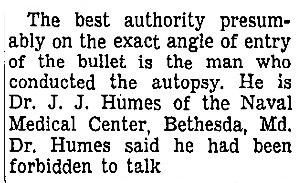
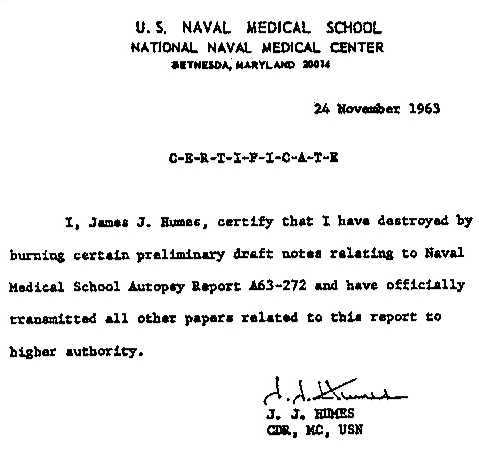
    One of the arresting aspects of the book is McKnight’s characterization of Humes. Whereas many Warren Commission critics have treated him, and the other two, with a modicum of respect — perhaps in the misguided hope that they would eventually see the light — McKnight is anything but kind. (Since Humes has now passed away, the author may feel that he can take the gloves off.) He exposes as a canard the idea that Humes burned his original autopsy draft and “bloodstained” notes out of respect for the dead president. McKnight writes that this could not have been the case since this draft was prepared in the unbloodied comfort of the doctor’s own home. (p. 165) When interviewed by the ARRB’s Jeremy Gunn on this point, Humes became flustered and angry. He said it “might have been errors in spelling, or I don’t know what was the matter with it, or whether I even ever did that.” (Ibid) Later he added, “I absolutely can’t recall, and I apologize for that.” (Ibid) McKnight suggests that assistant counsel Arlen Specter recognized this problem at an early date and met with the doctors approximately 8-10 times prior to their testimony in March. Subsequently, when Specter elicited the rather startling revelation about burning the first draft, no one batted an eyelash. As the author puts it: “Not a single commissioner was moved to ask Humes what right he had to destroy these papers or even why he felt compelled on his own initiative to consign them to archival oblivion.” (p. 158)

    But with this established, Specter and Humes moved on to a second deception. Namely that Commission Exhibit 397 was the documentary record upon which the official autopsy report was based. This exhibit consisted of a set of notes, and the handwritten revision of the incinerated draft of the autopsy report. One of the note pages was the autopsy “face sheet” (body diagram with wounds marked), and the others were notes of Humes’ talk with Dr. Malcolm Perry of Parkland Hospital about the tracheotomy he had performed on President Kennedy in Dallas. But this cannot be the entire record since the final, single-spaced, 6-page autopsy report contains many facts that are not contained in these documents. After a thorough analysis, McKnight concludes:

    There are, give or take, about eighty-eight autopsy “facts” in the official prosectors’ report. About sixty-four of these “facts” or pieces of medicolegal information (almost 75%) cannot be found in either the published notes or CE 397. Some fifteen of these pieces of information involve measurements and numbers that are not found in the published record. (p. 162)

    So where did these other “facts” come from? The author makes the argument that, contrary to the Humes-Specter fabrication about the burning of the original autopsy draft, this report actually survived. He believes it was around until about November 26th. That it began to be revised and altered in the office of Admiral C. B. Galloway on Sunday afternoon after Jack Ruby killed Oswald. (I should add here that McKnight is not appreciative of the efforts of Jeremy Gunn in what turned out to be the last examination of Humes. He feels Gunn did not press him hard enough.)

    The chapter on the autopsy concludes with a quite interesting discussion of the cipher of Dr. George Burkley, Kennedy’s personal physician. As others have noted, Burkley was in the presidential motorcade, in the Parkland emergency room, with the body on Air Force One, in the Bethesda morgue, and in the ambulance returning the body back to the White House. He was the one physician who was with the body the entire time after the shooting. Hopefully, this would have put him in position to resolve some of the conflicts over the medical evidence, or at least explain how they came about. Realizing his importance, what did the Commission do with him?

    Incredibly, JFK’s personal physician was never called to testify. Commission assistant counsel Specter never interviewed Burkley or asked him to prepare a statement on his observations of the president’s wounds or any information he might have relating to the assassination. The FBI and the Secret Service never mentioned him before or after they submitted their respective reports…to the Warren Commission. (p. 177) One of the reasons that may have given Specter pause before deposing Burkley was the fact that he had signed President Kennedy’s death certificate. This document placed the back wound at the level of the third thoracic vertebra. Which is much lower than where the Gerald Ford-revised Warren Report placed it: at the base of back of the neck. And at this level, a bullet headed downward would not be able to exit the throat. Since Specter’s main function was to enthrone the single bullet theory, the last thing he wanted was to place in the record a debate over this document. What makes the document even more interesting is the point of reference used for the wound placement. It is more accurate than what the pathologists used. Dr. Finck located the point in an odd way. He measured from the mastoid process to the acromin, or tip of the right shoulder. These are not fixed body landmarks. In his ARRB interview, Finck stated that “JFK’s spine, a fixed landmark, was the correct and only point of reference to determine the accurate location of this posterior wound.” (p. 179) Like Burkley did. As the author notes, one has to wonder if Finck’s measuring points were deliberately chosen in order to disguise just where the posterior entrance was. If so, then Burkley was not in on this obfuscatory design. Which made him a most valuable witness. Further, Burkley’s placement is corroborated by much more evidence than the Warren Report’s, e.g. the holes in Kennedy’s shirt and jacket, observations by both FBI and Secret Service agents, the autopsy face sheet, and, as we shall see, the FBI reenactment in Dallas. Ultimately, what the death certificate does is not just call into question the magic bullet theory, but also the number of shots, and whether the back wound exited at all. In sum, it had the potential to scuttle the Warren Report. Which is probably why it does not appear in either the report or the 26 volumes of evidence. McKnight ends his discussion of Burkley by noting that when author Henry Hurt called the doctor to arrange an interview he replied that he felt the Kennedy case was a conspiracy. When the writer tried to follow up this conversation with a full-length interview, Burkley promptly refused.

    McKnight’s two chapters on the ballistics evidence are equally compelling. For months of its existence, the Commission tried to ignore the ricochet hit to bystander James Tague off the curb. Even though they were aware of it, as late as June of 1964, Specter was trying to discount its importance. (p. 185) Tague was not deposed until July 23, 1964. This only occurred because Dallas reporter Tom Dillard asked the U.S. attorney for north Texas a question about Tague during a public appearance. The attorney then sent a registered letter, including a photo, to Rankin. So now, in July, the drafts of the report finally included the curb strike. And now, since he was down to two bullets for Kennedy and Connally, Specter had the unenviable task of stitching together the single bullet theory. As with the medical evidence and Burkley, Specter ignored his best witness.

    Dr. Joseph Dolce had spent three years as a battlefield surgeon in the Pacific Theater during World War II. He retired as a full Colonel. In 1964 he was chairman of the army’s Wounds Ballistic Board. As McKnight describes his stature in the field:

    When the Commission asked the army for its top ballistics man, it sent Dolce. He was regarded so highly as an expert on wounds from high-velocity weapons…that in the event of a serious injury to any VIP in Congress or in the administration, he was to “be called to go over the case.” (p. 186)

    The problem for Specter was that Dolce concluded Connally was hit by two shots. He also stated that the magic bullet, CE 399, could not have shattered the governor’s wrist and remained pristine. Dolce later recalled a meeting with several experts and Commission staff. He said it was Specter who battled hardest for the viability of CE 399.

    Dolce then participated in experiments conducted at Edgewood Arsenal in Maryland. These were done with Oswald’s Mannlicher-Carcano, a hundred 6.5 mm bullets, and ten cadaver wrists. Dolce told film-maker Chip Selby that in each and every instance the bullet was “markedly deformed” after firing. (p. 187) Dolce was never called as a Commission witness. And Specter never questioned any of the ballistics experts about the above experiment. (p. 189) Specter then requested a reenactment in Dealey Plaza. Yet on the FBI stand-in for President Kennedy, the chalk mark signifying the back wound is at the point where Burkley described it: the third thoracic vertebra. And this appears in Chapter 8 of the report, photograph 12. (p. 192)

    In his draft report, Specter ignored all of the above. He wrote that “all medical findings established” that a single bullet caused Connally’s wounds. Dolce’s name did not appear in his June 10th report. In fact, the actual report on the Edgewood firing experiments did not appear in the Warren Report or in any of the 26 volumes. It was not declassified until 1972. (p. 197)

    Dolce was upset by what the Commission had done with these experiments. Years later, he wanted to talk to the House Select Committee on Assassinations. He wished to testify that the actual report on the experiment had been altered before it was submitted to the Commission. He wanted to share the original report with the new investigating body. He conveyed this wish to his senator Lawton Chiles, who passed it on to a congressional representative on the committee. Yet Dolce was never called as a witness by the HSCA. Dolce has been mentioned before in the literature on the case. But as with other matters outlined above, McKnight goes further in both length and depth about this crucial witness than anyone before him.

    V

    Another major aspect of Breach of Trust are McKnight’s sections dealing with Oswald’s activities that intersected with the CIA and FBI. The author rightly discounts the remarkably feeble Warren Commission report on Oswald in Mexico City. This rather brief essay by David Slawson and William Coleman shrivels like a crushed grape in comparison to the volume prepared by Dan Hardway and Ed Lopez for the House Select Committee. As McKnight notes, the Warren Commission’s given itinerary for Oswald — Mexico City to Cuba to Russia — made little sense. Prior to this, “He had shown no interest in returning to Russia, and by all indications the Soviet state had no interest in allowing the anti-Soviet Oswald back into the country. (p. 61)

    Oswald’s attention and activities had now turned from Russia to Cuba, and he now actually denigrated the Soviet system when asked about it. Also, Oswald had no funds to stay in Cuba for any extended period of time, let alone go on to Russia. He had been out of work for nearly two months prior to going south of the border. As the author notes, the Slawson-Coleman report was based almost exclusively on information originating with the CIA. (p. 63) Because of this reliance, all the intelligence tradecraft in Mexico City — later revealed in the Hardway-Lopez Report — went unnoticed in its predecessor: the false phone calls attributed to Oswald, the missing photos and audiotape recordings, the survey of the infallible surveillance system the CIA had in place, the human sources inside the Cuban consulate, the key but questionable roles played by David Phillips and Ann Goodpasture. And, above all, the question of an imposter posing as Oswald. In relation to all this, the author writes of the Slawson-Coleman Report:

    The Commission must be credited, at least, for correctly reporting that Oswald was in Mexico City from September 27 to October 2, 1963. Much of the rest of the Warren Report’s treatment of Oswald in Mexico City cannot be safely assumed to be an accurate account. (p. 64)

    From here, the book goes on to note all the inconsistencies and oddities in the documentary record that should have indicated to any honest inquiry that something was wrong with the CIA’s story. A story which on 11/23 the CIA was pushing on President Johnson, particularly, “his alleged contact with the Soviet consular official Valery V. Kostikov” who the CIA reported “was a sabotage and assassination expert.” (p. 66)

    At this point the author shrewdly and forcefully points out that there was one person in Washington who had reservations about this tale as early as the 23rd. He was J. Edgar Hoover. McKnight summarizes a phone conversation the president had with the director on that day about Oswald in Mexico City:

    …Hoover admitted that the evidence so far was “not very strong.” Hoover then related some news that must have captured the president’s attention — there was evidence that someone in Mexico City had been impersonating Lee Harvey Oswald, the charged assassin of President Kennedy. (p. 67)

    The Commission’s main investigating arm was on the verge of uncovering an ersatz trail, with all the ramifications that unmasking could entail, including who Oswald was and what his purpose in Mexico really concerned. (Hoover’s doubts about this part of the story grew as time went on. He later scribbled in his famous marginalia that the CIA had handed them a “snowjob” about Oswald in Mexico City.) The CIA now realized it was on thin ice about this aspect and it began to forcefully crowd out the Bureau with the Commission on Mexico City. Director of Plans Richard Helms actually wrote the Bureau and the Commission letters making this clear. And when the Bureau discovered that other CIA reports trying to blame Castro for the murder, e.g. the Gilberto Alvarado tale, were also diaphanous, the Agency now switched its story:

    Eventually the CIA would drop the pretense of any Oswald-Kostikov connection when the White House unmistakably signaled that it was not interested in any “Red plot”, real or manufactured. In July…Richard Helms…disclosed to Rankin that…Oswald met with Pavel A. Yatskov not Kostikov. (p. 70)

    President Johnson was so against the “Oswald as a Red agent” line that he removed a diplomat who was pushing it from office, Thomas Mann, the American ambassador to Mexico. Needless to say, none of this extraordinarily relevant and compelling information made it into the Warren Report.

    The intelligence strand between Oswald and the FBI that gets lengthy treatment here is the infamous Hosty note. This is a written communication left by Oswald in the Dallas FBI office for James Hosty who was attempting to interview Marina Oswald. Reportedly a violent threat, the note was kept by the Bureau and then destroyed after the assassination by Hosty on orders from office chief Gordon Shanklin. The Commission had heard of this note through the testimony of Ruth Paine. (p. 260) Again, this incident should have raised the investigatory antennae of the Commission a few feet in the air. If it was a threat of a violent nature, the FBI should have reported it to the Secret Service. Oswald would then have been passed on to the Protective Research Section (PRS) headed by Robert Bouck. They would have found out he worked along the motorcade route and he likely would have been surveilled or detained that day.

    Yet, as noted here, before 11/22/63, “Oswald’s name was not known to the PRS.” (p. 250) What makes this even more curious is that Hosty was handling the Oswald file in Dallas. (Ibid) Hosty had information about Oswald’s trip to Mexico and his visits to the two communist embassies. Finally, as Hosty revealed later, he believed that Marina was some kind of KGB-planted “sleeper agent” (p. 254) In November, when he attempted to interview Marina, it was about Oswald’s calls to the Soviet Embassy. It was this visit to the Paine household in search of Marina that prompted Oswald to deliver the note to the FBI office. So the Bureau had 2-3 weeks to convey this important information to the Secret Service. They did not. Further, Oswald had written a letter to the Soviet Embassy in Washington in which he mentioned Hosty and the FBI. (p. 258)

    Finally, Hosty had found out himself that Oswald worked at the Texas School Book Depository on the motorcade route. When the man running the Oswald inquiry at the Bureau, Alan Belmont, learned all this he realized what a blow the note and Hosty’s inaction would be to the Bureau’s image. He relayed his displeasure to Shanklin and Shanklin told Hosty to ditch the note, which he did by flushing it down the toilet. When Hosty was questioned, the Commission did not mention the note or its fate, nor did Hosty volunteer any information about it. Hosty’s testimony, excerpted by Knight, borders on the comical. When asked if he even thought about Oswald in relation to Kennedy’s upcoming visit or the motorcade route, Hosty replied with a simple “No.” (p. 261)

    The author’s discussion of this episode is thorough, detailed, and provocative. In passing, he mentions some clear questions it all poses:

    1. Would someone contemplating killing the president leave a threatening note in the office of the local FBI?
    2. If Hosty suspected either of the Oswalds as communist sleeper agents, why did he not alert the Dallas Police beforehand?
    3. Why did the Commission go along with Hoover’s decision to strike a citation to Hosty in Oswald’s address book?
    4. Was Oswald some kind of informant to the Bureau, and did this explain Hosty’s negligence?

    The author ends this chapter on Hosty by showing how accommodating Rankin was to Hoover. Rankin told the Bureau that the Secret Service was angry with them about this clear lapse. The Bureau went to the top level of the Secret Service and got them to rein in the testimony of Robert Bouck before the Commission. Bouck never mentioned Hosty. (p. 280) The FBI was pleased with Rankin’s efforts. As assistant director Alex Rosen wrote, the Commission seemed satisfied with Hosty’s presentation. (p. 281)

    VI

    The real achievement of Breach of Trust is this: as much of it as I have described, there is still as much that I have left out. To write at length about all of it would make this review much too long. But to briefly mention some samples:

    1. It was Rankin’s idea to classify the executive sessions Top Secret. (p. 89)
    2. The Sibert-O’Neill report on the autopsy was so disturbing that neither of the agents was called to testify. (pgs 91-92)
    3. Hoover and James Angleton discouraged any move toward an independent staff. (p. 93)
    4. McKnight presents the best case for Oswald not being on the sixth floor that I have seen, with corroborating witnesses that I did not recall. (pgs. 115-116)
    5. There is no evidence that the FBI did a cotton swab test to see if the Mannlicher- Carcano was fired that day. (p. 121)
    6. The Commission conspired with the FBI to keep the exculpatory results of the spectrographic tests out of the record. (p.125)
    7. The Commission was so sensitive to the rumors of Oswald’s government agent status that Rankin tried to falsify the record of the January 22, 1964 meeting. (pgs 128-135)
    8. Rankin covered up the information the Commission had that Oswald may have been given a CIA source number. (pgs. 137-140)
    9. According to the FBI analysis of the Zapruder film, the first shot came at frame 170, when the limousine was hidden by the branches of an oak tree. (pgs. 150-153)
    10. Rankin plotted in advance to avoid an accurate stenographic record of the 9/18/64 executive session in order to disguise Sen. Russell’s dissent about the single bullet theory. Thereby falsely presenting it as a unanimous decision. (pgs. 294-95)

    And even this still does not do complete justice to this extraordinary, magisterial book. One that should serve as a model for what can be achieved in the field with the new declassifications by the ARRB. What McKnight has done has deepened our understanding of just how badly the Warren Commission served the public. But by explaining also how and why it happened, he gives us a new version, one in stereo and high definition. At the end of Rush to Judgment, Mark Lane wrote that the Warren Report dishonored “those who wrote it little more than those who praise it.” This book makes you feel the sting of that dishonor more than any other book that I know. But, as with the best work in the field, it helps us transcend that shame with the beauty and power of pure understanding. And with that achievement, this volume joins my list of the top ten ever written in the field.

  • BBC RFK Update


    June 2007

    In David Talbot’s new book Brothers he reveals that both he and Jefferson Morley of the Washington Post Online did a follow up inquiry on the Shane O’Sullivan report with the BBC. The investigation was commissioned by The New Yorker. According to Talbot’s book, the pair traveled widely, “interviewing dozens of relatives, friends and former colleagues” of their principal subjects (p. 397). They discovered that Gordon Campbell “died in 1962, making it impossible for him to have been filmed in 1968 at the Ambassador Hotel” (Ibid). In an interview with Rex Bradford Talbot revealed that they had also attained good photos of both Morales and Joannides taken around the 1968 time period. When they were compared to the BBC Ambassador Hotel footage, it was evident that they did not match. Or as Talbot told Bradford, “…it’s simply not the man caught on camera at the Ambassador.”

    Interestingly, the New Yorker decided against publishing an article based on this work. Talbot, as of yet, has not revealed the reasons behind this curious decision.


    The BBC RFK Report

    February 2007

    On November 20, 2006, the British Broadcasting Corporation showed a 15-minute report about the Robert Kennedy assassination. Put together by Shane O’Sullivan, it is supposed to be part of a longer documentary work-in-progress.

    The BBC report began with the late Larry Teeter, former attorney for Sirhan Sirhan, going over the autopsy evidence in the Robert Kennedy case. As most people know, this evidence strongly indicates a conspiracy. The report then used some photographs and films to present the case that there were three CIA officers at the Ambassador Hotel the night RFK was killed. They were identified as David Morales, Gordon Campbell, and George Joannides. All three men are known to have worked out of the infamous Miami CIA station codenamed JM/WAVE in the sixties.

    The basis for the photo identifications were four men who had interacted with the trio in the sixties and seventies. Wayne Smith, a former State Department employee, worked with Morales when Smith was stationed in Cuba in the late fifties and sixties. Ed Lopez, a former investigator for the House Select Committee on Assassinations, interacted with Joannides in the seventies when the latter was the CIA liaison to the Committee. Brad Ayers, who worked out of JM/WAVE in the early sixites, identified Campbell and Morales. And another CIA operative, David Rabern, also identified Morales since he knew him at that same time. Rabern says he was actually at the Ambassador that night and added that he recalled Morales talking to Campbell, even though he did not know who Campbell was at the time.

    The BBC special is designed to give the impression that O’Sullivan discovered these photos and put together this evidence. But if you take a look at the entry for Brad Ayers on the JFK Research Forum on the Spartacus school.net site, you will learn that Ayers told Jeremy Gunn of the Assassination Records Review Board back in 1995 that he had a “credible witness who can put David Morales inside the Ambassador Hotel in Los Angeles on the night of June 5, 1968.” It seems that Ayers is clearly referring to Rabern here. O’Sullivan does not make it clear that he knew this in advance. He seems to indicate that Ayers led him to Rabern. But if that is the case then Ayers already knew that Rabern would make the ID. Further, Ayers was predisposed to making the Morales ID himself since he found Rabern credible at the much earlier date. The Campbell identification is totally reliant on Ayers, since Rabern did not seem to know who he was in 1968.

    The BBC report also included a short interview with Robert Walton. Walton first appeared in Gaeton Fonzi’s memoir about his HSCA experience entitled The Last Investigation. And for all intents and purposes that book, published in 1993, is where Morales first figured in any significant way in the JFK case. Fonzi mentions Ayers there and talks about some investigatory work Ayers did on his former colleague Morales. Fonzi concluded his section on Morales by introducing Walton. Walton, who did some legal work for Morales, related a story in which he was drinking with Morales one night. President Kennedy’s name came up and Morales exploded in anger at what Kennedy had done to the Cuban exiles at the Bay of Pigs. The tirade concluded with the following line: “Well, we took care of that son of a bitch, didn’t we?” (Fonzi, p. 390)

    The source given by Fonzi for this quote is Walton. But in the BBC special this quote is now expanded in both length and reference points. Walton now states that Morales said he was in Dallas when “we got that mother fucker and in LA when we got that little fucker.” This is a serious revision of the original comment since it now means that Morales was actually on the scene in not just one place for one assassination but in both. It is hard to believe that Fonzi would not have recorded and printed the much more specific quote back in 1993. But the altered quote does jibe with what the BBC report is now saying.

    Ever since Fonzi’s book came out, the Morales angle has had a strong influence on the literature. For example, Noel Twyman in Bloody Treason spent a lot of time examining what Morales did with the CIA. And Morales is also mentioned a lot in that bloated piece of pap, Ultimate Sacrifice. But this is the first time in a printed or broadcast report that a named witness connected him to the RFK case.

    Ayers has been obsessed with Morales for a long time. As Lisa Pease notes on her Real History blog, he once tried to convince her and myself that Morales was involved in the MLK case. But he did not tell us at the time about Morales and the RFK case and he never mentioned David Rabern. If one believes Ayers, then Morales was somehow involved with the murders of JFK, MLK, and RFK. He told us that he thought Morales actually ran the street operation in Dealey Plaza. But, strangely, it was not for the CIA. Back then he thought it was for Barry Goldwater and he linked this to the notorious 1976 murder of Arizona reporter Don Bolles. It was somehow a way for Goldwater to get elected in 1964.

    An interesting question is why was Rabern at the Ambassador that night? If he was a covert operator, was he from the liberal wing of the CIA who supported RFK? And how does he remember Campbell so clearly talking to Morales if he did not know who Campbell was back in 1968? If one takes this report at face value, there were four CIA operatives at the Ambassador that night. All out in the open in the midst of cameras, film equipment, and tape recorders. And if Rabern recognized Morales, didn’t Morales recognize Rabern? If so, what did he say to him?

    Now, the BBC report has stirred at least two reactions. Mel Ayton, a British anti-conspiracy author, wrote up a reply about a week later, and updated it a week after that. The first part of his response is worthless since it uses the shameful work of Dan Moldea to respond to the points made by Teeter. But he does bring up some notable disagreement with the photo identifications. For instance, Dan Hardway who worked with Lopez at the HSCA did not identify Joannides in the pictures. He said his encounter with him was too long ago for him to venture an opinion on the matter. Ayton says he talked to Grayston Lynch, who also worked out of JM/WAVE and knew Campbell. Ayton writes, “According to Lynch the man in the LAPD film footage is not Campbell.” Ayton also quotes a man named Col. Manuel Chavez who worked with Morales for a period of time in 1964. Chavez says the man depicted in the special “does not look like Dave Morales.”

    Now the above does not mean that the BBC special is wrong, but it does point up the problems with using photo identification as a tool to solve a crime. Tony Summers chimed in on this point by saying, “Photographs and photographic recognition are infamously unreliable, especially coming from witnesses so long after an event.” I should point out that in the JFK case, the photo identifications of the three tramps in Dealey Plaza have been a continual source of error and embarrassment. As has the alleged identification of Joseph Milteer along the motorcade route.

    In speaking with author David Talbot, he and Jefferson Morley were commissioned by The New Yorker to do a follow up story on the BBC report. Talbot has been working for years on a book about Robert Kennedy. The New Yorker got hold of a galley proof of his long-awaited book and they were impressed. They are going to excerpt the book and also do a supplementary report on this alleged identification. This report is scheduled to run in May. Hopefully Morley and Talbot will be able to do more ground work on the matter. Like, for example, finding the three CIA officers next of kin and asking if they were with them on that rather memorable night.

  • David Talbot, Brothers


    With his book Brothers David Talbot has improved as a commentator on both the Kennedy presidency and JFK’s assassination. For those unfamiliar with Talbot’s earlier foray into the field, let me provide some background.

    On March 29,1992, on the eve of the Oscar presentations, Talbot wrote an article on the film JFK for a periodical he edited called Image Magazine, published by the San Francisco Examiner. In the first paragraph (p. 17) he ridiculed Stone’s thesis — that Kennedy was cut down by those in government who were opposed to his goals of peace and social justice– as a “story” that “Stone and company” were peddling (he mentioned others in the “company” as Mark Lane and Jim Garrison). He then offered up an alternative view of the assassination that he wrote “has been quietly gaining credibility. According to this school of thought, Jack Kennedy met a violent end because he was as much a prince of darkness as he was of light.” (Ibid) He then spent seven pages offering up what was basically the idea behind that ridiculous book Double Cross: that far from being an enemy of the Mob, ” John Kennedy’s links with the underworld are well-established.” But this did not stop him from “unleashing his brother … to hound the godfathers of organized crime … The supremely confident Jack Kennedy thought he could have it both ways. He couldn’t, and he paid the ultimate price for his hubris.” (p. 18) Talbot knew a guy who was savvy about the case and would steer his readers straight. His name was Robert Blakey and his book Fatal Hour presented ” a compelling case for a darker interpretation of Camelot.” (Ibid) He also had another talismanic book in hand. It was on Marilyn Monroe and her death: Goddess by Anthony Summers. ( In deference to Summers, part of the article included a defense of the Warren Commission.) Talbot also praised Mafia Kingfish by John Davis and described the three mentioned books as “careful and thorough” and “of a far higher grade than that of the wild-eyed theorists who are grabbing the spotlight.” Just when you thought the piece could not get any worse, it did. Talbot has “intriguing new evidence”, the claims of Mafia lawyer Frank Ragano:

    Blakey … says flatly, “I believe Frank Ragano. He was in a position to know.” Investigative journalist Dan Moldea, whose 1978 book on Hoffa was the first to draw a link between organized crime and the assassination, says, “The Ragano story is the most important breakthrough on the case since the House report.” (p. 23)

    About John Newman’s then important new work on JFK’s intent to withdraw from Vietnam and Stone’s use of it, Talbot quotes Summers thusly: “There is as much evidence that JFK was shot because of his Vietnam policy as that he was done in by a jealous mistress with a bow and arrow.”(p. 24) Blakey further contravenes Stone by saying that both the CIA and FBI “loved Jack Kennedy” since many were Irish Catholics.

    I am not misrepresenting the piece in any way. Quite the contrary. Talbot even gave space to two of the very worst and dishonest Kennedy chroniclers, namely Ron Rosenbaum and Thomas Reeves. But the good news is that in Brothers Talbot has largely reversed field. Today he criticizes people who write like he formerly did about the Kennedys, e.g. Christopher Hitchens. But the bad news is that he can’t quite go the last yard. He can’t quite let go of some of the empty baggage above. And this mars the good work in the volume.

    I

    The book has a neat plan to it. It begins with Robert Kennedy’s reaction to the news of his brother’s death in Dallas. The structure then flashes back to a year-by-year review of the Kennedy presidency. It then picks up again with RFK after his brother’s death, and then follows him forward through to 1968 and his own assassination. It concludes with a summary of the actions taken to try and resolve the issues surrounding both assassinations since 1968. The book takes in a lot of space without being verbose or pretentiously bulky. Which, after the likes of Ultimate Sacrifice, is a relief. Further in this regard, Talbot is a skillful writer. So the book is not at all difficult to read.

    In many ways, the first chapter is the best in the book. It opens with J. Edgar Hoover telling RFK that his brother has been shot. In conversations with two assistants, Bobby immediately refers to the perpetrator of the crime as “they” and not “him”. He instinctively believes that the crime centers around the CIA, the Mafia and Cuba and he begins to question people with access to each group, including John McCone, Director of the CIA. (pgs. 6-9) When the body arrives back in Washington, RFK questions Secret Service agents Roy Kellerman and James Rowley and finds that both believe there was a crossfire in Dealey Plaza.

    Talbot then builds an argument that this early conclusion is what caused Robert Kennedy to take control of the president’s autopsy exhibits, specifically the brain and tissue slides. Further, Talbot adduces evidence that RFK actually thought of taking the limousine also. After Oswald is killed by Ruby, Bobby begins to focus on the Mob and has labor lawyer Julius Draznin submit a report on Ruby’s labor racketeering activities. RFK then told his friend Pat Moynihan to investigate the Secret Service while Bobby interviewed agent Clint Hill himself.

    This chapter closes with a review of William Walton’s mission to Moscow in the wake of President Kennedy’s assassination. This extraordinary tale first surfaced in 1997 in one of the two best books on the Cuban Missile Crisis, One Hell of a Gamble. (The other volume being The Kennedy Tapes, published the same year.) Talbot goes into the background of Walton and why he was sent by RFK and Jackie Kennedy to send a secret message via Georgi Bolshakov who the Kennedys had used previously during the Missile Crisis as a back channel. RFK told Walton to see Bolshakov before he even reported to the American ambassador Foy Kohler. Bobby thought Kohler was anti-Kennedy, and a hardliner who could not get anything real done with the Russians. (p. 31) This new message had been presaged by another talk RFK had with the Russian in 1962. At that time Bobby told Bolshakov that Khrushchev did not seem to realize that every step his brother took to meet the premier “halfway costs my brother a lot of effort … .In a gust of blind hate, his enemies may go to any length, including killing him.” (p. 32)

    The new message fulfilled the earlier prophecy. Walton told Bolshakov that the president’s brother and widow believed that JFK had been killed by a large political conspiracy. And although Lee Harvey Oswald was a former defector and alleged Castro sympathizer, they believed the conspiracy was domestic. Further, they felt that Lyndon Johnson would not be able to fulfill President Kennedy’s grand design for Russo/American dÈtente. That design would have to be filled by RFK who would find a temporary political base and then run for president himself. Walton said in this regard that “Robert agreed completely with his brother and, more important, actively sought to bring John F. Kennedy’s ideas to fruition.” (p. 33)

    Talbot sums up the multi-layered significance of this momentous mission this way: “There is no other conclusion to reach. In the days following his brother’s bloody ouster, Robert Kennedy placed more trust in the Soviet government than the one he served.” (p. 34) From here, Talbot launches into a three chapter review of the Kennedy presidency which is meant to demonstrate why RFK felt more comfortable conveying his hidden suspicions about Dallas to the Soviets rather than say to the Warren Commission.

    This chapter is the highlight of the book. It may be one of the most important ever written on either the Kennedy presidency, or Robert Kennedy himself. It basically confirms through much firsthand evidence what many have suspected. First, whatever Bobby said in public about the Warren Commission was only a figleaf. From the beginning, he never believed the lone gunman mythology. He always suspected a powerful domestic conspiracy. Second, he was going to bide his time. He would wait until he was in position to do something about the crime. But he would not jeopardize his path to get to that position by making public comments that would make him a media target in America. As pointed out by people like Jim Garrison and Harold Weisberg, this strategy entailed its own dangers. For enough people knew about Bobby’s suspicions and goals to let the word reach out to others in the power elite. And this is probably one of the chief reasons for what happened in Los Angeles in June of 1968. In fact, both Harold Weisberg and Vincent Salandria predicted that if Bobby won that California primary, and if he remained silent in the interim, he would be killed before he won the presidency. Although Talbot does not go this far in explicit terms, his book is pregnant with that implication. I believe this is the first time that this message, however subliminal, has been contained in a book that reached a mainstream audience. That is a real and salutary accomplishment. In this regard, Talbot deserves kudos.

    II

    The second section of the book is a review of the Kennedy presidency that is meant to explain why RFK felt the way he did at the time of the assassination. This is about 200 pages long and takes up Chapters 2-4. Although generally good, it is much more a mixed bag.

    He opens this with an analysis of the Bay of Pigs debacle. He comes to the conclusion that others have before him: the CIA knew it would fail and they were counting on Kennedy to cave and send in the Navy to complete the job. He quotes the declassified CIA Inspector General Report as saying that the planners actually knew they needed help form the Pentagon in order for the operation to succeed. (p. 48) From this disaster he rightly notes that the die was now cast between the national security apparatus and JFK. He quotes Navy Secretary Arleigh Burke as saying “Mr. Kennedy was a very bad president … He permitted himself to jeopardize the nation.” (p. 50) He then quotes Kennedy as saying, “We’re not going to plunge into an irresponsible action just because a fanatical fringe in this country puts so-called national pride above national reason.” (p. 51) Arthur Schlesinger told Talbot that after the Bay of Pigs Kennedy dismissed the Joint Chiefs “as a bunch of old men. He thought (JCS Chairman) Lemnitzer was a dope.” (Ibid) It is at this pivotal point that Kennedy began to withdraw from his formal advisers with disdain and turn more to people like quasi-pacifist Ted Sorenson, Pierre Salinger, and his brother Robert. (p. 52) And he actually told Walton, “I am almost a “peace-at-any-price president.” (p. 53)

    Since Talbot correctly sees the Bay of Pigs as a (perhaps “the”) seminal event in Kennedy’s presidency, it is profitable to note his approach to the subject. Although his analysis is skillful, pointed, and shrewd, it is not really deep or detailed. There are many things he leaves out which could be used to strengthen his beliefs about its being designed to fail, and how the CIA was opposed to Kennedy’s plans for its outcome all along. For instance, he does not mention the assassination plans, which were kept from Kennedy. He doesn’t write about Operation Forty, which the CIA designed to wipe out the Kennedy Cubans and their leadership so the CIA/Batista Cubans would prevail in Havana. Although he later writes about Operation Northwoods, he doesn’t write about the Guantanamo provocation part of the Bay of Pigs, which although it was aborted, would have almost insured an American response. In the aftermath, although he mentions Kennedy’s firing of Dulles and Director of Plans Dick Bissell, he leaves out the termination of Deputy Director Charles Cabell. Yet it was Pentagon man Cabell who was at CIA headquarters that night trying to get the analysts to tell Kennedy that the Cubans were using Russian MIG’s to strafe the exiles on the beach. This was utterly false but would have put pressure on Kennedy to send in American planes to knock them down. So although his discussion of the incident is good and correct, I believed it lacks texture and layered depth. I point this out because it is generally symptomatic of how Talbot treats the two other great confrontations of the Kennedy presidency, namely the Missile Crisis and the decision to withdraw from Vietnam. He is deft and accurate in his appraisal of these events, but he leaves out some valuable information that I think would aid his argument and make it more compelling to his reader. For example, although he believes that Kennedy was disengaging from Vietnam he writes that the only White House document that gave some indication of this was NSAM 263. (p. 216) This ignores, among others, the record of the May 1963 Sec/Def meeting which clearly shows that the administration was withdrawing from the conflagration and rapidly increasing the Vietnamization of the war. (Probe Vol. 5 No. 3) It also leaves out the fact that although, according to Doug Horne, the ARRB tried very hard to find a similar record for the famous Honolulu Conference of November 20, 1963, they could not. This meeting resulted in the tentative draft of NSAM 273, which was then pointedly altered after Kennedy was assassinated. These alterations were so serious that in his fine book JFK and Vietnam, John Newman titles his chapter on the subject, “NSAM-273 — The Dam Breaks.” (Newman, p. 445) (Surprisingly, Talbot does not include that key volume in his bibliography.) Another surprise in this section is what I see as an error of omission. The author completely ignores the entire Congo crisis. Which, in my view, is almost an object lesson in Kennedy’s foreign policy thinking versus the Republican-Democratic establishment. Why Talbot would discuss the Dominican Republic crisis, and not the almost epochal struggle of Patrice Lumumba and Kennedy in Africa, is puzzling. And again, it is surprising to me that Talbot does not list in his bibliography Richard Mahoney’s sterling book on the subject, JFK: Ordeal in Africa. It is simply one of the three or four best books on Kennedy’s foreign policy views in existence.

    But there is much to like in this section. There is a fascinating interview with Dick Goodwin in which he describes his long discussion with Che Guevara about a peaceful co-existence agreement with Kennedy. And how when this overture got out, Barry Goldwater called for Goodwin’s head. Talbot describes the infamous meeting in July of 1961 where Lemnitzer and Dulles recommended plans for a nuclear first strike against Russia on Kennedy. Talbot also describes how Kennedy, feeling the heat from the organized opposition to his liberal foreign policy, was forced to demote both Goodwin add Chester Bowles at the end of 1961.

    The book features a good discussion of the CIA-Mafia plots to kill Castro. In this section he is explicit about the duplicity of Richard Helms in attempting to switch the blame for those plots from the CIA to the Kennedys. (pgs 87-88) He neatly notes that Helms had photos of all the presidents he served except Kennedy’s. He even notes that Helms in death, was still deceptive about those plots in his posthumous memoir. (p. 110) A deft stroke by Talbot in this regard is his (further) exposure of Sy Hersh’s hatchet job, The Dark Side of Camelot. He notes how Hersh was so cozy with the CIA in his writing of this book that he trusted covert operator Sam Halpern. Halpern told Hersh that RFK used the late Charles Ford to activate Mafia assets in Cuba to destabilize, and even kill, Castro. Talbot found a Church Committee memorandum by Ford. In discussing his interview with them he explained that his meetings with RFK on Cuba were about “the efforts of a Cuban exile group to foment an anti-Castro uprising, not on Mafia assassination plots.” (p. 123) Talbot properly concludes that Helms and Halpern “fabricated their story about Bobby Kennedy and the Mafia … Officials like Helms and Halpern tried to deflect public outrage over their unseemly collusion by pinning the blame on the late attorney general.” Talbot could have added here that Halpern should have already been suspect to Hersh because he is listed as a witness in the CIA IG Report on the plots, which never mentions any of this material. Further, Halpern was placed in charge of the internal investigation of the CIA’s supersensitive Operation Forty. A report that, to my knowledge, has yet to surface. The man who placed him in that position was Helms.

    There are other good sections in this part of the book. To enumerate some: there is a close-up look — done with a new audio tape– at JFK’s disappointed reaction to the performance of the military during the James Meredith crisis at the University of Mississippi. (And he also reveals that Edwin Walker was on hand to stir up the racists against Kennedy and the military.) There is a long discussion of the character and role of the sad Lisa Howard in the famous Cuban back channel that she was instrumental in during 1963. And Talbot notes that during the Diem crisis in South Vietnam that same year, the CIA moved station chief John Richardson out of town “allowing the agency to cooperate with the South Vietnamese generals behind the plot.” (p. 218) Right before this, Talbot has described the famous reports by journalists John Starnes and Arthur Krock warning how the CIA was running affairs there with no accountability to anyone. And Krock warned the president he had to get control of his administration.

    But as I said, this section has peaks and valleys. Right along with the good and worthwhile work noted above, Talbot writes a section about that serial and certified liar Ed Partin (pgs 120-121). As I explained at length in my review of Ultimate Sacrifice, Partin was exposed by a group of certified polygraph technicians to be lying when he related the “death threats” by Jimmy Hoffa against RFK. How bad was he lying? To the extent that the machine had to be turned down when he was relating these urban myths. Later on, one of Partin’s polygraph operators was indicted and convicted for fraud. Yet Talbot blindly trots out Partin once again, ignoring both these facts, and the man’s past record of crimes. (I chalk this up to Talbot’s swallowing Walter Sheridan whole, an issue I will deal with later.) I was even more surprised when Talbot used none other than Angelo Murgado as another “RFK insider” (pgs. 177-182, 269-270). I dealt with this shady character in my review of Joan Mellen’s book on Jim Garrison, A Farewell to Justice. Talbot even writes that his tale has not been refuted. (p. 180) Apparently he did not read my discussion of Murgado’s tortuous and tendentious revision of the Odio incident in the previous book. But he still buys the Murgado line about RFK using Cubans like Murgado and Manuel Artime as his own private intelligence force. Further, that they knew about Oswald in advance. Wisely, Talbot does not reveal who Murgado’s other pal in the intelligence operation was, namely Bernardo DeTorres. If he had, some readers would have started raising their eyebrows.

    Finally, in this regard, I must comment on the book’s treatment of JFK and Mary Meyer. I was quite surprised that, as with Sheridan, Talbot swallowed the whole apple on this one. As I have written, (The Assassinations pgs 338-345), any serious chronicler has to be just as careful with this episode as with Judith Exner — and to his credit, Talbot managed to avoid that disinformation filled land mine. Before criticizing him on this, and before I get smeared by people like Jon Simkin, I want to make a public confession. I actually believed the Meyer nonsense at one time. In fact, to my everlasting chagrin, I discussed it — Timothy Leary and all — at a talk I did in San Francisco about a year after Oliver Stone’s JFK came out. It wasn’t until I began to examine who Leary was, who his associates were, and how he fit into the whole explosion of drugs into the USA in the sixties and seventies that I began to question who he was. In light of this, I then reexamined his Mary Meyer story, and later the whole legerdemain around this fanciful tale. Thankfully, Talbot does not go into the whole overwrought “mystery” about her death and her mythologized diary. But he eagerly buys into everything else. Yet to do this, one has to believe some rather unbelievable people. And you then have to ignore their credibility problems so your more curious readers won’t ask any questions. For if they do the whole edifice starts to unravel.

    Foremost among this motley crew is Leary. As I was the first to note, there is a big problem with his story about Meyer coming to him in 1962 for psychedelic drugs. Namely, he didn’t write about it for 21 years previous –until 1983. He wrote about 25 books in the meantime. (Sort of like going through 25 FBI, Secret Service, and DPD interviews before you suddenly recall seeing Oswald on the sixth floor.) Yet it was not until he hooked up with the likes of Gordon Liddy that he suddenly recalled, with vivid memory, supplying Mary with LSD and her mentioning of her high official friend and commenting, “They couldn’t control him any more. He was changing too fast” etc. etc. etc. Another surprising source Talbot uses here is none other than CIA counter-intelligence chief James Angleton, the guy who was likely handling Oswald until 1962. Talbot actually quotes the nutty Cold Warrior, Kennedy antagonist and Warren Commission cover up artist waxing poetic about Kennedy being in love with Mary: “They were in love … they had something very important.” (p. 199) This from a man who, later on, Talbot admits loathed JFK and actually thought he was a Soviet agent.! (p. 275). A further dubious source is Jim Truitt, the former friend of Ben Bradlee who used to work for him at the Washington Post and was also friends with Angleton. Consider: Truitt had been trying to discredit President Kennedy while he was alive by saying he was previously married and had it covered up. In fact, he had pushed this fatuous story on Bradlee. And it appears that Truitt then started the whole drug angle of the story as a way of getting back at Bradlee and the Post for firing him. By 1969 he was so unstable that his wife sought a conservatorship for him and then divorced him in 1971. Truitt tried to get a job with the CIA and when he did not he moved to Mexico into a colony of former CIA agents. There he grew and smoked the mescaline-based hallucinogenic drug peyote. This was his sorry state when he first reported to the press about the “turned on” Meyer/JFK romance. He then shot himself in 1981. Here you have a guy who was a long-time Kennedy basher, became mentally unstable, was a CIA wannabe, and was planting and taking hallucinogenics with other CIA agents– and then accuses JFK of doing the same, 14 years after the fact. Some witness, huh? I don’t even want to mention the last major source Talbot uses to complete this rickety shack. I have a hard time even typing his name. But I have to. Its sleazy biographer David Heymann. Heymann wrote one of the very worst books ever published on Bobby Kennedy, and has made a lucrative career out of trashing the Kennedy family. For me, Heymann is either a notch above or below the likes of Kitty Kelley. But when you’re that low, who’s measuring?

    III

    Talbot makes a nice recovery from the Mary Meyer (probably CIA inspired) cesspool with his next two chapters. He now begins to focus the book on RFK. After flashing back from 11/22/63, he now returns us to that point and picks up with RFK as he begins to assimilate himself to the pain of his brother’s death and his now completely altered future. He relates how Jackie Kennedy reaffirmed to Khrushchev via letter that domestic opposition to his quest for Soviet/American dÈtente had killed JFK. A concept which the Russian premier indirectly affirmed in his memoir when he wrote that if Kennedy had lived the two could have brought a peaceful coexistence to the world.

    Talbot quickly sketches in the fact that with his brother gone, Bobby was now under Hoover’s thumb. For example, when he met with Hoffa, to presumably talk about the assassination, RFK had to borrow Jackie’s Secret Service detail for protection. And after a deep period of melancholia, during which he actually wore his brother’s clothes, he decided that he would not give a quest for truth about Dallas. But he felt he could not move while he was slipping from power or, as he said, “there would be blood in the streets.” (p. 268) In addition to Hoover now superceding him, LBJ cut him out of intelligence briefings while, at the same time, Allen Dulles lobbied to get on the Warren Commission. (pgs. 273-274) And when the Warren Report was issued in September of 1964, RFK coyly commented, “I have not read the report, nor do I intend to.” (p. 280) Talbot quotes an aide whom Johnson had charged with reading the report that LBJ didn’t believe it either. (p. 289) Furthering this point about people in power, the author adds to his non-believer list Larry O’Brien, Mayor Richard Daley, and Kennedy aides Fred Dutton and Richard Goodwin. Goodwin specifically pointed to a plot between the CIA and the Mafia. (p. 303) And to further accent the point that neither JFK’s nor RFK’s staff believed the Warren Report, Talbot writes at length about the sad fate of Kenny O’Donnell. Both he and Dave Powers heard shots from the front of the car. Yet the FBI told them both to alter their testimony. In fact, Hoover personally intervened in the case of O’Donnell. (p. 294) As time went on, O’Donnell grew increasingly angry and bitter about the performance of the Commission. He told his son, “I’ll tell you this, they didn’t want to know.” (Ibid) And he added that it was the most pointless investigation he had ever seen. After Bobby was murdered, he acquired a serious drinking problem and died of a liver ailment at age 53. This was paralleled by the ordeal of Jackie Kennedy, who Talbot depicts as having screaming nightmares and maintaining thoughts of suicide. (p. 268)

    One of the more interesting aspects of this part of the book is this observation that Talbot makes: “While the country’s ruling caste — from President Johnson on down — muttered among themselves about a conspiracy, these same leaders worked strenuously — with the media’s collaboration — to calm the public’s fears.” (pgs 284-285) Talbot then twists this via anecdote into a droll kind of humor. When discussing the views of the wife of Arthur Schlesinger about the JFK case, she said she liked Claudia Furiati’s book, ZR/Rifle. Except for the part that pins the plot on Helms. She states: “I can’t believe the part about Dick Helms. He was a friend of ours. We played tennis with him.” (p. 291) Talbot talks to Marie Ridder, a former girlfriend of JFK, and widow of newspaper magnate Walter Ridder. She says that although Angleton was an evil genius, she didn’t think he was involved with killing Kennedy. After all, he used to live next door to her. He had a lushly landscaped house and was a fabulous gardener. She concludes from this, “and a man who is a fabulous gardener is not going to kill off a president, I’m sorry.” (p. 292) So the power elite believes there was a conspiracy. It just could not involve their tennis chums or neighbors.

    RFK delegated the reading of the critical literature to people like Adam Walinsky. (pgs 306-307). As criticism about the Warren Report picked up speed, various critics wanted to talk directly to Bobby. He only met with one, Penn Jones. As part of his own inquiry, Bobby went to Mexico City and did some work on Oswald’s trip down there. (p. 301) As his investigation continued, his enemies began to spy on him. In addition to Hoover, Talbot mentions both Helms and LBJ. (According to Talbot, Johnson greatly feared being challenged by a ticket of Kennedy and King in 1964 .) And clearly, the policy differences over places like the Dominican Republic, South Africa, Latin America, and especially Vietnam all begin to fan Johnson’s fear and paranoia about an RFK run in 1968.

    IV

    The worst chapter in the book, by far, is entitled “New Orleans”. This is allegedly about Robert Kennedy’s reaction to the investigation of the JFK case by local DA Jim Garrison. I have to use the word “allegedly” here because it seems to me that Talbot started this chapter with an assumption in mind and then piled the material in to fill out that assumption — whether it actually did or not. Authors get in trouble when they shoehorn evidence to fit a preordained verdict. And this chapter seems to me to be troublesome from the start.

    One problem seems to be a hangover from the David Talbot of 1992, the man who thought that Blakey was the ultimate authority on the JFK case and Garrison was somewhere between a circus clown and a charlatan. To say the least, the releases of the ARRB have not borne this out. And, to his credit, the author seems to have amended this judgment a bit. In spite of that, he presages his New Orleans chapter by calling it “a gaudy Louisiana legal spectacle” (p. 308). The whole first page of his introduction to Garrison the man is in a similar vein and he plays this off against the standard packaged tourist image of New Orleans pre-Katrina. (p. 319) When he introduces Garrison’s investigation it is essentially more of the same. For instance, about the arrest of Clay Shaw, Talbot writes, “But to Garrison, he was a CIA-linked international businessman. . ..” Today, there can be no “buts” about it. Shaw was not just “linked” to the CIA, he worked for them. We have this not just from the declassified files, but from FBI agent Regis Kennedy, who said, in referring to Shaw’s association with Permindex, that Shaw was a CIA agent who had worked for the Agency in Italy. (Let Justice Be Done, by William Davy, p. 100) To further downplay the importance of what Garrison uncovered, Talbot quotes former RFK aide, Ed Guthman. Guthman was working as an editor for the Los Angeles Times in early 1967. He tells Talbot that he sent his ace reporters to New Orleans and they discovered that Garrison had no evidence for his charges. Guthman calls them “great reporters”. If Talbot would have dug a little deeper he would have found out a couple of interesting things these “great reporters” had done. One of the “great” reporters was Jack Nelson. Nelson’s source for Garrison not having any evidence was former FBI agent and Hoover informer Aaron Kohn. Kohn was, among other things, an unofficial assistant to Shaw’s defense team. Another of Guthman’s “great” reporters was Jerry Cohen. Cohen cooperated with FBI informant Larry Schiller in keeping Garrison from extraditing Loran Hall. This cooperation extended up to flying with Hall to Sacramento to speak to Edwin Meese. Further, Cohen kept up a correspondence with Shaw’s lawyers and even Shaw himself. This is great reporting?

    By page 325, we see why Talbot has set things up this way. And this directly relates to Talbot’s portrait of Walter Sheridan. I was going to write that it is so warm and fuzzy that it could have been written by Sheridan’s family. But I can’t write that because, in large part, it was written by Sheridan’s family. Namely his widow and son. Talbot interviewed the woman five times and uses her profusely and without question. Now if you are going to use people like Guthman, and Sheridan’s family to profess to his good character, it leaves you with a serious problem. You now have to explain all the ugly and unethical things Sheridan did to destroy Garrison. Talbot achieves this in two ways: 1.) By recycling debunked mainstream media deceptions, and 2.) By leaving out integral parts of the story.

    Concerning the former, Talbot tries to excuse Sheridan by saying that Sheridan thought Garrison was ignoring mobster Carlos Marcello. He even goes as far as saying that Garrison gave Marcello a “free pass” and referred to him as a “respectable businessman” (p. 327) This canard has been exposed for years, in fact for over a decade. Garrison busted at least three bars in New Orleans which were run either by Marcello or his associates. (Davy, pgs 154-155) Talbot does not source his “businessman” quote, but it appears he has confused Garrison with one or more local FBI agents. And it is not true that Garrison never investigated the Mafia aspect, he did. (He actually wrote a memo on it.) But he came to the conclusion, as many others have, that the Mob was a junior partner in the crime, not the engine running the machine.

    Talbot then writes something even more unsubstantiated. He says that what really got Sheridan upset with Garrison is that Garrison had somehow discovered the CIA Castro assassination plots, and how they might have backfired against JFK. For one, in the book’s own terms, this is illogical. For this chapter, Talbot now writes that the plots had been “supervised by Bobby”. Yet, he has clearly established previously, and convincingly, that this was not the case. The CIA had done them on their own. Secondly, I have been through a large part of the extant Garrison files. His son Lyon Garrison allowed me to copy them in New Orleans. I then had them shipped to Los Angeles and filed them in chronological and subject order. I found no evidence that Garrison himself had discovered these CIA managed plots in early 1967, which would have to be true if Talbot’s thesis is to hold water. Interestingly, Talbot gives no source for Sheridan’s knowledge of what Garrison was on to or how he discovered it. Even more interesting, he avoids mentioning the famous Jack Anderson/Drew Pearson story, which aired at the time. This story actually did mention the CIA plots, and did say that RFK was involved with them. And considering Anderson’s role as an FBI informant on Garrison, it was probably done to confuse the DA. But there is no evidence Garrison ever took the (false) insinuation of RFK’s involvement seriously.

    Having no factual basis for this concept, Talbot then uses the bare assumption as the excuse for why Sheridan went to the CIA to get their input on Garrison. By this time, I had become quite curious as to why Talbot was cutting Sheridan so much slack. So I flipped a few pages forward and discovered the reason. The book maintains that Sheridan in New Orleans was not acting as any kind of intelligence operative, but rather on RFK’s behalf. He goes on like this for a couple of paragraphs — quoting Sheridan’s reliable wife again–and then comes this stunning statement: “And there is no evidence Sheridan and agency officials did in fact end up joining forces against the DA.” (p. 331) When I read that my eyes popped. Consider: in a legal deposition, among other places, Gordon Novel admitted that he was being paid by Sheridan on a retainer basis for spying on Garrison. Since Novel was writing letters to people like Richard Helms at the time, it’s fair to say he was working with the Agency. Further, Garrison discovered that Sheridan was getting the expense money for people like Novel through a local law firm, which was laundering it for the CIA. And a declassified FBI memo reveals that NBC had given instructions that the special was meant to “shoot him [Garrison] down”. Further in Robert Kennedy and his Times, Arthur Schlesinger quotes Kennedy as saying that it was NBC who sent Sheridan to New Orleans, and further that he felt Garrison might be on to something. (p. 616) As many commentators have noted, including Carl Bernstein — who Talbot uses (p. 390) — the major networks worked with the CIA on issues like defending the Warren Report. And the chairman of NBC at the time, General David Sarnoff, had worked in intelligence during World War II. In a further imbalance, Talbot barely discusses Sheridan’s intelligence background, devoting all of two sentences to it. (p. 330)

    I could go into much more length about Sheridan’s activities in New Orleans, and how they continued even after RFK was dead. And I could point out even more errors Talbot makes on this issue. For instance, he writes that Garrison “turned the tables” on Sheridan and arrested “him for bribing witnesses. (The charges were later dropped.)” (p. 329) Thus he insinuates that it was Garrison who was bribing witnesses and not Sheridan. Which is exactly wrong. (Davy on pgs 135-137 chronicles some of Sheridan’s efforts in this aspect.) Further, the charges were not dropped. Sheridan got an entourage of proven CIA affiliated lawyers for his defense. (Ibid, p. 143) And in a recurrent tactic, they got the charges switched to federal court where they were eventually thrown out. Finally, let me make one more cogent observation about Sheridan. He clearly did not like Garrison’s focus on the CIA in the JFK case. He then worked a lot with the HSCA, Dan Moldea, and Robert Blakey pushing the Mafia/Hoffa angle, which was certainly prominent in the HSCA Report and volumes. Yet on the day the report was issued Marcello’s lifelong friend, lobbyist Irving Davidson, told an acquaintance that he had talked to Sheridan and that he agreed that the HSCA report was a piece of crap too. (Vincent Bugliosi, Reclaiming History, p. 1175) So if Sheridan did not believe the CIA was involved, and he thought Blakey’s focus on the Mafia was B.S., what did he believe then? The Warren Report maybe?

    The mystery of Walter Sheridan — who he was, and why he did what he did — is a long, serious, and complex one. Talbot does not even begin to plumb its depths. For that reason, among others, I believe — and I can demonstrate — that every tenet of this chapter is just plain wrong.

    V

    The last part of Brothers deals with RFK’s run for the White House, his assassination, and a final chapter called “Truth and Reconciliation” which attempts to summarize the various attempts to solve both assassinations since 1968.

    Talbot posits that Kennedy’s increasing estrangement from Johnson’s foreign policy, especially on Vietnam, is what provoked his premature run for the White House, which he had originally scheduled for 1972. That and Eugene McCarthy’s good showing in New Hampshire. (Although other chroniclers have stated that the decision to run was made before New Hampshire.) Its a campaign that Jackie did not want RFK to make since, as she told Schlesinger, the same thing would happen to him that had happened to her husband. (p. 352) In keeping with this main theme throughout, Talbot includes RFK telling campaign worker Richard Lubic in San Francisco, “Subject to me getting elected, I would like to reopen the Warren Commission.” (p. 359)

    The night of the great California primary victory Mayor Daley called RFK in his suite and told him he planned on backing him at the convention in Chicago. As the phone call ended, Pierre Salinger said: “Bobby and I exchanged a look that we both knew meant only one thing — he had the nomination.” (p. 365) In the pantry of the Ambassador Hotel, where RFK was shot, Lubic recalled seeing Thane Eugene Cesar with his gun drawn. When investigators from the LA police department arrived at his home, Lubic tried to tell them about this. But they cut him off, “It’s none of your business. Don’t bring this up, don’t be talking about this.” (p. 374) Talbot quotes Richard Goodwin on what happened to America afterward: “We’ve been on an endless cycle of retreat ever since the Kennedys. A retreat not just from liberal ideals, but from that sense of excited involvement in the country.” (p. 375)

    The last chapter deals first with first the Church Committee and then the HSCA. In an interview with Gary Hart, the former senator told Talbot he thought that Helms was in on the cover-up. And further that he may have been set up with Donna Rice in 1987 so he could not become president, since he had voiced sentiments into reopening the JFK case if he had won. For his review of the HSCA, Talbot interviewed former Deputy Counsel Robert Tanenbaum who told him of his interest in and confrontation with David Phillips. He also talked to the co-author of the Mexico City report, Dan Hardway. Hardway also presents his suspicions about Phillips and relates how disappointed he was with the HSCA final volumes which cleared the CIA, even though Hardway believed some CIA officers were implicated.

    Talbot takes a strong swipe at the media in this last chapter. He writes, “The American media’s coverage of the Kennedy assassination will certainly go down as one of its most shameful performances, along with its tragically supine acceptance of the government’s fraudulent case for the wars in Vietnam and Iraq.” (P. 390) He then interviews Ben Bradlee and tries to press him on why he did not push for a better investigation of JFK’s murder. Bradlee states that he was young and not established, therefore probably afraid for his career since he might be discredited over those kinds of efforts. He then adds that it would have been fantastic if they had solved the case. Although this is further than Bradlee has gone in public before, I still would have asked him about this: Years later when he was literally at the top of the world, why didn’t he do more with the Post’s stories about the HSCA? And in fact, in reaction to the David Phillips as Maurice Bishop story, he had actually given a cub reporter instructions to knock it down. When the reporter, David Leigh, came back and told him he could not knock it down, since it looked true, Bradlee then buried the story. Talbot concludes this section with a quite interesting interview with Frank Mankiewicz who ran the public relations desk for Oliver Stone’s JFK. He says today, “I worked on the film’s behalf because I believed in it. Oliver was the first serious player to tackle the subject.”

    Then, at the very end, he asks Robert Blakey how history will resolve the JFK case. Blakey replies that the Warren Commission will probably win out because it has the virtue of simplicity. (p. 408) Talbot softens this by saying that if Americans want to take back their country they can’t give in to that kind of pessimism. When facing huge national problems, we have to be optimistic. As RFK said, if for no other reason than “You can’t live any other way, can you?”

    Despite its up and downs, overall this is a worthwhile and unique book. Its most important aspect, of course, is the proof of Robert Kennedy’s secret quest for the truth about Dallas. That is an important contribution with which to rebut the opposition’s argument of: “Well, why didn’t Bobby do anything?” We can finally dispose of that question in a truthful and forceful way. The errors and excesses in the volume can partially be explained by the attempt to make it into an acceptable mainstream book, at which it has succeeded. I would hope that its success leads to a documentary — with certain cuts as noted above– on Discovery Channel or Showtime. The book would lend itself well to that kind of format and adaptation. While being a tonic to the upcoming Bugliosi special.