by Sergio R. Bustos of The Miami Herald, At: SunSentinel
Blog
-
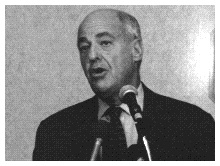
Reply to Cass Sunstein and Adrian Vermeule
Cyril Wecht, M.D., J.D.
(CTKA file photo)Cyril Wecht is a nationally recognized forensic pathologist, and past president of the American Academy of Forensic Sciences and the American College of Legal Medicine.
I recently learned of your jointly written article, “Conspiracy Theories”, in which you contend that “Conspiracy theorists” typically suffer from a “crippled epistemology”. Such individuals are considered by you to be “members of informationally and socially isolated groups (that) tend to display a kind of paranoid cognition”.
In your litany of conspiracy theories, you have included those people who hold “the view that the Central Intelligence Agency was responsible for the assassination of President John F. Kennedy”. In an obvious attempt to portray such critics and disbelievers of the Warren Commission Report as paranoid nuts and fruitcakes, you cleverly list this extremely important, highly controversial, 46 year old, still ongoing controversy among several absurd conspiratorial allegations, e.g., “doctors deliberately manufactured the AIDS virus, the moon landing was staged and never actually occurred; the plane crash that killed Democrat Paul Wellstone was engineered by Republican politicians”, etc.
While this kind of quasi-intellectual, semantical game playing may have legitimate application in a law school classroom in order to stimulate debate and enhance the development of legal reasoning among future attorneys, it is an insulting ploy that is far beneath the dignity of two distinguished professors when utilized in the manner set forth in your article.
Is it conceivable that you are not aware of the fact that 70-80% of the U.S. public (and even higher percentages elsewhere in the world) has repeatedly and consistently expressed disbelief in the WCR in every national poll conducted on this subject from 1965 to the present time? Do you not know that the House Select Committee of the U.S. Congress (1977-79) concluded that the WCR was wrong in its official determination that Lee Harvey Oswald acted alone in plotting and executing the assassination of JFK?
Are both of you so intellectually arrogant and strongly defensive of the federal government that you are willing to publicly state that more than two-thirds of the American public and a bi-partisan committee of Congressmen are cognitively dysfunctional? From whom have the two of you derived such power and right to ridicule and defame so many people?
But this part of your cleverly orchestrated diatribe pales by comparison to the far more egregious and dangerously frightening proposition that you have advanced with incredible academic chutzpah, namely, your recommendations for “Governmental Responses”.
Officially sanctioned government counterspeech “to discredit conspiracy theories’; the hiring of “credible private parties to engage in counterspeech”; the official banning of conspiracy theorizing; the imposition of “some kind of tax, financial or otherwise, on those who disseminate such theories;” etc.
Unbelievable!
Gentlemen, why are you being so hesitant and conservative in your proposed efforts to rid our society of conspiracy theorists, including all of us who reject the WCR and the scientifically preposterous “single bullet theory”? Why not simply have us arrested, placed in concentration camps, tried by special government tribunals (presided over by eminent sycophantic law professors like the two of you to ensure correct verdicts), and then executed? After all, if we need to make America safe, we had better get serious.
In closing, I should like to be so bold and daring as to invite either, or both of you together, to engage in a public debate with me – anywhere, anytime – relating to the JFK assassination and the WCR. Even though I am only a lowly Adjunct Professor of Law at a school that admittedly does not rank among the elite institutions such as Harvard and the University of Chicago, I would endeavor to do my best to make such a public presentation interesting and intellectually stimulating.
Please let me know where and when you would like to arrange for such a debate. What a formidable challenge I would be confronted with having to contend with the combined sagacity and erudition of two such prominent legal scholars.
Very truly yours,
Cyril H. Wecht, M.D., J.D.
Past President, American Academy of Forensic Sciences
Past President, American College of Legal Medicine
Clinical Professor of Pathology, University of Pittsburgh School of Medicine and Graduate School of Public Health
Adjunct Professor, Duquesne University Schools of Law, Pharmacology and Health Science
Distinguished Professor of Pathology, Carlow University -
Cass R. Sunstein & Adrian Vermeule, Conspiracy Theories: A Decidedly Negative Review
[The article under review was originally dated January 15, 2008, then updated to January 18, 2010. The electronic copy is at http://ssrn.com/abstracts=1084585.]
[The author is certified by the American Board of Radiology, completed a postdoctoral fellowship in physics at Stanford, and served on the tenure-track physics faculty at the University of Michigan. He is now a practicing radiation oncologist (in the treatment of cancer). He is not politically active, nor does he wish to be. He prefers to read (widely) and occasionally just to think.]
Many millions of people hold conspiracy theories; they believe that powerful people have worked together in order to withhold the truth about some important practice or terrible event.
– Sunstein and Vermeule
A lawyer without books would be like a workman without tools.
– Thomas Jefferson
To the astonishment of many, Cass R. Sunstein and Adrian Vermeule, both on the faculty of the Harvard Law School, have recently proposed that we substantially subvert the First Amendment (freedom of speech), purportedly to advance national security. Even more worrisome is that Sunstein has joined the Obama administration in a regulatory role: Sunstein is the Administrator of the White House Office of Information and Regulatory Affairs. [His appointment was greeted with controversy among progressive legal scholars and environmentalists. Sunstein’s confirmation had been blocked for some time because of allegations about his political and academic views. See, for example, his Wikipedia entry at http://en.wikipedia.org/wiki/Cass_Sunstein.] His name has even been bandied about as a candidate for the Supreme Court [http://www.wnd.com/index.php?fa=PAGE.view&pageId=96775; this online article cites the Atlantic Monthly as a source for the Supreme Court proposition.] Even his role in the White House concerns legal scholars insofar as he favors the US president (and his staff, presumably including Sunstein himself) over judges as interpreters of federal laws.
But let us turn to the article itself. Most curiously, the apparent definition (quoted above) by Sunstein and Vermeule (S&V) irresponsibly evades the primary issue of whether a given conspiracy theory is true or false. That profound lapse is not faced until page 4, but even then that focus lasts only for the blink of an eye. This distinction – between truth and falsehood – is so elemental that the title of their article would more informatively be entitled, “False Conspiracy Theories.”
To compound this unnecessary ambiguity, S&V nowhere offer any epistemic standards for identifying false conspiracy theories that might lie hidden in a mixed bag of conspiracy theories. The reader is unavoidably, and helplessly, left with nothing save the authors’ list – and even these (presumed exemplars) are not well-defined. Worse than that, some of their items are wrongly identified, i.e., conspiracies labeled by them as false actually appear to be true conspiracies – or at least, well-confirmed, as we shall soon see.
S&V cite a Zogby poll showing that 49% of New York City residents believe that US government officials knew in advance of the 9/11 attacks. They presume this data demonstrates that action must be taken (to correct the views of these miscreants). But Steven Pinker reminds us of polls showing that 25% of Americans believe in witches, 50% in ghosts, 50% in the devil; 50% believe that the book of Genesis is literally true, 69% believe in angels, 87% believe in the resurrection of Jesus, and 96% believe in a god or universal spirit [http://www.assassinationresearch.com/v5n1/v5n1mantik.pdf, footnote 26]. These polls suggest that US adults are generally prone to false beliefs. So should we take corrective action on these other myths, too? And, if that is the case, where does this corrective action end? Must we likewise correct all rumor, speculation, and gossip, too?
Quite tellingly, S&V do not state the obvious: 9/11 was officially declared by the Bush administration – the American government – to be a conspiracy: it was claimed to be a true conspiracy. Insofar as S&V do not clearly distinguish between true and false conspiracies, the reader may immediately wonder if their chief recommendations, which we shall soon consider, are also intended to apply to conspiracy theories that are true.
Eventually (p. 4), S&V advance their official definition of a conspiracy theory:it is an effort to explain some event or practice by reference to the machinations of powerful people, who have also managed to conceal their role. Astonishingly, this definition still does not address the matter of truth vs. falsehood. In other words, by their literal definition, a real event manipulated by powerful individuals (whose role remained hidden) would also qualify for conspiracy mongering – even though it was a bona fide conspiracy. [An excellent example of a true conspiracy that meets their definition may be found in False Profits: The Inside Story of BCCI, the World’s Most Corrupt Financial Empire (1992), by Peter Truell and Larry Gurwin.] The reader’s only option, it appears, is to trust S&V as the final arbiters regarding which conspiracy theories are acceptable. But they seem to require no facts, nor do they list any authoritative maps for use when the road bifurcates into truth, on the right, and into falsehood, on the left.
Furthermore, to make matters as hopeless as possible, as their very first example of a conspiracy theory, they cite the belief that the CIA was responsible for the assassination of JFK. Due to the untimely (for S&V) publication of Inside the Assassination Records Review Board (2009), by Douglas Horne, their favorite example appears to have suffered a mortal blow. [Also see Murder in Dealey Plaza (2000), edited by James Fetzer, which includes the results of my own nine visits to the National Archives.] In fact, Horne was a government insider, who served on the ARRB. In view of S&V’s extremely high regard for government intervention (see below) by “well-intentioned” individuals (of whom Horne is surely one), Horne’s role as a government insider is their ultimate bête noire.
Their second example of a purportedly false conspiracy is TWA Flight 800. This, too, is presented as a done deed – no evidence is offered. But the reader – and S&V, too – might wish to consult Kristina Borjesson’s account of this event. [See Into the Buzzsaw: Leading Journalists Expose the Myth of the Free Press (2002), edited by Kristina Borjesson, pp. 103-149. Borjesson’s media credits are many: WBAI, CNN, CBS, PBS, and National Geographic Explorer]. Unfortunately for them, S&V’s conclusion about TWA Flight 800 is far from clear-cut.
S&V (p. 4), surprisingly, cite the Martin Luther King. Jr., assassination as another example (of a false conspiracy), thereby ignoring the jury verdict that it was, in fact, the opposite – it was a true conspiracy [New York Times, December 10, 1999, p. 25]. That two lawyers would so unabashedly ignore the official result of a jury trial is so extraordinary that diligent readers may well wonder if their oversight was not deliberate.
S&V next cite the Paul Wellstone plane crash (as supposedly engineered by Republican politicians) as another conspiracy theory. I have no special insight into Republicans, but there are astonishingly many paradoxes about this crash, of which these are merely a small sample: (1) persistently misleading reports about the weather at the time of the crash; (2) the absence of a distress call; (3) the miraculously early responses of the FBI; (4) the FBI’s refusal to permit photography by fire or ambulance teams; (5) odd meteorological phenomena consistent with the use of a directed-energy weapon; and (6) a statement by one signatory of the official report that the NTSB actually “had no idea” what had caused the crash. Three scholars (with four doctorates among them) also reached a conclusion opposite to that of the NTSB. [See American Assassination (2004) by Four Arrows, Ph.D., Ed.D., and James Fetzer, Ph.D.; and “The NTSB Failed Wellstone,” From the Wilderness (2005), by James Fetzer, Ph.D. and John Costella, Ph.D., which may be accessed at http://www.fromthewilderness.com/free/ww3/070605_wellstone.shtml.]
S&V cite the “Operation Northwoods” escapade as a potential true conspiracy (p. 4). To their citations, I would add the more comprehensive Body of Secrets by James Bradford (2001), which includes 613 pages and 612 footnotes. Incidentally, Douglas Horne, the author of Inside the ARRB (2009), turns out to be the individual who was responsible for the release of the Northwoods documents.
S&V state clearly (pp. 4-5) that true accounts – i.e., true conspiracy theories – should not be undermined. In view of the above examples – which are their own examples – the reader is entitled to wonder why the authors do not take their own advice: i.e., why are they themselves undermining belief in true (or at least well-confirmed) conspiracy theories? This dilemma only emphasizes their crucial epistemic omission: How are true conspiracy theories to be winnowed from those that are false?
S&V suppose that conspiracy theories are a subset of false beliefs, thereby promptly negating their concession that some may be true (p. 5). Their examples of false beliefs include: (1) prolonged exposure to sunlight is healthy and (2) climate change is false. But again, as usual with S&V, there is another side to the story: in view of the national plague of vitamin D deficiency (which includes me and my own son, who had clinical rickets) some sunlight exposure is now promoted by medical experts as commendable, especially in winter and in northern latitudes. Prolonged exposure under those specific conditions is likely to be quite safe and beneficial.
Moreover, although global climate change does seem likely, Steven Levitt and Stephen J. Dubner [Super Freakonomics (2009), pp. 165-203] emphasize (1) that methane is 25 times more potent than CO2 as a green house gas and also (2) that water vapor is actually the major greenhouse gas, but it is not taken into account in current models – and it may not be possible to do so until 2020. So, even if Earth is heating up, it may be unwise to focus exclusively on CO2 and the associated carbon credits. More research is clearly needed.
S&V then ask whether conspiracy theories are “justified” (p. 5). Here they stumble into a semantic bog. Perhaps they meant – and should have said – “self-justified.” Instead they talk as if a belief in Santa Claus might be “justified.” (I would instead have used “acceptable.”) They then use “warranted” as a synonym for “justified,” which hardly clarifies the matter. My dictionary defines “justify” as showing or proving something to be right. That is clearly not how S&V use the word. For interested readers, Alan Sokal has provided an excellent discussion of “justification.” [See Beyond the Hoax (2008), p. 200. Also see Against Method (1993) by Paul Feyerabend, pp. 147-149.] In this same paragraph, S&V describe Earth as having “fires” at its core; in my four decades of reading Scientific American, I have never encountered such exciting geological news.
S&V claim that a conspiracy theory typically overlooks the role of random events (p. 6). For example, I would claim that a T-shaped inscription (with uniquely peculiar radiographic properties) on the JFK autopsy X-rays proves – prima facie – that this X-ray must be a copy. [See http://www.assassinationresearch.com/v5n1/v5n1mantik.pdf. Also see PowerPoint slides from my November 2009 lecture in Dallas at http://www.assassinationscience.com and http://www.assassinationresearch.com.] This, in turn, proves a conspiracy, both to produce such a copy and also to lose the original (it has in fact disappeared). That the process of copying also permitted a critical alteration to the X-ray is yet another concern.
So, was this strange property (of the T-shaped inscription) produced randomly, as S&V may want suggest? I would claim that no competent radiologist, after viewing this, would accept a random event as an explanation – that would require a total suspension of rationality. Therefore, not all conspiracies require consideration of randomness as a cause – that would be the grossest sophistry.
To explain the common acceptance of conspiracy theories, S&V claim that most folks prefer them because they are simpler causal stories. That is a peculiar perspective for them to adopt. For example, would it not be simpler to claim that Oswald did it than to invoke a host of other players in a JFK assassination conspiracy and cover up? And it certainly does not turn out to be emotionally more reassuring to conclude that 9/11 was perpetrated by the government than by 19 Islamic fundamentalists. Their position verges on incoherence.
They assert that secrets cannot be kept in open societies (p. 6), but that notion is highly suspect. I have discussed this issue at some length [see Murder in Dealey Plaza (2000), edited by James Fetzer, pp. 336-338; also see many other citations there]. Examples include the Manhattan Project, My Lai, the Pentagon Papers, radiation experiments of the 1940s (at blue ribbon institutions), Tic-Tac-Dough, and Twenty One. Also see the many examples cited by Borjesson [Into the Buzzsaw: Leading Journalists Expose the Myth of the Free Press (2002), edited by Kristina Borjesson]. The reader is also referred to A Culture of Secrecy (1998), edited by Athan G. Theoharis; The Secret War Against the Jews (1994), by John Loftus and Mark Aarons; and Legacy of Ashes: the History of the CIA (2007), by Tim Weiner.
That major secrets are typically kept by bureaucracies is actually exceedingly common [see Voltaire’s Bastards (1992), by John Ralston Saul]. In the year 2005, for example, 125 secrets were classified every minute by federal departments, while during the year of 2004, a total of 15.6 million documents were classified, at a cost of 7.2 billion dollars. [See The New York Times (July 3, 2005) and http://www.nytimes.com/2005/07/03/politics/03secrecy.html?_r=1&pagewanted=print.] As a particularly illuminating example, the CIA was then still fighting (in the courts) to keep secret its budgets from the 1950s and 1960s. In the 1970s it appears that the CIA allocated 29% of its budget to “media and propaganda.” The CIA expenses per annum for propaganda in the 1970s were likely above $285,000,000 – which is more than the combined budgets of Reuters, United Press International, and the Associated Press [http://www.informationclearinghouse.info/article3700.html].
As yet another highly illuminating example, in January 1995 the Secret Service destroyed presidential survey reports of some JFK trips for the fall of 1963. This destruction occurred only after the ARRB had already warned the Secret Service not to destroy pertinent documents, and while the ARRB was drafting further requests to the Secret Service for moreinformation about these very trips. The Secret Service also destroyed files from the Fair Play for Cuba Committee, as well as Dallas-related files (for JFK’s Dallas trip). What are the odds that this miraculous timing (of file destruction) was pure coincidence? If we are to believe S&V, the destruction (of precisely those documents wanted – from 32 years earlier) might well have been random chance. Furthermore, when the Secret Service submitted its “Final Declaration of Compliance” (September 18, 1998), it was not executed under oath, as had been expected of them [Final Report of the ARRB (September 30, 1998), p.149]. In the end, one can only wonder where S&V got their information – i.e., the notion that “secrets” cannot be kept. [Katherine Graham, who was the owner of the Washington Post for many decades, reminded a top CIA official of a fundamental fact when the Berlin Wall began to crack: “There are some things the general public does not need to know and shouldn’t. I believe democracy flourishes when the government can take legitimate steps to keep its secrets and when the press can decide whether to print what it knows.” http://www.informationclearinghouse.info/article3700.html.]
S&V then offer another remarkable declaration: our press is free (p. 7). Borjesson’s readers would surely develop some nagging doubts about that. In addition, though, serious doubts have been raised by Ben H. Bagdikian [The Media Monopoly (1992)] and by Noam Chomsky [Necessary Illusions: Thought Control in Democratic Societies (1989)], among others. One quote seems particularly germane:
The media are less a window on reality than a stage on which officials and journalists perform self-scripted, self-serving fictions [The New York Times (July 29, 1994), p. A13].
S&V want to encourage trust in government; in particular, they argue that widespread belief in conspiracy theories would undercut grounds for many other beliefs (p. 7), thus implying that this would be a great loss. The issue of “second-hand knowledge” (which seems to be their focus here) is indeed a serious one [although ignored by S&V, I would suggest Second-Hand Knowledge: An Inquiry into Cognitive Authority (1983), by Patrick Wilson], but sometimes a thorough evaluation of one’s beliefs can effectively cleanse the Augean stables of the mind. Insofar as public trust in government goes, that has dismally and dramatically decreased since the JFK assassination – and for good reason. [See http://www.roaddrivers.org/whywedonttrustgov.htm and http://unpan1.un.org/intradoc/groups/public/documents/UN/UNPAN025062.pdf.] It is a mystery why the authors have donned blinders for that rather plain fact.
They state that no famine has ever occurred in a nation with a free press and democratic elections, which may even be true, but they also argue that it would be excessive to infer that famines in authoritarian nations are a “conspiracy” brought about by authoritarians. Those – I suspect this includes some of my own relatives – who experienced the Ukraine famine of 1932-33 would almost certainly disagree with S&V on this historical fact. [See http://www.guardian.co.uk/commentisfree/2009/nov/18/ukraine-famine-russia-holodomor and http://www.youtube.com/watch?v=VXkgGdZC6uQ.]
They go on to ask how conspiracy theories begin (p. 9). Stunningly, the possibility that they arise because they actually occurred in the real world is not an option for S&V. The reader might well wonder again about 9/11 – how did that (official) conspiracy theory begin?
Some persons, according to S&V, cannot accept conspiracy theories because that would capsize too many of their other articles of faith (p. 10). But perhaps that is precisely why S&V lump true conspiracies with false conspiracies – i.e., because S&V themselves fear a loss of their own fundamentals of the faith. Although this country nominally believes in separation of church and state, there is, de facto, a kind of national secular religion, which is accepted by the vast majority of Americans. This is a belief in the Founding Fathers, the Declaration of Independence (and especially the Bill of Rights as a kind of divinely inspired document), the Constitution, the righteousness of American foreign policy, that the US actually looks out for the general welfare of other nations, that our markets (at least until recently) are free, and that the US is superior to other nations in moral values.
When a new president takes the oath of office, Americans perceive this almost as a religious rite, and the president feels that he must say, “So help me God!” As another ritual, campaign speeches, and even some State of the Union addresses – which has actually occurred precisely as I write this – often recite, “God bless America.” [See http://seattletimes.nwsource.com/html/opinion/2004364209_domke22.html.] To omit such phrases today can be politically dangerous. Although nominally a Presbyterian, Ronald Reagan was a prophet of this national religion:
Can we doubt that only a Divine Providence placed this land, this island of freedom, here as a refuge for all those people in the world who yearn to breathe freely: Jews and Christians enduring persecution behind the Iron Curtain, the boat people of Southeast Asia, of Cuba and Haiti, the victims of drought and famine in Africa, the freedom fighters of Afghanistan and our own countrymen held in savage captivity [http://hnn.us/articles/45469.html].
S&V suggest that acceptance of conspiracy theories can be countered by showing “that some, many, or most (trusted) people accept or reject the theory” (p. 11). [S&V immediately inspired in me a nonsensical vision of a meeting of the American Physical Society, at which physicists voted on the validity of the latest string theory. Of course, that would be sheer madness; physicists would never vote on this – they would merely appeal to the data. Science, after all, is not democratic (or Republican). Nonetheless, S&V would like the majority to rule on questions that should instead be decided on the basis of logic and evidence]. The whole notion of popular opinion (no matter what group) deciding a question that should rest on its merits (or perhaps even a modicum of data) is madly preposterous. Even more importantly, though, the majority of the best minds can be outrageously wrong.
For example, Robert McNamara has repeatedly described the counsel of LBJ’s “Wise Men” on Vietnam [In Retrospect: The Tragedy and Lessons of Vietnam (1995), pp. 196-198, 229, 309-311]. In the end, though, their advice was an utter disaster. The rioters in the streets were closer to the truth than were these “Wise Men.” Barbara W. Tuchman has also chronicled the pervasive lunacy of government [The March of Folly: from Troy to Vietnam (1984)].
S&V wonder why conspiracy theories come to be accepted, so they discuss the role of information (p. 11), the role of famous believers (p. 12), group polarization (p. 13), selection effects (p. 13), and the “… shared sense of identity and … bonds of solidarity” (p. 13). These too, though, have all the hallmarks of our national (secular) religion, though S&V seem not to notice. Moreover, at this juncture, they should at least have offered slight obeisance to the classic study of groupthink by Irving Janis [Victims of Groupthink: a psychological study of foreign-policy decisions and fiascoes (1972)], which was a pioneering venture into these matters and is still highly relevant.
S&V conclude that the government should use “counter-speech” to discredit conspiracy theories (p. 14). In view of S&V’s crippled definition and their agnostic position on truth versus falsehood, the reader might well ask if this applies to true theories as well. They propose that the government hire credible parties to engage in counter-speech. Of course, that has already been tried – nearly since the beginning of the CIA. Carl Bernstein has reported in detail on these collaborations between the media and the CIA. [See “The CIA and the Media,” Rolling Stone (October 20, 1977), by Carl Bernstein, or visit http://tmh.floonet.net/articles/cia_press.html.]
Bernstein discovered that 400 journalists had worked for the CIA over a 25-year interval. This included distinguished reporters and even Pulitzer Prize winners. Media executives who collaborated included William Paley of CBS, Henry Luce of Time, Inc., Arthur Hays Sulzberger of the New York Times, and James Copley of the Copley News Service. Other cooperating companies included ABC, NBC, Associated Press, United Press International, Hearst Newspapers, Scripps-Howard, Newsweek, Reuters, the old Saturday Evening Post, and the New York Herald Tribune.
James Jesus (sic) Angleton – who, as the chief Oswald stage-manager, is a suspect in the JFK assassination [see Oswald and the CIA: The Documented Truth about the Unknown Relationship between the U.S. Government and the Alleged Killer of JFK (2008), by John Newman; especially read “Epilogue, 2008”] – ran his own covey of journalist-operatives “who performed sensitive and frequently dangerous assignments. Little is known about this group for the simple reason that Angleton deliberately kept only the vaguest of files” [from “The CIA and the Media,” Rolling Stone (October 20, 1977), by Carl Bernstein]. This was a classic Angleton ploy. The CIA even ran its own training school for would-be journalists.
S&V hope for a cadre of government agents (or their allies) to undermine the “crippled epistemology” of conspiracy believers (p. 15). But what if these very agents themselves have caused these “bad events”? [That federal agents have indeed acted illegally is well documented by Gerry Spence in From Freedom to Slavery (1995), pp. 27 and 50; also visit http://www.ruby-ridge.com/gspence3.htm.] Here is the central question: who will govern those who govern? Or is that not necessary in the world of S&V? But they do not dodge this question – in fact, they seem pleased to “assume” that the government is “well-motivated” (sic). Incidentally, an absence of oversight has already been attempted (and found sorely lacking) in the case of the CIA. [Both Harry Truman, who signed off on the CIA in 1947, as well as George Kennan, who initially sent up this trial balloon, later offered their most profound regrets.] The sequelae of this approach are spelled out in alarming detail in Legacy of Ashes by Tim Weiner.
S&V insinuate (their syntax is a bit fuzzy here) that Bush spread a false conspiracy theory (p. 16). But we don’t need to guess about lying in the White House. Eric Alterman has extensively discussed lying in the White House – When Presidents Lie: A History of Official Deception and Its Consequences (2004). If presidents lie (they actually do), then what is it that guarantees that other government employees (or agencies) will tell the truth? Are they to be trusted more than the president? And, if not, who will supervise them? [S&V might also consult Official Lies: How Washington Misleads Us (1992), by James T. Bennett & Thomas DiLorenzo. Also see http://findarticles.com/p/articles/mi_qa5421/is_n4_v59/ai_n28628633/.]
S&V bemoan the “crippled epistemology” of conspiracy believers. Ironically, they themselves suffer from a profound, even mortal, wound in their own epistemology – i.e., they persistently ignore the difference between lies and truth, as we have repeatedly seen here. How could an epistemology be more “crippled” than that? Until S&V provide reliable guidelines for extricating truth from lies they can offer absolutely zero assistance in our ongoing conflict with terrorism. [The scientific method has been around for a few centuries and is generally considered reliable for finding truth, unless, of course, one is a postmodernist of a certain type. S&V seem virtually oblivious to its existence. On the contrary, those of us who have researched the JFK assassination (see Fetzer’s books and Horne’s five volumes) have been striving to expurgate rumor and speculation and instead substitute an objective and scientific foundation.] And, until S&V can learn from our prior experiences with “counter-speech” – as has been demonstrated by the CIA-media collaboration – they can scarcely expect an enthusiastic reception for their views. As Geog Wilhelm Friedrich Hegel sagely stated, “What experience and history teach is this – that people and governments never have learned anything from history, or acted on principles deduced from it”[http://www.marxists.org/reference/archive/hegel/works/hi/history2.htm]. Or as Shakespeare succinctly put it, “The past is prologue.” [This is a paraphrase from The Tempest, Act 2, scene I, 245-254; the paraphrase is inscribed above an entrance to the National Archives I, an entrance that I first took to view the JFK autopsy materials.]
Rancho Mirage, CA January 27, 2009
Addendum
Immediately after writing the above review I discovered a current article by Glenn Greenwald [“Obama confidant’s spine-chilling proposal,” by Glenn Greenwald (January 15, 2010) at http://www.salon.com/news/opinion/glenn_greenwald/index.html?story=/opinion/greenwald/2010/01/15/sunstein]. He claims that Sunstein’s proposal is ” … itself illegal [underlining in the original] under long-standing statutes prohibiting government ‘propaganda’ within the U.S., aimed at American citizens.” I quote further from Greenwald:
As explained in a March 21, 2005 report by the Congressional Research Service, “publicity or propaganda” is defined by the U.S. Government Accountability Office (GAO) to mean either (1) self-aggrandizement by public officials, (2) purely partisan activity, or (3) “covert propaganda.” By covert propaganda, GAO meansinformation which originates from the government but is unattributed and made to appear as though it came from a third party.
Greenwald notes that Sunstein acknowledges that some “conspiracy theories” previously dismissed as false have turned out to be true. Sunstein’s examples were (1) CIA mind control experiments with LSD [as is typical of them, S&V do not cite an excellent reference (quickly plucked from my bookshelf) – Journey into Madness: The True Story of Secret CIA Mind Control and Medical Abuse (1989), by Gordon Thomas], (2) DOD plots to commit terrorism within the US with intention to blame Castro [see Body of Secrets (2001), by James Bradford], and (3) the White House bugging of the Democratic National Committee.Sunstein claims that the extraordinary powers in his proposal would only be ” … wielded by truly well-intentioned government officials who want to spread The Truth and Do Good – i.e., when used by people like Cass Sunstein and Barack Obama.” [The quote itself is actually from Greenwald.] Greenwald next quotes directly from S&V’s article (p. 15):
Throughout, we assume a well-motivated government that aims to eliminate conspiracy theories, or draw their poison, if and only if social welfare is improved by doing so.
We can now discern a pattern in S&V: they are glib at offering proposals, but absolutely abysmal at offering concrete guidelines for implementation. As we have observed, their chief oversight is a conspicuous hiatus in their definition of “conspiracy theory” – it did not even recognize the difference between truth and falsehood. And here is a similar faux pas – they offer no principles or procedures for identifying exactly who is “well-motivated.” But there is a further problem. Even if trustworthy guidelines could be established, and such an individual (or group) identified, those conditions would only have been met at that singular point in time. In particular, what happens if this individual (or group) later becomes corrupted? (Recall Lord Acton.) In that case, who will notice the corruption – and will also have the courage to wave a red flag? This recalls my prior question: Who will govern those who govern? But we are still not done with the above quote from S&V. The following question inevitably arises as well: Should the government truly attempt to quell conspiracy theories that are true, if in doing so they improve social welfare? This begins to sound like George Orwell (Nineteen Eighty Four (1949), p. 32).
But there is yet one more question that S&V do not answer: Who decides whether or not “social welfare” is truly enhanced? What yardstick is to be used? Or is this merely subjective, based on someone’s opinion? If so, who will decide: Will it be a Democrat – or a Republican? Or a joint Congressional Committee? Or perhaps the National Security Council? Perhaps even the CIA? Without a clear-cut yardstick, S&V’s entire whimsy could quickly degenerate into politics as usual.
After all of this discussion, though, the bottom line is this: S&V’s proposal is both undemocratic and retrogressive; it lacks oversight, is clearly subject to mind-boggling subjectivity, is easily at risk for abuse and exploitation – and may actually be illegal. I would suggest that S&V wipe the slate clean and run home. They may well be qualified for projects of many kinds, but this one is not among them.
-
The Lost JFK Tapes
Of the three new documentaries broadcast over the last JFK anniversary, National Geographic Channel’s The Lost JFK Tapes was clearly the best. It had to be. It was not on Discovery Channel. As readers of this site know, that channel has become the media ghetto for those who still adhere to the discredited Warren Commission. Which was turned into mythology over four decades ago. But through a kind of institutional agreement with another body that lies about the JFK case, The Sixth Floor Museum in Dallas, Discovery is involved in producing propaganda tracts like Inside the Target Car,The Ruby Connection, and Did the Mob Kill JFK? These have all been thoroughly exposed as deliberate deceptions elsewhere on this site. Along with Discovery Channel’s phony contraptions that try to support the lies of the Commission, that channel also chooses to withhold from the public the voluminous declassified files made available by the Assassination Records Review Board (ARRB). These were the tens of thousands of documents declassified in the wake of Oliver Stone’s film JFK. These documents further reveal that the Warren Commission was nothing but an elaborate cover-up, often in the Commissioners’ own words. But you won’t even hear about the ARRB on the Discovery Channel.
You won’t hear about the ARRB on The Lost JFK Tapes either. But at least you won’t have to suffer through the god-awful Dale Myers type manipulation of fact that produces an unsupportable conclusion. What this show does is present the record of that tragic weekend of November 22-24th of 1963. It treats that film and audio record with respect and lets it speak in its own words. Whether it complies with the 1964 Commission official story or not. And because that weekend was so tumultuous, so solemn, so epoch changing, the program has a quiet power to it – a power that comes from commemorative reverie. The people who made it respected the event. And they were out to preserve and honor it for what it was. For certain segments described later, its not the type of film you will see on Discovery Channel, or even featured at the Sixth Floor. The latter is too busy promoting atrocities like Oswald’s Ghost (See here for the reasons why).
The film bills itself as being made up largely of unseen footage from that weekend. Yes, a lot of it was. But some of it I had seen before. I should also note that some of the new tapes are audio. And as we shall see later, the fact may be that they were not lost, they were suppressed. But nonetheless, it was all adroitly, and at times poetically, put together.
It begins with a beautiful overhead shot from the clouds as Air Force One descends into Fort Worth. Along with this aerial shot we hear some Errol Morris style documentary background music on the sound track: both pulsating and vibrant. After their arrival, we see the breakfast at the Hotel Texas in Fort Worth with President Kennedy making his famous jokes about the attractiveness of his wife, “No one wonders what Lyndon and I are going to wear.” We then cut to the arrival in Dallas, and we see a problem the Secret Service had with Kennedy. After the Fort Worth breakfast and upon the arrival in Dallas, the president went ahead and walked into the awaiting crowds to shake hands. As the commentator adds, this made it difficult for the Secret Service to enforce a stricture of theirs: anyone shaking hands with the president had to have both hands exposed in advance.
We then cut to an aerial shot of the motorcade route through Dallas. But not before we see the famous black and white footage of the visibly upset Secret Service agent Henry Rybka being asked by Emory Roberts to leave the escort detail at Love Field.
The actual assassination sequence is also skillfully done. The editors intercut black and white stills with color motion picture footage to convey the impact. Some of the motion picture footage is of those dozens of bystanders running toward the grassy knoll and the sound of the shots. The program then shows regular programming being interrupted on local station WFAA-TV while program director Joe Watson announces the shooting of President Kennedy and Governor Connally. We then cut to Parkland Hospital with doctors arriving and people crying outside. Senator Ralph Yarborough stated that he found a Secret Service agent outside of Parkland hospital pounding the car in despair. He himself said that what had happened is “Too gruesome to describe.”
We then watch as the Newman couple – Bill and Gayle – are called to local television to tell the public what had happened. This clip reveals why they are not mentioned in the Warren Report and although interviewed by the FBI, were not called to testify before the Warren Commission. (Jim Marrs, Crossfire, p. 70) The Newmans were standing on the north side of Elm Street, just west of the Stemmons Freeway sign. Bill Newman told the TV audience that, as Kennedy was hit, he heard shots come from behind him. This, of course, would have been up on the grassy knoll, behind the picket fence.
The program then cuts to the Texas School Book Depository a few minutes after the assassination. They say attention was attracted there by the testimony of photographers Malcolm Couch and Robert Jackson who said they saw a rifle barrel being withdrawn from a window on the fifth or sixth floor. Very quickly about two dozen police cars are parked near the intersection of Elm and Houston, with police standing outside the building with shotguns. There is a roof to basement search while employees like Danny Arce and Bonnie Ray Williams are escorted away as witnesses. I should also note in this regard, the show depicts at least two other people being arrested by the police: one for the murder of Officer Tippit, and one for the assassination.
At about this point, Dallas Police inspector J. Herbert Sawyer speaks in front of a TV camera. He says that the assassin’s rifle shells were found on the fifth floor. (In Michael Benson’s book, Who’s Who in the JFK Assassination, he incorrectly quotes Sawyer as saying the shells were found on the third floor. p. 409) Right after this Watson is interviewing WFAA cameraman Ron Reiland. Reiland tells the audience that the weapon discovered at the Depository was an Argentine Mauser. Two more startlers follow: a broadcaster says the shots came form the fifth floor (matching the location of the shells), and the police say they had given the president’s trip the maximum security arrangements possible. Which, in retrospect, and with the testimony of Deputy Sheriff Roger Craig, is a little humorous.
The next stage of the film is the reporting of the death of Tippit in Oak Cliff. It is interesting to note here that the immediate reaction of the police to this report is this: Whoever shot Tippit, had to have been Kennedy’s assassin. So I wish the program had shown Reiland’s film of a wallet containing Oswald’s ID being passed among the law enforcement officers at the Tippit scene. Meanwhile, the narrator could have announced that the police were taking his wallet from Oswald on the way to City Hall.
After this the police report says that an armed man had entered the Texas Theater. It is not explained how they knew the an was armed. Oswald is then apprehended and policeman Paul Bentley addresses the reporters about his arrest. Oswald is then driven to City Hall and arrives at about 1:55 PM. The charge at this time is only the murder of Officer Tippit. One of the things that I thought was memorable about this sequence is the number of times that Oswald denied his guilt in either of the shootings. He complains about being given a hearing “without legal representation.” When asked if he shot Kennedy, he says, “I did not shoot anybody.” His answers are always cool, clipped, with nearly no hesitation.
Oswald’s demeanor is contrasted in the film with what can only be called the utter bedlam of police HQ. This is rendered almost palpable in this film. That the police let all these bystanders into HQ at this time is simply unfathomable. There seemed to have been no control on this until Sunday morning. To have their most famous and important prisoner in inexplicable. Because, as the film also makes clear, that very afternoon the legend that Oswald had built up began to be circulated through the press with a speed that was startling. The whole thing about moving to Russia, his membership in the FPCC, his being fined for an altercation with anti-Castro Cubans in New Orleans, all this gets circulated into the local media. Both incriminating him and creating bias in the minds of the public.
The film now shows Kennedy’s body being removed from Parkland Hospital and transported to the airport. We watch the casket being uploaded onto Air Force One while Judge Sarah T. Hughes swears in LBJ. As we watch the plane lift off into the sky, a newsman appropriately intones that this is “One of the blackest days in the history of the United States.”
After the plane arrives in Washington and Johnson speaks from Andrews Air Force Base, the film returns to the Dallas Police HQ. The police have called and maintained a Justice of the Peace there late at night since they are going to charge Oswald with Kennedy’s assassination. And at this point, the film begins to take up the litany of certainty about Oswald’s guilt that DA Henry Wade, Capt. Will Fritz, and Police Chief Jesse Curry began to drum into the media. And through them to the public. For example, Curry says that the police can place Oswald on that floor at the time of the murder, that they can put him in the window, and that he ordered a “similar rifle”. Well, the first two are simply false, and the third is a queer choice of words. Did Curry still think the actual weapon was a Mauser? Henry Wade proclaims that no one else was involved in the shootings but Oswald. Which rules out the possibility of accomplices within ten hours of Oswald’s arrest. Meanwhile, we see Oswald still denying the alleged “air tight” case against him and still requesting legal representation.
The film then moves to Saturday and Mayor Earle Cabell declaring it a day of mourning in Dallas and that all churches and synagogues stay open. We then listen as the news comes down that Governor Connally will recover. We learn that Connally asked his wife Nellie about the president. She told him he was dead and he replied, “That’s what I was afraid of.”
On this day, the famous backyard photographs are now in evidence and the FBI says that it has the documentation about Oswald’s ordering of the rifle. Curry again declares Oswald as “the man who killed the president.” He then describes him as very arrogant during questioning. A reporter then asks Wade how many time he has requested the death penalty. He replies 24 times. He s then asked how many times he achieved it. He replies 23. Oswald is being prepared by the DA for the gallows. Right after this, a reporters prophetically asks Curry if he is worried about Oswald’s safety considering the high level of feeling against him in Dallas. Curry replies that no he is not. The proper precautions will be taken and he didn’t think anyone in Dallas would try and do away with Oswald.
The film then moves to Sunday at City Hall. The reporters comment on the precautions taken by the police: cars are being checkedbefore entering the basement, no on can get in without press or police ID. We then watch as Oswald is escorted out the elevator, through the office, down the corridor, and shot by Jack Ruby. Incredibly, one newsman named Bob Huffaker says that he thought Ruby was a Secret Service man. What a Secret Service man would be doing in the parking lot at that time is a mystery. And right after this, we see the cover up about Ruby beginning in the ranks of the DPD. For, as most informed observers know, half the police in the parking lot knew who Ruby was. But all the police say is that the assailant was a resident of Dallas, and known to some of the police but his name will not be revealed at this time.
Now that Oswald is dead, the local media, like Bob Walker, immediately proclaim him “the assassin.” Then, in defiance of what we just saw, Walker declares that the police had provided more caution and protection for Oswald than any other prisoner in their history. Then, just as absurd, the police finally pronounce Jack Ruby as the “suspect” in Oswald’s murder. To top it off, policeman Jim Leavelle says he recognized Ruby, “If in fact he did it.” This is the cop who stood right next to Oswald as Ruby shoved a gun into his stomach.
After this, one of the most startling pieces of reportage in the entire program is revealed. The report comes on that one of the only clear things said among the police is that none of them “believes [Ruby] killed Oswaldäout of patriotic fervorä.it is for one reason and that is to seal his lips.” This, of course, directly contradicts the future verdict of the Warren Commission. And it reveals that there was a vow of silence taken within the DPD shortly after. Its that kind of revelation that have led Tina Brown’s investigative reporter Gerald Posner to try and counter this film. (See here.)
The program winds down by showing us the internments and funerals of Tippit, Oswald and Kennedy. Then we watch as on the 27th, Johnson addressed a joint session of Congress and made his famous statement, “All I have I would give gladly not to be standing here today.”
In the last several years, this is the only documentary on the subject that I have seen that is both objective and worth watching. The producers, Tom Jennings and Ron Frank, deserve our thanks and encouragement. They have treated a serious subject with respect and skill. One of the achievements of the film is that I have left many fine human-interest touches out of this description. There is a memorable moment when the news of Kennedy’s death comes into the Trade Mart where he was to speak. A black waiter begins to quietly weep and then wipe away his tears. After, a man quietly takes down the seal of the president on the podium where Kennedy was to address the crowd.
Let me close with another fine moment from the film. The afternoon of the murder, a reporter was roving in Dealey Plaza trying to get the general feeling of the populace to what had happened. A young man states, “Why would anyone shoot President Kennedy. He’s done so much for us.” A woman then says that it’s one of the most terrible things to ever happen. A young woman comments that “This is doom for our city.” Finally, a middle-aged man with the gift of seeing into the future states: “A great man is gone. We are all going to suffer for this. And we all should.”
-
Did The Mob Kill JFK?
Did the Mob Kill JFK? was broadcast right before another Discovery Channel program entitled JFK: The Ruby Connection in November and December of 2009. At the end of this review, I will specify why I find that to be retrospectively interesting and what it says about Discovery Channel. But first, let me answer the question posed in the show’s title: Nope, not by themselves. In fact, I can think of no credible, respected JFK researcher on the scene today who thinks that the Cosa Nostra pulled off Kennedy’s murder alone. Yet this program seems to foster that idea in a truly offbeat, even bizarre kind of manner. How does it do so?
By using three main talking heads who have serious credibility problems that the producers never tell us about. They are Robert Blakey, Lamar Waldron and Gerald Posner. With the choice of these three men, the Discovery Channel lets us know that, as far as they are concerned, they have no interest in dealing with any of the compelling new discoveries unearthed by the Assassination Records and Review Board (ARRB). This was the body constructed by congress to declassify thousands of documents on the JFK case that were classified until 2029. But alas, the program cannot inform us of that salient fact. Because if it did, Blakey would have to explain why he did it.
I
See, Blakey was the Chief Counsel of what Gaeton Fonzi memorably termed The Last Investigation. This was the congressional inquiry into the deaths of both President Kennedy and Martin Luther King by the House Select Committee on Assassinations (HSCA). To say that he helmed that committee in an unsatisfactory and controversial manner is somewhat of an understatement. And to go into all of the shortcomings of the HSCA would take an essay about ten times longer than this one, and it still would not do it justice. (For a summary of the HSCA’s failings, see The Assassinations, edited by James DiEugenio and Lisa Pease, pgs. 51-89) But I should note just one aspect in this regard. When the Warren Commission published its final report, it issued 26 volumes of evidence with it. When Blakey published his report, he issued only 12. Further, the HSCA saw many more declassified government files than the Warren Commission did, from agencies like the FBI, the CIA, the Secret Service and the State Department. They also conducted many more independent interviews with important witnesses and in crucial areas. For instance, the medical interviews the HSCA did went much further than the shameful dog and pony show orchestrated by Arlen Specter for the Warren Commission. For instance the interviews done by the HSCA staff prove that there was a large avulsed wound in the rear of Kennedy’s skull, which indicates that there was an exit wound there. And therefore an entrance from the front. To point out another area, the HSCA investigation of Oswald’s background was much more extensive than the Commission’s. They actually reviewed many CIA and FBI files about the pinko Marine who defected to Russia at the height of the Cold War, and then decided to return with a Russian wife. They also interviewed and investigated many more witnesses in New Orleans than the Commission did. And they went much further in uncovering Oswald’s activities there. For example, they built upon the fascinating evidence first accumulated by Jim Garrison about the sighting of Oswald with David Ferrie and Clay Shaw in the Clinton-Jackson area.
Yet after seeing many, many more documents and conducting many more searching interviews than the Commission, Blakey then classified a larger volume of material than the Warren Commission had previously. And most of it, like the two instances described above, clearly pointed away from the Mob-did-it theory that Blakey came to advocate. By ignoring the files that Blakey agreed to classify – and that reveal a true conspiracy and cover-up in the JFK case – the show can avoid asking Blakey two questions: 1.) Why did you do it?, and 2.) What was hidden?
Let’s go to the next cultivator of cover-up. What can one say about Posner? Except the obvious. His discredited book, Case Closed, was designed to detract from the creation of the ARRB and to counteract the gale impact of Oliver Stone’s 1991 film JFK. And we have this from the horse’s mouth so to speak. (Although, with Posner, I would use a different pack animal’s name.) After Jim Marrs debated Posner on the Kevin McCarthy show in Dallas, he asked him how he came to do the book. Posner told him that the project was brought to him by longtime CIA crony Bob Loomis, the backer of such compromised “investigative” reporters as James Phelan and Seymour Hersh. (DiEugenio and Pease, p. 369) Posner’s book was and is an embarrassment today. One reason being that it relies so much on both the evidence in and the claims of the Warren Report. It also tried to uphold the unsustainable Single Bullet Theory, which today – with the discoveries of Gary Aguilar, Josiah Thompson and John Hunt – is simply not possible to do. (ibid, p. 284) Finally, as more than one commentator has pointed out-including Aguilar-there is a serious question about whether or not Posner actually talked to the people he said he interviewed. Because at least three of them say they don’t recall the conversations.
Here is a writer who made the oh so definite statement, on page 428 of the hardcover version of his book, that there was no evidence that David Ferrie knew Lee Oswald. This was right before a Civil Air Patrol picture surfaced depicting both Oswald and Ferrie at an outdoor CAP barbecue. This was also right before the ARRB declassified several statements that CAP members made to the HSCA that they knew Ferrie had met Oswald in their troop. Posner is the same writer who tried to explain the lack of copper on the James Tague bullet curb strike in Dealey Plaza like this: See, the bullet went through the branches of an oak tree and the branches sheared off the copper jacket as the bullet passed through. To anyone who has seen said bullets, this is nothing but balderdash. Posner’s phony book was nothing but a PR counter by Bob Loomis. Final proof: the book went on sale the same week the ARRB declassified its first batch of JFK assassination files.
Which brings us to the third member of this circle, Lamar Waldron. Here is a guy who wrote two books trying to sell the idea that Kennedy was preparing for an invasion of Cuba in the first week of December 1963. That the Mafia found out about it, and that they then arranged for his death since they knew that the security about this plan would guarantee a cover up of what they did. Except that in all the years since, there has never been any evidence that this was a cause of the JFK cover up. Today, we have literally thousands upon thousands of pages of FBI, CIA, State Department, Warren Commission, and HSCA declassified files. None of them indicate this is the case. So Waldron now sells another talking point: See, there are files the ARRB did not get, and it must be in there someplace.
The problem with that is what Bill Davy revealed on this web site. Waldron misrepresents the very title of those plans. The title is not, as he says, “Plan for a Coup in Cuba.” The full and proper title is “State-Defense Contingency Plan for a Coup in Cuba.” With that proper title in mind, a natural question arises: What would be the national security need to tell the Warren Commission about a contingency plan? None that I can imagine. Which is why in the now declassified executive session hearings of the Commission, you will not read one reference to them. Neither it is mentioned in any communication between J. Edgar Hoover and the Commission that I have seen.
Waldron and his co-author Thom Hartmann had further difficulty deciding on how to sell the so-called “coup leader” on the island of Cuba. This is the guy who was supposed to kill Castro, blame it on the Russians and then convince the Cuban public that a band of former Batista followers from the CIA would continue Castro’s revolution. In their first go round, called Ultimate Sacrifice, they strongly hinted the leader was Che Guevara. When people like David Talbot pointed out how ridiculous this was, the coup leader was changed to Commander Juan Almeida. Yet, one of the since declassified CIA files reveals a serious problem with their replacement choice for coup leader. According to a National Security Agency intercept, Almeida was not on the island at the time of the alleged coup. He was on his way to Africa. Can one get any more preposterous than this? Think of it all: Castro was going to be murdered, the blame had to be placed on the Soviets, there was going to be a flotilla of Cuban exiles boating to Cuba. And the necessity of holding this explosive situation together was with a guy who wasn’t there. When someone pointed this out to Waldron, he was momentarily shaken. But only momentarily. His self-admitted CIA associated co-author Hartmann must have bucked him up with: “Well, we already wrote two books, we can’t admit we were wrong now.” They continued on this path even when former military officer and guardian of the plans Ed Sherry revealed the following: JFK was so uncomfortable with the contingency plans that he cancelled them.
In the face of all this these two still insist on the efficacy of this downtrodden idea. Today they must remind us of the likes of David Belin and Wesley Liebeler upholding the Warren Commission after it was thoroughly discredited.
As I wrote in my reviews of both the Hartmann/Waldron farces, once the coup idea is done away with – which it is today – the two books are nothing but pretenses for still another discredited idea: the concept that the Cosa Nostra alone killed President Kennedy. There has never been any volume that argued this theory convincingly: not by Dan Moldea, David Scheim, John Davis, Blakey, and certainly not Frank Ragano. What these two poseurs did was to throw them all of them into a Waring blender together. Twice. As I showed in my two reviews (click here and here), it still did not work.
If the idea behind the show was to give us a three headed hydra even worse than Gary Mack, then they may have done it.
But the ideas of the three men do not coincide. Posner is an Oswald as demented Marxist man. To my knowledge, Robert Blakey has never said one word about the Waldron/Hartmann construct. As Bill Davy noted, in Waldron’s latest revision – which may change at any moment – he now says the Kennedy assassin was E. Howard Hunt’s friend Bernard Barker. Neither Blakey nor Posner would agree with that. So how did this show work around that serious problem? Let’s see.
II
It begins on the wrong foot almost instantly. After introducing the Warren Commission, and saying most people don’t believe the Commission today, we cut to Robert Blakey. He says that the Commission conducted what he calls “a shooter investigation.” In other words: Who pulled the trigger?
There is one thing Blakey is not, and that is stupid. But I feel about him as I do Allen Dulles: I respect his brains as much I don’t the uses to which he puts them. As we shall see, with this statement Blakey tells us two things: 1.) He is doing a limited hangout on the Warren Commission, and 2.) He does this limited hangout because he wants to stick with Oswald as the killer, but impose his own agenda over his alleged act.
The problem with saying the Commission did a “shooter investigation” is that they never looked at anyone else as the shooter. So what kind of investigation was it? One that had Oswald in its sights almost from the beginning. And no matter how much the evidence of Oswald as the assassin did not add up, that is how much the Commission went into denial about it. If the FBI came up with no fingerprints on the rifle, that was no problem. If, after the murder, two women were allegedly on the same stairs with Oswald, but did not see him or hear him, that was no problem. If the Commission could not get anyone to match Oswald’s shooting exhibition of two head and shoulder hits in six seconds, that wasn’t a problem. If the paraffin, spectrographic, and neutron activation analysis all showed Oswald did not fire a rifle that day, that was not a problem. If no credible witness could put Oswald in the proper window in the building, that was no problem. If Oswald never purchased the bullets for the rifle, that was not a problem. If the bullet originally discovered at Parkland Hospital that went through Kennedy and Gov. Connally does not match the bullet in evidence, that is no problem.
The above is what Blakey calls a “shooter investigation”. He can get away with this malarkey because the show protects him by not telling the viewer any of the above facts. Which tells us a lot about its honesty.
Right after this, the show shifts to Cuba in the late fifties. It tells us that if there was a conspiracy in the JFK case, it probably came from the conflict there. After depicting the overthrow of Fulgencio Batista by Fidel Castro, it tells us that Castro decided to clamp down on the Cosa Nostra interests there, which he did. (I should add, this is one of the few accurate, non-debatable statements on this show.)
This accent on Cuba as the sole provenance of President Kennedy’s assassination is the cue to bring in Waldron. He begins almost immediately with a misrepresentation as to why the Bay of Pigs invasion failed. He chalks it up to the fact that word of the invasion had leaked too much. This is true but it is not the main reason the invasion failed. In fact, Lyman Kirkpatrick’s CIA Inspector General report downplays that as the reason for the failure. (See Bay of Pigs: Declassified, edited by Peter Kornbluh) If one reads that report closely, one comes to the conclusion that even if the word had not leaked out, even if the invasion had proper air support, even if the landing had been made at a more suitable beach, even if the supply boats had not been damaged, the invasion would have failed. Why?
- There was little or no chance of mass uprisings in Cuba (ibid, p. 55)
- The logistical advance planning was so poor (ibid, pgs. 83-95) and
- The Cuban forces simply overmatched the size and firepower of the invasion force by a huge margin. (ibid, p. 41)
Kirkpatrick’s report implicitly says that the invasion could not have succeeded without overt and direct support from the Pentagon. (ibid, pgs. 13-15, p. 146) David Talbot made what was implicit in the report explicit in his book Brothers. He wrote that in 2005 the CIA declassified a memo that showed that they had lied to Kennedy about the operation. As early as November of 1960, the CIA had admitted internally that the objective of holding the beachhead could not be achieved without joint CIA/Pentagon action. (Talbot, pgs. 47-48) Or as Kornbluh told Talbot, “The CIA knew that it couldn’t accomplish this type of overt para-military mission without Pentagon participation-and committed that to paper – and then went ahead and tried it anyway.” Yet Kennedy was not told about this admission. To put it plainly, the Agency was trying to hoodwink the young president and banked on him caving in to pressure when he saw the invasion collapsing. Did Waldron miss that terribly important point? Probably not. Because elsewhere he admits he read Talbot’s book. But since it does not fit his agenda, and in fact detracts from it, he doesn’t tell the viewer about it.
Waldron then tells the viewer that the CIA had been working with the Mafia to kill Castro since the summer of 1960. (Actually there is evidence that the plans were in effect as early as 1959, see the 5/23/67 Inspector General Report, p. 9) Posner then chimes in by saying that the CIA does these kinds of things occasionally. That is, signing up with unsavory characters to do ugly jobs. He then adds that this is not surprising. Well Jerry, yes it is. Especially in light of the fact that these plots secretly continued even after the CIA knew that Attorney General Robert Kennedy had declared all out war on the Mafia.
Waldron then adds that RFK’s campaign targeted three particular mobsters: Sam Giancana, Santos Trafficante, and John Roselli. The first two seem accurate enough. But if you look at the chapters dealing with this issue in Arthur Schlesinger’s two-volume biography of RFK, Roselli is not mentioned as an RFK target. (Robert Kennedy and His Times, Chapters 8 and 13) In fact, the only instances where Schlesinger mentions Roselli is as a go-between for the CIA-Mafia Castro assassination plots. This gets distorted in Waldron World presumably to play up a motive for Roselli’s alleged later retaliation with Trafficante and Carlos Marcello against the Kennedys.
With the Bay of Pigs and the CIA-Mafia plots to kill Castro now noted, the show brings in the Cuban Missile Crisis. Now everyone knows that this was a great foreign policy highlight of the Kennedy administration. But in Waldron World it really wasn’t. Why? Because Waldron pulls out the old chestnut about Castro not allowing on site inspections to be sure the missiles were removed. This has been a canard tossed around by the rightwing since 1962 in order to tarnish Kennedy’s triumph. And even encourage an invasion of Cuba. In fact, this never really bothered the Kennedys very much since they realized that aerial reconnaissance would do the job adequately. (Schlesinger, p. 551) What bothered the Kennedys was Castro’s insistence on keeping the IL-28 bombers, capable of delivering nuclear weapons. They insisted to their Russian contact, Georgi Bolshakov, that the bombers be removed. And Khrushchev convinced Castro to do so. (ibid, p. 550) And as James Douglass’s fine book JFK and the Unspeakable thoroughly documents, it was this diplomatic resolution to the crisis that allowed for a quest for dÈtente between not just Kennedy and Khrushchev, but also one between Kennedy and Castro.
In both of their books, Waldron and Hartmann deliberately distorted this clear and important development at the ending of the Missile Crisis. Why? Because their invasion creation could not live beside it. For why would President Kennedy want to launch an unprovoked attack on Cuba and therefore wreck his quest for dÈtente, which he so eloquently elucidated in his famous American University speech? So with Waldron and Hartmann, Kennedy’s back channel to Castro gets discounted. And here it gets substituted for the whole diversion about Castro not allowing on site inspection. Why does reality get upstaged for fiction in Waldron World? Because then you can bring on stage the infamous C-Day Plan. Or the plan for the coup in Cuba. Which, as I said, Waldron and Hartmann misrepresent by leaving out the words “contingency plan”.
And this is what this show now does. It brings on the late Enrique Williams. Williams allegedly told Waldron and Hartmann about C-Day before he died. Yet, somehow, in all the hours Williams talked to Bill Turner for his fine volume The Fish is Red (later retitled Deadly Secrets), he never mentioned C-Day once. And as one can tell from reading my review of Legacy of Secrecy, what Waldron and Hartmann posthumously did to Williams’ credibility is a real shame. Turner considered him spot on until those two got to him.
III
At this point, Waldron tells us that the Mafia found out about C-Day because it was leaked to them by the likes of Bernard Barker and David Morales. Which is one of the great paradoxes of Waldron World. As one can see from my review of Ultimate Sacrifice, Barker and Ferrie and Jack Ruby somehow knew about C-Day. But people like National Security Adviser McGeorge Bundy, Secretary of Defense Robert McNamara, and Secretary of State Dean Rusk did not. To preserve its credibility, the show doesn’t ask Waldron how that could possibly be.
Bypassing that impossibility, the show says that the Mafia’s aim was now to assassinate Kennedy and then use the C-Day Plan to camouflage that murder attempt. Except, as I noted previously, there is no evidence in the millions of declassified pages for this having happened. Waldron then tells us that Dallas was not the first attempt to kill President Kennedy. There were previous Mob attempts to murder him in Chicago and in Tampa. Waldron then says, with a straight face, that the Mafia’s models for assassination in these places were all the same. It’s just the personages that were different.
The reason I find this risible is that the show then brings on former Secret Service agent Abraham Bolden for a few short minutes. Bolden is the agent who tried to tip off the Warren Commission about the plot to kill JFK in Chicago. His is by far the most valuable segment on the program. When I talked to Bolden at the Lancer Conference in Dallas recently, I asked him how many times author Edwin Black interviewed him for his excellent 11/75 Chicago Independent essay on the subject. He said Black talked to him three times and gave him a polygraph examination. Now, as I showed in my review of Ultimate Sacrifice, Waldron and Hartmann did everything they could to keep the reader from reading Black’s very important essay. To prevent the reader from finding it, they footnoted Black’s essay to a book which had no relation to the subject, and was not even written by Edwin Black! As I mentioned in my review, the perceptible reason for this is that the Waldron World plot has little relation to what Black wrote about. Black did not describe a Mafia plot. What he described clearly outlined a military intelligence type of operation. This did not fit their agenda so the Waldron/Hartmann deliberately disguised their source. (To read the essay Waldron didn’t want you to find, click here.)
Waldron next discusses the so-called Tampa murder attempt. The implication being that this somehow resembles Chicago (the plot he tried to disguise) and Dallas. I say “so-called” because, as Bill Davy points out, there is a debate about whether any such attempt actually occurred. Waldron’s main source here is one of his posthumous sources, a police chief he said he talked to. As Davy notes, Ken Sanz, a special agent for the state who is both alive and working as a consultant on a book about Trafficante, has never come across any evidence for such an attempt. This is problematic for the Dynamic Duo. In their first tome, Ultimate Sacrifice, they actually tried to use the hoary Joseph Milteer episode as their pretense for a Tampa plot. This is difficult because other authors who have analyzed the Milteer evidence – Henry Hurt, Tony Summers, Michael Benson – have concluded that it is difficult to specify any city for a location Milteer is discussing. But if you had to underline one, it would be Miami, not Tampa. The other problem is that Milteer was a southern racist, not a Mafiosi. In Ultimate Sacrifice, the Waldron/Hartmann Dynamic Duo used their usual nonsensical Six Degrees of Separation method. Roughly speaking, they pulled names out of a hat to connect Milteer with the Mob. Yet this program lets Waldron get away with this “Tampa plot”, and proclaim its resemblance to Chicago and Dallas.
Posner chimes in again at this point. He tries to say that there is only a superficial similarity between Chicago and Dallas. That you cannot specifically link Oswald to Chicago. Which, as is standard for this show, makes no sense, since that is not the point. The real point is this: the patsy chosen for Chicago, was a man named Thomas Vallee. As Edwin Black makes clear, Valle had several similarities to Oswald. (See Black, pgs. 5,6, 31) In addition, he worked in a tall building which was right along the motorcade route that Kennedy was supposed to traverse on his Chicago trip. As for a direct linkage, actually there is one, which Black revealed. Yet, the Dynamic Duo, with Black’s article in front of them, tried to hide it. The original FBI informant who tipped off the Secret Service about the assassination plot in Chicago had the codename of “Lee”. (Black, p 5) Posner couldn’t bring himself to say that. And neither could anyone on this show. Which tells you a lot about its objectivity, honesty, and quality of research.
But the program then gets worse. It actually lets Waldron drone on about President Kennedy’s speech in Miami on November 18th. Waldron repeats what he and Hartman wrote in Ultimate Sacrifice: that a small part of the speech was a message to Almeida about the C-Day plot being ongoing. Which is absolute silliness on the surface. This guy is going to be running a coup attempt in 12 days in Cuba, and you have to encourage him to stay involved by talking to him in a speech from Miami? Maybe JFK was trying to tell him not to go to Africa?
But it’s even worse than that. In Ultimate Sacrifice, the Dynamic Duo admitted that supposedly only Arthur Schlesinger and Dick Goodwin worked on the speech. So what they did was they used Seymour Hersh’s pile of rubbish, The Dark Side of Camelot, to say that CIA officer Desmond Fitzgerald had a minor hand in inserting a paragraph into the speech. But they gave no page number in Hersh’s book as a reference for this. As in their subterfuge with Edwin Black, this was another trick by the Dynamic Duo. Because when you find the material in Hersh you will see that he is not even talking about the same speech. (p. 440) He is referring to a talk Kennedy did in Palm Beach ten days earlier. Further, Hersh sold his particular version of the CIA insertion as a message not to Almeida, but to CIA agent Rolando Cubela as part of an assassination attempt on Castro. Somehow, the producers of this show never asked Waldron to explain this huge discrepancy before he talked about it on the air.
IV
At this juncture, the program turns slightly away from Waldron and Hartmann. The major talking head in the last segment is Blakey. It’s easy to understand why. This last part will deal with the actual assassination. In their particular disinfo strain, Waldron and Hartmann postulate someone other than Oswald as the assassin. In his disinfo strain, Blakey doesn’t. So what this show concludes with is the scenario that Blakey has been selling since the late seventies, right after he closed down his spectacularly disappointing congressional inquiry. Blakey says Oswald was the assassin, but he did it as an agent of the Cosa Nostra. Specifically for Trafficante and Marcello. But this show even curtails that. Because the HSCA ultimately concluded that in addition to the Texas School Book Depository, there was a shot from the picket fence, which missed. Blakey does not discuss that here. (Dr. Cyril Wecht is brought on to talk about his interpretation of the Zapruder film and how it indicates two assassins, but this is not followed up on. He is left hanging out there almost like he’s from a different show.)
Blakey begins this segment by saying if the Cosa Nostra was going to try and kill President Kennedy they would do it with someone who would not be easily or directly related to them. They had the motive to kill JFK since he and his brother were helming a war on organized crime. The show then notes that both Roselli and Sam Giancana were murdered in 1975 and 1976. Incredibly, Waldron now chimes in and says that a famous Marcello adage was ” Three can keep a secret if two of them are dead.” Which is ridiculous even for Waldron and this show. The implication that Marcello would or could have Giancana and Roselli knocked off is silly. A decision like that could be made only at the highest level of organized crime-if that is how it happened at all. As I noted in my review of Ultimate Sacrifice, Marcello was never considered in that stratosphere. He has been aggrandized into that stature by those writers, like John Davis, who have tried to make him into the main driving force behind the JFK murder.
Now the show brings in Jack Van Laningham. This is the FBI informant who talked to Marcello toward the end of his life when he was in prison. Laningham was in jail on an armed robbery charge. He was told his sentence could be lessened if he turned informant. According to Laningham, Marcello told him that he had JFK killed. And that Ruby and Oswald worked for him in that caper.
After watching some forty minutes of this witless farrago, I was not really surprised that they stooped to this. For those who read my review of Legacy of Secrecy, you will understand why this is all so specious. As I explained there, although the Dynamic Duo trumpeted the Laningham surveillance as a great discovery they had uncovered, it was anything but. In 2007, Vince Bugliosi discussed it in Reclaiming History. Before that, researcher Peter Vea had sent me the documents in the late nineties. Peter and I had put together the materials with the obituary notices about Marcello and concluded that the mobster was suffering from Alzheimer’s disease at the time he talked to Laningham. Somehow, the producers of this show couldn’t figure that out. So when Laningham asks why Marcello was not arrested for what he said to him, my reply is: And do what, send him to a mental asylum? There is no real treatment for Alzheimer’s anyway.
It’s appropriate though that the show intercuts Laningham with Blakey near the end. Because Blakey’s theory could only be endorsed by a guy with Alzheimer’s. Blakey says that Oswald was recruited by Cubans who were operating under a false flag: They approached him posing as Marxists, but they were really working for the Cosa Nostra. (Wisely, Blakey does not tell us who those Cubans were.) So the show’s implication is that the Mafia picked Oswald to kill Kennedy for them. No one asks Blakey the obvious question: Why would the Mob pick a presidential assassin who was such a lousy shot? Would you pick a guy who not only was a lousy shot but who would use a cheap manual bolt-action rifle to do the job? Another question: Who were the Cubans who controlled Oswald in Dallas? And if they were controlling him for the Mafia, wouldn’t they steer him toward at least using a professional rifle?
Blakey then says that Oswald realized he had been duped when famous leftist lawyer John Abt did not get back to him while he was in jail. But the reason Abt did not get back to Oswald was because he wasn’t in his office, he was out of the city on a weekend getaway.
At the end Waldron says that Trafficante toasted JFK’s death that weekend. This is from Frank Ragano’s rather late rendition – by about thirty years – of what happened. As I explained in my Ultimate Sacrifice review, Ragano has about as much credibility on this subject as Posner or Blakey. Waldron also says that RFK came to believe that Marcello had killed JFK and that the AG was part of the cover up. This is more obfuscation by the Dynamic Duo. As Talbot’s book shows, Bobby Kennedy never came to a definite conclusion about who killed his brother. And if Waldron and Hartmann can show me how RFK participated in the Warren Commission cover up, I wish he would show me. He and Hartmann had almost 2,000 pages to do so in their two books. They didn’t. (Hartmann makes an appearance on the show, probably because the producers could not get anyone else to vouch for Waldron’s goofy theory. He comes off with all the slickness and credibility of a snake oil salesman.)
As I said at the start, this show aired right before Gary Mack’s latest fiasco, JFK: The Ruby Connection. (For that review, see here.) So, by putting together a show that says Oswald killed JFK for the Mafia, and then running a show that says Ruby had absolutely no help in killing Oswald, what is the underlying message? Oswald might have killed JFK for the Mafia, but that is the length and breadth of any possible conspiracy. And since upon inquiry or analysis, this idea falls apart, what is the real aim of the two shows? In my view it is to extend the confusion and cover-up about he true circumstances of President Kennedy’s death.
Consider this: In the three programs that Discovery Channel has broadcast in the last two years – Inside the Target Car, and these two – what has been the amount of declassified ARRB documents that they have used or shown us? Of about two million pages, we have seen almost none. And the ones Discovery Channel has shown are the misrepresented ones that deal with Waldron’s discredited theory. As Bill Kelly and John Simkin have pointed out, like Gus Russo, Waldron and Hartmann have become the MSM’s new go-to guys for the Kennedy cover-up. A job they seem all too willing to perform. As many have pointed out, including Jim Garrison, the actual perpetrators had given us a series of False Sponsors to cover their tracks. The first was Oswald, the second was Castro, and the third was the Cosa Nostra. Of late, Gus Russo specializes in proffering Castro. Waldron and Hartmann give us the Cosa Nostra, sexed up with a non-existent Coup Plan. A plan in which the coup leader wasn’t even in town to run the coup.
In combination, it’s evident that these three shows reveal a rather unwelcome truth. That is, today’s cable TV companies are just as psychologically and socially incapable of telling the truth about President Kennedy’s death as the networks were in the sixties and seventies. In fact, what they are doing amounts to a smelly cover-up. In light of that fact, its better that no programs be broadcast on this subject than those as bad as this one.
-
JFK: The Ruby Connection – Gary Mack’s Follies Continued, Part Three
Part Three, Gary Mack Replies: Doctor Faustus Defends His Deal
Researcher Pat Speer also wrote a critique of Gary Mack’s latest concoction. His was briefer and it appeared quickly after JFK: The Ruby Connection was broadcast. He posted it at John Simkin’s Spartacus JFK forum on November 24th. Pat posed some valid criticisms of the show: both what was in it and what was left out of it. He made some of the same criticisms that I did, only in more concise form. For instance, he noted the acceptance of the Warren Commission’s version of Jack Ruby entering the police department basement via the Main Street ramp, the testimony of Bill Grammar about the Ruby phone call, and the exclusion of the very suspicious behavior of policeman Patrick Dean, in charge of security on 11/24, a man who even the Commission had doubts about. Speer went on to wonder about Mack’s contractual bona fides on this case today. That is, does his agreement with the Sixth Floor Museum require that he appear in public as the contemporary purveyor and extender of the cover-up about President Kennedy’s murder, i.e. a combination of David Belin/Dan Rather. And he closed with a reminder of how bad Dallas law enforcement is and was by recommending the reader view firsthand the miscarriage of justice in the frame-up of Randall Adams as depicted in the Errol Morris documentary The Thin Blue Line.
Gary Mack – real name Larry Dunkel – e-mailed a reply to Speer. The reply makes clear why, in some quarters, his new nickname is Larry Fable.
Mack/Dunkel/Fable characterizes JFK: The Ruby Connection as a “look at some of the details surrounding the shooting” of Oswald. Elsewhere he has said that the show was not a complete look at the case. But there is a problem with saying that. The program does directly comment on all three major events of that traumatic weekend: the killing of President Kennedy, the murder of Officer Tippit, and the shooting of Oswald. And, as I noted in my two-part review, in all three cases Mack/Dunkel stands firmly beside the Warren Commission. There was no conspiracy in the Kennedy murder, Oswald did it alone. Oswald also killed Tippit. And Ruby shot Oswald because he was temporarily deranged by grief over Kennedy’s death. And as I mentioned in Part 2, the show actually went further than that by mimicking the Commission’s cartoon portrait of Oswald as a both a “marksman” and “Russian exile” among other things. So, even though it dealt briefly with the Kennedy and Tippit murders, the show toed the Commission line on both. It also used the Commission’s now obsolete-and actually dishonest – misrepresentation of Oswald as the backdrop. And in its presentation of the murder of Oswald, it was ridiculously one-sided.
Mack/Dunkel then tries to discredit the testimony of both Seth Kantor and Wilma Tice, who both swore they saw Ruby at Parkland Hospital. He says he made a timeline about Ruby’s activities after Kennedy’s murder. His timeline precludes Ruby meeting up with Kantor. Sorry Gary, but as you can see by my critique, after having experienced your timelines, I have to be a wee bit skeptical. So I will side with Kantor, Tice, and the House Select Committee on Assassinations (HSCA).
Mack/Dunkel then questions Billy Grammar’s testimony about the call by Ruby to the Dallas Police Department (DPD) trying to talk them out of transferring Oswald. His reason for skepticism is a real doozy. He says that Grammar did not tell anyone about this call until later: Grammar should have told DA Henry Wade about it earlier. I am presuming that Mack/Dunkel kept a straight face while typing this – but I hope not. In my review I discussed the cover-up that went on inside the DPD about the murder of Oswald. One aspect of the DPD cover-up was the concealment of the testimony of Sgt. Don Flusche. This is the man who told Jack Moriarty of the HSCA that he was standing on Main Street, right outside the ramp. Flusche said that Ruby did not come down Main and he did not get anywhere near the ramp. (HSCA Vol. IX, p. 134, Anthony Summers, Conspiracy, p. 462) Flusche did not keep his testimony a secret from his colleagues, yet it was not part of the police investigation and was not mentioned by the Commission. Why? The HSCA sure found out about it. And it was quite significant to them. Furthering this point, when Commission Counsel Burt Griffin wanted to make Patrick Dean a target since he knew he was lying, the Dallas authorities applied the pressure to keep the cover-up about themselves intact. Who personally applied the heat? Mack/Dunkel’s buddy, DA Henry Wade. So the idea that Grammar’s testimony would be welcome and then trumpeted by the DA or the police is just nonsense. Especially since Grammar stated that the caller said that “We are going to kill him”, thereby denoting a conspiracy. With the near-unanimous oath of silence taken by the DPD, I am amazed Grammar’s testimony ever surfaced at all. (See Part 6, of my review of Reclaiming History for the details about Wade and Dean, especially Sections VI and VII.)
Mack/Dunkel then tried to dispute the fact that there was no discussion on the show about the dispute over whether Ruby came down the ramp or through an alley door to enter the basement and kill Oswald. He actually said that they reconstructed the alternative route and there was very little difference in timing between the two routes Ruby could have taken. Therefore the tests proved nothing one way or the other!
This is really something – which is why I placed it in italics. First of all, after Inside the Target Car, and The Ruby Connection, how can anyone trust a “reconstruction” by Mack/Dunkel, Discovery Channel, or the production entity Creative Differences? It’s like trusting the Warren Commission’s recreations. But secondly, to say that the timing was roughly the same and that therefore it’s not worth mentioning, that is just off the wall. The main point about Ruby coming in the alley door is this: It would clearly imply that he knew it was accessible at that time. In other words, that Dean and his cohorts on the security detail did not do their job. Or why risk it? And to know that would necessitate having an inside man. Which is why Burt Griffin was so suspicious about Dean. And once that particular line would have been crossed, it would have opened up a whole new inquiry. For example, did Dean signal Ruby from the back door once he knew the side entrance was unlocked and Oswald was coming down? And this appears to be why Wade strongly resisted Griffin’s targeting of Dean. And this is probably why Dean failed his polygraph. And it’s also the likely reason that Dean failed to appear before the HSCA. Because with the testimony of Flusche now clear of the DPD cover-up, they believed that Officer Roy Vaughn did not let Ruby come down the ramp.
But then Mack/Dunkel makes himself look even worse. He actually says that he personally believes that Ruby did come in through the HSCA’s alley door, not the ramp. Which puts him in a class with the likes of Gus Russo and Dale Myers and their ilk. He knows better but he doesn’t care. (I have it on good sources that he used to communicate with them regularly about keeping up a propaganda barrage.)
Mack/Dunkel then tries to dismiss Ruby’s suspicious phone calls in the month before the assassination. He uses the stale, tired excuse that it was all about a labor dispute over his employees and the unfair trade practices of his competitors. Really? And he had to call Teamster enforcer Barney Baker and his gambler-idol Lewis McWillie over that? David Scheim thoroughly exposed this union dispute as a cover-up many years ago in his book Contract on America. For Mack/Dunkel to still maintain this smoke screen shows just how compromised and untrustworthy he has become.
Pat Speer also scored the show on not mentioning the HSCA’s experts who concluded Ruby very likely lied during his polygraph exam. Dunkel’s comments on this issue were rich, even for him. He says that Ruby’s polygraph test was useless based upon standard practices at the time and that the polygraph remains of little value. Again, can this man be that obtuse without being compromised? As I discussed at length at the end of Part 6 of my Reclaiming History review, the HSCA report went way beyond that point. When one reads the report closely they are saying something beyond that: that the many violations of normal procedure, plus the deliberate turning down of the GSR machine (Galvanic Skin Response), suggest that the test was rigged in advance. The combination of the GSR malpractice, plus the ludicrously overlong nature of the questioning, these almost guaranteed that – exaggerating only slightly – that after about 1/5 of the test, Ruby could have been asked if he was the Governor of Texas, said yes, and would have still passed the test. That is the real point of the HSCA report. One that Larry Fable, in his front man pose, cannot admit.
In an exchange with longtime researcher Ed Tatro, Mack has also tried to dismiss the exquisite timing of the two horns as Oswald is escorted out the door and down the corridor. He first called it a coincidence, then he said it was a signal from the awaiting car. With Tatro, he ignored the fact that Ruby specifically mentioned the “horn-blowing” in correspondence he wrote from jail in 1965. In a letter secured by Bill Diehl of the St. Louis Post Dispatch, Ruby talked about being gravely ill and going to a hospital. He closed with, “If you hear a lot of horn-blowing, it will be for me, they will want my blood.” As I said in Part 6, Section VII of my review of Reclaiming History, one could argue that he was referring to St. Gabriel, but 1.) Ruby did not strike me as being very religious, and 2) He was Jewish. But the fact that Mack was fully aware of the two horns and then both distorted and eliminated them anyway shows the thorough dishonesty of the program.
How far is Mack/Dunkel willing to go in doing dirty work for the Dallas Police? He even tries to dismiss the numerous reversals of Henry Wade’s convictions. He says that every city has problems like that, and that at least Wade preserved the evidence to mount the reversals upon. Gary or Larry: Each city is supposed to preserve evidence until the defendant’s appeals process has run out. Not destroying evidence is not something to be congratulated upon. Second, yes many cities have problems with a compromised police force but a.) Not to the degree that Wade’s regime maintained, and b.) Only with a police force that bad could the nightmare of November 22-24 have happened. But third is a point that Mack/Dunkel has to ignore. If Craig Watkins had not been elected in 2006, we almost certainly would have never known about Wade’s perfidy. Because the lying, dirty, unethical, Old Boys Network Wade had established would have surely not exposed itself. And Mack and Vince Bugliosi would have been free to expound upon what a wonderful operation Wade and Captain Will Fritz had run.
Elsewhere, Mack/Dunkel has written that people like Pat Speer and myself have attacked him only because we disagree with him. Not true. The critiques that Milicent Cranor, David Mantik, Speer and myself have made of Mack’s Discovery Channel debacles cannot be reduced to that. They are not really based on a disagreement over conclusions, but with the methods by which the conclusions were reached. When CTKA reviewed last year’s ludicrous Inside the Target Car, the authors indicated numerous points where the show clearly broke from the record to make their simulation work. (See here.) Yet, all those now exposed falsifications did not stop Discovery Channel from repeating that ridiculous show this year. As I pointed out in relation to the more recent show, this same unscholarly and dishonest process was repeated there. It is that kind of performance-the adulteration of the record, with key facts omitted – that drove the reputation of the Warren Commission into the ground.
But with the present perpetrators, I think it is even worse. Why? Because now, through the releases of the Assassination Records Review Board, there is much startling new evidence that we know the Commission did not have. But yet with Mack/Dunkel, the production entity Creative Differences, and Discovery Channel, that monumental declassification process did not happen. In my 30 minute essay for the DVD version of the film JFK, I used about twenty times as many of these newly declassified documents as are in the combined three hours of The Ruby Connection, Inside the Target Car, and Did the Mob Kill JFK? And the few documents that the last show used, were misrepresented.
In light of that unsavory fact, Mack/Dunkel, Discovery Channel and Creative Differences deserve everything that has been thrown at them. Because the only thing worse than an uninformed public is a misinformed one. And that is the true sin behind what these shows do: They deliberately mislead the public about an epochal event in twentieth century history. In light of that, the word “sin” is the proper word to use in this regard. As I indicated in my essay on Mack and his guru Dave Perry, Mack/Dunkel, like Doctor Faustus, has sold his soul. In his case, Perry was his Mephistopheles.
-
JFK: The Ruby Connection – Gary Mack’s Follies Continued, Part Two
As I proved in Part One, the title to this documentary is a misnomer. Since it deliberately shears off all the possible connections Jack Ruby could have to the Kennedy assassination i.e., to the Cosa Nostra, to the CIA, to Oswald, and finally to the Dallas Police. In Part One, I presented only a précis of the multitude of connections Jack Ruby had to those three entities and to Oswald. Other authors, like Jim Marrs and John Armstrong, have done longer and fuller examinations of what those ties were. For instance, Armstrong traces Ruby’s gun-running activities with the CIA back to the late fifties. But how could that be if Castro was not in power at the time? Because, as it often does, the CIA was playing both sides in the Batista/Castro struggle. So they were actually sending some aid to Castro at the time. And Ruby appears to have been part of it. (See John Armstrong, Harvey and Lee, pgs. 177, 586)
The Warren Commission attempted to conceal almost everything I dealt with in Part One. But since they published 26 volumes of evidence, some of it managed to slip through. In the intervening years, due to declassification, field investigation, and the work of the House Select Committee on Assassinations, the final Commission cover-up about Ruby fell apart. (I say “final” because as we have seen, even the assistant counsel of the Commission understood that, with Ruby, it was just a matter of how hard you wanted to dig.) With his low-level ties to the CIA, and mid-level ties to the Cosa Nostra, plus his ties to the Dallas Police as a source of information about narcotics – and probably as a source of graft in more ways than one – Ruby seems a logical choice to enter the basement of City Hall on 11/24 and polish off Oswald.
Like the Warren Commission, Gary Mack leaves all this out and reduces Jack Ruby, the man who Henry Hurt called, “A Pimp for All Seasons” , to a cipher. When, in fact, as far back as November of 1973 in Ramparts, Peter Dale Scott described Ruby as being part of the “longest cover-up”, and that Ruby’s sinister connections were even harder to conceal than Oswald’s. Scott wrote about the Ruby cover-up in 1973. This Discovery Channel program is being broadcast in November and December of 2009! Thirty six years later, they are continuing the Ruby cover-up.
As with Inside the Target Car, once you understand the objective, you can understand why the show does what it does. Like the Warren Commission, if you conceal who Ruby is, then it is much easier to portray what he did as something like a random act of violence. Or as the Commission said, and Oliver Stone parodied so memorably, you can disguise Ruby killing Oswald as the desperate act of a patriotic bartender who wanted to spare Jackie Kennedy the pain of sitting through a trial. But by depriving Oswald of his day in court, what the Commission and Ruby actually accomplished was this: Oswald may very well have been acquitted at trial. Or worse, he may have talked during or before the proceedings. In that sense, Ruby’s silencing of Oswald can be seen as a way of sealing off the best attempt at cracking the conspiracy. If you do what this show does, that is send Ruby through a twenty dollar car wash, dry him off, spray deodorant all over him, and give him a makeover, then you mislead the audience as to any motive Ruby could have besides sparing Jackie Kennedy.
But that is what this show does. And, as we shall see, Gary Mack knows better.
I
One of the more gassy and pretentious devices the show uses is a sub-titled timeline combined with a glass map over which the stage named Gary Mack (real name Larry Dunkel) traces with his finger. In other words, an event will be time stamped on the screen and then Mack/Dunkel will trace and match that with what the other party, say Ruby, was doing at the time. Or else he will trace the path that Ruby traveled from say his apartment to the Western Union station on Sunday morning. I think this was done to give the show a veneer of scientific investigation. In other words, to convince the audience that, as in Dragnet, the show was after “Just the facts, m’am.” The problem is that what matters are which facts you choose to time stamp, and how you figure that particular time. And the problems this show has in that regard are revealed very early.
For instance, the narrator intones that Oswald took a bus, then a taxi out of Dealey Plaza after the assassination. He then arrived at his rooming house at about 1:00 PM, then Officer J. D. Tippit was shot at 1:15 at 10th and Patton. No surprise, the show agrees with the Warren Commission: Oswald shot him and then fled the scene. I exaggerate very slightly when I say that this is all dealt with in about a minute. In other words it is completely glossed over in order to incriminate Oswald in the Tippit murder. It is never explained that Oswald took a bus headed the wrong way, apparently realized it, and then walked back to the Dealey Plaza area. That he next hailed a taxi, and then offered to give up the taxi to an elderly lady who declined. When she did, he then took the taxi to a point actually past his rooming house. I believe all this is shoved under the rug so the viewer does not ask the logical questions which would follow: 1.) If he shot Kennedy why didn’t Oswald stay on the bus and take it to the outskirts of town? 2.) If he was in a hurry to leave the area, why did he return to it? 3.) If he wanted faster transportation out of town, why did he offer to give up the cab ride? 4.) Did he take his taxi past the rooming house in order to scope out if anyone was there?
Once Oswald left his rooming house, why was he then last seen waiting for a bus going the wrong way from 10th and Patton, the scene of the Tippit murder? Mack/Dunkel then chose his time of Tippit’s murder to roughly match the Warren Commission’s time for the shooting. His 1:15 time is specious. But since Mack/Dunkel is protecting the official story he has to do it. But the two most reliable times at the scene of the shooting would make it nearly impossible for Oswald to arrive at the scene of the crime in time to kill Tippit then. Those would be T. F. Bowley and Helen Markham. (Markham did not become hysterical and unreliable until after the shooting.) Bowley said he looked at his watch after he stopped his car near the scene of the shooting. It said 1:10. (John Armstrong, Harvey and Lee, p. 848) Markham had a regular routine where she washed her clothes at the washateria on the first floor of her building, then went to work. By this, she placed the time of the shooting at 1:06. (ibid, Armstrong) It would be incredible for Oswald to have traversed nearly a mile in the time period provided by these witnesses. So the Commission did two things. First, it ignored the actual time of its own reconstruction of the walk from the rooming house to 10th and Patton. It cut about five minutes from it. (Harold Weisberg Whitewash II, p. 25) As Weisberg writes, the Commission “staff got Oswald to the scene of the Tippit murder five minutes after the murder was broadcast on the police radio.” (ibid) Second, the Warren Commission requested a verbatim transcript of the police log. They ended up getting three versions of it: one in December, one in April, and one in August. The transcripts did not match each other. For instance, the order for Tippit to move into central Oak Cliff was absent from the first transcript. (See Weisberg, p. 24; Sylvia Meagher, Accessories After the Fact, p. 261) Further, the Secret Service “improvement” of the transcripts began as early as December 6th. (Weisberg, p. 25)
The ballistics evidence at the scene of the crime exonerates Oswald further. So much so that it clearly suggests a cover up by the Dallas Police. There were two early reports by the police that the man at the scene was carrying an automatic pistol. In fact, Gerald Hill actually reported that the shells at the scene indicated the suspect was armed with an automatic. (Jim Garrison, On the Trail of the Assassins, p. 198) As both Garrison and Robert Groden (in his book The Search for Lee Harvey Oswald) show, it is hard to believe that anyone who could identify an automatic could mistake it for a revolver. And second, could mistake automatic shells for a revolver’s shells.
The next Tippit anomaly was that the shells did not match the bullets. The police said there were two Winchester/Western shells and two Remington-Peters shells found at the scene. Yet, turned over to the Commission, were three Winchester copper bullets and one Remington lead bullet. (Armstrong, p. 850) As many have commented, since when does Remington put Winchester bullets in their shells?
I say “turned over to the Commission” because the bullets had a strange chain of custody. Instead of sending all the bullets to the FBI lab, the Dallas Police sent only one. (Garrison, p. 199) Probably because they did not want to advertise the fact that the shells and bullets did not add up. They also held up the release of Tippit’s autopsy report for three weeks. (Weisberg, p. 28) This tardiness caused errors in the first Secret Service report of Tippit’s murder, which said he was shot only twice. When he was actually shot four times. (ibid, p. 26) The absence of an autopsy report also allowed the police to tell the FBI that this was the only bullet found in Tippit’s body. (Garrison, p. 199) Which was false. (Weisberg, p. 29)
This bullet did not match Oswald’s revolver. The reason given was that the bullet was too mutilated. (Armstrong, p. 850) So now the Commission asked the FBI to find the other bullets. Four months later they were found in the files of the Dallas homicide office, the domain of Capt. Will Fritz – aka Barney Fife. (Garrison, ibid) There has never been any cogent reason proffered as to why they were kept from the Bureau and the Commission for that long.
But the FBI told the Commission that they still could not find a match. The reason given was that the revolver attributed to Oswald was a .38 Special that had its bullet chambers slightly enlarged so the identification markings were difficult to decipher.(Armstrong, ibid) So now the ballistics evidence relied on the cartridges to link Oswald to the crime. The cartridges, unlike the bullets, were in the province of the police from the time of the murder. At the scene of the crime, the police are supposed to make out a report listing the evidence recovered there. The police did not list any cartridges as first day evidence. (Garrison, p. 200) It was not until six days after the police sent the single bullet to the FBI that the cartridges made it into the evidence summary. Again, why this was so has never been adequately explained. Once they arrived, presto! The FBI said they matched the revolver in evidence.
Except there was a huge cloud over this alleged match. At the scene of the crime, Gerald Hill told officer J. M. Poe to mark the shells for identification purposes. (Henry Hurt, Reasonable Doubt, p. 153) This was a routine matter for a homicide detective, which Poe was. In 1984 Poe told author Henry Hurt that he was certain he had done this. When Hurt inspected the shells at the National Archives, Poe’s initials were nowhere to be found. (ibid, p. 154) As both Hurt and Garrison write, the ballistics evidence more than suggests that the murderer was not Oswald. That the Dallas Police understood this. That they then fired the revolver in evidence after the fact in order to finally produce shells that matched the revolver.
I could go into other aspects of the Tippit murder that exculpate Oswald. A witness said that the killer came up to the right side of the car and might have touched it. Fingerprints were later recovered from that part of the cruiser car. They did not match Oswald’s. (Armstrong, p. 861) There was also the allegedly discarded jacket with a laundry tag. The Commission checked 293 laundries in both New Orleans and Dallas but was unable to match the tag or laundry mark on the jacket to any of them. (ibid p. 855) But for me the clincher is the following.
When FBI agent Bob Barrett arrived at the scene of the murder, Captain Westbrook asked him two odd questions: “Do you know who Lee Harvey Oswald is?” and then, “Do you know who Alek Hidell is?” Barrett said no to both since Oswald has not been charged yet with the Tippit murder. So how could Westbrook know about him at that time? Because Westbrook had a wallet with both of those name identifications inside. (ibid, p. 862) He found it near a puddle of blood where Tippit’s body was. WFAA-TV cameraman Ron Reiland shot film footage of the wallet being passed around to various law enforcement agents at the scene. But the official story has Oswald’s wallet being discovered on his person as he was driven from the Texas Theater, where he was apprehended, to City Hall. It was then turned over to Officer C. T. Walker. (ibid, p. 868) Yet, according to the Warren Report, Oswald allegedly left his wallet in a dresser drawer at the Paine household that morning. (p. 15)
What kind of a person maintains three wallets? And then carries two wallets to work with him? But worse, if Oswald shot Tippit, why on earth would he leave his wallet at the scene of the crime?
In the face of the evidentiary mess above, Mack/Dunkel says that the Tippit murder is an open and shut case: Oswald did it. To which I reply: “Are you for real?” Which, as we shall see, this program is not.
II
Mack/Dunkel begins the program with the complaint that Jack Ruby cheated history. Which might be a good way to open a show that was open ended in its discussion of the Kennedy case. Maybe we will now see both sides of the argument and be allowed to come to our own conclusions. But Mack/Dunkel quickly reveals this will not be the approach. He quickly adds that Ruby cheated history only insofar as the public will never know what drove Oswald to do what he did that day. You mean like murdering Tippit? Question to Gary/Larry: Would you like to explain to a jury how Oswald had three wallets on the morning of November 22nd? Would you also like to explain to them how Detective Poe’s initials disappeared from the shells? Or how a jacket with a laundry tag never got laundered?
The show also says that Oswald was 1.) a rabid Marxist, 2.) a Soviet exile and 3.) a Marine marksman. My reply to this is: Three strikes and you’re out. He was none of these. A rabid Marxist who knew no other Marxists, eh? When was Oswald exiled from the Soviet Union? The record says he left on his own with a Russian wife. Finally, he may have technically qualified as a Marine marksman since that was the lowest qualifying category. But everyone, even members of the Commission like Wesley Liebeler, understood he was not a good shot. And no one who saw him fire could believe he pulled off the extraordinary feat of sharpshooting that killed President Kennedy. (Hurt, p. 198)
Mack/Dunkel keeps up the program’s low level of scholarship by saying that, when Oswald was arrested at the Texas Theater, he drew his handgun and attempted to fire at a cop. Gil Jesus, among others, has shown that this was later exposed as a likely fabrication. Testimony by the FBI said that the firing pin never touched any of the bullets in the chambers. So what did the Dallas Police come up with as a fallback? That Oswald’s skin got caught in the mechanism. Hmm.
One of the strangest and most shameful episodes in the program is how it deals with Ruby’s presence at the press conference on the evening of November 22nd at Dallas Police HQ. They acknowledge that Ruby was there. They even show two still photographs of him. But Mack/Dunkel can’t bring himself to tell the American public two crucial facts about his presence there. First, that Ruby attempted to disguise himself as a reporter while in the gallery of DA Henry Wade’s press conference. (Hurt, p. 185) By ignoring that, Mack/Dunkel does not have to explain why Ruby would do such a thing.
But second, and even worse, Mack/Dunkel does not tell the public that Ruby actually said something during this conference. In briefing the press about Oswald, Wade mistakenly said he belonged to the Free Cuba Committee, which was a rightwing, anti-Castro group. Ruby quickly corrected this error and said that Oswald belonged to the Fair Play for Cuba Committee, a leftist pro-Castro group. (Hurt, p. 186) Ruby apparently knew the difference between them. But further, he wanted the record to show that Wade was wrong and there should be no confusion about Oswald. By depriving the public of this crucial information, Mack/Dunkel cuts off any curiosity about how Ruby could know such a thing about Oswald and why he would be determined to correct the record. No one else did.
Throughout this coverage of Friday, Mack/Dunkel is hard at work on his See No Evil-Hear No Evil-Say No Evil time line showing no relation between Oswald and Ruby’s activities. Let’s make a different time line of Ruby’s Friday activities. One that is not censored by a preconceived agenda. Let’s start with Julia Ann Mercer’s testimony. Remember, the Commission did not call her as a witness and she is not mentioned in the Warren Report. (Hurt, p. 114) So apparently, for this program, she doesn’t exist. Mercer said that a little before 11:00 AM, she was driving west on Elm Street, a little beyond where President Kennedy would be killed. Once she got past the triple underpass, traffic was slowed by a green truck stopped in her lane. As she waited, a young man got out of the passenger’s side and went to the side tool compartment. He then took out a long package and walked up the embankment to the grassy knoll area. As she tried to pass the truck, her eyes locked onto the driver. She got a good look at him. She later identified this man as Ruby. (ibid, pgs. 114-115)
Ruby was next seen at the offices of the Dallas Morning News. This was right around the time of the assassination. One reporter said that Ruby disappeared for about 20-25 minutes, and then reappeared after the assassination. There is a photo of a man who looks much like Ruby in Dealey Plaza. And the newspaper offices were only four blocks away. If the idea was to give himself a convenient alibi, but to be in relatively close proximity to the crime scene, this fit the bill. (ibid, p. 184)
After the assassination, at around 1:30 PM, Ruby was seen by two reliable witnesses at Parkland Hospital. One of the witnesses, reporter Seth Kantor, said he actually exchanged words with Ruby. (ibid) The Warren Commission bought Ruby’s denial about this incident. The House Select Committee on Assassinations didn’t buy it. They believed Ruby was there. As some have speculated, it may have been Ruby who planted the Magic Bullet on the wrong stretcher at Parkland Hospital.
After Oswald was apprehended and paraded out for his first line up, there are reports of Ruby being at the police department. This was about 4:30 and “he spoke and shook hands with people he knew.” (ibid, p.185)
That evening, Ruby decided to take some sandwiches up to the police department for those cops working over time on the JFK case. He called in advance and was told this was not necessary. But he showed up anyway. (Ibid) He ended up on the third floor, mingling with reporters. He then followed the reporters to the basement and did his reporter impression. Except, at that time, he knew more than either Wade or the reporters did about Oswald.
Talk about connections. There is a barrel full of them. You have Ruby possibly delivering a weapon to the crime scene, allowing himself an alibi for being near the actual shooting, following Kennedy’s body to Parkland – and perhaps planting a false bullet – monitoring Oswald’s movements at the Dallas Police HQ, and finally sneaking into a press conference and maintaining Oswald as a fake Marxist by correcting an error by the DA. If the program had given us Ruby’s true background, as I did in Part One, and then drew this particular time line, the audience could have come to a more informed opinion about Ruby’s possible connections to the JFK murder. In regards to that, I must quote Mack/Dunkel’s comment: “The problem for those investigating the assassination is whether or not to put Ruby involved in a conspiracy with Oswald: how do they mix the two together in a way that makes sense today?” My reply: Did you ever hear of the CIA/Mafia plots to kill Castro? If so, why did you not mention them?
In light of what the show actually does, the real title of the program should be: “How to Erase Ruby’s Connections to the JFK case”.
III
As with the Tippit killing, the show assumes Oswald killed Kennedy. Mack/Dunkel has former Dallas cop Jim Leavelle say that if Oswald had not been killed, he would have been convicted and may still have been incarcerated and running out his appeals. Mack/Dunkel echoes this by saying that many people wonder what would have happened if Oswald had gone to trial. He then adds that a good lawyer would want to keep Oswald off the stand and that a lot of testimony would have been presented as to what did and did not happen.
By doing this, the show cuts off any possibility of a conspiracy in the JFK case. Which, of course, makes the whole “patriotic nightclub owner” façade possible. Personally, if I was on the defense team, I would have put Oswald on the stand. One question I would have asked him is this: Did you ever live at 544 Camp street? If not, then why did you stamp that address on the flyers you handed out in New Orleans? This would have shown Oswald for who he really was. I then would have handed him a hunting round, like the one Parkland security officer O. P. Wright found and gave to the Secret Service. I would then have produced the rifle in evidence and asked Oswald if he thought that round would work in that rifle. I would then have asked him if he ever purchased the proper ammunition for that rifle, which an investigation showed he did not. I then would have recalled Wright to the stand and asked him if the FBI ever showed him CE 399-the so-called Magic Bullet that went through President Kennedy and Gov. Connally – and if so, had he identified it as the bullet he turned over to the Secret Service. After he said he did not, I would have exposed the FBI as liars in that regard. (Josiah Thompson, Six Seconds in Dallas, p. 175) Then, to further decimate the ballistics evidence, I would have called FBI agent Elmer Lee Todd to the stand. I would have shown him the FBI document that says he placed his initials on CE 399. I then would have handed him CE 399 and asked him where those initials were. After he failed to locate them, since they are not there, I would have further exposed the FBI frame up of Oswald. I then would have shown Todd the receipt that says he got CE 399 at the White House from the Secret Service at 8:50 the night of the 22nd. I then would have shown him Robert Frazier’s work log which says he received the stretcher bullet at FBI HQ at 7:30, an hour and twenty minutes before Todd gave it to him. (See my Reclaiming History series, Part 7, Section three) I would then have asked Todd how Frazier could have been in receipt of CE 399 before he gave it to him. When Todd got tongue-tied, I would have asked the judge to throw out the prosecution’s case. The prosecution would have probably offered no objection. If the judge was anyone besides Mack/Dunkel, he would have granted the motion.
So much for the empty, unchallenged claims of Dallas cop Jim Leavelle.
From here the show moves to Mack/Dunkel’s grand finale. Which he actually called a “recreation” of Ruby’s killing of Oswald. It has about as much credibility as his recreation of Kennedy’s assassination for Inside the Target Car. Which is none.
Mack begins with the call from Ruby employee Karen Carlin to Ruby’s apartment on the morning of the 24th. This was a request for an advance on her salary. By beginning with this, Mack/Dunkel informs the knowledgeable viewer that he has no intention of telling the whole story. By beginning here, he leaves out the fact that Ruby had arranged a smaller payment to Karen the night before. (Commission Exhibit 2287) So she could have asked him for this further advance on Saturday night. Mack/Dunkel then adds that without this call, Ruby would not have been at City Hall to kill Ruby. What he leaves out is that during Karen’s Warren Commission testimony, it became evident that Ruby himself had arranged the Sunday morning call in advance. (WC Vol. XV, p. 663) Which turns the program’s thesis in this regard on its ear.
Another thing left out by beginning where he does is the testimony of Bill Grammar. Grammar was a police dispatcher. He was on duty Saturday night. He got a call then concerning Oswald’s Sunday transfer. The message was something like: “You have to change the plan. If not, we are going to kill him.” (italics added) Grammar knew Ruby, and he said the caller called him by name. The next day, when he heard that Ruby had shot Oswald, he retroactively put the voice together with the man who called him. He concluded the murder was planned. (see an interview with Grammar.)
Another key point left out by beginning here is the fact that there is uncertainty about Ruby’s activities that morning. This is something that even the Warren Report admitted. (WR p. 352) As Anthony Summers wrote, the Carlin call was preceded by a call from Ruby’s cleaning lady. She later said that the voice on the other end sounded terribly strange to her. She wasn’t sure it was Ruby. (Summers, Conspiracy, p. 460) Three television technicians – Warren Richey, Ira Walker, and John Smith – said they saw Ruby that morning before ten o’clock. He asked them, “Has Oswald been brought down yet?” (Jim Marrs, Crossfire, p. 418) At around this same time, a church minister said he was on an elevator with Ruby and his destination was the floor where Oswald was located. (op cit, Summers) Its interesting that Mack/Dunkel places the Carlin call at 9:30. But his Bible, the Warren Report, places the call almost an hour later. (WR p. 353) Mack/Dunkel might have moved up the call in order to clash with the four witnesses who place Ruby at City Hall at the earlier time.
Let’s stop here and measure the evidence the program has left out before Ruby even left for Western Union.
- Bill Grammar says that Ruby called him to stop the transfer to prevent Oswald from being killed.
- If that failed, Ruby had arranged for an employee to call him that morning so he would be in close proximity to police HQ.
- There is testimony that Ruby was at police HQ before the Carlin call.
The show then says that the police tried to guard the basement from false entry and believed all the doors were secure. Which, as both Burt Griffin of the Commission and the HSCA discovered, they were not. Griffin told Summers that he thought the police lacked credibility about the security of the basement at the time of the transfer. (p. 463) Griffin’s suspicions centered on officer Patrick Dean. Dean told Griffin that Ruby would have needed a key to enter a certain door in the basement. This was wrong. (HSCA Vol. IX, p. 143) Griffin grew so frustrated at Dean’s answers that he blew up at him and repeatedly called him a liar. (Meagher, pgs. 412-13) He then wrote a memo to Chief Counsel J. Lee Rankin in which he said that Dean had been derelict in securing the basement. That Griffin had reason to believe Ruby did not come down the Main Street ramp. Finally, that he suspected Dean was now part of a cover-up and was advising Ruby to say he did come down the ramp even though he knew he had not. (Seth Kantor, The Ruby Cover-Up, p. 20)
If you can believe it, the names of Patrick Dean and Burt Griffin are not mentioned in this program. By doing this, Mack/Dunkel eliminates any possibility of Ruby having an inside man at the police station.
The program then gets worse. As I noted in my Reclaiming History review (Part Six, section 6), once Ruby got to the Western Union station, it was easy for him to be hand signaled from the rear of City Hall and then let inside through an alley door. The program leaves this out and opts for the Warren Commission scenario of Ruby coming straight down the Main Street ramp. But then, in a shocking stroke, they leave out the testimony of Roy Vaughn, Don Flusche, and Rio Pierce. They had to in order to make their “reconstruction” digestible. In the spirit of free speech and honest debate, let us reveal what JFK: The Ruby Connection chooses to conceal from the viewer.
Vaughn was the officer at the top of the ramp who stopped any unauthorized person from entering the basement. He staunchly denied Ruby came down the ramp and passed a polygraph on the subject. (WR pgs. 221-22, Meagher p. 407))
Sgt. Don Flusche was an officer stationed outside the ramp and had a clear view of both Main Street and the ramp prior to the shooting. His testimony was kept from the Commission. But he told Jack Moriarty of the HSCA that there was no doubt in his mind that Ruby did not walk down the ramp. Further, he was sure that Ruby did not come down Main Street. (HSCA Vol. IX, pgs 138-39)
Pierce was the driver of the car that came out the ramp and according to the Commission blocked Vaughn’s view of Ruby coming down the ramp. Nobody in the car said he saw Ruby coming down the ramp. (Meagher, pgs 404-405) How can anyone make a show about Ruby’s shooting of Oswald and leave this testimony out? It was because of the weight of this evidence, plus the fact that Dean refused to appear before them, that the HSCA concluded Ruby did not enter the basement by way of the ramp. (op. cit. HSCA, p. 140)
The fact that Mack/Dunkel keeps the crucial testimony of these three men from the viewer tells us all we need to know about the honesty of this program.
IV
At the end, Mack/Dunkel puts together his “reconstruction” of the murder of Oswald. In defiance of all the above, he has Ruby coming down the Main Street ramp. He then says that instead of having the Carlin money transfer stamped at 11:17 from Western Union, Ruby should have been in the basement of the police station at that time. This ignores two salient facts. First, if Ruby had been hand signaled from the back of the building, that would not have been necessary. Second, the longer Ruby was in the garage, the higher the risk that an honest cop could have spotted him.
The show then intersperses scenes of the actual shooting with the program’s modern day reenactment. And I must comment on something that seemed odd to me as I watched the intercutting. The two settings did not seem to match. The walls of the corridor did not seem to extend as far outward into the actual parking area as the 1963 films seem to show. It appears that either the area was remodeled or the little playlet was staged in a different place. There was no explanation given for this apparent discrepancy.
The show tries to place the blame for the shooting of Oswald on the fact that the transfer car was not in its proper place at the time Oswald was escorted down the corridor. Which, as I said, is foreshortened here. This takes away the depth factor that is apparent in the actual films. But if the depth factor was there, this ersatz point about the car would be vitiated. In boxing, there is a term called “shortening the angle”. This refers to a fighter who, instead of throwing a punch from the front, steps to the side of his opponent to shorten the distance to deliver the blow. Well in the actual films, its clear that Ruby could have done this if the car had been in its right spot. That is, instead of looping out from the front, he could have just slid down to his right, stepped into the corridor, and fired. The fault was not in the angle, or the car. The fact that made the shooting possible was something that, unbelievably, Mack/Dunkel never mentions. Even though it is obvious to anyone with eyes and a brain.
As Australian researcher Greg Parker has noted, the police had planned a four point pocket around Oswald as they escorted him down the corridor. This meant one man behind him , one on each side, and another in front. If this would have been maintained, it would have been difficult for Ruby to kill Oswald no matter where the car was. In all probability, Ruby would have had to delay the attempt until after the transfer, later at the press conference at the county jail. But what made that unnecessary for him was the fact that the man in front broke protection and separated himself from Oswald by several yards. This allowed Ruby enough space to kill Oswald from any angle from the side he was on (which would be Oswald’s left). The man who broke the protection pocket, allowing Oswald to be shot, was Capt. Will Fritz (Barney Fife). It is very hard to believe that Mack/Dunkel never noticed this as he watched this film over and over. In fact, I will say here and now that he did notice it.
Why am I sure? Because as I watched this scene, I had a similar shock as I did when watching Inside the Target Car. When Mack/Dunkel drew his imaginary line back to the sixth floor window in that show, my eyebrows arched upward. Because I noticed he had moved the exit wound on Kennedy’s skull in order to make that line possible. Well here, I watched the “reconstruction” over and over and I saw that Mack/Dunkel had completely eliminated Fritz from the recreation. Yep. He did. So the viewer has the most crucial flaw – the one that made Ruby’s shooting of Oswald possible – removed from his consciousness. If I say so myself, even for Mack/Dunkel and the Sixth Floor Museum, that was an Orwellian stroke.
The other thing he does is to rearrange the two horns. As I have written, in the unedited version of the shooting there are two horns that go off. Once you are aware of them, it is almost eerie to watch the shooting. The first goes off at almost the instant Oswald emerges from the office and into the corridor. The second goes off a brief instant before Ruby plunges forward to kill Oswald. It is possible to see the first one as a signal for Ruby to move into position, and the second as the signal to fire. In the first run through, Mack moves the first horn way past the point where Oswald has come into view from the office. In the second run through, the first horn is much closer in accuracy but the second horn, like Fritz, is just eliminated.
The show also tries to cloud the idea that Oswald recognized Ruby and that is why he turned sideways at the last instant – which made the shot fatal. As Dr. Robert McClelland said at the 2009 JFK Lancer Conference, if the angle of the shot had been straight on, there is a possibility Oswald could have survived. The program tries to say that Oswald could not have seen Ruby because the media lights were too powerful. First, it appears to me that the “recreation” does not position those lights as accurately as possible. It makes it look like someone like say, Oscar winning cinematographer Haskell Wexler, was lighting a movie set. Second, even on the show’s own lighting terms, Oswald would have been able to recognize Ruby as he got in front of him.
One last point about this issue: Mack/Dunkel tries to seal this point by having the ever cooperative Leavelle say that it was he who turned Oswald sideways when he saw Ruby approach. But its obvious from still photos that when Ruby plunges the gun into Oswald’s stomach, Leavelle is not looking at Ruby, but at the car.
Mack/Orwell then tries to wrap it all up with two specious closing pronouncements. First, he says that the conspirators could not have known when Oswald was going to talk. He could have talked the first day. Really? Oswald was not charged with the Kennedy murder until late Friday night. In fact, he actually seems to be a bit surprised when a reporter tells him this. Second, Oswald had been paraded around the station, going to line ups and interrogation sessions, throughout Friday and Saturday. And Wade and Fritz were giving impromptu and formal press conferences throughout both days. This provided good monitoring of the situation. But the clincher here is something that, of course, this show eliminates. On Saturday night, Oswald tried to make his call to John Hurt, the former military intelligence officer who was stationed in North Carolina. The man who former CIA officer Victor Marchetti says was likely part of the false defector program at the naval station at Nag’s Head. (James Douglass, JFK and the Unspeakable, p. 366) In other words, it was the first sign that Oswald was trying to contact someone through an intelligence cut-out. That call was aborted by the Secret Service. It was never let through. The next morning Oswald was dead. Gary or Larry, I think that timing is kind of important.
The last piece of obfuscation the show uses is the old standby: Too many people had to be involved for this to happen. Well let’s see: If there was one man on the police security team who failed to secure the basement, and then this guy signaled Ruby from the back, and then let him in the alley door … well that would be a grand total of two people, if you count Ruby. Way back in 1964, Burt Griffin had a suspect as Ruby’s accomplice. His name was Patrick Dean. Dean reportedly flunked his polygraph. The results of which are nowhere to be found today. (Summers, p. 464, HSCA Vol. IX p. 139) Roy Vaughn, the man who the Commission tried to pin Ruby’s entry into the basement on, passed his test.
Let me conclude with another key event this show leaves out. It indicates Ruby’s mindset at the time, something the show also tries to confuse. Detective Don Archer was with Ruby after he was in custody after the murder. Ruby was very nervous: “He was sweating profusely. I could hear his heart beating. He asked for one of my cigarettes. I gave him a cigarette. Finally … the head of the Secret Service came up-and he told me that Oswald had died. This should have shocked Ruby because it would mean the death penalty … .Instead of being shocked, he became calm, he quit sweating, his heart slowed down. I asked him if he wanted a cigarette, and he advised me he didn’t smoke. I was just astonished … I would say his life had depended on him getting Oswald.” (Marrs, pgs. 423-424)
In light of Archer’s assertion, it’s hard to see Ruby’s act as anything but a necessary silencing of Oswald. The viewers of this show are deprived of that knowledge by censorship. They are also deprived of the reasons Ruby would feel that way, which I provided in detail in Part One. But Ruby himself succinctly summarized them when he said: “They’re going to find about Cuba. They’re going to find out about the guns. They’re going to find out about New Orleans, find about everything.” (Armstrong, p. 193) If I was doing a documentary about Ruby, I would place this on screen as a closing quote. Like just about everything else in JFK: The Ruby Connection, it is nowhere to be found.
Larry Dunkel and the Sixth Floor are involved in serious, no-holds barred psychological warfare against the American public on the Kennedy case. In their brazen disregard of any journalistic integrity, their script and techniques might have been written by the likes of Allen Dulles or James Angleton.
How the Discovery Channel got involved in this dirty work is a mystery that needs to be addressed.
Go to Part Three
-
JFK: The Ruby Connection – Gary Mack’s Follies, Part One
All you need to know about the value of the Discovery Channel program JFK: The Ruby Connection is this: Gary Mack is the main talking head, host, and interviewer. If one recalls last year’s Discovery debacle, Inside the Target Car, Mack used a series of tricks and omissions to achieve a preordained goal. As they say in the computer programming business it was garbage in, garbage out. In that show, Mack bamboozled the uninitiated in the audience by placing Jackie Kennedy in the wrong position in the limousine (even though Robert Groden told him about this error in advance); he put the exit wound in the wrong place on JFK’s head; and he used “replica” skulls that could not have been actual replicas.
These “errors” were all done with apparent objectives in mind. The first was to make the audience believe that if an assassin fired from a certain position from the right front, he would have hit both President Kennedy and Jackie. The actual frames from the Zapruder film prove this is false, Jackie was out of the line of fire. And Gary Mack has watched that film dozens of times. Further, as I said, , Bob Groden alerted him about this on the set. But the truth didn’t seem to matter. Mack then placed the exit wound in President Kennedy’s skull in a different place than the autopsy report. This second “error” allowed Mack to draw a trajectory line back to the sixth floor. Something he could not have done with the exit location described in the autopsy report, which – on camera – Mack said he had read. Third, he also contracted out with an Australian defense company, to construct “replica” skulls which – as it turned out – were not replicas. As Milicent Cranor pointed out, Mack’s own experiment proved they were not. For the bullets fired through the ersatz “replica” skulls did not break apart. But the Warren Commission said that the bullet that killed Kennedy did. Afterwards, Gary Mack said he couldn’t figure out why they did not. That’s funny. Milicent and I sure could. As I noted, what this experiment actually proved is that: 1.) Either President Kennedy was not hit by Mannlicher Carcano bullets, or 2.) The “replica” skulls were replicas only in the mind of Gary Mack. That is they deliberately did not have anywhere near the density they needed to shatter a bullet. This was obvious in the section of the show where a hunting round was fired at the phony replicas. The ersatz skulls completely shattered like a special effect out of a slasher movie. Not in real life.
I could go on and on about how bad this show was. But I refer you to our gallery of reviews, which deals with that now notorious program. Evidently, like John Lattimer, Gerald Posner, and Dan Rather before him, Gary Mack is being well paid for his sales services. Since it looks like he didn’t care about being exposed on each and every level and from multiple angles for Inside the Target Car. If you can believe it, he is at it again. This time, instead of the murder of President Kennedy, his subject is the murder of Lee Harvey Oswald. The guy who Mack – in his new incarnation – now says shot Kennedy.
At this point, it is important to remind the novice reader of an important fact about Gary Mack. Like Gus Russo and Dale Myers before him, Mack used to be a Warren Commission critic. That is, he used to think Oswald did not shoot Kennedy and the Warren Commission was full of bunk. Around the time of Oliver Stone’s JFK, Russo’s lifelong friend Dave Perry became his guru during Mack’s conversion period. And, according to Perry, he himself was instrumental in getting the reincarnated Gary Mack his present position as Curator of The Sixth Floor Museum in Dallas. (After Perry’s confession about this emerged, Mack denied Perry’s self-admitted role in his job hunt. So they probably have their stories straightened out by now.)
But the important point about Mack’s conversion is this: Like Russo and Myers, Mack knows what the holes in the official story are. He knows how the critics – with very little money or media exposure – have connected with the public on them. Now that he has flipped sides, he uses the finances of the MSM to mend those holes in the official story. But like Lattimer, Posner, and Rather before him – and as profusely demonstrated by Inside the Target Car – the holes are simply too large for any kind of simple stitching. So what Mack creates is a kind of diaphanous crazy quilt that falls apart at the slightest poke.
I
“What concerned Moroccan officials … was a letter they discovered on Davis … dealing with “Oswald” and the assassination.”
—Henry Hurt, describing Ruby’s friend Thomas Davis
One of the problems with this show is that its very title is deceptive. Because there is simply no exploration of who Jack Ruby was and what his connections to the John F. Kennedy case were or may have been. I say “may have been” because, as with Oswald, the Warren Commission’s exploration of Ruby’s actual background was, to be kind, cursory. To be unkind, today it looks humorous. For instance, the Commission famously wrote that Ruby had no significant link to organized crime. (Jim Marrs, Crossfire, p. 389) Yet the House Select Committee on Assassinations (HSCA) listed a series of phone calls made by Ruby in the month leading up to the murder of Kennedy. It clearly exposes that assertion as dubious. In fact, the House Select Committee specifically criticized both the Warren Commission and the FBI for “failing to analyze systematically … the data in those records. ” (Vol. V, p. 188) Ruby’s phone usage went up by a factor of 300% in November of 1963. (ibid p. 190) At this time, Ruby was in phone contact with the likes of Irwin Wiener, Barney Baker, Nofio Pecora, Lewis McWillie, and Dusty Miller, all of who had ties to organized crime. (ibid pgs. 193-195) And as Jim Marrs writes in Crossfire, “the record shows his involvement in a number of criminal activities including gambling, narcotics, prostitution, and gun running.” (Marrs, p. 389) But, as the quote above shows, these activities were not done only with the Mafia.
Ruby’s gun running was at least partly done with former CIA agent Thomas Eli Davis. (Henry Hurt, Reasonable Doubt, pgs 401-405) And Davis’ connections reportedly went all the way up to the CIA assassin famously code named QJ/WIN. Davis had a slight resemblance to Oswald and he used the name Oswald at times in his work. (ibid, p. 402) In fact, Ruby was so close to Davis that, after he shot Oswald, Ruby actually volunteered Davis’ name to his attorneys. Incredibly, Ruby said that if he beat the Oswald rap he wanted to go back into the gun running business with Davis. (ibid) Both Davis and Ruby had been involved with another gun runner named Robert McKeown. (ibid) McKeown had run guns to Castro and during one of Ruby’s contacts with McKeown, Ruby offered him 25,000 dollars for a letter of introduction to the Cuban dictator. (Hurt p. 177) Where Ruby would get that kind of money and why he himself needed to contact Fidel so badly is something that we will mention later, but which Gary Mack never brings up in this show that supposedly tells the viewer about Ruby’s connections to the JFK case.
Neither does Mack explain another interesting riddle. Less than three weeks after the assassination, Davis was attempting to sell guns in Morocco. He was arrested. While he was searched, the authorities found a strange handwritten letter on him referring to “Oswald” and the assassination. (ibid p. 403) In fact, there is evidence that on the day of Kennedy’s murder, Davis was in Algiers for gun-running activities, and was released with the help of QJ/WIN himself. (ibid p. 404) Geez, those are interesting Ruby connections to the JFK case: Castro, the Mafia, the CIA, and the usage of Oswald’s name. They aren’t on this program though.
Ruby also lied about how many times he had been to Cuba. He said he had been there only once, in August of 1959. (ibid, p. 178) Yet there is evidence Ruby was there two times just in that same year. Again, it appears the Commission tried to cover up this fact about Ruby. How? By blending the two trips, which took place in August and September, into one. (Warren Report, p. 370, p. 802, WC Vol. XXII p. 859) Robert Blakey, Chief Counsel of the HSCA, once wrote that it was “…established beyond doubt that Ruby lied repeatedly and willfully to the FBI and the Warren Commission about the number of trips he made to Cuba and their duration … Their purpose, was to courier something, probably money, into or out of Cuba.” (Marrs, p. 394)
The man who Ruby was closest to in Havana was the mob associated gambler, Lewis McWillie. Elaine Mynier, a girlfriend of McWillie, described the two men. She said McWillie was “…a big time gambler, who has always been in the big money and operated top gambling establishments in the United States and Cuba. He always had a torpedo (a bodyguard) living with him for protection.” She went on to say that Ruby was “a small time character who would do anything for McWillie … (Marrs, p. 393, italics added) The Commission had to have known that McWillie was a gambler and killer who Ruby idolized. (WC Vol. V, p. 201, Vol. XXIII, p. 166) While managing the Tropicana in Havana, McWillie became associated with some of the Mob’s top leaders like Santo Trafficante and Meyer Lansky, who were part owners. (FBI Memo of 3/26/64) It was Trafficante’s association with McWillie that has led some commentators to relate one of Ruby’s visits to McKeown as a favor for McWillie. In early 1959, McWillie’s boss Trafficante was arrested and jailed outside of Havana by Castro. Just a few days later, Ruby got in contact with McKeown. He told McKeown that he represented Las Vegas interests who were seeking the release of three prisoners in Cuba. Ruby told him that he would offer him five thousand dollars per prisoner for his help. McKeown said he wanted to see the money first. (Marrs, p. 396)
McWillie was also a former employee of a main power inside the Delois Green gang – Benny Binion – who had moved to Las Vegas. Binion also worked at the Tropicana in Havana in 1959. (See CD 1193, WC Vol. XXIII p. 163) Binion probably knew Frank Sturgis since Sturgis was Castro’s supervisor of gambling concessions in 1959. Further, Ruby was reportedly involved in gun running with Miami arms dealer Eddie Browder. Browder was also involved with Sturgis. (Marrs, p. 392) Frank Sturgis, of course, was connected to the CIA, Castro, and the Mafia.
There was also the testimony of Ruby employee Nancy Perrin Rich to attest to Ruby’s intelligence ties and his gun running activities. She testified that she had moved to Dallas in 1962 to reconcile with her husband Robert. Once they did so, two local detectives who knew Robert had helped her find a job. It was tending bar for Jack Ruby. But she said she didn’t like Ruby because of his overbearing manner and temper. So she quit.
She said that later her husband Robert had met with a military officer about getting some anti-Castro Cubans out of Cuba and into Miami. This meeting in Dallas was presided over by a U.S. Army colonel. The colonel suggested a cash payment of ten grand. A few nights later, the Perrins met again with the colonel but this time there were a couple of Cubans in attendance. At this second meeting the assignment was more well-defined. They were not just going to get refugees out; they were also running guns into Cuba. When they heard this, the Perrins wanted more money. The implication made by the Cubans and colonel was that the money would be arriving soon via a bagman. Rich then told the Commission: “I had the shock of my life … A knock comes on the door and who walks in but my little friend Jack Ruby … and everybody looks like … here comes the savior.” The Commission did not mention any of Rich’s testimony in their report. Further, in 1966, Nancy Rich told Mark Lane that the Commission had eliminated the telling detail that, outside of the apartment house where the second meeting took place, was a cache of military armaments. (Mark Lane, Rush to Judgment, pgs 287-297, Marrs, p. 397)
In fact, this aspect of Ruby’s life – his relations to CIA-Mafia activities in Cuba – was obvious to even Commission staffers. Warren Commission attorneys Leon Hubert and Burt Griffin, who ran the Ruby investigation, wrote a memo to Chief Counsel J. Lee Rankin in March of 1964. They wrote that, “The most promising links between Jack Ruby and the assassination of President Kennedy are established through underworld figures and anti-Castro Cubans and extreme right-wing Americans.” (John Armstrong, Harvey and Lee, p. 948) Two months later, they wrote another memo: “We believe that a reasonable possibility exists that Ruby has maintained a close interest in Cuban affairs to the extent necessary to participate in gun sales and smuggling … Neither Oswald’s Cuban interests in Dallas nor Ruby’s Cuban activities have been adequately explored … We believe the possibility exists, based on evidence already available, that Ruby was involved in illegal dealings with Cuban elements who might have had contact with Oswald. The existence of such dealings can only be surmised since the present investigation has not focused on that area.” (WC Memorandum to J. Lee Rankin, 5/14/64) In other words, Griffin and Hubert were saying that the connection between the two men very likely existed in these Cuban matters. But since the FBI was not interested in it, they couldn’t really discover if it was there.
Like Oswald, Jack Ruby was in the middle of the Cuban conflict as it extended into the United States. And he connected to each of the domestic power centers that interacted with that conflict. The program under review is silent about this.
II
“Starting with Sunday afternoon, you could no longer find a policeman in town who said he knew Ruby.”
—Seth Kantor
As most everyone knows today, but what this show does not reveal, is that Ruby was also an FBI informant. A fact that J. Edgar Hoover tried to get the Warren Commission to conceal. Which they willingly did for him. (Hurt, p. 177) As one FBI report, partly censored by the Warren Commission revealed, the FBI not only knew about Ruby’s ties to underworld gambling in Dallas and Fort Worth, but their informant said that for Ruby to carry them on as he did, he had to have police connections in both cities. (FBI report of 12/6/63) This informant, a man named William Abadie, had briefly worked for Ruby writing gambling “tickets” as well as serving as a “slot machine and jukebox mechanic.” He went on to say that he had observed policemen coming and going while acting as a bookie in Ruby’s establishment.
Further in this regard, Jim Marrs writes that another source told the Bureau that when he attempted to set up a lottery game in Dallas in 1962, he “was told it would be necessary to obtain the approval of Jack Ruby, since any “fix” with local authorities had to come through Ruby.” (Marrs, p. 390) Another source echoed this accusation by saying that Ruby was a payoff man for the Dallas Police Department. (CD 4, p. 529) Ruby also allegedly could fix things with the county authorities (WC Vol. XXIII p. 372) This last revelation was from the wife of one James Breen. She said her husband “had made connection with large narcotics set up operating between Mexico, Texas, and the East … In some fashion James got the okay to operate through Jack Ruby of Dallas.” (ibid, p. 369) Reinforcing Ruby’s ties to the drug trade, a veteran of the Special Services Bureau (SSB) of the Dallas Police said that he regarded Ruby as a source of information in connection with his investigatory activities. In other words, Ruby was a police informant on the narcotics beat. (WC Vol. XIII p. 183) The vice-chief of the SSB unit considered himself fairly close to Ruby and allegedly visited his clubs frequently. (WC Vol. XXIII p. 78 and p. 207)
As Sylvia Meagher pointed out in Accessories After the Fact, one indication of just how close to the police Ruby was is this: He had been arrested several times, yet each time he had gotten off easily. (p. 423) For instance, Ruby had been arrested twice for carrying a concealed weapon. In each case, no charges were filed and he was released the same day. (ibid, p. 422) So its no surprise that, when the police had Oswald incarcerated, Ruby would be roaming the corridors with a weapon in his pocket. Like his ties to mobsters, his vast police contacts were so commonly known that the Warren Commission had to disguise them. One way they did this was to write in the Warren Report that “the evidence indicates that Ruby was keenly interested in policemen and their work.” (WR p. 800) Phrased in that way, we are supposed to believe that Ruby was interested in joining the force.
Another way that the Warren Commission tried to camouflage Ruby’s multi-tiered connections to the police was by minimizing the number of officers he knew. Quoting Police Chief Jesse Curry, the Commission states that Ruby knew approximately 25-50 of the 1,175 men in the DPD. (WR p. 224) Meagher found this so strained as to be risible. She wrote that of the 75 policemen present when Oswald was shot, Ruby knew at least forty of them. (Meagher, p. 423) She then adds that if this same ratio was consistent for the entire force, Ruby had to have known nearly 600 officers. Several witnesses back this up. Joseph Cavagnaro, manager of the Sheraton Dallas Hotel, told the FBI that Ruby “knew all the policemen in town” and was well-acquainted with a great number of them. (Lane, p. 232) A police lieutenant told the FBI that Ruby was well known among the members of the DPD. (ibid, p. 233) Musician Johnny Cola knew Ruby for years on a personal basis. He said that “Ruby at least had a speaking acquaintance with most of the policemen in the Dallas Police Department.” (ibid) Edward McBee, a Dallas bartender who also knew Ruby well, told the FBI that Ruby “knew many, and probably most, of the officers on the Dallas Police Department.” (ibid) William O’Donnell knew Ruby for 16 years and worked for him at the Carousel Club. He stated that “Ruby is on speaking terms with about 700 out of the 1200 men on the police force” and that he was “not at all surprised to learn of Ruby’s admittance to the basement.” (ibid)
The Commission also covered up Ruby’s closeness with the police by saying that Ruby served them “free coffee and soft drinks” at his Carousel Club. He actually had his bartenders serve them free alcoholic beverages. O’Donnell said that when police officers dropped in at the Carousel, they were admitted without charge and given a free “round of drinks”. (ibid) A former police officer named Theodore Fleming said that many officers were on a first name basis with Ruby and that 90% of the time, Ruby served them free drinks. (ibid) Another police officer, Hugh Smith, said that, when he joined the force, Ruby’s place was recommended to him by another police officer. Smith then added that a great many officers frequented the club socially and that Ruby actually gave them bottles of liquor. He continued by saying that one officer actually used Ruby’s apartment on several occasions. (ibid p. 234) Smith’s statement about giving away bottles of liquor to the DPD was reinforced at the other end of the transaction. A former waitress at the Carousel, Janice Jones, described the same donation by Ruby. (ibid)
But a stripper at the Carousel, Shari Angel, said the donations went even further. The officers “all got payola, to look over – a lot of stuff … You could see ’em right up to the office getting their little pay. Patrolmen didn’t usually do it. It was detectives, vice squad, and all that.” (Ian Griggs, No Case to Answer, p. 222) This clearly suggests graft for either narcotics or prostitution, or perhaps both. (And it is an idea we will return to when we discus the Rose Cheramie incident.)
But it was not with just the DPD that Ruby was friendly. Ruby also knew lawyers in the district attorney’s office. On 11/21/63 he visited and chatted with Assistant DA Bill Alexander, Vincent Bugliosi’s trusted source. Ruby said that he and Alexander were “great friends”. (Lane, p. 261) They were such good friends that Alexander had a permanent pass to the Carousel. (Griggs, p. 222) Ester Ann Mash, a former employee who dated Ruby in early 1963, revealed that he took her to the homes of some famous citizens. At once such gathering, DA Henry Wade was in attendance. (Marrs, p. 390)
The credibility and quantity of the above evidence is convincing. So much so that it sheds backward light on a curious statement that Nancy Perrin Rich made to Mark Lane. In referring to the famous incident of Ruby disguising himself as a reporter at the Dallas Police Station, she said that “Anyone that made that statement would be either a damn liar or a damn fool.” (Lane, p. 288) Why? Because there was no way Ruby could disguise himself at the station. For the simple reasons that 1.) There was not a cop in Dallas that did not know him, and 2.) Ruby almost lived at the place. (ibid)
If Rich’s well-informed and fascinating deduction is correct, then Ruby may have disguised himself not to elude the DPD, but to protect his good friends. In other words, he was giving his good friends an out. You can’t get much closer than that. And therefore if Ruby was on a mission for his higher -ups on 11/24, he was the perfect man to choose since by hook or by crook, he could get into the police basement easily.
III
Let me dispose of this concept of the “temporarily deranged man.” This is a catchall term employed whenever the real motive of a crime can’t be nailed down.
—Jim Garrison, describing Ruby’s shooting of Oswald
Revising Garrison, the term can also be applied when the investigative body doesn’t want to nail a motive down. Or to put it more directly: when a cover-up is enacted afterwards. In this aspect, like nearly every other, JFK: The Ruby Connection sides with the Warren Commission. Recall what they said: “There is no evidence that Oswald and Ruby knew each other or had any relationship through a third party or parties.” (Quoted in Marrs, p. 403) So in addition to leaving out any connection by Ruby to the complex CIA-Mafia Cuban matrix, and his multitude of long-standing, and deep associations with the Dallas Police, JFK: The Ruby Connection clearly implies that there was no previous relationship between Ruby and Oswald.
Before addressing this important point, let me add a caveat. It is an issue that can never be conclusively answered or spelled out. Simply because, as most serious students of this case understand, J. Edgar Hoover was not interested in investigating any conspiracy in the Kennedy case. But although the FBI and the Warren Commission did all they could to sidestep this point, many clues were left behind that clearly suggest the two knew each other. In fact, the HSCA revised the Commission verdict on this point: “The Committee’s investigation of Oswald and Ruby showed a variety of relationships that may have matured into an assassination conspiracy. Neither Oswald nor Ruby turned out to be “loners” as they had been painted in the 1964 investigation.” (ibid) Since this show does not elucidate why that could be so, let us do that for them.
Frances Irene Hise was a woman who was applying for a job as a waitress at the Carousel Club. She said that during the interview, she saw a man enter through the rear who Ruby greeted with, “Hi, Ozzie.” Ruby then directed this man to go to the back room. Ruby then finished talking to Hise. At that point, he turned and joined “Ozzie” in the back room. On another occasion, “Ozzie” came into the club and asked her if he could buy her a drink. After the assassination, Hise was sure that “Ozzie” was Oswald. (Probe Vol. 5 No. 1, p. 22)
In early December of 1963 a man named Howard Peterson of Chicago told the FBI that he had a cousin who lived in the Dallas-Fort Worth area. She had written him and his wife a few days after Kennedy was killed. In her letter she had referred to the murder of Oswald by Ruby. And she added that she had seen Oswald in Ruby’s nightclub. (FBI Report of 12/9/63) Harvey L. Wade also saw Oswald at Ruby’s club. In the latter part of the second week of November he was in Dallas attending a convention of construction builders. While there, he visited Ruby’s Carousel Club. He recalled seeing Oswald at a table with two men. One of the men appeared to be quite dark, perhaps Mexican. Mr. Wade said a picture was flashed of the threesome. But Ruby then came over and yelled that the picture did not come out. Wade said the emcee was a man who did a “memory skit”. (FBI Report of 11/26/63)
Wade’s quite detailed report jibes with what William D. Crowe told several people after the Kennedy assassination. Crowe’s stage name was Billy DeMar. He told a reporter for the Associated Press that he was sure Oswald had been in Ruby’s club. He went on to say that “I have a memory act in which I have 20 customers call out various objects in rapid order. Then I tell them at random what they called out. I am positive Oswald was one of the men that called out an object about nine days ago.” (AP report of 11/25) Mr. Crowe was visited by the FBI and they discouraged him from repeating his story. The Warren Commission tried to discredit him by writing that he was never really positive about his ID of Oswald. Yet Crowe told the same story to the Dallas Morning News a few days after he talked to the AP. (Marrs, p. 405)
Then there is the matter of Oswald and Ruby’s automobile. Many people who have read John Armstrong’s Harvey and Lee, or the long excerpts of it in Probe (see Vol. 4 No. 6, and Vol. 5 No. 1), realize that there is a controversy over whether or not Oswald could drive. Some people, like Ruth Paine, say he did not. Many more say he could. Two garage mechanics who worked on Ruby’s car say they saw Oswald drive Ruby’s auto. One was Robert Roy, who said Oswald did this more than once. (Probe, Vol. 5 No. 1 p. 22) The other mechanic was a man named William J. Chesher. The information about Chesher first came to the Dallas Police through an informant friend of the mechanic in December of 1963. (Police report of 12/9/63) Yet the DPD detectives did not actively follow this lead until April. Unfortunately, Chesher had died of a heart attack on March 31, 1964. (Police report of 4/3/64)
Chuck Boyles ran a late night talk show on KLIF radio in Dallas. During the broadcast, he frequently talked about the Kennedy assassination. One evening an unidentified woman called in and said she knew of several phone calls between Ruby and Oswald. The woman said she knew about this since she worked as a phone operator in the WHitehall exchange area. Not only did she remember the calls, but she said the phone company had records of them. She said she remembered them because Ruby often used the “emergency breakthrough” technique. That is he would interrupt a busy signal to say the call was dire. The operator would then interrupt the call in session, and later make a note of it. The woman said that Ruby used this trick so frequently that she remembered his name and his numerous calls. (Armstrong, p. 768) This story gets partial corroboration through a man named Ray Acker. Acker was an Area Commercial Manager for Southwestern Bell. After the assassination, Acker took phone company records to the DPD.. He told the police they were proof of calls between Ruby and Oswald. Acker said that after he turned the records over he was told to go home and keep his mouth shut. (Garrison Memorandum of 9/16/67)
On the evening of 11/21/63, when Lee Harvey Oswald was at the Paine household in Irving, a knock came at the door of an apartment in Oak Cliff. The apartment belonged to an SMU professor. His friend Helen McIntosh greeted the unknown young man. The young man asked for Jack Ruby. The professor told Helen to tell him that Ruby lived in the apartment next door. Which he did. The next day, when Oswald’s picture got on television, Helen said that this was the young man who knocked on the apartment door the night before. (Armstrong, p. 789) Obviously, it could not have been the real Oswald. But it could have been the man who resembled Oswald who Roger Craig saw get into a Nash Rambler in Dealey Plaza the next day. If this was so, then Ruby knew a ton more about the assassination than the Warren Commission ever let on.
Finally, there is the unforgettable story told by Rose Cheramie. She was the drug addict who had worked for Ruby. She was picked up undergoing a drug withdrawal on November 20, 1963. State Trooper Frances Fruge was notified and drove her to Jackson State Hospital. Calmed by a sedative, she told Fruge that she had been abandoned by two men who were on their way to Dallas to kill President Kennedy. They were part of a southeastern drug and prostitution ring. Rose was their courier for a drug transaction, which was to be enacted in Galveston. Fruge dismissed this all as the ranting of a drug user. But after Kennedy was killed, he went to the hospital to question her and also turn her over to the authorities. He later learned that she had also predicted at the hospital that the assassination was going to happen. Rose also told two men at the hospital, Doctors Weiss and Owen, that Ruby was involved in the Kennedy plot. And she told both Weiss and Fruge that she had seen Oswald at Ruby’s club. When Fruge tried to pass Rose on to the DPD, they were not interested. (The Assassinations, edited by James DiEugenio and Lisa Pease, pgs. 225-228)
All one needs to know about the latest Gary Mack fiasco is this: Almost none of the above is included in the hour. Nothing about the involvement of Ruby and Oswald in the Cuban conflict through the CIA and the Mafia; virtually none of the plentiful and multi-leveled connections of Ruby to the DPD; and none of the witnesses who indicate Oswald and Ruby knew each other.
This, of course, is ridiculous. For if a program is trying to explore whether or not Ruby shot Oswald to conceal a plot to kill Kennedy, then it is fundamentally dishonest not to tell the viewer about the above. Because clearly those three areas of evidence would suggest the following:
- Ruby and Oswald shared connections to the CIA and the Mafia
- Ruby and Oswald knew each other through their experience in the Cuban crisis as extended into the USA
- Ruby used his police contacts to enter the basement of City Hall and kill Oswald.
If this were all made clear to the viewer, one implication would be this. The CIA contacted one of the mobsters that they used in the plots to kill Castro: they needed some help again. From there the word was then sent down through intermediaries to Ruby. Ruby then used his extensive network of police contacts to silence Oswald before he could talk. All one needs to do to make this credible is recall the words of McWillie’s girlfriend Elaine Mynier. She said that Ruby would do anything for McWillie. McWillie knew Trafficante since he had worked for him in Cuba. McWillie was also in contact with Ruby the month before the Kennedy assassination. Finally, Trafficante was one of the two main Cosa Nostra chieftains the CIA used in their (unsuccessful) plots to kill Fidel Castro. This time, it looks like they pulled it off.
But you would never know any of this from watching JFK: The Ruby Connection. Because according to Gary Mack, there really was no connection. None between Oswald and Ruby, none of note between the Dallas Police and Ruby, and none between the CIA, the Mafia, and Ruby.
Yep, sure Gary. And George W. Bush was a good president. As in Inside the Target Car, Gary Mack is in his Wizard of Oz mode again – hard at work spinning black propaganda. And, as we shall see, it gets worse.
Addendum: The reader can see that I used John Armstrong’s excellent Harvey and Lee as a major source for this essay. This book is now available through The Last Hurrah Bookshop.
Go to Part Two
-
Lamar Waldron, with Thom Hartmann, Legacy of Secrecy
Ultimate Legacy: A Book Review by William Davy
Legacy of Secrecy (Updated Edition)
The Long Shadow of the JFK Assassination
By Lamar Waldron with Thom Hartmann
Counterpoint. 922 pp. $24.95
Attention JFK researchers: You can fold up the tents and go home. The case has been solved! Yep, Lamar Waldron (and presumably co-author Thom Hartmann) have closed the case for us. According to the revised edition of Legacy of Secrecy (the sequel to the equally absurd Ultimate Sacrifice), the grassy knoll shooter has been identified. And he is none other than (drum roll please) … Watergate burglar Bernard Barker. That’s right; one of Howard Hunt’s handpicked Cuban operatives was the perpetrator of the dirty deed. You see, he was hired by Mafia boss Santos Trafficante who was working with fellow Mobsters Roselli and Marcello, the Teamsters, Cubans, assorted racists and some rogue CIA officers who all coalesced to ,,, ah, forget it. I’m confused too.
As we head into 2010, the “Mafia did it” theory grows exponentially in asininity. (In light of Jim Douglass’ JFK and the Unspeakable, “extinct” would be the better word). Yet these forays into the bizarre ether of Waldron’s fantasies should now be familiar to readers of his logically challenged volumes. For those who aren’t already painfully aware of Ultimate Sacrifice‘s central thesis, it is thus: JFK and RFK had planned an invasion of Cuba led by Cuban exiles (which would also require a massive full-scale military invasion of the island) for December 1 of 1963 to coincide with an American planned and supported coup d’Ètat led by one of Fidel Castro’s closest associates. This bloody coup was to also include the assassination of Castro. Of course, these invasion plans were postponed by JFK’s death at the hands of the Mafia in Dallas on November 22nd.
That these central premises fail to pass even the basic of smell tests is an understatement. Let’s review: The supposed Kennedy invasion plan would have required a military commitment (according to Joint Chiefs’ estimates) of roughly 100,000 troops – approximately our military footprint in Iraq today. Waldron would have us believe that the Kennedys withheld this critical bit of information from Secretary of Defense McNamara, Secretary of State Rusk, Vice President Johnson, the Joint Chiefs, NSC head McGeorge Bundy and a host of others for fear that it would “leak out.” Yet Waldron would have his credulity-strained audience also believe that bottom feeders like David Ferrie, Jack Ruby, the Mob and the most notorious blabbermouths of all, the anti-Castro Cubans, all had advance knowledge of the plan! The Mafia, apparently as confused as Waldron, decided to bump off JFK instead of waiting a couple of weeks for the coup plan to commence, which would have secured their former toehold on gambling and vice on the island. However, not even his brother’s assassination was going to stop RFK from proceeding with the deadly plan. Waldron claims further that the gung ho Bobby was prepared to reactivate the coup plan within weeks of his brother’s murder. That RFK was in no condition or position to do so is blatantly obvious to anyone who has read (and processed) David Talbot’s book Brothers. On top of all of this, Castro’s guy, Juan Almeida, who was to lead the treasonous coup against Fidel, is still a high ranking official in the Castro government today. (Of course, the actual reasons for the subsequent cover-up are rendered senseless by Waldron’s thesis).
Ultimate Sacrifice, first published in 2005, took 904 pages to lay out its half-baked theory. In 2009 Waldron and Hartmann followed up their magnum opus with the sequel Legacy of Secrecy where their inane theorizing was applied to the MLK and RFK assassinations. And yes, the Mafia was responsible there too. You see, New Orleans Mob boss Marcello was a racist and wanted King bumped off because MLK supposedly declared war on the Mafia (I’m not making this up folks). A purported third volume will pin the assassination of Trotsky on the Mafia as well (just kidding). With Legacy weighing in at 922 pages, the combined goofiness reaches a whopping 1,826 pages, rivaling Vincent Bugliosi’s overblown mess, Reclaiming History.
Now we have the obligatory “revised edition” of Legacy of Secrecy. Released in soft cover, the revision includes an addendum where Waldron lays out his shocking new Barker “revelation.” Of course, as in the earlier volumes, the nonsense is presented with a patina of scholarship – copious footnotes referencing newly released documents that supposedly support Waldron’s contentions. I say supposedly because in most cases they don’t. For instance, in Ultimate Sacrifice Waldron refers to a key document purportedly titled “Plan for a Coup in Cuba”. In fact the document is titled “State-Defense Contingency Plan for a Coup in Cuba” which takes on a totally different relevancy given its full title. Other documents apparently ignored by Waldron include a Defense Department document that refers to the invasion plan as a “sexy” contingency and not a concrete plan. Another document from the JMWAVE CIA station in Miami dated February 9th, 1964 claims the coup plot “may be nothing more than pure rumor or wishful thinking.”
During his short tenure in office, Kennedy and his advisors crafted numerous contingency plans. SIOP-62, the plan to launch the entire American nuclear arsenal in one massive pre-emptive strike, was one such contingency. But by Waldron’s logic, JFK was on the threshold of initiating Armageddon. This trend continues in the revised Legacy of Secrecy. Waldron states that New Orleans private detective Guy Banister was originally considered as the CIA cutout for the CIA/Mafia Castro assassination plots (a role that ultimately did fall to former FBI man, Robert Maheu). This is supported by a footnote that references two CIA documents. So far, so good. Fortunately for the reader (and unfortunately for Waldron) both documents are available on-line at the Mary Ferrell website. Waldron could actually have been on to something here, but the documents he cites are too equivocal to make that leap. The closest they come is that Banister’s detective agency was being considered as a business cover (under Project QKENCHANT) and that he was subsequently not utilized. But as we’ve seen, this peculiar interpretation of the written record is standard operating procedure in Waldron’s oeuvre. Other questionable conclusions are Barker’s affiliation with David Ferrie due to their mutual pedophilia(!), and the aforementioned “Barker on the grassy knoll revelation.”
Barker’s presence in Dealey Plaza adds to an already bloated cast of characters. Apparently in an effort to cover all of his bases, Waldron also has on hand in Dealey Plaza: Eladio del Valle, Herminio Diaz, Michel Victor Mertz, Charles Nicoletti, Gilberto Policarpo Lopez, and an unnamed Roselli assassin. Whew! Waldron’s grassy knoll has become more crowded than a Wal-Mart on Black Friday.
Just as ludicrous is Waldron’s contention that two attempts on the President’s life occurred earlier in November in Chicago and Tampa (both Mob sponsored of course). While there is convincing evidence of a Chicago plot (presented decades ago by Edwin Black and not the one proposed by Waldron), the Trafficante backed Tampa plot has its problems as well. The St. Petersburg Times reported in its November 23rd, 2005 edition that a Florida Department of Law Enforcement special agent, Ken Sanz was working as a consultant on a book about Trafficante. Asked about the Tampa/Trafficante plot, Sanz replies, “In all the research I’ve done on the matter, I’ve never heard of such things. Never. And quite frankly, it’s fresh on my brain.” But straining the bounds of credibility even further, Waldron would have us believe that JFK and RFK were fully cognizant of the two attempts, yet proceeded with the fateful Dallas motorcade on November 22nd!
Further, there is an almost pathological use of conditionals; may have, perhaps, could have, if, etc. Conversely, there is an overabundance of hackneyed declaratives where conditionals should have been used, as well as an over-reliance on unnamed sources. And yet this dogged pursuit and elucidation of the documentary record is supposed to be the sine qua non of these two books. (Along with the dubious information they gleaned from interviewing Cuban exile Harry Ruiz Williams).
Unlike my previous, lengthier review of Bugliosi’s swollen tome which inspired me to invoke Shakespeare at its conclusion, I’ve purposely kept this review mercifully short as James DiEugenio has already done yeoman’s work in revealing the fallaciousness of Waldron and Hartmann’s two main volumes. Besides, it’s difficult to make much ado about nothing. (Oops, there I go again).