At: cnn.com
Blog
-
Archives Releases Longer Air Force One Tape
by Brian Bender
At: The Boston Globe
-
James Earl Ray, Playboy Interview – A Candid Conversation About Conspiracy and Escape, September 1977
(Click here if your browser is having trouble loading the above.)
-
The Lost Bullet: Max Holland Gets Lost In Space
Max Holland first surfaced in the JFK case when John McAdams did, after the release of Oliver Stone’s film JFK. His first writings appeared in academic historical journals and he took aim at writers on the Kennedy case like Peter Dale Scott. For some strange and unfathomable reason, The Nation then hired him and he wrote about the Kennedy case there for a number of years. He was housed at this time at the Miller Research Center at the University of Virginia. This is supposed to be a sort of scholarly base where academics can do research through grants in aid. One of the directors there was Philip Zelikow; the executive consul of the much criticized 9-11 Commission. After writing for The Nation, he then set up his own web site called Washington Decoded. (For a very good overview of the man’s career concerning this case, click here) But some of his pieces have been turned down by more mainstream organs. So he goes where they will not be refused: the CIA’s own web site.
Robert Stone is a long time documentary filmmaker who has made many films since his first, which was called Radio Bikini in 1988. From 1988 to 2010 he worked for PBS and The American Experience program. While there, in late 2007, he produced and directed a film about the JFK case called Oswald’s Ghost. Although the film was skillfully done, the skill covered up a rather blatant propaganda piece that ignored much of the new evidence and relied on discredited talking heads to pin the Kennedy assassination on Lee Harvey Oswald. (See my review here)
Well, on November 20, 2011, for the 48th anniversary of JFK’s murder, these two teamed up to create another propaganda piece. Presented on the National Geographic cable outlet, it was called The Lost Bullet. The concept for this program goes way back to 2007. At that time Holland and Johan Rush wrote an article for the web site of the History Channel and postulated that the first shot fired in the Kennedy assassination actually came much earlier than anyone had previously supposed. In fact, it occurred even before Abraham Zapruder started filming! If you can believe it, the authors theorized that the first shot came just after the presidential limousine turned from Houston Street onto Elm.
How ‘out there’ was this idea? Way out there. The Warren Commission placed the firing sequence at around Zapruder frame 210 on to about frame 313. The House Select Committee placed the first shot at about Zapruder frame 189. Holland and Rush placed the first shot before Zapruder’s camera rolled so it’s hard to apply a Zapruder frame to it. It may go back to a (theoretical) frame 107. A few months after the first installment of this bizarre theory appeared, it was then repeated in an op-ed piece for the New York Times. How bad was the piece? It was so bad that it was criticized by the likes of Gary Mack and Dale Myers. And in no uncertain terms. They made it clear they thought it was poppycock: both unfounded and sloppily researched. The Holland article went through still another transformation in 2008. This time Holland received help from Seattle attorney and JFK assassination student Kenneth R. Scearce. It was again harshly criticized from the same quarters.
None of this seemed to matter to Holland. Or to his producer Mr. Stone. Why? Because they were on a mission. What was that mission? Well, it is pretty transparent. See, the more you push back the time for the first shot, the more time you give the (lone) assassin to fire the entire shooting sequence. This has been a consistent objective of the Warren Commission advocates from the start. Why? Because to them, it gives their fall guy Oswald the necessary time to fire the proverbial three shots from sixth floor window with a manual bolt action rifle. Holland’s thesis, as we shall see, is so weak that it’s this point that is the actual purpose of the show. (The other problem is the rapidity of the final two shots: according to ear witnesses, almost back to back, which is difficult to imagine with that Mannlicher-Carcano bolt-action rifle. Talking head Holland mentions this but does not deal with it.)
II
Because this is a Robert Stone production it begins with people crowding around in Dealey Plaza and shots of Robert Groden selling his literature there. As shown in his previous film, Oswald’s Ghost, Stone likes these kinds of shots. It gives him an opportunity to do four things:
- Show that this is an ongoing mystery that confuses the public
- Blame this confusion on the Warren Commission critics
- Show at least one critic selling his products in Dealey Plaza
- Ending with his recurrent theme that the real reason for the confusion is that people just cannot accept a socially maladjusted loser like Oswald killed an exalted leader like John Kennedy. (This last refrain originated with CIA asset Priscilla Johnson at the 15th anniversary. Stone actually featured this Agency shill in his previous film, without telling the viewer who she was.)
The narration then continues with a huge whopper. The voice says something like Max Holland will now lead a team of researchers in re-opening the Kennedy case to see if Oswald could really have gotten off three shots the Warren Commission said he did. We are supposed to believe that somehow Robert Stone does not know who Max Holland really is. That he does not know that Holland has been a shameless cheerleader for the official story since at least 1994. That he has spared no time or energy in smearing the critics. Stone doesn’t know that this particular piece of flotsam he is about to demonstrate has been around (and gotten roasted) since 2007? Sorry Robert. You do know. And you are trying to sell the public that you are taking an objective approach, when you are not. Stone’s advocacy will be further demonstrated when he trots out his ballistics expert. If you can believe it, it is Larry Sturdivan. A guy who actually worked for the Warren Commission. And whom Robert Blakey actually used for the House Select Committee on Assassinations (HSCA), to prop up the ludicrous single bullet theory. With this deception, the show is not off to a good start. And it gets worse.
The narrator now intones that this show will now tell the truth about what happened to each bullet’s trajectory that day in November 1963. But guess what? It’s the Warren Commission’s scenario: three shots, from that familiar sixth floor window; Kennedy hit twice and Connally once. If you can believe it, the narrator says something like there is a general agreement on this formula. There is none on this either with the general public or with specialists in the case. Especially when a detailed examination of the condition of the Magic Bullet i.e. CE 399, its provenance, and it flight path is provided. As we shall see, this does not happen here. Stone, Holland and Sturdivan are good con artists. They knew better than to go into this matter.
The program now proceeds and Holland says he will work backwards with his three Warren Commission bullets. Therefore, he begins with Zapruder frame 313, the fatal headshot to Kennedy. And with this segment, the program now descends into the purest advocacy. To use one example: Stone and Holland do not even mention the fact that the entry point for this bullet was switched from where the Warren Commission originally placed it. They had it at the base of the skull, right above the neck. Both the Ramsey Clark panel and the HSCA moved this entry point upward by nearly four inches! Which means it went from the bottom of the skull to the top, at the cowlick area. Why do they ignore this problem? Because by ignoring it they do not have to explain that if the bullet came in at the base of the skull, Z frame 313 shows that the bullet could not exit at the Warren Commission’s point at the right temple, above and to the right of the ear. This problem was pointedly illustrated way back in 1967 by Josiah Thompson in his book Six Seconds in Dallas. (See page 111) Thompson also demonstrated that the Warren Commission lied about this issue in their illustrations to cover up this fact. By glossing it over, Holland and Stone continue that cover up.
There is another issue here that the Dynamic Duo conceal. That is the mystery of the 6.5 mm fragment. The Clark Panel saw something on the x-rays that apparently the original autopsy team missed. Namely the existence of a bullet fragment near the rear of the skull. This fragment was also agreed to by the HSCA. The problem is that if that is what it is, it creates another huge problem for the official story. Because the two fragments recovered of this head shot bullet constituted the front and tail of the bullet. Therefore, this fragment must come from the middle of the bullet. So we are to believe that the bullet broke into thirds upon immediate entrance and the rear of the bullet somehow elevated itself over the center of the bullet—which was left behind—and proceeded forward and out with the front of the bullet. The show’s own expert, Sturdivan, has said this is not possible. In the words of Henry Lee, “Something is wrong here.” And neither Stone nor Holland wants to deal with it. Which shows the reader how honest they are. To the program’s credit, during this segment they show high definition scans of the Zapruder film to demonstrate that the driver, Secret Service agent Bill Greer, did turn around, but he did not shoot Kennedy. This was always a nutty theory that no serous critic of the official story advocated. But I am glad they addressed it here.
But then the mendaciousness picks up again. They admit that Time-Life held the Zapruder film in their vaults for years without making it public. Which is true. But they then say the reason was to keep the graphic images of the headshot away from the public. Most informed people would disagree. They would say that Time-Life, with all of its ties to the intelligence community, kept this from the public because this part of the film—with its unforgettable image of Kennedy being hurtled backwards with incredible force and speed against the car seat—betrays a shot from the front. And Oswald was behind Kennedy.
Holland does address this issue. He screen captures a frame from the Zapruder film that shows the blood mist exiting from Kennedy’s skull. It appears to be exiting slightly forward. Because of this, we are to forget about Kennedy being hit so hard from the front that his whole body rockets backward. What Holland does not say is this: When a projectile hits the skull, it creates a medical phenomenon called cavitation. This is, roughly speaking, a pressure center in the brain. This pressure center then finds a means of escape. And often, this comes from a weak point in the skull. Which happens to be near the front. In other words, the exit point has nothing to do with the directionality of the shot.
I could hardly believe what Holland and Stone did next. Using their high definition scans from other films, not the Zapruder film, they panned across the grassy knoll. They then announced that they could not find a man with a rifle there. So they concluded the shot could not have come from the front. Uh, Bob, Max. You could just have shown a close up of the Moorman photograph and given the audience a hint of the Badge Man image. And there are others images in the canon that reveal something funny happening behind the picket fence—not on the knoll. And you then could have related that to the testimony of people like Lee Bowers and Sam Holland to close that argument. Stone and Holland did not. Which reveals this is a propaganda tract.
III
The show now introduces Mr. Sturdivan formally. It then proceeds to a discussion of some of the evidence against Oswald. It deals with it in about the same way it deals with the headshot. Meaning it does not at all go into the myriad problems the critics have demonstrated with it. For instance, the show mentions something called a “handprint” on the rifle. I think this word invention is to get around the fact that it was not a fingerprint but a palmprint. And of course, the show does not discuss the fact that the FBI expert, Sebastian LaTona, saw no such print when the rifle went to FBI headquarters that night. Neither does the show mention that FBI agent Vince Drain was the man who picked up the rifle from the Dallas Police to ship it to the FBI. No policeman told him at that time there was such a print on the rifle. The palmprint only appeared after the rifle was returned to the Dallas Police and after the FBI found no Oswald prints at FBI headquarters. (Henry Hurt, Reasonable Doubt, pgs. 107-09)
This deceptive technique is fitting for what is about to happen next. Which, even for Stone and Holland, is a bit wild. Using none other than Larry Sturdivan—the inveterate Warren Commission sycophant—they now try to demonstrate that the Single Bullet Theory actually occurred. Before getting to that though, let me mention what Sturdivan had just done for the producers previously. When assaying the headshot, Sturdivan took a page from Gary Mack and his hideous Inside the Target Car. He lined up his marksman from the middle of the picket fence. Not the end. Again, as with Mack, this is deceptive. Anyone who goes to Dealey Plaza will see that the shot from the end of the picket fence is where most people think the fatal shot came from. But Mack wanted to use the other location because then he could lie to the American public and say that a shot from that location would have hit Jackie Kennedy. Which it would not have. And Mack knew that before he said it. So it was a premeditated lie. (See for yourself here)
Well, Sturdivan repeated that same lie here. He only said it in passing, and he framed it with a conditional. But he did say it. So even after this lie has been exposed for what it is, Stone and Holland still feel fit to repeat it. This tells you all you need to know about this program. If only it had stopped there. But it does not.
Sturdivan now trots out to Dealey Plaza, lines up the models in the car, fires a laser at them and presto! He now says that the Single Bullet Theory actually happened. Again, I wish I was kidding but I’m not. Needless to say: Garbage In, Garbage Out. First, Sturdivan lined up the models as Vince Bugliosi did in his book Reclaiming History. Using false dimensions for the car, he has Kennedy way outside of Connally. As Robert Groden will show with photographs in his upcoming book, this was not the case. Secondly, and shockingly, there was no discussion of the flight path through either man. All the program showed was two green dots on the rear of the bodies. And it appeared that Sturdivan showed the rear wound of JFK to be at the HSCA location, down the back. The obvious question here is: Then why did Jerry Ford move that location upwards from the back for the Warren Commission? Holland does not ask this question. Probably because he would then have to admit that this location makes it hard to believe that the bullet would then exit through the neck. There is then no discussion of why the cervical vertebrae in Kennedy were not cracked. Which they would have to be if the bullet exited at the neck. Neither does the show address the curious trajectory through Connally. That is, through the chest, rightward to hit his wrist and then left to hit his thigh.
And obviously, the program does not even mention two very salient facts. First, the overwhelming evidence that the Magic Bullet, CE 399, was switched. (See here for that evidence) And second, the compelling evidence that Connally was hit by a separate bullet. Further, that the FBI knew both of these facts and was complicit in the cover up. By themselves, these two brief articles shatter the cheap dog and pony show that Sturdivan is selling here.
Before leaving this (gaseous) segment of this phony program, let me add one more ersatz announcement in it. Like Inside the Target Car, Stone and Holland hired a military marksman. They actually say that Oswald had the same training in rifle fire that their marksman had. This is so ridiculous as to be ludicrous. Oswald had no special training at all in marksmanship. His training was the same as that of the scores of Marines he took rifle practice with. And in fact, when Henry Hurt interviewed some of Oswald’s military cohorts, they were aghast at the Warren Commission contention that Oswald could have pulled off what happened in Dealey Plaza by himself. He was that poor on the rifle range. (See Hurt, pgs. 99-100) Again, this is a fact that this agenda driven show tries to cover up.
IV
Before proceeding to the program’s fraudulent finale, let us remind ourselves of two main points. The show has not done what it said it would do, that is trace the bullets in the Kennedy case. It has not done this in any real way, or even come close. Further, it has not searched for evidence of any other bullets fired that day, besides the Warren Commission exhibits. Second, it has not in any real sense done a new investigation, or reopened the case. I mean, how could it with Larry Sturdivan there, the man who was involved in the original Warren Commission inquiry? (How Robert Stone missed inviting Arlen Specter escapes me.)
But now the show is about to proceed to its closing summation. The program says there has been generally two schools of thought abut the firing sequence. The Warren Commission allowed six seconds for the shots to be spaced. This began with the president disappearing behind the freeway sign, and then ended with Z frame 313. The HSCA said the shots were begun slightly earlier than that. At about frame 189, which would allow for about seven seconds. Yet this longer time clearly allowed for a conspiracy since the first shot had to be fired through the branches of an oak tree. And almost no one would be able to believe that any marksman could have hit the target with that obstruction there. (Let us not ever forget, the greatest sniper of the Vietnam era, Carlos Hathcock, said that he repeatedly tried to do what the Commission says Oswald did. He failed every time.)
Obviously, Holland is disturbed by these results, which eliminate Oswald as the lone gunman. So what does he do? He says that the first shot happened even before Zapruder started filming! The problem with this is that if one watches the opening frames of Zapruder’s film as the car has entered Elm Street, there is nothing to indicate anyone has fired a shot. And when Vince Bugliosi tried to move the first shot up a bit more than the HSCA did, Pat Speer showed that he embroidered some witness testimony with the liberal use of ellipsis to accomplish that goal. (See here)
Holland first takes out a high definition scan to show what he says is someone or something in the Hughes film in the sixth floor window. Being as objective as I could be, I could not determine if it was a person or boxes. It was that obscure. And for the show to trumpet this as a “new discovery” is more pretentious gas. At the end of Josiah Thompson’s 1967 book Six Seconds in Dallas, he uses the exact same film and frames to make the argument that there are two men in that window. (See pgs. 244-46) Except Thompson brings in supplementary evidence that supports his idea—and it’s credible. To show you just how strained this film is, Holland and Stone are so biased that they go beyond saying that this rather indeterminate frame represents a single person. Holland actually said it was Oswald! For pure arrogant zealotry this might match Dale Myers going on national TV in 2003 and lying his eyes out by saying his phony computer simulation had just proven something called the “Single Bullet Fact”.
Holland then says that the positioning of the shells at the scene proves there was an early shot and then two close together. On its face, this is silly. One might ask Stone and Holland: Did you do any experiments to prove this? But really it’s worse than that. Tom Alyea was a local TV photographer who entered the Texas School Book Depository before the building was sealed off. He was one of the very first to see the three shells lying on the sixth floor. (Michael Benson, Who’s Who in the JFK Assassination, p. 12) He had trouble filming the shells because of the boxes. Captain Will Fritz then picked them up for him to better shoot a picture. Fritz then threw the shells back on the floor! Which means, of course, that the photos of the shells we have now in the Commission volumes are not of the original crime scene. But Alyea went even further. He told certain researchers than when he first saw the shells they were not scattered as they appear in the volumes today. He stated you could span the three shells with your hand. (Interview with Larry Hancock, 11/19/11)
I now make a further challenge to Stone and Holland: please fire a Mannlicher Carcano rifle and eject three shells from it. Do it one hundred times. Call me when you get three shells ejected perfectly within a hand span. I will tell the reader right now: I will never get that phone call.
Holland also uses the testimony of the three depository workers below the sixth floor who later said that they heard a rifle bolt working and shells falling to the floor above them. What he does not say is that this was not their original testimony in their first Secret Service report. Patricia Lambert long ago wrote about this in a long two-part article. (See here)
Holland also uses witnesses Tina Towner and Amos Euins for this earlier shot. But if one clicks through to the article by Dale Myers I linked to at the start, one can see that he is not faithful to what they originally said. Further, he has selectively used Euins’ testimony in two ways. First, he has cut out the parts that seem to eliminate Oswald as the assassin e.g. seeing a bald spot on the back of his head. (Rodger Remington, Biting the Elephant, pgs. 116-18) Second, he does not detail all the problems with Euins as a witness. For instance Euins told the Secret Service he was not sure if the assassin was black or white. When asked definitively, he told the Secret Service he was black. He then told the police he was white. (ibid, p. 126) When he was asked if he could recognize the man if he saw him again, he said he could not. (Ibid, p. 127) He also said he heard four shots. (Ibid p. 115)
As the reader can see, Holland has shamelessly cherry picked the testimony of a 15-year-old boy.
V
Holland and Stone now proceed to the climax of their tedious opus. Holland asks: If the shot came that early, with the car that much closer to the window, how did the shot miss? This rhetorical question leaves out two key points. First, Holland and Stone have not come close to proving the shot came that early. Second, they ignore an obvious adjunct question. Namely, if the assassin was going to fire that early on Elm, why did he not fire when the car was right below him on Houston? With a telescopic site, this is close to a can’t miss shot.
Well, this is what Holland and Stone give us as their answer to this question. They say that this shot missed because it hit a traffic light on a metal pole first. Now one has to ask another obvious question: If that were the case, when the assassin went to line up the shot, would he not see the pole and light in his cross hairs?
But further, as Holland states, this has to be the shot that then went forward to hit near James Tague standing on a concrete island beneath the overpass near Commerce Street (and a piece of the curb cut his face). Now this Tague/curb hit had always been very difficult to explain for those maintaining the official fiction of three shots. In fact, the FBI simply decided to cut it out of their report. This eliminated the Magic Bullet fantasy from their version. And this is one reason the Warren Commission did not place that report in the volumes. But yet, the people in Dallas would not let it go away. And finally, the local U. S. attorney wrote a letter to the Warren Commission about it. The Commission then had to include the Tague/curb hit in their report. And this is one of the main reasons that the Single Bullet Theory—or as Robert Groden calls it, the Single Bullshit Theory—exists today. If one bullet hit the curb near Tague and one killed JFK, there is only one bullet left to do the rest of the damage to Connally and Kennedy.
For Holland and Stone to include the Tague hit on the trajectory of this traffic light hit shows just how much they have migrated into outer space. Consider this: they now have a bullet smashing into a traffic light right out of the gate. But then this bullet has the torque left to fly something like 400 feet further—one and a third football fields—and then smash into a curb sending out shards of concrete, cutting open Tague’s cheek.
Again, did Holland and Stone do any experiments on this? For the traffic light is still there. I would have liked to have seen them. I think it would have resembled a Buster Keaton movie.
But it’s even worse than that. As Harold Weisberg found out during a protracted battle with the FBI, the Bureau did some metal testing of the curbstone after they were forced to acknowledge the Tague hit. They found something very odd. There were no copper traces in the concrete sample. (Hurt, p. 136) If one looks at the ammunition allegedly used in the shooting, this would seem impossible. The bullets are literally coated in copper metal. Therefore, as Henry Hurt concludes, this in itself proves, at a minimum, that Oswald did not act alone. (ibid, p. 138) You probably know by now what Stone and Holland do with this key information. That’s right. They don’t mention it. I wonder why.
If you can believe it, it is even worse than that. Because it turns out the producers did do experiments with the traffic light. But only to see if a shot hitting it would leave a hole or not. Holland first reported that there was a hole in the traffic light. But it was later revealed that this was a separation in the metal that was part of the design. And in fact, on the show, Holland admits there is no hole or even a visible dent in the light today. So how does he conclude what he does, that the bullet ricocheted off the light? He says that there is a “white spot” on the light. How this proves a bullet hit it is not discussed in any way. But as Pat Speer notes, the company that did the experiments reported for the program concluded that if a shot hit the light there would have been very visible damage to it; and from street level. So much so that it would have been reported on the day of the assassination. (Follow this link to post 11)
In other words, Stone and Holland likely knew that the reason d’être for their show was wrong–before they went on the air. Does it get much worse than that?
This farce of a program proves that, as with the three old main networks, the cable TV channels are almost pathologically incapable of telling anything close to the truth about Kennedy’s assassination. All the rules of journalism are now thrown out the window. And farceurs like Gary Mack, Robert Stone, and Max Holland are allowed to take center stage carte blanche; with no one exercising any kind of fact checking or standards review. As discussed here, four of the last five cable programs on this case have been abysmal in every way. The only exception was National Geographic’s own The Lost JFK Tapes. But now it appears that that channel has joined up with Discovery Channel to produce a show that actually ranks with the works of Gary Mack/Larry Dunkel. Which I actually thought was not possible. But here it is.
All that Stone and Holland proved is that documentary films can lie as much as fiction films do. In fact, they can lie even more.
-
Transcript of conversation between Joseph Alsop and LBJ, 11/25/1063
(Click here if your browser is having trouble loading the above.)
-
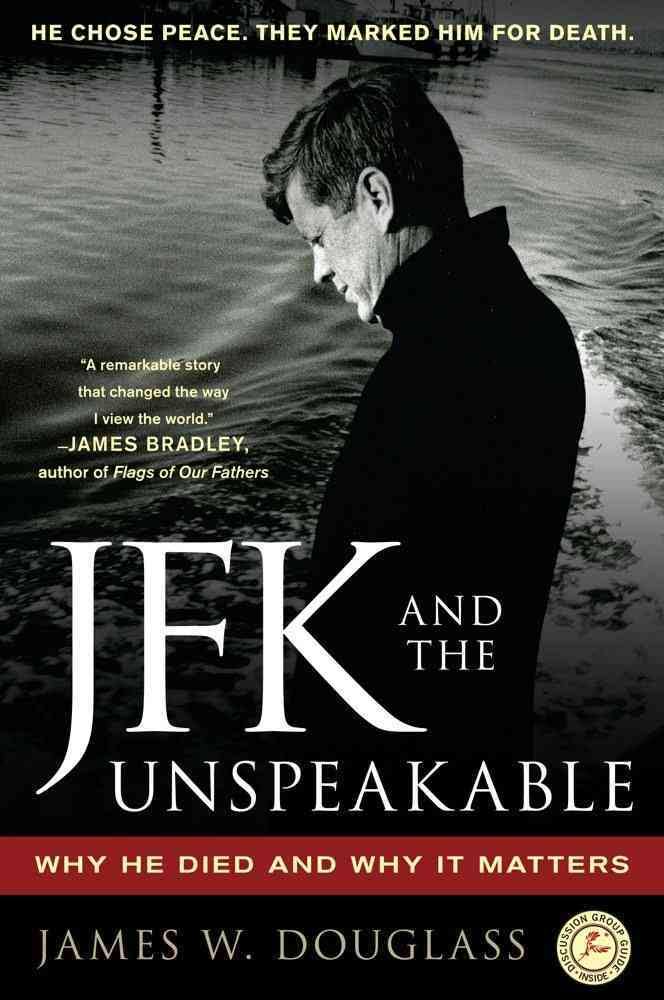
James W. Douglass, JFK and the Unspeakable
This book is the first volume of a projected trilogy. Orbis Books has commissioned James W. Douglass to write three books on the assassinations of the 1960’s. The second will be on the murders of Malcolm X and Martin Luther King, while the third will be on the assassination of Bobby Kennedy.
This is one of the few books on the Kennedy case that I actually wished was longer. In the purest sense, Jim Douglass is not a natural writer. But it seems to me he has labored meticulously to fashion a well organized, thoroughly documented, and felicitously composed piece of workmanship that is both comprehensible and easy to read. These attributes do not extend from simplicity of design or lack of ambition. This book takes in quite a lot of territory. In some ways it actually extends the frontier. In others it actually opens new paths. To achieve that kind of scope with a relative economy of means, and to make the experience both fast and pleasant, is quite an achievement.
I should inform the reader at the outset: this is not just a book about JFK’s assassination. I would estimate that the book is 2/3 about Kennedy’s presidency and 1/3 about his assassination. And I didn’t mind that at all, because Douglass almost seamlessly knits together descriptions of several of Kennedy’s policies with an analysis of how those policies were both monitored and resisted, most significantly in Cuba and Vietnam. This is one of the things that makes the book enlightening and worthy of understanding.
One point of worthwhile comparison would be to David Talbot’s previous volume Brothers. In my view, Douglass’ book is better. One of my criticisms of Talbot’s book was that I didn’t think his analysis of certain foreign policy areas was rigorous or comprehensive enough. You can’t say that about Douglass. I also criticized Talbot for using questionable witnesses like Angelo Murgado and Timothy Leary to further certain dubious episodes about Kennedy’s life and/or programs. Douglass avoided that pitfall.
One way that Douglass achieves this textured effect is in his quest for new sources. One of the problems I had with many Kennedy assassination books for a long time is their insularity. That is, they all relied on pretty much the same general established bibliography. In my first book, Destiny Betrayed, I tried to break out of that mildewed and restrictive mold. I wanted to widen the lens in order to place the man and the crime in a larger perspective. Douglass picks up that ball and runs with it. There are sources he utilizes here that have been terribly underused, and some that haven’t been used before. For instance, unlike Talbot, Douglass sources Richard Mahoney’s extraordinary JFK:Ordeal in Africa, one of the finest books ever written on President Kennedy’s foreign policy. To fill in the Kennedy-Castro back channel of 1963 he uses In the Eye of the Storm by Carlos Lechuga and William Attwood’s The Twilight Struggle. On Kennedy and Vietnam the author utilizes Anne Blair’s Lodge in Vietnam, Ellen Hammer’s A Death in November, and Zalin Grant’s Facing the Phoenix. And these works allow Douglass to show us how men like Henry Cabot Lodge and Lucien Conein did not just obstruct, but actually subverted President Kennedy’s wishes in Saigon. On the assassination side, Douglass makes good use of that extraordinary feat of research Harvey and Lee by John Armstrong, the difficult to get manuscript by Roger Craig, When They Kill a President, plus the work of little known authors in the field like Bruce Adamson and hard to get manuscripts like Edwin Black’s exceptional essay on the Chicago plot. Further, he interviewed relatively new witnesses like Butch Burroughs and the survivors of deceased witnesses like Thomas Vallee, Bill Pitzer and Ralph Yates. In the use of these persons and sources, Douglass has pushed the envelope forward.
But it’s not just what is in the book. It is how it is molded together that deserves attention. For instance, in the first chapter, Douglass is describing the Cuban Missile Crisis at length (using the newest transcription of the secretly recorded tapes by Sheldon Stern.) He then segues to Kennedy’s American University speech. At this point, Douglass then introduces the figure of Lee Harvey Oswald and his relation to the U-2 (p. 37). This is beautifully done because he has been specifically discussing the U-2 flights over Cuba during the Missile Crisis, and he subliminally matches both Kennedy and Oswald in their most extreme Cold War backdrops. He then switches back to the American University speech, contrasting its rather non-descript reception in the New York Times with its joyous welcome in Russia, thus showing that Kennedy’s efforts for dÈtente were more appreciated by his presumed enemy than by the domestic pundit class.
These artful movements would be good enough. But the design of the book goes further. As mentioned above, in his first introduction of Oswald Douglass mentions the Nags Head, North Carolina military program which launched American soldiers into Russia as infiltrators. Near the end of the book (p. 365), with Oswald in jail about to be killed by Jack Ruby, Douglass returns to that military program with Oswald’s famous thwarted phone call to Raleigh, North Carolina: the spy left out in the cold attempting to contact his handlers for information as how to proceed. But not realizing that his attempted call will now guarantee his execution. Thus the author closes a previously prepared arc. It isn’t easy to do things like that. And it doesn’t really take talent. One just has to be something of a literary craftsman: bending over the table, honing and refining. But it’s the kind of detail work that pays off. It maintains the reader’s attention along the way and increases his understanding by the end.
II
One of the book’s most notable achievements is the 3-D picture of the Castro-Kennedy back channel of 1963. Douglass’ work on this episode is detailed, complete, and illuminating in more ways than one. From a multiplicity of books, periodicals, and interviews, the author produces not opinions or spin on what happened. And not after the fact, wishy-washy post-mortems. But actual first-hand knowledge of the negotiations by the people involved in them.
It started in January of 1963. Attorney John Donovan had been negotiating the release of the Bay of Pigs prisoners when Castro’s physician and aide Rene Vallejo broached the subject of normalizing relations with the USA (p. 56). Right here, Douglass subtly tells us something important. For Vallejo would not have broached such a subject without Castro’s permission. In approaching these talks, Dean Rusk and the State Department wanted to establish preconditions. Namely that Cuba would have to break its Sino/Soviet ties. Kennedy overruled this qualification with the following: “We don’t want to present Castro with a condition that he obviously cannot fulfill.” NSC assistant Gordon Chase explained Kennedy’s intercession, “The President himself is very interested in this one.” (pgs. 57-58)
Because the State Department was cut in at the start, the CIA got wind of the opening. Douglass makes the case that David Phillips and the Cuban exiles reacted by having the militant group Alpha 66 begin to raid Russian ships sailing toward Cuba. Antonio Veciana later stated that Phillips had arranged the raids because, “Kennedy would have to be forced to make a decision and the only way was to put him up against the wall.” (p. 57) The initial raid was followed by another a week later.
Phillips did indeed force Kennedy into making a decision. At the end of March, the Justice Department began to stop Cuban exiles from performing these raids off of American territory. This resulted in crackdowns and arrests in Florida and Louisiana. And it was this crackdown that provoked a bitter falling out between the leaders of the CIA created Cuban Revolutionary Council and President Kennedy. Dr. Jose Miro Cardona stated that the “struggle for Cuba was in the process of being liquidated” for “every refugee has received his last allotment this month, forcing them to relocate.” (p. 59) The CRC had been a special project of both Phillips and Howard Hunt. As the Associated Press further reported in April, “The dispute between the Cuban exile leaders and the Kennedy administration was symbolized here today by black crepe hung from the doors of exiles’ homes.” (Ibid)
Clearly, Kennedy was changing both speeds and direction. At this time, Donovan visited Castro and raised the point of Kennedy clamping down on the exile groups. Castro replied to this with the provocative statement that his “ideal government was not to be Soviet oriented.” (p. 60) When newscaster Lisa Howard visited Castro in late April, she asked how a rapprochement between the USA and Cuba could be achieved. Castro replied that the “Steps were already being taken” and Kennedy’s limitations on the exile raids was the first one. (p. 61)
As Douglass observes, every Castro overture for normalization up to that point had been noted by the CIA. And CIA Director John McCone urged “that no active steps be taken on the rapprochement matter at this time.” (p. 61) Deftly, the author points out that– almost simultaneous with this–Oswald inexplicably moves from Dallas to New Orleans to begin his high profile pro-Castro activities. And later that summer, CIA case officers will secretly meet with Rolando Cubela to begin another attempt on Castro’s life.
Oblivious to this, the back channel was now picked up and furthered by Howard and William Attwood. Howard reported that Castro was even more explicit now about dealing with Kennedy over the Russian influence in Cuba. He was willing to discuss Soviet personnel and military hardware on the island and even compensation for American lands and investments. The article she wrote at this time concluded with a request that a government official be sent to negotiate these matters with Fidel. (p. 70) This is where former journalist and then diplomat Attwood stepped in. Knowing that Attwood had talked with Castro before, Kennedy instructed him to make contact with Carlos Lechuga. Lechuga was Cuba’s ambassador at the United Nations, and Kennedy felt this would be a logical next step to continue the dialogue and perhaps set some kind of agenda and parameters. Howard arranged the meeting between the two opposing diplomats. Attwood told Lechuga that Kennedy felt relations could not be changed overnight, but something “had to be done about it and a start had to be made.” (p. 71) Lechuga replied that Castro had liked Kennedy’s American University speech and he felt that Castro might OK a visit by Attwood to Cuba. This, of course, would have been a significant milestone.
A funny and revealing thing happened next. Both sides alerted the other that they would be making boilerplate anti-Cuba and anti-America speeches. (Adlai Stevenson would be doing the anti-Cuba one at the UN.) This clearly implies that the players understood that while relations were warming in private, motions had to be gone through in public to please the pundit class.
Howard then requested that Vallejo ask Castro if Fidel would approve a visit by Attwood in the near future. Attwood believed this message never got through to Castro. So Kennedy decided to get the message to Castro via Attwood’s friend, French journalist Jean Daniel. (p. 72) What Kennedy told Daniel is somewhat stunning. Thankfully, and I believe for the first time in such a book, Douglass quotes it at length. I will summarize it here.
Kennedy wanted Daniel to tell Castro that he understood the horrible exploitation, colonization, and humiliation the history of Cuba represented and that the people of Cuba had endured. He even painfully understood that the USA had been part of this during the Batista regime. Startlingly, he said he approved of Castro’s declarations made in the Sierra Maestra Mountains. He added, “In the matter of the Batista regime, I am in agreement with the first Cuban revolutionaries. That is perfectly clear.” Daniel was somewhat taken aback by these sentiments. But, Kennedy continued, the dilemma now was that Cuba — because of its Soviet ties — had become part of the Cold War. And this had led to the Missile Crisis. Kennedy felt that Khrushchev understood all these ramifications now, after that terrible thirteen days.
The president concluded with this, “…but so far as Fidel Castro is concerned, I must say I don’t know whether he realizes this, or even if he cares about it.” Kennedy smiled and then ended Daniel’s instructions with this: “You can tell me whether he does when you come back.”
Daniel then went to Havana. On November 19th Castro walked into his hotel. Fidel was fully aware of the Attwood/Lechuga meetings. He was also aware of Kennedy’s briefing of Daniel. He had found out about this through Howard. In fact, he had told her he did not think it would be a good idea for him to meet Attwood in New York. He suggested that the meeting could be arranged by picking up Attwood in Mexico and flying him to Cuba. Castro also agreed that Che Guevara should be left out of the talks since he opposed their ultimate aim. Attwood said that Lechuga and he should meet to discuss a full agenda for a later meeting between himself and Castro. This was done per Kennedy’s instructions, and JFK wanted to brief Attwood beforehand on what the agenda should be. Things were heading into a higher gear.
Daniel was unaware of the above when Castro walked into his room for a six-hour talk about Kennedy. (pgs. 85-89) I won’t even attempt to summarize this conversation. I will only quote Castro thusly, “Suddenly a president arrives on the scene who tries to support the interest of another class … ” Clearly elated by Daniel’s message, Castro and the journalist spent a large part of the next three days together. Castro even stated that JFK could now become the greatest president since Lincoln.
On the third day, Daniel was having lunch with Fidel when the phone rang. The news about Kennedy being shot in Dallas had arrived. Stunned, Castro hung up the phone, sat down and then repeated over and over, “This is bad news … This is bad news … This is bad news.” (p. 89) A few moments later when the radio broadcast the report stating that Kennedy was now dead, Castro stood up and said, “Everything is changed. Everything is going to change.” (p. 90)
To say he was prophetic is putting it mildly. Attwood would later write that what it took 11 months to build was gone in about three weeks. By December 17th it was clear that President Johnson was brushing it all aside. Retroactively, Attwood came to conclude that it had all really ended in Dealey Plaza. He finalized his thoughts about the excellent progress made up to that point with this: “There is no doubt in my mind. If there had been no assassination we probably would have moved into negotiations leading toward normalization of relations with Cuba.” (p. 177)
Douglass has done a real service here. Gus Russo will now have an even more difficult time in defending the thesis of his nonsensical book. No one can now say, as the authors of Ultimate Sacrifice do that these negotiations were “headed nowhere.” And if they do, we will now know what to think of them.
III
Equally as good as the above is Douglass’ work on Kennedy and Vietnam. Especially in regards to the events leading up to the November coup against Ngo Dinh Diem and the eventual murder of both he and his brother Ngo Dinh Nhu.
Taking a helpful cue from David Kaiser’s American Tragedy, Douglass begins his discourse by analyzing Kennedy’s single-minded pursuit of a neutralization policy in neighboring Laos. (pgs. 98-101) Douglass exemplifies just how single-minded JFK was on this by excerpting a phone call the president had with his point man on the 1962 Laos negotiations, Averill Harriman: “Did you understand? I want a negotiated settlement in Laos. I don’t want to put troops in.” (p. 104)
Unfortunately, no one felt the same way about Vietnam. Except President Kennedy. The Pentagon, the CIA, Lyndon Johnson and the Nhu brothers all looked askance at Laos as a model for Vietnam. (p. 106) Even the one general that JFK favored, Maxwell Taylor, told him to send in combat troops as early as 1961. (Ibid) After Taylor’s visit there, Ambassador Frederick Nolting wired Kennedy that “conversations over the past ten days with Vietnamese in various walks of life” showed a “virtually unanimous desire for introduction US forces in Viet Nam.” (p. 107) In other words, his own ambassador was trying to sell him on the idea that the general populace wanted the American army introduced there. Finally, both Secretary of Defense Bob McNamara and his assistant Ros Gilpatric also joined the chorus. As Taylor later recalled, no one was actually against it except President Kennedy “The president just didn’t want to be convinced … . It was really the President’s personal conviction that U.S. ground troops shouldn’t go in.” (Ibid) But in 1961, Kennedy was not yet ready to withdraw. So he threw a sop to the hawks and approved a new influx of 15, 000 advisers.
In April of 1962, John K. Galbraith sent a memo to Kennedy proposing a negotiated settlement with the North Vietnamese. The Joint Chiefs, State Department, and Harriman vigorously opposed the idea. It was too much like Laos. (pgs 118-119) But Kennedy liked the proposal. And in the spring of 1962 he instructed McNamara to initiate a plan to withdraw American forces from South Vietnam. In May of 1962, McNamara told the commanders on the scene to begin to plan for this as the president wanted to see the blueprint as soon as it was ready.
To put it mildly, the military dragged its heels. It took them a year to prepare the outline. In the meantime Kennedy was telling a number of friends and acquaintances that he was getting out of Vietnam. Douglass assembles quite an impressive list of witnesses to this fact: White House aide Malcolm Kilduff, journalist Larry Newman, Sen. Wayne Morse, Marine Corps Chief David Shoup, Canadian Prime Minister Lester Pearson, Asst. Sec. of State Roger Hilsman, Sen. Mike Mansfield, Congressman Tip O’Neill, and newspaper editor Charles Bartlett, among others. Mansfield, for one, wrote that Kennedy had become unequivocal on the subject of withdrawal by the end of 1962. (p. 124)
In May of 1963, at the so-called SecDef meeting in Honolulu, the generals in Vietnam finally presented their withdrawal plan. McNamara said it was too slow. He wanted it revised and speeded up. In September, Kennedy and McNamara announced the order — NSAM 263 — to begin the withdrawal. It consisted of the first thousand troops to be out by the end of the year. Which, of course, would be reversed almost immediately after his death. (See Probe, Vol. 5 No. 3 p. 18.)
The parallel story that Douglass tells — with grim skill and painful detail — is of the tragic demise of the Nhu brothers. It is the clearest and most moving synopsis of that sad tale that I can recall. It begins in May of 1963 with the famous bombing of the Hue radio station during a Buddhist holiday. A Buddhist rally was in progress there to protest another discriminatory edict passed by the Catholic Diem. The importance of this bombing, and the subsequent firing into the crowd–which left seven dead and fifteen wounded–cannot be minimized. As many commentators have noted, this localized incident mushroomed into a full-blown political crisis, spawning huge strikes and large street demonstrations. The twin explosions that shook the building were first blamed on the Viet Cong. Then on the South Vietnamese police. Which enraged the Buddhist population against Diem even further since his brother Nhu was in charge of the security forces. It was a milestone in the collapse of faith by the State Department in Diem. And it eventually led them to back the coup of the generals against the Nhu brothers.
What Douglass does here is introduce a new analysis based on evidence developed at the scene. Because of the particular pattern of destruction on both the building and the victims, the local doctors and authorities came to the conclusion that it had to have been caused by a certain plastic explosive — which only the CIA possessed at the time. A further investigation by a Vietnamese newspaper located the American agent who admitted to the bombing. (p. 131) This puts the event in a new context. Douglass then builds on this in a most interesting and compelling manner.
As mentioned above, the Hue atrocity caused even the liberals in the State Department to abandon Diem. So now Harriman and Hilsman united with the conservative hawks in an effort to oust him. In late August, they manipulated Kennedy into approving a cable that gave the go-ahead to a group of South Vietnamese generals to explore the possibility of a coup. (Afterwards, at least one high staffer offered to resign over misleading Kennedy about McNamara’s previous approval of the cable.) The leading conservative mounting the effort to dethrone Diem was Henry Cabot Lodge. Kennedy had planned to recall Ambassador Nolting and appoint Edmund Gullion to the position. And, as readers of the Mahoney book will know, Gullion was much more in tune with Kennedy’s thinking on Third World nationalism. He had actually tutored him on the subject in 1951 when Congressman Kennedy first visited Saigon. But Secretary of State Dean Rusk overruled this appointment, and suggested Lodge for the job. Lodge lobbied hard for the position because he wanted to use it as a springboard for a run for the presidency in 1964.
Many, including myself, have maintained that if there was a black-hatted villain in the drama of Saigon and the Nhu brothers in 1963, it was Lodge. Douglass makes an excellent case for that thesis here. Before moving to Saigon, Lodge consulted with, of all people, Time-Life publisher Henry Luce. He went to him for advice on what his approach to Diem should be. (p. 163) Kennedy’s foe Luce advised Lodge not to negotiate with Diem. Referring him to the work of a journalist in his employ, he told Lodge to engage Diem in a “game of chicken”. What this meant was that unless Diem capitulated on every point of contention between the two governments, support would be withdrawn. The ultimate endgame would be that there would be nothing to prop up his rule. And this is what Lodge did. With disastrous results.
From the time of the August cable, Lodge plotted with CIA officer Lucien Conein to encourage the coup and to undermine Diem by ignoring him. Even though, as Douglass makes clear, this is contrary to what JFK wanted. Kennedy grew so frustrated with Lodge that he sent his friend Torby McDonald on a secret mission to tell Diem that he must get rid of his brother Nhu. (p. 167)
It was Lodge who got John McCone to withdraw CIA station chief John Richardson who was sympathetic to Diem. Lodge wanted McCone to replace him with Ed Lansdale. Why? Because Lansdale was more experienced in changing governments. Richardson was withdrawn but no immediate replacement was named. So in September of 1963, this essentially left Lodge and Conein in charge of the CIA’s interaction with the generals. And it was Conein who had been handling this assignment from the beginning, even before Lodge got on the scene. Around this time, stories began to emanate from Saigon by journalists Richard Starnes and Arthur Krock about the CIA being a power that was accountable to no one.
It was Lodge, along with establishment journalist Joe Alsop — who would later help convince Johnson to create the Warren Commission — who began the stories about Diem negotiating a secret treaty with Ho Chi Minh. (p. 191) This disclosure — looked upon as capitulation– further encouraged the efforts by the military for a coup. In September, Kennedy accidentally discovered that the CIA had cut off the Commodity Import Program for South Vietnam. He was taken aback. He knew this would do two things: 1.) It would send the South Vietnamese economy into a tailspin, and 2.) It would further encourage the generals because it would convey the message the USA was abandoning Diem. (p. 195)
On October 24th, the conspirators told Conein the coup was imminent. JFK told Lodge he wanted to be able to stop the coup at the last minute. (Conein later testified that he was getting conflicting cables from Washington: the State Department was telling him to proceed, the Kennedys were telling him to stop.) At this time Diem told Lodge he wanted Kennedy to know he was ready to carry out his wishes. (p. 202) But Lodge did not relay this crucial message to Kennedy until after the coup began.
The rest of Douglass’ work here confirms what was only suggested in the Church Committee Report. Clearly, Conein and Lodge had sided with the generals to the ultimate degree. And, like Lenin with the Romanov family, the generals had decided that Diem and his brother had to be terminated. Lodge and Conein helped the coup plotters to facilitate the final bloody outcome. In turn, by using the Alsop-Lodge story about the Diem/Ho negotiations, the CIA egged on the murderous denouement. (p. 209) Not knowing Lodge was subverting Kennedy’s actual wishes, Diem kept calling the ambassador even after the coup began. This allowed Lodge to supply his true location to Conein after the brothers had fled the bombed presidential castle. So when the brothers walked out of the Catholic Church they had taken refuge in, they thought the truck that awaited them was escorting them to the airport. But with the help of their two American allies, the generals had arranged for the truck themselves. And the unsuspecting Nhu brothers walked into the hands of their murderers.
Kennedy was so distraught by this outcome he decided to recall Lodge and fire him. He had arranged to do this on November 24th. Instead, President Johnson called the ambassador back with a different message: the US must not lose in Vietnam. (p. 375)
These are the best twin summaries on Kennedy’s 1963 Vietnam and Cuba policies that I have seen between the covers of one book. After his death, the negotiations with Cuba would disappear forever. And, with even more alacrity, Lyndon Johnson now embarked on an escalation into a disastrous war in Southeast Asia whose price, even today, is incalculable. Douglass makes a convincing case that neither would have occurred if JFK had lived. I leave it to the reader to decide whether those two irrevocable alterations directly and negatively impacted the lives of tens of millions in America, Cuba, and Southeast Asia.
IV
Generally speaking, Douglass has done a good job of choosing some of the better evidence that has appeared of late to indicate a conspiracy. What he does with Ruth and Michael Paine, especially the former, is salutary.
Michael Paine did not just work at Bell Helicopter. He did not just have a security clearance there. His stepfather, Arthur Young, invented the Bell helicopter. His mother, Ruth Forbes Paine Young, was descended from the Boston Brahmin Forbes family — one of the oldest in America. She was a close friend of Mary Bancroft. Mary Bancroft worked with Allen Dulles as a spy during World War II in Switzerland. This is where Dulles got many of his ideas on espionage, which he would incorporate as CIA Director under Eisenhower. Bancroft also became Dulles’ friend and lover. She herself called Ruth Forbes, “a very good friend of mine.” (p. 169) This may explain why, according to Walt Brown, the Paines were the most oft-questioned witnesses to appear before the Commission.
Ruth Paine’s father was William Avery Hyde. Ruth described him before the Warren Commission as an insurance underwriter. (p. 170) But there was more to it than that. Just one month after the Warren Report was issued, Mr. Hyde received a three-year government contract from the Agency for International Development (AID). He became their regional adviser for all of Latin America. As was revealed in the seventies, AID was riddled with CIA operatives. To the point that some called it an extension of the Agency. Hyde’s reports were forwarded both to the State Department and the CIA. (Ibid)
Ruth Paine’s older sister was Sylvia Hyde Hoke. Sylvia was living in Falls Church, Virginia in 1963. Ruth stayed with Sylvia in September of 1963 while traveling across country. (p. 170) Falls Church adjoins Langley, which was then the new headquarters of the Central Intelligence Agency, a prized project of Allen Dulles. It was from Falls Church that Ruth Paine journeyed to New Orleans to pick up Marina Oswald, who she had been introduced to by George DeMohrenschildt. After she picked Marina up, she deposited her in her home in Irving, Texas. Thereby separating Marina from Lee at the time of the assassination.
Some later discoveries made Ruth’s itinerary in September quite interesting. It turned out that John Hoke, Sylvia’s husband, also worked for AID. And her sister Sylvia worked directly for the CIA itself. By the time of Ruth’s visit, Sylvia had been employed by the Agency for eight years. In regards to this interestingly timed visit to her sister, Jim Garrison asked Ruth some pointed questions when she appeared before a grand jury in 1968. He first asked her if she knew her sister had a file that was classified at that time in the National Archives. Ruth replied she did not. In fact, she was not aware of any classification matter at all. When the DA asked her if she had any idea why it was being kept secret, Ruth replied that she didn’t. Then Garrison asked Ruth if she knew which government agency Sylvia worked for. The uninquiring Ruth said she did not know. (p. 171) This is the same woman who was seen at the National Archives pouring through her files in 1976, when the House Select Committee was gearing up.
When Marina Oswald was called before the same grand jury, a citizen asked her if she still associated with Ruth Paine. Marina replied that she didn’t. When asked why not, Marina stated that it was upon the advice of the Secret Service. She then elaborated on this by explaining that they had told her it would look bad if the public found out the “connection between me and Ruth and CIA.” An assistant DA then asked, “In other words, you were left with the distinct impression that she was in some way connected with the CIA?” Marina replied simply, “Yes.” (p. 173)
Douglass interpolates the above with the why and how of Oswald ending up on the motorcade route on 11/22/63. Robert Adams of the Texas Employment Commission testified to having called the Paine household at about the time Oswald was referred by Ruth — via a neighbor– to the Texas School Book Depository (TSBD) for a position. He called and was told Oswald was not there. He left a message for Oswald to come down and see him since he had a position available as a cargo handler at a regional cargo airline. Interestingly, this job paid about 1/3 more than the job Oswald ended up with at the TSBD. He called again the next day to inquire about Oswald and the position again. He was now told that Lee had already taken a job. Ruth was questioned about the Adams call by the Warren Commission’s Albert Jenner. At first she denied ever hearing of such a job offer. She said, “I do not recall that.” (p. 172) She then backtracked, in a tactical way. She now said that she may have heard of the offer from Lee. This, of course, would seem to contradict both the Adams testimony and common sense. If Oswald was cognizant of the better offer, why would he take the lower paying job?
In addition to his work on the true background of the Paines, which I will return to later, Douglass’ section on the aborted plot against Kennedy in Chicago is also exceptional. The difference between what Douglass does here and what was done in Ultimate Sacrifice is the difference between confusion and comprehension. After they were informed of a plot, the police arrested Thomas Vallee on a pretext. Interestingly Dan Groth, the suspicious officer in on the arrest of Vallee, was later part of the SWAT team that assassinated Black Panthers Fred Hampton and Mark Clark in 1969. (p. 204) Groth took several lengthy leaves from Chicago to Washington for special training under the auspices of the FBI and CIA. Groth never had a regular police assignment, but always worked counter-intelligence, with an early focus on the Fair Play for Cuba Committee. (Ibid)
Thomas Vallee, the presumed patsy, is just as interesting. The Chicago version of Oswald had suffered a severe concussion during the Korean War. It was so debilitating, he was discharged and then collected disability payments. When he got home he was in a bad car crash and suffered serious head injuries, which caused him to slip into a two-month coma. (p. 205) He was later diagnosed as mentally disturbed with elements of schizophrenia and paranoia. The CIA later recruited him to train Cuban exiles to assassinate Castro. It was these connections which probably helped maneuver him to be in a warehouse overlooking President Kennedy’s parade route for a scheduled visit to the Windy City. After his arrest, and the cancellation of the early November visit, the police tried to track down his license plate. They found out they couldn’t. (p. 203) The information was “locked”. Only the FBI could “unlock” it.
I should also note the author’s probing of the enduring mystery of Carl Mather and Collins Radio. This originates from the sighting of an Oswald double about ten minutes and eight blocks from his arrest at the Texas Theater. Around 2:00 PM, auto mechanic T. F. White noticed a Ford Falcon that first drove past, and then parked oddly in the lot of El Chico Restaurant. Which was across the street from White’s garage. He told his boss about the man in the car who seemed to be hiding. White walked over to get a closer look. About ten yards away from the car, he stopped as the man in the white T-shirt looked right at him. (p. 295) Before he left the lot, he wrote down the license plate number of the car. When he went home that night and saw Oswald’s face on TV, he told his wife that this was the man he saw in the Falcon.
Local Dallas broadcaster and future mayor Wes Wise heard about White’s experience. When he interviewed him, White gave him the license number. Wise called the FBI. The Bureau traced the license to one Carl Mather of Garland, Texas. But the license number was on Mather’s Plymouth, not a Falcon.
Mather did high-security communications work for Collins Radio, a major contractor for the CIA. How major and sensitive? Collins had outfitted raider ships for sabotage missions off the coast of Cuba. They also installed communication towers in Vietnam. Further, Mather had installed electronics equipment on Air Force Two. (p. 297) After Wise’s call, the Bureau wanted to talk to Mather. But Mather didn’t want to talk to the Bureau. So they talked to his wife Barbara. She surprised the G-men by saying her husband had been a close friend of J. D. Tippit. How close? When Tippit was shot, his wife phoned them. Many years later, the HSCA also wanted to talk to Mather. He didn’t want to talk to them either. They persisted. He relented upon one condition: he wanted a grant of immunity from prosecution. But he still had no explanation for how his license ended up on a car with an Oswald double in it right after Oswald’s arrest. This is all interesting, even engrossing, on its own. But the author takes it further. Citing the valuable work of John Armstrong, he then builds a case that there were two Oswalds at the Texas Theater on November 22, 1963. One was arrested and taken out the front door. The second Oswald was hiding in the balcony and later escorted out the back by the police. Before anyone gets too dismissive, there are two Dallas Police Department reports that refer to Oswald being in the balcony of the theater. (p. 293) And there are two witnesses who saw an Oswald lookalike escorted out the rear: Butch Burroughs and Bernard Haire. (I should add here, in a 4/8/08 interview I did with Armstrong for this review, he said there was a sheriff’s officer who also saw this second Oswald on the stairs between the mezzanine and the first floor.) The author postulates that the man who exited the rear is the man who ended up in the Falcon. He then wraps this up by saying that this double was ultimately flown out of Dallas on a military transport plane. This is based on the testimony of retired Air Force officer Robert Vinson. It is contained in a 52-page affidavit given to his attorney James P. Johnston of Wichita, Kansas.
I would like to conclude this section by noting Douglass’ attention to the pain and suffering inflicted upon those who have tried to tell the truth as they knew it about the JFK case. Their only misfortune being that what they saw and knew was not conducive to the Warren Commission’s mythology.
Most of us are aware of what happened to Richard Case Nagell. How he was railroaded and incarcerated after he was arrested in El Paso, Texas on September 20, 1963. (pgs. 152-158) But Douglass sheds light on what happened to three other important witnesses. Jim Wilcott and his wife worked for the Agency out of the Tokyo station. On the day of the assassination, Wilcott pulled a 24-hour security shift. That evening, more than one employee told him that the CIA had to have been involved in Kennedy’s killing. When Wilcott asked how they knew this, the response was that they had handled disbursements for him under a cryptonym. Also, he had been trained by the Agency as a double agent at Atsugi. (pgs. 146-147) Later, both Jim and his wife quit the Agency. They then went public with their knowledge. Jim lost his private sector job, started receiving threatening phone calls, and had the tires on his car slashed.
Abraham Bolden was a Secret Service agent who had asked to leave the White House in 1961. He did not care for the lackadaisical practices of the White House detail. (p. 200) On October 30, 1963 Bolden was in Chicago when the local agents were briefed on what they knew about an attempt being planned on JFK’s life there. After Vallee’s arrest and the foiling of the plot, Bolden felt a foreboding about Kennedy’s upcoming trip to Dallas. When Kennedy was killed, Bolden noted the similarities between what had occurred in Dallas and what almost occurred in Chicago. In May of 1964 he was in Washington for a Secret Service training program. (p. 215) He tried to contact the Warren Commission about what he knew. The day after his call to J. Lee Rankin, he was sent back to Chicago. Upon his arrival he was arrested. The pretense was that he was trying to sell Secret Service files to a counterfeiter. Upon his arraignment he was formally charged with fraud, obstruction of justice, and conspiracy. (Ibid) Needless to say, Bolden was convicted based upon perjured testimony. (The phony witness later admitted this himself.) He was imprisoned at Springfield where he was placed in a psychiatric unit. (p. 216) He was given mind-numbing drugs. But other inmates alerted him to the nature of the drugs in advance. So he knew how to fake taking the pills. While in prison, his family endured a bombing of their home, setting fire to their garage, and a sniper shooting through their window. Mark Lane, while working for Garrison, visited him in 1967. Lane then wrote about Bolden’s knowledge of the plot in Chicago. When the prison authorities learned about this, they placed Bolden in solitary confinement. He was finally released in 1969.
Compared to the fate of Ralph Yates, Bolden did all right. On November 20, 1963 Yates was making his rounds as a refrigerator mechanic for the Texas Butcher Supply Company in Dallas. That morning he picked up a hitchhiker on the R. L. Thornton Expressway. The man had a package with him that was wrapped in brown paper. When Yates asked him if he would prefer to place it in the back of the pickup, the passenger said no. They were curtain rods and he would rather keep them in the cab. (p. 351) The conversation rolled around to the subject of Kennedy’s upcoming visit. The man asked Yates if he thought it was possible to kill Kennedy while he was there. Yates said that yes, it was possible. The hitchhiker then asked if Yates knew the motorcade route. Yates said he did not, but it had been in the paper. The man asked if he thought it would now be changed. Yates said that he doubted it. The passenger asked to be let off at a stoplight near Elm and Houston. Yates then returned to his shop and told his colleague Dempsey Jones about the strange conversation. (p. 352)
After the assassination, Yates noted the hitchhiker’s resemblance to Oswald. So he volunteered his experience with him to the FBI. They brought him back for a total of four interviews. It became clear they did not want to believe him. The reason being that Oswald was not supposed to be on the expressway at that time. They finally gave him a polygraph test. The agents then told Yates’ wife that, according to the machine, her husband was telling the truth. But, they concluded, the reason was that “he had convinced himself that he was telling the truth. So that’s how it came out.” (p. 354) The FBI told Yates that he needed help. So they sent him to Woodlawn Hospital, where he was admitted as a psychiatric patient. To quote the author, “From that point on, he spent the remaining eleven years of his life as a patient in and out of mental health hospitals. ” (Ibid) Such was the price for disturbing the equilibrium of the official story.
V
In this last section, I want to tie together four strands Douglass deals with. I also want to suggest how they fit together not just in a conspiratorial design, but a design against this particular president.
In addition to his elucidation of the Castro/Kennedy back channel, Douglass also deals with Kennedy’s back channel to Khrushchev. Kennedy had gotten off to a rocky start with the Russians because of the Bay of Pigs debacle and the roughness of the 1961 Vienna summit. But toward the end of 1961, he and the Russian premier had established a secret correspondence. The first letter was delivered by Georgi Bolshakov to Pierre Salinger wrapped in a newspaper. (p. 23) Khrushchev seemed to be trying to tell Kennedy that although he may have seemed unreasonable in Vienna, he was dead set against going down a path to war that would lead to the death of millions. The letter was 26 pages long, and Khrushchev mentioned hot spots on the globe like Laos and Berlin. Kennedy dutifully responded. And the correspondence went on for a year. It was then supplemented by two unlikely cohorts: Pope John XXIII, and Saturday Review editor Norman Cousins. Cousins had been the intermediary between John and the premier. When Kennedy heard of this, he decided to have Cousins carry messages to Khrushchev for him also. In fact, it seems that it was actually Cousins who provided the impetus for Kennedy to make his remarkable American University speech of June 10, 1963. (p. 346)
This speech is one of the centerpieces of the book. Douglass prints it in its entirety as an appendix. (pgs. 382-388) He also analyzes it at length in the text. (pgs. 41-45) Khrushchev was ecstatic about the speech. He called it, “the greatest speech by any American president since Roosevelt.” (p. 45) So inspired was he that he countered the speech and the renewed correspondence in multiple terms: 1.) A limited test ban treaty 2.) A non-aggression treaty between NATO and the Warsaw Pact, and 3.) He encouraged Castro in his back channel with Kennedy. Douglass places much importance on the last and he uses Russian sources, including Khrushchev’s son, to bolster it. (pgs 68-69)
There was another person at the time tiring of the Cold War and his role in it. Except he had a much lower profile than the four luminaries depicted above. His name was Lee Harvey Oswald. As Marina once said, Oswald “liked and approved of the President and he believed that for the United States in 1963, John F. Kennedy was the best president the country could hope to have.” (p. 331) At the New Orleans Public Library, he checked out William Manchester’s profile of JFK, Portrait of a President, Kennedy’s own Profiles in Courage, and a book called The White Nile. The last he read only because Manchester noted that Kennedy had read it recently. (Ibid) When Kennedy spoke on the radio about the test ban treaty, Lee listened intently and told Marina that he was making an appeal for disarmament. Curiously, he also informed his wife that Kennedy would actually like to pursue a more gentle policy with Cuba. But unfortunately he was not free to do so at the time. Doesn’t sound like the Krazy Kid planning on murdering JFK does it?
The night after Kennedy’s test ban speech, Oswald gave a speech of his own at Spring Hill College in Mobile, Alabama. His cousin, Eugene Murret was a seminarian there and he invited him to talk about his experiences in the Russian system. Douglass uses Oswald’s notes on the speech to inform us what he was thinking at the time. And, for the man depicted by the Warren Commission, its extraordinary. Away from New Orleans, away from his handlers, away from scripted situations arranged by others, Oswald said some surprising things. He first chided his audience. Sounding like JFK, the man he admired, he warned them that military coups are not a far away thing in some banana republic in South America. It could happen here, in the USA, their own country. (Ibid) Which organization could do such a thing? He said it could not come from the army, because of its many conscripts, its large and cumbersome structure, its huge network of bases. Amazingly, he specifically mentioned Kennedy relieving Edwin Walker of his command as evidence it would not come from there. Walker, the man he derisively dismisses here, is the man he was already supposed to have tried to shoot!
He then said that from his experience in both Russia and America, “Capitalism doesn’t work, communism doesn’t work. In the middle is socialism and that doesn’t work either.” (p. 473) He concluded that by returning to the USA, he was choosing the lesser of two evils. This does not remotely suggest the ideological zealot debating Ed Butler about the merits of Marxism, who was passing out flyers begging for fair treatment for Cuba, who got into street fights with anti-Castro Cubans who perceived him as a defender of Fidel. Here, in a secluded place, many miles away from Clay Shaw, David Ferrie, and Guy Banister, he sounds like a spy ready to come in from the cold. Ready to retire to a desk job under the president he admired.
But his handlers weren’t ready to retire him just yet. As Ruth Paine left her stay in Falls Church to head south to pick up Marina, Oswald allegedly embarked on what Philip Melanson called his Magical Mystery Tour to Mexico. The object of this final charade of course was to depict Oswald as trying to obtain visas for Cuba and the Soviet Union. As Douglass describes it, this utterly intriguing journey is multi-layered. What Oswald seems to think he is doing is the final act of what he did in New Orleans: discrediting the FPCC. Which had been an operation the CIA had that was ongoing. As John Newman has pointed out, David Phillips and James McCord were in on it. But there was also something else going on here. After the fact, the CIA seems to have tried to create a questionable trail, one that would suggest Oswald was trying to get into contact with Valery Kostikov. Kostikov worked at the Soviet consulate but was also a KGB agent who the FBI had discovered was involved in assassination plots. (p. 76) But as the author demonstrates here, the record of this trip is so fraught with inconsistencies, improbabilities, conflicting testimony and outright deception that it “inadvertently revealed more about the CIA” than about Oswald. (p. 75)
The author notes the witnesses at the Cuban embassy who could not identify the man they saw as Oswald. Using the fine work of Newman, Douglass shows that at least some of the calls attributed to Oswald are dubious. (p. 76) He also adroitly notes that, prior to the assassination, the CIA held this alleged Kostikov/Oswald association close to its vest. If they had not, then it is highly probable that Oswald would not have been on the president’s motorcade route on 11/22. Which, shortly after his return, was insured by the Paines not telling Oswald about the other job offer. Douglass astutely relates the final way his presence there was ultimately clinched. A man at the Bureau, Marvin Gheesling, deactivated Oswald’s FLASH warning on 10/9/63. This meant that Oswald was not placed on the Security Index in Dallas. Again, if he would have been on this list, it is very likely the Secret Service would have had him under surveillance prior to November 22nd. Hoover was furious when he found out what Gheesling had done. He had him censured and placed on probation. On the documents censuring him he wrote, “Yes, send this guy to Siberia!” (p. 178) Later, on the marginalia of another document, he wrote that the Bureau should not trust the CIA again because of the phony story the Agency had given them about Oswald in Mexico City. (Ibid)
As others have noted, the combination of Oswald moving around so much plus the late-breaking, dubious, but explosive details of the Mexico City trip, all caused the system to overload in the wake of the JFK assassination. On November 23rd, after talking to Hoover by phone and John McCone in person, Johnson was quite clear about his fear of nuclear war. He told his friend Richard Russell that the question of Kennedy’s murder had to be removed from the Mexico City arena. Why? Because “they’re testifying that Khrushchev and Castro did this and did that and kicking us into a war that can kill forty million Americans in an hour.” (p. 231) The manufactured trail in Mexico helped freeze any real attempt to search for the actual facts of this case. It was too dangerous. And there was a second built-in element that curtailed any real investigation. The fact that the FBI was short changed on information about Oswald — by the files not getting from New Orleans to Dallas quickly enough, and by the CIA withholding crucial information about Oswald in Mexico City — this helped pitch the Bureau into a CYA mode. For clearly, their surveillance of Oswald had been faulty. His activities in New Orleans, his alleged attempts to contact Kostikov in Mexico, his threatening message left at the Dallas FBI office, all of these should have put him on the Security Index.
But as Donald Gibson has noted, the safety valve to all this soon emerged. First, Jock Whitney’s New York Herald Tribune put out the cover story about a disturbed Oswald being a “crazed individual” with “homicidal fantasies”. (Probe, Vol. 7 No. 1 p. 19) This, of course, began to detract from the Oswald as the Marxist-motivated, Kostikov-employed assassin. It created a new profile for Oswald. He was now the lonely and disturbed sociopath. As Gibson further showed, a day after this, the lobbying effort of Eugene Rostow, Dean Acheson, and Joe Alsop would convince Johnson to create the Warren Commission. (Probe, Vol. 3 No. 4 p. 8) And at one of its very early meetings, Allen Dulles passed out a book promoting this particular view of American assassinations.
If all Douglass had written about the technique of the cover-up was the above, he would have done a salutary and exceptional job. But he has gone further. And this makes his writing on the subject both new and even more valuable. Carol Hewett once wrote a quite interesting article (Probe, Vol. 4 No. 3) about how Ruth Paine “discovered” Oswald’s alleged letter to the Russian embassy in Washington. The date of this letter is November 9th. In the letter Oswald writes about “recent events” in Mexico with a man he calls Comrade Kostin. (This has usually been taken to mean Kostikov, although Hewett pointed out that there actually was a Soviet agent named Kostin.) Oswald went on to write, “I had not planned to contact the Soviet embassy in Mexico so they were unprepared, had I been able to reach the Soviet embassy in Havana as planned, the embassy there would have had time to complete our business.” (p. 228, Douglass’ italics.) The author comments, “here the letter deepens the Soviet involvement in the plot and extends the complicity to Cuba.” In other words, “the business” would have been part of a co-conspiracy between the two communist countries. Further, Oswald betrayed knowledge in the letter that Eusebio Azcue, an employee at the Cuban consulate, had been replaced. But this did not happen until November 18 –the day the letter arrived at the Soviet embassy. How Oswald knew this would happen in advance has never been adequately explained.
In his call to Johnson on November 23rd, Hoover mentioned the letter. But he played down its more explosive and conspiratorial elements. (p. 229) But it was not until 1999, when Boris Yeltsin turned over long-secret documents to President Clinton, that we got the contemporaneous Soviet reaction to the arrival of this letter. The Soviet diplomats considered it a clear provocation against them. (p. 230) They also considered it a deception, since they had no such ties to Oswald. They also noted it was typed yet other letters that he wrote to them were handwritten. They thus concluded it was a forgery. Or perhaps someone had dictated it to him–perhaps as a completion of the FPCC counter-intelligence operation. But most significantly, the Soviets felt the letter was “concocted by those … involved in the President’s assassination.” (p. 230) To disown it, they turned it over to the State Department on November 26th.
But, by then, the FBI already had two copies of the letter. One from a mail intercept program and one via Ruth Paine. Ruth Paine gave FBI agent Jim Hosty her handwritten copy of the letter on November 23rd. As Hewett pointed out, how and why she copied this letter was a matter of a long colloquy spread over three days between her and the Warren Commission. Altogether, she gave three different reasons as to why she copied the letter. She finally decided on this: since Oswald left it on her secretary desk, he must have wanted her to read it! The shifting and unconvincing excuses all seem a way to disguise and obfuscate one simple but revealing fact: she was spying on Oswald. And this spying went as far as copying his private correspondence without his permission. (For who she is spying and why is, of course, never broached.) Further, her copy of the letter differs in some interesting ways from the typewritten one. As the author notes, it de-emphasizes Oswald’s contacts with the communist embassies. Instead, it emphasizes his differences with the FBI. It also replaces the pregnant phrase “time to complete our business” with phrases like “time to assist me” referring to a travel process. (p. 233) Amazingly, it was this Ruth Paine version of the letter — not the one Oswald allegedly typed and mailed — that the Warren Commission used in its analysis of what the correspondence meant. The Commission then returned Oswald’s rough draft, the one Ruth copied, not to Marina, but to Ruth. According to Carol Hewett, Ruth’s handwritten copy is nowhere to be found today. (Hewett interview, 4/8/08)
There are many fascinating aspects to Ruth Paine’s role with this letter. So many that one could write a lengthy essay about it. One thing I wish to point out here. The FBI could not make their version of the letter public since it would have revealed their intercept program. Clearly, the State Department did not want to reveal their version. Because by November 26th, Johnson had decided to bury the allegations about Oswald in Mexico City to avoid the threat of conflagration. But by Ruth Paine’s spying on Oswald, it was possible to circulate a softer version of the letter, thus further labeling him a communist who had problems with American authority. Douglass has finally brought this episode, and Ruth Paine’s role in it, into bold relief.
I do have some reservations about the book. Let me note them briefly. Douglass, like several others before him, couldn’t resist mentioning and misinterpreting David Morales’ remarks as quoted by Gaeton Fonzi in The Last Investigation. (p. 57) Second, he places more faith in some assassination witnesses than I do, e.g. Ed Hoffmann. And I disagree with his characterization of JFK as a ‘cold warrior” who “turned” during the Missile Crisis. If Kennedy was actually a cold warrior when he entered office, he would have sent in the Navy and Marines to complete the job at the Bay of Pigs. Which is what a real cold warrior, Richard Nixon, told him to do. He also would have sent combat troops into Vietnam in 1961, when all of his advisers said it was necessary.
But overall, and overwhelmingly, this is a rich, rewarding, and reverberating book. One that does two things that very few volumes in the field do: it both illuminates and empowers the reader. I strongly recommend purchasing it. It is the best book in the field since Breach of Trust.
-
After Dallas DA’s Death, 19 Convictions Are Undone
DALLAS – As district attorney of Dallas for an unprecedented 36 years, Henry Wade was the embodiment of Texas justice.
A strapping 6-footer with a square jaw and a half-chewed cigar clamped between his teeth, The Chief, as he was known, prosecuted Jack Ruby. He was the Wade in Roe v. Wade. And he compiled a conviction rate so impressive that defense attorneys ruefully called themselves the 7 Percent Club.
But now, seven years after Wade’s death, The Chief’s legacy is taking a beating.
Henry Wade
Nineteen convictions ‹ three for murder and the rest involving rape or burglary ‹ won by Wade and two successors who trained under him have been overturned after DNA evidence exonerated the defendants. About 250 more cases are under review.
No other county in America ‹ and almost no state, for that matter ‹ has freed more innocent people from prison in recent years than Dallas County, where Wade was DA from 1951 through 1986.
Current District Attorney Craig Watkins, who in 2006 became the first black elected chief prosecutor in any Texas county, said that more wrongly convicted people will go free.
“There was a cowboy kind of mentality and the reality is that kind of approach is archaic, racist, elitist and arrogant,” said Watkins, who is 40 and never worked for Wade or met him.
‘Not a racist’
But some of those who knew Wade say the truth is more complicated than Watkins’ summation.
“My father was not a racist. He didn’t have a racist bone in his body,” said Kim Wade, a lawyer in his own right. “He was very competitive.”
Moreover, former colleagues ‹ and even the Innocence Project of Texas, which is spearheading the DNA tests ‹ credit Wade with preserving the evidence in every case, a practice that allowed investigations to be reopened and inmates to be freed. (His critics say, of course, that he kept the evidence for possible use in further prosecutions, not to help defendants.)
The new DA and other Wade detractors say the cases won under Wade were riddled with shoddy investigations, evidence was ignored and defense lawyers were kept in the dark. They note that the promotion system under Wade rewarded prosecutors for high conviction rates.
In the case of James Lee Woodard ‹ released in April after 27 years in prison for a murder DNA showed he didn’t commit ‹ Wade’s office withheld from defense attorneys photographs of tire tracks at the crime scene that didn’t match Woodard’s car.
“Now in hindsight, we’re finding lots of places where detectives in those cases, they kind of trimmed the corners to just get the case done,” said Michelle Moore, a Dallas County public defender and president of the Innocence Project of Texas. “Whether that’s the fault of the detectives or the DA’s, I don’t know.”
‘Win at all costs’
John Stickels, a University of Texas at Arlington criminology professor and a director of the Innocence Project of Texas, blames a culture of “win at all costs.”
“When someone was arrested, it was assumed they were guilty,” he said. “I think prosecutors and investigators basically ignored all evidence to the contrary and decided they were going to convict these guys.”
A Democrat, Wade was first elected DA at age 35 after three years as an assistant DA, promising to “stem the rising tide of crime.” Wade already had spent four years as an FBI agent, served in the Navy during World War II and did a stint as a local prosecutor in nearby Rockwall County, where he grew up on a farm, the son of a lawyer. Wade was one of 11 children; six of the boys went on to become lawyers.
He was elected 10 times in all. He and his cadre of assistant DAs ‹ all of them white men, early on ‹ consistently reported annual conviction rates above 90 percent. In his last 20 years as district attorney, his office won 165,000 convictions, the Dallas Morning News reported when he retired.
In the 1960s, Wade secured a murder conviction against Ruby, the Dallas nightclub owner who shot Lee Harvey Oswald after Oswald’s arrest in the assassination of President Kennedy. Ruby’s conviction was overturned on appeal, and he died before Wade could retry him.
Wade was also the defendant in the 1973 landmark Roe v. Wade Supreme Court decision legalizing abortion. The case began three years earlier when Dallas resident Norma McCorvey ‹ using the pseudonym Jane Roe ‹ sued because she couldn’t get an abortion in Texas.
Cases overturned
Troubling cases surfaced in the 1980s, as Wade’s career was winding down.
Lenell Geter, a black engineer, was convicted of armed robbery and sentenced to life in prison. After Geter had spent more than a year behind bars, Wade agreed to a new trial, then dropped the charges in 1983 amid reports of shoddy evidence and allegations Geter was singled out because of his race.
In Wade’s final year in office, the U.S. Supreme Court overturned the death sentence of a black man, Thomas Miller-El, ruling that blacks were excluded from the jury. Cited in Miller-El’s appeal was a manual for prosecutors that Wade wrote in 1969 and was used for more than a decade. It gave instructions on how to keep minorities off juries.
A month before Wade died of Parkinson’s disease in 2001, DNA evidence was used for the first time to reverse a Dallas County conviction. David Shawn Pope, found guilty of rape in 1986, had spent 15 years in prison.
Watkins, a former defense lawyer, has since put in place a program under which prosecutors, aided by law students, are examining hundreds of old cases where convicted criminals have requested DNA testing.
‘Protecting a legacy’
Of the 19 convictions that have been overturned, all but four were won during Wade’s tenure. In two-thirds of the cases, the defendants were black men. None of the convictions that have come under review are death penalty cases.
“I think the number of examples of cases show it’s troubling,” said Nina Morrison, an attorney with the Innocence Project, a New York-based legal group affiliated with the Texas effort. “Whether it’s worse than other jurisdictions, it’s hard to say. It would be a mistake to conclude the problems in these cases are limited to Dallas or are unique to Dallas.
Former assistant prosecutor Dan Hagood said The Chief expected his assistants to be prepared, represent the state well and be careful and fair.
“Never once ‹ ever ‹ did I ever get the feeling of anything unethical,” Hagood said. He denied there was any pressure exerted from above ‹ “no `wink’ deals, no `The boss says we need to get this guy.’”
But Watkins said those who defend The Chief are “protecting a legacy.”
“Clearly it was a culture. A lot of folks don’t want to admit it. It was there,” the new DA said. “We decided to fix it.”
© 2008 MSNBC.com -
The Second Dallas
The Second Dallas is a DVD documentary produced, written and directed by Massimo Mazzucco. It begins with Robert Kennedy on the campaign trail in Indianapolis making the famous announcement that Martin Luther King had been assassinated. It then proceeds to the Ambassador Hotel in Los Angeles. Senator Kennedy made his final victory speech after winning the California primary in the early hours of June 5, 1968. He proceeded from the ballroom and into the kitchen pantry. There, the shooting began. Senator Kennedy was shot and five others were wounded. RFK was taken to two hospitals. At Good Samaritan Hospital, after unsuccessful brain surgery, spokesman Frank Mankiewicz announced Kennedy dead on June 6th. Since Sirhan had stepped forward and been firing at RFK, he was immediately apprehended and taken into custody.
From the beginning, as the film states, Sirhan could not recall anything about the actual shooting sequence. His last memory was having coffee at a table with a girl, the famous “Girl in the Polka Dot Dress”. One of the interviewees, the late Philip Melanson, comes on to say that this seeming mental block appears to be genuine. At least, both the defense and the prosecution psychiatrists deemed it so. At his home the police found notebooks which say things like ‘RFK Must Die” in them. Sirhan also stated that although these appear to be in his handwriting, he did not recall writing them. He also added that they did not reflect his real personality. And in fact, Sirhan had no previous past record of violence. And his friends and neighbors concurred that he seemed to be a quiet, almost introverted young man.
At Sirhan’s trial, his defense team—headed by Grant Cooper—did not challenge any of the forensic evidence: the recovered bullets, the shooting scenario, the gun used, the eyewitness testimony etc. Cooper accepted it all at face value. Instead, he tried to use a psychiatric defense. This did not work. Sirhan was sentenced to death in the gas chamber. The California Supreme Court struck down the death penalty afterwards, so Sirhan’s sentence was then commuted to life in prison. Which is where he is today.
But as the film notes, after the trial, many independent researchers began to uncover problems with the Los Angeles Police Department’s case against Sirhan. The film now goes into a series of segments, which depict these areas of conflict. The first area discussed is the number of bullets that were fired that night. One must consider the fact that Sirhan’s handgun carried, at a maximum, eight bullets. Yet, in addition to the bullets in the victims, there was also reliable testimony and evidence that bullets were extracted from a doorjamb and in the walls. Further, the LAPD expert, DeWayne Wolfer, had to make three of the bullets he charted do rather wild things in the air to make sure they accounted for all the shots into both RFK, and th remaining victims. Since four shots hit RFK, and there were five other victims hit, one can see, that those eight bullets had to do some real work. The film deduces that from this evidence alone, there were at least 11 shots fired.
The next area shown supports this additional strong evidence: the Stanislav Pruszyynski audiotape. Pruszynski was a young reporter on leave to write a book about the 1968 race for the presidency. He had an audio tape recorder with him as he followed RFK leaving the podium. Sound technician Philip Van Praag analyzed this audiotape for bullet sounds. He came to the conclusion there were 13 such shots on the tape. He also concluded there were a couple of instances where the shots were spaced too closely for one person to be firing them (for a more full discussion of this issue, click here). This piece of evidence is a key element in the current appeal motion by Willliam Pepper and Laurie Dusek, Sirhan’ s new lawyers (click here for that story).
The third aspect of the case the film explores is the famous “Girl in the Polka Dot Dress”. This was a young girl seen that night with Sirhan by several witnesses like reporter Booker Griffin and realtor George Green. After the shooting, the girl fled down the rear stairs and was seen by Sandra Serrano. As she ran down the stairs she shouted, “We shot him, we shot him!” Serrano asked, “Who did you shoot?” She said, “Senator Kennedy.” Officer Paul Sharaga heard the same. But in his report, the words “We shot him” were changed to “They shot him.”
The fourth aspect of the crime presented is the strange case of Scott Enyart. Enyart was a high school press photographer who was in the pantry during the shooting. He says he took photos before and during and after the actual shooting. He was arrested afterwards and his photos were confiscated. Later on some of his photos were returned. But none of these were the ones taken during the firing sequence. When he asked for the rest of the photos, the police said they were classified. So Enyart waited for 20 years. He then asked the California Archives for the rest of his pictures. They said that these had been destroyed three weeks before the Sirhan trial.
The fifth area the film visits is the topic of the destruction of evidence. Here the film centers on the disappeared ceiling panels and doorjambs, which reportedly contained evidence of bullet holes. Police Chief Daryl Gates says that since the case went to court and the man was convicted, well then, “You can’t keep junk around forever.” Gates ignores the fact that Sirhan’s appeals process was ongoing at the time these items were destroyed. He later adds, also on camera, that these items did not have evidentiary value. To which one can reply, “We are glad you are not a judge. So stop acting like one.” The film also adds in the point that DeWayne Wolfer test fired several bullets from what he said was the revolver in evidence in the case, namely Sirhan’s. But yet the folder in which he kept those test bullets did not bear the serial number of that revolver, which was H53725. It actually bore the serial number of H18602. Which actually belonged to a petty criminal named Jake Williams. And it was the same Iver Johnson Cadet model as the one in evidence. Amazingly, this folder was actually submitted at Sirhan’s trial and never challenged by defense lawyer Grant Cooper. Wolfer later tried to excuse this as a “clerical error”.
The sixth area explored is the autopsy of RFK performed by Dr. Thomas Noguchi. The narrator now intones some familiar facts: Noguchi found that all the bullets that hit Kennedy came from behind; they came in at an upward angle, and they were fired from close range. The fatal shot entered behind the right ear had to have been between 1-3 inches away, or a point blank shot. No witness placed Sirhan either behind Kennedy or that close to the senator. Further, as Philip Melanson notes, no witness recalled a gun placed behind Kennedy’s head. Which would have been an unforgettable image. This evidence, in and of itself, eliminates Sirhan as the man who killed RFK.
The seventh point of controversy examined is related to the above, it is the testimony of hotel maitre d’ Karl Uecker. Uecker was the man escorting Kennedy through the hotel pantry. When Sirhan jumped forward and began firing, Uecker jumped on him and pinned his gun hand down to a steam table. Uecker is a central witness for more than one reason. First, as he says here, he was always between Sirhan and Kennedy. Therefore, Sirhan could not have shot Kennedy from behind. Second, he leaped upon Sirhan right after the first shot. He had him in a headlock with one arm and his other hand was on the handgun. At the most Sirhan could have delivered two accurate shots. Every other shot was fired blindly, with his hand pinned and body down. As Uecker says, “He didn’t see anything…I had him completely covered.”
The last point evidentiary point is a discussion of Thane Eugene Cesar. Cesar, of course, is the hired security guard who was stationed at the door leading into the kitchen. Unlike Sirhan, Cesar was behind RFK, and therefore was in perfect position to deliver the shots into Senator Kennedy. And although Cesar denies firing his handgun that night, there is a witness who says he did so fire. That is a man named Don Schulman, who worked for a TV station at the time. Schulman said the guard behind RFK fired three times. When he tried to offer this information to the authorities, his account was ignored. And although Cesar said he did not own a .22 handgun like the one in evidence at the time, it turned out that he actually had owned one at the time. The film concludes that Cesar is the most likely suspect as the actual assassin.
The film concludes with a discussion of the idea of hypnoprogramming. Melanson states that he believed that Sirhan was programmed to fire that night and then to not recall that he had. There are clips from the 1962 film The Manchurian Candidate. There are then interviews with Herb Spiegel, an expert on hypnosis and the late Larry Teeter, Sirhan’s former defense lawyer. They both discuss how easy a subject Sirhan was for hypnosis. There is then a concluding interview with Professor Alan Scheflin of Santa Clara University about the history of CIA mind control experiments with a programmed assassin.
Aesthetically and intellectually, I would put this film at about the level of Shane O’Sullivan’s, RFK Must Die. It does not approach the standard in this field, The Assassination of Robert Kennedy, 1992, done for British television. Unlike that film, this one is put together in a rather rudimentary way. Although there are some graphic simulations in the film, little else that has developed in the way of computer software in the last few years seems to have had an effect on this production. There is nothing very slick or imaginative about the way director Massimo Mazzucco has done his job. As noted above, the film makes a rather familiar series of points about the RFK case. But further, these points are only sketched out; none of them are gone into in any depth. Therefore, no one familiar with this case could come away from this film in any way enlightened by it. The film is then limited in its intellectual value to the entering student of the case. It is also marred by some rather amateurish errors that should have been picked up by anyone viewing the film in a rough cut. If you can believe it, in a title card near the beginning, Sirhan’s name is misspelled as “Shiran”. Later on, Thane Eugene Cesar is named Eugene Thane Cesar. A clip labeled from the original version of The Manchurian Candidate, is not. It appears to be from a Sherlock Holmes film. DeWayne Wolfer’s first name is spelled “Dwayne”. And although the film says that Sirhan was not called to testify at his trial, he actually did testify.
Mazzucco at least tried to make a documentary on the RFK case to bring to the public some troubling facts. But today, that really is not good enough. We need films that are much more slickly and technically proficient than either this one or RFK Must Die. And we need them to be error free, or as close to that as possible. The facts of this case are so compelling that they cry out for that kind of presentation.