Blog

  • Review of Countdown 1960 – Part 1

    Review of Countdown 1960 – Part 1

    Whenever one thinks that the MSM cannot get any worse, or purposefully bad on the subject of John Kennedy or his assassination, another reminder arrives showing they can.  The latest example of this is Chris Wallace’s Countdown 1960.  This book, by former Fox reporter turned CNN employee Chris Wallace, is ostensibly about the race for the presidency in 1960.  I say ostensibly because anyone who knows the subject will be able to figure out what this book is really about.  And, in fact, Wallace pretty much confesses to his real intent in the acknowledgements section of the book.  That section is usually included in the front of a volume, but here its at the end. I will get to why I think that is so later.  

    I

    Like almost every writer who wants to exalt his work on this subject, Wallace begins by saying that the primary system of electing party nominees for the presidency was somehow a novelty in 1960.  And Kennedy decided to use it to original effect.  This is simply not the case. The primary system was really invented during the Progressive Era, but the first one was held before that, in 1901 in Florida. And just a few years later, 12 states were conducting them. By 1910, the practice of holding state elected delegates to cast ballots for the party winner at the convention was established. And, in fact, there was a memorable donnybrook in 1912 during the primary season between challengers Robert La Follette, Teddy Roosevelt and incumbent president William Howard Taft. And there was another memorable race as recently as 1952 between Dwight Eisenhower and Robert A. Taft.

    For me, the only notable differences in 1960 were 1.) The use of television, and 2.) The debates between Kennedy and Nixon. But the first would have happened anyway no matter who the candidates were.  It was a matter of the creeping reach and power of the broadcast media.  As for the second, this did not really establish a precedent. Because the next presidential debate did not occur until 1976. So right out of the gate, on page 3 to be exact, it can be said that Wallace is aggrandizing his subject. (As later revealed, this ties into his not so hidden agenda.)

    Another disturbing aspect of the book is the fact that Wallace and his researchers, Mitch Weiss and Lori Crim, did not seem to me to do a lot of genuine research.  In looking at the book’s reference notes, almost every one of them is to a prior book, newspaper article or periodical.  There is little that I would call new or original.  And, as I will explain later, some of the sources that Wallace uses are quite dubious; or as we shall see, in some instances, even worse than that.  These factors combine to make the book not just rather superfluous, but questionable at its foundations.

    One of the problematic areas of the book is that  very early Nixon is portrayed as an oracle on foreign policy. (p. 14) John Kennedy is portrayed as something of a cliché.  That is, the usual rich, handsome playboy portrait. (p. 17)  For example, Wallace begins by saying that Kennedy started running for the presidency in 1957, a thesis with which I would tend to disagree. (p. 2)  But if you are going to postulate such, how can any honest and objective author ignore Senator Kennedy’s great Algeria speech? Because it was made in that year. 

    Why is this both important and revelatory? There are two reasons why. First, that speech really put Kennedy on the national map. As Richard Mahoney noted, it provoked a firestorm of newspaper and periodical comments and editorials from all over the country. (JFK: Ordeal in Africa, pp. 14-16; see also, James DiEugenio, Destiny Betrayed, second edition,  pp. 25-28) That national furor ended up placing Kennedy on the cover of Time magazine, with the inside article titled “Man out Front”.  So how can that not be related to Wallace’s subject?

    The reason I think he does not include it is because that speech was a specific attack on President Eisenhower, his Secretary of State John Foster Dulles and, most relevant to Wallace’s book, on Vice President Richard Nixon. It assaulted the entire basis of their Cold War foreign policy in the Third World. Kennedy was essentially saying that America should not be backing European colonialism. We should be on the side of nationalism and independence in places like Algeria. And this was not just a matter of American idealism, but one of practicality.  He invoked what had happened three years earlier at Dien Bien Phu, where we had first backed the French empire–and it ended up in disaster. He proclaimed that what we should be doing now is assisting France to the negotiating table, in order to save that nation from civil war.  But we also should be working to free Africa. (See the anthology The Strategy of Peace, edited by Allan Nevins, pp. 65-81) 

    If one does not refer to this speech, or the trail that led Kennedy to make it, then yes, one can portray the senator as an empty Savile Row suit and Nixon as the experienced sagacious foreign policy maven. But that is simply not being accurate on the facts of the matter.  As John T. Shaw commented in JFK in the Senate, that speech made Kennedy the new voice of the Democratic party on foreign policy.  Since it challenged the prevailing orthodoxy of Eisenhower and Nixon. As Monice Wiesak wrote, this speech also made Kennedy the defacto ambassador to Africa. Because African dignitaries now began to follow him in the press and visit his office. (America’s Last President, p. 12)

    To ignore all of this is to shrink Kennedy and exalt Nixon.  If there is an historical figure who should not be exalted, it is Richard Nixon.  Because it was this Cold War monomania that first, got us into Vietnam, and then, from 1968 onward, kept us there. Until it became even more of a debacle than it had been under the French.

    II

    But there is another way that Wallace exalts Nixon. This is by minimizing the tactics he used to defeat, first Jerry Voorhees for a congressional seat, and then Helen Gahagan Douglas in a race for the senate. The latter is usually considered one of the dirtiest and most unscrupulous political races in American history. 

    Wallace spends all of one paragraph on it. (pp. 10-11)

    Which is really kind of startling.  Because illustrious author Greg Mitchell wrote a milestone book on that campaign in 1998.  It was titled Tricky Dick and the Pink Lady.  I could find no reference to that book in Wallace’s references.  In that campaign, Nixon’s team actually accused his opponent of being a conduit for Stalin. (Mitchell, p. 209) As Mitchell notes, up until that time, candidates who made anti-communism their focus usually lost.  That was not the case here. Nixon literally demagogued the issue to an almost pathological extent. As Mitchell notes:

    Republican and Democratic leaders alike interpreted the outcome as a victory for McCarthyism and a call for a dramatic surge in military spending…. Red baiting would haunt America for years, the so called national security state would evolve and endure and candidates would run and win on anti-Sovietism for decades. (ibid, xix)

    Nixon’s win seemed to demonstrate the political power of McCarthyism, which Senator Joe McCarthy had begun that same year with his famous speech in Wheeling, West Virginia. But as Mitchell proves in his first chapter, McCarthy’s speech drew heavily on the actual words of Congressman Nixon. As with Nixon, it was McCarthy’s aim to make anti-communism a political issue, to portray Democrats as not just soft on communism—Nixon actually tried this with President Truman– but in some cases as commie sympathizers. (This is one reason why Kennedy’s Algeria speech hit home, because it broke through all that Cold War boilerplate with facts and realism.)

    As Mitchell reveals—and contrary to what Wallace implies–Nixon had a lot of money in order to smear Douglas. Not only did he get large corporate contributions, but both the LA Times and the Hearst newspapers backed him. Along with Hollywood bigwigs like Cecil B. DeMille, Howard Hughes, Harry Cohn, Darryl Zanuck, Louis Mayer, Anne Baxter, John Wayne and Rosalind Russell. (Daily Beast, article by Sally Denton, November 16, 2009) Nixon also used anti-Semitism, since Douglas’ husband was Jewish. Nixon’s campaign made anonymous phone calls saying, “Did you know that she’s married to a Jew?” (ibid) But in addition to anti-Semitism, the campaign utilized racism. In the last days, thousands of postcards were mailed to white voters in suburbs, and into northern California. That postcard was emblazoned with the phony title—note the gender– “Communist League of Negro Women.”  The message was “Vote for Helen for senator.  We are with her 100%.” (ibid). Can a campaign get any more scurrilous than that? This is why Nixon had such a deservedly wretched reputation as a political hatchet man. Which somehow, and for whatever reason, Wallace wants the reader to forget.

     Nixon lied about what his agenda was both before and after this ugly race. Before it started he said–rather satirically in retrospect–there would be “no name-calling, no smears, no misrepresentations in this campaign.” (Ingrid Scobie, “Douglas v. Nixon”, History Today, November, 1992) And later, he downplayed his tactics for the campaign.  One reason the race had a lasting impact is that Nixon’s manager, the odious Murray Chotiner, became a tutor to the likes of later GOP advisors Karl Rove and Lee Atwater. 

    To relegate all this–and much more–to a single paragraph is just inexcusable.  Because, with a trick worthy of a card sharp, it hides two of the most important and unseemly aspects of Nixon’s career, his Machiavellian morality, and obsession with dirty tactics. 

    As we have seen, Nixon’s Cold War ideology would lead to a hellish ending in Indochina. His political tactics would cause Watergate. Incredibly, Wallace wants to whitewash both.

    III

    But all the above is not enough for Wallace, who is herniating himself by cosmeticizing Nixon.  He now makes a rather curious  statement:

    In 1960, America moved slowly toward racial equality, partly because of detours placed along the road to civil rights by southern governors. (pp. 23-24)

    He then adds something even more curious: Nixon supported civil rights. He uses the crisis at Little Rock’s Central High and the Civil Rights Act of 1957 as his evidence for this.  All of this relies on the ignorance of his audience to maintain even superficial credibility.

    Anyone who uses the web can find out that Eisenhower let the students at Central High be terrorized for 20 days while doing nothing. The courts had ordered nine African American students to enter Central High. Governor Orville Faubus called out the National Guard to prevent this. While this was boiling over, Eisenhower actually went on vacation to Newport, Rhode Island. He was then played for the fool by the redneck governor of the state. Faubus came to Newport and told Eisenhower he would now abide by the court ruling and withdraw the National Guard, who had worked against the students. He did not.  And the court ruled against him.  He then removed the Guard. Now the crowd had direct contact with the nine students the court had approved for attendance.

    Humiliated by Faubus and with the press now turning on him, Eisenhower had no choice but to call in federal troops.(LA Times, 3/24/1981, article by Robert Shogan.) Then he and Nixon tried to use a face saving device by submitting a weak civil rights bill to congress. They had no interest is expanding civil rights.  What they wanted to do was split the Democratic party in two: the northern liberals from the southern conservatives. Senate Majority Leader Lyndon Johnson did all he could to try and modify the bill so it would not be so polarizing to the southerners. (“The Kennedys and Civil Rights”, Part 1, by James DiEugenio) Because of this, the act ended up being little more than an advisory commission with virtually no real enforcement power.  So what Wallace is trying to sell here about Nixon on civil rights  is transparent bunk.

    But again, what he leaves out makes Wallace’s efforts worse than bunk.  The Eisenhower/Nixon team worked against civil rights. As Michael Beschloss has revealed, Eisenhower tried to convince Earl Warren not to vote for the Brown vs Board decision. And, in fact, both Eisenhower and Nixon failed to support that decision. In the 1956 Autherine Lucy case at the University of Alabama, Eisenhower let an African American student be literally run off campus, even though the court had supported her attendance. He did nothing to protect her. (Irving Bernstein Promises Kept, p. 97; Jack Bass, Unlikely Heroes, p. 64)  This was two years after Brown vs. Board.

    In a full eight years, the Eisenhower/Nixon administration filed a total of ten civil rights lawsuits.  What makes that even more startling is that six of those years were under the Brown v Board decision. Two of those lawsuits were filed on the last day of Ike’s administration. (Harry Golden, Mr. Kennedy and the Negroes, p. 104) And recall, during the Eisenhower/Nixon years, not only did you have the Brown decision, you had the Montgomery bus boycott. In other words one had some ballast to push ahead on the issue.

    Its not enough for Wallace to disguise the real facts about Eisenhower/Nixon on the issue. He now utterly distorts what Kennedy’s public stance was. He says that JFK had been silent about civil rights. (p. 24, p. 160). This is more rubbish from a book that will soon become a trash compactor. In  February of 1956 Kennedy said the following: 

    The Democratic party must not weasel on the issue….President Truman was returned to the White House in 1948 despite a firm stand on civil rights that led to a third party in the South…..We might alienate Southern support but the Supreme Court decision is the law of the land.

    It is hard to believe that Wallace’s research team missed this speech.  Why? Because Kennedy made it in New York City and the story appeared on the front page of the New York Times for February 8th.

    But in case that was not enough for Wallace, in 1957 Kennedy said the same thing.  This time he made that speech—the Brown decision must be upheld– in the heart of the confederacy:  Jackson, Mississippi. (Golden, p. 95)  As noted in the first speech, JFK made his opinion public knowing full well he would lose support in the south. Which, as Harry Golden noted, is what happened.

    One of the most bizarre things that Wallace writes is that Kennedy voted for the watered down version of the Civil Rights Act of 1957. What Wallace somehow missed completely is this: Kennedy did not want to vote for this bill at all.  As he wrote a constituent, it was because it was so weak. He had to be lobbied to vote for it by Majority Leader Lyndon Johnson.  LBJ sent two emissaries to convince him to do so, but Kennedy resisted. Johnson now personally went to Kennedy to lobby him in person.  Kennedy still was reluctant, but he was instructed by some Ivy League lawyers who said it would be better than nothing. (See Lyndon Johnson: The Exercise of Power, by Rowland Evans and Robert Novak, pp. 136-37)

    What was the result of all this back and forth?  Essentially nothing.  Because as Harris Wofford wrote in his book Of Kennedys and King, Eisenhower and Nixon resisted just about every recommendation the Civil Rights Commission—which originated with the act—made.  He should know since he was the lawyer for the agency. (p. 21)

    So the inactivity on civil rights in the fifties is clearly due to three men: Eisenhower, Nixon and Johnson. When JFK came into office, as Judge Frank Johnson said, it was like lightning.  Things changed that fast. Including going directly at those southern governors Wallace was talking about.

    Read part 2

  • Ethel Kennedy Passes

    Ethel Kennedy, widow of Robert F.Kennedy, has passed on at age 96 from the aftermath of a stroke. Read more.

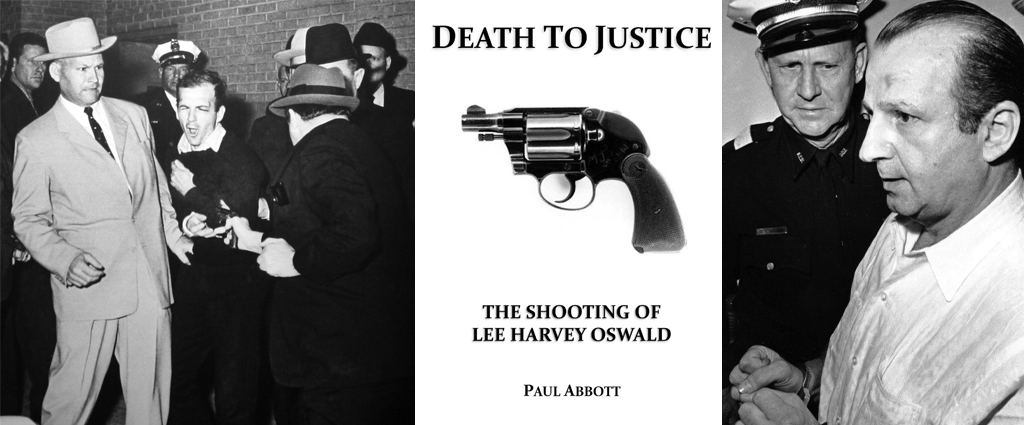
  • Death to Justice: The Shooting of Lee Harvey Oswald – Part 1

    Death to Justice: The Shooting of Lee Harvey Oswald – Part 1


    Foreward

    by Paul Bleau

    Paul Abbott and I live at opposite ends of the world – he in Australia and I in Canada. We got to know one another because of the Garrison Files. After reading some ten thousand pages of these, I knew that hidden away in this collection, there were gems that were not on the radar when it came to analyzing the JFK assassination. Just one example is how Garrison was on the trail of Latinos, with likely links to Guy Banister, who frequently escorted Oswald.

    I knew that if others went through these, they could pick up on clues I may have missed. Paul reached out and provided the community with a research booster that is an archive asset of great value: the Garrison Files Master Index. Garrison’s unfairly dismissed primary research can now be referenced with ease digitally by info ferrets.  It took Paul over a year to build the index, and he deserves our thanks.

    So, when Paul asked me to write a foreword for his book, I felt an obligation to do so. This was risky, in a way, as I refuse to plug material of mediocre quality. What if I did not like it?

    You have guessed by now that I like this book… a lot. Thousands of books have been written about the Kennedy assassination. A few classics have been written about the Tippit murder, which is often covered in more JFK-focused writings. Question to the reader: What do you know about the other murder of that weekend? In my case, it was not much. Yet it, as much as the JFK murder, has all the fingerprints of a conspiracy. It matches the JFK assassination when it comes to poor security. The elimination of Oswald sealed the lips of the most important witness. The shooter likely had assistance to get to the victim and was clearly mob-linked.

    There are many ways one can zero in on the leaders of the JFK assassination conspiracy; Work your way up the ladder around the equally suspicious prior plots to kill JFK; Find out who pulled strings with the media ineptness and the botched autopsy or the Warren Commission charade; Solve the Rosselli, Giancana murders; Figure out who Cubanized Oswald and organized his impersonations… There is a good chance that we will draw vectors pointing in the same direction to the string pullers.

    Ask yourself who organized the removal of the witness who, with his life on the line, could have revealed everything we have painstakingly come to know, suspect about him and his associations and obviously those who conspired to kill Kennedy would be the prime suspects. Yet what do we really know about this crime. Certainly, the Warren Commission’s lame explanation around a series of unfortunate mishaps that led to his unfortunate death should carry even less weight than their impeached whitewash of the JFK assassination. I mean really, two misguided lone nuts… Give me a break!

    Who were the witnesses? What did they say? What was the series of events that led this obvious ruse to obstruct justice? How could this murder have been carried out? Who are the persons of interest? This book delves into all of this and a lot more. Factually, brilliantly and clearly! 

    It is amazing how one Australian on the opposite end of the planet from Dallas can say ten times more about this murder than the FBI, CIA, Warren Commission and Dallas Police Department combined.

    The man who gave us the master index to the Garrison files has now provided us with the all-defining book around the unsolved murder of the most important witness of the twentieth century, which will stand as the go-to reference on the most ignored murder of that infamous weekend in November 1963 in Dallas and shed light coming from an ignored source on the mother of all conspiracies.

    (End of foreward by Paul Bleau)

    Read an excerpt in Part Two

  • Death to Justice: The Shooting of Lee Harvey Oswald – Part 2

    Death to Justice: The Shooting of Lee Harvey Oswald – Part 2


    CIVILIANS OVERLOOKED

    Having laid out the geography of City Hall and the Annex Building basement levels and examining the many points not guarded, therefore could be accessed through, it is now important to focus on the accounts of those present in and around the basement prior to and during Lee Oswald’s shooting.  Given there were just under three hundred statements made regarding the Oswald shooting, it will be useful to group as many present as possible into categories: citizens, law enforcement, and media. And beyond those, specific instances and locations of events. With this approach, we can focus in depth on the many narratives that took place across City Hall during the hours leading up to Oswald’s shooting. 

    The most under-represented cohort of witnesses that day were the civilian employees of both City Hall and the Dallas Police Department. While it is true that none were present to directly witness Jack Ruby shooting Oswald, their testimonies regarding the preparations for the transfer and the aftermath provide important pieces to the overall picture of the puzzle, as it were. However, other than in records of the DPD investigation and the Warren Commission, there is little to no reference to be found regarding these people and their stories – until now. 

    Below is the list of non-Police and media personnel that were at or outside City Hall that morning and who provided at least one statement to the subsequent investigations:


    Fred Bieberdorf – First Aid Attendant

    Wilford Ray Jones – Bystander

    Frances Cason – Dispatcher

    Edward Kelly – Maintenance

    Napoleon Daniels – Former police officer

    Louis McKinzie – Porter

    Nolan Dement – Bystander 

    Johnny F. Newton – Jail Clerk

    Doyle Lane – Western Union Supervisor

    Edward Pierce – Engineer

    Harold Fuqua – Parking Attendant

    Alfreadia Riggs – Porter

    Michael Hardin – Ambulance Driver

       John Servance – Head Porter


       Jerry D. Slocum – Jail Clerk


    Any reasons behind the seemingly random nature of who was and was not interviewed by which investigation remains anybody’s guess particularly when it came to who the DPD did not interview. Consider, for instance, how crucial the testimonies of Dallas locals Fred Bieberdorf, who provided Oswald with first aid after he had been shot, and Michael Hardin, who drove the ambulance that rushed Oswald to Parkland Hospital, ought to have been considered but were not taken. 

    That aside, we will first focus on a group of workers who were employed to ensure the smooth running of all infrastructure across both buildings of the City Hall complex including the basement car park. They were:

    Harold ‘Hal’ Fuqua

    Alfreadia Riggs

    Edward Kelly

    John Servance

    Louis McKinzie

    Edward Pierce

    For the porter and parking workers, their base of work was clearly the car park in the City Hall basement. Their jobs were focused on keeping the area in order, getting police personnel cars parked or ready for use and keeping the general public from parking down there – which was most prevalent when it came to jail inmate arrivals and departures. For the maintenance and engineer workers, their work would take them to all parts of both buildings including the utilities spaces across the sub-basement level. There was also a female standing with the workers who was identified as a telephone operator by the name of Ruth – surname unknown – and it is not evident what her movements were after that point. 

    Once the search of the basement began, all media personnel were apparently cleared out but the City Hall workers remained in the far eastern end of the basement where the stairs and elevators went up to the Annex Building, having already stopped work to watch the comings and goings in preparation for the transfer. To this point, Harold Fuqua even testified to the FBI of observing car trunks being opened and searched.(1)

    Edward Pierce also thought they could stay and watch the proceedings that morning up to and including Oswald’s transfer if they kept out of the way. On the face of it, this was a fair assumption given where they were all positioned: nowhere near the transfer route and out of sight of the television cameras. But they were ordered to clear out of the basement and not just for the time it took police personnel to search it. In his own testimony to the DPD, it was Reserve Officer Brock who gave these orders.(2) And presumably this was done a few minutes after he arrived in the basement for assignment at around 9:30am.

    Collectively, it is clear that the workers followed this directive by taking the service elevator up to the First Floor of the Annex Building. This was because the two public elevators had their power cut and were not functioning. Porter, Louis McKinzie, who was responsible that day for running the service elevator took the group up that way to the First Floor. From there the group would walk across to the City Hall Building to find a place to watch the transfer. Soon, Brock called for McKinzie to bring the service elevator back down so he (McKinzie) could escort, according to Brock’s own testimony to the Warren Commission, ‘one of the TV men over there, (who) wanted to go up the fourth – fifth floor to do some kind of work with the equipment there.’ Both Brock and McKinzie would corroborate that the repair man only spent a few minutes doing whatever it was he was doing up in the upper floors of the Annex Building before being brought back down by McKinzie. There is no testimony from any of the media personnel present that day to explain who this person was and what it was they were doing. After that, Brock told McKinzie to leave the service elevator locked on the First Floor and not bring it back down to the basement. McKinzie did so by locking it in place with a key, then hung it on a hook within as was common practice. In his testimony to the Warren Commission, the time was 10:00am.(3) He then walked along the hallway on the First Floor of the Annex Building to the City Hall Building. McKinzie confirmed in his testimony to the Warren Commission that there were three ‘passageways’ that connected the two buildings. They were on the First (Ground), Second and Third Floor and each could be locked with a metal, accordion-style expanding gate. Over nights and on the weekends, these gates were routinely locked so it is easy to imagine that they were in all probability locked on that day too and that is when Edward Pierce noticed as much and at least unlocked it so he and the others could get through.

    Once in the City Hall Building, the workers, not wanting to miss any of the happenings surrounding Oswald’s transfer, had stayed on the First Floor, and walked to the Commerce Street entrance. From there, behind the locked glass doors they stood and watched the activity outside on Commerce Street and waited to watch Lee Oswald be driven away. This is where Louis McKinzie would rejoin them. 

    It appears that the group stayed together in this location for up to one hour. At which point, Harold Fuqua(4) and Alfreadia Riggs(5) decided to leave to find a television to watch the coverage of the transfer instead. 

    A Circuitous Journey

    Having decided to leave the other workers at the Commerce Street entrance, Harold Fuqua and Alfreadia Riggs set off to find a television. Having both been long-serving employees of City Hall (Fuqua – 6 years, Riggs – 7 years) they would have known that the nearest television was down in the Locker Room in the sub-basement level – two floors directly below. However, given they had been ordered out of the basement as a security measure, and Oswald had still not been transferred, it is understandable that they chose to avoid taking a direct route to the Locker Room as it would have likely resulted in them being turned away or worse, in trouble.

    Instead, they retraced the way they had come with the other workers from the Annex Building. From there, they continued along the First Floor of the Annex Building to the far eastern end where the elevators and stairwell were. As McKinzie had left the service elevator locked on the First Floor, it was in position for them to walk through it and exit through the rear door and out to the fire escape and passage that led directly to the outer door. According to both Riggs and Fuqua in their testimonies to the Warren Commission, it was Riggs who used the keys that McKinzie had left hung up in the elevator to unlock the outer door. He kept them with him but said that he made sure the alleyway door was locked by shaking on the door handle. This is an important point that we will revisit later. 

    Riggs and Fuqua walked through an alleyway to Main Street and began to walk west – along the front of the Annex Building. They then came to the top of the ramp that led from the street down to the basement. This is where Officer Roy Vaughn had been standing guard for at least the last hour. And it was this point where Jack Ruby was most commonly purported as entering the basement in time to shoot Oswald. We will also revisit this location and the comings and goings of people there in more detail. However, Vaughn did confirm in his testimony that ‘some city hall janitorial’ staff approached on foot from the east (6) – which is the direction Riggs and Fuqua would have come from. And they said they stopped at the top of the ramp for only a few moments to look down into the basement before walking on. Vaughn also corroborated this. 

    Riggs and Fuqua rounded the corner of Main and Harwood Streets and stopped below the steps up to City Hall. According to Riggs, Fuqua asked him to go down the steps and check to see if ‘it would be all right for us to go down because we (they) were under the impression they had the police – had a police officer on the door.’ Riggs did so and discovered that there weren’t any officers guarding the basement entrance from there into City Hall so he turned around and told Fuqua to come down. This further reiterates the fact that all public entrances into City Hall that morning were not guarded and therefore secure. Riggs and Fuqua walked down the hallway and got as far as the door before the jail office. There they got close enough to see all of the media assembled. They turned right and headed down the corridor that led to the Records Room, Assembly Room, and the stairs down to the Locker Room. Once down there they encountered someone who was all alone. Let’s pick it up with Riggs’ recollection to the Warren Commission’s counsel, Leon Hubert with what happened next:

    Hubert:  You mean you went down into the locker room? That is where all the policemen have their lockers and there’s a recreation room and television and —

    Riggs:     Yes, sir, and television and – and there was a jail attendant down there, actually he didn’t work in the jail office, he’s not a policeman, but he works in the jail office. 

    Hubert:  What is his name? Do you know?

    Riggs:     No, sir. I really don’t. He told us that he didn’t think they were going to show it on television. He imagined they were going to run a tape and show it later on. Said, “Well, we should have stayed up there. Maybe we could have seen him when they brought him out—”

    Riggs and Fuqua testified to the Warren Commission on the same day – April 1st 1964. This was no coincidence as witnesses were organised into categories, particularly when the WC lawyers travelled to take testimonies. Riggs gave his testimony at 10:30am that day and Fuqua, at 3:55pm. Yet Counsel Hubert, who interviewed both men, did not pursue the question of the unidentified man in the Locker Room with Fuqua. But thankfully, Fuqua corroborated the encounter with the man and that he said he thought the transfer would be shown as reruns only. Yet, Hubert did not ask Fuqua if he could identify him. It can only be chalked up as another thread of questioning that was cut frustratingly early at the quick. So, we are left with some clear questions to consider: 

           Who was the man Riggs and Fuqua encountered in the Locker Room? Per Riggs’ speculation it well could have been any kind of a police officer that he saw or associated with the jail office. And this could feasibly have been any officer from reserve to patrol officer to detective – as all had reason to be there during normal times of operation. But, as we will uncover in later chapters, there is a clear candidate for who the man was that Riggs and Fuqua encountered.

           Why would the man urge Riggs and Fuqua to go somewhere else to observe Oswald’s transfer? The locker room was large enough for them all to sit and watch whatever coverage was broadcast so what was the big deal with redirecting Riggs and Fuqua away?

    Riggs bought a can of chilli from a vending machine, and he ate from it as he and Fuqua left there to go back upstairs. According to both men, they stood in the Harwood Street hallway and were there when Oswald was shot. They both would testify to not seeing it take place, just to hearing and seeing the chaos that broke out. In terms of other people mentioned so far in this book, their position was approximately a couple of metres behind cameraman, James Davidson. 

    After the shooting, Riggs and Fuqua kept out of the way but were able to note that all entrances had been sealed. When things had calmed down, Fuqua testified to the WC that he asked Captain George Lumpkin to escort he and Riggs across the basement car park to the service elevator and stairwell. None of the seven City Hall workers listed earlier in this chapter were interviewed for the Dallas Police investigation, despite being among the most accessible of people to do so. Perhaps, it was because they were all presumed to have not been in the immediate vicinity of the shooting. But Riggs and Fuqua were mentioned in others’ testimony to the DPD such as Roy Vaughn. And others in the basement hallway would have seen them to identify them if only for the uniforms Riggs and Fuqua were wearing. Yet they were still not noted and considered for interviewing. But this does not diminish the fact that their movements reinforce the point of how lax security was across multiple points of the City Hall complex. 

    The Attorney

    Dallas Attorney, Tom Howard’s law firm was situated in one of the buildings across Harwood Street from City Hall. On the morning of Oswald’s transfer, as he would have done, no doubt, many times before, he walked over to the City Jail. On this occasion, he would tell the FBI, he did so because he had received a call from someone in the jail office on behalf of someone else, presumably an inmate.(7) He was able to enter down into the basement level of City Hall from Harwood Street – down the same steps that Harold Fuqua and Alfreadia Riggs had. He did so with the intention of taking the elevator up to the Fifth Floor from the jail office. The obvious inference being that the main entrance from Harwood Street would have been locked – like the ones on Commerce and Main Streets. 

    Having walked down to the jail office, Howard testified that he did get to the elevator there and punch the button to go to the Fifth Floor. He said that he then turned to someone he presumed was a detective and asked if they were ‘fixing to take him (Oswald) out of here?’ Oddly, Howard couldn’t recall if the detective said anything in response. 

    In any event, Howard did not go up in the elevator. Instead, he found his way back out into the hallway. Soon he would notice a ‘sudden jostling and shoving among the newsmen’ and then he heard a shot. He did not see Lee Oswald or Jack Ruby or any of the shooting. Instead, according to his own words, he turned around and simply walked back along the corridor he had entered from, then out onto Harwood Street and stood on the sidewalk. There he would confer with his legal partner, Coley Sullivan, before returning over the road to their offices. 

     Using the testimony of others, we can apply some firm question marks to Howard’s one and only account of his movements in the City Hall basement in the moments prior to Oswald emerging and being shot. 

    Detective Homer McGee told both the DPD(8) and FBI investigations(9) that he was standing inside the jail office. There was an information desk and window which was opposite the elevator that faced out into the hallway. He noticed Tom Howard walk up to the window out in the hallway from either the Commerce or Harwood Street doors. Recall the layout of the basement because, even at that junction, it really was possible to access the basement level from the steps that ran down under both the Commerce and Harwood Street steps. According to McGee, Oswald then emerged from the elevator to be led out for the transfer. As that was happening, McGee said that Howard waved through the window, said that he’d seen all he’d needed to see and walked back up the hallway. Moments later, Oswald was shot. 

    Detective H. Baron Reynolds was the only other person to positively identify Tom Howard in the ‘lobby’ outside of the jail office in the moments just prior to the shooting.(10) And all Reynolds could add was that Howard was standing behind two uniformed officers. Tom Howard is just another case that exemplifies how easy the basement in City Hall was to access, right up to when Oswald was shot. However, what is even more strange about the case of Howard is the fact that, in barely a matter of hours, he would be acting as Jack Ruby’s lawyer. 

    If  Detectives McGee, and to a lesser degree, Reynolds, are to be believed, they put massive holes in Howard’s account of him being in the jail office, getting as far as the elevator, saying something to a ‘detective’ but not recalling what was said to him. So, if Howard was lying about his movements in the crucial moments prior to the shooting, the question must be asked, why? His stake in the events of the day would apparently only come into play after Ruby had shot Oswald. He and his movements were allegedly of no consequence before that point of time. He could have had genuine reason, as a defence attorney, for being at City Hall Jail. His offices were across the road and clients of his were in the jail. But the coincidence of him being there at that point in time and his saying that he had ‘seen everything he had needed to see’ before exiting certainly is curious. 

    We will revisit the matter of Tom Howard in a later chapter but while we are focusing on the vicinity of the jail office, let’s account for the two civilian clerks that were working in there on the morning of Oswald’s shooting.

    The Rest

    Johnny F. Newton(11) and Jerry D. Slocum(12) were not police officers – both were civilian clerks for the jail office. According to their testimonies, that morning was business as usual in terms of the processing of incoming and outgoing jail inmates. Neither testified to venturing away from their workstations, down to the Locker Room for instance, or that they had received any special instructions nor experienced any changes to their workplace. Only Newton would comment about the build-up of police officers and media and his impressions of the shooting aftermath. However, one of his and Slocum’s colleagues, Information Desk clerk, Melba Espinosa, according to Detective Buford Beaty, was not allowed to enter the jail office, where she worked.(13) Frustratingly and confusingly, she would be turned away near the basement car park giving her claim as one of the few people on the receiving end of any kind of strict police guard work that morning. 

    Nolan Dement was one of many civilians who had stopped on Commerce Street across from the ramp opening. It appears that the DPD chose to interview him because he had a camera, and they wanted to ascertain if he had been in the basement and taken any pictures there. He testified that he had not entered the basement and that he did not take any pictures ‘or have anything of worth for the investigation’.(14) He was one of only two bystanders who were interviewed. One can only wonder again why, if Dement was deemed important enough to interview, then why were a multitude of others who witnessed the before, during and aftermath of the shooting overlooked? The other bystander interviewed, Wilford Jones, wandered between the Main Street and Commerce Street ramp openings before and after the Oswald shooting. He was interviewed by the DPD and stated that he was near the Main Street ramp entrance before walking around City Hall to the Commerce Street entrance.(15) When the shooting took place, he walked to a nearby parking lot for no apparent reason before going back to the Main Street entrance where he saw former police officer, Napoleon Daniels, who we will focus on in a later chapter. Interestingly, he recalled then seeing Attorney Tom Howard telling reporters that he heard of the Oswald shooting while on his way home.

    The remaining civilians listed in the table earlier in this chapter will be discussed in the context of what they were interviewed for by at least one of the subsequent investigations. However, as we have already touched on, there are numerous people that witnessed the events that enveloped the shooting of Lee Oswald but were not called on for any of the investigations. So, as we continue to peel back the layer of the onion by scrutinising the many narratives that took place across Dallas City Hall on the morning of November 24, those that have lain obscured will finally be focused on to help piece together more of the overall puzzle. 

  • Randy Benson’s “The Searchers” Now Available for Free Viewing

    Randy Benson has made his documentary film The Searchers available for free on Vimeo. It is well worth watching with people like the late Cyril Wecht, Gary Aguilar, Jim DiEugenio, and the late John Judge. Read more.

  • On the Sixtieth Anniversary of the Warren Report

    On the Sixtieth Anniversary of the Warren Report


    The Warren Report was issued to the public on September 27, 1964, 60 years ago. It had been handed to President Johnson three days prior. The report is 888 pages long.  And most of the footnotes in the volume refer to materials that had not been given to the public yet.  Namely the 26 volumes of testimony and evidence. Those volumes would not be issued until about two months later.

    Yet, both CBS and NBC broadcast specials on the Warren Report on the day it was issued to the public.  How could anyone have read the 888 pages, digested it, and then put together, respectively, a 2 hour program, and a 1 hour program vouching for the validity of that report?  For that is what happened.  The NBC show was hosted by Frank McGee and supported by Tom Pettit, who was right on the scene when Jack Ruby killed Lee Oswald. The CBS special was hosted by Walter Cronkite, with Dan Rather in support.  Was doing such a thing not a violation of journalistic ethics?  It was the equivalent of taking a government press release and announcing it as factually truthful to tens of millions of people, without any review.

    But in the case of CBS, it was even worse than that.  As the documentary JFK Revisited reveals, CBS producer Bernie Birnbaum later disclosed that the network was cooperating with the Warren Commission, from a date very much prior to the release of the report.  The cooperation extended to the fact that the Commission appears to have recommended witnesses to place on the program. (Florence Graves, Washington Journalism Review, September, October 1978). But as Florence Graves reported, it was even worse than that.  For film maker Emile de Antonio and author Mark Lane viewed some of the outtakes from the CBS program in late 1965.  They told Graves that CBS led witnesses to say things on camera, some of whom were originally uttering things that contradicted the Warren Report.  In other words, far from letting the evidence speak for itself, CBS had molded that evidence to fit what was in the Warren Report, knowing that the report had to be problematic.  

    But it then got worse.  In what amounted to a cover up of this unethical practice, CBS would not allow de Antonio and Lane to use this footage in their documentary Rush to Judgment. This was even after there was an oral agreement to do so. (Mark Lane, A Citizen’s Dissent, pp. 75-79). The two protested to a CBS executive, reminding him that CBS was in the truth gathering business.  Therefore, the network should make all the facts available to the public.  Again, the network declined.  Lane concluded that CBS had begun its production with a script, and even though the Warren Report was officially released the day of the broadcast, it was clear that CBS was in bed with the Commission for a long time. (Lane, p. 77). The case of Howard Brennan is illustrative of this.  For he was not in the initial interviews CBS did. As Lane noted, “CBS, previously unprepared for …Brennan, flew him to New York and conducted an interview with him in time to meet the program’s deadline.”(Lane, p. 78). This action was complimented by one of curtailment.  As Lane wrote, “When a witness said something that challenged the script, that portion of the interview was snipped away and turned into an out-take.” (ibid)

    As Lane concluded:

    For millions of Americans, the program provided as reliable a view of the issues as would a glance at the visible portion of an iceberg reveal its true mass and shape to an inexperienced observer. (Lane, p. 78)

    As Graves noted, CBS also kept the outtakes from all of their JFK films from the House Select Committee on Assassinations (HSCA).  In fact, CBS told the HSCA they would not surrender the cut materials even if subpoenaed.  The problem with this is that CBS had previously sold such materials, and they had an oral agreement with Lane and de Antonio.  When Florence Graves asked CBS President Richard Salant about other exceptions CBS made to this rule, Salant replied “If you have real evidence in a murder, it’s a different situation.”  Salant apparently was unaware of the humorous irony in that statement.

                                                 II       

    But it was not just the TV networks who were all too eager to praise a report they had no way of cross checking.  It was also the print media, both newspapers and magazines.  Two of the worst cases of this were respectively the New York Timesand Life magazine. About 24 hours after Oswald was killed by Jack Ruby, the Times featured a headline saying “President’s Assassin Shot to death in Jail Corridor by a Dallas Citizen.” Yet Oswald always maintained his innocence while in detention;  he never had a lawyer, and of course never stood trial. But the newspaper of record was already pronouncing him as Kennedy’s murderer. On June 1, 1964, four months before the report was issued, Anthony Lewis did a preview of its contents on page one of the Times. Just a few days after the Warren Commission volumes were published the Times issued  a compendium of this testimony called The Witnesses. Anthony Lewis wrote the introduction for that book

    In the case of Life magazine, they swooped into Dallas and snatched up both Oswald’s wife and mother and stored them in a hotel.  Life then purchased the Zapruder film and kept it from the American public for twelve years. With the Zapruder film held in abeyance, on December 6, 1963 that magazine published what can only be called a deliberate canard. They wrote that the film showed Kennedy turning his body far around to his right as he waved to someone in the crowd, thus exposing his throat to the sniper behind him. The film shows no such thing happening, or even close to happening.  But there had to be an explanation for why the doctors at Parkland Hospital said they saw an entry hole in Kennedy’s neck. This supplied one—an explanation which was utterly false.

    In the initial reaction to the issuance of the Warren Report there was no examination of two major issues of large evidentiary import. The first was the mystery of Commission Exhibit 399, later deemed the Magic Bullet.  Yet, as many have stated, even members of the Commission itself—like Arlen Specter and Norman Redlich—declared that without the efficacy of that exhibit the thesis of the Warren Report falls apart.  If CE 399 did not do what the Commission said it did—namely go through both President Kennedy and Governor Connally, making seven wounds and shattering two bones while emerging virtually  unscathed—then this necessitated a second assassin.

    But perhaps even more important, if CE399 was not genuine, if it was a plant, then this would indicate a pre-planned upper level conspiracy.  And there were indications in the volumes that such was the case.  Just look at the way the Warren report handles the testimony of Darrel Tomlinson, the hospital attendant who was the first to discover the bullet on a gurney:

    Although Tomlinson was not certain whether the bullet came from, the Connally stretcher or the adjacent one, the Commission has concluded that the bullet came from the Governor’s stretcher.  That conclusion is buttressed by evidence which eliminated President Kennedy’s stretcher as a source of the bullet.  (WR, p. 81)

    If ever there was a piece of sophistry that could easily be exposed just by reading further, this was it.  And when author Josiah Thompson decided to examine this pretentious piece of pap, it fell apart on all four legs. In ten pages of analysis and investigation he shows how Specter badgered Tomlinson in a way that would not be allowed in court. How the person who Tomlinson had handed the exhibit to—security officer O. P. Wright– had no idea on which stretcher the projectile was found.  How by interviewing other attendants in the area, it is almost certain it was not found on Kennedy’s gurney, or Connally’s.  The evidence indicates it was found on the stretcher of a person unrelated to the case, a little boy named Ronald Fuller. (Thompson, Six Seconds in Dallas, pp. 154-165). Finally, the bullet that ended up in the National Archives, and labeled CE 399, was not the bullet that Mr. Wright saw and handed over to the Secret Service.  In fact, when confronted with a picture of CE 399 he starkly disagreed and pulled a sharp-nosed, lead hued bullet out of his desk to show the difference. (The Magic Bullet is round nosed and copper coated.). Thompson was so shaken by this information that he wrote:

    …CE 399 must have been switched for the real bullet sometime later in the transmission chain. This could have been done only by some federal officer, since it was in government possession from that time on. If this is true then the assassination conspiracy would have to have involved members of the federal government and been an “inside” job”. (Thompson, p. 176)

                                        III

    The second piece of evidence that should have jolted reporters attention was the Zapruder film. By the time the report was issued, it was common knowledge in media circles that Life had bought the film. It was also obvious that they were keeping it under wraps.  When the Warren Report was released, although it was clear they relied upon the film for their bullet sequencing, the actual frames were not in the report. And, as even Vincent Bugliosi admitted, they never mentioned the most startling feature in the film: at Zapruder frame 313, Kennedy’s entire body rockets backward with such force that it appears to bounce off the back seat of the limousine.  So now, in addition to the declared entrance wound in the throat, here again was powerful evidence that Kennedy was hit from the front. 

    Where was Anthony Lewis?  Why did he not go to Time-Life in New York and ask to see the film? The other place he could have seen it at was the National Archives.

    The third piece of evidence that should have set off the antennae of any reporter was the Parkland Hospital press conference that was performed in about an hour after Kennedy was pronounced dead at that institution.  At that press conference two of the physicians who worked on the president briefed the media about their efforts.  They were Dr. Kemp Clark and Dr. Malcolm Perry.  They made some rather interesting comments.  Namely that Kennedy had a large wound in the rear of his skull, and that the throat wound appeared to be one of entrance.  It is important to underline that this was on the afternoon of the assassination, one could not get any closer to the time of the actual shooting. 

    As Doug Horne discovered while working for the Assassination Records Review Board (ARRB), the Commission requested a transcript of this press conference.  The Secret Service, through chief James Rowley, said they did not have one. This was a lie.  The ARRB found a transcript which was time stamped, “Received US Secret Service, 1963 Nov. 26 AM 11:40, Office of the Chief.” (Horne, Inside the ARRB, Vol 2, p. 647). 

    In other words, just on the surface, by the time of the release of the Warren Report any investigative reporter could have found evidence to disprove the operating theses of that report.  Namely that Oswald was the sole assassin, that all the shots came from behind, and also that there was fraud in the evidence trail.  A dead giveaway about this is that O. P. Wright’s name in not in the Warren Report.

    It is very had to believe that Arlen Specter did not know the importance of O. P. Wright.  After all, Specter was in charge of the medical and ballistics evidence for the Commission. If he interviewed Tomlinson how could he not know about Wright?  It seems he did know for in a long hidden interview that author Edward Epstein concealed for about a half century, Specter told Epstein how he convinced the Commission about his Single Bullet theory.

    I showed them the Zapruder film, frame by frame, and explained that they could either accept the single-bullet theory or begin looking for a second assassin. (The JFK Assassination Chokeholds, p. 253, by James DiEugenio, Paul Bleau, Matt Crumpton, Andrew Iler and Mark Adamczyk)

    We can properly assume then that the Commission had no interest in the second alternative, searching for a second gunman. We can also properly assume that this was a decision made by expediency and not based on evidence. This is further backed up by another question Epstein asked Specter many years previous  He queried the Commission lawyer: Why did the Secret Service not arrive at the Magic Bullet concept in December while doing reconstructions? Specter replied point blank: “They had no idea at the time that unless one bullet had hit Kennedy and Connally, there had to be a second assassin.” (ibid). Why the late Edward Epstein hid this exchange for so long is a mystery. It seems to me to be of the highest relevancy as to the operating procedure of the Commission.

                                                          IV

    In addition to there being no trace of Wright in the Warren Report, there is also no mention of the two FBI agents who were at the Bethesda autopsy that evening: James Sibert and Francis O’Neill.  Specter did an interview with these men and he read their report on the autopsy.  They both expected to be called as witnesses by the Commission, but they were not.  When William Matson Law interviewed Sibert for his fine 2005 book In the Eye of History, Sibert left no doubt as to why he was not called.  He did not buy the Magic Bullet:

    …if they went in there and asked us to pinpoint where the bullet entered the back and the measurement and all that stuff, how are you going to work it?  See, the way they got the Single-bullet theory was by moving that back wound up to the base of the neck. (ibid, p. 31)

    When asked to repeat what he thought on the subject Sibert replied with, “They can’t put enough sugar on it for me to bite it.  That bullet was too low in the back.”  When specifically asked about Specter, Sibert went even further: “What a liar.  I feel he got his orders from above—how far above I don’t know.” (ibid, p. 32). The missing names of these three men from the Warren Report and the lack of any depositions from them, amid 17,000 pages of evidence and testimony, is simply inexplicable in objective terms.

    But there was still another piece of key evidence that the Commission excised from the volumes. This was the death certificate for Kennedy that was signed by Admiral George Burkley.  When finally located, that certificate placed the back wound at the third thoracic vertebra.  Considering the projectile was entering at a downward angle, that is too low for it to exit the throat. (ibid, p. 35). Again, there is no deposition of Burkley in the Warren Commission volumes.  And when asked in an interview, if he agreed with the Warren Report on the number of bullets that entered JFK’s body, he replied with this: “I would not care to be quoted on that.” (ibid, p. 36)

    From all of the above, it is difficult not to conclude that the Warren Commission was a rigged investigation.  In fact, we have that specific information from one of the most credible witnesses that the Commission actually did interview.  Her name was Sylvia Odio. The FBI went out of their way to discredit her for the Commission.  But as Gaeton Fonzi showed, the Bureau attempt was based on fraudulent information. (Gaeton Fonzi, The Last Investigation, pp. 114-15)

    When Fonzi interviewed Odio for the Church Committee, he handed in a report of that encounter.  It was dated January 16, 1976. That report was not declassified until 20 years later.  And it was due to the JFK Records Collection Act, through the ARRB. In that interview she told Fonzi what she told the Commission through attorney Wesley Liebeler: that Oswald had visited her apartment with what appeared to be two Cuban exiles in late September of 1963.  They were looking for contributors to their anti-Castro cause.  Oswald was introduced to her as Leon Oswald. Within 48 hours, the exile called Leopoldo called her back and said Oswald was kind of loco and was talking about killing Kennedy. (Fonzi report to Church Committee) 

    That visit would be strong evidence of Oswald being impersonated in Mexico City, since they days for both events appear to overlap. How credible was Odio? When she saw a picture of Oswald on TV the day of the assassination, she fainted. She also had corroborating witnesses, including her sister who was there, and three people she confided in about the event, before the assassination. The implication being that Oswald was being set up by the Cuban exiles.

    Odio told Fonzi that after she was questioned for the Commission, their attorney Wesley Liebeler asked her to go to dinner with him.  During dinner, Liebeler kept threatening her with a polygraph test.  After that, Liebeler said:

    Well, you know if we do find out that this is a conspiracy  you know that we have orders from Chief Justice Warren to cover this thing up. (Fonzi report of 1/16/76)

    Justifiably surprised, Fonzi replied with, “Liebeler said that?” Odio responded with, “Yes sir, I could swear on that.”  After her encounter with Liebeler, Odio said to herself, “Silvia, the time has come for you to keep quiet.  They don’t want to know the truth.”  

    Which most people would deem a rather natural reaction.

                                                 V

    Let us conclude with something that the Commission almost had to know about.  Because it is in the Warren Commission volumes. (Warren Commission Exhibit 3120). This was a pamphlet that Oswald was handing  out on the streets of New Orleans in the summer of 1963. This pamphlet was called “The Crime Against Cuba”.  It was written by Corliss Lamont and printed through Basic Pamphlets. The copy Oswald was handing out  came from the first edition published in 1961. Yet that pamphlet had gone through at least five editions by 1963. In fact, the CIA had ordered 45 copies of it back in 1961.  Further, when one looks at the document in the Commission volumes one will see stamped on the last page: FPCC, 544 Camp Street, New Orleans. (Volume 26, p. 783)

    When Jim Garrison discovered this document, he did something that none of the Warren Commissioners or their attorneys did.  He went to the actual location.  He noticed Mancuso’s Restaurant and went around to the other entrance to the building which was 531 Lafayette.  In one of the most memorable passages of his book, he now recalled that this was the location of “Guy Banister’s Associates Inc. Investigators”. (Jim Garrison, On the Trail of the Assassins, p. 24) Banister was a notorious rightwing fanatic who employed young students to infiltrate left leaning groups and organizations, and the FPCC on the pamphlet stood for the Fair Play for Cuba Committee.  As far as Garrison could figure, Oswald was the only member of the FPCC in New Orleans, and he actually paid people from the unemployment office to help him leaflet. (Garrison, p. 25)

    As Garrison writes, this was”…the first evidence I encountered that Lee Oswald had not been a communist or Marxist….Guy Banister…had been using Oswald as an agent provocateur.” (ibid). This began to unveil to the DA that the FBI was in on the cover up.  For they had to know that Banister had his office there, and Banister had been a former FBI agent.  This was a serious flaw with the Commission, its reliance on the FBI for about 80 per cent of its investigative capacity.

    There is no doubt today that Oswald was in Banister’s offices that fateful summer of 1963.  Numerous credible witnesses, including two INS agents, saw him there. We also know that Banister was very upset when he learned that Oswald had used his office address on his pamphlet. (James DiEugenio, Destiny Betrayed, second edition, pp. 110-114) 

    But there is even more to the pamphlet than that. Clay Shaw’s right hand man at the International Trade Mart was Jesse Core. He happened to be on the street where Oswald was leafleting the Lamont flyer. He picked one up and noticed the Camp Street address.  He drew an arrow to that address and attached a message, “note the inside back cover”. He then mailed it to the FBI. It was also Core who summoned the TV cameras to the Trade mart to capture Oswald there. (See John Armstrong, Harvey and Lee, p. 568) So how could the FBI not have known about Oswald and Banister?

    Let us also note this pertinent fact:  The hearings of the Warren Commission were closed to the public. Only Mark Lane complained about this and so his appearances were opened. Can anyone today imagine the media accepting an arrangement for such an important event by a government agency?  

    It was left to private citizens to actually read the 26 volumes and compare them to the Warren Report.  It was people like Harold Weisberg, Josiah Thompson, Sylvia Meagher and Mark Lane who now reported, with footnotes, that the emperor was wearing no clothes. The Warren Report was an elaborate fraud.  But when organizations like Life, and the NY Times made some motions to do a reinvestigation, these were sabotaged from inside.  For example in the former case by editor Holland McCombs, who just happened to be a friend of Clay Shaw’s.  It was McCombs who retired Life’s two best investigators, Ed Kern and Thompson. (Click here https://www.kennedysandking.com/john-f-kennedy-reviews/last-second-in-dallas-part-2) This is why Thompson had to publish his work in the book Six Seconds in Dallas.

    This all held a very deleterious effect on America.  As Kevin Phillips noted in his book Arrogant Capitol, the decline in the citizenry’s belief in what the government was saying began in 1964. Prior to that time it registered in the 70 percentile. From then on, exacerbated by Vietnam and Watergate, it descended into the teens. 

    No one noticed a rather crucial event.  Just three months after the Commission released the 26 volumes of testimony and evidence, President Lyndon Johnson did something that Kennedy did not, and would not do. He sent combat troops to DaNang in Vietnam.  He actually had this landing filmed. 

    In a huge piece of tragic irony, it was that event that led to his ruin.

  • Review of Film – Fletcher Prouty’s Cold War

    Review of Film – Fletcher Prouty’s Cold War


    The valuable Fletcher Prouty finally has his biographical film. And its also autobiographical; since a good part of it is made up of various interviews with him. 

    Prouty was a military man who interfaced with the CIA for years on end, sometimes speaking directly to Allen Dulles.  After graduating from University of Massachusetts Amherst he began his military career with the 4th Armored Division in Pine Camp, New York. In 1942 he was transferred to the Army Air Force and became a pilot. He began service in World War II in 1943 in British West Africa.  He served as personal pilot to, among others, General Omar Bradley. In October of 1943 he flew a geological survey team into Saudi Arabia  to confirm oil deposits for the upcoming Cairo Conference. He later flew Chiang Kai Shek’s Chinese delegation to Tehran.

    Promoted to captain, he was shifted to the Far East in 1945 and ended up being on Okinawa at war’s end.  When the peace treaty was signed in Tokyo Harbor Prouty flew in Douglas MacArthur’s phalanx of bodyguards and he later shipped out American POWs. All in all, it was a distinguished war record.

    Afterwards Prouty was assigned by the army to start up an ROTC program at Yale. This is where he meet William F. Buckley and he later said he wrote some things for Buckley’s Yale paper. In 1950 he was sent to Colorado Springs to build the Air Defense Command. The mission of this branch was air defense of the Continental United States or CONUS. During the Korean War he served as manager of the Tokyo International Airport during the American occupation.

    In 1955 he began service at the position that would later make him stellar in studies of the John F. Kennedy assassination.  This was as a coordinator for military supplies between the Air Force and the CIA. Which roughly meant that if a CIA covert operation needed an air aspect, Prouty would be the man to consult. His work was so distinguished here that he was promoted to Colonel and became the focal point officer for the Defense Department with the same duties. He retired in 1964 and was awarded a Joint Service Medal by Max Taylor, Chair of the Joint Chiefs. After retirement he worked in banking and the railroad industry.  

    But there was a third area Prouty was involved in after he retired from his long stay in the service.  And that was the writing of books and articles.  Since he did not sign a non-disclosure agreement, unlike others, Prouty did not have to clear in advance what he wrote about his career, his assignments or his knowledge of certain affairs. Therefore, he was one of the first to disclose secret information about men like James McCord and Alexander Butterfield, both involved in the Watergate scandal. The former was not just a technician, and the latter—as Prouty learned from Howard Hunt– was a CIA contact in the Nixon White House. 

    Jeff Carter has now made a film about the fascinating life and career of this unique character.  The first part of Fletcher Prouty’s Cold War deals largely with the man’s military background.  And Carter goes into much more expansive detail than what I have sketched above.  But beyond that the film handles all of this information with skill and agility.  Carter did an admirable job in finding back up pictures and films to fill in the foreground and background of some very important points in Prouty’s career that happen to intersect with modern history. For instance, while at Okinawa, Prouty saw literally tons of equipment being landed and warehoused for a possible invasion of mainland Japan.  But since Japan surrendered before any such invasion, these arms were transferred to Indochina since Ho Chi Minh had been resisting Japan in the August Revolution.

    There are also valuable insights about how Allen Dulles started the Cold war with his part in Operation Paper Clip.  This was the transference of top grade Nazi scientists from Germany to the USA to play a role in designing modern weaponry against Russia. That agreement, of course, was accompanied by General Walter B. Smith with a parallel agreement. This one made between the OSS and Reinhard Gehlen to have the former Nazi spy chief take his information about the Russians from Germany’s eastern front to Washington DC. This was quite natural for the Dulles brothers—Allen and John Foster–since their law firm, Sullivan and Cromwell, was active in business dealings in Germany until 1939. Therefore between the brothers and John McCloy, High Commissioner for Germany, the decision was made to go easy on the former Nazi regime in order to ramp up for our new enemy, Russia.

    The film deals with another subject that was relatively ignored until Prouty repeatedly pointed out its importance. This was the Dulles-Jackson-Correa Report. That 1949 document was 193 pages long and was critical of what the CIA had done so far and also the performance of the Director, Roscoe Hillenkoetter. That report stated the CIA was not coordinated to meet national security interests, did not supply accurate National Intelligence Estimates often enough, and did not have a single office yet for covert and clandestine operations.

    The ultimate impact of this report was that Hillenkoetter resigned over his failure to predict the invasion of South Korea, and Walter B. Smith became the new DCI. One of the authors of the report, William Harding Jackson, became Smith’s deputy. And Smith and Jackson implemented that report into the Agency.  Thus the CIA now became more of a covert action rather than an intelligence gathering group.  And when Dulles became Deputy DCI and then Director, this aspect fully flowered.

    Prouty wrote a series of memorable articles for various publications in the seventies and eighties.  These essays displayed an intimate knowledge of contemporary American history, characters , American conflicts in world affairs and just how the CIA worked, both abroad and domestically. For instance, he was one of the first to point out that the Agency had lists of cleared attorneys and doctors in major cities who could be called upon to cover up certain crimes the CIA committed. A document proving such was the case was later declassified by the Assassination Records Review Board (ARRB, see The Assassinations, edited by James DiEugenio and Lisa Pease, p. 35)

    Along with Peter Scott, Ken O’Donnell and Dave Powers, he was one of the first to argue—contrary to conventional wisdom—that President Johnson had seriously altered Kennedy’s policy in Vietnam.  Fletcher Prouty was aware of this since he worked for General Victor Krulak. And Krulak was very closely involved with Vietnam policy in 1963.  As time went on, Fletcher also became more and more interested in the assassinations of the sixties, especially the murder of President Kennedy.  There was a now famous exchange of letters between Jim Garrison and Prouty over the former DA’s book, On the Trail of the Assassins. Prouty was appreciative of Garrison’s efforts. So as Jeff Carter’s film notes, when Oliver Stone talked to both Garrison and his editor, Zach Sklar—who became co-screenwriter of JFK—those two urged him to get in contact with Fletcher.  

    As Prouty notes in the film, only half-humorously, if he would have known what was about to happen to him, he would have run for the hills.  To understand how this happened one needs to be reminded of the fact that the character of Mr. X, so memorably delineated by Donald Sutherland, was based on Prouty.  And it was through that character that the film JFK exploded the myth that Johnson, after Kennedy’s assassination, had continued Kennedy’s policy in Vietnam. 

    That explosion, quite literally, was a shock to the system. In retrospect we can see that the entire establishment—the MSM, academia, Washington—had cooperated to, not just hide the facts, but to also marginalize the voices that had tried to reveal the truth about this epochal tragedy. And they had done this assiduously for close to thirty years.  The combination of the film presenting the hidden record so dramatically and effectively, plus showing how Garrison was exposed to it at the time—which, as the ARRB proved, was also accurate—was just too much.  Too many people were now shown to be utterly and completely wrong e. g. New YorkTimes journalists David Halberstam and Neil Sheehan. Plus, as the film suggested–because the policy reversal was so abrupt—it could have been the reason for Kennedy’s assassination. For as JFK demonstrated, the Warren Report was a false document. Lee Harvey Oswald had not killed President Kennedy. 

    Sutherland’s role as Mr. X in the film was a tour de force. And during the memorable walk he took in Washington with Garrison (Kevin Costner), the information that X conveyed about the overseas crimes of the CIA was all accurate information. And Prouty was there for much of it e.g. the secret war against Cuba.  

    But it was what Sutherland said about Vietnam that was so disturbing.  One reason being that just four months after the 26 volumes of the Warren Commission were issued, the first combat troops landed in DaNang.  An escalation that Kennedy would simply not countenance. (Lessons in Disaster, by Gordon Goldstein, p. 63) Further, the film took proper notice of NSAM 263.  That October 1963 order was to begin Kennedy’s withdrawal plan in December, to be completed in 1965.  Prouty knew about all this since, through his superior, Krulak, he worked on the withdrawal program. (John Newman, JFK and Vietnam, second edition, p. 408).  As he says in the film, the actual Taylor/McNamara report was ready and waiting to be handed to the visiting delegation upon their return.

    In other words, what Mr. X/Prouty, was saying in the film was this:  if Kennedy had lived, 58, 000 Americans, 3.8 million Vietnamese, and 2 million Cambodians would not have perished. America would have been spared ten more years of civil strife and massive demonstrations.  And the rebuilding of Vietnam would have begun much sooner.  What Stone and Sklar were also saying was this: there had been a cover up about this colossal matter, and just about the entire establishment was complicit in it.

    Because Prouty was the figure in the film that conveyed this rather powerful message, both the information, and the messenger were singled out for attack by the likes of George Lardner, Robert Sam Anson and Edward Epstein. (For my specific reply to Epstein, click here https://www.kennedysandking.com/john-f-kennedy-articles/the-abstract-reality-of-edward-epstein

    What these three journalists all had in common was that they had previously attacked Jim Garrison back in the sixties and seventies. They were not going to stand idly by while they were belatedly proven wrong. So they all attacked Stone’s film, which because of their proven bias, they should not have been allowed to do.  In fact Lardner and Anson did so before the film was actually released. (See The Book of the Film, by Oliver Stone and Zack Sklar, pp. 191-98; 208-229) All three men either went after Prouty or disputed the information that Prouty (and historian John Newman) had supplied to director Oliver Stone about Vietnam.

    But here is the ultimate irony.  The declassifications of the ARRB proved beyond reasonable doubt that the film, and Prouty, were correct. In the documentary film, JFK Revisited, are displayed the records of the May 1963 Sec/Def conference. Those records were so compelling that even the New York Times had to admit that Kennedy was planning to get out of Vietnam at the time of his death. (See the book JFK Revisited, by James DiEugenio, p. 186) So, bottom line, this was all Sturm and Drang about Prouty to disguise the fundamental truth that he and Stone were correct about Kennedy’s withdrawal plan from Vietnam. (For more on what Anson tried to do to Prouty, click here https://www.kennedysandking.com/john-f-kennedy-articles/fletcher-prouty-vs-the-arrb

    The film deals with other controversial subjects which Prouty has special knowledge of, for example, the Suez Crisis of 1956, where Israel, France and England tried to dislodge Nasser as the leader of Egypt. In this episode, Fletcher concentrates on the duplicity of Foster Dulles and how he set up Anthony Eden to take the fall in the affair. His discussion of the U2 shootdown is also quite interesting since he thinks that Gary Powers’ flight was sabotaged.  The motive being to sandbag the upcoming May 1960 Summit Meeting in Paris.  Prouty also discusses how the Bay of Pigs mysteriously morphed from the time it was being planned by Richard Nixon and the CIA—then it was a guerilla action with 300 men—to the time Kennedy was inaugurated, where it was now training almost 3000 men. Prouty has always stressed the importance of the Taylor Commission afterwards, where Bobby Kennedy went after Allen Dulles tooth and nail.  It was here that RFK began to suspect that the operation was never expected to succeed, and that its imminent failure would be used to coax JFK into using the Navy to intercede.

    All in all, this is a worthy tribute to a worthy man. One  who was unjustly smeared, even by those in the critical community. Jeff Carter has interweaved several interviews with Fletcher by people like John Judge, Dave Ratcliffe, Bruce Kainer, and Len Osanic for maximum informational effect.  And there is a concluding interview with Oliver Stone which was done in Vancouver.  Here the director gives Fletcher Prouty the praise he deserves for the solid and valuable information he contributed to his landmark film.  

    From which, the establishment never recovered.

    The film may be watched here:  https://vimeo.com/ondemand/fletcherproutyscoldwar

  • 2024 CAPA Conference

    2024 CAPA Conference

    capa2024 banner 1

    The details of the 2024 CAPA JFK Assasination Conference in Dallas may be found here. Read more.

  • New JFK Assassination Film

    A new piece of film depicting the immediate aftermath of the jfk assassination will go up for auction in three weeks. Read more.

  • Congressman Seeks JFK Document Release

    Congressman Steve Cohen Urges Biden to Release Remaining Documents in the JFK Assassination. Read more.