Blog

  • Saint John Hunt, The Bonds of Secrecy


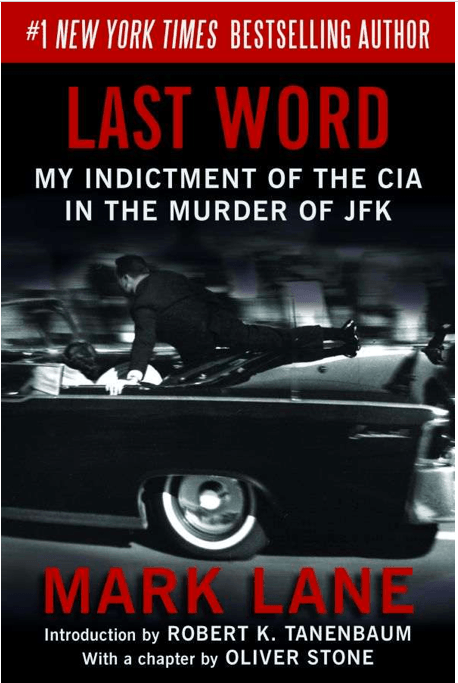
    The lives of CIA spouses and children often make for compelling reading. A good example being Frank Olson’s children and their quest for truth concerning the secrecy about his death. Not to mention the nature of his work. Ian Shapira of the Washington Post wrote an excellent article concerning sons and daughters of other deceased agents who were left wondering what Mum and Dad did for a buck. It is important, touching riveting stuff. Unfortuantely, such is not the case after reading Saint John Hunt’s book about the dubious confessions of his father in the JFK case. Bonds of Secrecy does not come close to be touching or riveting.

    For instance there are accounts from his sister Kevan and Lisa who have disowned Saint John Hunt and brother David (more about him later). Now, that would have made for a more credible tale. Hunt needed as a ghost writer a person ready to ride hard on Hunt’s tale (and tail). With that, the book could have been something of an underground hit. As it stands the original PDF book is merely poor; the Kindle version is a bloated, tacky and unappealing roadside attraction.

    During my time with CTKA, I have become dubious of books with elongated prefaces, forewords and introductions. These are usually included to give the book an air of credibility. They don’t work. And I don’t know anybody who follows CTKA who would find Doug Caddy a credible commentator. Jesse Ventura would also have been better advised to steer clear of the book. I also think these came as something of a letdown to Saint John Hunt. Despite the dubious and often contradictory information his work contains, the original flows pretty well and has an air of ‘take it or leave it’ to events.

    Conspirahypocrite Feeding Frenzy

    However, conspirahypocrites just cannot help themselves.

    In the Kindle edition, there are some 52 pages of fluff praising the dubious credibility of E. Howard Hunt’s story at the beginning. This is hyperbolic overkill. Ventura, while slightly more measured in his appraisal of E. Howard Hunt, like Caddy, seems to buy into the banal LBJ involved/kingpin thesis. As CTKA has proven many times over, the LBJ angle simply does not have a lot of credibility to it-at leasat not yet. So let us return to Mr. Caddy, who was briefly Howard Hunt lawyer at the time of Watergate. Caddy has also been active with an LBJ disinformation guru: He is Billy Sol Estes’ attorney. Thus it is no surprise he stumps for LBJ. Nor is it any revelation he endorses the myth of Hunt being a naive patriot betrayed during Watergate.

    Caddy admits to having worked for William F. Buckley in the founding of the Young Americans for Freedom. This was way back in the late fifties and early sixties, in his high school days. Caddy was the first National Director of the group, which had been founded on the Buckley estate in Connecticut. Caddy states that when he met Hunt at the Mullen Company in Washington, Hunt told him that Buckley had been a CIA agent under Hunt in Mexico City. This was after Buckley had graduated from Yale. This is not exactly accurate. For as HSCA investigator Dan Hardway discovered, Buckley was actually a CIA officer and he was at about Hunt’s level, not beleow him. According to Caddy, he was at the Mullen Company working the PR desk for General Foods, who he was a counsel for at the time. Then Robert Bennett bought the company. Bennett now became president, and Hunt became Vice-President. Bennett had been part of the Hughes Corporation account there. Considering what we know about Hughes at the time, this roughly means that the company was then being run by the CIA. Considering also, that, as even Caddy admits, Hunt never actually retired from the Agency as he said he did in 1970. Hunt also admitted his continuing employment to Canadian journaist David Giammarco when Giammarco was negotiating with Hunt to do a documentary about his life and possible involvement in the JFK case. That fact, of course, tells us much about Watergate. Since it was from the Mullen Company that Hunt then emigrated over to the White House to work with another “retired” CIA officer, James McCord, on the Plumbers Unit. Why a Vice-President of a major PR firm in Washington would do such a top to bottom transfer is anyone’s guess. Caddy then quit the Mullen Company and went to work for a Washington law firm that later represented Hunt. Caddy was then Hunt’s first lawyer when he was arrested for the Watergate break-in. Caddy actually writes that the hush money raised by Herbert Kalmbach for the Watergate defendants was somehow justified since Judge John Sirica was so biased against Caddy and the defendants.

    After Ventura’s short and Caddy’s very long prefaces, the thrid person involved with this book is Eric Hamburg, who reportedly helpd Hunt write the book. Eric used to work for Oliver Stone and ended up being a producer for the film Nixon. Hamburg later wrote the book based on his experience with Stone JFK, Nixon, Oliver Stone and Me. For his part, Hamburg decides to add many, many pages of his rather meandering musings in the Afterword. Adding this to the already sloppy 52 page start the book has, we have well over a hundred pages of well, what? Let us call it, to be kind, rather undistinguished material. We should also discount 11 pages of Saint John Hunt’s eulogy at his father’s funeral in Chapter Sixteen (this was the first Chapter in the original). Then throw out the two final chapters detailing Saint John Hunt’s opinions on “The Conspiracy” and “Watergate” (in both versions). The grand total of non narrative, which now includes, Ventura, Caddy, Hamburg and Saint John Hunt and his dealings with his father; amounts to well over 150 pages. This padding takes up just under half the Kindle book.

    Contradictions and Exagerations

    Oh Brother where art thou?

    Before I checked the inconsistencies between Saint John Hunt’s Rolling Stone interview and his book, I came across these comments he made about his brother David Hunt in Bonds of Secrecy.

    “Shipped off to live in Miami with his Godfather, the ex Bay of Pigs leader Manuel Artime, he quickly found solace and purpose in the glamorous life of a rich Miami cocaine dealer.”

    Later Saint John Hunt states:

    “Attorneys came and took David away. The only explanation they gave was that they (my father) felt it would be a better environment for him if he moved in with his godparents in Miami. This would prove to be a huge mistake; Miami would soon be the cocaine capital of the world, and David was right smack in the middle of it. He would be raised with few good influences and no real love.”

    Yet, in his reply to a piece by Carol J Williams, David takes offense at Williams’ depiction of his godparents.

    “Spin: I am a partner in a successful Los Angeles business and reside in Beverly Hills. The years I spent with my godfather and second family were some of the happiest and most loved times of my life. It sounds as if I was in some crazed military camp to make my involvement look suspect and desperate.”

    As it turns out he was also talking smack, at one point of his diatribe he says:

    “Unfortunately neither Austin nor Hollis were present during the interviews. This was a condition set by my father who kept his second family isolated from his previous life. It was an opportunity for a second chance. He had gotten out of jail, married an innocent civilian and spent his remaining 27 years trying to live a normal life.”

    The last refers to the fact that Hunt’s first wife Dorothy died in a famous plane crash during Watergate. Howard Hunt was then jailed. When he got out he remarried, and the childen he had with his seocnd wife were not nearly as aware of who he was as his older children. This whole E. Howard Hunt’s innocent second family ‘interefering constantly’ is also a constant theme in this book. However, Hunt keeping his former life secret from his second wife Laura is not really kosher. In an interview with Slate in 2004, Laura the ‘innocent’ certainly knew a few of E. Howard’s old mates (calling one notorious exile Felix Rodrieguez by his first name). And Howard had no problems discussing his background in front of her. Consider the following grisly detials about the murder of Che Guevara:

    “Hunt: I have no idea. But I talked with Felix about it. I said, “You were there when Che expired.” He said they had taken him into this room, and they shot him there and killed him. And they had kind of a medical examination table. They put his body on that and cut off his hands. They fooled around for a day or so before they disposed of the body. And that was done in a very sloppy fashion. The colonel had a shallow grave dug and his remains were dumped in there.

    Laura Hunt: [Interjects] For all we know, Felix [Rodriguez] did shoot him.”

    Thus for all this flipping and spinning, I would like to know what Dave thought a year later, when he read his brother’s book? Quite clearly Saint John Hunt was as ill-informed about his younger brother’s time with people like the rabid rightwing anti-Castro Cuban Manuel Artime. as was Carol J Williams who had conducted the interview. It gets even more peculiar though. David says he arranged the meeting and not only that, he praises Eric Hamburg, Hunt’s aforementioned ghost writer, for being the guiding light of the project.

    Papa was a Rolling Stone and Mum too

    One of the oddities about Hunt’s book is that it differs in content to the Rolling Stone interview he conducted in April of 1997. Let’s examine some of his comments in the magazine, starting with those about his Mum.

    “Saint John feels that he never got to know her. She told him that during World War II, she’d tracked Nazi money for the U.S. Treasury Department, and Saint John believes that early in her marriage to his father, she may have been in the CIA herself, “a contract agent, not officially listed.”

    But he isn’t sure about any of it, really.

    “In our family, everything was sort of like a mini-CIA,” he says. “Nothing was ever talked about, so we grew up with all of these walls, walls around my father, walls around my mother, walls around us kids, to protect and insulate us. You grow up not knowing what really happened. Like, who was my mom, for Christ’s sake? Was she a CIA agent? What was her life really like?”

    I think there is enough independent evidence to suggest Hunt’s first wife, may well have had agency connections. Thus, his testimony in his book about his mother’s intelligence ties is likely credible and interesting. However, rather than grab one’s curiosity as it should, it ridicules itself. If there were so many walls and the children so insulated, why did his parents expose him to so many dangers in the book? Were they truly that inept?

    “I remember one day when my mother and I went out for a ride on the horses, she told me that Papa was not actually working for a public relations company, but was really working for the Nixon White House, doing some secretive things that had her quite worried. She said that against her advice, he was going ahead with an operation that was being directed at the very highest levels of government. He was now so imbedded in this mess that she could not be sure of its operational security. There were men whom she didn’t trust. He had gotten in with people that weren’t themselves aware of what was required of them, professionally speaking. “Amateurs” she said angrily. “Your father, as smart as he is, can’t see the forest from the trees.”

    It’s amazing the recall Saint John Hunt has here, since the above was nowhere in the interview. Did his memory improve over time? Well probably not. Because when Hunt was employed by the PR firm the Mullen Company, he was not working for the Plumbers Unit at the White House. White House hatchet man Charles Colson and Bennett arranged that after constant lobbying by Bennett. Perhaps we can chalk this up to Saint John Hunt’s former life. The guy had a history as a drug abuser, including LSD, cocaine and meth—for the better part of his teenage and adult life. He actually dealt meth. Meth is notorious for causing brain damage and memory loss, in particularl after long term abuse. And don’t let it bother you either, that an intelligence professional, could call others ‘amateurs’ after blurting out details of a sensitive ongoing operation to her son.

    But it also calls into question the author’s credibility. His mother by all accounts in the aftermath of Watergate appeared to be an extremely competent individual. She also had no problem working with his Dad’s pals. The author skips the part where she helped organize the banquet in the Continental on the 26th of May, 1972. This banquet was disguised as a meeting for Ameritas Insurance and was a cover the first official break in of the Watergate. Which for whatever reason, was put off till the 17th of June , when Hunt’s father got caught (Jim Hougan, Secret Agenda, pg 140).

    Thus Saint John Hunt’s comments about his family in the build up up to Watergate, seem a bit off kilter. In the April 5, 2007 article in Rolling Stone he stated …

    “They had lots of marital problems, but when it came down to it, she had his back, and she could hang in there with the big dogs.”

    Yet, things get more dramatic in the book. Apparently, for all the ‘marital problems’ his parents rarely fought. Not only that, Dad left his spy gear and fake I.D’s lying around in the master bedroom.

    “I had heard them fighting at night and I wondered what this was about. My parents rarely fought. I was curious, and one day when they were gone, I snuck into their bedroom at the rear of the house and looked around. What I found was some ID’s with my fathers’ picture on it, but his name was not E. Howard Hunt. It was Edward J. Hamilton. I also found a reddish wig. This is the famous wig that my father was reported to have worn when he interviewed Dita Beard for John Mitchell, the attorney general of the United States.”

    My Dad the spy wasn’t the Best Parent

    In the Rolling Stone interview, Hunt’s portrayal of his father was generally that of a cruel, authoritarian person.

    “Like Saint John says, he never felt guilt about anything: “He was a complete self-centered WASP who saw himself as this blue blood from upstate New York. ‘I’m better than anybody because I’m white, Protestant and went to Brown, and since I’m in the CIA, I can do anything I want.’ Jew, nigger, Polack, wop — he used all those racial epithets. He was an elitist. He hated everybody.”

    In the interview he also recalls his father as ‘that fucker’ concerning his alibi the day of the assassination. The following essentialy says that Hunt lied under oath about where he was on the say of Kennedy’s murder. Hunt said he was putting together a Chinese dinner with his wife.

    “He was always looking at things like he was writing a novel; everything had to be just so glamorous and so exciting. He couldn’t even be bothered with his children. That’s not glamorous. James Bond doesn’t have children. So my dad in the kitchen? Chopping vegetables with his wife? I’m so sorry, but that would never happen. Ever. That fucker never did jack-squat like that. Ever.”

    Hunt also recounted for Rolling Stone how his father unnerved him when trying to get him into a high-class prep school St Andrews during a school dinner. At dinner near the school, Hunt refused to let his son go to the bathroom. And so he urinated on himself. This tale of humiliation does not make it into this book. Nor does Hunt’s tale to Rolling Stone of being sexually abused while at another school, St James. Apparently, his father E. Howard got wind of the evil deed, withdrew Saint John from the school and the teacher was never seen again. This was after Howard Hunt came to the place with with “a carload of guns”…

    The bogeyman presented in the Rolling Stone interview is near non-existent in Saint John’s book. In the previous article, the son said that Howard Hunt “was a mean-spirited person and an extremely cruel father.” But here, his portrayal throughout is that of a flawed, stern yet ultimately heroic person. On page two of the PDF version Hunt writes

    “HOW CAN I EXPLAIN A LOVE SO POWERFUL AND TRUE THE MAN THAT I HAVE TRIED TO BE IS THE MAN I SEE IN YOU.”Sure it is bad form to talk ill of the dead, but Hunt’s dramatic turn around, after Rolling Stone makes one a bit skeptical.

    Howard Hunt and his Assassination Confession

    Another issue brought up in the Rolling Stone interview, was Howard Hunt’s interactions with Kevin Costner. The story pumped by the Hunt brothers since, is that after Costner offered Hunt five million dollars, he then insulted and harassed Howard Hunt. And then, although the five million was stil floating around, Costner lowered the offer to a hundred dollars per day for his time. Saint John found that insulting and he turned down Costner. Yet, the story presented in Rolling Stone by Saint John is incomplete.

    The man reallly responsible for Hunt’s rather dilatory attempt to make a clean breast of whatever his role was in the JFK case was not really Costner. It was not really Saint John. It was David Giammarco. Since the late eighties, the Canadian journalist had an interest in the JFK case. And he had interviewed several people about the matter. He eventuallly got around to Howard Hunt. Like a good journalist, he tried to cultivate a trusting relationship with Hunt. He talked to him on many, many occassions. He often flew down to Miami to do so. In conversations with Jim DiEugenio, David said that he really got into a very interesting and revealing friendship with Hunt. This did not happen over a matter of months. It took over several years to do so. Inevitably, Hunt talked to him about President Kennedy and Bobby Kennedy. He despised them both. Hunt was very bitter about the Bay of Pigs. He once said about President Kennedy in that regard, “JFK, may he rest in pieces.”

    Over time, Giammarco got around to asking Hunt about his possible role in the JFK case. For which there is some interesting evidence. Since Giammarco was pals with Costner, the actor suggested doing a documentary on the topic. Hunt seemed interested at first. Costner and Giammarco said things would be OK as long as everyone kept it secret and Hunt agreed to talk on camera about what he knew about the Kennedy assassination. But then, in 2002, Hunt seemed to back track on the idea. Both Costner and Giammarco were surprised. But the journalist persisted in talking to the spy. And Hunt relented. Hunt would do three interviews. One in Miami, one in Los Angeles and one in Dallas, in Dealey Plaza. Hunt told Giammarco about the outline of a plot led by Lyndon Johnson. It then extended down to CIA officer Cord Meyer. The project would be run out of London. The plotters included William Harvey, David Phillips, Dave Morales, Frank Strugis , Tony Veciana, and Lucien Sarti as the main assassin. Sarti was firing from a storm drain. It was now informally agreed that the three-Costner, Giammarco and Hunt-would be equal partners in a documentary. Once the project was sold, they would all share in whatever money it fetched.

    The problem was twofold. First, Hunt told his attorney about the proposal. He and his lawyer now prepared a lenghty counter offer. Secondly, Hunt wanted to be paid a quarter million in advance. As far as Giammarco and Costner were concerned, this was a no-no. Because it would look like they were practicing checkbook journalism. And that would impact the credibility of the documentary. Further, Hunt wanted the funds mailed to a Swiss bank account. And he wanted 24 hour security protection before and after the documentary aired for an indefinite time. Again, Giammarco and Costner both did not want to advance the funds since it would look like they were paying for the information. As the project began to collapse, Hunt now began to discount what he knew about the conspiracy. He even said that perhaps he should novelize it.

    There is much controversy about not just what happened with the project, but also about the contents of what Hunt actuallly says happened. Giammarco told DiEugenio that he always felt that Hunt was not telling him the whole story. Which shows good insight on Giammarco’s part. Hunt was always involved with the action oriented part of the Agency. Whereas Meyer was really a propaganda specialist. Since the fifties and the CIA coup in Guatemala, Hunt had worked with people like Tracy Barnes, Phillips, and Director Allen Dulles. This carried down to the Bay of Pigs. Since Hunt spoke fluent Spanish, he was responsible for constructing the CIA’s government in exile. When Kennedy insisted on making Manuelo Ray part of that group, Hunt resigned. Ray was too liberal for Hunt, who was extremely conservative. But, as Jim DiEugenio shows in his book, Destiny Betrayed, the Second Edition, Hunt was supposed to return if the project succeeded! Therefore, he would be part of putting together the new Cuban government. And further, the CIA had secret plans to make sure Ray would not be part of it. Hunt and the Agency would put in power their favorites, like Artime. And, in fact, Operation Forty included an assassination mechanism to not just get rid of the present Cuban governmnet, but also any moderates and liberals that Kennedy wanted in power. (See DiEugenio, Chapter 3, “Bay of Pigs: Kennedy vs. Dulles.” This is probably the best short treatment of that affair in book form.)

    After the project capsized, Hunt then worked for Dulles. In two ways. To defend him against the investigation in the White House led by General Maxwell Taylor. And to ghost write the Dulles book, The Craft of Intelligence. Hunt was then detailed to the DOD, Domestic Operations Division, run initially be Barnes. Which, of course, the CIA was not supposed to be doing. Since their charter prohibits operating on the homefront. It appears that Clay Shaw was also cleared to work in this division. Victor Marchetti said that DOD was “into some very bizarre things.” So bizarre that Marchetti did not want to artiuclate them. (DiEugenio, p. 166)

    And then, of course, there is the whole Angleton/Hunt memroandum episode. This was a memo written by Angleton to Richard Helms in 1966. It said that they needed to consturct an albi for Hunt since he was in Dallas on the day of Kennedy’s murder. (ibid, p. 363) As it turned out, when Hunt sued over this story, it turns out he actually did not have an alibi for where he was on the day of the assassination. (ibid) Therefore, for Hunt to say, as he did in his so-called confession, that Sturgis asked him if he wanted to be part of the plot, that seems both self-serving and illogical. If anyone was going to ask anyone, it would be the other way around. As Hunt recurited Cubans for Watergate. One of them being Sturgis.

    Watergate Ramblings

    For a time Jim Hougan, and his book Secret Agenda, was the essential tome in understanding, or at least grasping, some of the fallout from Watergate. It was that book that first brought into question who Hunt and Jim McCord were really working for while with the Plumbers Unit in the White House. It also exposed them both as lying when they said they did not know each other prior to that assignment. And it raised the ultimate question about the whole affair: Were Hunt and McCord deliberately sabotaging the Plumbers the night of the break-in? Was the goal to really topple Nixon? And is this why McCord threatened the White House in December of 1972? He wrote Jack Caufield that if President Nixon fired CIA Director Helms, and if Nixon tried to blmae the CIA for Watergate, “every tree in the forest will fall. It will be a scorched desert. The whole matter is at the precipice right now … if they want it to blow, they are on exactly the right course.” McCord was offered money and executive clemency if he would plead guilty and stay quiet. He refused the offer. Nixon then did fire Helms.

    A month later, McCord wrote his letter to Judge John Sirica. He said that perjury had been committed in his court room. Witnesses testified under pressure and duress. In a meeting with Sirica, McCord said that the witnesses and defendants lied at the behest of the White House, specifically Attorney General John Mitchell and White House counsel John Dean. McCord said that although the Cubans, recruited by Hunt, may think that the CIA had something to do with Watergate, the Agency really did not. It was this act which exploded the Watergate affair just when it was about to go gently into the night. As Hougan writes in his wonderful book, there was something peculiar about McCord working for the Committee to Re-elect the President (CREEP). In his office, he did not have a photo of Nixon on the wall. He had a picture of Helms there. It was signed “With the deepest affection.” Further, McCord worked the security detail at Langley. He was known as a first rate, black bag man. That is, he was good at secretly breaking into places. Yet, it was McCord who acually retaped the door after the security guard first removed the tape on it. It was that inexplicable act which guaranteed the break-in would be discovered and the police would be called. When people in the CIA heard about what McCord did, they understood something was up. Someone that good would not do something that stupid. Hence the title of Hougan’s revolutionary book, Secret Agenda. And in that fine book, Hougan also accuses Hunt of being part of the secret Helms operation inside the Plumbers.

    Now, in the Rolling Stone article, Saint John says that his father retired from the CIA some time after the Bay of Pigs. He then went ahead and joined the Plumbers Unit at the White House. That summary does not seem to jibe with what Hougan dug up about Hunt through his research. Or what Hunt told Giammarco. Hunt appears to be employed by the Agency throughout this time period. Which, combined with what we have learned about McCord, makes a strong case that neither McCord nor Hunt was really working for either CREEP or Nixon at the time of the Watergate break-in. In the Rolling Stone article, the son has the father waking him up in the middle of the night after the Watergate break-in. Howard then has him help him throw some bugging and surveillance equipment into the C & O Canal near the Potomac River. The point though is that in Hougans’s book he has Hunt taking this stuff to McCord’s house, since it was his equipment. In the article, the son says that Hunt did all this because he had botched the break-in. Which, as we have seen, is a highly debateable point. Neither McCord’s nor Hunt’s bizarre actions that night were ever explored by the Senate Committee led by Sam Ervin, or the Watergate prosecution led by Leon Jaworksi. The CIA connections to the crime were not explored until the Pike Committee was disbanded in the House of Representatives. Later, congressman Lucien Nedzi did do an inquiry into CIA participation in Watergate. This helped form the basis for Hougan’s work. So based on Hougan’s book, maybe Hunt should have made a confession about Watergate instead of the JFK assassination.

    However, as big a fan as I am of Jim’s investigative work, it had the misfortune of examining multiple threads in a confused Watergate quagmire. Some of which were dead ends. For example, it was many years after Hougan’s book came out, that Mark Felt was named as the near mythical ‘Deep Throat’. While Hougan hit on a lot of interesting information, with regards to call girl rings, it appears that ultimately that part of the story only had legs in it’s initial phases. Yet it did not really pan out regarding John Dean and his wife. As Jim DiEugenio explained in an e-mail in March of this year.

    “When they went to court, Philip Bailey ended up being a poor witness. And that whole call girl angle ended up being very questionable. Today, I think its the worst part of Hougan’s book.

    What they appeared to want out of Spencer Oliver’s desk was his strategy for stopping McGovern. He was the guy in charge of that effort. This is new stuff that Bob Parry dug up.

    What they wanted from O’Brien was anything they could get on him because of Hughes to negate any thing they would try to connect Hughes to Nixon with.”

    Consortium News Journalists Robert Parry and Lisa Pease have slightly different appraisals, needless to say. Watergate is a complex business and the truth of the matter lies somewhere between these the musings of Hougan, DiEugenio, Parry and Pease, all of them skilled researchers. Yet none of their intelligent analysis is found anywhere in the pages of Hunt’s Kindle book (bar some quotes from Hougan). So I discourage anyone from going to Bonds of Secrecy for any lessons on Watergate. (Hougan is reportedly working on a sequel to his book focused on the call girl ring and John Dean. So this may not be the last word on that issue.)

    United Airlines Flight 533

    The United Airlines flight 533, in December 1972 was a tragic air accident that claimed the life of Dorothy Hunt, among with over forty others. It is a matter of some debate as to what really happened. Dorothy was carrying thousands of dollars with her as she was in the process of paying money to certain witnesses to stay quiet. Needless to say I find little, if anything, Saint John or his buddies say about it as credible. What’s interesting is that Hunt apparently had his wife take out 250,000 dollars worth of flight insurance payable to E. Howard Hunt.

    It is also interesting to note that, as mentioned previously, it appears Dorothy was CIA (one of the few verifiable and relevant observations in the book). Hunt Junior believes his mother was killed by the Nixon administration. Now, this line was pushed by the late Sherman Skolnick for years, and to the author’s credit, he doesn’t go there. Skolnick shot the line that the reason for Dorothy Hunt’s being eliminated was due to information she had about Nixon’s role in plotting the Kennedy assassination. Which, if Hunt’s confession is true, Nixon had no part in. Skolnick was capable of some good work. However his stuff on Watergate, and the airline crash is a little dated now. For instance, Sherman wrote that Dorothy had over 2 million dollars in her suitcase. Everyone else says it was more like ten grand.

    So much has been made of this crash. Hougan believes something suspicious could have happened. So did Carl Ogelsby. Jim DiEugenio believes it was likely a fluke. I have to say I do not know. I lean on the side of something dodgy myself. Charles Colson stated to Time in the 1974, article “Colson’s Weird Scenario” that he felt the CIA and Hunt where behind it. Unsurprisingly, the official version via Time was that Colson was covering for Nixon and blaming the agency. A good debate as to whether or not Nixon felt like a scapegoat of the agency, is not present in this book. Although there was no sign of sabotage found, and the communications were recovered, there was some interesting maneuvering after the crash. White House aide Egil Krogh was made Undersecretary of Transportation. Alexander Butterfield, another White house aide, became the new chief of the FAA. Dwight Chapin, Nixon’s appointments secretary became a top executive with United Airlines.

    None of this makes it anywhere in this book. Which, as said, goes out of its way to try selling the line of the loyal American Cold Warrior. Except he was sold out by the leaders of his country whom he served. This lame sentiment is shared by the famous William F Buckley Jr, a close friend of E Howard and one time cohort of his at the CIA. Buckley was hanging around Hunt and his family in the aftermath of Watergate and the tragedy. Yet, of course, this sort of fascinating detail is nowhere in this book. Was Buckley babysitting Hunt fo rhsi former employer? If so, why?

    Conclusion

    Near the end, in an attempt to establish credibility, Hunt and Hamburg go for a Peter Scott style enigma ending i.e. of there being multiple conspiracies to do away with Kennedy. The point of this concept is, of course, that somehow LBJ’s plot worked. Or did they all spontaneously collude on the day? This is what I cannot fathom about the concept of a JFK pot pourri assassination. Is it too abstract for people to realize that Kennedy had many enemies and that the assassins took advantage of this, and coordinated a centralized and highly organized strike? Would Hunt’s superiors Dulles, Angleton and Helms have allowed such a mess? Doubtful, however the lame “LBJ did it with Nixon” is the sort of story to the conspiracy that they would have covered it up with.

    E Howard Hunt, was one of the most cynical and streetwise guys to have ever worked the US intelligence beat. To turn him into some kind of ‘cult’ intelligence hero, betrayed by those on top does not seem to wash. The people who ran Howard Hunt, were ostensibly individuals like Dulles, Helms Barnes, and to a much lesser extent, Angleton. You won’t hear much of that in either his or his son’s books. In fact in his book Undercover, which was the autobiography Hunt wrote after Watergate, Hunt more or less skipped the years from 1962-64. This current lame effort is just another of the many weak treatises out there at this time. Saint John Hunt’s book is not credible enough to give any decent review about. Indeed, I have discussed his lack of credibility before in four essays prior to this one.

    Alex Jones on the Kennedy Murder: A Painful Case (part 1)

    Alex Jones on the Kennedy Murder: A Painful Case (part 2)

    Jesse Ventura’s Conspiracy Theory on JFK

    Evaluating the Case against Lyndon Johnson

    It could have been much better with more careful handling and judgement. Hunt’s life, in the wake of the tragedies that engulfed his family, his downward spiral and his kicking meth (something, I respect him for), all these elements had the potential to be an interesting and moving narrative. Everybody likes the story of a rogue making good. Even more interesting would be getting verified accounts of his parents, then using the Kennedy assassination and Watergate to serve as backdrops. What, for example, did his Mum and Sisters make of JFK or Bobby Kennedy? In the early days after the Rolling Stone article appeared, it appears that he and his brother actually had a good deal of skepticism towards what their father had told him about the mechanics of the assassination.

    What happened to that skepticism? Possibly a movie deal with someone less scrupulous than Costner tempted him? As stated above, Hunt’s personal story, with some good supplementary research about his father and mother, could have been politically interesting and personally compelling. But as noted above, it didn’t come out that way.

  • General Giap Knew

    General Giap Knew


    In mid-August 2011, I traveled to India for a short stay of less than a week. I remained in the nation’s capital of New Delhi and especially visited one elderly relative to get his insights before I traveled onward to Vietnam. My relative’s name is Jatindra Nath Chaudhry, and he was India’s first Ambassador to Vietnam, from 1950-1955. Since India had traditionally been in the forefront of the Third World anti-colonial movement (as well as a leader amongst the Non-Aligned nations), India recognized North Vietnam as the official Vietnamese government and Hanoi as its capital. While posted there, Ambassador Chaudhry also happened to be India’s youngest ambassador at the time (in his twenties). He soon formed a long-lasting acquaintanceship with Indian Prime Minister Jawaharlal Nehru who had appointed him.

    I visited Ambassador Chaudhry for over one hour and had an excellent discussion with him about his experiences in Vietnam as well as his advice for my pending trip to Hanoi. He provided me with a handwritten note as well as nearly a dozen historic black-and-white photographs from his time in Vietnam. Some of the priceless photos included images of his officially receiving the International Control Commission delegations that arrived in Hanoi in 1954 after the Geneva Agreement. One such photograph also featured himself standing behind a table at which were seated North Vietnamese Prime Minister Phan Van Dong, Indian Prime Minister Nehru, and the legendary Chairman Ho Chi Minh himself. Another photograph featured Ambassador Chaudhry visiting then-Saigon on a token diplomatic visit to briefly meet South Vietnamese President Ngo Dinh Diem (and to whom, in the photo, he is presenting a small gift as a goodwill gesture). I was delighted with the photographs and the fruitful discussion from Ambassador Chaudhry. Before parting ways, he told me that he had rarely met Ho Chi Minh, and that he met General Vo Nguyen Giap on only a few occasions as well (in the 1950s while as Indian Ambassador, and most recently in 1984 when Gen. Giap visited India himself). He also told me that after he returned to India from Vietnam, he later befriended President Kennedy’s Ambassador to India, the distinguished economist John Kenneth Galbraith. He added that he was invited to dinners and other gatherings with Prime Minister Nehru and Ambassador Galbraith, and that quite often Nehru had verbally cautioned Galbraith to get America out from a dire situation in Vietnam. He said these things with the best intentions for the United States and its young president. I thanked Ambassador Chaudhry for these insights and his gift of vitally historic photographs and soon departed for Vietnam.

    vietnam map

    Vietnam During the Vietnam War

    By late August, I arrived in Hanoi, Vietnam, a city with perhaps the highest degree of humidity I have ever experienced. Nevertheless, it was an eye-opening journey to visit a defiant capital that, through the ages, had been besieged by, but proudly resisted the French, the Japanese, the Americans, and even the long-ago marauding armies of Genghis Khan. Within a few days of my arrival, I managed to visit two different places that would aid me in my goal of trying to contact and meet legendary General Vo Nguyen Giap. Mindful that General Giap’s centenary birthday celebration was in two days time on August 25, 2011, I visited a temporary exhibit in downtown Hanoi featuring photographs of his life and military campaigns. While there, I talked with a young exhibit organizer who got me in touch with an American expatriate who had been in Vietnam since the height of the war in the late 1960s and early 1970s. Her name was Lady Borton and she had come to Vietnam as a Quaker relief worker many decades earlier to assist in humanitarian efforts. First working in South Vietnam, she was eventually trusted enough to be invited across the border into the North and assist in relief efforts there.

    giap
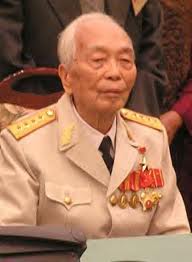
    General Giap

    I telephoned Lady Borton (her actual name birth name, not a British-sounding title) and soon met her at her office in Hanoi. She gave me guidance about traveling the city but cautioned that meeting General Giap would be nearly impossible. She also mentioned that he had been placed in the permanent care of Military Hospital 108 in Hanoi where the staff could keep a 24-hour watch on his fragile health. When I asked if he was facing life-threatening conditions, she replied no, that he simply needed assisted living. She added that he was still cognizant and often read daily. Thanking her, I nevertheless arrived at my next destination the following day, the Indian Embassy in Hanoi. Armed with full determination as well as Ambassador Chaudhry’s handwritten note and historic photographs, I set out to meet the right authorities who would aid in my quixotic quest to meet General Vo Nguyen Giap.

    At the Indian Embassy, I was initially told to schedule an appointment with the Defense Attache for the following day. I did so and arrived the next day to meet the colonel (name withheld due to his insistence on keeping the arrangement discreet) who was then the current military attache to the embassy. I presented him the personalized note given by Ambassador Chaudhry on my behalf as well as the one dozen historic black-and-white photos from 1950s Vietnam during his official tenure there. The colonel gazed intently at the photos and was both intrigued and pleased with the historic images, commenting that he was seeing many of them for the first time. In fact, he said, even the embassy and its archives did not have many such photos. He asked me permission to have the pictures photocopied on the embassy’s in-house copier and I quickly gave my assent. We then returned to the subject of the purpose of my visit. Beneath a giant framed wall photo depicting Prime Minister Nehru standing with Ho Chi Minh, I conferred with the colonel on how best to approach the possibility of meeting General Giap. He remarked that he had once met the famed general himself a few years earlier when he first arrived as attache to the embassy. However, the general’s health had declined since then and he was thus placed in the care of Hospital 108 by his family. The colonel counseled that it was highly unlikely that I would be able to meet Gen. Giap because the family wanted his health and privacy kept out of the public eye (to such an extent that only the Vietnamese Prime Minister and the nation’s top military leaders were allowed to visit him at his hospital suite). Sensing my disappointment, the colonel did suggest one final option. He mentioned the name of one native Vietnamese employee at the embassy who not only assisted the Indian staff in communications with the Vietnamese local officials and government, but who also happened to be a close family friend of General Giap’s youngest son. I was told once more to arrive at the embassy for a special and discreet appointment with a certain individual to help facilitate the possibility of meeting either General Giap or his family. I held my breath and waited to see how things would unfold.

    I arrived for the final time at the Indian Embassy to meet a middle-aged Vietnamese gentleman who had been a lifelong friend of Vo Hong Nam, General Giap’s youngest son. Throughout our conversation, this helpful gentleman kindly corrected me when I mentioned the names of historical figures in Vietnam’s turbulent twentieth century history (for instance, Diem was pronounced “Xiem” and Giap was pronounced “Jop” or “Zop”). As the appointment ended, this helpful fellow provided me with the email address of General Giap’s son, Mr. Vo Hong Nam, and suggested that I send an email right away explaining my background (such as being related to Ambassador Chaudhry) as well as my intentions for meeting with the family. The rest would be up to the son on whether I would be allowed to visit him at the family home or not. The Vietnamese gentleman wished me good luck as I thanked him and immediately left to compose a proper email requesting a meeting. After sending off the email by evening, I waited in nervous anticipation the next day for any form of reply. Soon enough, it came from Mr. Vo Hong Nam himself, who told me to pay him a visit on the afternoon of September 4, 2011. He also provided me his telephone number and address. I was elated that, at long last, I could now finally meet the immediate family of one of the great military figures in twentieth century world history.

    I set out on Sunday, September 4, 2011, for the home of General Vo Nguyen Giap. Located in a residential area some distance from downtown, my taxi wandered past neighborhoods of people out on their bicycles or taking leisurely walks. I soon arrived at a massive compound with a gated entry. I got out and walked up to the curbside guardhouse booth out of which stepped a fully-uniformed Vietnamese soldier who asked me in halting English my name and the purpose of my visit. I explained my appointment to meet with Gen. Giap’s son. No sooner had he dialed the direct line to the house, that off in the distance I saw a man in slacks and shirtsleeves leaving the home and approaching us via the long oval-shaped driveway that led to the front gates. Soon enough I was waved inside and walked halfway across the driveway to meet up and shake hands with Mr. Vo Hong Nam, the youngest son of General Vo Nguyen Giap. He gave me a quiet welcome and smile and pointed toward the side route by which to enter the house. I glanced once more at the massive driveway and sprawling front lawn, remembering that his had been the residence of the French governor prior to Dien Bien Phu.(1) Arguably one of the largest houses in Hanoi, it was, in the aftermath of the battle, given as a well-earned award from Ho Chi Minh to his victorious general and right-hand man, the ever-loyal and indefatigable Vo Nguyen Giap.

    Once inside, I was taken to a small sitting room decorated with Southeast Asian art and furniture. After initial greetings and pleasantries, Mr. Vo Hong Nam asked me about my interest in Vietnam, etc. Before further explaining my intent of writing a book on President Kennedy’s final year in office, I first opened the packet of photos given to me by Ambassador J.N. Chaudhry. Detailing exactly how the former ambassador was related to me, I also mentioned two other relatives who had served at high levels in India’s previous administrations. One relative from my father’s side, Baldev Singh, had been India’s first Minister of Defense. And another from my mother’s side, Balram Jakhar, had been Speaker of the Parliament before eventually becoming Minister of Agriculture, then retiring as governor of India’s largest province in 2009. Vo Hong Nam then looked with deep interest at the old black-and-white photos, especially the ones depicting the International Control Commission delegations arriving in Hanoi in 1954. I saved the best one for last. Having had it framed, I gave it as a gift to Mr. Vo. It was the photo of Ambassador Chaudhry standing behind the three great anti-colonial Asian legends, and Mr. Vo himself said their names out loud as he pointed to each one from left to right, “Pham Van Dong, Jawaharalal Nehru, and Ho Chi Minh”. He smiled at the framed photo. Unfortunately I did not have one of his illustrious father, but I explained that Ambassador Chaudhry had met him on a few occasions in the 1950s as well as most recently in India in 1984.

    I next asked the key request which had been the main purpose of my entire trip. I asked Mr. Vo if it was in any way possible to visit his elderly father at Hospital 108. He emphatically shook his head and said “no”. Recognizing the tone of finality to his reply, I did not argue the point further. I did, however, congratulate him on the fact that his father had recently celebrated his 100th birthday, and that he was indeed the greatest military figure of the twentieth century. He thanked me for my sincere remarks. We then moved on to the heart of the discussion and the reasons for my visit. I reminded him that I was interested in writing about President Kennedy’s final year in office and how transformational the year 1963 truly was. When I conceded that President Kennedy had not been quite perfect in his earlier foreign policy, Mr. Vo immediately interjected and said with a firm nod of his head, “Cuba!” I was a bit taken aback at his blunt assertion but realized that he was technically right (at least in the context of 1961 and the Bay of Pigs, although this was not the proper time nor place to argue that it had been Richard Nixon’s and Allen Dulles’ plan carried over from 1960). I then moved on and discussed other events from 1963 such as the iconic self-immolation of Buddhist monk Thich Quang Duc as well as the Nov. 1-2, 1963, coup against Ngo Dinh Diem and his brother Nhu. I asked Mr. Vo for his advice about looking through government or newspaper archives for these critical events and he said to hold on for a moment. He picked up a phone and explained that he was dialing the editor of the prominent “Nhan Dan” newspaper, which had been the official paper of record in Hanoi and the North since independence. After conferring with the editor and then interrupting once to ask me specifically, “Do you only need headlines from 1963?” (to which I replied yes), he soon ended the inquiry by phone. I quickly realized that this was the personal power and connections that only the son of someone with the stature of General Giap could carry.

    He then stated in a very clear and firm voice,

    President Kennedy was withdrawing from Vietnam in late 1963.

    I then moved on to the penultimate topic regarding 1963, the change in Southeast Asia policy, specifically for Vietnam, that President Kennedy was carefully but confidently carrying out. When I mentioned this vital policy to Mr. Vo, I said, “President Kennedy was finally changing his foreign policy in regards to Vietnam in 1963”, and before I could even finish my sentence, Mr. Vo interrupted and added, “He was withdrawing from Vietnam.” Momentarily surprised by what I had just heard, I then quickly asked him to repeat what he had just said so as to be sure I had heard right. He then stated in a very clear and firm voice, “President Kennedy was withdrawing from Vietnam in late 1963.” I was beyond a loss for words and sat transfixed at what I had just heard. The son of General Vo Nguyen Giap, sitting just a few feet across from me, had just unequivocally confirmed what many scholars and experts had pieced together and been saying for years, only to be dismissed by the Establishment as “wishful thinkers” and starry-eyed idealists or, in some cases, as “Kennedy apologists”. Some had even been challenged as to the validity of their sources although many correctly cited the available U.S. government record from the Kennedy Administration papers as well as the National Security Action Memorandums (NSAMs) signed by President Kennedy in October 1963. Yet, here was the most astonishing and perhaps unimpeachable source of proof, right in front of my eyes. What could be a more credible and original direct source than the former “enemy”, General Vo Nguyen Giap (represented by his son), confirming that its rival’s leader, U.S. President John F. Kennedy, was indeed logistically carrying out a de-escalation policy for American personnel to withdraw in phases (until there would be virtually no military advisors left by 1965). Most likely General Giap’s military and intelligence operatives and analysts had to have discovered this by tracking the patterns of oppositional foreign (American) troop movements and the quantifiable logistical reductions that were visibly ensuing. It may also be likely that word of President Kennedy’s NSAMs might have somehow leaked and reached North Vietnam, who probably rejoiced with relief at hearing that a potential deadly foe was withdrawing from the embattled homeland (with only future promises of financial aid and war materiel to sustain South Vietnam). Nevertheless, I was both amazed and grateful for Mr. Vo’s candid statement and assessment regarding that most crucial and pivotal period of the Kennedy Presidency.

    As the hour drew to a close, I realized it was time to leave, and I was most satisfied that my discussions with Mr. Vo Hong Nam ended with a most unexpected yet reaffirming statement regarding President Kennedy and his intentions for America and Vietnam. I never knew that I would be leaving the home of Vietnam’s most famous and victorious general with an added insight and gem of historical knowledge. This was more than proof enough for all the naysayers and critics who doubted the slain president’s true peaceful intentions. Although he could not speak beyond the grave for himself, such living participants and legendary foreign figures could bear witness to that era and the dynamic breakthroughs that were in the midst of occurring. As I profusely thanked Mr. Vo for his time and honesty, I rose to shake his hand and then realized that I should definitely snap a photograph of my hospitable host while situated in his historic and noteworthy residence. In Vietnamese, he called out for someone and soon a young woman in her late teens appeared. Likely his daughter, he asked her to hold my camera and take a photograph of us standing next to a large marble bust of his famous father. I thanked her and then he and I proceeded out the door by which we came.

    As we were walking out towards the lush green backyard and landscaping, I again sensed the historical significance of the residence and asked if Chairman Ho Chi Minh had visited here often and if he remembered him. Although he was just a young teen himself at the time of Chairman Ho’s death, he said, “Yes, I remember him well”. Walking back to the front of the house and the enormous driveway, a middle-aged woman appeared in a low front balcony of the house. She said “hello” and was holding a camera herself. I said “hello” as well and then asked Mr. Vo if that was his wife and he nodded yes. He then spoke again in Vietnamese, and she responded by waving us together and to hold still. She then snapped a picture of us together before disappearing back into the balcony. As we passed a gate separating the house from the driveway, I realized I should take one final photo of Mr. Vo myself. He complied and stood at the foot of the gateway, with the fabled house behind him. He then motioned for me to likewise stand where he was, to thus take a similar photo of me standing in front of his house. After that, we walked the length of the driveway to the front gates where he saw me off. He asked for the guard in the booth to call another taxi for me, and then I thanked him one final time for his revealing insights and to give my sincerest regards to his legendary father. We shook hands one last time and then he turned and left.

    Soon enough, a taxi came and as I got in, I took one last look at the brush with history that I had just experienced. I had been fortunate enough to visit the home and son of Dai Tuong Vo Nguyen Giap, the most victorious general of the twentieth century, a man whose starting ambition in life was to be a history teacher until the cruel realities of fate had changed his destiny. And the realization crystallized that we once had a president who was willing to make a truce with these strong and resilient people, whose leader Ho Chi Minh had visited America on the eve of World War I and had even translated our Declaration of Independence into Vietnamese at the end of World War II in an effort to forge a friendship with the United States. How foolish and tragic of us to have rejected his olive branch, only to learn the hard way that these were a people who could not be subjugated. Alas, we once had a young president not so long ago who had come to this realization himself.


    1. Henri Hoppenot, Diplomat and High Commisioner of France in South Vietnam Apr1955 – 21 Jul 1956

  • John McAdams and the Siege of Chicago, Part 2


    with Brian Hunt


    Upon the 48th anniversary of Kennedy’s assassination, John McAdams brought out a book on the case. That book, entitled JFK Assassination Logic: How to Think About Claims of Conspiracy, was oddly titled. For the simple reason that most people who have encountered McAdams come away thinking that his thought process concerning the JFK case is anything but logical. In fact, as we have seen, it is actually kind of warped.

    That book has been reviewed on this site more than once. (Click here for one.) Therefore, here I would like to discuss an interview the author gave about the book to the Hartford Books Examiner. First, I think it is interesting that McAdams got an endorsement from the former House Select Committee on Assassinations Chief Counsel Robert Blakey. Blakey, of course, is credited with being the last person in an official position who actually could have done something about the JFK case. And he didn’t. Most objective observers would say, he did all he could to cover up the case. For instance, he accepted the evidence at the so-called sniper’s nest window. Well Blakey is quoted as saying about JFK Assassination Logic, “McAdams gives you a crucial road map-not to decide what you should think, but how to make up your mind in the face of conflicting information.” Let us examine some of that conflicting information.

    I

    “The evidence linking him [Oswald] to the weapon is overwhelming.”

    John McAdams, JFK Assassination Logic

    In that interview the professor was asked to summarize the evidence in the Warren Commission that validates its conclusion about Oswald. McAdams responded thusly: “A solid paper trail connects Oswald to the rifle. Hard forensic evidence (bullet fragments, shell casings) connect the rifle to the shooting. Oswald almost certainly brought the rifle in to work on the morning of the assassination.”

    This might impress someone who knows nothing about the JFK case. To someone who does know something about the case, it is simply dishonest. And knowingly so. The paper trail that connects the rifle to Oswald is not at all solid. Researchers like Gil Jesus and John Armstrong have raised serious doubt about whether Oswald ordered the rifle in question, or picked it up. (Click here for Gil’s work.) The incredible part of their work is that they have brought every single step of that rifle transaction into question, and on both sides of the equation i.e. the mailing of the money order, and the picking up of the rifle through the post office. It is true that the first generation of critics accepted this part of the Commission’s case i.e. Josiah Thompson, Harold Weisberg, Sylvia Meagher, Mark Lane etc. But since the film JFK came out, there has been a whole new rank of writers and researchers who have rethought the case anew. And this includes its very foundations e.g. the provenance of the Mannlicher Carcano rifle. That is not a given anymore. As far back as 1998, the late Raymond Gallagher brought up a rather logical question that McAdams-or Robert Blakey for that matter–did not confront. The official story says that Klein’s Sporting Goods in Chicago got the money order on March 13, 1963 and deposited it that day. But the mailing envelope is stamped as leaving Dallas on March 12, 1963. (Probe Magazine, Vol. 5 No. 6, p. 10) How could an envelope travel over 700 miles, be resorted at the main Chicago post office, be rerouted to a delivery route carrier, be dropped off, be resorted at Klein’s, and then be run over and deposited in their bank–all within 24 hours and all before the advent of computers. This is logical thinking?

    But further, the way McAdams treats this subject in his book is even worse than in the interview. With hyperbole worthy of a lawyer, namely Vincent Bugliosi, McAdams writes that the evidence linking Oswald to this weapon is “overwhelming”. (McAdams, p. 158) But yet on the next page, he is quite unconvincing on how the rifle could be delivered to Oswald’s post office box in Dallas. For if he had ordered it in the name of Alek Hidell-which the Commission says he did–there were postal rules that prevented the package from being deposited in Oswald’s box. Because the box itself was not rented in that name-it was in Oswald’s name. And according to postal rules, that rifle shipment should have been marked “returned to sender.” In other words, the rifle should have never gotten to the box. (Armstrong, p. 453; Post Office letter to Stewart Galanor, May 3, 1966)

    It is humorous to note the illogical way McAdams weasels out of this evidentiary corner that the facts paint him into. The problem is that the post office, most likely FBI informant Harry Holmes, discarded the third part of the box application, which allows others to pick up merchandise from that box. McAdams first says that just because regulations dictate that applications must be preserved for two years, why, that does not mean that all parts of the application had to be preserved. Think of the logic here: This is a crucial part of the application, since it allows other people to pick up merchandise sent to the actual box holder. In other words, it protects the post office. So why would they discard it? And in fact, this is simply another dodge by the professor. For in 1966, the post office sent a letter to researcher Stewart Galanor that explicitly stated that all parts of the application should be preserved, including part 3. (Letter to Galanor dated May 3, 1966)

    Whiffing there, he then says that since Oswald listed the name Hidell on his New Orleans box, it’s quite plausible that he did so on the Dallas box. He does a nice Fred Astaire tap dance around the fact that the New Orleans post office kept the entire application. Therefore if the Dallas application said the same, why would it be discarded? The answer is they would not have done so. And in fact, in a report to J. Edgar Hoover, the FBI stated that their investigation “revealed that Oswald did not indicate on his application that others, including A. Hidell would receive mail through the box in question …” (CE 2585, p. 4) Since Holmes was a long time FBI informant, I would like to ask the professor what the logical inference of this finding would be?

    We could go on and on in this regard. But the bottom line is that McAdams does not want to. For example, he just dismisses the fact that the rifle in evidence today is not the same rifle that was ordered through Klein’s. (McAdams, p. 160) Which, of course, when piled on top of all the other evidence-the vast majority of which he leaves out-strongly indicates Oswald never ordered that rifle. And in fact, there is a piece of sensational illogic that, quite naturally, McAdams leaves out here.

    The official story has Oswald turning over evidence of an Alek Hidell card to FBI agent John Quigley after his August 1963 arrest in New Orleans. Now, if we believe McAdams, knowing he had already ordered the rifle in that name, and knowing the FBI had that card in their files, Oswald still used that rifle to kill JFK– knowing the FBI could track it down!

    So much for the solid paper trail connecting Oswald to the rifle. Let us go to what McAdams quoted next, the projectiles and shells. Wisely, he did not specifically name CE 399. For as we noted at the end of Part One, there is no evidence that the Magic Bullet was even fired in Dealey Plaza that day. The paper trail actually indicates that CE 399 was substituted. (See James DiEugenio, Destiny Betrayed, Second Edition, pgs 344-45) Then, when one adds in the work of Robert Harris demonstrating that another, separate bullet hit John Connally, the whole myth of the Magic Bullet is completely undermined. (Click here.)

    There is also the fact of CE 543. This is the dented shell found on the sixth floor that defies any kind of logic. As marksman Howard Donahue said of this shell, he had never seen a shell dented that way, and he doubted very much if a rifle could make that kind of dent. But further, he noted that the Mannlicher Carcano could not fire a projectile deformed like that properly. (Bonar Menninger, Mortal Error, p. 114) Josiah Thompson tried to see if a shell could be deformed like that discharged from the rifle. It could not. (Thompson, Six Seconds in Dallas, p. 144) British researcher Chris Mills experimented with this issue for hours on end. He concluded that this defect could only be reached using an empty shell that had previously been fired. And even then, he could only do it very infrequently. (See Michael Griffith’s web site, article entitled, “The Dented Bullet Shell”, dated 4/26/01)

    But further, there is strong witness testimony that all the shells were, at the very least, rearranged. The first civilian to enter the crime scene was photographer Tom Alyea. He said that when he first saw the shells, they were not dispersed as they are today in photographs. He said they were all within the distance of a hand towel. As Alyea and researcher Allen Eaglesham indicate, the shells were picked up and then dropped again by either Captain Fritz or police photographer R. L. Studebaker. (See Eaglesham’s web site, “The Sniper’s Nest: Incarnations and Implications”.) For as subsequent FBI experiments showed, the dispersal pattern after ejection would not have been anywhere near that neat. Something that, evidently, the police understood. (See Destiny Betrayed, Second Edition, pgs. 343-44)

    Considering the fact that the so-called test Blakey used to enforce the Single Bullet Fantasy, termed Comparative Bullet Lead Analysis, has been thoroughly discredited, what is now left from McAdams’s list are the fragments from the head shot that killed Kennedy. These were allegedly found in the front seat of the limousine. I could not find anything about these fragments in the McAdams book. We will now explain why he ignored them.

    These are supposed to be the head and tail of the bullet that went through Kennedy’s skull. The reader might naturally ask: Where is the middle of the bullet? Well, if you can believe it, according to the x-rays, it is in the back of JFK’s skull. The question is: How did it get there? That question must be asked because none of the autopsy doctors, nor the radiologist, nor his first assistant testified to seeing it on the night of the autopsy. When author William Law asked FBI agents Jim Sibert and Frank O’Neill, they said they did not see it either. (Law, In the Eye of History, pgs. 166, 257, 267) And they were responsible for securing evidence, since Oswald was still alive that night. Therefore, using the professor’s logic, if it was there, would not one of these men have noted it in some fashion? Well unless we are living in Orwell’s 1984 and are afraid of being arrested for ‘thoughtcrime’, we have to answer, yes they would have.

    If they did not see it, then who did? Well, now we get to understand why McAdams does not want to discuss this issue. That 6.5 mm fragment at the rear of Kennedy’s skull first appeared on the x-rays in 1968, five years after the autopsy. This was when Ramsey Clark’s review of the medical evidence first mentioned it. Why did Clark order a review of the medical evidence? Because, as Pat Speer discovered, he was very disturbed by the material in Thompson’s book. According to Clark Panel chief Russell Fisher, the Attorney General was very upset with Thompson’s book and the panel was created “partly to refute some of the junk” in that book. (Maryland State Medical Journal, March of 1977) As Speer writes, the origin of the newly found 6.5 mm fragment is very likely in the Thompson book, on page 111. (Click here for a reproduction.)

    As the reader can see, Warren Commission exhibit 388 lies about the position of Kennedy’s head at Zapruder frame 312, the instant before Kennedy was fatally struck. If the bullet entered at the base of the skull, it is very hard to imagine it would emerge at a higher point on the right side. Therefore, Fisher did two things to vitiate Thompson. He moved the wound higher, and he now “discovered” the middle of the bullet at the top rear of the skull. To say this created all kinds of new problems is an understatement of titanic proportions. (These issues are thoroughly aired in Chapter 7 of Jim DiEugenio’s upcoming book Reclaiming Parkland.) But that is how determined Clark and Fisher were to answer the critics and counter Jim Garrison. Because the results of this panel were kept on ice for about seven months. They were released during jury selection for Clay Shaw’s trial.

    This is the sum total of McAdams’ so-called called “hard evidence” against Oswald. The use of the buzzwords “hard evidence” is another trick by the professor. Because with what we know about it today, it can be shown to be so lacking in credibility and integrity that each piece of it, is now soft as mush. It can be deftly and powerfully questioned in every aspect. It simply will not withstand any kind of logical scrutiny. Which is why McAdams avoids that exercise in his book. Which is more aptly titled: How to Avoid Logic in the JFK Case.

    II

    “Ok, but none of that Paul Nolan or disinformationist stuff”

    John McAdams to Len Osanic

    In the summer of 2009, Frank Cassano suggested to Jim DiEugenio that he debate one of the bigger names from the Krazy Kid Oswald camp. So, on Len Osanic’s show, the host conveyed invitations to Gary Mack, Dave Reitzes, David Von Pein, and John McAdams. None of them replied to Len. This went on for a few weeks with the same negative results. Finally, Len went ahead and e-mailed the first three individuals. They all declined. Assuming that McAdams had already heard of the offer, Osanic only extended a formal invite to him last. To his credit, and our surprise, he replied in the affirmative. It took awhile for the format of the debate to be finalized. But just about a week before it was, McAdams relayed the above demands to Osanic. We agreed to them since Len had already announced the debate date and time.

    Today, knowing what we do about the professor, we probably would not have given in to that particular request. For from the first formal question, McAdams started making preemptive strikes and smears against his opponent. When Osanic asked him about the viability of the Single Bullet Theory, the professor said that “And I’m guessing Jim is going to go into an ad hominem attack against Lattimer or Failure Analysis Associates, and into an ad hominem attack against everybody who creates any evidence he doesn’t like.” In the reply, DiEugenio did no such thing. But in his rebuttal to that reply, this was the first thing from McAdams: “Sure. What we have is the usual collection there on this or that factoid this or that gripe or this or that complaint.” As anyone can see from the debate transcript at the Black Op Radio site, there was nothing like that in DiEugenio’s first answer. But McAdams was so eager to inject the word “factoid” into the ebb and flow, that he couldn’t help himself.

    This was repeated upon DiEugenio’s answers to Osanic’s next question about who Oswald really was. Right after Jim’s answer, McAdams replied with, “What a massive collection of factoids.” McAdams then said that Oswald was in David Ferrie’s Civil Air Patrol unit when he was 15, way, way before either of them was in New Orleans. What a stunning statement for even McAdams to make. Because DiEugenio made no mention of any specific time the two were in the CAP together. Plain and simple: Oswald was in Ferrie’s CAP unit when both of them were in New Orleans. Period. And Ferrie was in New Orleans for a long time before Oswald joined his CAP unit. But these are the lengths the professor will go to in order to avoid the factual record. He then said in reply, “Jim’s doing what conspiracists typically do…” McAdams also said Jim was using Jack White “crackpot photo analysis”, when, in fact, DiEugenio never used White’s work at all during the debate. In talking about Mexico City, McAdams said DiEugenio was using a “LaFontaine Factoid”. This is ridiculous on two counts. First, DiEugenio did not use any information from the LaFontaine book Oswald Talked during the entire debate. Second, that book does not deal with Mexico City anyway. For instance, the name Valery Kostikov, the secret KGB agent at the Soviet consulate, is not in the book’s index.

    In other words, it was OK for McAdams to unjustly smear his opponent by saying he was using “ad hominem attacks”, that he was using “factoids”, he was a natural born “conspiracist”, and he was using “crackpot” photo analysis. But, DiEugenio could not use any kind of demeaning or derogatory smears about McAdams. Those are nice rules of debate if you can get them.

    But where the professor really went off the boards was when he was called on his mangling of facts about Jim Garrison and New Orleans. Let us be clear. Like every alleged Warren Commission supporter, McAdams has a special place in his pantheon for Garrison. Because Garrison was the first man to put the Kennedy case where it belonged, in a legal venue. Therefore, the DA was clobbered by the intelligence assets in the MSM, infiltrated by the CIA, and electronically bugged by the FBI. This is all proven today with declassified documents and latter day interviews and research. (See especially Chapters 11 and 12 of Destiny Betrayed, Second Edition.) On his (unintentionally) humorous web site, McAdams denies that any and all of this happened. And what makes it even more of a joke is that he actually uses CIA memoranda to deny it! Inside the CIA, the monitoring of the Garrison inquiry was being run by Ray Rocca, James Angleton’s number one assistant. That in and of itself makes these denials ridiculous. Because as John Newman demonstrates in his milestone book Oswald and the CIA, it was Angleton who was very likely Oswald’s ultimate control agent. If you can believe it, McAdams even says that Gordon Novel and Bill Boxley were not CIA infiltrators in Garrison’s office. When, in fact, Novel was hired by Allen Dulles to wire Garrison’s office. Which he did. (DiEugenio, pgs. 232-35) Boxley gave Garrison a false address that he never lived at, and a phone number that was not at the false address. He then tried to ensnare him in bear trap after bear trap. When he was finally discovered by Vincent Salandria, he refused to show up for questioning. And he signed off with this: “Tell Big Jim, we’re coming after him-with it all!” He then laughed and hung up. (ibid, p. 284) When Boxley said “we’re coming after him”, did McAdams think he was coming at the DA with his wife. kids and dog? (Click here for an expose of another McAdams page.)

    McAdams keeps this up in his book. In his treatment of Perry Russo, he actually tries to take us back to the days of James Kirkwood’s hatchet job of a book, American Grotesque. A book that was actually commissioned by Clay Shaw. But again, he also uses James Phelan. Even though today, Phelan has been exposed as a habitual liar on many subjects dealing with Garrison. But important to this issue, he has been so exposed on the subject of Perry Russo. (DiEugenio, pgs. 243-49) More so, Phelan has been revealed as a longtime government asset by the ARRB declassified files. And that is information you will not find on the McAdams web site, or in his book. In his book, in his discussion of Russo, the professor essentially gives us the banal and stilted Phelan-Kirkwood version of his testimony. Except to jazz things up, he tries to relate this to modern day “recovered memory syndrome”. (McAdams, pgs. 44-53) There is no reference to any author interviews with Russo, Garrison, or Andrew Sciambra. And there is no mention of Matt Herron, even though Herron is in Kirkwood’s book. Where Kirkwood draws him as a key witness who props up Phelan’s version of the story.

    Except this was another Phelan lie. Herron did not back up Phelan’s story. He blew it up. He told Jim DiEugenio on two occasions that Russo said he mentioned both the gathering at Ferrie’s apartment and the presence of a man named Bertrand to Sciambra when he first met him in Baton Rouge. (Ibid, p. 246) Phelan told Kirkwood the opposite. In other words, he lied. And Kirkwood printed that canard without calling Herron. And McAdams does the same thing. Which makes him, what? A buff? It sure does make him look like a propagandist.

    But then McAdams does something that is possibly even worse. He says that the first time Corrie Collins saw a photo of Clay Shaw he was not sure about the identification. (McAdams, p. 53) But he later positively identified Shaw as the driver of the black Cadillac containing Oswald and Ferrie during the voter registration drive in Clinton Louisiana. What does the good professor leave out of this? The rather important fact that Collins was black. And that Feliciana Parish, where the incident took place, had a strong racist element in it. And that this was an era of cross burnings and beatings and lynchings. So if Collins was at first hesitant to go on record, that is quite understandable. The man had a family to worry about. Because, in fact, Guy Banister had several friends in the area. And they would naturally not look kindly to a black man testifying against their friend. And in her book, Joan Mellen notes that there were attempts in Clinton at bribery and intimidation. For example, Kirkwood actually visited Collins’ father. (A Farewell to Justice, p. 236) Hugh Aynesworth tried to bribe Sheriff John Manchester. (Ibid, p. 235) And some of the Clinton/Jackson witnesses met with early and untimely deaths during the Garrison investigation e.g. the incredibly important Gloria Wilson, and Andrew Dunn. (ibid, pgs. 237-38) So yes, Corrie Collins had extenuating circumstances to ponder before going on record. He had a family to protect. But he told the truth, which was corroborated by several other witnesses, and a photograph. How any alleged scholar, especially one who grew up in George Wallace’s Alabama, could leave all of this information out of his book is simply inexcusable. But it shows a remarkable lack of empathy and sensitivity.

    McAdams exhibited even more of his uncontrollable irresponsibility during the debate. He said so many erroneous things in that it would take too long to recount and correct all of them here. But let us mention what he said about Dan Campbell. Campbell was a former Marine who worked for Banister infiltrating student organizations. According to McAdams, Tony Summers wrote that a Marine was arrested on the day that Oswald was arrested. And this word came down to Banister’s office. The professor then said that it was Summers who made the connection that this was Oswald. But since Oswald was in jail, then Campbell and Summers were wrong about his identification.

    This rendition of Dan Campbell’s testimony is not what Summers wrote. For there is nothing in his book that says Campbell saw Oswald on the day Oswald was arrested. All it says is that he heard about it from someone soon afterwards. (Summers, p. 293, emphasis added) Which could mean a day or two afterwards. And there is nothing in the book that says Campbell heard a Marine was arrested. And it was not Summers who made the connection, it was Campbell. He said he saw a young man with a Marine haircut come into Banister’s to use the phone one day. The next time he saw him, his face was on TV being accused of killing President Kennedy.

    What McAdams said about Michael Kurtz during the debate was more of the same rigmarole. The professor said that Kurtz said on television in 1993 that he was there with Banister and Ferrie. (Its hard to discern here if McAdams means by “he”, Oswald or Kurtz) But McAdams added, this information was not entered in the first edition of Kurtz’s book, Crime of the Century.

    Again, this is not correct. DiEugenio corrected him on the air (which the professor got very angry about afterwards). As far back as 1980. in Louisiana History, Kurtz did write that these men associated together, and he himself saw Oswald with Banister. And Kurtz referenced that article, and used some material from it, in the 1982 edition of Crime of the Century. McAdams, through his ally David Von Pein, later tried to save himself by saying that he really meant the second edition of the Kurtz book. Well, the problem for both McAdams and Von Pein is that much the same information is in that second edition. (See pages 202-04) And in that second edition, Kurtz also references his more detailed 1980 article. (See page 271) Clearly, McAdams and Von Pein were desperately grasping at straws. And they didn’t check the straws before they tried to use them.

    III

    “I note the wiki Fletcher Prouty page is under the control of Gamaliel. He has BLACKLISTED the official website of Col. Fletcher Prouty.”

    Len Osanic to a Wikipedia Volunteer

    To understand how the above happened, that is the lockout of Len Osanic’s valuable Prouty page–which is a font of primary sources on the man–one has to understand who ‘Gamaliel’ is. But beyond that, the reader must also understand the close relationship between Gamaliel and John McAdams.

    Three years ago, CTKA reader and supporter J. P. Mroz penned an extraordinarily important article about Wikipedia and its co-founder Jimmy Wales. This article, perhaps one of the most important pieces CTKA ever published, provided rare insight into the history and, even more importantly, the structure of Wikipedia. Mroz explained that, far from being a “people’s encyclopedia”, it is heavily regulated by different levels of administrators. Beyond that, it has its own rules as to what can be used–not just as sources, but also as what is termed, External Links. (Click here for the article.) Mroz found out firsthand just how regulated the “people’s encyclopedia” was. But specifically, just how quick the Wales bureaucracy was in detecting any attempt by its users to break open the mythology of the Warren Report in the pages of Wikipedia. For when he tried to link an article criticizing the acceptance of the backyard photographs to Wiki’s Lee Harvey Oswald page, he got what is called a Wiki-ticket. That is a warning as to what was acceptable, and what was not, in reference to the JFK case.

    In his fine article, Mroz traced his Wiki-ticket to the notorious Gamaliel. Most of the huge bureaucracy that runs Wikipedia use false names. But indefatigable Wiki critic Daniel Brandt found out who Gamaliel really was. In fact, Brandt exposed many of the real people behind these false names. (Click here for a directory.) Gamaliel’s real name is Rob Fernandez, and he lives in Tampa, Florida. And therein lies a tale that reveals much about the influence of McAdams’ site on an unsuspecting public.

    For Fernandez is the perfect gatekeeper for the professor. Consider some of the firsthand comments by Fernandez quoted by J. P. Mroz:

    What I’m proudest of and spent more time working on than anything else are my contributions to Lee Harvey Oswald. The Oswald entry is even mentioned in a newspaper article on Wikipedia. If you want to witness insanity firsthand, try monitoring these articles for conspiracy nonsense.

    Don’t worry, we have years of experience dealing with the conspiracy folks. If you are really bored, check out the talk page archives-its like a never ending series of car crashes.

    As I said in my edit summary, conspiracy theorists take issue with every detail of the Kennedy assassination. To include each of their challenges would overwhelm the text.

    In other words, Fernandez and McAdams are soul brothers on the matters of 1.) Oswald’s guilt in the JFK case, and 2.) Critics of the Warren Commission being just street corner “buffs”. Therefore–like McAdams’ moderation on his forum-Fernandez swoops down on anyone who dares defy the Commission and its efficacy. In fact, in his obeisance to the Warren Report, Fernandez is roughly the equivalent of Orwell’s Thought Police. And that comparison is not made by me. It is made by him. For, as more than one observer has noted, Fernandez once had a Nazi Swastika on his web site. And there is a famous picture of him wearing a white T -shirt with a giant scissors imprinted on it.

    Now, how close are McAdams and Fernandez? According to Wikipedia expert Tom Scully, McAdams’ biography at Wiki was first started by Fernandez. One will see not one negative sentence in that entry about McAdams. In fact, one will see his JFK web site both singled out and praised. At the bottom, one will see an External Link to the McAdams JFK page. With this kind of built-in bias, it is no wonder that John McAdams is one of the most active editors of JFK material on the “people’s encylopedia”. That Fernandez allows this is really kind of shocking. But it shows how Wikipedia, like much of the “online revolution”, has grown into a huge disappointment. Because Fernandez is about as objective on the JFK assassination as say Anthony Lewis or Tom Wicker from the New York Times were. Therefore, the Times championed books by writers like David Belin and Gerald Posner. Today, Fernandez paves the way for someone as agenda driven and factually challenged as McAdams. As many commentators have stated, this illicit union between Fernandez and McAdams does much to drive the unsuspecting public to the professor’s boondoggle of a web site. The damage inflicted on what may be thousands, or tens of thousands, of unwary neophytes is staggering to imagine. For when one Googles the name “Lee Harvey Oswald”, the number one reference that comes up is Wikipedia’s. If one looks at the External Links list at the bottom, one will see not one, but two references to McAdams’ site.

    Therefore, Fernandez is able to propagate McAdams’ disinformation at the same time that he is able to deprive the reader of sources of contrary information. And Len Osanic and Fletcher Prouty are the newest victims of this horrendous double standard. For Fernandez is very eager to use what can be called ‘branding irons’ on sources of information. For example, the reader will look forever on Wikipedia to see an article or essay referenced to Probe Magazine. Even though that journal was universally praised as perhaps the finest ever in the field. And almost each article was academically footnoted to credible sources in the literature. Here is the question: Why does something like McAdams’ fatally flawed web site qualify as an External Link, but neither Probe Magazine, nor CTKA, makes the cut? As per scholarly approach and quality information, there is simply no comparison. Therefore, as the reader can see, Fernandez is not after those qualities. His journey starts in reverse. If the source states Oswald is guilty it can make the cut. The way you get there doesn’t really matter.

    Now, the biggest shock to the system since 1967 in regards to the Kennedy case was Oliver Stone’s film JFK. The late Col. Fletcher Prouty was influential in the making of the film, and he was actually a character in the picture. Portrayed by actor Donald Sutherland, he was code named Mr. X. It was through him that much of the material relating to Kennedy’s intent to withdraw from Vietnam was conveyed. This is anathema to McAdams. (As it was to Gary Mack’s friend and fellow propagandist Dave Perry.) Therefore, on his web site, he tries to discredit Prouty. For instance, he actually uses an essay by Chip Berlet, who could be called as anti-conspiracy as McAdams. He then uses a long essay originally posted on CompuServe to critique Prouty’s work on the Vietnam War. Throughout this page, he makes several inaccurate statements about what Prouty has actually said in interviews and in books. Or, he tries to makes things he did say sound as if they are completely wild and unfounded. For instance, Prouty disputed the idea of petroleum as a “fossil fuel”. McAdams tries to say that this makes Fletcher a crackpot. But yet the idea of abiotic oil is not uncommon at all. In fact, today, many people agree with it; and some would say that the new Russian deep well drilling proves it. (Click here for an interesting essay on the topic.) What this really shows is McAdams’ restricted mode of thought, combined with his overreaching goal of smearing the critics. Which, with the aid of Fernandez, he has been successful at doing on Wikipedia.

    That Jimmy Wales allows this kind of conflict of interest by McAdams to run amok under the protection of Fernandez is a disgrace. Anyone interested in the true facts of the JFK case should never give a dime to any of Wales’ recurrent pleas for donations. For as we can see, Wales’ constant refrain about this democratic and free “peoples’ encyclopedia” is false. It is neither free nor democratic. On the JFK case, Fernandez has guaranteed it is under the control of a blinkered street cop.

    IV

    “People who are mentally disturbed have the right to sleep in parks.”

    John McAdams

    As we have seen in abundance, McAdams is a pure propagandist on the JFK case. That is, even when he knows better he chooses to spout disinformation. As a further example of this, let us return to the case of Jack Ruby being injected with cancer cells. Greg Parker has informed me that McAdams was aware that Ruby himself thought this was happening. Because he informed the professor about it via the professor’s newsgroup. He also informed him that human experimentation with cancer injections had been going on since at least 1956, and was continuing in 1964. Parker sourced his post to magazines like Time and Newsweek, and newspapers like the New York Times. In other words, even though the professor knew it had actually happened, he still misinformed his audience in Chicago.

    But one of the worst errors that those in the JFK community can make about McAdams is to limit him to being a provocateur in the Kennedy assassination field. For make no mistake, that is not all he is concerned about. One way to illuminate that fact is to go back to the McAdams/DiEugenio debate. At one point I said that Kennedy was the most liberal president since Franklin Roosevelt. McAdams replied that both Truman and Johnson were more liberal than Kennedy. In a nutshell, this tells us much about where the man is coming from. And that he is not just about the technicalities of Kennedy’s assassination. To make a statement like that is a telltale sign of a large and hidden agenda.

    As most historians understand today, Harry Truman pretty much reversed Roosevelt’s plans for the postwar world. Roosevelt always had a much more liberal view of the USSR than Winston Churchill did. In fact, with Operation Unthinkable, Churchill had planned on World War III breaking out in 1945 in Europe. The two men had different views on this point. But if FDR had lived, there is little doubt he would have prevailed on the issue since Churchill was unceremoniously voted out of office at the end of the war. When Truman took office the White House hawks, whom Roosevelt had deftly kept at bay, now circled around the foreign policy ingenue and Missouri machine politician. And within a matter of months, Roosevelt’s vision of cooperation was now turned into a Churchillian apocalyptic Cold War. The best book on this key point in history in Roosevelt’s Lost Alliances by Frank Costigliola. In his introduction, he quotes no less than Churchill’s foreign secretary Anthony Eden as saying that the death of FDR was fatal to the continuance of the Grand Alliance. And Eden directly blamed Truman and Churchill for breaking with Roosevelt’s plans and policies and causing the Cold War. (Costigliola, pgs. 1-2)

    As many authors have pointed out–Richard Mahoney, John Newman, Gordon Goldstein, James Blight, David Kaiser–Kennedy was not a Cold Warrior. He was actually trying to achieve detente with both Cuba and Russia at the time of his death. He was also trying to support independence or neutralization in the Third World e.g. Congo, Laos, Indonesia. All of these forays by JFK were torn asunder by President Johnson in a remarkably short time after Kennedy’s murder. (James DiEugenio, Destiny Betrayed, Second Edition, pgs. 367-77) So by what kind of logic or historical facts can any so-called Political Science professor conclude that Truman, who broke with FDR and helped start the Cold War, and Johnson-who broke with Kennedy and reasserted the Cold War-were both more liberal than JFK? The answer is: there is no logic or historical facts to support that false conclusion. The professor doesn’t need one. Why? Because John McAdams is not only a JFK assassination informational provocateur. He is a rightwing political operative who would be comfortable spending a night in a New Orleans bistro sharing his world-view with the likes of Guy Banister.

    For example, back in 1995, the infamous Chase Manhattan memo surfaced. This was a paper written by Riordan Roett of the Emerging Markets division of the Rockefeller controlled bank. Mexican president Ernest Zedillo was being faced with a guerilla uprising by a group called the Zapatistas led by Subcomandante Marcos. Zedillo was trying to negotiate out of the crisis in Chiapas province. Roett’s paper urged Zedillo to go in and militarily end the problem for his investors. Roett said that this may provoke some negative reactions internationally, but there were “always political costs in bold action.” (Counterpunch, February 1, 1995) The revelation of this internal memo created a firestorm of controversy and picketing of the bank. Therefore the bank backed off the memo once it got too controversial. Wisely, Zedillo ignored Roett. Agreements were reached and lives were spared. That disappointed our political science professor. He wanted Zedillo to obey the memo and go in and wipe out the rebels. (Probe Magazine, Volume 3 No. 3, p. 13)

    But it’s not just in foreign policy where McAdams has fascist tendencies. He was also all for Ronald Reagan’s trickle-down economics. In a dialogue with Greg Parker, the professor of Poly Sci wrote, “A lot of people care about how well Americans, rich and poor, are doing. They were all doing better during the Reagan years, and indeed have been doing better since.” This, of course, is the common rightwing mantra about Milton Friedman, and Reagan’s implementation of the Austrian School of Economics. Which reversed the primacy of Keynesian economics. That reversal has done much to devastate the middle class; and has done even more damage to the poor in this country. One of the best books about how far the American economy has fallen since the Kennedy-Johnson years is Winner Take All Politics by Jacob Hacker and Paul Pierson. (For the author’s review, click here.)

    Contrary to what the professor spouts, there are clear economic indices which show that the American standard of living has seriously declined since the sixties. And that it does not compare well with other Western industrialized countries. That book illustrates in detail-with reliable data– how the Friedman model performed a reverse Robin Hood in macroeconomics: It took from the middle class and gave to the rich. As Parker noted to McAdams, trickle down–or as Reagan called it, supply side–should have really been called trickle up. Just how extreme is McAdams on this issue? Later on in his dialogue with Parker he actually wrote the following in regard to the plight of the homeless: “It really has more to do with American notions of ‘liberty’ that hold that people who are mentally disturbed have a right to sleep in parks.” This of course clearly echoes the famous adage by author Anatole France: “The law in its majestic equality forbids the rich as well as the poor to sleep under bridges, to beg in the streets and to steal bread.” The difference is that Anatole France was being satirical. The scary part is that McAdams means it. It really does not matter to him that tens of thousands of Americans who cannot take care of themselves now sleep in parks, on the stairs of public buildings, and in parking lots. After all, with them on the streets, people like Henry Kravis and Joseph Cassano and Angelo Mozilo were free to pay less taxes on their illicit gains that helped cause the greatest economic disaster since 1929. A catastrophe that the American taxpayer, in large part, ended up paying for.

    One should add, McAdams does not just talk like this in chat groups. He is an active agent for the power elite. An elite that doesn’t give a damn as America more and more resembles a Third World country. For instance, the New York Times broke a story about Wal Mart having a list of bloggers it used to get out its party line about its (lamentable) company practices. Well, McAdams was one of those bloggers. He got his marching orders from a man named Marshall Manson of the communications company called Edelman. (New York Times, May 7, 2006) Manson structured his communications like blog entries, with a pungent sentence atop what appears to be a news story, but is really more like an editorial. For example, one entry Manson sent out was against Maryland state legislation requiring companies to devote part of their payroll to pay for employee health insurance. Something, of course, which Wal Mart opposes. McAdams was a recipient of some of these Manson written “blog posts”. And he printed some of them on his Marquette Warrior blog. Without telling the reader they were from Wal Mart’s public relations department. (ibid)

    McAdams may have gotten on the Wal Mart list through his association with another rightwing group called The Heartland Institute. All one needs to know is that The Heartland Institute holds as its poster boy none other than Friedrich A. Hayek, the father of the Austrian School and the idol of Friedman. I can do no better than link the reader to this fine expose of The Heartland Institute by Joseph Cannon. As Cannon and the New York Times have noted, Heartland has been the most assiduous institute to push the denial of climate change. (New York Times, May 1, 2012) Just how extreme is this group? They once paid for a Chicago digital billboard featuring Ted Kaczynski-the Unabomber-with the caption, “I still believe in global warming, do you?” The plan was then to switch the faces to Charles Manson, and Fidel Castro. (Washington Post, May 5, 2012) These are the kinds of people McAdams links arms with and calls his political comrades.

    But perhaps the most bizarre thing McAdams ever wrote on his blog was when he called Father Bryan Massingale a “politically correct race hustler”. In fact that was the title of the blog entry about the man. Massingale is a fellow professor at Marquette who believes in using the teachings of Christ to further progressive causes, like workers’ rights. (Click here for an example.)

    After calling a black Catholic priest a race hustler, McAdams did not note the irony that he grew up in Alabama when George Wallace was governor, and that his father served on local school boards for decades. Yet, here he was smearing Massingale’s belief that elements of our society contain a doctrine of “white privilege” as being those of a “race hustler”. When, in fact, only someone who came from that kind of background could ignore that fact so completely. (See Tuscaloosa News, September 11, 1997 for the information about McAdams’ father. It was surfaced by ace internet researcher Tom Scully.) This shows not just a lack of sensitivity, but also a disturbing lack of self-knowledge.

    But it’s not a complete lack of self-knowledge. McAdams is quite aware that his neo-fascist politics present a liability to his pose as a researcher on the JFK case. After all, as anyone can see, his entire belief system about the USA is about 180 degrees away from where Kennedy was trying to go. As we have seen, he is so aware of this that he tries to deny who Kennedy was. But there is also a compliment to his reactionary politics. He doesn’t want the public at large, especially at Wikipedia, to know just how rightwing he really is. Therefore, as Tom Scully has discovered, he erases references that others try and place in his Gamaliel penned entry there. And presumably, with Fernandez’ help, they stay erased. The professor’s excuse for cutting it? According to him it was “a bunch of irrelevant stuff”. As the reader can see, the incredible extremes and volume of this material is anything but irrelevant. And anyone who understands who Kennedy was, will know that. For as I showed in my essay, The Posthumous Assassination of John F. Kennedy, the smearing of Kennedy’s legacy, as well as the deliberate confusion about his death, these are two conscious aims of the hard right. (See The Assassinations, edited by DiEugenio and Lisa Pease, pgs 325-373, for that essay.)

    But conversely, as Scully also points out, McAdams thought it was important to add to the Jim Douglass bio at Wiki. He added the sentence that Douglass was a member and co-founder of a religious group that questions the official story about 9-11. So with McAdams its important that Wiki readers know that about Douglass; but it’s not important that they know-among many other things-that McAdams wanted to wipe out the Zapatistas.

    That’s a nice double standard if you can get it. And with Fernandez as his ally, he can.

    V

    “Sorry conspiracy theorists, modern forensic science show that John F. Kennedy was likely killed by one guy with a grudge and a gun.”

    John McAdams

    Everyone knows that PBS had been under attack for a long time by the rightwing. In fact, as far back as 1995, Newt Gingrich tried to eliminate federal funding for public broadcasting. In 2005, Patricia S. Harrison, a former co-chair of the Republican National Committee, became president of the CPB, the parent company of PBS. Harrison was appointed by former CPB Chair Kenneth Tomlinson. Tomlinson was once editor-in-chief at Reader’s Digest, and was formerly the Director of Voice of America. At that position he became close friends with Karl Rove. While at the CPB he consciously encouraged PBS to hire more conservative voices.

    As the years have gone by, this effort has picked up bipartisan steam. In 2008 President Obama even appointed a famous Republican entertainment lawyer, Bruce Ramer, to the board of the Corporation for Public Broadcasting. And Ramer became board chairman from 2010 to 2012. (Obama appointed Ramer again for the board in 2013.) In 2011, the House actually passed a bill that cut all financing for the CPB for 2013.

    The people who work at PBS are quite aware of this threat. (New York Times, February 27, 2011) They therefore know just how far they can go in their programming. And they won’t go any further. In 1993, Frontline presented a pro Warren Commission special on the 30th anniversary of Kennedy’s assassination. Who was Lee Harvey Oswald? was produced by the late Mike Sullivan and worked on by the likes of Gus Russo and Dale Myers. It was not until after Sullivan died that Myers finally revealed that the script was more or less rigged from the start. On his blog, “Secrets of a Homicide” Myers revealed that Sullivan suggested that Russo and Myers “start with finding out who pulled the trigger in Dallas first and then worked backward from there to find out if anyone else was involved.” Question: With Russo and Myers as his consultants, whom did Sullivan think they were going to say pulled the trigger in Dallas?

    PBS and its Nova series is about to do it again. Except this time, its not with Russo and Myers. If you can believe it, it’s with McAdams. Question for producer/director Rush DeNooyer: Have you ever heard of the phrase, gigo? This is computerese for “Garbage in, garbage out”. In other words, the state of the art technology one uses is worthless unless it is guided by the best information available on the JFK case.

    What good is it to test the rifle and ammunition if you say that “it was used by Lee Harvey Oswald”. As I showed at the beginning of this article, that is certainly not a given. And there is no evidence that Oswald ever purchased that ammunition.

    What is the point in showing us high-speed photography of the Western Cartridge Company bullets in flight if there is no evidence that CE 399 was fired that day, or that the Magic Bullet ever traversed Kennedy’s body?

    And what in heaven’s name is a “Virtual Autopsy”? Frank O’Neill, one of the FBI agents at the autopsy later said about Arlen Specter, anytime one does an autopsy without the body, that is not medicine. It is magic. Which is how the autopsy by the Clark Panel in 1968 moved the head wound up four inches in Kennedy’s skull. And why the HSCA in 1979 stuck with that higher wound but lowered the back wound. Will this show explain how and why these events happened? And will the show explain that this is very, very unusual, that is bullet wounds moving around in corpses.

    Will the “virtual autopsy” explain why, if Kennedy was killed by two bullets, neither of the bullet tracks was dissected? Will the “virtual autopsy” explain to the viewers why Kennedy’s brain was not weighed the night of the autopsy? Will the “virtual autopsy” explain why none of the malleable probes used that night even remotely matched up with the needed trajectory of the magic bullet? If one cannot even pose these questions, then what is the program about?

    Well, we know what it is about, because McAdams is associated with it. Its about PBS preserving its funding by covering up the death of President Kennedy. And with the use of McAdams, DeNooyer is not even making an effort to cover up his tracks. He wants to keep his job. He wants Nova to stick around. And if he has to (literally) walk over the dead body of President Kennedy, hey that’s fine. People have to make a living. Therefore, DeNooyer is still going to recycle the whole Warren Commission spiel about the Magic Bullet, and the 6.5 Carcano and can this rifle do this and can this bullet do that and could Oswald do what no other marksman had ever done.

    Oh, my aching back. Please give us all a break from this stale, hoary, antique and sickening charade. PBS was created as an alternative to the MSM. Here, they have become so susceptible to political pressure they are now imitating the MSM. Why not get Dan Rather to host the show?

    VI

    “Liberals are like ducks in water in academia.”

    John McAdams

    Which leaves us with a question about McAdams: who is he actually? As I have tried to show here, to think of him purely in relation to the JFK case is a grave error. His domain is wider than that. Which is why he does such lousy research on the Kennedy murder. But we should recall, many rightwing operatives do the JFK hit piece first to prove their bona fides to their benefactors e.g. David Horowitz.

    In recent years, the CIA has had an officer in residence program. That is a CIA officer takes a sabbatical or is retired and takes up teaching duties at a university. (Independent Online, “CIA’s Man on Campus”, by Jon Elliston, November 29, 2000) Various big universities were cooperating with the program. One of them was Marquette. The CIA proudly said the program was overt. So the invaluable Daniel Brandt decided to test the CIA’s word on this issue. He wrote a letter to the CIA in February of 2001. He asked them for a list of all CIA personnel who participated in the this program since it began in 1985. Daniel wanted the years of participation, the campus, and the name of the participant. After one year, he got no reply.

    So in March of 2002, he filed a Freedom of Information Act request on this same subject. Three months later, he got a reply. The reply said that “the information you seek must be denied since it is classified under the provisions of Executive Order 12958.” Brandt concluded that the CIA’s overt academic program was a PR front. And the campus was just another tool used for the CIA’s secret operations.

    Consider one last interesting twist to our story of John McAdams. In early 2009, researcher Pat Speer happened to google the name of the professor. He came upon an acappella internet radio station that the professor ran as a sidelight. Or was it just a sidelight? Because Speer noted that the ads on the web site were all paid for by the CIA. They had the CIA emblem on them. One read things next to the emblem like, “The Work of a Nation, the Center of Intelligence”. Another recruitment ad read, “You can make a world of difference: National Clandestine Service Careers.” When Pat asked the professor about his sponsor, McAdams said he was innocent, it was all just a coincidence.

    Oh really? I suppose the CIA meeting about discrediting COPA occurring before Paul Nolan met Matt Labash was also just a coincidence.

    We should all now be a little wiser about the associate professor and his transparently phony products.

  • John McAdams and the Siege of Chicago, Part 1


    with Brian Hunt


    “McAdams did indeed make comments that were intended to imply that Gary Aguilar was a drug addict. IMO, they were deliberate, malicious and intended to smear the doctor.”

    Robert Harris on John McAdams

    Several months ago I received a phone call from a couple of people who lived in the Chicago area. They were associated with a play that was going to be staged at a venue called the Glen Ellyn Village Theater. Glen Ellyn is a suburb of nearly 30,000 people which lies about 25 miles west of the Windy City. The play was called Oswald: The Actual Interrogation.

    Dennis Richard is the playwright. And he personally appeared and did a little talk on opening night. This was the Midwest premiere of his play, which had already been produced in Los Angles and New York. The director was William Burghardt, who was one of the men who was in contact with me. Bill was interested in the play since he was interested in the topic. As he told the Glen Ellyn Daily Herald, the subject of Kennedy’s assassination had fascinated him since he was in seventh grade. He therefore read scores of books on the subject. He came to the conclusion that he “thought this couldn’t have happened the way the official inquiry decided.” So Burghardt decided to contact Richard to produce the play for the 50th anniversary of the Village Theater Guild.

    Burghardt’s production ran for three weeks late last summer. It was a successful run. So successful that Burghardt says the play will be produced this November in Forth Worth. Why did Burghardt and his friend, assassination researcher Phil Singer, want me there? Because, during the last week of the production, they decided to invite John McAdams to discus the play with the audience after a performance. Burghardt ran a notice about the play on McAdams’ web site. McAdams replied that he might come to see it. Burghardt invited him to come, and told him he would even buy him dinner. Which he did. McAdams lives in Milwaukee, about 90 minutes directly north of Glen Ellyn. To present a counterpoint to McAdams, Burghardt wanted me to be there. Although I was interested, I had to beg off because of the cost of the flight and the expense of renting a room. Therefore, Burghardt had an associate of Bob Groden’s, Mr. Singer, appear opposite McAdams. Singer had seen an earlier performance of the play and talked to Burghardt afterwards.

    Phil and Bill taped the discussion with the audience on the night McAdams was there. They then sent me a DVD of the discussion. As I watched it, I regretted not being able to attend. Because McAdams was in his rabid mode. And since neither Bill nor Phil understood his battery of rhetorical and verbal techniques, they weren’t really ready to counter him. In fact, it was such a stereotypical performance by the infamous Marquette professor that I decided to use it as a launch pad for a review of McAdams’ JFK career. But to establish who McAdams is, let us describe some of the things he did and said during this roughly forty-minute discussion with the audience.

    First of all, whenever McAdams appears in public in any kind of give and take about the facts of the Kennedy assassination, the backers should set certain ground rules to protect the public. Because he utilizes certain techniques almost immediately. Two simple rules would be: 1.) McAdams should not be allowed to use the word “buff” in any aspect 2.) McAdams should not be able to use the term “factoid” in any instance. These would limit him to such an extent he would probably not even show up. Let me explain why.

    Like Ron Rosenbaum, McAdams uses the term “buff’ to automatically demean the work of any person who studies the JFK case from a critical angle. By using that term, instead of the word “critic”, he reduces the works of scholars like the late Phil Melanson and Dr. John Newman to the level of street corner chatter. When, in fact, their work is much more valuable to the pursuit of facts and truth than the exposed hackery of Warren Commission counsels like David Belin and/or Arlen Specter.

    Concerning the use of the second propagandistic term, McAdams borrowed the term “factoid” from a panel discussion in Washington D. C. after the film JFK came out. The late Fletcher Prouty was on that panel. When Prouty tried to bring in matters that did not directly tie into the Commission’s case against Oswald, the moderator said that these were “factoids”. Therefore, under this rubric, things like Kennedy’s intent to withdraw from Vietnam, his issuance of NSAM’s 55, 56 and 57 to limit the role of the CIA, and his editing of the McNamara-Taylor report in the fall of 1963 would be “factoids”, even though they are all facts.

    Well, McAdams borrowed this deceptive term and he now applies it to everything that counters the case of the Warren Commission. For instance, in his debate with this author–a matter we will return to later–he labeled many of the evidentiary problems with the SIngle Bullet Theory as “factoids”. This would include the finding of the Magic Bullet on the wrong stretcher; the alleged exit wound for the Magic Bullet being smaller than the entrance wound; the fact that Kennedy’s cervical vertebrae are not cracked or broken, yet they would have to be if the Warren Commission trajectory for the Magic Bullet is correct; the fact that the probes inserted into Kennedy’s body that night at Bethesda did not match the proper trajectory either: the back wound was much too low to connect with the front wound, and almost every witness said the malleable probe could not find an exit; and the fact that Secret Service agent Elmer More was sent to Dallas to talk Malcolm Perry out of his story about the throat wound being an entrance wound. These are termed “factoids” by the professor, even thought they are all facts. He does this for the simple reason that he doesn’t like them because they are facts. And they torpedo the Commission’s case.

    If I had been in Chicago, I would have laid those ground rules in advance. Especially in light of the fact that, as we shall see, McAdams does this himself on occasion. That is, he tries to place ground rules about the uses of words and terms toward him. Again, this is a matter we shall return to later.

    A third request I would have made was there not be any use of the term “conspiracy theorist.” For the simple matter that the Warren Commission is one giant theory to begin with. And it is a theory based upon Swiss cheese. That is it relies upon witnesses and evidence that simply do not merit any credence. For example, witnesses like Marina Oswald, Helen Markham, and Howard Brennan are people that even the Commission counsels did not want to use. Exhibits like CE 399, the paper sack allegedly used by Oswald to carry something to work that morning, and CE 543, the dented shell found on the Sixth Floor, these are all of dubious provenance and would have been ripped to shreds by a competent defense attorney.

    But unfortunately, I was not there. And therefore these rules were not laid out. Let us see what the uncontrollable professor from Marquette did in my absence.

    Since Richard’s play is about the interrogation sessions of Oswald by the Dallas Police, naturally a question came up about the lack of a stenographic or forensic record by the police in this, the most important case in their history. On cue, McAdams tried to say that the lack of any such record is a myth made up by what he called the “buffs”. McAdams said there were notes and they were in the Warren Commission volumes. With that statement, McAdams was in full propagandistic mode. He was actually trying to conflate the memorandums penned by the interrogators with a legal stenographic record made by a professional recording secretary. They are not remotely the same. As was mentioned during the discussion, the estimated time of all the sessions was about 10-12 hours. The longest report the Commission contains is by Captain Will Fritz. His report is about 12 pages. (See Warren Report, p. 599ff) Did Fritz let Oswald watch television most of the time? If he didn’t then this cannot possibly come close to constituting a complete report of what was said. Further, two sets of handwritten notes were found by the ARRB in the nineties. Something the professor failed to mention. Why did it take 30 years for them to show up? This is how distorted McAdams’ analysis becomes in order to try and obfuscate significant points made by the “buffs”. There was simply no stenographic record made of Oswald’s interrogations. Period.

    Many legal analysts have noted that Kennedy’s murder took place before either the Escobedo or Miranda decisions were handed down by the Supreme Court. This meant that in 1963, the police did not have to furnish Oswald with a lawyer during questioning; nor did they have to advise him that he could remain silent, and if he chose not to have counsel, everything he said could later be used against him in court. Miranda also dictated that if a suspect wished to stop answering questions, he could say so and the police had to stop questioning him. As no less than Vincent Bugliosi admits, Oswald did say he wanted to stop answering. But since there was no Miranda decision in place, the police overrode his request and kept on questioning him anyway. (Bugliosi, Reclaiming History, p. 161)

    In light of all these factors that favored the police, why would Fritz choose not to record these sessions with the most important suspect he ever had? After all, Oswald was literally defenseless in front of him. Well, according to the late Mary Ferrell, Fritz did record the sessions. He recorded them with a hidden tape recorder. But once Oswald was killed, Fritz stored the tapes in a safe deposit box at a bank. (Author’s 2008 interview with the late Jack White) As most commentators know, Fritz then largely clammed up about this case for the rest of his life. And no one knows what he did with the tapes.

    Someone brought up the use of the paraffin tests to exonerate Oswald. McAdams instantly tried to say that even at the time, that test was not at all probative. The questioner denied that and said he could cite a case showing McAdams was wrong. This would seem to corroborate an interview I did with a forensic expert back in the nineties. He said that paraffin test was used by every major police department in the country in 1963, and was also allowed in court. (Destiny Betrayed, First Edition, p. 362) Incredibly, McAdams tried to use, of all people, Dr. Vincent DiMaio as an authority on this test. DiMaio is a pathologist whose field of expertise is the nature and configuration of gunshot wounds. In fact, his most famous book is titled just that, Gunshot Wounds. And no less than Milicent Cranor has used that book to advance evidence against the Warren Commission about the nature of Kennedy’s wounds.

    But further, as no less than Robert Groden has discovered, DiMaio is wildly biased when it gets to the JFK case. In the early nineties, the Turner Network was going to do a documentary on the Kennedy case. This author was one of the editorial consultants on the show before production began. Groden was going to be the technical consultant in Dealey Plaza where the producer-director was going to line up a laser beam to see if the Single Bullet Theory could do what the Warren Commission said it could. Groden was there with blown up frames from the Zapruder film to make sure everything was in order as far as positioning went. (Something that Gary Mack did not do for his abominable Inside the Target Car.)

    The experiment was about to be conducted. But a funny thing happened just before the beam was switched on. Vincent DiMaio walked onto the set. He began to question how the model in the car was seated and how it lined up in relation to the others. He then began to rearrange the models. Groden was shocked, since the good doctor’s realignment did not jibe with the picture frames he had in hand. In other words, DiMaio was going to contravene the photographic record because he knew the laser beam would indicate the Single Bullet Theory was hokum. This long and heated argument in Dealey Plaza ended up capsizing the project. That is how determined DiMaio was to ensure that the American public would not see the Warren Commission as the hoax it was. This is the kind of authority John McAdams would have us rely upon.

    McAdams also tried to defend the fact that Oswald was deprived of his day in court–this time with a lawyer-when he was murdered by Jack Ruby in the basement of the Dallas Police Department. Some of the things he said in defense of what the police did that day are so bizarre that they need to be noted. For instance, he tried to actually blame officer Roy Vaughn for letting Ruby into the basement. Vaughn was the policeman who was at the entrance to the Main Street ramp. He was supposed to refuse entry to unauthorized persons-which would have included Ruby. Vaughn vehemently denied that Ruby ever came down the Main Street ramp he was guarding. But further, he passed a polygraph on this issue with flying colors. (Sylvia Meagher, Accessories After the Fact, p. 407) On top of that, he had five corroborating witnesses to back him up in stating that Ruby did not enter the basement that way. (ibid, p. 405)

    It later turned out, as Sylvia Meagher suspected, Ruby did not enter the basement through the Main Street ramp. There was a cover up about this inside the Dallas Police Department. Unlike Vaughn, the man in charge of security that day, Patrick Dean, failed his polygraph. Even though he was allowed to write his own questions. (Anthony Summers, Conspiracy, p. 464) He even lied about how Ruby could have gotten into the basement. (ibid, p. 468) Dean then refused to testify before the House Select Committee on Assassinations. (ibid) And beyond that, the DPD kept a sixth, and best, back up witness to Vaughn away from the Warren Commission. This was Sgt. Don Flusche. Flusche had parked his car opposite Vaughn’s position on Main Street that day. He had assumed a position leaning up against his car in order to watch Oswald’s transfer to the county jail. To top it off, he also new Ruby. And there was no doubt in Flusche’s mind that Ruby “did not walk down Main Street anywhere near the ramp.” (ibid, p. 462)

    In light of this, it is ludicrous for McAdams to say, as he did, that the Dallas Police though they were in control of the basement, or that Roy Vaughn was “distracted”. The evidence indicates that, at the very least, the police were negligent. Worst case scenario, the police aided Ruby’s entrance. But the audience in Chicago could not know that since, no surprise, McAdams was not giving them accurate information on the issue.

    But the Marquette professor was not done misrepresenting the Ruby case. When describing how Ruby ended up dying, he said that he was granted a new trial but died of cancer in 1967, before it was held. When Burghardt added that some people think he was injected with cancer cells, McAdams laughed this off as somehow being farfetched. The professor had also warned the audience to avoid “buff forensics”. The implication being that they are not be trusted.

    Perhaps nothing in this discussion shows just how arrogant and, at the same time, how utterly ignorant the “professor” was and is. For in this very case he assumes to be an expert on, there is compelling evidence that cancer cells can be injected. And indeed had been injected on an experimental basis in the fifties.

    In his famous Playboy interview in 1967, Jim Garrison talked about David Ferrie’s alleged treatise on the viral theory of cancer. But, as with many pieces of evidence, no one besides Garrison had seen this document until the creation of the Assassination Records Review Board. The ARRB then declassified some of Garrison’s files in the nineties. When Dr. Mary Sherman’s biographer, Ed Haslam, got hold of this document he immediately deduced that Garrison was mistaken about its origins. Ferrie could not have written such a learned, impeccably scholarly article. After much study, Haslam concluded that the true author was one of the foremost cancer researchers in the USA at the time. He makes the case it was Dr. Sarah Stewart. Stewart was the first to successfully demonstrate that viruses causing cancer could be spread in animals. (E mail communication with Haslam, 4/5/2013) In other words, the smug and self-satisfied alleged JFK expert had again whiffed. And he did so by missing an important point right under his nose. As we shall see, this is a recurring and a disturbing characteristic of the professor. That is, he is so eager to discredit the “buffs” that he shoots his gun while still holstered. Thereby hitting himself in the foot. Yet, he doesn’t notice his several missing toes.

    II

    “You buffs have been cooperating marvelously with my scheme to make this group [alt.conspiracy.jfk] a shambles.”

    John McAdams

    As the reader can see from a review of this brief 40-minute vignette, John McAdams can’t help himself. Given any kind of opportunity, he simply must distort the facts of the JFK case. And at the same time he does this, he actually tells his audience that it’s the other side that is guilty of doing so. This makes McAdams a self contained, ambulatory, propaganda model. He does this so compulsively, so automatically, that on the eve of the fiftieth anniversary of Kennedy’s murder, it’s a good time to do a career retrospective on him. If we dig deep enough, perhaps we can find the roots of his rather bizarre behavior.

    McAdams grew up in the Deep South. He graduated from high school as the 75-year reign of Jim Crow and racial segregation began to crumble under opposition from Kennedy and King. And the first oddity in this chronicle begins with the name of McAdams’ hometown. No kidding, its called Kennedy, Alabama. (Milwaukee Journal Sentinel, 12/31/93) And some of his family still abides there. (McAdams’ blog, Marquette Warrior, 6/14/2010) This is a very small hamlet in western Alabama, right on the border of Mississippi. If you can believe it, with cosmic irony, he graduated from Kennedy High School in 1964. (According to researcher Brian Hunt, the school and town are not named after JFK.) Therefore, the caucasian McAdams grew up in an overwhelmingly white town in Alabama while images of President Kennedy sending in the National Guard to remove Governor George Wallace from the gates of the university were being seared into his head. (http://www.nbcnews.com/video/nightly-news/47362544#47362544)

    I mention this because it may help explain the origins of the associate professor’s quite conservative political philosophy. And, as we shall see, if anything, that characterization is an understatement. It is hard to get further to the right than McAdams without falling into the fringes of the neo-Nazi sects.

    It is not easy to find any information about McAdams between 1964 and 1981. But it seems that he first taught Social Studies in high school before getting a Ph. D. from Harvard in 1981. He then began a career as a college instructor and ended up at Marquette in Milwaukee, Wisconsin. It is here that he began to display his interest in the assassination of President Kennedy. This seems to have been a direct reaction to the appearance of Oliver Stone’s film JFK. For at around this point, two things happened that raised his profile in the JFK community. First, he began to have a strong presence on the Internet. Second, he began to teach a class on the JFK case. Since young people are always attracted to this subject, the first time he offered the class he had 47 students. (ibid, Milwaukee Journal Sentinel.)

    Back in 1996, Probe Magazine did an article on some of the peculiarities of people with interesting backgrounds who now had become prominent on the Internet in the JFK field. We noted one Ed Dolan, a retired Marine captain and former CIA employee who then posted on Compuserv. (Probe, Vol. 3 No. 3, p. 12) Gerald McNally was another personage of interest. He was a member of the Association of Former Intelligence Officers, the group founded by David Phillips as a reaction to the investigations of the Church Committee. (ibid)

    It was in this then nascent milieu that McAdams’ pugnacious style and his rightwing politics first began to warrant attention. For instance, a newcomer to the Internet once wrote about him: “McAdams is a spook isn’t he? I am concerned about McAdams and his ilk. The stuff he puts up on the ‘Net is pure disinformation … He doesn’t respond to the facts, he just discredits witnesses and posters.” (ibid, p. 13) As we shall see, the last sentence was prescient. For McAdams at times will invent facts in order to discredit the “buffs”. But in addition, there was the frequency of his posting. At times it was fifty posts per day. And beyond that, he was posting on five different forums. (ibid) Who has the time or energy to do such things if one has a full time job? Especially to do some of the silly acts that McAdams performed. For instance, according to Lisa Pease, McAdams tried to deny that Clay Shaw was ever actually part of the very suspicious Italian agency called Permindex. So someone finally got tired of McAdams’ malarkey and scanned in Shaw’s own Who’s Who in the Southwest listing, where he himself listed his membership in Permindex. So what did McAdams do? He then went to another of his member forums and repeated the same canard: that Shaw was not on the Board of Permindex.

    When McAdams’ attempt to take over alt.conspiracy.jfk did not work out, he started his own forum. The problem was that this was a moderated forum. And McAdams does not like any vigorous and knowledgeable viewpoint criticizing the Warren Commission. One of his strongest antagonists online was Dr. Gary Aguilar. As noted, McAdams intimated he was a drug user-which he is not. Aguilar was quite rightly outraged by this and got in contact with Marquette officials. This resulted in a story in the Milwaukee Journal Sentinel. The lead line was as follows: “A Marquette University professor who hurled profane insults across the Internet … has been chastised by university officials …” (MJS, 3/24/96) Gary Aguilar was quoted as saying, “He’s extremely mean spirited. What academic purpose can be served by calling people these names?”

    What the associate professor was doing of course was the familiar counter-intelligence tactic of polarization. One way to do this is to demonize the opponent. So not only was Aguilar a “buff”, he was a drug using buff. The message being: Is this the kind of person you would trust for information on a controversial subject like the JFK case? Of course, the fact that Aguilar was very knowledgeable about the medical evidence, much more so than McAdams was or ever will be, this formed part of the plan. The other part was censorship. Jeff Orr once wrote that, “I didn’t know that the JFK assassination newsgroup I was posting on was affiliated to the McAdams website; until after my posts were removed and I was blocked from making further posts.” The reason Jeff was censored was because McAdams said his information amounted to poorly sourced-you got it– “factoids”. So Jeff then found more exact sources and footnotes. He reposted the information, which was about why Ruby had to kill Oswald. In a matter of minutes, that post was removed by McAdams. Jeff concluded that “Whether he is a paid disinformation specialist, or unpaid, he is definitely promoting information that is knowingly false to him.” (post of Orr, 2/08/00, at Dave’s ESL Cafe)

    III

    I had my marching orders.”

    Matt Labash to Gary Aguilar

    In the time period of 1993-94, the backlash against Oliver Stone’s film was in high gear. The 30th anniversary of Kennedy’s assassination was the occasion for a particularly bad CBS special hosted by Dan Rather. But also, Bob Loomis at Random House had enlisted Gerald Posner to write a book reinforcing the Warren Commission. This turned into the bestselling Case Closed. This book was attended by a publicity build up that was probably unprecedented for the time. The book was featured on the cover of US News and World Report, and Posner got a featured spot on an ABC TV newsmagazine. (Posner has since been exposed as a pathological plagiarist, and also part of a scheme to defraud Harper Lee of her royalties. But as we shall see, McAdams still admires his discredited book.)

    In the summer of 1994, there was a meeting in Washington between CIA officer Ted Shackley, former CIA Director, the late Bill Colby, CIA affiliated journalist Joe Goulden, writer Gus Russo, and Dr. Robert Artwohl. (Probe Vol. 6 No. 2, p. 30) One of the subjects under discussion was the upcoming fall conference in Washington of the newly formed Coalition on Political Assassinations, or COPA. At the time, the Assassination Records Review Board was being formed and some interesting things had already begun flowing out of the National Archives. When word about this meeting got out, Russo tried to pass it off as a research meeting for his book Live By the Sword. This did not remotely explain what Goulden and Artwohl were doing there. When author John Newman called Colby, he said the CIA was worried about what the research community was going to say about David Phillips and Mexico City. Since they thought Phillips had gotten a bum rap from the HSCA. (ibid) It was later revealed that one of the topics of the meeting was if they should use one of their friendly media assets to attack COPA. (ibid)

    It looks like they did. But the conduit for the attack was not Gus Russo. Russo was already unwelcome in the critical community because of his work on the wildly skewed 1993 Frontline documentary about Oswald. He had actually been attacked in public at a Dallas Conference the previous year by Cyril Wecht and this author. So what apparently happened is that the strategy was to use someone with a lower public profile. And then to lower that even further by having him attend the conference under a false name. We might have never learned about this operation if the perpetrator had used the name of say ‘Jack Smith’. But he didn’t. He used the name of ‘Paul Nolan’. One day, the real Paul Nolan was surfing the Internet when he found out what had happened. He then posted the following message: “I was just doing some research over the ‘net. I wanted to see if anything came up that had my name in it. Guess what? My REAL name is Paul Nolan! Apparently, some asshole wants to use my name as an alias.”

    The “asshole” Nolan was referring to was John McAdams. McAdams attended a COPA Conference in Washington under Nolan’s name. He just happened to meet up with a reporter named Matt Labash. Labash wrote a rather long article for Washington’s City Paper ridiculing the conference. The only attendee given any long quotes in the piece was McAdams, under the name of Nolan.

    Was the fact that McAdams managed to get noticed under a phony name and get interviewed by Labash a coincidence? Not likely. When Gary Aguilar called Labash and asked him about the negative spin of the article, the writer replied that he had his marching orders for the piece. Milicent Cranor did some research on Labash and discovered he had an interesting history. At the time, he was employed by Rupert Murdoch’s The Weekly Standard. But he had been formerly employed by the Richard Mellon Scaife funded American Spectator. And one of his previous assignments had been infiltrating the liberal Institute for Policy Studies and doing a lengthy hit piece on them in the Unification Church owned Washington Times. As we will see, the political orbits of the two perpetrators-Labash and McAdams– have much in common. Some would say, too much. Whatever the auspices, the meeting appears to have achieved the objective that Colby and Shackley had in mind. As did the overall counter attack against Stone’s film. The goal was the familiar one of 1.) polarize and 2.) then marginalize.

    IV

    “That site is the greatest collection of lies and disinformation that has ever appeared in this case.”

    Robert Harris, referring to McAdams’ site

    In fact, McAdams begins his web site with, if not a lie, a half-truth. At the very top of the page, he uses a quote from Jackie Kennedy. It reads, “He didn’t even have the satisfaction of being killed for civil rights … It’s-it had to be some silly little communist.” The associate professor does not footnote this quote. The shocked widow may have said this as an immediate reaction to having her husband’s brains blown out in front of her. But this is not what she thought upon a few days of reflection. As David Talbot notes, a few days later, the widow, along with Bobby Kennedy, put together a mission for their mutual friend William Walton. (See Talbot, Brothers, pgs. 29-34) Disguised as a cultural exchange, Walton’s real job was to inform Russian official Georgi Bolshakov about what Jackie and Bobby really thought had happened to President Kennedy. They felt he had been removed by a large, rightwing, domestic conspiracy. And Walton told Bolshakov that, “Dallas was the ideal location for such a crime.” What this meant was that the new president, would not be able to fulfill the designs JFK had for pursuing detente with Khrushchev. Johnson was far too close to business interests. Therefore, Robert Kennedy would soon resign as Attorney General, He would then run for office, and use that position to run for the White House. At that point, if he won, the quest for detente would continue.

    Now, this anecdote was not surfaced by “buffs”. It appeared in the book One Hell of a Gamble by the late Aleksadr Fursenko and Tim Naftali. To my knowledge, neither man was ever considered a Kennedy assassination theorist in any way. And neither was Walton. Walton was just doing the bidding of his two close friends. Yet, if one searches the index to McAdams’ Kennedy Assassination web site, you will not find any reference to this important piece of history.

    So why does McAdams lead off his site with that particular quote? Because it does two things for him. First, it presents the (false) idea that the Kennedy family actually bought into the Warren Commission. Second, it also brings forth the phantasm that, psychologically, people need to believe in a conspiracy because they cannot accept President Kennedy dying at the hands of a deranged communist. Today, of course, everyone, including McAdams, knows that the former idea has been knocked aside by both Talbot’s book and the revelation by Robert Kennedy Jr. in an interview with Charlie Rose that his father didn’t buy the Warren Commission.

    The second idea, about needing a psychological crutch, was actually started by CIA asset Priscilla Johnson, the favorite JFK author of both Richard Helms and David Phillips. She penned a column playing on this theme for the 25th anniversary of Kennedy’s death. It’s a neat trick. In that it asks the public to avoid the evidence in the case because the only people who criticize the Commission are those who cannot emotionally accept Oswald as the killer. Incidentally, this is what Johnson’s book, Marina and Lee does. It avoids the evidence in the case and instead draws a portrait of Oswald that is similar to what the Warren Commission did: Oswald as the twisted commie sociopath.

    Its odd that McAdams should criticize the critics as being “buffs” who rely on their own books for mutual reinforcement. First, it simply is not true. People like Jim Douglass used a variety of books and sources outside of the Kennedy assassination literature. For another example, click through to these two articles by Milicent Cranor and see all the references she uses from core and established medical literature. One of them being Di Maio in his real field of expertise. (http://www.history-matters.com/essays/jfkmed/TrajectoryOfaLie/TrajectoryOfaLie.htm) (http://www.kenrahn.com/JFK/Critical_Summaries/Books/Galanor%27s_Cover-up/Cranor_to_Grant.html)

    But alas, if one looks at the sources for John McAdams’ site, one can fairly say that this insularity and circularity-let us call it buffery– is true of McAdams. A man he uses as both a source and an outlet is rabid Warren Commission defender Max Holland. Another source he uses is Dave Reitzes. Another author he employs is a man named Eric Paddon. These contributors all have one thing in common: they all share McAdams’ agenda. In other words, they are his kind of “buffs”. Paddon is there since he is a history professor who is anti-Kennedy. And therefore McAdams can use him to argue against the idea Oliver Stone used in his film, namely, that Kennedy was going to withdraw from Vietnam in his second term. In his very brief essay on the subject, he does something common on the site. He uses several misrepresentations. For instance, he writes that Kennedy increased the “troop number” in Vietnam. This is a distortion of the record. Since there were no American troops in Vietnam when Kennedy took office, and there were none when he was murdered. Kennedy increased the number of advisors, and as Thurston Clarke shows in his new book on President Kennedy, JFK’s Last Hundred Days, he was sure they remained only advisors.

    The problem with McAdams and Paddon’s ideas on this particular concept, Kennedy’s intent to withdraw from Vietnam, is that the newly declassified record proves them thunderously wrong. The ARRB declassified very compelling documents about Kennedy and Vietnam in December of 1997. (Probe, Vol. 5 No. 3, p. 18) Among them were the records of the May 1963 Sec/Def meeting in Hawaii. These prove that Secretary of Defense Robert McNamara was implementing Kennedy’s orders for a withdrawal. As he had an in-country team from Saigon there to check on the withdrawal’s progress. These documents were so forceful that even the New York Times and Philadelphia Inquirer had to run stories about Kennedy’s plan to withdraw from Vietnam. These declassified records, which you will not find on McAdams’ site, enabled a series of authors to write fascinating books backing up Stone’s thesis, e.g. Gordon Goldstein’s Lessons in Disaster and James Blight’s Virtual JFK. Quite naturally, Paddon’s essay makes no reference to either these documents or these two books. If you can believe it, and you probably can, there is no specific reference in his essay to NSAM 263, Kennedy’s direct orders to withdraw a thousand advisors by Christmas 1963 and the rest by 1965. Incredibly, Paddon ends his essay on this subject with a quote from Thomas Reeves’ book A Question of Character. That book is one of the worst hatchet jobs on President Kennedy in recent times. To use someone like this shows that this site is not about the factual record. It is about smearing the factual record.

    Let us take another example, Jack Ruby. There have been several good authors who have written about Ruby. To name just three: Seth Kantor, Henry Hurt, and Anthony Summers. So whom does McAdams go to in order to enlist someone to write about Ruby? Some scholar in the field? No sir. He uses the Warren Report; and he then goes to his little coterie of buffs and recruits and finds Dave Reitzes for a bit more.

    Recall, the Commission concluded that Jack Ruby had no significant link to organized crime. But yet, as many authors have shown, Ruby idolized Lewis McWillie and knew him well. And in fact, Ruby admitted this himself. He even sent him guns while McWillie was in Cuba. McWillie’s girlfriend, Elaine Mynier, said the same thing about Ruby. (Jim Marrs, Crossfire, p. 389, 393) This is important because McWillie worked for and with Santo Trafficante while he was in Cuba. (ibid, p. 389) And there is a report by Englishman John Wilson that Jack Ruby visited Trafficante while he was imprisoned by Fidel Castro at a camp on the outskirts of Havana. (Antony Summers, Conspiracy, p. 440) If you can believe it, by now its pr for the course, in the Reitzes essay, you will not see one reference to McWillie-or Trafficante! Now if you do that, how can you possibly title your essay, “Was Lee Harvey Oswald’s killer part of a conspiracy?” You have eliminated one major link to a possible conspiracy by censorship.

    The Reitzes essay includes the following sentence: “Also, were it Oswald’s intention to talk, he’d already had nearly 48 hours in which to do so.” Again, if you leave out an important fact, you can write such nonsense. In this case, Reitzes left out Oswald’s attempted call to former military intelligence officer John Hurt. That call occurred on Saturday evening, November 23rd. It was aborted by the Secret Service before the clerk could put the call through. The next morning, Oswald was killed by Ruby. (James DiEugenio, Destiny Betrayed, Second Edition, pgs. 165-66) A major cause of his death was due to Captain Will Fritz. Fritz broke the protection pocket planned in advance by stepping out in front of Oswald, separating himself by about 10-12 feet, and leaving an opening for Ruby to kill the alleged assassin. Anyone can see this by just watching the wide-angle film of the shooting. Apparently, neither Retizes nor McAdams did so.

    One of the fruitiest sections of this fruity site is when McAdams and Reitzes try to say that Jim Garrison could not find anyone in New Orleans who could tell them Clay Shaw used the alias of Clay Bertrand. This is a lie achieved by censorship. They use a memo from Lou Ivon to Garrison saying that he could not find anyone to inform them of this fact. What they leave out is something Garrison related in his book. Namely that once Garrison stopped going on these excursions with his men, they started to get results. The reason they did not at first was because many people in the French Quarter resented Garrison because of his previous French Quarter crackdown on the B girl drinking rackets, (DiEugenio, p. 210) This was attested to by two witnesses in the Quarter who told writer Joan Mellen they knew Shaw was Bertrand but would not tell Garrison’s men that. When it was all over, Garrison had discovered about a dozen witnesses who certified that Shaw was Bertrand. (ibid, pgs. 210-11, 387) But it wasn’t just Garrison who knew this in 1967. The FBI knew it at about the same time Garrison was about to discover it. In a memo of February 24, 1967, the Bureau “received information from two sources that Clay Shaw reportedly is identical with an individual by the name of Clay Bertrand.” (ibid, p. 388) In another FBI report of the same time period, reporter Lawrence Schiller told the Bureau that he knew three homosexual sources in New Orleans and two in San Francisco who indicated that Shaw was known by other names, including that of Clay Bertrand. (ibid)

    I should add, this was an open secret in the spring of 1967. Even Ed Guthman, an editor of the Los Angeles Times knew about it. And he told former Warren Commission lawyer Wesley Liebeler that Shaw was Bertrand. (DiEugenio, p. 269) You will find none of this declassified information on the professor’s site.

    In McAdams’s section on the motorcade route, he says there was no route change and that anyone who says there was is upholding a-drum roll please-factoid! He then selectively chooses from the record to try and show there was only one misplaced newspaper announcement of the motorcade going down Main Street. That is without the right onto Houston and left onto Elm Street. Again, yawn, this misleading on his part. On November 16th, reporter Carl Freund wrote on page one of the Dallas Morning News, “The President and Mrs. Kennedy are expected to drive west on Main Street next Friday.” On November 20, the route was again described as such. And on the day of Kennedy’s arrival, the map that appeared on the front page of the Dallas Morning News depicted a path straight down Main Street, without turns onto Houston and Elm. (McAdams excuse for the last is risible. He writes that the map was not large enough to depict the turns.) Vince Palamara, perhaps the foremost authority on the Secret Service, has also maintained the route was changed. And he quotes agent Gerald Behn as actually saying so to him.

    McAdams’ discussion of Lee Harvey Oswald is equally misleading and censored. Let us take just one aspect of that review: Oswald’s staged defection. McAdams understands how deadly this is to his hoary and mildewed portrait of the Krazy Kid Oswald, an image he upholds from the discredited Commission. Therefore, instead of detailing the suspicious circumstances of the defection, he refers the reader to Peter Wronski’s site. Which is a valuable site but it deals with Oswald in Russia. Not the steps leading to his defection. Let us reveal some of those steps and the reader will see why McAdams ignores them.

    While in the Marines, Oswald became so well versed in Russian that he took a Russian test in February of 1959. Even though he was a radar operator. After the test, he kept studying the language assiduously. He then met with the relative of a friend of his named Rosaleen Quinn. Quinn was also studying Russian. But she had been tutored in the language for over a year in preparation for a State Department exam. Quinn was surprised that Oswald spoke Russian at least as well as she did. (DiEugenio, Destiny Betrayed, Second Edition, p. 131) So the question becomes, was Oswald becoming proficient in Russian for some future military assignment?

    The indications are he was, but you will not find them on McAdams’ site. For instance, in mid-March of 1959, he applied for a school of higher education called Albert Schweitzer College. (ibid, p. 133) To this day, no one knows how he found out about this obscure college in Switzerland. The place was so hidden, that even the FBI couldn’t find it. But on his passport application, Oswald listed this place as one of his destinations.

    That application was filled out right after he attained a hardship discharge from the Marines. But he had applied for his passport seven days before he was actually released. The alleged hardship was that his mother had a candy box drop on her nose while working at a candy store. When Marguerite went to see a doctor about this incident, he told her that her son was going to defect to Russia. This was in January of 1959. (Ibid, p. 136) Which was six months before Oswald he even begun the process of the discharge.

    It was common knowledge that hardship discharges were quite difficult to attain. Since they entailed lengthy investigations to be sure they were executed honestly. The usual completion time was anywhere from three to six months. Incredibly, Oswald’s was approved in ten days, on August 27, 1959. (ibid, p. 136) Even though it was a patent fraud! For Oswald did not help his mother when he was discharged. Oswald left his mother in Fort Worth 72 hours after he arrived. He then went to New Orleans, said he was in the import-export business-which he was not-and booked transport on a freighter to England. In England he told the authorities he was there to attend college in Switzerland. Which he was not. But this is where Albert Schweitzer College came in handy. Because he wasn’t going to tell them he was defecting to Russia.

    His arrival in Helsinki is important for two reasons. First, it was the only European capital that granted visas to Russia within a week. Oswald again got expedited service: 48 hours. (Ibid, p. 138) Oswald apparently knew that. Though we don’t know how he did. But second, Nelson Delgado, Oswald’s Marine colleague, expressed surprise that Oswald could afford to travel across Europe. Delgado thought it would take as much as a thousand dollars to do so. A sum that, by all accounts, Oswald did not have. But making the expense even more puzzling, when Oswald got to Helsinki, he stayed at the Hotel Torni. (ibid, p. 137) Which was roughly the equivalent of the Ritz Carlton. Someone probably alerted him to the odd juxtaposition of a poor Marine staying at a Nelson Rockefeller type hotel. Because he checked out and went to the Klaus Kurki. Which did not improve things much. Since it’s more like the Four Seasons. Where did Oswald get the money to stay at these places?

    All of the above raise the sharpest questions about who Oswald was and how his defection was stage-managed. Try and find any of it noted it noted on McAdams’ Oswald page.

    This is too long already, but there is one other thing that should be pointed out about this horrid web site. Like Vincent Bugliosi and Arlen Specter, McAdams knows there are certain things that simply cannot be revealed about the fantastic pristine bullet CE 399. Because if you do, you blow up the chain of possession issue about the exhibit. Therefore, although he elsewhere notes Josiah Thompson’s book, Six Seconds in Dallas, he does not mention Thompson’s interview with O.P. Wright. Wright was the Parkland Hospital security officer who denied to Thompson that CE 399 was the bullet he turned over to the Secret Service on the day of the assassination. (Thompson, p. 175) And although McAdams notes other work by John Hunt, he fails to reference his two essay at JFK Lancer. These reveal that the FBI lied about agent Elmer Lee Todd’s initials being on the bullet. Todd was the agent who got the bullet at the White House and then delivered it to FBI headquarters that night. The Warren Commission states that his initials are on the bullet. John Hunt checked at the National Archives. They are not on the bullet. (DiEugenio, p. 345) But further, the receipt that Todd made out to the Secret Service says he got CE 399 at 8:50 PM. This was the bullet that was recovered from someone’s stretcher. Yet, in the FBI records of Robert Frazier, he wrote that he got the “stretcher bullet” at the FBI lab 7: 30 PM. (ibid) So the question then becomes: how could Todd get a bullet to give to Frazier an hour and twenty minutes after Frazier already had it?

    The unfortunate reader who visits John McAdams’ site cannot ask himself that question. The professor can’t put it there since it incinerates his site. As with Oswald’s defection, McAdams has selectively culled the information he puts there. He then trumpets that site loudly as undermining the “buffs”. Except, like Vince Bugliosi, his argument is gaseous, since he has rigged the site beforehand.

    I could easily go to each major page on that site and show exactly how he does this with each category. But the above makes my point. John McAdams is the equivalent of a cheap magic act. He creates illusions for those who do not know where to look to see the trickery. And he then has the chutzpah to frame the argument as his critics being wrong. This is not what college professors are supposed to be about. Its not intellectual freedom. It is intellectual censorship and deception on a grand scale.


    (In Part 2 we will examine McAdams’ relationship with Wikipedia, his ground rules for debates, his rightwing politics and activism, his upcoming PBS special, and his recruitment help for the CIA.)

  • Slick Propaganda: A Review of The Discovery Channel documentary, The Kennedy Detail (based on the 2010 Gerald Blaine book of the same title)


    Before I even begin to discuss this two-hour program, it is necessary for one to have read my lengthy review of the book of the same name, The Kennedy Detail.1 This Discovery Channel documentary originally aired—twice—on 12/2/10 and, again, on 12/4/10 (It was originally supposed to debut on the 47th anniversary of the assassination on 11/22/10 but, for some reason or reasons unknown, the show aired a week and a half later. Like the release of the book on 11/2/10, Election Day, the marketing strategy of Blaine’s work was a tad suspect, in my opinion, but I digress). As one who has interviewed and corresponded with most of the Secret Service agents who served under JFK2, I was most looking forward to this documentary, as there can be an appeal to an audio/visual format of one’s point-of-view that can get lost in translation in strict black and white writings. That said, as with the book of the same name, there are some things to commend in The Kennedy Detail television special, while there are also several noteworthy items to condemn or, at the very least, tread cautiously on.

    I must give credit where credit is due: I was most impressed with many of the visuals—the many sundry films and photographs used—in this documentary. In addition, I was also heartened to see then-and–now photographs of the agents and some of their wives, as well. For the record, the JFK Secret Service agents involved in the production were (naturally) Gerald Blaine (in Austin on 11/22/63), Clint Hill (in Dallas on 11/22/63), Paul Landis (same), Winston Lawson (same), David Grant (same, albeit at the Trade Mart), Ron Pontius (the 11/21/63 Houston lead advance agent), and, oddly enough, Toby Chandler (attending Secret Service school in Washington, D.C. on 11/22/63), “as well as Tom Wells (with Caroline Kennedy at the White House on 11/22/63).”. The non-assassination aspects of this program were, by and large, entertaining and somewhat riveting at times; in this regard, I don’t have much of a problem with these areas of the production, per se, except with the almost too saccharine “Camelot” portrayal of the Kennedys and the “choir-boy,” near angelic image that was portrayed of the agents themselves, traits also to be found in the book, as well. Then again, regarding the latter image portrayal, one would think it would be in Blaine’s best interest to put the best foot forward, so to speak, and present the agents in the finest light possible, especially in light of their miserable failings on 11/22/63, the day President Kennedy was assassinated under their watch.

    There is an old saying: “The devil is in the details.” It is with this in mind that a look at some of those details, mentioned in the program or avoided, as they pertain to the Secret Service and the assassination of JFK, is in order now.

    • In a curious and ironic program note, the 2009 Discovery Channel documentary Secrets of the Secret Service aired right before both initial airings of The Kennedy Detail program and, in this show, an official Secret Service documentary, the narrator, as well as a couple former agents, Joseph Funk and Joe Petro, briefly mention the mistakes the agents made with regard to the assassination that go directly against what is being espoused in the Blaine production; quite a noticeable contrast, to say the least, and one that many people, myself included, noticed immediately.3 In general, the “blame-the-victim” (i.e., JFK) notion that is such part and parcel of both the Blaine book and documentary is largely replaced by rightfully noting the mistakes made by the agency: taking the president through Dealey Plaza, in particular, as well as the equally false “blame-the-staff” idea, a notion Blaine does not even mention in his book and is, for the record—like blaming JFK for the security deficiencies—false. Specifically, the most alarming contrast with The Kennedy Detail program is what The Secrets of the Secret Service decided to deal with that the Blaine show strangely avoided.
    • Although it is mentioned in his book4: the infamous WFAA/ABC black and white video of an agent being recalled at Love Field during the start of the motorcade in Dallas was not included in The Kennedy Detail program. The Secrets program did show the clip of an agent complaining for being left behind at Love Field, which is quite an endorsement considering that, once again, this is an official Secret Service documentary made with agency input. (As mentioned in my review of the book, many other people agreed with my opinion of what is being shown in this footage, including, notably, former JFK agent Larry Newman, the Henry Rybka family, and countless authors and researchers who have viewed the video, not to mention the 3 million plus people who have viewed this controversial video, popularized by myself, on YouTube.5) It is strange that Blaine’s program chose not to show this footage even to debunk it. Equally disturbing is the aforementioned contrast between his views, as espoused only in his book, and my views, as displayed on the very same network on the very same night of Blaine’s documentary! To his “credit”, Blaine and Hill both endorse their book point-of-view regarding the Love Field agent recall video during their joint appearance on C-SPAN on 11/28/10.6
    • Ironically, my view that my letter to Mr. Hill was the catalyst for the Blaine book was discussed by the agents and host Brian Lamb on the show (I was also noted in a major review of the book in the Vancouver Sun7 ). For her part, co-author Lisa McCubbin posted the following on 11/24/10 on the official Facebook edition of The Kennedy Detail:

    Contrary to Vince Palamara’s claims, the book was absolutely NOT written to counteract his letter to Clint Hill. Mr. Hill never read Palamara’s letter—it went straight into the trash. Gerald Blaine wrote this book on his volition, and Mr. Hill contributed after much deliberation.8 (emphasis added)

    For his part, Hill told Brian Lamb on the aforementioned C-SPAN program four days later:

    I recall receiving a letter which I sent back to him. I didn’t bother with it…he called me and I said ”Hello” but that was about it. But he alleges that because he sent me a letter 22 pages in length apparently, and that I discussed [it] with Jerry. I forgot that I ever got a 22-page letter from this particular individual until I heard him say it on TV and I never discussed it with Jerry or anybody else because it wasn’t important to me.9 (emphasis added)

    Yet, in the biggest contradiction of all, Blaine quoted from my letter to Hill when I spoke to him on 6/10/05 and mentioned his deep friendship with Hill, as well, extending back to the late 1950’s. For the record, I received Hill’s signed receipt for the letter and it was never returned to me.10 For his part, Blaine stated on the very same C-SPAN program: “I have never talked to any author of a book”. Another blatant falsehood that went unchallenged: Blaine was interviewed on 5/12/65 for Manchester’s massive best-selling The Death of a President (Blaine is thanked in Manchester’s One Brief Shining Moment, as well) and he was interviewed 2/7/04 and 6/10/05, not to mention e-mail correspondence, by myself for my book Survivor’s Guilt: The Secret Service & The Failure To Protect The President.11

    Bear with this seeming digression just a tad more, for it does indeed bear directly on both Blaine’s book and on the documentary under specific discussion herein. On the C-SPAN appearance with Hill, regarding myself, Blaine stated: “I am familiar with him, I don’t know him… My assessment of Mr. Palamara is that he called probably all of the agents [true], and what agent who answers a phone is going to answer a question ”Was President Kennedy easy to protect?” [many of them did, and, like Blaine, told me that JFK was a very nice man, never interfered with the actions of the Secret Service at all, nor did President Kennedy ever order the agents off his limousine] Well, probably he was too easy to protect because he was assassinated [what?]. But the fact that the agents aren’t going to tell him anything [many told me information of much value, Blaine included] and he alludes to the fact that when I wrote the book, most of these people were dead. Well, I worked with these people, I knew them like brothers and I knew exactly what was going on and always respected Jim Rowley because he stood up to the issue and said ”Look, we can’t say the President invited himself to be killed so let’s squash this.” So that was the word throughout the Secret Service and he—Mr. Palamara is—there are a number of things that had happened [sic] that he has no credibility [your opinion, Mr. Blaine], he is a self-described expert in his area which I don’t know what it is, he was born after the assassination [as was your co-author, Lisa McCubbin!] and he keeps creating solutions to the assassination until they are proven wrong [again, your opinion, Mr. Blaine].”

    • But Blaine wasn’t finished with me just yet: “The Zapruder film, when the Zapruder film was run at normal speed, another theme that Palamara throws out is that Bill Greer stopped the car, when it’s run at its normal speed, you will notice the car absolutely does not stop at all. This happened in less than six seconds after the President was hit in the throat and moving along.” (emphasis added) Oh, so you agree with my “theory” that JFK was shot in the neck from the FRONT, do you, Mr. Blaine? And there were close to sixty witnesses to the limousine slowing or stopping, including seven Secret Service agents and Jacqueline Kennedy—not my theory, just the facts.12
    • Returning directly to The Kennedy Detail documentary, Ron Pontius specifically refers to one of my articles13 (also a part of a chapter in my book14) without naming me.15 As the narrator, Martin Sheen, notes: “The most painful theories point fingers at the agents themselves.” To his credit, Pontius mentioned earlier in the program how the threats to Kennedy’s life increased dramatically over those directed toward Eisenhower when JFK took office.16 That said, the same narrator later mentioned that “Dallas worried the men on the detail,”17 a notion seemingly not made manifest in the security preparations for the fateful Dallas trip.
    • Keeping all of these points into focus, as with the book itself, it is the fraudulent allegations that JFK ordered the agents off the limousine in Tampa, Florida on 11/18/63, which allegedly were made into standing orders for Kennedy’s trip to Texas four days later, that is given a spotlight herein. Blaine’s words are simply incredible (literally, not credible) and deserve to be quoted, verbatim, here: “President Kennedy made a decision, and he politely told everybody, ‘You know, we’re starting the campaign now, and the people are my asset,’” said agent Jerry Blaine. “And so, we all of a sudden understood. It left a firm command to stay off the back of the car.”18

    Huh? “Everybody”? THAT alleged statement “left a firm command”? As I stated in the review for Blaine’s book, not only do many films and photos depict the agents (still) riding on (or walking/ jogging very near) the rear of the limousine in Tampa19, including a few shown in this documentary, Congressman Sam Gibbons, who actually rode a mere foot away in the presidential limo with JFK, wrote to me in a letter dated 1/15/04: “I rode with Kennedy every time he rode. I heard no such order. As I remember it the agents rode on the rear bumper all the way. Kennedy was very happy during his visit to Tampa. Sam Gibbons.” Also, photographer Tony Zappone, then a 16-year-old witness to the motorcade in Tampa (one of whose photos for this motorcade was ironically used in The Kennedy Detail!), told me that the agents were “definitely on the back of the car for most of the day until they started back for MacDill AFB at the end of the day.”20 Agent Hill fibs and blames the entering of the freeway via Dealey Plaza as the reason agents weren’t on the back of the car during the shooting21, neglecting to mention the fact that, during prior trips, the agents rode on the rear of the car at fast highway speeds, including in Tampa four days before, as well as in Berlin and Bogota, Columbia, to name just a couple others.22 Again, please see my detailed review of The Kennedy Detail book for much more on this.23

    While it is nice to see Toby Chandler and David Grant talk about JFK, they add little or nothing to the assassination debate itself (and neither Grant nor Hill mention the fact that Grant is Clint Hill’s brother in-law, a fact revealed to myself when I spoke to Gerald Blaine on 6/10/05). For his part, Paul Landis lambastes researchers for “having a field day” with conspiracy theories, yet doesn’t mention that he, himself, tremendously helped these “theorists” via his reports (plural) describing a shot to JFK from the front.24 Hill further confirms that the back of JFK’s head was gone.25 Finally, Agent Lawson says that there were only three shots, yet fails to mention that, around the very same time as the filming of this documentary, he also stated that he “saw a huge hole in the back of the president’s head.”26

    Is it any wonder, then, why I refer to The Kennedy Detail Discovery Channel documentary as being slick propaganda, designed to blame President Kennedy for his own assassination by falsely stating that he ordered the agents off his limousine, as well as propagating the whole Oswald-acted-alone mantra?

    Viewer beware.


    End Notes


    1. http://kennedysandking.com/john-f-kennedy-reviews/blaine-gerald-the-kennedy-detail

    2. http://vincepalamara.blogspot.com/ see also: http://www.assassinationresearch.com/v4n1.html

    3. http://www.youtube.com/watch?v=GIds-nFn-0M

    4. See especially pages 359-360. See also my video rebuttals to Blaine’s take on what is being depicted: http://www.youtube.com/watch?v=5gB8WmbvmTw and http://www.youtube.com/watch?v=tDhvGHrM_dQ&feature=related

    5. http://http://www.youtube.com/watch?v=XY02Qkuc_f8; see also: http://www.youtube.com/watch?v=WsQOwdd8pAE&feature=related

    6. http://www.youtube.com/watch?v=6xZwHAy60WE

    7. http://www.vancouversun.com/Kennedy+keepers+reveal/3858819/story.html; see also: http://www.bloggernews.net/125523 and http://justiceforkennedy.blogspot.com/2010/11/rapid-dogs-of-internet-alert-how-many.html

    8. http://www.facebook.com/home.php?#!/pages/The-Kennedy-Detail/150789108290554

    9. Hill, referring to myself, added: “And so far as him being an expert, I don’t know where the expert part came from. I spent a long time in the Secret Service in protection and I’m not an expert, but apparently he became an expert somewhere up in Pennsylvania, I don’t know where.” See also 1:08 of: http://news.discovery.com/videos/history-kennedy-detail-confronting-conspiracies.html

    10. http://vincepalamara.blogspot.com/2009/12/my-letter-to-clint-hill.html

    11. http://www.assassinationresearch.com/v4n1/v4n1chapter13.pdf

    12. http://www.jfk-info.com/palam1.htm; see also: 12. http://www.assassinationresearch.com/v4n1/v4n1chapter08.pdf

    13. http://www.kenrahn.com/Marsh/Jfk-conspiracy/vincedual.html

    14. http://www.assassinationresearch.com/v4n1/v4n1chapter09.pdf

    15. http://www.youtube.com/watch?v=lmUxHLo_dcM

    16. http://www.youtube.com/watch?v=8fUOBCBJLs8

    17. http://www.youtube.com/watch?v=IClo3DbmyuQ

    18. http://www.youtube.com/watch?v=9oOWGMQvbUs

    19. http://www.youtube.com/watch?v=CMAq5kgU6YI; http://thekennedydetailsecretservicejfk.blogspot.com/

    20. E-mail to Vince Palamara from Tony Zappone dated 10/20/10

    21. http://www.youtube.com/watch?v=lmUxHLo_dcM

    22. http://www.assassinationresearch.com/v4n1/v4n1chapter01.pdf

    23. http://kennedysandking.com/john-f-kennedy-reviews/blaine-gerald-the-kennedy-detail

    24. Landis’s report dated November 27, 1963: 18 H 758–9; Landis’s detailed report dated November 30, 1963: 18 H 751–7; HSCA Report, pp. 89, 606 (referencing Landis’s interview, February 17, 1979 outside contact report, JFK Document 014571)

    25. Hill’s November 30, 1963 report: 18 H 740–5. (See also the 2004 National Geographic documentary, Inside the U.S. Secret Service.)

    26. See article in The Virginian-Pilot ,June 17, 2010, by Bill Bartel: http://hamptonroads.com/2010/06/do-you-remember-where-you-were-he-does-jfk#rfq

  • Manning Marable, A Life of Reinvention

    Manning Marable, A Life of Reinvention


    “What I tried to say then, and will try to repeat now, is whatever hand pulled the trigger did not buy the bullet. That bullet was forged in the crucible of the West, that death was dictated by the most successful conspiracy in the history of the world, and its name is white supremacy.”
    ~James Baldwin, “No Name in the Street,” from The Price of the Ticket (510)

    “In our time, Malcolm X stood on the threshold with the oppressor and the endorsed spokesmen in a bag that they could not get out of. Malcolm, implacable to the ultimate degree, held out to the Black masses the historical, stupendous victory of Black collective salvation and liberation from the chains of the oppressor and the treacherous embrace of the endorsed spokesmen. Only with the gun were the Black masses denied their victory.”
    ~Huey Newton, “In Defense of Self-Defense,” from To Die For the People (88)

    “Such a man as Malcolm is worthy of death.”
    ~Louis Farrakhan, in Muhammad Speaks, Dec. 4, 1964

    “Do something about Malcolm X enough of this black violence in New York.”
    ~J. Edgar Hoover, telegram to the FBI New York office, June 5, 1964

    WHO WAS MALCOLM X?

    As permanent a fixture in American history as George Washington, brother Malcolm was a gangster, a thief, an inmate, a scholar, an orator, a demagogue, a revolutionary, a messenger of peace and a hero. He lacked formal education beyond the 9th grade but crossed swords with Arthur Schlesinger and William F. Buckley, knew and inspired Maya Angelou, Muhammad Ali, James Baldwin, Ossie Davis and Ruby Dee, met with countless foreign dignitaries, and grew into a man whose words carried massive international historical impact. In our own time he is a powerful influence on popular culture, perhaps even moreso than Martin Luther King, often considered his counterpart although they only met once. He is forever associated with the Civil Rights movement, although unlike many of his contemporaries he was not, for most of his life, congenial to its aims. And he had a genius for communication, both in terms of his ability to select a phrase for maximum effect and in deploying his gifts of diction and inflection; he was the Mozart of the spoken word.

    In his new book, the eminent founder of the African-American studies program at Columbia University, Manning Marable, attempts to decipher the contradictions and complexities of Malcolm X’s life and death. In a sad turn of events, Professor Marable died just as his book was released to the general public, meaning that this is truly his last word on the subject. It was a project that took him ten years to complete, with access to FBI files that have only been released during that period, and the resulting book has been worth the wait.

    The author points out that Malcolm’s life has always been understood as being made up of discrete, ascending chapters. The legend begins with little Malcolm Little, son of a Garveyite father murdered by the Klan. Then comes his gangster phase, wearing a conk inspired by Latino ‘Zoot Suit’ gangs and adopting the name Detroit Red. Then his prison education – (“I’m proving to you that Jesus is black,” he tells the chaplain) – and conversion to the Nation of Islam. Afterward follows his career as the chief spokesperson of that organization (“the white race is the devil.”) Then, finally, his expulsion from the NOI and pilgrimage to Mecca, at which time he becomes an ambassador for a much broader revolution. Marable finds this all too facile, too comfortable, too shaped by the man himself in collaboration with Alex Haley. What results us a mass of detail as self-contradictory and complex as any of our own lives would be.

    FATHER TO THE MAN

    Malcolm X

    Of all the key events that “created” Malcolm X in the early years, the one that may have played the largest role is his own father’s death. The inherent lesson in the disparity of justice for black and white could not have been plainer. Of Earl Little’s death at a set of railroad tracks, there were two versions: one, the accepted story of the authorities, and two, the one transmitted by their victims. “The Lansing coroner ruled Earl’s death accidental, and the Lansing newspaper account presented the story that way as well. Yet the memories of Lansing blacks as set down in oral histories tell a different story, one that suggested foul play and the involvement of the Black Legion.” (31) The Black Legion were a Klan offshoot that wore black robes instead of white ones.

    Another event that stained itself on Malcolm’s memory occurred once he had moved to New York. Struggling, but enchanted with the city, he found himself staying at the famous YMCA on west 135th in New York and washed dishes at Jimmy’s Chicken Shack, where Charlie Parker had done the same a decade earlier. (49,51) It was during this period that a singular event took place in Harlem.

    In 1943, the Metropolitan Life Insurance Company, known today for its association with “Peanuts” characters in friendly television commercials, brokered a deal to build a housing complex where the famous Savoy had stood in Harlem. The Savoy had been closed by a bogus campaign that blamed an explosion of venereal disease on prostitutes in the area. Met Life, with the agreement of Mayor LaGuardia, came forward with a plan to build a whites-only tenement. After much public outcry, it was determined that similar tenements in the future could not be segregated, but the Met Life tenement went on as planned. (57-58) Young Malcolm thus understood that racism in the North was every bit a structural component of everyday society as in the South. In some ways, things have not changed much to this day. One thinks of the Katrina situation, in which the Wall Street Journal immediately crowed how, after the terrible Katrina storm passed through Louisiana, natural disaster could provide an impetus for white businesses to move in.

    Malcolm determined it made little sense to fight in a white war. He was designated 4-F, in one of the humorous anecdotes of his life, after he told military recruiters he couldn’t wait to join the army in order to “steal us some guns and kill crackers.” (59)

    The final key event of his early life was, of course, being sent to prison. Under the tutelage of the Nation of Islam (NOI), writing letters directly to the Honorable Elijah Muhammad, he educated himself and began to effectively channel his gifts. It should be noted that the Nation of Islam had the respect even of revolutionaries who did not share their religious views at the time. The most important influence on Huey Newton, Robert Williams, wrote positively of Elijah Muhammad in his seminal work Negroes with Guns (Williams, 74). For its part, there is no doubt that the NOI gave a tremendous focus to Malcolm and helped him understand the nature of American propaganda. In one of the most famous passages in modern American literature, the former Detroit Red looks up definitions of the words “white” and “black,” finding their connotations anything but neutral. “I could spend the rest of my life reading,” he reflected. “I don’t think anybody ever got more out of going to prison than I did.” (91)

    Marable points out that Malcolm does not say that he ever perpetrated crime in Harlem, but the author finds this illogical. He feels that there is some revisionist history in Malcolm’s account. It’s not clear why Marable thinks this, except that Malcolm would have been struggling to make ends meet during this time and presumably it would have been easier to steal closer to home. Perhaps, but it’s unclear what his evidence would be. (61)

    Marable also calls attention to the odd passage in the Autobiography detailing Malcolm’s friend Rudy, who tells a story about putting talcum powder on an old rich man for money, which causes the old man to reach climax. (Autobiography, 143) From this, the author concludes: “Based on circumstantial but strong evidence, Malcolm was probably describing his own homosexual encounters with [his white friend] Paul Lennon.” (66) One looks in vain, however, for Marable’s source for this conclusion, although presumably it comes from some of the interviews he undertook that inform the rest of the chapter. For myself, it would not matter at all whether he was gay or not; but for Marable to throw this comment into his book without further elucidation or sourcing is both bizarre and unfortunately reminiscent of JFK books that have sex as their main theme.

    NOI DAYS

    Malcolm wrote a letter to President Truman that arrived on June 29, 1950 in which he asserted that he was a Communist. Not coincidentally, the FBI began its monitoring of Malcolm X on that day. (95) Seven years later, Malcolm’s position had grown to the point that the FBI realized that if they could insert a split between him and Elijah Muhammad, they had a chance at driving a stake into the Nation. (140)

    Marable’s key insight into the ultimately regressive nature of the Nation of Islam is in its position of separation: “The Nation found it difficult to make headway, largely because its appeal was apolitical; Elijah Muhammad’s resistance to involvement in political issues affecting blacks, and his opposition to NOI members registering to vote and become civically engaged, would have struck most Harlemites as self-defeating.”(109) Indeed, the NOI’s position is civically self-defeating by definition; non-involvement in political affairs is a means of draining one’s political power, not increasing it. There was always a tension between the NOI’s apolitical stance and Malcolm’s desire for change. His well-known August 10, 1957 speech, for example, is very early and yet sounds a bit like (a more militarized, to be sure) Martin Luther King in his alluding to “a full voting voice” and “equal rights struggle.” (133)

    The FBI never understood that the NOI did not seek the destruction of America’s legal and socioeconomic institutions; the Black Muslims were not radicals, but profound conservatives under Muhammad. They praised capitalism, so long as it served what they deemed blacks’ interests. Their fundamental mistake was their unshakable belief that whites as a group would never transcend their hatred of blacks.” (154)

    Malcolm preached misogynistic attitudes frequently as a member of the Nation of Islam. (116) This continued to be a problem throughout his life, as he does not appear – at least in Marable’s account – to have been entirely successful as a husband and father. And with a little thought, one finds this plausible. Malcolm was on the road all the time, and serving in an institutional framework that sets powerful boundaries on women’s activities. It should not be surprising that Betty Shabazz, as Marable reports more than once, was often unhappy. However, Marable also reports that Shabazz was unfaithful to Malcolm, although the principal instigator of these stories is Louis Farrakhan, who has his own agenda(s) to promote. Farrakhan (then known as Louis Walcott) was a young man at the time and a Nation of Islam recruit. He claims to have modeled himself after Malcolm and refers to him as “the father I never had.” (114)

    Nevertheless, it was never in the cards for Malcolm to have been a follower rather than a leader. One should remember that Elijah Muhammad was not merely the spiritual leader of the organization; he was also God. And, bearing this in mind, the Nation of Islam behaved like any similar monarchy in its obsession with bloodlines. This therefore made Malcolm not a candidate to take over the NOI, as many outsiders felt would be a natural progression. Marable notes: “…most members of the patriarch’s family rejected him as a potential heir apparent because he was not related by blood.” (118) This, of course, made Malcolm a rival – and, later a hated one – in Muhammad’s mini-fiefdom. Ironic that in an organization devoted to rising up against white power, that in large part it should duplicate some of the worst aspects of that power. This was certainly one factor playing into Malcolm’s eventual separation from the NOI. However, the main issue at hand was his incredible natural leadership.

    Most people are familiar with the Reese Poe incident, vividly dramatized in the Spike Lee biopic on Malcolm. On April 26, 1957, a pair of police officers nearly beat Poe to death, before they were stopped by several hundred Harlemites, which by the time of Malcolm’s arrival had grown to several thousand. After marching to the police station, Malcolm signaled his power to the police by using hand signals to direct the crowd away in lockstep unison. In the film, Peter Boyle delivers the line (drawn from life): “No one man should have that much power.” (128) Marable correctly notes that this is the Origin Story, the beginning of Malcolm X as a public figure on the national, and later world, stage.

    The NOI, and indeed Malcolm himself, made overtures to white racists. It came about, as Malcolm himself stated, that unlike dealing with Northern whites, there were “no illusions.” (138) They also, ironically, had the same goal: total segregation. As Marable points out, if you come from a framework in which racism will never be conquered and separation is the only means by which peace can be maintained, then there is a kind of devastating logic to the collusion. Marcus Garvey himself had made the same mistake – and Malcolm’s own father had been a Garveyite. The grouping of Nazis and NOI members never made practical sense, however, and the flirtation was short-lived. In 1961, the NOI did meet with George Lincoln Rockwell, who had been a mainstream conservative for a while, even working for William F. Buckley, but later turned into a deeply committed Nazi. Rockwell spoke of his admiration for the Elijah Muhammad in having, in effect, “cleaned up” the black population. (199)

    THE SEPARATION INCREASES

    Mike Wallace owes his career to the Nation of Islam; in 1956, he produced a short film called The Hate that Hate Produced, a tabloid, Bill O’Reilly-style piece about NOI racism against whites. Jack Gould of the New York Times dismissed it as journalism without a conscience, referring to the “…periodic tendency of Mike Wallace to pursue sensationalism.” This flies in the face of his later image as the Steadfast Seeker of Truths on 60 Minutes, the bastion of anti-sensationalism. “It gave him the break he needed,” writes Marable. (161-162) One thinks of Dan Rather, who became “the most trusted man in America” by breaking out as a cub reporter and lying about what he saw in the Zapruder film. However, as a practical matter, the film fueled white fear against black “extremists” and increased Malcolm’s public profile. He became a staple of television programs and did extraordinarily well on them.

    Malcolm tended to destroy all comers; his unflappable presence, speaking voice, intelligence and command of the facts caused him, in debates, to crush the talking heads on television. However, he did meet his match in a debate against Bayard Rustin. Rustin simply pointed out that for all Malcolm’s rhetoric about changing political conditions for blacks, this could not happen as long as the NOI remained a political nonentity. The author feels (with good cause) that this resonated with Malcolm and was one of the propositions that caused him to doubt the NOI’s ultimate efficacy, contributing to the break. (177) Indeed, in later speeches comparing the police to an occupying force in black ghettoes, he unconsciously echoed Frantz Fanon’s The Wretched of the Earth. (187)

    Publically, he continued to maintain disregard for the efforts of the Civil Rights movement, denouncing “the Farce on Washington” as having been co-opted by white liberals. (256) Marable calls his view on the events “a gross distortion of the facts” but this was a natural outgrowth of Malcolm’s perspective at the time. He could not accept that there was any level of sincerity on the part of Kennedy or other white liberals, nor could he appreciate the public relations coup it represented. The fact that white faces were interspersed with black faces on television during the March on Washington arguably did a great deal to get across the idea of the permanence of assimilation. For many, racial segregation would no longer be respectable or acceptable – a small victory, perhaps, but global change is measured in such small victories.

    As with his later remarks about the Kennedy assassination, that “the chickens had come home to roost” (267), Malcolm made an error of judgment. In his defense, however, his position (given the historical background) made some sense in terms of realpolitik. And in both cases he may not have been 100% wrong. In the last analysis, however, Malcolm failed to recognize that in the first case (the March), it actually did provide a benefit to his people, and in the second case (JFK), his death truly was a blow to the people’s struggle. This time change, as Sam Cooke sang, really was coming.

    Following the infamous “chickens” remark, Malcolm, as most people know, angered Elijah Muhammad for causing media trouble for the NOI. Muhammad silenced him indefinitely. Beyond this, of course, it also provided a ready excuse to rein in a powerful underling who had made himself potentially dangerous (in his mind, at least) to his power. “As the weeks lurched forward, the Nation boiled over with enmity toward Malcolm, spurred on by John Ali and Raymond Sharrief, who used their positions at the top of the NOI hierarchy to trigger a cascade of invective down through the ranks. Gross rumors of Malcolm’s disloyalty to Muhammad swept through the Nation…” (279) Malcolm’s imposed silence thus had the additional advantage of not allowing himself to respond to these rumors. There were several reasons for the NOI’s treatment of him: (1) Malcolm had discovered that Elijah Muhammad had been busy impregnating several of the Nation’s secretaries, including one of his old girlfriends; (2) as noted, many within the family monarchy, including Muhammad himself, grew concerned about the protégé’s massive public profile, and (3) the FBI had paying members of the NOI itself to stir up trouble.

    MECCA

    There were several reasons for Malcolm’s eventual separation from the Nation of Islam and Marable goes through them in some detail. It seems clear that, for someone as intelligent as Malcolm, it must have begun to seem obvious that those beliefs which he held above all others could not be correct. Elijah Muhammad had committed moral wrongs, and now the Nation folded itself on him to protect his secrets, including firebombing his home. Malcolm had an extremely difficult and no doubt painful correction during this period, in which he was forced to renounce some of his prior public statements and make a public declaration of a change of heart and mind. Malcolm wrote in a letter to Alex Haley, on April 25, 1964: “I began to perceive that ‘white man,’ as commonly used, means complexion only secondarily; primarily it describes attitudes and actions.” (310)

    For the first time, he publicly made the connection between racial oppression and capitalism, saying ‘It’s impossible for a white person to believe in capitalism and not believe in racism.’ Conversely, he noted, those who had a strong personal commitment to racial equality were usually ‘socialist or their political philosophy is socialist.’ What Malcolm seemed to be saying was that the Black Freedom Movement, which up to that point had focused on legal rights and legislative reforms, would ultimately have to take aim at America’s private enterprise system.” (336)

    It was at this point that Malcolm X became one of the most dangerous men in America. His removal from the NOI, although it brought many hardships, freed him; he became a general ambassador to the oppressed world. He embodied resistance to the Genghis Khan morality of mass capitalism.

    Malcolm decided to bring evidence of America’s racial crimes before a United Nations tribunal. FBI wiretaps recorded his plans and, recognizing their potential global impact, the FBI shared the information with the Department of Defense, military intelligence, and the CIA. (343) As Malcolm had embarked on a world tour of sorts, traveling to meet Castro in Cuba and with Saudi Arabian royalty, among others, the FBI followed him along every stop. Attorney General Nicholas Katzenbach sent a memo to J. Edgar Hoover suggesting at one point that Malcolm might be prosecuted under the “…Logan Act, which made it illegal for citizens to enter into unauthorized agreements with foreign governments.” (366) In a sense this underscores the incredible nature of Malcolm’s personal stature – greeted as a foreign dignitary at every spot, and tracked by a U.S. government that recognizes his extreme level of threat, despite his lack of resources. This in spite of the fact that, as the author points out, they were well aware that he had come to a “…spiritual epiphany in Mecca, [broken] with the Nation, and even [made] overtures to the Civil Rights movement.” (373)

    His movement away from his former views even distressed his new followers in the newly created MMI (Muslim Mosque, Inc.) and OAAU (Organization of Afro-American Unity). When Malcolm, after returning from Mecca, talked about equality for women, members of his own group grew confused and even angry. (374) “Yet in other ways Malcolm had become more tolerant. He announced his new views about interracial romance and marriage: ‘How can anyone be against love? Whoever a person wants to love, that’s their business.” (386) A remarkable statement for someone who had declined association with anyone white, in principle, just a few years before.

    Unfortunately, without the organizational structure of the NOI, Malcolm found himself surrounded by volunteers, friends of friends, and loose associates. This was a ripe opportunity for infiltration, and the government made the most of it.

    The most important police operative inside the MMI and OAAU was Gene Roberts. A four-year veteran of the U.S. Navy, Roberts was admitted to the NYPD academy…By late 1964 Roberts had become an integral member of the MMI security team, standing guard at public events as one of Malcolm’s bodyguards…Through Roberts, all of MMI’s and OAAU’s major decisions and plans would be promptly revealed to the NYPD.” (422)

    THE ASSASSINATION

    Like John Kennedy, Malcolm eventually found himself surrounded by powerful enemies capable of guaranteeing his death.

    Finally , the convergence of interests between law enforcement, national security institutions, and the Nation of Islam undoubtedly made Malcolm’s murder easy to carry out. Both the FBI and BOSS placed informants inside the OAAU, MMI, and the NOI, making all three organizations virtual rats’ nests of conflicting loyalties. John Ali was named by several parties as an FBI informant, and there is good reason to believe that both [Malcolm associates] James Shabazz of Newark and Captain Joseph fed information to their local police departments as well as the FBI…the CIA had kept up surveillance of Malcolm throughout his Middle Eastern and African travels.” (424)

    Malcolm X death
    Malcolm X after shooting.

    Although Marable does not definitively point the finger at government agency, he does point out that the FBI continues to refuse to reveal “thousands of pages of evidence connected with the crime.” What national security object would be threatened by revealing such evidence, from 1965, is unknown.

    Marable goes further than most academics in the direction of conspiracy, but we might be able to go still further. To the well-traversed political researcher, the assassination of Malcolm X has the morphology of a government hit. That is to say, the duck both walks and quacks.

    SECURITY STRIPPING

    Researchers are familiar with the details in other assassinations. Let’s run through them briefly:

    JFK – The car rode without a bubble top, and the secret service men (who had been out drinking all night) were ordered off riding on the car’s running boards. (There is video evidence showing this.) As Fletcher Prouty pointed out, the hairpin turn and open windows would never have normally been allowed for a presidential motorcade.

    RFK – Kennedy was led away from his security team at the main door due to a last-minute change of plans which caused him to go through the kitchen pantry in a huge crowd of people.

    Fred Hampton – Hampton’s friend and treasurer is an FBI informant who puts drugs in his coffee to ensure that Hampton is asleep when is murdered by Chicago police.

    9/11 – 9/11? Yes, 9/11:

    Captain Charles Leidig, the Deputy for Command Center Operations at the NMCC, takes over temporarily from Brigadier General Montague Winfield and is effectively in charge of the NMCC during the 9/11 crisis. Winfield had requested the previous day that Leidig stand in for him on September 11. Leidig had started his role as Deputy for Command Center Operations two months earlier and had qualified to stand in for Winfield just the previous month. Leidig remains in charge from a few minutes before the 9/11 crisis begins until about 10:30 A.M., after the last hijacked plane crashes. He presides over an important crisis response teleconference that has a very slow start, not even beginning until 9:39 A.M.” (Thompson, 364)

    Now, having said all this, can we guess what happened at the Audubon the day Malcolm was murdered? Marable tells us: “The principal rostrum guards that afternoon were Charles X Blackwell and Robert 35X Smith, unusual choices as they did not usually serve in this role and had little experience guarding Malcolm.” (436) His normal, more experienced security people were out of the area.

    On the day Malcolm gave his talk, just as he was getting started, a commotion broke out in the audience. The commotion had been staged to draw the attention of security, which it did. FBI man Gene Roberts was also in the room, toward the rear, and approached after the argument broke out. After this diverted the security guards, another distraction occurred in the form of a smoke bomb near the entrance to the building. Taking this as his cue, Willie Bradley stood up and shot Malcolm in the chest with a hand-held shotgun. Once this happened, two other men – Talmadge Hayer and Leon X Davis – came forward with pistols and emptied them into him as well. Bradley took off down a side door to make his escape, while the latter two instead tried to run out the main entrance, which meant they had to run all the way back from the stage through the people, smoke, and confusion. Hayer was shot, and then beaten up by several followers as the other men escaped.

    Both police and emergency services behaved appallingly on the day.

    Although one of the city’s major medical centers was only several blocks away, no ambulance arrived from the Audubon, which is why Malcolm’s own men had to run to the emergency room to pick up a gurney…MMI and OAAU members were outraged when the police finally showed up. ‘Their appearance was so ridiculously late,’ Mitchell recalled, ‘that one tearful woman yelled and waved them aside, saying, ‘Don’t hurry; come tomorrow!’” (441)

    The police conducted a leisurely investigation, with some officers literally with “their hands in their pockets.” For the rank and file, this was simply a case of a black man who had overstepped his bounds and had been asking to be killed, and brought to bear all the seriousness to which they normally investigated a gang shooting in a black neighborhood. For those in positions of authority within the police structure, more sinister activity had taken place. James 67X, an associate of Malcolm, had left the scene after the shooting and returned soon after. He found himself being asked why he left by the police. “…’How do they know that I left?…They must have photographed the whole thing.’ Days later the police showed him ‘a seating plan…where everybody was seated in the Audubon Ballroom.’” (443-444)

    For the detectives working the case, too many facts didn’t make sense. The request from Malcolm’s team that the usual police detail be pulled back several blocks from the Audubon seemed strange, as did the police’s agreement to do so in light of the recent firebombing. The detectives were also suspicious when they learned that nearly all the MMI and OAAU security had been unarmed and that none of the audience had been checked for weapons.” (445)

    However, none of this is as unbelievable as what happened that evening. Malcolm was killed at approximately three in the afternoon. Police arrived late, but nevertheless did eventually show up at the scene. However, no forensic examination was ever performed. The Audubon was a recital hall, after all, and there was a dance scheduled for seven that evening. In one of the more astonishing turn of events from all of the terrible history of the assassinations of the 1960s, the police agreed to leave the scene and allow cleaning people to take over by six. The George Washington Birthday Party went off as planned. (445) Four hours after Malcolm X was murdered, people were dancing in the very same hall.

    AFTERMATH

    The FBI had “at least five undercover informants [in the ballroom] at the time of the shooting.” (445) We will never how many really were in there, of course, but based on the released documents and interviews this was the number Marable came up with. These included Charles Kenyatta, who “cashed in one his political kinship with Malcolm for decades” (467) and Benjamin 2X Goodman (468). He notes:

    The NYPD had two priorities in conducting its investigation: first, to protect the identities of its undercover police officers and informants, like Gene Roberts; and second, to make successful cases against NOI members with histories of violence. Its hasty and haphazard treatment of forensic evidence at the crime scene suggested that it had little interest in solving the actual homicide.” (451)

    The media also had little interest in pursuing the facts. As with other high-profile assassinations in the 1960s, the major media immediately began a propaganda campaign in support of the state-approved version of events. Marable quotes several national publications on their reactions. The New York Times editorial characterized Malcolm as having used his “many true gifts to evil purpose” and blamed his own “exaltation of fanaticism” as leading to his own death. Henry Luce’s CIA-endorsing TIME Magazine went further, taking a similar line in blaming Malcolm for causing his own death, but then also invented a story in which “characteristically [Malcolm] had kept his followers waiting for nearly an hour while he lingered over tea and a banana split at a nearby Harlem restaurant.” Malcolm, a fastidious and militarily precise man, is thus made ridiculous in playing on the stereotype of the “lazy Negro” to its white, comfortably racist audience. (454-455) For his part, the Honorable Elijah Muhammad made a public statement: “Malcolm was a hypocrite who got what he was preaching.” (461) White America seemed to agree.

    As noted, one of the assassins had been captured and beaten by the crowd. He eventually faced trial along with two other former Nation of Islam members, selected seemingly at random by police.

    The prosecution’s star witness was Cary 2X Thomas (also known as Abdul Malik). Born in New York City in 1930, by his mid-twenties he had become a heroin addict and narcotics dealer. For years he was in and out of jail on drug charges, and in early 1963 was assigned to Bellevue Hospital after a nervous breakdown. In December of that year he joined Mosque No. 7, but soon left, siding with Malcolm in the split. Thomas’s extremely short tenure in the Nation meant that he knew relatively little about the organization, or the reasons for Malcolm’s separation. After detectives interviewed him, the district attorney’s office decided to arrest him as a material witness. For almost a year he was held in protective custody. On one occasion, highly disturbed, he set fire to his jail mattress.” (463)

    Shades of the state retaining Marina Oswald for months, or the embarrassing key witness in the James Earl Ray assassination, a man so drunk he was unconscious at the time of the assassination.

    Unfortunately, Cary 2X Thomas misidentified the shooter, and claimed to have seen the other two people (Johnson and Butler) at the scene of the murder, despite the fact we know they were not involved. During the court proceedings, Talmadge Hayer himself announced that Johnson and Butler were definitively not involved. Unfazed, the judge continued with the trial. Then Betty Shabazz took the stand. As she was leaving, she pointed at all three men and screamed, “They killed him!” Defense requested a mistrial, which was denied. The three men were convicted. (465)

    Perhaps the most incredible part of this story concerns Willie Bradley, the man who actually fired the first, killing shot against Malcolm X. He continued his life as a petty criminal afterward, but was arrested for bank robbery in 1968. Marable tells the story:

    On April 11, 1968, the Livingston National Bank of Livingston, New Jersey, was robbed by three masked men brandishing three handguns and one sawed-off shotgun. They escaped with over $12,500. The following year Bradley and a second man, James Moore, were charged with the bank robbery and were brought to trial. Bradley, however, received privileged treatment, and he retained his own attorney separate from Moore. The charges against him were ultimately dismissed; meanwhile, after a first trial ending in a hung jury, Moore was convicted in a second trial.

    Bradley’s special treatment by the criminal justice system in 1969-1970 raises the question of whether he was an FBI informant, either after the assassination of Malcolm X or very possibly even before. It would perhaps explain why Bradley took a different exit from the murder scene than the two other shooters, shielding him from the crowd’s retaliation. It suggests that Bradley and possibly other Newark mosque members may have actively collaborated on the shooting with local law enforcement and/or the FBI.” (475)

    It most certainly does, and it is very good of Dr. Marable to address the issue in his otherwise highly academically respectable book.

    There are many fascinating details and side stories to follow in the tangle of Malcolm’s life and murder. The weblike structure of personalities and events will also be familiar to those who have done research into the other major assassinations, and I am unable to chase them all in the course of this review. The reader is directed to Marable himself, whose book, for all its flaws, is a major entry into the field to be sourced and argued with for years. It’s a shame that Marable himself will not be around for those discussions. One thing, beyond everything, seems clear: The existing power structure had no use for post-Mecca Malcolm X. A dismissible ideologue, dangerous but containable, became a genuine threat to capitalism itself, which deals with such people as white blood cells do a virus.

    Malcolm had been in an almost constant state of transformation – indeed, his rise from Detroit Red to unofficial ambassador to the revolutionary is as outsized as myth. Marable calls its ‘reinvention’ and asserts that some of this myth was self-created. Perhaps, in the sense that all of us, consciously or unconsciously, invents or assembles a persona for ourselves. And yet the major events of his life all unquestionably happened; his public statements provide a record of his evolution.

    The real tension exists in one simple fact: Malcolm’s story is one of the great human stories, but it is not one of the great American stories. This is not Horatio Alger, Benjamin Franklin, or even John Galt. His success as a human being is not measured in terms of wealth or prestige. It is measured in moral terms. His was not a life to be evaluated within the basic assumptions of mass capitalism. He cannot be reduced to a postage stamp or a children’s book. In his final days, Malcolm recognized that this is a worldwide struggle of the people versus mass capitalism, which was out of control in 1965 and now out-Orwells Orwell. This marked him for death in our society. It also made him one of the great figures of world history. If we ever figure out why this is true, we might have a chance at social transformation – a reinvention, as Manning Marable puts it.


    References:

    Baldwin, James. The Price of the Ticket: Collected Nonfiction 1948-1985 (St. Martin’s Press: New York 1985).

    Breitman, George, ed. Malcolm X Speaks (Grove Press: 1965).

    Friedly, Michael. Malcolm X: The Assassination (Carroll & Graf: New York 1992).

    Haley, Alex, and Malcolm X. The Autobiography of Malcolm X (Ballantine Books: New York 1989).

    Marable, Manning. Malcolm X: A Life of Reinvention (Viking: New York 2011).

    Thompson, Paul. The Terror Timeline (Regan Books: New York 2004).

    West, Cornel. The Cornel West Reader (Basic Civitas Books: New York 1999).

    Williams, Robert. Negroes with Guns (Wayne State University Press: Detroit 1998).

  • Mark Lane, Last Word: My Indictment Of The CIA In The Murder of JFK

    Mark Lane, Last Word: My Indictment Of The CIA In The Murder of JFK


    I want to begin this review by stating that I have a huge a mount of respect for Mark Lane. As a lawyer of over fifty years Lane has an undeniable history of looking out for the little guy. He represented numerous African Americans in civil rights cases in the south and was arrested for opposing segregation as a “Freedom rider”. He has been a dedicated antiwar protester and during his term as a New York State Legislator he worked to abolish capital punishment. Lane represented the American Indian Movement at the Wounded Knee Trial and helped establish the rights of women to bring actions for sexual harassment. Even Vincent Bugliosi admitted that Lane’s “bona fides as a skilled and dedicated soldier in the fight for civil liberties” are “unquestioned”. (Reclaiming History, p. 1011)

    Perhaps more relevant to this review, Lane was one of very few prominent citizens speaking out on Lee Harvey Oswald’s behalf in 1963, and within weeks of Oswald’s murder at Dallas Police HQ he had the courage to pen a defense brief for the alleged assassin. At Marguerite Oswald’s request he attempted to represent her son’s interests before the Warren Commission and after the request was denied he testified before the commission and shared details he had uncovered during his own investigation of the assassination. His first book on the subject, Rush to Judgement, was a devastating critique of the Warren report that undermined all of the commission’s central conclusions. Lane gave numerous lectures on the assassination, and assisted New Orleans District Attorney Jim Garrison during his much maligned investigation and prosecution of Clay Shaw. He played a key role in establishing the House Select Committee on Assassinations and faced E. Howard Hunt in court where he presented evidence of CIA complicity in the assassination before the jury.

    By any standards, Lane’s resume is impressive, and as I stated above, I have a great deal of respect for the man. So it is with heavy heart that I must say his latest and most likely his last book on the murder of JFK, Last Word, is—for me at least—a little disappointing. In nearly 300 pages he presents little that is really new. And he gives the impression of being largely unaware of some of the more interesting research published in the years since the Assassination Records Review Board (ARRB) pried open thousands of crucial documents from the hands of US intelligence agencies. Somewhat surprisingly the book is, at times, awkwardly written and poorly edited; there are numerous typographical errors, there is no index, and worst of all, the book is poorly sourced. In fact, there are times when the author makes controversial statements for which he offers no citation at all. In no way do I mean to suggest the book is without merit; Lane offers many interesting facts, insights and anecdotes; and his ultra sharp wit is very much in evidence throughout the text. But if this is truly to be his “Last word” on the subject, I can’t help wishing it had been a little more substantial.

    I

    Last Word is divided into five books; the most interesting of which is, for my money, book two: “The Media Response”. Part of what makes it interesting is that Lane takes the opportunity to hit back at some of his critics and exposes some of the lies that have been spread about him and his work on the assassination. Mark lane is, after all, the man Warren Commission apologists love to hate and with the exception of the late great Jim Garrison, no commission critic has suffered as many baseless personal attacks as Lane. For example, in his mammoth waste of paper, Reclaiming History, Vincent Bugliosi spends an entire chapter attempting to undermine and discredit Lane and his brilliant book, Rush To Judgement. But despite spending twelve fun-filled pages employing every smear tactic available, Bugliosi never actually gets around to pointing out any of the “distortions or outright fabrications” he claims are in the book. The closest he comes is this:

    Lane was so bold and blatant in distorting the truth that he even gives citations to the Warren Commission volumes that he knows directly contradict his own arguments. For instance, he states that the Warren Commission’s firearms experts were unable to duplicate on the range what Oswald had done. “none of them,” he says, “struck the enlarged head or neck on the target even once.” But an examination of the citations given by Lane himself (Commission Exhibit Nos. 582 to 584, Warren Commission volume 17, pages 261 to 262) shows two hits were scored on the head. (Reclaiming History, p. 1005)

    But the distortion of truth is Bugliosi’s not Lane’s.

    Knowing that Oswald was a poor shot, the Warren Commission made it clear that it believed he had been able to pull off the assassination by utilizing the telescopic sight on his cheap mail-ordered rifle. In that regard and under the heading “The Nature of the Shots”, the commission’s report quotes FBI firearms expert Robert Frazier as stating that “when you shoot at 175 feet or 260 feet, which is less than 100 yards, with a telescopic sight, you should not have any difficulty in hitting your target…I mean it requires no training at all to shoot a weapon with a telescopic sight once you know that you must put the crosshairs on the target and that is all that is necessary” [my emphasis](Warren Report p. 190) The above passage and subsequent ones make it clear that the commission attributed to Oswald the use of the scope. In fact, the report even goes as far as to suggest that a defect in the scope “was one which would have assisted the assassin aiming at a target which was moving away”! (p. 194) With this in mind, the reader is invited to check Commission Exhibits 582 and 584 for themselves. They will see that the two head shots were scored by using the iron sights and not the defective scope, which means that Lane was correct; none of the expert riflemen had duplicated Oswald’s alleged feat.

    Lane turns the tables on Bugliosi, writing that his “book, page after page, swarms with hundreds of demonstrably inaccurate assurances”, (Last Word, p. 143) and unlike Bugliosi he actually provides instances that support his contention. For example, Bugliosi claims that in a taped telephone conversation with Helen Markham, the Warren Commission’s star witness to the murder of J.D. Tippit, Lane had identified himself “as Captain Fritz of the Dallas Police Department” before making a “blatant attempt to improperly influence, almost force an uneducated and unsophisticated witness to say what he wanted her to say.” (Reclaiming History, pgs. 1006 & 1009) As Lane makes clear, this is simply not true, and Bugliosi had to know it. Firstly, the transcript of the telephone conversation to which Bugliosi makes reference begins, “My name is Mr. Lane. I’m an attorney investigating the Oswald case.” And secondly, “The statement that I tried to put words into Markham’s mouth, an original Bugliosi fabrication, is belied by a review of the facts. Since Markham had told reporters, long before I had spoken with her, that the man she had seen shoot Tippit was ‘short’ (Oswald was not short) that he was “stocky” (Oswald was thin) and that he had “bushy hair” (Oswald had thinning hair and a receding hairline), I called her to discuss her original description. She in part conceded the accuracy of her original assessment of the shooter and in part rejected it. The original words were hers, not mine, as Bugliosi knew but declined to reveal.” (Lane p. 148) Bugliosi also omitted the fact that this description of Tippit’s killer is similar to the initial description given to Dallas police officer Gerald Hill: “5’8”, 160 pounds, wearing a jacket, a light shirt, dark trousers, and sort of bushy brown hair [my emphasis]. (7H47)

    Lane also defends himself against the unscrupulous attacks made by another high profile defender of the official fairy tale, Max Holland. Back in 2006, Holland took us all back in time when he attempted to undermine Lane’s research in the pages of The Nation by dragging out the tried and true (and slightly outdated) “commie smear” tactic. Holland as we all know, and as Lane points out, is little more than a mouthpiece for the CIA who regularly writes articles for the official CIA website “supporting and defending the CIA and attacking those who dare to disagree”. (Lane p. 112) For his 2006 piece titled “The JFK Lawyers’ Conspiracy”, Holland stated that the KGB was secretly funding Lane when he researched and lectured on the assassination and wrote his best-selling book, Rush to Judgment. As Lane wrote in a letter to The Nation, “It was secret all right. It never happened…No one ever made a sizeable contribution with the exception of Corliss Lamont who contributed enough for me to fly one time from New York to Dallas to interview an eyewitness. The second largest contribution was $50.00 given to me by Woody Allen.” (p. 111) When Lane made it clear that he had kept records of all contributions, Holland suggested, somewhat desperately, that the money could have been given in very small amounts. “Perhaps”, Lane sardonically replies, “when I was discussing the case each night for months from the stage of a small theater in New York, a couple of hundred Russian agents, wearing long leather coats, slipped in unnoticed and each paid a dollar for admission.” (p. 94)

    Holland comes under additional fire in a chapter contributed by Oliver Stone in which the film maker responds to Holland’s claim that the KGB was behind the 1967 Paese Sera story naming Clay Shaw as a board member of Centro Mondiale Comerciale—an organization that had been booted out of Italy amid charges that it was front for the CIA. Holland argues laughably in his article, The Lie that Linked the CIA to the Kennedy Assassination, that it was the Paese Sera articles that led Jim Garrison to believe the CIA was behind the assassination and that the whole thing was the result of a KGB disinformation scheme. But Holland’s silly story falls flat on both counts. Firstly, the entire claim that the KGB was behind it all rests on one handwritten note by KGB defector Vasili Mitrokhin referring to a disinformation scheme that resulted in the publication of a false story in New York. “The note”, Stone writes, “supposedly summarizing a KGB document that Holland has never seen, does not mention Clay Shaw, Centro Mondiale Comerciale, Jim Garrison, or any specific New York publication.” And secondly, “Garrison’s book On the Trail of the Assassins describes in detail how his uncovering of various pieces of evidence actually led him to the conclusion that the CIA was involved.” His suspicions of Agency involvement began when he investigated—among other things—Oswald’s background, his associations with CIA-connected people like David Ferrie and George De Mohrenschildt, and discovered “the fact that Oswald was working out of an office that was running the CIA’s local training camp for Operation Mongoose…No doubt the Paese Sera series was another piece of the puzzle for Garrison, but it was not the centerpiece of his thinking that Holland makes it out to be.”(pgs. 73-75)

    On the subject of Jim Garrison, Lane relates an intriguing story that seriously undermines the conventional view that Bobby Kennedy saw no value in Garrison’s investigation. It is usually said that once Garrison’s probe became public, RFK had dispatched Walter Sheridan to New Orleans to see if there was any substance to his charges and that Sheridan had quickly reported back that Garrison was a “fraud.” We are usually told that Kennedy accepted Sheridan’s assessment and author Joan Mellen even goes so far as to charge that “Bobby Kennedy did everything he could to stop Jim Garrison” and that “Destroying Garrison’s investigation became Bobby’s obsession.” (A Farewell to Justice, pgs. 259, 382) However, Lane writes that one evening in 1968 over drinks in New Orleans’ famous French quarter Garrison confided that Kennedy had sent him a message through a mutual friend. “He said ‘Keep up the good work. I support you and when I’m president I am going to blow the whole thing wide open.’” (Lane, p. 42) Garrison had expressed concern that by telling people in private what he planned to do, RFK was putting his life in danger and reasoned that he would be safer if he announced his intentions publicly. Two days later the mutual friend relayed that Bobby had thought it over and decided that if he won the California primary he would go public with his doubts about the official verdict. Kennedy did, of course, win the primary, but he did not live long enough to call for a new investigation.

    II

    As someone who has long found the official investigations of the Kennedy assassination almost as interesting as the assassination itself, I very much enjoyed reading Lane’s somewhat egocentric recollection of the formation and early days of the House Select Committee on Assassinations (HSCA). In contrast to the Warren Commission, which we all know by now began with its lone assassin/no conspiracy conclusion already firmly in place, the HSCA had the potential to conduct a genuine investigation that might well have uncovered the true facts of the case. But powerful forces in Washington stood in its way.

    In 1975, Lane writes, he moved to Washington, D.C., to organize 180 chapters of the “Citizen’s Commission of Inquiry” whose purpose was to urge congress to conduct a new investigation of the assassination and its subsequent cover-up. Whilst continuing to lecture on the subject he prepared a resolution calling for the establishment of a Select Committee and began calling upon members of the House of Representatives for their support. A year later, with over one hundred congressional sponsors and over a million letters, telegrams and signatures on petitions sent to members of congress, the resolution was set for a vote. According to Lane, when the bill passed, Representative Don Edwards looked at him and remarked, “This should be called the Mark lane resolution.” (Last Word, p. 215) Once the HSCA was authorized and given a down payment for its budget, members of the committee suggested he take the job of Chief Counsel. “I said that even I would object”, Lane writes, “since my objectivity had long since evaporated in view of the undeniable evidence.” (p. 216)

    Eventually, a brilliant and respected Philadelphia prosecutor named Richard Sprague was chosen for the job. As committee investigator Gaeton Fonzi writes, “Sprague had run up a record of 69 homicide convictions out of 70 prosecutions, and he was known as tough, tenacious and independent. There was absolutely no doubt in my mind when I heard of Sprague’s appointment that the Kennedy assassination would finally get what it needed: a no-holds barred, honest investigation. Which just goes to show how ignorant of the ways of Washington both Sprague and I were.” (The Last Investigation, p. 176) Sprague chose as his Deputy Chief Counsel a veteran homicide attorney from the New York District Attorney’s Office named Robert K. Tanenbaum who was, according to Fonzi, “the epitome of the quick-thinking, fast-talking prosecutor.” (p. 179) As Lane puts it, “he had a fine reputation…Both Sprague and Tanenbaum were honest, intelligent and skillful lawyers committed to learning the truth.” (Last Word, pgs. 220-221) Indeed it was the skill, integrity and dedication of both men that would put them off the committee before its work had truly begun.

    Sprague had made it obvious that he wanted to conduct an honest and independent investigation that would uncover the truth—whatever that may be. He knew that he could not rely on the same agencies that the Warren Commission had (i.e. the FBI and the CIA) as his investigators, since those very agencies might themselves be under suspicion. So he insisted on hiring his own investigators. Pretty quickly the CIA began stonewalling the Committee’s requests for information—especially those relating to Lee Harvey Oswald’s alleged Mexico City sojourn—and insisting that Sprague sign a secrecy agreement which he refused to do, asking how he could “possibly sign an agreement with an agency I’m supposed to be investigating.” (p. 217) Instead, Sprague responded that he would subpoena the CIA for all relevant materials. What followed, predictably enough, was a media smear-campaign led by Agency assets that essentially resulted in congress refusing to reauthorize the committee until Sprague was removed. As Fonzi writes, “Sprague had early on offered to resign if it meant the difference in keeping the Committee alive” and near midnight of the evening before the House vote, “Sprague realized that…the ground was being shoveled out from beneath him.” Thinking it was the only way to save the committee, he called his secretary and dictated a two-sentence letter of resignation. (Fonzi, p. 194) Tanenbaum followed shortly after.

    Sprague’s replacement as Committee Chief Counsel, G. Robert Blakey, was fairly contrary to him. A 41-year-old law professor who, as he admitted to Tanenbaum, had never tried a case, Blakey knew exactly what was expected of him in Washington, since he had worked on previous Congressional committees. In his first address to the Committee staff, Blakey made it clear that their top priority was not to conduct a criminal investigation, it was to produce a report on time and within budget. Blakey had promised that the Committee would produce a report by December 31, 1978, and he informed the staff that there was no chance the committee would be extended beyond that deadline. As Fonzi recalled, “with that pronouncement, I got a revealing insight into Bob Blakey’s character…He saw nothing incongruous in accepting a basic and crucial limitation to conducting ‘a full and complete investigation’ of one of the most important events in this country’s history.” (Ibid, p. 210) Blakey also had no problem with signing (and insisting that staff members sign) a secrecy agreement before being given access to CIA documents. Nor with sealing the Committee’s voluminous files so that they would be kept from public scrutiny for 50 years. As Lane puts it, “Blakey relied upon the judgment of the CIA and the FBI, who placed their operatives on his staff and who provided only those documents that they wanted the Congress to see. The congressional committee had been captured.” (Lane, p. 232)

    In composing his report, Blakey placed a great deal of importance on the scientific evidence—trajectory analysis, ballistics comparison, medical studies etc.— and insisted that it proved Oswald’s guilt. But the linchpin of his case, the Neutron Activation Analysis of the ballistics evidence, has since been proven to be so unreliable that the FBI has abandoned its usage in court. In fact, even Blakey now refers to the HSCA’s NAA analysis as “junk science”. But perhaps his biggest folly was trusting the CIA and allowing it to appoint career Agency man George Joannides as its liaison to the Committee. In 1978, when he was assigned to the HSCA, Joannides was allegedly retired. But in November of 1963 he was serving as chief of psychological warfare operations in the CIA’s Miami station and his main job was to provide funds and support for to the anti-Castro group “Directorio Revolucionario Estudiantil” (DRE). As journalist Jefferson Morley explains, by 1962, “the DRE was perhaps the single biggest and most active organization opposing Fidel Castro’s regime. In Miami, Joannides was giving the leaders of the group up to $25,000 a month in cash for what he described as ‘intelligence collection’ and ‘propaganda.’” (Morley, The Man Who Didn’t Talk and Other Tales from the New Kennedy Assassination Files) In August 1963, the New Orleans chapter of the DRE had a number of very public run-ins with Lee Harvey Oswald. After Oswald offered to help train DRE commandos, “the DRE boys saw him on a street corner passing out pamphlets for the Fair Play for Cuba Committee (FPCC), a notoriously pro-Castro group”. (ibid.) DRE spokesman Carlos Bringuier rushed to the scene to confront him in what a police officer would later describe as a “staged event”, and later visited Oswald’s home before debating him on a local radio program.

    As Lane explains, “Almost immediately after the shots were fired in Dallas, the Joannides-guided group launched a media campaign to connect Fidel Castro to the murder…One DRE leader called Clair Booth Luce and assured her that the directorate knew Oswald was part of a Cuban hit team organized by Castro…Thus it was the CIA and Joannides that paid for, organized and published the very first conspiracy theory about the assassination”. (Lane, p. 234) When documents released by the ARRB in 1998 revealed Joannides’ secret activities with the DRE, Blakey claimed to be outraged stating that had he known of Joannides’ role he would have been “interrogated under oath by the staff or the committee”. But, in light of his past actions, Lane finds this more than a little hard to swallow. He also poses the question of whether or not Blakey is merely playing dumb. Did he know all along who he was dealing with? Or was Blakey “so inept an investigator that he could not even discover who was his own main source?” The HSCA reported that it had not have been able to identify the second gunman or “the extent of the conspiracy” but as Lane points out Blakey was somehow “able to state with absolute authority that he knew who” was not involved when he “declared that the CIA and the FBI were innocent.” As Lane concludes, it appears that Blakey “met his commitment to those who hired him”. (p. 235)

    III

    When it comes time to address Oswald’s alleged visit to Mexico City in September, 1963, I believe Lane ultimately drops the ball. He correctly points to many crucial holes in the official story and casts understandable doubt on the notion that Oswald ever made the trip. But he seems to misunderstand the motivations of those who engineered the whole episode and mischaracterizes the effect it had in Washington and how it ultimately led to a cover-up.

    The official version of events, as laid out in the Warren Report, has Oswald leaving New Orleans for Mexico City on September 25, 1963, and arriving on September 27, 1963. Soon after his arrival, the Commission said, he visited the Cuban Embassy to apply for a visa to visit Cuba on his way to Russia. But he was told that the he could not get a Cuban visa until he had received one from the Soviets and this would take several months. At that point, “Oswald became greatly agitated, and although he later unsuccessfully attempted to obtain a Soviet visa at the Soviet Embassy in Mexico City, he insisted that he was entitled to the Cuban visa because of his background, partisanship, and personal activities on behalf of the Cuban movement.” Oswald got into a loud and memorable argument with the consul who continued to refuse him a visa and remarked that far from helping the Cuban Revolution, Oswald “was doing it harm.” “Disillusioned”, Oswald left Mexico City and made his way back to Texas. At least, that was the version Earl Warren put in his report. Behind closed doors, a different story was being told.

    On the very weekend of assassination, the White House was receiving reports from the CIA’s Mexico City station about Oswald’s activities in Mexico City. In this version of events, when Oswald had called the Russian embassy, he had asked to speak to “comrade Kostin,” a codename for Valery V. Kostikov who, according to the CIA, was a KGB officer responsible for carrying out assassinations in the Western Hemisphere. This was quickly followed on Monday, November 25, by a cablegram asserting that CIA station chief Winston Scott had uncovered evidence that Castro, with possible Soviet support, had paid Oswald to assassinate President Kennedy. (Gerald McKnight, Breach of Trust, p. 24) At the same time, as noted above, George Joannides’ DRE group was informing the press that Oswald was part of a hit team organized by Castro. The CIA was trying to place the blame for the assassination at Castro’s feet, and President Johnson’s later remarks would reveal that he fell for it.

    The CIA was the initial source of all information placing Oswald in Mexico City, and Lane contends that “The entire story about Oswald being in the Cuban embassy was a fiction created by the CIA. Oswald had never been to Mexico City.” (Lane, p. 205) The legend was dependent on Sylvia Duran, the Cuban consul with whom Oswald allegedly spoke, but the Commission never saw fit to call her as a witness. Why? Because when she was first questioned Duran denied ever seeing him there. The CIA wasted no time in directing its assets in the Mexico City police department to place her under arrest, put her in isolation, and keep the arrest a secret. “After a period of solitary confinement, Duran agreed to sign a statement prepared by the CIA that identified Oswald as the person in the Cuban embassy” (p. 204) When she was released from prison, Duran was understandably outraged and began speaking out against the Mexican police, unaware that the Agency was behind it all. The CIA then ordered her rearrested, and in a cable marked “priority”ordered the Mexican authorities “to take responsibility for the whole affair.” (ibid.) By not calling her to give testimony, the Commission avoided having these inconvenient facts cluttering up their report.

    The CIA also claimed to have photographs of Oswald entering the Soviet embassy and a tape recording of a phone call but neither turned out to be true. When the photo materialized, it showed a middle-aged man who did not resemble Oswald in the slightest. The tape recording of the man identifying himself as “Lee Oswald” was listened to by the seven different FBI agents who interviewed Oswald on November 22 and 23, and all agreed, according to a memo written by J.Edgar Hoover himself, that the voice on the tape “Was NOT Lee Harvey Oswald.” (p. 206) When David Phillips, who ran the CIA’s Mexico City Cuban desk in 1963—and was largely responsible for the Mexico city legend—was called to testify in the early days of the HSCA, he swore that he was unable to provide the tape recordings because they had been destroyed before the assassination as a matter of routine. Upon hearing this, Lane went to the committee offices to see Bob Tanenbaum. He handed him an envelope containing a copy of the Hoover memo, and told him that, once he read it, he would know what to do. And he did. Phillips was called back for further questioning and asked again to explain why he could no longer provide the tapes, to which he restated his previous testimony: that they were routinely destroyed before November 22. At that point, Tanenbaum pulled out the Hoover memo proving this to be a lie and handed it to Phillips. Phillips read the document, folded it up, put it in his pocket, then silently stood and walked out of the room. “At that moment”, Lane notes, Phillips was “guilty of obstructing Congress and numerous counts of perjury and uttering false statements.” (p. 228)

    Phillips had clearly lied to the HSCA. But, according to Lane, he was ready to tell the truth some years later during a debate at the University of Southern California. At one point, when Phillips was claiming to regret the CIA attempts to destroy Lane and opining on the difficulties of being an employee of the Agency, a student in the audience yelled out, “Mexico City, Mr. Phillips. What is the truth about Mexico City?” Phillips replied, “…I will tell you this, that when the record comes out, we will find that there was never a photograph taken of Lee Harvey Oswald in Mexico City…let me put it, that is a categorical statement, there, there, we will find out there is no evidence, first of all no proof of that. Second there is no evidence to show that Lee Harvey Oswald ever visited the Soviet embassy.” (p. 229) Curiously, although Lane first reported this exchange in his 1991 book Plausible Denial, this seeming confession has gone largely ignored by both defenders of the official story and those critical of it.

    Unfortunately, although Lane does a good job of showing that the CIA fabricated the Mexico City legend, he doesn’t seem to know what to do with that revelation. In fact, he admits to being “puzzled” about why the CIA seemingly told two different stories; one in which Oswald was the lone assassin and one in which he acted at the behest of Castro. But the confusion stems from Lane’s misunderstanding of the original intent of the Mexico City escapade, his belief that they were giving the two differing accounts simultaneously, and his desire to place the blame for the Warren Commission cover-up squarely on the CIA.

    Lane writes incorrectly that a memo of a January 20, 1964, Warren Commission staff meeting, authored by assistant counsel Melvin Eisenberg, is the “most relevant report about a meeting at which the CIA presented its carefully constructed legend to Warren”. (p. 200) In fact, despite the impression Lane attempts to convey, the Eisenberg memo does not even mention the CIA at all. What it actually reveals is that Earl Warren initially declined chairmanship of the Commission but gave in under pressure from President Johnson:

    The President stated that rumors of the most exagerrated [sic] kind were circulating in this country and overseas. Some rumors went as far as attributing the assassination to a faction within the government wishing to see the Presidency assumed by President Johnson. Others, if not quenched, could conceivably lead the country into a war which could cost 40 million lives. The President convinced him that this was an occasion on which actual conditions had to override general principles.”

    It is well documented that Johnson went to his grave believing JFK’s assassination was the result of a conspiracy and although he seemingly went back and forth on who he felt was behind it, immediately after the assassination he was convinced that Castro had masterminded the plot. He apparently still gave credence to this notion in 1970 when he told CBS newsman Walter Cronkite that Kennedy had died in retaliation for the numerous American efforts to assassinate the Cuban leader. The source of Johnson’s belief was undoubtedly the aforementioned false reports the CIA was feeding the White House in the days following the assassination. As the “40 million lives” remark reveals, Johnson believed that if the American people knew what the CIA was telling him, there would be a public outcry demanding a confrontation with Cuba. But following the events of the Cuban Missile Crisis, and the secret assurances Kennedy had given Soviet Premier Nikita Kruschev, any action taken against Cuba could well lead to nuclear war with the USSR, and LBJ was unwilling to take that risk. When Johnson and FBI director Hoover made it clear that, as far as they were concerned, the buck was going to stop with Oswald, the CIA backed off. It stuck to its story that Oswald had been in Mexico City but it stopped relating false allegations about Oswald’s Soviet and Cuban contacts.

    Johnson’s fear of a nuclear exchange had put a halter to the ultimate goal of those responsible for orchestrating the Mexico City charade—the very reason it was staged in the first place—an invasion of Cuba and the downfall of Castro’s government. It is well documented that many of the militant Cuban exile groups and their sponsors in the CIA felt betrayed by President Kennedy after the Bay of Pigs and blamed him for the failed invasion. After the Cuban Missile Crisis their violent hatred of Kennedy grew as they began to believe he had no intention, despite his assurances, of unseating Castro and liberating the island. And when word got around that Kennedy had taken part in back channel communications with Castro, seeking to make peace with the Cuban leader, their worst fears were realized. Mexico City was the perfect way to precipitate the invasion that the CIA and the Cuban exiles so desperately craved. Which is precisely why David Phillips and the CIA’s Mexico City station engineered the whole thing two months before the assassination. If Lane had accepted the record as it stood, and not let his eagerness to find the CIA entirely responsible for the cover-up cloud his judgment, he may have been a little less “puzzled” over the CIA’s actions after November 22.

    IV

    I was somewhat disheartened to find that 18 years after the publication of his second JFK book, Plausible Denial, Lane is still touting the saga of Marita Lorenz. When Lane defended Liberty Lobby against a defamation suit brought by CIA officer E. Howard Hunt, he attempted to prove that Hunt was involved in the assassination. Lorenz, a former girlfriend of Fidel Castro who was involved in a CIA-led attempt to assassinate him, was Lane’s star-witness. Under oath, Lorenz claimed that in November 1963 she traveled to Dallas in a two-car caravan that included Frank Sturgis, Gerry Patrick Hemming and two brothers named Novo and Pedro Diaz Lanz. Unbeknownst to Lorenz, of course, the purpose of the trip was to kill Kennedy, and Hunt was the paymaster. They arrived in Dallas on November 21 but, having a bad feeling about the whole thing, Lorenz left the others at a motel and flew back to Miami. Sometime later, Sturgis told her that if she hadn’t gotten cold feet she could have been “part of history.” They had, after all, “killed the president that day.” (Lane, p. 62)

    It’s a fancy little story, but Lorenz has serious credibility issues and it is not to his credit that Lane chose not to divulge them here, or in his book written largely about the trial, Plausible Denial. Respected HSCA investigator Edwin Lopez told author Gerald Posner that “Mark Lane was taken in by Marita Lorenz. Oh God, we spent a lot of time on Marita…It was hard to ignore her because she gave us so much crap, and we tried to verify it, but let me tell you—she is full of shit. Between her and Frank Sturgis, we must have wasted over one hundred hours. They were dead ends…Marita is not credible.” (Case Closed, p. 467) In The Last Investigation Gaeton Fonzi chronicles his time investigating the assassination for both the Schweiker Subcommittee and the HSCA. He goes into some detail about many of the leads he was fed that ultimately appeared as if they were designed simply to waste the time and resources of both committees. In the end, Fonzi placed Lorenz’s various stories in that category.

    In 1977, before she claimed knowledge of the assassination, Lorenz was giving Fonzi details about her anti-Castro activities in Miami with Frank Sturgis. She related a story about heading down to the Florida keys in a two-car caravan that included Sturgis, Gerry Patrick Hemming, Alex Rorke, and “Rafael Del Pino or Orlando Bosch” to launch a gun-running mission to Cuba. When Sturgis realized he had forgotten something, “We turned all the way around and went back” to Miami. (Fonzi, p. 90) A year and a half later, she was telling the HSCA the same story about two cars, full of the same people, this time heading to Dallas to kill Kennedy. By the time of the Liberty Lobby trial, she had bumped Del Pino and Bosch in favour of Novo and Pedro Diaz Lanz.

    Whether Lane was “taken in” by Lorenz or simply used her testimony as a means to an end, he nonetheless withheld important details about her account from his readers. When the gun running trip morphed into an assassination story, she added Lee Harvey Oswald into the mix. According to her testimony at the Liberty Lobby trial Oswald—whom she knew as “Ozzie”—traveled in “the other car, back-up car” during their two-day trip from Miami to Dallas. Of course, as any first year student of the assassination knows, this simply cannot be because Oswald’s actual whereabouts during this time are fully accounted for. He was working his job filling book orders at the depository during both days and he spent the entire evening and night of November 21 by his wife’s side at the Paine residence in Irving.

    The capper is Lorenz’s claim that she first met Oswald in a safehouse in Miami in late 1960 and again in the Everglades in early 1961 when they were both training for the Bay of Pigs. The failed Bay of Pigs invasion, of course, occurred in April 1961—over one year before Oswald returned from nearly 18 months living in the Soviet Union. Not only was Oswald not in Miami in late 1960 or the Everglades in early 1961, he wasn’t even in the United States! When she tried to feed this garbage to the HSCA they confronted her with the facts and forced her to recant her fraudulent testimony. Yet she again told the same stories under oath at the Liberty Lobby trial. Knowing full well, as Lane must, that these details discredit her story, he hides them from his readers by carefully excising all references to Oswald when he quotes from her testimony. As I noted above, this is not to his credit.

    V

    The fifth and final book of Last Word is titled “The Indictment” and, although I make no claim to be expert in legal matters, I remain unconvinced that Lane has presented evidence of CIA complicity that would lead to an indictment. He details prior acts of assassination by the Agency which I’m sure are perfectly relevant and presents a motive via JFK’s stated intention of “dismantling” the CIA, as well as his intention to pull out of Vietnam, and his efforts at rapprochement with Castro. But he also wastes 16 pages discussing the CIA’s MKULTRA program, without explaining how it could be directly relevant to the assassination.

    One of the more interesting facts that Lane relies upon was first revealed by Jim Douglass in his excellent book JFK and the Unspeakable. It is widely accepted that moments after a bullet tore through President Kennedy’s head, Dallas policeman Joe Marshall Smith confronted a fake Secret Service agent behind the picket fence atop the grassy knoll. As Smith stated in his Warren Commission testimony, after he heard the shots, “…this woman came up to me and she was just in hysterics. She told me, ‘They are shooting the President from the bushes.’ So I immediately proceeded up there…I looked in all the cars and checked around the bushes.Of course, I wasn’t alone. There was some deputy sheriff with me, and I believe one Secret Service man when I got there. I got to make this statement, too. I felt awfully silly, but after the shot and this woman, I pulled my pistol from my holster, and I thought, this is silly, I don’t know who I am looking for, and I put it back. Just as I did, he showed me that he was a Secret Service agent…he saw me coming with my pistol and right away he showed me who he was.” (7H535) Commission lawyer Wesley Liebeler, who took Smith’s deposition, did not ask for a description of the man with the Secret Service credentials because, as Liebeler well knew, there were no genuine Secret Service personnel on foot in Dealey Plaza. Although Commission apologists like Vincent Bugliosi have attempted to blunt Smith’s testimony by asserting that he “doesn’t say how the person showed him who he was” and therefore he could have been mistaken because he probably just saw a badge and “assumed it was a Secret Service badge” (Bugliosi, p. 865), this ignores what Smith told author Anthony Summers: “The man, this character, produces credentials from his hip pocket which showed him to be Secret Service. I have seen those credentials before, and they satisfied me and the deputy sheriff.” (Summers, italics added, Conspiracy, p. 37)

    There is no doubt that the man on the grassy knoll seconds after the shooting was brandishing fake Secret Service credentials. The question is, who in 1963 had the know-how to create them? The answer, as Douglass reveals, is the CIA. Douglass quotes from a document written by Stanley Gottlieb, chief of the CIA’s Technical Services Division, that was finally declassified in 2007 in response to a 15-year-old Freedom of Information Act lawsuit: “…over the years” the TSD “furnished this [Secret] Service” with “gate passes, security passes, passes for presidential campaign, emblems for presidential vehicles; a secure ID photo system.” (JFK and the Unspeakable, p. 266) This is a remarkable revelation, and could be said to show that the CIA and its Cuban exile guerrillas not only had the motive, but had the means to pull off the assassination in broad daylight, and then to escape unhindered. But for me, the Mexico City legend aside, this as good as Lane gets when it comes to filling in the details and connecting the CIA to the assassination.

    In his indictment, Lane makes no mention of Oswald’s associations with Guy Banister, David Ferrie and Clay Shaw—three men who were up to their eyeballs in CIA connections, or Oswald’s campaign to discredit the FPCC, or his trips to Clinton and Jackson—all of which put Oswald at the very center of intelligence intrigue. He does not note that Oswald “defected” to the Soviet Union at the very time the CIA was running a fake defector program, nor the unbelievable ease with which Oswald returned home accompanied by a Russian wife. And although she was responsible for securing Oswald the job at the Texas School Book Depository, which put him in place to take the fall for Kennedy’s murder, he does not make even a passing reference to Ruth Paine, let alone to the fact that Marina Oswald was advised by the Secret Service to sever contact with Ruth because she was “sympathizing with the CIA.” (Douglass, p. 173)

    It may be that Lane felt much of this was too circumstantial. Or it may be that he simply does not feel it is relevant to his case, but it is because of the wealth of information that Lane leaves out that I feel he ultimately fails to provide a convincing indictment against the CIA in the murder of Jack Kennedy.

    So, all things considered, Lane’s new book is a decidedly mixed bag.

  • Larry Hancock, NEXUS


    Larry Hancock’s new book Nexus has an interesting and rather unique idea behind it. As Larry explained at the 2011 Lancer Conference in Dallas, the idea here was to trace the Kennedy assassination from a macroscopic view. That is, from the top down rather than from a typical detective story, which works from the bottom up. When I heard Larry talk about this I thought it was a good idea. And something that, to my knowledge, had not been done before. So I looked forward to reading the book.

    For a bit over three–fourths of the book, Hancock keeps to that plan. And I found that part of the book interesting and rewarding. The author begins with some good work on the origins of the Cold War and the CIA. I had not known the Joint Chiefs of Staff had a plan for a nuclear attack on Russia in late 1945. Which is really remarkable, since Russia was our ally in World War II. (Hancock, p. 13) He then goes into the famous directive NSC 68, which essentially said that the USA was at war with communism. And that this new kind of war justified Machiavellian ends in order to win out. Therefore, once the CIA was born out of the National Security Act of 1947, many of its covert aspects were done outside the law. And into these covert acts, was built the culture of deniability: That is, a “cover story” was always created in order to be able to shift the blame for the act onto someone else.

    Some of these operations were dealt with through so called “soft files”, that is files that were not entered into the CIA’s central filing system. This allowed certain officers to start their own projects that were hard to detect or attribute. (ibid, p. 16)

    In 1954, Larry Houston, the CIA’s General Counsel, made out an agreement with Bill Rogers at Justice so that crimes of the CIA would not be prosecuted. (ibid, p. 17) With this agreement, Hancock rightly states that national security was now placed ahead of criminal violations by CIA personnel. This included all crimes up to and including murder.

    This agreement was very useful in that it was made the same year of the CIA coup against Jacobo Arbenz in Guatemala. Here, Hancock brings in the most recent declassified study on that operation. He uses it to show that this was perhaps the first time that the CIA actually arranged a so-called “kill list” of certain citizens to be taken care of after the coup. (ibid, p. 19) He also brings in the fact that neighboring leaders Anastasio Somoza of Nicaragua, and Rafael Trujillo of Dominican Republic both agreed to the coup. And, in fact, the bloodthirsty Trujillo requested four specific people be killed. Certain CIA officers wanted Arbenz killed, and his death, of course, to be blamed on the communists. (ibid, p. 20)

    What makes this latter fact important is that two famous CIA officers were involved in this overthrow who later figured in the JFK case. They were David Phillips and Howard Hunt. This idea, of killing a liberal head of state and then blaming it on the communists, projects a familiar theme ten years hence. The actual project officer on the coup was Tracy Barnes. From him, the chain of command went to J. C. King, Frank Wisner, Dick Bissell and Allen Dulles.

    Hancock has studied the documents of this coup—codenamed PBSUCCESS—carefully. Especially those dealing with the murder lists. In his measured opinion, “Clearly, regardless of any official position being taken in Washington, PBSUCCESS CIA field staff were very much involved with the subject of assassination and actively involved in preparing surrogate personnel to carry out political eliminations.” (ibid, p. 25) In other words, the actual killings were not to be done by CIA agents, but cut outs. Therefore, the hallowed concept of deniability would be followed. In fact, the CIA had an assassination manual prepared in advance for the coup. (ibid, p. 28) And there was actually a discussion at a PBSUCCESS staff meeting in March of 1954 that 15-20 Guatemalan leaders would be killed by gunmen sent over by Trujillo. (ibid, p. 26)

    Interestingly, Hancock lists some of the Congressional backers of the coup. They were Lyndon Johnson, Jack Brooks, Martin Dies, and George Smathers. (ibid, p. 31) The message that came down was literally, “Arbenz must go, how does not matter.” (ibid, p. 32) After Guatemala, Barnes and Bissell do further work in assassinations. But also, a lesson is learned: Don’ t put it down in writing. (ibid, pgs. 34-35)

    II

    Around the time of the Arbenz overthrow, the CIA also learned how to kill people through poisons. And, looking forward, this will be one of the ways that the CIA will brainstorm to kill Patrice Lumumba of the Congo. Hancock deduces from circumstantial evidence that Barnes was involved in the killing of Trujillo in 1961. And around this time, the operations to kill Castro also were in full swing. On these, Bissell had worked with Dulles, while Barnes had run his own attempts. (ibid, p. 40) Although, as Hancock correctly points out, the idea for the plots was also hinted at by Richard Nixon at a National Security Council meeting. (See Oswald and the CIA by John Newman, p. 120) And right after that 1959 NSC meeting, the first phase of the CIA-Mafia plots to kill Castro began.

    The idea of “kill lists” was then carried over into the Bay of Pigs planning with the infamous Operation Forty plot. This was designed to get rid of any left-leaning part of the invasion force if the landing was successful.

    What the author has so far tried to do is to introduce several gestalt concepts that he will rely upon later:

    1. The idea that covert operations had a deniability apparatus worked into them.
    2. That covert actions as sanctioned by the CIA were done in a holy war against communism.
    3. That since they were so sanctioned they were actually practiced as if they were above the law.
    4. That these actions even included murder, as was exhibited by the “kill lists” for the Guatemala overthrow.
    5. After Guatemala, the orders to murder were not placed in writing.
    6. Later assassination targets were Lumumba, Trujillo, and Castro. The wholesale nature of Operation Forty was a descendant of the “kill lists” for Guatemala.

    Now, as John Newman notes in his book Oswald and the CIA, most insiders expected Nixon to become president in 1961. And he was important to the anti-Castro operations already being planned. But Kennedy pulled off an upset. And therefore, this did much to upset the CIA plans against Cuba.

    Hancock now introduces the figure of CIA officer William Harvey, who he clearly suspects as being a significant figure in the JFK case. Harvey was involved in two Top Secret CIA operations: Staff D and ZR Rifle. The former was an attempt to use the NSA to figure out opposing nations secret transmittal codes. But it also served as a cover for the latter operation, which was aimed at assassinating foreign leaders. Hancock notes that CIA Director of Plans Richard Helms personally placed Harvey in that position. (Hancock, p. 47)

    All of these various elements—deniability, assassination targets, covert acts done outside the law, a holy war against communism—were now to be mixed into a swirling cauldron with many of these same players: Harvey, Bissell, Barnes, Phillips, Dulles and Hunt. The cauldron was called the Bay of Pigs operations, codenamed Operation Zapata. But, as noted, there was one notable alteration to the cast. It was not going to be run by Richard Nixon, who originated much of the official antipathy toward Castro’s revolutionary regime. The responsible officer was going to be John Kennedy.

    That was going to make a big difference.

    III

    From here, Hancock now describes what some previous writers have called, “The Perfect Failure”, and others have termed, “A Brilliant Disaster”. I am referring, of course, to the Bay of Pigs operation. His synopsis and analysis takes up his entire Chapter Seven. It is one of the better short summaries/critiques of this debacle that I have read.

    The author begins with an observation first originated by Fletcher Prouty. Namely that between the Eisenhower and Kennedy administrations, the operation seemed to morph from what was essentially intended as a guerilla/infiltration project, until by November of 1960, it became a full fledged amphibious assault. (Ibid, p. 51) Why this was done has never been fully explained. But the author states that the CIA’s Director of Plans, Dick Bissell, is the man who gave the order to alter the operation to the military planner Marine Corps Col. Jack Hawkins. (ibid, p. 53) Once this was done, Hawkins—who was an expert in amphibious assaults—told Bissell that if this was the route he wanted to go then it was necessary to have strong air support. If that was not approved in advance, then the project in that form should be abandoned. The author then notes that this memo, by the project’s main military planner, never got to Kennedy’s desk. It got as high up the chain as Bissell. (ibid, p. 54)

    Hawkins was also against the use of tanks and planes. He thought this would all but eliminate the CIA’s plausible deniability. Therefore their use would expose the project as sponsored by the USA.

    Hancock next reveals another interesting nugget. The project’s other main designer, CIA officer Jake Esterline, was banned from all the high level meetings. These included those with President Kennedy and other White House advisors and Cabinet members. (ibid) But meanwhile, Bissell was telling Kennedy that the operation would be rather low-key and use minimal air power. This was true for the first plan, under Eisenhower. Which was drafted by Esterline in January of 1960 and approved by Eisenhower in March of that year. But it was not true of this new plan that Bissell had evolved. The first plan used a pool of about 500 Cuban exiles to land at the beach at Trinidad. This group would then unite with the paramilitary groups that the CIA had already developed in opposition to Castro on the island. They would then try and build a larger resistance force with CIA furnished communications equipment. Hancock suggests that one reason this plan was altered was because of the effective crackdown that Castro and Che Guevara had made on resistance groups on the island by late 1960. (ibid, p. 53)

    It is important to note here that the two men closest to the operation on the ground, Hawkins and Esterline, are cut off from the White House. Sensing their isolation, as the actual invasion day approached, both Esterline and Hawkins told Bissell that they would resign if the air attacks were not guaranteed. They told him the beachhead could not be established or maintained without it. (ibid, p. 55) Therefore the Cuban T-33 jet fighters had to be eliminated in advance. Yet, as Hancock notes, Bissell acquiesced to Kennedy’s wishes to cut back the number of air attacks by the exiles. And further, during the actual invasion, the CIA turned down an offer to plead their case for more air cover to Kennedy directly. (ibid p. 55)

    The author adduces Bissell’s strange behavior to the CIA’s secret attempt to kill Castro during the operation. (ibid) This is an aspect of the project which was kept from Kennedy. I don’t fully agree with this. I believe that both CIA Director Allen Dulles and Bissell both thought that Kennedy would change his mind about direct American involvement in the operation once he was confronted with the stark alternative of defeat. There is no doubt that Nixon would have committed American power: he told Kennedy that is what he would have done. (Arthur Schlesinger, A Thousand Days, p. 288) And Dulles later admitted that this was something he had actually relied upon with Kennedy, that the president would not accept an American humiliation. (Jim Douglass, JFK and the Unspeakable, p. 14)

    Because the two internal reports on the Bay of Pigs—Lyman Kirkpatrick’s for the CIA, and Maxwell Taylor’s for the White House—were so closely held, the CIA managed to create a mythology about what really happened. Their cover story was that the plan would have succeeded had the D-Day air raids not been cancelled. When in fact, those raids were reliant on the establishment of a beachhead. (Peter Kornbluh, Bay of Pigs Declassified, pgs. 127-28) Which was not achieved. But as Kirkpatrick pointed out, relying on the D-Day air raid was not realistic. Since the bridges had not been blown, the speed at which Castro got his infantry and armor to the beach made it impossible for 1,500 men to establish a beachhead, let alone to break out from it. (ibid, p. 41) Especially since Castro’s total troop allotment at this time was over 200, 000 men.

    But with the CIA’s allies in the media, the failure for the operation was switched to President Kennedy. As far as Hancock’s narrative goes, the reason this reversal is important is that now the CIA had forged a permanent alliance with the Cuban exiles involved with the Bay of Pigs. That bonding was strongly based on their mutual antipathy for the president. In Hancock’s outline of the actual assassination maneuvering, some of these very same Cubans would be used in what they perceived as a retaliation against the man they thought had betrayed them at the Bay of Pigs. And this suspicion and distrust was also felt by Kennedy in reverse. He began to feel as if he could not work with the leaders of the CIA. He therefore fired the top level of the Agency—Dulles, Bissell and Deputy Director Charles Cabell-and placed his own man in charge, John McCone. McCone was not part of the so-called Old Boys network. But he also then supplemented McCone with Robert Kennedy, who served as a sort of ombudsman over Cuban operations. As the author notes, RFK’s presence, and his insistence at reviewing each aspect of each proposed raid on Cuba, greatly agitated William Harvey. (Hancock, p. 80)

    IV

    After the Bay of Pigs, CIA Counter-Intelligence Chief James Angleton got involved in assessing Castro’s intelligence apparatus. And as Bissell was forcibly retired, Harvey now began to assume more control over Cuban operations. His program was called Task Force W. (Hancock, pgs. 61-62,67) Helms had already placed Harvey in charge of ZR Rifle, but now Angleton comes on board there also. (ibid, p. 65) Harvey now reactivated the Castro assassination plots. He reached out to mobster John Roselli and Cuban exile leader Tony Varona.

    During the Missile Crisis, when Harvey made an authorized order to infiltrate CIA contract agents into Cuba, Bobby Kennedy found out about it. Perceiving Harvey as an unreliable cowboy, he had him removed from Cuban operations and eventually relocated to Rome. Des Fitzgerald now took command of the Cuba desk at Langley. (ibid, p. 71)

    During this post Bay of Pigs phase, Hancock notes the relationship between Cuban exile leader Antonio Veciana and CIA officer David Phillips. These two first got to know each other on the island and then continued their partnership in the USA. After the Bay of Pigs, which Phillips was a major part of, Phillips began to see that Operation MONGOOSE was not going to be effective at removing Castro. MONGOOSE was the CIA operation that sponsored raids and coordinated attacks by the exiles against Cuba in 1962. But with Robert Kennedy managing it from above, both Harvey and Phillips decided it had no real teeth. It therefore was not going to work. Consequently, Phillips decided he had to do something provocative. Kennedy would only do something strong if his back was to the wall. Phillips had to create headaches for him in order to get him to act. If he had to , he would publicly embarrass him. Therefore, the CIA now began to sanction raids against the island in defiance of directives by the Kennedys. (Hancock, pgs. 83-84)

    Hancock then furthers his argument for the motivation of the CIA/Cuban exile alliance against Kennedy. He now notes that the Pentagon had planned on invading Cuba during the Missile Crisis. There had been contingency plans for this operation. They were activated for the Missile Crisis. Fortunately, Kennedy defused the crisis. Fortunate since what no one on the American side knew is that the Russians had installed tactical atomic weapons on the beaches, and Soviet subs stationed there had been outfitted with atomic torpedoes.

    But word got out that Kennedy had made a “no invasion” pledge to the Russians over Cuba as part of the resolution to the crisis. That pledge seemed to seal any further hope of the exiles taking back the island. This further exacerbated the hatred felt by the Cubans against Kennedy. They now called him a “traitor”. (Hancock, p. 86)

    What made this even worse for the exiles was this: MONGOOSE was retired after the Missile Crisis. What took its place was a very weak program which, as many have written, was just meant to keep the noise level up about Cuba. Hancock notes that, under Des Fitzgerald, very little was done in the first half of 1963. We know from declassified documents that there were only five raids authorized in the second half of that year. Fitzgerald sanctioned an operation to try and create rebellion leading to a coup. Ted Shackley and Dave Morales of the CIA’s JM/Wave station in Miami disapproved. They thought this was completely unrealistic in the face of the controls Castro’s security forces had established on the island. And, in fact, almost everyone contacted to lead the resistance turned out to be a double agent. (Hancock, pgs. 85 and 98)

    Operation TILT exemplified the desperation felt by the Cuban exiles and their allies. This was a renegade project. The Special Group inside the White House, headed by RFK, did not authorize it. (ibid, p. 85) This was a June 1963 infiltration operation that was meant to bring back two Russian officers from Cuba. Once returned, they would testify how all the nuclear missiles on the island were not gone yet. In advance of the project, individuals like John Martino—a close ally of the exile community who had served time in Castro’s jails-and exile groups like Alpha 66 shopped the story in advance. In fact, a reporter from Life magazine was a part of the boat mission to Cuba. And even though the Special Group did not authorize the project, Shackley provided logistical support for it. The mission was a complete failure. And it is doubtful that the two Russian officers ever existed.

    But what further exasperated the exiles and their allies in the CIA was that Kennedy now moved to honor his “no invasion” pledge. He did this by moving what was left of the anti-Castro operations out of the 48 states. Kennedy enlisted the FBI to enforce this ban. Therefore boats and weapons in the USA were seized. The INS began to issue warnings and to take legal action against the exiles. Pilots had authorizations taken away. (Hancock, p. 95) The war against Cuba now seemed to be over. Some of the remaining exile groups were actually at odds with each other. Manuel Artime hated Manuelo Ray. Shackley liked Artime. He did not like Ray. But Shackley understood why JFK did, since Ray was a liberal. (Hancock, p. 99) Dave Morales, Shackley’s Chief of Staff, felt that Ray had an infiltration program going against the JM/Wave station. So he authorized Artime to fire on Ray’s boats. Things were now going so poorly, they were turning inward.

    V

    Then came the icing on the cake: the back channel. This refers to Kennedy’s negotiations with Castro through reporter Lisa Howard, diplomat William Attwood, and French journalist Jean Daniel. The goal was to normalize relations with Cuba. This began in January 1963 and continued all the way up to Kennedy’s death. National Security Advisor McGeorge Bundy and Helms were opposed to it. Defense Secretary Robert McNamara looked at it as a way of weaning Castro from the Soviets. In fact, McNamara said the end result could be an ending of the American trade embargo in return for Castro removing all Soviet personnel from the island. (Hancock, pgs. 99-100) Averill Harriman from the State Department was also for it. But he said, “Unfortunately, the CIA is still in charge of Cuba.” (ibid, p. 102) Hancock interestingly notes that Bundy was part of the movement to block any continuance of the back channel when LBJ became president.

    Since Helms knew about the back channel, and since the NSA likely was picking up some of Howard’s phone calls, Hancock here makes an interesting assumption. Since Angleton and Helms were good friends, and since Angleton’s domain was counter-intelligence, Angleton very likely knew about the back channel. Through both Helms and the NSA. Since he and Harvey were close in 1963, Angleton had to have told him.

    Hancock then advances some interesting evidence that at least three of the Cuban exiles knew about the back channel. They were Rolando Otero, Felipe Vidal Santiago, and Bernardo DeTorres. (Ibid, pgs. 114-15, 122)

    Hancock then begins to lay out the plotting around Oswald in the summer of 1963. He clearly implies that this was done to kill off the back channel, which it did. As the time comes to move the plot to Mexico City and Dallas, the occurrences of Oswald “doubles” begin to manifest itself. The author notes the famous Sylvia Odio incident and states that the Odio family was associated with Ray’s group called JURE. And, in fact, Sylvia had just visited with Ray and his assistant that summer. So this may have been an attempt to associate Oswald with the CIA’s least favorite exile group.

    From here on in, which is about the last thirty pages or so of the book, I thought Hancock lost sight of his goal. He now begins to lose the macro view of the assassination, that is, from the top down; and he begins a micro view. That is how the ground level worked in Dallas with Ruby as a featured player. Not to say that this information is not interesting. Much of it is. I was especially taken by the work of Anna Marie Kuhns-Walko on Roy Hargraves. The substance of this is that Hargraves had Secret Service credentials and was in Dallas in November of 1963. Hancock does not really recover the macro focus until the very end where he mentions that Harvey’s files were gone through after his death. (Hancock, p. 186) And he finalizes the work with a nice closing quote from Phillips saying that JFK was likely killed in a conspiracy, likely utilizing American intelligence officers. (ibid)

    I have some other disagreements. Hancock apparently buys the part of the CIA Inspector General report saying that Roselli met with Jim Garrison in Las Vegas in 1967. In a private letter I saw, Garrison says it never happened. And he would not know Roselli if he saw him.

    I disagree with part of Hancock’s analysis on Mexico City. He seems to think Oswald was actually there and did most all the things attributed to him. My view is that Oswald may have been in Mexico City, but the weight of the evidence says he did not do most of the things attributed to him. I also thought the author did not make enough of what was going on with Oswald in New Orleans. After all, the CIA program to counter the Fair Play for Cuba Committee was being run by Phillips. And that is what it appears Oswald was up to in New Orleans. At one point in the narrative Hancock says there is no evidence that Ruby knew JFK was going to be killed in the motorcade route. Well then, what about Julia Ann Mercer? And I would be remiss if I did not say that the book is studded with numerous typos and pagination errors. Apparently, there was a rush to get the volume out for the 48th anniversary.

    But overall, I think this is an interesting and worthwhile work. As I said, it has a unique approach to it, and Hancock’s analysis of the crime has sophistication, intelligence and nuance to it. Which, in these days of Lamar Waldron, Tom Hartmann and Mark North, is not all that common.

  • DiCaprio Buys Waldron – In More Ways Than One


    Just when one thought Hollywood could not get any worse on the JFK case, on November 19th a rather depressing announcement was made. Leonardo DiCaprio has purchased the rights to the lengthy book by Thom Hartmann and Lamar Waldron, Legacy of Secrecy. DiCaprio purchased the rights through his production entity, Appian Way, which has a production deal with Warner Brothers. In the story announcing this discouraging news, it was revealed that DiCaprio’s father George brought the book to his son’s attention. One wonders how much reading George has done in the field.

    The story also announced that Warners is trying for a 2013 release of the film, which is also rumored to be the release date of the Tom Hanks/Gary Goetzman mini-series made from Vincent Bugliosi’s even longer tome, Reclaiming History. Pity the country that has to be whipsawed between two works of fiction like this at the 50th anniversary of President Kennedy’s death.

    As most readers of the CTKA site know, and most serious people on this case realize, Hartmann and Waldron spent nearly two thousand pages discussing declassified documents that they either misread or misrepresented. Their two books are based upon contingency plans, which President Kennedy never took seriously, about an invasion of Cuba. And these plans are clearly marked as such. Further, in their first book, Ultimate Sacrifice, their alleged coup plotter, the man who would lead the revolt against Fidel Castro, was clearly implied as being Che Guevara. Which was ridiculous on its face. Eventually, they switched to Juan Almeida. But they were humiliated once again when Malcolm Blunt and Ed Sherry discovered NSA intercepts revealing that Almeida was on his way to Africa at the time of the coup! This literally took the heart out of their fantastic C-Day plot. As did the fact that it was later revealed that no one in any high position in the military or intelligence community knew of the coming invasion—which was to be by flotillas of Cuban exiles supplemented by both the CIA and the Pentagon. National Security Adviser McGeorge Bundy did not know. Secretary of Defense Robert McNamara did not know. And CIA Director of Plans Richard Helms did not know.

    So here you had a US sponsored coup in Cuba which no one in the American military–intelligence community knew of, and apparently neither did the designated coup leader, who was flying across the Atlantic on his way to a different continent at the time.

    Even though their first book on this subject, Ultimate Sacrifice, was roundly criticized from many quarters—David Talbot, Bill Kelly, and myself to name just three—the authors managed to get published a sort of sequel. This book, Legacy of Secrecy, again discussed this mythological coup in Cuba and the JFK assassination, but also extended the authors’ discussion of assassinations to RFK and Martin Luther King. In each case, Waldron and Hartmann proffered a Mob based scenario. In the JFK case, although the authors were not in the “Oswald did it alone” camp, they concluded the Mafia killed President Kennedy, but this time Bernard Barker was the assassin at the request of Carlos Marcello. As Bill Davy noted, there was next to no evidence for Barker being on the grassy knoll. In the latter two cases, they strongly implied that the official scapegoats—James Earl Ray and Sirhan Sirhan—were triggermen for the Mafia.

    The evidence Waldron and Hartmann offered up for Marcello being the mastermind behind the assassination was mildewed stuff they tried to present as new. In fact, legendary archives researcher Peter Vea sent this author copies of the documents (codenamed CAMTEX) a full decade before Waldron and Hartmann “discovered” them and trumpeted them as new. Contained in those pages is what was termed in Legacy of Secrecy a “confession” to the JFK assassination by Marcello while the Mafioso was in prison in Texas. Let me quote from my review of the book:

    “When Peter sent me the documents, he titled his background work on them as “The Crazy Last Days of Carlos Marcello.” Peter had done some work on Marcello’s health while being incarcerated. Between that, and the reports that came out at the time of his 1993 death, Peter and I concluded that at the time of the CAMTEX documents Marcello was suffering from the onset of Alzheimer’s disease. Today, the accepted gestation period for the disease is about seven years. There is little doubt that by 1988-89 Marcello’s Alzheimer’s was in full and raging bloom. It was also at this time Marcello’s general health was beginning to collapse through a series of strokes. Marcello’s talks with the jailhouse informant who is one of the sources for the CAMTEX documents begins in 1985. Doing the arithmetic you will see that Marcello’s Alzheimer’s was very likely well along by then. Additionally, when told about the jailhouse informant’s accusation that he had Kennedy killed, Marcello himself replied that this was ‘crazy talk.’ And in fact it is.

    “The CAMTEX documents actually have Marcello meeting with Oswald in person and in public at Marcello’s brother’s restaurant. But that’s nothing. According to CAMTEX, Marcello set up Ruby’s bar business and Ruby would come to Marcello’s estate to report to him! And so after being seen in public with both the main participants, the chief mobster has the first one kill Kennedy and the second kill Oswald. Yet, the authors are so intent on getting the CAMTEX documents out there that they don’t note that these contradict their own conclusion written elsewhere in the same book. Namely that Oswald didn’t shoot Kennedy.”

    So, in other words, it appears that DiCaprio did about as much background study of these two books and these two writers as Hanks and Goetzman did on Reclaiming History. And what amplifies that is that it appears that DiCaprio will play Jack Van Laningham, the prison inmate who allegedly talked to Marcello. I wonder if DiCaprio will acknowledge he was listening to a man who was in the advanced stages of a mentally debilitating disease, the same one that forced Nancy Reagan to hide her husband from the rest of the world for fear of embarrassment.

    There is a lot of blame to go around is this sorry affair, which once again reveals just how shallow, vapid, and egocentric the Hollywood movie scene has become. And Discovery Channel is high on the list. For they featured Waldron and Van Laningham on its sorry show, Did the Mob Kill JFK? And the History Channel did a documentary on the previous book Ultimate Sacrifice. So whereas, Hartmann and Waldron have been severely discredited within the research community, the cable television crowd has sold them to the general public as credible historians, which they are anything but.

    And now, Leonardo DiCaprio and his father have signed on to the imaginary coup, and the incapacitated “confession.”

    We urge everyone to write or fax DiCaprio at his Appian Way office:

    Leonardo DiCaprio
    Appian Way Productions
    9255 Sunset Blvd, Suite 615
    West Hollywood CA 90069
    Fax: 310-300-1388

    Here are sources to educate Leo with:

    Everyone get on this one, right away. After fifty years, the American people deserve better than a phony Mob did it scenario about JFK’s death. Especially with the release of 2 million pages of declassified documents that reveal what actually happened to him.

  • Barry Ernst, The Girl on the Stairs


    Accidental History: The Girl on the Stairs, by Barry Ernest

    Reviewed by Joseph E. Green and Jim DiEugenio


    At first she thought it was firecrackers. But when she saw the chaos and the terror on all the faces below, she knew it was something far worse. She turned from the window and grabbed the arm of a co-worker. “Come on.” She whispered.”Let’s find out what’s going on down there.” In this split second, her innocence – and that of a nation’s – came to an end.


    The above is how Barry Ernest begins his interesting and unusual book, The Girl on the Stairs. The JFK assassination, like any historical event, had a ripple effect on the history of the country and, indeed, the world. And while many of these effects were foreseeable – for example, the expansion of the war in Vietnam – there were an infinite number of others that were not. Some of the most tragic stories that emerged in the wake of the assassination concern the deaths of those who became accidental players by hearing and seeing things they were not supposed to, and whose documentation began with Penn Jones in his Forgive My Grief series. Still others involved those who were not murdered, but instead were forced into a life of hiding and jumping at shadows.

    Barry Ernest’s book tells two stories. One is about himself: his journey from being a believer in the Warren Report to that of being a fierce critic of that now, quite discredited, volume. Therefore he begins the book at a rather appropriate place and time. In fact, it is actually beyond appropriate. It is almost symbolic. Barry was a student at Kent State in 1967. This is the college where the expansion of the Vietnam War would, in three short years, lead to the infamous shooting of students by the National Guard and produce one of the most iconic photographs of that tumultuous era. The first scene of the book is him sitting outside the cafeteria. A fellow student named Terry approaches and asks him about a dialogue from a previous class where Barry actually defended the Warren Report. The student then asks Barry if he had ever seen or heard of the Zapruder film, and if he had read the entire 26 volumes of the Warren Commission. Barry said no to each. The student left him a copy of an interview by Mark Lane, and said, “Read this.” Barry did – right then and there. Hours later, in twilight, he then went to a bookstore and searched for Lane’s book, Rush to Judgment. This is how the first story – that of personal discovery and evolution – begins.

    And it was through Lane’s book that Barry was introduced to the heroine of the second story he will tell. That second story is about the plight of one of these ordinary people who was swept up by events: Victoria Adams, the notable “girl on the stairs.” She was an employee who worked in the same building as one Lee Harvey Oswald. The problem caused by her presence is very simple and easily summarized. Adams, along with her friend Sandra Styles, stood on the fourth floor of the Texas School Book Depository at the moment of the murder. She testified to hearing three shots, which from her vantage point appeared to be coming from the right of the building (i.e., from the grassy knoll). She and Styles then ran to the stairs to head down. This was the only set of stairs that went all the way to the top of the building. Both she and her friend took them down to the ground floor. She did not see or hear Oswald. Yet, she should have if he were on the sixth floor traveling downwards. Which is what the Commission said he did after he shot Kennedy.

    This is the first problem, in a nutshell. Why did Adams not see a scrambling Oswald, flying down the stairs in pursuit of his Coca-Cola? Because of the Warren Commission’s timeline, we know Oswald had to have gone down the stairs during this period in order to be accosted in time by a motorcycle policeman. In addition, as we are later to discover, Adams also reports seeing Jack Ruby on the corner of Houston and Elm, “questioning people as though he were a policeman.”

    From here the parallel stories broaden out. For Barry began to read more books critical of the Commission. And he would then compare what was in these books with the testimony and evidence in the 26 volumes. Like many people before him, he found something rather disturbing: the evidence and testimony did not completely back up the summary conclusions in the Warren Report. The Commission had selectively chosen evidence to make their case. And they had deliberately tried to discredit witnesses and testimony that contradicted their guilty verdict about Oswald. And the witness that they did this to that really kindled Barry’s curiosity was Victoria Adams. As the author writes at the end of Chapter 1, “What if she was right?”

    Adams did not find the government eager to hear her story. This is why they badgered her day and night: the FBI, Secret Service, Dallas Police, and the Sheriff’s Department. And Victoria noticed something discriminatory about all the attention she was getting: the other witnesses in her office did not receive it, e.g., Sandy Styles who ran down the stairs with her, or Elsie Dorman or Dorothy May Garner who watched the motorcade with her.

    The attention didn’t stop. In fact, even when she moved to a different address these agents followed her. Even though she had left no forwarding address and her new apartment was not in her name. But they still found her. They followed her when she went to lunch. They followed her when she walked around town. When she sent a letter to a friend in San Francisco describing what she saw and did that day as a witness, the friend never got the letter. The question they posed was always the same: When did you run down the stairs after the shooting?

    Then, another odd thing happened. When David Belin and the Warren Commission requested her to testify, it was her alone. Sandra Styles was not with her. In fact, Barry could find no evidence that the Commission questioned Styles at all. Further, during her appearance, Belin had handed her a diagram of the first floor of the Texas School Book Depository, the place where she and Oswald worked at that time. He asked her to point out where she saw two other employees (i.e., William Shelley and Billy Lovelady) when she arrived at the bottom of the stairway. When Barry went to look up this exhibit in the Commission volumes – Commission Exhibit 496 – he discovered something odd. It was not the document in the testimony. It was a copy of the application form Oswald filled out for his job at the Depository.

    Further, although Styles did not testify that day, or at all, both Lovelady and Shelley did. And as Barry read their testimony it appeared to him that the Commission was making use of them to discredit Adams. Commission lawyer Joe Ball made sure he asked Shelley when and if he saw Adams after the shooting. And when Barry read Lovelady’s testimony his mouth flew open. Lovelady brought up Adams’ name before Ball did! And he called her by her nickname, “Vickie.” Barry was puzzled as to what prompted this spontaneous reference to Adams. Did Lovelady know in advance that Ball was going to specifically ask about her?

    Indeed, when she read her own testimony in the Warren Commission – and the Commission’s use of it – Adams was startled to find major discrepancies, including the time interval as to when she started down the stairs after she heard the shots. This began for her a lifelong burden of living in the shadows, avoiding any publicity dealing with her testimony or her treatment at the hands of the Commission. When her employer, publishing house Scott Foresman, offered her a chance to transfer out of Dallas to Chicago in 1966, she took it. (p. 35) While there, she actually now began to read the Warren Report. She now noted what they had done with Lovelady and Shelley. This stupefied her. Because she did not recall seeing either man after he and Styles arrived on the first floor. (p. 36)

    However, although the book drops in on her from time to time – and it builds towards Barry’s hunt for her, discovering documents that bear out her veracity, and interviewing her in a climactic scene – the principle narrative is the journey of the author himself, who was a teen-ager at the time of the assassination, and went on to became acquainted with some of the earliest critics. He and Terry became working partners at deciphering the fraud of the Warren Report. They would visit each other’s dorms to discus the latest deception they found in the volumes, e.g., how the Commission cut corners and accepted false witnesses to place Oswald on the sixth floor at the time of the shooting; the dubious way they reconstructed his movements after he left the Depository; the quality of the witnesses to the Tippit shooting, etc. These all begin to fuel doubts in him about his former belief in the Warren Commission.

    In fact, Barry became so obsessed with this mystery that he ignored his studies. He flunked out of Kent State. (p. 33)

    II

    Going home to Altoona, Pennsylvania, he could not find the 26 Commission volumes there. So he began to read the works of the first generation critics – every one of them. (Read about the first generation critics in John Kelin’s highly-acclaimed Praise from a Future Generation.)

    He then decided to visit Dallas. There he met a man named Eugene Aldredge. Aldredge had found a bullet mark on the sidewalk near Elm, which showed a missed shot. He told the FBI about it, but they ignored it. (p. 37) He interviewed Roy Truly a manager of the Depository about the incident right after the shooting where he and policeman Marion Baker encountered Oswald on the second floor drinking a Coke. (p. 41) And he learned something odd during their talk: No one other than employees were allowed onto the sixth floor. (p. 42) But Barry did go to the second floor. Here he examines the lunchroom area around where Truly and Baker allegedly encountered Oswald. (p. 43) Here he begins a quite interesting discussion about how Baker could have seen Oswald through the window of the pneumatic door. He makes somewhat the same argument that Howard Roffman did in his excellent book Presumed Guilty. Truly said he saw no one as he proceeded up the stairs in front of Baker. (ibid) So a question now emerged: “If that door already was closed as Truly passed in advance of the policeman, why would Oswald stand stationary behind it until Baker appeared?” (ibid) For this is how Baker said he noticed Oswald, through the window of the door. The author comes to the same conclusion that others who had read Roffman: If one takes Baker at his word, Oswald had to have come up to the lunchroom from another set of stairs, a one flight stairway from the first floor for Baker to have seen him as he said he did. This bolstered Victoria Adams’ story for Barry. He tried to visit her on this trip but found out she had left for Chicago already. (p. 44)

    He then made a visit to Penn Jones In Midlothian, Texas. Jones, who had two sets, sold him the 26 volumes for $76.00. (p. 39) Penn introduced him to Roger Craig, and he also became involved with Harold Weisberg early on. Both Jones and Weisberg immediately see something in him and venture to tap his skills to assist them; Weisberg as a researcher, Jones to interview people who would not talk to him because he was too well known. He also knew David Lifton long before he came onto the scene with Best Evidence. This is all quite intriguing, although the portraits of these men are a bit sketchy and lacking in depth. Jones sends Barry to interview a couple of witnesses. But they seem quite scared and apprehensive. S, M. Holland agreed to meet with him, but brought two men with him since he felt had had been abused and taken advantage of in the past. (p. 53) He talks to Carolyn Walther, a witness who told the FBI she had seen two men, one with a rifle, in either the fourth or fifth floor southeast window that day. Yet she had not been called to testify by the Commission. (p. 54) But she told Barry that she also told the FBI that she had seen two black men below where the man with a rifle was. This would put the two men on the sixth floor, since the black employees were on the fifth floor. She kept this to herself at the time since she thought the two men were some kind of guards. She said that after the shooting she encountered an acquaintance, Abraham Zapruder, who told her Kennedy had been shot from the front and pointed to his forehead. (p. 55)

    Barry then visited the scene of policeman J. D. Tippit’s shooting. Here, he meets a witness that no agent of government had talked to, a Mrs. Higgins who lived nearby. She offered him some very important information. She had heard the shots and ran out her front door to see Tippit lying in the street. Barry asked her what time it was. She said it was 1:06. He asked her how she recalled that specific time. She said because she was watching TV and the announcer said it. So she automatically checked her clock when he said it and he was right. Barry concludes that it was not possible that Oswald could have traversed the distance from his apartment to the scene of Tippit’s murder in time to do the shooting. (p. 58) This is when she heard the shots. She also said she got a look at a man running form the scene with a handgun. When Barry asked her what he looked like she replied it was definitely not Oswald. (p. 59)

    Barry then timed the Commission’s story on how long it would take Oswald to get to the Texas Theater from 10th and Patton, the Tippit murder scene. This, the Commission said, took 24 minutes. Yet it was shorter by a third than Oswald’s walk from his apartment to 10th and Patton. Yet it took twice as long for Oswald to traverse? (ibid) The Commission says it took Oswald 24 minutes to walk that distance. It took Barry ten minutes.

    When Barry got back to Pennsylvania he investigated a strange case near to his home, in Martinsburg. A woman named Margaret Hoover told agents she had discovered a discarded piece of paper in her back yard. On the paper were the handwritten words, “Lee Oswald” “Jack Ruby” “Rubenstein” and “Dallas, Texas”. The problem was that this discovery occurred not after the assassination but before. (p. 63) She had a brother who tipped off the FBI to this event. The woman told the Bureau that she had also found a railroad company ticket from Miami dated 9/25/63 to Washington. Both papers were found near where the trash was burned by a resident in her apartment house. This resident was Dr. Julio Fernandez, a Cuban refuge and a local junior high teacher. According to the FBI report, she furnished the FBI with the envelope and ticket stub, but not the scrap of paper with the names.

    When Barry tracked this story down, it turned out that Hoover showed the papers to her daughter and her daughter also recalled the name “Silver Bell” or “Silver Slipper.” But the FBI got the daughter to partially retract: she now said she only saw the names of Ruby and Dallas, and she was not quite sure of even that. When they interviewed Hernandez, he explained the ticket as being for his son to come north to see him from Miami. (p. 64)

    Barry wrote to Mrs. Hoover. He found out that the FBI had lied: the woman had given them the paper with the names on it. She also added that Fernandez had worked in Washington before moving to Pennsylvania. He had worked for the CIA after escaping Cuba post-Castro. (p. 65)

    He and Terry now decided to visit the National Archives to view the Zapruder film. Like everyone else they were shocked by what it depicted. But further, they were angered by the fact that the Commission had never mentioned the backward movement of Kennedy’s head and body, which was contrary to what would have happened if Oswald had shot the president from behind. Surely they had seen the film. Why did they ignore it? (p. 69)

    It was this event that evaporated any belief Barry maintained in the Commission. But it did something worse to Terry. The man who had first instigated Barry’s interest in that blind belief was now sapped and disgusted. He decided it was the end of the road for him. He gave up. Barry never heard from his after this trip.

    III

    At the National Archives, he located the November 24th FBI report that Victoria Adams had given. It was remarkably consistent with her later one on March 23rd. She said that she had immediately gone down the stairs with Styles after the shooting. And there was no mention of her seeing Shelley or Lovelady. (p. 75)

    Barry did some further digging into her testimony and statements. It turned out that the Dallas Police questioned her also. This was on February 17th. Way after the FBI and Warren Commission had taken over control of the case from the DPD. In reading this statement, Barry discovered that it was this report that inserted Lovelady and Shelley into her story. It was written by none other than the avuncular, smiling Jim Leavelle. The man who accompanied Oswald out of police HQ to be killed by Jack Ruby. (p. 76) But further, Barry noticed that there was no questioning of the other three women who were watching the motorcade with Adams: Styles, Elsie Dorman, and Dorothy Garner. He thought this was odd since they could confirm if Adams left the window quickly, as she said she had.

    Barry also discovered something else that was odd. The FBI did time-reconstructions to simulate Oswald coming down the stairs. They also did one to simulate Truly and Baker coming up the stairs. But he could find none that tried to replicate Adams coming down the stairs. (p. 78) Even though they were keenly aware of the problem she posed to their verdict about Oswald. So much so that counselors Joe Ball and David Belin wrote a memo about this subject that ended: “We should pin down this time sequence of her running down the stairs.” But Barry could find no evidence that they did. (p. 79)

    At the Archives, Barry met Harold Weisberg. Weisberg asked him to do some work for him. He thought that people would be more eager to talk to someone like him, since he had a low profile. So when he visited Dallas again in August of 1968, he did so. He asked some questions of Sheriff Bill Decker. One of them was if he had kept any more than the 92 pages of files he gave to the Commission. Weisberg did not buy that one. That question ended the interview. (p. 83)

    Barry also got the opportunity to meet Roger Craig via Penn Jones. Craig wanted to meet Barry outside Dallas. And he did at his sister’s house. Once there Barry asked him about all the secrecy. Craig replied that his problems began in 1965 when the first essays began to appear critical of the Commission. Many had his name in them. Then people wanted to talk to him, but Decker gave him strict orders not to talk to anyone. Then in July of 1967, Decker fired him. Then, in November of that year, there was an assassination attempt against him. (p. 93)

    Craig went on to repeat the famous story of Oswald getting in a Rambler station wagon and escaping down Elm Street with a Latin looking fellow driving. Craig then said he saw Oswald at the station later and Fritz asked him about the car Craig saw him run off in. Oswald replied that the car belonged to Mrs. Paine and then exclaimed with disgust, “Everyone will know who I am now.” (p. 94) When Barry asked him if he was sure the man he saw entering the car was Oswald, Craig said yes he was. And he added that the Commission had altered his testimony in 14 separate instances. (p. 95) Craig added something quite interesting about the lawyer who examined him, David Belin:

    When Belin interrogated me… he would ask me certain questions and, whenever an important question would come up… he would have to know the answer beforehand, he would turn off the recorder and instruct the stenographer to stop taking notes. Then he would ask for the question, and if the answer satisfied him, he would turn the recorder back on, instruct the stenographer to start writing again, and he would ask me the same question, and I would answer it.

    However, while the recorder was off, if the answer did not satisfy him… he would turn the recorder back on and instruct the stenographer to start writing again and then he would ask me a completely different question.

    He then added that none of these interruptions were noted in the transcript as entered in the Warren Commission. (p. 95)

    On the way back from Craig’s sister’s house, the police stopped their car. The pretext was that the car had gone through a red light. When Barry insisted the light was green, the cop came around to the passenger window and asked him for his ID. Noting he was from out of state, he asked him what he was doing in Texas. Barry replied that he was visiting friends. The two policemen then went to the front of the car out of earshot. They returned and said they would let it go this time. Craig look relieved. When Barry told the story to Penn Jones, Penn said that he was lucky Barry was with him. (p. 98)

    While in Dallas, Barry visited with newsman Wes Wise. He tells him a story about Ruby being in Dealey Plaza that Saturday before he shot Oswald. The reason he gave Wes was he wanted to see the wreath and flowers that were being laid there for Kennedy. But Wes expected a different reason. The county jail was nearby, which Oswald was going to be transferred to. But yet Garret Hallmark, a parking garage attendant said Ruby used his phone that day before proceeding to Dealey Plaza. He told the man on the other end that he had information the transfer would take place on Saturday, that afternoon. Garret got the impression that Ruby was looking for corroboration for that information. Ruby then said that because of all the people carrying flowers, the transfer could be delayed. (p. 101) Ruby’s odd Saturday activities were further described by policeman D. V. Harkness who saw Ruby at the entrance to the county jail that day. (p. 102) But when Harkness brought this interesting point up, Belin dropped it instantly.

    SOP for the Commission.

    IV

    On this trip, Barry tried to locate Adams. He searched various residences and left a message with Roy Truly, but nothing turned up.

    Adams had gone to college in California and attained a degree in Business Administration. She had graduated summa cum laude and gone into real estate. But one day in the library she came upon a set of Warren Commission volumes. She began to go over them very carefully this time. She recalled that a messenger had delivered her testimony to her at work and she was given the opportunity to make corrections. She did so. But now she saw they were not entered. (p. 106) She also noted that at the end of her appearance it said she waived her right to review her testimony. This was not so. And she noted that her own testimony had her actually talking to Shelley and Lovelady. But they were not on the first floor when she got there. (ibid) Further, she did not recall the Shelley/Lovelady stuff in the copy she had corrected in Dallas.

    Barry had enlisted in the Naval Reserve and had been overseas. When he returned it was after Garrison had lost the Clay Shaw trial. The critics were now divided against each other, e.g., Jones had accused Weisberg of being a CIA agent. (p. 128) America was withdrawing from Vietnam after losing the war. The movie Jaws was about to change Hollywood. And to top it off, Warren Commissioner Jerry Ford was now president. To the victors belong the spoils.

    Barry went back to college, got married, and had a son. One day he picked up Belin’s book defending the Warren Commission, November 22, 1963: You are the Jury. In leafing through it he saw that Belin used the testimony of Lovelady and Shelley to discredit Adams. This is the way it worked: Shelley and Lovelady had left the building and gone over to the railway yards about a block away. They then returned and said they saw Adams on the first floor. If this was accurate then the likelihood was that Adams came down the stairs later than she said, when Oswald would have been in the lunchroom already. (p. 129) Belin used these two men without referring to the fact that Lovelady seemed cued in advance. In fact, he spent three pages on the matter.

    Just when Barry thought the Kennedy case, and Victoria Adams, were now finis, something happened to change all that. In 1975, Geraldo Rivera showed the Zapruder film on national television. It caused a minor earthquake across the land. Now came the inquiries into CIA scandals by Representative Otis Pike and Senator Frank Church. With the exposure of the CIA–Mafia plots to kill Castro, and the writing of the Schweiker-Hart report about how poorly the Warren Commission and FBI performed their duties in the investigation of President Kennedy’s death, the time was ripe for a new investigation of the murder. Unfortunately, the House Select Committee on Assassinations was a disappointment. The author does a nice job briefly summarizing many of their shortcomings. Barry wrote them about Victoria Adams and Sandra Styles. He never got anything back. (p. 132)

    But now the nation was faced with two verdicts on the JFK case. The HSCA had concluded, however limply, that the murder was a result of a conspiracy. But now the critics were even more divided and scattered. Barry began to think that maybe Terry was right. It was time to quit.

    Victoria Adams had moved to Seattle. And she had become a successful businesswoman who was now listed in Who’s Who of American Women and Who’s Who in the World. Now she and her husband decided to travel the country back and forth in a five-wheel trailer. They did that for six years. (p. 142) She also wrote a newsletter called Principles in Action, a chronicle of what she saw and heard on her travels. She also wrote a cookbook called No More than 4 Ingredients. Ironically, she liked Pennsylvania so much, she and her husband stayed there for several months, near Harrisburg. Which is where Barry was living in 1991. Then Oliver Stone’s film JFK came out. This caused the creation of the Assassination Records Review Board.  After a visit with Weisberg, Barry decided to look through some documents. (p. 145) He also began to read through the HSCA volumes. After reviewing them thoroughly, and summarizing their major findings for us, he notes that they never found and reinterviewed Adams. (p. 148)

    From here, the book slows down – takes a detour so to speak – as Barry now looks back at the work of the Warren Commission through the declassified Executive Sessions. Barry also now reviews some of the newly declassified medical evidence showing that there was a hole in the back of Kennedy’s head. He also tried to get in contact with Francis Adams, one of the Warren Commission senior counsel. Adams worked for about a month and then left. His duties were assumed totally by Arlen Specter. It was never clear as to why. And when Lee Rankin, the Commission executive director, was asked about Adams, he replied he should have fired him the first day. (p. 171) Further, there was nothing left behind to explain exactly why he left. Nothing until a quote about leaving showed up in 1966 that said that he was too busy at his law firm and that he had a “different concept of the investigation.” (p. 172) There was no reply to any of Barry’s queries to Adams. But when he died, Barry wrote his surviving wife. He got a call back form his daughter Joyce Adams. She first wanted to know if Barry had spoken to ‘Specter.’ She said the name like the late Jean Hill would intone it. Barry said he had not. Joyce laughed when she heard about the “too busy at the law firm” excuse. He would have never joined up if that were the case. She thought the real reasons was he did not like the way they were proceeding, “If he didn’t think it was being run properly, he would be the type to leave.” (p. 173)

    Barry then asked if her father had many any notes, or writings or kept personal papers from his days with the Commission. Joyce quietly said that he had. They were kept in longhand. Barry asked to review the file. Joyce said this was in her sister Judith’s possession. She said she had to talk to her sister first and would get back to him after. She never did. It is unfortunate that this information was not turned over to the ARRB, for whatever was in those files would have been very important to discover.

    V

    In the nineties, Barry discovered a document from the Warren Commission that very much bolstered the Adams testimony. Addressed to Rankin, it summarized the corrections she wanted in her testimony – the ones that were not made. But it also helped explain why the Commission never talked to any of the possible corroborating witnesses who watched the motorcade with her. In the letter, the very last sentence says “Miss Garner, Miss Adams’ supervisor, stated this morning that after Miss Adams went downstairs she (Miss Garner) saw Mr. Truly and the policeman come up.” (p. 176)

    Obviously, if they had come up after, then Adams had left when she said she did. Barry notes that he felt like someone had punched him in the gut when he read this. The date of the letter was June 2, 1964. But even with this in their hands, the Commission went ahead and did all they could to discredit Adams. They wrote “…she actually came down the stairs several minutes after Oswald and after Truly and Baker as well.” (ibid) This was written in spite of the fact they had this new evidence in their hands saying the opposite. And this is why the Commission never formally deposed the three corroborating witnesses.

    When the author showed this letter from Marcia Joe Stroud, the Dallas US Attorney, to Weisberg, Harold told him to write a book about Adams. The author then makes one more try to find Adams or her corroborating witnesses. He visits Dallas and talks to Gary Mack, who Harold referred him to. Mack says he cannot help him.

    It was not until 2002, when his son convinced him to buy a computer to type his book, that he found Adams via email. What follows, in Chapters 27 through 29, is a fascinating, long interview with Adams, now aged 61. She goes over her experience that day in full detail: arriving at work, waiting for the motorcade, running down the stairs, seeing Ruby in suit and hat talking to people like a reporter, etc. This interview is really the high point of the book. What it reveals about Leavelle, the Dallas Police, and David Belin is powerful stuff. Adams concludes that Oswald could not have been on those stairs. He was not on the sixth floor at the time of the shooting, he was on a lower floor. (p. 211)

    Beginning to master the Internet, Barry then finds Sandra Styles. (p. 217) She confirms Adams. She says the two left the window when Secret Service agent Clint Hill jumped on the back of the car. (p. 218) And she said she neither saw nor heard anyone on the stairs on the way down. And she did not recall Lovelady or Shelley on the ground floor when they got there either. (p. 219) Styles said the only interview she gave was to the FBI and it was not in depth or probing.

    The book ends on a sad note. Adams died of cancer in 2007 at the rather young age of 66. We are lucky that Barry found her before she passed.