Blog
-
Jean Davison: Update
Since Jean Davison posts regularly at JFK Facts, both Leslie Sharp and myself placed a link in two of the threads there to my review of her book. The idea was to remind the other posters that contrary to what she leads people to think, Davison almost never tells a complete story on any issue. And secondly, even though she wrote a biography about Lee Oswald, it does not appear that she ever went anywhere to conduct new, firsthand research. It does not even appear she went to Dallas. Leslie asked her that question; did she go to Dallas–and Jean failed to answer. This is a huge failing in her (largely derivative) book.
But in her usual charming and delicate manner, Davison now fired back. She called my review of her book a “train wreck.” Why? Because unlike what I wrote, she maintains that she never actually said that Oswald learned Russian in the marines. Let us examine her complaint in its proper context.
First of all, I wrote a 21-page review of her book Oswald’s Game. I analyzed it in almost all of its aspects: methodology, sources, use of original material (of which there was none), and most of all, her selectivity about facts. That is, what she chose to leave out that was already in the public domain. Therefore, she had to have known about it. In all of those 21 pages, this language issue is all she could come up with as a complaint about my review. That means I had a pretty good batting average. Well over .900.
And even on that, she is not being forthcoming or candid. In a purely technical sense, she does not say in the book that Oswald learned Russian in the service. But here is the problem with her defense: that is what the book clearly implies. Consider this quote: “Lt. Donovan…thought Oswald subscribed to the Russian newspaper to learn the language and get another view of international affairs.” (Davison, p. 76, italics added) Even before that, she herself writes that, after his court-martial, “it was during this period that Oswald began studying the Russian language.” (p. 73)
Most objective readers would say these statements clearly suggest Oswald was learning Russian in the service. Especially in light of my next point: she provides no other opportunity or alternative for the Russian language acquisition in her text. So what else is one to think?
But today, Davison says this is all wrong. She now refers us to the Warren Report, which says that Oswald spoke little Russian once he arrived in the USSR. In other words, now she says that he acquired the language while in Russia. This information is from posts she made in 2014. They are not in her book. Therefore, the deduction I previously made is completely justifiable based on what is in Oswald’s Game. So for her to say that my review was somehow faulty because of that, such a tenet is simply bogus. Especially since she brought up no other specific point of contention with the review. Which means she had to bring up something, so she had to stretch for this.
But, in fact, even the Warren Report says Oswald studied the Russian language in the service. (WR, p. 391) Nevertheless, to further her new argument, she says that when Oswald went to Minsk he was at first assigned a Russian tutor. This is a gross exaggeration, which further illustrates her looseness with the record. The “tutors” were his Intourist guides, the girls hired to serve as the Soviet travel service escorts. How skilled could they be in teaching Russian? (WR, p. 697)
Anyway, today Davison has a new argument about the issue. Namely that Oswald did not really acquire the language until he got to the Soviet Union. Let us dissect this Davisonian drivel. There are four pieces of evidence which seriously undermine what she now proposes. First, back in 1974, Harold Weisberg unearthed the transcript of the Warren Commission’s January 27, 1964 executive session meeting. That meeting contains a reference by Chief Counsel J. Lee Rankin to the Commission’s efforts “to find out what he [Oswald] studied at the Monterey School of the Army in the way of languages.” (Philip Melanson, Spy Saga, p. 12) Note, Rankin did not say if Oswald studied there. He said he did study there.
Secondly, back in 1994 this writer interviewed Dan Campbell. In going over his military career, he said that he was a highly skilled marksman. He was so good that he did exhibitions throughout the country. He once did one in Santa Ana. It went over quite well and he stayed late. He then asked the officer in charge if he could stay over that night. The man replied sure he could and led him to the barracks. He pointed at a bed and said words to the effect, sleep here, this Oswald guy is almost never here. (Campbell remembered the name because he had been in an orphanage with Oswald as a youth.) This provides an opportunity for Oswald to have been at Monterey, directly north on the California coast.
Third, there is evidence in the Commission volumes that undermines; as it often does; what is in the Warren Report. (Or Davison’s selective reading of it.) As Jim Garrison so memorably wrote in his book, On the Trail of the Assassins, he was shocked when he learned that Oswald was being tested in the Russian language while in the service. In front of the Commission, Lt. Colonel Allison Folsom was reading from Oswald’s military records on a Russian test he took while at El Toro Marine base in California. As Garrison so memorably wrote:
In all my years of military service during World War II-and since; I had never taken a test in Russian…In 1959, when Oswald was taking that exam, I was a staff officer in the National Guard in a battalion made up of hundreds of soldiers. None of them had been required to show how much Russian they knew. Even on that night in 1966 when I read Colonel Folsom’s testimony I was still in the military service; by now a major; and I could not recall a single soldier ever having been required to demonstrate how much Russian he had learned. (pgs. 22-23)
Garrison concludes that Russian is not taught to soldiers if they are genuinely part of the combat duty regiment they are assigned to. Oswald was supposed to be involved with anti-aircraft and radar duties, “A soldier genuinely involved in anti-aircraft duty would have about as much use for Russian as a cat would have for pajamas.” (ibid)
Finally, there is the Rosaleen Quinn testimony. After taking the test mentioned by Garrison and not doing well on it, Oswald’s Russian skills greatly improved. Shortly before he left the service a friend of his arranged a meeting with his aunt, Rosaleen Quinn. Quinn had been studying the language for over a year in hopes of getting a State Department job. She actually did have a tutor; not a travel guide– who worked with her for over a year. The two spoke in Russian over dinner for two hours. Quinn later said, “Oswald spoke Russian better and more confidently than she did.” (Melanson, p. 11) Quinn’s testimony, by itself, demolishes the idea Davison is now trying to sell: that somehow Oswald did not learn Russian until after he defected.
The more interesting question is: Why does Davison try and market such a ridiculous idea? As I noted in my review, one thing that Davison attempts throughout Oswald’s Game is to keep Oswald out of the clutches of the intelligence community e.g. CIA, FBI, ONI. If you deliberately ignore all of the above evidence, and say he didn’t really acquire Russian until after he defected, that is one way of achieving your agenda. The problem is that this notion is not supported by the facts, and is easily discredited by the record. After all, two hours of speaking pure Russian seems to indicate some degree of fluency. And the fact that Oswald improved between the time of his test and his meeting with Quinn clearly suggests he was getting instruction somewhere.
In going through Oswald’s Game again for this update, the book seems even worse on the third go round than the first two. For instance, Davison uses the usual crew of witnesses to paint Oswald as a sociopathic Red: Marina Oswald, Ruth and Michael Paine (especially the latter), and Kerry Thornley. In no instance does she ever advise the reader of any of the liabilities of these witnesses. For instance, Jim Garrison indicted Thornley for perjury in 1968. Thornley denied being seen with Oswald in New Orleans in the summer of 1963. Thornley’s testimony seems very strained today. There are just too many credible witnesses who say they saw the pair together. (See Joe Biles, In History’s Shadow, pgs. 193-97) Since Davison never left her living room to do research on her book, I would be willing to wager she was not even aware of this indictment, or the witnesses against Thornley.
But here is the bottom line about this obsolete and useless book: Davison could care less if she left out important data about Oswald. Even though she was writing a book about him. Why? Because although her book pretends to be a biography of Oswald, it really is not. After all, if she had really been interested in the man, and not the caricature the Warren Report published, she would have left her house a few times and visited New Orleans or Dallas or New York. She never went to these places because she had no interest in researching the man.
And we have this in her own words. She wrote that “He complains that I didn’t interpret the evidence the same way he does, didn’t mention all the points he would have mentioned. Well hello? Does he think I agree with him about the assassination?”
I would be remiss if I did not comment on the first and last parts of her response.
First, there was little if any argument about “interpretation of evidence” in my critique. I was clear in my adverse comments. I critiqued her for her lack of new evidence, her lack of any field investigation, her use of highly controversial sources, her highly selective use of dubious pieces of evidence and testimony, and her consistent and almost rigorous avoidance of better evidence that would vitiate that dubiousness. To point up two examples of the last: She used Jack Ruby’s Warren Commission polygraph test to attack Mark Lane. But she ignored the HSCA report showing that the FBI broke so many protocols of polygraph technique in that the test that it is worthless today. Second, she tries to say that since some witnesses say it was Guy Banister in Clinton/Jackson, and not Clay Shaw, that these witnesses are confused. If she had used the primary documents available to her at the AARC, she would have seen that this was a myth. The witnesses identified Shaw as the driver of the car, not Banister. Instead she was using James Phelan anti-Garrison spin.
Unlike her diversionary claim, these are not matters of interpretation. They concern the search for the best evidence about key parts of the case. Which is something, as I showed, she repeatedly failed to do.
Her last sentence, about agreeing with her about the assassination, says everything the reader has to know about Oswald’s Game. Like the Warren Commission, Jean Davison made up her mind about the Kennedy murder before she wrote her book. And her biography then followed what she thought about the murder. Which is putting the cart before the horse. If one was really looking to write a book about Oswald’s life, one’s opinion about the assassination should remain out of the equation. A good biographer would never do that. In fact, a good biographer probably would not even discuss that controversy if he were really interested in telling the truth about Oswald. Because he or she would want his work independent of that matter to stand on its own.
As I proved, such is not the case here. It’s not even close. Jean Davison had an agenda from the minute she picked up her pen. One she had been nursing for many years. And not only was she out to nail that dirty commie Oswald, she was also out to smear all those loony writers who thought he was innocent. In an Orwellian stroke she calls such persons who believe the Commission was wrong–which is hundreds of millions of men and women all over the world; Conspiracy Thinking. And she exemplifies the work of those writers with the examples of David Lifton’s Best Evidence, and Michael Eddowes’ The Oswald File. (See Davison pgs. 269-92)
Anyone who can exemplify the work that had been done on the Kennedy case by 1983 with those two books simply cannot be trusted. For the simple point that those works do not at all represent anywhere near what the consensus was on the case back then or now. This is the kind of cheap trick that someone like Ron Rosenbaum would perform in one of his missions for the MSM.
Davison also tried to defend her worthless and dishonest performance in Oswald’s Game by saying it was written in 1983. It doesn’t matter when an author writes a book. Once he puts his name on it, it is his. He or she cannot run from it. But secondly, there are many books much older than hers that are still very much worth reading and using. One of which, Accessories After the Fact, is one I use all the time. But there are many others, like Seth Kantors’s biography of Jack Ruby. But Davison knows this since she lists those two books in her bibliography. Which proves she was out to demean and distort.
Among the Krazy Kid Oswald crowd, Davison’s book is somehow looked up to. In fact, John McAdams features her introduction, where she attacked Mark Lane, on his infamous web site. McAdams, of course, protects Davison from exposure by not mentioning the HSCA polygraph examination report, which, among other things, exposes Davison’s chapter as being a fraud. But alas, we now know that, in reality, Jean Davison is simply McAdams in skirts and a bouffant hairdo.
I should add one last admirer of her work. As I mentioned in the second edition of Destiny Betrayed, when David Phillips was trying to convince Vincent Bugliosi to write a book on the JFK case, he mentioned two examples to follow. (p. 364) The first, quite naturally, was CIA asset Priscilla Johnson’s Marina and Lee. The second was Oswald’s Game. In the upside down world of Jean Davison on the JFK case, it would not surprise me if she took the suspect conspirator’s recommendation as a complement.
(The author has extended a public invitation to Davison to debate her book on Black Op Radio twice already. So far there has been no response. I extend that invitation a third time here.)
-
Michael Swanson, The War State
Michael Swanson’s book, The War State, seems to me to be a unique and worthy volume. This is not a book on the Kennedy assassination. It’s not even mainly about Kennedy’s presidency; although it does deal with that subject in the second half of the book. What it really is about is the construction of the Military Industrial Complex (MIC) after World War II. How that complex, as in no other country, then became a permanent and an integral part of our society. And how it then began to siphon and strangle parts of the American economy. It also deals with how two presidents helped start the phenomenon, Franklin Roosevelt and Harry Truman; and how two presidents then crashed into it, Dwight Eisenhower and John Kennedy. But the author makes clear that the crash by the latter was much more extensive. In other words, Swanson has written a Big Picture book, one in the tradition of, say, Fletcher Prouty. In my opinion, we need more of these types of books these days. Especially in light of what has happened to the USA since 1963.
I
Swanson begins the book with a telling quote by statesman and author George Kennan. Kennan writes that if the USSR would disappear tomorrow, the American military-industrial complex would remain unchanged, “Until some other adversary could be invented. Anything else would be an unacceptable shock to the American economy.” The remarkable thing about this quote is that Kennan wrote it in 1987, two years before the collapse of the Berlin Wall, and four years before the collapse of the USSR. And true to form, the MIC did hang on for a decade. And then, almost to fulfill the dreams of Project for the New American Century (PNAC), came Osama Bin Laden and the 9-11 attacks. The MIC now had its new nemesis. And, as per PNAC, American foreign policy demanded an invasion into Central Asia (Afghanistan) and one into the Middle East (Iraq-twice). PNAC also demanded a reshaping of that area into republics; something they were not at all ready to be. That stipulation created a new Perpetual War to replace the Cold War. All of this was predicted in advance by Kennan.
From here, the author flashes forward to the Cuban Missile Crisis. (Pgs. 3-9) And he shows how the extremes in both the Russian and American camps made it difficult to settle that nightmare peaceably. To the point that President Kennedy had to use his brother to create a back channel to Ambassador Anatoly Dobrynin to come to a peaceful conclusion to the crisis. Swanson then comments that this may be why Kennedy allowed director John Frankenheimer to use the White House while filming Seven Days in May, a book and film which depicts an attempted military takeover of America.
For his theme, Swanson now segues to Eisenhower’s famous Farewell Address, in which, for the first time, the MIC, as we know it, was named and described, and its dangers outlined. (p. 10) And now, Swanson begins to describe just how powerful and sprawling the MIC has become. The USA spends 15 times as much on the military as does Russia. It spends 6 times as much as China. (p. 11) If one adds up all global spending on arms and the military, the USA is responsible for 40% of it. More than the next 20 countries combined.
How was this monster created? Prior to World War II, the USA had always demobilized after major wars. For example, in the thirties, the USA had an army of 140,000 men. We had only 80 tanks and 49 bombers. The total arms budget was only 243 million dollars. As Swanson comments, no one, not Huey Long, not John Maynard Keynes, could get Roosevelt to spend enough money to counter fully the Great Depression. But the threat of Germany and Japan did that in spades. By 1944, unemployment went from 14.6 % to 1.3 %. In constant dollars, FDR spent over 840 billion on the military. That figure dwarfed what he spent on the programs of the New Deal. By the end of the war, the USA had built 88,000 tanks, 97,000 bombers, 400 destroyers and cruisers and an amazing 22 aircraft carriers. (p. 13) Military spending was now 36% of GDP and had reached 86% of total budget expenditures in its biggest year. (p. 13)
Prior to World War II, very few people paid income tax, and it was usually the rich who did. But this war was much more expensive than World War I, therefore bonds were not enough to finance it. Therefore, taxes had to be supplemented by the withholding income tax feature on middle class people. By 1945, that tax had now surpassed the corporate income tax as the base of operations for the American budget. (pgs. 14-15)
When Roosevelt began to taper the economy to switch over to a wartime basis, he felt he had to go to the Eastern Establishment to man the high positions in this new behemoth. Therefore, the heads of companies like Sears and GE were placed on the War Production Board. And these men told Roosevelt only big companies could ramp up production fast enough to create a great war machine. Which, the author points out, may or may not have been true. (p. 18) These men also recommended the no-bid contract for much of the work to be done. Almost 75% of all contracts since have been of this variety. Further, they have also been cost plus contracts. Which means all costs of production are paid with a profit built into the contract. As the reader can see, this was the beginning of corporate socialism in military contracting. The biggest companies got even bigger and the MIC was now created. (p. 20)
As the author notes, these abuses eventually led us down the path to Ronald Reagan and the Pentagon’s $435 hammers, $600 toilet seats, and $7000 coffee makers. Many of these men FDR appointed, like Charles Wilson, urged him not to demobilize after the war. Others, like historian Charles Beard, saw the danger this created and said it was necessary to demobilize. Since FDR died before the end of the war, he did not make that decision.
II
As many scholars have noted, including the illustrious Barton Bernstein of Stanford, Harry Truman was responsible for many of the excesses of the national security state. Whatever his regrets were later, whatever New York Times hagiographers like David McCullough may write about him, Truman is popular with Republican mouthpieces like George Will for a reason. The reason is that, along with Winston Churchill, he bears a large part of the responsibility for the Cold War. (As I previously pointed out, the best book on this subject is Frank Costigliola’s Roosevelt’s Lost Alliances.)
As Swanson sees it, the Cold War began in earnest with the dropping of the atomic bombs on Hiroshima and Nagasaki. Swanson agrees with authors Gar Alperovitz and Stewart Udall that the dropping of these bombs was completely unnecessary. He also quotes people in the government at the time who agreed with that view. For example, Herbert Hoover, Curtis LeMay, Dwight Eisenhower and Douglas MacArthur. (pgs. 38-39) That is quite a conservative gallery for the allegedly populist Truman to be out of step with.
As Swanson incisively writes, the arms race was accelerated because of the influence of Secretary of State James Byrnes. Byrnes was as much a contrast to Secretary of State Cordell Hull as Truman was to FDR. Byrnes pushed Truman into using the atomic bomb as leverage over the Russians at Potsdam. Which was an incredible misjudgment of Josef Stalin. Truman and Byrnes also looked askance at Stalin’s attempt to control Poland after the war; something that even Churchill understood and privately agreed to in principle. (pgs. 60-61) As Alperovitz postulated, one reason for the dropping of the atomic bomb on Nagasaki was to thwart any more Russian influence in Japan since Roosevelt had agreed to have Stalin open a second front in Asia. Something Stalin did. But the Russians were so easily successful that this alarmed many of the White House hawks, who Hull and FDR had overridden. With the second bomb, and the closing off of the Russian military drive in Manchuria, Stalin now saw the handwriting on the wall. The USSR now had to build its own atomic bomb. In a monumental miscalculation, Truman thought this would take the USSR many, many years to do. (pgs. 66-67) He was wrong. They did it in four.
As Swanson astutely comments, this was not all to the origins of the Cold War. There were two other distinct elements. First, there was the Bretton Woods agreement of 1944. Named after the town in New Hampshire where the representatives met, this was the creation of the economic internationalist system that would mark the post war world. Bretton Woods marked the beginning of incredibly influential agencies like the IMF and the World Bank. In other words, the Western financial centers of London and New York would now have a reach that would be truly global. (p. 48)
The second distinct aspect outside the creation of the bomb was the Truman Doctrine. Swanson mentions the struggle in Greece between the monarchists and the socialists after the war. The United States sided with the monarchists. (p. 69) Both Bill Donovan, former OSS chief, and George Kennan backed this move. Although Kennan did have his reservations about the USA becoming the policeman of the world. Senator Arthur Vandenberg, a former isolationist, urged Truman to use the aid to Greece issue as a fear tactic against the Russians, to herd the American people into following him. (p. 72) Needless to say, the tactic was successful. The Truman Doctrine passed in 1947 by the large margin of 67-23. The USA was now allowed to direct aid and weapons to any nation perceived to be in danger of being taken over by communists. This gave the president a huge new power that really did not require a lot of consultation with congress. Therefore, as his advisers told him, Truman now had a great issue in his hands, that of anti- communism. These men did not understand how ogres like Joe McCarthy and J. Edgar Hoover would now demagogue that point.
The Truman Doctrine was followed up by the Marshall Plan and the creation of NATO. Both of which Stalin felt threatened by. Therefore, he joined neither one. As he did t join Bretton Woods. (p. 76) But when Stalin actually tried to act against this new coalition, he failed. Swanson describes here the attempt by the Russians to seal off West Berlin and force the USA out of the city and therefore make Berlin one, under Russian influence, inside of East Germany. The attempt failed due to the Berlin Airlift. And Swanson rightly states that, in practical terms, this was the extent of the Russian challenge to NATO in Europe. Which is why, for example, Kennan recommended unifying German as early as 1957. His doctrine of containment had won out.
Kennan, of course, with the famous Long Telegram from Russia, had predicted a struggle with communism and the Soviets. But he always regretted the fact that his message had been taken over by the hawks in the White House and turned into an excuse for higher military budgets. He felt that struggle would be much more of an economic, diplomatic, and cultural one. (p. 77)
III
Now comes one of the highlights of the book. After the Russians exploded their atomic bomb in 1949, Truman ordered a review of national security policy. (ibid) The wrong person was placed in charge of this review. The result was one of the great mistakes in modern American history. The man in charge was Paul Nitze, and the Frankenstein monster he composed was NSC-68.
Nitze is one of the most ignored figures present at the creation of the Cold War. Because not only did he play a major role in its construction, he was such an inveterate and unrepentant Cold Warrior that he stuck around for decades. He then revived it all under Ronald Reagan 30 year later.
He is one of the worst examples of the Eastern Establishment. Educated at Harvard, he went into investment banking and made a fortune before he was thirty. He then joined Dillon, Read, before founding his own company. But he returned to Dillon Read from 1939-41 as its president. His first wife was a member of the Rockefeller clan. Nitze therefore was one of the members of a privileged class of wealth who navigated between Republican and Democratic presidents for forty years. He had no real political convictions except 1.) to stay in a position of power and 2.) to exacerbate the Cold War. He achieved the last with spectacular success.
When Truman commissioned his review, Nitze was in charge of Policy Planning at State. He chaired a study group, which featured Dean Acheson and Chip Bohlen, among others. But as many authors agree, Swanson included, Nitze was the driving force behind NSC-68.
This infamous document recommended a huge, spectacular expenditure on new atomic bombs; a tripling of the conventional defense budget; and a raising of Kennan’s containment policy to levels that Kennan never dreamed of or contemplated. Nitze did this by exaggerating the Russian threat out of all relation to its real military capabilities. But he also did so by attributing to it designs on Europe which it simply did not have. (pgs. 81-82) He then presented his report to Truman with three options: withdraw from Europe, attack the USSR, or follow his recommendations. A skilled bureaucrat, Nitze did his work behind Truman’s back. He himself understood that many of his claims were unsubstantiated at best, and pure hyperbole at worst. But by going to each service chief separately, by getting their support for a huge budget increase, and then telling them he was doing the president’s bidding, he had cornered Truman. He also went to the press to tell them how much this program was needed. (p. 84) Truman resisted, and then relented. (Swanson could have added that Nitze repeated this performance again in the late 70’s with the Committee on the Present Danger. See Jerry Sanders fine book, Peddlers of Crisis.)
As a result of Nitze’s handiwork, by 1952, defense spending had gone from 13 billion annually to 56 billion. As Swanson comments, NSC-68 made the MIC created by World War II a permanent industry. For example, in 1953, 75% of the national budget was devoted to the military. In the first decade of the Cold War, over 60% of the national budget was devoted to defense spending. (p. 85) But beyond that, Nitze wrote in NSC-68, that even if there was no USSR, it was the purpose of the USA to keep “order” in the world. In fact, this was one of the Nitze’s favorite themes: America’s duty to keep a world order.
When NSCA-68 was declassified in the seventies, the Russians were aghast at just how wrong the information it was. Later, the Russian military estimates for Nitze’s Committee on the Present Danger were also shown to be wrong. In other words, instead of the media treating him like a Wise Man of the establishment, Nitze was nothing more than a rightwing shill. He did his shilling for his beloved Wall Street brethren’s economic interests. His lies ended up bankrupting two countries: Russia and the USA.
Previewing his next chapter, Swanson writes that the CIA would now become the chief mechanism for American control in all reaches of that world order.
IV
Swanson begins his chapter on the CIA by quoting from a speech Dick Bissell gave about the Agency at a CFR meeting in 1968. There, Bissell talked almost exclusively about the methods and goals of covert action programs. In other words, there was very little discussion of the collection and collating of intelligence. Swanson then observes that in a covert action program, sometimes things come up that are unforeseen. These command spur of the moment further covert actions. In fact, in an internal CIA 1972 report, it was observed that presidential authority had approved only 25% of all covert actions. (p. 101) In the formative years of the Agency, the 40’s and 50’s, some senators who were supposed to be practicing oversight, really did not want to hear about the Agency’s cloak and daggers activities. Therefore, the Agency had almost a blank check to do what it wished. An example of this was the extensive network of airlines the CIA developed over time. Which Director Richard Helms did not even know the extent of. He had to commission an officer to summarize their holdings. (p. 104)
From here, Swanson traces the history of the Agency from the Central Intelligence Group led by Sidney Souers to the formation of the CIA under the National Security Act. He notes the influence of Allen Dulles in the shaping of the National Security Act, especially those paragraphs dealing with the Agency. (p. 113) Some of the early employees of the Agency were Frank Wisner, E. Howard Hunt, James Burnham, and Bill Buckley (the last two would go on to found the National Review). One of the early propaganda projects these men worked on was the construction of the Congress for Cultural Freedom and its flagship British magazine, Encounter. (p. 116) Some of its early covert action projects took place in Italy and Greece. But Frank Wisner, head of covert action at the time, utterly failed in his operations to undermine Russian control in Eastern Europe. The CIA also failed to predict the Korean conflict or the creation of the atomic bomb by the USSR.
Truman, gravely disappointed by these intelligence failures, now appointed Walter B. Smith as CIA Director. Smith had read the Dulles-Corrrea-Jackson report on CIA reorganization. So he brought in Dulles as Deputy Director of Plans, and then made him Deputy Director. Wisner’s Office of Policy Coordination, where covert action was planned, was now brought out of the State Department and into the CIA. (p. 122)
Dulles had been friendly with the Rockefeller family for many years. Through them, he had met the Shah of Iran. Therefore, he was instrumental, along with his brother, Secretary of State, John Foster Dulles, in recommending the overthrow of the nationalist Mossadegh in Iran. (p. 125) The CIA chief in Tehran suggested this was an attempt at Anglo-American colonialism. Dulles had him transferred out and replaced him with the head of the operation, Kermit Roosevelt. (p. 126) Needless to say the coup worked. But the warnings of the CIA chief turned out to be correct in the long run. In 1979, with the Iranian revolution, radical Islam began to sweep through the Middle East, along with radical anti-Americanism.
Allen Dulles now became CIA Director due to Smith’s health problems. At the request of United Fruit, he and his brother advocated for the overthrow of Jacobo Arbenz in 1954 in Guatemala. United Fruit hired advertising wizard Edward Bernays to control the press coverage about Arbenz prior to the coup. Bernays of course played up the Red Menace angle. (p. 129) In reality, there were about 4,000 communists in the country, and only four members of congress were communists. The coup succeeded. But as with Iran, the long-term effects on Guatemala and the region were horrific. Some estimates state that the number of Guatemalans eventually killed by a series of fascist dictators mounted into the tens of thousands.
Eisenhower began to get reports about Allen Dulles that portrayed him as being ruthless and a less than competent administrator. So Ike set up the 5412 group to supervise CIA activities and report back to him. But since Dulles gave this group incomplete information, they were never able to get a real grip on the CIA. Swanson writes that it was at this point that Eisenhower began to get disgusted with the intelligence community. And he now issued his famous warning about the USA’s intelligence apparatus being a mess since Pearl Harbor, and that he would bequeath his successor a “legacy of ashes.” (p. 140)
Swanson now veers off into a subtheme of, “the Road not Taken.” He writes a chapter about Republican senator Bob Taft of Ohio. Like many in the Eastern Establishment, Taft was an Ivy League graduate of Yale and Harvard. But unlike, say Nitze, Taft did not migrate to Wall Street to make his fortune after graduation. He returned to Cincinnati and practiced law. He then went into government service to resupply Europe with food after World War I. Observing the Versailles Treaty, in which the Dulles brothers were involved, he disliked what he saw. He did not think it was a just peace, but an imperial peace. (p. 148) On his return to Ohio, he went into state politics and then entered the US senate in 1938. Opposing Roosevelt’s New Deal, he became known as Mr. Republican. He opposed the concentration of power in the White House during World War II and the New Deal. He also feared the growing trend of the American president to be a czar in the field of foreign policy. Which tended to make the USA into a major player in international affairs. Taft called himself a non-interventionist. (p. 154) He frowned on the growing armaments industry. He felt that because of its geography; being bound by the Atlantic and Pacific Oceans; the USA only needed a strong navy to protect itself from invasion. Prior to Pearl Harbor, he was against American intervention in World War II. He felt that America should supply England and Russia with the money and weapons to defeat Hitler.
Taft saw the growing power of the presidency as making future wars more likely. He also felt that the growing spending on defense would weaken the economy by raising taxes and causing inflation. (pgs. 156-57) Taft’s ideas caused a split in the Republican Party in the fifties between the Eastern Establishment and the Midwest non-interventionists. In 1952, when Taft ran in the primaries, Thomas Dewey got Harold Stassen to serve as a stalking horse for Eisenhower and he branded Taft an isolationist.
Taft’s ideas did have an influence on Eisenhower. Ike wanted security with solvency. He complained that when he was in the military, no general ever wanted to get rid of anything, including horses, which stuck around 50 years after they were obsolete. (p. 171) But for all his efforts, by the time Eisenhower left office, military spending had declined only from 70% of the budget to 60%. Eisenhower and Foster Dulles wanted to rely more on atomic weapons, as a cheaper option to conventional armies. (This was called the New Look.)
But even at that, there were complaints about American weakness versus Russia. Curtis LeMay talked about a bomber gap. Senator Henry Jackson talked about a missile gap. Nitze now went to work on 1957’s Gaither Report, formally titled Deterrence and Survival in the Nuclear Age. Nitze did all he could to promulgate the LeMay/Jackson myths about Russian strength versus American weakness. His report said that the Russians had 1,500 nuclear weapons, 4,500 bombers, and 300 submarines, all aimed at the USA. Nitze also said the Soviets could knock out our SAC with ICBM’s. Therefore, the report asked for 44 billion dollars over five years to repair the difference.
This was all a wild exaggeration. The Soviets only had four ICBM’s that could reach America at the time. Their nuclear bomber and submarine capability was primitive compared to the USA. (p. 191) But Nitze again leaked part of the report to the gullible media, which swallowed it. But much to his credit, Eisenhower rejected most of the Gaither Report. Which very much angered Nitze who wrote a very harsh letter to Foster Dulles at the time. (ibid) If one is to the right of Foster Dulles on national defense, where does that leave one?
But the damage was already done. By 1960, the USA had over 18,000 nuclear warheads. This was an incredible 2,000% increase from Truman’s era. Yet, as we have seen, the military still wanted more. Swanson sees this endless appetite, and Eisenhower’s rejection of Nitze, as one of the causes for Ike’s unforgettable Farewell Address, with its pregnant warning about the growing might of the Military Industrial Complex. (p. 193)
V
When Eisenhower briefed John Kennedy before JFK was inaugurated, the incumbent warned the senator about two trouble spots, Laos and Cuba. He said that Kennedy should be ready to send American troops into Laos. Eisenhower had already authorized a program of covert action against Cuba because of the large amount of American investment there. He also told him that contrary to what Kennedy said during the campaign, there was no missile gap. The upcoming Polaris submarine missile was invulnerable. (p. 203) Kennedy was disturbed by how calm Eisenhower was when the discussion broached the possibility of atomic warfare.
Swanson now discusses the shocking saga of the Bay of Pigs invasion. How it went from a small-scale guerilla operation to a large scale, big budget strike force. He brings up the key point that Allen Dulles and Director of Plans Dick Bissell, never left Kennedy any written plans to study. And how they stressed a reliance on thousands of defectors, and also the contingency of guerilla war in the Escambray Mountains if need be. Bissell even said that perhaps as much as one fourth of the Cuban population would rebel. (pgs. 222-24)
Kennedy requested a shift in the landing location and demanded a location with an air strip. The problem was that the CIA did not foresee that the new landing site contained a coral reef. It was also now 85 miles from the mountains. These two factors caused serious damage to two ships during the landing, and the impossibility of retreat to the mountains for prolonged guerilla warfare. (p. 225) Importantly, Swanson mentions the key fact that Kennedy wanted D-Day air strikes to proceed from an airstrip inside of Cuba. (p. 235)
The operation was a disaster from the beginning. Secretary of Defense Robert McNamara offered to resign. Kennedy declined since every person in the room was also for the operation. The one exception was Senator Bill Fulbright, who was not on the White House staff. In retrospect, Kennedy told Dave Powers: “They couldn’t believe that a new president like me wouldn’t panic and try to save his own face. Well they had me figured all wrong.” (p. 241)
After the Bay of Pigs, Kennedy learned to pull in others from his personal staff to consult with on major operations e.g. Bobby Kennedy and Ted Sorenson. This ratcheted up the tensions between military mainstays like General Lyman Lemnitzer of the Joint Chiefs and LeMay on one side, and the White House.
I have one serious disagreement with Swanson in this section. He writes that the program which followed the Bay of Pigs, Operation Mongoose, included assassination plots. I have not seen any of these Mongoose plans which did this. We do have the CIA-Mafia plots to kill Castro. But those were not part of Mongoose. They were done secretly without presidential authorization. Something which the CIA admits itself in the Inspector General Report on the plots.
From here, Swanson segues to the USSR and its new leader Nikita Khrushchev. Unlike Stalin, Khrushchev actually consulted with the Presidium on a regular basis. Khrushchev also did away with the terrorist tactics Stalin used against perceived rivals. But the Russian was intent on holding onto Eastern Europe and encouraging wars of national liberation. Therefore, this entailed a rivalry with the USA.
Economically, Russia could not afford to build a huge navy. Therefore, Khrushchev concentrated on finding a way to build an atomic arsenal. The main nuclear bomber Russia had, the Bison, could not reach the USA since it had only a 5,000 mile range. Further, the USSR had only four of these. As per ICBM’s, the Russians were still reliant on liquid fuel boosters. These took hours to prepare. And in 1960, the Russians had only two launch pads and four rockets. (p. 267) It is debatable if they had a rocket that could reach the USA at that time. And they would not have one for certain until early in 1962.
Khrushchev requested a summit with Kennedy over Berlin. It was scheduled for June of 1961 in Vienna. Before this, JFK called a meeting with several advisers. Russian Ambassador Chip Bohlen was struck by how much Kennedy wanted to try for a peaceful co-existence strategy with the USSR. (p. 278)
The summit was unsuccessful because of the cross purposes involved. Khrushchev wanted an agreement on Berlin, which Kennedy would not give him. Kennedy wanted to talk about a nuclear test ban treaty and Southeast Asia. But Khrushchev would not seriously broach those areas without Berlin. Both sides were stymied. (p. 283)
On his return, many hawkish advisers, like Walt Rostow, Vice-President Lyndon Johnson, and former Secretary of State Dean Acheson, recommended a large defense build-up. They thought the USSR would move on West Berlin. Some even talked about a nuclear threat. Put off by these dire warnings, JFK eliminated Johnson and Acheson from the second stage of talks about the Berlin Crisis. Kennedy decided on a reserve call up, and a speech on Berlin. He then called back Acheson and Johnson and announced his policy at an NSC meeting. When he left, Acheson said, “This nation is without leadership.” (p. 294)
The result of all this was twofold. The Russians now built the Berlin Wall to stem the tide of refugees fleeing to West Berlin. Secondly, they exploded the Tsar Bomba atomic bomb. This was the largest atomic explosion ever detonated before or since: 50 megatons. (p. 295) The Pentagon now asked for more missiles and more testing. The requests were for as many as 10,000 more ICBM’s. Kennedy granted them only a thousand. At that time the USA had hundreds of missiles that could reach the USSR; plus thousands of bombs on submarines and planes that could do the same. The mismatch was more underlined with the launching of Corona, an intelligence spy station in the sky. The Russians had all their ICBM’s at one installation; therefore they could be knocked out in one strike. Secondly, they had three bombers, which perhaps could reach the USA. They had only 12 atomic submarines and they were in port most of the time. (p. 297)
In July of 1961, in light of this information, Chairman of the Joint Chiefs Lemnitzer and Allen Dulles presented Kennedy with a plan to launch a first strike on Russia. They said they had a window of superiority, which would close within two years. Kennedy was disgusted by the proposal. He walked out of the meeting and told Secretary of State Dean Rusk, “And we call ourselves the human race.” (p. 300) After the meeting, Kennedy put together the Foster Panel to place a cap on the construction of atomic weapons. He then approved a speech by McNamara’s assistant, Roswell Gilpatric, to demonstrate that he USA had a large superiority over the Soviets. Therefore, there was no need for a big build-up. Also Kennedy began to replan American atomic tactics. This was based upon having a formidable second strike if the Russians would launch first. He thus began to phase out a first strike strategy. (pgs. 303-308)
VI
Swanson closes out the book with a chapter long discussion of the Cuban Missile Crisis. I won’t detail this section since there have already been many summaries of this episode, along with several books on the subject. I will only enumerate things which I think are new or revelatory.
Swanson sees the origins of the scheme as a counter to the American missiles in Turkey and Italy. (p. 308) Khrushchev would secretly install the missiles. He would then announce the installation in advance of the November elections and then sign a treaty with Castro.
Khrushchev was successful in the installation since there was a lull in U2 flights over Cuba for a five-week period. Once they were detected, the CIA predicted they would be ready to launch in ten days. This turned out to be wrong. The Russians had installed all the missiles by the time the blockade was set up. It would only take hours to ready them for launch. It was Kennedy’s settling on the blockade option which allowed the time for both sides to come to a settlement short of warfare. For as Swanson notes, the Russians had given Cuba short-range tactical nukes which would have demolished any invading army.
Very adroitly, Swanson points out the difference between LBJ and JFK during the crisis. Johnson was clearly more militant and hawkish on the issue than Kennedy was. In fact, Johnson actually grew tired of the debate and called for action to be taken. (p. 321) Acheson also called for an immediate bombing strike. (p. 323) The Joint Chiefs also called for an immediate bombing strike followed by an invasion. (p. 327) General Maxwell Taylor also wanted a bombing strike. And later on National Security Adviser McGeorge Bundy agreed with him, which disappointed Kennedy. Even Bill Fulbright and Sen. Richard Russell wanted an attack.
The night he ordered the blockade, Kennedy ordered his wife and children to the White House from there home in Glen Ora. (p. 333)
The break in tension occurred with two events. First, Khrushchev sent a letter asking for a pledge by JFK not to invade Cuba. Second, Kennedy sent his brother to see Ambassador Dobyrynin. RFK told the Russian that an exchange of the missile sin Cuba for a pledge, plus a removal of the American missiles in Turkey, would be acceptable. But the offer must be taken soon. Bobby did not know how long his brother could hold out against the Pentagon. Who he feared would act unilaterally if the situation was prolonged. (p. 348) Again, Kennedy cut Johnson out of these back channel communications. (p. 347) Incredibly, even after the offer was accepted, the Joint Chiefs still recommended an air raid. (p. 349)
Afterwards, Kennedy said, “But the military are mad. They wanted to do this [an invasion]. It’s lucky we have McNamara over there.” (p. 354)
After this, Kennedy moved for a wheat sale to Russia, the installation of a hotline to Moscow, a limited test ban treaty and a joint exploration agreement to the moon. He was successfully building toward a detente with Russia. It all ended in November of 1963.
Mike Swanson has written a valuable Big Picture book. One with many new sources for study, which bring in much fascinating information. The light he sheds on men like Nitze and Acheson show just what hollow clowns the so-called Wise Men of the media really were. It’s a book that also demonstrates just how powerful and dangerous the Military Industrial Complex has become. By showing Kennedy’s opposition to it, he may have also shown why Kennedy was killed.
-
Oswald on November 22, 1963
One of the few things I can say is an original thought and argument of mine is the questioning and examination of the timing of events that need to occur for Oswald to have even been considered as involved in the assassination.
Let’s assume for the sake of this discussion that Oswald was indeed at the SE 6th floor window at 12:30, and shots from there are fired by him, AND that he planned to kill JFK with the Mannlicher Carcano rifle. He surely could not have killed JFK with a rifle that was not there in the first place. Oswald has a few items of information he MUST have in order to pull this off, the most important being the knowledge that the motorcade and JFK’s limo would pass within shooting distance of the building. Where would he get such information, and what would that info say specifically?
Commission Exhibit 1362 is the Nov 19th Dallas Times Herald article revealing the route the motorcade would take… “The motorcade will pass thru downtown on Harwood and then west on Main, turning back to Elm at Houston and then out Stemmons Freeway to the Trade Mart” AHA! Oswald, if he read or was aware of this article would now know that the motorcade would pass directly beneath the TSBD… in essence the motorcade was bringing JFK to his doorstep… Good thing he decided to take the lower paying TSBD job in October, right?
This is TUESDAY Nov 19th. The article prefaces with the fact that the formal announcement of the trip was made in Washington DC at 4pm… Could Oswald the Lone Nut have known that JFK would pass by the TSBD before that? I don’t see how. Security according to Chief Curry was not even planned until Tuesday the 19th. This must have been the evening edition of the paper.
Is there any evidence from anyone in the building or anyone close to Oswald that he knew about the motorcade route that day?
According to Marina, on the night before the assassination, she asked him about Kennedy’s upcoming visit the next day. Oswald seemed totally in the dark about when or where the motorcade would pass. (WC Vol. 18, p. 638)
Junior Jarman told the Commission that he did not learn about the motorcade passing in front of the Depository until that morning at about 9 AM. About an hour later, Oswald was standing near a window looking out at the gathering crowd. He asked Jarman what the people were there for. After Jarman told him, he asked which way the motorcade was coming. Which reveals, unlike the Commission assumption, that Oswald did not read the November 19th Times Herald (WC Vol. 3, p. 201).
Between the evening of Nov 19th and Thursday Nov 21 Oswald decides to get to the home of Ruth and Michael Paine to get his rifle out of the garage and bring it to work on Friday so he can do the deed. Does he make sure to ask Texas School Book Depository colleague Wesley Frazier for a ride home that day? For if he doesn’t get home by Thursday night how can he get the rifle to work Friday?
Mr. FRAZIER – Well, I say, we were standing like I said at the four-headed table about half as large as this, not, quite half as large, but anyway I was standing there getting the orders in and he said, “Could I ride home with you this afternoon?”
And I said, “Sure. You know, like I told you, you can go home with me any time you want to, like I say anytime you want to go see your wife that is all right with me.”
Good thing Wesley was so accommodating… Asking Thursday for a ride home, a ride that would make or break his plan to kill JFK Friday seems cutting it a bit close… And he’d have to bring that paper bag he made to hold/hide the rifle with him… yet the man who sits by the paper dispenser never leaves his desk, eats his lunch at his desk and testifies to not being away from that area… yet somehow Oswald accomplishes this construction project with no one seeing him do it… and gets it home that Thursday in the car with Wesley… maybe hidden in his pants, or shirt, or jacket, or sweater, maybe???
Marina and Ruth are very surprised to see Oswald on that Thursday as he usually gives them fair warning…
Mr. JENNER – Let’s proceed with the 21st. Did anything occur on the 21st with respect to Lee Harvey Oswald, that is a Thursday?
Mrs. PAINE – I arrived home from grocery shopping around 5:30, and he was on the front lawn. I was surprised to see him.
Mr. JENNER – You had no advance notice?
Mrs. PAINE – I had no advance notice and he had never before come without asking whether he could.
Mr. JENNER – Never before had he come to your home in that form without asking your permission to come?
Mrs. PAINE – Without asking permission; that is right.
It is here we are treated to Ruth Paine’s story about the garage door and light being left on… she never sees Oswald in the garage, never hears him… and even goes on to tell reporters:
Mrs. PAINE – I said I did not see how he could have taken the gun from the garage without my knowing it.
As noted researcher Carol Hewett pointed out, evidently Ruth did not know that Marina said Lee was with her that night in her room and fell asleep. Yet somehow, he got into the garage, into the blanket, disassembled the rifle, placed it in the paper bag and made it ready for his leaving the following morning… if the OSWALD PLAN to kill JFK can even occur… maybe all this happened in the morning?
Mr. JENNER – You heard no moving about on his part prior to your awakening?
Mrs. PAINE – No moving about on his part at all when I looked when I awoke.
Mrs. OSWALD. Yes. He then stopped talking and sat down and watched television and then went to bed. I went to bed later. It was about 9 o’clock when he went to sleep. I went to sleep about 11:30. But it seemed to me that he was not really asleep. But I didn’t talk to him.
In the morning he got up, said goodbye, and left, and that I shouldn’t get up–as always, I did not get up to prepare breakfast. This was quite usual.
So the entire household was awake at 9pm when Oswald goes to sleep… and there is no mention of the time or sounds involved in what Oswald needed to do to get his 40″ rifle into that bag…
But he must have at some point as he walks to the Frazier’s with this large bag in his possession… which we come to learn must be at least 34″ long to hold the largest piece of the broken down rifle. Also in this bag are the clip, the ammo, the scope and the barrel with firing mechanism… Metal and wood adding up to 7.5 lbs, with nothing to keep it from banging into itself, tearing this bag, or anything else.
Surely the people at the Frazier household see this bag? And they do and testify to it…
Mrs. RANDLE. No, sir; the top with just a little bit sticking up. You know just like you grab something like that.
Mr. BALL. And he was grabbing it with his right hand at the top of the package and the package almost touched the ground?
Mrs. RANDLE. Yes, sir.
(this 5’9″ man holding his arm at his side carrying the bag, and this 34″ piece did not touch the ground…ok)…
Mr. BALL. Now, was the length of it any similar, anywhere near similar?
Mrs. RANDLE. Well, it wasn’t that long, I mean it was folded down at the top as I told you. It definitely wasn’t that long.
…
Mrs. RANDLE. I measured 27″ last time.
Mr. BALL. You measured 27″ once before?
Mrs. RANDLE. Yes, sir.
Hmmm… maybe she didn’t get a good look… what does Wesley say about this bag?
Mr. FRAZIER – Well, I will be frank with you, I would just, it is right as you get out of the grocery store, just more or less out of a package, you have seen some of these brown paper sacks you can obtain from any, most of the stores, some varieties, but it was a package just roughly about two feet long.
So it appears that Oswald is able to carry a 34″-40″ rifle in a bag quite a bit smaller… yet measurements can be deceiving… maybe they underestimated; they MUST HAVE since the Lone Nut Oswald did get the rifle from the garage; where it had never been seen by anyone in the house; to the TSBD on the morning of the 22nd in the back seat of Wesley’s car. And was able to tuck this rifle under his arm and carry it into the TSBD… Did anyone see Oswald when he arrived that morning?
One man, Edward Shields, claims he is told by his “friends” that they see Wesley drop Oswald off at the back door… yet this is 2nd hand hearsay and virtually impossible to prove… Luckily Mr. Dougherty was not only at the back entrance when Oswald arrives, but see whether or not anything is in his hands at the time…
After the same question about Oswald is asked and answered a number of times we finally have as evidence:
Mr. BALL – In other words, you would say positively he had nothing in his hands?
Mr. DOUGHERTY – I would say that—yes, sir.
Is there anyone other than Wesley and his sister that claims they see Oswald with a package, bag, rifle or anything in his hands that morning? Nope. Yet he MUST HAVE since his plan was to kill JFK as he passed by later that day… and we get back now to the timing from that day.
After slipping by everyone with the package he stows it… where? Where does Oswald place this 27 to 40 inch bag with rifle parts in it so that it is undisturbed and available when he is ready to execute his plan. Maybe behind some boxes on the 6th floor? Since he knows there is work being done up there and the place is in disarray, no one would notice it… Maybe the 1st floor domino room? A hall closet? Well, no matter, it had to have been somewhere since this same rifle (supposedly) is found on the 6th floor, fully assembled at 1:22pm.
Back now to his knowledge of the motorcade route and the timing. What information is available to this Lone Nut master planner of JFK’s death as to WHEN the motorcade would pass by the TSBD? He’d have to know this to at least be looking out a window at the time so as to take a shot… right?
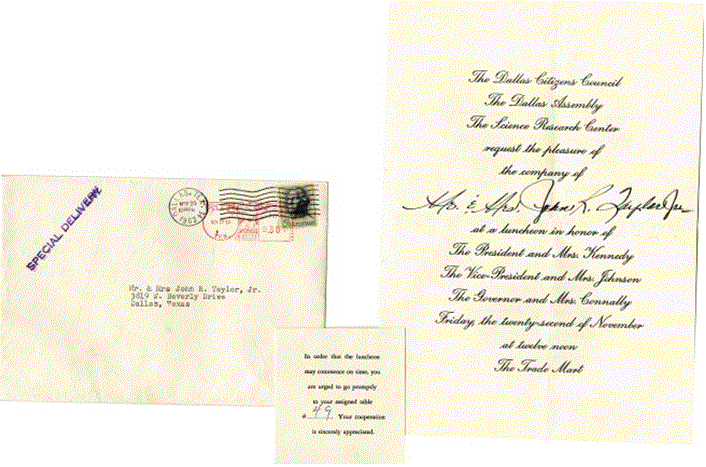
We come to find that Secret Service agent Winston Lawson tells Chief Curry that the luncheon was to begin at 12:15… that the plane was to land at 11:30 and after a 45 min motorcade thru Dallas, arrive at the Trade Mart. VIP invitations had been sent and received which stated the Luncheon was to start at 12 NOON.
So basically even if he was able to know about what Lawson said to Curry, or had seen an invitation to the event, to this LONE NUT KILLER the motorcade would have to pass by the TSBD between 11:55 and 12:10… well before 12:30 in any case. At the same time he knew he had to retrieve the bag with the rifle in it, reassemble the rifle and be at some window facing Elm when he drove by or miss out on his chance for immortality. We make the assumption that Oswald MUST determine a time for the limo and JFK to pass by his place of work; otherwise how can he carry out his plan?
So, is there any corroborated sightings of Oswald during this time? It seems that Eddie Piper, who was with Junior Jarman and Harold Norman, sees Oswald on the 1st floor around noon… no bag, no rifle. Oswald even mentions seeing these 2 men in statements attributed to him. Carolyn Arnold claims to have seen him around 12:15 also on a lower floor… all the while Arnold Rowland eventually testifies that a man with a rifle is in the SW 6th floor window around 12:15… SOMEONE knew when to expect the motorcade… Concurrently Bonnie Ray Williams is eating his lunch 10 feet from the SE corner of the 6th floor sometime between 12 and 12:15.
Mr. WILLIAMS. It was after I had left the sixth floor, after I had eaten the chicken sandwich. I finished the chicken sandwich maybe 10 or 15 minutes after 12. I could say approximately what time it was.
Mr. BALL. Approximately what time was it?
Mr. WILLIAMS. Approximately 12:20, maybe.
Mr. BALL. Well, now, when you talked to the FBI on the 23d day of November, you said that you went up to the sixth floor about 12 noon with your lunch, and you stayed only about 3 minutes, and seeing no one you came down to the fifth floor, using the stairs at the west end of the building. Now, do you think you stayed longer than 3 minutes up there?
Mr. WILLIAMS. I am sure I stayed longer than 3 minutes.
Mr. BALL. Do you remember telling the FBI you only stayed 3 minutes up there?
Mr. WILLIAMS. I do not remember telling them I only stayed 3 minutes.
Why would the FBI lie about that? According to them, no one sees Oswald between 11:50 and 12:30. If Williams is on the 6th floor only a few yards from the sniper’s window, surely he would hear the assembling of a rifle or the moving of boxes to encircle the “nest.” With Williams leaving at 12:15 or just after, and leaving via the elevators next to the stairs, Oswald, whose only knowledge of the motorcade timing can come from those he is in contact with between 11:30 (when the plane was supposed to land) and 11:55 (when the plane actually lands), MUST have passed him either on the stairs, on the 6th floor, or was already on the 6th floor at 12:00 with the bag and rifle. Yet we’ve already proven that he was on the first floor around 12:00… Maybe he arrives at the 6th floor just as Williams arrives at the windows of the 5th floor?
Williams finally meets up with pals Harold Norman and Junior Jarman on the 5th floor since, as he put it:
Mr. DULLES. You were all alone as far as you knew at that time on the sixth floor?
Mr. WILLIAMS. Yes, sir.
Mr. DULLES. During that period of from 12 o’clock about to–10 or 15 minutes after?
Mr. WILLIAMS. Yes, sir. I felt like I was all alone. That is one of the reasons I left–because it was so quiet.
The man who finds out about JFK passing by his window just 3 days before and goes through a variety of activities to insure he is at ANY window facing Elm when he KNOWS JFK is passing by… appears completely unconcerned about the motorcade and timing as late as 12:15… and most definitely not involved in preparing for this event PRIOR to 12:00. He has gone home, out of the ordinary; walked to Frazier’s rather than get picked up, out of the ordinary; is carrying a bag which has to contain a 34″ piece of rifle with other rifle parts/ammo, out of the ordinary; find a place to stow this weapon for later retrieval, out of the ordinary; and has an idea as to when the limo carrying JFK will be within range so he can be ready.
Between 11:50 and 12:20 there are people on the back elevators and stairs either coming down for lunch, retrieving cigarettes, going up for lunch, going up to view the parade, coming down to join friends. While the plan may be sound, the opportunity simply never presents itself. From all the available evidence, Oswald is either in the 1st or 2nd floor lunchrooms at around 12:00 and must be concerned that his plan to kill JFK requires him to vanish unnoticed only to appear ready to fire at the correct time. The correct time… one of the largest holes in Oswald’s plan for immortality. From the time, 3 days prior, that Oswald learns that JFK is passing by his workplace, until he places the bagged rifle in a safe hiding place for retrieval at the appointed time, there remains little if any evidence to support any of the actions necessary were ever carried out. And now, at 12:00 on the fateful day, this small, never-amount-to-anything man with the US intelligence community swirling around him for the past 2-4 years, is just sitting calmly eating his lunch.
When WAS the limo going to pass by, for real?
We come to find that Mrs. Reid talks to her husband who is listening to the radio which states that the plane arrived late and the limo did not leave Love field until 11:55… how fortuitous for the assassin who is obviously pressed for time to get to a window when he BELIEVES, when any information available to this loner tells him the limo should pass by.
Mrs. REID. Well, I left, I ate my lunch hurriedly, I wasn’t watching the time but I wanted to be sure of getting out on the streets in time for the parade before he got there, and I called my husband, who works at the records building, and they had a radio in their office and they were listening as the parade progressed and he told me they were running about 10 minutes late.
Yet how would Oswald know this? There is not a single bit of evidence that is shared by anyone who claims to have told Oswald anything about a radio broadcast and the delay in the motorcade… it is also not until 12:20 at the very least that Mrs. Reid finally decides to leave the lunchroom and attend the parade.
Mr. BELIN. All right. Do you know about what time it was that you left the lunchroom, was it 12, 12:15?
Mrs. REID. I think around 12:30 somewhere along in there
Is it possible that Oswald was still in the same lunchroom as Mrs. Reid? Did she see any men in the lunchroom when she finally decides to leave, KNOWING that the parade is running a bit late…?
Mr. BELIN. Were you the last person in the lunchroom?
Mrs. REID. No; I could not say that because I don’t remember that part of it because I was going out of the building by myself, I wasn’t even, you know, connected with anyone at all.
Mr. BELIN. Were there any men in the lunchroom when you left there?
Mrs. REID. I can’t, I don’t, remember that.
Up to this point in the questioning, and for the rest of the questioning, Mrs. Reid has remained calm and answered directly and easily… and then she is asked if she is the last person in the room… “No,” she claims and rather than finally answering the question about any MEN in the room when she left… she states:
Mrs. REID. I can’t, I don’t, remember that.
Mr. BELIN. All right.
Mrs. REID. I can’t remember the time they left.
If indeed Oswald was in that lunchroom; and there is evidence he was for his lunch around 12:00; then he was there when Mrs. Reid leaves the room… If this is NOT Oswald… where is he given his plan to have the rifle ready to fire from a South facing window between 12:00 and 12:30.
Let’s give him the benefit of the doubt… at a little after noon on the 22nd Oswald has to accomplish the following: Retrieve the rifle, assemble the rifle, assemble the sniper’s nest in the SE 6th floor corner without leaving a prints on any of these 20+ 40 lb boxes, hope that no one is on the 6th floor at the time, and do so without being seen or heard by anyone… for as we have the testimony… no one hears any of this happen or sees any of this occurring…
What is seen are men on the 6th floor at 12:15, one on the SW with a rifle and one on the SE looking out a window… neither of these men are Oswald… and both of these men are seen by a number of witnesses.
But no matter… since he MUST HAVE been able to accomplish all this within 15 to 20 minutes without actually knowing any of the timing details… we have to give him kudos for a good plan, even though there is virtually nothing to prove that any of these necessary steps were taken by Oswald.
Within 2 minutes of the shots being fired he is supposedly stopped in the lunchroom on the 2nd floor… yet that’s not what Officer Marrion Baker writes on 11/22 and signs on 11/22 in his AFFIDAVIT IN ANY FACT.
“As we reached the third or fourth floor I saw a man walking away from the stairway. I called to the man and he turned around and came back toward me. The manager said, “I know that man, he works here.” I then turned the man loose and went up to the top floor. The man I saw was a white man approximately 30 years old, 5’9,” 165 pounds, dark hair and wearing a light brown jacket.”
No 2nd floor, no door to the lunchroom, no window in the door, no pulling of his pistol, none of this story to be is recorded on the afternoon of the killing by the Officer who stopped someone coming down the stairs 1-2 flights higher up and from where the shots were supposedly fired… the lunchroom scene does not materialize until the testimony of Roy Truly and Officer Baker, and in fact takes what would have been a much shorter time period for Baker’s affidavit; “we reached the third or fourth floor I saw a man walking away from the stairway.” The content of this first hand first day recollection is ignored by the WC, which creates a scenario to avoid identifying whoever it was that Baker and Truly intercept coming down the stairs.
Despite all this we still have Oswald firing 3 times from this window with “that” rifle. For Oswald to have accomplished this amazing feat of shooting and to corroborate with witnesses, the barrel of the rifle was protruding from the window…
Mr. EUINS. The man in the window. I could see his hand, and I could see his other hand on the trigger, and one hand was on the barrel thing.
Mr. SPECTER. All right. Now, at the time the second shot was fired, where were you looking then?
Mr. EUINS. I was still looking at the building, you know, behind this–I was looking at the building.
Mr. SPECTER. Looking at anything special in the building?
Mr. EUINS. Yes, sir. I was looking where the barrel was sticking out.
Mr. SPECTER. And how long was the piece of pipe that you saw?
Mr. EUINS. It was sticking out about that much.
Mr. SPECTER. About 14 or 15 inches?
Mr. EUINS. Yes, sir.
…
Mr. BELIN. Could you tell whether or not it had any kind of a scope on it?
Mr. BRENNAN. I did not observe a scope.
Mr. BELIN. How much of the gun do you believe that you saw?
Mr. BRENNAN. I calculate 70 to 85 percent of the gun.
Three men, Norman, Williams and Jarman where positioned on the 5th floor directly beneath the SE corner not 15 feet from the muzzle of the rifle. These three men just feet below the SE window are subject to a rifle blast that produces over 150dB of sound/shockwave. Studies show that this level of sound, even down to 120dB, will render a person temporarily deaf, cause ringing in the ears and be quite painful for some time afterward… and not only does it happen once but 2 more times… yet one of these men claims to be able to hear the working of the bolt and clinking of the shells on the floor above… A sound this loud, repeated twice more from the same location and these men can only “think” or “believe” someone is shooting at the president… It stretches the bounds of credibility… but it MUST have happened that way…
Mr. NORMAN. I believe it was his right arm, and I can’t remember what the exact time was but I know I heard a shot, and then after I heard the shot, well, it seems as though the President, you know, slumped or something, and then another shot and I believe Jarman or someone told me, he said, “I believe someone is shooting at the President,” and I think I made a statement “It is someone shooting at the President, and I believe it came from up above us.”
Well, I couldn’t see at all during the time but I know I heard a third shot fired, and I could also hear something sounded like the shell hulls hitting the floor and the ejecting of the rifle, it sounded as though it was to me.
Given what we now know about what Oswald could have known, and that we agree that he must have had a plan, even if only created three days before on Tuesday once he learns JFK is coming to Dallas and passing under his place of employment… It stretches the bounds of credibility to accept that this plan includes not knowing when the limo is to pass by and in turn having to be in a position to use the rifle he took such pains to bring to as well as hide in the TSBD. None of Oswald’s necessary activities are offered by the WCR to support such a plan. It’s all tautological: He must have been there because he had to be in order to fire the shots.
The Evidence is the Conspiracy…
When I originally offered the concept in August of 2010 on the Spartacus Education Forum it was well received and completely blows the WCR scenario out of the water… it remains impossible for the events to have happened the way they were described and not even possible to be considered by any thinking person.
As Vince Bugliosi says, although he wishes you conclude the opposite, this is indeed the most complicated murder of all time, and the WCR proves it to be so. Talking about the “evidence” as if it indicates anything related to the assassination is a hoax and a cruel joke on anyone who continues to play the game… The magician’s trick of getting you to look here while the deception is happening over there…
The Evidence IS the Conspiracy, Table of Contents
-
Where was Oswald during the shooting?
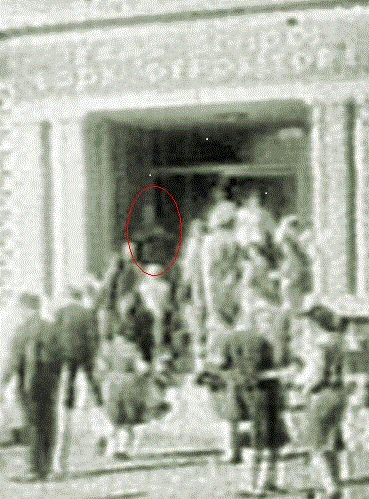
Most researchers of the JFK assassination don’t believe that Lee Harvey Oswald was the man who assassinated President Kennedy. The zealous defenders of the Warren Commission demand that those of us who doubt its conclusion that Oswald was the sole assassin identify the real assassins. Although we are under no obligation whatsoever to identify the real assassins in order to exonerate Oswald, thanks to the exceptional research of Sean Murphy, there is compelling evidence that Oswald was standing just outside the front entrance to the Texas School Book Depository building at the time of the assassination.
According to Murphy, the man he has dubbed “Prayer man” (due to the posture of his arms) was likely Oswald. See below:
Murphy’s extraordinary research was discussed at length over at the education forum; formerly owned and run by John Simkin. For those of you who have not taken the time to read through this important research, I highly recommend that you do so. Murphy’s work is both highly compelling and revolutionary (click here to read through this important research). Readers are also strongly encouraged to read through the discussion of “Prayer man” on Greg Parker’s research forum (this can be read here).
The reader may also be interested in reading through my essay on former DPD Sergeant, Gerald Hill, in which I argue that Hill framed Oswald inside the Texas Theater by pretending to remove the revolver used to kill officer J.D. Tippit (WCE 143) from Oswald; during Oswald’s scuffle with the DPD officers (this can be read here).
Update
An e-book recounting Sean Murphy’s contributions, narrated and commented by Stan Dane, is now available:
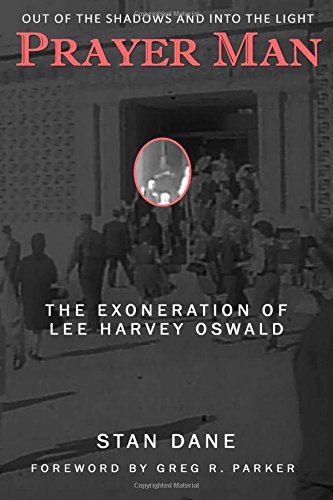
And see now also Bart Kamp’s ongoing work at his website http://www.prayer-man.com.
-
Jean Davison, Oswald’s Game
Why Jean Davison Won’t Quit: A Look Back at Oswald’s Game
“I’d like to once again say ‘thank you’ to Jean for an exemplary book, which offers up just about as good a biography on President Kennedy’s assassin as you’re likely to find.”
David Von Pein
Jean Davison published her book Oswald’s Game back in 1983. To date, it remains the only book she has ever written on the Kennedy assassination. Further, one will Google long and hard to find any articles or essays she has published on the JFK case.
Which is not to say that she is not an active participant in the Kennedy murder debate. She is. She has been a frequent poster at many forums since at least the early nineties. And she continues to do so to this day. As the reader can see from the above quote, Warren Commission zealot David Von Pein is a firm believer in the efficacy of her book. Von Pein, of course, was also a staunch advocate for Reclaiming History. His critical acumen and honesty were found lacking in that instance. As we shall see, his critical faculties are also found in abeyance in the case of Oswald’s Game. This retrospective review is meant to elucidate what Davison does today, but also to show how bereft of critical analysis the Krazy Kid Oswald Camp is.
Before I begin I wish to add a word to the lexicon. It will be the second addition from the JFK debates, after the word “Fetzering.” Fetzering; owing to former philosophy professor Jim Fetzer; usually means disagreeing by using rancor, name-calling and just plain arrogance i.e. “I think you’re wrong therefore you are.”
In rereading Oswald’s Game for the first time in over 20 years, I was struck by the author’s recurring pattern of making sweeping, but specious, generalizations with the utmost confidence and authority. Therefore I will use the term “davisonism” throughout this review to denote these occurrences of Davisonism: presumed certainty which, upon analysis, are almost always exposed as pretentious gas passing.
II
In her Introduction, Davison begins in an odd, but emblematic way. She only deals very briefly there with the assassination and the appointment of the Warren Commission. After four pages, she centers on her encounter with Mark Lane’s book Rush to Judgment. Why would she do that? Because one, of her subthemes throughout the work is to minimize and marginalize the efforts of the Warren Commission critics. As we will see, she does this through a variety of propaganda techniques. At the outset, she goes after Lane and his depiction of the testimony of Jack Ruby. Specifically, she says that Lane shortened the context of Ruby’s testimony to try and show that he was asking to leave Dallas so he could tell his whole story in Washington.
Her reply to Lane is that this is not really accurate. She says that what Lane “didn’t say however, was that the ‘tests’ Ruby wanted to take were simply a lie detector test; and the reason Ruby wanted to take one was to prove that he was not part of a conspiracy.” (Davison, p. 18, italics in original) She then continues with this: “The following month Ruby was allowed to take a polygraph test in his jail cell, and he showed no signs of deception when he denied being part of a conspiracy.” (ibid, p. 19) Thus, the kibosh is placed on Lane as representative of all critics. The message is: You can’t trust them. The subtext is: Trust me, Jean Davison. I will give you the full picture.
Thus we have the first davisonism. Since her book was written years after the House Select Committee on Assassinations published its volumes, it may be even worse than that. Because in those HSCA volumes is a report by a panel of experts on the polygraph exam given to Ruby by FBI agent Bell Herndon. That report is highly critical of Herndon and therefore impacts negatively on the credibility of Oswald’s Game. The panel concluded that Herndon’s test violated at least ten accepted practices of good polygraph technique. (James DiEugenio, Reclaiming Parkland, p. 244) These ranged from having way too many people in the room; which could lead to distractions and false readings; to actually misusing important equipment.
Another key violation by Herndon was the sheer number of questions given to Ruby. Which was over a hundred. The panel blistered the FBI agent on this point. They wrote that the number of questions “showed total disregard of basic polygraph principles.” (ibid) The problem was simple: “…the more a person is tested, the less he tends to react when lying. That is…liars become test-tired, they no longer produce significant physiological reactions when lying.” (ibid) In other words, because of the length of the test, Ruby could get away with lying without being detected. Under these circumstances, the panel said a second test should have been given as a crosscheck to the faulty technique of the first one. After all, the entire proceeding lasted over five hours. (ibid, p. 245)
The panel also said they had a real problem with how Herndon categorized the three types of questions polygraph technicians use. These are: relevant questions, control questions, and irrelevant questions. A control question is one that the operator offers up knowing the probability is high that the subject will lie about it. He does this in order to get a reading on what a lie will look like on his chart for this particular subject. Irrelevant questions are just that; questions which are not germane to the case but will give a good reading for answering honestly. The third category, relevant questions, are those asked that are germane to the case, and about which the authorities wish to know if the subject is lying about. The panel concluded that Herndon mixed up the categories for the questions. Therefore it was hard to decipher the landmarks in his chart as to what constituted deceptive criteria. (ibid, p. 245)
As I wrote about Herndon in Reclaiming Parkland:
There was a method to the madness. First, by wearing Ruby down the charted physiological responses would be less detectable. Second, by confusing the three types of questions, there would be no accurate landmarks with which to make an accurate chart.
But this was not enough for Herndon. The panel concluded that he set the Galvanic Skin Response (GSR) machine to only a quarter of its maximum reading at the beginning. This machine is sensitive to internal stimuli indicating deceptive criteria. He then actually lowered the setting. (ibid) This was the opposite of accepted practice. The setting should have never been that low at all. But it should have been raised as the test went on because of its overlong length. Because of this, the panel concluded that the GSR reading was completely useless.
All of this is quite relevant to the davisonism that Ruby showed no sign of deception when asked if he was part of a conspiracy. For instance, the panel noted that Ruby’s negative reaction to the question, “Did you assist Oswald in the assassination?” recorded the largest GSR reaction in the first test series. In other words, when Ruby was relatively fresh and the GSR was set at its highest point. To accompany that indication, there was also a suppression of breathing and a rise in blood pressure at the time. (ibid, p. 246)
Now, when one looks at the footnotes to Oswald’s Game, one will see that there are references to the HSCA volumes. But when she refers to the Ruby polygraph, she only uses the Warren Commission. (See page 304, footnotes 18 and 19) In other words, at the outset of her book, to the unsuspecting reader, it appears that 1.) Ruby was an honest person 2.) He was not a part of any plot, and 3.) The Commission was a reliable fact finding body. When, in fact, the HSCA report cited above indicates the opposite was the case for all three.
But actually, it’s worse than that. Every Warren Commission zealot, which Davison is, needs to camouflage a central part of the cover up. Namely, that the investigative agencies of the Warren Commission gave that body unreliable and incomplete information. Because, obviously, if that is so, then the Commission’s fact finding procedure can be proven to be both flawed and incomplete. Knowing what we do today about J. Edgar Hoover; through, for example, the works of Curt Gentry and Athan Theoharis; the Bureau has lost much of its reputation for honesty and objectivity. In fact, today, Hoover’s career; from the Palmer Raids to his harassment of Martin Luther King; is looked upon as a necessary aberration. It was necessary because the man was a blackmailing adder who exercised almost total control over his agency. Why is that an important point to make? Because it is not credible to assume that Herndon would have done what he did unless it was sanctioned from above. By not telling the reader about this report, or about Hoover’s character, Davison can hide that crucial point from her readers.
Which brings us to two more davisonisms. First, by beginning with this strophe, namely that the Commission was credible and its critics were not, Davison stands the revealed factual record on its head. With what we know today, in fact back in 1983 when Oswald’s Game was published, the Warren Report was a massively flawed proceeding from its inception. Actually, from before its inception. And one of its most grievous errors was relying on men like Hoover at the FBI, Richard Helms and James Angleton at CIA, and James Rowley and Elmer Moore of the Secret Service. The result was that the Commission did things like tailoring testimony, eliminating important information, and altering evidence. (Click here as to how and why)
The second davisonism that extends from this opening is her depiction of Jack Ruby. It can only be termed a whitewash. Recall, this book was written after the HSCA volumes were released and after Seth Kantor’s biography of Ruby was published. (In fact, Kantor’s book Who was Jack Ruby? is actually in Davison’s bibliography.)
Near the end of her book, she picks up Ruby again at DA Henry Wade’s infamous Friday night press conference, after Oswald had been apprehended. She admits that Ruby was in the room. (Davison, p. 246) But she leaves out two important pieces of information. First, that he camouflaged himself as a journalist. Second, that he corrected Wade as to the one-man operation Oswald was involved with in New Orleans. Wade said it was the Free Cuba Committee, and Ruby corrected him as to the Fair Play for Cuba Committee. (Kantor, 1992 edition, pgs. 101-02)
Here, Davison also adds something that is just inexplicable. In a whopper of a davisonism, she writes that Ruby was “a police buff who knew several dozen members of the local force.” This could be lifted straight from the Warren Report. (See p. 24, where they say Ruby knew maybe 50 cops) It is one reason the report has fallen into disrepute. For as Sylvia Meagher pointed out in her classic Accessories After the Fact, the Warren Report tried to “remodel Ruby” into an “antiseptic portrait.” (Meagher, p. 391) Because in the 26 volumes there was evidence that Ruby had “ties with the underworld, gamblers and hoods, [and] narcotics traffic.” (ibid) But further, Meagher asks, why was Ruby allowed to wander freely through the Dallas Police station throughout the entire assassination weekend? Once, he even got an officer’s help in paging a TV station employee. (ibid, pgs. 422, 423) Meagher also shows that Ruby had been protected in the past from being charged by the police for felonies.
The truth is that Ruby knew over half of the 75 or more cops who were in the basement when he shot Oswald. (ibid, p. 423) If we apply that ratio to the entire department, Ruby probably knew over 500 members of the force. In fact, that figure is probably too low. Ruby’s friend, Reagan Turman, told the FBI that Ruby “was acquainted with at least 75%, and probably 80% of the police officers on the Dallas Police Department.” (Commission Exhibit 1467) And as many others have written, one probable reason for this is that Ruby was a front man for organized crime when it moved into Dallas. (Meagher, pgs. 423-24) In fact, an FBI informant said that for Ruby to carry on as a courier for mob gambling, which he did, the man had to have police connections in both Dallas and Fort Worth. (FBI report of 12/6/63) This informant, William Abadie, had briefly worked for Ruby writing up gambling “tickets” as well as serving as a “slot machine and jukebox mechanic.” He went on to say he had observed policemen coming and going while acting as a bookie in Ruby’s apartment.
This could go on and on. (Click here for more on Ruby) But the point is that Davison, as with Ruby’s polygraph, is not candid with the reader about Ruby’s background and the extent of his police connections. Needless to say, she also eliminates the credible reports of Ruby being at Parkland Hospital. Which Ruby unconvincingly denied. (Meagher, pgs. 394-95)
But alas, Ruby is not the main focus of Oswald’s Game. That status belongs to Oswald. As we will now see, Davison is as biased and incomplete about him as she is about Ruby.
III
If one were going to write a biography of Oswald in 1983, one would want to make it as complete and thorough as possible. Or else, why write such a book? To make your effort as complete as you could would mean collecting as much information as possible from as many places as possible. This would mean, at a minimum, making trips to Washington, New Orleans, Dallas/Fort Worth and New York City. Washington is where the declassified record is located. Oswald had lived in the other three cities. One would also want to check up on Oswald’s military records, and interview as many former service colleagues as one could locate. And this would just be the beginning. Since, in any field investigation, leads pile up once an interview is done.
The shocking thing about Oswald’s Game is this: There is no evidence that Davison did any of the above! For instance, in her footnotes there is not one reference to either an original phone interview she did, or to an on the scene, in person interview. Which is incredible. But further, I could find no reference to any newly declassified documents she secured. The overwhelming majority of her footnotes come from four sources: the Warren Report, the Commission’s accompanying 26 volumes, Edward Epstein’s book Legend, and Priscilla Johnson’s book, Marina and Lee.
In and of itself, that tells us much about both who Davison was and is, and her book. Because, as many commentators have noted, the summary of Oswald’s life presented by the Warren Report had some serious lacunae in it. And the objectivity of Epstein and Johnson is, to put it mildly, circumspect. To be candid, they have both been credibly accused of being close to the CIA. (For Johnson, click here) In fact, Legend was written with consultation from James Angleton, who many believe today to have been Oswald’s control officer. (Click here for info on Epstein) Throughout Oswald’s Game, Davison does not say one word about any of this controversy. Why?
It’s probably the same reason she begins her book as she does. After the introduction, she spends a short chapter on Oswald’s defection. She then begins the book proper with Chapter 2. It’s titled “Marguerite’s Son.”. The chapter is an echo of Jean Stafford’s book, A Mother in History. Which most of us realize today was a laborious and demeaning exercise in which a gifted novelist was made to do a hatchet job courtesy of FBI informant Hugh Aynesworth. We must also not forget what Arlen Specter said to Jean Hill. When she resisted changing her story about hearing too many shots, Specter said words to the effect, we can do to you what we did to Marguerite Oswald. Stafford’s book; really an expanded magazine article; was an out and out hatchet job. On the cover, it showed Marguerite standing over Oswald’s grave, with the subtitle, “The Mother of the Man who killed Kennedy.”
What was Marguerite’s vice, which condemned her to brutal caricature at the hands of the Commission and Stafford/Aynesworth? They had two problems with her. She thought her son may have been innocent, and she also thought he was probably an intelligence agent. In retrospect, those two beliefs should have brought her praise for her honesty, insight, and courage. But since the politics of the JFK case are so pervasive, Marguerite had to be macheted in public. Which, no surprise, Davison has no problem with.
But there is unintentional humor to be had here. Davison is so agenda driven, so monomaniacal in her condemnation of Oswald and his mother, so obsessed with showing some kind of early personality defect Lee inherited from his mom, that she spills over into unconscious self-parody. When Oswald went to Russia, one of the things he told one of the reporters in his room at the Metropole Hotel was that he first got interested in communism when a woman handed him a pamphlet meant to save the Rosenbergs. (Destiny Betrayed, Second Edition, by Jim DiEugenio, p. 145; Davison, p. 54) Davison uses this incident throughout the book to somehow indicate that a large and latent psychic chasm was unleashed in Oswald by reading this pamphlet. For her, this is a huge milestone in Oswald’s mental evolution, one that started him down the road to murder.
Which, upon analysis, is funny. See, the Metropole was used for many state services in Moscow. As John Newman has shown, it was furnished with infrared cameras, for spying on its residents. Therefore, it’s natural to suspect it was also wired for sound. (DiEugenio, ibid) When Oswald surfaced this story about the Rosenberg pamphlet, he was trying to convince the Russian authorities to let him stay in Moscow. Clearly, by letting him hole up at the Metropole, the Russians were deciding on whether Oswald was a genuine defector, or on an espionage mission. Oswald issued many B movie platitudes trying to convince the KGB he was genuine. In one of his interviews with American journalists, he said at age 15 he became seriously interested in communism when “an old lady handed me a pamphlet about saving the Rosenbergs.” (ibid)
It was probably this statement that convinced the KGB Oswald was on a spy mission. For they then kicked him out of Moscow and sent him 450 miles away to Minsk. They set up a ring of human intel around him, and also wired his state furnished apartment for sound. (Ibid) Why? Because Oswald did not have his story straight. Oswald has to be referring here to his sojourn in the liberal New York City. Since it’s hard to believe there were Rosenberg committees in New Orleans or Dallas. But when Oswald turned 15 in 1954 he was living in New Orleans, not New York. Further, why would anyone be distributing “Save the Rosenberg” literature at that time? The couple had been executed in June of the previous year. The KGB officers watching and listening to the surveillance tapes must have been both smiling and frowning at Oswald’s performance. But Davison is so intent on indicting Oswald she presents this dead on serious. She then follows it with this davisonism:
Whether through force of example or inherited disposition, Lee Oswald had acquired an egocentricity resembling his mother Marguerite. What made the Rosenberg pamphlet memorable to him, surely was that he saw himself in it…Here he held in his hand a message that said to him: Here are allies you can identify with… (Davison, p. 56)
To the professional KGB of course, the reaction was quite different: they saw through the little playlet. But really, Davison’s five and dime story psychoanalysis based on faulty assumptions is so strained, so heavy handed, that it reminded me of Woody Allen’s hilarious mockumentary Take the Money and Run. With very few alterations, this part of Oswald’s Game could serve as a scenario for that type of film.
IV
The above points out another grave failing of Oswald’s Game. The writer’s repeated tendency to leave out important information that the reader needs in order to render an accurate judgment. As noted above, Davison is hell-bent on keeping Oswald out of the hands of the CIA. Therefore, she simply eliminates or greatly discounts key information that could lead the reader to consider that hypothesis, since it fits into a complete portrait of the man.
Consider Oswald’s acquisition of the Russian language. She says he learned it in the service on his own. I could find no reference to the executive session report of the Warren Commission in which they say Oswald was at the Defense Language Institute in Monterey, California. (Executive Session transcript of 1/27/64) That transcript was declassified through the efforts of Harold Weisberg in 1974. Ten years before Oswald’s Game was published. Some readers may think that is important information. For the simple matter that Russian is a very difficult language to learn. And it’s not credible that someone could acquire it on his own through listening to records or reading periodicals. (Davison, pgs. 73 and 76) Coinciding with this failure is the missing name of Rosaleen Quinn. In the service, a colleague of Oswald’s set up a meeting between Lee and his aunt, Ms. Quinn. Quinn had been studying for a State Department job. She had therefore been tutored in Russian for over a year. After Quinn came away from the meeting with Oswald, she said he spoke Russian at least as well as she did. Any language expert will tell you that you simply cannot become fluent in something like Russian by listening to the radio or records. You must be privately tutored or take part in classes. (DiEugenio, Destiny Betrayed, p. 131) If one combines the instruction in Russian with the defection, with the phony platitudes uttered by Oswald at the Metropole, and the KGB cynicism about him, then one could at least suspect that maybe Oswald was being prepared by the Navy to go to Russia as a false defector. But you cannot do this if you cut out Quinn, the Defense Language Institute, the difficulty in learning Russian, and the KGB suspicion and surveillance at the Metropole.
Davison also does not explain why the KGB would be suspicious of Oswald in the first place. In other words, she does not place Oswald’s defection into its proper backdrop. Oswald left the USA for Russia in the fall of 1959. Prior to 1958, American defectors to Russia had been a rather rare occurrence. In 1958, there had been four. In 1959, prior to Oswald, there had already been two of them, Robert Webster and Nicholas Petrulli. It is stunning, but it’s true: You will not see either of those names in the index to Oswald’s Game. By the end of 1960, the number of defections had ballooned to the high teens. (Ibid, Destiny Betrayed, p. 139) The KGB noted the trend. Just as they noted that many of these defectors were from the military. Which is unusual in itself. Robert Webster had worked for Rand Corporation, which had ties to the CIA. And Rand was one of the first companies to sell products inside of Russia. It was at a trade fair that Webster had defected.
But yet, once one understands what Davison is up to in this book, one comprehends why all this is left out. For instance, although Oswald was not supposed to have known about the Webster case, before he left the USSR to return to the USA, he asked American embassy officials “about the fate of a young man named Webster who came to Russia at about the time he did.” (ibid) And by not dealing with Webster, Davison avoids something that she almost has to avoid. Webster met the 19-year-old Marina Prusakova in Moscow in 1959, before she met her future husband Lee Oswald. And Webster spoke to her in English! Which is a language Marina was not supposed to have acquired yet. After the assassination, the address of Webster’s Leningrad apartment was found in Marina’s address book. (ibid, p. 140) When any curious, interested reader is confronted with this kind of information, he or she would naturally ask: 1.) What are the odds of a 19-year-old girl meeting two of three defectors in 1959 in the huge expanse of Russia? 2.) Why would Marina have learned English and why would she later lie about it? Clearly, Davison does not want the reader to contemplate those questions. Which is why she does not tell you about Marinaís uncle, who was a high official in the Russian equivalent of the FBI. Or that Marina once confused her meeting with Webster with her meeting of Oswald. (ibid, p. 140) All of this suggests the probability of an American “false defector” program being set in place. It also suggests the KGB was on to it. And with Marina, may have been designing countermeasures for it.
The proof of this is the Otto Otepka case. Otepka was an investigator in the State Department. In late 1960 he noticed this quite discernible uptick in suspicious defections from the USA to Russia. So he sent a cable to Dick Bissell at CIA. He wanted to know which of the defectors were real and which were not. Bissell turned this request over to James Angleton and his Counter Intelligence staff. This is interesting because, as author John Newman found out, many of Oswald’s CIA documents at this time bear the label CI/OPS, which means Counter Intelligence Operations. The eighth name on Otepka’s list was Lee Oswald. When the CIA assigned the list to a researcher, he was told to work on some but not others. One of the “others” was Oswald. When CIA sent backs its reply to State, the name Oswald was marked SECRET. But Otepka was persistent. He wanted to know the truth about both Oswald and the program. For that he was harassed, persecuted and eventually thrown out of his office. (DiEugenio, Destiny Betrayed, p. 164) A State Department intelligence analyst suspects Oswald is a false defector. He cannot get an answer to this from the CIA. He persists and eventually loses his job. Once he is out, his safe is drilled into to find what he knew about Oswald. This was on November 5, 1963. Somehow, that information about her subject did not seem important to Jean Davison.
But if that is a puzzler, the following is a complete baffler. As noted, Oswald did not defect until the fall of 1959. Otepka made his request to CIA in late 1960. It was only after this request that the CIA opened up a 201 file on Oswald, over a year after the defection. This delay was so weird to the HSCA that it inquired about it to more than one CIA official. For the 201 file is a common file at the Agency. It is an information file on any person of interest to them. Oswald had to be such since he had shown up at the American Embassy in Moscow and hinted he could give secrets of the U-2 to the Russians. (Ibid, p. 143) But neither Ann Egerter, Angleton’s assistant, nor Richard Helms, former Director of the CIA, could explain why it was not opened promptly.
Now, the combination of the Otepka persecution, with this inexplicable 201-file delay could lead one to conclude that the 201 file was not opened because Oswald was a false defector for Angleton. But again, the reader cannot even ponder this since it’s not in this book. The information about the 201 was unearthed by the HSCA. The HSCA shut down four years before Oswald’s Game was published. A good summary of the Otepka affair is in Jim Hougan’s book Spooks, which was published in 1978. The Ordeal of Otto Otepka, a book length treatment of the matter, was published a decade before that, in 1969. Therefore, as the reader can see, there was really no excuse for this fascinating and important data not to be included in Oswald’s Game. The only apparent excuse is that it did not fit in with the writer’s agenda. Considering how large and consuming that agenda was, the book’s more apt title would have been Davison’s Game.
V
As noted above, it’s pretty clear that Davison did not do any traveling to anywhere in America to investigate Oswald’s life. In fact, it’s not certain that she even made any phone calls. So it obvious that she did not try and replicate Oswald’s journey overseas for his defection to the USSR. If she had, she may have discovered at least a couple of interesting things that would have prevented her book from being a museum piece upon publication.
Oswald was never known to have any solid finances. So when his service pal Nelson Delgado was asked, he replied that he had no idea how Oswald could afford to travel across Europe. Delgado said this cost anywhere from eight hundred to a thousand dollars. (Destiny Betrayed, p. 137) Which a study of his bank records reveals he did not have. But in addition to this, Davison could have told us about the hotels he stayed in while in Helsinki. British investigator Ian Griggs actually stayed in them. The first was the Hotel Torni. Griggs described this as no less than a five star hotel. The rough equivalent of the Savoy in London or the Four Seasons in San Francisco. How and why would someone as low status as Oswald choose to stay at such a place? Someone must have alerted him to this dilemma because he soon checked out. He went to the Klaus Kurki Hotel. Griggs described this as maybe a notch below the Torni. A four and a half star hotel. Since, as I said, Davison never went anywhere for a field investigation, she cannot inform us of this dichotomy. And therefore, the reader cannot ask the obvious questions: Where did Oswald get the money to stay in the kinds of hotels that Nelson Rockefeller and Jean Sibelius booked? (ibid, p. 138) And second, why would the usually frugal Oswald become a spendthrift in Finland?
But beyond that, outside the pages of Oswald’s Game, with normal rationality, the question also arises: Why did Oswald even go to Helsinki? Davison says that he placed an educational facility destination adjacent to Helsinki on his passport application. Which does not really explain it, since Oswald wrote several places on the application. Some of which he never went to. It appears he went there because that particular Russian Embassy had close ties to Intourist, the Russian state-owned travel bureau. Oswald applied for a visa to Intourist on October 13th. He got it the next day. (ibid, p. 138) Again, this is notable for the saga of Oswald. Because the Helsinki embassy was the only one in Europe which granted these visas that fast. The US Embassy there had direct ties to their Soviet counterparts and sent people who needed expedited visas to them. Did Oswald know this? Is this why he went there? If so, who told him about it? Since Davison deals with the matter of Helsinki in about two sentences, those questions also do not arise in Oswald’s Game. (See Davison, pgs. 81, 84)
This brings us to the matter of how Oswald began his journey to Helsinki. Once he was fluent in Russian, as proven through his conversation with Quinn, Oswald did something unusual. He applied for a hardship discharge. Again, Delgado could not understand it. For these were notoriously hard to get and took a long time to process. (Second Edition, Destiny Betrayed, p. 136)
Now, let us make the mystery about this transparent, which Davison really does not do. Oswald’s actual application was submitted on August 17th. At this point, his service contract had less than four months to run. The HSCA discovered that these proceedings took as many as six months to finalize. (ibid) Therefore, under normal circumstances, Oswald would have been better off just waiting out his service contract rather than gambling with the complex process of discharge. Why do I say that? Because, usually there were thorough investigations made at both ends to make sure the application was not a bogus attempt to get out early. And if there had been normal inquiries done, Oswald’s filing would have been exposed as ersatz and he would have been busted.
But he wasn’t. One reason he was not was this: instead of taking six months, or even three, his application was approved in just ten days! The way Davison deals with this is rich. She says that Oswald’s application “was approved fairly quickly.” (Davison, p. 82) Well, that’s one way of putting it. But by not telling us about the actual time lapse, she avoids the question of what kind of inquiry could the Navy have made in just ten days. Because the main reason the application was granted was the excuse that Marguerite had a candy box at work fall on her nose. She needed to get a doctor’s affidavit to collect on workmen’s compensation since the company she worked for did not think the injury was that serious.
One of the doctors that Marguerite visited to collect information for her workman’s compensation claim was Dr. Milton Goldberg. He called the FBI on the day of the assassination and said he could not go along with her claims for injuries and referred her to other doctors. But he also told the FBI that on one of her early visits she told him her son wanted to defect to Russia. (DiEugenio, Destiny Betrayed, p. 136) Now, her first visit to Goldberg was on January 9, 1959. Which was a full nine months before Oswald was discharged. It was six months before he reported to the Red Cross to begin the process of the dependency discharge. Of which there was no dependency. The Navy could have discovered this just by interviewing Robert Oswald, who was living in Fort Worth at the time. There is no evidence that he was helping his mother at the time. And, of course, when Oswald did get out, he spent all of three days in Texas. Clearly, something was going on behind the scenes with this hardship discharge. But you would never get any suggestion of impropriety from Oswald’s Game.
VI
One of the most bizarre things about this bizarre book is that Davison cannot bring herself to admit the obvious paradox about Oswald. Here you have a supposed Marxist who decides to join the Marines. On his return from Russia he chooses to live with first, the rightwing White Russians in Dallas/Fort Worth. These people wanted to overthrow the communists and restore the czar. In New Orleans, he had various associations with the Cuban exiles. These men wanted to overthrow Castro and make Cuba an ally of the USA again. If Oswald was a communist, he was one of the weirdest communists ever. But further, like every other inquiry into his life, Davison fails to produce one communist friend that Oswald worked with or shared time with on the ground in the USA. Does this not make his associations with the White Russians and Cuban exiles even stranger?
If you can believe it, in the 300 pages of her book she never admits to this fact. Probably because it so plainly flies in the face of her thesis about Oswald being a communist. And, in fact, Richard Snyder who worked out of the American Embassy in Moscow, and interviewed Oswald, worked for the CIA on Operation Redskin. This was a program designed to recruit Ivy League Russian speaking graduates to travel behind the Iron Curtain. (DiEugenio, Destiny Betrayed, p. 141) Three days before Oswald showed up in his office to try and renounce his citizenship, Snyder wrote a letter to a fellow State Department employee on his experience with American “defectors.” There are quotes around that word because Snyder did the same. And he was referring to the Webster case. (ibid)
How did Oswald begin this strange masquerade as a communist Marine, false defector, FBI informant, and CIA agent provocateur? Well in any serious study of his life, which Oswald’s Game is not, the figure of David Ferrie and Oswald’s teenage years in the Civil Air Patrol under his supervision must loom large. To use one example, John Armstrong spends four oversized pages on this episode in his biography called Harvey and Lee. (See pages 122-25) Again, the way Davison handles this key episode is so rich as to be humorous. Referring to June of 1955, she writes, “That summer he joined the Civil Air Patrol and attended several meetings at which one of the leaders was an eccentric pilot named David Ferrie. Ferrie would become a central figure in many conspiracy theories.” (Davison, pgs. 62-63) I kid you not, that is it.
But even she cannot keep the lid on how important this episode is. Because, right after this, she writes that it was this time period when Oswald began to exhibit an interest in Marxism. Now, a true biographer who really wanted to be honest with the record and his reader would have to equate the two. For anyone who studies Ferrie quickly understands he was not just your usual CAP instructor. He had an inordinate interest in the lives of his cadets. And if Davison had gone to New Orleans and interviewed some of these subjects she could have written about this. But, in fact, she did not even really have to do that. Because Jim Garrison had donated many of his files to Bud Fensterwald’s AARC (which was under a different name at the time.) So all she had to do was drive down to Washington to look at these interview transcripts and affidavits. If she was too lazy for even that, then she could have interviewed the two New Orleans investigators for the HSCA, Bob Buras and Lawrence Delsa. They would have told her that Ferrie had a tremendous influence over these youths. And he also seemed to have clearance from above to do things with them that required special permission. Like camping out with them at Keesler Air Force Base in Biloxi, and having military planes fly them back form drill competitions. He also convinced a number of them to join the Marines. (Author’s interview with Delsa in New Orleans in 1994; Destiny Betrayed, p. 84) I could go on and on in this regard, but suffice it to say, many writers have deduced that David Ferrie was a powerful influence on Oswald’s life. If he was not, then why was Ferrie so obsessed with hiding his relationship with Oswald in the CAP in the days following the assassination? (Destiny Betrayed, pgs 176-77)
Sticking with New Orleans and Garrison, she spends about a page in a bare bones, less than cursory discussion of the Clinton/Jackson incident. She concludes this with a shattering davisonism. She says that if the event occurred it was certainly Guy Banister, not Clay Shaw who was the driver of the car. She then says that since the witnesses there were confused about Banister and Shaw they may have been mistaken about Oswald as well. She also adds, and they did not come forward until 1967. (Davison, pgs. 284-85)
Where does one begin to dissect this drivel? Again, it exposes Davison as the totally amateur researcher she is. For if she would have collected the primary resources on this incident; something she has a phobia against; she would not have written such foolishness. The witness statements make it clear that it was not Banister with Ferrie and Oswald, it was Clay Shaw. For instance, Henry Burnell Clark said the driver of the car was unusually tall, well over six feet. Banister was about 5′ 9,” Shaw was 6′ 4.” (William Davy, Let Justice Be Done, p. 105) If that is not enough, Sheriff John Manchester said he approached the car and asked the driver to identify himself. When asked what name he gave, Manchester said under oath, “He gave Clay Shaw, which corresponded with his driver’s license.” (ibid, p. 106) The witnesses were not confused at all. In her usual lazy way, Davison decided to accept reporters’ spin instead of using the primary sources. And if she had gotten out of her living room, she would have discovered that the witnesses did not come forward in 1967. They all talked about the event in the wake of the assassination. Reeves Morgan called the FBI. And local rightwing publisher Ned Touchstone interviewed them in 1965, and wrote about it in his publication called The Councilor. (Joan Mellen, A Farewell to Justice, pgs. 214-15, p. 234)
VII
Let us now proceed to the payoff of the book. The reason I think Davison actually wrote the thing. That is, her discussions of the Odio incident and Mexico City. Davison wants us to buy into something pretty unpalatable. She wants us to think that Oswald was both at Sylvia Odio’s apartment door and in Mexico City. That is, there was no mistaken identity and no imposters involved. She does this by employing the same trick that Vincent Bugliosi does. Before the Commission, Sylvia twice said that three men; two Cubans and Leon Oswald; visited her during the last week of September. It was on a Thursday or a Friday. (WC Volume XI, pgs. 370, 386) This means the date could be either the 26th or 27th. Even if we accept the earlier date, this contradicts the Warren Report. For they state that on that date, Oswald was on a bus headed from the Mexican border town of Nuevo Laredo to Mexico City. (WR, p. 733)
So, to avoid this serious problem; which clearly suggests the use of an imposter in one or the other place; Davison did in 1983 what Vincent Bugliosi did almost 25 years later. She moved the date back to the 25th. Even with that, there is a problem. The incident took place at around 9 PM in Dallas. The Warren Report has Oswald in Houston that night calling the socialist editor of a magazine. But the call came at nine or a bit later. There is no indication the call was long distance. The drive from Dallas to Houston is about four hours. (DiEugenio, Destiny Betrayed, p. 352)
All of this is discounted by Davison. She says that it’s Oswald at Odio’s. But she says that it was really Oswald manipulating the Cubans there. She says “if the real Oswald was used, how did the anti-Castro plotters get their Marxist enemy to stand at Odio’s door to be introduced as a friend of the Cuban exiles.” (Davison, p. 194) Well Jean, the same way Oswald was in Guy Banister’s office and in Clinton/Jackson with Shaw and Ferrie. Because anyone who knows this case and has any objectivity realizes that Oswald was not a Marxist. Davison makes great pains to compare this incident with what she calls Oswald’s attempt to infiltrate Carlos Bringuier’s Cuban exile group, the DRE in New Orleans. But if Bringuier and his assistant Carlos Quiroga were supplying Oswald with the flyers for this Trade Mart leafleting incident, then this “infiltration” idea of hers collapses. And that is what a neutral witness, Oswald’s landlady Jesse Garner, seems to indicate. (DiEugenio, Destiny Betrayed, p. 162) This silly comparison of hers is further undermined by Quiroga’s polygraph test for Jim Garrison. Quiroga was asked: “You have said you tried to infiltrate Oswald’s ‘organization.’ Isn’t it a fact that you knew his Fair Play for Cuba activities were merely a cover?” Quiroga replied in the negative. That reply indicated he was lying. So did his negative reply to the following: “Is it not a fact that at that time Oswald was in reality a part of an anti-Castro operation?” (Ibid) Again, Davison’s attempt at being a researcher is a bit embarrassing.
But she carries on her concept further. She now says that Oswald was actually manipulating the Cubans he was with. Again, this is silly. On two counts. First, why would Oswald put himself forth as a possible assassin of Kennedy in advance of the murder? If you believe Davison, that is what happened here. But secondly, if Oswald was doing the manipulating, then why was it the Cubans who called Sylvia back to make the incident more indelible?
Finally, like many Commission advocates, Davison leaves out the fact that Odio belonged to JURE. This was a liberal anti-Castro group that was a favorite of Kennedy. And it was hated by Howard Hunt because he called its leadership by Manuelo Ray, “Castroism without Fidel.” In other words, the under text here is that the Cubans were trying to ingratiate Oswald with a leftist exile group in advance of the assassination. This is made manifest by the fact that the two Cubans masqueraded as JURE members but were not.
Let us conclude with what Davison now says is her proof that Oswald planned on killing Kennedy. She uses the hoary, mildewed Daniel Harker story. This was a newspaper account of an interview with Fidel Castro in which he was reported as saying that if “US leaders should think that if they are aiding terrorism plans to eliminate Cuban leaders, they themselves will not be safe.” (Davison, p. 22) The problems with this story are manifold. First, as she notes, there is not any evidence that Oswald saw the story. Second, with the evidence we have now, it’s clear that Kennedy was trying for detente with Castro at this time. The attacks on Cuba had dwindled away to almost nothing. And the declassified Inspector General report makes it clear that Kennedy never authorized any of the CIA-Mafia plots to kill Castro. Third, as she acknowledges, the evidence says that Oswald liked Kennedy. Fourth, if Oswald killed Kennedy for the Castro cause, why did he deny it afterwards?
Davison couples this with something even weaker. It’s the report from an FBI informant in the communist party that Oswald walked into the Cuban consulate and said he was going to kill Castro. These have come to be called the SOLO documents. And this part of them, the Castro threat is almost surely a forgery. As John Newman told this reviewer, this is allegedly a part of a letter from the informant to Gus Hall, leader of the communist party. Newman said, this kind of information would not be part of that letter to Hall. SOLO was too experienced to do that. (Author interview with Newman, 11/29/13) Second, why would Oswald, on the occasion of having problems with his visa blurt out in the consulate that he was going to kill Kennedy. When, in fact, it was his own fault he was having problems. He was not prepared with the proper documentation. Third, if Oswald said this, then why did not the incoming or outgoing chief counsel there hear him? And for that matter, neither did Sylvia Duran. Fourth, Oswald needed clearance for his in-transit visa from both Cuba and Russia. Why would he say something like this knowing that if the Russians call for a check, someone will tell them, “He said he was going to kill Kennedy.” Fifth, Castro did not mention this threat in either his nationally televised radio/TV appearance of November 23rd of during his speech at the University of Havana on November 27th. And since no one at the embassy heard Oswald say this, then Castro would have had to manufacture the quote. Why would he do such a thing? (ibid, Newman interview.)
Newman says that he does not think the informant manufactured the quote either. He thinks someone in the FBI did and pasted it into the letter. Quite naturally, every one of these cogent points is absent from Oswald’s Game. I mean, Davison’s Game.
Needless to say, Davison does not list the plentiful evidence that Oswald was not in Mexico City. Namely, the voice on the tapes sent to Dallas, was not his. The CIA has never been able to produce one picture of Oswald entering either embassy in over 50 years. Even though a total of five cameras covered both embassies. Four of the five embassy workers who encountered this man called Oswald, said he was short and blonde. In 1978, when consul Eusebio Azcue was interviewed by CBS news about Mexico City, he produced photos taken by the Cuban surveillance cameras of the man who identified himself as Oswald. The man was short and blonde. (Armstrong, op. cit. p. 646)
I have saved the most thundering davisonism for last. Let us luxuriate in its pure arrogance:
To argue, as some critics have, that Oswald was merely posing as a leftist from the time he was 16 until, literally the day he died, one must unravel the story of his life presented in this book and attempt to reweave it into an entirely new pattern. I can’t say that it is impossible to do so, but thus far it hasn’t been done. (Davison, p. 285)
A statement like that is literally requesting a pie in the face. That pie, a coconut/custard one, was delivered to Davison seven years later. It was by Philip Melanson and it was called Spy Saga. That book revolutionized our thinking about Oswald. And the thing to note is that no great discoveries were made between 1983 and 1990. Therefore, Jean Davison could have theoretically done what Melanson did. But her agenda would not allow it. Today, Spy Saga has been furthered by John Armstrong’s Harvey and Lee and John Newman’s Oswald and the CIA. So today we know much more about Oswald than the Commission would ever tell us. In the light of those works, Jean Davison’s book looks today like a smoking pile of rubbish. Useless to anyone except maybe David Von Pein or John McAdams.
As demonstrated above, Oswald’s Game really tells us more about the biases and obsessions of Jean Davison on the Kennedy case than it does about its ostensible subject. Which is really the worst thing one can say about a biographer.