
Back in December of 1999, history was made. On December 8th of that year, a jury returned a verdict of not guilty for the late James Earl Ray. But they actually went beyond that and said that Loyd Jowers, a local Memphis businessman was part of a large conspiracy to murder Martin Luther King back in April of 1968.
The problem was a recurrent one with the assassinations of the sixties: the public didn’t know about it because the MSM ignored it. In fact, using the word “ignore” is probably too mild. The MSM deliberately decided that they were not going to cover the civil trial brought by the King family against Jowers. We know this for a fact because the only reporter in court every day of the trial was Probe Magazine’s Jim Douglass. Even the regular reporter on the King case for the local Memphis Commercial Appeal, who thought he would be in court each day, had to wait for Jim to emerge to get the information about the day’s proceedings. Court TV, in its infancy at the time, also had planned to cover the trial. They also did not show up. In fact, after the verdict, the MSM sent Gerald Posner around the TV networks to say that this verdict really did not mean anything.
As one reads the attached story Jim filed for Probe, the opposite is the case. The trial was like a bad dream for the MSM. Because first, as stated, it was backed by the King family. The people who were directly and emotionally involved did not buy the cover up. Secondly, the family’s interests were ably represented by a knowledgeable and skilled attorney, William Pepper. Pepper really knew the case. And, unlike Jim Garrison, he was allowed to present his evidence without being directly obstructed. When it was all over, not only did he prove that the late James Early Ray was innocent, he also convinced the jury that a large, high level conspiracy snuffed out King’s life. And, in fact, Jim actually interviewed a juror who told him just that.
This remains, even today, one of the very best brief summaries of what happened in that much covered up and distorted case. Thanks to Jim Douglass, Probe was the only media outlet where readers could find the truth at the time. Our thanks to him, and the King family, as we print his work once more in commemoration of that landmark event.
– Jim DiEugenio
James Douglass, The Martin Luther King Conspiracy Exposed, in Memphis (Probe 7.4 May-June 2000)
I have to admit that when I was asked to review the book in question, I did not recognize its author. The name Charles E. Hurlburt did not ring a bell, as it was a name that I have never encountered in the JFK assassination research community. I do not consider it to be a bad thing (I am not one either) since all citizens should study and try to join the quest for the truth. So I was curious to find out what he had to say.
Charles E. Hurlburt is a senior citizen who, at the time of the assassination, was employed by ITEK Corporation as a software programmer (Yes the same ITEK that analyzed the Zapruder film for the House Select Committee on Assassinations). He first became interested in the case after reading Mark Lane’s book Rush to Judgment back in 1966. By that time he had left ITEK and he was working for MIT University, where he discovered in the library, Ed Epstein’s book Inquest and later the Warren Commission (WC) Report. After reading the two books and the Warren Report itself, he became convinced that the Commission’s work was inadequate. Further, that it contained serious omissions, misrepresentations and fallacies. Later it was Oliver Stone’s movie JFK that re-awakened his interest in the case, and he became a serious student of the assassination ever since.
The book consists of twelve chapters that examine both the micro and the macro aspects of the assassination, but not in a detailed manner. In my view, he tried to juggle too many different aspects of the assassination in a small book. Therefore, it was not possible to examine each one detail. So it is very difficult to write a critique based on brief and basic explanations of very complex matters. So, this reviewer decided to concentrate on some aspects since it will be very difficult to examine every single aspect.
Chapter Two examines the autopsy of the dead president. Hurlburt summarizes the evidence which proves that the doctors tried to cover up the truth and comply with the official version: namely that only two shots hit JFK. He correctly points out that the bullet that caused the back wound entered below the shoulder at an angle of 45 to 60 degrees, did not exit and that it was never located inside the body. It would have been impossible to have penetrated the neck to exit the throat, an invention that Arlen Specter created well after the autopsy with his now infamous “Magic Bullet Theory.” However this is where Hurlburt makes a serious mistake when he states that the Bethesda doctors did not know anything about the wound in the front of the throat during the autopsy procedure. He further states that “it was not until the following morning after the body was no longer available for examination that Dr. Humes spoke on the phone with Dr. Perry, and learned of this small ‘puncture’ wound in the throat.”
Hurlburt may not be aware of the late Dr. Robert. B. Livingston’s testimony in a 1993 lawsuit against the Journal of the American Medical Association (Breach of Trust, Gerald McKnight, p. 411). Livingston, who had lectured at Harvard and Yale Universities and had experienced all kinds of wounds during WW II while treating Japanese prisoners of war. Following the first media reports, he recognized the wound in the throat was one of entry that had originated from the front. So Livingston called Humes to advice him about the nature of the wound but Humes left the phone and when he returned told Livingston, “I can’t continue this conversation, and in fact, the FBI won’t let me.”
He then touches on the controversial subject that JFK’s body was surgically doctored according to David Lifton’s theory as described in his book Best Evidence. Another noted author who has expressed a similar view is Douglas Horne, a former staff member of the ARRB who had examined the medical evidence in detail. Horne presented his conclusions in his five volume book, Inside the Assassination Review Board.
This subject is quite controversial so I would suggest that anyone can read the above mentioned books and make up his (or her) own mind regarding the subject of a pre-autopsy doctoring of the body. Hurlburt concludes that the autopsy was surrounded by controversy over a number of contradictory statements, for example “the body was enclosed in sheets/a body bag,” or “the brain was/was not severed from the brain stem…” etc. This author believes that contradictory statements followed the doppelganger pattern that so often pops up in the JFK assassination and their purpose is to create cognitive dissonance to confuse and frustrate researchers, to inveigle the truth and preserve doubt.
In chapter three he does a fair job to show that all the investigating bodies, the police, the FBI, the Warren Commission and the HSCA did not perform as they should, and they all contributed to the cover up and to the mess that the JFK investigation is today. Again this is done very briefly and does not analyze any of it them in depth. In doing so he makes a few mistakes; like his assurance that convicted felon Charles Harrelson was a “dead ringer” for one of the three tramps photographed after the assassination (p. 53). It is an assumption based on the controversial work of Lois Gibson, a forensic artist who’s work and findings many dispute, and there are not many researchers who agree with her on the identification of the tramps. In 1979, Harrelson was arrested and charged for the murder of Judge John H. Wood. He was eventually found guilty and convicted of the murder of Wood and sentenced to two life sentences. When he was arrested he confessed that he was one of the shooters that killed Kennedy. But he later withdrew his confession. He was accused of being the tall tramp photographed in Dealey Plaza, but after examining the photos he stated that the there is no resemblance between him and the tall tramp. He stated to Nigel Turner that at the time of the assassination he was in Houston with a friend and that even if he was offered the job he would have never accepted because he knew that he would end up dead as well. In 1992 the Dallas Police revealed the identities of the tramps and claimed that they were Gus Abrams, John F. Gedney and Harold Doyle. Ray and Mary LaFontaine did their own research and agreed with the police’s view regarding the tramps. This author is not convinced that the above mentioned individuals were the three tamps and believes that their identities will remain forever obscure. The late Fletcher Prouty believed that their identity was not important since they were “actors” whose job was to help with the cover up.
In the section describing the last official investigation by the House Select Committee of Assassinations (HSCA), there are a few inaccuracies regarding Chief Counsels Richard Sprague and Robert Blakey. Regarding Sprague, the author asserts that it was his disagreements with Congressman Gonzalez that eventually led to his downfall. He writes that “A clash of egos erupted between Gonzalez and Sprague.” This clash along with media attacks led Gonzalez to try to fire Sprague. He did not succeed, and as a result Gonzalez resigned. Sprague tried to keep his position but he was fired. Yes, partially. But it was also his unwillingness to play the Washington political game and his call for an unrestricted investigation that that led to the above confrontation. Hurlburt somehow, in his above narration of the events, forgot to mention the real cause that forced Sprague to resign (p. 68). Sprague later said “But when I looked back at what happened, it suddenly became clear that the problems began after I ran up against the CIA.” It all started when Sprague asked for complete information about the CIA’s operation in Mexico City regarding Oswald’s visit there and total access to its employees who may have had anything to do with the photographs, tape recordings and transcripts. The CIA finally agreed only if he would sign a CIA Secrecy Agreement. Sprague refused and said “How can I possibly sign an agreement with an agency I am supposed to be investigating?” (Gaeton Fonzi, The Last Investigation, p. 197).
Hurlburt then discusses Sprague’s replacement as Chief Counsel, Robert Blakey, and he correctly states that he held the firm opinion that the Warren Commission had been right all along. He writes that Blakey, “as an experienced Washington insider, he was much more concerned with producing an acceptable report within the allotted time than with uncovering new leads” (p. 68). Blakey believed that Oswald had fired the shots and that the Mafia had planned the assassination. He continues that “In fairness, it must [be] pointed out that Blakey’s Committee was severely restricted…by the continued ‘stone walling’ of the CIA, who refused to release many of the relevant files on the grounds of National Security” (p. 69).
This is again only partially true. The real problem with Blakey was that he was unwilling to confront the CIA, and instead he did exactly what they were asking him to do. If one wants to find out more about Blakey’s days in the HSCA, should read Gaeton Fonzi’s The Last Investigation and The Assassinations by James DiEugenio and Lisa Pease. In the latter book there is a whole chapter devoted to the chief counsel, titled “The Sins of Robert Blakey” (pp. 51-89). At the end of the chapter one can read an incident that perfectly summarizes Sprague’s obsequious attitude towards the CIA. There were some objections to the interrogation of Richard Helms, the CIA officer that Sprague wanted to “go at”. Blakey assured the CIA that they will be given in essence, the opportunity to review and rearrange the evidence on the eve of the trial. Similarly in Fonzi’s book there is a similar incident, where Tanenbaum and Fonzi wanted Sprague to prosecute David Phillips for perjury. Fonzi tried to convince Blakey and said to him “Do you realize that David Phillips lied in his testimony?” Blakey raised his eye brows. “oh really,” he said. “What about?” “I gave him the details. He listened carefully, thought silently for a moment, shrugged his shoulders and walked away” (The Last Investigation, p. 277). However, if you read Hurlburt’s book, none of the above is mentioned and you don’t have a clear picture of the HSCA investigation and Robert Blakey’s actions.
Hurlburt, while discussing the Warren Commission, reports the incident where Senator Russell asked for a footnote to be added to the report stating that he disagreed with the single bullet theory. But Warren insisted on unanimity and his footnote was never included. This is not really accurate since it was Lee Rankin; not Warren; who orchestrated the deception and led Russell to believe that it would be included on the Warren report (Gerald McNight, Breach of Trust, pp. 282-297, and DiEugenio, Reclaiming Parkland, pp. 257-260).
In chapter 9, titled “The Enigma of Dealey Plaza” he examines the micro-aspects of the assassination regarding bullets and trajectories. He does a good job explaining the absurdity of the single bullet theory. But the then took on the improbable task of constructing the shooting sequence. There are many theories trying to recreate what exactly happened in Dealey Plaza but due to the lack of evidence and the subsequent cover up, it is virtually impossible to find out the truth. Any theory is as good as the next and in this author’s opinion; unless there is a major breakthrough; we will never find out the exact location of the shooters and the exact firing sequence. To come to his conclusions Hurlburt has taken three factors into consideration: Eye witness testimony, the Zapruder film and the Dallas Police audiotape.
The eye witnesses are not very reliable when it comes to identifying shots because sound suppressors were very likely used and the landscape of the Plaza combined with reverberation might have played tricks on the ears pointing to false locations. Our eyes, and subsequently the Zapruder film, are the most reliable indicators, although there are researchers who believe that the film is altered. This author is an agnostic when it comes to that issue but I cannot exclude the alteration theory, especially if we consider that the film was in the hands of C.D. Jackson of Life Magazine, a cold warrior and psy-ops expert. It would make sense that such a person would have used the film as a weapon to obfuscate the truth and confuse researchers, creating cognitive dissonance and making certain that the researchers will be fighting among themselves, arguing the film’s authenticity, in the years to come.
The Dallas Police tape was taken into account by the HSCA to reach its conclusions that there was probably a conspiracy and that a shot was fired from behind the grassy knoll that missed. Many believe that it is authentic and have the backing of scientific experts, while others dispute the acoustic evidence and claim that these are not shots and that sounds were recorded further down and not in Dealey Plaza.
Before the HSCA investigation there were two theories regarding the origin of the shots, the official theory that supported the three shots from the sniper’s nest and the researchers’ theory that the headshot came from the grassy knoll. Upon reflection one cannot fail to notice that the HSCA’s acoustics evidence marries the two conflicting theories to satisfy everyone, but with a Catch 22. The grassy knoll shooter missed which meant that researchers were half right and in essence the WC was correct; a limited hangout. If we then consider that the acoustics evidence was disputed then it would make sense for the perpetrators to have it designed similarly to the WC report, to fail. Thus, they could not only create more endless arguments and cognitive dissonance, but also cast a cloud above the HSCA’s cornerstone that it was “probably a conspiracy” based on the acoustics evidence. Because if the Dallas Police tape was not recorded in Dealey Plaza, then by definition we are no longer certain that there was a conspiracy and the HSCA conclusion is in doubt.
Closing the parenthesis, we go back to Hurlburt’s shooting scenario where he proposes seven shots. Shot 1, at Z 168, probably from the County Records Building that struck JFK in the upper back and only penetrated a couple of inches; Shot 2, at Z 177, from the Dal-Tex Building that missed; Shot 3, at Z 207 from the sniper’s nest that also missed; Shot 4, at Z 229, from the western end of the TSBD that wounded Connally; Shot 5, at Z 313, from the grassy knoll that struck JFK in the right temple and blew out a large hole in the upper rear of the head; Shot 6, at Z 324 that struck JFK’s head just above the large exit wound, and Shot 7, at Z335, from the western end of the TSBD that missed.
First, his scenario is based on the acoustics evidence that many dispute, and second, I disagree with his two headshots theory and the absence of a throat wound. Most researchers agree that a shot from the grassy knoll would have exited the left side of his head, which did not happen and the second headshot near the external occipital protuberance (EOP) is based on the autopsy doctors’ report, and the erroneous belief that there was a shot from the rear at Z 312 just before the Z 313 frontal shot. Sherry Fiester, in her book Enemy of the Truth makes a good case that this did not happen. This forced researchers who supported a shot in the EOP to change the timing and claim that it occurred around Z327-Z329 after the frontal shot in the temple.
Hurlburt also believes that the throat wound was not a wound of entrance and it was caused by a bone fragment from the head shot that struck from the rear. Jerol Custer, the X-ray technician testified to the ARRB that he took a C3/C4 X-ray showing bullet fragments in and around the circular throat wound that has gone missing. If we add to that the testimonies of the Parkland doctors and the fact that the throat trajectory was 0 degrees, i.e. horizontal then it is most likely that a shot from the front caused that wound.
In this author’s view, and taking into account the ARRB testimonies this is what most likely happened during the autopsy. The doctors were aware that there were only three bullets found in the sniper’s nest, and that one had struck Connally, and two bullets had struck Kennedy, all from behind. Upon examining JFK’s body, they discovered three entrance wounds, one in the lower back that did not penetrate all the way, an entry wound in the throat and an entry wound in the right temple that exited in the rear causing the big gaping wound at the occipital. So they were faced with serious problems. Not only was JFK hit by three instead of two bullets, but only one had come from behind (the back wound). To conform to the FBI theory they decided to reduce the three shots to two by eliminating the throat shot and reversed the direction of the head shot to the rear instead of the front. Now they had two shots that hit JFK, both from the rear. This is what I believe started the EOP entrance wound (one low in the skull) and the second headshot. Thanks to the ARRB revelations we learn that the EOP entry identification was based on assumptions rather than evidence. The entry wound was only partial wound that was later completed to a circular defect by a fragment that arrived later. The Doctors have positioned the fragment without an anatomical landmark so we are not even sure if the fragment was from that part of the skull. Dr. Pierre Finck said that bevelling in the wound indicated wound of entrance but according to new research bevelling is not considered as reliable as it used to be (Fiester, Enemy of the Truth, chapter 6).
For what it is worth, in this author’s opinion, this is the most likely scenario, a headshot to the right temple that originated from the South Knoll, a shot in the throat from somewhere in the front and a shot that struck the back, probably from the Dal-Tex building, not counting the shots that hit Connally or the missed shots.
Hurlburt informs us that the real motive of the plotters was not so much Vietnam but Cuba, which he names as the Rosetta Stone to the assassination. He states that the evidence to support the Vietnam motivation is “rather sketchy compared to the weight of the evidence for the other motive: his policies towards Cuba, combined with his brother Robert’s crusade against the kingpins of organized crime” (p. 97).
Many would not agree with him. On the contrary, JFK’s Vietnam policy was reversed and the country was later invaded; while Castro is still alive and Cuba was never attacked by the U.S. Likely however, Vietnam was not the only motive but Kennedy’s entire foreign policy, as researcher and historian James DiEugenio has argued in his latest presentations both in the Wecht and JFK Lancer conferences.
Hurlburt begins the identification of the conspirators at level 1, the shooters, who among them are Charles Harrelson, Charles Rogers, the Frenchmen Lucien Sarti, Jean Souetre, Sauver Pironti and Bocognoni, Roscoe White, Jack Lawrence, Eugene Brading, even John Thomas Masen the well-known Oswald look alike. It is a cosmopolitan blend of villains, more likely the world and his wife were shooting at Kennedy that day.
At level 2 is the support team that includes among others E.H. Hunt, Frank Sturgis, Pedro Diaz Lanz and Antonio Venciana. At level 3 the team framed Oswald as a patsy. Among them were Guy Banister, David Ferrie, Sergio Arcacha Smith, David Phillips and Clay Shaw. At level 4 is Jack Ruby who was responsible for eliminating the patsy, and also a few policemen who helped him. At level 5 the most likely Mob organizers, Johnny Roselli, Robert Maheu, Santos Trafficante, Carlos Marcello and Sam Giancana. At level 6 the probable CIA planners, William Harvey, Edward Lansdale, Sheffield Edwards, the Cabell brothers, Richard Bissell and David Morales. Finally at level 7, are the accessories before and/or after the fact, like Allen Dulles, LBJ, J. Edgar Hoover, H.L. Hunt, Clint Murchison, James Angleton, Richard Helms, Gerald Ford and Richard Nixon. In Hurlburt’s words “level 7, in my opinion, played no part in the plot either, but each person mentioned had strong reasons to cover up the truth” (p. 234).
You could argue that some members from level 2 to 6 were somehow involved in the plot, although there no real evidence to prove that the Mafia dons planned the assassination. However, when it comes to his above mentioned assessment about level 7, in all probability, he could not be more wrong, especially about Allen Dulles and James Angleton. It is widely believed that Allen Dulles was one of the highest conspirators and you only need to peruse Jim DiEugenio’s second edition of Destiny Betrayed, George M. Evica’s A Certain Arrogance and or David Talbot’s talk at last year’s “Passing the Torch” conference in Pittsburgh to learn more about Dulles. Historian and former intelligence analyst John Newman believes that Angleton orchestrated the Mexico incident to frame Oswald and similarly John Armstrong believes that it was Angleton back in Washington and David Phillips doing the field work in Mexico.
Hurlburt concludes that “A group of extreme right-wing cold warriors killed JFK. High ranking elements of the U.S. military and intelligence community planned, organized and approved the assassination. It was then carried out by a team of CIA operatives, Mafia hit-men and anti-Castro Cuban exiles” (p. 226).
I don’t entirely agree with his conclusions because it is not put in the right context. Right wing military and intelligence officers were certainly part of the plot but they did not approve and instigate the assassination. In this author’s opinion, to properly identify the culprits and to assign them their role in the assassination, one has to use what is known as the Evica-Drago model, although some would disagree with me and they are entitled to do so. This particular model separates the participants into various categories, beginning at the top with the Sponsors, i.e. those who instigated the assassination, the Facilitators who carried out their will by organizing and planning the assassination, the Mechanics who were the actual shooters and finally the False Sponsors who were set up to take the blame.
The Mechanics will remain forever obscure, but we have some very good suspects for the facilitators, among them Dulles, LBJ, Curtis LeMay, Phillips, Angleton, C.D. Jackson, to name just a few. The difficult task is to identify the sponsors of the crime but they are so powerful and untouchable that it is unlikely that we will ever know their names. They are more likely to be found among Winston Churchill’s Cabal, George Michael Evica’s Supranational Elite above Cold War differences, James Douglass’ Unspeakable and Donald Gibson’s Eastern Establishment. The military as a whole, the CIA as an organization, the Mafia, the Cuban exiles, Castro, USSR, George Bush, Hoover, LBJ and the right wing extremists were the false sponsors designated that way to protect the true identity of the Sponsors.
In Chapter 11, he identifies first the villains who through choice, ignorance and patriotism played a role in the plot and/or the cover up, and then the heroes who have been battling on for decades. Surprisingly enough, there is one person, who he does not think deserves a place among the heroes, and that is Jim Garrison. Yes you have heard well, of all people, Jim Garrison. In his own words he states “this is because there are reasons for including him on both lists, and it is debatable which label he deserves the most. In one sense, Garrison was a ‘hero’ for using the Shaw trial as a vehicle for bringing many things about the case to the light of day…On the other hand his repeated, self-serving boasts, during the trial…that he would solve the assassination for the American people, followed by his pitifully weak case against the man he was prosecuting, made him a laughing stock…talk of conspiracy in Kennedy’s murder, for years, became the stuff of tabloids, held in the same esteem as stories of UFO abductions” (p. 270). He even blames Garrison’s failure to convict Shaw that was “one of the principal reasons for the continued reluctance of the news media to admit that there might be some truth to the critics’ allegations of a plot behind the death of JFK.” (p. 64). He continues by saying that “Those few pillars of the news media that might have been starting to exhibit some doubt about the official verdict felt that Garrison had duped them and they became even more determined not to be led astray again. This determination remains intact for most of the media today” (p. 67).
There you have it, we finally learned the truth that eluded the researchers all these years; the true reason as to why the mainstream media continue to avoid the JFK case like a leper and insist on the ongoing cover up. It’s all Jim Garrison’s fault. Which ignores the fact that the cover up about Kennedy’s murder held steadfast in the MSM from late 1963 through 1967, when Garrison’s inquiry was first proposed. So how could Garrison be responsible for that? In fact, one could cogently argue that it was that willful ignorance which predisposed the MSM against Garrison. And it was the willingness of the MSM to ally itself with the intelligence community that then allowed media assets like Hugh Aynesworth, James Phelan, and Walter Sheridan to do their hatchet jobs on Garrison.
Hurlburt would do well to read The Assassinations and especially the second edition of Destiny Betrayed by DiEugenio to understand who Garrison was and what made his a Quixotic struggle against the CIA and the tragic failings of the media. Hurlburt concludes his remarks about Garrison by saying that he is not one of those who thinks that “he was a government plant…for the express purpose of discrediting all conspiracy buffs. He was steadfast over the years in his support of the critics…and continued until he died to promote the theory that JFK was killed by a plot…To this author (Hurburt) anyone who was that close to the truth can’t be all that bad” (pp. 270-271). To which one can reply: who exactly did think Garrison was a government plant?
One last point to discuss is the role of Jack Ruby in the assassination. Hurlburt correctly identifies Ruby’s connections to the world of organized crime, but if he had read the latest research he would have also added that Ruby was involved with CIA operatives and CIA gun running activities.
John Armstrong’s article “A New Look at Jack Ruby” at CTKA, shows that Ruby had connections to former Cuban President Carlos Prios Soccaras, and to gun runners like Robert McKeown and Thomas Eli Davis. It is clear now that Ruby did not only have connections to the Mob, but also to CIA operatives that establishes his involvement with the US intelligence community. After his arrest, Ruby warned, “They’re going to find out about Cuba. They’re going to find out about the guns, find out about New Orleans, find out about everything.” And he believed that he was blackmailed into killing Oswald by people who threatened to reveal his gun running activities to Cuba. To quote Armstrong “Ruby warned Howard (his Lawyer) about this CIA connection and feared that, if this information were revealed by an investigative reporter or a witness, it would blow open the CIA’s role in JFK’s assassination.”
This book is really an entry level book for the novice, an overview of the assassination that tries to touch all of its aspects. In doing so, each subject is only examined superficially and not presented in detail. Its major themes, like the shooting sequence and the identification of the conspirators are not well constructed and some of his conclusions are not supported by the latest findings. And his criticism of Jim Garrison was unfortunate and unjustifiable. After finishing the book you are left with the impression that it was probably written in the 90s and not in 2013.
by Vince Palamara, At: vincepalamara.com
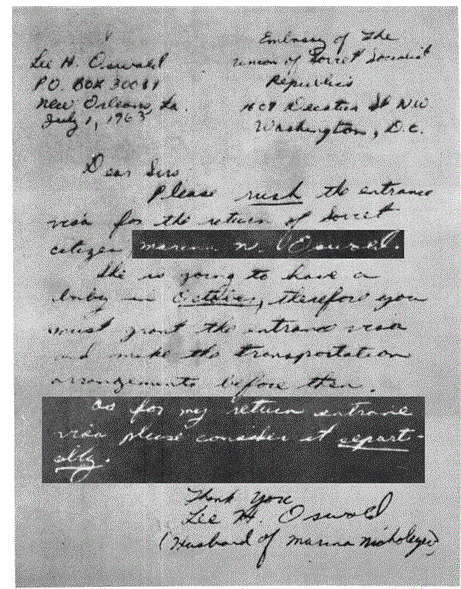
Lee Harvey (or Henry ala CI/SIG) Oswald; whose plans about the assassination the WCR says was not related to this trip–decided to go to Mexico City in order to secure passage thru Cuba to Russia. For months his wife was writing the Russian Embassy, including a questionaire, pleading to get back to Russia; with or without her husband (CE 6-2/17; CE 9-3/17; CE 12-undated questionaire & CE 14-7/8. Even her husband joined in the effort: CE 13 7/1/63:
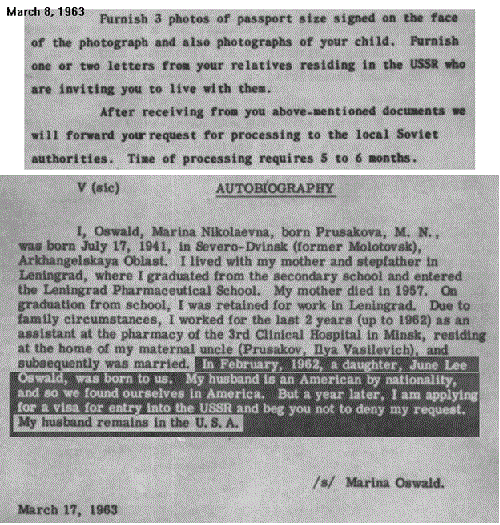
and again in CE 15 on 11/9/63 (although this typed letter may be a creation of Ruth Paine’s: typed letter from Irving.) In response to Marina’s Feb 7 letter, the Russian Embassy replied CE-8 with specific instructions on how to accomplish the process and that once a completed application and questionaire was received it would take 5-6 months.
His June 1963 passport application was approved and his passport issued. On this June 1963 application Oswald stated he would be leaving between Oct & Dec 1963 from NOLA on a ship (he took the SS Marion Lykes of the Lykes Brothers Steamship line from NOLA to Europe on his “trip” to the USSR in 1959) and he’d be gone 3 months to a year. Lykes Questionaire CE1948. The Lykes Brothers line is the same one taken by George DeMorenschildt on his trip back from Haiti thru NOLA to Dallas. (WC testimony of Mr. DeM GDeM testimony).
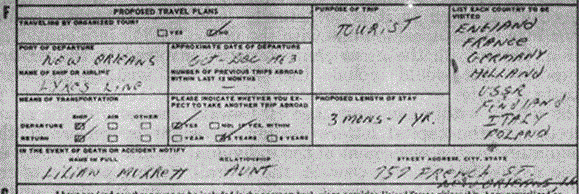
If the USSR was his (and Marina’s) desired destination (and the reason for his calls/action in Mexico), going through Cuba was unnecessary. Further it would specifically incriminate him 7 weeks later, as well as be difficult and time consuming, unless he had the help of the US Communist Party… or help from the people fighting them. Like so many activities attributed to the pre-determined guilty Oswald, there is little rhyme or reason for the activities reported during this trip, other than self-incrminiation.
On Nov 22, in fact not even very late that evening, wheels were spinning as to how to deal with what people knew about Oswald’s trip from New Orleans to Mexico and then to Dallas. While oh so conveniently Ruth Paine was accommodateing and spiriting away his pregnant wife and child. There is also the question as to what the FBI would find out when they started digging and asking questions. The morning of Nov 23rd:
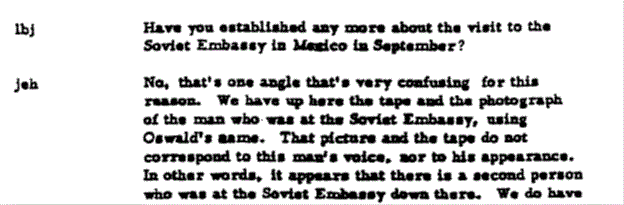
Sure enough, in the face of the absurdity of the WHY behind this trip, the Commission concludes he made it and the voice; in the face of contradictory evidence; is connected to our Lee Harvey Oswald. Sure enough, evidence will be produced which tells THAT story. For how hard can it be to find the paper trail of a person leaving the US by bus with tickets and manifests, hotels and sightseeing, and then returning the same way. Especially a man the FBI and CIA had kept pretty close tabs on through that Summer of ’63.
All the FBI had to do was trace Oswald from New Orleans the morning of Sept 25th thru Houston to Laredo and across the border to Nuevo Laredo Mexico, thru Monterrey and then to Mexico City. A few days in Mexico; Friday to Wednesday; to get done on that weekend what is hard enough during regular working hours with appointments.
The FBI and CIA will admit that the Cuban and Russian buildings in Mexico were some of the most watched; spied upon; places on the planet at that time, with no less than 30 listening devices, at least 2 inside assets and numerous automatic and fully-manned photographic stations making sure to intercept and identify EVERYONE, especially non-Mexicans, entering, speaking and/or leaving these compounds. Surely the comings and goings of at least 5 separate arrivals and departures would be recorded by the numerous devices trained on these locations.
Yet, the WCR offers the only pieces of physical evidence they can; a record of a checked medium-sized bag listed on a baggage claim master sheet to corroborate Oswald went from Neuvo Laredo to Mexico City, along with a small handful of witnesses who supposedly remembered seeing him and even spoke to him. The second bag, which the FBI repeatedly finds difficult to keep in Oswald’s possession, and which magically appears and disappears in both reality and in the evidence.
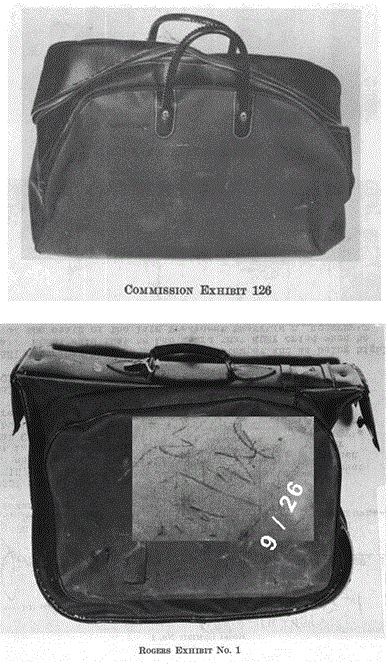
The FBI could not discover where Oswald spent the evening of September 24th after Eric Rogers sees him getting on a bus towards downtown at around 7pm. Mr. Rogers says he was carrying 2 zippered bags, green in color… So our FBI shows him photos, black & white photos, of a variety of bags:
Mr. LIEBELER. So in your estimation, he had two bags like Exhibit 126?
Mr. ROGERS. If I am not mistaken, they are the two bags that my wife and I identified when they came over to the house, somebody from Oklahoma. He was transferred down here.
Mr. LIEBELER. An FBI agent?
Mr. ROGERS. Yes.
Mr. LIEBELER. They actually brought the bags over?
Mr. ROGERS. They had the pictures like this.
Mr. LIEBELER. Did he show you pictures like these two that I have got here?
Mr. ROGERS. Sure did.
Mr. LIEBELER. They had bags like Exhibit 126?
Mr. ROGERS. Yes. This is the type. That’s the green type of looking luggage.
Mr. LIEBELER. You say again that he did not have a bag that looked like Rogers Exhibit No. 1?
Mr. ROGERS. Yes.
Why all the interest in ROGERS Exhibit #1? It turns out that a number of weeks after the 22nd Ruth Paine finds these two pieces of luggage in her garage; the very magical Paine garage which grows rifles, luggage, and all sorts of other necessary evidence. Even more peculiar are the markings on one of the sides of this luggage: “9/26;” the date Oswald was supposed to have entered Mexico. It is also claimed that a Continental Trailways sticker was affixed to the side.
Yet we must remember that this bag was NOT identified among the ones Oswald had when he left 4905 Magazine. The WCR states on page 731 that Oswald took BOTH CE126, a small, blue zippered bag (the one Rogers identified he was carrying in both hands) and a “large, olive-colored bag” footnote #1121 which is, of course, Rogers Exhibit #1, the bag provided by Ruth and DENIED by everyone asked as a bag Oswald took to Mexico.
The Warren Commission Report proceeds on the assumption of Oswald’s guilt; yet we find the Evidence IS the Conspiracy. All we need do is look. Consider the following from the WR about Oswald in New Orleans and Mexico City:
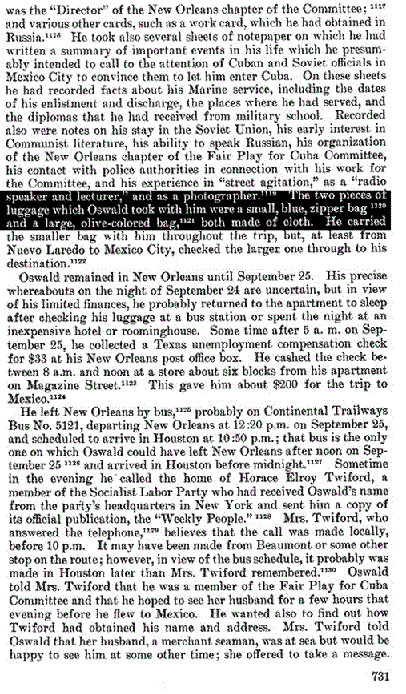
A side note: The FBI teletype from SAC, New Orleans to FBI Director, 12/11/63 mentions the bags as black bags, not green, rectangular and about 18″ across. If the rifle was NOT packed into the station wagon and NOT taken with Oswald, was that rifle, or those suitcases, ever put in the Paine’s garage by an Oswald? From Part I we mentioned that there was no proof that a rifle was transported from New Orleans to Irving with Marina and Ruth, specifically to the garage wrapped in a blanket. A rifle was not taken with Oswald to Mexico or from his apartment. This adds additional corroboration to the notion that the evidence related to the “murder weapon” was also created to support the conspiracy.
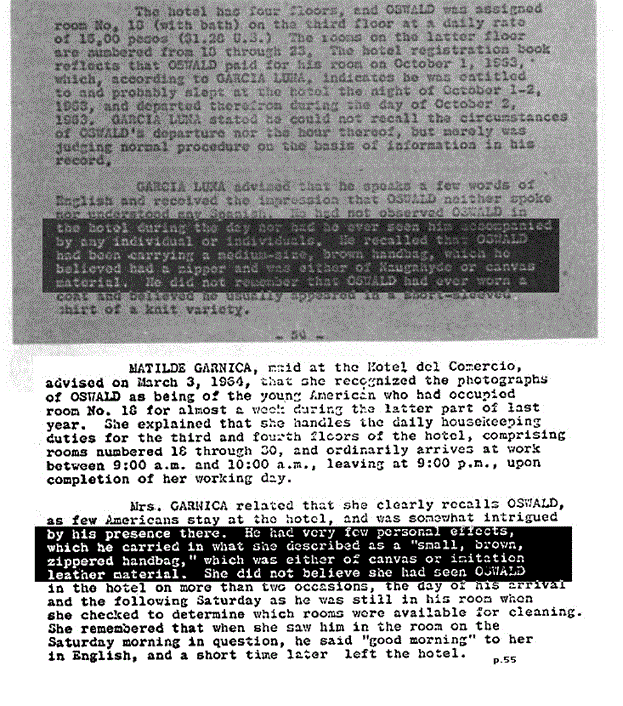
In Mexico, the FBI asked Hotel personnel what they remembered about the young American visiting them; the only American staying at that hotel we may add – CE2540 contains some of these interviews. Both the Front desk clerk and the maid handling Oswald’s room state he only had one, small brown bag and not the two bags, one blue and one green that Mr. Rogers sees Harvey leave with and board a downtown bus:
There is no record of his travel from New Orleans to Houston. No record of a ticket from any mode of transportation; the FBI checked. There is a record of a bus ticket being purchased in Houston by 2am which should have covered Oswald’s travel from there to Mexico City (FBI report of SA Edwin Dalrymple, 2/20/64). There are the affidavits of Mr. & Mrs. McFarland (McFarland) and the testimony of one of two Australian women; Pamela Mumford (Mumford); who, with Patricia Winston, spoke with the man who called himself Lee Oswald after the women boarded in Monterrey and continued on to Mexico City. And finally, as the only physical proof of the trip itself, the Flecha Rojas (Red Line) baggage manifest:
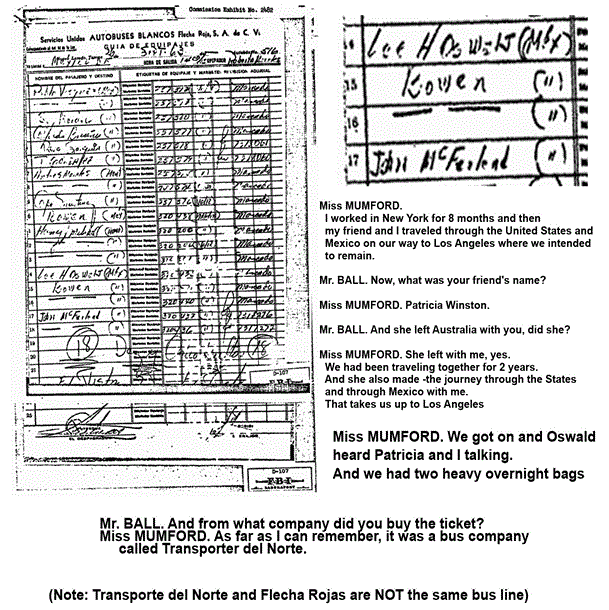
Miss MUMFORD. Well, we traveled by bus on a scheme which allowed us to travel on Trailways buses for a period of 3 months for a certain amount. We just got on and off at various places we wanted to see: For instance, Washington, D.C.; Miami, where we stayed a week; then we went across to New Orleans, down through Texas to Laredo, and from Laredo we crossed the border also by bus and went to Monterrey.
We spent one day in Monterrey and left by bus at 7:30 p.m. at Monterrey, and it was on that bus that we met Lee Harvey Oswald.
Miss MUMFORD. Well, the ticket we had on this deal enabled us only to travel in the States, not in Mexico. So, we bought the ticket on the bus at Laredo and that enabled us to stop off in Monterrey. But the ticket was from Laredo to Mexico City.
Mr. BALL. And from what company did you buy the ticket?
Miss MUMFORD. As far as I can remember, it was a bus company called Transporter del Norte.
Mr. BALL. Now, you got on the bus at Monterrey on the evening of September 26 at 7:30 p.m., you just told me?
Miss MUMFORD. Yes.
Mr. BALL. And what was the company that operated that bus, do you know?
Miss MUMFORD. That was also Transporter del Norte.
Miss MUMFORD. Oswald was the first one we spoke to. He left his seat and came down to the back of the bus to speak to us.
Mr. BALL. That was after the bus had left Monterrey?
Miss MUMFORD. Yes… Then we arrived in the Mexico City bus station and he didn’t speak to us, attempt to speak to us at all. He was one of the first off the bus and the last I remember seeing him he was standing across the end of the room.
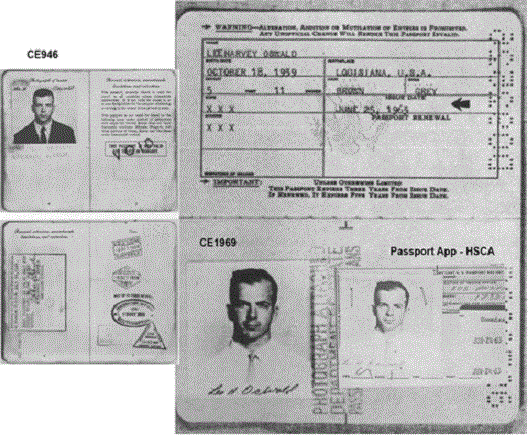
The normally tight-lipped Oswald is free with “incriminating info” and shows off a passport with Russian stamps. Yet, and this is a key point, that would mean it was Oswald’s old passport, which had been replaced by a clean one he applied for in June. This one does not have a stamp on it. (See CD 1969) Patricia Mumford has some problems as a witness.
We come to learn the man traveling as Oswald was reported to have entered and exited via a personal automobile and not on any of these buses. Does this mean that the person on the bus with Oswald’s Passport used on his trip to and from Russia was yet another person representing himself as Lee Harvey Oswald?
“At 2:05 pm, 11/27/63, while talking to Inspector Don Moore of Division 5 … I read to him an article from The Houston Press, dated 11/27/63, which was telephonically furnished to this office … in which article stated Oswald left the US by private car, ownership unknown, and returned on 10/3/63, through Laredo, Texas. He advised that Oswald did travel by car and did return to the US through Laredo, Texas on 10/3 /63.” (FBI memorandum from ASAS J.T. Sylvester, Jr., to SAC New Orleans, 11/27/63.)
In Warren Commission Document 442 we find a telegram from Mexico City to Sec of State Rusk stating the records show on October 3, 1963 a Lee HENRY Oswald left Mexico by Automobile. WCD 442 p.9
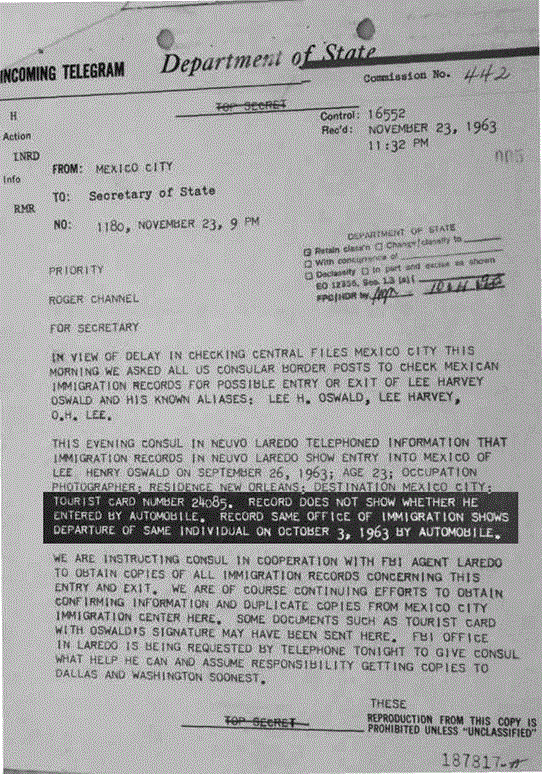
This is not the first time Lee “HENRY” Oswald is referred to related to Mexico City. The saga of Lee Henry begins with Ann EGERTER of Angleton’s CI/SIG unit who, on Dec 9, 1960 submitted a 201 file request (for people the CIA takes an active interest in as either being a threat or asset) which offers no other name aliases for Lee Henry Owsald. Given that we, the Navy, the CIA, State and FBI have seen his military records, “Henry” was no simple mistake or oversight… it appears purposeful and resurfaces in connection with correspondance to and from Mexico’s station chief Win Scott. We will be discussing the evidence which was generated after the visit in the final part of the this series.
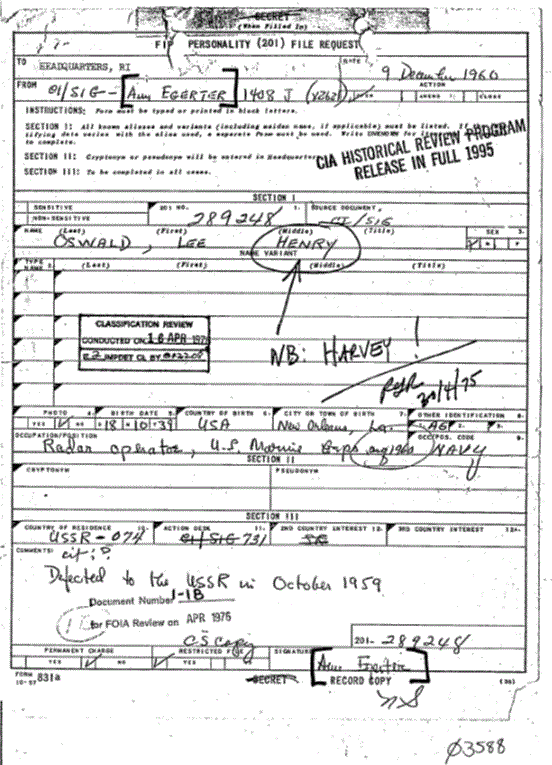
Excerpt from Inside the Company, by P. Agee:
“Files are maintained on all agents and they always begin with the number 201 — followed by a number of five to eight digits. The 201 file contains all the documents that pertain to a given agent and usually start with the PRQ and the request for POA. But the 201 file is divided into two parts which are stored separately for maximum security. One part contains true name documents while the other part contains cryptonym documents and operational information. Compromise of one part will not reveal both the true name and the operational use of the agent.“)
If LEE, or the Oswald impersonator did return by private auto, the reasons for the sightings in south Texas (Alice, Pleasanton, Freer, Corpus Christi, San Antonio & Leming) of a man with a foreign wife (not pregnant) and small children becomes a bit more clear. If this information is correct it strongly indicates ALL the evidence related to the bus trips is either completely fraudulent or describes a person specifically impersonating Oswald for specific reasons; only weeks in advance of the president’s trip to the South and what winds up being 7 weeks prior to Dallas.
During the summer of 1963 when Harvey and family are in New Orleans, we come across a great deal of evidence that someone repeatedly referred to as “Lee Oswald” was in Dallas with Ruby.
Robert Roy, Ruby’s mechanic told the FBI he had repaired Ruby’s car numerous times which had been dropped off by the man he knew as Lee Oswald after which he would drive Oswald to Rubyís club and drop him off. A number of people claim to have seen Oswald at Ruby’s Carousel Room in June/July 1963 including: William Crowe, Wally Weston, Dixie Lynn and Kathy Kay (p555, H&L). The supression of information related to Ruby and Lee Oswald not only knowing each other but being very close is formidable.
(NOTE: Whether this is LEE Harvey Oswald, born in New Orleans on Oct 18, 1939 or an imposter remains the subject of a couple of books and numerous researchers’ speculation. We know for a fact that HARVEY and family are in New Orleans during this time period. We also know that virtually everything related to Lee Oswald in Dallas in the summer of 1963 has been suppressed and/or surrounded in mystery and fear.)
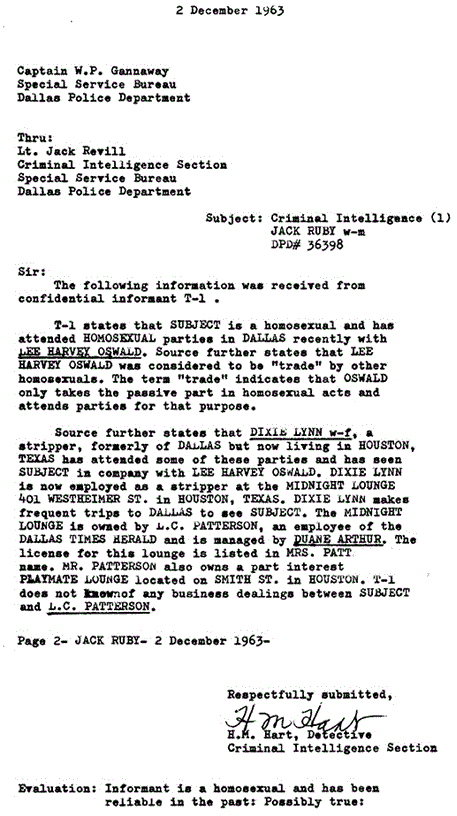
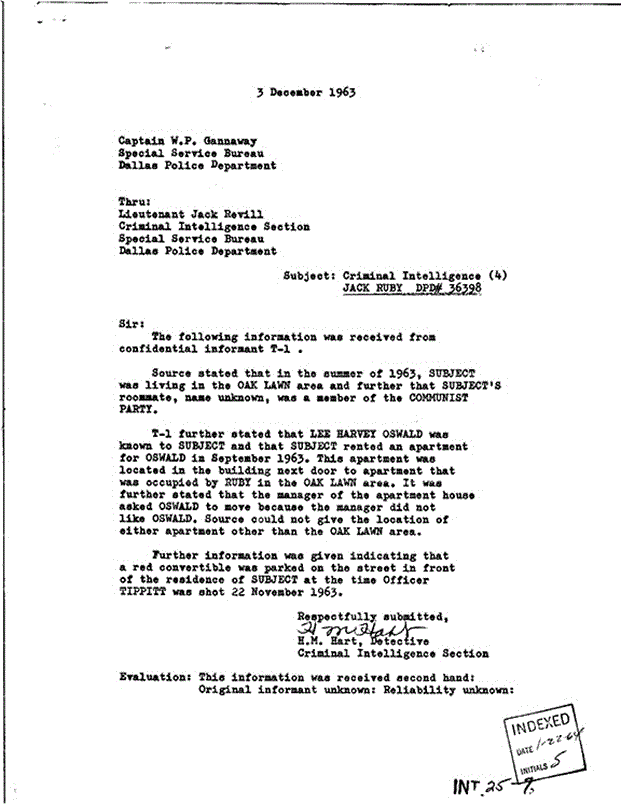
CE2814 contains much of the FBI’s investigation and their reports on those who placed Ruby and Oswald together. A bit more revealing though are the reports of H.M. Hart, Detective in Dallas’ Criminal Intelligence Section (we should remember that the CIA/FBI took especially close care to remain connected with the intelligence divisions of the major cities’ police departments).
Detective Hart, through Reville to Gannaway writes that, via a previously trusted informant, Ruby, as well as the man known in Dallas that summer as Lee Oswald, were homosexual and ran in those circles at least in Dallas. Of course, the homosexual aspect of the case also surfaces in New Orleans with Shaw and Ferrie and yet again in Irving when Oswald is repeatedly seen in the company of a young boy in the weeks leading up to Nov 22nd.
Mr. JENNER. You live at 2214 Fairfax in Irving, Tex. As I understand it, you are the owner and operator of Clifton’s Barbershop?
Mr. SHASTEEN. Yes.
Mr. JENNER. At 1321 South Storey in Irving, Tex.?
Mr. SHASTEEN. Right.
Mr. JENNER. How many times–you personally, now, without someone else having told you the boy was in the shop, how many times do you recall when he was in your shop?
Mr. SHASTEEN. The 14-year-old boy?
Mr. JENNER. Yes.
Mr. SHASTEEN. Three times–I know.
.Mr. JENNER. You have a distinct recollection that on occasions when this man came into your shop for a haircut, he drove an automobile up to your shop?
Mr. SHASTEEN. He drove that there 1955, I think it’s a 1955, I’m sure it’s a 1955 Chevrolet station wagon. It’s either blue and white or green and white it’s two-toned–I know that.
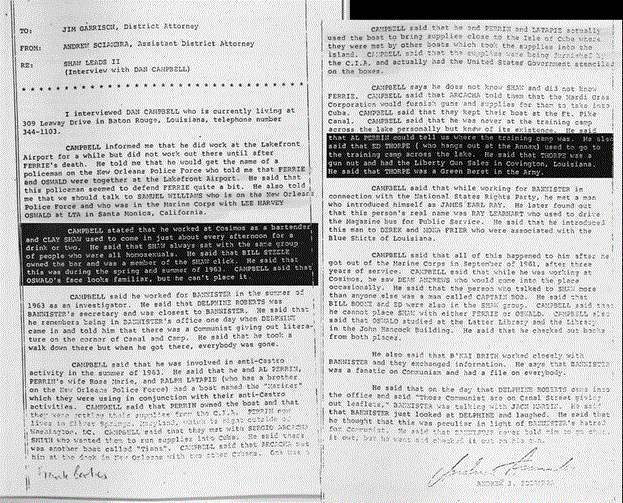
I bring this up only to suggest that a Lee Oswald was known in Dallas and known to be in the company of Jack Ruby, all the while another Oswald was living in New Orleans. Years later Dan Campbell of Baton Rouge LA connected Ferrie and Oswald, explained how he saw Shaw daily with a group of homosexual men, and had worked for Bannister.
For our purposes, the fact that Ruby’s Lee goes to see an old associate of Ruby’s, Robert McKeown the gunrunner, to establish Oswald’s desire to purchase scoped rifles at incredible prices over Labor day 1963 helps reinforce the premise that Ruby and Oswald were together in Dallas in the summer of 1963.
Further supporting evidence was receivied again through Dallas T-1, http://jfk.ci.dallas.tx.us/37/3793-001.gif Box 18 folder 6 doc #8:
One final mention of LEE in Dallas (for our purposes) comes on the heels of a confirmation by Antonio Veciana that he met with Maurice Bishop aka David Atlee Phillips at the Southland Building in Dallas in late August or early September. (Is it possible that Bishop either leads Oswald to McKeown or is debriefed after Lee’s visit to McKeown’s house over the first weekend, Labor Day weekend in Sept.)

Ruby’s Notepad with Bishop
(Ruby’s notebook with BISHOP RI8-7991. A “Bishop” was not found to be either a first or last name among those who Ruby knew)
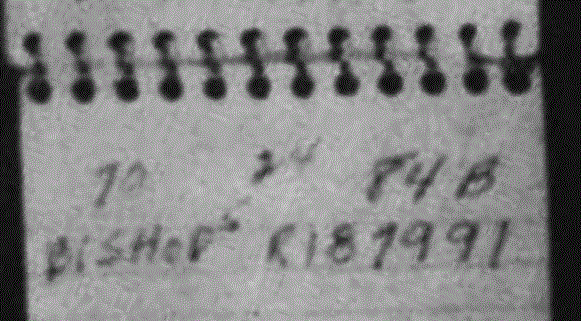
Lee Oswald, or someone doing a very good impersonation of him was in Dallas and seen with Jack Ruby at the same time Harvey was working with Guy Bannister, Gaudet, Ferrie and others both FOR and AGAINST the Fair Play for Cuba Committee organization and members.
Back in New Orleans on the morning of September 25th, we have evidence that “an” Oswald cashed an Unemployment check at Winn-Dixie at 4303 Magazine, less than 2/10th of a mile from what was his Magazine Street apartment. Although his whereabouts on the night of the 24th is a mystery (the WCR assumes he dropped his bags as the bus terminal and found a rooming house or “inexpensive hotel” even though the FBI offers no evidence of his staying at any of the over 40 places they checked), yet after 6am on the 25th someone retrieves an Unemployment Check from his PO Box, returns to a spot not far from his apartment and cashes his $33 check. (FBI D-51 is an exhibit referred to by a number of authors yet I have not been able to find. It is claimed to show that Oswald did NOT sign this last $33 check, even though the Winn-Dixie store does show it deposited on Sept 26th)
What I found somewhat interesting about his unemployment claims was the timing, August 3, 1963. Which was six days before he was arrested outside of Shaw’s ITM for handing out Fair Play for Cuba Committee flyers. On that application, Oswald lists the UNITED FRUIT COMPANY as one of the businesses where he applied for work (Burcham Ex#1 p.240). The vast majority of his job hunting, to that point, had been related to photographic or darkroom work. There was indeed a United Fruit southern headquarters set up in New Orleans, so it could be a coincidence. Still, that is a company with plentiful CIA and intelligence ties.
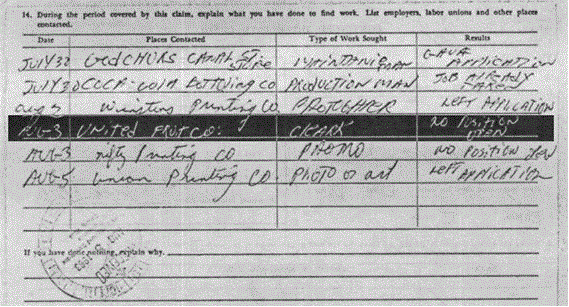
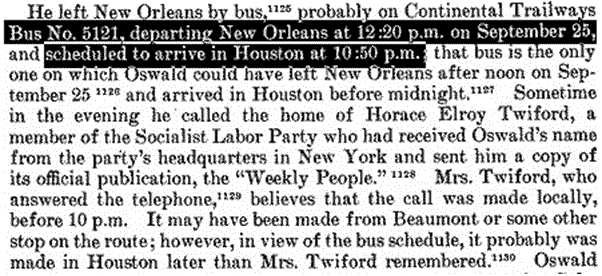
Returning to September 25th, there is no mention of the transportation needed to get Oswald from the downtown bus station area back to his PO Box or to the Winn Dixie and then back again to leave on the 12:20pm bus to Houston; the ONLY bus that fits the WCR description of his travel. The problem the WCR could not overcome yet chose to add in their narrative on p.731 posted above is Oswald’s evening call to the Twiford’s in Houston and the affidavit of Mrs. Twiford.
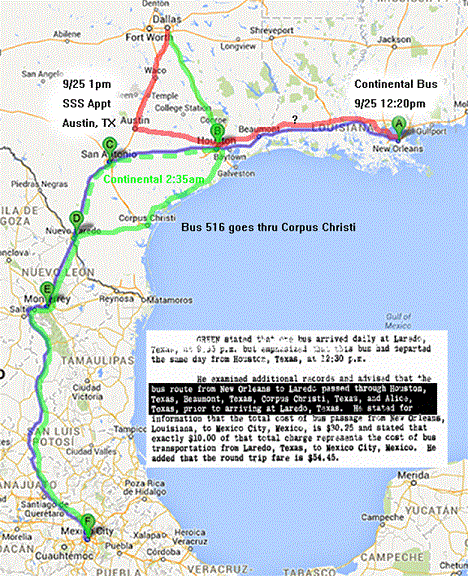
As we read on page 731 of the WCR above, according to Marina, he left New Orleans by bus; the fact that Marina had already left the city the day before should give you some clue as to the depths of investigation performed to determine this “fact”. With Mexico City his final destination, Oswald could have (and should have) purchased the three part ticket to take him from New Orleans to Houston, Houston to Laredo and from Nuevo Laredo to Mexico City. Yet for ANYONE to reach Houston in time to catch the 2:35am Houston to Laredo CONTINENTAL bus; which is the first place there is ANY evidence that “an” Oswald purchased a ticket for transportation to Mexico; they had to leave New Orleans on the Sept 25th CONTINENTAL 12:20pm bus. There are NO OTHER CHOICES. This conclusion was arrived at by process of elimination as there remains no evidence to support Oswald, or anyone claiming to be Oswald, boarding and traveling on that bus. In fact, even the 12:20 pm bus was not originally discussed as an option.
Oswald had to be on the September 25th 12:20pm Continental Trailways bus from New Orleans to Houston regardless of the fact that there is:
-No record of his purchasing a ticket for the New Orleans to Houston portion of the trip on Continental Trailways bus #5121 at 12:20pm.
-No record of his boarding a bus, presenting a ticket, or checking luggage
-No record of any bus drivers recalling the uniqueness of a New Orleans to Mexico City 3-part ticket and when shown photos of Oswald, no recognition of that man being on the only bus from New Orleans to Houston
Hang on a second now… a 12:20pm bus to Houston huh… On Dec 16, 1963 Mr. Major Green of the CONTINENTAL TRAILWAYS bus line stated that there were two (2) buses that traveled from New Orleans to Laredo. (One might assume that if Oswald was going all the way to Mexico he would buy a bus ticket for the entire trip as opposed to simply traveling to Houston and buying yet another ticket there for the rest of the trip.) These buses were the 4:40pm and 8:15pm Sept 25th buses arriving in Houston the next day, the 26th, at 2:15am and 7:00am, respectively. (WCD183) The 2:15am arrival would have been just in time for the 2:35am from Houston to Laredo… The FBI looked into the 4:40pm bus, its driver and passengers with no indication that Oswald was aboard.
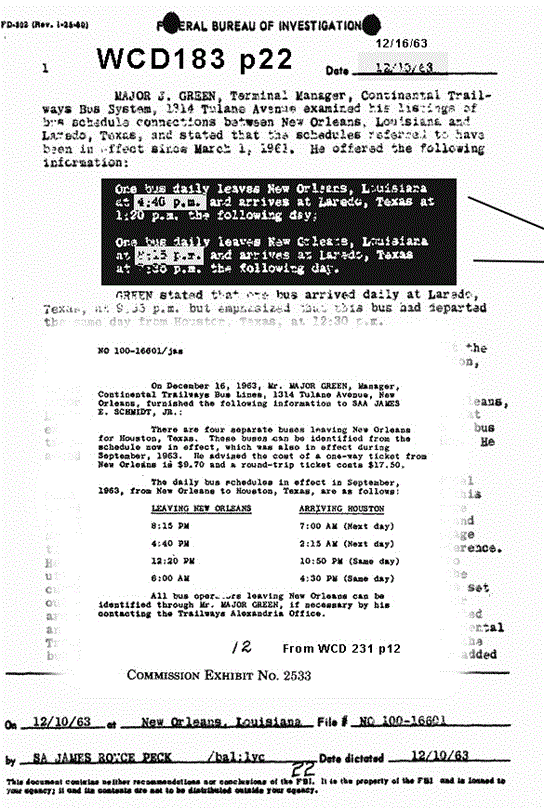
This arrival time also contradicts the information related to the Twifords of Houston.
On p.731 of the WCR (WCR page image above) we learn that in Houston Oswald contacted the home of Horace E. Twiford, a Socialist Party member who receives names and addresses from the Party so he can send them the official publication, “Weekly People.” Oswald identified himself to Mrs. Twiford over the phone and since there was no operator involved, Mrs. Twiford felt it could have been a local call. Since the WC believed Mrs. Twiford’s affidavit, (Twiford Affidavit), the fact that she did not mention a specific date for this call and only placed the timing of the call between 7pm and 10pm, the WC had to conclude that Oswald arrived in Houston prior to 10pm. Neither of the two Continental buses Mr. Green identified in Dec 1963 arrives prior to 10pm on September 25th.
2. …He also said that he had hoped to discuss ideas with my husband for a few hours before he flew down to Mexico. He said he only had a few hours. I assume he was calling from the Houston area since he did not, to my knowledge, place a long distance call. However, he did not specifically say that he was in Houston. I have no information concerning his whereabouts when this call was placed. I told him if he desired to correspond with my husband, he could direct a letter to 7018 Schley Street, Houston, Texas, and I would see that my husband received it.
3. I cannot recall the date of the call, but I think it occurred during the week prior to the weekend my husband flew home to visit me from New Orleans where his ship was docked. I recall, my husband had shipped out the weekend prior to the call.
4. I cannot recall the exact time he called, but I think that it was in the evening, sometime between 7:00 and 10:00 o’clock. I was not working during this period.
Signed this 2d day of July 1964.
(S) Mrs. Estelle Twiford,
Mrs. ESTELLE TWIFORD
This bit of evidence seems to stand contrary to FBI investigatory practices. If a call was placed, a record is surely available from the phone company. If this was a long distance call, even more phone records would be created. Given the witness cannot recall the time or date of the call; the WC could have concluded it was not the 25th at all, yet then the call would have come from Mexico; also easily traced; yet does not fit in the story or timeline. The Twifords were never called to testify. We all know how much evidence and/or testimony was overlooked in the name of Oswald’s guilt. Why even mention this call, opening the door to taking an affidavit, and in turn the realization that what Twiford says Oswald told her conflicts with much of the Mexico evidence.
According to the evidence the Warren Report another bus HAD to be found. His apartment on Magazine was vacant; his wife, Ruth Paine and all the kids left on the 23rd. Oswald was seen carrying suitcases and went out of the way to retrieve and cash his $33 unemployment check. Even though he stated he had $300 for his trip and was already downtown where the buses would be leaving, he supposedly returned to his PO Box, and to within a couple blocks of his recent home, to cash said check and the evidence quoted states that there was no signed endorsement on this check.
On September 21, 1964, almost 10 months later and only a few days before the presentation of the WCR, an FBI report which becomes WCD 1553 (and accompanies a letter from Hoover dated Nov 9, 1964; after the WCR is delivered) was written up. This is from a September 9, 1964 re-interview of Mr. Major Green by FBI agent Callender in New Orleans. In THIS report, Mr. Green adds two more buses which travel from NOLA to Houston at 6:00am and 12:20pm arriving in Houston at 4:30 pm and 10:50 pm, respectively. The WCR places Oswald on the 12:20pm bus #5121 which arrives in Houston at 10:50 pm since it is known that Oswald retrieved and cashed his $33 unemployment check down the street from his apartment at 4905 Magazine after the 6am bus had already left New Orleans (even though this check was unsigned).

It is in this WCD that the FBI tries and fails to make its case against Hall, Howard and Seymour. WCD 1553 p.39.
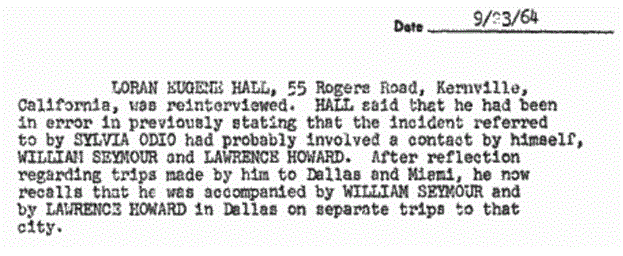
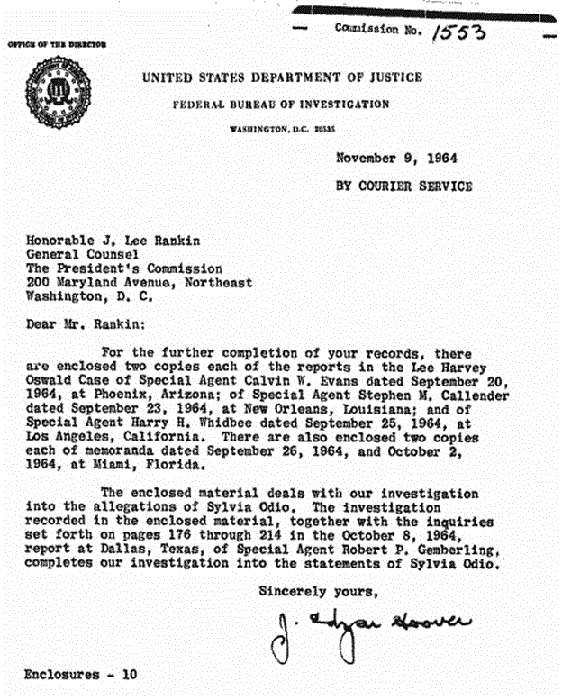
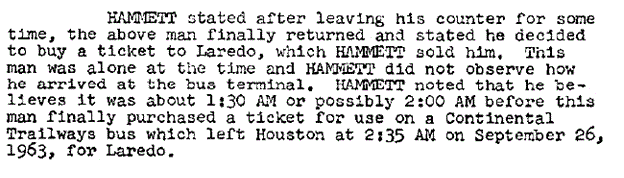
The bus Oswald is supposedly on arrives well after 10pm in Houston. How then does Oswald call the Twifords from Houston between 7-10pm, if he is not yet in Houston? If the call was placed from outside of Houston; there might have been a record. Yet Oswald states that he has a few hours before his plane leaves to come by and speak to Mr. Twiford. Of course this does not prove he was in Houston at the time of the call, yet the evidence indicates he presented himself and was perceived as if he was. The man leaving Houston at 2:35 am on Continental #5133 (ticket # 112230 purchased at 1:30am) Hammett in Houston who spoke with the McFarland’s and was vocal about his FPCC connections is just as likely the person who called the Twifords from Houston earlier that evening who had “a few hours before he left for Mexico.”
From all the evidence the FBI offered, there is simply nothing to support Oswald leaving New Orleans on a bus headed to Houston. But there is reliable and corroborated evidence that another Oswald was in Austin, TX early in the afternoon on Sept 25th. And he arrived on the following evening on the 26th in Dallas, at Sylvia Odio’s with Leopoldo and Angelo. Coupled with the total lack of evidence regarding a bus trip out of New Orleans, it all suggests this Second Oswald, and his two Cuban riding companions, either left New Orleans together, or the Cubans met up with Harvey Oswald at some other location and traveled to Dallas between the 25th and 26th of September, stopping in Austin. The WC and FBI also did all they could to suggest that three other men (Loran Hall, Lawrence Howard and William Seymour) were the three visiting Ms. Odio; yet those efforts proved fruitless; but not in time to change the WCR conclusions.
On October 1, 1964 Sylvia was shown the photos of these three men and stated that “none of these individuals were identical with the three persons… who had come to her apartment in Dallas in the last week of September, 1963.” Her sister, Annie Odio, who was also in the apartment at the time, also stated that “none of the photographs appeared similar to the three individuals in her recollection.”
On 16th September, 1964, FBI agent Leon Brown interviewed Loran Hall on behalf of the Warren Commission. Brown claims that Hall admitted that he, Lawrence Howard and William Seymour made a visit to a woman who could have been Silvia Odio. However, when Hall was re-interviewed on 20th September and was shown a photograph of Odio, he claimed she was not the woman he met in New Orleans.
There is evidence available which places an Oswald at the Selective Service System Office in Austin, TX just after lunch on September 25th at about the same time he’d be leaving NOLA on the only bus the FBI could conclude he used, bus 5121 leaving at 12:20pm. The WCR, on the following page 732, explains that since there is no corroboration for Mrs. Dannelly’s story (which is eerily the same as our conclusion regarding his trip from NOLA to Houston) she must have heard the news and “all of the information she furnished (snip) could have been derived from news media.”
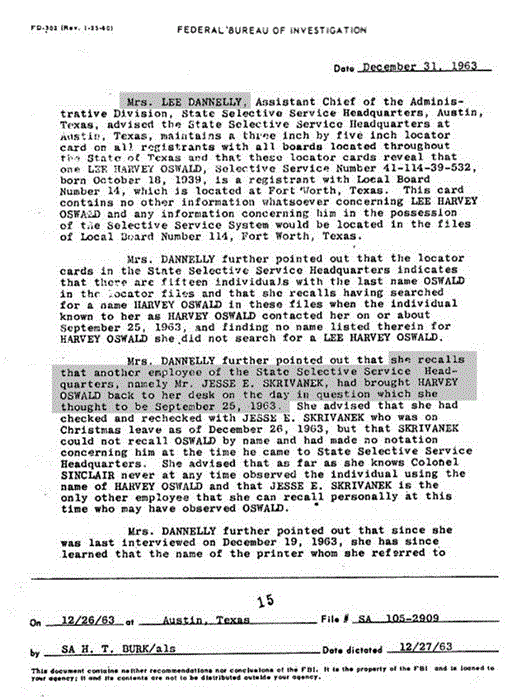
Austin Texas is 80 miles to the north west of the trip from Houston to Laredo, which in itself is about 325 miles and a 10 hour trip to the south. What will become clear is that an Oswald traveled from NOLA thru Austin on his way to Dallas and Sylvia Odio while another Oswald traveled AWAY from Dallas to Houston and caught the 2:35am bus early in the morning of Sept 26th .
To avoid corroborating her story we find the FBI once again trying to discredit witnesses. While they all give Mrs. Dannelly (and Jesse Skrivanek) the benefit of the doubt, they determine that two more people could not be right. One of these witnesses, a waitiress who claims to have served Oswald stated she had Wednesdays off. Sept 25th was a Wednesday and it was the day Mrs. Dannelly saw Oswald, so by process of elimination Mrs. Norman could not have seen Oswald. When shown a photo of Oswald, both Ronnie Dugger and Mrs. Stella Norman claim the person they met was “identical with Oswald.”
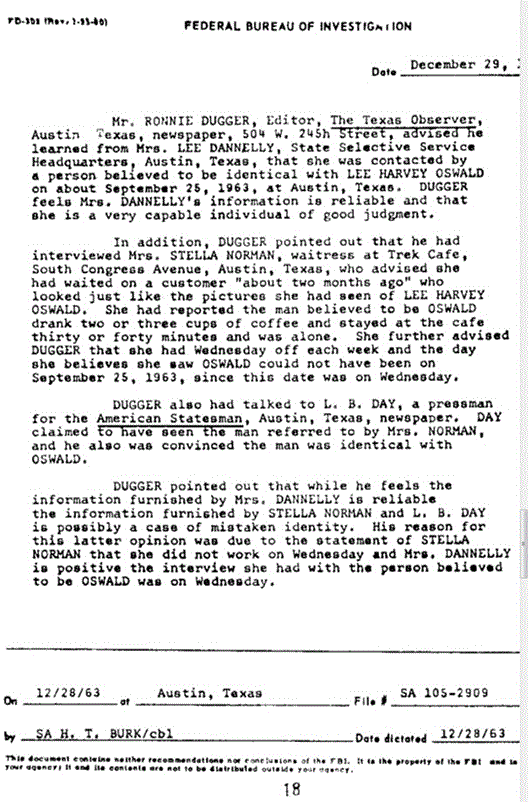
The Texas Employment Commission building is but 4-5 miles from the cafe where Mrs. Norman worked, L.B. Day confirms her story while Leon Oswald is not at Sylvia Odio’s in Dallas until the early evening of the 26th. Sylvia’s testimony suggests that the 26th or 27th was possible and that she had been to work that day (although she finally does settle on the evening of the 26th as the time and date). Oswald being seen in Austin while another Oswald impersonator makes his way to Houston for a trip to Mexico begins to take shape.
There is nothing offered to deny the possibility of Oswald staying in Austin until the following day, when on the morning of Thursday the 26th Mrs. Norman could be serving Oswald coffee, alone. Given Harvey’s cheap ways, milking a $.10 cup-a-joe while waiting for his comrades to get ready to leave for Dallas can explain the sighting and trip to Austin just as easily as the FBI dismissing it on such weak grounds.
This is a good place to note here the title of this series. The story of Oswald’s guilt is craftily told by prosecuting attorneys; the explanation of why this telling of the tale is so skewed is no better told in a lawyerly, assumptive fashion. Guilt requires proof… Innocence is one of the rare human qualities which civilized society purposefully “assumes” within its basic rule of law. One is presumed innocent until proven guilty. If the guilt can be shown to have come from inauthentic evidence, the presumption must remain. Oswald was presumed guilty with evidence supporting that conclusion brought front and center while all other evidence is buried, altered, destroyed or simply ignored. When this selective evidence is shown to be inauthentic in the years after his murder, the presumption of innocence MUST be a foregone conclusion.
As Mr. Redlich put it to Mr. Rankin on April 27, 1964 at the beginning of evidence evaluation and the taking of statements (there is no record of this memo being discussed at any Executive sessions):
Our report presumably will state that the President was hit by the first bullet, Governor Connally by the second, and the President by the third and fatal bullet. The report will also conclude that the bullets were fired by one person located in the sixth floor southeast corner window of the TSBD building…
Our intention is not to establish the point with complete accuracy, but merely to substantiate the hypothesis which underlies the conclusions that Oswald was the sole assassin…
I should add that the facts which we now have in our possession, submitted to us in separate reports from the FBI and Secret Service, are totally incorrect and, if left uncorrected, will present a completely misleading picture.
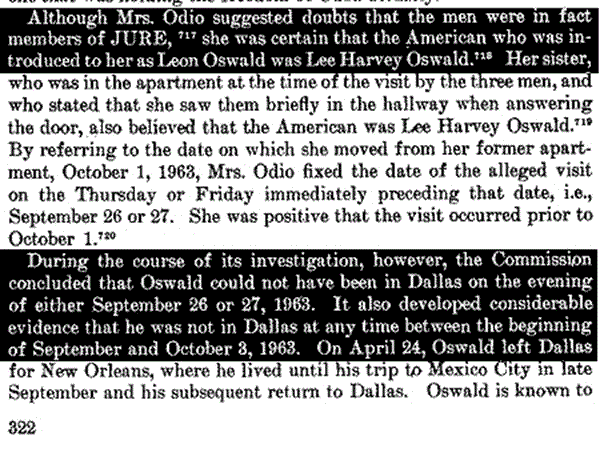
The powers that were/are in charge of the evidence made sure that Ms. Odio’s story was not heard in a timely manner. Her WC interview was in mid July 1964 while the FBI reports, CE3147 & 3148 are dated September 1964. The report itself was finished and delivered on September 24, 1964. Ms. Odio’s story is summarized on pgs. 321-322, followed by the declaration that since OSWALD was traveling on a bus to Mexico at the time he could NOT have been at Odio’s home in Dallas at the same time and it has been developed “that he was not in Dallas any time between the beginning of September and October 3, 1963.” Until the Hearings and Exhibits were published, this was the only mention of Sylvia Odio, 2 Cubans and Leon Oswald.
In essence; because he couldn’t have met Odio since he was on a bus to Mexico, he didn’t. The Evidence IS and will always remain, the Conspiracy.
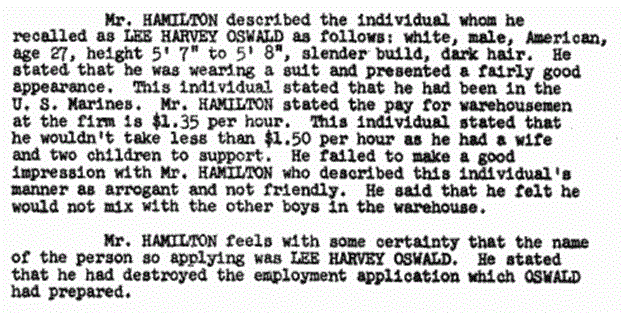
Mr. Olin Hamilton of the AL SEMTNER Drug Dept in Dallas was reported by the FBI to have interviewed LEE OSWALD just after Sept 23, 1963; when the WCR tells us he was not in Dallas during that time. Much like the WCR’s statement that no one saw Oswald between 11:50 and 12:30 on 11/22, the above declaration that Oswald was not in Dallas at all in the month of September is easily disproved. Oswald was in New Orleans all summer, so one wonders how the Texas Employment Commission has recent Dallas information on this man, and is able to send him on this interview.
Mrs. Ambrose Martinez told the FBI that prior to the assassination in Aug/Sept Lee and Marina and 2 children visited her Salvation Army welfare office in Dallas. (at 500 N Ervay not far from the FBI offices in Dallas at the time) She gave the FBI details related to their references to Mrs. Paine and Marina only speaking Russian. Lee told her they were living in Irving with Mrs. Paine and that he had met her in New Orleans. Ruth, on the following page mentions that Marina never went to downtown Dallas after Oswald joined them on October 3rd. Furthermore, Oswald’s 2nd child was not born until mid-October.
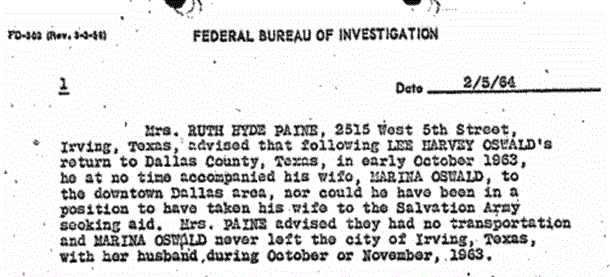
As we can see, there is quite a bit going on with conflicting evidence just for Sept 23rd thru the 26th… and we haven’t even gotten to Laredo yet.
Mr. E.P. HAMMETT, the ticket agent at the Continental Trailways counter in Houston on the night of Sept 25th remembers distinctly selling a single ticket for travel from Houston to Mexico City; a rare event as that trip’s tickets are not sold but more than 1 or so a week, according to Mr. Hammett. In this report the FBI shows Mr. Hammett a photo of Oswald and a small Zipper bag (but not the larger olive-colored canvas bag which is ultimately recorded on the Nuevo Laredo to Monterrey, Flecha Roja busline portion of the trip.
The description of the man’s clothes offered by Mr. Hammett; a brown and white pullover sweater, white dungarees and white canvas shoes; and the lack of these items being found in any of Harvey’s possessions, suggest that like the light colored medium sized jacket found “on the escape route from Tippit”, these clothes were never Harvey’s.
From all appearances, the man claiming to be Lee was in Houston getting on a bus at 2:35am now the 26th, while Harvey was still in Austin on his way to Dallas; most probably with the two Cubans Odio sees on the evening of the 26th.
Surely there are records kept as tourists leave the USA and enter a different country. The stamping of passports is something we can usually count upon yet in 1963 traveling to Mexico or Canada did not always result in these stamps. So what else can we find which would show that Oswald, with no known nefarious thoughts at this point, left the US for Mexico. Surely he was not actively trying to hide this travel; given the discussions Marina claims they had about the trip, the lack of any motive and the ease with which he befriends others on the way.
CE2121 p14-15 & 23; From Mexican Immigration forms FM-5 and FM-8 (this FM-8 appears imprinted at the top of the tourist visa card #24085 made out to Harvey Oswald Lee) the FM-11 form is created which is an alphabetical listing of those entering Mexico prepared every 2 weeks. For those people entering the 1st of the 15-day cycle, the person with the first alphabetical listing would have the #1 written on their visa and they’d be recorded on line #1 in the FM-11.
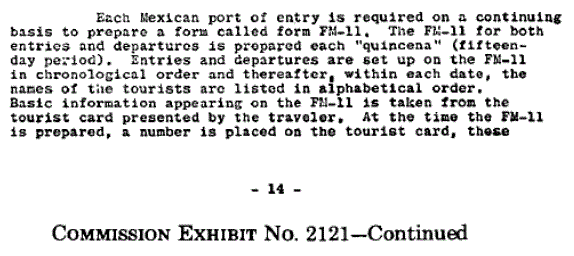
Info for the FM-11 is taken from the ORIGINAL tourist card and then, “a number is placed on the tourist card” which are used to make entries by day, in alphabetical order until the end of the 15 day period. Oswald was given # 807 on the FM-11 which started at #762 for FM-8 passengers on Sept 26th. The number we should see on the original visa would be 807 minus 762 or 45. It does not appear there is any number written on the “original” visa in evidence that corresponds to this process.
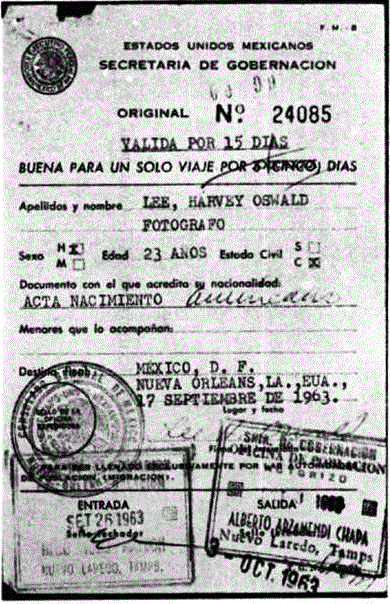
http://www.history-matters.com/archive/jfk/wc/wcvols/wh25/html/WC_Vol25_0352b.htm
For CE2121, FM-5 and FM-8 entries are separated. For the period starting Sept 16 we are shown that entrance #368, Margarita Alanis, was recorded as the first person entering Nuevo Laredo on Sept 26th. On page 18 the FM-5 numbers end with #399; Tobias Zarember and start again with the FM-8 entry: Felix Alonzo. The number for the alphabetized FM-8 form entries begins with 762.
On page 23 of CE2121, after the name Buell Moore and before Maurice Ouellet we have “HARVEY OSWALD LEE, FM-8 #24085.” Except according to the Mexican officials, they believed the passenger’s name from the visa was Lee, Harvey Oswald which becomes “H.O. Lee” on his departing documents. LEE comes well before MOORE. In fact, Mr. LEE should have been #800 before Mr. Mason. One has to wonder who in Mexico would have known this passenger to be Mr. OSWALD when preparing this list as opposed to Mr. LEE as stated by his travel documents.
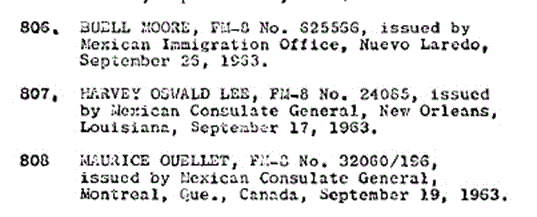
The exhibit goes on to mention that even though baggage may be listed; this does not insure that the person actually traveled on the bus.
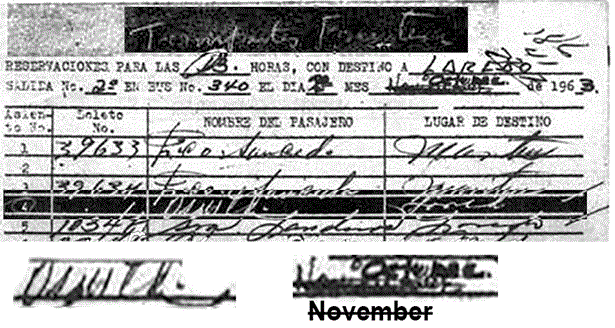
Below is a piece of CE2469 which establishes H.O. LEE as the name the Mexican authorities related to the person traveling out of Mexico and back to the US. We will return to this important Exhibit as it fits into the controversy surrounding which bus line the FBI and the WCR finally decides Oswald was on: Transportes del Norte or Transportes Frontera and why, if he was actually on one or the other, there appears to be evidence which supports either scenario. What the Frontera evidence reveals is the speed and efficiency with which Mexican intelligence was willing to create documents which supported the story of his travel. In subsequent parts we will examine this trip in detail starting with the arrival in Mexico, the evidence of his activities in Mexico and the return trip to Dallas.
There were three bus lines which service Mexico City: Transporte del Norte, Transporte Frontera and Flecha Rojas. The evidence for Oswald’s return trip will pit evidence created by Arturo Bosch against the assumptions and evidence regarding the del Norte line and the simple statement of Hoover that Oswald did NOT take bus #340 at 2pm; and that the evidence which suggests this was created after the fact.
National Security Archive Electronic Briefing Book No. 494
Edited by Peter Kornbluh and Justin Anstett, At: The National Security Archive
NOTE: Dr. Mantik’s four-part essay on the Harper Fragment, orginally posted at CTKA on November 11, 2014, has been superseded by his e-book:
 With his permission, we have republished this useful tabular summary of the researchers and doctors who have contributed to the discussion of the Harper Fragment.
| Aguilar, Gary, M.D. | Ophthalmologist and major contributor to the anti-Warren Commission (WC) literature; he compiled a long list of Dallas witnesses who saw an occipital defect. He also viewed the JFK autopsy materials with me at the Archives. |
| Angel, Lawrence, Ph.D. | Physical anthropologist and consultant to the Forensic Pathology Panel of the HSCA (1977-1979); in his opinion, HF is right parietal bone. |
| Baden, Michael, M.D. | Chairman of HSCA Forensic Pathology Panel; he concluded (incorrectly) that frontal bone was entirely intact. Robertson has (mostly) agreed with him about this. |
| Bolleter, M. Wayne | Chief Medical Photographer at Methodist Hospital in Dallas; photographed HF before it was turned over to the FBI. |
| Boswell, J. Thornton, M.D. | Navy pathologist at the JFK autopsy; his sketches clearly show (significant) missing occipital bone. He also verbally recalled missing occipital bone. |
| Brown, Walt, Ph.D. | Author of many books critical of the WC, including the essential resource: Master Chronology of JFK Assassination (over 32,000 pages), available for Kindle. |
| Burkley, George, M.D. | Admiral and JFK’s personal physician, who was present at Parkland and at Bethesda; last known possessor of HF. He later refused to comment on the number of headshots. Not interviewed by the WC. |
| Cairns, A.B., M.D. | Chief Pathologist at Methodist Hospital in Dallas; with Drs. Harper and Noteboom, he examined HF before transferring it to the FBI. All three concluded that HF was occipital bone. |
| Costella, John, Ph.D. | Expert in optics and electromagnetism; he has extensively studied the Zapruder film and concludes that it is a reconstruction. His stabilized version of the film is an invaluable resource for researchers. So also is his essay, “What Happened on Elm Street? The Eyewitnesses Speak”, which is a compilation of eyewitness statements from the WC’s 18 volumes — about what they saw on Elm Street. |
| Cranor, Milicent | Story Editor at WhoWhatWhy.org; author of many incisive, and cleverly titled, anti-WC articles. |
| Ebersole, John, M.D. | The (sole) navy radiologist at JFK’s autopsy in Bethesda; he spoke to Mantik about his recollections of the autopsy. In particular, he recalled (to Mantik) a “big” occipital defect. He later practiced Mantik’s own specialty of radiation oncology. |
| Evans, Kathy | Former nurse, now in eager pursuit of silver ingots from sunken ships. With Dr. Aguilar, she co-authored the classic paper on (inept) governmental investigations into the JFK murder. |
| Fetzer, James H. Ph.D. | Chair or co-chair of five national conferences (1999-2013); organizer of the first Zapruder Film Symposium at JFK Lancer (1996); editor of Assassination Science (1998), Murder in Dealey Plaza (2000) and The Great Zapruder Film Hoax (2003). His M/W/F radio show, “The Real Deal” (with over 880 episodes), featuring “The New JFK Show“, has gone video at “The Real Deal on MBC TV”. His latest articles are at http://veteranstoday.com/author/fetzer, while he co-edits assassinationresearch.com with John P. Costella. |
| Fiester, Sherry | Certified Senior Crime Scene Investigator and author of Enemy of the Truth: Myths, Forensics and the Kennedy Assassination. Mantik’s review of her book is here. |
| Finck, Pierre, M.D. | Army pathologist summoned to participate in the navy JFK autopsy at Bethesda. In his written summary, he recalled missing occipital bone. Contrary to the extant Zapruder film, but like Dan Rather and Cartha “Deke” DeLoach, Finck (after watching the film) also recalled that JFK fell forward after being shot. (James Altgens also agreed with this forward motion — see footnote 222 below.) |
| Fitzpatrick, John, M.D. | Forensic radiologist and consultant to the ARRB. He observed that significant frontal bone was missing, but he was particularly puzzled by the 6.5 mm object, which he could not explain. No one saw this object on the X-rays during the autopsy. |
| Harper, Jack, M.D. | Uncle of Billy Harper; together with Drs. Cairns and Noteboom, these three pathologists examined HF before turning it over to the FBI. |
| Harper, Billy | Discovered HF on the infield grass in Dealey Plaza on Saturday, November 23, 1963. |
| Horne, Douglas | Chief Analyst for Military Records for the ARRB and author of Inside the ARRB: The U.S. Government’s Final Attempt to Reconcile the Conflicting Medical Evidence in the Assassination of JFK. He is the only former member of the ARRB to publish his insights and recollections. |
| Humes, James J., M.D. | JFK’s chief pathologist at Bethesda; while before the ARRB, he identified his EOP entry site in such a way that autopsy photograph F8 must be a posterior view. His official autopsy report describes the skull wound as extending into the occiput. |
| Hunt, John | Independent researcher who has made many visits to the National Archives; he supplied the images in this essay of the HF X-ray and also the FBI photographs of HF. |
| Jenkins, James C. | Autopsy technician at Bethesda Naval Hospital. He stood next to JFK’s body during the autopsy and recalled a large occipital defect. He also saw a bullet entry near the right ear and a plastic bag with bullet fragments and bone fragments (which he had not seen being removed) lying next to JFK’s head during the autopsy. |
| Kirschner, Robert, M.D. | Forensic pathologist and consultant to the ARRB. Like me, he saw fatty tissue in the corner of autopsy photograph F8, which he interpreted as abdominal fat. This is consistent with F8 as a view of the posterior skull. |
| Law, William Matson | Author of In the Eye of History: Bethesda Hospital Medical Evidence in the JFK Assassination (2005). This book contains Law’s interviews with Dennis David, Paul O’Connor, James Jenkins, Jerrol Custer, James Sibert, Francis O’Neill, Harold Rydberg, and Saundra Spencer. Mantik wrote the Foreword. |
| Lifton, David S. | Author of Best Evidence, a best seller and also a Book of the Month selection. He also produced extensive videotapes of the key JFK medical witnesses. The latter can now be viewed for free on YouTube. Lifton is chiefly remembered for raising the issue of body alteration between Parkland and Bethesda. |
| Mantik, David W. | Ph.D. in physics (Wisconsin); post-doctoral fellowship in biophysics (Stanford); tenure-track physics faculty (Michigan); M.D. (Michigan); radiation oncology residency (USC); certified by the American Board of Radiology; director of residency training at Loma Linda University, where he treated cancer with proton beams. He has viewed the JFK autopsy materials at the Archives on nine separate visits and has made hundreds of optical density measurements directly from the extant JFK skull X-rays. His lecture on altering X-rays is here. |
| McAdams, John C., Ph.D. | Polemicist and acerbic supporter of the WC, he attended Kennedy High School in Kennedy, Alabama. He taught courses on American politics and public policy at Marquette University in Milwaukee, but he is now suspended (with pay) and may be dismissed from the faculty. Mantik’s review of McAdams’s JFK book is here. |
| Nicholson, Tim | Stanford-trained engineer and bicycle enthusiast; he has developed detailed mathematical models of the shooting in Dealey Plaza. |
| Noteboom, Gerard, M.D. | Pathologist at Methodist Hospital in Dallas; he examined HF together with Drs. Cairns and Harper; all three concluded that it was occipital bone. |
| Purdy, J. Andrew, J.D. | Staff lawyer for the HSCA; he interviewed many medical personnel, including Drs. Cairns and Harper. |
| Riley, Joseph, Ph.D. | Neuroanatomist who placed HF into the right parietal area. His (mistaken) view was based on his claim that occipital bone does not contain vascular grooves or foramina. |
| Robertson, Randy, M.D. | Diagnostic radiologist who accepts the JFK autopsy photographs and X-rays as authentic. He does not accept any medical witness (at Parkland or Bethesda) who saw a large occipital defect. He also (1) accepts a variant of the single bullet theory and (2) believes that JFK’s cerebellum was intact. |
| Seaton, Paul | Single-minded WC supporter, who has posted his online discussion of HF. |
| Speer, Pat | Independent researcher, usually critical of the WC. He cites at least three posterior shots (but no frontal shots), and he places HF into the parietal area. He also apparently believes that the autopsy photographs and X-rays have not been altered.[2] My critique of Speer’s whimsical scenarios is here. |
| Schwinn, Quentin | Imaging specialist who, while a student at the Rochester Institute of Technology (several years after the sunset of the HSCA), saw an apparent authentic autopsy photo with a frontal entry wound in the right high forehead, near the scalp. |
| Stringer, John | Navy employee and chief photographer at the JFK autopsy. He initially recalled a large occipital defect, but then later changed his mind (without seeing any new evidence). |
| Thomas, Donald, Ph.D. | U.S. government entomologist and expert on the acoustic evidence from the police Dictabelt. He places HF into the parietal area. He also accepts a variant of the single bullet theory. Mantik’s review of Thomas’s book is here. |
| Thompson, Josiah, Ph.D. | Former professor of philosophy, who later became a private detective. One of the first generation of WC critics, he wrote Six Seconds in Dallas, but more recently has written Last Second in Dallas. |
| Tobias, Richard | Independent researcher who has posted his opinions of HF online. |
| Wecht, Cyril H., M.D., J.D. | Member of the HSCA Forensic Pathology Panel and archnemesis of the WC, but especially of the single bullet theory. He was coroner of Allegheny County and is past president of both the American Academy of Forensic Science and the American College of Legal Medicine. He has authored many books and articles, especially of high-profile forensic cases. He co-authored an article on JFK’s brain with Mantik and also visited the Archives with Mantik. |
Last November was the 50th anniversary of John F. Kennedy’s assassination. It provoked one of the most bizarre, depressing and extreme displays of MSM irresponsibility in recent memory. Even though respected pollster Peter Hart found that 75% of the public still believed that the Warren Commission verdict of Lee Oswald as the lone assassin was wrong, this meant nearly nothing to the media. Show after show, news segment after news segment proceeded as if we were still in 1964, and the Warren Commission had not been utterly discredited. This culminated with an absolutely Orwellian spectacle in Dallas on November 22nd. Mayor Mike Rawlings was clearly in the pocket of the Dallas Morning News and The Sixth Floor Museum. Rawlings literally blockaded Dealey Plaza. He had called up about 200 policemen to place wooden barriers around the site at incoming intersections. Only those who had been awarded tickets by a (pre-screened) lottery were allowed in the Plaza itself. There, inside the Missile Crisis type blockade, he and a few others gave some of the dullest and most pointless speeches ever made in the name of murdered president John F. Kennedy. It was one of the most wasted opportunities in recent history. There was literally a colony of media trailers on the site. With nothing to report; which, of course, was the aim of the whole exercise.
There was one documentary that managed to break through the physical and mental blockade. Unfortunately it had very limited exposure through Direct TV. This was Cory Taylor’s JFK: A President Betrayed. Taylor’s film is now available at Amazon Instant and also for DVD purchase. After the reader sees it, I think he or she will agree that this was, by far and away, the best original production for anyone to see last November. And that is not at all a purely negative statement, that is, because most everything else was so poor. There are many good things in Taylor’s film.
Taylor had previously mostly worked in television. Although he has several producer credits, he has worked mostly as an editor. And almost all of that work has been on documentaries and reality TV. But in looking through his credits, Taylor’s past work shows a strong social conscience, something lacking in Hollywood today. Therefore, we were lucky to have someone like him approach the Kennedy case at the 50th anniversary.
That last statement is a bit misleading. For Taylor does not really approach the Kennedy case from a forensic or investigative viewpoint. What he does in his two-hour documentary is take a look at Kennedy’s foreign policy during his presidency, and try to show how some people within his own administration opposed it. To me, it is clear that the main inspiration for the film is the influential Jim Douglass tome, JFK and the Unspeakable.
One of the main attributes of the film is that it uses some credible, and new, sources as interview subjects. And it bypasses the accepted mainstream historians who have, in reality, done little real research on JFK. Or, even worse, ignored Kennedy’s genuine interests. Therefore, to Taylor’s credit, one will not see the likes of Robert Dallek, Richard Reeves or Larry Sabato pontificating boringly and deceptively in this film. Some of the main academics in the documentary are University of Texas professor Jamie Galbraith, son of Kennedy aide and later Ambassador to India John K. Galbraith; Gareth Porter, a lecturer, journalist, and author who has written four books on the Vietnam War; former Wall Street journalist and editor Frederick Kempe, author of Berlin 1961; University of New Orleans professor Gunter Bischof, a specialist in Eastern European history. In addition to that, we see journalist Michael Dobbs, author of one of the better studies of the Missile Crisis, One Minute to Midnight, Peter Kornbluh, author and editor of Bay of Pigs Declassified, and Robert Schlesinger, son of Kennedy aide Arthur Schlesinger. This collection of commentators all makes for a notable improvement over the usual Dallek/Reeves/Sabato banal tendentiousness.
But where Taylor has really done some interesting work is in the direct witnesses he has secured. For instance, Taylor interviews the interpreters at the Vienna Summit Conference, the late Viktor Sukhodrev (translator for Nikita Khrushchev) and Alex Akalovsky (interpreter for President Kennedy). In addition to Sukhodrev, there is also Sergei Khrushchev, son of the former Russian premier. Also on screen is the rather seldom seen Thomas L. Hughes. Hughes was an assistant to Chester Bowles in the Kennedy administration, and later succeeded Roger Hilsman as director of Intelligence and Research at the State Department. Lawyer Willam Vanden Heuvel was an advisor to Attorney General Robert Kennedy, and later wrote a book about RFK. Finally, in a real surprise, Taylor tracked down Andrea Cousins and Candis Cousins Kerns. These are the daughters of Saturday Review editor Norman Cousins. Cousins had been a tireless advocate for nuclear disarmament since, literally, the day after Hiroshima. As Douglass pointed out in his book, Cousins served as a kind of go-between between the Vatican, the Kremlin and the White House in their mutual efforts to construct a Nuclear Test Ban Treaty. He then wrote about it in his (much ignored) 1972 book, Improbable Triumvirate. It’s quite a promising roster. And it does not disappoint.
With actor Morgan Freeman narrating, the film begins with a brief discussion of a meeting Kennedy had on July 20, 1961 with, among others, CIA Director Allen Dulles and JCS Chairman Lyman Lemnitzer. The subject was the feasibility of a nuclear surprise attack on Russia in the fall of 1963. Apparently, Dulles and Lemnitzer figured that such a first strike would eliminate all the Russian missiles and bombers accumulated at that time. And therefore, push back against their imminent effort to match the atomic arsenal of the USA. In other words, America would now be the unchallenged superpower as far as nuclear arms went. Kennedy asked some probing questions about Russian casualties. He then closed the meeting by asking the attendees not to talk about the discussion. Afterwards he said to Secretary of State Dean Rusk, “And we call ourselves the human race.”
This episode was first written about in that fine journal, The American Prospect back in 1994. A brief memorandum of the meeting had just been declassified in June of 1993. A little over a year later, Galbraith co-wrote the article with Heather Purcell, which the magazine featured as its cover story. As Dulles noted during the meeting, the fall of 1963 would be the optimum time for such an attack since America would be at its greatest advantage for strategic missiles vs. the Soviets. The backdrop to this meeting was the interim between the Vienna Conference and the Berlin Crisis. In fact, about two weeks later, Kennedy would make a speech in which he declared that the Russians would not drive the USA out of Berlin. Therefore, this opening is quite appropriate in that it shows Kennedy’s national security advisors trying to egg him on to do something incredibly violent; in fact, probably apocalyptic; while he quietly, yet resolutely resists. All against the backdrop of rising Cold War tensions, this time in Germany. This pattern will repeat itself a year later. But, in 1962, the backdrop will be Cuba.
After this episode, Taylor now sets the historical era by introducing previous presidents Truman and Eisenhower and the beginnings of both the Cold War and the Nuclear Age. Kempe comments that the exit meeting at the White House between Eisenhower and Kennedy featured a 70-year-old president giving way to the youngest president ever elected. Vanden Heuvel comments that Kennedy quite consciously planned the New Frontier as a distinct break from Eisenhower. Sid Davis, a reporter of the time, says that in covering Kennedy, he found him to be very well versed on foreign policy and also quite articulate about his ideas.
The film now addresses the Bay of Pigs fiasco. Taylor writes that Kennedy had been misled about the operation, but he does not get specific as to how. Which is odd, since Kornbluh edited what I think is one of the very best volumes on the subject, Bay of Pigs Declassified. There is a comment in the film as to how the planners at CIA though that the US would commit militarily but Kennedy would not. Further, one of the commentators, journalist Evan Thomas, actually says there was a lack of air cover. As more than one person, including myself, has explained in detail, the whole lack of air cover myth was manufactured afterwards by the CIA to shift the blame for the debacle from them to Kennedy. (See Chapter 3 of Destiny Betrayed, Second Edition, especially pgs. 54-56). Also, there is no mention of the investigations that took place afterwards, and how these caused Kennedy to fire Director Allen Dulles, Deputy Director Charles Cabell, and Director of Plans Dick Bissell. This was important because it was these inquiries that led JFK to conclude that the plan was never meant to succeed. That the enterprise was contingent upon him caving in and sending in the Marines. Which is what Allen Dulles eventually confessed to in a famous essay published years later based upon his notes for an article he was going to co-write for a magazine. (ibid, p. 47) Even considering the time restrictions, this is probably the most unsatisfactory of the episodes. To repeat, I am surprised Kornbluh was not used more at this point.
From here, the film now goes to the Berlin Crisis of 1961. Kempe states that, upon Kennedy’s inauguration, Khrushchev made some small moves toward an accommodation with the USA. Sergei Khrushchev chimes in and says that his father wanted to improve relations with the Americans under Kennedy. But, as the film notes, Kennedy was bothered by a speech Khrushchev had made about starting small wars of national liberation throughout the globe. And this is how Taylor sets up the third major episode, which is the Vienna Conference and the Berlin Crisis.
The Soviets were losing about ten thousand emigres per month in Berlin. As Bischof informs us, that was the approximate amount of German citizens flowing from the east to the western part of Berlin in 1961. This was not just a public embarrassment, but it was a serious loss to the economy of East Germany. For as both Bischof and Kempe state, it was mostly the cream of the east; that is educated, professional people; that were fleeing. When the Vienna summit was arranged, the Russians had this subject, Berlin, at the top of their agenda. The Kennedy brothers wanted to tell Khrushchev that the Bay of Pigs had been a mistake, and they were ready to talk about improving relations. But, as Bischof and Sukhudrev explain, the meeting got off on the wrong foot. Khrushchev made a comment about Kennedy’s youth, comparing it to his son who had died in World War II. Then, the discussion turned ideological. As Bischof explains, Khrushchev, a thorough communist ideologue, naturally had the advantage there. From this, Khrushchev now turned to Berlin. The Russian threatened to isolate, even blockade West Berlin. Khrushchev was that desperate to get some kind of overall treaty on the issue. Like Stalin, he did not like the fact that West Berlin was a part of East Germany. Therefore causing the huge refugee problem. As the film notes, Khrushchev actually became vocally belligerent about the issue, even threatening war. To which Kennedy replied, “It will be a cold winter.”
Upon his return to Washington, Kennedy was clearly worried about Berlin. He brought in Dean Acheson, Truman’s Secretary of State. Acheson was the Democratic equivalent of John Foster Dulles, though not quite as extreme. There then came a battle of memoranda. Acheson prepared the hard line reaction to the threat. Arthur Schlesinger prepared the soft line. Acheson wanted to declare a national emergency, raise taxes, and prepare a troop build-up. In other words, a preparation for war in Germany. Kennedy was determined not to back down, but he essentially split the difference between Schlesinger and Acheson. He called out the reserves, but there was no enlistment drive. He went on television, but did not declare a national emergency. And he did not raise taxes for a military buildup.
We all know what happened. The Russians backed down from both the war threat, and the isolation of West Berlin. They decided to solve their emigre problem by constructing the Berlin Wall. This was a very sad and drastic solution, and the film shows how it separated families in Berlin. But as Kennedy commented, better a wall and not a war. Acheson had a different reaction. As Gareth Porter notes, Acheson said to a small circle of like-minded individuals, “Gentlemen, you may as well face it. This nation is without leadership.” He later stated the same sentiments in a letter to his former boss, Harry Truman.
As the film notes, when the crisis was over, the Russians broke a pledge to Kennedy. They resumed atmospheric nuclear testing. Although the film does not specify it, this was not just another test. In October of 1961, the Tsar Bomba explosion took place. That bomb had a yield of 55 megatons. To this day it is by far the largest atomic blast ever. The Russians were now saying two things: 1.) We are resuming testing because there was no agreement on Berlin, and 2.) We are making progress in catching up to your atomic arsenal. In other words, the Dulles/Lemnitzer warning about the nuclear advantage being dissipated was coming to fruition. The USSR was closing the gap.
In reaction, and reluctantly, Kennedy decided to resume testing. At this point, I wish Taylor had included some key information. As Jeffrey Sachs pointed out, the West German government had previously requested atomic weapons from Kennedy. To Konrad Adenauer’s chagrin, JFK had not given them to Bonn. In retrospect, and in spite of the strain it placed on West German diplomacy, that seems like a wise decision on his part.
The film turns to the debate over inserting combat troops into Vietnam. This formally took place in the White House in November of 1961. Porter briefly mentions Kennedy’s knowledge and experience of the failed French struggle in Indochina in the fifties. And then, for me, the film reaches a dramatic high point. Taylor plays a black and white video clip of Rep. John F. Kennedy from 1953. Kennedy says that there will not be peace in the area until the French hand over more control to the people of Vietnam. Until they do, the communists will have the advantage in the struggle since they are not seen as an imperial power. He then demands that the people of Vietnam be given a promise of independence before the United States intervenes there. If not, any American attempt to intercede will be futile.
It’s really good that Taylor dug up this clip. It’s one that not even I had seen before. But this is only one warning among many that Kennedy had given in public about Southeast Asia. (ibid, pgs. 25-31) And I wish that Taylor had mentioned the man who had caused Kennedy to make those perceptive comments. He was State Department official Edmund Gullion. Gullion had met with congressman Kennedy in Saigon in 1951 and explained to him how France could not win the war. That conversation, as proven by Taylor’s clip, greatly impacted Kennedy. (ibid, p. 21) When he became president, Kennedy brought Gullion into the White House to manage the immense Congo crisis.
The film now returns to the result of the troop debate. Vanden Heuvel and Galbraith comment that because of his beliefs about colonial struggle, Kennedy was not willing to insert troops into Vietnam. Only advisors would be sent, so that the USA would not be actually fighting the war in the front ranks. But as Porter adds, this decision also met with internal resistance. For almost all of Kennedy’s advisors wanted him to commit combat troops, and the Pentagon thought it could win in Vietnam.
The last part of the film deals with three main topics: the Missile Crisis, the rapprochement attempts by Kennedy with Cuba ad Russia afterwards, and Kennedy’s issuance of NSAM 263, the orders to remove all American personnel from Vietnam.
Dobbs is a main interviewee for the first segment. He introduces it by saying that the Pentagon was not satisfied with the results of the Bay of Pigs. They wanted an all out invasion of Cuba and they submitted plans for this to Kennedy in early 1962. The Russians were worried about this possibility. So later in the year Khrushchev made the decision to move all three levels of the Russian nuclear armada onto the island, i.e. bombers, submarines and land based missiles. (There is a large debate about precisely what the motive was. For the simple reason that the amount of weapons the Russians moved onto the island was much more than enough to deter an invasion. It actually constituted a first strike capability).
The main problem with the deployment was it was done in secret. Therefore when it was discovered, it was perceived as an attempt at a surprise attack. As most of us know by now, the Joint Chiefs, and most everyone else, wanted a show of force. Either tactical air strikes, a full invasion, or a combination of both. As Dobbs comments, Kennedy deserves much credit; he actually uses the accolade “greatness”; for not giving into the hawks and persevering through intense pressure to get a negotiated settlement. This consisted of a no invasion pledge, and a mutual withdrawal of atomic weapons: the Russians from Cuba and the Americans from Turkey.
In the aftermath of the crisis–which had brought the world to the brink of atomic warfare–Kennedy decided it was now necessary to attain some kind of detente with the USSR. So he began to move forward, with the help of Cousins, in order to attain some kind of nuclear test ban treaty. It’s here that the two daughters of Norman Cousins now take some screen time to talk about certain events in April of 1963. In what has to be a film first, they discuss; with pictures; a meeting they and their father had with Khrushchev at his private resort on the Black Sea, a kind of Camp David for the premier.
They also reveal why Kennedy agreed to this informal back channel: Because he was very conscious of the power of the Pentagon and how they would look askance at formal talks toward detente. Khrushchev told the girls to take a dip in his pool while he talked to their father about Kennedy’s request. Khrushchev told Cousins that although he was interested in nuclear disarmament and detente, he was as much hemmed in by his own hawks as Kennedy was. Cousins concluded that what was necessary was for Kennedy to make a bold move, perhaps a speech, to break through the impasse. He therefore told Kennedy that a meeting of the Central Committee was scheduled for June of 1963. That would be a good time for some kind of milestone speech, one about the necessity of peace in an atomic world. This, of course, was the origin of Kennedy’s famous American University speech, which figures so importantly in the Douglass book.
We then shift to the other back channel Kennedy had constructed in 1963. This was with Castro. Kornbluh, who discovered some long secret documents in the early nineties, reviews this whole movement by Kennedy with the Cuban leader through a series of intermediaries. These maneuverings ended with a mission by French journalist Jean Daniel to Castro with a direct message from Kennedy about how he felt detente could be achieved. Kennedy said it was not really important to him that Castro was a communist. He could deal with that. Castro was overjoyed at this message and was jubilant about the possibilities. Which, as he predicted, were all dashed with the news of Kennedy’s assassination in Dallas.
Finally, there is the Vietnam strand. Porter and Galbraith talk about two documents. The first is the set of papers discovered by the former about Averill Harriman’s thwarting of Kennedy’s attempt to get an agreement about Vietnam through India. This had been at the initiative of John K. Galbraith, who was the ambassador there at the time. In fact, Jamie Galbraith says that this was one of the purposes Kennedy had in mind when he moved his father out of the White House. When Galbraith wrote to Kennedy and said he had everything in place for negotiations to begin, Kennedy handed over the assignment to Averill Harriman, Assistant Secretary of State for Far Eastern Affairs. Harriman said he would send Kennedy’s memo–which included instructions on how to begin negotiations–by cable the next week. (Douglass, p. 119)
But Harriman did not forward Kennedy’s instructions as he wished. He actually changed the language from one of de-escalation, to one of threatening escalation. When Harriman’s assistant tried to restore the cable to its original intent, Harriman killed the communication altogether. (ibid)
But Kennedy still forged forward in his attempt to disengage from Vietnam. Galbraith talks about the issuance of NSAM 263 in October of 1963, which ordered all American advisors to be removed from Vietnam by 1965. He also relates Kennedy’s discussions with assistant Mike Forrestal just before he was assassinated. He told Forrestal he wanted a complete review of American policy in Vietnam, including how we ever got involved there. Considering Kennedy’s view of the French experience in 1951, this could only mean one thing.
The film ends with an attempt to summarize Kennedy’s presidency. Journalist Evan Thomas says he symbolized the good image of public service, the image that faded with the escalation in Vietnam and then with Watergate. Andrea Cousins says that Kennedy should be remembered for his willingness to risk going against the grain. Her sister Candis concludes that Kennedy took a stand in the face of the nuclear threat. Even though he knew it would be difficult, and perhaps even dangerous.
All in all, this is one of the better documentaries about Kennedy’s presidency. My only regret about it is that, although it presents much of the information from the Douglass book on screen for the first time, the Douglass book is not state of the art any more. Books by Philip Muehlenbeck and Robert Rakove have, in some significant ways, superseded it. (See here and here). These two books show that Kennedy’s foreign policy was even more revolutionary than depicted here.
But that is a cavil. This film is much worth seeing. And it deserved a much larger platform than it got last year. Right now, it’s the best screen depiction of Kennedy’s foreign policy that I know of.
You can buy this video by clicking here. It can also be viewed here. [Note: the film was also subsequently shown on Netflix.]
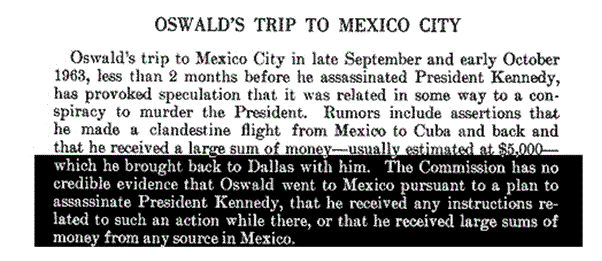
Mention “Mexico City” to a JFK Conspiracy Realist and you can expect to get any of a variety of reactions, from the opinion that Mexico City is the “Rosetta Stone” of the conspiracy to pure agnosticism. At the core of the Mexico City charade is the same question that haunts most of the Warren Commission Report (WCR) conclusions and evidence; why? Why would Lone Nut Lee Harvey Oswald be going to Mexico City, to both Cuban & Russian embassies, with what appears in the evidence to be the desire to secure passage through Cuba to Russia?
How can we establish a relationship between Oswald’s decision to go to Mexico and the way in which it was reported within the government, and Oswald’s guilt for the JFK assassination? The WCR claims there was no connection whatsoever between the events to and from Mexico (as well as the time in Mexico) to Oswald’s plan to kill JFK. The Warren Commission Report’s conclusion reflects that the Commission determined that there was little if any advanced planning of the assassination. At least on Oswald’s part.
See here.
The evidentiary purpose of the trip was to secure an in-transit visa for passage thru Cuba to Russia for himself and his family. The WCR stated Oswald’s purpose was to go thru Mexico to Cuba in lieu of hijacking a plane and flying directly to Cuba (per Marina). In other words, he simply wanted to get to Russia through Cuba.
On the other hand…
Can the events surrounding this trip be connected to a plan to create a viable patsy in the killing of JFK? We must remember that Dallas was by no means the first assassination attempt in November 1963 involving scoped rifles, slow vehicle turns and teams of men. Would we be seeing Arthur Thomas Vallee’s name on the Mexico City evidence if the Chicago plot* had succeeded?
(*Edwin Black; The Chicago Plot, Nov 1975 Chicago Independent)
The evidence tries to establish that Oswald was focused on getting to Cuba en route to Russia and that he had met with a man supposedly KGB assassination related, although Win Scott claims Oswald was trying to get to Odessa with his family and little else. Win also states to his knowledge, as he was not in Mexico at the time, that Oswald was under complete and thorough surveillance the entire time he was in Mexico. He could only get this information from one of the two people overseeing the Mexico station in his absence: Anne Goodpasture, his chief assistant and/or David Atlee Philips; Head of the Cuban desk at the Mexico station.
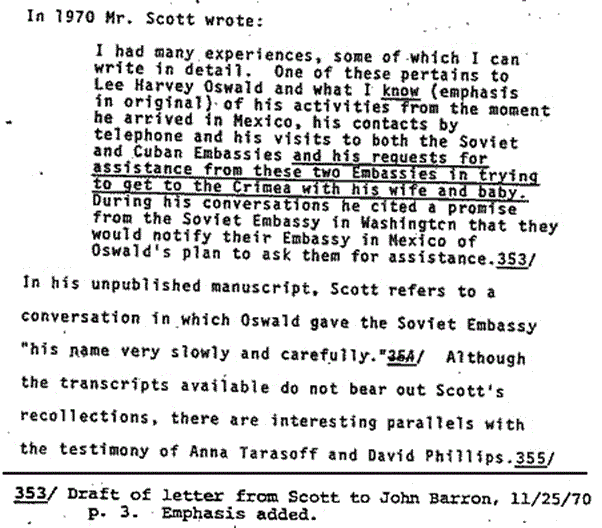
Oswald already had the appropriate passport documentation, approved VERY quickly, to get back to Russia without having to go through Cuba (which in itself is amazing given his “status”). House Select Committee on Assassinations (HSCA) published Oswald’s June 1963 Passport application, which was approved for travel including to Russia. In essence, there would be no need for Oswald, who had to have had some reason for going to Mexico City’s Cuban and Russian Consulate, to even attempt to travel through Cuba.
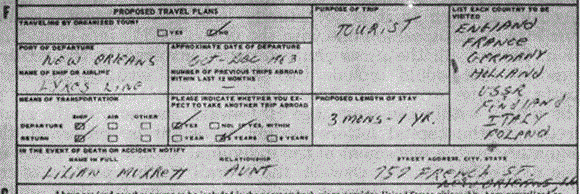
See here.
The story of Mexico City has 3 distinct parts: The summer of ’63, the trip itself, and the CIA’s activity after Oct 3rd. How “The Evidence IS the Conspiracy” correlates to each of these parts will be presented here one part at a time.
What we find amazing is the number of reports on the Mexico trip which are repeated and scattered about the WCR and WC Documents, as if this information was intentionally made especially difficult to correlate and cross-check. The evidence related to this part of the conspiracy is not only contradictory, but WCR-incriminating.
The impetus for this has been touched upon in a number of books and articles over the years: the name on the tourist Visa purchased on Sept 17th and the hotel registry in Mexico City both include the identical mistake; a comma after LEE, followed by HARVEY OSWALD. Is there any evidence offered to explain how Lee Harvey Oswald becomes Harvey Oswald Lee or H.O. Lee?
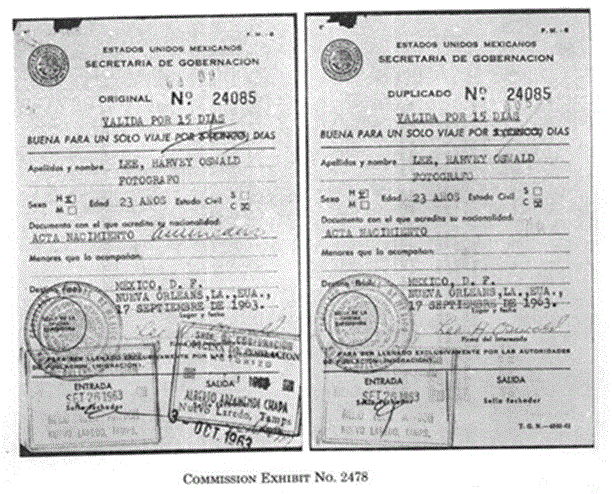
The following is A COPY of the Mexican Hotel’s guest register with a blow-up of the signature compared to the signature on the visa. (ALL docs are copies as the FBI took possession of and kept all originals. As time passed and originals were requested, we find that most originals were either destroyed, or claimed to be lost. Whether the CIA/DFS turned over all the docs is yet another difficult to resolve mystery).
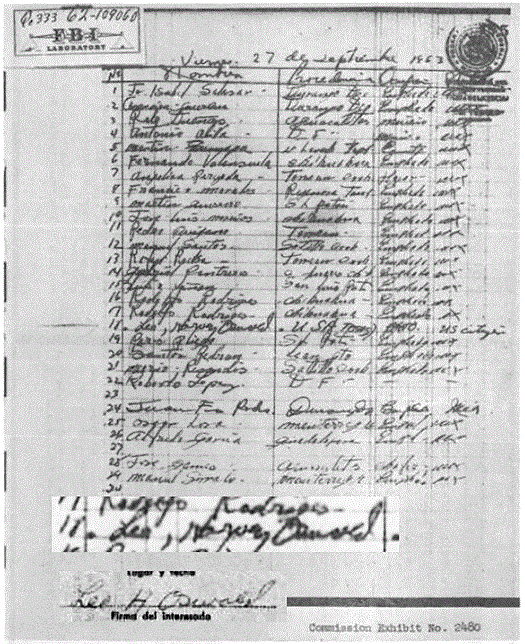
All in good time. Let us start at the beginning:
From the time Oswald left Reilly Coffee in late July, his activities in New Orleans, LA (NOLA) and up to his Sept 27th Dallas meeting with Sylvia Odio, all connect him with PRO-CASTRO forces, overseen by anti-Castro intelligence operatives within our government. Virtually no one that summer is NOT associated with intelligence, foreign or domestic, in and out of 544 Camp, the International Trade Mart and Jim Garrison’s backyard.
Over the Labor Day weekend while Oswald and family are in New Orleans with the Murrets (Lee’s mother’s sister and husband), two men arrived at the door of one Robert McKeown, a self confessed arms dealer who worked in similar circles as Jack Ruby, had supplied arms for Castro’s cause and was a close friend of Castro himself. McKeown was on probation at the time. Lee Oswald announced to McKeown that he has finally found him and would like to buy 4 rifles for $10,000. Lee Oswald was traveling with a man named Hernandez.
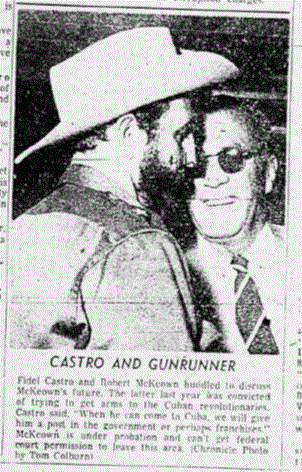
McKeown had connections with Ex-Cuban President Carlos Prio, the new leader of Cuba Fidel Castro, as well as having been contacted by Jack Ruby. McKeown ran CIA-sourced munitions to both sides of the conflict.
This appears as an attempt to once again connect OSWALD with CUBA and CASTRO almost 3 months ahead of time. Would we assume this is assassination related?
Ruby also knew McKeown from his gun-running activities and offered him $25,000 in 1963 for an introduction to Castro in order to secure the sale of jeeps. McKeown asked for $5,000 up front which Ruby did not have at the time. No further contact was reported.
Looking at a list of WCR/FBI Exhibit numbers we spotted FBI D-050, a guest registry for the Fox and Hound in Milwaukee, WI with the name LEE OSWALD; DALLAS, TEXAS signed on the registry page for Sept 14, 1963. The article states the date was Sept 16, even though the actual page does not appear to have a date at all. A report of a “Lee Harvey Oswald” also written in a restaurant registry in Hubertus, WI coincides with a statement from the article by Mrs. Patricia Stanley, manager of the Fox and Hound, “…declined to comment on how the FBI learned that the registry contained the name of ‘Lee Oswald’” …” I am not at liberty to say anything.” Asked whether the FBI had instructed her not to comment Mrs. Stanley replied, “There were others, too, but I just can’t say.”
While the article repeatedly claims that there is no indication that Oswald was in Wisconsin, it never even hints at why or who would be putting that name with DALLAS in mid September when Oswald was in New Orleans with Marina (who was 8 months pregnant) and his first child June. Oswald and Marina arrived in New Orleans on April 24, 1963. On their reutrn to Texas in September, Marina moved in with Ruth, while Oswald did not return to Texas until October, after the Mexico trip. Ruth drove Marina and June to Irving the morning of Sept 23.
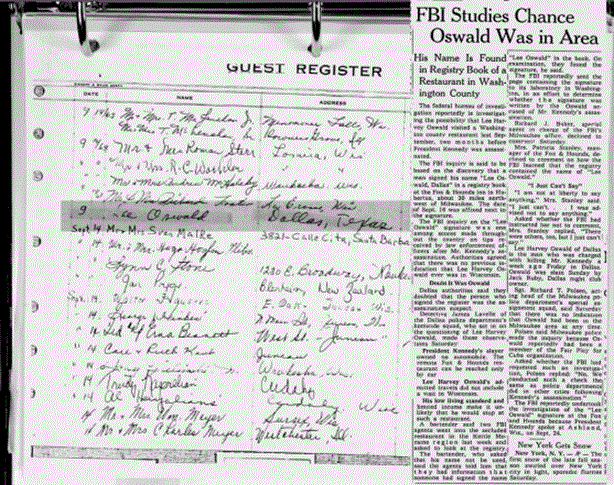
Ruth Paine left Irving on July 27, 1963 with her children for a driving trip to see relatives, friends and Friends (Quaker organization relations). In mid-September she was in Richmond, Indiana before heading south to New Orleans. Marina and Ruth had been in contact with each other initially discussing the end of September, after Ruth’s trip, as the approximate day for pick-up. Between Sept 20 and Sept 23 Oswald was with his wife, Ruth and all the kids at 4905 Magazine in New Orleans until they left. Oswald definitely did not travel with Ruth. When recapping that weekend Ruth uses the name “HARVEY” alone, something not seen or done in most testimony offered about Oswald.
Why the repeated use of all three of his names as opposed to simply Lee, or Oswald by the government lawyers? Was it to assist with the cover up when the different people in his history refer to him as Lee OR Harvey? I wonder how many times a single name was actually used, only to be transcribed into Lee Harvey Oswald. Looking through Ruth’s testimony, for example, “Lee Harvey Oswald” is said 85 times by Jenner and Dulles and not used once by Ruth.
Mr. JENNER – Now, you were there for 2 full days and 3 evenings. Would you tell us, conserving your description in your words, what did you do during these 2 days and 3 nights. When I say “you,” I am including all three of you.
Mrs. PAINE – Of course, afternoons we usually spent in rest for the children, having all small children, all of us having small children.
Mr. JENNER – Whenever this doesn’t include Lee Harvey Oswald would you be good enough to tell us?
Mrs. PAINE – When he was not present?
Mr. JENNER – That is right.
Mrs. PAINE – My recollection is that he was present most of the weekend. He went out to buy groceries, came in with a cheery call to his two girls, saying, “Yabutchski,” which means girls, the Russian word for girls, as he came in the door. It was more like Harvey than I had seen him before…
In the spirit of context and timing we know that Michael Paine had moved into his own apartment in September 1962. Michael picked up Oswald and Marina in Dallas in early April, 1963 for a visit to their Irving house after having met them at a party during the holiday season 1962. The party, at Mrs. Declan Ford’s house was where Mr. & Mrs. DeMohrenschildt bring Mr and Mrs Oswald at Mrs. DeMohrenschildt’s request. In one form or another, a close watch was being held on Mr. and Mrs. Oswald.
On September 17th; based on the date printed on CE 2478, the tourist visa; a man recorded as “LEE, HARVEY OSWALD” yet signing his name “Lee H Oswald” purchased a 15 day tourist visa for Mexico which allowed the holder to remain in Mexico for up to five days prior to the expiration date of the visa; October 2, 1963.
September 18th was the original date Nicaruaguan Intelligence officer Alvarado claims he saw Oswald in Mexico City, overheard a conversation related to an assassination and saw Oswald accepting money. Alvarado went to the American Embassy in Mexico City on November 25 to report what he saw. When the FBI/CIA realized that Sept 18 was not possible because Oswald was still in New Orleans, Alvarado changed his story as needed and ultimately recanted the entire thing under protest. The interesting thing about Alvarado is the CIA’s follow-up cable on Dec 7 which completely lets Alvarado off the hook for having fabricated the story and even suggests there is a direct connection between what Alvarado does and who instructs him to do it. Central American countries’ Intelligence servies and the CIA became VERY close over the years since 1947. If the encounter never happened; and there is no evidence that it did other than Alvarado’s word; how would Alvarado have known what types of things to say in order to incriminate Oswald all on his own?
CE 3152 is a memo from HELMS to RANKIN about the Alvarado incident: how hard it was to shake Alvarado off his story, how he maintained it was Oswald even after he failed the polygraph, and that he had been at the Cuban Consulate on Sept 18th. (The Consulates are not the same as the Embassies. A close examination of the evidence shows that when asked to go to one, the man playing Oswald would go to the other without success).
CE 3152 continues by establishing that Alvarado was informant T-32, that he was 60% sure it was Oswald and that it occurred on the 18th of September. In conjunction with this is a follow-up memo (possibly from David Phillips) which discusses “resolution” of the Alvarado issue yet gives the distinct impression that Alvarado, his employer and the CIA are very much intertwined. We’ll delve more deeply into the Alvarado incident in part two. Note: “IF ERTHYROIDS CAN GIVE HIM SOMETHING USEFUL AND NON-SENSITIVE TO DO FOR A FEW MONTHS IT WILL HELP.” His job in Mexico was most assuredly “sensitive.”
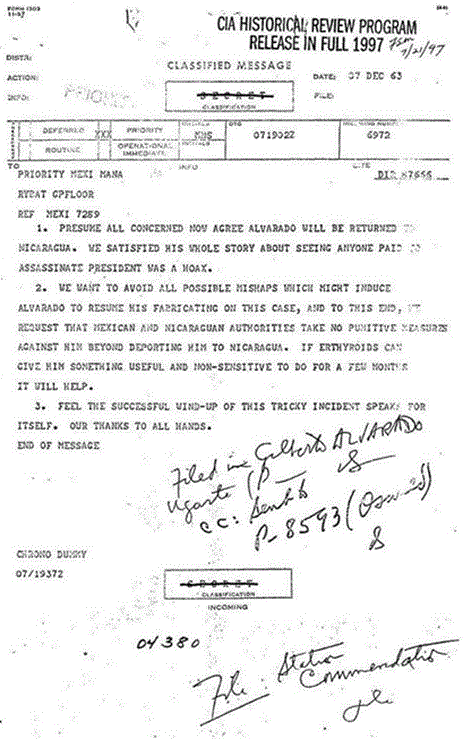
Peter Dale Scott uses the initial story and recant as examples of what he calls the Phase 1 and Phase 2 stories of Oswald. Phase 1 being the connection to communists, Cuba and Russia in order to “release the dogs of war” which when thwarted by Johnson and Hoover becomes Phase 2: Oswald the Lone Nut Communist with no ties to anyone and his NOT being the man in Mexico… Hoover seems to be the only one who appears concerned with the identity of the Oswald impersonator (the CIA certainly doesn’t care as they created the charade) and states on 11-23-63 to LBJ:
“…I think we have a very, very close plan. Now if we can identify this man who is at the Mexican Embassy at; the Soviet Embassy in Mexico City, the Embassy in Mexico City — this man Oswald has still denied everything.” Hoover would feel and mention the sting of the CIA and Oswald in Mexico for many years to come. He would also make clear to his staff that he felt the FBI report mistakenly came to a conclusion. The Commissioners themselves were very surprised at this since Hoover was given to saying the FBI determined the facts and did not present conclusions, even if ironclad.
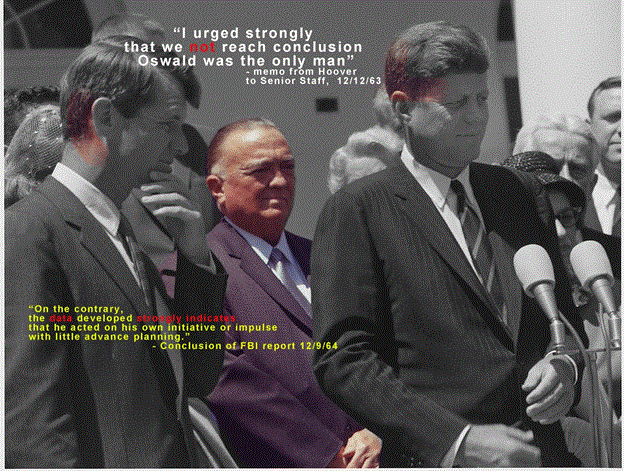
(enhanced by DJ)
One should note that prior to the 1947 creation of the CIA, the FBI’s Special Intelligence Service (SIS) was specifically responsible for Intelligence gathering in the Western Hemisphere, from 1941 through 1946 along with existing Military Intelligence entities with acronyms, like MID (Military Intelligence Division) & ONI (Office of Naval Intelligence). The SIS story begins on 26 June 1939, with Roosevelt signed a Presidential Directive stating:
It is my desire that the investigation of all espionage, counter-espionage, and sabotage matters be controlled and handled by the Federal Bureau of Investigation of the Department of Justice, the Military Intelligence Division [MID] of the War Department, and the Office of Naval Intelligence [ONI] of the Navy Department. The Directors of these three agencies are to function as a committee to coordinate their activities. (Presidential Directive of 26 June 1939; Section 2; File 64-4104; Administrative Records of the SIS; RG 65; NACP.)
FDR clarified his position on June 24, 1940:
He ordered that “The FBI should be responsible for foreign-intelligence work in the Western Hemisphere, on the request of the State Department,” while “The existing Military Intelligence and Naval Intelligence branches should cover the rest of the world, as and when necessity arises.” President Roosevelt concluded his directive by observing how “It was understood that the proposed additional intelligence work should not supersede any existing work now being done…” (New Insights into Hoover and the SIS, G. Gregg Webb; see here).
(Memorandum of President Roosevelt’s telephone directive prepared by Berle and approved by the President, 24 June 1940; Section 2; File 64-4104; Administrative Records of the SIS; RG 65; NACP).
Understanding the long history of US Military involvement in Central and South America would require a book in its own right, yet we ought to be aware that the growth and control of sovereign nations and their intelligence, security and military establishments in this area goes hand in hand with the US military’s work to protect US business interests in these countries. Between the Armed Forces’ Intelligence, the State Department’s attache corp and the FBI’s SIS, Central and South America, especially Mexico and Brazil, were hand-in-hand partners with the USA in numerous illegal activities from assassination to the drug trade. Many researchers have discovered this conection resulting in the multitude of “off the books” programs financed by illegal funds.
As we’ve learned, so much of what Marina Oswald tells us is shrouded in conflict. Yet as times and testimony change we can always count on her supporting the desired facts, even if she sounds terribly foolish doing so.
Prior to Ruth arriving, from early September though the 23rd, Marina’s “husband” is not working yet also not home every day reading as Marina claims. Between the Unemployment Office, the library and Ryder’s Coffee shop, he was busy. We finally learn about Oswald’s plans for Mexico from Marina in her testimony:
WCR testimony:
Mrs. OSWALD. Nothing. And it is at that time that I wrote a letter to Mrs. Paine telling her that Lee was out of work, and they invited me to come and stay with her. And when I left her, I knew that Lee would go to Mexico City. But, of course, I didn’t tell Mrs. Paine about it.
Mr. RANKIN. Had he discussed with you the idea of going to Mexico City?
Mrs. OSWALD. Yes.
Mr. RANKIN. When did he first discuss that?
Mrs. OSWALD. I think it was in August.
HSCA testimony:
Mr. McDONALD – When did you first learn of his planned trip to Mexico City? When did you first know about that?
Mrs. PORTER – Shortly before I left for Dallas with Ruth Paine.
Mr. McDONALD – How did you learn of this?
Mrs. PORTER – He told me about his plans to go to Mexico City and to visit the Cuban Embassy over there.
…
Mr. RANKIN When your husband talked about going to Mexico City, did he say where he was going to go there, who he would visit?
Mrs. OSWALD. Yes. He said that he would go to the Soviet Embassy and to the Cuban Embassy and would do everything he could in order to get to Cuba.
The purpose of the visit as recorded and expressed by Chief of Mexico Station Win Scott was to get himself and his family to Odessa. Cuba originally did not have anything to do with the evidence of the man calling himself Oswald.
…
Mr. RANKIN. Did you learn that he had a tourist card to go to Mexico?
Mrs. OSWALD. No.
Mr. RANKIN. If he had such a card, you didn’t know it then?
Mrs. OSWALD. No
…
And as usual, the FIRST STORY offered, which usually conflicted with the desired story, had to be changed or be supported by some rational explanation for the change:
Mr. RANKIN. When you were asked before about the trip to Mexico (CE1781 & 1792), you did not say that you knew anything about it. Do you want to explain to the Commission how that happened?
Mrs. OSWALD. Most of these questions were put to me by the FBI. I do not like them too much. I didn’t want to be too sincere with them. Though I was quite sincere and answered most of their questions. They questioned me a great deal, and I was very tired of them, and I thought that, well, whether I knew about it or didn’t know about it didn’t change matters at all, it didn’t help anything, because the fact that Lee had been there was already known, and whether or not I knew about it didn’t make any difference.
Marina describing her husband going to Mexico is fraught with problems and contradictions. So much so that a reading of each subsequent questioning on the subject appears as if she is reading from a prepared script regardless of the question. It was CUBA-CUBA-CUBA all the time, when actually there is little if any evidence anywhere else in this case to support Oswald’s desire to be in Cuba. (Incidentally, it was not the FBI she talked to about Mexico at first. It was the Secret Service).
Q. Did Lee tell you why he wanted to go to Mexico?
A. He was disappointed in Latin America so he wants to go and try Cuba.
Q. Why did he choose Mexico?
A. He told me he was going to take the bus. (sic)
(This bit of testimony is the reference used by the Warren Commission to determine Oswald had taken a bus from New Orleans).
One has to wonder what occurred to change Marina’s account of Mexico between November 28 & 29, 1963 and Feb 3, 1964 when she began giving the “adjusted” account of her knowledge about her husband’s Mexico Trip…
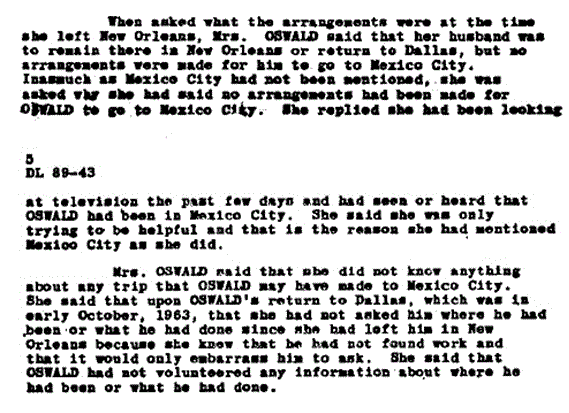
And the SS interview Nov 29th:
“She was asked whether she had any knowledge of Lee’s trips to Mexico or Washington, D.C. She replied in the negative. She was asked whether she or Lee had any cameras and she replied that Lee bought one camera in Russia and a second one in the United States. She said one was a small camera and the other was a box camera. She added that sho was not proficient with operating any Cameras and she never had an opportunity to do so.” See here (“never had an opportunity to work the camera” requires yet another back-peddling recant when the infamous Backyard photos come up)
In the time period when Oswald actually stopped working at Reily Coffee on July 22, 1963 (a company employing Oswald with its own set of CIA, FBI and NASA coincidences and peculiarities) and Sept 23, 1963 Oswald did not work, officially; his only job while in New Orleans since April was at Reily. In yet another of a long line of imposter coincidences, on July 26, 1963 at the American Museum of Atomic Energy in Tennessee we find someone has signed Oswald’s name and associated him with the USSR and Dallas. (H&L p.551 – FBI D-154)
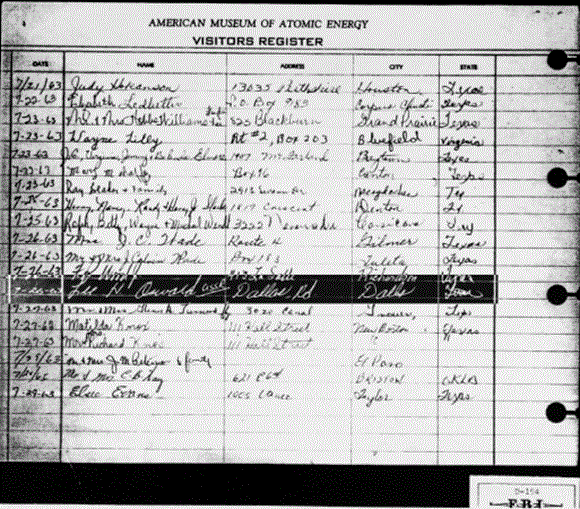
Oswald collected $33/week in unemployment beginning Aug 17 and had barely made $500 while at Reily. On August 9th he was involved in what we now know was a charade, and was arrested while handing out pro-Castro Fair Play for Cuba (FPCC) literature at the New Orleans LA International Trade Mart. Some of the literature in Oswald’s possession literally had his name and “544 Camp” stamped on it. This connects to Bannister and by association to a man named William Gaudet who we come to learn acquired the Mexican tourist visa sequentially numbered just ahead of the one given to Oswald: No. 24084, on Sept 17th.
On Sept 17, 1963 SOMEONE appears at the New Orleans Mexican consulate and purchases the visa made out to “LEE, HARVEY OSWALD,” which to most means the person’s name was Harvey Oswald Lee, or H.O. Lee. The FBI explains:
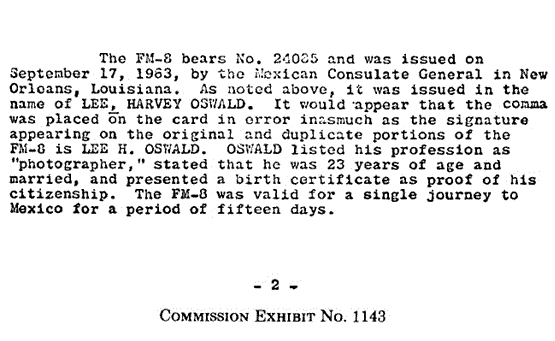
CE 1143 is an: Excerpt from FBI report dated May 18, 1964, re Lee Harvey Oswald’s visit to Mexico and excerpt from Secret Service report dated August 28, 1964, of schedule of buses traveling from Dallas and Houston to Laredo, Tex. (CD 1084(e), pp. 2, 99-101; CD 1450, p. 1).
The above excerpt starts with acknowledging that the 15 day visa was made out to “LEE, HARVEY OSWALD” comma and all, yet they write: “It would appear that the comma was placed on the card in error inasmuch as the signature appearing on the original and duplicate portions of the FM-8 is LEE H. OSWALD.” As we can see, #24085 appears as described (this is a reversed image) as do the signatures…
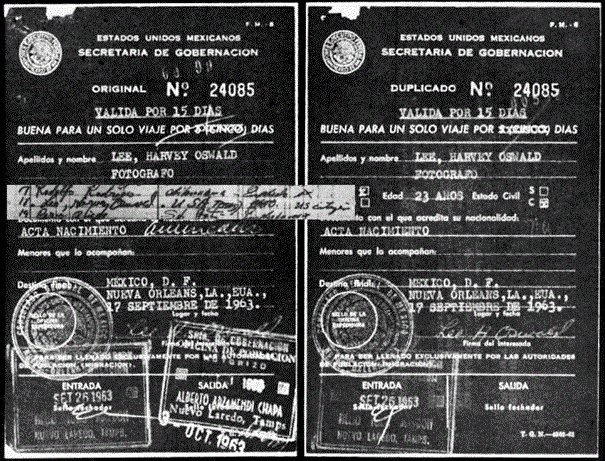
Yet, when we look at the hotel registry where Lee would have once again signed his name as it appears on the signature line of these forms, without a comma, we find something quite interesting: We are expected to believe that Oswald, who supposedly signed his name on the visa, did so in exactly the same manner as is TYPED on the 15 day visa, not as the visa was signed… maybe part of his master “advanced” plan? (Note: as we remember from the first The Evidence IS the Conspiracy article, he waited until Thursday afternoon the 21st to ask Wesley Frazier for a ride back to Irving to fetch his rifle, even though he had been working in Dallas at the TSBD since mid-October. The WCR concluded that this trip and the JFK assassination had no connection for Oswald and that there was in fact little if any advanced planning).
When we add to this all the evidence, or non-evidence of Oswald himself ever being in Mexico we are literally forced to re-examine in detail the events ascribed to him and whether or not this remains a simple oversight, or the inadvertent copying of information to keep falsified information consistent.
We learn that #24084, the visa issued just before Oswald’s was bought by a man the WCR, FBI and CIA sought to keep buried, William George Gaudet. And they succeeded. It was not until 12 years later during the HSCA that we hear from Gaudet and learn that the list of names of those who purchased visas on Sept 17 that the FBI provided the WC deleted the name Gaudet claiming, “No record of FM-8 No 24084 located.”
This link is Warren Commission Document 75 page 577 from Warren DeBrueys’ 12/2/63 report showing the FBI knew about this man within 2 weeks after the assassination. Gaudet’s stated purpose for the trip? “Travel to Mexico 1 day as tourist.” It is unknown whether he ever made that trip. Yet one Albert Osborne did. We will return to Mr. Osborne and some of the strange circumstances revolving around yet another piece of the Mexico Trip and the printing of FPCC flyers.
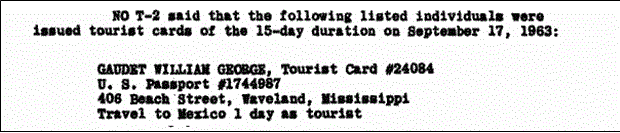
More importantly for this discussion, when he was finally questioned by the HSCA, Gaudet established direct connections between Guy Banister of 544 Camp Street and Lee Harvey Oswald during the summer of 1963 in New Orleans:
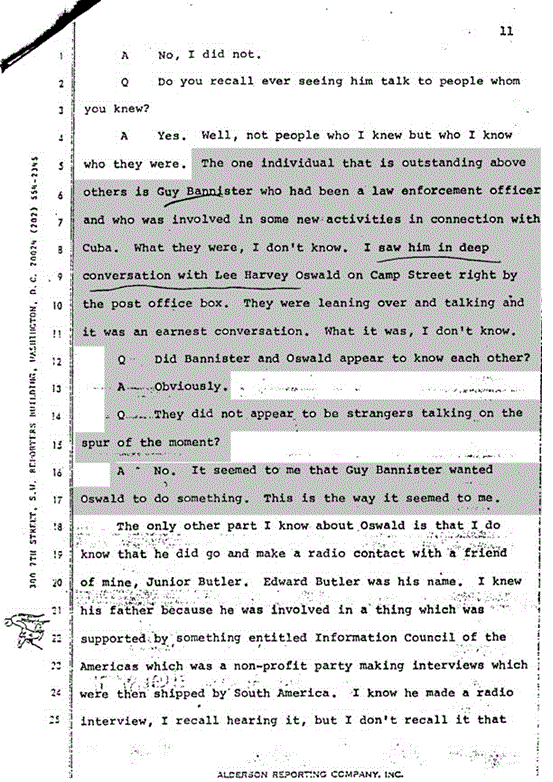
National Archives, HSCA 180-10070-10274, Numbered Files 004826; HSCA interview of William Gaudet
Gaudet goes on to mention the names David Ferrie, Sergio Smith, Howard Hunt, Bernard Baker and Frank Sturgis among his CIA exploits:
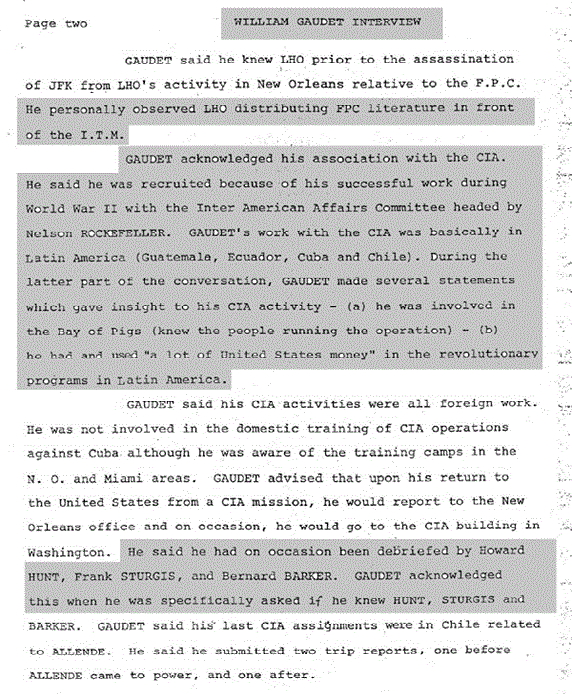
Gaudet acknowledged he knew Oswald (and Bannister) from his activity in New Orleans related to FPCC; the same FPCC which the Secret Service states has no connection to 544 Camp. Mr. Gaudet would have us believe that his acquiring the previous visa on the same day was pure coincidence.
CE3120 shows copy of Corliss Lamont’s pamphlet with the final page bearing a FPCC, 544 Camp Street, New Orleans stamp. WCD1495 is a SS report dated Sept 11, 1964 which connects this pamphlet to literature found in Oswald’s possession.
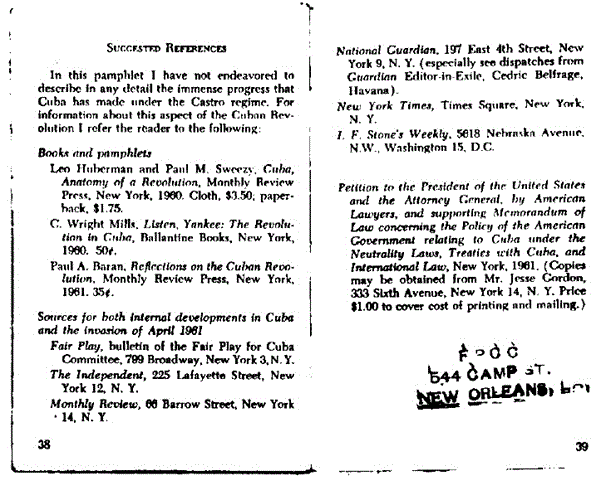
CE1414 is an SS report from Dec 1963 which concludes that there was no connection between FPCC and 544 Camp, and that it was “impossible” to find anyone who recalls ever seeing Oswald at that address. But boy oh boy did we try hard.
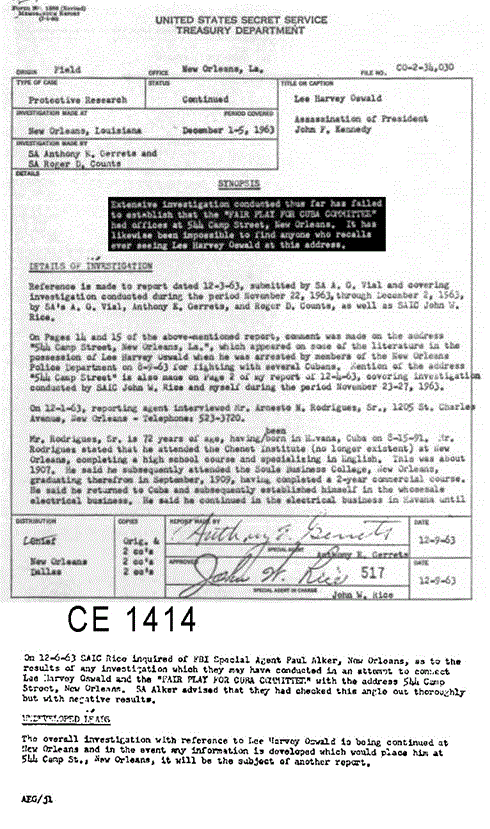
Since William Gaudet helps to show that conclusion for what it truly was, we can understand why the FBI, CIA and WCR went out of their way to remove him from the picture. Could Gaudet have been the reason and/or transportation for Lee to have gone and gotten a 15 day visa which would expire exactly on October 2, 1963? Witnesses to this purchase stated that Oswald was alone at the time and that the following visas are purchased just before closing at 1:30pm.
Of note is that the visa states the stay in Mexico cannot exceed 5 days while the visa itself is good for 15 days. The dates work perfectly; Ruth arrives just in time to remove Marina and June from Oswald’s care and sight. Virtually every single statement incriminating Oswald for having been to Mexico and to the Soviet and Cuban Embassies and/or Consulates is derived from CIA/DFS (Mexican Intelligence) related transcripts and records. The FBI, which also had their own relationships with the Mexican DFS obviously also did not have a shred of proof that Oswald, the man Ruby killed, had been to Mexico. It relied exclusively on CIA information.
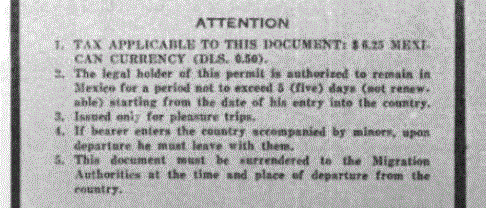
Along the same lines as taking CIA documentation for what it is, former CIA officer Phillip Agee tells us that CIA 201 files are divided into a CLEAN “operational” part for public consumption and a SECRET “true name documents” part. The following is an excerpt from Inside the Company, by P. Agee:
“Files are maintained on all agents and they always begin with the number 201 — followed by a number of five to eight digits. The 201 file contains all the documents that pertain to a given agent and usually start with the PRQ and the request for POA. But the 201 file is divided into two parts which are stored separately for maximum security. One part contains true name documents while the other part contains cryptonym documents and operational information. Compromise of one part will not reveal both the true name and the operational use of the agent.”
We ought to take a moment to create a little “mind-set” context. In 1963 the backstory always supported the documents. The documents were the evidence. There was not Internet cross-checking or even putting most of the evidence side-by-side. They were accepted until authenticated while usually authenticated by the same CIA people who created them or those under their control. When the CIA or FBI or ONI, INS, MID handed you a file or leaked a story, there was no questioning where the rest of it was, where the “good stuff” or the “secret” stuff was. Today, we are given the impression that NOTHING IS SECRET while everything, in reality, is. In 1963 and for many years after, the truth was simply hidden or destroyed. Today it is covered with mountains of data and hiding in plain sight.
The result is the same question: “What is the truth?”
The answer remains the same: “What we tell you it is.”
On September 19th, two days later, Oswald is at one of the New Orleans public libraries and checks out four books. This in itself is not surprising as most said he was an avid reader (not bad for a 10th grade dropout: teaches himself Russian, speaks eloquently on Marxism, his own philosophies, his travels and his photographic abilities. School records reflect a 102 to 118 IQ.) What surprises is the fact these books are returned in New Orleans on the day Oswald is supposed to have arrived in Dallas; October 3, 1963. (We will return to Oct 2 and beyond in Part 3). One has to wonder who this Lone Nut Oswald was so close to that they would return four library books. Where were these books? If he traveled with the books he’d need to stop in New Orleans first, which was something Marina was asked about, but then he could never have been in Dallas at the time he was. Mrs. Jesse Garner, the apartment manager found a completely empty 4905 Magazine on the 25th when she came to collect some rent that was due. Oswald had taken all his possessions with him, yet these library books were returned in New Orleans on the 3rd of October.
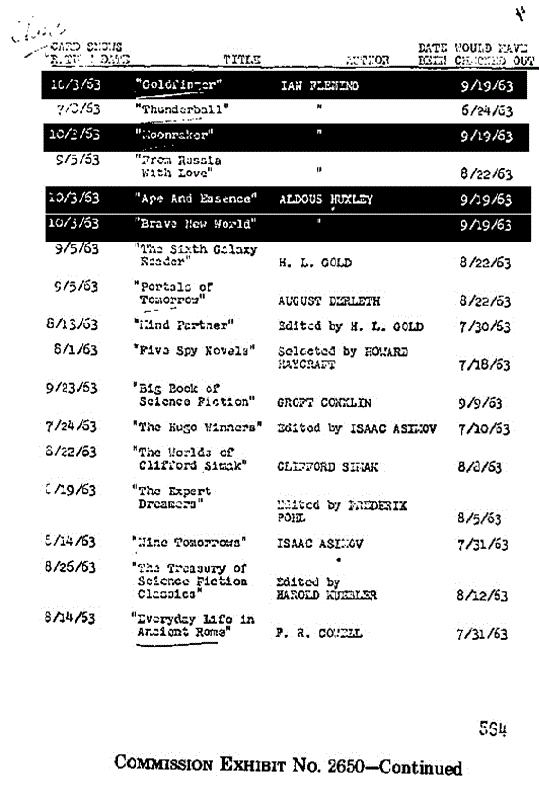
September 20th is also a most interesting day: (From Harvey and Lee, p.598)
On September 20 Nagell sent a registered letter from El Paso, Texas to J. Edgar Hoover at FBI Headquarters and informed him that President Kennedy would be assassinated during the last week of September in a conspiracy that involved Lee Harvey Oswald. After mailing the letter, which included Oswald’s description, aliases, and current address, Nagell walked into the State National Bank and fired two shots into the ceiling. He then walked outside and waited for the police to arrive. When the police arrived and arrested Nagell his only statement was, “I would rather be arrested than commit murder and treason.” When Nagell was searched the police found a photocopy of a military ID card issued to Lee Harvey Oswald. The ID card was probably given to Nagell by the people who assigned him to infiltrate the activities of Lee Harvey Oswald and Franz Waehauf at the Hotel Luma in Mexico City. Otherwise, how and why would Nagell have a copy of Oswald’s military ID card with a different signature?
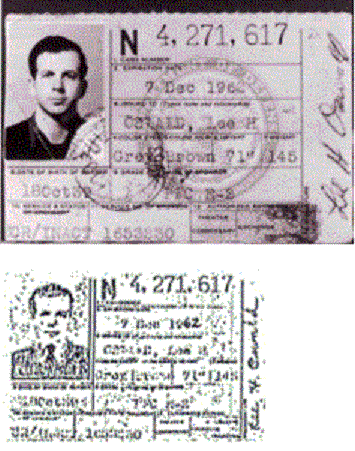
(When Richard Case Nagell was arrested in El Paso Texas, the police found a military ID card issued to Oswald in his belongings. That card was identical to one found on Oswald in Dallas on November 22, 1963. With two exceptions: the photo and signature were different).
Friday, September 20, 1963 was also the day that Ruth Paine arrived at 4905 (or 4907) Magazine after corresponding with Marina about having her come live with Ruth and children until and through the birth of their next child in mid-October. Ruth and children arrive in a 2-tone BLUE station wagon which appears not to be the same vehicle in which Ruth brought them to New Orleans.
CE3119 page 10 reports that Lillian Murret, Oswald’s aunt, said that the “unknown woman from Texas in the BROWN station wagon had called for him…”
In April 1963 the Oswalds arrive at the Murretts’ in New Orleans in a BROWN station wagon driven by Ruth Paine. In September 1963 the same woman picks them up in a BLUE station wagon.
During her questioning about February 22, 1963; the gathering when the DeMohrenschildt’s brought Marina and Harvey; she was asked how she got there, answering that she drove:
Mr. JENNER – You owned or then had, or maybe you still have a station wagon?
Mrs. PAINE – That is right.
Mr. JENNER – Is it the same car still?
Mrs. PAINE – It is the same car.
Mr. Clifton Shasteen was a barber in Irving who remembers Oswald well:
Mr. SHASTEEN. Well, now, that part of it I would have to take for granted because they were in his car. Now, she, I understand through one of the men who questioned me out at the shop, said he never did drive her car. Again, I’m going to disagree because I know that he did. He drove it up there and got a haircut.
Mr. JENNER. You have a distinct recollection that on occasions when this man came into your shop for a haircut, he drove an automobile up to your shop?
Mr. SHASTEEN. He drove that there 1955, I think it’s a 1955, I’m sure it’s a 1955 Chevrolet station wagon. It’s either blue and white or green and white it’s two-toned–I know that. Now, why I say–why I take it for granted that Mrs. Paine was with him when he come to the grocery store I do remember he wasn’t driving when they would come to the grocery store, there would be a lady driving and I’m assuming that that’ was Mrs. Paine, because like I say, I have been–I have never been close enough to her and knew it, to speak to her, but she trades at the service station where I do and I saw her in there and I never did pay any attention to her and I saw her passing, met her in the road in the car and those things. (See here).
With Oswald on a few of these trips was a boy described as 14 years old and unknown to Clifton who as a barber had a good memory for faces, not names.
Mr. JENNER. And would you describe this young man to me, how was he dressed?
Mr. SHASTEEN. Well, he had on blue jeans and they fit tight and he had on an old striped shirt, I remember him just like I see a picture over there right now and he was a husky kid, he wasn’t what you call fat, but he was strong-broad-shouldered; he had a real full, and when I say full, I don’t mean a round fat face, he was a wide-faced kid.
(Note: A BROWN station wagon of similar make, model and year was seen at 4905 Magazine around the time of Oswald’s FPCC arrest on Aug 9th at the International Trade Mart).
Ruth and children stay the weekend and corroborate the fact that Marina’s “husband” was there all weekend. Finally, on Sept 22, Oswald helps load Ruth’s car and on the morning of Sept 23 says goodbye to Marina and June. Of special note were questions asked by the WC about anything that might have resembled a rifle either in the materials packed with Marina or in Oswald’s possession when he leaves on the 24th. The answer in each case was that nothing resembling a rifle was seen either during the packing, unloading and storage of their belongings, ever.
On September 24 (Tuesday) Oswald visited claims interviewer Fredrick L. Christen (“T-3”) at the unemployment office in New Orleans for the last time. Once again Christen reported Oswald’s visit to the FBI and advised that he signed a continued interstate claim (Form IB -2) in his presence. (p. 603 H&L)
Witness Eric Roberts, who lived near Oswald on Magazine stated that Oswald left his apartment around 7pm, Sept 24, carrying 2 SMALL SUITCASES approximately 18 inches across and caught a bus at the nearest stop at Magazine and Upperline. The FBI conducted a fairly thorough search of the surrounding hotels; 43 to be exact; and was unable to locate where HARVEY Oswald stayed that night (see here).
We are aware that Oswald was still in New Orleans the morning of the 25th of September as he cashed his Sept 17th Unemployment Insurance Claim check which was mailed from Austin on Sept 23rd. While two days from mailing to cashing does seem a bit quick, most every event in the falsified timeline gives Oswald JUST ENOUGH TIME to potentially complete the event, yet they still stretch the bounds of credibility.
Speaking of the bounds of credibility stretched, the WCR states, on page 731, that Oswald had $200 for the trip to Mexico, footnote #1124 refers to CE2481, Oswald’s tourist visa application in which he actually states he has $300. As discussed earlier, Oswald’s last day of work was July 22, and the first $33 UE check was on Aug 17. Of course, there were living expenses from Aug 17 thru Sept 23 for himself, Marina and June and “no money to Marina” when she left with Ruth.
Mr. RANKIN. When he was unemployed in New Orleans, did he get unemployment compensation?
Mrs. OSWALD. Yes.
Mr. RANKIN. Do you know how much he was getting then?
Mrs. OSWALD. $33 a week. It is possible to live on that money. One can fail to find work and live. Perhaps you don’t believe me. It is not bad to rest and receive money.
Mr. RANKIN. Did your husband have any money with him when he returned from Mexico?
Mrs. OSWALD. Yes, he had some left. But I never counted how much money he had in his wallet. That is why I don’t know.
Mr. RANKIN. Was it a small or a large amount or do you know that?
Mrs. OSWALD. What would be a large amount for me would not be a large amount for you.
Mr. RANKIN. Well, can you give us any estimate of what you think he had?
Mrs. OSWALD. He might have had $50 or $70, thereabouts. It is necessary sometimes to make a joke. Otherwise, it gets boring.
It is unclear whether Marina was given any money while her husband was separated from her. It is also unclear how Oswald saved two let alone three hundred dollars when he only received $33/wk. for about 6 weeks.
Oswald left New Orleans by bus. Or so says the WCR with reference to Marina Oswald’s testimony. Actually, she left two days before her husband left. Oswald probably left, the WCR concluded, by way of Continental Trailways Bus No. 5121. Probably. In Warren Report-speak this means there is no proof whatsoever that Oswald took or was aboard that bus or the evidence would have been offered, fabricated or not.
The FBI was simply unable to determine how Oswald left with his two suitcases after he left the local bus. According to the driver of the bus who helped Oswald load his two suitcases, he asked for directions to the Greyhound bus station. The Greyhound station and the Continental Station are not the same nor do the Greyhound buses travel to or from the Continental Station and vice versa. It is very likely, based on the testimony of Sylvia Odio and her sisters, that Oswald was on his way to Dallas, in a car driven by two Cuban men.
The men were two anti-Castro Cubans who, as a threesome, make it difficult to believe that the man leaving the impression he was Lee Harvey Oswald on a bus leaving Laredo, was actually Marina Oswald’s husband.
Mr. LIEBELER. When did you first become aware of the fact that this man who had been at your apartment was the man who had been arrested in connection with the assassination?
Mrs. ODIO. It was immediately.
Mr. LIEBELER. As soon as you saw his picture?
Mrs. ODIO. Immediately; I was so sure.
Mr. LIEBELER. Do you have any doubt about it?
Mrs. ODIO. I don’t have any doubts.
Mr. LIEBELER. Did you have any doubt about it then?
Mrs. ODIO. I kept saying it can’t be to myself; it just can’t be. I mean it couldn’t be, but when my sister walked into the hospital and she said, “Sylvia, have you seen the man?” And I said, “Yes.” And she said, “That was the man that was at the door of my house.” So I had no doubts then.
Mr. LIEBELER. Now, you have indicated on the calendar, you circled the 30th of September, and you drew a line around the 26th, 27th, and 28th of September. Can you tell me what you meant by that?
Mrs. ODIO. The 30th was the day I moved. The 26th, 27th, and 28th, it could have been either of those 3 days. It was not on a Sunday. (26th was a Thursday and a travel day, while CIA reports place an Oswald in Mexico on the 27th and 28th)
This takes us through 12:20pm September 25th when a bus leaving New Orleans for Houston becomes the agreed upon mode of transportation for Oswald’s trip to Mexico.
In part II we will examine the evidence related to September 25th; the simultaneous trip to Dallas and Mexico; through October 3rd when Oswald was in Dallas while someone was returning his library books in New Orleans and making another call in his name to the Cuban Consulate in Mexico City.
