Blog

  • Legacy of A Lie

    Legacy of A Lie


    The following is an excerpt from Pat Speer’s on-line book, A New Perspective on the Kennedy Assassination. “Legacy of a Lie” is a sub-section of Chapter 10, “Examining the Examinations” (scroll down from the top to find it); it takes a hard look at the claim made by Howard Willens that Robert Kennedy obstructed the Warren Commission’s access to the autopsy photos and X-rays, and uncovers it as a fabrication.

    Reprinted here with permission of the author.

    legacyofaliefixed

    The 50th anniversary of Kennedy’s assassination added another chapter to our ongoing discussion of Kennedy’s back wound, and the probability Warren Commission counsel (and future Senator) Arlen Specter deliberately lied about its location to help prop up the single-assassin conclusion.

    In his 2013 book, A Cruel and Shocking Act, New York Times reporter Philip Shenon revealed that he talked to Specter shortly before his death in October 2012 and asked him about his viewing the back wound photo before the May 1964 re-enactment. Specter’s answer to Shenon was most illuminating, but the substance that was illuminated was strangely missed by Shenon. Specter reportedly told Shenon that he’d assumed Warren had asked Secret Service Inspector Thomas Kelley to show him the photo in order to “placate” him. Well, heck, that rules out Specter’s not saying anything about the photo to the rest of the commission because he didn’t want Warren to know he saw the photo.

    And that’s just the beginning. Reportedly, Specter also told Shenon that the photo he wanted to see in order to confirm the relative accuracy of the face sheet (which showed a wound on the back) and the Rydberg drawings (which showed a wound at the base of the neck) “resolved nothing” as the photo failed to show Kennedy’s face. Reportedly, Specter then proceeded to complain that “I know what evidence is” and that his being shown the photo (which shows a wound on the back) in that manner was a “bunch of horseshit.”

    Sounds like Specter knew what his seeing the photo and doing nothing about it would mean for his legacy…

    Still, his influence over Shenon seems apparent. When discussing Specter’s 3-11-64 meeting with the autopsy doctors (which Shenon mistakenly places on 3-13-64), Shenon reports: “As the autopsy continued, the pathologists could see that the muscles in the front of the president’s neck had been badly bruised–proof, they thought, that the bullet had passed through his neck and then exited out the front.” But this, as we’ve seen, is gobbledygook. Humes made this clear in his testimony. The bruising of the strap muscles led Humes to suspect the neck wound was a missile wound. Period. It was not “proof” the bullet exited out the front. Perhaps in the elderly Specter’s desperately defensive mind…but that doesn’t count for much and an experienced journalist like Shenon should have known as much. Specter’s original memo on this meeting, we should recall, presented a different scenario: “They noted, at the time of the autopsy, some bruising of the internal parts of the President’s body in the area but tended to attribute that to the tracheotomy at that time.” It’s really quite clear, then. As “the autopsy continued,” the doctors did not see the bruising of the strap muscles as “proof” the bullet came from behind, Specter should not have told Shenon as much, and Shenon should not have repeated something which a mere modicum of research–such as reading Specter’s memo on the meeting–would have proved to be inaccurate.

    And that’s not the last time Shenon, presumably unwittingly, buys into Specter’s re-writing of history. A few pages later, while discussing Humes’ testimony, Shenon discusses Specter’s attempts at gaining access to the autopsy photos. He relates: “Humes had tried to be helpful by bringing along diagrams of the president’s wounds prepared by a Navy sketch artist at Bethesda, but both he and Specter knew the drawings were based on Humes’ imperfect memory.” Well, this hides that 1) these drawings were created at the request of Joseph Ball, as well as Specter; 2) Ball had previously noted that the back wound appeared to be lower than the throat wound, and that this was a problem for the Oswald-did-it scenario; 3) the back wound in these drawings was now much higher than the throat wound; and 4) Specter induced testimony from Humes which suggested the measurements obtained at autopsy were used in the creation of these drawings, and that the drawings were therefore reasonably accurate.

    It seems likely, then, that Shenon was too enamored with Specter to find what needed to be found, and see what needed to be seen. Specter had provided him access, and was thus granted a free pass. His questionable behavior was never even questioned.

    It seems likely, for that matter, that Shenon wasn’t the only one determined to defend Specter and the commission.

    2013 also saw the release of History Will Prove Us Right, former Warren Commission attorney (and Specter college chum) Howard Willens’ spirited defense of the commission. I took an interest in this book in October of that year, and was put in contact with Willens through an intermediate. Within our first exchanges, Willens was friendly enough; he readily acknowledged that the wound in the photo shown Specter was a back wound, and not a wound on the back of the neck. And yet, he expressed no interest in second-guessing Specter’s actions while working for the commission. Not unlike Shenon with Specter, I suppose, I gave him a pass.

    In November, however, I saw him on CNN, in its Bugliosi-fueled program The Assassination of President Kennedy. There, he described the back wound of our discussions as a wound “in the back of the neck.” This surprised me. I wrote Willens pointing out his mistake, and received a response in which he acknowledged it as a mistake and once again admitted it was a back wound, and not a wound in or on the back of the neck. I once again gave him a pass.

    I was probably being too generous. A 12-11-13 article in the Hudson Hub Times reported on a recent appearance by Willens at the Hudson Library in which he discussed the assassination. When asked about the commission’s mistakes, he acknowledged: “Some of the diagrams were inaccurate.” He then added: “Someone testified Kennedy was shot in the back of the neck but it was the back of the upper shoulder.” Well, this came as another surprise. Was Willens really trying to push that the Rydberg drawings were inaccurate because the commission had been deceived by “someone’s” inaccurate testimony? Now, one, this was but weeks after Willens himself had made an appearance on CNN in which he himself claimed Kennedy was shot in the back of the neck. So that’s strange right there. I mean, was he also trying to blame “someone” for his more recent mistake? And, two, well, by blaming this mistake on “someone”, Willens was concealing that this someone was Dr. James Humes, Kennedy’s autopsist, and that Humes had been asked by the commission to explain how a bullet striking Kennedy’s back could have exited his throat, and that he then, and only then, started claiming the wound was really in the back of the neck, and that, furthermore, oh yeah, Earl Warren and Arlen Specter at the very minimum looked at the autopsy photo, and knew for a fact this wound was really in the shoulder, and not the neck, well before the commission’s report, in which this wound was repeatedly called a wound on the back of the neck, was published.

    And Willens knew all this, moreover, because I had discussed this with him in a series of emails written but weeks before his appearance at the Hudson Library.

    When I finally got around to reading Willens’ book, for that matter, I found much much more that was suspicious.

    On page 53, while discussing the Warren Commission’s review of the FBI’s report on the assassination, Willens relates: “One major issue that came up right away was the bureau’s preliminary finding regarding the bullets that struck President Kennedy and wounded Governor Connally. The FBI concluded that two bullets had struck the president and a third had wounded Connally. To support this assessment, the FBI relied in part on the initial, but inaccurate, information from Parkland Hospital that the first bullet that hit Kennedy had not exited from his body.”

    Well, geez, as pointed out by writer Martin Hay in his devastating review of Willens’ book, this is one of the most disturbingly inaccurate passages ever written about the medical evidence by a supposedly credible source. The Parkland doctors thought the throat wound was an entrance, and wondered if this bullet lodged in Kennedy’s body. The FBI, in its report, made no reference whatsoever to this wound, and discussed instead a shallow back entry wound, which the autopsy doctors told them represented a wound made by a bullet that DID NOT enter the body.

    Willens’ “error”, then, concealed that the autopsy doctors, upon whom the commission relied, could not find a passage into Kennedy’s body for the bullet the commission would later claim passed through both Kennedy and Connally.

    And this was no isolated incident, mind you, but the beginning of a disturbing pattern in which Willens concealed problems with the commission’s work, and Specter’s work in particular, from his readers.

    Throughout his chapters on April and May, 1964, Willens describes Specter’s attempts at gaining access to the autopsy materials. When one reads these chapters, however, one can’t help but get the feeling he’s hiding something. Here are a few of the things Willens avoids:

      • On page 170, Willens quotes liberally from Norman Redlich’s April 27 memo describing the need for a re-enactment of the shooting. He skips over the following passage, however, in which Redlich’s higher purpose is highlighted: “We have not yet examined the assassination scene to determine whether the assassin in fact could have shot the President prior to frame 190. We could locate the position on the ground which corresponds to this frame and it would then be our intent to establish by photography that the assassin could have fired the first shot at the President prior to this point. Our intention is not to establish the point with complete accuracy, but merely to substantiate the hypothesis which underlies the conclusions that Oswald was the sole assassin.”


      • On page 150, Willens briefly discusses the April 30 Executive Session of the commission, and relates “Warren also seemed receptive to Rankin’s proposal that a doctor and a commission member examine the autopsy photographs and X-rays so as to ensure the accuracy of the testimony of the autopsy doctors who did not have those materials available when they testified, but that the materials would not be included in the public record of the commission’s proceedings.” Note that he writes “seemed.” Well, this avoids that Warren did not “seem” to agree, but did agree that such an inspection could occur. That this inspection was forthcoming is also avoided by Willens’ failure to cite that “Rankin’s” proposal was brought about by a memo from Specter, in which Specter stressed the necessity of viewing the photo of Kennedy’s back wound so that the precise location of the wound and the precise trajectories of the shots could be calculated during the re-enactment. Willens makes no mention, moreover, of the May 12 memo from Specter which starts off “When the autopsy photographs and x-rays are examined, we should be certain to determine the following…” and thereby suggests that Specter had been told such an inspection was about to take place.


      • Despite referencing Specter’s 2000 memoir Passion for Truth a whopping 19 times, including one reference to the page in which Specter discusses his viewing the photo of Kennedy’s back wound on May 24, 1964, the day of the re-enactment, Willens never admits that Specter saw such a photo, and that the chalk mark used in the re-enactment to designate Kennedy’s back wound location was quite clearly marked in accordance with the photo shown Specter. (Willens subsequently told me that he attached no importance to Specter’s viewing of the photo.)


      • On page 173, when discussing the re-enactment, moreover, Willens writes “it wasn’t simply the alignment of the two victims that strongly suggested it. (The single-bullet theory.) The angle of the bullet trajectory was also consistent with the bullet exiting Kennedy’s neck and striking Connally’s back.” Uhhh, wait a second. The purpose of the re-enactment was NOT to determine if the angle of trajectory from the sniper’s nest was consistent with a bullet exiting Kennedy’s neck and then striking Connally’s back, it was to determine if the angle was consistent with a bullet hitting Kennedy in the back where he was actually hit, then exiting from his neck where a tracheotomy wound was noted at autopsy, and THEN hitting Connally in the back where he was wounded. By removing Kennedy’s back wound location from this series of wounds, Willens had taken a short-cut, a short-cut that wouldn’t have been necessary, of course, if the back wound had actually aligned with the other wounds…


    Now let’s look at what Willens does tell us…

      • On page 199, Willens writes: “Securing testimony from Mrs. Kennedy had been difficult, but getting our hands on the autopsy photographs and X-rays proved even more so. Although the public might accept our delicate handling of Mrs. Kennedy, we doubted they would be sympathetic to our failure to get the hard evidence that the autopsy materials represented. The Kennedy family had deep, long-term, emotional interests at stake but, for us, it was much more difficult to take a pass on this issue. We all believed we could not back down. Most of the staff was convinced that the commission’s failure to consider these materials carefully in its report would be used to attack our competence and integrity. Specter had taken the testimony of the three autopsy doctors three months earlier, at a time when neither he nor the doctors had access to the autopsy photos and X-rays. He and others were satisfied that the testimony of the doctors did accurately reflect the trajectory of the bullets and the nature of the wounds suffered by both Kennedy and Connally. However, the corpsman’s sketch introduced during this testimony was inaccurate as to the location of the wounds and to that extent inconsistent with that testimony.” WAIT. WHAT? While trying to defend the integrity of commission’s staff, Willens lets on that they knew the “corpsman’s” sketch–an obvious reference to CE 385–was inaccurate and inconsistent with the testimony of the doctors. Well, geez, this is interesting, seeing as NONE of these bastions of competence and integrity EVER said ANYTHING to indicate they’d thought the “corpsman’s” drawings were inaccurate in the years after the assassination. And worse, far worse, this suggests that when Dr. Boswell in 1966 and Dr. Humes in 1967 went public, at the urging of the Johnson Administration Justice Department, to claim their review of the autopsy photos proved the drawings were accurate, “most” of the Warren Commission’s staff knew they were blowing smoke.


      • Willens then proceeds to describe the memos written by Specter when he was preparing for the re-enactment. Willens then admits “At the commission meeting of April 30, Rankin obtained Warren’s approval to try and obtain access to the X-rays and photos.”


      • On page 200, he continues: “Unknown to Specter, the question of the commission’s access to these materials was still unresolved when I met with Katzenbach on June 17.” Well, this avoids that Specter was shown the back wound photo on May 24. In our personal correspondence, Willens told me Specter never told him he saw such a photo during the life of the commission, nor at any other time. And he also claimed that as of 1966 he didn’t even know Specter had been shown the photo. But Willens had clearly read Specter’s book. And he’d clearly taken notes. This leads me to suspect, then, that when writing his own book Willens knew full-well that Specter had viewed the back wound photo, and that he knew how this would appear to his readers, and that he thereby opted to leave this out of his narrative.


      • Willens continues: “I understood at this time that the attorney general had agreed to let Warren and Rankin see the autopsy materials. I urged Katzenbach to get Kennedy’s approval for Specter rather than Rankin to examine them. I told him it was very important to have the most knowledgeable lawyer on the staff assume this responsibility and that Specter was known to the attorney general as the prosecutor who had successfully won the Roy Cohn Teamster case in Philadelphia.” Well, this is also kinda suspicious. Specter’s memos and the transcript of the April 30 executive session of the Warren Commission reflect that Specter’s–and Rankin’s–interest was in getting Dr. Humes access to the autopsy materials in order to confirm the accuracy of his testimony and the exhibits he’d had created. Willens mentions this on page 150. So why is Willens on page 200 telling his readers that the issue was getting Specter access to these materials? Was Willens trying to avoid that Warren had prohibited Dr. Humes–the man who’d pulled Kennedy’s brain from his skull–from taking a quick peek at a photo of Kennedy’s back?


      • “Katzenbach raised the question a few days later with Kennedy, who decided that Warren could view these materials on behalf the commission, but that no one else could be present and the X-rays and photographs would remain in the possession of the custodian who brought them. Kennedy was understandably wary of an opportunity to copy them.” Now, this is strange. Katzenbach was deposed by the HSCA’s Gary Cornwell on 8-4-78. He told Cornwell that Robert Kennedy’s attitude towards the Warren Commission’s investigation was as follows: “He found parts of it distasteful, maybe what Jackie did, I do not know, the whole autopsy business, revealing all that medical information he just found extremely distasteful. I would say I would have also under the circumstances. With respect to that kind of matter, he would ask ‘Is it necessary?’ and I would say ‘Yes, it is. You know, we do not have to circulate those pictures around to everybody. Competent people have to examine them,’ and so forth, and he would accept that.” (HSCA 3 p 738). 14 years after discussing the autopsy photos with Robert Kennedy, Katzenbach testified that Robert Kennedy accepted that competent people needed to examine them! Now here Willens, 35 years later, comes along to tell us that Katzenbach was not telling us the truth, and that Robert Kennedy had actually limited the number of people who could look at the photos to one–Earl Warren–who quite obviously lacked the competence to interpret them. Yikes. Either Willens was offering up a much-delayed correction to Katzenbach’s testimony, when he was no longer around to argue, or he was to defending Warren (and the Warren Commission), at the expense of Katzenbach and Robert Kennedy. In any event, this concern led me to ask Willens if he could publish any memos he’d written on Katzenbach’s meeting with Robert Kennedy. He responded: “I did not prepare any report other than what might be in my personal journal on the subject, which would reflect only what I reported in the book about my conversation with Katzenbach and the concerns of the staff.”


      • But this was misleading. There is no such report in Willens’ journal. On 4-03-14, Willens published his personal journal on his website. His entry for 6-14-64 reads, in part: “(2) I spoke to the Deputy regarding the need for an appropriate member of the staff to gain access to the photographs made at the autopsy which the Attorney General was reluctant to have anyone see. At this time the Attorney General had agreed that the pictures could be seen by the Chief Justice, Mr. Rankin and one of the autopsy doctors.” Now, wait a second. This is interesting right here. RFK had said it was okay for Dr. Humes to look at the photos? So why did Willens leave this out of his book? Was he preparing his readers for when he subsequently claimed RFK said that Warren and Warren alone could look at the photos? In his journal, Willens continues: “I told Mr. Katzenbach that Mr. Rankin had no need or interest to see these pictures, but that it was important that one of the members of the staff, Mr. Specter, who had been working in this area, be given access to these pictures. I mentioned the fact that Mr. Specter was known to the Attorney General as the prosecutor who tried the Ray Cohn case in Philadelphia and indicated to Mr. Katzenbach that he was a reliable person. Mr. Katzenbach said he would discuss it with the Attorney General on Friday, June 19, when the Attorney General returned to town.” And that’s it. There is no follow-up entry reporting on the results of Katzenbach’s discussion with Kennedy. Nothing. Nada. Bupkus. It follows, then, that Willens’ claim Katzenbach told him RFK said Warren had to look at the photos alone has no basis other than Willens’ faint recollections of a discussion almost half-a-century before, written for a book designed to defend Warren and his commission.


      • It’s actually worse than that. In 1967, Edward J. Epstein, the author of Inquest, a 1966 book on the Warren Commission, for which Willens was interviewed, was himself interviewed for The Scavengers and Critics of the Warren Report, a stinging rebuke to his book written by Richard Lewis and Lawrence Schiller. On page 101, Epstein is quoted as follows: “The most interesting thing is that the Commission never saw the autopsy pictures and X rays, which are the basic evidence…When I was interviewing the lawyers, they all said they didn’t see these, because Bobby Kennedy had refused to show them. But one of the lawyers, Howard Willens, checked his files and found Senator Kennedy never refused. It was Warren who didn’t want to see them.” So, hmmm, which are we to believe? Howard Willens’ 50 years-on memories of something he never mentioned previously? For which he created no memos? And took no notes? Or Edward Epstein’s 1 year-on memory of a discussion with Willens, for which Willens consulted his files? I would go with the latter.


      • And it’s even worse than that. On August 17, 1992, U.S. News and World Report published an account of the Warren Commission’s investigation, written with the input of the commission’s staff, including Willens. The article reported: “the Kennedy family resisted releasing images of JFK’s mutilated corpse, in part to avoid further pain. Indeed, Robert Kennedy refused invitations to testify. ‘I don’t care what they do,’ he told an aide. ‘It’s not going to bring him back.’ With no photos to show the paths of the bullets, Warren decided to use drawings, based on the autopsy surgeons’ recollections. Staffers complained that he was being too deferential to the Kennedys. Unknown to the young lawyers, Willens, who worked for RFK at Justice, kept pushing for access to the photos and X-rays. RFK has often been portrayed as blocking their release. But in mid-June he agreed to let Warren, Rankin and the autopsy doctors review them.” Now, Willens was the obvious source for this passage. And it is in keeping with his journal–that Kennedy initially agreed Warren, Rankin, and a doctor could view the images. But it says nothing of what Willens later pushed in his book–the part not in his journal–that RFK subsequently told Katzenbach Warren would have to view the photos all by his lonesome. Well, it follows then that Willens had pulled this part out of a dark place…and that he probably should have washed his hands afterwards.


      • In any event, in History Will Prove Us Correct, Willens continues: “Warren promptly arranged to have the materials brought to his chambers at the Supreme Court. He looked at them reluctantly and only briefly. He reported back to Rankin, and presumably the other commission members, that the photographs were so gruesome that he did not believe that they should be included among the commission’s records.” Well, wait a second. This is late June ’64. On April 30, Warren and the commissioners had agreed that one of them should view the photos in the company of Dr. Humes. On May 24, Specter was shown the back wound photo. Specter told Shenon, moreover, that he suspected Warren had arranged for him to see the photo. Well, then, isn’t if far more likely that Warren viewed the photos before allowing Specter to see the photo of the back wound, and at least a month before Willens presents him as viewing the photos? I mean, what’s going on here? Why would Specter be pushing to see the autopsy materials in mid-June, weeks after he’d decided not to put his viewing of the back wound photo on the record, and weeks after he’d actually drawn testimony from Secret Service agent Thomas Kelley and FBI agent Lyndal Shaneyfelt suggesting both that the “inaccurate” “corpsman’s” drawing was used during the re-enactment, and that the re-enactment supported its accuracy? Is Willens simply wrong, or is he blowing smoke? There is, of course, no mention of Warren’s viewing the photos in Willens’ personal journal.


      • “Due to Warren’s extreme distaste for these materials and his previous commitment to publishing everything relied on by the commission, Rankin concluded that there was no possibility of Specter being permitted to view these materials to confirm the accuracy of Humes’ earlier testimony.” Well, this is another head-scratcher. It totally avoids that 1) the transcript of the April 30 executive session of the commission reveals that Warren and Rankin AGREED that they could view the autopsy materials without publishing them, as long as they were using them to confirm previous testimony, and 2) the issue was not whether Specter would be allowed to view the materials, but whether Dr. Humes–the man for whom the materials had been created in the first place–could view the materials.


      • On page 201, Willens further claims: “Specter did not learn that Warren had examined the autopsy materials until long after the commission report was filed.” Now, this is interesting. If true, it suggests that Specter was afraid to say anything when shown the back wound photo in Dallas, and only later came to suspect Warren was behind his being shown the photo. If true, this suggests a surprising scenario, one so ironic it just might be true–that Specter was afraid to correct the record after seeing the back wound photo because he assumed Warren would not approve of this correction, while Warren took Specter’s silence as an indication no correction was necessary.


    There’s also this to consider. In his posthumously-published memoirs, Earl Warren writes: “In the last few years, although conspiratorial theories have borne no fruit, an attack has been made on the fact that pictures of the badly mutilated head of the President taken for the doctors do not appear in the records of the Commission now on file in the National Archives. It has been contended that the reason these pictures were not filed was because they would show that the shots which struck the President did not come from behind and above him. While I have never before entered into that discussion, I feel that it is appropriate to do so because I am solely responsible for the action taken, and still am certain that it was the appropriate thing to do. The President was hardly buried before people with ghoulish minds began putting together artifacts of the assassination for the purpose of establishing a museum on the subject. They offered as much as ten thousand dollars for the rifle alone…They also, of course, wanted the pictures of his head…I saw the pictures when they came from Bethesda Naval Hospital, and they were so horrible that I could not sleep well for nights. Accordingly, in order to prevent them from getting into the hands of these sensationmongers, I suggested that they not be used by the Commission…

    First, note the self-righteousness. Second, note that Warren focuses our attention on the photos of the head wound, and how horrible they are. Well, this totally avoids that he also prevented the public from seeing a photo of the back wound, or even a tracing of a photo of the back wound, or even a drawing made by someone who’d recently looked at a photo of the back wound. Third, note that he fails to admit that others had argued and that he’d agreed that the photos could be viewed by Dr. Humes and a commissioner without being published by the commission. Fourth, note how he says he “suggested” the photos not be used by the commission, when he in fact made the decision all by his lonesome, against the previously-stated wishes of his fellow commissioners. Well, when someone self-righteously tells us something that fails to acknowledge or align with the known facts I call that lying.

    Chief Justice Earl Warren lied about his reasons for not letting Humes view the photos. Arlen Specter lied about his reasons for not telling people what was shown in the photo he saw. And now we have Howard Willens risking his own reputation to cover for them…

    Which brings us back to Warren… Fifth, note that Warren says nothing of Robert Kennedy’s requesting he view the photos alone.

    Well, this suggests the possibility that Warren and Specter weren’t the only liars working for the commission…

    And yet… I suspect Howard Willens is not lying, at least in the way most would assume he is lying, where he knows he’s lying.

    Let me explain. While Willens’ many “errors” smell like lies, they seem, to me, too brazen, and more probably a reflection of Willens’ innate inability to come to grips with the many problems with the single-bullet theory, the theory upon which the Warren Commission’s conclusions–and thus, Willens’ reputation–rests. In our private correspondence, he insisted that he attached no importance to Specter’s viewing of the autopsy photo, as he believed the location of the back wound in the photo to be fully compatible with the single-bullet theory. He had no interest in discussing this any further, of course. To his mind, the single-bullet theory works. Period. End of debate. Well, to my mind, this qualified him as a man in denial, terrible, terrible, denial, who is constitutionally unable to process and honestly present the medical evidence.

    So…at least for now, I’m giving the old man a pass…sort of. I mean, I know a lot of old geezers, myself included, who would much rather be called a liar than someone whose brain is unable to understand their own history.

    I am being generous on this. When one reflects on the comments of the Warren Commission’s staff over the years, one is struck by an astounding fact. None of them have ever publicly acknowledged that Warren and Specter admitted they’d looked at a photo showing the wound to be in the back, and then said nothing when the commission subsequently published drawings in which it was presented at the base of the neck. In fact, as Willens, they have twisted themselves into knots to avoid doing so. As but one example, in his final book on the subject, Final Disclosure, David Belin admitted that Warren had made a mistake in not “submitting the physical evidence” (which in this context means the autopsy photos and x-rays) “to us” (which in this context means the staff). He then suggests this was because Warren had yielded to “the desires of the Kennedy family”, and that the family had thereby “denied” the commission the opportunity to study the “best evidence”. He then claims “Warren directed that the physicians furnish us their own drawings, which depicted what the photographs and x-rays showed” and concludes “this shortsighted decision helped breed the various false theories of assassination sensationalists.”

    Well, heck. Let’s fill in what he leaves out. Final Disclosure was written in 1988. By 1988, it had already been established that 1) Warren and Specter had both seen the back wound photo before the publication of the commission’s exhibits misrepresenting the location of the wound, and had had plenty of opportunity to correct this “mistake”; 2) it was not the Kennedy family but Warren himself who made the decision to withhold the photos and x-rays from both the staff outside Specter, and the doctors who’d created the photos and x-rays, for their own use; and 3) the problem was not that drawings that “depicted what the photographs and x-rays showed” were submitted instead of the photos, but that the drawings were created after Rankin said the commission would be seeking “help” from the doctors in explaining how the shots came from above, and that the back wound in these drawings was, hmmm, at the base of the neck, inches higher on the back than depicted in the photos, and that this “mistake” just so happened to “help” explain how the shots came from above.

    It seems clear, then, that Belin, in 1988, the 25th anniversary of the assassination, and then, Willens, in 2013, the 50th anniversary of the assassination, were running cover for Warren and Specter, and the commission as a whole. Belin, I suspect, knew exactly what he was doing. Willens, I’m not so sure.

    Specter, well, he’s in even worse shape than Belin.

    Yes…to be clear, while it seems possible the octogenarian Willens was only deeply confused about the medical evidence, it seems near certain that a thirty-something Specter LIED about the back wound location. The back wound photo Specter begged to see and was finally shown shows a wound on the back, inches below the “base of the back of the neck,” where Specter long claimed it resided–even after viewing the photo. When taken in conjunction with Specter’s related behavior–his failure to tell the Warren Commission the back wound was not where it is shown in the Rydberg drawings, his taking testimony (which he knew to be untrue) suggesting that the accuracy of the Rydberg drawings had been confirmed by the May 1964 re-enactment, and his deferring to the accuracy of the autopsy measurements when speaking to U.S. News in 1966 (when the question related to the accuracy of the Rydberg drawings)–his repeatedly claiming the wound was at the base of the neck when it was inches lower on the back makes it abundantly clear that he lied, with the intention to deceive, in order to support the accuracy of the Rydberg drawings and convince the public the back wound was in a location consistent with his “Single-Bullet Conclusion.”

  • The Two Faces of Gary Mack

    Jim Marrs and Robert Groden with Len Osanic at BlackOpRadio

  • Gary Mack dies at 68

    by William Grimes

    At:  NYT – Listen also to Jim Marrs and Robert Groden on Len Osanic: The Two Faces of Gary Mack

  • John T. Shaw, JFK in the Senate


    As readers of this site know, the last few years have been a very interesting time for the developing scholarship on the foreign policy of President John F. Kennedy. Indeed, the picture that emerges from this new scholarship has done much to alter the portrait of who President Kennedy really was. That adjustment has in turn both highlighted the deficiencies in the prevailing view of Kennedy, and perhaps also illuminated the question of why he was killed.

    To trace some of this new and valuable literature: there was the book and the film entitled Virtual JFK. Those two efforts depicted John F. Kennedy leading a withdrawal from Vietnam in 1963. And the book showed that this concept had actually accumulated some momentum in the hardest arena to impact: that of academia. (click here)

    Related to this, we also had the work of Gordon Goldstein. Goldstein was a scholar who was working with Kennedy’s National Security Advisor McGeorge Bundy. They were at work on a volume that would be Bundy’s equivalent to Robert McNamara’s In Retrospect. (click here) That is, a book that would show that Bundy had been wrong in his advice to JFK on Vietnam, and Kennedy had been correct in his attempt to withdraw, which culminated in the issuance of NSAM 263 in October of 1963. Unfortunately, Bundy passed away before the work was finished. But Goldstein later published it on his own. Lessons in Disaster was a milestone book in the field, because Bundy, even more than McNamara, made it clear that Kennedy was not going to order combat troops into Vietnam. After reviewing the entire declassified record, Bundy was utterly convinced of that fact. It was such an important book that the presidential staffers who were against the USA entering the Afghanistan theater of war passed it around the White House in 2009 (click here).

    These works were all welcome and well done. And they further certified facts and truths that previous scholars had already made obvious to all but the most skeptical – namely, that President Kennedy was not going to enter American combat troops into the morass of a civil war in Vietnam, and that at the time of his death, he was implementing a withdrawal plan. Jim Douglass’ book, JFK and the Unspeakable, did a nice job summarizing the scholarship pertaining to Kennedy’s policies in Cuba, Vietnam and toward Russia, demonstrating, with ample evidence, that Kennedy was working on a rapprochement with Castro, getting American personnel out of Vietnam, and constructing a détente with the USSR.

    Douglass’ book touched on the subject of Africa, as did this reviewer in his 2012 edition of Destiny Betrayed. But in March of 2014, Philip Muehlenbeck published Betting on the Africans, an overall review of Kennedy’s policy on that continent. It turns out that Kennedy was essentially overthrowing the previous administration’s policy on Africa. As the head of African affairs in the State Department said, Kennedy’s administration wanted no part of colonialism or imperialism. What it wanted was – as much as possible – for Africans to own and run their own national affairs. This was a revolutionary departure from the policies of President Eisenhower and Secretary of State John Foster Dulles. And it was crystallized by Kennedy’s stance in the struggle of Congo to be free from European imperialism. (click here)

    About a year before Muehlenbeck, Robert Rakove published Kennedy, Johnson and the Non-Aligned World. This work was similar in its findings to Muehlenbeck. But its scope was broader, extending from Africa to the Middle East, all the way to India. After some serious archival study, Rakove agreed with Muehlenbeck. Kennedy had consciously reversed the previous administration’s policies toward the Third World. And this reversal did not happen in 1963. It started right out of the gate, in 1961. (click here for summaries of these books)

    But further – and just as interesting – both authors found that, unlike what one would expect, the Democratic Vice President under Kennedy did not hew to the paths JFK had forged. In almost every case, Lyndon Johnson slid backwards into the heritage of Dulles and Eisenhower. For this reason, the legacy of Kennedy’s revolution in foreign policy was lost within about 18 months of his assassination.

    In other words, today, there is a lot of new information about who President Kennedy really was. And this newly discovered information demonstrates that JFK’s new approach to foreign policy did not really begin to assert itself in 1963. It started right after Kennedy’s inauguration. If that is so, then Kennedy must have been gestating his new ideas many years in advance. A new look at his senatorial career would therefore be in order, because many of the more standard biographies of Kennedy do not prepare us for what he actually did in the White House in 1961. In fact, to a large degree, they ignore it (for example, the works of Robert Dallek, Richard Reeves, and Herbert Parmet).

    II

    In light of all the above, John T. Shaw’s JFK in the Senate seemed like a good idea for a book. If one thoroughly traced Kennedy’s career in the Senate, one could get a very good idea of who he was and what he was going to do in the White House, since, as many have noted – including Tip O’Neill –, very few men grew the way Jack Kennedy did in his years in the Senate. (Shaw, p. 6) Shaw’s book is not without its virtues. Foremost among them is its originality. For, as the author notes early on, there is no other book about Kennedy that focuses solely on his Senate career. But when all is said and done, what I think Shaw has written is sort of a Cliff Notes version of what a senatorial study of Kennedy should have been at this point in time.

    The book begins with a presentation in 1959 in the Senate Reception Room. The presentation was for the results of a poll taken by a special committee headed by Senator John Kennedy. Vice-President Richard Nixon was there, as was Senate Majority Leader Lyndon Johnson. The committee’s job was to find the five most important and accomplished senators in the chamber’s history. Lyndon Johnson had first headed the assignment, but he bowed out due to health reasons. (ibid, p. 3)

    The first of the featured speakers was Nixon, the titular head of the Senate. The second speaker was Johnson, the actual leader of the body. The third speaker was Kennedy, the man who had set up the committee and managed it through its long life to its ultimate conclusions. The five senators that Kennedy’s committee decided to honor were Henry Clay of Kentucky, Daniel Webster of Massachusetts, John Calhoun of South Carolina, Robert LaFollette Sr. of Wisconsin, and Robert Taft of Ohio.

    As Shaw sees it, this presentation was both a coming of age and a notice of leaving event for Senator Kennedy. (p. 5) It was the former because it was the only committee of any long life – it took three years – which Kennedy ran during his Senate years of 1952-60. And, as Shaw notes in his book, almost anyone would have to admit that Kennedy did a fine job in helming this rather difficult and thankless task. But Shaw also points out that this may be the only committee Kennedy helmed because he did not feel like the Senate was going to be his home base, and this may have been the cause of his “reluctance to immerse himself in the drudgery of legislative affairs.” (p. 6)

    Shaw uses this unveiling in the Senate Reception Room as a sort of preview of what will come. He then begins the book proper with Chapter Two. Here he gives us a short synopsis of Kennedy’s life before he entered the Congress as a representative. Young Kennedy subscribed to the New York Times at age 14. And after a long discussion about politics with family friend and political science professor William Carleton, Carleton came away quite impressed. He later said about this conversation, “It was clear to me that John had a far better historical and political mind than his father or elder brother; indeed that John’s capacity for seeing current events in historical perspective, and for projecting historical trends into the future, was unusual.” (pp. 12-13)

    Shaw now summarizes the major events in Kennedy’s life before running for Congress. This would include his graduation from Harvard with the manuscript thesis that would end up constituting the 1940 book Why England Slept. Shaw briefly mentions Kennedy’s years of service during World War II, and his adventures in the Pacific on PT boat 109. When Kennedy was released he thought about going into journalism as a career. He worked for both the Chicago Herald American and International News Service. But he ultimately decided not to be a reporter. As Shaw states it, “He found it too reactive; he wanted to make decisions, not write about those made by others.” (p. 14)

    And this, of course, becomes the segue into Kennedy’s decision to run for John Michael Curley’s empty Massachusetts congressional seat. He formally announced his candidacy in April of 1946. He was 29 years old. During this campaign, Kennedy vowed to strive for peace, provide housing for veterans, work for national health care, advocate the rights of workers, provide a fair minimum wage and to secure the survival of the United Nations as the best hope for tranquility in the world. (p. 16) Concerning the last, Kennedy regretted that the USA had given in to Soviet demands to provide veto power to members of the UN Security Council. And, as Shaw notes, Kennedy “even envisioned a scenario in which the atomic bomb might be turned over to the United Nations.” This last is rather important since it shows just how early Kennedy was declaring himself to be an internationalist in the field of world affairs. And further, that he was willing to give up certain aspects of state sovereignty to the United Nations.

    Kennedy won the Democratic primary by a large margin, outpolling his closest opponent by a margin of 2 to 1. He then won the general election in a huge landslide. When he entered the House of Representatives, Kennedy was a mini-celebrity. He was a well-publicized war hero and a published author (Why England Slept sold 85,000 copies). Or as Shaw puts it, “He was the glamorous young bachelor, the most enticing new figure on Capitol Hill in many years.” (p. 18)

    As Shaw writes, the issue that Rep. Kennedy really fought for, and spent a lot of time on, was more and better housing for returning veterans. (Shaw, p. 19) There was a huge shortage of this commodity for returning vets and Kennedy wanted to move fast to correct it. JFK hammered the GOP for stalling eventual approval of a housing bill that he backed. He particularly hit hard at the American Legion which, he claimed, was being used as a stooge for the real estate lobby. He actually said that the leadership of the American Legion had not had a constructive thought since 1918. (p. 21)

    Shaw points out a little known fact about Kennedy at this time. There had been a wave of strikes in America from 1945-47. Even President Truman thought the power of unions at this time was too dominant. Kennedy was for some labor reform, but he was against the Taft-Hartley Act. As he commented, “In seeking to destroy what is bad, they are also destroying what is good.” (p. 23) During the raging controversy over the draconian Taft-Hartley Bill – which would seriously weaken unions – Kennedy debated fellow representative Richard Nixon in McKeesport, Pennsylvania over the issue. As Shaw notes, this is unusual today because neither man was from Pennsylvania, let alone McKeesport. As most of us know, Truman vetoed Taft-Hartley, but it was passed over his veto. Kennedy, of course, voted against it. (ibid)

    Shaw notes two other issues Kennedy acted on in the domestic arena. Kennedy was quite interested in federal aid to education, but he was against direct public support for parochial schools. He was also a member of the House’s District of Columbia committee, and he supported home rule for DC. (p. 24)

    Shaw briefly outlines Kennedy’s foreign policy views as they were discernible at this time. According to the author, Kennedy backed the George Kennan concept of containment of the Soviet Union. This had been fully adopted by Truman and his Secretaries of State George Marshall, and Dean Acheson, although not in the form that Kennan had envisioned it. Kennan always insisted that he never wanted this policy to be accented by a military build up. But, in 1950, it was so accented with NSC-68. Which, as Mike Swanson shows in his fine book The War State, was pushed through by Paul Nitze. According to Shaw, Kennedy also did not like the loss of China to the communists, and he criticized Truman and the State Department for it. At this time, Shaw notes that Kennedy seemed to believe in the Domino Theory.

    In this reviewer’s opinion, Shaw should have made more of this than he does. Or, at least, he should have flashed a preview card here as to the change that was coming around the bend. Because, as a senator, and then president, these views about the Domino Theory and containment were going to be altered. In fact, Kennedy would become a real maverick in that regard – especially as opposed to his predecessors, Truman and Eisenhower, and the man who followed him into the White House, Lyndon Johnson.

    III

    In preparing to run for the Senate, Kennedy tried to visit every major city and town in Massachusetts. He almost never turned down an invitation. And every association or agency was glad to have him because he never charged for an appearance, not even for expenses. (p. 30) On these weekend trips, the millionaire’s son got by with hamburgers and milkshakes, and he once shaved in a bowling alley rest room. Because of his bad back, he was often on crutches and at night he would soak in a warm bath in a hotel room. Finally, in April of 1952, Kennedy announced he would run for the Senate against the formidable Henry Cabot Lodge. In this race, after Joe Kennedy fired Mark Dalton, Bobby Kennedy served for the first time as his brother’s campaign manager. (p. 36)

    Lodge wasted a lot of time in this race, because he was dedicated to convincing Eisenhower to run as a Republican for president. He needed to do that for the simple reason that he felt the early favorite, Robert Taft, would lose a national race. After he convinced Eisenhower to run, Lodge was then instrumental in advising his campaign. (p. 40) As many have noted, Lodge underestimated both John Kennedy, and the apparatus that Bobby Kennedy and Larry O’Brien had constructed with the money given to them by Joseph Kennedy. Towards the end, Lodge did something that an incumbent rarely does: he demanded a debate with Kennedy. Kennedy and he debated twice. (Shaw, p. 42) But this did not strongly impact the head start Lodge had given young Kennedy. Kennedy won with about 51.5% of the vote.

    When Kennedy entered the Senate, Eisenhower and Secretary of State John Foster Dulles were proffering the New Look for the Pentagon. That is, an arsenal with smaller conventional forces, but a much larger atomic stockpile. The number of atomic weapons under these two men went from less than a hundred to 18,000. (Shaw, p. 50)

    In South Vietnam, Eisenhower and Dulles eventually budgeted a billion dollars per year and 1,000 advisors to prop up the remnants of the French colonial empire. (p. 51) Much of this was given to the CIA, run by Foster Dulles’ brother, Allen. The field advisor to the enormous agency mission was Edward Lansdale.

    The Democratic leader of the Senate was LBJ. He was first elected whip in 1951, and Democratic leader in 1953. He then became Majority Leader in 1955. Senator Robert Taft helmed the GOP leadership. But on the floor, Robert Kerr and Styles Bridges usually led the Republicans in debate. Southern senators controlled seven of the nine most important committees. The old joke was that the Senate was “the only place in the country where the South did not lose the war.” (p. 59) There was an informal insiders’ club made up of southern Democrats and conservative Republicans from the Midwest. They met frequently and had much control over the agenda.

    As Shaw notes, Kennedy never showed any interest in being a part of this club. And, almost from the start, he began to dismiss Eisenhower’s leadership as slow-moving and backward looking. (Shaw, p. 52)

    IV

    Kennedy in the Senate took on some of the domestic issues that he was interested in in the House: subjects like labor reform, education and housing. He was also interested in the Hoover Commission reforms to make the actual government apparatus run more efficiently. (p. 65) He promoted about a dozen of these reforms. He was interested in lowering the voting age to 18 and repealing the requirement of taking a loyalty oath, something that Truman had installed.

    One of the biggest issues Kennedy advocated for on the domestic side was his New England economic plan, which was directly related to the St. Lawrence Seaway proposal by Canada. The former was an attempt to diversify the economy of New England in order to revivify and renew what Kennedy perceived as an economic decline. The aim was to stop the flow of business relocation and to help those hurt by chronic unemployment. (p. 67)

    Kennedy’s ideas on this were rather forward leaning. He wanted to create regional industrial and development corporations, practice job retraining, and teach technical assistance programs, among other ideas. But he also wanted to practice something he called fair trade. And he thought the federal government had a role to play in keeping a level playing field among states and regions in the national economy. (p. 68) For instance, Kennedy pointed out the natural advantages southern states had in the textile industry, which was now declining in New England due to those advantages. (p. 69)

    Kennedy organized a bloc of 12 senators from New England. He met with them bimonthly to pass legislation on important area industries like textiles, fishing and small business expansion. He also recommended programs to help farmers, veterans and senior citizens. Kennedy drafted over 300 pieces of legislation based on his working relationship with this group. As Shaw notes, dozens of them eventually became laws. (p. 70) As he further relates, this took up an enormous amount of his time. It was not uncommon for Kennedy to be found working as late as 7 or 8 in the evening. (p. 72) This, along with his extensive travel schedule, prevented him from belonging to any of the cliques that formed in the Senate.

    The St. Lawrence Seaway project was a large construction project meant to link all of the Great Lakes through a system of canals, locks and channels. The idea was to be able to float a ship all the way from the Atlantic Ocean to the furthest, northwest reaches of Lake Superior. President Eisenhower had endorsed it when it was first introduced. As a congressman, Kennedy had opposed it. (pp. 73-75)

    As Kennedy first saw it, by making it possible to navigate the entire Great Lakes region, the project could hurt the port of Boston and other New England harbors. But the problem was that 1.) It would help the economy of the Northeast as a whole, and 2.) Canada was going to build it if the USA went along or not. Therefore, Kennedy changed his mind. But he did some horse-trading in order to get votes for his New England economy program. (p. 78) Thus Kennedy was instrumental in getting programs of unemployment insurance to last 39 weeks. He also proposed a bill to have participants in welfare and pension plans be given annual reports upon request. (p. 80)

    Sen. Kennedy also served on the McClellan Committee. This was a Senate investigatory body that explored the issues of management malpractice, labor corruption and organized crime influence in unions. Bobby Kennedy was the lead counsel on this committee, and it captured a lot of sensational headlines – especially when Teamster leaders Dave Beck and Jimmy Hoffa were called to testify. Sen. Kennedy was asked to design legislation based on its recommendations. Kennedy brought in authorities like Archibald Cox and Arthur Goldberg to write these bills. (Shaw, p. 80) But although Kennedy’s bill passed the Senate, it was thwarted in the House. The next year, he tried to pass it again. This time, the House attached so many counter amendments to it that Kennedy had to chair a conference committee. The ultimate bill that emerged was so different than the one Kennedy proposed that he eventually took his name off the bill. (p. 85)

    I was rather disappointed with Shaw’s treatment of Kennedy and civil rights in this book. He calls Kennedy’s views on the issue tactical, and even timid, although unlike Fox News, he does say that Kennedy did support the 1957 Civil Rights Act.

    As I have noted before – in my review of The Kennedy Half Century by Larry Sabato – it’s true that Kennedy did break with some of his fellow liberal senators who did not want the bill to go to James Eastland’s Judiciary Committee. They did this for the simple reason that Eastland was a strong segregationist. JFK opposed this, not because he was against the bill – he was for it – but because he thought this procedural tactic could then be used against people like himself to block future progressive legislation. Kennedy always felt that if Eastland bottled up the bill, the Democrats could just use a discharge petition to get it onto the floor for a vote. In fact, in a letter he wrote at the time, he actually said he would lead the discharge petition himself. But further, in that letter – addressed to one Alfred Jarrette – he also said he was one of a minority who voted for an extraordinary Title III clause. This allowed the Attorney General to step in in cases of discrimination, not just in voting rights, but also in cases of school segregation. It also allowed the use of civil actions against towns and cities if a pattern of discrimination could be established.

    So, unlike Shaw’s characterization, as Kennedy wrote to Jarrette, he wanted a good, strong civil rights bill. Shaw compounds this misjudgment when he also writes that Kennedy was timid and tactical because he wanted to retain support in the South. One can argue the opposite was the case. As Harry Golden pointed out in his book Mr. Kennedy and the Negroes, Kennedy was so outspoken about Title III that it actually started to erode his support in some states in the formerly Solid South. (See Golden, p. 95) And, of course, it was Title III which the president and his brother Bobby used to begin to file lawsuits in the South to bring down the walls of segregation. (See Golden, pp. 100-105)

    V

    Shaw devotes a chapter in his book to Kennedy’s evolving foreign policy views while in the Senate. He calls it “The High Realm of Foreign Affairs”. In some ways Shaw is fair and insightful on this important issue. For example, he mentions Kennedy’s trips to Western Europe and to Asia and the Middle East in 1951. He also notes that, while there, Kennedy met with some men who did not agree with the Dulles/Eisenhower position on Vietnam.

    For instance, the author mentions Kennedy’s meetings with men like Seymour Topping of the Associated Press and Edmund Gullion of the State Department. He also adds that, armed with this new information, Kennedy had difficult, confrontational meetings with American diplomat Donald Heath and the French military commander, Jean de Latre. He also mentions a radio address Kennedy made about our precarious position there, and how the USA was becoming a colonialist in the minds of the populace abroad. (Shaw, p. 92)

    Shaw also details the debate in 1954 over the expected collapse of the French position at Dien Bien Phu. Shaw quotes some of Kennedy’s speeches at this time, and how they attracted a lot of attention both in the press and by his colleagues. Kennedy assailed the administration for offering years of rosy predictions about the French position there, while extending aid and succor to France. He predicted that all this was now about to come naught. Which was an accurate prophecy.

    But Shaw scores Kennedy for not fully thinking through the French dilemma. He says that France could not stay engaged in a war where its ultimate aim was withdrawal. (p. 97) Therefore, the alternatives were either defeat or surrender. But this disallows what, for example, France did in Africa when it withdrew its formal colonial apparatus. There, France set up a commonwealth, or federation, in which it granted limited independence at first with trade privileges, and then ultimate freedom. That would have been a much less expensive and bloody alternative than France fighting an eight-year war in Indochina.

    Shaw follows what happened in South Vietnam after the collapse of Dien Bien Phu – that is, the creation of the American role there at the Geneva Conference of 1954. The author then states that Kennedy at first backed the government of Ngo Dinh Diem. Shaw then asks: How did Kennedy lose his skepticism when it came to how the USA would fare in Indochina after the French defeat? (p. 100)

    As John Newman notes in is masterly book JFK and Vietnam, Kennedy was acutely aware of the political dimensions of that struggle. Therefore, he understood that, even if Diem was not a good choice to lead the fight against Ho Chi Minh – and he was not – we were stuck with him for the interim. Therefore, the fair and wise thing to do was to give him an opportunity to succeed at first. To call for his abandonment, without giving him any time to fortify his position – this would be a dangerous political stance to take in 1957. Further complicating things, by this time, Kennedy had already thrown his hat in the ring for Vice-President at the 1956 convention. And he almost won. Hence he would not want to have to defend prematurely abandoning Diem in the 1960 primaries. This is an unfortunate fact of our political system, one which Kennedy did not like, but was acutely aware of.

    From here, Shaw goes on to note Kennedy’s further stance against Foster Dulles on the subject of Algeria in his remarkable speech of July, 1957. (p. 101) He does an adequate job on this immense issue. But he also stresses Kennedy’s policy ideas on the Eastern Bloc nations. Which was a parallel to his ideas about French colonialism. In other words, he wanted to offer aid to Poland, behind the Iron Curtain. (pp. 108-09) He even wrote a letter to Foster Dulles extending that idea to him. He also brought a motion to the floor of the Senate on this issue. It failed to pass by one vote. But in 1959, Kennedy managed to push it through. (p. 110) This allowed the extension of loans and grants “to Poland or other communist satellites seeking to resist Soviet and Chinese domination.” Shaw praises him for this. He says that it showed “Kennedy’s ability to find tangible ways to break free from rigid Cold War thinking.” (p. 110)

    Shaw concludes this chapter by writing, “John Kennedy used the Senate as a platform to challenge the Eisenhower administration’s foreign and national security policy and to outline his own vision of America’s role in the world.” He continues with, “As his stature grew, he became one of the Democratic Party’s most visible spokesman on national security issues.” (p. 110)

    In sum, this is not a bad book. And I think some of its faults can be explained by Shaw’s association with the Wall Street Journal and the Hoover Institute.

    But in my opinion it could have been much better. For instance, the author did very few original interviews for the book. As a matter of fact, I counted less than ten of them. Yet, in my opinion, that process would be necessary in order to understand what was happening to Kennedy during these formative years. Also, in what amounts to a shocker, Shaw does not list Richard Mahoney’s landmark book, JFK: Ordeal in Africa in his bibliography, when, in my view, there is no better book on Kennedy’s evolving foreign policy ideas from 1950-59.

    In fact, I would have to say that the vast majority of the book’s references are to secondary sources. And some of those secondary sources are ones I would not consult if I had been writing such a book. For example, the works of Robert Caro are not even really about Kennedy. Robert Dallek’s books on Kennedy do not even mention either his transformation in the Senate, or Edmund Gullion. Christopher Mathews’ books on JFK are pretty much useless, as is Richard Reeves’ book on the JFK presidency. These very questionable secondary sources are all in Shaw’s bibliography. Yet he couldn’t find time for Mahoney’s book? I let the readers make up their own mind on that point.

    As I said, this book amounts to a decent enough starting point for the next author to build on.

  • Flip de Mey, Cold Case Kennedy: A New Investigation Into the Assassination of JFK (2013)

    Flip de Mey, Cold Case Kennedy: A New Investigation Into the Assassination of JFK (2013)


    Landing on the 50th anniversary of JFK’s murder alongside scores of other new or reprinted volumes, author Flip de Mey attempts to set his new book, Cold Case Kennedy, apart from the rest. “If so much ink has already flowed on the assassination of Kennedy,” he writes, “what is the point of yet another book? Cold Case Kennedy places the emphasis on what the whole thing is supposed to be: a murder investigation. The emphasis is on what the evidence says, not on what believers or conspiracists claim.” (p. 9) (emphasis in original) True to that pledge, de Mey emphasizes evidence, while skewering the distortions that have come from both Warren loyalists and skeptics alike. Ultimately concluding that Lee Harvey Oswald was a patsy, de Mey argues for a conspiracy that involved oil men, the mafia and the CIA. (p. 386)

    Although novices will doubtless find the detail in the book daunting, de Mey writes entertainingly and well, and he does a credible job of making his work accessible even to those with only limited background. His sweep is wide, but throughout he keeps his focus on hard evidence, possible suspects, and the flaws in the original investigation.

    Borrowing from the work of Walt Brown, his analyses and insights are particularly astute regarding the weaknesses of what might have been the legal case against Lee Harvey Oswald, had he survived his encounter with Jack Ruby while in police custody (pp. 376-380). Echoing the official conclusions of the Church Committee and the House Select Committee, de Mey answers Earl Warren’s oft heard remark, “Truth was our only client,” with, “The necessary cooperation between the FBI, the CIA, the Secret Service and similar institutions was therefore established in circumstances in which uncovering the truth was not a priority – to put it gently.” (p. 46) Or, as the Senate Select Committee (“Church Committee”) put it, “[T]he Commission was dependent upon the intelligence agencies for the facts and preliminary analysis … The Commission and its staff did analyze the material and frequently requested follow-up agency investigations; but if evidence on a particular point was not supplied to the Commission, this second step would obviously not be reached, and the Commission’s findings would be formulated without the benefit of any information on the omitted point.”1 And, “although the (Warren) Commission had to rely on the FBI to conduct the primary investigation of the President’s death … the Commission was perceived as an adversary by both Hoover and senior FBI officials … such a relationship was not conductive to the cooperation necessary for a thorough and exhaustive investigation.”2 This poisonous atmosphere proved disastrous to the believability of Earl Warren’s work.

    “Reading the volumes and the many underlying, unpublished documents does not bring clarification,” de Mey writes, “Quite the opposite. Gaps, distortions, contradictions, nonsensical window-dressing, legal trickery, deception of witnesses, ambiguous wording … there is no end to it.” (p. 54) de Mey concludes that, “Many of the most ardent critics, in fact, became relentless critics after they had thoroughly read and re-read the (Warren) report, after they had studied and re-studied thousands of documents, after they had searched for years on end for the answer to a specific question … (only then) they became more convinced that the official truth is teeming with errors, manifest lies and omissions … .” (p. 54) The House Select Committee agreed, concluding, “It is a reality to be regretted that the Commission failed to live up to its promise.”3

    de Mey’s analysis will both delight and annoy both skeptics and loyalists alike. Skeptics will delight in his excellent, succinct summary of the “improbabilities” that are the sine qua non of the Warren Commission’s case for a lone gunman (pp. 364, 371-372). Many skeptics will also warm to his conclusion, “The conspirators could be found amongst the higher echelons of the oil industry and the mafia, and certain elements within the CIA,” groups who had “a powerful motive to eliminate Kennedy (p. 386).” Warren Commission loyalists will cheer his embrace of the controversial Single Bullet Theory, the theory that a single bullet fired from behind (Commission Exhibit #399), struck both JFK and Governor John Connally, inflicting seven non-fatal wounds in both men. (p. 300-303).

    Photo of Governor John Connally’s jacket showing location of bullet hole.10

    But loyalists will cringe at his claim that the first shot at Z-160 missed, and that the second, “magic bullet,” shot, must have hit circa Z-211. This latter conclusion rests on his rigid vertical and horizontal trajectory constraints, which he says only permit such a “Magic Bullet” to have hit between Z-207 and Z-211 (p. 300 – 303). So much, then, for Connally’s “lapel flip” at Z-224, held by many loyalists as proof #399 exited the Governor’s chest at that moment, and therefore that Z 223-224 was the moment of impact.4 5 6 And so much for the House Select Committee’s conclusion that the nonfatal shot hit at Z-190.7

    Besides the problems de Mey’s proposed trajectory has with a hit at Z-224, Governor Connally’s hand, he says, “was not even in the correct position (at Z-224). How could the bullet that exited Connally’s chest ten centimeters below the nipple enter his right wrist when it was not there?” (p. 274) However, de Mey does not explain how he knows exactly where Connally wrist was in Z-224, since it is not visible in frame 224, nor any of the frames before or after 224.8 But he does point out that, “Connally was still moving his uninjured hand and his snow-white cuff and Stetson above the edge of the limousine in Z-230 and Z-272.” (p.330) He might also have asked, as Cyril Wecht, MD, JD and Wallace Milam asked, how it was that Connally’s lapel flipped when the presumed exit wound in the Governor’s jacket was decidedly below the lapel of his jacket; or why no flying blood and bone debris is visible in Z-224-225 from the exiting bullet that supposedly flapped the lapel.9 (The expected spray of debris would not have been visible when de Mey says both men were hit, at Z-211, as the Stemmons freeway sign blocked the view.)

    de Mey further insists that #399 did not inflict all of the non-fatal wounds in both men – JFK’s back and throat wound, as well as Connally’s back, chest, wrist and thigh wounds – as per the Warren Commission’s Single Bullet Theory. Rather, de Mey argues that #399 caused JFK’s back and throat injuries as well as Connally’s chest and thigh wounds. But it was a fragment from another “magic bullet,” one fired from the “sniper’s nest,” striking JFK’s head at Z-312-313, that caused Connally’s wrist injuries. I say “magic” because de Mey claims the Z-312 bullet did a lot more than just break bones in JKF’s skull and Connally’s wrist.

    In all, he claims to have identified eight fragments from that amazing shell: One damaged the chrome above the limo’s windshield. A second hit the front windshield. A third fragment scratched a sewer cover and then left a hole in the grass at the edge of Elm St. A fourth fragment struck Connally’s wrist, leaving fragments in the wound after fracturing his heavy radius bone. A fifth fragment flew across the front windshield and struck a curb 80 meters down range, kicking up a concrete fragment that injured bystander James Tague. (Tague himself has said that he was not hit by the last shot; he heard a shot after the one that hit him.11) And three smaller fragments eventually ended up underneath Mrs. Connally’s jump seat. (p. 383)

    de Mey is strapped to this peculiar conclusion because he says only three bullets were fired toward the limousine and one of them missed entirely. And that no shots were fired from any other direction, including a frontal shot many claim came from the “grassy knoll.” That left but two shells to explain all the wreckage. One of them, #399, passed through JFK and the Governor’s chest, ending up in his thigh, de Mey argues, without striking the latter’s wrist. A paucity of ammo means that the bullet that struck JFK’s skull is all that’s left to explain Connally’s wrist injuries, James Tague’s injuries, the scratched sewer cover, the dented chrome strip in the limo, as well as the three fragments found in the limo. In all, he says, “eight fragments from the (bullet that hit JFK’s) head … were projected forward.” (p. 331) de Mey needn’t have embraced this improbable scenario. For, as he acknowledges (p. 148-9), the long-heralded neutron activation analysis “proof” that all the recovered bullet evidence traced to but two bullets, both firearms-matched to Oswald’s rifle, has been debunked. As Lawrence Livermore Lab scientists Eric Randich, Ph.D. and Pat Grant, Ph.D. have shown in the peer-reviewed literature, the recovered fragments may have come from as many as 5 bullets, including non-Mannlicher Carcano ammunition.12

    The Bottom Sling Mount
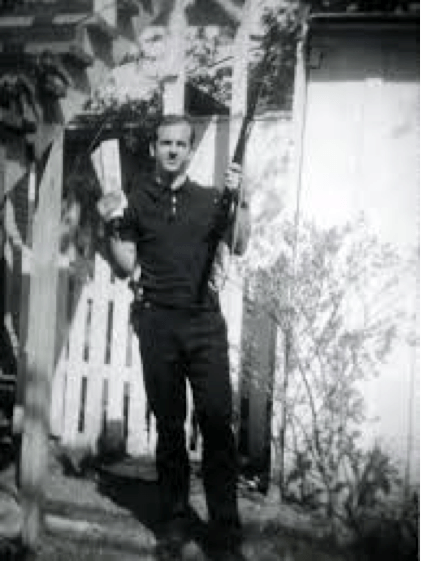
    Oswald “backyard photo” holding a Mannlicher Carcano13

    Perhaps one of de Mey’s more imaginative speculations is that the murder may have been “executed by an experienced sniper using a sound weapon with bullets that had been prepared in advance with the above-mentioned Carcano” (that is, shot through Oswald’s ’museum piece’ so as to lay a trail to the patsy, then later fitted with a sabot to allow the incriminating rounds to be fired through a more reliable weapon on 11.22.63) (p. 365) This “scapegoat hypothesis,” he says, explains the absence of fingerprints on the weapon, since it was planted. It explains why Oswald never bought or possessed bullets (three shell casings and a live round in the rifle’s chamber were the only rounds that ever surfaced in evidence). It also explains why Oswald, who was right-handed hadn’t adjusted the gun sight, which was set for a left-hander.

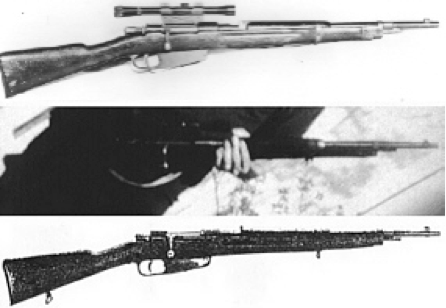
    More importantly, it also supposedly explains one of de Mey’s more ambitious claims: why the Carcano seen in Oswald’s hand in the “backyard photographs” is not the same Carcano found in the Book Depository, presumably Commission Exhibit #139. The only difference he specifies is what ambiguously appears to be an object of some sort on the bottom of the weapon’s barrel in the backyard images, which he says is the “fixing ring for the strap.” (p. 171) This object is absent in the photos of the Carcano in evidence. But it’s possible that the “fixing ring” on the barrel’s underside is actually a shadow from an object in the background, as there are other nearby shadows in the images. Moreover, the backyard photos appear to show that the strap is attached, fore and aft, to the side of Oswald’s rifle. If indeed the fixing ring was on the underside of the barrel of Oswald’s rifle and not the side, as he claims, there would have been a matching rearward fixing ring on the rearward underside of the stock of the weapon. No such object is visible in the backyard photos; nor is one evident in Commission Exhibit #139. Rather, the strap in the backyard photos seems to attach to the side of the stock, not the bottom, as it does in #139.


    de Mey makes much of Kennedy’s botched autopsy, placing much of the blame on the Kennedys, particularly Robert. “The Bethesda autopsy was poorly conducted by physicians without any pathological experience, was poorly documented and some of the autopsy findings that were contrary to the desired scenario were adjusted accordingly, even after Kennedy had already been buried.” (p. 247) “The incomplete and inaccurate autopsy was arranged by Admiral Burkley at the request of the Kennedys … [t]he errors in the autopsy were largely due to the lack of experience of the pathologists who carried out the autopsy. This, again, was a consequence of the Kennedys’ interference in the procedure.” (p.39) While de Mey is on solid footing arguing Kennedy’s autopsy was botched, he’s unconvincing on why. A case can be made he aims fire in the wrong direction.

    First, it’s false that JFK’s surgeons had no pathological experience. All three were board-certified pathologists with lots of experience, but in “natural death,” death due to heart attacks, strokes, cancer and so on. What they were shy of was experience in forensic pathology, deaths from “unnatural” causes, such as gun shots, stabbings, etc. But one of them, Commander Pierre Finck, did have proper forensic credentials; he was board certified in forensic pathology. de Mey’s point should have been that JFK’s autopsy was error-ridden because none of the surgeons, not even Finck, was up to the task at hand on 11/22.

    The famed New York City coroner Milton Helpern, MD, laid out the problem particularly well: “Colonel Finck’s position throughout the entire proceeding was extremely uncomfortable. If it had not been for him, the autopsy would not have been handled as well as it was; but he was in the role of the poor bastard Army child foisted into the Navy family reunion. He was the only one of the three doctors with any experience with bullet wounds; but you have to remember that his experience was limited primarily to ’reviewing’ files, pictures, and records of finished cases. (Finck had not done an autopsy himself in ~2 years before 11.22.63) There’s a world of difference between standing at the autopsy table and trying to decide whether a hole in the body is a wound of entrance or a wound of exit, and in reviewing another man’s work at some later date in the relaxed, academic atmosphere of a private office … .” 14

    JFK’s postmortem wasn’t helped by the fact the pathologists probably felt under the gun to finish quickly. On the 17th floor of the hospital sat the mortified and exhausted Kennedy family entourage. More than once there were calls down to the morgue to inquire about the progress of the examination and how much more time would be required. Might the military have buckled to Kennedy family pressure?

    There was at least one good reason to suppose it had. Although the Armed Forces Institute of Pathology was by far the best place for a murder autopsy, and although the Institute was recommended to the Kennedy family, Jackie picked the less expert Naval hospital at Bethesda instead. Her reason? Not because she could control the Navy, but merely because Jack had been a lieutenant in the Navy. This is not to say Bethesda was a bad hospital; it wasn’t. It was an active teaching hospital with an active autopsy service in 1963. But its cases came overwhelmingly from deaths due to natural causes, not murder. So the pathology staff had little experience with the types of injuries JFK sustained, and there was no “on-campus” forensic pathologist handy when they needed one.

    Historian William Manchester,15 author Gus Russo,16 and John Lattimer, MD, a urologist who has published articles and a book about the Kennedy case,17 have all argued that Kennedy family interference goes a long way towards explaining the failings of JFK’s autopsy. However, the weight of the evidence, including some new evidence, suggests that the Kennedy family cannot be faulted for the most important failings of JFK’s post mortem. (Not even the discredited18 19 20 21 22 23 24 25 26 Warren Commission loyalist Gerald Posner believes they can.27) It is more likely that the military deserves that distinction.

    For example, one cannot rule out the possibility that the Kennedy family tried to prevent an examination of JFK’s Addison’s disease-ravaged adrenal glands, then a dark family secret. But in 1993 in JAMA, Finck recalled that, “The Kennedy family did not want us to examine the abdominal cavity, but the abdominal cavity was examined.”28 29 And indeed it was. Kennedy was completely disemboweled.30 So while there’s no indisputable proof, perhaps the family did request that JFK’s abdominal cavity, which houses the adrenals, be left alone, especially since JFK suffered no abdominal injuries. If Finck was right, so much for the military’s cutting corners to kowtow to the Kennedys’ need for speed. (The doctors were not entirely insensitive to family wishes, however. They kept mum about JFK’s atrophied adrenal glands, even 30 years later, in JAMA. But by then Kennedy’s Addison’s disease was an open secret, having already been discussed by John Lattimer in his 1980 book.31)

    Though they might have been unsuccessful in keeping the military out of JFK’s belly, it is not unreasonable to wonder if the family might have otherwise interfered. The likely ` answer is that they probably didn’t, at least not in any way that influenced the outcome. Under oath to the ARRB, Humes admitted that JFK’s personal physician, Burkley, seemed keen to move things along, but “as far as telling me what to do or how to do it, absolutely, irrevocably, no.” By way of explanation, Humes made the obvious point that, since Burkley was not a pathologist, “he wouldn’t presume to do such a thing.”32 Boswell told the ARRB that they were “not at all” in any rush or under any compulsion to hurry.33 “It was always an extension of the autopsy,” that was encouraged, “rather than further restrictions.”34 Similarly, after an interview with the Commanding officer of the Naval Medical Center, the HSCA reported that, “[Admiral Calvin B.] Galloway said that he was present throughout the autopsy,” and that, “no orders were being sent in from outside the autopsy room either by phone or by person.”35 (emphasis added) In a sworn affidavit executed for the HSCA on November 28, 1978, JFK’s personal physician, Admiral George Burkley, claimed, “I directed the autopsy surgeon to do a complete autopsy and take the time necessary for completion.”36

    The family didn’t, for example, select the sub-par autopsists; military authorities did. Realizing how over their heads they were, JFK’s pathologists told Lattimer that they (wisely) requested to have nonmilitary forensic consultants called in. Permission was denied.37 The Autopsy of the Century was thus left in the hands of backbenchers. Given the “can do” mentality so prevalent in the military, this shortcut isn’t surprising. But it is one the family didn’t take. Had the government but asked, it is impossible to imagine that any expert forensic pathologist in the entire country would have refused his duty during this time of national tragedy, or that the family would have objected.

    The HSCA explored the question of the family’s role in considerable detail in 1978, concluding that, other than (reasonably) requesting the exam be done as expeditiously as possible, the Kennedys did not interfere in the autopsy.38 Moreover, in an important legal matter, RFK left blank the space marked “restrictions” in the permit he signed for his brother’s autopsy.

    While a compelling case for family interference is difficult to sustain, a case can be made that there was at least some interference in JFK’s autopsy. The most glaring errors – the selection of inexperienced pathologists and the exclusion of available, experienced ones, the failure to dissect JFK’s back wound, and the failure to obtain his clothing – had nothing to do with camouflaging JFK’s secret disease, or even with significantly speeding the examination. (Dissecting the back wound would have taken not much more than one hour. JFK was in the morgue more than eight.) Nor is it at all likely the Kennedys would have imposed those specific restrictions, in the off chance they had even thought of them. Instead, these peculiar decisions are more likely to have come from the military.39


    Without so much as even acknowledging, to say nothing of refuting, the extensive acoustics work of Don Thomas, including that which was published in the British peer-reviewed forensics journal, Science and Justice,40 de Mey entirely discounts all evidence, including the HSCA’s acoustics-based conclusion, that there was a shot from the right front. He thus has to explain how a shot from behind fits with JFK’s rearward head snap following Z-312. To do that, DeMey embraces the twin theories favored by loyalists: a “jet effect” of forward-exiting brain and skull matter, as well as a “neuromuscular reaction,” are responsible for driving Kennedy’s head back and to the left. On page 325 he writes, “The kinetic energy is transferred into the impact on the skull, the fragmentation of the bullet and the projection of the fragments. There is also a massive blast out (sic) of brain tissue and blood. (In the case of Kennedy, 35 percent of the content of the right cerebral hemisphere and large sections of the skull were projected and sprayed out at high velocity.) (sic). Such an explosion not only absorbs kinetic energy, it also causes a backwards momentum … The contraction of Kennedy’s back muscles explains the further backwards movement. Professor Kenneth A. Rahn calculated scientifically and in detail how this happened on the Academic JFK Assassination Site.” (emphasis and italics in the original) (p. 325)

    There are so many problems with those sentences that a proper discussion much longer than this entire review could easily be devoted to exploring them. But in short, de Mey admits that kinetic energy may be imparted to a skull on bullet impact. But in the JFK case any forward energy was more than compensated for by rearward momentum resulting from the “massive blast out” of debris exiting from the front – a classic restatement of Nobel Laureate-physicist, Luis Alvarez’s, famous theory.


    Although he couldn’t have known it when he wrote “Cold Case,” Alvarez’s ’proof of concept’ – his melon-shooting experiments demonstrating a “jet effect” that throws blasted melons backward, toward the rifle – have been largely debunked. In his “peer-reviewed” American Journal of Physics article (9/76) Alvarez asserted, “It is important to stress the fact that a taped melon was our a priori best mock-up of a head, and it showed retrograde recoil in the first test … If we had used the ’Edison Test,’ and shot at a large collection of objects, and finally found one which gave retrograde recoil, then our firing experiments could reasonably be criticized. But as the tests were actually conducted, I believe they show it is most probable that the shot in 313 came from behind the car.”41

    Recently, author Josiah (“Tink”) Thompson made an amazing discovery. He gained first-time access through Alvarez’s former graduate student, Paul Hoch, to the actual photos taken during the shooting tests Alvarez had conducted in the 1970s. They showed that Alvarez had, in fact, pretty much used the “Edison Test,” meaning that he had shot at numerous objects, including coconuts, pineapples, plastic jugs filled with water, rubber balls filled with gelatin, etc. All his targets, except the melons, were driven downrange, something he never mentioned.

    Thompson pointed out another problem with Alvarez’s jet effect: “Whether taped or not, a bullet will cut through the outside of a melon like butter. A human skull is completely different. The thick skull bone requires considerable force to be penetrated and that force is deposited in the skull as momentum … A much closer ’reasonable facsimile of a human head’ is the coconut.” When Alvarez used it in his tests, it did not show recoil motion, but was instead blasted down range.”42

    Ida Dox Drawing of an actual photograph of JFK’s brain taken at autopsy. House Select Committee on Assassinations Exhibit, #302.50
     

    Even if we were to grant de Mey that forward-moving ejecta explains JFK’s rearward jolt, another problem immediately pops up: If de Mey is right that that 35% of JFK’s right cerebral hemisphere was blasted out, a claim that is consistent with what witnesses at the autopsy have said,43 what missing ejecta explains the “jet effect?” The University of Washington puts the weight of a complete, undamaged brain at 1300 to 1400 grams.44 At Kennedy’s brain autopsy, after fixation with formaldehyde, his brain weight was measured at 1500 grams.45 Even if we were to assume JFK’s brain weighed more than average, and/or that formaldehyde had somehow increased the weight of JFK’s brain, it’s hard to imagine that a brain missing “35% of its right cerebral hemisphere” would weigh 100 grams more than an average, complete brain. Autopsy witnesses gave telling accounts.

    FBI Agent O’Neill told the ARRB in 1997 that when JFK’s brain was removed, “more than half of the brain was missing.”46 (The assistant autopsy photographer, Floyd Riebe, recalled things much the same way. When asked by ARRB counsel, “Did you see the brain removed from President Kennedy?” Riebe answered, “What little bit there was left, yes … Well, it was less than half of a brain there.”47) Moreover, in JAMA, Dr. James Humes reported that, “Two thirds of the right cerebrum had been blown away.”48 Dr. Boswell recalled that one half of the right cerebrum was missing.49 The Zapruder film shows a massive explosion of Kennedy’s head, with such a shower of brain matter being ejected from the right side of the skull that no one would dispute these autopsy witnesses. And yet the photos of what is supposed to be JFK’s brain show considerable disruption, but very little in the way of actual tissue loss.

    One possible explanation for the discrepancy between the witnesses and the brain in the official autopsy report was one that was proposed by Assassinations Records Review Board analyst, Douglas Horne. Namely, that there were two different JFK “brains,” and that the one that measured 1500 grams and is pictured in the autopsy photographs was not actually Kennedy’s.51


    Flip de Mey’s well written and entertaining book makes valuable contributions. But in the end it must be said it is far from completely satisfactory. However, there is great material in the book and students are encouraged to read it, and then decide for themselves about his timing of the shots, his neo-Single Bullet Theory and his hypothesis a bullet fired through Oswald’s rifle was then fitted with a sabot to allow the incriminating rounds to be fired through a more reliable weapon on 11/22/63.


    1  Final Report of the Select Committee to Study Governmental Operations, 1976, Book V, p 46. http://www.history-matters.com/archive/church/reports/book5/html/ChurchVol5_0026b.htm

    2  Final Report of the Select Committee to Study Governmental Operations, 1976, Book V, p 47. http://www.history-matters.com/archive/church/reports/book5/html/ChurchVol5_0027a.htm

    3  House Select Committee on Assassinations, Final Assassinations Report, p. 261. http://www.history-matters.com/archive/jfk/hsca/report/html/HSCA_Report_0146a.htm

    5  “Experimental Duplication of the Important Physical Evidence of the Lapel Bulge of the Jacket Worn by Governor Connally When Bullet 399 Went Through Him”, Journal of the American College of Surgeons, Vol. 178(5):517-521 (May 1994).

    6  Dale K. Myers, “Secrets of a Homicide.” http://www.jfkfiles.com/jfk/html/concl1.htm

    7  Report of the Select Committee on Assassinations of the U.S. House of Representatives, p. 47: http://www.archives.gov/research/jfk/select-committee-report/part-1a.html

    8  Costella Combined Edit Frames (updated 2006) http://assassinationresearch.com/zfilm/z224.jpg

    9  C.H. Wecht and W. Milam, “THE GREAT LAPEL FLAP: A Rebuttal of Dr. John K. Lattimer’s Interpretation of the Kennedy and Connally Wounds”: “In the actual assassination, a transiting bullet would have produced debris not only from dried ribs (as in Lattimer’s test), but from blood and other chest tissues as well, so that the resulting spray should have been far more conspicuous than is seen in Lattimer’s test. The absence of any such spray at frame 224 is persuasive evidence that no such chest shot occurred at that point.” http://22november1963.org.uk/governor-john-connally-lapel-flap, http://jfk.hood.edu/Collection/Weisberg%20Subject%20Index%20Files/L%20Disk/Lattimer%20John%20Dr/Item%2003.pdf

    12  E. Randich and P.M. Grant, “Proper Assessment of the JFK Assassination Bullet Lead Evidence from Metallurgical and Statistical Perspectives,” Journal of Forensic Sciences, Vol. 51(4):717-728 (July 2006). http://www.dufourlaw.com/JFK/JFKpaperJFO_165.PDF

    14  Quote cited in: Josiah Thompson, Six Seconds in Dallas (New York: Bernard Geis Associates for Random House, 1967), p. 198.

    15  William Manchester, The Death of a President (New York: Harper & Row, 1967), p. 419. Note: Manchester makes the flat statement (quoted by Russo’s in his book on p. 324): “The Kennedy who was really in charge in the tower suite was the Attorney General.” But the decisions Manchester attributes to RFK had nothing whatsoever to do with autopsy limitations.

    16  Gus Russo, Live by the Sword (Baltimore. Bancroft Press, 1998), pp. 324-328. (Russo cites Livingstone’s assertion, in High Treason [1992, p. 182], that Robert Karnei, MD – a Bethesda pathologist who was in the morgue but not part of the surgical team – claimed the Kennedys were limiting the autopsy. However, the ARRB released an 8/29/77 memo from the HSCA’s Andy Purdy, JD [ARRB MD # 61], in which, on p. 3, Purdy writes: “Dr. Karnei doesn’t ‘ … know if any limitations were placed on how the autopsy was to be done.’ He said he didn’t know who was running things.”)

    17  John Lattimer, Kennedy and Lincoln (New York: Harcourt Brace Jovanovich, 1980), p. 195. (“He [Dr. Humes] was severely limited in what he was permitted to do by constraints imposed by the family.”)

    18  While Posner’s book, not unexpectedly, won praise in the New York Times (J. Ward, NY Times Book Review, 11/21/93), University of Wisconsin historian David Wrone, a legitimate JFK authority who Posner approvingly cited repeatedly in Case Closed, described Posner’s book as “so theory driven, so rife with speculation, and so frequently unable to conform his text with the factual content in his sources that it stands as one of the stellar instances of irresponsible publishing on this subject.” See Journal of Southern History, V.61(1):186 (2/95).
    However, another historian, Thomas C. Reeves – whose credentials on the JFK case are so meager that he is nowhere cited in any book on the JFK subject (including Case Closed) – did write a favorable review in the Journal of American History, Vol. 81:1379-1380 (12/94). Michael Parenti described Reeves’ review as “more like a promotional piece than an evaluation of a historical [sic] investigation.” (M. Parenti, History as Mystery [San Francisco: City Lights Books, 1999], p. 195; Parenti provides an extensive review of the peculiar media flattery of Posner in this book.)

    19  Notre Dame Law professor, and former HSCA chief counsel, Robert Blakey, another legitimate authority Posner repeatedly cited in Case Closed, wrote: “Posner often distorts the evidence by selective citation and by striking omissions … (he) picks and chooses his witnesses on the basis of their consistency with the thesis he wants to prove.” (In: G. Robert Blakey’s article “The Mafia and JFK’s Murder – Thirty years later, the question remains: Did Oswald act alone?”, The Washington Post National Weekly Edition, November 15-21, 1993, p. 23).

    20  Case Closed cited in extenso, but selectively, the work of Failure Analysis Associates, Inc. (FaAA) of Menlo Park, California, which prepared evidence for both sides of an American Bar Association mock trial of Lee Harvey Oswald in 1992. On December 6, 1993, FaAA’s CEO, Roger McCarthy, swore out an affidavit in which he declared that Posner had requested FaAA’s prosecution material, but not the defense material; that Posner failed to disclose that FaAA had also prepared a defense, and that the jury that heard both sides “could not reach a verdict.” McCarthy’s affidavit is available on the web at: http://www.assassinationscience.com/mccarthy.html

    21  In testimony before the Congress, Posner reported that both Humes and Boswell had told him they’d changed their minds, and that the autopsy report was wrong about JFK’s skull wound being low. Posner claimed they had admitted to him that they’d come around to the view the wound was high, and so consistent with a shot from Oswald’s position. But as author Aguilar first reported in the Federal Bar News and Journal, Vol. 41(5):388 (June, 1994), both Humes and Boswell, in recorded conversations (now available at the National Archives), denied having ever changed their minds that JFK’s skull wound was low. (They repeated their assertion that they had never changed their minds JFK’s skull wound was low under oath to the ARRB.) Boswell also told Aguilar, twice, that he’d never spoken with Posner. Aguilar gave the recordings, which suggested Posner had perjured himself, to the ARRB. Aguilar also sent the ARRB a copy of a letter calling Posner’s testimony into question, a letter that had been published by a committee chaired by Rep. John Conyers. (See letter in: Hearing before the Legislation and National Security Subcommittee of the Committee on Government Operations House of Representatives, One Hundred Third Congress, First Session, November 17, 1993. Washington, D. C.: U.S. Government Printing Office, 1994. It appears on the final 5 pages of the report.) Subesquently, the ARRB asked Posner for his notes and records substantiating his claims regarding Humes and Boswell. As the ARRB reported on page 134 of the Final Report of the ARRB, Posner declined to cooperate.

    22  Peter Dale Scott, “Case Closed? Or Oswald Framed?” The San Francisco Review of Books, Nov./Dec., 1993, p.6. (This review is perhaps the most eloquent, concise, authoritative and damning of all the reviews of Case Closed.)

    23  Jonathan Kwitny, “Bad News: Your Mother Killed JFK”, Los Angeles Times Book Review, 11/7/93.

    24  Mary Perot Nichols, “R.I.P., conspiracy theories?” Book review in: Philadelphia Inquirer, 8/29/93, pp. K1 and K4.

    25  George Costello, “The Kennedy Assassination: Case Still Open”, Federal Bar News & Journal V.41(3):233 (March/April, 1994).

    26  Jeffrey A Frank, “Who Shot JFK? The 30-Year Mystery”, Washington Post – Book World, 10/31/93.

    27  Summarizing what appears to be his own view, Posner writes, “The House Select Committee concluded that Humes had the authority for a full autopsy but only performed a partial one.” G. Posner, Case Closed (New York: Anchor Books/Doubleday edition, 1993), p. 303n.

    28  Dennis Breo, “JFK’s death, part III – Dr. Finck speaks out: ‘two bullets, from the rear.’” JAMA Vol. 268(13):1752 (October 7, 1992).

    29  Without citation, this episode was also cited by Gus Russo in Live by the Sword, p. 325.

    30  Dennis Breo, “JFK’s death – the plain truth from the MDs who did the autopsy”, JAMA, Vol. 267(12):2794 ff. (May 27, 1992).

    31  John Lattimer, Kennedy and Lincoln, pp. 223-224.

    32  ARRB testimony James H. Humes, College Park, Maryland, pp. 32-33.

    33  ARRB testimony J. Thornton Boswell, College Park Maryland, 2/26/96, p. 29.

    34  ARRB testimony J. Thornton Boswell, College Park Maryland, 2/26/96, p. 30.

    35  Interview of Admiral Calvin B. Galloway by HSCA counsel Mark Flanagan, 5/17/78. HSCA Record Number 180-10078-10460, Agency File # 009409.

    36  Sworn affidavit of Vice Admiral George G. Burkley. HSCA record # 180-10104-10271, Agency File # 013416, p. 3.

    37  Lattimer writes, “Commanders Humes and Boswell inquired as to whether or not any of their consultants from the medical examiner’s office in Washington or Baltimore should be summoned, but this action was discouraged.” In: John Lattimer, Kennedy and Lincoln, p. 155.

    38  HSCA. Vol. 7:14: “(79) The Committee also investigated the possibility that the Kennedy family may have unduly influenced the pathologists once the autopsy began, possibly by transmitting messages by telephone into the autopsy room. Brig. Gen. Godfrey McHugh, then an Air Force military aide to the President, informed the committee that Attorney General Robert F. Kennedy and Kenneth O’Donnell, a presidential aide, frequently telephoned him during the autopsy from the 17th floor suite. McHugh said that on all occasions, Kennedy and O’Donnell asked only to speak with him. They inquired about the results, why the autopsy was consuming so much time, and the need for speed and efficiency, while still performing the required examinations. McHugh said he forwarded this information to the pathologists, never stating or implying that the doctors should limit the autopsy in any manner, but merely reminding them to work as efficiently and quickly as possible.” (emphasis added)

    39  For a more extensive discussion, see “The Medical Case for Conspiracy,” Chapter 8 in: C. Crenshaw, Trauma Room One (New York: Paraview Press, 2001).

    41  Alvarez, Luis, “A Physicist Examines the Kennedy Assassination Film”, American Journal of Physics, Vol. 9:813-827 (1976). Available on line at: http://jfk.hood.edu/Collection/Weisberg%20Subject%20Index%20Files/A%20Disk/Alvarez%20Luis%20Dr/Item%2002.pdf.

    42  Personal communication, 3/2014.

    43  See “The Medical Case for Conspiracy,” op. cit. Crenshaw.

    46  Washington Post, 11/10/98, p. A-3.

    47  Deposition of Floyd Albert Riebe, 5/7/97, pp. 43-44.

    48  JAMA, Vol. 267(12):2798 (May 27, 1992).

    49  ARRB testimony J. Thornton Boswell, College Park Maryland, 2/26/96.

    51  George Lardner, “Archive Photos Not of JFK’s Brain, Concludes Aide to Review Board”, Washington Post, 11/10/98, p. A-3.

  • Ed Souza, Undeniable Truths


    I was looking forward to Ed Souza’s book on the JFK case. Souza has had a long career in the field of law enforcement. He has served as a police officer, a homicide investigator, and today he works as an instructor. It’s always good to get a viewpoint on the JFK case from a man who has spent his professional life in the field of forensics. For the simple reason that, in the normal course of murder investigations, the myriad anomalies that appear all over the JFK case, don’t occur. Therefore, I was eager to see how a professional in the ranks would confront them. As Donald Thomas showed in his book Hear No Evil, the previous course of some law enforcement professionals had been to avoid or discount those anomalies at all costs. To the point of revising the strictures of previous professional practice.

    I

    At the beginning of his book, Undeniable Truths: The Clear and Simple Facts Surrounding the Murder of President John F. Kennedy, I was pleased by Souza’s approach. And also on the evidence he was relying upon to prove his points. For example, in his introduction he reveals that, unlike some other previous investigators, Souza had actually visited Dallas more than once. While there he took many photographs with which he illustrates his book. And from his experience there on the ground, he had concluded “one man with a rifle could not have committed this crime alone.” He then comments that the sixties turned out to be the “decade of death”, not just for three important and progressive leaders – John Kennedy, Martin Luther King, and Bobby Kennedy – but also for the United States as we knew it. Most people would agree, the author is off to an auspicious start.

    Souza opens Chapter 1 by proclaiming that neither the Dallas Police nor the Secret Service fulfilled their first professional duty at the venue of the crime. Neither one of them secured the crime scene. The Texas School Book Depository was not immediately locked down. And the Secret Service actually took a pail and sponge to the presidential limousine at Parkland Hospital. (p. 1, all references to e book version.) He also notes that for the official version to be true, with Oswald firing from behind President Kennedy, the mass of blood and tissue from Kennedy – or a large part of it – should have gone forward, onto the rear of the front seat, and the backs of the two Secret Service agents in front of him. Yet, once one looks at the extant photos of the limousine, much of this matter seems to be behind the president and beside him. (p. 3) Souza writes that things like this strike him as odd. Because in all the years he investigated homicides for the LAPD, he never encountered the laws of physics violated as in the JFK case. (p. 5)

    He continues in this vein by saying, if the official version is true – that is, all the shots coming from the rear – then why was the back of Kennedy’s head blown out? (ibid) And, beyond that, why is the president’s face intact? (p. 9) He brings up a point that has received scant attention. If one goes to Dealey Plaza and looks at the kill zone from, say, a block or two away from the side, the angle from the sixth floor to the first shot seems too steep for what the Warren Commission says it is. And recall, in the FBI report on the autopsy, the angle of the back wound into Kennedy is registered as 45 degrees, or more than twice the dimensions the Commission says it is. (p. 7) And like Ryan Siebenthaler, and Doug Horne, Souza brings up the possibility that there may have been more than one wound in Kennedy’s back. (Click here and scroll down) He completes Chapter 1 by bringing up two more salient points. First, from his military records, Oswald had no training at all in aiming at and hitting moving targets. (p. 10) Secondly, there appears to be a time lapse between when Kennedy experiences his throat wound and the instant that John Connally is being hit for the first time. (He could have added here, that in the intact film – with the excised frames restored – it appears that JFK is hit before he disappears behind the Stemmons Freeway sign.)

    Again, so far, so good. These all seem to me to be truths that are pretty much backed up by the evidentiary record. And they contravene the official story.

    In Chapter 2, Souza now begins to hone in on the medical evidence, an aspect of the case that has become a real thorn in the side of Warren Commission advocates. He begins by quoting some of the Parkland Hospital witnesses, those who saw Kennedy immediately after the assassination in the emergency room. Dr. Gene Coleman Akin said that the throat wound appeared to be one of entrance, and the rear of Kennedy’s skull, at the right occipital area, was shattered. He further added that this head wound had all the earmarks of being an exit wound. (pp. 19-20) Nurse Diana Bowron talked about a large hole in the rear of Kennedy’s skull. (p. 23) Dr. Charles Carrico also witnessed a large, gaping wound in the right occipital/parietal area that was 5-7 centimeters in diameter, and was more or less circular in shape. (pp. 24-25)

    As Milicent Cranor has pointed out, Kemp Clark is an important witness. For the simple facts that he was a neurosurgeon and he officially pronounced Kennedy dead. Souza dutifully quotes Clark as describing a large, avulsive wound in the right posterior part of the skull, with cerebral and cerebellar tissue being damaged and exposed. (pp. 26-28)

    Souza concludes this part of his case with Margaret Hencliffe and Ronald Jones. Nurse Hencliffe stated that the bullet hole in the neck was an entrance wound. Doctor Jones also stated the neck wound was one of entrance and the rear head wound was an exit. Or to be explicit, Jones said: “There was a large defect in the backside of the head as the president lay in the cart with what appeared to be brain tissue hanging out of his wound ….” (p. 32)

    In summing this all up, the author states that twenty witnesses in Dallas said there was a hole in the back of Kennedy’s head. Further, at least seven of these witnesses saw cerebellum, which means the wound in the rear of the skull extended low in the head. Not only does this indicate a shot from the front, but if Kennedy had been shot from the rear, there would have been an exit in the front of the skull. Yet, on the autopsy photos, there is no such wound. (p. 33)

    From here, Souza now goes to the civilian witnesses in Dealey Plaza. He begins with two deceptive quotes from the Warren Report. The first is this one: “No credible evidence suggests that the shots were fired from the railroad bridge over the triple underpass, the nearby railroad yards, or any other place other than the Texas School Book Depository.”

    The second one is as follows: “In contrast to the testimony of the witnesses who heard and observed shots from the Depository, the Commission’s investigation has disclosed no credible evidence that any shots were fired from anywhere else.” (p. 42)

    Souza calls both of these statements lies. He then lists several witnesses who proffered evidence of shots from the front, specifically the grassy knoll: Sam Holland, Richard Dodd, patrolman J. M Smith (who really is not a civilian), James Simmons, Austin Miller, and , of course, the capper to all of this, the railroad crane worker, Lee Bowers. Bowers, of course, goes beyond giving evidence of shots from the front. With his observations of the phased timing of three cars coming in behind the picket fence and in front of the railroad yard, Bowers may have actually seen some of the preparations for the hit team operation. (See pp. 43-50)

    Souza then lists witnesses who say the second and third shots were fired almost on top of each other. And some of these men are police officers – Seymour Weitzman and Jesse Curry – and one was an unintended victim; John Connally. Others he lists as indicating shots came from the front are either spectators or part of the motorcade: Bill and Gayle Newman, Dave Powers, Ken O’Donnell, and J.C. Price. He notes that Powers and O’Donnell, worked for Kennedy, and were intimidated into changing their testimony. Price actually saw a man running from the fence to the TSBD, and was not called as a witness by the Commission. (See pp. 50 ff.)

    Again, all of this is fine. Like a responsible legal investigator, Souza has collected valid physical evidence from the crime scene, linked it with the autopsy evidence, and then corroborated it with witness statements. Its been done before, but Souza performs it with skill and brio and he brings in a few witnesses others have ignored.

    II

    Unfortunately, we have now reached the high point of the book. And we are only about twenty per cent into the text. For here, in my view, Souza now makes a tactical and strategic error. He shifts gears ever so slightly. He now begins to try and go one step up the investigative ladder. That is, how did the actual operation work? For about the next fifty pages the book now becomes a decidedly mixed bag – which the first fifty pages were not. Also, mistakes now begin to creep into the book – mistakes which should have been rather easily detected if a proofreader or fact checker had been employed.

    Let us begin with the better material. In order to show that something was going on inside the TSBD, the author uses witnesses like Arnold Rowland, Carolyn Walther and Toney Henderson to reveal the possibility that there may have been more than one gunman in the building Oswald worked in, and that they may have been elsewhere in the Texas School Book Depository. Most readers are familiar with Rowland and Walther, who both say they saw suspicious persons elsewhere than the sixth floor. Henderson said she saw two men on the sixth floor about five minutes before the shooting, and one had a rifle. We know it was five minutes before the shooting because she said an ambulance had just left the front of the building. This had to have been the transport for the man who had the epileptic seizure. And that occurred at 12:24 PM (p. 59)

    Souza then moves to the presence of Secret Service officers in Dealey Plaza post-assassination, when in fact none were actually there at that time. He uses law enforcement witnesses like DPD patrolman Joe Smith and Sgt. D. V. Harkness to demonstrate this point. And he culminates his case against the Warren Commission by using Chief of Police Jesse Curry to criticize the incredibly bad autopsy given to President Kennedy. (p. 117)

    But in this section of the book, the author now begins to do two things that will mar the rest of the work. He begins to rely on some rather dubious witnesses – who he apparently does not know are dubious. And he also begins to make some errors. Concerning the former, it is one thing to use a dubious witness, but if one is going to do so, one must be willing to shoulder the load of rehabilitating him or her. Souza does not do that. Therefore, when he used the rather controversial Gordon Arnold, and coupled that with the even more controversial Badgeman photo, I began to frown. (Click here for a brief expose of this controversy. Click here for a discussion of the Gordon Arnold debate.)

    He then mentioned the testimony of a man whose evidence he did not footnote. He calls him Detective De De Hawkins. Souza says this officer met two men in suits outside the TSBD who said they were from the Secret Service. (see p. 69) I had never seen this name anywhere. So I went searching for it. I could not find it in the Warren Report. I could not find it in Walt Brown’s The Warren Omission, which lists every single witness interviewed by the Commission. I began to panic when I could not find him in Michael Benson’s quite useful encyclopedia Who’s Who in the JFK Assassination. After looking in Ian Griggs’ book No Case to Answer and Jim Marrs’ Crossfire I was about to give up, since those books are strong on the Dallas Police aspect. I then decided to look at the late Vince Bugliosi’s behemoth Reclaiming History, which, although not a good book, has a very good index to its over two thousand pages of text. I came up empty again. Either Souza made a serious error, or he found someone who no one else has found. If the latter, he should have noted the interview.

    But if this was a mistake, it’s not the only one in the book. Not by a long shot. On page 89, Souza begins a brief discussion of the controversy between FBI agent Vince Drain and DPD officer J. C. Day about a print being found on the alleged rifle used in the assassination – except, it’s not, as Souza writes, a fingerprint, but a palm print. On page 95 of his book, he puts quotation marks around words attributed to Pierre Finck discrediting the magic bullet. When I looked up his source, the words were not in quotes; they were a paraphrase. (Benson, p. 137)

    In Chapter 6, properly entitled “The Autopsy Cover Up”, Souza makes three errors in the space of about one page. He says the autopsy doctors wrote that the president had a small hole in the upper right rear of his skull, which was an entrance wound. The hole was in the lower part of the right rear. He then says that there was a large hole in the right front part of the president’s head. According to the autopsy, it’s on the right side of the head, forward and above the ear. He also says that Dr. Charles Crenshaw was the first attending physician at Parkland Hospital to work on the president. (p. 100) But in looking at Crenshaw’s book, Trauma Room One, one will read that, before Crenshaw ever got inside the emergency room, Malcolm Perry and Chuck Carrico had already placed an endotracheal tube down the president’s throat. (Crenshaw, p. 62) Once Crenshaw got there, Perry made an incision for a tracheotomy.

    It was in this chapter that I felt that Souza began to lose control of his subject. Since the release of Oliver Stone’s film JFK, there has been a deluge of books and essays published on the medical aspects of the Kennedy case. In fact, Harrison Livingstone quickly published a sequel to High Treason called High Treason 2. David Lifton’s Best Evidence, the book and DVD, was back on the shelves.

    Why? Because, Stone, for the first time, exposed a large public audience to the utter failure of the Kennedy pathologists. Largely relying on the devastating testimony of Dr. Pierre Finck at the trial of Clay Shaw in New Orleans, hundreds of thousands of viewers now began to see that President Kennedy’s autopsy was not meant to find the cause of death. Because the pathologists were controlled by the military, neither Kennedy’s head wound nor his back wound was tracked for transience or directionality. For many people, including the autopsy doctors, it was a shocking thing to witness.

    Now, some of this subsequently published material on the autopsy material has been good and valuable. But there has been so much of it that it is easy to lose track of where the weight of the evidence lies. For example, Souza uses Paul O’Connor to say there was no brain in Kennedy’s skull to remove. (Souza p. 102) Yet many witnesses at Parkland Hospital said that, although Kennedy’s brain was damaged, a sizable portion of it was still present. And James Jenkins, among several others, who was at Bethesda that night, says about two thirds of it was intact. Here, Souza is relying on an outlier, not the weight of the evidence. (For a catalog of these witnesses see James DiEugenio, Reclaiming Parkland, p. 137) Further, Souza seems overly reliant on the work of Lifton. This was understandable decades ago, but today, there are several other authors who have done very good work on the medical side of the JFK case e.g. Milicent Cranor, David Mantik, Gary Aguilar. I could find none of these very respectable names in Souza’s book. I don’t understand why they aren’t there.

    III

    And to me, from here on in, the bad begins to outweigh the good in Undeniable Truths. Thus rendering the book’s title ironic.

    In Chapter 7, in a discussion of the attempted shooting of General Edwin Walker, Souza calls him a “former right-wing radical.” In 1963, Walker was anything but a “former” extremist. He then says the Walker shooting happened “just prior to the assassination ….” (Souza, p. 113) I think most people would say that a time-span of nearly eight months is not “just prior” to the assassination. According to the work of Secret Service authority Vince Palamara, the presidential motorcade route was not finally decided upon by the Secret Service and Dallas Mayor Earl Cabell’s office. (Souza, p. 115) It was decided upon by the Secret Service, and a small delegation from the White House, including advance man Jerry Bruno and presidential assistant Ken O’Donnell.

    From approximately this point on, Souza now begins to try and dig into the how, why, and who behind the assassination. And for me, the more he tried to do this, the more his book dissipated. This kind of exploration has to be handled quite gingerly, for the simple fact that the Kennedy assassination literature is not formally peer reviewed. Further, there is no declassified library for the likes of Sam Giancana or H. L. Hunt. One therefore has to be very discerning, scholarly and careful in picking over this evidence. It constitutes a giant swamp with large areas of quicksand beneath. To put it mildly, I was disappointed that Souza exhibited very little discernment in this part of his book.

    One startling example: he actually takes the book Double Cross by Chuck Giancana seriously as a source. This 1992 confection was clearly a commercially designed project; one that was meant to capitalize on the giant national controversy created by Oliver Stone’s film. And the idea that Sam Giancana was behind the JFK murder is simply a non-starter today. That book is currently considered a fairy tale. Yet Souza uses it as a source, and even recommends it to the reader. (See pp. 183, 295)

    Souza also considers the long series made by British film-maker Nigel Turner, The Men Who Killed Kennedy, as “one of the best documentaries on this subject.” (See pp. 300-02) I could hardly disagree more. Moreover, Souza heartily recommends Turner’s segment in the series called “The Guilty Men”, which featured none other than Barr McClellan. Apparently Souza missed the fact that in McClellan’s book, Blood. Money and Power, the author had Oswald on the sixth floor of the depository firing a shot at Kennedy, which elsewhere Souza says Oswald could not have done, because Oswald was not on the sixth floor. (p. 165)

    Souza is so enamored with the untrustworthy and irresponsible Nigel Turner that he can write, “It is a clear and solid fact that Malcolm Wallace’s fingerprint was found in the so-called sniper’s nest on the sixth floor ….” (p. 223) No, it is not such a fact. And, with state of the art computer scanning, Joan Mellen will show that in her upcoming book. But further, Souza is so uncritical about the Kennedy literature that he does not even take Turner to task for buying into the discredited Steve Rivele’s French Corsican mob concept in his first installment, and then switching horses and buying into Barr McClellan’s Texas/LBJ concept in his 2003 series. To me, Nigel Turner wasted one of the best opportunities anyone ever had in the Kennedy field to get a large segment of the truth in this case out to the public. Instead, Turner settled for the likes of Tom Wilson, Judy Baker, Rivele, Barr McClellan, et al. But Souza stands by this dilettante and poseur. And I shouldn’t even have to add the following: by this part of the book, Souza is also vouching for the likes of Madeleine Brown.

    If you can believe it, Souza says that Howard Hunt operated out of 544 Camp Street in 1963. (Souza, p. 175) This is a ridiculous overstatement. There is some evidence that Hunt was in New Orleans to set up the Cuban Revolutionary Council with Sergio Arcacha Smith, but that was not in 1963. (William Davy, Let Justice be Done, p. 24) And the idea that he “operated” Guy Banister’s office in 1963 is completely divergent from the adduced record. Yet Souza is so feverish in his conspiratorial invention that he doesn’t realize he is also writing that Sam Giancana enlisted Guy Banister in setting up Oswald. (See p. 182) That is due to his reliance on Chuck Giancana and Double Cross. How “all in” is Souza with this facetious book? He also quotes Giancana as saying that he knew George DeMohrenschildt, and the Chicago mobster enlisted George in helping to set up Lee Harvey Oswald. If someone can show me any evidence of this outside of the Chuck Giancana fantasy, I would like to see it.

    Now, right on this same page, and in this same section, Souza – in a book on the JFK case – groups Howard Hunt with Richard Nixon as potential players in the JFK case. Like the work of John Hankey, who Souza is now beginning to resemble, the author bases this simply on the fact that Hunt was one of the burglars caught at the Watergate complex in 1972. Souza then quickly shows that he is as circumspect on Watergate as he is on the overview of the JFK case. For he now says that Nixon ordered the Watergate break-in. Like many of his weighty disclosures, he does not footnote this. Probably because there is simply no credible evidence ever found by either the court system or the Senate Watergate Committee that Nixon did any such thing. Souza then compounds this by writing that Charles Colson was one of the planners of the break-in who Nixon hung out to dry. Again, there has never been any credible evidence adduced to substantiate this claim.

    I don’t have to go any further do I? As the reader can see, a book that started out promising, obeying the laws of criminal forensics, has now all but sunk in the lake of specious Kennedy assassination folklore. Souza’s book now began to remind me of nothing more than that monumental, nonsensical and misleading tract commonly called the Torbitt Document, more precisely entitled Nomenclature of an Assassination Cabal. As I argued in the second edition of Destiny Betrayed, that pamphlet looks today like a deliberate attempt at misdirection. It was designed to confuse and to stultify by amassing a large number of names and agencies in front of the reader and stirring them up in a blender. The problem being that there was very little, if any, connective tissue to the presentation, and even less genuine underlying evidence. (See Destiny Betrayed, second edition, pp. 323-24)

    I can assure the reader that I am not exaggerating by drawing that comparison. Just how unsuspecting is Souza? Because Chuck Giancana used Dallas police officer Roscoe White in his fable Double Cross, Souza uses White as one of the assassins in Dealey Plaza! (See page 187) The whole Roscoe White matter was exposed as another financially motivated fraud back in the nineties in an article entitled “I Was Mandarin” in Texas Monthly (December 1990). And that was not the only place it was exposed. Apparently, Souza was not aware of these exposures. Or if he was, he wanted to keep the mythology alive. Either way, it does not reflect very well on his professional scholarship or the quality of his book.

    As I have often said, what we need today is more books based upon the declassified files of the Assassination Records Review Board. And any book that does not utilize those records to a significant degree should be looked upon with an arched eyebrow. I have also said that, if everyone killed Kennedy – the Mob, LBJ, Nixon, the Dallas Police, the CIA – then no one killed Kennedy. Giving us a smorgasbord plot is as bad, maybe worse, than saying that Oswald killed Kennedy. It leads to a false conclusion that, in its own way, is just as pernicious as the Warren Commission’s.

    About the first fifty pages of Undeniable Truths is pretty much undeniable. The next fifty pages are a decided mixture of truth and question marks. Most of the last 200 pages do not at all merit the title. In fact, that part is, in large measure, nothing more than conjecture. And much of that conjecture is ill-founded.