Blog

  • Why CBS Covered Up the JFK Assassination, Part 2

    Why CBS Covered Up the JFK Assassination, Part 2


    Part Two

    In the first part of this article we saw that, as the controversy over the JFK assassination rose in 1966, some employees at CBS News wanted to deal with the subject in a fair and objective way. Specifically, in either a debate or mock trial format, with both sides—both critics and advocates of the Warren Report—represented equally. But CBS President Richard Salant, in consultation with the CNEC—the secret executive committee at CBS—took control of this proposal, and more or less hijacked it. Salant and the CNEC brought in his own consultant to the proposal. One who would not abide by the critics being allowed a fair and equal voice in this debate. Former Warren Commissioner John McCloy would now have a powerful voice about the upcoming special. His back channel to the show would be through his daughter, Ellen McCloy, who worked for Salant. Not only would this be kept under wraps, but also when CBS moved to terminate Roger Feinman in 1975, Salant would deny any such relationship.

    Once McCloy was brought on board, the complexion of both CBS and their programs—both in 1967 and 1975—were altered. The amount of time given over to the critics of the Warren Report would be severely curtailed. But beyond that, CBS would now employ other consultants, besides McCloy, for both their 1967 and 1975 programs. Men who would be rabidly pro-Warren Report. Some of them would appear on the shows as guest speakers. Some would be hidden in the shadows. But in no case would CBS make clear just how biased these men were. In addition to the clandestine role of McCloy, some of these consultants included Dallas police officer Gerald Hill, reporter Lawrence Schiller, physicist Luis Alvarez, and urologist John Lattimer.

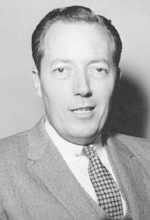
    Gerald Hill

    Gerald Hill was just about everywhere in Dallas on November 22, 1963. He was at the Texas School Book Depository, he was at the murder scene of Officer J. D. Tippit, and he was at the Texas Theater—the place where Lee Harvey Oswald was arrested. Hill appears on the 1967 show as a speaker. But Roger Feinman found out that Hill was paid for six weeks work on the 1967 show as a consultant. During his consulting, Hill revealed that the police did a “fast frisk” on Oswald while in the theater. They found nothing in his pockets at the time. Which poses the question as to where the bullets the police said they found in his pockets later at the station came from. That question did not arise during the program, since CBS never revealed that statement. (Click here and go to page 20 of the transcript.)
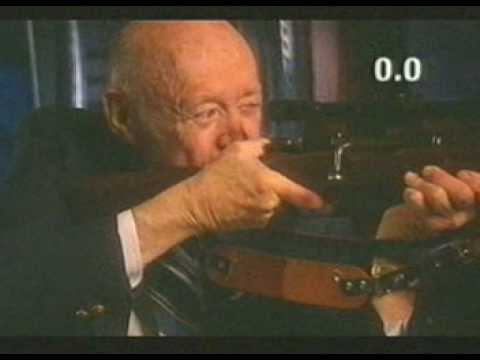
    John Lattimer

    During World War II, John Lattimer traveled with Patton’s Third Army across France. He treated the wounded during the D-Day invasion. At the end of the war, he was the court-appointed doctor for the Nazis accused of war crimes at Nuremburg. As researcher Milicent Cranor discovered, Lattimer was J. Edgar Hoover’s physician. Fittingly then, he had been defending the Commission since at least 1966 in the pages of the Journal of the American Medical Association. In 1972, he became the first doctor allowed to enter the National Archives and inspect the autopsy evidence in the JFK case. He reaffirmed the Warren Commission verdict without telling the public that Kennedy’s brain was missing from the archives. In 1975, Dr. James Weston was the on-camera witness for the medical evidence. Lattimer consulted with Weston and prepared some visual aids for him. Lattimer spent a large part of his career writing articles and performing dubious experiments propping up the Warren Report. (Click here, and here)

    Luis Alvarez

    Luis Alvarez worked on refinements in radar detection during World War II. He then had a role on the Manhattan Project. He actually witnessed the destruction of Hiroshima from an observation plane, the B-29 The Great Artiste. In 1953, Alvarez was on a CIA-appointed study group for UFO’s called the Robertson Panel. In the sixties, he was part of the JASON Advisory Group; this was a powerful organization of top-level scientists that advised the military on things like fighting the Vietnam War. Along with people like Henry Kissinger, Ronald Reagan and George Schultz, he was a member of the secretive and quite conservative Republican private club, the Bohemian Grove. Alvarez was part of the Ruina Panel, which was put together to conceal evidence of Israel exploding nuclear devices. (Click here) Like Lattimer, Alvarez spent a considerable amount of time lending his name to articles and questionable experiments supporting the Warren Report. In fact, as demonstrated by authors like Josiah Thompson (in 2013) and Gary Aguilar (in 2014), Alvarez actually misrepresented his data in some of his JFK experiments. (Click here and go to the 37:00 mark for Aguilar’s presentation.)

    Lawrence Schiller

    The same year of the 1967 CBS broadcast, Lawrence Schiller had co-written a book entitled The Scavengers and Critics of the Warren Report. This was a picaresque journey through America where Schiller interviewed some of the prominent—and not so prominent—critics of the report and caricatured them hideously. The book was simultaneously published in hardcover and softcover, and was also accompanied by an LP record album. But this constituted only Schiller’s overt actions on the JFK case. Secretly, he had been an informant for the FBI for many years on people like Mark Lane and Jim Garrison. These documents were not declassified until the Assassination Records and Reviews Board was set up in the nineties. (See Destiny Betrayed, Second Edition, by James DiEugenio, p. 388) How bad was Schiller? He attacked New Orleans DA Jim Garrison even though he himself had discovered witnesses who attested that Garrison’s suspect, Clay Shaw, actually used the alias of Clay Bertrand. Which was a major part of Garrison’s case against the man. (ibid)

    As the reader can see, with this cast of consultants, the 1967 CBS Special was wrongly titled as “A CBS News Inquiry: The Warren Report”. For the last thing these four men, plus McCloy, wanted to do was to unearth the methodology and process by which the Warren Commission had come to its conclusions. For if that had been done, the results would have shown just how superficial, how haphazard, how agenda-driven the Commission really was. What CBS was going to do was—come hell or high water—endorse the Warren Report. And this became obvious right at the start of the program in the summer of 1967.
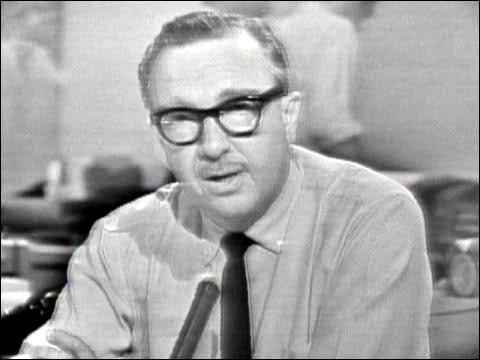
    Walter Cronkite

    For instance, Walter Cronkite intoned that, as a crowd of people rejoiced at the sight of President Kennedy approaching Dealey Plaza, “another waited”. Cronkite then said that, faced with dangerous conditions, President Johnson appointed the Warren Commission. Yet, Johnson never wanted a blue ribbon panel from Washington. He wanted a Texas-based investigation founded upon an FBI report. People outside the White House, like Yale Law School Dean Eugene Rostow and columnist Joseph Alsop, foisted the idea of the Warren Commission upon him. (see The Assassinations, edited by James DiEugenio and Lisa Pease, pp. 7-16) Cronkite then names the men on the Warren Commission while showing their pictures on screen, affirming that this inquiry would be made “by men of unimpeachable credentials”. Needless to say, Cronkite does not mention the fact that President Kennedy had fired Commissioner Allen Dulles in 1961 for lying to him about the Bay of Pigs.

    Cronkite then got to the crux of the program. After stating that the Warren Report assured the public the most searching investigation in history had taken place, he now began to show books and articles that were critical of the Commission. He then revealed certain polling results that demonstrated a majority of Americans had lost faith in the Warren Report. This signalled what the program had now become. It was the first network special that took aim at the work of those critical of the Warren Commission. Its raison d’être was to take on the work of the critics and reassure the public that these people could not be trusted. They had given the Warren Report a bum rap.

    Cronkite then went through a list of points that the critics had surfaced after reading the report and its 26 volumes of evidence. These were:

    1. Did Oswald own a rifle?
    2. Did Oswald take a rifle to the book depository building?
    3. Where was Oswald when the shots were fired?
    4. Was Oswald’s rifle fired from the building?
    5. How many shots were fired?
    6. How fast could Oswald’s rifle be fired?
    7. What was the time span of the shots?

    To shorten a four-hour story: CBS sided with the Warren Report on each point. Oswald fired three shots from the sixth floor with the rifle attributed to him by the Warren Commission. Two of three were direct hits—to the head and shoulder area—within six seconds. Not only that, but using men like Alvarez they came up with novel new ways to endorse the Warren Report. But as we shall see, and as Feinman discovered, CBS was not candid about these newly modified methods.

    One way that CBS fortified the case for just three shots was Alvarez’ examination of the Zapruder film—which the program did not actually show. This was Abraham Zapruder’s 26-second film of Kennedy’s assassination taken from his position in Dealey Plaza. Alvarez proclaimed for CBS that by doing something called a “jiggle analysis”, he computed that there were three shots fired during the film. What this amounted to was a blurring of frames on the film.
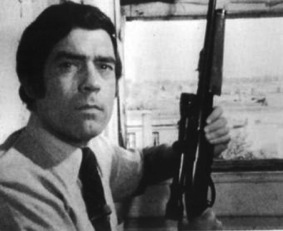
    Dan Rather

    Dan Rather took this Alvarez idea to a Mr. Charles Wyckoff, a professional photo analyst in Massachusetts. Agreeing with Alvarez, at least on camera, Wyckoff mapped out the three areas of “jiggles”. The Alvarez/Wyckoff formula was simple: three jiggles, three shots. But as Feinman found out through unearthed memos, there was a big problem with this declaration. Wyckoff had actually discovered four jiggles, not three. Therefore, by the Alvarez formula, there was a second gunman, and a conspiracy. But as the entire executive management level of CBS had committed to McCloy and the Warren Report, this could not be disclosed to the public. Therefore Wyckoff’s on-camera discussion of this was cut out and not included in the official transcript. It is interesting to note just how committed Wyckoff was to the CBS agenda, for he tried to explain the fourth jiggle as Zapruder’s reaction to a siren. As Feinman noted, how Wyckoff could determine this from a silent 8 mm film is rather puzzling. Even more damning is the fact that, as Life Magazine had deduced, there were actually six “jiggles” in the Zapruder film, and they only allotted one to a “startle reaction”. (See Josiah Thompson, Six Seconds in Dallas, Appendix F) But the point is, this (censored) analysis did not actually support the Commission. It undermined it.

    And in more than one way. For Wyckoff and Alvarez placed the first jiggle at around Zapruder frame 190, or a few frames previous to that. As most people who have studied the case know, this would have meant that Oswald would have had to be firing through the branches of an oak tree—which is why the Commission moved this shot up to frame 210. But CBS left themselves an out here. They actually said there was an opening in the tree branches at frame 186, and Oswald could have fired at that point. This is patently ridiculous. The opening at frame 186 lasted for 1/18th of a second. To say that Oswald anticipated a less than split second opening, and then steeled himself in a flash to align the target, aim, and fire—this is all stuff from the realm of comic-book super heroes. Yet, in its blind obeisance to the Warren Report, this is what CBS had reduced itself to.

    Another way that CBS tried to aid the Commission was through Wyckoff purchasing five other Bell and Howell movie cameras. (CBS was not allowed to handle the actual Zapruder camera.) The aim was to cast doubt on the accepted speed of the Zapruder camera, and suggest it might have been running slow (so that there would have been more time to get off three shots). The problem was that both the FBI and Bell and Howell had tested the speed of Zapruder’s actual camera, and they both decreed it ran at 18.3 frames per second. Wyckoff proceeded to time these other cameras using the same process that Lyndal Shaneyfelt and Bell and Howell did: by aiming the cameras at a large clock with a second sweep hand, and running them for a determinate number of frames. Wycoff announced the results for these timings as 6.90, 7.30, 6.70, 8.35, and 6.16 seconds. Rather concludes this interview by asking, “So, under this theory, the shooter, or shooters, of the shots could have had up to how many seconds to fire?” And Wyckoff replies, “They could have had, according to this, up [to] as much as eight and thirty-five hundreds [sic] of a second–which is a pretty long time.” (CBS Transcript, Part 1, p. 19) Thompson points out that CBS did not clarify here that they had computed these timings from a run of 128 frames, not 103. In other words, they begged the question concerning frame 186. If they had not played fast and loose with the public, they would have told them that at 18.3 fps, Zapruder’s camera would have run through 128 frames in 6.9 seconds (as opposed to 5.6 for 103 frames), thus making the difference between Zapruder’s camera and the slowest running of the other five considerably less remarkable with respect to the total running time for the supposed three-shot sequence. In fact, Zapruder’s camera seems to be running at an average speed, if one combines the other cameras’ running speeds and divides by five (op. cit., pp. 293-294). As Thompson states, the whole experiment really proves nothing about whether the camera was running slow. Even Dick Salant commented that it was “logically inconclusive and unpersuasive.” But it stayed in the program.

    Why did Rather and Wyckoff have to stoop this low? Because of the results of their rifle firing tests. As the critics of the Warren Report had pointed out, the Commission had used two tests to see if Oswald could have gotten off three shots in the allotted 5.6 seconds revealed in the Warren Commission, through the indications on the Zapruder film. These tests ended up failing to prove Oswald could have performed this feat of marksmanship. What made it worse is that the Commission had used very proficient rifleman to try to duplicate what the Commission said Oswald had done. (See Sylvia Meagher, Accessories After the Fact, p. 108)

    So CBS tried again. This time they set up a track with a sled on it to simulate the back of Kennedy’s head. They then elevated a firing point to simulate the sixth floor “sniper’s nest”, released the target on its sled and had a marksman fire his three shots.

    In watching the program, a question most naturally arises. CBS had permission to enter the depository building for a significant length of time, because Rather was running around on the sixth floor and down the stairs. In the exterior shots of Rather, it appears that the traffic in Dealey Plaza was roped off. So why didn’t CBS just do the tests right then and there under the exact same circumstances? It would appear to be for two reasons. First, the oak tree would have created an initial obstruction for the first shot. Second, there was a rise on Elm Street that curved the pavement. This was not simulated by CBS.

    CBS first tried their experiment in January of 1967. They used a man named Ed Crossman. Crossman had written several books on the subject and many articles. He had a considerable reputation in the field. But his results were not up to snuff—even though CBS had enlarged the target size! And even though they gave him a week to practice with their version of the Mannlicher Carcano rifle. (Again, CBS could not get the actual rifle the Warren Report said was used by Oswald.) In a report filed by Midgley, he related that Crossman never broke 6.25 seconds, and even with the enlarged target, he only got 2 of 3 hits in about 50% of his attempts. Crossman stated that the rifle had a sticky bolt action, and a faulty viewing scope. What the professional sniper did not know is that the actual rifle in evidence was even harder to work. Crossman said that to perform such a feat on the first time out would require a lot of luck.

    Since this did not fit the show’s agenda, it was discarded: both the test and the comments. To solve the problem, CBS now decided to call upon an actual football team full of expert riflemen—that is, 11 professional marksmen—who were first allowed to go to an indoor firing range and practice to their heart’s content. Again, this was a major discrepancy with the Warren Report, since there is no such practice time that the Commission could find for Oswald.

    The eleven men then took 37 runs at duplicating what Oswald was supposed to have done. There were three instances where 2 out of 3 hits were recorded in 5.6 seconds. The best time was achieved by Howard Donahue—on his third attempt. His first two attempts were complete failures. It is hard to believe, but CBS claimed that their average recorded time was 5.6 seconds. But this did not include the 17 attempts CBS had to throw out because of mechanical failure. And they did not tell the public the surviving average was 1.2 hits out of 3, and with an enlarged target. The truly striking characteristic of these trials was the number of instances where the shooter could not get any result at all. More often than not, once the clip was loaded, the bolt action jammed. The sniper had to realign the target and fire again. According to the Warren Report, that could not have happened with Oswald.

    There is one more point about this experiment. Neither at this stage, nor any other, was there any mention of the hit to James Tague. On his one miss, the Warren Commission said that Oswald’s shot hit the curb beneath bystander James Tague. This then bounced up off his face, drawing blood. Perhaps they avoided this because Tague was on a different street than Kennedy and about 260 feet away from the limousine. How could Oswald have missed by that much if he was so accurate on his other two shots? Further, the FBI found no copper on the curb where Tague was hit. This defies credulity, because the ammunition used in the alleged rifle is copper coated. (James DiEugenio, Reclaiming Parkland, pp. 228-29) Again, this was surgical-style censorship by CBS.

    Related to the ballistics evidence is what CBS did with the medical evidence. The two chief medical witnesses on the program were Dr. Malcolm Perry from Parkland Hospital in Dallas, where Kennedy was taken after he was hit; and James Humes, the chief pathologist at the autopsy examination at Bethesda Medical Center that evening.

    In their research for the series, CBS had discovered a document that the Warren Commission did not have. The afternoon of the assassination, Perry had given a press conference along with Dr. Kemp Clark. Although it was filmed, when the Commission asked for a copy or a transcript, the Secret Service said they could not locate either. (Doug Horne, Inside the ARRB, Vol. 2, p. 647) This was a lie. The Secret Service did have such a transcript. It was delivered to them on November 26, 1963. The ARRB found the time-stamped envelope.

    Robert Pierpont

    But Feinman discovered that CBS had found a copy of this transcript years before. White House correspondent Robert Pierpont found a transcript through the White House press office. One reason it was hard to find was that it should not have been at the White House; it should have been at the Kennedy Library. But as Roger Feinman found out, it had been relabeled. It was not a Kennedy administration press conference anymore; but the first press conference of the Johnson administration. So it ended up at the Johnson Library.

    None of this was revealed on the program by either Cronkite or Rather. And neither the tape nor transcript was presented during the series. In fact, Cronkite did his best to camouflage what Perry said during this November 22nd press conference, specifically about the anterior neck wound. Perry clearly said that it had the appearance to him of being an entrance wound. And he said this three times. Cronkite tried to characterize the conference as Perry being rushed out to the press and badgered. Not true, since the press conference was about two hours after Perry had done a tracheotomy over the front neck wound. The performance of that incision had given Perry the closest and most deliberate look at that wound. Perry therefore had the time to recover from the pressure of the operation. And there was no badgering of Perry. Newsmen were simply asking Perry and Clark questions about the wounds they saw. Perry had the opportunity to answer the questions on his own terms. Again, CBS seemed intent on concealing evidence of a second assassin. For Oswald could not have fired at Kennedy from the front.

    Commander James Humes did not want to appear on the program. He actually turned down the original CBS request to be interviewed. But Attorney General Ramsey Clark pressured him to appear on the show. (This may have been done with McCloy’s assistance.) As Feinman discovered, the preliminary talks with Humes were done through a friend of his at the church he attended. There were two things that Humes said in these early discussions that were bracing. First, he said that he recalled an x-ray of the president which showed a malleable probe connecting the rear back wound with the front neck wound. Second, he said that he had orders not to do a complete autopsy. He would not reveal who gave him these orders, except to say that it was not Robert Kennedy. (Charles Crenshaw, Trauma Room One, p. 182)

    Like the Perry transcript, this was exceedingly interesting information. Concerning the malleable probe, the problem is that no such x-ray depiction exists today. As CBS stated, Humes had been allowed to visit the National Archives and look at the x-rays and photos prior to his appearance. Needless to say, the fact that this x-ray was missing is not mentioned on the program. Because of that, the pubic would have to wait almost 30 years—until the creation of the Assassination Records Review Board—to find out that other witnesses also saw a malleable probe go through Kennedy’s back. But neither pictures nor x-rays of this are in the National Archives today. The difference is that these other witnesses said that the probe did not go through the body, since the wounds did not connect. This may be the reason they are missing today. (DiEugenio, Reclaiming Parkland, pp. 116-18)

    On camera, Humes also said that the posterior body wound was at the base of the neck. Dan Rather then showed Humes the drawings made of the wound in the back as depicted by medical illustrator Harold Rydberg for the Warren Commission. This also depicts that wound as being in the neck. Humes agreed with this on camera. And he added that they had reviewed the photos and referred to measurements and this all indicated the wound was in the neck.

    Even for CBS, and John McCloy, this is surprising. In the first place, the autopsy photos do not reveal the wound to be at the base of the neck. It is clearly in the back. (Click here and scroll down) The best that one can say for CBS is that, apparently, they did not send anyone with Humes to visit the archives. Which is kind of puzzling, since good journalistic practice would necessitate two witnesses to such an important assertion. And beyond that, CBS should have sent its own independent expert, because Humes clearly had a vested interest in seeing his autopsy report bolstered, especially since it was under attack by more than one critic.

    The second point that makes Humes’ interview surprising is his comments on the Rydberg drawings’ accuracy. These do not coincide with what Mr. Rydberg said later. To this day, Rydberg does not understand why he was chosen to make these drawings for the Commission. Rydberg was only 22 at the time, and had been drawing for only one year. There were many other veteran illustrators in the area whom the Commission could have called upon. But Rydberg came to believe that it was his very inexperience that caused the Commission to direct the doctors to him. For when Humes and Dr. Thornton Boswell appeared before him, they had nothing with them: no photos, no x-rays, no official measurements. Everything they told him was from memory. And this was nearly four months after the autopsy. (DiEugenio, Reclaiming Parkland, pp. 119-22) The Rydberg drawings have become almost infamous for not corresponding to the pictures, measurements, or the Zapruder film. For Humes to endorse these on national television, and for CBS to allow this without any fact checking—this shows what a National Security project the special had become. In fact, the Justice Department had scripted the Humes/Rather interview in advance. (ibid, pp. 125-26)

    As noted, CBS also knew that Humes said that he had been limited in his autopsy pathology for the Kennedy autopsy. This would have been another powerful scoop if CBS had followed it up. Since they did not, the public had to wait another two years for the story to surface. This time it was at the trial of Clay Shaw in New Orleans, when autopsy doctor Pierre Finck took the stand in Shaw’s defense. Finck said the same thing: that Dr. Humes was limited in what autopsy procedures he was permitted to follow on Kennedy (ibid, p. 115). This story would have had much more exposure and vibrancy if CBS had broken it, because the press bias against Garrison was very restrictive and controlling. But, as we have seen, the Justice Department control over Humes and CBS was also restrictive—the difference being that CBS was a much more powerful institutional entity than the rather small DA’s office of a medium sized city.

    What CBS did with the Humes/RFK story should be followed up on to show just how badly CBS was willing to mangle the truth.

    In early 1975, when the JFK case was heating up again, Sixty Minutes decided to do a story on whether or not Jack Ruby and Lee Oswald knew each other. After several months of research, Salant killed the project. Those investigative files were turned over to Les Midgley, and became the basis for the 1975 CBS special, which was entitled The American Assassins. Originally this was planned as a four-night special: one night each on the JFK, RFK, Martin Luther King and the George Wallace shootings. But at the last moment, in a very late press release, CBS announced that the first two nights would be devoted to the JFK case. Midgley was the producer, but this time Cronkite was absent. Rather took his place behind the desk.

    Franklin Lindsay

    In general terms, it was more of the same. The photographic consultant was Itek Corporation, a company that was very close to the CIA. In fact, they helped build the CORONA spy satellite system. Their CEO in the mid-Sixties, Franklin Lindsay, was actually a former CIA officer. With Itek’s help, CBS did everything they could to move up their Magic Bullet shot from about frame 190 to about frames 223-226. Yet Josiah Thompson, who appeared on the show, had written there was no evidence Governor Connally was hit before frames 230-236. Moreover, there are indications that President Kennedy is clearly hit as he disappears behind the Stemmons Freeway sign at about frame 190: his head seems to collapse both sideways and forward in a buckling motion. But with Itek in hand, this now became the scenario for the CBS version of the Single Bullet Theory. It differed from the Warren Commission’s in that it did not rely upon a “delayed reaction” on Connally’s part to the same bullet.

    Milton Helpern

    CBS also employed Alfred Olivier. Olivier was a research veterinarian who worked for the Army wound ballistics branch and did tests with the alleged rifle used in the assassination. He was a chief witness for junior counsel Arlen Specter before the Warren Commission. (See Warren Commission, Volume V, pp. 74ff.) For CBS in 1975, Olivier said that the Magic Bullet, CE399 was not actually “pristine”. For CBS and Dan Rather, this makes the Single Bullet Theory not impossible but just hard to believe. Therefore, it could have happened. Apparently, no one explained to Rather that the only deformation on the bullet is a slight flattening at the base, which would occur as the bullet is blasted through the barrel of a rifle. There is no deformation at its tip. And there is only a tiny amount of mass missing from the bullet. In other words, as more than one author has written, it has all the indications of being fired into a carton of water or a bale of cotton. And if CBS had interviewed the legendary medical examiner Milton Helpern of New York, that is pretty much what they would have heard. (Henry Hurt, Reasonable Doubt, p. 69) It is odd they did not do so, since CBS Headquarters is in New York, and Helpern was still alive in 1975.

    James Weston

    As we have seen, Dr. James Weston would be the on camera medical witness in 1975. Both Weston and Lattimer had seen the medical exhibits before the show was filmed. Taking that into consideration, what they said is not surprising; it is what they left out that is. Predictably, Weston said that there were only two shots, both from the rear. Yet Weston makes no mention of the brain being missing, a fact that both he and Lattimer had to know. Without that exhibit, there was no proof of the brain being sectioned, which is the standard procedure for tracking bullets inside the skull. If this was not done, there is no proof of directionality. Further, there was no mention of the new feature to the x-rays that was found in a Justice Department review in 1968: this was a disk-shaped 6.5 mm fragment in the rear of the skull. Its size fits perfectly the ammunition caliber of the Mannlicher Carcano rifle. It was not seen the night of the autopsy by any of the pathologists. Third, in that same Justice Department review, particle fragments Humes described in his report as going upward from the entry wound, low in the back of the skull, had disappeared on the x-ray. Weston mentioned none of these changes in the evidence. One wonders if he actually read the autopsy report, or just relied on his briefing by Lattimer.
    George Burkley

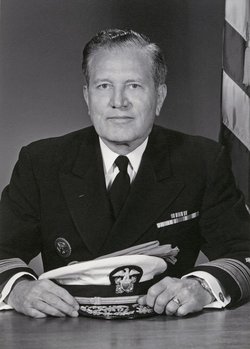
    Finally, Rather realizes, without being explicit, that something was wrong with Kennedy’s autopsy. He actually said to the audience that the autopsy was below par. And he also reversed field on his opinion of Humes. After praising his experience in 1967, Rather now says that neither Humes nor Boswell were actually qualified to perform Kennedy’s autopsy, and that certain things were actually botched. In other words, what Humes told CBS through a third party in 1967 was accurate. But, in contradiction to Humes’ denial that it was Bobby Kennedy who did so, Rather claims that it was Kennedy physician George Burkley who actually controlled the autopsy. Burkley could not have done any such thing unless it was approved by RFK. And Robert Kennedy had given orders to do a full autopsy. That same order was co-signed by Burkley. (Crenshaw, ibid, p. 182) In this author’s opinion, this piece of disinformation sounds like it was created by Lattimer.

    In its perniciousness, in its “blame the victims” theme, Rather’s comment echoes what John McCloy said to Cronkite on camera in 1967. McCloy said that if the Commission made a mistake, it was in not demanding the autopsy materials for their examination, adding that these were under the control of the Kennedy family. If anything shows how “in the tank” CBS and Cronkite were to McCloy, this exchange does. First of all, the medical exhibits were not in control of the Kennedys in 1964. They were under control of the Secret Service that year. Secondly, the Commission did have these exhibits. And McCloy had to have known that. (Gerald McKnight, Breach of Trust, p. 171)

    Let us make no mistake about what CBS was up to here. The entire corporate upper structure—Salant, Stanton, Paley—had completely overrun the lower management types like Midgley, Manning and Schorr. And the lower managers decided not to utter a peep to the outside world about what had happened. There was only one recorded instance where CBS let on to how they had fixed their proceedings. In 1993, CBS did another special endorsing the Warren Report. This time, as in 1975, Rather was the host. He called both Bob Tanenbaum of the HSCA, and David Belin of the Warren Commission, to Dealey Plaza. They both discussed their differing views of the case. But Tanenbaum stated that, unlike, Belin, he had tried well over a hundred felony cases through to verdict. Evidently, Rather was impressed with Tanenbaum’s honesty and experience. When the camera was off, Rather stated quietly to the former prosecutor: “We really blew it on the JFK case.”

    Not only Cronkite and Rather participated in this appalling exercise; so too did Eric Sevareid. He appeared at the end of the last show and said that there are always those who believe in conspiracies, whether it be about Yalta, China, or Pearl Harbor. He then poured it on and said some of these people still think Hitler is alive. He concluded by sneering that, anyway, it would be utterly impossible to cover up such a thing. (Watch it here)

    No it would not Eric. You, your network, and your cohorts just gave us an object lesson in how to do it. Only Roger Feinman, who was not at the top, or anywhere near it, had the guts to try and get to the bottom of the whole internal scandal. And he got thrown under the bus for trying. In that valiant but doomed effort, he showed what hypocrites the top dogs at CBS were, how easily they were cowed and cajoled by their bosses. Everyone then took the Mafia vow of silence about what they had done. Which is despicable, but considering the magnitude of the crime they committed, also understandable.


    (This essay is largely based on the script for the documentary film Roger Feinman was in the process of re-editing at the time of his death in 2011. The reader can view that here)


    Addenda

    A.  The CBS rifle tests

    The author has been informed by Josiah Thompson that the deception by CBS went even further than Roger Feinman knew. CBS line producer Bob Richter revealed some fascinating information to author Thompson after the 1967 special was broadcast.  CBS stated for the internal record that many of their rifle attempts were faulty since the weapon jammed or malfunctioned. Thus was not the case.  This misreporting deliberately concealed the fact that in the majority of those instances, the marksman just could not duplicate what the Commission said Oswald did. CBS simply did not want to admit those failures, and add them to the ones they did admit to.  (04/26/2017)


    B.  Documents

    Thanks to the efforts of Pat Speer, some of Roger’s documentation can again be examined. The hard-to-find reproductions can be found at Pat’s’ website. These are screenshots taken from a copy of Roger’s original PowerPoint presentation. For this reason, a few of them are unfortunately legible only with difficulty. But the reader will see that they represent in substance the story recounted here. We are grateful to Pat for making these available.


    Back to Part 1

  • Why CBS Covered Up the JFK Assassination, Part 1

    Why CBS Covered Up the JFK Assassination, Part 1


    Part One

    When Warren Commission critic Roger Feinman passed away in the fall of 2011, he was freelancing as a computer programmer. That was not his original choice for a profession. Roger started out in life as a journalist. In fact, while in college, he actually submitted reports on campus anti-war disturbances to local radio stations. When he graduated, he got a job at the local New York City independent television station WPIX. In 1972, at the rather young age of 24, he began working for CBS News in New York. There, among other things, he assisted in producing “The CBS World News Roundup with Dallas Townsend.” Under normal circumstances, Roger could have expected a long career at CBS, a few promotions, a nice salary, a munificent benefits package, and a generous pension. He never got any of that. In fact, he was terminated by his employers in the fall of 1976.

    Roger Feinman

    Why? Because in 1975, Roger saw the CBS News Department preparing for another multi-part special defending the Warren Report. The reader should be aware that this was the third time in 11 years that CBS had used its immense media influence to propagandize the public into thinking all was right with the official version of President Kennedy’s assassination. Back in 1964, upon the Warren Report’s initial release—actually the evening of the day it was published—CBS preempted regular programming. Walter Cronkite, assisted by Dan Rather, devoted two commercial-free hours to endorsing the main tenets of that report.

    But something happened right after Cronkite and Rather did their public commemoration. Other people, who were not in the employ of the MSM, also looked at the report and the accompanying 26 volumes. Some of them were lawyers, some were professors, e.g., Vincent Salandria and Richard Popkin. They came to the conclusion that CBS had been less than rigorous in its review. By 1967, the analyses opposing the conclusions of both CBS and the Warren Report had become numerous and widespread. Books by Edward Epstein, Mark Lane, Sylvia Meagher and Josiah Thompson had now entered into public debate. Some of them became best sellers. Thompson’s book, Six Seconds in Dallas, was excerpted and placed on the cover of the wide circulation magazine Saturday Evening Post. Lane was actually appearing on popular talk shows. Jim Garrison had announced a reopening of the JFK case in New Orleans. The dam was threatening to break.

    Therefore, in the summer of 1967, CBS again came to the aid of the official story. They now prepared a four-hour, four night, extravaganza to, again, endorse the findings of the Warren Commission. As in 1964, Cronkite manned the anchor desk and Rather was the main field reporter. And again, CBS could find no serious problems with the Warren Report. The critics were misguided, CBS said. Walter and Dan had done a seven-month inquiry. At the time of broadcast, it was the most expensive documentary CBS ever had produced. And they found the following: Acting alone, Oswald killed President Kennedy and police officer J. D. Tippit. Acting alone, Jack Ruby killed Oswald. And Oswald and Ruby did not know each other. All the controversy was Much Ado about Nothing. Cronkite was going to “shed light” on these questions for those in the public who were confused.

    To show how much “light” Cronkite was going to shed, he began the first installment by saying that there was no question that Oswald ordered the rifle in evidence. Yet, as John Armstrong and others have shown, there are many doubts about whether or not Oswald ordered this rifle. Apparently, among other things, Walter and Dan didn’t notice that the money order allegedly used to pay for the rifle never went through the Federal Reserve system.

    Eight years after this broadcast, in 1975, two events occurred to raise interest in the JFK case again. First, the Church Committee was formed to explore the crimes of the CIA and FBI. The committee revealed that, way before Kennedy was killed, the CIA had farmed out the assassination of Fidel Castro to the Mafia. Yet, the Warren Commission was never told about this. Even though Allen Dulles—the CIA Director when these plots were formulated—was on the Commission. Secondly, in the summer of 1975, in primetime, ABC broadcast the Zapruder film. This was the first time that the American public had seen the shocking image of President Kennedy being hurled back and to the left by what appeared to be a shot from his front and right. A shot Oswald could not have fired. The confluence of these two events caused a furor in Washington. A congressional resolution was passed to form the House Select Committee on Assassinations (HSCA), a reopening of the JFK case.

    CBS decided they were going to try and influence the outcome of the HSCA in advance. So they now prepared still another special about the JFK case. (And since the congressional resolution forming the HSCA sanctioned an inquiry into the Martin Luther King case also, CBS was going to a do a special on that assassination too.)

    Richard Salant, former president of CBS
    William J. Small, former president of NBC News and executive with CBS for 17 years

    There was a small problem. Roger Feinman had become a friend and follower of the estimable Warren Commission critic Sylvia Meagher. Therefore, he knew that 1) The Warren Commission produced a deeply flawed report, and 2) CBS had employed some questionable methods in the 1967 special in order to conceal those flaws. Since Roger was working there in 1975, he began to write some memoranda to those in charge warning them that they had repeated their poor 1967 performance in November of 1975. His first memo went to CBS president Dick Salant. Many of the other memos were directed to the Office of Standards and Practices.

    In preparing these memos Roger had researched some of the rather odd methodologies that CBS used in 1967, and again in 1975. Since, in 1975, he had been there for three years, he got to know some of the people who had worked on that series. They supplied him with documents and information which revealed that what Cronkite and Rather were telling the audience had been arrived at through a process that was as flawed as the one the Warren Commission had used. Roger requested a formal review of the process by which CBS had arrived at its forensic conclusions. He felt the documentary had violated company guidelines in doing so.

    As Roger’s memos began to circulate through the executive and management suites—including Salant’s and Vice-President Bill Small’s—it was made clear to him that he should cease and desist from his one-man campaign. But he would not let up. CBS now moved to terminate their dissident employee.

    On September 7, 1976, CBS succeeded in terminating Roger Feinman. But the collection of documents he secured through his sources was, to my knowledge, absolutely unprecedented. This remarkable evidence allowed us, for the first time, to see how the 1967 series was conceived and executed. But further, it takes us into the group psychology of a large media corporation when it collides with controversial matters of national security.

    Daniel Schorr

    One of the most remarkable discoveries Roger made was this: the initial proposal for the special was made from certain employees inside CBS. The proposal was originally sent to Salant by CBS Vice-President at the time, Gordon Manning. Two men who had relayed the idea to him were Daniel Schorr and Bill Small. Later on, Les Midgley would join the effort.

    Gordon Manning, executive at CBS, NBC and Newsweek

    Small was the CBS Washington Bureau Chief from 1962-74 who was now vice-president. Schorr had joined CBS in 1953 and worked under the legendary Edward R. Murrow as a reporter. Manning was hired away from Newsweek to CBS by executive Fred Friendly in 1964. By 1967 he had also become a vice-president. Midgley had also started in print media. But by 1963, he had become a top prime time news producer at CBS.

    The first proposal was sent to Salant by Manning in August of 1966. It was declined. Manning tried again in October. This time he suggested an open debate between the critics of the Warren Report and former Commission counsels. It would be moderated by a law school dean or the president of the ABA.

    One month after Manning’s debate proposal, Life Magazine published a front-page story in which they questioned the Warren Commission verdict with photographic evidence from the Zapruder film (which they owned). They also interviewed Texas Governor John Connally who disagreed that he and Kennedy had been hit by the same shot. That idea, the Single Bullet Theory, was the fulcrum of the Warren Report. Without it, the Commission’s verdict was rendered spurious. The story ended with a call to reopen the case. In fact, Life had actually put together a small journalistic team to do their own internal investigation.

    Les Midgley, CBS producer

    A few days after this issue appeared, Manning again pressed for a CBS special. This time he suggested the title, “The Trial of Lee Harvey Oswald”. Here, a panel of law school deans would review the evidence against Oswald in a mock trial setting. Including evidence that the Warren Commission had not included.

    At this time, Manning was joined by producer Les Midgley. Midgley had produced the two-hour 1964 CBS special. His suggestion differed from Manning’s. He wanted to title the show “The Warren Report on Trial”. Midgley suggested a three night, three-hour series. One night would be given over to the commission defenders, one night would include all the witnesses the commission overlooked or discounted. The last night would include a verdict conducted by legal experts. On December 1, 1966, Salant wrote a memo to John Schneider, president of CBS Broadcast Group. He told him that he might refer the proposal to the CNEC. That acronym stood for CBS News Executive Committee. According to information Roger gained through discovering secret memos, plus through secondary sources, CNEC was a secretive group that was created in the wake of Edward R. Murrow’s departure from CBS.

    Edward R. Murrow

    Murrow was a true investigative reporter who became famous through his reports on Senator Joe McCarthy and the treatment of migrant farm workers. The upper management at CBS did not like the controversy that these reports attracted from certain segments of the American power structure. After all, they were part of that structure. Salant went to Exeter Academy, Harvard, and then Harvard Law School. He had been handpicked from the network’s Manhattan legal firm by CBS President Frank Stanton to join his management team. From 1961-67, Stanton was chairman of Rand Corporation, a CIA associated think tank. During World War 2, Stanton worked in the Office of War Information, the psychological warfare branch. President Eisenhower had appointed Stanton to a small committee to organize how the USA would survive in case of nuclear attack. The other two members of CNEC were Sig Mickelson and founder Bill Paley. Mickelson had preceded Salant as president of CBS News. He then became director of Time-Life Broadcasting. Mickelson said nothing when founder Bill Paley—who had also served in the psywar branch of the Office of War Information, in World War 2—met with CIA Director Allen Dulles and agreed to have CBS overseas correspondents informally debriefed by the Agency.

    Frank Stanton, former CBS president and chairman of the Rand Corporation from 1961-67

    When Salant had reached his crossroads with CNEC, the writing was on the wall for any fair minded, objective treatment of the JFK case at CBS. For as Roger wrote, “The establishment of CNEC effectively curtailed the news division’s independence.” Further, Salant had no journalistic experience and was in almost daily communication with Stanton. As Roger further wrote, Salant “frequently exercised editorial supervision over CBS news broadcasts.” And further, his memoirs did not mention the supervision of CNEC. Or the Warren Commission documentaries made under his watch. These hidden facts “belied Salant’s frequent public assertions of CBS News’ independence from corporate influence.”

    Sig Mickelson, former president of CBS News and director of Time-Life Broadcasting

    The day after Salant informed the CNEC about the proposal, he told Manning that he was wavering on the mock trial concept. Salant’s next move was even more ominous. He sent both Manning and Midgley to California to talk to two lawyers about the project. One of the attorneys was Edwin Huddleson, a partner in the San Francisco firm of Cooley, Godward, Castro and Huddleson. Huddleson attended Harvard Law with Salant. Like Stanton he was on the board of Rand Corporation. The other lawyer the men saw was Bayless Manning, Dean of Stanford Law School. Both men told the CBS representatives that they were against the network undertaking the project on the grounds of “the national interest” and because of “political implications”. Gordon Manning reported that both attorneys advised them to ignore the critics of the Warren Commission, or to even appoint a panel to critique their books. Huddleson even recommended having scientist Luis Alvarez as a consultant to counter the critics. Which CBS actually did.

    On his return to CBS headquarters, Gordon Manning realized what was happening. He suggested a new title for the series, “In Defense of the Warren Report”. He now wrote that CBS should dismiss “the inane, irresponsible, and hare-brained challenges of Mark Lane and others of that stripe.” Gordon Manning’s defection left Midgley out on a limb. Salant, with the help of the White House, was about to cut it off.  (Bayless Manning had played a significant role in reversing the aim of the program.  It is perhaps of interest here to note that in 1971, David Rockefeller made Bayless Manning first president of the Council on Foreign Relations.)

    Unaware of what Salant was up to, on December 14, 1966, Midgley circulated a memo about how he planned on approaching the Warren Report project. He proposed running experiments that were more scientific than “the ridiculous ones run by the FBI.” He still wanted a mock trial to show how the operation of the Commission was “almost incredibly inadequate.”

    William S. Paley, creator of CBS television, and founder of CNEC

    In response, Salant now circulated an anonymous, undated, paragraph-by-paragraph rebuttal to Midgley’s attack. The secret author of that memo was none other than Warren Commissioner John McCloy—then Chairman of the Council on Foreign Relations. Ellen McCloy, his daughter, was Salant’s administrative assistant. In this memo, McCloy wrote that “the chief evidence that Oswald acted alone and shot alone is not to be found in the ballistics and pathology of the assassination, but in the fact of his loner life.” [emphasis added] As most Warren Commission critics had written, it was this approach—discounting or ignoring the medical and ballistics evidence, but concentrating on Oswald’s alleged social life—that was the fatal flaw of the Warren Report. From this point on, Ellen McCloy would be on the distribution list for almost all memos related to the Kennedy assassination project. She would now serve as the secret back channel between CBS and her father in regards to the production and substance of the project.

    John J. McCloy. His daughter, Ellen, who was Salant’s administrative assistant, admitted to acting as his clandestine liason with CBS during the production of the 1967 Warren Report special.

    Clearly, the tide had turned and Salant was now in McCloy’s corner. For Salant then asks producer Midgley, “Is the question whether Oswald was a CIA or FBI informant really so substantial that we have to deal with it?” Midgley, still alone out on the limb, replies, “Yes, we must treat it.”

    This clandestine relationship between Salant and McCloy was known to very few people in 1967. In fact, as Feinman later deduced, it was likely known only to the very small circle in the memo distribution chain. That Salant deliberately wished to keep it hidden is indicated by the fact that he allowed McCloy to write these early memos anonymously. For as Feinman also concluded, McCloy’s influence on the program was almost certainly a violation of the network’s own guidelines. Which is probably another reason Salant kept it hidden. In fact, as we will see, Salant was actually in denial about the relationship.

    After Feinman was terminated he briefly thought of publicizing the whole affair (which he eventually decided against doing). So he wrote McCloy in March of 1977 about the CFR chair’s clandestine role in the four night special. McCloy declined to be interviewed on the subject. He also added that he did not recall any contribution he made to the special.

    But Feinman persisted. About three weeks later, on April 4, 1977, he wrote McCloy again. This time he revealed that he had written evidence that McCloy had participated extensively in the production of the four night series. Very quickly, McCloy now got in contact with Salant. McCloy wrote that he did not recall any such back channel relationship. Salant then contacted Midgley. He told the producer to check his files to see if there was any evidence that would reveal the CBS secret collaboration with McCloy. Salant wrote back to McCloy saying that at no time did Ellen McCloy ever act as a conduit between CBS News and McCloy.

    This, of course, was false. And in 1992, in an article for The Village Voice, both Ellen McCloy and Salant were confronted with memos that revealed Salant was lying in 1977. McCloy’s daughter admitted to the clandestine courier relationship. Salant finally admitted it also, but he tried to say there was nothing unusual about it. Which leaves the obvious question: If that were the case then why was it kept secret from almost everyone? Including the public. (See further “JFK: How the Media Assassinated the Real Story”)

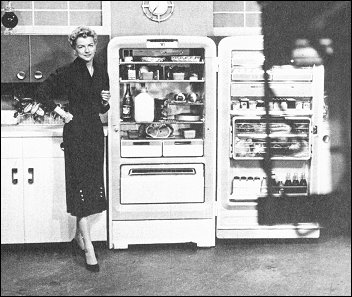
    Betty Furness doing a Westinghouse ad

    As alluded to previously, there was still work to be done with the last holdout, producer Les Midgley. While the four-night special was in production, Midgley became engaged to one Betty Furness. Furness was a former actress turned television commercial spokesperson. At this time, President Lyndon Johnson now appointed her his special assistant for consumer affairs. Even though her only experience in the field had been selling Westinghouse appliances for eleven years on television. She was sworn in on April 27, 1967, about two months before the CBS production first aired. Two weeks after it was broadcast, Midgley and Furness were married. We should note here, as Kai Bird’s biography of McCloy, The Chairman, makes clear, Johnson and McCloy were both friends and colleagues.

    But there is another point to be made about how Midgley was convinced to go along with McCloy’s view of the Warren Commission. Around the same time he was married to Furness, he received a significant promotion. He was now made the executive editor of the network’s flagship news program, “The CBS Evening News with Walter Cronkite”. This made him, in essence, the number one news editor at CBS. Such a decision could not have been made without consultation between Salant, Cronkite and Stanton. And very likely the CNEC.

    We have now seen—in unprecedented detail—how the executive level of CBS completely altered a proposal to present a fair and balanced program about the murder of President Kennedy to the public, and at a very sensitive time in history. Consulting with their lawyers, they decided such a program would not be in “the national interest” and would have “political implications”. We have also seen how the president of CBS News secretly brought in a consultant, John McCloy, whose participation was a violation of the standards and practices of the network. We have seen how both McCloy and Salant then lied about this secret back channel, which was never revealed to the public. We have also seen how Gordon Manning and Les Midgley, through a combination of the carrot and stick treatment, were made to go along with the Salant/McCloy, CNEC agenda.

    We should now look at the impact this secret relationship would have on what CBS was going to broadcast to an unsuspecting public. For their widely trumpeted “examination” of the Warren Report was anything but.


    Go to Part 2

  • The Death of Mark Lane

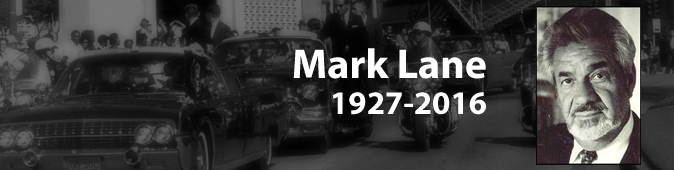
    The Death of Mark Lane


    I finally understood the influence and reputation that the late Mark Lane had in America when I arrived in Pittsburgh for the Cyril Wecht Symposium at Duquesne in the fall of 2013. At the airport, I was picked up in a private car and driven to my hotel. The driver asked me what I was in town for. I replied a JFK conference on the 50th Anniversary at Duquesne. He asked me if Mark Lane was going to be there. I said yes he was. He replied that he wrote his first research paper back in college many years ago on the JFK case, and he used a lot of the work of Lane in doing it. He asked me to thank Lane for that inspiration. When I arrived at the hotel, I did see Mark and I conveyed the debt of gratitude from my driver.

    After I did so I went up to my room and thought: Geez, there must be literally tens, maybe hundreds of thousands of people across America who feel that way about Lane. For the simple reason that Lane was literally the prime mover in the dissent movement against the official version of the Kennedy assassination. Within just three weeks of Kennedy’s death, Lane had issued the first legal arguments against the public stampede to condemn the memory of the accused assassin, Lee Harvey Oswald, who had been shot and killed by Jack Ruby while in the custody of the Dallas police. Lane wanted to publish his defendant’s brief in The Nation. But that liberal journal—and several other periodicals– would not accept it. So he went to the even more leftist journal The National Guardian.

    At that conference in Pittsburgh, there were a few copies of that original essay on a coffee table. Lane picked one up and said to me, “They had to print several reprints of this issue. They eventually sold a hundred thousand of them.” This was in mid-December of 1963, two weeks after the first meeting of the Warren Commission, when every major media outlet in America was accommodating leaks from people like Jerry Ford, J. Edgar Hoover and Allen Dulles about how compelling the case against Oswald was. But there was Mark Lane, the one attorney standing up for a dead man who was being walked over by every public and private institution in America.


    Mark Lane Through the Years

    {aridoc engine=”iframe” height=”320″}images/ctka/public/2016/marklane/slide-show/deep-minified.html{/aridoc}


    Marguerite Oswald, mother of the murdered suspect, heard about Lane’s polemic. She wanted him to act as her murdered son’s defense advocate. But the Warren Commission would not allow it. When Lane forwarded his request to the Commission, Chief Counsel J. Lee Rankin wired back to him the following message: “The Commission does not believe that it would be useful or desirable to permit an attorney representing Lee Harvey Oswald to have access to the investigative materials within the possession of the Commission or to participate in any hearings to be conducted by the Commission.” (See Lane’s A Citizen’s Dissent, e-book version, Part 2, “The Great Silence.”)

    In fact, one of the many travesties of the Commission was that Oswald was not granted counsel throughout the ten-month legal procedure. In that respect, the proceeding was a runaway prosecution. Lane was allowed to appear before the Commission twice, once in March and once in July. These were clearly token, adversarial appearances. In fact, it is hard to find another witness who the Commission treated with such hostility. (Walt Brown, The Warren Omission, pgs. 243-45)

    At around this time in 1964, Lane began to be surveilled by the FBI. Because he was doing JFK lectures abroad, he was also placed on the federal government’s “lookout list” for international air travel. Whenever Lane returned from abroad, the FBI was alerted he was back. (See Lane, op. cit) But beyond that, the FBI now began to interview certain radio hosts who had chosen to place Lane on the air. These Bureau visits resulted in Lane being banned from certain media outlets. And the buzz about those visits discouraged other outlets from having him on.

    In spite of his other considerable achievements, Mark Lane will be forever linked to the JFK assassination. He was, quite literally, a pioneer, a trailblazer in the wilderness.

    But Lane would not let up in his defense of Oswald. He then rented a theater in New York City and began to lecture there regularly, taking apart the evidence presented by the developing official story. With the funds attained by these talks, and his various lectures at home and abroad, Lane set up a Citizens’ Commission of Inquiry to collect evidence ignored by the FBI and the Warren Commission. Lane actually managed to appear on some rather widely distributed talk programs, like the one hosted by Merv Griffin.

    He then began writing a book based upon the Warren Report and its accompanying 26 volumes of evidence. He could not find a publisher for his book in America. Therefore, Rush to Judgment was first published in England in 1966. It became so successful that it was later published in the U.S. and became a smashing bestseller. At a lecture at the 40th anniversary of Kennedy’s death, Lane said he later found out that the reason he could not find a domestic publisher was that the FBI was visiting publishing houses and discouraging them from publishing his work.

    In 1967, Lane followed Rush to Judgment with a documentary film of the same title. This production was shot by famous film-maker Emile de Antonio. De Antonio made films on several controversial subjects like the demagogue Joseph McCarthy and the Vietnam War. He later said that in his entire career, he never met as many witnesses who were literally afraid for their lives to go on camera. Lane literally had to plead with and cajole people to come out of their homes. A few years after this documentary film, Lane worked on the story for a fictional film about the JFK case called “Executive Action.” That film was released in 1973. It was directed by the veteran David Miller and featured some famous leading actors like Burt Lancaster, Robert Ryan, and Will Geer.

    In 1967, Lane had worked for New Orleans District Attorney Jim Garrison during his two-year inquiry into the JFK case. Around 1975, after both the revelations of the Church Committee and the ABC showing of the Zapruder film had ignited outrage favoring a new investigation, Lane did two things to further that interest. First, he released a new documentary on the JFK case called “Two Men in Dallas,” featuring local sheriff’s officer Roger Craig. Second, he restarted his grass roots Citizens’ Commission of Inquiry. He used that committee to lobby Congress to pass a resolution to reopen the Kennedy murder case. To put it mildly, Lane did not get along very well with the final Chief Counsel to the House Select Committee on Assassinations Robert Blakey.

    In the 1980’s, Lane decided to take on the appeal of a libel verdict against publisher Willis Carto, the Liberty Lobby and their controversial publication Spotlight. In 1981, Liberty Lobby had lost a $650,000 case judgment when Victor Marchetti had written in Spotlight that the CIA had to devise an alibi for their agent Howard Hunt being in Dallas on November 22, 1963. (Lane, Plausible Denial, pgs. 129-32) Through the help of his volunteer network and some fine sleuthing, Lane discovered that such a memo did exist. It had been prepared by CIA counter-intelligence chief James Angleton, and had been seen by journalist Joe Trento. And Trento had actually written about it. (ibid, pgs. 152-55) By his aggressive defense, Lane not only reversed the judgment, he actually convinced some of the jurors that the CIA was involved in the Kennedy assassination. (ibid, pgs. 320-323)

    Lane wrote a book on the Howard Hunt case that was published in 1991. Called Plausible Denial, that book also became a best seller. It gave us harsh insights into CIA officers Hunt, Angleton, Richard Helms and David Phillips. Concerning the last, during a debate with Lane, Phillips actually said that when the entire record was declassified, there would be no evidence that Oswald was ever at the Soviet Embassy in Mexico City. (ibid, pgs. 75-87)

    But that still wasn’t enough for Lane. In the new millennium, Lane published his final book on the JFK case called, eponymously, Last Word. In this book, Lane brought out another aspect of the case: the possible complicity of the Secret Service in the assassination. That book was promoted by various video trailers, during which Lane interviewed luminaries like former HSCA Deputy Counsel Robert Tanenbaum, film director Oliver Stone, and former Secret Service agent Abraham Bolden.

    But the amazing thing about Lane is that there were still other aspects of his legal career, outside of the JFK case, that I have not even mentioned. For instance, for a time in the seventies, Lane served as attorney for the accused assassin of Martin Luther King, James Earl Ray. He also co-wrote a book on the King case with Dick Gregory called Code Name Zorro. Lane also took on the case of James Richardson. Richardson was a black man in the south who was indicted and convicted of killing his seven children. Through some extraordinary detective work—and with help from Gregory and Garrison assistant Steve Jaffe—Lane had Richardson freed after 21 years of unjust incarceration. He then wrote a book on that case called Arcadia. His book about the riotous—and ruinous—Chicago Democratic convention, called Chicago Eyewitness, makes for an interesting journal. Lane’s reports on this shocking event make it the ultimate crushing of youthful dissent in America and a turning point in history—which it was. In 2012 he summed up his tumultuous career with an autobiography called Citizen Lane. (Visit Lane’s website for information on how to get Lane’s books.)

    In spite of his other considerable achievements, Mark Lane will be forever linked to the JFK assassination. He was, quite literally, a pioneer, a trailblazer in the wilderness. In that dark year of 1964 when the Warren Commission was trying to keep everything quiet, while men like FBI Director J. Edgar Hoover were leaking rigged and false evidence to the papers, there was Mark Lane, speaking from his podium each night, to anyone who would listen.. He did this not just because it was his vocation, but because he had personally met President Kennedy when he was running for office in New York. Therefore, he kept up that crusade for the truth about Kennedy’s murder at a very high cost to himself.

    As he wrote in his 1968 book A Citizen’s Dissent, he lost his one corporate client over the JFK case. He was then vilified by his opponents who seemed to have easy access to the press, which Lane did not come close to having. Warren Commission junior counsel Wesley Liebeler was actually going to run against him for his state legislative seat. Through it all, through his over more than five decades of dissent against the folly of the Warren Commission, Mark Lane never lost his fighting spirit or his dedication to his cause. He liked to say that the folly of the Commission had led to a national tragedy. Which it did. For both him and all of us.

    Lane died at age 89 at his home in Charlottesville, Virginia, May 10. 2016. We are all a bit poorer for his passing. It signifies a milestone. Taps at Reveille.

    ~ Jim DiEugenio


    For more remembrances of Mark Lane from Cyril Wecht, Bob Tanenbaum, Don Freed, Steve Jaffe, David Lifton, Joan Mellen, Joe McBride and John Barbour, listen to the BlackOp Radio installment below:

  • Donald Trump, JFK, Oswald and the 2016 Presidential Election

    Donald Trump, JFK, Oswald and the 2016 Presidential Election

    Many of the serious people in the JFK community wish that the Kennedy assassination would figure more prominently in our political elections. Especially those for president. For example, back in 1992, both Bill Clinton and Vice-Presidential candidate Al Gore said they felt there were unanswered questions about the JFK assassination and the public had the right to know what was in the declassified files. In 2008, Hillary Clinton said she would open declassified files on the JFK case.

    Unexpectedly, the JFK case has been injected into the presidential race this year. Although not the way most of us would like to have seen it done. The subject has not surfaced in relation to the final 2017 release date on the JFK Act. That would have been most welcome. Instead the controversy is about something that no one could have imagined in advance. The question being posed by Republican candidate Donald Trump is about the father of GOP presidential candidate Ted Cruz, Rafael Cruz. On May 3rd, Trump was on the TV interview show “Fox and Friends.” He said this about candidate Cruz:


    “His father was with Lee Harvey Oswald prior to Oswald’s being, you know, shot! I mean the whole thing is ridiculous. What—what is this right, prior to his being shot. And nobody even brings it up. I mean they don’t even talk about that, that was reported and nobody talks about it. But I think it’s horrible. I think its absolutely horrible, that a man can go and do that….I mean what was he doing with Lee Harvey Oswald, shortly before the death—before the shooting? It’s horrible.”


    Ted Cruz called these accusations “nuts,” “kooky,” and characterized the source material as “tabloid trash.” He then went on to call Trump a “pathological liar,” a “narcissist.” a “bully” and “amoral.” It’s not often that this publication agrees with Ted Cruz on anything. But we do on this one.

    The 1963 photo allegedly showing Lee Harvey Oswald (left) with Ted Cruz’s father Rafael Cruz

    Cruz got one thing wrong about the sourcing. Although the National Enquirer did carry an article on the Cruz/Trump controversy, the original story did not actually begin there. It actually started with Wayne Madsen. Madsen published a story in the April 7th issue of his online journal called the Wayne Madsen Report. In that report, Madsen showed a famous photo of Lee Oswald passing out pro-Cuba handbills outside of Clay Shaw’s International Trade Mart in New Orleans. This incident occurred on August 16, 1963. There are some fascinating facts about this incident. But Madsen ignored those to center on a sensational, unsubstantiated accusation. He centered on a Latin looking man standing to Oswald’s left with a tie on, and what appears to be a white, short sleeved shirt. Although he is not the only man who is unidentified, Madsen used him to make a wild claim. He wrote that this was the father of Ted Cruz, Rafael Cruz.

    As far as this author can tell, this claim is about as well established as Bill O’Reilly saying he heard the gunshot crack that killed George DeMohrenschildt in Florida, since he was standing on the doorstep when it happened. From what I could see in this story, Madsen had two pieces of evidence to make the claim with. Cruz was in New Orleans that summer, and he produced a photo of Rafael for comparison purposes. Neither of which comes close to proving the charge.

    As this site has complained many times before, with very few exceptions, photographic comparisons are not reliable. We went through this a few years ago with Shane O’Sullivan getting on the BBC and saying there were three CIA operatives at the Ambassador Hotel the night Robert Kennedy was killed. This turned out to be wrong. And it appears to be wrong again here. Gus Russo has surfaced a clear photo of Rafael in his younger days, and it does not look like the man in Madsen’s story. He also found an identification card for Rafael, which states he was six feet tall in 1967. The man in the photo appears to be shorter than Oswald, who was 5 feet 9 inches. (See JFK Files blogspot of May 3, 2016) Finally, in the May 3rd issue of The Hill, Rafael Cruz denied he was in the Crescent City on that day.

    As the late Mike Ruppert used to point out, Madsen was not the most accurate or factually addicted reporter to arise during the Internet revolution. In many instances, as Mike showed, Madsen’s reach exceeded his database of facts. Which appears to have been the case here. In other words, because of the questionable source, and the lack of substantiation, the story should have had no legs.

    But it did. The National Enquirer then picked it up. This was interesting, for two reasons. The owner and publisher of the Enquirer is David J. Pecker, CEO of American Media. According to New York, and several other sources, Pecker and Trump are friends. In fact, Trump tried to push his friend for the editorship of Time magazine in 2013. (See New York issue of 10/30/2015). Once the Republican primary season got started, the Enquirer served as a journalistic surrogate for the Trump campaign. They did this by running timely hatchet jobs on both Carly Fiorina and Ben Carson.

    When the ridiculously large Republican field finally narrowed to a trio of candidates—Trump, Cruz and John Kasich—something really weird happened which involved another character recently involved with the JFK field.

    Author and political operative Roger Stone

    Roger Stone had been a GOP operative specializing in what has been (kindly) called “dirty tricks.” He has been at it for a long time. He started off with the master of the genre Richard (Dirty Dick) Nixon. His last famous op was his alleged role in the so-called “Brooks Brothers Riot” in Florida during the 2000 Bush vs. Gore recount. This was when a cadre of congressional GOP aides masqueraded as Dade County citizens to protest a recount being held there. A recount that showed that Al Gore was gaining fast on George W. Bush. On top of this phony “grass roots” protest, Stone allegedly spread rumors that scores of Cubans were also coming to the recount location to protest. Along with the perverse ruling by the late Supreme Court Justice Antonin Scalia to stop the recount, this helped shut down a legitimate and legal voter tally that almost surely would have reversed the election result.

    Stone and Scalia helped present us with one of the worst presidents in history. A man who, among other things, gave us the invasion of Iraq and the real estate/stock market crash of 2007-08. The latter was the worst economic crisis since the Great Depression. The former was the worst foreign policy disaster since the Vietnam War. (Although, to be fair, Stone has had second thoughts about his role in that sordid affair and its horrific results).

    Roger Stone has been friends with Trump for a long time. He actually consulted with him in 1999 when Trump was first considering an entry into the White House race. In this election cycle, Stone was actually on Trump’s advisory staff. He allegedly departed over the Trump dispute with Fox host Megyn Kelly.

    I say “allegedly.” Why? Because Trump and Stone are both very knowledgeable about how to manipulate the media without their knowing it. I mean the “Brooks Brothers Riot” was not exposed until many months after its tumultuous effects had taken hold. In late March, the Enquirer ran a story about Ted Cruz and his five “extramarital affairs.” The only on-the-record source for that story was Roger Stone. As reported by “Real Clear Politics,” Stone then took to talk radio to promote the story himself, challenging Cruz to file a lawsuit if the story was false. He then added smears about the senator’s wife, alleging she had a mental breakdown. (See Slate, March 24, 2016, story by Michelle Goldberg.)

    David Pecker, publisher of The National Enquirer and good friend of Donald Trump

    Interestingly, it appears that Madsen knew about the “Five Mistresses” story in advance. Madsen then surfaced the equally dubious Rafael Cruz story. Which Pecker and the Enquirer then picked up. What makes this interesting is that Roger Stone has of late developed another career, this time as an author. He has written or co-written a few books dealing with, among other things, the JFK assassination. Because of his high profile with the media, his books have attained some notoriety.

    In a radio interview with AM 970 “The Answer,” hosted by former actor Joe Piscopo, Roger Stone was pushing this equally dubious story. Who did he use as a source? Who else but Judy Baker. He also said he talked to a guy who did computer facial recognition and he said it was Rafael Cruz. To put it lightly, whoever could say such a thing about a facial comparison is either a Trump operative, half blind, or both.

    But this is what politics has become in America today: a three-ring circus. And in all these stories, Oswald is presumed to be the assassin of President Kennedy. Try and find the word “alleged” anywhere. Did I say “three ring circus?” With Trump and Stone it’s more like a five ring P. T Barnum special. And recall the famous line (falsely) attributed to Barnum: “There’s a sucker born every minute.” In a sensible world, with a responsible press, the people to go to for an affirmation of the Rafael Cruz story would be writers who have studied the New Orleans aspect of the case for decades. And to use one reputable source, William Davy, according to the files of the late Jim Garrison, there was never any credible evidence that Cruz was in that photo. And since the present author also had access to those files, he can affirm Davy’s studied opinion. But in our upside down media universe, an authority like Davy gets ignored while someone like Roger Stone becomes the source of record.

    Whatever the merit of his books on the JFK case, Stone surely has no expertise in New Orleans. Yet he is allowed to pontificate about the matter. After which one has to ask: If Stone was still working for Trump, could he have done any better for the man? Because it appears that these two stories—which our pitiful mainstream media actually picked up on—were part of the fatal fusillade that eliminated Cruz from the race and pushed Trump over the top.

    Which all seems part of a rather unusual, perhaps unique, presidential election cycle of 2016. It is unique in the sense that both insurgent candidates—Trump and Senator Bernie Sanders—decided to run within the two party system. There was no serious consideration of a third party candidacy, as was the case with previous insurgents like Ross Perot or George Wallace. Surprisingly, both present candidates were quite successful. In lieu of a bitter fight at the convention, Trump appears to have won the GOP nomination. If it were not for the Gillis Long/DLC inspired and created “superdelegate” convention class, Sanders would be able to make a powerful convention challenge in Philadelphia. In fact, the main difference in the success factor was probably the fact that the MSM, in its worship of celebrity, was addicted to Trump. The man had more free publicity than any presidential candidate in modern American history.

    With Stone’s help, Trump managed to do two things that supercharged his campaign. First, in a protean makeover worthy of Laurence Olivier, he altered his political profile. Trump first contemplated running for president back in 1999. At that time, he was encouraged by Jessie Ventura to run as the Reform Party candidate. Trump set up an exploratory committee helmed by—who else: Roger Stone. His ideas back then appeared to be moderate to liberal. They included universal healthcare, doing away with NAFTA, and higher taxes on the rich. He eventually dropped out of the race in February of 2000. He thought the Reform Party could not sustain a national campaign. In retrospect he was correct on that. He also objected to the entry into the party of people like Pat Buchanan and David Duke. As everyone knows this year, when Duke seemed to endorse him, Trump said he did not know what Duke was about.

    Rush Limbaugh (top) and Glenn Beck

    To say the least, Trump has transformed his public image since then. When he and Stone decided to run in the GOP field, they performed a bit of jiu jitsu magic right out of the gate. Since the presidency of Ronald Reagan, the GOP has existed along two super highways that, schematically, run parallel to each other. On the lower highway, close to the ground, highly paid shills like Rush Limbaugh and Glenn Beck mobilize and anger the Republican base. The red meat issues they use are things like immigration, nationalism, thinly disguised racism, and anti-abortion rights. Meanwhile, the real movers and shakers in the GOP have structured a higher, less visible highway made up of foundations, think tanks, and lobbyists that promote a much more broad and business minded agenda. This includes things like economic globalization, attacks on environmentalism, anti-unionism, and anti-healthcare. They also seek to destroy the public education system and limit upward social mobility through education. In other words, the agenda of this upper class drastically and negatively impacts the daily lives of the beer drinking proletariat that Limbaugh and Beck manipulate. Limbaugh and Beck use emotional pleas and shell games to divert from that fact.

    What Trump did was to co-opt the Limbaugh/Beck arm of the party by being even more extreme than they were. By advocating for things like the construction of a wall on the Mexican/American border, and mass deportations of illegal aliens, Trump was actually out clowning Limbaugh for the Archie Bunker vote.

    Trump in pursuit of the Archie Bunker vote (above)

    Trump is too smart not to realize how unrealistic these things are, how susceptible they are to legal challenges. So he says them knowing that they will very likely never come close to fruition. But it inoculates him in the rightwing world of talk radio. He then tries to portray himself as a job creator who will make America Great Again, thereby outflanking the upper highway of the GOP. Tactically, Trump ran a very smart race. And the fact that the MSM never tried to really expose him helped a lot.

    The problem with Trump’s candidacy is this: with his Proteus like switches and his bombastic promises, it is very hard to figure just what Trump would be like if he won the White House. And that is really bad. Because we know what happened between another well-disguised presidential candidate and his handler. In 2000, Karl Rove sold George W. Bush as a compassionate conservative. Which, to put it mildly, he did not turn out to be. With Trump, who has said just about anything about himself and everyone else to get elected—including accusing his opponent’s father of being involved with Oswald in New Orleans—you have a very large joker as a wild card.

    He should not remain so. It is way overdue for someone in the media to do the real digging and exploring about who Trump really is today and what his presidency would actually be like.


    Update:  In the above, I left out two other factors that would seem to support the idea that Roger Stone’s late-arriving writing vocation was at least partly done in the aid of Donald Trump. Stone has written or co-written four books in less than four years. Two of them directly figure in his work for Trump. In 2015, Stone co-wrote The Clintons’ War on Women. In this effort he shared billing with one Robert Morrow. Morrow is a Texas-based researcher who is also a rather late arrival on the JFK scene. But in addition to his Kennedy efforts, Morrow reportedly has a library of over one hundred books on the Clintons. This weekend, Trump was speaking about this very issue from the podium. That is, his treatment of women versus the Clintons. Clearly, the candidate is trying to overcome the gender advantage Hillary Clinton enjoys. One wonders if Roger Stone anticipated this months earlier.

    Before Stone co-wrote a book with Morrow, he did the same with Saint John Hunt. This one was titled Jeb! And the Bush Crime Family. That book was published in October of 2015; in other words, about three months before the primary season began. At that time Jeb Bush was perceived as being one of the strongest candidates in the race – if for no other reason than he was the most well-funded. The GOP establishment had funneled over 100 million dollars into his war chest.

    So when one adds it all up, one has to wonder if Stone had this planned out in advance. That is how his newfound writing career would help his friend Donald Trump. In regard to his support for these two National Enquirer stories described above, was the alleged divorce between Stone and Trump really genuine? One has to ask: Isn’t it better for a man with Stone’s reputation to perform his tasks while not being directly affiliated with the candidate? It is a bit startling that no MSM reporter has written about this subject.

    One last point should be amplified. The unprecedented success of Trump and Sanders reveals much about how tired the public is with the status quo of our political parties. It would be the equivalent of two third party candidates getting more votes than all but one of 23 Republicans or Democrats in a primary season. This is how much unrest and frustration there is after eight years of Oprah Winfrey’s “Change” candidate, Barack Obama.

  • Probe Order Form & Index

    Probe Order Form & Index


    probe DVD image

    All 7 volumes of what was universally acclaimed as the best journal in the assassinations field are now available on CD.

    Back then its cost would have been 210 dollars.

    NOW for $35.00.

    three

    Articles by Lisa Pease, Jim DiEugenio, David Mantik, Gary Aguilar, Carol Hewett, Don Gibson, Bill Davy, John Armstrong and many more. Articles about the assassination of Robert F. Kennedy and Dr. Martin Luther King, Jr. included.   Also includes declassified documents by the ARRB and transcribed speeches that you will not find anywhere else.


    buy

    check outcart

    (courtesy of JFK LANCER)

    Paypal

    NOTE: NOT ALL ARTICLES ON THIS DISK ARE AVAILABLE ON THIS SITE


    Back Issues Index

    Issues are listed in reverse order, starting with the previous volume. Contents listed below do not include the Chairman’s letter in each issue, nor the Notebook section from each issue, in which snippets of current media events that relate to our study of the assassinations of the sixties and the major players, are discussed. Contents are incomplete, although the bulk of the issues are fully documented.


    Index Vol. 7 No. 4 May-June, 2000

    Cover Story: The Martin Luther King Conspiracy Exposed in Memphis

    Jim Douglass writes a literate and informative exposÈ on important evidence that surfaced during the King family’s civil suit against Loyd Jowers, confessed conspirator in the Martin Luther King assassination. This is the best summary to date of what transpired during the trial, the background of the events and the importance of the revelations. Anyone with a serious interest in the King case must read this piece.

    Mind-Control Part 2: From Implants to Microwaves: A Case Study

    Here, Tyner tells of mind-control history through a study of one woman and her bizarre encounters with the doctors and psychiatrists involved in mind-control experimentation. While much of the victim’s story is hard to believe, and even more difficult, if not impossible, to prove, we know from other cases that these kinds of horrific treatments do, in fact, exist, and wanted to present this story on behalf of all victims whose true stories are so unbelievable that they becomes victims of another kind of abuse, ridicule and humiliation from those who can’t accept that such experiments have really been conducted by respected doctors and public officials in our country.

    The Two-Brain Memorandum

    Former Assasssination Records Review Board staffer Douglas Horne put his career on the line with the ARRB by writing up the story of how two different brains, both of which were claimed to be Kennedy’s, were examined, and how the evidence cannot be reconciled. This landmark memo which has been summarized elsewhere is presented here in the whole.

    What did Sibert and O’Neill See?

    Milicent Cranor debunks the notion that if Sibert and O’Neill, two of the more honest FBI observers to the autopsy, didn’t see it, it didn’t happen. Cranor shows simply that honest people cannot honestly report on something they didn’t witness; but that doesn’t mean it didn’t happen. Absence of evidence is not evidence of absence.

    Remembering Jim Rose

    Consummate author, researcher, and former FBI agent William Turner illuminates one of the significant background players to this case, E. Carl McNabb, who used the alias Jim Rose while participating in Garrison’s investigation of the Kennedy assassination conspiracy. Lisa Pease and James DiEugenio add a note regarding their own experiences with this extraordinarily compassionate, intelligent, and slightly Puckish character. We miss him terribly.


    Index Vol. 7 No. 3 Mar-Apr, 2000

    Cover Story: The King Trial: What the Media Didn’t Tell You

    Tennessee author Mike Vinson recounts some of the key events from the recent conspiracy trial, and his talks with some of the people involved in the case.

    The Testimony of Marina Oswald Before the New Orleans Parish Grand Jury

    Steve Jones discusses the contents and contradictions within Marina Oswald’s testimony to Jim Garrison’s Grand Jury during his investigation of the assassination.

    McNamara’s Meeting, McNamara’s Silence, McNamara’s War

    Jim DiEugenio continues to study the evidence that shows, ever more clearly, that Kennedy did indeed plan to withdraw all troops from Vietnam, and that the 1000 he ordered withdrawn was simply a first step towards total withdrawal. Documents included in this article show how serious Kennedy ws to get us out of that morass. And documents also show that McNamara was well aware of that fact, despite his fuzzy statements regarding what he knew and when he knew it.

    Mind-Control Part 1: Canadian and U.S. Survivors Seek Justice

    Arlene Tyner debuts in Probe with this detailed look at documented, proven cases of abusive mind-control experiments conducted on Americans and Canadians through the CIA’s MKULTRA program. Tyner lays out some of the history of the program, and some of the suits survivors have brought against the agency for programs that ruined their lives.

    Interview with Richard Sprague Part II

    This is a continuation of the interview printed in the previous issue of Probe. Sprague describes how the HSCA and the CIA, which had a clear-cut conflict of interest, nonetheless colluded with each other to keep key evidence from seeing the light of day.


    Index Vol. 7 No. 2 Jan-Feb, 2000

    Cover Story: The Media Buries the Conspiracy Verdict in the King Case

    Jim DiEugenio shows how the major media twists and distorts the evidence to downplay the incredible significance that a jury found that there had been a conspiracy to assassinate Dr. Martin Luther King, and that Loyd Jowers was involved. 

    File Update

    Bill Davy shares with us some of the latest releases to have come out regarding QKENCHANT, the CIA operation for which Clay Shaw and E. Howard Hunt (at different times) were given covert security clearance. Davy also talks of new information regarding ZRCLIFF, William Harvey’s operational aliases, and more.

    The Colosio Assassination: Chronology of Events

    Noted Film Director Alex Cox contributed this amazing, detailed chronology of the events leading up to and following the assassination of Mexican presidential candidate Luis Colosio on March 23, 1993. The parallels to other assassinations continue to amaze. Was the suspect truly the person caught on camera holding a gun, or was he an unfortunate look-alike? These and many other serious questions arise from the data Cox has compiled. Truly, this case is deserving of a good book on the subject.

    A Tale of Two Official Stories: JFK’s “Authenticated” Autopsy Photographs and the “Authenticated” Magic Bullet

    Dr. Gary Aguilar examines how even the “official” versions of what happened with the alleged murder bullet and the autopsy photos are in dispute by the “official” sources for the matter. What emerges is a masterful illumination of how the discrepancies in these cases server to illuminate deeper truths about the case.

    Interview with Richard Sprague

    Professor John Williams again graces us, this time with his interview of Richard Sprague, the original leader of the House Select Committee on Assassinations (HSCA). Sprague is forthcoming about his own naivetÈ going into the case, and the hard lessons learned, as well the curious questions raised by his forced ouster.


    Index Vol. 7 No. 1 Nov-Sep, 1999

    Cover Story: Jesse Ventura Takes On the Establishment re JFK Case

    Jim DiEugenio explores the recent comments by Minnesota Gov. Jesse Ventura, and finds them amazingly to the point about the Kennedy assassination, as well as on other topics. While we don’t agree with all of Ventura’s comments, it’s still refreshing to see an official in a high public office take such a forthright stand on important topics, especially when such stance puts him at variance with the establishment. Courage is a rare and refreshing thing to see in a public official.

    “Davy Disappoints”: A Rebuttal

    Bill Davy turns the tables on Dave Reitzes, an Internet propagandist for the lone nut theory, who wrote a “review” of Davy’s recent (and excellent) book, Let Justice Be Done. Davy shows how the “facts” in Reitzes’ piece are anything but, and sets Reitzes’ rhetoric ablaze.

    Kennedy’s Quest for Détente with Castro

    Slowly the press is starting to acknowledge, after years of misinformation, that Kennedy was maybe not the Cold Warrior they’ve tried to paint him to be. Jim DiEugenio shows how new information continues to show that Kennedy was making serious efforts at reaching some sort of peaceful coexistence with Fidel Castro just shortly before his assassination.

    Waco: The New Evidence

    The Branch Davidians’ suit against the Federal Government has brought to light interesting information regarding what appears on the Forward-Looking Infra-Red (FLIR) tapes shot at Waco on the final day of the siege, when the fires broke out. Lisa Pease examines new discoveries, and the effort to restage that final day to resolve the question of whether or not FBI agents fired at the compound. They have always denied that they did, but three separate FLIR experts concluded the FLIR tapes show gunfire from FBI positions.

    Edward Epstein: Warren Commission Critic?

    Jim DiEugenio looks closely at the record of one of the earliest critics, Edward Epstein, and questions whether he was ever a critic at all. Epstein’s later work showed him to be little more than a wonk for the establishment. So how good was his first book, Inquest? DiEugenio answers that and other questions about Epstein, and talks about Epstein’s work with the CIA and notably, James Angleton.

    The First 72 Hours

    Professor Donald Gibson examines in detail the first 72 hours after the assassination. How does what, when, and what is the significance of those actions in forestalling the growing evidence of conspiracy? Gibson discusses this and more. This article is excerpted from Chapter Two of Gibson’s latest book, The Kennedy Assassination Cover-Up.

    The Martin Luther King Assassination Case is in Court – But Who’s Telling?

    Lisa Pease wonders aloud why the major media have given next to no attention to the only serious trial to ever have been conducted regarding the assassination of Martin Luther King. Pease pulls together the little information that has come out to present to the readers what the major media isn’t telling them.


    Index Vol. 6 No. 6 Sep-Oct, 1999

    Cover Story: Oswald, the CIA and Mexico City

    Professor John Newman takes us through the Mexican maze presented by the CIA’s files on Oswald and shows how the communications in these files serve as the Rosetta Stone to the assassination. This article is a landmark in terms of advancing the argument for the CIA’s culpability in the assassination of President Kennedy in 1963.

    The Other Side of Six Seconds In Dallas

    Milicent Cranor examines one of the early books on the assassination and compares what we now know was available to the author with his presentation of the evidence, and finds it sorely wanting.

    The Mutation of a Quote

    Cranor also examines how a quote from John Connally about when he was hit and what he was doing has evolved over the years to something less truthful, but more convenient to those still struggling to maintain that the single bullet theory is viable.

    Interview with Gaeton Fonzi

    Fonzi was an investigator with the House Select Committee on Assassinations (HSCA) in the 70’s. The HSCA has been the topic of many interesting Probe articles. But it’s always most interesting to hear what happened from the participants directly. John Williams, a Professor with the University of Wisconsin, is working on a book about the HSCA, and has generously shared this interview he conducted with us.

    The Alleged MLK Murder Rifle

    Mike Vinson contributed this interesting article about how Jerry Ray, James Earl Ray’s brother, has been attempting to gain possession of the alleged murder weapon in order to do legitimate testing on the rifle. Ray is convinced a genuine test would clear his brother’s name in terms of the shooting of Martin Luther King.

    The Siege of Berkeley: The Day KPFA Disappeared

    Did this really happen in America? Dennis Melendez, a San Francisco Bay Area resident, describes the horrific, bizarre efforts to shut down free speech at KPFA, a Pacifica network radio station, and how the activists in Berkeley proved to be alive and well and ready for the fight. This is a serious indictment of one of the few “public” radio stations left in this country.

    Geraldo Abandons the Critics

    Geraldo Rivera was once on the side of the research community in the JFK case. Lately, he appears to have sold out, and hosts propagandists such as Gerald Posner instead of researchers. DiEugenio dissects a recent show in which Dr. Cyril Wecht, author Jonathan Vankin, Gary Mack, Dr. Michael Baden and Gerald Posner discuss the case.


    Index Vol. 6 No. 5 Jul-Aug, 1999

    Cover Story: Rose Cheramie: How She Predicted the Assassination

    Jim DiEugenio recounts the amazing story of Rose Cheramie. Two days before the assassination, a woman in a drugged state who had been hit by a car was brought into a hospital in Louisiana. When she was lucid enough to speak clearly, she told a policeman and others at the hospital that a plot was afoot to kill Kennedy. She even predicted that Jack Rubenstein, i.e. Jack Ruby, would be involved. Read about her amazing tale. When you find out who some of her cohorts were, you’ll understand why she had foreknowledge of the assassination, and why many have worked hard over the years to discredit her important story. The article includes the text of several documents from New Orleans District Attorney Jim Garrison’s files on the case.

    The Silver Slipper?

    Lisa Pease notes that the Silver Slipper, the club which figures in the story above, showed up in another context. Find out what a woman in Pennsylvania found leftover from her Cuban neighboor’s bonfire. Clearly, It appears Cheramie was not alone in her foreknowledge of the assassination.

    Boring: A Postscript

    Vince Palamara continues his examination of the curious Secret Service Assistant Special Agent In Charge Floyd M. Boring and his participation in the events that precipitated the assassination of President Kennedy.

    Who Murdered Yitzhak Rabin?

    Barry Chamish generously allowed us to reprint this article that became a part of his book by the same title. Chamish draws interesting parallels between the assassination of Rabin and the assassinations of major leaders in America. Why did Rabin keep walking after Yigal Amir supposedly shot him in the back, severing his spine? Read about this and many other major discrepancies that show the official story is as flawed as any of the others we have dealt with.

    The Mainstream Media & the Medical Evidence: Inattention to Detail

    Dr. Gary Aguilar reviews what the mainstream does and does not report concerning new findings regarding the medical evidence in the JFK case. Aguilar presents a serious indictment of the media, questioning their objectivity and honesty. Heavily documented, the footnotes to this article are as interesting (and nearly as long) as the article itself!

    Perry Russo vs. Phelan and Lambert

    Lisa Pease compares the last-recorded statements of Perry Russo with Patricia Lambert’s rendition and finds Lambert’s version sorely wanting. Lambert’s book, False Witness, is discussed in detail in the previous issue.


    Index Vol. 6 No. 4 May-June, 1999

    Cover Story: False Witness: Aptly Named

    Garrison experts Jim DiEugenio and Bill Davy team up to combat the latest anti-Garrison propaganda, this time from Patricia Lambert in her new book, False Witness. The authors present examples of clear bias, showing how she used rumor and innuendo and selectively presented evidence to make her case. The authors show that it is Lambert herself who is a false witness to the record, and question whether her close associate and friend (and vehement Garrison detractor) David Lifton will follow in her footsteps when he completes his new book on Oswald.

    The Real James Phelan

    We share the contents of a private investigator’s report on James Phelan. The report’s author confronted Phelan with evidence of his complicity as an agent of the government while posing as a reporter, and Phelan’s response is enlightening. Lisa Pease adds a personal anecdote of her own run-in with Phelan a few years back, and of Phelan’s close association with David Lifton and apparently Gerald Posner as well.

    Let Justice Be Done

    Bill Davy’s new book, Let Justice Be Done, is out. We excerpt here a chapter from this new work on the Jim Garrison investigation, based largely on files released since 1992. We also present information on how to order Davy’s book. This is one book no researcher should be without!

    Boring’s Interesting ARRB Interview

    Vince Palamara has been researching the activities of agents of the Secret Service before, during, and after the assassination of President Kennedy, and has made remarkable discoveries. He has focused in on the particularly significant person of Floyd Boring, who was responsible for the President’s security in Dallas. In this piece, Palamara explores new information garnered from the ARRB’s interview of Boring. Palamara also explodes a few myths, such as the persistent one that Kennedy insisted on less security. Not true, Palamara proves.

    Bremer & Wallace: It’s Déjà Vu All Over Again

    Lisa Pease presents an in-depth examination of the Wallace shooting, and finds an all too familiar story. Too many bullets, weird trajectories, a would-be-assassin that seems not in control of his mind, and the likelihood of a second shooter. You will be surprised at how much was never written about this case, given the discrepancies in the evidence. Wallace himself pleaded for researchers to take an interest in what he felt was a conspiracy. Read the evidence and make up your own mind.

    David Lifton’s Letter to the ARRB on Palmer McBride

    David Lifton refuses to accept the word of Palmer McBride that he knew Oswald in 1957, insisting that because Oswald was not in America, McBride must simply be in error. In this letter, made public by the Review Board, Lifton asks the Board to pursue the work records of Oswald and Palmer McBride for this period. (Lifton has never believed that there could have been two people sharing the identity of Oswald, even though J. Edgar Hoover himself postulated this in a now-famous memo.)

    Palmer McBride’s Response to Lifton

    When McBride found out what Lifton had written to the ARRB, he composed this straightfoward response, citing additional witnesses beyond himself who can support his contention that Oswald worked for Pfisterer’s in 1957 and 1958, and not in 1956. McBride challenges Lifton to deal accurately and fairly with the record, the whole record.

    What’s With Walt Brown?

    Walt Brown published a glowing review of Patricia Lambert’s book False Witness. While that act alone shows Brown’s monumental misunderstanding or lack of knowledge of the Garrison case, it gets worse. He allowed a known propagandist, David Reitzes, to do the dirty deed. Jim DiEugenio asks the salient question: Why is Walt Brown doing this?


    Index Vol. 6 No. 3 January-February, 1999

    Cover Story: Zapruder Film Suit Filed

    Jim DiEugenio explains how the Zapruder Film came to be in the government’s possession, and examines the case behind the recent filing of a suit against the Zapruder family. The ARRB recommended the government purchase the film from the Zapruders for millions of dollars. But the Zapruder family wants to retain legal rights to the film. So what, exactly, is the government paying for? The privelege of taking care of the film without allowing researchers to reprint frames and truly, finally, examine fully this film which some argue has been doctored.

    David Belin: Accessory Unto Death

    Jim DiEugenio comments on the recent death of one of the original members of the Warren Commission, and examines his contributions to that probe and to the Rockefeller Commission, tasked with investigating the CIA’s domestic activities.

    Nailed to the Cross: Gerald Posner on the King Case

    Mike Vinson explores the inaccuracies and misleading sections from Gerald Posner’s book on the King assassination, Killing the Dream. He also goes after some of Posner’s sources and shows why they should not have been trusted.

    The Attempted Coup Against FDR

    Barbara LaMonica recounts an interesting and rarely-reported incident from the earlier part of the century. She discusses not only the planned (but failed) coup attempt against a sitting President, but further examines the backgrounds of the conspirators, drawing parallels to the people opposed to Kennedy’s policies.

    Traces of Witness Tampering

    Milicent Cranor continues her in-depth exploration of evidence from the ARRB’s newly released medical documents, and compares and contrasts some of the earlier witness statements with some of the later ones, with startling results..

    Midnight in the Congo: The Assassination of Lumumb and the Mysterious Death of Dag Hammarskjold

    Lisa Pease follows up Jim DiEugenio’s earlier work on Africa during the Eisenhower and Kennedy years with an in-depth look at the CIA’s plot to assassinate Lumumba and possible CIA involvement in the death of the peace-mongering UN Secretary General, Dag Hammarskjold. Included in the print version is the famous picture of a grief-stricken President Kennedy receiving news of Lumumba’s death.

    Ruby and the Ramp

    R. F. Gallagher presents a compelling case based on a microscopic examinination of the evidence that Ruby entered the basement to shoot Oswald with assistance from the Dallas Police.

    Unmasking the King Probe

    Jim DiEugenio explores information from an interview that researcher Jim Douglass conducted with ex-FBI agent Don Wilson. Wilson claims the Justice Department is stonewalling interesting evidence in the murder of Dr. Martin Luther King.

    R.I.P. Pearl Gladstone

    Probe was deeply distressed to hear of the passing of one of the great Kennedy activists of our time, Pearl Gladstone. Read about this amazing woman, and the passion with which she conducted a personal campaign of truth-telling regarding the Kennedy assassination. We miss her dearly.


    Index Vol. 6 No. 2 January-February, 1999

    Cover Story: No Conclusions in the Review Board’s Final Report

    Lisa Pease explores the information in the Review Board’s final report, and notes some interesting leads for further research, such as Allen Dulles’ personal appointments calendar, or the phony U-2 documents Oswald was alleged to have carried.

    Media Watch: Graff & Posner Spin the Final Report

    Jim DiEugenio explores the shoddy press coverage of the ARRB’s Final Report, led by lone nut ringleaders Gerald Posner and ARRB member (and former Army Intelligence officer) Henry Graff.

    Max Holland Spins the Progressive Press

    Max Holland is printed in magazines such as The Nation and Z. But does he deserve his status as a liberal? Jim DiEugenio shows how Holland has been less than forthcoming about the record in the JFK case.

    Who Is Gus Russo?

    Gus Russo has recently published a book on the JFK case, Live By the Sword, which promotes the notion that somehow Castro killed Kennedy. Funny, in the past this stance was exposed to have been manufactured by assets of CIA biggie David Atlee Phillips. Why is Russo following in such footsteps? Jim DiEugenio takes a close look at Russo’s background and includes some personal anecdotes.

    On the Rim of the Black Hole: Exploring the New Medical Evidence in the JFK Case

    Milicent Cranor introduces us to some of the interesting evidence in the newly-released ARRB medical depositions and documents, and reviews the strange new evidence that apparently a second brain was examined and said to be Kennedy’s, a notion disputed by those who had seen the brain while it was still in Kennedy’s head.

    Dodd & Dulles vs. Kennedy in Africa

    Jim DiEugenio illuminates a telling and long-overlooked portion of JFK’s foreign policy. By examining Kennedy’s efforts in Africa, DiEugenio continues to dispell later-day myths of Kennedy’s so-called conservatism, and exposes how right-wing elements, represented by Thomas Dodd, father of the current Senator Chris Dodd, and Allen Dulles, bitterly opposed Kennedy’s policies there.

    Chris Matthews: On Assignment?

    As with Max Holland, Matthews is another writer with only questionable left-wing credentials and even more questionable truth-telling ones. DiEugenio explores Matthew’s misrepresentations regarding Kennedy, Vietnam, and Oliver Stone.

    Brad Ayers and Three CIA Secrets

    Brad Ayers was a former CIA employee who worked out of the CIA’ JMWAVE station before the Kennedy assassination. Jim DiEugenio recounts Ayers’ current efforts to obtain five sealed envelopes regarding his history with the agency that neither the CIA nor the Review Board will release, and suggests possible reasons why.

    Grace Stephens: A Sacrificial Lamb?

    Mike Vinson takes us in for a close look at one of the hidden tragedies of the MLK assassination case. It’s bad enough that the wrong shooter was convicted, and that the King family hasn’t been given the truth about who killed Dr. King. But an innocent bystander, who happened to view something she shouldn’t have, and wanted to tell only the truth about it, was sent confined to a mental ward to destroy her credibility as a witness.


    Index Vol. 6 No. 1 November-December, 1998

    Cover Story: King Family Files Suit Against Suspect in MLK Assassination

    Lisa Pease relates the efforts of the family of Martin Luther King to rekindle the Justice Department’s interest in this case. The King family has filed suit against Lloyd Jowers, who told ABC in 1993 that he was involved in the conspiracy to assassinate Dr. King. She also explores the background of the man handling the case, Barry Kowalski.

    For the Love of Money: Brother Against Brother in the King Case

    Tennessean Mike Vinson interviews Jerry Ray and discusses with him the allegations of brother John Ray. Included is an interesting episode involving Conrad Baetz of the HSCA.

    The ARRB Shuts its Doors

    Jim DiEugenio details the final days of the ARRB and comments on the behavior of some of the board members.

    The Sins of Robert Blakey Part II

    Jim DiEugenio continues his exposÈ of the efforts of Chief Counsel Robert Blakey, among others, to suppress key evidence in the assassination of President Kennedy during the House Select Committee on Assassination’s investigation.

    Establishment Radicals and Kennedy: Lamont, Chomsky, and Russell

    Donald Gibson’s interesting article describes some interesting connections between the establishment conservatives and some of the high profile, supposedly liberal radicals. This will be an eye-opener to fans of Chomsky.

    COVER-UP

    We excerpt a chapter from Stuart Galanor’s excellent book, Cover-Up, replete with many photos and diagrams. He shows how the Warren Commission’s own “best evidence” is irreconcilable with its conclusion of a lone gunman. This is a succinct primer piece for those unfamiliar with the core facts supporting conspiracy.

    Speech By Bob Tanenbaum

    We reprint here a transcription of former HSCA leader Bob Tanenbaum’s speech at the Chicago Symposium where he excoriated the way the HSCA (and the Warren Commission before it) handled the investigation.

    Speech by Eddie Lopez

    Eddie Lopez, like Tanenbaum, was a key participant in the HSCA’s investigation and remained for its duration after Tanenbaum had left. We reprint his also highly-critical speech where he details CIA interference in the investigation.


    Index Vol. 5 No. 6 September-October, 1998

    Cover Story: Journalism’s “Valley of Death”: Telling the truth about covert operations

    Lisa Pease compares the Abrams-Kohler report that led CNN to retract its “Valley of Death” segment on the use of nerve gas by Americans in Vietnam during Operation Tailwind with the rebuttal prepared by the producers of the segment. Is it any wonder that the truth, however ugly, is on the side of the producers and that the retraction seems indeed a response to pressure from the government? Read CTKA’s Open Letter to Ted Turner of CNN  in response to the cowardly behavior of CNN management regarding their pre-approved, legally vetted broadcast.

    The Zapruder Film Comes to Home Video

    Jim DiEugenio recounts the odd history of this startling home movie of President Kennedy’s assassination. Follow the chain of possession to understand who benefited from the suppression.

    ARRB Update: Down the Home Stretch

    The ARRB is in the process of closing up shop and producing a final report. Read about the last days of the Board, and one final and important victory.

    The Sins of Robert Blakey

    Robert Blakey took over the House Select Committee on Assassinations (HSCA) after its leaders Dick Sprague and Henry Gonzalez were ousted through what now appears to be an orchestrated campaign. Read how Blakey took the investigation underground, to emerge with conclusions that were belied by the long suppressed but recently released evidence. Included are excerpts from Representative Thomas Downing’s amazing and courageous speech before the House of Representatives in prelude to the formation of the HSCA.

    What is to be Done?

    Dennis Bartholomew lays out a plan of action for the research community, what the obstacles to resolution of the case are, and what we would need from the government to overcome those obstacles. A thoughtful piece that all interested in further action in the pursuit of justice should read.

    When Did Oswald Order the Rifle?

    There have long been problems with how the rifle allegedly used in the assassination of President Kennedy came to be linked with Oswald. Raymond Gallagher shows us, astonishingly and with documentation, that the rifle was shipped before Oswald had ordered it. How could that be?


    Index Vol. 5 No. 5 July-August, 1998

    Cover Story: Judge Brown Slams Memphis Over the King Case

    Dick Russell provides a transcript of Judge Joe Brown’s comments, some quite revealing, about the latest events in the case of the assassination of Martin Luther King, Jr. and James Earl Ray’s attempts to obtain a new trial.

    Clinton, RFK and the Fall of Suharto

    Indonesia’s history has a long trajectory. Many of the current problems stem from Suharto’s rise to power, a rise greatly enabled by the assassination of President Kennedy. Jim DiEugenio asks us to compare and contrast what JFK and RFK were seeking with what Clinton has wrought by his policies towards Suharto’s dictatorship.

    Michael Paine and his $300,000 Trust Fund

    How is it that a man descended from the rich ruling families of the Forbes and Cabots ended up living in a poor suburb of Dallas posing as an ACLU supporter when he was worth over $300,000? Why did this man hook up with Oswald? Barbara LaMonica delves into Michael Paine’s curious background.

    The White House Tapes: Something is Missing?

    Don Gibson writes of some glaring ommissions in Michael Beschloss’ book on tapes made during the Johnson years. How is it that he could leave out so much as to be able to misrepresent the events leading up to the formation of the Warren Commission. The errors are so odd that they beg the question of deliberate ommission.

    The Official Story: James Earl Ray, waiting in a public bathroom to kill Martin Luther King

    Lisa Pease’s cartoon of what we are asked to believe in the case of the King assassination.

    Gordon Novel: Agent Against Garrison

    Lisa Pease wraps up her summary of the new information mined from Gordon Novel’s deposition to Playboy during his efforts to undermine New Orleans District Attorney Jim Garrison’s investigation into the assassination of President Kennedy.

    He’s Baaack! The Return of Gerald Posner

    Jim DiEugenio looks at Gerald Posner’s latest book Killing the Dream. Unsuprisingly, his inattentiveness to accuracy from Case Closed makes a reappearance in his new book. For example, Posner claimed to have scoured 1967 articles from a newspaper that did not exist until 1971. Is the man just sloppy, or is something more deliberate at work? DiEugenio takes that question to task in light of Posner’s representation of David Ferrie.Compare the documents we provide with Posner’s characterization and make your own decision.

    Jeremy Gunn at Stanford University

    Jerry Gunn, former Chief Counsel for the Assassination Records Review Board (ARRB), spoke candidly at Stanford University about the problems with the official story of Lee Harvey Oswald. View Lisa Pease’s cartoon summarizing one of the most glaring obstacles.

    Fading Spirits: A poem by Peter Kerns

    CTKA is honored to have the contribution of this fine poet, recalling the Cold Warriors of the recent past.


    Index Vol. 5. No. 4 May-June, 1998

    Cover Story: Fatal Justice: The Death of James Earl Ray

    Jim DiEugenio sums up the developments that took place in Ray’s case up to his recent death, and discusses the implications of his death regarding the King family’s latest efforts to get at the truth about the case.

    Sirhan and the RFK Assassination: Rubrick’s Cube

    Lisa Pease continues her two-part investigation into the assassination of Robert Kennedy and Sirhan’s questionable role. Was Sirhan a mind-controlled patsy? Was Sirhan’s defense team compromised? Did he receive an adequate defense at all? And if Sirhan did not kill Kennedy as a lone nut, who were the likely conspirators? These are questions Lisa Pease sheds some light on in this landmark article.

    The Curious Case of Dan Moldea

    DiEugenio asks some interesting questions about Dan Moldea, his methods, the curious timing of his books, his associations with Walter Sheridan and especially Carl Shoffler. Shoffler was the first cop on the scene after the Watergate break-in, and the circumstances surrounding Shoffler’s involvement are such that one wonders if he had been tipped off in advance of the break-in. Why would Moldea need the help of a DC cop with apparent ties to intelligence to answer questions about a Los Angeles murder? Also, Sirhan Sirhan responds to Moldea and flatly denies a comment attributed to him in Moldea’s book.

    Jackie Kennedy Replies to Seymour Hersh

    In what can be termed a prescient piece, Probe reprints with permission excerpts from Theodore White’s book In Search of History. We find that it was Jackie who suggested to White that Kennedy’s years be remembered in the context of Camelot, and that what she feared most was that history would be left to the “bitter old men”. How did she know??

    …And So Does Bobby

    Probe reprints an amusing FBI document in which the FBI duly notes yet another false sexual allegation made in regards to Bobby Kennedy.

    The King Case: The Ball Bounces to Reno

    Jim DiEugenio focuses on Coretta Scott King’s efforts to have a new hearing on the evidence in the Martin Luther King case, and how the ball is now in Janet Reno’s lap. Will she do the right thing? Or will she pass on this political hot potato?

    The Kennedy Tapes

    In an exciting exclusive, Probe reprints, with permission, excerpts of actual transcripts from President Kennedy’s long discussions with the Joint Chiefs over the Cuban Missile Crisis. Commentary is provided by Ted Sorenson (also reprinted by permission) and is enhanced with a foreword by Jim DiEugenio and an Afterword by  Marty Schotz.

    The Kennedy that emerges is hardly the one Sy Hersh would have you remember. We see instead a strong, sensitive, thoughtful man who refuses to rush headlong into invasions and airstrikes, even when he and his brother Bobby are the last two holdouts in the room.


    Index Vol. 5. No. 3 March-April, 1998

    Cover Story: Sirhan Sirhan and the RFK Assassination / Part 1: The Grand Illusion

    Lisa Pease begins a two part article that explores Sirhan’s role in the assassination of Robert Kennedy in Los Angeles in 1968. Part 1 deals largely with the forensic and ballistic evidence that strongly indicates Sirhan’s gun could not have fired the shots that hit Kennedy. This portion of the article is largely indebted to Sirhan researcher Rose Lynn Mangan and her exacting research in this regard.

    Monicagate: Clinton in the Starr Chamber

    Jim DiEugenio explores Starr’s case and the latest revelations regarding Monica Lewinsky and others. Is it any wonder that many of those making accusations turn out to share some curious associations with known CIA assets? DiEugenio recounts the First Lady’s comment re this being a “right wing conspiracy” and shows that Hilary was closer to the truth than much of the mainstream press.

    Media Watch: The Hidden History of the Los Angeles Times

    The Los Angeles Times has an exceedingly poor record when it comes to the major political stories of our time. Jim DiEugenio explores some of the Times more egregious errors, and discusses some of the history of the Chandler family that owns and runs the paper. (Remember the movie Chinatown? How many people recognized the Chandler character in that film?)

    Letters to the Editor

    In a break with tradition, Probe includes in this issue a series of letters to the editor, with responses from Editor Jim DiEugenio. Letters include those from Thomas Samoluk of the Review Board, Tony Summers, and a lengthy back and forth between Marty Schotz and Jim DiEugenio.

    Friends in High Places

    Steve Jones adds new information regarding Oswald’s friend George De Mohrenschildt, and how his brother worked with a nephew of Allen Dulles during the 40’s. Some of the research in this piece is credited to Bruce Adamson, a geneologist who has done extensive digging into the life and associations of George.

    CBS and the RFK Case

    Lisa Pease explores CBS’s recent efforts to extract an interview from Sirhan in prison. CBS has a long history regarding this case, and based on that history, their latest efforts seem to substantiate suspicions that their interest was more in discrediting recently surfaced evidence that giving it a fair hearing. CBS’s long and favored association with the CIA is also discussed here.

    The Review Board Releases JFK Vietnam Documents

    Jim DiEugenio details some of the recent releases that demonstrate just how committed JFK was to pulling out of Vietnam. Up until recently, people like Noam Chomsky and others have argued that JFK’s talk of pulling out of Vietnam was just rhetoric. Now we see that the opposite is true – any talk of staying or build-up was for public consumption, but in private and behind closed doors Kennedy was earnestly seeking to reduce and eventually eliminate U.S. involvement in the Vietnam war. Two documents that dramatically indicate the radically different approaches between Kennedy and Johnson are reprinted here.


    Index Vol. 5. No. 2 January-February, 1998

    Cover Story: Is the King Case Dead? Murder in Memphis – Again

    Jim DiEugenio recounts the odd twists and turns of the recent developments in James Earl Ray’s bid for a new trial. Probe has followed this story in several issues, but this is the first piece that allows you to step back and look at the evidence put together from a bit of a distance. As with anything, the bigger the lens, the more you can see the whole picture. This one isn’t pretty.

    The Review Board’s Public Comments, Part II

    Following up on an earlier piece, DiEugenio tracks the recent publishings and public statements from ARRB members. In particular he focuses attention on Anna Nelson, William Joyce, Kermit Hall and Henry Graff. What you read will probably disturb you, as well it should.

    Harvey, Lee and Tippit: A New Look at the Tippit Shooting

    John Armstrong elaborates on an incident he touched on in the past issue of Probe: the shooting of Officer J. D. Tippit. Armstrong presents new, interesting evidence that furthers his thesis re “Harvey Lee” Oswald. Included is an interesting new connection between Tippit and Collins Radio and the CIA.

    Kennedy vs. the Early Globalists

    GATT, IMF, the United Nations – these global agreements stem from common sources. Professor Donald Gibson takes us on a trip through the globalists of Kennedy’s time, the interconnections between these people and institutions and people surrounding the Kennedy assassination. He focuses an interesting analysis on the real role of both the Rockefeller-founded International House and the curious and oft-accused-of-being-Communist Institute of Pacific Relations. Also included is an interesting look at the spy Sorge, and the riddle of for whom he worked.

    Were the Kennedy Autopsy X-rays Forged?

    David Mantik, both a board-certified radiation oncologist as well as a doctor of physics, takes us on his quest for truth re the official autopsy X-rays. He presents solid, compelling evidence that at least one of the X-rays has cause to be suspect. Written both for the technically inclined as well as the layman, this article,excerpted and edited slightly from James Fetzer’s ASSASSINATION SCIENCE, presents a banquet for thought on this matter.

    Rest In Peace, Maggie Field

    This all-too-little known researcher died recently. Lisa Pease, who met with Maggie last year, recounts a piece of assassination researcher history through the story of Maggie’s own interesting involvement in the case.


    Index Vol. 5. No. 1 November-December, 1997

    Cover story: The Posthumous Assassination of JFK Part IISy Hersh and the Monroe/JFK Papers: The History of a Thirty-Year Hoax

    Jim DiEugenio continues his expose of the source of the attacks on John Kennedy’s character, and how these attacks reveal quite a bit more about the authors than the subject. In this second part, he focuses in on Sy Hersh’s latest book, The Dark Side of Camelot, and traces the history of key sources used by Hersh. Other authors examined include Clay Blair Jr., John Davis, Collier & Horowitz, Thomas Reeves, Frank Capell, Robert Slatzer (with the antidote from Donald Spoto), and Tony Summers. DiEugenio shows you the throughline, and how the same threads keep coming from people who just happen to think Lee Harvey Oswald acted alone.

    Harvey and Lee: The Case for Two Oswalds

    John Armstrong’s second part of his amazing research into the parallel yet separate lives of two people who shared the joint history presented to us as the story of Lee Harvey Oswald. this article takes us from Oswald’s departure to the Soviet Union, up through the assassination, and a bit beyond. Some episodes are familiar, some are startling and likely this is the first you’ve heard of them, as they’ve been buried in the record for a long time.

    John Davis and the Assassination of JFK: A Critique

    Bill Davy is back, and better than ever in this taking apart of John Davis and his “citations.” Davy shows how Davis twisted the record to fit his vision, with what could nearly be deemed a reckless disregard for the truth.

    What the Paines Know

    Carol Hewett continues to expose the curious intertwining of the Paines and Oswald. In this story, she talks about the seeming foreknowledge Ruth seems to have had of the General Walker shooting. She also demonstrates that the lives of the Paines and George De Mohrenschildt interwine more often than we have been led to believe.

    A Smoking Hole in the Zapruder Film?

    Milicent Cranor launches the opening volley in what is sure to be a protracted discussion of evidence of alteration in the famous Zapruder film of the assassination. Cranor makes cogent observations that beg the question.

    The Ministry of Truth

    Travis Kelly delights and enrages as he reminds us how Gerald Ford and others want us to remember Oswald.


    Index Vol. 4. No. 6 September-October, 1997

    Cover story: New Trial for James Earl Ray, or New Judge for Shelby County?

    Jim DiEugenio tells of the troubles the Judge is encountering in his efforts to see justice served in the case of James Earl Ray. Read about the effort that has been mounted to discredit and disempower the judge from moving in any direction that might lead to a genuine trial in this case.

    The Posthumous Assassination of JFK: Judith Exner, Mary Meyer and Other Daggers

    In a breakthrough article, Jim DiEugenio exposes the contradictory and questionnable nature of some of the stories of John Kennedy’s various paramours. He traces the origin of the attacks to the days of the Church Committee, born of the Watergate investigation which discredited the Republican Richard Nixon. When Kennedy’s hands were found relatively clean, it appears an all-out effort was mounted to find means to discredit him, even where it meant stretching the truth beyond recognition. Sidebars include a taking apart of Ron Rosenbaum and a new look at the “friendship” between Ben Bradlee and Jack Kennedy.

    Harvey and Lee: The Case for Two Oswalds

    This is the first time John Armstrong’s amazing research into the parallel yet separate lives of two people who shared the joint history presented to us as the story of Lee Harvey Oswald. Armstrong has given this information in presentations at conferences, but never before has this detail been available in print. This is the first of a two part series, and discusses the inconsistencies and contradictions in the official history of Oswald from his birth to his departure to the Soviet Union. This article takes us far beyond the reach of Richard Popkin and others who did the early research in this area. Armstrong breaks new ground and presents solid evidence that the truth about Oswald is far different than what we have been told.

    Specters from the Past

    Jim DiEugenio focuses on recent actions of Single Bullet Theory author and Senator Arlen Specter. He recounts the story of the recently captured Ira Einhorn, a curious murderer who was once defended by Arlen Specter.

    Brad Ayers to Jack Anderson: ‘Fess Up!

    Former CIA/JMWAVE operative Brad Ayers wants columnist Jack Anderson to tell what Ayers knows he knows about the assassination of President Kennedy.

    Novel & Company: Phillips, Banister, Arcacha and Ferrie

    Lisa Pease summarizes and quotes from Gordon Novel’s Playboy deposition to show the interlinking activities of David Phillips, Guy Banister, Sergio Arcacha Smith, and David Ferrie. If you ever had doubts that Gordon Novel was CIA, this article should dispel those doubts, while raising pertinent other questions about the nature of Oswald’s associations with this circle of cohorts.


    Index Vol. 4. No. 5 July-August, 1997

    Cover story: The Robert F. Kennedy Assassination: Sirhan Now Says, “I Am Innocent”

    For the first time ever, Sirhan Bishara Sirhan, sentenced to life for the killing of Senator Robert F. Kennedy, says that he now realizes that the evidence shows he is innocent. Read about the eerie details of this case, and why the case against Sirhan is not nearly so solid as often presumed.

    Dexter King’s Long March for Justice

    Jim DiEugenio updates us on Dexter King’s pursuit of the case of James Earl Ray and the death of his father Martin Luther King. The Judge in the case has ordered a retesting of the rifle alleged to have been the murder weapon. The results of the test could indicate that this was not the rifle used to shoot King, which would mean that James Earl Ray was convicted on the basis of a weapon that was not even the murder weapon.

    Geronimo Pratt: Justice after 25 Years

    Jim DiEugenio recounts the freeing of Geronima Pratt, the Black Panther leader who had been in jail for 25 years for a murder he did not commit. Will Los Angeles District Attorney Gil Garcetti let the case go, or will he try to appeal Judge Dickey’s ruling?

    The Review Board and the Zapruder Film

    The Review Board held a special hearing earlier this year to seek guidance from researchers on whether to acquire the famous film of Kennedy’s assassination taken by Abraham Zapruder as an “assassination record.” Read some of the testimony from those who were part of this special session.

    Long and Kennedy: Shared Goals, Common Enemies

    Professor Donald Gibson elucidates the New Orleans scene and the parallels between what Huey Long was trying to accomplish in New Orleans with what Kennedy later attempted on a national scale. He shows how some of the people involved in the events surrounding Huey Long’s assassination resurface later in Jim Garrison’s New Orleans.

    The Wegmann Files, Part II: Bill & Ed’s Washington Adventure

    Jim DiEugenio continues his research from the previous issue. This half deals extensively with the Wegmanns’ successful efforts to involve both the FBI and CIA in Clay Shaw’s defense. Revealed here for the first time is Allen Dulles’s personal contact with Gordon Novel, as well as Herbert Miller’s role as a cut-out between Walter Sheridan, the Wegmann’s and the CIA. Sidebars include articles about Maurice Gatlin (and Banister’s involvement in the 1954 Guatemalan coup), memos from Garrison and the Justice Department, a discussion of Wackenhut (which aided Shaw’s defense team), and an article questioning whether Walter Sheridan and other were really the “Kennedy Men” that they are often portrayed to be.

    Gordon Novel: My Dinner With Allen

    Now that the relationship between Allen Dulles and Gordon Novel is finally coming to light, read from Gordon Novel’s Playboy deposition (he sued them when Garrison named him as a possible suspect in the assassination in his famous interview – Novel lost the suit). Gordon is both hilarious and chock full of information, slippery as an eel but revealing at the same time.


    Index Vol. 4. No. 4 May-June, 1997

    Cover story: Martin Luther King’s Son says Ray didn’t kill MLK

    Lisa Pease looks at the recent developments in the case. When you see Richard Billings, Priscilla McMillan, G. Robert Blakey and Ramsey Clark all giving reasons why Ray shouldn’t get a new trial, you have to wonder. Along with a hard look at such media pundits, the article also points out some of the strongest evidence of conspiracy in that case.

    Review Board Seeks Renewal

    Jim DiEugenio reviews the ARRB’s report on where they are, where they would like to go, and the cooperation they’ve had from different government agencies in their quest for records. Included in this issue is a call to action for readers to write the appropriate people in Congress who can make a decision on this issue. Included is a list of names and addresses of where to write.

    Inside Clay Shaw’s Defense Team: The Wegmann Files

    Jim DiEugenio has been working for months to digest and synthesize the voluminous and quite important data coming out of the recently released Wegmann files. This is the first of a two part series, outlining what the Wegmann’s knew and held back. Sidebars include the evidence of conspiracy in the Wegmann’s own files, how the Wegmann’s targeted Mark Lane, a very interesting affidavit from Fred Leemans, Sr., J. Walton Moore’s memo about Aynesworth wanting to work for the CIA, andmuch more.

    Michael Baden’s Deceptions

    Milicent Cranor looks at Baden’s own book UNNATURAL DEATH: CONFESSIONS FROM A MEDICAL EXAMINER and finds some real whoppers regarding his presentation of the medical evidence from the JFK assassination. With her usual pinpoint accuracy and sly humor, the article exposes several major misrepresentations.

    How Three Investigations of the Medical/Autopsy Evidence got it Wrong: Part Two

    Gary Aguilar and Kathleen Cunningham wrap up this two-part look at the latest releases and how they contradict the official myth at every turn. Some real bombshells in here! Meticulously documented.

    J. Lee Rankin: Conspiracist?

    Jim DiEugenio writes of a most interesting phone call one of the HSCA staffers had with the former Warren Commission Counsel, J. Lee Rankin. Always a staunch defender of the Oswald-did-it line to the public, in private he has far more darker leads he thinks the HSCA should be pursuing. This is an eye-opener!

    The Ministry of Truth

    Travis Kelly presents another wonderful cartoon – this time of Mark Lane grilling Dan Rather about where he was and what he said on and about November 22, 1963. Hilarious!


    Index Vol. 4. No. 3 Mar-Apr, 1997

    Cover Story: The FBI and the Framing of Oswald

    John Armstrong shows how the FBI altered the photographic evidence to misrepresent Oswald’s belongings as taken from the Dallas police. Included is a piece of testimony to the Warren Commission that was altered before inclusion. A scan of the original testimony shows this deception. In addition, published here for the first time are copies of two letters from the IRS showing that at least two of Oswald’s W-2 records of employment were forged in January, 1964!

    Feature Section: Focus on Oswald

    Jim DiEugenio offers a short commentary on the development of lone nuts from Oswald to Richard Jewel. William Weston joins Probe as a new contributor with his article Oswald: Peace Activist in Pennsylvania?

    What did Otto Otepka Know about Oswald and the CIA?

    Lisa Pease offers us a summary of the concerted efforts to oust Otto Otepka from the State Department, and shows how this may have been inspired in part by Otepka’s efforts to determine who Oswald was working for at the time of his alleged defection to the Soviet Union. She also notes the surprise appearance of Walter Sheridan in this episode.

    R.I.P. Krissa Kearton

    Art Pineda, Esq., writes with sadness of the death of his friend and stepdaughter to George DeMohrenschildt, Krissa Kearton.

    Is It Ever Too Late To Do The Right Thing?

    Lisa Pease talks about the success of the Medgar Evers case, after 30 years. Is there now hope in the Martin Luther King assassination? The King family has voiced their support of a new trial for James Earl Ray. But with his health failing, time is not on their side. Update on the latest from Judge Joe Brown.

    Ruth Paine “Finds” Evidence: Oswald’s Letter to the Soviet Embassy

    Carol Hewett, Esq. reveals the role of snooping Ruth Paine in revealing Oswald’s letter to the Soviet Embassy to the Warren Commission, and how this helped cover a covert mail opening project.

    How Three Investigations of the Medical/Autopsy Evidence Got it Wrong

    Gary Aguilar, MD and Kathleen Cunningham have teamed up to write the definitive piece on how the evidence garnered from three investigations has yet to be successfully dealt with by any official body. This article begins with a review of the key medical issues surrounding Kennedy’s can Connally’s wounds and what they reveal, and takes us through several interesting revelations from newly released files. This is a two part piece which will conclude in the following issue.

    ARRB Updates

    The latest updates on Oswald’s IRS records, the New Orleans drama, the departure of Tom Samoluk from the Review Board, the Board’s trip to Russia, and more.


    Index Vol. 4. No. 2 Jan-Feb, 1997

    Cover Story: Who’s Running the Country?

    Lisa Pease analyzes the newest version of the HSCA’s Mexico City Report (commonly called the Lopez Report). This article compares the struggles over declassification of both the ARRB and HSCA with the Church Committee and Pike Committee in the ’70’s. Pease focuses on the missing section of the report, the lost photograph of Oswald, the differing teletypes sent simultaneously from the same location. Features quotes from an exclusive interview with one of the authors, Edwin Lopez Soto.

    Feature Section: History Will Not Absolve Us, Addendum (Ray Marcus)

    We excerpt two long sections from the new book by Martin Schotz. The first is an analysis of the editorial policy of The Nation toward the Warren Commission from 1963 to 1964. The second, also from the same book, is an excerpt from Ray Marcus’ Addendum B, a privately published manuscript. Ray chronicles his experiences in the ’60’s attempting to get leaders of the left involved in the assassination inquiry. He includes encounters with Martin Peretz and Noam Chomsky. This section also inlcudes an introductory essay by Jim DiEugenio which discusses the non-reaction of the left to the assassinations of th e’60’s and postulates on its political effects.

    The Review Board’s Public Comments

    In the last 20 months, three members of the Review Board–Anna Kasten Nelson, Kermit Hall, and Henry Graff–have gone on the record in public forums commenting on the declassified documents they have seen and on the assassination itself. Jim DiEugenio lists some of these personal observations by the Board and comments on their possible significance to the legacy of the Kennedy case.

    The Minox Camera Part II

    Carol Hewett continues her landmark study of the probable involvement of Ruth and Michael Paine in the cover-up of the Minox camera found in Oswald’s seabag in the wake of the assassination. Based largely on newly declassified documents, this one is a real eye-opener.

    The James Earl Ray Hospitalization

    The alleged assassin of Martin Luther King almost passed away over the Christmas holiday. At the last moment, he was taken to a private hospital and his life was saved. Lisa Pease chronicles those developments and shows what this means to the present process of trying to reopen the King case in Memphis.

    The RFK Photo Trial: The Nearness of History Part II

    Dave Manning concludes his two part article on the recent Scott Enyart trial in Los Angeles. Dave was the only report present every day at that five week proceeding. At its conclusion, Enyart won an important victory over the LAPD, essentially establishing that the LAPD had lost or destroyed his crime scene photos–the Zapruder film of the RFK case–and then substitiuted phonies in their place. Dave details the crucial testimony that turned the case around.

    Who’s Running the Country II?

    In twin articles, Probe outlines two new CIA scandals over State Department analyst Rick Nuccio’s exposure of CIA involvement in the Jennifer Harbury case, and CIA analyst Patrick Eddington’s whistleblowing on the the cover-up of Gulf War Syndrome.

    Cocaine-Contra: The Empire Strikes Back

    In this article, we outline and analyze the ambushing of Gary Webb’s momentous August 1996 San Jose Mercury News series showing how the rise of the crack epidemic in LA was related to the supply effort of the Contras. We show how the CIA got in on the ground level reaction to the story nad then used its allies in the press to blunt its effect. Unfortunately, we also show how The Nation also chickened out.


    Index Vol. 4, No. 1 Nov-Dec, 1996

    Cover Story: JFK Researchers take on the CIA and “Cocaine-Contra” Scandal.

    CTKA

    details the momentuous Gary Webb series exposing the latest CIA drug running scandal exposed by the San Jose Mercury News. We draw parallels between this scandal and the Kennedy case, with both those involved in the crime and those trying to expose it. We look forward to the investigations that will come and hope that this time they will not fall short of the true objective.

    ARRB Updates.

    We examine the latest developments with the Review Board both in the newest releases and on the New Orleans front. Also we note the resignation of a valuable staff member. CTKA begins to address the question of what is to be done after the Review Board’s scheduled termination in late ’97.

    Marina Oswald Porter’s Statement to the Board.

    Marina’s letter to the Board, delivered by Eric Hamburg in Los Angeles on September 17th, is the fullest, most articulate, most passionate statement from her yet on the case and her feelings about it.

    With the ARRB in Los Angeles.

    A photo essay of the latest Board hearing in LA on September 17th. Photos of some of the most important speakers and brief synopses of their comments.

    Clinton vs. JFK on Indonesia.

    This article notes the tawdry way that the Republicans have brought up the issue of Suharto’s bloody and fascist regime in Indonesia to score domestic electoral points. Goes into the influence of the Riady family on Bill Clinton’s Arkansas, yet scores the pure hypocrisy of the Republicans in raising this issue in a political and ethical vacuum.

    The Capehart Caper.

    Chronicles the 20 year saga of Claude Capehart, who revealed to those close to him that he was a former CIA operative involved in the Glomar Explorer episode, the CIA coup in Allende’s Chile, and the assassination of President Kennedy. We reveal the attempt of a California judge to get the CIA records on Capehart, if any, and what the decision in that case signifies.

    The Nearness of History: Scott Enyart vs. LAPD on the RFK Photos.

    This is part one of Dave Manning’s exclusive report on the recently decided trial of plaintiff Enyart who tried to get his RFK crime scene photos back after a 28 year absence. We actually report some of the shocking testimony and developments in that case which was absolutely blacked out by the media, even the Los Angeles press.

    No Lt. Columbo in Mexico City.

    Lisa Pease analyzes the just declassified Trip Report of Warren Commission counsel David Slawson. This document shows just how compromised the Mexico City investigation of the Commission actually was. It also suggest a naivete about the CIA that is astonishing.

    Clay Shaw, Freeport Sulphur, and the Eastern Establishment.

    Professor Donald Gibson continues Lisa Pease’s examination of this sinister company and its ties to New Orleans, the CIA, and Wall Street. This analysis uncovers new information that connects operatives of Freeport to both the probable conspiracy and the near-instantaneous establishment of a cover story; the same story that will be used by the Commission ten months later.

    The Paines and the Minox Camera.

    Working from many newly declassified documents, attorney Carol Hewett examines the role of the Paines in the discovery and cover-up a Minox camera in Oswald’s posessions. This camera, specially designed for spies, would be prima facie evidence of Oswald’s espionage role. Consequently, the FBI needed to disguise its discovery. The Paines cooperated to the hilt.

    The Washington Post Bails out the CIA Again.

    CTKA’s Washington correspondent, Paul Ruiz examines the recent press coverage of the CIA/Cocaine scandal in light of the press coverage given it by the city’s two main press organs, the Post and the Times. Not surprisingly, they are both doing what they can to douse the fire


    Index Vol. 3, No. 6 Sep-Oct, 1996

    Cover Story

    ARRB schedules a public hearing in Los Angeles with prospective witnesses being HSCA’s Bob Tanenbaum and CTKA’s Jim DiEugenio among others. This article includes coverage of the escalating FBI-ARRB feud and the also escalating Harry Connick appeal on the cabinet of Garrison files.

    What Harry is Hiding

    Jim DiEugenio surveys the HSCA index to the Garrison files in Connick’s possession. He examines nine major areas where these files could shed light on the assassination and its cover-up. Some of these areas and subjects have yet to be broached in assassination literature anywhere. Some of this will stun and surprise.

    Focus on LAPD Part II

    Again, in complimentary stories on the RFK trial and the Simpson case, we explore the questionable practices of LAPD in two high profile cases. Dave Manning reports on Scott Enyart’s suit over his missing photos of the RFK crime scene, which reached a verdict; and in a totally unique critique, Paul Ruiz surveys and details the holes in the prosecution’s supposed “air-tight” case against O. J. Simpson.

    Dodd Part II: New Orleans and the Cover-up

    Lisa Pease continues her work on the interesting opposition behavior of Sen. Thomas Dodd in JFK’s life and death. In this piece, she shows how Dodd and Ed Butler were part of the immediate smoke screen around Oswald’s New Orleans activities in ’63.

    The Files Fiasco

    Gary Aguilar details his unfortunate personal experience with the producer of a current video entitled “The Murder of JFK: Confession of an Assassin”. Gary traces back its auspices to Joe West and the Roscoe White interlude that also purported to solve the case.

    Silvia Odio vs. Liebeler and the La Fontaines

    We respond to the recent La Fontaine effort Oswald Talks and take issue with several dubious points in that work, especially its treatment of the Odio episode. Includes the recently declassified summary of Gaeton Fonzi’s interview with Odio in 1976. Startling disclosures about Wesley Liebeler and the Warren Commission.

    The Probe Interview: The ARRB

    In another exclusive, we interview David Marwell, Jeremy Gunn, and Tom Samoluk of the Review Board to measure their progress with one year left on their mandate. Subjects include: Oswald and Mexico City, difficulties with Connick and the FBI, the number of depositions taken, the status of declassifications from the LBJ Library and the NSA.

    Basulto’s Legacy: Helms-Burton Backfires: We update two stories we did on the February shootdown of a Cuban exile group’s planes over the Florida Straits. We thought that this was a deliberate provocation for which Bill Clinton fell for. We further that argument here showing further evidence of Jose Basulto’s CIA ties, the agenda behind flights, and how world reaction forced Clinton to back off.

    Indonesia Update

    A complimentary update on another story we forecast earlier: the covert U.S. role, with Freeport Sulphur in the Indonesia coup. We detail, with information unavailable in the American press, how that ugly legacy had led to rioting and repression today as Suharto tries to preserve his power.

    Notebook

    Postings on the Harbury case,CIA’s environmental efforts, more disinformation from Dave Snyder, and a surprise on the Kennedy case at the Washington Times.


    Index Vol. 3, No. 5 Jul-Aug, 1996

    Cover Story: Review Board vs. FBI.

    We discuss and analyze the newest struggle for the Board, this time two new disputes with the FBI over “sources and methods”. We also begin to question Clinton’s commitment to the process.

    Special Section: Bob Tanenbaum‘s “Corruption of Blood.”

    In an exclusive Probe interview, former House Select Committee Deputy Counsel discusses both his recent book and his actual probe of the JFK case and shows what a different inquiry it would have been if he had stayed. Also, Lisa Pease analyzes what Tanenbaum’s book only suggests, the possibility that then representative Chris Dodd may have had a secret agenda while on that committee.

    Action Alerts

    We instruct our readers how to make their voices heard on the Board’s struggles with both the FBI and Harry Connick. We also detail an activist success story: Roger Peterson’s smashing article in the August issue of American History.

    Should “Oswald Talked” be titled “Masen Talked”?

    Carol Hewett unveils knew information on John T. Masen, a main figure in the LaFontaine book and a suspect in the JFK case. She raises questions about how solid the main thesis of the that book is.

    Ruth Paine: Social Activist or Contra Support Networker?

    The second installment in the Hewett-Jones-LaMonica investigation of the Paines. This one probes Ruth’s strange odyssey after the assassination when she became a figure of intrigue in Nicaragua, seemingly in support of the Contra effort. Features new documents and a stunning letter.

    The “Warren Commission” A.K.A. The Eastern Establishment

    Professor Gibson continues his inquest into the start of the WC. Here, with unusual acuity, he analyzes the relations among the men who foisted it on Johnson, and those who dominated its cover-up proceedings i.e. McCloy and Dulles.

    RFK Update

    Dave Manning reports on the latest LAPD delaying tactics to derail Scott Enyart’s lawsuit to recover his “lost” photographs of the Bobby Kennedy murder scene.

    Marguerite’s Addresses

    John Armstrong’s first written article describing his field investigation into the “Second Oswald”. Unlike anything you have ever seen, his detailed and disturbing analysis has the most serious implications which Probe will explore later.

    Bookshelf

    The editors describe the newest reissues, two new releases, and a work in progress.


    Index Vol. 3, No. 4 May-June, 1996

    New Orleans News

    Connick, the Garrison Files, and New Info on an old disinformationist, Gurvich.

    The Second Half of the Freeport article – JFK, CIA and Freeport in Indonesia

    This is a timely story, as Freeport’s plant in Indonesia, first set in motion in the early 60’s, was shut down this world’s largest gold mine by rioting natives for a couple of days in March of this year. Track the roots of this scandal, and how Kennedy’s death helped clear the way for Freeport’s operations in Indonesia. Did Freeport and the CIA play a role in the events of 1965?

    The Speech Clinton Won’t Give

    After the shooting down of the “Brothers to the Rescue” (not) Jim DiEugenio writes what should have been said, but wasn’t. Cartoon by Richard Bartholomew.

    Clay Shaw’s DCS career

    Another great piece by Bill Davy, analyzing the recent releases from his days as a “Domestic Contact” for the CIA. Documents provided by the generous Steve Bochan.

    Donald Gibson on the Creation of the Warren Commission

    No, it didn’t start with Katzenbach… Included is the transcript of a very interesting conversation one of the earlier proponents of this idea had with the new President. Part I of II.

    Focus On LAPD

    Special section dealing with Scott Enyart’s ongoing battle with the Los Angeles Police Department regarding photos he took in the pantry as RFK was being assassinated. Enyart was behind RFK. The judge who will be hearing this case (when the LAPD stops stalling for time) has already claimed, much to Court TV’s chagrin, that cameras will not be allowed in her courtroom. Note to TV watchers: Unsolved Mysteries recently aired a segment on the Enyart case.

    OJ vs. LAPD

    Being based in Los Angeles, Probe is right in the thick of this developing story. You knew there was more to this case than you saw on TV. Probe interviews Alex Constantine who has diligently been researching “the rest of the story.” Not surprisingly, the mainstream media isn’t giving you half the story.

    The Paines Unveiled

    By Carol Hewett, Steve Jones and Barbara LaMonica. These three have done great work uncovering the very interesting backgrounds and associations of the Paines. Part I of II.

    Notebook

    Assorted news items relating to the case, such as Posner on Chris Matthew’s talk show (a love fest) and notices on upcoming conferences of COPA (Coalition on Political Assassinations) and JFK Lancer in the fall.


    Index Vol. 3, No. 3 March-April, 1996

    Connick Begins Prosecutions.

    Details the recent legal proceedings and court hearings of Gary Raymond and Richard Angelico by New Orleans DA Harry Connick. These two prosecutions resulted in the first two convictions in the JFK case in nearly 30 years. Reason for the jail sentences: Raymond and Angelico rescued grand jury testimony from the Garrison investigation and gave it to the ARRB, where it belongs. Connick wanted it destroyed, and was humiliated on camera when he implied otherwise to Angelico (see the sample issue of Probe which is online).

    Gary Raymond’s Plea.

    This is a statement that Gary Raymond wrote the night before he took the stand in his own defense. It corresponds closely to what he actually told the court and Judge Frank Marullo. Gary took a reverse Nuremburg position on the issue i.e. not to obey an immoral order.

    Case Distorted: Posner, Connick and the New York Times.

    Long, devastating critique of Gerald Posner’s article in the New York Times Magazine in the summer of 1995. Connick needed some publicity since he was being pounded in the press after the above Angelico story was broadcast. He either enlisted, or the New York Times suggested that Posner do a story on the remaining Garrison files that Connick still has and the public has yet to see. Bill Davy exposes his article as being as fatuous as his book.

    The Albert Schweitzer Documents.

    In 1960, Hoover and the FBI went looking for the young “defector” Lee Harvey Oswald. His mother had complained that her letters to him in Russia were being returned. Hoover considered the fact that Oswald may have been impersonated and went looking for him at a destination he had mentioned going to: Albert Schweitzer College in Switzerland. Last year, the FBI put up a stiff fight in keeping these documents highly censored. They even appealed this case to President Clinton. With reluctance, they relented and they are now almost completely open. They make for a quite interesting tale.

    ARRB Updates.

    The most current goings on with the Assassination Records and Review Board, bound by law to declassify all records dealing with the JFK case. You won’t see any of these bulletins in the mainstream press.

    Conspiracist Finck?

    Two issues ago Probe revealed the fact that the ARRB had not yet declassified a very curious document on JFK autopsist Pierre Finck. The Board has since declassified and in unredacted form it raises as many questions as it did when it was secreted away. We print the document in its entirety and ask the pertinent questions.

    Manipulating Reality: Operation Mockingbird.

    Lisa Pease describes the CIA project, code named MOCKINGBIRD to color and distort news stories in order to fit the CIA’s profile and agenda. The origins of the program, congressional hearings into it, and the role of people like Walter Cronkite, Allen Dulles, and Bill Casey are detailed.

    MOCKINGBIRD: The Next Generation?

    Jim DiEugenio describes some of the attacks the Internet is undergoing from some questionable sources, based on questionable data from the establishment press i.e. Washington Post, New York Times, Time, ABC Nightline. From here he describes the interesting backgrounds and questionable actions of some prominent online characters in the JFK case who, of course, support the myth of the “lone gunman”.

    Captain George Nonte and those “Cute” Mannlichers.

    Ace researcher Carol Hewett illuminates even further a major figure in the current La Fontaine book Oswald Talked, weapons virtuoso George Nonte. Reveals Nonte’s associations with FBI agent James Hosty, ATF agent Frank Ellsworth, and Dallas gun shop owner John T. Masen, one of the very few dealers of Mannlicher-Carcano ammo, which was found in the Texas School Book Depository.

    David Atlee Phillips, Clay Shaw & Freeport Sulphur.

    This is the first installment of Lisa Pease’s special report on the history and associations of Freeport Sulphur (now Freeport McMoRan). This company is currently in the news and on some websites because of the protests and rioting against its practices in Indonesia. Yet no journalist has exposed its curious past especially in relation to Castro’s Cuba and how this entangled it with CIA officer David Phillips, and CIA agent Clay Shaw, both of who figure as prime suspects in the Kennedy conspiracy. Lisa’s tour-de-force is based on newly declassified documents made available by the JFK Act from both the Garrison investigation and HSCA. It also features a never before seen deposition from a suspect from the Garrison probe that the ARRB does not even know about. It also shows us who was really controlling Freeport when its Cuban operations got in trouble and how these people were in direct confrontation with President Kennedy. Nine pages with four exceptionally interesting sidebars on Freeport’s shenanigans with Batista, the relationship between Phillips and CIA journalist Hal Hendrix, a possible connection between Freeport and the Bay of Pigs operation, and a description of the heavy hitters on Freeport’s Board of Directors. In the next issue, the report continues with more new ground on JFK, Freeport, Sukarno, and the bloodbath that toppled him.

    Newsflash: Brothers to the Rescue?

    Flash report on the recent shooting down of Florida based Castro exiles over Cuba and information on who their leader–Jose Basulto Leon– really is. More intriguing information totally ignored by the mainstream media.

    Nagell Update.

    The latest on the death of Richard Case Nagell. Probe has been covering this story for the last two issues since many feel Nagell may have been the most important ground-level witness to the JFK conspiracy. This includes new information about his death and a brief excerpt from one of his letters which sheds light on his encoded correspondence from prison.

    Obituaries on Jerry Neuberger and Richard Sprague.

    Memorial reminisces and tributes to, respectively, an important JFK activist, and probably the most important photo analyst in the history of this case.

  • The JFK Assassination According to the History Textbooks – Parts 2 & 3

    The JFK Assassination According to the History Textbooks – Parts 2 & 3


    The JFK Assassination According to the History Textbooks – Part Two

    (Click here if your browser is having trouble loading the above.)


    Part 3: Afterword

    DE-NORMALIZING THE WAY HISTORY BOOKS COVER THE JFK ASSASSINATION

    The community of serious researchers on the JFK assassination, today’s and yesterday’s, deserves high praise for their resilience and dedication. With very limited means and facing the risk of constant ridicule, they have persevered and brought us into places considered taboo. It’s a territory where journalists, politicians and, as we can see, historians refuse to go. Their names are slandered in writing, and on the Web, some are threatened with lawsuits and others are intimidated. But through it all, they have shown that, in addition to the major conclusions of the Warren Report, there are even serious questions about how Dorothy Kilgallen died as she was working on the JFK case following her interview of Jack Ruby. (Click here for a review)

    Yet still, they persevere by revealing witnesses that the Warren Commission refused to talk to, getting their hands on the quasi-confiscated Zapruder film and showing it on national TV, accessing revealing documents through information initiatives, combing through the national archives and getting their messages out through books, articles, interviews and seminars.

    While their efforts – with the help of people like Jim Garrison and Oliver Stone – have somewhat paid off, with the creation of the HSCA, and the important releases of documents through the ARRB – with more to come in 2017 – they have not succeeded in changing the outdated narratives in mainstream media and history books. As shown through the AHA professional standards code, what is in these history books is not history. It is more like stenography for the MSM.

    As opposed to the broadcast of the Zapruder film on national TV, and the release of the JFK movie, most JFK books, articles, and interviews are seen and heard by a small, albeit knowledgeable audience with almost no support from mainstream media. Therefore, for the vast majority of time, these authors are preaching to the already converted.

    The first phase of research, carried out by people like Vincent Salandria and Sylvia Meagher, was characterized by a lone wolf approach. It involved a lot of grunt work, directly in the trenches: reading through the 26 volumes of the Warren Commission, searching for first-hand witnesses, identifying inconsistencies and concluding that there must have been a conspiracy. Except for Jim Garrison, very few of the pioneers could make a strong case about who the conspirators actually were.

    The Mary Ferrell Foundation, National Archives, COPA and Lancer conferences, and shows hosted by the likes of Alan Dale and Len Osanic, helped bring in a second phase. This allowed researchers to network better with one another and speed up research and information sharing. With the ARRB release of documents, persons of interest confessions and other key findings, there are now clearer templates of what could have happened that are more convincing than the notion of one misguided outcast, waiting for the sixth floor to be deserted, putting together a disassembled rifle and “sniper’s lair” in no time flat, then firing off three lucky shots in six seconds with an unreliable bolt-action rifle. A man with no discernible motive, who was then bumped off two days later by another lone-nut nightclub owner who got himself incarcerated and condemned to the gas chamber out of sympathy for Jackie Kennedy.


    From left to right: Dorothy Kilgallen; Sylvia Meagher; Jim Garrison; Oliver Stone

    It is this author’s opinion that the research community now needs to enter a new phase if it wishes to reach a universal audience, one that sees research efforts bolstered by business administration support focused on an approach called “De-Normalization,” which was used successfully against the tobacco industry as discussed in Part 1 of this article. There was a time when all the following was true: Cigarettes were smoked inside schools, bars, restaurants and places of work; they were advertised on TV with cowboy and soldier personalities and healthy-looking models; claims were made that cigarettes were good for your health and that they did not cause cancer; they were part of logistical planning during war time. Much of this changed around the Truth campaign launches, where legislation (no smoking in public places and restrictions on product marketing), price control and communications (anti-Big Tobacco ad campaigns) combined to de-normalize its free reign.

    The two ingredients that paved the way for this successful strategy were: 1) The victims were young; and, 2) They were being manipulated. Public relations specialists will tell you that they relish this type of situation, which is certain to get media and political attention.

    These very same ingredients are present in the issue of historical accounts of the assassination. It may be an overstatement, for now, to claim that students are being wittingly manipulated, but they certainly are not being transmitted a balanced and complete picture of this tragic landmark event. And furthermore, they constitute a young captive audience in a “nurturing” place that is dedicated to developing the minds of our youth with useful and accurate information often funded by the public. This makes the history books narrative on the JFK assassination a logical target for De-Normalization.

    THE SIX STEPS TO DE-NORMALIZING THE CURRENT HISTORICAL NARRATIVE


    1. Forming a task force and its consultants

    The team that would lead this endeavor would be made up of knowledgeable researchers and other concerned specialists who have a reputation of doing diligent work and presenting information in a convincing way. They have the respect of their peers, they understand academia and they are not seen as loose cannons. Their areas of research and expertise are complementary.

    2. Involving youth, parents and open-minded historians

    The anti-tobacco crusaders’ message was strongly enhanced by the aid of teenage spokespeople and other concerned parties. It is one thing to hear a hardened pro-conspiracy messenger taking on an equally experienced historian, it is another to hear a student say that he would have liked to know more about how the HSCA contradicted many of the Warren Commission conclusions.

    3. Preparing the case smartly and choosing the right narrative

    By early 2018, hopefully after the release of the remaining unclassified archive documents, there should be a compelling case file that relies on the input of the very best research specialists in the field which can be communicated as effectively in classroom as in a courtroom. At this point the primary objective should be to gain the admission that the HSCA concluded that there was a probable conspiracy and to eliminate the affirmation that JFK was killed by a lone nut. It may be overly ambitious at this point, and perhaps not necessary to focus on whether or not Oswald was a conscious participant in the conspiracy.

    The task force here should focus on strong evidence and discard the uncertain variety like some of the photo analysis. The case needs to be comprehensive and easy to digest. Also, the narrative must avoid making irresponsible statements like the CIA killed Kennedy. The Democratic Party of the slavery era is not today’s Democratic Party. The CIA has changed a lot since 1963. In 1963, the CIA did influence the government quite strongly and at times negatively. However, during the weapons of mass destruction propaganda offensive, it was the CIA that was fighting off proponents of that claim, like Dick Cheney. Second, the persons of interest who were CIA identified by a number of authors are few in number and in some cases were no longer working for the CIA at the time of the assassination – such as Dulles and Cabell. In other cases, they were outcasts on their way out, like Harvey. (This does not mean however that it deserves the blind confidence Blakey had for it during the HSCA hearings.)

    4. Packaging the case

    It is soon time for the all-defining documentary series to be produced that presents the real history of the assassination and the current research into it. This tool will provide a real go-to source for those, including the student, who wants to learn about the case and by-pass unreliable or incomplete sources.

    5. Presenting the case

    A small number of historians did show some degree of open-mindedness towards changing their accounts and listening to arguments. There should be a reach-out campaign to those who write the books, as well as history associations and their members. Also, those who choose the curriculum at the board and government levels should be targeted diplomatically at first. If this fails, the question that can be asked is if the continuing of the current narrative is even legal and if it should be challenged.

    6. Publicizing the case

    The Monkey trials, de-normalization strategies and youth and academia topics have in the past proven to be of great media interest. One school board or education department prohibiting the current portrayal of the assassination, or a legal challenge would be certain to draw universal attention to the case and the documentary while creating further doubt in the obsolete Warren Commission conclusions and also forcing history teachers to answer direct questions about the subject.

    Obviously a De-Normalization operation requires financial, marketing, legal and administrative resources to go along with the researchers. The investment in time and money is important. The payoff however may be a lot more than one can imagine, especially if it helps expose the statement that was made about the real state of American democracy on and after November 22, 1963. Something that historians should be interested in.

  • The JFK Assassination According to the History Textbooks – Part 1


    I. Big Press Antecedents

    It is perhaps obvious to those familiar with Vincent Bugliosi’s massive book that its title was chosen to suggest that the reason an overwhelming majority of Americans believed there was a conspiracy in the assassination of JFK was because the narrative of those events was hijacked by reckless conspiracy theorists, robbing their unsuspecting public of their “true” history, which now, thanks to the author, would be reclaimed for them.

    The fiftieth anniversary coverage of the tragic event by the MSM, the movie release of Parkland, documentaries, Dallas and the Sixth Floor Museum, all these societal forces widely pushed the lone assassin scenario. This pattern of mainstream bias and willful neglect of stories that weaken the Lone Nut explanation has gone on since the assassination itself except for the preliminary “Castro was behind it” spin which was vetoed early on. The Church Committee and HSCA conclusions that impeach much of the Warren Commission’s work, the Antonio Veciana allegations that connect the CIA’s David Phillips directly with Oswald, the Clay Shaw revelation that he was in fact a well-paid CIA contract agent , the Lopez Report about Oswald and the Mexico City charade, and the ARRB releases showing an orchestrated torpedoing of Jim Garrison: these are but a few of the stories that have been virtually ignored by Big Press.

    The publication of well-researched, highly revealing books such as JFK and The Unspeakable, The Devil’s Chessboard, Oswald and the CIA and many others are given the cold shoulder by mainstream media when compared to Case Closed, Reclaiming History and A Cruel and Shocking Act. When a researcher or producer gets noticed, such as Mark Lane or Oliver Stone, smear campaigns are unleashed.

    The revelations about CIA’s Operation Mockingbird during the Church Committee go a long way in explaining the waning power of the traditional press. Jim DiEugenio’s Reclaiming Parkland chronicles Hollywood’s subservient ties with this influential outfit. More recently, the obituary of Charles Briggs Sr. underscored the CIA’s links with the Sixth-floor Museum in Dallas: a shrine for the lone assassin representation of events.

    There is no question that the Fourth Estate’s freedom of expression, so instrumental in putting an end to the Vietnam War and exposing, to a certain degree, Watergate, has been compromised. But not without paying a price in lost readership, sales, market value and credibility, while weakening one of the key pillars of US democracy.

    This harm to society is perhaps mitigated by the fact that, as flaws are exposed, more of us are finding new sources of information, choosing not to consume what is being sold, or believing what we are being told.

    But what about those among us who do not have the option to change the channel? Like the students who are part of a captive audience in their history class and are forced to read the history book the school or teacher selects, and expected to answer exam questions according to what they are taught? Some of these students are very young and place their faith in their ”knowledgable” teacher whom they count on for selecting books reflective of the truth and which present history factually. What are they reading in their history books? Is it that the president was assassinated by a lone assassin?

    In Part 1 of this article, we will expose what is said in North America’s most popular history books and how their authors respond to questions concerning their rationale and sources, and highlight certain flaws and patterns that seem to prevail. Part 2 will cover sources that have gone mostly ignored by history book authors, and an analysis of how authors are upholding, or not upholding, the values of their profession on this issue. Part 3 will propose a new phase of JFK assassination research that will focus on setting the narrative straight and reaching a wider audience.

    II. Marketers, Historians and Youth

    In 1994, anti-tobacco crusader, UCSF professor Stanton Glantz received an anonymous package filled with highly revealing documents about tobacco company Brown & Williamson. It shed light on the research they had about the ill effects of smoking, as well as certain marketing tactics used in the industry. In 1996, former vice-president of research and development at B&W, Jeffrey Wigand, became a whistleblower by stating on 60 Minutes that his employer manipulated their products so as to increase the nicotine content. By the end of 1998, Big Tobacco, along with the attorneys of 46 states, signed the Tobacco Master Settlement Agreement, by which they agreed to pay over 200 billion to cover Medicaid costs and fund anti-smoking campaigns, and also to alter their marketing practices, especially those that target youth. The Truth Tobacco Industry Documents archive was created in 2002 by the UCSF Library. Internal industry documents from the 1980s highlight the importance they attached to researching, targeting and manipulating youth. Over 60% of smokers were initiated to cigarettes before the age of sixteen.

    Some of the proceeds from the lawsuits financed the legendary Truth campaigns which defined an approach called de-normalization (a concept we will come back to in part two). The communication strategy veered away from the typical “smoking is bad for your health” messages and instead broadcast hard-hitting anti tobacco industry campaigns where Big Tobacco executives were portrayed as greedy, predatory businessmen who owed their wealth and status to their acquisition of a youth clientele and the strategic delivery of nicotine. Post-campaign tests proved the strategies to be highly effective.

    Up in Canada, health advocacy groups took notice.

    That’s when the author’s marketing-communications firm was contacted and eventually asked to adapt the Truth campaigns for Quebec City, first as a test market. The offensive, under the brand name De Facto rocked the industry and the reaction of Canadian Big Tobacco was swift, aggressive and well orchestrated. Threats of lawsuits, PR smear initiatives, lobbying the government–everything they could muster was thrown at the perpetrators of the campaign. These methods, however, simply re-enforced the image of sophisticated Big Tobacco executives preying on kids! As a matter of fact, young students were placed front and center in the press relations. The contrast with industry executives this created earned Big Tobacco no praise. The campaign eventually went province-wide and played an important role in changing the landscape in terms of the perceptions of the tobacco industry, youth awareness, the stricter legal environment the tobacco industry now operates in and the lawsuits they would soon face for damages to health. The campaign received an honorable mention from the World Health Organization.

    While one can take pride in playing a role in bettering the prospects of our youth, at times one can also feel like Frodo heading towards Mount Doom when taking on such a powerful opponent. So it is difficult to even imagine what individuals like Jim Garrison, Mark Lane, Fletcher Prouty and many in the JFK research community must have felt, taking on even more formidable opponents.

    After a twenty-five-year stint in a marketing career, I joined an excellent college in Quebec City. There I began teaching business administration with a special focus on ethics, surrounded by students aged between sixteen and twenty, who have not been corrupted and are full of enthusiasm about how they can improve society, a notion now being taught as pre-condition to, and symbiotic with, turning a profit.

    The first book I read about the JFK assassination was Crossfire by Jim Marrs–that was many years ago. This was followed by a few other readings on the matter and then Oliver Stone’s blockbuster JFK. After a hiatus of a few years I stumbled on JFK and the Unspeakable by Jim Douglas. This set off a frenzy of book reading, internet surfing and listening to every interview and documentary I could find. And while there is a lot of clutter in the form of false flags, wild claims, faulty thinking, sensationalism and unreliable research, there is also a host of serious researchers to be found who are teachers, lawyers and writers, who have painstakingly combed through documents, reviewed commission findings, interviewed witnesses, attended conferences, and, who have presented their findings in well written, diligently footnoted books, articles and websites, and have also participated in interviews and given seminars that are very accessible. If one makes the effort to look.

    I was amazed by how much documentation the ARRB, and other sources, have added to the wealth of material JFK researchers tapped into, that was completely ignored by main stream media, which seemed to have assigned very little in the way of resources to research the crime of the last century. On the contrary, the financing of books and internet anti-conspiracy propaganda was quite intense. And when the fiftieth anniversary came and went, the Lone Nut version of events was front and center.

    During the months leading up to the fiftieth, out of curiosity, I asked one of the history teachers at the college how his history book described the assassination: and there it was in black and white: JFK killed by a lone nut. Is that what our students and children are told is fact? How much of a free rein do historians have in youth-filled classrooms? These questions set off my research on how “history books” cover the assassination.

    III. What Young Students Are Given To Read

    The methodology used to prepare this study was actually quite simple:

    By talking to representatives from three of the largest school book distributors in North America (Pearson, Nelson, McGraw Hill) in the fall of 2013, access was gained to many of the American History books used in the U.S. and Canada, including even one French book used in the province of Quebec. The editions were the most recent and/or the ones that would be available for the 2014-15 school-year. Many of these books were said to be among the most popular ones; the others were those that were also favored by the representatives. To these were added other accessible e-books also available in the instructors’ resource centers.

    Texts pertaining to the Kennedy assassination were then extracted and their content looked over. In all, nineteen books were analyzed. (Note: coverage of the JFK assassination represents an extremely small portion of the content and does not necessarily reflect the overall quality of the research and writings in these textbooks.)

    The history books analyzed were the following:

    1. America: Past and Present, 10th Edition
    2. American Destiny: Narrative of a Nation, Fourth Edition
    3. The American Journey, Combined Volume, 2011
    4. Out of Many: A History of the American People, 7th Edition
    5. Give Me Liberty, 2012
    6. The American Story, 2013
    7. The American Nation, 2012
    8. Created Equal, 2009
    9. America and its People, 2004
    10. American Stories, 2012
    11. The American Pageant, 15th Edition 2014
    12. Liberty, Equality, Power: A History of the American People, Concise Edition, 6th Edition © 2014
    13. American Passages, Volume II: Since 1865, Brief Fourth Edition
    14. The Enduring Vision: A History of the American People, Volume II: Since 1865, Eighth Edition 2014
    15. A People and A Nation, Volume II: Since 1865, Ninth Edition 2012
    16. Discovering the American Past: A Look at the Evidence, Volume II: Seventh Edition 2012
    17. Experience History, V2: Since 1865, 8th Edition 2014
    18. The Unfinished Nation, Seventh edition 2014
    19. Histoire des États-Unis. Mythes et Réalités, Second édition 2006 (French book used in province of Quebec)

    IV. How the JFK Assassination Is Portrayed (excerpts have been randomly shuffled)

    1. The French textbook simply states that Kennedy was killed by a lone shooter in 1963.

    2. Oswald, Lee Harvey (1939–1963): Ex-Marine and communist sympathizer who assassinated John F. Kennedy in Dallas, Texas, on November 22, 1963. Oswald was murdered two days later as he was being transferred from one jail to another.

    3. Tragedy in Dallas: JFK Assassinated

      While visiting Dallas, Texas, on November 22, 1963, Kennedy was assassinated. Police apprehended Lee Harvey Oswald, and a mass of evidence linked him to the assassination. Before he could be brought to trial, he was murdered by Jack Ruby. An investigation headed by Chief Justice Warren concluded that Lee Harvey Oswald acted alone, and although there is little evidence to support the theory that Oswald was part of a larger conspiracy, many doubted the Warren Commission’s conclusion.

    4. Dallas, 1963

      In November 1963, President Kennedy visited Texas to raise money and patch up feuds among Texas Democrats. On November 22, the president’s motorcade took him near the Texas School Book Depository building in Dallas, where Lee Harvey Oswald had stationed himself at a window on the sixth floor. Acting on his own, Oswald fired three shots that wounded Texas Governor John Connally and killed the president. Vice-President Lyndon Johnson took the oath of office as president on Air Force One while the blood-splattered Jacqueline Kennedy looked on. Two days later, as Oswald was being led to a courtroom, Jack Ruby, a Texas nightclub owner, killed him with a hand-gun in full view of TV cameras.

    5. The Assassination of President Kennedy

      The assassination of John F. Kennedy in Dallas on November 22, 1963 sent the entire nation into shock and mourning. Millions had identified his strengths—intelligence, optimism, wit, charm, coolness under fire—as those of American society.

      In life, Kennedy had helped place television at the center of American political experience. Now in the aftermath of his death, television riveted a badly shocked nation. One day after the assassination, the president’s accused killer, an obscure political misfit named Lee Harvey Oswald, was himself gunned down before television cameras covering his arraignment in Dallas. Two days later, tens of millions watched the televised spectacle of Kennedy’s funeral, trying to make sense of the brutal murder. Although a special commission headed by Chief Justice Earl Warren found the killing to be the work of Oswald acting alone, many Americans doubted this conclusion. Kennedy’s death gave rise to a host of conspiracy theories, none of which seems provable.

    6. Kennedy did not live to see his civil rights bill enacted. On November 22, 1963, while riding in a motorcade through Dallas, Texas, he was shot and killed. Most likely, the assassin was Lee Harvey Oswald, a troubled former Marine. Partly because Oswald was murdered two days later by a local night club owner while in police custody, speculation about a possible conspiracy continues to this day. In any event, Kennedy’s death brought an abrupt end to his presidency.

    7. “LET US CONTINUE”

      Kennedy’s assassination by Lee Harvey Oswald left the nation stunned, but Lyndon Johnson moved quickly to restore confidence by promising to continue Kennedy’s programs. In fact, Johnson went beyond Kennedy in the struggle for economic and racial equality.

    8. Tragedy in Dallas: JFK Assassinated. While visiting Dallas, Texas, on November 22, 1963, Kennedy was assassinated. Police apprehended Lee Harvey Oswald, and a mass of evidence linked him to the assassination. Before he could be brought to trial, he was murdered by Jack Ruby. An investigation headed by Chief Justice Warren concluded that Lee Harvey Oswald acted alone, and although there is little evidence to support the theory that Oswald was part of a larger conspiracy, many doubted the Warren Commission’s conclusion.

    9. Kennedy was shot and killed just three months later on November 22, 1963, while on a political peace-making tour of Texas.

    10. In the aftermath of the missile crisis, it appears that Kennedy was moving toward a policy of détente, but his assassination in Dallas, Texas, on November 22, 1963, makes this impossible to know. The sorrowing nation assessed the slain president not so much by what he did as by what might have occurred.

    11. The 1960s were an especially violent decade in American history. By far the most shocking event, the one that all those of age will remember until their dying day, was the assassination in Dallas of President Kennedy on November 22, 1963. The tragic event was investigated by a special presidential commission, the Warren Commission, which received testimony from scores of eyewitnesses. Whether the panel reached the correct conclusion about the episode has, of course, been the subject of intense argument. It is a profoundly moving experience to read some of the accounts of Kennedy’s last moments. His wife, Jacqueline, remembered shouting, “I love you, Jack” as she cradled his shattered head in her lap. The evidence and testimony considered by the Warren Commission is published in Hearings Before the President’s Commission on the Assassination of President Kenned, 26 volumes (Washington, DC: U.S. Government Printing Office, 1964, 26 volumes). Jacqueline Kennedy’s testimony appears in volume 5. An abridged version of the Hearings, entitled The Witnesses (New York: McGraw-Hill, 1964) was compiled by the New York Times.

    12. The Kennedy Assassination On November 22, 1963, Kennedy was gunned down while riding in an open limousine in Dallas. The assassin, Lee Harvey Oswald, left few reasons for his murder, and Oswald himself was gunned down two days later while being transported from police headquarters to jail, an event that aired on live television. For four days, the nation collectively mourned its fallen leader. In death, the image of the brash Cold Warrior and the tepid civil rights supporter underwent a transformation to that of a liberal legend, the king of Camelot.

    13. The Assassination of John F. Kennedy

      On November 22, 1963, the president was shot dead as his presidential motorcade moved through Dallas, Texas. Vice President Lyndon Johnson, who had accompanied Kennedy to Texas, took the oath of office and rushed back to Washington. Equally quickly, the Dallas police arrested Lee Harvey Oswald and pegged him as JFK’s assassin. Oswald had vague ties to organized crime; had once lived in the Soviet Union; and had a bizarre set of political affiliations, including shadowy ones with groups interested in Cuba. He declared his innocence but never faced trial. Jack Ruby, a Dallas nightclub owner, killed Oswald on national television, while the alleged gunman was in police custody. An investigation by a special commission headed by Chief Justice Earl Warren concluded that both Oswald and Ruby had acted alone.

      Kennedy’s life and presidency remain topics of historical debate and tabloid- style speculation. His assassination still provokes conspiracy theories and controversies. Researchers have provided new details about his poor health, reliance on exotic medications, and dalliances with women—all of which were kept from the public at the time.

    14. Kennedy’s Assassination

      In late November 1963, John and Jacqueline Kennedy traveled to Texas on a political tour. The 1964 presidential race was approaching, and Texas, which had narrowly supported the Kennedy-Johnson ticket three years before, could not be taken for granted. The Kennedys took a motorcade through Dallas, with the bubble-top of their limousine removed on a warm and cloudless day. Along the route, people waved from office buildings and cheered from the sidewalks. As the procession reached Dealey Plaza, shots rang out from the window of a nearby book depository. President Kennedy grabbed his throat and slumped to the seat.

      Texas Governor John Connally was wounded in the back, wrist, and leg. The motorcade raced to Parkland Hospital, where the president was pronounced dead. Within hours, the Dallas police arrested a twenty-four-year-old suspect named Lee Harvey Oswald. Two days later, Oswald was shot and killed in the basement of Dallas police headquarters by Jack Ruby, a local nightclub owner with a shady past. Dozens of theories surfaced about the Kennedy assassination, blaming leftists and rightists, Fidel Castro and the Mafia, the Ku Klux Klan and the CIA. The most logical theory, that a deranged man had committed a senseless act of violence, did not seem compelling enough to explain the death of a president so young and full of life.

      Few other events in the nation’s history produced so much bewilderment and grief.

      (Sidebar) Oswald, Lee Harvey (1939–1963). Alleged assassin of President John F. Kennedy, he was shot two days later while under arrest.

    15. As in the assassination of John F. Kennedy, it seemed unworthy that one misfit was alone responsible. (Reference to James Earl Ray and MLK)

    16. The nation would not learn what sort of President John Kennedy might have become. On November 22, 1963, Kennedy visited Texas, the home state of his vice president, Lyndon Johnson. In Dallas, riding with his wife, Jackie, in an open-top limousine, Kennedy was cheered by thousands of people lining the motorcade’s route. Suddenly, shots rang out. The president crumpled, shot in the head. Tears ran down the cheeks of CBS anchorman Walter Cronkite as he told the nation their president was dead. The word spread quickly, in whispered messages to classroom teachers, by somber announcements in factories and offices, through the stunned faces of people on the street. That same day, police captured a suspect: Lee Harvey Oswald, a former U.S. marine (dishonorably discharged) who had once attempted to gain Soviet citizenship. Just two days later, in full view of millions of TV viewers, Oswald himself was shot dead by shady nightclub owner Jack Ruby. Americans, already in shock, were baffled. What was Ruby’s motive? Was he silencing Oswald to prevent him from implicating others? The seven-member Warren Commission, headed by U.S. Supreme Court Chief Justice Earl Warren, concluded that Oswald had acted alone. For four days, the tragedy played uninterrupted on American television.

    17. President Kennedy was assassinated that November in Dallas.

    18. TRAGEDY IN DALLAS

      On November 22, 1963, the people of Dallas lined the streets for his motorcade. Suddenly, a sniper`s rifle fired several times. Kennedy slumped into his wife`s arms, fatally wounded. His assassin, Lee Harvey Oswald, was caught several hours later. Oswald seemed a mysterious figure: emotionally unstable, he had spent several years in the Soviet Union. But his actions were never fully explained, because only two days after his arrest -in full view of television cameras- a disgruntled nightclub operator named Jack Ruby gunned him down.

    19. Nothing illustrated that more clearly than the popular reaction to the tragedy of November 22, 1963. In Texas with his wife and Vice President Lyndon Johnson for a series of political appearances, as the presidential motorcade rode slowly through the streets of Dallas, shots rang out. Two bullets struck the president-one in the throat, the other in the head. He was sped to a nearby hospital where minutes later he was pronounced dead. Lee Harvey Oswald-a young man who had spent time in the Soviet Union and, later in Cuba- was arrested for the crime. Later that day he was he was mysteriously murdered by a Dallas nightclub owner, Jack Ruby, as he was being moved from one jail to another. Most Americans at the time accepted the conclusions of a federal commission appointed by President Johnson to investigate the assassination. The commission, chaired by Chief Justice Earl Warren, found that both Oswald and Ruby acted alone, that there was no larger conspiracy. In later years, many Americans came to believe the Warren Commission report had ignored evidence of a wider conspiracy behind the murders. Controversy over the assassination continues still.

    V. Summary Overview

    • Four of the sources simply say that JFK was assassinated;
    • One says that he was killed by a lone shooter;
    • One only states that “it seemed unworthy that one misfit was involved”;
    • Six state that Lee Harvey Oswald assassinated the president;
    • One states that Oswald most likely killed the president;
    • Five do mention that some believe in a conspiracy, however all but one of these end up supporting the Lone Assassin scenario. Some of these make conspiracy backers out to be part of a fringe group or simply misguided;
    • Two state that there is a lot of debate over the Warren Commission’s conclusions;
    • One history book states that Oswald went to Cuba;
    • There is one critique of the Oliver Stone movie;
    • The only investigation referred to by any of the history books is that of the Warren Commission (seven times).
    • History books are therefore clearly skewed towards portraying Lee Harvey Oswald as the Lone Assassin. There exists no evidence of analysis of post-Warren Commission investigations.

    VIa. Questions Posed to the Authors

    Next, authors responsible for the section covering the assassination (or the JFK period) were contacted by e-mail and asked to explain their writings. Almost every author (sometimes more than one for a given book) answered.

    Here is the first question (which varied slightly depending on the exact wording of their texts) which almost every author answered:

    … One of the history professors (at our college) pointed out that most history books subscribe to the lone assassin (Oswald) scenario. Many asked what this is based on. In your book, it describes the assassination of JFK as being committed by Oswald (the impression given is that he acted alone)… Many of the people I speak to, some well-read about the subject, disagree with this assertion (especially the alone claim) and last autumn a lot of time was spent debating this point. My question is: On what basis is this presented as historical fact? (i.e. What are the sources that were looked into to support this?)

    Thank you for answering.

    Paul

    Then, after receiving an answer to this question, two follow-up questions were asked, with variations dependent on how the first question was answered:

    … Some of the critics of the way many history books cover the JFK assassination bring up the following points:

    1. More weight seems to be given to the Warren Commission`s conclusions (both Oswald and Ruby acted alone), than the HSCA investigation, which concludes that Kennedy was probably assassinated as a result of a conspiracy. This investigation is the most recent government initiative in resolving the crime, it took a lot more time to carry out than the WC investigation and had a lot more information-leads it could look into. While the acoustical evidence that convinced the committee that there was a second shooter is strongly contested, other findings also seem quite important: Neither Oswald nor Ruby turned out to be loners as they had been painted in the 1964 investigation… Oswald and Ruby showed a variety of relationships that may have matured into an assassination conspiracy (it advanced that members of the Cuban exile community and the mob may have played a role but cleared the CIA of any wrong-doing.); Marina Oswald`s testimony and answers… were at various times incomplete and inconsistent; The investigation into the possibility of a conspiracy (by the WC) was inadequate.
    2. In 1992 the passage of the President John F. Kennedy Records Collection Act took place and the formation of the ARRB. While there has been a lot of exploitation around the fiftieth anniversary of JFK`s death, there are some serious researchers who have combed through thousands of recently-released documents (even more are becoming available) and create even more doubt around the single assassin scenario… Information that a researcher like Gerald Posner did not have access to when he wrote Case Closed.

    In conclusion, critics of how many historians cover the JFK assassination say that the WC commission is given too much importance and the more recent HSCA not enough. And two, the community of historians has not done its due diligence around information made available by the ARRB and other recent developments, which would perhaps change the way the assassination is presented to students of American History.

    I was hoping I could hear your comments on these points, and to know what kind of impact these two sources of information have had on your own perceptions of this tragic event.

    Thank you and have a great summer,

    Paul

    Again, most authors answered the questions. These answers were then compared to see what kind of research was actually done by the authors, what influenced their writings and how open they were to changing their historical coverage. Note: a few authors participating in writing more than one book which explains why some versions are repeated. (Full transcripts relating authors to answers and textbooks have been made available to CTKA.)

    VIb. The Authors Respond

    Mon 7/7/2014 2:46 PM

    Dear Paul, While I agree with some of the criticism of the Warren report, especially the single bullet theory, I accept the circumstantial evidence that Oswald killed Kennedy. I also believe that he acted alone, but there is still the possibility that he had help. But if so, I wonder why his accomplices did not help him escape? I also find the various conspiracy theories unconvincing–the Mafia, Castro, Texas oil barons, the CIA, the Soviets, etc. I doubt that we will ever know with certainty all that happened that sad day in Dallas, but for now I go along with the Warren Commission. Sincerely,


    Mon 6/30/2014 8:12 PM

    Here is the reason: in the 50 years since Kennedy was killed, no one has adduced credible evidence of a conspiracy that is not simply circumstantial. The American government is notorious for not being able to keep secrets. To think that it could have kept a secret that big that long, boggles the mind. At least it boggles my mind. That’s why I don’t believe in the conspiracy theories.

    Needless to say, other people do. But it is up to them to produce the evidence. I’m still waiting.

    Best wishes.


    Wed 7/2/2014 7:58 AM

    To:

    Paul Bleau;

    Disproving conspiracy theories is always impossible. So there will be no end to the theories.

    The Warren Report was hurried and imperfect. But in the fifty years since, no one has produced solid evidence that anyone besides Oswald was involved. It is easy to raise questions – about the lone gunman theory or anything else – but hard to produce evidence.

    I am willing to change my mind, but only when I see evidence.


    Mon 6/30/2014 2:06 PM

    Dear Professor Bleau,

    Rather than engage in an extended and speculative discussion, I encourage you to read Philip Shenon’s new book, A CRUEL AND SHOCKING ACT. Shenon, a longtime investigative reporter for the NY TIMES, has forcefully outlined what may be the most plausible scenario so far, though it, too, has some unproven assertions. Namely, he dissects the Warren Commission more thoroughly than anyone else, and he provides a strong, if mostly circumstantial, case that Cuban officials, via Mexico, may have at least provided some encouragement or guidance to Oswald. This is not quite the Big Conspiracy that some (i.e., Oliver Stone) hypothesize, but it certainly has caused me to rethink MY summary sentence on the matter: “There is little solid evidence to suggest that Oswald was part of a wider conspiracy” I’ve nearly completed my revision of the book for the fifteenth edition (to appear on January 1, 2015), and I am changing this sentence to reflect Shenon’s work. Rather than offer a summary statement, expressing my opinion, I intend to add some of the facts that Shenon has uncovered and let readers draw their own conclusions.

    I hope this helps!

    best


    Tue 7/1/2014 2:04 PM

    Dear Paul,

    I think, briefly, that the WC is hopelessly flawed, that the HSCA had some real problems, and that all previous research has been significantly superseded by Shenon’s work: if there was a conspiracy, however the term be defined, I think the best sources for it will be found within the Cuban government. I hope that, sometime, we get some stronger information from those sources. If none surfaces within the next twenty years, then the argument for conspiracy will be weaker.

    best


    Mon 6/30/2014 2:20 PM

    Hello Paul,

    I just checked a wikipedia site that states that a 2013 Gallup poll found that 30% of people in the US think that Oswald acted alone and that 50% think he was part of a larger conspiracy. Presumably a lot of the 50% have seen Oliver Stone’s movie JFK.

    The most thorough investigations and evaluations of competing claims are Gerald Posner, Case Closed, and, even more, Vincent Bugliosi, Reclaiming History, which is a massive exploration of the evidence and refutation of conspiracy claims. I find it persuasive.

    Conspiracy claims, of course, are almost impossible to refute to the satisfaction of believers. However, there is adequate evidence of what Oswald did, which consists of a series of actions by a lone misfit, versus chains of suppositions about what might possibly have happened. If nothing else, the principle of Occam’s razor suggests the likelihood that the simple lone assassin explanation is correct absent actual evidence to the contrary.

    Also, of course, there could have been a conspiracy but I’m willing to wait until a smoking gun other than Oswald’s is found.


    Wed 7/2/2014 10:52 AM

    To:

    Paul Bleau;

    Hello Paul,

    The one respected academic historian that I know of who has developed a conspiracy theory analysis is David Kaiser in The Road To Dallas. He develops the CIA/Mafia connection. It generated substantial comment in history discussion sites when it came out, with predictable arguments pro and con. Those who thought the HSCA findings were flawed were not convinced by Kaiser.

    Bugliosi’s book (2007) did have the opportunity to evaluate all of those findings and theories.

    The sheer number of possible conspirators makes me very skeptical and indicates that people are casting about for any theory that fits their political agenda. Was it Cubans, the CIA, the Mafia, Lyndon Johnson, the Federal Reserve . . . many of the villains contradict each other? It is certainly possible to find circumstances and connections that may have matured into an assassination conspiracy, but lots of things might have consequences and never do (Brutus might have had second thoughts after talking with Cassius).

    Part of the energy behind the continued interest is the larger myth that Kennedy was about to lead the US in an entirely different direction (e.g., about to pull out of Vietnam) and that this new dawn was destroyed, leading the nation into the disastrous mid-1960s. An examination of Kennedy’s record on civil rights and foreign affairs does not support this–he was, in fact, a convinced cold warrior and a reluctant civil rights advocate (LBJ is the real Washington hero for that cause).


    Wed 7/2/2014 12:04 AM

    Dear Paul,

    Thank you for your question. As you know, the official verdict of the Warren Commission was that Oswald acted alone. Many have challenged that verdict in the years since, from a variety of perspectives and with a ride range of theories. We may never know the full story. What we know, of course, is that Kennedy was assassinated.

    Our author team will discuss the possibility of expanding on this very brief statement when we revise the text for the 5th edition…, whether we wish to mention the Warren Commission and to include anything about Oswald, his arrest and murder, and the controversies that still surround the assassination. We have many difficult decisions about what to include and what to leave out, given the massive scope of American history and the small number of pages available to us as authors. If we decide to expand the discussion of the Kennedy assassination, we will need to make other decisions as well: what to remove to make room for this expanded discussion, and what interpretation we decide as a team to include in the text.

    On behalf of all of us, I appreciate your raising the question, and we all appreciate your interest in our text.

    With best wishes,


    Wed 7/2/2014 11:19 AM

    Dear Paul,

    Thank you for your thoughtful response. My own personal opinions are of course not the same as my scholarly knowledge, and like many Americans I still wonder what really happened. I have not read all the reports that you mention, but if our author team decides to move forward with a longer section on the assassination, we will need to cover these documents. Given the complexity of the situation, and the remaining uncertainties about who and how many people were involved, I would be inclined to urge my colleagues that we not get into it. As you note, there is nothing in our text about the Warren Commission or any other report, and no indication of who killed JFK or why. It is an interesting and important question, of course, but in terms of the historical outcomes of the assassination, it is the impact of his death, rather than who was responsible, that is most critical for what followed. Of course it matters, but for our purposes it is not clear that it would strengthen our text to take more space to discuss the reports and the ongoing controversies. But we may decide to mention that controversies still swirl around the assassination. When we next meet as an author team, I’m sure this question will come up–and on behalf of all of us I thank you for raising the issue.

    Best wishes,


    Mon 6/30/2014 4:55 PM

    Dear Paul, if I may,

    Was there more than one gunman? Almost certainly not. With the acoustical evidence discredited, there is no reliable evidence to suggest that there was more than one shooter.

    Was Oswald the instrument of an orchestrated conspiracy, who was placed in the book depository to shoot the president? No. When Oswald was hired, no one knew that the President would visit Dallas or what his route might be.

    Does this mean that there was no conspiracy? Not necessarily.

    Don DeLillo’s novel Libra offers a fictional scenario in which Oswald is the patsy that he claimed to be. DeLillo portrays Oswald as a highly manipulable figure who various groups sought to use for their own ends.

    This is anything but Oliver Stone’s master conspiracy theory, but it is an imaginative, if wholly speculative, reconstruction of the train of events. To many readers, it offers a plausible account.

    Still, the most likely sequence involves a conjuncture of man and events: A violent individual who fantasizes his own historical importance, plus the accident of a presidential procession right outside his workplace.

    But what is important, I think, for students to understand is how the events surrounding the assassination lay bare aspects of the Cold War that had previously been obscure, above all, government efforts to overthrow the Cuban government, but also Soviet and U.S. fears of espionage, the assassination of Diem, the slowly mounting opposition to Cold War policies, and the complex relations between organized crime, anti-Castro Cubans, and those elements in the federal government seeking to topple Fidel Castro.

    In writing a textbook, it is a challenge to:

    1. give each topic appropriate, but not excessive, attention. Given the expanding number of years since 1963, there are limits to how much space can be devoted to the Kennedy assassination.
    2. not reinforce myths and misconceptions. Lincoln’s assassination was certainly the result of a conspiracy, but textbooks don’t devote much attention to that because other aspects of the era must receive more attention. (Somewhat similarly, the evidence seems to indicate that Thomas Jefferson fathered at least one child by Sally Hemings, but textbooks don’t pay much attention to that, and not simply out of reticence.)
    3. not project preoccupations of one generation upon another. Is the most important aspect of the Kennedy presidency the manner of his death? I don’t think so.

    Even today, the circumstances surrounding President Kennedy’s assassination remain unclear. That makes the assassination a subject appropriate for historical inquiry on the part of the students, using a range of primary sources. But it a difficult subject for a textbook to tackle. While I think the evidence indicates that Oswald was the lone gunman, it would take a lot of space to (a) summarize the various conspiracy theories; (b) explain why many Americans embraced conspiratorial explanations; and (c) assess the evidence that supports or questions the notion of a conspiracy.

    I hope this gives you a sense of my own thinking on the subject.

    All the best,


    Mon 6/30/2014 2:57 PM

    Hi Prof. Bleau,

    Thanks for your question about the conspiracy theories related to the JFK assassination. The Oswald/lone assassin claim is the widely accepted story within the historical community and there of course has been no definitive proof, or, and this is more important, no plausible counter-narrative produced to overturn it. If you look at nearly all of the standard historical textbooks, which I assume you have, they all agree on this point. The standard work is Gerald Posner’s CASE CLOSED. And if you read the standard overviews of the period, they all admit to flaws in the Warren Report and the existence of many conspiracy theories, but they do not propose or even identify alternate counter-narratives. James Patterson’s GRAND EXPECTATIONS offers an excellent overview.

    Hope this helps,


    Tue 7/1/2014 1:51 PM

    Hi Paul,

    I guess all I will say is that, for those of us who do not study the minutiae of this particular episode, we are waiting for serious professional historians to come up with plausible alternatives that help explain the case. I would also venture to guess that serious professional historians are turned off from doing so because there are so many cranks and conspiracy theorists out there using the case to pursue one line of thought or another often using only partial evidence or intuition. Until a serious professional historian culls the evidence and proposes not just holes in the current interpretation but a solid counternarrative, I think you’re going to find that we’ll be slow to alter our textbooks. I’m always reminded of the headline in the comedy newspaper, The Onion, which read something like: JFK ASSASSINATED BY CIA, FBI, KGB, MAFIA, LBJ, OSWALD, RUBY, IRS, DEA, DEPT OF ED, DEPT OF COMMERCE AND MORE! That about sums up the feeling from professional historians about those proposing we rethink the JKF assassination.

    Hope this helps!

    Happy summer,


    Mon 6/30/2014 2:27 PM

    Please see the excellent book by Gerald Posner, CASE CLOSED, which I believe definitively lays to rest any conspiracy theory about the Kennedy assassination.

    Hope that helps,


    Tue 7/1/2014 11:22 AM

    hi paul,

    … passed your email along to me since i did the first draft on the KENNEDY era–and wrote the film feature on JFK.

    although i recognize that mine is a distinctly minority view among professional historians, OLIVER STONE’s movie remains one of the better non-academic speculations about the KENNEDY assassination. It does go horribly wrong with its emphasis on the silly GARRISON prosecution and somewhat astray by purporting to offer a specific “solution” to KENNEDY’s murder. but the better parts of the movie adroitly set forth the case for concluding that the “official explanations” capture neither the depth nor the breadth of what likely led up to 11/22/63. Hopefully, the brief essay on the movie in LEP suggests this.

    And if it hadn’t been for JFK, the movie eliciting such a massive popular response, powerful public and private figures might not have been moved to mount such a broad-based effort to preserve valuable source material–including enhanced versions of the ZAPRUDER film–about this crime.

    Moreover, as an essay in VANITY FAIR by JAMES WOLCOTT (“Chronicle of a Death Retold” that is referenced via a link) suggests, the saga of KENNEDY’s death overlaps–and blends into–other popular sagas about the SIXTIES. in this sense, the myriad of stories about JFK’s life and death have always–and will likely always–transcend the boundaries of both popular and academic “history.” http://www.vanityfair.com/politics/2013/11/jfk-assassination-anniversary-books

    Finally, I recall that earlier editions of LEP contained slightly longer discussions of the assassination, including mention of the HSCA’s conclusions. But the onrush of time has necessitated cutting back on this material in order to produce new LEPs of that weigh less than 20 pounds, and my reading of recent studies suggests that the better methods now available for evaluating acoustical evidence have largely undermined the HSCA’s factual claims about the shooting scenario.

    Even so, i see the committee’s general claim for a conspiracy that went beyond LEE OSWALD as remaining viable.

    i hope this helps. And thank you for seeing LEP’s discussion as aiming for a more nuanced treatment than the “OSWALD DID IT!” story found in some of the texts that compete with LEP.

    all best,


    Tue 7/1/2014 4:20 PM

    hi paul,

    good questions. let me reply, briefly, to them–and, then, i’ll add a somewhat jumbled set of related thoughts:

    1-i agree that the work of the HSCA has received too little attention and that of the WC too much deference from members of the historical profession. As suggested below, the WC REPORT now seems little more than a quickly assembled “prosecutor’s case” (heavily influenced by the late Arlen Specter as JFK the movie notes) in favor of OSWALD’s “guilt.” this is apparently what LBJ expected WARREN and company to produce–and they did. The WC REPORT is simply not much of a nuanced attempt to explain the broader context of 11/22/63

    2-i also agree that that there has been a lack of “due diligence” (to use your phrase) from the same profession about the “deeper and broader story” of the Kennedy assassination

    Now, the related thoughts:

    + an older–even older than my own–generation of professional historians were wary of being accused of engaging in “conspiracy theorizing” and thus tended to line up with the WC rather than the HSCA, let alone with those others who propounded (some, admittedly, truly zany) “conspiracy theories.”

    + the background to this wariness about crediting, or even exploring possible, “conspiracies” is complex, but the consequences have been, in my view, significant–and have seldom operated to produce broadly based understandings about the past. it’s so easy to highlight one-to-one relationships that seem “causal”–such as lone assassin OSWALD kills heroic PRESIDENT or STOCK MARKET CRASH causes GREAT DEPRESSION–than to look more widely at a broad range of possible relationships in which direct and immediate causal relationships are highlighted rather than looking at very complex linkages that form over time.

    + to take a contemporary issue, look at how quickly the historical backdrop to the current mess in IRAQ comes down to (a) the BUSH administration caused the present mess because it invaded in the first place and botched the transition from SADDAM during the early 2000s vs. (b) the OBAMA administration caused the present mess since about 2010 because _________ (here, the “causes” that have been cited already are too numerous to mention)

    + in my view, then, too much historical writing follows the “who did it” (or caused it) framework borrowed from the “guilty/innocent” paradigm of ANGLO-AMERICAN legal thinking about crimes. (actually, of course, the ANGLO-AMERICAN legal process does not declare “innocence,” but only hands out “guilty” vs. “not guilty” findings in criminal cases. As some critical legal observers would have it, the “truly innocent” rarely, if ever, enter the picture. thus, i’m dubious of claims that OSWALD was simply an “innocent patsy.” he seems clearly involved but how????)

    + in relation to the culpability of OSWALD, moreover, was there not was so much sloppy investigating (including that by the WC) that most any competent attorney (or historian) should have been able to produce a “not guilty” verdict for KENNEDY’s alleged killer in a court of law, under stricter rules of evidence than those adopted by the WC?

    + too few historical studies, especially those involving allegedly criminal activities, however, break free from this either/or frame. whether or not OSWALD can be proven “guilty beyond a reasonable doubt” by historians, then, is too limited (but not entirely irrelevant) frame within which to begin historical (or legal) work.

    + in my view, the really interesting questions about 11/22/63 involve–as the JAMES WOLCOTT piece from VANITY FAIR tries to explore–the larger social-political-cultural-constitutional forces that have helped to produce the immediate–and the continuing, ongoing–fascination about KENNEDY’s murder?

    + in a similar vein, many years ago, the iconoclastic historian CHRISTOPHER LASCH noted that too many historians who were enamored of KENNEDY didn’t want to look closely at his death because this would have led to looking more closely at his life: his repeated attempts to assassinate CASTRO, his links to THE MOB, his sexual escapades, his relationship to the FBI, CIA, and top MILITARY figures etc. now that more about all these activities are known–and exploring them no longer automatically signals “CONSPIRACY THINKING”–there are good reasons to avoid re-visiting the case of OSWALD’s “guilt” and to head off in other directions. these explorations, ultimately, may well circle back to the role of OSWALD but they should not, as with the WC and even some of the work of the HSCA, begin with it

    ENOUGH!

    thanks for your questions–and for indulging my speculations about the relationship between the KENNEDY ASSASSINATION and the politics of writing about it–and about the larger past.

    your seminar sounds fascinating–and well worth the time and thought you have obviously brought to it.

    all best,


    Tue 7/1/2014 8:25 AM

    Dear Prof. Bleau:

    I wish that I had had the opportunity to listen to your remarks on the Kennedy Assassination. I am sure the audiences got a lot out of your seminar. As a colleague, you deserve to know why that event was not covered in the second volume of DISCOVERING THE AMERICAN PAST. There are three reasons for this omission:

    1. As you could see, DISCOVERING THE AMERICAN PAST is a book of historical problems that the students, like detectives, are required to solve. We provide the clues and try not to influence their answers one way or the other. The editors have limited us to eleven problems for each volume, and we didn’t feel we could fit the Kennedy assassination into the post-World War II chapters (four or five at the most).
    2. You have answered the second question yourself. Simply put, there are not enough “clues” to help the student reach a conclusion…or maybe there are too many “clues.” I have not read as many books on this topic as you have, but at the end of each I was as puzzled as I was when I stated reading. After 50 years, I think it unlikely that any significant “clues” will be found. If there has been any kind of “coverup,” it has been an exceedingly good one. If Oswald did not act alone (a hypothesis that seems reasonable to me), then who are the others involved? Castro? Mafia? Others?
    3. Finally, the fiftieth anniversary of this horrible event may well have increased interest a good deal, but I suspect that within a few more years interest will have waned. Most students in these parts don’t even know about the assassination of Martin Luther King, Jr., although that may have been a more significant event in the long run. Even African American high school students around here don’t even know about that event. And, again, too many “clues” or not enough.

    Best wishes to you. If you believe that this event should not be forgotten, then keep your seminar alive. The assassinations of our presidents (Lincoln, Garfield, McKinley, Kennedy) is a topic well worth students’ time and interest.

    Wishing you the very best, I am Yours very truly,


    Thu 7/3/2014 9:27 AM

    Greetings again:

    At this point you are way over my head on this topic. At the time I suspected that the Warren Commission report was as much a political document as it was a thorough investigation of the event. But, as you know better than I do, to try to find out who was behind all this has been found to be almost impossible…lots of possibilities, but I haven’t seen anything well-documented that establishes what the nature of the conspiracy actually was. And I suspect that records are permanently sealed or destroyed.

    The Lincoln assassination clearly was a conspiracy, but Garfield and McKinley seem to have been lone gunmen with no support behind them. But the Lincoln conspiracy was uncovered almost days after his death. President Kennedy has been dead for over 50 years. Would anything surface at this date?

    Some time ago I read a novel titled THE THIRD BULLET, which was as convincing as any of the histories. So will fiction tell the story better than historians?


    Sun 7/6/2014 7:24 PM

    Dear Paul,

    Sorry for the delay in writing you back. I was away on vacation and got behind with emails. We have only 12 topics to cover for each volume and try to introduce students to a diversity of fields in history as well as kinds of evidence. It is always very hard to decide what to cover and what to leave out. If we did cover Kennedy I’d be more inclined toward the election itself or perhaps the Cuban Missile Crisis or the space race. I’ve not studied the Kennedy assassination in any detail, so won’t be the much helpful with your substantive questions. I suppose most historians believe that any larger conspiracy would have been revealed long ago. It is very difficult for most Americans to imagine that one erratic person could so profoundly shape the course of our nation. But it is hardly the first time: think about Lincoln’s assassination and what might have been had he lived to oversee Reconstruction. I imagine the most interesting source for students to consider would be the Warren Report, the full text of which is available here: http://www.archives.gov/research/jfk/warren-commission-report/

    best,


    Sun 7/6/2014 8:17 PM

    Dear Paul,

    I was thinking of using the Warren Commission Report as a basis of student conversation and investigation–they can test the conclusions against the evidence presented (and not presented). Historians of this period would be better able to weigh in on the evidence. I’ve not read closely enough to say much past that.

    best,


    Mon 7/7/2014 8:32 AM

    Paul,

    The original did not get through so I’m glad you resent it. I think it is fair to say that you know far more about the evidence in the assassination than I do. Many historians wait until someone produces new and compelling evidence that forces us to revisit key historical topics. From my perspective, there are big questions and interesting questions. Big ones would be the origins of the Civil War, the nature of Progressive Reform, Why Vietnam, or the nature of Jacksonian democracy. Kennedy’s assassination falls into the interesting category, reflecting why so many historians enjoy reading mysteries. So if I were going to focus on the Kennedy era the question I would take up would either have to do with Civil Rights or whether had he not been assassinated would he have escalated in Vietnam. I consider Vietnam and Civil RIghts the defining issues of the 60s so what makes the assassination so critical is not so much who did it, but the impact of having Johnson as the president who defined the Vietnam and Civil RIghts issues. Now if we learn there was indeed a conspiracy, we’d want to know what motivated the conspirators, especially if Vietnam or CR was involved or if it was organized crime or pro-or anti-Castro Cubans.

    Having said all that, I’m sure among the history reading public and college students the assassination topic is the more compelling.

    Best,


    Sun 7/6/2014 5:39 PM

    I sent the reply below June 30–let me know if it gets through this time around.

    Paul–For support of the Oswald-as-lone gunman argument, see Gerald Posner, Case Closed (1993), which many historians view as definitive. More recently, I have been impressed with Philip Shenon’s A Cruel and Shocking Act (2013), a new history of the Warren Commission based on prodigious research and access to many new sources. Shenon’s main point is that the FBI and CIA withheld knowledge and information they had about Oswald (the FBI had surveillance on him in Mexico City in the Fall of 1963)…but this was out of fear of being criticized for incompetence. He finds no evidence of foreign conspiracy. I think it is important to distinguish government incompetence, of which we have plenty of evidence for the FBI and the Dallas police, from a larger conspiracy.

    To me, what’s most depressing is that you find yourself spending so much time in a seminar on JFK dealing with conspiracy theories. Much more interesting and important, I think, to wrestle with the achievements, failures, and contradictions of JFK’s presidency. I’m particularly interested in how he evolved in office–pushed by the civil rights movement, chastened by the Cuban missile crisis. Here’s a link to an interview I did that gets into some of this:

    https://www.mtholyoke.edu/media/what-do-and-should-we-know-about-jfk

    I find most of the conspiracy mongering to be an avoidance of real history, too much of that “grassy knoll” politics, where we speculate endlessly on what might have been. Oliver Stone is perhaps the worst offender, peddling the sentimental fantasy that the Vietnam War would have never happened if JFK had not been killed by dark forces in the Pentagon, CIA, whatever. Anyway, I don’t mean to rant…but next time someone tries to focus on conspiracies, try steering him/her back to history. It’s much harder and more urgent to understand.

    Best,


    Mon 7/7/2014 9:57 AM

    I’ve no doubt that the WC contains many holes, some of which were created by FBI/CIA intransigence and incompetence–Shenon’s book is excellent on all this. And to be sure, there is a thriving cottage industry out there continually raking this stuff over and it has produced some new information previously unavailable to scholars like Posner. But there is still an awful lot of “might have,” “could have,” “possibly was,” and so on. In the end, as I’m sure you’ll agree, one cannot prove a negative–no one can prove there was no conspiracy, or that Oswald had no help. But after a half-century, I still see no plausible, coherent argument, based on evidence, convincing me of a conspiracy. Researchers will no doubt continue plugging away–but as an historian, I think there are just so many more important things to think and write about re: JFK that CAN be based on available historical evidence. I remain skeptical of the motives and perspectives of many of the conspiracy mongers, a dubious line going back to Mark Lane…

    Thanks for the invite, and if/when I get to QC I’ll be sure to let you know.

    All Best,


    Tue 7/8/2014 10:18 AM

    I’ve finally finished Philip Shenon’s A Cruel and Shocking Act. It’s too long (c. 600pp), but take a look at the final section–”Aftermath”–for a terrific analysis of the Warren Commission report’s afterlife, as well as Shenon’s own hard won conclusions about how both the FBI and CIA withheld crucial info about Oswald in Mexico City in the Fall of 1963. The important gaps in the WC stem largely from FBI/CIA intransigence, refusal to share info, and efforts to cover up their own bungling. Was Oswald somehow tied up with Castro, in Fidel’s effort to strike back at the CIA’s attempts to assassinate him? Was Oswald possibly a double agent? Shenon clears away a lot of static–he does not prove or advocate for a conspiracy, but he effectively identifies what we still do not (and may never) know.

    Best,


    Mon 6/30/2014 11:08 PM

    Dear Paul Bleau:

    To respond to your question, speaking for myself and not for the other authors, let me start by commenting on why our knowledge of the past changes. Our understanding of the past shifts when someone discovers new information. Sometimes it also shifts when the questions that we ask about the past change as our concerns in the present shift. For example, there was little interest in the broad ways in which women helped to shape the political process, beyond the vote, until the 1980s. Now, because of a heightened awareness of women’s roles in politics today, historians of the nineteenth century routinely note how the Women’s Christian Temperance Union had a strong impact on local and national politics.

    Good historians must also sift and weigh the evidence they have. Sometimes, we have to say, the answer is not entirely clear. On the question of what did Patrick Henry say in the House of Burgess against the Stamp Act, we have no record except for a Maryland newspaper’s assertion that it was “Give me Liberty or Give me Death.” Did he say that? A good historian would say that the only evidence we have leans in that direction, but we ultimately do not know.

    In the case of who shot JFK, there are lots of new conspiracy theories. The CIA? A second assassin? Someone associated with Lyndon B. Johnson? etc. The Warren Commission concluded that it was Lee Harvey Oswald and in most textbooks that is the general consensus, but there is growing criticism of the Commission’s report. So where does that leave us? Our book argues that it was Lee Harvey Oswald. At some point in the future, convincing evidence may be discovered that will shift that interpretation, and then our account will shift, but at this point we do not find the other arguments and their evidence very convincing.

    I hope that this is helpful.

    Regards,


    Sun 7/6/2014 8:16 PM

    Dear Paul:

    Happy Fourth of July! Your thoughts on the current state of the evidence sound good to me. The Warren Commission is clearly not the last word. There is a possibility that Ruby was influenced by other connections. Perhaps something additional may come out of the Kennedy Records Collection Act. While all your commentsmake sense, do we now have clear evidence pointing to who else may have been involved? Do we have names?

    Do we have clear linkages of Oswald to other individuals or organizations? What do you think?

    Regards,


    Sat 7/19/2014 10:51 AM

    Dear Paul,

    Following the JFK assassination is beyond finding an end. I don’t think that the Warren Commission was complete. But I also don’t think that the many conspiracies are real.

    The one thing I think may be real–that is Oswald came from the USSR to Cuba.

    Thanks for writing.

    My best,


    Tue 7/1/2014 3:04 PM

    (The email exchanges with the one French author were in French and can be summarized as follows: He based his writing on the Warren Commission conclusion- He says the Stone movie attacks the Warren Commission but accuses vaguely. However he does admit he is not a specialist).

    VII. Highlights of the Author Responses

    In the answers to the first question about authors’ sources, it is clear that most are influenced by proponents of the lone assassin point of view: five mention the Warren Commission, four Case Closed by Posner, two Bugliosi’s work, and three A Cruel and Shocking Act by Shenon (which states that Oswald was a lone shooter but that he may have received guidance from Castro agents).

    The Church, HSCA and ARRB findings, and work by independent authors who present a case for a conspiracy and uncertainty around Oswald’s involvement, these are clearly not referenced. In fact, they are nowhere to be found. Which is a bit surprising, if not startling. For it seems to indicate that these authors do not go beyond the MSM for their information.

    One author does not believe the Single Bullet Theory, but nevertheless believes Oswald acted alone.

    The two follow-up questions are mostly side-stepped. A few admit to lack of knowledge.

    A number of answers state or imply that for the author to change the claim that Oswald was a lone assassin, creating doubt about the Warren Commission’s modus operandi and conclusions is not enough, proving that others must have been involved is not enough. Spelling out the conspiracy is required.

    Oliver Stone receives some blame for opinions that go against the lone assassin theory, despite the fact that polls before the movie are far from favorable to the Warren Commission findings. And no one gives him credit for creating the ARRB. Which makes sense since none of these authors seem aware of any of the discoveries of the ARRB.

    A few of the authors claim to be open-minded about considering new evidence, but none seem willing to make the effort to read HSCA findings or books that present conspiracy theories.

    Five of the authors make statements about the Warren Commission being weak or flawed.

    It seems clear here again that neither the Church, the HSCA conclusions nor the ARRB operations have been explored at all or in any depth by any of the history book authors.

    Vincent Bugliosi was right; history needs to be reclaimed. He just got the version wrong!